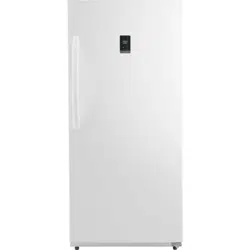
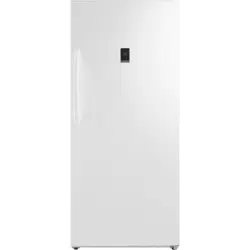
User Guide Refrigerator
Features
Interior
Notes The illustrations shown in this user guide are only for reference. The actual product may differ slightly.

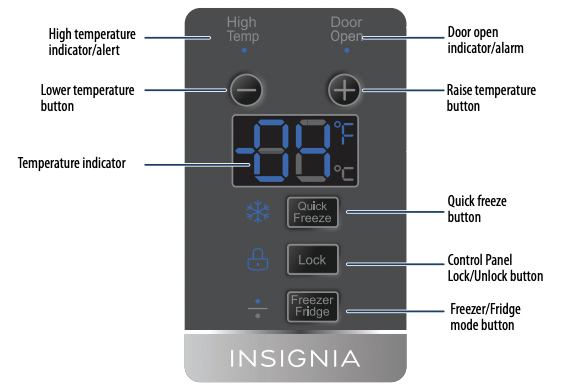
Touch pad controls
Setting up your freezer
Before using your freezer
• Remove the exterior and interior packing, especially the foam packing between the outside condenser and the cabinet.
• Let the freezer stand upright for approximately two hours before connecting it to power. This reduces the possibility of a malfunction in the cooling system from improper handling during transportation.
• Wash the inside with a damp, warm cloth and a baking soda solution (two tablespoons in a quart of water), then wipe dry with a dry cloth. Do this periodically to keep your freezer looking new.
• For proper operation, it’s very important that you level the freezer using the leveling feet. If this is not done, the door may not close or seal properly, causing cooling, frost, and moisture problems. Turn the leveling feet clockwise to raise that side of the freezer or counterclockwise to lower that side. The leveling feet are easier to adjust if you have someone push against the top of the freezer to take some weight off.
• When moving your freezer, do not tilt it beyond 45° from upright.
Finding a suitable location
• Place your freezer on a floor that is strong enough to support the freezer when it is fully loaded.
• This freezer is designed to be free standing only, and should not be recessed or built-in.
• Allow 7.9 inches (20 cm) of space between the sides of the freezer and the walls, 3.9 inches (10 cm) between the back of the freezer and the wall, and 11.8 inches (30 cm) between the top of the freezer and the ceiling. This allows for proper air ventilation. Adjust the feet to keep the freezer level.
• If you locate the freezer next to a fixed wall, allow sufficient space on the hinge side for the door to swing open.
• Locate the freezer away from direct sunlight and sources of heat, such as a stove, heater, or radiator. Direct sunlight may affect the acrylic coating and heat sources may increase electrical consumption. Extremely cold temperatures may also prevent the freezer from performing properly.
• Avoid locating the freezer in moist areas, or in extremely hot or cold areas.
Leveling your freezer
• It is very important for the freezer to be level. If the freezer is not leveled during installation, the doors may not close or seal properly, causing cooling, frost, or moisture problems.
• To level your freezer, rotate the leveling feet clockwise (to raise) the freezer or counter-clockwise (to lower).
Note Have someone push against the top of the freezer to help take some weight off the leveling foot, making it easier to adjust.
Providing a proper power supply
Check your local power source. This freezer requires a 115V, 60Hz power supply.
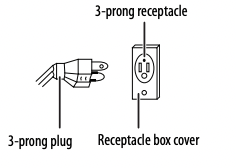
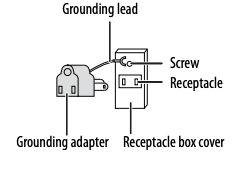
Use a receptacle that accepts the grounding prong. The power cord is equipped with a 3-prong (grounding) plug which mates with a standard 3-prong (grounding) wall outlet to minimize the possibility of electric shock hazard from this freezer. We recommend that the freezer be plugged into an electrical circuit serving only this appliance and that the circuit cannot be turned off with a switch or pull-chain.
Using a 3-prong plug and outlet
Using a grounding adapter
Installing the door handle
Notes
• The illustrations shown in this user guide are only for reference. The actual product may differ slightly.
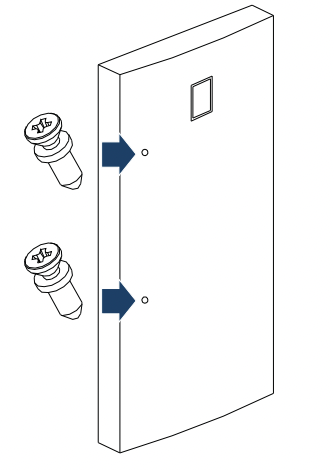
• The screws and wrench are in the plastic bag.
- 1 Unplug the freezer.
- 2 Screw the extended-head screws into the door holes with a Phillips screwdriver. Do not overtighten. The screw heads should extend above the surface of the door.
- 3 Loosen the hex screws on top and bottom of the handle with the hex wrench (provided) so that you can fit the handle over the extended head screws in the door.
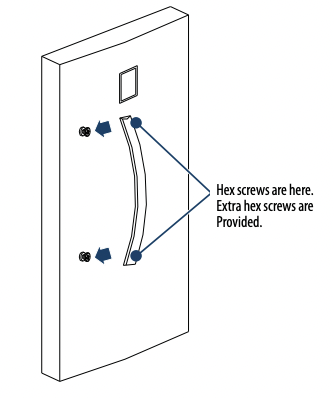
- 4 Place the door handle over the heads of the screws, then tighten the hex screws.
Using your freezer
The storage life of frozen foods varies and the recommended storage time should not be exceeded.
Place frozen food into the freezer as quickly as possible after purchase. If there are instructions on the packet, carefully follow these instructions regarding storage times.
Pre-packed, commercially frozen food should be stored in accordance with the frozen food manufacturer's instructions for a three star frozen food storage compartment or home freezer.
Shelves are provided for the organization of odd-shaped items
- 1 Plug in your freezer. Wait for 30 minutes, then open the freezer door to determine if the freezer is working properly.
- 2 Press and hold Lock for three seconds, then + or - on the control panel to set the temperature inside the freezer. A beep sounds when the MAX or MIN temperatures are reached. The default temperature is 0° F (-18° C). The temperature range of Freezer mode is 10° F ~-11° F (-12° C~-24° C. The temperature range for Fridge mode is 35 ~ 46° F (2° C ~ 8° C).
Notes
• If the freezer is unplugged or loses power, you must wait three to five minutes before restarting it. The freezer will not start if you attempt to restart it sooner. • Large amounts of food lower the cooling efficiency of the freezer.
• If you choose to change the thermostat setting, adjust the thermostat control by one increment at a time. Allow several hours for the temperature to stabilize between adjustments.
• Do not put bottled food or drinks in the freezer.
Using the Lock button
To prevent accidental activation, the control panel automatically locks after 30 seconds of inactivity. To use the control panel, you must unlock it first.
Press and hold the Lock button on the control panel for three seconds to lock the control panel. The lock icon turns on and the control panel beeps. Press again for another three seconds to unlock it. The lock icon turns off and the panel beeps.
Switching between Freezer and Refrigerator modes
This freezer has an advanced design feature that lets you change it from a freezer to a refrigerator. The Freezer/Fridge light on the control panel indicates the current mode.
- 1 Press and hold Lock for three seconds to unlock the control panel.
- 2 Press and hold the Freezer/Fridge button for three seconds to change modes. The panel beeps and the indicator changes to the new mode.
Quick Freezing foods
The quick freeze mode lowers the temperature below the normal operating temperature to quickly freeze foods.
- 1 Press and hold Lock for three seconds to unlock the control panel.
- 2 Press the Quick Freeze button to enter quick freeze mode. The blue snowflake turns on.
The quick freeze mode turns off after three hours, if the temperature falls below -13° F (-25° C). If the temperature does not fall below -13° F (-25° C), the quick freeze mode turns off after 24 hours. You can press the button a second time to exit quick freeze mode.
Switching between Fahrenheit and Celsius
- 1 Press and hold Lock for three seconds to unlock the control panel.
- 2 Press and hold +/- for three seconds to switch settings.
Maintaining your freezer
Your freezer is designed for year-round use with only minimal cleaning and maintenance. We recommend that you do the following every time you clean it to keep your freezer running odor free and efficiently:
Caution To prevent damage to the finish, do not use gasoline, benzine, thinner, or other solvents, and do not use abrasive cleaners.
- 1 Unplug your freezer from the wall outlet.
- 2 Remove all food.
- 3 Wash the shelves with a mild detergent solution.
- 4 Wash the inside with a damp warm cloth soaked in a solution of one quart of lukewarm water to two tablespoons of baking soda solution.
- 5 Dry the interior and exterior with a soft cloth.
- 6 Be sure to keep the door gasket (seal) clean to keep the unit running efficiently
Storing your freezer
- 1 Unplug your freezer from the wall outlet.
- 2 Remove all food.
- 3 Clean the freezer.
- 4 Leave the door open slightly to avoid possible formation of condensation, mold, or odor.
Moving your freezer
- 1 Unplug your freezer from the wall outlet.
- 2 Remove all food.
- 3 Securely tape down all loose items inside your freezer.
- 4 Tape the door shut. Be sure the freezer does not tilt more than 45° from the upright position during transportation.
Tips on saving energy
• Locate your freezer in the coolest area of the room, away from heat producing appliances or heating ducts and out of the direct sunlight.
• Let hot foods cool to room temperature before placing them in the freezer. Overloading the freezer forces the compressor to run longer. Foods that freeze too slowly may lose quality or spoil.
• Wrap foods properly and wipe containers dry before placing them in the freezer. This cuts down on frost build-up inside the freezer.
• The freezer storage shelves should not be lined with aluminum foil, wax paper, or paper toweling. Liners interfere with cold air circulation, making the freezer less efficient.
• Organize and label food to reduce door openings and extended searches. Remove as many items as needed at one time, and close the door as soon as possible.
Understanding Alerts
High Temp Alert
The freezer is having trouble maintaining a cold temperature. You will get this alert if:
• FREEZER MODE: the inside temperature is over 18° F (-8° C) for 36 hours.
• FRIDGE MODE: If the inside temperature is over 59° F (15° C) for 36 hours.
The LED on control panel turns on and a beep sounds. If the temperature returns to a normal range, the alert turns off. You can also press any button to turn it off. Here are some possible causes:
• The room is too warm. For example, the freezer is in a garage in the summer next to a car with a hot engine.
• The ventilation openings are blocked or dusty.
• There is too much frost build up.
• There are door seal gaps.
Door Open Alert
If the door is open for more than five minutes, the door open alert is activated a buzzer sounds intermittently. Close the door to turn off the alert and check to make sure that nothing is blocking the door, preventing it from closing. Also, check to make sure that the freezer is level. An unlevel freezer may prevent the door from closing properly.
How do I reset my freezer to factory defaults?
- 1 Press and hold Lock for three seconds to unlock the control panel.
- 2 Press the Lock and + buttons at the same time for three seconds to reset the freezer to factory defaults. The panel beeps and all of the indicators turn on for three seconds. If the compressor is running, it pauses for five minutes, then restarts.
Troubleshooting
Caution Do not try to repair your freezer yourself. Doing so invalidates the warranty.
Fault indication
If a fault is detected, the display shows one of the following codes. If a fault is indicated, call for service:
E2 -- Temperature sensor fault
E5 -- Defrost sensor fault
E7 -- Ambient Temperature sensor fault
General
E2 appears on the display
Temperature sensor failure.
E5 appears on the display
Defrost sensor failure.
E7 appears on the display
Ambient temperature sensor failure.
High Temp and Door Open alerts
- See “Understanding Alerts” on page 15.
The freezer does not operate
The freezer is unplugged.
- Make sure that the freezer is plugged in and that the plug is pushed completely into the outlet.
The fuse on the circuit is blown or the circuit breaker is tripped.
- Check the house fuse/circuit breaker box and replace the fuse or reset the circuit breaker.
Power failure.
- If a power failure occurs, the freezer turns off. Wait until the power is restored.
The freezer door does not close completely
Food packages are interfering with the door.
- Move the food packages or remove some food.
The door gaskets are dirty.
The freezer may not be level.
Food in the freezer is not cold
The door has been opened too often or was not closed properly.
- Make sure that the door is closed properly.
You have just added a large amount of food to the freezer.
- Allow time for the new food to cool, then check again.
The door is not closed completely.
- Check the door gasket and food distribution and make sure that the door closes completely.
The freezer has recently been disconnected for a period of time.
- Allow time for the freezer to cool before adding food. Four hours are required for the freezer to cool down completely.
The thermostat is set too warm.
- Set the thermostat to a colder setting.
The freezer makes unusual noises or vibrations
The freezer may not be level on the floor.
- Level the freezer with the leveling feet.
The body of the freezer is touching a wall.
- Move the freezer out from the wall.
Metal parts undergo expansion and contraction.
Refrigerant is circulating throughout the system.
Moisture is building up in the interior of the freezer
The door has been opened too often or was not closed properly.
- Make sure that the door is closed properly.
The freezer is in a location that is very humid.
- Move the freezer to a dryer location.
The weather is hot and humid.
The freezer door does not close completely
Food packages are interfering with the door.
- Move the food packages or remove some food.
The door gaskets are dirty.
The freezer is not level.
- Level the freezer with the leveling feet.
The compressor turns on and off frequently.
The room temperature is hotter than normal.
You have just added a large amount of food to the freezer.
- Allow time for the new food to cool, then check again.
The door is not closed completely or was opened too often.
- Check the door gasket and food distribution and make sure that the door closes completely.
The freezer has recently been disconnected for a period of time.
- Allow time for the freezer to cool before adding food. Four hours are required for the freezer to cool down completely.
The thermostat was not set correctly.
- Set the thermostat to the correct setting.
Control panel
The control panel is unresponsive
The control panel is locked.
- Press and hold the Lock button for three seconds to unlock the control panel.
I got an alert that the door is open
The door is open.
- Close the door.
- Make sure that nothing is blocking the door.
- Make sure that the freezer is level.
I got an alert that the temperature is too high
Warm foods may have recently been added to the freezer.
- Wait for the foods to cool.
The temperature is set too high or too low.
The room that the freezer is located in is too warm.
- Wait for the room temperature to drop.