© 2003 Sony Corporation
4-099-434-11 (1)
LCD Color TV
Operating Instructions
Before operating the unit, please read this manual thoroughly
and retain it for future reference.
KLV-23HR2
Owner’s Record
The model and serial numbers are located at the rear of the TV, on the backside of
the rear cover, on the sticker, and also on the TV box (white label). Record these
numbers in the spaces provided below. Refer to them whenever you call upon your
Sony dealer regarding this product.
Model No. ________________
Serial No. ________________
2
WARNING
To reduce the risk of fire or shock hazard,
do not expose the TV to rain or moisture.
This symbol is intended to alert the user to the presence
of uninsulated “dangerous voltage” within the product’s
enclosure that may be of sufficient magnitude to
constitute a risk of electric shock to persons.
This symbol is intended to alert the user to the
presence of important operating and maintenance
(servicing) instructions in the literature
accompanying the appliance.
CAUTION
TO PREVENT ELECTRIC SHOCK, MATCH WIDE BLADE OF
PLUG TO WIDE SLOT, FULLY INSERT.
CAUTION
The following SONY appliance is only for use with the following
WALL-MOUNT BRACKET. Use with other WALL-MOUNT
BRACKET is capable of resulting in instability causing possible injury.
SONY APPLIANCE MODEL NO.
KLV-23HR2
WALL-MOUNT BRACKET MODEL NO.
SU-W210
SONY Corp.
Note on Caption Vision
This television receiver provides display of television closed captioning
in accordance with §15.119 of the FCC rules.
Note to CATV system installer
This note is provided to call the CATV system installer’s attention to
Article 820-40 of the NEC that provides guidelines for proper grounding
and, in particular, specifies that the cable ground shall be connected to
the grounding system of the building, as close to the point of cable entry
as practical.
Use of this television receiver for other than private viewing of programs
broadcast on UHF, VHF, transmitted by cable companies or satellite for
the use of the general public may require authorization from the
broadcaster/cable company and/or program owner.
CAUTION
RISK OF ELECTRIC SHOCK
DO NOT OPEN
ATTENTION
RISQUE DE CHOC ELECTRIQUE,
NE PAS OUVRIR
PRECAUCION
RIESGO DE CHOQUE ELECTRICO
CAUTION : TO REDUCE THE RISK OF ELECTRIC SHOCK,
DO NOT REMOVE COVER
(
OR BACK
)
.
NO USER-SERVICEABLE PARTS INSIDE.
REFER SERVICING TO QUALIFIED SERVICE PERSONNEL.
NO ABRIR
NOTIFICATION
This equipment has been tested and found to comply with the limits for a
Class B digital device pursuant to Part 15 of the FCC Rules. These limits
are designed to provide reasonable protection against harmful interference
in a residential installation. This equipment generates, uses, and can radiate
radio frequency energy and, if not installed and used in accordance with
the instructions, may cause harmful interference with radio
communications. However, there is no guarantee that interference will not
occur in a particular installation. If this equipment does cause harmful
interference to radio or television reception, which can be determined by
turning the equipment off and on, the user is encouraged to try to correct
the interference by one or more of the following measures:
– Reorient or relocate the receiving antennas.
– Increase the separation between the equipment and receiver.
– Connect the equipment into an outlet on a circuit different from that to
which the receiver is connected.
– Consult the dealer or an experienced radio/TV technician for help.
You are cautioned that any changes or modifications not expressly
approved in this manual could void your warranty and your authority to
operate this equipment.
Safety
– Operate the TV only on 120 V AC.
– The plug is designed, for safety purposes, to fit into the wall outlet
only one way. If you are unable to insert the plug fully into the outlet,
contact your dealer.
– If any liquid or solid object should fall inside the cabinet, unplug the
TV immediately and have it checked by qualified service personnel
before operating it further.
– If you will not be using the TV for several days, disconnect the power
by pulling the plug itself. Never pull on the cord.
Installing
– To prevent internal heat buildup, do not block the ventilation
openings.
– Do not install the TV in a hot or humid place, or in a place subject to
excessive dust or mechanical vibration.
WOW, SRS and symbol are trademarks of SRS Labs, Inc.
WOW technology is incorporated under license from SRS Labs, Inc.
As an ENERGY STAR
®
Partner, Sony
Corporation has determined that this
product meets the E
NERGY STAR
®
guidelines for energy efficiency.

3
Important Safety Instructions
1 Read these instructions.
2 Keep these instructions.
3 Heed all warnings.
4 Follow all instructions.
5 Do not use this apparatus near water.
6 Clean only with dry cloth.
7 Do not block any ventilation openings. Install in
accordance with the manufacturer’s
instructions.
8 Do not install near any heat sources such as
radiators, heat registers, stoves, or other
apparatus (including amplifiers) that produce
heat.
9 Do not defeat the safety purpose of the
polarized or grounding-type plug. A polarized
plug has two blades with one wider than the
other. A grounding type plug has two blades
and a third grounding prong. The wide blade or
the third prong are provided for your safety. If
the provided plug does not fit into your outlet,
consult an electrician for replacement of the
obsolete outlet.
10 Protect the power cord from being walked on or
pinched particularly at plugs, convenience
receptacles, and the point where they exit from
the apparatus.
11 Only use attachments/accessories specified by
the manufacturer.
12 Use only with the cart,
stand, tripod, bracket, or
table specified by the
manufacturer, or sold with
the apparatus. When a cart
is used, use caution when
moving the cart/apparatus
combination to avoid
injury from tip-over.
13 Unplug this apparatus during lightning storms
or when unused for long periods of time.
14 Refer all servicing to qualified service personnel.
Servicing is required when the apparatus has
been damaged in any way, such as power-
supply cord or plug is damaged, liquid has been
spilled or objects have fallen into the apparatus,
the apparatus has been exposed to rain or
moisture, does not operate normally, or has
been dropped.
Handling the LCD screen
s Do not leave the LCD screen facing the sun as it can damage the LCD
screen. Take care when you place the TV by a window.
s Do not push on or scratch the LCD screen. Do not place a heavy object
on the LCD screen. This may cause the screen to lose uniformity or
cause LCD panel malfunctions.
s If the TV is used in a cold place, a smear may appear on the screen.
This is not a malfunction. The screen returns to normal as the
temperature rises to a normal operating level.
s If a still picture is displayed for a long time, a ghosting may occur for a
while. The ghosting will eventually disappear.
s The LCD panel becomes warm during operation. This is not a
malfunction.
Note on the LCD (Liquid Crystal Display)
Please note that the LCD screen is made with high-precision technology.
However, black points or bright points of light (red, blue, or green) may
appear constantly on the LCD screen, and irregular colored stripes or
brightness may appear on the LCD screen. This is not a malfunction.
(Effective dots: more than 99.99%)
Handling of Broken Glass and Liquid Crystal Leakage
If the LCD panel gets damaged, crystalline liquid leakage may occur, or
scattered broken glass may result. Do not touch broken glass or crystalline
liquid (which is toxic), with bare hands as cuts or poisoning/skin irritation
may occur. Also, do not let glass fragments or leaked crystalline liquid get
into your eyes or mouth. Should either contact your eyes or mouth, rinse
the contacted area thoroughly with water and consult your doctor.
Fluorescent Lamp
This TV uses a special fluorescent lamp as its light source. If the screen
image becomes dark, flickers or does not appear, the fluorescent lamp has
run down and should be replaced. For replacement, consult qualified
service personnel.
Disposal of the TV
s Do not dispose of the TV with general household waste.
s The LCD contains a small amount of liquid crystal and mercury. The
fluorescent lamp used in this TV also contains mercury. Follow your
local ordinances and regulations for disposal.

4
Table of Contents
Table of Contents
Installing and Connecting the TV
Unpacking ..........................................................6
Inserting Batteries into the Remote Control...6
Connector Types................................................6
Identifying Front and Rear Connectors..........7
Basic Connections (Connecting Cable TV or
an Antenna)...................................................8
Removing the rear cover ...........................8
Attaching the rear cover ............................8
Connecting directly to cable or an antenna ...
8
Cable box connections ..............................8
Connecting the Power Cord .............................9
Bundling cords and cables ......................10
Adjusting the viewing angle of the TV ...11
Carrying the TV ......................................11
Connecting a VCR and Cable TV..................12
Connecting a Satellite Receiver......................13
Connecting a Satellite Receiver with a VCR....14
Connecting an Audio Receiver.......................15
Connecting a DVD Player with Component
Video Connectors .......................................16
Connecting a DVD Player with A/V
Connectors ..................................................17
Connecting a Digital Satellite Receiver .........18
Connecting a Digital TV Receiver .................19
Connecting a Digital Satellite Receiver with
DVI-HDTV connector................................20
Setting the Channels........................................21
Selecting the On-screen Menu Language......23
Watching the TV
Watching the TV .............................................24
Watching with closed caption .................25
Selecting the Picture Mode .............................25
Selecting the Effect Mode ...............................26
Using the Wide Screen Mode .........................27
Changing the Wide Screen Mode ...........27
Changing the Wide Screen Mode using
the menu.............................................29
Using the Freeze Function ..............................31
Setting the Video Inputs..................................32
Using the Video Label Feature.......................33
Operating Video Equipment with Your TV
Remote Control ..........................................34
Programming the remote control ............34
Operating optional equipment.................36
Using Favorite Channels.................................37
Setting your favorite channels.................37
Watching favorite channels.....................38
Using the Channel Label Feature ..................38
Using Advanced Features
Using the Menu................................................40
Adjusting the Picture Position........................41
Adjusting the Picture Quality ........................42
Adjusting the Sound Quality ..........................44
Selecting Stereo or Bilingual Programs.........45
Selecting stereo or bilingual programs
using the menu ...................................46
Using the Parental Control Feature...............46
Activating the Parental Control feature ..47
Selecting a Custom Rating ......................49
What the Ratings Mean ..................................51
Ratings in the U.S.A. ..............................51
Ratings in Canada ...................................53
Turning Off the TV Automatically ................55

5
Table of Contents
“Memory Stick”
About the “Memory Stick”.............................56
Features of the Memory Stick Home.............58
Inserting and Removing a “Memory Stick” ...60
Inserting a “Memory Stick” ....................60
Removing a “Memory Stick”..................60
Displaying the Memory Stick Home ..............61
Displaying the Memory Stick Home ......61
The Memory Stick Home – A one-stop list for
all of your digital photos and movies......
62
Playing “Slide Show” ......................................63
Viewing Photos ................................................64
Viewing digital photos at full-screen size ..64
Rotating and viewing your digital photos ..65
Playing Movies (“Movie Player”) ..................66
Protecting/Deleting the files............................67
Protecting digital photos or movies ........67
Deleting digital photos or movies ...........69
About the Memory Stick Home menu options ...
70
Selecting a folder and viewing digital
photos or movies ................................71
Sorting image files ..................................72
Selectively displaying digital photos or movies ..
73
Caution icons and messages............................74
Additional Information
Troubleshooting...............................................76
Trouble symptoms and remedies ............76
Self-diagnosis function ...........................76
Specifications ...................................................79
Index to parts and controls.............................80
TV Front Panel........................................80
Remote Control .......................................81
Index .................................................................82
6
Installing and Connecting the TV
Installing and
Connecting the
TV
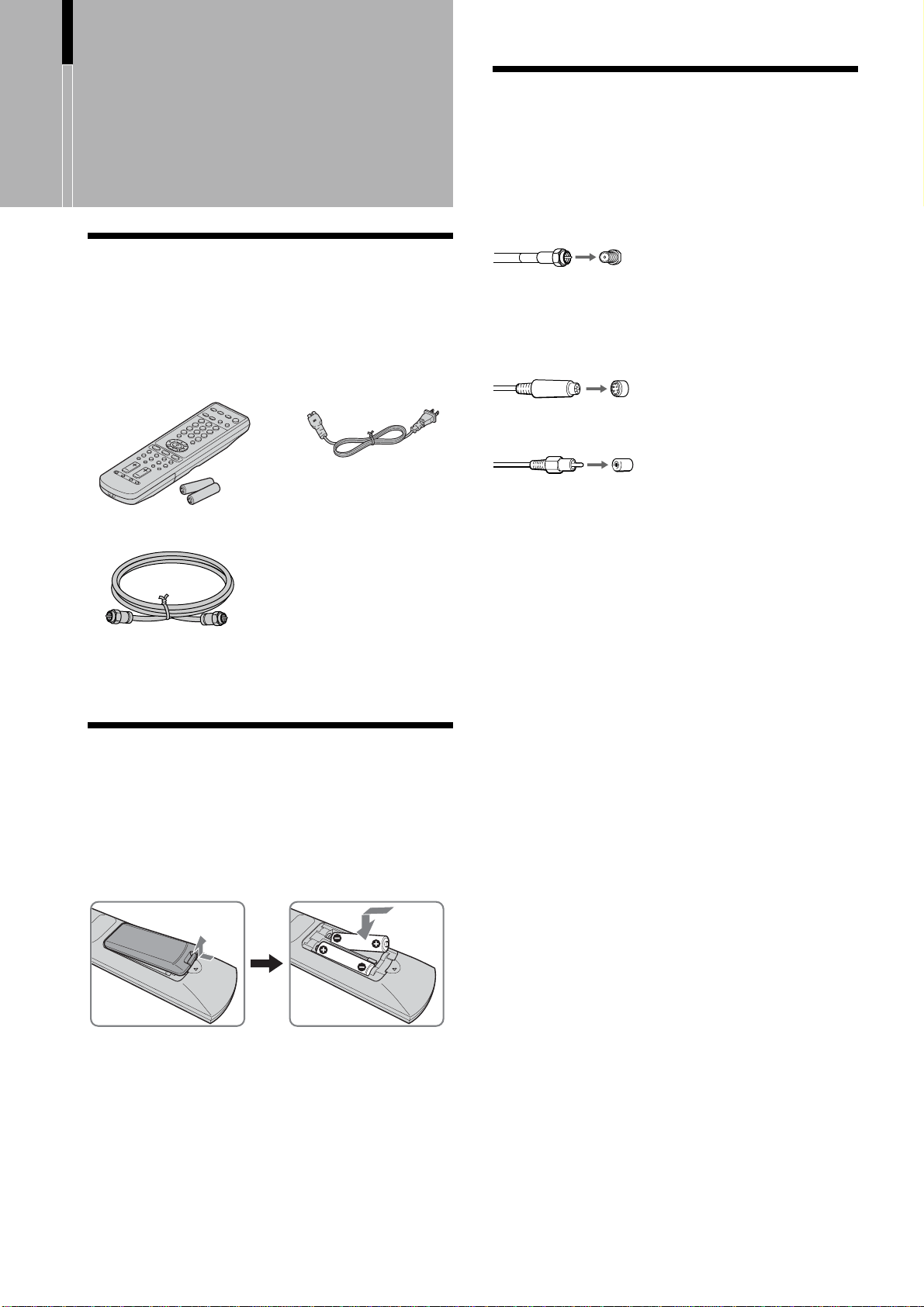
Unpacking
When you unpack this unit, make sure it includes the
following:
Operating Instructions
Warranty Card
Product Registration
Inserting Batteries into
the Remote Control
Insert two size AA batteries (supplied) by matching
the + and – on the batteries to the diagram inside the
remote control’s battery compartment.
Notes
• Remove the batteries to avoid damage from possible battery
leakage whenever you anticipate that the remote control will
not be used for an extended period.
• Handle the remote control with care. Avoid dropping it,
getting it wet, or placing it in direct sunlight, near a heater or
where the humidity is high.
• Your remote control can be programmed to operate most video
equipment (See “Operating Video Equipment with Your TV
Remote Control” on page 34).
AC power cord (1)
Connector Types
You may find it necessary to use some of the
following connector types during set up.
Supplied 75-ohm coaxial cable
Screw-on type
S VIDEO cable
High quality video cable for enhanced picture quality
AUDIO/VIDEO cable
VIDEO - Yellow
AUDIO (Left) - White
AUDIO (Right) - Red
Some DVD players are equipped with the following
three video connectors:
Y - Green
P
B (CB, Cb or B-Y) - Blue
P
R (CR, Cr or R-Y) - Red
Screw into connection.
Align guides and push into
connection.
Push into connection.
75-ohm coaxial cable (1)
Remote control (1) and
size AA batteries (2)
7
Installing and Connecting the TV
Identifying Front and Rear Connectors
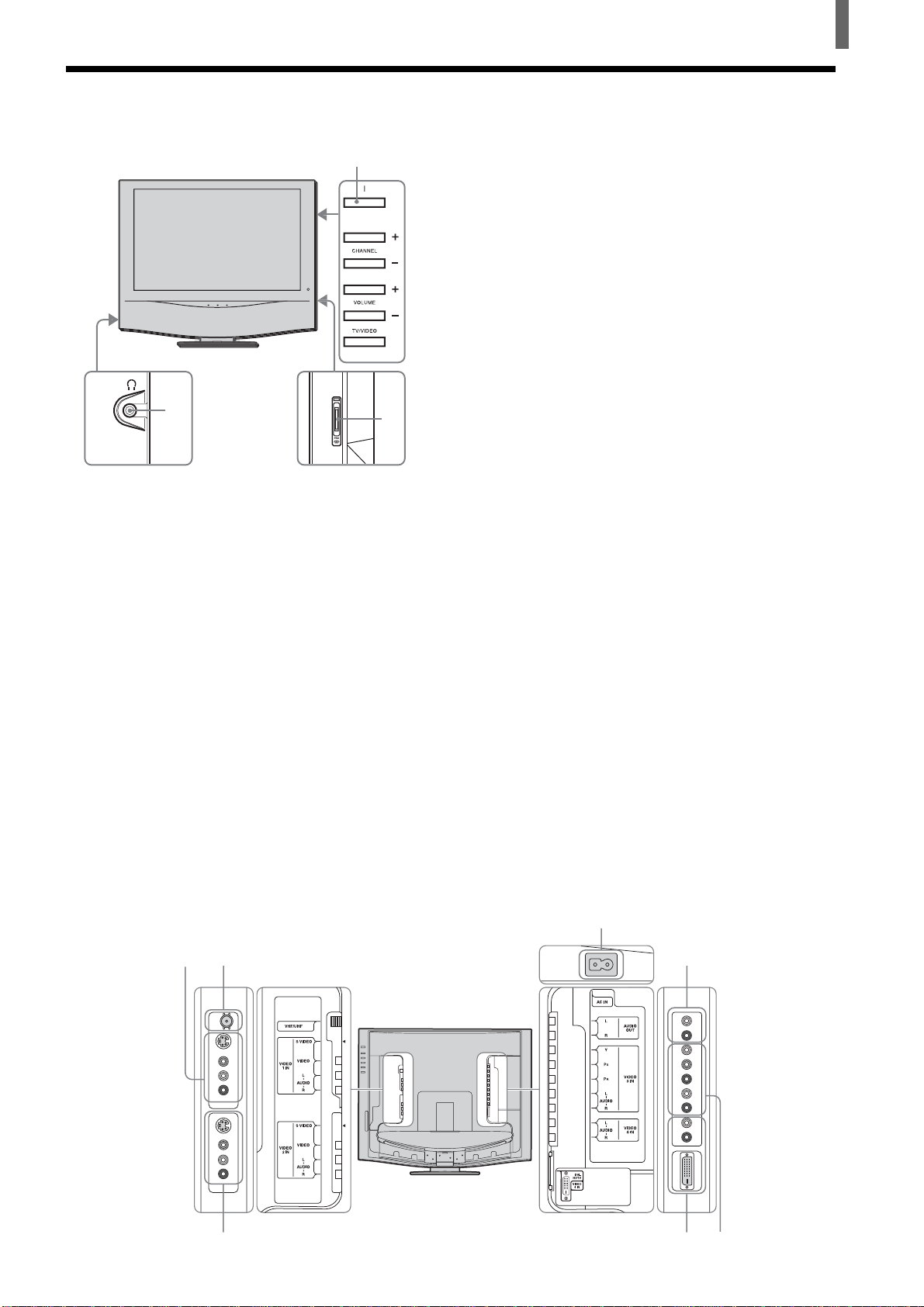
TV front panel
1 POWER button (page 21)
2 Headphones jack
Connects to your headphones.
If your headphones do not match the jack, use a
suitable plug adaptor (not supplied).
3 “Memory Stick” slot (page 60)
4 VHF/UHF (pages 8, 12 - 14)
Connects to your VHF/UHF antenna or cable.
5 VIDEO 1 IN (pages 12 - 14, 17)
Connects to the output jacks of your VCR or
other video equipment.
6 VIDEO 2 IN (pages 12 - 14, 17)
Connects to the output jacks of your VCR or
other video equipment.
I
Side view
2
3
48
6
7 AC IN (page 9)
Connects the supplied AC power cord.
8 AUDIO OUT (page 15)
Connects to the input jacks of your audio
equipment.
Audio output through the AUDIO OUT jacks is
available only when the TV’s speaker is off (See
page 15).
9 VIDEO 3 IN
Y, P
B, PR input jacks (pages 16, 18, 19)
Connects to the component video connectors
(Y/C
B/CR, Y/B-Y/R-Y, or Y/PB/PR) of your
DVD player or other video equipment such as a
Digital Satellite Receiver and Digital TV
Receiver.
AUDIO (L/R) input jacks (pages 16, 18, 19)
Connects to the audio output jacks of your DVD
player or other video equipment such as a
Digital Satellite Receiver and Digital TV
Receiver.
0 VIDEO 4 IN
AUDIO (L/R) input jacks (page 20)
Connects to the audio output jacks of your video
equipment such as a digital satellite receiver and
digital TV receiver.
DVI-HDTV input jacks (page 20)
Can accommodate a copy-protected digital
connection (HDCP*) to other video equipment
(such as a digital satellite receiver) that have
compatible interfaces. The DVI-HDTV input
terminal is compliant with the EIA861B standard
and is not intended for use with PC. See the
instruction manual that came with your
equipment for details about connecting and using
it with the TV.
Use a DVI-D single link cable.
*High-bandwidth Digital Content Protection
Side view
1
Rear of TV
Side view
5
7
9
0
Side view
8
Installing and Connecting the TV
75-ohm coaxial
cable (supplied)
Rear of TV
VHF/UHF
Basic Connections
(Connecting Cable TV or
an Antenna)
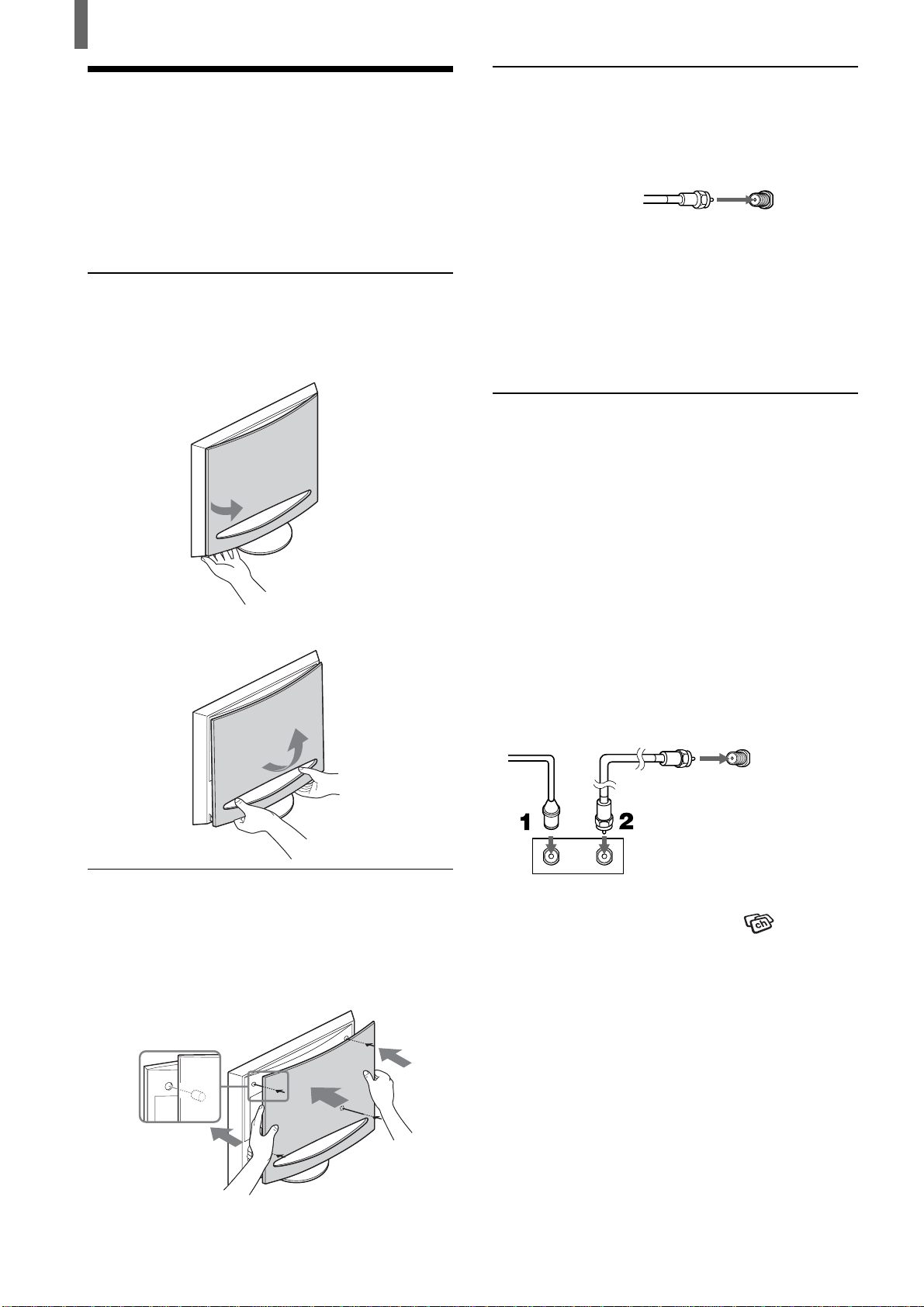
When connecting an antenna or cables, remove the
rear cover of the TV beforehand.
Removing the rear cover
1 Hold the lower right (or left) corner of the back
cover as illustrated below and pull it towards
you. Do the same to the remaining left (or right)
corner.
2 Hold the bottom edge of the cover with both
hands as illustrated and lift upwards.
Attaching the rear cover
Hold the rear cover as illustrated below, fitting the
four pegs on the rear cover into the corresponding
holes on the TV, then push the rear cover back onto
the TV.
Rear of TV
VHF/UHF
IN
OUT
Cable
Cable box
75-ohm coaxial
cable (supplied)
Connecting directly to cable or an
antenna
VHF only or VHF/UHF or cable
Note
It is strongly recommended to connect the antenna using a 75-
ohm coaxial cable to get optimum picture quality. A 300-ohm
twin lead cable can be easily affected by radio noise and the like,
resulting in signal deterioration. If you use a 300-ohm twin lead
cable, keep it away as far as possible from the TV.
Cable box connections
Use this hookup if:
•You subscribe to a cable TV system that uses
scrambled or encoded signals requiring a cable
box to view all channels, and
•You do not intend to hook up any other audio or
video equipment to your TV.
1 Connect the coaxial connector from your cable
service to the cable box’s IN jack.
2 Using the supplied 75-ohm coaxial cable,
connect the cable box’s OUT jack to the TV’s
VHF/UHF jack.
Also, set “Cable” to “On” in the
(Channel)
menu (See page 21).
Tips
• Your Sony remote control can be programmed to operate your
cable box (See “Programming the remote control” on page
34).
• To change channels using the cable box, set your TV to
channel 3 or 4 depending on the cable box channel output.
• If you will be controlling all channel selection through your
cable box, consider using the Channel Fix feature to set your
TV to channel 3 or 4 (See page 22).
9
Installing and Connecting the TV
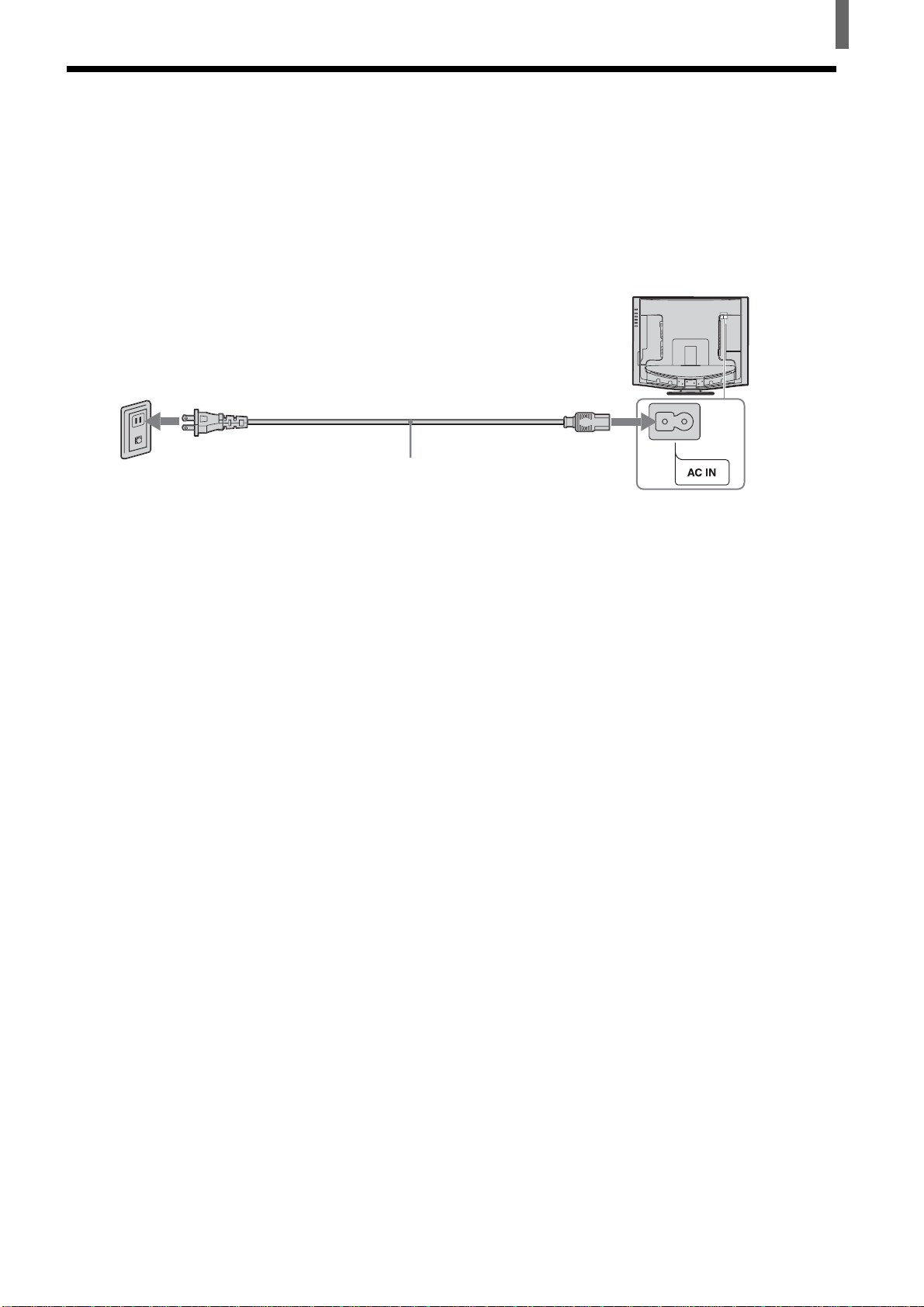
Connecting the Power Cord
Complete other connections prior to connecting the power cord.
1 Connect the power cord to the AC IN connector of the TV.
2 Connect the other plug of the power cord to a wall outlet.
Wall outlet
For 120 V AC
AC power cord (supplied)
10
Installing and Connecting the TV
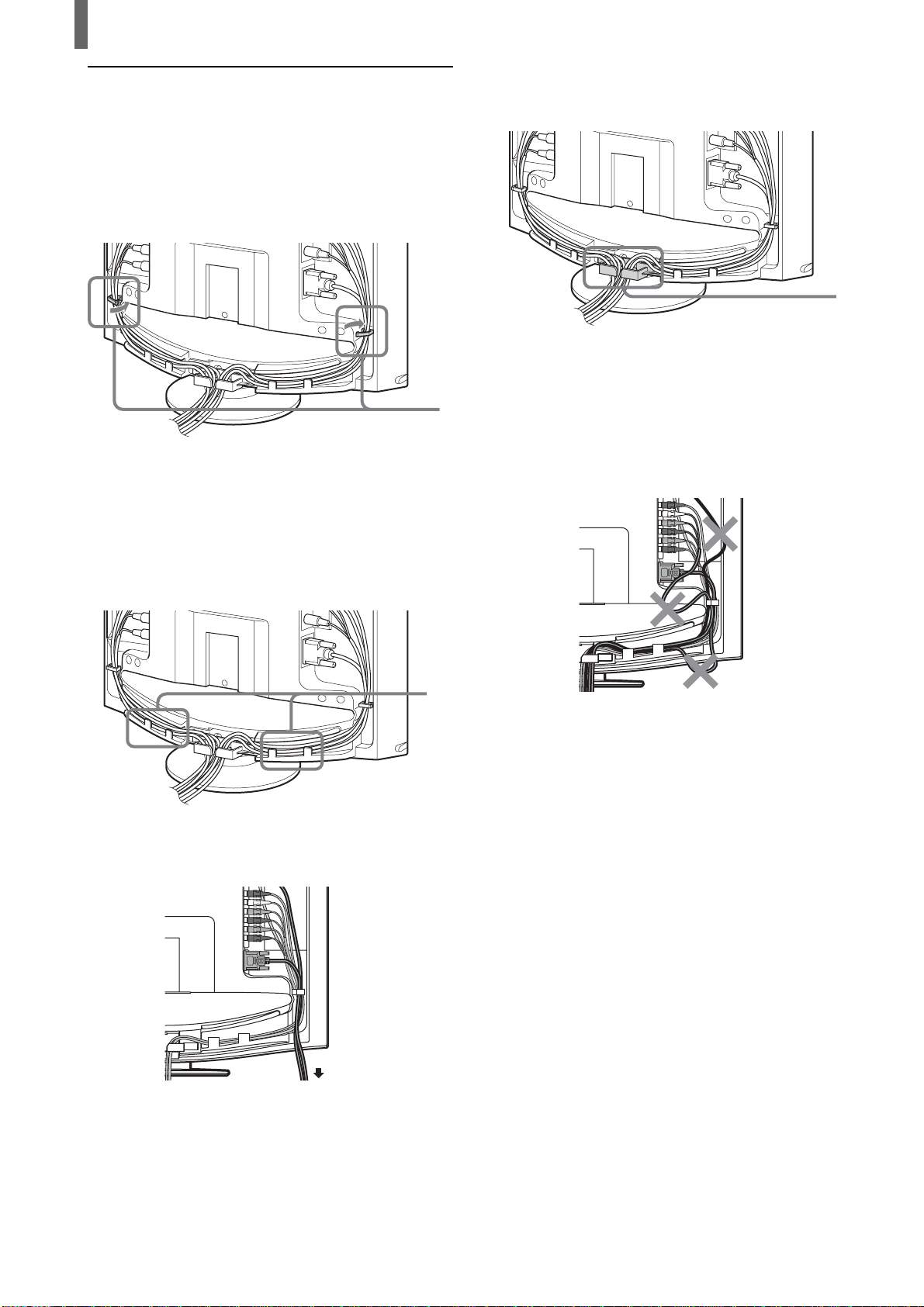
Bundling cords and cables
You can organize the cables in the back of the TV.
1 Bundle the cables and secure them with the clips
on both sides of the TV.
Note
It may not be possible to fasten with clips if cables are too
thick.
2 Pass the cables through the grooves. Be sure to
place the cables inside the tabs at the bottom of
the TV.
Note
If all the cables cannot be stored inside, you may leave
some of them hanging down on both sides of the TV.
3 Gather the cables from both sides together and
secure them with the clip at the bottom.
Note
It may not be possible to fasten with clips if cables are too
thick.
Note
If the cables are not neatly stored in the grooves, you may not be
able to attach the rear cover.
Clips
Tabs
Clip
11
Installing and Connecting the TV
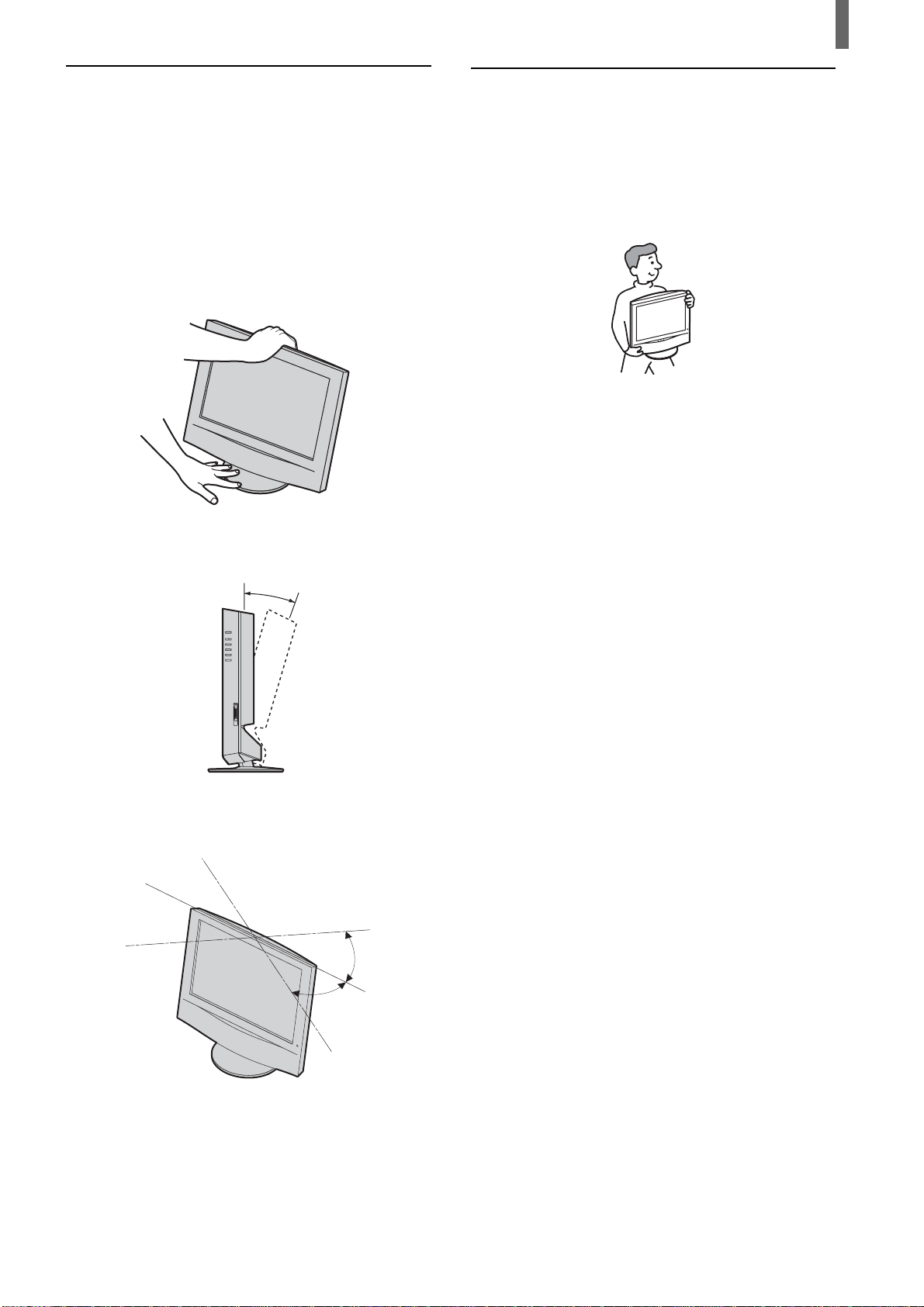
Adjusting the viewing angle of the
TV
You can adjust the angle to avoid the reflection of
light and get a better view of the TV.
Note
When adjusting the angle, steady the base of the stand with your
hand to prevent the TV from becoming separated from the stand.
Be careful not to get your fingers caught between the TV and the
stand.
Carrying the TV
When carrying the TV, hold it as shown in the
diagram below. Do not hold only by the rear cover.
As the rear cover is designed to come off, doing so
may cause you to drop the TV, resulting in damage
to the TV or cause injury.
Backward direction
Horizontal direction
15°
30°
30°
12
Installing and Connecting the TV
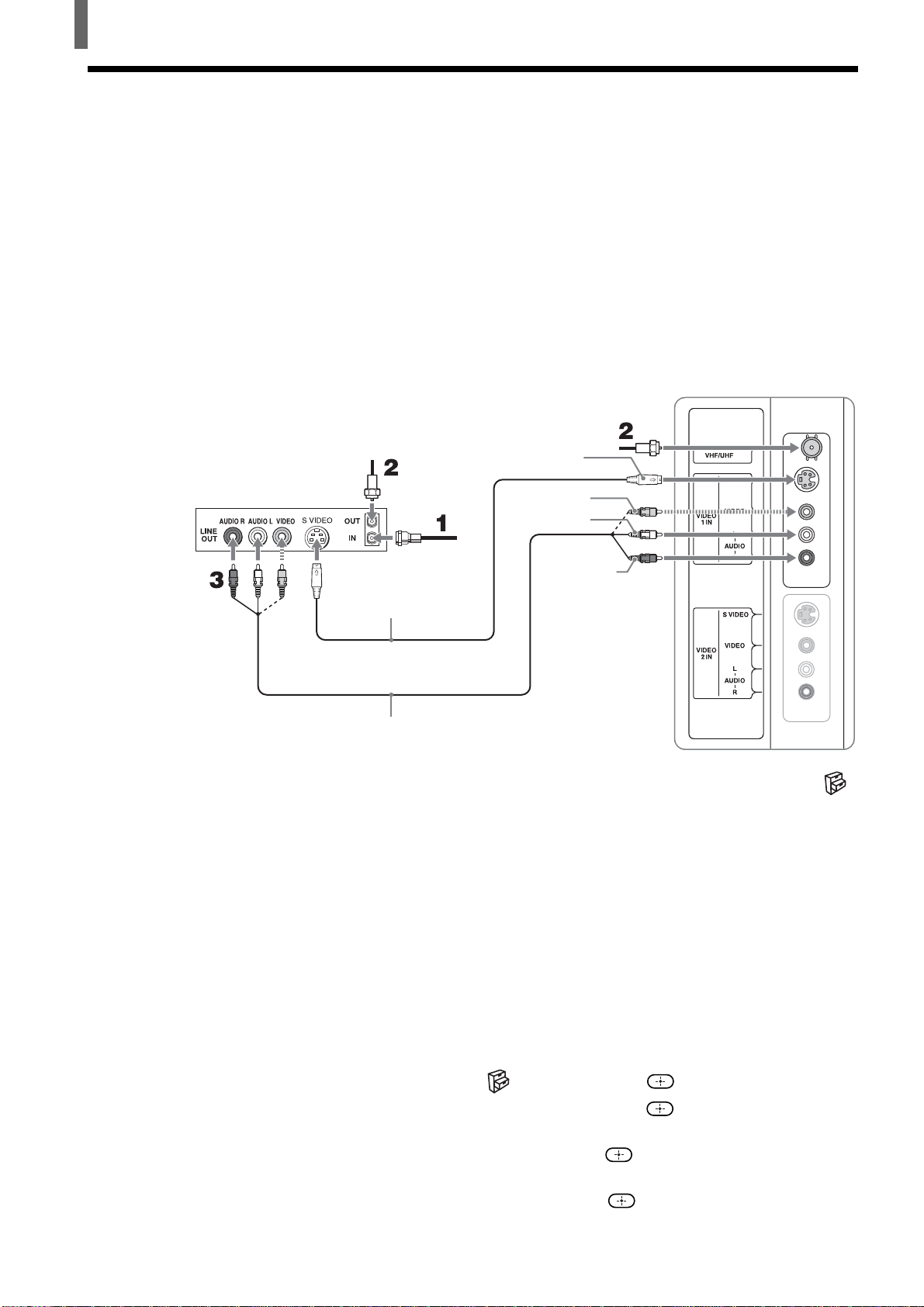
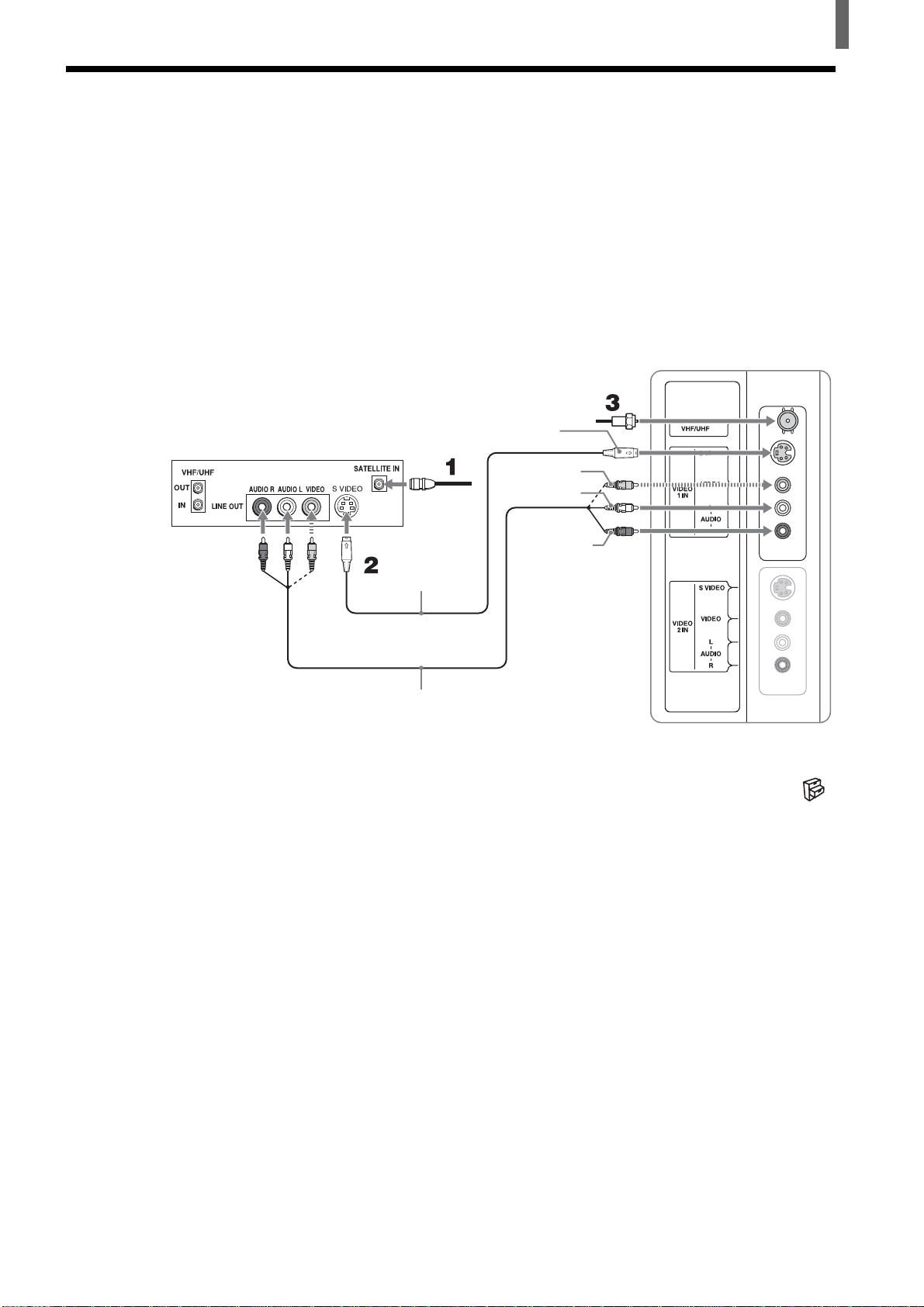
Connecting a VCR and Cable TV
Use this hookup if:
•You have Cable TV that does not require a cable box.
Disconnect all power sources before making any connections.
1 Connect the CATV cable to the VCR’s IN jack.
2 Using the supplied 75-ohm coaxial cable, connect the VCR’s OUT jack
to the TV’s VHF/UHF jack.
3 Using AUDIO and S VIDEO cables, connect the VCR’s AUDIO and S
VIDEO OUT jacks to the TV’s AUDIO and S VIDEO IN jacks.
Note
To watch the pictures input from the S VIDEO input jack, set “Auto YC” to “On” in the
(Setup) menu (See below).
Tips
• You can also use the VIDEO 2 IN jacks to connect your VCR.
• If your VCR is not equipped with S VIDEO, use a VIDEO cable (yellow) instead of the S
VIDEO cable.
When connecting both VIDEO OUT and S VIDEO OUT
You can select the jack the TV receives the input signal from on the menu screen.
You can set it for each video input (VIDEO 1 IN and VIDEO 2 IN) separately.
The TV is factory set to receive S VIDEO input signals.
1 Press TV/VIDEO repeatedly until the desired video input appears.
2 Press MENU.
3 Press V/v to select (Setup), then press .
4 Press V/v to select “Auto YC,” then press .
5 To watch the pictures input from the S VIDEO input jack:
Press V/v to select “On,” then press
.
To watch the pictures input from the VIDEO input jack:
Press V/v to select “Off,” then press
.
6 Press MENU to exit the menu screen.
Cable
75-ohm
coaxial cable
(supplied)
S VIDEO cable
(not supplied)
VIDEO (yellow)
AUDIO-L (white)
AUDIO-R
(red)
AUDIO cable (not supplied)
VCR
S VIDEO
Rear of TV
75-ohm coaxial cable (supplied)
13
Installing and Connecting the TV
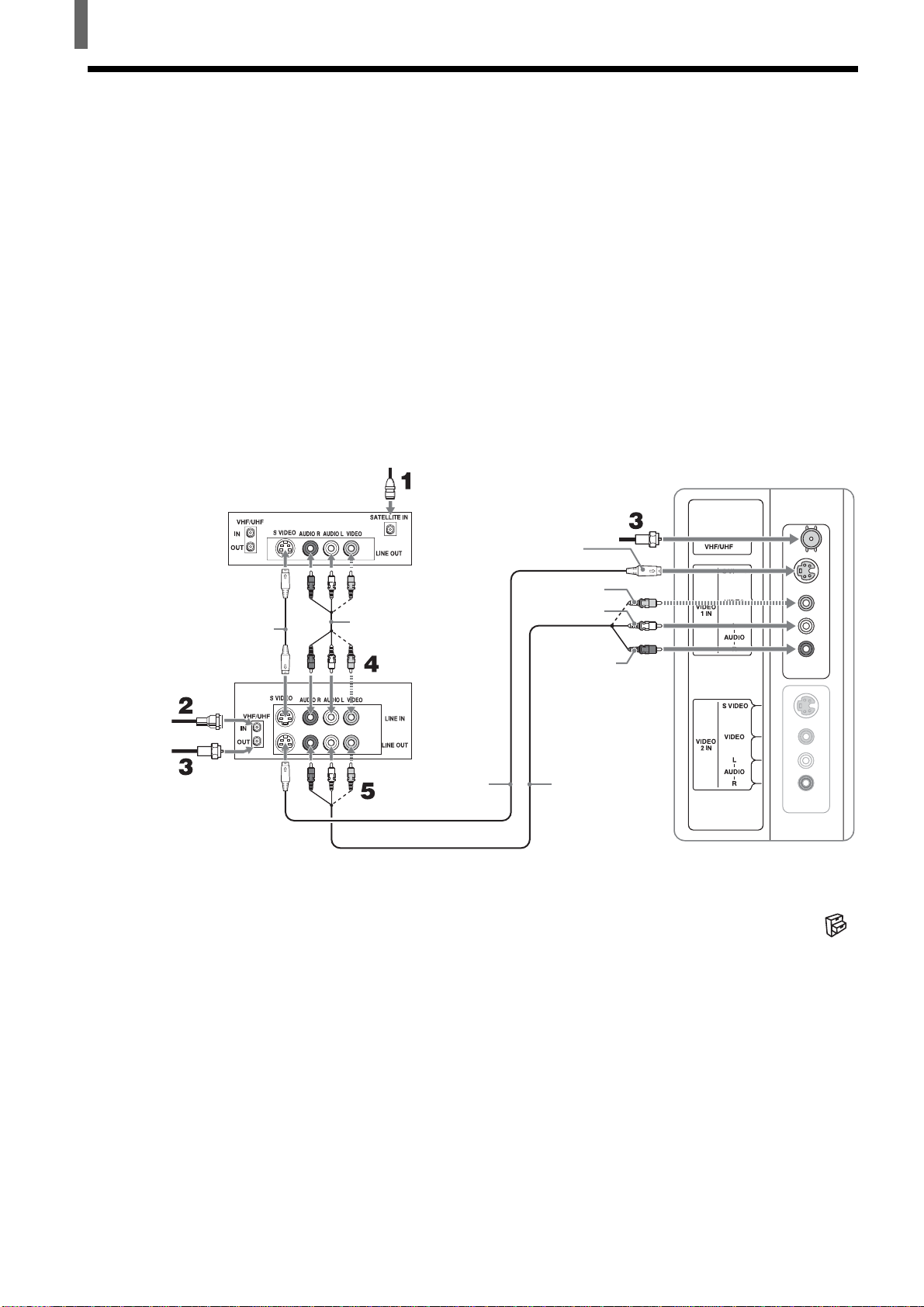
Connecting a Satellite Receiver
Disconnect all power sources before making any connections.
1 Connect the satellite antenna cable to the satellite receiver’s SATELLITE
IN jack.
2 Using AUDIO and S VIDEO cables, connect the satellite receiver’s AUDIO
and S VIDEO OUT jacks to the TV’s AUDIO and S VIDEO IN jacks.
3 Connect the supplied 75-ohm coaxial cable from your cable or antenna to the
TV’s VHF/UHF jack.
VIDEO (yellow)
AUDIO-L (white)
AUDIO-R (red)
S VIDEO
Rear of TV
75-ohm coaxial cable (supplied)
Note
To watch the pictures input from the S VIDEO input jack, set “Auto YC” to “On” in the
(Setup) menu (See page 12).
Tips
• You can also use the VIDEO 2 IN jacks to connect your satellite receiver.
• If your satellite receiver is not equipped with S VIDEO, use a VIDEO cable (yellow)
instead of the S VIDEO cable.
S VIDEO cable
(not supplied)
AUDIO cable (not supplied)
Satellite
antenna
cable
Satellite receiver
14
Installing and Connecting the TV
VIDEO (yellow)
AUDIO-R (red)
VCR
S VIDEO
Rear of TV
75-ohm coaxial cable (supplied)
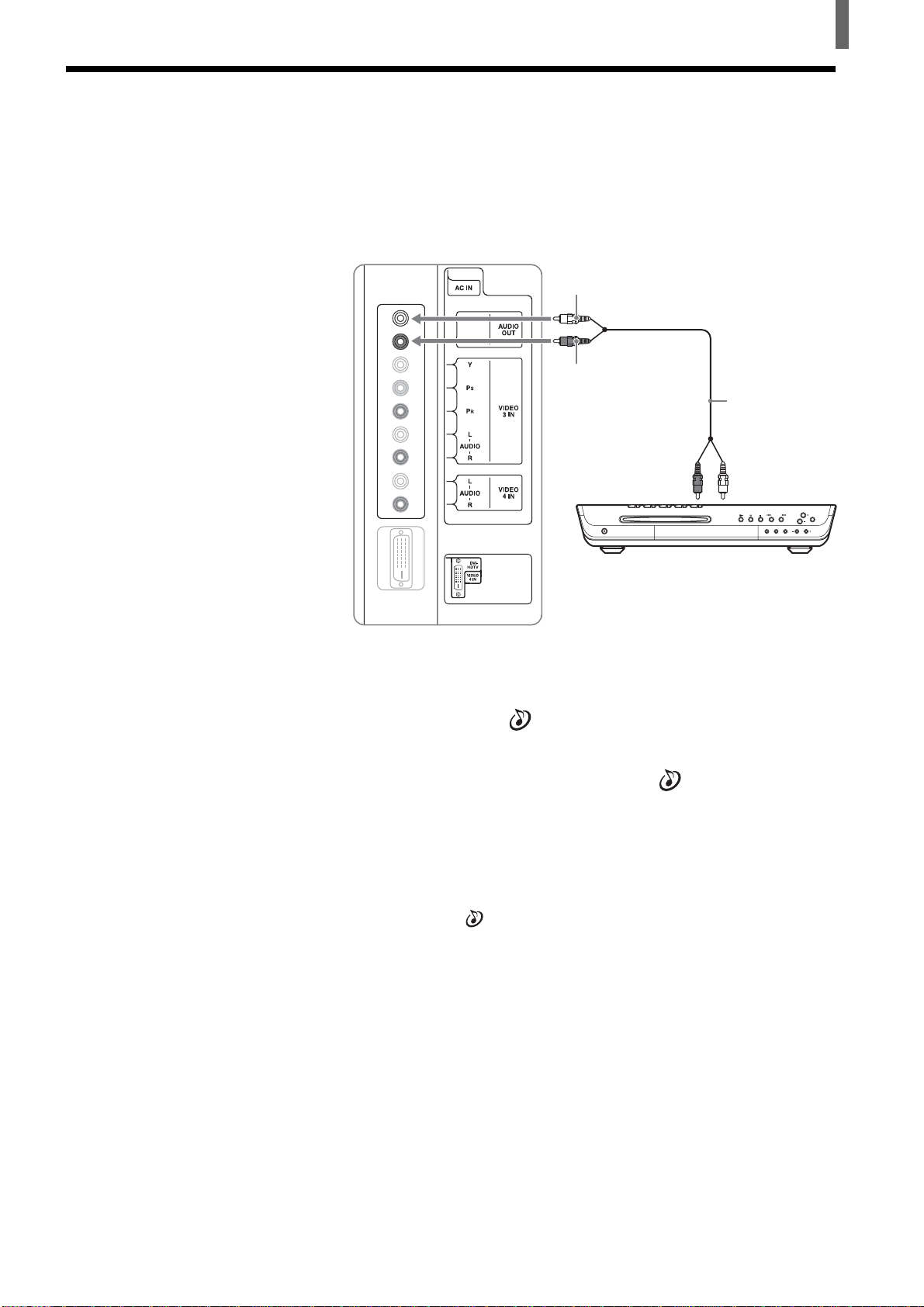
Connecting a Satellite Receiver with a VCR
Disconnect all power sources before making any connections.
1 Connect the satellite antenna cable to the satellite receiver’s SATELLITE
IN jack.
2 Connect the CATV cable to the VCR’s VHF/UHF IN jack.
3 Using the supplied 75-ohm coaxial cable, connect the VCR’s OUT jack
to the TV’s VHF/UHF jack.
4 Using AUDIO and S VIDEO cables, connect the satellite receiver’s
AUDIO and S VIDEO OUT jacks to the VCR’s AUDIO and S VIDEO
IN jacks.
5 Using AUDIO and S VIDEO cables, connect the VCR’s AUDIO and S
VIDEO OUT jacks to the TV’s AUDIO and S VIDEO IN jacks.
Note
To watch the pictures input from the S VIDEO input jack, set “Auto YC” to “On” in the
(Setup) menu (See page 12).
Tips
• You can also use the VIDEO 2 IN jacks to connect your VCR.
• Be sure your VCR’s video input is set correctly. Consult your VCR’s operating manual for
instructions.
• Use TV/VIDEO on the remote control to select VIDEO 1 IN (or VIDEO 2 IN if you use the
VIDEO 2 IN jacks for this hookup) to watch satellite TV or to watch a tape on the VCR
(your VCR must be turned on).
• If your VCR or satellite receiver is not equipped with S VIDEO, use a VIDEO cable
(yellow) instead of the S VIDEO cable.
AUDIO-L (white)
AUDIO cable
(not supplied)
Satellite receiver
Cable
S VIDEO cable
(not supplied)
AUDIO cable
(not supplied)
75-ohm coaxial
cable (supplied)
S VIDEO cable
(not supplied)
Satellite
antenna
cable
15
Installing and Connecting the TV
When using your audio system speakers
Set “Speaker” to “Off” in the (Audio) menu. The TV’s sound is not
output from the AUDIO OUT jacks when the TV’s speaker is set to on.
You can still control the volume output from your audio system using the
TV’s remote control, by setting “Audio Out” in the
(Audio) menu to
“Variable.”
If you want to adjust the volume through your audio system, set “Audio Out”
to “Fixed.”
Notes
• The video signal is not output through the AUDIO OUT jacks.
• When “Audio Out” in the
(Audio) menu is set to “Variable,” “Speaker” is to “Off,”
check if the speaker volume is moderate before switching “Speaker” from “Off” to “On.”
Otherwise, the speaker volume may get too loud.
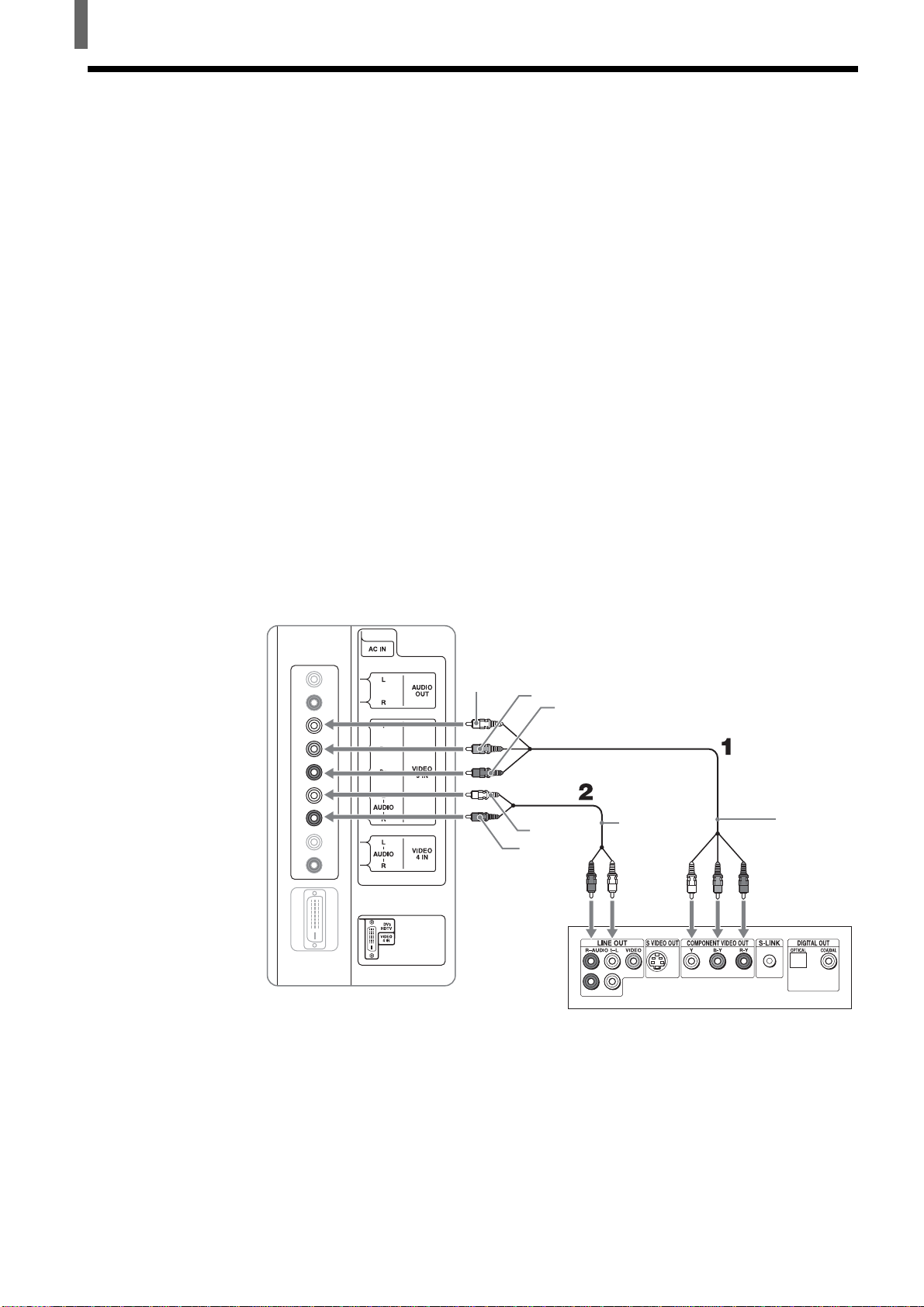
Connecting an Audio Receiver
Disconnect all power sources before making any connections.
Using an AUDIO cable, connect the TV’s AUDIO OUT jacks to the audio
receiver’s AUDIO IN jacks.
AUDIO cable
(not supplied)
Rear of TV
Audio
input
Audio receiver (Compact
AV system DAV-FC9, etc)
AUDIO-R (red)
AUDIO-L (white)
16
Installing and Connecting the TV
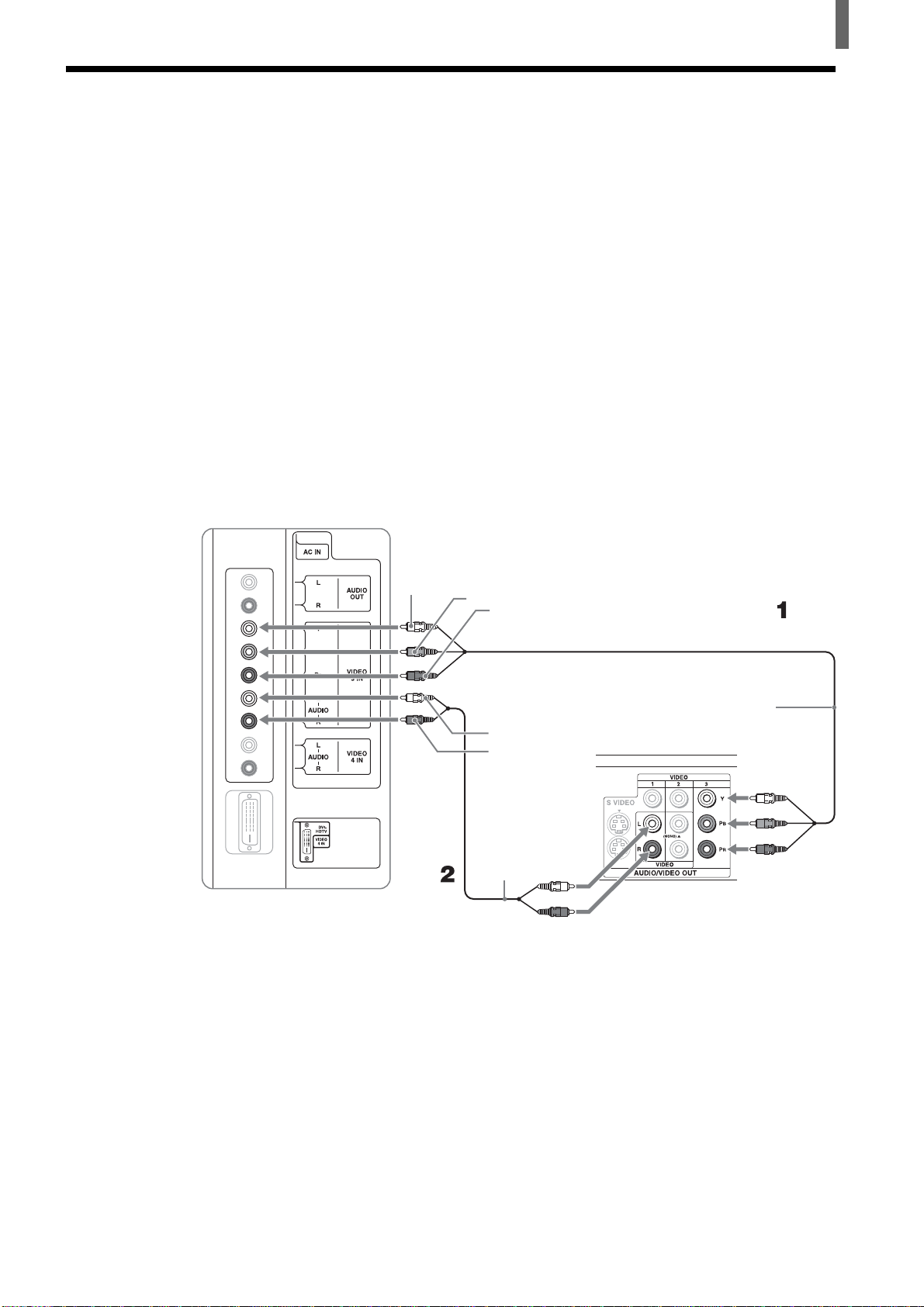
Connecting a DVD Player with Component Video
Connectors
This is the preferred hookup to use if:
•Your DVD player has component (Y, B-Y, R-Y) jacks.
Disconnect all power sources before making any connections.
1 Using a component video cable, connect the DVD player’s Y, B-Y and
R-Y jacks to the Y, P
B and PR jacks on the TV. Use the VIDEO 3 IN
connections.
Tip
The Y, B-Y and R-Y jacks on your DVD player are sometimes labeled as Y, CB and CR,
or Y, PB and PR. If so, connect the cables to the matching colors.
2 Using an AUDIO cable, connect the DVD player’s AUDIO OUT jacks to
the TV’s AUDIO IN jacks.
Note
The Y, B-Y and R-Y jacks do not provide audio, so audio cables must be connected to
provide sound.
Tips
• To take advantage of the Wide Screen Modes, set the TV’s aspect ratio to 16:9 on your
DVD player. For details, refer to the operating instructions supplied with your DVD player.
• Some DVD players are equipped with the three component video connectors: Y - Green, PB
(CB, Cb or B-Y) - Blue and PR (CR, Cr or R-Y) - Red.
Rear of TV
P
R
PB
Y
AUDIO cable
(not supplied)
Component
video cable
(not supplied)
DVD player
AUDIO-L
(white)
AUDIO-R
(red)
17
Installing and Connecting the TV
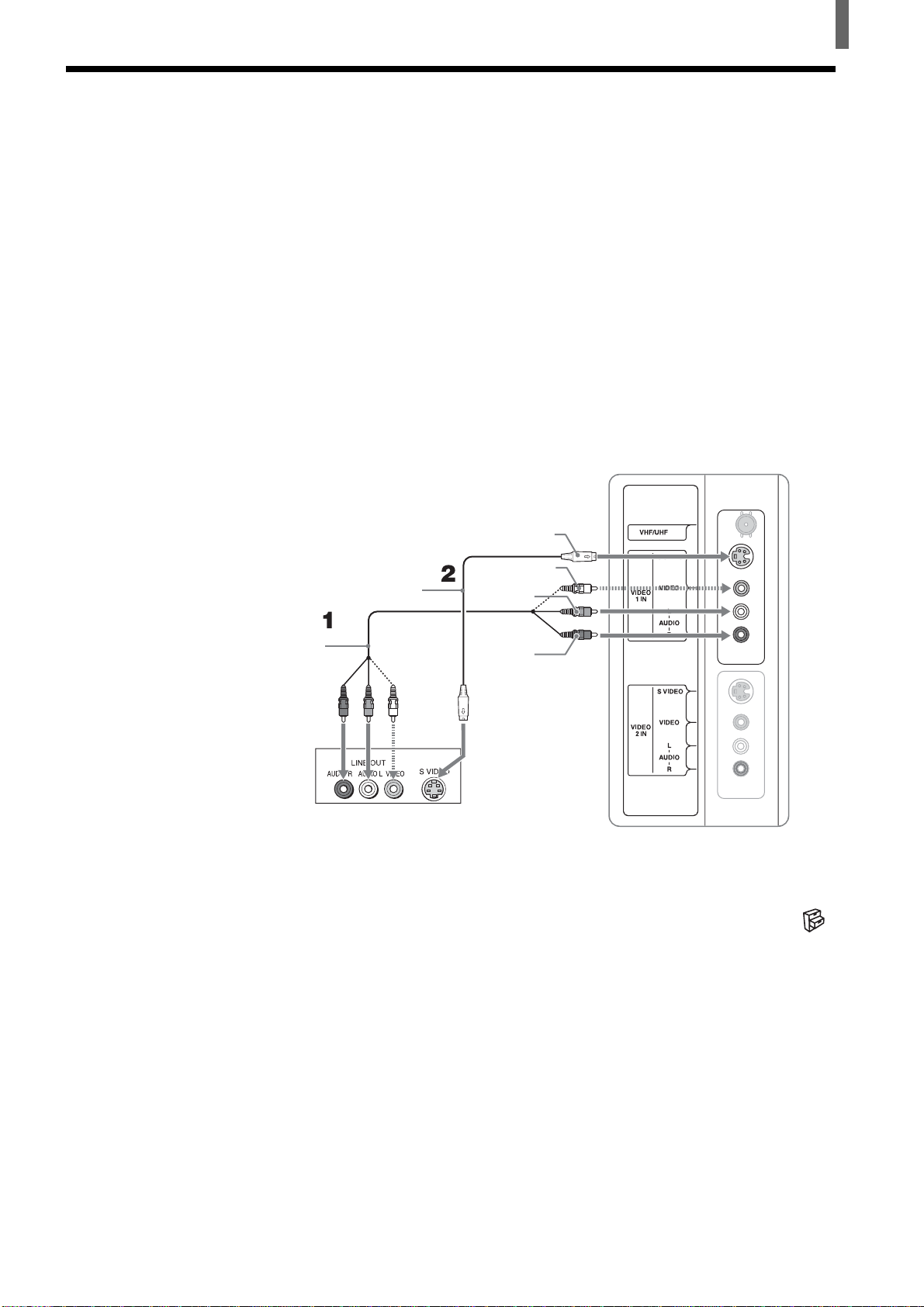
Connecting a DVD Player with A/V Connectors
Use this hookup if:
•Your DVD player does not have component (Y, P
B, PR) jacks.
Tip
If your DVD player has component video output connectors, for best picture quality, use the
connection described on page 16.
Disconnect all power sources before making any connections.
1 Using an AUDIO cable, connect the DVD player’s AUDIO OUT jacks to
the TV’s AUDIO IN jacks.
2 Using an S VIDEO cable, connect the DVD player’s S VIDEO jack to
the TV’s S VIDEO jack.
Note
To watch the pictures input from the S VIDEO input jack, set “Auto YC” to “On” in the
(Setup) menu (See page 12).
Tips
• You can also use the VIDEO 2 IN jacks to connect your DVD player.
• To take advantage of the Wide Screen Modes, set the TV’s aspect ratio to 16:9 on your
DVD player. For details, refer to the operating instructions supplied with your DVD player.
• Use TV/VIDEO on the remote control to switch to the DVD player input.
• If your DVD player is not equipped with S VIDEO, use a VIDEO cable (yellow) instead of
the S VIDEO cable.
S VIDEO cable
(not supplied)
DVD player
AUDIO cable
(not supplied)
Rear of TV
S VIDEO
AUDIO-R
(red)
AUDIO-L
(white)
VIDEO (yellow)
18
Installing and Connecting the TV
Connecting a Digital Satellite Receiver
Disconnect all power sources before making any connections.
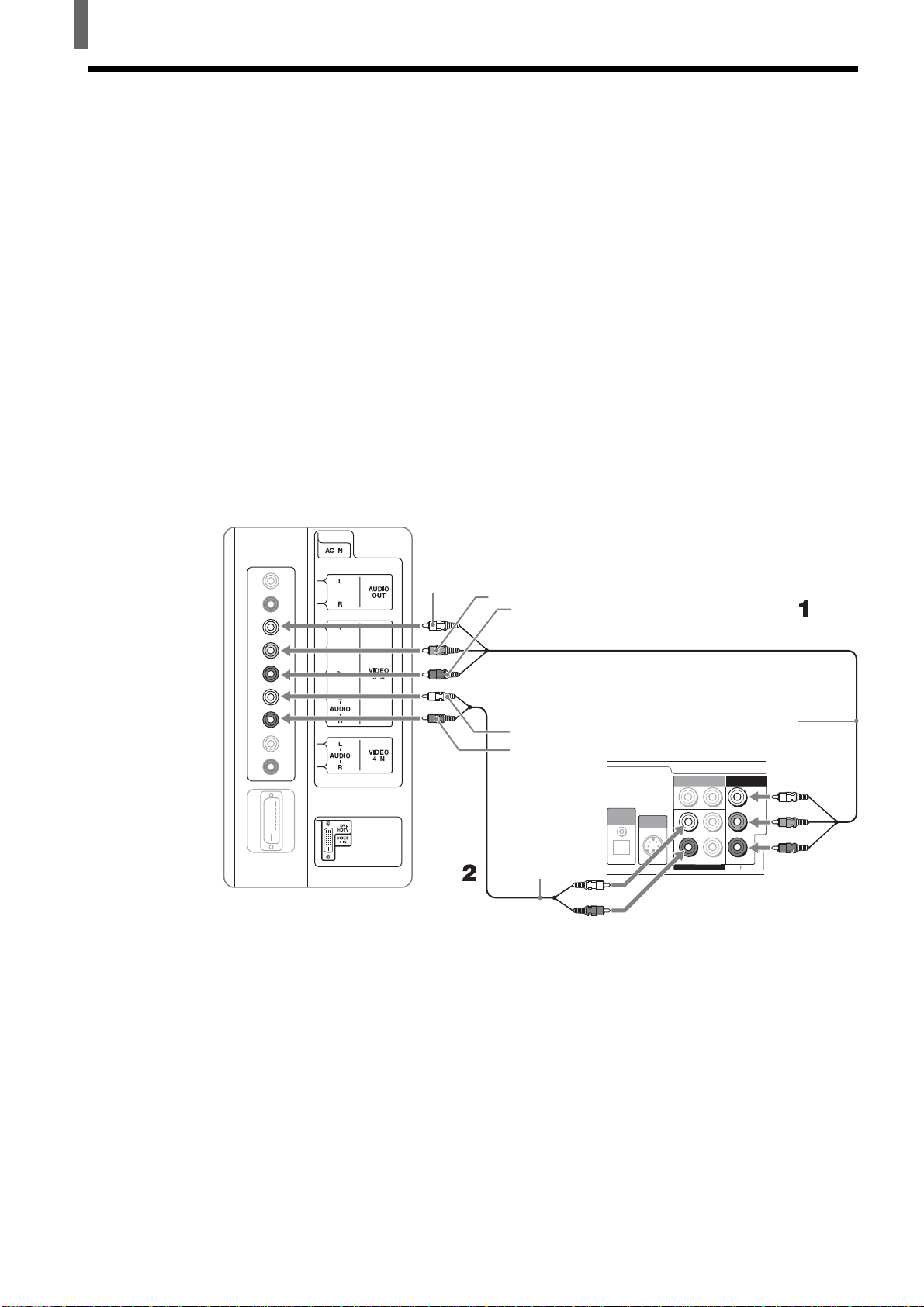
1 Using a component video cable, connect the Digital Satellite Receiver’s
Y, P
B and PR jacks to the Y, PB and PR jacks on the TV. Use the VIDEO 3
IN connections.
Note
Component video (Y, PB, PR) connection is necessary to view 480p, 720p, and 1080i
formats. Note that this TV displays all format types of picture in a resolution of
1,280 dots × 768 lines.
2 Using an AUDIO cable, connect the Digital Satellite Receiver’s AUDIO
OUT jacks to the TV’s AUDIO IN jacks.
Note
The Y, PB and PR jacks do not provide audio, so audio cables must be connected to
provide sound.
VIDEO OUT
TYPE
1
L1 L2
Y
Pb
Pr
R1
AUDIO OUT
OPTICAL
DIGITAL
AUDIO
OUT
R2
2
COMPONENT OUT
(1080i/720p/480p/480i)
S VIDEO
OUT
Digital Satellite Receiver
(e.g. SAT-HD200, SAT-HD300, etc.)
AUDIO cable
(not supplied)
Rear of TV
Component video
cable (not supplied)
P
R
PB
Y
AUDIO-R (red)
AUDIO-L (white)
19
Installing and Connecting the TV
Connecting a Digital TV Receiver
Disconnect all power sources before making any connections.
1 Using a component video cable, connect the Digital TV receiver’s Y, PB
and PR jacks to the Y, PB and PR jacks on the TV. Use the VIDEO 3 IN
connections.
Note
Component video (Y, PB, PR) connection is necessary to view 480p, 720p, and 1080i
formats. Note that this TV displays all format types of picture in a resolution of
1,280 dots × 768 lines.
2 Using an AUDIO cable, connect the Digital TV receiver’s AUDIO OUT
jacks to the TV’s AUDIO IN jacks.
Note
The Y, PB and PR jacks do not provide audio, so audio cables must be connected to
provide sound.
Component video
cable (not supplied)
Digital TV receiver
AUDIO cable
(not supplied)
Rear of TV
P
R
PB
Y
AUDIO-R (red)
AUDIO-L (white)
20
Installing and Connecting the TV
TYPE
P
b
Pr
VIDE
O
OUT
O
PTI
C
A
L
CO
MP
O
NENT
OUT
S
VIDE
O
OUT
V
OUT
DATA
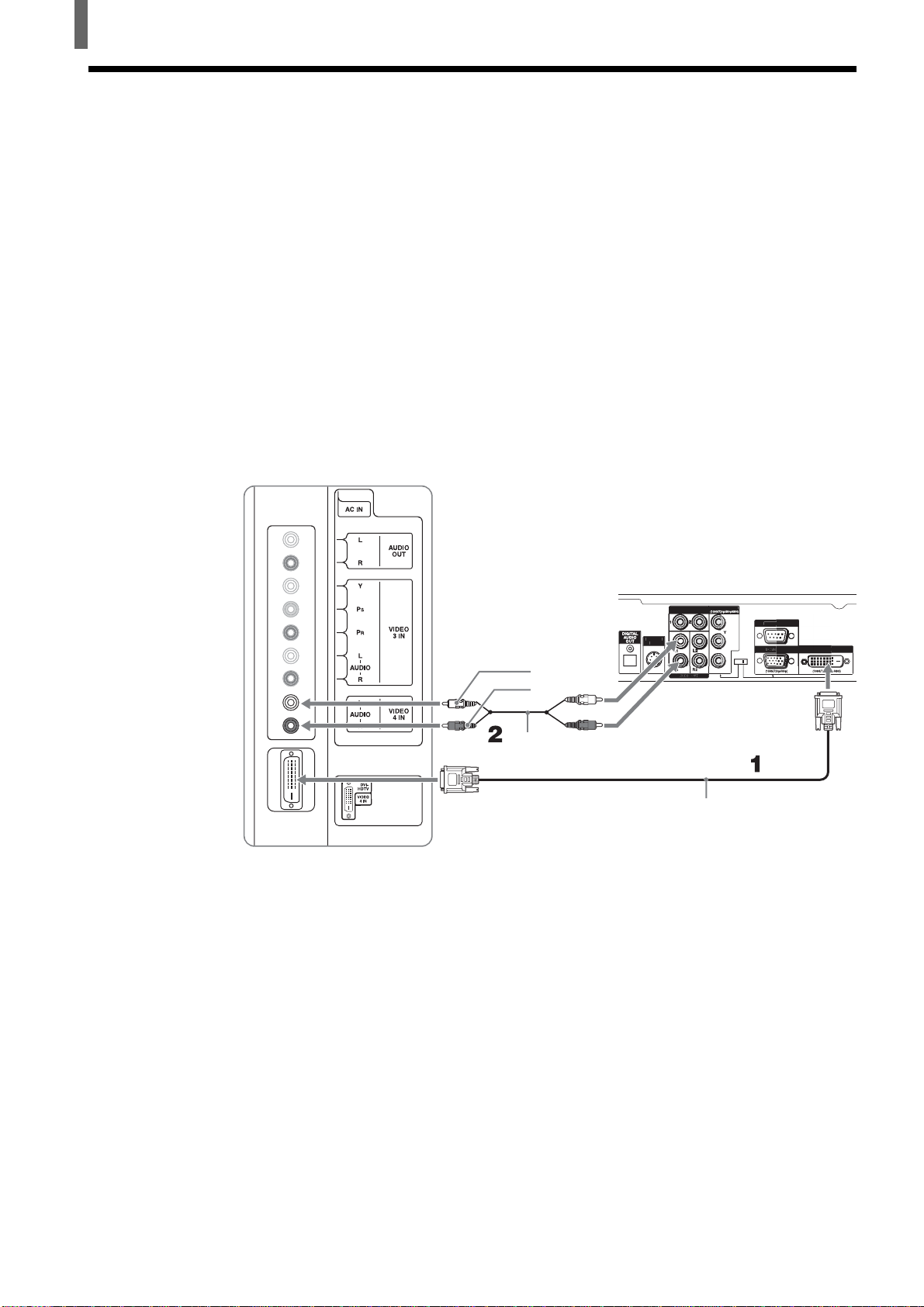
Connecting a Digital Satellite Receiver with DVI-
HDTV connector
Disconnect all power sources before making any connections.
1 Using a DVI-D single link cable, connect the Digital Satellite
Receiver’s DVI-HDTV connector to the TV’s DVI-HDTV connector.
Use the VIDEO 4 IN connections.
Note
The DVI-HDTV VIDEO connector does not provide audio, so audio cables must be
connected to provide sound.
2 Using an AUDIO cable, connect the Digital Satellite Receiver’s
AUDIO OUT jacks to the TV’s AUDIO IN jacks.
DVI-D single link cable
(not supplied)
AUDIO-L (white)
AUDIO cable
(not supplied)
Digital Satellite Receiver
(e.g. SAT-HD200, SAT-HD300, etc.)
Rear of TV
AUDIO-R (red)
21
Installing and Connecting the TV
Setting the Channels
After you finish connecting your TV, you can run
Auto Program to set up your channels. The Auto
Program screen appears when you turn your TV on
for the first time after installing it.
To skip channels, see page 22.
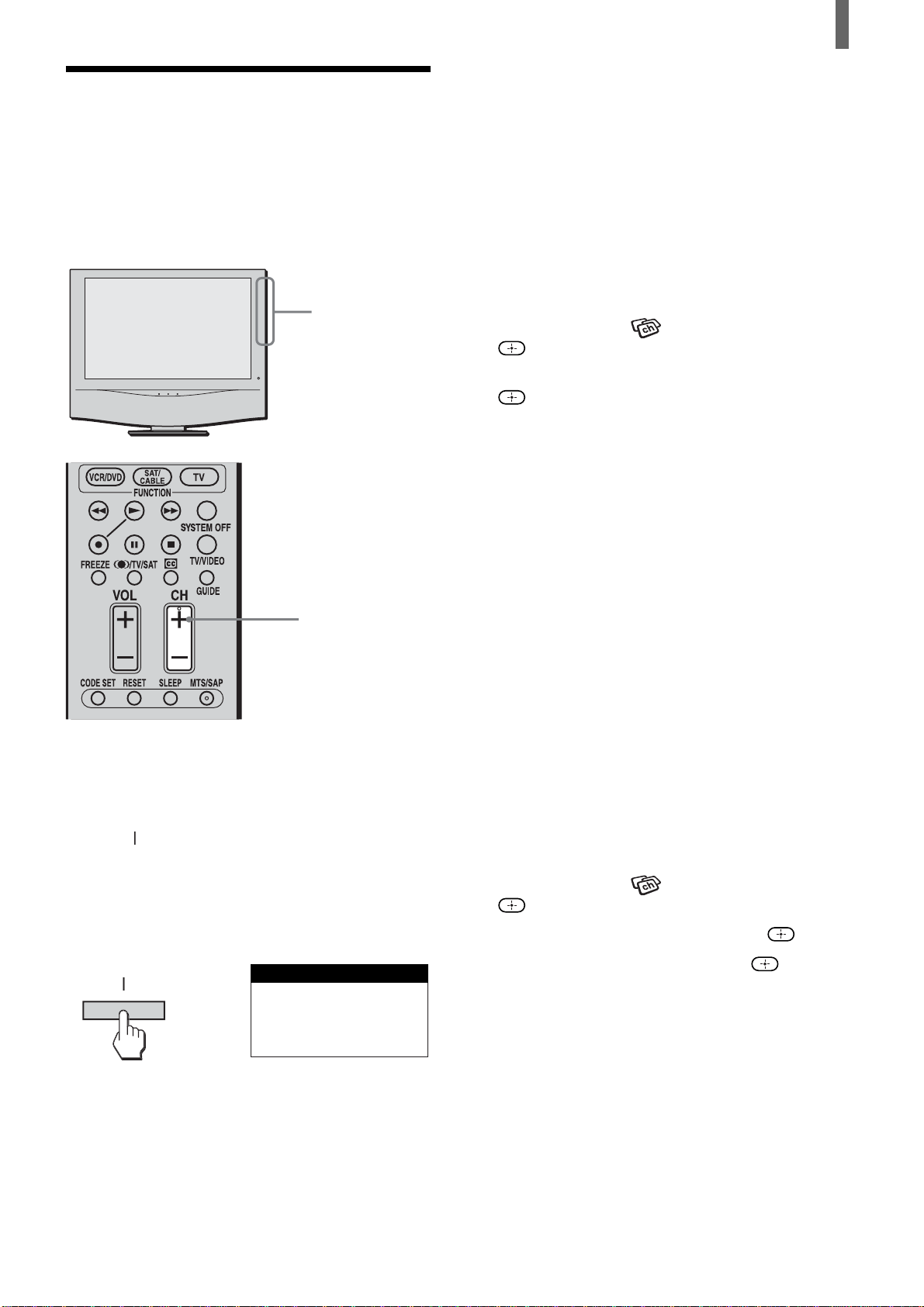
2 Press CH+ on the remote control or on the side
panel of your TV to perform Auto Program.
When all the receivable channels are stored, the
“Channel Skip/Add” menu appears.
Auto Program is set to scan cable TV channels by
default. To watch UHF channels with an antenna, see
“To watch UHF channels with an antenna” below.
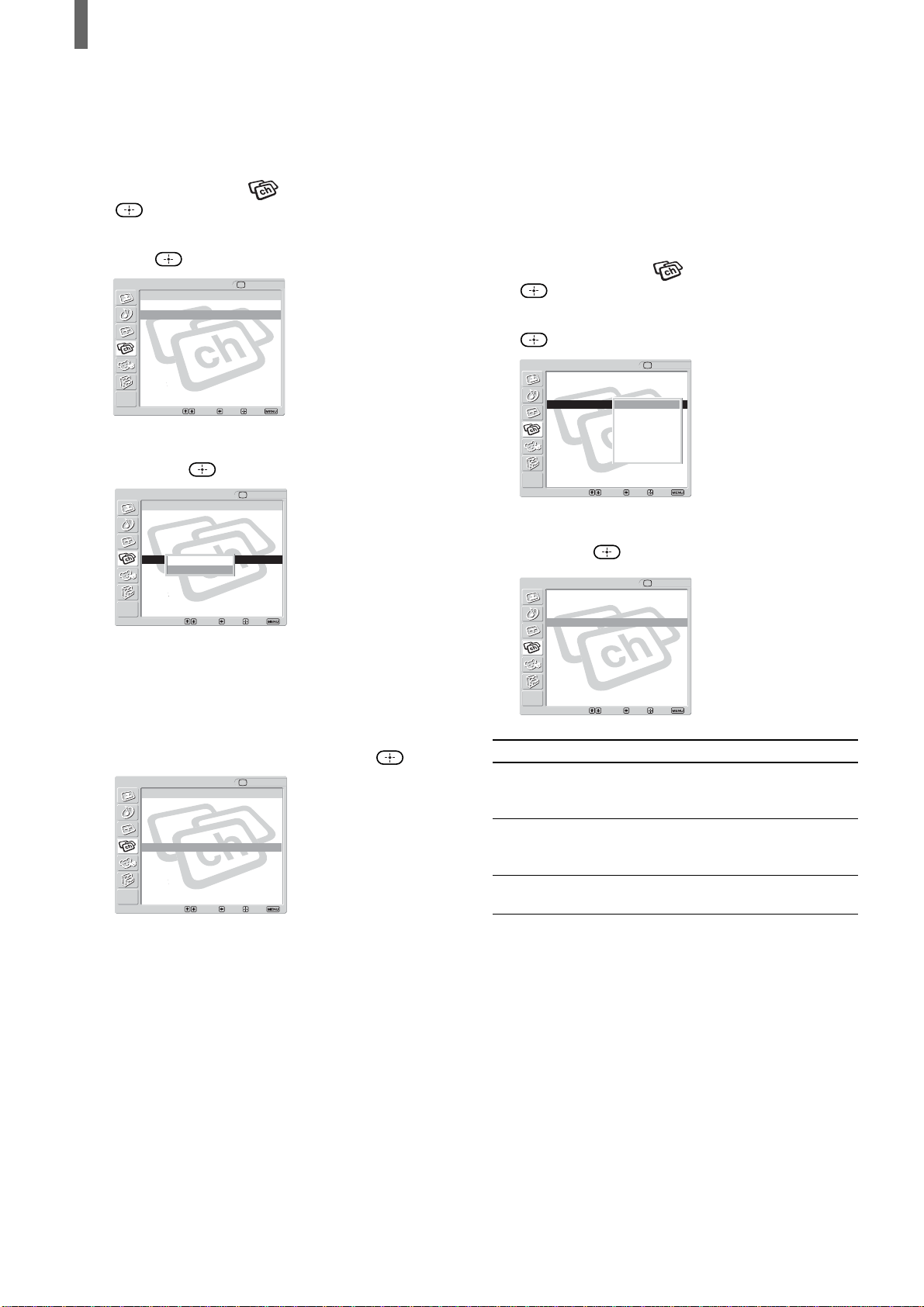
To perform Auto Program again
1 Press MENU.
2 Press V/v to select (Channel), then press
.
3 Press V/v to select “Auto Program,” then press
.
4 Press “OK”.
“Auto Program” appears and the TV starts
scanning and presetting channels automatically.
When all the receivable channels are stored, the
“Channel Skip/Add” menu appears. Using this
menu, you can start skipping unwanted channels
(See “To skip channels” on page 22).
5 Press MENU to exit the menu screen.
To cancel Auto Program
While “Auto Program” is displayed in step 3, press
MENU on the remote control.
Note
To watch cable TV channels, you have to subscribe to a cable
TV company. Note that cable TV cannot be received in some
areas. This TV receives 1-125 cable TV channels. For details on
cable TV subscription, consult your nearest cable TV company.
To watch UHF channels with an antenna
1 Press MENU.
2 Press V/v to select (Channel), then press
.
3 Press V/v to select “Cable,” then press .
4 Press V/v to select “Off,” then press .
5 Perform step 3 in “To perform Auto Program
again” above.
Note
You cannot receive and set the cable TV channels and UHF
channels at the same time.
Tip
When you have a cable box or satellite receiver connected, the
Channel Fix feature is useful. For details, see page 22.
1 Press
I
(power) on the TV. The Auto Setup menu
appears.
The Auto Setup menu automatically appears on
the screen when you turn on the TV for the first
time.
I
,
Auto Setup
Auto Program: [CH+]
Exit: [CH–]
First please connect
cable/antenna
1
2
(Continued)
22
Installing and Connecting the TV
To lock in a TV channel
If you have connected a cable box or satellite
receiver to your TV, and do not intend to connect
any other audio or video equipment, it is
recommended that you lock in a TV channel. Doing
so will ensure no accidental channel switch when
using your TV.
1 Press MENU.
2 Press V/v to select (Channel), then press
.
3 Press V/v to select “Channel Fix,” then press
.
4 Press V/v to select the channel you want to set,
then press
.
Return
Favorite Channels
Cable:
Channel Fix: Off
Auto Program
Channel Skip/Add
Channel Label
Channel
Select: Back: Exit:Set:
TV
Off
2
3
4
5
6
Video 1
To skip channels
You can skip unnecessary channels when selecting
channels using the CH +/– buttons.
1 Press MENU.
2 Press V/v to select (Channel), then press
.
3 Press V/v to select “Channel Skip/Add,” then
press
.
4 Press V/v to select the channel you want to skip,
then press
.
Tip
To scroll through the list, press and hold V/v.
5 Press V/v to select “Skip,” then press .
If you want to re-enter the skipped channel,
select “Add.”
6 Press MENU to exit the menu screen.
Example: Select this
to skip channel 5.
Channel TV
v
Channel Skip/Add
Select: Back: Exit:Set:
Return
1 : Skip
2 : Add
3 : Add
4 : Skip
5 : Add
6 : Skip
7 : Skip
8 : Add
9 : Add
10 : Add
Channel TV
v
Channel Skip/Add
Select: Back: Exit:Set:
Return
1 : Skip
2 : Add
3 : Add
4 : Skip
5 : Add
6 : Skip
7 : Skip
8 : Add
9 : Add
10 : Add
Skip
Add
Channel TV
v
Channel Skip/Add
Select: Back: Exit:Set:
Return
1 : Skip
2 : Add
3 : Add
4 : Skip
5 : Skip
6 : Skip
7 : Skip
8 : Add
9 : Add
10 : Add
Return
Favorite Channels
Cable:
Channel Fix: 3
Auto Program
Channel Skip/Add
Channel Label
Channel
Select: Back: Exit:Set:
TV
Option Description
2-6 Select one of these settings if you have
connected the equipment to the VHF/
UHF jack.
Video 1 Select this if you have connected the
equipment to the AUDIO and VIDEO
IN jacks.
Off Select this to turn off the Channel Fix
feature.
5 Press MENU to exit the menu screen.
Notes
• When you lock in a TV channel, the Favorite Channel feature
cannot be used.
• When you lock in a TV channel, you cannot select “Channel
Skip/Add” in the menu. To use it, set “Channel Fix” to “Off.”
23
Installing and Connecting the TV
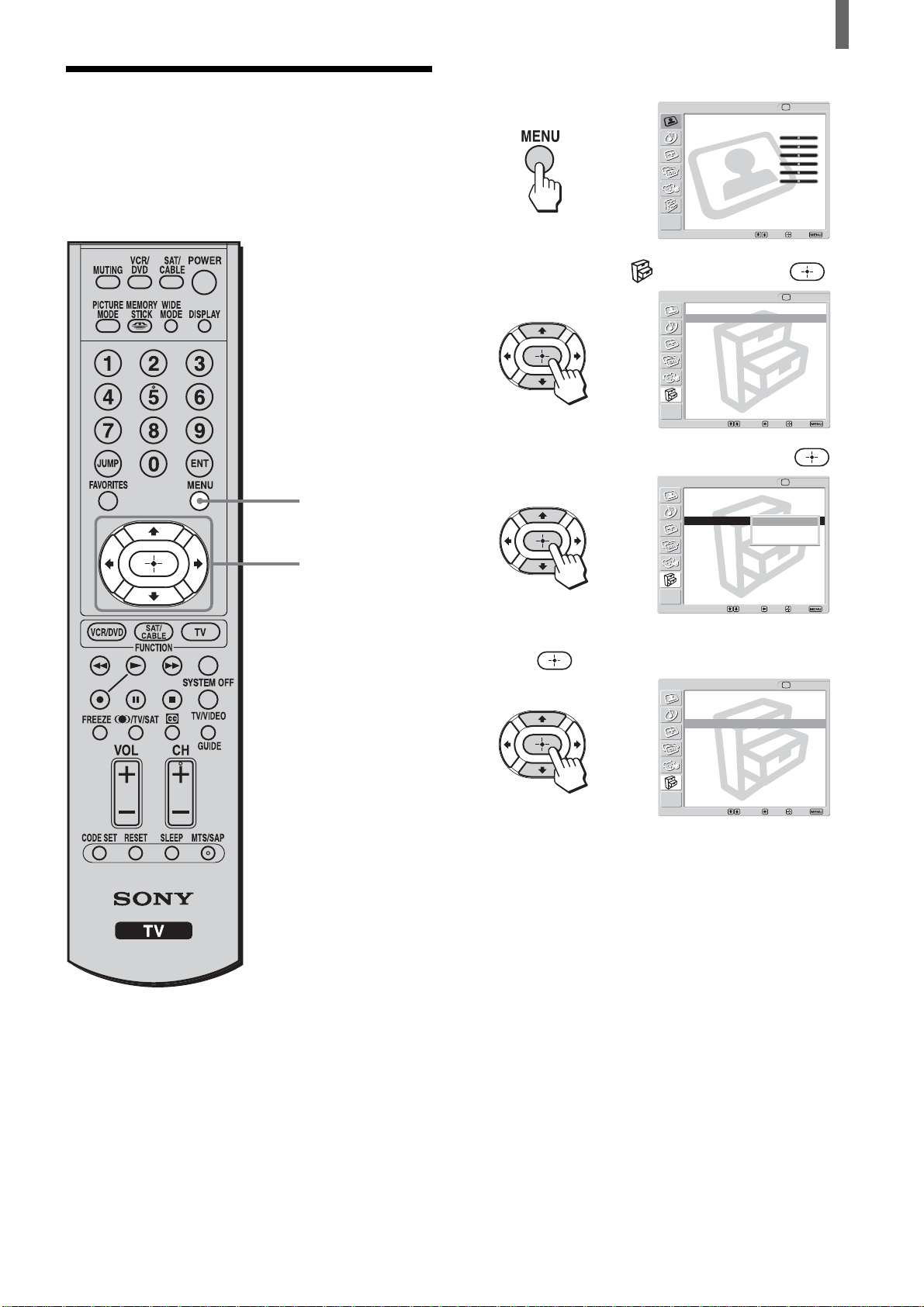
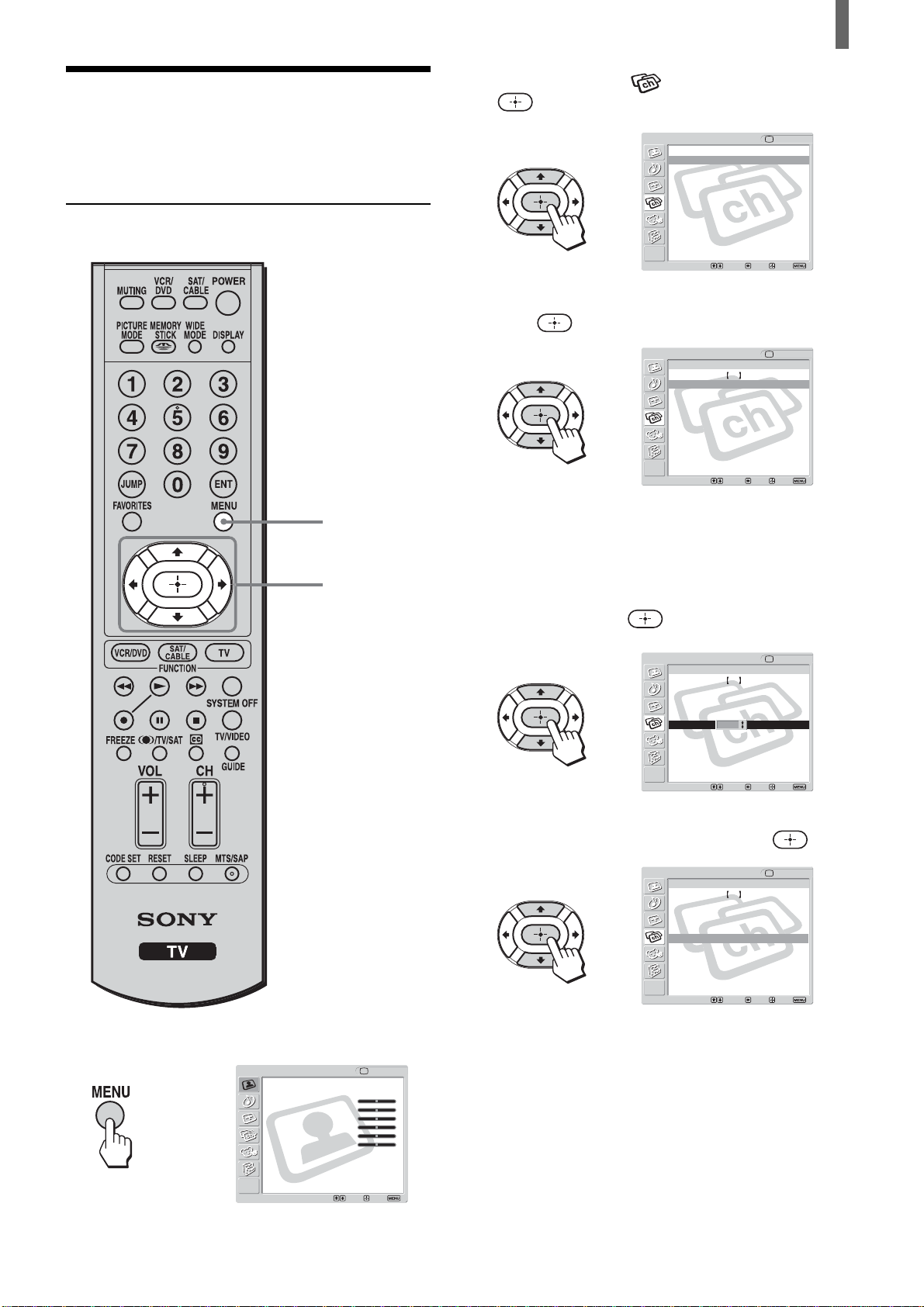
1 Press MENU.
2 Press V/v to select (Setup), then press .
3 Press V/v to select “Language,” then press .
4 Press V/v to select your preferred language, then
press
.
5 Press MENU to exit the menu screen.
2 - 4
1, 5
Selecting the On-screen
Menu Language
You can select the language to be displayed in all
menus.
,
Setup TV
Select: Back: Exit:Set:
Return
Caption Vision: Off
Video Label
Language: English
Auto YC:
Menu Color: White
,
Setup TV
Select: Back: Exit:Set:
Return
Caption Vision: Off
Video Label
Language: English
Auto YC:
Menu Color: Black
English
Español
Français
,
Return
Caption Vision: Off
Video Label
Language: English
Auto YC:
Menu Color: White
Setup
TV
Select: Back: Exit:Set:
Video
Exit:Set:Select:
Return
Mode: Vivid
Picture: 50
Brightness: 50
Color: 25
Hue: 0
Sharpness: 3
Backlight: 5
Color Temp.: Cool
CineMotion:
Dynamic Picture: On
TV
,

24
Watching the TV
MUTING
DISPLAY
SYSTEM OFF
1
2
Watching the TV
2
3
Watching the TV
JUMP
1/
/
I
1 Press POWER on the remote control.
Tip
When the
1/
(Standby/Sleep) indicator goes off, press
I
on the TV.
2 Select the desired channel using the 0-9 and ENT
(enter) buttons.
Press 0-9 to select a channel. The channel
changes after 2 seconds. Press ENT (enter) to
select immediately.
Use the CH +/– buttons to scan through the
channels.
Tip
When you press and hold CH + or –, the channel number
will change rapidly.
3 Adjust the volume using the VOL +/– buttons.
Other button operations
Press To
MUTING
SYSTEM OFF
DISPLAY
JUMP
Tip
You can adjust the volume by referring to the value beside the
volume indicator (on screen).
Mute the sound. Press again or press
VOL + to restore sound.
Turn off the TV and all other Sony
equipment.
Display the current channel number.
When the channel display is turned on,
the current channel number remains
displayed.
Press again to turn the display off.
Jump back and forth between two
channels. The TV alternates between the
current channel and the last channel
selected using the 0-9 buttons.
or
25
Watching the TV
O
ff
CC
1
CC2
Te
x
t
1
Te
x
t2
Te
x
t3
Te
x
t
4
Watching with closed caption
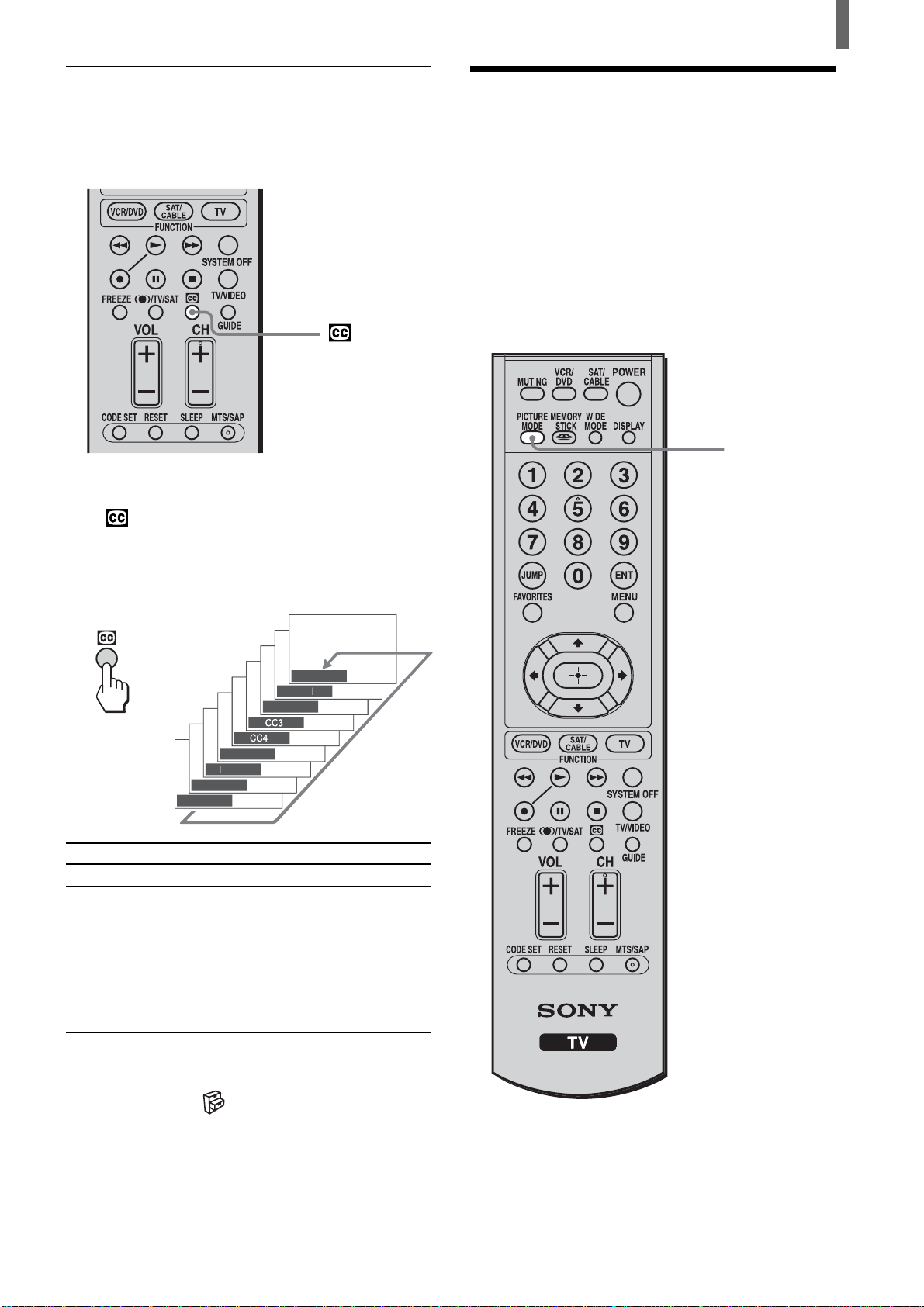
You can display Caption Vision if the broadcaster
offers this service.
,
Press repeatedly until the desired Caption Vision
appears.
Each time you press the button, Caption Vision
changes as follows:
Select
Off
CC1, CC2, CC3, CC4
Text1, Text2, Text3, Text4
Tip
You can select Caption Vision on the menu screen. Select
“Caption Vision” in the
(Setup) menu, then select the
desired Caption Vision.
To
Turn off Caption Vision.
Display a printed version of
the dialogue or sound effects
of a program. (The mode
should be set to CC1 for most
programs.)
Display network/station
information presented using
either half or the whole screen.
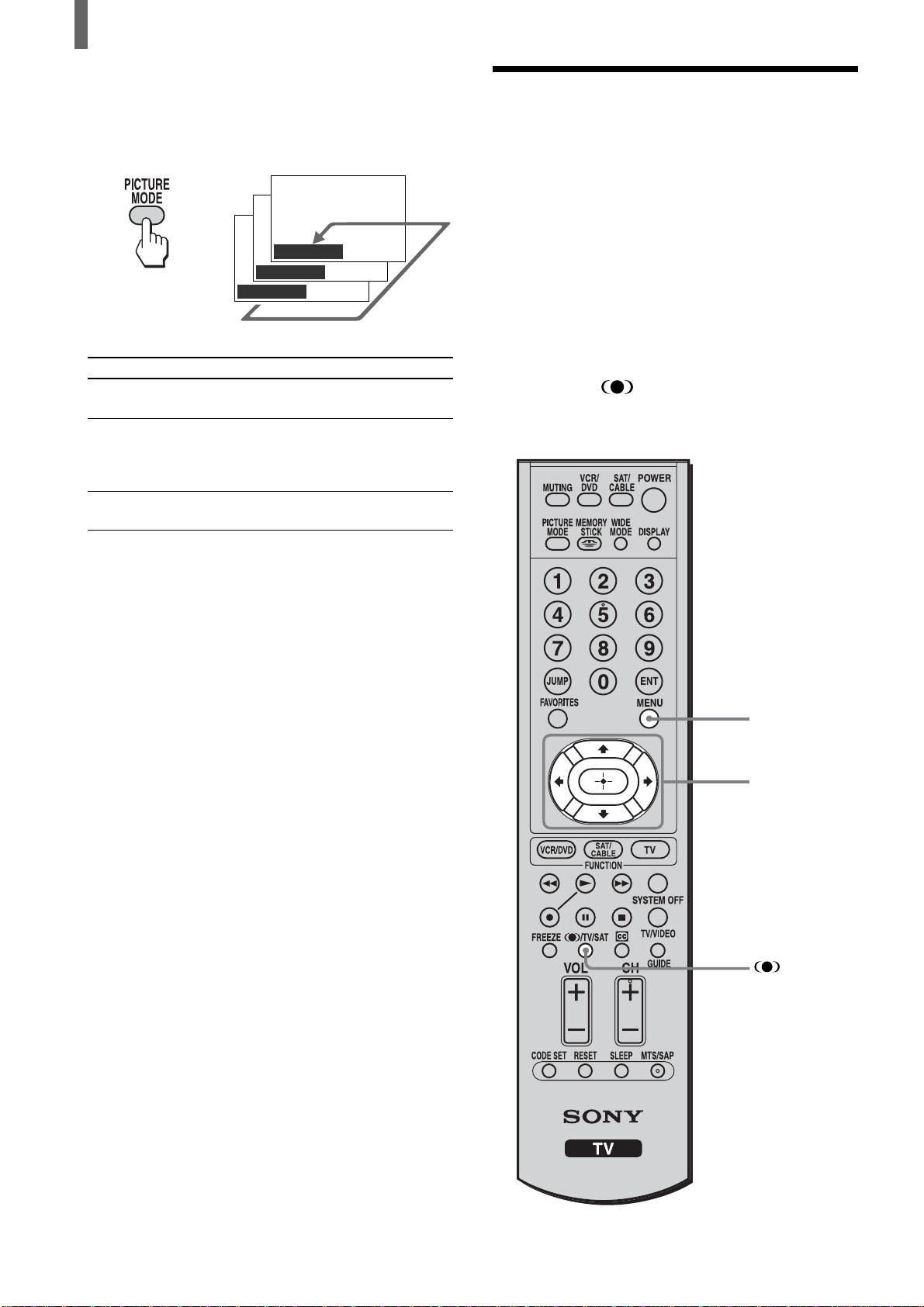
Selecting the Picture
Mode
You can select one of three different Picture Modes
that best suits the program you are watching.
Furthermore, you can adjust the picture quality for
each Picture Mode (See pages 42, 43).
You can set a different Picture Mode for each video
input that can be selected using the TV/VIDEO
button, and store it in memory.
PICTURE MODE
(Continued)
26
Watching the TV
Selecting the Effect
Mode
“SRS WOW”* creates a panoramic stereo audio
image by producing deep and rich bass tones and
clear treble tones, enabling you to enjoy powerful
sounds effects like those in a movie theater.
You can set the Effect mode for each video input that
can be selected using the TV/VIDEO button, and
store it in memory.
* “SRS WOW” increases the sound quality of a diverse range of
audio sources dramatically based on proprietary state-of-the-
art technologies from SRS Labs, Inc.
WOW, SRS and
symbol are trademarks of SRS Labs,
Inc.
WOW technology is incorporated under license from SRS
Labs, Inc.
2 - 4
1, 5
Press PICTURE MODE repeatedly until the desired
mode appears.
Each time you press the button, the Picture Mode
changes as follows:
Picture Mode Description
Vivid
Standard
Pro
Tip
You can adjust the picture quality options, such as “Picture,”
“Brightness,” and “Color,” for each Picture Mode (See pages
42, 43).
Vivid
Standard
Pro
,
Select for enhanced picture contrast and
sharpness.
Select to display a picture with contrast
to suit your room’s lighting conditions.
This mode is recommended for normal
viewing conditions.
Select for professional monitor-like
appearance.
/TV/SAT
27
Watching the TV
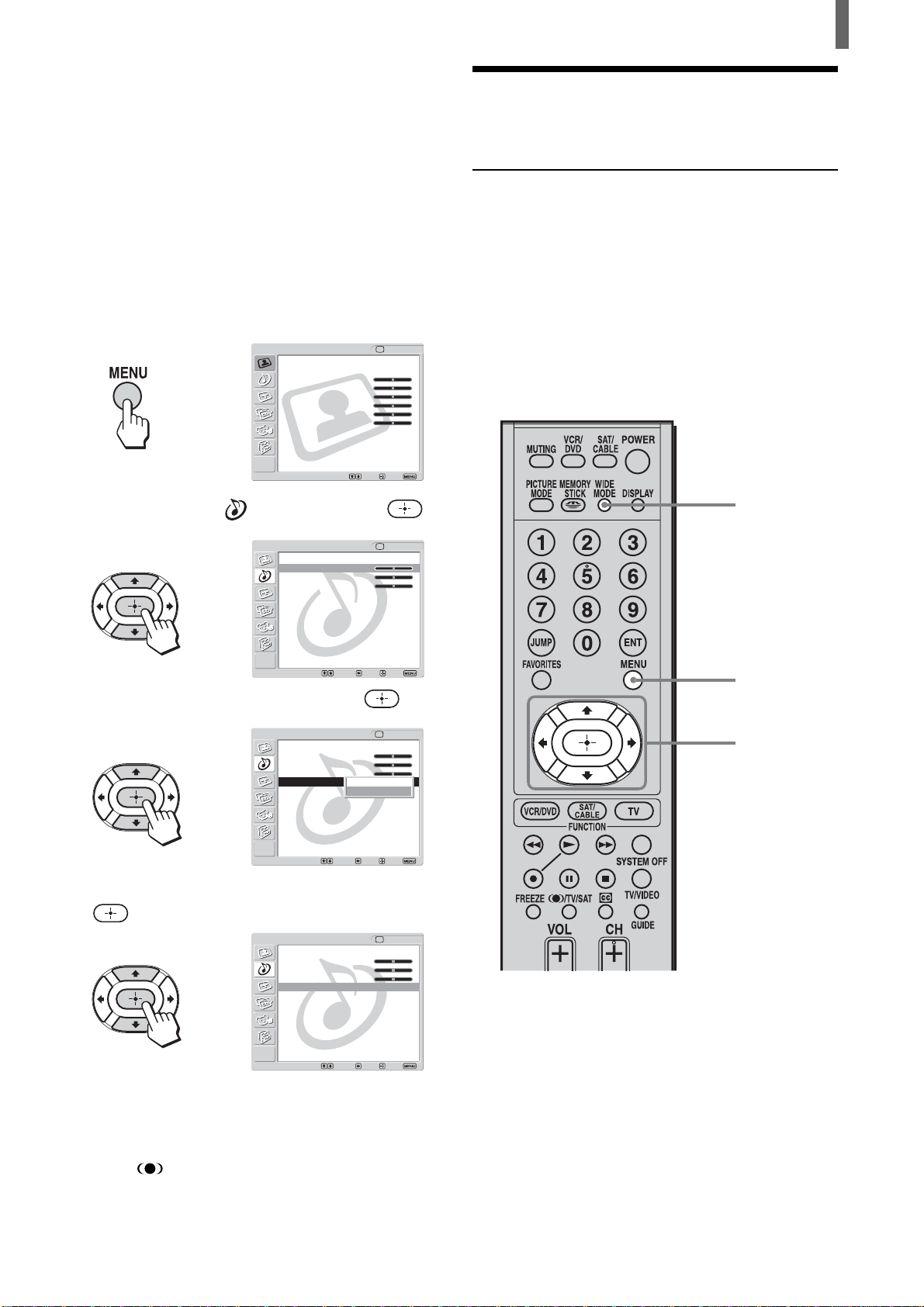
1 Press MENU.
2 Press V/v to select (Audio), then press .
3 Press V/v to select “Effect,” then press .
4 Press V/v to select “SRS WOW,” then press
.
5 Press MENU to exit the menu screen.
Tip
Pressing the /TV/SAT button also lets you select “SRS
WOW” and “Off.”
Notes
• You cannot select the Effect mode if the TV's speaker is set to
off.
• The Effect mode is valid only on the TV’s speakers. So you
cannot enjoy sound effects of SRS WOW when you listen to a
program through the AUDIO OUT jacks or on headphones.
• SRS WOW may be restricted in the effects it produces when
you listen to a program in monaural.
Tip
You can adjust other sound quality options. For details, see
“Adjusting the Sound Quality” on page 44.
,
Return
Treble: 0
Bass: 0
Balance: 0
Effect: SRS WOW
MTS: Stereo
Speaker: On
Audio Out:
Audio TV
Select: Back: Exit:Set:
,
Select: Back: Exit:Set:
Return
Treble: 0
Bass: 0
Balance: 0
Effect: WOW
MTS: Auto SAP
Speaker: On
Audio Out:
Audio TV
SRS WOW
Off
,
Exit:
Return
Treble: 0
Bass: 0
Balance: 0
Effect: Off
MTS: Stereo
Speaker: On
Audio Out:
Audio TV
Select: Back: Set:
Video
Exit:Set:Select:
Return
Mode: Vivid
Picture: 50
Brightness: 50
Color: 25
Hue: 0
Sharpness: 3
Backlight: 5
Color Temp.: Cool
CineMotion:
Dynamic Picture: On
TV
,
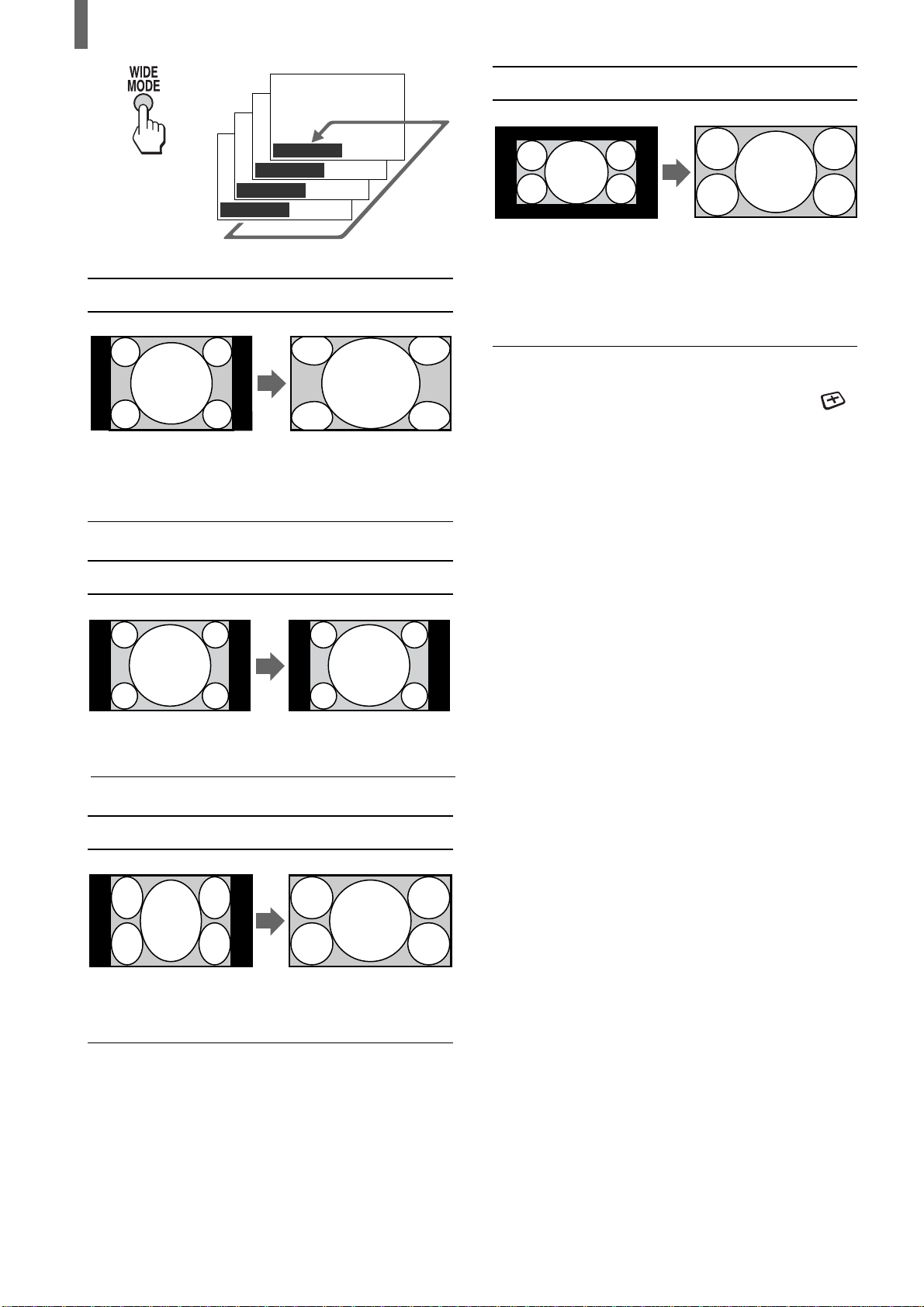
Changing the Wide Screen Mode
The Wide Screen Mode lets you watch 4:3 normal
broadcasts or other picture sizes such as Letterbox
movies in several Wide Screen Modes (16:9 aspect
ratio).
Tip
The “aspect ratio” is the ratio of width to height of the screen.
16:9 is also referred to as widescreen format.
Using the Wide Screen
Mode
Press WIDE MODE repeatedly until the desired
Wide Screen Mode appears.
Each time you press the button, the Wide Screen
Mode changes as follows:
WIDE MODE
2 - 4
1, 5
(Continued)
28
Watching the TV
Wide Zoom
Normal
Full
Zoom
,
Wide Zoom
“Wide Zoom” enlarges the
4:3 picture to fill the 16:9
screen, keeping the
original image as much as
possible.
Wide Zoom
Original Picture
• Normal 4:3 aspect ratio
picture
• DTV 4:3 aspect ratio picture
“Normal” returns the 4:3
picture to its original size.
Normal
Original Picture
Normal
• Normal 4:3 aspect ratio
picture
• DTV 4:3 aspect ratio picture
Full
“Full” stretches the 4:3
picture horizontally only,
to fill the 16:9 screen.
Full
Original Picture
• Widescreen video camera or
DVD picture
• DTV 16:9 aspect ratio picture
Tip
You can also access the Wide Screen Mode settings in the
(Screen) menu. For details, see page 30.
Zoom
Original Picture
• Letterbox movie of a video
tape or a DVD disc
Zoom
“Zoom” enlarges the 4:3
picture horizontally and
vertically to an equal
aspect ratio that fills the
16:9 screen. Useful for
watching Letterbox
movies.
29
Watching the TV
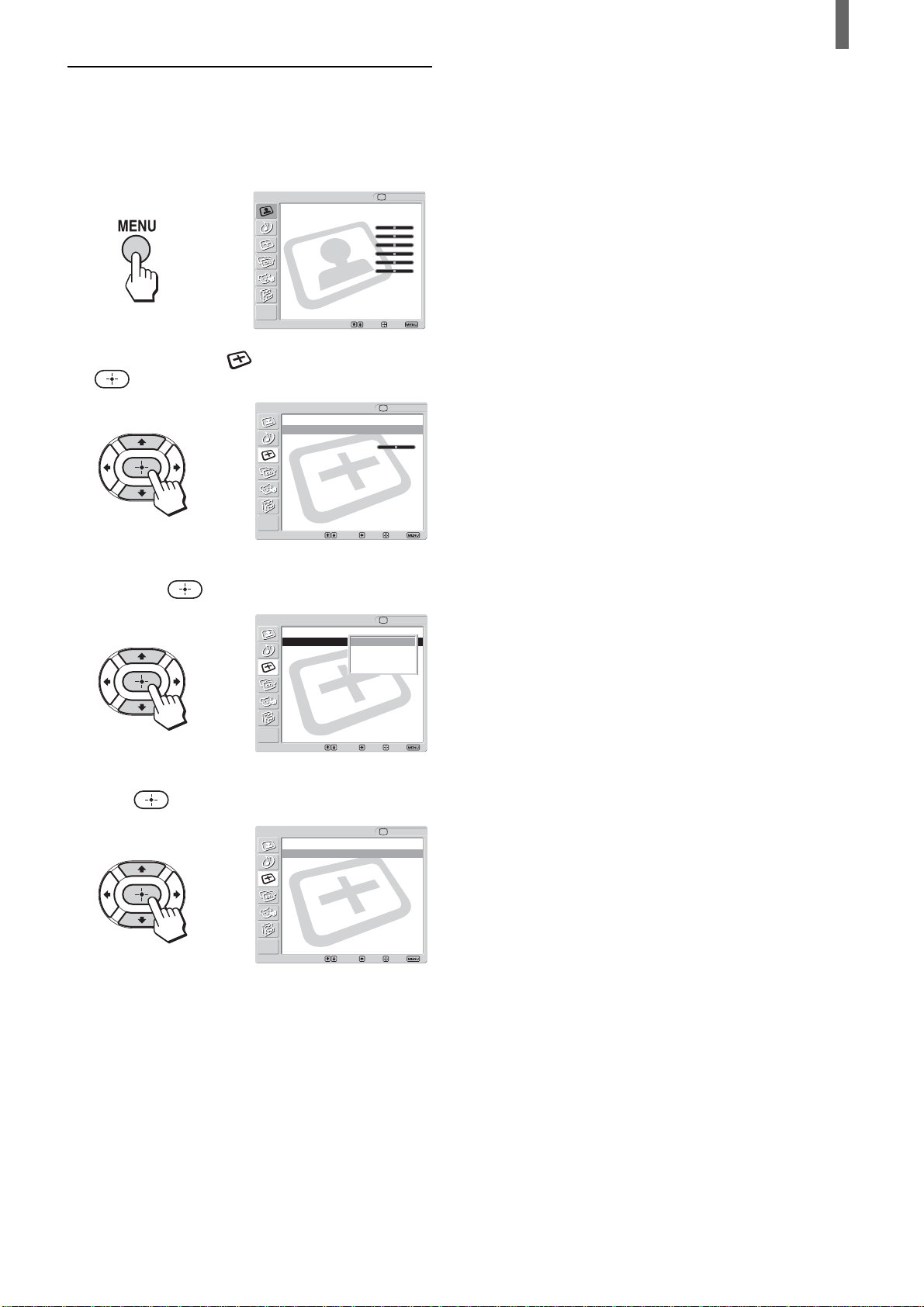
Changing the Wide Screen Mode
using the menu
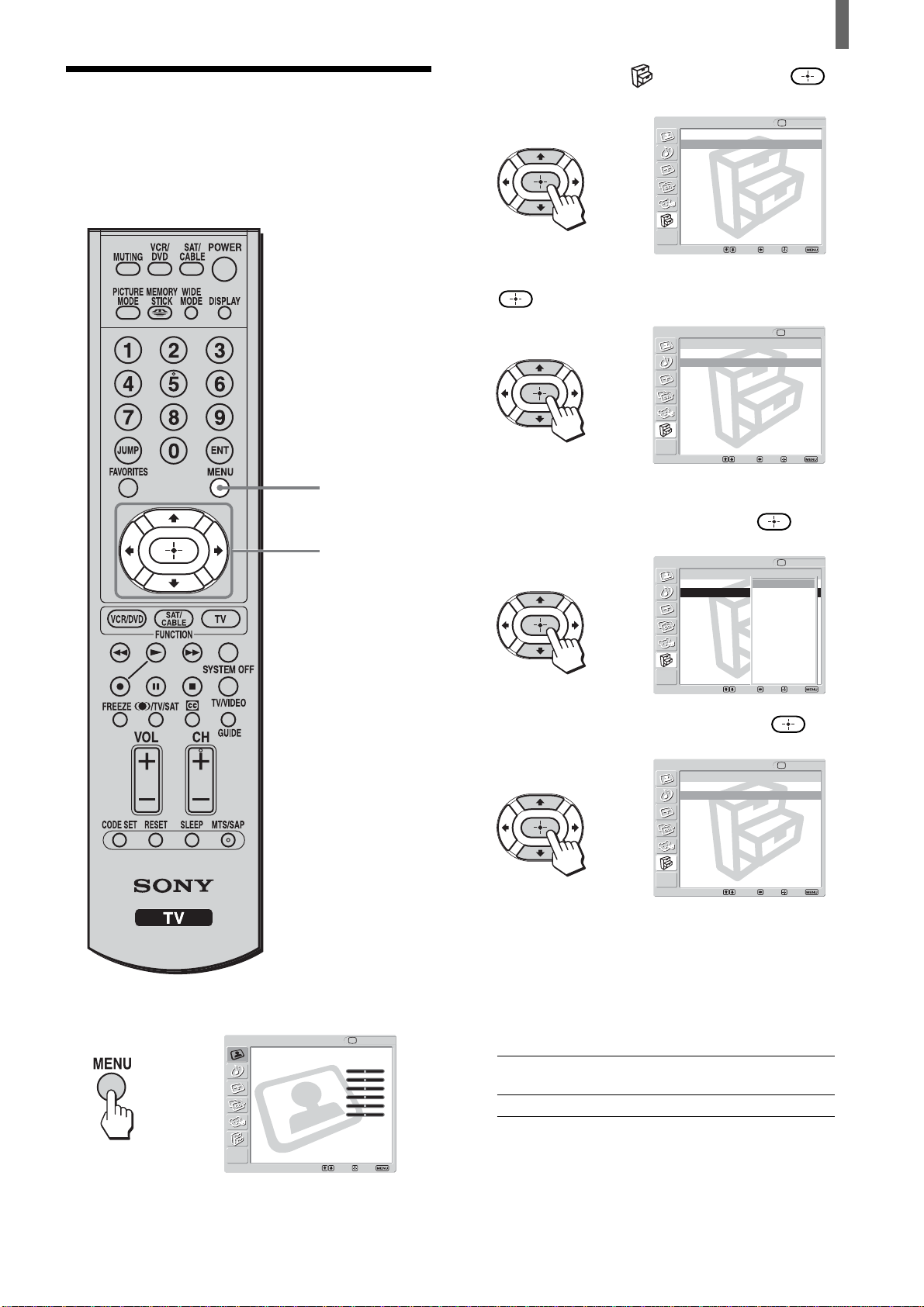
1 Press MENU.
2 Press V/v to select (Screen), then press
.
3 Press V/v to select the option you want to set,
then press
.
4 Press V/v to select the desired screen mode, then
press
.
5 Press MENU to exit the menu screen.
,
Video
Exit:Set:Select:
Return
Mode: Vivid
Picture: 50
Brightness: 50
Color: 25
Hue: 0
Sharpness: 3
Backlight: 5
Color Temp.: Cool
CineMotion:
Dynamic Picture: On
TV
Return
Wide Mode: Wide Zoom
4:3 Default: Wide Zoom
Vertical Center: 0
Screen
Select: Back: Exit:Set:
TV
,
,
Return
Wide Mode: Normal
4:3 Default: Zoom
Vertical Center:
Screen
Select: Back: Exit:Set:
TV
Wide Zoom
Normal
Full
Zoom
,
Return
Wide Mode: Normal
4:3 Default: Wide Zoom
Vertical Center:
Screen
Select: Back: Exit:Set:
TV
(Continued)
30
Watching the TV
Tip
To change from one Wide Screen Mode to another, use the
WIDE MODE button on the remote control.
Notes
• The 4:3 Default functions only when the TV receives 480i or
480p signals.
• If “4:3 Default” is set to anything but “Off,” the Wide Screen
Mode setting changes only for the current channel.
When you change channels (or inputs), the Wide Screen Mode
is automatically replaced with the 4:3 Default setting.
To retain the current Wide Screen Mode setting as channels
and inputs are changed, set “4:3 Default” to “Off” (See page
29).
The Wide Screen Mode options available in the (Screen) menu
Option Description
Wide Mode
Select a Wide Mode to use for 4:3 sources.
4:3 Default
Select the default Screen Mode to use
for 4:3 sources.
Wide Zoom
Normal
Full
Zoom
Wide Zoom
Normal
Full
Zoom
Off
Select to enlarge the 4:3 picture to fill the 16:9 screen, keeping
the original image as much as possible.
Select to return the 4:3 picture to its original size.
Select to enlarge the 4:3 picture horizontally only, to fill the
16:9 screen.
Select to enlarge the 4:3 picture horizontally and vertically to
an equal aspect ratio that fills the 16:9 screen. Useful for
watching Letterbox movies.
Select to enlarge the 4:3 picture to fill the 16:9 screen, keeping
the original image as much as possible.
Select to return the 4:3 picture to its original size.
Select to enlarge the 4:3 picture horizontally only, to fill the
16:9 screen.
Select to enlarge the 4:3 picture horizontally and vertically to
an equal aspect ratio that fills the 16:9 screen. Useful for
watching Letterbox movies.
Select to continue using the current Wide Screen Mode setting
when the channel or input is changed.
Notes on the Wide Screen Mode
• The Wide Screen Mode function of this TV allows for various
display options: select the appropriate Wide Screen Mode for
the original aspect ratio of the picture you are watching.
• If you change the screen size using the Wide Mode feature
with the TV installed in a public space for commercial use or
public purpose, it might be an infringement of copyright.
• If you select “Wide Zoom” when watching the picture with
4:3 aspect ratio, part of the picture is transformed. You can
watch the picture with its original aspect ratio in “Normal”
mode.
• The upper and lower parts of the picture may not appear in the
screen according to the size of the original picture. In this
case, adjust the picture position (See page 41).
31
Watching the TV
Using the Freeze
Function
You can use this feature to write down information
such as phone numbers, recipes, etc.
When the program information you want to capture
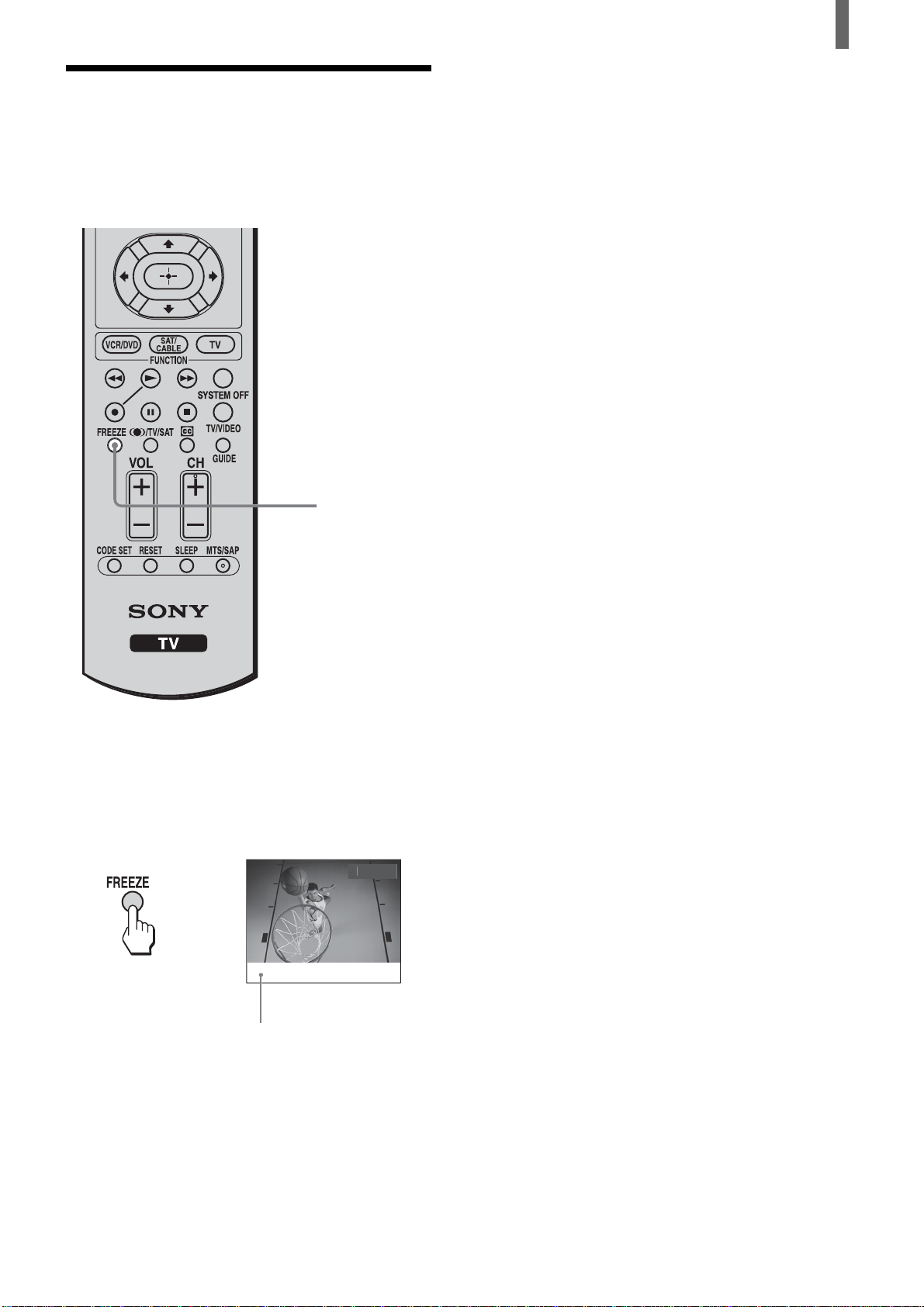
is displayed, press FREEZE.
The picture freezes. Press FREEZE again, and the
frozen picture is released, and the picture begins to
move again.
Tip
While the picture is frozen, the sound continues to be output
normally.
Frozen picture
FREEZE
,
C
all
555
-12
34
F
r
ee
z
e
32
Watching the TV
Setting the Video Inputs
You can enjoy images (and sound) from optional
video equipment connected to this unit by selecting
the appropriate input. For details on connection, see
pages 8 through 20.
1
0-9 and ENT
(enter) buttons
CH +/–
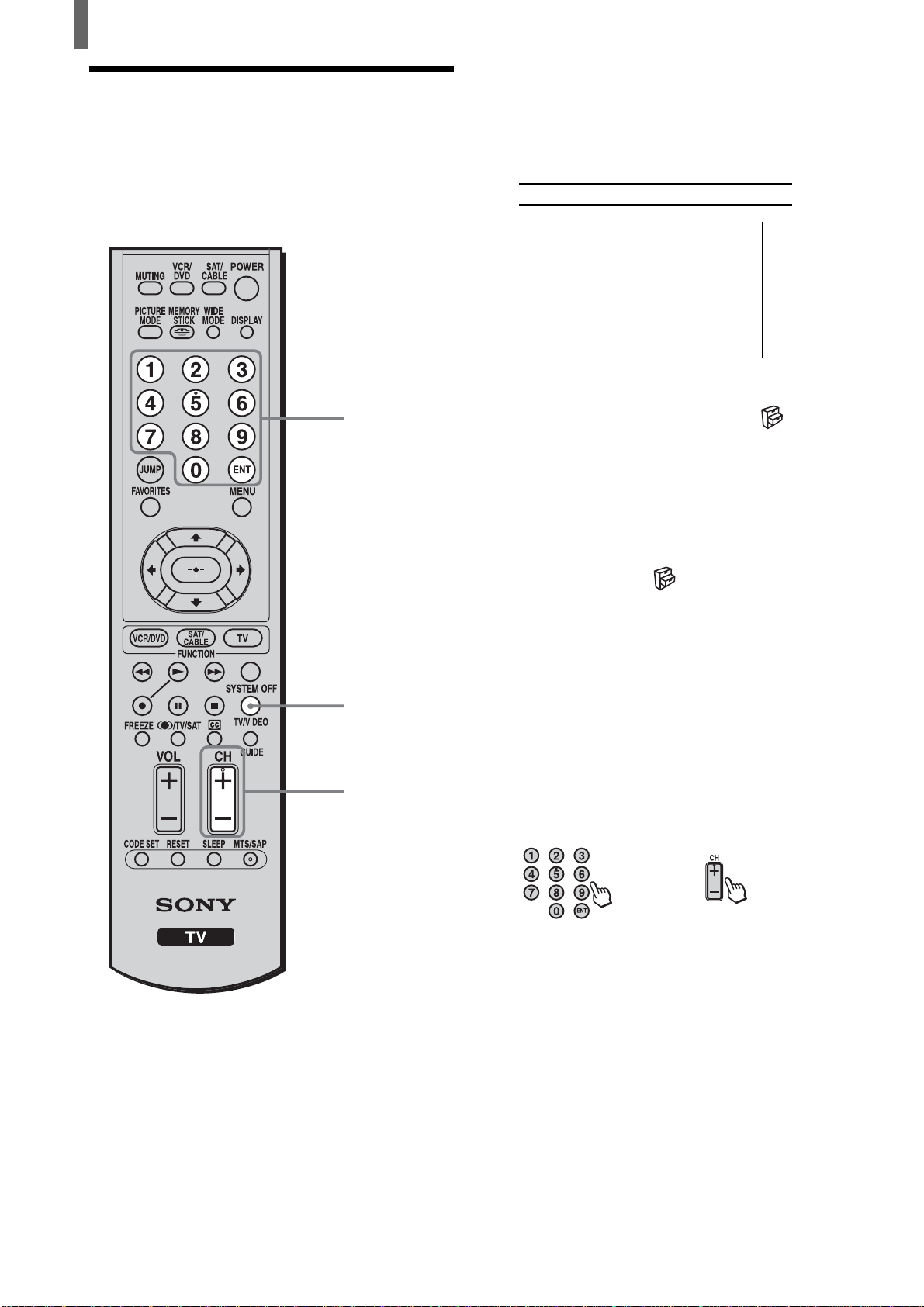
1 Press TV/VIDEO repeatedly until the desired
video input appears.
Each time you press TV/VIDEO, the input
changes as follows:
Select
• TV
• VIDEO 1 IN
• VIDEO 2 IN
• VIDEO 3 IN
• VIDEO 4 IN
* “S Video 1” or “S Video 2” will appear instead if you use
S VIDEO input and if “Auto YC” in the (Setup)
menu is set to “On” (page 12).
**The type of picture signal (480i, 480p, 720p, or 1080i)
appears under “Video 3” or “Video 4.”
Tips
• You can also select the inputs by using the TV/VIDEO
button on the TV.
• When you have preset a label for each video input using
“Video Label” in the
(Setup) menu, the label will be
displayed (see page 33).
2 Operate the selected optional equipment.
For details, see “Operating Video Equipment
with Your TV Remote Control” on page 34, or
refer to the instructions supplied with each
equipment.
To return to watch the TV
Press the 0-9 and ENT (enter) buttons or CH +/–.
Display indication
TV T
r
Video 1*
r
Video 2*
r
Video 3**
r
Video 4**
or
33
Watching the TV
Using the Video Label
Feature
You can make settings for each video input by
choosing the label displayed on the screen.
1 Press MENU.
2 Press V/v to select (Setup), then press .
3 Press V/v to select “Video Label,” then press
.
4 Press V/v to select the video input (Video 1-4)
you want to assign a label, then press
.
5 Press V/v to select the label, then press .
6 Repeat steps 4 and 5 to assign labels to more
video inputs.
You can select from the following labels for each
input.
Video 1, 2 VHS, DVD, Receiver, Satellite, Cable Box,
8mm, DTV, Game, LD, Web, Beta
Video 3, 4 DVD, Satellite, Cable Box, DTV, HD
7 Press MENU to exit the menu screen.
,
2 - 6
1, 7
,
Video Label
Return
Video 1 : Video 1
Video 2 : Video 2
Video 3 : Video 3
Video 4 : Video 4
Setup
TV
Select: Back: Exit:Set:
,
Video Label
Return
Video 1 : Video1
Video 2 : Video2
Video 3 : Video3
Video 4 : Video4
Setup
TV
Select: Back: Exit:Set:
Video 1
VHS
DVD
Receiver
Satellite
Cable Box
8mm
DTV
Game
LD
Web
Beta
,
Video Label
Return
Video 1 : DVD
Video 2 : Video 2
Video 3 : Video 3
Video 4 : Video 4
Setup
TV
Select: Back: Exit:Set:
Video
Exit:Set:Select:
Return
Mode: Vivid
Picture: 50
Brightness: 50
Color: 25
Hue: 0
Sharpness: 3
Backlight: 5
Color Temp.: Cool
CineMotion:
Dynamic Picture: On
TV
Return
Caption Vision: Off
Video Label
Language: English
Auto YC:
Menu Color: White
Setup
TV
Select: Back: Exit:Set:
,
34
Watching the TV
Operating Video
Equipment with Your TV
Remote Control
Programming the remote control
2
3
4
1
5
The remote control is preset to operate Sony video
equipment.
Sony equipment
Beta, ED Beta VCRs
8mm VCR
VHS VCR
DV VCR
DVD player
If you have video equipment other than Sony video
equipment that you want to control with the TV’s
remote control, use the following procedures to
program the remote control.
Note
The equipment must have infrared (IR) remote capability in
order to be used with this remote control.
From the “Manufacturer’s codes” listed on page 35,
select the three-digit code number for the
manufacturer’s code of your equipment. If more than
one code number is listed, start with the number
listed first. Use the code number to complete the
following procedure.
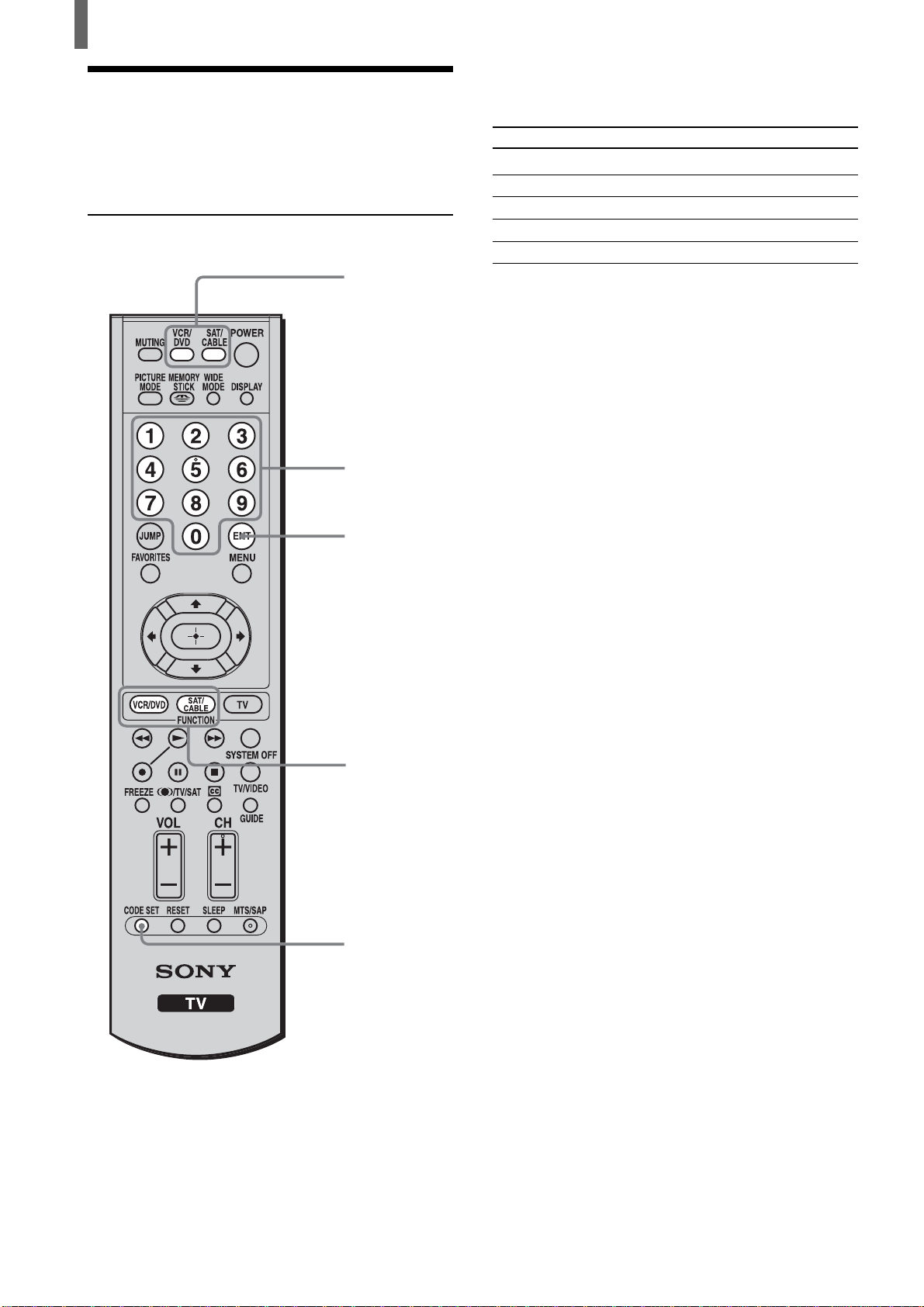
1 Press CODE SET.
2 Press the function button you want to program.
To program a cable box or a satellite receiver
Press SAT/CABLE (FUNCTION).
To program video equipment
Press VCR/DVD (FUNCTION).
3 Enter the three-digit manufacturer’s code number
using the 0-9 buttons.
4 Press ENT (enter).
5 To check if the code number works, aim the
TV’s remote control at the equipment and press
the VCR/DVD and/or SAT/CABLE (POWER)
button that corresponds with that equipment. If it
responds, the programming is completed. If not,
try using the other codes listed for that
manufacturer.
Tips
• If more than one number is listed, try entering them one by
one until you come to the correct code for your equipment.
• If you enter a new code number, the code number you
previously entered at that setting is erased.
• In some rare cases, you may not be able to operate your
equipment with the Sony remote control. In this case, use the
equipment’s own remote control unit.
Programmable code number
303
302
301
348
751

35
Watching the TV
Manufacturer Code
Pentax 305, 304
Philco 308, 309
Philips 308, 309, 310
Pioneer 308
Quasar 308, 309, 306
RCA/PROSCAN 304, 305, 308,
309, 311, 312,
313, 310, 329
Realistic 309, 330, 328,
335, 324, 338
Sansui 314
Samsung 322, 313, 321
Sanyo 330, 335
Scott 312, 313, 321,
335, 323, 324,
325, 326
Sharp 327, 328
Shintom 315
Signature 2000 338, 327
(M. Ward)
SV2000 338
Sylvania 308, 309, 338,
310
Symphonic 338
Tashiro 332
Tatung 314, 336, 337
Teac 314, 336, 338,
337
Technics 309, 308
Toshiba 312, 311
Wards 327, 328, 335,
331, 332
Yamaha 314, 330, 336,
337
Zenith 331
DVD Players
Manufacturer Code
Sony 751
Panasonic 753
Pioneer 752
RCA 755
Toshiba 754
Cable Boxes
Manufacturer Code
Sony 230
Hamlin/Regal 222, 223,
224, 225, 226
Jerrold/G. I. 201, 202, 203,
204, 205, 206,
207, 208, 218
Oak 227, 228, 229
Panasonic 219, 220, 221
Pioneer 214, 215
Scientific Atlanta 209, 210, 211
Tocom 216, 217
Zenith 212, 213
Satellite Receivers
Manufacturer Code
Sony 801
General Electric 802
Hitachi 805
Hughes 804
Panasonic 803
RCA/PROSCAN 802, 808
Toshiba 806, 807
Manufacturer’s codes
VCRs
Manufacturer Code
Sony 301
Admiral (M. Ward) 327
Aiwa * 338, 344
Audio Dynamic 314, 337
Broksonic 319, 317
Canon 309, 308
Citizen 332
Craig 302, 332
Criterion 315
Curtis Mathes 304, 338, 309
Daewoo 341, 312, 309
DBX 314, 336, 337
Dimensia 304
Emerson 319, 320, 316,
317, 318, 341
Fisher 330, 335
Funai 338
General Electric 329, 304, 309
Go Video 322, 339, 340
Goldstar 332
Hitachi 306, 304, 305,
338
Instant Replay 309, 308
JC Penney 309, 305, 304,
330, 314, 336,
337
JVC 314, 336, 337,
345, 346, 347
Kenwood 314, 336, 332,
337
LXI (Sears) 332, 305, 330,
335, 338
LG 332
Magnavox 308, 309, 310
Marantz 314, 336, 337
Marta 332
Memorex 309, 335
Minolta 305, 304
Mitsubishi/MGA 323, 324, 325,
326
Multitech 325, 338, 321
NEC 314, 336, 337
Olympic 309, 308
Optimus 327
Panasonic 308, 309, 306,
307
* If an AIWA VCR does not work even though you enter
the code for AIWA, enter the code for Sony instead.
(Continued)
36
Watching the TV
Operating optional equipment
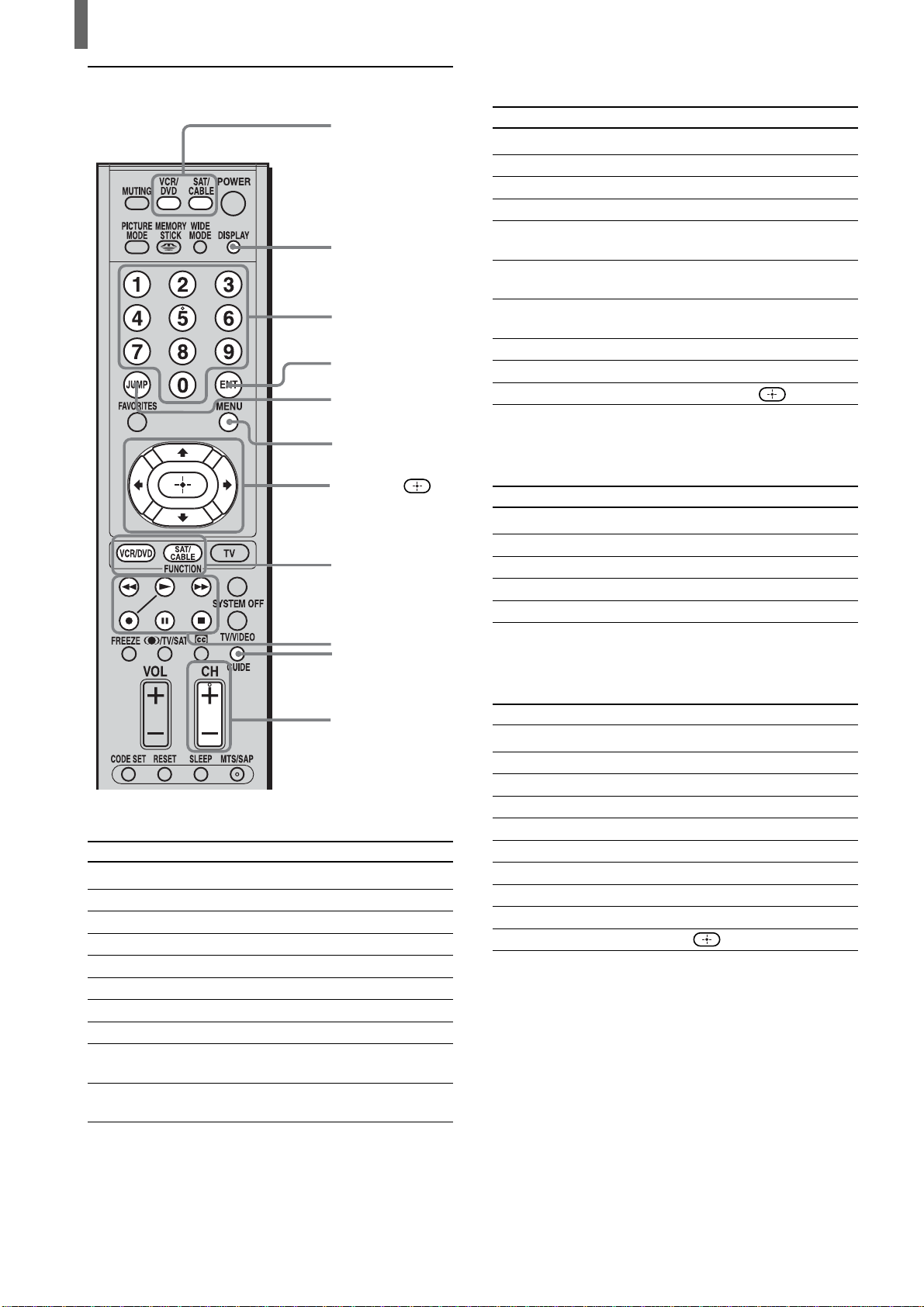
Operating a VCR
To
Turn on/off
Control a VCR
Change channels
Record
Play
Stop
Fast forward
Rewind
Pause
Search the picture
forward or backward
Press
VCR/DVD (POWER)
VCR/DVD (FUNCTION)
CH +/–
H and a simultaneously
H
s
J
j
S (press again to resume normal
playback)
J or j during playback
(release to resume normal playback)
FUNCTION
buttons
(VCR/DVD,
SAT/CABLE)
POWER buttons
(VCR/DVD,
SAT/CABLE)
VCR/DVD
operating buttons
DISPLAY
0-9 buttons
JUMP
GUIDE
V, v, B, b,
MENU
CH +/–
ENT (enter)
Operating a DVD player
To
Turn on/off
Control a DVD player
Play
Stop
Pause
Step through different
tracks of an audio disc
Step through different
chapters of a video disc
Select a track directly
Display the menu (Setup)
Operate the DVD menu
Operating a cable box
To
Turn on/off
Control a cable box
Select a channel
Change channels
Go to the previous channel
Operating a satellite receiver
To
Turn on/off
Control a satellite receiver
Select a channel
Change channels
Go to the previous channel
Display the channel number
Display the DBS guide
Display the DBS menu
Move the highlight (cursor)
Select the item
Press
SAT/CABLE (POWER)
SAT/CABLE (FUNCTION)
0-9 buttons, ENT (enter)
CH +/–
JUMP
DISPLAY
GUIDE
MENU
V, v, B, b
Press
SAT/CABLE (POWER)
SAT/CABLE (FUNCTION)
0-9 buttons, ENT (enter)
CH +/–
JUMP
Press
VCR/DVD (POWER)
VCR/DVD (FUNCTION)
H
s
S (press again to resume
normal playback)
J to step forward or j
to step backward
CH + to step forward or CH
– to step backward
0-9 buttons
MENU
V, v, B, b,
37
Watching the TV
Using Favorite Channels
You can select programs from a list of favorite
channels that you preset.
Setting your favorite channels
1, 7
2 - 6
1 Press MENU.
,
Video
Exit:Set:Select:
Return
Mode: Vivid
Picture: 50
Brightness: 50
Color: 25
Hue: 0
Sharpness: 3
Backlight: 5
Color Temp.: Cool
CineMotion:
Dynamic Picture: On
TV
2 Press V/v to select (Channel), then press
.
,
Return
Favorite Channels
Cable: On
Channel Fix: Off
Auto Program: OK
Channel Skip/Add
Channel Label
Channel
TV
Select: Back: Exit:Set:
3 Press V/v to select “Favorite Channels,” then
press
.
,
Channel TV
Return CH
1 : 2
2 : 3
3 : 4
4 : 5
5 : 6
6 : 7
7 : 8
8 : 9
Favorite Channels
Select: Back: Exit:Set:
Tip
If you cannot select “Favorite Channels,” change the input
to TV by pressing the TV/VIDEO button.
4 Press V/v to select the position you want to
change, then press
.
,
Channel TV
Return CH
1 : 2
2 : 3
3 : 4
4 : 5
5 : 5
6 : 7
7 : 8
8 : 9
Favorite Channels
Select: Back: Exit:Set:
6
5 Press V/v to scroll through the channels until
you find the desired channel, then press
.
,
Channel TV
Return CH
1 : 2
2 : 3
3 : 4
4 : 5
5 : 42
6 : 7
7 : 8
8 : 9
Favorite Channels
Select: Back: Exit:Set:
6 Repeat steps 4 and 5 to program other favorite
channels.
7 Press MENU to exit the menu screen.
38
Watching the TV
Watching favorite channels
1
2
,
,
ABC
Favorite Channels
1: ABC
2: HBD
3: MTV
4: FOX
5: CBS
6: COMED
7: 7
8: 8
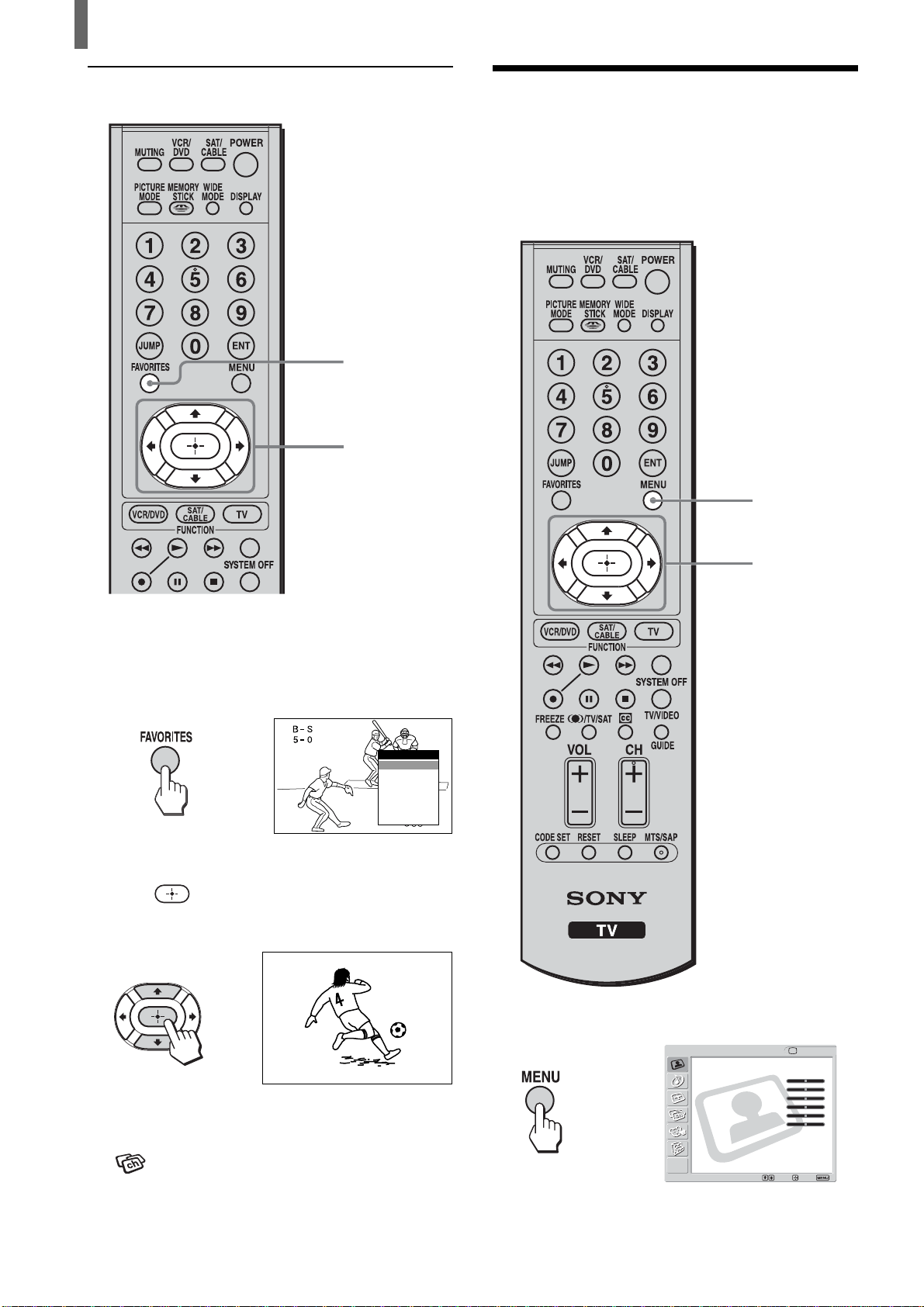
1 Press FAVORITES.
The Favorite Channels options appear.
2 Press V/v to select the desired channel, then
press
.
The selected channel will be displayed.
Tip
If you make an optional label using “Channel Label” in the
(Channel) menu, that label will be displayed on the
screen.
Using the Channel Label
Feature
If you have set an optional label for the channel
display or for Favorite Channels, you can have that
label displayed on the screen.
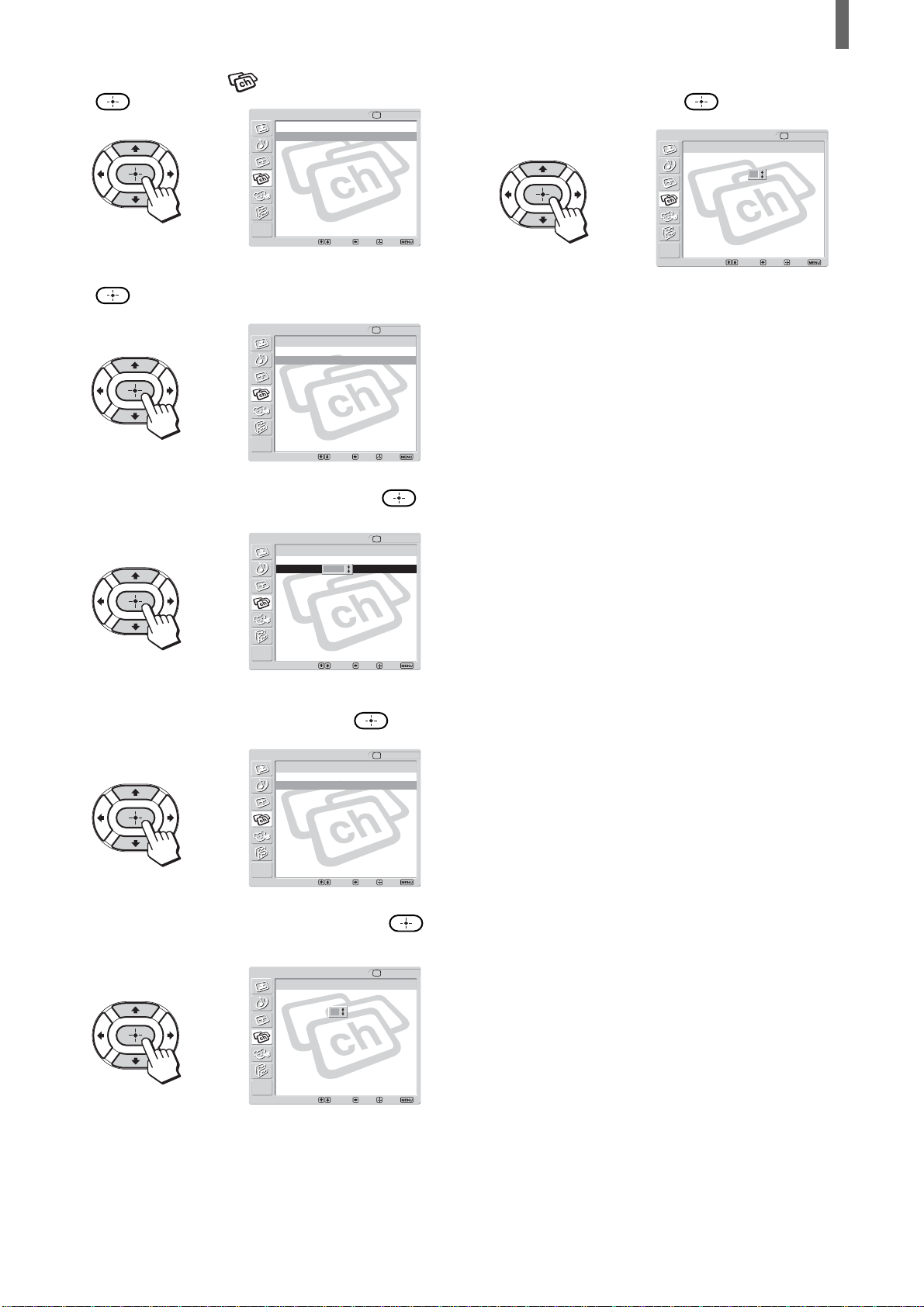
1 Press MENU.
,
Video
Exit:Set:Select:
Return
Mode: Vivid
Picture: 50
Brightness: 50
Color: 25
Hue: 0
Sharpness: 3
Backlight: 5
Color Temp.: Cool
CineMotion:
Dynamic Picture: On
TV
2 - 9
1, 10
39
Watching the TV
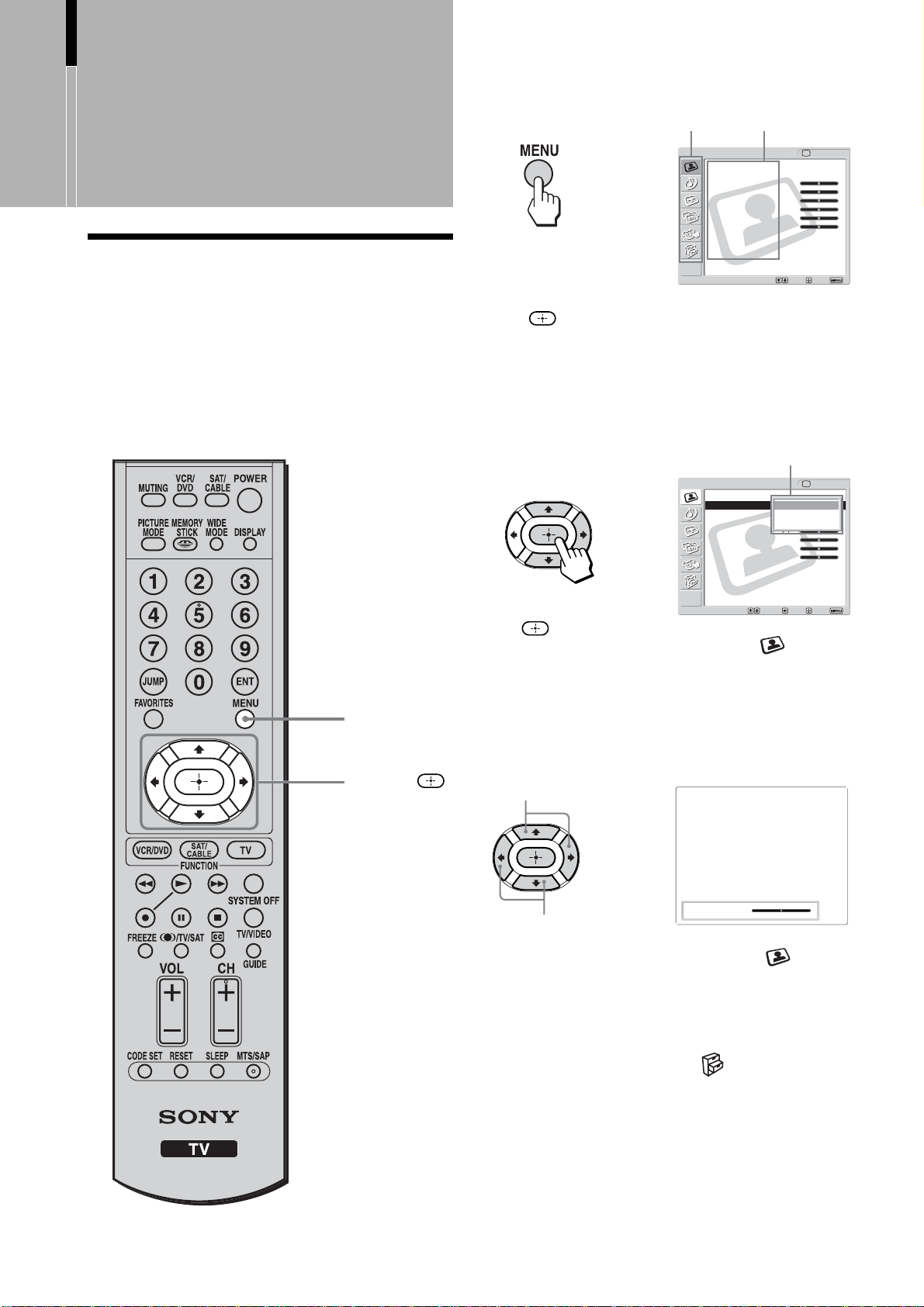
2 Press V/v to select (Channel), then press
.
3 Press V/v to select “Channel Label,” then press
.
4 Press V/v to select “Channel,” then press .
5 Press V/v to scroll through the channel numbers
you want to assign a label, then press
.
6 Press V/v to select the “Label,” then press .
7 Press V/v to scroll through the label characters
(A-Z, 0-9, etc.), then press
.
8 Repeat to add up to 5 characters to the label.
9 Repeat steps 4 - 8 to assign labels to more
channels.
10 Press MENU to exit the menu screen.
Return
Favorite Channels
Cable: On
Channel Fix: Off
Auto Program: OK
Channel Skip/Add
Channel Label
Channel
TV
Select: Back: Exit:Set:
,
,
Channel Label
Return
Channel: 1
Label: _ _ _ _ _
Channel
TV
Select: Back: Exit:Set:
,
Channel Label
Return
Channel: 30
Label: _ _ _ _ _
Channel
TV
Select: Back: Exit:Set:
1
,
Channel Label
Return
Channel: 30
Label: _ _ _ _ _
Channel
TV
Select: Back: Exit:Set:
,
Channel Label
Return
Channel: 30
Label: _ _ _ _
Channel
TV
Select: Back: Exit:Set:
_
Channel Label
Return
Channel: 30
Label: A _ B _ _ _
Channel
TV
Select: Back: Exit:Set:
_
,
40
Using Advanced Features
Using Advanced
Features
To adjust the setting
Maximize the
setting value
To change the menu color
You can choose the menu color from two types by
selecting “Menu Color” in the
(Setup) menu,
then selecting “White” or “Black.”
Minimize the
setting value
,
Picture: 50
(Example: when selecting
“Picture” in the
(Video)
menu)
Using the Menu
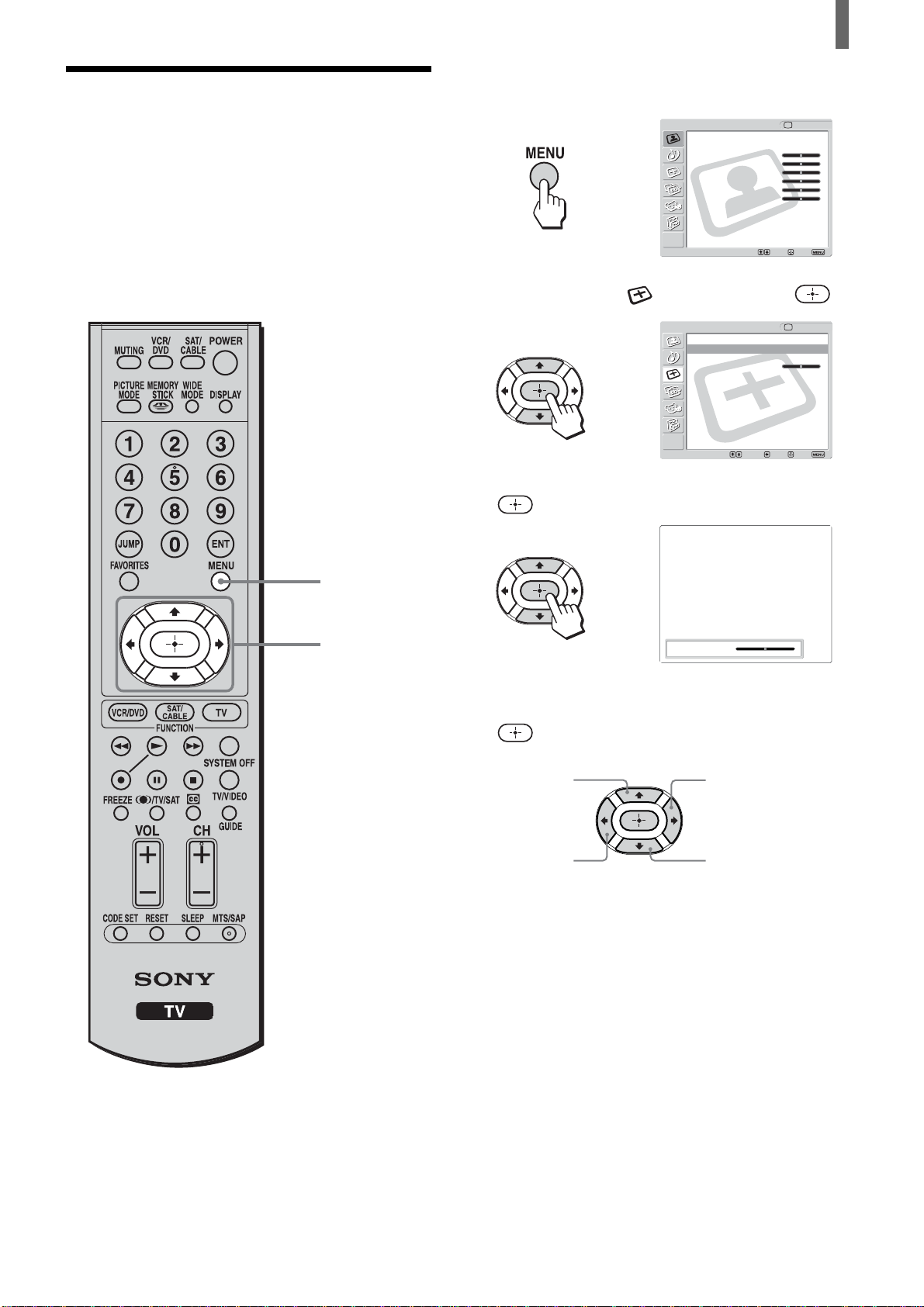
Most of advanced settings and adjustments are
performed using the menu screen.
Basic operations to navigate through menus are
described below.
• Items which appear in yellow are selected.
•You cannot select items which appear in pale
color.
Video
Exit:Set:Select:
Return
Mode: Vivid
Picture: 50
Brightness: 50
Color: 25
Hue: 0
Sharpness: 3
Backlight: 5
Color Temp.: Cool
CineMotion:
Dynamic Picture: On
TV
Video
Return
Mode: Vivid
Picture: 50
Brightness: 50
Color: 25
Hue: 0
Sharpness: 3
Backlight: 5
Color Temp.: Cool
CineMotion:
Dynamic Picture: On
Vivid
Standard
Pro
Select: Back: Exit:Set:
TV
,
To open the menu screen and select the
option
Press MENU to open the
menu screen.
Press V/v to select the
desired category, then
press
.
m
Press V/v to select
the option, then press
b or
.
(The b button cannot
be used on some
menus.)
(Example: when selecting
“Mode” in the
(Video)
menu)
,
To exit the menu screen, press MENU again.
V, v, B, b,
MENU
Menu category
Menu option
Setting option
41
Using Advanced Features
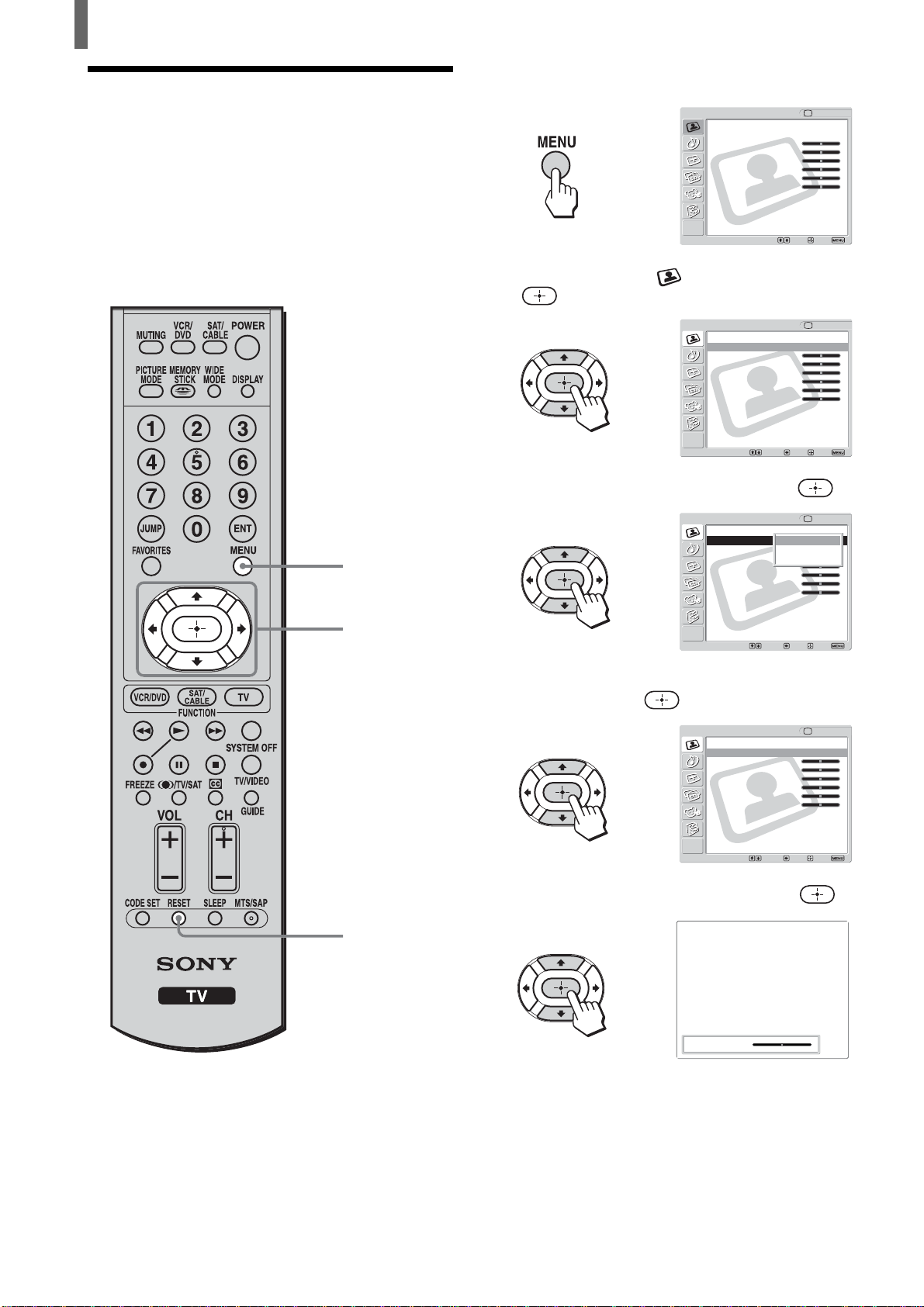
1 Receive the picture you want to adjust, then
press MENU.
2 Press V/v to select (Screen), then press .
3 Press V/v to select “Vertical Center,” then press
.
4 Press V/v/B/b to adjust the position, then press
.
5 Press MENU to exit the menu screen.
Adjusting the Picture
Position
You can move the position of the picture up and down
for each Wide Screen Mode (page 27) in the following
cases:
• To move the position of the picture in “Wide
Zoom” and “Zoom” modes
•When subtitles may not fit in the screen
1, 5
2 - 4
Moves up Moves up
Moves down Moves down
,
Return
Wide Mode: Wide Zoom
4:3 Default: Wide Zoom
Vertical Center: 0
Screen
Select: Back: Exit:Set:
TV
,
Vertical Center: 0
,
Video
Exit:Set:Select:
Return
Mode: Vivid
Picture: 50
Brightness: 50
Color: 25
Hue: 0
Sharpness: 3
Backlight: 5
Color Temp.: Cool
CineMotion:
Dynamic Picture: On
TV
42
Using Advanced Features
1 Press MENU.
2 Press V/v to select (Video), then press
.
3 Press V/v to select “Mode,” then press .
4 Press V/v to select the Picture Mode you want to
adjust, then press
.
5 Press V/v to select “Picture,” then press .
Adjusting the Picture
Quality
You can adjust the picture quality for each Picture
Mode (“Vivid,” “Standard,” or “Pro”).
You can adjust the picture quality differently for
each video input which can be selected using the
TV/VIDEO button, and store it in memory.
1, 8
2 - 7
,
Picture: 50
,
TV
Video
Return
Mode: Vivid
Picture: 50
Brightness: 50
Color: 25
Hue: 0
Sharpness: 3
Backlight: 5
Color Temp.: Cool
CineMotion:
Dynamic Picture: On
Select: Back: Exit:Set:
,
Video
Return
Mode: Vivid
Picture: 50
Brightness: 50
Color: 25
Hue: 0
Sharpness: 3
Backlight: 5
Color Temp.: Cool
CineMotion:
Dynamic Picture: On
Vivid
Standard
Pro
Select: Back: Exit:Set:
TV
,
Video
Return
Mode: Vivid
Picture: 50
Brightness: 50
Color: 25
Hue: 0
Sharpness: 3
Backlight: 5
Color Temp.: Cool
CineMotion:
Dynamic Picture: On
Select: Back: Exit:Set:
TV
Video
Exit:Set:Select:
Return
Mode: Vivid
Picture: 50
Brightness: 50
Color: 25
Hue: 0
Sharpness: 3
Backlight: 5
Color Temp.: Cool
CineMotion:
Dynamic Picture: On
TV
,
RESET
43
Using Advanced Features
6 Press V/v/B/b to make the desired adjustment,
then press
.
Adjustable options
Option
Picture
Brightness
Color
Hue*
Sharpness**
Backlight
* The adjustment is not available for the followings:
– 480i, 480p, 1080i and 720p signals input to VIDEO 3
IN
– 480p, 1080i and 720p signals input to VIDEO 4 IN
– Digital photos and movies recorded on “Memory
Stick”
** The adjustment is not available for the digital photos and
movies recorded on “Memory Stick.”
Tip
You can adjust each option by referring to the value beside
each option indicator.
Selective options
Option
Color Temp.
(Color
Temperature)
CineMotion*
Dynamic*
Picture
* The adjustment is not available for the digital photos
and movies recorded on “Memory Stick.”
Press v/B
To reduce picture
contrast.
To darken the
picture.
To decrease color
intensity.
To decrease the
green tones.
To soften the
picture.
To darken the
screen.
Press V/b
To enhance picture
contrast.
To brighten the
picture.
To increase color
intensity.
To increase the
green tones.
To sharpen the
picture.
To brighten the
screen.
Description
Select to give bright
colors a red tint.
Select to provide an
optimized display by
automatically detecting
film content. Moving
pictures will become
clearer and more natural.
When the super imposed
text on the film content
appears corrupted, please
turn CineMotion off.
Select to enhance the
picture contrast.
Setting
Cool/
Normal/
Warm
On/Off
On/Off
,
Video
Return
Mode: Vivid
Picture: 50
Brightness: 50
Color: 25
Hue: 0
Sharpness: 3
Backlight: 5
Color Temp.: Cool
CineMotion:
Dynamic Picture: On
Select: Back: Exit:Set:
TV
7 Repeat steps 5 and 6 to adjust other options.
8 Press MENU to exit the menu screen.
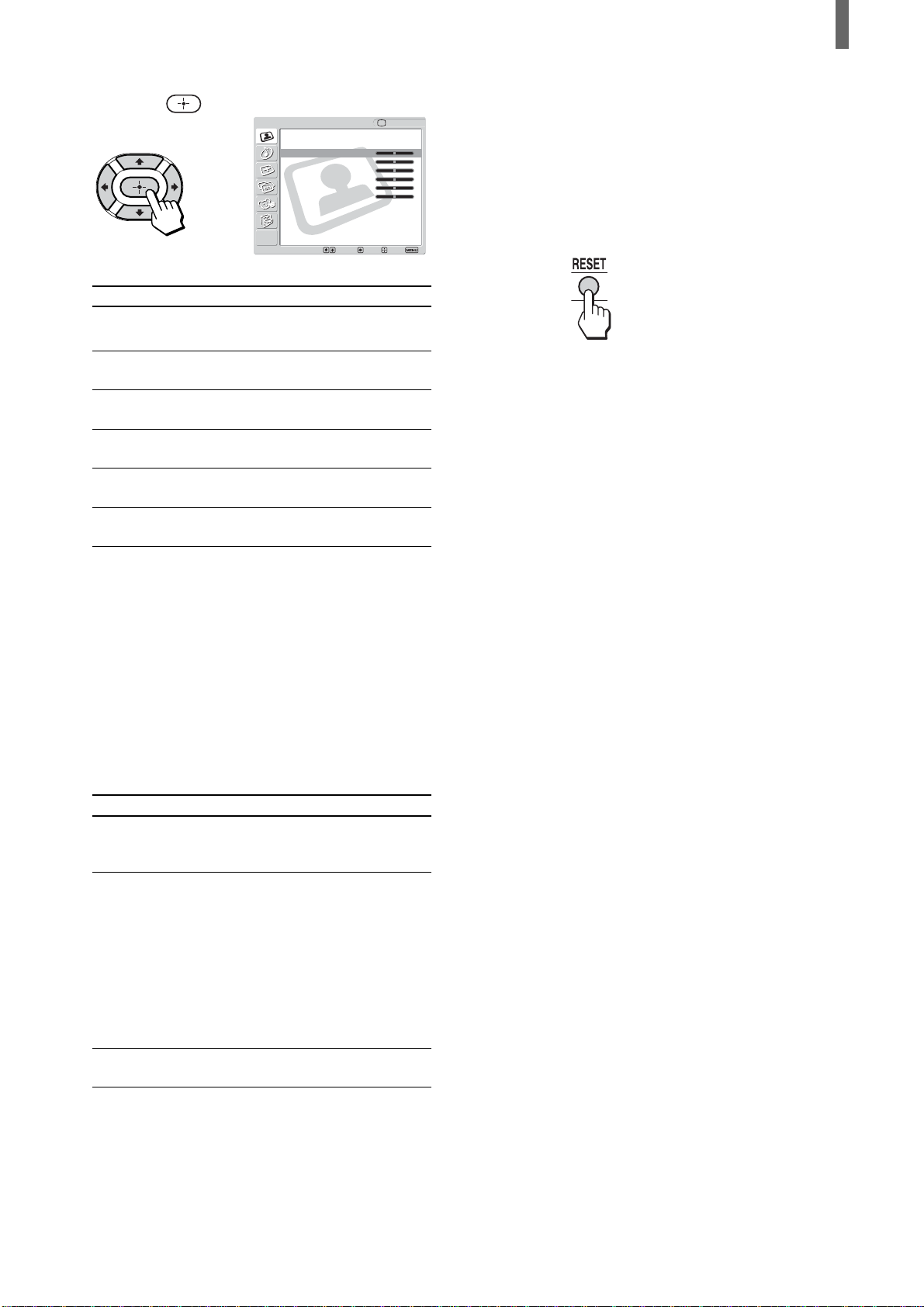
To reset to the factory settings
Press RESET while the menu is on the screen and
the cursor is located on the right side of any menu
item.
44
Using Advanced Features
Press V/b
To increase higher-
pitched sounds.
To increase lower-
pitched sounds.
To emphasize the
right speaker.
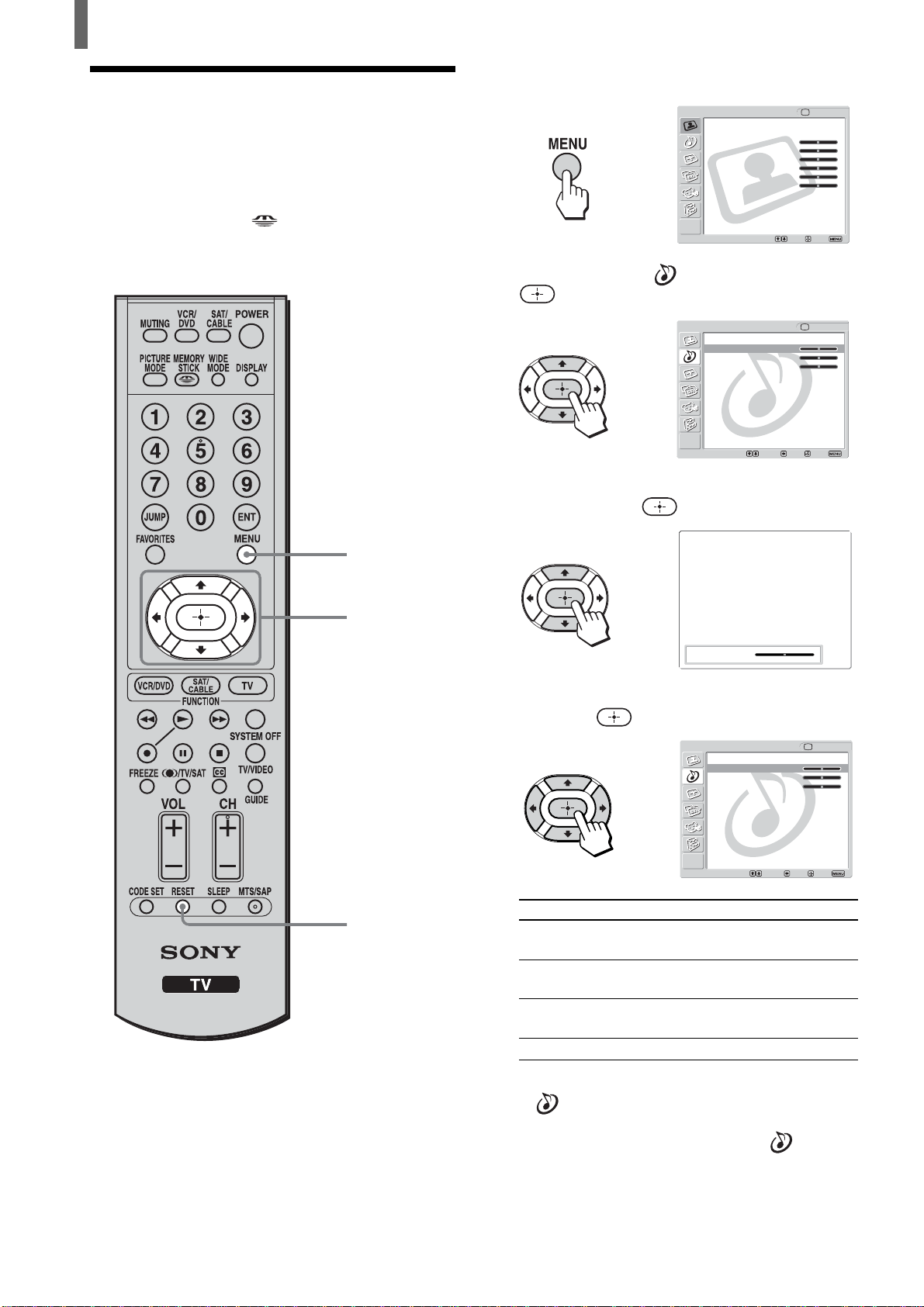
1 Press MENU.
2 Press V/v to select (Audio), then press
.
3 Press V/v to select the option you want to
adjust, then press
.
4 Press V/v/B/b to make the desired adjustment,
then press
.
Option
Treble*
Bass*
Balance*
Effect**
* To adjust any of these options, set “Speaker” in the
(AUDIO) menu to “ON,” or “Audio Out” to
“Variable” first.
** To adjust the option, set “Speaker” in the
(AUDIO)
menu to “ON” first.
Tip
You can adjust each option by referring to the value beside
each option indicator.
Press v/B
To decrease higher-
pitched sounds.
To decrease lower-
pitched sounds.
To emphasize the
left speaker.
See page 26.
,
Exit:
Return
Treble: 0
Bass: 0
Balance: 0
Effect: Off
MTS: Stereo
Speaker: On
Audio Out:
Audio TV
Select: Back: Set:
,
Treble: 0
,
Exit:
Return
Treble: 0
Bass: 0
Balance: 0
Effect: Off
MTS: Stereo
Speaker: On
Audio Out:
Audio TV
Select: Back: Set:
Video
Exit:Set:Select:
Return
Mode: Vivid
Picture: 50
Brightness: 50
Color: 25
Hue: 0
Sharpness: 3
Backlight: 5
Color Temp.: Cool
CineMotion:
Dynamic Picture: On
TV
,
Adjusting the Sound
Quality
You can adjust the sound quality differently for each
video input which can be selected using the
TV/VIDEO button and
button, and store it in
memory.
For details on the Effect mode, see pages 26 and 27.
1, 6
2 - 5
RESET
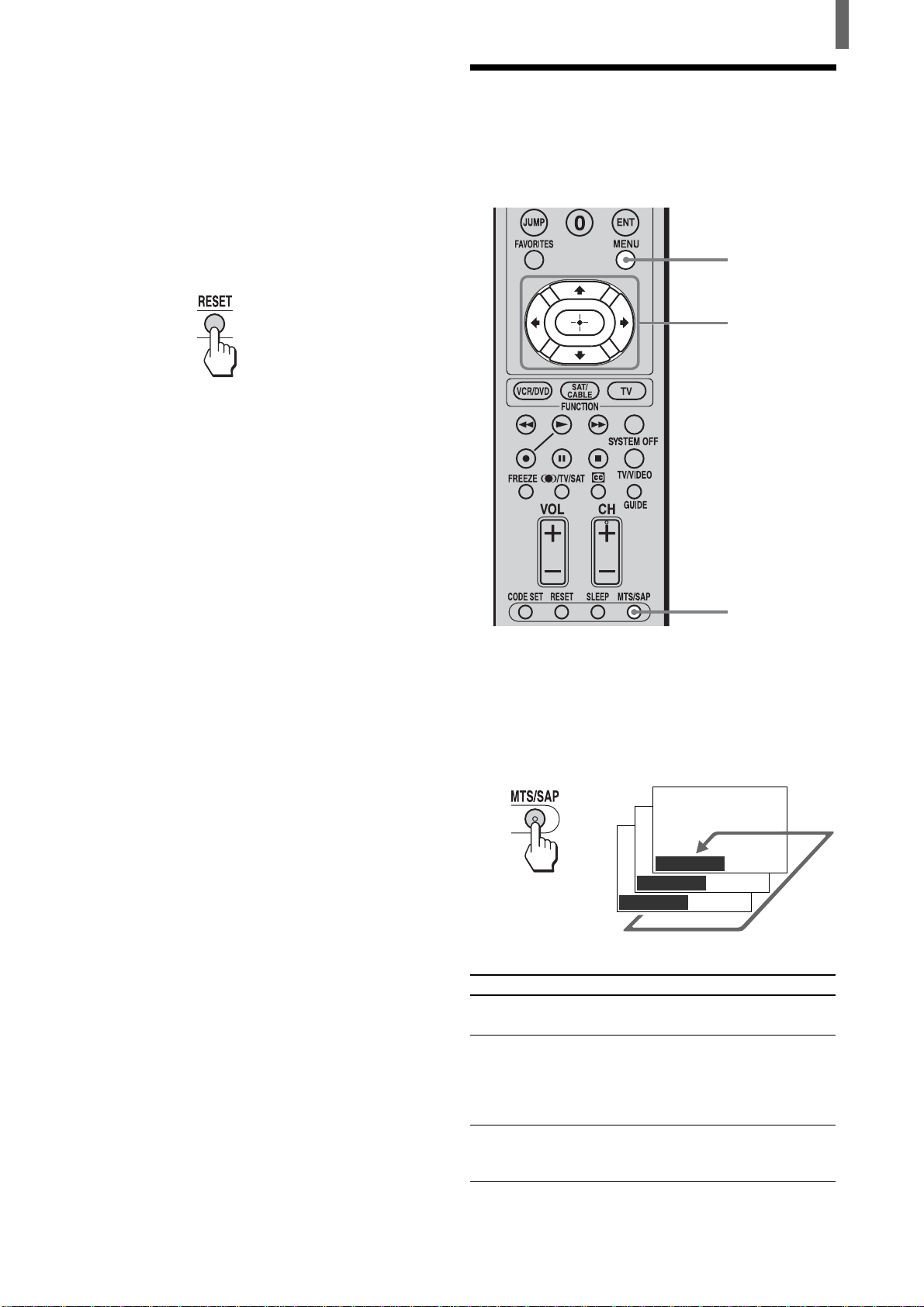
45
Using Advanced Features
5 Repeat steps 3 and 4 to adjust other options.
6 Press MENU to exit the menu screen.
To reset to the factory settings
Press RESET while the menu is on the screen and
the cursor is located on the right side of any menu
item.
Note
Resetting the unit to the factory settings resets only Treble, Bass
and Balance.
Selecting Stereo or
Bilingual Programs
You can enjoy stereo, bilingual and mono programs.
MTS/SAP
Press MTS/SAP repeatedly until the desired sound
indication appears.
Each time you press the button, the sound indication
changes as follows:
Sound indication*
Stereo
Auto SAP
Mono
* This is available only for TV broadcasting.
1, 5
2 - 4
Description
Select for stereo reception when
viewing a program broadcast in stereo.
Select to automatically switch the TV
to second audio programs when a signal
is received. (If no SAP signal is
present, the TV remains in Stereo
mode.)
Select for mono reception. (Use to
reduce noise during weak stereo
broadcasts.)
Mono
Auto SAP
Stereo
,
(Continued)
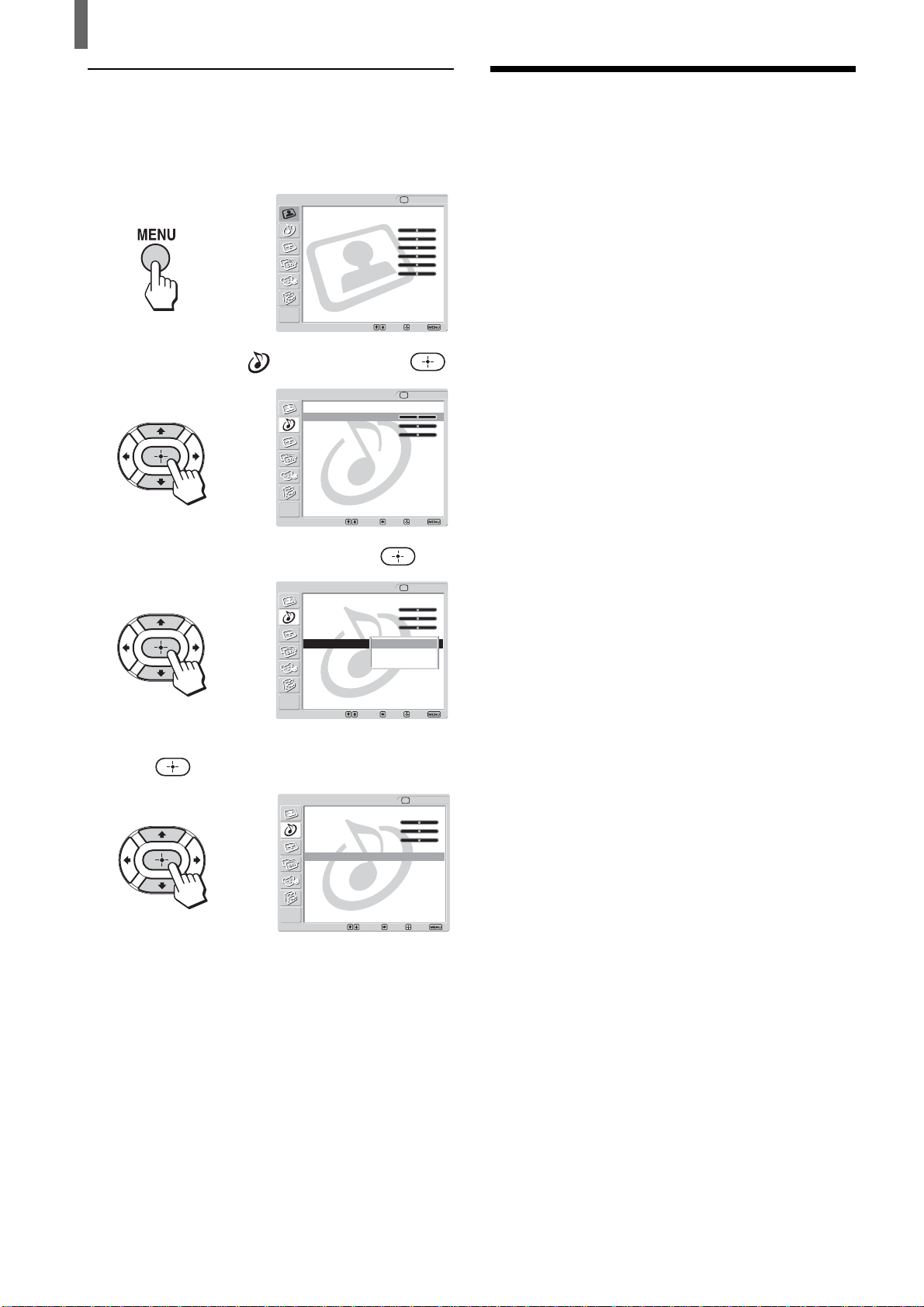
46
Using Advanced Features
Using the Parental
Control Feature
The TV programs and movies shown on TV are
given a rating signal based on the following rating
systems.
In U.S.A.: U.S. Television Parental Guidelines to
rate television programs (U.S. TV ratings), and
Motion Picture Association of America (MPAA)
Guidelines to rate movies including those shown on
TV (movie ratings).
In Canada: Canadian English Language ratings to
rate television programs in English, and Canadian
French Language ratings to rate those in French.
To block programs you feel unsuitable for your
children, you need to set the TV for the desired
rating systems. Sony’s predetermined ratings are also
available. See page 51 for a description of the
ratings.
The TV’s Parental Control feature functions by
receiving the rating signal from your local
broadcasting station or cable service provider.
1 Press MENU.
2 Press V/v to select (Audio), then press .
3 Press V/v to select “MTS,” then press .
4 Press V/v to select the desired reception, then
press
.
5 Press MENU to exit the menu screen.
Selecting stereo or bilingual
programs using the menu
,
Exit:
Return
Treble: 0
Bass: 0
Balance: 0
Effect: Off
MTS: Auto SAP
Speaker: On
Audio Out:
Audio TV
Select: Back: Set:
,
Exit:
Return
Treble: 0
Bass: 0
Balance: 0
Effect: Off
MTS: Auto SAP
Speaker: On
Audio Out:
Audio TV
Select: Back: Set:
Stereo
Auto SAP
Mono
,
Exit:
Return
Treble: 0
Bass: 0
Balance: 0
Effect: Off
MTS: Stereo
Speaker: On
Audio Out:
Audio TV
Select: Back: Set:
,
Video
Exit:Set:Select:
Return
Mode: Vivid
Picture: 50
Brightness: 50
Color: 25
Hue: 0
Sharpness: 3
Backlight: 5
Color Temp.: Cool
CineMotion:
Dynamic Picture: On
TV
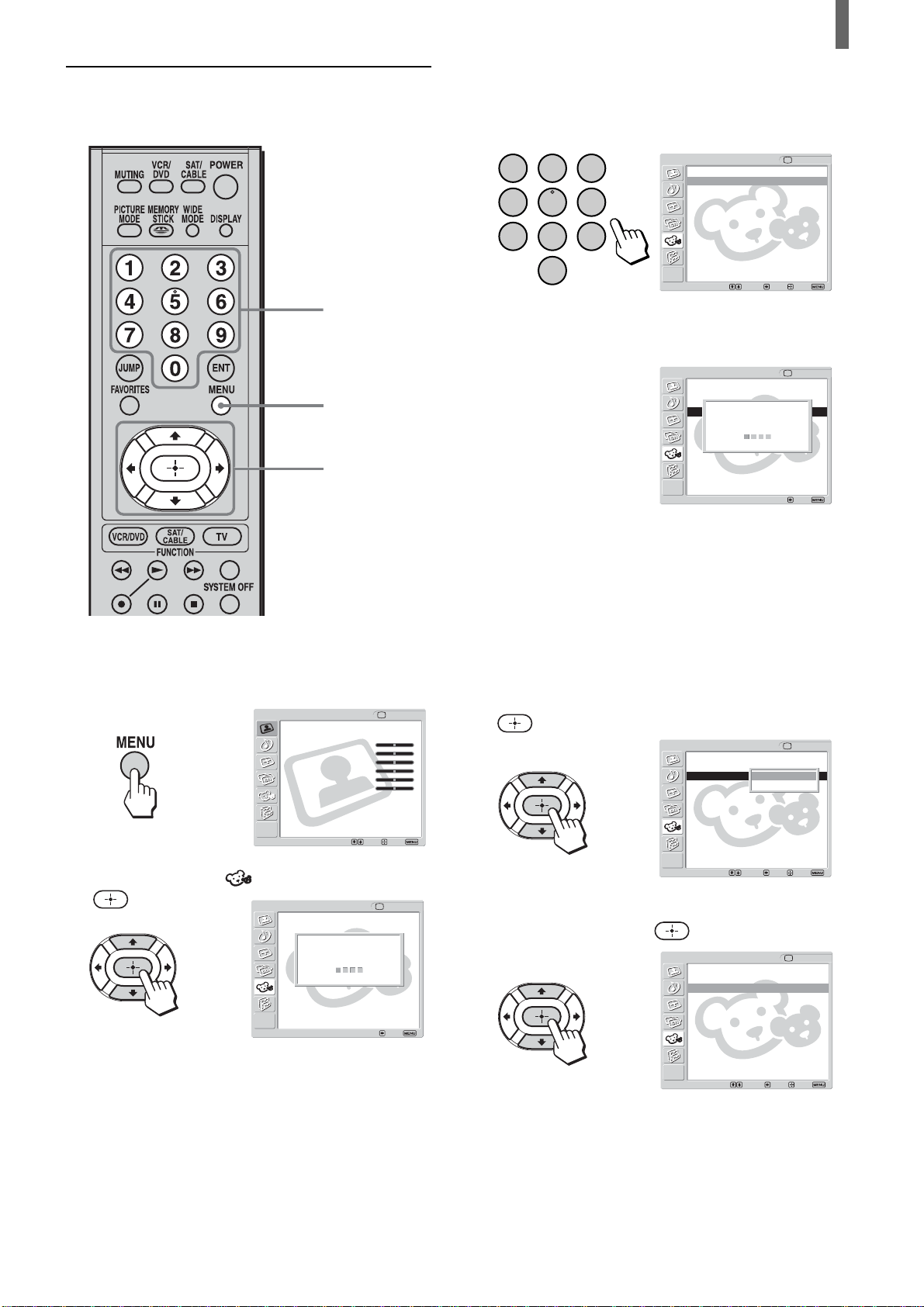
47
Using Advanced Features
Activating the Parental Control
feature
1 Press MENU.
2 Press V/v to select (Parent), then press
.
1, 8
3
2,
4 - 7
,
Video
Exit:Set:Select:
Return
Mode: Vivid
Picture: 50
Brightness: 50
Color: 25
Hue: 0
Sharpness: 3
Backlight: 5
Color Temp.: Cool
CineMotion:
Dynamic Picture: On
TV
,
Parent TV
Exit:Back:
Enter password
using 0-9 buttons
----
3 Enter a four-digit password using the 0-9
buttons.
The Parent menu options appear.
If you access the Parent menu for the first time,
you are requested to enter the password again for
confirmation.
Note
Do not enter “4357” corresponding to “HELP” on a phone
number pad (See page 48).
Tips
• You need to enter the password here for any further
access into the Parent menu. If you lose your password,
see “Tip” on page 48.
• If you want to change the password, see page 48.
4 Press V/v to select “Select Country,” then press
.
5 Press V/v to select your country/region (U.S.A.
or Canada), then press
.
Parent TV
Return
Lock: Off
Select
Chage
Exit:
Back:
Confirm password
----
,
Return
Lock: OffSelect Country: 0
Select Country:
Change Password
Parent
TV
Select: Back: Exit:Set:
U.S.A.
Canada
,
Return
Lock: Off
Select Country: U.S.A.
Change Password
Parent
TV
Select: Back: Exit:Set:
123
456
78
0
9
Return
Lock: Off
Select Country: U.S.A.
Change Password
Parent
TV
Select: Back: Exit:Set:
,
(Continued)
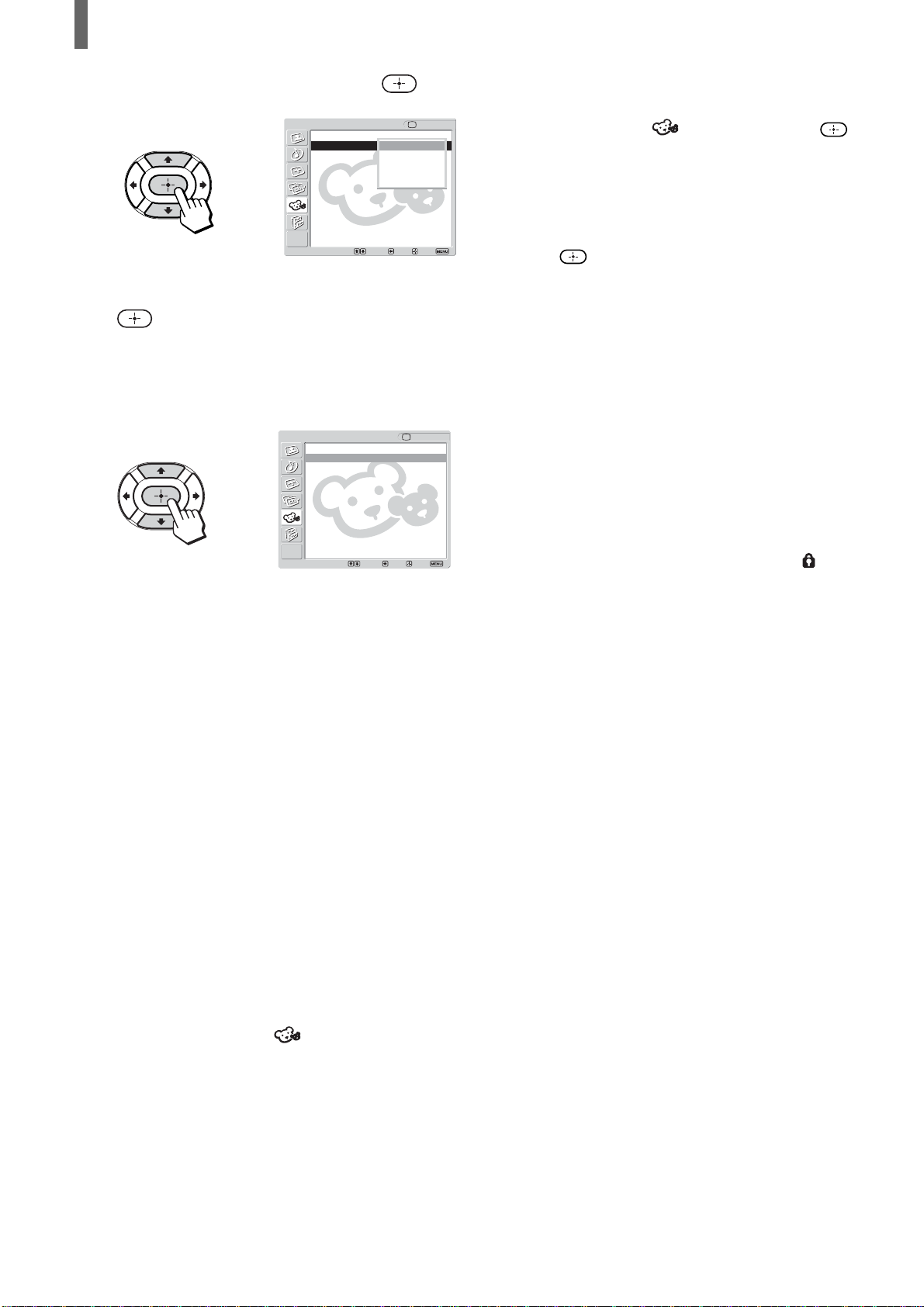
48
Using Advanced Features
To change the password
1 Press MENU.
2 Press V/v to select (Parent), then press .
3 Enter your four-digit password using the 0-9
buttons.
The Parent menu options appear.
4 Press V/v to select “Change Password,” then
press
.
5 Enter a new four-digit password using 0-9
buttons.
6 Enter the password set in step 5 again to confirm.
7 Press MENU to exit the menu screen.
Tip
If you have forgotten your password, enter the master password
“4357” (corresponding to “HELP” on a phone number pad) in
step 3. You can then store a new password.
Notes
• If you entered “4357” as your password for the first time, you
cannot store a new password (See step 3 of “Activating the
Parental Control feature” on page 47).
• When you select a Parental Control program and the
indicator is displayed on the screen, you cannot view that
program even if you enter “4357” (See “Viewing blocked
programs” on page 48).
6 Press V/v to select “Lock,” then press .
7 Press V/v to select a desired rating, then press
.
If you select “Child,” “Youth,” or “Y.Adult”
(Young Adult), the Parental Control is activated
automatically.
Tip
If you are not familiar with the Parental Guideline rating
system, you should select “Child,” “Youth,” or “Y.Adult” to
help simplify the rating selection. To set more restrictive
ratings, select “Custom” (See “Selecting a Custom Rating”
on page 49).
8 Press MENU to exit the menu screen.
Viewing blocked programs
You can view blocked programs by entering the
password.
1 Press ENT (enter) when tuned to a blocked
program.
2 Enter your password using the 0-9 buttons.
The Parental Control feature will be canceled
temporarily until you turn the TV off.
To deactivate the Parental Control feature
Set “Lock” to “Off” in the
(Parent) menu.
,
Return
Lock: Custam
Select Country: 0
Change Password
Parent
TV
Select: Back: Exit:Set:
Off
Child
Youth
Y. Ad ult
Custom
,
Parent TV
Return
Lock: Child
Select Country: U.S.A.
Change Password
Select: Back: Exit:Set:
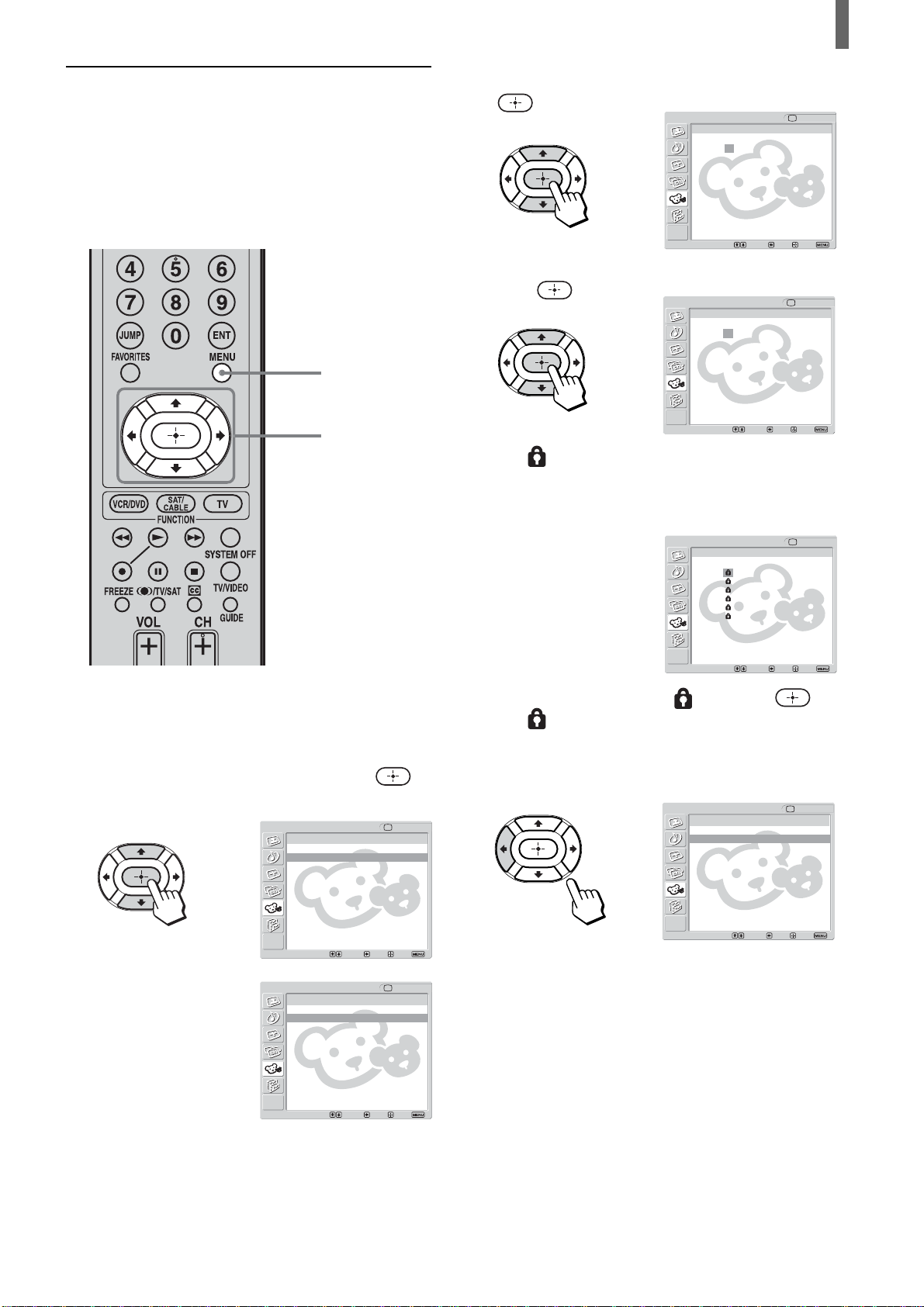
49
Using Advanced Features
1 Perform steps 1 to 6 in “Activating the Parental
Control feature” on page 47 to display the Lock
options.
2 Press V/v to select “Custom,” then press .
To select a rating in Canada, go to step 6.
Selecting a Custom Rating
If you want to select the ratings to be blocked from
“Custom” once you have activated the Parental
Control feature (page 47), follow the procedure
below.
For a detailed description of each rating, see “What
the Ratings Mean” on page 51.
2 - 9
10
In Canada
Return
English Rating
French Rating
U.S.A Rating
Parent
TV
Select: Back: Exit:Set:
Custom
,
Return
Movie Rating
TV Rating
Unrated: Allow
Custom
Parent
TV
Select: Back: Exit:Set:
In U.S.A.
,
Return
Movie Rating
TV Rating
Unrated: Allow
Parent
TV
Select: Back: Exit:Set:
Custom
Parent TV
Movie Rating
Select: Back: Exit:Set:
Return
G:
PG:
PG-13:
R:
NC-17:
X:
,
Parent TV
Movie Rating
Select: Back: Exit:Set:
Return
G: –
PG: –
PG-13: –
R: –
NC-17: –
X: –
–
,
Parent TV
Movie Rating
Select: Back: Exit:Set:
Return
G: –
PG: –
PG-13: –
R: –
NC-17: –
X: –
3 Press V/v to select “Movie Rating,” then press
.
4 Press V/v to select the rating to be blocked, then
press
.
The
indication automatically appears beside
the selected rating and all ratings below it,
indicating that the programs that match the
ratings will be blocked.
To unlock a rating, select
, then press .
The
indication changes into “–” and all
ratings above it are unlocked.
5 Press B to return to the “Custom” menu.
(Continued)
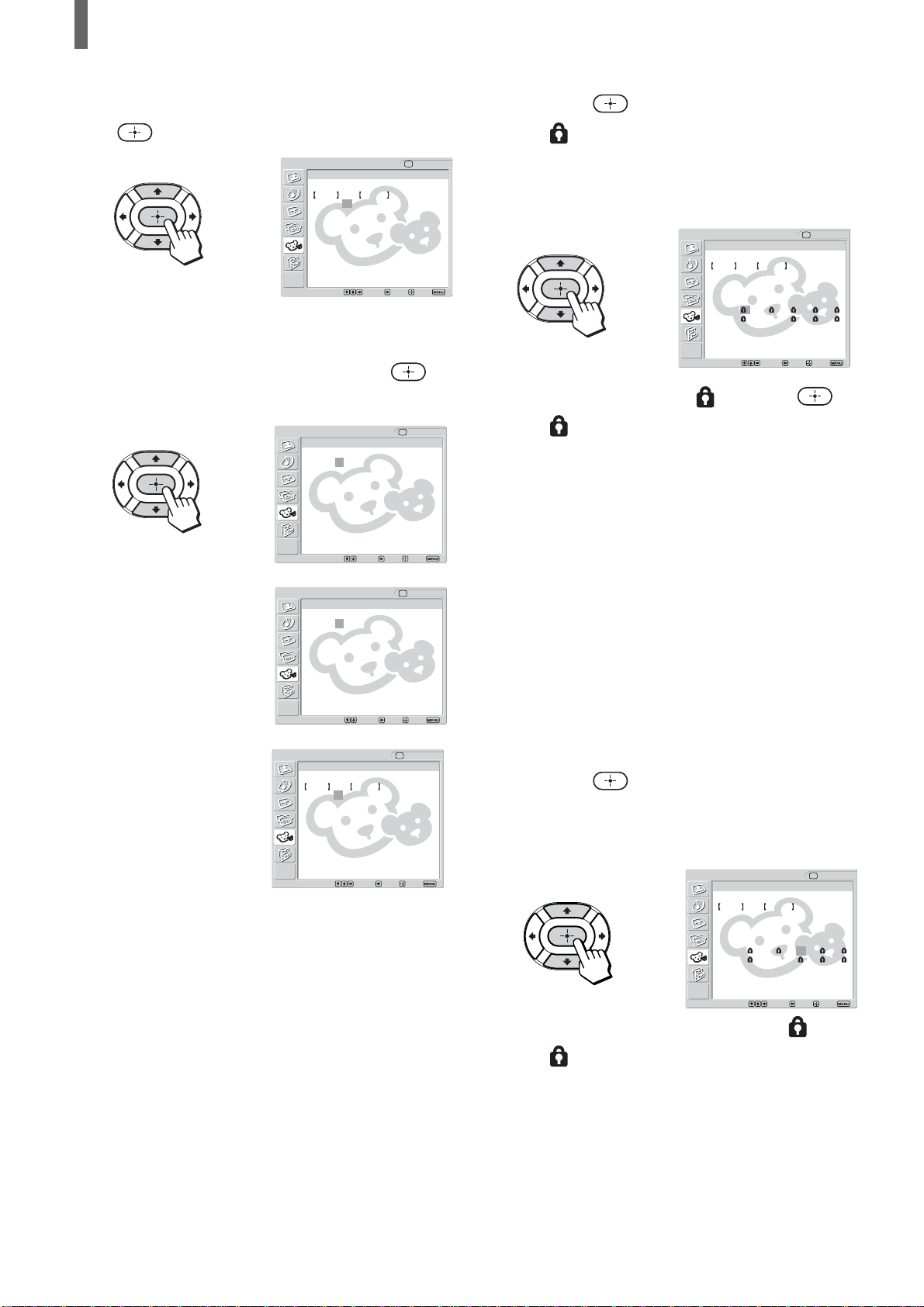
50
Using Advanced Features
,
Parent TV
TV Rating
Select: Back: Exit:Set:
Return
Rating Content
TV-Y: –
TV-Y7: – FV: –
TV-G: –
TV-PG: – D:– L: – S: – V: –
TV-14: D: L: – S: V:
TV-MA: L: S: V:
Example: TV rating in U.S.A.
,
Parent TV
TV Rating
Select:
Back:
Exit:Set:
Return
Rating Content
TV-Y: –
TV-Y7: – FV: –
TV-G: –
TV-PG: – D:– L: – S: – V: –
TV-14: D: L: S: V:
TV-MA: L: S: V:
6 To select a TV rating in U.S.A.:
Press V/v to select “TV Rating,” then press
.
To select a TV rating in Canada:
Press V/v to select “English Rating,” “French
Rating,” or “U.S.A. Rating,” then press
.
,
Return
Rating Content
TV-Y: –
TV-Y7: – FV: –
TV-G: –
TV-PG: – D:– L: – S: – V: –
TV-14: – D:– L: – S: – V: –
TV-MA: – L: – S: – V: –
Parent TV
TV Rating
Select: Back: Exit:Set:
,
Parent TV
English Rating
Select: Back: Exit:Set:
Return
C: –
C8
+:
–
G: –
PG: –
14
+:
–
18
+:
–
English Rating
French Rating
Return
G: –
8ans
+:
–
13ans
+:
–
16ans
+:
–
18ans
+:
–
Parent TV
French Rating
Select: Back: Exit:Set:
Parent TV
U.S.A. Rating
Return
Rating Content
TV-Y: –
TV-Y7: – FV: –
TV-G: –
TV-PG: – D:– L: – S: – V: –
TV-14: – D:– L: – S: – V: –
TV-MA: – L: – S: – V: –
Select: Back: Exit:Set:
U.S.A. Rating
7 Press V/v to select the TV rating to be blocked,
then press
.
The
indication automatically appears beside
the selected rating and all ratings below it,
indicating that the programs that match the
ratings will be blocked.
To unlock a rating, select
, then press .
The
indication changes into “–” and all
ratings above it are unlocked.
Some U.S. TV ratings have additional content
ratings called “extenders.”
The extenders are defined as follows:
D (sexually suggestive Dialog), FV (Fantasy
Violence), L (coarse Language), S (Sexual
situations) and V (Violence).
By setting the extenders, you can define
additional viewing limits.
For more details of extenders, see page 53.
All of the extenders included in the selected
ratings will be blocked. If you want to allow any
of them to be viewed, go to step 8. Otherwise, go
to step 10.
8 Press B/b to select the extender to be viewed,
then press
.
“–” appears beside the selected extender,
indicating that the programs that match the
extender can be viewed.
To relock the canceled extender, select
.
The
indication appears to show that the programs
that match the extender will be blocked again.
51
Using Advanced Features
Option Description
Allow
Block
Allows programs and movies that are
broadcast without a rating.
Blocks all programs and movies that are
broadcast without a rating.
(Continued)
9 Repeat step 8 for other extenders.
All programs that match the ratings you select
and higher, except for the extenders that were
canceled, will be blocked.
10
Press MENU to exit the menu screen.
To block programs or movies broadcast
without a rating
Unrated option allows you to block programs or
movies that are broadcast without a rating.
The unrated option is available only when you have
selected U.S.A. as your country/region.
1 Perform steps 1 and 2 of “Selecting a Custom
Rating” on page 49.
2 Press V/v to select “Unrated,” then press .
3 Press V/v to select “Block,” then press .
4 Press MENU to exit the menu screen.
Note
If you choose to block unrated TV programs, be aware that the
following types of programs may be blocked: programs
broadcast from another country/region, emergency broadcasts,
political programs, sports, news, public service announcements,
religious programs, and weather.
What the Ratings Mean
Ratings in the U.S.A.
Sony’s predetermined ratings
These are original ratings that Sony has
predetermined according to the viewer’s age. Each
rating allows for viewing of certain programs, as
follows:
Option
Child
Youth
Y.Adult (Young Adult)
For descriptions of Child, Youth, and Y.Adult
(Young Adult) ratings, see the following custom
rating options.
Description
Suitable for children under the
age of 7.
Viewable U.S. movie ratings:
G, NR, and N/A
Viewable U.S. TV ratings:
TV-Y, TV-G, and TV-NR
Suitable for children aged 7
and older.
Viewable U.S. movie ratings:
G, PG, NR, and N/A
Viewable U.S. TV ratings:
TV-Y, TV-Y7, TV-G, TV-PG,
and TV-NR
Suitable for children aged 13
and older.
Viewable U.S. movie ratings:
G, PG, PG-13, NR, and N/A
Viewable U.S. TV ratings:
TV-Y, TV-Y7, TV-G, TV-PG,
TV-14, and TV-NR
52
Using Advanced Features
U.S. TV ratings
U.S. TV ratings are for TV programs rated according
to the U.S. Television Parental Guidelines.
Option
TV-Y (All Children)
TV-Y7 (Directed to Older
Children)
TV-G (General Audience)
TV-PG (Parental Guidance
Suggested)
TV-14 (Parents Strongly
Cautioned)
TV-MA (Mature Audience
Only)
Description
This program is designed for
young children aged 2 - 6 and
is appropriate for all children.
This program is designed for
children aged 7 and older.
Themes and elements in this
program may include mild
fantasy violence or slapstick
violence, or may frighten
children under the age of 7.
Most parents would find this
program suitable for all ages.
It contains little or no
violence, no strong language
and little or no sexual dialog
or situations.
This program contains some
material that parents may find
unsuitable for younger
children.
This program contains some
material that many parents
would find unsuitable for
children under the age of 14.
This program is specifically
designed to be viewed by
adults and therefore may be
unsuitable for children under
the age of 17.
U.S. movie ratings
U.S. movie ratings are for movies (including those
shown on TV) rated according to the Motion Picture
Association of America (MPAA) Guidelines.
Option
G (General Audiences —
All Ages Admitted)
PG (Parental Guidance
Suggested — Some Material
May Not Be Suitable For
Children)
PG-13 (Parents Strongly
Cautioned — Some Material
May Be Inappropriate For
Children Under 13)
R (Restricted — Under 17
R
equires Accompanying Parent
Or Adult Guardian)
NC-17 or X (No One 17 And
Under Admitted)
elements of concern.
This is a film that most parents
would consider not suitable for
children aged 17 and under.
There may be violence, sex,
abhorrent behavior, drug abuse
or other elements of concern.
Description
In G-rated films no strong
words are used, the violence is
at a minimum, nudity and sex
scenes are not present, nor is
there any drug use.
This is a film which may need
to be monitored first by
parents.
Parents are alerted to be very
careful about the attendance of
their under-teenage children
when viewing.
This film includes hard
language, tough violence,
nudity, drug abuse or other
53
Using Advanced Features
About the extenders of U.S. TV ratings
TV-Y7, TV-PG, TV-14 and TV-MA ratings have
additional content ratings called “extenders” to
define additional viewing limits. The extenders are
defined as follows:
Option
FV (Fantasy Violence)
D (sexually suggestive
Dialog)
L (coarse Language)
S (Sexual situations)
V (Violence)
Description
Programs containing cartoon
violence occurring in TV-Y7
programs only.
Programs containing
suggestive dialog, or sexual
innuendo.
Programs containing coarse
language.
Programs containing sexual
content.
Programs containing violence.
There may be some profanity,
violence or brief nudity in
these programs.
(Continued)
Ratings in Canada
Sony’s predetermined ratings
These are original ratings that Sony has predertmined
according to the viewer’s age. Each rating allows you
to view the certain programs, as follows:
Option
Child
Youth
Y.Adult (Young Adult)
For descriptions of Child, Youth, and Y.Adult
(Young Adult) ratings, see the following custom
rating options.
Description
Suitable for children under the
age of 8.
Viewable Canadian English
Language ratings: C and G
Viewable Canadian French
Language ratings: G
Viewable U.S. TV ratings:
TV-Y, TV-G, and TV-NR
Suitable for children aged 8
and older.
Viewable Canadian English
Language ratings: C, G, C8+,
and PG
Viewable Canadian French
Language ratings: G and
8 ans+
Viewable U.S. TV ratings:
TV-Y, TV-Y7, TV-G, TV-PG,
and TV-NR
Suitable for children aged 14
and older.
Viewable Canadian English
Language ratings: C, G, C8+,
PG, and 14+
Viewable Canadian French
Language ratings: G, 8 ans+,
and 13 ans+
Viewable U.S. TV ratings:
TV-Y, TV-Y7, TV-G, TV-PG,
TV-14, and TV-NR
54
Using Advanced Features
Canadian French Language ratings
The Canadian French Language ratings are for TV
programs in French broadcast in Canada.
Option
G (General)
8 ans+ (8+ General — Not
recommended for young
children)
13 ans+ (Programming may
not suitable for children under
the age of 13)
16 ans+ (Programming is not
suitable for children under the
age of 16)
18 ans+ (Programming
restricted to adults)
Description
Programming intended for
audience of all ages. Contains
no violence, or the violence it
contains is minimal or is
depicted appropriately with
humor or caricature or in an
unrealistic manner.
Programming intended for a
broad audience but contains
light or occasional violence
that could disturb young
children. Viewing with an
adult is recommended for
young children (under the age
of 8).
Viewing with an adult is
strongly recommended for
children under the age of 13.
Contains frequent scenes of
violence or intense violence.
Contains constant violence or
scenes of extreme violence.
Canadian English Language ratings
The Canadian English Language ratings are for TV
programs in English broadcast in Canada.
Option
C (Programming intended for
children under the age of 8)
C8+ (Programming generally
considered acceptable for
children aged 8 and older to
watch on their own)
G (General Audience)
PG (Parental Guidance)
14+ (Programming contains
themes or content which may
not be suitable for viewers
under the age of 14)
18+ (Adult)
Description
There will be no realistic
scenes of violence or no
offensive language, nudity or
sexual content. Careful
attention is paid to themes,
which could threaten
children’s sense of security
and well-being.
Violence will not be portrayed
as the preferred, acceptable, or
only way to resolve conflict;
or encourage children to
imitate dangerous acts which
they may see on television.
There will be no profanity,
nudity or sexual content.
Will contain very little
violence, either physical or
verbal or emotional. There
may be some inoffensive
slang, no profanity and no
nudity.
Programming intended for a
general audience but which
may not be suitable for
younger children. Parents may
consider some content
inappropriate for unsupervised
viewing by children aged 8 -
13.
Parents are strongly cautioned
to exercise discretion in
permitting viewing by pre-
teens and early teens.
May contain violence integral
to the development of the plot,
character or theme, intended
for adult audiences. May
contain graphic language and
explicit portrayals of nudity
and/or sex.
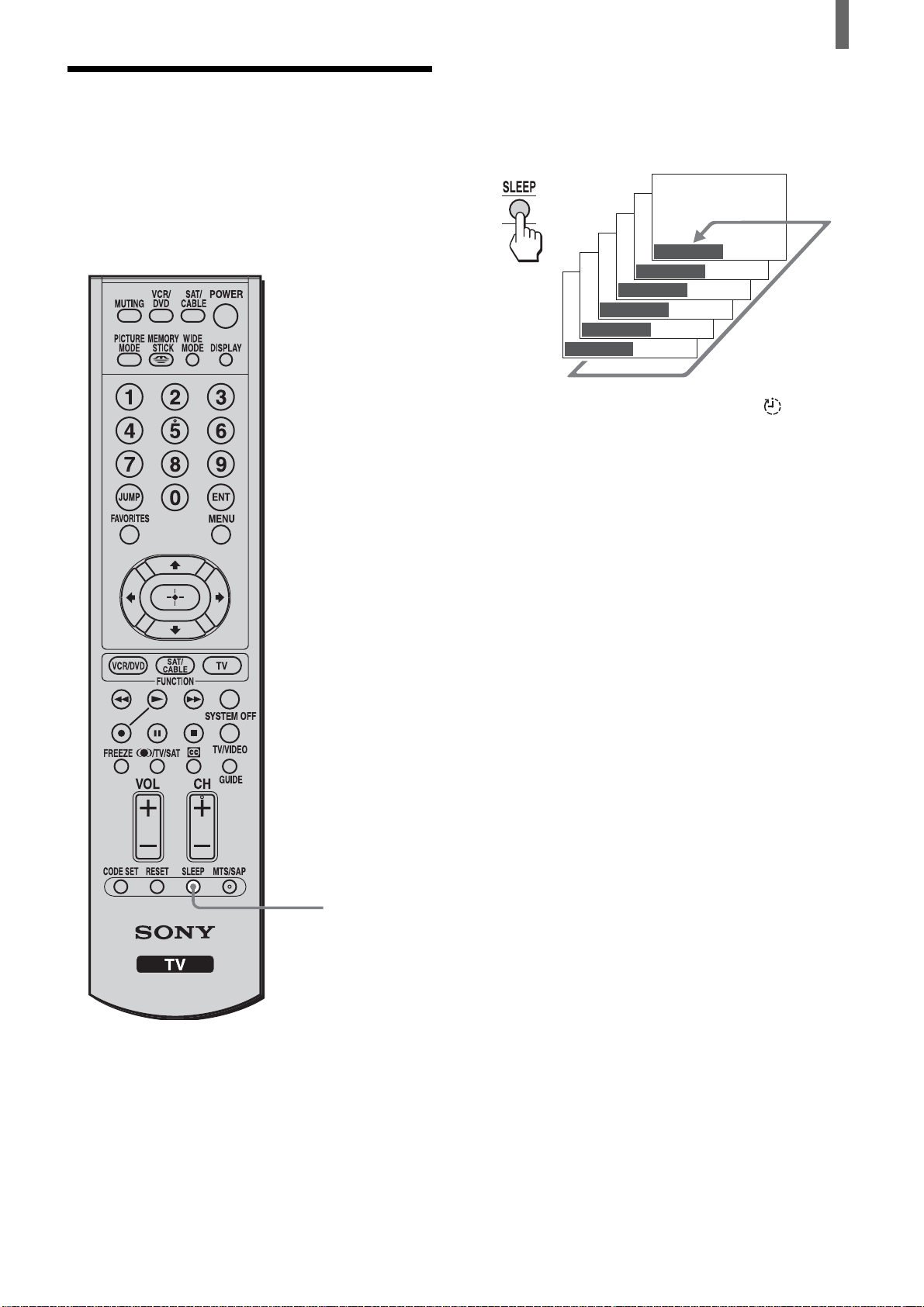
55
Using Advanced Features
Turning Off the TV
Automatically
You can set the TV to turn off automatically after a
predetermined period of time (15, 30, 45, 60, or 90
minutes).
SLEEP
Press SLEEP repeatedly until the desired period of
time appears.
Each time you press the button, the period of time
changes as follows:
While the Sleep timer is activated, the
1/
indicator on the TV lights up in red.
To cancel the Sleep timer
Press SLEEP repeatedly until “Sleep Off” appears.
Tips
• If you turn the TV off, and then turn it on again, the Sleep
timer returns to “Off.”
• “TV will turn off soon” appears one minute before the TV
shuts off. This message may not appear if you perform any
operation with the menu opened.
Sleep 90
Sleep Off
Sleep 15
Sleep 30
Sleep 45
Sleep 60
,

“Memory Stick”
56
“Memory Stick”
About the “Memory
Stick”
What is a “Memory Stick”?
A “Memory Stick” is a compact, portable and
versatile Integrated Circuit recording medium with a
data storage capacity that exceeds that of a floppy
disk. A “Memory Stick” is specially designed for
exchanging and sharing digital data among “Memory
Stick” compatible products. Because it is removable,
the “Memory Stick “ can also be used for external
data storage.
“Memory Stick” media are available in two sizes: a
standard size and a compact “Memory Stick Duo”
size. Once attached to a Memory Stick Duo adapter,
the “Memory Stick Duo” is physically the same size
as a standard “Memory Stick” and thus can be used
with products compliant with the standard “Memory
Stick .”
Tip
The “Memory Stick” feature allows you to view
digital images that are stored on “Memory Stick”
media on your TV screen.
Picture viewer
This TV’s “Memory Stick” picture viewer can
display digital photo (JPEG) and movie (MPEG1)
files stored on a “Memory Stick.” You can also run a
slideshow of those images, and customize the
features of the slideshow by selecting automatic or
manual slideshow.
Digital Camera Mode
This TV’s Digital Camera Mode can display only
images using the JPEG or MPEG1 formats, recorded
on a DCF-compliant digital camera.
Supported image types
Recorded images must meet the following
specifications:
•Digital photos (JPEG files): JPEG* compression
format and DCF** compliant folder and file
names.
•Movies (MPEG1 files) must be recorded on a
Sony digital camera and use one of the following
MPEG1*** compression formats:
MPEG MOVIE, MPEG MOVIE AD, MPEG
MOVIE EX, MPEG MOVIE HQ, MPEG MOVIE
CV, MPEG MOVIE HQX, MPEG1
(corresponding to VIDEO CD) for VAIO Giga
Pocket
* JPEG is a standard technology format for
compressing a still image (extension .jpg). JPEG
stands for “Joint Photographic Experts Group,”
which is the organization that implemented this
format.
** DCF stands for “Design rules for Camera File
systems,” which has specifications established
by the Japan Electronics and Information
Technology Industries Association (JEITA).
*** MPEG is a format for compressing a moving
image (extension .mpg).
Unsupported image types
•Digital photos stored in TIFF or any other non-
JPEG compression format
•Digital photos recorded using products that are not
DCF-compliant, including the following Sony
products
–Digital still cameras DSC-D700, DSC-D770
–Digital video cameras DCR-TRV900/DSR-
PD100A
• The following digital photos stored in JPEG
compression format
–Images that were processed on a PC
–Images in folders that were modified or renamed
on a PC
–Images stored in a “Memory Stick” that was
formatted on a PC
–Images less than 16 dots wide or high
–Images more than 4,096 dots wide or high
Notes on use
• We recommend that you back up important data on
the hard disk of your PC. Sony cannot be
responsible for any lost or damaged data.
• Use of some pre-recorded image data except for
personal use may be an infringement of copyright.
• The “Memory Stick” application software may be
modified or changed by Sony without prior notice.
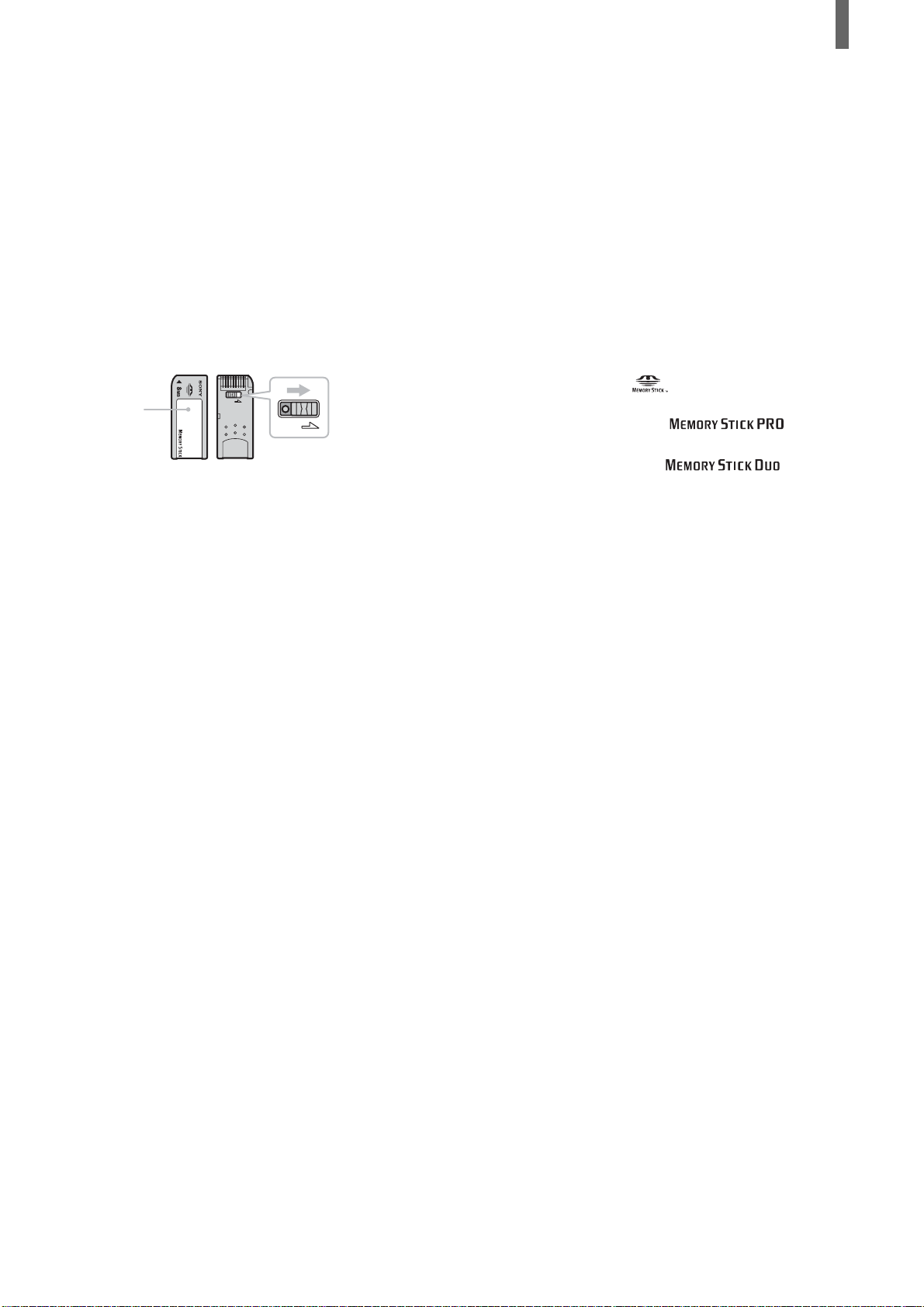
“Memory Stick”
57
Notes on “Memory Stick Duo”
• To use a “Memory Stick Duo” with this unit,
attach it to the Memory Stick Duo adapter before
inserting it into the unit.
•Make sure that you attach the “Memory Stick
Duo” to the adapter correctly.
•Make sure that you insert the Memory Stick Duo
adapter correctly, otherwise the unit may be
damaged.
•Do not insert the Memory Stick Duo adapter
without a “Memory Stick Duo” attached. Doing so
may result in malfunction of the unit.
On handling the “Memory Stick”
•You cannot record or erase images when the write-
protect switch on the “Memory Stick” is set to
LOCK.
•Image data may be damaged in the following
cases:
– If you remove the “Memory Stick,” or turn the
power off while the access lamp is lit or
flashing.
– If you use the “Memory Stick” near magnets or
magnetic fields, such as speakers.
– If you unplug the AC power cord while the
access lamp is lit or flashing.
•Avoid touching the terminal of “Memory Stick”
media or coming in contact with a metal object.
•Do not drop, bend, or submit “Memory Stick”
media to external shock.
•Do not disassemble or modify “Memory Stick”
media.
•Avoid getting liquid on “Memory Stick” media.
•Apply labels only within the designated label area.
• To avoid permanent damage to digital photo or
movie, do not use or store “Memory Stick” media
in a location subject to:
–High temperature (such as near a heater or
inside a hot car)
–High humidity
–Direct sunlight
–Corrosive substances
–Magnetic fields
– Excessive dust
– Static electricity or electric noise
– Electric surges
• Store and carry “Memory Stick” media in its
original case to ensure protection of stored data.
• Save a backup or stored data.
LOCK
LOCK
Label area
Write-protect switch
On formatting the “Memory Stick”
The “Memory Stick” is shipped with an exclusive
standard format.
Note
A “Memory Stick” formatted by a computer does not have a
guaranteed compatibility with this TV.
When the access lamp is lit or flashing
When the access lamp is lit or flashing, the “Memory
Stick” is reading or writing data. In this case, do not
shake or strike the TV, turn the power off, or eject
the “Memory Stick,” otherwise the image data may
be damaged.
•“Memory Stick” and
are trademarks of Sony
Corporation.
•“Memory Stick PRO” and
are
trademarks of Sony Corporation.
•“Memory Stick Duo” and
are
trademarks of Sony Corporation.
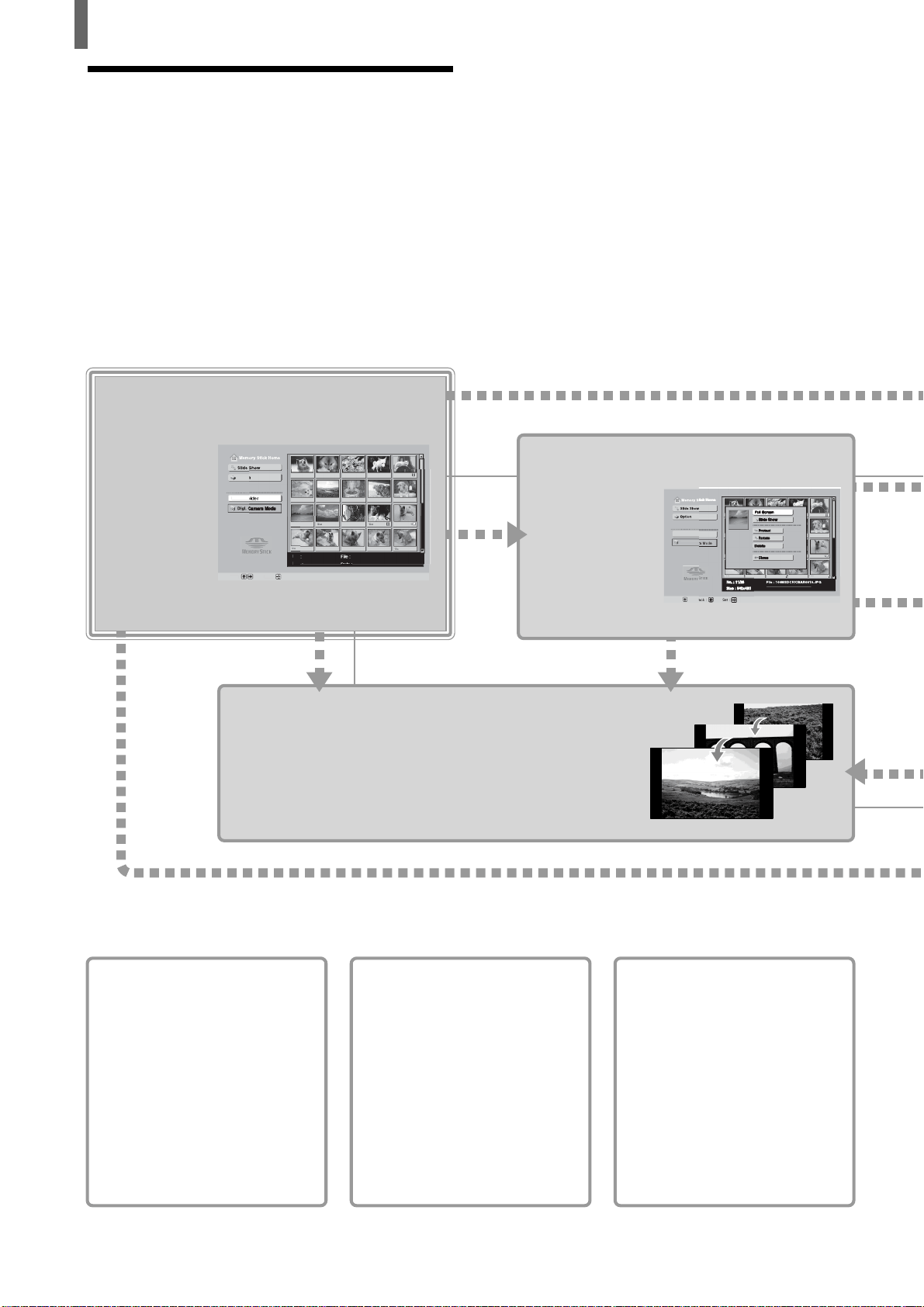
“Memory Stick”
58
O
p
tio
n
Date :
N
o
.
Size :
S
et
:
S
el
:
S
elect F
o
Di
g
i. Came
r
S
el
:
B
a
S
elect Folde
r
Date : 2
00
1
/
FEB
/
14
5
:2
5
P
M
Features of the Memory
Stick Home
You can view files on a “Memory Stick” recorded
and saved by a digital camera or a digital video
camera recorder using this television.
Insert the “Memory Stick” into the television, and
you can perform the following operations using the
remote control.
Display the index of up to 20 digital
photos or movies
List
• Displaying the Memory Stick Home (See page 61)
Select a thumbnail
And view a digital photo
• Viewing photos (See page 64)
View digital photos in order
“Slide Show”
• Playing “Slide Show” (See page 63)
Avoid accidental erasure
of your favorite digital
photos and movies
“Protect”
• Protect your digital photos and
movies (See page 67)
• Protect full screen digital photos
and movies (See page 68)
• Protect full screen “Movie Player”
movies (See page 68)
Delete unwanted digital
photos and movies
“Delete”
• Delete digital photos or movies
(See page 69)
• Delete full screen digital photos
(See page 69)
• Delete full screen “Movie Player”
movies (See page 69)
Check the remaining
storage capacity of a
“Memory Stick”
Just look at the indicator
• Check the status of the “Memory
Stick” (See page 70)
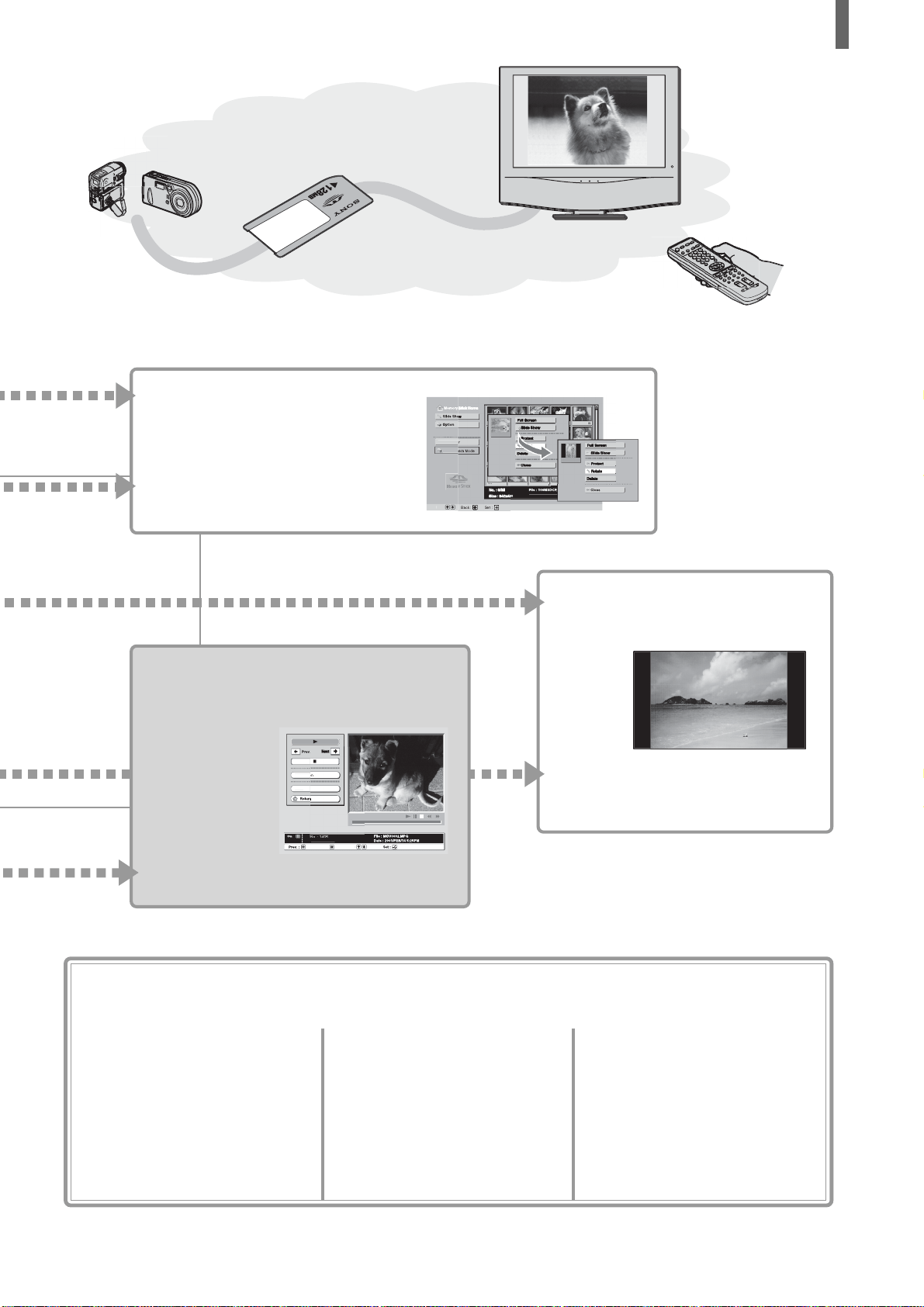
“Memory Stick”
59
Di
g
i. Ca
m
S
elect Fold
e
S
el :
Date : 2
00
1
/
FEB
/1
1
S
ize :
35
2x24
0
S
el :N
e
xt :
Full
S
cre
e
M
e
n
u
Rotate and view at a different
angle
• You can rotate your digital photos shot
vertically (See page 65)
Watch movies
“Movie Player”
• Playing Movies (“Movie Player”) (See page 66)
Expand and watch digital photos
and movies using the full
television screen
• You can view digital photos “Full Screen”
(See page 64)
• You can watch movies “Full Screen” (See
page 67)
View digital photos and
movies organized into
albums and stored in
folders on a PC
“Select Folder”
• Select a folder (See page 71)
Change the order of your
images
“Sort”
• Sort your images (See page
72)
Choose just what you want
to see, digital photos only or
movies only
“Filter”
• Selectively display either
digital photos or movies (See
page 73)
With “Digi. Camera Mode” set to Off (See page 71), you can •••
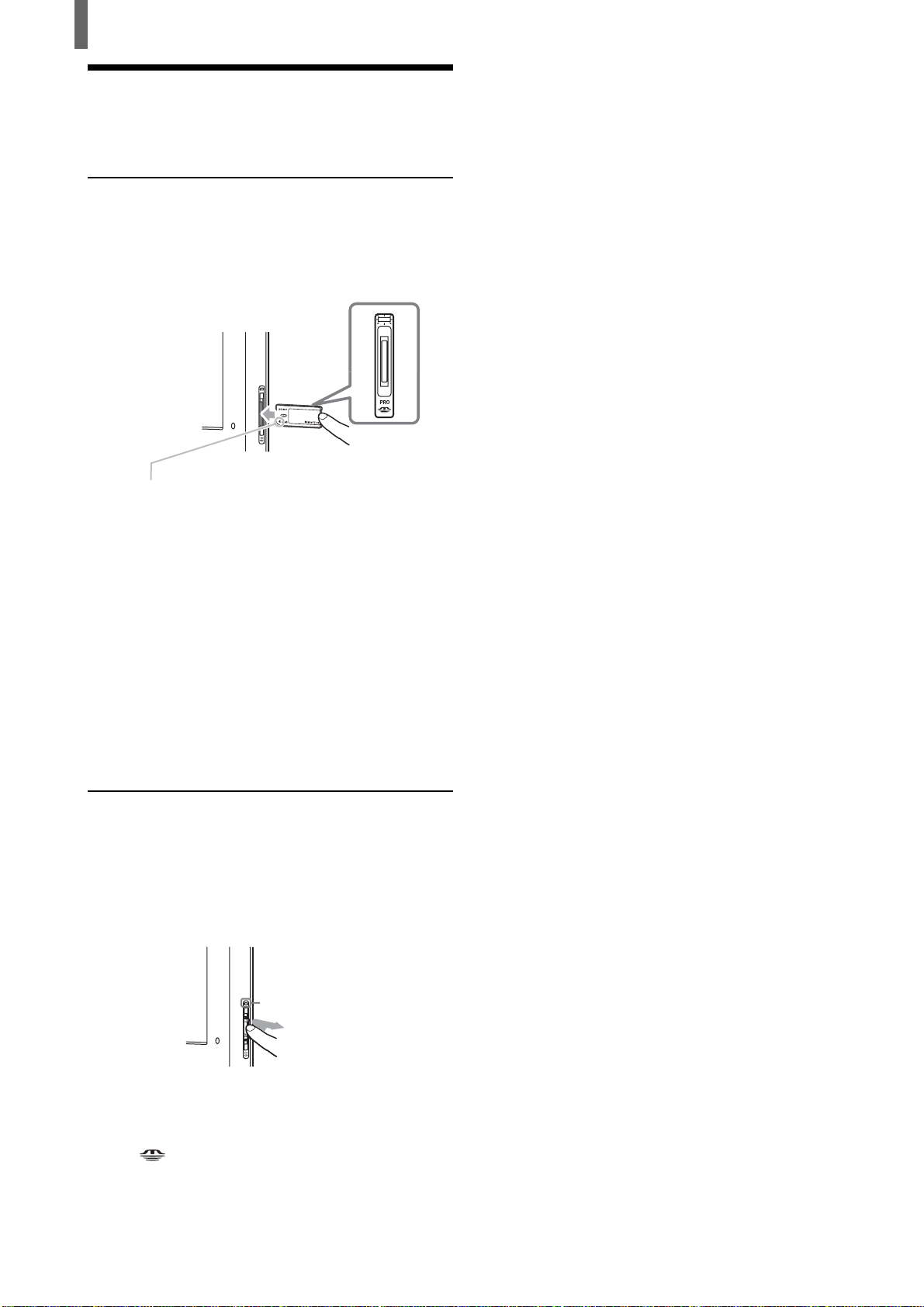
“Memory Stick”
60
Inserting and Removing
a “Memory Stick”
Inserting a “Memory Stick”
Insert the “Memory Stick” into the “Memory Stick”
slot with the b mark facing forward as illustrated
below until it clicks. The “Memory Stick” access
lamp flashes, then goes out.
Notes
• Be sure to insert the “Memory Stick” correctly. If the
“Memory Stick” is forced in the wrong way, the “Memory
Stick” or the slot may be damaged.
• Insert only a “Memory Stick” into the “Memory Stick” slot.
Attempting to insert other objects into the slot may damage
the TV.
• To use a “Memory Stick Duo,” be sure to attach it to the
Memory Stick Duo adapter before inserting it into the
“Memory Stick” slot. Inserting a Memory Stick Duo adapter
without a “Memory Stick Duo” may damage the “Memory
Stick” slot.
Removing a “Memory Stick”
1 Check that the “Memory Stick” access lamp is
off, then push the “Memory Stick” gently into
the “Memory Stick” slot and then release it.
The “Memory Stick” is ejected.
Tip
The (“Memory Stick”) indicator on the front panel of
the TV works in the same manner as the “Memory Stick”
access lamp.
2 Pull the “Memory Stick” completely out of the
“Memory Stick” slot.
Notes
• Do not turn the power off while the “Memory Stick” access
lamp is lit or flashing in red.
If you do so, the image data in “Memory Stick” may be
damaged.
• When removing the “Memory Stick,” do not attempt to just
pull it from the “Memory Stick” slot. If you do so, the
“Memory Stick” or the slot may be damaged.
• There is mechanism inside the “Memory Stick” slot to prevent
the “Memory Stick” from popping out. This may prevent the
“Memory Stick” from coming out smoothly. If this happens,
do not pull the “Memory Stick” out forcibly. Pull it out
straight towards you. Otherwise, the “Memory Stick” may be
damaged.
Right side of the TV
“Memory Stick” access lamp
Right side of the TV
b mark
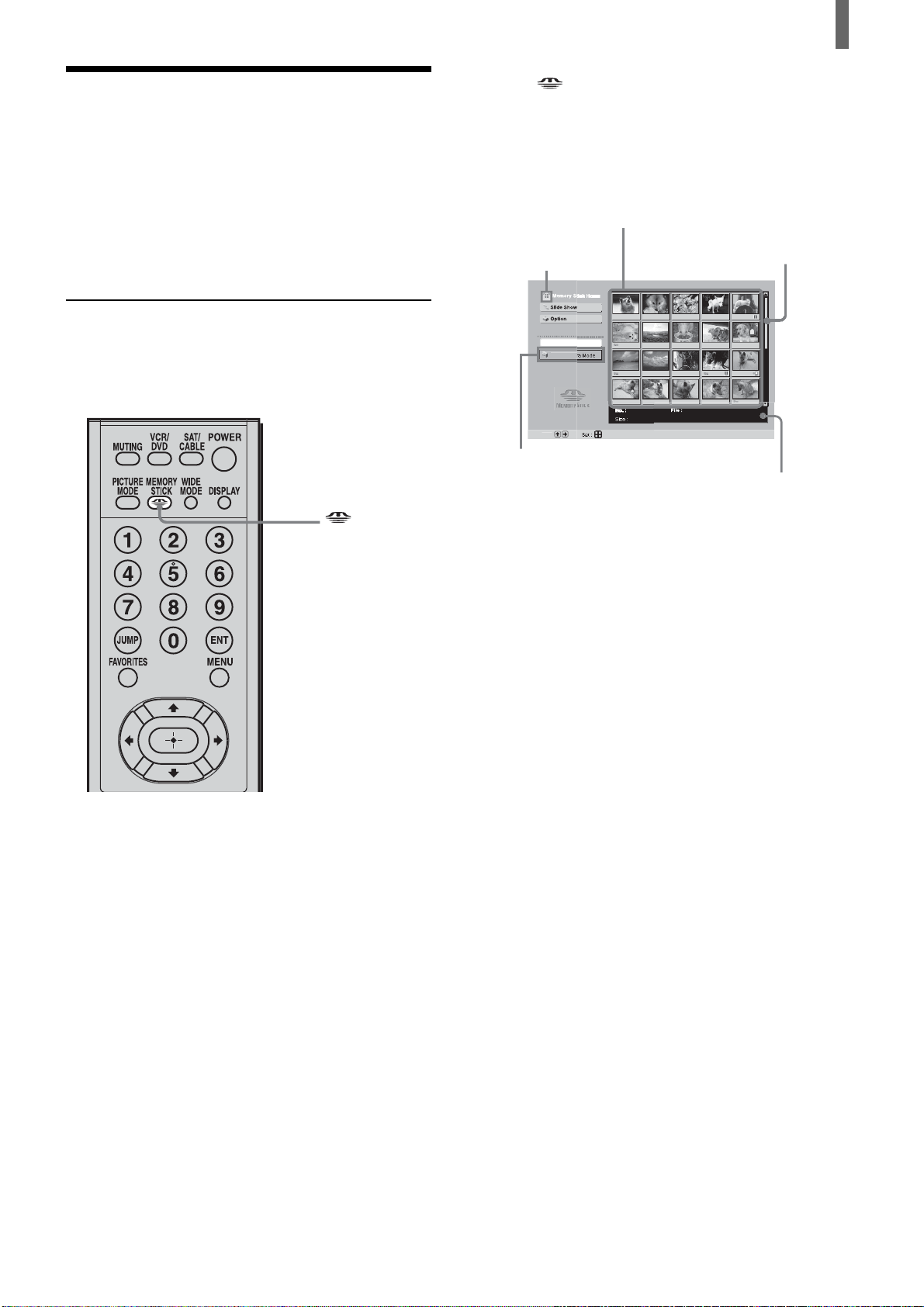
“Memory Stick”
61
Di
g
i. Came
r
D
a
t
e
:
S
el :
S
elect Folde
r
Displaying the Memory
Stick Home
The Memory Stick Home feature allows you to
display an index of thumbnail images that are on the
“Memory Stick .” You can select an image from
those to display on the full screen, play back a
movie, or run a “Slide Show.”
Displaying the Memory Stick Home
The default setting for “Digi. Camera Mode” is
“On.”
1 Insert a “Memory Stick” that contains the images
you want to view.
Memory Stick
Home mark
Folder name for the
selected folder
2 Press (“Memory Stick”) button on the
remote control.
The Memory Stick Home appears on the screen.
Tip
To close the Memory Stick Home, press “Memory Stick” button
again.
“Memory
Stick”
button
Index of thumbnail images
contained in the selected folder
Press V/v/B/b to select an image.
The selected image is highlighted
in yellow.
Information about the
selected image file
Scroll bar
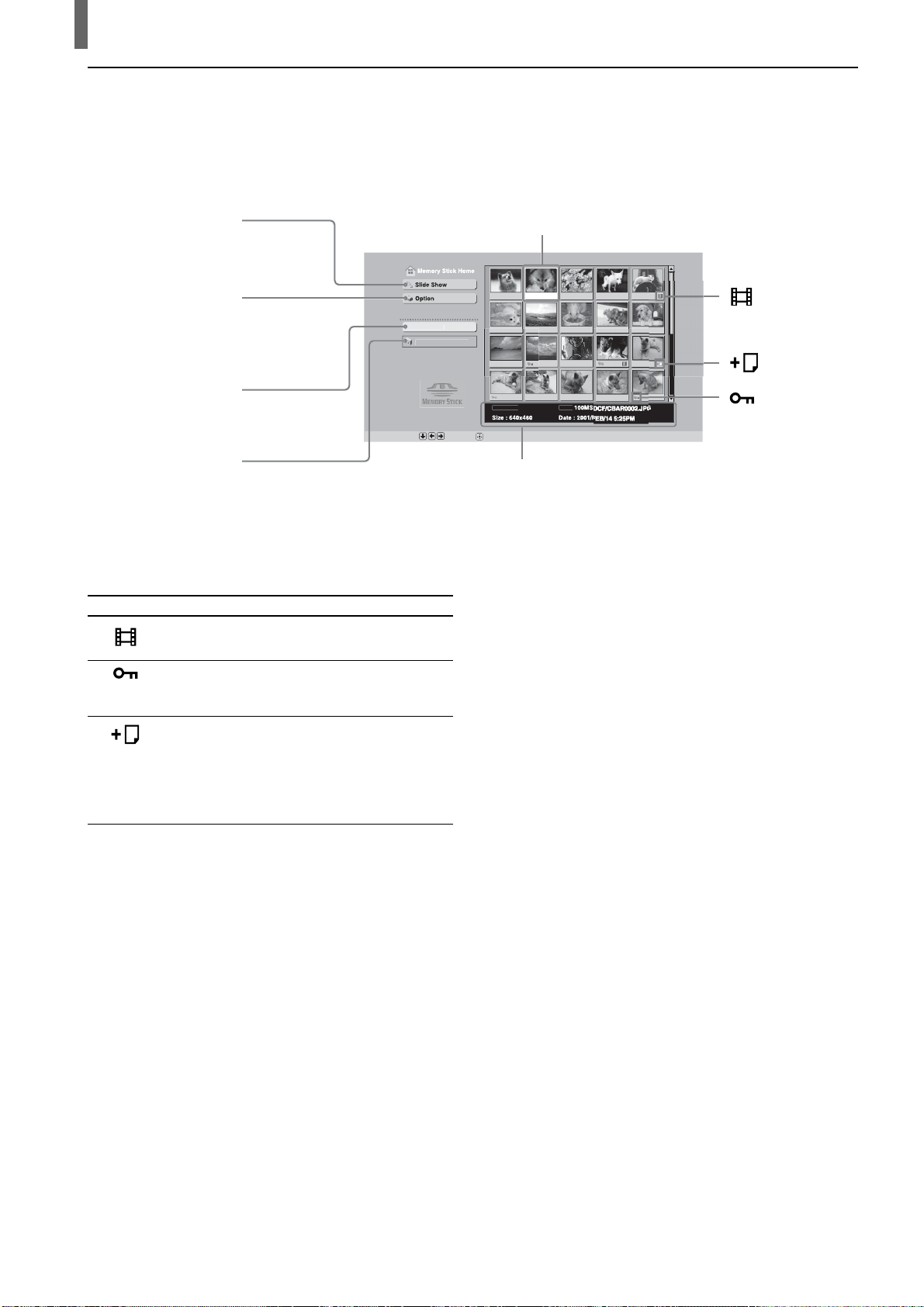
“Memory Stick”
62
Di
g
i. Camera Mod
e
Fil
e
:No. : 2
/
2
5
S
et :
S
el :
Select Folder
The Memory Stick Home – A one-stop list for all of your digital photos and
movies
For details on the menu operations for each button, see the explanations provided below.
Moving image
icon
Related file
icon
Protected file
icon
“Slide Show” button
Displays digital photos
and movies in the order
they are stored on the
“Memory Stick”
Displayed when “Digi.
Camera Mode” is set to
“ON”. When it is set to
“OFF,” the name of the
folder that is selected is
displayed.
“Select Folder” button
Allows you to select a folder
or to turn the “Digi. Camera
Mode” “ON” or “OFF,” or to
select a folder.
“Option” button
Displays file sort or
“Memory Stick”
information.
Cursor (indicates the currently selected file)
A yellow frame is displayed, and you can move it around using
V/v/B/b on the remote control.
Information bar
Provides information on the digital photo or movie currently selected by the
cursor.
No.: Order/Total number of images File: File name and file type
Size: Resolution Date: Recorded date
Marks indicated in the lower part of an image
Icon File status
* The file indicated with Related file icon is automatically
selected. The selection depends on the file format (JPEG t
MPEG t other file formats, in the order of priority.)
Note
When you delete a file showing the Related file icon, the related
file(s) will be deleted, too.
Moving image icon
Indicates that this file is a movie file.
Protected image icon
Indicates that protection (Protect) has
been set for this image.
Related file icon
(displayed only when “Digi. Camera
Mode” is set to “On”)
Indicates that more files (same in the
last 4 figures of their file names) are
hidden.*
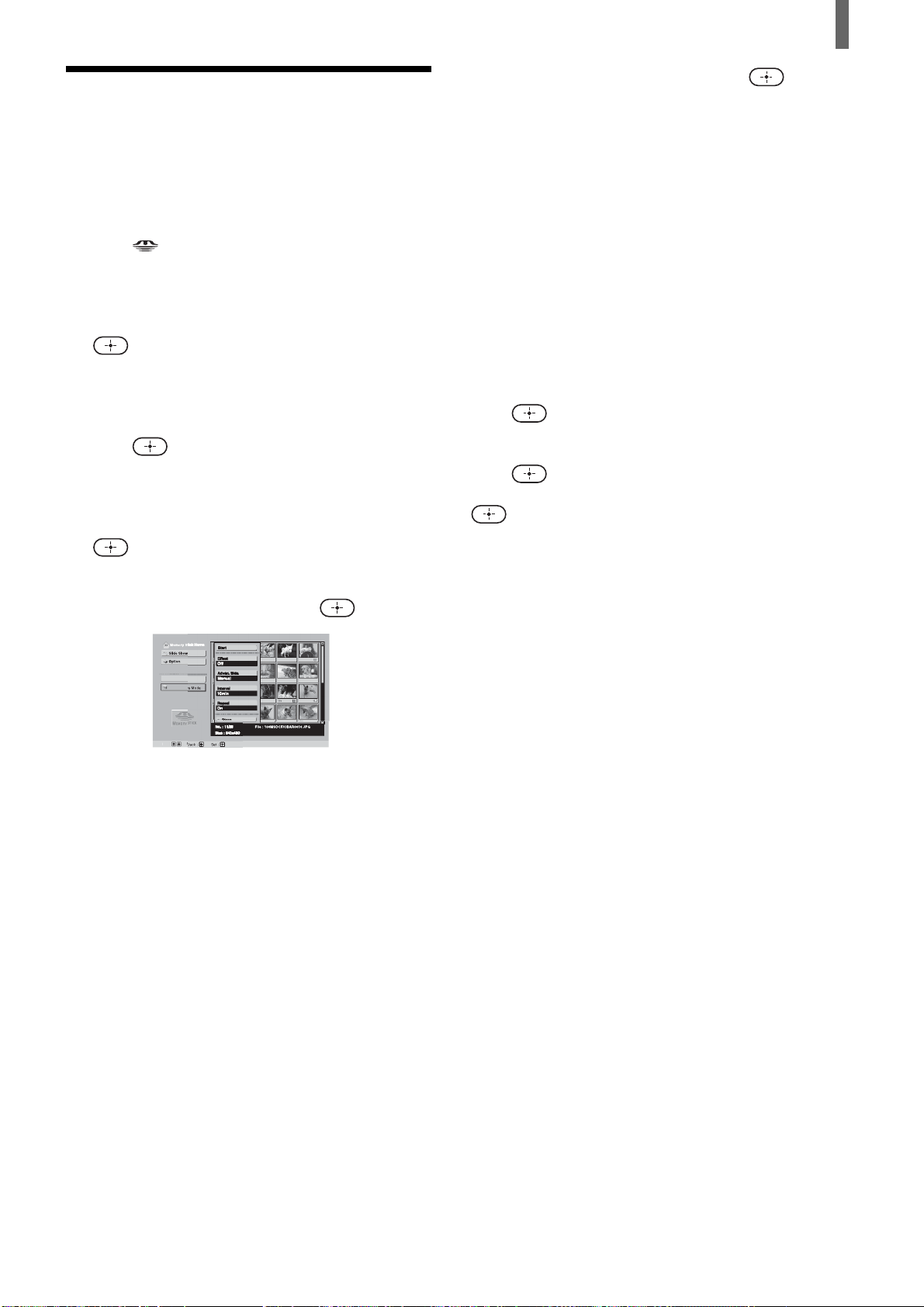
“Memory Stick”
63
Playing “Slide Show”
1 Insert a “Memory Stick” that contains the images
you want to view.
Be sure to insert the “Memory Stick” correctly
(see page 60).
2 Press (“Memory Stick”) button on the
remote control.
The Memory Stick Home appears on the screen.
3 Press V/v to select “Select Folder,” then press
.
The Select Folder menu appears.
4 Press b to select the list of contents, then press V
/v to select a folder that you want to view, then
press
.
An index of thumbnail images of the selected
folder appears.
5 Press V/v to select “Slide Show,” then press
.
The index menu for “Slide Show” appears. You
can select any of the following options. Press V/
v to select the option, then press
.
Effect: Sets the slide advancement.
Select one from “Wipe,” “Blind”
and more.
Advan. Slds.: Sets “Slide Show” to run
automatically (“Auto”) or
manually (“Manual”).
Interval: Selects the period for which one
image is displayed from “1sec,”
“5sec,” “10sec,” “20sec,”
“30sec,” “40sec,” “50sec,”
“1min,” “2min,” “3min,” “5min,”
or “10min.”
Repeat: Select “On” to repeat “Slide
Show.” After the last digital photo
or movie has been displayed, the
“Slide Show” starts again from its
first digital photo or movie
follows.
Notes
• The time is approximate.
• When “Advan. Slds.” is set to “Manual”, the “Interval” is
not available.
To stop “Slide Show”
If you want to stop “Slide Show,” do the following
to return to the Memory Stick Home.
If you have set “Advan. Slds.” to “Auto”
Press
.
If you have set “Advan. Slds.” to “Manual”
Press
to display the index menu for “Slide
Show,” then press V/v to select “Return,” then press
.
Di
g
i. Came
r
S
el :
B
S
elect Folde
r
Date : 2
00
1
/
FEB
/
14
5
:2
5
P
M
6 Press V/v to select “Start”, and then .
If you select “Auto” in the “Advan. Slds.,” “Slide
Show” runs automatically. When the “Slide Show”
comes to its end, another “Slide Show” starts
automatically.
If you select “Manual,” “Slide Show” would not run
automatically. When “Slide Show” ends, press B/b
to select a digital photo or movie from which the
next “Slide Show” starts.
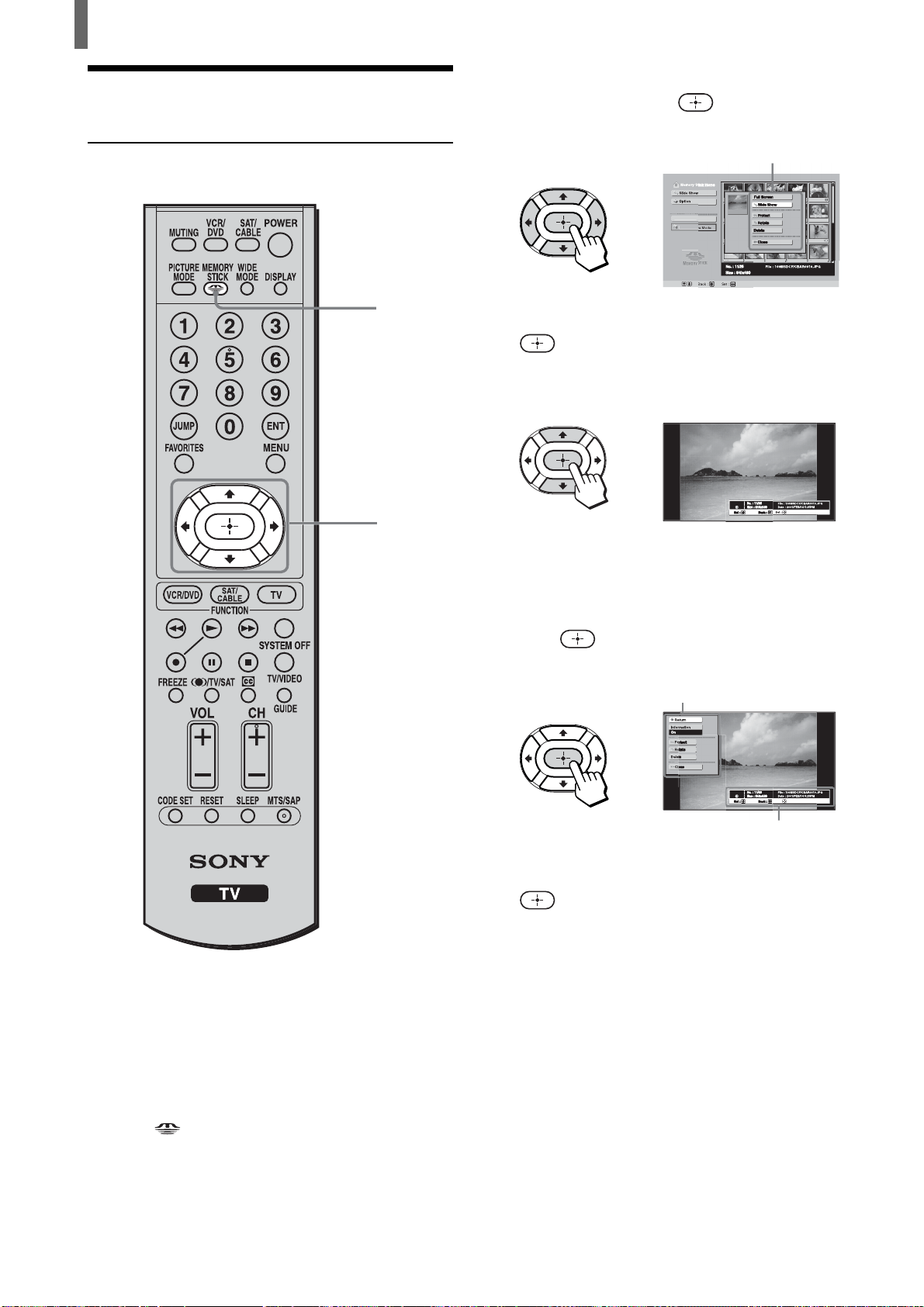
“Memory Stick”
64
Viewing Photos
Viewing digital photos at full-
screen size
2
3 - 5
1 Insert a “Memory Stick” into the Memory Stick
slot.
Be sure to insert the “Memory Stick” correctly
(see page 60).
2 Press (“Memory Stick”) button and the
Memory Stick Home screen appears.
3 Press V/v/B/b to select the digital photo you
want to see, then press
.
The Index menu appears.
,
Di
g
i. Came
r
S
el :
B
S
elect Folde
r
Date : 2
00
1
/
FEB
/
14
5
:2
5
P
M
4 Press V/v to select “Full Screen,” then press
.
The digital photo you selected will be displayed
at full-screen size.
,
To view previous or subsequent files with the
screen at full-screen size, press B/b.
5 Press .
The Digital Photo menu appears.
,
To view other files that are not in this series of
photos, press V to select “Return,” then press
to return to the Memory Stick Home.
Tip
The information on the current photo is displayed at the bottom
right of the screen as factory default setting. To view photos
without the information displayed, select “Information” on the
Digital Photo menu, then select “Off.”
Notes
• The quality of the photo display when enlarged depends on the
resolution of the file. See your digital camera instruction
manual for details.
• Some files may take longer to display at full-screen size.
The Index menu
The Information Bar
The Digital Photo menu
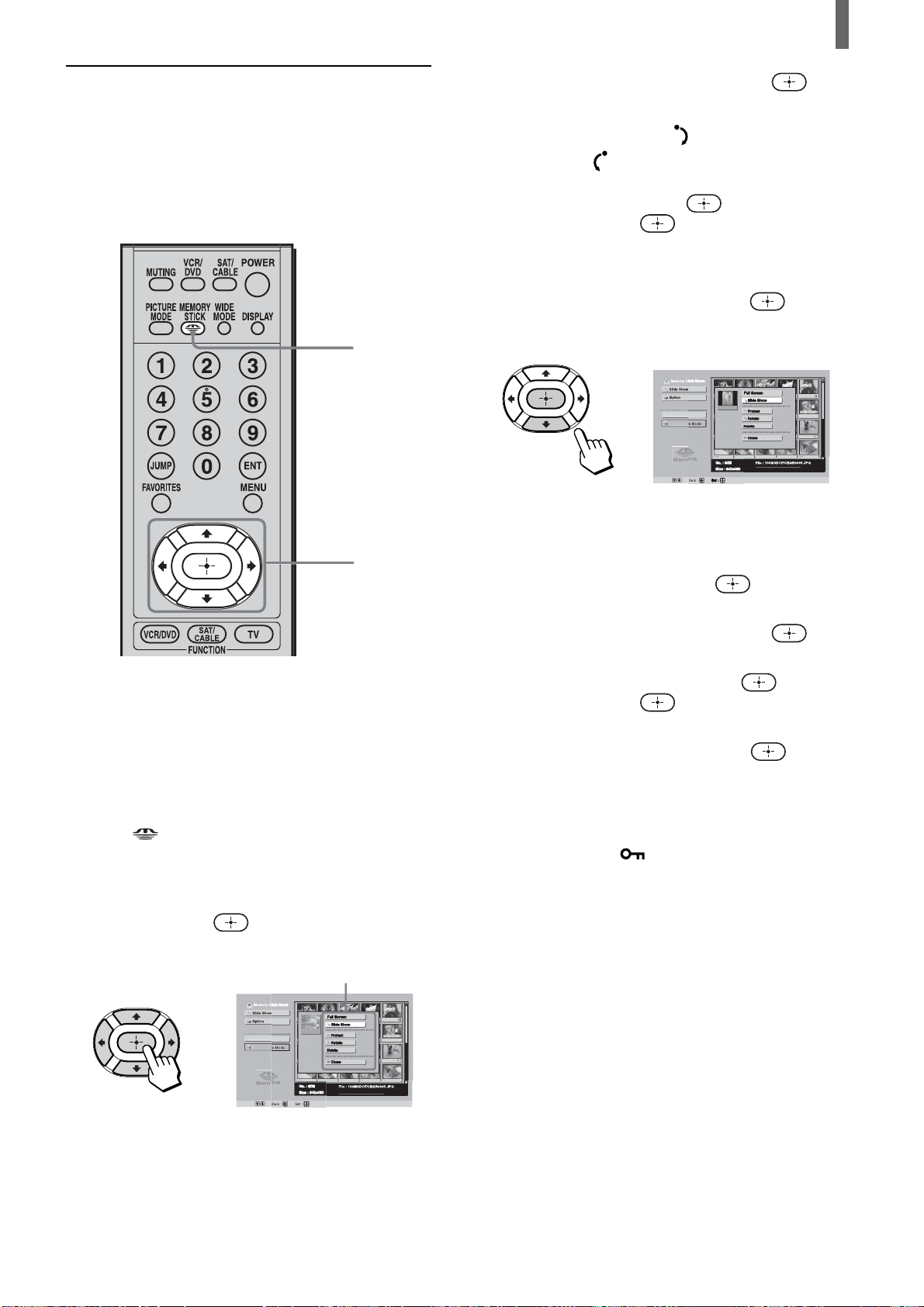
“Memory Stick”
65
Rotating and viewing your digital
photos
You can rotate digital photos in 90 degree
increments clockwise or counterclockwise.
2
3 - 6
1
Insert a “Memory Stick” into the Memory Stick
slot.
Be sure to insert the “Memory Stick” correctly
(see page 60).
2 Press (“Memory Stick”) button, and the
Memory Stick Home screen appears.
3 Press V/v/B/b to select the photo you want to
rotate, then press
.
The Index menu appears.
,
Di
g
i. Came
r
S
elect Folde
r
S
el :
B
Date : 2
00
1
/
FEB
/
14
5
:2
5
P
M
The Index menu
4 Press V/v to select “Rotate,” then press .
5 Press V/v to select either (rotate to the right/
clockwise) or
(rotate to the left/
counterclockwise) for the direction in which to
rotate the photo, then press .
Each time you press
, the photo rotates 90
degrees in the direction you selected.
6 Press v to select “Close,” then press .
The photo will be saved in the rotated position
shown on the screen.
,
Di
g
i. Came
r
S
elect Folde
r
S
el :
B
Date : 2
00
1
/
FEB
/
14
5
:2
5
P
M
Rotating a photo shown at full-screen size
1 With a photo shown on the TV screen at full-
screen size (see page 64), press
.
The Digital Photo menu appears.
2 Press V/v to select “Rotate,” then press .
3 Press V/v to select the direction in which you
want to rotate the photo, then press
.
Each time you press
, the photo rotates 90
degrees in the direction you selected.
4 Press v to select “Close,” then press .
Notes
• Only digital photos can be rotated.
• Protected photos (see page 67) cannot be rotated. Check to see
if there is a Protect icon
on the Information Bar. If you
want to rotate a protected file, you must first remove the
protection.
• If the LOCK switch used to prevent accidental erasure is set
on the “Memory Stick” you are using, you will not be able to
rotate the photo.
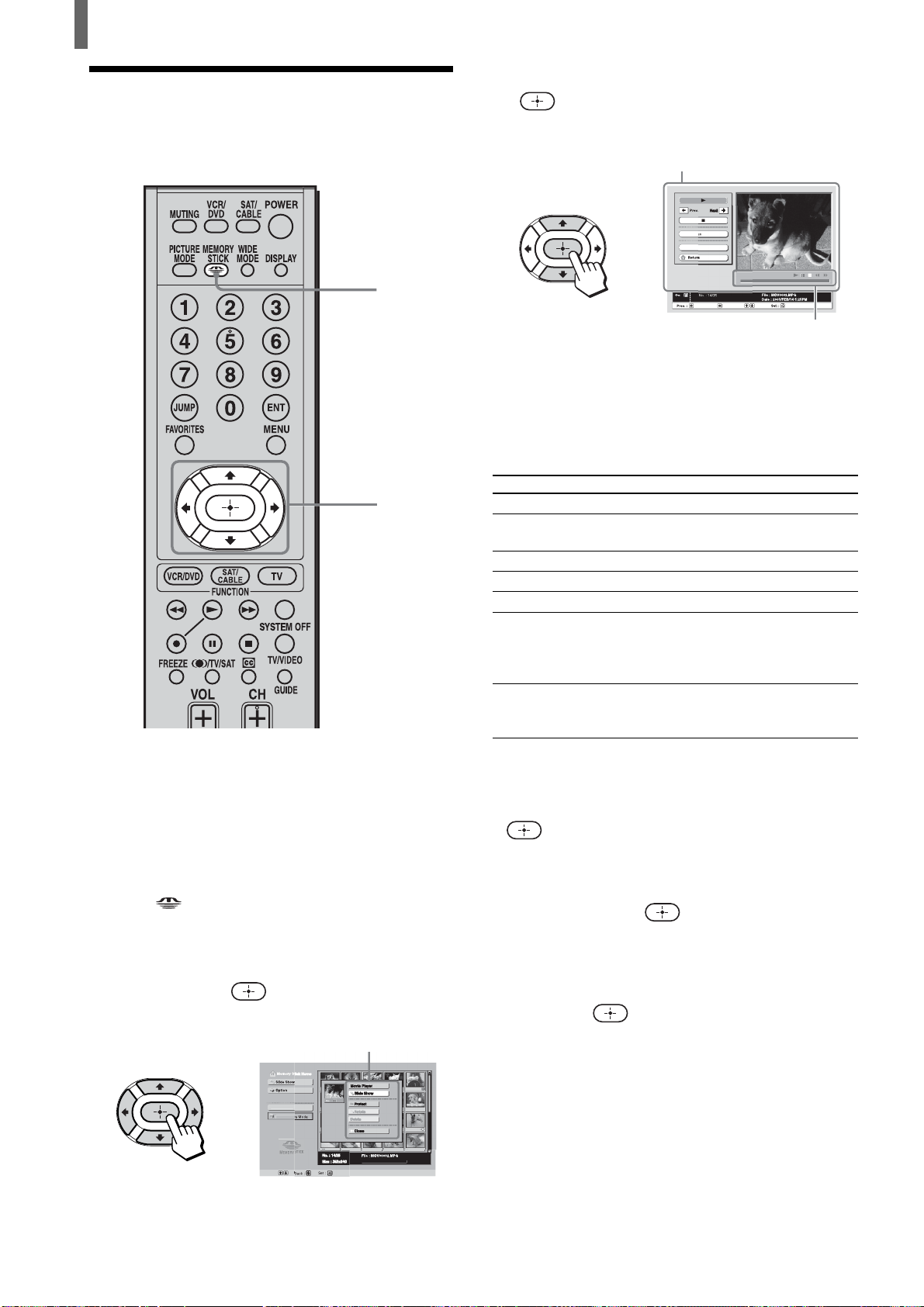
“Memory Stick”
66
Playing Movies (“Movie
Player”)
2
3 - 5
1
Insert a “Memory Stick” into the Memory Stick
slot.
Be sure to insert the “Memory Stick” correctly
(see page 60).
2 Press (“Memory Stick”) button, and the
Memory Stick Home screen appears.
3 Press V/v/B/b to select the movie you want to
view, then press
.
The Index menu appears.
,
Date : 2
00
1
/
FEB
/
14
5
:2
5
P
M
S
elect Folde
r
S
el :
B
Di
g
i. Came
r
The Index menu
4 Press V/v to select “Movie Player,” then press
.
The Movie Player screen appears.
,
S
ize :
35
2x24
0
S
el
:
N
e
xt
:
Full
S
cre
e
M
e
n
u
Note
The Movie Player screen will not appear if “Advan. Slds.”
in “Slide Show” is set to “Auto.”
The Movie Player screen
The status of the operation
Menu
Return
N/X
Play/Pause
x Stop
Full Screen
Menu
m
Reverse
(Fast Reverse)
M
Forward
(Fast Forward)
The Movie Player menu and its operation
Operation
Returns to the Memory Stick Home screen.
Plays a movie. If you press it again while a
movie is playing, the movie is paused.
Stops the movie.
Expands the image to fill the entire screen.
Displays menu.
Press once when the movie is stopped to
return to the previous screen.* Press while
movie is playing to play movie backwards
at a higher speed.
Press while movie is stopped to advance
to the next screen.* Press while movie is
playing to play faster.
* If you press m/M again while the movie is stopped, and
the screen moves to the next movie, it may take some time for
that movie to begin playing. During that time, the Return
button lights, and the movie is read into memory. If you press
at this time, the display returns to the Memory Stick
Home screen.
5 Press V/v to select N/X on the Movie Player
screen, then press
.
The movie begins to play. When the movie is
finished, the screen returns to the beginning of
the movie, and stops. If you want to stop the
movie while it is playing, press V/v to select x,
then press
.
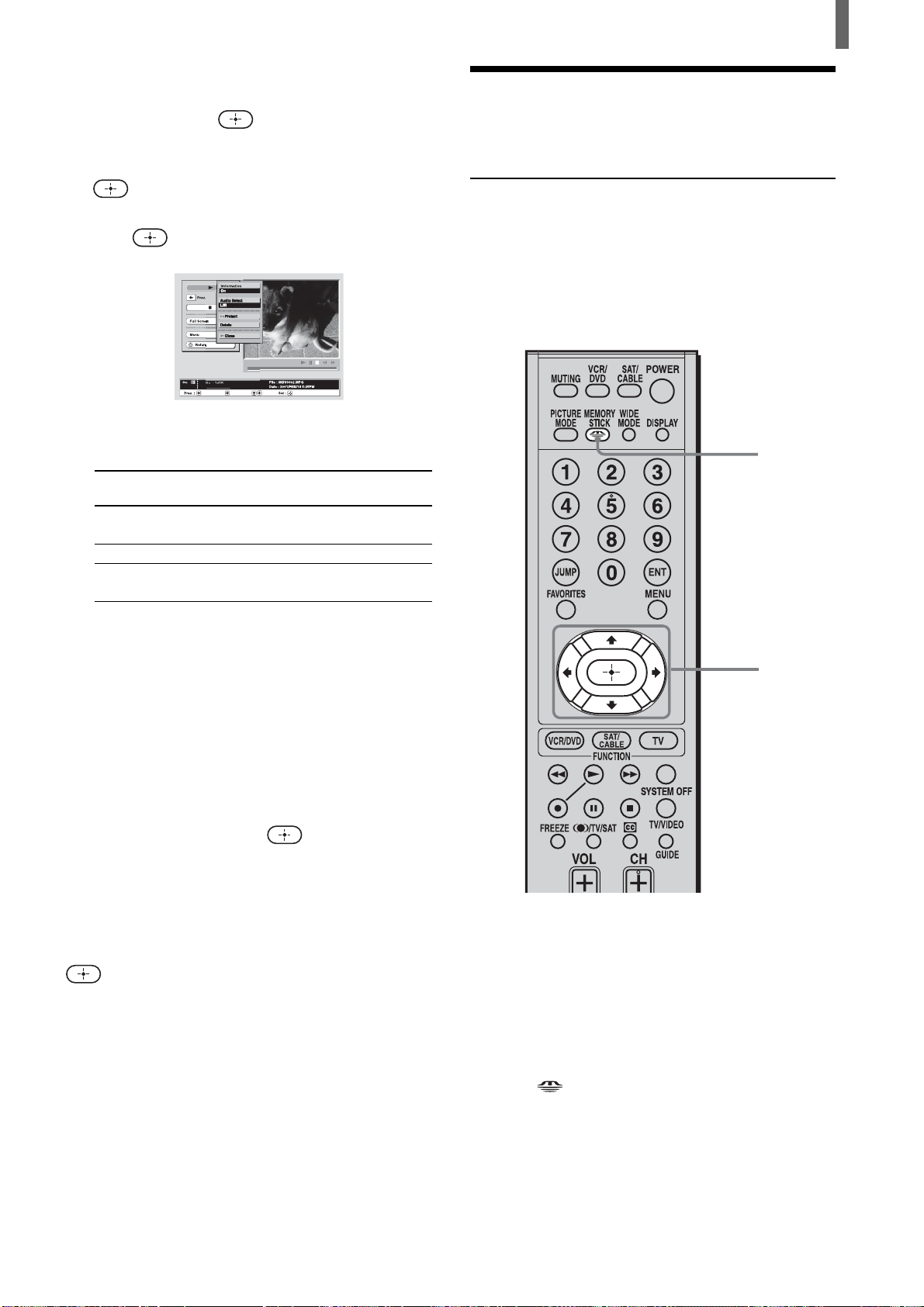
“Memory Stick”
67
To switch the voice channel
1 Press V/v to select Menu on the Movie Player
screen, then press
.
The Movie menu appears.
2 Press V/v to select “Audio Select,” then press
.
3 Press V/v to select the item you want to set, then
press
.
To return to the Movie Player screen
While the movie is playing, press V/v/B/b, or press
.
Notes
• If the screen size of the movie is small, even if you select
“Full Screen,” the movie may not play at full-screen size.
• Depending on the movie you are playing, it may look rough
and grainy if you play it at full-screen size.
• Depending on the file, it may take some time to display the
image at full-screen size.
• When you are playing a movie at full-screen size, Fast
Forward and Fast Reverse features are not available.
Protecting/Deleting the
files
Protecting digital photos or movies
You can protect the photos and movies from
accidental erasure by protecting them. You can also
remove protection from digital photos or movies that
you have previously protected.
2
3 - 5
1 Insert a “Memory Stick” into the Memory Stick
slot.
Be sure to insert the “Memory Stick” correctly
(see page 60).
2 Press (“Memory Stick”) button, and the
Memory Stick Home screen appears.
Items
L/R
L
R
The items that can be set, and the
channel that will be heard
For stereo
Both left and right
Left voice channel
Right voice
channel
For the alternative
voice track
Main and alternative
voice channels
Main voice channel
Alternative voice
channel
Note
When there is no voice track included in the movie, “Audio
Select” cannot be selected.
To view the movie at full-screen size
1 Perform steps 1 to 4 on page 66, and the Movie
Player screen appears.
2 Press V/v to select “Full Screen” on the Movie
Player screen, then press
.
The movie is displayed at full-screen size, and
begins to play.
(Continued)
S
ize :
35
2x24
0
S
el :N
e
xt :
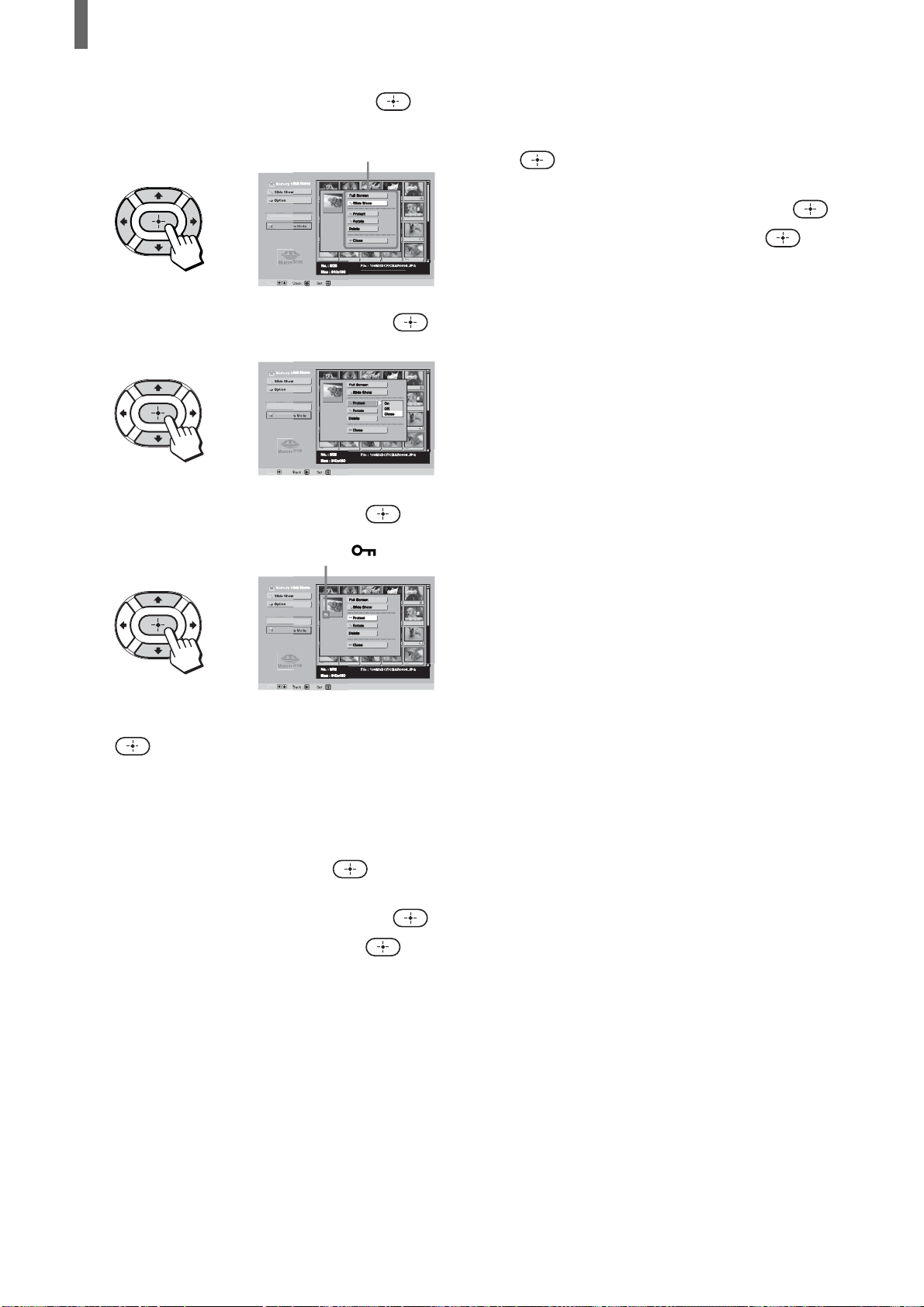
“Memory Stick”
68
3 Press V/v/B/b to select the digital photo or
movie you want to protect, then press
.
The Index menu appears.
,
S
el :
B
S
elect Folde
r
Date : 2
00
1
/
FEB
/
14
5
:2
5
P
M
Di
g
i. Came
r
4 Press V/v to select “Protect,” then press .
,
Di
g
i. Came
r
S
el :
B
S
elect Folde
r
Date : 2
00
1
/
FEB
/
14
5
:2
5
P
M
5 Press V/v to select “On,” then press .
,
Di
g
i. Came
r
S
el
:
B
S
elect Folde
r
Date : 2
00
1
/
FEB
/
14
5
:2
5
P
M
To remove protection, select “Off,” then press
.
To protect a digital photo shown at full-
screen size
1 While the digital photo is being displayed at full-
screen size (see page 64), press
.
The Digital Photo menu appears.
2 Press V/v to select “Protect,” then press .
3 Press V/v to select “On,” then press .
The Index menu
A Protect icon
appears.
To protect a movie from the Movie Player
screen
1 With the Movie Player screen displayed (see
page 66), press V/v to select “Menu,” and press
.
The Movie menu appears.
2 Press V/v to select “Protect,” and press .
3 Press V/v to select “On,” and press .
Tip
When you view a protected movie on a PC, the file attribute for
the movie becomes “Read Only.”
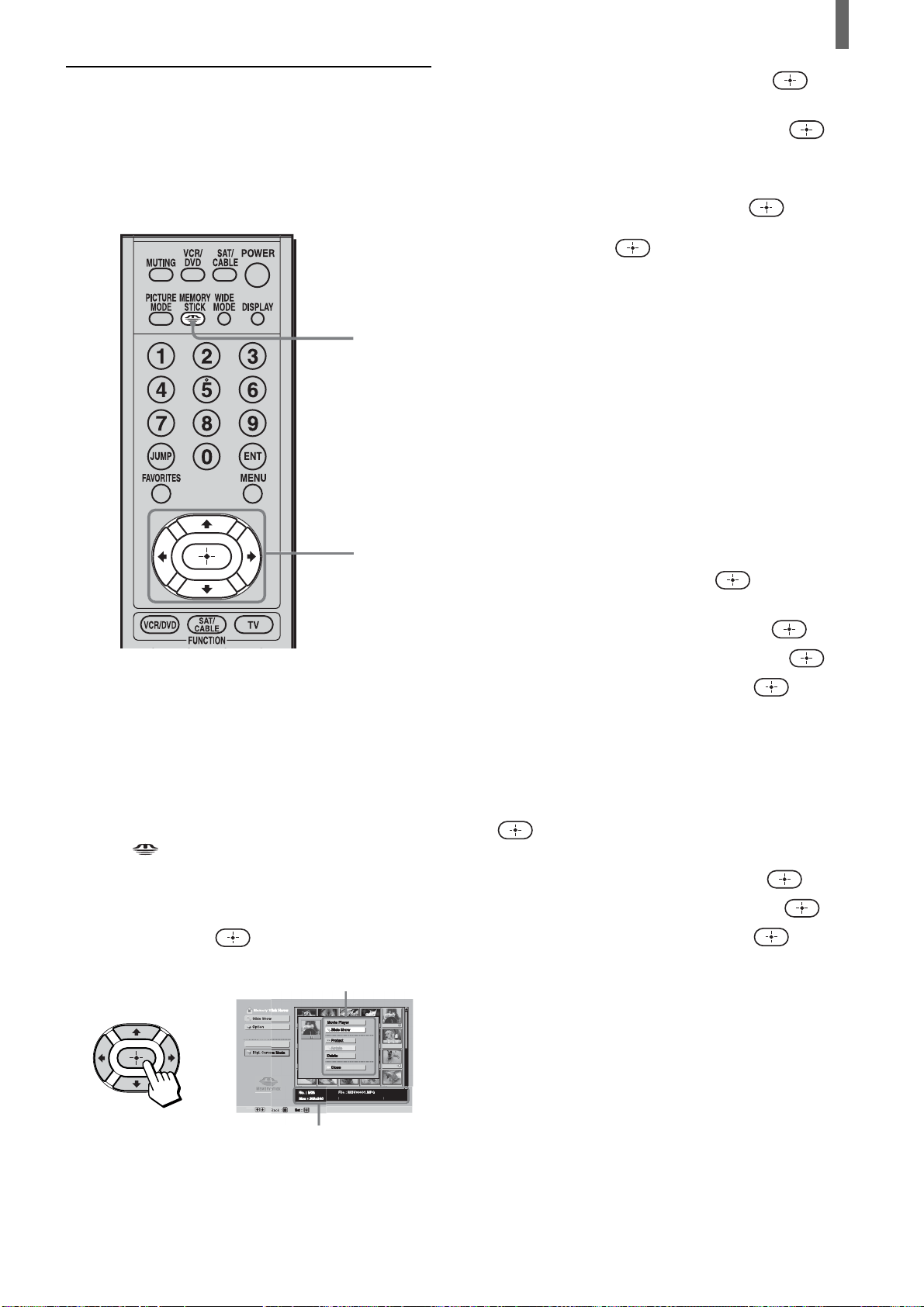
“Memory Stick”
69
Deleting digital photos or movies
You can delete unwanted files from a “Memory
Stick.” However, please be careful when deleting
files, as they cannot be recovered once they are
deleted.
2
3 - 6
1 Insert a “Memory Stick” into the Memory Stick
slot.
Be sure to insert the “Memory Stick” correctly
(see page 60).
2 Press (“Memory Stick”) button, and the
Memory Stick Home screen appears.
3 Press V/v/B/b to select the image you want to
delete, then press
.
The Index menu appears.
,
Date : 2
00
1
/
FEB
/
14
5
:2
5
P
M
S
elect Folde
r
S
el :
B
The Index menu
The Information Bar
4 Press V/v to select “Delete,” then press .
5 Press V/v to select “Sel. Img.,” then press .
A confirmation message appears.
6 Press B/b to select “Yes,” and press .
If you don’t want to delete the image, select
“No,” then press
.
Notes
• When “Digi. Camera Mode” is set to “On,” and the selected
image is deleted, related files will also be deleted (see page
62).
• Before you delete an image, be sure to confirm the
information shown on the Information Bar, first.
• You cannot delete a protected image (see page 67).
• If the LOCK switch used to prevent accidental erasure is set to
“LOCK” on the “Memory Stick” you are using, you will not
be able to delete the image.
To delete a digital photo shown at full-
screen size
1 While the digital photo is being displayed at full-
screen size (see page 64), press
.
The Digital Photo menu appears.
2 Press V/v to select “Delete,” then press .
3 Press V/v to select “Sel. Img.,” then press .
4 Press B/b to select “Yes,” then press .
To delete a movie from the Movie Player
screen
1 With the Movie Player screen displayed (see
page 66), press V/v to select “Menu,” and press
.
The Movie menu appears.
2 Press V/v to select “Delete,” and press .
3 Press V/v to select “Sel. Img.,” and press .
4 Press B/b to select “Yes,” then press .
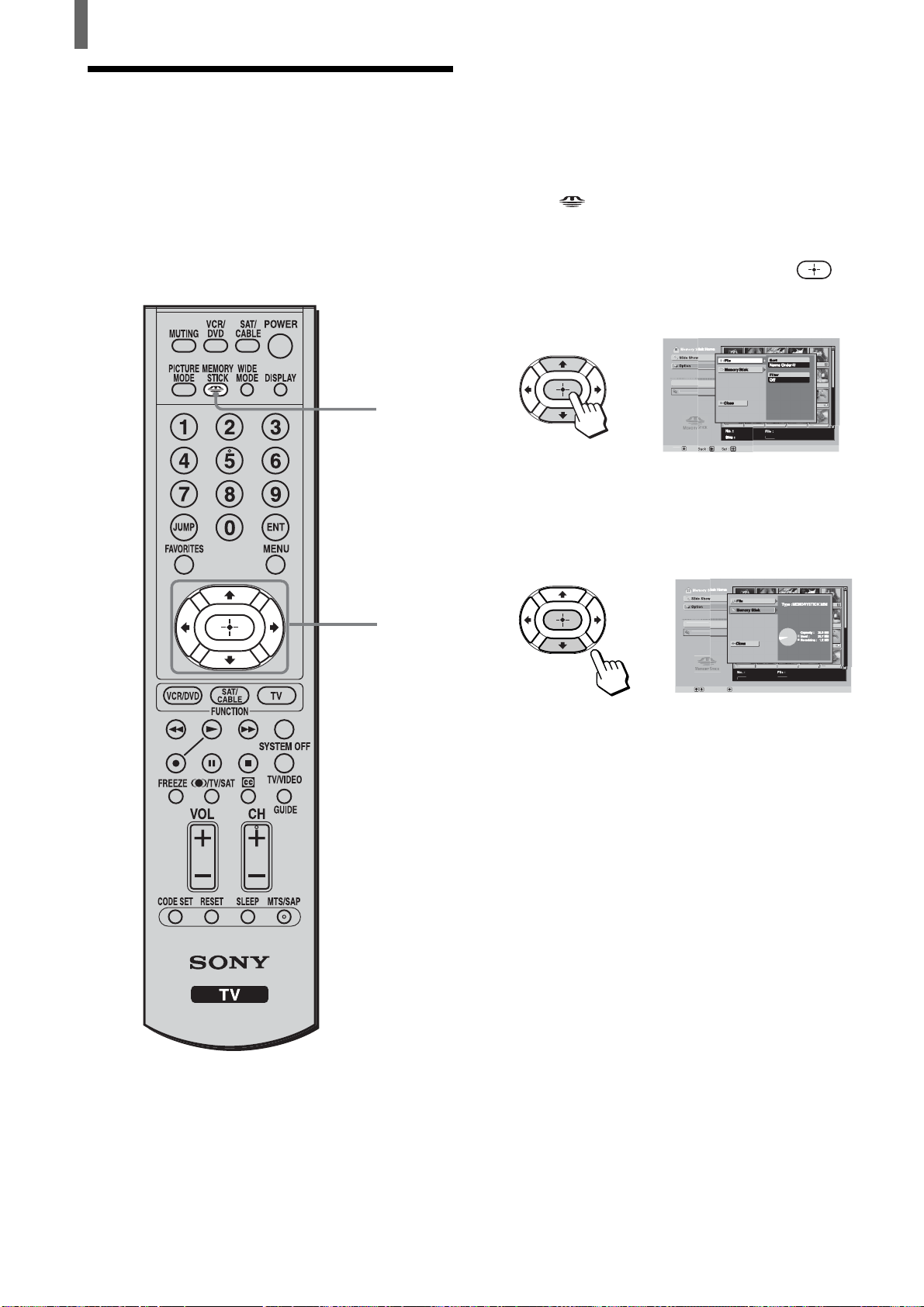
“Memory Stick”
70
About the Memory Stick
Home menu options
You can check the “Memory Stick” type, or its
current status.
2
3 ,4
1 Insert a “Memory Stick” into the Memory Stick
slot.
Be sure to insert the “Memory Stick” correctly.
(see page 60)
2 Press (“Memory Stick”) button, and the
Memory Stick Home screen appears.
3 Press V/v to select “Option,” then press .
The Option Settings menu appears.
,
1
00
M
S
D
CF
D
a
t
e
:
S
elect Folde
r
S
el
:
B
4 Press v to select Memory Stick.
Information on the “Memory Stick” you are
using is displayed.
,
1
00
M
S
D
CF
D
a
t
e
:
S
ize
:
S
el : B
ac
k
:
S
elect Folde
r
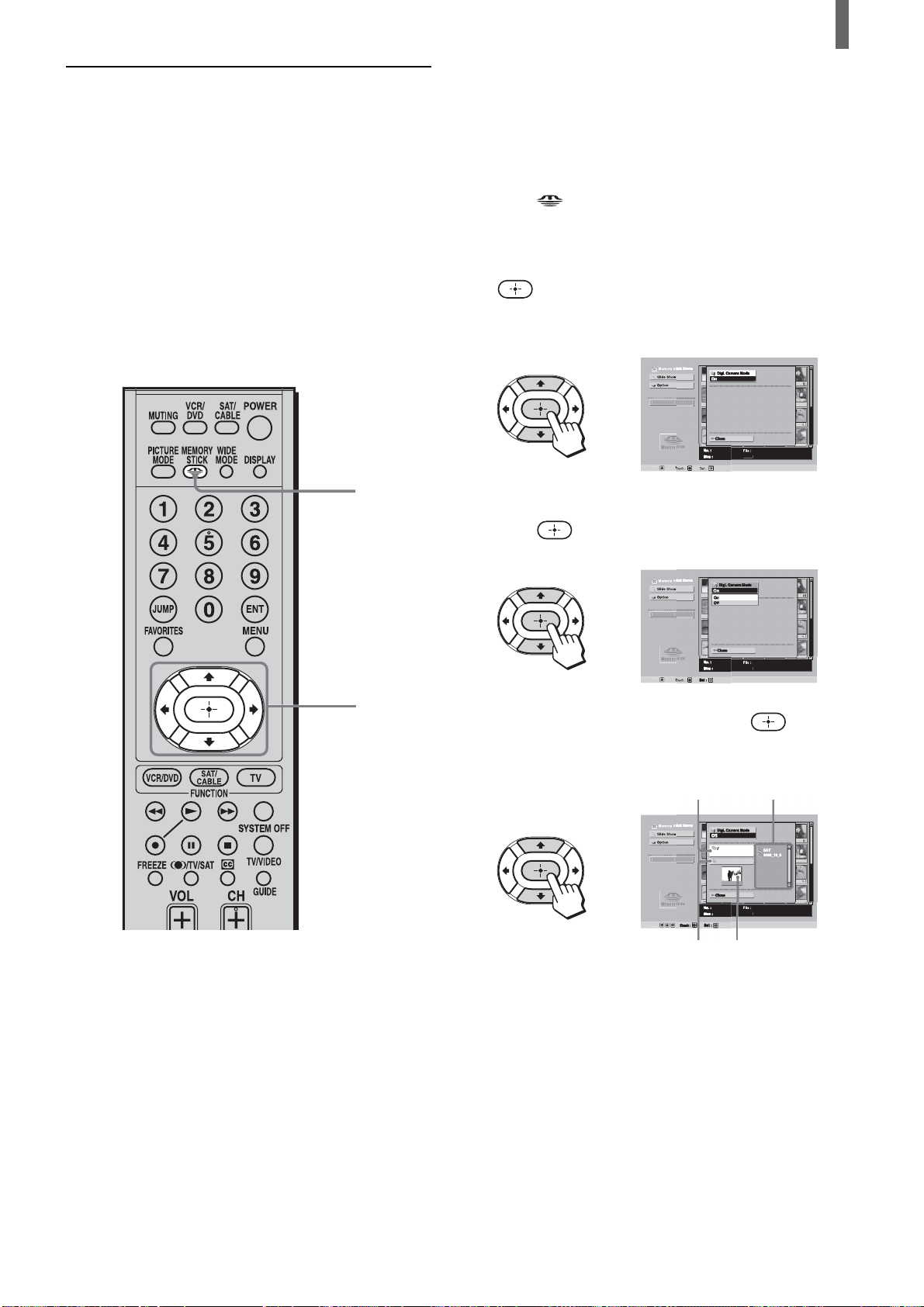
“Memory Stick”
71
Selecting a folder and viewing
digital photos or movies
To view digital photos or movies that have been
made into albums and saved in a folder using a PC,
you must first select the folder. To select these
photos or movies, you must set “Digi. Camera
Mode” to “Off” beforehand.
Also, when “Digi. Camera Mode” is set to “On,” you
can display up to 2,000 digital photos or movies, but
if you want to display more than 2,000, you must set
“Digi. Camera Mode” to “Off.”
2
3 - 8
1
Insert a “Memory Stick” into the Memory Stick
slot.
Be sure to insert the “Memory Stick” correctly
(see page 60).
2 Press (“Memory Stick”) button, and the
Memory Stick Home screen appears.
3 Press V/v to select “Select Folder,” then press
.
The Select Folder menu appears.
,
D
a
t
e
:
S
elect Folde
r
S
el
:
B
4 Press V/v to select “Digi. Camera Mode,” then
press
.
,
D
a
t
e
:
S
elect Folde
r
S
el
:
B
5 Press V/v to select “Off,” then press .
,
D
a
t
e
:
S
elect Folde
r
S
el
:
(Continued)
The currently
selected folder
The Folder List
One level up The first image in
the current folder is
displayed.
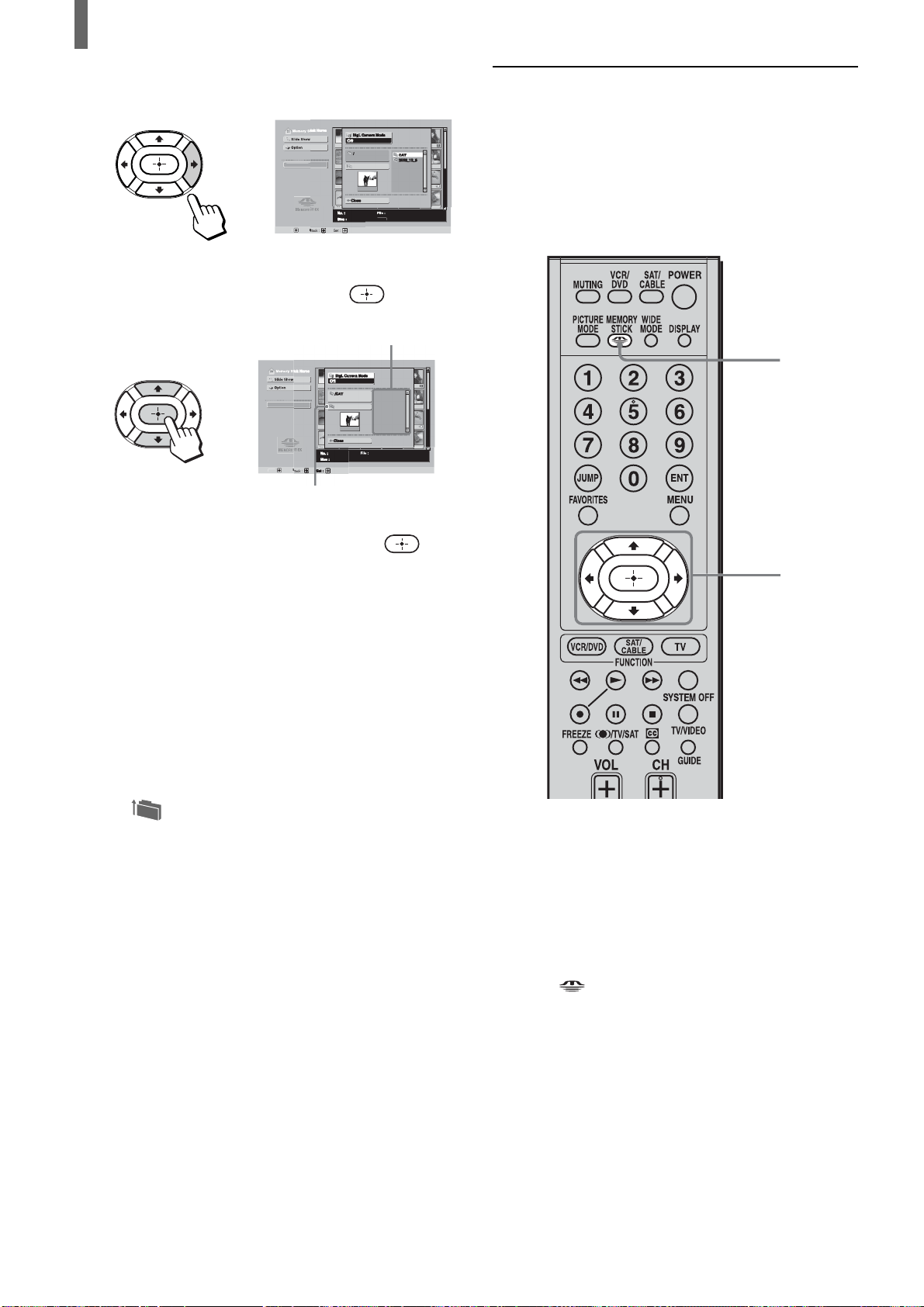
“Memory Stick”
72
You can move up to the next
level.
Sorting image files
You can sort the image files stored on a “Memory
Stick” by name or by recorded date order. To do this,
first setting “Digi. Camera Mode” on the Select
Folder menu of the Memory Stick Home screen to
“Off.”
2
3 - 6
1
Insert a “Memory Stick” into the Memory Stick
slot.
Be sure to insert the “Memory Stick” correctly
(see page 60).
2 Press (“Memory Stick”) button, and the
Memory Stick Home screen appears.
6 Press b to move the cursor to the Folder List.
,
D
a
t
e
:
S
elect Folde
r
S
el
:
B
7 Press V/v to select the folder containing the
image you want to see, then press
.
,
D
a
t
e
:
S
elect Folde
r
S
el
:
B
8 Press V/v to select “Close,” then press or
B.
The display returns to the Memory Stick Home
screen, and the image files in the currently
selected folder are displayed in the list.
Tip
An electronic storage area where multiple images are
stored together is called a folder. In addition to
digital photos and movies, folders can contain other
folders. When folders are arranged in a hierarchy
with several levels, to move to the next level up,
select
, then repeat steps 6 and 7.
Note
Folders or files with non-DOS-format names (file
names of 9 characters and above) may not be
displayed correctly.
The Folder List
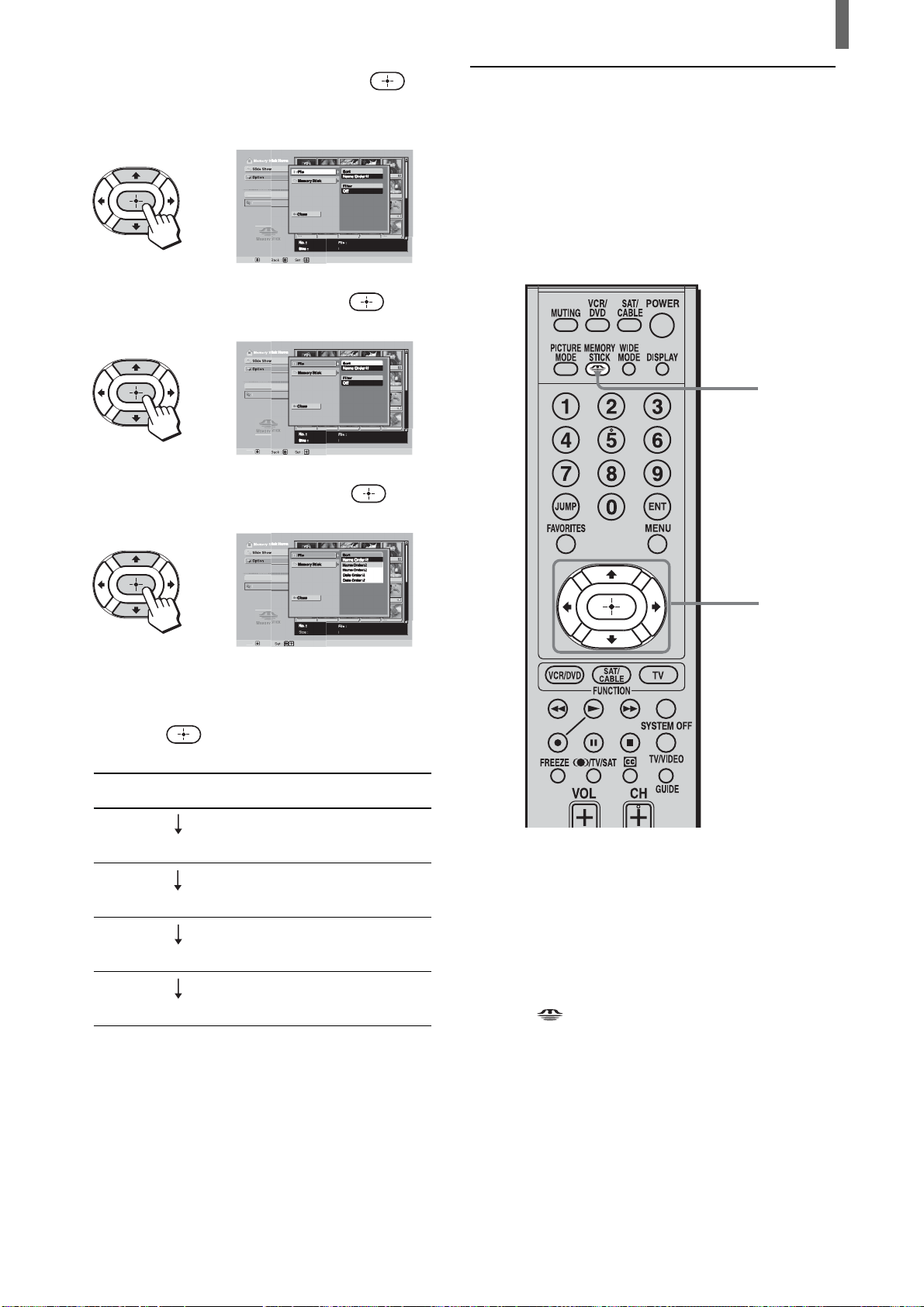
“Memory Stick”
73
3 Press V/v to select “Option,” then press .
The Options Settings menu appears.
,
1
00
M
S
D
CF
D
a
t
e
:
S
elect Folde
r
S
el
:
B
4 Press V/v to select “File,” then press .
,
1
00
M
S
D
CF
D
a
t
e
:
S
elect Folde
r
S
el
:
B
5 Press V/v to select “Sort,” then press .
,
1
00
M
S
D
CF
D
a
t
e
:
S
el
:
S
elect Folde
r
6 Press V/v to select how you want to sort items,
then press
.
Note
Images modified on a PC may be sorted based not on their
recorded dates, but on the date they were modified.
Selectively displaying digital
photos or movies
You can selectively display either digital photos or
movies saved on a “Memory Stick.” To do this, first
set “Digi. Camera Mode” on the Select Folder menu
of the Memory Stick Home screen to “Off.”
2
3 - 6
1
Insert a “Memory Stick” into the Memory Stick
slot.
Be sure to insert the “Memory Stick” correctly
(see page 60).
2 Press (“Memory Stick”) button, and the
Memory Stick Home screen appears.
Items that can be
selected
Name Order
Name Order
Date Order
Date Order
Sort order
Image file names will be sorted
alphabetically, starting with A.
Image file names will be sorted
alphabetically, starting with Z.
Image files will be sorted by
shooting date, starting with the
oldest.
Image files will be sorted by
shooting date, starting with the
most recent.
(Continued)
A
Z
Z
A
1
9
9
1
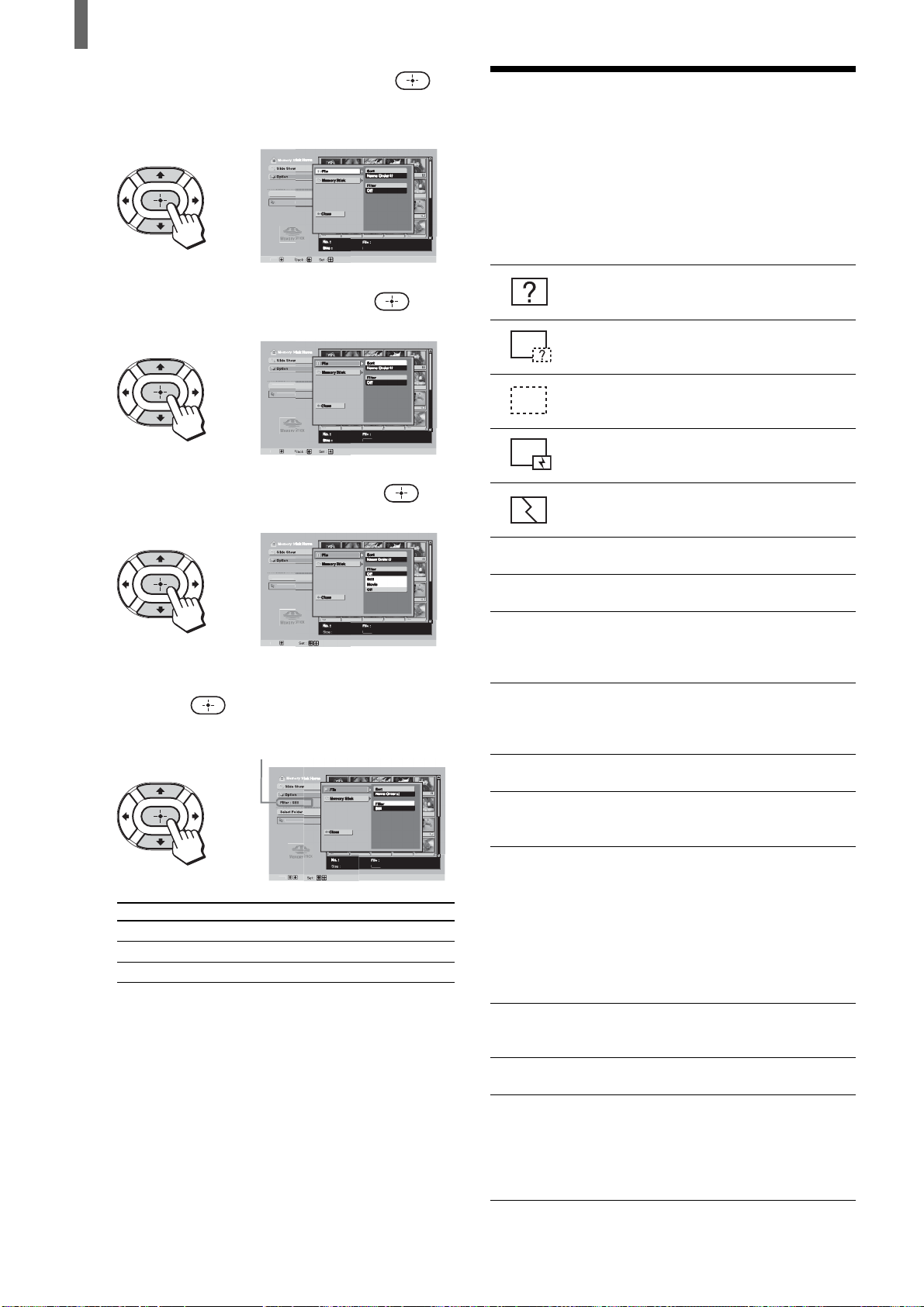
“Memory Stick”
74
The image file is in the JPEG or MPEG1 format
but is not DCF-compatible.
There is a thumbnail image but it is not DCF-
compatible.
There is no selected image file.
There is an image file but the thumbnail image is
corrupted.
The image file is corrupted.
No Memory Stick Insert the “Memory Stick” into the
“Memory Stick” slot correctly.
No file No image files are contained in the
currently selected folder.
No movie file No moving image files are
contained in the currently selected
folder, even though “Filter” is set
to “Movie” in the “Option” menu.
No still file No still image files are contained
in the currently selected folder,
even though “Filter” is set to
“Still” in the “Option” menu.
Cannot play Data in the moving image file is
corrupted.
Memory Stick locked The write-protect switch on the
“Memory Stick” is set to LOCK.
Release the lock.
Memory Stick error • The image file may be
corrupted.
• The image file may not be stored
in JPEG or MPEG1 format.
Check to see if the image file
can be viewed on other
equipment compatible with the
“Memory Stick,” such as a
digital camera, etc.
Memory Stick type error A “Memory Stick” that is not
compatible or cannot be used with
the TV has been inserted.
Format error The “Memory Stick” has not been
formatted correctly.
File error The selected folder has not been
named correctly. Re-enter the
name with fewer than 66
characters, including “/” by
displaying the “Select Folder”
menu.
Caution icons and
messages
If there is a file problem in the “Memory Stick”, the
following icons and messages may appear on the
screen. Use the list below to identify the problem and
take the appropriate action.
3 Press V/v to select “Option,” then press .
The Option Settings menu appears.
,
1
00
M
S
D
CF
D
a
t
e
:
S
elect Folde
r
S
el
:
B
4 Press V/v to select “File,” then press .
,
1
00
M
S
D
CF
D
a
t
e
:
S
elect Folde
r
S
el
:
B
5 Press V/v to select “Filter,” then press .
,
1
00
M
S
D
CF
D
a
t
e
:
S
el
:
S
elect Folde
r
6 Press V/v to select either “Still” or “Movie,”
then press
.
,
1
00
M
S
D
CF
D
a
t
e
:
S
el
:
Tip
When Filter is set, the currently selected image type (“Still” or
“Movie”) is displayed on the Memory Stick Home screen.
Images of the type selected are displayed.
Item
Still
Movie
Off
The displayed image
Digital photos only
Movies only
Digital Photos - Movies

“Memory Stick”
75
Read Only Memory A read-only “Memory Stick” has
been inserted. You cannot record
or delete the data on a read-only
“Memory Stick.”
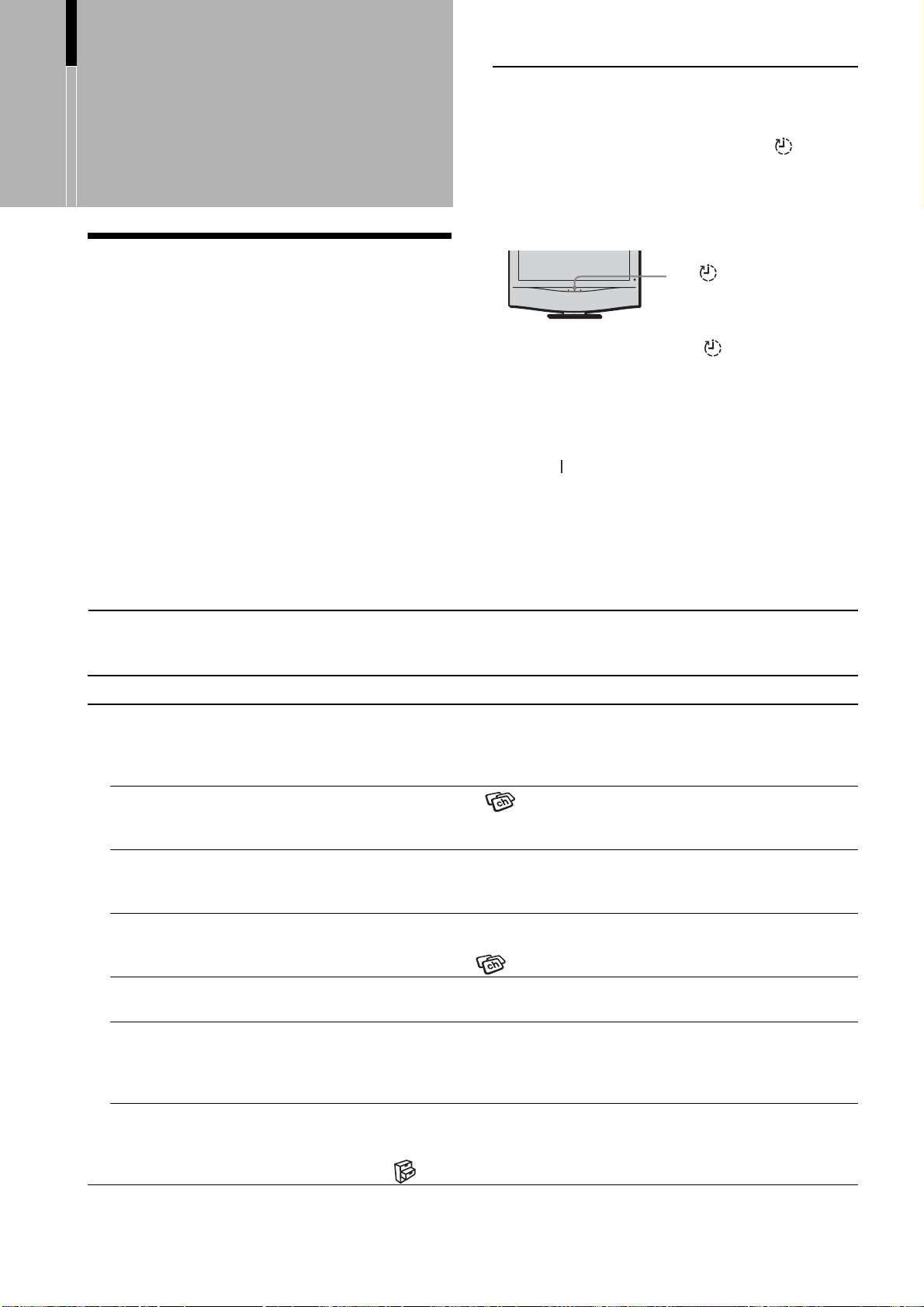
Additional Information
76
Problem Possible remedies
No picture.
Cannot receive any channels.
Cannot receive upper
channels (UHF) when using
an antenna.
TV is locked to one channel.
Cannot receive any channels
when using cable TV.
Cannot receive or select
channels.
The TV turns off
automatically.
(The TV enters the standby
mode.)
Some video sources do not
appear.
Troubleshooting
If, after reading the following instructions, you
have additional questions related to the use of
your Sony TV, please call one of the following
numbers.
Customers in the continental United States
contact the Direct Response Center at:
1-800-222-SONY (7669)
Customers in Canada contact the Customer
Relations Center at:
1-877-899-SONY (7669)
Trouble symptoms and remedies
Additional
Information
Self-diagnosis function
The TV is equipped with a self-diagnosis function. If
there is a problem with your TV, the
1/
indicator
on the front panel will flash repeatedly in red.
Writing down the duration of flashes and interval
between flashes helps you inform qualified Sony
personnel of the TV’s condition.
1 Measure how long the
1/
indicator flashes
and stops flashing.
For example, the indicator flashes for 2 seconds,
stops flashing for 1 second, and flashes for 2
seconds.
2 Press
I
on the TV to turn it off, and disconnect
the power cord, then inform qualified Sony
personnel or the Direct Response Center/
Customer Relations Center of how the indicator
flashes (duration and interval).
• Make sure the power cord is connected securely.
• Turn on the power of the TV.
• Check antenna/cable connections.
• Set “Cable” to “Off” in the
(Channel) menu (page 21).
• Perform Auto Program to add receivable channels that are not presently in the TV’s
memory (page 21).
• Perform Auto Program to add receivable channels that are not presently in the TV’s
memory (page 21).
• Check your Channel Fix setting (page 22).
• Perform Auto Program to add receivable channels that are not presently in the TV’s
memory (page 21).
• Make sure “Cable” in the
(Channel) menu is set to “On” (page 21).
• Perform Auto Program to add receivable channels that are not presently in the TV’s
memory (page 21).
• This TV automatically changes to the standby mode after displaying the message “TV will
turn off soon” if it receives no broadcast or input signal through the connected equipment
for 10 minutes.
• Check that the Sleep timer is activated (page 55).
• Check the connection between the optional video equipment and the TV.
• Press TV/VIDEO on the remote control (page 32).
• If you connect the video equipment to the S VIDEO input of the TV, set “Auto YC” to
“On” in the
(Setup) menu (page 12).
1/
indicator
(flashing in red)
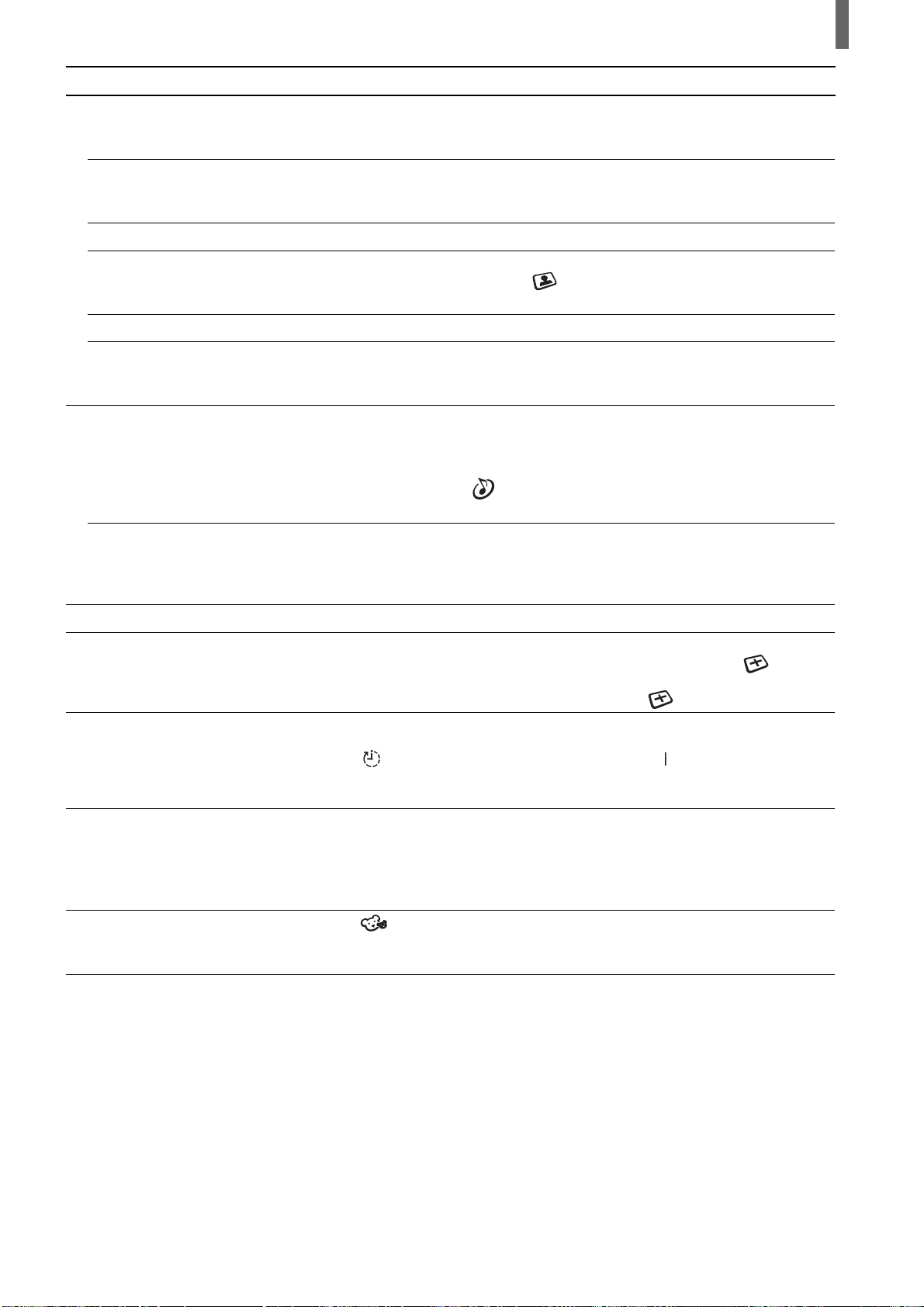
Additional Information
77
Poor picture.
Double images or ghosts.
Only snow and noise appear
on the screen.
Dotted lines or stripes.
No color.
Color is not correct.
Dark picture.
The picture is too bright.
Picture (stripe) noise.
No sound./Noisy sound.
Good picture, no sound.
Audio noise.
Cannot operate the menu.
Wide Screen Mode changes
automatically.
Remote control does not
operate.
Cannot change channels with
the remote control.
Lost password.
Problem Possible remedies
• Check antenna/cable connections.
• Check the antenna location and direction.
• Check if the antenna is broken or bent.
• Check if the antenna has reached the end of its serviceable life. (3-5 years in normal use,
1-2 years at the seaside.)
• Keep the TV away from noise sources such as cars, motorcycles, or hair-dryers.
• Press PICTURE MODE to select the desired Picture Mode (page 25).
• Adjust the Picture Mode options in the
(Video) menu (page 42).
• Press PICTURE MODE to select the desired Picture Mode (page 25).
• Make sure that the antenna is connected using the supplied 75-ohm coaxial cable.
• Keep the antenna cable away from other connecting cords.
• Do not use 300-ohm twin lead cables as interference may occur.
• Check the volume control.
• Press MUTING or VOL + so that “Muting” disappears from the screen (page 24).
• Disconnect your headphones.
• Set “Speaker” to “On” in the
(Audio) menu (page 15). If it is set to “Off,” sound is not
output from the TV’s speakers regardless of the TV’s volume control.
• Make sure that the antenna is connected using the supplied 75-ohm coaxial cable.
• Keep the antenna cable away from other connecting cords.
• Do not use 300-ohm twin lead cables as interference may occur.
• Press MTS/SAP to select “Mono” (page 45).
• If the option you want to select appears in a pale color, you cannot select it.
• The current Wide Screen Mode setting is automatically replaced with the 4:3 Default
setting when you change the channel or video input, if “4:3 Default” in the
(Screen)
menu is set to other than “Off.” If you want to lock in the Wide Screen Mode selected with
the WIDE MODE button, set “4:3 Default” to “Off” in the
(Screen) menu (page 30).
• The batteries could be weak. Replace the batteries.
• Check the polarity of the batteries.
• If the
1/
indicator on the TV does not light in red, press
I
on the TV.
• Point the remote control at the remote control sensor of the TV.
• Install the TV away from fluorescent lights.
• Be sure you have not inadvertently switched your TV from channel 3 or 4 setting if you
are using another device to change channels.
• If you are using another device to control channels, be sure the FUNCTION button for that
device has been pressed. For example, if you are using your cable box to control channels,
be sure to press SAT/CABLE (page 34).
• Select the
(Parent) menu on the menu screen, then enter the following master
password: 4357. The master password clears your previous password and allows you to
enter a new password (page 48).
(Continued)
Additional Information
78
“Memory Stick”
Cannot insert the “Memory
Stick” into the “Memory
Stick” slot.
Cannot delete a file or all
materials.
The still image files in the
JPEG format stored in a
“Memory Stick” cannot be
displayed.
The moving image files in
the MPEG1 format stored in
a “Memory Stick” cannot be
displayed.
The image is not displayed
and
or appears.
Problem Possible remedies
• The “Memory Stick” is not facing in the correct direction. Insert the “Memory Stick” with
the b mark facing forward into the “Memory Stick” slot (page 60).
• The write-protect switch on the “Memory Stick” is set to LOCK. Release the lock.
• The image file is protected. Release the protection using the index screen.
• Select “Option” in the Memory Stick Home and select “File.” Then set “Filter” to “Still”
or “Off” (page 73).
• Select “Option” in the Memory Stick Home and select “File.” Then set “Filter” to
“Movie” or “Off” (page 73).
• The image file is not DCF-compatible.

Additional Information
79
Specifications
Television system:
American TV standard
Channel coverage:
VHF: 2-13/UHF: 14-69/CATV: 1-125
Antenna:
75 ohm external terminal for VHF/UHF
Screen size (measured diagonally):
23 inches
Panel System:
a-Si TFT Active Matrix LCD panel
(Effective dots: more than 99.99%)
Display resolution:
1,280 dots (horizontal) × 768 lines (vertical)
VIDEO 1/2 IN:
S VIDEO (4-pin mini DIN):
Y: 1 Vp-p, 75-ohms unbalanced,
sync negative
C: 0.286 Vp-p (Burst signal),
75 ohms
VIDEO: 1 Vp-p, 75-ohms unbalanced,
sync negative
AUDIO: 500 mVrms (100% modulation)
Impedance: 47 kilohms
VIDEO 3 IN:
Y, PB, PR (Component Video):
Y: 1.0 Vp-p, 75 ohms
unbalanced, sync negative
P
B: 0.7 Vp-p, 75 ohms
P
R: 0.7 Vp-p, 75 ohms
Signal format:
480i, 480p, 720p, 1080i
AUDIO: 500 mVrms (100% modulation)
Impedance: 47 kilohms
VIDEO 4 IN:
DVI-HDTV: 1 terminal, 3.3 V T.M.D.S.,
50 ohms
The DVI-HDTV input terminals
compliant with the EIA-861B
standard and is not intended for
use with PC.
AUDIO: 500 mVrms (100% modulation)
Impedance : 47 kilohms
AUDIO OUT:
500 mVrms (100% modulation)
More than 500 mVrms at the maximum volume setting
(Variable)
More than 500 mVrms (Fixed)
Headphones:
Stereo minijack
Impedance: 16 ohms
Speaker:
Full range: ø5.0 cm (1
31
/32 inches) (2)
Woofer: ø5.5 cm (2
5
/32 inches) (2)
Speaker output:
2.0 W + 2.0 W + 3.8 W
Power requirement:
120 V AC, 60 Hz
Power consumption:
In use (Max.): 103 W
In standby: Less than 1 W
Dimensions (W/H/D):
Including TV stand: 598 × 506 × 230 mm
(23
17
/32 × 19
29
/32 × 9
1
/16 inches)
Without TV stand: 598 × 478 × 119 mm
(23
17
/32 × 18
13
/16 × 4
11
/16 inches)
Mass:
Including TV stand: 11.2 kg (24 lb 11 oz)
Without TV stand: 10.0 kg (22 lb 1 oz)
Supplied accessories:
Remote control RM-Y1105 (1)
Batteries size AA (2)
75-ohm coaxial cable (1)
AC power cord (1)
Operating Instructions
Warranty Card
Product Registration
Optional accessorios:
Note that some optional accessories may be out of
stock.
Headphones plug adaptor
Connecting cables
“Memory Stick” media
Wall-Mount Bracket
SU-W210
Design and specifications are subject to change
without notice.
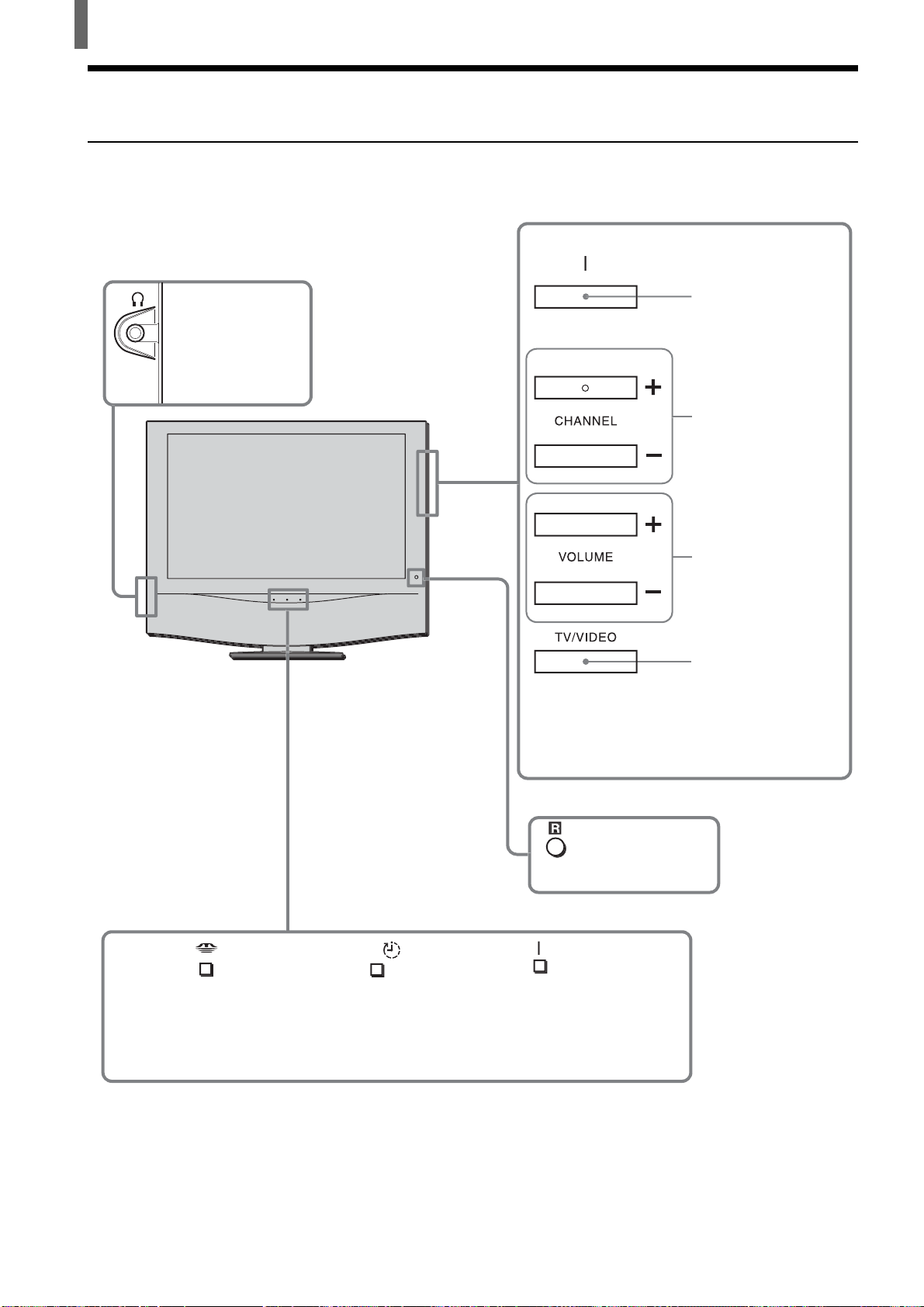
Additional Information
80
Index to parts and controls
TV Front Panel
I
1/
I
“Memory Stick”
Access indicator
Standby/Sleep
indicator
page 24
Power
indicator
Remote Control
sensor
Power Switch
page 21
Channel +/– buttons
page 21
Tip
The CHANNEL + button
have a tactile dot.
Use the tactile dot as a
reference when operating
the TV.
Volume +/– buttons
page 24
Input Selector button
page 32
Headphones jack
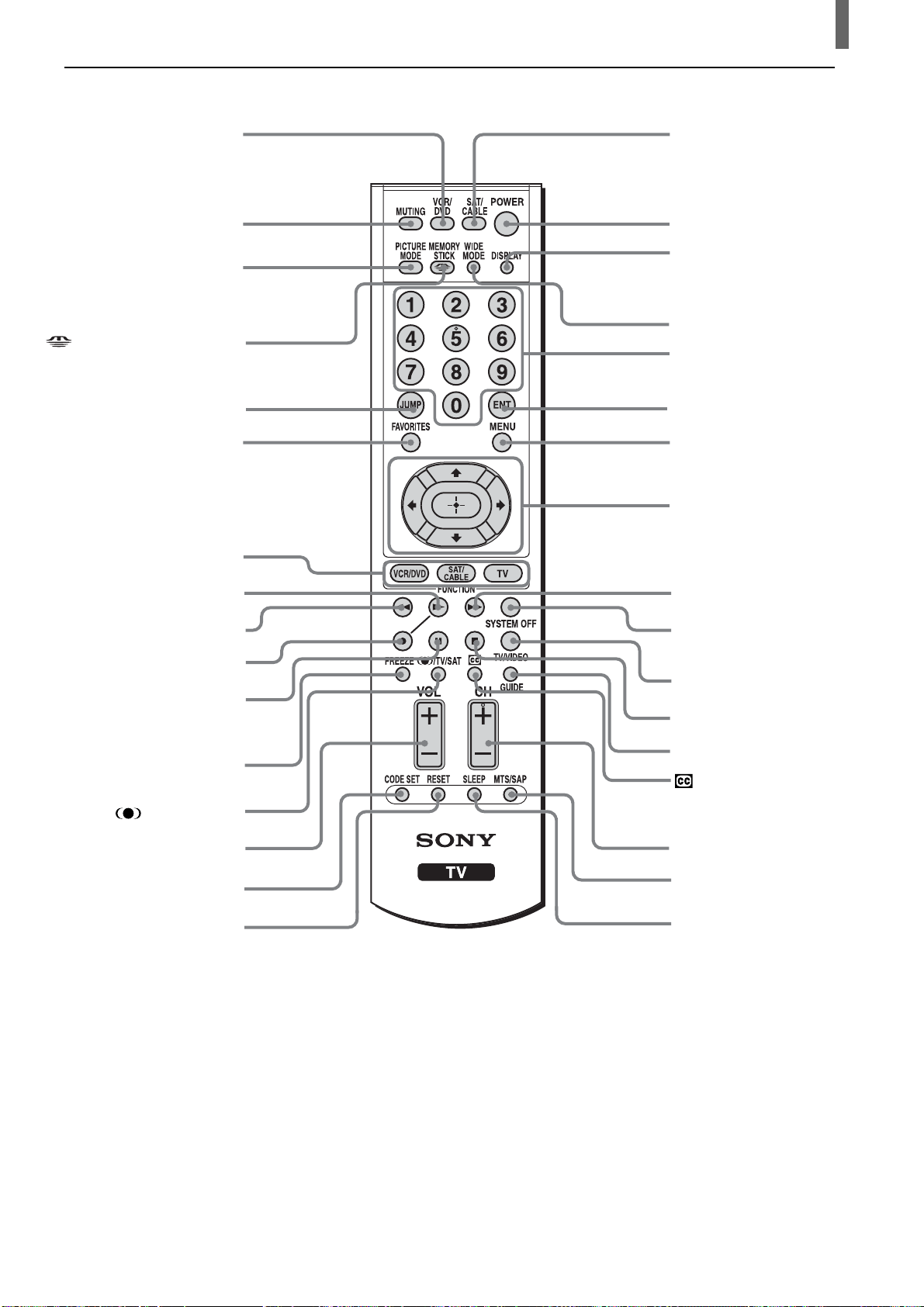
Additional Information
81
Remote Control
Tip
The MTS/SAP button, the number 5 button and the CH + button
have a tactile dot.
Use the tactile dot as a reference when operating the TV.
MUTING button
page 24
VCR/DVD button
page 34
SAT/CABLE button
page 34
POWER button
page 24
PICTURE MODE button
page 25
(“MEMORY STICK”) button
page 61
WIDE MODE button
page 27
DISPLAY button
page 24
0 - 9 buttons
page 24
JUMP button
page 24
ENT (enter) button
page 34
FAVORITES button
page 38
MENU button
page 23
V/v/B/b/select
page 23
SLEEP button
page 55
RESET button
page 42
MTS/SAP button
page 45
GUIDE button
page 36
button
page 25
VOL +/– buttons
page 24
CODE SET button
page 34
CH +/– buttons
page 21
FREEZE button
page 31
TV/VIDEO button
page 32
x button
page 36
SYSTEM OFF button
page 24
M button
page 36
m button
page 36
N button
page 36
X button
page 36
/TV/SAT button
page 26
z button
page 36
FUNCTION buttons
VCR/DVD
SAT/CABLE
TV
page 34

Additional Information
82
Index
F
Favorite channels.................................. 37
Front and rear connectors ....................... 7
Full........................................................ 28
I
Input select ........................................... 32
J
Jump ..................................................... 24
L
Language selection ............................... 23
M
“Memory Stick” ................................... 56
Menu..................................................... 40
Mono .................................................... 45
MTS ...................................................... 45
Muting .................................................. 24
N
Normal .................................................. 28
O
Optional equipment .............................. 34
P
Parent .................................................... 46
password ........................................... 48
ratings ............................................... 51
Picture Mode ........................................ 25
Power on/off ......................................... 24
Pro ........................................................ 26
4:3 Default ............................................ 30
A
Adjusting
picture position ................................. 41
picture quality ................................... 42
sound quality .................................... 44
viewing angle of the TV ................... 11
volume .............................................. 24
Audio Out ............................................. 15
Auto Program ....................................... 21
Auto SAP.............................................. 45
Auto YC ............................................... 12
C
Cable TV .............................................. 21
Channel setting ..................................... 21
Channel Fix ...................................... 22
Channel Skip/Add ............................ 22
Closed caption ...................................... 25
Component Video connectors .. 16, 18, 19
Connecting.............................................. 6
antenna................................................ 8
audio receiver ................................... 15
cable box............................................. 8
digital satellite receiver..................... 18
digital TV receiver............................ 19
DVD player ................................ 16, 17
power cord .......................................... 9
satellite receiver.......................... 13, 14
VCR .................................................. 12
D
Display.................................................. 24
E
Effect .................................................... 26
R
Remote control ....................................... 6
battery installation .............................. 6
operating optional equipment ........... 36
programming .................................... 34
S
S Video input jack ................................ 12
Self-diagnosis function ......................... 76
Sleep timer............................................ 55
Speaker ................................................. 15
Specifications ....................................... 79
SRS WOW ........................................... 26
Standard ................................................ 26
Stereo .................................................... 45
System off............................................. 24
T
Troubleshooting.................................... 76
U
UHF channels ....................................... 21
Unpacking .............................................. 6
V
Vertical Center...................................... 41
Vivid ..................................................... 26
Volume ................................................. 24
W
Wide Screen Mode ............................... 27
Wide Zoom ........................................... 28
Z
Zoom .................................................... 28

Additional Information
83

Printed on 100% recycled paper using VOC
(Volatile Organic Compound)-free vegetable oil
based ink.
Printed in Japan