INSTRUCTION AND RECIPE BOOKLET
International Chef
™
Crêpe/Pizzelle/Pancake Plus
CPP-200 Series
For your safety and continued enjoyment of this product, always read the instruction book carefully before using.

2
IMPORTANT
SAFEGUARDS
When using an electrical appliance, basic safety
precautions should always be followed, including
the following:
1. READ ALL INSTRUCTIONS.
2. Do not touch hot surfaces. Use handles
and dials.
3. To protect against fire, electrical shock,
and injury to persons, DO NOT IMMERSE
CORD, PLUG, OR UNIT in water or other
liquids.
4. Close supervision is necessary when any
appliance is used by or near children.
5. Unplug from outlet when not in use and
before cleaning. Allow to cool before
putting on or taking off parts, and before
cleaning appliance.
6. Do not operate any appliance with a
damaged cord or plug or after the appli-
ance malfunctions or has been damaged in
any manner. Return appliance to the near-
est Cuisinart Authorized Service Facility for
examination, repair, or adjustment.
7. The use of accessory attachments not
recommended by Cuisinart may result in
fire, electric shock, or injury to persons.
8. Do not use outdoors.
9. Do not let power cord hang over edge of
table or counter, or touch hot surfaces.
10. Do not place on or near a hot gas or elec-
tric burner, or in a heated oven.
11. Do not use appliance for other than
intended use.
12. Always unplug the unit when finished
cooking.
13. To safely disconnect power at any time,
remove the plug from the outlet.
14. Extreme caution must be used when
moving an appliance containing hot oil or
other hot liquids.
15. WARNING: TO REDUCE THE RISK
OF FIRE OR ELECTRIC SHOCK,
REPAIR SHOULD BE DONE ONLY BY
AUTHORIZED PERSONNEL. NO USER-
SERVICEABLE PARTS ARE INSIDE.
16. Do not operate your appliance in an appli-
ance garage or under a wall cabinet. When
storing in an appliance garage always
unplug the unit from the electrical outlet.
Not doing so could create a risk of fire,
especially if the appliance touches the walls
of the garage or the door touches the unit
as it closes.
SAVE THESE
INSTRUCTIONS
FOR HOUSEHOLD
USE ONLY
SPECIAL CORD SET
INSTRUCTIONS
A short power-supply cord is provided to
reduce the risks resulting from becoming
entangled in or tripping over a longer cord.
Extension cords may be used if care is exer-
cised in their use.
If an extension cord is used, the marked
electrical rating of the extension cord should
be at least as great as the electrical rating of
the appliance, and the longer cord should be
arranged so that it will not drape over the
countertop or tabletop where it can be pulled
on by children or animals, or tripped over.
NOTICE
This appliance has a polarized plug (one blade
is wider than the other). To reduce the risk of
electric shock, this plug will fit in a polarized
outlet only one way. If the plug does not fit
fully in the outlet, reverse the plug. If it still
does not fit, contact a qualified electrician. Do
not modify the plug in any way.
3
PARTS AND FEATURES
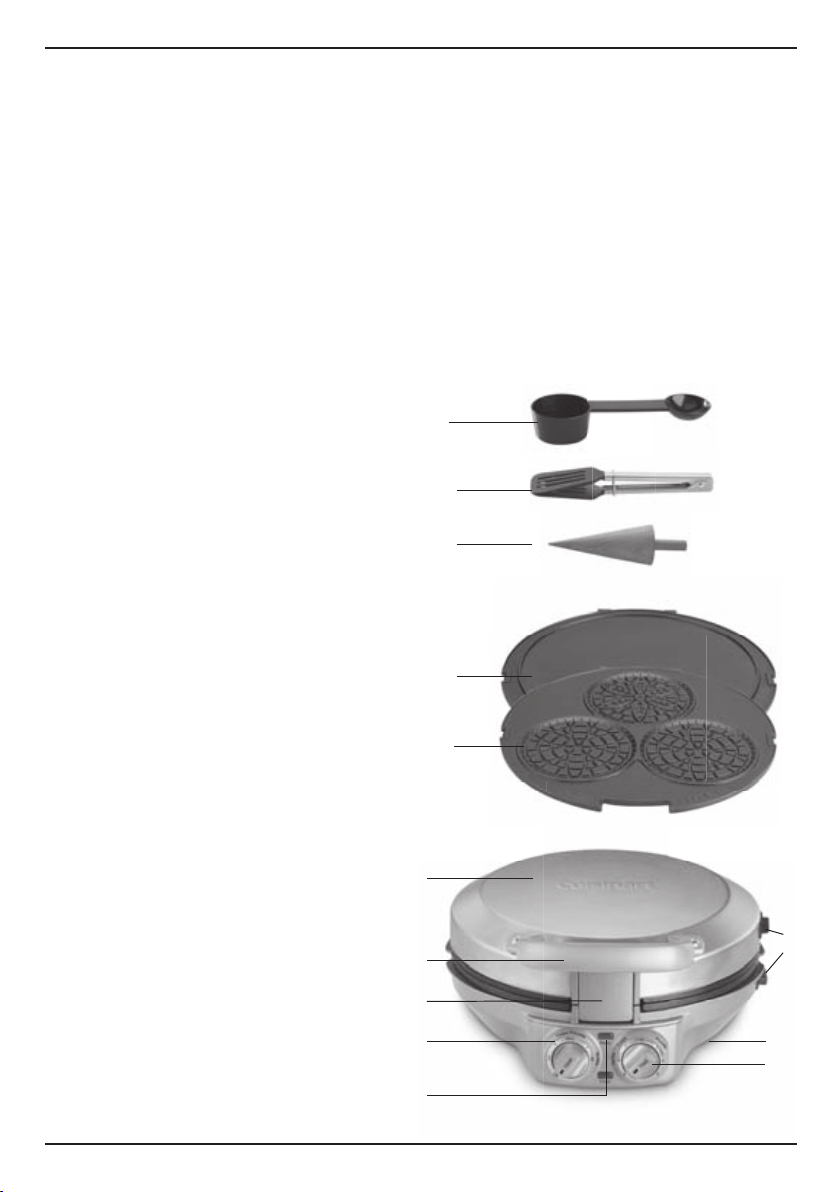
1. Housing – Elegant brushed stainless
steel with embossed Cuisinart logo.
2. Lid Handle – Durable, easy-lift and easy-
press handle that stays cool to the touch.
3. Removable and Reversible
Baking Plates – Nonstick and dishwasher
safe for easy cleanup.
a. Flat Side: Perfect for pancakes, crêpes,
tortillas and any other flatbreads.
b. Pizzelle Side: Prepare pizzelles
and mini ice-cream cones.
4. Temperature Knob – Settings for Low,
Medium and High; Preset Temperatures
for Crêpe, Pizzelle, Tortilla.
5. Timer Knob – Manual settings for 0 to 3 min-
utes. Preset Times for Crêpe, Pizzelle, Tortilla.
6. Indicator Lights – Red indicator light
signals power ON; green indicator light
signals Ready-to-Cook and Ready-to-Eat.
7. Cord Storage (not shown) – Cord wraps
around the back of the unit.
8. Rubber Feet – Keep unit steady and will
not mark countertop.
9. Plate Release Buttons – Release plates to
remove for easy cleaning.
10. Storage/Locking Lid – Locks plates
together to prevent lifting during cooking.
Also for upright storage.
11. Measuring Scoop – Dual sided with
1
⁄3
cup and 1 tablespoon capacities.
12. Tongs – For easy removal of food.
13. Mini Ice-Cream Cone Roller
14. BPA Free – (not shown) All material that
comes in contact with food is BPA free.
15. Quick Peek Feature – (not shown) Open up
the lid for up to 5 seconds without the timer
shutting off.
CONTENTS
Important Safeguards. . . . . . . . . . . . . . . . . 2
Parts and Features. . . . . . . . . . . . . . . . . . . 3
Before the First Use . . . . . . . . . . . . . . . . . . 4
Assembly Instructions . . . . . . . . . . . . . . . . .4
Operating Instructions . . . . . . . . . . . . . . . . 4
Tips and Hints . . . . . . . . . . . . . . . . . . . . . . .5
Cleaning, Care and Maintenance. . . . . . . . 5
Storage/Locking Lid . . . . . . . . . . . . . . . . . . 6
Warranty . . . . . . . . . . . . . . . . . . . . . . . . . . . 6
Recipe Chart and Recipes . . . . . . . . . . . . . .8
3a
3b
11
12
13
1
2
8
5
9
6
4
10
4
BEFORE THE FIRST USE
Remove all packaging and any promotional
labels or stickers from your unit. Be sure that
all parts (listed on Page 3, Parts and Features)
have been included before discarding any pack-
aging materials. You may want to keep the box
and packing materials for use at a later date.
Before using your International Chef
™
Crêpe/
Pizzelle/Pancake Plus for the first time, wipe
housing with a damp cloth and wash plates and
accessories well to remove any dust from the
warehouse or shipping.
Note: The International Chef
™
Crêpe/Pizzelle/
Pancake Plus has been treated with a special
nonstick coating. Before the first use, we sug-
gest you season the plates with flavorless veg-
etable oil. Apply oil with a paper towel or pastry
brush. You may find it helpful to repeat this pro-
cess before each use.
ASSEMBLY INSTRUCTIONS
Place the International Chef
™
Crêpe/Pizzelle/
Pancake Plus on a clean flat surface where you
intend to cook. It can be
positioned in three ways:
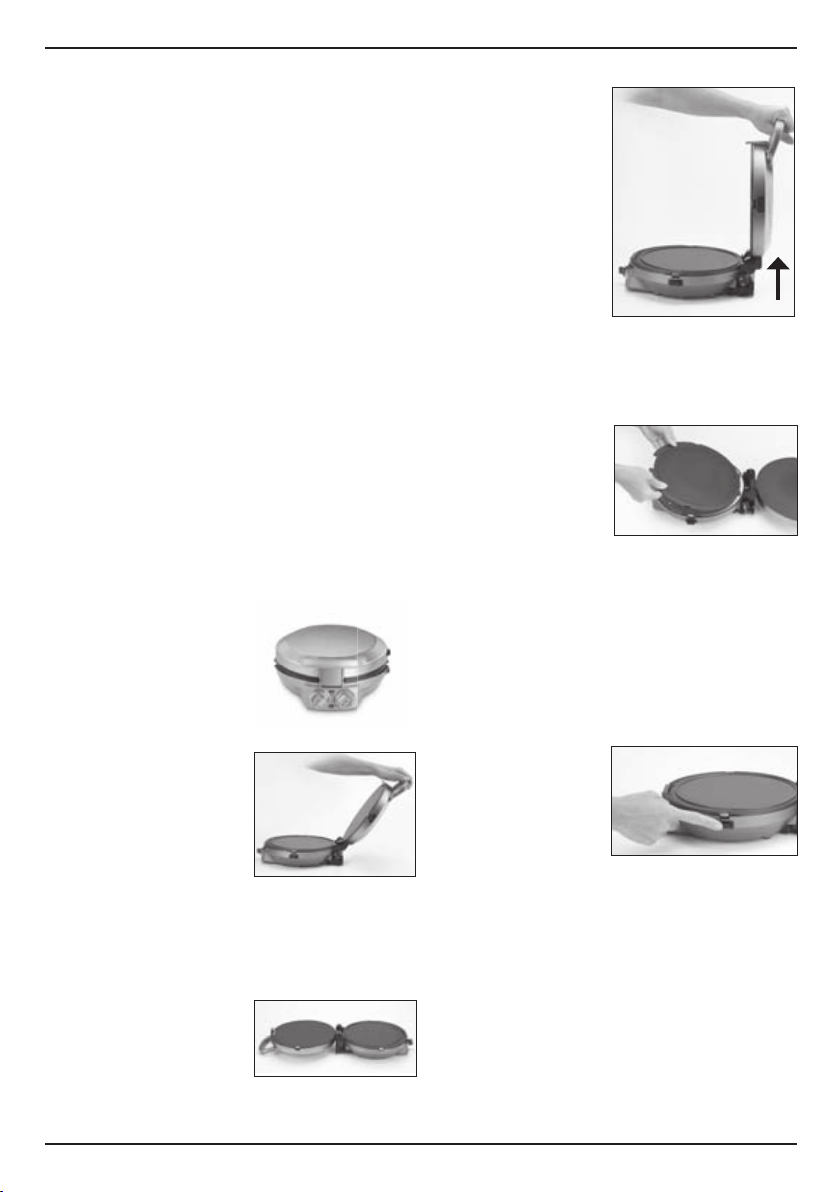
Closed Position – Upper
plate/cover rests flat on
lower plate/base. This is
your starting and heat-
ing position. Always use
caution when changing
positions once the unit is
preheated.
Open Position – Upper
plate/cover is open and in
the 105° position. Open
the cover to this position
before using the unit as
a press or in the flat position.
To adjust to this position, press the top of the
locking latch and lift the handle until you feel it
come to a locking position. The unit will stay in
this position until you close the cover or con-
tinue to open it to the flat
position.
Flat Position – Upper
plate/cover is level with
lower plate/base. The
upper and lower plates lie flat to double the
cooking surface.
Start with the unit
in the open posi-
tion. Then, lift the
handle vertically at a
90˚ angle. Push the
handle back until
the cover rests flat
on the counter.
The unit will stay in
this position until
you lift the handle
and cover to return
it to the closed position.
To insert plates
1. Adjust the unit to the flat position.
2. Insert one plate at a time. The plate marked
LOWER is designed
for the lower hous-
ing. The plate marked
UPPER is designed
for the upper housing.
3. Locate the two holes
in the hinge at the
back of the housing. Tilt the back end of the
plate and line up the pegs at the back of the
plate with the holes in the hinge. Slide the
plate into the holes and push down the front
end of the plate. It will snap into place.
4. Repeat with second plate.
To remove plates
1. Locate the plate release buttons on the right
side of the unit. Press firmly on button and
the plate will pop
up slightly from the
base.
2. Grasp the plate with
two hands, slide it
out from the holes,
and lift it out of the
base.
3. Press on the other plate release button to
remove the other plate in the same manner.
OPERATING INSTRUCTIONS
1. Plug the power cord into a standard electrical
outlet.
2. Adjust the Temperature Knob to the desired
setting or to one of the preset temperatures if
cooking crêpes, pizzelle, or tortillas. Be sure
to close lid. Red Power-on light will illumi-
nate.

5
3. If working in the closed position, adjust the
Timer Knob to the desired time, or to one of
the preset times if cooking crêpes, pizzelle,
or tortillas.
4. When green light illuminates, plates have
reached the selected temperature and you’re
ready to cook. NOTE: Depending on tem-
perature selected, heat-up times will vary.
5. Pour batter or place ingredients on plates.
Green light will go off.
6. Close lid if not cooking on open griddle.
When lid is closed and locked, timer will
begin counting down. NOTE: If lid is opened
for more than 5 seconds during cooking,
timer will shut off.
7. When items are cooked and ready to eat,
green light will illuminate and you will hear a
beep tone.
8. Refer to the chart on page 8 for cooking tips
and recommendations.
Caution: Always exercise caution when han-
dling the unit during cooking as the housing
will become very hot. Be sure to use an oven
mitt to prevent burns. The handle stays cool for
opening and closing during cooking.
Note: The first time you use your International
Chef
™
Crêpe/Pizzelle/Pancake Plus it may have
a slight odor and may smoke a bit. This is nor-
mal, and common to appliances with a nonstick
surface.
TIPS AND HINTS
1. The temperature control is used to set and
maintain the temperature of the cooking
surface. You may vary the setting of the
temperature control knob at any time during
cooking, depending on the types of foods
being prepared. Use our preset temperatures
for crêpes, pizzelle, and tortillas.
2. Cooking is based on time. All recipes are
given a recommended time for cooking
and our preset times make cooking perfect
crêpes, pizzelle, and tortillas easy. Times
are approximate. Please refer to the Recipe
Chart and Recipes for guidelines. Timer
works only in the locked closed position.
3. For fastest preheat we recommend preheat-
ing in the closed position. Be sure to use
caution when adjusting to a different cooking
position.
Helpful tips for crêpe making:
1. Always allow the crêpe batter to rest in refrig-
erator before cooking. It is recommended
to rest for at least 30 minutes (preferably
overnight if time allows). Resting the batter
gives time for the gluten in the flour to relax
and the starch molecules to fully absorb
the liquid. This creates a thicker batter and
ultimately more even and delicate crêpes. A
cooler, rested batter may also prevent any
unnecessary overflow.
2. The best temperature setting for crêpes is
the preset (medium). Should crêpes seem
thick, or if you like them darker or lighter, the
temperature may need to be adjusted.
3. Generally, crêpes take about 1½ minutes to
cook, which is the preset time. Certain crêpe
recipes, like the Crespelle, require less time.
Also if lighter or darker crêpes are desired,
adjust cooking time accordingly.
CLEANING, CARE AND
MAINTENANCE
•
Never use metal utensils, as they will scratch
the nonstick plates. Instead, use the provided
tongs, or wooden or heat-proof plastic utensils.
• Never leave plastic utensils in contact with the
hot plates. This includes the provided tongs.
• Allow the unit to cool down completely (at
least 30 minutes) before cleaning.
Once you have finished cooking, remove plug
from electrical outlet. Leave lid open so plates
begin to cool. Allow the unit to cool down com-
pletely before handling.
Press the plate release buttons to remove
plates from the housing. Be sure that the plates
have cooled completely before handling (at
least 30 minutes). The plates, measuring scoop
and tongs can be washed in the dishwasher,
the wooden mini ice cream cone roller should
be handwashed. Do not use metal objects such
as knives or forks for cleaning. Do not use a
scouring pad for cleaning. The nonstick coating
can be damaged.
To clean exterior, wipe with a soft damp cloth.
Never use an abrasive cleanser or harsh pad.
NEVER IMMERSE CORD, PLUG OR UNIT IN
WATER OR OTHER LIQUIDS.
Any other servicing should be performed by an
authorized service representative.
6
STORAGE/LOCKING LID
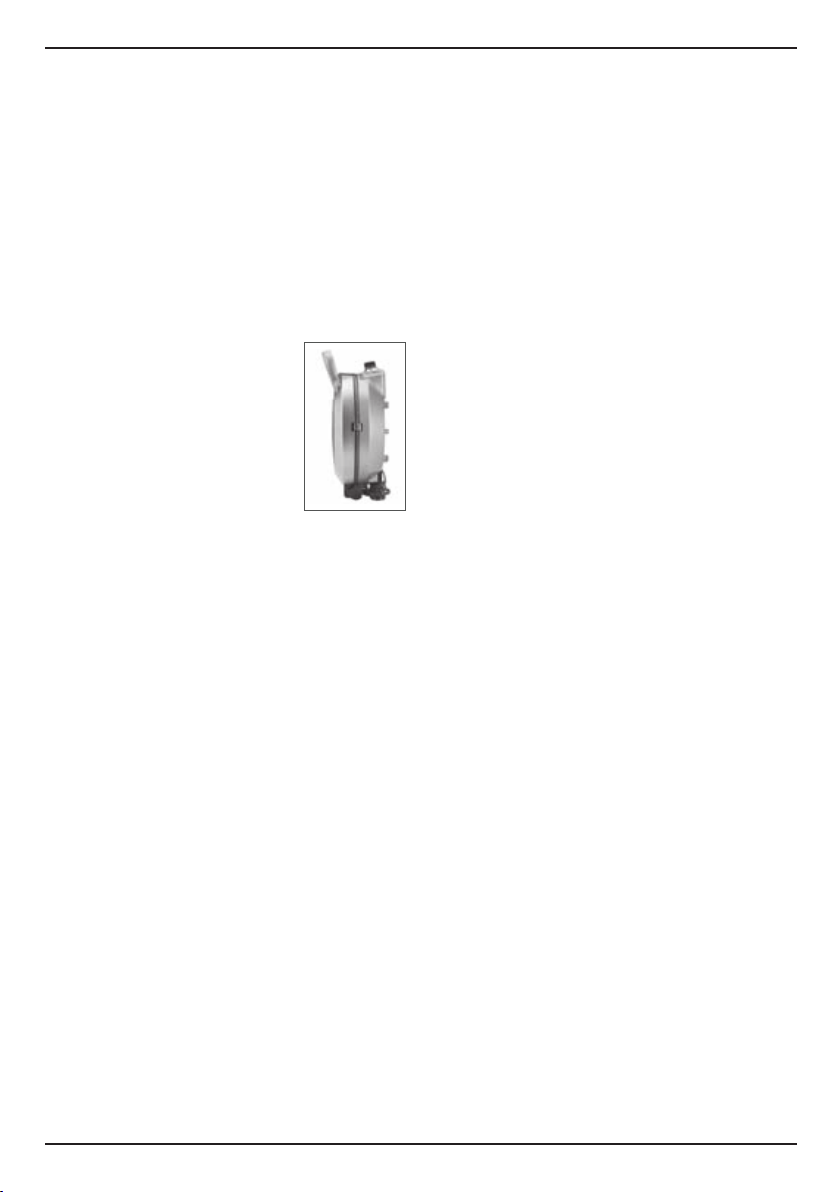
Store with plates inserted and cord wrapped
securely around the back of the unit. For com-
pact storage, stand the unit on its back end
with control panel facing up. The unit has been
designed with a special latching feature so the
lid stays closed during storage.
WARRANTY
Limited Three-Year Warranty
This warranty is available to
consumers only. You are a
consumer if you own an
International Chef
™
Crêpe/
Pizzelle/Pancake Plus
that was
purchased at retail for personal,
family or household use. Except
as otherwise required under
applicable law, this warranty is
not available to retailers or other
commercial purchasers or owners.
We warrant that your
International Chef
™
Crêpe/
Pizzelle/Pancake Plus
will be free of defects in
materials and workmanship under normal
home use for 3 years from the date of original
purchase.
We recommend that you visit our website,
www.cuisinart.com for a fast, efficient way to
complete your product registration. However,
product registration does not eliminate the
need for the consumer to maintain the original
proof of purchase in order to obtain the
warranty benefits. In the event that you do not
have proof of purchase date, the purchase
date for purposes of this warranty will be the
date of manufacture.
If your
International Chef
™
Crêpe/Pizzelle/
Pancake Plus
should prove to be defective
within the warranty period, we will repair it, or
if we think necessary, replace it. To obtain
warranty service, simply call our toll-free
number, 1-800-726-0190, for additional
information from our Customer Service
Representatives, or send the defective product
to Customer Service at Cuisinart, 7475 North
Glen Harbor Blvd., Glendale, AZ 85307.
To facilitate the speed and accuracy of your
return, please enclose $10.00 for shipping and
handling of the product. Please pay by check
or money order (California residents need only
supply proof of purchase and should call
1-800-726-0190 for shipping instructions).
NOTE: For added protection and secure
handling of any Cuisinart product that is being
returned, we recommend you use a traceable,
insured delivery service. Cuisinart cannot be
held responsible for in-transit damage or for
packages that are not delivered to us. Lost
and/or damaged products are not covered
under warranty. Please be sure to include your
return address, daytime phone number,
description of the product defect, product
model number (located on bottom of product),
original date of purchase, and any other
information pertinent to the product’s return.
Your
International Chef
™
Crêpe/Pizzelle/
Pancake Plus
has been manufactured to the
strictest specifications and has been designed
for use only in 120-volt outlets with the
authorized accessories and replacement parts.
This warranty expressly excludes any defects
or damages caused by accessories,
replacement parts, or repair service other than
those that have been authorized by Cuisinart.
This warranty does not cover any damage
caused by accident, misuse, shipment or other
than ordinary household use.
This warranty excludes all incidental or
consequential damages. Some states do not
allow the exclusion or limitation of these
damages, so these exclusions may not apply
to you.
CALIFORNIA RESIDENTS ONLY:
California law provides that for In-Warranty
Service, California residents have the option of
returning a nonconforming product (A) to the
store where it was purchased or (B) to another
retail store that sells Cuisinart products of the
same type.
The retail store shall then, at its discretion,
either repair the product, refer the consumer to
an independent repair facility, replace the
product, or refund the purchase price less the
amount directly attributable to the consumer’s
prior usage of the product. If the above two
options do not result in the appropriate relief to
the consumer, the consumer may then take the
product to an independent repair facility if
service or repair can be economically

7
accomplished. Cuisinart and not the consumer
will be responsible for the reasonable cost of
such service, repair, replacement, or refund for
nonconforming products under warranty.
California residents may also, according to their
preference, return nonconforming products
directly to Cuisinart for repair, or if necessary,
replacement, by calling our Consumer Service
Center toll-free at 1-800-726-0190.
Cuisinart will be responsible for the cost of the
repair, replacement, and shipping and handling
for such products under warranty.
BEFORE RETURNING YOUR
CUISINART PRODUCT
If you are experiencing problems with your
Cuisinart product, we suggest that you call our
Consumer Service Center at 1-800-726-0190
before returning the product to be serviced. If
servicing is needed, a representative can
confirm whether the product is under warranty
and direct you to the nearest service location.
Important: If the nonconforming product is to
be serviced by someone other than Cuisinart’s
Authorized Service Center, please remind the
servicer to call our Consumer Service Center at
1-800-726-0190 to ensure that the problem is
properly diagnosed, the product serviced with
the correct parts, and the product is still under
warranty.
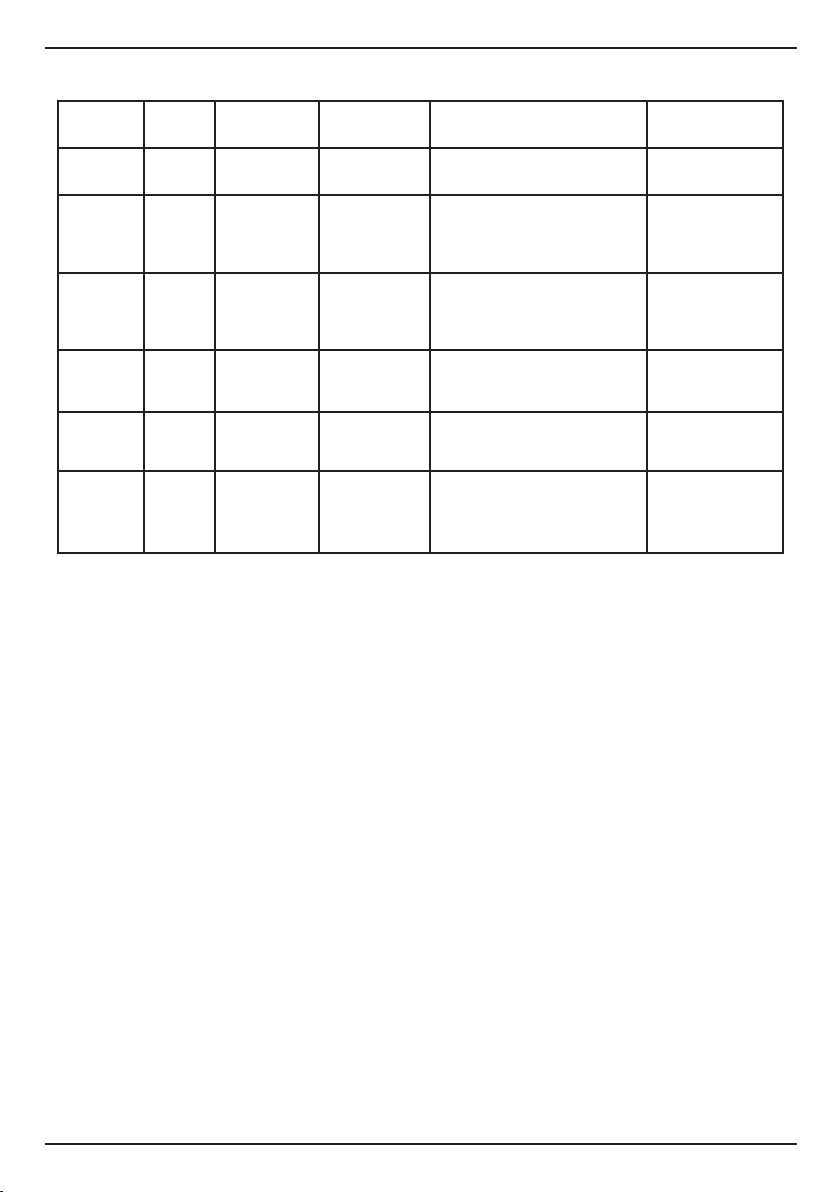
8
Item Plate Position Temperature Batter/Dough Amount
General
Cooking Time
Pizzelle Pizzelle
Closed +
Locked
Pizzelle/
Medium
Small scoop 2 mins.
Sugar
Cone
Pizzelle
Closed +
Locked
Medium Small scoop 2½ mins.
Pancake Flat Flat Medium-High
Silver dollar = small scoop
Standard pancake = large
scoop
2 to 3 mins.
per side
Crêpe Flat
Closed +
Locked
Crêpe/
Medium
Large scoop 1½ mins.
Tortilla Flat
Closed +
Locked
Tortilla/High
Dough stretched/rolled to
thin 6- to 8-inch disc
a. 30 secs
b. 4 to 6 mins.
Crackers Flat Closed High
Dough stretched/rolled to
very thin 8-inch disc
3 to 4 mins.
RECIPES
Silver Dollar Pancakes ............................9
Sugar Cones............................................9
Chocolate Waffle Cones ........................10
Blini ........................................................ 10
Classic Pizzelle ......................................11
Sweet Chocolate Pizzelle ......................12
Basic Crêpes, with variations ................12
Buckwheat Crêpes ................................13
Crespelle ...............................................14
Blintzes ..................................................14
Socca ....................................................15
Potato Pancakes (Latkes) .....................15
Wine Crackers .......................................16
Flour Tortillas .........................................17
Arepas ...................................................17
Carne Mechada .....................................18
Pita Bread ..............................................19
Mandarin Pancakes with Mu Shu Pork
....20
Spring Rolls ...........................................21
Okonomiyaki (Japanese Pancakes) ......22
Naan ......................................................22
Chapati ..................................................23
Fresh Green Chutney ............................24
Dosa ......................................................24
Sambhar (South Indian Lentil Stew) ......25
Roti ........................................................26
Curried Chickpeas with
Potatoes and Spinach ...........................26
Injera ...................................................... 27
Doro Wat (Ethiopian Chicken Stew) ......27
Niter Kibbeh ..........................................28
RECIPE CHART
Large Scoop =
1
/
3
cup
Small Scoop = 1 tablespoon

9
Silver Dollar Pancakes
This is a great all-purpose pancake recipe to
have up your sleeve for breakfast. It can be
dressed up by mixing in fresh or frozen fruit,
or nuts and chocolate chips.
Makes about 24, two and a half-inch pancakes
2 large eggs
1½ cups buttermilk
½ teaspoon pure vanilla extract
1 tablespoon vegetable oil, or
melted and cooled butter
1½ cups unbleached, all-purpose flour
1½ teaspoons baking powder
½ teaspoon baking soda
1 teaspoon granulated sugar
½ teaspoon ground cinnamon
¼ teaspoon kosher salt
1. Put the eggs, buttermilk and vanilla in
a small bowl and whisk to blend until
smooth. Whisk in oil; reserve.
2. Combine the dry ingredients in a medi-
um bowl. Whisk to blend. Add to the
liquid mixture and stir until just com-
bined. Do not over-mix, or pancakes will
be thin and tough – batter should be a
bit lumpy.
3. Preheat the International Chef
™
Crêpe/
Pizzelle/Pancake Plus with the flat
plates. Adjust temperature to Med-High.
Once preheated, carefully open to the
flat position.
4. Using the small scoop, drop batter onto
preheated griddle, about 4 per plate
(if you like extra-buttery pancakes, put
about 1 teaspoon of butter on each
plate and immediately drop batter on
plates). Cook pancakes until bubbles
form, about 2 to 3 minutes; flip and
cook until done, another 2 minutes.
5. Transfer to warm plates to serve. As you
finish each batch of pancakes, you can
keep them warm on a wire rack placed
on a baking sheet in a 200°F oven.
Repeat until all the batter is used.
Nutritional information per serving (4 pancakes):
Calories 150 (35% from fat) • carb. 20g • pro. 4g
• fat 6g • sat. fat 3g • chol. 74mg • sod. 453mg
• calc. 83mg • fiber 0g
Sugar Cones
You may find that these cones disappear
before you even add the ice cream.
Makes 15 cones
½ cup unbleached, all-purpose
flour
¼ teaspoon kosher salt
2 large egg whites
½ cup granulated sugar
6 tablespoons unsalted butter,
melted and slightly cooled
½ teaspoon pure vanilla extract
1. Stir together the flour and salt in a
small bowl. In a medium bowl whisk
together the egg whites with the sugar
until incorporated. Whisk in the butter
and vanilla extract and then finally the
dry ingredients.
2. Preheat the International Chef
™
Crêpe/
Pizzelle/Pancake Plus fitted with the piz-
zelle plates by adjusting the tempera-
ture to Medium. Set the timer to 2½
minutes.
3. Using the small scoop, put the batter in
the middle of each pizzelle/cone mold
on the hot plate. Close cover and lock
to activate timer and begin cooking.
Tone will sound when time has expired.
4. Using tongs very carefully (cones will
be hot ) remove one cone at a time
and place on a flat work surface.
Place the cone mold in the center of
the circle and wrap one side on top of
the mold and then roll it on the work
surface to meet the other side. Press
the mold down on the counter using
the tongs with the seam side down to
seal. Carefully remove and repeat with
remaining cones.
4. Repeat with remaining batter.

10
Nutritional information per cone:
Calories 82 (48% from fat) carb. 9g
•
pro. 1g
•
fat 4g
•
sat. fat 3g
•
chol 12mg
•
sod. 47mg
•
calc. 0mg
•
fiber 0g
Chocolate Waffle Cones
Thick and chocolate, what could go better
with your favorite ice cream?
Makes 12 cones
½ cup confectioners’ sugar
2 tablespoons Dutch processed
cocoa
2 large egg whites
6 tablespoons unsalted butter,
melted and slightly cooled
2
⁄3 cup unbleached, all-purpose
flour
¼ teaspoon kosher salt
1. In a small bowl, sift together the sugar
and cocoa. In a medium bowl, whisk
together the egg whites with the
sugar/cocoa until incorporated. Whisk
in the butter and then finally whisk in
the flour and salt.
2. Preheat the International Chef
™
Crêpe/
Pizzelle/Pancake Plus fitted with the
pizzelle plates by adjusting the tem-
perature to Medium. Set the timer to
2 minutes.
3. Using the small scoop, put the batter
in the middle of each pizzelle/cone
mold on the hot plate. Close cover
and lock to activate timer and begin
cooking. Tone will sound when time
has expired.
4. Using tongs, (cones will be hot ) very
carefully remove one cone at a time
and place on a flat work surface.
Place the cone mold in the center of
the circle and wrap one side on top of
the mold and then roll it on the work
surface to meet the other side. Press
the mold down on the counter using
the tongs with the seam side down to
seal. Carefully remove and repeat with
remaining cones.
5. Repeat with remaining batter.
Nutritional information per cone:
Calories 98 (51% from fat)
•
carb. 10g
•
pro. 1g
•
fat 6g
•
sat. fat 4g
•
chol. 15 mg
•
sod. 54mg
•
calc. 0mg
•
fiber 0g
Blini
The perfect cocktail party hors d’oeuvre,
these are traditionally topped with smoked
salmon and caviar.
Makes about 32 two-inch blini
1 pound Yukon Gold potatoes
½ teaspoon active dry yeast
¾ cup unbleached, all-purpose
flour
1 teaspoon baking powder
3 tablespoons sour cream
2 large eggs
1 large egg yolk
2 tablespoons whole milk
1¾ teaspoons kosher salt
ground white pepper to taste
2 large egg whites
pinch cream of tartar
vegetable oil or clarified butter,
for brushing plates
1. Put the potatoes into a large stockpot.
Add cold water until potatoes are sub-
merged. Bring to a boil and cook until
potatoes are fully tender. Once cool
enough to touch, press through a ricer
or food mill. Transfer potatoes to a large
mixing bowl (discard peels).
2. Add the yeast, flour and baking powder
to the potatoes and stir to combine. Add
the sour cream, eggs, egg yolk, milk,
salt and pepper. Using a hand mixer, or
the mixing paddle of a stand mixer, beat
until mixture is very creamy and thor-
oughly combined, about 3 to 5 minutes.

11
3. In a large, clean bowl, whip the 2 egg
whites with the cream of tartar to soft
peaks (egg whites should droop a bit
when lifted with the whisk. You do not
want them to be too stiff). Lighten the
potato mixture by gently stirring about
1
⁄3
of the whipped egg whites into it. Fold
the remaining whites into the lightened
potato mixture.
4. Preheat the International Chef
™
Crêpe/
Pizzelle/Pancake Plus fitted with the flat
plates by adjusting the temperature to
High. Once preheated, carefully open to
the flat position. Brush liberally with oil
or clarified butter. Once oil/butter is hot,
use the small scoop to drop 6 rounds
of batter per plate. Cook about 6 min-
utes per side or until golden brown and
cooked through. Keep warm on serving
plate.
5. Repeat with remaining batter.
6. To serve: Top with smoked salmon, cavi-
ar, horseradish sauce, smoked trout and/
or crème fraîche and chopped chives.
Nutritional information per blini:
Calories 36 (30% from fat) • carb. 5g • pro. 1g
• fat 1g • sat. fat 0g • chol. 18mg • sod. 150mg
• calc. 7mg • fiber 0g
Classic Pizzelle
Our basic pizzelle recipe is flavored with
the universally popular vanilla. You may
vary the flavor by using other extracts such
as anise, almond or lemon.
Makes about 28 pizzelle
1¾ cups unbleached, all-purpose
flour
2 teaspoons baking powder
3 large eggs
¾ cup granulated sugar
½ cup (1 stick) unsalted butter,
melted and cooled
1 teaspoon pure vanilla extract
vegetable oil, for brushing
plates
1. Put flour and baking powder in a small
bowl and stir to combine. Put eggs and
sugar in a medium bowl. Using a hand
mixer, beat until thickened. While mix-
ing on low, gradually add the melted
butter and vanilla and mix until com-
bined, about 15 seconds. Add the dry
ingredients and mix until just combined,
about 10 to 15 seconds; do not over-
mix. (Alternately, this can be done by
hand with a whisk – be sure there are no
lumps in the batter.)
2. Preheat the International Chef
™
Crêpe/
Pizzelle/Pancake Plus fitted with the piz-
zelle plates in the closed position with
the temperature set to Pizzelle (Medium).
Adjust the timer to Pizzelle (2 minutes).
3. Once preheated, use the small scoop
and dollop batter onto the center of
each pizzelle circle. Close cover and
lock to activate timer and begin cook-
ing. A tone will sound when time has
expired. Pizzelle should be lightly gold-
en, but still pliable. If pizzelle seem too
light, add a minute or two extra to the
cooking time.
4. Carefully remove and transfer to a flat
cooling rack. Repeat with remaining
batter.
5. Serve pizzelle by breaking any excess
cookie away from the classic pizzelle
design, making 3 per round.
Note: This recipe is perfect for making
cannoli shells! They have to be formed
immediately after removing from the
plates, so be quick. Form into a cylindri-
cal shape, like a tunnel. Allow to rest
until set and crispy.
Nutritional information per pizzelle:
Calories 104 (50% from fat) • carb. 11g • pro. 1g
• fat 6g • sat. fat 3g • chol. 30mg • sod. 44mg
• calc. 9mg • fiber 0g

12
Sweet Chocolate Pizzelle
A more decadent take on the classic,
these are great when served with fresh
fruit or ice cream.
Makes about 28 pizzelle
1
2
⁄3 cups unbleached, all-purpose
flour
¼ cup unsweetened cocoa
powder
2 teaspoons baking powder
¼ teaspoon kosher salt
3 large eggs
1 cup granulated sugar
½ cup (1 stick) unsalted butter,
melted and cooled
1 teaspoon pure vanilla extract
vegetable oil, for brushing
plates
1. Put the flour, cocoa, baking powder and
salt into a small bowl; stir to combine
and reserve. Put eggs and sugar into
a medium bowl. Using a hand mixer,
mix until thickened. While mixing on
low, gradually add the melted butter
and vanilla and mix until combined,
about 15 seconds. Add the flour mixture
and blend until just combined, about
10 to 15 seconds; do not over-mix.
(Alternately, this can be done by hand
with a whisk – be sure there are no
lumps in the batter.)
2. Preheat the International Chef
™
Crêpe/
Pizzelle/Pancake Plus fitted with the piz-
zelle plates in the closed position. Set
the temperature to Pizzelle (medium).
Set timer to Pizzelle (2 minutes).
3. Once preheated, use the small scoop
and dollop batter onto the center of
each pizzelle circle. Close cover and
lock to activate timer and begin cook-
ing. A tone will sound when time has
expired.
4. Carefully remove and transfer to a flat
cooling rack. Repeat with remaining
batter.
Nutritional information per pizzelle:
Calories 108 (47% from fat) • carb. 13g • pro. 2g
• fat 6g • sat. fat 3g • chol. 29mg • sod. 62mg
• calc. 9mg • fiber 0g
Basic Crêpes
Every corner of the world has their own
variation of the crêpe. Here we give you the
classic followed by a couple of our sweeter
favorites. Experiment with filling options to
create your own – from simple and sweet
to savory, they are all delicious.
Makes about 8 crêpes
1 cup whole milk
4 tablespoons (½ stick) unsalted
butter, plus more for brushing
plates
¾ cup unbleached, all-purpose
flour
½ teaspoon kosher salt
3 large eggs
1. Put the milk and butter into a small
saucepan over low heat until butter has
just melted. Remove and allow to cool
to room temperature.
2. Put the flour and salt into a mixing bowl
and whisk to combine. Add the eggs
and whisk until batter is smooth – it will
be very thick and sticky. Gradually whisk
in the milk and butter until the batter is
smooth. Cover the bowl with plastic and
let batter rest in the refrigerator for at
least 30 minutes, preferably overnight if
time allows. Batter is best used within 3
days.
3. Preheat the International Chef
™
Crêpe/
Pizzelle/Pancake Plus fitted with the flat
plates in the closed position by adjusting
the temperature to Cr
ê
pe (Medium). Set
the timer to Cr
ê
pe (
1½
min).
4. Once preheated, use the large scoop
and pour batter onto the
hot plate. Close
cover and lock to activate timer and
begin cooking. Tone will sound

13
when time has expired. Crêpe should be
light with minimal golden color, if at all.
Remove crêpe and repeat with remaining
batter.
5. Serve immediately with your favorite
fillings.
Note: For sweet crêpes, add a teaspoon
of granulated sugar to the batter.
Nutritional information per crêpe:
Calories 106 (56% from fat) • carb. 8g • pro. 4g
• fat 7g • sat. fat 4g • chol. 71mg • sod. 148mg
• calc. 38mg • fiber 0g
Variations:
Pannkakor (Sweden)
Serve with butter, granulated sugar,
powdered sugar, berries, and jam.
Palacsinta (Hungary)
These crêpe-like pancakes from Hungary
are traditionally served rolled. Here is just
one example of a sweet filling.
Filling:
1½ cups toasted walnuts
¼ cup granulated sugar
1 teaspoon ground cinnamon
½ teaspoon grated orange zest
1 tablespoon rum
1. Put all of the filling ingredients in a mini
chopper or a food processor fitted with
the metal chopping blade. Process until
finely ground.
2.
With a crêpe laid flat, sprinkle a small
amount of the filling, about 1 to 2 table-
spoons, over the crêpe. Tightly, but gen-
tly, roll the crêpe. Sprinkle with confec-
tioners’ sugar and serve immediately.
Buckwheat Crêpes
A delicious alternative to traditional French
crêpes. A Test Kitchen favorite is filling
them with sautéed spinach and garlic, goat
cheese and topped with an egg. Delicious!
Makes about 10 crêpes
1¼ cups whole milk
3 tablespoons unsalted butter,
plus more for brushing plates
¾ cup buckwheat flour
¼ cup unbleached, all-purpose
flour
½ teaspoon kosher salt
3 large eggs
1. Put the milk and butter into a small
saucepan over low heat until butter has
just melted. Remove and allow to cool
to room temperature.
2. Put the flours and salt into a mixing bowl
and whisk to combine. Add the eggs
and whisk until batter is incorporated – it
will be very sticky and thick. Gradually
whisk in the milk and melted butter until
the batter is smooth. If time allows, let
the batter rest in the refrigerator for at
least 30 minutes. Batter is best used
within 3 days.
3. Preheat the International Chef
™
Crêpe/
Pizzelle/Pancake Plus fitted with the flat
plates in the closed position by adjust-
ing the temperature to Crêpe (Medium).
Adjust the timer to Crêpe (1½ minutes).
4.
Once preheated, use the large scoop,
and pour batter onto the hot, greased
plate. Close cover and lock to activate
timer and begin cooking. Tone will sound
when time has expired. Crêpe should
be just golden at the edges. If desired,
increase cooking time. Remove and
repeat with remaining batter.
5. Serve warm.
Nutritional information per crêpe:
Calories 116 (45% from fat) • carb. 11g • pro. 5g
• fat 6g • sat. fat 3g • chol. 69mg • sod. 154mg
• calc. 50mg • fiber 1g

14
Crespelle
The Italian version of crêpes, these are used
in many dishes and can be filled with
savory fillings, such as ricotta in manicotti,
or sweet fillings. These are slightly different
from the French version because this recipe
does not call for butter in the batter.
Makes about 8 crespelle
1 cup unbleached, all-purpose
flour
pinch kosher salt
1 cup whole milk
2 large eggs, beaten
vegetable oil, for brushing
plates
1. Put the flour and salt into a medium
bowl; whisk to combine.
2. Add the milk and eggs to the dry ingre-
dients and beat until completely smooth.
3.
Preheat the International Chef™ Crêpe/
Pizzelle/Pancake Plus fitted with the flat
plates in the closed position by adjusting
the temperature to Crêpe (Medium). Set
timer to 1 minute. (This recipe requires
less time than the average crêpe).
4. Once preheated, brush the plates with
a bit of oil (blot any excess off care-
fully with a paper towel). Using the large
scoop, pour the batter onto the hot
greased plate. Close cover and lock to
activate timer and begin cooking. Tone
will sound when timer has expired. These
should have NO browning to them.
Remove and repeat with remaining batter.
5. Fill as desired and serve immediately.
Note: This recipe is easy to double if you
are cooking for a crowd.
Nutritional information per crespelle:
Calories 87 (23% from fat) • carb. 13g • pro. 4g
• fat 2g • sat. fat 1g • chol. 51mg • sod. 71mg
• calc. 45mg • fiber 0g
Blintzes
There are countless fillings for blintzes, so
be creative. Here we have a classic filling
of farmer’s cheese, but you can stir in jam
or preserves for a sweet twist.
Makes 8 blintzes
Blintzes:
3 large eggs
1¼ cups reduced-fat or whole milk
2 tablespoons vegetable oil
1 cup unbleached, all-purpose
flour
1 teaspoon granulated sugar
¼ teaspoon kosher salt
softened, unsalted butter or
vegetable oil, for brushing
plates
Filling:
1 pound farmer’s cheese
(or ricotta)
¼ cup whole milk
2 tablespoons granulated sugar
¼ teaspoon grated lemon zest
1 to 2 pinches kosher salt
1. Make batter: In a blender, add the eggs,
milk, oil, flour, sugar and salt and blend
on low until smooth, scraping down as
needed. Transfer batter to a bowl, cover
with plastic wrap and allow to rest for a
minimum of 30 minutes, or overnight.
2.
Make filling: Using a hand mixer or a
whisk, combine the filling ingredients until
smooth. Set aside while the blintzes are
being made
.
3. Preheat the International Chef
™
Crêpe/
Pizzelle/Pancake Plus fitted with the flat
plates in the closed position
by adjusting
the temperature to Crêpe (Medium)
. Set
timer to 1 minute.
4. Once preheated, lightly grease plates
with butter or oil. Using the large scoop,
pour batter onto the hot greased plate.
Close cover and lock to activate timer
and begin cooking
. Tone will sound when

15
timer has expired. Blintzes should have
very little color. Transfer cooked blintzes
to a serving plate, allowing them to over-
lap slightly so they do not stick together.
Line with wax paper or parchment every
fifth blintz, if need be. Cover with plastic
wrap or foil until ready to fill. Repeat with
remaining batter, lightly greasing plates
as needed to promote spreading of bat-
ter.
5. To fill, spoon about 3 to 4 tablespoons
of filling on each blintz toward the bot-
tom. Fold the top over the bottom then
the two ends to close.
6. Increase heat to High and open to the
flat position. Brush plates well with but-
ter, and place up to 3 filled blintzes on
each plate. Cook about 3 to 4 minutes
per side, or until nicely browned.
Nutritional information per filled blintz:
Calories 302 (60% from fat) • carb. 19g
• pro. 12g • fat 20g • sat. fat 7g • chol. 96mg
• sod. 213mg • calc. 243mg • fiber 0g
Socca
Popular in the South of France, this flavor-
ful snack crepe is crispy around the edges
and best served hot off the griddle. While
they can be filled with roasted or grilled
vegetables, they are traditionally served on
their own as an appetizer alongside cold
drinks.
Makes about 5 socca
1¼ cups chickpea or garbanzo
bean flour, sifted
1 teaspoon kosher salt
½ teaspoon freshly ground black
pepper
¼ teaspoon ground cumin
1 cup warm water
2 tablespoons olive oil, plus more
for brushing plates
1. Put the flour, salt and spices into a mix-
ing bowl; whisk to fully combine. Slowly
whisk in the water until homogenous,
and then whisk in the olive oil. Batter
should be the consistency of heavy
cream. If it is too thick, slowly whisk in
additional warm water.
2. Preheat the International Chef
™
Crêpe/
Pizzelle/Pancake Plus fitted with the flat
plates in the closed position
by adjust-
ing the temperature to High.
Adjust timer
to Crêpe (1½ minutes). Increase time if
darker crêpe is preferred.
3. Once preheated, lightly brush the plates
with olive oil. Using the large scoop,
pour batter onto the hot greased plate.
Close cover and lock to activate timer
and begin cooking
. Tone will sound when
timer has expired. Remove and repeat
with remaining batter.
Nutritional information per socca:
Calories 159 (41% from fat) • carb. 18g • pro. 6g
• fat 8g • sat. fat 1g • chol. 0mg • sod. 463mg
• calc. 3mg • fiber 5g
Potato Pancakes (Latkes)
This no-fail recipe is great for the holidays
or any time of the year.
Makes 12 three-inch latkes
1 pound russet potatoes (about 1
medium-large potato), peeled
and shredded
½ medium onion, shredded
2 tablespoons unbleached,
all-purpose flour (you may use
matzo meal)
1 tablespoon chopped parsley
1 teaspoon kosher salt
¼ teaspoon freshly ground black
pepper
1 large egg, lightly beaten
vegetable oil, for brushing
plates
1. Squeeze all excess liquid out of the
potato and onion by wrapping them in a
clean towel and gently wringing. Transfer
potato and onion to a bowl; add the
flour, parsley, salt and pepper; toss to
mix thoroughly. Stir in the egg.

16
2. Preheat the International Chef
™
Crêpe/
Pizzelle/Pancake Plus fitted with the flat
plates by adjusting the temperature to
High. Once preheated, carefully open
to the flat position and brush the plates
with the oil.
3. Using the large scoop, portion amounts
of the potato mixture, continuing to
squeeze out any excess liquid. Place
three pancakes on each plate and cook
for about 6 minutes on each side, until
crispy and lightly browned.
4. Repeat with remaining pancake mixture,
liberally brushing oil on the plates in
between each round.
5.
Transfer finished latkes to a paper-towel-
lined tray or plate. You may keep latkes
warm in a 200ºF oven until ready to serve.
Nutritional information per latke:
Calories 62 (39% from fat) • carb. 8g • pro. 2g
• fat 3g • sat. fat 0g • chol. 16mg • sod. 198mg
• calc. 9mg • fiber 1g
Wine Crackers
Delectable with soft goat cheese and
flaked sea salt, these are the perfect
accompaniment to a glass of wine. Top
dough with any number of seeds or
spices, such as poppy, sesame or anise,
before cooking.
Makes 8 eight-inch crackers
½ cup whole milk
2 tablespoons unsalted butter
1 teaspoon active dry yeast
pinch granulated sugar
2 tablespoons warm water
(105˚F–110˚F)
1½
cups unbleached, all-purpose
flour
½ cup rye flour
¾ teaspoon kosher salt
vegetable oil, for brushing plates
flaked sea salt, for sprinkling
assorted seeds for sprinkling
1. Put the milk and butter in a small
saucepan over low heat until butter has
just melted; remove and reserve to cool
slightly. In a small bowl dissolve yeast
and sugar in warm water and set aside
until foamy, about 5 minutes.
2. In the work bowl of a food proces-
sor fitted with the dough or chopping
blade, process the flours and salt to
sift, about 10 seconds.
3. Combine the cooled butter/milk mix-
ture with the proofed yeast. With the
unit running, gradually pour the butter/
milk through the feed tube, adding just
enough liquid to form a dough that isn't
sticking to the sides of the bowl. You
may not need all the liquid. Once dough
forms, knead in processor for an addi-
tional minute.
4. Transfer dough to a clean bowl. Cover
with plastic wrap and allow to rise until
doubled in size, about 2 hours. Gently
punch down and fold dough over. Let
rise an additional hour, until doubled in
size again.
5. Divide dough into 8 pieces and cover
with plastic.
6. Preheat the
International Chef
™
Crêpe/
Pizzelle/Pancake Plus
fitted with the flat
plates in the closed position
by adjust-
ing the temperature to High
. Set timer to
3 minutes.
7. Roll each piece of dough into a very
thin, 8-inch round. Once preheated,
brush the bottom plate with oil and
carefully place dough on the bottom
plate. Brush the top of the dough with
oil and sprinkle with salt and desired
seeds or seasonings. Close cover and
lock
to activate timer and begin cooking
.
Tone will sound when timer has expired.
Remove and reserve; repeat with
remaining dough.
Nutritional information per cracker:
Calories 158 (33% from fat) • carb. 24g
• pro. 4g • fat 6g • sat. fat 3g • chol. 10mg
• sod. 294mg • calc. 19mg • fiber 2g

17
Flour Tortillas
If you have never tasted fresh, homemade
flour tortillas then we strongly suggest you
give these a try. Simple and quick to pre-
pare, they will make store-bought tortillas a
thing of the past.
Makes 10 six-inch tortillas
2½ cups unbleached, all-purpose
flour
1 teaspoon kosher salt
6 tablespoons vegetable
shortening, room temperature
¾ cup warm water
vegetable oil, for brushing
plates
1. Put the flour and salt in a medium bowl
and stir to combine.
2. Using your fingertips, work the shorten-
ing into the flour until well blended. Add
the water and use your hands to work
the dough into a ball. Transfer the dough
to a lightly floured surface and knead
until it becomes smooth.
3. Divide the dough into 10 equal pieces
and shape into rounds. Loosely cover
the rounds with plastic wrap and let
them sit at room temperature for 30
minutes to 1 hour.*
4. Working with one dough ball at a time
and keeping the rest covered, roll the
dough into a 6-inch circle, about
1
/
8
-inch
thick.
5. Preheat the International Chef
™
Crêpe/
Pizzelle/Pancake Plus fitted with the flat
plates in the closed position by adjust-
ing the temperature to Tortilla (High). Set
the timer to Tortilla (30 seconds). Once
preheated, open the lid and lightly brush
both plates with vegetable oil. Place the
dough on the bottom plate, close cover,
lock
to activate timer and begin cooking
.
Tone will sound when timer has expired.
Tortillas should be cooked through but
pliable and light in color.
6. Remove the tortilla to a plate and cover
with a damp paper towel or clean towel
to keep warm. Continue cooking the
remaining tortillas in the same manner.
Serve with desired accompaniments.
* Tortilla dough rounds can be stored in the
refrigerator for up to 5 days in a zip-top
plastic bag. Let the dough come to room
temperature before rolling out.
Note: The above method for making tor-
tillas yields a tortilla that is more store
bought in appearance. For a more tradi-
tional, homemade-looking version cook the
tortilla on High with the crepe maker open
to the flat position. Cook the tortillas for
about 4 to 6 minutes, flipping them every
1½ to 2 minutes.
Nutritional information per tortilla:
Calories 190 (47% from fat) • carb. 22g • pro. 3g
• fat 10g • sat. fat 2g • chol. 0mg • sod. 229mg
• calc. 1mg • fiber 1g
Arepas
A traditional Latin American cornmeal
flatbread most commonly found in
Venezuela and Colombia, arepas can be
filled or served with a variety of differ-
ent foods. We love them filled with Carne
Mechada (recipe follows).
Makes 6 arepas
2 cups masarepa*
1 teaspoon kosher salt
2 tablespoons olive oil, plus
additional for brushing plates
2 cups warm water
1 recipe Carne Mechada, recipe
follows
1. In a bowl stir together the masarepa and
salt. Combine the olive oil and water and
slowly add to the dry ingredients with a
spoon. Mixture should come together in
a solid, somewhat wet mass. Continue
to mix as the masarepa continues to
absorb the liquid. The final arepa dough
should feel damp to the touch.

18
2. Gather dough with your hands and
divide into 6 equal pieces and form each
by hand into a flat disc, about 3 inches
in diameter.
3. Preheat the International Chef
™
Crêpe/
Pizzelle/Pancake Plus fitted with the flat
plates by adjusting the temperature to
High. Once preheated, carefully open
to the flat position and brush the plates
well with olive oil. Add three arepas per
plate and cook for about 5 to 6 minutes
per side, so that they develop a crispy
exterior and are cooked inside.
4. To serve, slice the arepas horizontally
and fill with about ½ cup of the Carne
Mechada. Serve as is or with desired
toppings (e.g. crumbled cotija cheese,
chopped cilantro, pickled red onion,
avocado, etc.).
* Masarepa is a precooked ground corn flour. It
can be found in most grocery stores in the Latin
foods section.
Nutritional information per arepa:
Calories 185 (32% from fat) • carb. 29g • pro. 4g
• fat 7g • sat. fat 1g • chol. 0mg • sod. 385mg
• calc. 54mg • fiber 2g
Carne Mechada
Makes about 3 cups
Carne:
1½ pounds flank steak
½ teaspoon kosher salt
½ teaspoon freshly ground black
pepper
1 teaspoon vegetable oil
1 small onion, sliced
4 garlic cloves, peeled and
crushed
1 large bay leaf
¼ cup Worcestershire sauce
1 cup beef broth
Sofrito:
1 teaspoon vegetable oil
1 small onion, finely chopped
1 small to medium red bell pep-
per, cut into thin 1½-inch-long
julienne strips
1 chipotle pepper, puréed
4 garlic cloves, finely chopped
2
tablespoons Worcestershire
sauce
¼ cup tomato sauce
¾ cup reserved beef cooking
liquid
1. Preheat oven to 275°F.
2. Season the beef on both sides with the
salt and pepper. Cut the meat in half if
necessary to fit into the sauté pan. Put
the oil in a large sauté pan and place
over medium heat. Once the pan is hot
and the oil is shimmering, add the meat
to brown, about 3 to 5 minutes per side
(if necessary brown the meat in two
batches).
3. Once meat is browned, remove and
reserve. Add the onion and garlic to the
pan, scraping up with a wooden spoon
any browned bits that may remain on
the bottom. Cook until soft and fragrant.
Stir in the bay leaf, Worcestershire and
beef broth. Bring mixture to a simmer
and put meat back into the pan. Put pan
into oven and cook uncovered for
2 hours.
4. Remove from oven. Allow to cool. For
maximum flavor allow meat to chill in
refrigerator in the cooking liquid over-
night. Before using, shred meat into 1½
to 2-inch-long shreds with fork or your
hands.
5. For the sofrito, put the oil into a separate
sauté pan and place over medium heat.
Once the oil shimmers in the pan, briefly
brown the shredded beef in batches,
about 3 minutes per batch. Remove and
reserve the meat and add the onion, red
pepper and garlic to the pan, scraping
up any brown bits that may remain on
the bottom. Stir in the chipotle then the
Worcestershire, tomato sauce and cook-
ing liquid.
6.
Bring to a simmer and return the shredded
beef to the pan. Simmer on low for about

19
10 minutes. Stir and cover; continue to
simmer on low for an additional 10 to
15 minutes.
Nutritional information per ½-cup serving:
Calories 215 (38% from fat) • carb. 7g • pro. 26g
• fat 9g • sat. fat 3g • chol. 78mg • sod. 626mg
• calc. 47mg • fiber 1g
Pita Bread
Do not be discouraged if your pitas do not
puff during cooking, as the dough can be a
bit temperamental. They may not have their
signature “pocket” interior, but they will still
be delicious.
Makes 8 six-inch pita breads
1¾ teaspoons active dry yeast
pinch granulated sugar
1 cup warm water (105˚F–110˚F)
2 cups unbleached, all-purpose
flour
1 cup whole wheat flour
1½ teaspoons kosher salt
1 tablespoon olive oil
vegetable oil, for brushing plates
1.
In the bowl of a stand mixer fitted with the
dough hook, combine the yeast, sugar and
water and let stand for 5 to 10 minutes
until foamy.
2. In a medium bowl, combine the flours.
When the yeast is proofed, add all but
½ cup of the combined flour, salt and oil
to the yeast mixture. Turn the mixer on
the lowest speed and mix for 1 minute to
combine. Gradually increase the speed
to 4, adding the remaining flour until the
dough forms a ball and begins to pull
away from the sides of the bowl. You may
not need all of the remaining flour. Once
the dough forms a ball, reduce the speed
to 3 and knead the dough for 5 to 6 min-
utes until it is soft, smooth, and slightly
tacky.
3. Lightly coat a medium bowl with oil and
put the dough in the bowl, turning it to
coat with the oil. Tightly cover the bowl
with plastic wrap and let the dough sit at
room temperature for about 1 hour, or until
the dough has doubled in size.
4.
Remove the plastic wrap and gently punch
down the dough to deflate it. Divide the
dough into 8 equal pieces and shape into
rounds. Loosely cover the rounds with
plastic wrap and let sit at room tempera-
ture for 20 to 30 minutes.
5. Working with one round at a time, roll out
each pita into a 6-inch circle, between
1
⁄8-
inch and ¼-inch thick. Keep all the dough
under plastic wrap to keep from drying
out.
6. Once about half the dough balls have
been rolled out, preheat the International
Chef
™
Crêpe/Pizzelle/Pancake Plus fitted
with the flat plates in the closed position
by adjusting the temperature to High.
Once preheated, carefully open to the
flat position. Lightly brush the plates with
a bit of oil. Place one of the rolled-out
pita rounds onto each plate and cook for
about 5 to 6 minutes, flipping every 1½ to
2 minutes, until pita is cooked through and
browned in spots. The pitas should puff
up while cooking.
7. Once cooked, remove the pita to a plate
and cover with a clean towel to keep
warm. Repeat with the rest of the dough,
rolling out the remaining rounds while
pitas cook.
Nutritional information per pita:
Calories 199 (25% from fat) • carb. 33g • pro. 5g
• fat 6g • sat. fat 1g • chol. 0mg • sod. 429mg
• calc. 6mg • fiber 2g

20
Mandarin Pancakes with
Mu Shu Pork
The key to perfect pancakes is to roll them
really thin before cooking. Our Mu Shu Pork
is a fresher version of the take-out classic
and the ideal companion to the pancakes.
Makes 8 pancakes and 4 cups Mu Shu Pork
Pancakes:
2 cups unbleached, all-purpose
flour
1 cup boiling water
1 tablespoon sesame oil
Pork:
1 pound boneless pork chops
2 tablespoons plus ½ cup soy
sauce, divided
1 teaspoon plus 2 tablespoons
cornstarch, divided
1 teaspoon plus
1
⁄3 cup rice wine,
divided
½ cup water
¼ cup hoisin sauce
2 teaspoons vegetable oil, divided
2 large eggs, lightly beaten
4 ounces shiitake mushrooms,
cut into thin julienne strips
½ ounce fresh ginger, peeled and
finely chopped
1 garlic clove, finely chopped
1 medium carrot, cut into thin
julienne strips
3 cups shredded napa cabbage
(about 6-ounce piece)
2 scallions, sliced
1. Prepare the pancake dough. Sift the flour
into a medium mixing bowl. Pour the boil-
ing water into the bowl while stirring with
a spoon so that it forms a ball. Knead the
ball on a well-floured surface for about 5
minutes until smooth. Put in a bowl, cover
with plastic wrap, and let rest for at least
one hour.
2. Roll the dough ball into a cylinder, about
12 inches long, and cut into 16 equal
pieces. Flatten each piece and on a well-
floured surface, roll each using a rolling
pin, into a flat, very thin circle (about 7
inches in diameter). When one pancake
is rolled, brush the top with sesame oil.
Place it, oiled side down, on a piece of
waxed paper. Brush the top with sesame
oil. Continue with remaining pieces of
dough so that all sides of each pancake
have been oiled.
3. Pre
heat the
International Chef
™
Crêpe/
Pizzelle/Pancake Plus
with the flat plates
in the closed position by adjusting the
temperature
to Medium. Once preheated,
carefully open to the flat position and light-
ly oil both plates. Cook pancakes about 2
minutes per side so that pancakes remain
pliable. Pancakes should bubble slightly
before being flipped and pick up some
brown speckles when cooked.
4. While dough for Mandarin Pancakes is
resting, begin preparing the pork. Slice the
pork into very thin matchstick-like strips.
Toss with the 2 tablespoons of soy sauce,
1 teaspoon cornstarch and 1 teaspoon
rice wine. Cover and place in the refrigera-
tor for 30 minutes.
5. Stir together the ½ cup soy sauce,
2 tablespoons cornstarch,
1
⁄3 cup rice
wine, water, and hoisin; reserve.
6. Once the pork has rested, put 1 teaspoon
of the oil into a large skillet and place
over medium heat. Once oil is shimmering
across the pan, add the eggs and stir until
just cooked through. Remove and reserve.
Add the pork in two batches and cook
until lightly browned. Remove and reserve.
7. Wipe pan clean, add remaining teaspoon
of oil and place over medium high heat.
Once oil shimmers across the pan add the
shiitake, ginger and garlic. Cook for about
2 minutes until fragrant. Stir in the car-
rots and cabbage and cook for a minute
or two before adding the scallions. Stir
all ingredients together and cook for an
additional 5 minutes. Add the soy sauce

21
mixture to the pan and bring to a simmer.
Return the pork to the pan and stir in the
eggs before serving. Serve each pancake
with about ¼ cup of Mu Shu Pork filling.
Nutritional information per pancake:
Calories 58 (14% from fat) • carb. 11g • pro. 2g
• fat 1g • sat. fat 0g • chol. 0mg • sod. 1mg
• calc. 0mg • fiber 0g
Nutritional information per ¼ cup pork:
Calories 91 (22% from fat) • carb. 10g • pro. 8g
• fat 2g • sat. fat 1g • chol. 42mg • sod. 584mg
• calc. 14mg • fiber 1g
Spring Rolls
Make your favorite take-out dish at home –
these appetizers are packed with fresh
ingredients and great flavor.
Makes 28 spring rolls
Wrappers:
1 large egg
1 cup unbleached, all-purpose flour
1 cup water
¼ teaspoon kosher salt
Filling:
6 green cabbage leaves, shredded
or finely sliced
4 medium carrots, julienned
1 1-inch piece fresh ginger, peeled
and julienned
3 scallions, thinly sliced
½ cup fresh cilantro, chopped
1
/
3
cup fresh basil leaves, thinly
sliced
½ small green chile, like jalapeño or
serrano, finely chopped
1½ tablespoons fish sauce
juice of ½ lime
½ block extra-firm tofu, cut into 28
thick julienne strips
vegetable oil, for brushing plates
and frying
sweet chili sauce, for serving
1. Put all wrapper ingredients into a mixing
bowl and whisk until completely smooth
(if batter seems lumpy, pour through a fine
mesh strainer – alternately, this can be
processed in a blender). Reserve.
2. Mix all of the filling ingredients, except the
tofu, in a bowl until thoroughly combined.
Reserve.
3. Preheat the International Chef
™
Crêpe/
Pizzelle/Pancake Plus fitted with the flat
plates in the closed position by adjusting
temperature to High. Set timer to 1 min-
ute. Once preheated, brush bottom plate
with oil. Using the small scoop, pour one
scoop of the batter onto the hot greased
plate. Using a pastry brush, quickly and
gently spread batter to thin it, being sure
to keep a circular shape. Close and lock
to
activate timer and begin cooking
. Tone will
sound when timer has expired. Carefully
remove and repeat with remaining batter.
4.
Once all wrappers have been cooked, place
1 piece of tofu toward the bottom of each,
and top with about 1 tablespoon of the
filling. Fold the other long-sided flap over,
then the two ends to close. Roll the spring
roll tight to secure. Reserve and repeat with
remaining wrappers.
5. Fill a large sauté pan or a small stockpot
with about 2 inches of oil. Heat until a
deep-fat thermometer registers 350°F.
Once hot, carefully add spring rolls, a few
at a time, depending on the size of the pot
being used. Do not overcrowd the pan or
the temperature will go down. Fry until all
spring rolls are golden brown and crispy.
6. Serve immediately with a sweet chili
sauce.
Nutritional information per spring roll:
Calories 45 (43% from fat) • carb. 5g • pro. 2g
• fat 2g • sat. fat 0g • chol. 7mg • sod. 95mg
• calc. 15mg • fiber 1g

22
Okonomiyaki
(Japanese Pancakes)
More akin to pizza than pancake, this popular
Japanese snack can be made with any type
of vegetable, meat or seafood that you desire
– the dish’s name is derived from the word
okonomi, or “as you like.”
Makes 4 eight-inch pancakes
Sauce:
2 tablespoons ketchup
1 tablespoon Worcestershire sauce
1½ teaspoons honey
¾ teaspoon mirin
½ teaspoon soy sauce
Pancakes:
2½
cups finely shredded green cabbage
1 cup carrot ribbons, about
2 inches x ¾-inch, made using a
vegetable peeler
½ cup plus 2 tablespoons thinly
sliced scallions, divided
½ cup cooked shrimp, cut into
½-inch pieces
¾ cup unbleached, all-purpose flour
½ teaspoon kosher salt
3 large eggs
1 tablespoon water
1 tablespoon mirin
2 teaspoons soy sauce
1 teaspoon toasted sesame oil
vegetable oil, for brushing plates
Kewpie mayonnaise*, for serving
gomasio* or sesame seeds, for
serving
bonito flakes*, for serving
1. In a small bowl, whisk together all sauce
ingredients. Set aside.
2. In a large bowl, toss together the cab-
bage, carrots, ½ cup scallions and shrimp.
Add the flour and salt and toss to coat.
Add the eggs, water, mirin, soy sauce and
sesame oil and gently stir together until
flour has dissolved and all ingredients are
evenly coated in batter.
3. Preheat the International Chef
™
Crêpe/
Pizzelle/Pancake Plus fitted with the flat
plates in the closed position by adjusting
the temperature to High. Once preheated,
brush both plates with oil. Pour a heaping
½ cup of batter onto the bottom plate and
spread into a 6-inch circle. Gently close
cover without locking. Cook for about 3½
minutes, until crisp and golden brown.
4. Open the unit and flip the pancake. Brush
the top of the pancake all over with about
1 tablespoon of the prepared okonomiyaki
sauce. Drizzle the mayonnaise on top in
a cross-hatch pattern and sprinkle with
the gomasio, bonito flakes, and reserved
scallions. Transfer the pancake to a plate.
Continue with remaining batter in the
same manner. Cut finished pancakes into
4 wedges and serve.
* These Japanese condiments and ingredi-
ents can be found in the ethnic food aisle of
most grocery stores or in Asian markets.
Nutritional information per wedge
(4 per pancake) with accompaniments:
Calories 78 (40% from fat) • carb. 8g • pro. 4g
• fat 4g • sat. fat 0g • chol. 50mg • sod. 270mg
• calc. 24mg • fiber 1g
Naan
A standard Indian bread served with just
about any main dish. The cumin is optional,
but adds a nice spice to it.
Makes 8 breads
3½ cups unbleached, all-purpose flour
4 teaspoons granulated sugar
1 teaspoon baking powder
½ teaspoon kosher salt
pinch ground cumin (optional)
1 cup reduced-fat or whole milk
¼ cup vegetable oil, plus more for
bowl
clarified butter or ghee, for
brushing plates
1. In the work bowl of a food processor fit-
ted with the dough or chopping blade,
process the dry ingredients to sift, about

23
10 seconds. With the unit running, gradu-
ally add the milk and oil through the feed
tube until a dough forms. Let unit run for
an additional minute to knead dough.
Remove and on a lightly floured surface,
knead a few times by hand.
2. Transfer the dough to a lightly oiled bowl
and cover with plastic wrap. Allow to rest
at room temperature for 15 minutes.
3. Divide the dough into 8 pieces. Keeping
dough covered with plastic wrap while
working, roll one piece into a 4-inch round
then stretch to make a 6- to 8-inch circle.
Repeat with remaining dough (this can
be done while cooking initial rounds of
dough).
4. Preheat the International Chef
™
Crêpe/
Pizzelle/Pancake Plus fitted with the flat
plates by adjusting the temperature to
High. Once preheated, carefully open to
the flat position. Brush plates with clarified
butter or ghee. Place a dough circle on
each plate and brush surface with addi-
tional butter. Cook for about 2 minutes
per side, or until nicely browned in spots.
Remove and reserve; repeat with remain-
ing dough.
Nutritional information per naan:
Calories 279 (31% from fat) • carb. 42g • pro. 6g
• fat 10g • sat. fat 3g • chol. 9mg • sod. 195mg
• calc. 38mg • fiber 1g
Chapati
Enjoy these thin Indian breads with our
delicious vegetable curry (page 26),
or Fresh Green Chutney (recipe follows).
Makes 8 chapati
2 cups whole wheat pastry flour
1 teaspoon kosher salt
1 cup warm water
clarified butter or ghee for
brushing plates
1. In the work bowl of a food processor fit-
ted with the dough or chopping blade,
process the flour and salt to sift, about
10 seconds. With the unit running, gradu-
ally add the water through the feed tube.
Once dough comes together into a ball,
knead in processor for 1 minute. Place on
a lightly floured work surface and knead
dough by hand a few times. Transfer
dough to a bowl and cover with plastic
wrap. Let dough rest at room temperature
for a minimum of 30 minutes and up to 2
hours.
2. Divide dough into eight equal-size pieces.
Flatten and roll each into thin 6- to 8-inch
discs. Keep covered with plastic wrap
while rolling out remaining dough.
3. Preheat the International Chef
™
Crêpe/
Pizzelle/Pancake Plus fitted with the flat
plates in the closed position by adjusting
the temperature to High. Once preheated,
brush plates with clarified butter or ghee.
Working with one disc at a time, put rolled
dough on the bottom plate. Gently close,
but do not lock. Allow to cook for about
30 to 40 seconds; open and brush the
edges with butter. Use pressure while
brushing to create steam pockets in the
bread. Gently close and cook 10 sec-
onds more until edges are just brown, but
chapati is still pliable.
4. Remove and cover with a clean towel to
keep warm and soft. Repeat with remain-
ing dough.
5. Serve warm.
Nutritional information per chapati:
Calories 130 (20% from fat) • carb. 23g • pro. 3g
• fat 3g • sat. fat 0g • chol. 0mg
• sod. 286mg • calc. 1mg • fiber 4g

24
Fresh Green Chutney
This chutney of southern Indian influence
is perfect when paired with our naan or
chapati, as well as a topping for any curry.
Makes about ¾ cup
4 teaspoons fresh lime or lemon
juice
1 small tomato, chopped
1 ½-inch piece fresh ginger, peeled
and halved
1 serrano or jalapeño seeded and
cut into ½-inch pieces
½ teaspoon kosher salt
¼ teaspoon ground cumin
½ cup chopped cilantro
¼ cup fresh mint
½ cup unsweetened, shredded
coconut
1. Put the first six ingredients into the jar of
a blender. Run on High until well blended,
about 1 minute. Scrape down and blend
for an additional 20 seconds, if necessary.
Add the cilantro, mint and coconut. Blend
on High until smooth, about 1 minute.
Stop to scrape down as needed.
2. If not using immediately, store in an
airtight jar in the refrigerator for up to
2 weeks.
Nutritional information per serving (1 tablespoon):
Calories 27 (69% from fat) • carb. 2g • pro. 0g
• fat 2g • sat. fat 2g • chol. 0mg • sod. 98mg
• calc. 7mg • fiber 1g
Dosa
Allowing the batter to ferment overnight
develops the tangy flavor of this thin,
crisp South Indian crêpe. Serve with our
Fresh Green Chutney (preceding recipe) or
Sambhar (page 25) as is customary.
Makes 12 dosas
½ cup urad dal*, picked over,
rinsed, and soaked overnight
with the fenugreek seeds in water
to cover
¼ teaspoon fenugreek seeds,
(soaked overnight with the urad
dal)
2 cups cold water, divided
1 cup white rice flour
½ teaspoon kosher salt
¼ yellow onion, for cooking
¼ cup vegetable oil, for brushing
plates
1. Drain the dal and fenugreek and put into
a food processor fitted with the chopping
blade. Pulse 10 to 15 times, until evenly
ground, scraping down the sides of the
bowl as necessary with a spatula. Process
the lentils, while slowly adding 1½ cups
of the water through the feed tube. Blend
until smooth, about 3 minutes, scraping
the sides as necessary.
2. Pour the lentil mixture into a large bowl
and add the rice flour and salt. Whisk well
to form a smooth batter. Cover the bowl
loosely with plastic wrap and let stand
overnight at room temperature. The batter
should double in volume overnight.
3. Preheat the International Chef
™
Crêpe/
Pizzelle/Pancake Plus fitted with the flat
plates in the closed position by adjusting
the temperature to High. While the unit is
heating, gently re-whisk the batter, and
add the remaining half-cup of water to
achieve a thin, crêpe-batter-like consis-
tency.
4. Once preheated, carefully stick a fork into
the curved side of the onion. Dip the cut
side of the onion in the oil and when the
unit has preheated, use the onion to lightly
grease both plates.
5. Fill the large scoop with batter and ladle
it into the center of the bottom cooking
plate. Using the bottom of the scoop, gen-
tly spread out the batter from the center
toward the edges into a circle as large
and thin as possible. Cook the dosa in the
open position for 25 to 30 seconds to set
the batter, then close the lid gently without
locking and cook for another 2½ to 3 min-

25
utes until the dosa is browned and crisp.
Open the lid, flip and cook another 30
seconds. Remove the dosa to a plate and
cover with a clean towel to keep warm.
6. Repeat with remaining batter, stacking
the dosas as they finish cooking to keep
warm.
*Note: Also known as split black lentils, urad
dal can be found in most specialty grocery
stores prepackaged or in bulk containers.
Nutritional information per dosa:
Calories 99 (45% from fat) • carb. 12g • pro. 1g
• fat 5g • sat. fat 0g • chol. 0mg • sod. 109mg
• calc. 3mg • fiber 1g
Sambhar
(South Indian Lentil Stew)
An essential component of any South Indian
meal, versions of this hearty dish abound,
depending on the cook. This variation has
mild heat and is rich with vegetables. Serve
over rice or as an accompaniment to breads.
Makes 4 cups
½ cup yellow split peas, picked
over, rinsed and drained
4 cups water, divided
1 tablespoon plus 1½ teaspoons
vegetable oil
½ large jalapeño
1 teaspoon ground coriander
1 teaspoon chili powder
¼ teaspoon ground turmeric
¼ teaspoon ground cumin
pinch asafetida
½ medium russet potato, peeled
and cut into ½-inch dice (about
½ cup)
½ medium sweet potato, peeled
and cut into ½-inch dice (about
½ cup)
1 medium onion cut into ½-inch
dice
1 medium plum tomato, chopped
1 medium carrot, cut into ½-inch
dice (about ½ cup)
½ cup cauliflower florets
1¼ teaspoons kosher salt
½ cup frozen green peas
½ teaspoon whole mustard seeds
1 bay leaf
2 tablespoons fresh lemon juice
1. In a small saucepan combine the split
peas with 1½ cups of the water. Bring to a
boil, cover and reduce to a simmer. Cook
until the split peas are very soft and water
has been absorbed, about 40 to 45 min-
utes. Set aside.
2. In a medium-large saucepan set over
medium heat, add 1 tablespoon of the
oil. When hot, add the jalapeño and
ground spices. Cook for about 1 minute
until fragrant. Add the potatoes, onion,
tomato, carrot, cauliflower and salt. Stir to
combine and add the remaining 2½ cups
water. Bring to a boil and reduce to a sim-
mer. Cook until the vegetables are tender,
about 20 minutes.
3. When the split peas are cooked, remove
from the heat and mash them with a
wooden spoon, leaving some split peas
whole. Stir the split peas into the veg-
etable pot until evenly distributed. Simmer
for another 10 to 12 minutes. Stir in the
green peas during the last 1 to 2 minutes
of cooking.
4. In a small skillet, heat the remaining 1½
tablespoons of oil. Once hot, carefully add
the mustard seeds and bay leaf. Cook
for about 5 seconds, until the mustard
seeds pop. Add the seeds, bay leaf and
oil directly to the stew and stir to combine.
Stir in the lemon juice, remove from the
heat and serve.
Nutritional information per ½-cup serving:
Calories 106 (27% from fat) • carb. 15g • pro. 5g
• fat 3g • sat. fat 0g • chol. 0mg • sod. 393mg
• calc. 27mg • fiber 3g

26
Roti
Roti is a flatbread that can be found in
many regions of the globe. This recipe, along
with the Curried Chickpeas (following recipe),
is a street food commonly found in Trinidad.
Makes 8 shells
2 cups unbleached, all-purpose
flour
½ teaspoon kosher salt
¼ teaspoon baking soda
1 tablespoon extra virgin olive oil
2
⁄3 cup water
vegetable oil, for brushing plates
1. Sift the flour, salt and baking soda togeth-
er in a mixing bowl. With a fork stir in
the oil, then the water until a dough ball
forms. The dough will appear quite shaggy
at first. Continue to mix, then knead with
hands to fully form the dough ball. Should
the dough still be dry, add water 1 tea-
spoon at a time until dough completely
comes together. Knead the dough on a
floured surface by hand for about 5 min-
utes until smooth. Cover with plastic wrap
and let dough rest for at least an hour.
2. Roll the dough into a cylinder about 12
inches long. Cut the dough into eight
equal portions. Roll each portion into a
ball, then roll each into a thin round, about
8 inches in diameter. Be sure to keep each
rolled roti separate so that the dough does
not stick together.
3. Preheat the International Chef
™
Crêpe/
Pizzelle/Pancake Plus fitted with the flat
plates in the closed position by adjust-
ing the temperature to High. Fold a damp
paper towel into a small square for press-
ing the roti. Once preheated, brush the
bottom plate lightly with oil. Place a roti on
the heated plate and with the paper towel
square, press the roti all over its surface.
Pressing will create steam pockets that
are traditionally seen in roti. Cook roti
about 2 minutes per side.
4. Continue with remaining roti and serve
with Curried Chickpeas with Potatoes and
Spinach (recipe follows).
Nutritional information per roti:
Calories 135 (27% from fat) • carb. 22g • pro. 3g
• fat 4g • sat. fat 1g • chol. 0mg • sod. 181mg
• calc. 1mg • fiber 1g
Curried Chickpeas with
Potatoes and Spinach
This simple curry can be enjoyed with
any Indian flatbread.
Makes about 4 cups
2 teaspoons vegetable oil
½ red onion, finely chopped
1 Scotch bonnet chile
(or habanero), seeded and
finely chopped
2 garlic cloves, finely chopped
1 tablespoon mild curry powder
½ teaspoon ground cumin
½ teaspoon kosher salt
1 can (15 ounces) chickpeas,
drained
2 cups chicken stock
12 ounces white potatoes, cut into
½-inch dice
1 cup packed fresh baby spinach
1. Put the oil into a medium sauté pan over
medium heat. Once the oil shimmers
across the pan, add the onion, chile and
garlic. Cook until softened and fragrant,
about 5 minutes. Add the curry powder,
cumin and salt and stir well. Continue to
cook for a few minutes.
2. Stir in the chickpeas and chicken stock
and bring to a simmer. Maintain a slight
simmer and cook for about 10 minutes.
Add the potatoes and cover. Cook until
potatoes are cooked through, about an
additional 15 minutes.
3. Once the potatoes are cooked through,
stir in the spinach and cook until wilted.

27
Taste and adjust seasoning accordingly.
Serve with the roti.
Nutritional information per ½-cup serving:
Calories 152 (20% from fat) • carb. 24g • pro. 7g
• fat 3g • sat. fat 0g • chol. 0mg • sod. 443mg
• calc. 47mg • fiber 16g
Injera
This traditional Ethiopian flatbread acts as
both plate and utensil. Stews and salads
are served on top of the injera and eaten as
small pieces of injera are torn off and used
to scoop up and eat the meal.
Makes about 8 to 9 injera
2 cups teff flour, divided
3 cups water
½ cup unbleached, all-purpose flour
½ teaspoon kosher salt
1. In a bowl, stir 1 cup of the teff flour
together with the water. Cover and leave
at room temperature for about 24 hours.
The surface of the mixture should be cov-
ered with small bubbles.
2. Whisk in the remaining cup of teff flour,
all-purpose flour and salt.
3. Heat the International Chef
™
Crêpe/
Pizzelle/Pancake Plus fitted with the flat
plates in the closed position by adjusting
the temperature to High. Once preheated,
pour ½ cup of the injera batter over the
center of the bottom plate and gently
spread to the edges of the plate, creating
an even, large circle. Cook in the open
position for about one minute so that
the bottom is set and tiny bubbles have
formed over the surface of the injera.
To finish cooking, hold the unit’s handle in
position so that the top plate is just hover-
ing over the bread, for about 30 seconds.
4. Serve on a plate with Doro Wat (recipe fol-
lows) and/or a variety of Ethiopian dishes
on top. Eat by tearing pieces of the injera
off and using as a utensil to scoop up the
food to eat.
Nutritional information per injera:
Calories 123 (7% from fat) • carb. 24g • pro. 4g
• fat 1g • sat. fat 0g • chol. 0mg • sod. 134mg
• calc. 2mg • fiber 4g
Doro Wat
(Ethiopian Chicken Stew)
This stew uses the spice berbere* and niter
kibbeh (recipe follows), a spiced clarified
butter, to give it a unique and utterly
delicious flavor.
Makes about 8 servings
2 medium red onions, cut into
1-inch pieces
5 to 6 garlic cloves, peeled
1 1-inch piece of fresh ginger,
peeled
4 ounces Niter Kibbeh
(recipe follows)
½ cup berbere*
1 cup water
2½ pounds bone-in, skin-on chicken
thighs
1. Put onions into a food processor fitted
with the chopping blade. Pulse about 10
times to finely chop, scrape bowl and
repeat 2 times so that onions are com-
pletely chopped to the point of purée.
2. Place a large sauté pan or casserole over
medium heat and add the onions. Cook,
monitoring heat to maintain a slow, but
steady heat to sweat the onions for about
15 to 20 minutes so they are completely
soft and fragrant, but have not picked up
any color.
3. While the onions are cooking, finely chop
the garlic and ginger in the food proces-
sor. Once the onions are cooked, add the
garlic and ginger to the pan and continue
to cook for an additional 25 minutes.
4. Add the niter kibbeh and berbere and
simmer for an additional 10 minutes.
5. Stir in the water and add the chicken
thighs. Be sure the thighs are almost

28
completely submerged. Cover and cook
for about 40 minutes so that chicken is
cooked through.
6. Serve on top of the injera.
* Berbere is a traditional Ethiopian spice blend
that can be found in specialty stores or can be
purchased online.
Nutritional information per serving:
Calories 290 (48% from fat) • carb. 8g • pro. 29g
• fat 16g • sat. fat 8g • chol. 142mg • sod. 248mg
• calc. 53mg • fiber 3g
Niter Kibbeh
This spice-infused clarified butter is worth
the extra step. It adds layers of flavor, plus it
keeps for months in the refrigerator.
Makes 8 ounces
1 pound unsalted butter
1 small onion, finely chopped
4 garlic cloves, chopped
1 1-inch piece fresh ginger, peeled
and chopped
1 cinnamon stick
1 teaspoon toasted cardamom
seeds
2 whole cloves
1 teaspoon fenugreek seeds
1 bay leaf
1. Put all ingredients in a small saucepan
and place over medium heat. When butter
begins to bubble, reduce heat to maintain
a very slight simmer. Skim any foam from
the surface and discard.
2. Continue to cook over low heat for at
least 30 minutes and up until 1 hour.
Continue skimming so that ultimately the
surface is clear and all milk solids have
sunk to the bottom.
3. Remove from heat and line a fine mesh
strainer with cheesecloth or a coffee filter.
Slowly pour the butter through the strainer
and discard all solids. Allow butter to
cool; store in the refrigerator for up to two
months.
Nutritional information per tablespoon:
Calories 209 (97% from fat) • carb. 1g • pro. 0g
• fat 22g • sat. fat 16g • chol. 61mg • sod. 1mg
• calc. 6mg • fiber 0g
F IB-12950-ESP
©2014 Cuisinart
150 Milford Road
East Windsor, NJ 08520
Printed in China
14CE005623
Any other trademarks or service marks referred to herein are the
trademarks or service marks of their respective owners.

F IB-12950-ESP
©2014 Cuisinart
150 Milford Road
East Windsor, NJ 08520
Impreso en China
14CE005623
Todas marcas registradas o marcas de comercio mencionadas en
ésta pertenecen a sus titulares respectivos.

31
NOTES:

30
NOTES:

29
grande a fuego medio y agregar la
cebolla. Rehogar durante 15–20 minutos,
hasta que la cebolla esté muy suave y
fragante, pero sin permitir que se dore.
3. Mientras la cebolla está cociendo, picar
finamente el ajo y el jengibre con la
procesadora. Cuando la cebolla esté
cocida, agregar el ajo y el jengibre y
cocer durante 25 minutos adicionales.
4. Agregar el "Niter Kibbeh" y el "berbere" y
cocer durante 10 minutos adicionales.
5. Agregar el agua y el pollo. Cerciorarse
que el pollo está casi completamente
sumergido. Tapar y cocer durante 40
minutos, hasta que el pollo esté cocido.
6. Servir sobre las "injeras".
* El "berbere" es una mezcla de especias
etíope, disponible en línea y en las tiendas
especializadas.
Información nutricional por porción:
Calorías 290 (48% de grasa) • Carbohidratos 8g
• Proteínas 29g • Grasa 16g • Grasa saturada
8g • Colesterol 142mg • Sodio 248mg • Calcio
53mg • Fibra 3g
"Niter Kibbeh"
Esta mantequilla clarificada con especias
vale la pena. Añade un sabor muy especial
a los platos y se puede conservar en el
refrigerador durante meses.
Rinde 8 onzas (230 g)
1 libra (455 g) de mantequilla sin
sal
1 cebolla mediana, finamente
picada
4 dientes de ajo, picados
1 trozo de 1 pulgada (2.5 cm) de
jengibre fresco, pelado y picado
1 palito de canela
1 cucharadita de semillas de
cardamomo tostadas
2 clavos de olor enteros
1 cucharadita de semillas de
fenogreco
1 hoja de laurel
1. Calentar todos los ingredientes a fuego
medio, en una cacerola pequeña. Cuando
la mantequilla empiece a hacer burbujas,
reducir el fuego para hervir a fuego muy
lento. Retirar la espuma que se forma
encima de la mezcla con una cuchara y
tirarla.
2. Seguir cociendo a fuego lento durante
30–60 minutos, eliminando la espuma
hasta que la superficie esté clara y
que los sólidos estén en el fondo de la
cacerola.
3. Retirar del fuego. Forrar un colador de
malla fina con una estopilla o un filtro de
café. Colar lentamente la mantequilla,
tirando los sólidos. Dejar enfriar.
Conservar en el refrigerador durante
hasta 2 meses.
Información nutricional por cucharada:
Calorías 209 (97% de grasa) • Carbohidratos 1g
• Proteínas 0g • Grasa 22g • Grasa saturada
16g • Colesterol 61mg • Sodio 1mg
• Calcio 6mg • Fibra 0g

28
caliente, agregar la cebolla, el chile y el
ajo. Saltear durante aproximadamente
5 minutos, hasta que estén suaves y
fragantes. Agregar el curry en polvo, el
comino y la sal, y revolver bien. Seguir
cociendo durante unos minutos.
2. Agregar los garbanzos y el caldo y dejar
hervir. Hervir a fuego lento durante
aproximadamente 10 minutos. Agregar
las patatas y tapar. Cocer durante 15
minutos, hasta que las patatas estén
suaves.
3. Cuando las patatas estén cocidas,
agregar la espinaca y cocer hasta que
se marchite. Probar y ajustar la sazón al
gusto. Servir con el "roti".
Información nutricional por porción (½ taza):
Calorías 152 (20% de grasa) • Carbohidratos 24g
• Proteínas 7g • Grasa 3g • Grasa saturada 0g
• Colesterol 0mg • Sodio 443mg • Calcio 47mg
• Fibra 16g
"Injera"
Este pan sin levadura etíope se usa
tradicionalmente como plato y cubierto. Los
guisos y las ensaladas se sirven sobre el
"injera", el cual se usa para comerlos.
Rinde 8–9 "injeras"
2 tazas (250 g) de harina de "tef"
3 tazas (475 ml) de agua
½ taza (60 g) de harina común
½ cucharadita de sal kosher
1. Combinar 1 taza (125 g) de la harina y el
agua en un tazón. Cubrir y dejar reposar
a temperatura ambiente durante 14 horas.
La superficie de la mezcla debería estar
cubierta de burbujas pequeñas.
2. Agregar la harina remanente, la harina
común y la sal y batir para combinar.
3. Instalar las placas del lado plano y
precalentar el aparato a TORTILLA/HI,
en la posición cerrada. Una vez caliente,
echar ½ taza (120 ml) de la mezcla en
el centro de la placa inferior y esparcirla
hacia las orillas, formando un círculo
grande. Cocer durante aproximadamente
un minuto, hasta que pequeñas burbujas
aparezcan a la superficie de la "injera".
Para terminar de cocer, cerrar la placa
superior ligeramente, manteniéndola
justo encima del pan y cocer durante 30
segundos adicionales.
4. Servir sobre un plato con "Doro Wat"
(receta a continuación) u otro plato
etíope. Para comer, cortar pedacitos de la
"injera" y usarlos como cubierto.
Información nutricional por "injera":
Calorías 123 (7% de grasa) • Carbohidratos 24g
• Proteínas 4g • Grasa 1g • Grasa saturada 0g
• Colesterol 0mg • Sodio 134mg • Calcio 2mg
• Fibra 4g
"Doro Wat"
(guiso de pollo etíope)
Este guiso emplea "berbere"* y "nitter
kibbeh" (receta a continuación), un tipo de
mantequilla clarificada, para darle un sabor
único y totalmente delicioso.
Rinde aproximadamente 8 porciones
2 cebollas rojas medianas, en
pedazos
5–6 dientes de ajo
1 trozo de 1 pulgada (2.5 cm) de
jengibre, pelado
4 onzas (115 g) de "Nitter Kibbeh"
(receta a continuación)
½ taza (60 g) de "berbere"*
1 taza (235 ml) de agua
2½ libras (1.1 kg) de muslo de pollo,
con hueso y piel
1. Poner las cebollas en el bol de una
procesadora de alimentos equipada con
cuchilla de metal. Pulsar 10 veces para
picar finamente, raspar el bol y repetir 2
veces hasta que las cebollas estén muy
finamente picadas.
2. Calentar un sartén o una salteadora

27
jugo de limón, retirar el fuego y servir.
Información nutricional por porción (½ taza):
Calorías 106 (27% de grasa) • Carbohidratos 15g
• Proteínas 5g • Grasa 3g • Grasa saturada 0g
• Colesterol 0mg • Sodio 393mg • Calcio 27mg
• Fibra 3g
"Roti"
Este pan plano se encuentra en muchas
regiones del mundo. Esta receta,
acompañada por curry de garbanzos (receta
a continuación), es originaria de Trinidad.
Rinde 8 panes
2 tazas (250 g) de harina común
½ cucharadita de sal kosher
¼ cucharadita de bicarbonato de
sodio
1 cucharada de aceite de oliva
virgen extra
2
⁄3 taza (160 ml) de agua
aceite vegetal para engrasar las
placas
1. Tamizar la harina, la sal y el polvo de
hornear en un tazón. Agregar el aceite,
y luego el agua, revolviendo con un
tenedor hasta formar una bola de masa.
La masa se desmigaja al principio. Seguir
mezclando, y luego amasar, para formar
una bola de masa. Si la masa parece
seca, agregar 1 cucharada de agua a la
vez y seguir amasando. Amasar la bola
sobre una superficie enharinada durante
aproximadamente 5 minutos, hasta que
esté suave. Cubrir con plástico y deje
reposar por una hora o más.
2. Formar un cilindro de aproximadamente
12 pulgadas (30 cm) de largo con la masa.
Dividir la masa en ocho porciones iguales.
Formar una bola con cada porción, y
luego estirarla para formar un disco
delgado de 8 pulgadas (20 cm) de
diámetro. Mantener los "rotis" separados
para que no peguen uno a otro.
3. Instalar las placas del lado plano y
precalentar el aparato a TORTILLA/HI,
en la posición cerrada. Doblar una tolla
de papel humedecida para formar un
cuadro pequeño para presionar el "roti".
Una vez caliente, engrasar levemente
la placa inferior con aceite. Colocar
el "roti" sobre la placa y presionar la
superficie con el cuadro de papel toalla.
Esto creará las bolsas de vapor que se
ven tradicionalmente en el "roti". Cocer
durante aproximadamente 2 minutos por
lado.
4. Repetir con el resto de los "rotis" y servir
con curry de garbanzos con patatas y
espinaca (receta a continuación).
Información nutricional por "roti":
Calorías 135 (27% de grasa) • Carbohidratos 22g
• Proteínas 3g • Grasa 4g • Grasa saturada 1g
• Colesterol 0mg • Sodio 181mg • Calcio 1mg
• Fibra 1g
Curry de garbanzos con
patatas y espinaca
Este curry sencillo puede servirse con
cualquier pan sin levadura indio.
Rinde aproximadamente 4 tazas (120 ml)
2 cucharaditas de aceite vegetal
½ cebolla roja pequeña, finamente
picada
1 chile "Scotch Bonnet" o
habanero, sn semillas, finamente
picado
2 dientes de ajo, finamente picados
1 cucharada de curry en polvo
½ cucharadita de comino en polvo
½ cucharadita de sal kosher
1 lata de 15 onzas (435 g) de
garbanzos, escurridos
2 tazas (475 ml) de caldo de pollo
12 onzas (350 g) de patatas blancas,
en cubitos
1 taza (30 g) de espinaca tierna
(espinaca "baby") fresca
1. Calentar el aceite a fuego medio, en un
sartén mediano. Cuando el aceite esté

26
minutos más, hasta que el "dosa" esté
dorado y crujiente. Abrir las placas, voltear
y cocer durante 30 segundos adicionales.
Una vez cocido, colocar el "dosa" sobre
un plato y cubrir con una toalla limpia para
mantenerlo tibio.
6. Repetir con el resto de la mezcla, apilando
los "dosas" cocidos para mantenerlos
tibios.
*Nota: el "ural dal", también conocido como
lentejas partidas negras, está disponible en
la mayoría de las tiendas especializadas,
donde lo venden envasado o por peso.
Información nutricional por "dosa":
Calorías 99 (45% de grasa) • Carbohidratos 12g •
Proteínas 1g • Grasa 5g • Grasa saturada 0g •
Colesterol 0mg • Sodio 109mg • Calcio 3mg •
Fibra 1g
"Sambhar"
(guiso de lentejas del sur de la
India)
Existen muchas variaciones de este
componente esencial de la cocina del sur de
la India. Nuestra versión es moderadamente
picante y repleta con vegetales. Sírvalo con
arroz o pan.
Rinde 4 tazas (710 ml)
½ taza (75 g) de arvejas partidas
amarillas, lavadas y escurridas
4 tazas (945 ml) de agua
1 cucharada + ½ cucharadita de
aceite vegetal
½ jalapeño grande
1 cucharadita de semillas de
cilantro en polvo
1 cucharadita de chile en polvo
¼ cucharadita de cúrcuma en polvo
¼ cucharadita de comino en polvo
1 pizca de "asafétida"
½ patata Russet mediana, pelada u
cortada en cubitos
½ batata/camote mediana, pelada u
cortada en cubitos
1 cebolla mediana, en cubitos
1 tomate italiano mediano, picados
1 zanahoria mediana, en cubitos
½
taza (75 g) de cogollitos de coliflor
1¼ cucharadita de sal kosher
½ taza (75 g) de arvejas congeladas
½
cucharadita de granos de pimienta
1 hoja de laurel
2 cucharadas de jugo de limón
fresco
1. Colocar las arvejas partidas y 1½ taza
(355 ml) del agua en una cacerola
pequeña. Dejar hervir, luego reducir
el fuego y tapar. Cocer durante 40–45
minutos, hasta que las arvejas partidas
estén muy suaves y que hayan absorbido
toda el agua; reservar.
2. Calentar 1 cuchara del aceite a fuego
medio, en un sartén medio-grande.
Cuando esté caliente, agregar el jalapeño
y las especias en polvo. Cocer durante
aproximadamente 1 minuto, hasta que
estén fragantes. Agregar la patata, la
batata, la cebolla, el tomate, la zanahoria,
la coliflor y la sal. Revolver y agregar
el agua remanente. Dejar hervir, y
luego reducir el fuego. Cocer durante
aproximadamente 20 minutos, hasta que
los vegetales estén suaves.
3. Cuando las arvejas partidas estén
cocidas, retirarlas del fuego y majarlas
con un cucharón de madera, dejando
algunas arvejas enteras. Combinar las
arvejas con los vegetales. Cocer a fuego
lento durante 10–12 minutos. Agregar
las arvejas aproximadamente 1–2 minuto
antes del final de la cocción.
4. Calentar el aceite remanente en un sartén
pequeño. Cuando esté caliente, agregar
las semillas de mostaza y la hoja de
laurel. Cocer durante aproximadamente
5 segundos, hasta que las semillas
de mostaza se revienten. Agregar las
semillas, la hoja de laurel y el aceite al
guiso y revolver para combinar. Agregar el

25
1 tomate pequeño, picado
1 trozo de ½ pulgada (1.5 cm) de
jengibre, pelado y cortado a la
mitad
1 jalapeño o chile serrano, sin
semillas, en trocitos
½ cucharadita de sal kosher
¼ cucharadita de comino en polvo
½ taza (30 g) de cilantro fresco
¼ taza (15 g) de menta fresca
½ taza (40 g) de coco rallado sin
azúcar
1. Colocar los primeros seis ingredientes
en la jarra de una licuadora. Licuar a
velocidad alta durante aproximadamente 1
minuto. Raspar la jarra y licuar durante 20
segundos adicionales. Agregar el cilantro,
la menta y el coco. Licuar a velocidad
alta durante aproximadamente 1 minuto,
hasta obtener una mezcla suave. Apagar
la licuadora para raspar la jarra si es
necesario.
2. Usar inmediatamente o conservar en el
refrigerador durante hasta 2 semanas, en
un recipiente hermético.
Información nutricional por porción (1 cucharada):
Calorías 27 (69% de grasa) • Carbohidratos 2g
• Proteínas 0g • Grasa 2g • Grasa saturada 2g
• Colesterol 0mg • Sodio 98mg • Calcio 7mg
• Fibra 1g
"Dosas"
Dejar fermentar la mezcla durante la noche
maximiza el sabor agrio de estas "crêpes"
crujientes del sur de la India. Sírvalas con
nuestro chatni verde fresca (receta anterior) o
"sambhar" (página 25).
Rinde 12 "dosas"
½ taza (75 g) de "urad dal"
(lentejas partidas negras)*,
enjuagadas y remojadas
durante una noche en agua y
semillas de fenogreco
¼ cucharadita de semillas de
fenogreco para remojar
con las lentejas
2 tazas (475 ml) de agua fría
1 taza (125 g) de harina de arroz
½ cucharadita de sal kosher
¼ cebolla amarilla
¼ taza (60 ml) de aceite vegetal,
para engrasar las placas
1. Escurrir las lentejas y el fenogreco y
colocarlos en el tazón de una procesadora
de alimentos equipada con cuchilla
de metal. Pulsar 10–15 veces para
moler, raspando los lados del tazón
con una espátula si es necesario.
Seguir procesando mientras agrega
lentamente 1½ taza (355 ml) de agua,
por la boca de llenado. Procesar durante
aproximadamente, hasta obtener una
mezcla suave.
2. Colocar la mezcla de lenteja en un tazón
grande y agregar la harina de arroz y la
sal. Batir hasta formar una mezcla suave.
Cubrir sin apretar con una película de
plástico y dejar reposar a temperatura
ambiente durante 8–12 horas. La masa
debería doblar de volumen.
3. Instalar las placas del lado plano y
precalentar el aparato a TORTILLA/HI, en
la posición cerrada. Mientras el aparato
está calentando, batir la mezcla y agregar
½ taza (120 ml) de agua para obtener una
mezcla líquida, semejante a la mezcla de
las "crêpes".
4. Cuando el aparato esté caliente, pinchar
el lado curvo de la cebolla con un tenedor,
hundir el lado cortado de la cebolla en
aceite, y usar la cebolla aceitada para
engrasar levemente las placas.
5. Echar una cucharada grande la mezcla
en el centro de la placa inferior. Usando
la parte inferior de la cuchara, esparcir
la mezcla hacia las orillas, formando un
círculo grande y lo más delgado posible.
Cocer el "dosa" durante 25–30 segundos,
y luego cerrar cuidadosamente las placas
(sin ponerle seguro) y cocer durante 2½–3

24
aceitado y cubrir con una película de
plástico. Dejar reposar durante 15
minutos, a temperatura ambiente.
3. Dividir la masa en 8 porciones. Trabajando
con solamente una bola a la vez y
manteniendo el resto cubierto, estirar
cada bola para formar un disco de 6–8
pulgadas (15–20 cm) de diámetro. Formar
los discos a medida que cuece el pan.
4. Instalar las placas planas y precalentar
el aparato a TORTILLA/HI. Una vez
caliente, abrir cuidadosamente las placas
(posición abierta). Engrasar levemente las
placas con mantequilla clarificada o ghi.
Colocar un disco de masa sobre cada
placa y cepillar la parte superior de la
masa con más mantequilla. Cocer durante
aproximadamente 2 minutos por lado,
hasta dorarse. Retirar y reservar; repetir
con el resto de la masa.
Información nutricional por "naan":
Calorías 279 (31% de grasa) • Carbohidratos 42g
• Proteínas 6g • Grasa 10g • Grasa saturada 3g
• Colesterol 9mg • Sodio 195mg • Calcio 38mg
• Fibra 1g
"Chapati"
Estos panes indios delgados son deliciosos
con curry de vegetales (página 26) o chatni
verde (receta a continuación).
Rinde 8 "chapati"
2 tazas (250 g) de harina pastelera
de trigo integral
1 cucharadita de sal kosher
1 taza (235 ml) de agua tibia
mantequilla clarificada o ghi para
engrasar las placas
1. Procesar la harina y la sal durante 10
segundos con una procesadora de
alimentos equipada con cuchilla picadora
o amasadora. Encender la máquina y
echar lentamente el agua por la boca de
llenado. Después de que la masa llegue
a formar una bola, amasar durante 1
minuto adicional. Colocar la masa sobre
una superficie ligeramente enharinada
y amasar a mano varias veces. Colocar
la masa en un tazón limpio y cubrir con
una película de plástico. Dejar reposar a
temperatura ambiente durante ½–2 horas.
2. Dividir la masa en 8 porciones iguales.
Aplastar y estirar la masa para formar
discos delgados de 6–8 pulgadas (15–20
cm) de diámetro. Cubrir los discos con
plástico a medida que estira el resto de la
masa.
3. Instalar las placas del lado plano y
precalentar el aparato a TORTILLA/HI,
en la posición cerrada. Una vez caliente,
engrasar levemente las placas con
mantequilla clarificada o ghi. Colocar un
disco de masa sobre la placa inferior.
Cerrar cuidadosamente la tapa, sin
ponerle seguro. Cocer durante 30–40
segundos, abrir y cepillar la orilla con
mantequilla. Usar presión mientras
cepilla para crear bolsas de vapor en
el pan. Cerrar cuidadosamente y cocer
durante 10 minutos adicionales, hasta
que las orillas estén doradas, pero que el
"chapati" siga flexible.
4. Reservar, cubriendo el pan con una toalla
limpia para mantenerlo tibio y suave.
Repetir con el resto de la masa.
5. Servir tibio.
Información nutricional por "chapati":
Calorías 130 (20% de grasa) • Carbohidratos 23g
• Proteínas 3g • Grasa 3g • Grasa saturada 0g
• Colesterol 0 mg • Sodio 286mg • Calcio 1mg
• Fibra 4g
Chatni ("chutney") verde fresca
Este chatni originario del sur de la India es
perfecto para servir con "naan" o "chapati",
o para acompañar cualquier curry.
Rinde aproximadamente ¾ taza (175 ml)
4 cucharadas de jugo de limón/lima
fresco

23
½ taza (75 g) + 2 cucharadas de
cebolletas ("scallions"),
en rodajas
½ taza (75 g) de camarones, en
pedacitos
¾ taza (95 g) de harina común
½ cucharadita de sal kosher
3 huevos grandes
1 cucharada de agua
1 cucharadas de mirín (vino de
arroz japonés)
2 cucharaditas de salsa de soya
1 cucharadita de aceite de sésamo
aceite vegetal para engrasar las
placas
mayonesa Kewpie*, para servir
gomasio* o semillas de sésamo,
para servir
katsuobushi*, para servir
1. Colocar todos los ingredientes de la salsa
en un tazón pequeño y batir hasta obtener
una mezcla homogénea; reservar.
2. Combinar la col, las zanahorias, ½ taza
(75 g) de cebolletas y los camarones en
un tazón grande. Agregar la harina y la
sal; revolver. Agregar los huevos, el agua,
el mirín, la salsa de soya y el aceite de
sésamo y revolver suavemente hasta que
la harina esté disuelta y que todos los
ingredientes estén cubiertos con mezcla.
3. Instalar las placas del lado plano y
precalentar el aparato a TORTILLA/HI,
en la posición cerrada. Una vez caliente,
engrasar las placas con aceite. Echar ½
taza (60 ml) de la mezcla en el centro de
la placa inferior y formar un círculo de
6 pulgadas (15 cm) de diámetro. Cerrar
cuidadosamente la tapa, sin ponerle
seguro. Cocer durante 3½ minutos, hasta
que esté crujiente y dorado.
4. Abrir las placas y voltear el panqueque.
Cepillar la parte superior del panqueque
con 1 cucharada de la salsa okonomiyaki
preparada. Rociar la mayonesa encima,
formando líneas perpendiculares, y
rociar con "gomasio", "katsuobushi"
y las cebolletas reservadas. Colocar
el panqueque sobre un plato. Repetir
con el resto de la mezcla. Cortar cada
panqueque en cuatro pedazos y servir.
* Estos condimentos japoneses están
disponibles en la sección étnica de la
mayoría de los supermercados grandes o en
las tiendas asiáticas.
Información nutricional por pedazo (4 por
panqueque):
Calorías 78 (40% de grasa) • Carbohidratos 8g
• Proteínas 4g • Grasa 4g • Grasa saturada 0g
• Colesterol 50mg • Sodio 270mg
• Calcio 24mg • Fibra 1g
"Naan"
Pan indio tradicional, ideal para acompañar
casi cualquier plato indio. El comino es
opcional, pero le da un sabor interesante.
Rinde 8 panes
3½ tazas (435 g) de harina común
4 cucharaditas de azúcar granulada
1 cucharadita de polvo de hornear
½ cucharadita de sal kosher
1 pizca de comino en polvo
(opcional)
1 taza (235 ml) de leche entera o
baja en grasa
¼ taza (60 ml) de aceite vegetal +
un poco más para engrasar el
tazón
mantequilla clarificada o ghi para
engrasar las placas
1. Procesar los ingredientes secos durante
10 segundos con una procesadora
de alimentos equipada con cuchilla
picadora o amasadora. Con la máquina
funcionando, agregar lentamente la
leche y el aceite por la boca de llenado
y procesar hasta que se forme una bola
de masa. Amasar durante un minuto
adicional. Retirar y amasar manualmente
sobre una superficie ligeramente
enharinada.
2. Colocar en un tazón limpio levemente

22
4 zanahorias, en juliana
1 trozo de 1 pulgada (2.5 cm) de
jengibre fresco, pelado y cortado
en juliana
3 cebolletas ("scallions"), finamente
picadas
½ taza (30 g) de cilantro fresco,
picado
1
/
3
taza (20 g) de hojas de albahaca,
finamente rebanadas
½ chile verde pequeño, por ej.
jalapeño o serrano, finamente
picado
1½ cucharada de salsa de pescado
jugo de ½ limón
½ bloque de tofu extrafirme,
cortado en 28 tiritas
aceite vegetal para engrasar las
placas y freír
salsa de chile dulce para servir
1. Colocar todos los ingredientes de las
hojas de wan-tan en un tazón y batir hasta
obtener una mezcla muy suave (colar con
colador de malla fina si es necesario);
reservar.
2. Colocar todos los ingredientes del relleno,
excepto el tofu, en un tazón, y revolver
para combinar; reservar.
3. Instalar las placas del lado plano y
precalentar el aparato a TORTILLA/HI, en
la posición cerrada. Fijar el temporizador
a 1 minuto. Una vez caliente, engrasar
la placa inferior con aceite. Echar una
cucharada pequeña de la mezcla sobre
la placa engrasada caliente. Esparcir
rápidamente la mezcla, usando una
brocha, para formar un círculo delgado.
Cerrar la tapa y ponerle seguro para
activar el temporizador.
Al final del
tiempo, la unidad emitirá un pitido. Retirar
cuidadosamente y repetir con el resto de
la mezcla.
4.
Cuando todas las hojas wan-tan están
cocidas, disponer un pedazo de tofu sobre
la mitad inferior de cada disco y esparcir
una cucharada del relleno encima. Doblar la
mitad inferior encima de la mitad superior, y
luego doblar las extremidades para cerrar.
Enrollar el rollito de primavera. Reservar y
repetir con el resto de los discos.
5.
Llenar una salteadora grande o una olla
pequeña con aproximadamente 2 pulgadas
(5 cm) de aceite. Calentar el aceite hasta
que alcance 180°C (350 °F). Cuando esté
caliente, agregar unos rollitos, teniendo
cuidando de no sobrellenar la salteadora, o
la temperatura del aceite bajará. Freír hasta
que estén dorados y crujientes.
6. Servir inmediatamente, con salsa de chile
dulce.
Información nutricional por rollito:
Calorías 45 (43% de grasa) • Carbohidratos 5g
• Proteínas 2g • Grasa 2g • Grasa saturada 0g
• Colesterol 7mg • Sodio 95mg • Calcio 15mg
• Fibra 1g
Okonomiyaki
(panqueques japoneses)
Este tentempié japonés popular, más
parecido a la pizza que a los panqueques,
puede prepararse con cualquier tipo de
vegetal, carne o marisco. Su nombre viene
de la palabra "okonomi" que significa "como
le gusta".
Rinde 4 panqueques de 8 pulgadas (20 cm)
Salsa:
2 cucharadas de ketchup
1 cucharada de salsa
Worcestershire
1½ cucharada de miel
¾ cucharadita de mirín (vino de
arroz japonés)
½ cucharadita de salsa de soya
Panqueques:
2½
tazas (250 g) de col verde finamente
rallada
1 taza (100 g) de "cinta" de
zanahoria hecha con un pelador
de vegetales

21
1. Preparar la masa. Tamizar la harina en un
tazón mediano. Agregar el agua caliente y
revolver con una cuchara hasta formar una
bola. Amasar la bola sobre una superficie
enharinada durante aproximadamente 5
minutos, hasta que esté suave. Colocar la
masa en un tazón, cubrir con una película
de plástico y dejar leudar durante 1 hora o
más.
2. Formar un cilindro de masa de
aproximadamente 12 pulgadas (30 cm)
de largo y cortarlo en 16 porciones
iguales. Estirar cada porción sobre una
superficie enharinada para formar discos
muy delgados de aproximadamente 7
pulgadas (17.5 cm) de diámetro. Cepillar
la parte superior de cada disco con aceite
de sésamo. Colocarlo sobre un pedazo
de papel encerado, el lado aceitado
apuntando hacia abajo. Cepillar la parte
superior con aceite de sésamo. Repetir
con el resto de la masa hasta que todos
los lados estén aceitados.
3. Instalar las placas del lado plano
y precalentar el aparato a CREPE/
PIZZELLE/MED, en la posición cerrada.
Una vez caliente, abrir las placas (posición
abierta) y engrasar levemente las placas
con aceite. Cocer los panqueques durante
aproximadamente 2 minutos por lado,
hasta que estén cocidos pero flexibles.
Esperar hasta que aparezcan burbujas a
la superficie de los panqueques antes de
darles la vuelta y cocerlos hasta que estén
dorados.
4. Preparar el relleno de cerdo. Cortar el
cerdo en tiritas muy finas. Combinar
con 2 cucharadas de salsa de soya, 1
cucharadita de maicena y 1 cucharadita
de vino de arroz. Cubrir y refrigerar
durante 30 minutos.
5. Combinar ½ taza (125 ml) de salsa de
soya,
2 cucharadas de maicena,
1
⁄3 taza (235 ml)
de vino de arroz, el agua y la salsa Hoisin;
reservar.
6. Poner a calentar a fuego medio 1
cucharada de aceite, en un sartén grande.
Cuando el aceite esté caliente, agregar
los huevos y cocer, revolviendo, justo
hasta que estén cocidos; reservar. Cocer
el cerdo, en dos veces, hasta dorarse
ligeramente; reservar.
7. Limpiar el sartén con una toalla de papel,
agregar la cucharada remanente de
aceite y calentarla a fuego medio-alto.
Cuando el aceite esté caliente, agregar las
setas, el jengibre y el ajo. Cocer durante
aproximadamente 2 minutos, hasta que
estén fragantes. Agregar las zanahorias y
la col, y cocer durante 1–2 minutos antes
de añadir las cebolletas. Revolver y cocer
durante 5 minutos adicionales. Agregar la
mezcla de salsa de soya y seguir cociendo
hasta que esté a punto de hervir. Regresar
el cerdo al sartén y agregar el huevo antes
de servir. Servir cada panqueque con
aproximadamente ¼ taza (50g) de relleno
de cerdo "Mu Shu"
Información nutricional por panqueque:
Calorías 58 (14% de grasa) • Carbohidratos 11g
• Proteínas 2g • Grasa 1g • Grasa saturada 0g
• Colesterol 0mg • Sodio 1mg • Calcio 0mg
• Fibra 0g
Información nutricional por ¼ taza (50 g) de cerdo:
Calorías 91 (22% de grasa) • Carbohidratos 10g
• Proteínas 8g • Grasa 2g • Grasa saturada 1g
• Colesterol 42mg • Sodio 584mg • Calcio 14mg
• Fibra 1g
Rollitos de primavera
Estos deliciosos aperitivos están repletos con
ingredientes frescos y sabor.
Rinde 28 rollitos de primavera
Hojas de wan-tan:
1 huevo grande
1 taza (125 g) de harina común
1 taza (235 ml) de agua
¼ cucharadita de sal kosher
Relleno:
6 hojas de col verde, finamente
rebanadas

20
fermentada, agregar 2 tazas (250 g) de la
harina, la sal y el aceite. Mezclar durante
1 minuto, usando la velocidad más baja.
Incrementar progresivamente la velocidad
al nivel 4, agregando la harina remanente,
hasta que la masa forme una bola
pegajosa. Puede que no necesite toda la
harina. Cuando la masa forme una bola,
reducir la velocidad al nivel 3 y amasar
la masa durante 5–6 minutos, hasta que
esté suave, lisa y ligeramente pegajosa.
3. Engrasar levemente el interior de un tazón
con aceite y colocar la masa en el tazón,
volteándola para cubrirla con aceite.
Cubrir con una película de plástico y dejar
reposar a temperatura ambiente durante
aproximadamente 1 hora, al doble de su
volumen.
4.
Aplastar la masa para desinflarla. Dividir
la masa en 8 porciones iguales y formar
bolas. Cubrir sin apretar con una película
de plástico y dejar reposar a temperatura
ambiente durante 20–30 minutos
5. Trabajando con solamente una bola a
la vez, estirar cada bola para formar un
disco delgado a espeso de 6 pulgadas
(15 cm) de diámetro. Mantener la masa
cubierta para evitar que se seque.
6. Instalar las placas del lado plano y
precalentar el aparato a TORTILLA/
HI, en la posición cerrada. Una vez
caliente, abrir cuidadosamente las placas
(posición abierta). Engrasar levemente las
placas con aceite. Colocar un disco de
masa sobre cada placa y cocer durante
5–6 minutos, dándoles la vuelta cada
1½–2 minutos, hasta que esté cocido.
Los panes deberían inflarse durante la
cocción.
7. Una vez cocido, colocar el pan pita sobre
un plato y cubrir con una toalla limpia
para mantenerlo tibio. Repetir con el
resto de la mezcla, estirando cada bola
mientras los panes están cociendo.
Información nutricional por pan pita:
Calorías 199 (25% de grasa) • Carbohidratos 33g
• Proteínas 5g • Grasa 6g • Grasa saturada 1g
• Colesterol 0mg • Sodio 429mg • Calcio 6mg
• Fibra 2g
Panqueques mandarines
con cerdo "Mu Shu"
El secreto para preparar panqueques
perfectos es formar discos muy delgados.
Nuestro cerdo "Mu Shu" es una versión
más fresca que la versión comprada, y es
perfecta para acompañar los panqueques.
Rinde 8 panqueques y 4 tazas (800 g) de cerdo
"Mu Shu"
Panqueques:
2 tazas (250 g) de harina común
1 taza (235 ml) de agua hirviente
1 cucharada de aceite de sésamo
Cerdo:
1 libra (455 g) de chuletas de cerdo
deshuesadas
2 cucharadas + ½ taza (60 ml) de
salsa de soya
1 cucharadita + 2 cucharadas de
maicena
1 cucharadita +
1
⁄3 taza (80 ml) de
vino de arroz
½ taza (120 ml) de agua
¼ taza (60 ml) de salsa Hoisin
2 cucharadas de aceite vegetal
2 huevos grandes, ligeramente
batidos
4 onzas (115 g) de setas Shiitake,
en juliana fina
½ onza (15 g) de jengibre, pelado y
finamente picado
1 diente de ajo, finamente picado
1 zanahoria mediana, en juliana
fina
3 tazas (180 g) de col china rallada
2 cebolletas ("scallions"),
finamente picadas

19
1 cucharadita de aceite vegetal
1 cebolla pequeña, en rodajas
4 dientes de ajo machacados
1 hoja de laurel
¼ taza (60 ml) de salsa de
Worcestershire
1 taza (235 ml) de caldo de res
Sofrito:
1 cucharadita de aceite vegetal
1 c
ebolla mediana, finamente picada
1 pimiento dulce rojo pequeño a
mediano, en juliana
1 chipotle, en puré
4 dientes de ajo, finamente picados
2
cucharadas de salsa
Worcestershire
¼ taza (60 ml) de salsa de tomate
¾ taza (175 ml) del líquido de
cocción de la res
1. Precalentar el horno a 275°F (160°C).
2. Sazonar la carne por ambos lados con sal
y pimienta. Cortar la carne si es necesario.
Poner el aceite a calentar a fuego medio,
en una salteadora grande. Cuando esté
caliente, agregar la carne y cocer durante
3–5 minutos por lado (hacer esto en varias
veces si es necesario).
3. Retirar y reservar. Colocar la cebolla y
el ajo en la saltadora y raspar el fondo
para despegar los pedacitos de carne.
Cocer hasta que estén suaves y fragantes.
Agregar la hoja de laurel, la salsa
Worcestershire y el caldo de res. Cuando
la mezcla empiece a hervir, regresar la
carne a la salteadora. Meter la salteadora
al horno, sin tapar, durante 2 horas.
4. Retirar del horno. Dejar enfriar. Para
maximizar el sabor, dejar reposar la carne
en su jugo, en el refrigerador, durante
8–12 horas. Antes de usar, desmenuzar la
carne con un tenedor.
5. Para preparar el sofrito, poner el aceite a
calentar a fuego medio, en una salteadora
grande. Cuando esté caliente, agregar
la carne desmenuzada y cocer durante
aproximadamente 3 minutos, en varias
veces. Retirar del fuego y reservar la
carne. Colocar la cebolla, el pimiento y el
ajo en la salteadora, raspando el fondo
para despegar los pedacitos de carne.
Agregar el chipotle, y luego la salsa
Worcestershire, la salsa de tomate y el
líquido de cocción.
6.
Cuando la mezcla empiece a hervir,
regresar la carne desmenuzada a la
salteadora. Cocer a fuego lento durante 10
minutos. Revolver, tapar y seguir cociendo
a fuego lento durante 10–15 minutos.
Información nutricional por porción (½ taza):
Calorías 215 (38% de grasa) • Carbohidratos 7g
• Proteínas 26g • Grasa 9g
• Grasa saturada 3g • Colesterol 78mg
• Sodio 626mg • Calcio 47mg • Fibra 1g
Pan pita
No se desanime si su pan pita no se infla
durante la cocción; la masa del pan pita es
algo caprichosa. Puede que el pan no esté
hueco en el centro, pero estará igual de
sabroso.
Rinde 8 panes pita de 6 pulgadas (15 cm)
1¾ cucharadita de levadura seca
activa
1 pizca de azúcar granulada
1 taza (235 ml) de agua tibia
2 tazas (250 g) de harina común
1 taza (125 g) de harina de trigo
integral
1½ cucharaditas de sal kosher
1 cucharada de aceite de oliva
aceite vegetal para engrasar las
placas
1.
Colocar la levadura, el azúcar y el agua
en el bol de una batidora de pie equipada
con gancho amasador y dejar fermentar
durante 5–10 minutos.
2. Combinar las harinas en un tazón
mediano. Cuando la levadura esté

18
HI, en la posición cerrada. Fijar
el temporizador a TORTILLA (30
segundos). Una vez caliente, engrasar
ambas placas con aceite vegetal.
Colocar la masa sobre la placa inferior.
Cerrar la tapa y ponerle seguro para
activar el temporizador. Al final del
tiempo, la unidad emitirá un pitido. Las
tortillas deberían estar cocidas, pero
claras y flexibles.
6. Colocar la tortilla sobre un plato y cubrir
con una toalla de papel humedecida
o una toalla limpia para mantenerla
tibia. Cocer el resto de las tortillas
de la misma manera. Servir con los
acompañamientos deseados.
* La masa se podrá conservar en el
refrigerador durante hasta 5 días, en una
bolsa hermética. Llevar a temperatura
ambiente antes de estirar.
Nota: el método descrito arriba rinde
tortillas muy parecidas a las tortillas
compradas en las tiendas. Si desea
tortillas más tradicionales, cocer las
tortillas en TORTILLA/HI con el aparato
en la posición abierta. Cocer las tortillas
durante 4–6 minutos, dándole la vuelta
cada 1½–2 minutos.
Información nutricional por tortilla:
Calorías 190 (47% de grasa)
• Carbohidratos 22g • Proteínas 3g
• Grasa 10g • Grasa saturada 2g
• Colesterol 0mg • Sodio 229mg
• Calcio 1mg • Fibra 1g
Arepas
Este plato colombiano/venezolano
tradicional puede rellenarse o servirse con
una variedad de alimentos. Nos encantan
rellenas con carne mechada (receta a
continuación).
Rinde 6 arepas
2 tazas (300 g) de Masarepa*
1 cucharadita de sal kosher
2 cucharadas aceite de oliva + un
poco más para engrasar las
placas
2 tazas (475 ml) de agua tibia
1 receta de carne mechada (a
continuación)
1. Combinar la Masarepa y la sal en un
tazón grande. Combinar el aceite de
oliva y el agua y echar lentamente
la mezcla a los ingredientes secos,
revolviendo con una cuchara. La
mezcla debería estar entre líquida y
sólida. Seguir mezclando hasta que
la Masarepa haya absorbido todo el
líquido. La masa final debería sentirse
ligeramente húmeda al toque.
2. Dividir la masa en 6 porciones iguales y
formar 6 discos de 3 pulgadas (7.5 cm)
de diámetro.
3. Instalar las placas planas y precalentar
el aparato a TORTILLA/HI. Una vez
caliente, engrasar generosamente las
placas con aceite de oliva. Disponer
tres arepas sobre cada placa y cocer
durante 5–6 minutos por lado, hasta que
estén doradas y crujientes.
4. Para servir, cortar las arepas
longitudinalmente por la mitad y rellenar
con aproximadamente ½ taza (100 g)
de carne mechada. Servir así o con la
cobertura deseada (por ej. queso Cotija
desmenuzado, cebolla roja curtida,
aguacate, etc.).
* La Masarepa es una harina de maíz pre-
cocida. La encontrará en la mayoría de los
supermercados.
Información nutricional por arepa:
Calorías 185 (32% de grasa)
• Carbohidratos 29g • Proteínas 4g
• Grasa 7g • Grasa saturada 1g
• Colesterol 0mg • Sodio 385mg
• Calcio 54mg • Fibra 2g
Carne mechada
Rinde aproximadamente 3 tazas
Carne:
1½ libra (680 g) de bistec de falda/
arrachera/entraña ("flank steak")
½ cucharadita de sal kosher
½ cucharadita de pimienta negra
recién molida

17
copos de sal marina
semillas variadas
1. Calentar la leche y la mantequilla a
fuego lento, en una cacerola pequeña,
hasta que la leche esté tibia y que
la mantequilla esté derretida; retirar
del fuego y enfriar ligeramente. En un
tazón pequeño, disolver la levadura y el
azúcar en agua tibia y dejar fermentar
durante aproximadamente 5 minutos.
2. Procesar la harina y la sal durante
10 segundos con una procesadora
de alimentos equipada con cuchilla
picadora o amasadora.
3. Agregar la mezcla enfriada de
mantequilla/leche a la mezcla de
levadura. Con la máquina encendida,
echar lentamente la mezcla de
mantequilla/leche por la boca de
llenado, agregando la cantidad de
líquido necesaria para obtener una
masa que no pegue a los lados del
tazón. Puede que no necesite todo el
líquido. Después de obtener una masa,
amasar durante un minuto adicional.
4. Colocar la masa en un tazón limpio.
Cubrir sin apretar con una película
de plástico y dejar leudar durante
aproximadamente 2 horas. Aplastar
suavemente para desinflar y doblar.
Dejar leudar durante una hora más, al
doble de su volumen.
5. Dividir la masa en 8 porciones y cubrir
con plástico.
6.
Instalar las placas del lado plano y
precalentar el aparato a TORTILLA/
HI, en la posición cerrada.
Fijar el
temporizador a 3 minutos.
7. Estirar cada porción para formar un
disco muy delgado de 8 pulgadas (20
cm) de diámetro. Una vez caliente,
engrasar la placa inferior con aceite y
colocar cuidadosamente la masa sobre
la placa. Cepillar la placa superior con
aceite y esparcir sal y semillas sobre la
masa si desea.
Cerrar la tapa y ponerle
seguro para activar el temporizador.
Al
final del tiempo, la unidad emitirá un
pitido.
Retirar y reservar. Repetir con el
resto de la masa.
Información nutricional por galleta:
Calorías 158 (33% de grasa) • Carbohidratos
24g • Proteínas 4g • Grasa 6g • Grasa
saturada 3g • Colesterol 10mg • Sodio
294mg • Calcio 19mg • Fibra 2g
Tortillas de harina
Si nunca ha probado tortillas frescas, le
sugerimos que pruebe estas. Simples y
rápidas de preparar, harán de las tortillas
compradas una cosa del pasado.
Rinde 10 tortillas de 6 pulgadas (15 cm)
2½ tazas (310 g) de harina común
1 cucharadita de sal kosher
6 cucharadas (85 g) de manteca
vegetal, a temperatura ambiente
¾
taza (175 ml) de agua tibia
aceite vegetal para engrasar las
placas
1. Poner la harina y la sal en un tazón
mediano y revolver para combinar.
2. Combinar la manteca a la harina, con
los dedos. Agregar el agua y seguir
mezclando con los dedos, hasta formar
una bola de masa. Poner la masa sobre
una superficie ligeramente enharinada y
amasarla hasta que esté suave.
3. Dividir la masa en 10 porciones iguales
y formar bolas. Cubrir sin apretar con
una película de plástico y dejar reposar
a temperatura ambiente durante 30–60
minutos.*
4. Trabajando con solamente una bola a
la vez y manteniendo el resto cubierto,
estirar cada bola para formar un disco
delgado de 6 pulgadas (15 cm) de
diámetro.
5. Instalar las placas del lado plano y
precalentar el aparato a TORTILLA/

16
de la crema líquida para batir. Si está
demasiado espesa, agregar más agua
caliente.
2. Instalar las placas del lado plano y
precalentar el aparato a TORTILLA/
HI, en la posición cerrada. Fijar el
temporizador a CREPE (1½ minutos).
Aumentar el tiempo si desea "crêpes"
más oscuras.
3. Una vez caliente, engrasar las placas
con aceite de oliva. Echar cucharadas
grandes de la mezcla sobre la placa
inferior.
Cerrar la tapa y ponerle seguro
para activar el temporizador.
Al final del
tiempo, la unidad emitirá un pitido.
Retirar y repetir con el resto de la mezcla.
Información nutricional por "socca":
Calorías 159 (41% de grasa)
• Carbohidratos 18g • Proteínas 6g • Grasa 8g
• Grasa saturada 1g • Colesterol 0mg
• Sodio 463mg • Calcio 3mg • Fibra 5g
"Latkes"
(panqueques de patata)
Esta receta fácil de preparar es perfecta
para las fiestas, o en cualquier momento
del año.
Rinde 12 "latkes" de 3 pulgadas (4.5 cm)
1 libra (455 g) de patatas Russet,
peladas y ralladas
½ cebolla mediana, rallada
2 cucharadas de harina común o
harina de pan ácimo
1 cucharada de perejil picado
1 cucharada de sal kosher
¼ cucharadita de pimienta negra
recién molida
1
huevo grande, ligeramente batido
aceite vegetal para engrasar las
placas
1. Exprimir la patata y la cebolla
suavemente en una toalla limpia para
eliminar el exceso de agua. Colocar en
un tazón y agregar la harina, el perejil, la
sal y la pimienta; mezclar para combinar.
Agregar el huevo; revolver.
2. Instalar las placas planas y precalentar
el aparato a TORTILLA/HI. Una vez
caliente, abrir las placas y engrasarlas
con aceite.
3. Echar cucharadas grandes de la mezcla
sobre las placas, continuando de
exprimir el exceso de líquido. Formar
tres panqueques por placa y cocer
durante 6 minutos por lado, hasta que
estén crujientes y ligeramente dorados.
4. Repetir con el resto de la mezcla,
engrasando generosamente las placas
entre cada turno.
5.
Colocar los "latkes" sobre un plato
forrado con papel absorbente. También
puede mantener los "latkes" calientes en
el horno (precalentado a 100°C/200°F)
hasta el momento de servir.
Información nutricional por "latke":
Calorías 62 (39% de grasa) • Carbohidratos 8g
• Proteínas 2g • Grasa 3g
• Grasa saturada 0g • Colesterol 16mg
• Sodio 198mg • Calcio 9mg • Fibra 1g
Galletas saladas para comer
con vino
Deliciosas con queso de cabra suave
y copos de sal marina, estas galletas
son perfectas para acompañar un vaso
de vino. Puede salpicar la mezcla con
semillas o especias (por ej. amapola,
sésamo o anís) antes de cocer.
Rinde 8 galletas de 8 pulgadas (20 cm)
½ taza (120 ml) de leche entera
2 cucharadas (55 g) de
mantequilla sin sal
1 cucharadita de levadura seca
activa
1 pizca de azúcar granulada
2 tazas (475 ml) de agua tibia
1½
taza (185 g) de harina común
½
taza (60 g) de harina de centeno
¾ cucharadita de sal kosher
aceite vegetal para engrasar
las placas

15
¼ cucharadita de sal kosher
mantequilla sin sal a
temperatura ambiente o aceite
vegetal, para engrasar las
placas
Relleno:
1 libra (455 g) de queso fresco o
queso Ricotta
¼ taza (60ml) de leche entera
2 cucharadas de azúcar
granulada
¼ cucharadita de ralladura de
limón
1–2 pizcas de sal kosher
1. Preparar la mezcla: colocar los huevos,
la leche, el aceite, la harina, el azúcar y
la sal en la jarra de una licuadora y licuar
hasta obtener una mezcla homogénea,
raspando la jarra si es necesario
durante el licuado. Colocar la mezcla
en un tazón, cubrir con una película
de plástico y dejar reposar durante 30
minutos o más (preferiblemente 8–12
horas).
2.
Preparar el relleno: combinar los
ingredientes, usando una batidora de
mano, hasta obtener una mezcla suave.
Reservar hasta el momento de usar.
3. Instalar las placas del lado plano
y precalentar el aparato a CREPE/
PIZZELLE/MED, en la posición cerrada.
Fijar el temporizador a 1 minuto.
4. Una vez caliente, engrasar las placas
con mantequilla o aceite. Echar
cucharadas grandes de la mezcla
sobre la placa inferior.
Cerrar la tapa
para activar el temporizador.
Al final del
tiempo, la unidad emitirá un pitido. Los
"blintzes" deberían estar muy claros.
Colocar los "blintzes" sobre un plato,
superponiéndolos ligeramente para que
no peguen. Colocar una hoja de papel
sulfurizado o de papel encerado encima
de cada quinto "blintz" si es necesario.
Cubrir con una película de plástico o
papel de aluminio hasta el momento
de rellenar. Repetir con el resto de la
mezcla, engrasando ligeramente las
placas cuando es necesario.
5. Para rellenar, echar 3–4 cucharadas del
relleno sobre la mitad inferior de cada
"blintz". Doblar la mitad inferior encima
de la mitad superior, y luego doblar las
extremidades para cerrar.
6. Ajustar la temperatura a TORTILLA/
HI y abrir las placas. Engrasar
generosamente las placas con
mantequilla y colocar 3 "blintzes"
rellenos sobre cada placa. Cocer
durante 3–4 minutos por lado, hasta que
estén bien dorados.
Información nutricional por "blintz":
Calorías 302 (60% de grasa)
• Carbohidratos 19g • Proteínas 12g
• Grasa 20g • Grasa saturada 7g
• Colesterol 96mg • Sodio 213mg
• Calcio 243mg • Fibra 0g
"Socca"
Popular en el sur de Francia, estas
"crêpes" crujientes llenas de sabor
se sirven muy calientes. Se comen
tradicionalmente como aperitivos, sin
relleno. Sin embargo, también se pueden
rellenar con vegetales asados.
Rinde aproximadamente 5 "socca"
1¼ taza (155 g) de harina de
garbanzo, tamizada
1 cucharadita de sal kosher
½ cucharadita de pimienta negra
recién molida
¼ cucharadita de comino en polvo
1 taza (235 ml) de agua tibia
2 cucharadas aceite de oliva +
un poco más para engrasar las
placas
1. Poner la harina, la sal y las especias en
un tazón y batir para combinar. Agregar
lentamente el agua, batiendo, hasta
conseguir una mezcla homogénea.
Agregar el aceite de oliva, batiendo. La
mezcla debería tener la consistencia

14
y batir para combinar. Agregar los
huevos y batir hasta conseguir una
mezcla homogénea (la mezcla estará
espesa y pegajosa). Agregar poco a
poco la mezcla de leche/mantequilla
y seguir batiendo hasta conseguir una
mezcla homogénea. Dejar reposar
la mezcla durante ½ hora o más, en
el refrigerador. La mezcla se podrá
conservar durante hasta 3 días.
3. Instalar las placas del lado plano
y precalentar el aparato a CREPE/
PIZZELLE/MED, en la posición cerrada.
Fijar el temporizador a CREPE (1
½
minutos).
4.
Echar cucharadas grandes de la mezcla
sobre la placa inferior engrasada. Cerrar
la tapa y ponerle seguro para activar
el temporizador. Al final del tiempo,
la unidad emitirá un pitido. Las orillas
deberían estar ligeramente doradas. Si
desea, cocer por más tiempo. Retirar y
repetir con el resto de la mezcla.
5. Servir tibio.
Información nutricional por "crêpe":
Calorías 116 (45% de grasa)
• Carbohidratos 11g • Proteínas 5g
• Grasa 6g • Grasa saturada 3g
• Colesterol 69mg • Sodio 154mg
• Calcio 50mg • Fibra 1g
"Crespelle"
Estas "crêpes" italianas se usan en muchas
recetas y pueden rellenarse con rellenos
salados (por ej. "manicotti" de queso
Ricotta) o dulces. A diferencia de las
"crêpes" francesas, no incluyen mantequilla.
Rinde aproximadamente 8 "crespelle"
1 taza (125 g) de harina común
flour
1 pizca de sal kosher
1 taza (235 ml) de leche entera
2 huevos grandes, ligeramente
batidos
aceite vegetal, para engrasar las
placas
1. Poner la harina y la sal en un tazón y
batir para combinar.
2. Agregar la leche y los huevos a los
ingredientes secos y batir hasta obtener
una mezcla homogénea.
3.
Instalar las placas del lado plano
y precalentar el aparato a CREPE/
PIZZELLE/MED, en la posición cerrada.
Fijar el temporizador a 1 minuto. (esta
receta requiere menos tiempo que las
crêpes tradicionales).
4. Una vez caliente, cepillar las placas con
un poco de aceite y eliminar el exceso
con papel absorbente. Echar cucharadas
grandes de la mezcla sobre la placa
inferior. Cerrar la tapa y ponerle seguro
para activar el temporizador. Al final del
tiempo, la unidad emitirá un pitido. NO
permitir que las "crespelle" se doren.
Retirar y repetir con el resto de la mezcla.
5. Rellenar y servir inmediatamente.
Nota: duplicar los ingredientes para
preparar esta receta para más personas.
Información nutricional por "crespelle":
Calorías 87 (23% de grasa)
• Carbohidratos 13g • Proteínas 4g
• Grasa 2g • Grasa saturada 1g
• Colesterol 51mg • Sodio 71mg
• Calcio 45mg • Fibra 0g
"Blintzes"
Los "blintzes" pueden rellenarse con una
gran variedad de ingredientes. Entonces,
sea creativo. Aquí usamos un relleno
clásico de queso fresco, pero también se
puede usar mermelada.
Rinde aproximadamente 8 "blintzes"
Mezcla:
3 huevos grandes
1¼ taza (295 ml) de leche entera o
baja en grasa
2 cucharadas de aceite vegetal
1 taza (125 g) de harina común
1 cucharadita de azúcar
granulada

13
mantequilla esté derretida. Retirar del
fuego y dejar enfriar a temperatura
ambiente.
2. Poner la harina y la sal en un tazón
y batir para combinar. Agregar los
huevos y batir hasta conseguir una
mezcla homogénea (la mezcla estará
espesa y pegajosa). Agregar poco a
poco la mezcla de leche/mantequilla
y seguir batiendo hasta conseguir una
mezcla homogénea. Cubrir con una
película de plástico y dejar reposar en
el refrigerador durante ½ hora o más
(preferiblemente durante 8–12 horas).
La mezcla se podrá conservar durante
hasta 3 días.
3. Instalar las placas del lado plano
y precalentar el aparato a CREPE/
PIZZELLE/MED, en la posición cerrada.
Fijar el temporizador a CREPE (1
½
minuto).
4. Echar cucharadas grandes de la
mezcla sobre la placa inferior.
Cerrar
la tapa y ponerle seguro para activar el
temporizador. Al final del tiempo,
la unidad emitirá un pitido. Las "crêpes"
deberían ser muy ligeramente doradas.
Retirar y repetir con el resto de la mezcla.
5. Servir inmediatamente, con sus rellenos
favoritos.
Nota: para preparar "crêpes" dulces,
añadir una cucharadita de azúcar
granulada.
Información nutricional por "crêpe":
Calorías 106 (56% de grasa) • Carbohidratos 8g
• Proteínas 4g • Grasa 7g
• Grasa saturada 4g • Colesterol 71mg
• Sodio 148mg • Calcio 38mg • Fibra 0g
Variaciones:
Pannkakor (Suecia)
Servir estas "crêpes" con mantequilla,
azúcar granulada, azúcar glasé, frutas del
bosque y mermelada.
Palacsinta (Hungría)
Estos panqueques finos húngaros se sirven
tradicionalmente enrollados. Ejemplo de
relleno dulce:
Relleno:
1½ taza (200 g) de nueces tostadas
¼ taza (50 g) de azúcar granulada
1 cucharadita de canela en polvo
½ cucharadita de ralladura de
naranja
1 cucharada de ron
1. Poner los ingredientes en el bol de una
procesadora de alimentos, equipada con
cuchilla picadora. Procesar hasta que
estén finamente picados.
2.
Esparcir 1–2 cucharada del relleno
encima de la "crêpe". Enrollar firme pero
delicadamente. Decorar con azúcar glasé
y servir inmediatamente.
"Crêpes" de trigo sarraceno
Una deliciosa alternativa a las "crêpes"
francesas tradicionales. Nos encantan con
relleno de espinaca y ajo, y cubiertas con
un huevo. ¡Delicioso!
Rinde aproximadamente 10 "crêpes"
1¼ taza (295 ml) de leche entera
3 cucharadas (45 g) de
mantequilla sin sal + un poco
más para engrasar las placas
¾ taza (95 g) de harina de trigo
sarraceno
¼ taza (30 g) de harina común
½ cucharadita de sal kosher
3 huevos grandes
1. Calentar la leche y la mantequilla a
fuego lento, en una cacerola pequeña,
hasta que la leche esté tibia y que la
mantequilla esté derretida. Retirar del
fuego y dejar enfriar a temperatura
ambiente.
2. Poner la harina y la sal en un tazón

12
4. Retirar cuidadosamente y colocar sobre
una rejilla para enfriar. Repetir con el
resto de la mezcla.
5. Antes de servir, cortar el exceso de
galleta para formar tres pizzellas
redondas.
Nota: esta receta es perfecta para
preparar "cannoli". Cerciorarse de
formar los "cannoli" inmediatamente
y rápidamente después de retirar las
pizzellas de las placas. Enrollar las
pizzellas para formar cilindros. Dejar
reposar hasta que estén firmes y
crujientes.
Información nutricional por pizzella:
Calorías 104 (50% de grasa)
• Carbohidratos 11g • Proteínas 1g
• Grasa 6g • Grasa saturada 3g
• Colesterol 30mg • Sodio 44mg
• Calcio 9mg • Fibra 0g
Pizzellas de chocolate
Aún más exquisitas de las pizzellas
clásicas, estas galletas son deliciosas con
frutas frescas o helado.
Rinde aproximadamente 28 pizzellas
1
2
⁄3 taza (210 g) de harina común
¼ taza (30 g) de cacao amargo en
polvo
2 cucharaditas de polvo de
hornear
¼ cucharadita de sal kosher
3 huevos grandes
1
taza (200 g) de azúcar granulada
½ taza (115 g) de mantequilla sin
sal, derretida y enfriada
1 cucharada de extracto natural
de vainilla aceite vegetal para
engrasar las placas
1. Combinar la harina, el cacao, el polvo
de hornear y la sal en un tazón pequeño;
reservar. Colocar los huevos y el azúcar
en un tazón mediano. Batir, usando una
batidora de mano, hasta conseguir una
mezcla espesa. Batiendo a velocidad
baja, agregar la mantequilla derretida y
la vainilla y seguir batiendo durante
aproximadamente 15 segundos. Agregar
los ingredientes secos y batir durante
10–15 segundos, justo hasta combinar;
no mezclar demasiado (nota: también
puede usar un batidor de mano,
cerciorándose que no hay grumos en la
mezcla).
2. Instalar las placas para pizzellas.
Ajustar la temperatura al nivel CREPE/
PIZZELLE/MED. Fijar el temporizador a
PIZZELLE (2 minutos).
3. Cuando las placas están calientes, echar
una cucharada de la mezcla en el centro
de cada molde. Cerrar la tapa y ponerle
seguro para activar el temporizador. Al
final del tiempo, la unidad emitirá un
pitido.
4. Retirar cuidadosamente y colocar sobre
una rejilla para enfriar. Repetir con el
resto de la mezcla.
Información nutricional por pizzella:
Calorías 108 (47% de grasa)
• Carbohidratos 13g • Proteínas 2g • Grasa 6g
• Grasa saturada 3g • Colesterol 29mg
• Sodio 62mg • Calcio 9mg • Fibra 0g
"Crêpes" clásicas
Cada rincón del mundo tiene su versión
de las "crêpes". Aquí le proponemos
la versión clásica, así como un par de
variaciones dulces. Experimente con varios
rellenos para crear su propia versión, dulce
o salada. ¡Todas son deliciosas!
Rinde aproximadamente 8 "crêpes"
1 taza (235 ml) de leche entera
4 cucharadas (55 g) de
mantequilla sin sal + un poco
más para engrasar las placas
¾ taza (95 g) de harina común
½ cucharadita de sal kosher
3 huevos grandes
1. Calentar la leche y la mantequilla a
fuego lento, en una cacerola pequeña,
hasta que la leche esté tibia y que la

11
enfriar ligeramente y hacer puré con un
pasapuré. Colocar en un recipiente
grande (tirar las peladuras).
2. Agregar la levadura, la harina y el polvo
de hornear; revolver para combinar.
Agregar la crema agria, los huevos,
la yema, la leche, la sal y la pimienta.
Batir durante 3–5 minutos, usando una
batidora de mano o el batidor plano de
la batidora de pie, hasta que la mezcla
esté cremosa y homogénea.
3. Colocar las claras y el crémor tartárico
en un tazón grande y limpio y batir hasta
que se formen picos suaves. Nota: las
claras batidas no deberían estar muy
firmes. Agregar aproximadamente
1
⁄3 de
las claras batidas al puré de patatas.
Incorporar delicadamente el resto de las
claras.
4. Instalar las placas planas y precalentar
el aparato a TORTILLA/HI. Una vez
caliente, abrir cuidadosamente las
placas. Engrasar generosamente
las placas con aceite o mantequilla
clarificada. Cuando el aceite/la
mantequilla esté caliente, echar 6
cucharadas de la mezcla sobre cada
placa. Cocer durante aproximadamente
6 minutos por lado, hasta dorarse.
Mantener caliente hasta el momento de
servir.
5. Repetir con el resto de la mezcla.
6. Para servir: servir con salmón ahumado,
caviar, salsa de rábano, trucha ahumada
y/o "crême fraîche" y cebollinos
picados.
Información nutricional por blini:
Calorías 36 (30% de grasa) • Carbohidratos 5g
• Proteínas 1g • Grasa 1g • Grasa saturada 0g
• Colesterol 18mg • Sodio 150mg
• Calcio 7mg • Fibra 0g
Pizzellas clásicas
Nuestras pizzellas clásicas están
perfumadas con extracto de vainilla.
Sustituya otro saborizante, como extracto
de anís, de almendra o de limón, si desea.
Rinde 28 pizzellas
1 taza (220 g) de harina común
2 cucharaditas de polvo de
hornear
3 huevos grandes
¾
taza (150 g) de azúcar granulada
½ taza (115 g) de mantequilla sin
sal, derretida y enfriada
1 cucharadita de extracto natural
de vainilla
aceite vegetal para engrasar las
placas
1. Colocar la harina y el polvo de hornear
en un tazón pequeño, y revolver para
combinar. Colocar los huevos y el
azúcar en un tazón mediano. Batir,
usando una batidora de mano, hasta
conseguir una mezcla espesa. Batiendo
a velocidad baja, agregar la mantequilla
derretida y la vainilla y seguir batiendo
durante aproximadamente 15 segundos.
Agregar los ingredientes secos y batir
durante 10–15 segundos, justo hasta
combinar; no mezclar demasiado (nota:
también puede usar un batidor de mano,
cerciorándose que no hay grumos en la
mezcla).
2. Instalar las placas para pizzellas y
precalentar el aparato a CREPE/
PIZZELLE/MED, en la posición cerrada.
Ajustar el temporizador a PIZZELLE (2
minutos).
3. Cuando las placas están calientes, echar
una cucharada de la mezcla en el centro
de cada molde. Cerrar la tapa y ponerle
seguro para activar el temporizador.
Al final del tiempo, la unidad emitirá
un pitido. Las pizzellas deberían estar
ligeramente doradas, pero aún flexibles.
Si parecen muy claras, cocer durante
1–2 minutos adicionales.

10
cono, y hacer rodar el cono sobre
la encimera para cerrar el barquillo.
Presionar el cono formador sobre la
encimera para sellar la juntura. Retirar
cuidadosamente y repetir con el resto
de los barquillos.
4. Repetir con el resto de la mezcla.
Información nutricional por barquillo:
Calorías 82 (48% de grasa) • Carbohidratos 9g
∙
Proteínas 1 g
•
Grasa 4 g
•
Grasa saturada 3 g
•
Colesterol 12 mg
•
Sodio 47 mg
•
Calcio 0 mg
•
Fibra 0 g
Barquillos de chocolate
Barquillos gruesos de chocolate, perfectos
para acompañar su helado favorito.
Rinde 12 barquillos
½ taza (60 g) de azúcar glasé
2 cucharadas de cacao en polvo
(Dutch process)
2 claras de huevo grande
6 cucharadas (85 g) de
mantequilla sin sal, derretida y
ligeramente enfriada
2
⁄3 taza (85 g) de harina común
¼ cucharadita de sal kosher
1. En un tazón pequeño, tamizar juntos el
azúcar glasé y el cacao. En un tazón
mediano, combinar las claras con la
mezcla de azúcar/cacao. Agregar,
batiendo, la mantequilla, y luego la
harina y la sal.
2. Instalar las placas para pizzellas y
precalentar el aparato a CREPE/
PIZZELLE/MED. Fijar el temporizador
en 2 minutos.
3. Usando la cuchara medidora, verter
la mezcla en el medio de cada molde
para pizzella caliente. Cerrar la tapa
y ponerle seguro para activar el
temporizador. Al final del tiempo, la
unidad emitirá un pitido.
4. Usando las pinzas, retirar muy
cuidadosamente los barquillos, uno a
la vez, y colocarlos sobre la encimera.
Colocar el cono formador en el centro
del círculo, enrollar un lado sobre el
cono, y hacer rodar el cono sobre
la encimera para cerrar el barquillo.
Presionar el cono formador sobre la
encimera para sellar la juntura. Retirar
cuidadosamente y repetir con el resto
de los barquillos.
5. Repetir con el resto de la mezcla.
Información nutricional por barquillo:
Calorías 98 (51% de grasa)
•
Carbohidratos 10g
∙
Proteínas 1 g
•
Grasa 6 g
•
Grasa saturada 4 g
•
Colesterol 15mg
•
Sodio 54mg
•
Calcio 0 mg
•
Fibra 0 g
"Blinis" (panqueques rusos)
Este aperitivo de fiesta se come
tradicionalmente con salmón ahumado y
caviar.
Rinde aproximadamente 32 blinis
1 libra (455 g) de patatas Yukon
Gold
½ cucharadita de levadura seca
activa
¾ taza (95 g) de harina común
1 cucharadita de polvo de
hornear
3 cucharadas de crema agria
2 huevos grandes
1 yema de huevo grande
2 cucharadas de leche entera
1¾ cucharadita de sal kosher
pimienta negra recién molida
(al gusto)
2 claras de huevo grande
1 pizca de crémor tártaro
aceite vegetal o mantequilla
clarificada para engrasar las
placas
1. Poner las patatas en una olla grande.
Cubrirlas completamente con agua fría.
Poner a hervir y cocer hasta que las
patatas estén muy suaves. Dejar

9
Mini panqueques
Esta receta versátil es perfecta para el
desayuno. Puede añadirle frutas frescas o
congeladas, nueces o chispas de chocolate.
Rinde aproximadamente 24 mini panqueques
2 huevos grandes
1½ taza (365 g) de suero de
mantequilla
½ cucharadita de extracto natural de
vainilla
1 cucharada de aceite vegetal o
15 g de mantequilla, derretida y
enfriada
1½ taza (185 g) de harina común
1½ cucharadita de polvo de hornear
½ cucharadita de bicarbonato de
soda
1 cucharadita de azúcar granulada
½ cucharadita de canela en polvo
¼ cucharadita de sal kosher
1. Combinar los huevos, el suero de
mantequilla y la vainilla en un tazón
pequeño. Batir hasta obtener una mezcla
homogénea. Agregar el aceite, batiendo;
reservar.
2. Colocar los ingredientes secos en un
tazón mediano. Batir para combinar.
Agregar a la mezcla líquida y mezclar
justo hasta combinar. No mezclar
demasiado, o los panqueques estarán
delgados y duros – la mezcla debería
tener grumos.
3. Instalar las placas del lado plano.
Precalentar el aparato a MED-HI. Una
vez caliente, abrir cuidadosamente las
placas.
4. Echar cucharadas de la mezcla sobre
las placas. Si le gustan los panqueques
muy mantecosos, echar un poco de
mantequilla encima de cada placa
antes de formar los panqueques. Cocer
durante 2½–3 minutos, hasta que
aparezcan burbujas; voltear y cocer
durante 3 minutos adicionales.
5. Servir sobre platos calientes. Para
mantener los panqueques calientes,
ponerlos sobre una placa para horno
y meterlos al horno (200 °F/100°C).
Repetir con el resto de la mezcla.
Información nutricional por porción (4 panqueques):
Calorías 150 (35% de grasa) • Carbohidratos 20g
• Proteínas 4g • Grasa 6g • Grasa saturada 3g
• Colesterol 74mg • Sodio 453mg
• Calcio 83mg • Fibra 0g
Barquillos de azúcar
Estos barquillos son tan sabrosos que
pueden "desaparecer" antes de que tenga
tiempo de llenarlos con helado.
Rinde 15 barquillos
½ taza (60 g) de harina común
¼ cucharadita de sal kosher
2 claras de huevo grande
½ taza (100 g) de azúcar granulada
6 cucharadas (85 g) de mantequilla
sin sal, derretida y ligeramente
enfriada
½ cucharadita de extracto natural
de vainilla
1. Combinar la harina y la sal y la canela en
un tazón pequeño. En un tazón mediano,
revolver las claras con el azúcar.
Agregar, batiendo, la mantequilla, la
vainilla, y luego los ingredientes secos.
2. Instalar las placas para pizzellas y
precalentar el aparato a CREPE/
PIZZELLE/MED. Fijar el temporizador en
2½ minutos.
3. Usando la cuchara medidora, verter la
mezcla en el medio de cada molde para
pizzella caliente. Cerrar la tapa y ponerle
seguro para activar el temporizador. Al
final del tiempo, la unidad emitirá un
pitido.
4. Usando las pinzas, retirar muy
cuidadosamente los barquillos, uno a
la vez, y colocarlos sobre la encimera.
Colocar el cono formador en el centro
del círculo, enrollar un lado sobre el

8
Producto Placa Posición Temperatura Cantidad de mezcla/masa
Tiempo de
cocción
aproximado
Pizzelle Pizzelle
Cerrada,
con seguro
Crêpe/
Pizzelle/Med
Cuchara pequeña 2 minutos
Barquillos
de azúcar
Pizzelle
Cerrada +
con seguro
Crêpe/
Pizzelle/Med
Cuchara pequeña 2½ minutos
Panqueque Plana Plana Med-Hi
Mini = cuchara pequeña
Regular = cuchara grande
2–3 minutos
por lado
Crêpes Plana
Cerrada +
con seguro
Crêpe/
Pizzelle/Med
Cuchara grande 1½ minuto
Tortilla Plana
Cerrada,
con seguro
Tortilla/Hi
Masa estirada, bien delgada,
en forma de disco de 6–8
pulgadas (15–20 cm)
a. 30 segundos
b. 4 to 6 minutos
Galletas
saladas
Plana Cerrado Tortilla/Hi
Masa estirada, bien delgada,
en forma de disco de 8
pulgadas (20 cm)
3–4 minutos
RECETAS
Mini panqueques .....................................9
Barquillos de azúcar ................................9
Barquillos de chocolate.........................10
Blinis ......................................................10
Pizzellas clásicas ...................................11
Pizzellas de chocolate ...........................12
"Crêpes" básicas y variaciones ............12
"Crêpes" de trigo sarraceno .................13
"Crespelle" ............................................14
"Blintzes" ...............................................14
"Socca" .................................................15
"Latkes" (panqueques de patata) .........16
Galletas saladas para comer con vino ..16
Tortillas de harina ..................................17
Arepas ...................................................18
Carne mechada .....................................18
Pan pita .................................................19
Panqueques mandarines con cerdo
"Mu Shu"
................................................20
Rollitos de primavera ............................21
Okonomiyaki (panqueques japoneses) .22
"Naan" ...................................................23
"Chapati" ...............................................24
Chatni ("chutney") verde fresca ............24
"Dosas" .................................................25
"Sambhar" (guiso de lentejas del sur de la
India) ......................................................26
"Roti" .....................................................27
Curry de garbanzos con patatas y
espinaca ................................................27
"Injera" ................................................... 28
"Doro Wat" (guiso de pollo etíope) .......28
"Niter Kibbeh" .......................................29
PAUTAS DE COCCIÓN
Cuchara grande =
1
/
3
de taza (80 ml)
Cuchara pequeña = 1 cucharada regular

7
Estados no permiten la exclusión o limitación
de daños incidentales o consecuentes, de
modo que las limitaciones mencionadas
pueden no regir para usted.
RESIDENTES DE CALIFORNIA SOLAMENTE
La ley del estado de California ofrece dos
opciones bajo el período de garantía. Los
residentes del estado de California pueden (A)
regresar el producto defectuoso a la tienda
donde lo compraron o (B) a otra tienda que
venda productos Cuisinart
®
de este tipo.
La tienda, a su opción, reparará el producto,
referirá el consumidor a un centro de servicio
independiente, cambiará el producto o
reembolsará el consumidor por el precio
original del producto, menos la cantidad
imputable al uso del producto por el
consumidor hasta que éste se dañe. Si estas
dos opciones no satisfacen al consumidor,
podrá llevar el producto a un centro de
servicio independiente, siempre que se pueda
ajustar o reparar el producto de manera
económica. Cuisinart será responsable por los
gastos de servicio, reparación, reemplazo o
reembolso de los productos defectuosos
durante el período de garantía.
Los residentes de California también pueden,
si lo desean, mandar el aparato defectuoso
directamente a Cuisinart para que lo reparen o
lo cambien. Para esto, se debe llamar a
nuestro servicio posventa al 1-800-726-0190.
Cuisinart será responsable por los gastos de
reparación, reemplazo, manejo y envío de los
productos defectuosos durante el período de
garantía.
ANTES DE HACER REPARAR SU APARATO
Si su aparato tiene algún problema, le
recomendamos que llame a nuestro servicio
posventa al 1-800-726-0190 antes de regresar
el aparato a Cuisinart. Un representante le
confirmará si su aparato sigue bajo garantía y
le indicará la dirección del centro de servicio
más cercano.
Importante: Si debe llevar el aparato
defectuoso a un centro de servicio no
autorizado, por favor informe al personal del
centro de servicio que deberían llamar al
servicio posventa de Cuisinart al 1-800-726-
0190 a fin de diagnosticar el problema
correctamente, usar las piezas correctas para
repararlo y asegurarse de que el producto
esté bajo garantía.
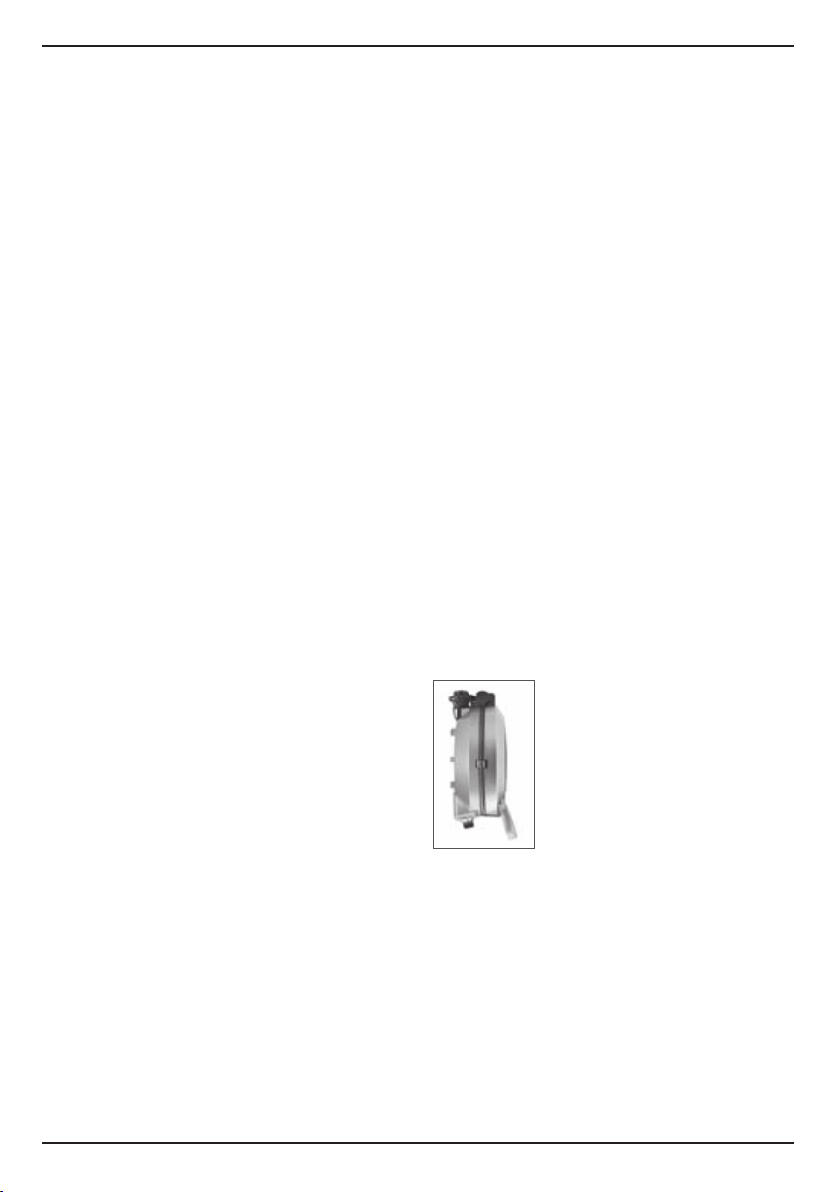
6
• Permita que el aparato se enfríe durante por
lo menos 30 minutos antes de limpiarlo.
Desconecte el cable de la toma de corriente
después del uso. Deje la tapa abierta para
permitir que se enfríe. Permita que el aparato
se enfríe completamente antes de manipularlo.
Retire las placas, presionando los botones
de liberación. Importante: permita que las
placas enfríen durante 30 minutos o más
antes de retirarlas o limpiarlas. Las placas, la
cuchara medidora y las pinzas son aptas para
lavavajillas. El mini cono formador debe lavarse
a mano. No utilice utensilios de
metal para limpiar las placas.
Tampoco utilice estropajos
metálicos; esto podría dañar el
revestimiento antiadherente.
Limpie el cuerpo del aparato
con un paño suave seco. Nunca
utilice limpiadores abrasivos ni
estropajos duros.
NUNCA SUMERJA EL CABLE, LA CLAVIJA O
EL APARATO EN AGUA U OTRO LÍQUIDO.
Cualquier otro servicio debe ser realizado por
un técnico autorizado.
ALMACENAJE
Coloque las placas en su sitio y enrolle el cable
de manera segura atrás del aparato antes
de guardarlo. Guarde el aparato en posición
vertical, con el panel de control arriba, para
ahorrar espacio. El seguro mantendrá las
placas bien cerradas.
GARANTÍA
Garantía limitada de tres
años
Esta garantía es para los consumidores
solamente.
Usted es un consumidor si ha
comprado su aparato Cuisinart
®
en una tienda,
para uso personal o casero. A excepción de
los estados donde la ley lo permita, esta
garantía no es para los detallistas u otros
comerciantes.
Cuisinart garantiza este aparato contra todo
defecto de materiales o fabricación durante 3
años después de la fecha de compra original,
siempre que el aparato haya sido utilizado
para uso doméstico y según las instrucciones.
Le aconsejamos que llene el formulario de
registro disponible en
www.cuisinart.com
a
fin de facilitar la verificación de la fecha de
compra original. Sin embargo, registrar el
producto no es necesario para recibir servicio
bajo esta garantía. En ausencia del recibo de
compra, el período de garantía será calculado
a partir de la fecha de fabricación.
Si este aparato presentara algún defecto de
materiales o fabricación durante el período de
garantía, la reparemos o reemplazaremos (a
nuestra opción). Para obtener servicio bajo
esta garantía, llame a nuestra línea directa
gratuita al 1-800-726-0190 o regrese el
aparato defectuoso a: Cuisinart, Service
Department, 7475 North Glen Harbor Blvd.,
Glendale, AZ 85307.
Regrese el aparato defectuoso, junto con su
recibo de compra y un cheque o giro postal
de US$10.00 por gastos de manejo y envío.
Los residentes de California sólo necesitan
dar una prueba de compra y deben llamar al
1-800-726-0190 para recibir instrucciones de
envío.
NOTA: para más seguridad, le aconsejamos
que mande su paquete por un método de
entrega con seguro y seguimiento. Cuisinart
no será responsable por los daños ocurridos
durante el transporte o por los paquetes
mandados a una dirección equivocada. Los
productos perdidos y/o lastimados durante el
envío no serán cubiertos bajo esta garantía.
Recuerde incluir su nombre, dirección y
teléfono, la descripción del problema, así
como cualquier información pertinente.
Este aparato satisface las más altas
exigencias de fabricación y ha sido diseñado
para uso sobre corriente de 120V, usando
accesorios y piezas de repuesto autorizados
solamente.
Esta garantía excluye expresamente los
daños causados por accesorios, piezas o
reparaciones no autorizados por Cuisinart.
Esta garantía no cubre el uso institucional o
comercial del producto, y no es válida en
caso de daños causados por mal uso,
negligencia o accidente.
Esta garantía excluye expresamente todos los
daños incidentales o consecuentes. Algunos

5
INSTRUCCIONES DE
OPERACIÓN
1. Enchufe el cable en una toma de corriente.
2. Ajuste la temperatura al nivel deseado o a
una de las temperaturas pre-programadas
para cocer crêpes, pizzellas, o tortillas.
Cierre la tapa. El indicador luminoso rojo se
encenderá.
3. En la posición cerrada, fije el tiempo o
coloque el temporizador sobre uno de los
tiempos pre-programados para crêpes,
pizzellas o tortillas.
4. Cuando las placas alcancen la temperatura
deseada, el indicador luminoso verde
se encenderá. NOTA: el tiempo de
calentamiento dependerá de la temperatura
elegida.
5. Vierta la mezcla o coloque los ingredientes
sobre las placas. La luz verde se apagará.
6. Cierre la tapa (si usa la posición cerrada).
El temporizador solamente se pondrá en
marcha una vez que la tapa está cerrada
y bloqueada. NOTA: si mantiene la tapa
abierta durante más de 5 segundos, el
temporizador se apagará.
7. Cuando los alimentos estén listos, el
indicador luminoso verde se encenderá y la
unidad emitirá un pitido.
8. Véase los consejos de cocción en la tabla en
la página 8.
Precaución: el cuerpo del aparato se vuelve
muy caliente durante el uso. Utilice guantes
para el horno/manoplas para evitar las
quemaduras. Utilice el asa, la cual permanece
fría durante la cocción, para abrir y cerrar las
placas.
Nota: puede que el aparato produzca humo y
un ligero olor a quemado la primera vez que lo
use; esto es normal.
CONSEJOS ÚTILES
1. El control de temperatura sirve para fijar y
mantener la temperatura de la superficie
de cocción. Puede ajustar la temperatura
durante el funcionamiento, dependiendo del
tipo de alimentos cocinados. Utilice nuestras
temperaturas pre-programadas para preparar
"crêpes", pizzellas y tortillas.
2. El tiempo de cocción depende de la
receta. Nuestros tiempos pre-programados
permiten cocer "crêpes", pizzellas y tortillas
fácilmente. Nota: el tiempo de cocción
es aproximado. Consulte las pautas en
la tabla incluida antes de las recetas. El
temporizador solamente se pondrá en
marcha una vez que la tapa está cerrada y
bloqueada.
3. Para un calentamiento más rápido, permita
que el aparato caliente en la posición
cerrada. Tenga cuidado al cambiar la
posición, ya que las placas estarán muy
calientes.
Consejos útiles para preparar "crêpes":
1. Deje descansar la mezcla en el refrigerador
antes de usarla. Se recomienda dejar
descansar la mezcla durante 30 minutos o
más (preferiblemente durante 8–12 horas).
Esto permite que el gluten (presente en
la harina) se relaje y que las moléculas de
almidón absorben completamente el líquido,
lo que resulta en una mezcla más espesa, y
en "crêpes" más uniformes y delicadas. Una
mezcla más fría y descansada también evita
los derrames.
2. La mejor temperatura para cocer "crêpes" es
MED – la cual también es la temperatura pre-
programada para cocer "crêpes" y pizzellas.
Si las "crêpes" parecen espesas, o si desea
que sean más/menos cocidas, ajuste el nivel
de temperatura.
3. Por lo general, cada "crêpes" está lista en
aproximadamente 1½ minuto, el tiempo pre-
programado para cocer "crêpes". Algunos
tipos de "crêpes", como las "crespelle",
requieren menos tiempo. Si desea que sus
"crêpes" sean más/menos cocidas, ajuste la
temperatura a gusto.
LIMPIEZA Y
MANTENIMIENTO
•
Nunca utilice utensilios de metal; esto podría
dañar el revestimiento antiadherente de las
placas. Solamente use las pinzas provistas o
utensilios de madera o de plástico a prueba
del calor.
• No permita que utensilios de plástico, incluso
las pinzas proveídas, hagan contacto con las
placas calientes.
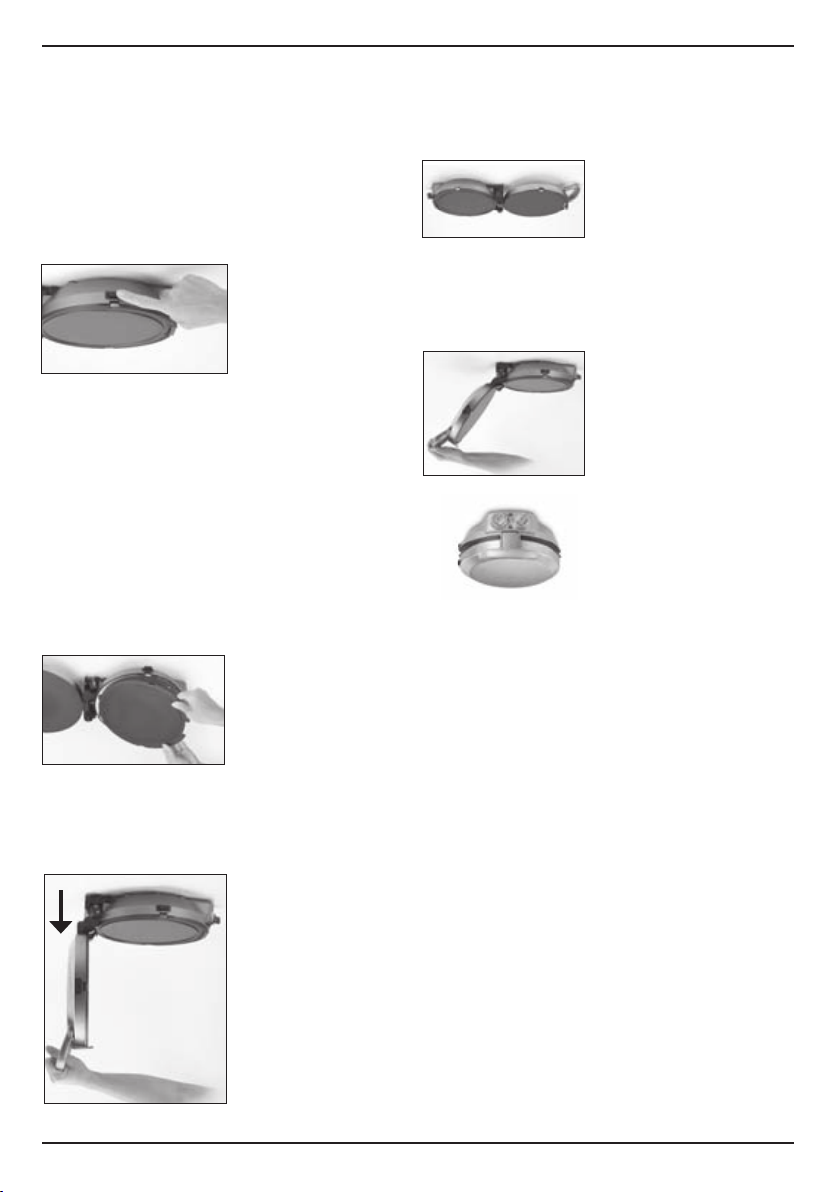
4
ANTES DEL PRIMER USO
Retire el aparato del material de embalaje y
quite las etiquetas promocionales pegadas
en el cuerpo del aparato. Asegúrese de que
todas las piezas descritas en la sección
Piezas y características estén incluidas.
Le aconsejamos que guarde el material de
embalaje.
Antes de usar el aparato por primera vez, limpie
bien el cuerpo con un paño húmedo y lave bien
las placas y los accesorios para quitar el polvo
o cualquier residuo que se haya acumulado
durante el proceso de fabricación y envío.
Nota: las placas de su crepera/panquequera/
prensa-pizzellas International Chef
™
están
cubiertas con un revestimiento antiadherente.
Sin embargo, le aconsejamos que engrase las
placas con aceite vegetal sin sabor antes del
primer uso. Aplique el aceite con una toallita de
papel o una brocha. Haga lo mismo antes de
cada uso.
INSTRUCCIONES DE
ENSAMBLAJE
Coloque el aparato sobre
una superficie limpia,
plana y segura. El aparato
tiene tres posiciones:
Posición cerrada
–
La
placa superior descansa
sobre la placa inferior.
Esta
es la posición de inicio
y calentamiento. Tenga
cuidado al cambiar la
posición de las placas,
ya que éstas estarán muy
calientes.
Posición semi-abierta – La placa superior
está abierta en un ángulo de 105° con respeto
a la base. Abra la tapa en esta posición antes
de usar el aparato como
prensa o en la posición
abierta.
Para ajustar la tapa a esta
posición, presione la parte
superior del seguro y alce el asa hasta que la
tapa se bloquee. El aparato permanecerá en
esta posición hasta que cierre la tapa o la abra
completamente.
Posición abierta
– La placa superior
y la placa inferior
están paralelas y
permanecen planas
para duplicar
la superficie de
cocción.
Coloque el aparato
en la posición semi-
abierta. Luego,
levante el asa
verticalmente en un
ángulo de 90˚. Empuje el asa hacia atrás hasta
que las dos placas estén al mismo nivel.
El aparato permanecerá en esta posición hasta
que lo vuelva a cerrar.
Instalación de las
placas:
1. Coloque el aparato
en la posición abierta.
2. Instale una placa a la
vez. La placa con la
inscripción "LOWER" (inferior) está diseñada
para la base del aparato. La placa con la
inscripción "UPPER" (superior) está diseñada
para la tapa del aparato.
3. Ubique los dos orificios en la bisagra del
aparato. Incline la placa y haga coincidir las
espigas en la parte trasera de ésta con los
orificios en la bisagra. Introduzca las espigas
en los orificios y presione la parte delantera
hacia abajo. La placa se bloqueará.
4. Repita este procedimiento con la segunda
placa.
Remoción de las placas:
1. Localice los botones
de liberación de las
placas en el costado
derecho del aparato.
Presione firmemente
el botón para liberar
la placa.
2. Sostenga la placa con ambas manos,
deslícela fuera de los orificios y álcela.
3. Retire la segunda placa de la misma manera,
presionando el otro botón de liberación.
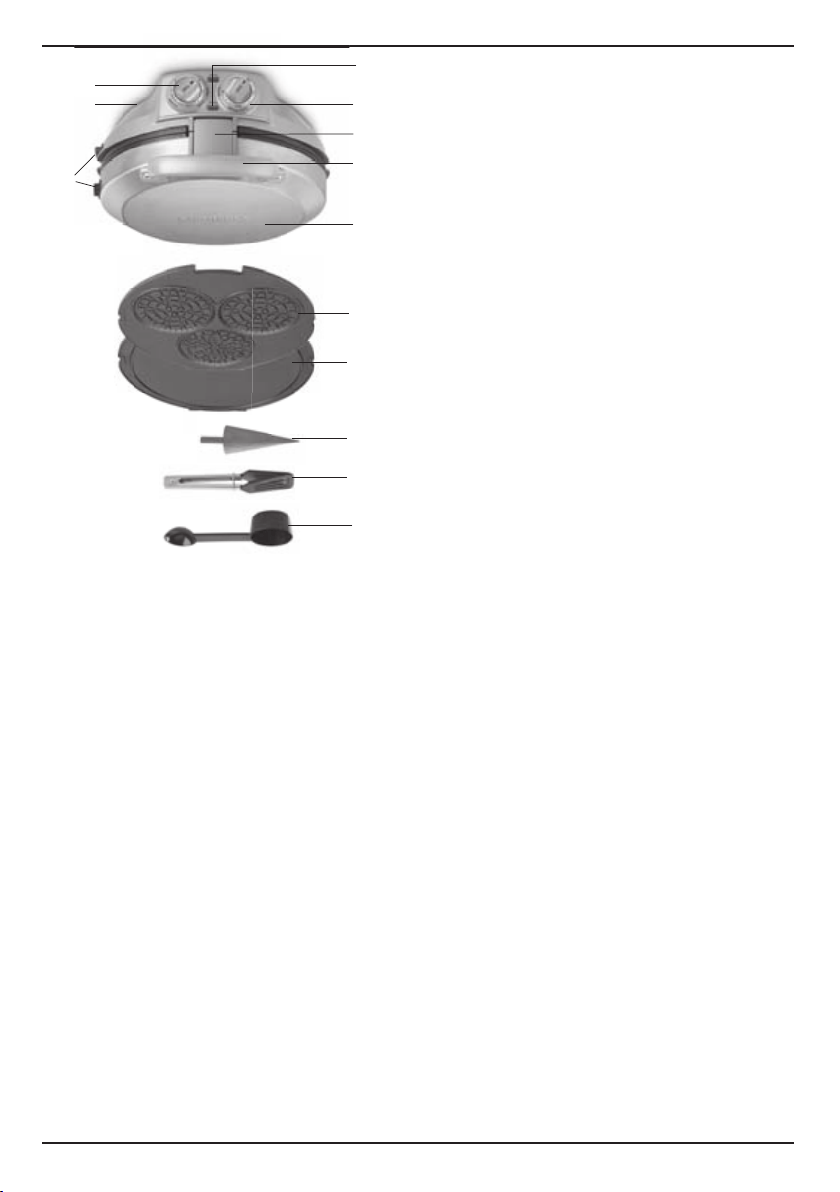
3
toma de corriente, inviértela. Si aún no entrara
completamente, comuníquese con un electricista.
No intente modificarla.
PIEZAS Y CARACTERÍSTICAS
1. Cuerpo – Elegante cuerpo de acero
inoxidable cepillado con logotipo estampado
Cuisinart.
2. Asa para abrir la tapa – Asa duradera, fácil
de alzar y de fácil manejo, que permanece
fría al tacto
3. Placas reversibles
y removibles – Antiadherentes y aptas para
lavavajillas, para una limpieza fácil.
a. Lado plano: perfecto para panqueques,
"crêpes", tortillas y otros panes sin levadura.
b. Lado estampado: Ideal para preparar
pizzellas y mini barquillos.
4. Control de temperatura – Tres ajustes de
temperatura: Lo (bajo), Med (medio) y Hi (alto)
y temperaturas pre-programadas para
cocer "crêpe", pizzellas y tortillas.
5. Temporizador – Ajustes manuales desde 0
hasta 3 minutos. Tiempos pre-programados
para cocer "crêpe", pizzellas y tortillas.
6. Indicadores luminosos – La luz roja
indica que el aparato está encendido y
calentando; la luz verde indica que está listo
para cocinar y listo para comer.
7. Espacio para guardar el cable (no
ilustrado) – El cable se enrolla atrás del
aparato.
8. Pies de goma – Mantienen el aparato estable
y no dejan marcas en la encimera.
9. Botones de liberación de las placas –
Permiten retirar las placas, para una limpieza
fácil.
10. Tapa con seguro – Bloquea las placas
para evitar que se abran durante la cocción.
Mantiene el aparato cerrado cuando se
guarda verticalmente.
11. Cuchara medidora – Cuchara de doble cara
para
1
⁄3
taza (80 ml) y 1 cucharada (15 ml).
12. Pinzas – Para retirar fácilmente los alimentos.
13. Mini cono formador
14. Sin BPA – (no ilustrado) Ninguna de las
piezas en contacto con los alimentos
contiene bisfenol A (BPA).
15. Modo "vistazo rápido" – (no ilustrado)
Permite abrir las placas durante hasta 5
segundos sin que se apague el temporizador.
ÍNDICE
Medidas de seguridad importantes . . . . . . .2
Piezas y características . . . . . . . . . . . . . . . 3
Antes del primer uso . . . . . . . . . . . . . . . . . .4
Instrucciones de ensamblaje . . . . . . . . . . . .4
Instrucciones de operación . . . . . . . . . . . . 5
Consejos útiles . . . . . . . . . . . . . . . . . . . . . . .5
Limpieza y mantenimiento . . . . . . . . . . . . . 5
Almacenaje. . . . . . . . . . . . . . . . . . . . . . . . . .6
Garantía . . . . . . . . . . . . . . . . . . . . . . . . . . . 6
Pautas de cocción y recetas . . . . . . . . . . . .8
1
2
8
5
9
6
4
3a
3b
10
11
12
13

2
MEDIDAS DE
SEGURIDAD
IMPORTANTES
Siempre que use aparatos eléctricos, debe tomar
precauciones básicas de seguridad, incluso las
siguientes:
1. LEA TODAS LAS INSTRUCCIONES.
2. No toque las superficies calientes; utilice el
mango y los botones o perillas.
3. Para reducir el riesgo de incendio,
electrocución o herida, NO SUMERJA EL
CABLE, LA CLAVIJA O EL APARATO en
agua u otro líquido.
4. Supervise de cerca el uso de este aparato
cuando esté siendo usado por niños o
cerca de ellos.
5. Desconecte el aparato cuando no esté en
uso y antes de limpiarlo. Permita que se
enfríe antes de instalar o remover piezas y
antes de limpiarlo.
6. No utilice este aparato si el cable o la
clavija estuviesen dañados, después de
que hubiese funcionado mal o se hubiese
caído o si estuviese dañado. Regrese el
aparato a un centro de servicio autorizado
para su revisión, reparación o ajuste.
7. El uso de accesorios no recomendados ni
vendidos por Cuisinart presenta un riesgo
de incendio, electrocución o herida.
8. No lo utilice en exteriores.
9. No permita que el cable cuelgue del borde
de la encimera o de la mesa, ni que haga
contacto con superficies calientes.
10. No coloque el aparato sobre o cerca de
un quemador a gas o una hornilla eléctrica
caliente, ni en un horno caliente.
11. No utilice el aparato para ningún otro fin
que no sea el indicado.
12. Siempre desconecte el aparato después
de usarlo.
13. Para desconectar el aparato de manera
segura en cualquier momento, desenchufe
el cable.
14. Tenga sumo cuidado al mover un aparato
que contenga aceite u otros líquidos
calientes.
15. ADVERTENCIA: PARA REDUCIR
EL RIESGO DE INCENDIO O
ELECTROCUCIÓN, LAS REPARACIONES
DEBEN SER REALIZADAS POR UN
TÉCNICO CALIFICADO. ESTE APARATO
NO CONTIENE PIEZAS QUE PUEDAN
SER REPARADAS POR EL USUARIO.
16. No haga funcionar el aparato debajo
o adentro de un armario. Siempre
desconecte el aparato antes de
guardarlo en un armario. Dejar el aparato
conectado presenta un riesgo de incendio,
especialmente si éste toca las paredes o
la puerta del armario cuando cierra.
GUARDE ESTAS
INSTRUCCIONES
PARA USO
DOMÉSTICO
SOLAMENTE
USO DE EXTENSIONES
El cable provisto con este aparato es corto
para reducir el peligro de que alguien se
enganche o tropiece con un cable más largo.
Puede usarse una extensión eléctrica con
cuidado.
La clasificación nominal de la extensión debe
ser por lo menos igual a la del aparato. Es
importante colocar la extensión sobre la
encimera o la mesa de tal forma que los niños
o los animales no puedan jalarla o tropezar
con ella.
AVISO
El cable de este aparato está dotado de una
clavija polarizada (una pata es más ancha que
otra). Como medida de seguridad, se podrá
enchufar de una sola manera en la toma
de corriente polarizada. Si no entrara en la
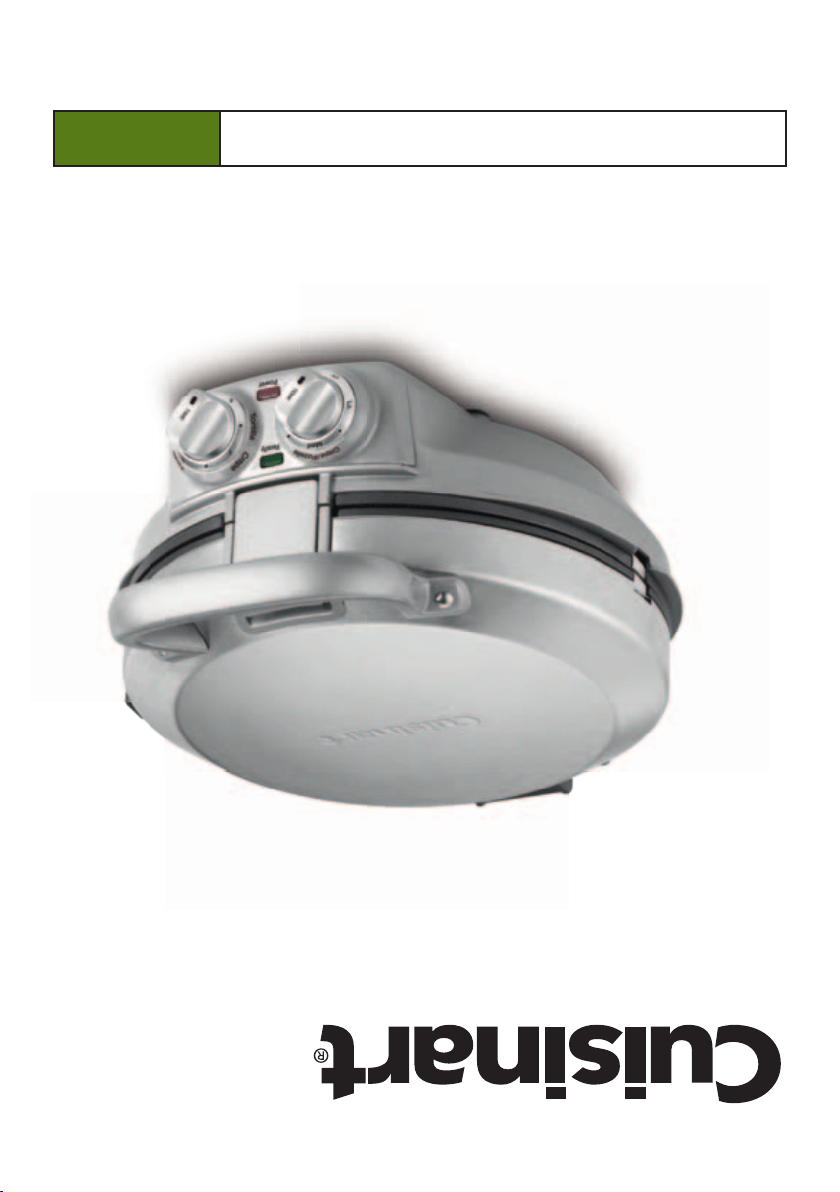
INSTRUCCIONES Y LIBRO DE RECETAS
Crepera/Panquequera/Prensa-pizzellas International Chef
™
Serie CPP-200
Para su seguridad y para disfrutar plenamente de este producto, siempre lea las instrucciones
cuidadosamente antes de usarlo.