© 2008 Sony Corporation
4-000-950-62(1)
Digital Still Camera
Cámara fotografía digital
DSC-T77
Instruction Manual
······················································································
Before operating the unit, please read this manual thoroughly, and retain it for
future reference.
Manual de instrucciones
····························································
Antes de operar la unidad, lea este manual atentamente, y guárdelo para
futuras referencias.
GB
ES
2
Owner’s Record
The model and serial numbers are located
on the bottom. Record the serial number in
the space provided below. Refer to these
numbers whenever you call upon your Sony
dealer regarding this product.
Model No. DSC-T77
Serial No. ___________________________
To reduce fire or shock hazard, do
not expose the unit to rain or
moisture.
IMPORTANT
SAFEGUARDS
For your protection, please read these safety
instructions completely before operating
the appliance, and keep this manual for
future reference.
Carefully observe all warnings, precautions
and instructions on the appliance, or the one
described in the operating instructions and
adhere to them.
[ Power Sources
This set should be operated only from the type of
power source indicated on the marking label. If
you are not sure of the type of electrical power
supplied to your home, consult your dealer or
local power company. For those sets designed to
operate from battery power, or other sources, refer
to the operating instructions.
[ Polarization
This set may be equipped with a polarized ac
power cord plug (a plug having one blade wider
than the other).
This plug will fit into the power outlet only one
way. This is a safety feature. If you are unable to
insert the plug fully into the outlet, try reversing
the plug. If the plug should still fail to fit, contact
your electrician to have a suitable outlet installed.
Do not defeat the safety purpose of the polarized
plug by forcing it in.
[ Overloading
Do not overload wall outlets, extension cords or
convenience receptacles beyond their capacity,
since this can result in fire or electric shock.
[ Object and Liquid Entry
Never push objects of any kind into the set
through openings as they may touch dangerous
voltage points or short out parts that could result
in a fire or electric shock. Never spill liquid of any
kind on the set.
English
WARNING
For Customers in the U.S.A.
This symbol is intended to
alert the user to the presence
of uninsulated “dangerous
voltage” within the
product’s enclosure that
may be of sufficient
magnitude to constitute a
risk of electric shock to
persons.
This symbol is intended to
alert the user to the presence
of important operating and
maintenance (servicing)
instructions in the literature
accompanying the
appliance.
Use

3
[ Attachments
Do not use attachments not recommended by the
manufacturer, as they may cause hazards.
[ Cleaning
Unplug the set from the wall outlet before
cleaning or polishing it. Do not use liquid cleaners
or aerosol cleaners. Use a cloth lightly dampened
with water for cleaning the exterior of the set.
[ Water and Moisture
Do not use power-line operated sets near water –
for example, near a bathtub, washbowl, kitchen
sink, or laundry tub, in a wet basement, or near a
swimming pool, etc.
[ Power-Cord Protection
Route the power cord so that it is not likely to be
walked on or pinched by items placed upon or
against them, paying particular attention to the
plugs, receptacles, and the point where the cord
exits from the appliance.
[ Accessories
Do not place the set on an unstable cart, stand,
tripod, bracket, or table. The set may fall, causing
serious injury to a child or an adult, and serious
damage to the set. Use only a cart, stand, tripod,
bracket, or table recommended by the
manufacturer.
[ Ventilation
The slots and openings in the cabinet are provided
for necessary ventilation. To ensure reliable
operation of the set, and to protect it from
overheating, these slots and openings must never
be blocked or covered.
– Never cover the slots and openings with a cloth
or other materials.
– Never block the slots and openings by placing
the set on a bed, sofa, rug, or other similar
surface.
– Never place the set in a confined space, such as
a bookcase, or built-in cabinet, unless proper
ventilation is provided.
– Do not place the set near or over a radiator or
heat register, or where it is exposed to direct
sunlight.
[ Lightning
For added protection for this set during a lightning
storm, or when it is left unattended and unused for
long periods of time, unplug it from the wall
outlet and disconnect the antenna or cable system.
This will prevent damage to the set due to
lightning and power-line surges.
[ Damage Requiring Service
Unplug the set from the wall outlet and refer
servicing to qualified service personnel under the
following conditions:
– When the power cord or plug is damaged or
frayed.
– If liquid has been spilled or objects have fallen
into the set.
– If the set has been exposed to rain or water.
– If the set has been subject to excessive shock by
being dropped, or the cabinet has been
damaged.
– If the set does not operate normally when
following the operating instructions. Adjust
only those controls that are specified in the
operating instructions. Improper adjustment of
other controls may result in damage and will
often require extensive work by a qualified
technician to restore the set to normal operation.
– When the set exhibits a distinct change in
performance – this indicates a need for service.
[ Servicing
Do not attempt to service the set yourself as
opening or removing covers may expose you to
dangerous voltage or other hazards.
Refer all servicing to qualified service personnel.
[ Replacement parts
When replacement parts are required, be sure the
service technician has used replacement parts
specified by the manufacturer that have the same
characteristics as the original parts.
Unauthorized substitutions may result in fire,
electric shock, or other hazards.
[ Safety Check
Upon completion of any service or repairs to the
set, ask the service technician to perform routine
safety checks (as specified by the manufacturer)
to determine that the set is in safe operating
condition.
Installation
Service

4
Read this first
Replace the battery with the specified type only.
Otherwise, fire or injury may result.
Do not expose the batteries to excessive heat such
as sunshine, fire or the like.
[ RECYCLING LITHIUM-ION
BATTERIES
Lithium-Ion batteries are
recyclable.
You can help preserve our
environment by returning your
used rechargeable batteries to
the collection and recycling
location nearest you.
For more information regarding recycling of
rechargeable batteries, call toll free
1-800-822-8837, or visit http://www.rbrc.org/
Caution: Do not handle damaged or leaking
Lithium-Ion batteries.
This power unit is intended to be correctly
orientated in a vertical or floor mount position.
If you have any questions about this product, you
may call:
Sony Customer Information Center
1-800-222-SONY (7669)
The number below is for the FCC related matters
only.
[ Regulatory Information
[ CAUTION
You are cautioned that any changes or
modifications not expressly approved in this
manual could void your authority to operate this
equipment.
CAUTION
For Customers in the U.S.A. and
Canada
Battery charger
For Customers in the U.S.A.
Declaration of Conformity
Trade Name: SONY
Model No.: DSC-T77
Responsible Party: Sony Electronics Inc.
Address:16530 Via Esprillo,
San Diego, CA 92127U.S.A.
Telephone No.: 858-942-2230
This device complies with Part 15 of the FCC
Rules. Operation is subject to the following
two conditions: (1) This device may not cause
harmful interference, and (2) this device must
accept any interference received, including
interference that may cause undesired
operation.

5
[ Note:
This equipment has been tested and found to
comply with the limits for a Class B digital
device, pursuant to Part 15 of the FCC Rules.
These limits are designed to provide reasonable
protection against harmful interference in a
residential installation. This equipment generates,
uses, and can radiate radio frequency energy and,
if not installed and used in accordance with the
instructions, may cause harmful interference to
radio communications. However, there is no
guarantee that interference will not occur in a
particular installation. If this equipment does
cause harmful interference to radio or television
reception, which can be determined by turning the
equipment off and on, the user is encouraged to
try to correct the interference by one or more of
the following measures:
– Reorient or relocate the receiving antenna.
– Increase the separation between the equipment
and receiver.
– Connect the equipment into an outlet on a
circuit different from that to which the receiver
is connected.
– Consult the dealer or an experienced radio/TV
technician for help.
The supplied interface cable must be used with the
equipment in order to comply with the limits for a
digital device pursuant to Subpart B of Part 15 of
FCC Rules.
This product has been tested and found compliant
with the limits set out in the EMC Directive for
using connection cables shorter than 3 meters
(9.8 feet).
[ Attention
The electromagnetic fields at the specific
frequencies may influence the picture and sound
of this unit.
[ Notice
If static electricity or electromagnetism causes
data transfer to discontinue midway (fail), restart
the application or disconnect and connect the
communication cable (USB, etc.) again.
For Customers in Europe
GB

6
[ Disposal of Old Electrical &
Electronic Equipment (Applicable
in the European Union and other
European countries with separate
collection systems)
This symbol on the product or on its packaging
indicates that this product shall not be treated as
household waste. Instead it shall be handed over
to the applicable collection point for the recycling
of electrical and electronic equipment. By
ensuring this product is disposed of correctly, you
will help prevent potential negative consequences
for the environment and human health, which
could otherwise be caused by inappropriate waste
handling of this product. The recycling of
materials will help to conserve natural resources.
For more detailed information about recycling of
this product, please contact your local Civic
Office, your household waste disposal service or
the shop where you purchased the product.
Disposal of waste batteries
(applicable in the European Union
and other European countries with
separate collection systems)
This symbol on the battery or on the packaging
indicates that the battery provided with this
product shall not be treated as household waste.
By ensuring these batteries are disposed of
correctly, you will help prevent potentially
negative consequences for the environment and
human health which could otherwise be caused by
inappropriate waste handling of the battery. The
recycling of the materials will help to conserve
natural resources.
In case of products that for safety, performance or
data integrity reasons require a permanent
connection with an incorporated battery, this
battery should be replaced by qualified service
staff only.
To ensure that the battery will be treated properly,
hand over the product at end-of-life to the
applicable collection point for the recycling of
electrical and electronic equipment.
For all other batteries, please view the section on
how to remove the battery from the product
safely. Hand the battery over to the applicable
collection point for the recycling of waste
batteries.
For more detailed information about recycling of
this product or battery, please contact your local
Civic Office, your household waste disposal
service or the shop where you purchased the
product.

7
[ Notice for the customers in the
countries applying EU Directives
The manufacturer of this product is Sony
Corporation, 1-7-1 Konan Minato-ku Tokyo, 108-
0075 Japan. The Authorized Representative for
EMC and product safety is Sony Deutschland
GmbH, Hedelfinger Strasse 61, 70327 Stuttgart,
Germany. For any service or guarantee matters
please refer to the addresses given in separate
service or guarantee documents.
A moulded plug complying with BS 1363 is fitted
to this equipment for your safety and
convenience.
Should the fuse in the plug supplied need to be
replaced, a fuse of the same rating as the supplied
one and approved by ASTA or BSI to BS 1362,
(i.e., marked with an or mark) must be
used.
If the plug supplied with this equipment has a
detachable fuse cover, be sure to attach the fuse
cover after you change the fuse. Never use the
plug without the fuse cover. If you should lose the
fuse cover, please contact your nearest Sony
service station.
Notice for customers in the
United Kingdom

8
Table of contents
IMPORTANT SAFEGUARDS .....................................................................2
Read this first ............................................................................................4
Notes on using the camera .....................................................................10
Getting started ................................................................... 11
Checking the accessories supplied ........................................................11
Identifying parts.......................................................................................12
Charging the battery pack.......................................................................13
Inserting the battery pack/a “Memory Stick Duo” (not supplied) ............ 15
Setting the clock ......................................................................................17
Shooting/viewing images ...................................... 18
Shooting images......................................................................................18
Viewing images........................................................................................19
Using shooting functions ........................................................ 20
Detecting smiles and shooting automatically (Smile Shutter) .................20
Detecting the shooting conditions automatically (Scene Recognition)... 21
Shooting close-ups (Macro/Close focus) ................................................22
Using the self-timer..................................................................................22
Selecting a flash mode ............................................................................23
Focusing on a specific point of the frame ...............................................24
Focusing on the face of the subject (Face Detection).............................24
Selecting the image size to match the usage..........................................25
Using the Shooting mode that matches the scene (Scene Selection) ....27
Shooting movies ......................................................................................28
Displaying minimum indicators (Easy Shooting) .....................................29
Using viewing functions .......................................................... 30
Viewing an enlarged image (Playback zoom).........................................30
Displaying images full-screen (Wide Zoom)............................................30
Rotating a vertical orientation image (Temporarily rotated display)........ 31
Viewing still images with music (Slideshow)............................................31
Searching for an image (Image Index)....................................................32
Selecting the display format (View Mode)...............................................32

9
Deleting images ............................................................................. 34
Deleting the currently displayed image .................................................. 34
Deleting multiple images......................................................................... 34
Deleting all images (Format) ................................................................... 35
Connecting to other devices ................................................. 36
Viewing images on a TV.......................................................................... 36
Printing still images ................................................................................. 37
Using the camera with a computer ......................................................... 38
Changing camera settings ...................................................... 42
Changing the screen display .................................................................. 42
Changing the operation sounds.............................................................. 42
Using the HOME screen.......................................................................... 43
Using the MENU items ............................................................................ 45
Using functions in Program Auto mode .................................................. 47
Others .................................................................................................. 48
Viewing “Cyber-shot Handbook”............................................................. 48
List of icons displayed on the screen...................................................... 49
Troubleshooting....................................................................................... 51
Precautions.............................................................................................. 53
Specifications.......................................................................................... 54

10
x
Notes on using the camera
Internal memory and “Memory
Stick Duo” back up
Do not turn off the camera, remove the battery
pack, or remove the “Memory Stick Duo”
while the access lamp is lit. Otherwise, the
internal memory data or “Memory Stick Duo”
may be damaged. Be sure to make a backup
copy to protect your data.
On management files
When you insert a “Memory Stick Duo”
without a management file into the camera and
turn on the power, part of the “Memory Stick
Duo” capacity is used to automatically create a
management file. It may take some time until
you can perform the next operation.
Notes on recording/playback
• Before you start recording, make a trial
recording to make sure that the camera is
working correctly.
• The camera is neither dust-proof, nor splash-
proof, nor water-proof. Read “Precautions”
(page 53) before operating the camera.
• Avoid exposing the camera to water. If water
enters inside the camera, a malfunction may
occur. In some cases, the camera cannot be
repaired.
• Do not aim the camera at the sun or other
bright light. It may cause the malfunction of
the camera.
• Do not use the camera near a location that
generates strong radio waves or emits
radiation. Otherwise, the camera may not
properly record or play back images.
• Using the camera in sandy or dusty locations
may cause malfunctions.
• If moisture condensation occurs, remove it
before using the camera (page 53).
• Do not shake or strike the camera. It may
cause a malfunction and you may not be able
to record images. Furthermore, the recording
media may become unusable or image data
may be damaged.
• Clean the flash surface before use. The heat
of flash emission may cause dirt on the flash
surface to become discolored or to stick to
the flash surface, resulting in insufficient
light emission.
Notes on the LCD screen
• The LCD screen is manufactured using
extremely high-precision technology so over
99.99% of the pixels are operational for
effective use. However, some tiny black and/
or bright dots (white, red, blue or green) may
appear on the LCD screen. These dots are a
normal result of the manufacturing process,
and do not affect the recording.
• If water droplets or other liquids splash on
the LCD screen and make it wet,
immediately wipe off the screen with a soft
cloth. Leaving liquids on the LCD screen
surface can harm the quality and cause a
malfunction.
On image data compatibility
• The camera conforms with DCF (Design rule
for Camera File system) universal standard
established by JEITA (Japan Electronics and
Information Technology Industries
Association).
• Sony does not guarantee that the camera will
play back images recorded or edited with
other equipment, or that other equipment will
play back images recorded with the camera.
Warning on copyright
Television programs, films, videotapes, and
other materials may be copyrighted.
Unauthorized recording of such materials may
be contrary to the provisions of the copyright
laws.
No compensation for damaged
content or recording failure
Sony cannot compensate for failure to record
or loss or damage of recorded content due to a
malfunction of the camera or recording media,
etc.
Getting started
11
G
e
tti
n
g
s
t
ar
t
e
d
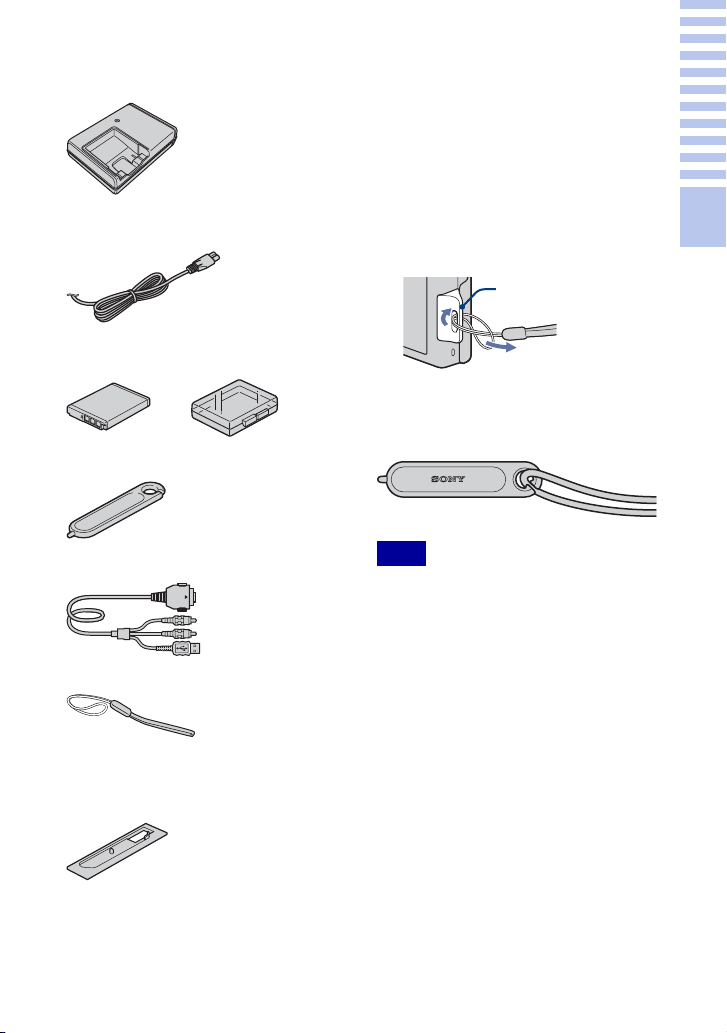
Checking the accessories supplied
• Battery charger BC-CSD (1)
• Power cord (mains lead) (1)
(not supplied in the USA and Canada)
• Rechargeable battery pack NP-BD1 (1)/
Battery case (1)
• Paint pen (1)
• USB, A/V cable for multi-use terminal (1)
• Wrist strap (1)
• Station plate F (1)
The station plate is used when mounting the
camera on Cyber-shot station (not
supplied).
• CD-ROM (1)
– Cyber-shot application software
– “Cyber-shot Handbook”
– “Cyber-shot Step-up Guide”
• Instruction Manual (this manual) (1)
x
Using the wrist strap
Attach the strap and place your hand through
the loop to prevent the camera from damage
by being dropped.
x
Using the paint pen
The paint pen is used when operating the
touch panel. It attaches to the wrist strap.
• Do not carry the camera by holding the
paint pen. The camera may fall off.
Hook
Note
12
Getting started
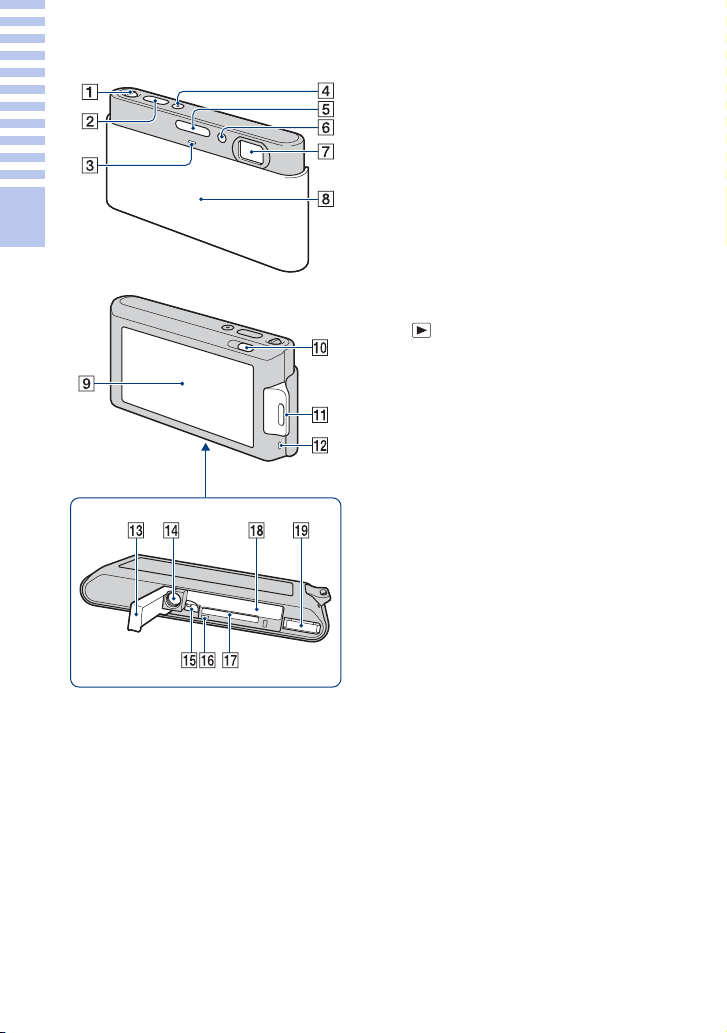
Identifying parts
A Zoom (W/T) lever
B Shutter button
C Microphone
D POWER button/POWER lamp
E Flash
F Self-timer lamp/Smile Shutter lamp/
AF illuminator
G Lens
H Lens cover
I LCD screen/Touch panel
J (Playback) button
K Hook for wrist strap/Grip
L Speaker
M Battery/“Memory Stick Duo” cover
N Tripod receptacle
• Use a tripod with a screw less than 5.5 mm
(7/32 inch) long. Otherwise, you cannot
firmly secure the camera, and damage to the
camera may occur.
O Battery eject lever
P Access lamp
Q “Memory Stick Duo” slot
R Battery insertion slot
S Multi connector
Bottom
13
Getting started
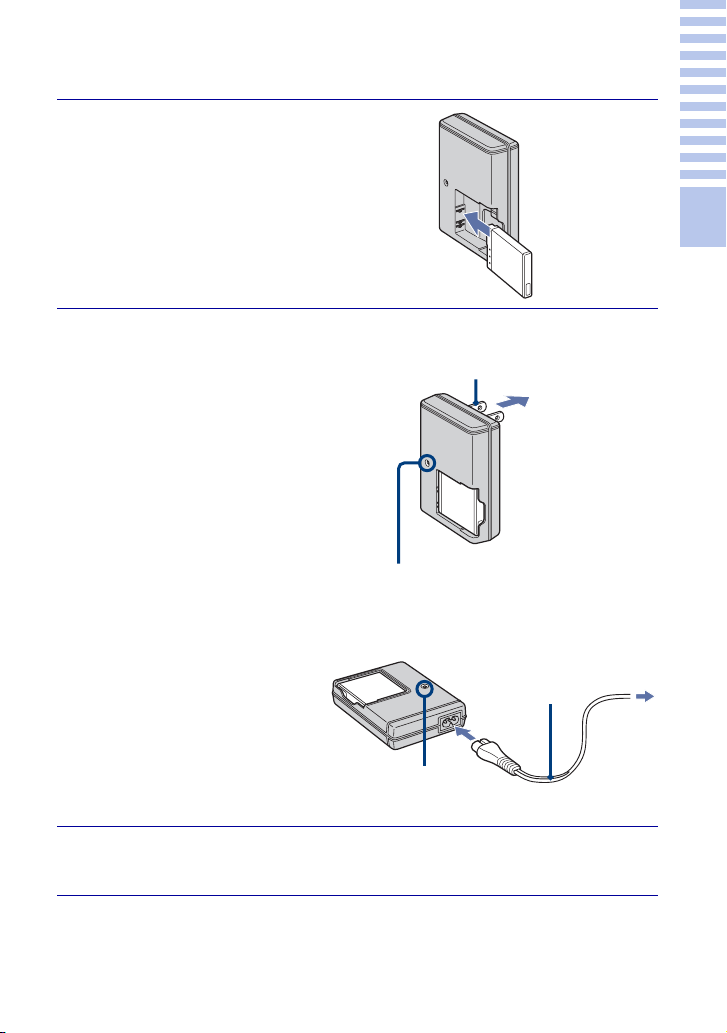
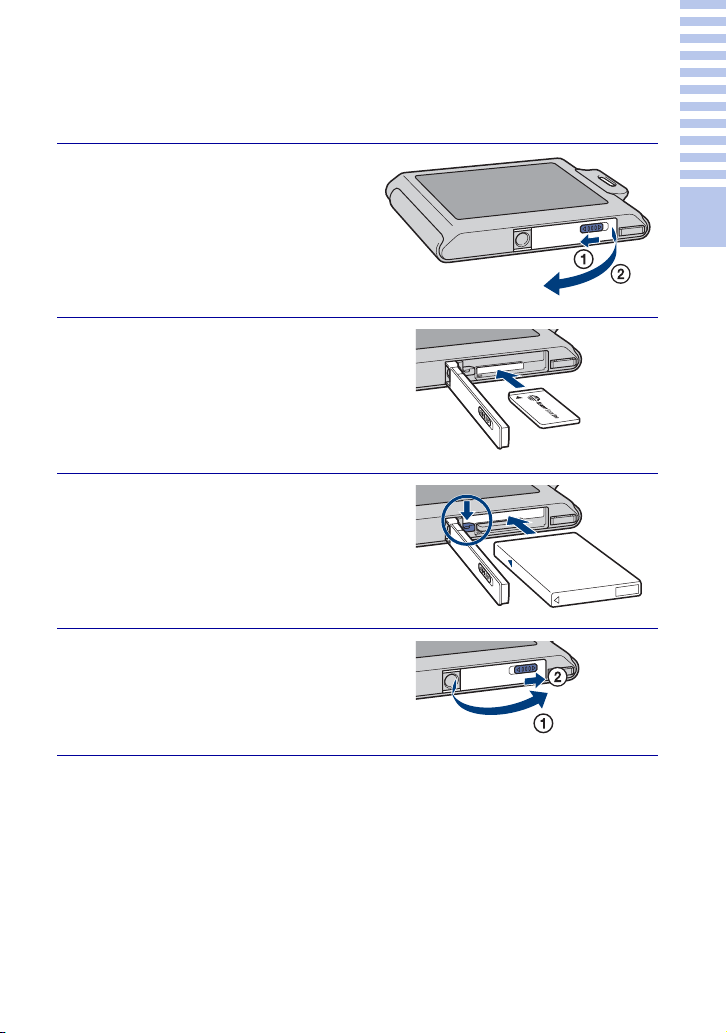
Charging the battery pack
1
Insert the battery pack into
the battery charger.
• You can charge the battery even when
it is partially charged.
2
Connect the battery
charger to the wall
outlet (wall socket).
If you continue charging the
battery pack for about one more
hour after the CHARGE lamp
turns off, the charge will last
slightly longer (full charge).
CHARGE lamp
Lit: Charging
Off: Charging finished (normal
charge)
3
When charging is finished, disconnect the battery
charger.
Battery pack
CHARGE lamp
For customers in the USA and Canada
Plug
CHARGE lamp
Power cord
(mains lead)
For customers in countries/regions other
than the USA and Canada
14
Getting started
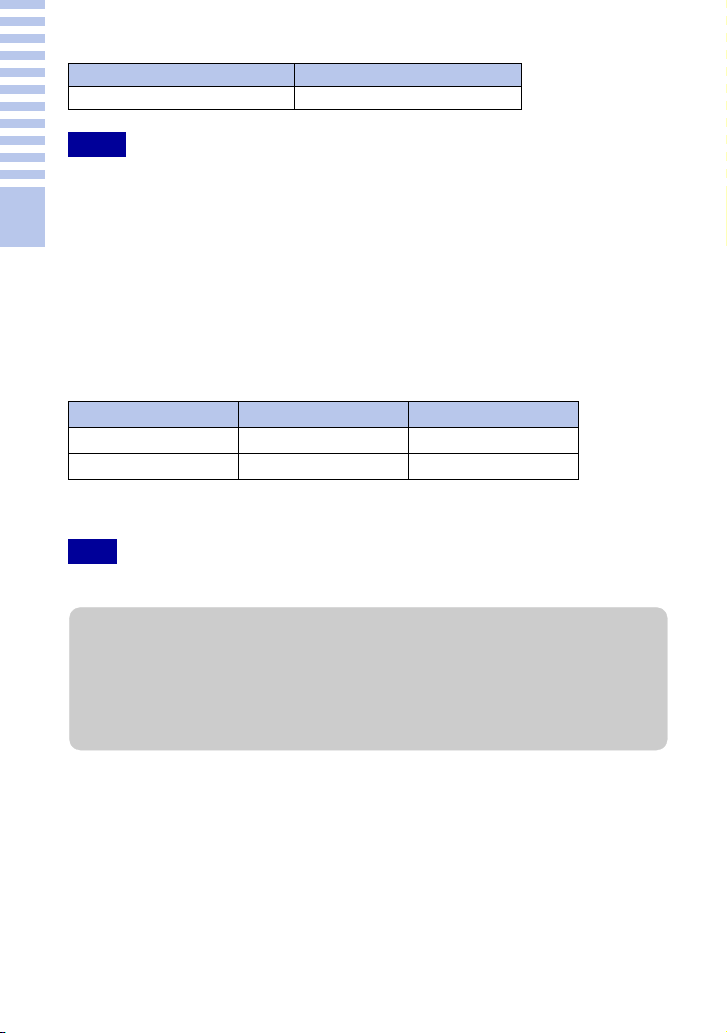
x
Charging time
• The table above shows the time required to charge a fully depleted battery pack at a temperature of
25°C (77°F). Charging may take longer depending on conditions of use and circumstances.
• Connect the battery charger to the nearest wall outlet (wall socket).
• Even if the CHARGE lamp is not lit, the battery charger is not disconnected from the AC power
source (mains) as long as it is connected to the wall outlet (wall socket). If some trouble occurs
while using the battery charger, immediately shut off the power by disconnecting the plug from the
wall outlet (wall socket).
• When charging is finished, disconnect the power cord (mains lead) from the wall outlet (wall
socket), and remove the battery pack from the battery charger.
• Designed for use with compatible Sony batteries.
x
Battery life and number of images you can record/view
• The measurement method is based on the CIPA standard. (CIPA: Camera & Imaging Products
Association)
• The battery life and the number of still images may vary depending on the camera settings.
Full charge time Normal charge time
Approx. 220 min. Approx. 160 min.
Notes
Battery life (min.) No. of Images
Shooting still images Approx. 110 Approx. 220
Viewing still images Approx. 230 Approx. 4600
Note
zUsing the camera abroad
You can use the camera, the battery charger (supplied), and the AC-LS5K AC Adaptor (not
supplied) in any country or region where the power supply is within 100 V to 240 V AC,
50/60 Hz.
Do not use an electronic transformer (travel converter). This may cause a malfunction.
15
Getting started
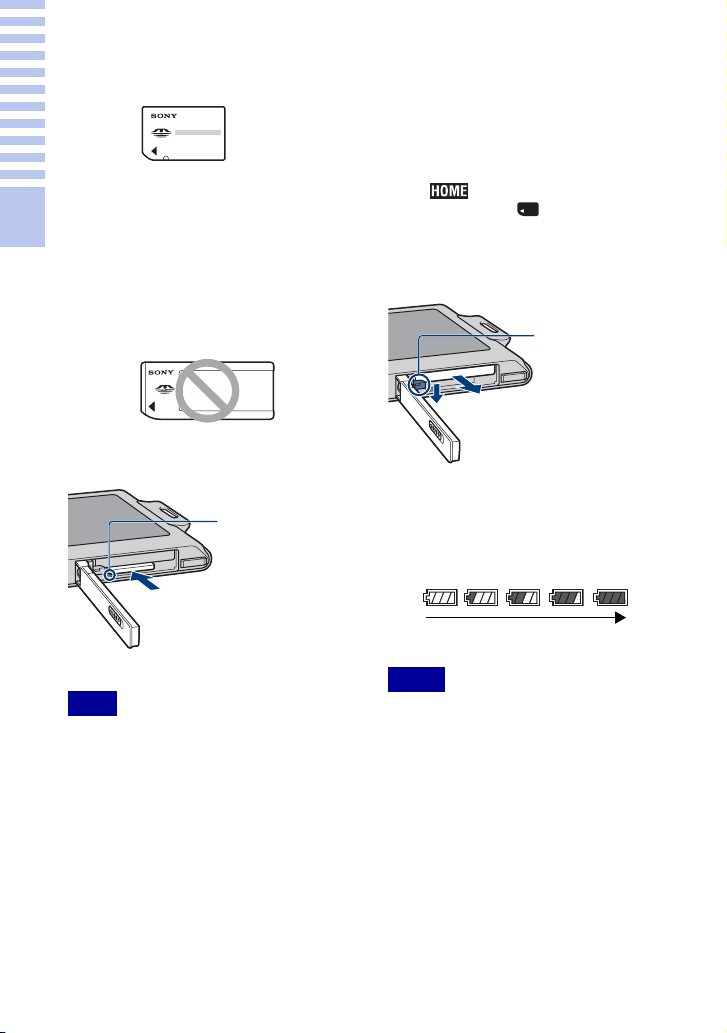
Inserting the battery pack/a “Memory
Stick Duo” (not supplied)
1
Open the cover.
2
Insert the “Memory Stick
Duo” (not supplied).
With the terminal side facing the lens, insert
the “Memory Stick Duo” until it clicks into
place.
3
Insert the battery pack.
Align the v mark on the battery with the
battery eject lever, then insert the battery
while pressing the lever in the direction of
the arrow.
4
Close the cover.
16
Getting started
x
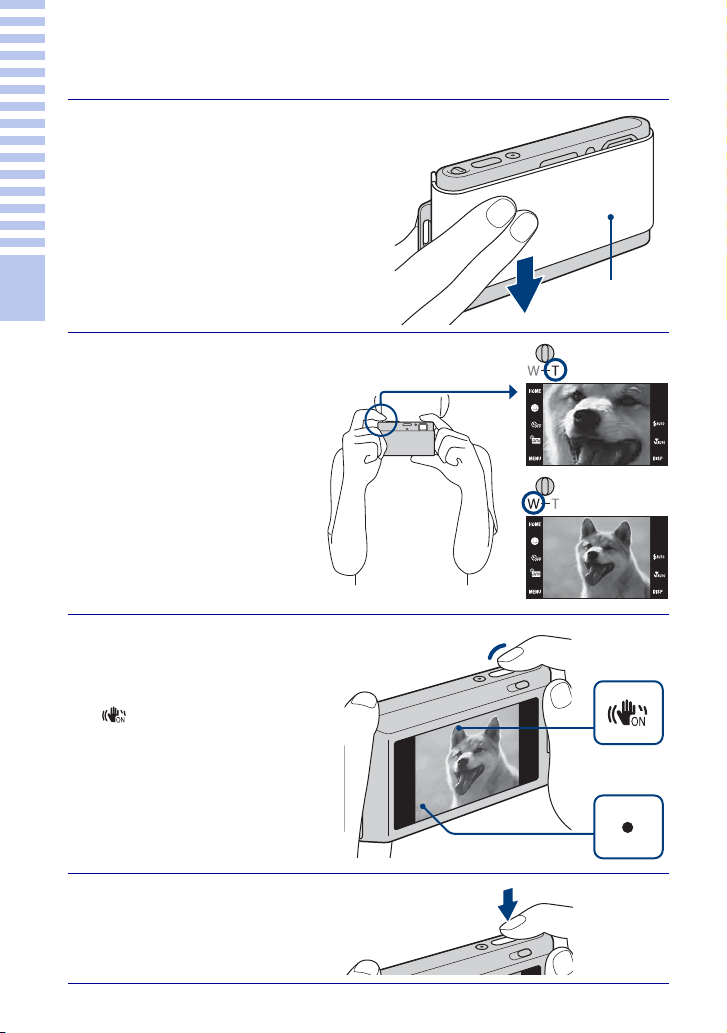
“Memory Stick” that you
can use
“Memory Stick Duo”
You can also use a “Memory Stick PRO Duo”
or “Memory Stick PRO-HG Duo” with the
camera.
For details on the number of images/time that
can be recorded, see pages 26, 29. Other types
of “Memory Stick” or memory card are not
compatible with the camera.
“Memory Stick”
You cannot use a “Memory Stick” with the
camera.
x
To remove the
“Memory
Stick Duo”
• Never remove the “Memory Stick Duo”/
battery pack when the access lamp is lit. This
may cause damage to data in the “Memory
Stick Duo”/internal memory.
x
When there is no “Memory
Stick Duo” inserted
Images are stored in the camera’s internal
memory (approximately 15 MB).
To copy images from the internal
memory to a “Memory Stick Duo,” insert
the “Memory Stick Duo” in the camera,
touch and select [Copy] in
[Memory Tool] of (Manage
Memory) (page 44).
x
To remove the battery pack
x
Checking the remaining
battery charge
A remaining charge indicator appears on
the upper left of the LCD screen.
• It takes about one minute until the correct
remaining charge indicator appears.
• The remaining charge indicator may not be
correct under certain circumstances.
• If the NP-FD1 battery pack (not supplied) is
used, the minute display is also shown after
the remaining charge indicator.
• Battery capacity decreases over time and
through repeated use. When the operating
time per charge decreases markedly, the
battery pack needs to be replaced. Purchase a
new battery pack.
Note
Make sure that the access
lamp is not lit, then push the
“Memory Stick Duo” in once.
Access lamp
Notes
Slide the battery eject lever.
Be sure not to drop the
battery pack.
Battery eject
lever
High
Low

17
Getting started
Setting the clock
• The camera does not have a feature for superimposing dates on images. By using “PMB” in the
CD-ROM (supplied), you can print or save images with the date.
• If the camera is running on and you do not operate the camera for about three minutes, the camera
turns off automatically (Auto power-off function).
x
Setting the date and time again
Touch t (Settings) t [Clock Settings] (page 44).
1
Lower the lens cover.
The camera is turned on.
• You can also turn on the camera by
pressing the POWER button.
• It may take time for the power to turn
on and allow operation.
2
Touch the desired date
display format, then
touch .
3
Touch each item, then
touch v/V to set its
numeric value.
• Midnight is indicated as 12:00 AM,
and noon as 12:00 PM.
4
Touch [OK].
Notes
Lens cover
POWER button
18
Shooting/viewing images
Sh
oo
ti
n
g/
v
i
ew
i
n
g
i
ma
g
es
Shooting images
1
Lower the lens cover.
The camera is turned on.
2
Hold the camera
steady as
illustrated.
• Slide the zoom (W/T) lever
to the T side to zoom.
Slide to the W side to
return.
3
Press the shutter
button halfway down
to focus.
is displayed to indicate that
SteadyShot is working. When
the image is in focus, a beep
sounds and the z indicator
lights. The shortest shooting
distance is approximately 8 cm
(3 1/4 inches) (W)/50 cm (19 3/4
inches) (T) (from the lens).
4
Press the shutter
button fully down.
The image is shot.
Lens cover
Zoom (W/T) lever
SteadyShot
mark
Shutter button
AE/AF
lock
Shooting/viewing images
19
Viewing images
x
Returning to shooting images
Press the shutter button halfway down.
x
Turning off the camera
Close the lens cover.
• You can also turn off the camera by pressing the POWER button.
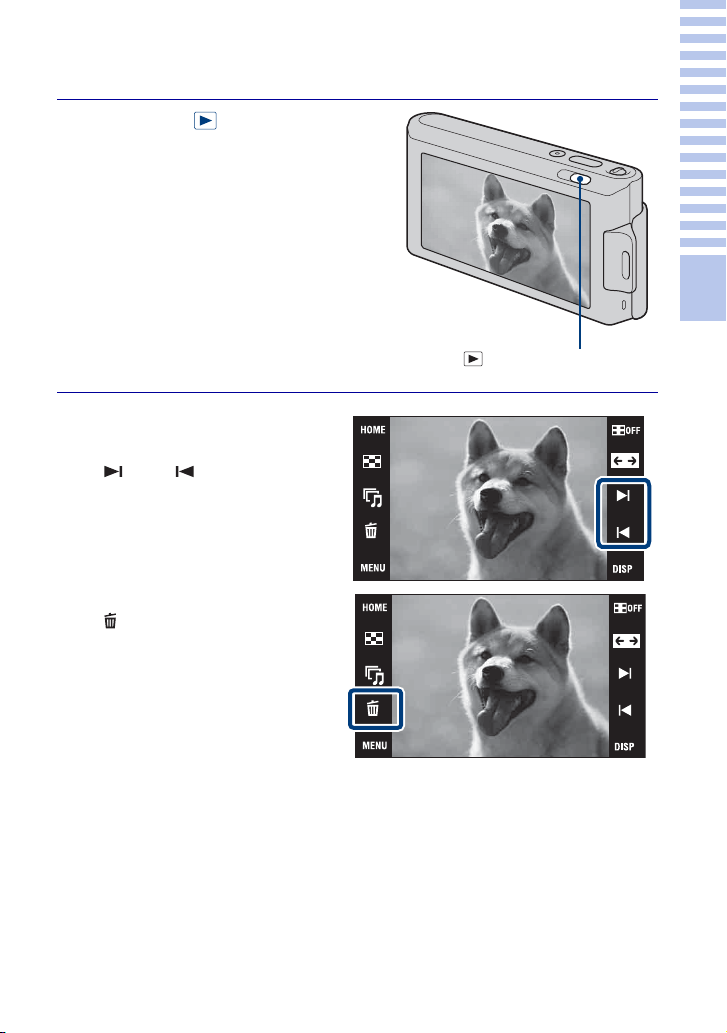
1
Press the (Playback)
button.
The last image shot is displayed.
• When images on the “Memory Stick Duo”
recorded with other cameras cannot be
played back on this camera, view the
images in [Folder View] (page 32).
x
Selecting next/previous
image
Touch (Next)/ (Previous) on the
screen.
x
Deleting an image
Touch (Delete), then touch [OK].
(Playback) button
20
U
s
i
n
g
s
h
oo
ti
n
g
f
unc
ti
ons
Detecting smiles and shooting automatically
(Smile Shutter)
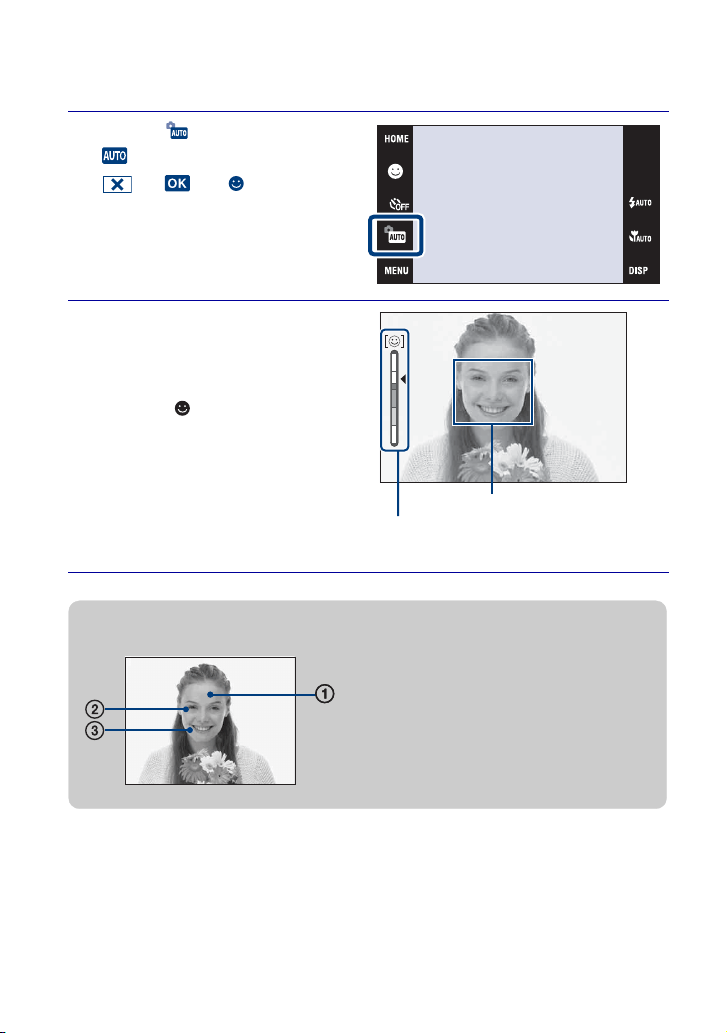
1
Touch (REC Mode) t
(Auto Adjustment) t
or t (Smile
icon).
2
Wait detecting a smile.
When the smile level exceeds the b
point on the indicator, the camera
shoots images automatically. When
you touch (Smile icon) again,
Smile Shutter ends.
• If you press the shutter button
during Smile Shutter, the camera
shoots the image in Auto
Adjustment, and then returns to
Smile Shutter mode.
Face Detection frame
Smile Detection Sensitivity indicator
zHints for better capturing of smiles
1 Do not cover the eyes with the bangs.
2 Try to orient the face in front of the
camera and be as level as possible.
The detection rate is higher when the
eyes are narrowed.
3 Give a clear smile with an open mouth.
The smile is easier to detect when the
teeth are showing.

21
Using shooting functions
Detecting the shooting conditions
automatically (Scene Recognition)
The camera automatically detects the shooting conditions, and then takes the shot.
• Scene Recognition does not operate in (Macro On), (Close focus enabled) or Burst mode.
1
Touch (REC Mode) t
(Auto Adjustment) t
or .
2
Touch t (Scene Recognition) t desired mode t
.
(Off): Does not use Scene Recognition.
(Auto): When the camera recognizes the scene, it switches to the optimal
settings and shoots the image.
(Advanced): When the camera recognizes the scene, it switches to the
optimal settings and shoots the image.
In addition, when the camera recognizes (Twilight), (Twilight Portrait),
(Twilight using a tripod), (Backlight) or (Backlight Portrait), it shoots
another image. When the camera recognizes (Portrait), Anti Blink operates.
Note
zWhen the camera recognizes the scene
When the camera recognizes the scene.
(Twilight), (Twilight Portrait), (Twilight
using a tripod), (Backlight), (Backlight
Portrait), (Landscape), (Macro) or
(Portrait) appears.
When the camera does not recognize the scene,
the image is shot as Scene Recognition [Off].
Scene Recognition icon
Setting value icon

22
Shooting close-ups (Macro/Close focus)
You can shoot beautiful close-up images of small subjects such as insects or flowers.
Using the self-timer
1
Touch (Macro) t
desired mode t .
(Auto): The camera adjusts the
focus automatically from distant
subjects to close-up.
Normally, put the camera in this
mode.
(Macro On): The camera adjusts
the focus with priority on close-up subjects.
Set Macro On when shooting close subjects.
(Close focus enabled): Use this mode to shoot at even closer distances than
Macro recording.
Locked to the W side: Approximately 1 to 20 cm (13/32 to 7 7/8 inches)
1
Touch (Self-Timer) t
desired mode t .
(Off): Not using the self-timer.
(Self-Timer 10sec): Shooting
starts after a 10-second delay. Use this
setting if you want to include yourself
in the image. To cancel, touch .
(Self-Timer 2sec): Shooting
starts after a two-second delay. This is to prevent blurring due to unsteadiness when
the shutter button is pressed.
2
Press the shutter button.
The self-timer lamp flashes and a beep sounds until the shutter operates.
23
Using shooting functions
Selecting a flash mode
• You cannot use (Flash On) or (Slow Synchro) when Scene Recognition is set to [Auto] or
[Advanced].
• Even with flash on, the flash may not operate during burst.
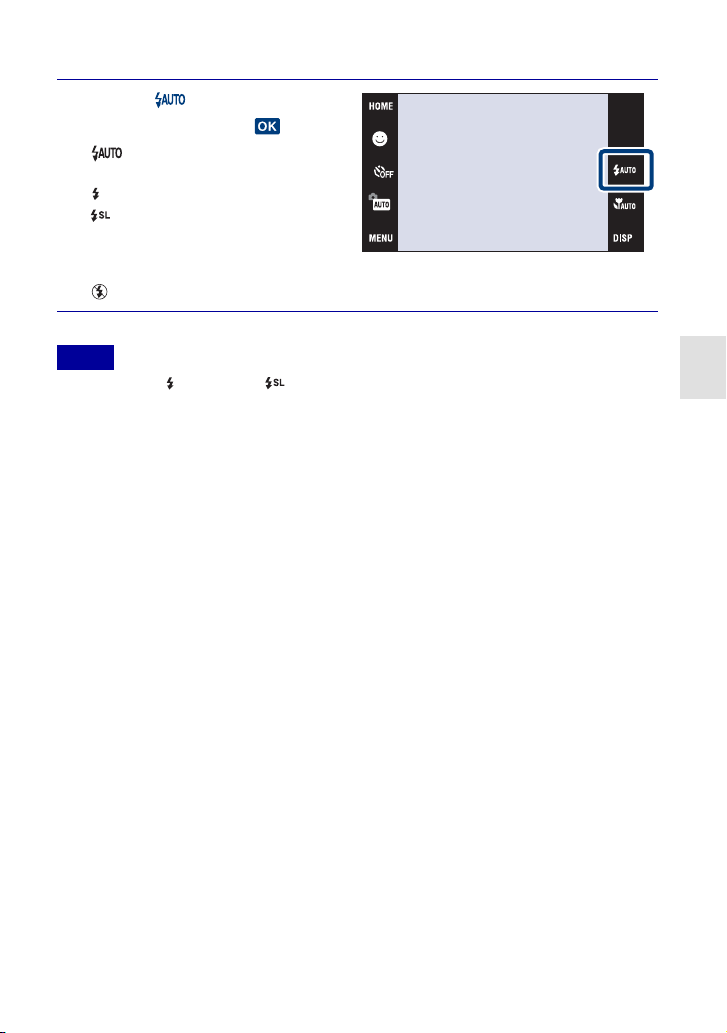
1
Touch (Flash) t
desired mode t .
(Flash Auto): Flashes when
there is insufficient light or backlight
(Flash On): Flash always operates.
(Slow Synchro): Flash always
operates. The shutter speed is slow in
a dark place to clearly shoot the
background that is out of flash light.
(Flash Off): Flash does not operate.
Notes
24
Focusing on a specific point of the frame
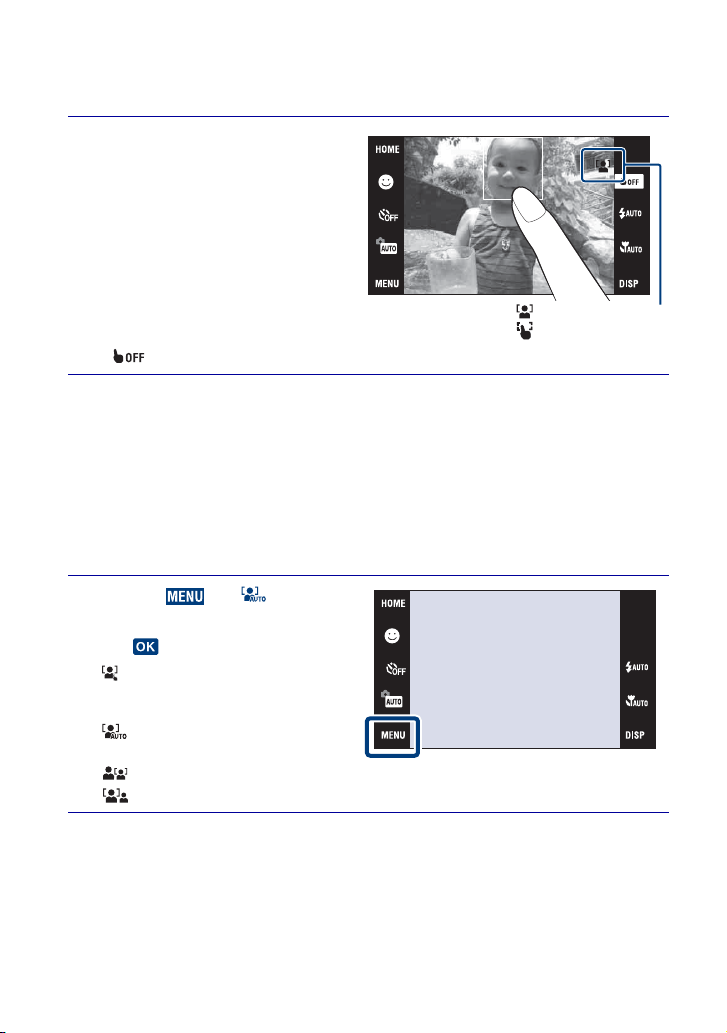
Simply touch the point of the frame you wish to focus on to change the focus position.
Focusing on the face of the subject
(Face Detection)
The camera detects the face of the subject and focuses on it. You can select which
subject takes priority when focusing.
1
Point the camera at the
subject, then touch the point
of the frame you want to
focus on.
• You can change the focus point as
many times as you wish before
pressing the shutter button halfway
down.
• If you want the camera to choose a
focus point automatically, touch
.
1
Touch t (Face
Detection) t desired mode
t .
(When touched): Detects the
face when an area with a face is
touched on the screen.
(Auto): Selects the face the
camera is to automatically focus on.
(Child Priority): Detects and shoots with priority on a child’s face.
(Adult Priority): Detects and shoots with priority on an adult’s face.
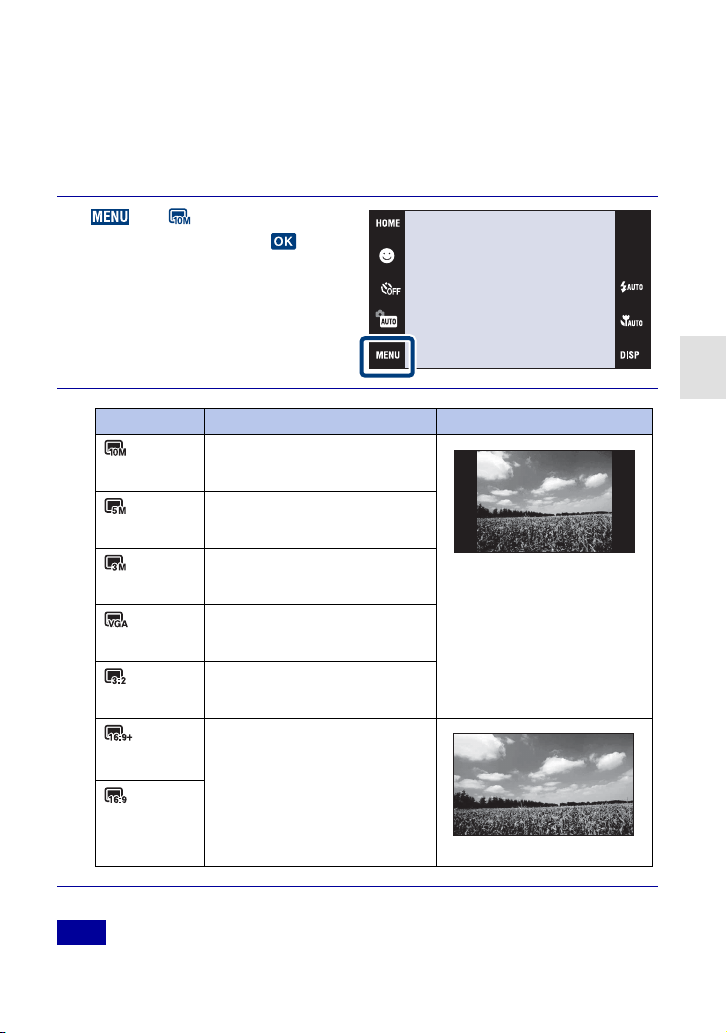
: Face detected.
: No face detected.
25
Using shooting functions
Selecting the image size to match the usage
The image size determines the size of the image file that is recorded when you take a
image.
The larger the image size, the more detail will be reproduced when the image is printed
on large-format paper. The smaller the image size, the more images can be recorded.
Select the image size that matches the way you will view your images.
• When you print images shot with 16:9 aspect ratio, both edges may be cut off.
1
t (Image Size)
t desired size t .
Note
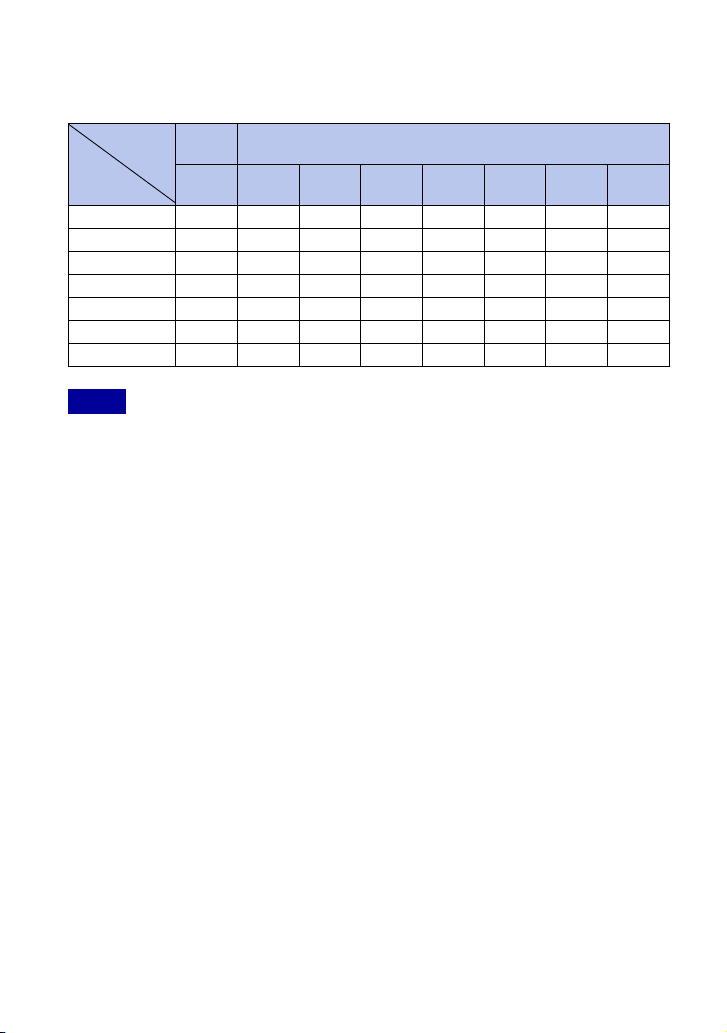
Image size Usage guidelines LCD screen
10M
(3648×2736)
For prints up to A3+ size
Images are displayed in 4:3 or 3:2
aspect ratio.
5M
(2592×1944)
For prints up to A4 size
3M
(2048×1536)
For prints up to L/L2 size
VGA
(640×480)
For e-mail attachments
3:2 (8M)
(3648×2432)
3:2 aspect ratio as in photo prints and
postcards
16:9 (7M)
(3648×2056)
For viewing on a high-definition TV.
Images will fill the entire screen.
16:9 (2M)
(1920×1080)
26
x
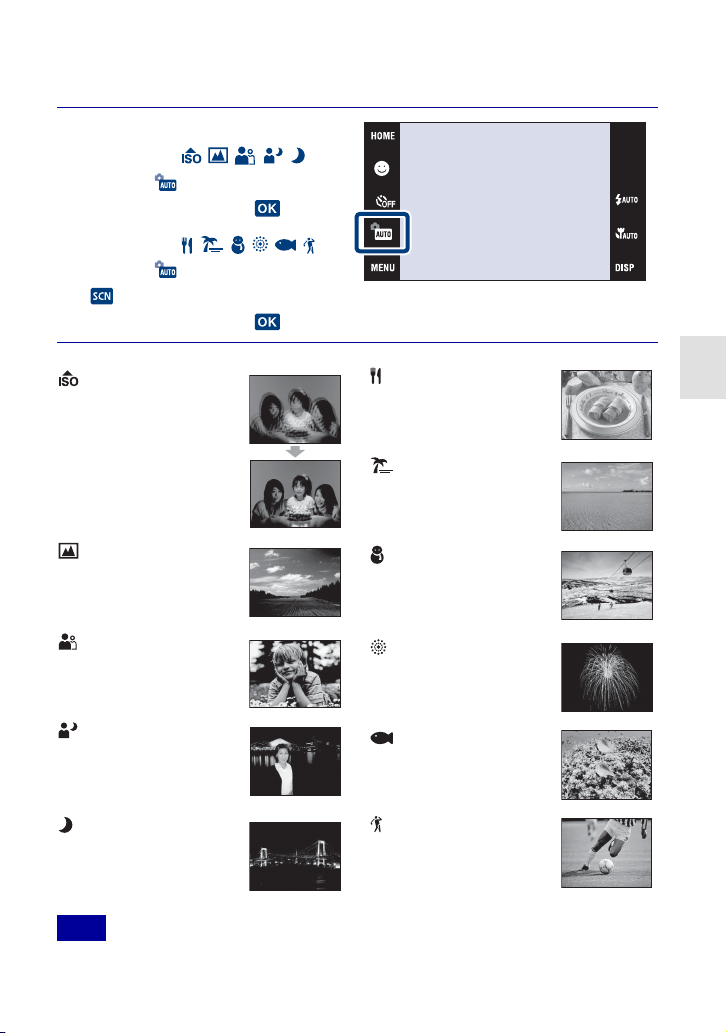
Number of still images that can be recorded
The figures in the table below indicate the number of images when [REC Mode] is set to
[Normal].
(Units: Images)
• The number of still images may vary depending on the shooting conditions and the recording
media.
• When the number of remaining shootable images is greater than 9,999, the “>9999” indicator
appears.
• When an image shot with other cameras is played back on this camera, the image may not appear
in the actual image size.
Capacity
Size
Internal
memory
“Memory Stick Duo” formatted with this camera
Approx.
15 MB
256 MB 512 MB 1GB 2GB 4GB 8GB 16 GB
10M 3 56 118 242 493 972 1963 3991
5M 6 89 188 384 781 1541 3111 6324
3M 10 144 301 617 1253 2472 4991 10140
VGA 96 1385 2898 5925 12030 23730 47910 97390
3:2(8M) 3 57 119 244 497 980 1980 4024
16:9(7M) 4 60 126 257 523 1031 2083 4234
16:9(2M) 16 230 483 987 2005 3955 7986 16230
Notes
27
Using shooting functions
Using the Shooting mode that matches the
scene (Scene Selection)
• The flash does not operate in some modes.
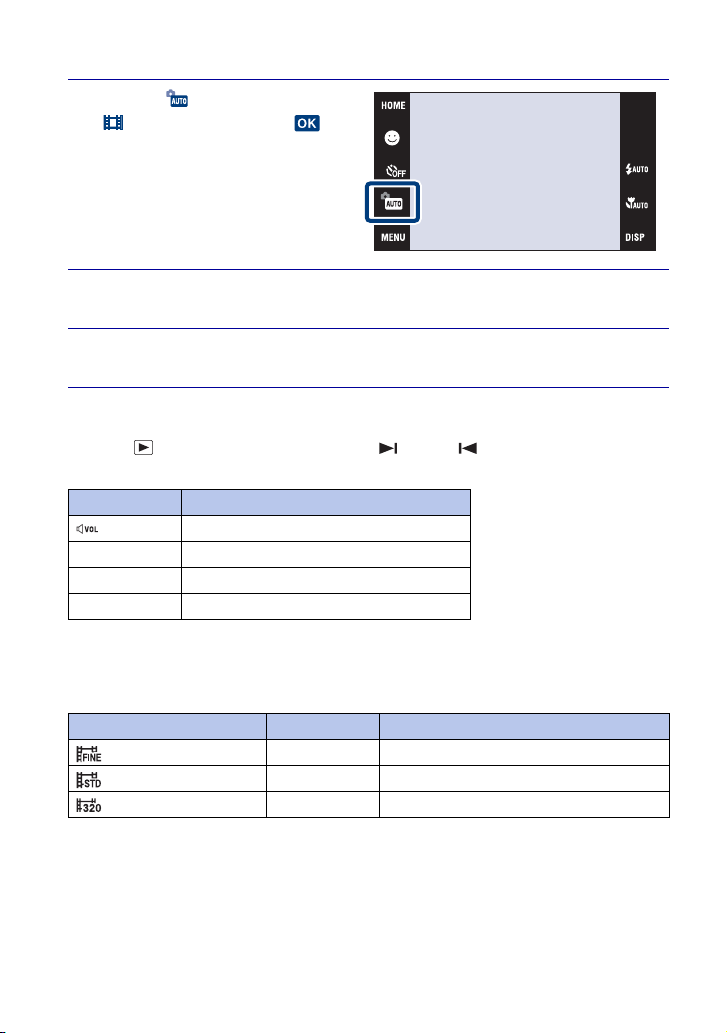
1
Select the shooting mode.
To select / / / / :
Touch (REC Mode) t
desired mode t .
To select / / / / / :
Touch (REC Mode) t
(Scene Selection) t
desired mode t .
Note
(High Sensitivity):
Shoots images without a
flash even in low lighting.
(Landscape): Shoots
with the focus on a distant
subject.
(Soft Snap): Shoots
images with a softer
atmosphere for portraits of
people, flowers, etc.
(Twilight Portrait):
Shoots sharp images of
people in a dark place
without losing the nighttime
atmosphere.
(Twilight): Shoots night
scenes without losing the
nighttime atmosphere.
(Gourmet): Shoots food
arrangements in delicious
color.
(Beach): Shoots
seaside or lakeside scenes
with the blueness of the
water captured more vividly.
(Snow): Shoots snow
scenes in white more clearly.
(Fireworks): Shoots
fireworks in all their
splendor.
(Underwater): Shoots
underwater in natural colors
when the water-proof case is
attached.
(Hi-Speed Shutter):
Shoots moving subjects in
bright places.
28
Shooting movies
x
Viewing movies
Press the (Playback) button and touch the (Next) / (Previous) buttons to select
a movie to view.
x
Image size
The larger the image size, the higher the image quality. The higher the number of frames
per second, the smoother the playback image.
1
Touch (REC Mode) t
(Movie Mode) t .
2
Press the shutter button fully down to start recording.
3
Press the shutter button fully down again to stop recording.
Button Action
Volume control
B Playback
x Stop
M/m Fast forward/fast rewind
Movie image size Frame/Second Usage guidelines
640(Fine) (640×480) Approx. 30 For viewing on a TV (high picture quality)
640(Standard) (640×480) Approx. 17 For viewing on a TV (standard picture quality)
320 (320×240) Approx. 8 For e-mail attachments
29
Using shooting functions
x
Maximum recording time
The table below shows the approximate maximum recording times. These are the total
times for all movie files. Continuous shooting is possible for approximately 10 minutes.
(Units: hour : minute : second)
• The recording time may vary depending on the shooting conditions and the recording media.
• Movies with the size set to [640(Fine)] can only be recorded on a “Memory Stick PRO Duo”.
• This camera does not support HD recordings or playbacks for movies.
Displaying minimum indicators
(Easy Shooting)
This mode reduces the minimum number of settings and makes the indicators easier to
see.
x
Returning to normal display
Touch (REC Mode) t (Auto Adjustment) t .
Capacity
Size
Internal
memory
“Memory Stick Duo” formatted with this camera
Approx.
15 MB
256 MB 512 MB 1GB 2GB 4GB 8GB 16 GB
640(Fine) – 0:02:50 0:06:00 0:12:20 0:25:00 0:49:20 1:39:40 3:22:50
640(Standard) 0:00:40 0:10:20 0:21:40 0:44:20 1:30:10 2:58:00 5:59:20 12:10:20
320 0:02:50 0:41:30 1:25:20 2:57:40 6:01:00 11:52:00 23:57:30 48:41:50
Notes
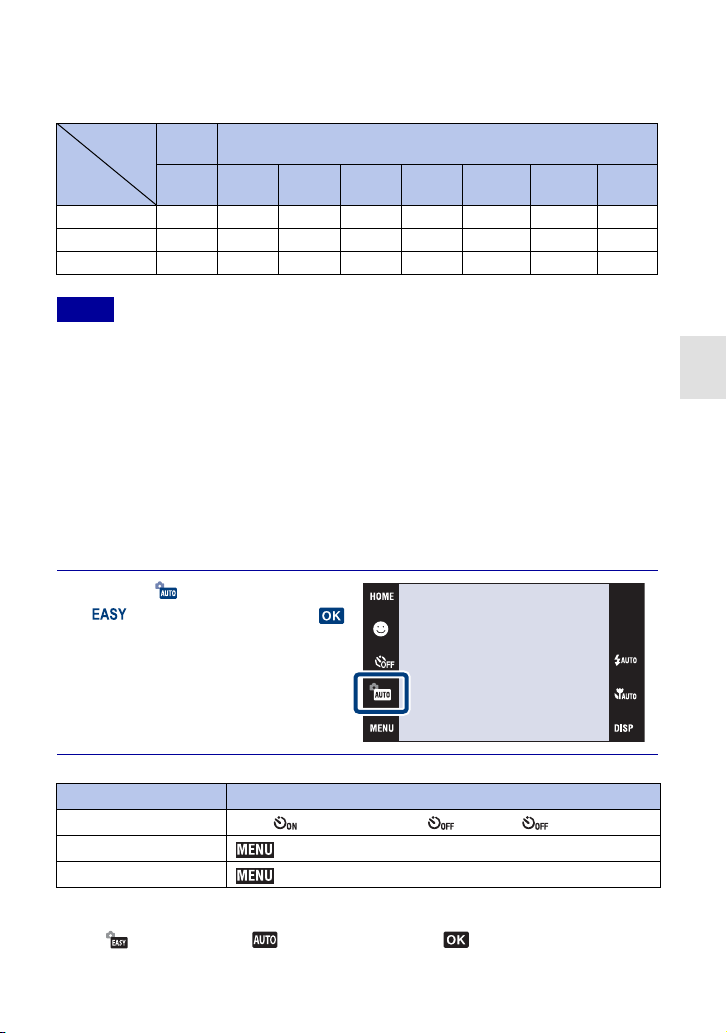
1
Touch (REC Mode) t
(Easy Shooting) t .
Action How to change
Self-Timer Select (Self-Timer 10sec) or (Off) with button.
Image Size t Select [Large] or [Small] in [Image Size]
Flash t Select [Auto] or [Off] in [Flash]
30
U
s
i
n
g
v
i
ew
i
n
g
f
unc
ti
ons
Viewing an enlarged image (Playback zoom)
Displaying images full-screen (Wide Zoom)
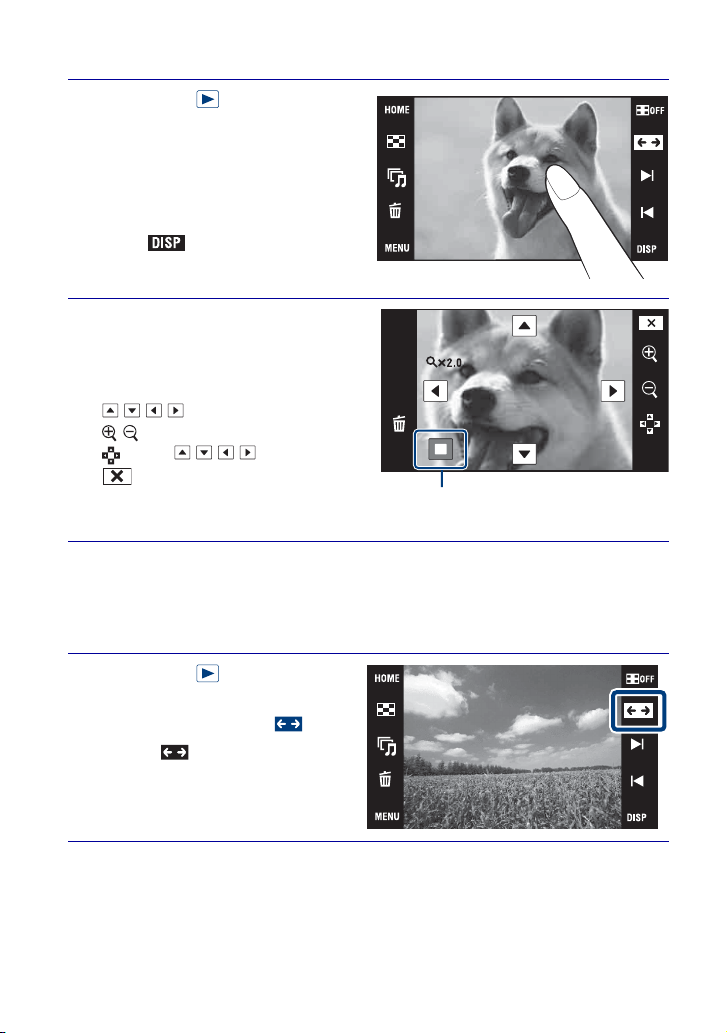
1
Press the (Playback)
button to display an image,
then touch the area you want
to enlarge.
The image is enlarged at twice the size,
with the area you touched at the center.
When is set to [Image Only],
touch the center of the screen, then
touch the area you want to enlarge.
2
Adjust the zoom scale and
position.
The zoom scale increases each time you
touch the screen.
/ / / : Adjusts the position.
: Changes the zoom scale.
: Turns / / / on/off.
: Cancels playback zoom.
1
Press the (Playback)
button to display the still
image, then touch .
• Touch again to end the wide
zoom.
Shows the displayed area of the whole
image
31
Using viewing functions
Rotating a vertical orientation image
(Temporarily rotated display)
Viewing still images with music (Slideshow)
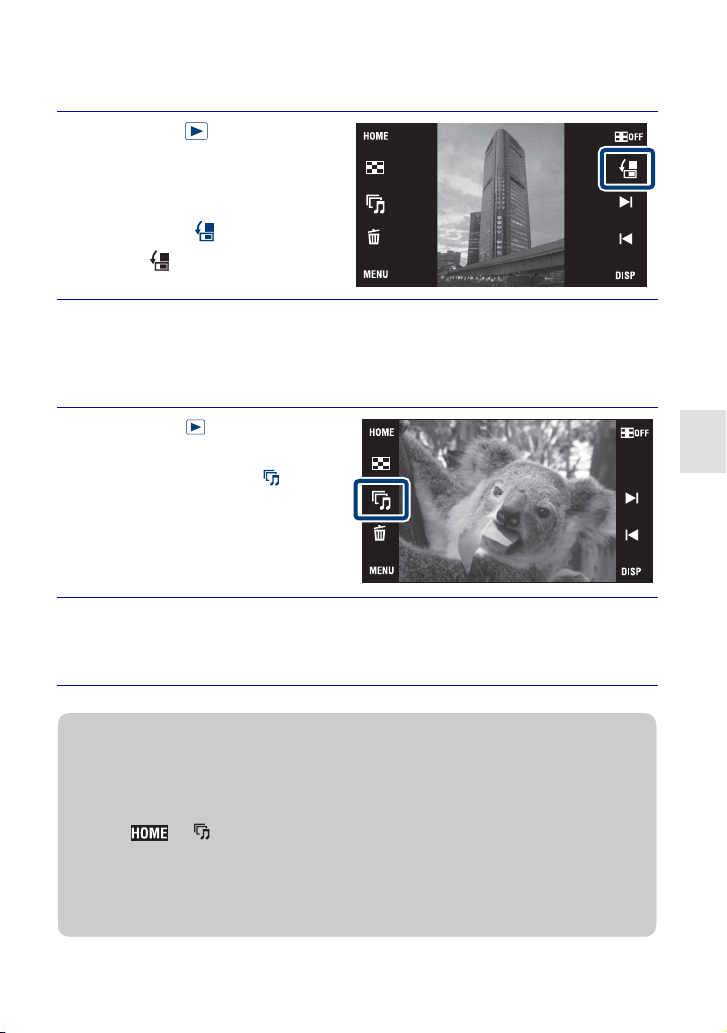
1
Press the (Playback)
button to display the still
image, then select the
vertical orientation images,
then touch .
• Touch again to end the display.
1
Press the (Playback)
button to display a still
image, then touch
(Slideshow).
2
Touch [Start].
The slideshow starts.
• To end the slideshow, touch the screen, and then touch [Exit].
zSelecting background music
You can transfer a desired music file from your CDs or MP3 files to the camera to play back
during slideshow. To transfer music files, install the “Music Transfer” software (supplied) to
your computer (page 39), then follow the steps below.
1 Touch t (Slideshow) t [Music Tool] t [Download Music].
2 Make a USB connection between the camera and your computer.
3 Start and operate “Music Transfer”.
For details on “Music Transfer”, see the “Music Transfer” help.
32
Searching for an image (Image Index)
Selecting the display format (View Mode)
Allows you to select the display format for viewing multiple images when using
“Memory Stick Duo”.
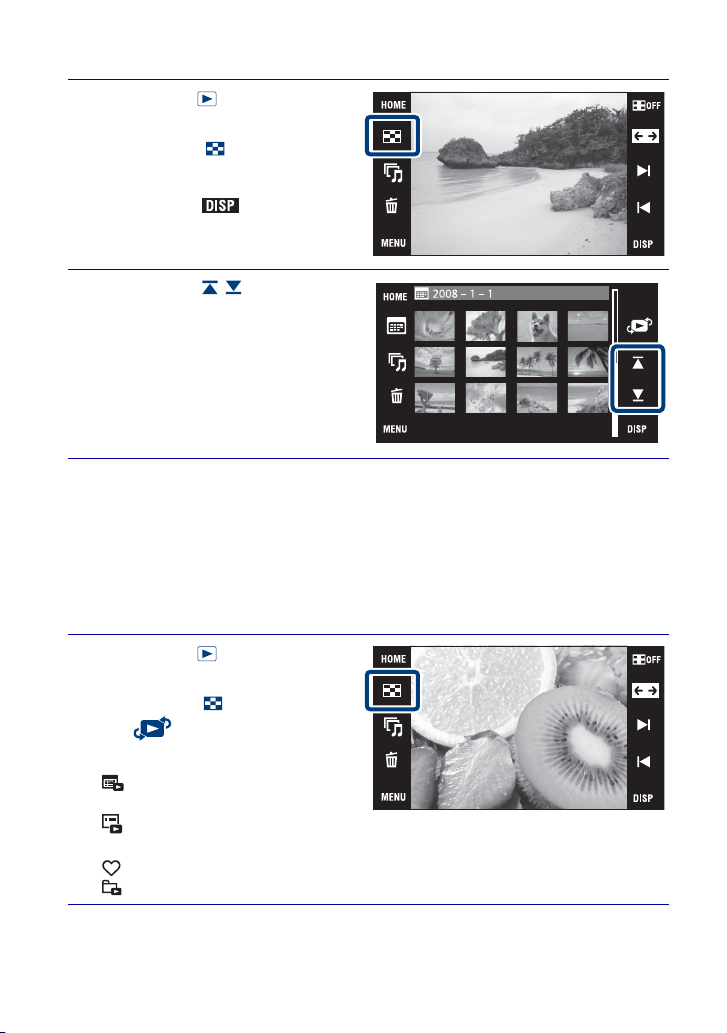
1
Press the (Playback)
button to display an image,
then touch (Image
Index).
• If you touch , you can set the
number of images displayed in the
index screen to 12 or 20 images.
2
Touch the / buttons to
turn the pages.
• To return to the single-image screen,
touch the thumbnail image.
1
Press the (Playback)
button to display an image,
then touch (Image Index)
t (View Mode) t
desired mode.
(Date View): Displays images by
the date.
(Event View): Analyzes the dates shots and frequency, automatically organizes
the images into groups and displays them.
(Favorites): Displays images registered as Favorites.
(Folder View): Displays and organizes images by folders.
33
Using viewing functions
x
Easily locating the images to be displayed
When set to Date View/Event View/Folder View:
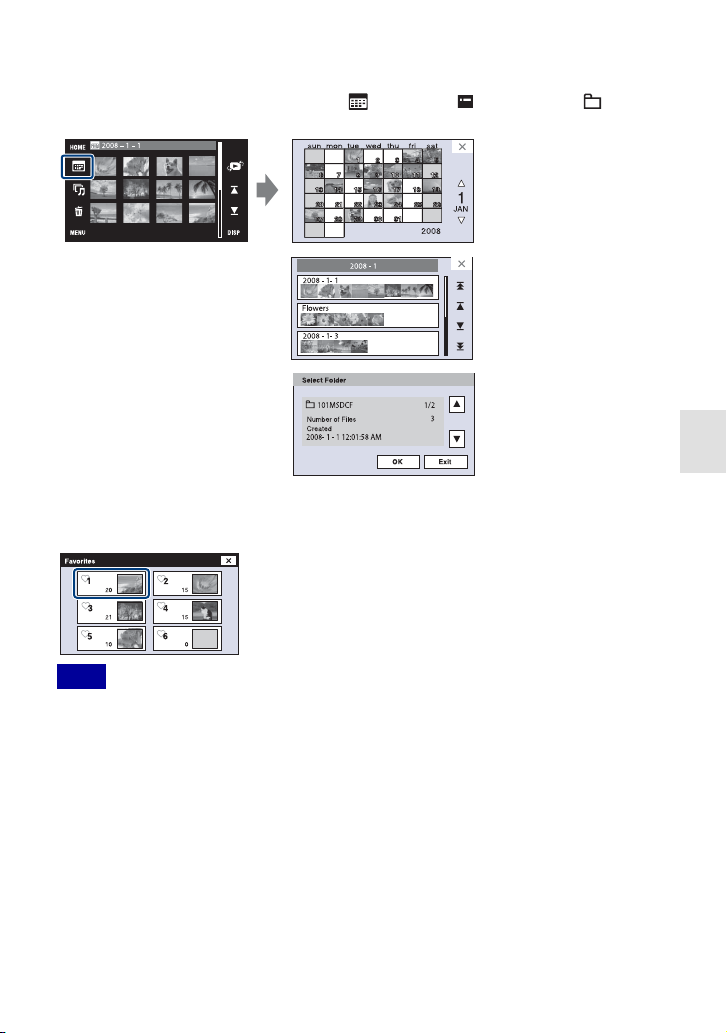
When using a “Memory Stick Duo”, touch (Date List), (Event List) or (Select
Folder) to easily locate the desired images.
• When you cannot play back images recorded with other cameras, view the images in [Folder
View].
Date List: Displays a list
of the images taken on the
selected date.
Event List: Displays a list
of the images registered
to the selected event.
Select Folder: Touch
[OK] to display a list of the
images contained in the
selected folder.
When set to Favorites: You can display images registered to Favorites divided into
six groups.
Favorites: Displays a list of the images registered to the
selected Favorites number.
Note
34
D
e
l
e
ti
n
g
i
ma
g
es
Deleting the currently displayed image
Deleting multiple images
x
Deleting in date, event or folder units
t (Delete) t (All in Date Range), (All in Event) or (All in This
Folder) t t [OK].
• The images is displayed in [Folder View] when using the internal memory.
1
Touch (Delete) t [OK] (page 19).
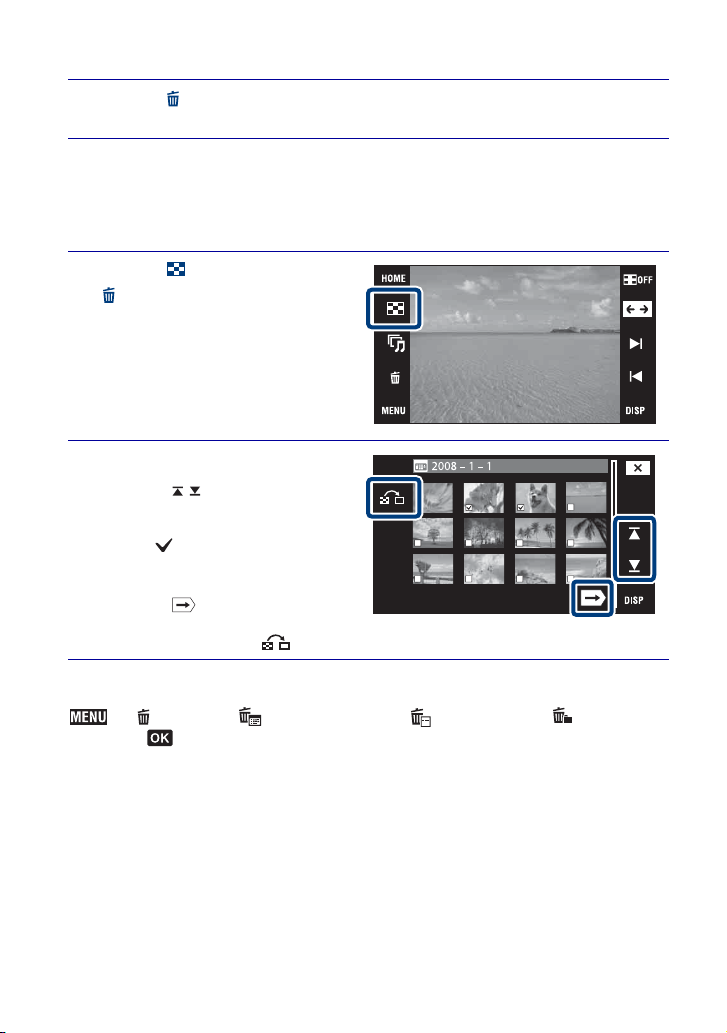
1
Touch (Image Index) t
(Delete).
2
Select images for deletion.
1 Touch / to turn the pages, then
touch the images you want to
delete.
The mark is attached to the
selected images.
2 Repeat step 1.
3 Touch
t [OK].
You can switch between single-image
and index screen using , when selecting images.
35
Deleting images
Deleting all images (Format)
You can delete all data stored on “Memory Stick Duo” or the internal memory. If a
“Memory Stick Duo” is inserted, all data stored on the “Memory Stick Duo” are deleted.
If no “Memory Stick Duo” is inserted, all data stored in the internal memory are deleted.
Formatting permanently deletes all data, including protected images.
1
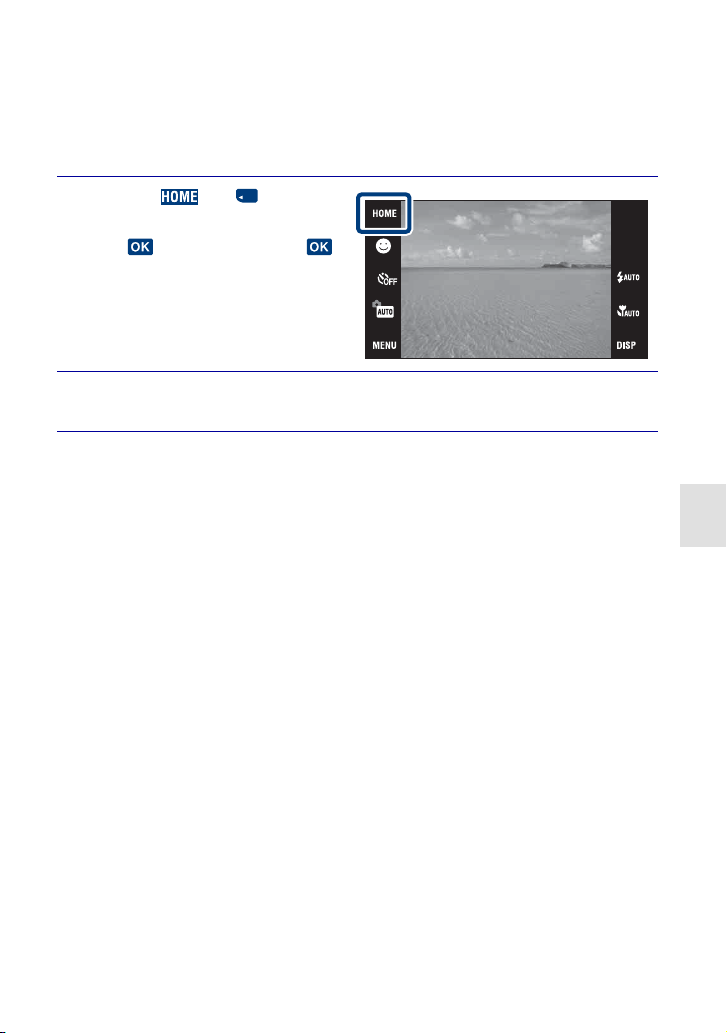
Touch t (Manage
Memory) t [Memory Tool]
t t [Format] t .
2
Touch [OK].
36
C
onnec
ti
n
g
t
o o
th
er
d
ev
i
ces
Viewing images on a TV
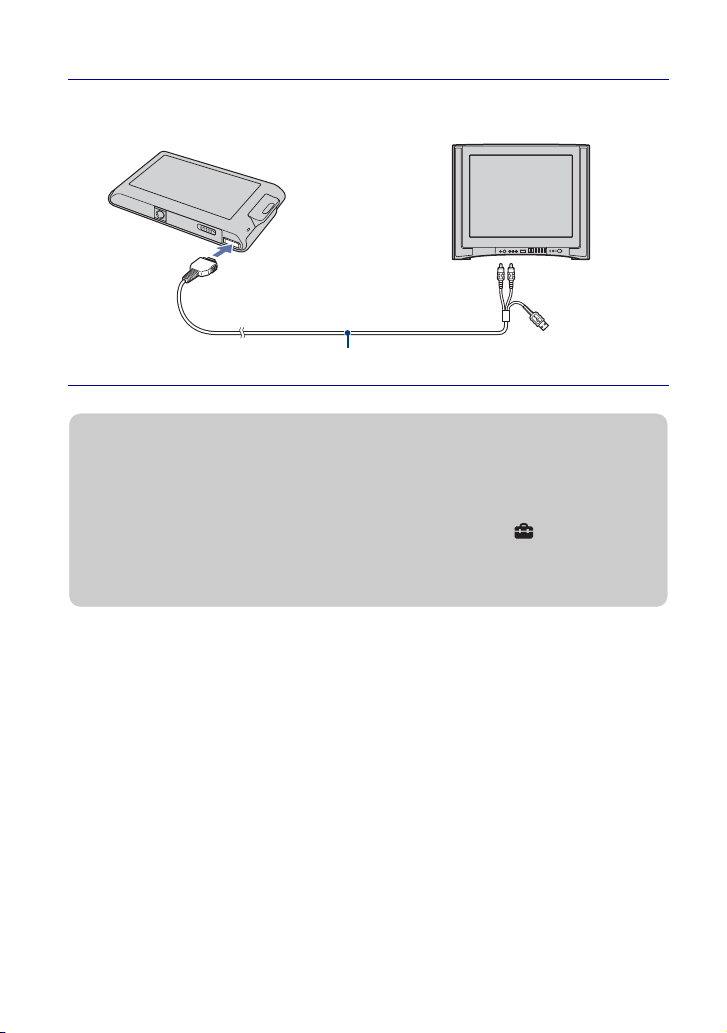
1
Connect the camera to the TV with the cable for multi-use
terminal (supplied).
To the multi connector
To audio/video input
jacks
Cable for multi-use terminal
zViewing images on a HD (High Definition) TV
• You can view images recorded on the camera by connecting the camera to an HD (High
Definition) TV with the HD Output Adaptor Cable (not supplied) or Cyber-shot station (not
supplied).
• Set [COMPONENT] to [HD(1080i)] in [Main Settings 2] by selecting (Settings) on the
HOME screen.
• You cannot view movies output in [HD(1080i)] signal format. Set [COMPONENT] to [SD]
when viewing movies.
37
Connecting to other devices
Printing still images
If you have a PictBridge compliant printer, you can print images by the following
procedure.
First, set the camera to enable USB connection between the camera and the printer.
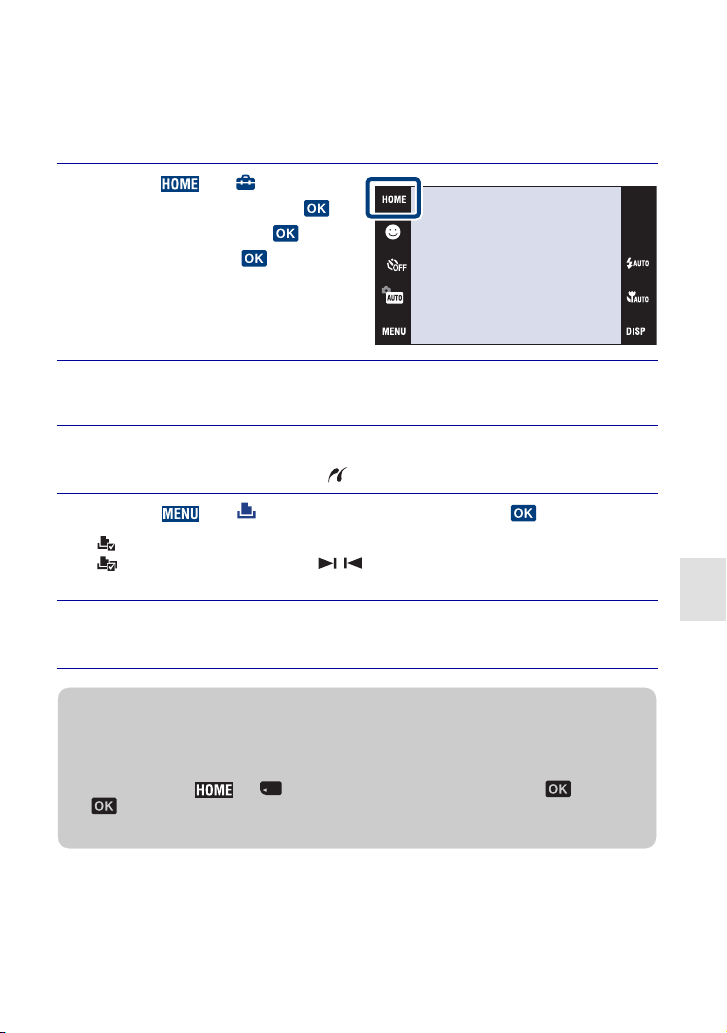
1
Touch t (Settings)
t [Main Settings] t
[USB Connect] t t
[PictBridge] t .
The USB mode is set.
2
Connect the camera to the printer with the cable for multi-
use terminal (supplied).
3
Turn on the printer.
After the connection is made, the indicator appears.
4
Touch t (Print) t desired item t .
(This Image): Print the currently displayed image.
(Multiple Images): Touch / to display the image, then touch the image
you want to print.
5
Touch the desired setting item, then [OK].
The image is printed.
zPrinting at a shop
You cannot print images stored in the internal memory at a print shop directly from the camera.
Copy the images to a “Memory Stick Duo”, then take the “Memory Stick Duo” to the print shop.
How to copy: Touch t (Manage Memory) t [Memory Tool] t
t [Copy]
t t [OK].
When you want to superimpose dates on images, consult your photo printing service shop.
38
Using the camera with a computer
x
Using “PMB (Picture Motion Browser)”
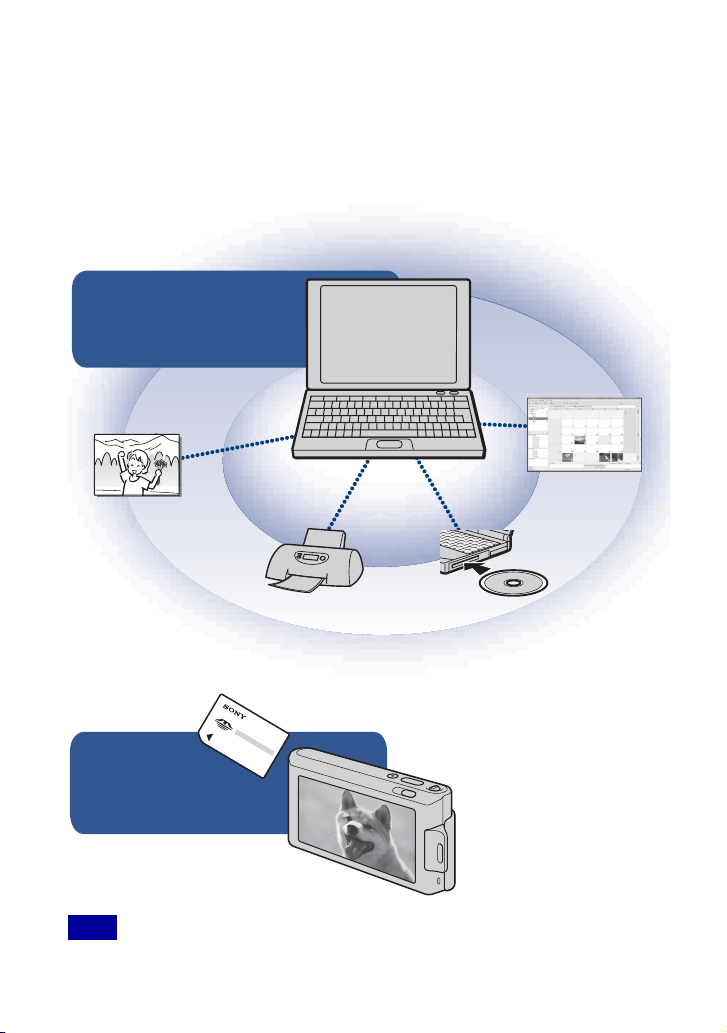
You can enjoy the recorded images more than ever by taking advantage of the software,
and “PMB” is included on a CD-ROM (supplied).
There are more functions, in addition to those listed below, for enjoying your images.
For details, see the “PMB Guide”.
• “PMB” is not compatible with Macintosh computers.
Note
Export to
camera
When using the “Memory Stick
Duo”, exporting images and
viewing them.
Import to
computer
Media service
Uploading the image to the
media service.
Print
Printing images with
date stamps.
DVD
Creating a data disc using
a CD burner drive or DVD
burner drive.
Calendar
Viewing images in a
calendar.
39
Connecting to other devices
x
Stage 1: Installing the “PMB” (supplied)
You can install the software (supplied) using the following procedure. When you install
“PMB,” “Music Transfer” is also installed.
• Log on as Administrator.
1
Check your computer environment.
Recommended environment for using “PMB” and “Music Transfer”
OS (pre-installed): Microsoft Windows 2000 Professional SP4, Windows XP*
SP3/Windows Vista SP1*
CPU:
Intel Pentium III 500 MHz or faster (Recommended: Intel Pentium III
800 MHz or faster)
Memory:
256 MB or more (Recommended: 512 MB or more)
Hard Disk: Disk space required for installation—approximately 400 MB
Display: Screen resolution: 1,024 × 768 dots or more
* 64-bit editions and Starter (Edition) are not supported.
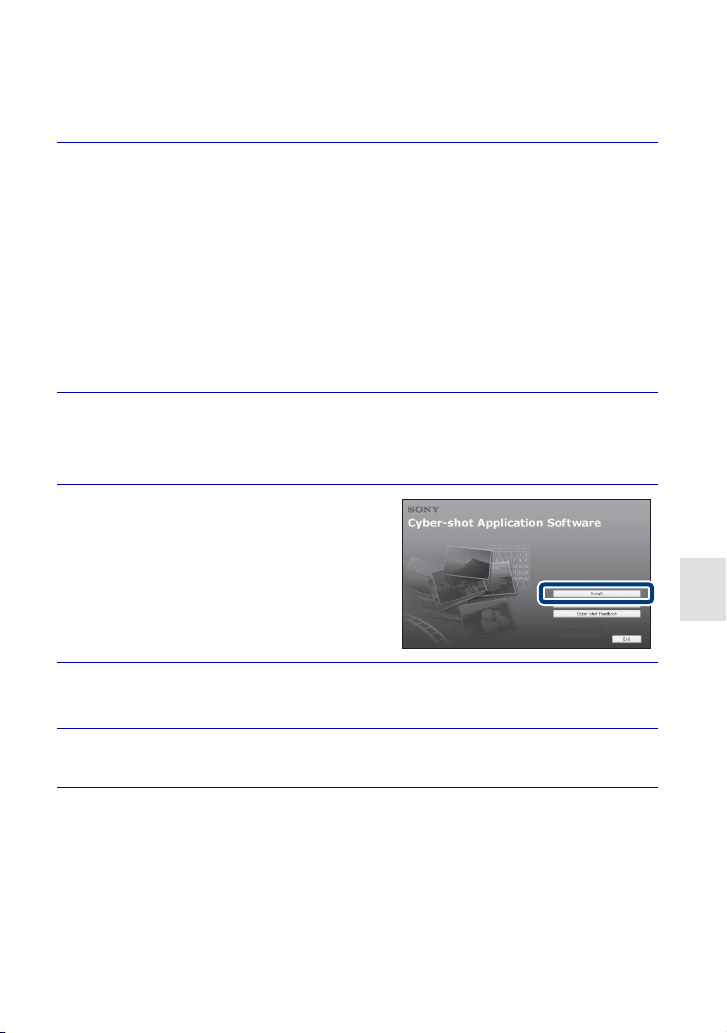
2
Turn on your computer, and insert the CD-ROM (supplied)
into the CD-ROM drive.
The installation menu screen appears.
3
Click [Install].
The “Choose Setup Language” screen
appears.
4
Follow the instructions on the screen to complete the
installation.
5
Remove the CD-ROM after the installation is complete.
40
x
Stage 2: Importing images to your computer using “PMB”
x
Stage 3: Viewing “PMB Guide”
• Do not disconnect the cable for multi-use terminal from the camera while the camera is operating
or while “Accessing…” appears on the screen of the camera. Doing so may corrupt the data.
• When using a battery with little remaining charge, you may not be able to transfer the data or the
data may be corrupted. Using the AC Adaptor (not supplied) and the USB / A/V / DC IN cable for
multi-use terminal (not supplied) is recommended.
1
Insert a fully charged battery pack to the camera, then press
the (Playback) button.
2
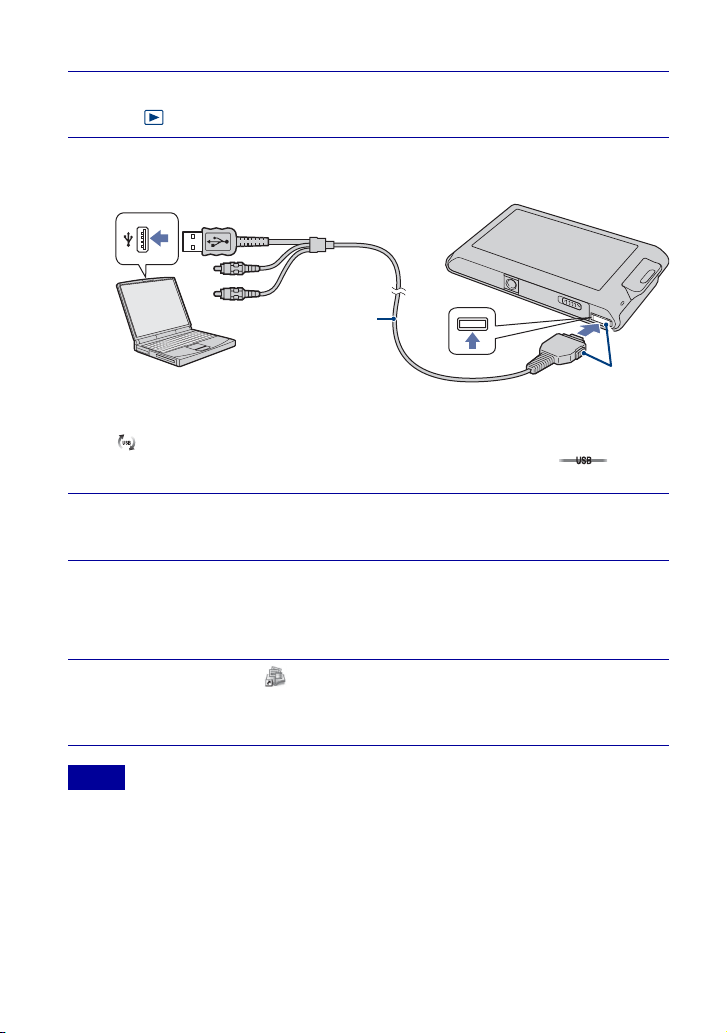
Connect the camera to your computer.
“Connecting…” appears on the screen of the camera.
• is displayed on the screen during the communication session. Do not operate the
computer while the indicator is displayed. When the indicator changes to , you can
start using the computer again.
3
Click the [Import] button.
For details, see the “PMB Guide”.
1
Double-click the (PMB Guide) icon on the desktop.
• To access the “PMB Guide” from the start menu: Click [Start] t [All Programs]
t [Sony Picture Utility] t [Help] t [PMB Guide].
Notes
Cable for multi-use
terminal
1 To a USB jack
2 To the multi
connector

41
Connecting to other devices
x
Using the camera with your Macintosh computer
You can copy images to your Macintosh computer. “PMB” is not compatible, but you
can install “Music Transfer” on your Macintosh computer. When images is exported to
the camera, view them in [Folder View].
Recommended computer environment
The following environment is recommended for a computer connected to the camera.
Recommended environment for importing images
OS (pre-installed): Mac OS 9.1/9.2/ Mac OS X (v10.1 to v10.5)
USB jack: Provided as standard
Recommended environment for using “Music Transfer”
OS (pre-installed): Mac OS X (v10.3 to v10.5)
Memory: 64 MB or more (128 MB or more is recommended)
Hard Disk: Disk space required for installation—approximately 250 MB
42
Ch
an
gi
n
g
camera se
tti
n
g
s
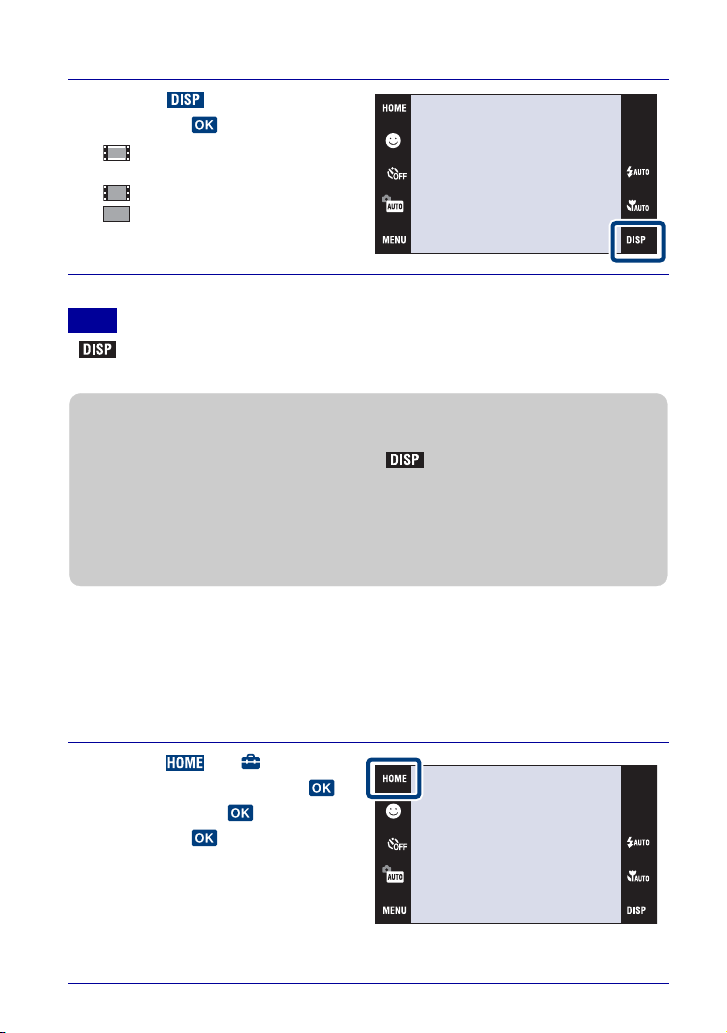
Changing the screen display
• disappears from the screen if [Image Only] playback is selected. To display the buttons,
touch the center of the screen. The [Normal] display returns temporarily.
Changing the operation sounds
You can set the sound produced when you operate the camera.
1
Touch t desired
mode t .
(Normal): Displays buttons and
icons
(Simple): Displays only buttons
(Image Only): Hides buttons
and icons
Note
1
Touch t (Settings)
t [Main Settings] t
t [Beep] t t desired
mode t .
Shutter: Turns on the shutter sound
when you press the shutter button.
On: Turns on the beep/shutter sound
when you operate the touch panel/
press the shutter button.
Off: Turns off the beep/shutter sound.
zHistogram and brightness settings
The following setting can be accessed by touching .
Histogram: A histogram is a graph showing the brightness of an image. The graph display
indicates a bright image when skewed to the right side, and a dark image when skewed to the left
side.
Brightness: This sets the backlight brightness ([Normal]/[Bright]). When viewing images in
bright outside light, reset to [Bright]. However, the battery power may decrease faster under such
condition.
43
Changing camera settings
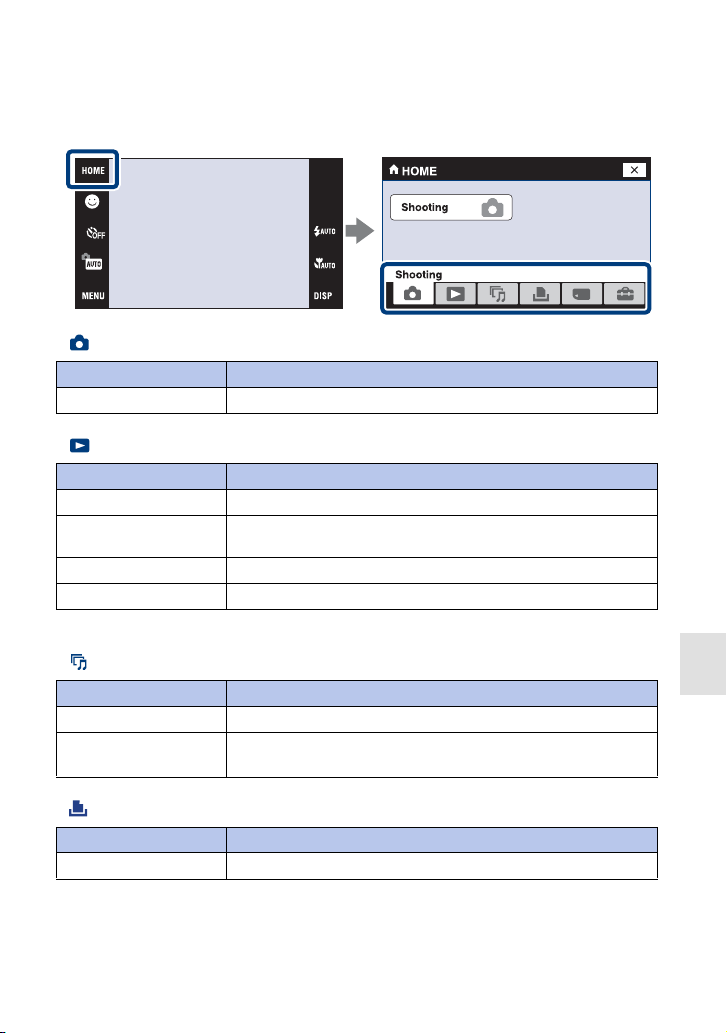
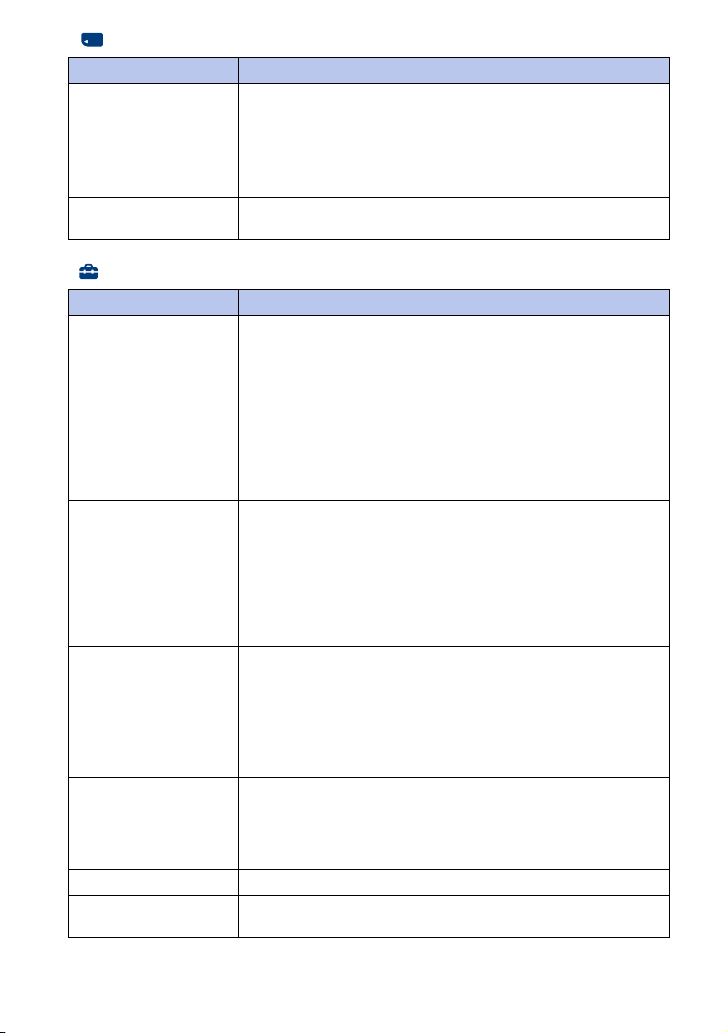
Using the HOME screen
On the HOME screen, camera operations are organized for convenience into broad
categories for selection, such as shooting, viewing and printing images.
Only the available items are displayed on the screen.
x
Shooting
x
View Images
* These items are displayed only when “Memory Stick Duo” is inserted into the camera.
x
Slideshow
x
Print
Item Description
Shooting Records still images or movies.
Item Description
Date View* Displays images by the date.
Event View* Analyzes the dates shots and frequency, automatically organizes the
images into groups and displays them.
Favorites* Displays images registered as Favorites.
Folder View Displays and organizes images by folders.
Item Description
Slideshow Plays back images in succession along with effects and music.
Music Tool Download Music: Changes the slideshow music.
Format Music: Deletes all slideshow music.
Item Description
Print Prints still images.
44
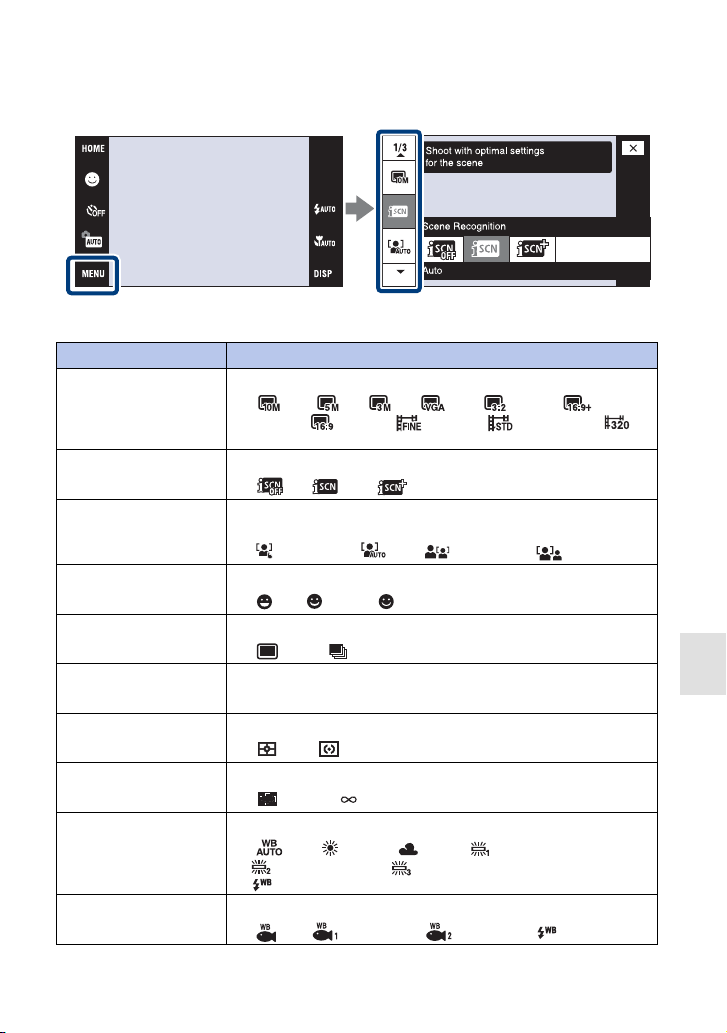
x
Manage Memory
x
Settings
Item Description
Memory Tool - Memory
Stick Tool
Format: Formats a “Memory Stick Duo.”
Create REC.Folder: Creates a new folder on a “Memory Stick
Duo.”
Change REC.Folder: Changes the folder used for recording images.
Copy: Copies all images recorded in the internal
memory to a “Memory Stick Duo.”
Memory Tool - Internal
Memory Tool
Format: Formats the internal memory.
Item Description
Main Settings - Main
Settings 1
Beep: Selects the beeps produced when you operate
the camera.
Function Guide: Displays the function guide.
Initialize: Restores the camera to its default settings.
Calibration: Corrects misalignment of the response
positions of the buttons on the touch panel.
Housing: Changes the button operations when the
camera is in the housing (water-proof case).
Demo Mode: Demonstrates the Smile Shutter and Scene
Recognition function.
Main Settings - Main
Settings 2
USB Connect: Sets the mode used when connecting the
camera to a computer or a printer.
COMPONENT: Sets the video signal according to a connected
TV terminal.
Video Out: Sets the mode according to the video output
system to be connected.
TV TYPE: Set to the aspect ratio of a TV to be
connected.
Shooting Settings -
Shooting Settings 1
AF Illuminator: Strobes the fill light when focusing in low
light.
Grid Line: Displays lines to easily set a subject in a
horizontal or vertical position.
AF Mode: Selects the auto focus operation mode.
Digital Zoom: Selects the zoom method for zoom in excess
of optical zoom.
Shooting Settings -
Shooting Settings 2
Auto Orientation: Recognizes the orientation change and saves
the image in the proper orientation.
Auto Review: Displays the image on the screen for
approximately two seconds after shooting a
still image.
Clock Settings Sets the date and time.
Language Setting Selects the language to be used in the menu items, warnings and
messages.
45
Changing camera settings
Using the MENU items
Displays available functions for easy setting when the camera is in shooting or playback
mode. Only the available items are displayed on the screen.
x
MENU in shooting mode
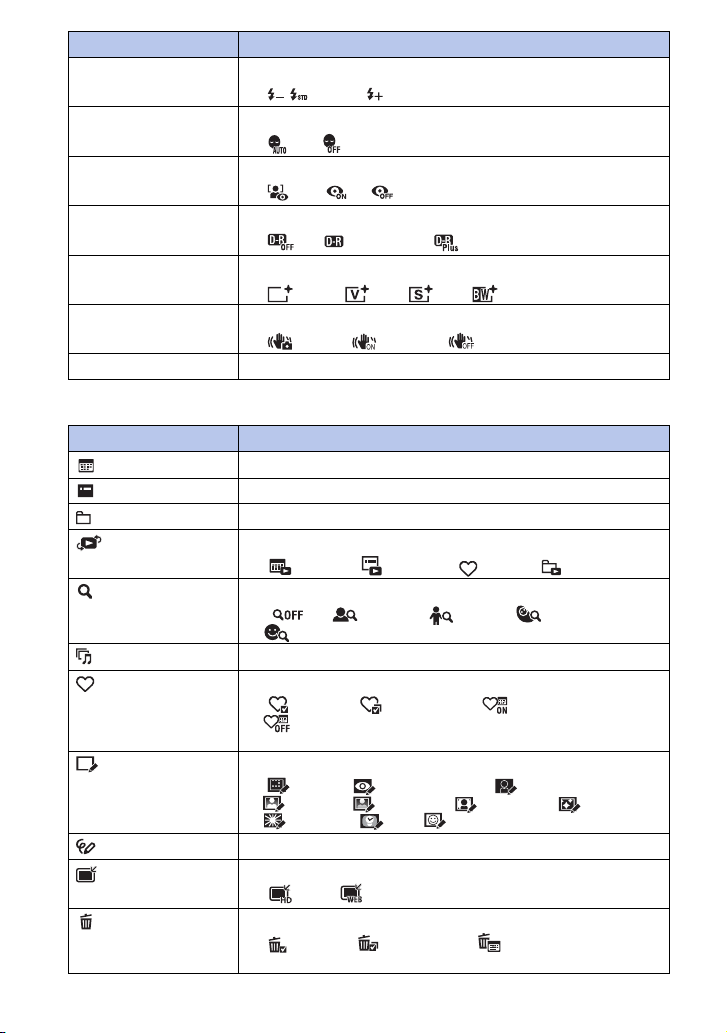
Item Description
Image Size Sets the image size.
( 10M/ 5M/ 3M/ VGA/ 3:2(8M)/
16:9(7M)/ 16:9(2M)/ 640(Fine)/ 640(Standard)/
320)
Scene Recognition Automatically detects the shooting conditions and then takes the shot.
( Off/ Auto/ Advanced)
Face Detection Selects the priority subject for adjusting the focus when using face
detection.
( When touched/ Auto/ Child Priority/ Adult Priority)
Smile Detection Sensitivity Sets the level of sensitivity to detect smile.
( Low/ Medium/ High)
REC Mode Selects the continuous shooting method.
( Normal/ Burst/BRK±0.3EV, BRK±0.7EV, BRK±1.0EV)
EV Adjusts exposure manually.
(–2.0EV to +2.0EV)
Metering Mode Sets which part of the subject to measure to determine the exposure.
( Multi/ Center)
Focus Changes the focus method.
( Multi AF/ unlimited distance)
White Balance Adjusts color tones according to the surrounding light conditions.
( Auto/ Daylight/ Cloudy/ Fluorescent Light 1,
Fluorescent Light 2, Fluorescent Light 3/n Incandescent/
Flash)
Underwater White Balance Adjusts the colors when shooting underwater.
( Auto/ Underwater 1, Underwater 2/ Flash)
46
x
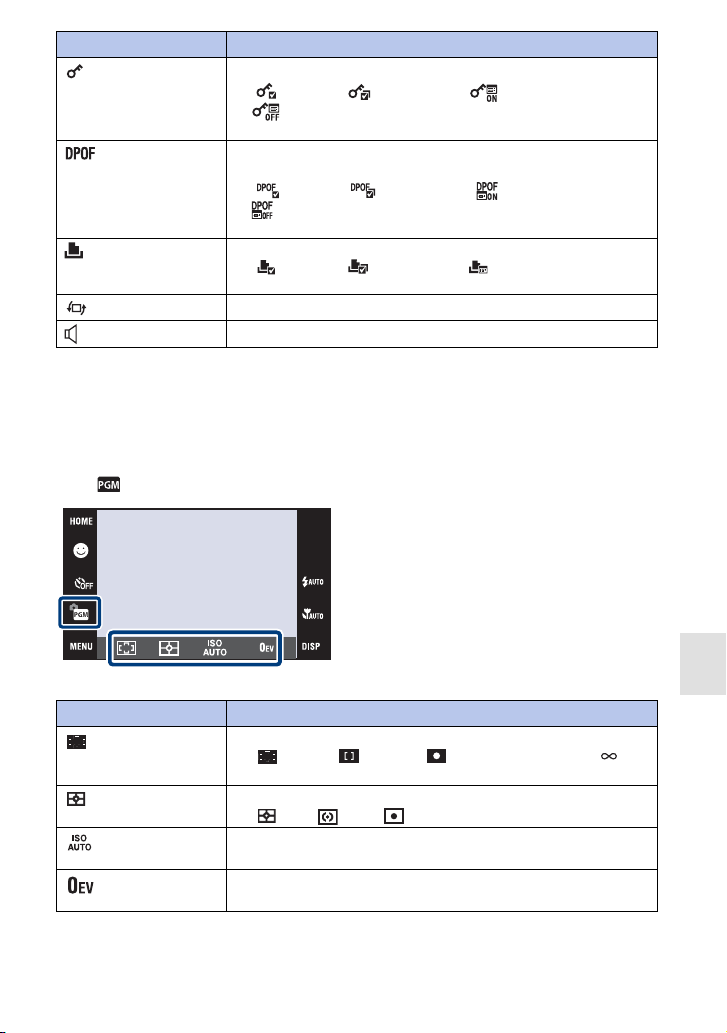
MENU in viewing mode
Flash Level Adjusts the amount of flash light.
( / Standard/ )
Anti Blink Sets Anti Blink function.
( Auto/ Off)
Red Eye Reduction Sets to reduce the red-eye phenomenon.
( Auto/ On/ Off)
DRO Optimizes the brightness and contrast.
( Off/ DRO standard/ DRO plus)
Color Mode Changes the vividness of the image or adds special effects.
( Normal/ Vivid/ Sepia/ B & W)
SteadyShot Selects the anti-blur mode.
( Shooting/ Continuous/ Off)
Shooting Settings Selects the shooting settings.
Item Description
(Date List) Selects the playback date list.
(Event List) Selects the event group to be played back.
(Select Folder) Selects the folder for viewing images.
(View Mode) Switches the View Modes.
( Date View/ Event View/ Favorites/ Folder View)
(Filter by Faces) Plays back images filtered to meet certain conditions.
( Off/ All people/ Children/ Infants/
Smiles)
(Slideshow) Plays back images in succession along with effects and music.
(Add / Remove
Favorites)
Adds images to Favorites or removes images from Favorites.
( This Image/ Multiple Images/ Add All in Date Range*/
Remove All in Date Range*)
* The displayed text differs according to each View Mode.
(Retouch) Retouches still images.
( Trimming/ Red Eye Correction/ Unsharp masking/
Soft Focus/ Partial Color/ Fisheye Lens/ Cross Filter/
Radial Blur/ Retro/ Happy Faces)
(Paint) Paints on a still image and saves as a new image.
(Multi-Purpose
Resize)
Changes the image size according to usage.
( HDTV/ Blog/E-mail)
(Delete) Deletes images.
( This Image/ Multiple Images/ All in Date Range*)
* The displayed text differs according to each View Mode.
Item Description
47
Changing camera settings
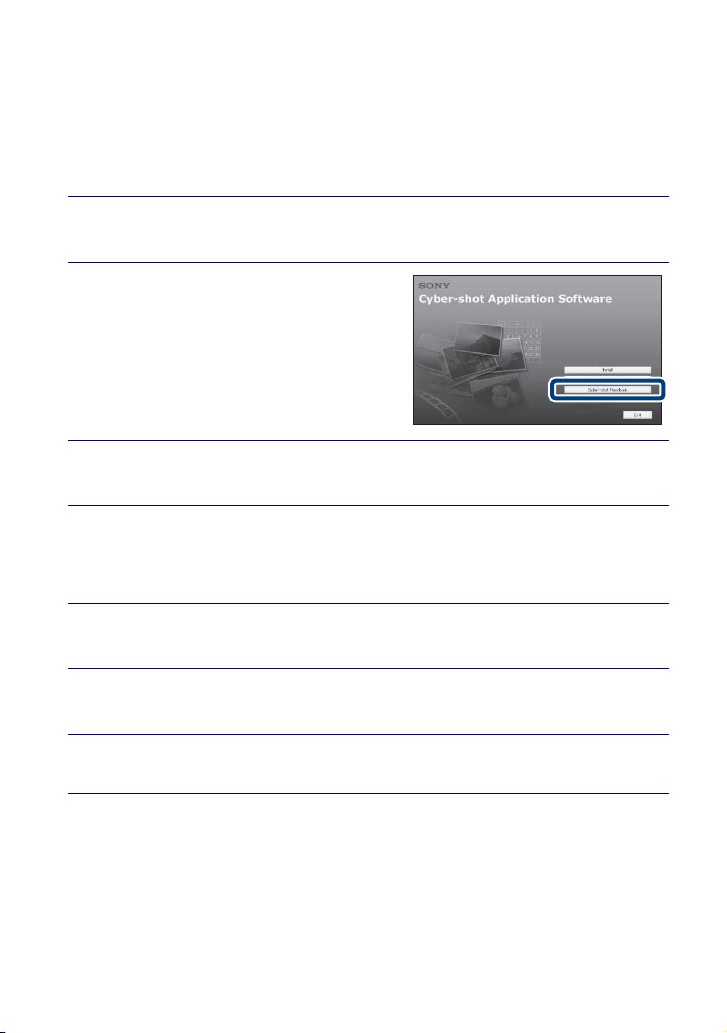
Using functions in Program Auto mode
You can change the Focus, Metering Mode, ISO, and EV settings when [REC Mode] is
set to (Program Auto).
(Protect) Prevents accidental erasure.
( This Image/ Multiple Images/ Set All in Date Range*/
Remove All in Date Range*)
* The displayed text differs according to each View Mode.
Adds a Print order mark to the image you want to print in a “Memory
Stick Duo”.
( This Image/ Multiple Images/ Set All in Date Range*/
Remove All in Date Range*)
* The displayed text differs according to each View Mode.
(Print) Prints images using a PictBridge compliant printer.
( This Image/ Multiple Images/ All in Date Range*)
* The displayed text differs according to each View Mode.
(Rotate) Rotates a still image.
(Volume Settings) Adjusts the volume.
Item Description
(Focus) Changes the focus method.
( Multi AF/ Center AF/ Spot AF/1.0m/3.0m/7.0m/
unlimited distance)
(Metering Mode) Measures the metering area.
( Multi/ Center/ Spot)
(ISO) Sets the ISO sensitivity.
(ISO AUTO/ISO80 to ISO3200)
(EV) Adjusts the exposure
(–2.0EV to +2.0EV)
Item Description
48
Oth
ers
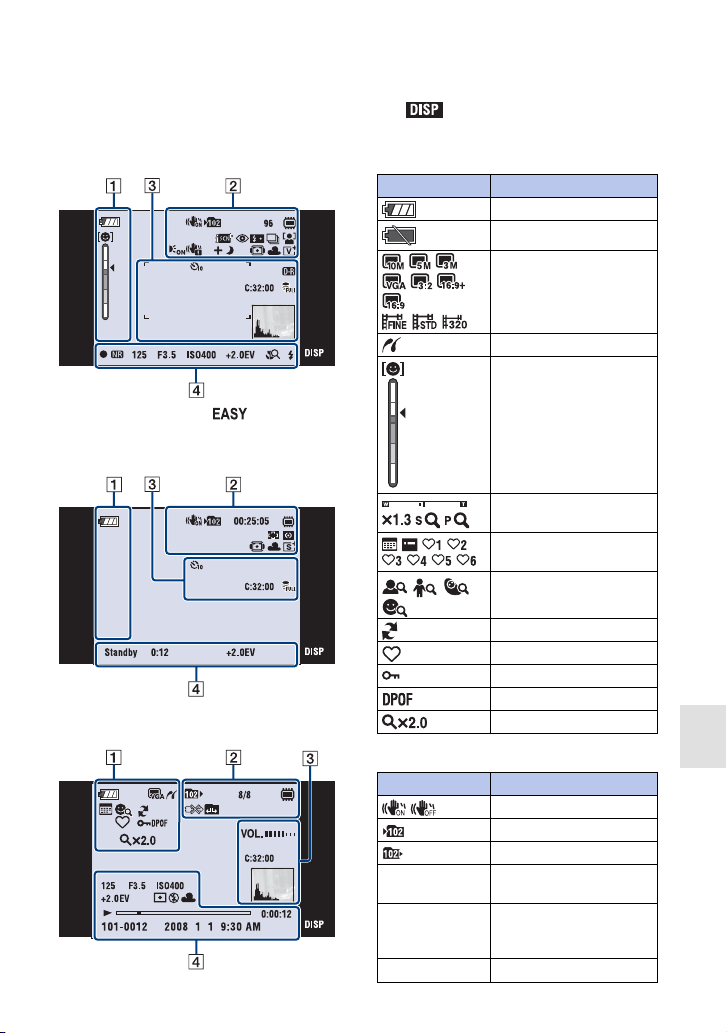
Viewing “Cyber-shot Handbook”
“Cyber-shot Handbook,” which explains how to use the camera in detail, is included on
the CD-ROM (supplied). Refer to it for in-depth instructions on the many functions of
the camera.
x
For Windows users
x
For Macintosh users
1
Turn on your computer, and insert the CD-ROM (supplied)
into the CD-ROM drive.
2
Click “Cyber-shot Handbook”.
“Cyber-shot Step-up Guide”, which contains
information on accessories for the camera, is
installed at the same time.
3
Start “Cyber-shot Handbook” from the shortcut on the
desktop.
1
Turn on your computer, and insert the CD-ROM (supplied)
into the CD-ROM drive.
2
Select the [Handbook] folder and copy “Handbook.pdf”
stored in the [GB] folder to your computer.
3
After copying is complete, double-click “Handbook.pdf”.
49
Others
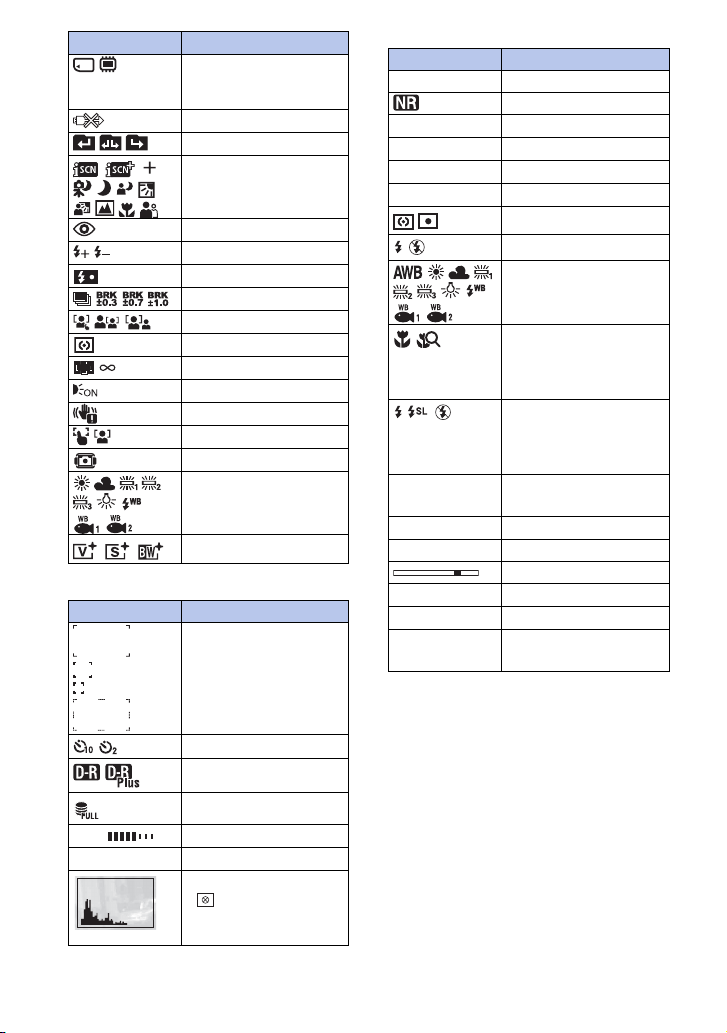
List of icons displayed on the screen
Icons are displayed on the screen to indicate the camera status.
You can select the display settings by touching the indication on the bottom right
of the screen (page 42).
When shooting still images
• The icons are limited in (Easy
Shooting) mode.
When shooting movies
When playing back
A
B
Display Indication
Battery remaining
Low battery warning
Image size
PictBridge connecting
Smile Detection Sensitivity
indicator
Zoom scaling
View Mode
Filter by Faces
PMB export
Favorites
Protect
Print order (DPOF) mark
Playback zoom
Display Indication
SteadyShot
Recording folder
Playback folder
96
Number of recordable
images
8/8
Image number/Number of
images recorded in selected
folder
00:25:05
Recordable time (h:m:s)
50
C
D
Recording/Playback Media
(“Memory Stick Duo”,
internal memory)
PictBridge connecting
Changing folder
Scene Recognition
Red-eye reduction
Flash level
Flash charging
Recording mode
Face Detection
Metering Mode
Focus
AF illuminator
Vibration warning
Touch AF indicator
Housing
White balance
Color mode
Display Indication
AF range finder frame
Self-timer
DRO
Management file full
VOL.
Volume
C:32:00
Self-diagnosis display
Histogram
•
appears when
histogram display is
disabled.
Display Indication
Display Indication
z AE/AF lock
NR slow shutter
125
Shutter speed
F3.5
Aperture value
ISO400
ISO number
+2.0EV
Exposure Value
Metering mode
Flash
White balance
Macro/Close focus
•
Displayed when
[Display Setup] is set to
[Image Only].
Flash mode
•
Displayed when
[Display Setup] is set to
[Image Only].
REC
Standby
Recording a movie/Standby
a movie
0:12
Recording time (m:s)
N Playback
Playback bar
0:00:12
Counter
101-0012
Folder-file number
2008 1 1
9:30 AM
Recorded date/time of the
playback image
51
Others
Troubleshooting
If you experience trouble with the camera, try the following solutions.
On repairing cameras with internal memory or Music files function included, data in the
camera may be checked on minimum necessity to verify and improve the malfunction
symptoms. Sony will not copy or save any of those data.
Cannot insert the battery pack.
• Insert the battery pack correctly to push the battery eject lever (page 15).
Cannot turn on the camera.
• After inserting the battery pack into the camera, it may take a few moments for the camera to
power up.
• Insert the battery pack correctly (page 15).
• The battery pack is discharged. Insert a charged battery pack (page 13).
• The battery pack is dead. Replace it with a new one.
• Use a recommended battery pack.
The power turns off suddenly.
• If you do not operate the camera for about three minutes while the power is on, the camera
turns off automatically to prevent wearing down the battery pack. Turn on the camera again
(page 17).
• The battery pack is dead. Replace it with a new one.
1 Check the items below, and refer to “Cyber-shot Handbook” (PDF).
If a code such as “C/E:ss:ss” appears on the screen, refer to “Cyber-shot
Handbook.”
2 Remove the battery pack, wait for about one minute, re-insert the battery
pack, then turn on the power.
3 Initialize the settings (page 44).
4 Consult your Sony dealer or local authorized Sony service facility.
Battery pack and power

52
The remaining charge indicator is incorrect.
• The battery charge is quickly used up in the following cases:
– When you use the camera in an extremely hot or cold location.
– When you use the flash and zoom frequently.
– When you repeatedly turn the power on and off.
– When [Brightness] of the (screen display) is set to [Bright].
• A discrepancy arose between the remaining charge indicator and the actual remaining battery
charge. Fully discharge the battery pack once, then charge it to correct the indication.
• The battery pack is discharged. Insert the charged battery pack (page 13).
• The battery pack is dead. Replace it with a new one.
Cannot charge the battery pack while inside the camera.
• You cannot charge the battery pack using the AC Adaptor (not supplied). Use the battery
charger (supplied) to charge the battery.
Cannot record images.
• Check the free capacity of the internal memory or “Memory Stick Duo” (pages 26, 29) . If it is
full, do one of the following:
– Delete unnecessary images (page 34).
– Change the “Memory Stick Duo”.
• You cannot record images while charging the flash.
• When shooting a still image, set the shooting mode other than (Movie).
• Set the shooting mode to (Movie) when shooting movies.
• The image size is set to [640(Fine)] when recording movies. Do one of the following:
– Set the image size to other than [640(Fine)].
– Insert a “Memory Stick PRO Duo.”
Vertical streaks appear when you are shooting a very bright subject.
• The smear phenomenon is occurring and white, black, red, purple or other streaks appear on
the image. This phenomenon is not a malfunction.
Cannot play back images.
• Press (Playback) button (page 19).
• The folder/file name has been changed on your computer.
• No guarantees are made for playing back, on this camera, files containing images which were
processed on a computer or images which were shot using other cameras.
• The camera is in USB mode. Delete the USB connection.
• You may not be able to play back some images stored on the “Memory Stick Duo” shot using
other cameras. Play such images in Folder View (page 32).
• This is caused by copying images on your computer to the “Memory Stick Duo” without
using the “PMB”. Play such images in Folder View (page 32).
Shooting still images/movies
Viewing images

53
Others
Precautions
Do not use/store the camera in the
following places
• In an extremely hot, cold or humid place
In places such as in a car parked in the sun,
the camera body may become deformed and
this may cause a malfunction.
• Under direct sunlight or near a heater
The camera body may become discolored or
deformed, and this may cause a malfunction.
• In a location subject to rocking vibration
• Near strong magnetic place
• In sandy or dusty places
Be careful not to let sand or dust get into the
camera. This may cause the camera to
malfunction, and in some cases this
malfunction cannot be repaired.
On carrying
Do not sit down in a chair or other place with
the camera in the back pocket of your trousers
or skirt, as this may cause malfunction or
damage the camera.
On cleaning
Cleaning the LCD screen
Wipe the screen surface with an LCD cleaning
kit (not supplied) to remove fingerprints, dust,
etc.
Cleaning the lens
Wipe the lens with a soft cloth to remove
fingerprints, dust, etc.
Cleaning the camera surface
Clean the camera surface with a soft cloth
slightly moistened with water, then wipe the
surface with a dry cloth. To prevent damage to
the finish or casing:
– Do not expose the camera to chemical
products such as thinner, benzine, alcohol,
disposable cloths, insect repellent, sunscreen
or insecticide.
– Do not touch the camera with any of the
above on your hand.
– Do not leave the camera in contact with
rubber or vinyl for a long time.
On operating temperatures
Your camera is designed for use under the
temperatures between 0°C and 40°C (32°F and
104°F). Shooting in extremely cold or hot
places that exceed this range is not
recommended.
On moisture condensation
If the camera is brought directly from a cold to
a warm location, moisture may condense
inside or outside the camera. This moisture
condensation may cause a malfunction of the
camera.
If moisture condensation occurs
Turn off the camera and wait about an hour for
the moisture to evaporate. Note that if you
attempt to shoot with moisture remaining
inside the lens, you will be unable to record
clear images.
On the internal rechargeable
backup battery
This camera has an internal rechargeable
battery for maintaining the date and time and
other settings regardless of whether the power
is on or off.
This rechargeable battery is continually
charged as long as you are using the camera.
However, if you use the camera for only short
periods, it discharges gradually, and if you do
not use the camera at all for about one month it
becomes completely discharged. In this case,
be sure to charge this rechargeable battery
before using the camera.
However, even if this rechargeable battery is
not charged, you can still use the camera, but
the date and time will not be indicated.
Charging method of the internal
rechargeable backup battery
Insert charged battery pack in the camera, and
then leave the camera for 24 hours or more
with the power off.

54
Specifications
Camera
[System]
Image device: 7.7 mm (1/2.3 type) color CCD,
Primary color filter
Total pixel number of camera: Approx. 10.3
Megapixels
Effective pixel number of camera: Approx. 10.1
Megapixels
Lens: Carl Zeiss Vario-Tessar 4× zoom lens
f = 6.18 – 24.7 mm (35 – 140 mm (35 mm
film equivalent))
F3.5 (W) – F4.6 (T)
Exposure control: Automatic exposure, Scene
Selection (11 modes)
White balance: Automatic, Daylight, Cloudy,
Fluorescent 1,2,3, Incandescent, Flash
Underwater White Balance: Auto, Underwater
1,2, Flash
File format (DCF compliant):
Still images: Exif Ver. 2.21 JPEG compliant,
DPOF compatible
Movies: MPEG1 compliant (Monaural)
Recording media: Internal Memory
(approx. 15 MB), “Memory Stick Duo”
Flash: Flash range (ISO sensitivity
(Recommended exposure Index) set to Auto):
Approx. 0.08 to 3.0 m (3 1/4 inches to
9 feet 10 1/8 inches) (W)/
approx. 0.5 to 2.4 m (1 feet 7 3/4 inches to
7 feet 10 1/2 inches) (T)
[Input and Output connectors]
Multi connector:Video output
Audio output (Monaural)
USB communication
USB communication: Hi-Speed USB (USB 2.0
compliant)
[LCD screen]
LCD panel: Wide (16:9), 7.5 cm (3.0 type) TFT
drive
Total number of dots: 230 400 (960 × 240) dots
[Power, general]
Power: Rechargeable battery pack NP-BD1, 3.6 V
NP-FD1 (not supplied), 3.6 V
AC-LS5K AC Adaptor (not supplied), 4.2 V
Power consumption (during shooting): 1.1 W
Operating temperature: 0 to 40°C (32 to 104°F)
Storage temperature: –20 to +60°C (–4 to +140°F)
Dimensions: 93.6 × 57.2 × 15.0 mm (3 3/4 × 2 3/8
× 19/32 inches) (W/H/D, excluding
protrusions)
Mass (including NP-BD1 battery pack, paint pen
and strap etc.): Approx. 151 g (5.3 oz)
Microphone: Monaural
Speaker: Monaural
Exif Print: Compatible
PRINT Image Matching III: Compatible
PictBridge: Compatible
BC-CSD battery charger
Power requirements: AC 100 V to 240 V,
50/60Hz, 2.2W
Output voltage: DC 4.2 V, 0.33 A
Operating temperature: 0 to 40°C (32 to 104°F)
Storage temperature: –20 to +60°C (–4 to +140°F)
Dimensions: Approx. 62 × 24 × 91 mm (2 1/2 ×
31/32 × 3 5/8 inches) (W/H/D)
Mass: Approx. 75 g (2.7 oz)
Rechargeable battery pack
NP-BD1
Used battery: Lithium-ion battery
Maximum voltage: DC 4.2 V
Nominal voltage: DC 3.6 V
Capacity: 2.4 Wh (680 mAh)
Design and specifications are subject to
change without notice.

55
Others
Trademarks
• The following marks are trademarks of Sony
Corporation.
, “Cyber-shot,” “Memory
Stick,” , “Memory Stick PRO,”
, “Memory Stick Duo,”
, “Memory Stick PRO
Duo,” , “Memory
Stick PRO-HG Duo,”
, “Memory Stick
Micro,” “MagicGate,” ,
“PhotoTV HD,” “Info LITHIUM”
• Microsoft, Windows, DirectX and Windows
Vista are either registered trademarks or
trademarks of Microsoft Corporation in the
United States and/or other countries.
• Macintosh and Mac OS are trademarks or
registered trademarks of Apple Inc.
• Intel, MMX, and Pentium are trademarks or
registered trademarks of Intel Corporation.
• Adobe and Reader are either trademarks or
registered trademarks of Adobe Systems
Incorporated in the United States and/or
other countries.
• In addition, system and product names used
in this manual are, in general, trademarks or
registered trademarks of their respective
developers or manufacturers. However, the
™ or ® marks are not used in all cases in this
manual.

2
Nombre del producto: Cámara Digital
Modelo: DSC-T77
Para reducir el riesgo de incendio o
descarga eléctrica, no exponga la
unidad a la lluvia ni a la humedad.
Sustituya la batería ùnicamente por otra del tipo
especificado. De lo contrario, es posible que se
produzcan incendios o lesiones.
No exponga las pilas a fuentes de calor excesivo,
como la luz solar directa, el fuego o similares.
Este producto se ha probado y cumple con la
normativa que establece la Directiva EMC si se
utiliza un cable de conexión de menos de 3 metros
de longitud.
[ Atención
Los campos electromagnéticos a frecuencias
específicas podrán influir en la imagen y el sonido
de esta unidad.
[ Aviso
Si la electricidad estática o el electromagnetismo
interrumpen la transmisíon de datos (fallo),
reinicie la aplicación o desconecte el cable de
comunicación (USB, etc.) y vuelva a conectarlo.
[ Tratamiento de los equipos
eléctricos y electrónicos al final
de su vida útil (aplicable en la
Unión Europea y en países
europeos con sistemas de
recogida selectiva de residuos)
Este símbolo en el equipo o el embalaje indica
que el presente producto no puede ser tratado
como residuos domésticos normales, sino que
debe entregarse en el correspondiente punto de
recogida de equipos eléctricos y electrónicos. Al
asegurarse de que este producto se desecha
correctamente, Ud. ayuda a prevenir las
consecuencias negativas para el medio ambiente y
la salud humana que podrían derivarse de la
incorrecta manipulación en el momento de
deshacerse de este producto. El reciclaje de
materiales ayuda a conservar los recursos
naturales. Para recibir información detallada sobre
el reciclaje de este producto, póngase en contacto
con el ayuntamiento, el punto de recogida más
cercano o el establecimiento donde ha adquirido
el producto.
Español
POR FAVOR LEA DETALLADAMENTE
ESTE MANUAL DE INSTRUCCIONES
ANTES DE CONECTAR Y OPERAR
ESTE EQUIPO.
RECUERDE QUE UN MAL USO DE SU
APARATO PODRÍA ANULAR LA
GARANTÍA.
AVISO
PRECAUCIÓN
Atención para los clientes en
Europa
3
Tratamiento de las baterías al final
de su vida útil (aplicable en la
Unión Europea y en países
europeos con sistemas de
recogida selectiva de residuos)
Este símbolo en la batería o en el embalaje indica
que la batería proporcionada con este producto no
puede ser tratada como un residuo doméstico
normal.
Al asegurarse de que estas baterías se desechan
correctamente, Ud. ayuda a prevenir las
consecuencias negativas para el medio ambiente y
la salud humana que podrían derivarse de la
incorrecta manipulación en el momento de
deshacerse de la batería. El reciclaje de materiales
ayuda a conservar los recursos naturales.
En el caso de productos que por razones de
seguridad, rendimiento o mantenimiento de datos,
sea necesaria una conexión permanente con la
batería incorporada, esta batería solo deberá ser
reemplazada por personal técnico cualificado para
ello.
Para asegurarse de que la batería será tratada
correctamente, entregue el producto al final de su
vida útil en un punto de recogida para el reciclado
de aparatos eléctricos y electrónicos.
Para las demás baterías, vea la sección donde se
indica cómo quitar la batería del producto de
forma segura. Deposite la batería en el
correspondiente punto de recogida para el
reciclado.
Para recibir información detallada sobre el
reciclaje de este producto o de la batería, póngase
en contacto con el ayuntamiento, el punto de
recogida más cercano o el establecimiento donde
ha adquirido el producto.
[ Aviso para los clientes de países
en los que se aplican las
directivas de la UE
El fabricante de este producto es Sony
Corporation, 1-7-1 Konan Minato-ku Tokyo, 108-
0075, Japón. El representante autorizado en lo
referente al cumplimiento de la directiva EMC y a
la seguridad de los productos es Sony
Deutschland GmbH, Hedelfinger Strasse 61,
70327 Stuttgart, Alemania. Para resolver
cualquier asunto relacionado con el soporte
técnico o la garantía, consulte las direcciones que
se indican en los documentos de soporte técnico y
garantía suministrados por separado.
ES

4
Índice
Notas sobre la utilización de la cámara ................................................... 6
Preparativos ........................................................................... 7
Comprobación de los accesorios suministrados ......................................7
Identificación de las partes .......................................................................8
Carga de la batería....................................................................................9
Inserción de la batería/un “Memory Stick Duo” (no suministrado)..........11
Ajuste del reloj ......................................................................................... 13
Toma/visionado de imágenes .......................... 14
Toma de imágenes..................................................................................14
Visualización de imágenes......................................................................15
Utilización de las funciones de toma de imagen ...... 16
Detección de sonrisas y toma automática (Captador de sonrisas) ........ 16
Detección de las condiciones de la toma de imagen automáticamente
(Reconocimiento de escena)...................................................................17
Toma de primeros planos (Macro/Enfoque de cerca) ............................ 18
Utilización del autodisparador.................................................................18
Selección de un modo de flash ...............................................................19
Enfoque de un punto específico del cuadro ...........................................20
Enfoque de la cara del motivo (Detección de cara)................................20
Selección del tamaño de imagen para coincidir con la utilización.........21
Utilización del modo de toma que coincide con la escena
(Selección escena) ..................................................................................23
Toma de películas ...................................................................................24
Visualización de los indicadores mínimos (Toma fácil)........................... 25
Utilización de las funciones de visionado .................... 26
Visionado de una imagen ampliada (Zoom de reproducción)................ 26
Visualización de imágenes en pantalla completa (Zoom ancho)............26
Giro de una imagen de orientación vertical (Visualización girada
temporalmente)........................................................................................27
Visionado de imágenes fijas con música (Diapositivas) .........................27
Búsqueda de una imagen (Índice de imágenes)....................................28
Selección del formato de visualización (Modo visualización) .................28

5
Borrado de imágenes ................................................................. 30
Eliminación de la imagen visualizada actualmente ................................ 30
Eliminación de múltiples imágenes......................................................... 30
Eliminación de todas las imágenes (Formatear)..................................... 31
Conexión a otros dispositivos ............................................. 32
Visionado de imágenes en un televisor .................................................. 32
Impresión de imágenes fijas ................................................................... 33
Utilización de la cámara con un ordenador ............................................ 34
Cambio de los ajustes de la cámara ................................. 38
Cambio de la visualización en pantalla................................................... 38
Cambio de los sonidos de operación ..................................................... 38
Utilización de la pantalla HOME.............................................................. 39
Utilización de los elementos de MENU................................................... 41
Utilización de funciones en modo Programa automático ....................... 44
Otros ..................................................................................................... 45
Visionado de la “Guía práctica de Cyber-shot” ...................................... 45
Lista de iconos visualizados en la pantalla............................................. 46
Solución de problemas ........................................................................... 48
Precauciones........................................................................................... 50
Especificaciones ..................................................................................... 51

6
x
Notas sobre la utilización de la cámara
Copia de seguridad de la memoria
interna y del “Memory Stick Duo”
No apague la cámara, extraiga la batería, ni
retire el “Memory Stick Duo” mientras está
encendida la lámpara de acceso. De lo
contrario, podrán dañarse los datos de la
memoria interna o el “Memory Stick Duo”.
Asegúrese de hacer una copia de seguridad
para proteger sus datos.
Acerca de los archivos de gestión
Cuando inserta un “Memory Stick Duo” sin
archivo de gestión en la cámara y conecta la
alimentación, parte de la capacidad del
“Memory Stick Duo” se utiliza para crear
automáticamente un archivo de gestión. Es
posible que lleve algún tiempo hasta que
pueda realizar la siguiente operación.
Notas sobre la grabación/
reproducción
• Antes de comenzar a grabar, haga una
grabación a modo de prueba para asegurarse
de que la cámara está funcionando
correctamente.
• La cámara no está hecha a prueba de polvo,
ni a prueba de salpicaduras, ni a prueba de
agua. Lea “Precauciones” (página 50) antes
de utilizar la cámara.
• Evite exponer la cámara al agua. Si entra
agua dentro de la cámara, podrá ocurrir un
mal funcionamiento. En algunos casos, la
cámara no podrá ser reparada.
• No dirija la cámara hacia el sol ni hacia otras
luces intensas. Podrá ocasionar un mal
funcionamiento de la cámara.
• No utilice la cámara cerca de un lugar que
genere ondas de radio fuertes o emita
radiación. De lo contrario, es posible que la
cámara no pueda grabar o reproducir
imágenes correctamente.
• La utilización de la cámara en lugares
arenosos o polvorientos podrá ocasionar un
mal funcionamiento.
• Si se condensa humedad, elimínela antes de
utilizar la cámara (página 50).
• No agite ni golpee la cámara. Podría
ocasionar un mal funcionamiento y no poder
grabar imágenes. Además, el soporte de
grabación podría quedar inutilizable o
dañarse los datos de imagen.
• Limpie la superficie del flash antes de
utilizarlo. El calor de la emisión del flash
podrá hacer que la suciedad en la superficie
del flash se descolore o se adhiera en ella,
ocasionando una insuficiente emisión de luz.
Notas sobre la pantalla LCD
• La pantalla LCD está fabricada utilizando
tecnología de muy alta precisión por lo que
más del 99,99% de los píxeles son operativos
para uso efectivo. Sin embargo, es posible
que aparezcan algunos puntos diminutos
negros y/o brillantes (blancos, rojos, azules o
verdes) en la pantalla LCD. Estos puntos son
un resultado normal del proceso de
fabricación, y no afectan a la grabación.
• Si salpica agua u otros líquidos a la pantalla
LCD y se moja, seque inmediatamente la
pantalla con un paño suave. Los líquidos
dejados en la superficie de la pantalla LCD
pueden perjudicar la calidad y ocasionar un
mal funcionamiento.
Acerca de la compatibilidad de los
datos de imagen
• La cámara cumple con la norma universal
DCF (Design rule for Camera File system)
establecida por la JEITA (Japan Electronics
and Information Technology Industries
Association).
• Sony no garantiza que la cámara pueda
reproducir imágenes grabadas o editadas con
otro equipo, ni que otros equipos puedan
reproducir imágenes grabadas con la cámara.
Aviso sobre los derechos de autor
Los programas de televisión, películas, cintas
de vídeo y demás materiales pueden estar
protegidos por copyright. La grabación no
autorizada de tales materiales puede ir en
contra de los artículos de las leyes de
copyright.
No hay compensación por daño
del contenido o fallo de grabación
Sony no compensará por no poder grabar o por
la pérdida o daño del contenido grabado
debido a un mal funcionamiento de la cámara
o el soporte de grabación, etc.
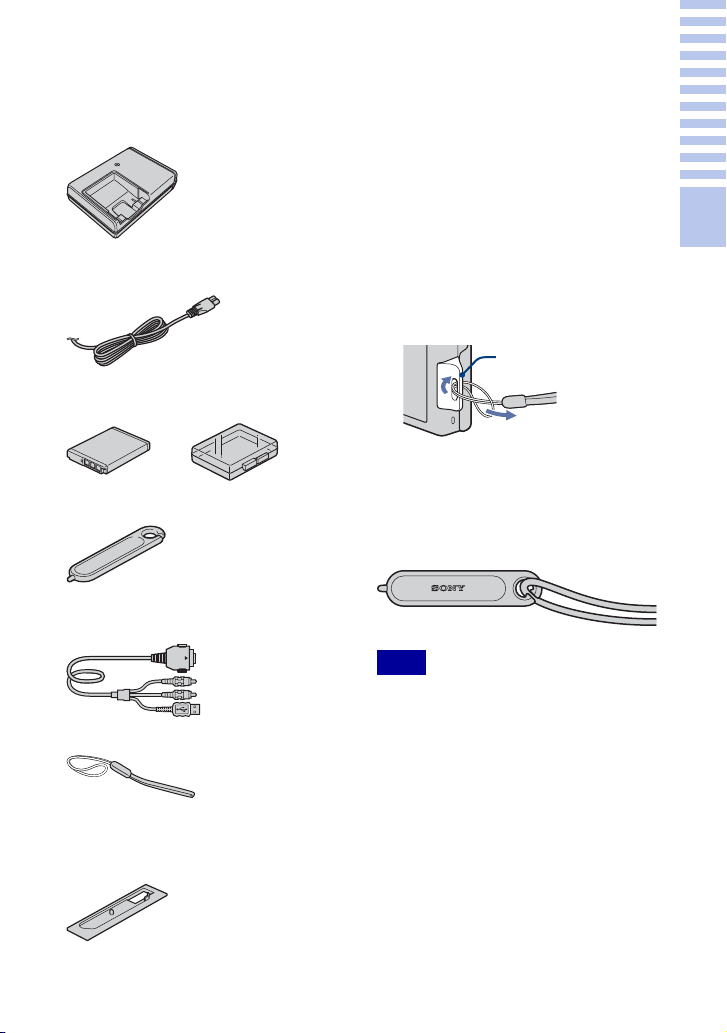
Preparativos
7
P
repara
ti
vos
Comprobación de los accesorios
suministrados
• Cargador de batería BC-CSD (1)
• Cable de alimentación (1) (no suministrado
en EE.UU.y Canadá)
• Batería recargable NP-BD1 (1)/caja de la
batería (1)
• Lápiz de pintar (1)
• Cable USB, A/V para terminal de usos
múltiples (1)
• Correa para muñeca (1)
• Placa de estación F (1)
La placa de estación se utiliza cuando se
monta la cámara en el Cyber-shot station
(no suministrado).
• CD-ROM (1)
– Software de aplicación del Cyber-shot
– “Guía práctica de Cyber-shot”
– “Guía avanzada de Cyber-shot”
• Manual de instrucciones (este manual) (1)
x
Utilización de la correa de
muñeca
Coloque la correa y pase la mano a través del
lazo para evitar que pueda caérsele la cámara
y dañarse.
x
Utilización del lápiz de
pintar
El lápiz de pintar se utiliza cuando se emplea
el panel táctil. Se coloca en la correa de
muñeca.
• No transporte la cámara agarrando del lápiz
de pintar. La cámara podrá caerse.
Gancho
Nota
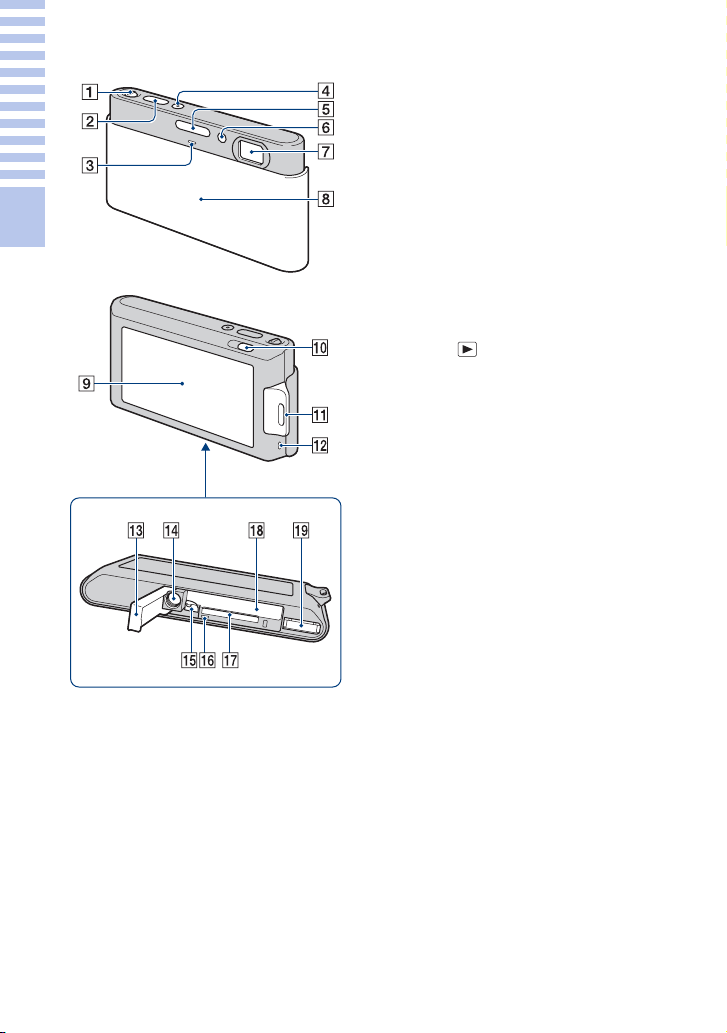
8
Preparativos
Identificación de las partes
A Palanca del zoom (W/T)
B Botón del disparador
C Micrófono
D Botón POWER/Lámpara POWER
E Flash
F Lámpara del autodisparador/Lámpara
del captador de sonrisas/Iluminador
AF
G Objetivo
H Tapa del objetivo
I Pantalla LCD/Panel táctil
J Botón (Reproducción)
K Enganche para la correa de muñeca/
Empuñadura
L Altavoz
M Tapa de la batería/“Memory Stick
Duo”
N Rosca para trípode
• Utilice un trípode con un tornillo de menos
de 5,5 mm de largo. De lo contrario, no
podrá sujetar firmemente la cámara, y es
posible que la cámara se dañe.
O Palanca de expulsión de la batería
P Lámpara de acceso
Q Ranura de “Memory Stick Duo”
R Ranura de inserción de la batería
S Conector múltiple
Parte inferior
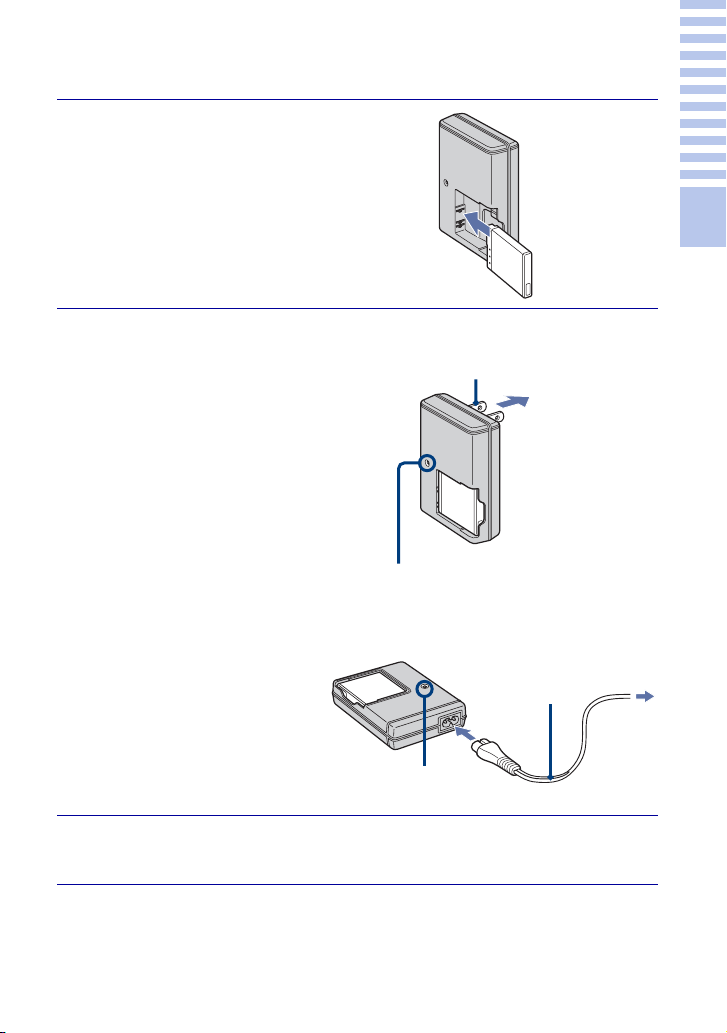
9
Preparativos
Carga de la batería
1
Inserte la batería en el
cargador de batería.
• Puede cargar la batería incluso cuando
esté parcialmente cargada.
2
Conecte el cargador
de batería a la toma
de corriente de la
pared.
Si continúa cargando la batería
durante aproximadamente una
hora más después de haberse
apagado la lámpara CHARGE,
la carga durará un poco más
(carga completa).
Lámpara CHARGE
Iluminada: Cargando
Apagada: Ha finalizado la carga
(carga normal)
3
Cuando se haya completado la carga, desconecte el
cargador de batería.
Batería
Lámpara CHARGE
Para clientes en EE.UU. y Canadá
Clavija
Lámpara CHARGE
Cable de
alimentación
Para clientes en países/regiones distintos de
EE.UU. y Canadá
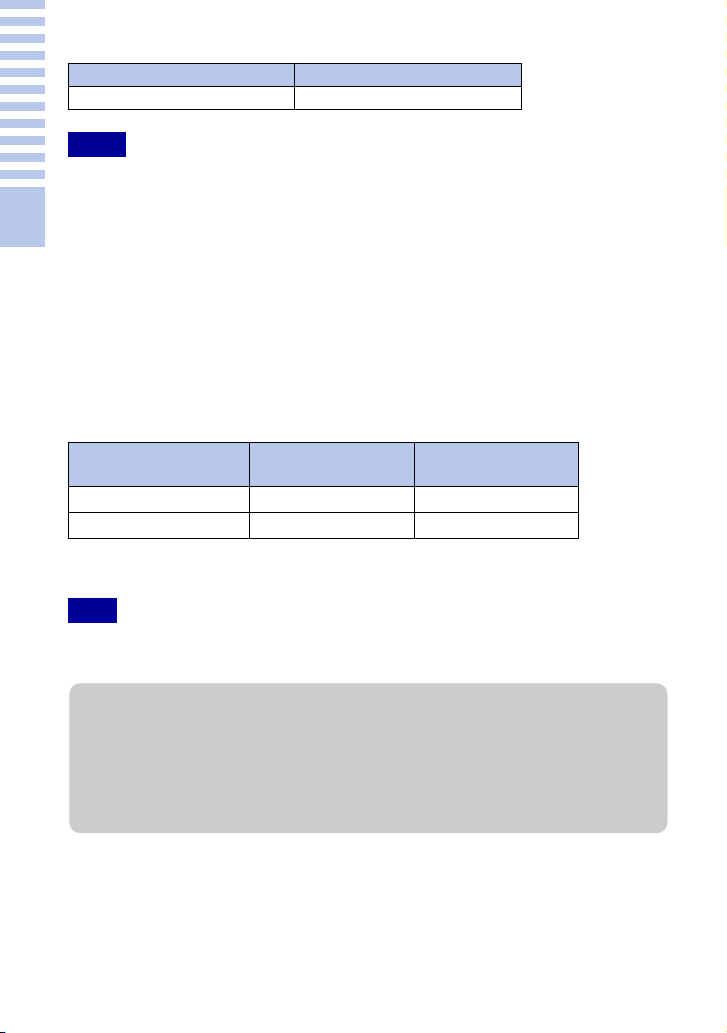
10
Preparativos
x
Tiempo de carga
• La tabla de arriba muestra el tiempo requerido para cargar una batería completamente descargada a
una temperatura de 25°C
La carga podrá llevar más tiempo según las condiciones de utilización y las circunstancias.
• Conecte el cargador de batería a la toma de corriente de la pared más próxima.
• Aunque la lámpara CHARGE no esté encendida, el cargador de batería no estará desconectado de
la fuente de alimentación de ca en tanto que el mismo esté conectado a la toma de corriente de la
pared. Si ocurre algún problema mientras utiliza el cargador de batería, interrumpa inmediatamente
la alimentación desconectando la clavija de la toma de corriente de la pared.
• Cuando finalice la carga, desenchufe el cable de alimentación de la toma de corriente de la pared, y
extraiga la batería del cargador de batería.
• Diseñado para utilizarse con baterías Sony compatibles.
x
Duración de la batería y número de imágenes que se pueden
grabar/ver
• El método de medición está basado en el estándar CIPA. (CIPA: Camera & Imaging Products
Association)
• La duración de la batería y el número de imágenes fijas podrán variar dependiendo de los ajustes
de la cámara.
Tiempo de carga completa Tiempo de carga normal
Aprox. 220 min (minuto) Aprox. 160 min (minuto)
Notas
Duración de la batería
(min (minuto))
N°. de imágenes
Toma de imágenes fijas Aprox. 110 Aprox. 220
Visionado de imágenes fijas Aprox. 230 Aprox. 4 600
Nota
zUtilización de la cámara en el extranjero
Puede utilizar la cámara, el cargador de batería (suministrado), y el adaptador de ca AC-LS5K
(no suministrado) en cualquier país o región donde el suministro de corriente sea de entre 100 V
a 240 V de ca 50/60 Hz
No utilice un transformador electrónico (convertidor para usar en viajes). Ello podría ocasionar
un mal funcionamiento.
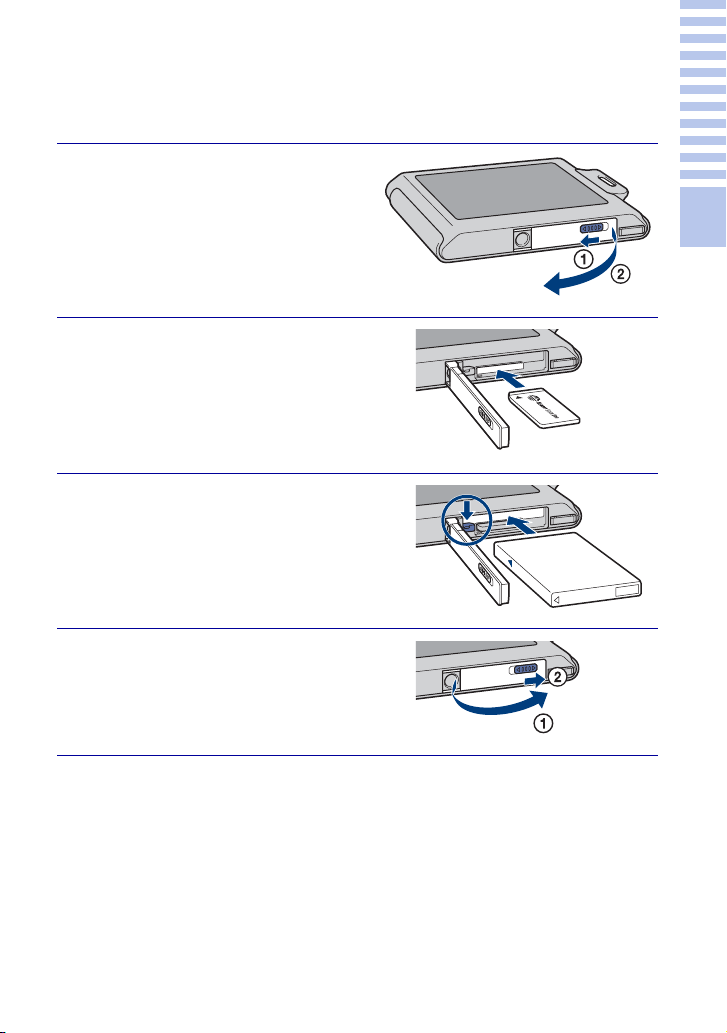
11
Preparativos
Inserción de la batería/un “Memory
Stick Duo” (no suministrado)
1
Abra la tapa.
2
Inserte el “Memory Stick
Duo” (no suministrado).
Con el lado del terminal orientado hacia el
objetivo, inserte el “Memory Stick Duo”
hasta que produzca un chasquido al encajar
en su sitio.
3
Inserte la batería.
Alinee la marca v de la batería con la
palanca de expulsión de la batería, después
inserte la batería mientras presiona la
palanca en la dirección indicada por la
flecha.
4
Cierre la tapa.
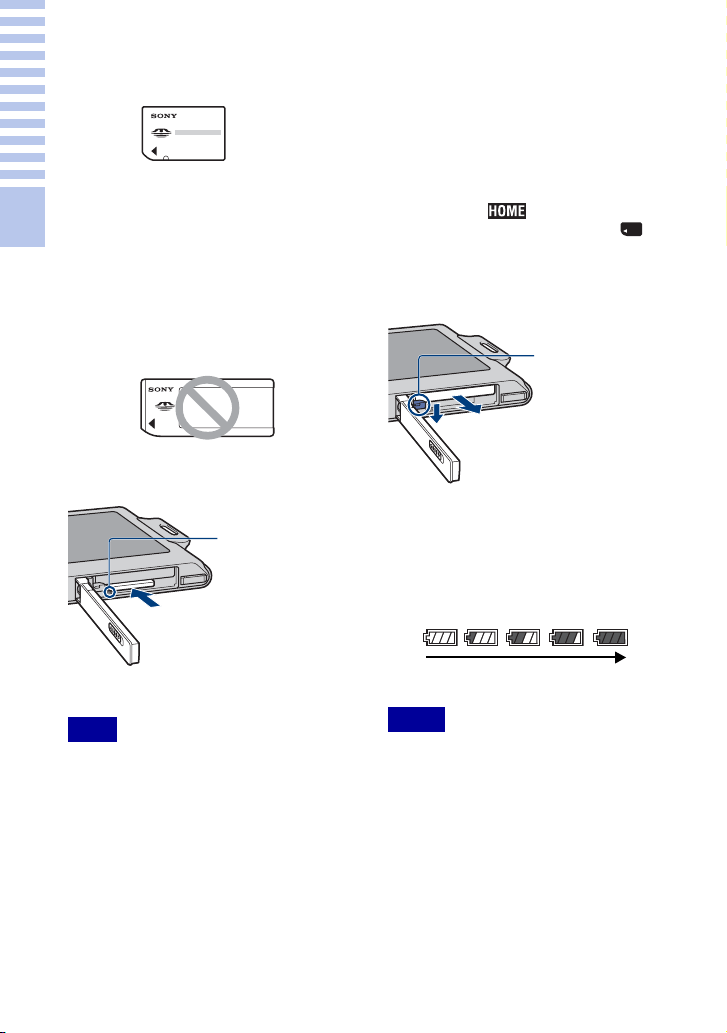
12
Preparativos
x
“Memory Stick” que puede
utilizar
“Memory Stick Duo”
También puede utilizar un “Memory Stick
PRO Duo” o “Memory Stick PRO-HG Duo”
con la cámara.
Para más detalles sobre el número de
imágenes/tiempo que se pueden grabar,
consulte las páginas 22, 25. Otros tipos de
“Memory Stick” o tarjeta de memoria no son
compatibles con la cámara.
“Memory Stick”
No puede utilizar un “Memory Stick” con la
cámara.
x
Para extraer el
“Memory
Stick Duo”
• No extraiga nunca el “Memory Stick Duo”/
batería cuando esté iluminada la lámpara de
acceso. Esto podría ocasionar daño a los
datos del “Memory Stick Duo”/memoria
interna.
x
Cuando no hay insertado un
“Memory Stick Duo”
Las imágenes se almacenan en la
memoria interna de la cámara
(aproximadamente 15 MB)
Para copiar imágenes de la memoria
interna a un “Memory Stick Duo”,
inserte el “Memory Stick Duo” en la
cámara, toque y seleccione
[Copiar] en [Herrta. Memoria] de
(Gestión de memoria) (página 40).
x
Para extraer la batería
x
Comprobación de la carga
de batería restante
En la parte superior izquierda de la
pantalla LCD aparece un indicador de
carga restante.
• La aparición del indicador de carga restante
correcto lleva aproximadamente un min
(minuto).
• Es posible que el indicador de carga restante
no sea correcto en ciertas circunstancias.
• Si utiliza la batería NP-FD1 (no
suministrada), también podrá ver los minutos
después del indicador de carga restante.
• La capacidad de la batería disminuye a
medida que pasa el tiempo y con el uso
repetido. Cuando el tiempo de operación por
carga disminuya notablemente, la batería
necesitará ser reemplazada. Adquiera una
batería nueva.
Nota
Asegúrese de que la lámpara
de acceso no está
encendida, después pulse el
“Memory Stick Duo” hacia
dentro una vez.
Lámpara de
acceso
Notas
Deslice la palanca de
expulsión de la batería.
Asegúrese de no dejar caer
la batería.
Palanca de
expulsión de la
batería
Alta
Baja
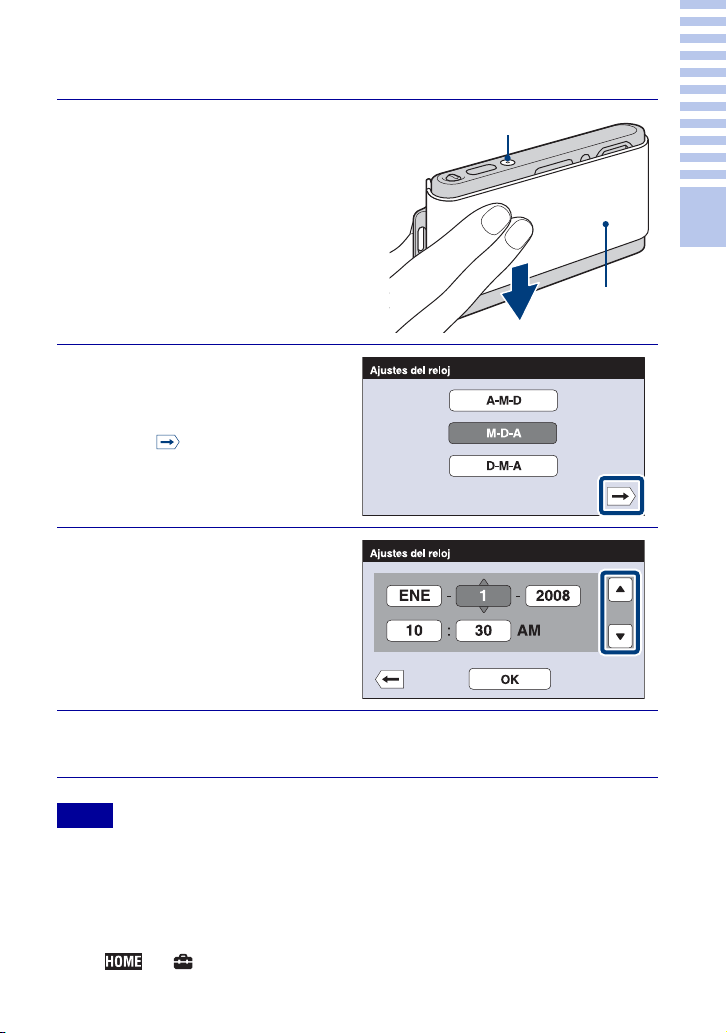
13
Preparativos
Ajuste del reloj
• La cámara no tiene una función para superponer fechas en imágenes. Utilizando “PMB” del CD-
ROM (suministrado), puede imprimir o guardar imágenes con la fecha.
• Si la cámara está encendida y no la utiliza durante unos tres min (minuto), la cámara se apagará
automáticamente (Función de apagado automático).
x
Ajuste de la fecha y la hora otra vez
Toque t (Ajustes) t [Ajustes del reloj] (página 40).
1
Baje la tapa del objetivo.
La cámara se enciende.
• También puede encender la cámara
pulsando el botón POWER.
• Es posible que lleve algún tiempo en
conectarse la alimentación y permitir
realizar operaciones.
2
Toque el formato de
visualización de fecha
deseado, y después
toque .
3
Toque cada elemento,
después toque v/V para
ajustar su valor
numérico.
• Medianoche se indica como
12:00 AM, y mediodía como
12:00 PM.
4
Toque [OK].
Notas
Tapa del
objetivo
Botón POWER
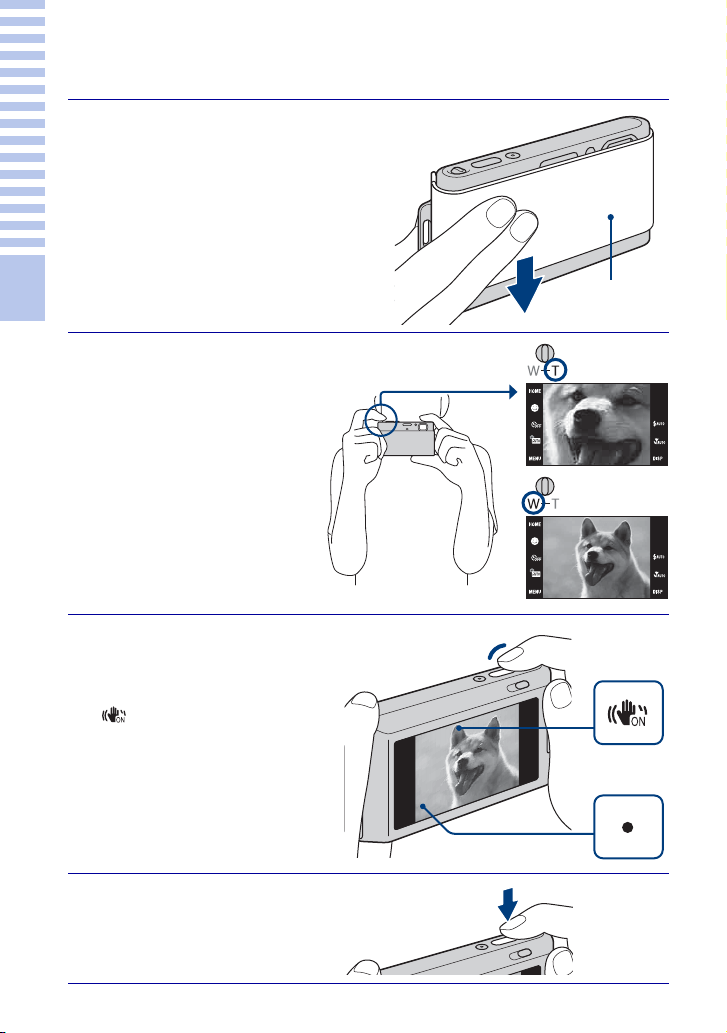
14
Toma/visionado de imágenes
T
oma
/
v
i
s
i
ona
d
o
d
e
i
m
ág
enes
Toma de imágenes
1
Baje la tapa del objetivo.
La cámara se enciende.
2
Sujete la cámara
sin moverla como
se muestra en la
ilustración.
• Deslice la palanca del zoom
(W/T) hacia el lado T para
acercar con zoom.
Deslice hacia el lado W para
volver.
3
Pulse el botón del
disparador hasta la
mitad para enfocar.
se visualiza para indicar que
SteadyShot está funcionando.
Cuando la imagen está enfocada,
suena un pitido y se ilumina el
indicador z. La distancia de
toma más corta es de
aproximadamente 8 cm (W),
50 cm (T) (desde el objetivo).
4
Pulse el botón del
disparador a fondo.
Se toma la imagen.
Tapa del
objetivo
Palanca del zoom (W/T)
Marca de
SteadyShot
Botón del
disparador
Bloqueo
AE/AF
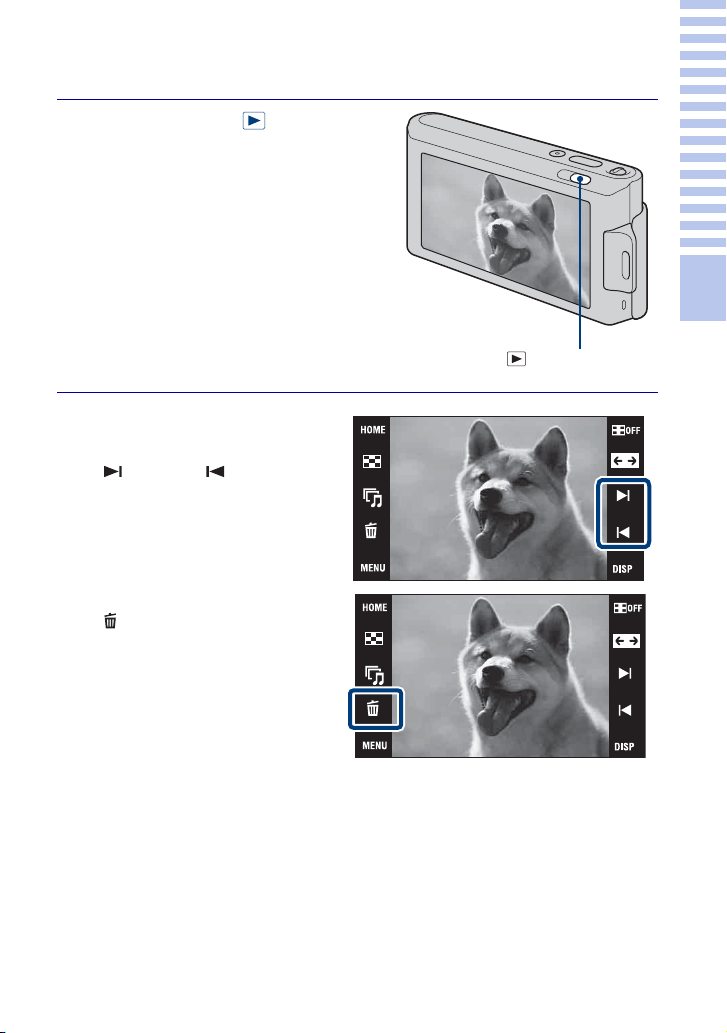
Toma/visionado de imágenes
15
Visualización de imágenes
x
Para volver a la toma de imágenes
Pulse el botón del disparador hasta la mitad.
x
Para apagar la cámara
Cierre la tapa del objetivo.
• También puede apagar la cámara pulsando el botón POWER.
1
Pulse el botón
(Reproducción).
Se visualiza la última imagen tomada.
• Cuando imágenes del “Memory Stick
Duo” grabadas con otras cámaras no
puedan reproducirse en esta cámara, vea
las imágenes en [Ver carpetas]
(página 28).
x
Selección de la imagen
siguiente/anterior
Toque (Siguiente)/ (Anterior) en la
pantalla.
x
Eliminación de una imagen
Toque (Borrar), después toque [OK].
Botón (Reproducción)
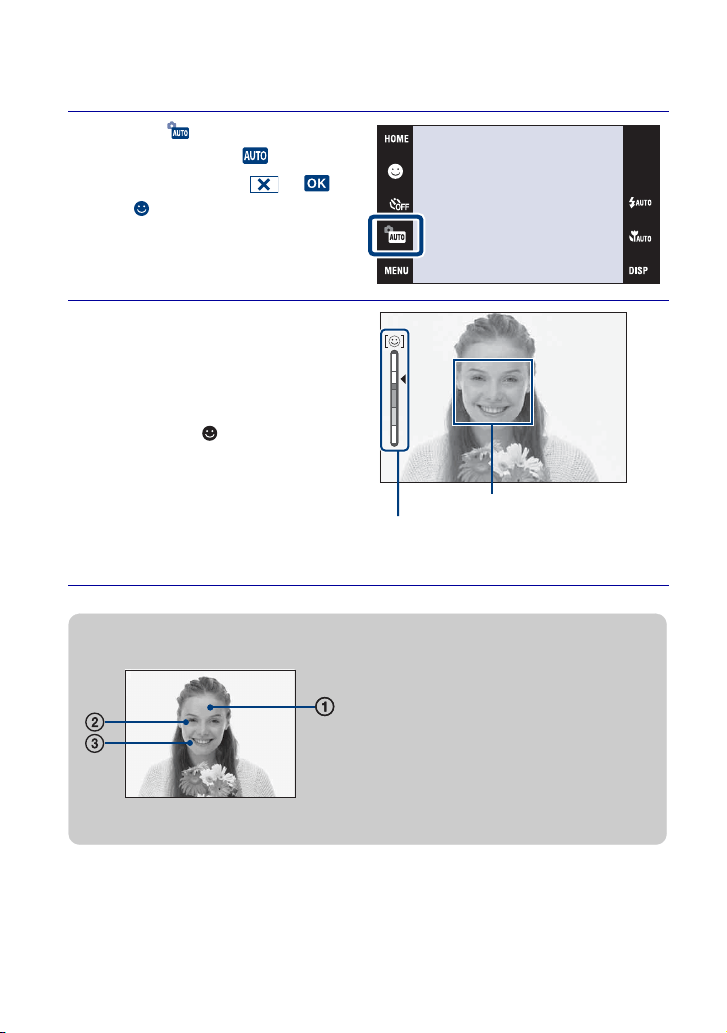
16
Utili
zac
ió
n
d
e
l
as
f
unc
i
ones
d
e
t
oma
d
e
i
ma
g
en
Detección de sonrisas y toma automática
(Captador de sonrisas)
1
Toque (Modo
Grabación) t (Ajuste
automático) t o
t (Icono de sonrisa).
2
Espere mientras se
detecta una sonrisa.
Cuando el nivel de sonrisa excede el
punto b del indicador, la cámara
toma imágenes automáticamente.
Cuando toque (Icono de sonrisa)
otra vez, finalizará el Captador de
sonrisas.
• Si pulsa el botón del disparador
durante el Captador de sonrisas, la
cámara tomará la imagen en ajuste
automático, y después volverá al
modo Captador de sonrisas.
Cuadro de Detección de cara
Indicador de sensibilidad de detección de
sonrisas
zConsejos para capturar sonrisas mejor
1 No cubrirse los ojos con flequillos.
2 Intente orientar la cara enfrente de la
cámara y estar lo más nivelado
posible. El porcentaje de detección
será mayor cuando los ojos estén
entornados.
3 Ofrezca una sonrisa clara con la boca
abierta. Las sonrisas son más fáciles
de detectar cuando se muestran los
dientes.
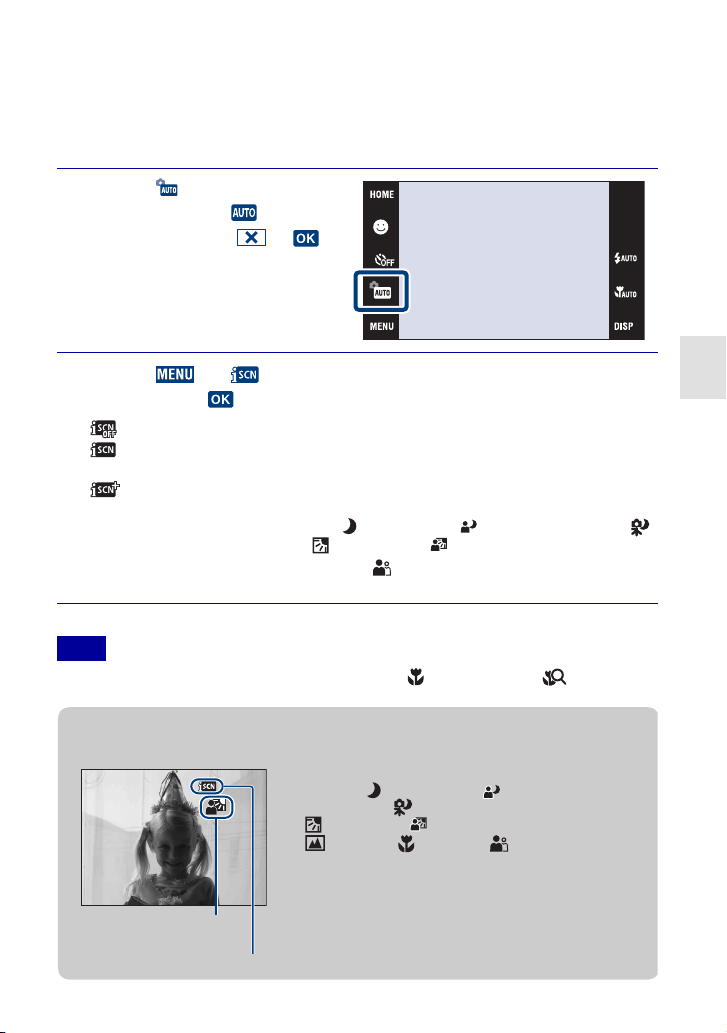
17
Utilización de las funciones de toma de imagen
Detección de las condiciones de la toma de imagen
automáticamente (Reconocimiento de escena)
La cámara detecta automáticamente las condiciones de la toma de imagen, y después
toma la imagen.
• El Reconocimiento de escena no responderá en el modo (Macro activado), (Permitido
enfocar de cerca) ni Ráfaga.
1
Toque (Modo
Grabación) t (Ajuste
automático) t o .
2
Toque t (Reconocimiento de escena) t modo
deseado t .
(Desactivar): No utiliza Reconocimiento de escena.
(Auto): Cuando la cámara reconozca la escena, cambiará a los ajustes óptimos
y tomará la imagen.
(Avanzado): Cuando la cámara reconozca la escena, cambiará a los ajustes
óptimos y tomará la imagen.
Además, cuando la cámara reconoce (Crepúsculo), (Retrato crepúsculo),
(Crepúsculo utilizando trípode), (Contraluz) o (Retrato a contraluz), toma
otra imagen. Cuando la cámara reconoce (Retrato), se acciona la reducción de
ojos cerrados.
Nota
zCuando la cámara reconoce la escena
Cuando la cámara reconoce la escena.
Aparece (Crepúsculo), (Retrato
crepúsculo), (Crepúsculo utilizando trípode),
(Contraluz), (Retrato a contraluz),
(Paisaje), (Macro) o (Retrato).
Cuando la cámara no reconoce la escena, la
imagen se toma como Reconocimiento de escena
ajustado a [Desactivar].
Icono de Reconocimiento
de escena
Icono de valor de ajuste
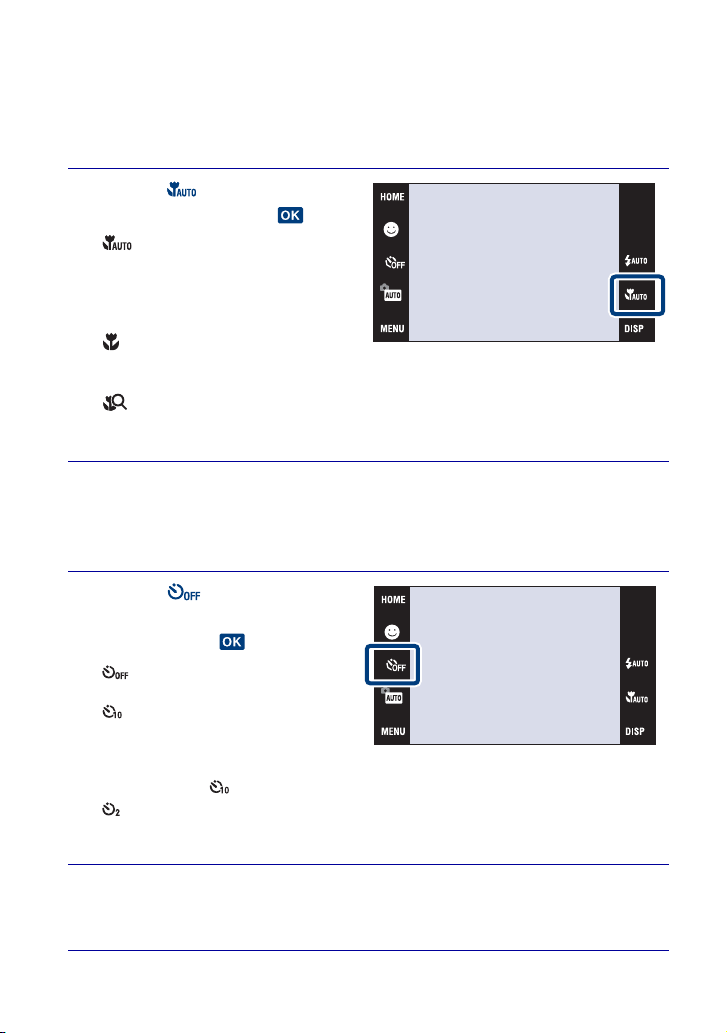
18
Toma de primeros planos (Macro/Enfoque de
cerca)
Puede tomar bellas imágenes en primer plano de objetos pequeños tales como insectos o
flores.
Utilización del autodisparador
1
Toque (Macro) t
modo deseado t .
(Auto): La cámara ajusta el
enfoque automáticamente desde
motivos distantes a primer plano.
Normalmente, ponga la cámara en
este modo.
(Macro activado): La cámara
ajusta el enfoque con prioridad sobre motivos en primer plano.
Ajuste a Macro activado cuando tome motivos cercanos.
(Permitido enfocar de cerca): Utilice este modo para tomar a distancias
incluso más cortas que con la grabación Macro.
Bloqueado en el lado W: Aproximadamente 1 a 20 cm
1
Toque
(Autodisparador) t modo
deseado t .
(Desactivar): Sin utilizar el
autodisparador.
(Autodisparador 10 s): La
toma se inicia tras un retardo de
10 s (segundo). Utilice este ajuste si
quiere incluirse en la imagen. Para
cancelar, toque .
(Autodisparador 2 s): La toma se inicia tras un retardo de dos s (segundo).
Esto es para evitar el desenfoque debido a la inestabilidad cuando se pulsa el botón
del disparador.
2
Pulse el botón del disparador.
La lámpara del autodisparador parpadea y suena un pitido hasta que se acciona el
obturador.

19
Utilización de las funciones de toma de imagen
Selección de un modo de flash
• Cuando Reconocimiento de escena está ajustado a [Auto] o [Avanzado] no se puede utilizar
(Flash activado) ni (Sinc lenta).
• Incluso con el flash activado, es posible que el flash no funcione durante la ráfaga.
1
Toque (Flash) t modo
deseado t .
(Flash automático): Destella
cuando hay insuficiente luz o
contraluz.
(Flash activado): El flash
funciona siempre.
(Sinc lenta): El flash funciona
siempre. En un lugar oscuro la velocidad de obturación es lenta para tomar
claramente el fondo que queda fuera del alcance de la luz del flash.
(Flash desactivado): El flash no funciona.
Notas
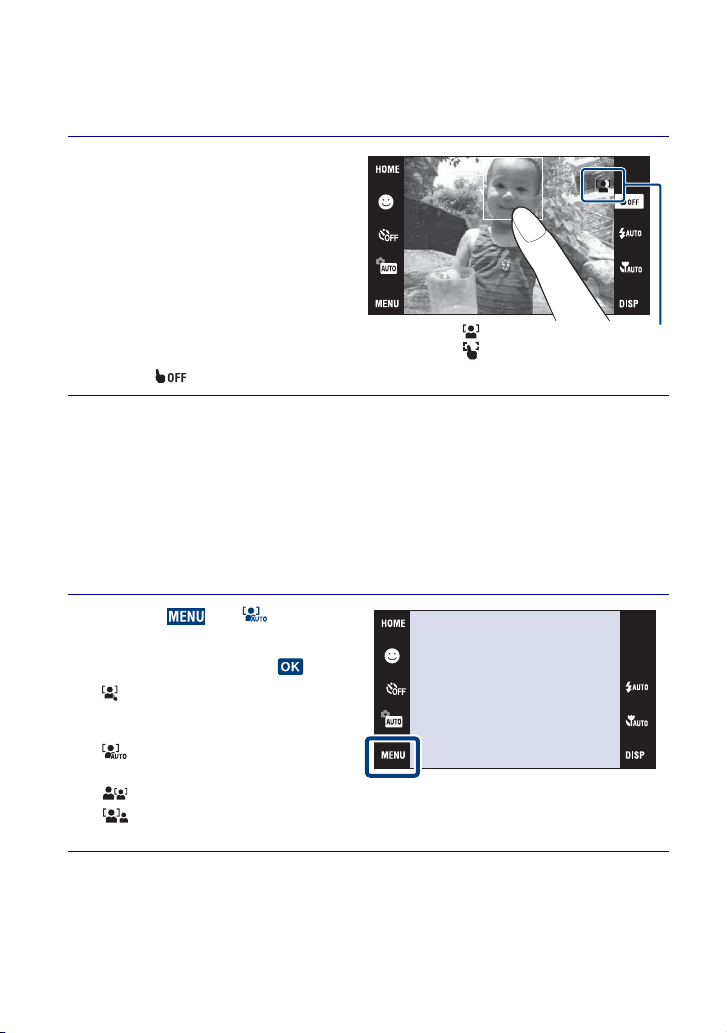
20
Enfoque de un punto específico del cuadro
Simplemente toque el punto del cuadro que quiere enfocar para cambiar la posición de
enfoque.
Enfoque de la cara del motivo (Detección de
cara)
La cámara detecta la cara del motivo y la enfoca. Puede seleccionar qué motivo tendrá
prioridad al enfocar.
1
Oriente la cámara hacia el
motivo, después toque el
punto del cuadro que quiere
enfocar.
• Puede cambiar el punto de enfoque
cuantas veces lo desee antes de
pulsar el botón del disparador hasta
la mitad.
• Si quiere que la cámara elija un
punto de enfoque automáticamente,
toque .
1
Toque t
(Detección de cara) t
modo deseado t .
(Cuando se toca): Detecta la
cara cuando se toca un área de la
pantalla donde hay una cara.
(Auto): Selecciona la cara que la
cámara va a enfocar automáticamente.
(Prioridad niños): Detecta y toma imagen con prioridad sobre cara de niño.
(Prioridad adultos): Detecta y toma imagen con prioridad sobre cara de
adulto.
: Se ha detectado cara.
: No se ha detectado cara.
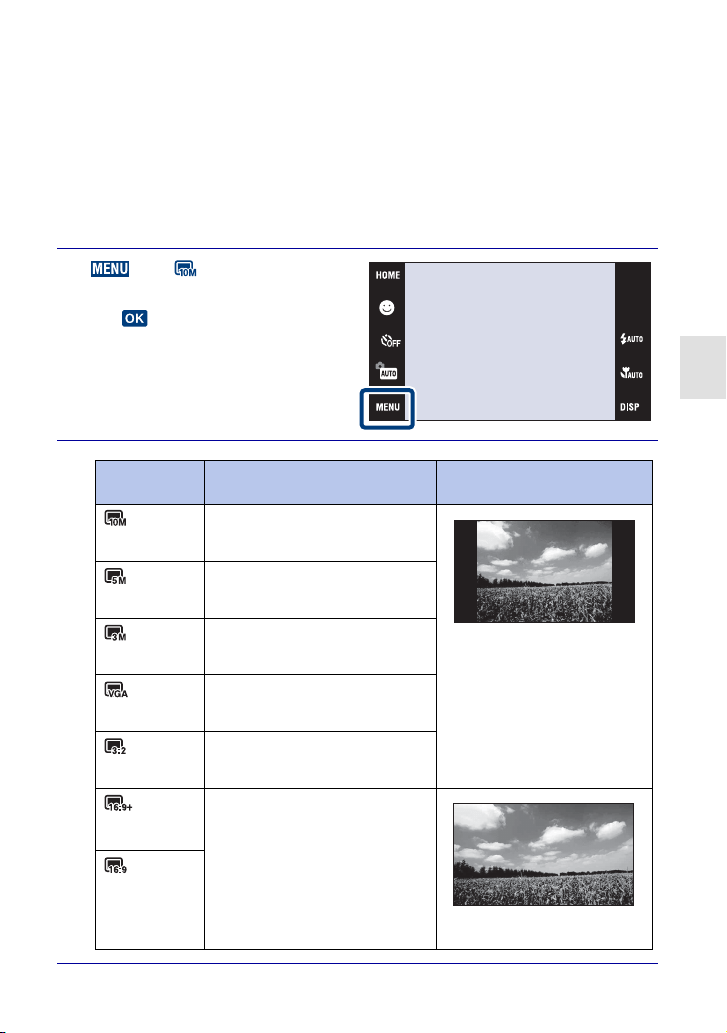
21
Utilización de las funciones de toma de imagen
Selección del tamaño de imagen para
coincidir con la utilización
El tamaño de imagen determina el tamaño del archivo de imagen que se graba cuando
toma una imagen.
Cuanto más grande sea el tamaño de imagen, más detalles se reproducirán cuando la
imagen sea impresa en papel de formato grande. Cuanto más pequeño sea el tamaño de
imagen, más imágenes podrán grabarse. Seleccione el tamaño de imagen que
corresponda con la forma en que verá sus imágenes.
1
t (Tamaño
imag) t modo deseado
t .
Tamaño de
imagen
Guía de uso Pantalla LCD
10M
(3 648×2 736)
Para copias hasta tamaño A3+
Las imágenes se visualizan en
relación de aspecto 4:3 ó 3:2.
5M
(2 592×1 944)
Para copias hasta tamaño A4
3M
(2 048×1 536)
Para copias hasta tamaño L/L2
VGA
(640×480)
Para adjuntar a correo electrónico
3:2 (8M)
(3 648×2 432)
Relación de aspecto 3:2 como las
copias de fotos y tarjetas postales
16:9 (7M)
(3 648×2 056)
Para ver en un televisor de alta
definición.
Las imágenes llenarán toda la
pantalla.
16:9 (2M)
(1 920×1 080)
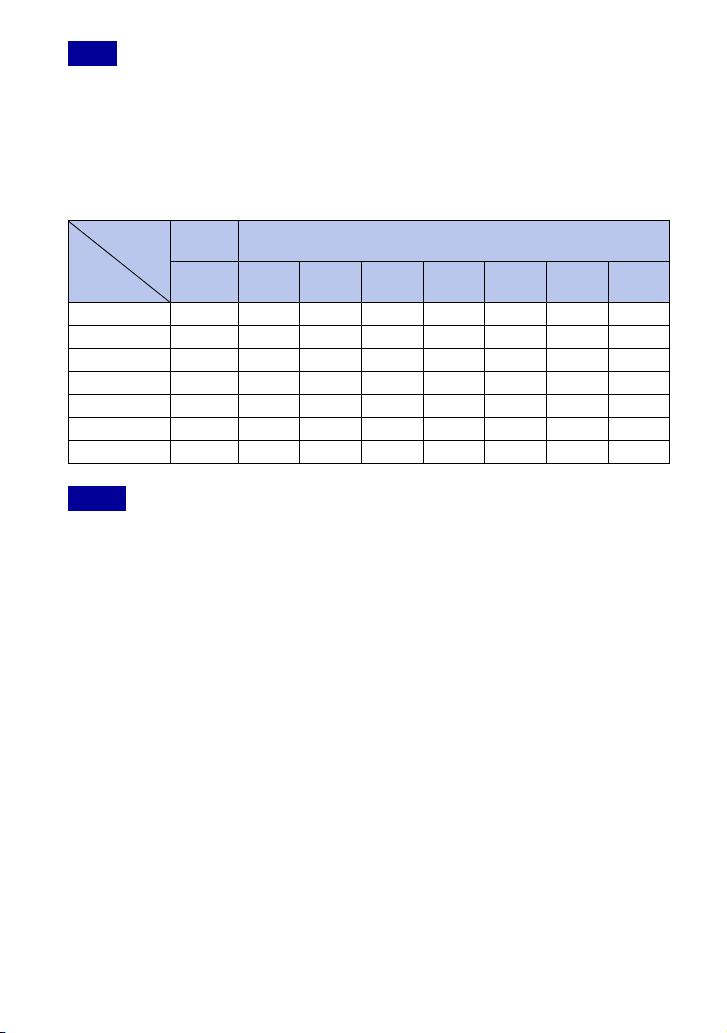
22
• Cuando imprima imágenes tomadas con relación de aspecto 16:9, es posible que ambos bordes
sean recortados.
x
Número de imágenes fijas que se pueden grabar
Las cifras de la tabla de abajo indican el número de imágenes cuando [Modo Grabación]
está ajustado a [Normal].
(Unidades: Imágenes)
• El número de imágenes fijas podrá variar dependiendo de las condiciones de la toma y el soporte
de grabación.
• Cuando el número de imágenes restantes que pueden tomarse es superior a 9 999, aparece el
indicador “>9999”.
• Cuando se reproduzca en esta cámara una imagen tomada con otras cámaras, es posible que la
imagen no aparezca en el tamaño de imagen real.
Nota
Capacidad
Tamaño
Memoria
interna
“Memory Stick Duo” formateado con esta cámara
Aprox.
15 MB
256 MB 512 MB 1GB 2GB 4GB 8GB 16 GB
10M 3 56 118 242 493 972 1 963 3 991
5M 6 89 188 384 781 1 541 3 111 6 324
3M 10 144 301 617 1 253 2 472 4 991 10 140
VGA 96 1 385 2 898 5 925 12 030 23 730 47 910 97 390
3:2(8M) 3 57 119 244 497 980 1 980 4 024
16:9(7M) 4 60 126 257 523 1 031 2 083 4 234
16:9(2M) 16 230 483 987 2 005 3 955 7 986 16 230
Notas
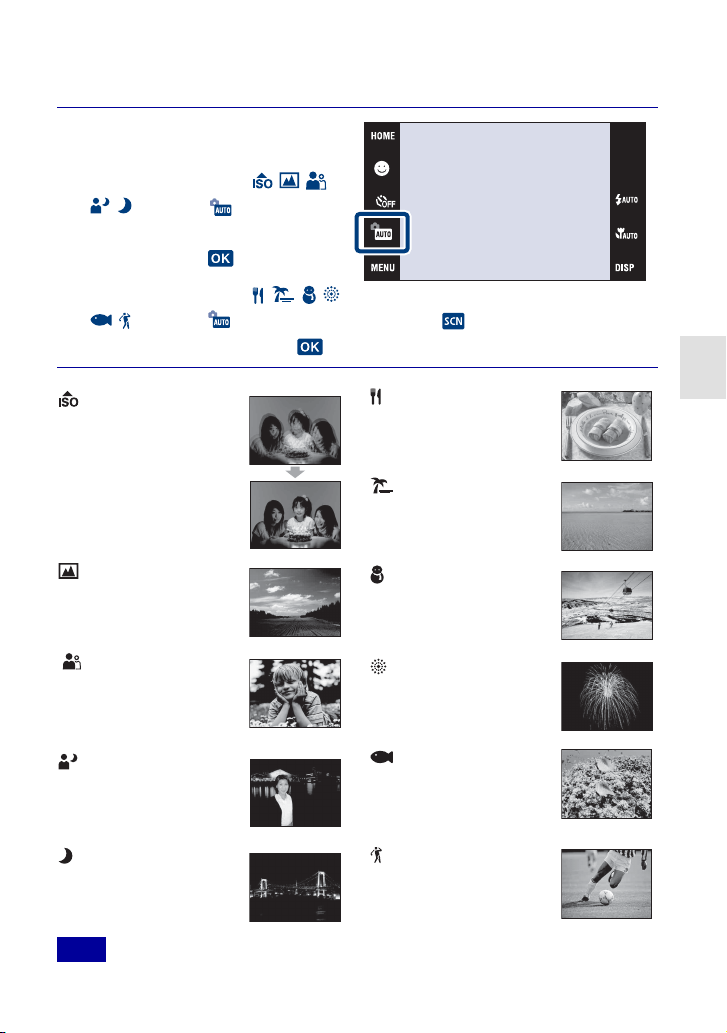
23
Utilización de las funciones de toma de imagen
Utilización del modo de toma que coincide
con la escena (Selección escena)
• El flash no responderá en algunos modos.
1
Seleccione el modo de
toma de imagen.
Para seleccionar / / /
/ : Toque (Modo
Grabación) t modo
deseado t .
Para seleccionar / / / /
/ : Toque (Modo Grabación) t (Selección escena)
t modo deseado t .
Nota
(Alta sensibilidad):
Toma imágenes sin flash
incluso con poca
iluminación.
(Paisaje): Toma con el
enfoque en un motivo
distante.
(Instantánea suave):
Toma imágenes con un
ambiente más suave para
retratos de personas, flores,
etc.
(Retrato crepúsculo):
Toma imágenes nítidas de
gente en un lugar oscuro sin
perder el ambiente
nocturno.
(Crepúsculo): Toma
escenas nocturnas sin
perder el ambiente
nocturno.
(Gourmet): Toma
arreglos de comidas en
deliciosos colores.
(Playa): Toma escenas
de costas y riberas de lagos
con el azul del agua
capturado más vívidamente.
(Nieve): Toma escenas
de nieve en blanco más
claramente.
(Fuegos artificiales):
Toma fuegos artificiales en
todo su esplendor.
(Submarino): Toma
imágenes submarinas en
colores naturales cuando se
usa con la caja resistente al
agua.
(Obturador rápido):
Toma objetos en movimiento
en lugares brillantes.
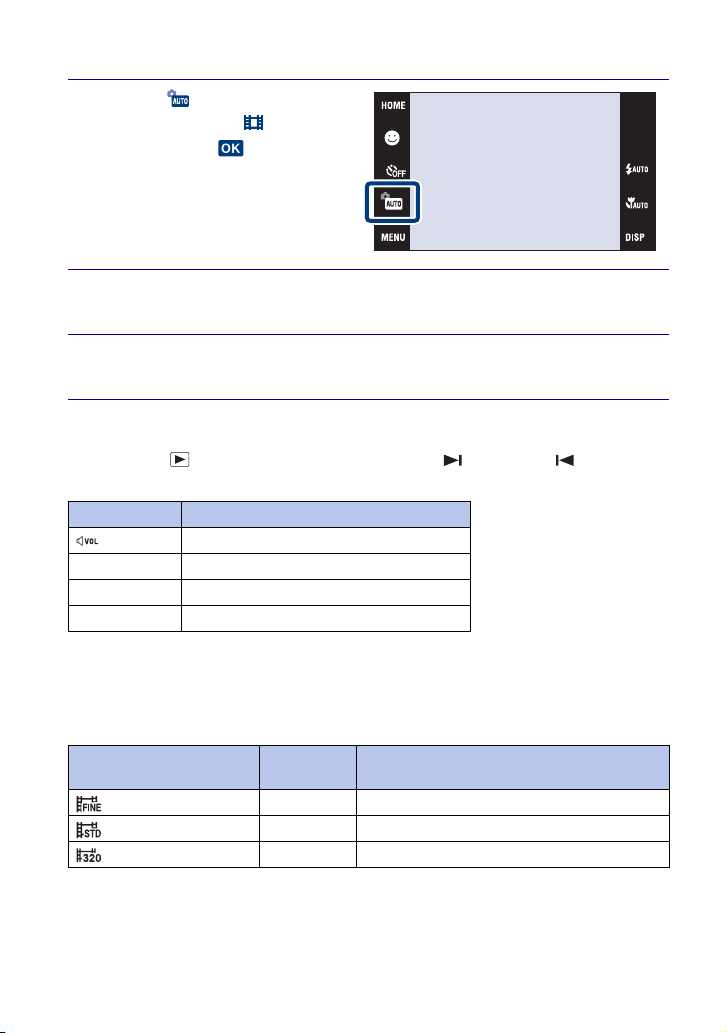
24
Toma de películas
x
Visionado de películas
Pulse el botón (Reproducción) y toque los botones (Siguiente) / (Anterior)
para seleccionar una película que quiere ver.
x
Tamaño de imagen
Cuanto más grande sea el tamaño de imagen, más alta será la calidad de imagen. Cuanto
mayor sea el número de fotogramas por segundo, más uniforme será la imagen de
reproducción.
1
Toque (Modo
Grabación) t (Modo
película) t .
2
Pulse el botón del disparador a fondo para iniciar la
grabación.
3
Pulse el botón del disparador a fondo otra vez para detener
la grabación.
Botón Acción
Control del volumen
B Reproducción
x Detener
M/m Avance rápido/rebobinado rápido
Tamaño de imagen de
película
Fotogramas/
s (segundo)
Guía de uso
640(Fina) (640×480) Aprox. 30 Para ver en un televisor (calidad de imagen alta)
640(Estándar) (640×480) Aprox. 17 Para ver en un televisor (calidad de imagen estándar)
320 (320×240) Aprox. 8 Para adjuntar a correo electrónico
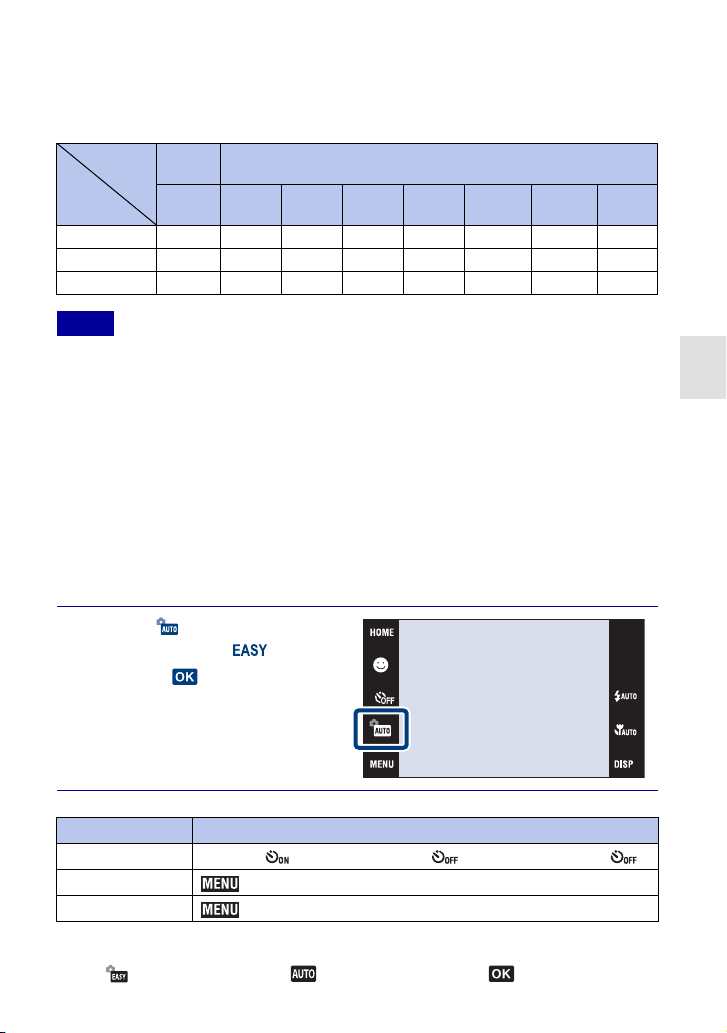
25
Utilización de las funciones de toma de imagen
x
Tiempo de grabación máximo
La tabla de abajo muestra los tiempos de grabación máximos aproximados. Estos son los
tiempos totales para todos los archivos de película. Se puede filmar continuamente
durante 10 min (minuto) aproximadamente.
(Unidades: h (hora) : min (minuto) : s (segundo))
• El tiempo de grabación podrá variar dependiendo de las condiciones de la toma y del soporte de
grabación.
• Las películas con el tamaño ajustado a [640(Fina)] sólo pueden grabarse en un “Memory Stick
PRO Duo”.
• Esta cámara no admite grabaciones ni reproducciones HD para películas.
Visualización de los indicadores mínimos
(Toma fácil)
Este modo reduce al mínimo el número de ajustes y hace que los indicadores resulten
más fáciles de ver.
x
Para volver a la visualización normal
Toque (Modo Grabación) t (Ajuste automático) t .
Capacidad
Tamaño
Memoria
interna
“Memory Stick Duo” formateado con esta cámara
Aprox.
15 MB
256 MB 512 MB 1GB 2GB 4GB 8GB 16 GB
640(Fina) – 0:02:50 0:06:00 0:12:20 0:25:00 0:49:20 1:39:40 3:22:50
640(Estándar) 0:00:40 0:10:20 0:21:40 0:44:20 1:30:10 2:58:00 5:59:20 12:10:20
320 0:02:50 0:41:30 1:25:20 2:57:40 6:01:00 11:52:00 23:57:30 48:41:50
Notas
1
Toque (Modo
Grabación) t (Toma
fácil) t .
Acción Cómo cambiar
Autodisparador Seleccione (Autodisparador 10 s) o (Desactivar) con el botón .
Tamaño imag t Seleccione [Grande] o [Pequeño] en [Tamaño imag]
Flash t Seleccione [Auto] o [Desactivar] en [Flash]
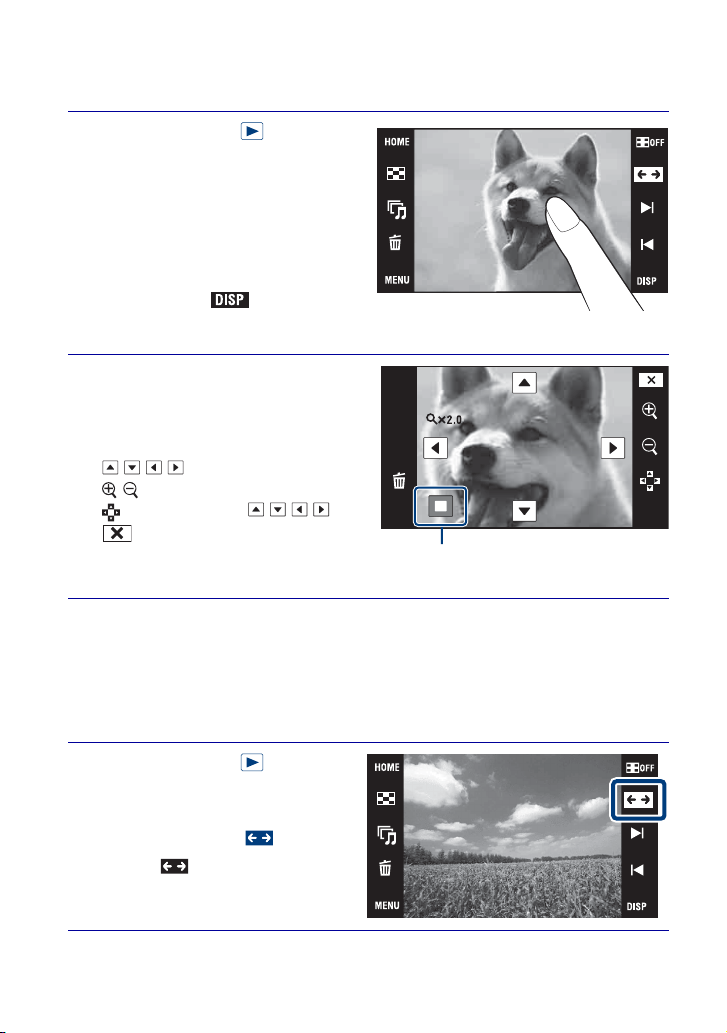
26
Utili
zac
ió
n
d
e
l
as
f
unc
i
ones
d
e v
i
s
i
ona
d
o
Visionado de una imagen ampliada (Zoom de
reproducción)
Visualización de imágenes en pantalla
completa (Zoom ancho)
1
Pulse el botón
(Reproducción) para
visualizar una imagen,
después toque el área que
quiere ampliar.
La imagen se amplía al doble del
tamaño, con el área que tocó en el
centro. Cuando está ajustado a
[Sólo imag.], toque el centro de la
pantalla, después toque el área que quiere ampliar.
2
Ajuste la escala del zoom y
la posición.
La escala del zoom aumenta cada vez
que toca la pantalla.
/ / / : Ajusta la posición.
: Cambia la relación del zoom.
: Activa/desactiva / / / .
: Cancela el zoom de reproducción.
1
Pulse el botón
(Reproducción) para
visualizar la imagen fija,
después toque .
• Toque otra vez para terminar el
zoom ancho.
Muestra el área visualizada de la
imagen entera
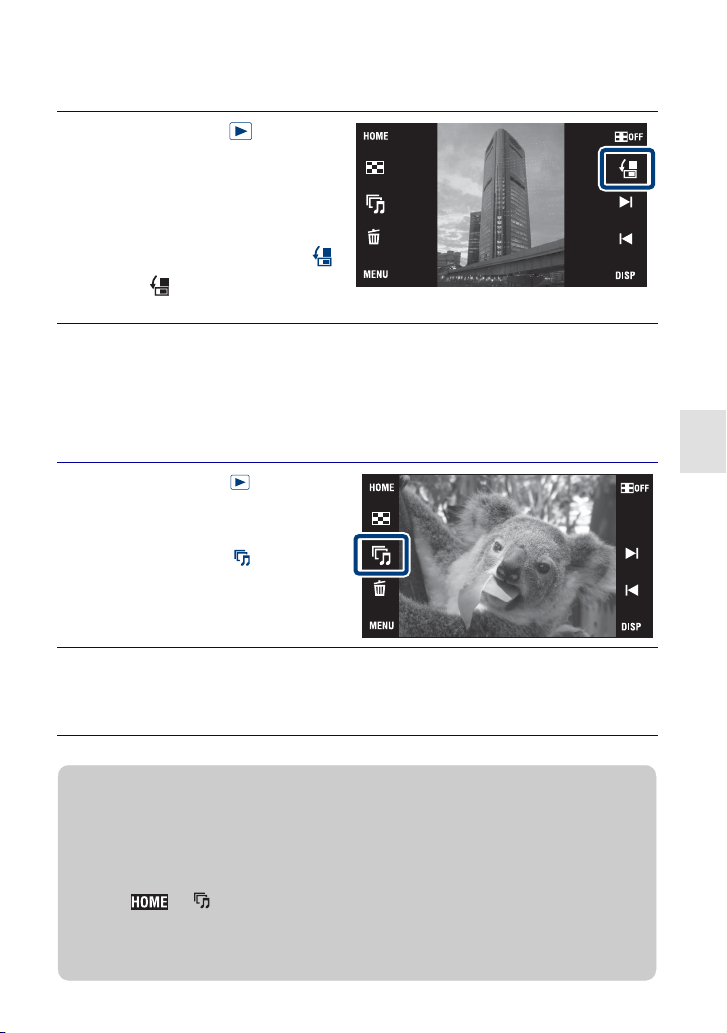
27
Utilización de las funciones de visionado
Giro de una imagen de orientación vertical
(Visualización girada temporalmente)
Visionado de imágenes fijas con música
(Diapositivas)
1
Pulse el botón
(Reproducción) para
visualizar la imagen fija,
después seleccione las
imágenes de orientación
vertical, después toque .
• Toque otra vez para finalizar la
visualización.
1
Pulse el botón
(Reproducción) para
visualizar una imagen fija,
después toque
(Diapositivas).
2
Toque [Inicio].
Comienza el pase de diapositivas.
• Para finalizar el pase de diapositivas, toque la pantalla, y después toque [Salir].
zSelección de la música de fondo
Puede transferir un archivo de música deseado de su CD o archivos MP3 a la cámara para
reproducirlo durante el pase de diapositivas. Para transferir archivos de música, instale el
software “Music Transfer” (suministrado) en su ordenador (página 35), después siga los pasos de
abajo.
1 Toque t (Diapositivas) t [Herramienta música] t [Desc música].
2 Haga una conexión USB entre la cámara y el ordenador.
3 Inicie y utilice “Music Transfer”.
Para más detalles sobre el “Music Transfer”, consulte la ayuda de “Music Transfer”.
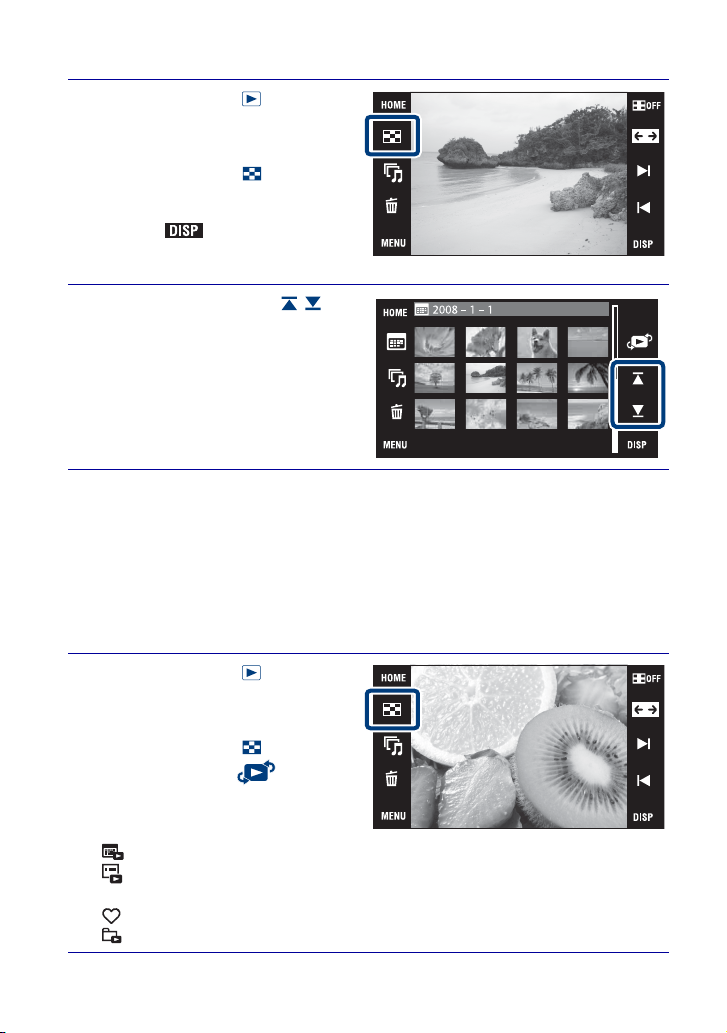
28
Búsqueda de una imagen (Índice de imágenes)
Selección del formato de visualización
(Modo visualización)
Le permite seleccionar el formato de visualización para ver múltiples imágenes cuando
se utiliza “Memory Stick Duo”.
1
Pulse el botón
(Reproducción) para
visualizar una imagen,
después toque (Índice de
imágenes).
• Si toca , podrá ajustar el
número de imágenes visualizadas en
la pantalla de índice a 12 ó 20 imágenes.
2
Toque los botones /
para pasar las páginas.
• Para volver a la pantalla de una sola
imagen, toque la imagen en
miniatura.
1
Pulse el botón
(Reproducción) para
visualizar una imagen,
después toque (Índice de
imágenes) t (Modo
visualización) t modo
deseado.
(Ver fecha): Visualiza imágenes por la fecha.
(Ver evento): Analiza las fechas tomadas y la frecuencia, organiza
automáticamente las imágenes en grupos y las visualiza.
(Favoritos): Visualiza imágenes registradas como Favoritos.
(Ver carpetas): Visualiza y organiza imágenes por carpetas.
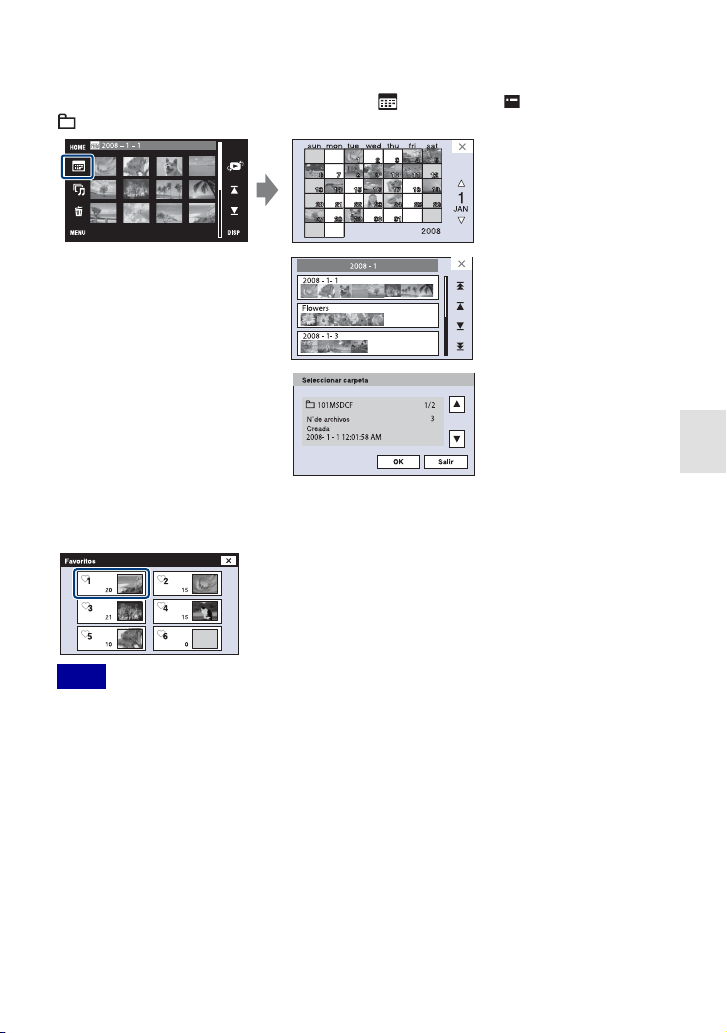
29
Utilización de las funciones de visionado
x
Localización fácil de imágenes que va a visualizar
Cuando está ajustado a Ver fecha/Ver evento/Ver carpetas:
Cuando utilice un “Memory Stick Duo”, toque (Lista Fecha), (Lista de evento) o
(Seleccionar carpeta) para localizar fácilmente las imágenes que desea.
• Cuando no pueda reproducir imágenes grabadas con otras cámaras, véalas en [Ver carpetas].
Lista Fecha: Visualiza
una lista de las imágenes
tomadas en la fecha
seleccionada.
Lista de evento:
Visualiza una lista de las
imágenes registradas en
el evento seleccionado.
Seleccionar carpeta:
Toque [OK] para
visualizar una lista de
imágenes contenidas en
la carpeta seleccionada.
Cuando está ajustado a Favoritos: Puede visualizar imágenes registradas en
Favoritos divididas en seis grupos.
Favoritos: Visualiza una lista de las imágenes
registradas en el número de Favoritos seleccionado.
Nota
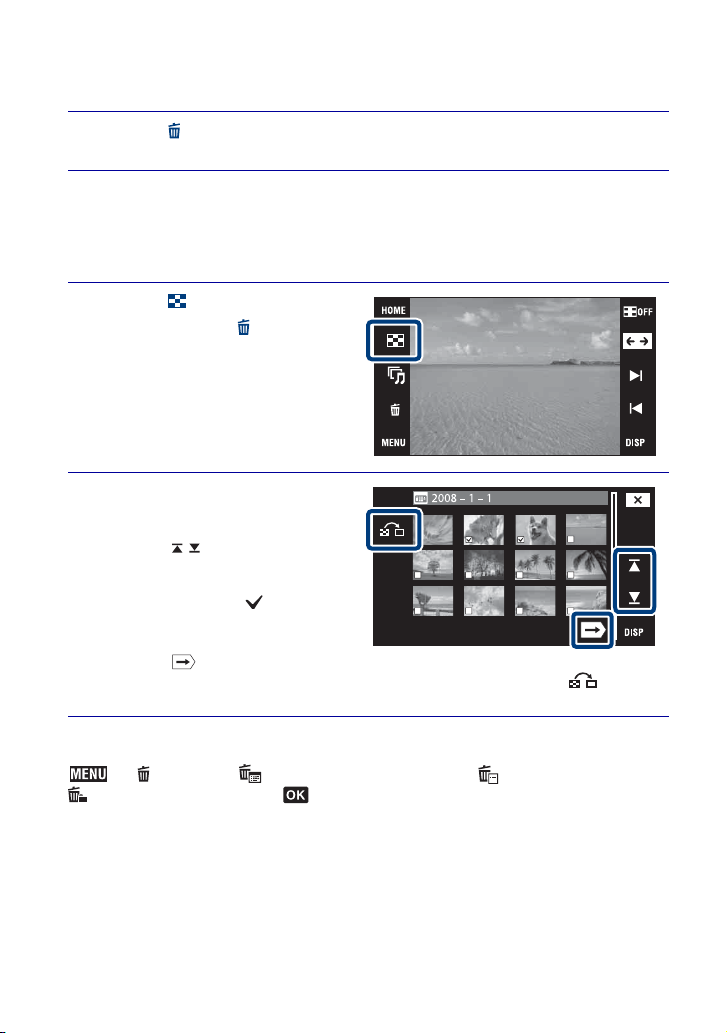
30
B
orra
d
o
d
e
i
m
ág
enes
Eliminación de la imagen visualizada
actualmente
Eliminación de múltiples imágenes
x
Eliminación en unidades de fecha, evento o carpeta
t (Borrar) t (Todas imágs de rango fecha), (Todo de evento) o
(Todo En Esta Carpeta) t t [OK].
• Cuando se utiliza la memoria interna, las imágenes se visualizan en [Ver carpetas].
1
Toque (Borrar) t [OK] (página 15).
1
Toque (Índice de
imágenes) t (Borrar).
2
Seleccione imágenes para
borrar.
1 Toque / para pasar las páginas,
después toque las imágenes que
quiere eliminar.
Se pone la marca a las
imágenes seleccionadas.
2 Repita el paso 1.
3 Toque
t [OK].
Puede cambiar entre una sola imagen y pantalla de índice utilizando , cuando
selecciona imágenes.
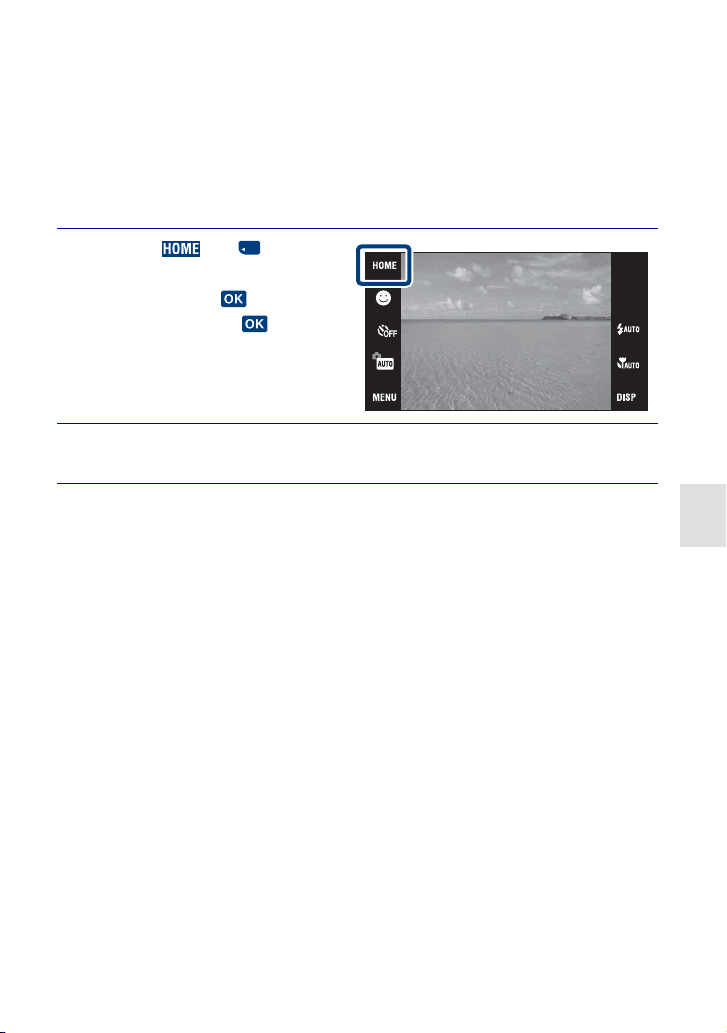
31
Borrado de imágenes
Eliminación de todas las imágenes
(Formatear)
Puede eliminar todos los datos almacenados en el “Memory Stick Duo” o la memoria
interna. Si hay insertado un “Memory Stick Duo”, se eliminarán todos los datos
almacenados en el “Memory Stick Duo”. Si no hay insertado un “Memory Stick Duo”,
se eliminarán todos los datos almacenados en la memoria interna. El formateo elimina
permanentemente todos los datos, incluidas las imágenes protegidas.
1
Toque t (Gestión
de memoria) t [Herrta.
Memoria] t t
[Formatear] t .
2
Toque [OK].
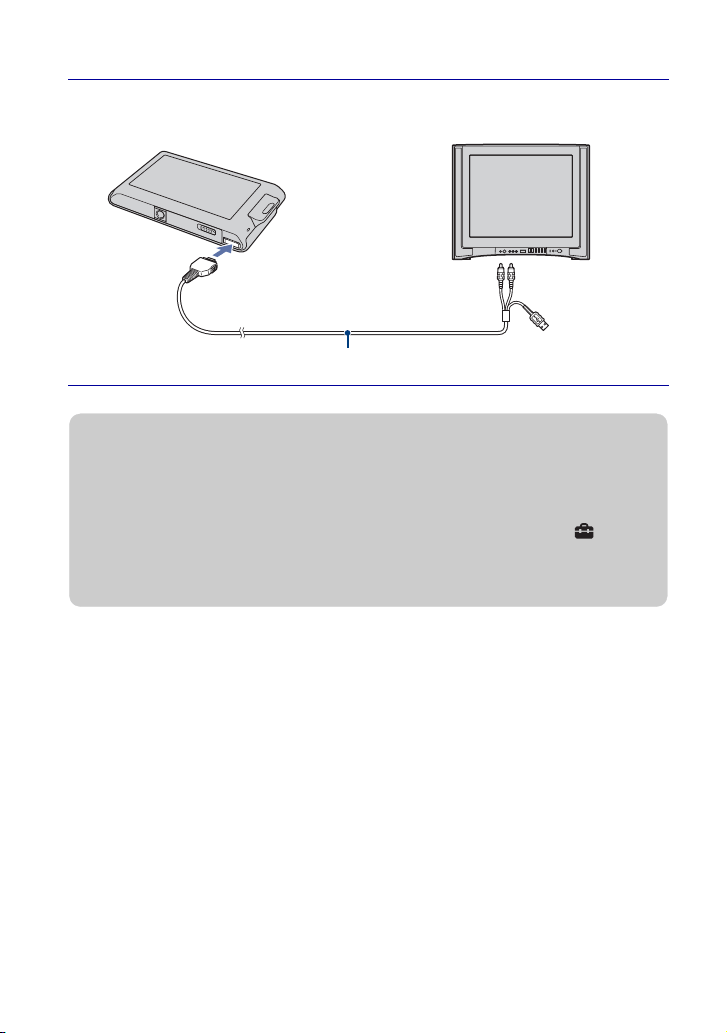
32
C
onex
ió
n a o
t
ros
di
spos
iti
vos
Visionado de imágenes en un televisor
1
Conecte la cámara al televisor con el cable para terminal de
usos múltiples (suministrado).
Al conector múltiple
A las tomas de
entrada de
audio/vídeo
Cable para terminal de usos múltiples
zVisionado de imágenes en un televisor de HD (Alta definición)
• Puede ver imágenes grabadas en la cámara conectando la cámara a un televisor HD (Alta
definición) con el cable de adaptador de salida HD (no suministrado) o el Cyber-shot station
(no suministrado).
• Ajuste [COMPONENT] a [HD(1080i)] en [Ajustes principales 2] seleccionando (Ajustes)
en la pantalla HOME.
• No se pueden ver películas emitidas en formato de señal [HD(1080i)]. Ajuste [COMPONENT]
a [SD] cuando vea películas.
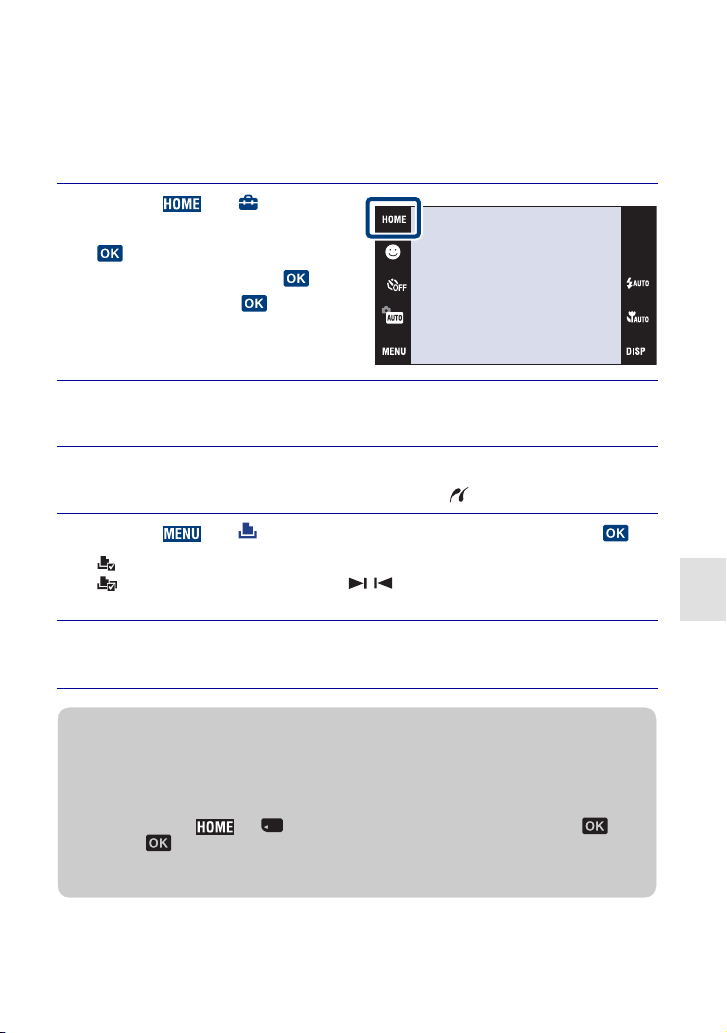
33
Conexión a otros dispositivos
Impresión de imágenes fijas
Si tiene una impresora compatible con PictBridge, puede imprimir imágenes mediante el
procedimiento siguiente.
En primer lugar, ajuste la cámara para permitir la conexión USB entre la cámara y la
impresora.
1
Toque t (Ajustes)
t [Ajustes principales] t
[Conexión USB] t t
[PictBridge] t .
Se establecerá el modo USB.
2
Conecte la cámara a la impresora, con el cable para
terminal de usos múltiples (suministrado).
3
Encienda la impresora.
Después de hacer la conexión, aparece el indicador .
4
Toque t (Imprimir) t elemento deseado t .
(Esta imagen): Imprima la imagen visualizada actualmente.
(Múltiples imágenes): Toque / para visualizar la imagen, después
toque la imagen que quiere imprimir.
5
Toque el elemento de ajuste deseado, después [OK].
Se imprimirá la imagen.
zImpresión en un establecimiento
No es posible imprimir imágenes almacenadas en la memoria interna en un establecimiento de
servicio de impresión directamente desde la cámara. Copie las imágenes a un “Memory Stick
Duo”, después lleve el “Memory Stick Duo” al establecimiento.
Cómo copiar: Toque t (Gestión de memoria) t [Herrta. Memoria] t
t
[Copiar] t t [OK].
Cuando quiera superponer fechas en imágenes, consulte con el establecimiento de servicio de
impresión de fotos.
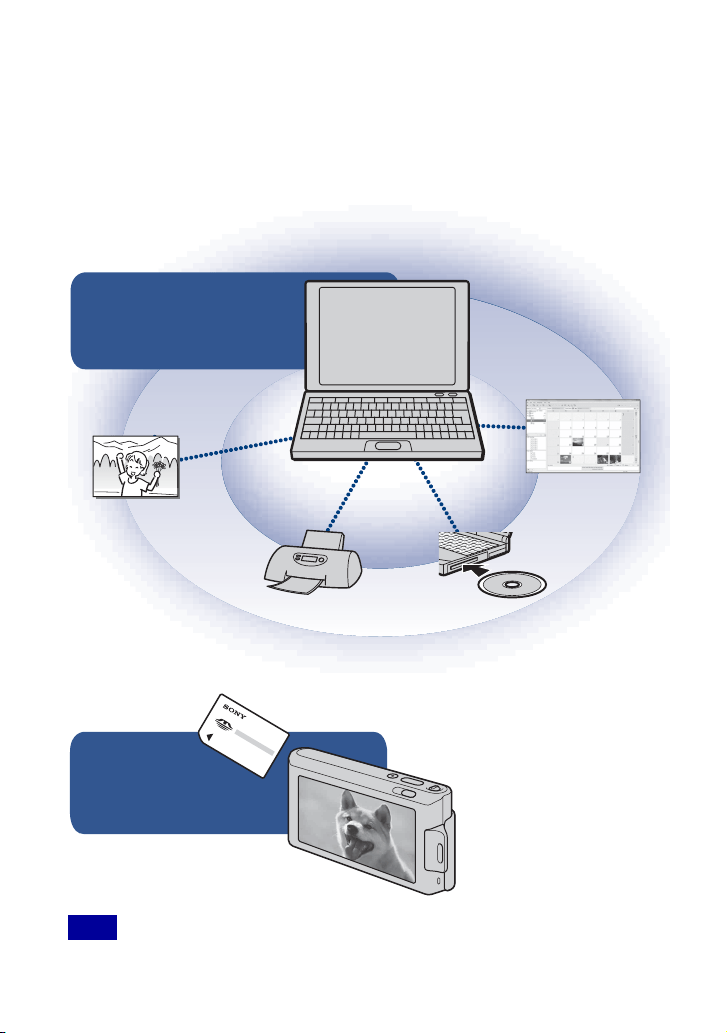
34
Utilización de la cámara con un ordenador
x
Utilización de “PMB (Picture Motion Browser)”
Puede disfrutar de las imágenes grabadas más que nunca aprovechando las ventajas del
software, y “PMB” incluidos en el CD-ROM (suministrado).
Hay más funciones, además de las de la lista de abajo, para disfrutar de las imágenes.
Para más detalles, consulte la “Guía de PMB”.
• “PMB” no es compatible con ordenadores Macintosh.
Nota
Exportación
a la
cámara
Exportación y visionado de
imágenes cuando se utiliza el
“Memory Stick Duo”.
Importación al
ordenador
Servicio
multimedia
Para colgar imágenes en
el servicio multimedia.
Imprimir
Impresión de
imágenes con sellos
de fecha.
DVD
Creación de un disco de
datos utilizando una
unidad grabadora de CD o
de DVD.
Calendario
Visionado de
imágenes en un
calendario.
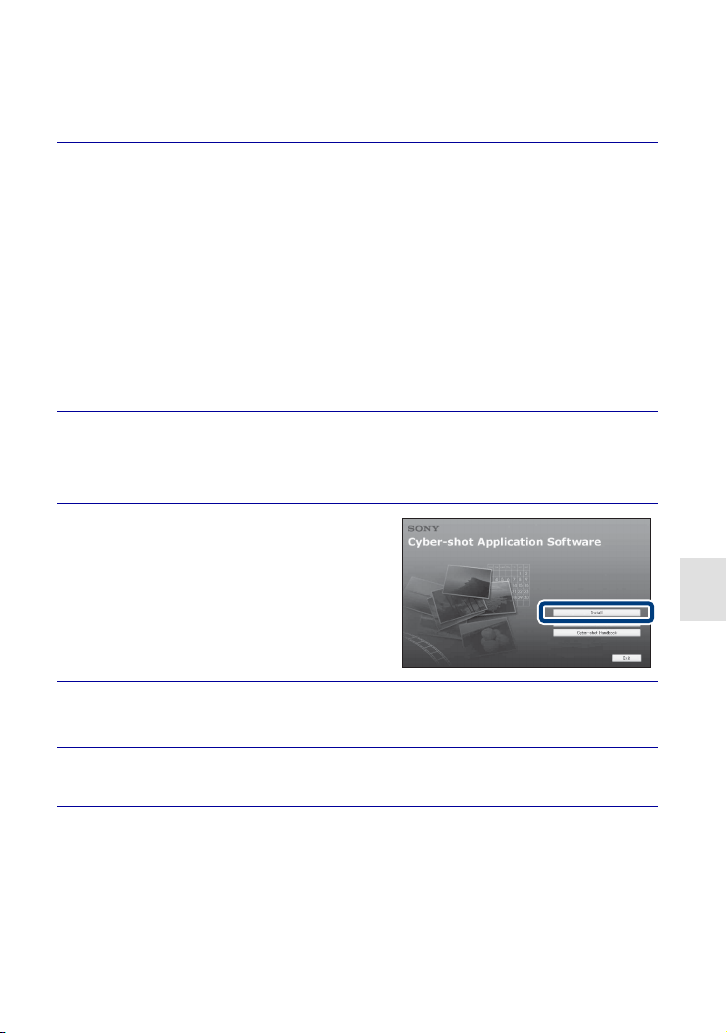
35
Conexión a otros dispositivos
x
Etapa 1: Instalación de “PMB” (suministrado)
Puede instalar el software (suministrado) utilizando el procedimiento siguiente. Cuando
instale “PMB”, también se instalará “Music Transfer”.
• Inicie la sesión como Administrador.
1
Compruebe el entorno de su ordenador.
Entorno recomendado para utilizar “PMB” y “Music Transfer”
SO (preinstalado): Microsoft Windows 2000 Professional SP4, Windows XP*
SP3/Windows Vista SP1*
CPU:
Intel Pentium III 500 MHz o más rápido (Recomendado: Intel Pentium III
800 MHz o más rápido)
Memoria:
256 MB o más (Recomendado: 512 MB o más)
Disco duro: Espacio requerido en disco para la instalación — aproximadamente
400 MB
Pantalla: Resolución de pantalla; 1 024 × 768 puntos o más
* Las ediciones de 64 bits y Starter (Edition) no son compatibles.
2
Encienda su ordenador e inserte el CD-ROM (suministrado)
en la unidad de CD-ROM.
Aparecerá la pantalla del menú de instalación.
3
Haga clic en [Install] (Instalar).
Aparecerá la pantalla “Choose Setup
Language” (Elegir idioma de instalación).
4
Siga las instrucciones de la pantalla para completar la
instalación.
5
Extraiga el CD-ROM después de completarse la instalación.
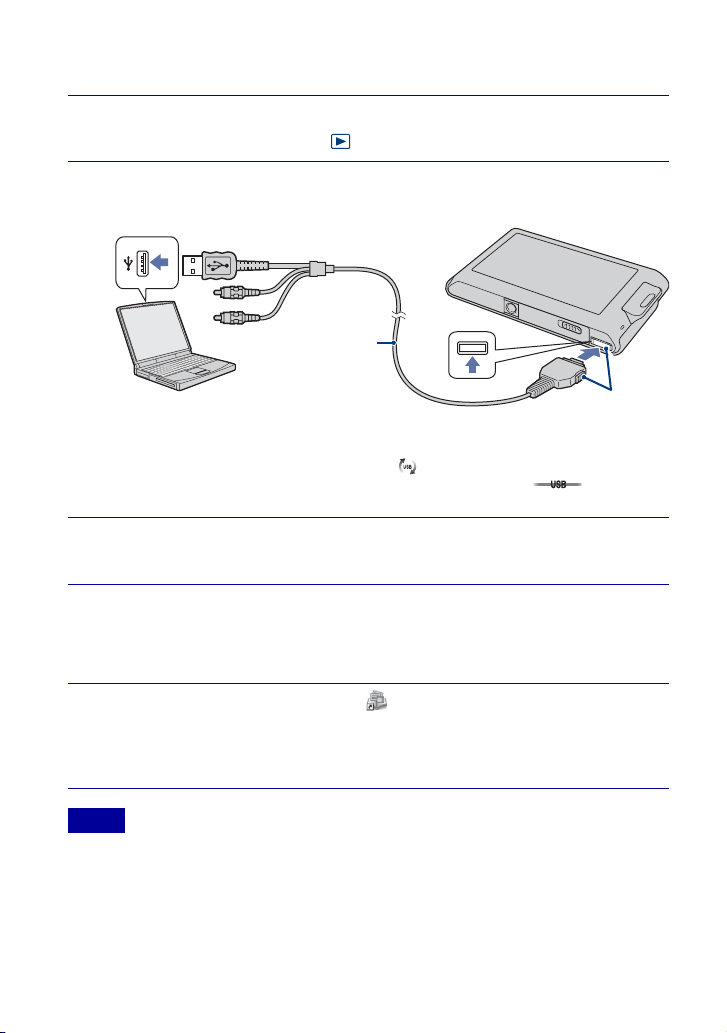
36
x
Etapa 2: Importación de imágenes a su ordenador utilizando
“PMB”
x
Etapa 3: Visionado de la “Guía de PMB”
• No desconecte el cable para terminal de usos múltiples de la cámara mientras la cámara está
funcionando ni mientras aparece “Acceso…” en la pantalla de la cámara. Si lo hace podrá
estropear los datos.
• Cuando utilice una batería con poca carga restante, es posible que no pueda transferir los datos o
que los datos se estropeen. Se recomienda utilizar el adaptador de ca (no suministrado) y el cable
USB / A/V / DC IN para terminal de usos múltiples (no suministrado).
1
Inserte una batería completamente cargada en la cámara,
después pulse el botón (Reproducción).
2
Conecte la cámara a su ordenador.
Aparece “Conectando…” en la pantalla de la cámara.
• Durante la sesión de comunicación se muestra en la pantalla. No utilice el ordenador
mientras esté visualizado el indicador. Cuando el indicador cambia a , puede
comenzar a utilizar el ordenador de nuevo.
3
Haga clic en el botón [Import] (Importar).
Para más detalles, consulte la “Guía de PMB”.
1
Haga doble clic en el icono (Guía de PMB) del escritorio.
• Para acceder a la “Guía de PMB” desde el menú de inicio: Haga clic en [Start]
(Inicio)
t [All Programs] (Todos los programas) t [Sony Picture Utility] t
[Help] (Ayuda)
t [Guía de PMB].
Notas
Cable para terminal
de usos múltiples
1 A una toma USB
2 Al conector
múltiple

37
Conexión a otros dispositivos
x
Utilización de la cámara con su ordenador Macintosh
Puede copiar imágenes a su ordenador Macintosh. “PMB” no es compatible, pero puede
instalar “Music Transfer” en su ordenador Macintosh. Cuando las imágenes sean
exportadas a la cámara, véalas en [Ver carpetas].
Entorno de ordenador recomendado
Para un ordenador conectado a la cámara se recomienda el entorno siguiente.
Entorno recomendado para importar imágenes
SO (preinstalado): Mac OS 9,1/9,2/ Mac OS X (v10,1 a v10,5)
Toma USB: Suministrada como estándar
Entorno recomendado para utilizar “Music Transfer”
SO (preinstalado): Mac OS X (v10,3 a v10,5)
Memoria: 64 MB o más (se recomiendan 128 MB o más)
Disco duro: Espacio requerido en disco para la instalación — aproximadamente
250 MB
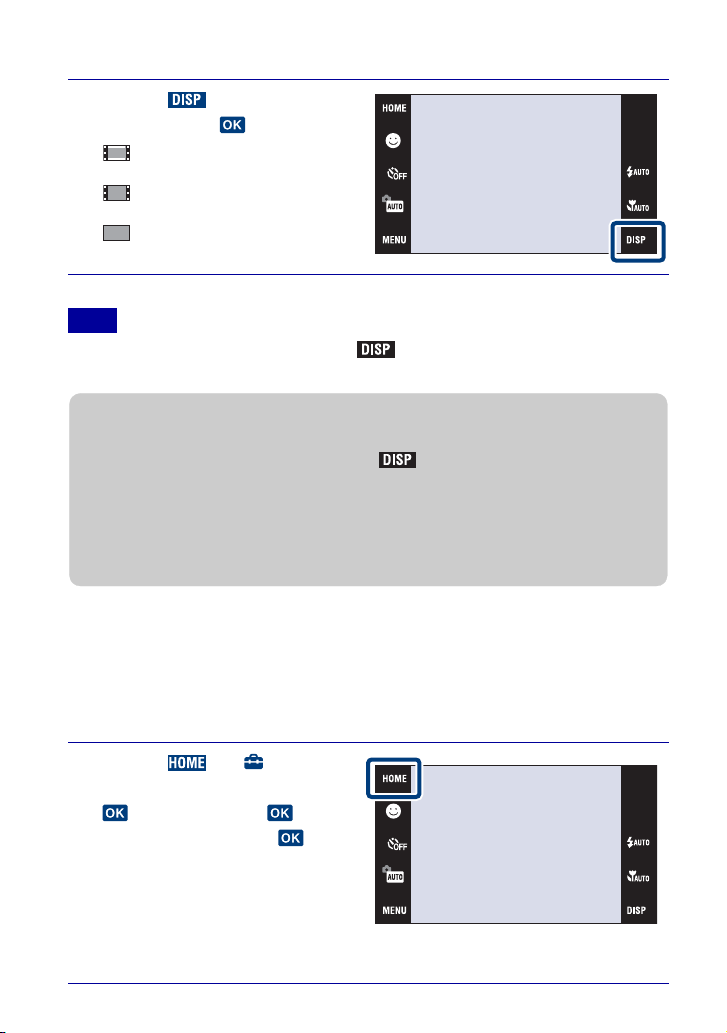
38
C
am
bi
o
d
e
l
os a
j
us
t
es
d
e
l
a c
á
mara
Cambio de la visualización en pantalla
• Si se selecciona la reproducción [Sólo imag.], desaparecerá de la pantalla. Para visualizar
los botones, toque el centro de la pantalla. Volverá la visualización [Normal] temporalmente.
Cambio de los sonidos de operación
Puede ajustar el sonido producido cuando utiliza la cámara.
1
Toque t modo
deseado t .
(Normal): Visualiza botones e
iconos
(Simple): Visualiza botones
solamente
(Sólo imag.): Oculta botones e
iconos
Nota
1
Toque t (Ajustes)
t [Ajustes principales] t
t [Pitido] t t
modo deseado t .
Obturador: Activa el sonido del
obturador para cuando se pulsa el
botón del disparador.
Activar: Activa el sonido de pitido/
obturador para cuando se utiliza el panel táctil o se pulsa el botón del disparador.
Desactivar: Desactiva el sonido de pitido/obturador.
zAjustes de histograma y brillo
Se puede acceder a los ajustes siguientes tocando .
Histograma: Un histograma es un gráfico que muestra el brillo de una imagen. El gráfico
visualizado indicará una imagen brillante cuando se desvíe hacia el lado derecho, y una imagen
oscura cuando se desvíe hacia el lado izquierdo.
Brillo: Esto establece el brillo de la luz de fondo ([Normal]/[Brillo]). Cuando vea imágenes en
luz exterior luminosa, repóngalo a [Brillo]. Si embargo, la potencia de la batería podrá reducirse
más rápidamente bajo tal condición.
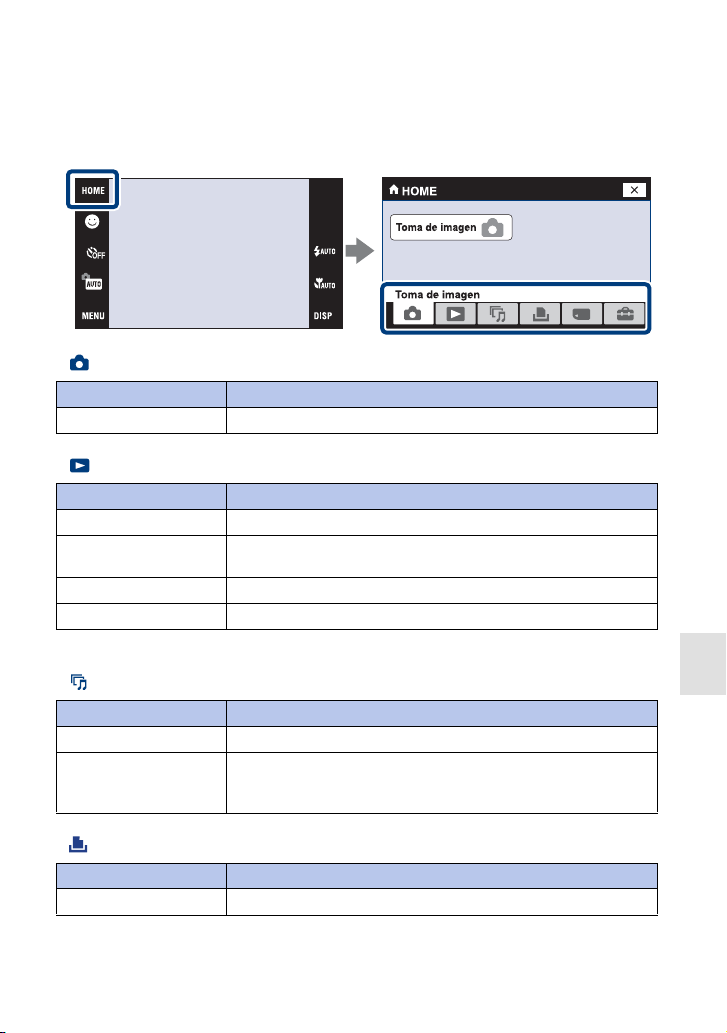
39
Cambio de los ajustes de la cámara
Utilización de la pantalla HOME
En la pantalla HOME, las operaciones de la cámara están organizadas de forma
conveniente en amplias categorías de selección, tales como toma, visionado e impresión
de imágenes.
En la pantalla solamente se visualizan los elementos disponibles.
x
Toma de imagen
x
Visionado de imágs.
* Estos elementos se visualizan solamente cuando hay “Memory Stick Duo” insertado en la cámara.
x
Diapositivas
x
Imprimir
Elemento Descripción
Toma de imagen Graba imágenes fijas o películas.
Elemento Descripción
Ver fecha* Visualiza imágenes por la fecha.
Ver evento* Analiza las fechas tomadas y la frecuencia, organiza automáticamente las
imágenes en grupos y las visualiza.
Favoritos* Visualiza imágenes registradas como Favoritos.
Ver carpetas Visualiza y organiza imágenes por carpetas.
Elemento Descripción
Diapositivas Reproduce imágenes sucesivamente junto con efectos y música.
Herramienta música Desc música: Cambia la música del pase de diapositivas.
Format músi: Elimina toda la música del pase de
diapositivas.
Elemento Descripción
Imprimir Imprime imágenes fijas.

40
x
Gestión de memoria
x
Ajustes
Elemento Descripción
Herrta. Memoria - Her
Memory Stick
Formatear: Formatea un “Memory Stick Duo”.
Crea CarpGrabación: Crea una carpeta nueva en un “Memory Stick
Duo”.
Camb. Carp. Grab.: Cambia la carpeta utilizada para grabar
imágenes.
Copiar: Copia todas las imágenes grabadas en la
memoria interna a un “Memory Stick Duo”.
Herrta. Memoria -
Herr.memoria interna
Formatear: Formatea la memoria interna.
Elemento Descripción
Ajustes principales -
Ajustes principales 1
Pitido: Selecciona los pitidos producidos cuando
utiliza la cámara.
Guía funciones: Visualiza la guía de funciones.
Inicializar: Restaura la cámara a sus ajustes
predeterminados.
Calibración: Corrige la desalineación de las posiciones de
respuesta de los botones del panel táctil.
Envoltura: Cambia las operaciones de los botones
cuando la cámara está en la envoltura (caja a
prueba de agua).
Modo demostración: Demuestra las funciones Captador de sonrisas
y Reconocimiento de escena.
Ajustes principales -
Ajustes principales 2
Conexión USB: Establece el modo utilizado cuando se conecta
la cámara a un ordenador o a una impresora.
COMPONENT: Establece la señal de vídeo de acuerdo con un
terminal de televisión conectado.
Salida vídeo: Establece el modo de acuerdo con el sistema
de salida de vídeo que se va a conectar.
TIPO TV: Establece la relación de aspecto de un
televisor que se va a conectar.
Ajustes de toma - Ajustes
toma de imagen 1
Iluminador AF: Destella la luz de relleno cuando se enfoca en
poca luz.
Cuadrícula: Visualiza líneas para ajustar fácilmente un
motivo en posición horizontal o vertical.
Modo AF: Selecciona el modo de operación de enfoque
automático.
Zoom digital: Selecciona el método de zoom para zoom en
exceso del zoom óptico.
Ajustes de toma - Ajustes
toma de imagen 2
Orient. autom.: Reconoce el cambio de orientación y guarda
la imagen en la orientación apropiada.
Revisión autom: Visualiza la imagen en la pantalla durante
aproximadamente dos s (segundo) después de
tomar una imagen fija.
Ajustes del reloj Establece la fecha y hora.
Language Setting Selecciona el idioma a utilizar en los elementos de menú, avisos y mensajes.
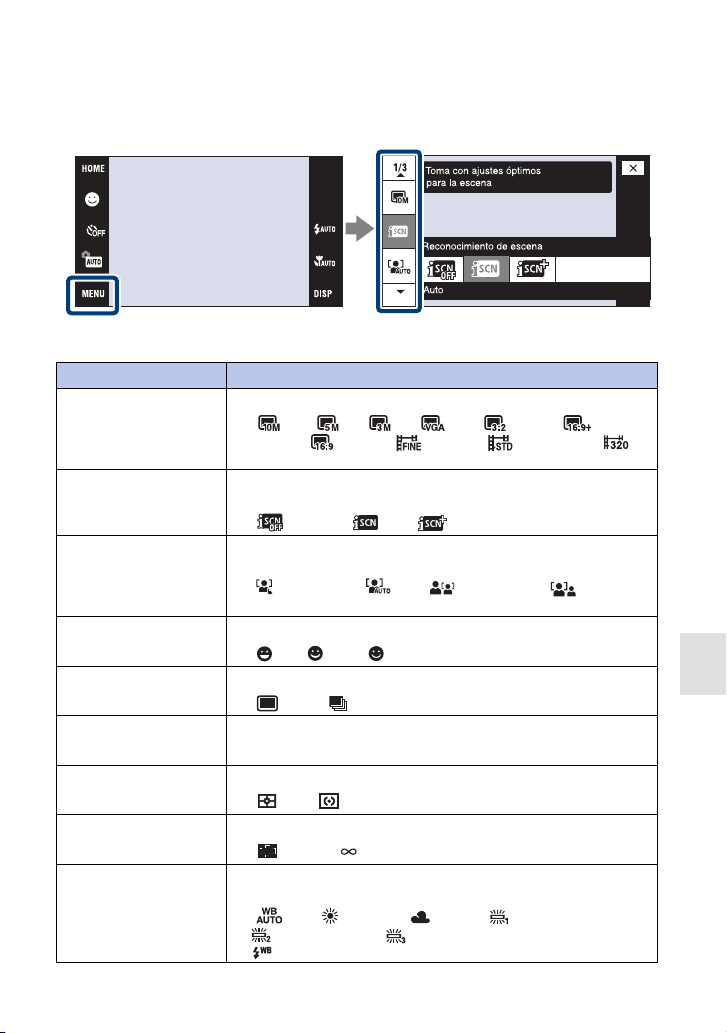
41
Cambio de los ajustes de la cámara
Utilización de los elementos de MENU
Visualiza funciones disponibles para ajustarlas fácilmente cuando la cámara está en
modo de toma de imagen o reproducción. En la pantalla solamente se visualizan los
elementos disponibles.
x
MENU en modo de toma de imagen
Elemento Descripción
Tamaño imag Establece el tamaño de imagen.
( 10M/ 5M/ 3M/ VGA/ 3:2(8M)/
16:9(7M)/ 16:9(2M)/ 640(Fina)/ 640(Estándar)/
320)
Reconocimiento de escena Detecta automáticamente las condiciones de toma y después toma la
imagen.
( Desactivar/ Auto/ Avanzado)
Detección de cara Selecciona el motivo que tiene prioridad para ajustar el enfoque cuando se
utiliza detección de cara.
( Cuando se toca/ Auto/ Prioridad niños/ Prioridad
adultos)
Sensib detección sonrisas Ajusta el nivel de sensibilidad para detectar sonrisa.
( Bajo/ Medio/ Alto)
Modo Grabación Selecciona el método de toma continua.
( Normal/ Ráfaga/BRK±0,3EV, BRK±0,7EV, BRK±1,0EV)
EV Ajusta la exposición manualmente.
(–2,0EV a +2,0EV)
Modo medición Establece qué parte del motivo se mide para determinar la exposición.
( Multi/ Centro)
Enfoque Cambia el método de enfoque.
( Multi AF/ distancia ilimitada)
Balance Blanco Ajusta los tonos de color en función de las condiciones de la luz
ambiental.
( Auto/ Luz diurna/ Nublado/ Luz fluorescente 1,
Luz fluorescente 2, Luz fluorescente 3/n Incandescente/
Flash)
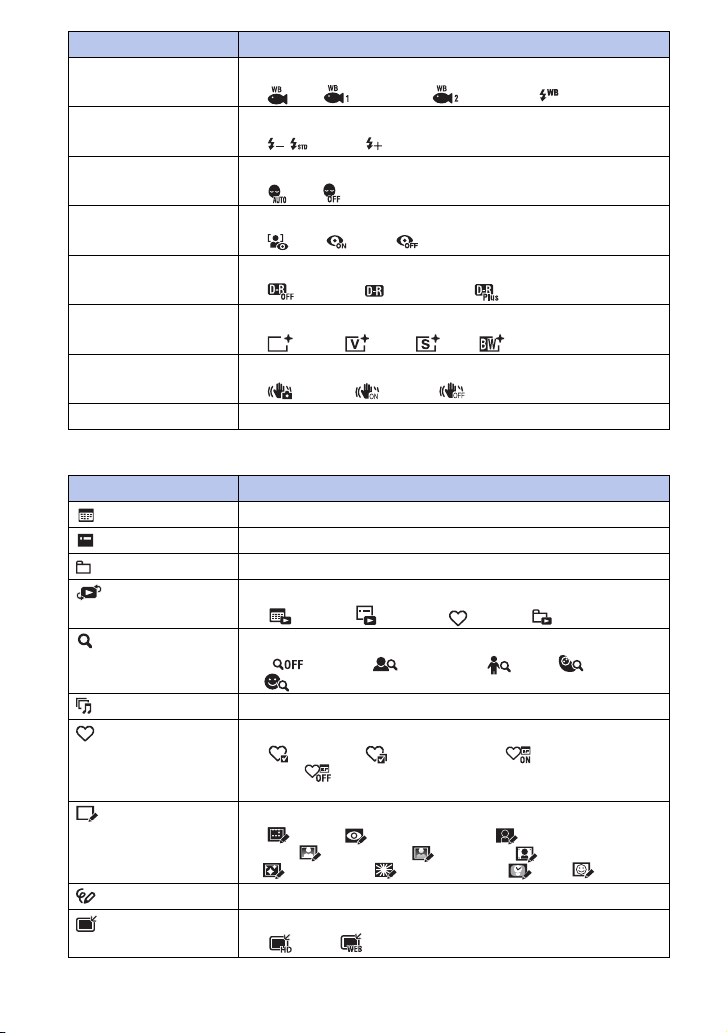
42
x
MENU en modo de visionado
Balance Blanco submarino Ajusta los colores cuando se hacen tomas submarinas.
( Auto/ Submarino 1, Submarino 2/ Flash)
Nivel flash Ajusta la cantidad de luz del flash.
( / Estándar/ )
Reducción de ojos cerrados Establece la función Reducción de ojos cerrados.
( Auto/ Desactivar)
Reducción ojos rojos Se ajusta para reducir el efecto ojos rojos.
( Auto/ Activar/ Desactivar)
DRO Optimiza el brillo y el contraste.
( Desactivar/ DRO standard/ DRO plus)
Modo color Cambia la vivacidad de la imagen o agrega efectos especiales.
( Normal/ Vívido/ Sepia/ B y N)
SteadyShot Selecciona el modo de toma estable.
( Tomando/ Continuo/ Desactivar)
Ajustes de toma Selecciona los ajustes de toma de imagen.
Elemento Descripción
(Lista Fecha) Selecciona la lista de fecha de reproducción.
(Lista de evento) Selecciona el grupo de evento que se va a reproducir.
(Seleccionar carpeta) Selecciona una carpeta para ver imágenes.
(Modo visualización) Cambia los modos de visualización.
( Ver fecha/ Ver evento/ Favoritos/ Ver carpetas)
(Filtro por caras) Reproduce imágenes filtradas para reunir ciertas condiciones.
( Desactivar/ Toda la gente/ Niños/ Bebés/
Sonrisas)
(Diapositivas) Reproduce imágenes sucesivamente junto con efectos y música.
(Agregar/quitar
Favoritos)
Añade imágenes a Favoritos o quita imágenes de Favoritos.
( Esta imagen/ Múltiples imágenes/ Añade todo de rango
fecha*/ Quita todo de rango fecha*)
* El texto visualizado varía de acuerdo con cada modo de visualización.
(Retocar) Retoca imágenes fijas.
( Recortar/ Corrección ojos rojos/ Enmascaramiento no
nítido/ Enfoque suave/ Color parcial/ Objetivo ojo de pez/
Filtro de cruce/ Desenfoque radial/ Retro/ Sonrisas)
(Pintar) Pinta sobre una imagen fija y la guarda como imagen nueva.
(Múltiples tamaños) Cambia el tamaño de imagen de acuerdo con la utilización.
( HDTV/ Blog / E-mail)
Elemento Descripción
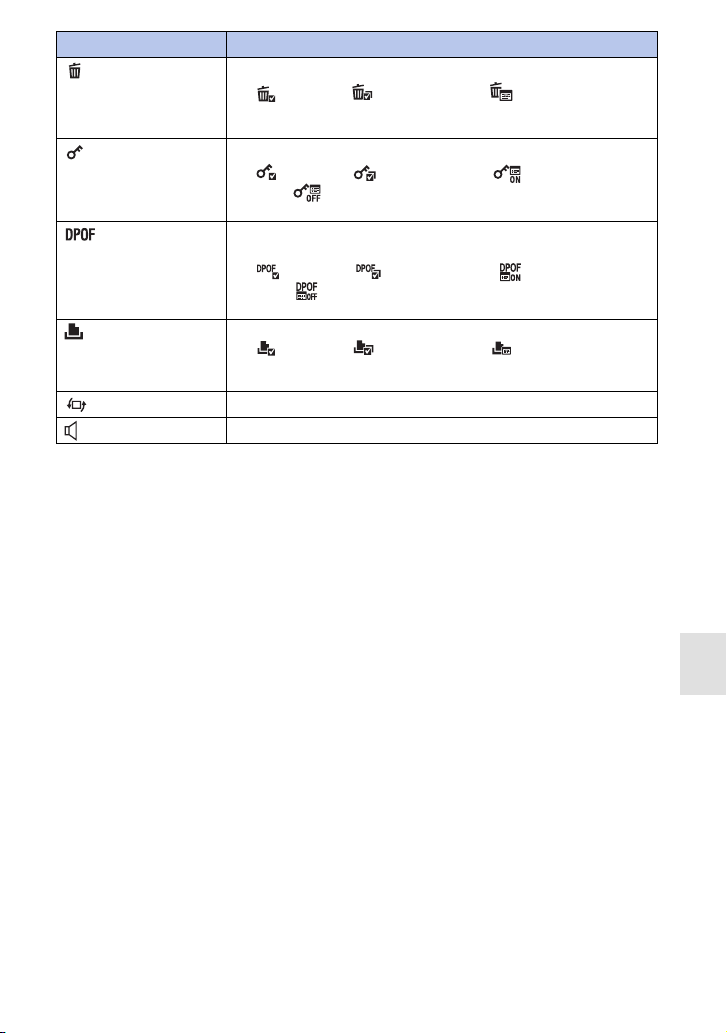
43
Cambio de los ajustes de la cámara
(Borrar) Borra imágenes.
( Esta imagen/ Múltiples imágenes/ Todas imágs de rango
fecha*)
* El texto visualizado varía de acuerdo con cada modo de visualización.
(Proteger) Previene el borrado accidental.
( Esta imagen/ Múltiples imágenes/ Ajusta todo de rango
fecha*/ Quita todo de rango fecha*)
* El texto visualizado varía de acuerdo con cada modo de visualización.
Añade una marca de orden de impresión a la imagen que quiere imprimir
de un “Memory Stick Duo”.
( Esta imagen/ Múltiples imágenes/ Ajusta todo de rango
fecha*/ Quita todo de rango fecha*)
* El texto visualizado varía de acuerdo con cada modo de visualización.
(Imprimir) Imprime imágenes utilizando una impresora compatible con PictBridge.
( Esta imagen/ Múltiples imágenes/ Todas imágs de rango
fecha*)
* El texto visualizado varía de acuerdo con cada modo de visualización.
(Girar) Gira una imagen fija.
(Ajustes de volumen) Ajusta el volumen.
Elemento Descripción
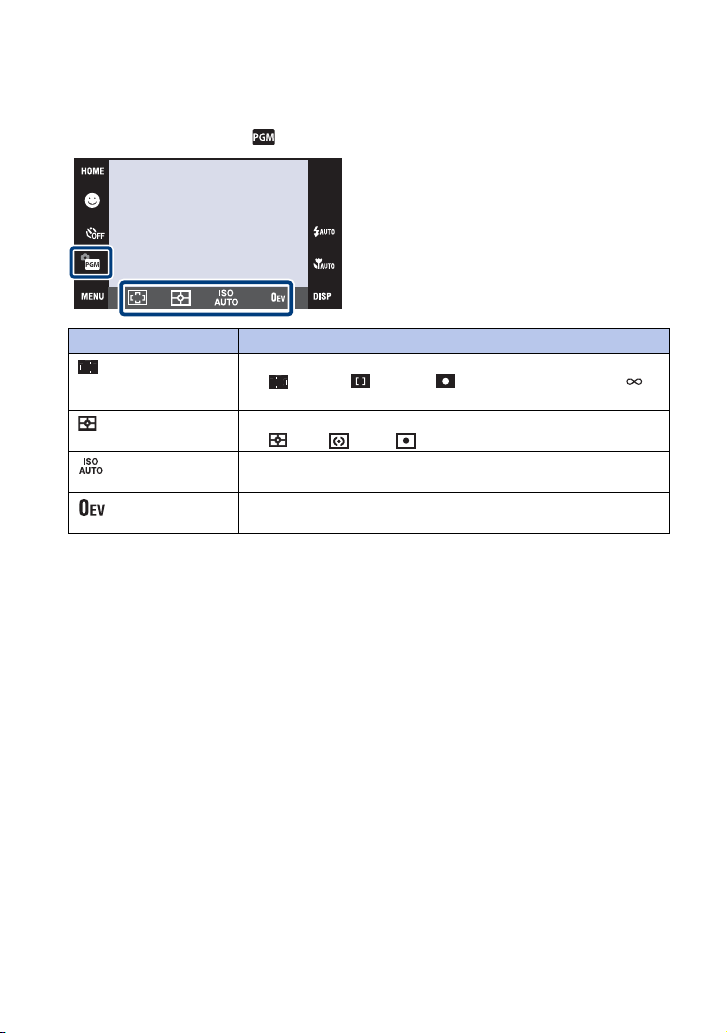
44
Utilización de funciones en modo Programa
automático
Puede cambiar los ajustes de enfoque, modo de medición, ISO, y EV cuando [Modo
Grabación] está ajustado a (Programa automático).
Elemento Descripción
(Enfoque) Cambia el método de enfoque.
( Multi AF/ AF centro/ AF puntual/1,0m/3,0m/7,0m/
distancia ilimitada)
(Modo medición) Mide el área de medición.
( Multi/ Centro/ Punto)
(ISO) Ajusta la sensibilidad ISO.
(ISO AUTO/ISO80 a ISO3200)
(EV) Ajusta la exposición
(–2,0EV a +2,0EV)
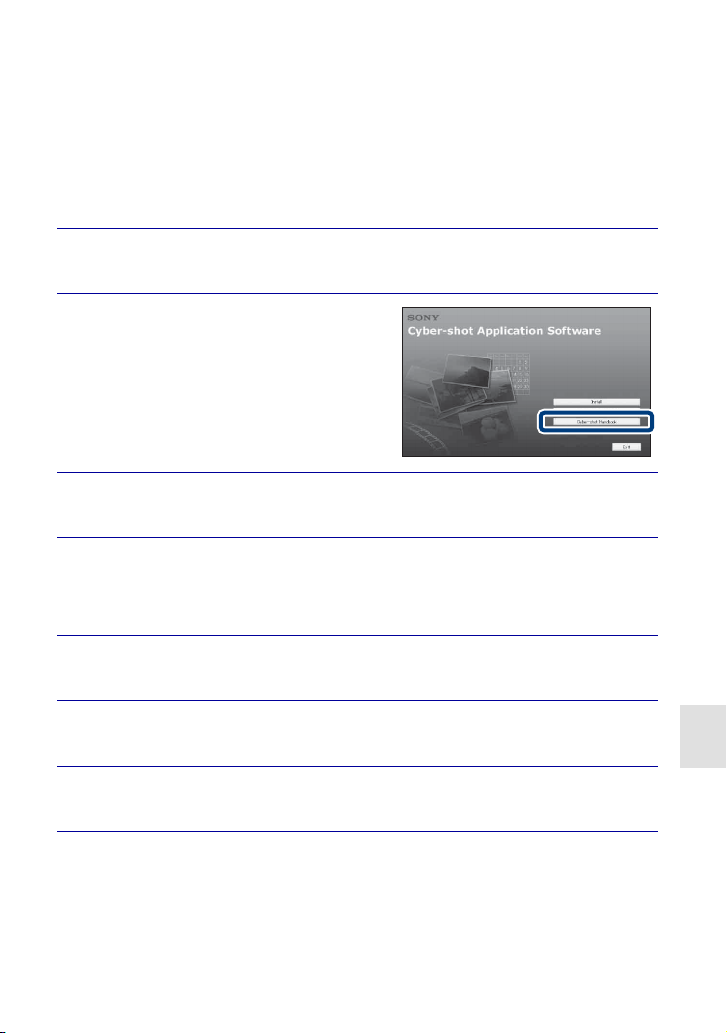
45
Otros
Ot
ros
Visionado de la “Guía práctica de Cyber-
shot”
La “Guía práctica de Cyber-shot”, que explica cómo utilizar la cámara en detalle, está
incluida en el CD-ROM (suministrado). Consúltela para ver instrucciones exhaustivas
sobre las muchas funciones de la cámara.
x
Para usuarios de Windows
x
Para usuarios de Macintosh
1
Encienda su ordenador e inserte el CD-ROM (suministrado)
en la unidad de CD-ROM.
2
Haga clic en “Cyber-shot
Handbook”.
La “Guía avanzada de Cyber-shot”, que
contiene información sobre accesorios para
la cámara, se instala al mismo tiempo.
3
Inicie la “Guía práctica de Cyber-shot” desde el acceso
directo del escritorio.
1
Encienda su ordenador e inserte el CD-ROM (suministrado)
en la unidad de CD-ROM.
2
Seleccione la carpeta [Handbook] y copie el “Handbook.pdf”
almacenado en la carpeta [ES] a su ordenador.
3
Después de haberse completado el copiado, haga doble clic
en “Handbook.pdf”.
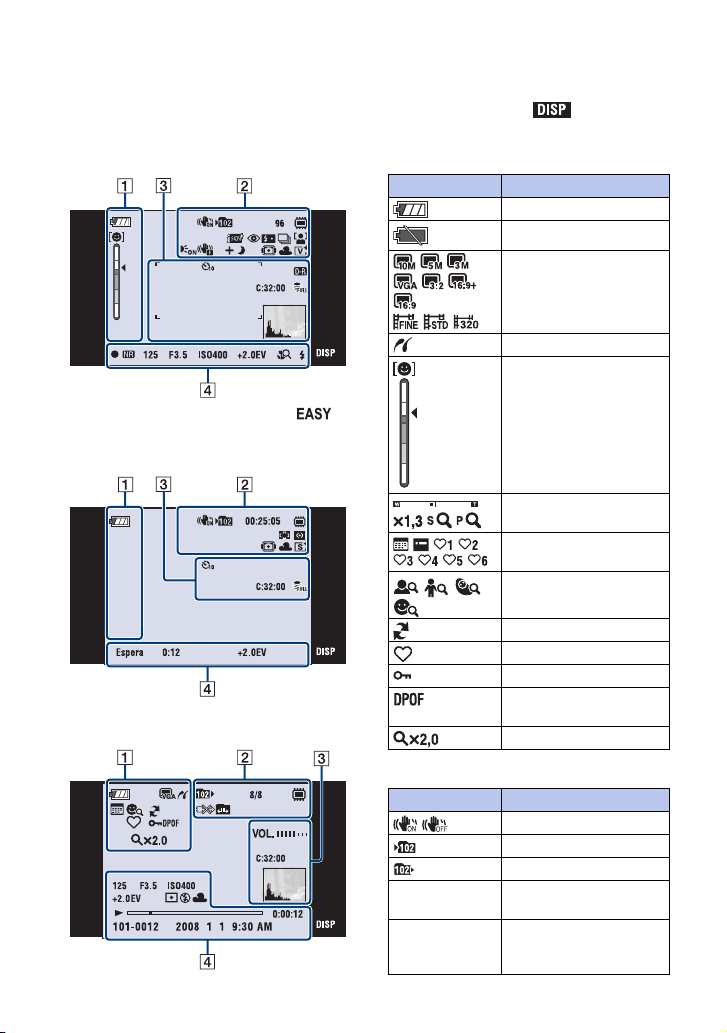
46
Lista de iconos visualizados en la pantalla
Los iconos se visualizan en la pantalla para indicar el estado de la cámara.
Puede seleccionar los ajustes de visualización tocando la indicación de la parte
inferior derecha de la pantalla (página 38).
Cuando se toman imágenes fijas
• Los iconos están limitados en modo
(Toma fácil).
Cuando se toman películas
Cuando se reproduce
A
B
Visualización Indicación
Batería restante
Aviso de poca batería
Tamaño de imagen
Conexión PictBridge
Indicador de sensibilidad de
detección de sonrisas
Relación del zoom
Modo de visualización
Filtro por caras
Exportación del PMB
Favoritos
Proteger
Marca de orden de
impresión (DPOF)
Zoom de reproducción
Visualización Indicación
SteadyShot
Carpeta de grabación
Carpeta de reproducción
96
Número de imágenes que se
pueden grabar
8/8
Número de imagen/Número
de imágenes grabadas en la
carpeta seleccionada
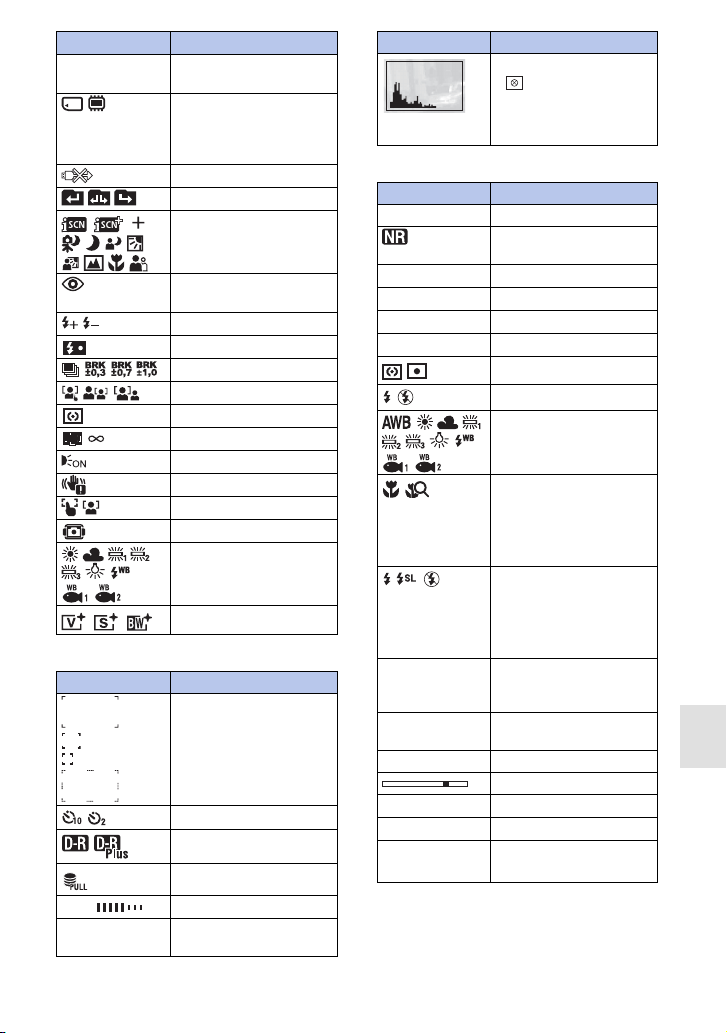
47
Otros
C
D
00:25:05
Tiempo que se puede grabar
(h:min:s)
Soporte de grabación/
Reproducción (“Memory
Stick Duo”, memoria
interna)
Conexión PictBridge
Cambio de carpeta
Reconocimiento de escena
Reducción del efecto ojos
rojos
Nivel de flash
Carga del flash
Modo de grabación
Detección de cara
Modo de medición
Enfoque
Iluminador AF
Aviso de vibración
Indicador del Toque AF
Envoltura
Balance del blanco
Modo color
Visualización Indicación
Cuadro del visor de rango
AF
Autodisparador
DRO
Archivo de gestión lleno
VOL.
Volumen
C:32:00
Visualización de
autodiagnóstico
Visualización Indicación
Histograma
•
aparece cuando la
visualización del
histograma está
desactivada.
Visualización Indicación
z Bloqueo AE/AF
Obturación lenta con
reducción de ruido (NR)
125
Velocidad de obturación
F3,5
Valor de abertura
ISO400
Número ISO
+2,0EV
Valor de exposición
Modo de medición
Flash
Balance del blanco
Macro/Enfoque de cerca
•
Se visualiza cuando
[Configuración de
visualización] está
ajustado a [Sólo imag.].
Modo de flash
•
Se visualiza cuando
[Configuración de
visualización] está
ajustado a [Sólo imag.].
GRABAR
Espera
Grabación de una película/
Puesta en espera de una
película
0:12
Tiempo de grabación
(min:s)
N Reproducción
Barra de reproducción
0:00:12
Contador
101-0012
Número de carpeta-archivo
2008 1 1
9:30 AM
Fecha/hora grabadas de la
imagen de reproducción
Visualización Indicación
48
Solución de problemas
Si encuentra problemas con la cámara, pruebe las siguientes soluciones.
Al reparar cámaras que incluyan memoria interna o función de archivos de música, los
datos almacenados en la cámara podrán ser comprobados en lo mínimo necesario para
verificar y mejorar los síntomas del mal funcionamiento. Sony no copiará ni guardará
ninguno de esos datos.
Resulta imposible insertar la batería.
• Inserte la batería correctamente para empujar la palanca de expulsión de la batería
(página 11).
Resulta imposible encender la cámara.
• Después de insertar la batería en la cámara, es posible que la cámara tarde unos momentos en
responder.
• Inserte la batería correctamente (página 11).
• La batería está descargada. Inserte una batería cargada (página 9).
• La batería está inutilizable. Reemplácela con una nueva.
• Utilice una batería recomendada.
La alimentación se desconecta súbitamente.
• Si no utiliza la cámara durante unos tres min (minuto) mientras esté conectada la
alimentación, la cámara se apagará automáticamente para evitar que la batería se agote.
Encienda la cámara otra vez (página 13).
• La batería está inutilizable. Reemplácela con una nueva.
1 Compruebe el elemento de abajo, y consulte la “Guía práctica de Cyber-shot”
(PDF).
Si aparece un código tal como “C/E:ss:ss” en la pantalla, consulte la “Guía
práctica de Cyber-shot”.
2 Extraiga la batería, espere un min (minuto) aproximadamente, vuelva a
insertarla y, a continuación, conecte la alimentación.
3 Inicialice los ajustes (página 40).
4 Consulte con el distribuidor Sony o con la oficina de servicio local autorizada
de Sony.
Batería y alimentación
49
Otros
El indicador de carga restante es incorrecto.
• La carga de la batería se agotará rápidamente en los casos siguientes:
– Cuando utilice la cámara en un lugar muy cálido o frío.
– Cuando utilice el flash y el zoom con frecuencia.
– Cuando conecte y desconecte la alimentación repetidamente.
– Cuando [Brillo] de (visualización en pantalla) está ajustado a [Brillo].
• Surgió una discrepancia entre el indicador de carga restante y la carga de batería restante real.
Descargue completamente la batería una vez, y después cárguela para corregir la indicación.
• La batería está descargada. Inserte la batería cargada (página 9).
• La batería está inutilizable. Reemplácela con una nueva.
Resulta imposible cargar la batería mientras está dentro de la cámara.
• No es posible cargar la batería utilizando el adaptador de ca (no suministrado). Utilice el
cargador de batería (suministrado) para cargar la batería.
Resulta imposible grabar imágenes.
• Compruebe la capacidad libre de la memoria interna o el “Memory Stick Duo” (páginas 22,
25). Si está llena, realice uno de lo siguiente:
– Borre imágenes no necesarias (página 30).
– Cambie el “Memory Stick Duo”.
• No es posible grabar imágenes mientras se carga el flash.
• Cuando vaya a tomar una imagen fija, ajuste el modo de toma de imagen a uno distinto de
(Película).
• Ajuste el modo de toma de imagen a (Película) cuando tome películas.
• El tamaño de imagen está ajustado a [640(Fina)] cuando está grabando películas. Realice uno
de lo siguiente:
– Ajuste el tamaño de imagen a uno distinto de [640(Fina)].
– Inserte un “Memory Stick PRO Duo”.
Aparecen rayas verticales al tomar un motivo muy brillante.
• Se está produciendo el fenómeno de borrosidad y aparecen rayas blancas, negras, rojas,
púrpuras, y otras en la imagen. Este fenómeno no es un mal funcionamiento.
Resulta imposible reproducir imágenes.
• Pulse el botón (Reproducción) (página 15).
• El nombre de carpeta/archivo ha sido cambiado en su ordenador.
• No se ofrecen garantías para reproducir, en esta cámara, archivos que contengan imágenes
que hayan sido procesadas en un ordenador o imágenes que hayan sido tomadas con otras
cámaras.
• La cámara está en el modo USB. Elimine la conexión USB.
• Es posible que no pueda reproducir algunas imágenes almacenadas en el “Memory Stick
Duo” tomadas con otras cámaras. Reproduzca tales imágenes en Ver carpetas (página 28).
• Esto ocurre cuando se copian imágenes del ordenador al “Memory Stick Duo” sin utilizar el
“PMB”. Reproduzca tales imágenes en Ver carpetas (página 28).
Toma de imágenes fijas/películas
Visualización de imágenes

50
Precauciones
No utilice o almacene la cámara en
los siguientes lugares
• En un lugar muy caluroso, frío o húmedo
En lugares tales como en un automóvil
aparcado al sol, es posible que el cuerpo de
la cámara se deforme y esto podrá ocasionar
un mal funcionamiento.
• Bajo la luz solar directa o cerca de una estufa
El cuerpo de la cámara podrá decolorarse o
deformarse, y esto podrá ocasionar un mal
funcionamiento.
• En un lugar expuesto a vibración basculante
• Cerca de un lugar magnético fuerte
• En lugares arenosos o polvorientos
Tenga cuidado de no dejar entrar dentro de la
cámara arena o polvo. Esto podrá ocasionar
un mal funcionamiento en la cámara, y en
algunos casos este mal funcionamiento no
podrá repararse.
Acerca del transporte
No se siente en una silla u otro lugar con la
cámara en el bolsillo trasero de sus pantalones
o falda, porque podrá ocasionar un mal
funcionamiento de la cámara o dañarla.
Acerca de la limpieza
Limpieza de la pantalla LCD
Limpie la superficie de la pantalla con un kit
de limpieza de LCD (no suministrado) para
quitar las huellas dactilares, el polvo, etc.
Limpieza del objetivo
Limpie el objetivo con un paño suave para
quitar huellas dactilares, polvo, etc.
Limpieza de la superficie de la cámara
Limpie la superficie de la cámara con un paño
suave ligeramente humedecido con agua,
después limpie la superficie con un paño seco.
Para evitar dañar el acabado o la envoltura:
– No exponga la cámara a productos químicos
tales como diluyente, bencina, alcohol,
paños desechables, repelente de insectos,
bronceador o insecticida.
– No toque la cámara con nada de lo de arriba
en su mano.
– No deje la cámara en contacto con goma o
vinilo durante largo tiempo.
Acerca de la temperatura de
funcionamiento
Su cámara está diseñada para ser utilizada a
temperaturas de entre 0°C y 40°C
No se recomienda tomar imágenes en lugares
extremadamente fríos o calurosos que excedan
esta gama.
Acerca de la condensación de
humedad
Si se traslada la cámara directamente de un
lugar frío a uno cálido, es posible que la
humedad se condense en el interior o el
exterior de la cámara. Esta condensación de
humedad podrá ocasionar un mal
funcionamiento de la cámara.
Si se produce condensación de humedad
Apague la cámara y espere una h (hora)
aproximadamente hasta que la humedad se
evapore. Tenga en cuenta que si intenta tomar
imágenes quedando aún humedad en el
interior del objetivo, no podrá grabar imágenes
claras.
Acerca de la batería interna de
respaldo recargable
Esta cámara tiene una batería recargable
interna para mantener la fecha y hora y otros
ajustes independientemente de si la
alimentación está conectada o desconectada.
Esta batería recargable se carga continuamente
siempre que está utilizando la cámara. Sin
embargo, si utiliza la cámara solamente
durante cortos períodos se descargará
gradualmente, y si no la utiliza en absoluto
durante un mes se descargará completamente.
En este caso, asegúrese de cargar esta batería
recargable antes de utilizar la cámara.
Sin embargo, aunque esta batería recargable
no esté cargada, aún podrá utilizar la cámara,
pero la fecha y la hora no se indicarán.
Método de carga de la batería interna de
respaldo recargable
Inserte la batería cargada en la cámara, y
después deje la cámara durante 24 h (hora) o
más con la alimentación desconectada.

51
Otros
Especificaciones
Cámara
[Sistema]
Dispositivo de imagen: CCD de color de 7,7 mm
(tipo 1/2,3), Filtro de color primario
Número total de píxeles de la cámara:
Aprox. 10,3 Megapíxeles
Número efectivo de píxeles de la cámara: Aprox.
10,1 Megapíxeles
Objetivo: Objetivo zoom Carl Zeiss Vario-Tessar
4×
f = 6,18 – 24,7 mm (35 – 140 mm
(equivalente a película de 35 mm))
F3,5 (W) – F4,6 (T)
Control de exposición: Exposición automática,
Selección de escena (11 modos)
Balance del blanco: Automático, Luz diurna,
Nublado, Fluorescente 1,2,3, Incandescente,
Flash
Balance Blanco submarino: Auto, Submarino 1,2,
Flash
Formato de archivo (Cumple con DCF):
Imágenes fijas: Exif Ver. 2,21, Cumple con
JPEG, compatible con DPOF
Películas: Cumple con MPEG1 (Monofónico)
Soporte de grabación: Memoria interna
(aprox. 15 MB) “Memory Stick Duo”
Flash: Alcance del flash (sensibilidad ISO (Índice
de exposición recomendado) ajustado a
Auto):
aprox. 0,08 a 3,0 m (W)/aprox. 0,5 a 2,4 m
(T)
[Conectores de entrada y salida]
Conector múltiple: Salida de vídeo
Salida de audio (Monofónica)
Conmunicación USB
Conmunicación USB: Hi-Speed USB (Cumple
con USB 2.0)
[Pantalla LCD]
Panel LCD: Panorámico (16:9), unidad TFT
7,5 cm (tipo 3,0)
Número total de puntos: 230 400 (960 × 240)
puntos
[Alimentación, general]
Alimentación: Batería recargable NP-BD1, 3,6 V
NP-FD1 (no suministrada), 3,6 V
Adaptador de ca AC-LS5K (no suministrado),
4,2 V
Consumo (durante la toma de imagen): 1,1 W
Temperatura de funcionamiento: 0 a 40°C
Temperatura de almacenamiento: –20 a +60°C
Dimensiones: 93,6 × 57,2 × 15,0 mm (An/Al/Pr,
excluyendo los salientes)
Peso (incluyendo la batería NP-BD1, el lápiz de
pintar y la correa para muñeca, etc.): Aprox.
151 g
Micrófono: Monofónico
Altavoz: Monofónico
Exif Print: Compatible
PRINT Image Matching III: Compatible
PictBridge: Compatible
Cargador de batería BC-CSD
Requisitos de alimentación: ca 100 V a 240 V
50/60 Hz 2,2 W
Tensión de salida: cc 4,2 V 0,33 A
Temperatura de funcionamiento: 0 a 40°C
Temperatura de almacenamiento: –20 a +60°C
Dimensiones: Aprox. 62 × 24 × 91 mm (An/Al/
Pr)
Peso: Aprox. 75 g
Batería recargable NP-BD1
Batería utilizada: Batería de litio-ión
Tensión máxima: cc 4,2 V
Tensión nominal: cc 3,6 V
Capacidad: 2,4 Wh (680 mAh)
El diseño y las especificaciones están sujetos a
cambios sin previo aviso.

52
Marcas comerciales
• Las marcas siguientes son marcas
comerciales de Sony Corporation.
, “Cyber-shot”, “Memory
Stick”, , “Memory Stick PRO”,
, “Memory Stick Duo”,
, “Memory Stick PRO
Duo”, , “Memory
Stick PRO-HG Duo”,
, “Memory Stick
Micro”, “MagicGate”, ,
“PhotoTV HD”, “Info LITHIUM”
• Microsoft, Windows, DirectX y Windows
Vista son o bien marcas comerciales
registradas o marcas comerciales de
Microsoft Corporation en los Estados Unidos
de América y/u otros países.
• Macintosh y Mac OS son marcas
comerciales o marcas comerciales
registradas de Apple Inc.
• Intel, MMX, y Pentium son marcas
comerciales o marcas comerciales
registradas de Intel Corporation.
• Adobe y Reader son marcas comerciales o
bien marcas comerciales registradas de
Adobe Systems Incorporated en los Estados
Unidos y/u otros países.
• Además, los nombres de sistemas y
productos utilizados en este manual son, en
general, marcas comerciales o marcas
comerciales registradas de sus respectivos
desarrolladores o fabricantes. Sin embargo,
las marcas ™ o ® no se utilizan en todos los
casos en este manual.

53
Otros
Printed in Japan
Printed on 70% or more recycled paper using VOC
(Volatile Organic Compound)-free vegetable oil based
ink.
Impreso en papel reciclado en un 70% o más utilizando
tinta hecha con aceite vegetal exento de compuesto
orgánico volátil (COV).
Additional information on this product and answers
to frequently asked questions can be found at our
Customer Support Website.
En la página Web de atención al cliente puede
encontrar información adicional sobre este producto
y respuesta a las preguntas hechas con más
frecuencia.