ADVANCED
/
ADVANCED
V1.0
User Manual
2017.04

2
©
2017 DJI All Rights Reserved.
Using this manual
Legends
Warning Important Hints and Tips Reference
Read Before the First Flight
Read the following documents before using the PHANTOM
TM
4 Advanced / Advanced+:
1. In the Box
2. Phantom 4 Advanced / Advanced
+
User Manual
3. Phantom 4 Advanced / Advanced
+
Quick Start Guide
4. Phantom 4 Series Disclaimer and Safety Guidelines
5. Phantom 4 Series Intelligent Flight Battery Safety Guidelines
We recommend that you watch all tutorial videos on the ofcial DJI
TM
website and read the Disclaimer
before you y. Prepare for your rst ight by reviewing the Phantom 4 Advanced / Advanced+ Quick Start
Guide and refer to the User Manual for more details.
Watch the Tutorial Videos
Please watch the tutorial videos at the link below, which demonstrates how to use
Phantom 4 Advanced / Advanced+ safely:
http://www.dji.com/product/phantom-4-advanced/info#video
Download the DJI GO 4 App
Ensure to use the DJI GO
TM
4 app during ight. Scan the QR code on the right to down-
load the latest version.
The Android version of the DJI GO 4 app is compatible with Android 4.4 or later.
The iOS version of the DJI GO 4 app is compatible with iOS 9.0 or later.
Searching for Keywords
Search for keywords such as “battery” and “install” to nd a topic. If you are using Adobe Acrobat
Reader to read this document, press Ctrl+F on Windows or Command+F on Mac to begin a search.
Navigating to a Topic
View a complete list of topics in the table of contents. Click on a topic to navigate to that section.
Printing this Document
This document supports high resolution printing.
Download the DJI Assistant 2
http://www.dji.com/phantom-4-advanced/info#downloads

©
2017 DJI All Rights Reserved.
3
Contents
Using this manual
2
Legends 2
Read Before the First Flight 2
Watch the Tutorial Videos 2
Download the DJI GO 4 App 2
Download the DJI Assistant 2 2
Product Prole
6
Introduction 6
Features Highlights 6
Installing the Aircraft 6
Aircraft Diagram 8
Remote Controller Diagram 8
Aircraft
13
Flight Controller 13
Flight Mode 13
Flight Status Indicator 14
Return-to-Home (RTH) 15
Intelligent Flight Mode 19
Vision System 27
Flight Recorder 30
Attaching and Detaching the Propellers 30
DJI Intelligent Flight Battery 31
Remote Controller
36
Remote Controller Prole 36
Using the Remote Controller 36
Remote Controller Status LED 41
Linking the Remote Controller 42
Camera and Gimbal
45
Camera 45
Gimbal 47

4
©
2017 DJI All Rights Reserved.
DJI GO 4 App
49
Equipment 49
Editor 52
SkyPixel 52
Me 52
Flight
54
Flight Environment Requirements 54
Flight Limits and No-Fly Zones 54
Preight Checklist 57
Calibrating the Compass 57
Auto Takeoff and Auto Landing 58
Starting/Stopping the Motors 59
Stop the Motor Mid-ight 59
Flight Test 60
Appendix
62
Specications 62
Upgrading the Firmware 64
Intelligent Flight Mode 65
After-Sales Information 66
Compliance Information 66

Product Prole
This section introduces the Phantom 4
Advanced / Advanced+ and lists the
components of the aircraft and remote
controller.
Product Profile
6
©
2017 DJI All Rights Reserved.
Product Prole
Introduction
The DJI Phantom 4 Advanced / Advanced+ is an extremely smart ying camera able to intelligently avoid
obstacles during ight. Its brand new camera offers unprecedentedly image quality for the Phantom, with
greater clarity, lower noise, higher resolution photos and videos.
Features Highlights
Upgraded TapFly
TM
and ActiveTrack
TM
commands in the DJI GO 4 app, the Phantom 4 Advanced / Ad-
vanced+ ies anywhere visible on-screen with a tap and tracks moving subjects effortlessly.
Camera and Gimbal: The Phantom 4 Advanced / Advanced+, shoots at 4K at up to 60 frames per sec-
ond and captures 20 megapixel photos that look crisper and cleaner than ever thanks to the new 1-inch
CMOS sensor. Its mechanical shutter and auto focus create an even better aerial shooting experience.
Flight Controller: The ight controller has been updated to provide a safer, more reliable ight experience.
A new ight recorder stores critical data from each ight. A system of visual sensors enhance hovering
precision when ying indoors or in environments where GPS is unavailable. Dual IMUs and compasses
design provides redundancy.
HD Video Downlink: The low-latency long range (up to 4.3mi (7km)) HD downlink is powered by an en-
hanced version of DJI LIGHTBRIDGE
TM
.
Remote Controller: The Phantom 4 Advanced+ remote controller includes a 5.5 inch high luminance
monitor with integrated DJI GO for full control.
Intelligent Flight Battery: The new 5870 mAh DJI Intelligent Flight Battery features upgraded battery cells
and an advanced power management system to provide up to 30 minutes* of ight.
Installing the Aircraft
Preparing the Aircraft
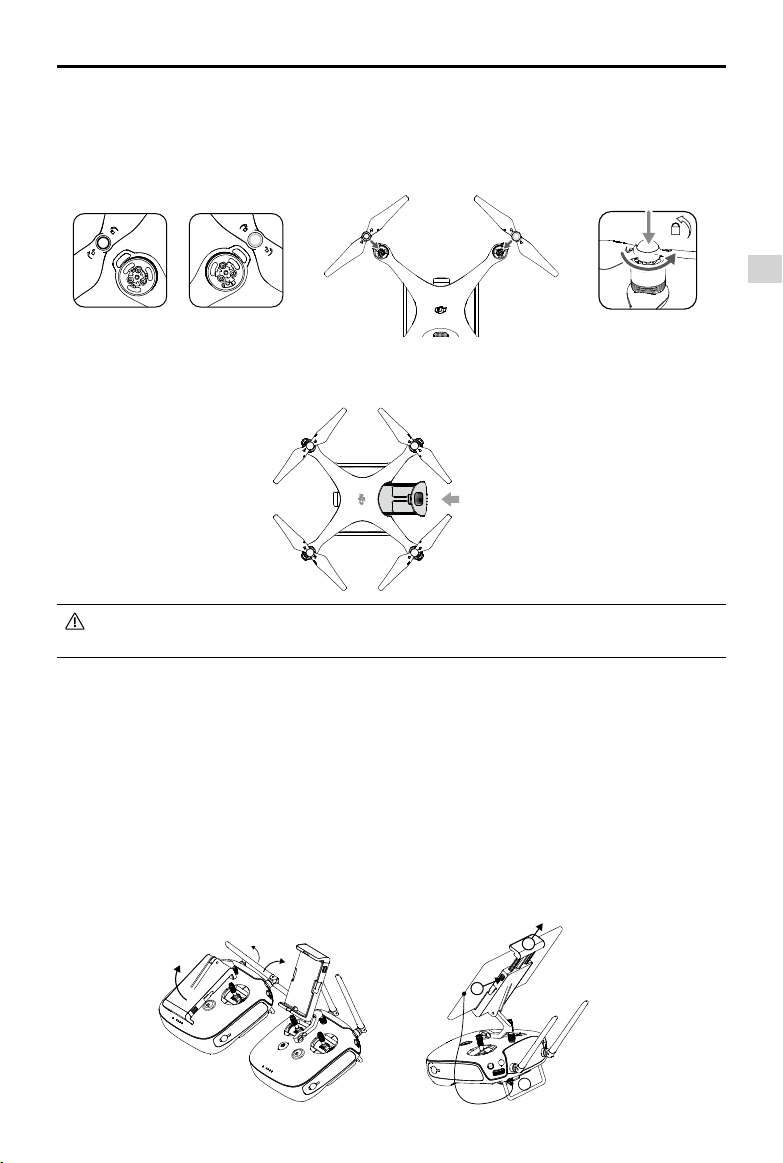
1. Remove the gimbal clamp from the camera as shown below:
*At sea level in calm environments when ying in ATTI mode, The ight time will vary due to different ight
patterns, weather conditions and altitudes.
Product Profile
©
2017 DJI All Rights Reserved.
7
Phantom 4 Advanced / Advanced+ User Manual
1
3
2
2. Attaching the Propellers
Mount the propellers with black propeller rings to the motors with black dots. Mount the propellers with
sliver propeller rings to the motors without black dots. Press the propeller down onto the mounting plate
and rotate in the lock direction until it is secured.
Preparing the Remote Controller
Tilt the mobile device holder or the display device on the remote controller to the desired position,
then adjust the antennas so they are facing outward.
If using the Phantom 4 Advanced, follow the steps below to secure tablet or mobile device to the
mobile device holder.
1. Press the button on the top right side of the mobile device holder to release the clamp, then adjust the
clamp to t the size of your mobile device.
2. Secure your mobile device in the clamp by pressing down, and connect your mobile device to the
remote controller using a USB cable.
3. Plug one end of the cable into the mobile device, and the other end into the USB port on the back of
the remote controller.
Make sure that you hear a click sound indicates the battery is rmly installed. Failure to do so
may affect the ight safety of your aircraft.
3. Battery Installation
Slide battery into the battery compartment according to the arrow’s direction as shown below.
Product Profile
8
©
2017 DJI All Rights Reserved.
Phantom 4 Advanced / Advanced+ User Manual
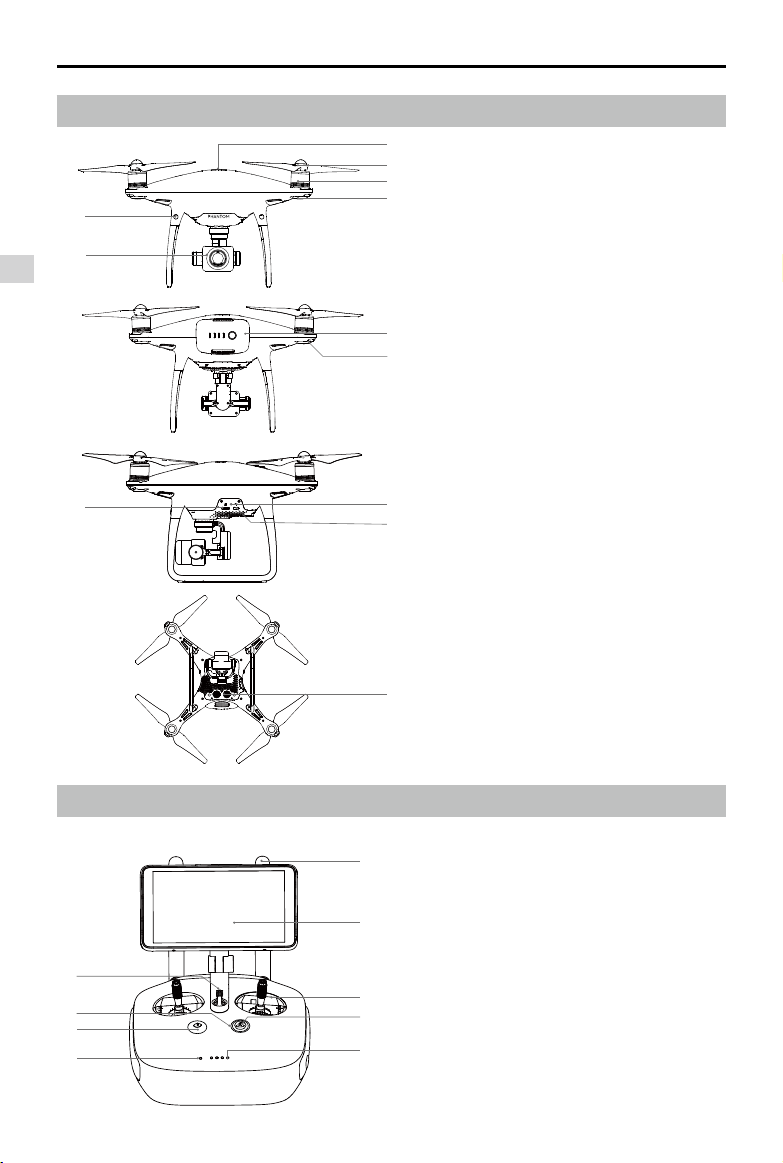
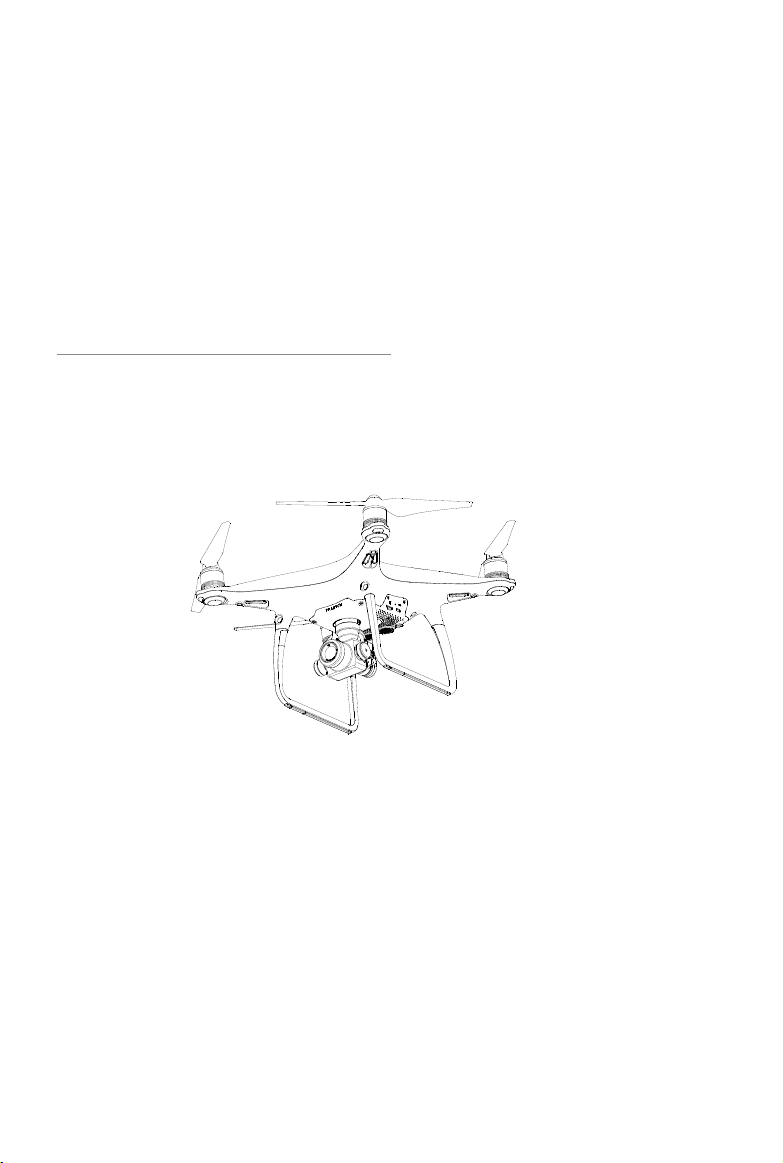
Aircraft Diagram
Remote Controller Diagram
[1] GPS
[2] Propellers
[3] Motors
[4] Front LEDs
[5] Gimbal and Camera
[6] Forward Vision System
[7] Intelligent Flight Battery
[8] Aircraft Status Indicator
[9] Camera / Linking Status Indicator
and Link Button
[10] Micro USB Port
[11] Camera Micro SD Card Slot
[12] Downward Vision System
[
1
]
[
2
]
[
3
]
[
4
]
[
7
]
[
8
]
[
9
]
[
12
]
[
10
]
[
11
]
[
5
]
[
6
]
[1]
Antennas
Relays aircraft control and video
signal.
[2]
Display Screen
Display device with Android system to
run DJI GO 4 app.
[3]
Control Stick
Controls the orientation and movement
of the aircraft.
[4]
Return Home (RTH) Button
Press and hold the button to initiate
Return to Home (RTH).
[1]
[
2
]
[
4
]
[
5
]
[
7
]
[
6
]
[
8
]
[
9
]
[
3
]
Phantom 4 Advanced+ (Model: GL300E)
Product Profile
©
2017 DJI All Rights Reserved.
9
Phantom 4 Advanced / Advanced+ User Manual
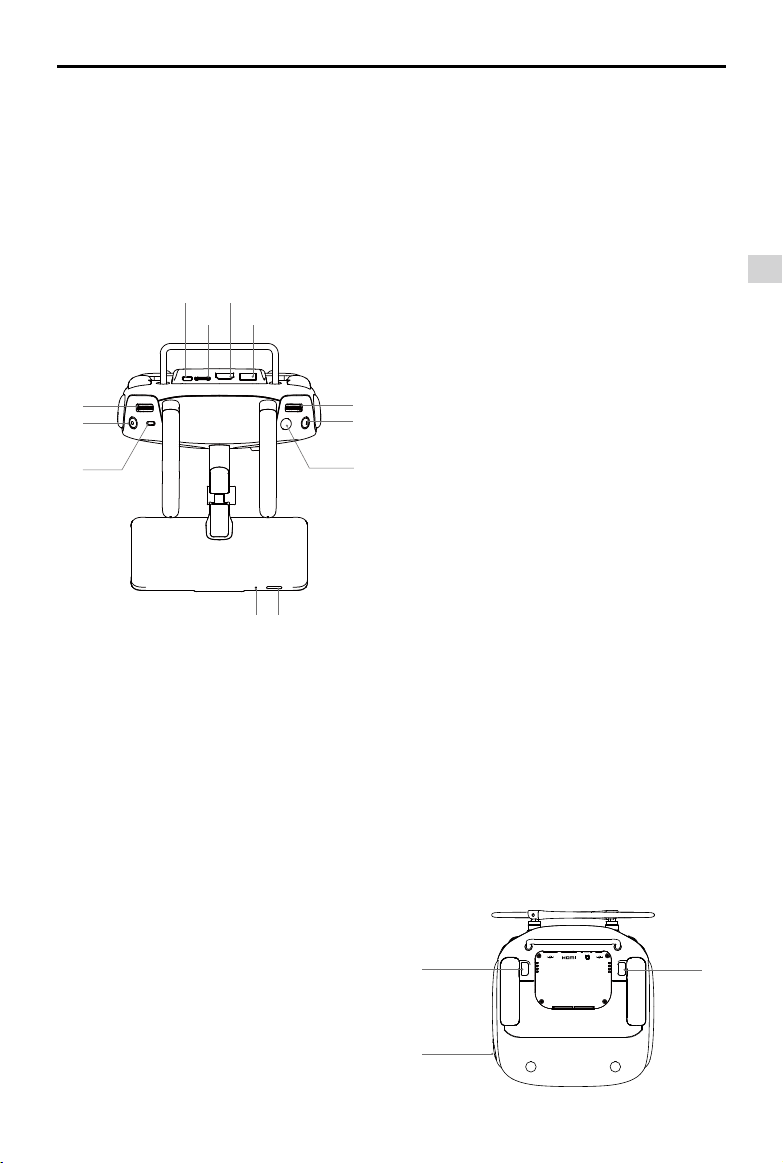
[10]
Camera Settings Dial
Turn the dial to adjust camera settings.
(Only functions when the Remote Controller
is connected to a mobile device running
the DJI GO 4 app.)
[11]
Intelligent Flight Pause Button
Press once to allow the aircraft to exit from
TapFly, ActiveTrack and other intelligent
ight modes.
[5]
Battery Level LEDs
Displays the battery level of the Remote
Controller.
[6]
Status LED
Displays the Remote Controller's system status.
[7]
Power Button
Used to turn the Remote Controller on and off.
[8]
RTH LED
Circular LED around the RTH button displays
RTH status.
[9]
Speaker
Audio output.
[14] [13]
[
11
]
[
12
]
[
19
]
[
18
]
[
21
]
[
20
]
[
10
]
[
15
]
[
16
]
[
17
]
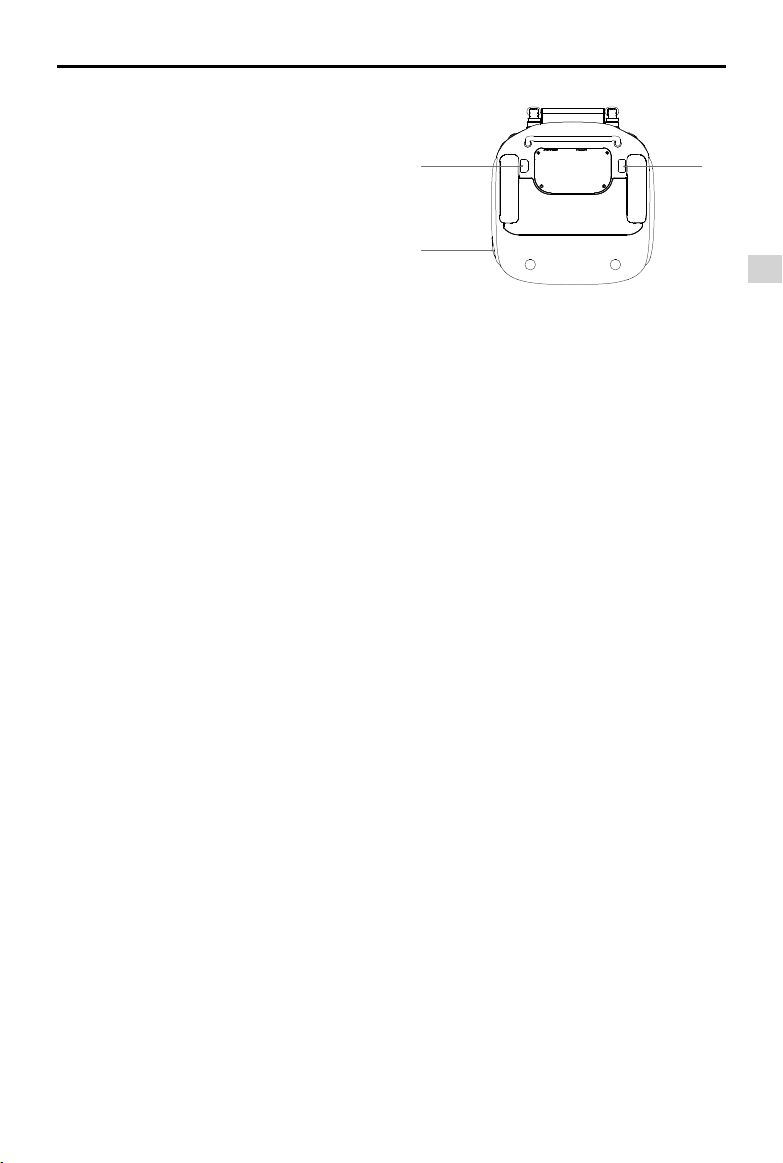
[12]
Shutter Button
Two-stage button, press to take a photo.
[13]
Sleep/Wake Button
Press to sleep/wake the screen, press and
hold to restart.
[14]
Microphone
[15]
Flight Mode Switch
Switch between P-mode, S-mode, and
A-mode.
[16]
Video Recording Button
Press to start recording video. Press again
to stop recording.
[17]
Gimbal Dial
Use this dial to control the tilt of the gimbal.
[18]
Micro USB Port
Upgrading the aircraft by connecting to
the remote controller using the USB OTG
cable.
[19]
Micro SD Card Slot
Provide extra storage space for the display
device, maximum supporting 128 GB.
[20]
HDMI Port
Output HDMI video signal.
[21]
USB Port
USB device support.
[22]
C1 Button
Customizable through the DJI GO 4 app.
[23]
C2 Button
Customizable through the DJI GO 4 app.
[24]
Power Port
Connect to the Charger to charge the
battery of the Remote Controller.
[22]
[24]
[23]
Product Profile
10
©
2017 DJI All Rights Reserved.
Phantom 4 Advanced / Advanced+ User Manual
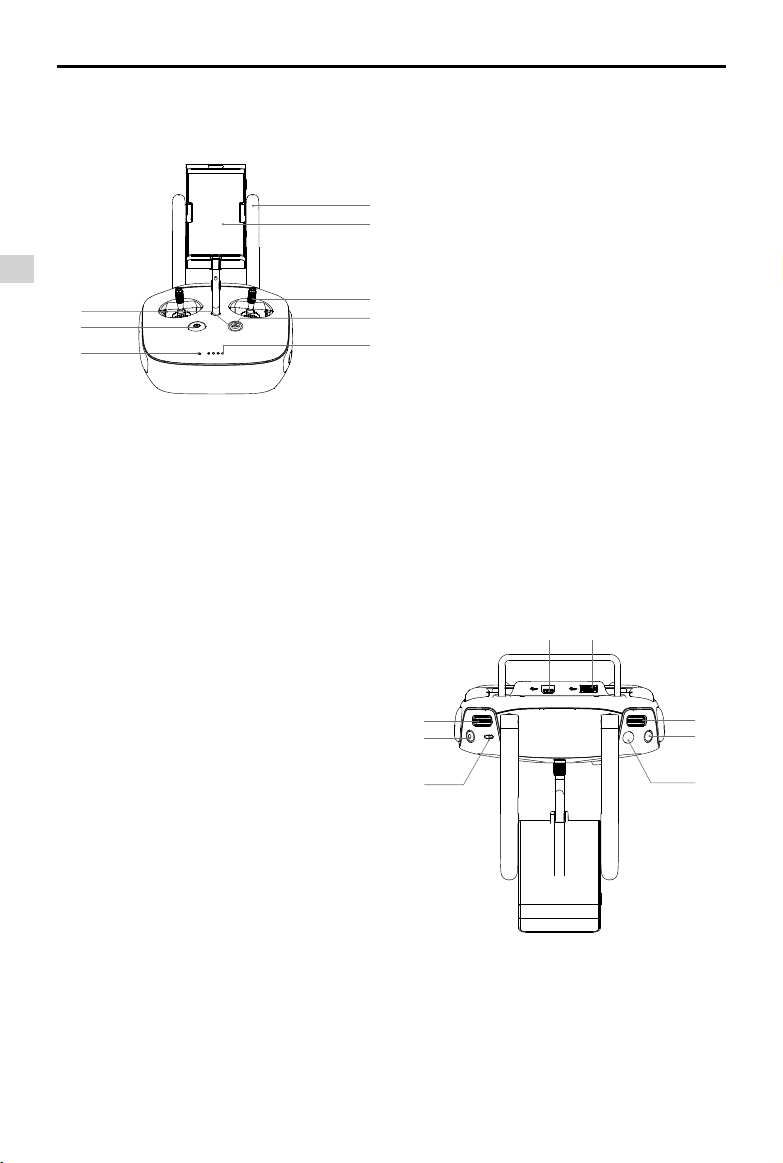
Phantom 4 Advanced (Model: GL300C)
[1]
Antennas
Relays aircraft control and video signal.
[2]
Mobile Device Holder
Securely mounts your mobile device to the
remote controller.
[
1
]
[
2
]
[
3
]
[
4
]
[
5
]
[
7
]
[
8
]
[
6
]
[3]
Control Stick
Controls the orientation and movement of the
aircraft.
[4]
Return Home (RTH) Button
Press and hold the button to initiate Return to
Home (RTH).
[5]
Battery Level LEDs
Displays the battery level of the remote
controller.
[6]
Status LED
Displays the remote controller's system status.
[7]
Power Button
Used to turn the remote controller on and off.
[8]
RTH LED
Circular LED around the RTH button displays
RTH status.
[9]
Camera Settings Dial
Turn the dial to adjust camera settings.
(Only functions when the remote controller is
connected to a mobile device running the DJI
GO 4 app.)
[10]
Intelligent Flight Pause Button
Press once to allow the aircraft to exit from
TapFly, ActiveTrack and other intelligent ight
modes.
[11]
Shutter Button
Two-stage button, press to take a photo.
[12]
Flight Mode Switch
Switch between P-mode, S-mode, and
A-mode.
[13]
Video Recording Button
Press to start recording video. Press again to
stop recording.
[14]
Gimbal Dial
Use this dial to control the tilt of the gimbal.
[15]
Micro USB Port
Reserved port.
[16]
USB Port
Connection to mobile device for DJI GO 4 app.
[10]
[11]
[15] [16]
[9]
[12]
[13]
[14]
Product Profile
©
2017 DJI All Rights Reserved.
11
Phantom 4 Advanced / Advanced+ User Manual
[17]
C1 Button
Customizable through the DJI GO 4 app.
[18]
C2 Button
Customizable through the DJI GO 4 app.
[19]
Power Port
Connect to the Charger to charge the battery
of the remote controller.
[
17
]
[
19
]
[
18
]
Aircraft
This section introduces the Flight Con-
troller, Vision System, and the Intelligent
Flight Battery.
Aircraft
©
2017 DJI All Rights Reserved.
13
Aircraft
Flight Controller
The Phantom 4 Advanced / Advanced+ flight controller features several important upgrades. Safety
modes include Failsafe and Return-to-Home. These features ensure the safe return of your aircraft if the
control signal is lost. The ight controller can also save critical ight data from each ight to the on-board
storage device. The new ight controller also provides increased stability and a new air braking feature.
Flight Mode
Three ight modes are available. The details of each ight mode are found below:
P-mode (Positioning): P-mode works best when the GPS signal is strong. The aircraft utilizes GPS, stereo
Vision System to stabilize, avoid obstacles or track moving subjects. Advanced features such as TapFly
and ActiveTrack are enabled in this mode.
When the Forward Vision System is enabled and lighting conditions are sufcient, the maximum ight
attitude angle is 25° with a maximum ight speed of 31 mph (50 kph). When forward obstacle sensing
are disabled, the maximum ight attitude angle is 35° and the maximum ight speed is 36 mph (58 kph).
When the GPS signal is weak and lighting conditions are too dark for the Forward and Downward Vision
Systems, the aircraft will only use its barometer for positioning to control altitude.
Note: P-mode requires larger stick movements to achieve high speeds.
S-mode (Sport): The handling gain values of the aircraft are adjusted to enhance aircraft maneuverability.
The maximum ight speed of the aircraft is increased to 45mph (72kph). Note that Obstacle Sensing
systems are disabled in this mode.
A-mode (Attitude): When neither the GPS nor the Vision System is available, the aircraft will only use its
barometer for positioning to control the altitude.
The Vision System is disabled in S-mode (Sport), which means the aircraft will not be
able to automatically avoid obstacles in its ight path. Be vigilant and stay clear of nearby
obstacles.
The aircraft’s maximum speed and braking distance are significantly increased in S-mode
(Sport). A minimum braking distance of 164 feet (50 meters) is required in windless conditions.
The aircraft’s responsiveness is signicantly increased in S-mode (Sport), which means a small
stick movement on the remote controller will translate into a large travel distance of the aircraft.
Be vigilant and maintain adequate maneuvering space during ight.
The aircraft’s descent speed is signicantly increased in S-mode (Sport). A minimum braking
distance of 164 feet (50 meters) is required in windless conditions.
Use the Flight Controller mode switch to change the ight mode of the aircraft.
Aircraft
14
©
2017 DJI All Rights Reserved.
Phantom 4 Advanced / Advanced+ User Manual
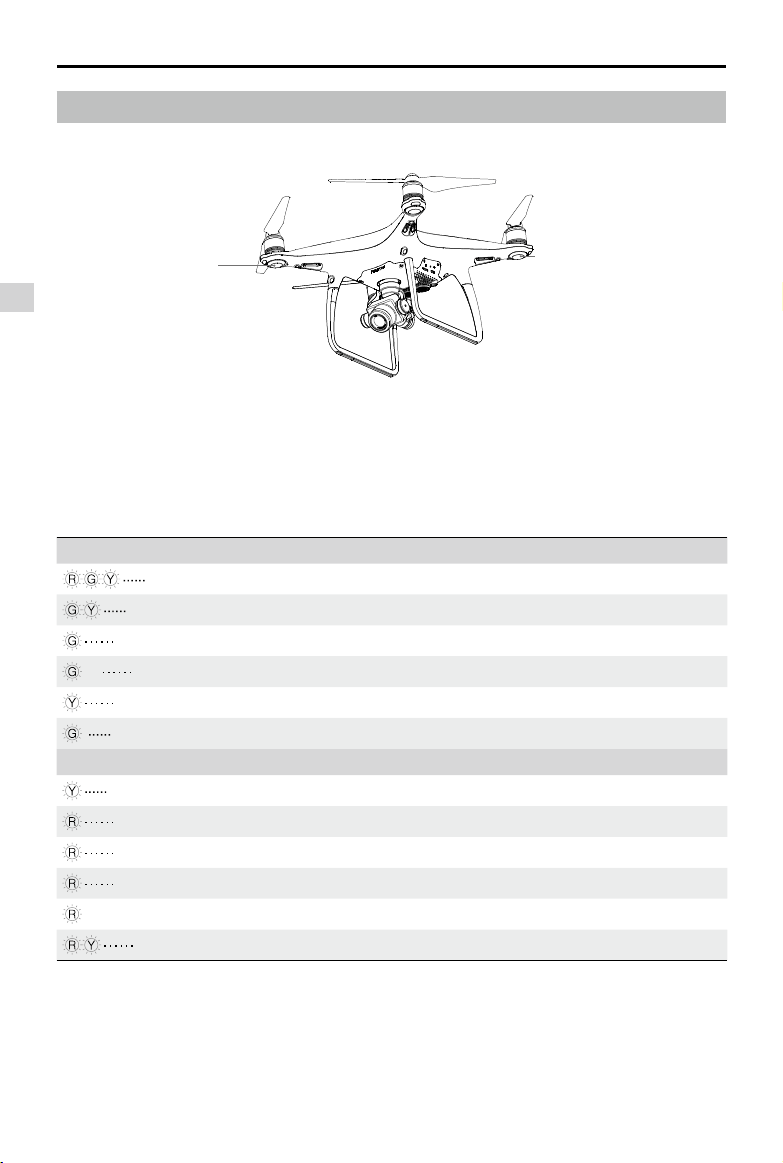
Flight Status Indicator
The Phantom 4 Advanced / Advanced+ has Front LEDs and Aircraft Status Indicators. The positions of
these LEDs are shown in the gure below:
The Front LEDs show the orientation of the aircraft. The Front LEDs glow solid red when the aircraft is
turned on to indicate the front (or nose) of the aircraft. The Aircraft Status Indicators communicate the
system status of the ight controller. Refer to the table below for more information about the Aircraft Status
Indicators.
Front LED
Aircraft Status Indicator
Aircraft Status Indicator Description
Normal
Alternate red, green and yellow ashing Turning On and Self Diagnostic Testing
Alternate green and yellow ashing Warming Up
Slow green ashing P-mode with GPS
×2 Two green ashes P-mode with Vision System
Slow yellow ashing A-mode but No GPS or Vision System
Fast green ashing Braking
Warning
Fast yellow ashing Remote Controller Signal Lost
Slow red ashing Low Battery Warning
Fast red ashing Critical Battery Warning
Red ashing IMU Error
—
Solid Red Critical Error
Alternate red and yellow ashing Compass Calibration Required
Aircraft
©
2017 DJI All Rights Reserved.
15
Phantom 4 Advanced / Advanced+ User Manual
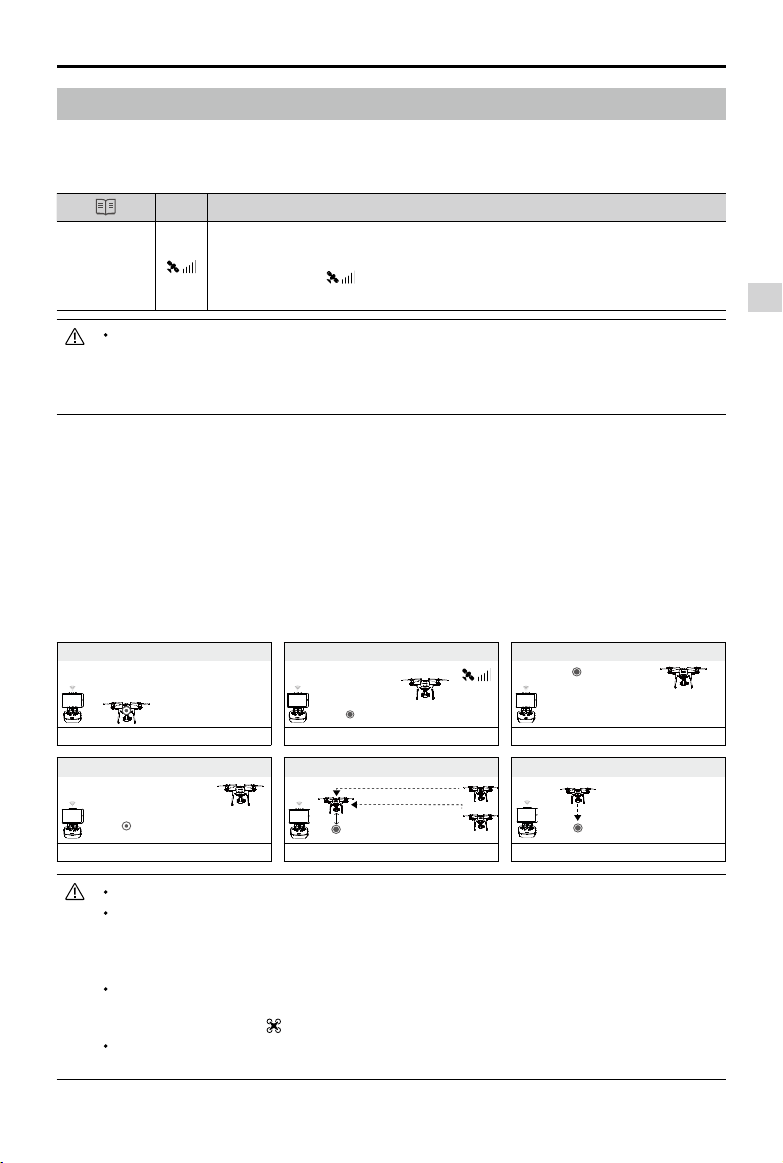
Return-to-Home (RTH)
Return-to-Home (RTH) function brings the aircraft back to the last recorded Home Point. There are three
types of RTH: Smart RTH, Low Battery RTH, and Failsafe RTH. This section describes these three scenarios
in detail.
GPS
Description
Home Point
If a strong GPS signal was acquired before takeoff, the Home Point is the
location from which the aircraft launched. The GPS signal strength is indicated
by the GPS icon ( Less than 4 bars is considered a weak GPS signal). The
aircraft status indicator will blink rapidly when the home point is recorded.
Failsafe RTH
The Forward Vision System allows the aircraft to create a real-time map of its ight route as it ies. If the
Home Point was successfully recorded and the compass is functioning normally, Failsafe RTH will be
automatically activated if the remote controller signal is lost for more than three seconds. The aircraft
will plan its return route and retrace its original ight route home. The aircraft will hover for 10 seconds
at its current location. When it regains signal connection it will wait for pilot commands. The Return-to-
Home process may be interrupted and the pilot given control of the aircraft if the remote controller signal
connection is re-established.
Failsafe Illustration
Aircraft cannot return to the Home Point when GPS signal is weak or unavailable.
Aircraft automatically descends and lands if RTH is triggered when the aircraft ies within a 65
feet (20 meters) radius of the Home Point. Aircraft will stop ascending and immediately return
to the Home Point if you move the left stick if the aircraft reaches 65 feet (20 meters) altitudes or
beyond during Failsafe.
The aircraft cannot avoid obstruction during Failsafe RTH if Forward Vision System is disabled.
It is important to set a suitable Failsafe altitude before each ight. Launch the DJI GO 4 app,
enter “Camera” and tap
to set the Failsafe Altitude.
User cannot control the aircraft while the aircraft is ascending to 65 feet (20 meters) from the
current altitude. However, user can press RTH button once to exit ascending and regain control.
The aircraft can sense and avoid obstacles when the Forward Vision System is enabled and
lighting conditions are sufcient. The aircraft will automatically climb up to avoid obstacles and
descend slowly as it returns to the home point. To ensure the aircraft returns home forwards, it
cannot rotate or y left and right during RTH while the Forward Vision System is enabled.
5
RTH (adjustable altitude)
Fast Blinking Yellow
Height over HP<=Failsafe Altitude
1 Record Home Point
Blinking Green
3 Remote Controller Signal Lost
Fast Blinking Yellow
2 Conrming Home Point
Blinking Green
6 Landing (after hovering for 5 secs)
Fast Blinking Yellow
4
Signal Lost Lasts (after 3 sec.)
Fast Blinking Yellow
Height over HP>Failsafe Altitude
Elevate to Failsafe Altitude
Failsafe Altitude
×
×
×
>3S
×
Aircraft
16
©
2017 DJI All Rights Reserved.
Phantom 4 Advanced / Advanced+ User Manual
Low Battery RTH
The low battery level failsafe is triggered when the DJI Intelligent Flight Battery is depleted to a point that
may affect the safe return of the aircraft. Users are advised to return home or land the aircraft immediately
when prompted. The DJI GO 4 app will display a notice when a low battery warning is triggered. The
aircraft will automatically return to the Home Point if no action is taken after a ten-second countdown. The
user can cancel the RTH procedure by pressing the RTH button on the remote controller. The thresholds
for these warnings are automatically determined based on the aircraft’s current altitude and distance from
the Home Point.
The aircraft will land automatically if the current battery level can only support the aircraft long enough
to descend from its current altitude. The user can still use the remote controller to alter the aircraft’s
orientation during the landing process.
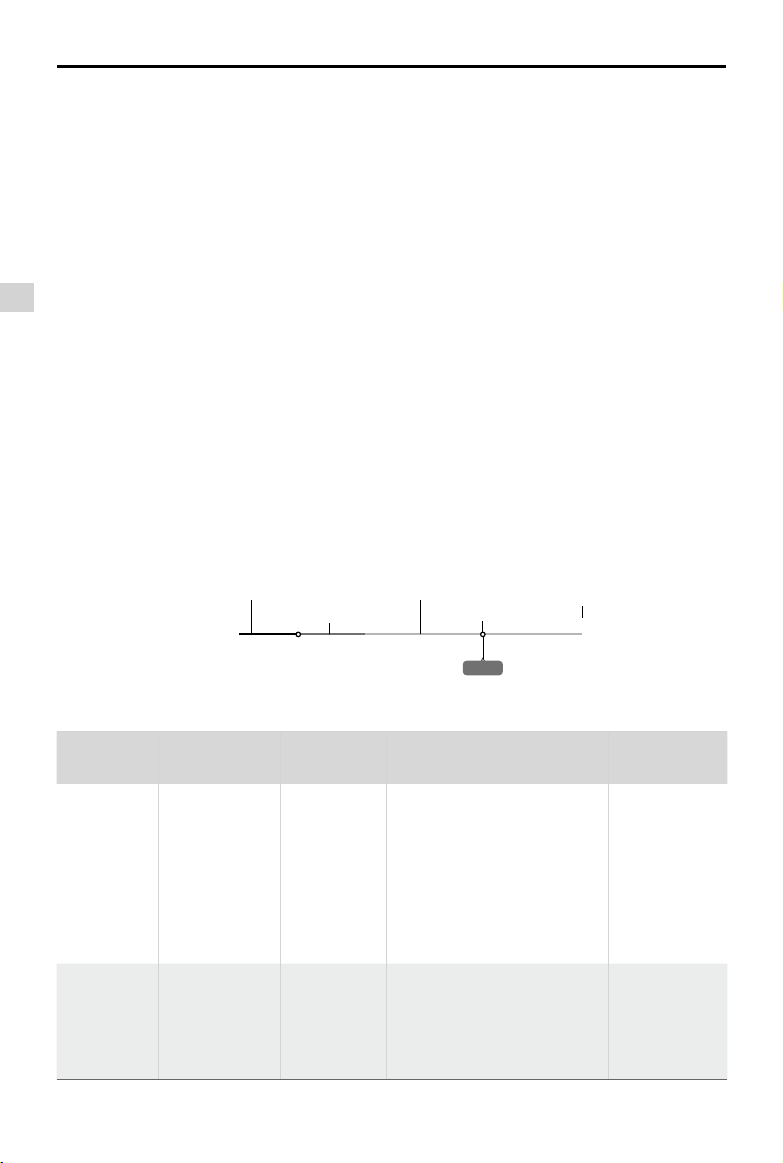
The Battery Level Indicator is displayed in the DJI GO 4 app, and is described below:
Smart RTH
Use the RTH button on the remote controller or tap the RTH button in the DJI GO 4 app and follow the on-
screen instructions when GPS is available to initiate Smart RTH. The aircraft will then automatically return
to the last recorded Home Point. Use the remote controller to control the aircraft’s speed or altitude to
avoid a collision during the Smart RTH process. As the aircraft returns, it will use the primary camera to
identify obstacles as far as 300m in front, allowing it to plan a safe route home. Press and hold the Smart
RTH button once to start the process, and press the Smart RTH button again to terminate the procedure
and regain full control of the aircraft.
12:29
Remaining ight time
Sufcient battery
level (Green)
Battery level Indicator
Power requires
to return home
Critical Low battery level
warning (Red)
Low battery
level warning (Yellow)
Battery Level
Warning
Remark
Aircraft Status
Indicator
DJI GO 4 App
Flight
Instructions
Low battery
level warning
Battery power
is low. Land the
aircraft.
Aircraft status
indicator
blinks RED
slowly.
Tap “Go-home” to have the
aircraft return to the Home
point and land automatically, or
“Cancel” to resume normal ight.
If no action is taken, the aircraft
will automatically go home and
land after 10 seconds. Remote
controller will sound an alarm.
Fly the aircraft
back and land
it as soon as
possible, then
stop the motors
and replace the
battery.
Critical Low
battery level
warning
The aircraft
must land
immediately.
Aircraft status
indicator
blinks RED
quickly.
The DJI GO 4 app display will
flash red and the aircraft will
start to descend. The remote
controller will sound an alarm.
Allow the
aircraft to
descend
and land
automatically.
Aircraft
©
2017 DJI All Rights Reserved.
17
Phantom 4 Advanced / Advanced+ User Manual
Precision Landing
The Phantom 4 Advanced / Advanced+ automatically scans and attempts to match the terrain features
underneath during Return to Home. When current terrain matches home point terrain, the Phantom 4
Advanced / Advanced+ will start landing immediately to achieve precision landing. The DJI GO 4 app
will show a terrain feature mismatch prompt if matching fails.
Precision Landing performance is subject to the following conditions:
a) Home point is recorded upon take off, and cannot not be refreshed during ight.
b) Aircraft must take off vertically. Take off altitude must be greater than 7 meters.
c) Home point terrain features remain largely unchanged.
d) Home point terrain with no distinctive features will affect the performance.
e) Lighting conditions cannot be too light nor too dark.
The following actions are available during landing:
a) Pull throttle down to accelerate landing.
b) Moving the control sticks in any other direction will stop Precision Landing. The Phantom 4
Advanced / Advanced+ will descend vertically and Landing Protection will remain active.
Estimated
remaining
ight time
Estimated
remaining ight
based on current
battery level.
N/A N/A N/A
When the Critical low battery level warning is triggered and the aircraft begins to land
automatically, push the left stick upward to make the aircraft hover at its current altitude, giving
you an opportunity to navigate to a more appropriate landing location.
The colored zones and markers on the battery level indicator bar reflect the estimated
remaining ight time. They are automatically adjusted according to the aircraft’s current location
and status.
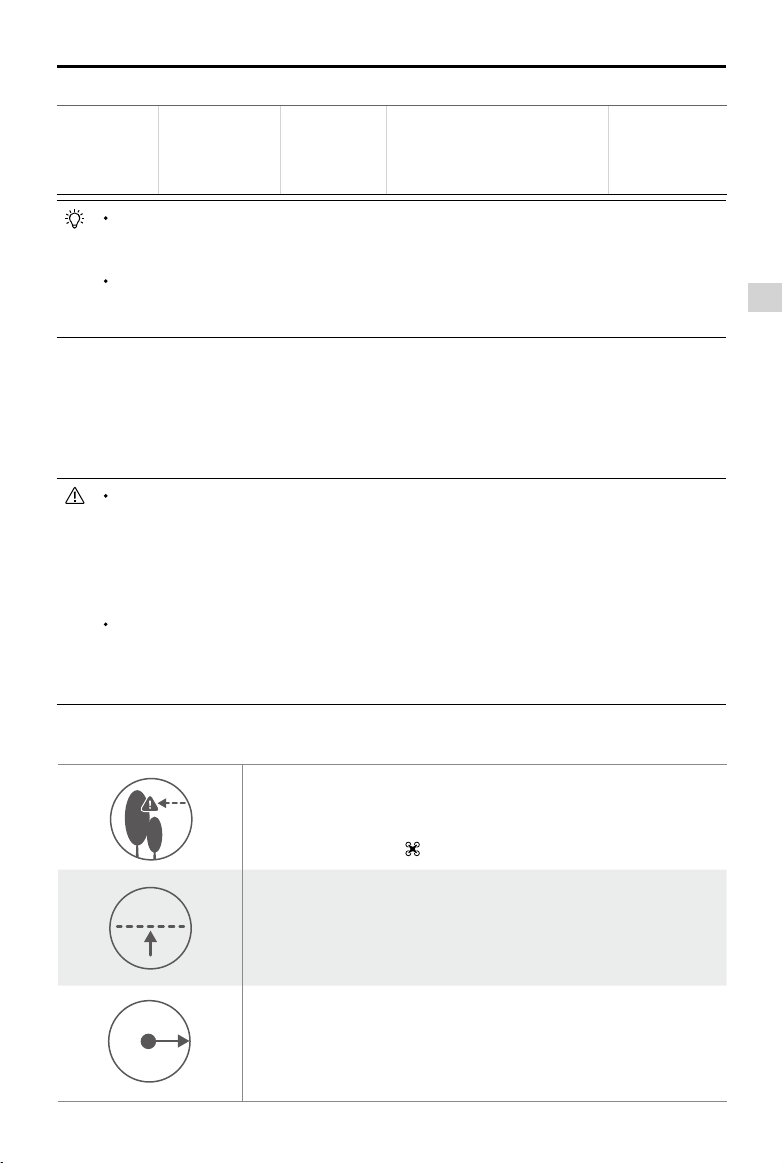
20米
20米
H
The aircraft cannot avoid obstruction during the Failsafe RTH when the
Forward Vision System is disabled. Therefore, it is important to set a
suitable Failsafe altitude before each ight. Launch the DJI GO 4 app,
enter “Camera” and tap to set the Failsafe Altitude.
20 m
20 m
H
If the aircraft is ying under 65 feet (20 meters) and Failsafe (including
Smart RTH, Lower Battery RTH ) is triggered, the aircraft will first
automatically ascend to 65 feet (20 meters) from the current altitude. You
can only cancel the ascending by exiting the Failsafe.
20 m
20 m
H
Aircraft automatically descends and lands if RTH is triggered when the
aircraft ies within a 65 feet (20 meters) radius of the Home Point. Aircraft
will stop ascending and immediately return to the Home Point if you move
the left stick if the aircraft reaches 65 feet (20 meters) altitudes or beyond
during Failsafe.
Failsafe Safety Notices
Aircraft
18
©
2017 DJI All Rights Reserved.
Phantom 4 Advanced / Advanced+ User Manual
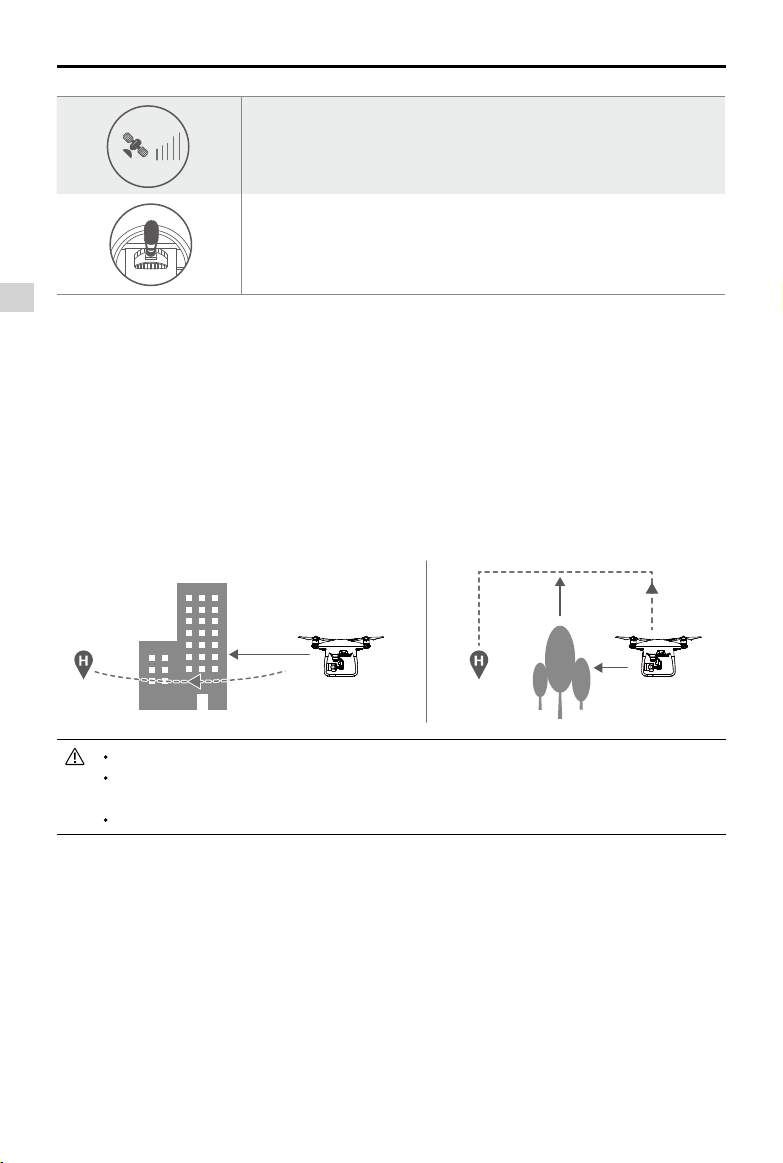
Obstacle Avoidance During RTH
Aircraft can now sense and actively attempt to avoid obstacles during RTH, provided that the lighting
conditions are adequate for the Forward Vision System. Upon detecting an obstacle, the aircraft will act
as follows:
1. The aircraft will use the primary camera to identify obstacles as far as 984 feet (300 meters) in front,
allowing it to plan a safe route home.
2. The aircraft decelerates when an obstacle is sensed at 49 feet (15 meters) ahead.
3.The aircraft stops and hover then start ascending vertically to avoid the obstacle. Eventually, the aircraft
will stop climbing when it is at least 16 feet (5 meters) above the detected obstacle.
4. Failsafe RTH procedure resume, the aircraft will continue ying to the Home Point at the current
altitude.
The Obstacle Sensing function is disabled during RTH descent. Proceed with care.
To ensure the aircraft returns home forwards, it cannot rotate during RTH while the Forward
Vision System is enabled.
The aircraft cannot avoid obstacles above, beside, or behind the aircraft.
5 meters
15 meters
300 meters
20米
20米
H
Aircraft cannot return to the Home Point when GPS signal is weak or
unavailable.
20米
20米
H
If you move the left stick after the aircraft rises above 65 feet (20
meters) but below the pre-set Failsafe RTH altitude, the aircraft will
stop ascending and immediately return to the Home Point.
Landing Protection Function
Landing Protection will activate during auto landing.
1. Landing Protection determines whether the ground is suitable for landing. If so, the Phantom 4
Advanced / Advanced+ will land gently.
2. If Landing Protection determines that the ground is not suitable for landing, the Phantom 4 Advanced /
Advanced+ will hover and wait for pilot conrmation. The aircraft will hover if it detects the ground is not
appropriate for landing even with a critically low battery warning. Only when the battery level decreases
to 0% will the aircraft land. Users retain control of aircraft ight orientation.
3. If Landing Protection is inactive, the DJI GO 4 app will display a landing prompt when the Phantom 4
Advanced / Advanced+ descends below 0.3 meters. Tap to conrm or pull down the control stick for 2
seconds to land when the environment is appropriate for landing.
Aircraft
©
2017 DJI All Rights Reserved.
19
Phantom 4 Advanced / Advanced+ User Manual
ON OFF
Auto Hold
• Landing Protection will not be active in the following circumstances:
a) When the user is controlling the pitch/roll/throttle sticks (Landing ground detection will
re-activate when control sticks are not in use)
b) When the positioning system is not fully functional (e.g. drift position error)
c) When the downward vision system needs re-calibration
d) When light conditions are not sufcient for the downward vision system
• If an obstacle is within 1-meter of the aircraft, the aircraft will descend to 0.3m above the
ground and hover. The aircraft will land upon with user conrmation.
Intelligent Flight Mode
TapFly
Introduction
With the TapFly feature, users can now tap on the mobile device screen to y in the designated direction
without using the remote controller. The aircraft will automatically avoid obstacles it sees or brake and hover
provided that the lighting is appropriate (< 300 lux) nor too bright (> 10,000 lux).
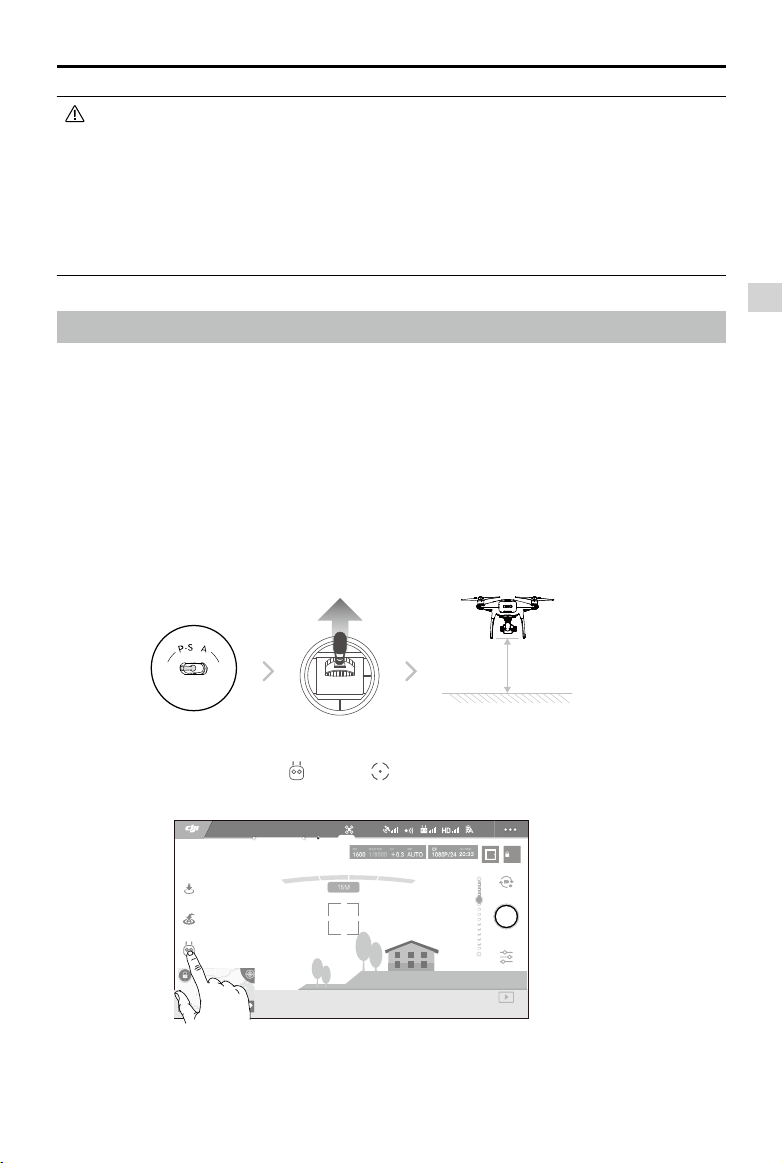
Using TapFly
Ensure the aircraft is in P-mode, then follow the steps below to use TapFly:
1. Take off and ensure the aircraft is ying at least 6 feet (2 meters) above the ground.
2 meters
2. Launch the DJI GO 4 app and tap
, then tap
, read and understand the prompts.
AE
09:29
61%
P-GPS
12
H 10.0MD 30M
VS 2.0M/S VPS 2.0MH.S 10.0 M/S
In Flight (GPS)
Aircraft
20
©
2017 DJI All Rights Reserved.
Phantom 4 Advanced / Advanced+ User Manual
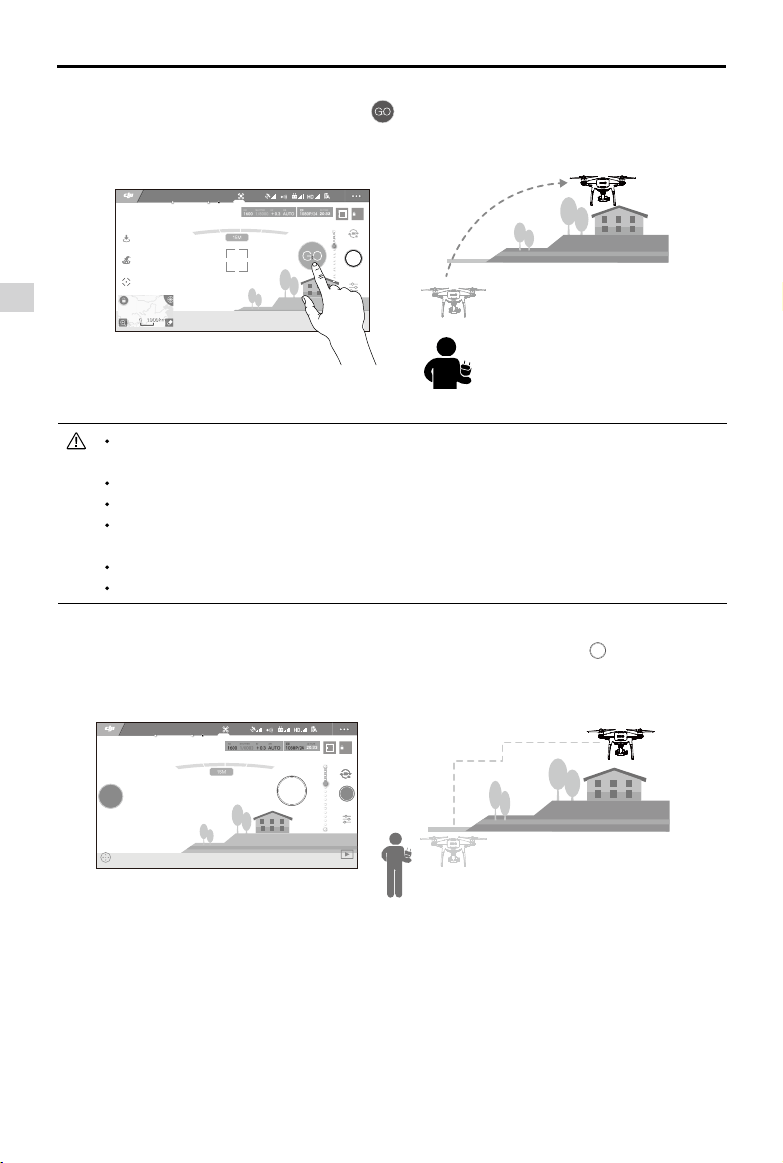
3. Tap once on the target direction and wait for icon to appear. Tap again to conrm the selection
and the aircraft will automatically y towards the target direction.
DO NOT guide the aircraft to fly towards people, animals, small and fine objects (e.g. tree
branches and power lines) or transparent objects (e.g. glass or water).
Watch for the obstacles in the ight path and stay clear of them.
There may be deviations between the expected and the actual ight path of TapFly selection.
The selectable range for the target direction is limited. You cannot make a TapFly selection close to
the upper or lower edge of the screen.
TapFly Mode may not work properly when the aircraft is ying over water or snow covered areas.
Be extra cautions when ying in dark (< 300 lux ) or bright (>10,000 lux) environments.
AE
09:29
61%
P-GPS
12
H 10.0MD 30M
VS 2.0M/S VPS 2.0MH.S 10.0 M/S
In Flight (GPS)
After conrming the TapFly selection, the aircraft will y in the direction marked by the icon. Note that you
can still use the control stick to control the movement of the aircraft during the ight.
The aircraft will automatically adjust its speed when it senses an obstacle in front or if it is ying too close
to the ground. However, this feature should not be relied upon for navigation between obstacles. Failsafe
procedures will override TapFly. If the GPS signal weakens, the aircraft will exit autonomous ight and
return to home.
AE
09:29
61
%
P-GPS
12
STOP
H 10.0MD 30M
VS 2.0M/S VPS 2.0MH.S 10.0 M/S
In Flight (GPS)
Aircraft
©
2017 DJI All Rights Reserved.
21
Phantom 4 Advanced / Advanced+ User Manual
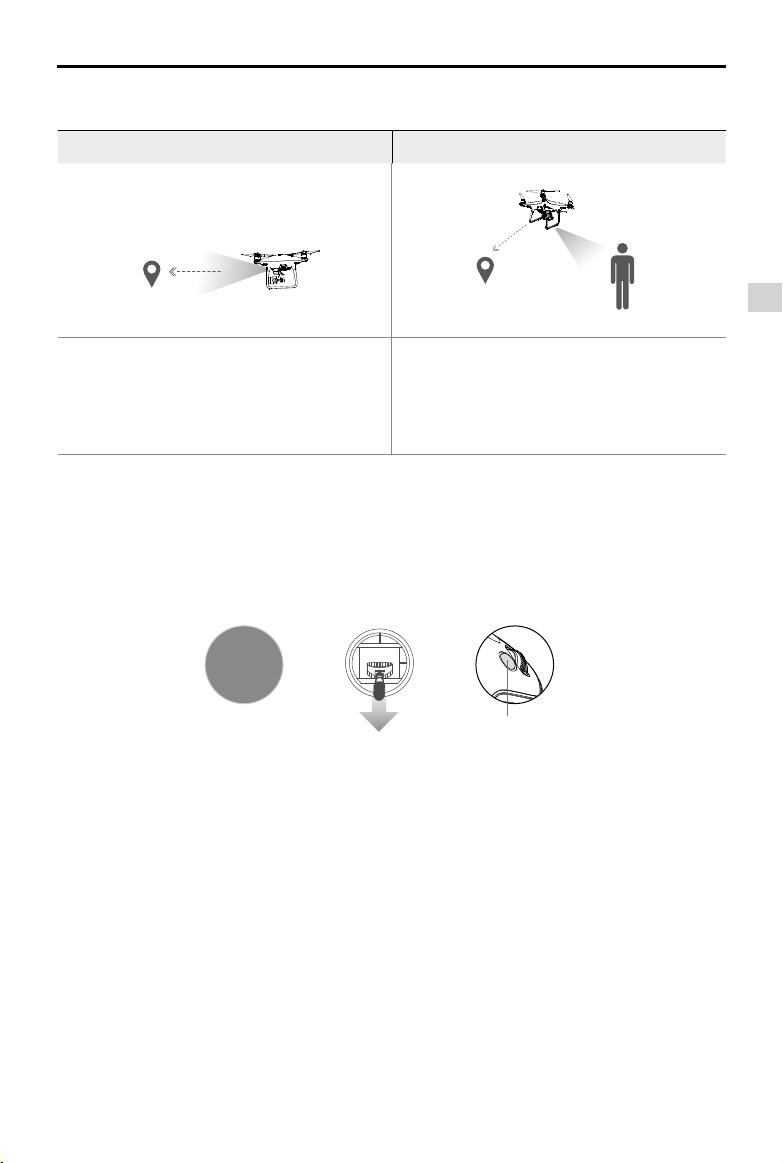
TapFly Forward Mode Free Mode
The aircraft will fly towards the target. Forward
Vision System is active.
The aircraft will y towards the target. The remote
controller can be used to maneuver the yaw of
the aircraft freely. Obstacle Sensing is disabled in
this mode, use it in an unobstructed environment.
TapFly includes following functions:
Exit TapFly
Use the following methods to exit TapFly:
1. Tap “STOP” button on the screen.
2. Pull back the pitch stick on the remote controller and hold for more than 3s.
3. Press the Intelligent Flight Pause button on the remote controller.
Aircraft will stop and hover after exiting from TapFly. Tap a new target direction to continue ying or begin
manual ight.
ActiveTrack
Introduction
ActiveTrack allows you to mark and track a moving object on your mobile device screen. The aircraft will
automatically avoid obstacles in its ight path. No external tracking device is required.
The Phantom 4 Advanced / Advanced+ can automatically identify and trace people, bikes and other
vehicles, and use different tracking strategies for each.
OR OR
STOP
Intelligent Flight Pause button
Aircraft
22
©
2017 DJI All Rights Reserved.
Phantom 4 Advanced / Advanced+ User Manual
ON OFF
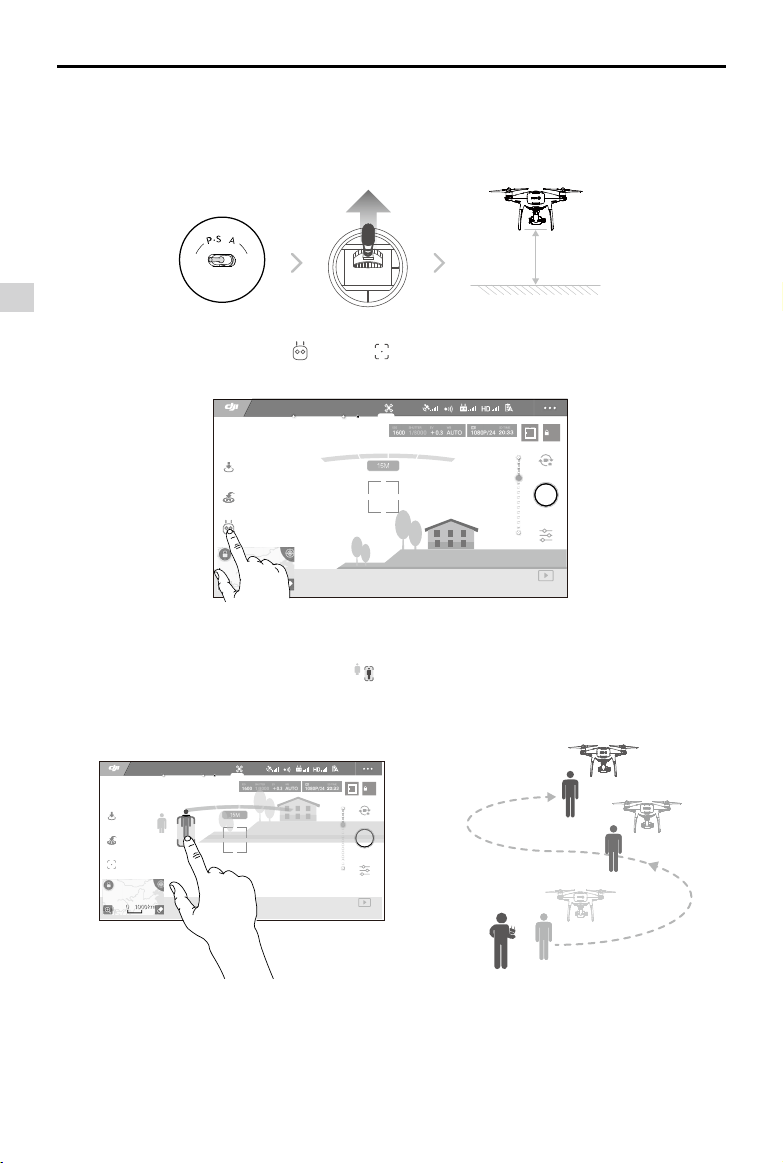
Auto Hold
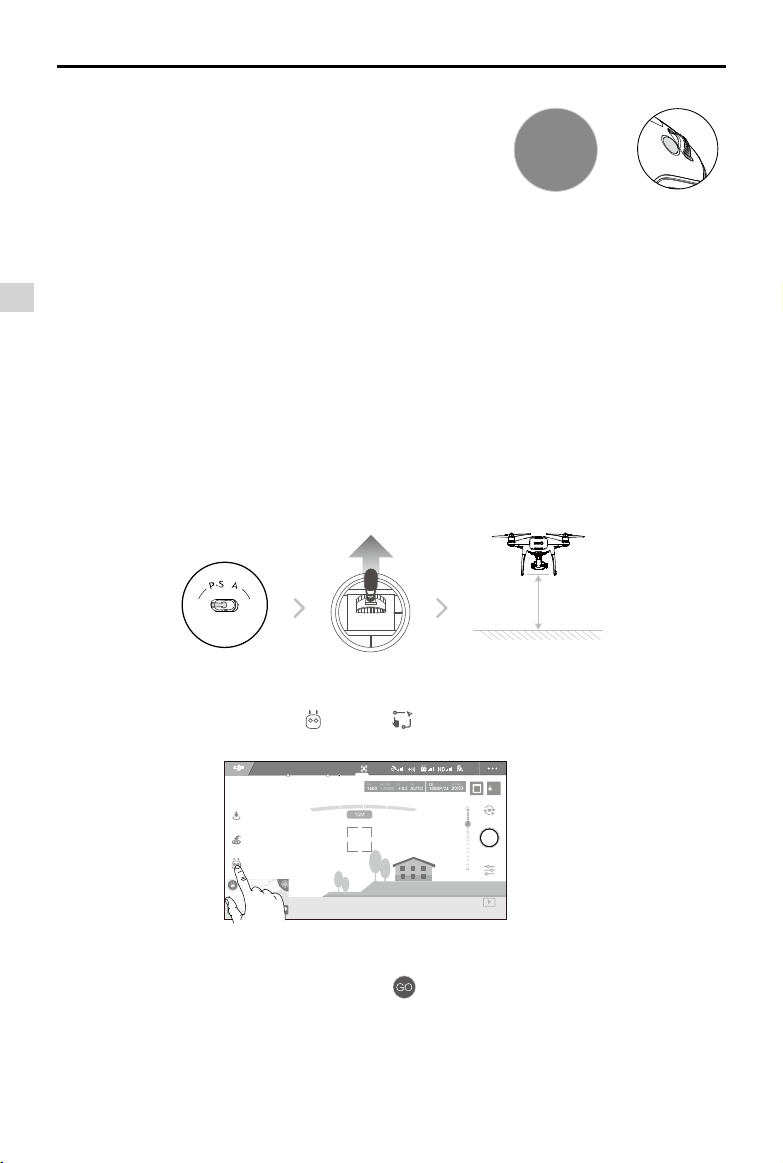
2. Launch the DJI GO 4 app and tap , then tap , read and understand the prompts.
3.
Tap on the subject you want to track then tap to conrm selection. If the subject is not automatically
recognized, drag a box around it. The box
will turn green when tracking is in progress. If the box
turns red, the object could not be identied and you should try again.
2 meters
Using ActiveTrack
Ensure the aircraft is in P-mode, then follow the steps below to use ActiveTrack:
1. Take off and hover at least 6 feet (2 meters) above the ground.
AE
09:29
61%
P-GPS
12
H 10.0MD 30M
VS 2.0M/S VPS 2.0MH.S 10.0 M/S
In Flight (GPS)
AE
09:29
61%
P-GPS
12
H 10.0MD 30M
VS 2.0M/S VPS 2. 0MH.S 10.0 M/S
智能跟随
In Flight (GPS)
Aircraft
©
2017 DJI All Rights Reserved.
23
Phantom 4 Advanced / Advanced+ User Manual
DO NOT select an area containing people, animals, small, ne objects (e.g. tree branches
and power lines) or transparent objects (e.g. glass or water surface).
Stay clear of obstacles near the ight path, particularly when the aircraft is ying backward.
Be extra vigilant when using ActiveTrack in any of the following situations:
a) The tracked subject is not moving on a level plane.
b) The tracked subject changes shape drastically while moving.
c) The tracked subject could be blocked or out of sight for a long time.
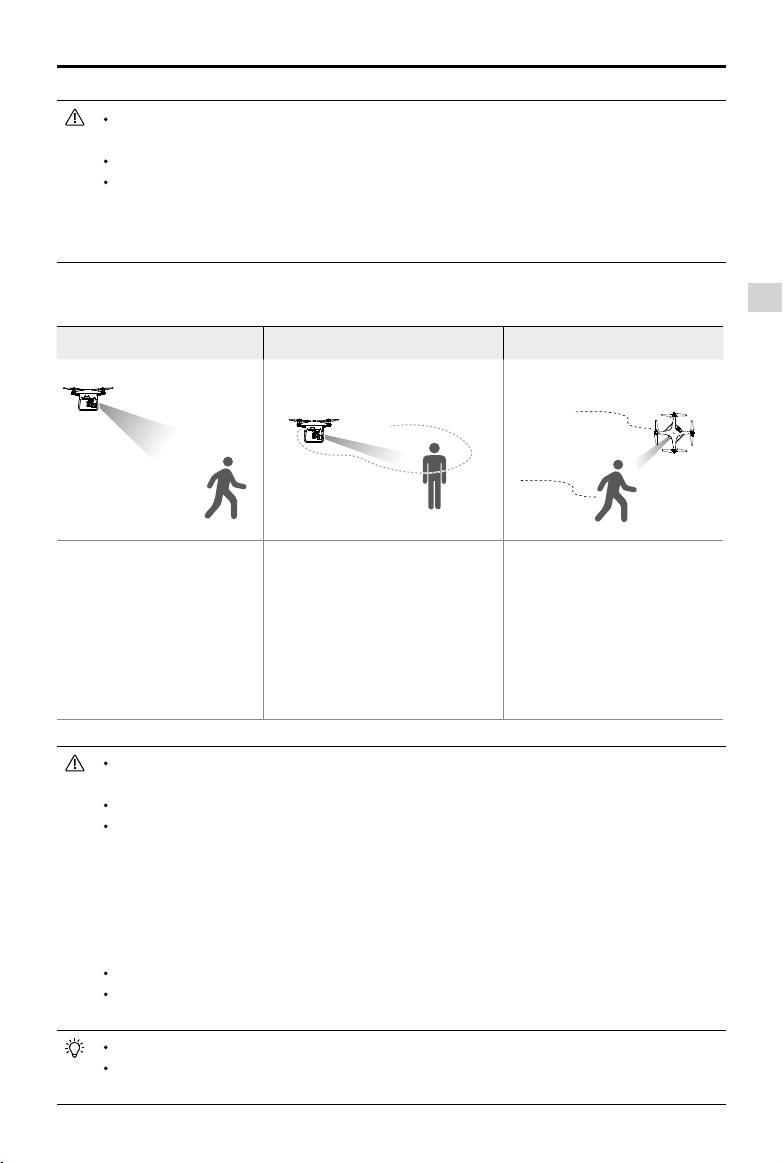
ActiveTrack includes following functions:
Trace Spotlight Prole
The aircraft tracks the
subject at a constant
distance. Use the roll stick
on the remote controller or
the slider in DJI GO to circle
the subject.
Aircraft will not trace a subject
automatically, but it keeps the
camera pointing at the subject
during ight. The remote controller
can be used to maneuver the
aircraft, but yaw is disabled. Using
the left stick and gimbal dial will
adjust subject framing.
The aircraft tracks the subject
at constant angle and distance
from the side. Use the roll stick
on the remote control to circle
the subject.
DO NOT select an area containing people, animals, small, ne objects (e.g. tree branches
and power lines) or transparent objects (e.g. glass or water).
Stay clear of obstacles near the ight path, particularly when the aircraft is ying backward.
Be extra vigilant when using ActiveTrack in any of the following situations:
a) The tracked subject is not moving on a level plane.
b) The tracked subject changes shape drastically while moving.
c) The tracked subject could be blocked or out of sight for a long time.
d) The tracked subject is moving on a snowy surface.
e) Available light is low (< 300 lux) or high (> 10,000 lux).
f) The tracked subject has a similar color or pattern as its surrounding environment.
You must follow local privacy laws and regulations when using ActiveTrack.
Aircraft will not be able to avoid obstacles while in Prole or Spotlight Mode. Use these
modes in open areas.
The aircraft will sense and avoid obstacles on its ight path.
If the aircraft loses track of the subject, because it is moving too fast or obscured, re-select
the subject to resume tracking.
Aircraft
24
©
2017 DJI All Rights Reserved.
Phantom 4 Advanced / Advanced+ User Manual
ON OFF
Auto Hold
Exiting ActiveTrack
Use the following methods to exit ActiveTrack:
1. Tap the “STOP” button on the screen.
2. Press the Intelligent Flight Pause button on the remote controller.
After exiting ActiveTrack, the aircraft will hover in place, at which point you may choose to fly
manually, track another subject, or return to home.
OR
STOP
Draw
Introduction
Using Draw, the aircraft will y along the ight path drawn on-screen. As it ies it will automatically
brake and hover when it sees obstacles provided that the lighting is appropriate - no darker than
300 lux nor brighter than 10,000 lux.
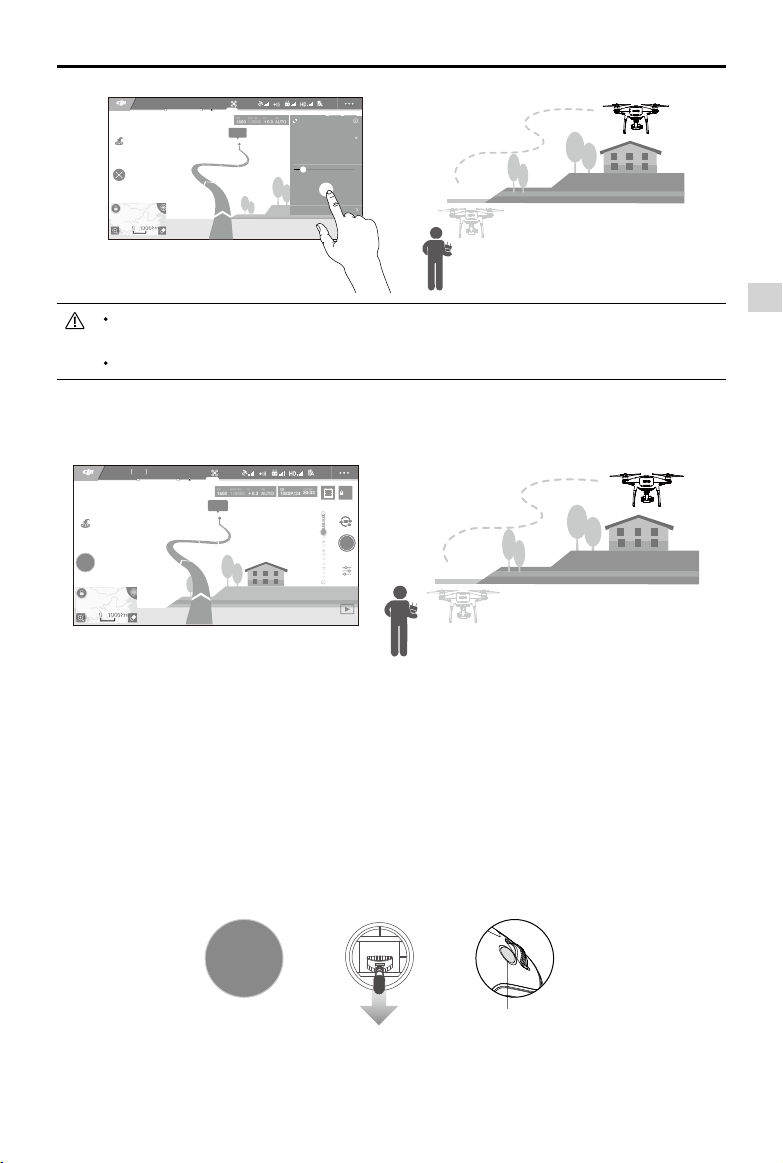
Using Draw
Ensure the aircraft is in P-mode, then follow the steps below to use Draw:
1. Take off and hover at least 6 feet (2 meters) above the ground.
AE
09:29
61%
In Flight(GPS)
P-GPS
12
H 10.0MD 30M
VS 2.0M/S VPS 2. 0MH.S 10.0 M/S
3. Draw a line on the screen to create a path. Tap and the aircraft will y along the path.
2 meters
2. Launch the DJI GO 4 app and tap , then tap , read and understand the prompts.
Aircraft
©
2017 DJI All Rights Reserved.
25
Phantom 4 Advanced / Advanced+ User Manual
DO NOT fly the aircraft towards people, animals, or small/fine objects (e.g. tree
branches and power lines) or transparent objects (e.g. glass or water).
There may be some deviation between the expected and the actual ight path.
After conrming the ight path, the aircraft will y along the path on-screen. Note: Control sticks can be
used to control aircraft movement during the ight.
AE
09:29
61%
In Flight(GPS)
P-GPS
12
H 10.0MD 30M
VS 2.0M/S VPS 2.0MH.S 10.0 M/S
Hide
Heading
Forward
Advanced Setting
SPEED
2.1 m/s
GO
268m
AE
09:29
61%
P-GPS
12
STOP
In Flight GPS
H 10.0MD 30M
VS 2.0M/S VPS 2. 0MH.S 10.0 M/S
268m
Aircraft will stop and hover after exiting from Draw. Draw a new ight path to continue ying or begin
manual ight.
Exit Draw
Use the following methods to exit Draw:
1. Tap the “STOP” button on the screen.
2. Pull back the pitch stick on the remote controller and hold for more than 3s.
3. Press the Intelligent Flight Pause button on the remote controller.
OR OR
Intelligent Flight Pause button
STOP
The aircraft will automatically adjust its speed when it senses an obstacle in front or if it is ying too close
to the ground. However, this feature should not be relied upon for navigation between obstacles.
Failsafe procedures will override Draw. If the GPS signal weakens, the aircraft will exit autonomous ight
and return to home.
Aircraft
26
©
2017 DJI All Rights Reserved.
Phantom 4 Advanced / Advanced+ User Manual
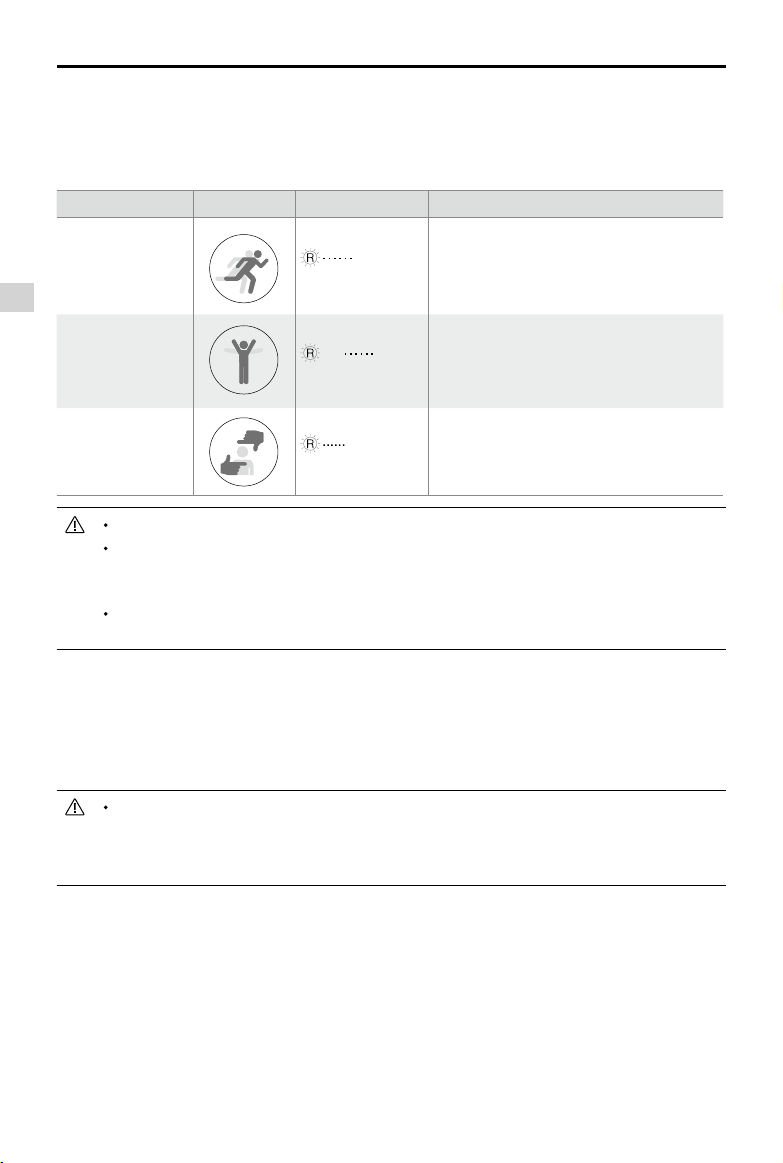
Gesture Mode
In Gesture Mode, the Phantom 4 Advanced / Advanced+’s Vision System recognizes gestures, allowing
it to follow and capture seles without a phone or a controller. Follow the steps below to use Gesture
Mode:
Modes Prompts Front LEDs Remarks
1. Conrm the
subject
Slow Red Flashing
Ensure the forward vision system is active
and there is enough light. Tap the icon and
move in front of the camera for the Phantom
4 Advanced / Advanced+ to recognize you.
2. Conrm the
distance
×2
Red Flashes Twice
Raise your arms and wave to the Phantom 4
Advanced / Advanced+, the Front LEDs will
blink red twice once it conrms the shooting
distance.
3. Sele Count
Down
Fast Red Flashing
Put your fingers in front on your face as
shown.
Gesture Mode can only be used in Photo Mode.
Fly the aircraft 2 meters or higher above the ground then move in front of the camera to
be recognized. Front LED Indicators will blink red rapidly if the Phantom 4 Advanced / Ad-
vanced+ fails to recognize a subject.
Enabling GPS on your phone will allow the Phantom 4 Advanced / Advanced+ to follow
with more accuracy while ying in Gesture Mode.
Only use Tripod Mode where the GPS signal is strong or light conditions are ideal for the vision
system. If GPS signal is lost and the vision system cannot function, it will automatically switch
to Atti mode. In this case, ight speed will increase and the aircraft cannot hover in place. Use
Tripod Mode carefully.
Tripod Mode
Tap the icon in the DJI GO 4 app to enable Tripod Mode. In Tripod Mode, the maximum ight speed is
limited to 5.6 mph (9 kph) and the braking distance is reduced to 6.6 ft (2 m). Responsiveness to stick
movements is also reduced for smoother more controlled movements.
Terrain Follow Mode
The Downward Vision System is utilized in Terrain Follow Mode to maintain a height above ground
between 1 and 10 meters. This mode is designed for use on grassland sloped at no more than 20°.
Enable the Terrain Follow Mode by tapping the Intelligent Flight Mode icon in the DJI GO 4 app. When
this mode is enabled, the aircraft’s current height will be recorded. The aircraft will maintain the recorded
height during ight and ascend when the slope rises. However, the aircraft will not descend in downward
slopes.
Aircraft
©
2017 DJI All Rights Reserved.
27
Phantom 4 Advanced / Advanced+ User Manual
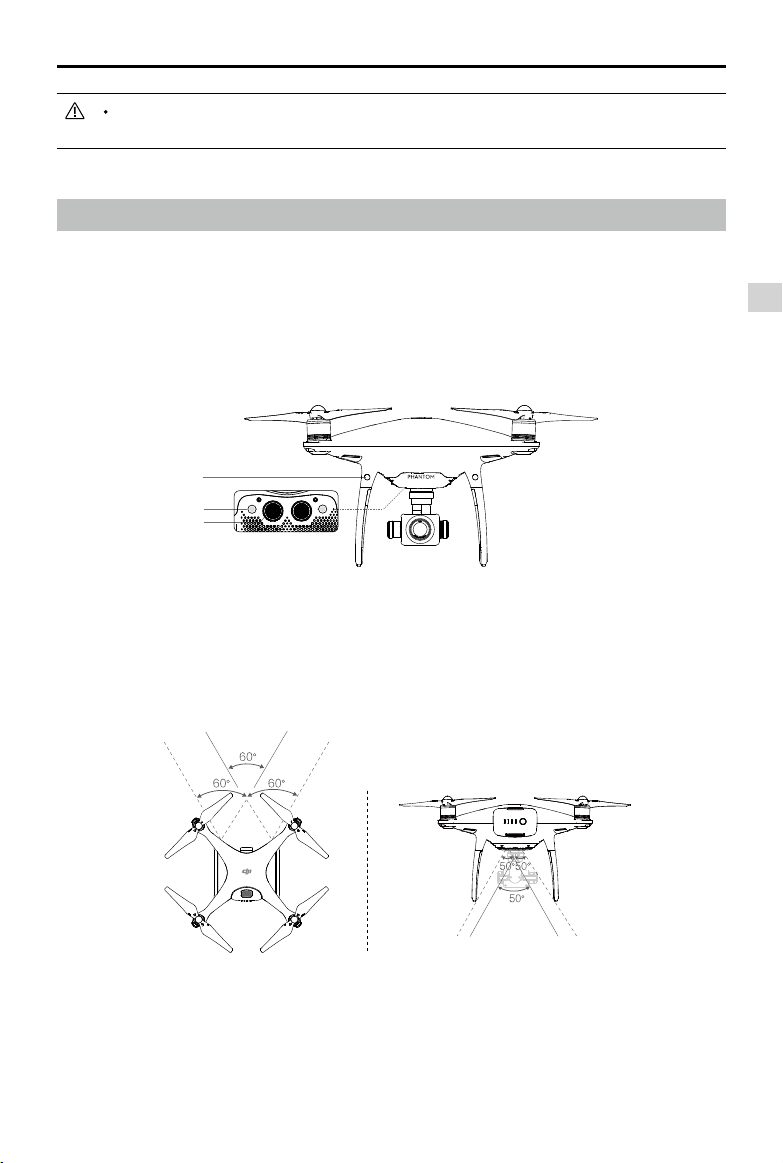
Vision System
The main components of the Vision System are located on the front and bottom of the Phantom 4 Ad-
vanced / Advanced+, including [1] [2] two stereo vision sensors and [3] two ultrasonic sensors. The
Vision System uses ultrasound and image data to help the aircraft maintain its current position, enabling
precision hovering indoors or in environments where a GPS signal is not available. The Vision System
constantly scans for obstacles, allowing the Phantom 4 Advanced / Advanced+ to avoid them by going
over, around, or hovering.
It is important that you only fly in conditions where the Vision Position System can function
correctly; otherwise the Terrain Follow Mode will not work.
Detection Range
The detection range of the Vision System is depicted as follow. Note that the aircraft cannot sense and
avoid the obstacles that are not within the detection range.
[1]
[2]
[3]
Aircraft
28
©
2017 DJI All Rights Reserved.
Phantom 4 Advanced / Advanced+ User Manual
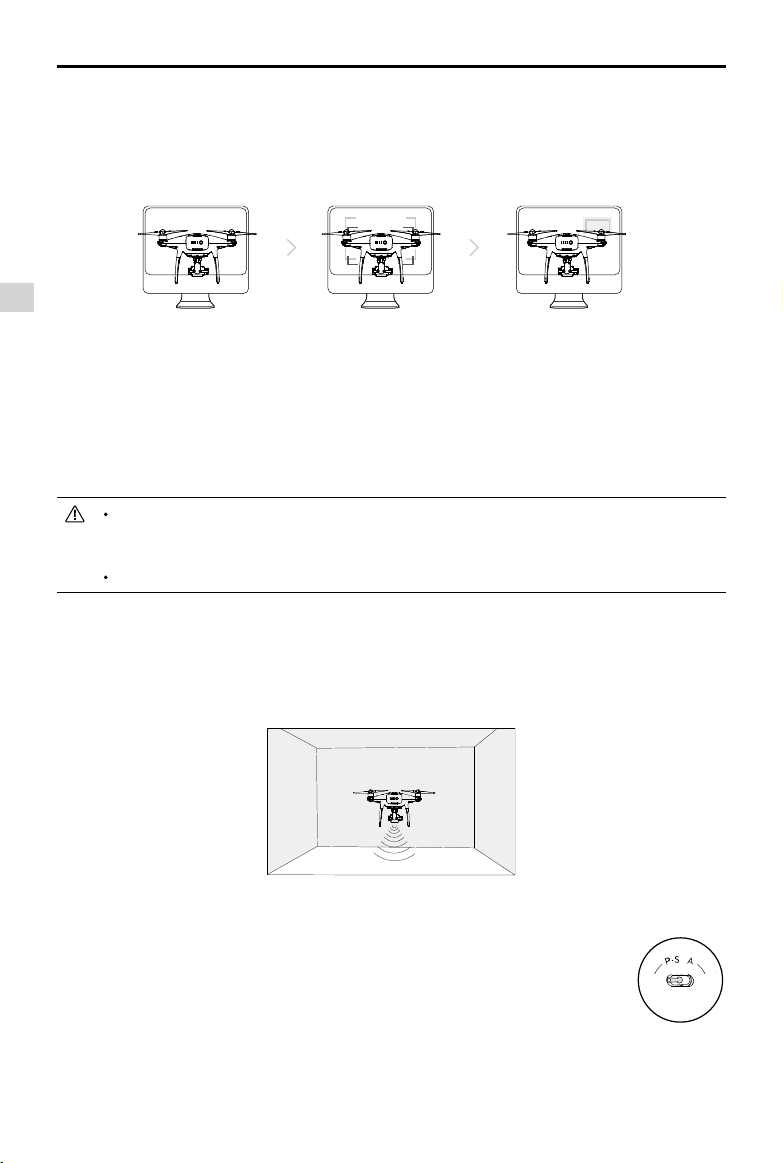
Calibrating Sensors
Vision Systems cameras installed on the aircraft are calibrated on delivery. However these cameras
are vulnerable to excessive impact and will require occasional calibration via DJI ASSISTANT
TM
2 or
the DJI GO 4 app. Follow the steps below to calibrate the camera.
01
Point the aircraft toward the screen
02
Align the boxes
03
Pan and tilt the aircraft
Follow the steps below to use Vision Positioning:
1. Toggle the ight mode switch to P-mode.
2. Place the aircraft on a at surface. Note that the Vision System cannot work properly
on surfaces without clear pattern variations.
3. Turn on the aircraft. The aircraft status indicator will ash green two times, which in-
dicates the Vision Positioning is ready. Gently push the left stick up to lift off and the
aircraft will hover in place.
ON OFF
Auto Hold
Quick Calibration
Use quick calibration when the DJI GO 4 app notify that vision sensor calibration is required. Tap
through “Aircraft Status” -> “Vision Sensors” to start quick calibration.
Quick calibration is quick x to vision sensor issues. Connecting the aircraft to a computer
to carry out a full calibration using DJI Assistant 2 is recommended when possible. Only
calibrate when lighting conditions are adequate and on textured surfaces i.e. grass.
Do not calibrate the aircraft on highly reective surfaces such as Marble or ceramics.
Using Vision Positioning
Vision Positioning is activated automatically when the aircraft is turned on. No further action is
required. Vision Positioning is typically used in indoor environments, where GPS is unavailable. Using
the sensors that are built into the Vision System, the aircraft can hover precisely even without GPS.
Aircraft
©
2017 DJI All Rights Reserved.
29
Phantom 4 Advanced / Advanced+ User Manual
The performance of your Vision System is affected by the surface being own over. Ultrasonic
sensors may not be able to accurately measure distances when operating above sound-
absorbing materials and the camera may not function correctly in suboptimal environments. The
aircraft will switch from P-mode to A-mode automatically if neither GPS nor Vision System are
available. Operate the aircraft with great caution in the following situations:
a) Flying over monochrome surfaces (e.g. pure black, pure white, pure red, pure green).
b) Flying over a highly reective surfaces.
c) Flying at high speeds of over 31mph (50kph) at 2 meters or over 11mph (18kph) at 1 meter.
d) Flying over water or transparent surfaces.
e) Flying over moving surfaces or objects.
f) Flying in an area where the lighting changes frequently or drastically.
g) Flying over extremely dark (lux < 10) or bright (lux > 100,000) surfaces.
h) Flying over surfaces that can absorb sound waves (e.g. thick carpet).
i) Flying over surfaces without clear patterns or texture.
j) Flying over surfaces with identical repeating patterns or textures (e.g. tiling).
k) Flying over inclined surfaces that will deect sound waves away from the aircraft.
Keep sensors clean at all times. Dirt or other debris may adversely affect their effectiveness.
Vision Positioning is only effective when the aircraft is at altitudes of 0.3 to 10 meters.
The Vision Positioning may not function properly when the aircraft is ying over water.
The Vision System may not be able to recognize pattern on the ground in low light conditions (less
than 100 lux).
Do not use other ultrasonic devices with frequency of 40 KHz when Vision System is in
operation.
Keep animals away from the aircraft when Vision Positioning is activated. The sonar sensor
emits high frequency sounds that are audible to some animals.
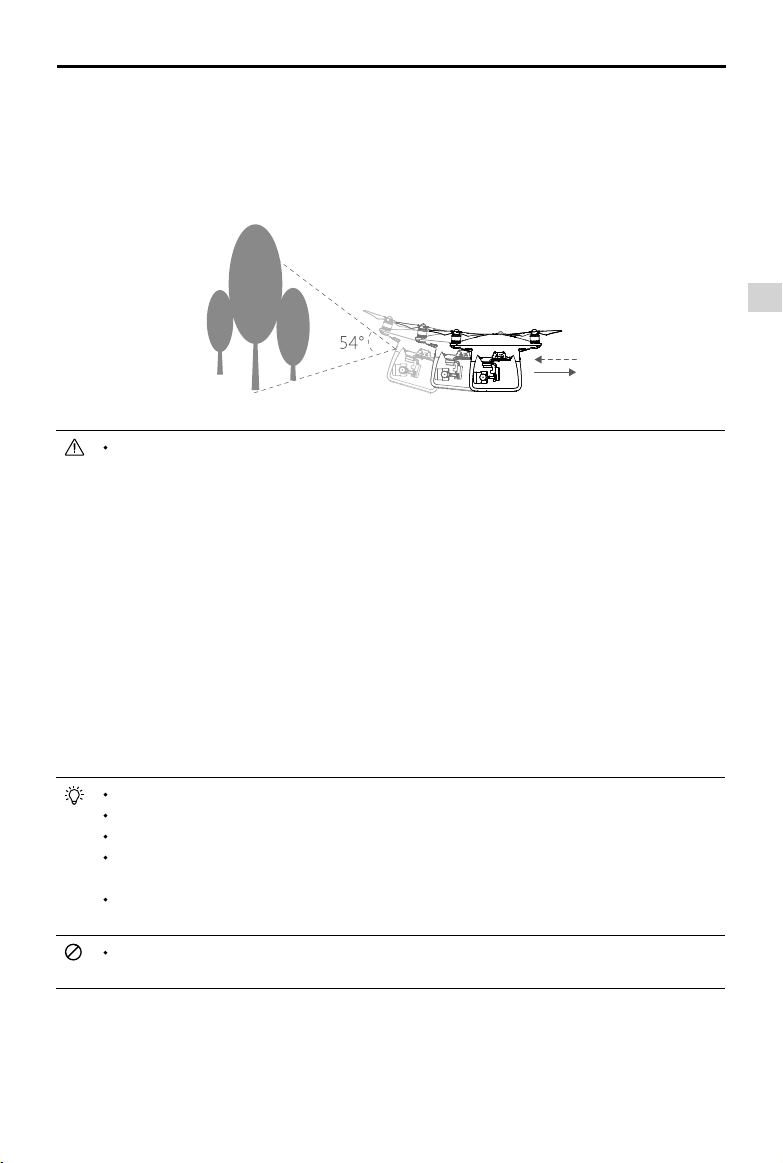
Assisted Braking from Obstacle Sensing
Powered by the Obstacle Sensing, the aircraft will now be able to actively brake when obstacles
are detected around the aircraft. Note that Obstacle Sensing function works best when lighting
is adequate and the obstacle is clearly marked or textured. The aircraft must y at no more than
31mph (50kph) to allow sufcient braking distance.
Aircraft
30
©
2017 DJI All Rights Reserved.
Phantom 4 Advanced / Advanced+ User Manual
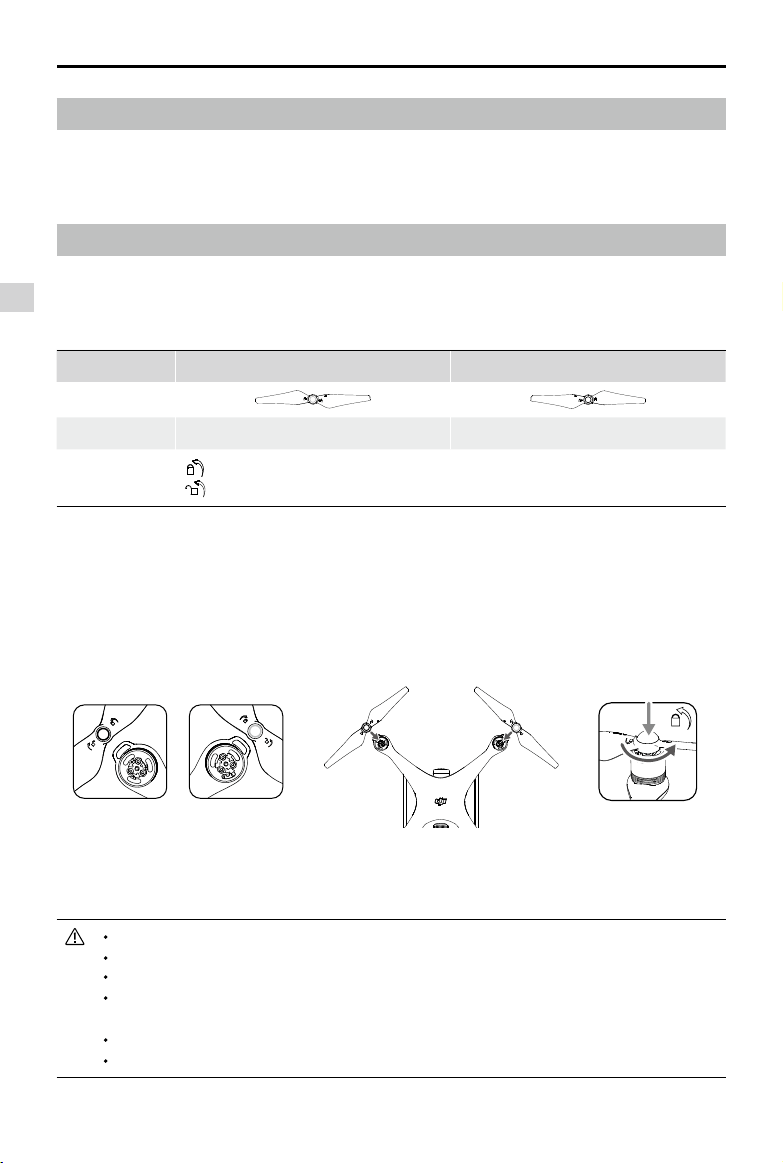
Attaching the Propellers
1. Be sure to remove the warning stickers from the motors before attaching the propellers.
2. Mount the propellers with black propeller rings to the motors with black dots. Mount the propellers with
sliver propeller rings to the motors without black dots. Press the propeller down onto the mounting
plate and rotate in the lock direction until it is secured in its position.
Detaching the Propellers
Press the propellers down into the motor mount and rotate in the unlock direction.
Be aware of the sharp edges of the propellers. Handle with care.
Use only the DJI approved propellers. Do not mix propeller types.
Check that the propellers and motors are installed correctly and rmly before every ight.
Ensure that all propellers are in good condition before each ight. DO NOT use aged, chipped,
or broken propellers.
To avoid injury, STAND CLEAR of and DO NOT touch propellers or motors when they are spinning.
ONLY use original DJI propellers for a better and safer ight experience.
Flight Recorder
Flight data is automatically recorded to the internal storage of the aircraft. This includes flight
telemetry, aircraft status information, and other parameters. To access this data, connect the aircraft
to the PC through the Micro USB port and launch the DJI 2.
Attaching and Detaching the Propellers
Use only DJI approved propellers with your Phantom 4 Advanced / Advanced+. The grey and black
ring on the propeller indicate where they should be attached and in which direction whey should
spin.
Propellers Silver Ring Black Ring
Figure
Attach On Motors without black dots Motors with black dots
Legends
Lock : Turn the propellers in the indicated direction to mount and tighten.
Unlock : Turn the propellers in the indicated direction to loosen and remove.
Aircraft
©
2017 DJI All Rights Reserved.
31
Phantom 4 Advanced / Advanced+ User Manual
The Intelligent Flight Battery must be fully charged before using it for the rst time.
Be aware that the output power of the supplied Phantom 4 Advanced / Advanced+ charger is
100W.
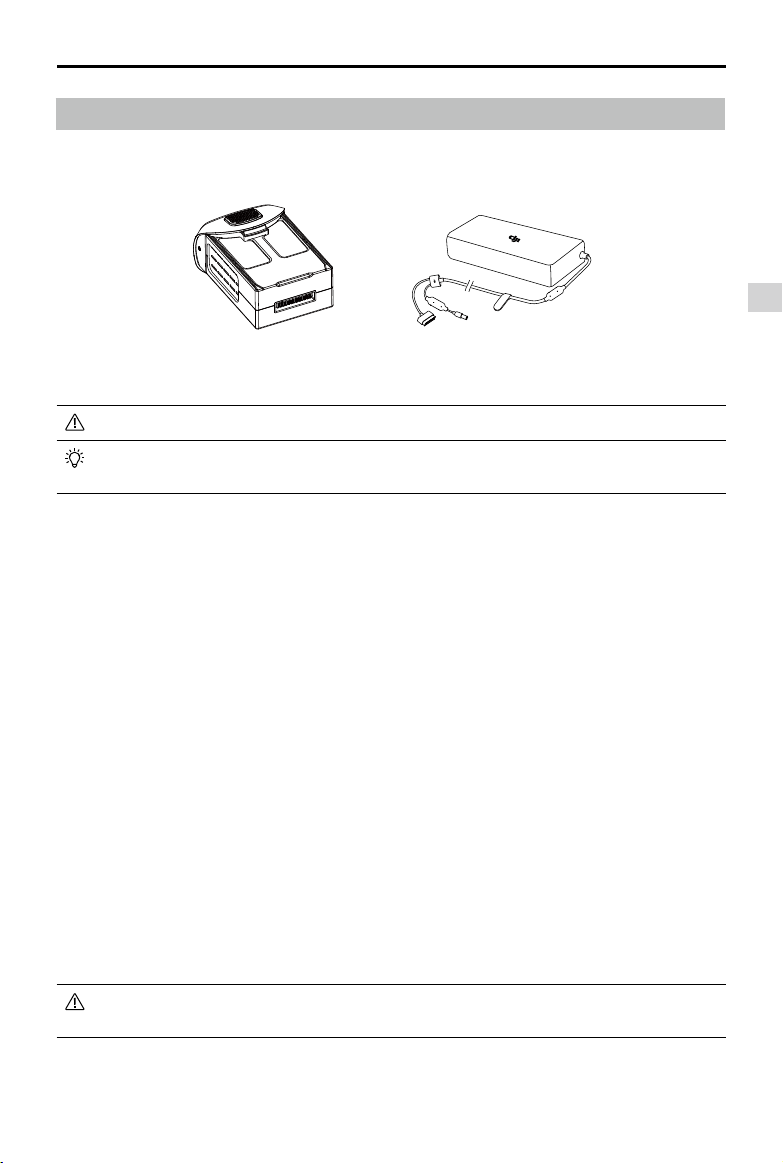
DJI Intelligent Flight Battery
The DJI Intelligent Flight Battery has a capacity of 5870 mAh, a voltage of 15.2 V, and a smart charge/
discharge functionality. It should only be charged using an appropriate DJI approved charger.
Intelligent Flight Battery Charger
DJI Intelligent Flight Battery Functions
1. Battery Level Display: The LED indicators display the current battery level.
2. Auto-Discharging Function: To prevent swelling, the battery automatically discharges to below 65% of
total power when it is idle for more than ten days. It takes around two days to discharge the battery to
65%. It is normal to feel moderate heat being emitted from the battery during the discharge process.
Discharge thresholds can be set in the DJI GO 4 app.
3. Balanced Charging: Automatically balances the voltage of each battery cell when charging.
4. Overcharge Protection: Charging automatically stops when the battery is fully charged.
5. Temperature Detection: The battery will only charge when the temperature is between 5°C (41°F) and
40°C (104°F).
6. Over Current Protection: The battery stops charging when a high amperage (more than 8 A) is
detected.
7. Over Discharge Protection: To prevent over-discharge damage, discharging automatically stops when
the battery voltage reaches 12 V.
8. Short Circuit Protection: Automatically cuts the power supply when a short circuit is detected.
9. Battery Cell Damage Protection: The DJI GO 4 app displays a warning message when a damaged
battery cell is detected.
10. Sleep Mode: To save power, the battery enter sleep mode after 20 minutes of inactivity.
11. Communication: Information pertaining to the battery’s voltage, capacity, current, etc. is transmitted to
the aircraft’s main controller.
Refer to
Phantom 4 Advanced / Advanced+ Intelligent Flight Battery Safety Guidelines
before
use. Users take full responsibility for all operations and usage.
Aircraft
32
©
2017 DJI All Rights Reserved.
Phantom 4 Advanced / Advanced+ User Manual
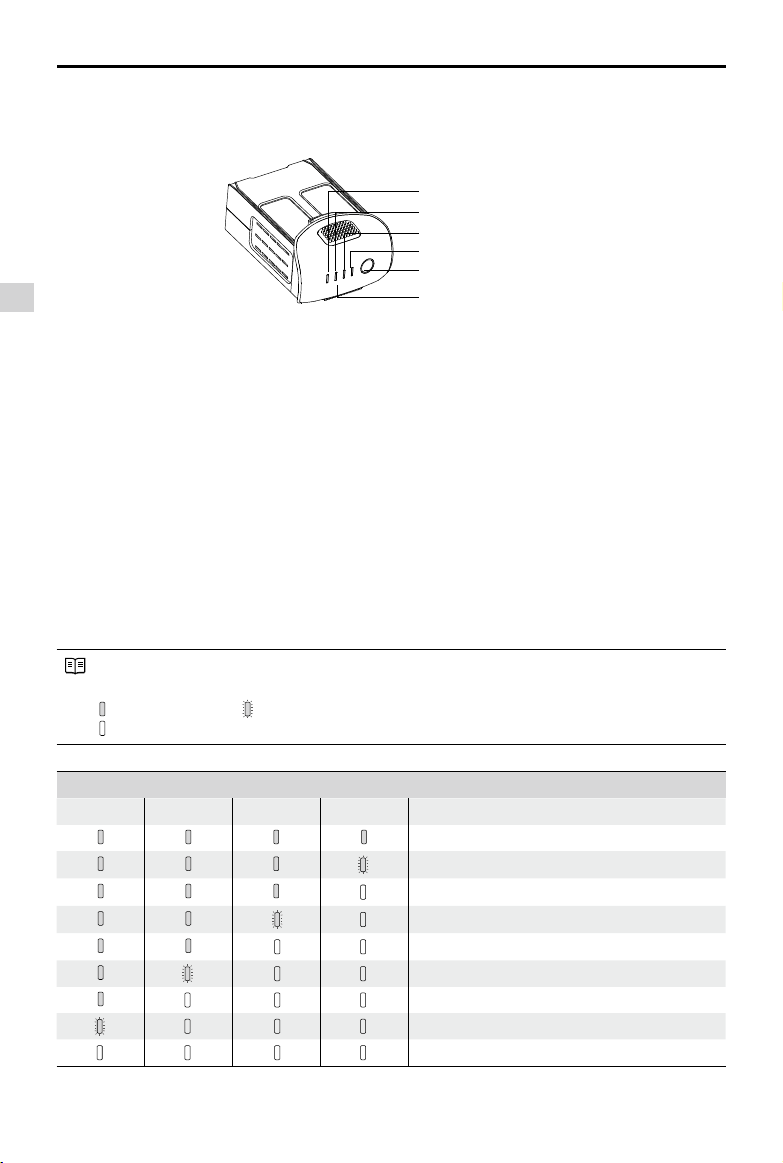
Using the Battery
LED1
LED2
Battery Level Indicators
LED3
LED4
Power Button (Built-in LED)
Turning ON/OFF
Turning On:
Press the Power Button once, then press again and hold for 2 seconds to turn on. The
Power LED will turn green and the Battery Level Indicators will display the current battery
level.
Turning
Off: Press the Power Button once, then press again and hold for 2 seconds to turn off. The
battery power LED will flash when powering off the Phantom to allow automatically
stopping of a recording during the event recording wasn’t stopped.
Checking the Battery Level
The Battery Level Indicators display how much power remains. When the battery is turned off, press
the Power Button once. The Battery Level Indicators will light up to display the current battery level.
See below for details.
The Battery Level Indicators will also show the current battery level during charging and
discharging. The indicators are dened below.
: LED is on. : LED is ashing.
: LED is off.
Battery Level Indicators
LED1 LED2 LED3 LED4 Battery Level
87.5%~100%
75%~87.5%
62.5%~75%
50%~62.5%
37.5%~50%
25%~37.5%
12.5%~25%
0%~12.5%
=0%
Aircraft
©
2017 DJI All Rights Reserved.
33
Phantom 4 Advanced / Advanced+ User Manual
Low Temperature Notice:
1. Battery capacity is signicantly reduced when ying in low temperature (< 0°C) environments.
2. It is not recommended that the battery be used in extremely low temperature (< -10°C) environments.
Battery voltage should reach the appropriate level when operating environment with temperatures
between -10°C and 5°C.
3. End the flight as soon as the DJI GO 4 app displays the “Low Battery Level Warning” in low
temperature environments.
4. Keep the battery indoors to warm it before ying in low temperature environments.
5. To ensure optimal performance of the battery, keep the battery temperature above 20°C.
6. The charger will stop charging the battery if the battery cell’s temperature is not within the operating
range (0°C ~ 40°C ).
In cold environments, insert the battery into the battery compartment and turn on the aircraft for
approximately 1-2 minutes to warm up before taking off.
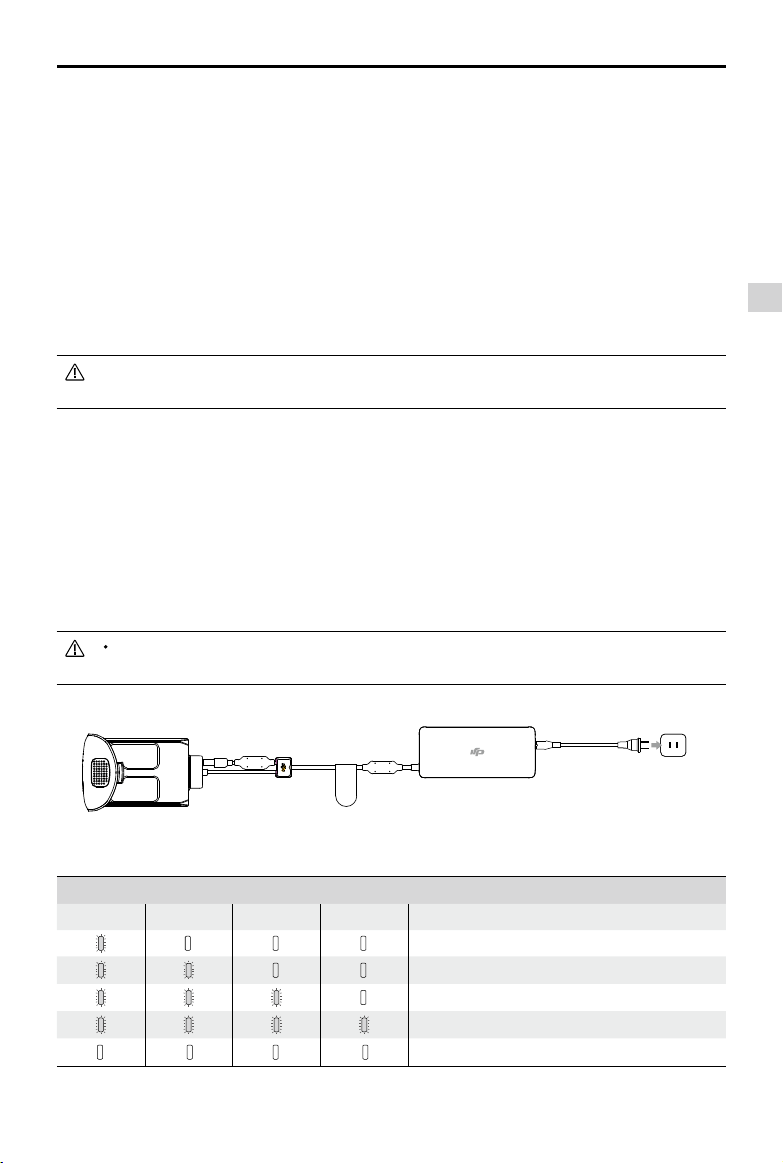
Charging the Intelligent Flight Battery
1. Connect the Battery Charger to a power source (100-240 V 50/60 Hz).
2. Connect the Intelligent Flight Battery to the Battery Charger to start charging. If the battery level is
above 95%, turn on the battery before charging.
3. The Battery Level Indicator will display the current battery level as it is charging.
4. The Intelligent Flight Battery is fully charged when the Battery Level Indicators are all off.
5. Air-cool the Intelligent Flight Battery after each ight. Allow its temperature to drop to room temperature
before storing it for an extended period.
Always turn off the battery before inserting it or removing it from the Phantom 4 Advanced /
Advanced+. Never insert or remove a battery when it is turned on.
Charger
Intelligent Flight Battery
Power Outlet
Battery Level Indicators While Charging
LED1 LED2 LED3 LED4 Battery Level
0%~25%
25%~50%
50%~75%
75%~100%
Fully Charged
Aircraft
34
©
2017 DJI All Rights Reserved.
Phantom 4 Advanced / Advanced+ User Manual
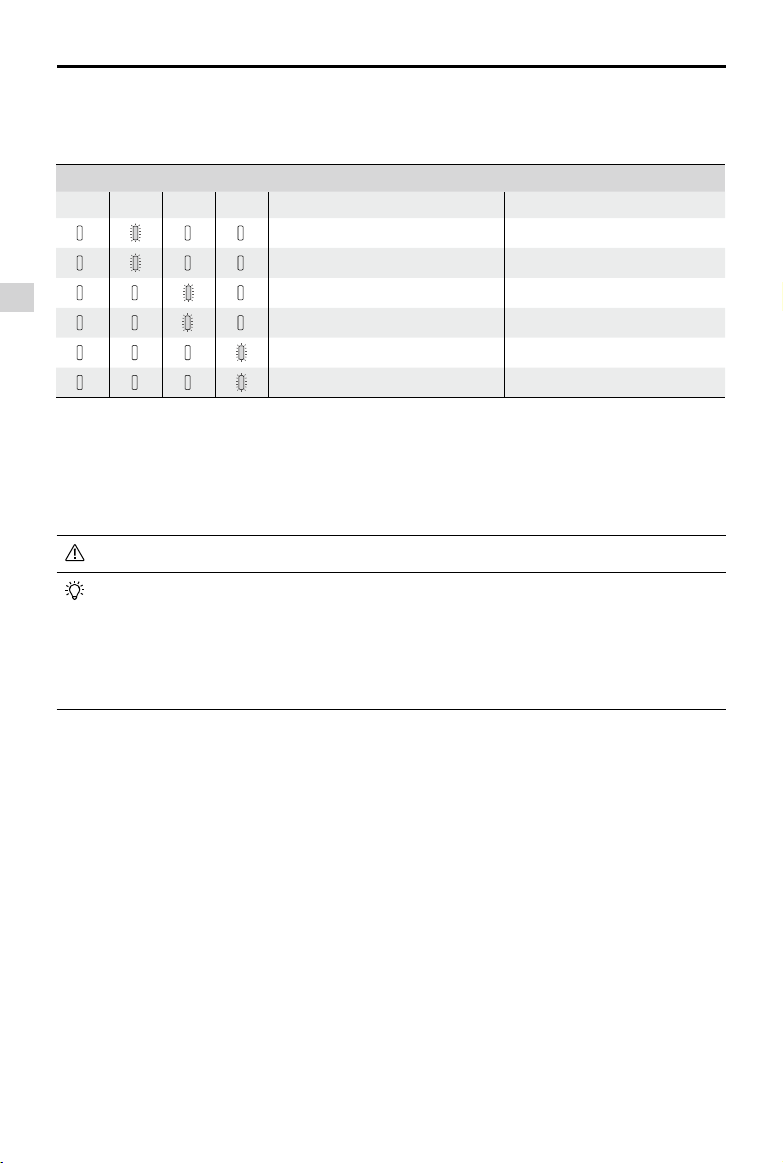
Battery Protection LED Display
The table below shows battery protection mechanisms and corresponding LED patterns.
Battery Level Indicators while Charging
LED1 LED2 LED3 LED4 Blinking Pattern Battery Protection Item
LED2 blinks twice per second Over current detected
LED2 blinks three times per second Short circuit detected
LED3 blinks twice per second Over charge detected
LED3 blinks three times per second Over-voltage charger detected
LED4 blinks twice per second Charging temperature is too low
LED4 blinks three times per second Charging temperature is too high
After these issues are resolved, press the Power Button to turn off the Battery Level Indicator. Unplug the
Intelligent Flight Battery from the charger and plug it back in to resume charging. Note that you do not
need to unplug and plug in the charger in the event of a room temperature error; the charger will resume
charging when the temperature is within the allowable range.
DJI does not take any responsibility for damage caused by third-party chargers.
How to discharge your Intelligent Flight Battery:
Slow : Place the Intelligent Flight Battery into the Phantom 4’s Advanced / Advanced+ Battery
Compartment and turn it on. Leave it on until there is less than 8% of power left, or until the
battery can no longer be turned on. Launch the DJI GO 4 app to check battery levels.
Rapid : Fly the Phantom 4 Advanced / Advanced+ outdoors until there is less than 8% of power
left, or until the battery can no longer be turned on.
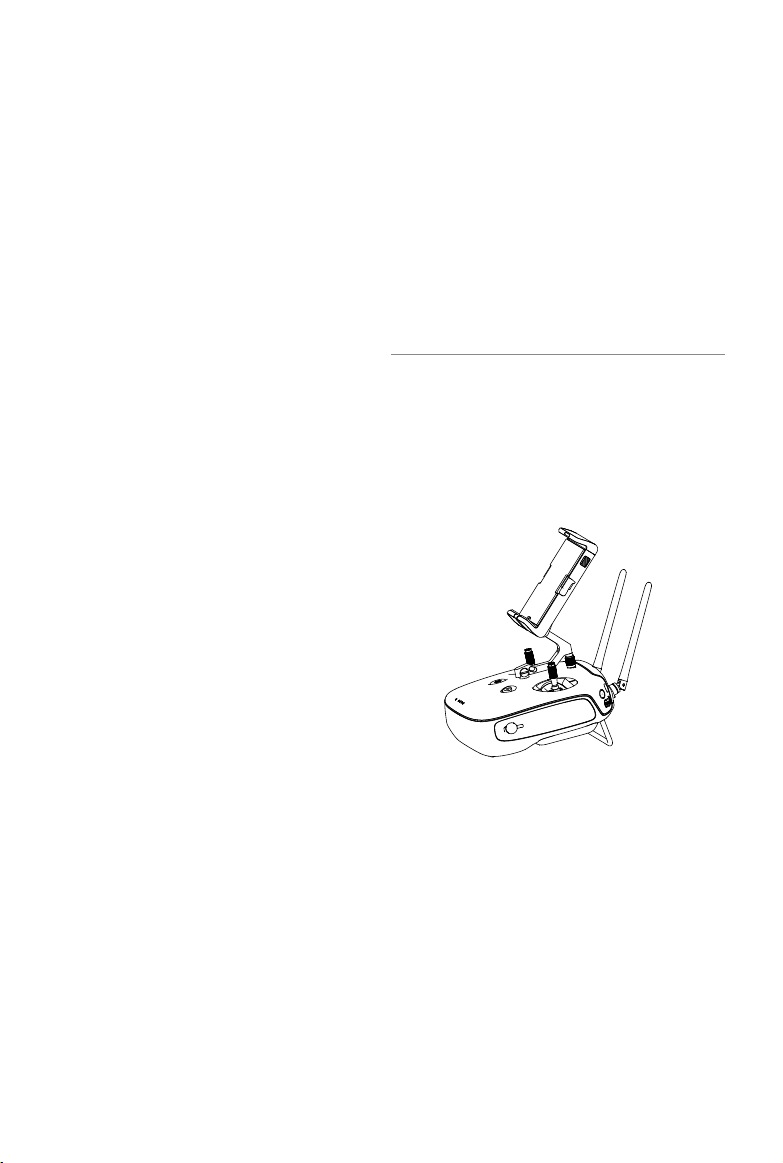
Remote Controller
This section describes the features
of the remote controller and includes
instructions for controlling the aircraft
and the camera.
Remote Controller
36
©
2017 DJI All Rights Reserved.
Remote Controller
Remote Controller Prole
The Phantom 4 Advanced / Advanced+ remote controller is a multi-function wireless
communication device that integrates the video downlink system and the aircraft remote control
system, which operate at 2.4 GHz. The remote controller features a number of camera control
functions, including photo/video capture as well as gimbal control. The battery level is displayed
via LED indicators on the front panel of the remote controller.
Compliance Version: The remote controller is compliant with local compliance and regulations.
Operating Mode: Control can be set to Mode 1 or Mode 2, or to a custom mode.
Mode 1: The right stick serves as the throttle.
Mode 2: The left stick serves as the throttle.
To prevent transmission interference, do not operate more than three aircrafts in the same area.
Using the Remote Controller
Turning the Remote Controller On and Off
The Phantom 4 Advanced / Advanced+ remote controller is powered by a 2S rechargeable battery
that has a capacity of 6000 mAh. The battery level is indicated via the Battery Level LEDs on the front
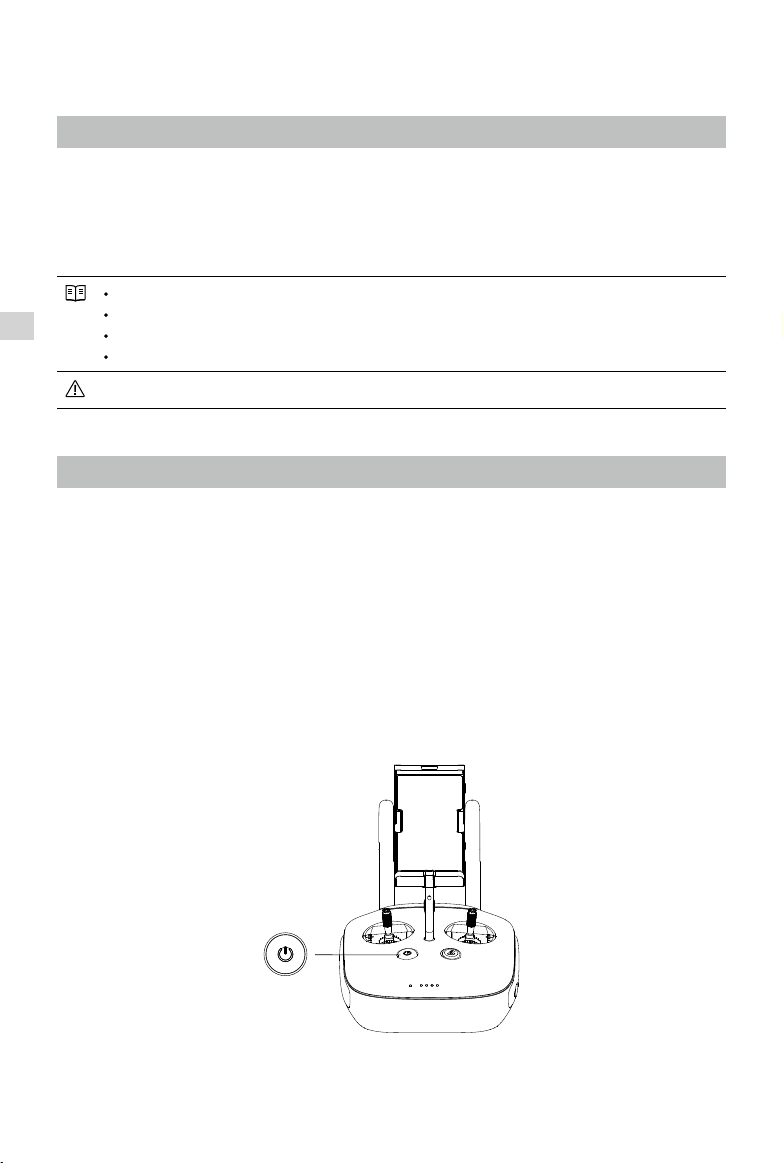
panel. Follow the steps below to turn on your remote controller:
1. When the remote controller is turned off, press the Power Button once. The Battery Level LEDs will
display the current battery level.
2. Press and hold the Power Button to turn on the remote controller.
3. The remote controller will beep when it is turned on. The Status LED will rapidly blink green, indicating
that the remote controller is linking to the aircraft. The Status LEDs will glow solid green when linking is
complete.
4. Repeat Step 2 to turn off the remote controller.
Charging the Remote Controller
Charge the remote controller using the included charger. Refer to the gure on next page below for more
details.