No reproduction in any form of this manual, in whole or in part (except
for brief quotation in critical articles or reviews), may be made without
written authorization from NIKON CORPORATION.
Printed in Thailand
6MB34011-04
En
DIGITAL CAMERA
User's Manual
En
• Read this manual thoroughly before using the camera.
• To ensure proper use of the camera, be sure to read
“For Your Safety” (page xiii).
• After reading this manual, keep it in a readily accessible
place for future reference.
Your images. The world. Connected
Welcome to SnapBridge — Nikon’s new family of services to enrich
your image experience. SnapBridge eliminates the barrier between
your camera and compatible smart device, through a combination
of Bluetooth® low energy (BLE) technology and a dedicated app. The
stories you capture with your Nikon camera and lenses are
automatically transferred to the device as they are taken. They can
even be uploaded effortlessly to cloud storage services, inviting
access across all your devices. You can share your excitement, when
and where you want.
Download the SnapBridge app to get started!
Take advantage of the wide-ranging
convenience by downloading the
SnapBridge app onto your smart device
now. Through a few simple steps, this app
connects your Nikon cameras with a
compatible iPhone®, iPad® and/or
iPod touch® or smart devices running on
the Android
TM
operating system. The app
is available free from the website
(http://snapbridge.nikon.com), Apple
App Store® and Google Play
TM
.
For the latest information on SnapBridge, visit the Nikon website for your
area (0 xxi).
D500 Model Name: N1501
i
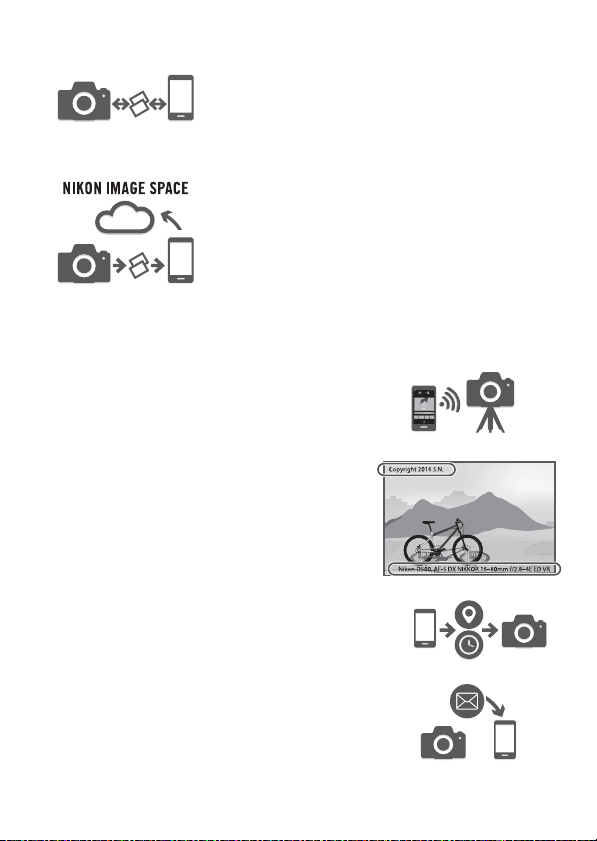
The exciting image experience that SnapBridge offers…
A range of services that enriches your imaging life,
including:
Automatic picture transfer from camera to smart
device thanks to the constant connection between
the two devices — making online photo sharing
easier than ever
Upload of photos and thumbnail images to the
NIKON IMAGE SPACE cloud service
• Camera remote control
• Imprinting up to two pieces of credit
information (e.g. copyright, comments,
text and logos) on pictures
• Automatic update of camera’s date and
time info and location info
• Receive camera’s firmware updates
ii
To get the most from your camera, please be sure to read all
instructions thoroughly and keep them where they will be read
by all who use the product.
The Menu Guide
For more information on menu options and subjects such as how to
connect the camera to a printer or television, download the camera
Menu Guide from the Nikon website as described below.
The Menu Guide
is in pdf format and can be viewed using Adobe Reader or Adobe
Acrobat Reader.
1 On your computer, launch a web browser and open the Nikon manual
download site at http://downloadcenter.nikonimglib.com/
2 Navigate to the page for the desired product and download the
manual.
Nikon Manual Viewer 2
Install the Nikon Manual Viewer 2 app on your smartphone or
tablet to view Nikon digital camera manuals, anytime,
anywhere.
Nikon Manual Viewer 2 can be downloaded free of
charge from the App Store and Google Play.
Download of the
app and any product manuals requires an Internet
connection, for which fees may be levied by your phone or
Internet service provider.
A For Your Safety
Before using the camera for the first time, read the safety instructions
in “For Your Safety” (0 xiii–xvi).
iii
Symbols and Conventions
To make it easier to find the information you need, the following
symbols and conventions are used:
Menu items, options, and messages displayed in the camera monitor are
shown in bold.
Camera Settings
The explanations in this manual assume that default settings are used.
Nikon User Support for India and Australia
Contact a Nikon representative for technical assistance with the
operation of your Nikon product or products.
For information on the
Nikon representatives in your area, visit http://www.nikon-asia.com/
support.
D
This icon marks cautions; information that should be read
before use to prevent damage to the camera.
A
This icon marks notes; information that should be read before
using the camera.
0
This icon marks references to other pages in this manual.
iv
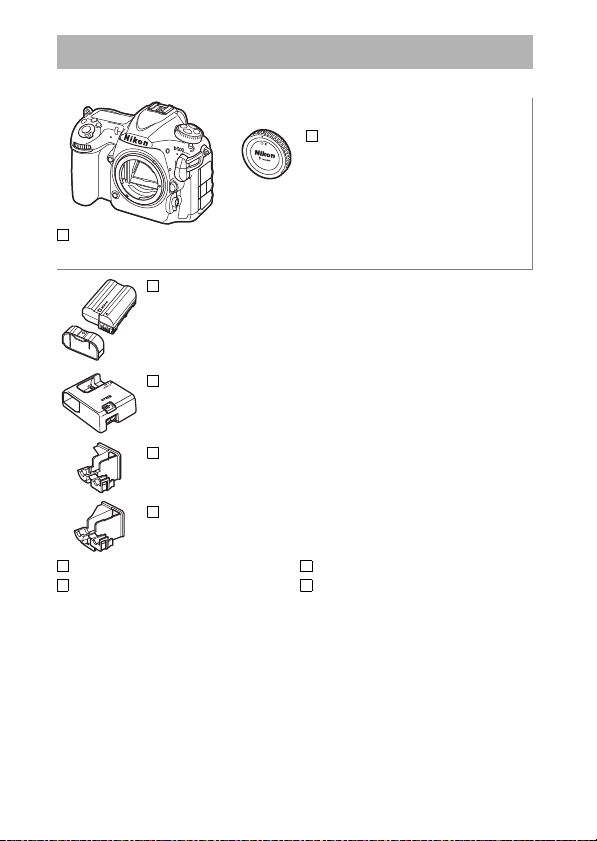
Be sure all items listed here were included with your camera.
Purchasers of the lens kit option should confirm that the
package also includes a lens.
Memory cards are sold separately.
Cameras purchased in Japan display menus and messages in
English and Japanese only; other languages are not supported.
We apologize for any inconvenience this may cause.
Package Contents
BF-1B body cap (0 18, 335)
D500 digital camera
(0 1)
EN-EL15 rechargeable Li-ion battery with terminal cover
(0 13, 15)
MH-25a battery charger (comes with either an AC wall
adapter or power cable of a type and shape that varies
with the country or region of sale; 0 13)
USB cable clip
HDMI cable clip
UC-E22 USB cable
AN-DC17 strap (0 13)
User’s Manual (this guide)
Warranty

v
A ViewNX-i and Capture NX-D Software
Use ViewNX-i to fine-tune photos or to copy pictures to a computer for
viewing.
ViewNX-i is available for download from the following
website:
http://downloadcenter.nikonimglib.com/
Use Capture NX-D to fine-tune pictures that have been copied to a
computer and to convert NEF (RAW) images to other formats.
Capture NX-D is available for download from:
http://downloadcenter.nikonimglib.com/
You can also visit this website for the latest information on Nikon
software, including system requirements.

vi
Package Contents ........................................................................ iv
For Your Safety ........................................................................... xiii
Notices......................................................................................... xvii
Bluetooth and Wi-Fi (Wireless LAN)....................................... xxii
Introduction 1
Getting to Know the Camera ...................................................... 1
Camera Body ............................................................................................1
The Control Panel ...................................................................................5
The Viewfinder Display.........................................................................7
Using the Tilting Monitor.....................................................................9
Using the Touch Screen .................................................................... 11
First Steps 13
Attach the Camera Strap................................................................... 13
Charge the Battery .............................................................................. 13
Insert the Battery and a Memory Card......................................... 15
Attach a Lens......................................................................................... 18
Camera Setup........................................................................................ 20
Focus the Viewfinder.......................................................................... 29
Tutorial 30
Camera Menus ............................................................................. 30
Using Camera Menus ......................................................................... 31
Basic Photography and Playback............................................. 35
The Battery Level and Number of Exposures Remaining...... 35
“Point-and-Shoot” Photography.................................................... 37
Viewing Photographs ........................................................................ 40
Table of Contents

vii
Live View Photography 43
Autofocus ............................................................................................... 47
Manual Focus ........................................................................................ 49
Using the i Button.............................................................................. 50
The Live View Display......................................................................... 53
The Information Display.................................................................... 54
Touch Photography (Touch Shutter)............................................ 55
Movies 58
Recording Movies ....................................................................... 58
Indices...................................................................................................... 63
Using the i Button.............................................................................. 64
The Live View Display......................................................................... 66
Frame Size, Frame Rate, and Movie Quality............................... 68
The Information Display.................................................................... 69
The Movie Crop .................................................................................... 70
Taking Photos in Movie Mode ........................................................ 71
Time-Lapse Movies .....................................................................74
Viewing Movies ...........................................................................80
Editing Movies ............................................................................. 82
Trimming Movies................................................................................. 82
Saving Selected Frames .................................................................... 86
Image Recording Options 88
Image Area ................................................................................... 88
Image Quality...............................................................................91
Image Size.....................................................................................94
Using Two Memory Cards..........................................................96

viii
Focus 97
Autofocus......................................................................................97
Autofocus Mode ................................................................................ 101
AF-Area Mode..................................................................................... 103
Focus Point Selection ...................................................................... 108
Focus Lock ........................................................................................... 111
Manual Focus ............................................................................ 114
Release Mode 116
Choosing a Release Mode....................................................... 116
Self-Timer Mode ....................................................................... 119
Mirror up Mode......................................................................... 121
ISO Sensitivity 123
Manual Adjustment ................................................................. 123
Auto ISO Sensitivity Control................................................... 125
Exposure 128
Metering..................................................................................... 128
Exposure Mode ......................................................................... 130
P: Programmed Auto........................................................................ 132
S: Shutter-Priority Auto.................................................................... 133
A: Aperture-Priority Auto ................................................................ 134
M: Manual ............................................................................................. 135
Long Time-Exposures (M Mode Only) ................................... 137
Shutter-Speed and Aperture Lock ........................................ 140
Autoexposure (AE) Lock.......................................................... 141
Exposure Compensation......................................................... 143
Bracketing.................................................................................. 146

ix
White Balance 159
White Balance Options.............................................................159
Fine-Tuning White Balance .....................................................163
Choosing a Color Temperature ..............................................166
Preset Manual ............................................................................169
Viewfinder Photography.................................................................170
Live View (Spot White Balance) ....................................................174
Managing Presets..............................................................................177
Image Enhancement 180
Picture Controls.........................................................................180
Selecting a Picture Control.............................................................180
Modifying Picture Controls ............................................................182
Creating Custom Picture Controls...............................................185
Preserving Detail in Highlights and Shadows .....................189
Active D-Lighting...............................................................................189
High Dynamic Range (HDR)...........................................................191
Flash Photography 196
Using a Flash ..............................................................................196
On-Camera Flash Photography..............................................199
Flash Modes ...............................................................................201
Flash Compensation.................................................................203
FV Lock ........................................................................................205
Remote Flash Photography ....................................................208
Setup ......................................................................................................209
Taking Photos .....................................................................................214
Viewing Flash Info.....................................................................222

x
Other Shooting Options 226
The R Button ............................................................................ 226
The i button.............................................................................. 229
Two-Button Reset: Restoring Default Settings ................... 230
Flicker Reduction...................................................................... 234
Multiple Exposure .................................................................... 236
Interval Timer Photography ................................................... 243
Non-CPU Lenses........................................................................ 250
Location Data ............................................................................ 253
More About Playback 255
Viewing Images......................................................................... 255
Full-Frame Playback ......................................................................... 255
Thumbnail Playback......................................................................... 255
Playback Controls.............................................................................. 256
Using the Touch Screen.................................................................. 258
The i Button ....................................................................................... 260
Photo Information.................................................................... 261
Taking a Closer Look: Playback Zoom.................................. 271
Protecting Photographs from Deletion ............................... 273
Rating Pictures .......................................................................... 274
Selecting Photos for Upload................................................... 276
Selecting Individual Photos........................................................... 276
Selecting Multiple Photos.............................................................. 277
Deleting Photographs ............................................................. 278
Full-Frame and Thumbnail Playback.......................................... 278
The Playback Menu .......................................................................... 279

xi
Menu List 281
D The Playback Menu: Managing Images ..........................281
C The Photo Shooting Menu: Shooting Options...............283
1 The Movie Shooting Menu: Movie Shooting Options...288
A Custom Settings: Fine-Tuning Camera Settings ............292
B The Setup Menu: Camera Setup..........................................304
N The Retouch Menu: Creating Retouched Copies ...........313
O My Menu/m Recent Settings ..............................................315
Retouch Menu Options ............................................................316
NEF (RAW) Processing......................................................................316
Trim.........................................................................................................318
Image Overlay.....................................................................................319
Technical Notes 322
Compatible Lenses....................................................................322
The Nikon Creative Lighting System (CLS)...........................328
Other Accessories......................................................................335
Caring for the Camera ..............................................................337
Storage ..................................................................................................337
Cleaning................................................................................................337
Image Sensor Cleaning....................................................................338
Caring for the Camera and Battery: Cautions......................345

xii
Troubleshooting....................................................................... 350
Battery/Display................................................................................... 350
Shooting............................................................................................... 351
Playback................................................................................................ 354
Bluetooth and Wi-Fi (Wireless Networks)................................. 356
Miscellaneous..................................................................................... 356
Error Messages.......................................................................... 357
Specifications ............................................................................ 364
Lenses ......................................................................................... 377
AF-S DX NIKKOR 16–80mm f/2.8–4E ED VR............................. 377
Approved Memory Cards........................................................ 387
Memory Card Capacity ............................................................ 389
Battery Life................................................................................. 392
Index ........................................................................................... 394
xiii
To prevent damage to your Nikon product or injury to yourself or to others,
read the following safety precautions in their entirety before using this
equipment.
Keep these safety instructions where all those who use the
product will read them.
The consequences that could result from failure to observe the precautions
listed in this section are indicated by the following symbol:
❚❚ WARNINGS
AKeep the sun out of the frame
Keep the sun well out of the frame
when shooting backlit subjects.
Sunlight focused into the camera
when the sun is in or close to the
frame could cause a fire.
ADo not look at the sun through the
viewfinder
Viewing the sun or other strong light
source through the viewfinder could
cause permanent visual impairment.
AUsing the viewfinder diopter adjustment
control
When operating the viewfinder
diopter adjustment control with your
eye to the viewfinder, care should be
taken not to put your finger in your
eye accidentally.
ATurn off immediately in the event of
malfunction
Should you notice smoke or an
unusual smell coming from the
equipment or AC adapter (available
separately), unplug the AC adapter
and remove the battery immediately,
taking care to avoid burns.
Continued operation could result in
injury.
After removing the battery,
take the equipment to a Nikon-
authorized service center for
inspection.
ADo not use in the presence of flammable
gas
Do not use electronic equipment in
the presence of flammable gas, as
this could result in explosion or fire.
AKeep out of reach of children
Failure to observe this precaution
could result in injury.
In addition,
note that small parts constitute a
choking hazard.
Should a child
swallow any part of this equipment,
consult a physician immediately.
For Your Safety
This icon marks warnings.
To prevent possible injury, read all
warnings before using this Nikon product.
A

xiv
A
Do not disassemble
Touching the product’s internal parts
could result in injury.
In the event of
malfunction, the product should be
repaired only by a qualified
technician.
Should the product break
open as the result of a fall or other
accident, remove the battery and/or
AC adapter and then take the product
to a Nikon-authorized service center
for inspection.
ADo not place the strap around the neck of
an infant or child
Placing the camera strap around the
neck of an infant or child could result
in strangulation.
ADo not remain in contact with the
camera, battery, or charger for extended
periods while the devices are on or in use
Parts of the device become hot.
Leaving the device in direct contact
with the skin for extended periods
may result in low-temperature burns.
ADo not leave the product where it will be
exposed to extremely high
temperatures, such as in an enclosed
automobile or in direct sunlight
Failure to observe this precaution
could cause damage or fire.
ADo not aim a flash at the operator of a
motor vehicle
Failure to observe this precaution
could result in accidents.
AObserve caution when using a flash
• Using optional flash units in close
contact with the skin or other
objects could cause burns.
• Using optional flash units close to
the subject’s eyes could cause
temporary visual impairment.
The
flash should be no less than one
meter (3 ft 4 in.) from the subject.
Particular care should be observed
when photographing infants.
AAvoid contact with liquid crystal
Should the monitor break, care
should be taken to avoid injury due to
broken glass and to prevent the liquid
crystal from the monitor touching the
skin or entering the eyes or mouth.
ADo not carry tripods with a lens or camera
attached
You could trip or accidentally strike
others, resulting in injury.

xv
A
Observe proper precautions when
handling batteries
Batteries may leak, overheat, rupture,
or catch fire if improperly handled.
Observe the following precautions
when handling batteries for use in
this product:
• Use only batteries approved for use
in this equipment.
• Do not short or disassemble the
battery.
• Do not expose the battery or the
camera in which it is inserted to
powerful physical shocks.
• Be sure the product is off before
replacing the battery.
If you are
using an AC adapter, be sure it is
unplugged.
• Do not attempt to insert the battery
upside down or backwards.
• Do not expose the battery to flame
or to excessive heat.
• Do not immerse in or expose to
water.
• Replace the terminal cover when
transporting the battery.
Do not
transport or store the battery with
metal objects such as necklaces or
hairpins.
• Batteries are prone to leakage when
fully discharged.
To avoid damage
to the product, be sure to remove
the battery when no charge
remains.
• When the battery is not in use,
attach the terminal cover and store
in a cool, dry place.
• The battery may be hot
immediately after use or when the
product has been used on battery
power for an extended period.
Before removing the battery turn
the camera off and allow the battery
to cool.
• Discontinue use immediately
should you notice any changes in
the battery, such as discoloration or
deformation.
AObserve proper precautions when
handling the charger
• Keep dry.
Failure to observe this
precaution could result in injury or
product malfunction due to fire or
electric shock.
• Do not short the charger terminals.
Failure to observe this precaution
could result in overheating and
damage to the charger.
• Dust on or near the metal parts of
the plug should be removed with a
dry cloth.
Continued use could
result in fire.

xvi
• Do not handle the power cable or
go near the charger during
thunderstorms.
Failure to observe
this precaution could result in
electric shock.
• Do not damage, modify, or forcibly
tug or bend the power cable.
Do
not place it under heavy objects or
expose it to heat or flame.
Should
the insulation be damaged and the
wires become exposed, take the
power cable to a Nikon-authorized
service representative for
inspection.
Failure to observe this
precaution could result in fire or
electric shock.
• Do not handle the plug or charger
with wet hands.
Failure to observe
this precaution could result in injury
or product malfunction due to fire
or electric shock.
• Do not use with travel converters or
adapters designed to convert from
one voltage to another or with DC-
to-AC inverters.
Failure to observe
this precaution could damage the
product or cause overheating or fire.
AUse appropriate cables
When connecting cables to the input
and output jacks, use only the cables
provided or sold by Nikon for the
purpose to maintain compliance with
product regulations.
AFollow the instructions of airline and
hospital personnel

xvii
•
No part of the manuals included with
this product may be reproduced,
transmitted, transcribed, stored in a
retrieval system, or translated into
any language in any form, by any
means, without Nikon’s prior written
permission.
• Nikon reserves the right to change
the appearance and specifications
of the hardware and software
described in these manuals at any
time and without prior notice.
• Nikon will not be held liable for any
damages resulting from the use of
this product.
• While every effort has been made to
ensure that the information in these
manuals is accurate and complete,
we would appreciate it were you to
bring any errors or omissions to the
attention of the Nikon
representative in your area (address
provided separately).
Notices for Customers in Canada
CAN ICES-3 B / NMB-3 B
Notices for Customers in Europe
This symbol indicates
that electrical and
electronic equipment is
to be collected
separately.
The following apply only
to users in European countries:
• This product is designated for
separate collection at an
appropriate collection point.
Do not
dispose of as household waste.
• Separate collection and recycling
helps conserve natural resources
and prevent negative consequences
for human health and the
environment that might result from
incorrect disposal.
• For more information, contact the
retailer or the local authorities in
charge of waste management.
This symbol on the
battery indicates that the
battery is to be collected
separately.
The following apply only
to users in European
countries:
• All batteries, whether marked with
this symbol or not, are designated
for separate collection at an
appropriate collection point.
Do not
dispose of as household waste.
• For more information, contact the
retailer or the local authorities in
charge of waste management.
Notices
CAUTION: RISK OF EXPLOSION IF BATTERY IS REPLACED BY AN INCORRECT
TYPE.
DISPOSE OF USED BATTERIES ACCORDING TO THE INSTRUCTIONS.
xviii
Notices for Customers in the U.S.A.
Power Cable
At voltages over AC 125 V (U.S.A. only): The power cable must be rated for the
voltage in use, be at least AWG no. 18 gauge, and have SVG insulation or
better with a NEMA 6P-15 plug rated for AC 250 V 15 A.
Federal Communications Commission (FCC) Radio Frequency Interference Statement
This equipment has been tested and
found to comply with the limits for a
Class B digital device, pursuant to Part
15 of the FCC rules.
These limits are
designed to provide reasonable
protection against harmful
interference in a residential
installation.
This equipment
generates, uses, and can radiate radio
frequency energy and, if not installed
and used in accordance with the
instructions, may cause harmful
interference to radio
communications.
However, there is
no guarantee that interference will
not occur in a particular installation.
If
this equipment does cause harmful
interference to radio or television
reception, which can be determined
by turning the equipment off and on,
the user is encouraged to try to
correct the interference by one or
more of the following measures:
• Reorient or relocate the receiving
antenna.
• Increase the separation between the
equipment and receiver.
• Connect the equipment into an
outlet on a circuit different from that
to which the receiver is connected.
• Consult the dealer or an
experienced radio/television
technician for help.
CAUTIONS
Modifications
The FCC requires the user be notified
that any changes or modifications
made to this device that are not
expressly approved by Nikon
Corporation may void the user’s
authority to operate the equipment.
Interface Cables
Use the interface cables sold or
provided by Nikon for your
equipment.
Using other interface
cables may exceed the limits of
Class B Part 15 of the FCC rules.
Notice for Customers in the State of
California
WARNING: Handling the cord on this
product may expose you to lead, a
chemical known to the State of
California to cause birth defects or
other reproductive harm.
Wash hands
after handling.
Nikon Inc., 1300 Walt Whitman Road,
Melville, New York 11747-3064, U.S.A.
Tel.: 631-547-4200

xix
Notice Concerning Prohibition of Copying or Reproduction
Note that simply being in possession of material that has been digitally
copied or reproduced by means of a scanner, digital camera, or other device
may be punishable by law.
• Items prohibited by law from being copied
or reproduced
Do not copy or reproduce paper
money, coins, securities, government
bonds, or local government bonds,
even if such copies or reproductions
are stamped “Sample.”
The copying or reproduction of
paper money, coins, or securities
which are circulated in a foreign
country is prohibited.
Unless the prior permission of the
government has been obtained, the
copying or reproduction of unused
postage stamps or post cards issued
by the government is prohibited.
The copying or reproduction of
stamps issued by the government
and of certified documents
stipulated by law is prohibited.
• Cautions on certain copies and
reproductions
The government has issued cautions
on copies or reproductions of
securities issued by private
companies (shares, bills, checks, gift
certificates, etc.), commuter passes,
or coupon tickets, except when a
minimum of necessary copies are to
be provided for business use by a
company.
Also, do not copy or
reproduce passports issued by the
government, licenses issued by
public agencies and private groups,
ID cards, and tickets, such as passes
and meal coupons.
• Comply with copyright notices
Under copyright law, photographs
or recordings of copyrighted works
made with the camera can not be
used without the permission of the
copyright holder.
Exceptions apply
to personal use, but note that even
personal use may be restricted in
the case of photographs or
recordings of exhibits or live
performances.

xx
Disposing of Data Storage Devices
Please note that deleting images or formatting memory cards or other data
storage devices does not completely erase the original image data.
Deleted
files can sometimes be recovered from discarded storage devices using
commercially available software, potentially resulting in the malicious use of
personal image data.
Ensuring the privacy of such data is the user’s
responsibility.
Before discarding a data storage device or transferring ownership to another
person, erase all data using commercial deletion software, or format the
device and then completely refill it with images containing no private
information (for example, pictures of empty sky).
Care should be taken to
avoid injury when physically destroying data storage devices.
Before discarding the camera or transferring ownership to another person,
you should also use the Reset all settings options in the camera setup menu
to delete any personal network information.
AVC Patent Portfolio License
THIS PRODUCT IS LICENSED UNDER THE AVC PATENT PORTFOLIO LICENSE FOR THE PERSONAL
AND NON-COMMERCIAL USE OF A CONSUMER TO (i) ENCODE VIDEO IN COMPLIANCE WITH
THE AVC STANDARD (“AVC VIDEO”) AND/OR (ii) DECODE AVC VIDEO THAT WAS ENCODED
BY A CONSUMER ENGAGED IN A PERSONAL AND NON-COMMERCIAL ACTIVITY AND/OR WAS
OBTAINED FROM A VIDEO PROVIDER LICENSED TO PROVIDE AVC VIDEO.
NO LICENSE IS
GRANTED OR SHALL BE IMPLIED FOR ANY OTHER USE.
ADDITIONAL INFORMATION MAY BE
OBTAINED FROM MPEG LA, L.L.C.
SEE http://www.mpegla.com
Use Only Nikon Brand Electronic Accessories
Nikon cameras are designed to the highest standards and include complex
electronic circuitry.
Only Nikon brand electronic accessories (including
chargers, batteries, AC adapters, and flash accessories) certified by Nikon
specifically for use with this Nikon digital camera are engineered and proven
to operate within the operational and safety requirements of this electronic
circuitry.
The use of non-Nikon electronic accessories could damage
the camera and may void your Nikon warranty.
The use of
third-party rechargeable Li-ion batteries not bearing the
Nikon holographic seal shown at right could interfere with
normal operation of the camera or result in the batteries overheating,
igniting, rupturing, or leaking.
For more information about Nikon brand accessories, contact a local
authorized Nikon dealer.

xxi
D Use Only Nikon Brand Accessories
Only Nikon brand accessories certified by Nikon specifically for use
with your Nikon digital camera are engineered and proven to operate
within its operational and safety requirements.
THE USE OF NON-NIKON
ACCESSORIES COULD DAMAGE YOUR CAMERA AND MAY VOID YOUR NIKON
WARRANTY.
A Before Taking Important Pictures
Before taking pictures on important occasions (such as at weddings or
before taking the camera on a trip), take a test shot to ensure that the
camera is functioning normally.
Nikon will not be held liable for
damages or lost profits that may result from product malfunction.
A Life-Long Learning
As part of Nikon’s “Life-Long Learning” commitment to ongoing
product support and education, continually-updated information is
available on-line at the following sites:
• For users in the U.S.A.: http://www.nikonusa.com/
• For users in Europe and Africa: http://www.europe-nikon.com/support/
• For users in Asia, Oceania, and the Middle East: http://www.nikon-asia.com/
Visit these sites to keep up-to-date with the latest product information,
tips, answers to frequently-asked questions (FAQs), and general advice
on digital imaging and photography.
Additional information may be
available from the Nikon representative in your area.
See the following
URL for contact information: http://imaging.nikon.com/

xxii
This product is controlled by the United States Export Administration
Regulations (EAR).
The permission of the United States government is not
required for export to countries other than the following, which as of this
writing are subject to embargo or special controls: Cuba, Iran, North Korea,
Sudan, and Syria (list subject to change).
The use of wireless devices may be prohibited in some countries or regions.
Contact a Nikon-authorized service representative before using the wireless
features of this product outside the country of purchase.
Notice for Customers in the U.S.A. and Canada
This device complies with Part 15 of FCC Rules and Industry Canada licence-
exempt RSS standard(s).
Operation is subject to the following two conditions:
(1) this device may not cause interference, and (2) this device must accept any
interference, including interference that may cause undesired operation of
the device.
FCC WARNING
The FCC requires the user to be notified that any changes or modifications
made to this device that are not expressly approved by Nikon Corporation
may void the user’s authority to operate the equipment.
FCC Radio Frequency Interference Statement
Note: This equipment has been tested and found to comply with the limits for
a Class B digital device, pursuant to part 15 of the FCC Rules.
These limits are
designed to provide reasonable protection against harmful interference in a
residential installation.
This equipment generates, uses and can radiate radio
frequency energy and, if not installed and used in accordance with the
instructions, may cause harmful interference to radio communications.
However, there is no guarantee that interference will not occur in a particular
installation.
If this equipment does cause harmful interference to radio or
television reception, which can be determined by turning the equipment off
and on, the user is encouraged to try to correct the interference by one or
more of the following measures:
• Reorient or relocate the receiving antenna.
• Increase the separation between the equipment and receiver.
• Connect the equipment into an outlet on a circuit different from that to
which the receiver is connected.
• Consult the dealer or an experienced radio/TV technician for help.
Co-location
This transmitter must not be co-located or operated in conjunction with any
other antenna or transmitter.
Nikon Inc., 1300 Walt Whitman Road, Melville, New York 11747-3064, U.S.A.
Tel.: 631-547-4200
Bluetooth and Wi-Fi (Wireless LAN)
xxiii
FCC/IC RF Exposure Statement
The available scientific evidence does not show that any health problems are
associated with using low power wireless devices.
There is no proof, however,
that these low power wireless devices are absolutely safe.
Low power
wireless devices emit low levels of radio frequency energy (RF) in the
microwave range while being used.
Whereas high levels of RF can produce
health effects (by heating tissue), exposure of low-level RF that does not
produce heating effects causes no known adverse health effects.
Many
studies of low-level RF exposures have not found any biological effects.
Some
studies have suggested that some biological effects might occur, but such
findings have not been confirmed by additional research.
The D500, which is
equipped with a LBEE5UW1FS (FCC ID:VPYLB1FS / IC ID:772C-LB1FS) Wireless
LAN Module, has been tested and found to comply with FCC/IC radiation
exposure limits set forth for an uncontrolled environment and meets the FCC
radio frequency (RF) Exposure Guidelines in Supplement C to OET65 and RSS-
102 of the IC radio frequency (RF) Exposure rules.
Please refer to the SAR test
report that was uploaded to FCC website.
Notices for Customers in Europe
Hereby, Nikon Corporation, declares that the D500 is in
compliance with the essential requirements and other relevant
provisions of Directive 1999/5/EC.
The declaration of conformity
may be consulted at http://imaging.nikon.com/support/pdf/DoC_D500.pdf
Notice for Customers in Singapore
This device complies with radio-frequency regulations.
The content of
certification labels not affixed to the device is given below.
Trade Name:
Model: D500
Complies with
IDA Standards
DA103423
xxiv
Notice for Customers in Jordan
Notice for Customers in Oman
Notice for Customers in the United Arab Emirates
Security
Although one of the benefits of this product is that it allows others to freely
connect for the wireless exchange of data anywhere within its range, the
following may occur if security is not enabled:
• Data theft: Malicious third-parties may intercept wireless transmissions to
steal user IDs, passwords, and other personal information.
• Unauthorized access: Unauthorized users may gain access to the network
and alter data or perform other malicious actions.
Note that due to the
design of wireless networks, specialized attacks may allow unauthorized
access even when security is enabled.
1
Introduction
Take a few moments to familiarize yourself with camera controls
and displays.
You may find it helpful to bookmark this section
and refer to it as you read through the rest of the manual.
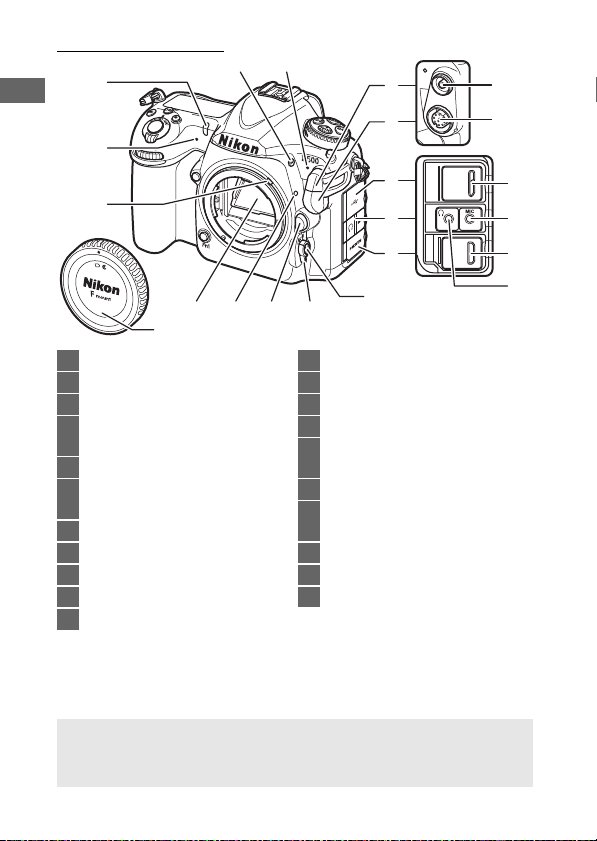
Camera Body
Getting to Know the Camera
1
2
3
5
6
7
4
9
10
11
4
12
13
14
8
1516
1 T button ..................92, 95, 230
2 Release mode dial lock release
.......................................................116
3 Release mode dial ......................116
4 Eyelet for camera strap................ 13
5 U button ........159, 164, 168, 170
6 I button..................................130
7 Y button......................................129
8 Movie-record button .......... 60, 301
9 Power switch ............................. 6, 20
10 Shutter-release button....... 38, 303
11 E button.............................. 143, 230
12 S/Q button.......... 123, 127, 304
13 Control panel....................................5
14 Diopter adjustment control....... 29
15 Focal plane mark (E) ...............115
16 Accessory shoe
(for optional flash unit)... 196, 335
2
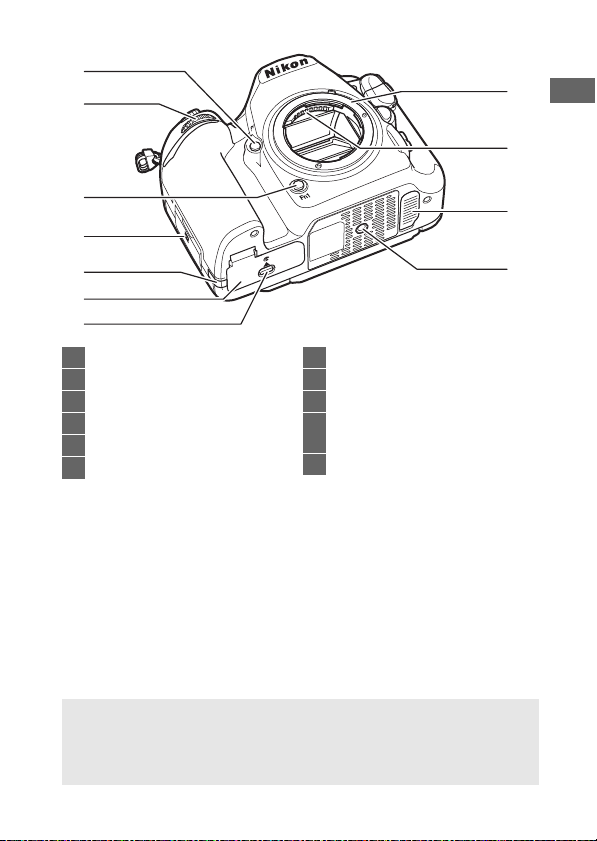
Camera Body (Continued)
3
2
1
42
14 13
21
5
6
7
8
9
12
10
11
15
19
18
17
20
16
1 Self-timer lamp ........................... 120
2 Stereo microphone .......60, 64, 290
3 Meter coupling lever ................. 367
4 BKT button
.......... 147, 151, 155, 195, 238, 301
5 Flash sync terminal cover ......... 197
6 Ten-pin remote terminal
cover.................................... 253, 336
7 USB connector cover
8 Audio connector cover........65, 336
9 HDMI connector cover
10 AF-mode button...47, 49, 101, 105
11 Focus-mode selector ....47, 97, 114
12 Lens release button ......................19
13 Lens mounting mark....................18
14 Mirror.................................... 121, 341
15 Flash sync terminal .................... 197
16 Ten-pin remote terminal
.............................................. 253, 336
17 USB connector
18 Connector for external
microphone..........................65, 336
19 HDMI connector ......................... 335
20 Headphone connector.......... 65, 67
21 Body cap.................................18, 335
D Close the Connector Cover
Close the connector cover when the connectors are not in use.
Foreign
matter in the connectors can interfere with data transfer.
3
1
2
3
7
6
5
4
9
8
11
10
1 Pv button.............. 49, 131, 301, 303
2 Sub-command dial.....................302
3 Fn1 button ...........................301, 303
4 N-Mark (NFC antenna)................. 21
5 Power connector cover
6 Battery-chamber cover .........15, 17
7 Battery-chamber cover latch..... 15
8 Lens mount........................... 18, 115
9 CPU contacts
10 Contact cover for optional MB-D17
multi-power battery pack .......335
11 Tripod socket
D The Speaker
Do not place the speaker in close proximity to magnetic devices.
Failure to observe this precaution could affect the data recorded on
the magnetic devices.
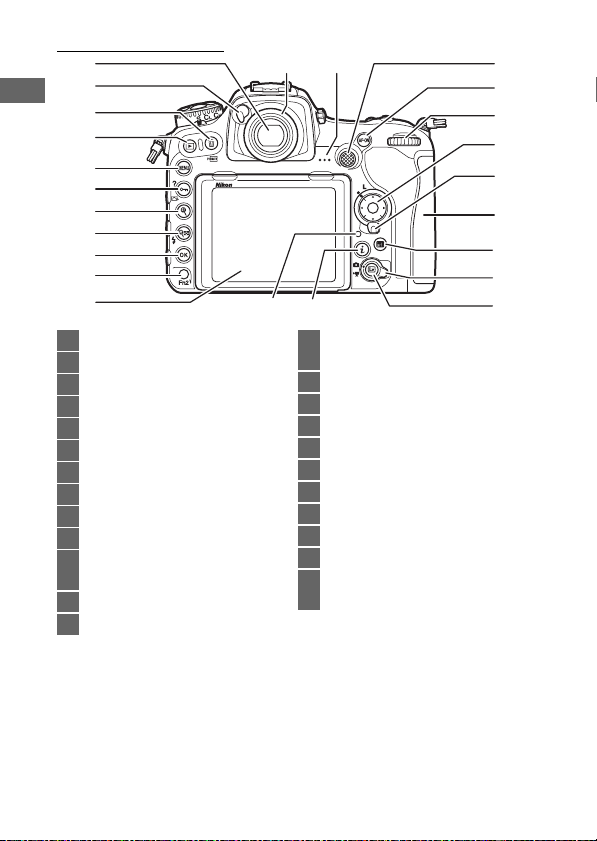
4
Camera Body (Continued)
3
4
5
6
7
8
9
10
11
2324
19
16
2
1
15
14
20
21
22
17
18
1312
1 Viewfinder......................... 7, 29, 119
2 Eyepiece shutter lever............... 119
3 O/Q button.................42, 278, 304
4 K button ...............................40, 255
5 G button............................30, 281
6 L/Z/Q button........31, 181, 273
7 X button.................................46, 271
8 W/M button..... 202, 203, 255, 271
9 J (OK) button.......................31, 256
10 Fn2 button .................. 275, 301, 303
11 Tilting monitor
.............9, 11, 43, 58, 255, 304, 305
12 Viewfinder eyepiece ............29, 119
13 Speaker ....................................... 3, 81
14 Sub-selector
................... 109, 111, 141, 301, 303
15 AF-ON button..... 102, 112, 293, 301
16 Main command dial................... 302
17 Multi selector......... 31, 39, 301, 302
18 Focus selector lock..................... 108
19 Memory card slot cover........ 15, 17
20 R (info) button .... 54, 69, 222, 226
21 Live view selector................... 43, 58
22 a button ...............43, 58, 174, 303
23 i button ................. 50, 64, 229, 260
24 Memory card access lamp
.................................................38, 118
5
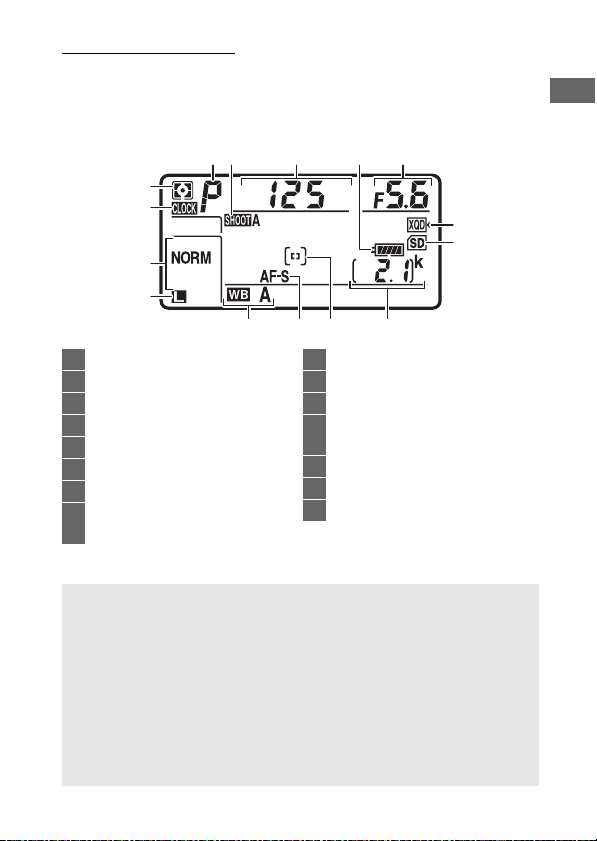
The Control Panel
The control panel shows a variety of camera settings when the
camera is on.
The items shown here appear the first time the
camera is turned on; information on other settings can be found
in the relevant sections of this manual.
13 5
15
24
14
12
13
11 10 9 8
6
7
1 Exposure mode ...........................130
2 Photo shooting menu bank ..... 283
3 Shutter speed .....................133, 135
4 Battery indicator ........................... 35
5
Aperture (f-number)
..........134, 135
6 XQD card icon..........................15, 96
7 SD card icon .............................15, 96
8 Number of exposures
remaining............................. 36, 389
9 AF-area mode.............................. 103
10 Autofocus mode ......................... 101
11 White balance.............................. 159
12 Image size (JPEG and TIFF
images) .......................................... 94
13 Image quality ................................ 91
14 B indicator
15 Metering ....................................... 129
A The B Indicator
The camera clock is powered by an independent, rechargeable power
source, which is charged as necessary when the main battery is
installed or the camera is powered by an optional power connector
and AC adapter (0 335).
Two days of charging will power the clock for
about three months.
If the B icon flashes in the control panel, the
clock has been reset and the date and time recorded with any new
photographs will not be correct.
Set the clock to the correct time and
date using the Time zone and date > Date and time option in the
setup menu (0 304).
6
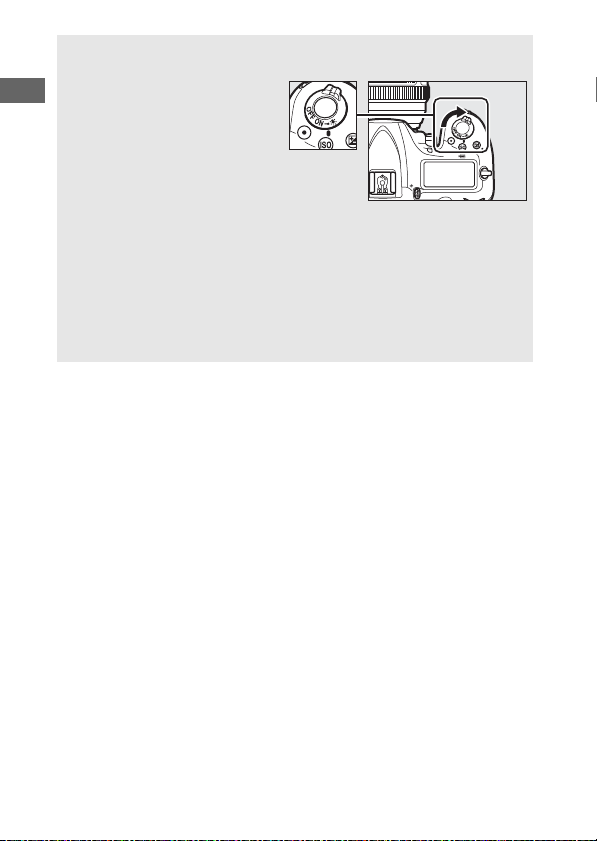
A LCD Illuminators
Rotating the power switch
toward
D
activates the
backlights for the buttons and
control panel, making it easier
to use the camera in the dark.
After the power switch is
released, the backlights will
remain lit for a few seconds
while the standby timer is active
(0 296) or until the shutter is released or the power switch is rotated
toward
D
again.
D The Control Panel and Viewfinder Displays
The brightness of the control panel and viewfinder displays varies with
temperature, and the response times of the displays may drop at low
temperatures.
This is normal and does not indicate a malfunction.
Power switch
7
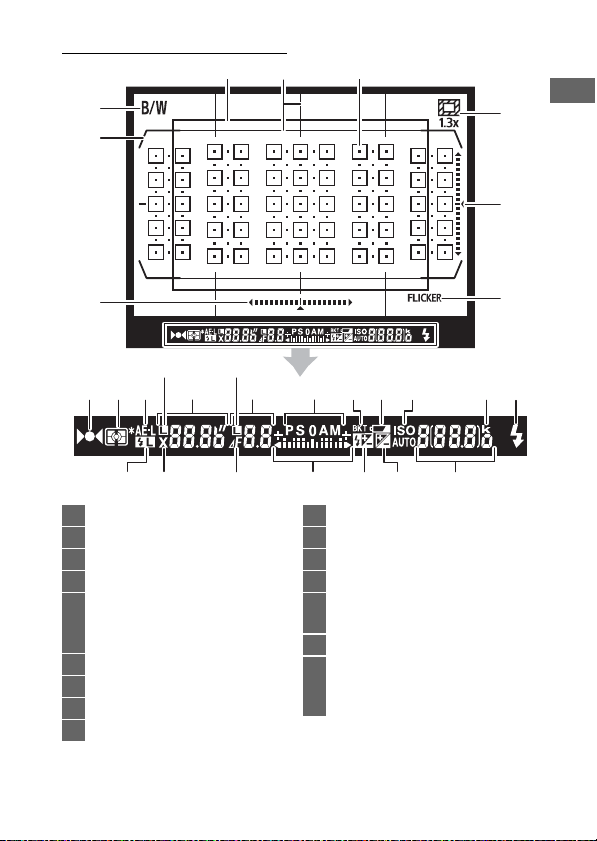
The Viewfinder Display
26 29
564
1
2
3
1110 12
13 15
1816 17 1914 2221
24
25 2827
20
23
8
7
9
1 Monochrome indicator .............180
2 AF area brackets............................ 29
3 Roll indicator
1
4 1.3× DX crop ............................88, 89
5 Framing grid (displayed when On
is selected for Custom Setting d8,
Viewfinder grid display) ...298
6 Focus points ................. 97, 108, 293
7 1.3× DX crop indicator...........88, 89
8 Pitch indicator
2
9 Flicker detection ................234, 287
10 Focus indicator.............38, 111, 115
11 Metering ....................................... 128
12 Autoexposure (AE) lock............. 141
13 Shutter speed lock icon ... 140, 302
14 Shutter speed ..................... 133, 135
Autofocus mode ......................... 101
15 Aperture lock icon............. 140, 302
16 Aperture (f-number)......... 134, 135
Aperture (number of
stops)................................... 134, 325
8
1 Functions as a pitch indicator when camera is rotated to take pictures in “tall” (portrait)
orientation.
2 Functions as a roll indicator when camera is rotated to take pictures in “tall” (portrait)
orientation.
3 Displayed when an optional flash unit is attached (0 196).
The flash-ready indicator lights
when the flash is charged.
Note: Display shown with all indicators lit for illustrative purposes.
17 Exposure mode........................... 130
18 Exposure/flash bracketing
indicator ...................................... 147
WB bracketing indicator ........... 151
ADL bracketing indicator.......... 155
19 Low battery warning ....................35
20 ISO sensitivity indicator ............ 123
Auto ISO sensitivity
indicator ...................................... 126
21 “k” (appears when memory
remains for over 1000
exposures)......................................36
22 Flash-ready indicator
3
..................................... 196, 206, 369
23 FV lock indicator ......................... 206
24 Flash sync indicator.................... 299
25 Aperture stop indicator....134, 325
26 Exposure indicator ..................... 136
Exposure compensation
display.......................................... 143
27 Flash compensation
indicator ..................................... 203
28 Exposure compensation
indicator ...................................... 143
29 Number of exposures
remaining..............................36, 389
Number of shots remaining before
memory buffer fills
.............................................. 118, 389
ISO sensitivity.............................. 123
Preset white balance recording
indicator ...................................... 171
Active D-Lighting amount
AF-area mode..................... 105, 106
Exposure compensation value
....................................................... 143
Flash compensation value ....... 203
PC mode indicator
D No Battery
When the battery is totally exhausted or no battery is inserted, the
display in the viewfinder will dim.
This is normal and does not indicate
a malfunction.
The viewfinder display will return to normal when a
fully-charged battery is inserted.
9
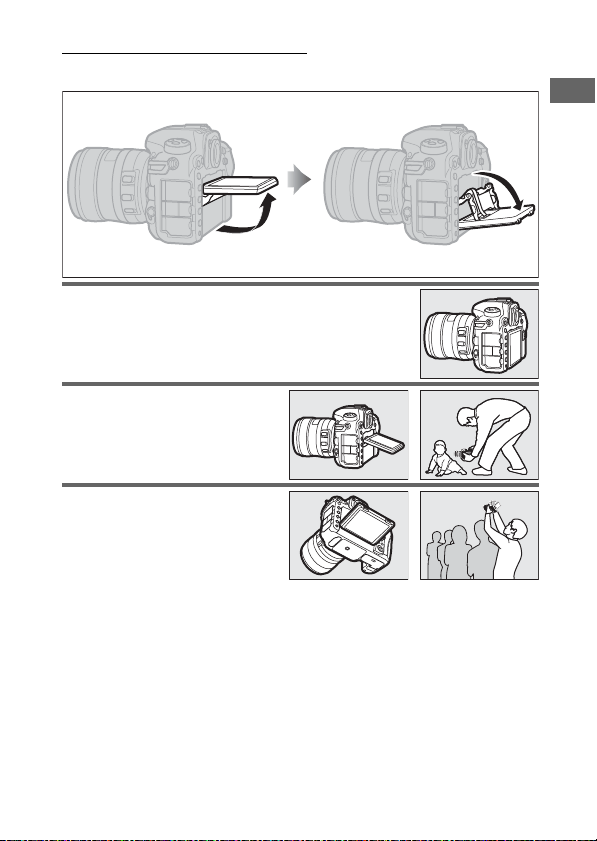
Using the Tilting Monitor
The monitor can be angled and rotated as shown below.
Normal use: The monitor is
normally used in storage
position.
Low-angle shots: Tilt the monitor
up to take shots in live view with
the camera held low.
High-angle shots: Tilt the monitor
down to take shots in live view
with the camera held high.
10
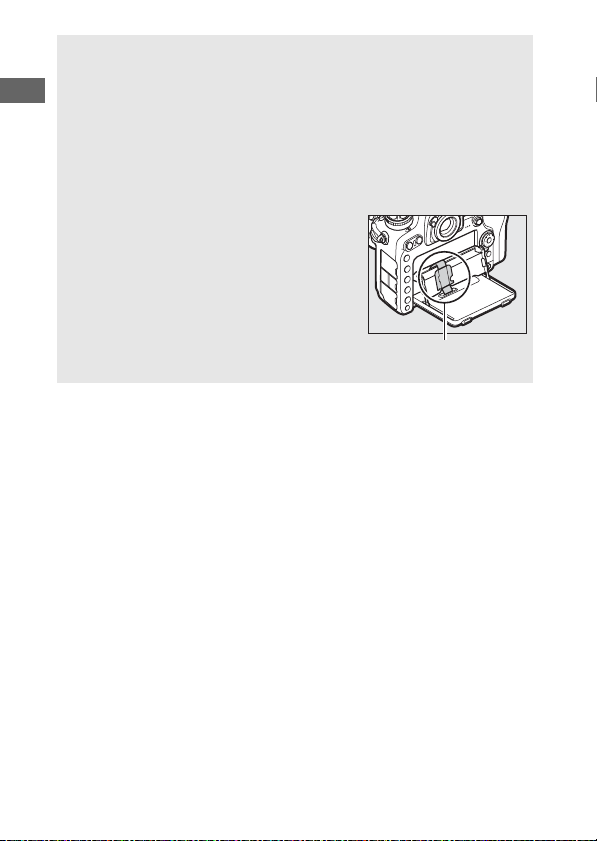
D Using the Monitor
Rotate the monitor gently, stopping when you feel resistance.
Do not
use force.
Failure to observe these precautions could damage the
camera or monitor.
If the camera is mounted on a tripod, care should
be taken to ensure that the monitor does not contact the tripod.
Do not lift or carry the camera by the monitor.
Failure to observe this
precaution could damage the camera.
If the monitor is not being used
to take photographs, return it to the storage position.
Do not touch the area to the rear of the
monitor or allow liquid to contact the inner
surface.
Failure to observe these
precautions could cause product
malfunction.
Be particularly careful
not to touch this area.
11
Using the Touch Screen
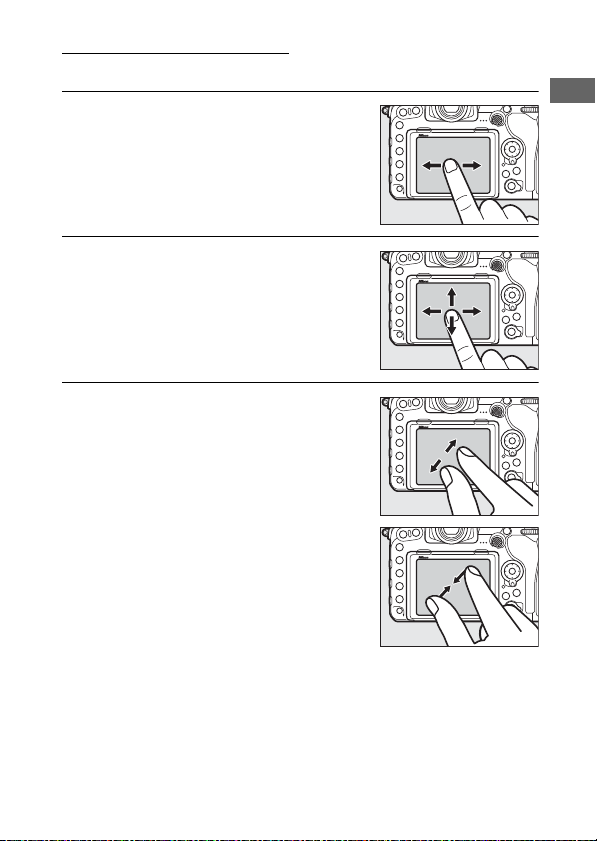
The touch-sensitive monitor supports the following operations:
Flick
Flick a finger a short distance left or right
across the monitor.
Slide
Slide a finger over the monitor.
Stretch/Pinch
Place two fingers on the monitor and
move them apart or pinch them
together.

12
❚❚ Using the Touch Screen
During playback (0 258), the touch screen can be used to:
• View other images
• Zoom in or out
• View thumbnails
• View movies
During live view, the touch screen can be used to take pictures
(touch shutter; 0 55) or to measure a value for spot white
balance (0 175).
The touch screen can also be used for typing
(0 186).
D The Touch Screen
The touch screen responds to static electricity and may not respond
when covered with third-party protective films or when touched with
fingernails or gloved hands.
Do not use excessive force or touch the
screen with sharp objects.
D Using the Touch Screen
The touch screen may not respond as expected if you attempt to
operate it while leaving your palm or another finger resting on it in
second location.
It may not recognize other gestures if your touch is
too soft, your fingers are moved too quickly or too short a distance or
do not remain in contact with the screen, or if the movement of the
two fingers in a pinch or stretch is not correctly coordinated.
A Enabling or Disabling Touch Controls
Touch controls can be enabled or disabled using the Touch controls
option in the setup menu (0 306).
A See Also
The Touch controls option in the setup menu can be used to choose
the direction you flick your finger to view other images in full-frame
playback (0 306).
13
First Steps
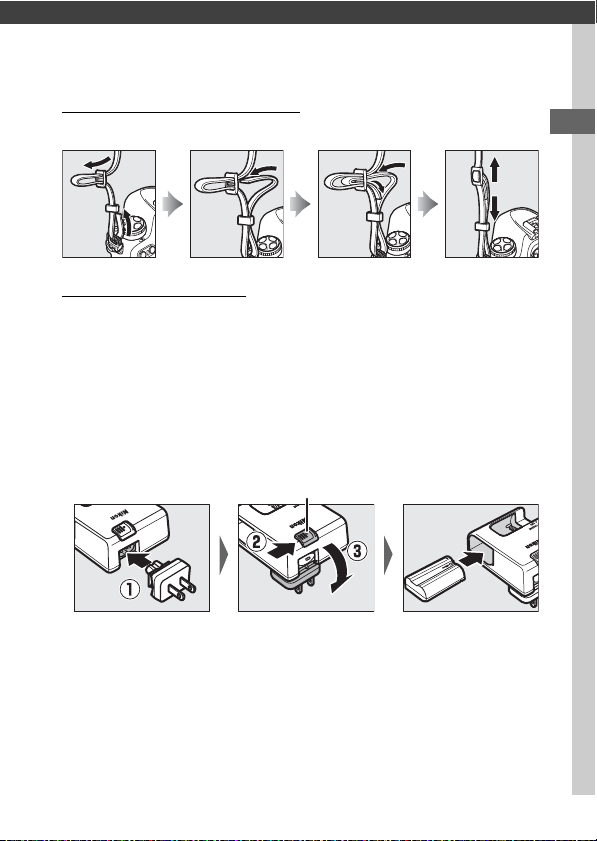
Attach the Camera Strap
Attach the strap securely to the camera eyelets.
Charge the Battery
Insert the battery and plug the charger in (depending on the
country or region, the charger comes with either an AC wall
adapter or a power cable).
An exhausted battery will fully charge
in about two hours and 35 minutes.
• AC wall adapter: Insert the AC wall adapter into the charger AC
inlet (q).
Slide the AC wall adapter latch as shown (w) and
rotate the adapter 90° to fix it in place (e).
Insert the battery
and plug the charger in.
AC wall adapter latch
90°
14
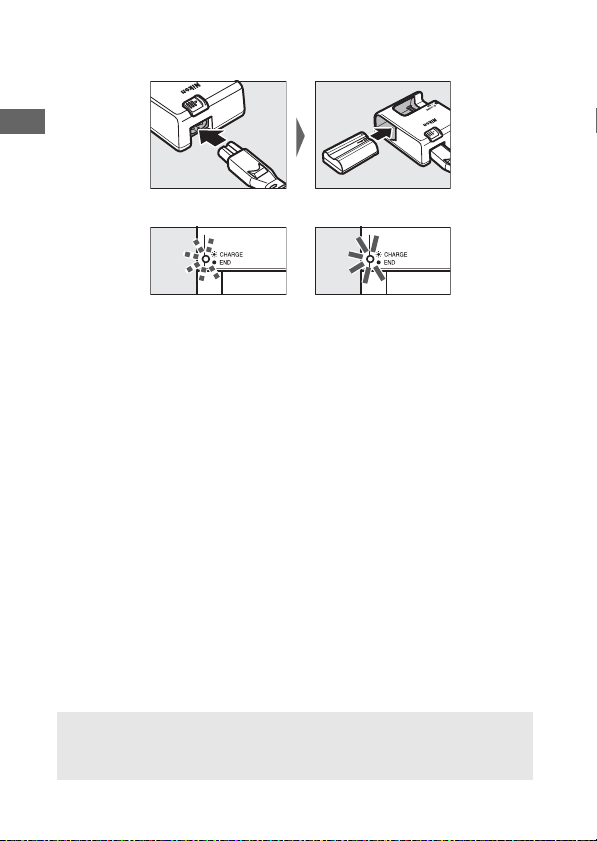
• Power cable: After connecting the power cable with the plug in
the orientation shown, insert the battery and plug the cable in.
The CHARGE lamp will flash while the battery charges.
Battery charging Charging complete
D The Battery and Charger
Read and follow the warnings and cautions on pages xiii–xvi and 345–349
of this manual.
15
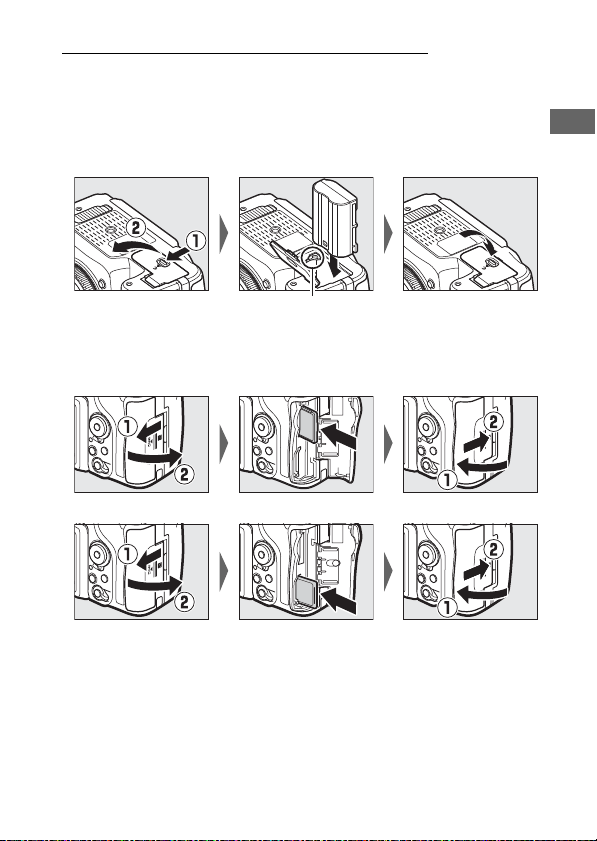
Insert the Battery and a Memory Card
Before inserting or removing the battery or memory cards,
confirm that power switch is in the OFF position.
Insert the
battery in the orientation shown, using the battery to keep the
orange battery latch pressed to one side.
The latch locks the
battery in place when the battery is fully inserted.
Memory cards are inserted as shown below.
Slide the card in
until it clicks into place.
• XQD memory cards:
• SD memory cards:
Battery latch
16
GB
16
D Memory Cards
• Memory cards may be hot after use.
Observe due caution when
removing memory cards from the camera.
• Turn the power off before inserting or removing memory cards.
Do
not remove memory cards from the camera, turn the camera off, or
remove or disconnect the power source during formatting or while
data are being recorded, deleted, or copied to a computer.
Failure to
observe these precautions could result in loss of data or in damage to
the camera or card.
• Do not touch the card terminals with your fingers or metal objects.
• Do not bend, drop, or subject to strong physical shocks.
• Do not apply force to the card casing.
Failure to observe this
precaution could damage the card.
• Do not expose to water, high levels of humidity, or direct sunlight.
• Do not format memory cards in a computer.
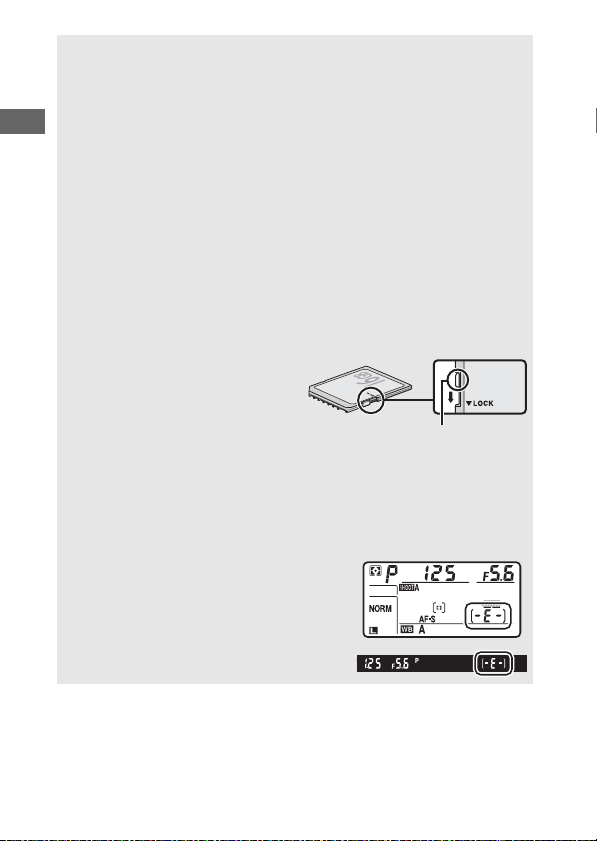
A The Write Protect Switch
SD memory cards are equipped
with a write protect switch to
prevent accidental loss of data.
When this switch is in the “lock”
position, the memory card can not
be formatted and photos can not
be deleted or recorded (a warning will be displayed in the monitor if
you attempt to release the shutter).
To unlock the memory card, slide
the switch to the “write” position.
A No Memory Card
If no memory card is inserted, the control
panel and viewfinder will show S.
If
the camera is turned off with a charged
battery and no memory card inserted,
S will be displayed in the control panel.
Write-protect switch
17
❚❚ Removing the Battery and Memory Cards
Removing the Battery
Turn the camera off and open the
battery-chamber cover.
Press the battery
latch in the direction shown by the arrow
to release the battery and then remove
the battery by hand.
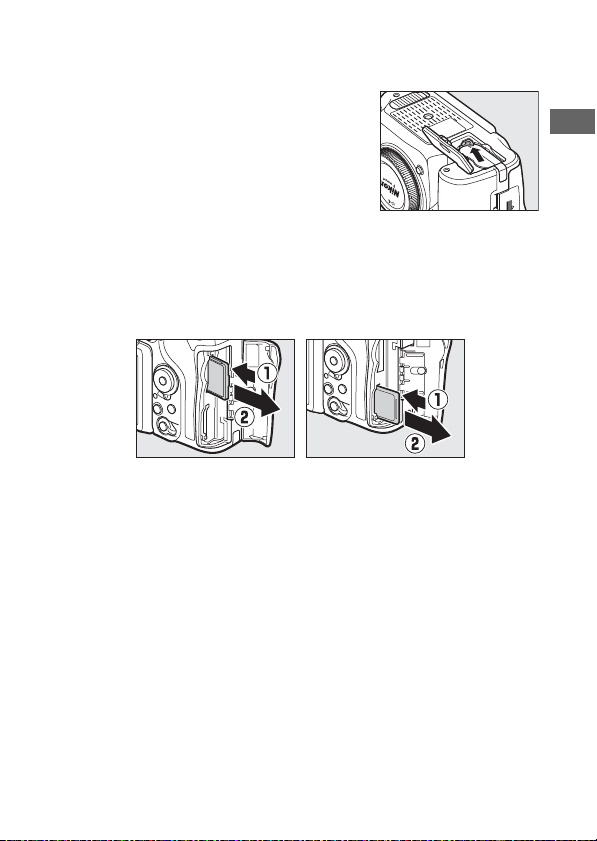
Removing Memory Cards
After confirming that the memory card access lamp is off, turn
the camera off and open the memory card slot cover.
Press the
card in and then release it (q).
The memory card can then be
removed by hand (w).
XQD memory cards SD memory cards
16
GB
18
Attach a Lens
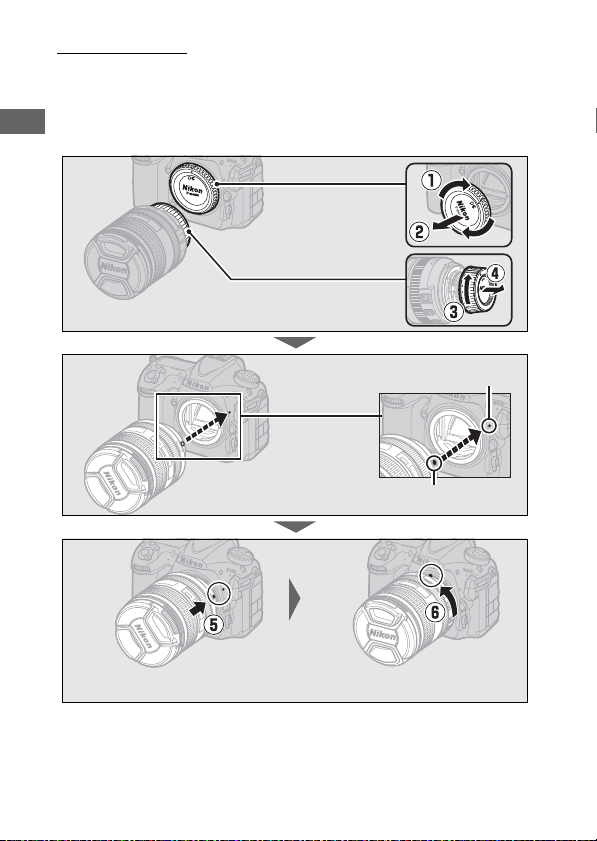
Be careful to prevent dust from entering the camera when the
lens or body cap is removed.
The lens generally used in this
manual for illustrative purposes is an AF-S DX NIKKOR 16–80mm
f/2.8–4E ED VR.
Be sure to remove the lens cap before taking pictures.
Remove the
camera body cap
Remove the rear lens cap
Mounting mark (camera)
Mounting mark (lens)
Align the mounting
marks
Rotate the lens as shown until it clicks into place
19
A Detaching the Lens
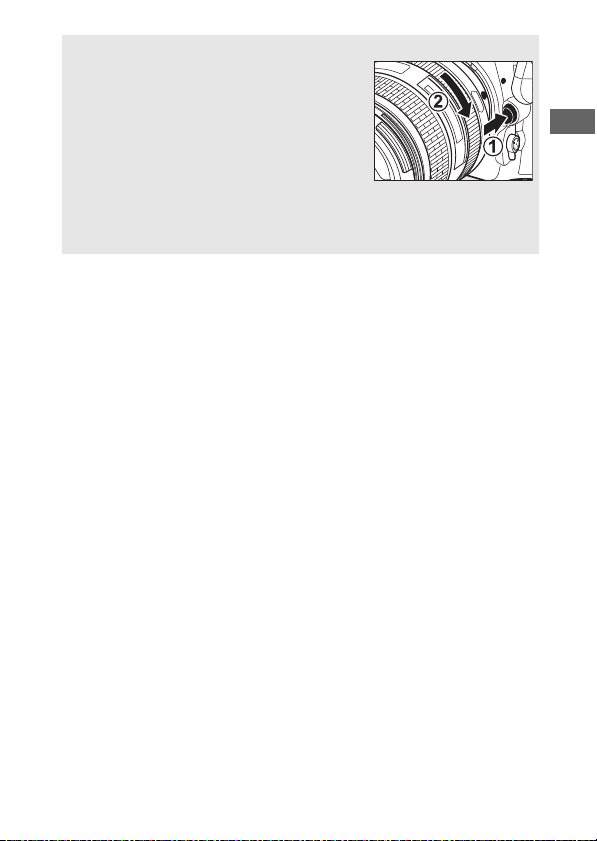
Be sure the camera is off when removing or
exchanging lenses.
To remove the lens,
press and hold the lens release button (q)
while turning the lens clockwise (w).
After
removing the lens, replace the lens caps and
camera body cap.
D CPU Lenses with Aperture Rings
In the case of CPU lenses equipped with an aperture ring (0 325), lock
aperture at the minimum setting (highest f-number).
20
Camera Setup
❚❚ Setup from a Smartphone or Tablet
Before proceeding, install the SnapBridge app as
described inside the front cover and enable
Bluetooth and Wi-Fi on your smartphone or tablet
(below, “smart device”).
Note that the actual camera
and smart device displays may differ from those shown below.
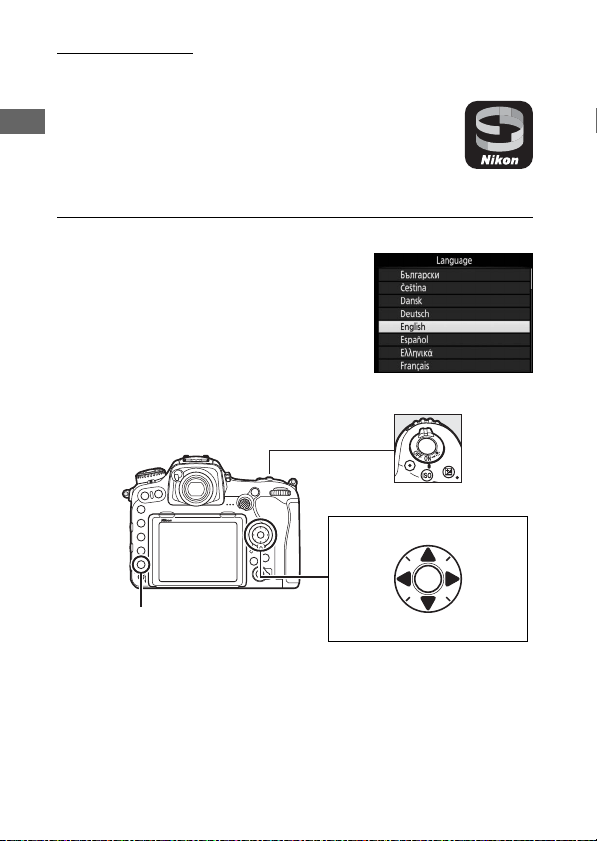
1 Turn the camera on.
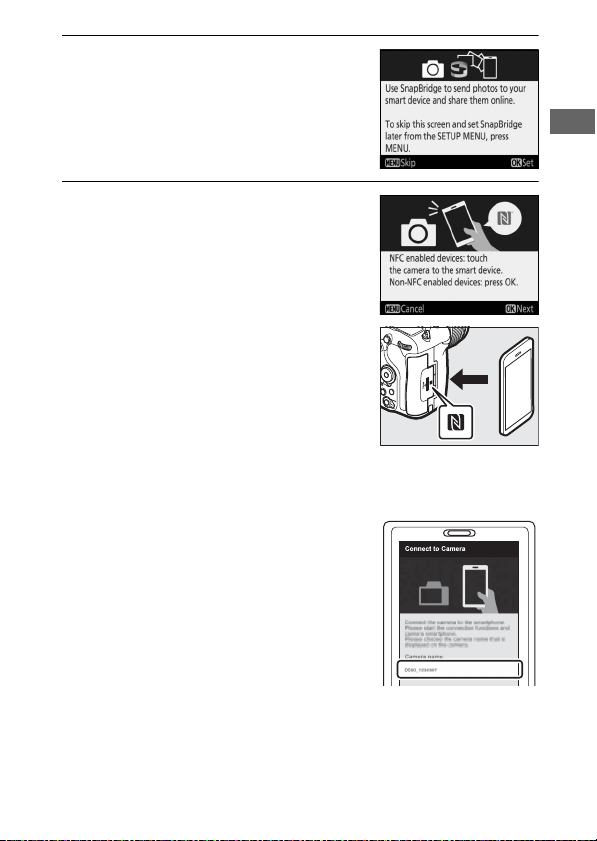
A language-selection dialog will be
displayed.
Use the multi selector and J button to navigate the menus.
Press 1 and 3 to highlight a language and press J to select.
The language can be changed at any time using the
Language option in the setup menu.
J button (select)
Up
Left Right
Down
Multi selector
Power switch
21
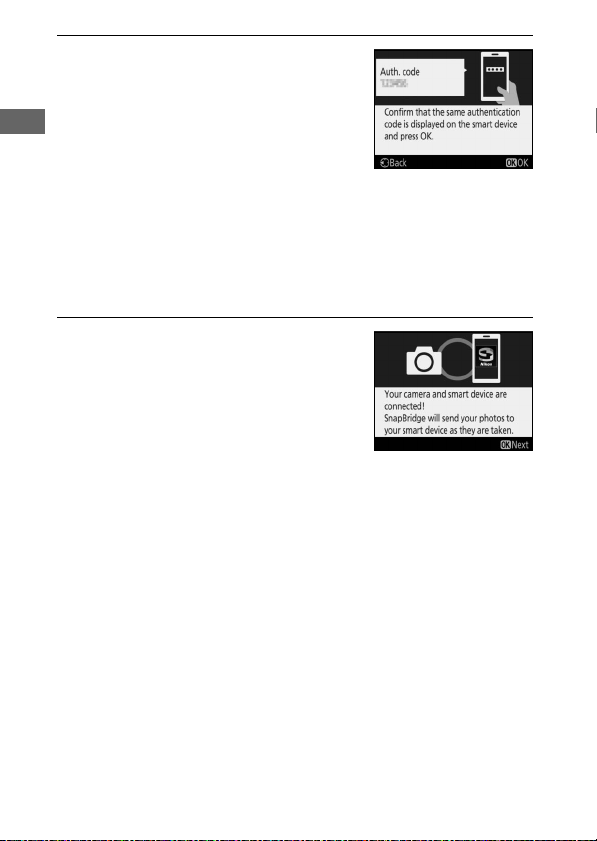
2 Press J when the dialog at right is
displayed.
If you do not wish to use a smart
device to configure the camera, press
G (0 27).
3 Pair the camera and the smart
device.
• Android devices with NFC support: After
checking that NFC is enabled on the
smart device, touch the camera
N (N-Mark) to the NFC antenna on
the smart device to launch the
SnapBridge app.
If the SnapBridge
download site is displayed,
download and install the app before repeating the above
steps.
• iOS devices and Android devices without
NFC support: Press the camera J
button.
The camera will wait for a
connection; launch the SnapBridge
app on the smart device and follow
the on-screen instructions to tap the
name of the camera you want to pair
with.
22
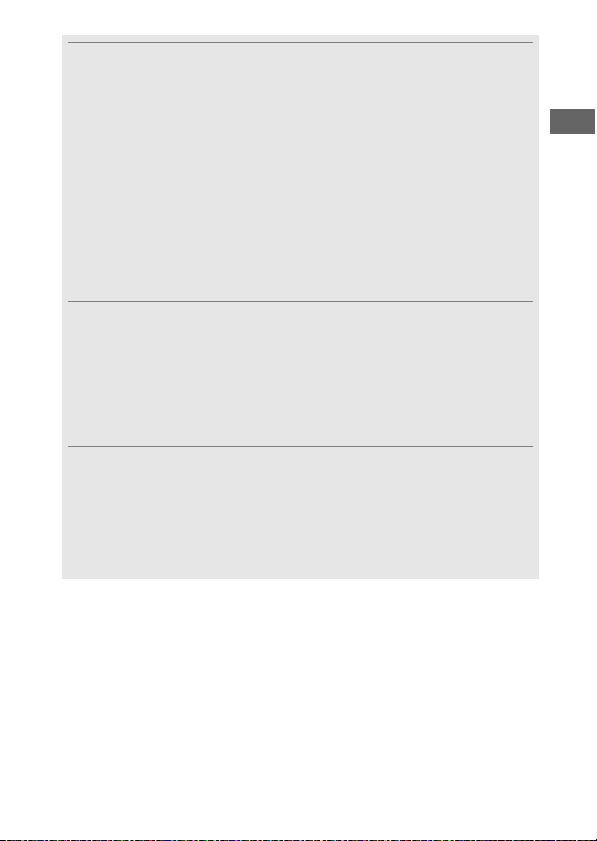
4 Check the authentication code.
After confirming that the camera and
smart device display the same six-
digit authentication code, follow the
steps below to complete pairing (note
that the code may not be displayed in
some versions of iOS, but you should
follow the steps below even if the
code is not displayed).
• On the camera, press J.
• On the smart device, tap Pairing (the name of the button varies
with the smart device).
5 Press J when the dialog at right is
displayed.
You have now established a constant
connection between the camera and
smart device.
If the camera displays
Unable to connect., the display will
change after a short pause.
Return to
Step 3.
Camera

23
6 Follow the on-screen instructions to complete the setup
process.
To record location data with photographs, select Ye s when
prompted and enable the location data features both in the
SnapBridge app and on the smart device itself (for more
information, see the documentation provided with the smart
device).
You can also synchronize the camera clock to the
time reported by the smart device by selecting Ye s when
prompted and enabling synchronization in the SnapBridge
app.
If you select No, set the camera clock from the menus as
described in Step 3 on page 27.
Setup is complete when the camera returns to the shooting
display.
See page 24 for more information on using
SnapBridge.

24
A What SnapBridge Can Do for You
The SnapBridge app can be used for a variety of tasks once the camera
has been paired with your smart device.
For more information on the
features below, see SnapBridge online help.
Auto Upload
At default settings, JPEG photographs will automatically be uploaded
to the smart device as they are taken (auto upload is not available with
movies or with NEF/RAW or TIFF images, and is automatically
suspended when the battery level drops to H).
Before uploading
pictures, place the smart device close to the camera and launch the
SnapBridge app.
Here are some tips for uploading pictures:
• Disabling auto upload: To disable auto upload, select Off for Send to
smart device (auto) in the camera setup menu (0 308).
• Uploading selected pictures: To upload pictures not previously sent using
auto upload, press the camera i button during playback and select
pictures using Select to send to smart device/deselect (0 276), or
select pictures using the Select to send to smart device option in
the camera playback menu (0 277, 282).
Note that as long as a
constant connection is in effect between the camera and smart
device, pictures will be uploaded automatically even when the
camera is off.
Upload is however automatically suspended when the
battery level drops to H.
• Resizing pictures for upload: Choose an upload size in the SnapBridge
app.
The default is 2 megapixels.
• Embedding photo info: Use the SnapBridge app to choose the
information imprinted on photographs copied to the smart device.
Comments and copyright information can be entered in advance
from the camera setup menu.
You can also imprint text entered in
the SnapBridge app.
25
Tips for Wireless Networks
• Pairing: To pair the camera with a smart device (for example, with a
new device or if you did not opt to pair with a smart device during
setup), select Start for Connect to smart device in the camera setup
menu and follow the instructions on page 21, starting with Step 3.
The camera can be paired with up to five smart devices, but can
connect to only one at a time.
• Uploading pictures via Wi-Fi: A Wi-Fi connection is recommended for
movies and other large-volume uploads.
Follow the on-screen
instructions in the SnapBridge app to switch to a Wi-Fi connection.
The Wi-Fi > Network settings item in the camera setup menu
contains Authentication/encryption and Password options.
The
default option for Authentication/encryption is WPA2-PSK-AES.
Other Features of the SnapBridge App
• Remote photography: The camera shutter can be released remotely from
the smart device using the SnapBridge app.
Be sure the camera is on
before attempting to take pictures.
• Viewing pictures from the smart device: Use the smart device to view and
download the pictures on the camera.
This option is available even
when the camera is off.
A Where the Use of Wireless Devices Is Prohibited
Where the use of wireless devices is prohibited, disable wireless
features in the camera setup menu by selecting Enable for Airplane
mode.
This will temporarily interrupt the constant connection with
the smart device, but the connection is automatically re-established
when airplane mode is disabled.
26
❚❚ Setup from the Camera Menus
The camera clock can be set manually.
1 Turn the camera on.
A language-selection dialog will be
displayed.
Use the multi selector and J button to navigate the menus.
Press 1 and 3 to highlight a language and press J to select.
The language can be changed at any time using the
Language option in the setup menu.
J button (select)
Up
Left Right
Down
Multi selector
Power switch
27
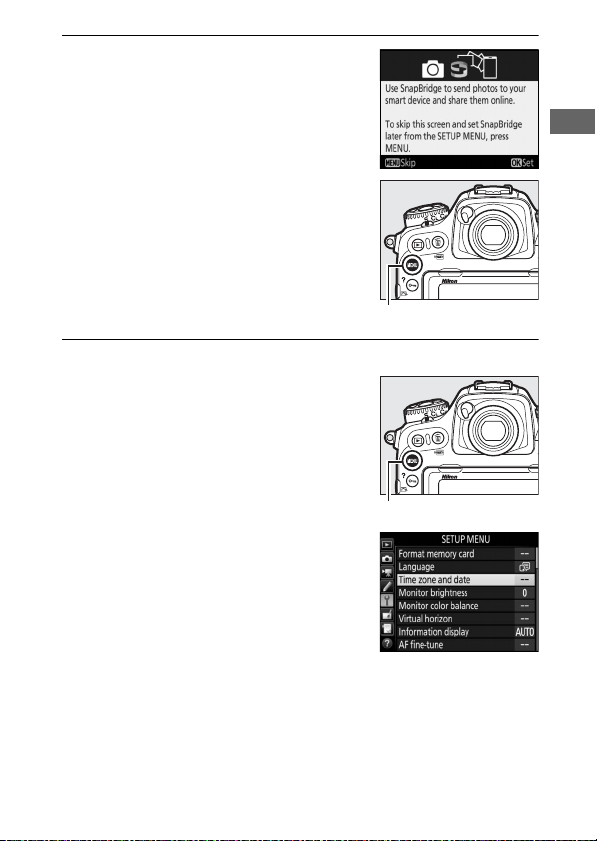
2 Press G when the dialog at right is
displayed.
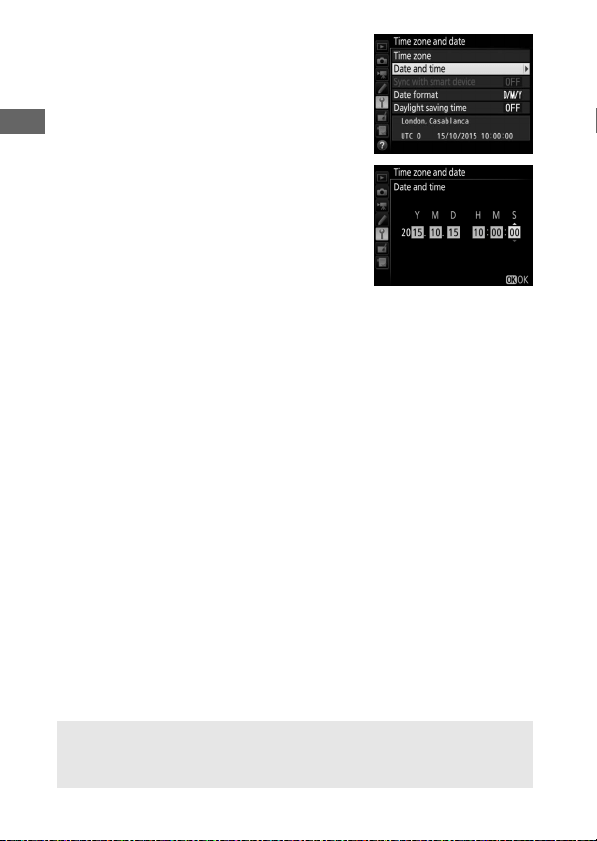
3 Set the camera clock.
Press the G button to display the
setup menu.
Highlight Time zone and date and
press 2 (the setup menu is
automatically displayed with Time
zone and date highlighted the first
time the menus are displayed; for
more information on using the
menus, see page 304).
G button
G button
28
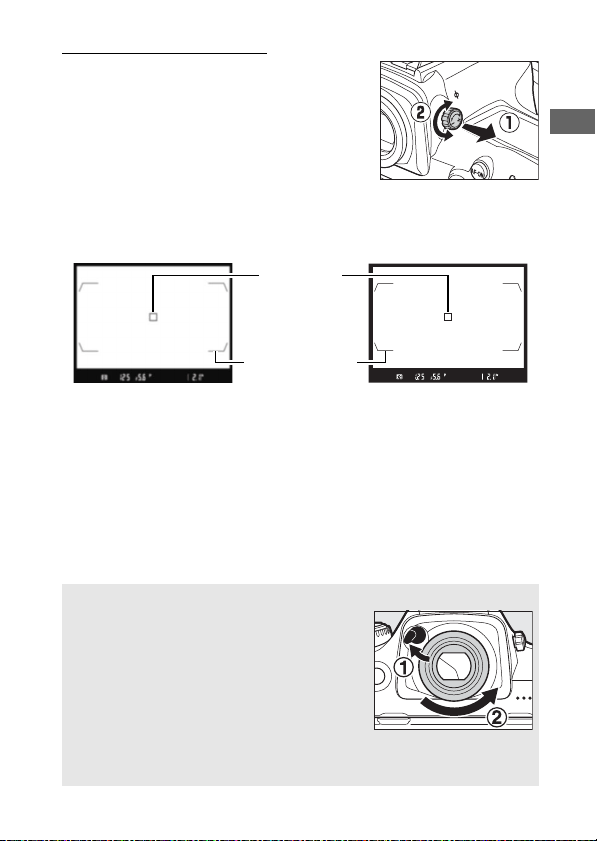
After using Time zone to choose a
time zone and (if applicable) Daylight
saving time to enable daylight saving
time, highlight Date and time and
press 2.
Press 4 or 2 to highlight items and
press 1 or 3 to change, then press J
to set the clock when adjustments are
complete.
The clock can be adjusted
at any time using the Time zone and
date > Date and time option in the
setup menu (0 304).
A Date Format
To choose the order in which the date is displayed, use the Date
format option in the Time zone and date menu (0 304).
29
Focus the Viewfinder
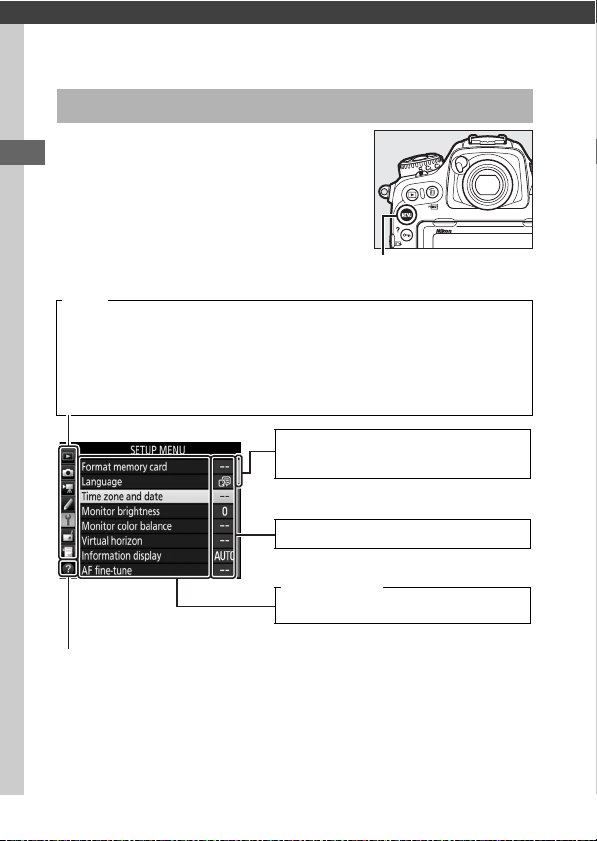
Lift the diopter adjustment control and
rotate it until the viewfinder display,
focus points, and AF area brackets are in
sharp focus.
When operating the control
with your eye to the viewfinder, be
careful not to put your fingers or
fingernails in your eye.
Push the diopter
adjustment control back in once you have adjusted focus to your
satisfaction.
A Diopter-Adjustment Viewfinder Lenses
Corrective lenses (available separately;
0 335) can be used to further adjust
viewfinder diopter.
Before attaching a
diopter-adjustment viewfinder lens, remove
the DK-17F viewfinder eyepiece by closing
the viewfinder shutter to release the
eyepiece lock (q) and then grasping the
eyepiece lightly between your finger and thumb and unscrewing it as
shown at right (w).
AF area brackets
Focus point
Viewfinder not in focus Viewfinder in focus
30
Tutorial
Most shooting, playback, and setup
options can be accessed from the camera
menus.
To view the menus, press the
G button.
Camera Menus
Tabs
Choose from the following menus:
• D: Playback (0 281)
• C: Photo Shooting (0 283)
• 1: Movie Shooting (0 288)
• A: Custom Settings (0 292)
• B: Setup (0 304)
• N: Retouch (0 313)
• O/m: MY MENU or RECENT SETTINGS
(defaults to MY MENU; 0 315)
Help icon (0 31)
G button
Slider shows position in current
menu.
Menu options
Options in current menu.
Current settings are shown by icons.
31
Using Camera Menus
❚❚ Menu Controls
The multi selector and J button are used to navigate the menus.
Multi selector
J button
Select highlighted
item
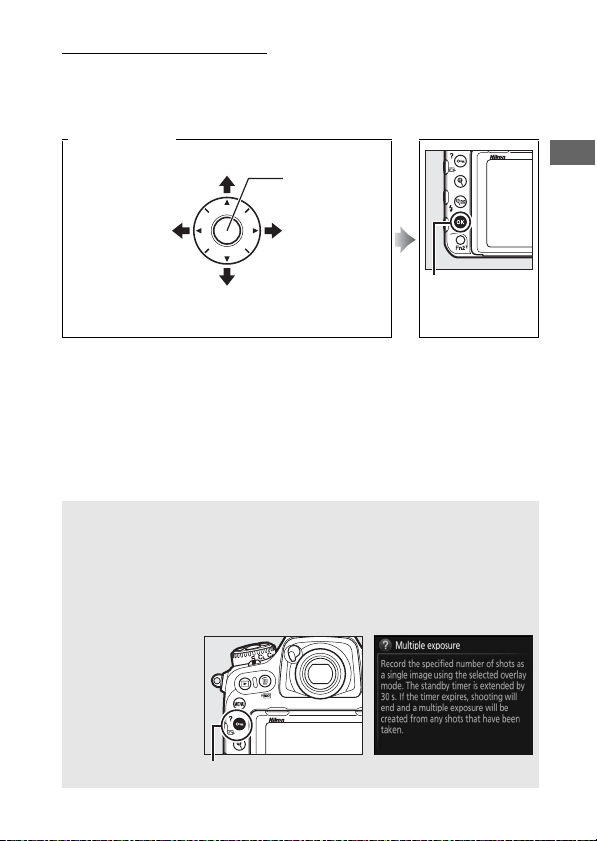
A The d (Help) Icon
If a d icon is displayed at the bottom left corner of the monitor, help
can be displayed by pressing the L (Z/Q) button.
A description of the currently selected option or menu will be
displayed while the button is pressed.
Press 1 or 3 to scroll through
the display.
L (Z/Q) button
Move cursor up
Cancel and return
to previous menu
Select highlighted
item or display sub-
menu
Select highlighted
item
Move cursor down
32
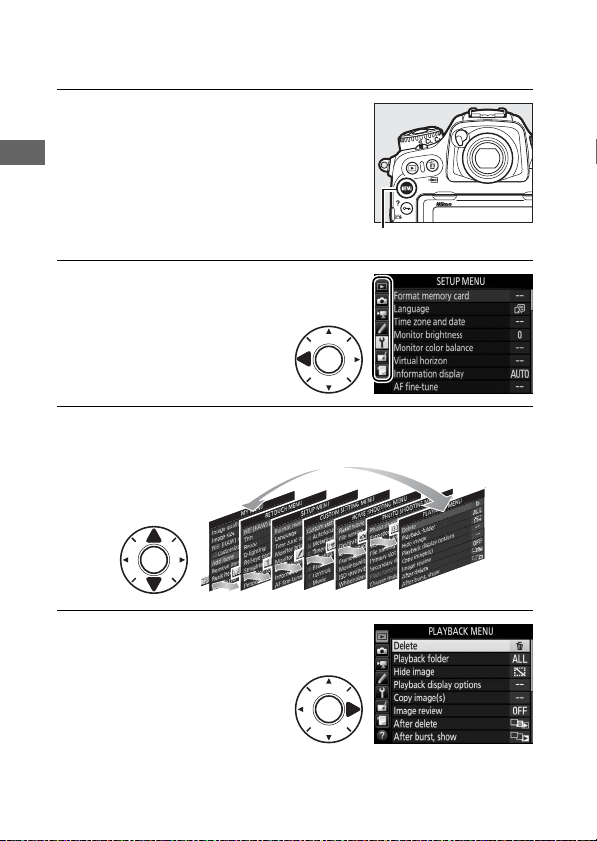
❚❚ Navigating the Menus
Follow the steps below to navigate the menus.
1 Display the menus.
Press the G button to display the
menus.
2 Highlight the icon for the
current menu.
Press 4 to highlight the
icon for the current menu.
3 Select a menu.
Press 1 or 3 to select the desired menu.
4 Position the cursor in the
selected menu.
Press 2 to position the
cursor in the selected
menu.
G button
33
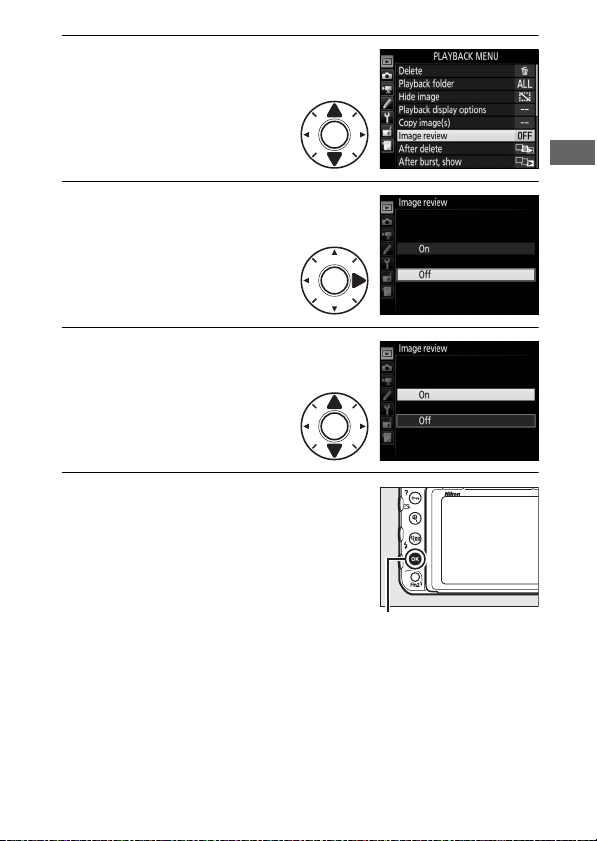
5 Highlight a menu item.
Press 1 or 3 to highlight a
menu item.
6 Display options.
Press 2 to display options
for the selected menu item.
7 Highlight an option.
Press 1 or 3 to highlight
an option.
8 Select the highlighted item.
Press J to select the highlighted item.
To exit without making a selection,
press the G button.
J button

34
Note the following points:
• Menu items that are displayed in gray are not currently
available.
• While pressing 2 or the center of the multi selector generally
has the same effect as pressing J, there are some items for
which selection can only be made by pressing J.
• To exit the menus and return to shooting mode, press the
shutter-release button halfway.
35
The Battery Level and Number of Exposures
Remaining
Before taking photographs, check the battery level and number
of exposures remaining as described below.
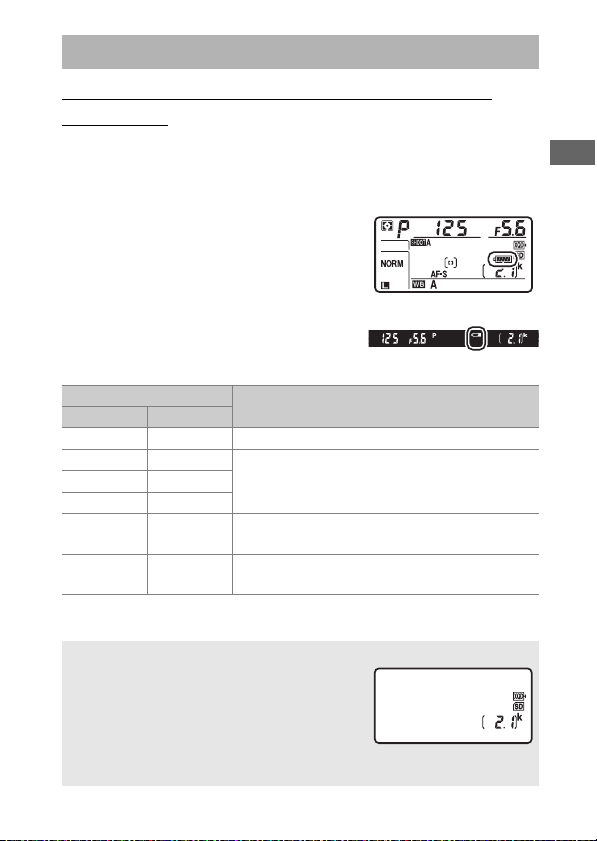
❚❚ Battery Level
The battery level is shown in the control
panel and viewfinder.
Basic Photography and Playback
Icon
DescriptionControl panel Viewfinder
L — Battery fully charged.
K —
Battery partially discharged.J —
I —
H d
Low battery.
Charge battery or ready spare
battery.
H
(flashes)
d
(flashes)
Shutter release disabled.
Charge or
exchange battery.
A Camera Off Display
If the camera is turned off with a battery and
memory card inserted, the memory card
icon and number of exposures remaining
will be displayed (some memory cards may
in rare cases only display this information
when the camera is on).
Control panel
Viewfinder
Control panel
36
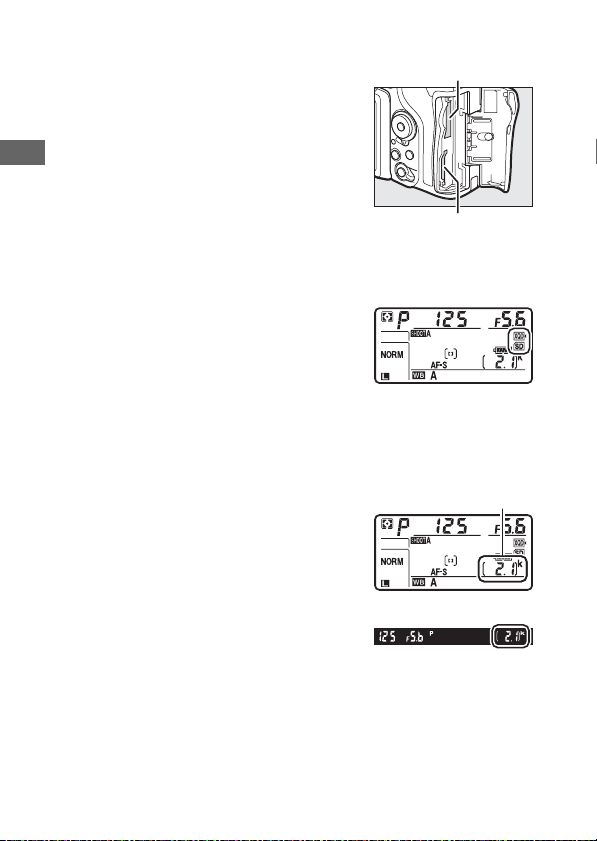
❚❚ Number of Exposures Remaining
The camera has two memory card slots:
one for XQD cards and the other for SD
cards.
When two cards are inserted, the
role played by each is determined by the
options selected for Primary slot
selection and Secondary slot function;
when Secondary slot function is set to
the default value of Overflow (0 96), the
card in the secondary slot will only be
used when the card in the primary slot is
full.
The control panel display shows what
cards are currently inserted (the example
here shows the display when cards are
inserted in both slots).
If an error occurs
(for example, if the memory card is full or
the card in the SD slot is locked), the icon
for the affected card will flash (0 357).
The control panel and viewfinder show
the number of photographs that can be
taken at current settings (values over
1000 are rounded down to the nearest
hundred; e.g., values between 2100 and
2199 are shown as 2.1 k).
XQD card slot
SD card slot
Control panel
Number of exposures
remaining
Control panel
Viewfinder
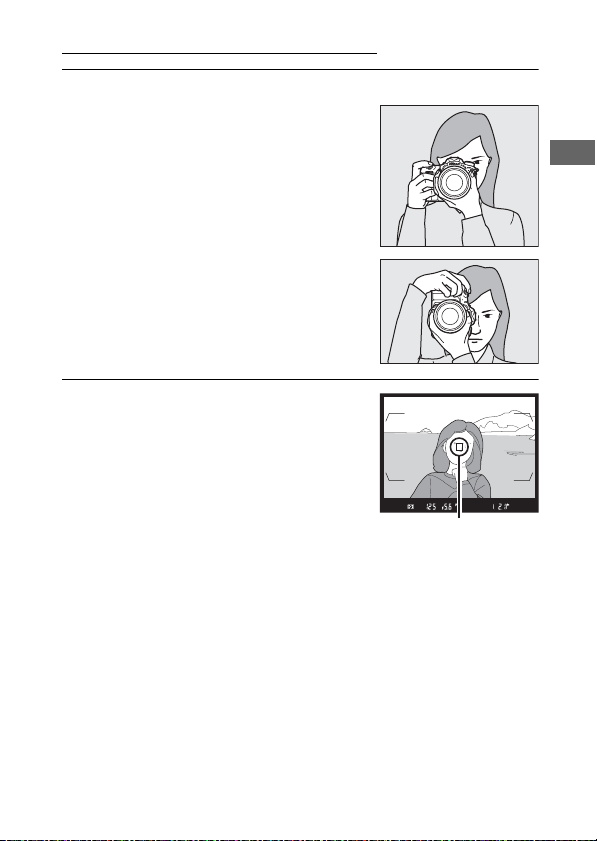
37
“Point-and-Shoot” Photography
1 Ready the Camera.
When framing photographs in the
viewfinder, hold the handgrip in your
right hand and cradle the camera
body or lens with your left.
When framing photographs in
portrait (tall) orientation, hold the
camera as shown at right.
2 Frame the photograph.
At default settings, the camera will
focus on the subject in the center
focus point.
Frame a photograph in
the viewfinder with the main subject
in the center focus point.
Focus point
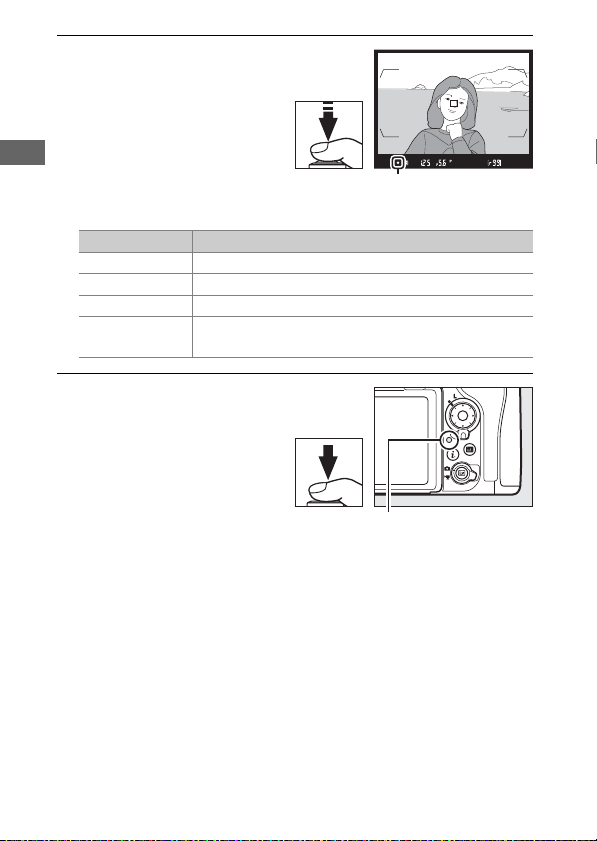
38
3 Press the shutter-release
button halfway.
Press the shutter-release
button halfway to focus.
The in-focus indicator (I)
will appear in the
viewfinder when the focus
operation is complete.
4 Shoot.
Smoothly press the
shutter-release-button the
rest of the way down to
take the photograph.
The
memory card access lamp
will light and the
photograph will be
displayed in the monitor
for a few seconds.
Do not eject the memory card or remove or
disconnect the power source until the lamp has gone out and
recording is complete.
Viewfinder display Description
I Subject in focus.
F Focus point is between camera and subject.
H Focus point is behind subject.
FH
(flashes)
Camera unable to focus on subject in focus point
using autofocus.
See page 113.
Focus indicator
Memory card access
lamp
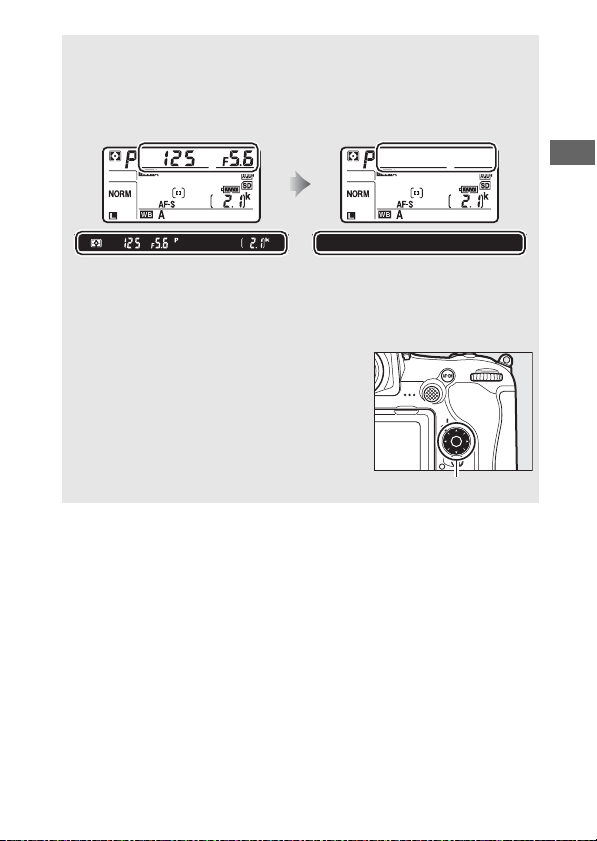
39
A The Standby Timer (Viewfinder Photography)
The shutter speed and aperture displays in the control panel and
viewfinder will turn off if no operations are performed for about six
seconds, reducing the drain on the battery.
Press the shutter-release
button halfway to reactivate the displays.
Exposure meters on Exposure meters off
The length of time before the standby timer expires automatically can
be adjusted using Custom Setting c2 (Standby timer, 0 296).
A The Multi Selector
The multi selector can be used to select the
focus point while the exposure meters are
on (0 108).
Multi selector
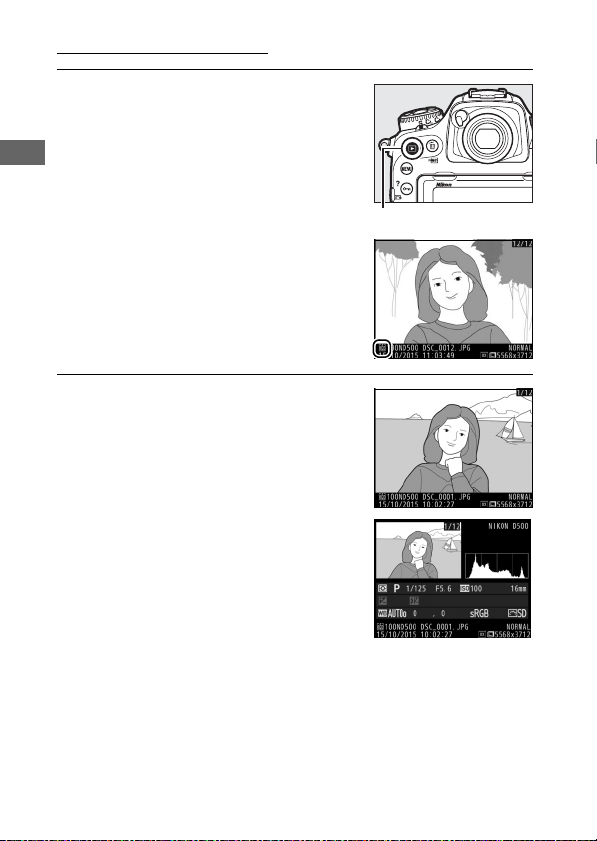
40
Viewing Photographs
1 Press the K button.
A photograph will be displayed in the
monitor.
The memory card
containing the picture currently
displayed is shown by an icon.
2 View additional pictures.
Additional pictures can be displayed
by pressing 4 or 2 or flicking a finger
left or right over the display (0 258).
To view additional information on the
current photograph, press 1 and 3
(0 261).
To end playback and return to shooting mode, press the
shutter-release button halfway.
K button

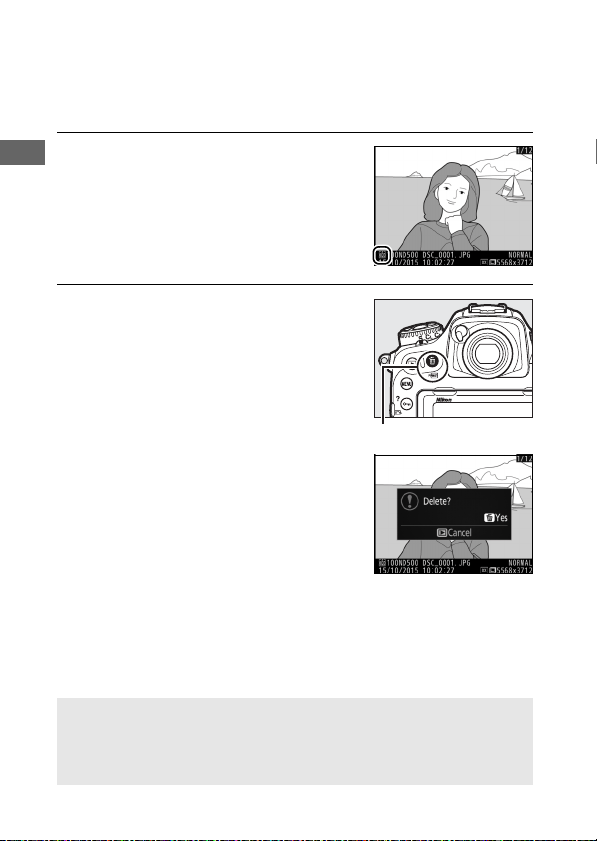
42
❚❚ Deleting Unwanted Photographs
To delete the photograph currently displayed in the monitor,
press the O (Q) button.
Note that photographs can not be
recovered once deleted.
1 Display the photograph.
Display the photograph you wish to
delete as described on the preceding
page.
The location of the current
image is shown by an icon at the
bottom left corner of the display.
2 Delete the photograph.
Press the O (Q) button.
A
confirmation dialog will be displayed;
press the O (Q) button again to
delete the image and return to
playback.
To exit without deleting the
picture, press K.
A Delete
To delete multiple images or to select the memory card from which
images will be deleted, use the Delete option in the playback menu
(0 279).
O (Q) button
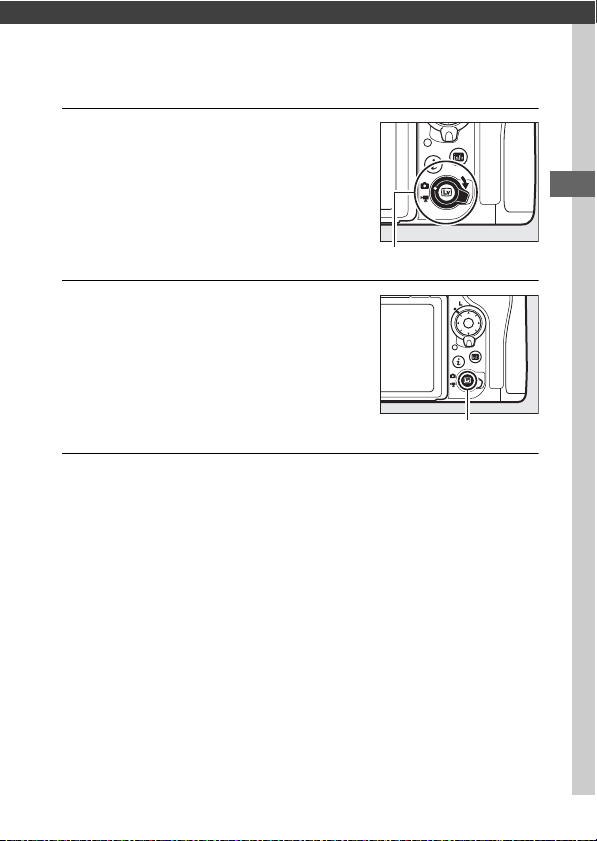
43
Live View Photography
Follow the steps below to take photographs in live view.
1 Rotate the live view selector to
C (live view photography).
2 Press the a button.
The mirror will be raised and the view
through the lens will be displayed in
the camera monitor.
The subject will
no longer be visible in the viewfinder.
3 Position the focus point.
Position the focus point over your subject as described on
page 48.
Live view selector
a button
44
4 Focus.
Press the shutter-release button
halfway to focus.
The focus point will flash green and
the shutter release will be disabled while the camera focuses.
If the camera is able to focus, the focus point will be displayed
in green; if the camera is unable to focus, the focus point will
flash red (note that pictures can be taken even when the
focus point flashes red; check focus in the monitor before
shooting).
Exposure can be locked by pressing the center of
the sub-selector (0 141); focus locks while the shutter-
release button is pressed halfway.
D Using Autofocus in Live View
Use an AF-S or AF-P lens.
The desired results may not be achieved
with other lenses or teleconverters.
Note that in live view,
autofocus is slower and the monitor may brighten or darken while
the camera focuses.
The focus point may sometimes be displayed
in green when the camera is unable to focus.
The camera may be
unable to focus in the following situations:
• The subject contains lines parallel to the long edge of the frame
• The subject lacks contrast
• The subject in the focus point contains areas of sharply
contrasting brightness, or includes spot lighting or a neon sign or
other light source that changes in brightness
• Flicker or banding appears under fluorescent, mercury-vapor,
sodium-vapor, or similar lighting
• A cross (star) filter or other special filter is used
• The subject appears smaller than the focus point
• The subject is dominated by regular geometric patterns
(e.g., blinds or a row of windows in a skyscraper)
• The subject is moving
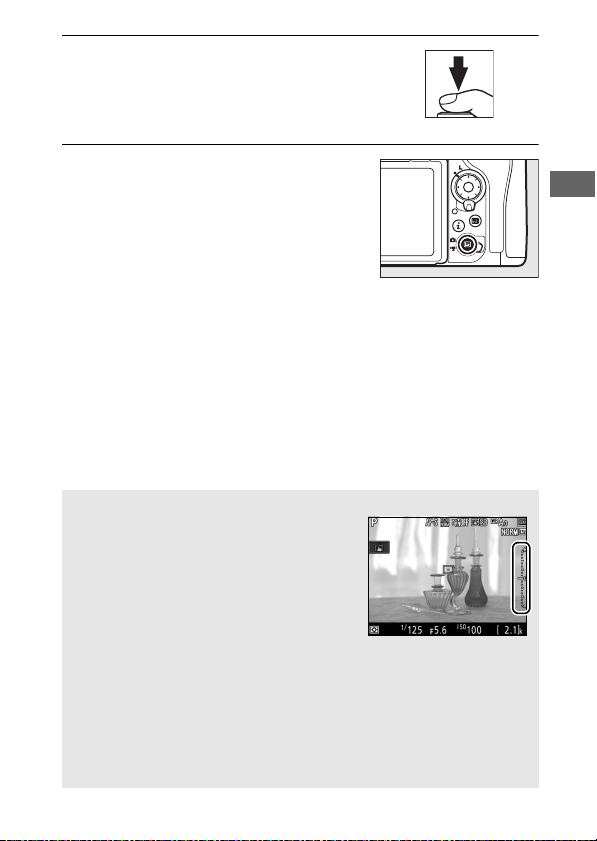
45
5 Take the picture.
Press the shutter-release button the
rest of the way down to shoot.
The
monitor will turn off.
6 Exit live view.
Press the a button to exit live view.
A Exposure Preview
During live view, you can press J to
preview the effects of shutter speed,
aperture, and ISO sensitivity on exposure.
Exposure can be adjusted by ±5 EV (0 143),
although only values between –3 and +3 EV
are reflected in the preview display.
Note
that the preview may not accurately reflect
the final results when flash lighting is used, Active D-Lighting (0 189),
High Dynamic Range (HDR; 0 191), or bracketing is in effect, A (auto) is
selected for the Picture Control Contrast parameter (0 183), or p
is selected for shutter speed.
If the subject is very bright or very dark,
the exposure indicators will flash to warn that the preview may not
accurately reflect exposure.
Exposure preview is not available when
A or % is selected for shutter speed.
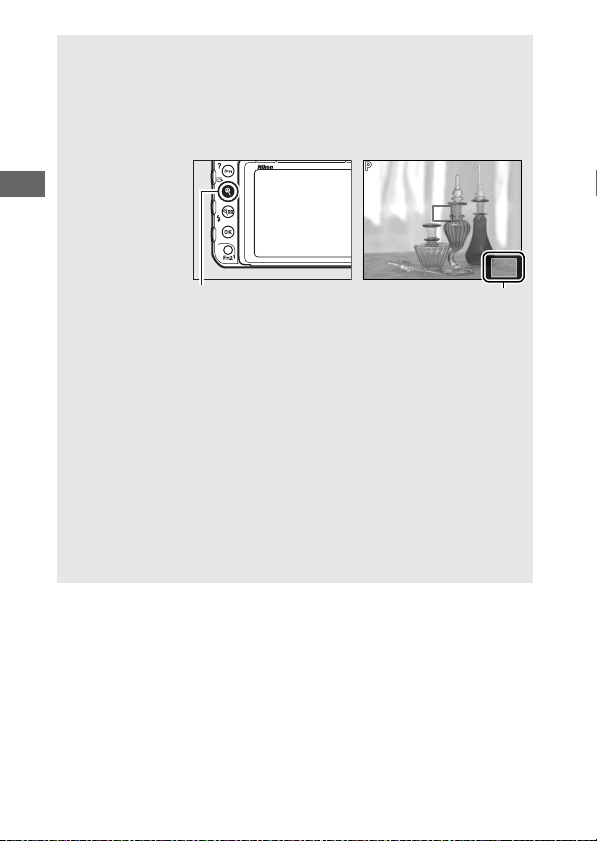
46
A Live View Zoom Preview
Press the X button to magnify the view in the monitor up to a
maximum of about 11×.
A navigation window will appear in a gray
frame at the bottom right corner of the display.
Use the multi selector
to scroll to areas of the frame not visible in the monitor, or press W (M)
to zoom out.
X button Navigation window
A HDMI
If the camera is connected to an HDMI video device during live view
photography, the camera monitor will remain on and the video device
will display the view through the lens.
A See Also
See Custom Setting c4 (Monitor off delay, 0 296) for information on
choosing how long the monitor remains on during live view.
For
information on choosing the roles played by the movie-record button
and command dials and by the center of the multi selector, see Custom
Settings f1 (Custom control assignment) > Movie record button + y
(0 301) and f2 (Multi selector center button, 0 301).
For
information on preventing unintended operation of the a button, see
Custom Setting f8 (Live view button options, 0 303).
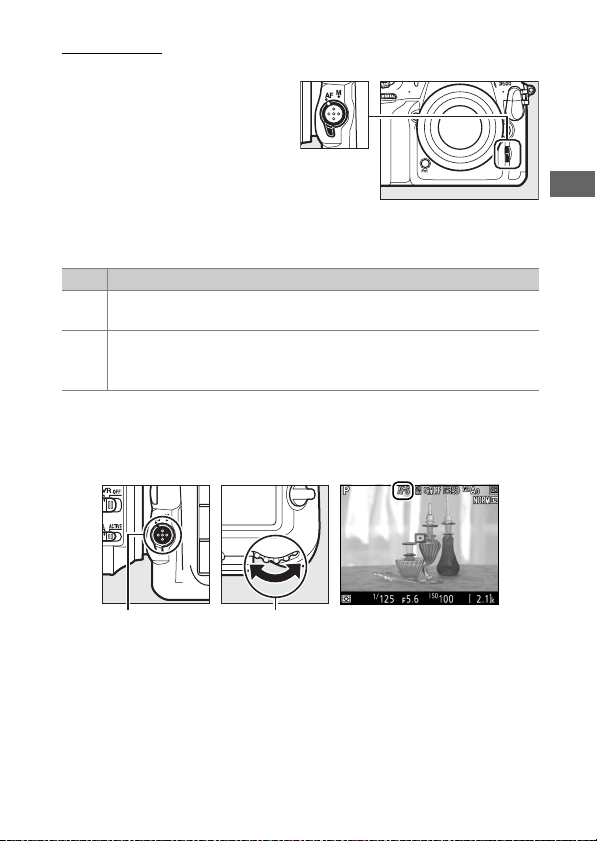
47
Autofocus
To take pictures using
autofocus, rotate the focus-
mode selector to AF.
❚❚ Choosing a Focus Mode
The following autofocus modes are available in live view:
To choose an autofocus mode, press the AF-mode button and
rotate the main command dial until the desired mode is
displayed in the monitor.
Mode Description
AF-S
Single-servo AF: For stationary subjects.
Focus locks when shutter-
release button is pressed halfway.
AF-F
Full-time-servo AF: For moving subjects.
Camera focuses
continuously until shutter-release button is pressed.
Focus locks
when shutter-release button is pressed halfway.
AF-mode button Main command
dial
Monitor
Focus-mode selector
48
❚❚ Choosing an AF-Area Mode
The following AF-area modes can be selected in live view:
Mode Description
!
Face-priority AF: Use for portraits.
The camera automatically
detects and focuses on portrait subjects; the selected subject is
indicated by a double yellow border (if multiple faces, up to a
maximum of 35, are detected, the camera will focus on the
closest subject; to choose a different subject, use the multi
selector).
If the camera can no longer detect the subject
(because, for example, the subject has turned to face away from
the camera), the border will no longer be displayed.
5
Wide-area AF: Use for hand-held shots of landscapes and other
non-portrait subjects.
Use the multi selector to move the focus
point anywhere in the frame, or press the center of the multi
selector to position the focus point in the center of the frame.
6
Normal-area AF: Use for pin-point focus on a selected spot in the
frame.
Use the multi selector to move the focus point anywhere
in the frame, or press the center of the multi selector to position
the focus point in the center of the frame.
A tripod is
recommended.
&
Subject-tracking AF: Position the focus point over your subject and
press the center of the multi selector.
The focus point will track
the selected subject as it moves through the frame.
To end
tracking, press the center of the multi selector again.
Note that
the camera may be unable to track subjects if they move quickly,
leave the frame or are obscured by other objects, change visibly
in size, color, or brightness, or are too small, too large, too bright,
too dark, or similar in color or brightness to the background.
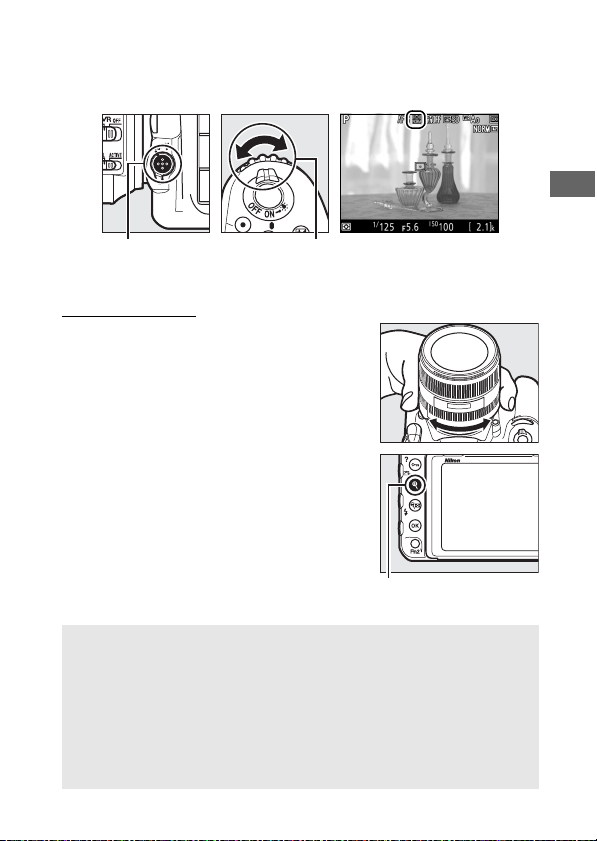
49
To choose an AF-area mode, press the AF-mode button and
rotate the sub-command dial until the desired mode is displayed
in the monitor.
Manual Focus
To focus in manual focus mode (0 114),
rotate the lens focus ring until the
subject is in focus.
To magnify the view in
the monitor for precise focus, press the X
button (0 46).
AF-mode button Sub-command
dial
Monitor
A Previewing Focus During Live View
To temporarily select maximum aperture for an improved focus
preview during live view, press the Pv button; the maximum aperture
indicator (0 53) will be displayed.
To return aperture to its original
value, press the button again or focus using autofocus.
If the shutter-
release button is pressed all the way down to take a picture during
focus preview, aperture will return to the original value before the
photo is taken.
X button
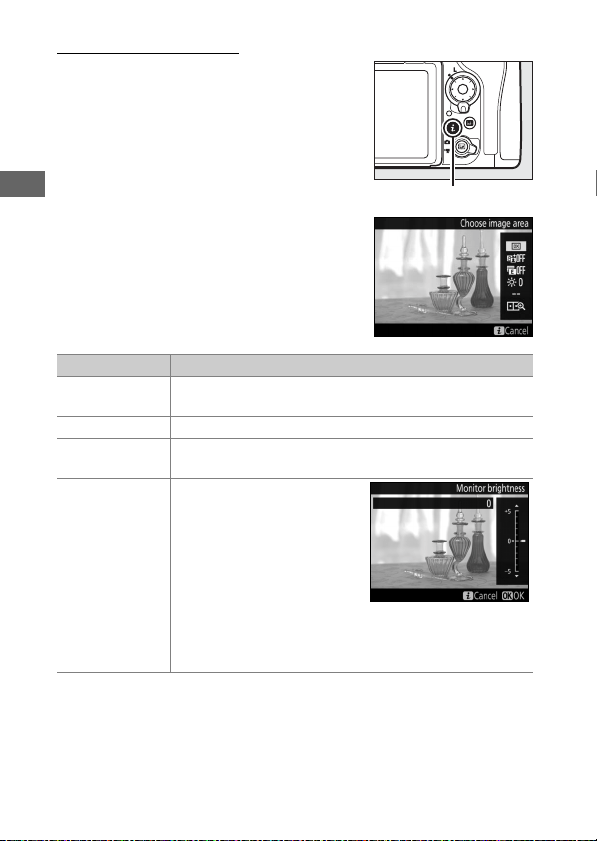
50
Using the i Button
The options listed below can be accessed
by pressing the i button during live view
photography.
Highlight items using the
multi selector and press 2 to view
options for the highlighted item.
After
choosing the desired setting, press J to
return to the i-button menu.
Press the i
button again to exit to the shooting
display.
Option Description
Choose image area
Choose an image area for live view photography
(0 88).
Active D-Lighting Adjust Active D-Lighting (0 189).
Electronic front-
curtain shutter
Enable or disable the electronic front-curtain shutter
for mirror-up photography (0 298).
Monitor
brightness
Press 1 or 3 to adjust
monitor brightness for live
view (note that this affects
live view only and has no
effect on photographs or
movies or on the brightness
of the monitor for menus or
playback; to adjust the brightness of the monitor for
menus and playback, use the Monitor brightness
option in the setup menu as described on page 304).
i button
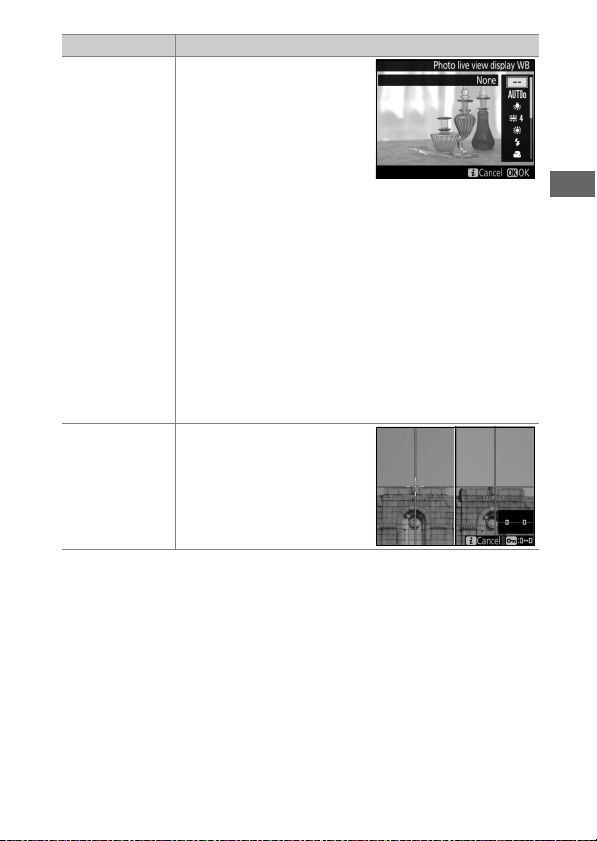
51
Photo live view
display WB
During live view
photography, the white
balance (hue) of the
monitor can be set to a
value different from that
used for photographs
(0 159).
This can be
effective if the lighting under which shots are framed
is different from that used when the photographs are
taken, as is sometimes the case when a flash or preset
manual white balance is used.
Adjusting the photo
live view display white balance to produce a similar
effect to that used for the actual photographs makes
it easier to picture the results.
To use the same white
balance for both the view in the monitor and the
photograph, select None.
Monitor white balance is
reset when the camera is turned off, but the last value
used can be selected by pressing the a button while
pressing and holding the U button.
Split-screen
display zoom
View two separate areas of
the frame side-by-side
(0 52).
This option can be
used, for example, to align
buildings with the horizon.
Option Description
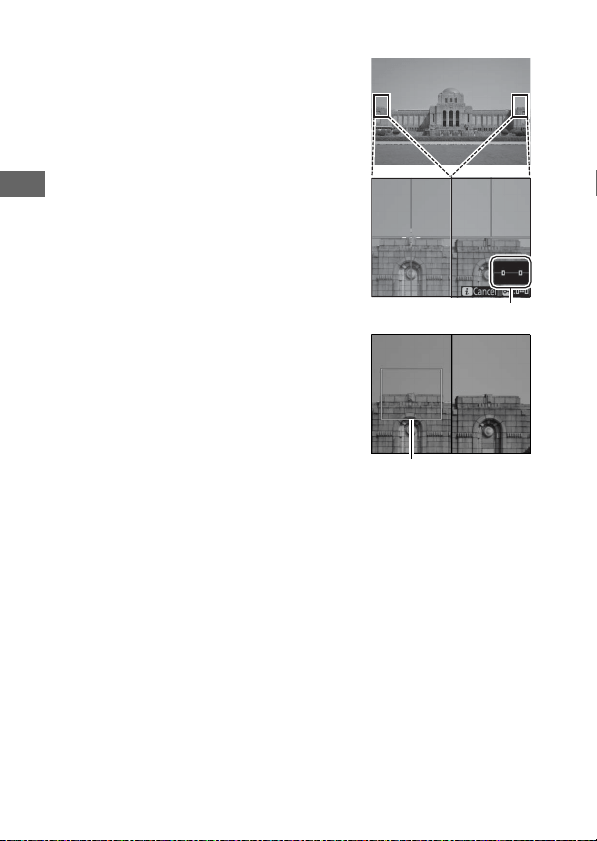
52
❚❚ Split-Screen Display Zoom
Selecting Split-screen display zoom in
the live view photography i button
menu splits the display into two boxes
showing separate areas of the frame
side-by-side at a high zoom ratio.
The
positions of the magnified areas are
shown in the navigation window.
Use the X and W (M) buttons to zoom in
and out, or use the L (Z/Q) button to
select a box and press 4 or 2 to scroll
the selected area left or right.
Pressing 1
or 3 scrolls both areas up or down
simultaneously.
To focus on the subject
at the center of the selected area, press
the shutter-release button halfway.
To
exit the split-screen display, press the i button.
Navigation window
Area in focus
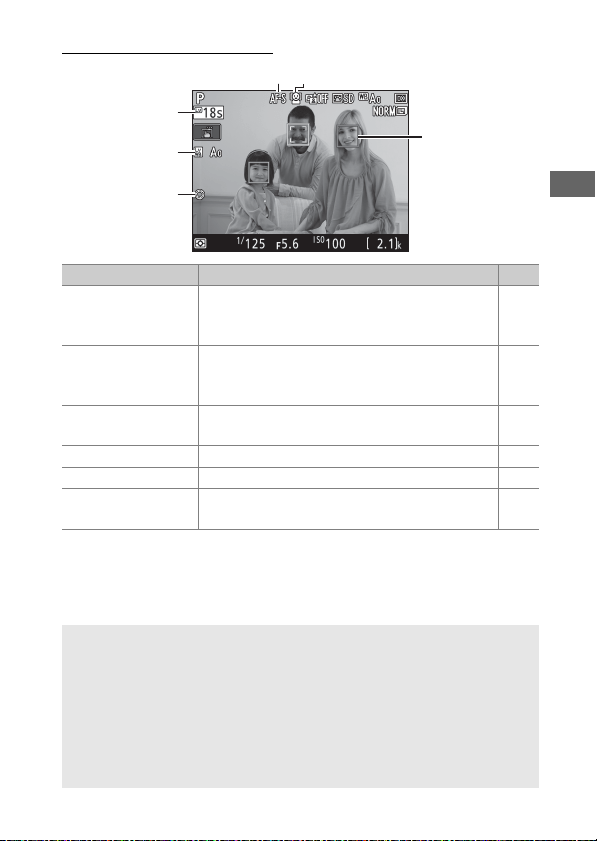
53
The Live View Display
Item Description 0
q
Time remaining
The amount of time remaining before live
view ends automatically.
Displayed if
shooting will end in 30 s or less.
—
w
Photo live view
display white
balance indicator
Monitor hue (photo live view display white
balance).
51
e
Maximum
aperture indicator
Displayed when the Pv button is pressed to
select maximum aperture.
49
r
Autofocus mode The current autofocus mode. 47
t
AF-area mode The current AF-area mode. 48
y
Focus point
The current focus point.
The display varies
with the option selected for AF-area mode.
48
D The Count Down Display
A count down will be displayed 30 s before live view ends
automatically (the timer turns red if live view is about to end to protect
the internal circuits or, if an option other than No limit is selected for
Custom Setting c4—Monitor off delay > Live view; 0 296—5 s
before the monitor is due to turn off automatically).
Depending on
shooting conditions, the timer may appear immediately when live
view is selected.
tr
y
q
w
e
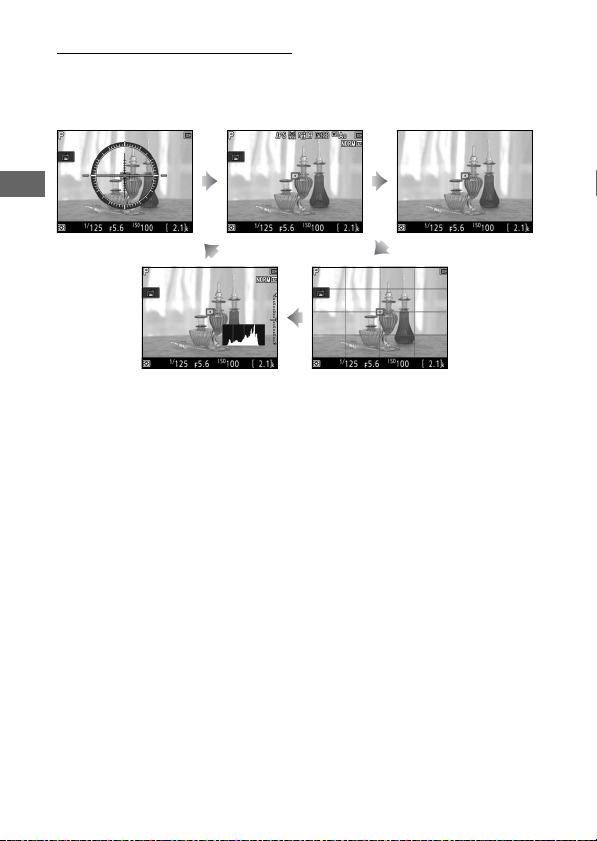
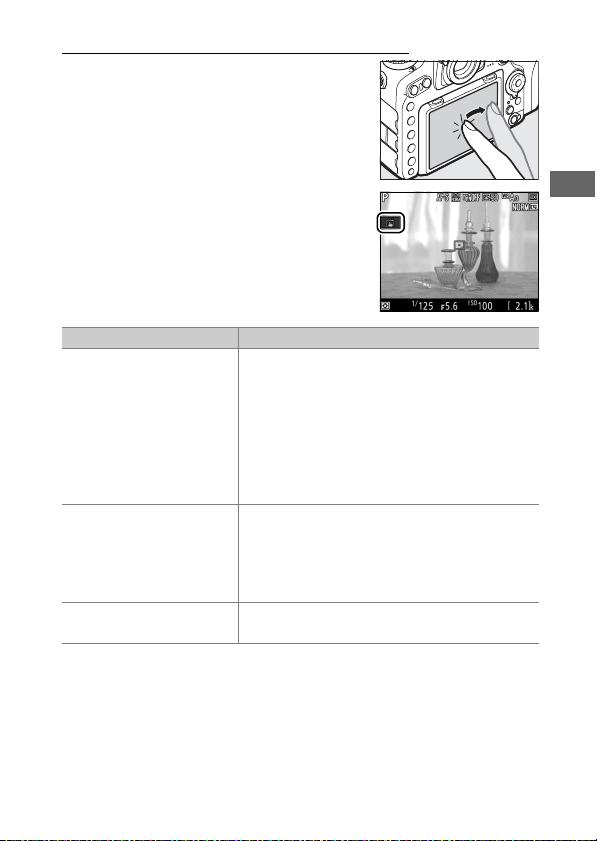
55
Touch Photography (Touch Shutter)
Touch the monitor to focus and lift your
finger to take the photograph.
Tap the icon shown at right to choose
the operation performed by tapping the
monitor in shooting mode.
Choose from
the following options:
Option Description
W
(Touch shutter/AF:
On)
Touch the monitor to position the focus
point and focus (autofocus only; the touch
shutter can not be used to focus when the
focus-mode selector is rotated to M to select
manual focus as described on page 114).
Focus locks while your finger remains on the
monitor; to release the shutter, lift your
finger from the screen.
V
(Touch AF: On)
As above, except that lifting your finger from
the screen does not release the shutter.
If
subject tracking (0 48) is active, you can
focus on the current subject by tapping the
monitor.
X
(Touch shutter/AF:
Off)
Touch shutter and AF disabled.
56
D Taking Pictures Using Tap Shooting Options
Avoid moving the camera when releasing the shutter.
Camera
movement can result in blurred photographs.
The shutter-release button can be used to focus and take pictures even
when the W icon is displayed to show that touch shooting options are
active.
Use the shutter-release button to take photographs in
continuous shooting mode (0 116) and during movie recording.
Touch shooting options can be used only to take pictures one at a time
in continuous shooting mode and can not be used to take
photographs during movie recording.
The touch screen can not be used to position the focus point when the
focus selector lock is in the L (lock) position (0 108), but it can still be
used to select the subject when face-priority AF is selected for AF-area
mode (0 48).
In self-timer mode (0 119), focus locks on the selected subject when
you touch the monitor and the timer starts when you lift your finger
from the screen.
At default settings, the shutter is released about 10 s
after the timer starts; the delay and number of shots can be changed
using Custom Setting c3 (Self-timer, 0 296).
If the option selected for
Number of shots is greater than 1, the camera will automatically take
pictures one after the other until the selected number of shots is
recorded.

57
D Shooting in Live View
To prevent light entering via the viewfinder from interfering with
photographs or exposure, close the viewfinder eyepiece shutter
(0 119).
Although they will not appear in the final picture, jagged edges, color
fringing, moiré, and bright spots may appear in the monitor, while
bright bands may appear in some areas with flashing signs and other
intermittent light sources or if the subject is briefly illuminated by a
strobe or other bright, momentary light source.
In addition, distortion
may occur if the camera is panned horizontally or an object moves at
high speed through the frame.
Flicker and banding visible in the
monitor under fluorescent, mercury vapor, or sodium lamps can be
reduced using the Flicker reduction option in the movie shooting
menu (0 290), although they may still be visible in the final
photograph at some shutter speeds.
When shooting in live view, avoid
pointing the camera at the sun or other strong light sources.
Failure to
observe this precaution could result in damage to the camera’s internal
circuitry.
Regardless of the option selected for Custom Setting c2 (Standby
timer, 0 296), the standby timer will not expire during shooting.
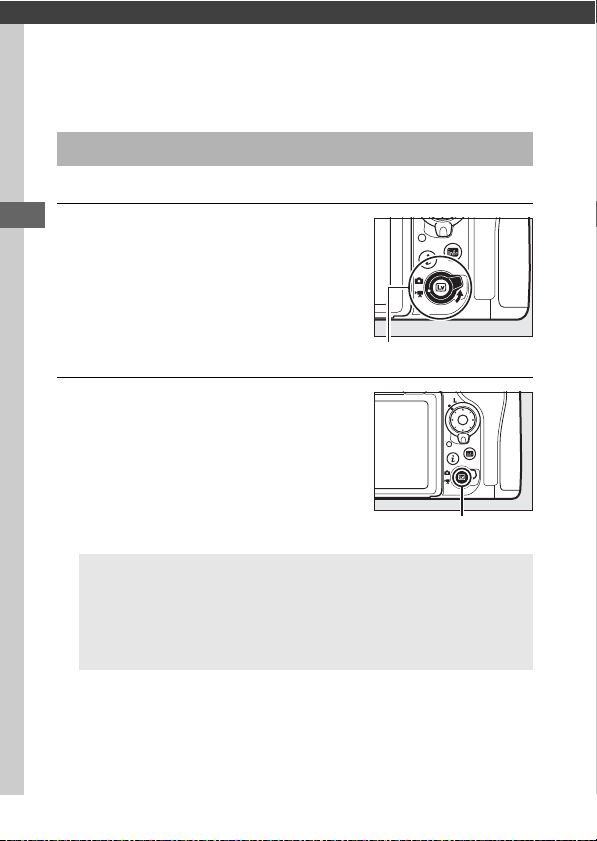
58
Movies
Read this section for information on recording and viewing
movies.
Movies can be recorded in live view.
1 Rotate the live view selector to
1 (movie live view).
2 Press the a button.
The mirror will be raised and the view
through the lens will be displayed in
the camera monitor, modified for the
effects of exposure.
The subject will
no longer be visible in the viewfinder.
Recording Movies
D The 0 Icon
A 0 icon (0 66) indicates that movies can not be recorded.
A White Balance
White balance can be set at any time by pressing the U button
and rotating the main command dial (0 159).
Live view selector
a button
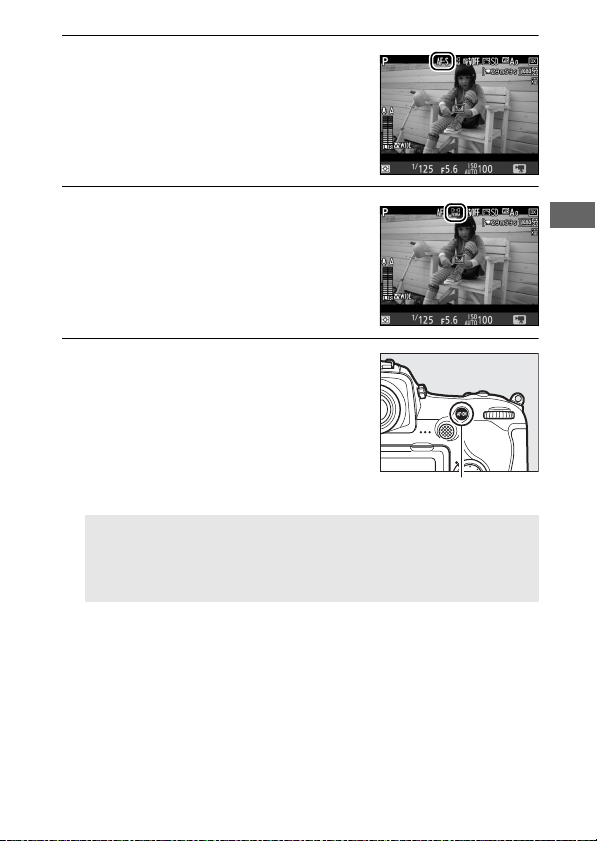
59
3 Choose a focus mode (0 47).
4 Choose an AF-area mode (0 48).
5 Focus.
Frame the opening shot and press the
AF-ON button to focus.
Note that the
number of subjects that can be
detected in face-priority AF drops
during movie recording.
A Focusing
Focus can also be adjusted by pressing the shutter-release button
halfway before beginning recording, or you can focus manually as
described on page 49.
AF-ON button
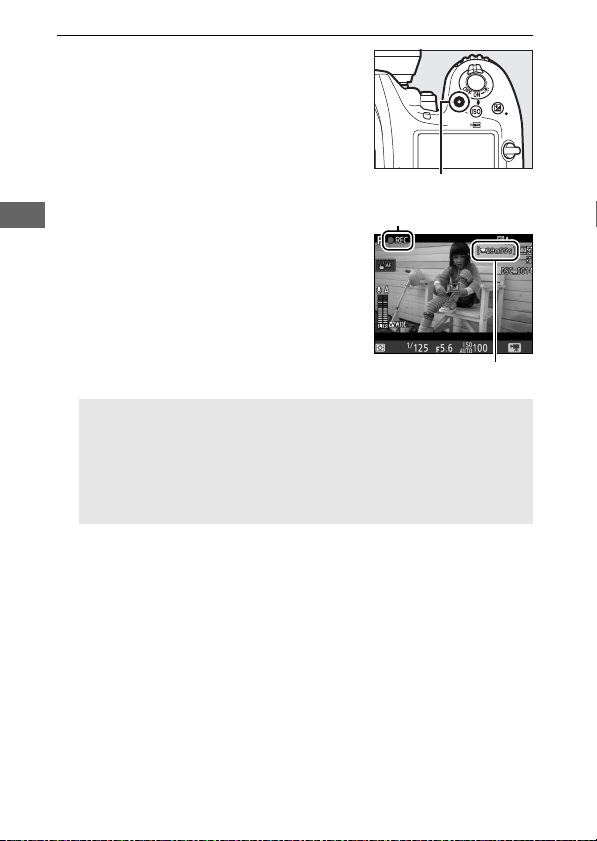
60
6 Start recording.
Press the movie-record button to start
recording.
A recording indicator and
the time available are displayed in the
monitor.
Exposure can be locked by
pressing the center of the sub-
selector (0 141) or altered by up to
±3 EV using exposure compensation
(0 143); spot metering is not
available.
In autofocus mode, the
camera can be refocused by pressing
the AF-ON button or by tapping your
subject in the monitor.
A Audio
The camera can record both video and sound; do not cover the
microphone on the front of the camera during movie recording.
Note that the built-in microphone may record sounds made by the
camera or lens during autofocus, vibration reduction, or changes to
aperture.
Movie-record button
Recording indicator
Time remaining
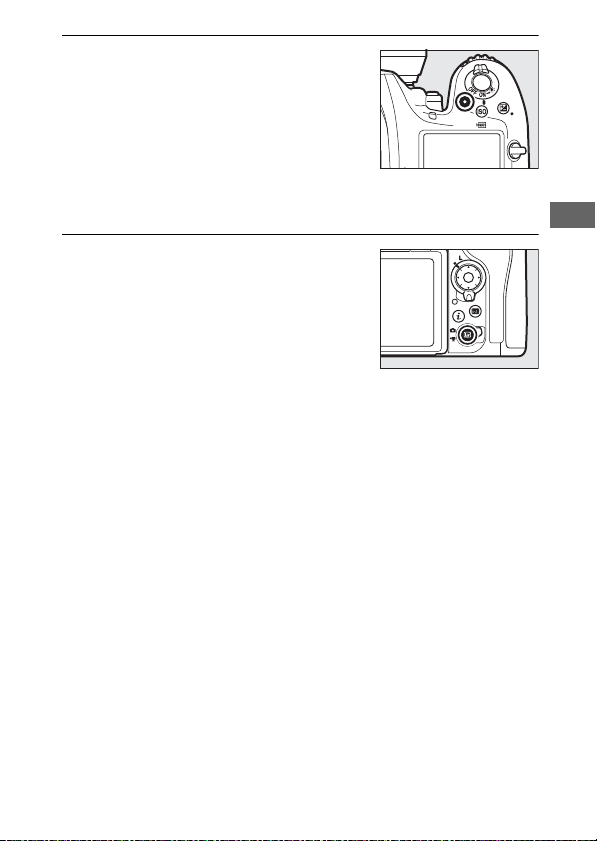
61
7 End recording.
Press the movie-record button again
to end recording.
Recording will end
automatically when the maximum
length is reached, or the memory card
is full (note that depending on
memory card write speed, shooting
may end before the maximum length is reached).
8 Exit live view.
Press the a button to exit live view.
62
A Exposure Mode
The following exposure settings can be adjusted in movie mode:
Aperture Shutter speed ISO sensitivity
P, S — — —
1, 2
A ✔ — —
1, 2
M ✔ ✔ ✔
2, 3
1 The upper limit for ISO sensitivity can be selected using the ISO sensitivity
settings > Maximum sensitivity option in the movie shooting menu (0 289).
2 Regardless of the option chosen for ISO sensitivity settings > Maximum
sensitivity or for ISO sensitivity (mode M), the upper limit when On is
selected for Electronic VR in the movie shooting menu is ISO 51200.
3If On is selected for ISO sensitivity settings > Auto ISO control (mode
M) in the movie shooting menu, the upper limit for ISO sensitivity can be selected using the
Maximum sensitivity option.
In exposure mode M, shutter speed can be set to values between
1
/
25 s
and
1
/
8000 s (the slowest available shutter speed varies with the frame
rate; 0 68).
In other exposure modes, shutter speed is adjusted
automatically.
If the subject is over- or under-exposed in mode P or S,
end live view and start live view again or select exposure A and adjust
aperture.
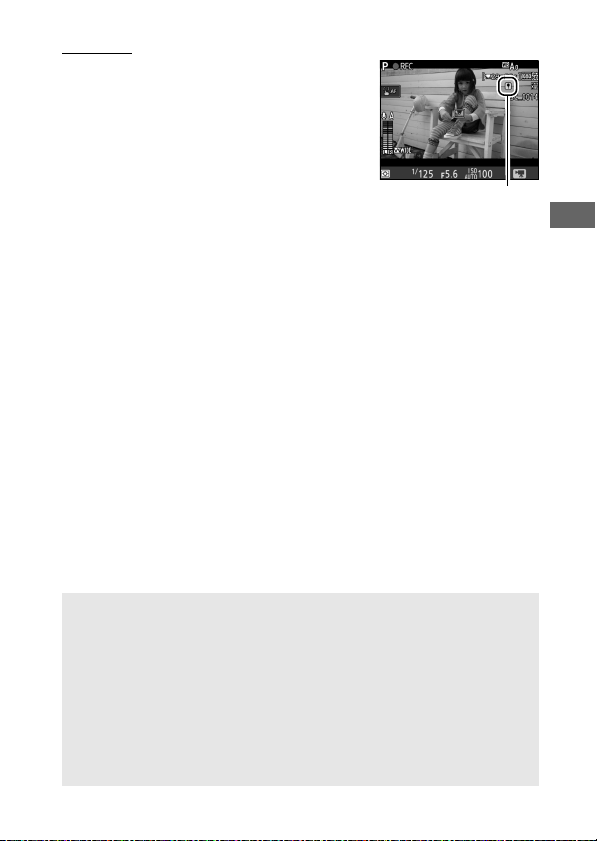
63
Indices
If Index marking is assigned to a control
using Custom Setting g1 (Custom
control assignment, 0 303), you can
press the selected control during
recording to add indices that can be used
to locate frames during editing and
playback (0 81).
Up to 20 indices can be
added to each movie.
A See Also
The role played by the center of the multi selector can be chosen using
Custom Setting f2 (Multi selector center button;
0 301) and the roles
of the Fn1, Fn2, and Pv buttons and the center of the sub-selector using
Custom Setting g1 (Custom control assignment;
0 303).
Custom
Setting g1 (Custom control assignment) > Shutter-release button
controls whether the shutter-release button can be used to start live
view or to start and end movie recording.
For information on
preventing unintended operation of the a button, see Custom
Setting f8 (Live view button options;
0 303).
Index
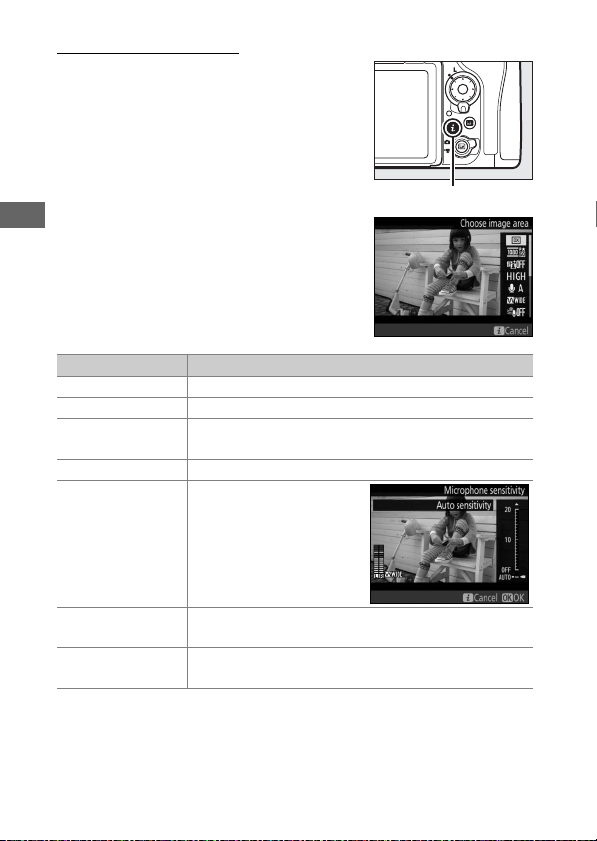
64
Using the i Button
The options listed below can be accessed
by pressing the i button in movie mode.
Highlight items using the multi selector
and press 2 to view options for the
highlighted item.
After choosing the
desired setting, press J to return to the
i-button menu.
Press the i button again
to exit to the shooting display.
Option Description
Choose image area Choose image area for movies (0 70).
Frame size/frame rate Select a frame size and rate (0 68).
Active D-Lighting
Adjust Active D-Lighting (0 189).
Not available at a
frame size of 3840 × 2160 (0 68).
Movie quality Choose movie quality (0 68).
Microphone
sensitivity
Press 1 or 3 to adjust
microphone sensitivity
(0 290).
Both the built-
in and external
microphones (0 336) are
affected.
Frequency response
Control the frequency response of the built-in or
external microphones (0 291).
Wind noise reduction
Enable or disable wind noise reduction using the
built-in microphone’s low-cut filter (0 291).
i button
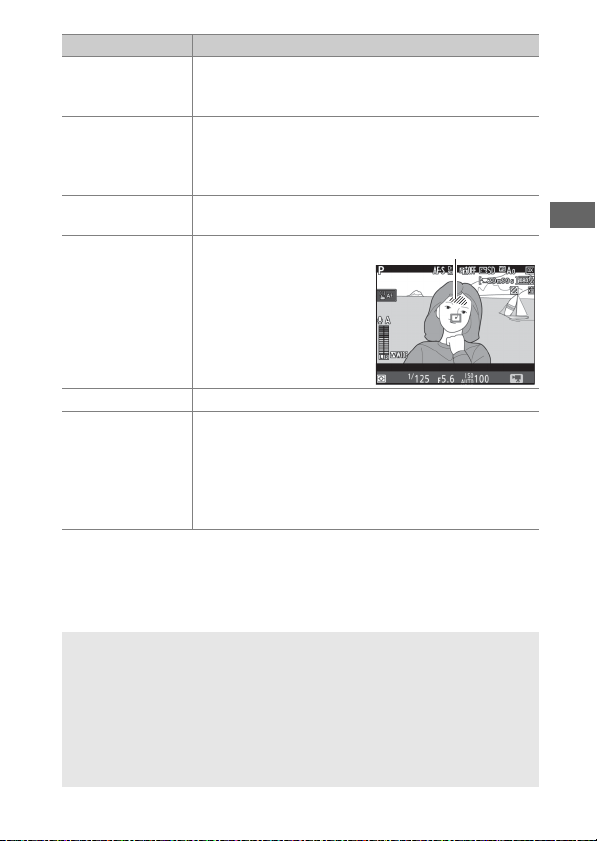
65
Destination
When two memory cards are inserted, you can
choose the card to which movies are recorded
(0 288).
Monitor brightness
Press 1 or 3 to adjust monitor brightness (note
that this affects live view only and has no effect on
photographs or movies or on the brightness of the
monitor for menus or playback; 0 50).
Multi-selector
power aperture
Select Enable to enable power aperture.
Press 1
to widen the aperture, 3 to narrow the aperture.
Highlight display
Choose whether the
brightest areas of the
frame (highlights) are
shown by slanting lines
in the display.
Headphone volume
Press 1 or 3 to adjust headphone volume.
Electronic VR
Select On to enable electronic vibration reduction
in movie mode.
Not available at a frame size of
3840 × 2160 (0 68).
Note that if the electronic
vibration reduction is on and DX is selected for
Choose image area, the angle of view is reduced
and the edges of the frame will be cropped out.
A Using an External Microphone
The optional ME-1 stereo microphone or ME-W1 wireless microphone
can be used to record sound for movies (0 336).
A Headphones
Third-party headphones can be used.
Note that high sound levels may
result in high volume; particular care should be taken when
headphones are used.
Option Description
Highlights

66
The Live View Display
Item Description 0
q
“No movie” indicator
Indicates that movies can not be
recorded.
—
w
Headphone volume
Volume of audio output to headphones.
Displayed when third-party headphones
are connected.
67
e
Microphone sensitivity Microphone sensitivity. 64
r
Sound level
Sound level for audio recording.
Displayed in red if level is too high; adjust
microphone sensitivity accordingly.
—
t
Frequency response The current frequency response. 64
y
Wind noise reduction
Displayed when wind noise reduction is
on.
64
u
Time remaining The recording time available for movies. 60
i
Movie frame size The frame size for movie recording. 68
o
Electronic VR indicator
Displayed when electronic vibration
reduction is on.
65
!0
Highlight display
indicator
Displayed when highlight display is on. 65
!1
“No power aperture”
indicator
Indicates that power aperture is
unavailable.
65
w
e
r
t
u
q
y
i
o
!0
!1
67
D The Count-Down Display
A count down will be displayed 30 s before live view ends
automatically (0 53).
Depending on shooting conditions, the timer
may appear immediately when movie recording begins.
Note that
regardless of the amount of recording time available, live view will still
end automatically when the timer expires.
Wait for the internal circuits
to cool before resuming movie recording.
A Adjusting Settings During Movie Recording
Headphone volume can not be adjusted during recording.
If an option
other than I (microphone off) is currently selected, microphone
sensitivity can be changed to any setting other than I while recording
is in progress.
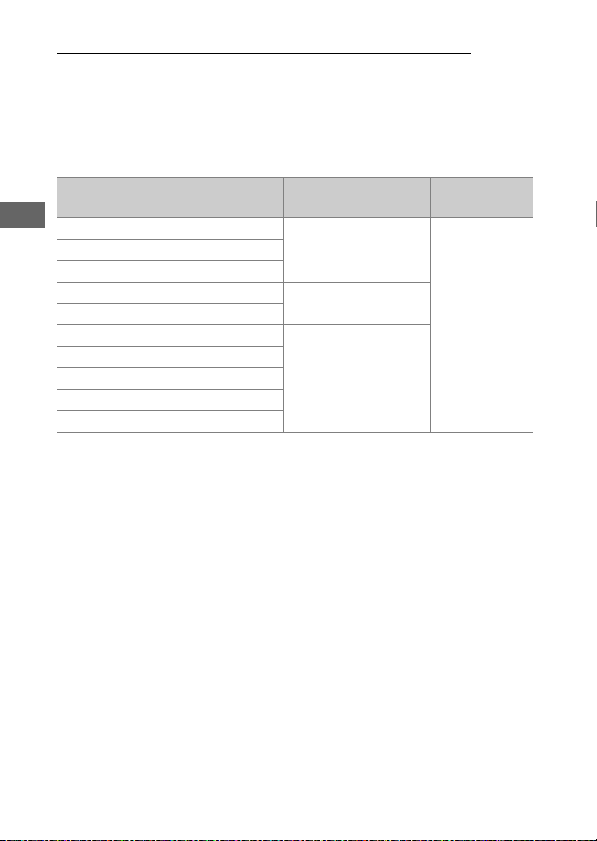
68
Frame Size, Frame Rate, and Movie Quality
The Frame size/frame rate option in the movie shooting menu
is used to choose the movie frame size (in pixels) and frame rate.
You can also choose from two Movie quality options: high and
normal.
Together, these options determine the maximum bit
rate, as shown in the following table.
Option
1
Maximum bit rate (Mbps)
(★ high quality/Normal)
Maximum
length
r
3840 × 2160 (4K UHD); 30p
2
144
29 min. 59 s
3
s
3840 × 2160 (4K UHD); 25p
2
t
3840 × 2160 (4K UHD); 24p
2
y/y
1920 × 1080; 60p
48/24
z/z
1920 × 1080; 50p
1/1
1920 × 1080; 30p
24/12
2/2
1920 × 1080; 25p
3/3
1920 × 1080; 24p
4/4
1280 × 720; 60p
5/5
1280 × 720; 50p
1Actual frame rate is 29.97 fps for values listed as 30p, 23.976 fps for values listed as 24p, and
59.94 fps for values listed as 60p.
2 When this option is selected, k is displayed in the monitor and movie quality is fixed at
“high”.
3 Each movie will be recorded across up to 8 files of up to 4 GB each.
The number of files and the
length of each file vary with the options selected for Frame size/frame rate and
Movie quality.
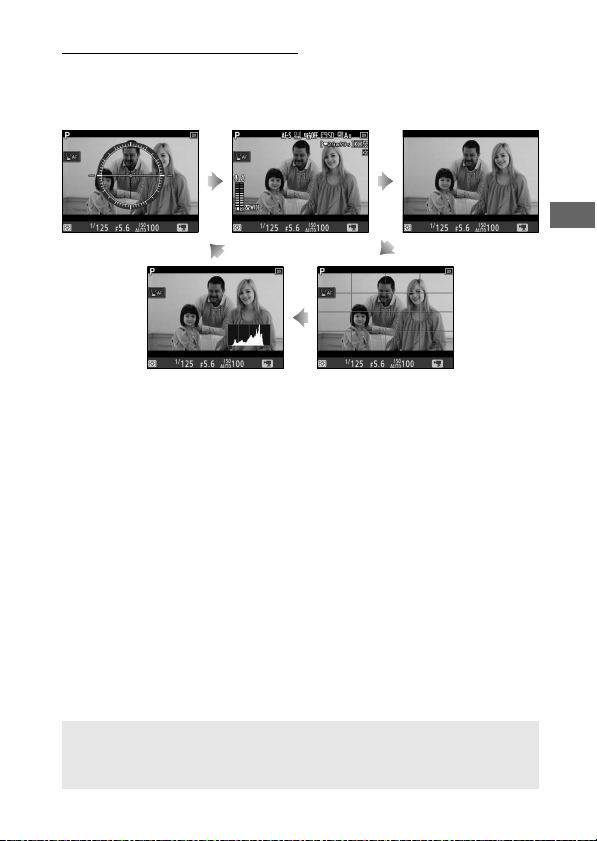
69
The Information Display
To hide or display indicators in the monitor, press the R button.
Virtual horizon
(0 305) Information on Information off
Histogram Framing guides
A HDMI
If the camera is connected to an HDMI device, the view through the
lens will appear both in the camera monitor and on the HDMI device.
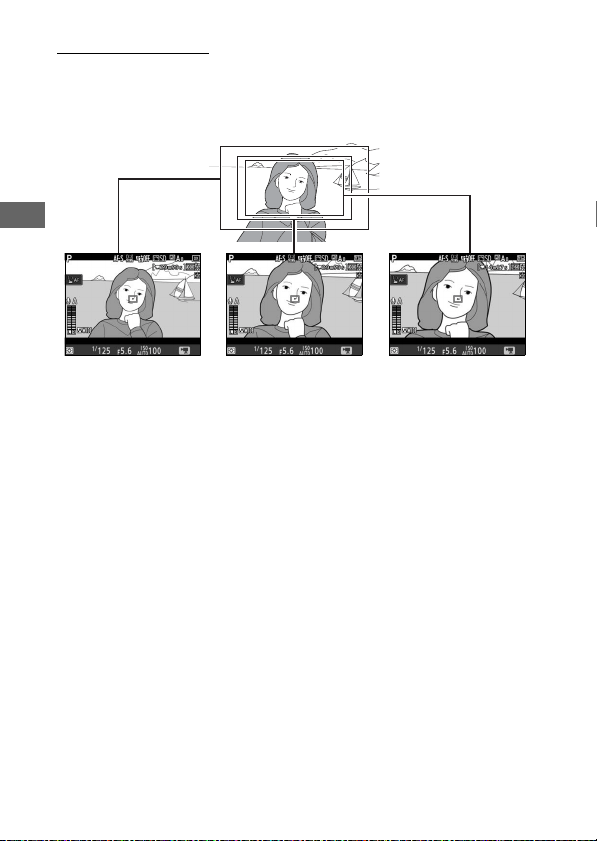
70
The Movie Crop
Movies have an aspect ratio of 16 : 9 and are recorded using a
crop that varies with the frame size and the option selected for
Choose image area in the movie shooting menu (0 68, 288).
Movie crop sizes are given below:
• At a frame size of 3840 × 2160, the movie crop is approximately
16.2 × 9.1 mm, regardless of the option selected for Choose
image area.
The apparent focal length is approximately 1.5×
greater than that for DX format.
• With DX selected for Choose image area and a frame size of
1920 × 1080 or 1280 × 720, the movie crop is approximately
23.5 × 13.3 mm.
• With 1.3× selected for Choose image area and a frame size of
1920 × 1080 or 1280 × 720, the movie crop is approximately
18.0 × 10.1 mm.
The apparent focal length is approximately
1.3× greater than that for DX format.
1920 × 1080 and
1280 × 720 (DX)
1920 × 1080 and
1280 × 720 (1.3×)
3840 × 2160
71
Taking Photos in Movie Mode
To take photos in movie mode (either in live view or
during movie recording), select Take photos for
Custom Setting g1 (Custom control assignment) >
Shutter-release button (0 303).
Photos with an
aspect ratio of 16 : 9 can then be taken at any time by pressing
the shutter-release button all the way down.
If movie recording
is in progress, recording will end and the footage recorded to
that point will be saved.
Except at a frame size of 3840 × 2160 (0 68), photographs are
recorded in the format selected for Image quality in the photo
shooting menu (0 91); photos taken at a frame size of
3840 × 2160 are recorded at an image quality of JPEG fine★.
For
information on image size, see page 72.
Note that the exposure
for photographs can not be previewed when the live view
selector is rotated to 1; mode P, S, or A is recommended but
accurate results can be achieved in mode M by previewing
exposure with the live view selector rotated to C.
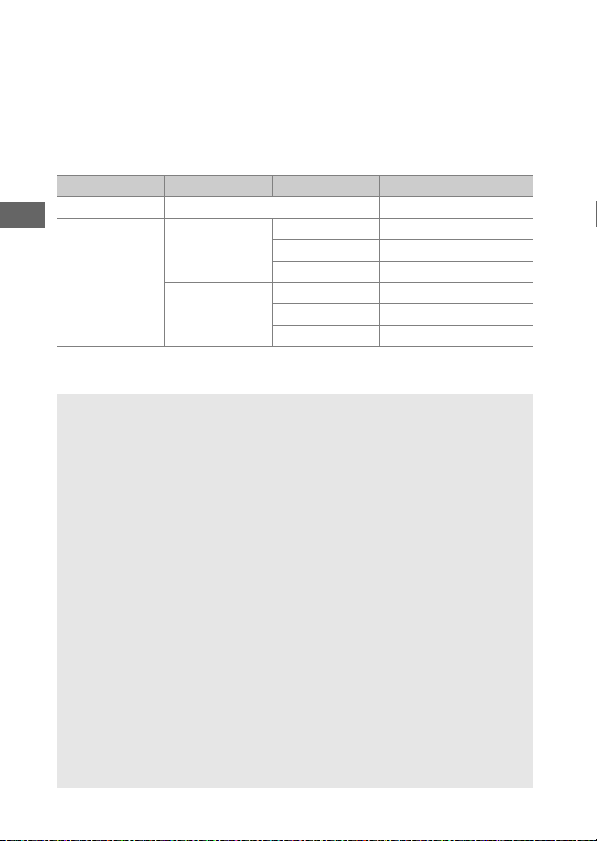
72
❚❚ Image Size
The size of photos taken in movie mode varies with the movie
frame size (0 68) and, in the case of photos taken at frame sizes
of 1920 × 1080 and 1280 × 720, with the image area and the
option selected for Image size > JPEG/TIFF in the photo
shooting menu (0 94).
Frame size Image area Image size Size (pixels)
3840 × 2160 — 3840 × 2160
1920 × 1080
1280 × 720
DX
Large 5568 × 3128
Medium 4176 × 2344
Small 2784 × 1560
1.3×
Large 4272 × 2400
Medium 3200 × 1800
Small 2128 × 1192
D Recording Movies
Movies are recorded in the sRGB color space.
Flicker, banding, or
distortion may be visible in the monitor and in the final movie under
fluorescent, mercury vapor, or sodium lamps or if the camera is panned
horizontally or an object moves at high speed through frame (for
information on reducing flicker and banding, see Flicker reduction,
0 290).
Flicker may also appear while power aperture is in use.
Jagged edges, color fringing, moiré, and bright spots may also appear.
Bright bands may appear in some areas of the frame with flashing
signs and other intermittent light sources or if the subject is briefly
illuminated by a strobe or other bright, momentary light source.
When
recording movies, avoid pointing the camera at the sun or other strong
light sources.
Failure to observe this precaution could result in
damage to the camera’s internal circuitry.
Note that noise (randomly-
spaced bright pixels, fog, or lines) and unexpected colors may appear
if you zoom in on the view through the lens (0 46) in movie mode.
Flash lighting can not be used.
Recording ends automatically if the lens is removed or the live view
selector is rotated to a new setting.

73
A Wireless Remote Controllers and Remote Cords
If Record movies is selected for Custom Setting g1 (Custom control
assignment) > Shutter-release button (0 303), the shutter-release
buttons on optional wireless remote controllers and remote cords
(0 335, 336) can be used to start live view and to start and end movie
recording.
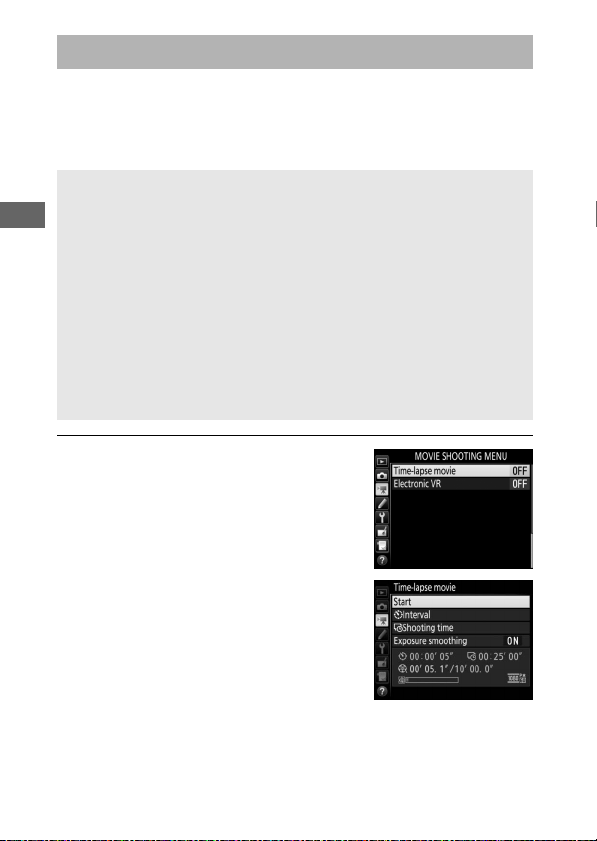
74
The camera automatically takes photos at selected intervals to
create a silent time-lapse movie using the options currently
selected for Choose image area, Frame size/frame rate, Movie
quality, and Destination in the movie shooting menu (0 288).
1 Select Time-lapse movie.
Highlight Time-lapse movie in the
movie shooting menu and press 2 to
display time-lapse movie settings.
Time-Lapse Movies
A Before Shooting
Before shooting a time-lapse movie, take a test shot at current settings
and view the results in the monitor (time-lapse movies are shot using
the movie crop; use live view so that you can check the composition).
For consistent coloration, choose a white balance setting other than
auto (0 159).
Use of a tripod is recommended.
Mount the camera on a tripod before
shooting begins.
To ensure that shooting is not interrupted, use an
optional AC adapter and power connector or a fully-charged battery.
To prevent light entering via the viewfinder interfering with
photographs and exposure, close the viewfinder eyepiece shutter
(0 119).
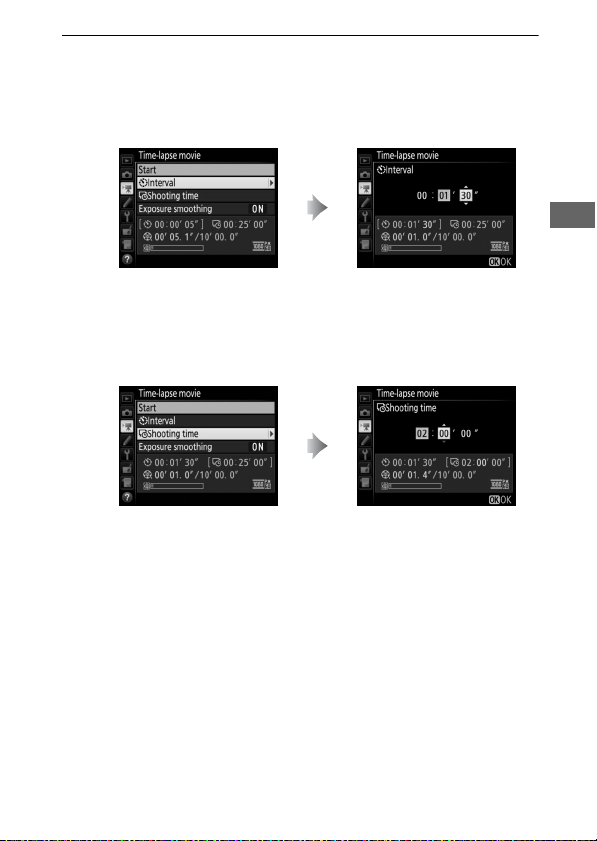
75
2 Adjust time-lapse movie settings.
Choose an interval, total shooting time, and exposure
smoothing option.
• To choose the interval between frames:
• To choose the total shooting time:
Highlight Interval and
press 2.
Choose an interval longer than
the slowest anticipated shutter
speed (minutes and seconds)
and press J.
Highlight Shooting time and
press 2.
Choose shooting time (up to
7hours 59minutes) and
press J.
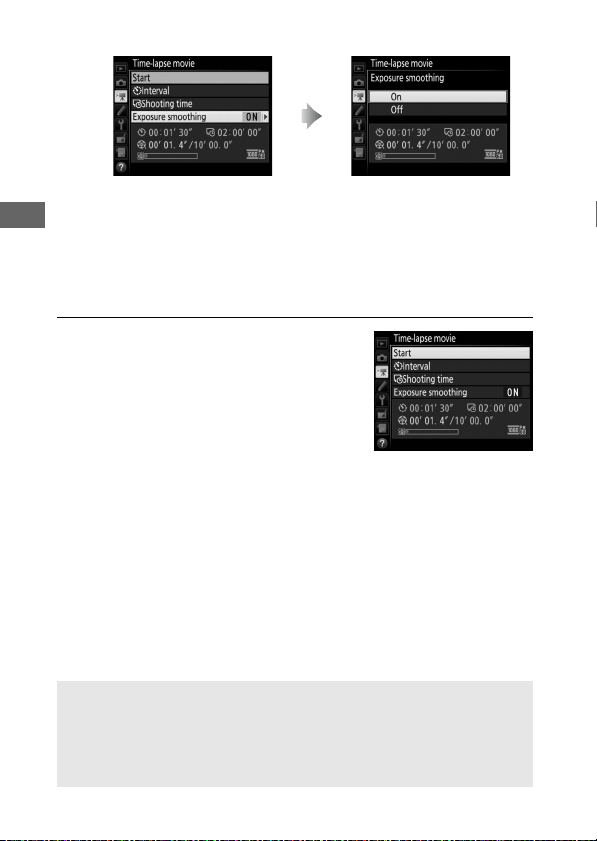
76
• To enable or disable exposure smoothing:
Selecting On smooths abrupt changes in exposure in
modes other than M (note that exposure smoothing only
takes effect in mode M if auto ISO sensitivity control is
enabled in the photo shooting menu).
3 Start shooting.
Highlight Start and press J.
Shooting starts after about 3 s.
The
camera takes photographs at the
selected interval for the selected
shooting time.
When complete, time-
lapse movies are recorded to the
memory card selected for Destination in movie shooting
menu (0 288).
Highlight Exposure smoothing
and press 2.
Highlight an option and
press J.
A 3840 × 2160
If an option with a frame size 3840 × 2160 is selected for Frame size/
frame rate in the movie shooting menu, the 1.3× DX crop indicator
and 1.3× DX crop will be displayed in the viewfinder; rotate the live
view selector to 1 and frame the shot in live view (0 70).
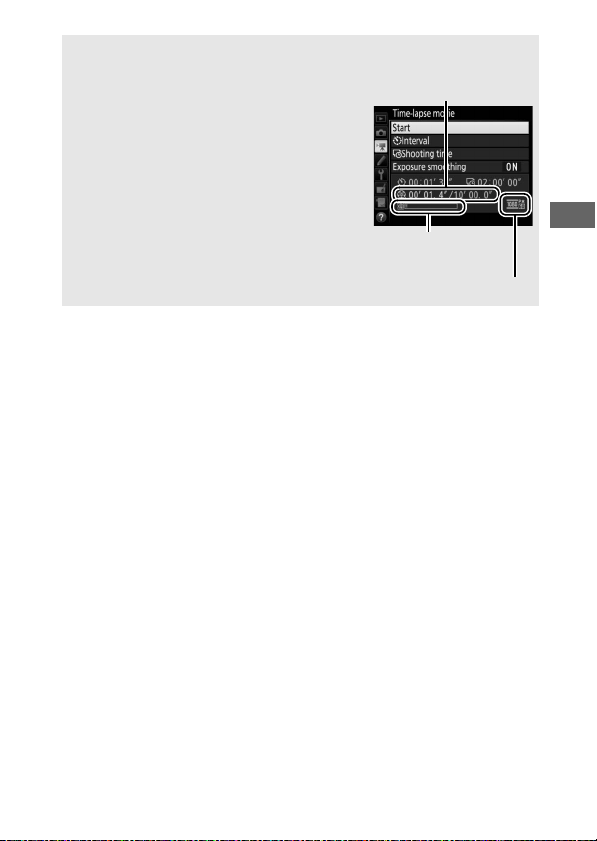
77
A Calculating the Length of the Final Movie
The total number of frames in the final
movie can be calculated by dividing the
shooting time by the interval and rounding
up.
The length of the final movie can then
be calculated by dividing the number of
shots by the frame rate selected for Frame
size/frame rate in movie shooting menu
(0 68).
A 48 frame movie recorded at
1920 × 1080; 24p, for example, will be
about two seconds long.
The maximum
length for time-lapse movies is 20 minutes.
Length recorded/
maximum length
Frame size/frame rate
Memory card
indicator

78
❚❚ Ending Shooting
To end shooting before all the photos are taken, highlight Off in
the time-lapse movie menu and press J, or press J between
frames or immediately after a frame is recorded.
A movie will be
created from the frames shot to the point where shooting
ended.
Note that shooting will end and no movie will be
recorded if the power source is removed or disconnected or the
destination memory card is ejected.
❚❚ No Photograph
The camera will skip the current frame if the camera is unable to
focus in AF-S (note that the camera focuses again before each
shot).
Shooting will resume with the next frame.
D Time-Lapse Movies
Time-lapse is not available during live view (0 43) or movie recording
(0 58), at a shutter speed of A or % (0 137) or when bracketing
(0 146), High Dynamic Range (HDR, 0 191), multiple exposure
(0 236), or interval timer photography (0 243) is active.
Note that
because shutter speed and the time needed to record the image to the
memory card may vary from shot to shot, the interval between a shot
being recorded and the start of the next shot may vary.
Shooting will
not begin if a time-lapse movie can not be recorded at current settings
(for example, if the memory card is full, the interval or shooting time is
zero, or the interval is longer than the shooting time).
Shooting may end if camera controls are used or settings are changed
or HDMI cable is connected.
A movie will be created from the frames
shot to the point where shooting ended.
To end shooting and record
a photograph, press the shutter-release button all the way down.
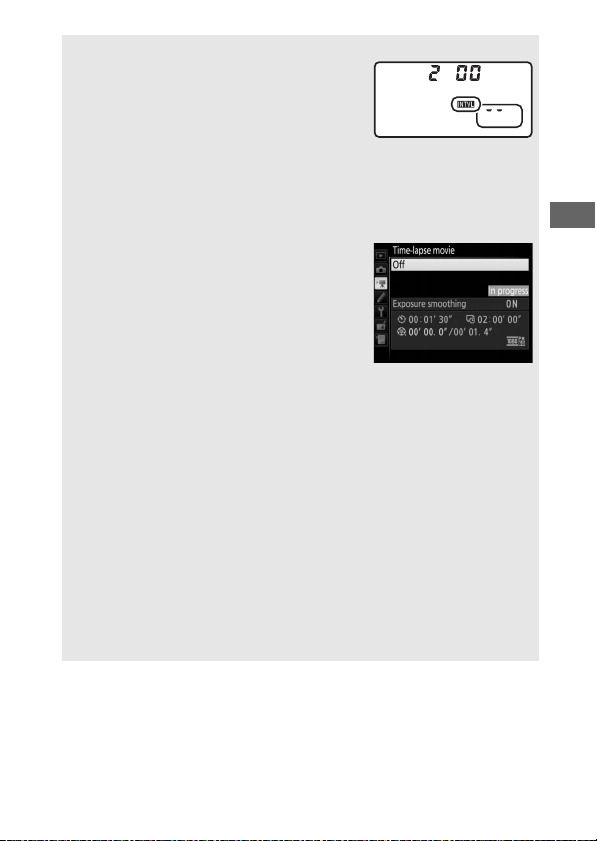
79
A During Shooting
During shooting, Q will flash and the
time-lapse recording indicator will be
displayed in the control panel.
The time
remaining (in hours and minutes) appears in
the shutter-speed display immediately
before each frame is recorded.
At other times, the time remaining can
be viewed by pressing the shutter-release button halfway.
Regardless
of the option selected for Custom Setting c2 (Standby timer, 0 296),
the standby timer will not expire during shooting.
To view current time-lapse movie settings or
end shooting (0 78), press the G button
between shots.
While shooting is in
progress, the time-lapse movie menu will
show exposure smoothing, the interval, and
the time remaining.
These settings can not
be changed while shooting is in progress,
nor can pictures be played back or other menu settings adjusted.
A Image Review
The K button can not be used to view pictures while shooting is in
progress, but the current frame will be displayed for a few seconds
after each shot if On is selected for Image review in the playback
menu (0 282).
Other playback operations can not be performed while
the frame is displayed.
A Release Mode
Regardless of the release mode selected, the camera will take one shot
at each interval.
The self-timer can not be used.
A See Also
The Beep option in the setup menu controls whether a beep sounds
when shooting is complete (0 306).
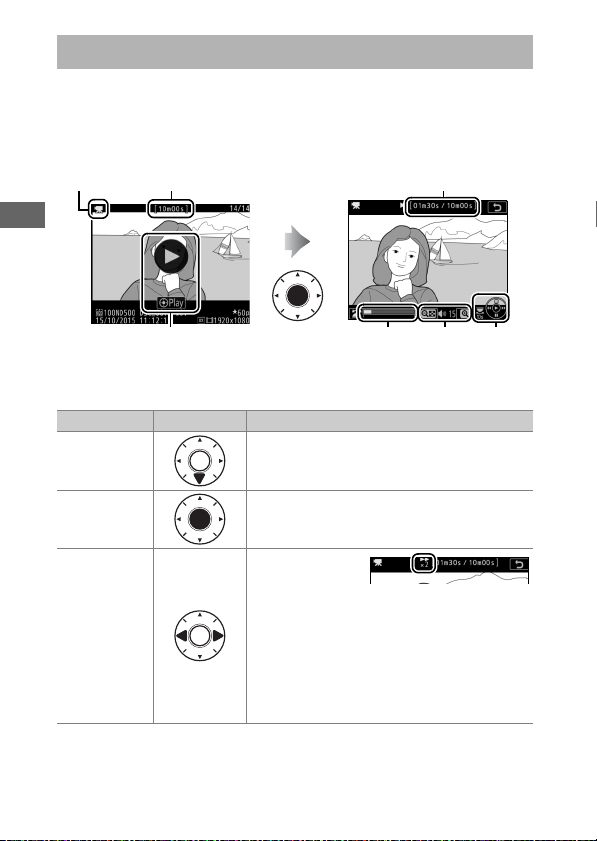
80
Movies are indicated by a 1 icon in full-frame playback (0 255).
Tap the a icon in the monitor or press the center of the multi
selector to start playback; your current position is indicated by
the movie progress bar.
The following operations can be performed:
Viewing Movies
1 icon Length Current position/total length
a icon Movie
progress bar
Volume Guide
To Use Description
Pause Pause playback.
Play
Resume playback when movie is paused
or during rewind/advance.
Rewind/
advance
Speed increases
with each press,
from 2× to 4× to 8× to 16 ×; keep pressed
to skip to beginning or end of movie (first
frame is indicated by h in top right corner
of monitor, last frame by i).
If playback is
paused, movie rewinds or advances one
frame at a time; hold for continuous
rewind or advance.
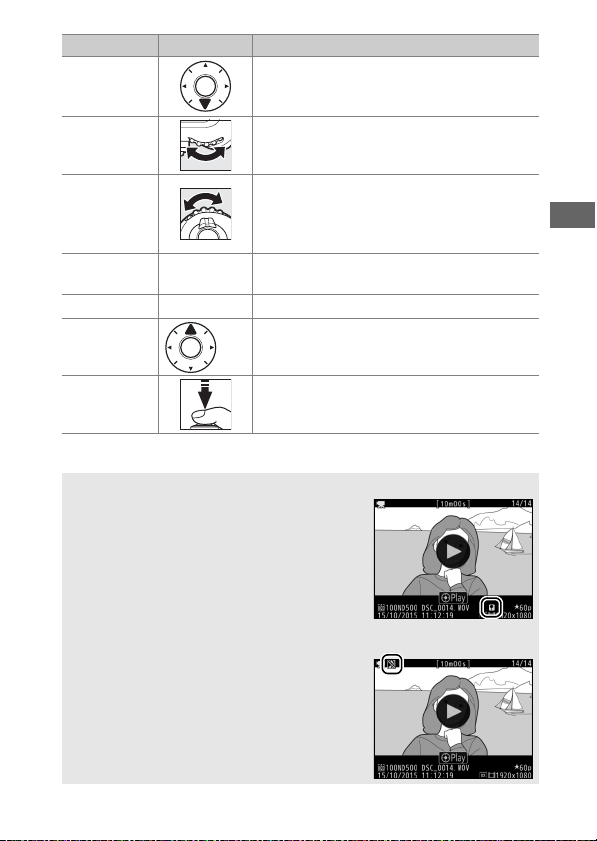
81
Start
slow-motion
playback
Press 3 while the movie is paused to start
slow-motion playback.
Skip 10 s
Rotate the main command dial to skip
ahead or back 10 s.
Skip ahead/
back
Rotate the sub-command dial to skip to
next or previous index, or to skip to the
last or first frame if the movie contains no
indices.
Adjust volume
X
/W (M)
Press
X
to increase volume, W (M) to
decrease.
Trim movie
i/J
See page 82 for more information.
Exit
/K
Exit to full-frame playback.
Return to
shooting mode
Press the shutter-release button halfway
to exit to shooting mode.
A The p Icon
Movies with indices (0 63) are indicated
by a p icon in full-frame playback.
A The 2 Icon
2 is displayed in full-frame and movie
playback if the movie was recorded without
sound (0 290).
To Use Description
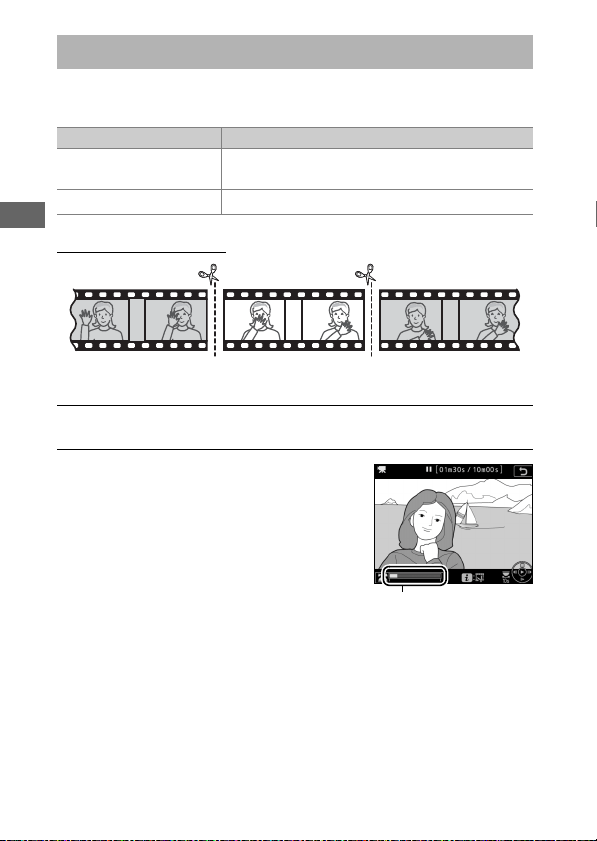
82
Trim footage to create edited copies of movies or save selected
frames as JPEG stills.
Trimming Movies
To create trimmed copies of movies:
1 Display a movie full frame (0 255).
2 Pause the movie on the new opening
frame.
Play the movie back as described on
page 80, pressing the center of the
multi selector to start and resume
playback and 3 to pause and pressing
4 or 2 or rotating the main or sub-
command dial to locate the desired
frame.
Your approximate position in the movie can be
ascertained from the movie progress bar.
Pause playback
when you reach the new opening frame.
Editing Movies
Option Description
9
Choose start/end point
Create a copy from which unwanted footage
has been removed.
4
Save selected frame Save a selected frame as a JPEG still.
Movie progress bar
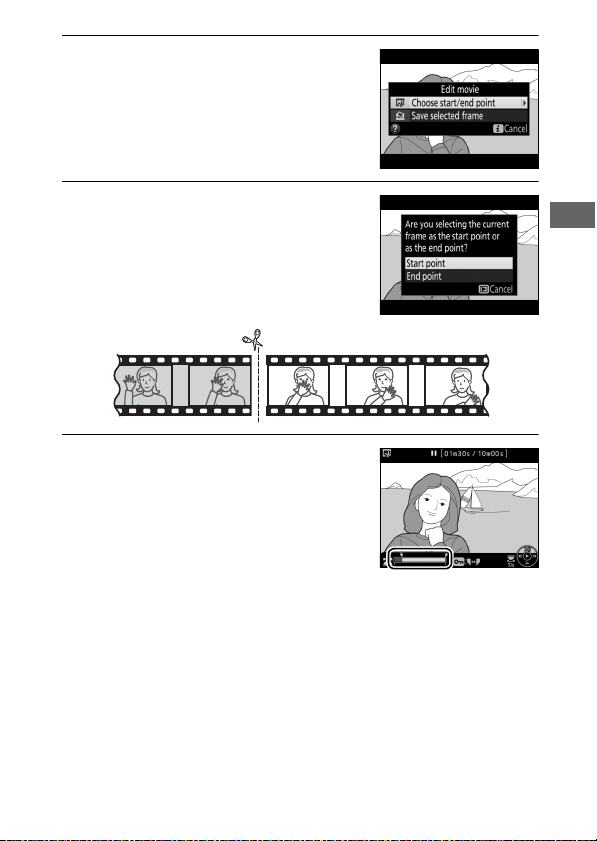
83
3 Select Choose start/end point.
Press i or J, then highlight Choose
start/end point and press 2.
4 Select Start point.
To create a copy that begins from the
current frame, highlight Start point
and press J.
The frames before the
current frame will be removed when
you save the copy in Step 9.
5 Confirm the new start point.
If the desired frame is not currently
displayed, press 4 or 2 to advance or
rewind (to skip to 10 s ahead or back,
rotate the main command dial; to skip
to an index, or to the first or last frame
if the movie contains no indices,
rotate the sub-command dial).
Start point
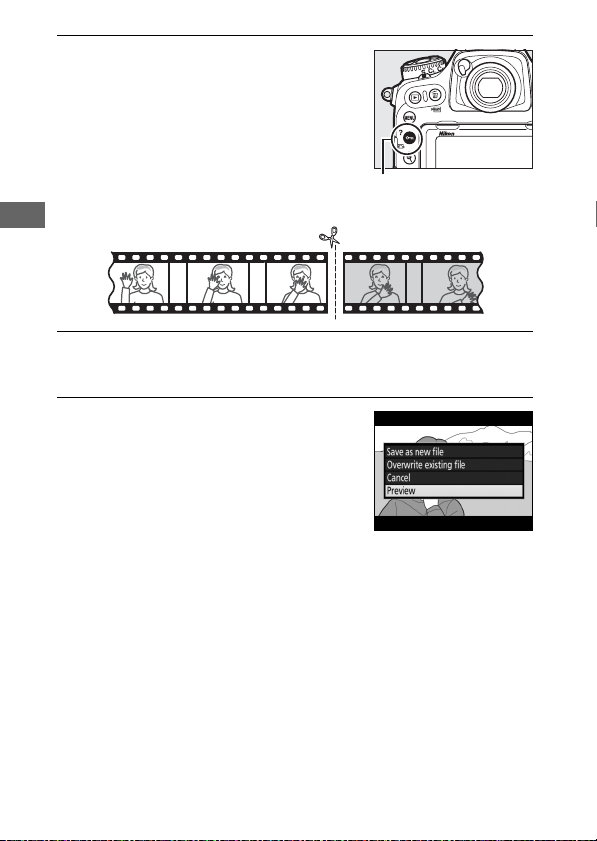
84
6 Choose the end point.
Press L (Z/Q) to switch from the
start point (w) to the end point (x)
selection tool and then select the
closing frame as described in Step 5.
The frames after the selected frame
will be removed when you save the
copy in Step 9.
7 Create the copy.
Once the desired frame is displayed, press 1.
8 Preview the movie.
To preview the copy, highlight
Preview and press J (to interrupt the
preview and return to the save
options menu, press 1).
To abandon
the current copy and select a new
start point or end point as described
on the foregoing pages, highlight Cancel and press J; to
save the copy, proceed to Step 9.
L (Z/Q) button
End point
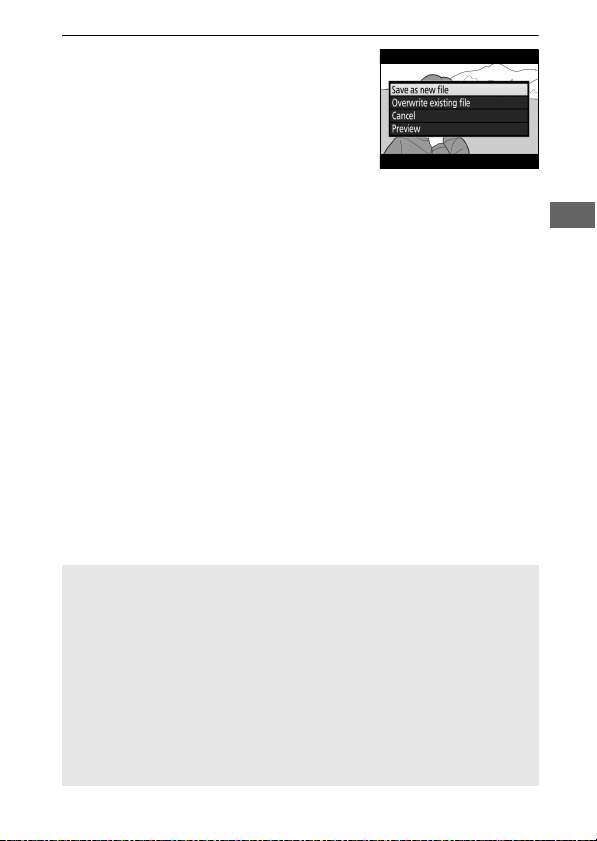
85
9 Save the copy.
Highlight Save as new file and press
J to save the copy to a new file.
To
replace the original movie file with the
edited copy, highlight Overwrite
existing file and press J.
D Trimming Movies
Movies must be at least two seconds long.
The copy will not be saved
if there is insufficient space available on the memory card.
Copies have the same time and date of creation as the original.
A Removing Opening or Closing Footage
To remove only the opening footage from the movie, proceed to
Step 7 without pressing the L (Z/Q) button in Step 6.
To remove
only the closing footage, select End point in Step 4, select the closing
frame, and proceed to Step 7 without pressing the L (Z/Q) button
in Step 6.
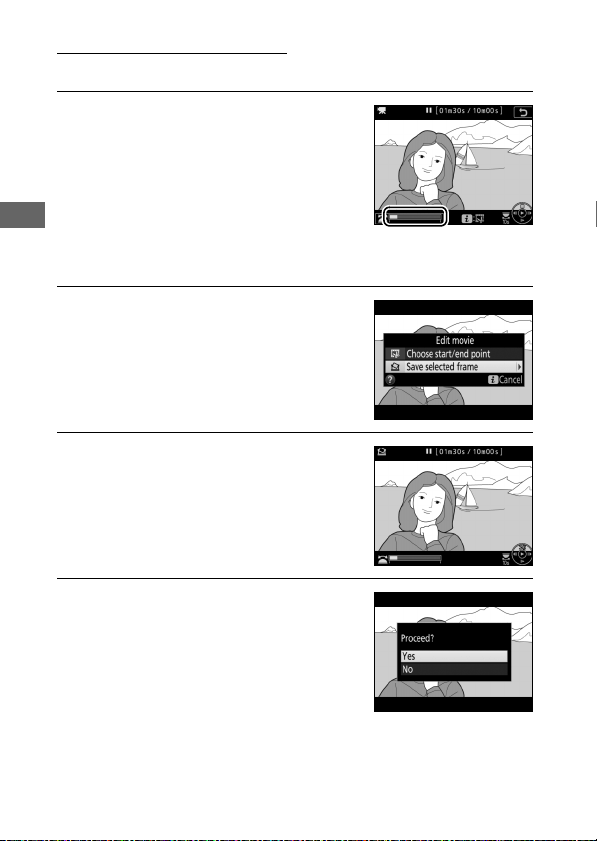
86
Saving Selected Frames
To save a copy of a selected frame as a JPEG still:
1 Pause the movie on the desired
frame.
Play the movie back as described on
page 80, pressing the center of the
multi selector to start and resume
playback and 3 to pause.
Pause the
movie at the frame you intend to
copy.
2 Choose Save selected frame.
Press i or J, then highlight Save
selected frame and press 2.
3 Create a still copy.
Press 1 to create a still copy of the
current frame.
4 Save the copy.
Highlight Ye s and press J to create a
fine★-quality (0 91) JPEG copy of the
selected frame.

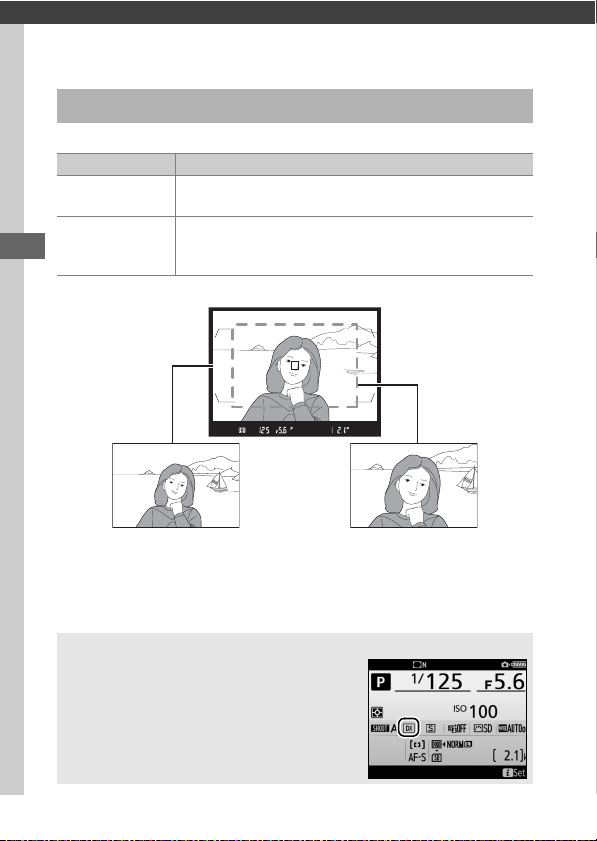
88
Image Recording Options
Choose an image area from DX (24×16) and 1.3× (18×12).
Image Area
Option Description
a
DX (24×16)
Pictures are recorded using a 23.5 × 15.7 mm image
area (DX format).
Z
1.3× (18×12)
Pictures are recorded using an 18.0 × 12.0 mm image
area, producing a telephoto effect without the need
to change lenses.
Viewfinder display
Photo with DX image area
(24×16)
Photo with image area of
1.3× (18×12)
A Image Area
The selected option is shown in the
information display.
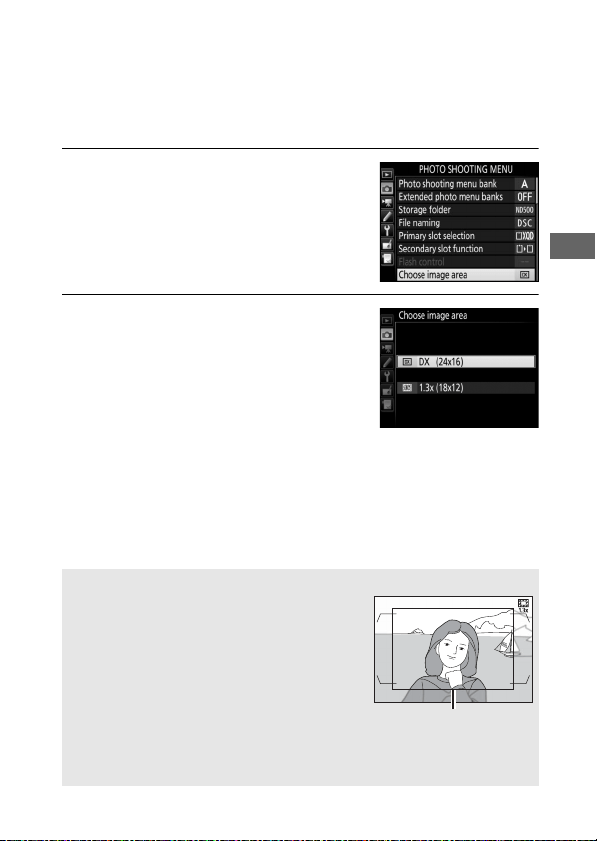
89
The image area can be selected using the Choose image area
option in the photo shooting menu or by pressing a control and
rotating a command dial.
❚❚ The Choose Image Area Menu
1 Select Choose image area.
Highlight Choose image area in the
photo shooting menu and press 2.
2 Adjust settings.
Choose an option and press J.
The
selected crop is displayed in the
viewfinder.
A The Viewfinder Display
The viewfinder display for the 1.3× DX crop
is shown at right.
A Z icon is displayed in the
viewfinder when the 1.3× DX crop is
selected.
A Image Size
Image size varies with the option selected for image area.
1.3× DX crop
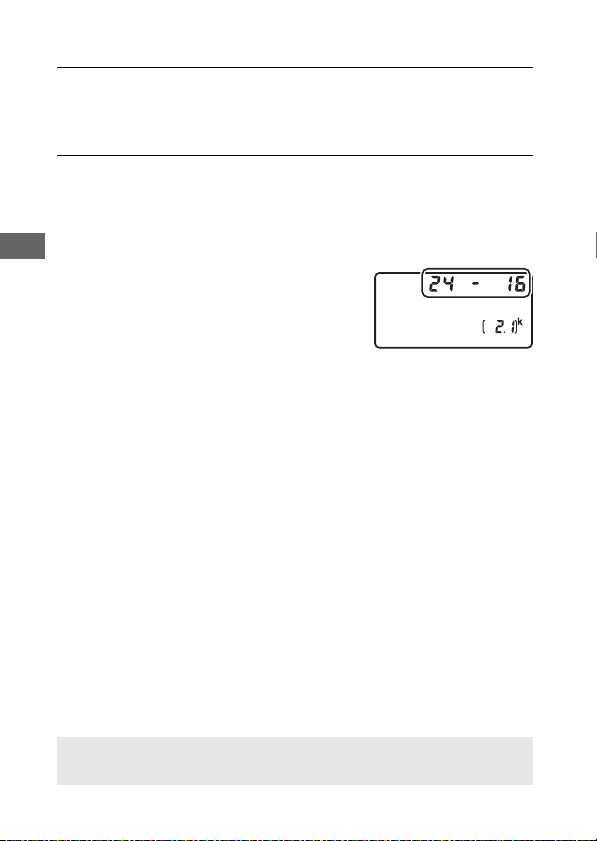
90
❚❚ Camera Controls
1 Assign image area selection to a camera control.
Use Custom Setting f1 (Custom control assignment, 0 301)
to assign Choose image area to a control.
2 Use the selected control to choose an image area.
The image area can be selected by pressing the selected
control and rotating the main or sub-command dial until the
desired crop is displayed in the viewfinder (0 88).
The option currently selected for
image area can be viewed by pressing
the control to display the image area
in the control panel or information
display.
DX format is displayed as
“24z16” and 1.3× as “18z12”.
A See Also
See page 70 for information on the crops available for movie recording.
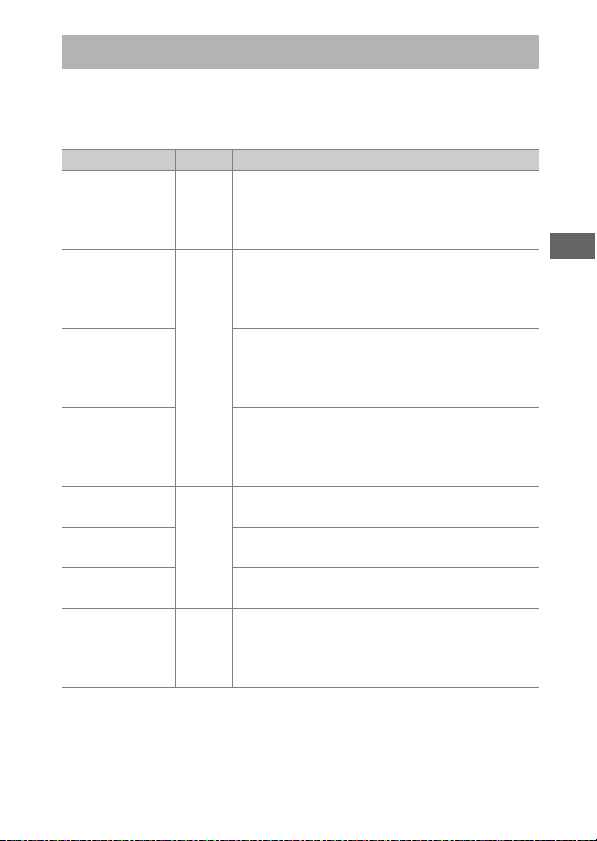
91
The D500 supports the following image quality options.
See
page 389 for information on the number of pictures that can be
stored at different image quality and size settings.
Image Quality
Option File type Description
NEF (RAW) NEF
RAW data from the image sensor are saved
without additional processing.
Settings such
as white balance and contrast can be
adjusted after shooting.
NEF (RAW)+
JPEG fine★/
NEF (RAW)+
JPEG fine
NEF/
JPEG
Two images are recorded, one NEF (RAW)
image and one fine-quality JPEG image.
NEF (RAW)+
JPEG normal★/
NEF (RAW)+
JPEG normal
Two images are recorded, one NEF (RAW)
image and one normal-quality JPEG image.
NEF (RAW)+
JPEG basic★/
NEF (RAW)+
JPEG basic
Two images are recorded, one NEF (RAW)
image and one basic-quality JPEG image.
JPEG fine★/
JPEG fine
JPEG
Record JPEG images at a compression ratio of
roughly 1:4 (fine quality).
JPEG normal★/
JPEG normal
Record JPEG images at a compression ratio of
roughly 1:8 (normal quality).
JPEG basic★/
JPEG basic
Record JPEG images at a compression ratio of
roughly 1:16 (basic quality).
TIFF (RGB)
TIFF
(RGB)
Record uncompressed TIFF-RGB images at a
bit depth of 8 bits per channel (24-bit color).
TIFF is supported by a wide variety of
imaging applications.

92
Image quality is set by pressing the T button and rotating
the main command dial until the desired setting is displayed in
the control panel.
T button Main command
dial
Control panel
A JPEG Compression
Image quality options with a star (“★”) use compression intended to
ensure maximum quality; the size of the files varies with the scene.
Options without a star use a type of compression designed to produce
smaller files; files tend to be roughly the same size regardless of the
scene recorded.
A NEF+JPEG
When photographs taken at settings of NEF (RAW) + JPEG are viewed
on the camera with only one memory card inserted, only the JPEG
image will be displayed.
If both copies are recorded to the same
memory card, both copies will be erased when the photo is deleted.
If
the JPEG copy is recorded to a separate memory card using the
Secondary slot function > RAW primary - JPEG secondary option,
each copy must be deleted separately.
A The Image Quality Menu
Image quality can also be adjusted using the Image quality option in
the photo shooting menu (0 284).
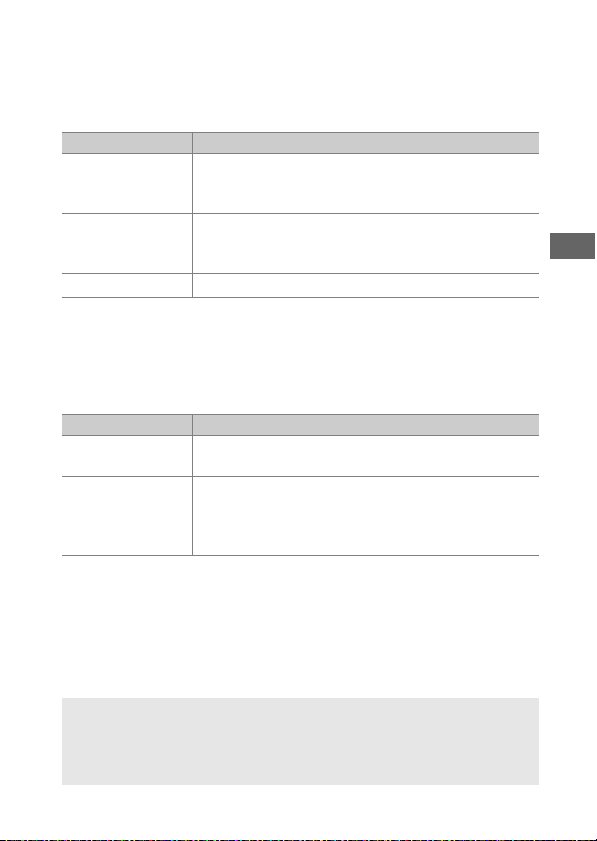
93
❚❚ NEF (RAW) Compression
To choose the type of compression for NEF (RAW) images,
highlight NEF (RAW) recording > NEF (RAW) compression in
the photo shooting menu and press 2.
❚❚ NEF (RAW) Bit Depth
To choose a bit depth for NEF (RAW) images, highlight NEF
(RAW) recording > NEF (RAW) bit depth in the photo shooting
menu and press 2.
Option Description
N
Lossless
compressed
NEF images are compressed using a reversible
algorithm, reducing file size by about 20–40% with
no effect on image quality.
O
Compressed
NEF images are compressed using a non-reversible
algorithm, reducing file size by about 35–55% with
almost no effect on image quality.
Uncompressed NEF images are not compressed.
Option Description
q
12-bit
NEF (RAW) images are recorded at a bit-depth of
12 bits.
r
14-bit
NEF (RAW) images are recorded at a bit depth of
14 bits, producing files larger than those with a bit
depth of 12 bits but increasing the color data
recorded.
A NEF (RAW) Images
JPEG copies of NEF (RAW) images can be created using Capture NX-D
or other software or the NEF (RAW) processing option in the retouch
menu (0 313).
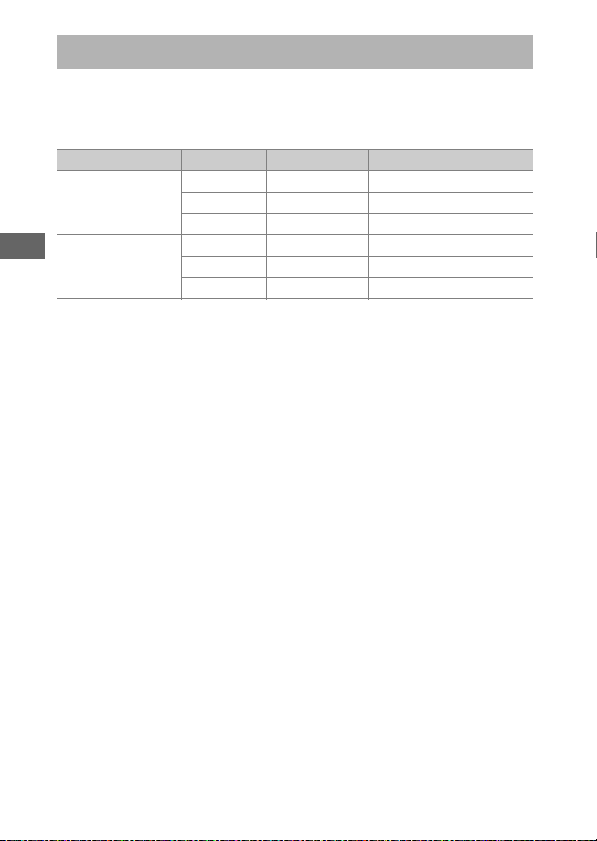
94
Image size is measured in pixels.
Choose from # Large,
$ Medium, or % Small (note that image size varies depending
on the option selected for Choose image area, 0 88):
Image Size
Image area Option Size (pixels) Print size (cm/in.)
*
DX (24 × 16)
Large 5568 × 3712 47.1 × 31.4/18.6 × 12.4
Medium 4176 × 2784 35.4 × 23.6/13.9 × 9.3
Small 2784 × 1856 23.6 × 15.7/ 9.3 × 6.2
1.3× (18×12)
Large 4272 × 2848 36.2 × 24.1/14.2 × 9.5
Medium 3200 × 2136 27.1 × 18.1/10.7 × 7.1
Small 2128 × 1424 18.0 × 12.1/ 7.1 × 4.7
* Approximate size when printed at 300 dpi.
Print size in inches equals image size in pixels
divided by printer resolution in dots per inch (dpi; 1 inch = approximately 2.54 cm).
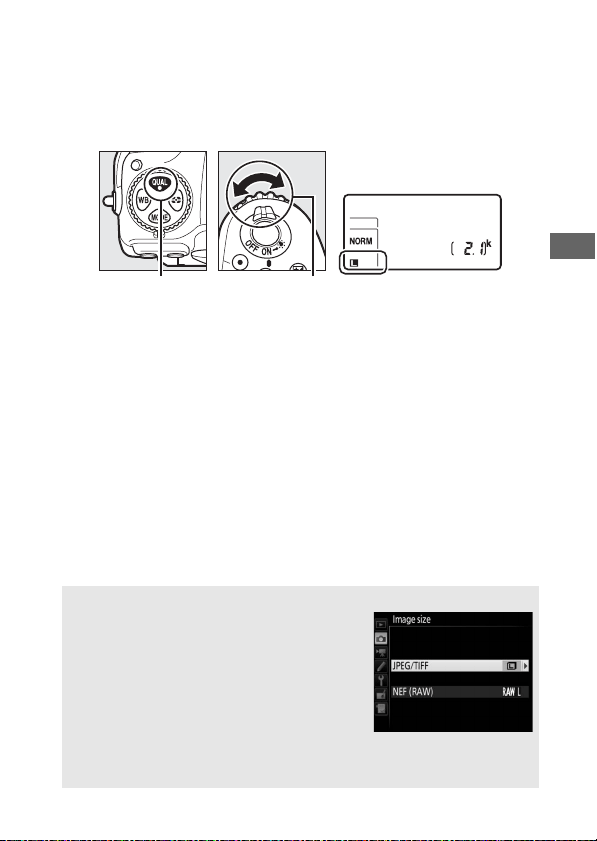
95
Image size for JPEG and TIFF images can be set by pressing the
T button and rotating the sub-command dial until the
desired option is displayed in the control panel.
To choose the
size of NEF (RAW) images, use the Image size > NEF (RAW)
option in the photo shooting menu.
T button Sub-command
dial
Control panel
A The Image Size Menu
Image size for JPEG and TIFF images can also
be adjusted using the Image size > JPEG/
TIFF option in the photo shooting menu
(0 284).
Small and medium sized NEF
(RAW) images are recorded in lossless
compressed 12-bit format, regardless of the
options selected for NEF (RAW)
compression and NEF (RAW) bit depth in the NEF (RAW) recording
menu.
96
When two memory cards are inserted in the camera, you can
choose one as the primary card using the Primary slot
selection item in the photo shooting menu.
Select XQD card
slot to designate the card in the XQD card slot as the primary
card, SD card slot to choose the SD card.
The roles played by the
primary and secondary cards can be chosen using the
Secondary slot function option in the photo shooting menu.
Choose from Overflow (the secondary card is used only when
the primary card is full), Backup (each picture is recorded to
both the primary and secondary card), and RAW primary - JPEG
secondary (as for Backup, except that the NEF/RAW copies of
photos shot at settings of NEF/RAW + JPEG are recorded only to
the primary card and the JPEG copies only to the secondary
card).
Using Two Memory Cards
A “Backup” and “RAW Primary - JPEG Secondary”
The camera shows the number of exposures remaining on the card
with the least amount of memory.
Shutter release will be disabled
when either card is full.
A Recording Movies
When two memory cards are inserted in the camera, the slot used to
record movies can be selected using the Destination option in the
movie shooting menu (0 288).
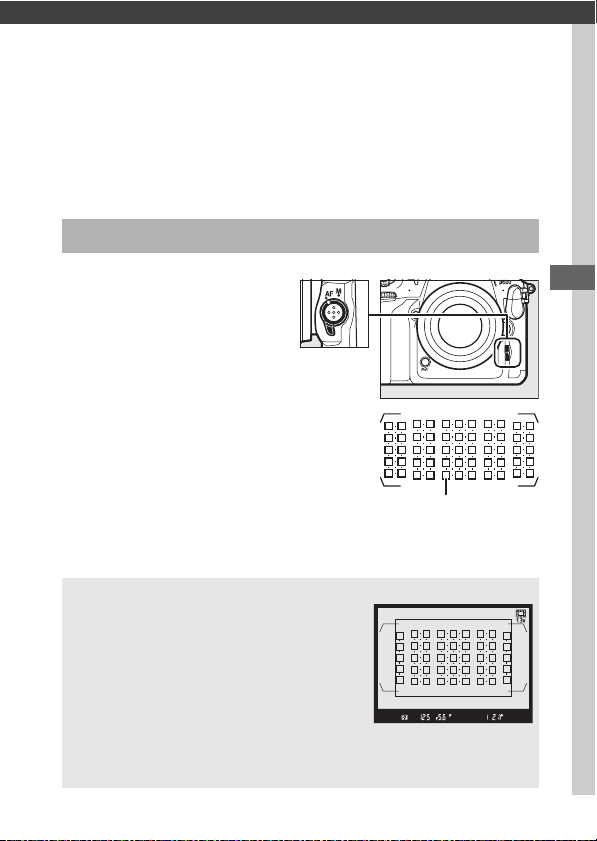
97
Focus
This section describes the focus options available when
photographs are framed in the viewfinder.
Focus can be
adjusted automatically (see below) or manually (0 114).
The
user can also select the focus point for automatic or manual
focus (0 108) or use focus lock to focus and recompose
photographs after focusing (0 111).
To use autofocus, rotate the
focus-mode selector to AF.
The camera focuses using 153 focus
points, of which the 55 shown by r in
the illustration at right can be selected by
the user (0 108).
Autofocus
A 1.3× (18 × 12)
When 1.3× (18×12) is selected for Choose
image area (0 89), the camera focuses
using 117 focus points, of which 45 can be
selected by the user.
The remaining focus
points at the left and right edges of the focus
point display are not used.
Focus-mode selector
User-selectable focus
points
Focus points available
when 1.3× (18×12) is
selected
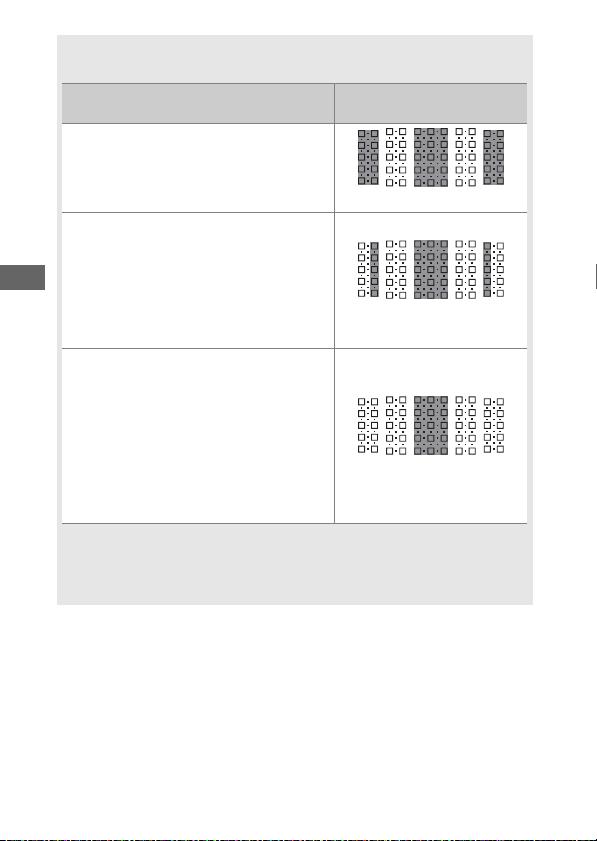
98
A Cross Sensors
The availability of cross-sensor focus points varies with the lens used.
Lens
Cross sensors (cross-sensor focus
points highlighted in gray
2, 3
)
AF-S lenses other than those listed
below with maximum apertures of f/4
or faster
1
99 cross sensors
• AF-S DX Zoom-Nikkor 12–24mm
f/4G IF-ED
• AF-S Micro NIKKOR 60mm f/2.8G ED
• AF-S NIKKOR 600mm f/4G ED VR
• AF-S NIKKOR 600mm f/4E FL ED VR
• AF-S Nikkor 600mm f/4D IF-ED II
• AF-S Nikkor 600mm f/4D IF-ED
63 cross sensors
• AF-S NIKKOR 200–400mm f/4G ED VR II
• AF-S VR Zoom-Nikkor 200–400mm
f/4G IF-ED
• AF-S NIKKOR 500mm f/4G ED VR
• AF-S Nikkor 500mm f/4D IF-ED II
• AF-S Nikkor 500mm f/4D IF-ED
• AF-S lenses with maximum apertures
slower than f/4
1
• Non–AF-S lenses
45 cross sensors
1 At maximum zoom, in the case of zoom lenses.
2 Other focus points use line sensors, which detect horizontal lines.
3 The focus points at the left and right edges of the focus point display are not used when
1.3× (18×12) is selected for Choose image area (0 89).
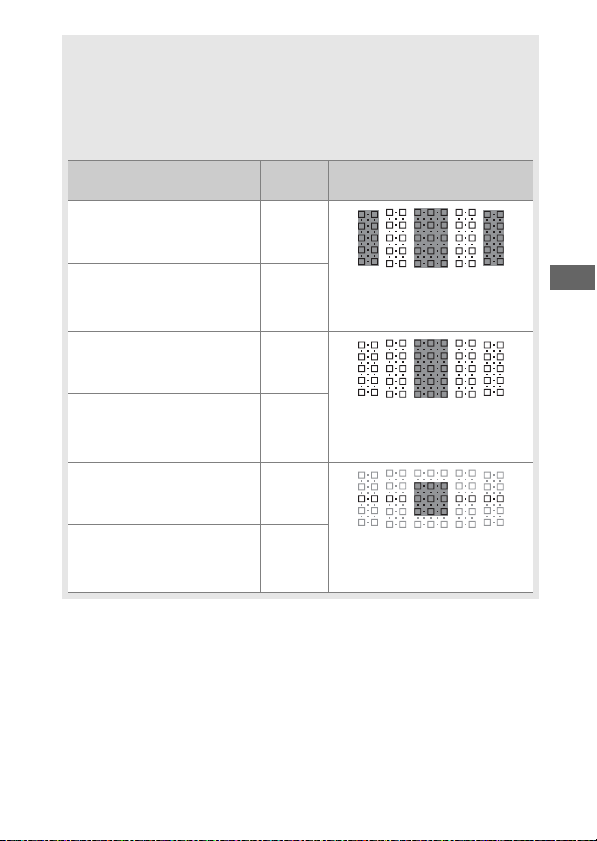
99
A AF-S/AF-I Teleconverters and Available Focus Points
When an AF-S or AF-I teleconverter is attached, the focus points shown
in the illustrations can be used for autofocus and electronic
rangefinding (note that at maximum combined apertures slower than
f/5.6, the camera may not be able to focus on dark or low-contrast
subjects).
Teleconverter
Max. lens
aperture
1
Available focus points (cross-sensor
focus points highlighted in gray
2
)
TC-14E, TC-14E II, TC-14E III
TC-17E II
TC-20E, TC-20E II, TC-20E III
f/2
153 focus points (55
selectable) with 99 cross
sensors
TC-14E, TC-14E II, TC-14E III f/2.8
TC-17E II
TC-20E, TC-20E II, TC-20E III
f/2.8
153 focus points (55
selectable) with 45 cross
sensors
TC-14E, TC-14E II, TC-14E III f/4
TC-17E II f/4
37 focus points (17
selectable) with 25 cross
sensors
TC-800-1.25E ED f/5.6
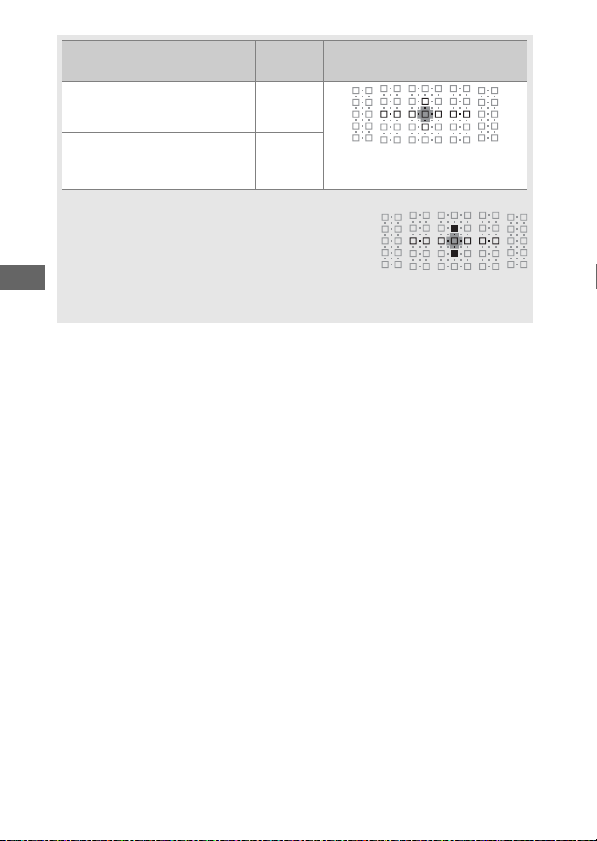
100
Teleconverter
Max. lens
aperture
1
Available focus points (cross-sensor
focus points highlighted in gray
2
)
TC-20E, TC-20E II, TC-20E III f/4
15 focus points (9 selectable)
with 5 cross sensors
TC-14E, TC-14E II, TC-14E III f/5.6
1 At maximum zoom, in the case of zoom lenses.
2 Other focus points use line sensors, which detect horizontal
lines, but note that if there are only 5 cross sensors, only
those shown by ■ detect vertical lines.
Autofocus is not available when teleconverters are used with AF-S VR
Micro-Nikkor 105mm f/2.8G IF-ED lenses.
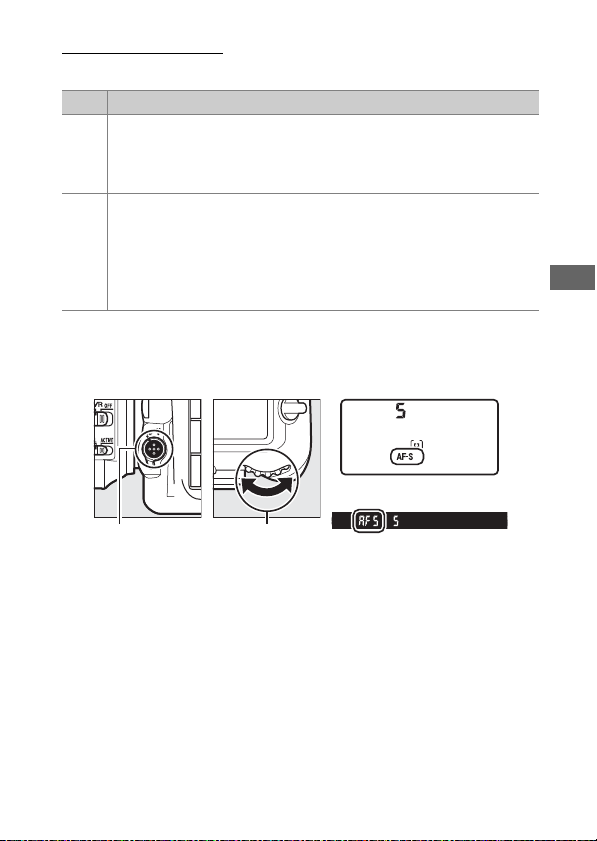
101
Autofocus Mode
Choose from the following autofocus modes:
Autofocus mode can be selected by pressing the AF-mode
button and rotating the main command dial until the desired
setting is displayed in the viewfinder and control panel.
Mode Description
AF-S
Single-servo AF: For stationary subjects.
Focus locks when shutter-
release button is pressed halfway.
At default settings, shutter
can only be released when in-focus indicator (I) is displayed
(focus priority; 0 292).
AF-C
Continuous-servo AF: For moving subjects.
Camera focuses
continuously while shutter-release button is pressed halfway; if
subject moves, camera will engage predictive focus tracking
(0 102) to predict final distance to subject and adjust focus as
necessary.
At default settings, shutter can be released whether
or not subject is in focus (release priority; 0 292).
AF-mode button Main command
dial
Control panel
Viewfinder
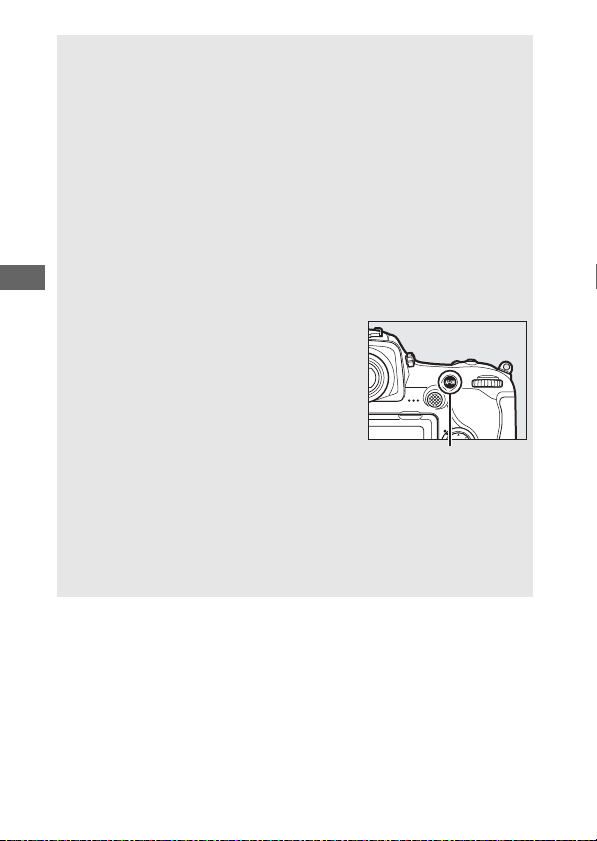
102
A See Also
For information on using focus priority in continuous-servo AF, see
Custom Setting a1 (AF-C priority selection, 0 292).
For information
on using release priority in single-servo AF, see Custom Setting a2
(AF-S priority selection, 0 292).
For information on preventing the
camera from focusing when the shutter-release button is pressed
halfway, see Custom Setting a8 (AF activation, 0 293).
See Custom
Setting a10 (Autofocus mode restrictions, 0 294) for information on
limiting focus-mode selection to AF-S or AF-C and f4 (Customize
command dials) > Change main/sub (0 302) for information on
using the sub-command dial to choose the focus mode.
See page 47
for information on the autofocus options available in live view or
during movie recording.
A The AF-ON Button
For the purpose of focusing the camera,
pressing the AF-ON button has the same
effect as pressing the shutter-release button
halfway.
A Predictive Focus Tracking
In AF-C mode, the camera will initiate predictive focus tracking if the
subject moves toward or away from the camera while the shutter-
release button is pressed halfway or the AF-ON button is pressed.
This
allows the camera to track focus while attempting to predict where the
subject will be when the shutter is released.
AF-ON button
103
AF-Area Mode
Choose how the focus point for autofocus is selected.
• Single-point AF: Select the focus point as described on page 108;
the camera will focus on the subject in the selected focus point
only.
Use with stationary subjects.
• Dynamic-area AF: Select the focus point as described on page 108.
In AF-C focus mode, the camera will focus based on information
from surrounding focus points if the subject briefly leaves the
selected point.
The number of focus points varies with the
mode selected:
- 25-point dynamic-area AF: Choose when there is time to compose
the photograph or when photographing subjects that are
moving predictably (e.g., runners or race cars on a track).
- 72-point dynamic-area AF: Choose when photographing subjects
that are moving unpredictably (e.g., players at a football
game).
- 153-point dynamic-area AF
*
: Choose when photographing
subjects that are moving quickly and can not be easily
framed in the viewfinder (e.g., birds).
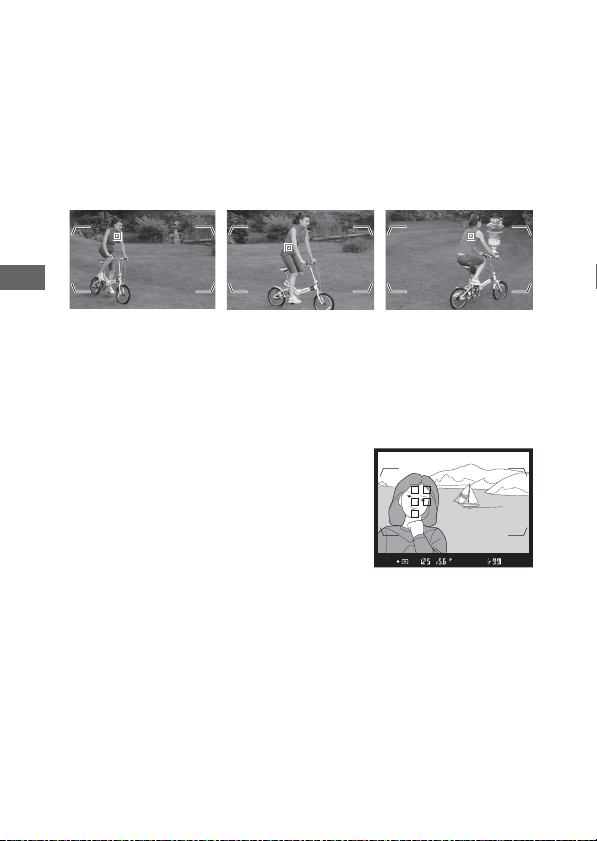
104
• 3D-tracking
*
: Select the focus point as described on page 108.
In
AF-C focus mode, the camera will track subjects that leave the
selected focus point and select new focus points as required.
Use to quickly compose pictures with subjects that are moving
erratically from side to side (e.g., tennis players).
If the subject
leaves viewfinder, remove your finger from the shutter-release
button and recompose the photograph with the subject in the
selected focus point.
• Group-area AF: The camera focuses using a group of focus points
selected by the user, reducing the risk of the camera focusing
on the background instead of on the main subject.
Choose for
subjects that are difficult to photograph using a single focus
point.
If faces are detected in AF-S focus mode, the camera will
give priority to portrait subjects.
• Auto-area AF: The camera automatically
detects the subject and selects the
focus point; if a face is detected, the
camera will give priority to the portrait
subject.
The active focus points are
highlighted briefly after the camera
focuses; in AF-C mode, the main focus
point is displayed after the other focus points have turned off.
* Note that when 1.3× (18×12) is selected for Choose image area (0 89), the
camera focuses using 117 focus points.
The remaining focus points at the left and right edges of
the focus point display are not used.
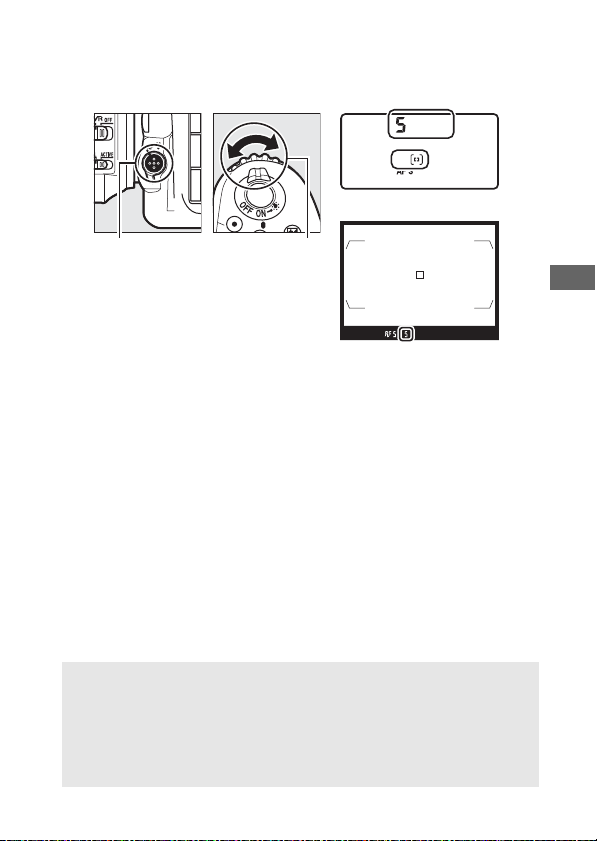
105
AF-area mode can be selected by pressing the AF-mode button
and rotating the sub-command dial until the desired setting is
displayed in the viewfinder and control panel.
A 3D-tracking
When the shutter-release button is pressed halfway, the colors in the
area surrounding the focus point are stored in the camera.
Consequently 3D-tracking may not produce the desired results with
subjects that are similar in color to the background or that occupy a
very small area of the frame.
AF-mode button Sub-command
dial
Control panel
Viewfinder
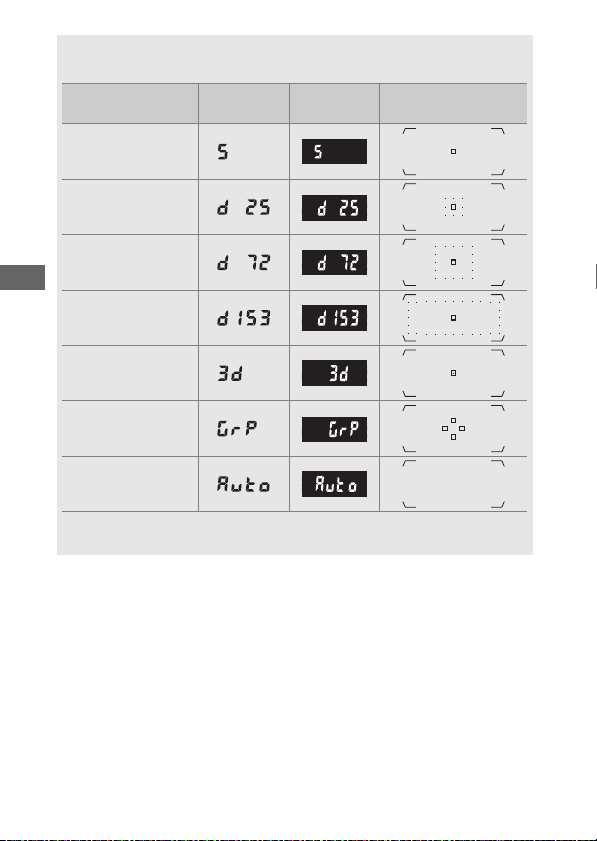
106
A AF-Area Mode
AF-area mode is shown in the control panel and viewfinder.
AF-area mode Control panel Viewfinder
Viewfinder focus-point
display
Single-point AF
25-point
dynamic-area AF
*
72-point
dynamic-area AF
*
153-point
dynamic-area AF
*
3D-tracking
Group-area AF
Auto-area AF
* Only active focus point is displayed in the viewfinder.
Remaining focus points provide
information to assist focus operation.
107
A AF-S/AF-I Teleconverters
If 3D-tracking or auto-area AF is selected for AF-area mode when an
AF-S/AF-I teleconverter is used, single-point AF will automatically be
selected at combined apertures slower than f/5.6.
A Manual Focus
Single-point AF is automatically selected when manual focus is used.
A See Also
For information on how autofocus adjusts to changes in the distance
to the subject, see Custom Setting a3 (Focus tracking with lock-on,
0 292).
To adjust settings for 3D-tracking, use Custom Settings a4
(3D-tracking face-detection, 0 293) and a5 (3D-tracking watch
area, 0 293).
See Custom Settings a7 (Store by orientation, 0 293)
for information on choosing different focus points and/or AF-area
modes for portrait- and landscape-orientation photographs, a9 (Limit
AF-area mode selection, 0 293) for information on limiting AF-area
mode selection, a12 (Focus point options, 0 294) for information on
choosing how the focus point is displayed, and f4 (Customize
command dials) > Change main/sub (0 302) for information on
using the main command dial to choose the AF-area mode.
See page
48 for information on the autofocus options available in live view or
during movie recording.
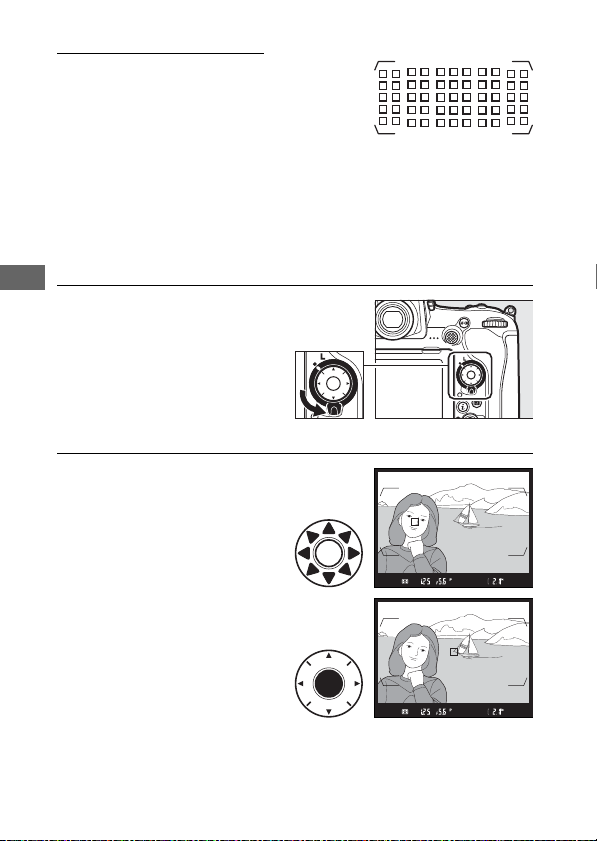
108
Focus Point Selection
The camera focuses using 153 focus
points, of which 55 shown at right can be
selected manually, allowing
photographs to be composed with the
main subject positioned almost anywhere in the frame (when
1.3× (18×12) is selected for Choose image area, the camera
focuses using 117 focus points, of which 45 can be selected
manually; 0 89).
Follow the steps below to choose the focus
point (in group-area AF, you can follow these steps to choose a
group of focus points).
1 Rotate the focus selector
lock to ●.
This allows the multi
selector to be used to
select the focus point.
2 Select the focus point.
Use the multi selector to
select the focus point in the
viewfinder while the
exposure meters are on.
The center focus point can
be selected by pressing the
center of the multi selector.
Focus selector lock
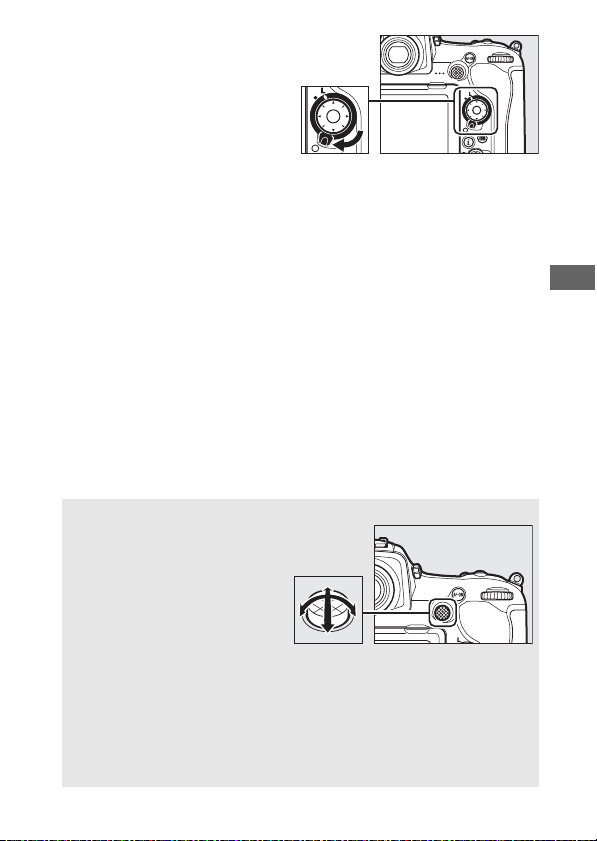
109
The focus selector lock can
be rotated to the locked (L)
position following
selection to prevent the
selected focus point from
changing when the multi
selector is pressed.
A The Sub-selector
The sub-selector can be used in
place of the multi selector to
select the focus point.
Focus
and exposure lock while the
center of the sub-selector is
pressed (0 111, 141).
Use the
sub-selector as shown at right;
pressing the sides may not have
the desired effect.
Be careful not to put your fingers or fingernails in
your eye when using the sub-selector.
A Auto-area AF
The focus point for auto-area AF is selected automatically; manual
focus-point selection is not available.
Sub-selector
110
A See Also
For information on choosing the number of focus points that can be
selected using the multi selector, see Custom Setting a6 (Number of
focus points, 0 293).
For information on choosing separate focus
points and/or AF-area modes for vertical and horizontal orientations,
see Custom Setting a7 (Store by orientation, 0 293).
For information
on setting focus-point selection to “wrap around,” see Custom Setting
a11 (Focus point wrap-around, 0 294).
For information on choosing
when the focus point is illuminated, see Custom Setting a12 (Focus
point options, 0 294).
For information on changing the role played
by the sub-selector, see Custom Setting f1 (Custom control
assignment) > Sub-selector (0 301) and Sub-selector center
(0 301).
For information on changing the role of the multi selector
center button, see Custom Setting f2 (Multi selector center button,
0 301).
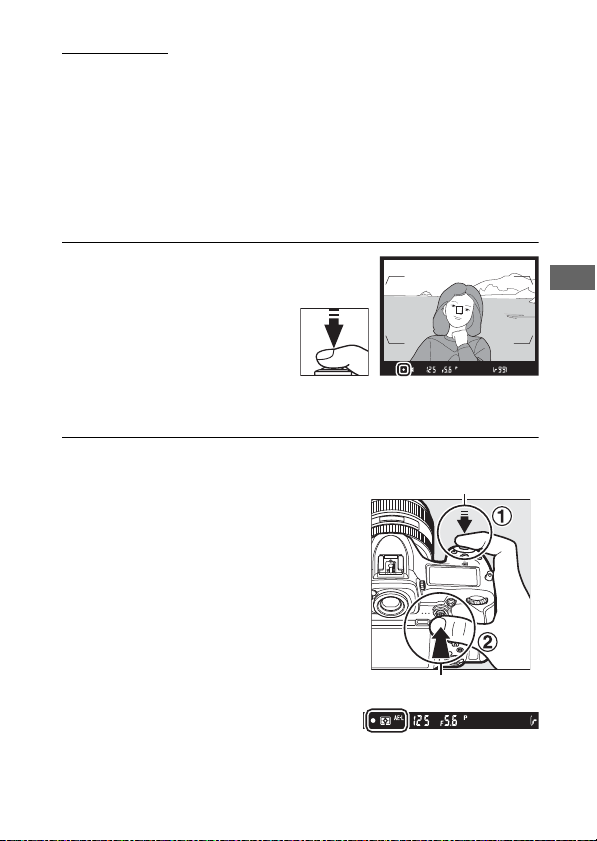
111
Focus Lock
Focus lock can be used to change the composition after
focusing, making it possible to focus on a subject that will not be
in a focus point in the final composition.
If the camera is unable
to focus using autofocus (0 113), focus lock can also be used to
recompose the photograph after focusing on another object at
the same distance as your original subject.
Focus lock is most
effective when an option other than auto-area AF is selected for
AF-area mode (0 103).
1 Focus.
Position the subject in the
selected focus point and
press the shutter-release
button halfway to initiate
focus.
Check that the in-
focus indicator (I) appears
in the viewfinder.
2 Lock focus.
AF-C focus mode (0 101): With the
shutter-release button pressed
halfway (q), press the center of the
sub-selector (w) to lock both focus
and exposure (an AE-L icon will be
displayed in the viewfinder).
Focus
will remain locked while the center
of the sub-selector is pressed, even
if you later remove your finger from
the shutter-release button.
Shutter-release button
Sub-selector
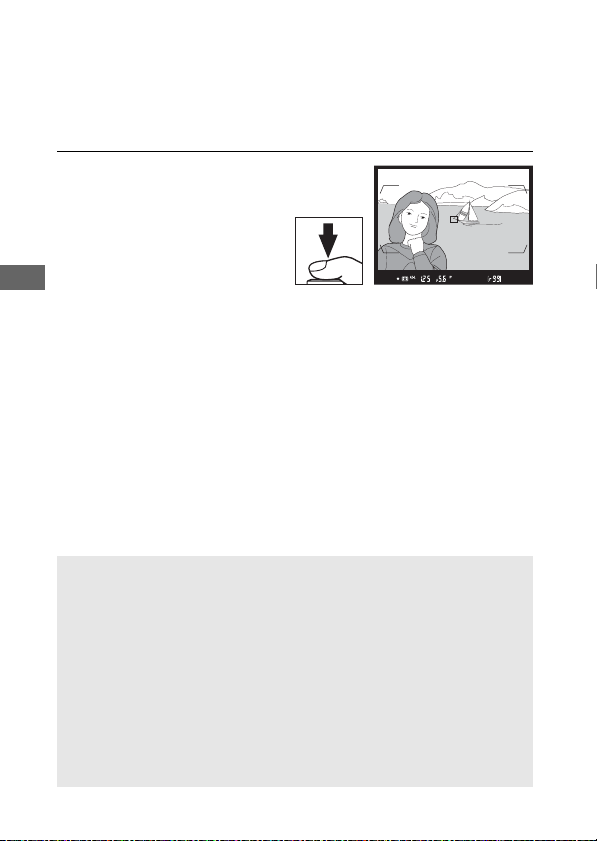
112
AF-S focus mode: Focus locks automatically when the in-focus
indicator (I) appears, and remains locked until you remove
your finger from the shutter-release button.
Focus can also
be locked by pressing the center of the sub-selector as
described on the previous page.
3 Recompose the
photograph and shoot.
Focus will remain locked
between shots if you keep
the shutter-release button
pressed halfway (AF-S) or
keep the center of the sub-
selector pressed, allowing several photographs in succession
to be taken at the same focus setting.
Do not change the distance between the camera and the
subject while focus lock is in effect.
If the subject moves, focus
again at the new distance.
A Locking Focus with the AF-ON Button
During viewfinder photography, focus can be locked using the AF-ON
button in place of the shutter-release button (0 102).
If AF-ON only is
selected for Custom Setting a8 (AF activation, 0 293), the camera will
not focus when the shutter-release button is pressed halfway; instead,
the camera will focus when the AF-ON button is pressed, at which point
focus will lock and remain locked until the AF-ON button is pressed
again.
A See Also
See Custom setting c1 (Shutter-release button AE-L, 0 296) for
information on using the shutter-release button to lock exposure.
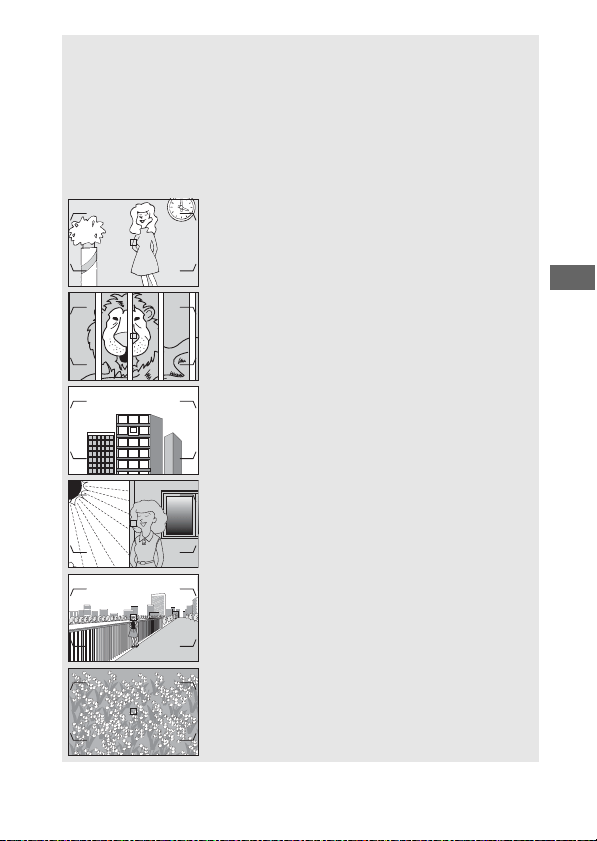
113
A Getting Good Results with Autofocus
Autofocus does not perform well under the conditions listed below.
The shutter release may be disabled if the camera is unable to focus
under these conditions, or the in-focus indicator (●) may be displayed
and the camera may sound a beep, allowing the shutter to be released
even when the subject is not in focus.
In these cases, use manual focus
(0 114) or use focus lock (0 111) to focus on another subject at the
same distance and then recompose the photograph.
There is little or no contrast between the subject and
the background.
Example: Subject is the same color as the background.
The focus point contains objects at different
distances from the camera.
Example: Subject is inside a cage.
The subject is dominated by regular geometric
patterns.
Example: Blinds or a row of windows in a skyscraper.
The focus point contains areas of sharply
contrasting brightness.
Example: Subject is half in the shade.
Background objects appear larger than the subject.
Example: A building is in the frame behind the subject.
The subject contains many fine details.
Example: A field of flowers or other subjects that are small or lack
variation in brightness.
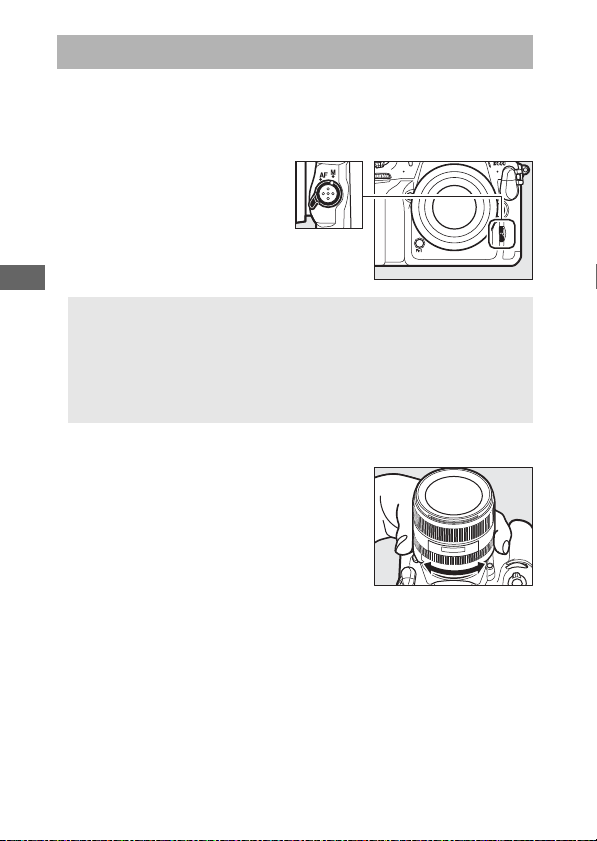
114
Manual focus is available for lenses that do not support
autofocus (non-AF NIKKOR lenses) or when the autofocus does
not produce the desired results (0 113).
• AF lenses: Set the lens focus
mode switch (if present) and
camera focus-mode selector
to M.
• Manual focus lenses: Focus manually.
To focus manually, adjust the lens focus
ring until the image displayed on the
clear matte field in the viewfinder is in
focus.
Photographs can be taken at any
time, even when the image is not in
focus.
Manual Focus
D AF Lenses
Do not use AF lenses with the lens focus-mode switch set to M and
the camera focus-mode selector set to AF.
Failure to observe this
precaution could damage the camera or lens.
This does not apply to
AF-S lenses, which can be used in M mode without setting the
camera focus-mode selector to M.
Focus-mode selector
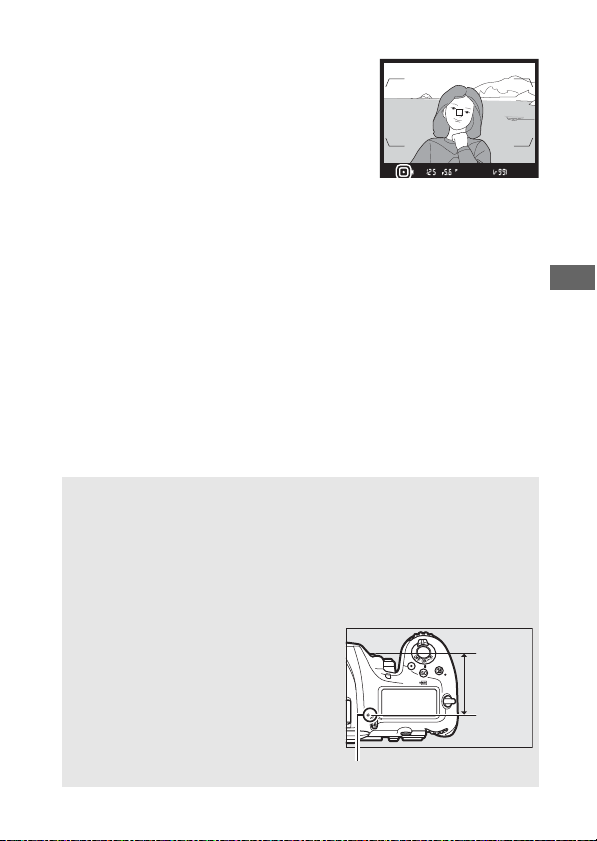
115
❚❚ The Electronic Rangefinder
The viewfinder focus indicator can be
used to confirm whether the subject in
the selected focus point is in focus.
Choose from 55 focus points, or from 45
points if 1.3× (18×12) is selected for
Choose image area (0 89).
After
positioning the subject in the selected
focus point, press the shutter-release button halfway and rotate
the lens focus ring until the in-focus indicator (I) is displayed.
Note that with the subjects listed on page 113, the in-focus
indicator may sometimes be displayed when the subject is not in
focus; confirm focus in the viewfinder before shooting.
For
information on using the electronic rangefinder with optional
AF-S/AF-I teleconverters, see page 99.
A AF-P DX NIKKOR 18–55mm f/3.5–5.6G and G VR Lenses
When an AF-P DX NIKKOR 18–55mm f/3.5–5.6G VR or AF-P DX NIKKOR
18–55mm f/3.5–5.6G lens is used in manual focus mode, the in-focus
indicator will flash in the viewfinder (or in live view, the focus point will
flash in the monitor) to warn that continuing to rotate the focus ring in
the current direction will not bring the subject into focus.
A Focal Plane Position
To determine the distance between
your subject and the camera, measure
from the focal plane mark (E) on the
camera body.
The distance between
the lens mounting flange and the focal
plane is 46.5 mm (1.83 in.).
Focal plane mark
46.5 mm
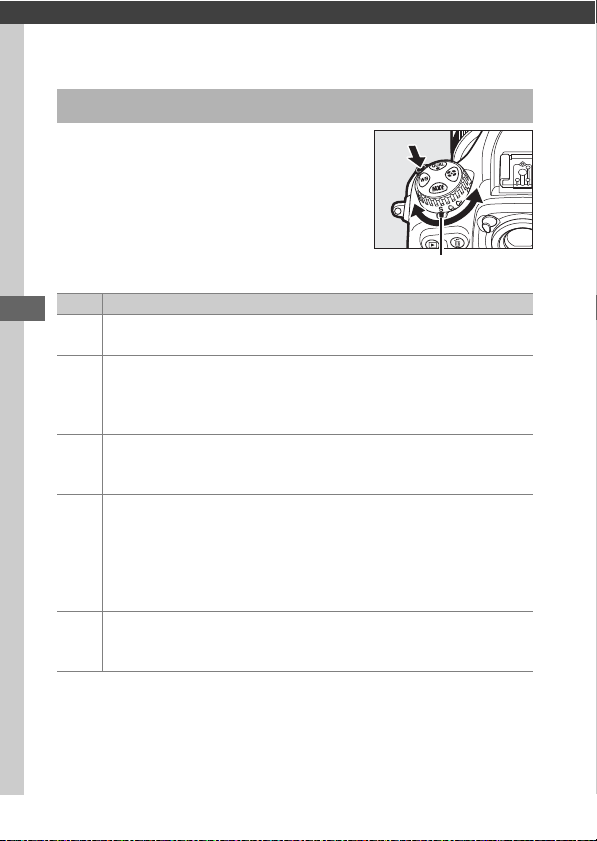
116
Release Mode
To choose a release mode, press the
release mode dial lock release and turn
the release mode dial so that the pointer
aligns with the desired setting.
Choosing a Release Mode
Mode Description
S
Single frame: The camera takes one photograph each time the
shutter-release button is pressed.
CL
Continuous low speed: While shutter-release button is held down,
camera records 1–9 frames per second.
*
Frame rate can be
chosen using Custom Setting d1 (CL mode shooting speed,
0 297).
CH
Continuous high speed: While shutter-release button is held down,
camera records up to 10 frames per second.
*
Use for active
subjects.
Q
Quiet shutter-release: As for single frame, except that the mirror
does not click back into place while the shutter-release button is
fully pressed, allowing the user to control the timing of the click
made by the mirror, which is also quieter than in single frame
mode.
In addition, a beep does not sound regardless of the
setting selected for Beep in the setup menu (0 306).
QC
QC (quiet continuous) shutter-release: While shutter-release button is
held down, camera records up to 3 frames per second.
*
Camera
noise is reduced.
Pointer
117
E
Self-timer: Take pictures with the self-timer (0 119).
MUP
Mirror up: Choose this mode to minimize camera shake in
telephoto or close-up photography or in other situations in
which the slightest camera movement can result in blurred
photographs (0 121).
* Average frame rate with an EN-EL15 battery, continuous-servo AF, manual or shutter-priority
auto exposure, a shutter speed of
1
/
250 s or faster, remaining settings (or in the case of CL,
remaining settings other than Custom Setting d1) at default values, and memory remaining in
memory buffer. The stated rates may not be available under some conditions.
Frame rates may
drop at high ISO sensitivities (Hi 0.3–Hi 5) or at extremely small apertures (high f-numbers) or
slow shutter speeds, when vibration reduction (available with VR lenses) or auto ISO sensitivity
control (0 125) is on, or if the battery is low, a non-CPU lens is attached, Aperture ring is
selected for Custom Setting f4 (Customize command dials) > Aperture
setting (0 302), or flicker is detected when flicker reduction is enabled in the photo
shooting menu (0 234).
Mode Description
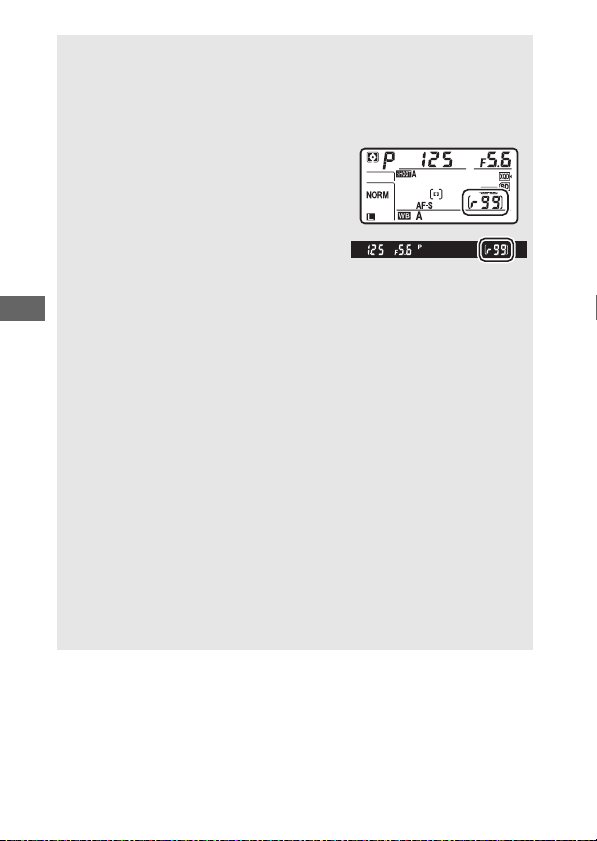
118
A The Memory Buffer
The camera is equipped with a memory buffer for temporary storage,
allowing shooting to continue while photographs are being saved to
the memory card.
Note, however, that frame rate will drop when the
buffer is full (tAA).
The approximate number of images that
can be stored in the memory buffer at
current settings is shown in the exposure-
count displays in the viewfinder and
control panel while the shutter-release
button is pressed halfway.
The illustration
at right shows the display when space
remains in the buffer for about 99 pictures.
While photographs are being recorded to the memory card, the
memory card access lamp will light.
Depending on shooting
conditions and memory card performance, recording may take from a
few seconds to a few minutes.
Do not remove the memory card or
remove or disconnect the power source until the access lamp has gone
out.
If the camera is switched off while data remain in the buffer, the
power will not turn off until all images in the buffer have been
recorded.
If the battery is exhausted while images remain in the
buffer, the shutter release will be disabled and the images transferred
to the memory card.
A See Also
For information on choosing the order in which the photos in each
burst are displayed after shooting, see After burst, show (0 282).
For
information on choosing the maximum number of photographs that
can be taken in a single burst, see Custom Setting d2 (Max.
continuous release, 0 297).
For information on the number of
pictures that can be taken in a single burst, see page 389.
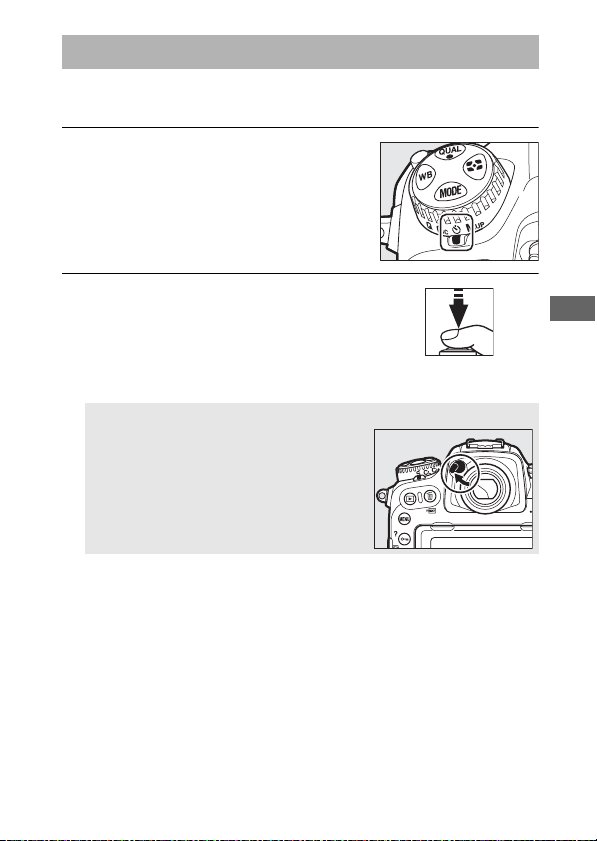
119
The self-timer can be used to reduce camera shake or for self-
portraits.
1 Select self-timer mode.
Press the release mode dial lock
release and turn the release mode dial
to E.
2 Frame the photograph and focus.
In single-servo AF (0 101),
photographs can only be taken if the
in-focus (I) indicator appears in the
viewfinder.
Self-Timer Mode
A Close the Viewfinder Eyepiece Shutter
When taking photos without your eye to
the viewfinder, close the viewfinder
eyepiece shutter to prevent light
entering via the viewfinder from
appearing in photographs or interfering
with exposure.
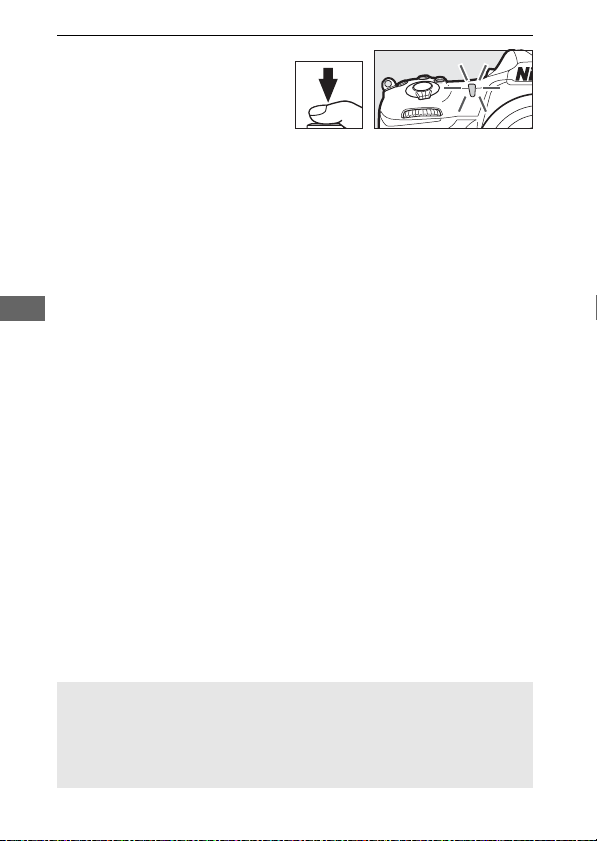
120
3 Start the timer.
Press the shutter-release
button all the way down to
start the timer.
The self-
timer lamp will start to
flash.
Two seconds before the photograph is taken, the self-
timer lamp will stop flashing.
The shutter will be released
about ten seconds after the timer starts.
To turn the self-timer off before a photograph is taken, turn the
release mode dial to another setting.
A See Also
For information on choosing the duration of the self-timer, the number
of shots taken, and the interval between shots, see Custom Setting c3
(Self-timer, 0 296).
The beeps that sound when the self-timer is used
can be controlled using the Beep option in the setup menu (0 306).
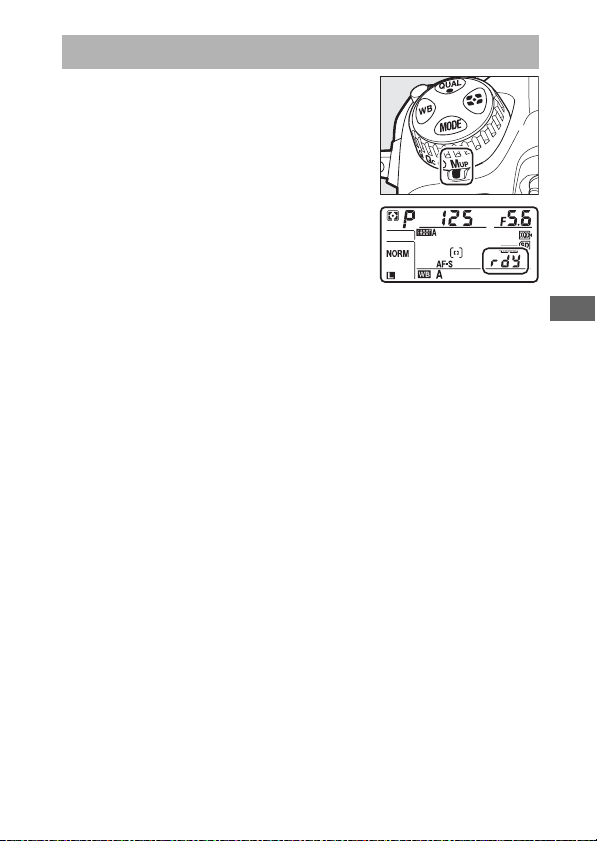
121
Choose this mode to minimize blurring
caused by camera movement when the
mirror is raised.
To use mirror-up mode,
press the release mode dial lock release
and rotate the release mode dial to MUP
(mirror up).
After pressing the shutter-
release button halfway to set focus and
exposure, press the shutter-release
button the rest of the way down to raise
the mirror.
Z will be displayed in the
control panel; press the shutter-release
button all the way down again to take the picture (in live view,
there is no need to raise the mirror; the picture is taken the first
time the shutter-release button is pressed all the way down).
A beep will sound, unless Off is selected for Beep in the setup
menu (0 306).
The mirror lowers when shooting ends.
Mirror up Mode
122
D Mirror Up
While the mirror is raised, photos can not be framed in the viewfinder
and autofocus and metering will not be performed.
A Mirror up Mode
A picture will be taken automatically if no operations are performed for
about 30 s after the mirror is raised.
A Preventing Blur
To prevent blurring caused by camera movement, press the shutter-
release button smoothly.
Use of a tripod is recommended.
A See Also
For information on using the electronic front-curtain shutter to further
reduce blur, see Custom Setting d6 (Electronic front-curtain shutter,
0 298).
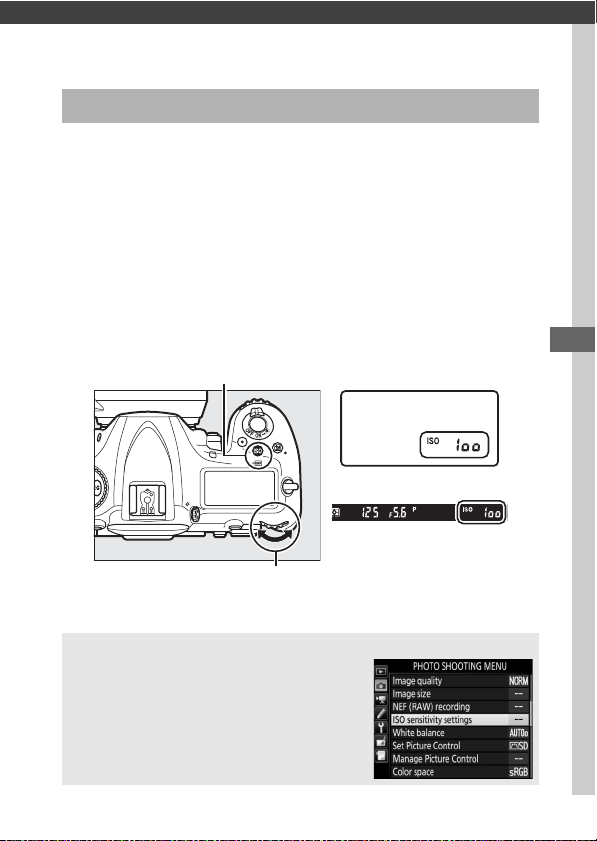
123
ISO Sensitivity
The camera’s sensitivity to light can be adjusted according to the
amount of light available.
Choose from settings that range from
ISO 100 and ISO 51200 in steps equivalent to
1
/
3 EV.
Settings of
from about 0.3 to 1 EV below ISO 100 and 0.3 to 5 EV above ISO
51200 are also available for special situations.
The higher the ISO
sensitivity, the less light needed to make an exposure, allowing
higher shutter speeds or smaller apertures.
ISO sensitivity can be adjusted by pressing the S (Q) button
and rotating the main command dial until the desired setting is
displayed in the control panel and viewfinder.
Manual Adjustment
A The ISO Sensitivity Menu
ISO sensitivity can also be adjusted using the
ISO sensitivity settings option in the photo
shooting menu (0 285).
S (Q) button
Main command dial
Control panel
Viewfinder
124
A ISO Sensitivity
The higher the ISO sensitivity, the less light needed to make an
exposure, allowing faster shutter speeds or smaller apertures, but the
more likely the image is to be affected by noise (randomly-spaced
bright pixels, fog, or lines).
Noise is particularly likely at settings
between Hi 0.3 and Hi 5.
A Hi 0.3–Hi 5
The settings Hi 0.3 through Hi 5 correspond to ISO sensitivities 0.3–
5 EV over ISO 51200 (ISO 64000–1640000 equivalent).
A Lo 0.3–Lo 1
The settings Lo 0.3 through Lo 1 correspond to ISO sensitivities 0.3–
1 EV below ISO 100 (ISO 80–50 equivalent).
Use for larger apertures
when lighting is bright.
Contrast is slightly higher than normal; in most
cases, ISO sensitivities of ISO 100 or above are recommended.
A See Also
For information on choosing the ISO sensitivity step size, see Custom
Setting b1 (ISO sensitivity step value; 0 294).
See Custom Setting d3
(ISO display; 0 297) for information on displaying ISO sensitivity in
the control panel and viewfinder.
For information on using the High
ISO NR options in the photo and movie shooting menus to reduce
noise at high ISO sensitivities, see pages 286 (photos) and 290
(movies).
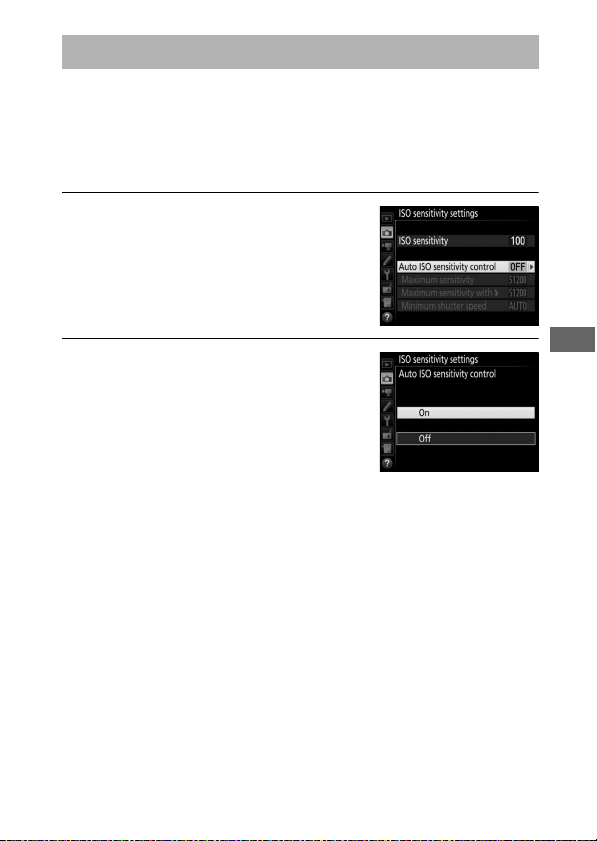
125
If On is selected for ISO sensitivity settings > Auto ISO
sensitivity control in the photo shooting menu, ISO sensitivity
will automatically be adjusted if optimal exposure can not be
achieved at the value selected by the user (ISO sensitivity is
adjusted appropriately when the flash is used).
1 Select Auto ISO sensitivity control.
Select ISO sensitivity settings in the
photo shooting menu, highlight Auto
ISO sensitivity control and press 2.
2 Select On.
Highlight On and press J (if Off is
selected, ISO sensitivity will remain
fixed at the value selected by the
user).
Auto ISO Sensitivity Control
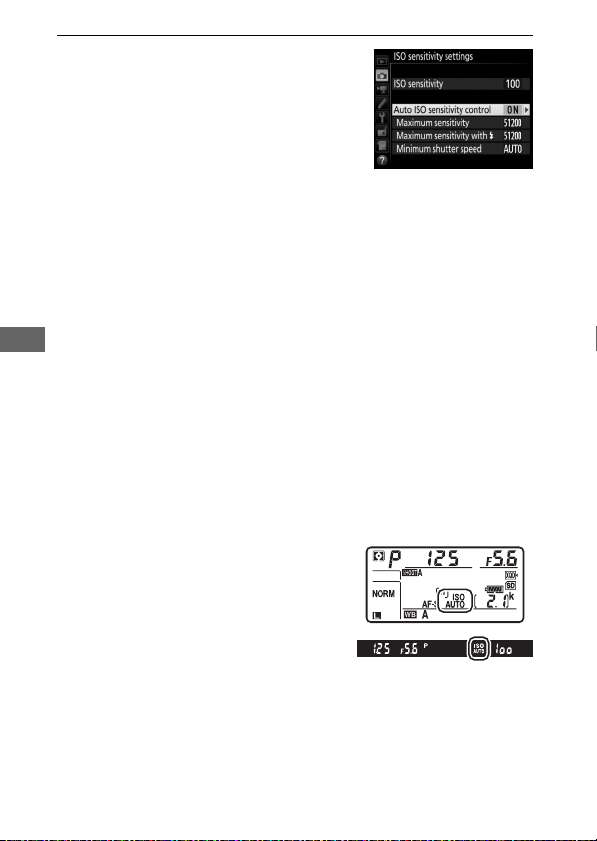
126
3 Adjust settings.
The maximum value for auto ISO
sensitivity can be selected using
Maximum sensitivity (the minimum
value for auto ISO sensitivity is
automatically set to ISO 100; note that
if the ISO sensitivity selected by the
user is higher than that chosen for Maximum sensitivity, the
value selected by the user will be used instead).
In exposure
modes P and A, sensitivity will only be adjusted if
underexposure would result at the shutter speed selected for
Minimum shutter speed (
1
/
4000–30 s, or Auto; in modes S and
M, ISO sensitivity will be adjusted for optimal exposure at the
shutter speed selected by the user).
If Auto is selected, the
camera will choose the minimum shutter speed based on the
focal length of the lens.
Press J to exit when settings are
complete.
To choose the maximum ISO sensitivity for photos taken
using an optional flash unit (0 328), use Maximum
sensitivity with M.
Selecting Same as without flash sets the
maximum ISO sensitivity for flash photography to the value
currently selected for Maximum sensitivity.
When On is selected, the viewfinder
and control panel show ISO-AUTO.
When
sensitivity is altered from the value
selected by the user, these indicators
flash and the altered value is shown in
the viewfinder and control panel.
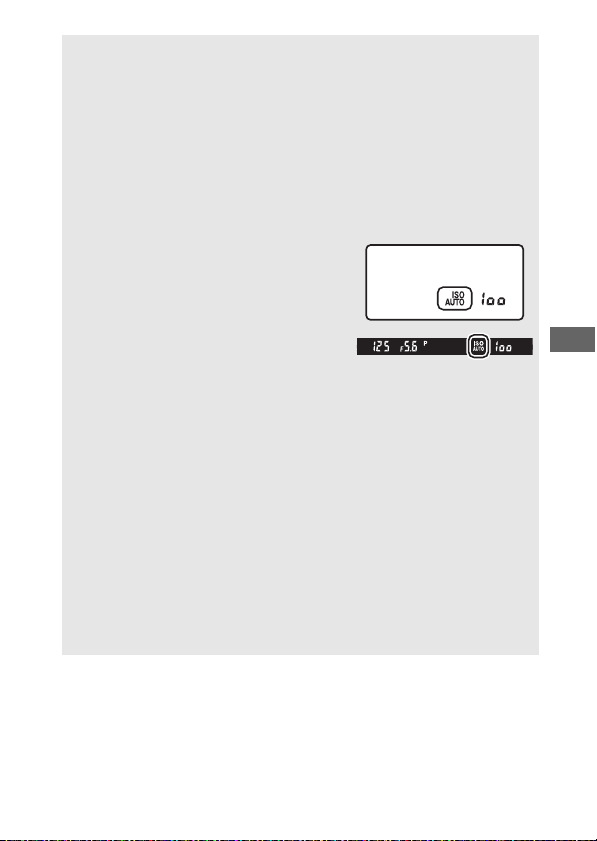
127
A Minimum Shutter Speed
Auto shutter-speed selection can be fine-tuned by highlighting Auto
and pressing 2: for example, values faster than those usually selected
automatically can be used with telephoto lenses to reduce blur.
Note,
however, that Auto functions only with CPU lenses; if a non-CPU lens is
used without lens data, minimum shutter speed is fixed at
1
/
30 s.
Shutter speeds may drop below the selected minimum if optimum
exposure can not be achieved at the ISO sensitivity chosen for
Maximum sensitivity.
A Turning Auto ISO Sensitivity Control On or Off
You can turn auto ISO sensitivity control
on or off by pressing the S (Q) button
and rotating the sub-command dial.
The
control panel and viewfinder display ISO-
AUTO icons when auto ISO sensitivity
control is on and ISO when it is off.
A Auto ISO Sensitivity Control
When a flash is used, minimum shutter speed will be set to the value
selected for Minimum shutter speed unless this value is faster than
Custom Setting e1 (Flash sync speed, 0 299) or slower than Custom
Setting e2 (Flash shutter speed, 0 300), in which case the value
selected for Custom Setting e2 will be used instead.
Note that ISO
sensitivity may be raised automatically when auto ISO sensitivity
control is used in combination with slow sync flash modes (available
with optional flash units; 0 201), possibly preventing the camera from
selecting slow shutter speeds.
A See Also
For information on choosing the reference used to set exposure when
a flash is used with auto ISO sensitivity control, see Custom Setting e4
(Auto M ISO sensitivity control, 0 300).
128
Exposure
Metering determines how the camera sets exposure.
The
following options are available:
Metering
Option Description
L
Matrix: Produces natural results in most situations.
Camera
meters wide area of the frame and sets exposure according to
tone distribution, color, composition, and, with type G, E, or D
lenses (0 322), distance information (3D color matrix metering
III; with other CPU lenses, camera uses color matrix metering III,
which does not include 3D distance information).
M
Center-weighted: Camera meters entire frame but assigns greatest
weight to center area (if CPU lens is attached, size of area can be
selected using Custom Setting b6, Center-weighted area,
0 295; if non-CPU lens is attached, area is equivalent to circle
8 mm in diameter).
Classic meter for portraits; recommended
when using filters with an exposure factor (filter factor) over 1×.
N
Spot: Camera meters circle 3.5 mm (0.14 in.) in diameter
(approximately 2.5% of frame).
Circle is centered on current
focus point, making it possible to meter off-center subjects (if
non-CPU lens is used or if auto-area AF is in effect, camera will
meter center focus point).
Ensures that subject will be correctly
exposed, even when background is much brighter or darker.
t
Highlight-weighted: Camera assigns greatest weight to highlights.
Use to reduce loss of detail in highlights, for example when
photographing spotlit performers on-stage.
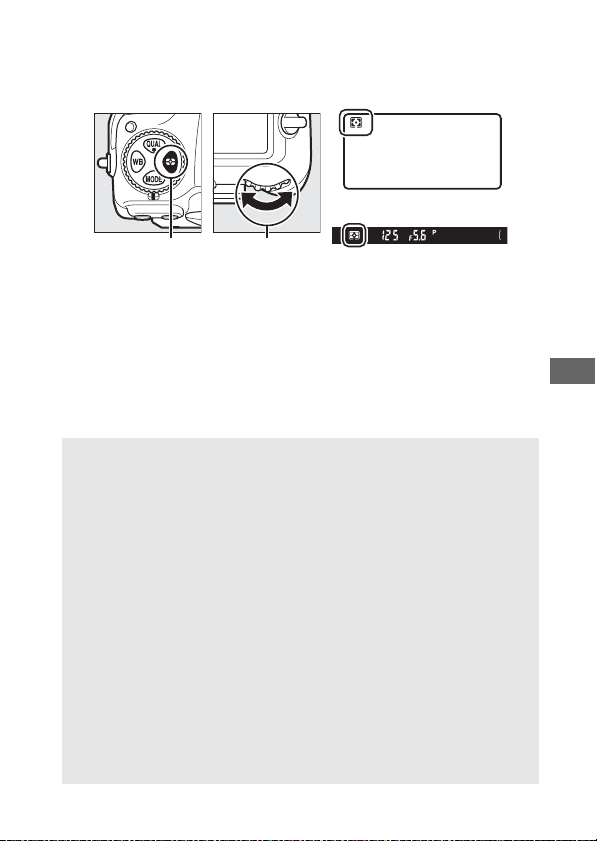
129
To choose a metering option, press the Y button and rotate the
main command dial until the desired setting is displayed in the
viewfinder and control panel.
A Non-CPU Lens Data
Specifying the focal length and maximum aperture of non-CPU lenses
using the Non-CPU lens data option in the setup menu (0 251)
allows the camera to use color matrix metering when matrix is selected
and improves the accuracy of center-weighted and spot metering.
Center-weighted metering will be used if highlight-weighted metering
is selected with non-CPU lenses or if matrix metering is selected with
non-CPU lenses for which lens data have not been supplied.
Note that
center-weighted metering may also be used if highlight-weighted
metering is selected with certain CPU lenses (AI-P NIKKOR lenses and
AF lenses that are not of type G, E, or D; 0 325).
A See Also
See Custom Setting b5 (Matrix metering, 0 295) for information on
choosing whether matrix metering uses face detection.
For
information on making separate adjustments to optimal exposure for
each metering method, see Custom Setting b7 (Fine-tune optimal
exposure, 0 295).
Y button Main command
dial
Control panel
Viewfinder
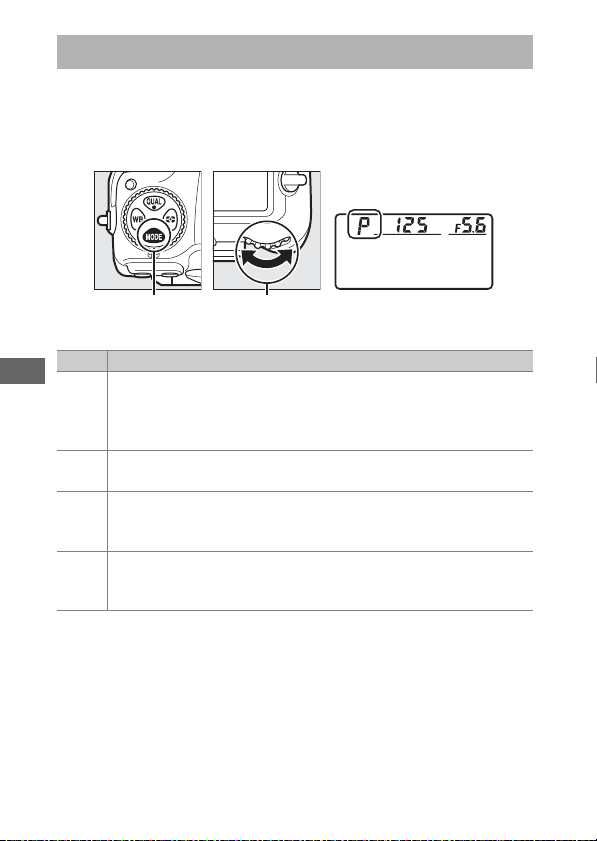
130
To determine how the camera sets shutter speed and aperture
when adjusting exposure, press the I button and rotate the
main command dial until the desired option appears in the
control panel.
Exposure Mode
I button Main command
dial
Control panel
Mode Description
e
Programmed auto (0 132): Camera sets shutter speed and
aperture for optimal exposure.
Recommended for snapshots
and in other situations in which there is little time to adjust
camera settings.
f
Shutter-priority auto (0 133): User chooses shutter speed; camera
selects aperture for best results.
Use to freeze or blur motion.
g
Aperture-priority auto (0 134): User chooses aperture; camera
selects shutter speed for best results.
Use to blur background
or bring both foreground and background into focus.
h
Manual (0 135): User controls both shutter speed and aperture.
Set shutter speed to Bulb (A) or Time (%) for long time-
exposures.
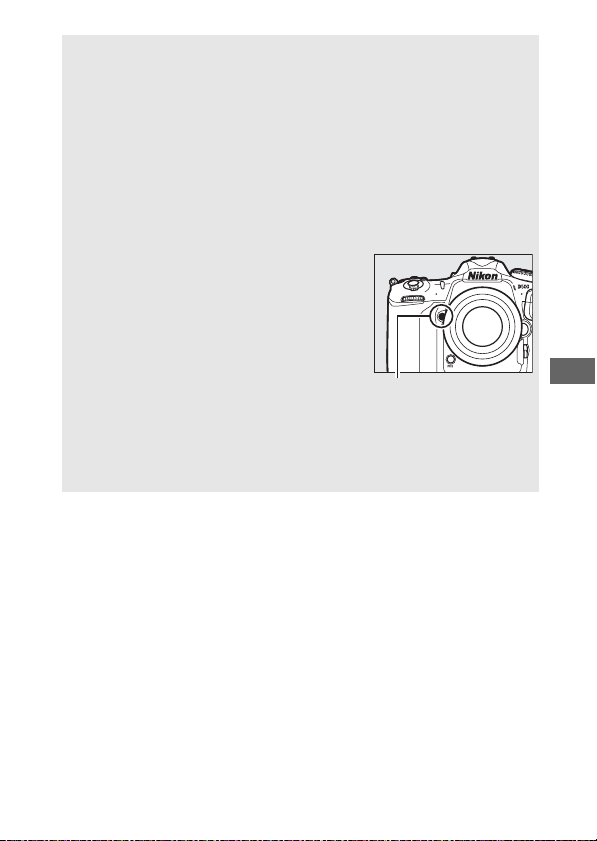
131
A Lens Types
When using a CPU lens equipped with an aperture ring (0 325), lock
the aperture ring at the minimum aperture (highest f-number).
Type G
and E lenses are not equipped with an aperture ring.
When using non-CPU lenses (0 250), select exposure mode A
(aperture-priority auto) or M (manual).
In other modes, exposure mode
A is automatically selected when a non-CPU lens is attached (0 325).
The exposure mode indicator (P or S) will flash in the control panel and
A will be displayed in the viewfinder.
A Depth-of-Field Preview
To preview the effects of aperture, press and
hold the Pv button.
The lens will be stopped
down to the aperture value selected by the
camera (modes P and S) or the value chosen
by the user (modes A and M), allowing depth
of field to be previewed in the viewfinder.
A Custom Setting e5—Modeling Flash
This setting controls whether optional flash units that support the
Nikon Creative Lighting System (CLS; 0 328) will emit a modeling flash
when the Pv button is pressed.
Pv button
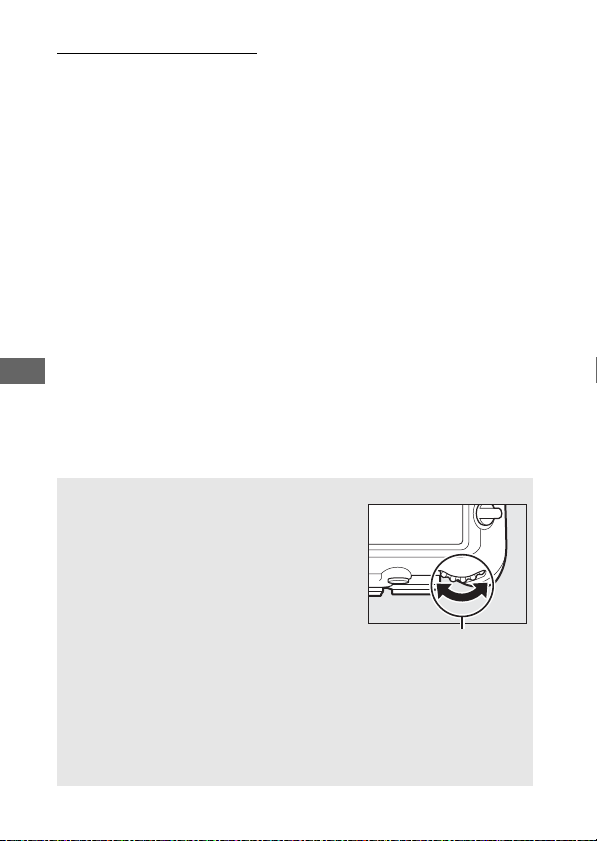
132
P: Programmed Auto
In this mode, the camera automatically adjusts shutter speed
and aperture according to a built-in program to ensure optimal
exposure in most situations.
A Flexible Program
In exposure mode P, different combinations
of shutter speed and aperture can be
selected by rotating the main command dial
while the exposure meters are on (“flexible
program”).
All combinations produce the
same exposure.
While flexible program is in
effect, an asterisk (“U”) appears in the control
panel.
To restore default shutter speed and
aperture settings, rotate the dial until the
asterisk is no longer displayed, choose another mode, or turn the
camera off.
A See Also
For information on activating the exposure meters, see “The Standby
Timer (Viewfinder Photography)” on page 39.
Main command dial
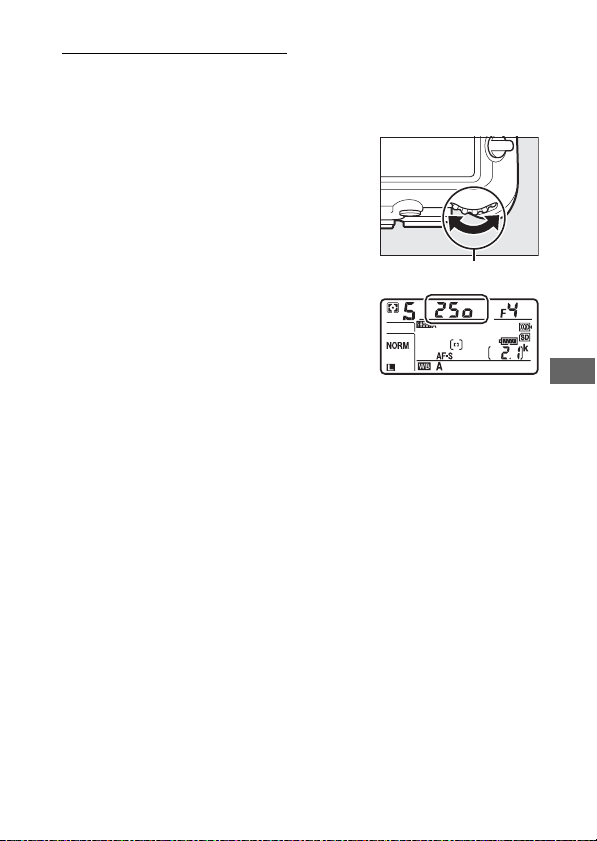
133
S: Shutter-Priority Auto
In shutter-priority auto, you choose the shutter speed while the
camera automatically selects the aperture that will produce the
optimal exposure.
To choose a shutter speed, rotate the
main command dial while the exposure
meters are on.
Shutter speed can be set
to “p” or to values between 30 s and
1
/
8000 s.
Shutter speed can be locked at the
selected setting (0 140).
Main command dial
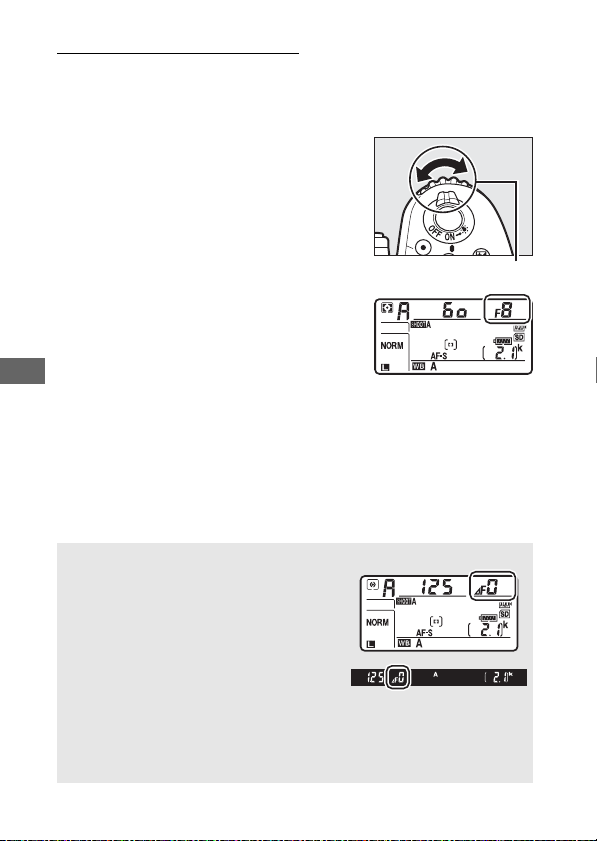
134
A: Aperture-Priority Auto
In aperture-priority auto, you choose the aperture while the
camera automatically selects the shutter speed that will produce
the optimal exposure.
To choose an aperture between the
minimum and maximum values for the
lens, rotate the sub-command dial while
the exposure meters are on.
Aperture
can be locked at the selected setting
(0 140).
A Non-CPU Lenses (0 323, 325)
Use the lens aperture ring to adjust
aperture.
If the maximum aperture of the
lens has been specified using the Non-
CPU lens data item in setup menu
(0 251) when a non-CPU lens is attached,
the current f-number will be displayed in
the viewfinder and control panel,
rounded to the nearest full stop.
Otherwise the aperture displays will show only the number of stops
(F, with maximum aperture displayed as FA) and the f-number must
be read from the lens aperture ring.
Sub-command dial
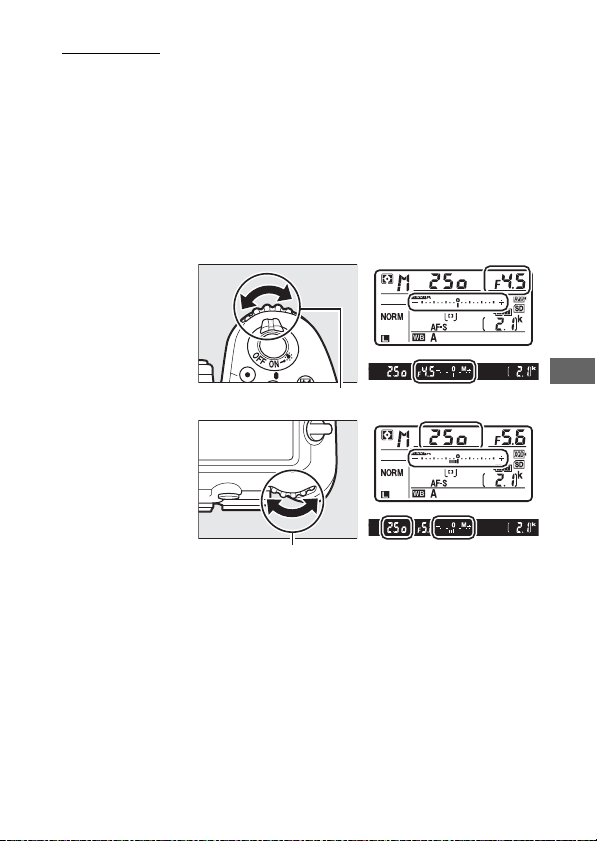
135
M: Manual
In manual exposure mode, you control both shutter speed and
aperture.
While the exposure meters are on, rotate the main
command dial to choose a shutter speed, and the sub-command
dial to set aperture.
Shutter speed can be set to “p” or to
values between 30 s and
1
/
8000 s, or the shutter can be held open
indefinitely for a long time-exposure (A or %, 0 137).
Aperture can be set to values between the minimum and
maximum values for the lens.
Use the exposure indicators to
check exposure.
Shutter speed and aperture can be locked at the selected setting
(
0
140).
Aperture
Sub-command dial
Shutter speed
Main command dial
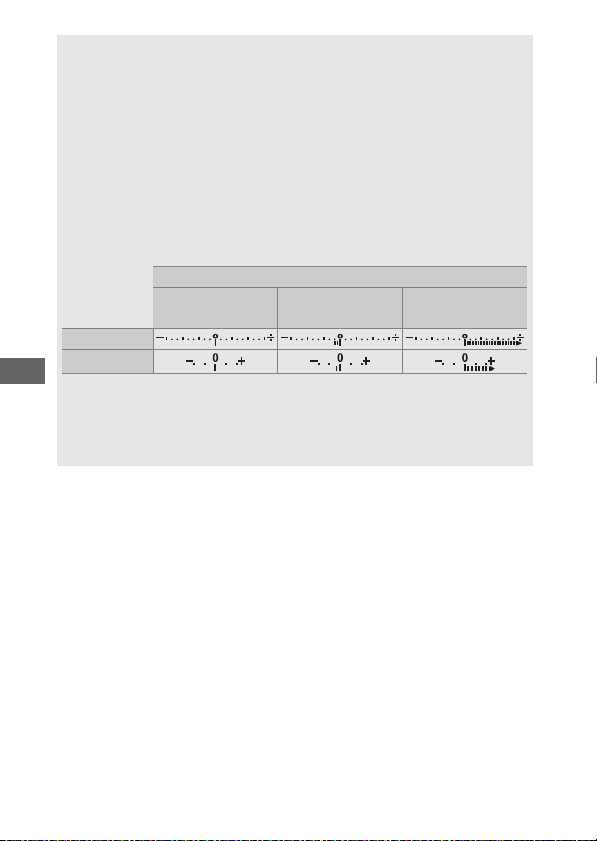
136
A AF Micro NIKKOR Lenses
Provided that an external exposure meter is used, the exposure ratio
need only be taken into account when the lens aperture ring is used to
set aperture.
A Exposure Indicators
The exposure indicators in the viewfinder and control panel show
whether the photograph would be under- or over-exposed at current
settings.
Depending on the option chosen for Custom Setting b2 (EV
steps for exposure cntrl, 0 294), the amount of under- or over-
exposure is shown in increments of
1
/
3 EV,
1
/
2 EV, or 1 EV.
If the limits of
the exposure metering system are exceeded, the displays will flash.
Custom Setting b2 set to 1/3 step
Optimal exposure
Underexposed by
1
/
3 EV
Overexposed by over
3EV
Control panel
Viewfinder
A See Also
For information on reversing the exposure indicators so that negative
values are displayed on the right and positive values on the left, see
Custom Setting f7 (Reverse indicators, 0 303).
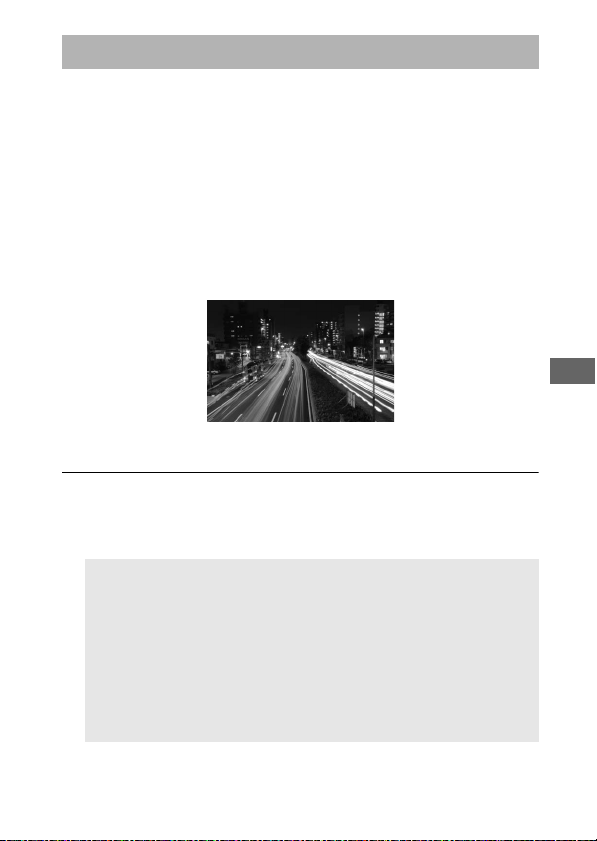
137
Select the following shutter speeds for long time-exposures of
moving lights, the stars, night scenery, or fireworks.
• Bulb (A): The shutter remains open while the shutter-
release button is held down.
To prevent blur, use a tripod or an
optional wireless remote controller (0 335) or remote cord
(0 336).
• Time (%): Start the exposure by using the shutter-release
button on the camera or on an optional remote cord, or
wireless remote controller.
The shutter remains open until the
button is pressed a second time.
1 Ready the camera.
Mount the camera on a tripod or place it on a stable, level
surface.
Long Time-Exposures (M Mode Only)
Length of exposure: 35 s
Aperture: f/25
A Long Time-Exposures
Close the viewfinder eyepiece shutter to prevent the photograph
being affected by light entering via the viewfinder (0 119).
Nikon
recommends using a fully charged battery or an optional AC
adapter and power connector to prevent loss of power while the
shutter is open.
Note that noise (bright spots, randomly-spaced
bright pixels or fog) may be present in long exposures.
Bright spots
and fog can be reduced by choosing On for Long exposure NR in
the photo shooting menu (0 286).
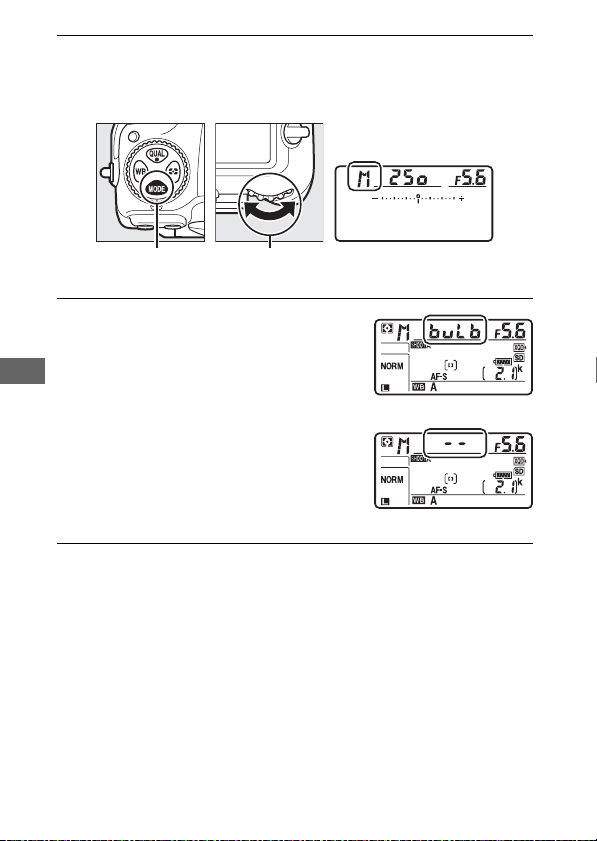
138
2 Select exposure mode M.
Press the I button and rotate the main command dial until
M is displayed in the control panel.
3 Choose a shutter speed.
While the exposure meters are on,
rotate the main command dial to
choose a shutter speed of Bulb
(A) or Time (%).
The exposure
indicators do not appear when Bulb
(A) or Time (%) is selected.
4 Open the shutter.
Bulb: After focusing, press the shutter-release button on the
camera or optional remote cord or wireless remote controller
all the way down.
Keep the shutter-release button pressed
until the exposure is complete.
Time: Press the shutter-release button all the way down.
I button Main command
dial
Control panel
Bulb
Time
139
5 Close the shutter.
Bulb: Take your finger off the shutter-release button.
Time: Press the shutter-release button all the way down.
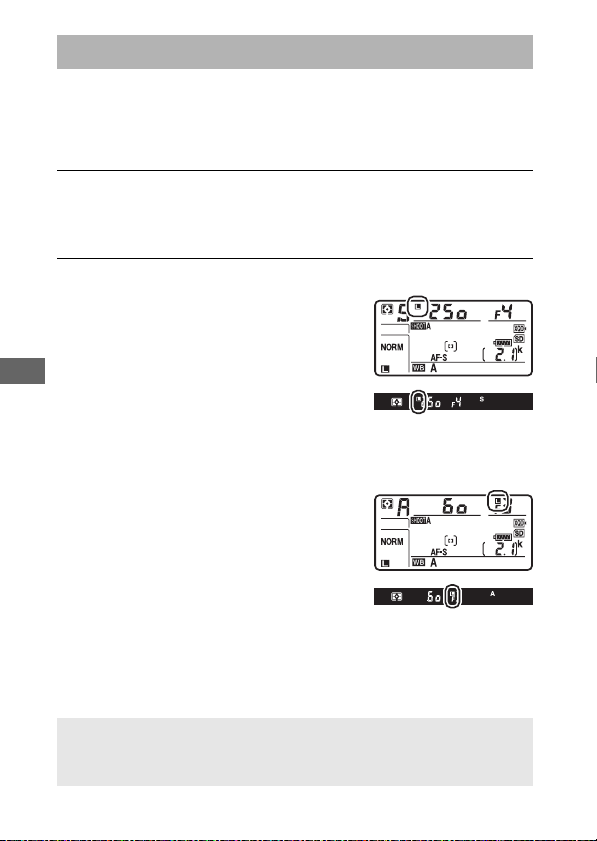
140
Shutter speed lock is available in shutter-priority auto and
manual exposure modes, aperture lock in aperture-priority auto
and manual exposure modes.
Shutter speed and aperture lock
are not available in programmed auto exposure mode.
1 Assign shutter speed and aperture lock to a camera control.
Assign Shutter spd & aperture lock to a control using
Custom Setting f1 (Custom control assignment, 0 301).
2 Lock shutter speed and/or aperture.
Shutter speed (exposure modes S and M):
Press the selected control and rotate
the main command dial until F icons
appear in the viewfinder and control
panel.
To unlock shutter speed, press the
control and rotate the main command dial until the F icons
disappear from the displays.
Aperture (exposure modes A and M): Press
the selected control and rotate the
sub-command dial until F icons
appear in the viewfinder and the
control panel.
To unlock aperture, press the control
and rotate the sub-command dial until the F icons disappear
from the displays.
Shutter-Speed and Aperture Lock
A See Also
Use Custom Setting f3 (Shutter spd & aperture lock; 0 302) to keep
shutter speed and/or aperture locked at the selected values.
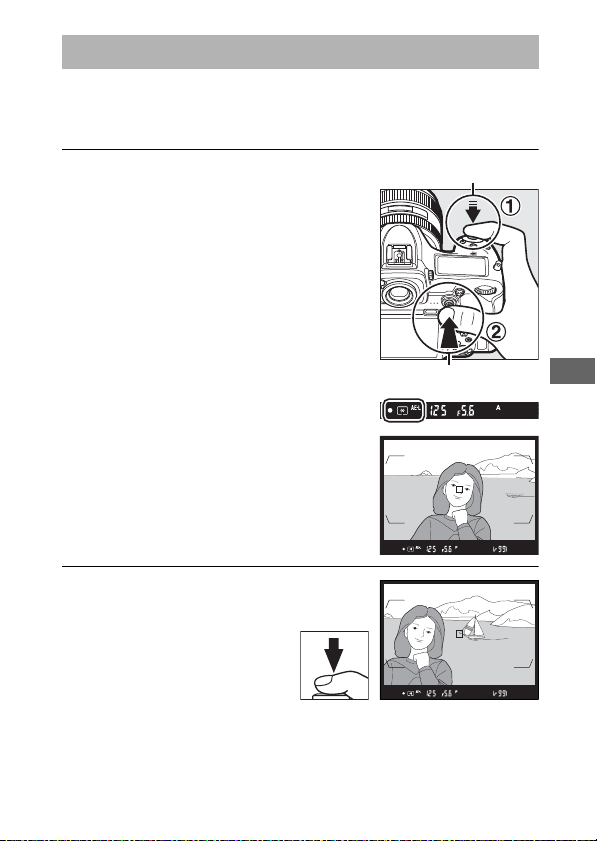
141
Use autoexposure lock to recompose photographs after using
center-weighted metering and spot metering (0 128) to meter
exposure.
1 Lock exposure.
Position the subject in the selected
focus point and press the shutter-
release button halfway.
With the
shutter-release button pressed
halfway and the subject positioned in
the focus point, press the center of the
sub-selector to lock exposure (if you
are using autofocus, confirm that the
I in-focus indicator appears in the
viewfinder).
While exposure lock is in effect, an AE-L
indicator will appear in the viewfinder.
2 Recompose the
photograph.
Keeping the center of the
sub-selector pressed,
recompose the
photograph and shoot.
Autoexposure (AE) Lock
Shutter-release button
Sub-selector
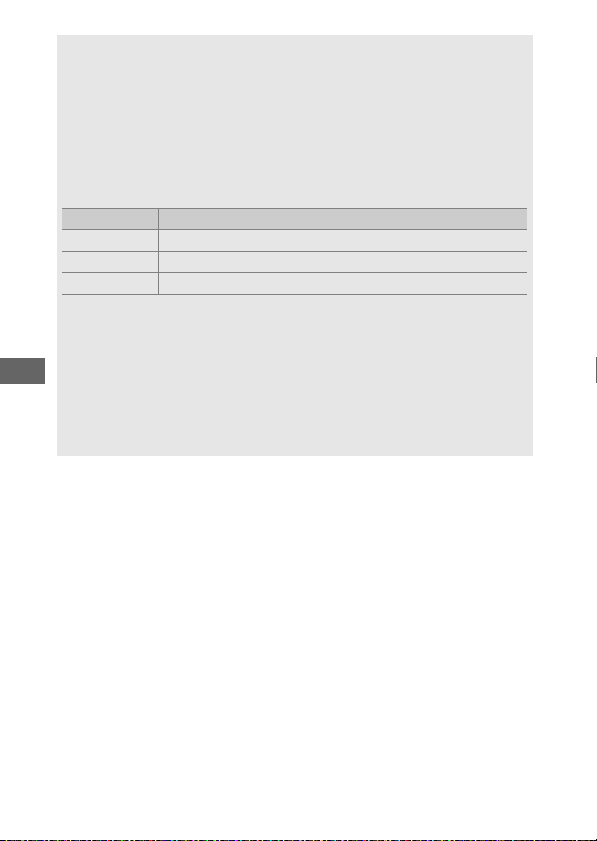
142
A Metered Area
In spot metering, exposure will be locked at the value metered at the
selected focus point (0 128).
In center-weighted metering, exposure
will be locked at the value metered in an 8-mm circle in the center of
the viewfinder.
A Adjusting Shutter Speed and Aperture
While exposure lock is in effect, the following settings can be adjusted
without altering the metered value for exposure:
Exposure mode Setting
P Shutter speed and aperture (flexible program; 0 132)
S Shutter speed
A Aperture
The new values can be confirmed in the viewfinder and control panel.
Note that the metering method can not be changed while exposure
lock is in effect.
A See Also
If On (half press) is selected for Custom Setting c1 (Shutter-release
button AE-L, 0 296), exposure will lock when the shutter-release
button is pressed halfway.
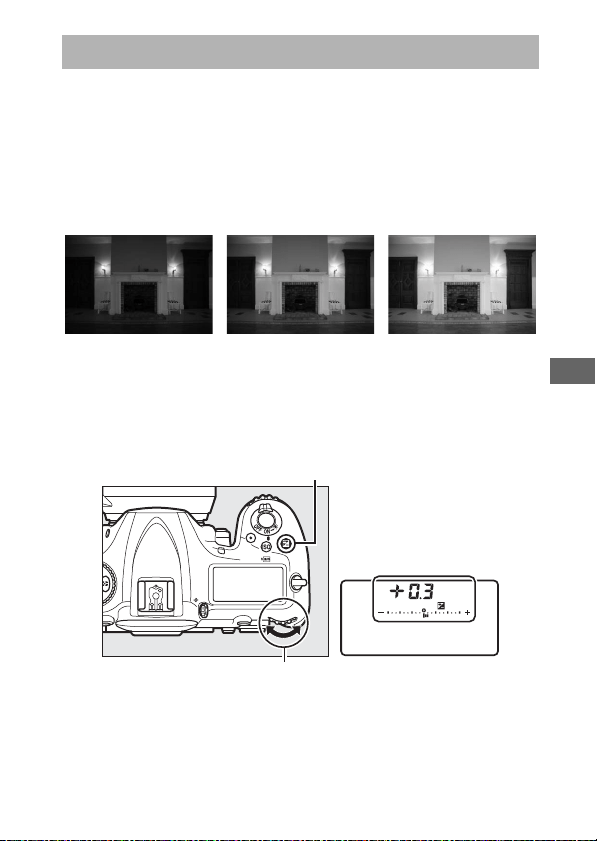
143
Exposure compensation is used to alter exposure from the value
suggested by the camera, making pictures brighter or darker.
It
is most effective when used with center-weighted or spot
metering (0 128).
Choose from values between –5 EV
(underexposure) and +5 EV (overexposure) in increments of
1
/
3 EV.
In general, positive values make the subject brighter while
negative values make it darker.
To choose a value for exposure compensation, press the
E button and rotate the main command dial until the desired
value is displayed in the viewfinder or control panel.
Exposure Compensation
–1 EV No exposure
compensation
+1 EV
E button
Main command dial Control panel
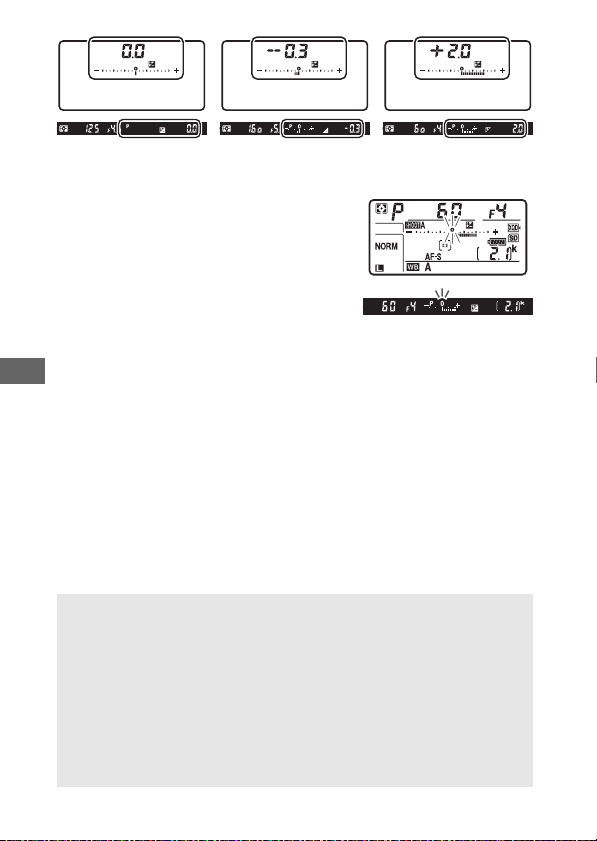
144
At values other than ±0.0, the 0 at the
center of the exposure indicators will
flash (exposure modes P, S, and A only)
and a E icon will be displayed in the
viewfinder and control panel after you
release the E button.
The current value
for exposure compensation can be confirmed in the exposure
indicator by pressing the E button.
Normal exposure can be restored by setting exposure
compensation to ±0.0.
Exposure compensation is not reset
when the camera is turned off.
±0 EV
(E button pressed)
–0.3 EV +2.0 EV
A Exposure Mode M
In exposure mode M, exposure compensation affects only the
exposure indicator; shutter speed and aperture do not change.
A Using a Flash
When a flash is used, exposure compensation affects both flash level
and exposure, altering the brightness of both the main subject and the
background.
Custom Setting e3 (Exposure comp. for flash, 0 300)
can be used to restrict the effects of exposure compensation to the
background only.

145
A See Also
For information on choosing the size of the increments available for
exposure compensation, see Custom Setting b3 (Exp./flash comp.
step value, 0 294).
For information on making adjustments to
exposure compensation without pressing the E button, see Custom
Setting b4 (Easy exposure compensation, 0 295).
For information
on automatically varying exposure, flash level, white balance, or Active
D-Lighting, see page 147.
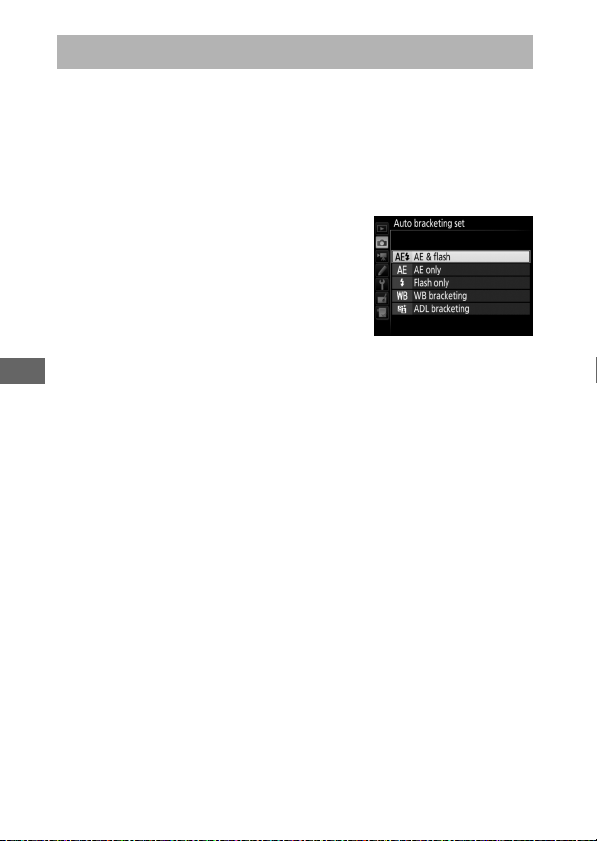
146
Bracketing automatically varies exposure, flash level, Active
D-Lighting (ADL), or white balance slightly with each shot,
“bracketing” the current value.
Choose in situations in which
getting the right settings is difficult and there is not time to
check results and adjust settings with each shot, or to
experiment with different settings for the same subject.
Bracketing is adjusted using the Auto
bracketing set option in the photo
shooting menu, which contains the
following options:
• AE & flash: The camera varies exposure
and flash level over a series of
photographs (0 147).
Note that flash
bracketing is available in i-TTL and, where supported, auto
aperture (qA) flash control modes only (0 198, 328).
• AE only: The camera varies exposure over a series of
photographs.
• Flash only: The camera varies flash level over a series of
photographs.
• WB bracketing: The camera creates multiple copies of each
photograph, each with a different white balance (0 151).
• ADL bracketing: The camera varies Active D-Lighting over a series
of photographs (0 155).
Bracketing
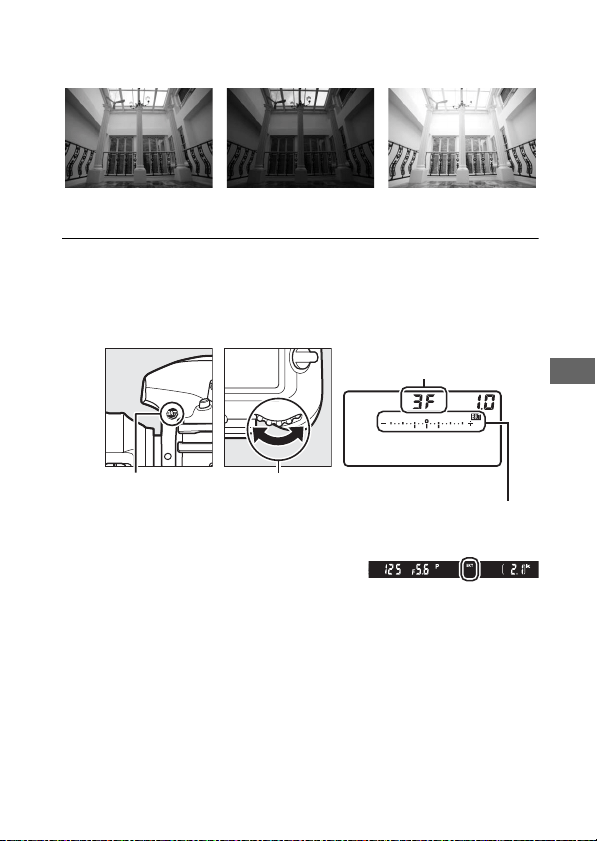
147
❚❚ Exposure and Flash Bracketing
To vary exposure and/or flash level over a series of photographs:
1 Choose the number of shots.
Pressing the BKT button, rotate the main command dial to
choose the number of shots in the bracketing sequence.
The
number of shots is shown in the control panel.
At settings other than zero, a M
icon and exposure and flash
bracketing indicator will appear in the control panel and BKT
will be displayed in the viewfinder.
Exposure modified by:
0EV
Exposure modified by:
–1 EV
Exposure modified by:
+1 EV
BKT button Main command
dial
Number of shots
Exposure and flash
bracketing indicator
Control panel
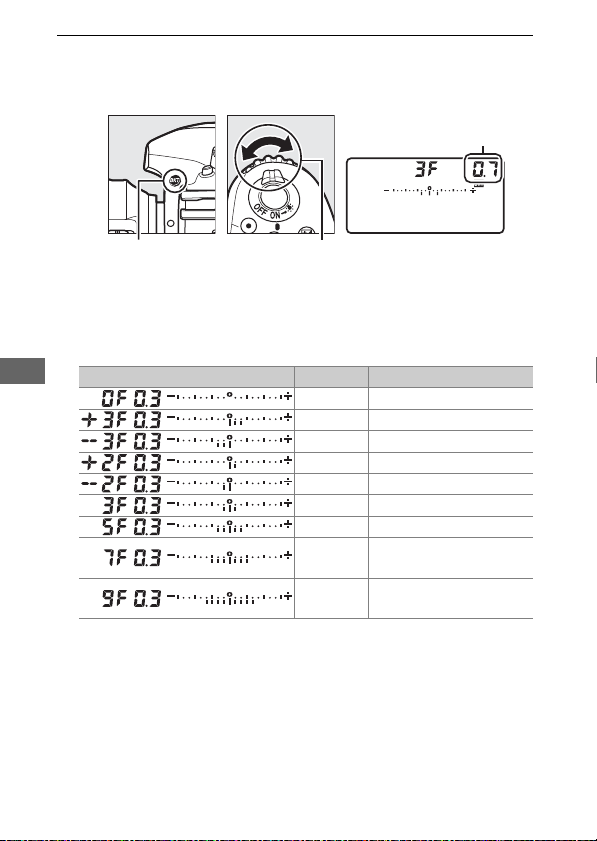
148
2 Select an exposure increment.
Pressing the BKT button, rotate the sub-command dial to
choose the exposure increment.
At default settings, the size of the increment can be chosen
from 0.3 (
1
/
3), 0.7 (
2
/
3), 1, 2, and 3 EV.
The bracketing programs
with an increment of 0.3 (
1
/
3) EV are listed below.
Note that for exposure increments of 2 EV or more, the
maximum number of shots is 5; if a higher value was selected
in Step 1, the number of shots will automatically be set to 5.
BKT button Sub-command
dial
Control panel
Control panel display No. of shots Bracketing order (EVs)
00
3 0/+0.3/+0.7
3 0/–0.7/–0.3
20/+0.3
20/–0.3
3 0/–0.3/+0.3
5 0/–0.7/–0.3/+0.3/+0.7
7
0/–1.0/–0.7/–0.3/+0.3/
+0.7/+1.0
9
0/–1.3/–1.0/–0.7/–0.3/
+0.3/+0.7/+1.0/+1.3
Exposure increment
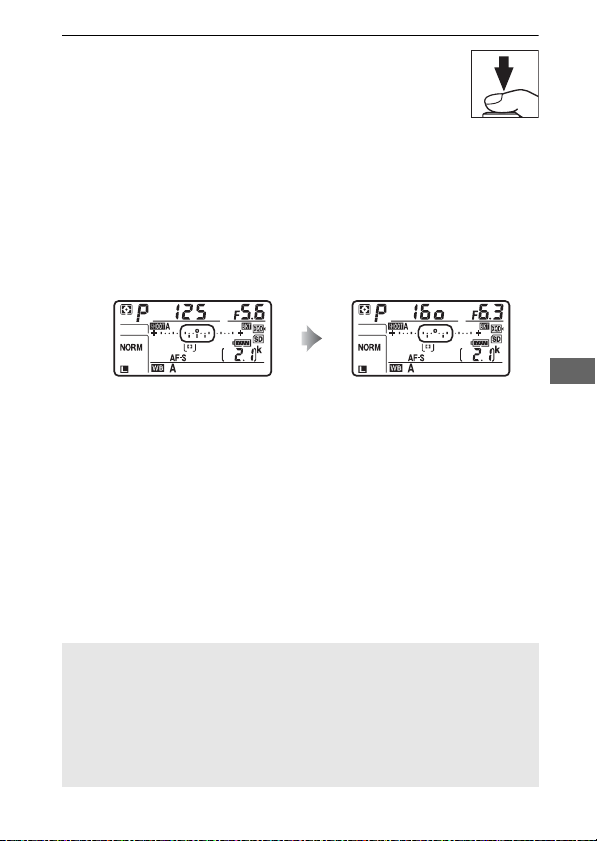
149
3 Frame a photograph, focus, and shoot.
The camera will vary exposure and/or flash level shot-by-shot
according to the bracketing program selected.
Modifications
to exposure are added to those made with exposure
compensation (see page 143).
While bracketing is in effect, a bracketing progress indicator
will be displayed in the viewfinder and control panel.
A
segment will disappear from the indicator after each shot.
❚❚ Canceling Bracketing
To cancel bracketing, press the BKT button and rotate the main
command dial until the number of shots in the bracketing
sequence is zero (r) and M is no longer displayed.
The
program last in effect will be restored the next time bracketing is
activated.
Bracketing can also be cancelled by performing a
two-button reset (0 230), although in this case the bracketing
program will not be restored the next time bracketing is
activated.
No. shots: 3; increment: 0.7 Display after first shot
A See Also
For information on choosing the size of the exposure increment, see
Custom Setting b2 (EV steps for exposure cntrl, 0 294).
For
information on choosing the order in which bracketing is performed,
see Custom Setting e7 (Bracketing order, 0 301).
For information on
choosing the role of the BKT button, see Custom Setting f1 (Custom
control assignment) > BKT button + y (0 301).
150
A Exposure and Flash Bracketing
In continuous low speed, continuous high speed, and quiet
continuous modes, shooting will pause after the number of shots
specified in the bracketing program have been taken.
Shooting will
resume the next time the shutter-release button is pressed.
In self-
timer mode, the camera will take the number of shots selected in Step
1 on page 147 each time the shutter-release button is pressed,
regardless of the option selected for Custom Setting c3 (Self-
timer)>Number of shots (0 296); the interval between shots is
however controlled by Custom Setting c3 (Self-timer)>Interval
between shots.
In other modes, one shot will be taken each time the
shutter-release button is pressed.
If the memory card fills before all shots in the sequence have been
taken, shooting can be resumed from the next shot in the sequence
after the memory card has been replaced or shots have been deleted
to make room on the memory card.
If the camera is turned off before
all shots in the sequence have been taken, bracketing will resume from
the next shot in the sequence when the camera is turned on.
A Exposure Bracketing
The camera modifies exposure by varying shutter speed and aperture
(programmed auto), aperture (shutter-priority auto), or shutter speed
(aperture-priority auto, manual exposure mode).
If On is selected for
ISO sensitivity settings > Auto ISO sensitivity control (0 125) in
modes P, S, and A and no flash is attached, the camera will modify
exposure by varying ISO sensitivity and only vary shutter speed and/or
aperture if the limits of exposure system are exceeded.
Custom Setting
e6 (Auto bracketing (mode M), 0 301) can be used to change how
the camera performs exposure and flash bracketing in manual
exposure mode.
Bracketing can be performed by varying flash level
together with shutter speed and/or aperture, or by varying flash level
alone.
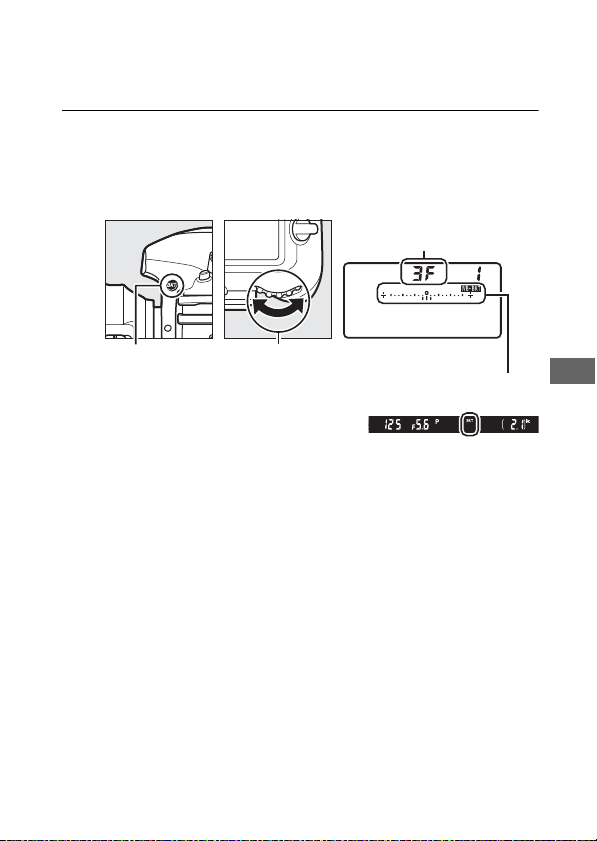
151
❚❚ White Balance Bracketing
The camera creates multiple copies of each photograph, each
with a different white balance.
1 Choose the number of shots.
Pressing the BKT button, rotate the main command dial to
choose the number of shots in the bracketing sequence.
The
number of shots is shown in the control panel.
At settings other than zero, a W
icon and WB bracketing indicator
will appear in the control panel and BKT will be displayed in
the viewfinder.
BKT button Main command
dial
Number of shots
Control panel
WB bracketing indicator
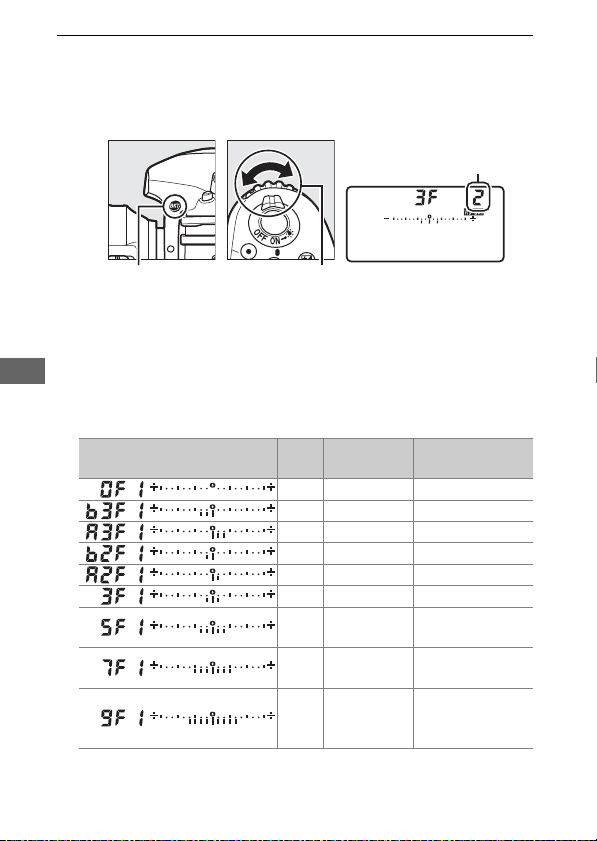
152
2 Select a white balance increment.
Pressing the BKT button, rotate the sub-command dial to
choose the white balance adjustment.
Each increment is
roughly equivalent to 5 mired.
Choose from increments of 1 (5 mired), 2 (10 mired), or 3
(15 mired).
Higher B values correspond to increased amounts
of blue, higher A values to increased amounts of amber
(0 163).
The bracketing programs with an increment of 1 are
listed below.
BKT button Sub-command
dial
Control panel
Control panel display
No. of
shots
White balance
increment
Bracketing order
01 0
31B 0/1B/2B
31A 0/2A/1A
21B 0/1B
21A 0/1A
3 1A, 1B 0/1A/1B
51A, 1B
0/2 A/1 A/1 B/
2B
71A, 1B
0/3 A/2 A/1 A/
1B/2B/3B
91A, 1B
0/4A/3A/2A/
1 A/1 B/2 B/3 B/
4B
White balance
increment
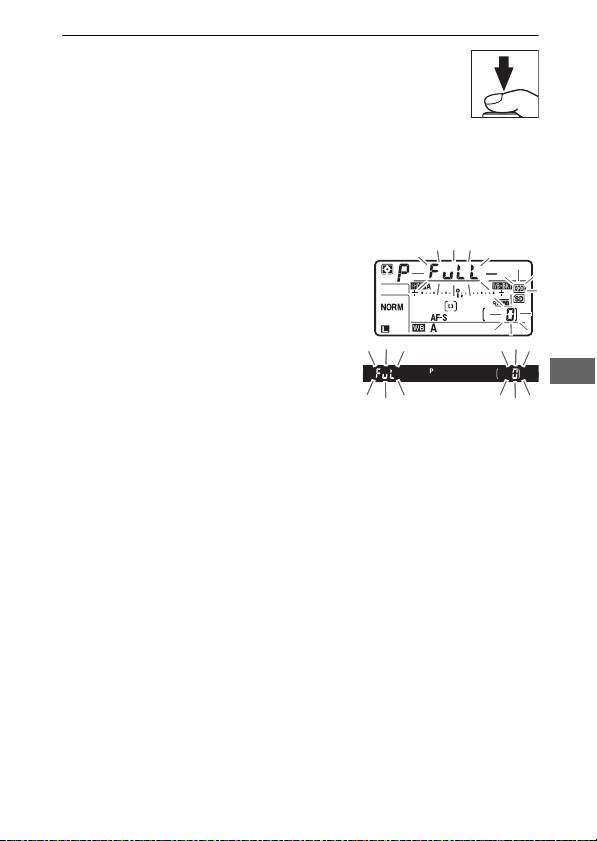
153
3 Frame a photograph, focus, and shoot.
Each shot will be processed to create the number of copies
specified in the bracketing program, and each copy will have
a different white balance.
Modifications to white balance are
added to the white balance adjustment made with white
balance fine-tuning.
If the number of shots in the
bracketing program is greater than
the number of exposures
remaining, n and the icon for
the affected card will flash in the
control panel, a flashing j icon
will appear in the viewfinder as
shown at right, and the shutter
release will be disabled.
Shooting can begin when a new
memory card is inserted.
154
❚❚ Canceling Bracketing
To cancel bracketing, press the BKT button and rotate the main
command dial until the number of shots in the bracketing
sequence is zero (r) and W is no longer displayed.
The
program last in effect will be restored the next time bracketing is
activated.
Bracketing can also be cancelled by performing a
two-button reset (0 230), although in this case the bracketing
program will not be restored the next time bracketing is
activated.
A White Balance Bracketing
White balance bracketing is not available at an image quality of NEF
(RAW).
Selecting an NEF (RAW) or NEF (RAW) + JPEG option cancels
white balance bracketing.
White balance bracketing affects only color temperature (the amber-
blue axis in the white balance fine-tuning display, 0 163).
No
adjustments are made on the green-magenta axis.
In self-timer mode, the number of copies specified in the bracketing
program will be created each time the shutter is released, regardless of
the option selected for Custom Setting c3 (Self-timer) > Number of
shots (0 296).
If the camera is turned off while the memory card access lamp is lit, the
camera will power off only after all photographs in the sequence have
been recorded.
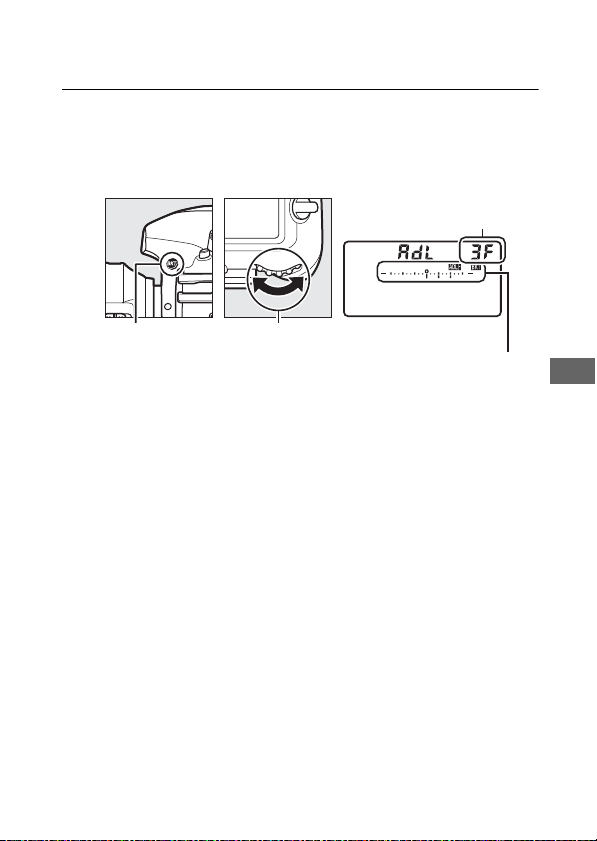
155
❚❚ ADL Bracketing
The camera varies Active D-Lighting over a series of exposures.
1 Choose the number of shots.
Pressing the BKT button, rotate the main command dial to
choose the number of shots in the bracketing sequence.
The
number of shots is shown in the control panel.
At settings other than zero, a d icon and an ADL
bracketing indicator appear in the control panel and BKT will
be displayed in the viewfinder.
Choose two shots to take one
photograph with Active D-Lighting off and another at a
selected value.
Choose three to five shots to take a series of
photographs with Active D-Lighting set to Off, Low, and
Normal (three shots), Off, Low, Normal, and High (four
shots), or Off, Low, Normal, High, and Extra high (five shots).
If you choose more than two shots, proceed to Step 3.
BKT button Main command
dial
Number of shots
Control panel
ADL bracketing indicator
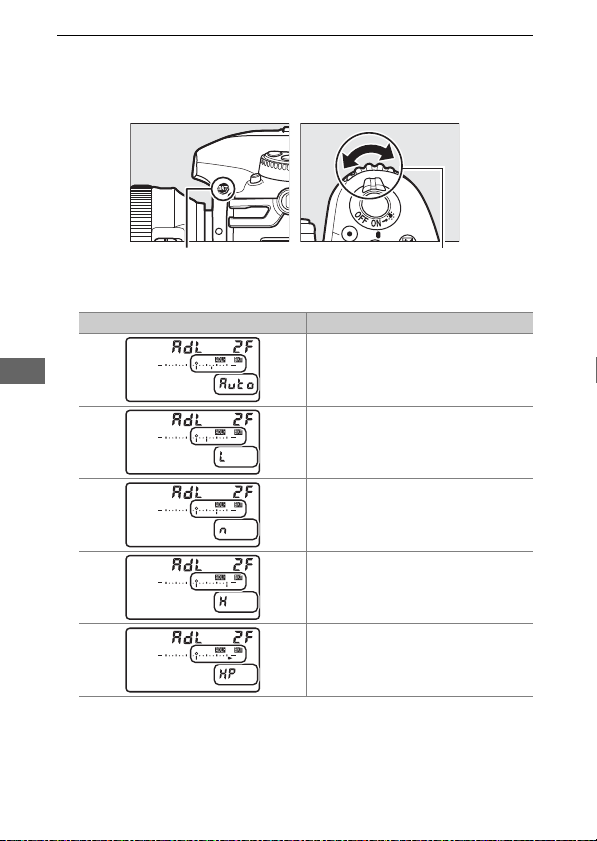
156
2 Select Active D-Lighting.
Pressing the BKT button, rotate the sub-command dial to
choose Active D-Lighting.
Active D-Lighting is shown in the control panel.
BKT button Sub-command dial
Control panel display ADL
Y Auto
R Low
Q Normal
P High
Z Extra high
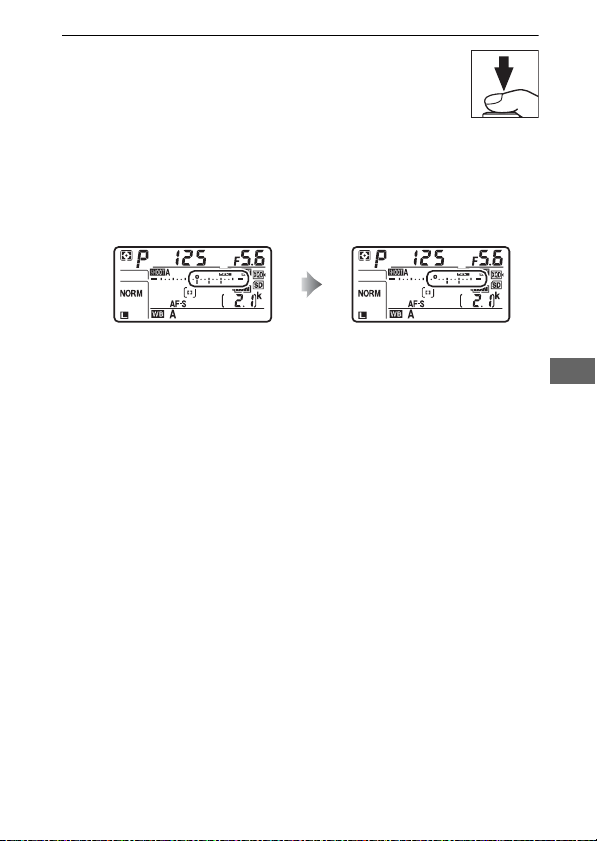
157
3 Frame a photograph, focus, and shoot.
The camera will vary Active D-Lighting shot-by-shot
according to the bracketing program selected.
While
bracketing is in effect, a bracketing progress indicator will be
displayed in the control panel.
A segment will disappear from
the indicator after each shot.
No. shots: 3 Display after first shot
158
❚❚ Canceling Bracketing
To cancel bracketing, press the BKT button and rotate the main
command dial until the number of shots in the bracketing
sequence is zero (r) and d is no longer displayed.
The
program last in effect will be restored the next time bracketing is
activated.
Bracketing can also be cancelled by performing a
two-button reset (0 230), although in this case the bracketing
program will not be restored the next time bracketing is
activated.
A ADL Bracketing
In continuous low speed, continuous high speed, and quiet
continuous modes, shooting will pause after the number of shots
specified in the bracketing program have been taken.
Shooting will
resume the next time the shutter-release button is pressed.
In self-
timer mode, the camera will take the number of shots selected in Step
1 on page 155 each time the shutter-release button is pressed,
regardless of the option selected for Custom Setting c3 (Self-timer) >
Number of shots (0 296); the interval between shots is however
controlled by Custom Setting c3 (Self-timer)> Interval between
shots.
In other modes, one shot will be taken each time the shutter-
release button is pressed.
If the memory card fills before all shots in the sequence have been
taken, shooting can be resumed from the next shot in the sequence
after the memory card has been replaced or shots have been deleted
to make room on the memory card.
If the camera is turned off before
all shots in the sequence have been taken, bracketing will resume from
the next shot in the sequence when the camera is turned on.
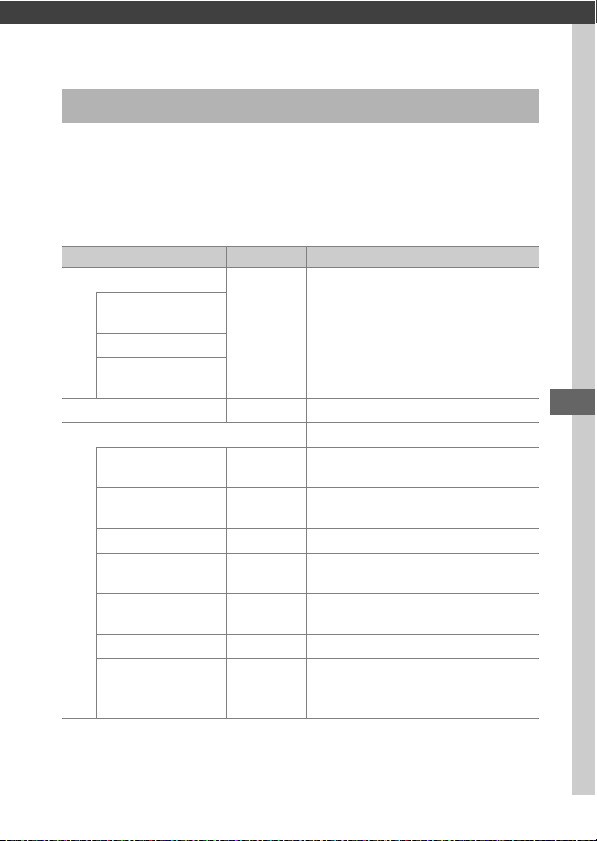
159
White Balance
White balance ensures that colors are unaffected by the color of
the light source.
Auto white balance is recommended with most
light sources.
If the desired results can not be achieved with
auto white balance, choose an option from the list below or use
preset white balance.
White Balance Options
Option Color temp.
*
Description
v
Auto
3500–
8000 K
White balance is adjusted
automatically.
For best results,
use type G, E or D lens.
If optional
flash fires, results are adjusted
appropriately.
Keep white (reduce
warm colors)
Normal
Keep warm lighting
colors
J
Incandescent 3000 K Use under incandescent lighting.
I
Fluorescent Use with:
Sodium-vapor lamps 2700 K
• Sodium-vapor lighting (found in
sports venues).
Warm-white
fluorescent
3000 K • Warm-white fluorescent lights.
White fluorescent 3700 K • White fluorescent lights.
Cool-white
fluorescent
4200 K • Cool-white fluorescent lights.
Day white fluorescent 5000 K
• Daylight white fluorescent
lights.
Daylight fluorescent 6500 K • Daylight fluorescent lights.
High temp. mercury-
vapor
7200 K
• High color temperature light
sources (e.g. mercury-vapor
lamps).
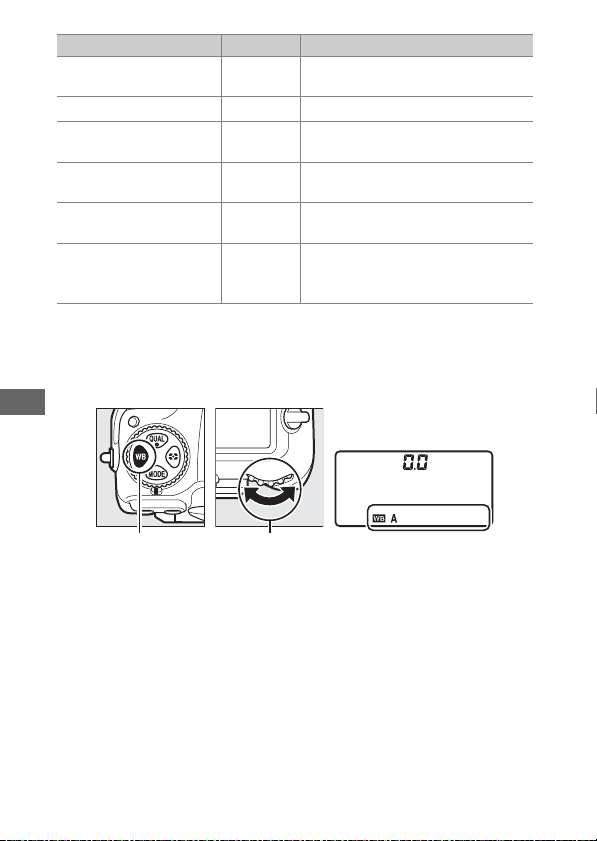
160
White balance can be selected by pressing the U button and
rotating the main command dial until the desired setting is
displayed in the control panel.
H
Direct sunlight 5200 K
Use with subjects lit by direct
sunlight.
N
Flash 5400 K Use with optional flash units.
G
Cloudy 6000 K
Use in daylight under overcast
skies.
M
Shade 8000 K
Use in daylight with subjects in
the shade.
K
Choose color temp.
2500–
10,000 K
Choose color temperature from
list of values (0 166).
L
Preset manual —
Use subject, light source, or
existing photograph as reference
for white balance (0 169).
* All values are approximate and do not reflect fine-tuning (if applicable).
U button Main command
dial
Control panel
Option Color temp.
*
Description

161
A The Photo Shooting Menu
White balance can also be adjusted using the White balance option in
the photo or movie shooting menu (0 285, 289), which also can be
used to fine-tune white balance (0 163) or manage white-balance
presets (0 169).
The Auto option in the White balance menu offers a
choice of Keep white (reduce warm colors), Normal, and Keep warm
lighting colors.
Keep white (reduce warm colors) makes whites
recorded under incandescent lighting appear white, while Keep warm
lighting colors preserves the warm tints we normally perceive under
incandescent lighting.
The I Fluorescent option can be used to
select the light source from the bulb types.
A Studio Flash Lighting
Auto white balance may not produce the desired results with large
studio flash units.
Use preset white balance or set white balance to
Flash and use fine-tuning to adjust white balance.
A See Also
White balance bracketing (0 151) creates several copies of each
photograph taken, varying white balance to “bracket” the current
value.
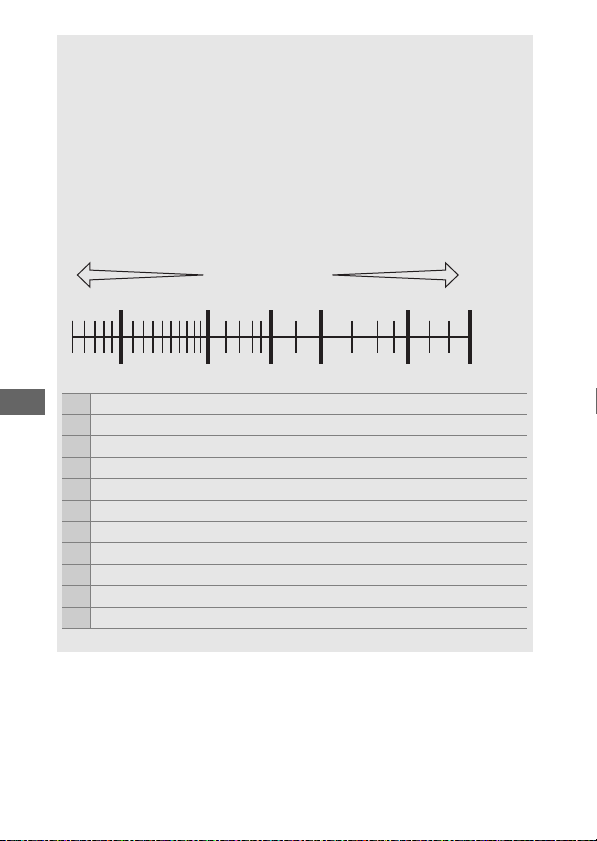
162
A Color Temperature
The perceived color of a light source varies with the viewer and other
conditions.
Color temperature is an objective measure of the color of a
light source, defined with reference to the temperature to which an
object would have to be heated to radiate light in the same
wavelengths.
While light sources with a color temperature in the
neighborhood of 5000–5500 K appear white, light sources with a lower
color temperature, such as incandescent light bulbs, appear slightly
yellow or red.
Light sources with a higher color temperature appear
tinged with blue.
“Warmer” (redder) colors “Cooler” (bluer) colors
q
I (sodium-vapor lamps): 2700 K
w
J (incandescent)/I (warm-white fluorescent.): 3000 K
e
I (white fluorescent): 3700 K
r
I (cool-white fluorescent): 4200 K
t
I (day white fluorescent): 5000 K
y
H (direct sunlight): 5200 K
u
N (flash): 5400 K
i
G (cloudy): 6000 K
o
I (daylight fluorescent): 6500 K
!0
I (high temp. mercury-vapor): 7200 K
!1
M (shade): 8000 K
Note: All figures are approximate.
3000 4000 5000 6000 8000 10000 [
K
]
q w retyui o!0 !1

163
At settings other than K (Choose color temp.), white balance
can be “fine-tuned” to compensate for variations in the color of
the light source or to introduce a deliberate color cast into an
image.
❚❚ The White Balance Menu
To fine-tune white balance from the photo shooting menu,
select White balance and follow the steps below.
1 Display fine-tuning options.
Highlight a white balance option and
press 2 (if a sub-menu is displayed,
select the desired option and press 2
again to display fine-tuning options;
for information on fine-tuning preset
manual white balance, see page 179).
2 Fine-tune white balance.
Use the multi selector to fine-tune
white balance.
White balance can be
fine-tuned on the amber (A)–blue (B)
axis in steps of 0.5 and the green (G)–
magenta (M) axis in steps of 0.25.
The
horizontal (amber-blue) axis
corresponds to color temperature,
while the vertical (green-magenta)
axis has the similar effects to the corresponding color
compensation (CC) filters.
The horizontal axis is ruled in
increments equivalent to about 5 mired, the vertical axis in
increments of about 0.05 diffuse density units.
Fine-Tuning White Balance
Adjustment
Coordinates
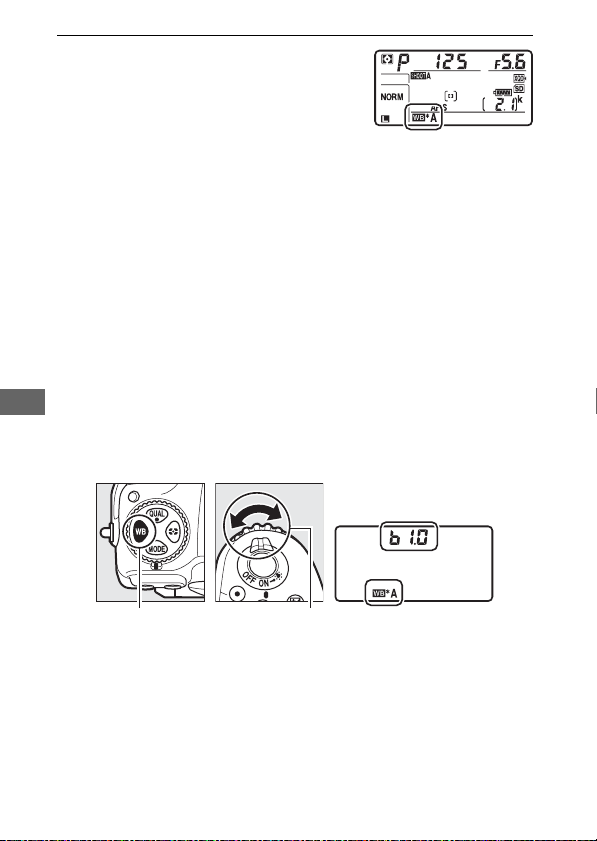
164
3 Press J.
Press J to save settings and return to
the photo shooting menu.
If white
balance has been fine-tuned, an
asterisk (“U”) will be displayed in the
control panel.
❚❚ The U Button
At settings other than K (Choose color temp.) and L (Preset
manual), the U button can be used to fine-tune white balance
on the amber (A)–blue (B) axis (0 163; to fine-tune white
balance when L is selected, use the photo shooting menu as
described on page 179).
Press the U button and rotate the
sub-command dial to fine-tune white balance in steps of 0.5
(with each full increment equivalent to about 5 mired) until the
desired value is displayed in the control panel.
Rotating the sub-
command dial to the left increases the amount of amber (A).
Rotating the sub-command dial to the right increases the
amount of blue (B).
At settings other than 0, an asterisk (“U”)
appears in the control panel.
U button Sub-command
dial
Control panel
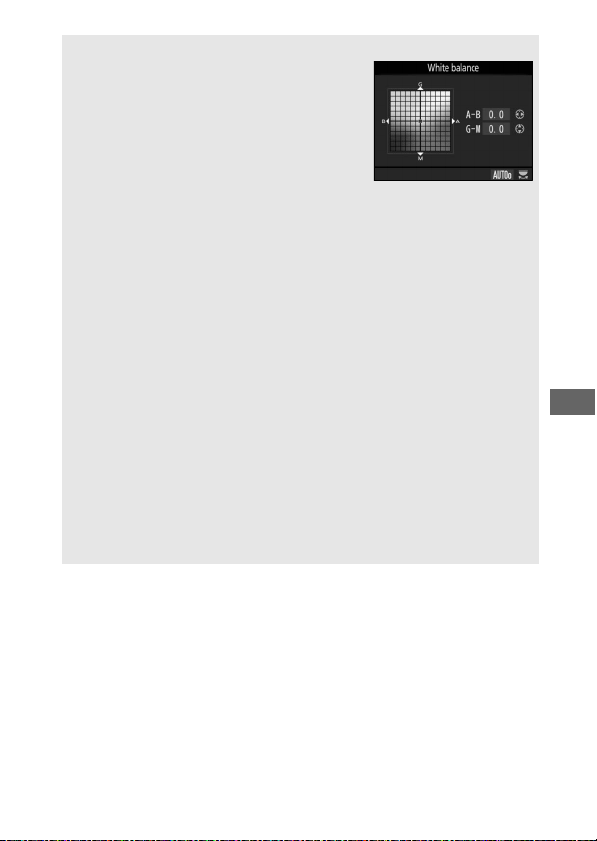
165
A The Information Display
During viewfinder photography, you can
press the U button to adjust white balance
settings in the information display.
Rotate
the main command dial to choose the white
balance mode and rotate the sub-command
dial to choose the color temperature (mode
K, “choose color temperature”) or white
balance preset (preset manual mode), or use the multi-selector to fine-
tune white balance on the amber (A)–blue (B) and green (G)–magenta
(M) axes (other white balance modes).
A White Balance Fine-Tuning
The colors on the fine-tuning axes are relative, not absolute.
For
example, moving the cursor to B (blue) when a “warm” setting such as
J (Incandescent) is selected for white balance will make
photographs slightly “colder” but will not actually make them blue.
A “Mired”
Any given change in color temperature produces a greater difference
in color at low color temperatures than it would at higher color
temperatures.
For example, a change of 1000 K produces a much
greater change in color at 3000 K than at 6000 K.
Mired, calculated by
multiplying the inverse of the color temperature by 10
6
, is a measure of
color temperature that takes such variation into account, and as such is
the unit used in color-temperature compensation filters.
E.g.:
• 4000 K–3000 K (a difference of 1000 K)=83 mired
• 7000 K–6000 K (a difference of 1000 K)=24 mired
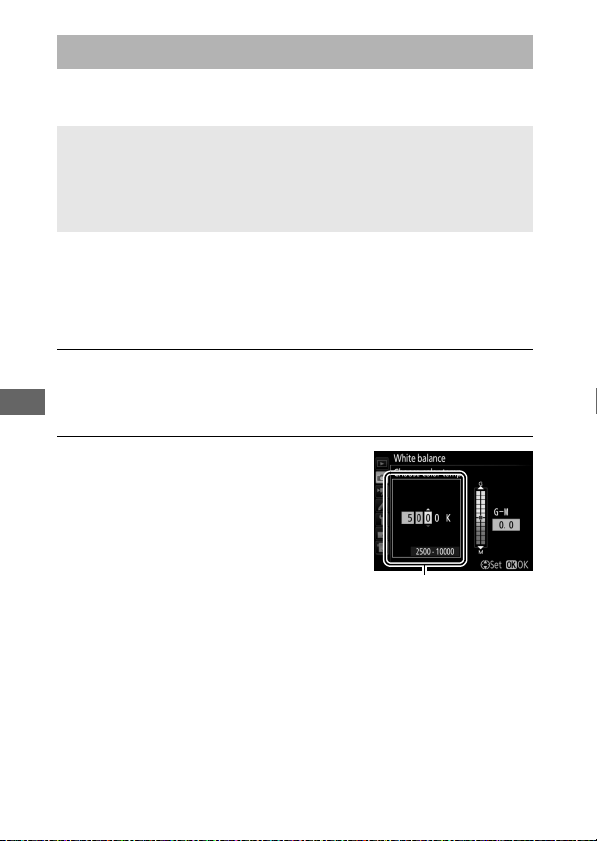
166
Follow the steps below to choose a color temperature when K
(Choose color temp.) is selected for white balance.
❚❚ The White Balance Menu
Color temperature can be selected using the White balance
options in the photo shooting menu.
Enter values for the
amber–blue and green–magenta axes as described below.
1 Select Choose color temp.
Select White balance in the photo shooting menu, then
highlight Choose color temp. and press 2.
2 Select a value for amber-blue.
Press 4 or 2 to highlight digits and
press 1 or 3 to change.
Choosing a Color Temperature
D Choose Color Temperature
Note that the desired results will not be obtained with flash or
fluorescent lighting.
Choose N (Flash) or I (Fluorescent) for these
sources.
With other light sources, take a test shot to determine if the
selected value is appropriate.
Value for amber (A)-blue
(B) axis
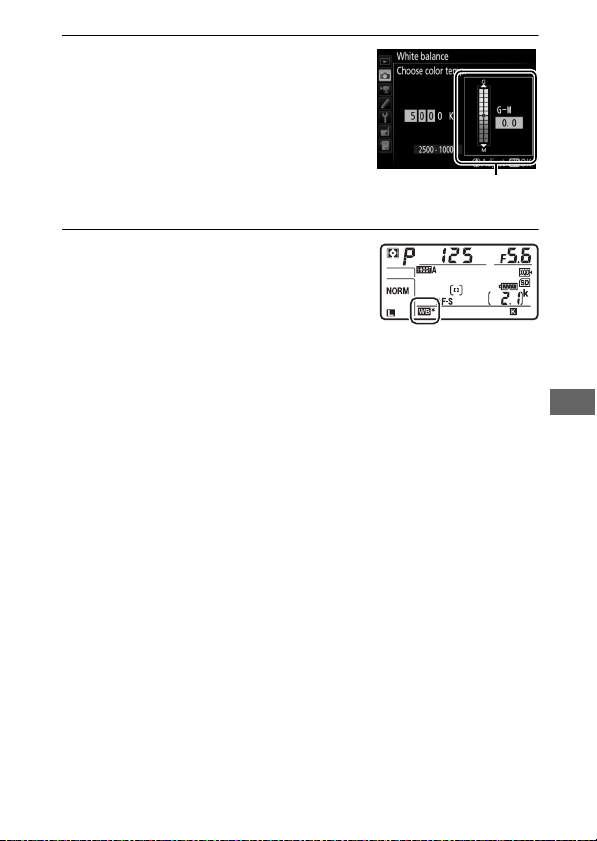
167
3 Select a value for green-magenta.
Press 4 or 2 to highlight the G
(green) or M (magenta) axis and press
1 or 3 to select a value.
4 Press J.
Press J to save changes and return to
the photo shooting menu.
If a value
other than 0 is selected for the green
(G)–magenta (M) axis, an asterisk (“U”)
will be displayed in the control panel.
Value for green (G)-
magenta (M) axis
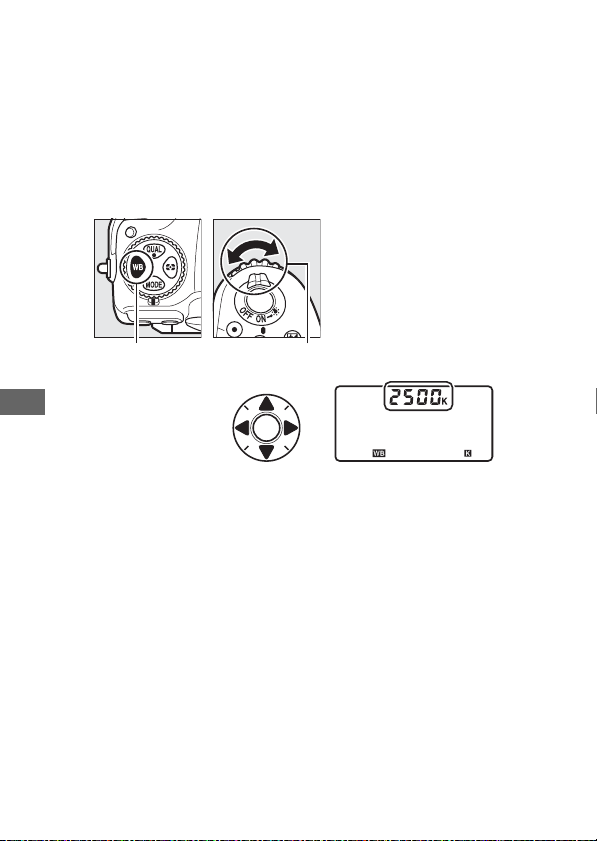
168
❚❚ The U Button
When K (Choose color temp.) is selected, the U button can
be used to select the color temperature, although only for the
amber (A)–blue (B) axis.
Press the U button and rotate the sub-
command dial until the desired value is displayed in the control
panel (adjustments are made in mireds; 0 165).
To enter a color
temperature directly, press the U button and press 4 or 2 to
highlight a digit and press 1 or 3 to change.
U button Sub-command
dial
Control panel

169
Preset manual is used to record and recall custom white balance
settings for shooting under mixed lighting or to compensate for
light sources with a strong color cast.
The camera can store up to
six values for preset white balance in presets d-1 through d-6.
Two methods are available for setting preset white balance:
Preset Manual
Method Description
Direct measurement
Neutral gray or white object is placed under
lighting that will be used in final photograph and
white balance is measured by camera (0 170).
During live view (0 43, 58), white balance can be
measured in a selected area of the frame (spot
white balance, 0 174).
Copy from existing
photograph
White balance is copied from photo on memory
card (0 177).
A White Balance Presets
Changes to white balance presets apply to all photo shooting menu
banks (0 283).
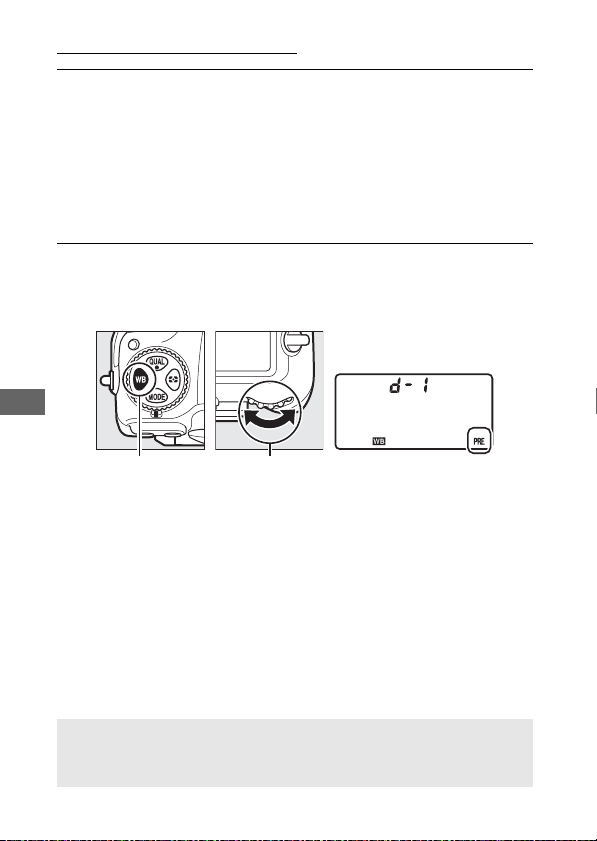
170
Viewfinder Photography
1 Light a reference object.
Place a neutral gray or white object under the lighting that
will be used in the final photograph.
In studio settings, a
standard gray panel can be used as a reference object.
Note
that exposure is automatically increased by 1 EV when
measuring white balance; in exposure mode M, adjust
exposure so that the exposure indicator shows ±0 (0 136).
2 Set white balance to L (Preset manual).
Press the U button and rotate the main command dial until
L is displayed in the control panel.
U button Main command
dial
Control panel
A Measuring Preset Manual White Balance (Viewfinder Photography)
Preset manual white balance can not be measured while you are
shooting an HDR photograph (0 191) or multiple exposure (0 236).
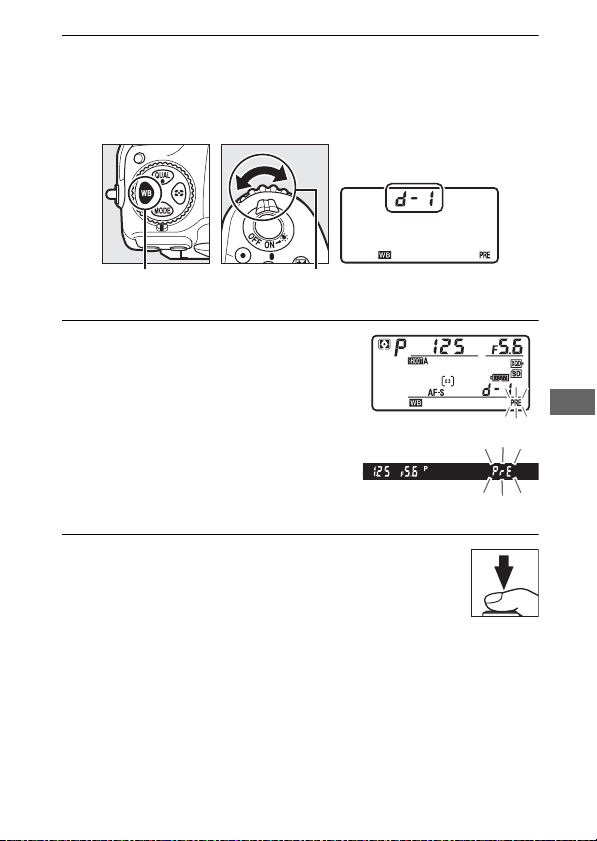
171
3 Select a preset.
Press the U button and rotate the sub-command dial until
the desired white balance preset (d-1 to d-6) is displayed in
the control panel.
4 Select direct measurement mode.
Release the U button briefly and
then press the button until the L
icon in the control panel starts to
flash.
A flashing D will also
appear in the viewfinder.
5 Measure white balance.
In the few seconds before the indicators stop
flashing, frame the reference object so that it fills
the viewfinder and press the shutter-release
button all the way down.
The camera will measure a value for
white balance and store it in the preset selected in Step 3.
No
photograph will be recorded; white balance can be measured
accurately even when the camera is not in focus.
U button Sub-command
dial
Control panel
Control panel
Viewfinder
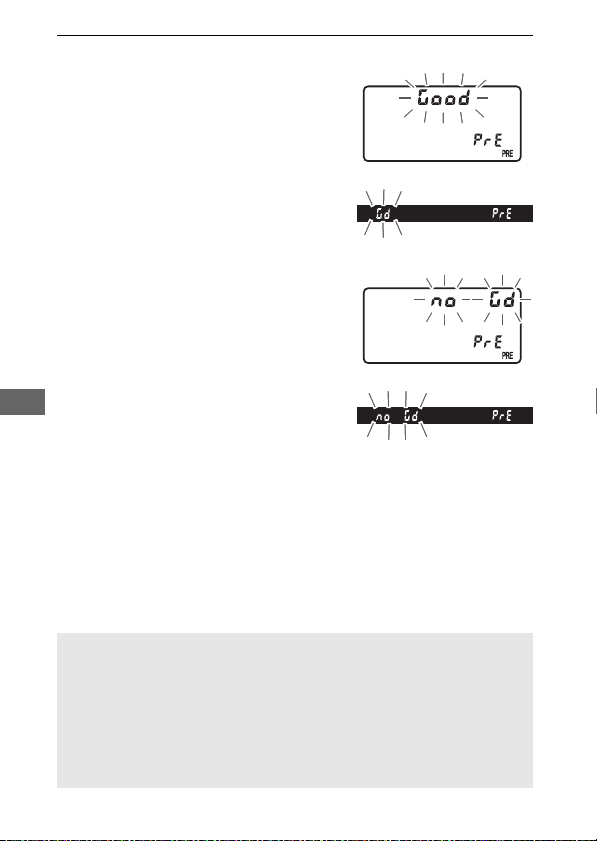
172
6 Check the results.
If the camera was able to measure a
value for white balance, C will
flash in the control panel, while the
viewfinder will show a flashing a.
Press the shutter-release button
halfway to exit to shooting mode.
If lighting is too dark or too bright,
the camera may be unable to
measure white balance.
A flashing
ba will appear in the control
panel and viewfinder.
Press the
shutter-release button halfway to
return to Step 5 and measure white
balance again.
D Direct Measurement Mode
If no operations are performed during viewfinder photography while
the displays are flashing, direct measurement mode will end in the
time selected for Custom Setting c2 (Standby timer, 0 296).
A Protected Presets
If the current preset is protected (0 179), 3 will flash in the control
panel and viewfinder if you attempt to measure a new value.
Control panel
Viewfinder
Control panel
Viewfinder
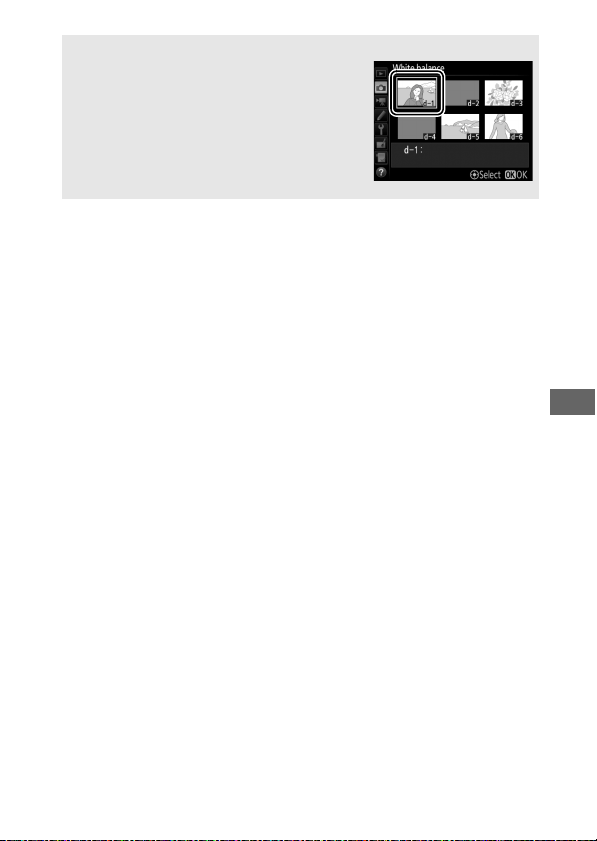
173
A Selecting a Preset
Selecting Preset manual for the White
balance option in the photo shooting menu
displays the dialog shown at right; highlight
a preset and press J.
If no value currently
exists for the selected preset, white balance
will be set to 5200 K, the same as Direct
sunlight.
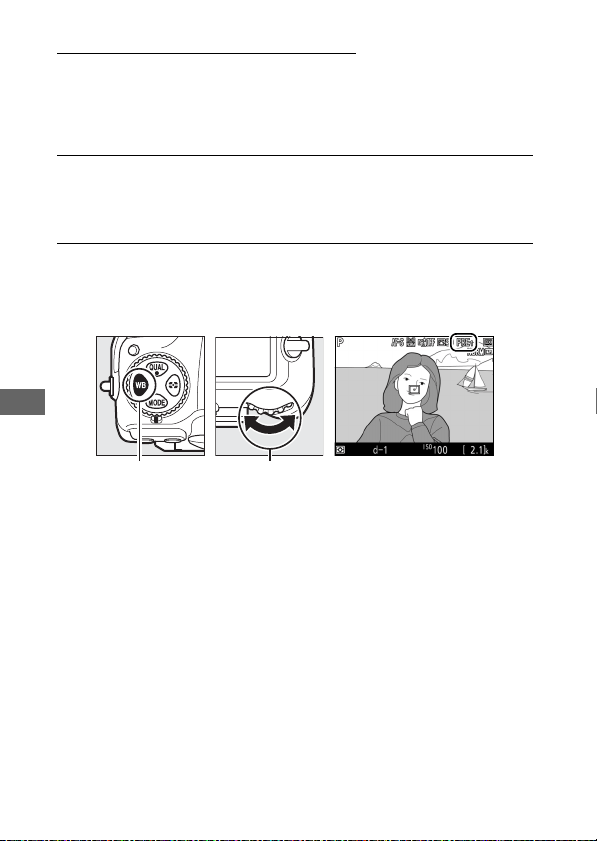
174
Live View (Spot White Balance)
During live view (0 43, 58), white balance can be measured in a
selected area of the frame, eliminating the need to prepare a
reference object or change lenses during telephoto
photography.
1 Press the a button.
The mirror will be raised and the view through the lens will be
displayed in the camera monitor.
2 Set white balance to L (Preset manual).
Press the U button and rotate the main command dial until
L is displayed in the monitor.
U button Main command
dial
Monitor
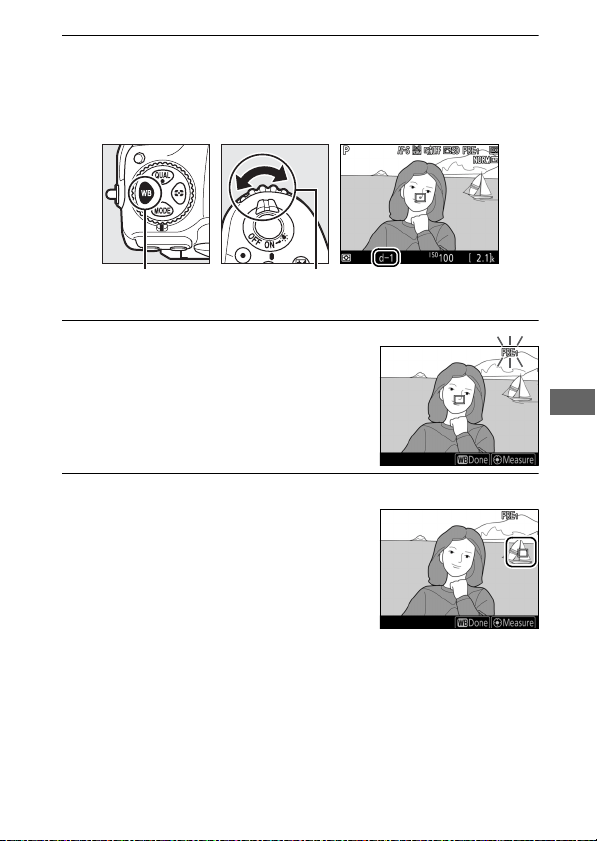
175
3 Select a preset.
Press the U button and rotate the sub-command dial until
the desired white balance preset (d-1 to d-6) is displayed in
the monitor.
4 Select direct measurement mode.
Release the U button briefly and
then press the button until the L
icon in the monitor starts to flash.
A
spot white balance target (r) will be
displayed at the selected focus point.
5 Position the target over a white or grey area.
While L flashes in the display, use
the multi selector to position the r
over a white or grey area of the
subject.
To zoom the area around the
target in for more precise positioning,
press the X button.
You can also
measure white balance anywhere in
the frame by tapping your subject in the monitor, in which
case there is no need to press the center of the multi selector
or the shutter-release button as described in Step 6.
U button Sub-command
dial
Monitor
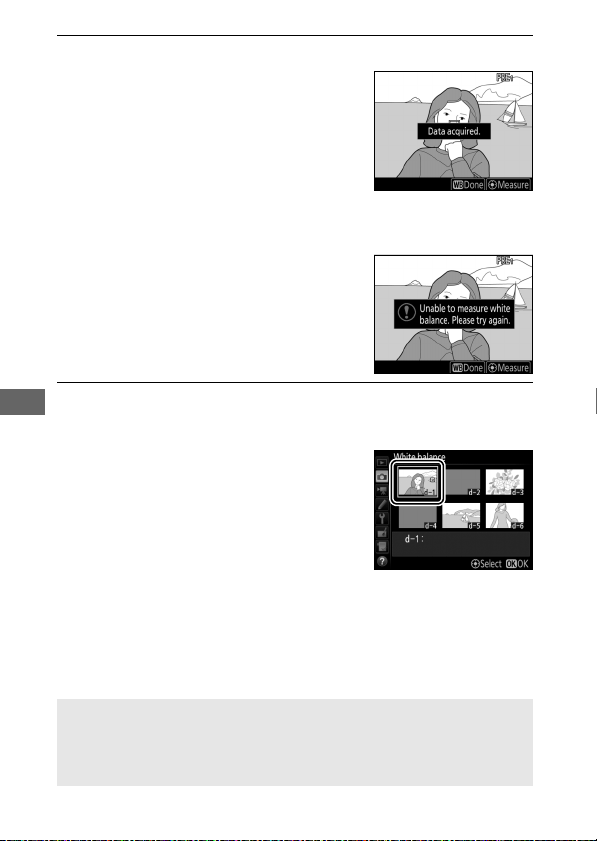
176
6 Measure white balance.
Press the center of the multi selector
or press the shutter-release button all
the way down to measure white
balance.
The time available to
measure white balance is that
selected for Custom Setting c4
(Monitor off delay) > Live view
(0 296).
If the camera is unable to measure
white balance, the message shown at
right will be displayed.
Choose a new
white balance target and repeat the
process from Step 5.
7 Exit direct measurement mode.
Press the U button to exit direct measurement mode.
White balance presets can be viewed
by selecting Preset manual for White
balance in the photo or movie
shooting menu.
The position of the
targets used to measure preset white
balance is displayed on presets
recorded during live view.
D Measuring Preset Manual White Balance (Live View)
Preset manual white balance can not be measured while an HDR
exposure is in progress (0 191) or when None is selected for Photo
live view display WB (0 51).
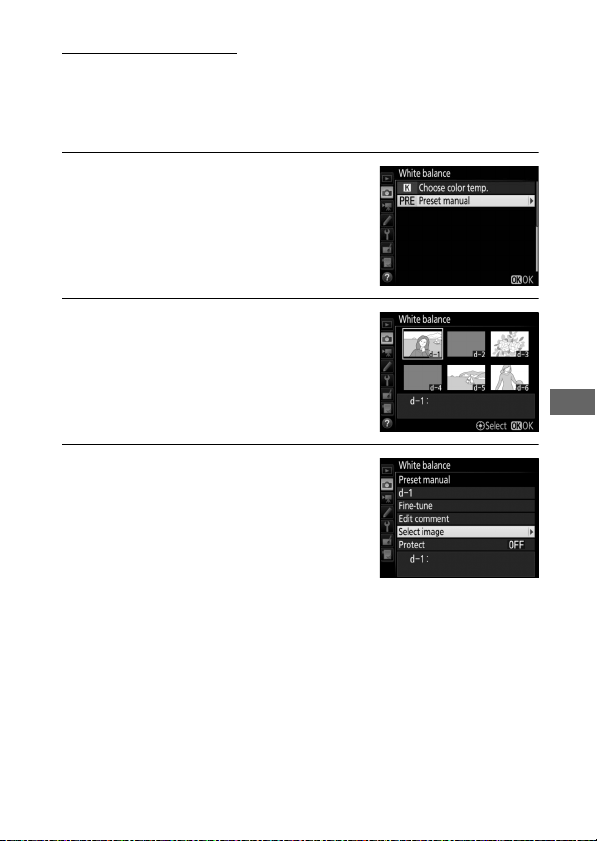
177
Managing Presets
❚❚ Copying White Balance from a Photograph
Follow the steps below to copy a value for white balance from an
existing photograph to a selected preset.
1 Select Preset manual.
Select White balance in the photo
shooting menu, then highlight Preset
manual and press 2.
2 Select a destination.
Highlight the destination preset (d-1
to d-6) and press the center of the
multi selector.
3 Choose Select image.
Highlight Select image and press 2.
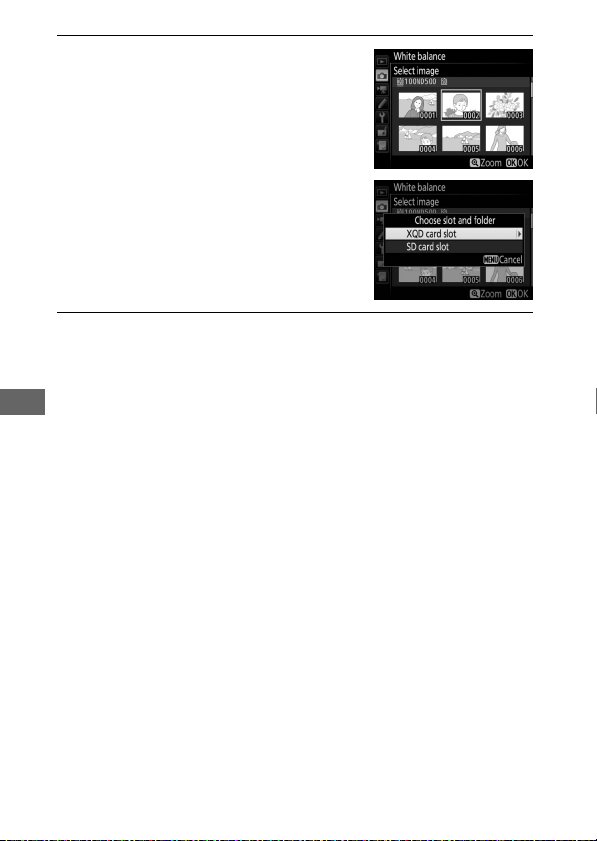
178
4 Highlight a source image.
Highlight the source image.
To view
the highlighted image full frame,
press and hold the X button.
To view images in other locations,
press W (M) and select the desired
card and folder (0 256).
5 Copy white balance.
Press J to copy the white balance value for the highlighted
photograph to the selected preset.
If the highlighted
photograph has a comment (0 306), the comment will be
copied to the comment for the selected preset.
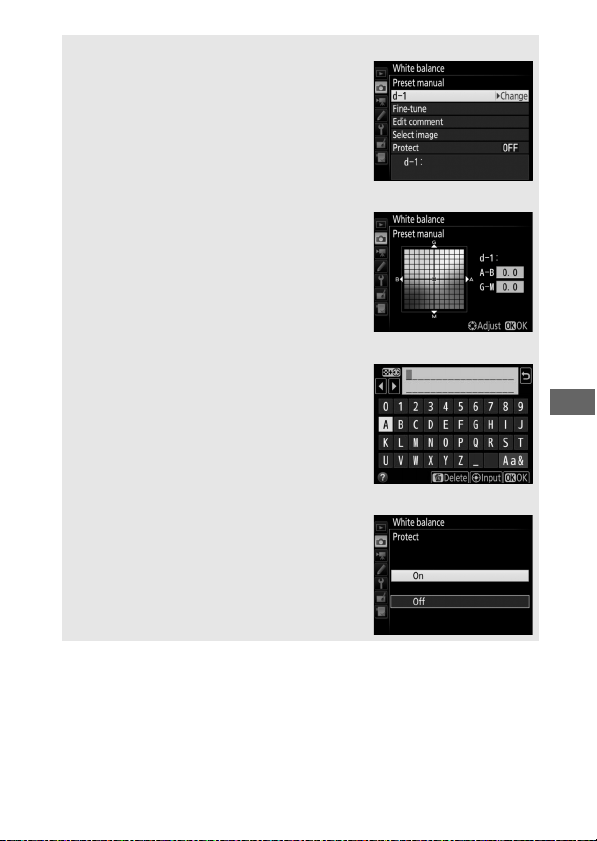
179
A Choosing a White Balance Preset
Highlight the current white balance preset
(d-1–d-6) and press 2 to select another
preset.
A Fine-Tuning Preset White Balance
The selected preset can be fine-tuned by
selecting Fine-tune and adjusting white
balance as described on page 163.
A Edit Comment
To enter a descriptive comment of up to 36
characters for the current white-balance
preset, select Edit comment in the preset
manual white balance menu and enter a
comment as described on page 186.
A Protect
To protect the current white-balance preset,
select Protect in the preset manual white
balance menu, then highlight On and press
J.
Protected presets can not be modified
and the Fine-tune and Edit comment
options can not be used.
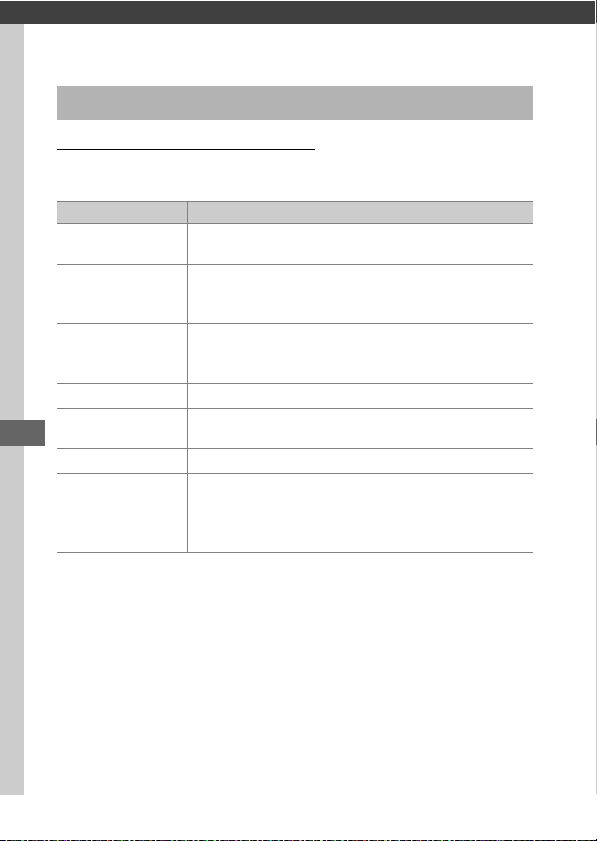
180
Image Enhancement
Selecting a Picture Control
Choose a Picture Control according to the subject or type of
scene.
Picture Controls
Option Description
Q
Standard
Standard processing for balanced results.
Recommended for most situations.
R
Neutral
Minimal processing for natural results.
Choose for
photographs that will later be processed or
retouched.
S
Vivid
Pictures are enhanced for a vivid, photoprint effect.
Choose for photographs that emphasize primary
colors.
T
Monochrome Take monochrome photographs.
o
Portrait
Process portraits for skin with natural texture and a
rounded feel.
p
Landscape Produces vibrant landscapes and cityscapes.
q
Flat
Details are preserved over a wide tone range, from
highlights to shadows.
Choose for photographs
that will later be extensively processed or
retouched.
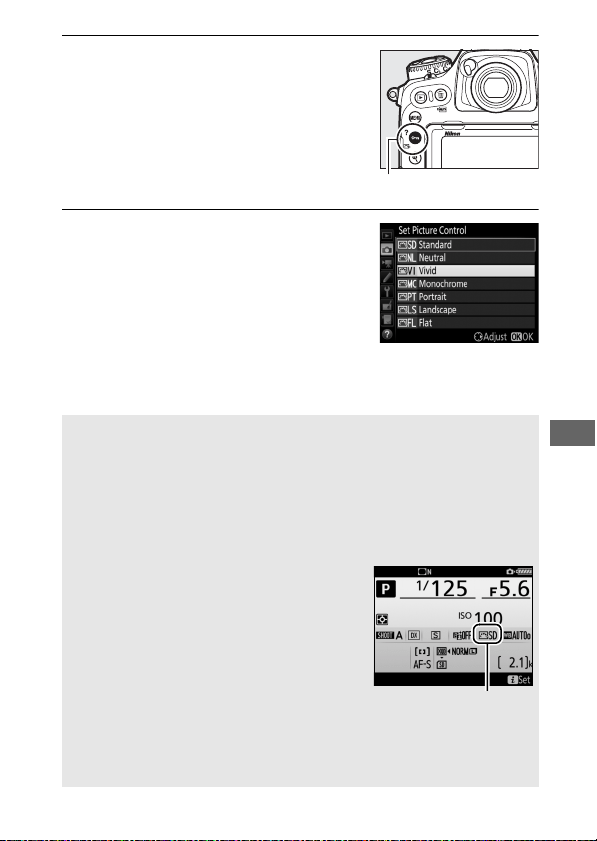
181
1 Press L (Z/Q).
A list of Picture Controls will be
displayed.
2 Select a Picture Control.
Highlight the desired Picture Control
and press J.
A Custom Picture Controls
Custom Picture Controls are created through modifications to existing
Picture Controls using the Manage Picture Control option in the
photo or movie shooting menu (0 185).
Custom Picture Controls can
be saved to a memory card for sharing among other cameras of the
same model and compatible software.
A The Picture Control Indicator
The current Picture Control is shown in the
information display when the R button is
pressed.
A The Shooting Menus
Picture Controls can also be selected using the Set Picture Control
option in the photo or movie shooting menu (0 285, 289).
L (Z/Q) button
Picture Control indicator
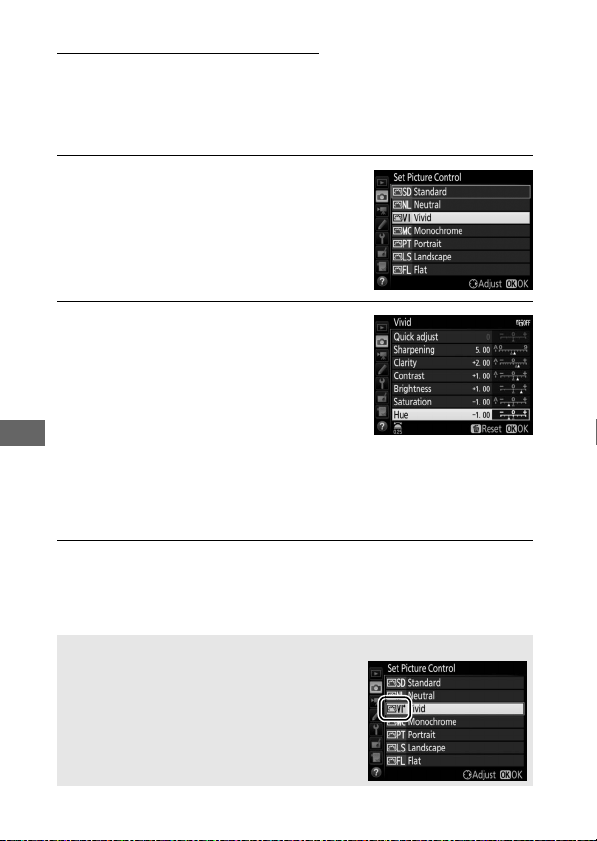
182
Modifying Picture Controls
Existing preset or custom Picture Controls (0 185) can be
modified to suit the scene or the user’s creative intent.
Choose a
balanced combination of settings using Quick adjust, or make
manual adjustments to individual settings.
1 Select a Picture Control.
Highlight the desired Picture Control
in the Picture Control list (0 180) and
press 2.
2 Adjust settings.
Press 1 or 3 to highlight the desired
setting and press 4 or 2 to choose a
value in increments of 1, or rotate the
sub-command dial to choose a value
in increments of 0.25 (0 183).
Repeat
this step until all settings have been
adjusted, or select a preset combination of settings by
highlighting Quick adjust and pressing 4 or 2.
Default
settings can be restored by pressing the O (Q) button.
3 Press J.
A Modifications to Original Picture Controls
Picture Controls that have been modified
from default settings are indicated by an
asterisk (“U”) in the Set Picture Control
menu.
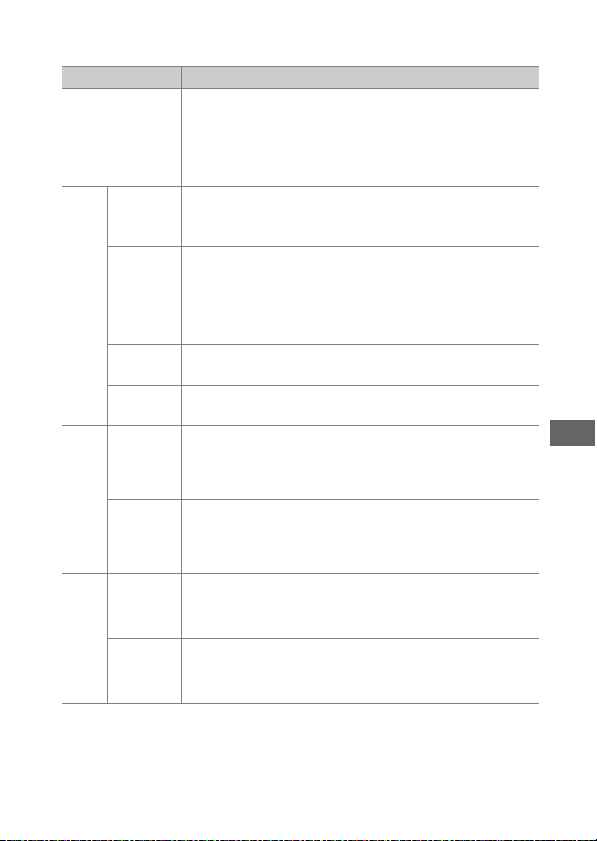
183
❚❚ Picture Control Settings
Option Description
Quick adjust
Mute or heighten the effect of the selected Picture
Control (note that this resets all manual
adjustments).
Not available with Neutral,
Monochrome, Flat, or custom Picture Controls
(0 185).
Manual adjustments
(all Picture Controls)
Sharpening
Control the sharpness of outlines.
Select A to adjust
sharpening automatically according to the type of
scene.
Clarity
Adjust clarity manually or select A to let the camera
adjust clarity automatically.
Depending on the
scene, shadows may appear around bright objects or
halos may appear around dark objects at some
settings.
Clarity is not applied to movies.
Contrast
Adjust contrast manually or select A to let the camera
adjust contrast automatically.
Brightness
Raise or lower brightness without loss of detail in
highlights or shadows.
Manual adjustments
(non-monochrome only)
Saturation
Control the vividness of colors.
Select A to adjust
saturation automatically according to the type of
scene.
Hue Adjust hue.
Manual adjustments
(monochrome only)
Filter
effects
Simulate the effect of color filters on monochrome
photographs (0 184).
Toning
Choose the tint used in monochrome photographs
(0 184).
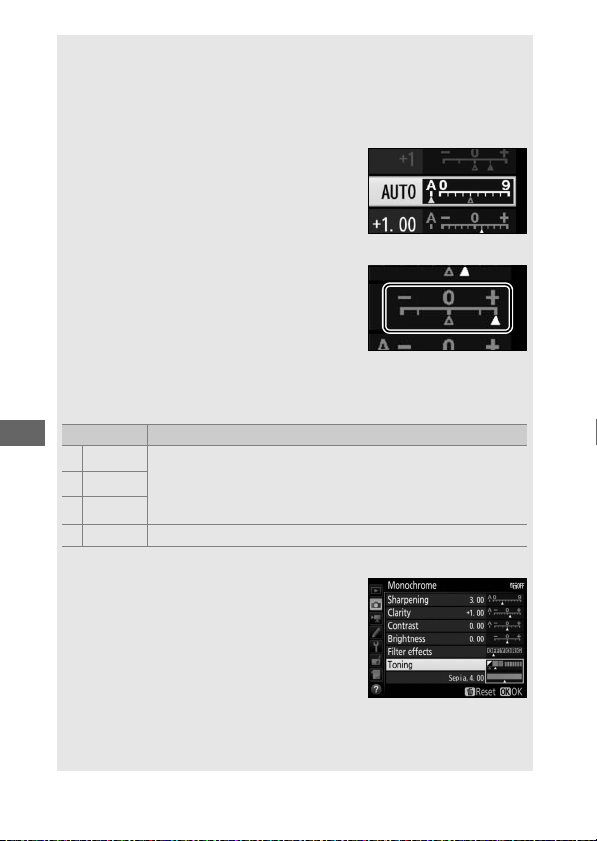
184
D “A” (Auto)
Results for auto sharpening, clarity, contrast, and saturation vary with
exposure and the position of the subject in the frame.
Use a type G, E,
or D lens for best results.
A Switching Between Manual and Auto
Press the X button to switch back and forth
between manual and auto (A) settings for
sharpening, clarity, contrast, and saturation.
A Previous Settings
The j indicator under the value display in
the Picture Control setting menu indicates
the previous value for the setting.
Use this as
a reference when adjusting settings.
A Filter Effects (Monochrome Only)
The options in this menu simulate the effect of color filters on
monochrome photographs.
The following filter effects are available:
Option Description
Y Yellow
Enhances contrast.
Can be used to tone down the
brightness of the sky in landscape photographs.
Orange
produces more contrast than yellow, red more contrast
than orange.
O Orange
R Red
G Green Softens skin tones.
Can be used for portraits.
A Toning (Monochrome Only)
Pressing 3 when Tonin g is selected displays
saturation options.
Press 4 or 2 to adjust
saturation.
Saturation control is not
available when B&W (black-and-white) is
selected.
A Custom Picture Control Options
The options available with custom Picture Controls are the same as
those on which the custom Picture Control was based.
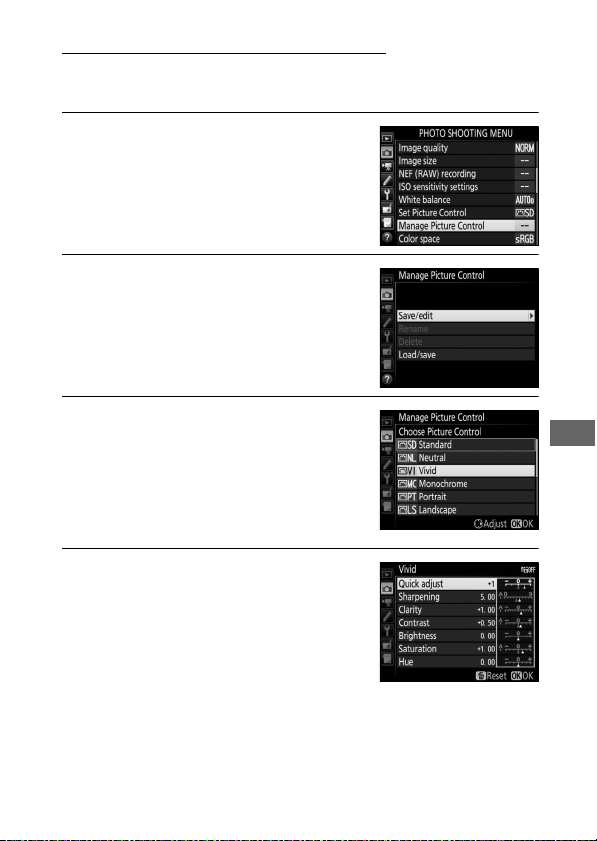
185
Creating Custom Picture Controls
The Picture Controls supplied with the camera can be modified
and saved as custom Picture Controls.
1 Select Manage Picture Control.
Highlight Manage Picture Control
in the photo shooting menu and
press 2.
2 Select Save/edit.
Highlight Save/edit and press 2.
3 Select a Picture Control.
Highlight an existing Picture Control
and press 2, or press J to proceed to
Step 5 to save a copy of the
highlighted Picture Control without
further modification.
4 Edit the selected Picture Control.
See page 183 for more information.
To abandon any changes and start
over from default settings, press the
O (Q) button.
Press J when settings
are complete.
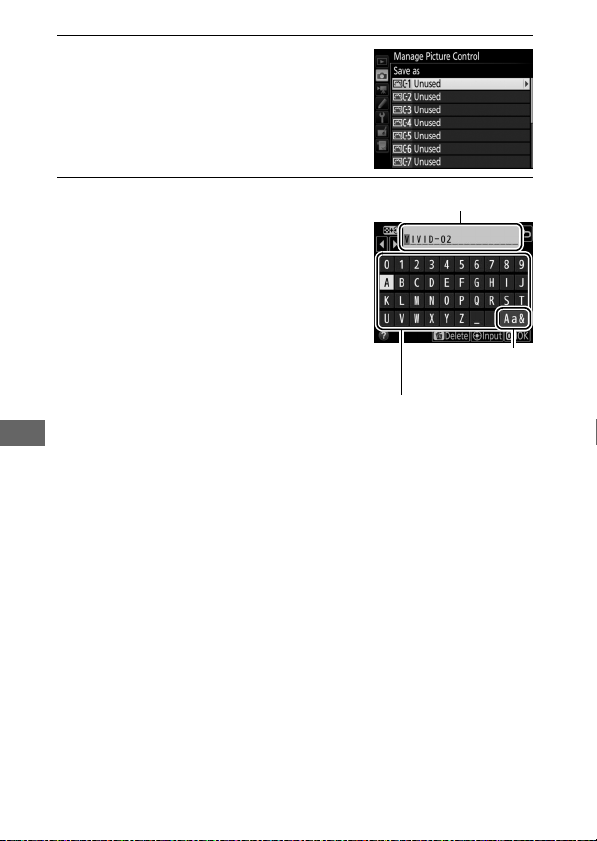
186
5 Select a destination.
Choose a destination for the custom
Picture Control (C-1 through C-9) and
press 2.
6 Name the Picture Control.
The text-entry dialog shown at right
will be displayed.
By default, new
Picture Controls are named by adding
a two-digit number (assigned
automatically) to the name of the
existing Picture Control; to use the
default name, proceed to Step 7.
To
move the cursor in the name area, tap
the display or hold the W (M) button
and press 4 or 2.
To enter a new
letter at the current cursor position,
tap the letters on the touch-screen keyboard (tap the
keyboard selection button to cycle through the upper-case,
lower-case, and symbol keyboards).
You can also use the
multi selector to highlight the desired character in the
keyboard area and press the center of the multi selector.
To
delete the character at the current cursor position, press the
O (Q) button.
Custom Picture Control names can be up to nineteen
characters long.
Any characters after the nineteenth will be
deleted.
Name area
Keyboard area
Keyboard
selection
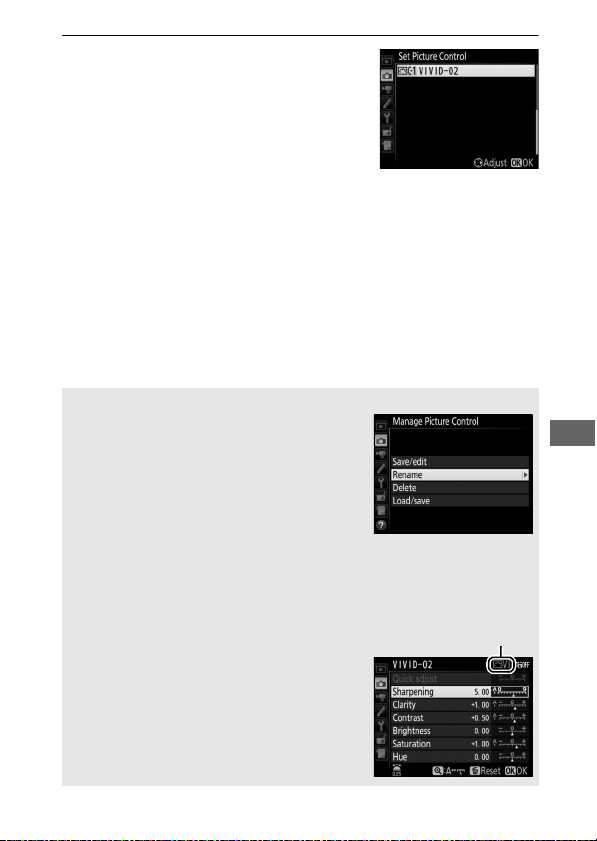
187
7 Save changes and exit.
Press J to save changes and exit.
The
new Picture Control will appear in the
Picture Control list.
A Manage Picture Control > Rename
Custom Picture Controls can be renamed at
any time using the Rename option in the
Manage Picture Control menu.
A Manage Picture Control > Delete
The Delete option in the Manage Picture
Control menu can be used to delete
selected custom Picture Controls when they
are no longer needed.
A The Original Picture Control Icon
The original preset Picture Control on which
the custom Picture Control is based is
indicated by an icon in the top right corner
of the edit display.
Original
Picture Control icon
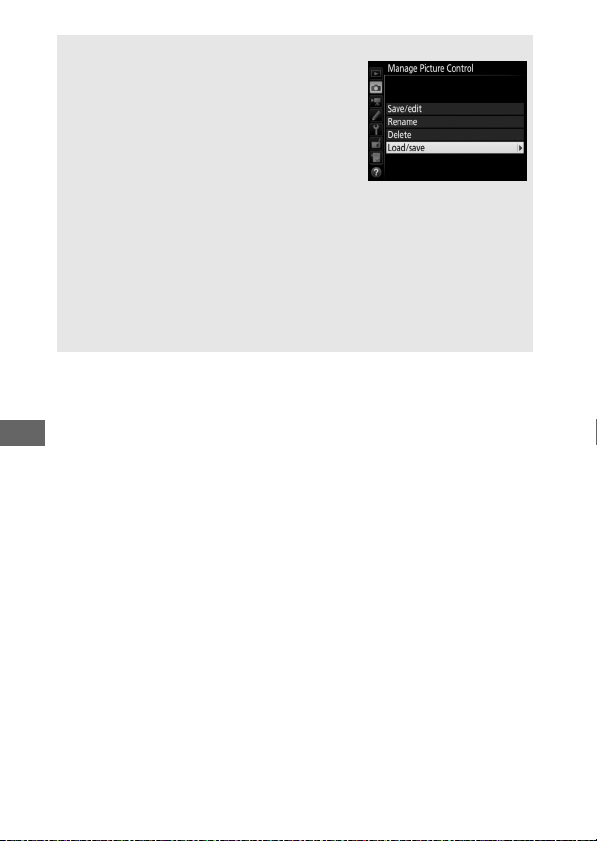
188
A Sharing Custom Picture Controls
The Load/save item in the Manage Picture
Control menu offers the options listed
below.
Use these options to copy custom
Picture Controls to and from memory cards
(if two memory cards are inserted, the card
in the primary slot will be used; 0 96).
Once
copied to memory cards, Picture Controls
can be used with other cameras or compatible software.
• Copy to camera: Copy custom Picture Controls from the memory card to
custom Picture Controls C-1 through C-9 on the camera and name
them as desired.
• Delete from card: Delete selected custom Picture Controls from the
memory card.
• Copy to card: Copy a custom Picture Control (C-1 through C-9) from the
camera to a selected destination (1 through 99) on the memory card.
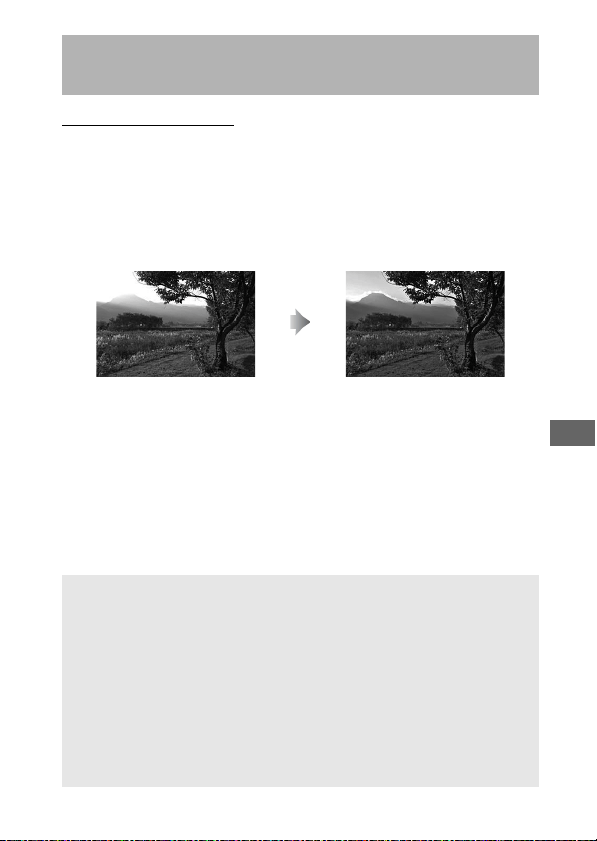
189
Active D-Lighting
Active D-Lighting preserves details in highlights and shadows,
creating photographs with natural contrast.
Use for high
contrast scenes, for example when photographing brightly lit
outdoor scenery through a door or window or taking pictures of
shaded subjects on a sunny day.
It is most effective when used
with matrix metering (0 128).
Preserving Detail in Highlights and
Shadows
Active D-Lighting off Active D-Lighting: Y Auto
A “Active D-Lighting” versus “D-Lighting”
The Active D-Lighting options in the photo and movie shooting
menus adjust exposure before shooting to optimize the dynamic
range, while the D-Lighting option in the retouch menu (0 313)
brightens shadows in images after shooting.
D Active D-Lighting
Noise (randomly-spaced bright pixels, fog, or lines) may appear in
photographs taken with Active D-Lighting.
Uneven shading may be
visible with some subjects.
Active D-Lighting does not apply at high
ISO sensitivities (Hi 0.3–Hi 5).
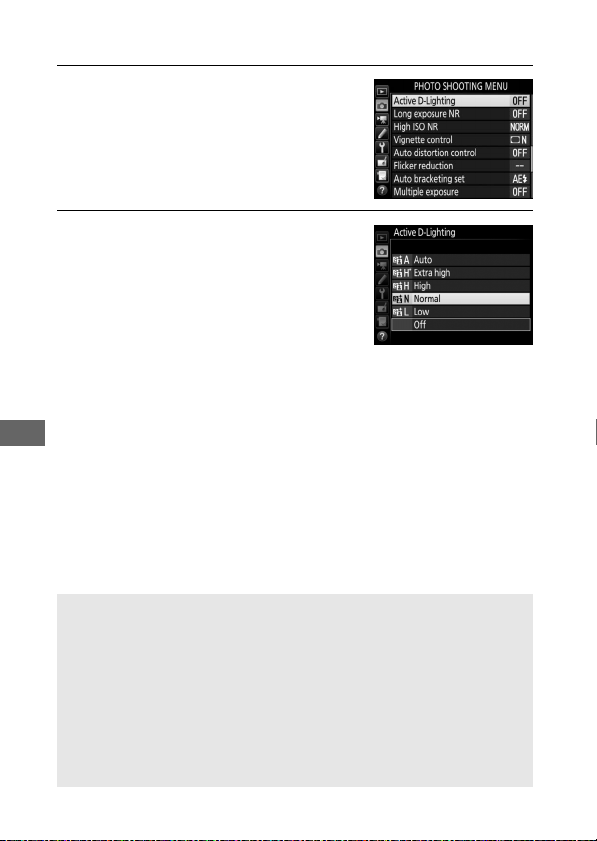
190
To use Active D-Lighting:
1 Select Active D-Lighting.
Highlight Active D-Lighting in the
photo shooting menu and press 2.
2 Choose an option.
Highlight the desired option and
press J.
If YAuto is selected, the
camera will automatically adjust
Active D-Lighting according to
shooting conditions (in exposure
mode M, however, Y Auto is
equivalent to Q Normal).
A Active D-Lighting and Movies
If Same as photo settings is selected for Active D-Lighting in the
movie shooting menu and Auto is selected in the photo shooting
menu, movies will be shot at a setting equivalent to Normal.
Active
D-Lighting does not apply at a frame size of 3840 × 2160.
A See Also
When ADL bracketing is selected for Auto bracketing set in photo
shooting menu (0 146), the camera varies Active D-Lighting over a
series of shots (0 155).

191
High Dynamic Range (HDR)
Used with high-contrast subjects, High Dynamic Range (HDR)
preserves details in highlights and shadows by combining two
shots taken at different exposures.
HDR is most effective when
used with matrix metering (0 128; with spot or center-weighted
metering and a non-CPU lens, an exposure differential of Auto is
equivalent to about 2 EV).
It can not be used to record NEF
(RAW) images.
Flash lighting (0 196), bracketing (0 146),
multiple exposure (0 236), and time lapse (0 74) can not be
used while HDR is in effect and shutter speeds of A and %
are not available.
1 Select HDR (high dynamic range).
Highlight HDR (high dynamic range)
in the photo shooting menu and
press 2.
+
First exposure (darker) Second exposure
(brighter)
Combined HDR image
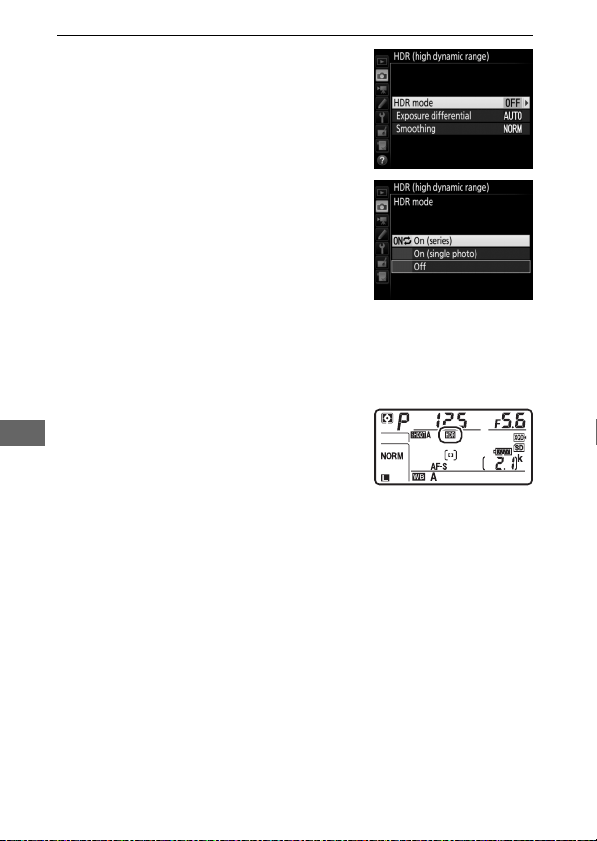
192
2 Select a mode.
Highlight HDR mode and press 2.
Highlight one of the following and
press J.
• To take a series of HDR photographs, select
0 On (series).
HDR shooting will
continue until you select Off for
HDR mode.
• To take one HDR photograph, select On
(single photo).
Normal shooting will resume automatically
after you have created a single HDR photograph.
• To exit without creating additional HDR photographs, select Off.
If On (series) or On (single photo) is
selected, a y icon will be displayed
in the control panel.
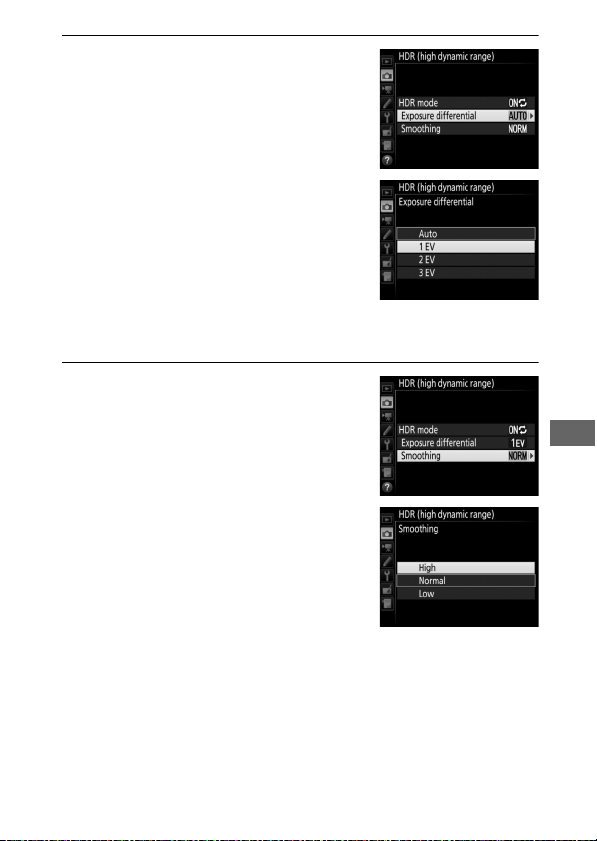
193
3 Choose the exposure differential.
To choose the difference in exposure
between the two shots, highlight
Exposure differential and press 2.
The options shown at right will be
displayed.
Highlight an option and
press J.
Choose higher values for
high-contrast subjects, but note that
choosing a value higher than required
may not produce the desired results; if
Auto is selected, the camera will
automatically adjust exposure to suit the scene.
4 Choose the amount of smoothing.
To choose how much the boundaries
between the two images are
smoothed, highlight Smoothing and
press 2.
The options shown at right will be
displayed.
Highlight an option and
press J.
Higher values produce a
smoother composite image.
Uneven
shading may be visible with some
subjects.
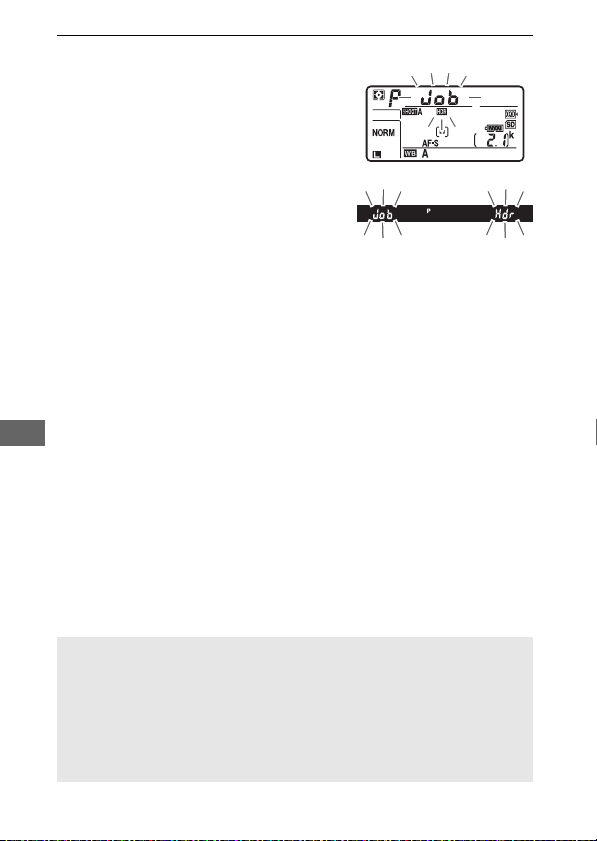
194
5 Frame a photograph, focus, and shoot.
The camera takes two exposures
when the shutter-release button is
pressed all the way down.
“ly” will flash in the control
panel and l u in the
viewfinder while the images are
combined; no photographs can be
taken until recording is complete.
Regardless of the option currently
selected for release mode, only one
photograph will be taken each time the shutter-release
button is pressed.
If On (series) is selected, HDR will only turn off when Off is
selected for HDR mode; if On (single photo) is selected, HDR
turns off automatically after the photograph is taken.
The y
icon clears from the display when HDR shooting ends.
D Framing HDR Photographs
The edges of the image will be cropped out.
The desired results may
not be achieved if the camera or subject moves during shooting.
Use
of a tripod is recommended.
Depending on the scene, the effect may
not be visible, shadows may appear around bright objects, or halos
may appear around dark objects; this effect can be reduced by
adjusting the amount of smoothing.
Control panel
Viewfinder
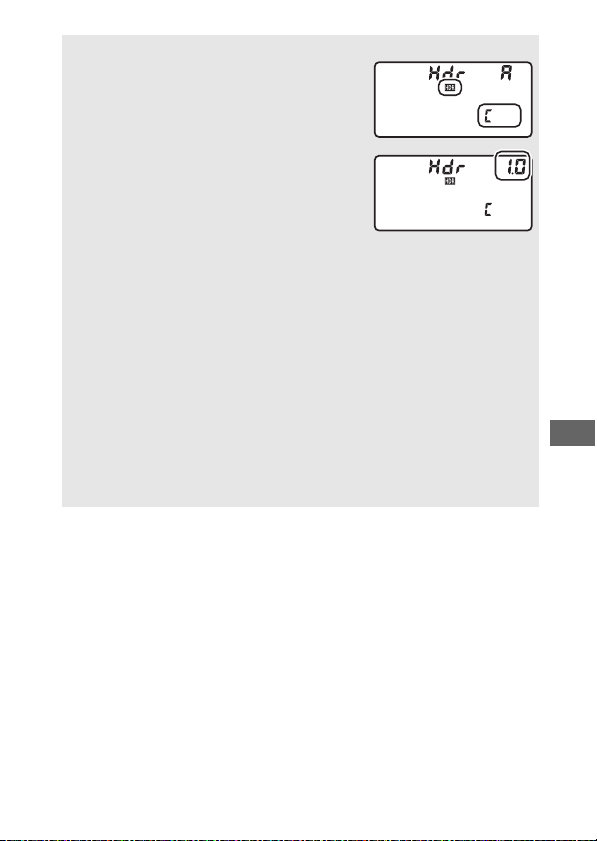
195
A The BKT Button
If HDR (high dynamic range) is selected for
Custom Setting f1 (Custom control
assignment) > BKT button + y (0 301),
you can select the HDR mode by pressing
the BKT button and rotating the main
command dial and the exposure differential
by pressing the BKT button and rotating the
sub-command dial.
The mode and exposure
differential are shown in the control panel:
the icons representing the mode are a for
Off, B for On (single photo), and b for On (series).
A Interval Timer Photography
If On (series) is selected for HDR mode before interval timer shooting
begins, the camera will continue to shoot HDR photographs at the
selected interval (if On (single photo) is selected, interval timer
shooting will end after a single shot).
A Photo Shooting Menu Banks
HDR settings can be adjusted separately for each bank (0 283), but
switching to a bank in which HDR is active during multiple exposure
(0 236) or interval timer shooting (0 243) disables HDR.
HDR is also
disabled if you switch to a bank in which an NEF (RAW) option is
selected for image quality.
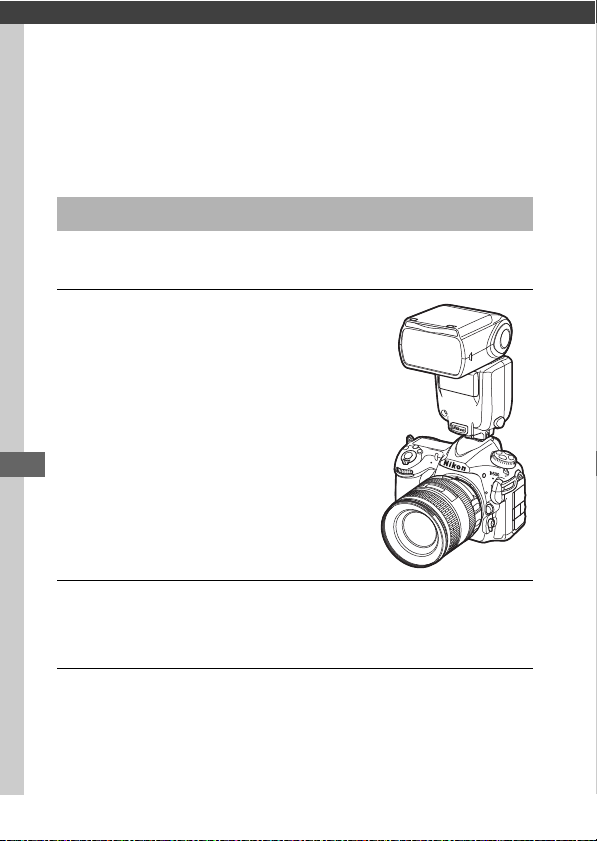
196
Flash Photography
To take photos with a flash, attach an optional flash unit (0 328)
to the camera accessory shoe.
You can also use one or more
remote flash units for off-camera flash photography.
For
information on using flash units, see the documentation
provided with the device.
Follow the steps below to mount an optional flash unit on the
camera and take photographs using the flash.
1 Mount the unit on the accessory
shoe.
See the manual provided with the unit
for details.
2 Turn on the camera and flash unit.
The flash will begin charging; the flash-ready indicator (c) will
be displayed in the viewfinder when charging is complete.
3 Adjust flash settings.
Choose the flash mode (0 201) and flash control mode
(0 199).
Using a Flash
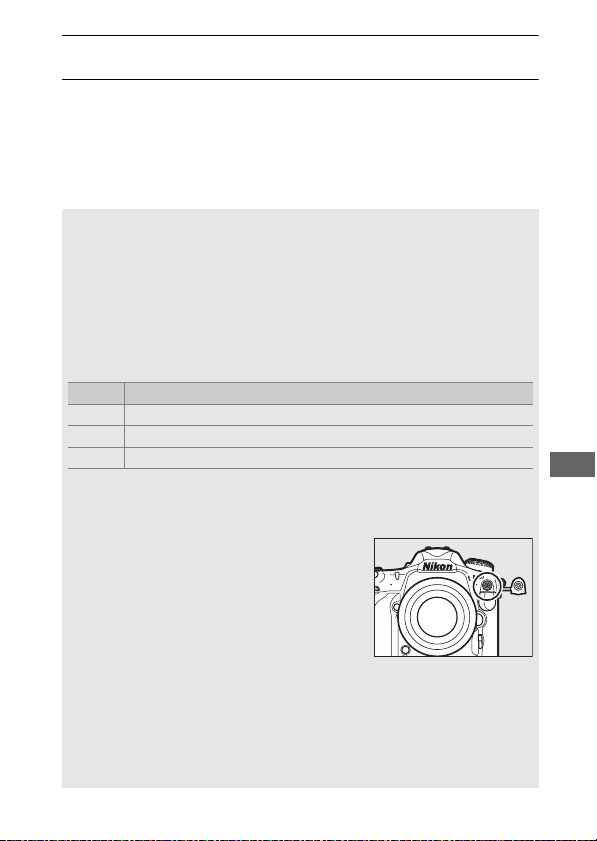
197
4 Adjust shutter speed and aperture.
5 Take pictures.
D Use Only Nikon Flash Accessories
Use only Nikon flash units.
Negative voltages or voltages over 250 V
applied to the accessory shoe could not only prevent normal
operation, but damage the sync circuitry of the camera or flash.
Before
using a Nikon flash unit not listed in this section, contact a Nikon-
authorized service representative for more information.
A Shutter Speed
Shutter speed can be set as follows when an optional flash unit is used:
Mode Shutter speed
P, A Set automatically by camera (
1
/
250 s–
1
/
60 s)
*
S Value selected by user (
1
/
250 s–30 s)
M Value selected by user (
1
/
250 s–30 s, Bulb (A), Time (%))
* Shutter speed may be set as slow as 30 s if slow sync, slow rear-curtain sync, or slow sync
with red-eye reduction is selected for flash mode.
A The Sync Terminal
A sync cable can be connected to the sync
terminal as required.
Do not connect
another flash unit via a sync cable when
performing rear-curtain sync flash
photography with a flash unit mounted on
the camera accessory shoe.
A Unified Flash Control
Unified flash control allows the camera and flash unit to share settings.
If a flash unit that supports unified flash control is mounted on the
camera, changes to flash settings made with either the camera or flash
unit are reflected on both devices, as are changes made using optional
Camera Control Pro 2 software.
198
A i-TTL Flash Control
When a CLS-compatible flash unit is set to TTL, the camera
automatically selects one of the following types of flash control:
• i-TTL balanced fill-flash for digital SLR: Flash unit emits series of nearly
invisible preflashes (monitor preflashes) immediately before main
flash.
Preflashes reflected from objects in all areas of frame are picked
up by RGB sensor with approximately 180K (180,000) pixels and are
analyzed in combination with range information from matrix
metering system to adjust flash output for natural balance between
main subject and ambient background lighting.
If type G, E, or D lens
is used, distance information is included when calculating flash
output.
Precision of calculation can be increased for non-CPU lenses
by providing lens data (focal length and maximum aperture; see
page 250).
Not available when spot metering is used.
• Standard i-TTL fill-flash for digital SLR: Flash output adjusted to bring
lighting in frame to standard level; brightness of background is not
taken into account.
Recommended for shots in which main subject is
emphasized at expense of background details, or when exposure
compensation is used.
Standard i-TTL fill-flash for digital SLR is
activated automatically when spot metering is selected.
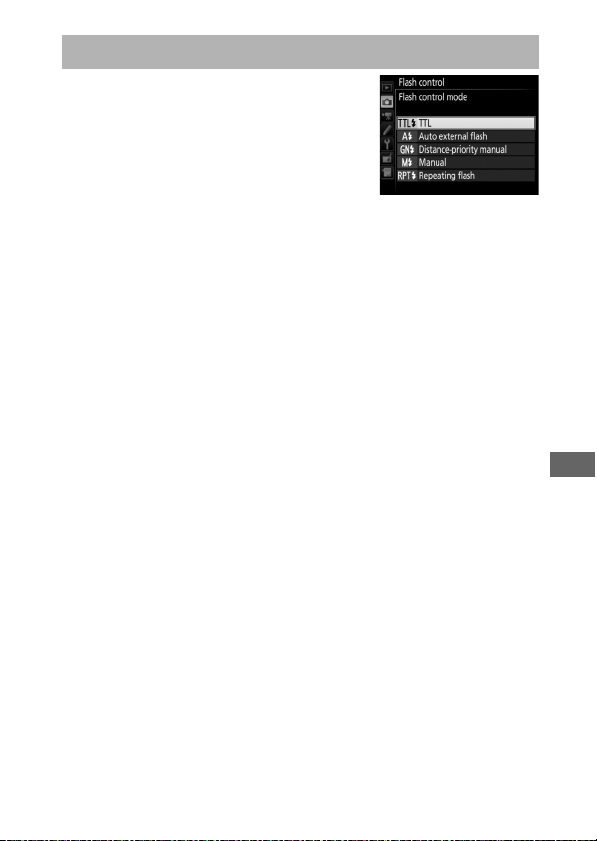
199
When an SB-5000, SB-500, SB-400, or
SB-300 is mounted on the camera, the
flash control mode, flash level, and other
flash settings can be adjusted using the
Flash control > Flash control mode
item in the photo shooting menu (in the
case of the SB-5000, these settings can
also be adjusted using the controls on the flash unit).
The
options available vary with the flash used (0 328), while the
options displayed under Flash control mode vary with the
mode selected.
Settings for other flash units can only be
adjusted using flash unit controls.
• TTL: i-TTL mode.
In the cases of the SB-500, SB-400, and SB-300,
flash compensation can be adjusted using the W (M) button
(0 203).
• Auto external flash: In this mode, output is adjusted automatically
according to the amount of light reflected by the subject; flash
compensation is also available.
Auto external flash supports
“auto aperture” (qA) and “non-TTL auto” (A) modes; non-TTL
auto is selected automatically if a non-CPU lens is attached
without specifying the focal length and maximum aperture
using the Non-CPU lens data option in the setup menu
(0 250).
See the flash unit manual for details.
• Distance-priority manual: Choose the distance to the subject; flash
output will be adjusted automatically.
Flash compensation is
also available.
On-Camera Flash Photography
200
• Manual: Choose the flash level manually.
• Repeating flash: The flash fires repeatedly while the shutter is
open, producing a multiple-exposure effect.
Choose the flash
level (Output), the number of times the units fire (Times), and
the number of times the flash fires per second (Frequency,
measured in Hertz).
Note that the number of times the units
fire in total may vary depending on the options selected for
Output and Frequency; see the documentation provided with
the flash unit for details.
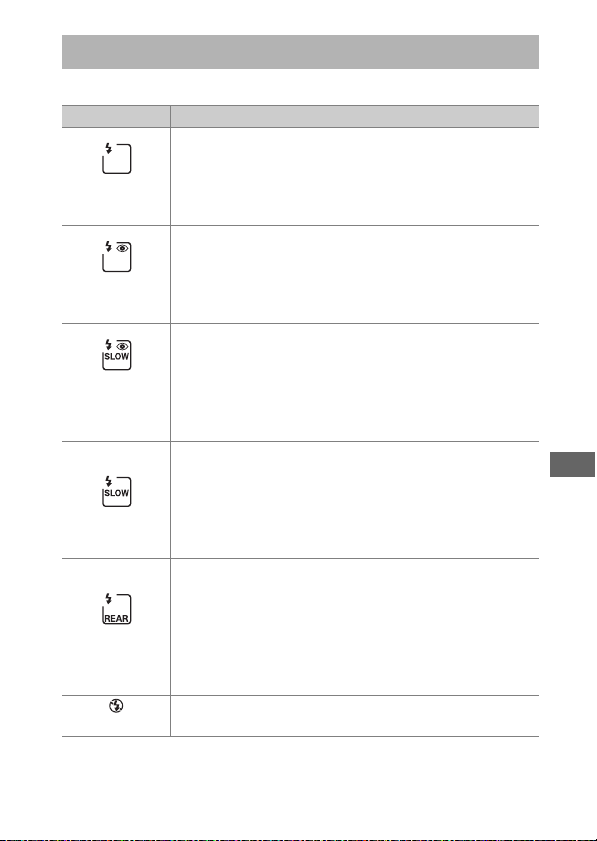
201
The camera supports the following flash modes:
Flash Modes
Flash mode Description
Front-curtain
sync
This mode is recommended for most situations.
In
programmed auto and aperture-priority auto modes,
shutter speed will automatically be set to values
between
1
/
250 and
1
/
60 s (
1
/
8000 to
1
/
60 s with Auto FP High-
Speed Sync; 0 299).
Red-eye
reduction
If flash unit supports red-eye reduction, choose this
mode to reduce “red-eye” effect sometimes caused by
flash.
Not recommended with moving subjects or in
other situations in which quick shutter response is
required.
Do not move camera during shooting.
Red-eye
reduction with
slow sync
Combines red-eye reduction with slow sync.
Use for
portraits taken against a backdrop of night scenery.
This mode is only available in programmed auto and
aperture-priority auto exposure modes.
Use of tripod
is recommended to prevent blurring caused by camera
shake.
Slow sync
Flash is combined with shutter speeds as slow as 30 s
to capture both subject and background at night or
under dim light.
This mode is only available in
programmed auto and aperture-priority auto
exposure modes.
Use of tripod is recommended to
prevent blurring caused by camera shake.
Rear-curtain
sync
In shutter-priority auto or manual exposure mode,
flash fires just before the shutter closes.
Use to create
effect of a stream of light behind moving objects.
In
programmed auto and aperture-priority auto, slow
rear-curtain sync is used to capture both subject and
background.
Use of tripod is recommended to prevent
blurring caused by camera shake.
Flash off
Flash does not fire.
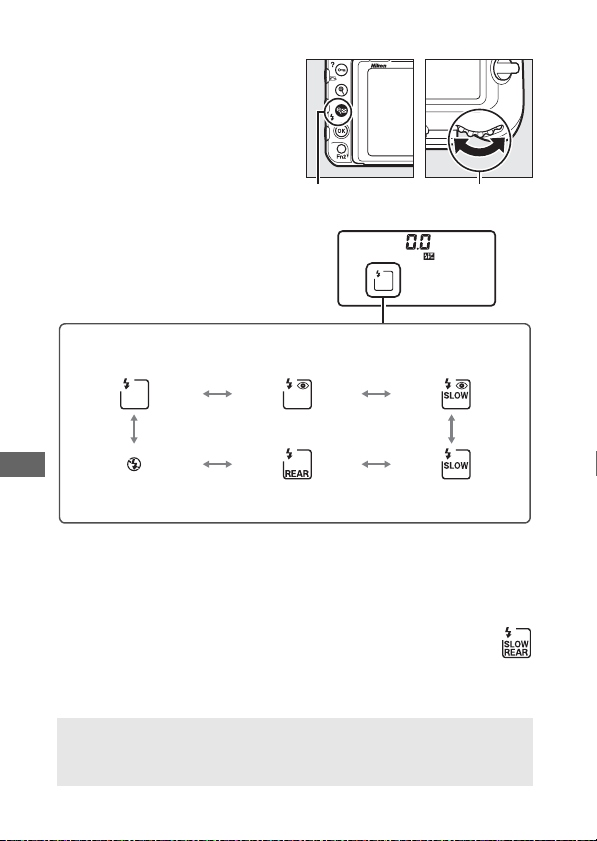
202
❚❚ Choosing a Flash Mode
To choose the flash mode, press
the W (M) button and rotate
the main command dial until
the desired flash mode is
selected in the control panel:
1 Y icon flashes if flash unit does not support red-eye reduction.
2 Red-eye reduction with slow sync is available only in exposure modes P and A.
In modes S and
M, red-eye reduction with slow sync becomes red-eye reduction.
3 Available only in exposure modes P and A.
In modes S and M, slow sync becomes front-curtain
sync.
4 In exposure modes P and A, flash-sync mode will be set to slow rear-curtain sync
when the W (M) button is released.
A Studio Flash Systems
Rear-curtain sync can not be used with studio flash systems, as the
correct synchronization can not be obtained.
W (M) button Main command
dial
Front-curtain sync Red-eye reduction
1
Red-eye reduction
with slow sync
1, 2
Flash off Rear-curtain sync
4
Slow sync
3
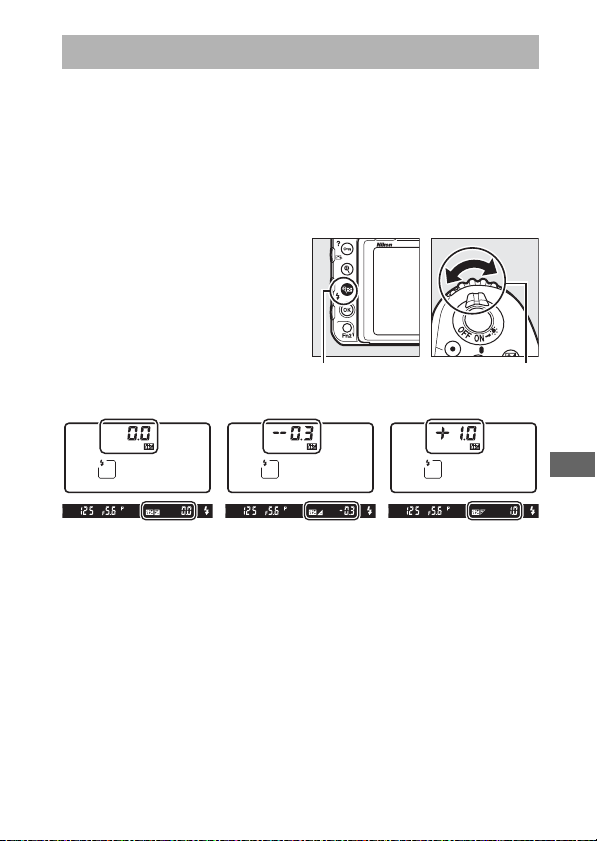
203
Flash compensation is used to alter flash output by from –3 EV to
+1 EV in increments of
1
/
3 EV, changing the brightness of the
main subject relative to the background.
Flash output can be
increased to make the main subject appear brighter, or reduced
to prevent unwanted highlights or reflections.
In general,
choose positive values to make the main subject brighter,
negative values to make it darker.
To choose a value for flash
compensation, press the W (M)
button and rotate the sub-
command dial until the desired
value is displayed in the control
panel.
At values other than ±0.0, a Y icon will be displayed in the
control panel and viewfinder after you release the W (M) button.
The current value for flash compensation can be confirmed by
pressing the W (M) button.
Normal flash output can be restored by setting flash
compensation to ±0.0.
Flash compensation is not reset when
the camera is turned off.
Flash Compensation
±0 EV
(W (M) button pressed)
–0.3 EV +1.0 EV
W (M) button Sub-command
dial
204
A Optional Flash Units
In i-TTL and auto aperture (qA) flash control modes, the flash
compensation selected with the optional flash unit or the Flash
control option in the photo shooting menu is added to the flash
compensation selected with the W (M) button and command dial.
A See Also
For information on choosing the size of the increments available for
flash compensation, see Custom Setting b3 (Exp./flash comp. step
value, 0 294).
For information on choosing whether flash
compensation is applied in addition to exposure compensation when
the flash is used, see Custom Setting e3 (Exposure comp. for flash,
0 300).
For information on automatically varying flash level over a
series of shots, see page 147.
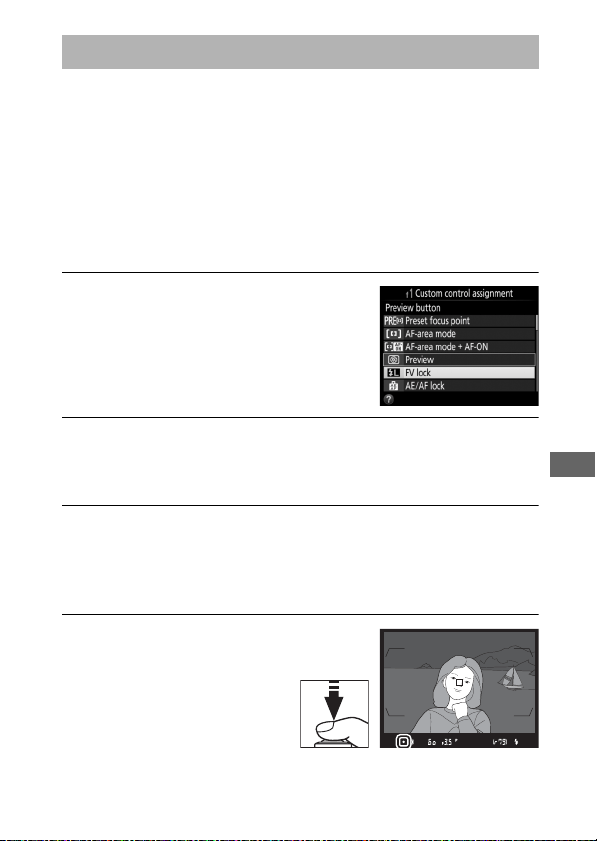
205
This feature is used to lock flash output, allowing photographs to
be recomposed without changing the flash level and ensuring
that flash output is appropriate to the subject even when the
subject is not positioned in the center of the frame.
Flash output
is adjusted automatically for any changes in ISO sensitivity and
aperture.
FV lock is available with CLS compatible flash units
only (0 328, 330).
To use FV lock:
1 Assign FV lock to a camera control.
Assign FV lock to a control using
Custom Setting f1 (Custom control
assignment, 0 301).
2 Attach a CLS-compatible flash unit.
Mount a CLS-compatible flash unit (0 328) on the camera
accessory shoe.
3 Set the flash unit to the appropriate mode.
Turn the flash unit on and set the flash mode to TTL, monitor
pre-flash qA, or monitor pre-flash A.
See the documentation
provided with the flash unit for details.
4 Focus.
Position the subject in the
center of the frame and
press the shutter-release
button halfway to focus.
FV Lock
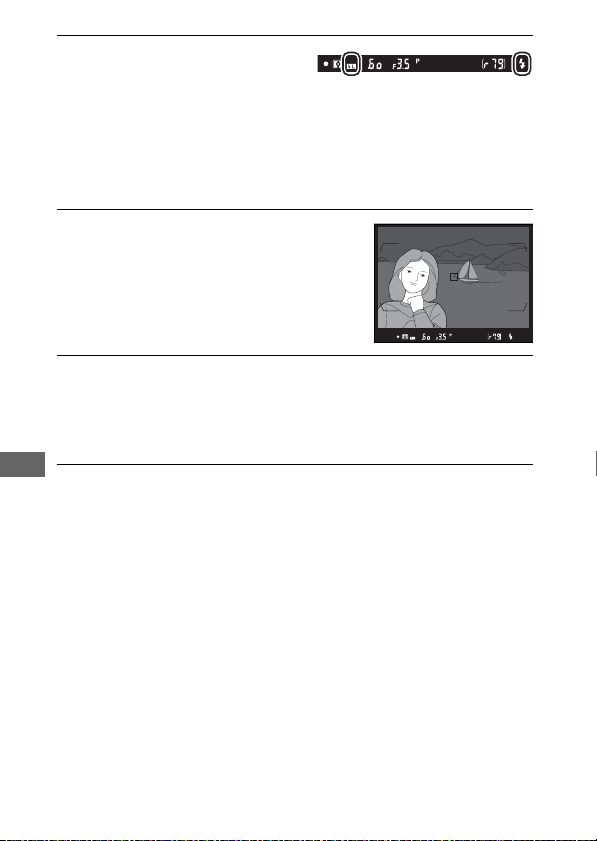
206
5 Lock flash level.
After confirming that the
flash-ready indicator (M) is displayed in the viewfinder, press
the control selected in Step 1.
The flash will emit a monitor
preflash to determine the appropriate flash level.
Flash
output will be locked at this level and FV lock icon (e) will
appear in the viewfinder.
6 Recompose the photograph.
7 Take the photograph.
Press the shutter-release button the rest of the way down to
shoot.
If desired, additional pictures can be taken without
releasing FV lock.
8 Release FV lock.
Press the control selected in Step 1 to release FV lock.
Confirm that the FV lock icon (e) is no longer displayed in the
viewfinder.
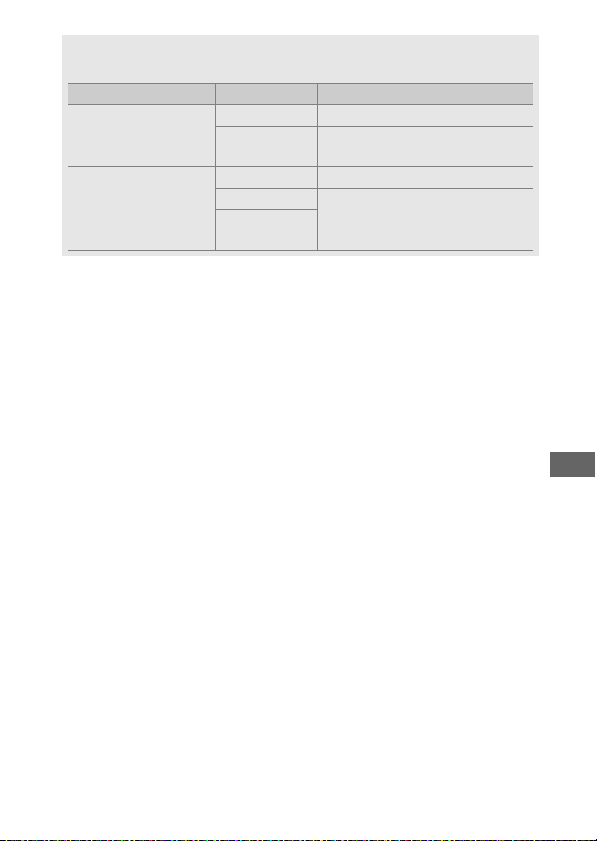
207
A Metering
The metering areas for FV lock are as follows:
Flash unit Flash mode Metered area
Stand-alone flash
unit
i-TTL 6-mm circle in center of frame
qA
Area metered by flash exposure
meter
Used with other flash
units (Advanced
Wireless Lighting)
i-TTL Entire frame
qA
Area metered by flash exposure
meter
A (master
flash)
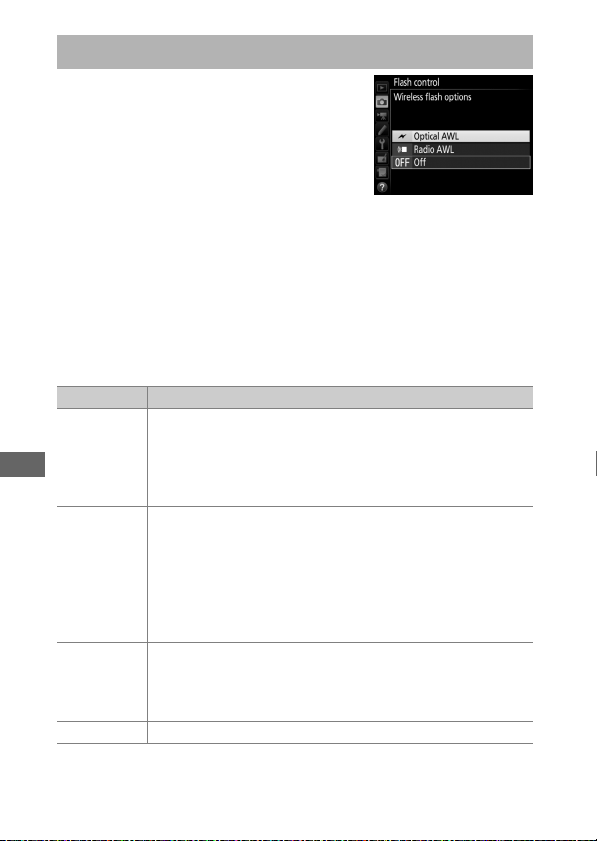
208
Use remotely controlled flash units for
off-camera lighting (Advanced Wireless
Lighting, or AWL; 0 328).
The camera
supports two types of remote flash
control: optical AWL, in which the master
flash controls the remote flash units
using optical signals (low-intensity flash
pulses), and radio AWL, in which the remote flash units are
controlled by means of radio signals emitted by a WR-R10
mounted on the camera.
When an SB-5000 or SB-500 flash unit
or a WR-R10 wireless remote controller is mounted on the
camera, the remote flash control mode can be selected using the
Flash control > Wireless flash options item in the camera
photo shooting menu.
Remote Flash Photography
Option Description
Optical AWL
The remote flash units are controlled using low-intensity
flashes emitted by the master flash.
Available only with
an SB-5000 or SB-500 mounted on the camera accessory
shoe and remote flash units that support optical AWL
(0 209).
Optical/radio
AWL
This option is for flash photography using both optically-
and radio-controlled flash units and is available when a
WR-R10 is attached and an SB-500, or an SB-910, SB-900,
SB-800, SB-700, or SU-800 configured to serve as the
master flash, is mounted on the camera accessory shoe
(0 213).
Remote flash control is automatically set to
Group flash (0 214).
Radio AWL
The remote flash units are controlled by radio signals
emitted by a WR-R10 attached to the camera (0 210).
Available only with the WR-R10 and remote flash units
that support radio AWL.
Off Remote flash photography disabled.

209
Setup
This section details the steps involved in setting up a WR-R10 or
a master flash mounted on the camera accessory shoe (C) and
remote flash units (f) for wireless flash photography.
More
information on using optional flash units can be found in the
documentation provided with the devices.
❚❚ Optical AWL
The following instructions assume that the master flash is an
SB-5000 or SB-500.
When an SB-910, SB-900, SB-800, SB-700, or
SU-800 is used as a master flash, settings must be adjusted using
the controls on the individual flash units; see the flash unit
manuals for details.
1 C: Connect the master flash.
Mount an SB-5000 or SB-500 on the camera accessory shoe.
2 C: Enable optical AWL.
In the photo shooting menu, select Optical AWL for Flash
control > Wireless flash options.
You can now take photos as described on page 214.
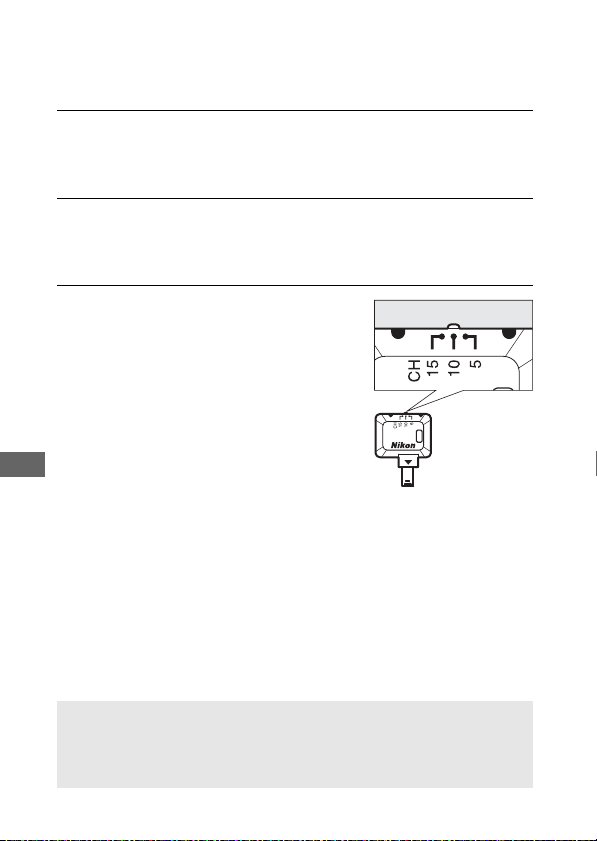
210
❚❚ Radio AWL
Radio AWL is available with compatible remote flash units when
a WR-R10 is attached to the camera.
1 C: Connect the WR-R10.
For more information, see the documentation provided with
the WR-R10.
2 C: Enable radio AWL.
In the photo shooting menu, select Radio AWL for Flash
control > Wireless flash options.
3 C: Set the WR-R10 to the desired
channel.
Set the WR-R10 channel selector to
the desired channel.
A Radio AWL
A WR-A10 adapter is required when using the WR-R10.
Be sure to
update the WR-R10 firmware to the latest version; for information on
firmware updates, see the Nikon website for your area.
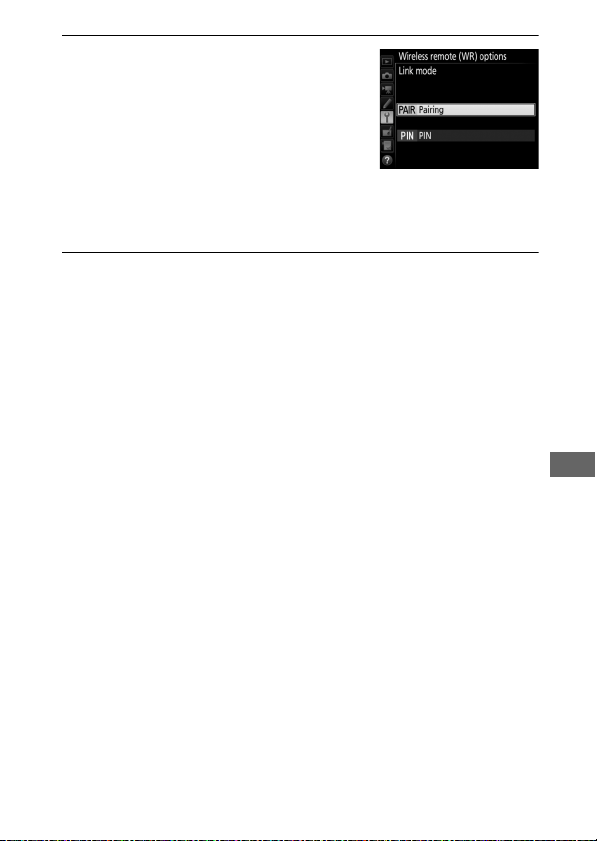
211
4 C: Choose a link mode.
Select Wireless remote (WR)
options > Link mode in the setup
menu (0 307) and choose from the
following options:
• Pairing: Pair the flash unit with the
WR-R10.
• PIN: Connect the camera and flash unit using a four-digit
PIN.
5 f: Establish a wireless connection.
Set the flash units to remote mode and set the devices to the
channel you selected in Step 3, then pair the flash units with
the WR-R10 according to the option selected in Step 4:
• Pairing: Initiate pairing on the flash unit and press the
WR-R10 pairing button.
Pairing is complete when the LINK
lamps on the WR-R10 and flash unit flash orange and green;
once a connection is established, the flash unit LINK lamp
will light green.
• PIN: Use the flash unit controls to enter the PIN you selected
in Step 4.
The flash unit LINK lamp lights green once a
connection is established.
Repeat Step 5 until all the remote flash units have been
paired.
You can now take photos as described on page 214.
212
A Reconnecting
As long as the channel, link mode, and other settings remain the same,
the camera will automatically connect to previously paired flash units
when you select remote mode and Steps 3–5 can be omitted.
The flash
unit LINK lamp lights green when a connection is established.
A Radio-Controlled Flash Units
Radio-controlled flash units can be combined with any of the following
flash units mounted on the camera accessory shoe:
• SB-5000: Before attaching the flash unit, set it to radio-controlled
master flash mode (a d icon will appear at the top left corner of the
display) and choose group or remote repeating flash control.
Once
the unit is attached, settings can be adjusted using the controls on
the flash unit or the options listed in the camera menus under Group
flash options > Master flash or under “M” in the Remote repeating
options display.
• SB-910, SB-900, SB-800, SB-700: Configure the flash for stand-alone use
and use the controls on the flash unit to adjust flash settings.
• SB-500, SB-400, SB-300: Mount the unit on the camera and adjust
settings using the camera Group flash options > Master flash
option.
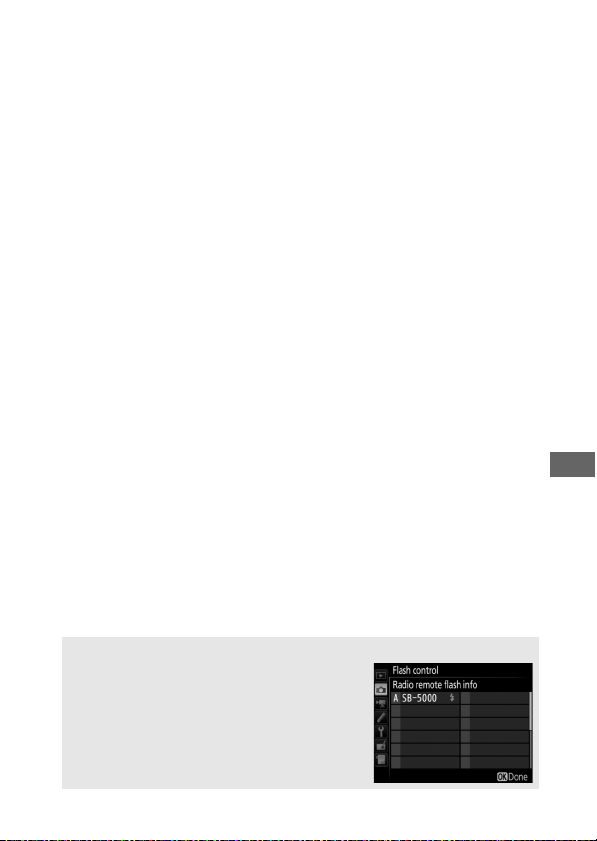
213
❚❚ Optical/Radio AWL
For remote flash lighting that incorporates both optically- and
radio-controlled flash units, select Optical/radio AWL for Flash
control > Wireless flash options in the photo shooting menu
and set up the radio-controlled units as described under “Radio
AWL”(0 210).
Place optically-controlled units in group A, B, or C
and radio-controlled units in group D, E, or F.
You can now take
photos as described on page 214.
A Remote Flash Info
To view the flash units currently controlled
using radio AWL, select Flash control >
Radio remote flash info in the photo
shooting menu.
The identifier (“remote flash
name”) for each unit can be changed using
flash unit controls.
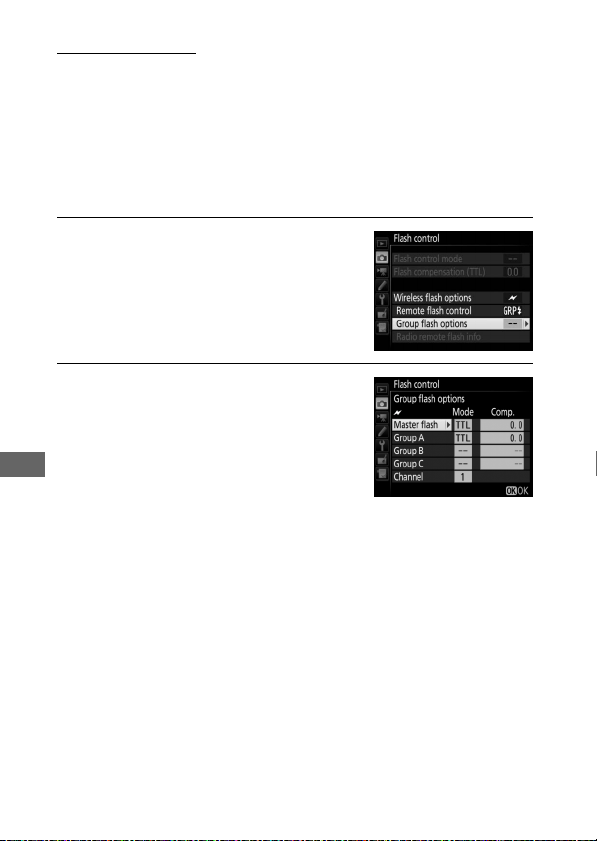
214
Taking Photos
The Flash control > Remote flash control item in the photo
shooting menu offers three options for remote flash
photography: Group flash, Quick wireless control, and
Remote repeating.
❚❚ Group Flash
Select this option to adjust settings separately for each group.
1 C: Select Group flash options.
Highlight Group flash options in the
flash control display and press 2.
2 C: Choose the flash control mode.
Choose the flash control mode and
flash level for the master flash and the
flash units in each group:
• TTL: i-TTL flash control (0 198).
• qA: Auto aperture (available only
with compatible flash units).
• M: Choose the flash level manually.
• – – (off): The units do not fire and the flash level can not be
adjusted.
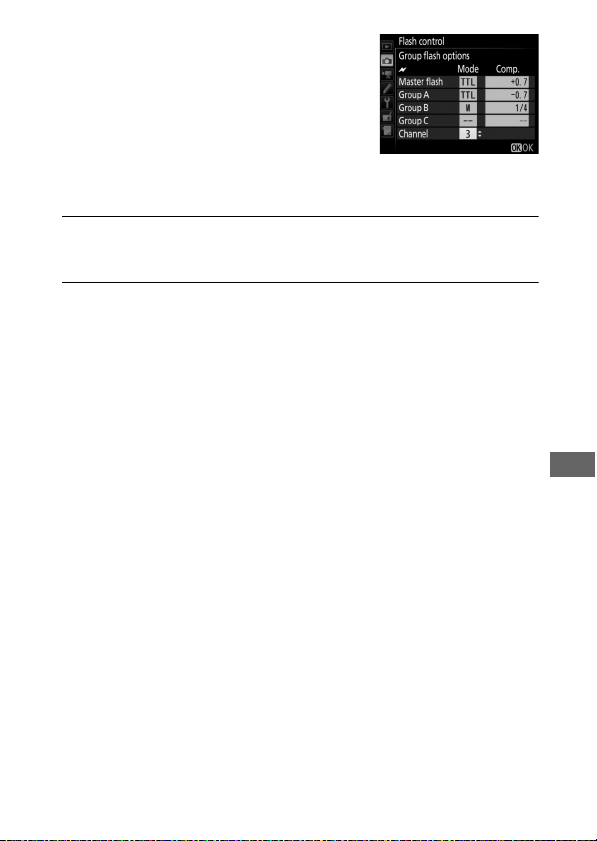
215
If Optical AWL or Optical/radio AWL
is selected for Flash control >
Wireless flash options in the photo
shooting menu (0 284), choose a
channel for the master flash.
If the
remote flash units include an SB-500,
you must choose channel 3, but
otherwise you can choose any channel between 1 and 4.
3 f: Set the channel (optical AWL only).
Set the remote flash units to the channel selected in Step 2.
4 f: Group the remote flash units.
Optical AWL
Choose a group (A, B, or C, or if you are using an SB-500
master flash, A or B) for each remote flash unit.
Although
there is no limit on the number of remote flash units that may
be used, the practical maximum is three per group.
With
more than this number, the light emitted by the remote flash
units will interfere with performance.
Radio AWL
Choose a group (A–F) for each of the remote flash units.
The
master flash can control up to 18 flash units in any
combination.
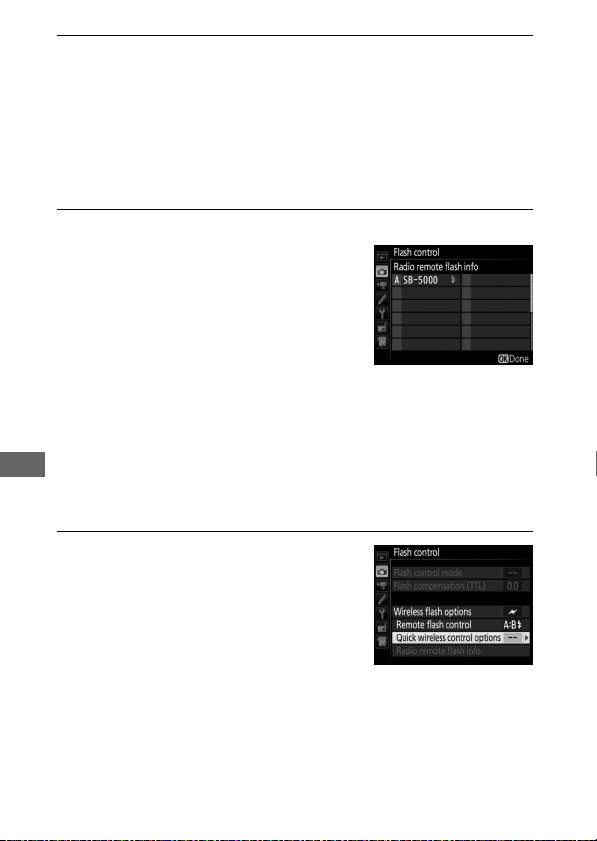
216
5 C/f: Compose the shot.
Compose the shot and arrange the flash units.
See the
documentation provided with the flash units for more
information.
After arranging the units, take a test shot to
confirm that all flash units are functioning.
You can also test-
fire radio-controlled flash units by pressing the i button in
the flash info display (0 222) and selecting M Test flash.
6 C/f: Frame the photograph, focus, and shoot.
In radio AWL, the flash-ready indicator
will light in the camera viewfinder
(0 196) or flash information display
when all flash units are ready.
The
status of radio-controlled units can
also be viewed by selecting Flash
control > Radio remote flash info in
the photo shooting menu.
❚❚ Quick Wireless Control
Select this option to control overall flash compensation for, and
the relative balance between, groups A and B, while setting
output for group C manually.
1 C: Select Quick wireless control
options.
Highlight Quick wireless control
options in the flash control display
and press 2.
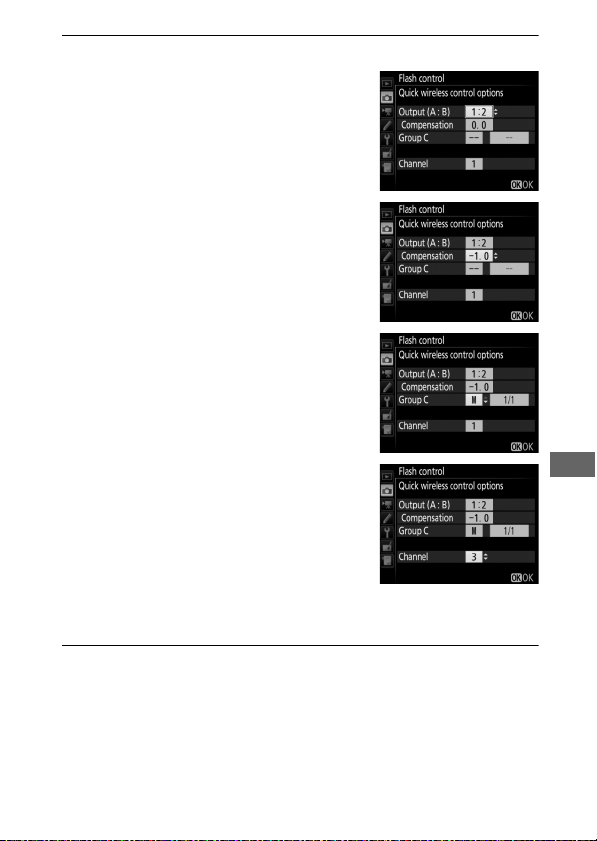
217
2 C: Adjust flash settings.
Choose the balance between groups
A and B.
Adjust flash compensation for groups
A and B.
Choose a flash control mode and flash
level for the units in group C:
• M: Choose the flash level manually.
• – –: The units in group C do not fire.
If Optical AWL is selected for Flash
control > Wireless flash options in
the photo shooting menu (0 284),
choose a channel for the master flash.
If the remote flash units include an
SB-500, you must choose channel 3,
but otherwise you can choose any
channel between 1 and 4.
3 f: Set the channel (optical AWL only).
Set the remote flash units to the channel selected in Step 2.
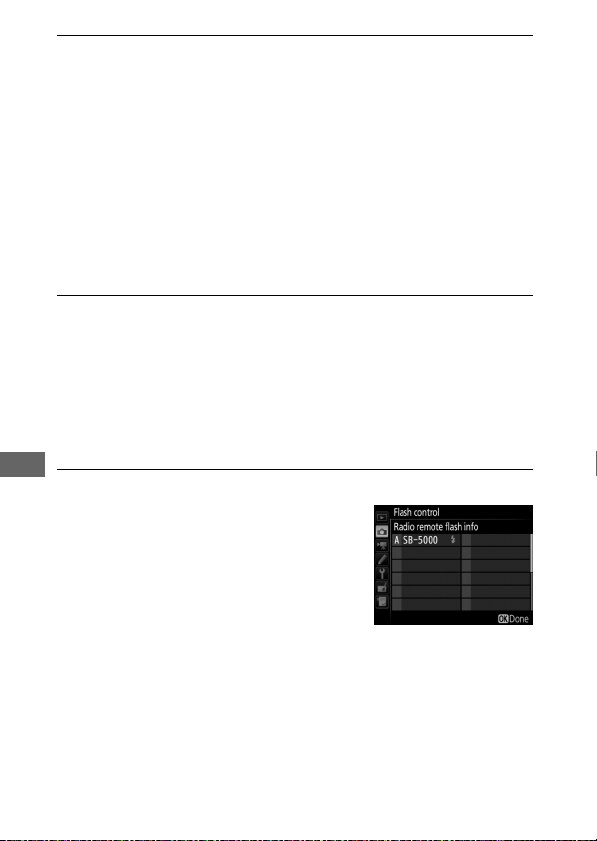
218
4 f: Group the remote flash units.
Choose a group (A, B, or C).
Optical AWL
Although there is no limit on the number of remote flash
units that may be used, the practical maximum is three per
group.
With more than this number, the light emitted by the
remote flash units will interfere with performance.
Radio AWL
The master flash can control up to 18 flash units in any
combination.
5 C/f: Compose the shot.
Compose the shot and arrange the flash units.
See the
documentation provided with the flash units for more
information.
After arranging the units, take a test shot to
confirm that all flash units are functioning.
You can also test-
fire radio-controlled flash units by pressing the i button in
the flash info display (0 222) and selecting M Test flash.
6 C/f: Frame the photograph, focus, and shoot.
In radio AWL, the flash-ready indicator
will light in the camera viewfinder
(0 196) or flash information display
when all flash units are ready.
The
status of radio-controlled units can
also be viewed by selecting Flash
control > Radio remote flash info in
the photo shooting menu.
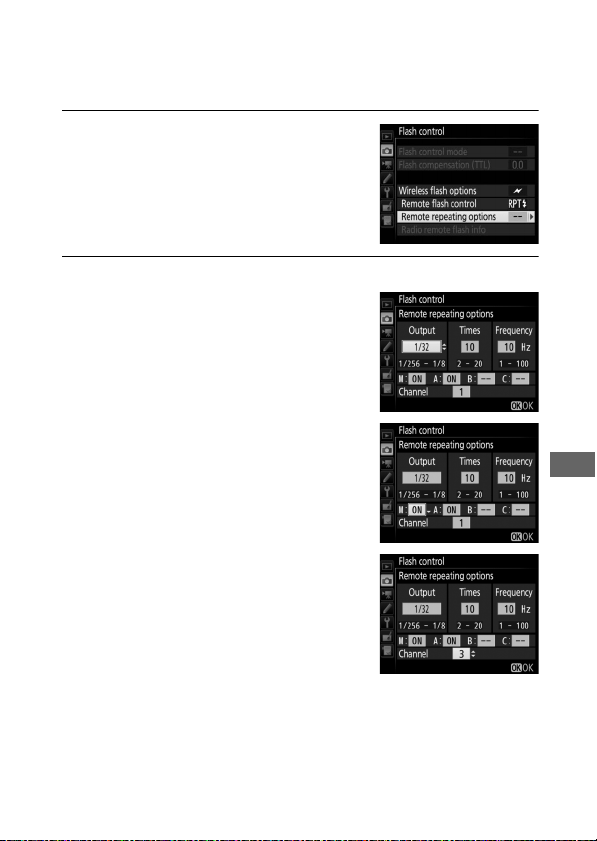
219
❚❚ Remote Repeating
When this option is selected, the flash units fire repeatedly while
the shutter is open, producing a multiple-exposure effect.
1 C: Select Remote repeating
options.
Highlight Remote repeating options
in the flash control display menu and
press 2.
2 C: Adjust flash settings.
Choose the flash level (Output), the
maximum number of times the flash
units fire (Times), and the number of
times the flash units fire per second
(Frequency).
Enable or disable selected groups.
Select ON to enable the selected
group, –– to disable the selected
group.
If Optical AWL is selected for Flash
control > Wireless flash options in
the photo shooting menu (0 284),
choose a channel for the master flash.
If the remote flash units include an
SB-500, you must choose channel 3,
but otherwise you can choose any
channel between 1 and 4.
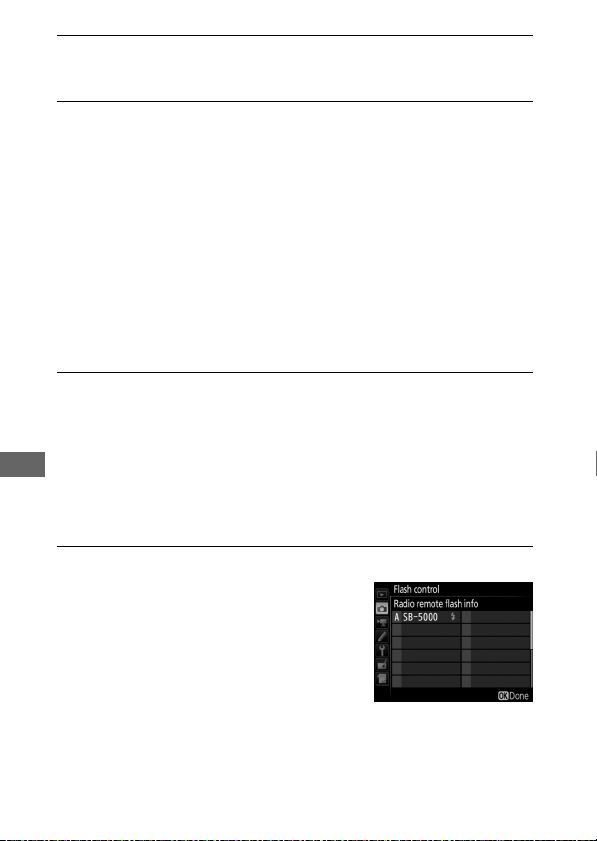
220
3 f: Set the channel (optical AWL only).
Set the remote flash units to the channel selected in Step 2.
4 f: Group the remote flash units.
Optical AWL
Choose a group (A, B, or C) for each remote flash unit.
Although there is no limit on the number of remote flash
units that may be used, the practical maximum is three per
group.
With more than this number, the light emitted by the
remote flash units will interfere with performance.
Radio AWL
Choose a group (A–F) for each of the remote flash units.
The
master flash can control up to 18 flash units in any
combination.
5 C/f: Compose the shot.
Compose the shot and arrange the flash units.
See the
documentation provided with the flash units for more
information.
After arranging the units, take a test shot to
confirm that all flash units are functioning.
You can also test-
fire radio-controlled flash units by pressing the i button in
the flash info display (0 222) and selecting M Test flash.
6 C/f: Frame the photograph, focus, and shoot.
In radio AWL, the flash-ready indicator
will light in the camera viewfinder
(0 196) or flash information display
when all flash units are ready.
The
status of radio-controlled units can
also be viewed by selecting Flash
control > Radio remote flash info in
the photo shooting menu.

221
A Optical AWL
Position the sensor windows on the remote flash units to pick up the
light from the master flash (particular care is required if the camera is
not mounted on a tripod).
Be sure that direct light or strong reflections
from the remote flash units do not enter the camera lens (in TTL mode)
or the photocells on the remote flash units (qA mode), as this may
interfere with exposure.
To prevent low-intensity flashes emitted by
the master flash from appearing in photographs taken at short range,
choose low ISO sensitivities or small apertures (high f-numbers) or
rotate the flash head on the master flash to point upwards.
After
positioning the remote flash units, take a test shot and view the results
in the camera monitor.
A Flash Compensation
The flash compensation value selected with the W (M) button and
sub-command dial is added to the flash compensation values selected
in the wireless flash options menu.
Y icons blink in the control panel
and viewfinder when a flash compensation value other than ±0 is
selected for the master or remote flash units in TTL or qA mode.
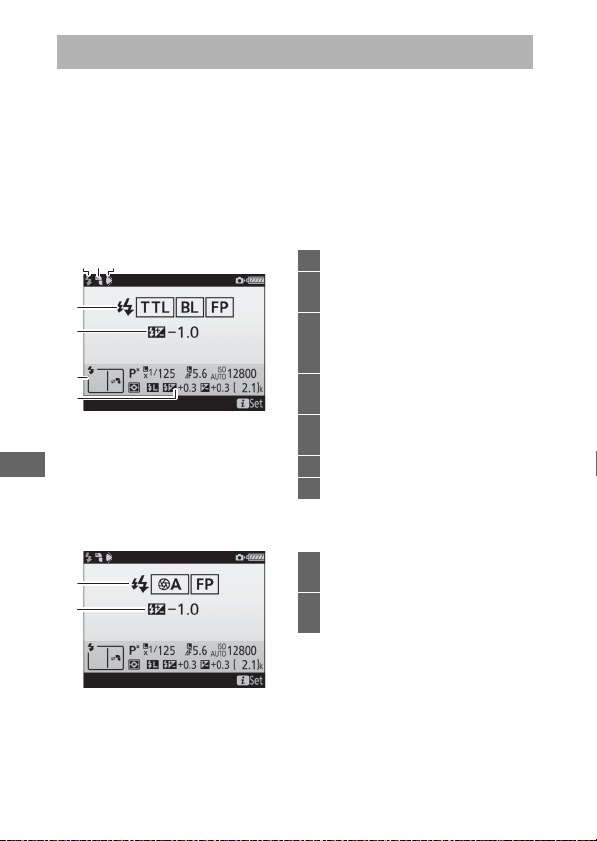
222
The camera can display flash info for SB-5000, SB-500, SB-400,
and SB-300 flash units mounted on the camera accessory shoe
and for remote flash units controlled via radio AWL using a
WR-R10.
To view flash info, press the R button in the
information display (0 226).
The information displayed varies
with the flash control mode.
❚❚ TTL
❚❚ Auto External Flash
Viewing Flash Info
5
7
6
4
213
1 Flash-ready indicator................. 196
2 Bounce icon (displayed if flash
head is tilted)
3 Flash angle warning (displayed if
angle of illumination is sub-
optimal)
4 Flash control mode.................... 199
FP indicator.................................. 299
5 Flash compensation (TTL)
.............................................. 199, 203
6 Flash mode .................................. 201
7 Flash compensation .................. 203
1
2
1 Flash control mode.................... 199
FP indicator.................................. 299
2 Flash compensation (auto
aperture) ............................ 199, 203
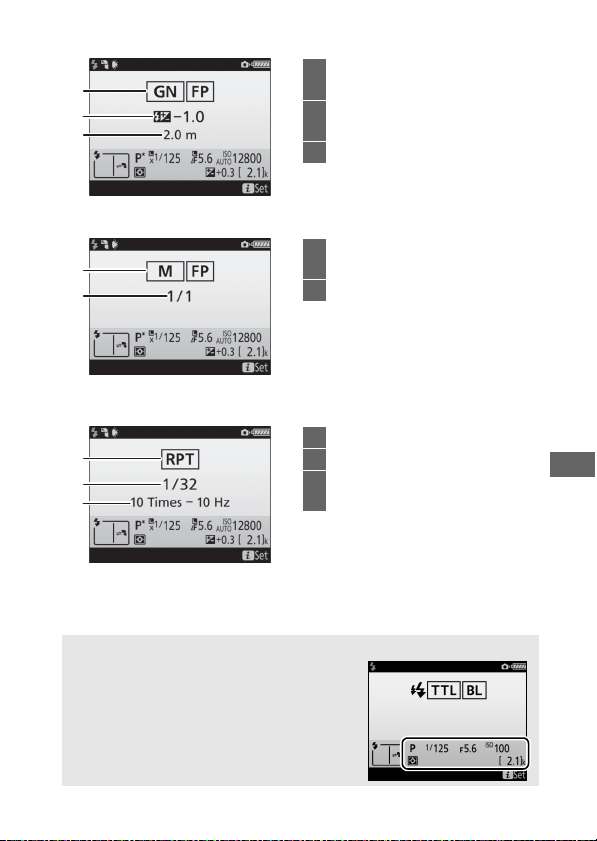
223
❚❚ Distance-Priority Manual
❚❚ Manual
❚❚ Repeating Flash
1
3
2
1 Flash control mode .................... 199
FP indicator.................................. 299
2 Flash compensation (distance-
priority manual)................ 199, 203
3 Distance ........................................ 199
1
2
1 Flash control mode ...........199, 200
FP indicator.................................. 299
2 Flash level..................................... 200
1
2
3
1 Flash control mode ...........199, 200
2 Flash level (output) .................... 200
3 Number emitted (times)........... 200
Frequency..................................... 200
A Flash Info and Camera Settings
The flash information display shows
selected camera settings, including
exposure mode, shutter speed, aperture,
and ISO sensitivity.
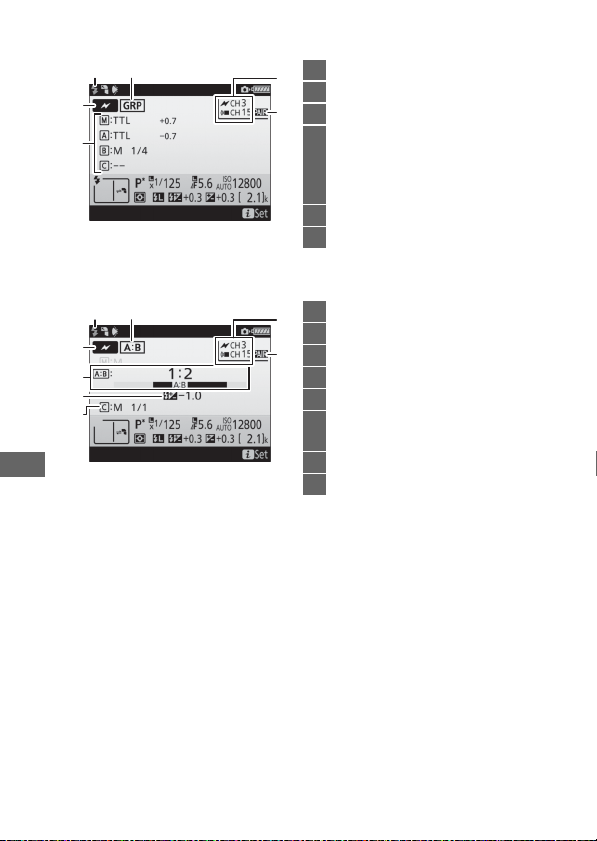
224
❚❚ Group Flash
❚❚ Quick Wireless Control
5
3
6
4
21
1 Flash-ready indicator
1
............... 196
2 Remote flash control .................214
3 Remote flash control mode
2
... 208
4 Group flash control mode
2, 3
.... 214
Group flash mode....................... 214
Flash level/
flash compensation ......... 203, 214
5 Channel
2
..................... 210, 211, 215
6 Link mode..................................... 211
7
3
8
6
5
4
12
1 Flash-ready indicator
1
............... 196
2 Remote flash control ........214, 216
3 Remote flash control mode
2
... 208
4 A : B ratio....................................... 217
5 Flash compensation.......... 203, 217
6 Group C flash control mode
and flash level ............................ 217
7 Channel
2
..................... 210, 211, 217
8 Link mode..................................... 211
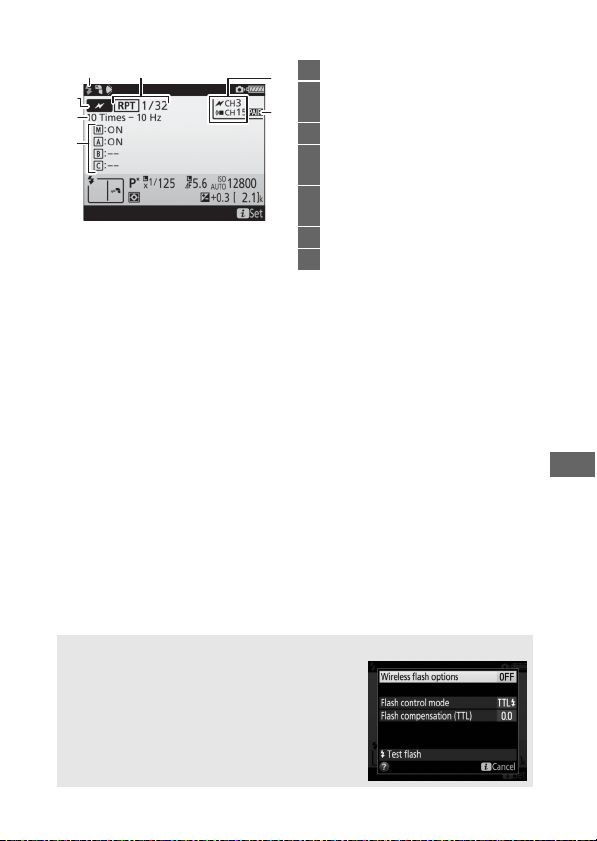
225
❚❚ Remote Repeating
1 Displayed in radio AWL when all flash units are ready.
2 Optical AWL is indicated by Y, radio AWL by Z, joint optical and radio AWL by Y and Z.
Optical AWL channel for joint optical and radio AWL is displayed only when SB-500 is used as
master flash.
3 Icons are displayed for each group when joint optical and radio AWL is used.
6
3
7
4
5
12
1 Flash-ready indicator
1
............... 196
2 Remote flash control ........ 214, 219
Flash level (output).................... 219
3 Remote flash control mode
2
... 208
4 Number emitted (times)........... 219
Frequency .................................... 219
5 Group status
(enabled/disabled) ................... 219
6 Channel
2
..................... 210, 211, 220
7 Link mode .................................... 211
A Changing Flash Settings
Flash settings can be changed by pressing
the i button in the flash info display.
The
options available vary with the flash unit and
the settings selected.
You can also test-fire
the flash.
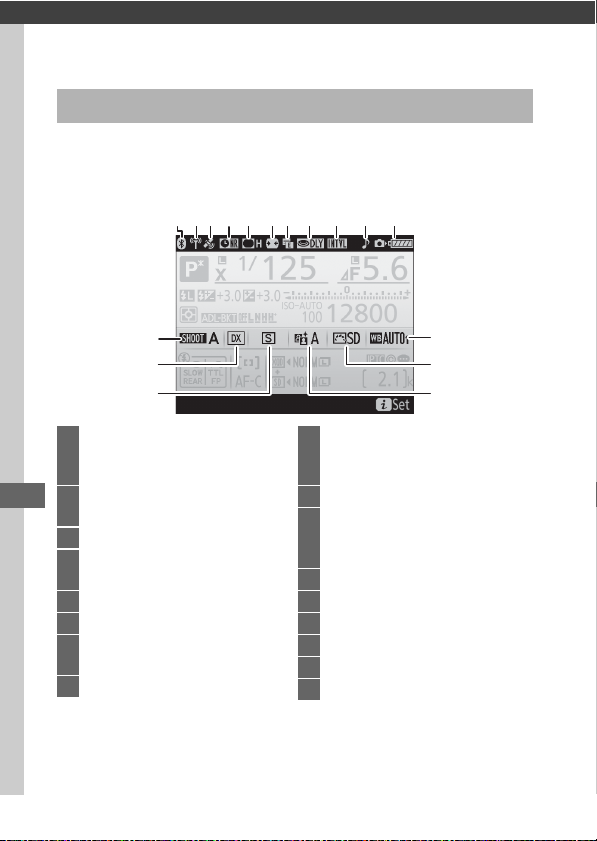
226
Other Shooting Options
Pressing the R button during viewfinder photography displays
shooting information in the monitor including shutter speed,
aperture, number of exposures remaining, and AF-area mode.
The R Button
12345 67 8 9 1011
17
16
14
13
15
12
1 Bluetooth connection indicator
....................................................... 308
Airplane mode ............................ 307
2 Wi-Fi connection indicator....... 308
Eye-Fi connection indicator..... 308
3 Satellite signal indicator ...........253
4 Long exposure noise reduction
indicator ...................................... 286
5 Vignette control indicator ........286
6 Auto distortion control ............. 286
7
Electronic front-curtain shutter
....................................................... 298
8 Exposure delay mode................ 297
9 Interval timer indicator............. 246
Time-lapse indicator.....................74
& indicator ..............................5, 304
10 “Beep” indicator.......................... 306
11 Camera battery indicator ............35
MB-D17 battery type display .. 309
MB-D17 battery indicator
12 White balance ............................. 159
13 Picture Control indicator .......... 181
14 Active D-Lighting indicator ..... 190
15 Photo shooting menu bank..... 283
16 Image area indicator ....................88
17 Release mode.............................. 116
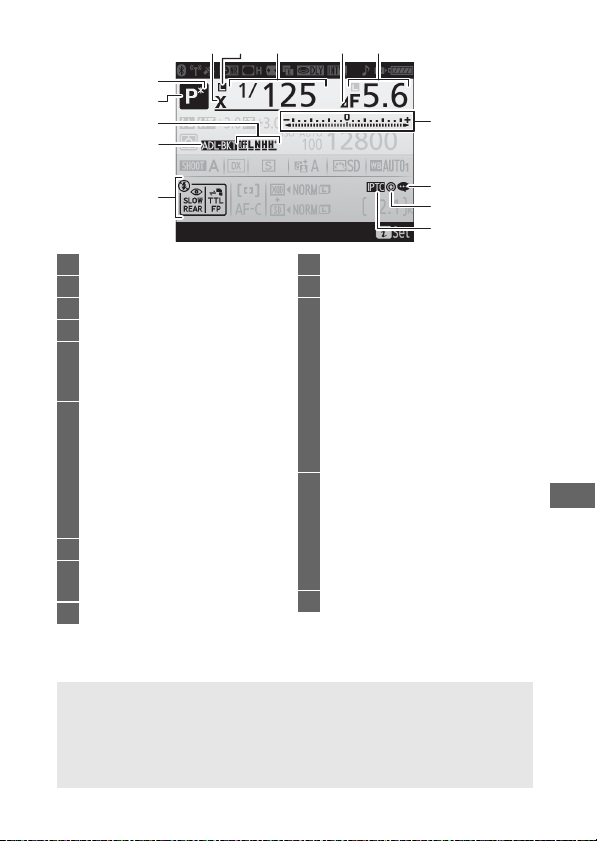
227
29
30
31
23
24
25
26
2120 221918
27
28
18 Flash sync indicator.................... 299
19 Shutter-speed lock icon............ 140
20 Shutter speed ..................... 133, 135
21 Aperture stop indicator....134, 325
22 Aperture (f-number)......... 134, 135
Aperture
(number of stops)............. 134, 325
23 Exposure indicator ..................... 136
Exposure compensation
display.......................................... 143
Bracketing progress indicator:
Exposure and flash
bracketing........................... 147
WB bracketing....................... 151
24 Image comment indicator ....... 306
25 Copyright information
indicator ...................................... 306
26 IPTC indicator .............................. 306
27 Flexible program indicator....... 132
28 Exposure mode........................... 130
29 Position of current frame in
bracketing sequence ...... 149, 153
ADL bracketing amount .......... 156
HDR exposure differential........ 195
HDR (series) indicator................ 192
Number of exposures
(multiple exposure).................. 238
Multiple exposure (series)
indicator ...................................... 237
30 Exposure and flash
bracketing indicator................. 147
WB bracketing indicator........... 151
ADL bracketing indicator ......... 155
HDR indicator .............................. 192
Multiple exposure indicator .... 237
31 Flash mode .................................. 201
A Turning the Monitor Off
To clear shooting or flash information from the monitor, press the
R
button or press the shutter-release button halfway.
The monitor will
turn off automatically if no operations are performed for about
10 seconds.
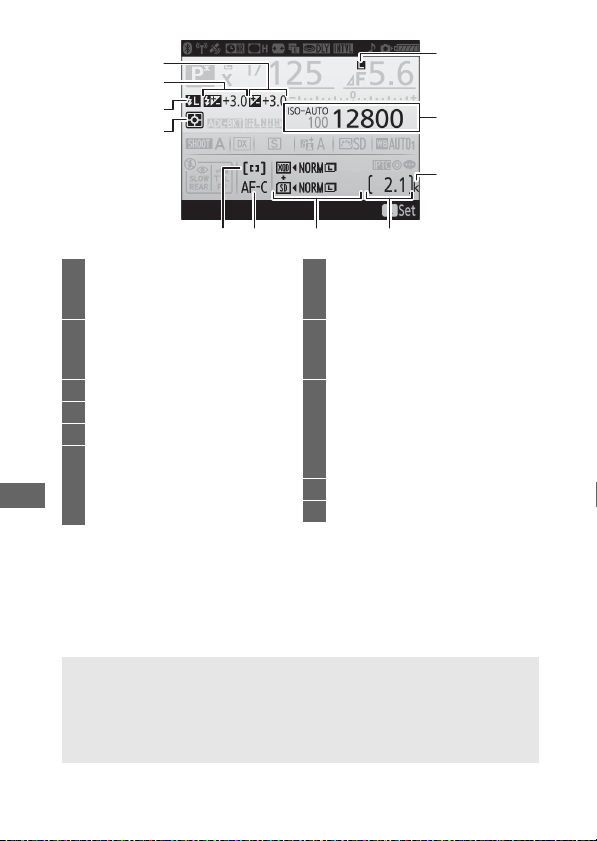
228
Note: Display shown with all indicators lit for illustrative purposes.
32
33
35
34
42 41 3940
38
36
37
32 Exposure compensation
indicator.......................................143
Exposure compensation value
...143
33 Flash compensation indicator
.......................................................203
Flash compensation value........203
34 FV lock indicator..........................206
35 Metering .......................................128
36 Aperture lock icon ......................140
37 ISO sensitivity ..............................123
ISO sensitivity indicator.............123
Auto ISO sensitivity indicator
.......................................................127
38 “k” (appears when memory
remains for over 1000
exposures)..................................... 36
39 Number of exposures
remaining ............................ 36, 389
Manual lens number.................. 252
40 Image quality ................................ 91
Secondary slot function.............. 96
Image size....................................... 94
XQD card icon..........................15, 96
SD card icon .............................15, 96
41 Autofocus mode ......................... 101
42 AF-area mode ..................... 103, 106
A See Also
For information on choosing how long the monitor stays on, see
Custom Setting c4 (Monitor off delay, 0 296).
The color of the
lettering in the information display can be changed using the
Information display option in the setup menu (0 305).
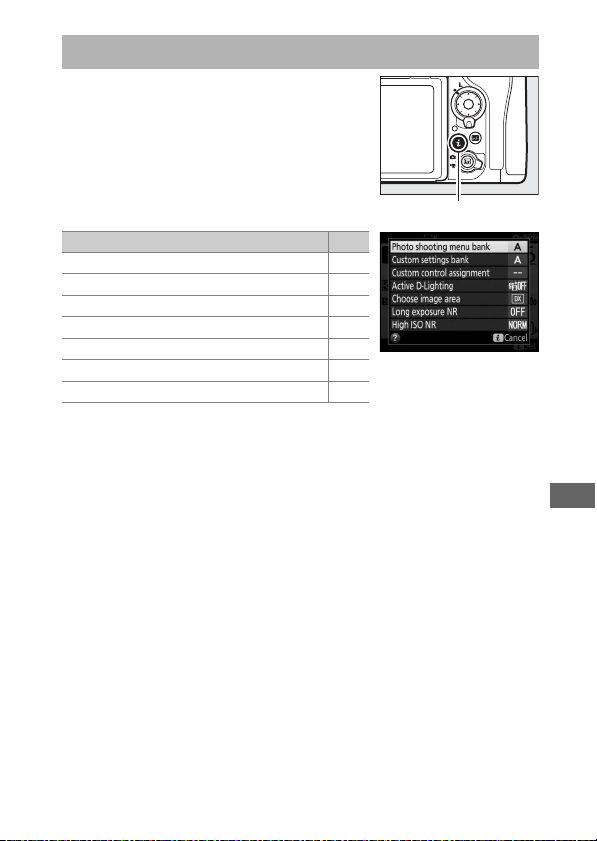
229
To access the options below, press the
i button during viewfinder
photography.
Highlight items using the
multi selector and press J to view
options for the highlighted item.
To
return to shooting mode, press the
shutter-release button halfway.
The i button
Option
0
Photo shooting menu bank 283
Custom settings bank 292
Custom control assignment 301
Active D-Lighting 190
Choose image area 89
Long exposure NR 286
High ISO NR 286
i button
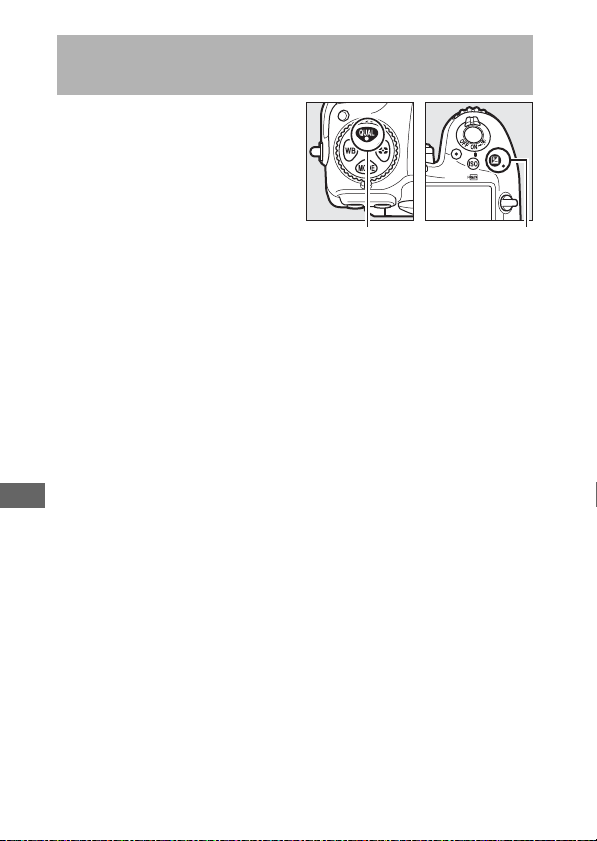
230
The camera settings listed
below can be restored to
default values by holding the
T and E buttons down
together for more than two
seconds (these buttons are
marked by a green dot).
The
control panel turns off briefly
while settings are reset.
Two-Button Reset: Restoring Default
Settings
T button E button
231
❚❚ Settings Accessible from the Photo Shooting Menu
1
1
With the exception of multiple exposure and interval timer settings, only settings in the bank
currently selected using the
Photo shooting menu bank
option will be reset (
0
283
).
Settings in the remaining banks are unaffected.
2 Current Picture Control only.
3 If multiple exposure is currently in progress, shooting will end and multiple exposure will be
created from exposures recorded to that point.
Overlay mode and number of shots are not
reset.
4 Exposure differential and smoothing are not reset.
5 If interval timer shooting is currently in progress, shooting will end.
Starting time, shooting
interval, number of intervals and shots, and exposure smoothing are not reset.
Option Default
Extended photo menu banks Off
Image quality JPEG normal
Image size
JPEG/TIFF Large
NEF (RAW) Large
ISO sensitivity settings
ISO sensitivity 100
Auto ISO sensitivity control Off
White balance Auto > Keep white (reduce warm colors)
Fine-tuning A-B: 0, G-M: 0
Picture Control settings
2
Unmodified
Multiple exposure Off
3
HDR (high dynamic range) Off
4
Interval timer shooting Off
5
Flicker reduction
Flicker reduction setting Disable
Flicker reduction indicator On
232
❚❚ Settings Accessible from the Movie Shooting Menu
❚❚ Other Settings
Option Default
ISO sensitivity settings
ISO sensitivity (mode M) 100
Auto ISO control (mode M) Off
Maximum sensitivity 51200
White balance Same as photo settings
Active D-Lighting Off
Electronic VR Off
Option Default
Focus point
1
Center
Preset focus point Center
Exposure mode Programmed auto
Flexible program Off
Exposure compensation Off
AE lock hold Off
Shutter speed lock Off
Aperture lock Off
Autofocus mode AF-S
AF-area mode
Viewfinder Single-point AF
Live view Normal-area AF
Photo live view display WB None
Multi-selector power aperture Disable
Highlight display Off
233
1 Focus point not displayed if auto-area AF is selected for AF-area mode.
2 Number of shots is reset to zero.
Bracketing increment is reset to 1EV (exposure/flash
bracketing) or 1 (white balance bracketing).
Y Auto is selected for the second shot of
two-shot ADL bracketing programs.
3 Only settings in the bank currently selected using the Custom settings bank option
will be reset (
0
292).
Settings in the remaining banks are unaffected.
Headphone volume 15
Metering Matrix metering
Bracketing Off
2
Flash mode Front-curtain sync
Flash compensation Off
FV lock Off
Exposure delay mode Off
3
Option Default
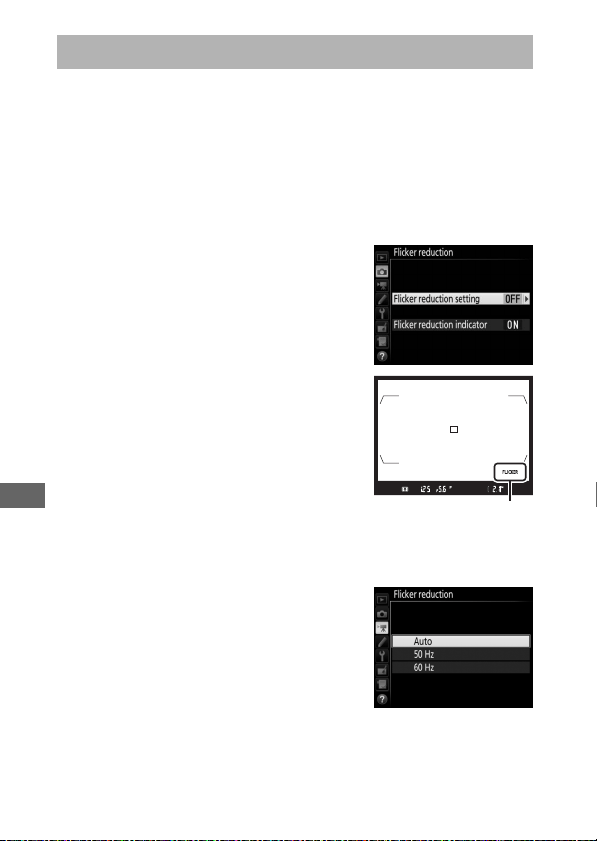
234
The camera offers two Flicker reduction options for reducing
the effects of flicker due to fluorescent or mercury-vapor
lighting.
The first is located in the photo shooting menu and is
used to reduce flicker in photos taken during viewfinder
photography, while the second is in the movie shooting menu
and is used to reduce flicker in live view and movie mode.
❚❚ Viewfinder Photography
Choose from the following options:
• Flicker reduction setting: When Enable is
selected, the camera will time
photographs to reduce the effects of
flicker.
• Flicker reduction indicator: When On is
selected, a FLICKER icon will be displayed
in the viewfinder if flicker is detected
when the shutter-release button is
pressed halfway.
If flicker is detected
when Disable is selected for Flicker
reduction setting, the icon will flash; to
enable flicker reduction, select Enable
for Flicker reduction setting.
❚❚ Live View and Movie Mode
The Flicker reduction option in the
movie shooting menu can be used to
reduce flicker and banding during live
view and movie recording (0 290).
Flicker Reduction
FLICKER icon

235
A Flicker Reduction in the Photo Shooting Menu
Take a test shot and view the results before taking additional
photographs.
Flicker reduction can detect flicker at 100 and 120 Hz
(associated respectively with AC power supplies of 50 and 60 Hz).
Flicker may not be detected or the desired results may not be achieved
with dark backgrounds, bright light sources, or decorative lighting
displays and other non-standard lighting.
Depending on the light
source, there may be a slight delay before the shutter is released.
During burst shooting, the frame rate may slow or become erratic; in
addition, the desired results may not be achieved if the frequency of
the power supply changes during shooting.
Flicker detection will not take effect at shutter speeds slower than
1
/
100 s (including Bulb and Time) or when MUP is selected for release
mode or exposure delay mode is on.
Flicker detection is available
during flash photography but can not be used with remote wireless
flash units.
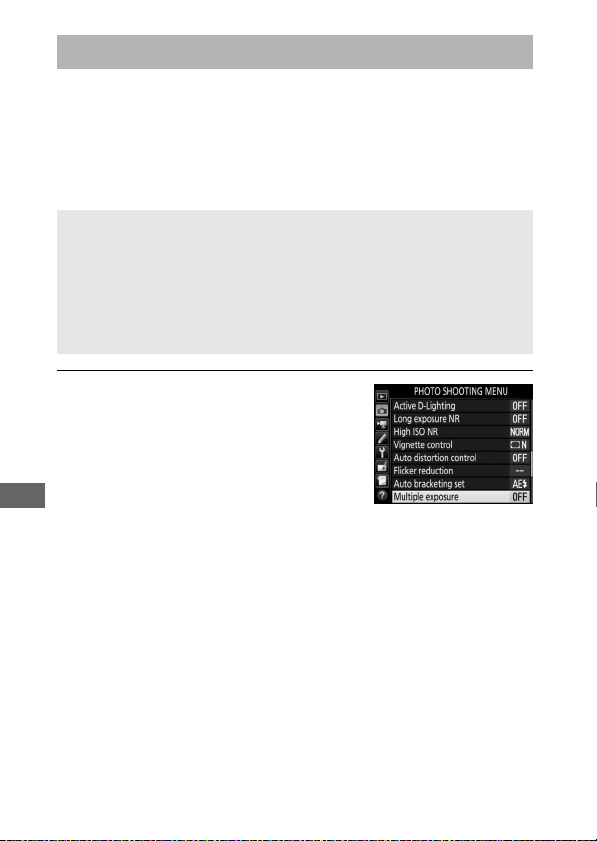
236
Follow the steps below to record a series of two to ten exposures
in a single photograph.
❚❚ Creating a Multiple Exposure
Multiple exposures can not be recorded in live view.
Exit live
view before proceeding.
1 Select Multiple exposure.
Highlight Multiple exposure in the
photo shooting menu and press 2.
Multiple Exposure
A Extended Recording Times
If the monitor turns off during playback or menu operations and no
operations are performed for about 30 s, shooting will end and a
multiple exposure will be created from the exposures that have been
recorded to that point.
The time available to record the next exposure
can be extended by choosing longer times for Custom Setting c2
(Standby timer, 0 296).
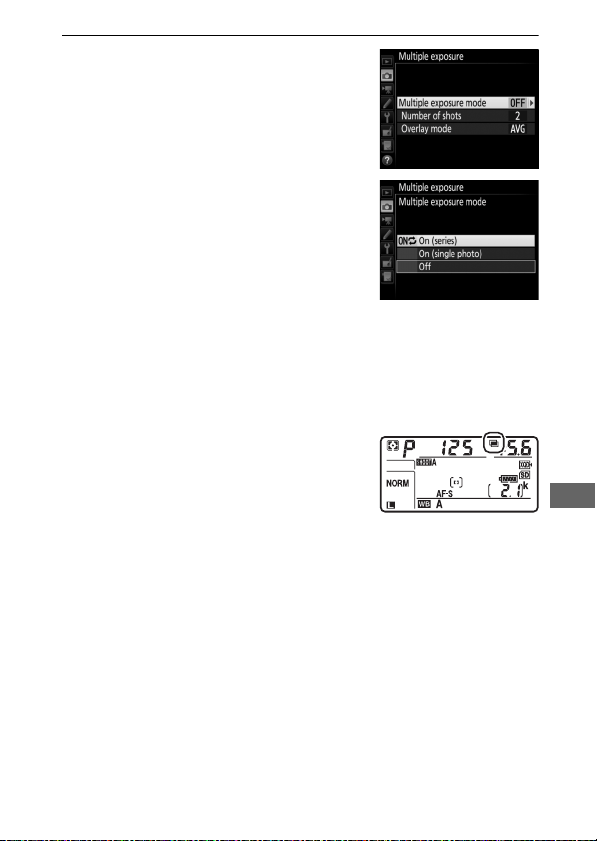
237
2 Select a mode.
Highlight Multiple exposure mode
and press 2.
Highlight one of the following and
press J:
• To take a series of multiple exposures,
select 0 On (series).
Multiple
exposure shooting will continue
until you select Off for Multiple
exposure mode.
• To take one multiple exposure, select On (single photo).
Normal
shooting will resume automatically after you have created a
single multiple exposure.
• To exit without creating additional multiple exposures, select Off.
If On (series) or On (single photo) is
selected, a n icon will be displayed in
the control panel.
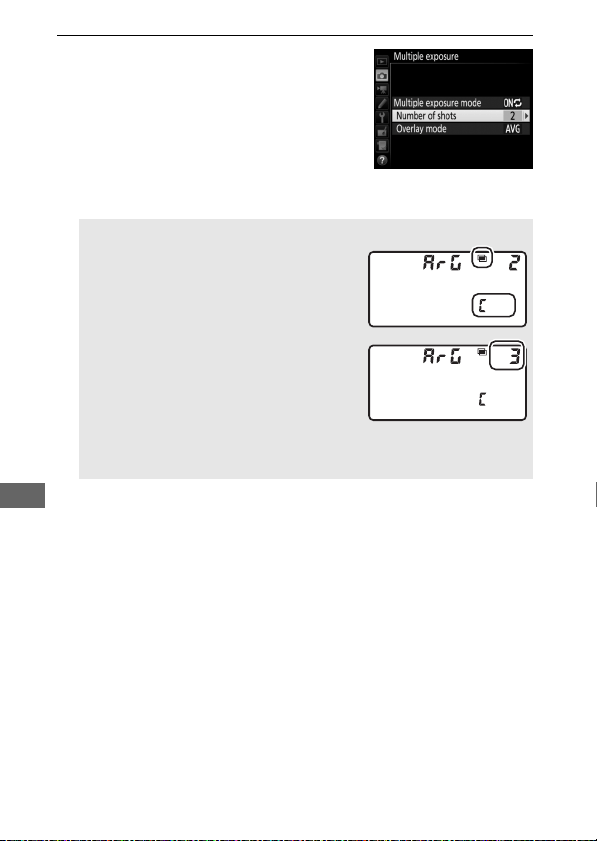
238
3 Choose the number of shots.
Highlight Number of shots and
press 2.
Press 1 or 3 to choose the number of
exposures that will be combined to
form a single photograph and
press J.
A The BKT Button
If Multiple exposure is selected for
Custom Setting f1 (Custom control
assignment) > BKT button + y (0 301),
you can select the multiple exposure
mode by pressing the BKT button and
rotating the main command dial and the
number of shots by pressing the BKT
button and rotating the sub-command
dial.
The mode and number of shots are
shown in the control panel: the icons
representing the mode are a for Off, B for On (single photo), and
b for On (series).
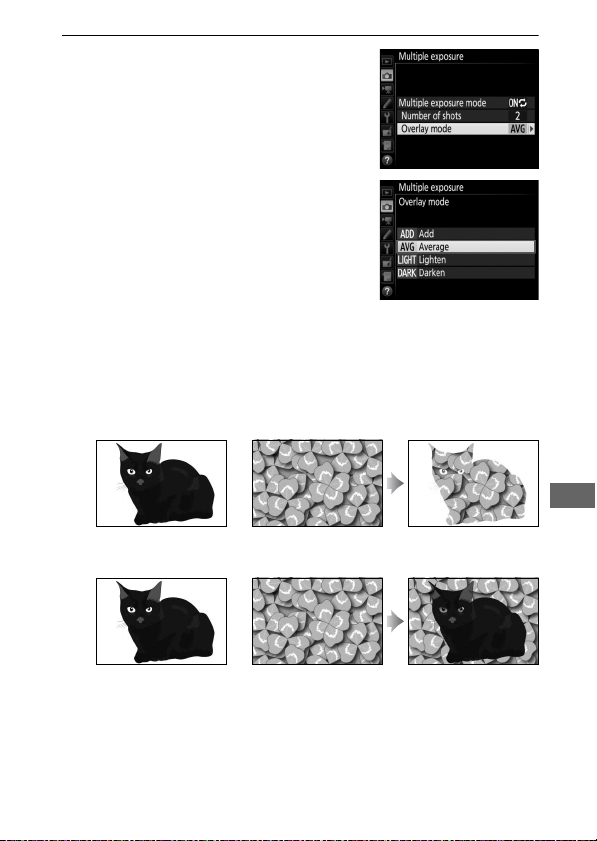
239
4 Choose the overlay mode.
Highlight Overlay mode and press 2.
The following options will be
displayed.
Highlight an option and
press J.
• Add: The exposures are overlaid
without modification; gain is not
adjusted.
• Average: Before the exposures are
overlaid, the gain for each is divided by the total number of
exposures taken (gain for each exposure is set to
1
/
2 for
2exposures,
1
/
3 for 3 exposures, etc).
• Lighten: The camera compares the pixels in each exposure
and uses only the brightest.
• Darken: The camera compares the pixels in each exposure
and uses only the darkest.
+
+
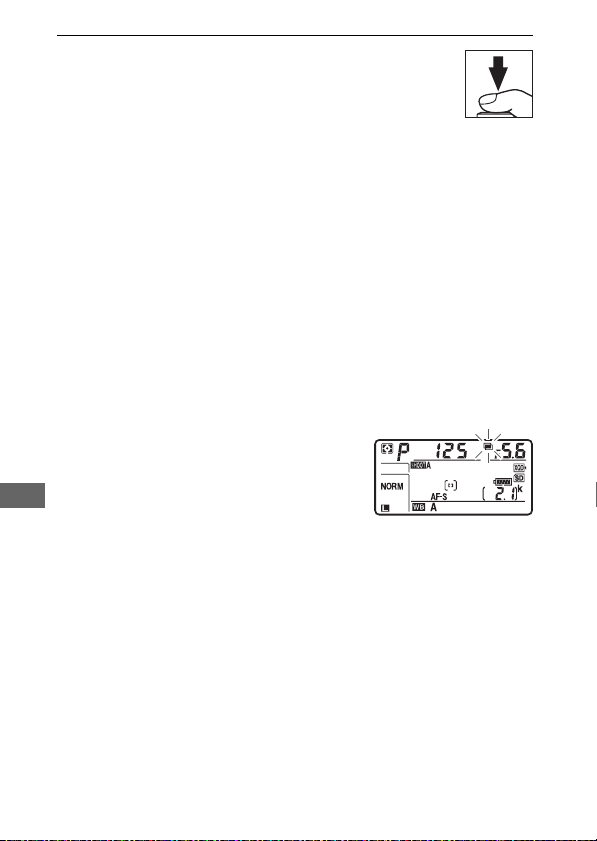
240
5 Frame a photograph, focus, and shoot.
In continuous release modes (0 116), the camera
records all exposures in a single burst.
If On
(series) is selected, the camera will continue to
record multiple exposures while the shutter-release button is
pressed; if On (single photo) is selected, multiple exposure
shooting will end after the first photograph.
In self-timer
mode, the camera will automatically record the number of
exposures selected in Step 3 on page 238, regardless of the
option selected for Custom Setting c3 (Self-timer) > Number
of shots (0 296); the interval between shots is however
controlled by Custom Setting c3 (Self-timer) > Interval
between shots.
In other release modes, one photograph will
be taken each time the shutter-release button is pressed;
continue shooting until all exposures have been recorded (for
information on interrupting a multiple exposure before all
photographs are recorded, see page 241).
The n icon will flash until shooting
ends.
If On (series) is selected,
multiple exposure shooting will only
end when Off is selected for multiple
exposure mode; if On (single photo)
is selected, multiple exposure shooting ends automatically
when the multiple exposure is complete.
The n icon clears
from the display when multiple exposure shooting ends.
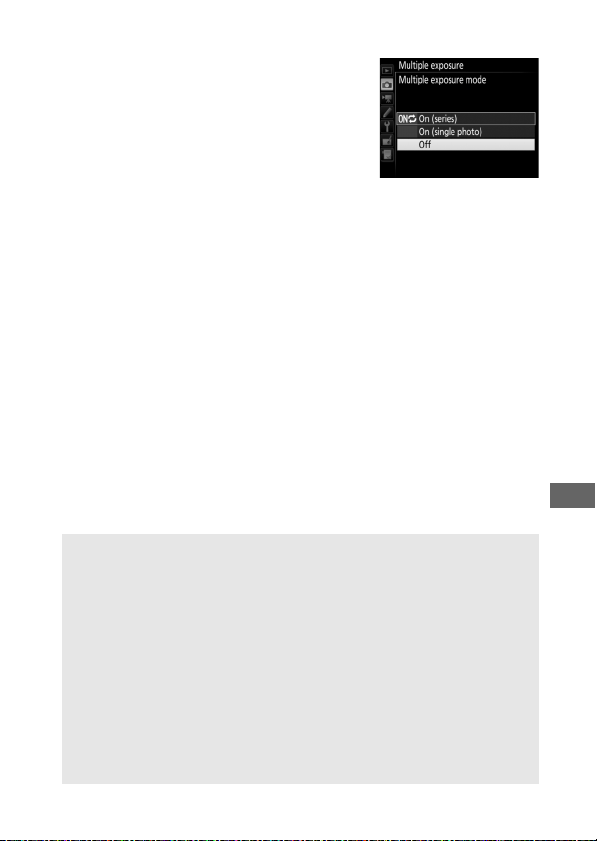
241
❚❚ Ending Multiple Exposures
To end a multiple exposure before the
specified number of exposures have
been taken, select Off for multiple
exposure mode.
If shooting ends before
the specified number of exposures have
been taken, a multiple exposure will be
created from the exposures that have
been recorded to that point.
If Average is selected for Overlay
mode, gain will be adjusted to reflect the number of exposures
actually recorded.
Note that shooting will end automatically if:
• A two-button reset is performed (0 230)
• The camera is turned off
• The battery is exhausted
• Pictures are deleted
D Multiple Exposure
Multiple exposures may be affected by noise (randomly-spaced bright
pixels, fog, or lines).
Do not remove or replace the memory card while recording a multiple
exposure.
Live view is not available while shooting is in progress.
Selecting live
view resets Multiple exposure mode to Off.
The shooting information listed in the playback photo information
display (including metering, exposure, exposure mode, focal length,
date of recording and camera orientation) is for the first shot in the
multiple exposure.
242
A Interval Timer Photography
If interval timer photography is activated before the first exposure is
taken, the camera will record exposures at the selected interval until
the number of exposures specified in the multiple exposure menu
have been taken (the number of shots listed in the interval timer
shooting menu is ignored).
These exposures will then be recorded as a
single photograph and interval timer shooting will end (if On (single
photo) is selected for multiple exposure mode, multiple exposure
shooting will also end automatically).
A Other Settings
While a multiple exposure is being shot, memory cards can not be
formatted and some menu items are grayed out and can not be
changed.
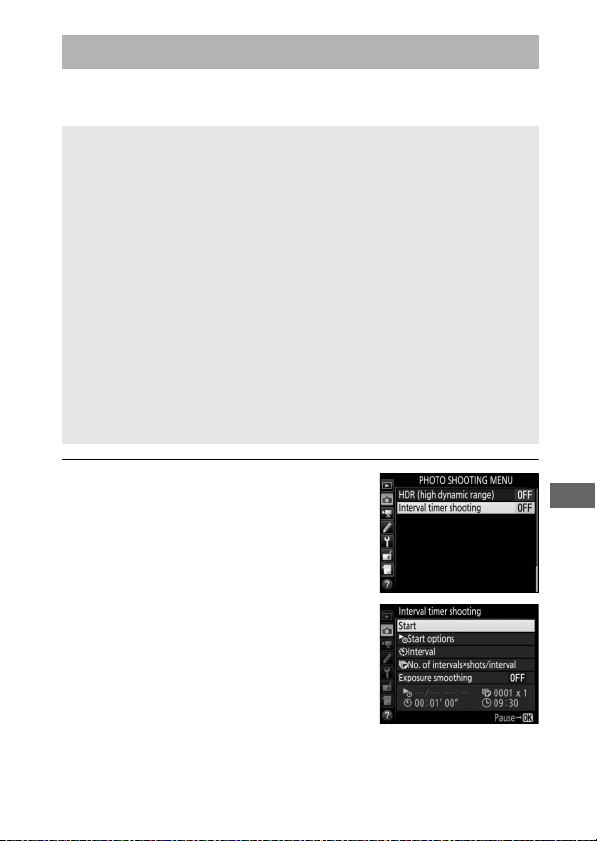
243
The camera is equipped to take photographs automatically at
preset intervals.
1 Select Interval timer shooting.
Highlight Interval timer shooting in
the photo shooting menu and press
2 to display interval timer settings.
Interval Timer Photography
D Before Shooting
Select a release mode other than self-timer (E) when using the interval
timer.
Before beginning interval timer photography, take a test shot at
current settings and view the results in the monitor.
Once settings
have been adjusted to your satisfaction, close the viewfinder eyepiece
shutter to prevent light entering via the viewfinder interfering with
photographs and exposure (0 119).
Before choosing a starting time, select Time zone and date in the
setup menu and make sure that the camera clock is set to the correct
time and date (0 304).
Use of a tripod is recommended.
Mount the camera on a tripod before
shooting begins.
To ensure that shooting is not interrupted, be sure
the camera battery is fully charged.
If in doubt, charge the battery
before use or use an AC adapter and power connector (available
separately).
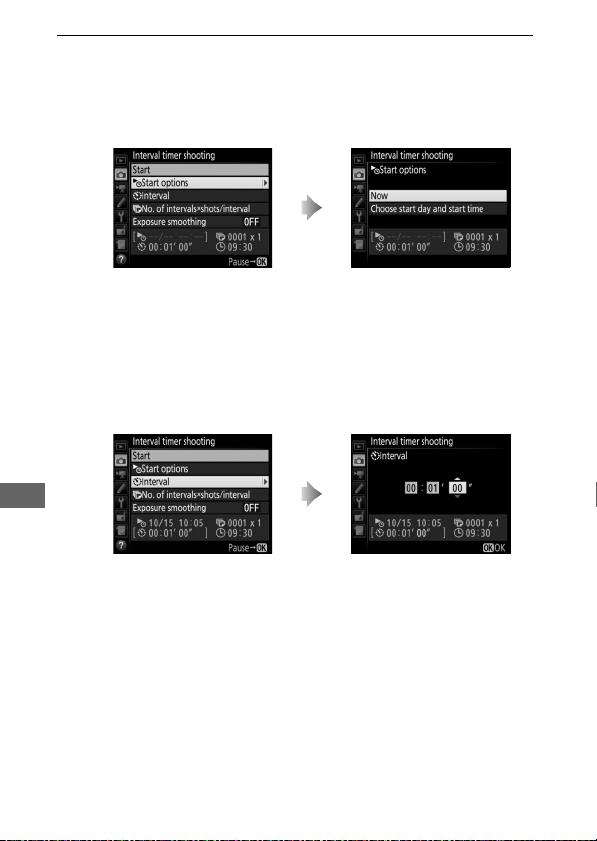
244
2 Adjust interval timer settings.
Choose a start option, interval, number of shots per interval,
and exposure smoothing option.
• To choose a start option:
To start shooting immediately, select Now.
To start
shooting at a chosen date and time, select Choose start
day and start time, then choose the date and time and
press J.
• To choose the interval between shots:
Highlight Start options and
press 2.
Highlight an option and
press J.
Highlight Interval and press 2. Choose an interval
(hours, minutes, and seconds)
and press J.
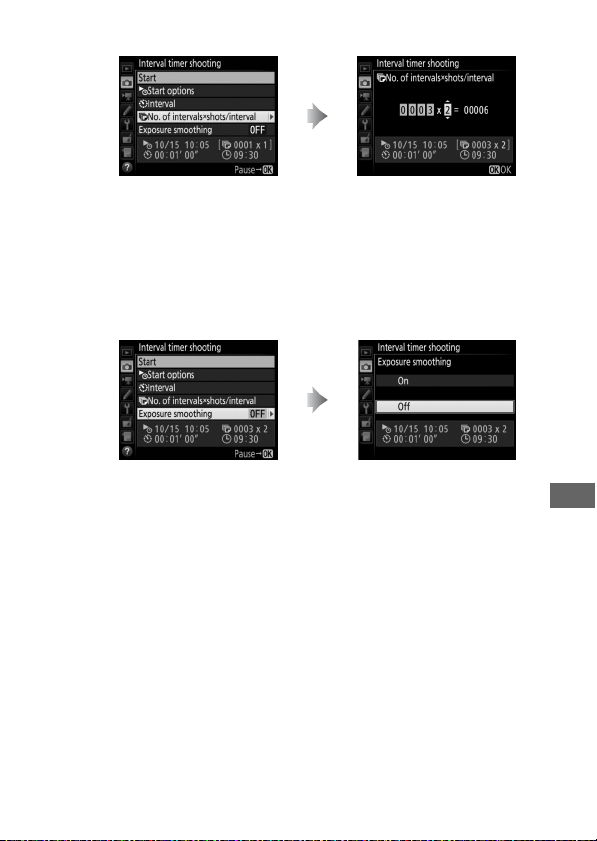
245
• To choose the number of shots per interval:
In S (single frame) mode, the photographs for each interval
will be taken at the rate chosen for Custom Setting d1 (CL
mode shooting speed; 0 297).
• To enable or disable exposure smoothing:
Selecting On allows the camera to adjust exposure to match
previous shot in modes other than M (note that exposure
smoothing only takes effect in mode M if auto ISO sensitivity
control is on).
Highlight No. of intervals ×
shots/interval and press 2.
Choose the number of intervals
and the number of shots per
interval and press J.
Highlight Exposure smoothing
and press 2.
Highlight an option and
press J.
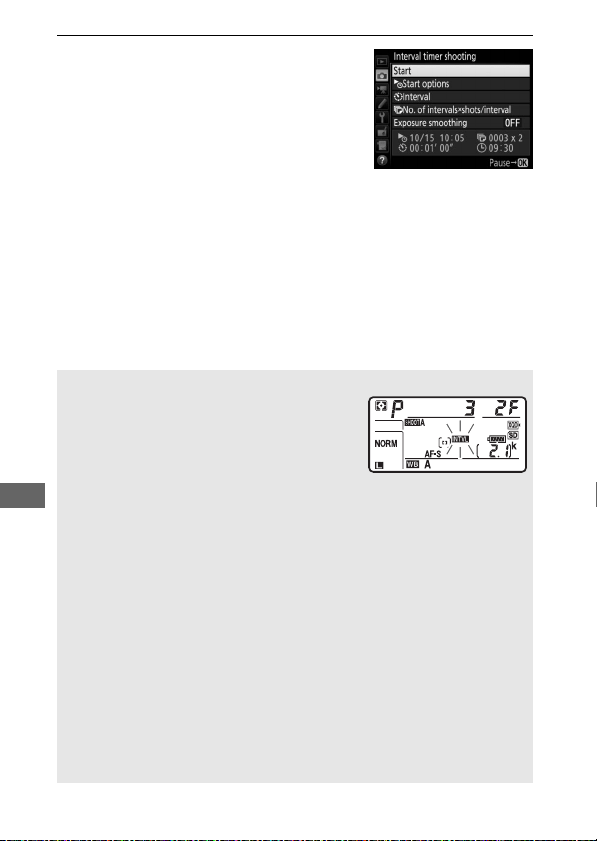
246
3 Start shooting.
Highlight Start and press J.
The first
series of shots will be taken at the
specified starting time, or after about
3s if Now was selected for Start
options in Step 2.
Shooting will
continue at the selected interval until
all shots have been taken.
A During Shooting
During interval timer photography, the Q
icon will flash in the control panel.
Immediately before the next shooting
interval begins, the shutter speed display
will show the number of intervals remaining,
and the aperture display will show the number of shots remaining in
the current interval.
At other times, the number of intervals remaining
and the number of shots in each interval can be viewed by pressing
the shutter-release button halfway (once the button is released, the
shutter speed and aperture will be displayed until the standby timer
expires).
Settings can be adjusted, the menus used, and pictures played back
while interval timer photography is in progress.
The monitor will turn
off automatically about four seconds before each interval.
Note that
changing camera settings while the interval timer is active may cause
shooting to end.
A Release Mode
Regardless of the release mode selected, the camera will take the
specified number of shots at each interval.
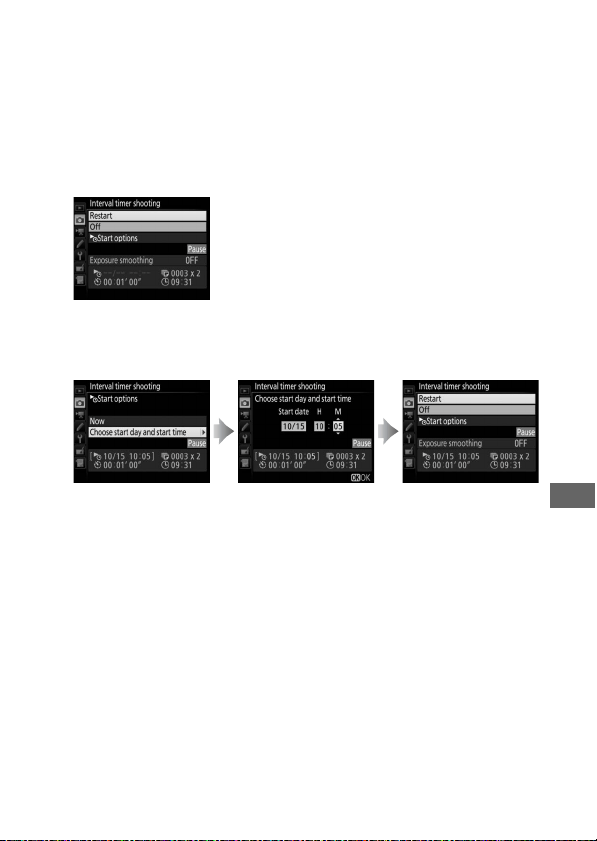
247
❚❚ Pausing Interval Timer Photography
Interval timer photography can be paused between intervals by
pressing J or selecting Pause in the interval timer menu.
❚❚ Resuming Interval Timer Shooting
To resume shooting:
• Starting Now
• Starting at a Specified Time
❚❚ Ending Interval Timer Shooting
To end interval timer photography before all the photos are
taken, select Off in the interval timer menu.
Highlight Restart
and press J.
For Start options,
highlight Choose
start day and start
time and press 2.
Choose a starting
date and time and
press J.
Highlight Restart
and press J.
248
❚❚ No Photograph
The camera will skip the current interval if any of the following
situations persist for eight seconds or more after the interval was
due to start: the photograph or photographs for the previous
interval have yet to be taken, the memory card is full, or the
camera is unable to focus in AF-S (note that the camera focuses
again before each shot).
Shooting will resume with the next
interval.
D Out of Memory
If the memory card is full, the interval timer will remain active but no
pictures will be taken.
Resume shooting (0 247) after deleting some
pictures or turning the camera off and inserting another memory card.
A Photo Shooting Menu Banks
Changes to interval timer settings apply to all photo shooting menu
banks (0 283), meaning that interval timer shooting will continue
even if you switch menu banks.
If photo shooting menu settings are
reset using the Photo shooting menu bank item in the photo
shooting menu, interval timer shooting will end and interval timer
settings will be reset as follows:
• Start options: Now
• Interval: 00:01':00"
• Number of intervals: 1
• Number of shots: 1
• Exposure smoothing: Off
A Bracketing
Adjust bracketing settings before starting interval timer photography.
If exposure, flash, or ADL bracketing is active while interval timer
photography is in effect, the camera will take the number of shots in
the bracketing program at each interval, regardless of the number of
shots specified in the interval timer menu.
If white balance bracketing
is active while interval timer photography is in effect, the camera will
take one shot at each interval and process it to create the number of
copies specified in the bracketing program.

249
A Interval Timer Photography
Choose an interval longer than the time needed to take the selected
number of shots and, if you are using a flash, the time needed for the
flash to charge.
If the interval is too short, the number of photos taken
may be less than the total listed in Step 2 (the number of intervals
multiplied by the number of shots per interval) or the flash may fire at
less than the power needed for full exposure.
Flash output may also
fall below the desired level if more than one shot is taken per interval.
Interval timer photography can not be combined with long time-
exposures (bulb or time photography, 0 137) or time-lapse movies
(0 74) and is not available in live view (0 43, 58) or when Record
movies is selected for Custom Setting g1 (Custom control
assignment) > Shutter-release button (0 303).
Note that because
the shutter speed, frame rate, and time needed to record images may
vary from one interval to the next, the time between the end of one
interval and the beginning of the next may vary.
If shooting can not
proceed at current settings (for example, if a shutter speed of A or
% is currently selected in manual exposure mode, the interval is zero,
or the start time is in less than a minute), a warning will be displayed in
the monitor.
Interval timer shooting will pause when E (self-timer) is selected or if
the camera is turned off and then on again (when the camera is off,
batteries and memory cards can be replaced without ending interval
timer photography).
Pausing shooting does not affect interval timer
settings.
250
Non-CPU lenses can be used in exposure modes A and M, with
aperture set using the lens aperture ring.
By specifying lens data
(lens focal length and maximum aperture), the user can gain
access to the following CPU lens functions.
If the focal length of the lens is known:
• Power zoom can be used with optional flash units
• Lens focal length is listed (with an asterisk) in the playback
photo info display
If the maximum aperture of the lens is known:
• The aperture value is displayed in the control panel and
viewfinder
• Flash level is adjusted for changes in aperture if the flash unit
supports qA (auto aperture) mode
• Aperture is listed (with an asterisk) in the playback photo info
display
Specifying both the focal length and maximum aperture of the lens:
• Enables color matrix metering (note that it may be necessary to
use center-weighted or spot metering to achieve accurate
results with some lenses, including Reflex-NIKKOR lenses)
• Improves the precision of center-weighted and spot metering
and i-TTL balanced fill-flash for digital SLR
Non-CPU Lenses
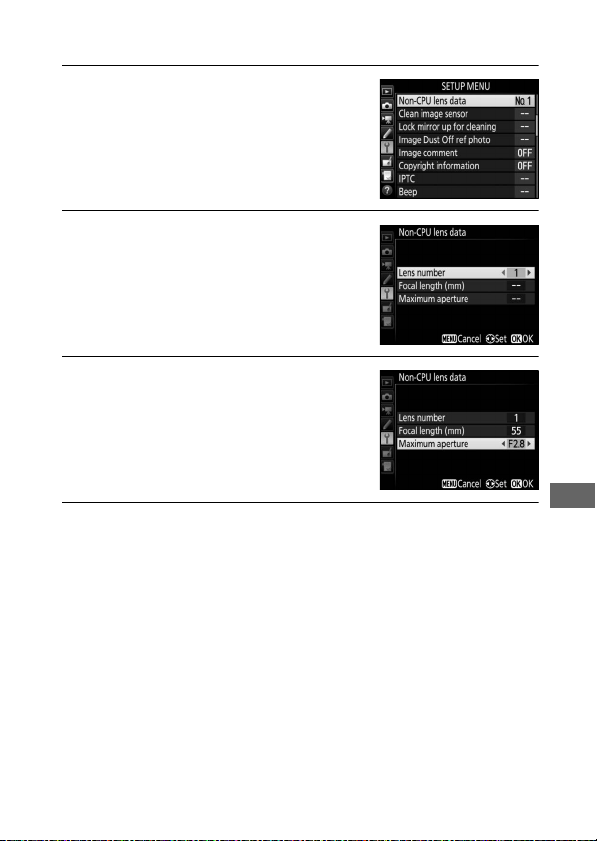
251
To enter or edit data for a non-CPU lens:
1 Select Non-CPU lens data.
Highlight Non-CPU lens data in the
setup menu and press 2.
2 Select a lens number.
Highlight Lens number and press 4
or 2 to choose a lens number.
3 Enter the focal length and aperture.
Highlight Focal length (mm) or
Maximum aperture and press 4 or
2 to edit the highlighted item.
4 Save settings and exit.
Press J.
The specified focal length and aperture will be
stored under the chosen lens number.
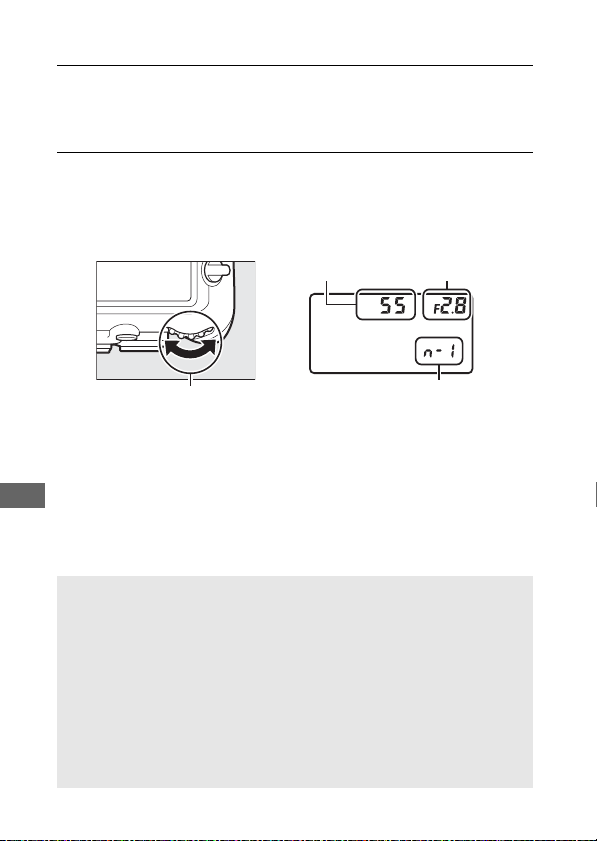
252
To recall lens data when using a non-CPU lens:
1 Assign non-CPU lens number selection to a camera control.
Assign Choose non-CPU lens number to a control using
Custom Setting f1 (Custom control assignment, 0 301).
2 Use the selected control to choose a lens number.
Press the selected control and rotate the main or sub-
command dial until the desired lens number is displayed in
the control panel.
A Focal Length Not Listed
If the correct focal length is not listed, choose the closest value greater
than the actual focal length of the lens.
A Teleconverters and Zoom Lenses
The maximum aperture for teleconverters is the combined maximum
aperture of the teleconverter and the lens.
Note that lens data are not
adjusted when non-CPU lenses are zoomed in or out.
The data for
different focal lengths can be entered as separate lens numbers, or the
data for the lens can be edited to reflect the new values for lens focal
length and maximum aperture each time zoom is adjusted.
Main command dial
Focal length Maximum aperture
Lens number
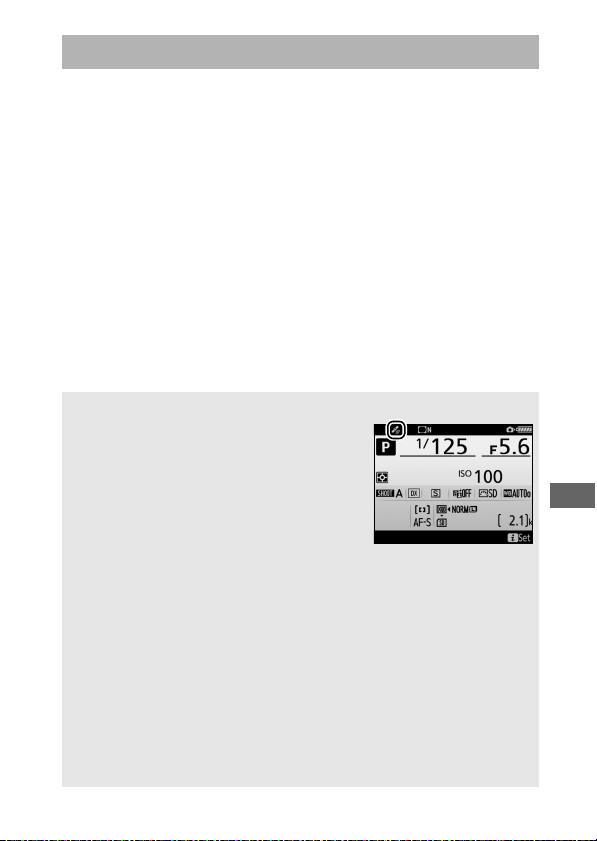
253
A GPS unit can be connected to the ten-pin remote terminal,
allowing the current latitude, longitude, altitude, Coordinated
Universal Time (UTC), and heading to be recorded with each
photograph taken.
The camera can be used with optional GP-1
and GP-1A GPS units (see below; note that these units do not
provide the compass heading), or with compatible third-party
units connected via an optional MC-35 GPS adapter cord
(0 336).
❚❚ GP-1/GP-1A GPS Units
These optional GPS units are designed for use with Nikon digital
cameras.
For information on connecting the unit, see the
manual provided with the device.
Location Data
A The o Icon
Connection status is shown by the o icon in
the information display:
• o (static): Location data acquired.
• o (flashing): The GPS device is searching for
a signal.
Pictures taken while the icon is
flashing do not include location data.
• No icon: No new location data have been
received from the GPS device for at least
two seconds.
Pictures taken when the o icon is not displayed do not
include location data.
A Smart Devices
To download location data from a smart device and embed it in
subsequent photographs, establish a wireless connection and select
Ye s for Location data > Download from smart device in the setup
menu (0 307).
A Coordinated Universal Time (UTC)
UTC data is provided by the GPS device and is independent of the
camera clock.
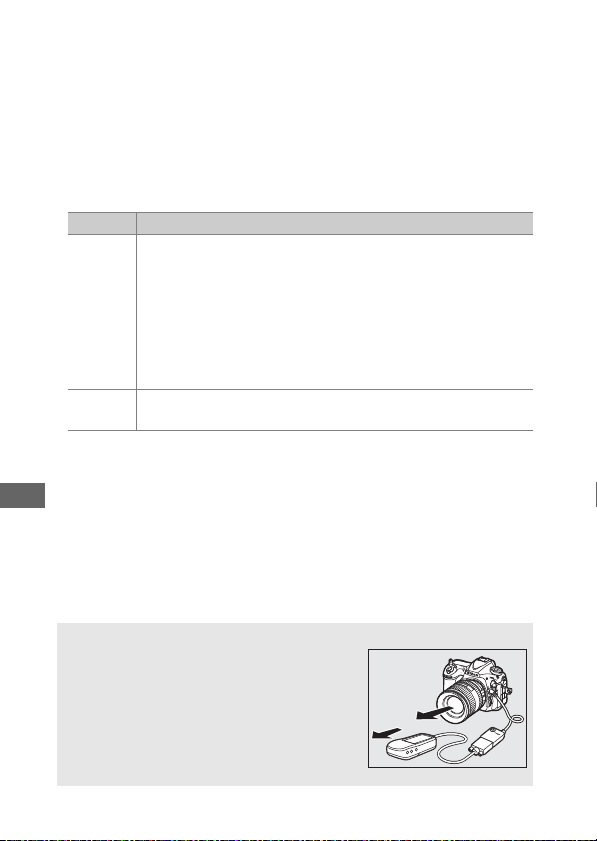
254
❚❚ Setup Menu Options
The Location data item in the setup menu contains the options
listed below.
• Position: The current latitude, longitude, altitude, Coordinated
Universal Time (UTC), and heading (if supported) as reported
by the source device.
• External GPS device options > Standby timer: Choose whether or not
the standby timer is enabled when a GPS unit is attached.
• External GPS device options > Set clock from satellite: Select Ye s to
synchronize the camera clock with the time reported by the
GPS device.
Option Description
Enable
Standby timer enabled.
The timer expires automatically if
no operations are performed for the period specified in
Custom Setting c2 (Standby timer, 0 296), reducing the
drain on the battery.
If a GP-1 or GP-1A unit is connected,
the unit will remain active for a set period after the timer
expires; to allow the camera time to acquire location data,
the delay is extended by up to one minute after exposure
meters are activated or the camera is turned on.
Disable
Standby timer disabled, ensuring uninterrupted recording
of location data.
A Heading
The heading is only recorded if the GPS
device is equipped with a digital compass
(note that the GP-1 and GP-1A are not
equipped with a compass).
Keep the GPS
device pointing in the same direction as the
lens and at least 20 cm (8 in.) from the
camera.
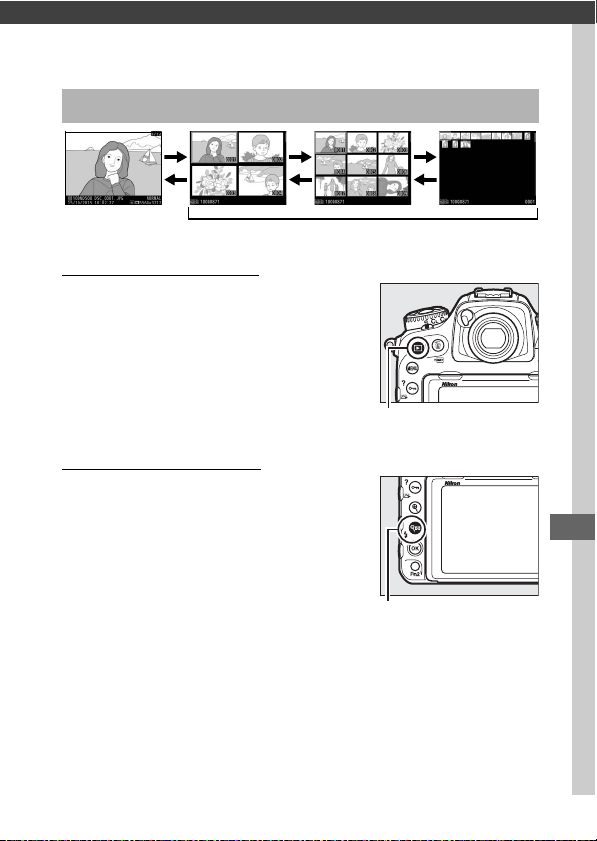
255
More About Playback
Full-Frame Playback
To play photographs back, press the K
button.
The most recent photograph will
be displayed in the monitor.
Additional
pictures can be displayed by flicking left
or right or pressing 4 or 2; to view
additional information on the current
photograph, press 1 or 3 (0 261).
Thumbnail Playback
To view multiple images, press the W (M)
button when a picture is displayed full
frame.
The number of images displayed
increases from 4 to 9 to 72 each time the
W (M) button is pressed, and decreases
with each press of the X button.
Slide a
finger over the touch screen to scroll up
or down or use the multi selector to
highlight images.
Viewing Images
W
X
W
X
W
X
Full-frame
playback
Thumbnail playback
K button
W (M) button
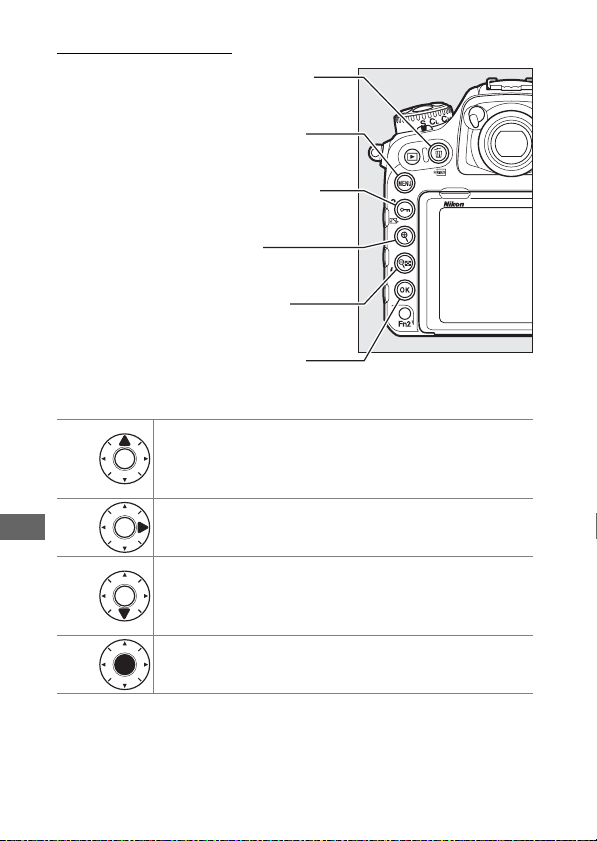
256
Playback Controls
J +
Display slot/folder selection dialog.
To choose card and
folder from which pictures are played back, highlight
slot and press 2 to display list of folders, then highlight
folder and press J.
J +
Create retouched copy of current photograph or create
edited copy of current movie (0 82
, 313).
J +
View the IPTC presets stored on the camera (0 306).
To
embed IPTC preset in current photo, highlight preset
and press J (any preset already embedded in current
photo will be replaced).
J +
Upload photographs over a wireless or Ethernet network
when a WT-7 is attached to the camera (0 335).
O (Q): Delete the current picture
(0 278)
G: View the menus (0 281)
L (Z/Q): Protect the current picture
(0 273)
X: Zoom in (0 271)
W (M): View multiple images
(0 255)
J: Use in combination with
the multi selector as
described below
257
A Two Memory Cards
If two memory cards are inserted, you can select a memory card for
playback by pressing the W (M) button when 72 thumbnails are
displayed.
A Rotate Tall
To display “tall” (portrait-orientation)
photographs in tall orientation, select On for
the Rotate tall option in the playback menu
(0 282).
A Image Review
When On is selected for Image review in the playback menu (0 282),
photographs are automatically displayed in the monitor after shooting
(because the camera is already in the correct orientation, images are
not rotated automatically during image review).
In continuous release
mode, display begins when shooting ends, with the first photograph in
the current series displayed.
A See Also
For information on choosing how long the monitor will remain on
when no operations are performed, see Custom Setting c4 (Monitor
off delay, 0 296).
For information on choosing the role played by the
center of the multi selector, see Custom Setting f2 (Multi selector
center button, 0 301).
For information on using the command dials
for image or menu navigation, see Custom Setting f4 (Customize
command dials) > Menus and playback (0 302).
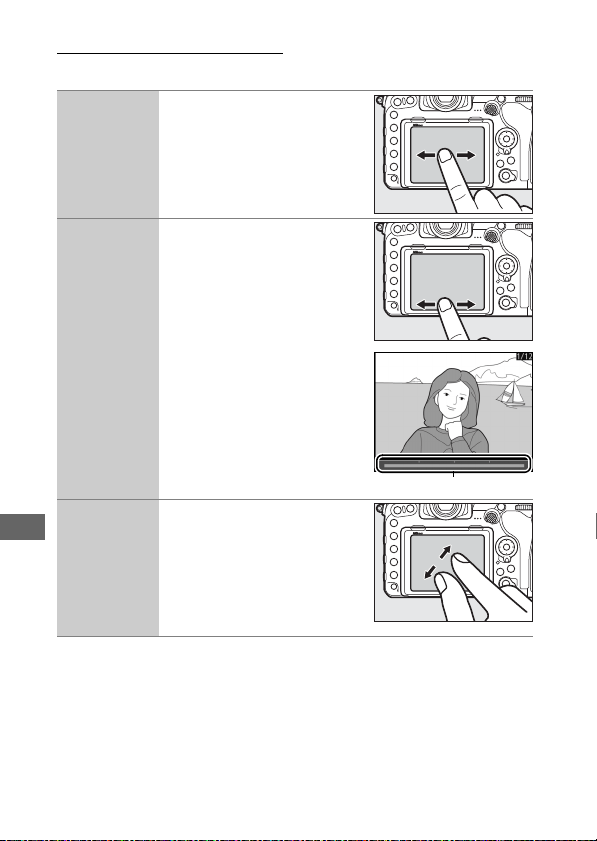
258
Using the Touch Screen
During playback, the touch-sensitive monitor can be used to:
View other
images
Flick left or right to view other
images.
Scroll rapidly to
other images
In full frame view, you can
touch the bottom of the
display to display a frame
advance bar, then slide your
finger left or right to scroll
rapidly to other images.
Frame advance bar
Zoom in (photos
only)
Use stretch and pinch
gestures to zoom in and out
and slide to scroll (0 271).
You can also give the display
two quick taps to zoom in
from full-frame playback or
cancel zoom.
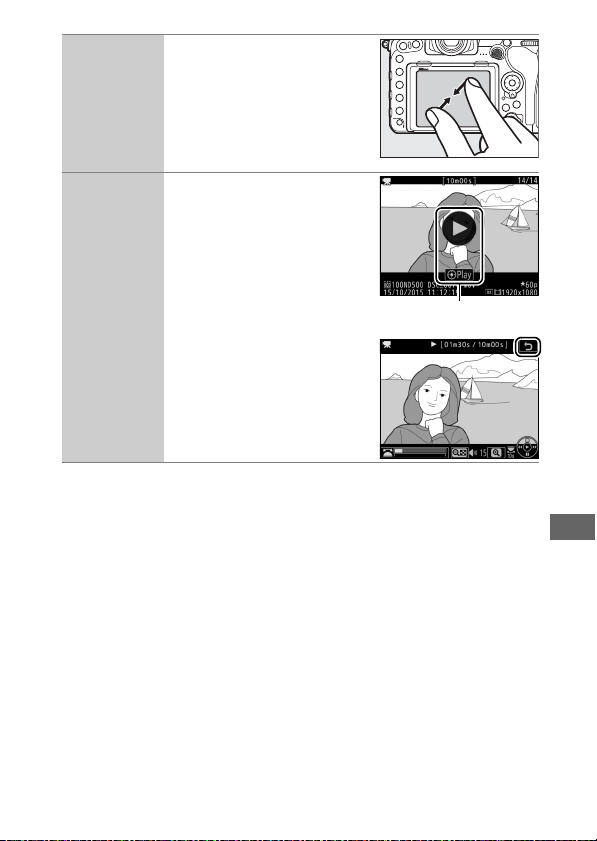
259
View thumbnails
To “zoom out” to a thumbnail
view (0 255), use a pinch
gesture in full-frame
playback.
Use pinch and
stretch to choose the number
of images displayed from 4, 9,
and 72 frames.
View movies
Tap the on-screen guide to
start movie playback (movies
are indicated by a 1 icon).
Tap the display to pause or
resume, or tap Z to exit to
full-frame playback (note that
some of the icons in the
movie playback display do
not respond to touch-screen
operations).
Guide
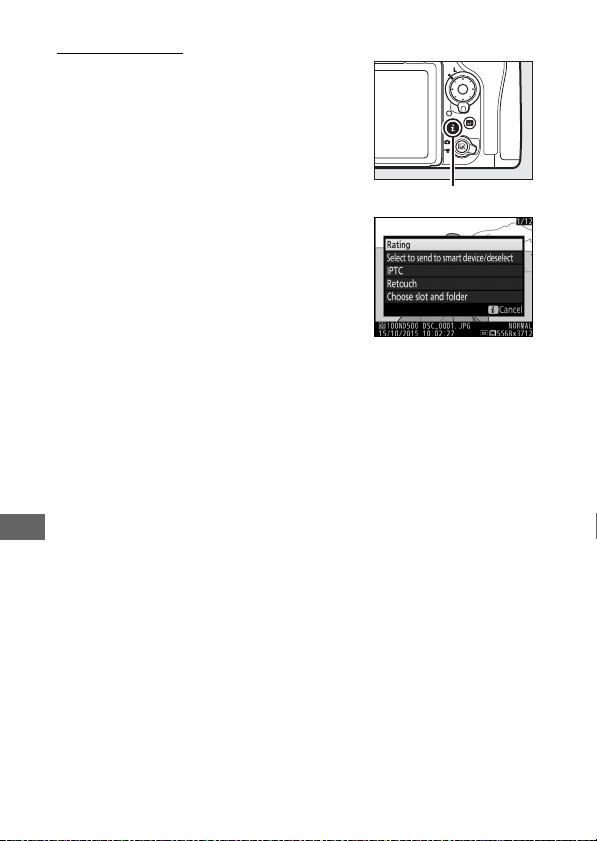
260
The i Button
Pressing the i button during full-frame
or thumbnail playback displays the
options listed below.
• Rating: Rate the current picture (0 274).
• Select to send to smart device/deselect
(photographs only): Select photos for
upload to a smart device.
• IPTC (photographs only): Embed an IPTC
preset in the current image (0 306).
• Retouch (photographs only): Use the
options in the retouch menu (0 313) to
create a retouched copy of the current
photograph.
• Edit movie (movies only): Edit movies using
the options in the edit movie menu (0 82).
Movies can also be
edited by pressing the i button when movie playback is
paused.
• Choose slot and folder: Choose a folder for playback.
Highlight a
slot and press 2 to list the folders on the selected card, then
highlight a folder and press J to view the pictures in the
highlighted folder.
To exit the i-button menu and return to playback, press the
i button again.
i button
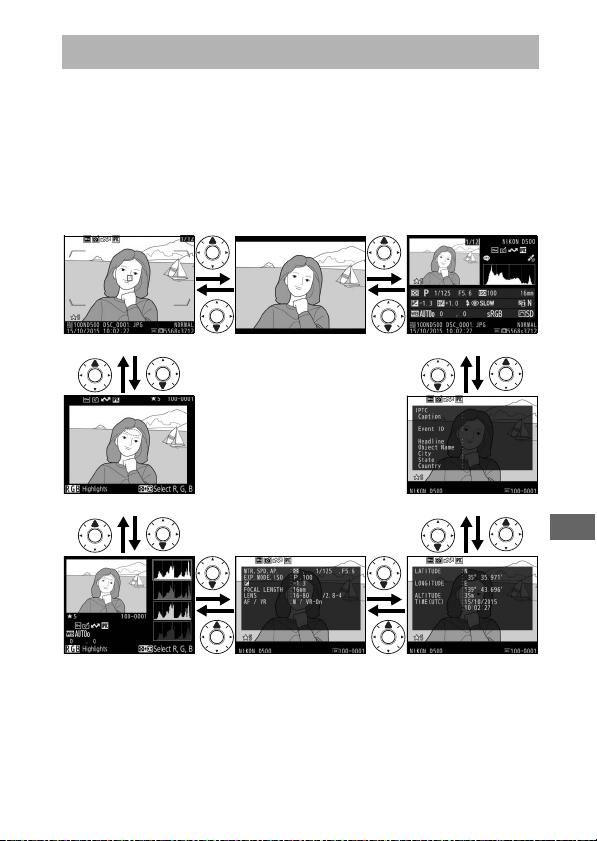
261
Photo information is superimposed on images displayed in full-
frame playback.
Press 1 or 3 to cycle through photo
information as shown below.
Note that “image only”, shooting
data, RGB histograms, and highlights are only displayed if
corresponding option is selected for Playback display options
(0 281).
Location data (0 253) and IPTC presets (0 306) are
displayed only if embedded in the photo.
Photo Information
File information None (image only) Overview data
Highlights IPTC preset
RGB histogram Shooting data Location data
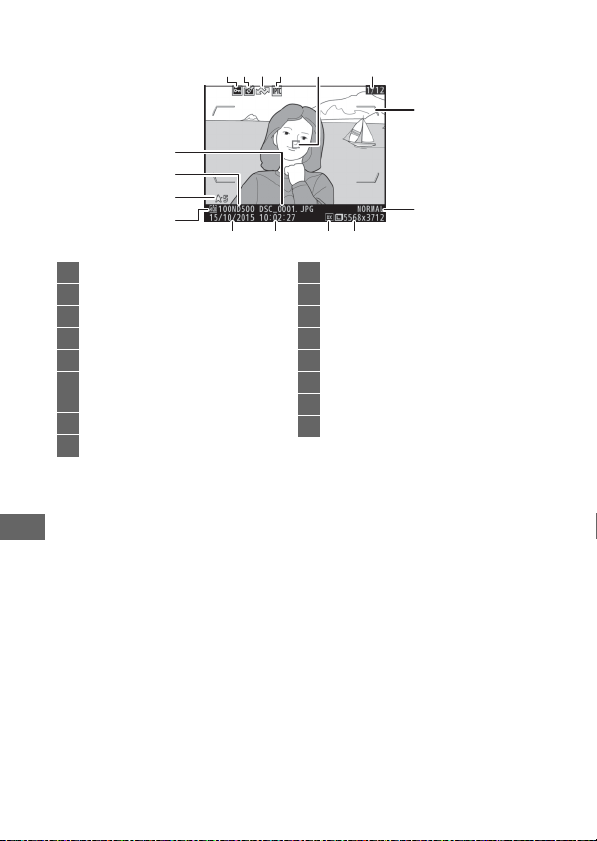
262
❚❚ File Information
1 Displayed only if Focus point is selected for Playback display options (0 281)
and selected photograph was taken using viewfinder.
2 If photograph was taken using manual focus or single-point, dynamic-area, or group-area AF,
display shows focus point selected by user.
If photograph was taken using 3D-tracking or auto-
area AF, display shows focus point selected by camera.
1 356
8
7
1112
14
10 9
2 4
13
15
16
1 Protect status............................... 273
2 Retouch indicator....................... 313
3 Upload marking.......................... 276
4 IPTC preset indicator......... 256, 306
5 Focus point
1, 2
........................97, 108
6 Frame number/total number of
frames
7 AF area brackets
1
...........................29
8 Image quality .................................91
9 Image size .......................................94
10 Image area ......................................88
11 Time of recording....................... 304
12 Date of recording ....................... 304
13 Current card slot ..................... 40, 96
14 Rating............................................ 274
15 Folder name................................. 283
16 File name...................................... 283
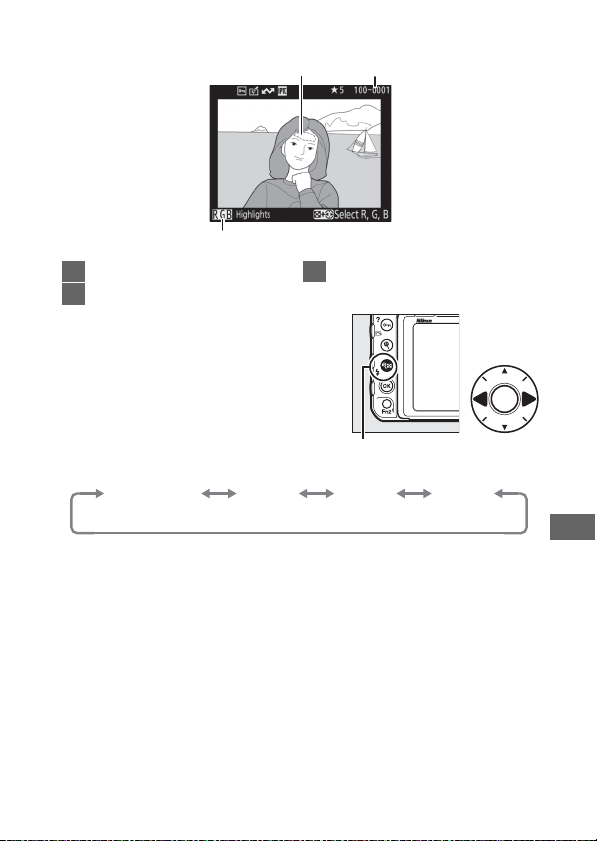
263
❚❚ Highlights
* Flashing areas indicate highlights (areas that may be
overexposed) for current channel.
Hold the W (M)
button and press 4 or 2 to cycle through channels
as follows:
12
3
1 Image highlights
*
2 Folder number–frame number
3 Current channel
*
W (M) button
RGB
(all channels)
R
(red)
G
(green)
B
(blue)
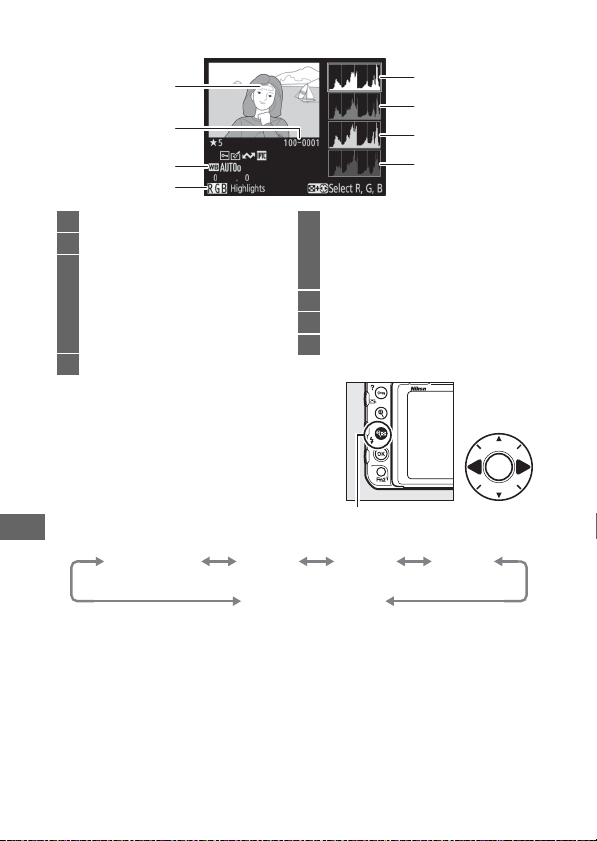
264
❚❚ RGB Histogram
* Flashing areas indicate highlights (areas that may be
overexposed) for current channel.
Hold the W (M)
button and press 4 or 2 to cycle through channels
as follows:
5
6
7
8
1
3
4
2
1 Image highlights
*
2 Folder number–frame number
3 White balance ............................. 159
Color temperature ............... 166
White balance fine-tuning
............................................... 163
Preset manual ....................... 169
4 Current channel
*
5 Histogram (RGB channel).
In all
histograms, horizontal axis gives
pixel brightness, vertical axis
number of pixels.
6 Histogram (red channel)
7 Histogram (green channel)
8 Histogram (blue channel)
W (M) button
RGB
(all channels)
R
(red)
G
(green)
B
(blue)
Highlight display off
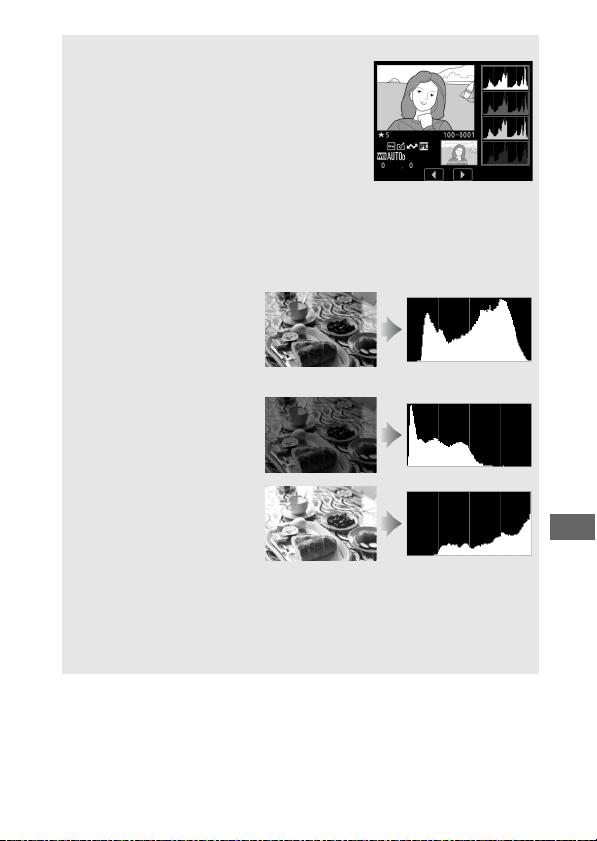
265
A Playback Zoom
To zoom in on the photograph when the
histogram is displayed, press X.
Use the X
and W (M) buttons to zoom in and out and
scroll the image with the multi selector.
The
histogram will be updated to show only the
data for the portion of the image visible in
the monitor.
A Histograms
Camera histograms are intended as a guide only and may differ from
those displayed in imaging applications.
Some sample histograms are
shown below:
If the image contains
objects with a wide range of
brightnesses, the
distribution of tones will be
relatively even.
If the image is dark, tone
distribution will be shifted
to the left.
If the image is bright, tone
distribution will be shifted
to the right.
Increasing exposure compensation shifts the distribution of tones to
the right, while decreasing exposure compensation shifts the
distribution to the left.
Histograms can provide a rough idea of overall
exposure when bright ambient lighting makes it difficult to see
photographs in the monitor.
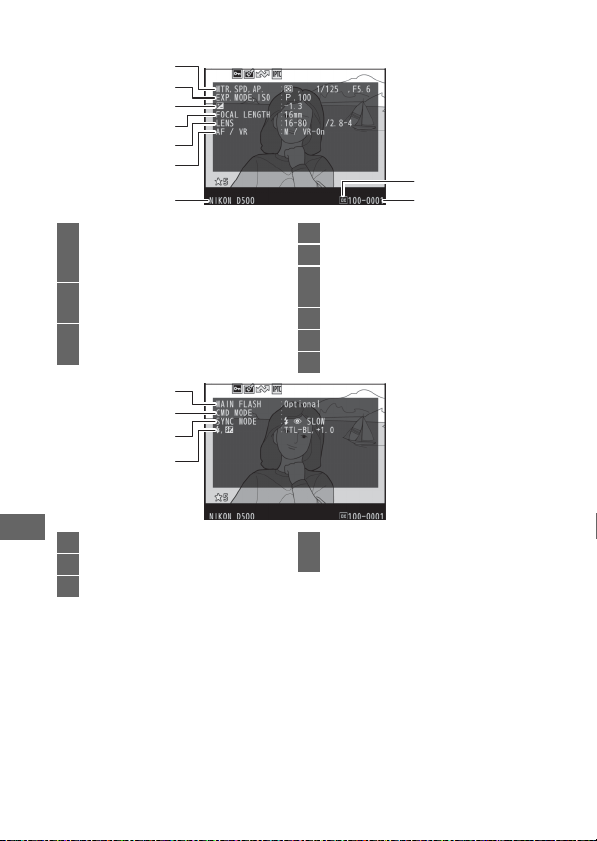
266
❚❚ Shooting Data
9
8
5
4
3
7
2
1
6
1 Metering ....................................... 128
Shutter speed .................... 133, 135
Aperture............................... 134, 135
2 Exposure mode ........................... 130
ISO sensitivity
1
............................ 123
3 Exposure compensation ........... 143
Optimal exposure tuning
2
....... 295
4 Focal length................................. 250
5 Lens data ...................................... 250
6 Focus mode .............................47, 97
Lens VR (vibration reduction)
3
7 Camera name
8 Image area ......................................88
9 Folder number–frame number
11
10
12
13
10 Flash type
4
11 Remote flash control
4
............... 208
12 Flash mode
4
................................. 201
13 Flash settings
4
.................... 199, 214
Flash compensation
4
................ 203
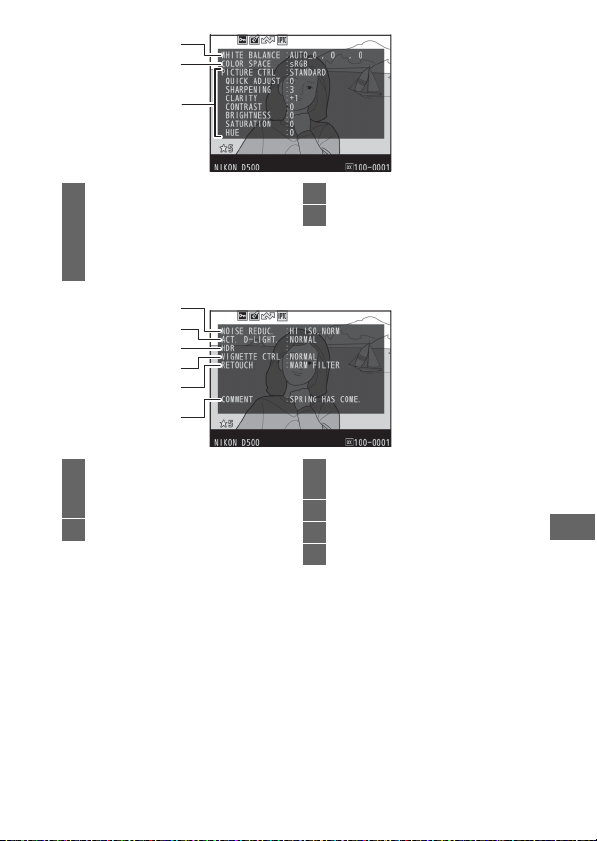
267
16
15
14
14 White balance..............................159
Color temperature................166
White balance fine-tuning
...............................................163
Preset manual........................169
15 Color space................................... 286
16 Picture Control
5
.......................... 180
21
22
20
19
18
17
17 High ISO noise reduction..........286
Long exposure noise
reduction .....................................286
18 Active D-Lighting........................ 189
19 HDR exposure differential ........193
HDR smoothing........................... 193
20 Vignette control.......................... 286
21 Retouch history........................... 313
22 Image comment ......................... 306
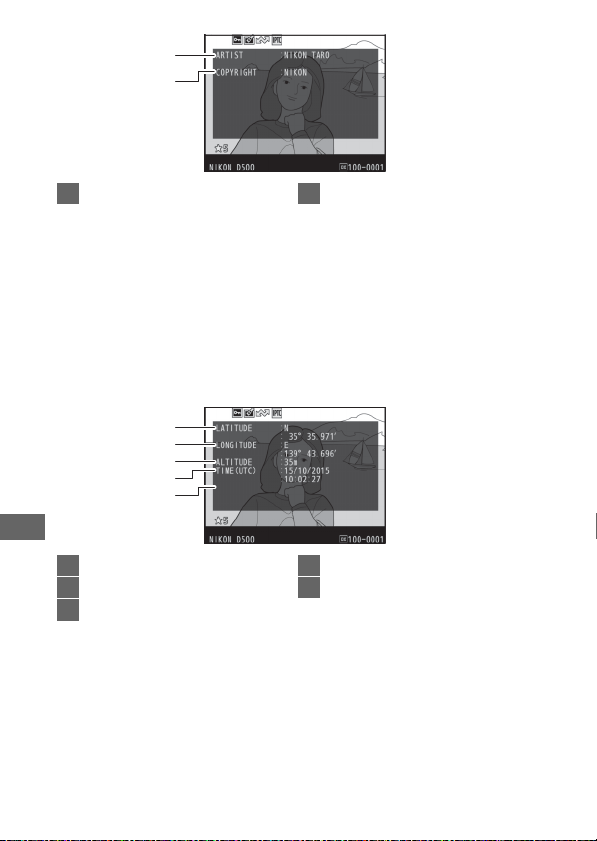
268
1 Displayed in red if photo was taken with auto ISO sensitivity control on.
2 Displayed if Custom Setting b7 (Fine-tune optimal exposure, 0 295) has been set
to a value other than zero for any metering method.
3 Displayed only if VR lens is attached.
4 Displayed only if optional flash unit (0 196) is used.
5 The items displayed vary with the Picture Control selected when the picture was taken.
6 Copyright information is only displayed if recorded with the photograph using the
Copyright information option in the setup menu.
❚❚ Location Data
*
(0 253)
* Data for movies are for start of recording.
The items recorded vary with the device from which
they were acquired.
24
23
23 Name of photographer
6
........... 306 24 Copyright holder
6
...................... 306
2
3
1
4
5
1 Latitude
2 Longitude
3 Altitude
4 Coordinated Universal Time (UTC)
5 Heading
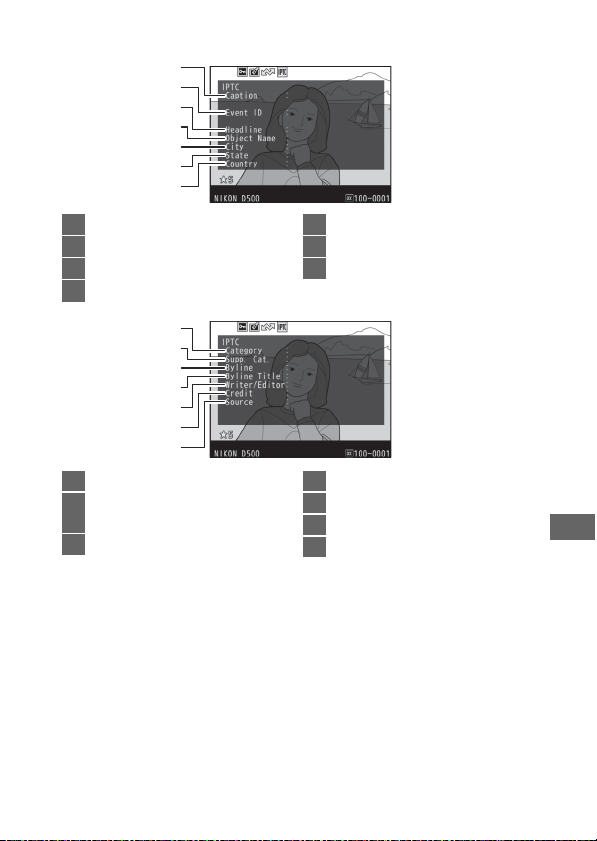
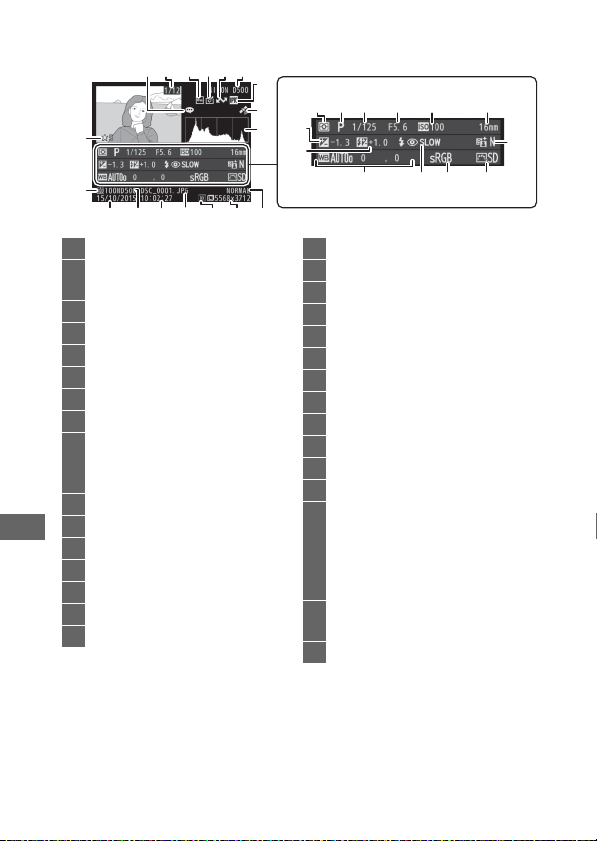
270
❚❚ Overview Data
1 Displayed in red if photo was taken with auto ISO sensitivity control on.
2 Displayed only if photo was taken with optional flash unit (0 196).
2
9
16 15 14 13 12
17
18
25
30
31
19 20 21 22 23 24
28 27 26
8
41 3 6
7
11 10
29
5
1 Image comment indicator........306
2 Frame number/total number of
frames
3 Protect status...............................273
4 Retouch indicator .......................313
5 Upload marking ..........................276
6 Camera name
7 IPTC preset indicator.........256, 306
8 Location data indicator .............253
9 Histogram showing the
distribution of tones in the image
(0 265).
10 Image quality................................. 91
11 Image size....................................... 94
12 Image area...................................... 88
13 File name ......................................283
14 Time of recording .......................304
15 Folder name.................................283
16 Date of recording........................304
17 Current card slot .....................40, 96
18 Rating ............................................ 274
19 Metering ....................................... 128
20 Exposure mode ........................... 130
21 Shutter speed ..................... 133, 135
22 Aperture............................... 134, 135
23 ISO sensitivity
1
............................ 123
24 Focal length ................................. 250
25 Active D-Lighting ....................... 189
26 Picture Control ............................ 180
27 Color space................................... 286
28 Flash mode
2
................................. 201
29 White balance.............................. 159
Color temperature ............... 166
White balance fine-tuning
............................................... 163
Preset manual ....................... 169
30 Flash compensation
2
................. 203
Commander mode
2
31 Exposure compensation ........... 143
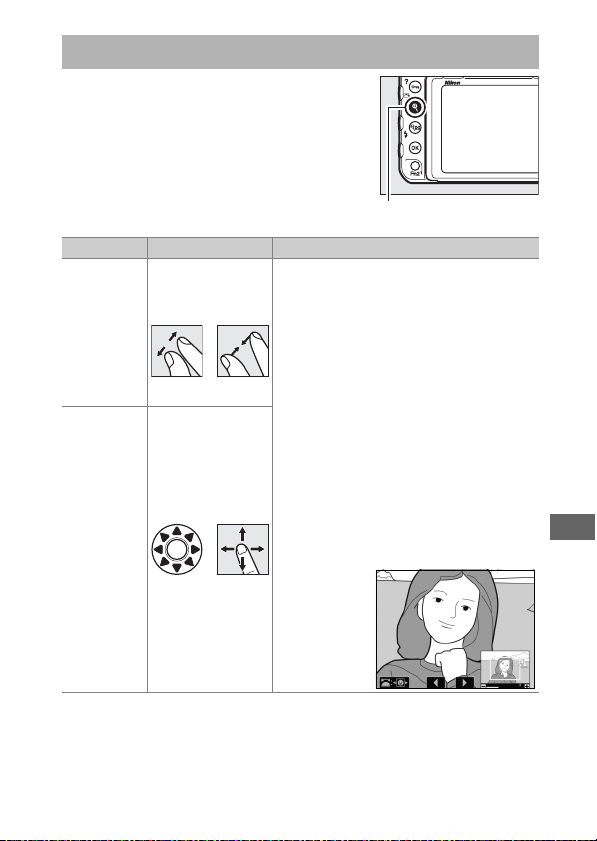
271
To zoom in on an image displayed in full-
frame playback, press the X button or the
center of the multi selector or give the
display two quick taps.
The following
operations can be performed while zoom
is in effect:
Taking a Closer Look: Playback Zoom
To Use Description
Zoom in or
out
X/W (M)/
/
Press X or use stretch gestures to zoom
in to maximum of approximately 21×
(large images in 24 × 16/DX format),
16× (medium images) or 10× (small
images).
Press W (M) or use pinch
gestures to zoom out.
While photo is
zoomed in, use multi selector or slide
finger over screen to view areas of
image not visible in monitor.
Keep
multi selector pressed to scroll rapidly
to other areas of frame.
Navigation
window is displayed when zoom ratio
is altered; area currently visible in
monitor is indicated by yellow border.
Bar under navigation window shows
zoom ratio; turns green at ratio of 1 : 1.
View other
areas of
image
/
X button
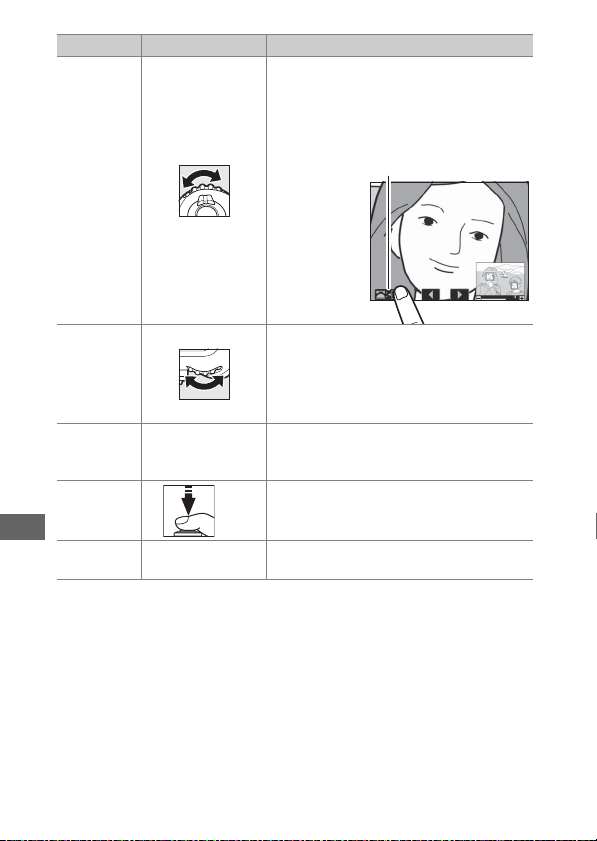
272
Select faces
Faces (up to 35) detected during zoom
are indicated by white borders in
navigation window.
Rotate sub-
command dial or tap on-screen guide
to view other faces.
View other
images
Rotate main command dial or tap e or
f icons at bottom of display to view
same location in other photos at
current zoom ratio.
Playback zoom is
cancelled when a movie is displayed.
Change
protect
status
L (Z/Q)
See page 273 for more information.
Return to
shooting
mode
/
K
Press the shutter-release button
halfway or press the K button to exit
to shooting mode.
Display
menus
G
See page 281 for more information.
To Use Description
On-screen guide
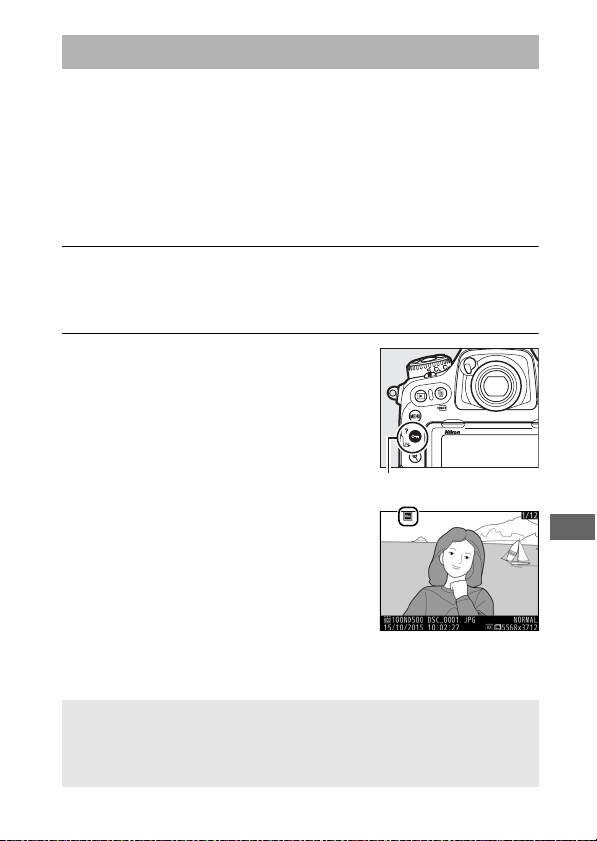
273
In full-frame, zoom, and thumbnail playback, the L (Z/Q)
button can be used to protect photographs from accidental
deletion.
Protected files can not be deleted using the O (Q)
button or the Delete option in the playback menu.
Note that
protected images will be deleted when the memory card is
formatted (0 304).
To protect a photograph:
1 Select an image.
Display the image in full-frame playback or playback zoom or
highlight it in the thumbnail list.
2 Press the L (Z/Q) button.
The photograph will be marked with a
P icon.
To remove protection from
the photograph so that it can be
deleted, display the photograph or
highlight it in the thumbnail list and
then press the L (Z/Q) button.
Protecting Photographs from Deletion
A Removing Protection from All Images
To remove protection from all images in the folder or folders currently
selected in the Playback folder menu, press the L (Z/Q) and O (Q)
buttons together for about two seconds during playback.
L (Z/Q) button
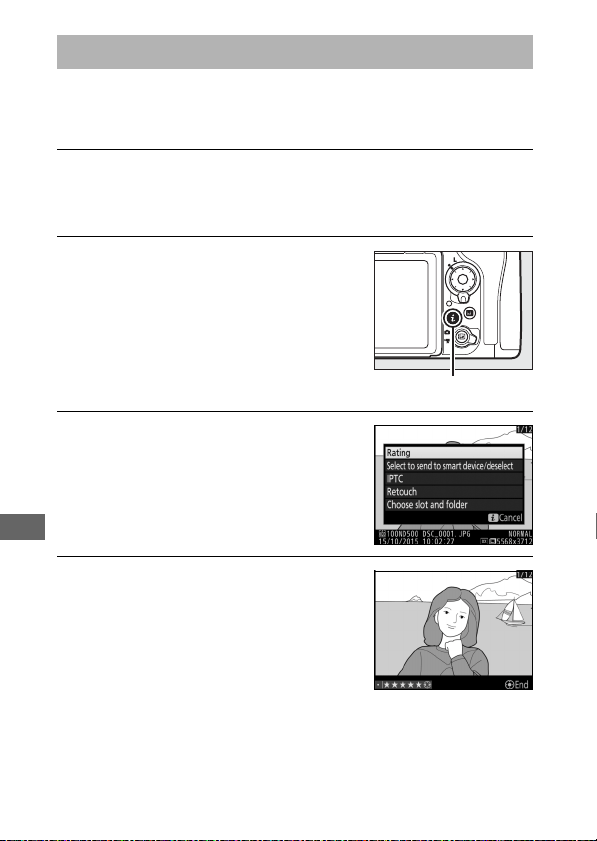
274
Rate pictures or mark them as candidates for later deletion.
Ratings can also be viewed in ViewNX-i and Capture NX-D.
Rating is not available with protected images.
1 Select an image.
Display the image or highlight it in the thumbnail list in
thumbnail playback.
2 Display playback options.
Press the i button to display playback
options.
3 Select Rating.
Highlight Rating and press 2.
4 Choose a rating.
Press 4 or 2 to choose a rating of
from zero to five stars, or select d to
mark the picture as a candidate for
later deletion.
Press J to complete
the operation.
Rating Pictures
i button

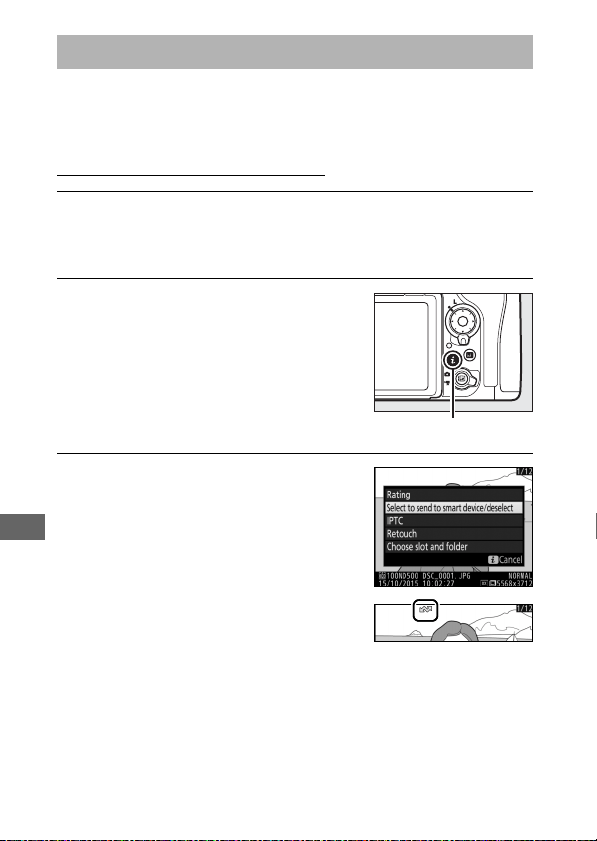
276
Follow the steps below to select photos for upload to the smart
device before connecting.
Movies can not be selected for
upload.
Selecting Individual Photos
1 Select a photo.
Display the photo or highlight it in the thumbnail list in
thumbnail playback.
2 Display playback options.
Press the i button to display playback
options.
3 Choose Select to send to smart
device/deselect.
Highlight Select to send to smart
device/deselect and press J.
Pictures selected for upload are
indicated by a W icon; to deselect,
display or highlight the image and
repeat Steps 2 and 3.
Selecting Photos for Upload
i button
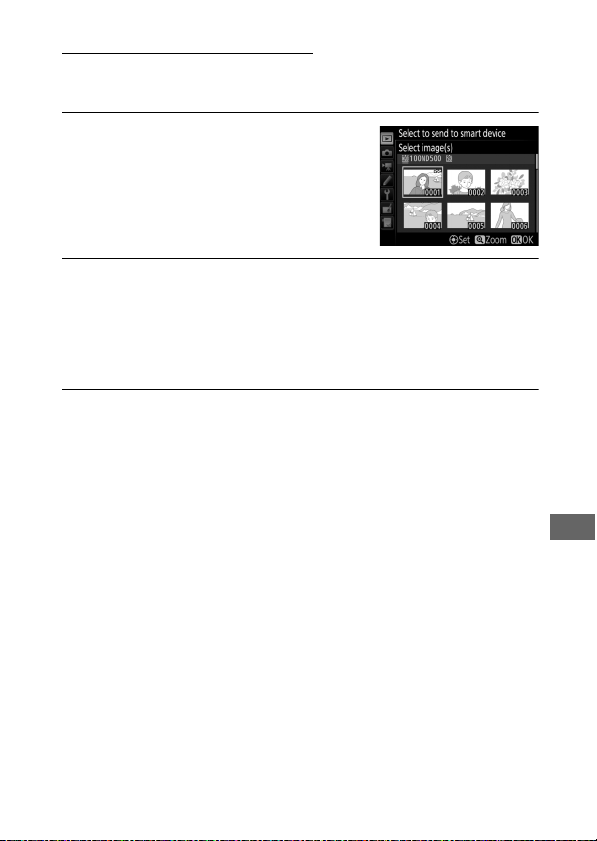
277
Selecting Multiple Photos
Follow the steps below to change the upload status of multiple
photos.
1 Choose Select image(s).
In the playback menu, select Select to
send to smart device, then highlight
Select image(s) and press 2.
2 Select photos.
Use the multi selector to highlight photos and press the
center of the multi selector to select or deselect (to view the
highlighted picture full screen, press and hold the X button).
Selected photos are marked by a W icon.
3 Press J.
Press J to complete the operation.
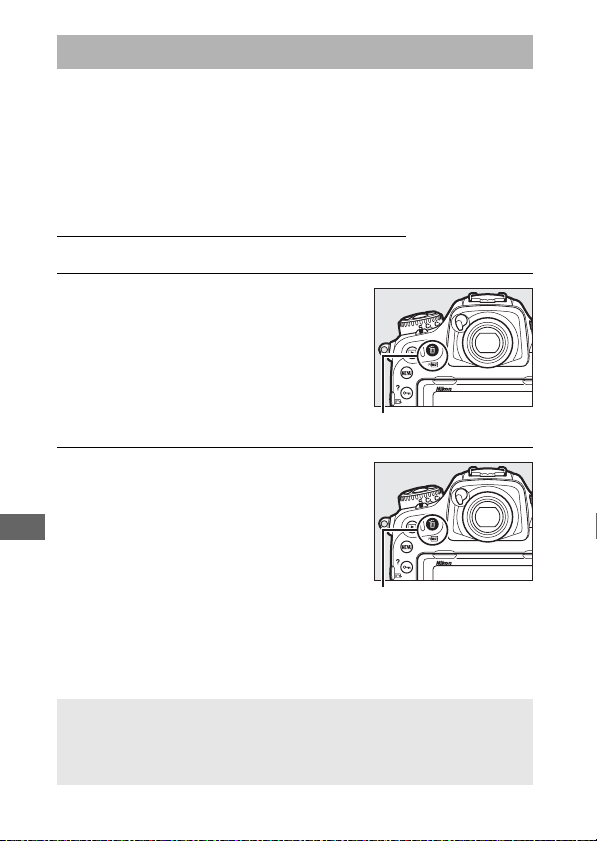
278
To delete all photographs in the current folder or the
photograph displayed in full-frame playback or highlighted in
the thumbnail list, press the O (Q) button.
To delete multiple
selected photographs, use the Delete option in the playback
menu.
Once deleted, photographs can not be recovered.
Note
that pictures that are protected or hidden can not be deleted.
Full-Frame and Thumbnail Playback
Press the O (Q) button to delete the current photograph.
1 Press the O (Q) button.
A confirmation dialog will be
displayed.
2 Press the O (Q) button again.
To delete the photograph, press the
O (Q) button.
To exit without
deleting the photograph, press the K
button.
Deleting Photographs
A See Also
The After delete option in the playback menu determines whether
the next image or the previous image is displayed after an image is
deleted (0 282).
O (Q) button
O (Q) button
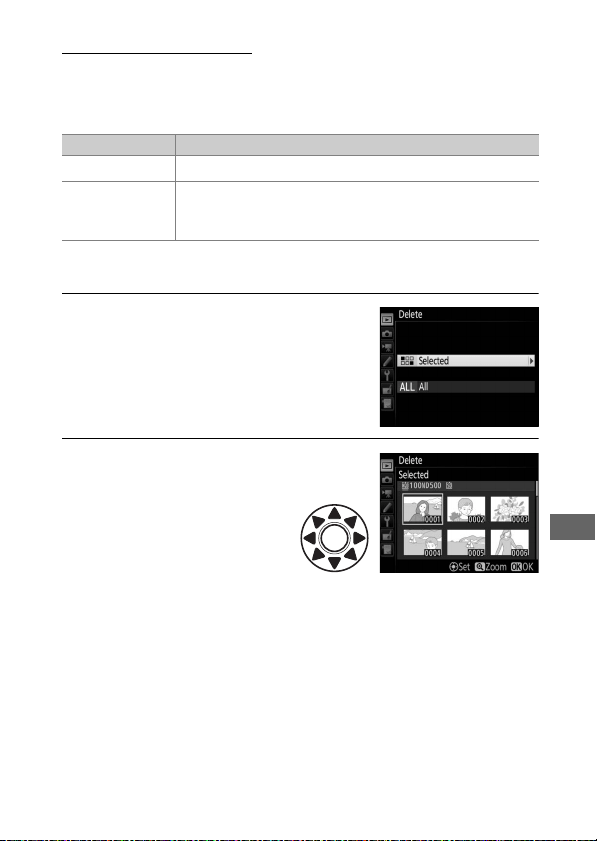
279
The Playback Menu
The Delete option in the playback menu contains the following
options.
Note that depending on the number of images, some
time may be required for deletion.
❚❚ Selected: Deleting Selected Photographs
1 Choose Delete > Selected.
Select Delete in the playback menu.
Highlight Selected and press 2.
2 Highlight a picture.
Use the multi selector to
highlight a picture (to view
the highlighted picture full
screen, press and hold the
X button).
Option Description
Q
Selected Delete selected pictures.
R
All
Delete all pictures in the folder currently selected for
playback (0 281).
If two cards are inserted, you can
select the card from which pictures will be deleted.
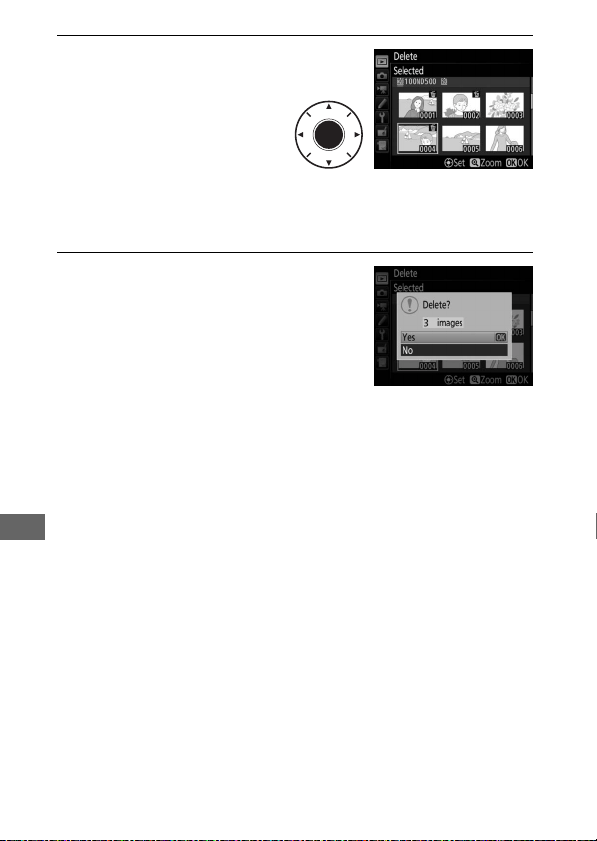
280
3 Select the highlighted
picture.
Press the center of the
multi selector to select the
highlighted picture.
Selected pictures are
marked by a O icon.
Repeat
steps 2 and 3 to select additional pictures; to deselect a
picture, highlight it and press the center of the multi selector.
4 Press J to complete the operation.
A confirmation dialog will be
displayed; highlight Ye s and press J.
281
Menu List
This section lists the options available in the camera menus.
For
more information, see the Menu Guide.
D The Playback Menu: Managing Images
Delete
Selected Delete multiple images (0 279).
All
Playback folder (defaults to All)
(Folder name) Choose a folder for playback.
All
Current
Hide image
Select/set Hide or reveal images.
Hidden images
are displayed only in the “Hide image”
menu and cannot be played back.
Deselect all
Playback display options
Basic photo info Choose the information available in the
playback photo information display
(0 261).
Focus point
Additional photo info
None (image only)
Highlights
RGB histogram
Shooting data
Overview
282
Copy image(s)
Select source Copy pictures from one memory card to
another.
This option is only available
when two memory cards are inserted in
the camera.
Select image(s)
Select destination folder
Copy image(s)?
Image review (defaults to Off)
On Choose whether pictures are
automatically displayed in the monitor
immediately after shooting (0 257).
Off
After delete (defaults to Show next)
Show next Choose the picture displayed after an
image is deleted.
Show previous
Continue as before
After burst, show (defaults to Last image in burst)
First image in burst Choose whether the camera displays
the first or the last photo in the burst
after photos are taken in continuous
release mode.
Last image in burst
Auto image rotation (defaults to On)
On Choose whether to record camera
orientation when taking photographs.
Off
Rotate tall (defaults to On)
On Choose whether to rotate “tall”
(portrait-orientation) pictures for
display during playback (0 257).
Off
Slide show
Start View a slide show of the pictures in the
current playback folder.
Image type
Frame interval
Select to send to smart device
Select image(s) Select photos for upload to a smart
device (0 277).
Deselect all
283
C The Photo Shooting Menu:
Shooting Options
Photo shooting menu bank
A Recall photo shooting menu settings
previously stored in a photo shooting
menu bank.
Changes to settings are
stored in the current bank.
B
C
D
Extended photo menu banks (defaults to Off)
On Choose whether photo shooting menu
banks store exposure mode, shutter
speed (exposure modes S and M),
aperture (modes A and M), and flash
mode.
Off
Storage folder
Rename Select the folder in which subsequent
images will be stored.
Select folder by number
Select folder from list
File naming
File naming Choose the three-letter prefix used in
naming the image files in which
photographs are stored.
The default
prefix is “DSC”.
Primary slot selection (defaults to XQD card slot)
XQD card slot Choose the slot that serves as the
primary slot when two memory cards
are inserted.
SD card slot
Secondary slot function (defaults to Overflow)
Overflow Choose the role played by the card in
the secondary slot when two memory
cards are inserted (0 96).
Backup
RAW primary - JPEG secondary
284
Flash control
Flash control mode Choose the flash control mode for
optional flash units mounted on the
camera accessory shoe or adjust
settings for wireless flash photography
(0 199, 208).
Wireless flash options
Remote flash control
Radio remote flash info
Choose image area (defaults to DX (24×16))
DX (24×16) Choose the image area (0 88).
1.3× (18×12)
Image quality (defaults to JPEG normal)
NEF (RAW) + JPEG fine★ Choose a file format and compression
ratio (image quality, 0 91).
The
compression for options indicated by a
star (“★”) prioritizes quality, while that
for images without a star gives priority
to reducing file size.
NEF (RAW) + JPEG fine
NEF (RAW) + JPEG normal★
NEF (RAW) + JPEG normal
NEF (RAW) + JPEG basic★
NEF (RAW) + JPEG basic
NEF (RAW)
JPEG fine★
JPEG fine
JPEG normal★
JPEG normal
JPEG basic★
JPEG basic
TIFF (RGB)
Image size
JPEG/TIFF Choose the image size, in pixels (0 94).
Separate options are available for JPEG/
TIFF and for NEF (RAW) images.
NEF (RAW)
285
NEF (RAW) recording
NEF (RAW) compression Choose the type of compression and
the bit depth for NEF (RAW) images
(0 93).
NEF (RAW) bit depth
ISO sensitivity settings
ISO sensitivity Adjust ISO sensitivity settings for
photographs (0 123, 125).
Auto ISO sensitivity control
White balance (defaults to Auto)
Auto Match white balance to the light source
(0 159).
Incandescent
Fluorescent
Direct sunlight
Flash
Cloudy
Shade
Choose color temp.
Preset manual
Set Picture Control (defaults to Standard)
Standard Choose how new photos will be
processed.
Select according to the type
of scene or your creative intent (0 180).
Neutral
Vivid
Monochrome
Portrait
Landscape
Flat
Manage Picture Control
Save/edit Create custom Picture Controls (0 185).
Rename
Delete
Load/save
286
Color space (defaults to sRGB)
sRGB Choose a color space for photographs.
Adobe RGB
Active D-Lighting (defaults to Off)
Auto Preserve details in highlights and
shadows, creating photographs with
natural contrast (0 189).
Extra high
High
Normal
Low
Off
Long exposure NR (defaults to Off)
On Reduce “noise” (bright spots or fog) in
photos taken at slow shutter speeds.
Off
High ISO NR (defaults to Normal)
High Reduce “noise” (randomly-spaced
bright pixels) in photos taken at high
ISO sensitivities.
Normal
Low
Off
Vignette control (defaults to Normal)
High Reduce the drop in brightness at the
edges of photographs when using type
G, E, and D lenses (PC lenses excluded).
The effect is most noticeable at
maximum aperture.
Normal
Low
Off
Auto distortion control (defaults to Off)
On Reduce barrel distortion when shooting
with wide-angle lenses and to reduce
pin-cushion distortion when shooting
with long lenses.
Off
287
Flicker reduction
Flicker reduction setting This option takes effect during
viewfinder photography (0 234).
Select Enable for Flicker reduction
setting to adjust shot timing to reduce
the effects of flicker under fluorescent
or mercury vapor lighting.
The Flicker
reduction indicator item controls
whether a FLICKER icon is displayed in the
viewfinder when flicker is detected.
Flicker reduction indicator
Auto bracketing set (defaults to AE & flash)
AE & flash Choose the setting or settings
bracketed when auto bracketing is in
effect (0 146).
AE only
Flash only
WB bracketing
ADL bracketing
Multiple exposure
Multiple exposure mode Record from two to ten NEF (RAW)
exposures as a single photograph
(0 236).
Number of shots
Overlay mode
HDR (high dynamic range)
HDR mode Preserve details in highlights and
shadows when photographing high-
contrast scenes (0 191).
Exposure differential
Smoothing
Interval timer shooting
Start Take photographs at the selected
interval until the specified number of
shots has been recorded (0 243).
Start options
Interval
No. of intervals×shots/interval
Exposure smoothing
288
1 The Movie Shooting Menu:
Movie Shooting Options
Reset movie shooting menu
Ye s Select Ye s to restore movie shooting
menu options to their default values.
No
File naming
Choose the three-letter prefix used in
naming the image files in which movies
are stored.
The default prefix is “DSC”.
Destination (defaults to XQD card slot)
XQD card slot Choose the slot to which movies are
recorded.
SD card slot
Choose image area (defaults to DX)
DX Choose the image area (0 70).
1.3×
Frame size/frame rate (defaults to 1920×1080; 60p)
3840×2160; 30p Choose movie frame size (in pixels) and
frame rate (0 68).
3840×2160; 25p
3840×2160; 24p
1920×1080; 60p
1920×1080; 50p
1920×1080; 30p
1920×1080; 25p
1920×1080; 24p
1280× 720; 60p
1280× 720; 50p
289
Movie quality (defaults to High quality)
High quality Choose movie quality (0 68).
Normal
ISO sensitivity settings
ISO sensitivity (mode M) Adjust ISO sensitivity settings for
movies.
Auto ISO control (mode M)
Maximum sensitivity
White balance (defaults to Same as photo settings)
Same as photo settings Choose the white balance for movies
(0 159).
Select Same as photo
settings to use the option currently
selected for photos.
Auto
Incandescent
Fluorescent
Direct sunlight
Cloudy
Shade
Choose color temp.
Preset manual
Set Picture Control (defaults to Same as photo settings)
Same as photo settings Choose a Picture Control for movies
(0 180).
Select Same as photo
settings to use the option currently
selected for photos.
Standard
Neutral
Vivid
Monochrome
Portrait
Landscape
Flat
290
Manage Picture Control
Save/edit Create custom Picture Controls (0 185).
Rename
Delete
Load/save
Active D-Lighting (defaults to Off)
Same as photo settings Preserve details in highlights and
shadows, creating movies with natural
contrast (0 189).
Select Same as
photo settings to use the option
currently selected for photos.
Extra high
High
Normal
Low
Off
High ISO NR (defaults to Normal)
High Reduce “noise” (randomly-spaced
bright pixels) in movies recorded at high
ISO sensitivities.
Normal
Low
Off
Flicker reduction (defaults to Auto)
Auto Reduce flicker and banding caused by
fluorescent or mercury-vapor lighting
during live view (0 43) and movie
recording (0 58).
50 Hz
60 Hz
Microphone sensitivity (defaults to Auto sensitivity)
Auto sensitivity Turn the built-in or external
microphones (0 336) on or off or adjust
microphone sensitivity.
Manual sensitivity
Microphone off
291
Frequency response (defaults to Wide range)
Wide range Choose the frequency response for the
built-in and external microphones
(0 336).
Vocal range
Wind noise reduction (defaults to Off)
On Choose whether to enable the built-in
microphone’s low-cut filter to reduce
wind noise.
Off
Time-lapse movie
Start The camera automatically takes photos
at selected intervals to create a silent
time-lapse movie (0 74).
Available with
viewfinder photography only.
Interval
Shooting time
Exposure smoothing
Electronic VR (defaults to Off)
On Choose whether to enable electronic
vibration reduction in movie mode.
Off
292
A Custom Settings:
Fine-Tuning Camera Settings
Custom settings bank
A Recall Custom Settings previously
stored in a Custom Settings menu bank.
Changes to settings are stored in the
current bank.
B
C
D
a Autofocus
a1 AF-C priority selection (defaults to Release)
Release When AF-C is selected for viewfinder
photography, this option controls
whether photographs can be taken
whenever the shutter-release button is
pressed (release priority) or only when
the camera is in focus (focus priority).
Focus + release
Release + focus
Focus
a2 AF-S priority selection (defaults to Focus)
Release When AF-S is selected for viewfinder
photography, this option controls
whether photographs can be taken only
when the camera is in focus (focus
priority) or whenever the shutter-release
button is pressed (release priority).
Focus
a3 Focus tracking with lock-on
Blocked shot AF response Control how autofocus adjusts to
changes in the distance to the subject
when AF-C is selected for viewfinder
photography.
Subject motion

293
a4 3D-tracking face-detection (defaults to Off)
On Choose whether the camera detects
and focuses on faces when 3D-tracking
is selected for AF-area mode (0 104).
Off
a5 3D-tracking watch area (defaults to Normal)
Wide Choose the area monitored by pressing
the shutter-release button halfway
when 3D-tracking is selected for
AF-area mode (0 104).
Normal
a6 Number of focus points (defaults to 55 points)
55 points Choose the number of focus points
available for manual focus-point
selection in the viewfinder.
15 points
a7 Store by orientation (defaults to Off)
Focus point Choose whether the viewfinder stores
the focus points and AF-area mode for
vertical and horizontal orientations
separately.
Focus point and AF-area mode
Off
a8 AF activation (defaults to Shutter/AF-ON)
Shutter/AF-ON Choose whether the camera focuses
when the shutter-release button is
pressed halfway.
If AF-ON only is
selected, the camera will not focus
when the shutter-release button is
pressed halfway.
AF-ON only
a9 Limit AF-area mode selection
Single-point AF Choose the AF-area modes that can be
selected using the AF-mode button and
sub-command dial in viewfinder
photography (0 103).
Dynamic-area AF (25 points)
Dynamic-area AF (72 points)
Dynamic-area AF (153 points)
3D-tracking
Group-area AF
Auto-area AF
294
a10 Autofocus mode restrictions (defaults to No restrictions)
AF-S Choose the autofocus modes available
in viewfinder photography (0 101).
AF-C
No restrictions
a11 Focus point wrap-around (defaults to No wrap)
Wrap Choose whether viewfinder focus-point
selection “wraps around” from one
edge of the display to another.
No wrap
a12 Focus point options
Manual focus mode Adjust settings for the focus-point
display in the viewfinder.
Dynamic-area AF assist
Group-area AF display
Focus point illumination
a13 Manual focus ring in AF mode (defaults to Enable)
Enable This option is available with compatible
lenses.
Select Disable to disable focus
using the focus ring in autofocus mode.
Disable
b Metering/exposure
b1 ISO sensitivity step value (defaults to 1/3 step)
1/3 step Select the increments used when
making adjustments to ISO sensitivity.
1/2 step
1 step
b2 EV steps for exposure cntrl (defaults to 1/3 step)
1/3 step Select the increments used when
making adjustments to shutter speed,
aperture, and bracketing.
1/2 step
1 step
b3 Exp./flash comp. step value (defaults to 1/3 step)
1/3 step Select the increments used when
making adjustments to exposure and
flash compensation.
1/2 step
1 step
295
b4 Easy exposure compensation (defaults to Off)
On (Auto reset) Choose whether exposure
compensation can be adjusted solely by
rotating a command dial, without
pressing the E button.
On
Off
b5 Matrix metering (defaults to Face detection on)
Face detection on Choose Face detection on to enable
face detection when shooting portraits
with matrix metering during viewfinder
photography (0 128).
Face detection off
b6 Center-weighted area (defaults to 8mm)
6mm Choose the size of the area given the
most weight when center-weighted
metering is used in viewfinder
photography.
If a non-CPU lens is
attached, the size of the area is fixed at
8mm.
8mm
10 mm
13 mm
Average
b7 Fine-tune optimal exposure
Matrix metering Fine-tune exposure for each metering
method.
Higher values produce
brighter exposures, lower values darker
exposures.
Center-weighted metering
Spot metering
Highlight-weighted metering
296
c Timers/AE lock
c1 Shutter-release button AE-L (defaults to Off)
On (half press) Choose whether exposure locks when
the shutter-release button is pressed.
On (burst mode)
Off
c2 Standby timer (defaults to 6 s)
4 s Choose how long the camera continues
to meter exposure when no operations
are performed (0 39).
6 s
10 s
30 s
1 min
5 min
10 min
30 min
No limit
c3 Self-timer
Self-timer delay Choose the length of the shutter release
delay, the number of shots taken, and
the interval between shots in self-timer
mode.
Number of shots
Interval between shots
c4 Monitor off delay
Playback Choose how long the monitor remains
on when no operations are performed.
Menus
Information display
Image review
Live view
297
d Shooting/display
d1 CL mode shooting speed (defaults to 5 fps)
9 fps Choose the frame advance rate for
C
L (continuous low-speed) mode.
8 fps
7 fps
6 fps
5 fps
4 fps
3 fps
2 fps
1 fps
d2 Max. continuous release (defaults to 200)
1–200 Choose the maximum number of shots
that can be taken in a single burst in
continuous release mode.
d3 ISO display (defaults to Show frame count)
Show ISO sensitivity Choose whether ISO sensitivity is
displayed in the control panel and
viewfinder in place of the number of
exposures remaining.
Show frame count
d4 Sync. release mode options (defaults to Sync)
Sync Choose whether the shutter releases on
remote cameras synchronize with the
shutter release on the master camera.
No sync
d5 Exposure delay mode (defaults to Off)
3 s In situations where the slightest camera
movement can blur pictures, select 1s,
2s, or 3s to delay shutter release until
approximately one, two, or three
seconds after the mirror is raised.
2 s
1 s
Off
298
d6 Electronic front-curtain shutter (defaults to Disable)
Enable Enable or disable the electronic front-
curtain shutter in M
UP mode, eliminating
blur caused by shutter motion.
Disable
d7 File number sequence (defaults to On)
On Choose how the camera assigns file
numbers.
Off
Reset
d8 Viewfinder grid display (defaults to Off)
On Choose whether to display a framing
grid in the viewfinder.
Off
d9 LCD illumination (defaults to Off)
On Choose whether the control panel and
button backlights are illuminated while
the standby timer is active.
Off
d10 Optical VR (defaults to On)
On Turn vibration control on or off.
This
item is available only with lenses that
support it.
Off
A The Electronic Front-Curtain Shutter
A type G, E, or D lens is recommended; select Disable if you notice
lines or fog when shooting with other lenses.
The fastest shutter
speed and maximum ISO sensitivity available with the electronic
front-curtain shutter are
1
/
2000 s and ISO 51200, respectively.
299
e Bracketing/flash
e1 Flash sync speed (defaults to 1/250 s)
1/250 s (Auto FP) Choose a flash sync speed.
1/250 s
1/200 s
1/160 s
1/125 s
1/100 s
1/80 s
1/60 s
A Fixing Shutter Speed at the Flash Sync Speed Limit
To fix shutter speed at the sync speed limit in shutter-priority auto or
manual exposure modes, select the next shutter speed after the
slowest possible shutter speed (30 s or %).
An X (flash sync indicator)
will be displayed in the viewfinder and control panel.
A Auto FP High-Speed Sync
Auto FP high-speed sync allows the flash to be used at the highest
shutter speed supported by the camera, making it possible to choose
the maximum aperture for reduced depth of field even when the
subject is backlit in bright sunlight.
The information display flash
mode indicator shows “FP” when auto FP high-speed sync is active.
300
e2 Flash shutter speed (defaults to 1/60 s)
1/60 s Choose the slowest shutter available
when the flash is used in modes P and A.
1/30 s
1/15 s
1/8 s
1/4 s
1/2 s
1 s
2 s
4 s
8 s
15 s
30 s
e3 Exposure comp. for flash (defaults to Entire frame)
Entire frame Choose how the camera adjusts flash
level when exposure compensation is
used.
Background only
e4 Auto M ISO sensitivity control (defaults to Subject and background)
Subject and background Choose whether auto ISO sensitivity
control for flash photography is
adjusted to correctly expose both the
subject and background or the main
subject only.
Subject only
e5 Modeling flash (defaults to On)
On Choose whether optional CLS-
compatible flash units (0 328) emit a
modeling flash when the camera
Pv button is pressed during viewfinder
photography.
Off
301
e6 Auto bracketing (mode M) (defaults to Flash/speed)
Flash/speed Choose the settings affected when
exposure/flash bracketing is enabled in
exposure mode M.
Flash/speed/aperture
Flash/aperture
Flash only
e7 Bracketing order (defaults to MTR > under > over)
MTR > under > over Choose the bracketing order for
exposure, flash, and white balance
bracketing.
Under > MTR > over
f Controls
f1 Custom control assignment
Preview button Choose the roles assigned to camera
controls, either alone or in combination
with the command dials.
Preview button + y
Fn1 button
Fn1 button + y
Fn2 button
AF-ON button
Sub-selector
Sub-selector center
Sub-selector center + y
BKT button + y
Movie record button + y
Lens focus function buttons
f2 Multi selector center button
Shooting mode Choose the role played by the center of
the multi selector.
Playback mode
Live view
302
f3 Shutter spd & aperture lock
Shutter speed lock Lock shutter speed at the value
currently selected in mode S or M, or
aperture at the value currently selected
in mode A or M.
Aperture lock
f4 Customize command dials
Reverse rotation Choose the roles played by the main
and sub-command dials.
Change main/sub
Aperture setting
Menus and playback
Sub-dial frame advance
f5 Multi selector (defaults to Do nothing)
Restart standby timer Choose whether using the multi
selector activates the standby timer
(0 39).
Do nothing
f6 Release button to use dial (defaults to No)
Ye s Selecting Ye s allows adjustments that
are normally made by holding a button
and rotating a command dial to be
made by rotating the command dial
after the button is released.
Setting
ends when the button is pressed again,
the shutter-release button is pressed
halfway, or the standby timer expires.
No
303
f7 Reverse indicators (defaults to )
If (W) is selected, the
exposure indicators in the control panel,
viewfinder, and information display are
displayed with negative values on the
left and positive values on the right.
Select (V) to display
positive values on the left and negative
values on the right.
f8 Live view button options (defaults to Enable)
Enable The a button can be disabled to
prevent live view starting accidentally.
Enable (standby timer active)
Disable
f9 D switch (defaults to LCD backlight (D))
LCD backlight (D) Choose displays illuminated by rotating
the power switch to D.
D and information display
f10 Assign MB-D17 buttons
Fn button Choose the functions assigned to the
controls on the optional MB-D17 multi-
power battery pack.
Fn button + y
AF-ON button
Multi selector
g Movie
g1 Custom control assignment
Preview button Choose the roles assigned to camera
controls, either alone or in combination
with the command dials, when the live
view selector is rotated to 1 in live view.
Note that if Record movies is selected
for Shutter-release button, the
shutter-release button can not be used
for any operation other than recording
movies.
Preview button + y
Fn1 button
Fn1 button + y
Fn2 button
Sub-selector center
Sub-selector center + y
Shutter-release button
304
B The Setup Menu: Camera Setup
Format memory card
XQD card slot To begin formatting, choose a memory
card slot and select Ye s .
Note that
formatting permanently deletes all
pictures and other data on the card in the
selected slot.
Before formatting, be sure
to make backup copies as required.
SD card slot
Language
Choose a language for camera menus
and messages.
Time zone and date
Time zone Change time zones, set the camera
clock, synchronize the clock with the
clock on a smart device, choose the date
display order, and turn daylight saving
time on or off.
Date and time
Sync with smart device
Date format
Daylight saving time
Monitor brightness
Menus/playback Adjust the brightness of the menu,
playback, and live view displays.
Live view
A Formatting Memory Cards
Do not turn the camera off or remove the battery or memory cards
during formatting.
In addition to the Format memory card option in the setup menu,
memory cards can be formatted using the S (Q) and O (Q) buttons:
keep both buttons pressed simultaneously until formatting indicators
are displayed and then press the buttons again to format the card.
If
two memory cards are inserted when the buttons are first pressed, the
card to be formatted will be shown by a flashing icon.
Rotate the main
command dial to choose a different slot.
305
Monitor color balance
Adjust monitor color balance.
Virtual horizon
View a virtual horizon based on
information from the camera tilt sensor.
Information display (defaults to Auto)
Auto Adjust the information display for
different viewing conditions.
Manual
AF fine-tune
AF fine-tune (On/Off) Fine-tune focus for different lens types;
for information on auto AF fine-tuning,
see page 310.
AF tuning is not
recommended in most situations and
may interfere with normal focus; use
only when required.
Saved value
Default
List saved values
Non-CPU lens data
Lens number Record the focal length and maximum
aperture of non-CPU lenses, allowing
them to be used with functions
normally reserved for CPU lenses
(0 251).
Focal length (mm)
Maximum aperture
Clean image sensor
Clean now Vibrate the image sensor to remove
dust (0 338).
Clean at startup/shutdown
Lock mirror up for cleaning
Lock the mirror up so that dust can be
removed from the image sensor with a
blower (0 341).
Not available when the
battery is low (J or lower) or when the
camera is connected to a smart device
via Bluetooth or to a wireless or
Ethernet network.
306
Image Dust Off ref photo
Start Acquire reference data for the Image
Dust Off option in Capture NX-D (0 v).
Clean sensor and then start
Image comment
Attach comment Add a comment to new photographs as
they are taken.
Comments can be
viewed as metadata in ViewNX-i or
Capture NX-D (0 v).
Input comment
Copyright information
Attach copyright information Add copyright information to new
photographs as they are taken.
Copyright information can be viewed as
metadata in ViewNX-i or Capture NX-D
(0 v).
Artist
Copyright
IPTC
Edit/save Create or modify IPTC presets and
choose whether to embed them in new
photos.
Delete
Auto embed during shooting
Load/save
Beep
Volume Choose the pitch and volume of the
beep.
Pitch
Touch controls
Enable/disable touch controls Adjust touch control settings (0 11).
Full-frame playback flicks
HDMI
Output resolution Adjust settings for connection to HDMI
devices.
Advanced
307
Location data
Download from smart device Adjust location data settings (0 253).
Position
External GPS device options
Wireless remote (WR) options
LED lamp Adjust LED lamp and link mode settings
for optional wireless remote controllers.
Link mode
Assign remote (WR) Fn button (defaults to None)
Preview Choose the role played by the Fn button
on optional wireless remote controllers.
FV lock
AE/AF lock
AE lock only
AE lock (Reset on release)
AF lock only
AF-ON
MDisable/enable
+ NEF (RAW)
Live view
None
Airplane mode (defaults to Disable)
Enable Enable airplane mode to disable the
wireless features of Eye-Fi cards and
Bluetooth and Wi-Fi connections to
smart devices.
Connections to other
devices using a wireless transmitter can
only be disabled by removing the
transmitter from the camera.
Disable
308
Connect to smart device
Start To connect a smart device, select Start
and follow the on-screen guide.
Password protection controls whether
Bluetooth connections are password
protected.
Password protection
Send to smart device (auto) (defaults to Off)
On Select On to upload photos to a smart
device as they are taken.
Off
Wi-Fi
Network settings Adjust Wi-Fi (wireless LAN) settings for
connection to smart devices.
Current settings
Reset connection settings
Bluetooth
Network connection Adjust settings for Bluetooth
connections to smart devices.
Paired devices
Send while off
Network
Choose hardware Adjust ftp and network settings for
Ethernet and wireless LANs using a
WT-7.
This option is available only
when a WT-7 is attached.
Network settings
Options
Eye-Fi upload (defaults to Enable)
Enable Upload pictures to a preselected
destination.
This option is displayed
only when a supported Eye-Fi card is
inserted.
Disable
309
Conformity marking
View a selection of the standards with
which the camera complies.
MB-D17 battery type (defaults to LR6 (AA alkaline))
LR6 (AA alkaline) To ensure that the camera functions as
expected when the optional MB-D17
multi-power battery pack is used with
AA batteries, match the option selected
in this menu to the type of batteries
inserted in the battery pack.
There is no
need to adjust this option when using
EN-EL15 or optional EN-EL18a/EN-EL18
batteries.
HR6 (AA Ni-MH)
FR6 (AA lithium)
Battery order (defaults to Use MB-D17 batteries first)
Use MB-D17 batteries first Choose whether the battery in the
camera or the batteries in the battery
pack are used first when an optional
MB-D17 multi-power battery pack is
attached.
Use camera battery first
Battery info
View information on the battery
currently inserted in the camera.
Slot empty release lock (defaults to Enable release)
Release locked Choose whether the shutter can be
released when no memory card is
inserted.
Enable release
Save/load settings
Save settings Save camera settings to or load camera
settings from a memory card.
Settings
files can be shared with other D500
cameras.
Load settings
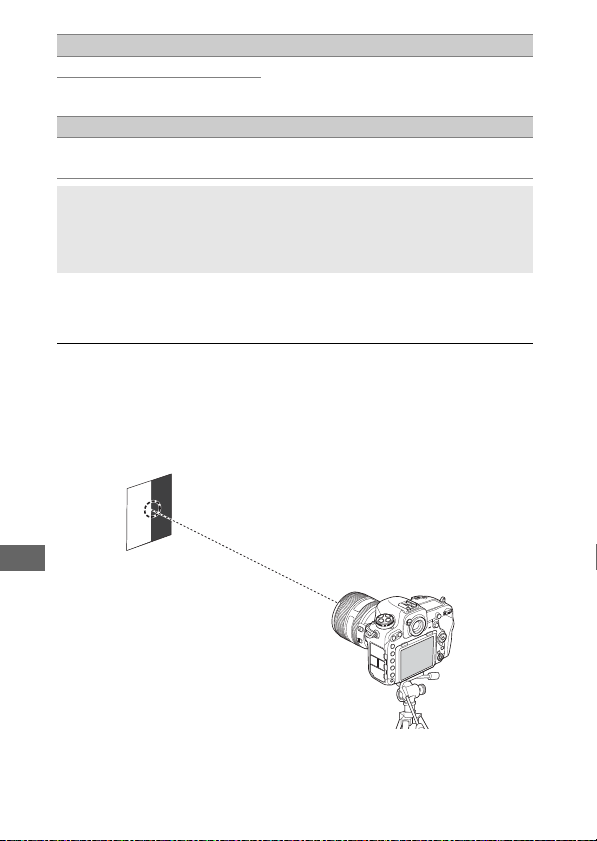
310
❚❚ Auto AF Fine-Tuning
Auto AF fine-tuning is performed as described below.
1 Ready the camera.
Mount the camera on a tripod and aim the camera at a flat,
high-contrast subject parallel to the camera focal plane.
Note
that auto AF fine-tuning works best at maximum aperture
and may not function in dark surroundings.
Reset all settings
Reset Reset all settings apart from the options
selected for Language and Time zone
and date in the setup menu.
Do not reset
Firmware version
View the current camera firmware
version.
D Reset All Settings
Copyright information, IPTC presets, and other user-generated entries
are also reset.
We recommend that you save settings using the Save/
load settings option in the setup menu before performing a reset.
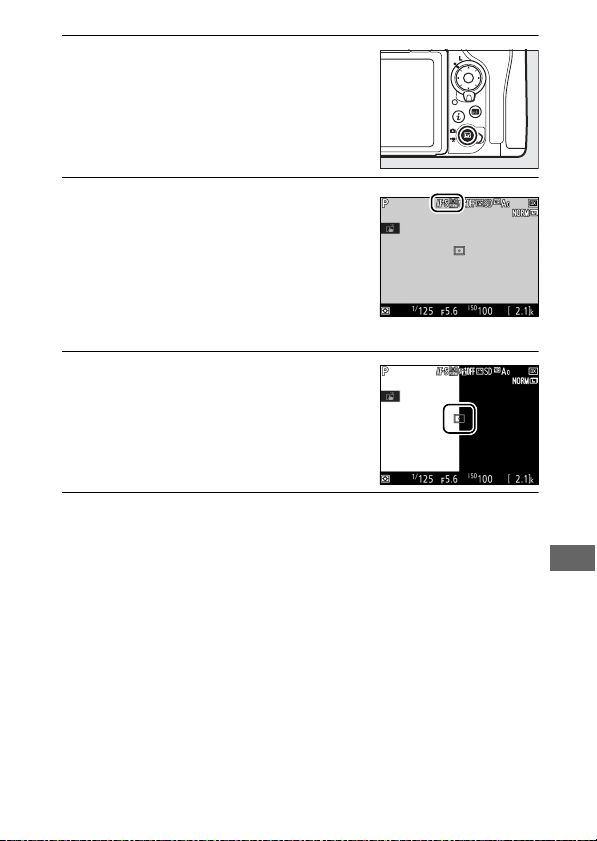
311
2 Start live view.
Rotate the live view selector to C and
press the a button.
3 Adjust focus settings.
Rotate the focus-mode selector to AF
and use the AF-mode button and
command dials to select the
following:
• Autofocus mode: AF-S
• AF-area mode: 5 (wide) or 6 (normal)
4 Select the center focus point.
Press the center of the multi selector
to select the center focus point.
5 Focus.
Press the shutter-release button halfway to focus, then zoom
in on the view through the lens to confirm that the subject is
in focus.
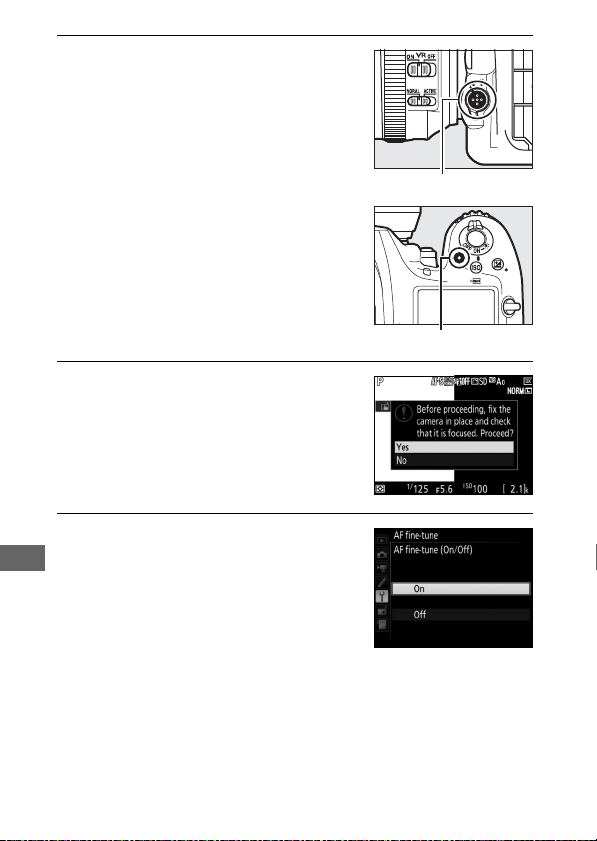
312
6 Perform auto AF fine-tuning.
Press the AF-mode and movie-record
buttons simultaneously and keep
them pressed until the dialog shown
in Step 7 is displayed (this should take
slightly over two seconds).
7 Save the new value.
Highlight Ye s and press J to add the
AF fine-tuning value for the current
lens to the saved values list (CPU
lenses only).
Note that only one value
can be stored for each type of lens.
8 Enable AF fine-tuning.
In the camera setup menu, select AF
fine-tune> AF fine-tune (On/Off),
then highlight On and press J.
AF-mode button
Movie-record button
313
N The Retouch Menu:
Creating Retouched Copies
NEF (RAW) processing
Create JPEG copies of NEF (RAW)
photographs (0 316).
Trim
Create a cropped copy of the selected
photograph (0 318).
Resize
Select image Create small copies of selected
photographs.
Choose destination
Choose size
D-Lighting
Brighten shadows.
Choose for dark or
backlit photographs.
Red-eye correction
Correct “red-eye” in photos taken with a
flash.
Straighten
Create straightened copies.
Copies can
be straightened by up to 5° in
increments of approximately 0.25°.
Distortion control
Auto Create copies with reduced peripheral
distortion.
Use to reduce barrel
distortion in photos taken with wide-
angle lenses or pin-cushion distortion in
photos taken with telephoto lenses.
Select Auto to let the camera correct
distortion automatically.
Manual
314
Perspective control
Create copies that reduce the effects of
perspective taken from the base of a tall
object.
Filter effects
Skylight Create the effects of the following
filters:
• Skylight: A skylight filter effect
• Warm filter: A warm tone filter effect
Warm filter
Monochrome
Black-and-white Copy photographs in Black-and-white,
Sepia, or Cyanotype (blue and white
monochrome).
Sepia
Cyanotype
Image overlay
Image overlay combines two existing
NEF (RAW) photographs to create a
single picture that is saved separately
from the originals (0 319).
Image
overlay can only be selected by
pressing G and selecting N tab.
Edit movie
Choose start/end point Trim footage to create edited copies of
movies or save selected frames as JPEG
stills (0 82).
Save selected frame
Side-by-side comparison
Compare retouched copies to the
original photographs.
Side-by-side
comparison is only available if the
retouch menu is displayed by pressing
2 while pressing and holding the J
button or by pressing i and selecting
Retouch in full-frame playback when a
retouched image or original is
displayed.
315
O My Menu/m Recent Settings
Add items
PLAYBACK MENU Create a custom menu of up to 20 items
selected from the playback, photo
shooting, movie shooting, Custom
Setting, setup, and retouch menus.
PHOTO SHOOTING MENU
MOVIE SHOOTING MENU
CUSTOM SETTING MENU
SETUP MENU
RETOUCH MENU
Remove items
Delete items from My Menu.
Rank items
Rank items in My Menu.
Choose tab (defaults to MY MENU)
MY MENU Choose the menu displayed in the “My
Menu/Recent Settings” tab.
Select
RECENT SETTINGS to display a menu
listing the 20 most recently-used
settings.
RECENT SETTINGS
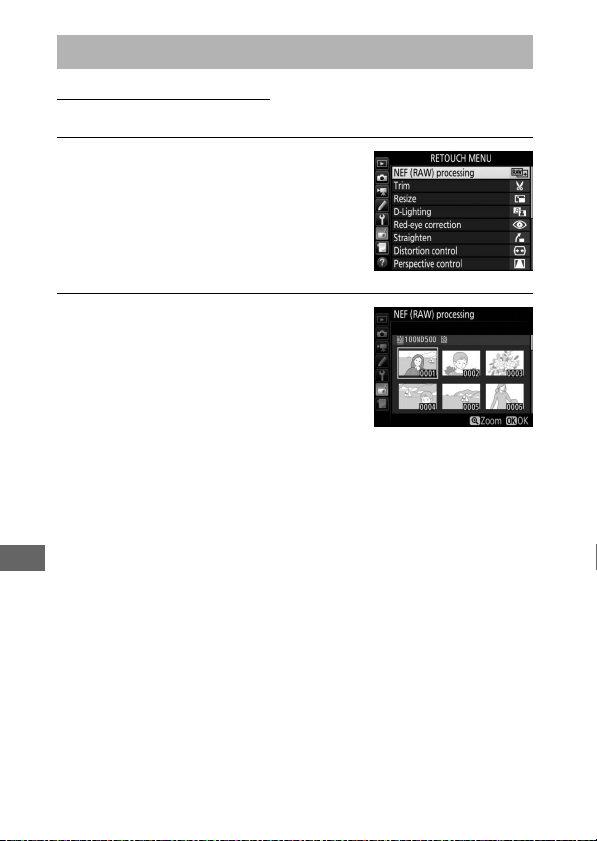
316
NEF (RAW) Processing
Create JPEG copies of NEF (RAW) photographs.
1 Select NEF (RAW) processing.
Highlight NEF (RAW) processing in
the retouch menu and press 2 to
display a picture selection dialog
listing only NEF (RAW) images created
with this camera.
2 Select a photograph.
Use the multi selector to highlight a
photograph (to view the highlighted
photograph full frame, press and hold
the X button).
Press J to select the
highlighted photograph and proceed
to the next step.
Retouch Menu Options
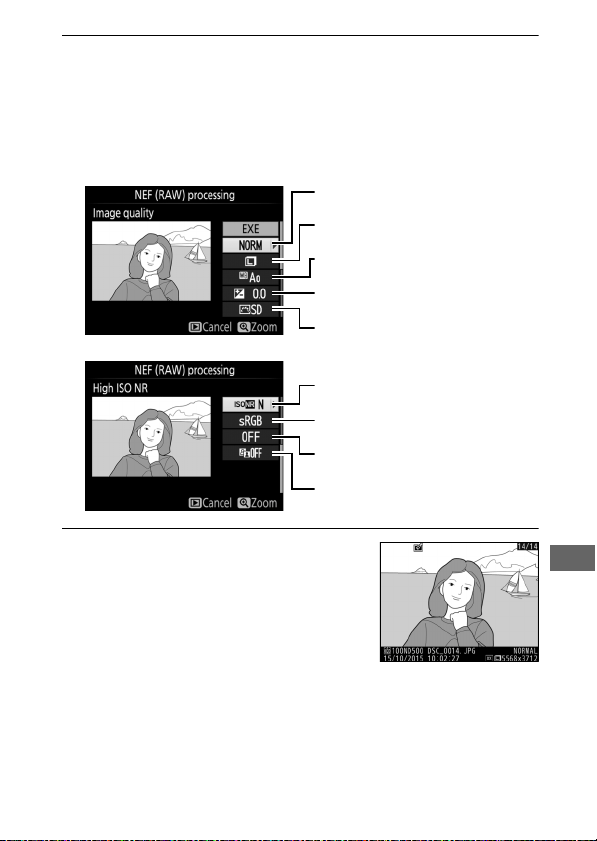
317
3 Choose settings for the JPEG copy.
Adjust the settings listed below.
Note that white balance and
vignette control are not available with multiple exposures or
pictures created with image overlay and that exposure
compensation can only be set to values between –2 and
+2 EV.
4 Copy the photograph.
Highlight EXE and press J to create a
JPEG copy of the selected
photograph.
To exit without copying
the photograph, press the G
button.
Image quality (0 91)
Image size (0 94)
White balance (0 159)
Exposure compensation (0 143)
Set Picture Control (0 180)
High ISO NR (0 286)
Color space (0 286)
Vignette control (0 286)
D-Lighting (0 313)

318
Trim
Create a cropped copy of the selected photograph.
The selected
photograph is displayed with the selected crop shown in yellow;
create a cropped copy as described in the following table.
To Use Description
Reduce size of
crop
W (M)
Press W (M) to reduce the size of the crop.
Increase size of
crop
X
Press X to increase the size of the crop.
Change crop
aspect ratio
Rotate the main command dial to choose the
aspect ratio.
Position crop
Use multi selector to position the crop.
Press
and hold to move the crop rapidly to the
desired position.
Preview crop
Press center of multi selector to preview
cropped image.
Create copy
J
Save the current crop as a separate file.
A Trim: Image Quality and Size
Copies created from NEF (RAW), NEF
(RAW) + JPEG, or TIFF (RGB) photos have an
image quality (0 91) of JPEG fine★;
cropped copies created from JPEG photos
have the same image quality as the
original.
The size of the copy varies with
crop size and aspect ratio and appears at
upper left in the crop display.
A Viewing Cropped Copies
Playback zoom may not be available when cropped copies are
displayed.
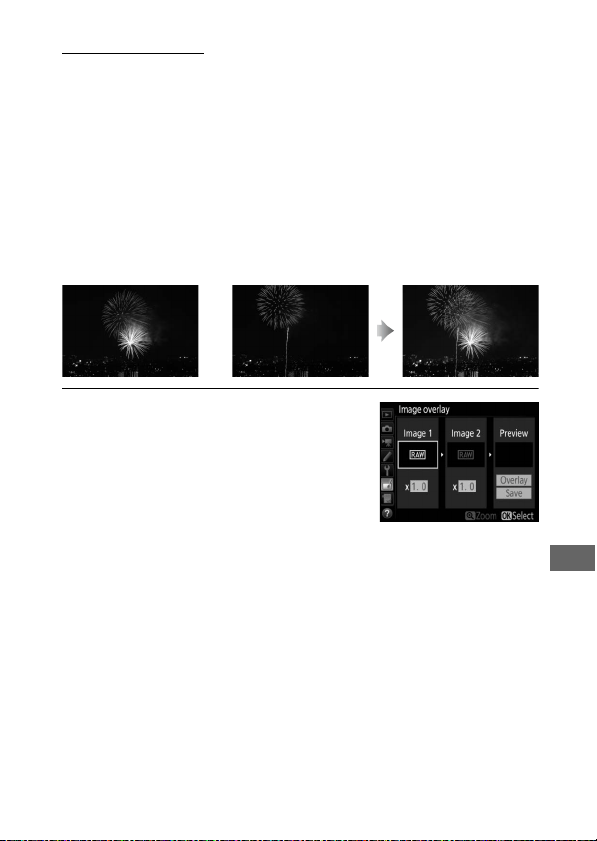
319
Image Overlay
Image overlay combines two existing NEF (RAW) photographs to
create a single picture that is saved separately from the originals;
the results, which make use of RAW data from the camera image
sensor, are noticeably better than photographs combined in an
imaging application.
The new picture is saved at current image
quality and size settings; before creating an overlay, set image
quality and size (0 91, 94; all options are available).
To create a
NEF (RAW) copy, choose an image quality of NEF (RAW) and an
image size of Large (the overlay will be saved as a large NEF/
RAW image even if Small or Medium is selected).
1 Select Image overlay.
Highlight Image overlay in the
retouch menu and press 2.
The
dialog shown at right will be
displayed, with Image 1 highlighted;
press J to display a picture selection
dialog listing only large NEF (RAW)
images created with this camera (small and medium NEF/
RAW images can not be selected).
+
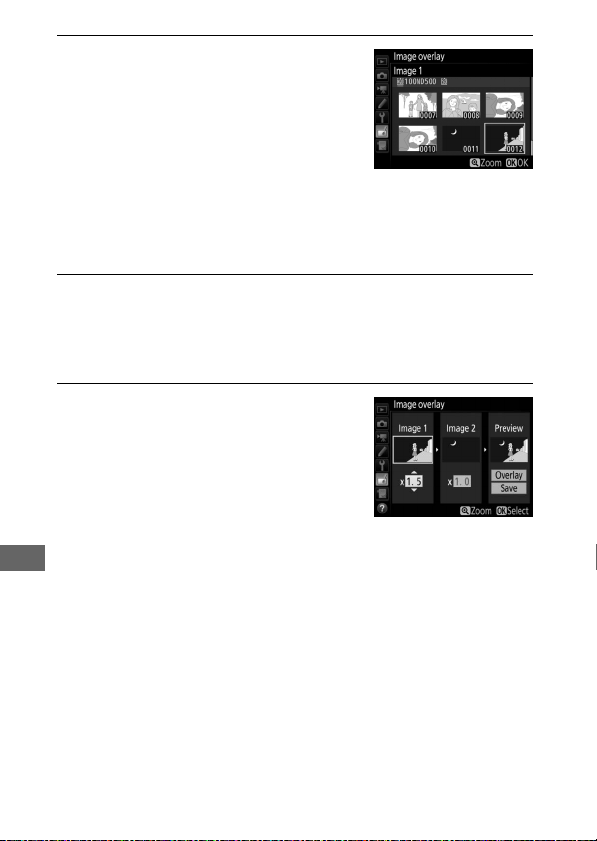
320
2 Select the first image.
Use the multi selector to highlight the
first photograph in the overlay.
To
view the highlighted photograph full
frame, press and hold the X button.
To view images in other locations,
press W (M) and select the desired
card and folder as described on page 256.
Press J to select
the highlighted photograph and return to the preview
display.
3 Select the second image.
The selected image will appear as Image 1.
Highlight
Image 2 and press J, then select the second photo as
described in Step 2.
4 Adjust gain.
Highlight Image 1 or Image 2 and
optimize exposure for the overlay by
pressing 1 or 3 to select the gain
from values between 0.1 and 2.0.
Repeat for the second image.
The
default value is 1.0; select 0.5 to halve
gain or 2.0 to double it.
The effects of gain are visible in the
Preview column.
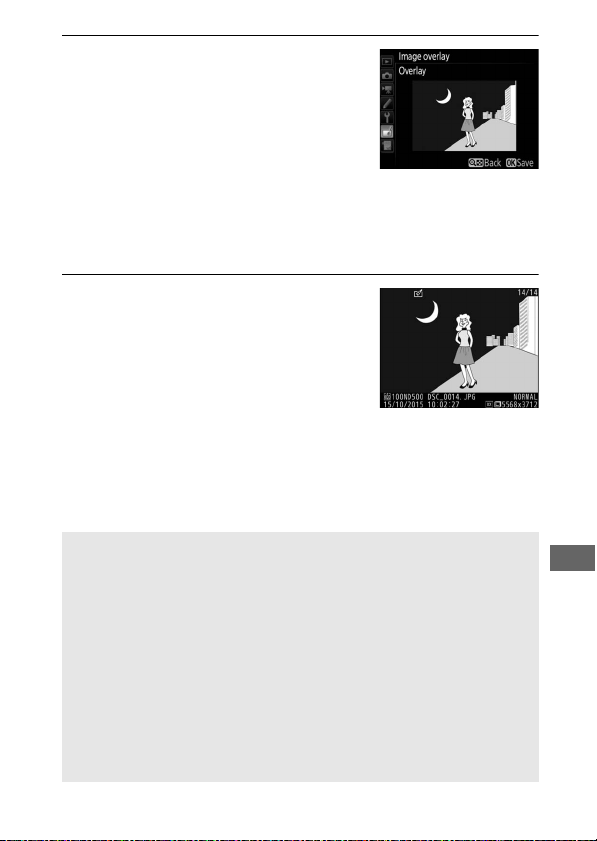
321
5 Preview the overlay.
To preview the composition as shown
at right, press 4 or 2 to place the
cursor in the Preview column, then
press 1 or 3 to highlight Overlay
and press J (note that colors and
brightness in the preview may differ
from the final image).
To save the overlay without displaying
a preview, select Save.
To return to Step 4 and select new
photos or adjust gain, press W (M).
6 Save the overlay.
Press J while the preview is displayed
to save the overlay.
After an overlay is
created, the resulting image will be
displayed full-frame in the monitor.
D Image Overlay
Only large NEF (RAW) photographs with the same image area and bit-
depth can be combined.
The overlay has the same photo info (including date of recording,
metering, shutter speed, aperture, exposure mode, exposure
compensation, focal length, and image orientation) and values for
white balance and Picture Control as the photograph selected for
Image 1.
The current image comment is appended to the overlay
when it is saved; copyright information, however, are not copied.
Overlays saved in NEF (RAW) format use the compression selected for
NEF (RAW) compression in the NEF (RAW) recording menu and have
the same bit depth as the original images.
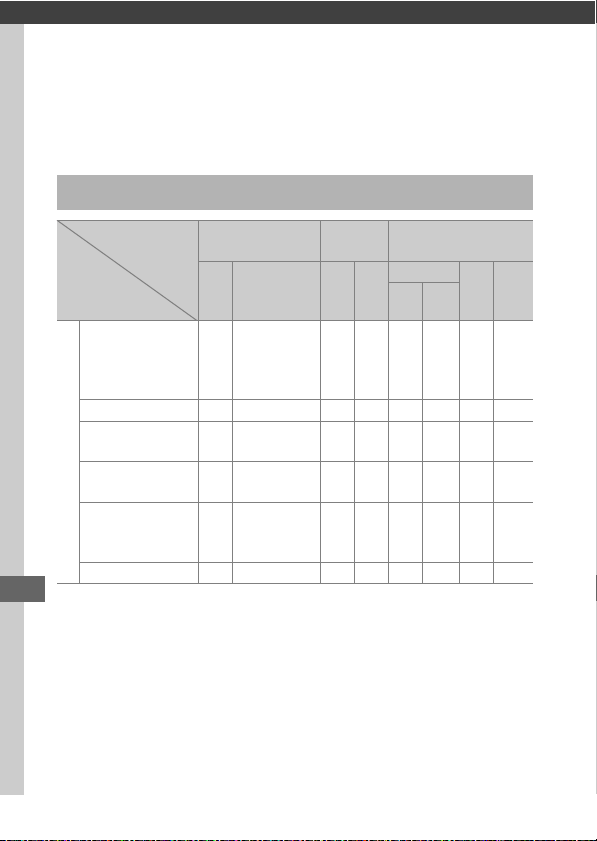
322
Technical Notes
Read this chapter for information on compatible accessories,
cleaning and storing the camera, and what to do if an error
message is displayed or you encounter problems using the
camera.
Compatible Lenses
Camera setting
Focus mode
Exposure
mode
Metering system
Lens/accessory
AF
M (with
electronic
rangefinder)
1
P
S
A
M
L
2
M
3
N
4
t
5
3D Color
CPU lenses
6
Type G, E, or D AF
NIKKOR
7
AF-S, AF-P, AF-I
NIKKOR
✔✔✔✔✔— ✔
8
✔
PC-E NIKKOR series — ✔
9
✔
9
✔
9
✔
9
—
✔
8, 9
✔
PC Micro 85mm
f/2.8D
10
— ✔
9
— ✔
11
✔ — ✔
8, 9
✔
AF-S / AF-I
Teleconverter
12
✔✔✔✔✔— ✔
8
✔
Other AF NIKKOR
(except lenses for
F3AF)
✔
13
✔
13
✔✔— ✔✔
8
—
AI-P NIKKOR — ✔
14
✔✔— ✔✔
8
—
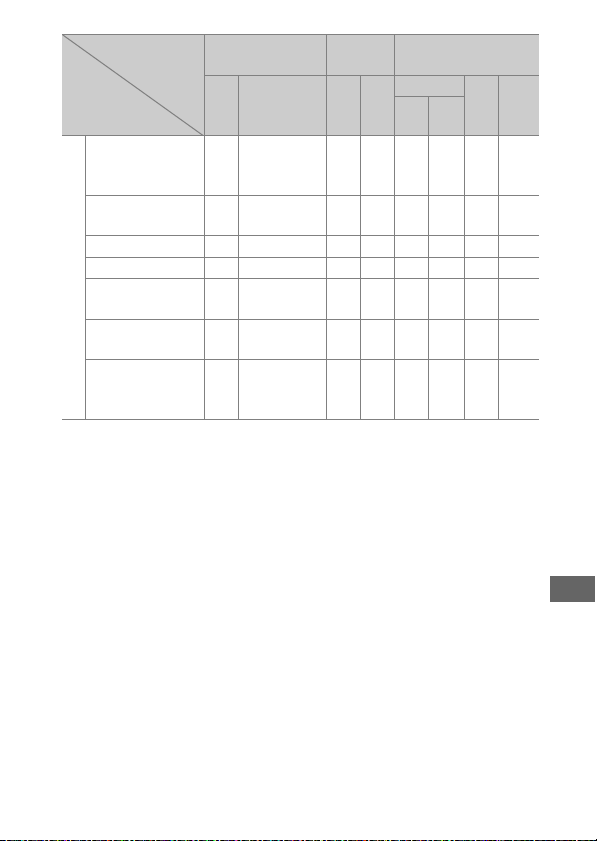
323
1 Manual focus available with all lenses.
2Matrix.
3 Center-weighted.
4Spot.
5 Highlight-weighted.
6 IX-NIKKOR lenses can not be used.
7 Vibration Reduction (VR) supported with VR lenses.
8 Spot metering meters selected focus point (0 128).
9 Can not be used with shifting or tilting.
10 The camera’s exposure metering and flash control systems do not work properly when shifting
and/or tilting the lens, or when an aperture other than the maximum aperture is used.
11 Manual exposure mode only.
12 For information on the focus points available for autofocus and electronic rangefinding, see
page 99.
Non-CPU lenses
15
AI-, AI-modified
NIKKOR or Nikon Series
E lenses
16
— ✔
14
— ✔
17
— ✔
18
✔
19
—
Medical-NIKKOR
120mm f/4
— ✔ — ✔
20
————
Reflex-NIKKOR — — — ✔
17
——✔
19
—
PC-NIKKOR — ✔
9
— ✔
21
——✔ —
AI-type
Teleconverter
22
— ✔
23
— ✔
17
— ✔
18
✔
19
—
PB-6 Bellows Focusing
Attachment
24
— ✔
23
— ✔
25
——✔ —
Auto extension rings
(PK-series 11A, 12, or
13; PN-11)
— ✔
23
— ✔
17
——✔ —
Camera setting
Focus mode
Exposure
mode
Metering system
Lens/accessory
AF
M (with
electronic
rangefinder)
1
P
S
A
M
L
2
M
3
N
4
t
5
3D Color

324
13 When focusing at minimum focus distance with AF 80–200mm f/2.8,
AF 35–70mm f/2.8, AF 28–85mm f/3.5–4.5 <New>, or AF 28–85mm f/3.5–4.5 lens at
maximum zoom, in-focus indicator may be displayed when image on matte screen in
viewfinder is not in focus.
Adjust focus manually until image in viewfinder is in focus.
14 With maximum aperture of f/5.6 or faster.
15 Some lenses can not be used (see page 326).
16 Range of rotation for AI 80–200mm f/2.8 ED tripod mount is limited by camera body.
Filters
can not be exchanged while AI 200–400mm f/4 ED is mounted on camera.
17 If maximum aperture is specified using Non-CPU lens data (0 250), aperture value
will be displayed in viewfinder and control panel.
18 Can be used only if lens focal length and maximum aperture are specified using Non-CPU
lens data (0 250).
Use spot or center-weighted metering if desired results are not
achieved.
19 For improved precision, specify lens focal length and maximum aperture using Non-CPU
lens data (0 250).
20 Can be used in manual exposure mode at shutter speeds slower than flash sync speed by one
step or more.
21 Exposure determined by presetting lens aperture.
In aperture-priority auto exposure mode,
preset aperture using lens aperture ring before performing AE lock and shifting lens.
In manual
exposure mode, preset aperture using lens aperture ring and determine exposure before
shifting lens.
22 Exposure compensation required when used with AI 28–85mm f/3.5–4.5,
AI 35–105mm f/3.5–4.5, AI 35–135mm f/3.5–4.5, or AF-S 80–200mm f/2.8D.
23 With maximum effective aperture of f/5.6 or faster.
24 Requires PK-12 or PK-13 auto extension ring.
PB-6D may be required depending on camera
orientation.
25 Use preset aperture.
In aperture-priority auto exposure mode, set aperture using focusing
attachment before determining exposure and taking photograph.
• PF-4 Reprocopy Outfit requires PA-4 Camera Holder.
• Noise in the form of lines may appear during autofocus at high ISO sensitivities.
Use manual
focus or focus lock.
Lines may also appear at high ISO sensitivities when aperture is adjusted
during movie recording or live view photography.
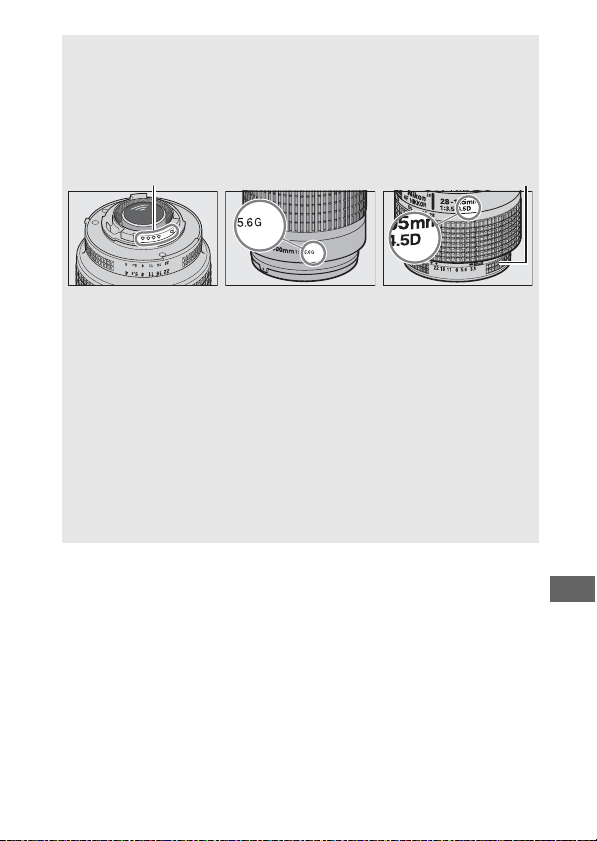
325
A Recognizing CPU and Type G, E, and D Lenses
CPU lenses (particularly types G, E, and D) are recommended, but note
that IX-NIKKOR lenses can not be used.
CPU lenses can be identified by
the presence of CPU contacts, type G, E, and D lenses by a letter on the
lens barrel.
Type G and E lenses are not equipped with a lens aperture
ring.
CPU contacts Aperture ring
CPU lens Type G/E lens Type D lens
A Lens f-number
The f-number given in lens names is the maximum aperture of the
lens.
A Compatible Non-CPU Lenses
Non-CPU lens data (0 250) can be used to enable many of the
features available with CPU lenses, including color matrix metering; if
no data are provided, center-weighted metering will be used in place
of color matrix metering, while if the maximum aperture is not
provided, the camera aperture display will show the number of stops
from maximum aperture and the actual aperture value must be read
off the lens aperture ring.

326
D Incompatible Accessories and Non-CPU Lenses
The following can
NOT be used with the D500:
• TC-16A AF teleconverter
• Non-AI lenses
• Lenses that require the AU-1 focusing unit
(400mm f/4.5, 600mm f/5.6, 800mm f/8,
1200mm f/11)
• Fisheye (6mm f/5.6, 7.5mm f/5.6, 8mm f/8,
OP 10mm f/5.6)
• 2.1cm f/4
• Extension Ring K2
• 180–600mm f/8 ED (serial numbers
174041–174180)
• 360–1200mm f/11 ED (serial numbers
174031–174127)
• 200–600mm f/9.5 (serial numbers
280001–300490)
• AF lenses for the F3AF (AF 80mm
f/2.8, AF 200mm f/3.5 ED,
AF Teleconverter TC-16)
• PC 28mm f/4 (serial number 180900 or
earlier)
• PC 35mm f/2.8 (serial numbers 851001–
906200)
• PC 35mm f/3.5 (old type)
• Reflex 1000mm f/6.3 (old type)
• Reflex 1000mm f/11 (serial numbers
142361–143000)
• Reflex 2000mm f/11 (serial numbers
200111–200310)
A VR Lenses
The lenses listed below are not recommended for long exposures or
photographs taken at high ISO sensitivities, as due to the design of the
vibration reduction (VR) control system the resulting photos may be
marred by fog.
We recommend turning vibration reduction off when
using other VR lenses.
• AF-S VR Zoom-Nikkor 24–120mm
f/3.5–5.6G IF-ED
• AF-S VR Zoom-Nikkor 70–200mm f/2.8G
IF-ED
• AF-S VR Zoom-Nikkor 70–300mm
f/4.5–5.6G IF-ED
• AF-S VR Nikkor 200mm f/2G IF-ED
• AF-S VR Nikkor 300mm f/2.8G IF-ED
• AF-S NIKKOR 16–35mm f/4G ED VR
• AF-S NIKKOR 24–120mm f/4G ED VR
• AF-S NIKKOR 28–300mm f/3.5–5.6G ED VR
• AF-S NIKKOR 400mm f/2.8G ED VR
• AF-S NIKKOR 500mm f/4G ED VR
• AF-S DX VR Zoom-Nikkor 18–200mm
f/3.5–5.6G IF-ED
• AF-S DX NIKKOR 16–85mm f/3.5–5.6G ED
VR
• AF-S DX NIKKOR 18–200mm
f/3.5–5.6G ED VR II
• AF-S DX Micro NIKKOR 85mm f/3.5G ED VR
• AF-S DX NIKKOR 55–300mm
f/4.5–5.6G ED VR
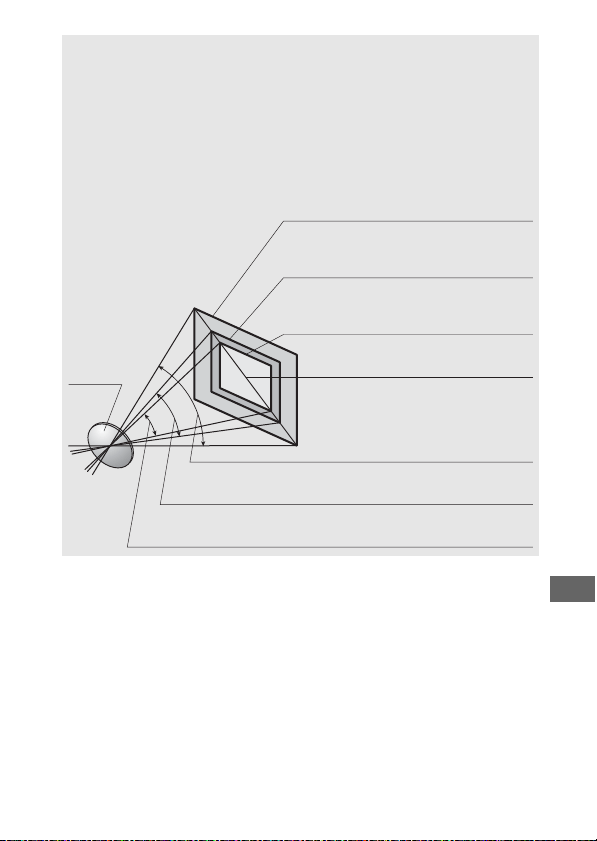
327
A Calculating Angle of View
The size of the area exposed by a 35mm camera is 36 × 24 mm.
The
size of the area exposed by the D500 when DX (24×16) is selected for
Choose image area in the photo shooting menu, in contrast, is
23.5 × 15.7 mm, meaning that the angle of view of a 35mm camera is
approximately 1.5 times that of the D500 (when 1.3× (18×12) is
selected, the size of the area exposed decreases, further reducing the
angle of view by about 1.3×).
Lens
35 mm format picture size (36 × 24 mm)
Picture diagonal
Picture size when 1.3× (18×12) is selected for
Choose image area (18.0 × 12.0 mm)
35 mm format angle of view
Angle of view when 1.3× (18×12) is selected for
Choose image area
Picture size when DX (24×16) is selected for
Choose image area (23.5 × 15.7 mm)
Angle of view when DX (24×16) is selected for
Choose image area
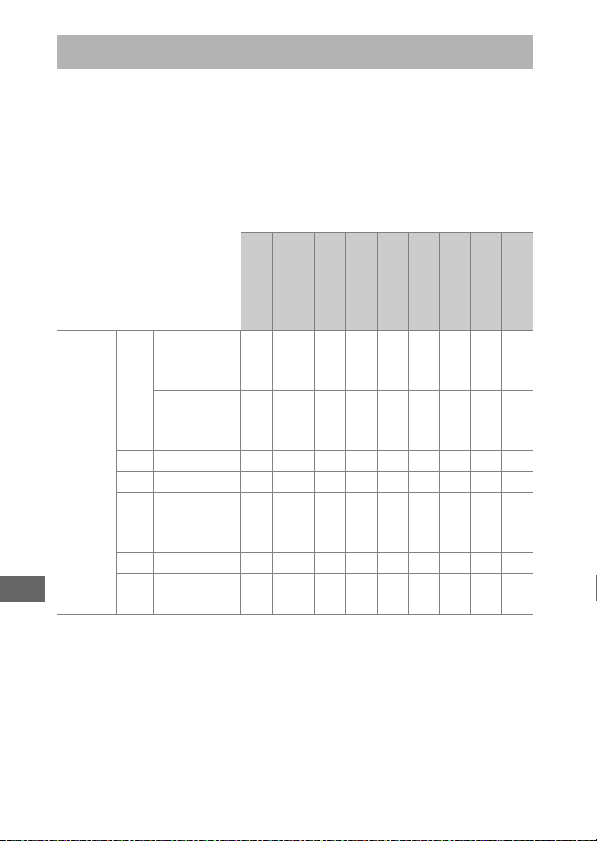
328
Nikon’s advanced Creative Lighting System (CLS) offers
improved communication between the camera and compatible
flash units for improved flash photography.
❚❚ CLS-Compatible Flash Units
The following features are available with CLS-compatible flash
units:
The Nikon Creative Lighting System (CLS)
SB-5000
SB-910, SB-900,
SB-800
SB-700
SB-600
SB-500
SU-800
SB-R200
SB-400
SB-300
Single flash
i-TTL
i-TTL balanced
fill-flash for
digital SLR
1
✔✔✔✔✔——✔✔
Standard i-TTL
fill-flash for
digital SLR
✔
2
✔
2
✔✔
2
✔ ——✔✔
qA Auto aperture ✔✔
3
———————
ANon-TTL auto—
4
✔
3
———————
GN
Distance-
priority
manual
✔✔✔——————
M Manual ✔✔✔✔✔
5
——✔
5
✔
5
RPT
Repeating
flash
✔✔———————
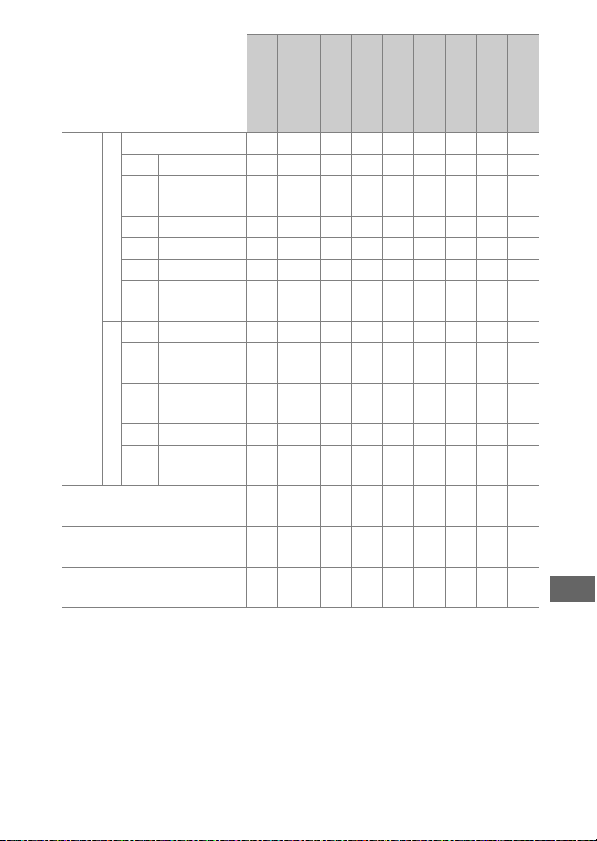
329
Optical Advanced
Wireless Lighting
Master
Remote flash control ✔✔✔— ✔
5
✔ ———
i-TTL i-TTL ✔✔✔— ✔
5
————
[A:B]
Quick wireless
flash control
✔ — ✔ ——✔
6
———
qAAuto aperture ✔✔———————
A Non-TTL auto ——
7
———————
M Manual ✔✔✔— ✔
5
————
RPT
Repeating
flash
✔✔———————
Remote
i-TTL i-TTL ✔ ✔ ✔✔✔— ✔ ——
[A:B]
Quick wireless
flash control
✔ ✔ ✔✔✔— ✔ ——
q
A/A
Auto aperture/
Non-TTL auto
✔
8
✔
8
———————
M Manual ✔ ✔ ✔✔✔— ✔ ——
RPT
Repeating
flash
✔ ✔ ✔✔✔————
Radio-controlled Advanced Wireless
Lighting
✔
9
— ———————
Color Information Communication
(flash)
✔ ✔ ✔✔✔——✔✔
Color Information Communication
(LED light)
————✔ ————
SB-5000
SB-910, SB-900,
SB-800
SB-700
SB-600
SB-500
SU-800
SB-R200
SB-400
SB-300
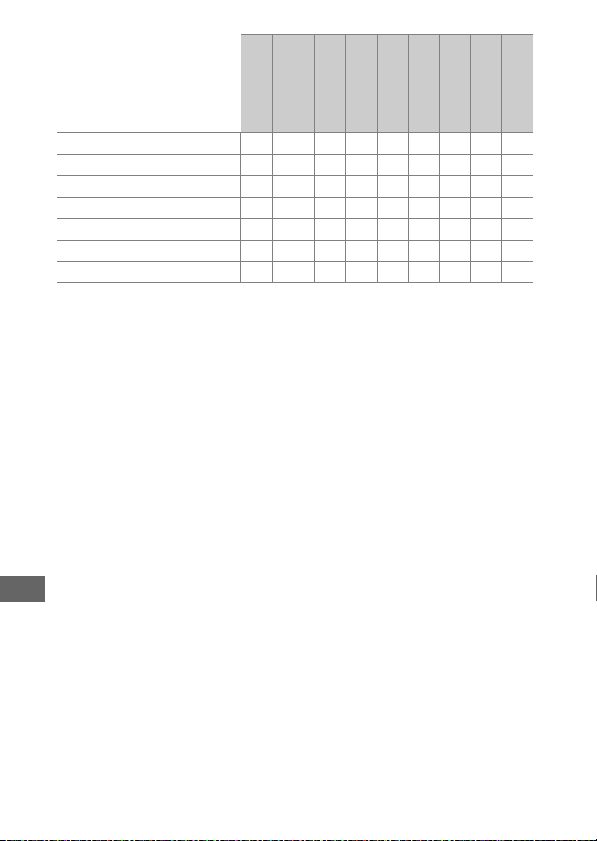
330
1 Not available with spot metering.
2 Can also be selected with flash unit.
3 qA/A mode selection performed on flash unit using custom settings.
Unless lens data have
been provided using the Non-CPU lens data option in the setup menu, “A” will be
selected when a non-CPU lens is used.
4 Unless lens data have been provided using the Non-CPU lens data option in the setup
menu, non-TTL auto will be selected when a non-CPU lens is used.
5 Can only be selected with camera.
6 Available only during close-up photography.
7 Unless lens data have been provided using the Non-CPU lens data option in the setup
menu, non-TTL auto (A) is used with non-CPU lenses, regardless of mode selected with flash
unit.
8Choice of qA and A depends on the option selected with master flash.
9 Supports the same features as remote flash units with optical AWL.
10 Available only in i-TTL, qA, A, GN, and M flash-control modes.
11 Available only in i-TTL flash control mode or when flash is set to emit monitor pre-flashes in
qA or A flash control mode.
12 Available only in commander mode.
13 Firmware updates for the SB-910 and SB-900 can be performed from the camera.
Auto FP High-Speed Sync
10
✔✔✔✔✔✔✔——
FV lock
11
✔ ✔ ✔✔✔✔✔✔✔
AF-assist for multi-area AF ✔✔✔✔— ✔
12
———
Red-eye reduction ✔✔✔✔✔——✔ —
Camera modeling illumination ✔✔✔✔✔✔✔——
Unified flash control ✔ ———✔ ——✔✔
Camera flash unit firmware update ✔✔
13
✔ — ✔ ———✔
SB-5000
SB-910, SB-900,
SB-800
SB-700
SB-600
SB-500
SU-800
SB-R200
SB-400
SB-300

331
The SU-800 Wireless Speedlight Commander: When mounted on a CLS-
compatible camera, the SU-800 can be used as a commander for
SB-5000, SB-910, SB-900, SB-800, SB-700, SB-600, SB-500, or
SB-R200 flash units in up to three groups.
The SU-800 itself is not
equipped with a flash.
A Modeling Illumination
CLS-compatible flash units emit a modeling flash when the camera Pv
button is pressed.
This feature can be used with Advanced Wireless
Lighting to preview the total lighting effect achieved with multiple
flash units.
Modeling illumination can be turned off using Custom
Setting e5 (Modeling flash, 0 300).
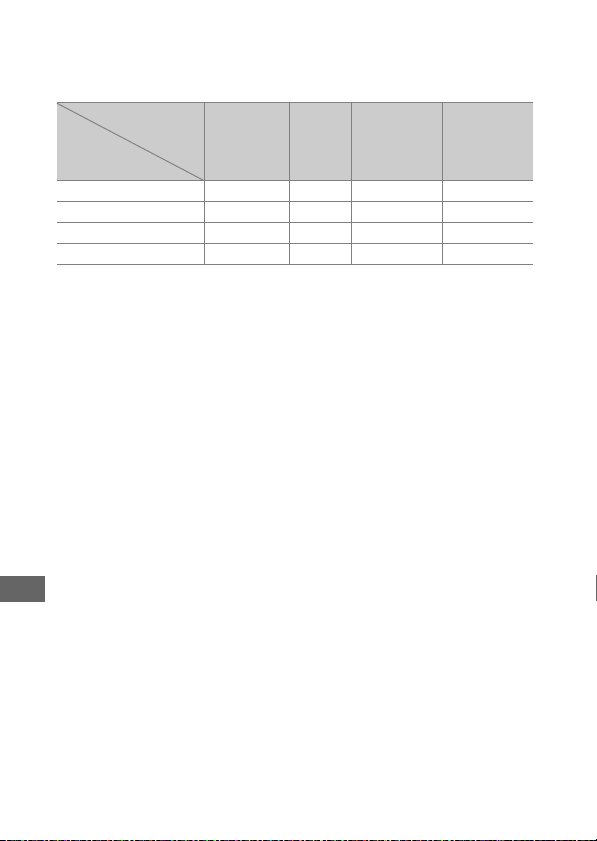
332
❚❚ Other Flash Units
The following flash units can be used in non-TTL auto and
manual modes.
Flash unit SB-80DX,
SB-28DX,
SB-28, SB-26,
SB-25, SB-24
SB-50DX
SB-30, SB-27
1
,
SB-22S, SB-22,
SB-20, SB-16B,
SB-15
SB-23, SB-29
2
,
SB-21B
2
,
SB-29S
2
Flash mode
A Non-TTL auto ✔ — ✔ —
M Manual ✔✔ ✔ ✔
G Repeating flash ✔ —— —
REAR Rear-curtain sync
3
✔✔ ✔ ✔
1 Flash mode is automatically set to TTL and shutter-release is disabled.
Set flash unit to A (non-
TTL auto flash).
2 Autofocus is available with AF-S VR Micro-Nikkor 105mm f/2.8G IF-ED and AF-S Micro NIKKOR
60mm f/2.8G ED lenses only.
3 Available when camera is used to select flash mode.
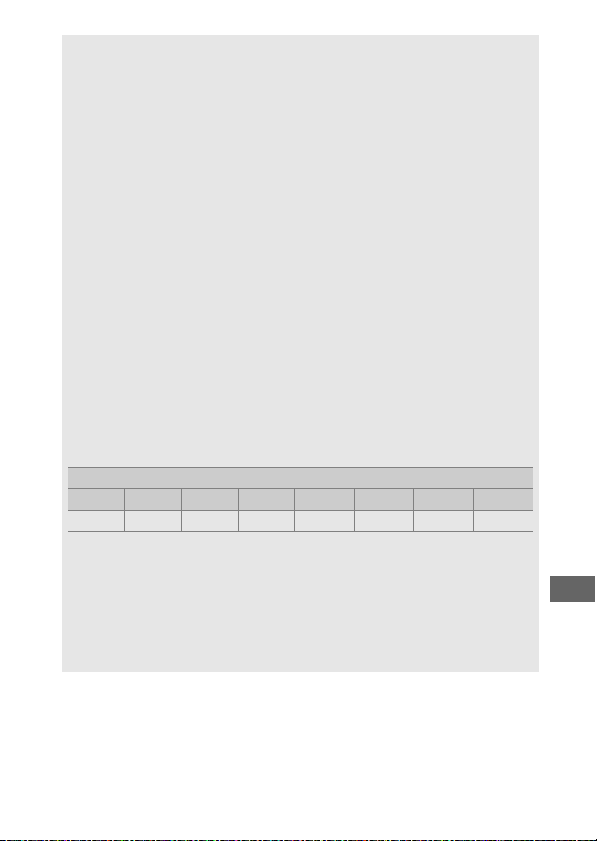
333
D Notes on Optional Flash Units
Refer to the flash unit manual for detailed instructions.
If the unit
supports CLS, refer to the section on CLS-compatible digital SLR
cameras.
The D500 is not included in the “digital SLR” category in the
SB-80DX, SB-28DX, and SB-50DX manuals.
i-TTL flash control can be used at ISO sensitivities between 100 and
12800.
At values over 12800, the desired results may not be achieved
at some ranges or aperture settings.
If the flash-ready indicator (M)
flashes for about three seconds after a photograph is taken in i-TTL or
non-TTL auto mode, the flash has fired at full power and the
photograph may be underexposed (CLS-compatible flash units only).
When an SC-series 17, 28, or 29 sync cable is used for off-camera flash
photography, correct exposure may not be achieved in i-TTL mode.
We recommend that you select standard i-TTL fill-flash.
Take a test
shot and view the results in the monitor.
In i-TTL, use the flash panel or bounce adapter provided with the flash
unit.
Do not use other panels such as diffusion panels, as this may
produce incorrect exposure.
In exposure mode P, the maximum aperture (minimum f-number) is
limited according to ISO sensitivity, as shown below:
Maximum aperture at ISO equivalent of:
100 200 400 800 1600 3200 6400 12800
4 4.8 5.6 6.7 8 9.5 11 13
If the maximum aperture of the lens is smaller than given above, the
maximum value for aperture will be the maximum aperture of the lens.
Noise in the form of lines may appear in flash photographs taken with
an SD-9 or SD-8A power pack attached directly to the camera.
Reduce
ISO sensitivity or increase the distance between the camera and the
power pack.
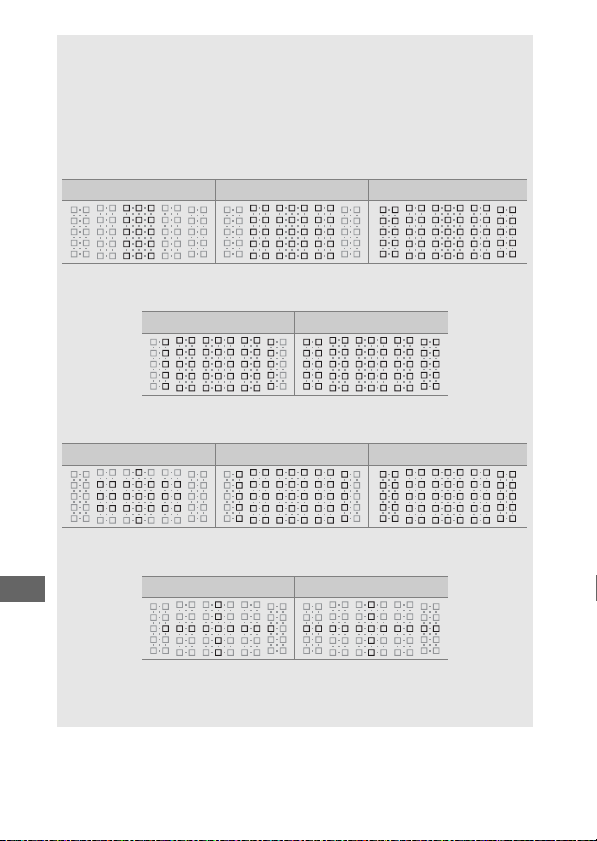
334
A Notes on Optional Flash Units (Continued)
The SB-5000, SB-910, SB-900, SB-800, SB-700, SB-600, SB-500, and
SB-400 provide red-eye reduction, while the SB-5000, SB-910, SB-900,
SB-800, SB-700, SB-600, and SU-800 provide AF-assist illumination
with the following restrictions:
• SB-5000: AF-assist illumination is available when 24–135 mm AF lenses
are used with the focus points shown below.
24–49 mm 50–84 mm 85–135 mm
• SB-910 and SB-900: AF-assist illumination is available when 17–135 mm
AF lenses are used with the focus points shown below.
17–19 mm 20–135 mm
• SB-800, SB-600, and SU-800: AF-assist illumination is available when 24–
105 mm AF lenses are used with the focus points shown below.
24–34 mm 35–49 mm 50–105 mm
• SB-700: AF-assist illumination is available when 24–135 mm AF lenses
are used with the focus points shown below.
24–27 mm 28–135 mm
Depending on the lens used and scene recorded, the in-focus indicator
(I) may be displayed when the subject is not in focus, or the camera
may be unable to focus and the shutter release will be disabled.
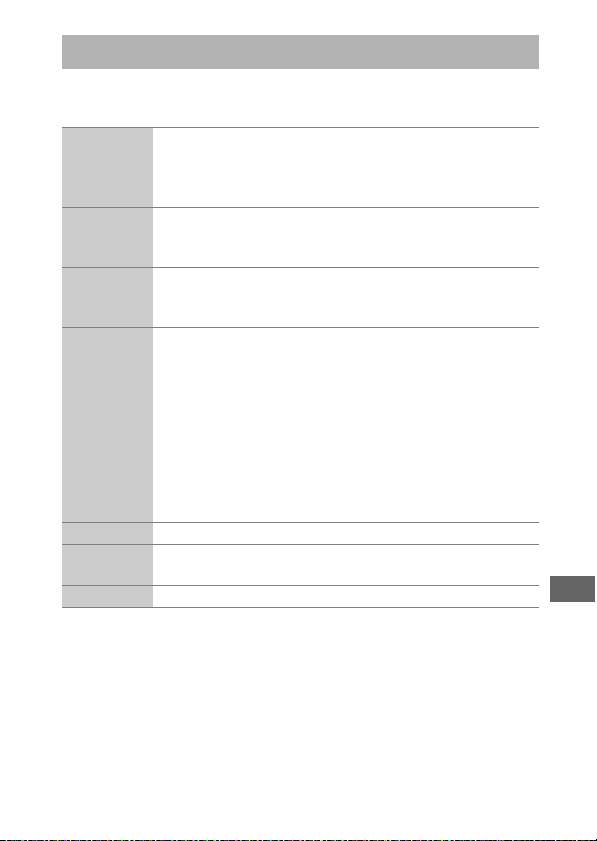
335
At the time of writing, the following accessories were available
for the D500.
Other Accessories
Power sources • Rechargeable Li-ion Battery EN-EL15 (0 13, 375)
• Battery Charger MH-25a (0 13, 375)
• Multi-Power Battery Pack MB-D17
• Power Connector EP-5B, AC Adapter EH-5b
Wireless
transmitters
(0 308)
Wireless Transmitter WT-7
Wireless
remote
controllers
• Wireless Remote Controller WR-R10/WR-T10
• Wireless Remote Controller WR-1
Viewfinder
eyepiece
accessories
• Rubber Eyecup DK-19
• Diopter-Adjustment Viewfinder Lens DK-17C
• Magnifying Eyepiece DK-17M
• Eyepiece Magnifier DG-2
• Eyepiece Adapter DK-18
• Antifog Finder Eyepiece DK-14/Antifog Finder Eyepiece
DK-17A
• Fluorine-Coated Finder Eyepiece DK-17F
• Right-Angle Viewing Attachment DR-5/Right-Angle
Viewing Attachment DR-4
HDMI cables HDMI Cable HC-E1
Accessory shoe
covers
• Accessory Shoe Cover BS-3
• Accessory Shoe Cover BS-1
Body caps Body Cap BF-1B/Body Cap BF-1A
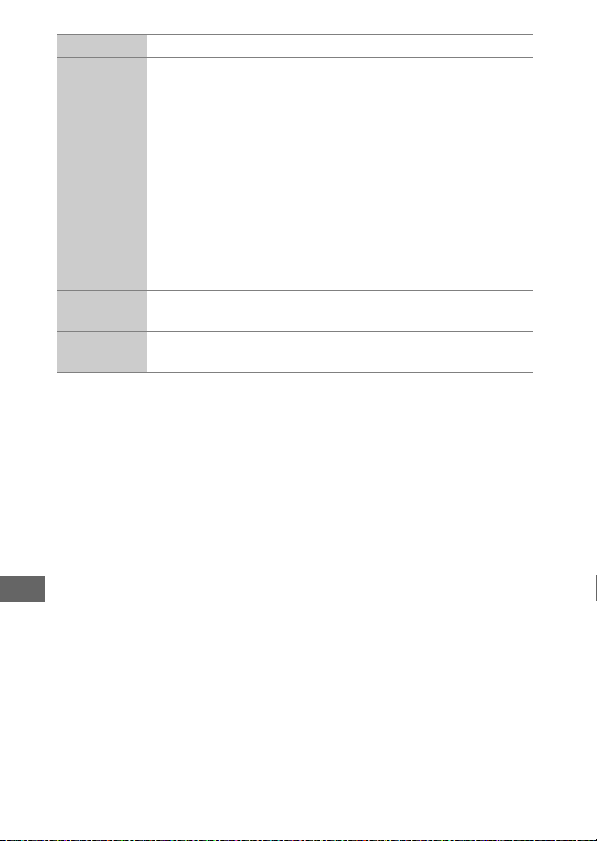
336
Software Camera Control Pro 2
Remote
terminal
accessories
• Remote Cord MC-22/MC-22A (length 1 m/3 ft 3 in.
*
)
• Remote Cord MC-30/MC-30A (length 80 cm/2 ft 7 in.
*
)
• Remote Cord MC-36/MC-36A (length 85 cm/2 ft 9 in.
*
)
• Extension Cord MC-21/MC-21A (length 3 m/9 ft 10 in.
*
)
• Connecting Cord MC-23/MC-23A (length 40 cm/
1ft 4in.
*
)
• Adapter Cord MC-25/MC-25A (length 20 cm/8 in.
*
)
• WR Adapter WR-A10
• GPS Unit GP-1/GP-1A (0 253)
• GPS Adapter Cord MC-35 (length 35 cm/1 ft 2 in.
*
)
• Modulite Remote Control Set ML-3
* All values are approximate.
Microphones
(0 65)
• Stereo Microphone ME-1
• Wireless Microphone ME-W1
Connector
covers
• UF-8 Connector Cover for Stereo Mini-Plug Cables
• USB Connector Cover UF-7
Availability may vary with country or region.
See our website or brochures for the latest
information.

337
Storage
When the camera will not be used for an extended period,
remove the battery and store it in a cool, dry area with the
terminal cover in place.
To prevent mold or mildew, store the
camera in a dry, well-ventilated area.
Do not store your camera
with naphtha or camphor moth balls or in locations that:
• are poorly ventilated or subject to humidities of over 60%
• are next to equipment that produces strong electromagnetic
fields, such as televisions or radios
• are exposed to temperatures above 50 °C (122 °F) or below
–10 °C (14 °F)
Cleaning
Do not use alcohol, thinner, or other volatile chemicals.
Caring for the Camera
Camera body
Use a blower to remove dust and lint, then wipe gently
with a soft, dry cloth.
After using the camera at the beach
or seaside, wipe off sand or salt with a cloth lightly
dampened in distilled water and dry thoroughly.
Important: Dust or other foreign matter inside the camera
may cause damage not covered under warranty.
Lens, mirror,
and
viewfinder
These glass elements are easily damaged.
Remove dust
and lint with a blower.
If using an aerosol blower, keep
the can vertical to prevent the discharge of liquid.
To
remove fingerprints and other stains, apply a small
amount of lens cleaner to a soft cloth and clean with care.
Monitor
Remove dust and lint with a blower.
When removing
fingerprints and other stains, wipe the surface lightly
with a soft cloth or chamois leather.
Do not apply
pressure, as this could result in damage or malfunction.
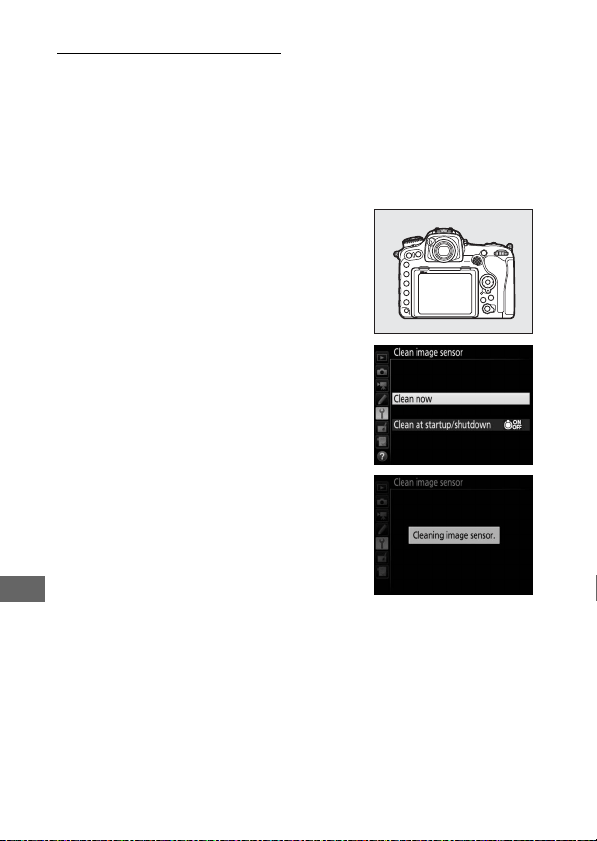
338
Image Sensor Cleaning
If you suspect that dirt or dust on the image sensor is appearing
in photographs, you can clean the sensor using the Clean image
sensor option in the setup menu.
The sensor can be cleaned at
any time using the Clean now option, or cleaning can be
performed automatically when the camera is turned on or off.
❚❚ “Clean Now”
Holding the camera base down, select
Clean image sensor in the setup menu,
then highlight Clean now and press J.
The camera will check the image sensor
and then begin cleaning.
1 flashes
in the control panel and other operations
can not be performed while cleaning is in
progress.
Do not remove or disconnect
the power source until cleaning ends and
the setup menu is displayed.
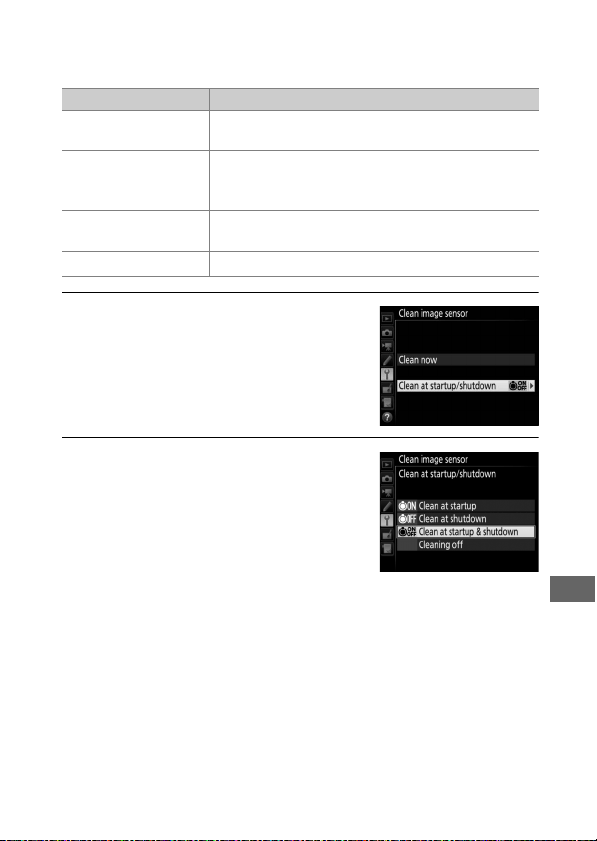
339
❚❚ “Clean at Startup/Shutdown”
Choose from the following options:
1 Select Clean at startup/shutdown.
Display the Clean image sensor
menu as described on page 338.
Highlight Clean at startup/
shutdown and press 2.
2 Select an option.
Highlight an option and press J.
Option Description
5
Clean at startup
The image sensor is automatically cleaned each
time the camera is turned on.
6
Clean at
shutdown
The image sensor is automatically cleaned
during shutdown each time the camera is turned
off.
7
Clean at startup &
shutdown
The image sensor is cleaned automatically at
startup and at shutdown.
Cleaning off Automatic image sensor cleaning off.

340
D Image Sensor Cleaning
Using camera controls during startup interrupts image sensor
cleaning.
If dust can not be fully removed using the options in the Clean image
sensor menu, clean the image sensor manually (0 341) or consult a
Nikon-authorized service representative.
If image sensor cleaning is performed several times in succession,
image sensor cleaning may be temporarily disabled to protect the
camera’s internal circuitry.
Cleaning can be performed again after a
short wait.
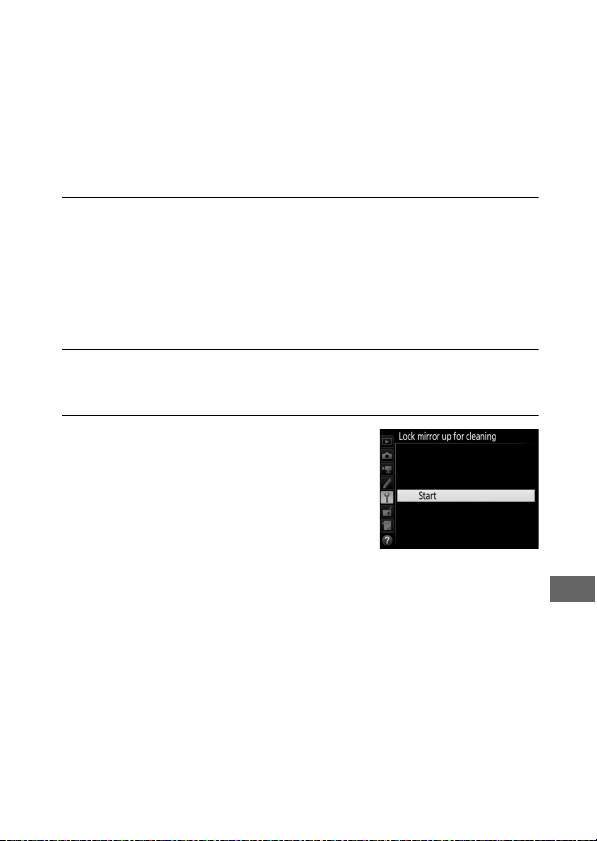
341
❚❚ Manual Cleaning
If foreign matter can not be removed from the image sensor
using the Clean image sensor (0 338) option in the setup
menu, the sensor can be cleaned manually as described below.
Note, however, that the sensor is extremely delicate and easily
damaged.
Nikon recommends that the sensor be cleaned only
by Nikon-authorized service personnel.
1 Charge the battery or connect an AC adapter.
A reliable power source is required when inspecting or
cleaning the image sensor.
Turn the camera off and insert a
fully-charged battery or connect an optional AC adapter and
power connector.
The Lock mirror up for cleaning option is
only available in the setup menu at battery levels over J.
2 Remove the lens.
Turn the camera off and remove the lens.
3 Select Lock mirror up for cleaning.
Turn the camera on and highlight
Lock mirror up for cleaning in the
setup menu and press 2.
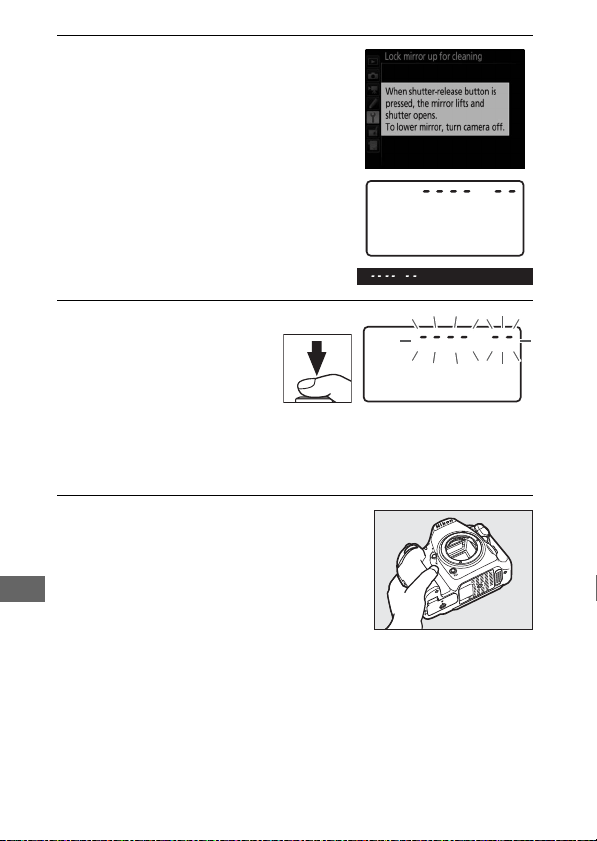
342
4 Press J.
The message shown at right will be
displayed in the monitor and a row
of dashes will appear in the control
panel and viewfinder.
To restore
normal operation without
inspecting the image sensor, turn
the camera off.
5 Raise the mirror.
Press the shutter-release
button all the way down.
The mirror will be raised
and the shutter curtain
will open, revealing the image sensor.
The display in the
viewfinder will turn off and the row of dashes in the control
panel will flash.
6 Examine the image sensor.
Holding the camera so that light falls
on the image sensor, examine the
sensor for dust or lint.
If no foreign
objects are present, proceed to Step 8.
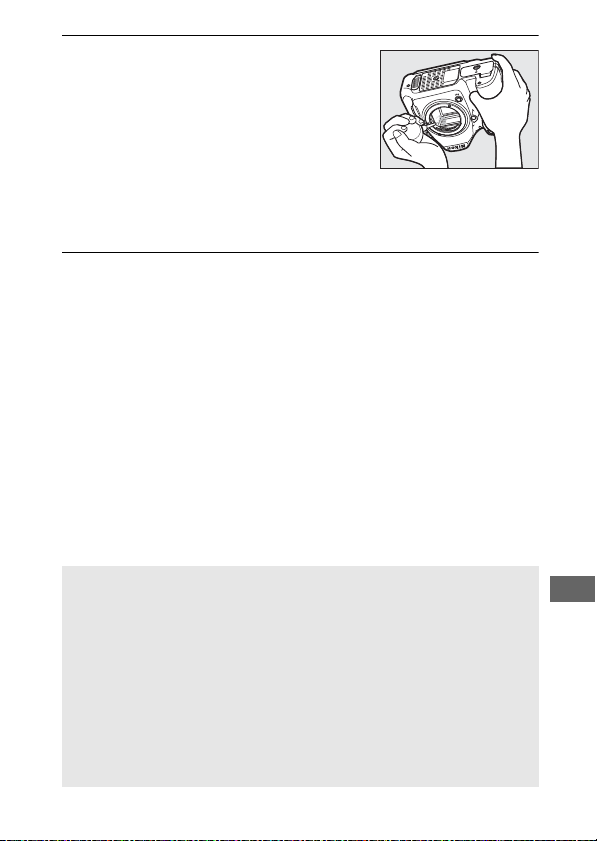
343
7 Clean the sensor.
Remove any dust and lint from the
sensor with a blower.
Do not use a
blower-brush, as the bristles could
damage the sensor.
Dirt that can not
be removed with a blower can only be
removed by Nikon-authorized service
personnel.
Under no circumstances should you touch or
wipe the sensor.
8 Turn the camera off.
The mirror will return to the down position and the shutter
curtain will close.
Replace the lens or body cap.
D Use a Reliable Power Source
The shutter curtain is delicate and easily damaged.
If the camera
powers off while the mirror is raised, the curtain will close
automatically.
To prevent damage to the curtain, observe the
following precautions:
• Do not turn the camera off or remove or disconnect the power source
while the mirror is raised.
• If the battery runs low while the mirror is raised, a beep will sound
and the self-timer lamp will flash to warn that the shutter curtain will
close and the mirror will be lowered after about two minutes.
End
cleaning or inspection immediately.

344
D Foreign Matter on the Image Sensor
Foreign matter entering the camera when lenses or body caps are
removed or exchanged (or in rare circumstances lubricant or fine
particles from the camera itself) may adhere to the image sensor,
where it may appear in photographs taken under certain conditions.
To protect the camera when no lens is in place, be sure to replace the
body cap provided with the camera, being careful to first remove all
dust and other foreign matter that may be adhering to the camera
mount, lens mount, and body cap.
Avoid attaching the body cap or
exchanging lenses in dusty environments.
Should foreign matter find its way onto the image sensor, use the
image sensor cleaning option as described on page 338.
If the
problem persists, clean the sensor manually (
0
341) or have the
sensor cleaned by authorized Nikon service personnel.
Photographs
affected by the presence of foreign matter on the sensor can be
retouched using the clean image options available in some imaging
applications.
D Servicing the Camera and Accessories
The camera is a precision device and requires regular servicing.
Nikon
recommends that the camera be inspected by the original retailer or a
Nikon-authorized service representative once every one to two years,
and that it be serviced once every three to five years (note that fees
apply to these services).
Frequent inspection and servicing are
particularly recommended if the camera is used professionally.
Any
accessories regularly used with the camera, such as lenses or optional
flash units, should be included when the camera is inspected or
serviced.

345
Do not drop: The product may malfunction if subjected to strong shocks or
vibration.
Keep dry: This product is not waterproof, and may malfunction if
immersed in water or exposed to high levels of humidity.
Rusting of the
internal mechanism can cause irreparable damage.
Avoid sudden changes in temperature: Sudden changes in temperature, such
as those that occur when entering or leaving a heated building on a cold
day, can cause condensation inside the device.
To prevent
condensation, place the device in a carrying case or plastic bag before
exposing it to sudden changes in temperature.
Keep away from strong magnetic fields: Do not use or store this device in the
vicinity of equipment that generates strong electromagnetic radiation
or magnetic fields.
Strong static charges or the magnetic fields
produced by equipment such as radio transmitters could interfere with
the monitor, damage data stored on the memory card, or affect the
product’s internal circuitry.
Do not leave the lens pointed at the sun: Do not leave the lens pointed at the
sun or other strong light source for an extended period.
Intense light
may cause the image sensor to deteriorate or produce a white blur effect
in photographs.
Caring for the Camera and Battery:
Cautions

346
Cleaning: When cleaning the camera body, use a blower to gently remove
dust and lint, then wipe gently with a soft, dry cloth.
After using the
camera at the beach or seaside, wipe off any sand or salt using a cloth
lightly dampened in pure water and then dry the camera thoroughly.
In
rare instances, static electricity may cause the LCD displays to light up or
go dark.
This does not indicate a malfunction, and the display will soon
return to normal.
The lens and mirror are easily damaged.
Dust and lint should be gently
removed with a blower.
When using an aerosol blower, keep the can
vertical to prevent discharge of liquid.
To remove fingerprints and other
stains from the lens, apply a small amount of lens cleaner to a soft cloth
and wipe the lens carefully.
See “Image Sensor Cleaning” (0 338, 341) for information on cleaning
the image sensor.
Lens contacts: Keep the lens contacts clean.
Do not touch the shutter curtain: The shutter curtain is extremely thin and
easily damaged.
Under no circumstances should you exert pressure on
the curtain, poke it with cleaning tools, or subject it to powerful air
currents from a blower.
These actions could scratch, deform, or tear the
curtain.
The shutter curtain may appear to be unevenly colored, but this has no
affect on pictures and does not indicate a malfunction.

347
Storage: To prevent mold or mildew, store the camera in a dry, well-
ventilated area.
If you are using an AC adapter, unplug the adapter to
prevent fire.
If the product will not be used for an extended period,
remove the battery to prevent leakage and store the camera in a plastic
bag containing a desiccant.
Do not, however, store the camera case in a
plastic bag, as this may cause the material to deteriorate.
Note that
desiccant gradually loses its capacity to absorb moisture and should be
replaced at regular intervals.
To prevent mold or mildew, take the camera out of storage at least once
a month.
Turn the camera on and release the shutter a few times before
putting it away.
Store the battery in a cool, dry place.
Replace the terminal cover before
putting the battery away.
Turn the product off before removing or disconnecting the power source: Do not
unplug the product or remove the battery while the product is on or
while images are being recorded or deleted.
Forcibly cutting power in
these circumstances could result in loss of data or in damage to product
memory or internal circuitry.
To prevent an accidental interruption of
power, avoid carrying the product from one location to another while
the AC adapter is connected.
Notes on the monitor: The monitor is constructed with extremely high
precision; at least 99.99% of pixels are effective, with no more than 0.01%
being missing or defective.
Hence while these displays may contain
pixels that are always lit (white, red, blue, or green) or always off (black),
this is not a malfunction and has no effect on images recorded with the
device.
Images in the monitor may be difficult to see in a bright light.
Do not apply pressure to the monitor, as this could cause damage or
malfunction.
Dust or lint on the monitor can be removed with a blower.
Stains can be removed by wiping lightly with a soft cloth or chamois
leather.
Should the monitor break, care should be taken to avoid injury
from broken glass and to prevent liquid crystal from the monitor
touching the skin or entering the eyes and mouth.

348
The battery and charger: Batteries may leak or explode if improperly
handled.
Observe the following precautions when handling batteries
and chargers:
• Use only batteries approved for use in this equipment.
• Do not expose the battery to flame or excessive heat.
• Keep the battery terminals clean.
• Turn the product off before replacing the battery.
• Remove the battery from the camera or charger when not in use and
replace the terminal cover.
These devices draw minute amounts of
charge even when off and could draw the battery down to the point
that it will no longer function.
If the battery will not be used for some
time, insert it in the camera and run it flat before removing it from the
camera for storage.
The battery should be stored in a cool location
with an ambient temperature of 15 °C to 25 °C (59 °F to 77 °F; avoid hot
or extremely cold locations).
Repeat this process at least once every six
months.
• Turning the camera on or off repeatedly when the battery is fully
discharged will shorten battery life.
Batteries that have been fully
discharged must be charged before use.
• The internal temperature of the battery may rise while the battery is in
use.
Attempting to charge the battery while the internal temperature
is elevated will impair battery performance, and the battery may not
charge or charge only partially.
Wait for the battery to cool before
charging.
• Charge the battery indoors at ambient temperatures of 5 °C–35 °C
(41 °F–95 °F).
Do not use the battery at ambient temperatures below
0 °C (32 °F) or above 40 °C (104 °F); failure to observe this precaution
could damage the battery or impair its performance.
Capacity may be
reduced and charging times increase at battery temperatures from 0 °C
(32 °F) to 15 °C (59 °F) and from 45 °C (113 °F) to 60 °C (140 °F).
The
battery will not charge if its temperature is below 0 °C (32 °F) or above
60 °C (140 °F).

349
• If the CHARGE lamp flashes quickly (about eight times a second) during
charging, confirm that the temperature is in the correct range and then
unplug the charger and remove and reinsert the battery.
If the
problem persists, cease use immediately and take battery and charger
to your retailer or a Nikon-authorized service representative.
• Do not move the charger or touch the battery during charging.
Failure
to observe this precaution could in very rare instances result in the
charger showing that charging is complete when the battery is only
partially charged.
Remove and reinsert the battery to begin charging
again.
• Battery capacity may temporarily drop if the battery is charged at low
temperatures or used at a temperature below the temperature at
which it was charged.
If the battery is charged at a temperature below
5 °C (41 °F), the battery life indicator in the Battery info (0 309) display
may show a temporary decrease.
• Continuing to charge the battery after it is fully charged can impair
battery performance.
• A marked drop in the time a fully charged battery retains its charge
when used at room temperature indicates that it requires replacement.
Purchase a new EN-EL15 battery.
• The supplied power cable and AC wall adapter are for use with the
MH-25a only.
Use the charger with compatible batteries only.
Unplug
when not in use.
• Charge the battery before use.
When taking photographs on
important occasions, ready a spare battery and keep it fully charged.
Depending on your location, it may be difficult to purchase
replacement batteries on short notice.
Note that on cold days, the
capacity of batteries tends to decrease.
Be sure the battery is fully
charged before taking photographs outside in cold weather.
Keep a
spare battery in a warm place and exchange the two as necessary.
Once warmed, a cold battery may recover some of its charge.
• Used batteries are a valuable resource; recycle in accord with local
regulations.
350
If the camera fails to function as expected, check the list of
common problems below before consulting your retailer or
Nikon-authorized service representative.
Battery/Display
Troubleshooting
The camera is on but does not respond: Wait for recording to end.
If the
problem persists, turn the camera off.
If the camera does not turn off,
remove and reinsert the battery or, if you are using an AC adapter,
disconnect and reconnect the AC adapter.
Note that although any data
currently being recorded will be lost, data that have already been
recorded will not be affected by removing or disconnecting the power
source.
Viewfinder is out of focus: Adjust viewfinder focus (0 29).
If this does not
correct the problem, select single-servo AF (AF-S; 0 101), single-point AF
(0 103), and the center focus point (0 108), and then frame a high-
contrast subject in the center focus point and press the shutter-release
button halfway to focus the camera.
With the camera in focus, use the
diopter adjustment control to bring the subject into clear focus in the
viewfinder.
If necessary, viewfinder focus can be further adjusted using
optional corrective lenses (0 335).
Viewfinder is dark: Insert a fully-charged battery (0 13, 35).
Displays turn off without warning: Choose longer delays for Custom Setting
c2 (Standby timer) or c4 (Monitor off delay) (0 296).
Displays in control panel or viewfinder are unresponsive and dim: The response
times and brightness of these displays vary with temperature.
351
Shooting
Camera takes time to turn on: Delete files or folders.
Shutter-release disabled:
• Memory card is locked (SD cards only; 0 16), full, or not inserted
(0 36).
• Release locked is selected for Slot empty release lock in the setup
menu (0 309) and no memory card is inserted (0 15).
• Aperture ring for CPU lens not locked at highest f-number (does not
apply to type G and E lenses).
If B is displayed in the control panel,
select Aperture ring for Custom Setting f4 (Customize command
dials) > Aperture setting to use lens aperture ring to adjust aperture
(0 302).
• Exposure mode S selected with A or % selected for shutter speed
(0 359).
Camera is slow to respond to shutter-release button: Select Off for Custom
Setting d5 (Exposure delay mode; 0 297).
Only one shot taken each time shutter-release button is pressed in continuous release
mode: Turn HDR off (0 191).
Photos are out of focus:
• Rotate focus-mode selector to AF (0 97).
• Camera unable to focus using autofocus: use manual focus or focus
lock (0 111, 114).
Beep does not sound:
• Off is selected for Beep in setup menu (0 306).
• AF-C is selected for AF mode (0 101).
Full range of shutter speeds not available: Flash in use.
Flash sync speed can be
selected using Custom Setting e1 (Flash sync speed); when using
compatible flash units, choose 1/250 s (Auto FP) for full range of shutter
speeds (0 299).
Focus does not lock when shutter-release button is pressed halfway: Camera is in
focus mode AF-C: use the center of the sub-selector to lock focus (0 111).
352
Can not select focus point:
• Unlock focus selector lock (0 108).
• Auto-area AF selected for AF-area mode or face-priority AF selected in
live view; choose another mode (0 48, 103).
• Camera is in playback mode (0 255).
• Menus are in use (0 281).
• Press shutter-release button halfway to start standby timer (0 39).
Can not select AF mode: Select No restrictions for Custom Setting a10
(Autofocus mode restrictions, 0 294).
Camera is slow to record photos: Turn long exposure noise reduction off
(0 286).
Noise (bright spots, randomly-spaced bright pixels, fog, or lines) appear in photos:
• Bright spots, randomly-spaced bright pixels, fog, and lines can be
reduced by lowering ISO sensitivity.
• Use the Long exposure NR option in the photo shooting menu to limit
the occurrence of bright spots or fog in photos taken at shutter speeds
slower than 1 s (0 286).
• Fog and bright spots may indicate that the camera’s internal
temperature has become elevated due to high ambient temperatures,
long exposures, or similar causes: turn the camera off and wait for it to
cool before resuming shooting.
• At high ISO sensitivities, lines may appear in photos taken with some
optional flash units; if this occurs, choose a lower value.
• At high ISO sensitivities, including high values selected with auto ISO
sensitivity control, randomly-spaced bright pixels can be reduced by
selecting High, Normal, or Low for High ISO NR in the photo or movie
shooting menu (0 286, 290).
• At high ISO sensitivities, bright spots, randomly-spaced bright pixels,
fog, or lines may be more noticeable in long exposures, multiple
exposures, and photos taken at high ambient temperatures or with
Active D-Lighting enabled, Flat selected for Set Picture Control
(0 180) or extreme values selected for Picture Control parameters
(0 183).
353
Flicker or banding appears during movie recording: Choose an option for Flicker
reduction that matches the frequency of the local AC power supply
(0 290).
Bright regions or bands appear in live view: A flashing sign, flash, or other light
source with brief duration was used during live view.
Smudges appear in photographs: Clean front and rear lens elements.
If
problem persists, perform image sensor cleaning (0 338).
Live view ends unexpectedly or does not start: Live view may end automatically
to prevent damage to the camera’s internal circuits if:
• The ambient temperature is high
• The camera has been used for extended periods in live view or to
record movies
• The camera has been used in continuous release modes for extended
periods
If live view does not start when you press the a button, wait for the
internal circuits to cool and then try again.
Note that the camera may
feel warm to the touch, but this does not indicate a malfunction.
Image artifacts appear during live view: “Noise” (randomly-spaced bright
pixels, fog, or lines) and unexpected colors may appear if you zoom in on
the view through the lens (0 46) during live view; in movies, the amount
and distribution of randomly-spaced bright pixels, fog, and bright spots
are affected by frame size and rate (0 68).
Randomly-spaced bright
pixels, fog, or bright spots may also arise as a result of increases in the
temperature of the camera’s internal circuits during live view; exit live
view when the camera is not in use.
Can not measure white balance: Subject is too dark or too bright (0 170).
Image can not be selected as source for preset white balance: Image was not
created with D500 (0 177).
354
Playback
White balance bracketing unavailable:
• NEF (RAW) or NEF+JPEG image quality option selected for image
quality (0 91).
• Multiple exposure mode is in effect (0 236).
Photographs and movies do not appear to have the same exposure as the preview
shown in the monitor during live view: Changes to monitor brightness during
live view have no effect on images recorded with the camera (0 50).
Effects of Picture Control differ from image to image: A (auto) is selected for
sharpening, clarity, contrast, or saturation.
For consistent results over a
series of photographs, choose another setting (0 184).
Metering can not be changed: Autoexposure lock is in effect (0 142).
Exposure compensation can not be used: Choose exposure mode P, S, or A
(0 130, 144).
Noise (reddish areas or other artifacts) appears in long time-exposures: Enable long
exposure noise reduction (0 286).
Sound is not recorded with movies: Microphone off is selected for
Microphone sensitivity in the movie shooting menu (0 290).
NEF (RAW) image is not played back: Photo was taken at image quality of NEF
+ JPEG (0 92).
Can not view pictures recorded with other cameras: Pictures recorded with other
makes of camera may not be displayed correctly.
Some photos are not displayed during playback: Select All for Playback folder
(0 281).
“Tall” (portrait) orientation photos are displayed in “wide” (landscape) orientation:
• Photo was taken with Off selected for Auto image rotation (0 282).
• Select On for Rotate tall (0 282).
• Photo is displayed in image review (0 282).
• Camera was pointed up or down when photo was taken.
355
Can not delete photo: Picture is protected.
Remove protection (0 273).
Can not retouch picture: Photo can not be further edited with this camera
(0 362).
The camera displays a message stating that the folder contains no images: Select All
for Playback folder (0 281).
Can not print photos: NEF (RAW) and TIFF photos can not be printed by
direct USB connection.
Transfer photos to computer and print using
Capture NX-D (0 v).
NEF (RAW) photos can be saved in JPEG format
using NEF (RAW) processing (0 313).
Photo is not displayed on high-definition video device: Confirm that HDMI cable
(available separately) is connected (0 335).
Image Dust Off option in Capture NX-D does not have desired effect: Image sensor
cleaning changes the position of dust on the image sensor.
Dust off
reference data recorded before image sensor cleaning is performed can
not be used with photographs taken after image sensor cleaning is
performed.
Dust off reference data recorded after image sensor
cleaning is performed can not be used with photographs taken before
image sensor cleaning is performed (0 305).
Computer displays NEF (RAW) images differently from camera: Third-party
software does not display effects of Picture Controls, Active D-Lighting,
or vignette control.
Use Capture NX-D (0 v).
Can not transfer photos to computer: OS not compatible with camera or
transfer software.
Use card reader to copy photos to computer.
356
Bluetooth and Wi-Fi (Wireless Networks)
Miscellaneous
Smart devices do not display the camera SSID (network name):
• Confirm that Disable is selected for Airplane mode in the camera
setup menu (0 307).
• Confirm that Enable is selected for Bluetooth > Network connection
in the camera setup menu.
• Try turning the smart device Wi-Fi off and then on again.
Can not connect to smart devices using NFC: Choose another connection
method.
Can not connect to wireless printers and other wireless devices: This camera can
connect only to devices to which the SnapBridge app has been installed.
Date of recording is not correct: Set camera clock (0 304).
Menu item can not be selected: Some options are not available at certain
combinations of settings or when no memory card is inserted.
Note that
Battery info option is not available when camera is powered by an
optional power connector and AC adapter.
357
This section lists the indicators and error messages that appear
in the viewfinder, control panel, and monitor.
Error Messages
Indicator
Problem Solution 0
Control
panel
View-
finder
B
(flashes)
Lens aperture ring is
not set to minimum
aperture.
Set ring to minimum
aperture (highest
f-number).
131
H d Low battery.
Ready a fully-charged
spare battery.
13, 35
H
(flashes)
d
(flashes)
• Battery exhausted. • Recharge or replace
battery.
xx, 13,
35, 335
• Battery can not be
used.
• Contact Nikon-
authorized service
representative.
• An extremely
exhausted
rechargeable Li-ion
battery or a third-
party battery is
inserted either in the
camera or in the
optional MB-D17
multi-power battery
pack.
• Replace the battery, or
recharge the battery if
the rechargeable
Li-ion battery is
exhausted.
• High battery
temperature.
• Remove battery and
wait for it to cool.
—
358
F
No lens attached, or
non-CPU lens attached
without specifying
maximum aperture.
Aperture shown in
stops from maximum
aperture.
Aperture value will be
displayed if maximum
aperture is specified.
250
—
FH
(flashes)
Camera unable to focus
using autofocus.
Change composition or
focus manually.
38, 114
(Exposure
indicators and
shutter speed or
aperture display
flash)
Subject too bright;
photo will be
overexposed.
• Use a lower ISO
sensitivity.
123
• Use optional ND filter.
In exposure mode:
S Increase shutter
speed
133
A Choose a smaller
aperture (higher
f-number)
134
Subject too dark; photo
will be underexposed.
• Use a higher ISO
sensitivity.
123
• Use optional flash.
In
exposure mode:
196
S Lower shutter speed 133
A Choose a larger
aperture (lower
f-number)
134
Indicator
Problem Solution 0
Control
panel
View-
finder
359
A
(flashes)
A selected in
exposure mode S.
Change shutter speed
or select manual
exposure mode.
133,
135
%
(flashes)
% selected in exposure
mode S.
Change shutter speed
or select manual
exposure mode.
133,
135
1
(flashes)
k
(flashes)
Processing in progress.
Wait until processing is
complete.
—
—
c
(flashes)
If indicator flashes for 3s
after flash fires, photo
may be underexposed.
Check photo in
monitor; if
underexposed, adjust
settings and try again.
333
Y
(flashes)
—
Flash unit that does not
support red-eye
reduction attached and
flash sync mode set to
red-eye reduction.
Change flash sync
mode or use flash unit
that supports red-eye
reduction.
202,
330
n
(flashes)
j
(flashes)
Memory insufficient to
record further photos at
current settings, or
camera has run out of
file or folder numbers.
• Reduce quality or size. 91, 94
• Delete photographs
after copying
important images to
computer or other
device.
278
• Insert new memory
card.
15
O
(flashes)
Camera malfunction.
Release shutter.
If error
persists or appears
frequently, consult
Nikon-authorized
service representative.
—
Indicator
Problem Solution 0
Control
panel
View-
finder
360
Indicator
Problem Solution 0Monitor
Control
panel
No memory card. S
Camera cannot
detect memory
card.
Turn camera off
and confirm that
card is correctly
inserted.
15
Cannot access this
memory card.
Insert another card.
W,
R
(flashes)
• Error accessing
memory card.
• Use Nikon-
approved card.
387
• Check that
contacts are
clean.
If card is
damaged, contact
retailer or Nikon-
authorized
service
representative.
—
• Unable to create
new folder.
• Delete files or
insert new
memory card
after copying
important images
to computer or
other device.
15, 278,
387
m
W,
O
(flashes)
Camera can not
control Eye-Fi
card.
• Check that Eye-Fi
card firmware is
up to date.
—
• Copy files on
Eye-Fi card to a
computer or
other device and
format card, or
insert new card.
—
361
Memory card is
locked. Slide lock to
“write” position.
W,
X
(flashes)
Memory card is
locked (write
protected).
Slide card write-
protect switch to
“write” position.
16
Not available if
Eye-Fi card is locked.
W,
O
(flashes)
Eye-Fi card is
locked (write
protected).
This card is not
formatted.
Format the card.
[C]
(flashes)
Memory card has
not been
formatted for use
in camera.
Format memory
card or insert new
memory card.
304,
387
Unable to start live
view. Please wait.
—
The internal
temperature of
the camera is
high.
Wait for the internal
circuits to cool
before resuming
live view
photography or
movie recording.
353
Folder contains no
images.
—
No images on
memory card or
in folder(s)
selected for
playback.
Select folder
containing images
from Playback
folder menu or
insert memory card
containing images.
15, 281
All images are
hidden.
—
All photos in
current folder are
hidden.
No images can be
played back until
another folder has
been selected or
Hide image used
to allow at least
one image to be
displayed.
281
Indicator
Problem Solution 0Monitor
Control
panel
362
Cannot display this
file.
—
File has been
created or
modified using a
computer or
different make of
camera, or file is
corrupt.
File can not be
played back on
camera.
—
Cannot select this
file.
—
Selected image
can not be
retouched.
Images created
with other devices
can not be
retouched.
—
This movie cannot
be edited.
—
The selected
movie can not be
edited.
• Movies created
with other
devices can not
be edited.
—
• Movies must be at
least two seconds
long.
85
Check printer. — Printer error.
Check printer.
To
resume, select
Continue (if
available).
—
*
Check paper. —
Paper in printer is
not of selected
size.
Insert paper of
correct size and
select Continue.
—
*
Indicator
Problem Solution 0Monitor
Control
panel
363
Paper jam. —
Paper is jammed
in printer.
Clear jam and
select Continue.
—
*
Out of paper. —
Printer is out of
paper.
Insert paper of
selected size and
select Continue.
—
*
Check ink supply. —Ink error.
Check ink.
To
resume, select
Continue.
—
*
Out of ink. —
Printer is out of
ink.
Replace ink and
select Continue.
—
*
* See printer manual for more information.
Indicator
Problem Solution 0Monitor
Control
panel
364
❚❚ Nikon D500 Digital Camera
Specifications
Type
Type Single-lens reflex digital camera
Lens mount Nikon F mount (with AF coupling and AF
contacts)
Effective angle of view Nikon DX format; focal length in 35 mm [135]
format equivalent to approx. 1.5× that of lenses
with FX format angle of view
Effective pixels
Effective pixels 20.9 million
Image sensor
Image sensor 23.5 × 15.7 mm CMOS sensor
Total pixels 21.51 million
Dust-reduction System Image sensor cleaning, Image Dust Off
reference data (Capture NX-D software
required)
Storage
Image size (pixels) • DX (24×16) image area
5568 × 3712 (#) 4176 × 2784 ($)
2784 × 1856 (%)
• 1.3× (18×12) image area
4272 × 2848 (#) 3200 × 2136 ($)
2128 × 1424 (%)
• Photographs with image area of DX taken during movie
recording
5568 × 3128 (#) 4176 × 2344 ($)
2784 × 1560 (%)
• Photographs with image area of 1.3× taken during
movie recording
4272 × 2400 (#) 3200 × 1800 ($)
2128 × 1192 (%)
• Photographs taken during movie recording at a frame
size of 3840 × 2160: 3840 × 2160
365
File format • NEF (RAW): 12 or 14 bit (lossless compressed,
compressed, or uncompressed); large,
medium, and small available (medium and
small images are recorded at a bit depth of
12 bits using lossless compression)
• TIFF (RGB)
• JPEG: JPEG-Baseline compliant with fine
(approx. 1 : 4), normal (approx. 1 : 8), or basic
(approx. 1 : 16) compression; optimal quality
compression available
• NEF (RAW)+JPEG: Single photograph recorded in
both NEF (RAW) and JPEG formats
Picture Control System Standard, Neutral, Vivid, Monochrome, Portrait,
Landscape, Flat; selected Picture Control can be
modified; storage for custom Picture Controls
Media XQD and SD (Secure Digital) and UHS-II
compliant SDHC and SDXC memory cards
Dual card slots Either card can be used for primary or backup
storage or for separate storage of NEF (RAW)
and JPEG images; pictures can be copied
between cards.
File system DCF 2.0, Exif 2.3, PictBridge
Viewfinder
Viewfinder Eye-level pentaprism single-lens reflex
viewfinder
Frame coverage • DX (24×16) image area: Approx. 100% horizontal
and 100% vertical
• 1.3× (18×12) image area: Approx. 98% horizontal
and 98% vertical
Magnification Approx. 1.0× (50mm f/1.4 lens at infinity,
–1.0 m
–1
)
Storage
366
Eyepoint 16 mm (–1.0 m
–1
; from center surface of
viewfinder eyepiece lens)
Diopter adjustment –2–+1 m
–1
Focusing screen Type B BriteView Clear Matte Mark II screen with
AF area brackets (framing grid can be
displayed)
Reflex mirror Quick return
Depth-of-field preview Pressing Pv button stops lens aperture down to
value selected by user (A and M modes) or by
camera (P and S modes)
Lens aperture Instant return, electronically controlled
Lens
Compatible lenses Compatible with AF NIKKOR lenses, including
type G, E, and D lenses (some restrictions apply
to PC lenses), and DX lenses, AI-P NIKKOR
lenses, and non-CPU AI lenses (exposure modes
A and M only).
IX NIKKOR lenses, lenses for the
F3AF, and non-AI lenses can not be used.
The electronic rangefinder can be used with
lenses that have a maximum aperture of f/5.6 or
faster (the electronic rangefinder supports 15
focus points with lenses that have a maximum
aperture of f/8 or faster, of which 9 points are
available for selection).
Shutter
Type Electronically-controlled vertical-travel focal-
plane mechanical shutter; electronic front-
curtain shutter available in mirror up release
mode
Speed
1
/
8000 – 30 s in steps of
1
/
3,
1
/
2, or 1 EV, bulb, time,
X250
Flash sync speed X=
1
/
250 s; synchronizes with shutter at
1
/
250 s or
slower
Viewfinder

367
Release
Release mode S (single frame), CL (continuous low speed),
C
H (continuous high speed), Q (quiet shutter-
release), Q
C (quiet continuous shutter-release),
E (self-timer), M
UP (mirror up)
Approximate frame
advance rate
• CL: 1–9 fps
• C
H: 10 fps
• Q
C: 3 fps
Self-timer 2 s, 5 s, 10 s, 20 s; 1–9 exposures at intervals of
0.5, 1, 2, or 3 s
Exposure
Metering TTL exposure metering using RGB sensor with
approximately 180K (180,000) pixels
Metering method • Matrix: 3D color matrix metering III (type G, E,
and D lenses); color matrix metering III (other
CPU lenses); color matrix metering available
with non-CPU lenses if user provides lens data
• Center-weighted: Weight of 75% given to 8 mm
circle in center of frame.
Diameter of circle can
be changed to 6, 10, or 13 mm, or weighting
can be based on average of entire frame (non-
CPU lenses use 8-mm circle)
• Spot: Meters 3.5 mm circle (about 2.5% of
frame) centered on selected focus point (on
center focus point when non-CPU lens is used)
• Highlight-weighted: Available with type G, E, and
D lenses
Range (ISO 100, f/1.4 lens,
20 °C/68 °F)
• Matrix or center-weighted metering: –3–+20 EV
• Spot metering: 2–20 EV
• Highlight-weighted metering: 0–20 EV
Exposure meter coupling Combined CPU and AI
368
Exposure mode Programmed auto with flexible program (P);
shutter-priority auto (S); aperture-priority auto
(A); manual (M)
Exposure compensation –5 – +5 EV in increments of
1
/
3,
1
/
2, or 1 EV
Exposure lock Luminosity locked at detected value
ISO sensitivity
(Recommended Exposure
Index)
ISO 100 – 51200 in steps of
1
/
3,
1
/
2, or 1 EV.
Can
also be set to approx. 0.3, 0.5, 0.7, or 1 EV (ISO 50
equivalent) below ISO 100 or to approx. 0.3, 0.5,
0.7, 1, 2, 3, 4, or 5 EV (ISO 1640000 equivalent)
above ISO 51200; auto ISO sensitivity control
available
Active D-Lighting Can be selected from Auto, Extra high, High,
Normal, Low, or Off
Focus
Autofocus Multi-CAM 20K autofocus sensor module with
TTL phase detection, fine-tuning, and 153 focus
points (including 99 cross-type sensors and 15
sensors that support f/8), of which 55 (35 cross-
type sensors and 9 f/8 sensors) are available for
selection
Detection range –4 – +20 EV (ISO 100, 20 °C/68 °F)
Lens servo • Autofocus (AF): Single-servo AF (AF-S);
continuous-servo AF (AF-C); predictive focus
tracking automatically activated according to
subject status
• Manual focus (M): Electronic rangefinder can be
used
Focus point 153 focus points, of which 55 or 15 are available
for selection
Exposure
369
AF-area mode Single-point AF, 25-, 72-, or 153- point dynamic-
area AF, 3D-tracking, group-area AF, auto-area
AF
Focus lock Focus can be locked by pressing shutter-release
button halfway (single-servo AF) or by pressing
the center of the sub-selector
Flash
Flash control TTL: i-TTL flash control using RGB sensor with
approximately 180K (180,000) pixels; i-TTL
balanced fill-flash for digital SLR is used with
matrix, center-weighted, and highlight-
weighted metering, standard i-TTL fill-flash for
digital SLR with spot metering
Flash mode Front-curtain sync, slow sync, rear-curtain sync,
red-eye reduction, red-eye reduction with slow
sync, slow rear-curtain sync, off, Auto FP High-
Speed Sync supported
Flash compensation –3 – +1 EV in increments of
1
/
3,
1
/
2, or 1 EV
Flash-ready indicator Lights when optional flash unit is fully charged;
flashes after flash is fired at full output
Accessory shoe ISO 518 hot-shoe with sync and data contacts
and safety lock
Nikon Creative Lighting
System (CLS)
i-TTL flash control, radio-controlled Advanced
Wireless Lighting, optical Advanced Wireless
Lighting, modeling illumination, FV lock, Color
Information Communication, Auto FP High-
Speed Sync, AF-assist for multi-area AF, unified
flash control
Sync terminal ISO 519 sync terminal with locking thread
Focus
370
White balance
White balance Auto (3 types), incandescent, fluorescent (7
types), direct sunlight, flash, cloudy, shade,
preset manual (up to 6 values can be stored,
spot white balance measurement available
during live view), choose color temperature
(2500 K–10000 K), all with fine-tuning.
Bracketing
Bracketing types Exposure, flash, white balance, and ADL
Live view
Modes C (photo live view), 1 (movie live view)
Lens servo • Autofocus (AF): Single-servo AF (AF-S); full-time-
servo AF (AF-F)
• Manual focus (M)
AF-area mode Face-priority AF, wide-area AF, normal-area AF,
subject-tracking AF
Autofocus Contrast-detect AF anywhere in frame (camera
selects focus point automatically when face-
priority AF or subject-tracking AF is selected)
Movie
Metering TTL exposure metering using main image
sensor
Metering method Matrix, center-weighted, or highlight-weighted
Frame size (pixels) and
frame rate
• 3840 × 2160 (4K UHD); 30p (progressive), 25p,
24p
• 1920 × 1080; 60p, 50p, 30p, 25p, 24p
• 1280 × 720; 60p, 50p
Actual frame rates for 60p, 50p, 30p, 25p, and
24p are 59.94, 50, 29.97, 25, and 23.976 fps
respectively; ★ high quality available at all
frame sizes, normal quality available at all sizes
except 3840 × 2160
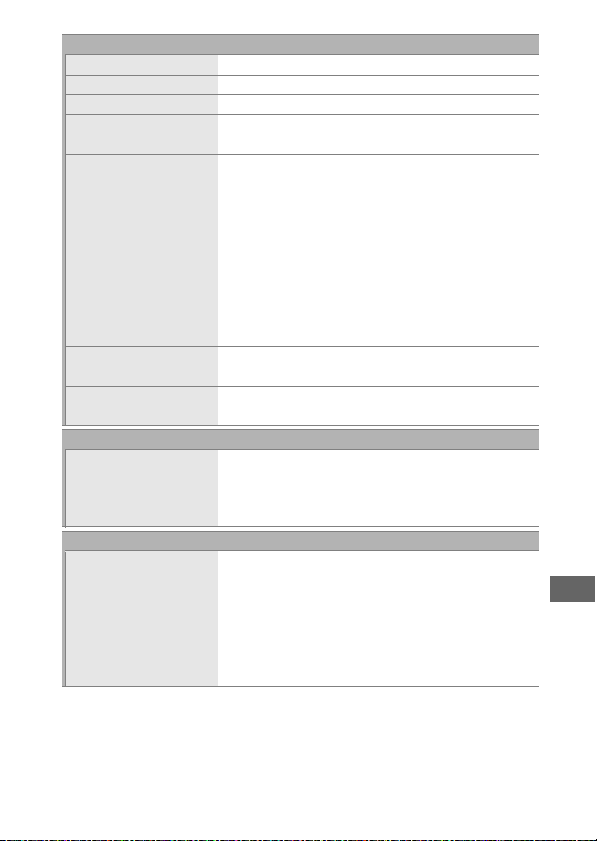
371
File format MOV
Video compression H.264/MPEG-4 Advanced Video Coding
Audio recording format Linear PCM
Audio recording device Built-in stereo or external microphone;
sensitivity adjustable
ISO sensitivity • Exposure modes P, S, and A: Auto ISO sensitivity
control (ISO 100 to Hi 5) with selectable upper
limit
• Exposure mode M: Auto ISO sensitivity control
(ISO 100 to Hi 5) available with selectable
upper limit; manual selection (ISO 100 to
51200 in steps of
1
/
3,
1
/
2, or 1 EV) with
additional options available equivalent to
approximately 0.3, 0.5, 0.7, 1, 2, 3, 4, or 5 EV
(ISO 1640000 equivalent) above ISO 51200
Active D-Lighting Can be selected from Extra high, High,
Normal, Low, or Off
Other options Index marking, time-lapse movies, electronic
vibration reduction
Monitor
Monitor 8-cm/3.2-in., approx. 2359k-dot (XGA) tilting
TFT touch-sensitive LCD with 170° viewing
angle, approximately 100% frame coverage,
and manual monitor brightness control
Playback
Playback Full-frame and thumbnail (4, 9, or 72 images)
playback with playback zoom, movie playback,
photo and/or movie slide shows, histogram
display, highlights, photo information, location
data display, auto image rotation, picture
rating, and IPTC information embedding and
display
Movie
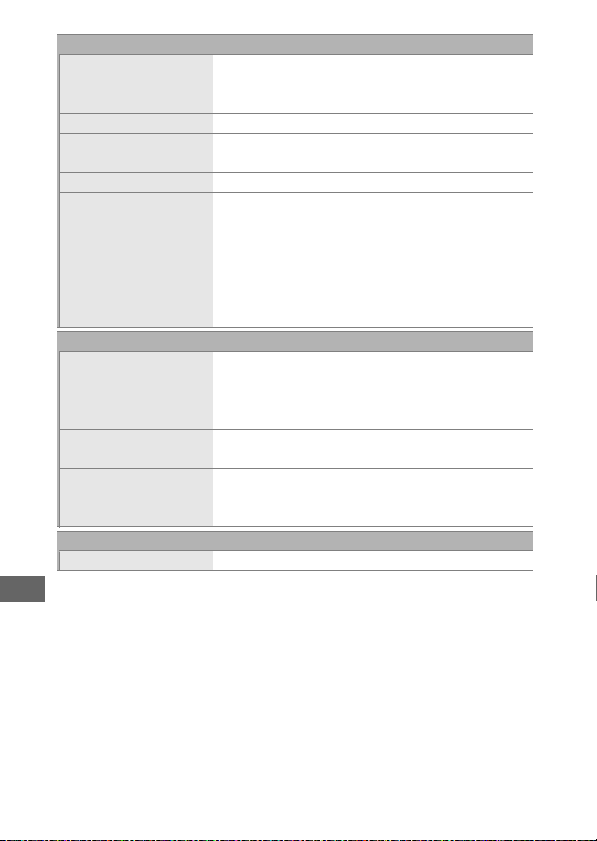
372
Interface
USB SuperSpeed USB (USB 3.0 Micro-B connector);
connection to built-in USB port is
recommended
HDMI output Type C HDMI connector
Audio input Stereo mini-pin jack (3.5mm diameter; plug-in
power supported)
Audio output Stereo mini-pin jack (3.5mm diameter)
Ten-pin remote terminal Can be used to connect optional remote
control, WR-R10 (requires WR-A10 adapter) or
WR-1 wireless remote controller, GP-1/GP-1A
GPS unit, or GPS device compliant with
NMEA0183 version 2.01 or 3.01 (requires MC-35
GPS adapter cord and cable with D-sub 9-pin
connector)
Wireless/Bluetooth
Wireless • Standards: IEEE 802.11b, IEEE 802.11g
• Operating frequency: 2412–2462 MHz
(channels 1–11)
• Authentication: Open system, WPA2-PSK
Bluetooth Communication protocols: Bluetooth Specification
Version 4.1
Range (line of sight) Approximately 10 m (32 ft) without
interference; range may vary with signal
strength and presence or absence of obstacles
NFC
Operation NFC Forum Type 3 Tag
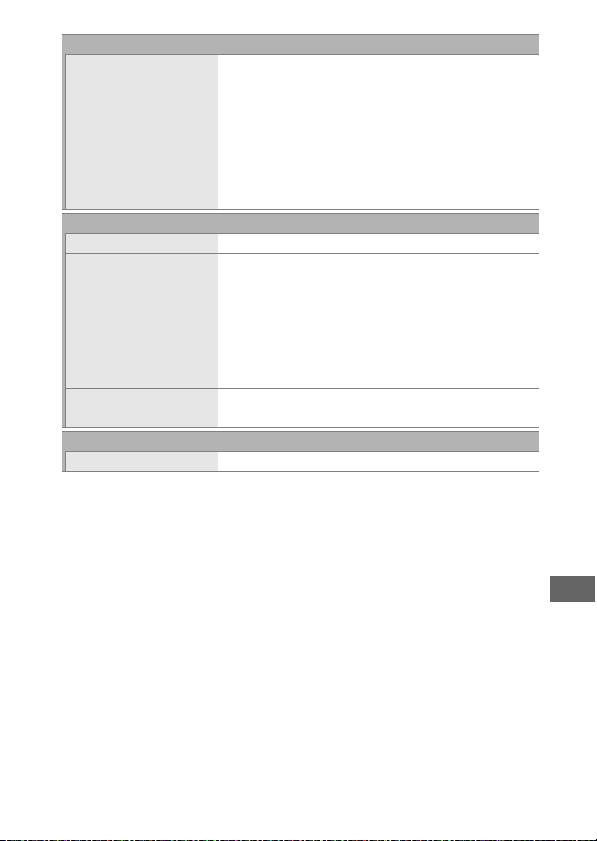
373
Supported languages
Supported languages Arabic, Bengali, Bulgarian, Chinese (Simplified
and Traditional), Czech, Danish, Dutch, English,
Finnish, French, German, Greek, Hindi,
Hungarian, Indonesian, Italian, Japanese,
Korean, Marathi, Norwegian, Persian, Polish,
Portuguese (Portugal and Brazil), Romanian,
Russian, Serbian, Spanish, Swedish, Tamil,
Telugu, Thai, Turkish, Ukrainian, Vietnamese
Power source
Battery One rechargeable Li-ion EN-EL15 battery
Battery pack Optional MB-D17 multi-power battery pack
with one rechargeable Nikon EN-EL18a or
EN-EL18 Li-ion battery (available separately),
one rechargeable Nikon EN-EL15 Li-ion battery,
or eight AA alkaline, Ni-MH, or lithium batteries.
A BL-5 battery-chamber cover is required when
using EN-EL18a or EN-EL18 batteries.
AC adapter EH-5b AC adapter; requires EP-5B power
connector (available separately)
Tripod socket
Tripod socket
1
/
4 in. (ISO 1222)
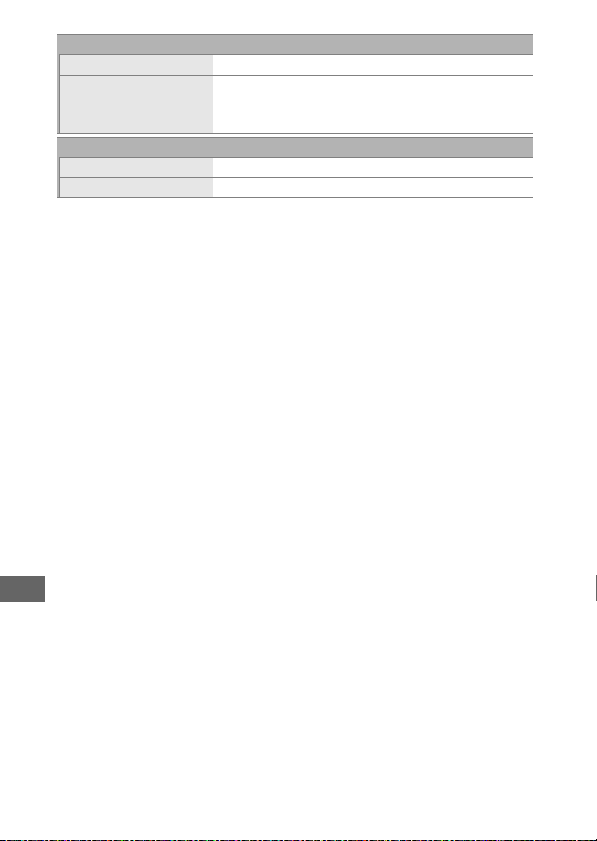
374
• Unless otherwise stated, all measurements are performed in conformity with Camera and
Imaging Products Association (CIPA) standards or guidelines.
• All figures are for a camera with a fully-charged battery.
• Nikon reserves the right to change the appearance and specifications of the hardware and
software described in this manual at any time and without prior notice.
Nikon will not be held
liable for damages that may result from any mistakes that this manual may contain.
Dimensions/weight
Dimensions (W × H × D) Approx. 147 × 115 × 81 mm (5.8 × 4.6 × 3.2 in.)
Weight Approx. 860 g (1 lb. 14.4 oz.) with battery and
XQD memory card but without body cap;
approx. 760 g/1 lb. 10.9 oz. (camera body only)
Operating environment
Temperature 0 °C–40 °C (+32 °F–104 °F)
Humidity 85% or less (no condensation)
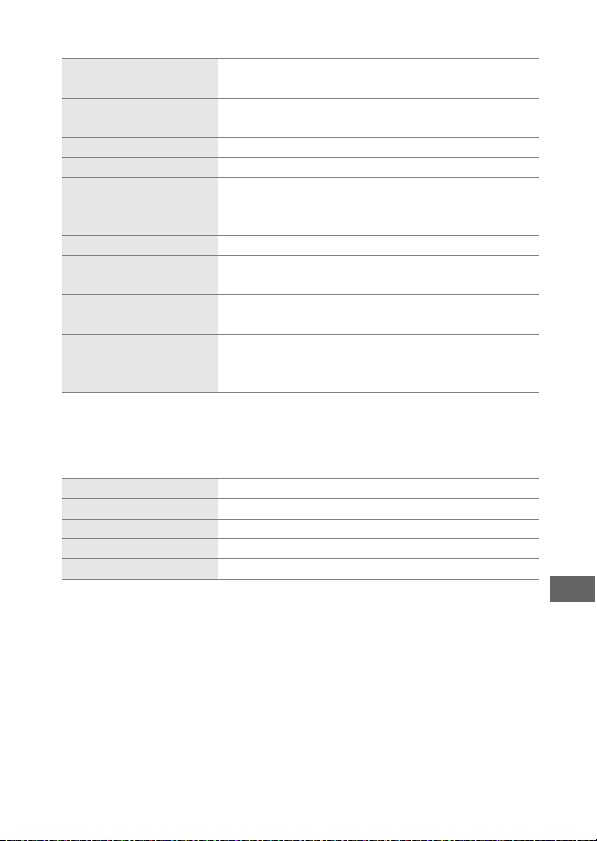
375
❚❚ MH-25a Battery Charger
The symbols on this product represent the following:
m AC, p DC, q Class II equipment (The construction of the product is double-insulated.)
❚❚ EN-EL15 Rechargeable Li-ion Battery
Rated input
(in North America)
AC 120 V, 60 Hz, 0.2 A
Rated input
(in other regions)
AC 100–240 V, 50/60 Hz, 0.23–0.12 A
Rated output DC 8.4 V/1.2 A
Supported batteries Nikon EN-EL15 rechargeable Li-ion batteries
Charging time Approx. 2 hours and 35 minutes at an ambient
temperature of 25 °C (77 °F) when no charge
remains
Operating temperature 0 °C–40 °C (+32 °F–104 °F)
Dimensions (W × H × D) Approx. 95 × 33.5 × 71 mm (3.7 × 1.3 × 2.8 in.),
excluding projections
Length of power cable
(if supplied)
Approx. 1.5 m (4.9 ft)
Weight Approx. 115 g (4.1 oz), excluding supplied
power connector (power cable or AC wall
adapter)
Type Rechargeable lithium-ion battery
Rated capacity 7.0 V/1900 mAh
Operating temperature 0 °C–40 °C (+32 °F–104 °F)
Dimensions (W × H × D) Approx. 40 × 56 × 20.5 mm (1.6 × 2.2 × 0.8 in.)
Weight Approx. 88 g (3.1 oz), excluding terminal cover
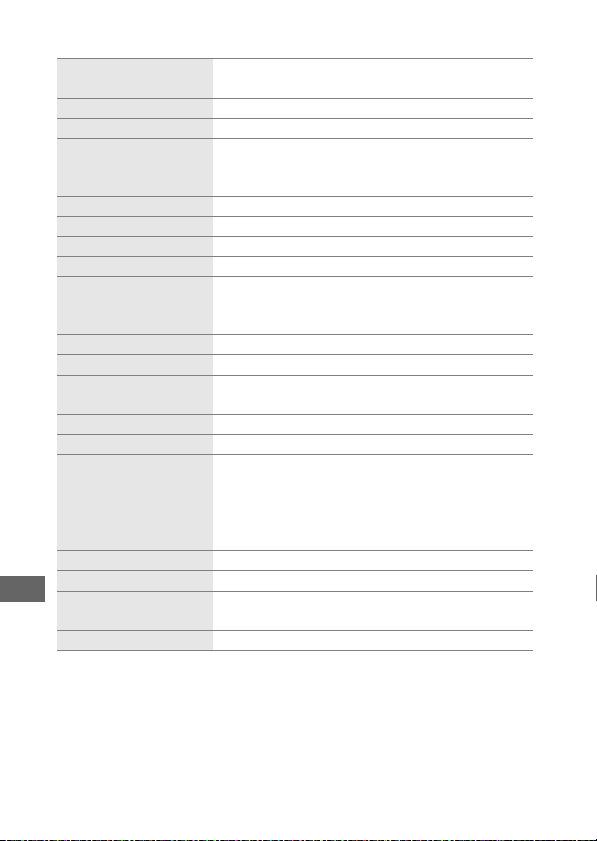
376
❚❚ AF-S DX NIKKOR 16–80mm f/2.8–4E ED VR Lens
Nikon reserves the right to change the appearance and specifications of the hardware and
software described in this manual at any time and without prior notice.
Nikon will not be held
liable for damages that may result from any mistakes that this manual may contain.
Type Type E AF-S DX lens with built-in CPU and F
mount
Focal length 16–80 mm
Maximum aperture f/2.8–4
Lens construction 17 elements in 13 groups (including 4 ED
elements, 3 aspherical elements, and elements
with Nano-Crystal or fluorine coatings)
Angle of view 83°–20°
Focal length scale Graduated in millimeters (16, 24, 35, 50, 80)
Distance information Output to camera
Zoom Manual zoom using independent zoom ring
Focusing Nikon Internal Focusing (IF) System with
autofocus controlled by Silent Wave Motor and
separate focus ring for manual focus
Vibration reduction Lens shift using voice coil motors (VCMs)
Focus distance indicator 0.35 m–∞
Minimum focus distance 0.35 m (1.15 ft) from focal plane (0 115) at all
zoom positions
Diaphragm blades 7 (rounded diaphragm opening)
Diaphragm Automatic electronic aperture control
Aperture range • 16 mm focal length: f/2.8–22
• 80 mm focal length: f/4–32
The minimum aperture displayed may vary
depending on the size of the exposure
increment selected with the camera.
Metering Full aperture
Filter-attachment size 72 mm (P=0.75 mm)
Dimensions Approx. 80 mm maximum diameter × 85.5 mm
(distance from camera lens mount flange)
Weight Approx. 480g (1lb 1oz)
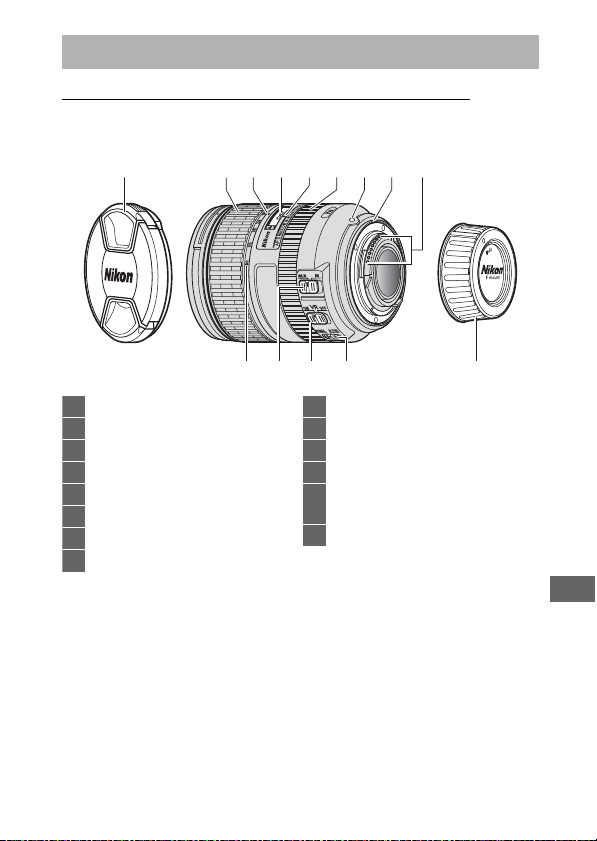
377
AF-S DX NIKKOR 16–80mm f/2.8–4E ED VR
The lens generally used in this manual for illustrative purposes is
the AF-S DX NIKKOR 16–80mm f/2.8–4E ED VR.
The AF-S DX NIKKOR 16–80mm f/2.8–4E ED VR is for use
exclusively with Nikon DX format digital cameras.
SLR film
cameras and D2- and D1-series, D200, D100, D90, D80, D70-
series, D60, D50, D40-series, and D3000 digital SLR cameras are
not supported.
Lenses
324156789
12 13 141110
1 Lens cap
2 Zoom ring
3 Focal length mark
4 Focus distance indicator
5 Focus distance mark
6 Focus ring......................................114
7 Lens mounting mark....................18
8 Rubber lens-mount gasket
9 CPU contacts................................325
10 Focal length scale
11 Focus-mode switch...........114, 378
12 Vibration reduction switch.......380
13 Vibration reduction mode
switch ...........................................381
14 Rear lens cap

378
D Focus Distance Indicator
Note that the focus distance indicator is intended only as a guide and
may not accurately show the distance to the subject and may, due to
depth of eld or other factors, not show ∞ when the camera is focused
on a distant object.
A Using M/A (Autofocus with Manual Override) with AF-S DX NIKKOR 16–80mm
f/2.8–4E ED VR Lenses
To focus using autofocus with manual override (M/A):
1 Slide the lens focus-mode switch (0 377) to M/A.
2Focus.
If desired, you can over-ride autofocus by rotating the lens focus ring
while keeping the shutter-release button pressed halfway (or, if the
camera is equipped with an AF-ON button, while the AF-ON button is
pressed).
To refocus using autofocus, press the shutter-release button
halfway or press the AF-ON button again.

379
D Lens Care
• The lens returns to maximum aperture when removed from the
camera.
To protect the interior of the lens, store it out of direct
sunlight or replace the lens caps.
• Do not pick up or hold the lens or camera using only the lens hood.
• Keep the CPU contacts clean.
• Should the rubber lens-mount gasket be damaged, cease use
immediately and take the lens to a Nikon-authorized service center
for repair.
• Use a blower to remove dust and lint from the lens surfaces.
• The fluorine-coated front and rear elements can be cleaned simply
by wiping them with a dry cloth.
Smudges and fingerprints can be
removed using a soft, clean cotton cloth or lens cleaning tissue; clean
from the center outwards using a circular motion, taking care not to
leave smears or touch the glass surface with your fingers.
To remove
stubborn stains, wipe gently using a soft cloth dampened with a
small amount of distilled water, ethanol, or lens cleaner.
Drop-
shaped stains on the water- and oil-repellent fluorine-coated
elements can be removed with a dry cloth.
• Never use organic solvents such as paint thinner or benzene to clean
the lens.
• The lens hood or NC filters can be used to protect the front lens
element.
• Attach the front and rear caps before placing the lens in its flexible
pouch.
• If the lens will not be used for an extended period, store it in a cool,
dry location to prevent mold and rust.
Do not store in direct sunlight
or with naphtha or camphor moth balls.
• Keep the lens dry.
Rusting of the internal mechanism can cause
irreparable damage.
• Leaving the lens in extremely hot locations could damage or warp
parts made from reinforced plastic.
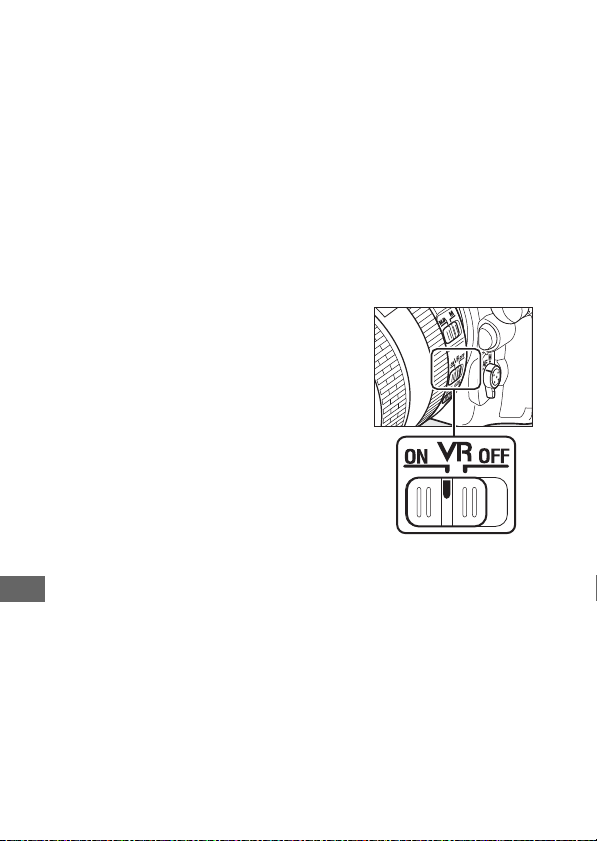
380
❚❚ Vibration Reduction (VR)
AF-S DX NIKKOR 16–80mm f/2.8–4E ED VR lenses support
vibration reduction (VR), which reduces blur caused by camera
shake even when the camera is panned, allowing shutter speeds
to be slowed by approximately 4.0 stops.
This increases the
range of shutter speeds available and permits hand-held, tripod-
free photography in a wide range of situations.
The stated value
of 4.0 stops is based on measurements made in NORMAL mode
according to Camera and Imaging Products Association (CIPA)
standards; FX-format lenses are assessed using FX-format digital
cameras, DX-format lenses using DX-format cameras, and zoom
lenses at maximum zoom.
To use vibration reduction, slide the
vibration reduction switch to ON.
Vibration reduction is activated when the
shutter-release button is pressed
halfway, reducing the effects of camera
shake on the image in the viewfinder and
simplifying the process of framing the
subject and focusing.

381
D Vibration Reduction
• When using vibration reduction, press the shutter-release button
halfway and wait for the image in the viewfinder to stabilize before
pressing the shutter-release button the rest of the way down.
• When vibration reduction is active, the image in the viewfinder may
jiggle after the shutter is released.
This does not indicate a
malfunction.
• Do not turn the camera off or remove the lens while vibration
reduction is in effect.
If power to the lens is cut while vibration
reduction is on, the lens may rattle when shaken.
This is not a
malfunction, and can be corrected by reattaching the lens and
turning the camera on.
• If the camera is equipped with a built-in flash, vibration reduction will
be disabled while the flash charges.
• ON is generally recommended when the camera is mounted on a
monopod or a tripod with an unsecured head, although OFF may be
preferred depending shooting conditions and the type of tripod.
A The Vibration Reduction Mode Switch (AF-S DX NIKKOR 16–80mm f/2.8–4E ED VR
Lenses)
The vibration reduction mode switch is used to select the vibration
reduction mode when vibration reduction is on.
• Select NORMAL to reduce the effects of vibration when photographing
from a fixed position and in other situations with comparatively little
camera motion.
• Select ACTIVE to reduce the effects of vibration when shooting from a
moving vehicle, while walking, and in other situations with active
camera motion.
Slide the vibration reduction mode switch to NORMAL for panning shots.
When the camera is panned, vibration reduction applies only to
motion that is not part of the pan (if the camera is panned horizontally,
for example, vibration reduction will be applied only to vertical shake),
making it much easier to pan the camera smoothly in a wide arc.
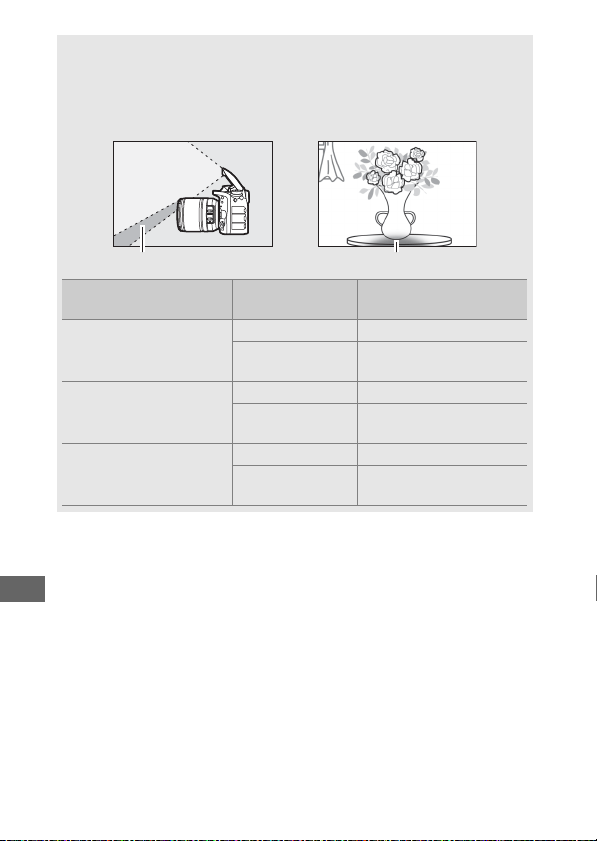
382
A Using Built-in Flash Units
If the camera is equipped with a built-in flash, be sure the subject is at
a range of at least 0.6 m (2 ft) and remove lens hoods to prevent
vignetting (shadows created where the end of the lens obscures the
built-in flash).
Shadow Vignetting
Camera Zoom position
Minimum distance without
vignetting
D7200, D7100, D7000
18 mm 1.0m/3ft 4in.
24 mm, 35 mm,
50 mm, 80 mm
0.6 m/2 ft
D5500, D5300, D5200,
D5100, D5000, D3300,
D3200, D3100
24 mm 1.0 m/3 ft 4 in.
35 mm, 50 mm,
80 mm
0.6 m/2 ft
D300 series
18 mm 1.5 m/5 ft
24 mm, 35 mm,
50 mm, 80 mm
0.6 m/2 ft
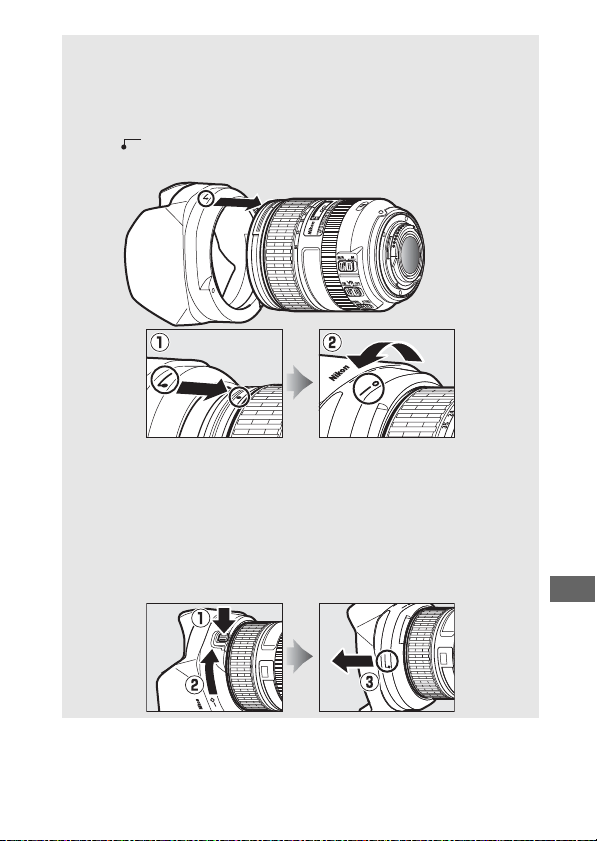
383
A Supplied Accessories for AF-S DX NIKKOR 16–80mm f/2.8–4E ED VR Lenses
• 72 mm Snap-on Front Lens Cap LC-72
• Rear Lens Cap LF-4
• Bayonet Hood HB-75
Align the lens hood mounting mark (●) with the lens hood alignment
mark ( ) as shown in Figure q and then rotate the hood (w) until
the ● mark is aligned with the lens hood lock mark (—).
When attaching or removing the hood, hold it near the symbol on its
base and avoid gripping it too tightly.
Vignetting may occur if the
hood is not correctly attached.
The hood can be reversed and
mounted on the lens when not in use.
To detach the lens hood, press the lens hood lock release button (q),
rotate the hood in the direction shown by the arrow (w), and remove
it as shown (e).
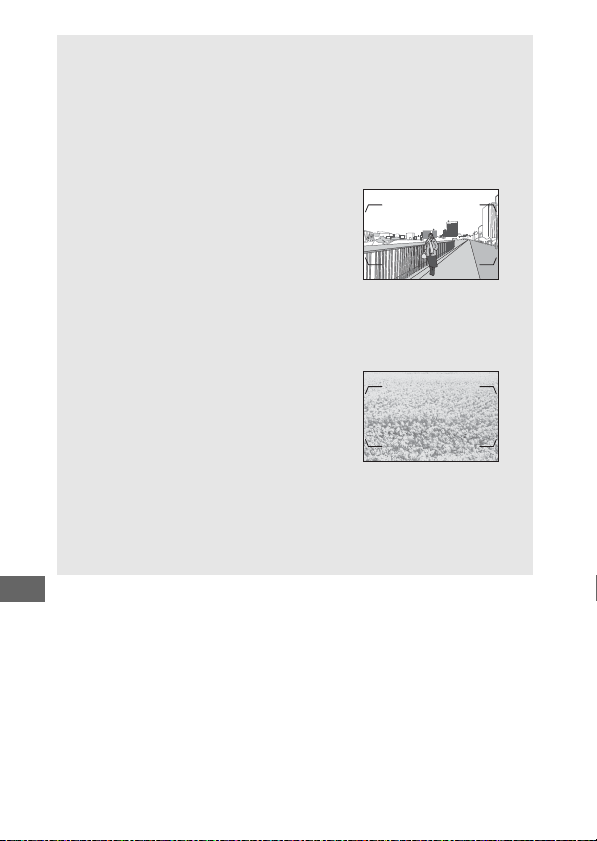
384
A Optional Accessories for AF-S DX NIKKOR 16–80mm f/2.8–4E ED VR Lenses
• 72 mm screw-on filters
• Lens Case CL-1218
A A Note on Wide- and Super Wide-Angle Lenses
Autofocus may not provide the desired results in situations like those
shown below.
1 Objects in the background occupy more of the focus point than the main subject:
If the focus point contains both
foreground and background objects,
the camera may focus on the
background and the subject may be
out of focus.
Example: A far-off portrait
subject at some distance from
the background
2 The subject contains many fine details.
The camera may have difficulty
focusing on subjects that lack
contrast or appear smaller than
objects in the background.
Example: A field of flowers
In these cases, use manual focus, or use focus lock to focus on
another subject at the same distance and then recompose the
photograph.
For more information, see “Getting Good Results with
Autofocus” (0 113).
385
A Trademark Information
IOS is a trademark or registered trademark of Cisco Systems, Inc., in the
United States and/or other countries and is used under license.
Windows is either a registered trademark or a trademark of Microsoft
Corporation in the United States and/or other countries.
Mac, OS X,
Apple®, App Store®, the Apple logos, iPhone®, iPad®, and iPod touch®
are trademarks of Apple Inc. registered in the U.S. and/or other
countries.
Android is a trademark of Google Inc.
The Android robot is
reproduced or modified from work created and shared by Google and
used according to terms described in the Creative Commons 3.0
Attribution License.
PictBridge is a trademark.
XQD is a trademark of
Sony Corporation.
The SD, SDHC, and SDXC logos are trademarks of
the SD-3C, LLC.
HDMI, the HDMI logo and High-Definition Multimedia
Interface are trademarks or registered trademarks of HDMI Licensing,
LLC.
Wi-Fi and the Wi-Fi logo are trademarks or registered trademarks of the
Wi-Fi Alliance.
N-Mark is a trademark or registered trademark of NFC
Forum, Inc., in the United States and/or other countries.
The Bluetooth® word mark and logos are registered trademarks owned
by Bluetooth SIG, Inc. and any use of such marks by Nikon Corporation
is under license.
All other trade names mentioned in this manual or the other
documentation provided with your Nikon product are trademarks or
registered trademarks of their respective holders.
“Made for iPod,” “Made for iPhone,” and “Made for iPad” mean that an
electronic accessory has been designed to connect specifically to
iPod, iPhone, or iPad, respectively, and has been certified by the
developer to meet Apple performance standards.
Apple is not
responsible for the operation of this device or its compliance with
safety and regulatory standards.
Please note that the use of this
accessory with iPod, iPhone, or iPad may affect wireless performance.

386
A Supported Standards
• DCF Version 2.0: The Design Rule for Camera File System (DCF) is a
standard widely used in the digital camera industry to ensure
compatibility among different makes of camera.
• Exif version 2.3: The camera supports Exif (Exchangeable Image File
Format for Digital Still Cameras) version 2.3, a standard in which
information stored with photographs is used for optimal color
reproduction when the images are output on Exif-compliant printers.
• PictBridge: A standard developed through cooperation with the digital
camera and printer industries, allowing photographs to be output
directly to a printer without first transferring them to a computer.
• HDMI: High-Definition Multimedia Interface is a standard for
multimedia interfaces used in consumer electronics and AV devices
capable of transmitting audiovisual data and control signals to HDMI-
compliant devices via a single cable connection.
A Conformity Marking
The standards with which the camera complies can be viewed using
the Conformity marking option in the setup menu (0 309).
A FreeType License (FreeType2)
Portions of this software are copyright © 2012 The FreeType Project
(http://www.freetype.org).
All rights reserved.
A MIT License (HarfBuzz)
Portions of this software are copyright © 2016 The HarfBuzz Project
(http://www.freedesktop.org/wiki/Software/HarfBuzz).
All rights
reserved.
387
The camera accepts the XQD and SD memory cards listed in the
following sections.
Other cards have not been tested.
For more
details on the cards listed below, please contact the
manufacturer.
❚❚ XQD Memory Cards
The following XQD memory cards have been tested and
approved for use in the camera.
Cards with write speeds of 45 MB/s (300×) or better are
recommended for movie recording.
Slower speeds may
interrupt recording or cause jerky, uneven playback.
Approved Memory Cards
Sony
G series
QD-G32A 32 GB
QD-G64A 64 GB
QD-G128A 128 GB
S series
QD-S32/QD-S32E 32 GB
QD-S64/QD-S64E 64 GB
H series
QD-H16 16 GB
QD-H32 32 GB
N series
QD-N32 32 GB
QD-N64 64 GB
Lexar Professional
1100 × 32 GB, 64 GB
1333 × 32 GB, 64 GB
2933 × 32 GB, 64 GB, 128 GB
388
❚❚ SD Memory Cards
The camera supports SD, SDHC, and SDXC memory
cards, including SDHC and SDXC cards compliant
with UHS-I and UHS-II.
Cards rated UHS Speed Class
3 or better are recommended for movie recording; using slower
cards may result in recording being interrupted.
When choosing
cards for use in card readers, be sure they are compatible with
the device.
Contact the manufacturer for information on
features, operation, and limitations on use.
389
The following table shows the approximate number of pictures
that can be stored on a 64 GB Lexar Professional 2933× XQD 2.0
card at different image quality, image size, and image area
settings.
❚❚ DX (24×16) Image Area
Memory Card Capacity
Image quality Image size File size
1
No. of images
1
Buffer capacity
2
NEF (RAW), Lossless
compressed, 12-bit
Large 20.1 MB 1700 200
Medium 14.5 MB 2400 200
Small 11.0 MB 3200 200
NEF (RAW), Lossless
compressed, 14-bit
Large 25.0 MB 1300 200
NEF (RAW),
Compressed, 12-bit
Large 17.2 MB 2400 200
NEF (RAW),
Compressed, 14-bit
Large 21.3 MB 2000 200
NEF (RAW),
Uncompressed, 12-bit
Large 33.1 MB 1700 200
NEF (RAW),
Uncompressed, 14-bit
Large 43.1 MB 1300 79
TIFF (RGB)
Large 62.5 MB 975 48
Medium 35.6 MB 1600 56
Small 16.4 MB 3600 64
JPEG fine
3
Large 10.4 MB 4400 200
Medium 6.4 MB 7300 200
Small 3.4 MB 13,700 200
JPEG normal
3
Large 5.3 MB 8600 200
Medium 3.3 MB 14,100 200
Small 1.8 MB 25,900 200
JPEG basic
3
Large 2.8 MB 16,600 200
Medium 1.8 MB 26,600 200
Small 1.0 MB 46,500 200
390
❚❚ 1.3× (18×12) Image Area
1 All figures are approximate.
File size varies with scene recorded.
2 Maximum number of exposures that can be stored in memory buffer at ISO 100.
Drops at image
qualities marked with a star (“★”) or if auto distortion control is on.
3 Figures assume size-priority JPEG compression.
Selecting an image-quality option marked
with a star (“★”; optimal compression) increases the file size of JPEG images; number of
images and buffer capacity drop accordingly.
Image quality Image size File size
1
No. of images
1
Buffer capacity
2
NEF (RAW), Lossless
compressed, 12-bit
Large 12.4 MB 2900 200
Medium 9.1 MB 3900 200
Small 7.0 MB 5100 200
NEF (RAW), Lossless
compressed, 14-bit
Large 15.4 MB 2300 200
NEF (RAW),
Compressed, 12-bit
Large 10.7 MB 3900 200
NEF (RAW),
Compressed, 14-bit
Large 13.1 MB 3300 200
NEF (RAW),
Uncompressed, 12-bit
Large 20.1 MB 2900 200
NEF (RAW),
Uncompressed, 14-bit
Large 25.9 MB 2300 200
TIFF (RGB)
Large 37.2 MB 1600 135
Medium 21.4 MB 2700 200
Small 10.0 MB 5700 200
JPEG fine
3
Large 6.5 MB 7000 200
Medium 4.2 MB 11,100 200
Small 2.4 MB 19,200 200
JPEG normal
3
Large 3.4 MB 13,600 200
Medium 2.2 MB 21,200 200
Small 1.3 MB 35,700 200
JPEG basic
3
Large 1.8 MB 25,600 200
Medium 1.2 MB 39,200 200
Small 0.8 MB 60,600 200


392
The movie footage or number of shots that can be recorded with
fully-charged batteries varies with the condition of the battery,
temperature, interval between shots, and the length of time
menus are displayed.
In the case of AA batteries, capacity also
varies with make and storage conditions; some batteries can not
be used.
Sample figures for the camera and optional MB-D17
multi-power battery pack are given below.
• Photographs, single-frame release mode (CIPA standard
1
)
- One EN-EL15 battery (camera): Approximately 1240 shots
- One EN-EL15 battery (MB-D17): Approximately 1240 shots
- One EN-EL18a battery (MB-D17): Approximately 2510 shots
- Eight AA alkaline batteries (MB-D17): Approximately 1140 shots
• Photographs, continuous release mode (Nikon standard
2
)
- One EN-EL15 battery (camera): Approximately 2740 shots
- One EN-EL15 battery (MB-D17): Approximately 2740 shots
- One EN-EL18a battery (MB-D17): Approximately 6570 shots
- Eight AA alkaline batteries (MB-D17): Approximately 2620 shots
• Movies
3
- One EN-EL15 battery (camera): Approximately 50 minutes of HD
footage
- One EN-EL15 battery (MB-D17): Approximately 50 minutes of HD
footage
- One EN-EL18a battery (MB-D17): Approximately 130 minutes of HD
footage
- Eight AA alkaline batteries (MB-D17): Approximately 60 minutes of
HD footage
Battery Life

393
1 Measured at 23 °C/73.4 °F (±2 °C/3.6 °F) with an AF-S DX NIKKOR 16–80mm f/2.8–4E ED VR
lens under the following test conditions: lens cycled from infinity to minimum range and one
photograph taken at default settings once every 30 s.
Live view not used.
2 Measured at 23 °C/73.4 °F with an AF-S NIKKOR 70–200mm f/2.8G ED VR II lens under the
following test conditions: vibration reduction off, image quality set to JPEG normal, image size
set to Large, shutter speed
1
/
250 s, focus cycled from infinity to minimum range three times
after shutter-release button has been pressed halfway for 3 s; six shots are then taken in
succession and monitor turned on for 5 s and then turned off; cycle repeated once standby
timer has expired.
3 Measured at 23 °C/73.4 °F (±2 °C/3.6 °F) with the camera at default settings and an AF-S DX
NIKKOR 16–80mm f/2.8–4E ED VR lens under conditions specified by the Camera and Imaging
Products Association (CIPA).
Individual movies are composed of one or more files, each up to
4 GB in size, and can total up to 29 minutes 59 seconds in length; recording may end before
these limits are reached if the camera temperature rises.
The following can reduce battery life:
• Using the monitor
• Keeping the shutter-release button pressed halfway
• Repeated autofocus operations
• Taking NEF (RAW) or TIFF (RGB) photographs
• Slow shutter speeds
• Using camera Wi-Fi (wireless LAN) and Bluetooth features
• Using the camera with optional accessories connected
• Using VR (vibration reduction) mode with VR lenses
• Repeatedly zooming in and out with an AF-P lens.
To ensure that you get the most from rechargeable Nikon
EN-EL15 batteries:
• Keep the battery contacts clean.
Soiled contacts can reduce
battery performance.
• Use batteries immediately after charging.
Batteries will lose
their charge if left unused.
394
Symbols
P (Programmed auto) ............130, 132
S (Shutter-priority auto) ........130, 133
A (Aperture-priority auto).....130, 134
M (Manual) .................................130, 135
S (Single frame) ................................. 116
C
L (Continuous low speed)... 116, 297
CH (Continuous high speed).......... 116
Q (Quiet shutter-release)................ 116
QC (Quiet continuous shutter-
release)............................................... 116
E (Self-timer)...................117, 119, 296
MUP ................................................117, 121
K (Single-point AF) ........................ 103
I (Dynamic-area AF)..................... 103
T (3D-tracking)................................ 104
N (Group-area AF) .......................... 104
H (Auto-area AF)............................. 104
! (Face-priority AF) ...........................48
5 (Wide-area AF).................................48
6 (Normal-area AF)............................48
& (Subject-tracking AF)..................48
L (Matrix) ........................................... 128
M (Center-weighted)...................... 128
N (Spot)............................................... 128
t (Highlight-weighted)............... 128
R (Info) button................... 54, 69, 226
a (Live view)..............43, 58, 174, 303
Q (Help)...................................................31
t (Memory buffer) ..................118, 389
i button ..............50, 64, 225, 229, 260
D switch..........................................6, 303
I (Focus indicator) .........38, 111, 115
L (Preset manual) ...............160, 169
Numerics
1.3× ............................................70, 88, 97
12-bit....................................................... 93
14-bit....................................................... 93
3D color matrix metering III..........128
3D-tracking ......................104, 105, 293
3D-tracking face-detection...........293
3D-tracking watch area ..................293
A
AC adapter ..........................................335
Accessories..........................................335
Accessory shoe........................ 196, 335
Active D-Lighting..... 50, 64, 155, 189,
286, 290
Add items (My Menu)......................315
ADL bracketing (Auto bracketing
set).............................................. 146, 155
Adobe RGB..........................................286
Advanced Wireless Lighting.........208
AE & flash (Auto bracketing set).146,
147
AE only (Auto bracketing set) .....146,
147
AF ..................47–49, 97–113, 292–294
AF activation.......................................293
AF area brackets..............................7, 29
AF fine-tune........................................305
AF-area mode ................... 48, 103, 293
AF-C ............................................. 101, 292
AF-F.......................................................... 47
AF-ON button.....................102, 293, 301
AF-S....................................... 47, 101, 292
After burst, show ..............................282
After delete.........................................282
Airplane mode...................................307
Angle of view .....................................327
Aperture...................134, 135, 140, 302
Aperture lock............................ 140, 302
Aperture-priority auto ....................134
Index

395
Aspect ratio ................................. 70, 318
Assign MB-D17 buttons................. 303
Assign remote (WR) Fn button.... 307
Attaching the lens...............................18
Audio .......................................................60
Audio output ..................................... 372
Auto (White balance).............159, 161
Auto bracketing............. 146, 287, 301
Auto bracketing (mode M) ........... 301
Auto bracketing set................146, 287
Auto distortion control .................. 286
Auto external flash..................199, 222
Auto FP high-speed sync............... 299
Auto image rotation........................ 282
Auto ISO sensitivity control .125, 289
Auto M ISO sensitivity control...... 300
Auto-area AF.............................104, 106
Autofocus... 47–49, 97–113, 292–294
Autofocus mode...............47, 101, 294
Autofocus mode restrictions ....... 294
B
Backlight................................................... 6
Backup (Secondary slot function) .96
Battery....................13, 15, 35, 309, 375
Battery info......................................... 309
Battery order...................................... 309
Battery pack .................... 303, 309, 335
Beep ...................................................... 306
BKT button .... 147, 148, 151, 152, 155,
156, 195, 238, 301
Black-and-white (Monochrome). 314
Blocked shot AF response............. 292
Bluetooth ....................................xxii, 308
Body cap.............................................. 335
Bracketing........................ 146, 287, 301
Bracketing order............................... 301
Bulb ....................................................... 137
Burst.............................................282, 297
Button backlights.........................6, 298
C
Camera Control Pro 2......................336
Capture NX-D ..........................................v
Center-weighted metering . 128, 295
Charging the battery......................... 13
Choose color temp. (White balance)
160, 166
Choose image area... 70, 89, 284, 288
Choose start/end point .................... 82
Choose tab..........................................315
CL mode shooting speed...............297
Clean image sensor................ 305, 338
Cloudy (White balance) ..................160
CLS..........................................................328
Color space..........................................286
Color temperature159, 160, 162, 166
Compatible lenses............................322
Compressed (NEF (RAW)
compression)...................................... 93
Conformity marking .............. 309, 386
Connect to smart device................308
Connector for external microphone.
2
Continuous high speed..................116
Continuous low speed.......... 116, 297
Continuous release mode .............116
Continuous-servo AF............. 101, 292
Control panel...........................................5
Copy image(s) ....................................282
Copyright information....................306
CPU contacts ......................................325
CPU lens .............................. 19, 322, 325
Creative Lighting System...............328
Crop ................................................70, 318
Custom control assignment 301, 303
Custom Settings................................292
Custom settings bank .....................292
Customize command dials............302
Cyanotype (Monochrome)............314
396
D
Date and time.................................... 304
Date format........................................ 304
Daylight saving time....................... 304
DCF........................................................ 386
Default settings ..............230, 288, 310
Delete............................................ 42, 278
Delete all images.............................. 279
Delete current image............... 42, 278
Depth of field..................................... 131
Destination......................................... 288
Diopter.......................................... 29, 335
Direct sunlight (White balance).. 160
Distance-priority manual ....199, 223,
328
Distortion control............................. 313
D-Lighting........................................... 313
DX format........................................70, 88
Dynamic-area AF............103, 106, 294
E
Easy exposure compensation...... 295
Edit movie............................. 82, 86, 314
Electronic front-curtain shutter ....50,
298
Electronic rangefinder.................... 115
Electronic VR............................... 65, 291
EV steps for exposure cntrl........... 294
Exif......................................................... 386
Exp./flash comp. step value.......... 294
Exposure.........128, 130, 141, 143, 294
Exposure bracketing ....146, 147, 287,
301
Exposure comp. for flash............... 300
Exposure compensation.......143, 295
Exposure delay mode..................... 297
Exposure differential....................... 193
Exposure indicator........................... 136
Exposure lock .................................... 141
Exposure meters........................ 39, 296
Exposure mode .................................130
Exposure preview............................... 45
Exposure smoothing ................76, 245
Extended photo menu banks ......283
External GPS device options254, 307
External microphone................65, 336
Eye-Fi upload .....................................308
F
Face detection ......................... 293, 295
Face-priority AF................................... 48
File information.................................262
File naming ............................... 283, 288
File number sequence ....................298
Filter effects .............................. 184, 314
Fine-tune optimal exposure.........295
Firmware version ..............................310
Flash ......196, 201, 203, 205, 208, 299,
328
Flash (White balance)......................160
Flash bracketing....146, 147, 287, 301
Flash compensation ........................203
Flash control...........198, 199, 214, 284
Flash info .............................................222
Flash mode................................ 201, 202
Flash only (Auto bracketing set) .146
Flash shutter speed..........................300
Flash sync speed ...............................299
Flash sync terminal ..........................197
Flash-ready indicator...196, 206, 333,
369
Flat (Set Picture Control)................180
Flexible program...............................132
Flick.................................................11, 306
Flicker reduction............234, 287, 290
Fluorescent (White balance).........159
Fn1 button.................................. 301, 303
Fn2 button.........................275, 301, 303
f-number.................................... 134, 325
Focal length........................................252
Focal length scale.............................377
397
Focal plane mark .............................. 115
Focus............ 47–49, 97–115, 292–294
Focus indicator..................38, 111, 115
Focus lock ........................................... 111
Focus mode.......................... 47, 97, 114
Focus point 37, 48, 97, 103, 108, 293,
294
Focus point options ........................ 294
Focus point wrap-around ............. 294
Focus tracking ..........................102, 292
Focus tracking with lock-on ......... 292
Focusing screen................................ 366
Focus-mode selector ........ 47, 97, 114
Focus-mode switch ......................... 114
Format.................................................. 304
Format memory card...................... 304
Frame interval (Slide show) .......... 282
Frame rate..............................................68
Frame size/frame rate.............. 68, 288
Frequency response................. 64, 291
Front-curtain sync............................ 201
Full-frame playback......................... 255
Full-frame playback flicks.............. 306
Full-time-servo AF...............................47
FV lock.................................................. 205
G
GPS ..................................... 253, 254, 268
GPS unit ......................................253, 336
Group flash................................214, 224
Group-area AF ................ 104, 106, 294
H
H.264..................................................... 371
HDMI............................................306, 386
HDR (high dynamic range) ........... 191
Headphone volume ...........................65
Headphones..........................................65
Help..........................................................31
Hi............................................................ 124
Hide image ......................................... 281
High definition...................................386
High Dynamic Range (HDR) 191, 287
High ISO NR............................... 286, 290
Highlight display................................. 65
Highlights ............................................263
Highlight-weighted metering......128
Histogram.................... 54, 69, 264, 265
I
Image area.......50, 64, 88, 89, 94, 284,
288
Image comment................................306
Image Dust Off ref photo...............306
Image overlay........................... 314, 319
Image quality ..............................91, 284
Image review............................ 257, 282
Image size.....................................94, 284
Incandescent (White balance)......159
Index marking...................................... 63
In-focus indicator............. 38, 111, 115
Information display. 54, 69, 222, 226,
305
Interval timer shooting......... 243, 287
IPTC........................... 256, 260, 269, 306
ISO display...........................................297
ISO sensitivity........ 123, 125, 285, 289
ISO sensitivity settings.......... 285, 289
ISO sensitivity step value ...............294
i-TTL .................198, 199, 214, 222, 328
J
JPEG ............................... 91, 95, 313, 316
JPEG basic..............................................91
JPEG fine ................................................ 91
JPEG normal.......................................... 91
L
L (large) ............................................ 72, 94
LAN.........................................................335
Landscape (Set Picture Control)..180
Language.............................................304
398
LCD illumination...........................6, 298
LED lamp............................................. 307
Lens............. 18, 19, 250, 305, 322, 377
Lens focus ring..................49, 114, 377
Lens mount .............................3, 18, 115
Lens mounting mark..................... 2, 18
Lens vibration reduction switch. 380
Limit AF-area mode selection...... 293
LINK mode .................................211, 307
Live view..........................................43, 58
Live view button options .............. 303
Live view photography..............43–57
Live view selector.........................43, 58
Lo ........................................................... 124
Location data............................253, 268
Lock mirror up for cleaning.305, 341
Long exposure NR ........................... 286
Lossless compressed (NEF (RAW)
compression) ......................................93
M
M (Manual focus)........................ 49, 114
M (medium) ....................................72, 94
Manage Picture Control....... 185, 285,
290
Manual (Exposure mode).............. 135
Manual (Flash control)..200, 214, 223
Manual focus .............................. 49, 114
Manual focus ring in AF mode .... 294
Matrix metering.......................128, 295
Max. continuous release................ 297
Maximum aperture.. 49, 53, 250, 325,
333
Maximum sensitivity..............126, 289
Memory buffer.................................. 118
Memory card...............15, 96, 304, 387
Memory card capacity.................... 389
Metering.............................................. 128
Microphone.............2, 64, 65, 290, 336
Microphone sensitivity ........... 64, 290
Minimum aperture ................... 19, 131
Minimum shutter speed.................126
Mired.....................................................165
Mirror .................................117, 121, 341
Mirror up mode ....................... 117, 121
Modeling flash......................... 131, 300
Monitor..9, 11, 43, 255, 296, 304, 305
Monitor brightness ............50, 65, 304
Monitor color balance.....................305
Monitor off delay ..............................296
Monochrome ........................... 180, 314
Mounting mark...........................18, 377
Movie mode....................... 58, 288, 303
Movie quality...............................68, 289
Movie shooting menu.....................288
Movie-record button................60, 301
Multi selector .................... 31, 301, 302
Multi selector center button.........301
Multiple exposure .................. 236, 287
Multi-power battery pack... 303, 309,
335
Multi-selector power aperture....... 65
My Menu..............................................315
N
NEF (RAW) ............ 91, 93, 95, 313, 316
NEF (RAW) bit depth.......................... 93
NEF (RAW) compression................... 93
NEF (RAW) processing........... 313, 316
NEF (RAW) recording................93, 285
Network................................................308
Neutral (Set Picture Control) ........180
Non-CPU lens ..................250, 323, 325
Non-CPU lens data ........250, 251, 305
Normal-area AF ................................... 48
Number of focus points..................293
O
Optical AWL.............................. 208, 209
Optical VR............................................298
Optical/radio AWL.................. 208, 213

399
Overflow (Secondary slot function) ..
96
Overlay mode .................................... 239
Overview data ................................... 270
P
Paring ................................................... 211
Perspective control.......................... 314
Photo information ..................261, 281
Photo live view display WB..............51
Photo shooting menu .................... 283
Photo shooting menu bank ......... 283
PictBridge............................................ 386
Picture Controls ................................ 180
PIN ......................................................... 211
Playback................................. 40, 80, 255
Playback display options............... 281
Playback folder.................................. 281
Playback information.............261, 281
Playback menu.................................. 281
Playback zoom.................................. 271
Portrait (Set Picture Control)........ 180
Power aperture ....................................65
Power connector.............................. 335
Predictive focus tracking............... 102
Preset manual (White balance) .. 160,
169
Press the shutter-release button
halfway..................................................38
Primary slot selection .............. 96, 283
Programmed auto............................ 132
Protecting photographs................ 273
Pv button ..........49, 131, 300, 301, 303
Q
Quick wireless control ...........216, 224
Quiet continuous shutter-release......
116
Quiet shutter-release...................... 116
R
Radio AWL ................................. 208, 210
Radio remote flash info ..................213
Rank items (My Menu) ....................315
Rating....................................................274
RAW primary - JPEG secondary
(Secondary slot function)............... 96
Rear-curtain sync ..............................201
Recent settings..................................315
Rechargeable Li-ion battery .....iv, 13,
35, 375
Red-eye correction...........................313
Red-eye reduction............................201
Release button to use dial.............302
Release mode.....................................116
Remote cord...................... 73, 137, 336
Remote flash control .......................214
Remote flash photography...........208
Remote repeating................... 219, 225
Remove items (My Menu)..............315
Removing the lens from the camera
19
Repeating flash........................ 200, 223
Reset...................................230, 288, 310
Reset all settings ...............................310
Reset movie shooting menu.........288
Resize ....................................................313
Restoring default settings .. 230, 288,
310
Retouch menu ...................................313
Reverse indicators ............................303
RGB........................................ 91, 264, 286
RGB Histogram...................................264
Rotate tall.............................................282
S
S (small)............................................ 72, 94
Save selected frame....................82, 86
Save/load settings............................309
SD memory card...........................15, 96
400
Secondary slot function.......... 96, 283
Select to send to smart device.... 282
Self-timer...........................117, 119, 296
Send to smart device (auto)......... 308
Sensitivity................ 123, 125, 285, 289
Set clock from satellite................... 254
Set Picture Control.........180, 285, 289
Setup menu........................................ 304
Shade (White balance)................... 160
Shooting data.................................... 266
Shutter speed..................133, 135, 140
Shutter speed lock..................140, 302
Shutter-priority auto....................... 133
Shutter-release button.. 38, 111, 141,
303
Shutter-release button AE-L......... 296
Side-by-side comparison .............. 314
Single frame....................................... 116
Single-point AF ........................103, 106
Single-servo AF.................47, 101, 292
Size .................................72, 94, 313, 318
Skylight................................................ 314
Slide show........................................... 282
Slot ........................................96, 256, 288
Slot empty release lock.................. 309
Slot selection .............................. 96, 257
Slow sync ............................................ 201
Slow-motion playback ......................81
Smart device....................253, 282, 308
Smoothing.......................................... 193
Speedlights ...............................196, 328
Split-screen display zoom.........51, 52
Spot....................................................... 128
Spot white balance.......................... 174
sRGB...................................................... 286
Standard (Set Picture Control) .... 180
Standard i-TTL fill-flash for digital
SLR ..............................................198, 328
Standby timer....................39, 254, 296
Storage folder.................................... 283
Store by orientation........................ 293
Straighten............................................313
Sub-dial frame advance .................302
Subject motion..................................292
Sub-selector.. 109, 111, 141, 301, 303
Sync with smart device...................304
Sync. release mode options..........297
Synchronized release......................297
T
Ten-pin remote terminal..2, 253, 336
Thumbnail...........................................255
TIFF (RGB) ....................................... 91, 95
Tilting monitor........................................9
Time.......................................................304
Time zone............................................304
Time zone and date .........................304
Time-lapse movie ......................74, 291
Timer ........................................... 119, 243
Toning (Set Picture Control) .........184
Touch controls......... 11, 186, 258, 306
Touch screen.............. 11, 55, 186, 258
Touch shutter....................................... 55
Trim.............................................. 313, 318
Two-button reset..............................230
Type D lens................................ 322, 325
Type E lens ................................ 322, 325
Type G lens................................ 322, 325
U
Uncompressed (NEF (RAW)
compression)...................................... 93
USB cable.................................................iv
UTC .............................................. 253, 268
V
Vibration reduction 65, 291, 298, 380
Viewfinder............................... 7, 29, 365
Viewfinder eyepiece.................29, 119
Viewfinder focus ........................29, 335
Viewfinder grid display...................298
ViewNX-i ...................................................v

401
Vignette control................................ 286
Virtual horizon..................... 54, 69, 305
Vivid (Set Picture Control)............. 180
W
Warm filter.......................................... 314
WB..............................151, 159, 285, 289
WB bracketing (Auto bracketing set)
146, 151
White balance........151, 159, 285, 289
White balance bracketing....146, 151
Wide-area AF.........................................48
Wi-Fi ..............................................xxii, 308
Wind noise reduction .............. 64, 291
Wireless remote (WR) options..... 307
Wireless remote controller ... 73, 210,
307, 335
Wireless transmitter ........................ 335
X
XQD card ............................... 15, 96, 387

No reproduction in any form of this manual, in whole or in part (except
for brief quotation in critical articles or reviews), may be made without
written authorization from NIKON CORPORATION.
Printed in Thailand
6MB34011-04
En
DIGITAL CAMERA
User's Manual
En
• Read this manual thoroughly before using the camera.
• To ensure proper use of the camera, be sure to read
“For Your Safety” (page xiii).
• After reading this manual, keep it in a readily accessible
place for future reference.