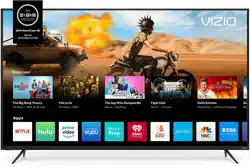
User Manual for Smart TV
USING THE REMOTE
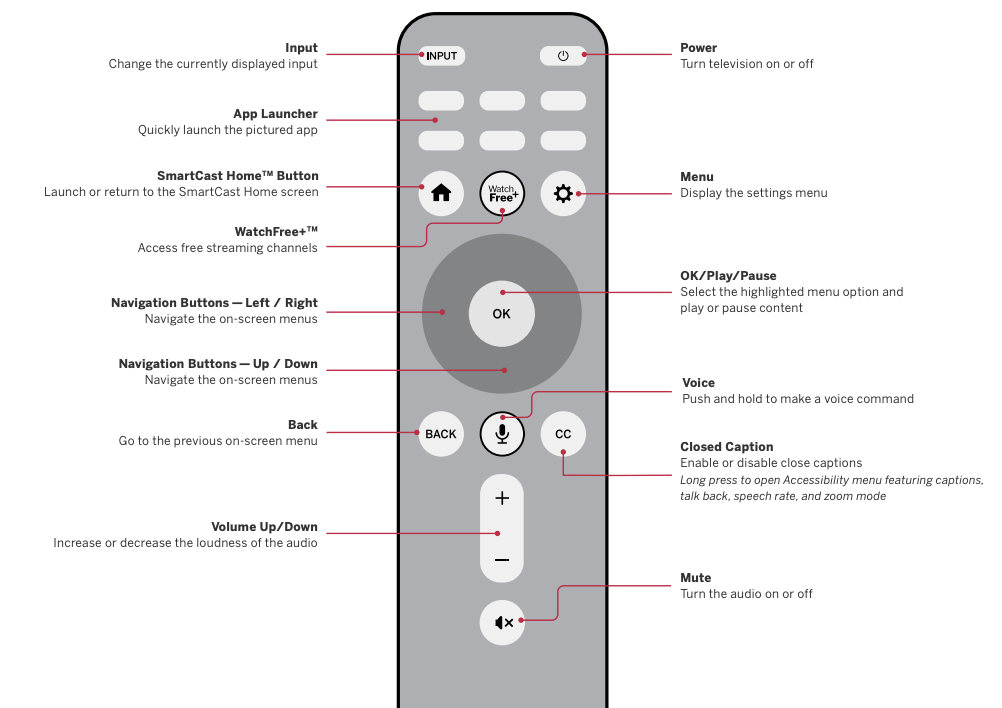
Replacing the Batteries
1. Push and slide the cover down. Then lift the cover to access the battery compartment.
2. Insert two batteries into the remote control. Make sure that the (+) and (-) symbols on the batteries match the (+) and (-) symbols inside the battery compartment.
3. Replace the battery cover and slide to close.
In many places batteries cannot be thrown away or discarded with household waste. Please ensure you properly dispose of your batteries consistent with the laws and/or regulations where you live.
WARNING: Keep the remote control batteries away from children. It may cause choking and/or lead to a fire or chemical burn if mishandled. Do not dispose of batteries in fire. Replace only with batteries of the correct type. Risk of fire or explosion if the battery is replaced by an incorrect type.
TIP: When needed, VIZIO recommends replacing the batteries that came with this remote with two, new Duracell ‘AAA’ alkaline batteries.
USING THE VOICE REMOTE
You can easily control your TV with the included Voice Remote.
To pair your remote to the TV:
During first-time setup, your remote should automatically pair to your TV with Bluetooth.
To manually pair:
Press the MIC button to launch pairing mode.
TIP: The voice remote must be within close enough range of the TV to pair properly.
How to use the voice control:
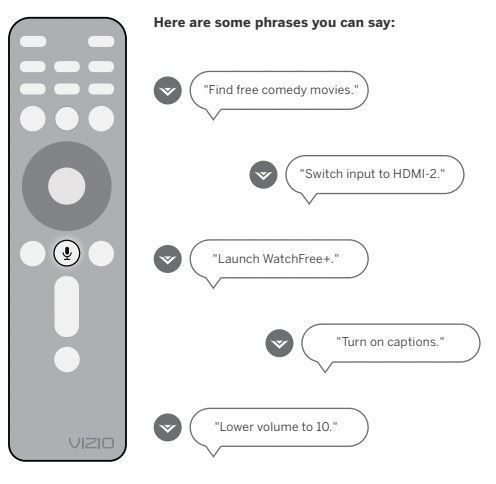
1. Push and hold the MIC button while speaking a command.
Here are some phrases you can say:
Using the SmartCast Mobile™ app for voice control:
You can also use the free VIZIO SmartCast Mobile app as a voice control remote. Refer to the SmartCast Mobile section on page 29 for more information.
Connect to other popular voice assistant devices:
VIZIO TVs also work with Google Assistant, Siri, and Alexa-enabled devices for hands-free voice control.

TIP: If you want to use a voice assistant to turn your TV on, make sure Quick Start Mode is enabled. Refer to Adjusting the Power Mode on page 23.
This device is equipped with the VIZIO Voice feature. By activating the VIZIO Voice feature (either through the mobile application or Bluetooth remote), you can control your Smart TV, and use many of its features, with voice commands. In order to provide you the VIZIO Voice feature, some voice commands may be transmitted to a third-party service provider that will translate your voice command into text and provide VIZIO Voice features. We may also capture and collect voice commands and associated text(s) in order to provide the VIZIO Voice feature and evaluate and improve the features. VIZIO will only capture voice commands when you press the microphone button on your remote or mobile app and speak into the microphone on the remote control or mobile phone. You may disable the VIZIO Voice feature for your remote at any time by unpairing your Bluetooth remote.
Completing the First-Time Setup
Before you begin the first-time setup:
- Your TV should be installed and the power cord should be connected to an electrical outlet.
- If you have a wireless network, have the network password ready.
- If you are connecting to your network with an Ethernet cable, connect it to the Ethernet port on the TV.
The first time you turn on the TV, the on-screen instructions will guide you through each of the steps necessary to get your TV ready for use:
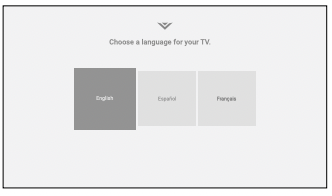
1. Choose your language.Pressing the CC button will enable TTS (text-to-speech) functionality.
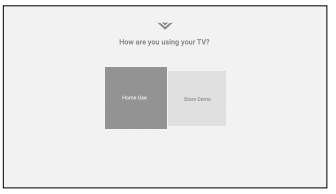
2. Choose home use
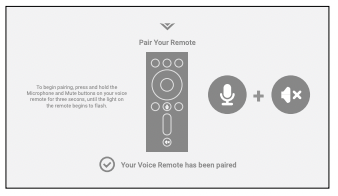
3. Pair your voice remote
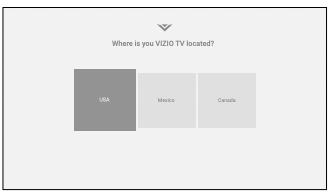
4. Choose your country
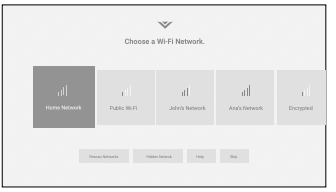
5. Choose your Wi-Fi network and enter the password.
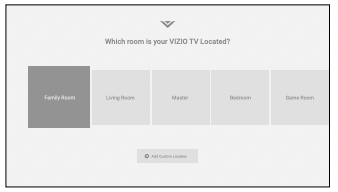
6. Name your TV.
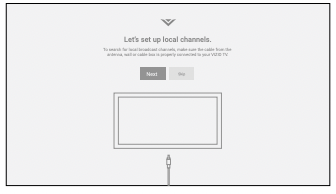
7. Scan for channels
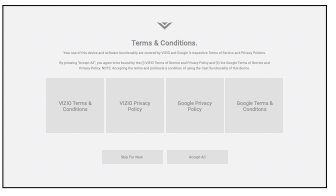
8. Accept the Terms & Conditions
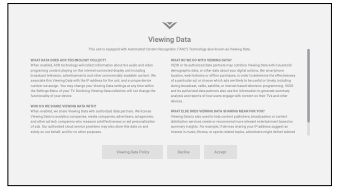
9. View and accept VIZIO Viewing Data Policy.
Your TV features an easy-to-use on-screen menu.
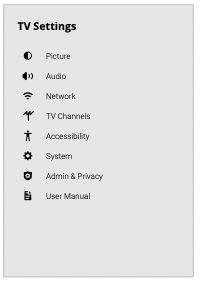
To open the on-screen menu, press the MENU button on the remote.
From this menu, you can:
- Adjust the picture settings
- Adjust the audio settings
- Adjust the network settings
- Adjust the TV channel settings
- Adjust accessibility settings
- Adjust TV system settings
- Access admin and privacy settings
- View the user manual
NAVIGATING THE ON-SCREEN MENU
To open the on-screen menu:
- Press the MENU button on the remote.
- Use the Navigation buttons to highlight a menu option, and press the OK button to select that option.
TIP: While navigating the on-screen menu, you can press the BACK button at any time to return to the previous menu screen.
CHANGING THE INPUT SOURCE
External devices, such as DVD players, Blu-ray players, and video game consoles, can be connected to your TV. To use one of these devices with your TV, you must first change the input source using the input menu.
To change the input sources:
- Press the INPUT button on the remote. The input menu is displayed.
- Use the Navigation buttons or the INPUT button on the remote to highlight the input you wish to view. The corresponding inputs are named on the back of your TV.
- Press OK or release the INPUT button. The selected input is displayed.
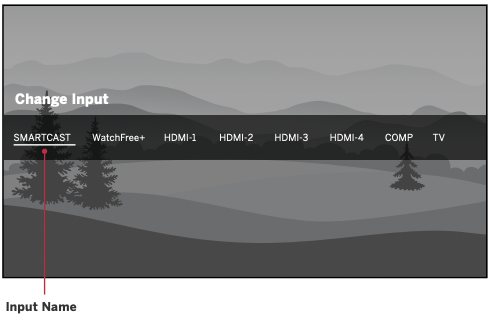
The underlined input on the left is the current input selected. Inputs may vary by TV.
TIP: You can change the input names that appear on the Input menu to make your devices easy to recognize. See Renaming Devices on the Input Menu on page 23.
ADJUSTING THE PICTURE SETTINGS
Your TV can be adjusted to suit your preferences and viewing conditions.
To adjust the picture mode settings:
Menu > Picture > Picture Mode
1. Use the Navigation buttons on the remote to highlight Picture Mode, then use the Left/Right Navigation buttons to change the picture mode:
- Vivid — Sets the picture settings to values that produce a brighter, more vivid picture.
- Bright — Great for viewing everyday TV, such as news and TV shows, that requires a brighter image with motion enhancements.
- Calibrated — Accurate colors intended for cinema content viewing in a bright room.
- Calibrated Dark — Accurate colors intended for cinema content viewing in a dark room or at nighttime.
- Game — Reduces throughput delays and optimizes the picture settings for displaying game console output. Also the preferred picture mode for computer mode.
- Sports — Sets the picture settings to values ideal for watching sport events with motion control setting.
TIP: If you save changes to the setting for a picture mode, an asterick will appear after its name. See Saving a Custom Picture Mode on page 13.
2. To manually change each of the picture settings, use the Up/Down Navigation buttons on the remote to highlight that picture setting, then use the Left/Right Navigation buttons to adjust the setting:
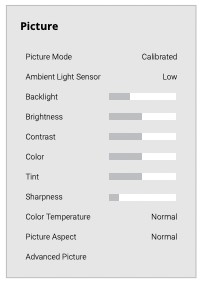
- Ambient Light Sensor — Detects your room's light level and automatically adjusts the background. Select Low for the darkest picture or High for the brightest picture. Select Off for manual backlight control.
- Backlight (SDR content) or Tone Mapping (HDR content) — Adjusts the LED brightness to affect the overall brilliance of the picture.
- Brightness — Adjusts the black level of the picture. When this setting is too low, the picture may be too dark to distinguish details. When this setting is too high, the picture may appear faded or washed out.
- Contrast — Adjusts the white level of the picture. When this setting is too low, the picture may appear dark. When this setting is too high, the picture may appear faded or washed out. If the setting is too high or too low, detail may be difficult to distinguish in dark or bright areas of the picture.
- Color — Adjusts the intensity of the picture colors.
- Tint — Adjusts the hue of the picture. This setting is useful in adjusting the flesh tones in the picture. If flesh appears too orange, reduce the level of color before adjusting tint.
- Sharpness — Adjusts the edge sharpness of picture elements. It can be used to sharpen non-HD (high definition) content; however, it will not produce detail that does not otherwise exist.
Adjusting the Color Temperature
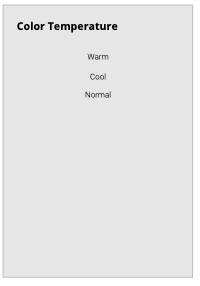
Adjusting the color temperature changes the white balance of the picture.
To adjust the color temperature:
Menu > Picture > Color Temperature
Use the Navigation buttons on the remote to highlight a color temperature preset and then press OK.
- Warm — Produces an orange-hued picture.
- Cool — Produces a blue-hued picture.
- Normal — Optimized for television viewing.
Changing the Picture Aspect Ratio
To change the screen aspect ratio:
Menu > Picture > Aspect Ratio
Use the Navigation buttons to highlight the aspect ratio you wish to view.
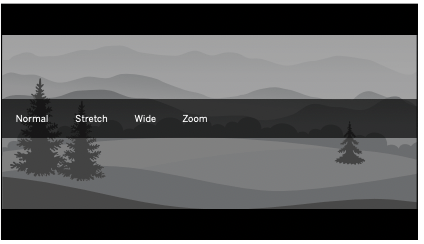
Your TV can display images in different modes:
- Normal (default) — No change to aspect ratio.
- Panoramic* — Stretches a 4:3 image to fill 16:9 screen with an algorithm so the center doesn’t look stretched.
- Wide — Stretches a 4:3 aspect ratio to fill 16:9 screen. If a 16:9 image, adds black bars to top and bottom.
- Zoom — Expands image both horizontally and vertically by 14%.
- Stretch* — When the 16:9 signal is a 4:3 image with black bars left and right, stretches to fill the screen.
Some programs have black bars on the top or sides of the screen so that the picture keeps its original shape. Examples include widescreen movies and older TV programs.
TIP: The aspect ratio cannot be changed for Ultra HD content or HDR content.
* Available aspect ratio settings may vary by input source. Panoramic mode is only available for standard definition TV (480i/480p) and Stretch mode is only available for high definition TV (720p/1080i/1080p).
Adjusting Advanced Picture Settings
To adjust advanced picture settings:
Menu > Picture > Advanced Picture
Use the Navigation buttons to highlight the setting you wish to adjust, then press the Left/Right Navigation buttons to change the setting:
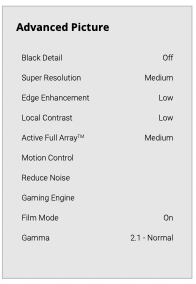
- Black Detail — Adjusts the average brightness of the picture to compensate for large areas of brightness.
- Super Resolution — Configures the resolution to enhance dim and blurred pictures resulting in a sharper image.
- Edge Enhancement — Increases the smoothness of edges.
- Local Contrast — Adjust the contrast of the picture locally.
- Active Full Array™ — Based on the content, dynamically adjusts and balances the brightness and the contrast ratio of the picture by locally adjusting backlight zones.
- Motion Control:
- Clear Action: Reduces blur in scenes with fast action but limits the range for the Backlight setting.
− Signal Noise: Reduces background picture noise when viewing analog sources. This function helps to correct "speckle" noise with a slight reduction in sharpness.
− Block Noise: Reduces the side effects of digital compression such as blocking" and noise on sharp edges. The High setting will cause a slight reduction in sharpness.
− Contour Smoothing: Removes visible contour noise without loss of the complex detail.
− Game Low Latency: Reduces video delay (lag) when gaming. When set to Auto and Automatic Low Latecy Mode (ALLM) is detected, ALLM will apply for the duration of the game.
− Variable Refresh Rate: Adjusts the refresh rate of the screen based on the content.
− Game HDR: Optimizes picture quality for HDR game.
- Film Mode — Optimizes the picture for watching films. Select On or Off.
- Gamma — Set the shape of the Gamma curve. Use lower Gamma values for bright room conditions, and higher values when it’s dark.
- Color Calibration — Calibrate colors using HSB, gain, offset and 20 point white balance and test or reset colors to defaults.
Adjusting the Color Tuner Settings
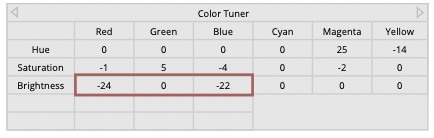
The Color Tuner settings allow you to adjust the color management system, 20 point white balance, turn color channels off for testing, and display SMPTE, flat, ramp, and uniformity analyzer test patterns.
To access the color tuner table:
Menu > Picture > Advanced Picture > Color Calibration > Color Tuner
WARNING: The Color Tuner, 20 Point White Balance, and test patterns allow technicians to manually calibrate the TV. Calibration requires specialized training, an input with precisely set colors, and a specialized light meter.
To turn color channels off and on:
- Use the Navigation buttons on the remote to highlight Red, Green, or Blue.
- Press the OK button to turn the color channel off or on. An X appears over a color channel that has been turned off.
- Only two color channels can be turned off at the same time.
TIP: Any changes made affect the color temperature setting. Select the preferred color temperature setting first. See Adjusting the Color Temperature on page 9.
To adjust the color management system settings:
- Use the Navigation buttons on the remote to highlight the Hue, Saturation, Brightness, Offset, or Gain of the color you wish to adjust. Press the OK button.
- Use the Left/Right Navigation buttons to adjust the value. When you are finished press the OK button to save the setting.
To show or hide the SMPTE Test Pattern:
Menu > Picture > Advanced Picture > Color Calibration > Color Tuner > SMPTE Test Pattern
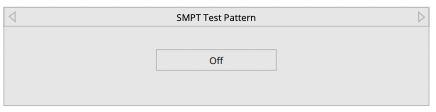
1. Use the Navigation buttons on the remote to highlight Off. Use the Left/Right Navigation buttons to select On to show the SMPTE Pattern.
—or—
2. To hide the SMPTE Test Pattern, use the Left/Right Navigation buttons to select Off.
To show or hide the Flat Test Pattern:
Menu > Picture > Advanced Picture > Color Calibration > Color Tuner > Flat Test Pattern
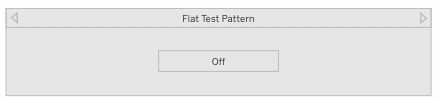
1. Use the Navigation buttons on the remote to highlight Off. Use the Left/Right Navigation buttons to select the percentage brightness for the flat test pattern. Selecting a percentage immediately shows the flat pattern at that brightness.
—or—
2. To disable the Flat Test Pattern, use the Left/Right Navigation buttons to select Off.
To show or hide the Ramp Test Pattern:
Menu > Picture > Advanced Picture > Color Calibration > Color Tuner > Ramp Test Pattern
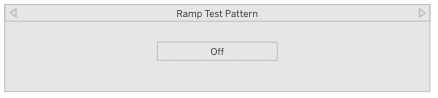
1. Use the Navigation buttons on the remote to highlight Off. Use the Left/Right Navigation buttons to select the color for the ramp test pattern. Selecting a color immediately shows that color ramp.
—or—
2. To hide the Ramp Test Pattern, use the Left/Right Navigation buttons to select Off.
To show or hide the Uniformity Analyzer Test Pattern:
Menu > Picture > Advanced Picture > Color Calibration > Color Tuner > Uniformity Analyzer Test Pattern

1. Use the Navigation buttons on the remote to highlight Off. Use the Left/Right Navigation buttons to select On to show the Uniformity Analyzer Test Pattern.
—or—
2. To hide the Uniformity Analyzer Test Pattern, use the Left/Right Navigation buttons to select Off.
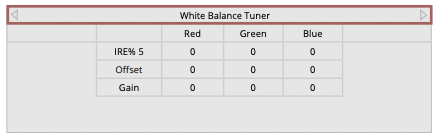
To adjust the White Balance Tuner settings:
Menu > Picture > Advanced Picture > Color Calibration > White Balance Tuner
- Use the Navigation buttons on the remote to highlight the Gain and Color values you wish to adjust. Press the OK button and use the Left/Right Navigation buttons to adjust the value. When you are finished, press the OK button to save the setting
Adjusting Picture Input Settings
Enable HDMI Mode, Full Color 4:4:4, and adjust picture size and position.
To adjust the Input settings:
Menu > Picture > Input Picture Settings
Use the Navigation buttons to highlight the setting you wish to adjust.
- Picture Size and Position* — configure the display size and position of the picture to the screen.
- HDMI Mode* — Expanded color display. Only available for an HDMI input.
- Full Color 4:4:4* — Maintains full color data with 4:4:4 content. Some picture settings will not be available when this setting is On. Only available for an HDMI input.
- Color Space Range — Select Color Space for the source. Video sources uses YCbCr, but PC uses RGB.
* Only available if there is an input source. Not available for WatchFree. Menu items will be grayed out if not available.
Adjusting the Picture Mode Edit Settings
Manage custom picture modes and reset preset picture modes.
To adjust the Picture Mode Edit settings:
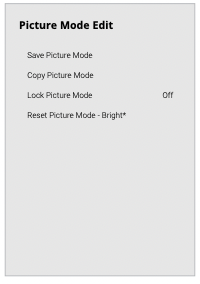
Menu > Picture > Picture Mode Edit
Use the Navigation buttons to highlight the setting you wish to adjust, then press OK to change the setting:
- Save Picture Mode — Save a custom picture mode.
- Copy Picture Mode — Copy the settings for a custom picture mode.
- Lock Picture Mode—Prevent changes to custom picture modes.
- Reset Picture Mode—Reset the picture mode settings to factory default values. Only available on customized preset modes.
- Delete Picture Mode—Delete a custom picture mode. Inputs assigned to the cusom picture mode will use the Calibrated picture mode.
Saving a Custom Picture Mode
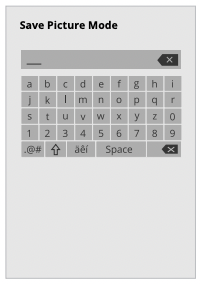
Custom picture modes allow you to save a group of custom settings for various viewing conditions and video sources.
To save a custom picture mode:
Menu > Picture > Picture Mode Edit > Save Picture Mode > Enter a Name >Save
Custom picture modes allow you to save a group of custom settings for various viewing conditions and video sources.
- Changes made while on any preset picture mode will add an asterisk on the top right corner of the preset mode.
- The custom picture mode is not automatically saved.
Copy a Picture Mode
Custom picture mode settings can be copied to be applied to other inputs.
- Complete the desired changes for the selected picture mode. Select Save Picture Mode to save picture mode for all inputs.
- Select the input you want to copy your saved picture mode edits to.
- Change the picture mode to your custom saved mode: Menu > Picture > Picture Mode > select saved custom picture mode
- Copy your custom picture mode: Menu > Picture > Picture Mode Edit > Copy Picture Mode
- Select what picture mode you would like to copy over.
- A notification displays after the copy to your selected picture mode is completed. Now this picture mode will have your custom settings saved over it for the selected input.
- Repeat as needed to customize additional inputs.
Lock a Picture Mode
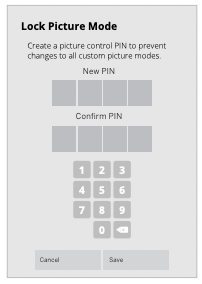
Custom picture modes can be locked/unlocked with a unique PIN to prevent accidental changes to their settings. If not previously set, you can set up your system PIN code here.
To lock all custom picture modes:
Menu > Picture > Picture Mode Edit > Lock Picture Mode > On > Enter Your PIN > Save
To unlock all custom picture modes:
Menu > Picture > Picture Mode Edit > Lock Picture Mode > Off > Enter Your PIN
TIP: To set a custom PIN code, see Setting a System PIN Code on page 25.
Deleting a Picture Mode
Custom picture modes that are no longer needed can be deleted.
TIP: Inputs assigned to deleted custom picture modes become assigned to the Calibration picture mode.
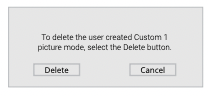
To delete a custom picture mode:
Menu > Picture > Picture Mode Edit > Delete Picture Mode > Delete
Resetting a Picture Mode
A preset picture mode that has been edited can be restored to the factory default settings.
To reset a customized preset picture mode:
Menu > Picture > Picture Mode Edit > Reset Picture Mode > Reset
ADJUSTING THE AUDIO SETTINGS
To adjust the audio settings:
Menu > Audio
Use the Navigation buttons to highlight the setting you wish to adjust, then press Left/Right Navigation buttons to change the setting:
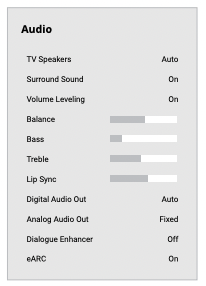
- TV Speakers — Built-in speakers automaticcaly turn off if a sound bar is discovered. Turn the built-in speakers On or Off.
- Surround Sound — When set to On, enables surround sound suitable for sports and TV shows. Virtual:X™ adds virtualized height best for movies.
- Volume Leveling — When set On, DTS TruVolume™ audio solution levels the speaker volume.
- Balance — Balance the audio loudness between the left and right speakers.
- Bass — Increase or decrease the bass level.
- Treble — Increase or decrease the treble level.
- Lip Sync — Synchronize the display image with the audio track.
- Digital Audio Out — Select the digital audio output format for both the optical and HDMI ARC audio devices.
- To hear talk back when Talk Back function is enabled, digital audio out must be set to PCM.
TIP: You must select Digital for audio with more than two channels (e.g., 3.0, 5.0, or 5.1).
- Analog Audio Out — Select Variable if you are controlling the volume with the remote. Select Fixed if an external audio device (sound bar or AV receiver) will control the volume.
- Dialogue Enhancer — If enabled and the signal source includes Dolby 5.1 AC-4 audio then clarity of dialogue is enhanced.
- eARC — Toggle between ARC (Off) and eARC (On) for audio output using HDMI 1. If On, audio is sent using eARC and is uncompressed. If Off, audio is sent using ARC and some audio formats may play in standard Dolby Audio, DTS Digital Surround, or PCM.
TIP: Your connected sound bar or audio receiver must support eARC in order to receive uncompressed audio. Check your device's user manual for more information.
- Equalizer — Only available when Surround Sound is set to OFF. Boosts or attenuates loudness at different frequencies.
SOUND BAR SETTINGS
If a VIZIO sound bar is detected and connected via CEC (HDMI ARC/eARC), sound bar settings will appear.
To adjust the sound bar settings:
Menu > Audio > Sound Bar Settings
Use the Navigation buttons to highlight the setting you wish to adjust, then press Left/Right Navigation buttons to change the setting.
TIP: Available sound bar menu settings will be specific to the type of VIZIO sound bar connected. See Adjusting the CEC Settings on page 25 to enable CEC under the SYSTEM settings.
ADJUSTING THE NETWORK SETTINGS
Your TV is Internet-ready, featuring both an Ethernet port and built-in high-speed wireless internet.
TIP: If your TV is connected to a network with an Ethernet cable, you will not see the wireless network connection menu. You must unplug the Ethernet cable to set a wireless network connection.
Connecting to a Wireless Network
To connect to a wireless network whose network name (SSID) is being broadcast:
Menu > Network > Choose your network > Enter in the password > Connect
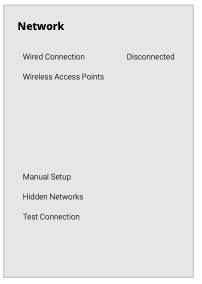
To forget a saved network:
Highlight a saved wireless access point > OK > Forget
If you do not see your wireless network displayed, click on:
More Access Points > Highlight your wireless network > Enter in the password > Connect
Changing the Manual Setup Settings
Advanced users can fine-tune the network settings using the Manual Setup feature.
The security settings on your router may require you to enter the TV's MAC address.
To change advanced network settings:
Menu > Network > Manual Setup > DHCP > Off
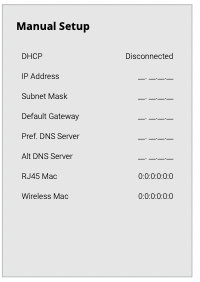
- Use the Navigation and OK buttons to adjust each setting:
- IP Address — The IP address assigned to the TV.
- Subnet Mask — The subnet Exit 2D.
- Default Gateway — Your network’s default gateway address.
- Pref. DNS Server — Your preferred domain name server address.
- Alt. DNS Server — Your alternate domain name server address.
2. Use the Navigation buttons on the remote to highlight Save and press OK.
To find the TV’s MAC address:
Menu > Network > Manual Setup
You can find your TV's MAC address at the bottom of the list. The MAC addresses for the connections in use are displayed:
- RJ45 MAC — The Ethernet or RJ45 MAC address may be needed to set up your network when you have connected the TV to your network when you have connected the TV to your network with an Ethernet (Cat 5) cable.
- Wireless MAC — The Wireless (Wi-Fi) MAC address may be needed to connect your TV to your network with Wi-Fi.
Connecting to a Hidden Network
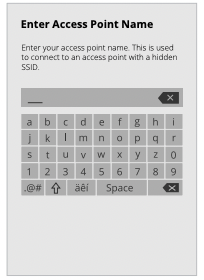
To connect to a wireless network whose network name (SSID) is not being broadcast:
Menu > Network > Hidden Network > Enter the Access Point Name > Connect > Enter in the password
Testing Your Network Connection
To test your network connection:
Menu > Network > Test Connection
SETTING UP TV CHANNELS
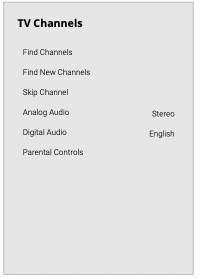
You can use the TV’s Channels menu to:
- Find channels
- Find new channels
- Select channels to skip
- Select analog audio mode
- Select the language for digital audio
- Set parental controls
Scanning for TV Channels
The TV may need to scan for channels before it can display programs and their associated information. A channel scan is required for free over-the-air channels using an antenna) and cable channels from an out-of-the-wall connection (without a cable box). Moving the TV to an area with different channels requires the TV to scan for channels again.
To perform an Auto Channel Scan:
Menu > TV Channels > Find Channels
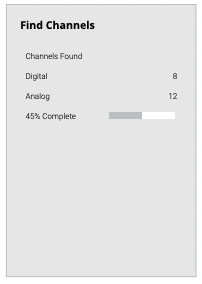
Wait until the channel scan is 100% complete.
Highlight Done and press OK.
- If the channel scan is canceled, the channels that were already discovered are retained.
To perform a New Channel Scan:
Menu > TV Channels > Find New Channels
A New Channel Scan saves the current channel map and scans for additional channels.
Skipping Channels
After a channel scan is completed, you may find that some channels are too weak to watch comfortably. There may also be some channels you do not want to view. You can remove these channels from the TV’s memory with the Skip Channel feature.
WARNING: Channels that have been removed with the Skip Channel feature can still be viewed if the channel is entered using the number pad. If you wish to completely block a channgel from being viewed, use see Locking and Unlocking Channels on page 19.
To remove a channel:
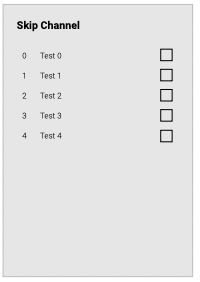
- From the TV CHANNELS menu, highlight Skip Channel, and press OK. The SKIP CHANNEL menu is displayed.
- For each channel you wish to remove, use the Up/Down Navigation buttons on the remote to highlight the channel and press OK. A √ appears to the right of each channel you select.
SmartCast Home™
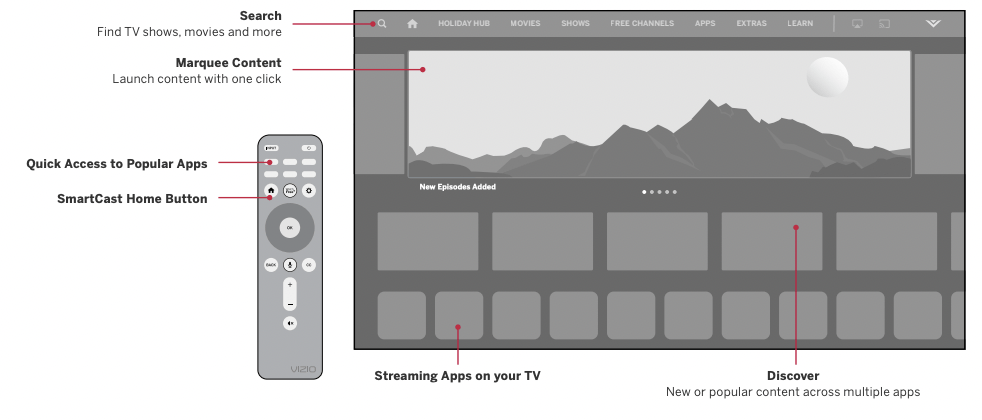
What is SmartCast Home?
SmartCast Home lets you discover, stream, and control your content like never before! Access top apps, like Netflix, Disney+, and Hulu, by using the remote to easily browse and launch content directly from the home screen. SmartCast Home makes finding something to watch easy and fun.
How to Launch SmartCast Home
To begin streaming with SmartCast Home:
1. Press the SmartCast Home  button on your remote.
- or -
2. Select SmartCast from the list of inputs.
What you can do with SmartCast Home
- Stream high quality entertainment.
- Launch top tier apps directly from the home screen.
- Access free channels to watch without a subscription through WatchFree+.
- Rearrange apps on your home screen just the way you like it.
- Mirror your laptop or mobile device onto your TV through Apple Airplay or Chromecast built-in™.

- Works with Google Assistant, Siri, and Alexa-enabled devices for hands-free voice control.

Control your TV with the SmartCast Mobile™ App
Download the VIZIO SmartCast Mobile app and turn your smartphone into a remote to control and configure your TV.
With SmartCast Mobile, you can:
- Power on/off devices, play/pause content, and modify advanced settings, all from the palm of your hand.
- Control playback and TV settings using your voice.
- Easily enter text onto your TV/display from your mobile device using a full keyboard.
- Browse and discover movies, TV shows, music, live streams, and more, across multiple apps at once.
- Access a quick look at show ratings, synopsis, cast, crew, clips, and other details.
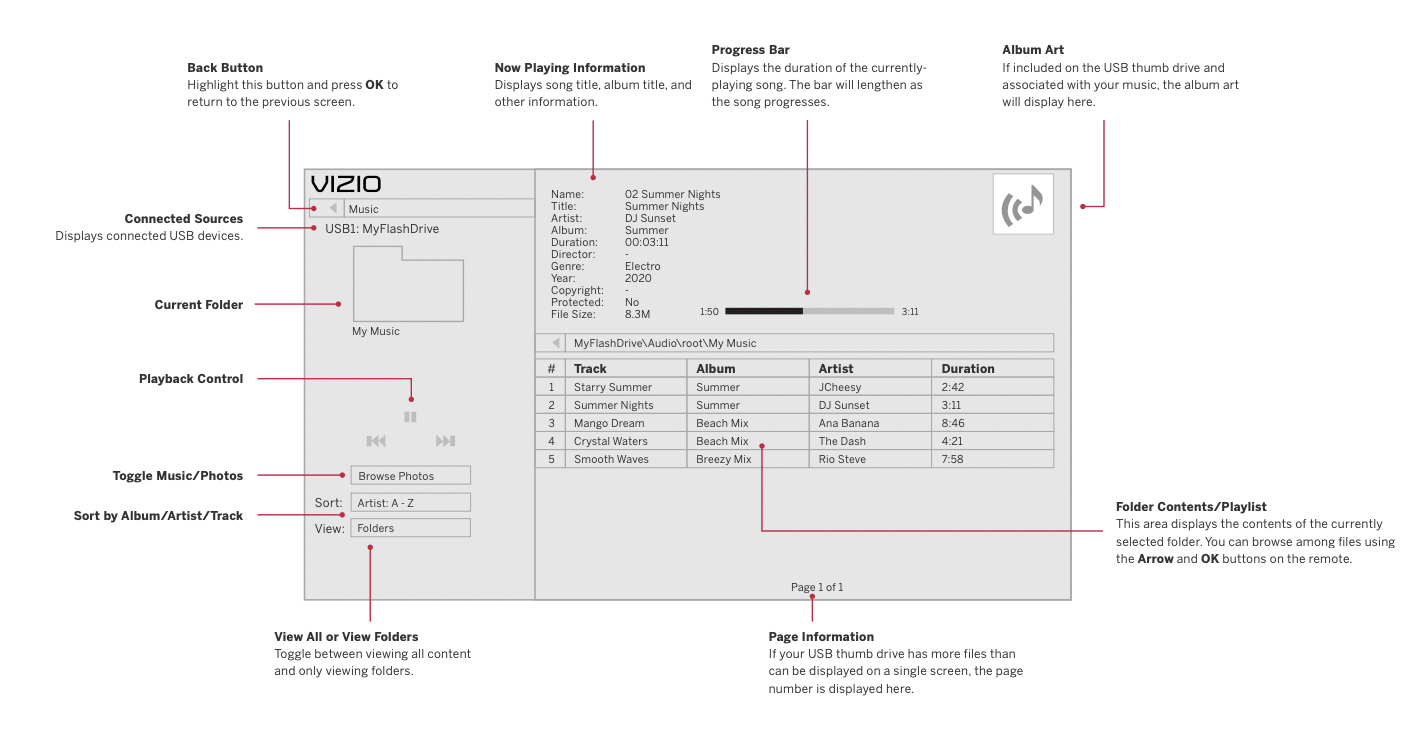
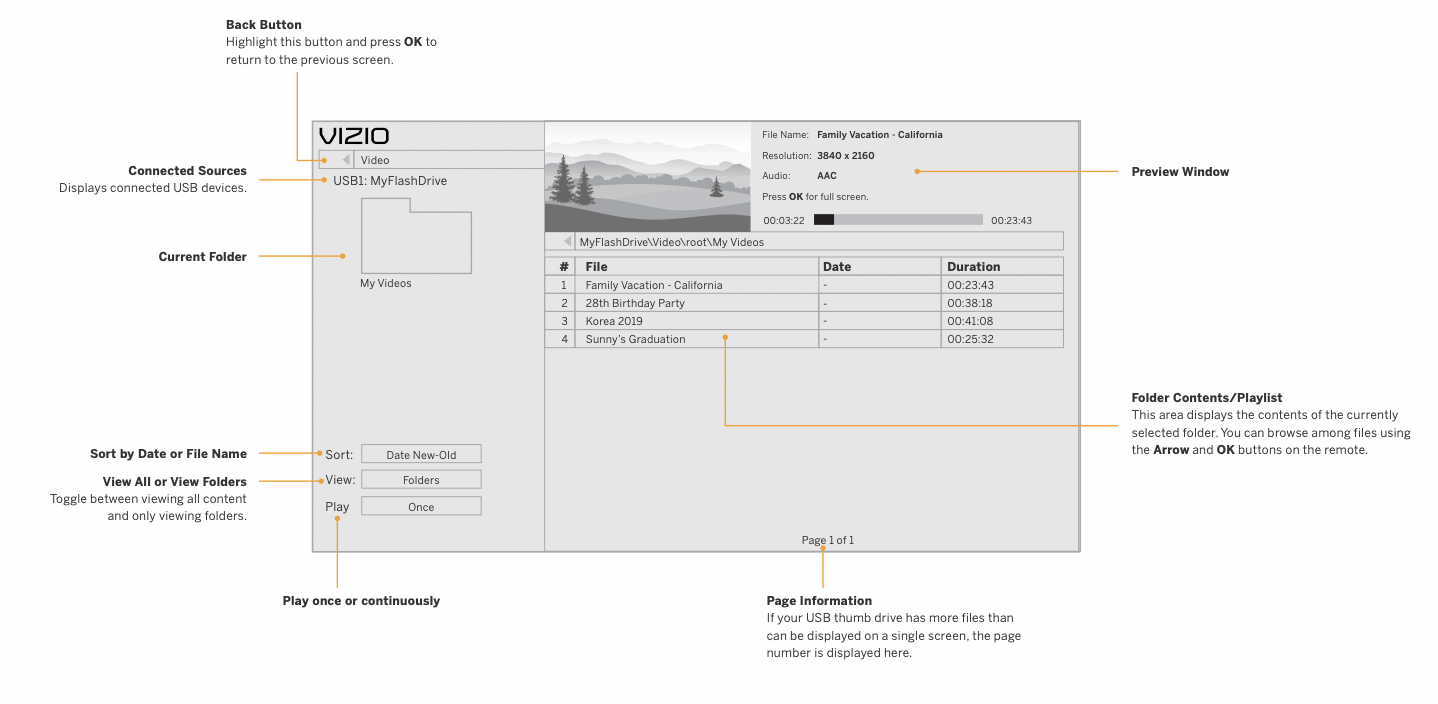
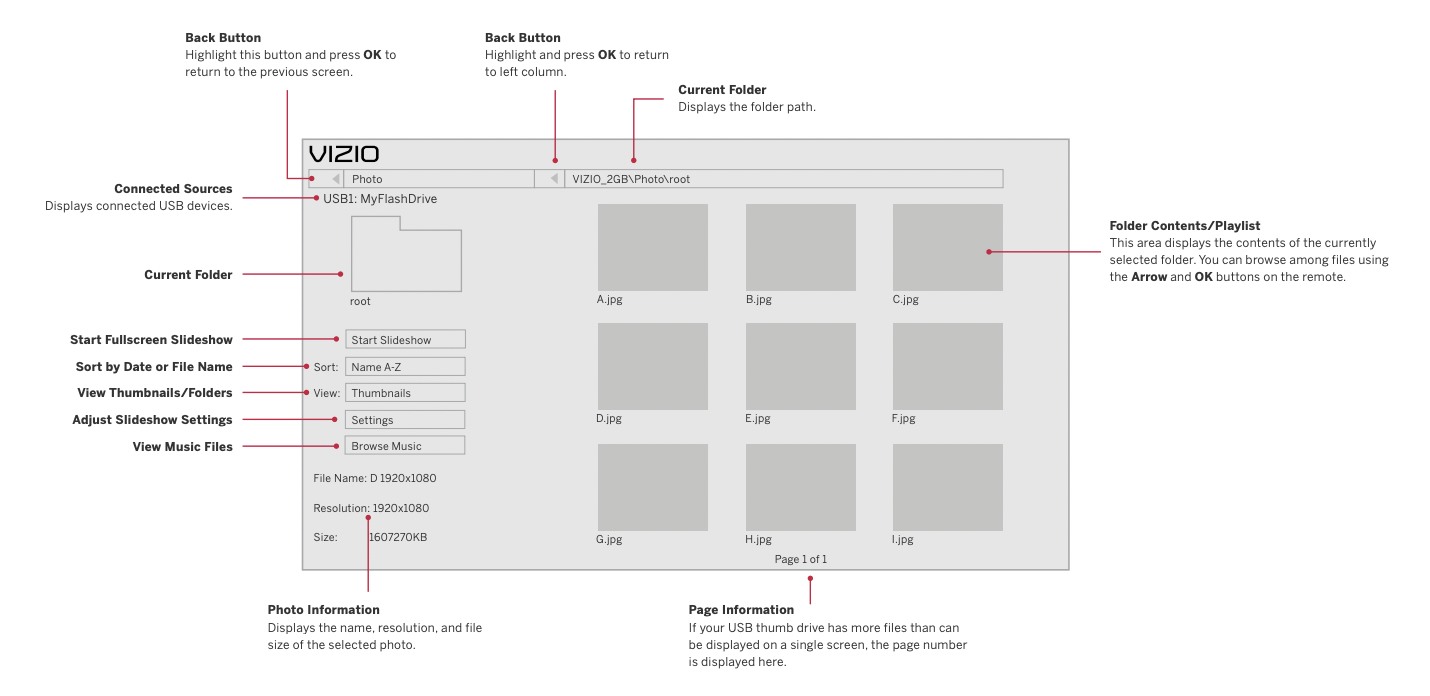
The USB Media Player allows you to connect a USB flash drive to your TV and play music, video, or photos.
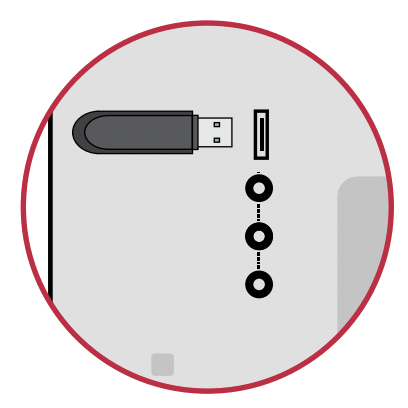
Note: The image shown here is for illustrative purposes only and may be subject to change. The actual number of ports and their locations may vary, depending on the model.
Preparing Your USB Drive to Play USB Media
To display USB media, you must first save your videos onto a USB flash drive:
- The USB flash drive must be formatted as FAT32.
- Files on the USB flash drive must end in a supported file extension ( .mp3, .jpg, etc).
- The player is not designed to play media from external hard drives, MP3 players, cameras, or smartphones.
Displaying USB Media
To display your USB media:
- Connect your USB flash drive to the USB port on the side of the TV.
- The TV will recognize the USB. Use the Navigation Keys on the remote to select the content you want to play. —or—
- Select USB from the bottom streaming icons on the SmartCast Home™ page.
TIP: You can display your photos in Fullscreen. Select the photo, press OK, then highlight Fullscreen and press OK.
Removing the USB Drive from the TV
To safely remove your USB flash drive from the TV:
- Turn the TV off.
- Disconnect your USB flash drive from the USB port on the side of the TV.
WARNING: Do not remove the USB drive while the TV is on. Doing so may damage the drive.
Help Topics
The remote is not responding.
- Make sure the batteries are properly inserted matching the - and + symbols.
- Replace the batteries with fresh ones.
The TV displays “No Signal.”
- Press INPUT button on the remote control to select a different input source.
- If you are using cable TV or antenna connected directly to the TV, scan for channels. See Scanning for TV Channels on page 17.
There is no power.
- Ensure the TV is plugged into a working electrical outlet.
- Ensure the power cable is securely attached to the TV.
- Press the Power/Standby button on the remote or on the back of the TV to turn the TV on.
The power is on, but there is no image on the screen.
- Ensure all cables are securely attached to the TV.
- Ensure all devices are connected correctly. Devices differ; see your device’s user manual for details.
- Adjust Brightness, Contrast, or Backlight. See Adjusting the Picture Settings on page 9.
- Press the INPUT button on the remote to select a different input source.
The sound is flat or dialog is not audible.
- Turn off Volume Leveling. See Adjusting the Audio Settings on page 15.
Where do I find information on the accessibility features of this product and other VIZIO products?
- Please visit vizio/accessibility,
- Email us at: Accessibilityvizio, or
- Give us a call at 1-877-698-4746.
How do I stream apps like Netflix to my VIZIO SmartCast® TV?
- Popular apps are located on the SmartCast Home™ screen, so you can simply navigate to the app row on your SmartCast TV to start streaming.
- You can also use Apple AirPlay 2 or Chromecast built-in™ to stream content from your device directly to your SmartCast TV. For more information, please visit:
- VIZIO/Apple
- VIZIO/Google
The colors on the TV don’t look right.
- Adjust the Color and Tint settings in the Picture menu. See Adjusting the Picture Settings on page 9.
- Select a pre-set picture mode. VIZIO recommends selecting Calibrated.
- Check all cables to ensure they are securely attached.
The image quality is not good.
- For the best image quality, view high-definition programs using digital sources. Connect your devices with HDMI cables.
- If you are using an antenna, the signal strength of the channel may be low. Ensure your antenna is connected securely to the TV and move the antenna around the room or close to a window for the best signal.
The picture is distorted.
- Move the TV away from electrical appliances, cars, and fluorescent lights.
- Ensure all cables are securely attached.
The TV image does not cover the entire screen.
- If you are using TV, AV, or Component with 480i input, go to Menu > Picture > Picture Aspect.
The TV has pixels (dots) that are always dark.
- Your HD TV is precision-manufactured using an extremely high level of technology. However, sometimes pixels may not display correctly. These types of occurrences are inherent to this type of product and do not constitute a defective product.
The buttons on the remote aren’t working.
- Ensure you are only pressing one button at a time.
- Point the remote directly at the TV when pressing a button.
- Replace the remote batteries with new ones. See Replacing the Batteries on page 5.
There is no sound.
- Press Volume Up on the remote control.
- Press the MUTE button on the remote to ensure mute is off.
- Check the audio settings. See Adjusting the Audio Settings on page 15.
- Check the audio connections of external devices (Blu-ray player, game console, cable/satellite box) that are connected to the TV.
- If you are using an antenna, the signal strength of the channel may be low. Ensure your antenna is connected securely to the TV and move the antenna around the room or close to a window for the best signal.
- Set eARC to Off and use ARC mode.
I see “noise” or static on the screen.
- When your TV’s digital capabilities exceed a digital broadcast signal, the signal is up-converted (improved) to match your TV’s display capabilities. This upconverting can sometimes cause irregularities in the image.
- If you are using an antenna, the signal strength of the channel may be low. Ensure your antenna is connected securely to the TV and move the antenna around the room or close to a window for the best signal.
When I change input source, the TV image changes size.
- The TV remembers the viewing mode on each input source. If the viewing mode on the new input source differs from the one on the input source you switch from, the difference may be noticeable.
- See Changing the Picture Aspect Ratio on page 10.
How do I download the VIZIO SmartCast Mobile™ App?
- Make sure your phone or tablet is connected to a Wi-Fi network. Open a browser on your phone or tablet.
- Navigate to vizio/smartcastapp and follow the on-screen instructions to download the VIZIO SmartCast Mobile™ App.
How do I change the Inputs?
- Press the INPUT button on the back of the TV to cycle through the Inputs.
- Press the INPUT button on the remote to cycle through the Inputs.
- Make sure the VIZIO SmartCast Mobile™ app is installed on your phone or tablet. Open the VIZIO SmartCast Mobile app. Tap on the Device list and select your TV. Tap on the Input key and select the Input of your choice.
How do I connect to my Wi-Fi network?
- On your TV remote, press the MENU button then go to Network > Select your Wi-Fi name > Enter password.
- Open the VIZIO SmartCast Mobile™ app on your phone or tablet. Tap on the Menu Tab > SmartCast Devices > Your TV/Device Name > Network
- Tap on the Settings icon > Network > Wireless Access Points. Select your Wi-Fi network from the list, enter the Wi-Fi password, and tap Connect.
How do I exit Demo Mode?
- Press and hold the INPUT button on the back of the TV to exit the demo mode.
How do I watch Cable/Antenna TV channels?
- If you subscribe to cable or satellite, simply connect an HDMI cable (not included) to the receiver.
- If you use external antennas to watch local broadcast channels, use a coaxial cable to connect.
Some of my Channels are missing.
- Press the MENU button on your TV remote and select the channels option. Then select Find Channels.
- Open the VIZIO SmartCast Mobile app on your phone or tablet.
- Click on: Menu Tab > SmartCast Devices > Your TV/Device Name > Channels > Find Channels.
How do I disable/enable Viewing Data?
- Press the MENU button on your remote and select ADMIN & PRIVACY. Then select Viewing Data to turn the feature on or off.
The television will not turn on using Alexa or Google Assistant.
- Ensure the television is in Quick Start Mode.
- Tap on Menu > System > Power Mode > Quick Start.
How do I know I am getting 4K resolution or HDR content such as Dolby Vision?
- As you are watching content on the television, press the INFO button on the remote or VIZIO SmartCast Mobile app. You will see the current resolution being displayed along with the version of video.
- HDR will show as a Dolby Vision icon, HDR10 or HLG.