4-418-206-13(1)
LCD TV
Operating Instructions
Introducing Your New
BRAVIA
®
Getting Started
Operating the TV
Using Features
Using the Menus
Other Information
Sony Customer Support
U.S.A.: http://www.sony.com/tvsupport
Canada: http://www.sony.ca/support
United States
1.800.222.SONY
Canada
1.877.899.SONY
Please Do Not Return
the Product to the Store
KDL-46BX451 / 46BX450 / 40BX451 / 40BX450

2
CAUTION
To prevent electric shock and blade exposure, do not use
this polarized AC plug with an extension cord, receptacle or
other outlet unless the blades can be fully inserted.
❑ Operate the TV only on 110-240 V AC
(USA/Canada/Mexico 120 V AC).
❑ Avoid operating the TV at temperatures
below 41°F (5°C).
Licensing Information
Macintosh is a trademark of Apple Inc., registered in the U.S.
and other countries.
HDMI, the HDMI logo, and High-Definition Multimedia
Interface are trademarks or registered trademarks of HDMI
Licensing, LLC in the United States and other countries.
Fergason Patent Properties, LLC:
U.S. Patent No. 5,717,422
U.S. Patent No. 6,816,141
Manufactured under license from Dolby Laboratories. Dolby
and the double-D symbol are trademarks of Dolby
Laboratories.
Blu-ray Disc is a trademark.
“BRAVIA” and , BRAVIA Sync, and are
trademarks or registered marks of Sony Corporation.
“PlayStation” is a registered trademark and “PS3” is a
trademark of Sony Computer Entertainment Inc.
Cleaning
When cleaning, be sure to unplug the power
cord to avoid any chance of electric shock.
• Wipe the LCD screen gently with a soft cloth.
• Stubborn stains may be removed with a
cloth slightly moistened with a solution of
mild soap and warm water.
• If using a chemically pretreated cloth, please
follow the instruction provided on the
package.
• Never use strong solvents such as a thinner,
alcohol or benzine for cleaning.
• See the supplied Safety Booklet for
additional information.
Owner’s Record
The model and serial numbers are located at the side
and rear of the TV. Record these numbers in the spaces
provided below. Refer to them whenever you call upon
your Sony dealer regarding this TV.
Model Name
Serial No.
3
Contents
Introducing Your New BRAVIA
®
Welcome to the World of BRAVIA
®
. . . . . . . .4
Experiencing Stunning HD with Your
BRAVIA . . . . . . . . . . . . . . . . . . . . . . . . . . .4
The Four Steps to a Stunning HD
Experience . . . . . . . . . . . . . . . . . . . . . . . . .5
TV Feature Highlights . . . . . . . . . . . . . . . . . . .5
Getting Started
Setting Up Your TV . . . . . . . . . . . . . . . . . . . . . 7
Attaching the Table-Top Stand . . . . . . . . . . . .8
Locating Inputs and Outputs . . . . . . . . . . . . .10
Connecting the TV . . . . . . . . . . . . . . . . . . . .12
Connecting Other Equipment . . . . . . . . . . . .16
When Installing the TV Against a Wall or
Enclosed Area . . . . . . . . . . . . . . . . . . . . .17
Securing the TV . . . . . . . . . . . . . . . . . . . . . .18
Running Initial Setup. . . . . . . . . . . . . . . . . . .20
Operating the TV
Using the Remote Control. . . . . . . . . . . . . . . 21
Remote Control Button Description . . . . . . .22
TV Controls and Indicators . . . . . . . . . . . . . .25
Using Features
BRAVIA
®
Sync
TM
with Control for HDMI . . .27
Using PIP Feature. . . . . . . . . . . . . . . . . . . . .28
Favorites . . . . . . . . . . . . . . . . . . . . . . . . . . . .29
Wide Mode . . . . . . . . . . . . . . . . . . . . . . . . . .29
Wide Mode with PC . . . . . . . . . . . . . . . . . . .30
Inputs . . . . . . . . . . . . . . . . . . . . . . . . . . . . . . 31
Playing back Photo/Music
(KDL-46/40BX450 only)/
Video via USB . . . . . . . . . . . . . . . . . . . . . 31
Using the Menus
Navigating through TV Menus . . . . . . . . . . .33
Using the Picture Settings. . . . . . . . . . . . . . .35
Using the Sound Settings . . . . . . . . . . . . . . . 37
Using the Screen Settings . . . . . . . . . . . . . .39
Using the Channel Settings . . . . . . . . . . . . .41
Using the Parental Lock Settings . . . . . . . . .42
Using the Setup Settings . . . . . . . . . . . . . . .45
Using the Eco Settings . . . . . . . . . . . . . . . . .49
Other Information
PC Input Signal Reference Chart for
PC and HDMI IN. . . . . . . . . . . . . . . . . . . .50
Using a Wall-Mount Bracket . . . . . . . . . . . . .51
Installing the Wall-Mount Bracket . . . . . . . . .52
Troubleshooting . . . . . . . . . . . . . . . . . . . . . .57
Important Notices . . . . . . . . . . . . . . . . . . . . .62
Specifications . . . . . . . . . . . . . . . . . . . . . . . .63
Index . . . . . . . . . . . . . . . . . . . . . . . . . . . . . . . 65
Customer Support
United States
http://www.sony.com/tvsupport
Canada
http://www.sony.ca/support
On-line Registration
United States
http://productregistration.sony.com
Canada
http://www.sony.ca/registration
4
Introducing Your New BRAVIA
®
Welcome to the World of BRAVIA
®
Thank you for choosing this Sony
BRAVIA
®
high-definition television. Use the
documentation listed below to get the most out of your TV.
Experiencing Stunning HD with Your
BRAVIA
The quality of the image you see on your BRAVIA
TV is only as good as the quality of the
signal it receives. To experience the stunning detail of your new
BRAVIA
TV, you need
access to HD programming. Your
BRAVIA
TV can receive and display HD programming
from:
• Over-the-air broadcasting via HD-quality antenna
• HD cable subscription
• HD satellite subscription
• Blu-ray Disc™ player or other HD compatible external equipment
Contact your cable, satellite or HD service provider for information on upgrading to HD
programming.
Safety Booklet
Contains precautionary
measures to keep you and
your TV safe. Read this
information prior to setting up
your TV.
Quick Setup Guide
Provides TV setup information with sample
connection diagrams.
Operating Instructions
Provides the most detailed
information to operate your
TV.
5
Introducing Your New BRAVIA
®
The Four Steps to a Stunning HD
Experience
Set, Source, Sound, and Setup
Along with your BRAVIA TV set, a complete HD system requires a source of HD
programming, an HD sound system, and a proper connection setup. Refer to the Quick
Setup Guide, enclosed separately, for connecting optional equipment.
TV Feature Highlights
Your BRAVIA comes with many convenient features, such as:
➢ BRAVIA
®
Sync
TM
: Allows your BRAVIA TV to communicate with other Sony
equipment supporting the Control for HDMI function (page 27).
➢ Digital Media Accessibility: Use the Photo, Music (KDL-46/40BX450 only),
and Video icons to access photo, music, and video files from Sony USB
equipment (page 31).
➢ PIP (Picture in Picture): You can work on your PC and watch your favorite TV
program simultaneously (page 28).
➢ Favorites: Your favorite channels and inputs are at your finger tips for easy
access (page 29).
➢ Auto Wide Mode: Set your TV to automatically adjust the screen based on the
signal resolution (page 29).
➢ Input Selection: Allows you to easily switch between the connected equipment
(page 31).
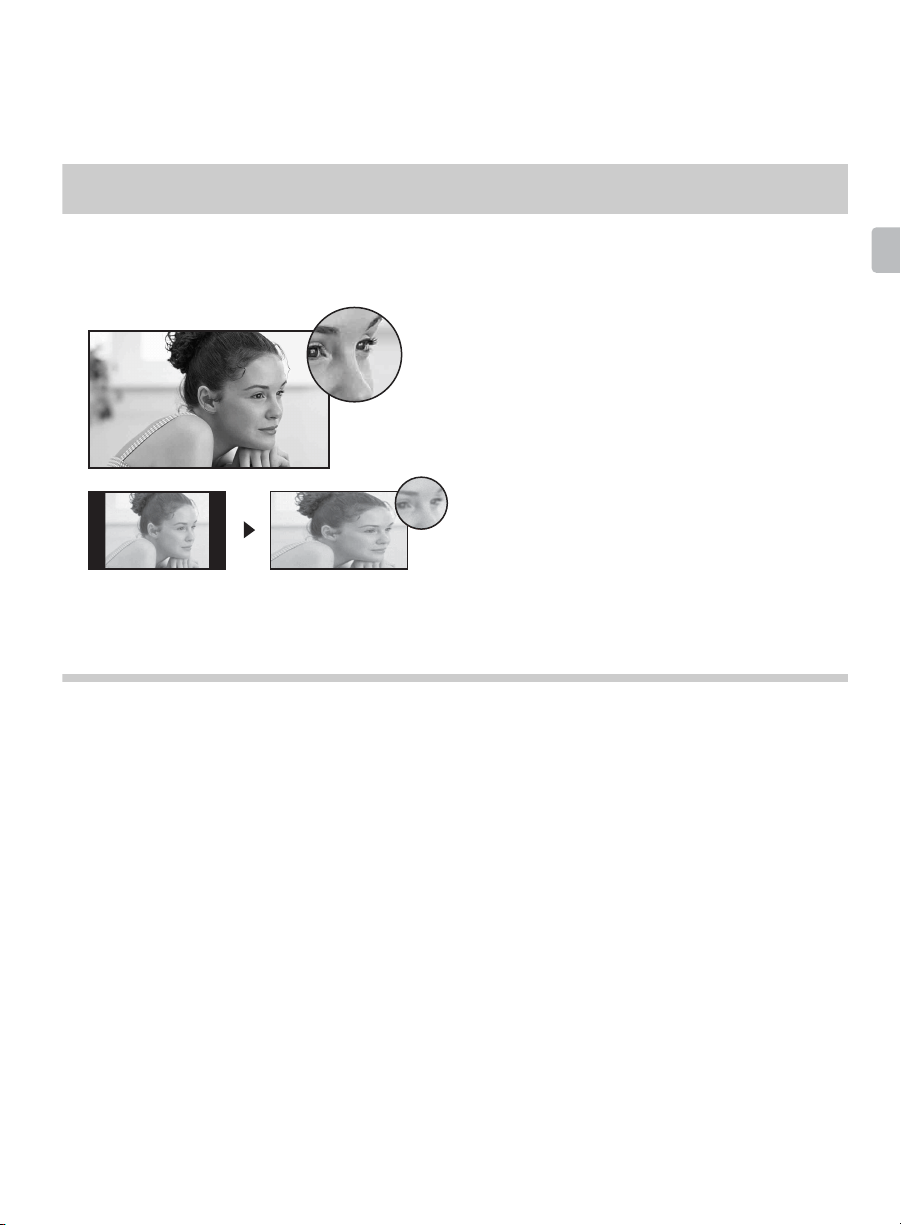
You can enjoy crisp, clear images, smooth
movement, and high-impact visuals from 1080 HD
signals as shown here.
When you compare a high-definition signal to a
standard analog signal, you will notice a big
difference in picture quality. If black bars appear as
shown here, press WIDE on the remote control to fill
the screen.
(Continued)

7
Getting Started
Getting Started
Setting Up Your TV
Some TV models are packaged with a detached Table-Top Stand so you can mount
your TV to a wall right away. If you are not mounting the TV to a wall, you will need to
attach the Table-Top Stand. You will need a Phillips screwdriver and the supplied
screws to complete the task. Look for the attachment instructions provided with the TV.
Be sure to consider the following while setting up your TV:
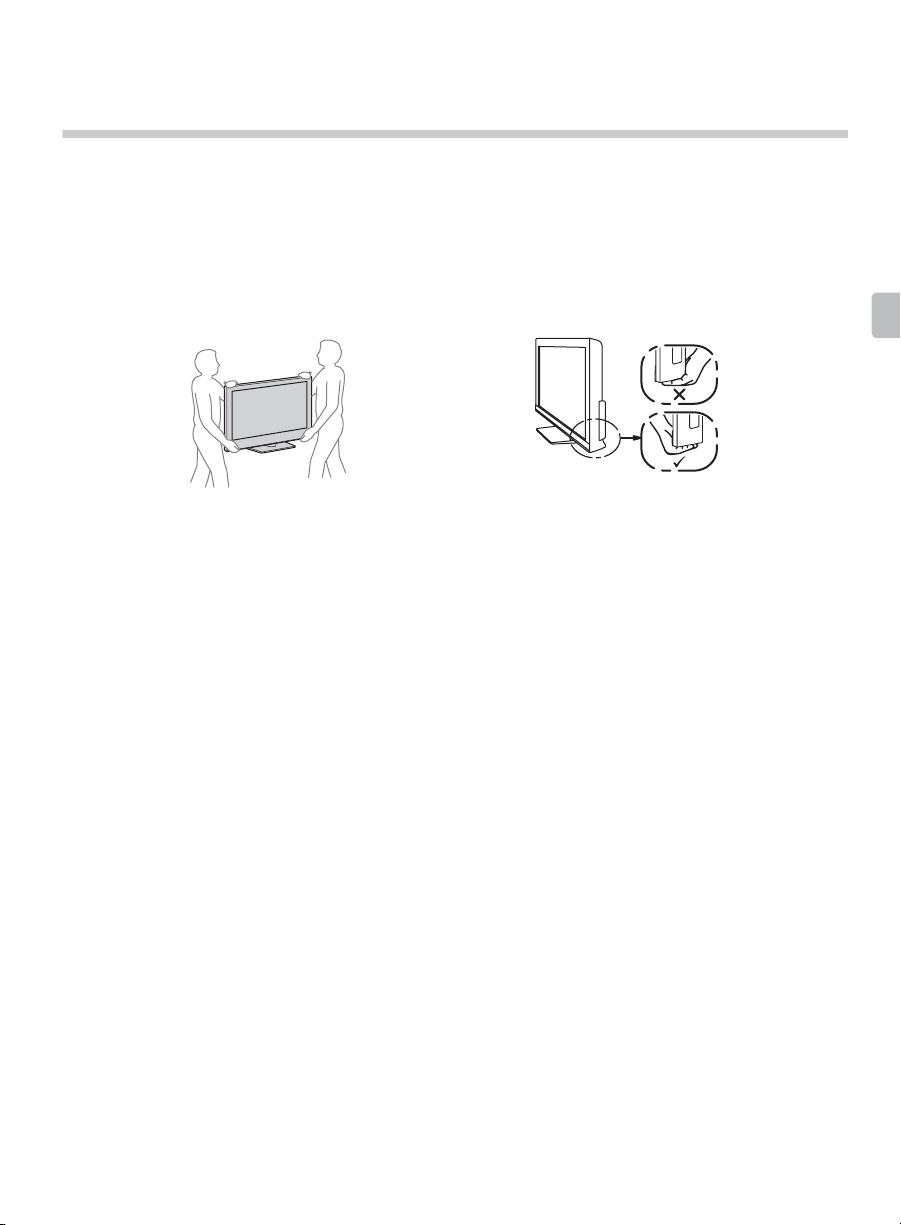
• Disconnect all cables when carrying the TV.
• Carry the TV with the adequate number of people; larger size TVs require two or more people.
• Correct hand placement while carrying the TV is very important for safety and to avoid damage.
• Ensure your TV has adequate ventilation, see page 17.
• For best picture quality, do not expose the screen to direct illumination or sunlight.
• Avoid installing the TV in a room with reflective wall and floor materials.
• Avoid moving the TV from a cold area to a warm area. Sudden room temperature changes may
cause moisture condensation. This may cause the TV to show poor picture and/or poor color.
Should this occur, allow moisture to evaporate completely before powering the TV on.
8
Attaching the Table-Top Stand
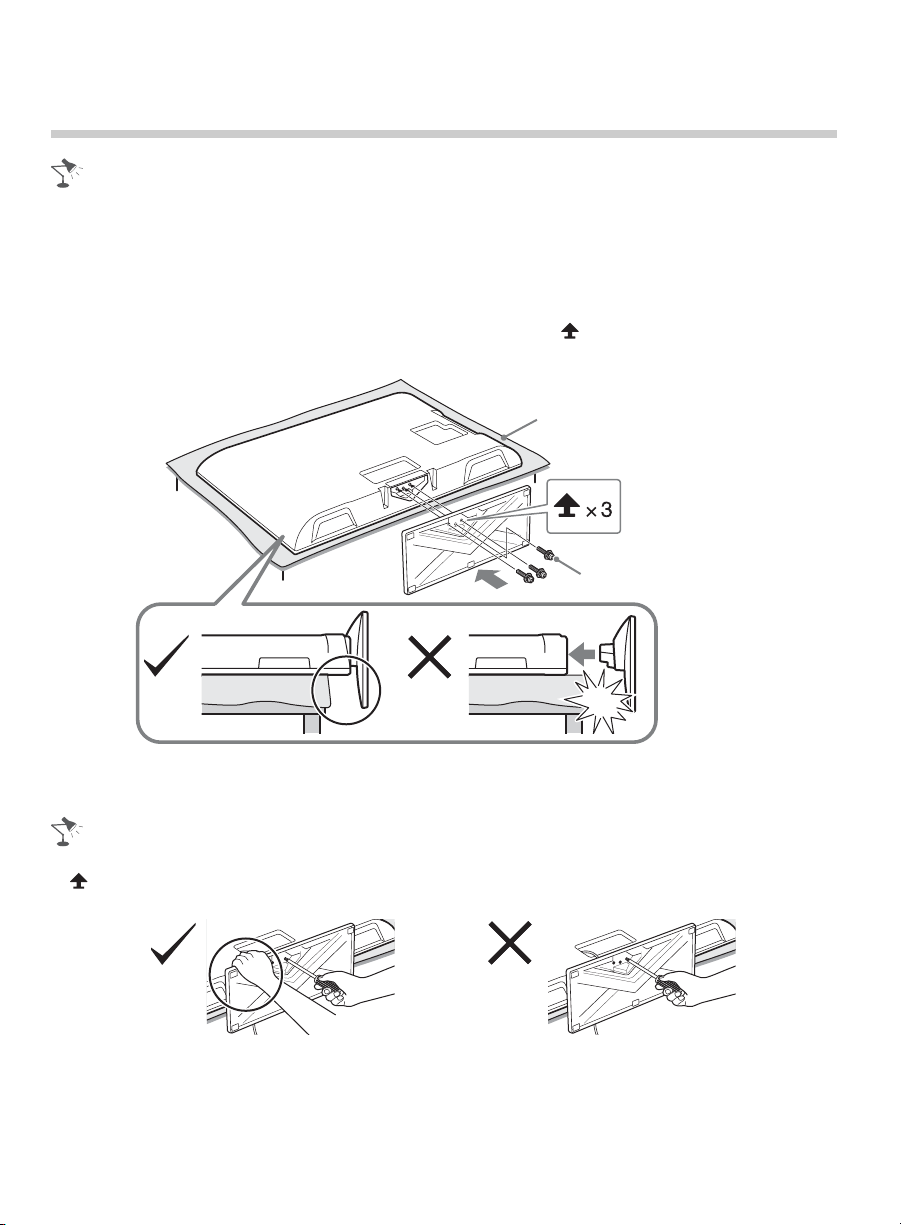
• Refer to the supplied stand leaflet for proper attachment.
• For best picture quality, do not expose the screen to direct illumination or sunlight.
1 Place the TV with its screen facing down on a level and stable surface covered with
a thick and soft cloth.
2 Fix the TV to the stand according to the arrow marks that guide the screw holes
using the supplied screws.
• To detach the Table-Top Stand from the TV, remove the three screws guided by the arrow mark
on the Table-Top Stand. Do not remove any other screws.
• Hold the Table-Top Stand with one hand to avoid it dropping when attaching.
• This TV is very heavy, so two or more people should place the TV onto thick and soft cloth.
• If using an electric screwdriver, set the tightening torque at approximately 1.5 N·m (15 kgf·cm).
• Be sure to securely tighten the three supplied screws, otherwise the TV may fall down.
• Use an appropriate screwdriver to attach the screws tightly without damaging the screw head.
Thick and soft cloth
Screw (+PSW 5 x 16)
(Supplied)
* Be careful not to hit the Table-Top Stand against the edge of
the surface when attaching it.

9
Getting Started
• Please ensure the AC power cord is away from the stand installation location when you attach
the stand.
• Do not touch the inner side of the bottom of the TV stand to avoid being hurt.
10
Locating Inputs and Outputs
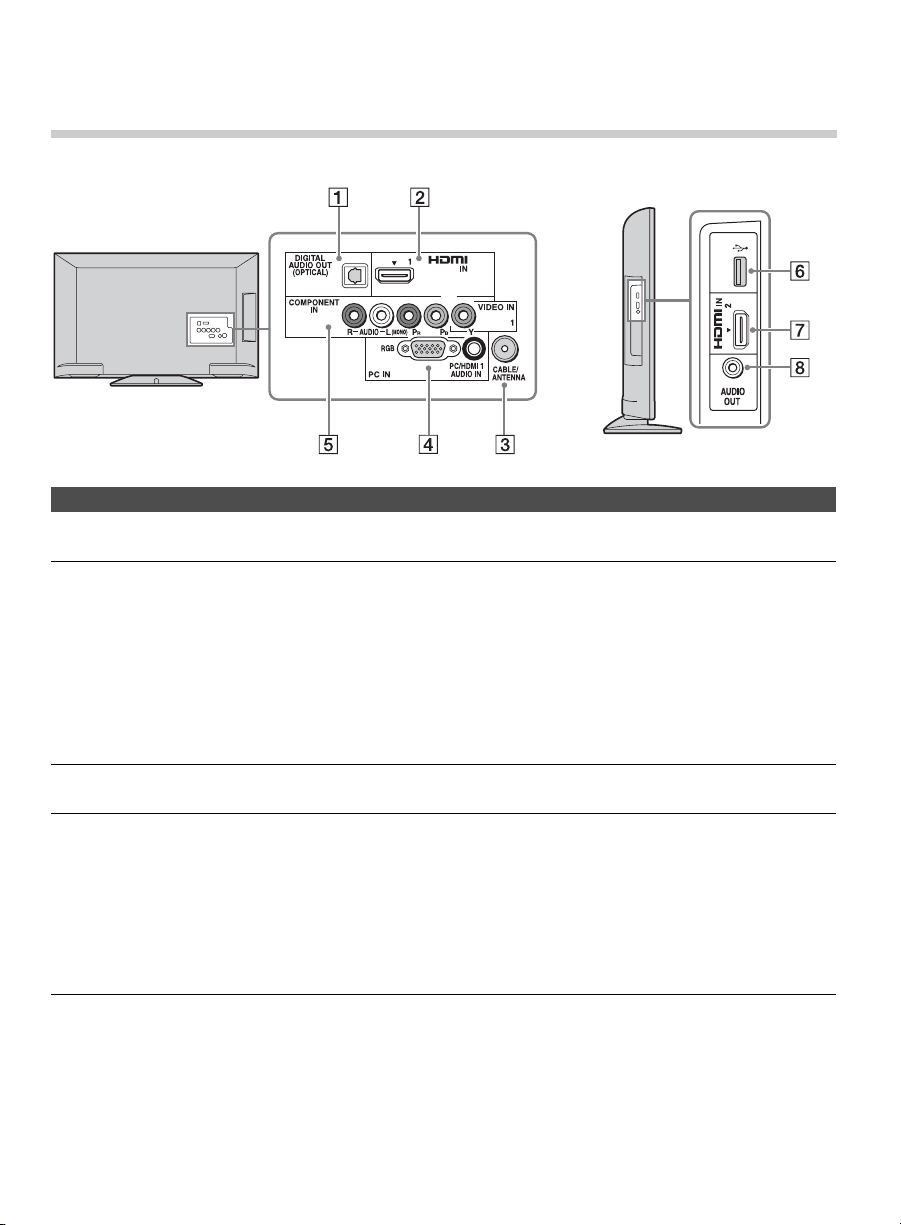
Item Description
1 DIGITAL AUDIO
OUT (OPTICAL)
Connects to the optical audio input of digital audio equipment that is PCM/
Dolby*
1
Digital compatible.
2
7
HDMI IN 1/2 HDMI (High-Definition Multimedia Interface) provides an uncompressed,
all-digital audio/video interface between this TV and any HDMI-equipped
audio/video equipment, such as a set-top box, DVD player, and A/V
receiver. HDMI supports enhanced, or high-definition video, plus digital
audio. Be sure to use only an HDMI cable that bears the HDMI logo.
Use the HDMI IN 1 port when connecting DVI equipment. Use a DVI-to-
HDMI cable or adapter (not supplied). Equipment using a DVI connection
also requires an additional audio connection using an audio cable
connected to PC/HDMI 1 AUDIO IN of PC IN.
3 CABLE/
ANTENNA
RF input that connects to your Cable or VHF/UHF antenna.
4 PC IN (RGB) Connects to a personal computer’s video and audio output connector. Can
also be connected to other analog RGB equipment. See “PC Input Signal
Reference Chart” on page 50 for the signals that can be displayed.
For some Apple Macintosh computers, it may be necessary to use an
adapter (not supplied). If an adapter is used, connect the adapter to the
computer before connecting the HD15-HD15 cable.
You may need to adjust the TV settings or your PC’s resolution and timing.
See page 15 for information on how to setup your PC to this TV.
*
1
Manufactured under license from Dolby Laboratories. Dolby and the double-D symbol are
trademarks of Dolby Laboratories.
Side PanelRear Panel
11
Getting Started
• An HDMI or Component video (YP
B
P
R
) connection is required to view 480i, 480p, 720p, 1080i
and 1080p video formats. 1080/24p is available only with HDMI connection.
5 VIDEO IN 1/
COMPONENT
IN/R-AUDIO-L
(MONO)
This input port can be used as a composite video input (VIDEO 1) or as a
component video input (COMPONENT). For composite use, connect the
yellow jack to Y for video and use audio L (mono) and R for audio signal.
For component connection, use Y, P
B
, P
R
for video signals and also
connect the audio L (mono) and R for audio signal.
This TV can auto detect and switch between the VIDEO 1 and
COMPONENT when VIDEO 1 or COMPONENT is connected.
To set to auto detection, press HOME, select Settings, and then select the
Setup settings. Select the Video1/Component Selection option in AV
Setup then set to Auto.
6 USB Connects to USB equipment to access photo, music, and video files.
8 AUDIO OUT Connects to the audio input jacks of your analog audio equipment. You can
use these outputs to listen to your TV’s audio through your stereo system.
Item Description
12
Connecting the TV
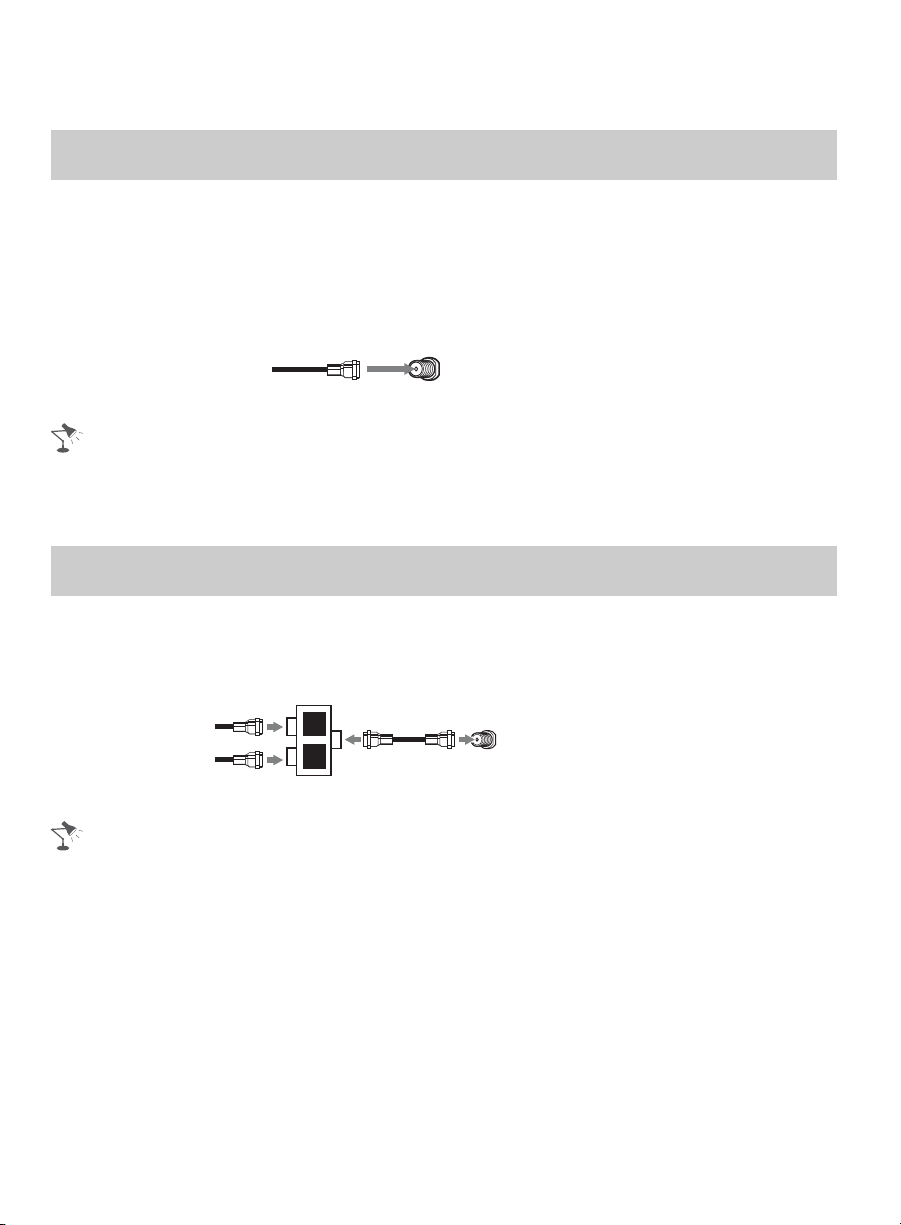
Cable System or VHF/UHF Antenna System
You can enjoy high-definition and standard-definition digital programming (if available in
your area) along with standard-definition analog programming.
This TV is capable of receiving unscrambled digital programming for both cable (QAM
and 8VSB) and external VHF/UHF antenna (ATSC).
x Cable or VHF/UHF (or VHF only)
• It is strongly recommended that you connect the CABLE/ANTENNA input using a 75-ohm
coaxial cable to receive optimum picture quality. A 300-ohm twin lead cable can easily be
affected by radio frequency interference, resulting in signal degradation.
Cable System and VHF/UHF Antenna System
Use an optional A-B RF switch (not supplied) to switch between the cable and over-the-
air antenna programming, as indicated below.
• Be sure to set the Signal Type setting to Cable or Antenna found under the Channel settings
for your input signal (page 41).
75-ohm coaxial cable Rear of TV
CABLE/ANTENNA
B
A
Cable
Antenna
A/B RF Switch
Rear of TV
CABLE/ANTENNA
13
Getting Started
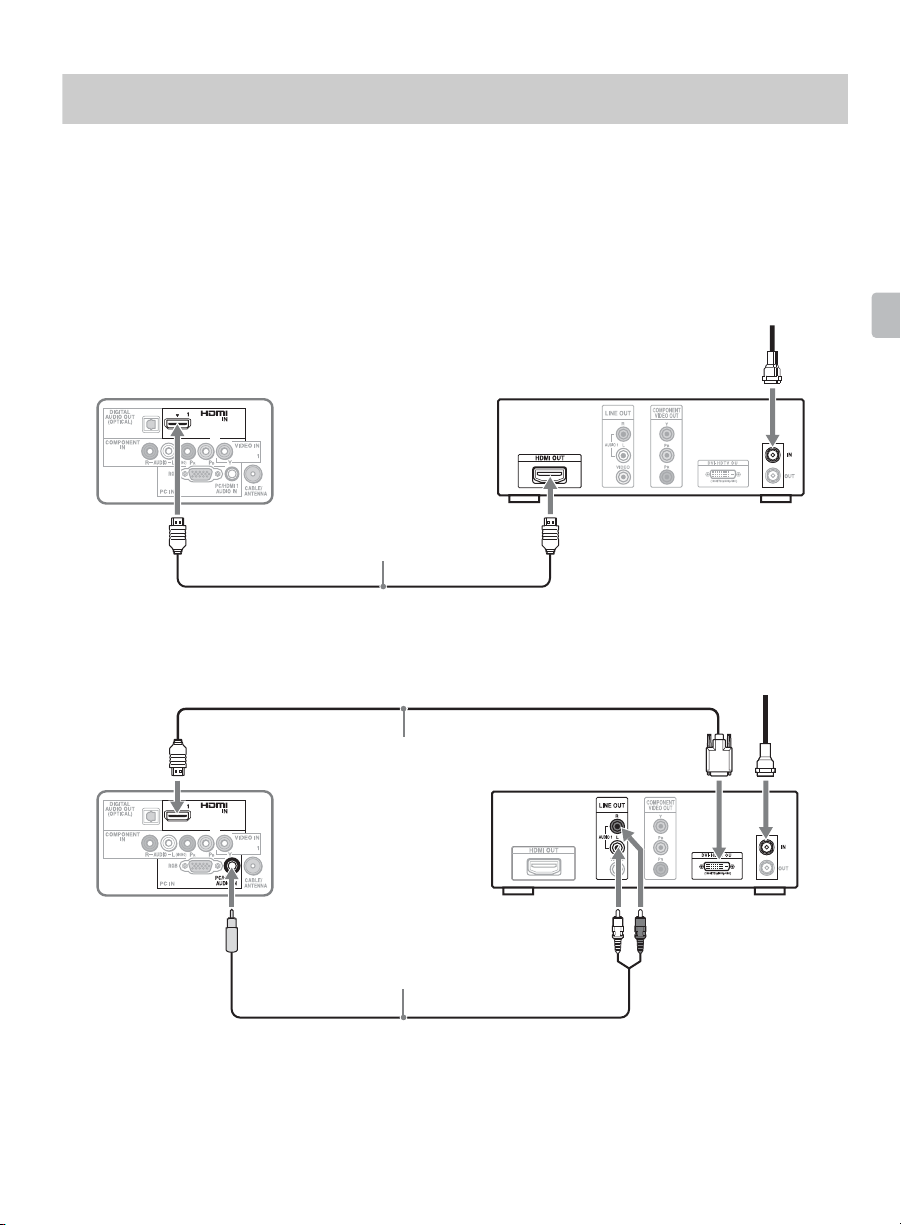
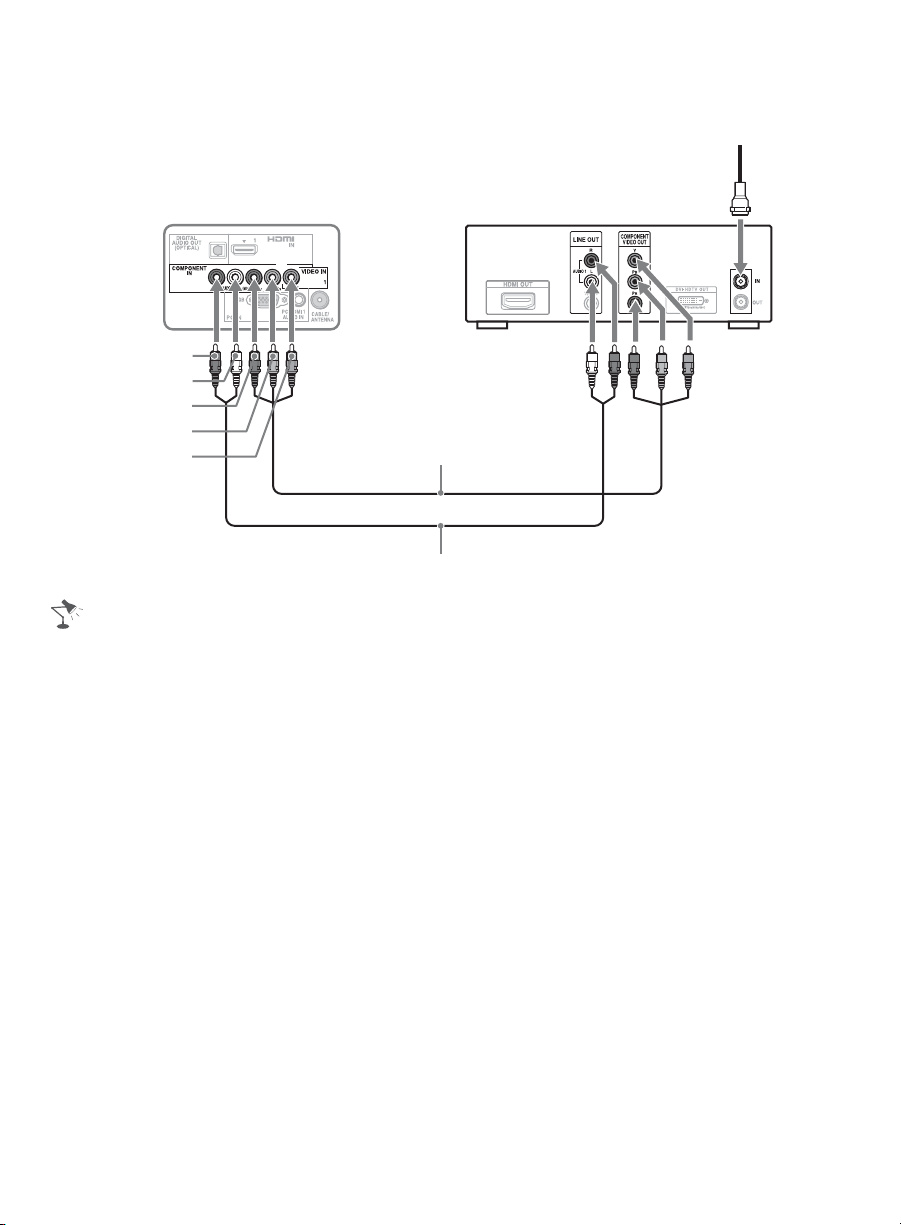
HD Cable Box/HD Satellite Box
You can enjoy high-definition programming by subscribing to a high-definition cable
service or a high-definition satellite service. For the best possible picture, make sure you
connect this equipment to your TV via the HDMI or component video (with audio) input
located on the back of your TV.
x Shown with HDMI Connection
x Shown with DVI Connection
Rear of TV
HDMI cable
HD cable box/
HD satellite box
CATV/Satellite
antenna cable
Rear of TV
DVI-to-HDMI cable
HD cable box/
HD satellite box
CATV/Satellite
antenna cable
Audio cable
(stereo mini plugs)
(Continued)
14
x Shown with Component Connection
• If your equipment has a DVI output and not an HDMI output, connect the DVI output to the HDMI
IN 1 (with DVI-to-HDMI cable or adapter) and connect the audio output to the AUDIO IN of PC
IN. For details, see page 10.
Rear of TV
CATV/Satellite
antenna cable
AUDIO-R (red)
AUDIO-L (white)
Component video cable
Audio cable
P
R
(red)
P
B
(blue)
Y (green)
HD cable box/
HD satellite box
15
Getting Started
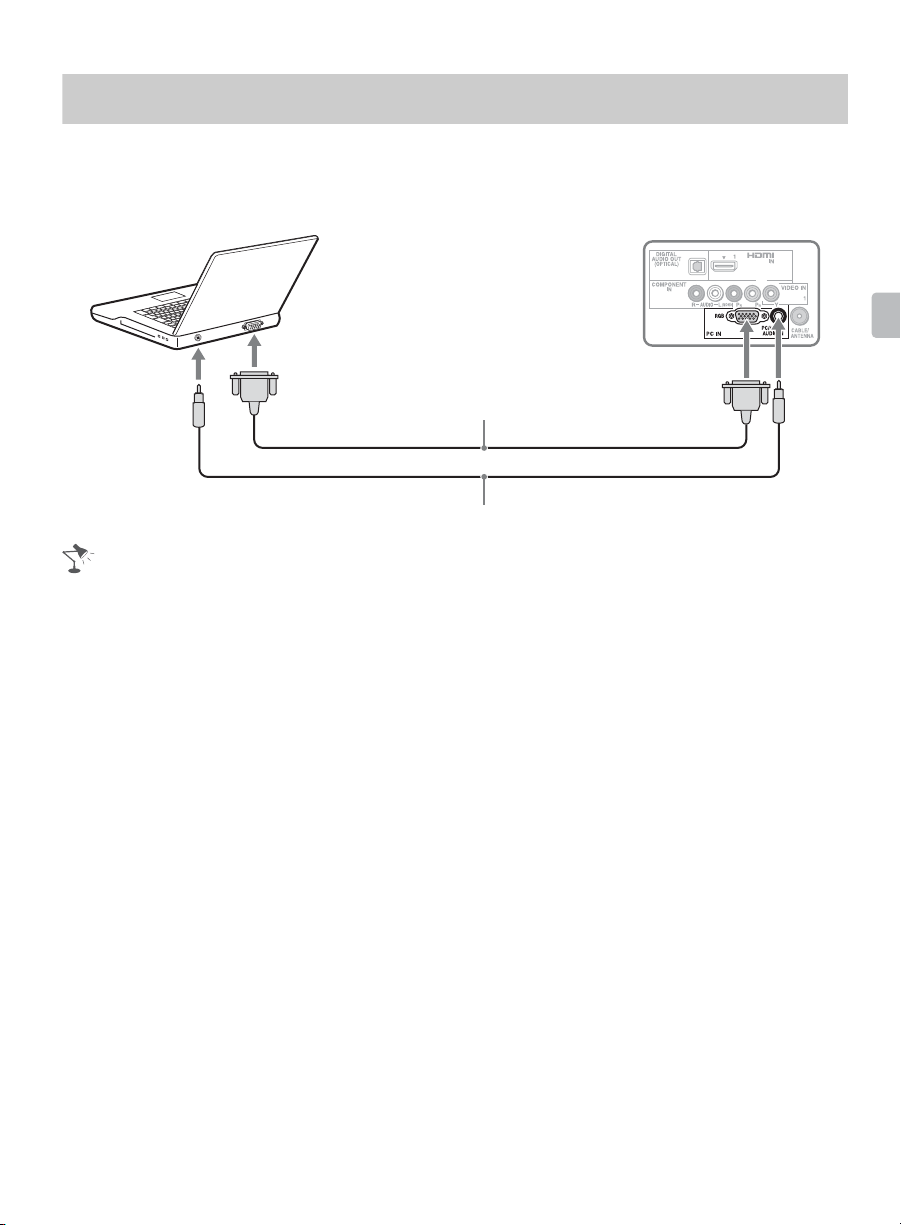
PC
Use the TV as a monitor for your PC by connecting an HD15-HD15 cable connection as
shown below. This TV can also be connected to a PC with a DVI or HDMI output. (Refer
to the separate Quick Setup Guide.)
• Connect the PC IN jack to the PC using an HD15-HD15 cable with ferrite core (analog RGB) and
audio cable (page 10).
Rear of TV
HD15-HD15 cable
(analog RGB)
Audio cable (stereo mini plugs)
16
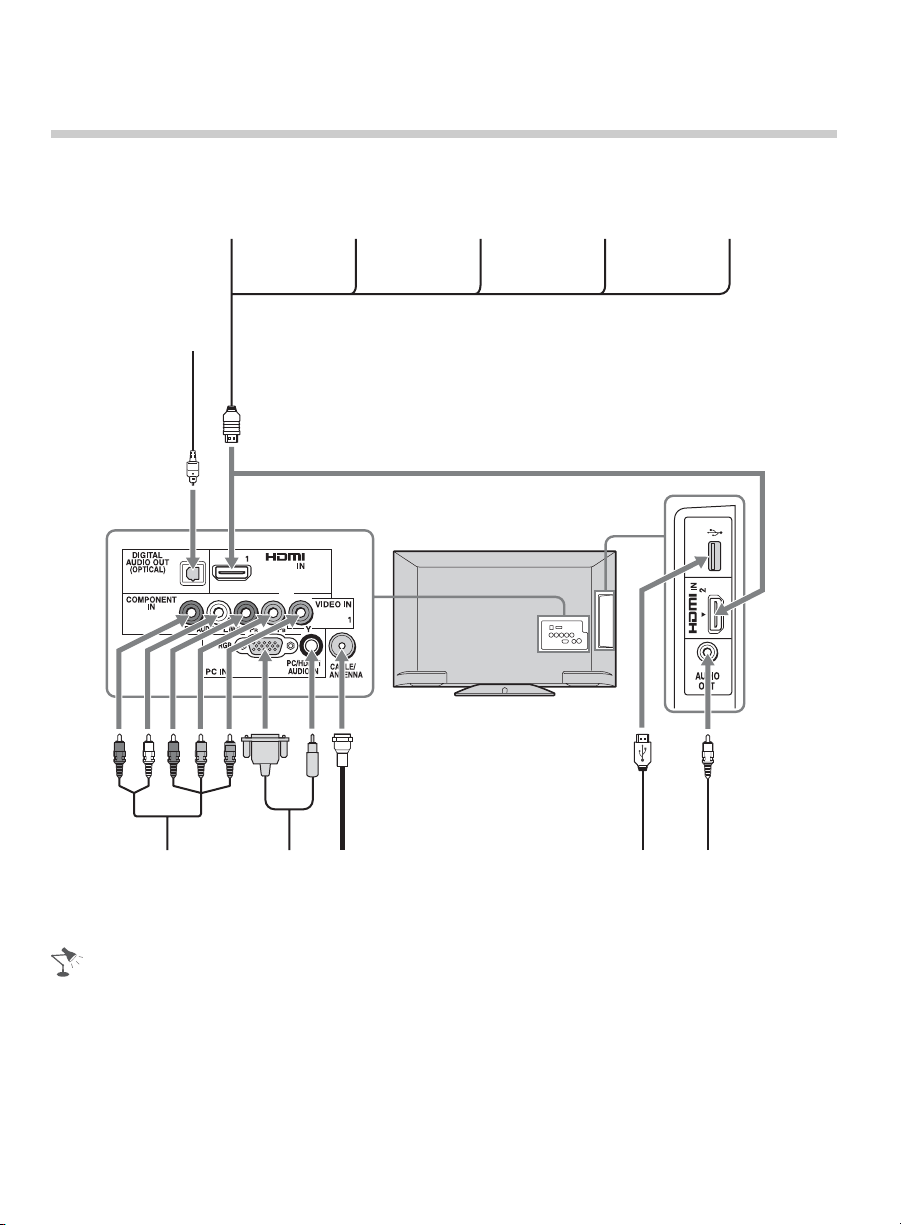
Connecting Other Equipment
• Refer to the Quick Setup Guide (supplied) when connecting other equipment to your TV.
Personal
computer
Blu-ray Disc Player/
“PS3”
DVD
player
Digital satellite
receiver
Analog audio
equipment
(A/V Receiver/
HomeTheater)
Digital
cable box
Audio
system
Digital audio equipment
(A/V Receiver/Home
Theater)
Digital recorder USBCABLE/
ANTENNA

17
Getting Started
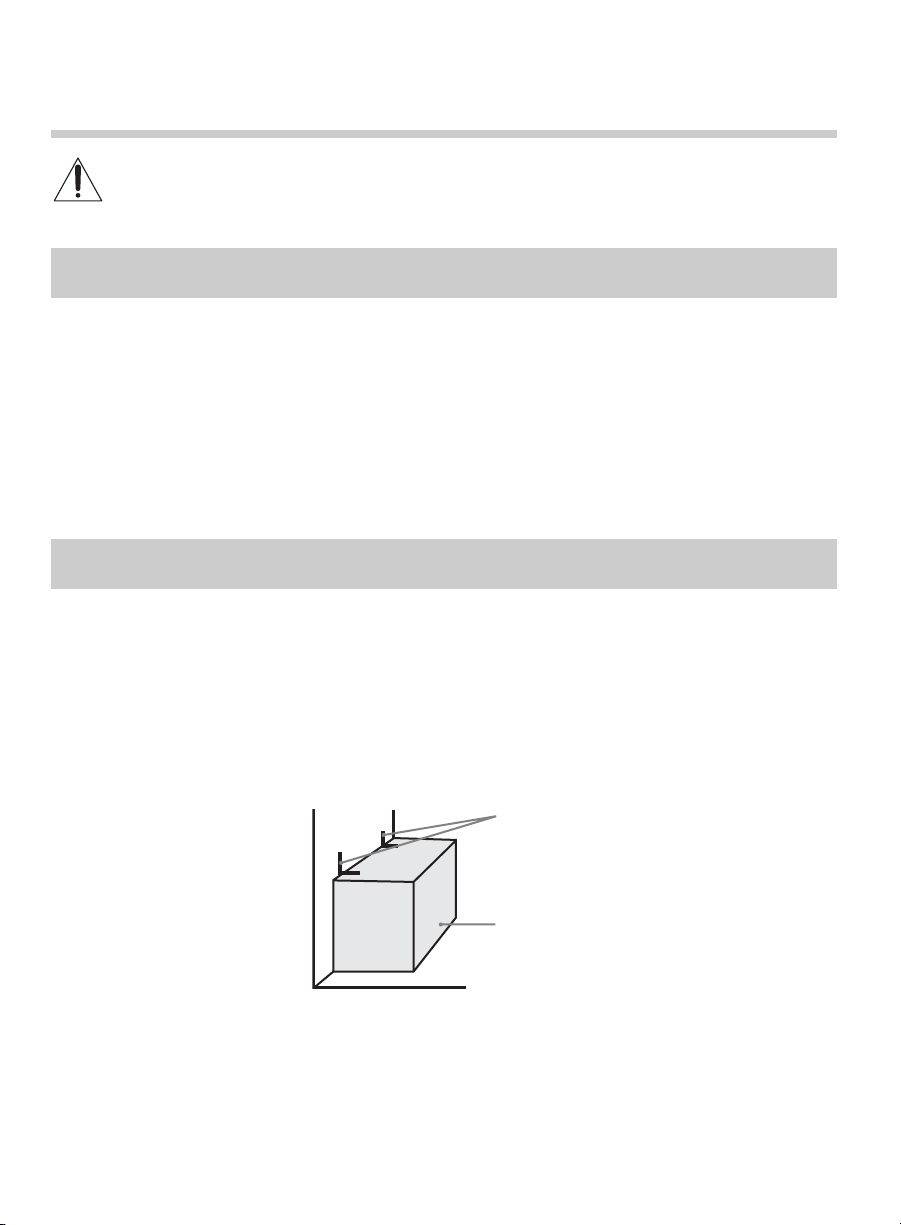
When Installing the TV Against a
Wall or Enclosed Area
Make sure that your TV has adequate ventilation. Allow enough space around the TV as
shown below. Avoid operating the TV at temperatures below 41 °F (5 °C).
• Inadequate ventilation can lead to overheating of the TV and may cause TV damage or cause a
fire.
(30 cm)
11
7
/
8
inches
(6 cm)
inches
4 inches
(10 cm)
4 inches
(10 cm)
2
3
/
8
Leave at least this much space around the set.
Installed with stand
inches
11
7
/
8
4 inches
(10 cm)
4 inches
(10 cm)
4 inches (10 cm)
(30 cm)
Installed on the wall
Leave at least
this much space
around the set.
Never install the TV set as follows:
Air circulation is blocked.
Air circulation is blocked.
Wall Wall
18
Securing the TV
Sony strongly recommends taking measures to prevent the TV from toppling
over. Unsecured TVs may topple and result in property damage, serious bodily
injury or even death.
Preventing the TV from Toppling
❑ Secure the TV to a wall and/or stand.
❑ Do not allow children to play or climb on furniture and TV sets.
❑ Avoid placing or hanging items on the TV.
❑ Never install the TV on:
• slippery, unstable and/or uneven surfaces.
• furniture that can easily be used as steps, such as a chest of drawers.
❑ Install the TV where it cannot be pulled, pushed, or knocked over.
❑ Route all AC power cords and connecting cables so that they are not accessible to curious
children.
Recommended Measures to Secure the TV
Consider the following measures when securing your TV to a TV stand (not supplied).
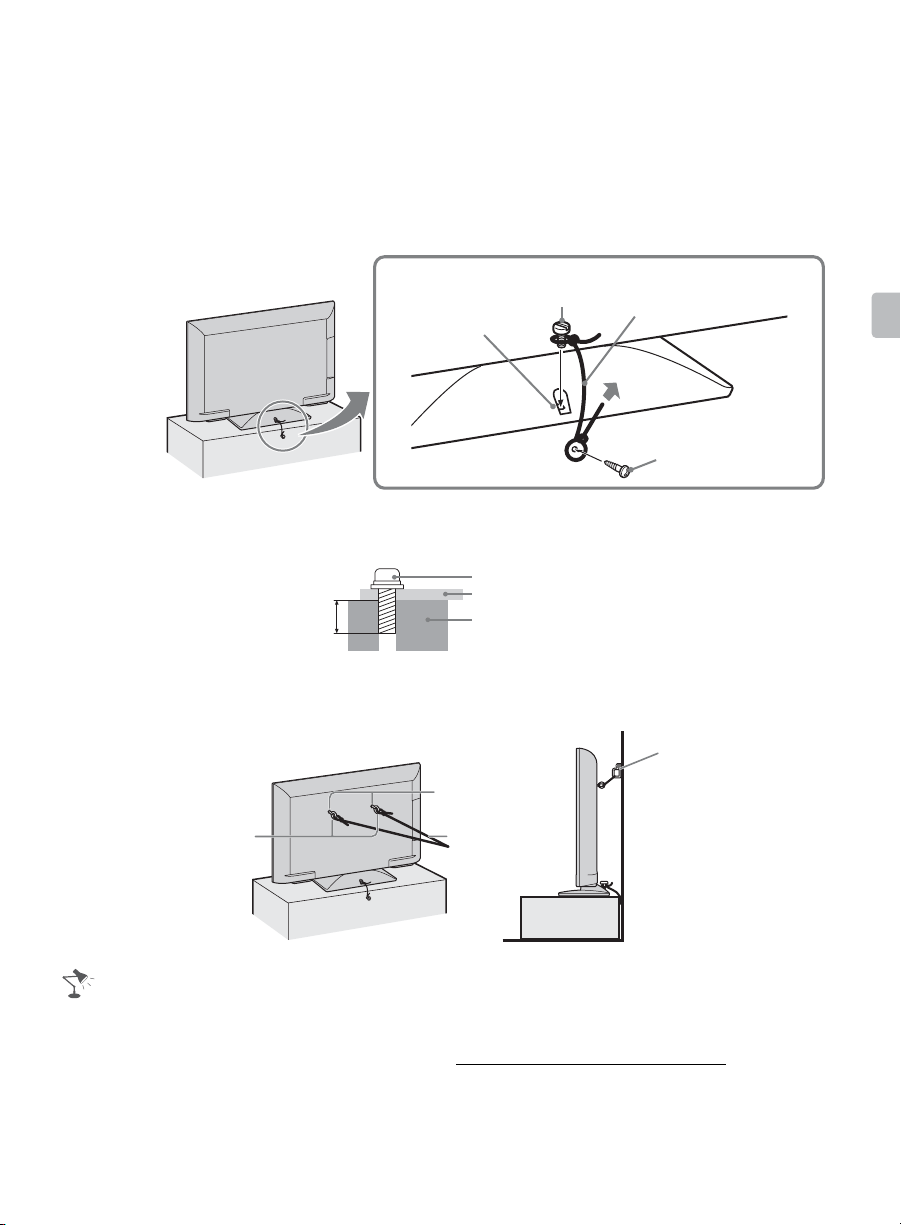
1 Secure the stand for the TV.
Make sure the TV stand can adequately support the weight of the TV. Use two angle
braces (not supplied) to secure the stand.
For each angle brace use the appropriate hardware to:
• attach one side of the angle brace to the wall stud.
• attach the other side to the TV stand.
Angle braces
Stand
19
Getting Started
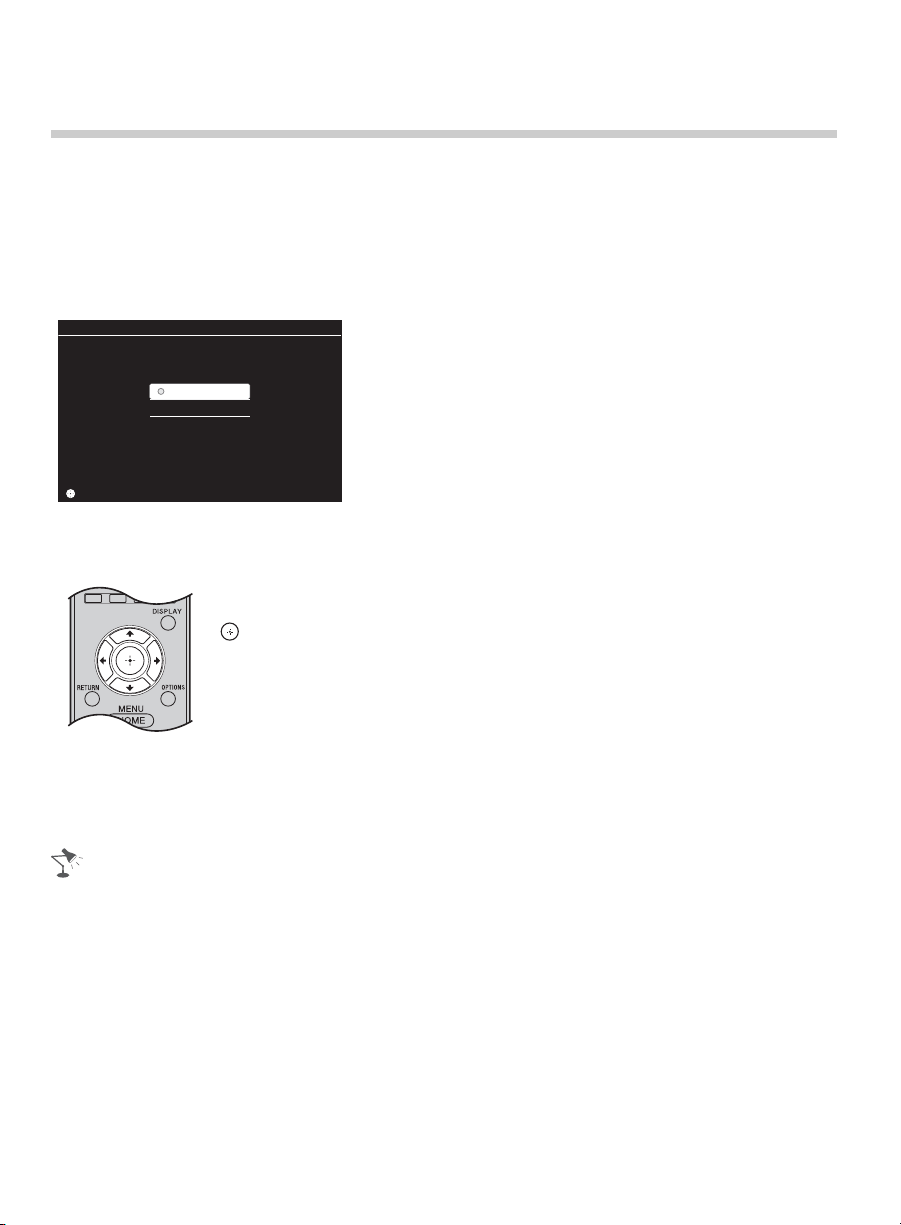
2 Secure the TV to the stand.
Use the optional hardware listed below (not supplied):
• M4 machine screw (screwed into the TV’s Table-Top Stand).
• A screw or similar (attach it to the TV stand).
• Rope or chain (strong enough to support the weight of the TV). Make sure that there is
no excess slack in the rope or chain.
An alternative way to secure the TV is with an optional Sony Support Belt Kit.
The length of the M4 machine screw differs depending on the rope or chain
diameter. Please refer to below illustration.
3 Anchor the TV to the wall.
Anchor the TV to the wall by using bolts, wall anchor and chain (or rope).
• Contact Sony Customer Support to obtain the optional Support Belt Kit by providing your TV
model name.
For United States call: 1-800-488-7669 or visit: http://www.sony.com/accessories
For Canada call: 1-877-899-7669
• Securing the TV to the stand without securing the TV and the stand to the wall provides minimum
protection against the TV toppling over. For further protection, be sure to follow the three
measures recommended.
Screw hole on the
Table-Top Stand
M4 machine
screw (not supplied)
Screw
(not supplied)
Rope or chain
(not supplied)
6-8 mm
Screw M4
Rope or chain
TV’s Table-Top Stand
Wall-mount
holes
Anchor bolts
(not supplied)
Wall-anchor
(not supplied)
Rope or chain
(not supplied)
20
Running Initial Setup
During initial setup, you will perform the following:
• Set the language for the On Screen Display (OSD) text
• Choose your viewing environment
• Scan for digital and analog channels
Complete your cable connections before beginning the Initial Setup. Refer to the Quick
Setup Guide (supplied) for sample connection diagrams.
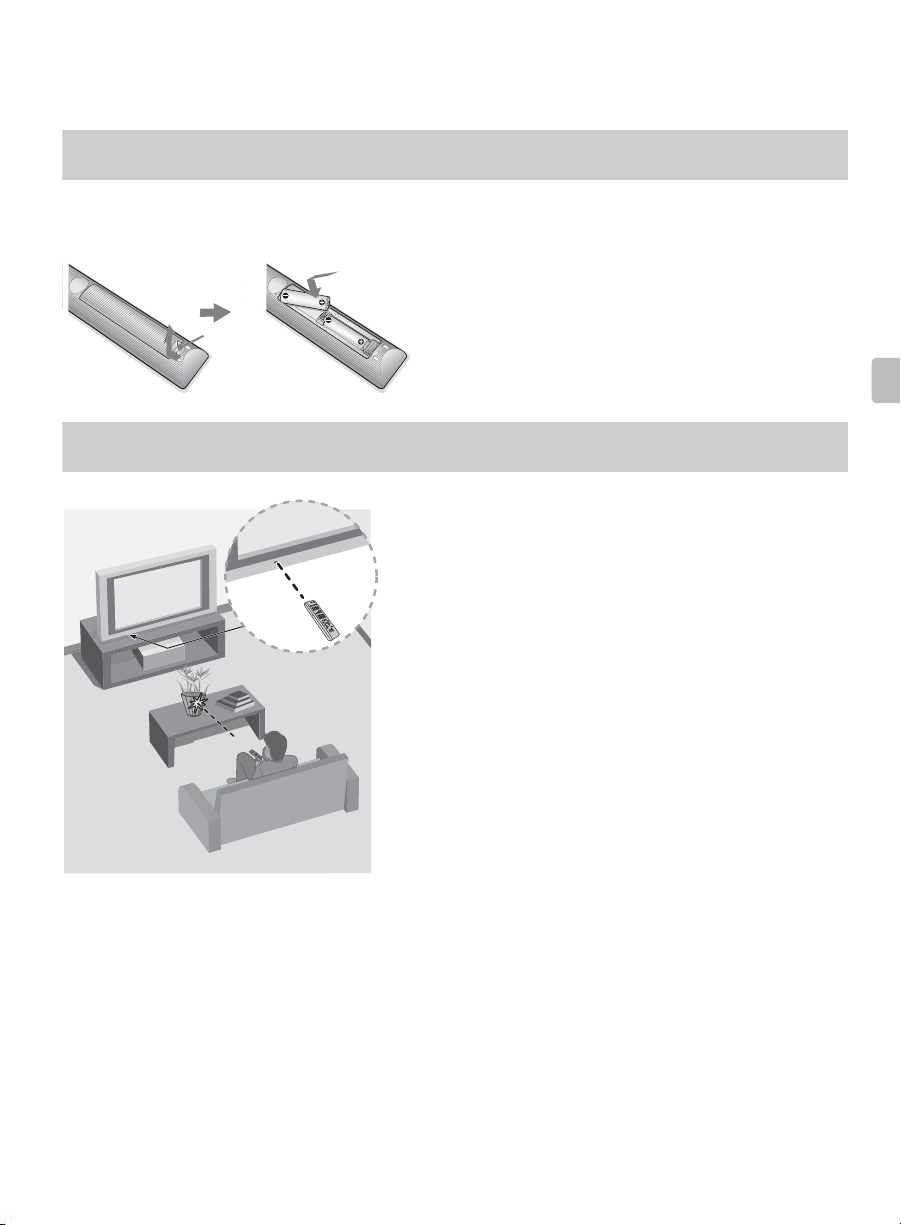
2 Use the remote control buttons described below to navigate through the Initial
Setup.
3 Auto Program will scan for available channels from the signal source directly
connected to the TV’s CABLE/ANTENNA input. Follow the help text provided on the
screen to run the Auto Program.
• If you cancel the Auto Program, any channels you have selected are not registered. To rescan
for available channels, run Auto Program.
• Connect either your cable or antenna to the TV (you can connect both using an A-B RF switch
(not supplied)); for more details see page 12.
1 Turn on the TV.
The Initial Setup screen will appear.
V/v/B/b buttons:
Allow you to navigate and highlight options where applicable.
button:
Allows you to select the highlighted option and advance to the next screen.
ConfirmConfirm
Please select your language:
English
Español
Français
Initial Setup
ConfirmConfirm
21
Operating the TV
Operating the TV
Using the Remote Control
To Insert Batteries into the Remote Control
Insert two size AA batteries (supplied) by matching e and E on the batteries to the
diagram inside the battery compartment of the remote control.
Guidelines to follow
Push to
open
• Point your remote control directly at the IR sensor
located on your TV.
• Make sure that no objects are blocking the path
between the remote control and the IR sensor on your
TV.
• Fluorescent lamps can interfere with your remote
control; try turning off the fluorescent lamps.
• If you are having problems with the remote control,
reinsert or replace your batteries and make sure that
they are correctly inserted.
22
Remote Control Button Description
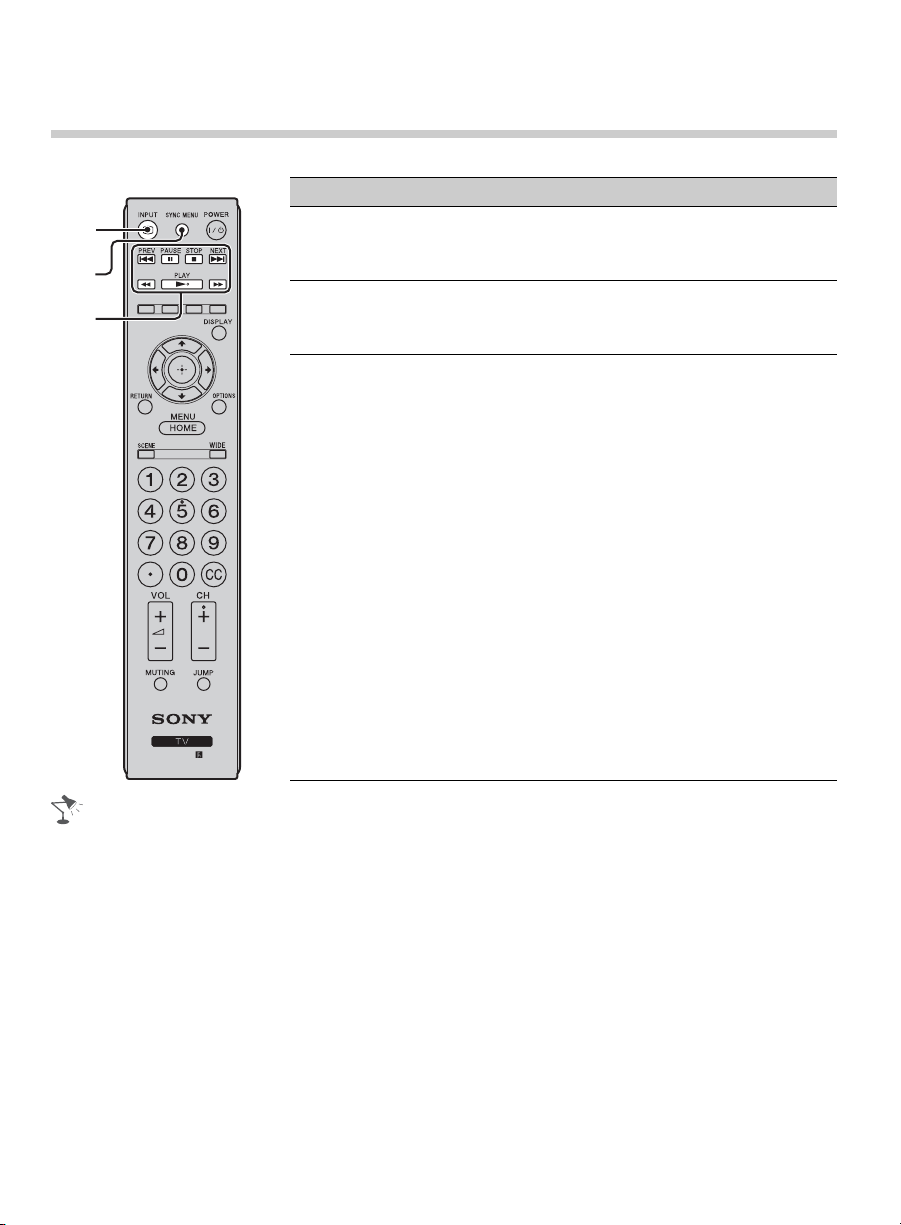
• The 5, N and CH + buttons have a tactile dot. Use them as a reference when operating the TV.
Button Description
1 INPUT Press to display the list of External Inputs and TV
mode. Press repeatedly to toggle through the
inputs. See page 31.
2 SYNC
MENU
Press to display the BRAVIA Sync Menu and then
select connected HDMI equipment from
HDMI
Device Selection
.
3 Equipment
Control
These buttons are used to control the equipment
connected to the TV by using the Control for
HDMI function (not available on all Control for
HDMI equipment). Some other buttons on the
remote control may also operate BRAVIA
®
Sync
TM
equipment.
.
(PREV): Press to replay the current program
from the previous chapter mark.
X (PAUSE): Press to pause playback.
x (STOP): Press to stop playback.
>
(NEXT): Press to advance forward to the
next chapter mark.
m (fast reverse): Press to play a program in
fast rewind mode.
N (PLAY): Press to play a program at a normal
speed.
M (fast forward): Press to play a program in
fast forward mode.
1
2
3
23
Operating the TV
• When you set Scene Select to Photo, Music, Cinema, Game or Sports, Sound Mode is
automatically set to Standard.
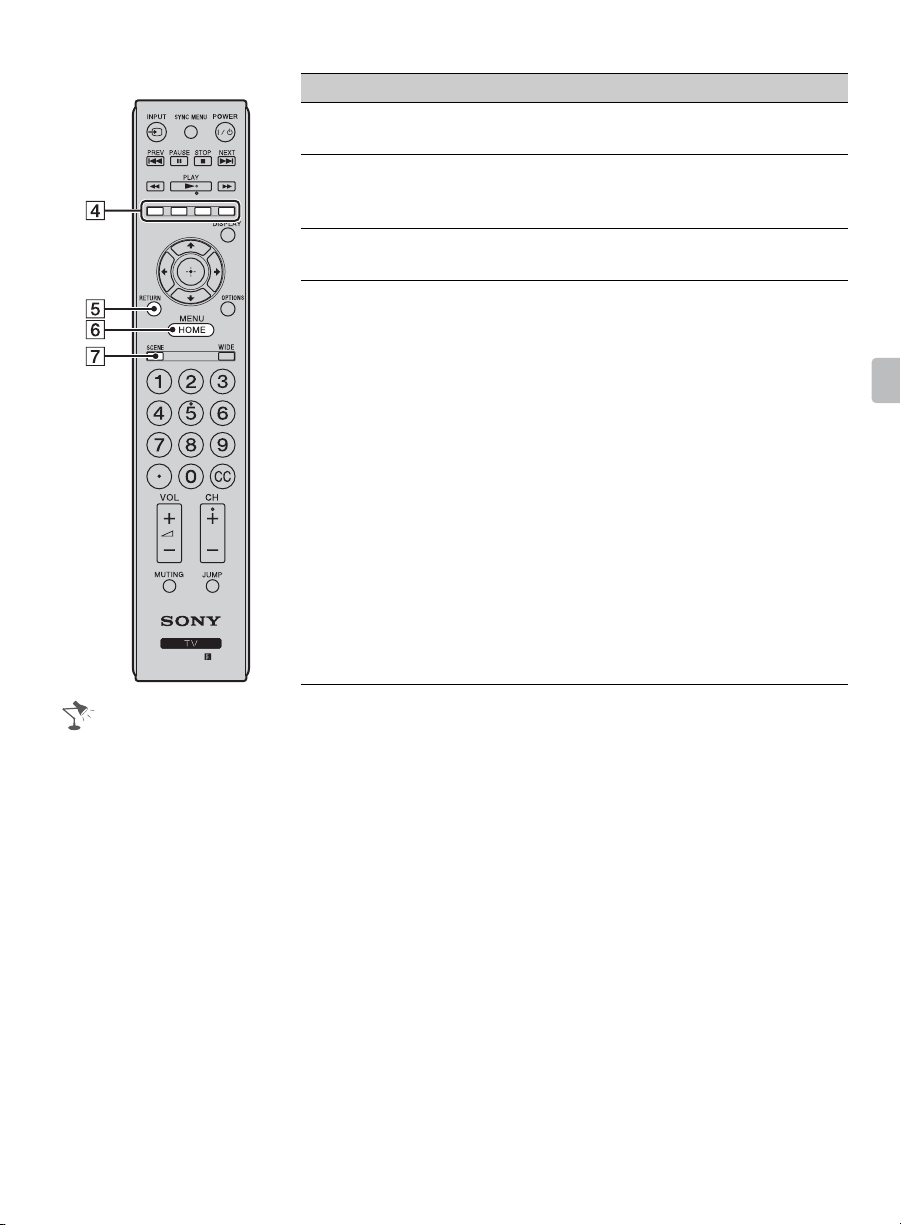
Button Description
4 Colored
buttons
When the colored buttons are available, an
operation guide appears on the screen.
5 RETURN Press to go back to the previous screen or exit
from the screen when displaying menu items and
settings.
6 HOME/
MENU
Press to display the menu with TV functions and
settings. See “Using the Menus” on page 33.
7 SCENE Optimizes picture and sound quality by selecting
the following items.
Cinema: Delivers picture and sound just like in a
theater.
Sports: Presents realistic pictures and sound just
like in a stadium.
Photo: Reproduces the texture and color of a
printed photo.
Music: Lets you experience dynamic and clear
sound just like at a concert.
Game: Broadens your game-playing experience
with superb picture and sound quality.
Graphics: Eases prolonged monitor viewing with
clearer detailed pictures.
General: No optimized picture and sound quality
for any scene.
Auto: Automatically optimizes picture and sound
quality according to the input source.
(Continued)

24
Button Description
8 0-9 Press 0-9 to select a channel.
9 Use with 0-9 to select digital channels.
For example, to enter 2.1, press , , and
.
0 VOL (2)
+/–
Press to adjust the volume.
qa MUTING Press to mute the sound. Press again or press
VOL + to restore the sound.
qs POWER
"/1
Press to turn on and off the TV.
qd DISPLAY Press once to display the banner with channel/
program information you are watching. The
banner will time out in a few seconds or press
again to exit.
qf V/v/B/b Press V/v/B/b to move focus/highlight. Press
to select/confirm an item.
qg OPTIONS Press to display a list of convenient functions and
menu shortcuts. The options menu items vary
based on current input and content.
qh WIDE Press repeatedly to cycle through the available
Wide Mode settings. See page 29.
qj CC Press to cycle through the available settings for
Closed Captions (CC) : On, Off, and On when
Muting.
qk CH +/– Press to scan through channels. To scan quickly
through channels, press and hold down either CH
+/–.
ql JUMP Press to jump back and forth between two
channels and external inputs. The TV alternates
between the current/last channel or external input
selected.
8
9
qa ql
qk
qj
qg
qf
qd
qh
qs
0
2 1
25
Operating the TV
TV Controls and Indicators
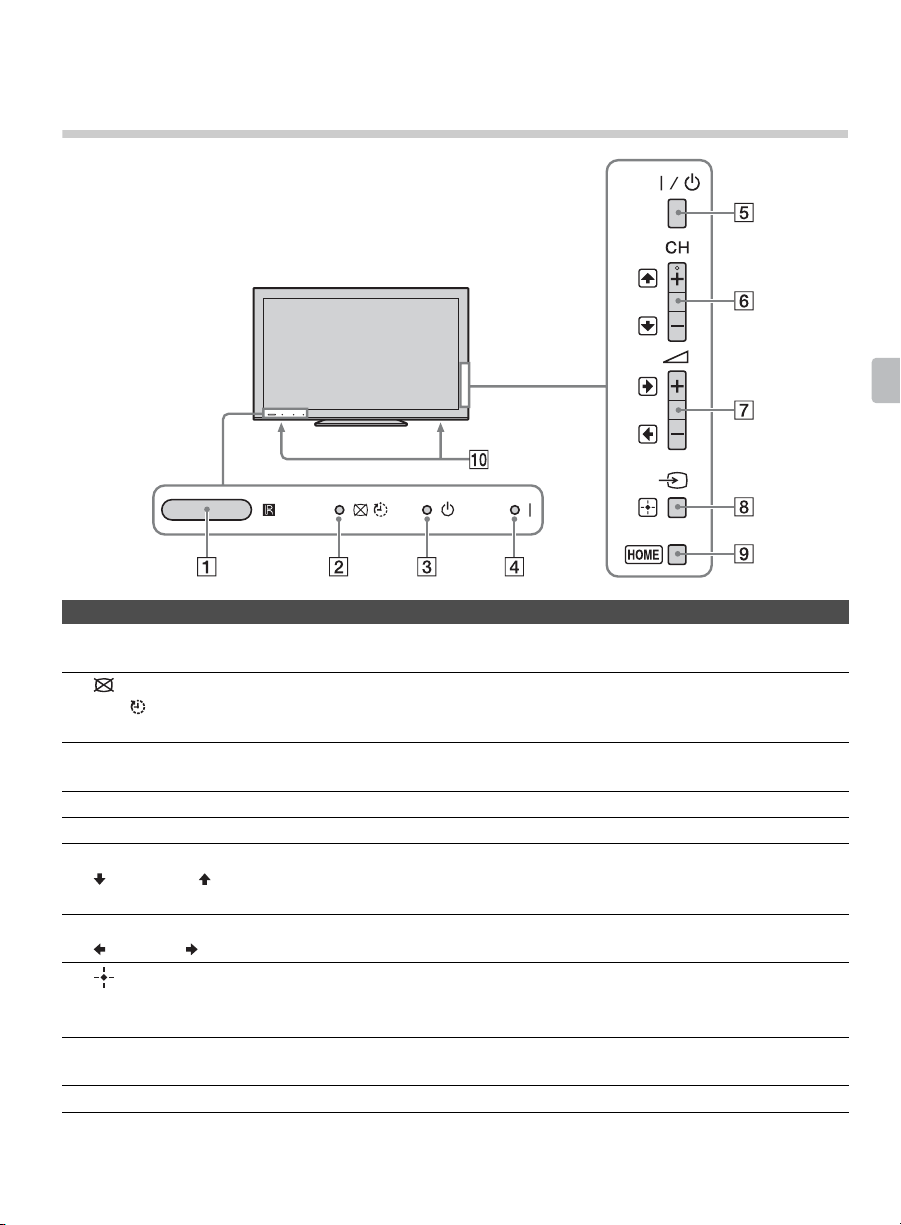
Item Description
1 (IR) Infrared
Receiver
Receives IR signal from the remote control.
2 (Picture
Off)/
(Timer) LED
Lights up in orange when the sleep timer is set.
Lights up in green when the Power Saving is set to Picture Off.
3 1 (Standby)
LED
Lights up in red when the TV is in standby mode.
4 " (Power) LED Lights up in green when the TV is turned on.
5 "/1 (Power) Press to turn on and off the TV.
6 – CH + Press to scan through channels. To scan quickly through channels, press and
hold down either CH –/+. In the menu screen, these buttons serve as up/down
buttons.
7 – 2 +Press to adjust the volume. In the menu screen, these buttons serve as left/
right buttons.
8
t (Input)
Press to display the list of external inputs. Press repeatedly to toggle through
the inputs.
In the menu screen, this button serves as confirming the selection or setting.
9 HOME Press to display menu with TV functions and settings (see “Using the Menus”
on page 33).
0 Speaker Outputs audio signal.
(Continued)

27
Using Features
Using Features
BRAVIA
®
Sync
TM
with
Control for HDMI
With the Control for HDMI function,
BRAVIA Sync helps to communicate with
BRAVIA Sync-compatible equipment
using HDMI CEC (Consumer Electronics
Control). Use the following settings and
tips to help unify control of your
connected equipment.
1 Press HOME and select Settings,
then select the Setup settings.
2 Select the HDMI Settings, then
highlight Control for HDMI, and set to
On.
x Controlling BRAVIA Sync-
Compatible Equipment
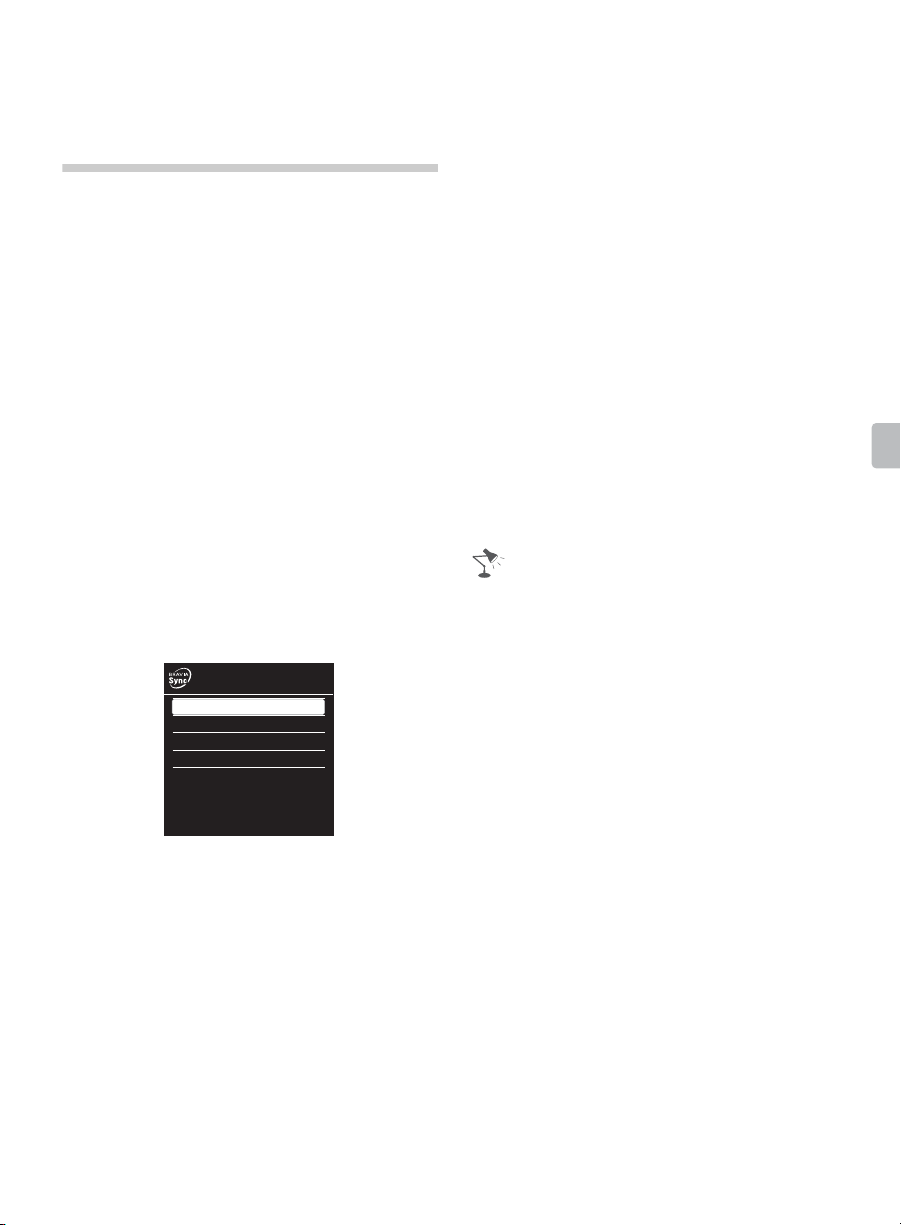
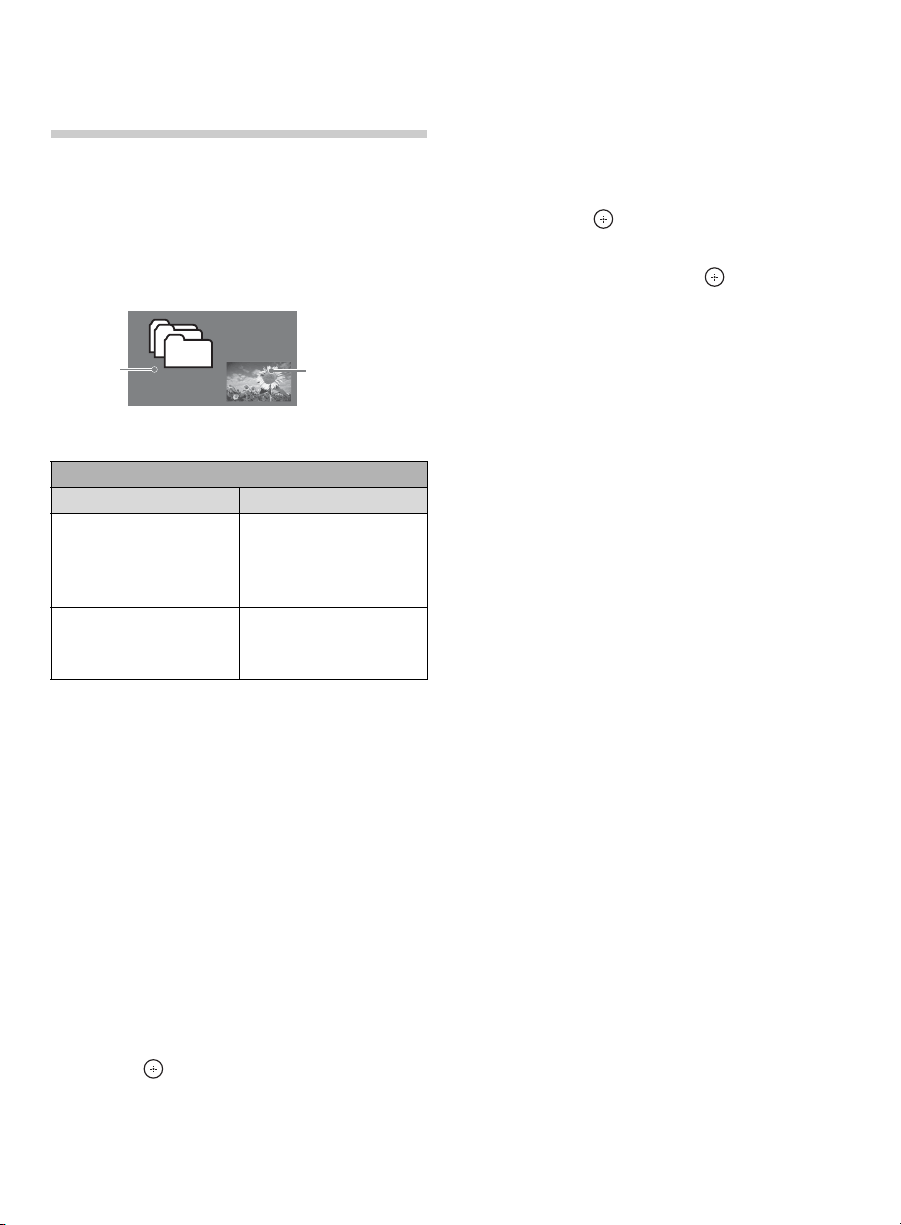
To control the equipment by using the
remote control, press SYNC MENU and
select the desired equipment from HDMI
Device Selection.
x BD/DVD Player
• Automatically turns the BRAVIA Sync-
compatible equipment on and switches the
input to that equipment when you select it
from the Sync Menu.
• Automatically turns the TV on and switches
the input to the connected equipment when
the equipment starts to play.
• Automatically turns the connected
equipment off when you switch the TV to
standby mode.
x AV Amplifier
• Automatically turns the connected AV
amplifier on and switches the sound output
from the TV speaker to the audio system
when you turn the TV on.
• Automatically switches the sound output to
the AV amplifier by turning the AV amplifier
on when the TV is turned on.
• Automatically turns the connected AV
amplifier off when you switch the TV to
standby mode.
• Adjusts the volume (VOL +/-) and mutes the
sound (MUTING) of the connected AV
amplifier through the TV’s remote control.
x Video Camera
• Automatically turns the TV on and switches
the input to the connected video camera
when the connected video camera is turned
on.
• Automatically turns the connected video
camera off when you switch the TV to
standby mode.
• Control for HDMI (BRAVIA Sync) is only
available for the connected Sony equipment
that has the BRAVIA Sync or is compatible
with Control for HDMI.
•The Control for HDMI settings must be set
on both the TV and connected equipment.
For settings on the connected equipment,
refer to their instruction manuals.
• When specific Sony equipment compatible
with Control for HDMI (BRAVIA Sync) is
connected, BRAVIA sync is automatically
activated on the equipment.
Sync Menu
HDMI 1
HDMI Device Selection
Device Control
Speakers
TV Control
Return to TV
28
Using PIP Feature
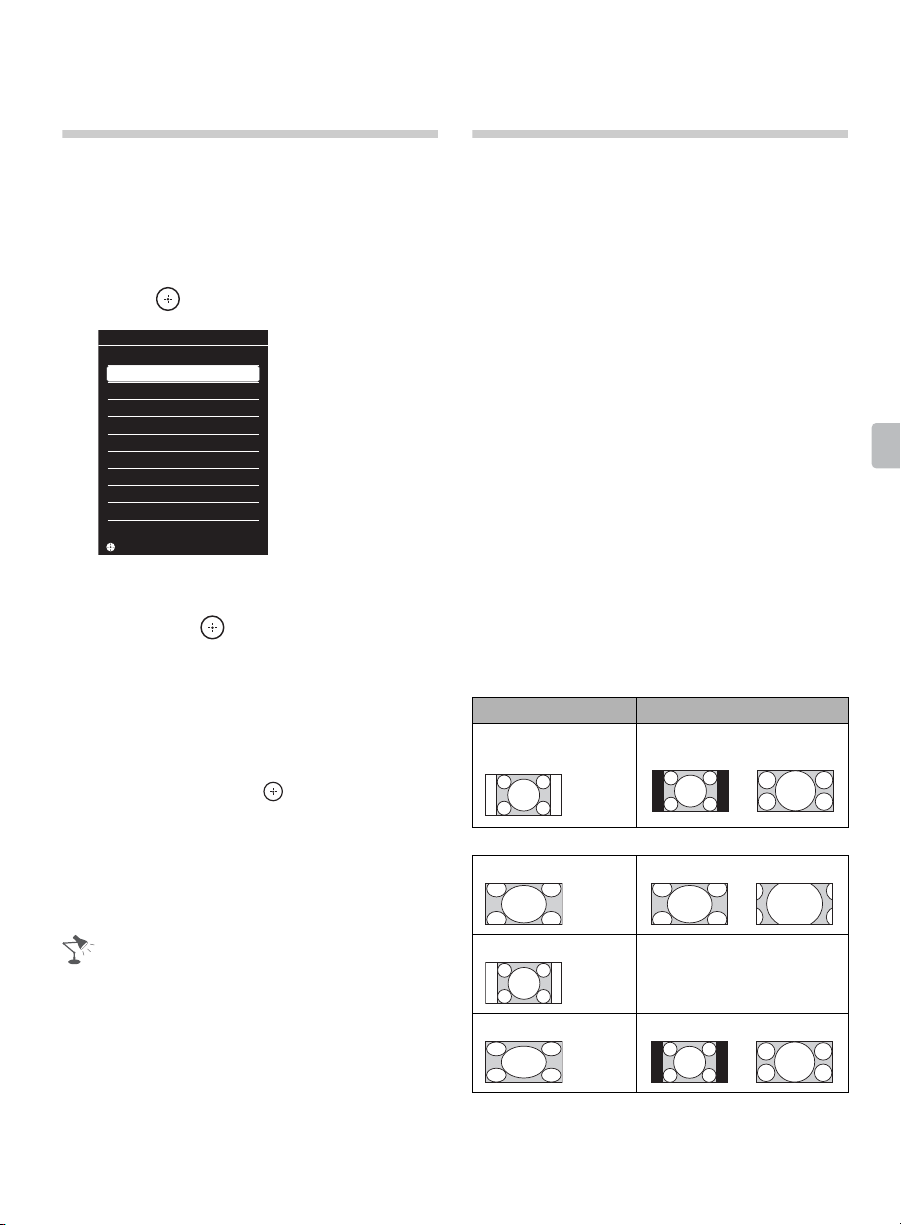
PIP (picture in picture) displays a picture
from a connected PC in full screen, and a
TV program or other external input (see
below “To Enter PIP” table) in an inset
window. (Closed Captions (CC) is not
available with PIP mode.)
To Enter PIP
1 Press OPTIONS while in the PC
mode.
2 Select PIP from the OPTIONS menu.
3 The sub window will appear.
x To Change Channels
You can change the channel of the sub
window by pressing CH +/– or entering
the channel number using the 0-9 numeric
buttons.
x To Exit from PIP
1 Press OPTIONS.
2 Press V/v to highlight Exit PIP and
press to exit to full PC screen.
x To Swap Audio
You can swap audio between the main
and sub window.
1 Press OPTIONS.
2 Press V/v to highlight Audio Swap
and press .
3 Press V/v to highlight the window to
be audible, then press .
PIP Supported Inputs
In main window In sub window
PC TV channel (CABLE/
ANTENNA), VIDEO IN
1, HDMI IN 1/2 (video
timing)
HDMI IN (PC timing) TV channel (CABLE/
ANTENNA), VIDEO IN
1, COMPONENT IN
Main
Window
(PC)
Sub Window
(Location of the
Sub Window
can be moved
by pressing
V/v/B/b.)
29
Using Features
Favorites
Your favorite channels and external inputs
can be accessed by pressing the HOME
button once they are added to the list.
1 Press HOME.
2 Press V/v to select Favorites, then
press .
The favorites list appears.
3 Press V/v to select a channel or input,
then press .
x To add to Favorites
While tuned to the channel you want to
watch or viewing connected equipment,
press HOME and select Favorites to
display the list. Highlight Add to
Favorites, then press . Your newly
added item will be listed at the top of the
list. When you continue to add items
beyond the 10th item, the item listed at the
bottom of the list will be automatically
removed from the list.
• Favorite channels and external inputs can
also be added using the OPTIONS button
on the remote control.
• Your Favorites list will be cleared each time
you run the Auto Program.
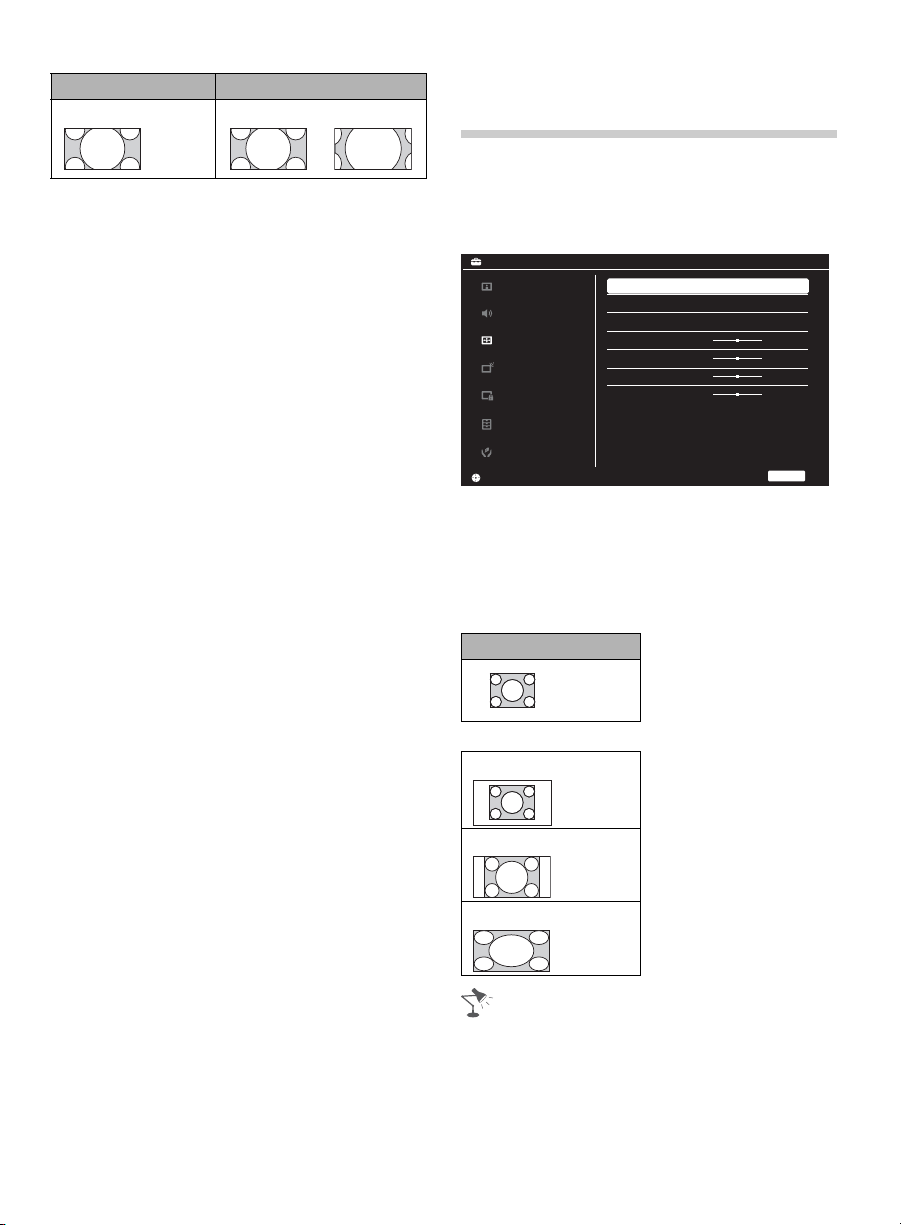
Wide Mode
The Wide Mode feature allows you to
select the screen display of your
preference. Based on the original signal
source, you may see black bars around
the picture or just on the both sides of the
screen. Sometimes you will see the
picture filled the full screen. This is due to
the signals your TV receives.
You can manually select available Wide
Mode settings as you watch your TV by
pressing the WIDE button on your remote
control or you can set your TV to Auto
Wide.
x To set Auto Wide
Press HOME and select Settings, then
select the Screen settings.
Select Auto Wide and set to On.
x To change the Wide Screen Mode
Press WIDE repeatedly to cycle through
the available modes.
Favorites
Add to Favorites
Cable 4.61 ABC
Antenna 12 BBCNEWS
Component DVD
Antenna 24.6 BBO
Cable 34 ESPN HD
Cable 36.1 STAR Ch
HDMI 1 BD
HDMI 2 Recorder
Antenna 52.5 NHKHi
Cable 88.6 NHK BS2
Set
4:3 Original source 16:9 Original source
Standard-
definition source
High-definition source
Wide Zoom Wide Zoom
Normal Normal
This mode is not
available.
Full Full
mm
(Continued)
30
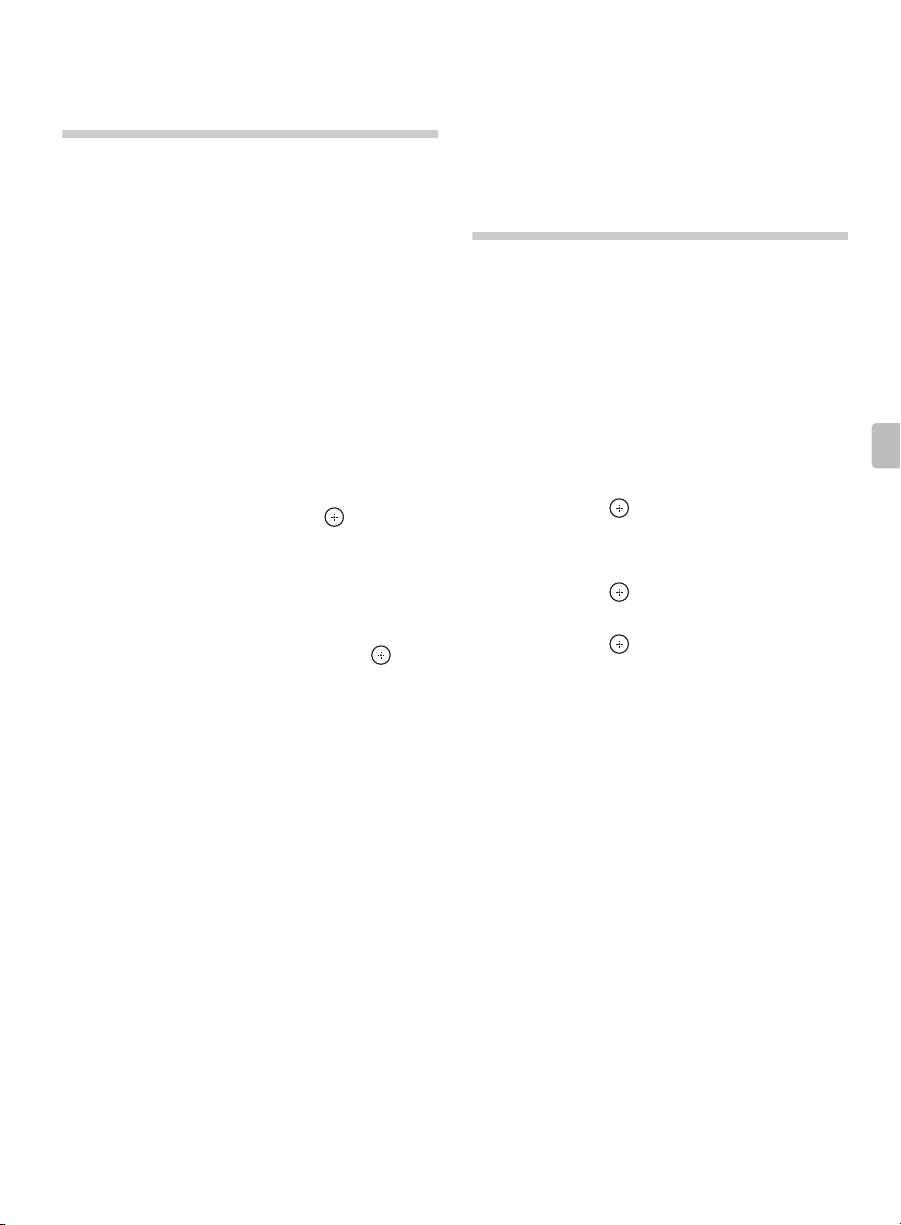
Normal is available with 480i or 480p
sources only.
Wide Mode with PC
Wide Mode is also available for the PC
settings. When a PC is connected to the
TV and PC input is selected, you can
change the PC Screen settings.
x To change the Wide Screen Mode for
PC Timing
Press WIDE repeatedly to cycle through
the available modes while in the PC input
mode.
• Use the Auto Adjustment to adjust the
display position and phase of the picture
when the TV receives an input signal from
the connected PC.
Zoom Zoom
4:3 Original source 16:9 Original source
Incoming PC signal
Normal
Full 1
Full 2
ConfirmConfirm
PC Settings
PC
Wide Mode
Reset
Auto Adjustment
Phase
Pitch
Horizontal Center
Vertical Center
Normal
0
0
0
0
Picture
Sound
Screen
Channel
Parental Lock
Setup
Eco
RETURN
Back
800 × 600
m
31
Using Features
Inputs
Press INPUT to display the Input menu
and toggle through the external inputs to
select your video signal for viewing
including the TV mode. The inputs list
consists of TV mode and other equipment
connected to the TV.
You can label your external inputs to
identify them easily.
x To Manage on Input
Press HOME and select Settings, then
select the Setup settings. Select the
Manage Inputs option in AV Setup. Press
V/v to highlight the video input (HDMI 1-2,
Video 1, Component, PC) to which you
want to assign a label; press to select
the input of your choice.
x To Manage Label
Press B/b to highlight one of the
displayed labels that corresponds to your
connected equipment, then press .
x To Manage Enable
1 Press B/b to select enable column.
2 Press V/v to select Auto, Always or
Off when Auto is selected. The
selected input will be listed always.
Playing back Photo/
Music (KDL-46/
40BX450 only)/Video
via USB
You can enjoy photo/music/video files
stored in a Sony digital still camera or
camcorder through a USB cable or USB
storage device on your TV.
1 Connect a supported USB device to
the TV.
2 Press HOME.
3 Press V/v to select Photo, Music
(KDL-46/40BX450 only), or Video,
then press .
The file or folder list appears.
4 Press V/v/B/b to select a file or folder,
then press .
When you select a folder, select a file,
then press .
Playback starts.
x Photo Playback Auto Start
The TV automatically displays the
thumbnail view screen when the TV is
turned on and a digital still camera or
other device storing photo files is
connected to the USB port then turned on
(page 45).
(Continued)

32
x Notes when playing back files
• While the TV is accessing the data on
the USB device, observe the following:
– Do not turn off the TV or connect USB
device.
– Do not disconnect the USB cable.
– Do not remove the USB device.
The data on the USB device may be
damaged.
• Sony will not be held liable for any
damage to, or loss of, data on the
recording media due to a malfunction of
any connected devices or the TV.
• Playback does not start automatically if
the TV is turned on after connecting the
digital still camera or other device to the
USB port.
• USB playback is supported for the
following photo file formats:
– JPEG (JPEG format files with the
extension “.jpg” and conforming to DCF
2.0 or Exif 2.21)
• (KDL-46/40BX450 only)
USB playback is supported for the
following music file format:
– MP3 (files with the extension “.mp3” that
have not been copyrighted)
• USB playback is supported for the
following video file format:
– MPEG1, MPEG2 (files with the extension
“.mpg”)
• Photo Playback Auto Start works only for
photo files in the newest digital still
camera folder (DCF-compliant, highest-
numbered “DCIM” folder).
• Playback may not start automatically
when some digital still cameras (such as
cameras with internal memory) are
connected.
• The file name and folder name support
only English.
• When you connect a Sony digital still
camera, set the camera’s USB
connection mode to “Auto” or “Mass
Storage.” For more information about
USB connection mode, refer to the
instructions supplied with your digital
camera.
• Use a USB storage device that is
compliant with USB Mass Storage Class
standards.
• The file system on the USB device
supports FAT16, FAT32 and NTFS.
33
Using the Menus
Using the Menus
Navigating through TV Menus
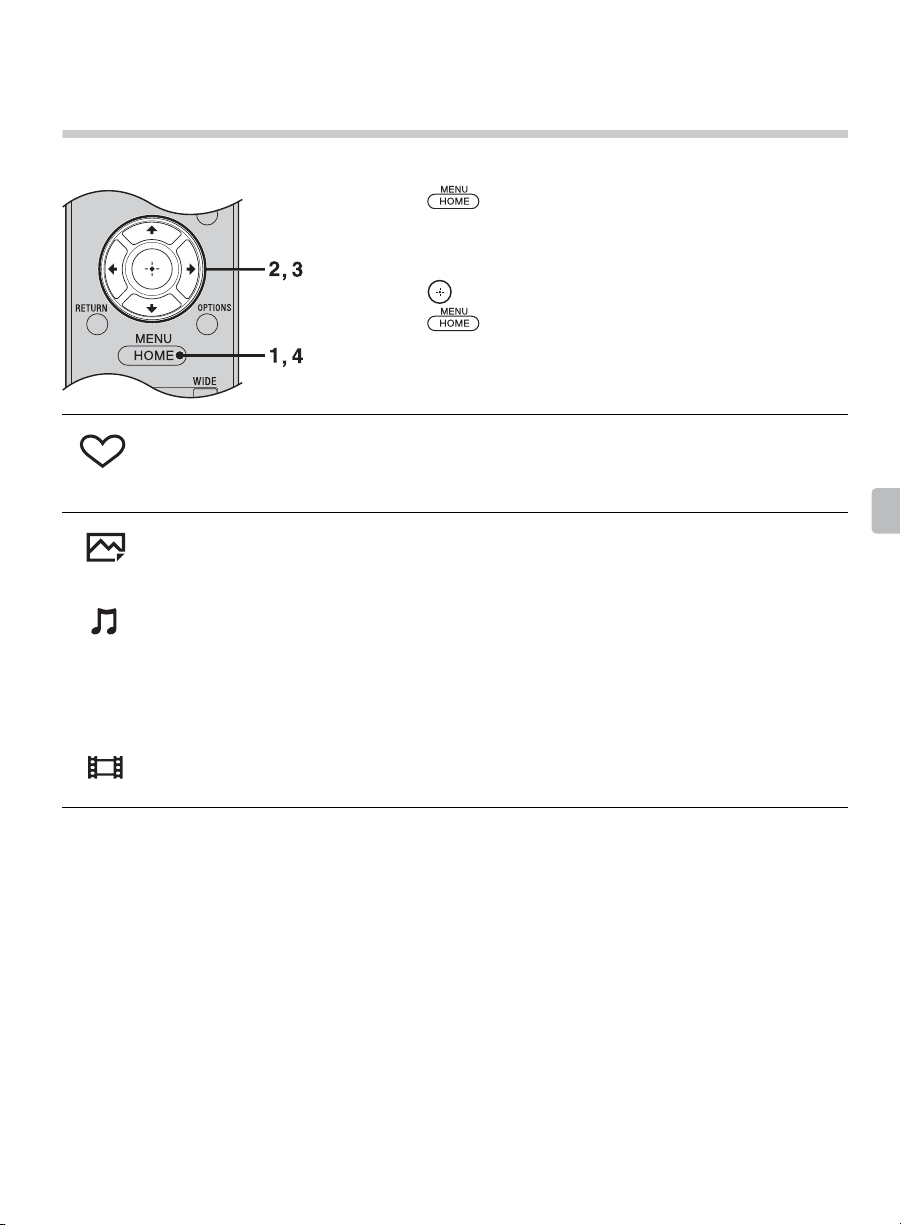
The HOME button allows you to access a variety of TV settings and USB media files.
1 Press on the remote control to display the menu
options.
2 Press V/v/B/b to navigate on the menu or adjust the
settings.
3 Press to select or confirm.
4 Press to exit.
The Favorites feature provides quick access to your frequently used items,
such as preferred TV channels or external inputs (e.g. game console, DVD
player). For details, see page 29.
The Photo, Music (KDL-46/40BX450 only), and Video icons organize your
photo, music, and video files from Sony USB connected equipment. Be sure
to select the correct icon when accessing files. Refer to the feature section
for more information on these icons (page 31).
(KDL-46/
40BX450
only)
Favorites
Photo
Music
Video
(Continued)
34
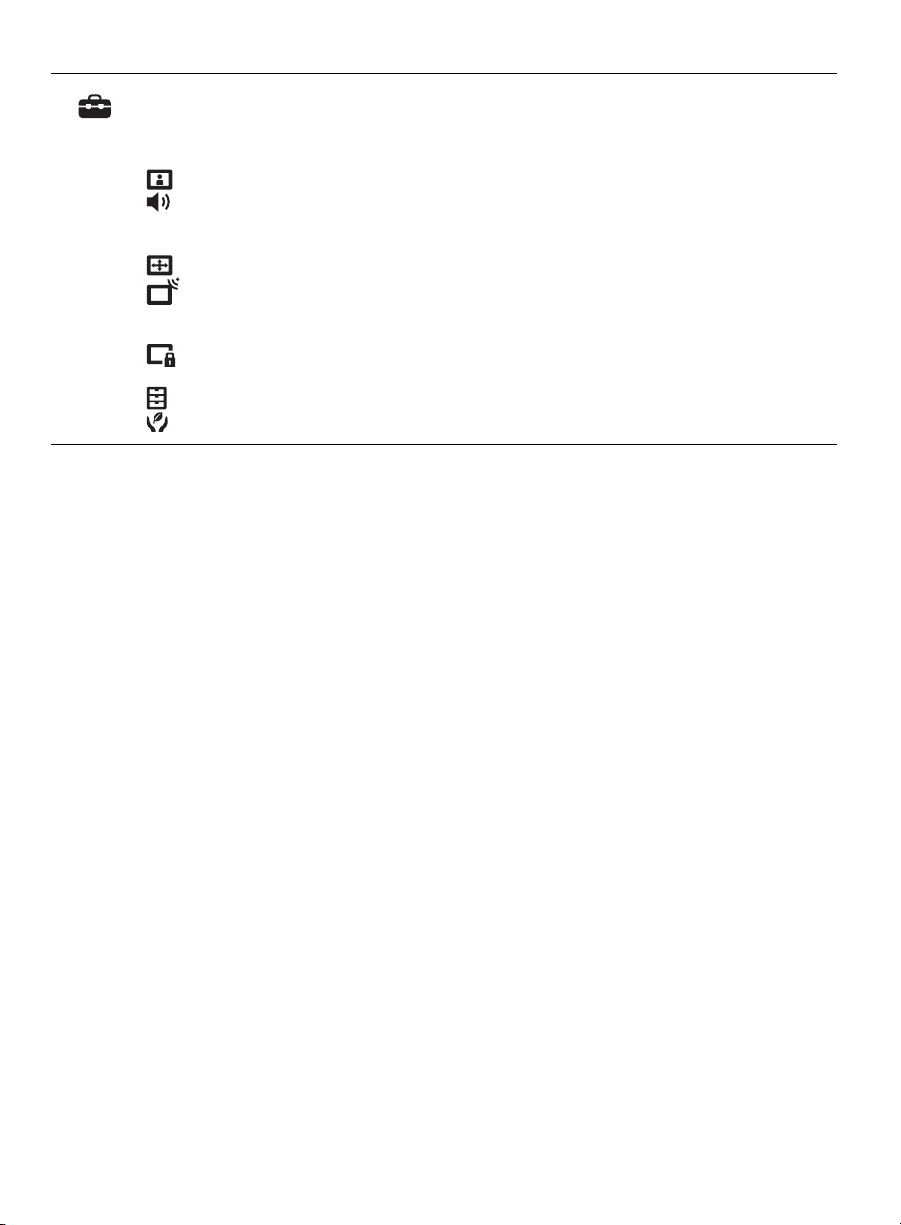
The Settings icon contains all of the necessary configurations to customize
your TV settings. The options you can select may vary. Unavailable options
are grayed out or not displayed.
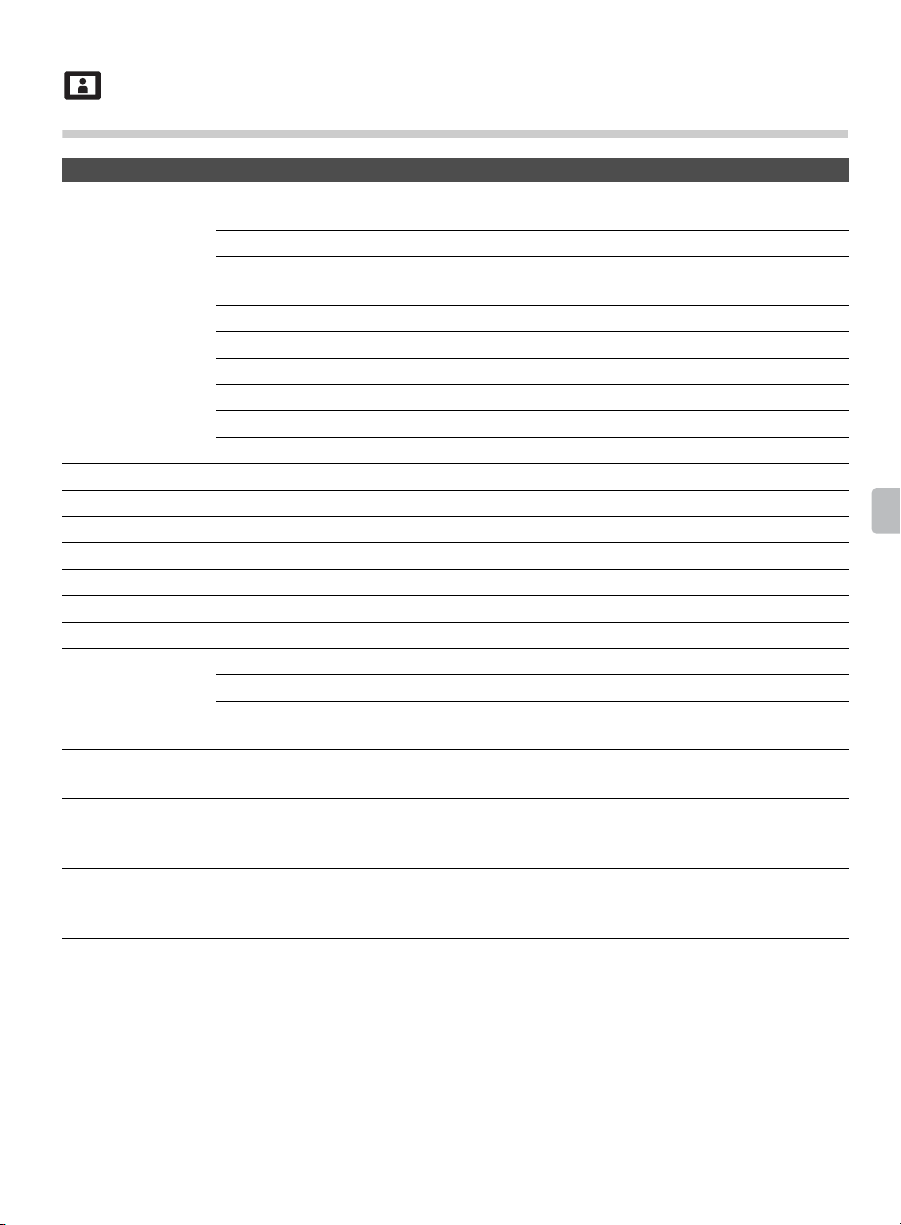
Picture: adjust the picture on your TV to fit your viewing preference.
Sound: customize your sound settings to suit your audio preference. You can
also change the settings to output the sound to your connected audio
equipment.
Screen: adjust the size and shape of the images you see on the screen.
Channel: navigate your favorite channels and inputs and select the signal type,
as well as autoprogram channels. You can also customize the channels you see
and the labels assigned to them.
Parental Lock: set the password and limit access to programming based on
rating levels. You can also block channels and inputs.
Setup: modify and customize a variety of general setting options.
Eco: changes the settings related to power consumption.
Settings
35
Using the Menus
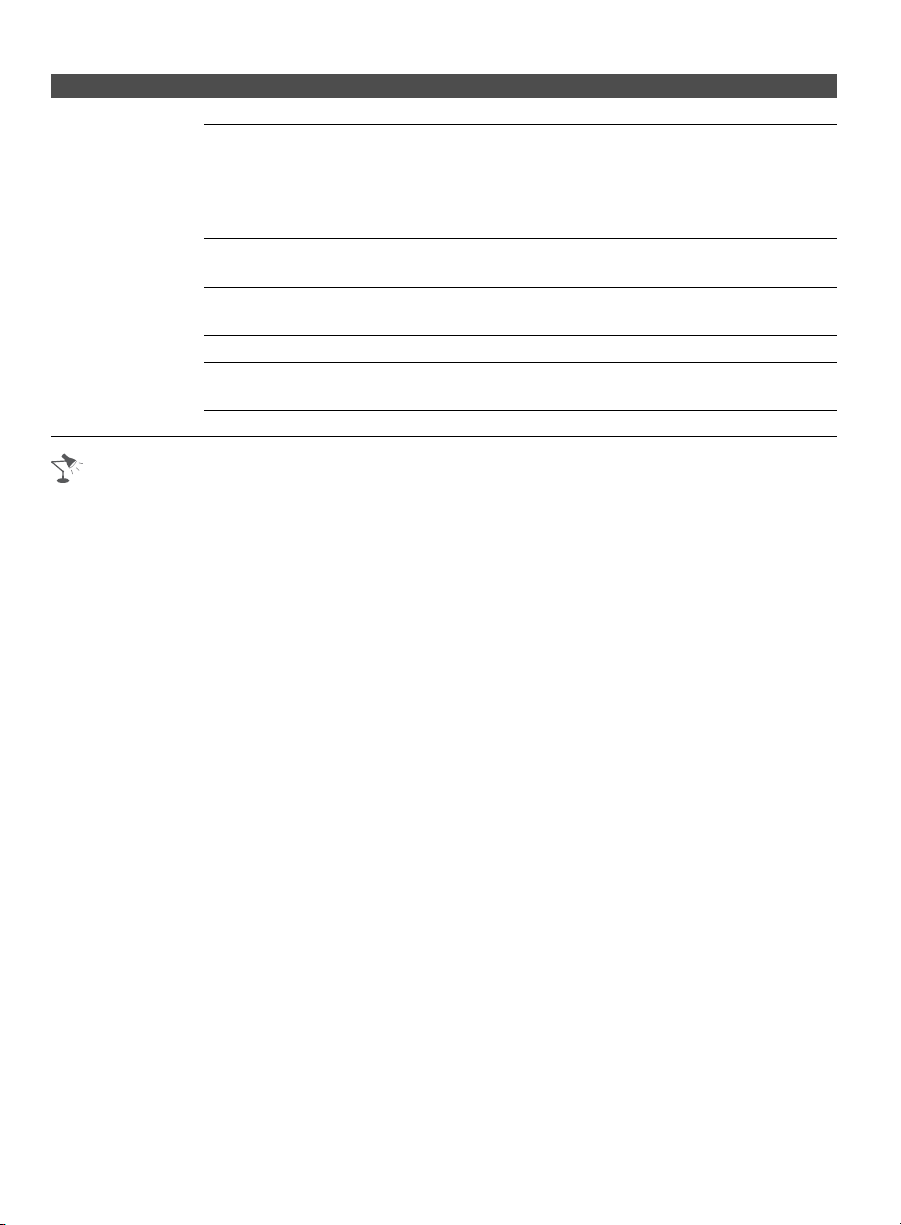
Using the Picture Settings
Option Description
Picture Mode
Customized
picture viewing
Displays the options selected in the Scene Select settings (page 23). When
Scene Select is set to General, the options below can be selected.
Vivid Select for enhanced picture contrast and sharpness.
Standard Select for standard picture settings. Recommended for home
entertainment.
Custom Select to store your preferred settings.
Cinema For film-based content. Suitable in a theater-like environment.
Photo For standard viewing of photographs.
Sports Optimizes picture quality for viewing sports.
Game For standard picture suitable for games.
Graphics Optimizes picture quality for viewing graphics.
Reset Resets the current Picture settings to their defaults, except Picture Mode.
Backlight Adjust to brighten or darken the backlight.
Picture Adjust to increase or decrease picture contrast.
Brightness Adjust to brighten or darken the picture.
Color Adjust to increase or decrease color intensity.
Hue Adjust to increase or decrease the green tones.
Sharpness Adjust to sharpen or soften the picture.
Color
Temperature
White adjustment
Cool Select to give the white colors a bluish tint.
Neutral Select to give the white colors a neutral tint.
Warm 1/Warm
2
Select to give the white colors a reddish tint. Warm 2 gives a
redder tint than Warm 1.
Noise Reduction Select to reduce the picture noise level. Select from Auto, High, Medium,
Low and Off.
MPEG Noise
Reduction
Select to reduce the picture noise in MPEG-compressed videos. This is
effective when viewing a DVD or digital broadcast. Select from High, Medium,
Low and Off.
CineMotion Provides improved picture movement and reduces picture blur and graininess
for film-based content. Select Auto to represent original film-based content as
is.
(Continued)
36
• Available Picture options, including options in Advanced Settings depend on Scene Select
and Picture Mode.
Advanced
Settings
Reset Resets the advanced settings to the default values.
Adv. Contrast
Enhancer
Automatically adjusts backlight and contrast to the most
suitable settings judging from the brightness of the screen.
This setting is especially effective for dark scenes, and will
increase the contrast distinction of the darker picture scenes.
Select from High, Medium, Low and Off.
Black
Corrector
Enhances black areas of the picture for stronger contrast.
Select from High, Medium, Low and Off.
Gamma Adjusts the balance between bright and dark areas of the
picture.
Clear White Emphasizes white colors. Select from High, Low and Off.
Live Color Makes colors more vivid. Select from High, Medium, Low
and Off.
White Balance Adjusts the color temperature in detail.
Option Description
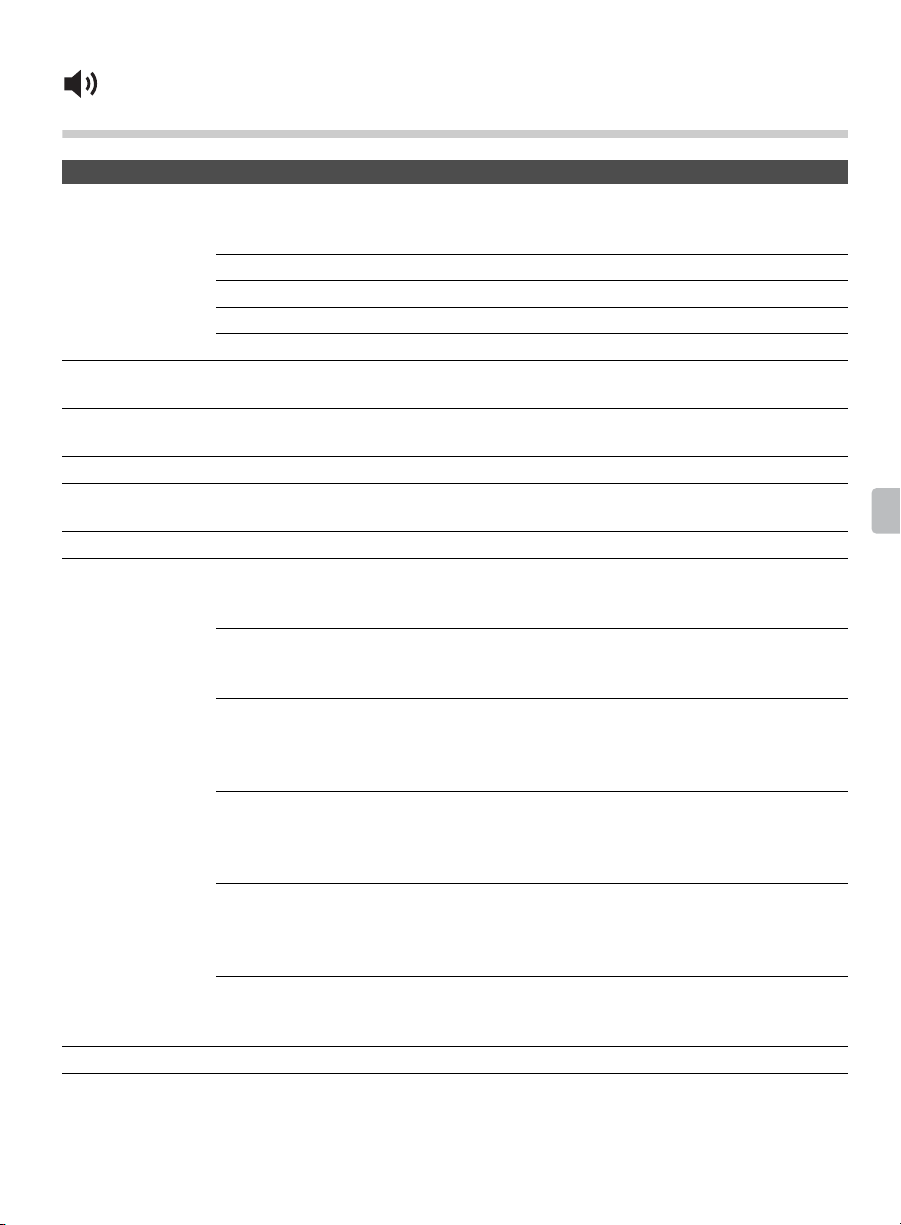
37
Using the Menus
Using the Sound Settings
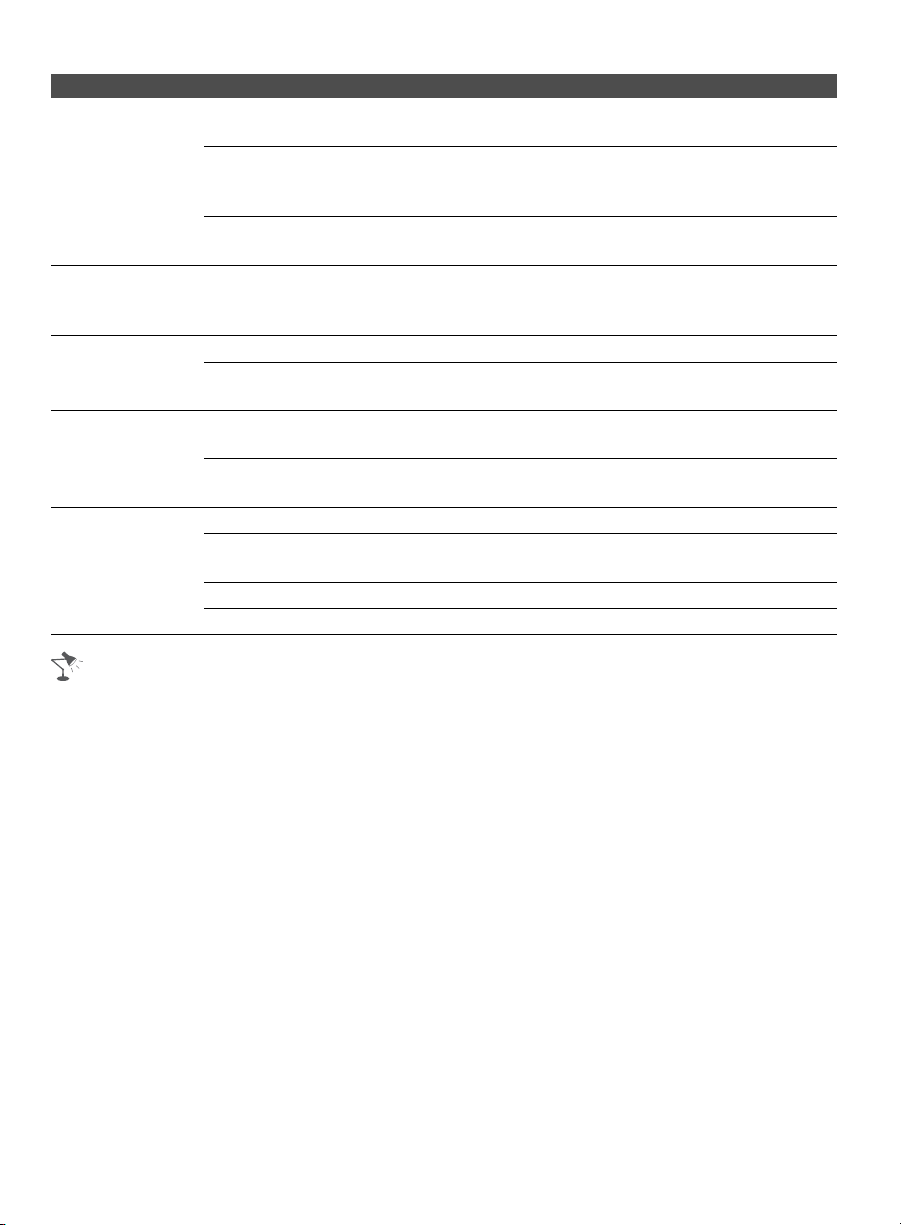
Option Description
Sound Mode
Customized
sound listening
Sets a sound mode. Sound Mode includes options best suited for video and
photographs, respectively. The available options depend on the scene select
settings.
Dynamic Enhances treble and bass.
Standard Standard sound optimized for home use.
Clear Voice Suitable for spoken dialog.
Custom Select to store your preferred settings.
Reset Resets the current Sound settings to their defaults, except MTS Audio,
Alternate Audio and Speakers.
Equalizer Adjust allows you to select your frequency response curve. Select Reset to
reset the Equalizer settings to the default values.
Balance Adjust to emphasize left or right speaker balance.
Steady Sound Select On to stabilize the volume across all programs and commercials.
Select Off to disable this function.
Volume Offset Adjust the volume level of the current input relative to other inputs.
Surround Allows you to select the suitable surround effects depending on the genre of
TV program (movie, sport, music, etc.) or video game. The available options
depend on the scene select setting.
On/Off Select On to optimize the sound quality to enjoy the effects of
the Surround option and to create a virtual surround sound
using the 2ch speaker.
Cinema/Off Provides surround effects just like the high-grade audio
systems found in movie theaters.
This option is available when you select Cinema in the Scene
Select setting.
Music/Off Provides surround effects that make you feel like you are
surrounded by sound as in a music hall.
This option is available when you select Photo or Music in
the Scene Select setting.
Sports/Off Provides surround effects that make you feel like you are
watching a live sports contest.
This option is available when you select Sports in the Scene
Select setting.
Game/Off Provides surround effects that enhance game sound.
This option is available when you select Game in the Scene
Select setting.
Bass Booster Produces a fuller sound for more impact, by emphasizing the bass sounds.
(Continued)
38
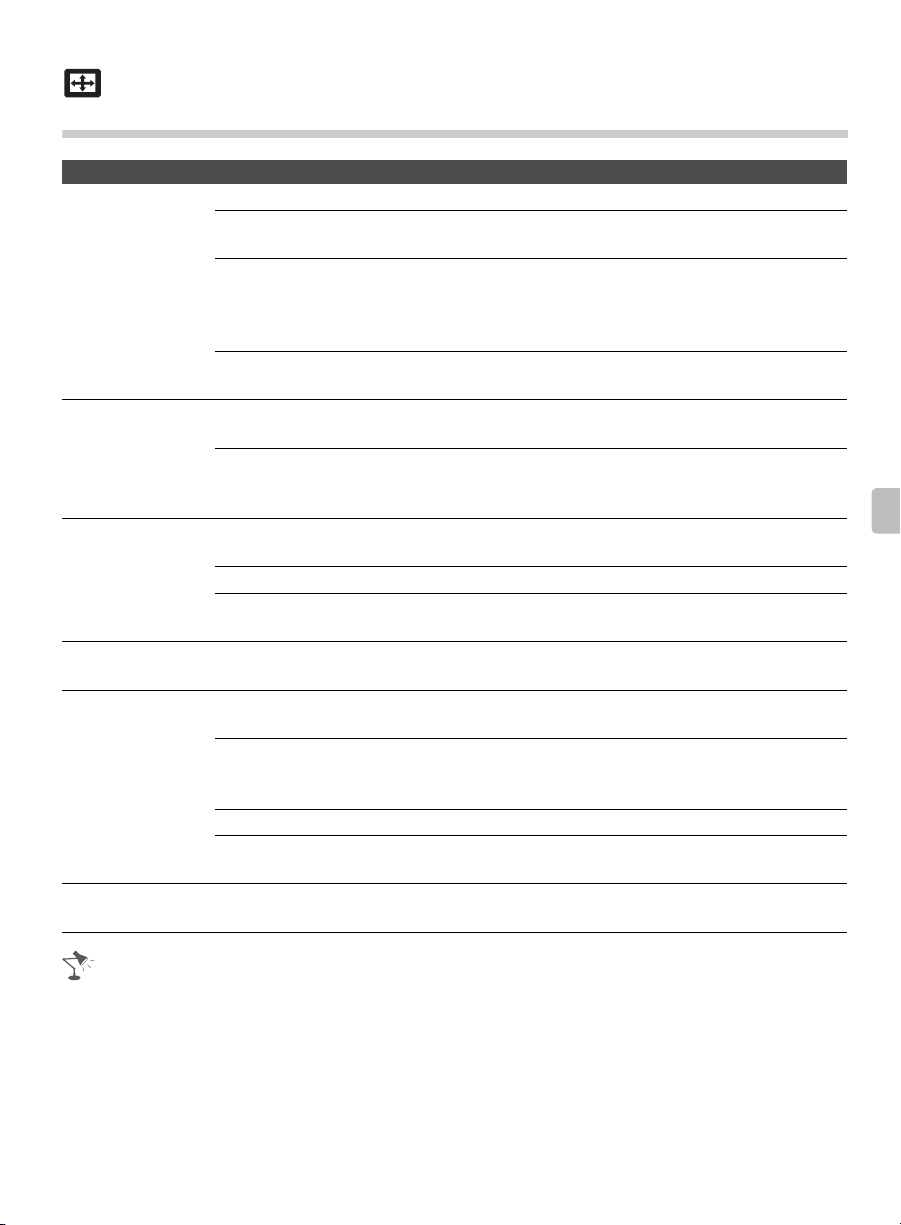
• MTS Audio is only available for analog programs.
• Alternate Audio is only available if the program is broadcast with alternate audio streams.
• You can also access Sound Mode, MTS Audio and Alternate Audio by using the OPTIONS
button on the remote control.
MTS Audio
Enjoy stereo,
bilingual and
mono programs
Stereo Select for stereo reception when viewing a program
broadcast in stereo.
Auto SAP Select to automatically switch the TV to second audio
programs when a signal is received. If no SAP signal is
present, the TV remains in Stereo mode.
Mono Select for mono reception. Use to reduce noise during weak
stereo broadcasts.
Alternate Audio
Digital channels
only
Select among the available options to switch among the alternate audio
streams. The program you are tuned to may be broadcasted in a different
language in the alternate audio streams.
Speakers TV Speakers Select to use the TV speakers.
Audio System Select to use an external audio system for the TV sound. By
selecting this option you are disabling the TV speakers.
Audio Out Variable Adjusts the volume with the TV’s remote control, when using
an external audio system.
Fixed Adjusts the volume using the connected audio system’s
remote control.
HDMI/DVI Audio
Source
HDMI 1 input only
Sets the audio signal source for HDMI/DVI input.
Auto Automatically sets the audio signal source based on the
video signal.
HDMI Audio Sets the HDMI input as the audio signal source.
PC Audio Sets the PC/HDMI audio input as the audio signal source.
Option Description
39
Using the Menus
Using the Screen Settings
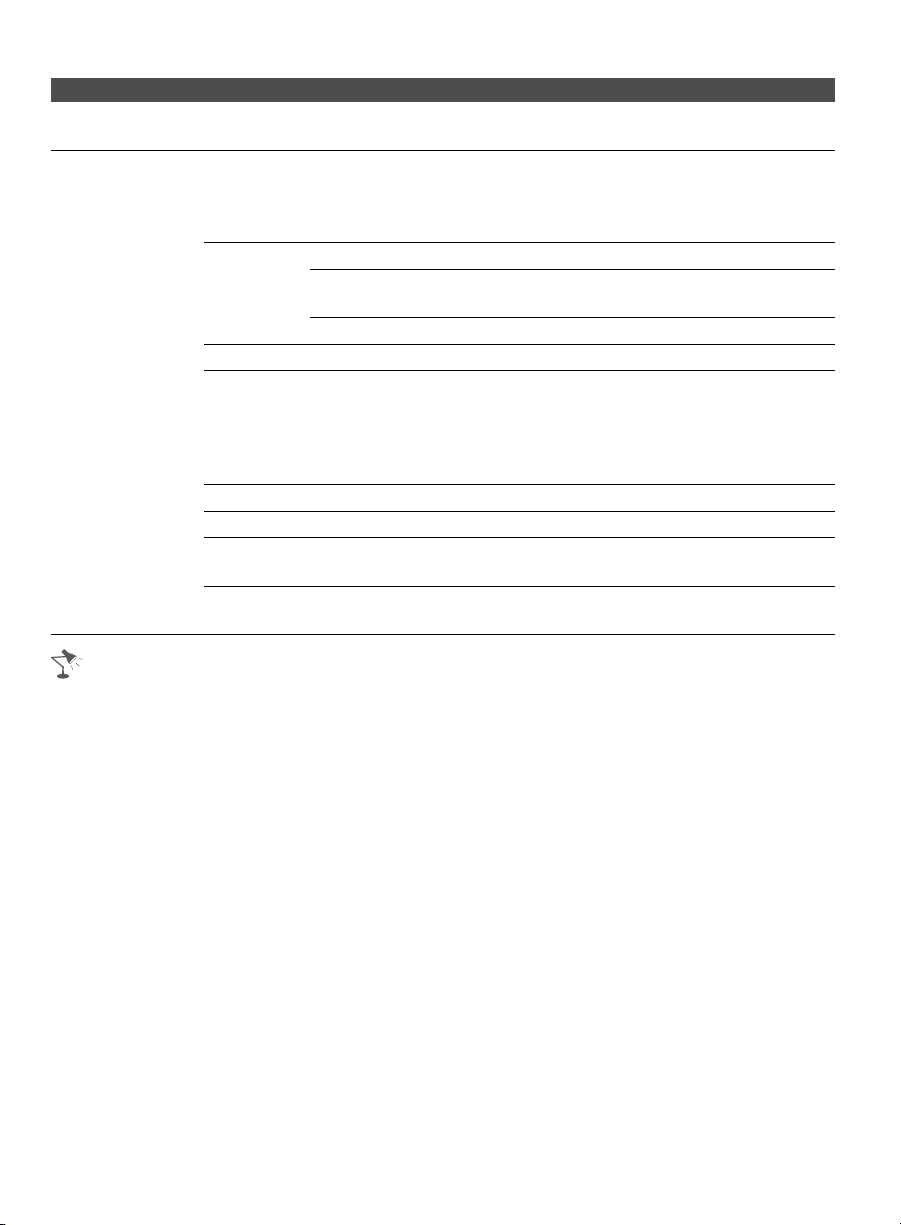
• Normal in the 4:3 Default setting is not available when you are watching a 720p, 1080i or 1080p
source.
• If 4:3 Default is set to anything but Off, the Wide Mode setting changes only for the current
channel. When you change channels (or inputs), Wide Mode is automatically replaced with the
4:3 Default setting for 4:3 sources. To retain the current Wide Mode setting as channels and
inputs are changed, set 4:3 Default to Off.
• 4:3 Default is not available if Auto Wide is set to Off.
Option Description
Wide Mode Wide Zoom Fills the screen with minimum distortion.
Normal Select to display 4:3 picture in original size when the original
source is 4:3.
Full Select to enlarge the picture horizontally to fill the screen when
the original source is 4:3 (Standard definition source). When the
original source is 16:9 (High-definition source), select this mode
to display the 16:9 picture in its original size.
Zoom Select to enlarge the original picture without distorting the aspect
ratio.
Auto Wide On Select On to automatically change Wide Mode setting based on
the content.
Off If frequent screen changes are disturbing to you, select Off.
Choose one of the Wide Mode options when this function is set
to Off.
4:3 Default
Select the default
Screen Mode to
use for 4:3
sources
Wide Zoom Enlarges the 4:3 picture to fill the 16:9 screen, displaying as
much of the original image as possible.
Normal Select to display the 4:3 picture in its original size.
Off Select to continue using the current Wide Mode setting when the
channel or input is changed.
Auto Display
Area
Automatically adjusts the picture to the most appropriate display area.
Display Area Full Pixel Displays pictures in their original size when parts of the picture
are cut off (available depending on the TV model).
+1 Displays pictures in their original size.
This option is only available for Digital TV and HDMI input signals
(non 1080i and 1080p video formats).
Normal Displays pictures in their recommended size.
-1 Enlarges the picture so that the edges are outside the visible
display area.
Horizontal
Center
Allows you to move the position of the picture left and right. (Available in Wide
Zoom and Zoom.)
(Continued)
40
• For the PC Input Signal Reference Chart, see page 50.
• Auto Adjustment, Phase and Pitch are not available with PC signal connected to HDMI input.
Option Description
Vertical Center Allows you to move the position of the picture up and down. (Available in Wide
Zoom and Zoom.)
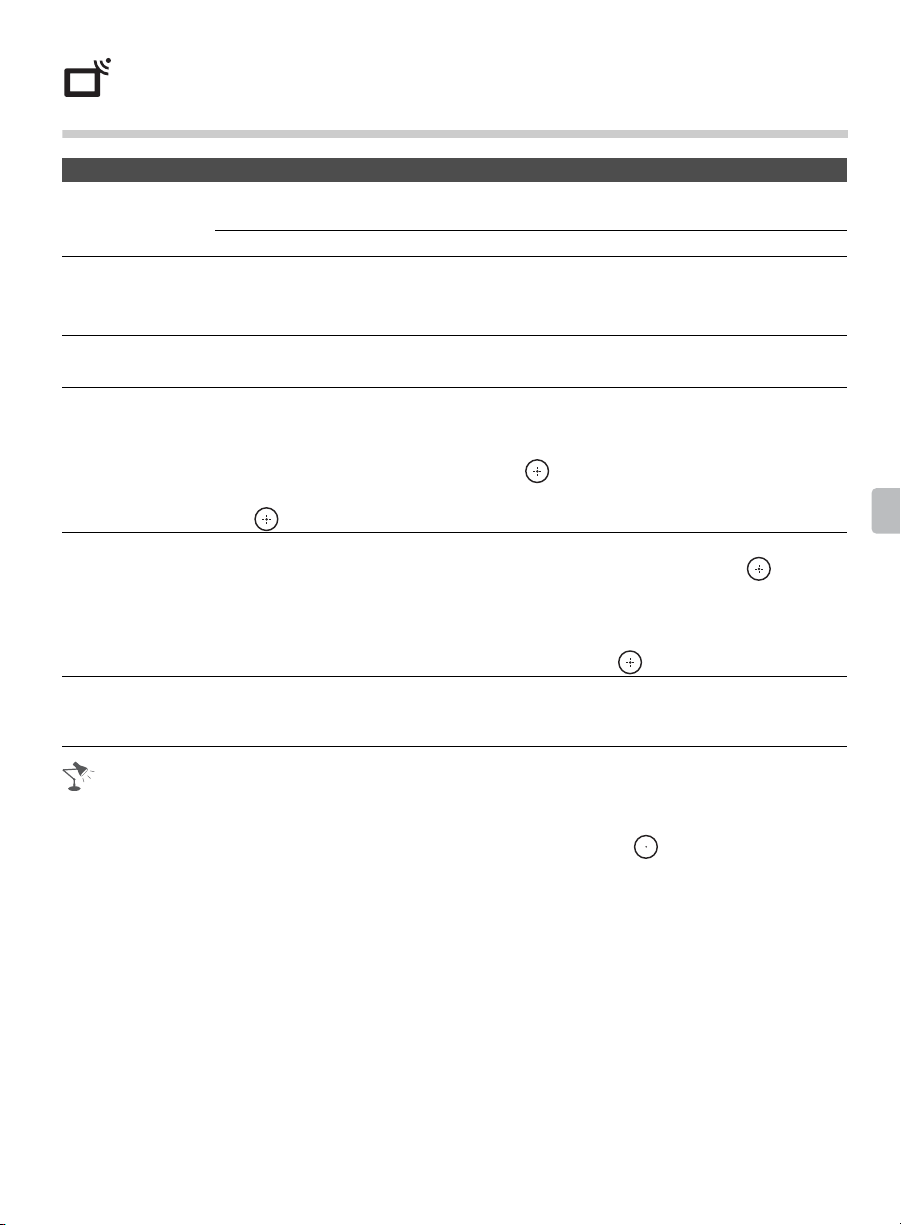
PC Settings When a PC is connected to the TV and the PC input is selected, the PC
settings screen appears instead of the Screen settings.
You can also select the PIP feature which allows you to view two pictures
simultaneously from OPTIONS button (page 28).
Wide Mode Normal Select to display in the original image size.
Full 1 Select to enlarge the picture to fill the display area,
keeping its original aspect ratio.
Full 2 Select to enlarge the picture to fill the display area.
Reset Resets all PC settings to the default values.
Auto
Adjustment
Select to automatically adjust the display position and phase of
the picture when the TV receives an input signal from the
connected PC. Note that Auto Adjustment may not work well
with certain input signals. In such cases, manually adjust the
options below.
Phase Adjust after Pitch to fine tune overall sharpness.
Pitch Adjust uneven sharpness on screen.
Horizontal
Center
Allows you to move the position of the picture left and right.
Vertical
Center
Allows you to move the position of the picture up and down.
41
Using the Menus
Using the Channel Settings
• You should run Auto Program after changing the Signal Type setting.
• Running Auto Program will clear the Favorites list.
• Channels that you set to be hidden can be accessed by the 0-9 and buttons.
• You can set channels to be hidden that are automatically set in Auto Program.
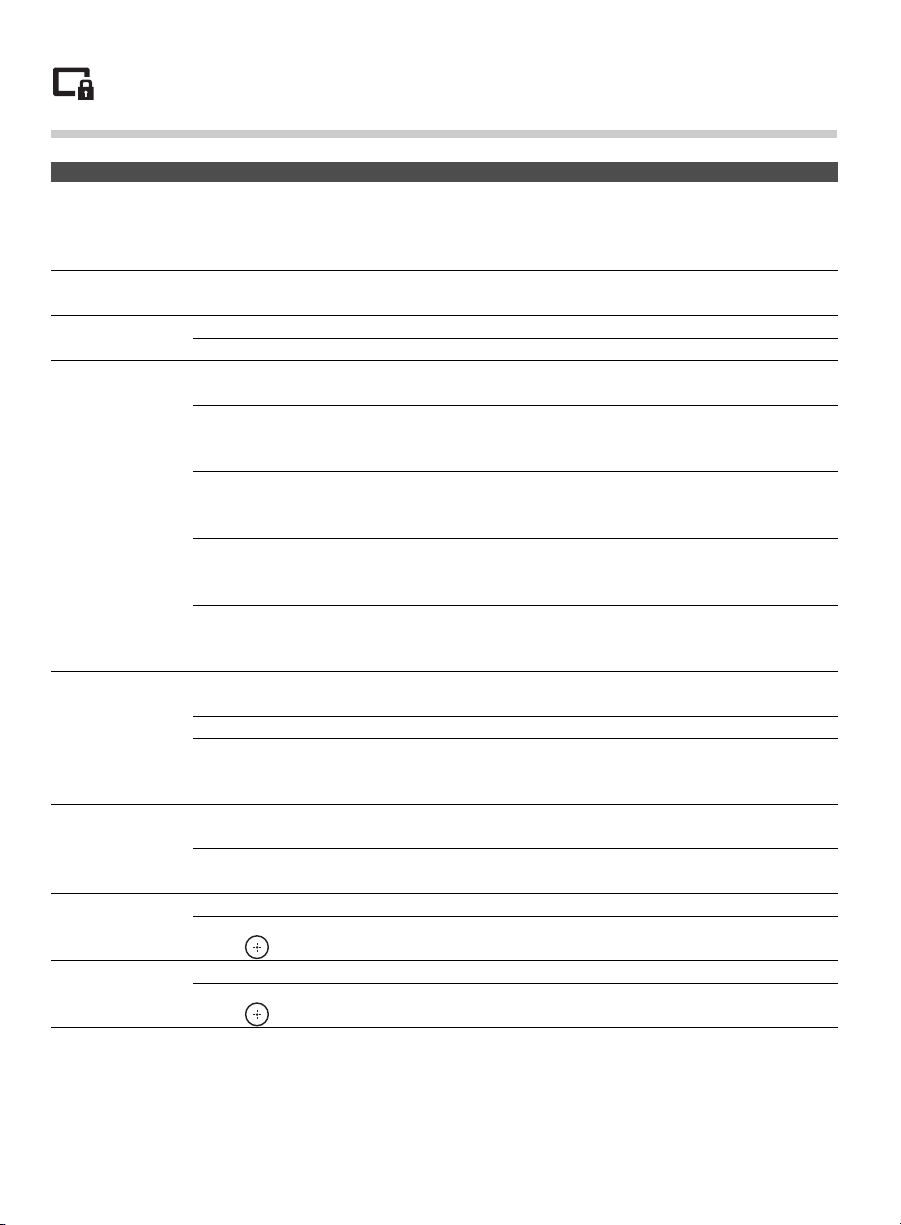
Option Description
Signal Type Cable Select if you are receiving cable channels via Cable TV
provider.
Antenna Select if you are using an antenna.
Auto Program Automatically sets up the channel list on the TV for all receivable channels.
1 Select Auto Program.
2 Select OK to start Auto Program.
Add Digital
Channels
1 Select Add Digital Channels.
2 Select OK to add digital channels.
Show/Hide
Channels
Allows you to show or hide channels that appear when you use the CH +/–
buttons.
1 Press V/v to scroll through the channels until you find the channel you
want to show or hide. Then press to select it.
2 Press V/v to determine if the channel will be shown or hidden. Then press
to select it.
Edit Channel
Labels
Allows you to assign labels (such as station call letters) to channel numbers.
1 Press V/v to scroll through the channel numbers. Then press to
select the channel number that you want to assign a label.
2 Press V/v to scroll through the label characters (A-Z, 0-9, etc.). Press b to
move to the next character. Repeat the previous steps to add up to seven
characters to the label. When finished, press .
Analog Fine
Tune
Allows you to fine-tune the selected analog channel manually if you feel that a
slight tuning adjustment may improve picture quality. Select Auto to adjust to
the most appropriate analog channel.
42
Using the Parental Lock Settings
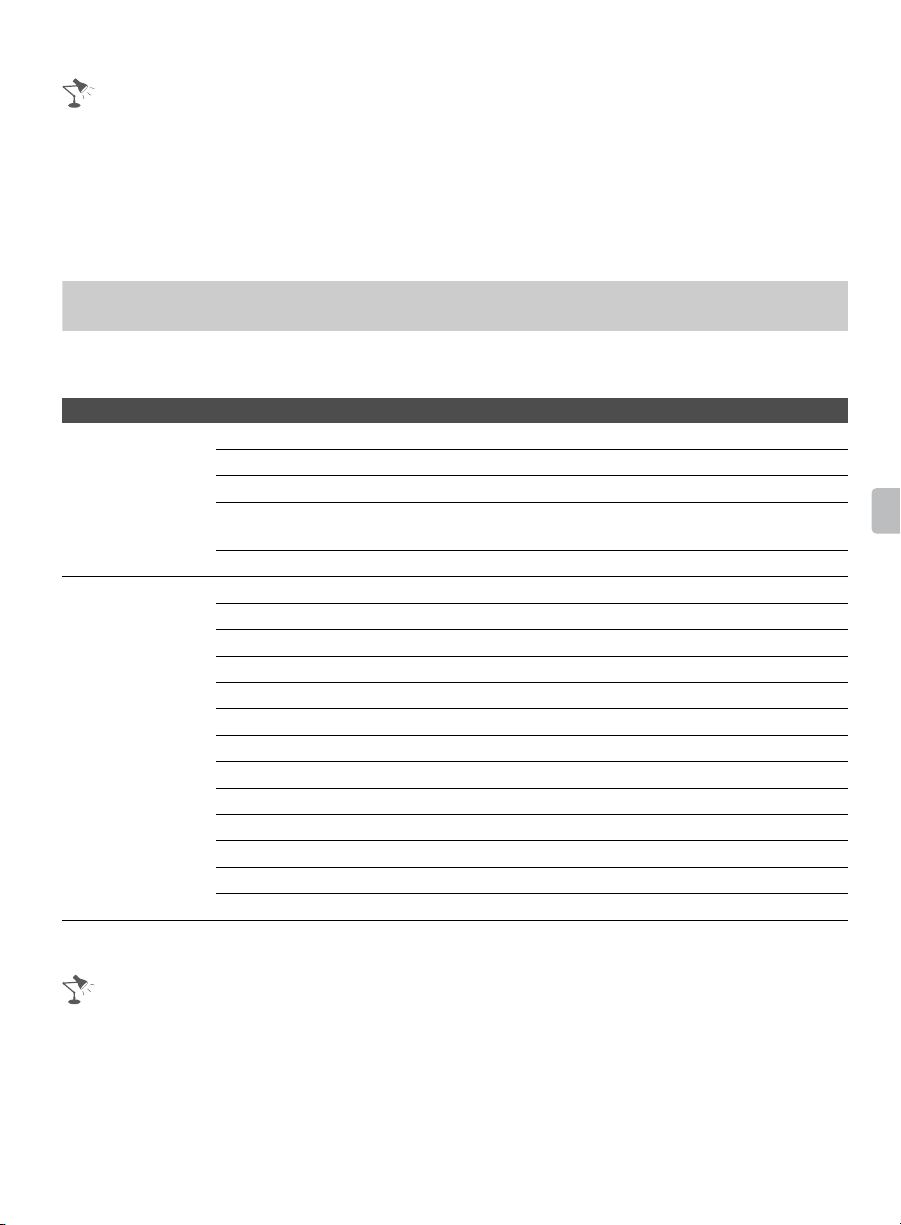
Option Description
Password The Parental Lock settings allow you to set up the TV to block programs
according to their content and rating levels. Use 0-9 on the remote control to
enter a four-digit password. The first time you create a password, confirm the
password by entering it again.
Change
Password
Select to change your password.
Country U.S.A. Select to use U.S.A. ratings (page 43).
Canada Select to use Canadian ratings (page 44).
Rating Off Turn Parental Lock off. No programs are blocked from
viewing.
Child Maximum ratings permitted are:
U.S.: TV-Y, TV-G, G
Canada: C, G, TV-Y
Youth Maximum ratings permitted are:
U.S.: TV-PG, PG
Canada: C8+, PG, 8 ans+, TV-PG
Young Adult Maximum ratings permitted are:
U.S.: TV-14, PG-13
Canada: 14+, 13 ans+, TV-14
Custom Select to set ratings manually.
U.S.: See page 43 for details.
Canada: See page 44 for details.
Downloadable
U.S. Rating
(Available only
in U.S.A.
where advanced
ratings exist)
Off Turn Downloadable U.S. Rating off. No programs that contain
downloadable ratings are blocked from viewing.
Custom Select to block programs based on downloadable ratings.
Clear All Select to clear the entire downloadable rating system.
Unrated
(Available only
when Country is
set to U.S.A.)
Allow Allows programs and movies that are broadcasted without a
rating.
Block Blocks all programs and movies that are broadcasted without
a rating.
Channel Block Allows you to block channels regardless of program ratings.
To View a Blocked Channel
Press when tuned to the blocked channel then enter the password.
External Input
Block
Allows you to block external inputs regardless of program ratings.
To View a Blocked External Input
Press when tuned to the blocked input then enter the password.
43
Using the Menus
• You need your password for any future access into the Parental Lock settings. If you lose your
password, see “Lost password” on page 61.
• Selecting Clear All will delete the current Downloadable U.S. Rating menu and the menu will
no longer be available until the TV is tuned to a channel that contains downloadable ratings.
• If you block unrated TV programs, be aware that the following types of programs may be
blocked: programs broadcasted from another country, emergency broadcasts, political
programs, sports, news, public service announcements, religious programs and weather.
US Models: Selecting Custom Parental Lock Rating Options
To select custom rating options for the U.S., select U.S.A. in the Country setting (page
42).
• To ensure maximum blocking capability, set the Age-Based Ratings.
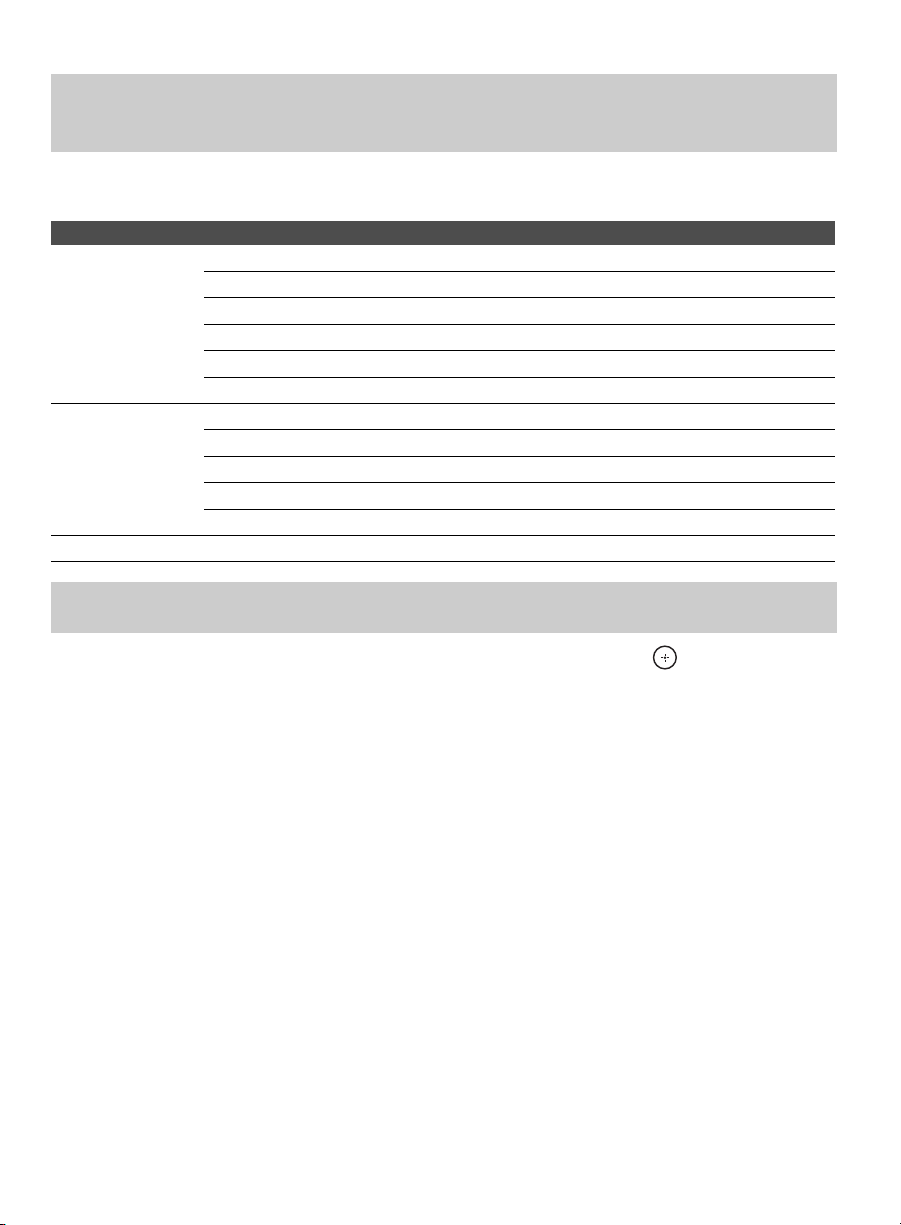
Option Description
Movie Rating G All children and general audience.
PG Parental guidance suggested.
PG-13 Parental guidance for children under 13.
R Restricted viewing, parental guidance is suggested for
children under 17.
NC-17 and X No one 17 or under allowed.
TV Rating
Block programs
by their rating,
content or both
Age-Based Ratings
TV-Y All children.
TV-Y7 Directed to children age 7 and older.
TV-G General audience.
TV-PG Parental guidance suggested.
TV-14 Parents strongly cautioned.
TV-MA Mature audience only.
Content-Based Ratings
FV Fantasy violence.
D Suggestive dialogue.
L Strong language.
S Sexual situations.
V Violence.
44
Canadian Models: Selecting Custom Parental Lock Rating
Options
To select custom rating options for Canada, select Canada in the Country setting (page
42).
Viewing Blocked Programs
You can view blocked programs by entering your password. Press when tuned to a
blocked program, then enter the password. This temporarily deactivates the parental
control feature. To reactivate the Parental Lock settings, turn off the TV. When the TV is
turned on again, your Parental Lock settings are reactivated.
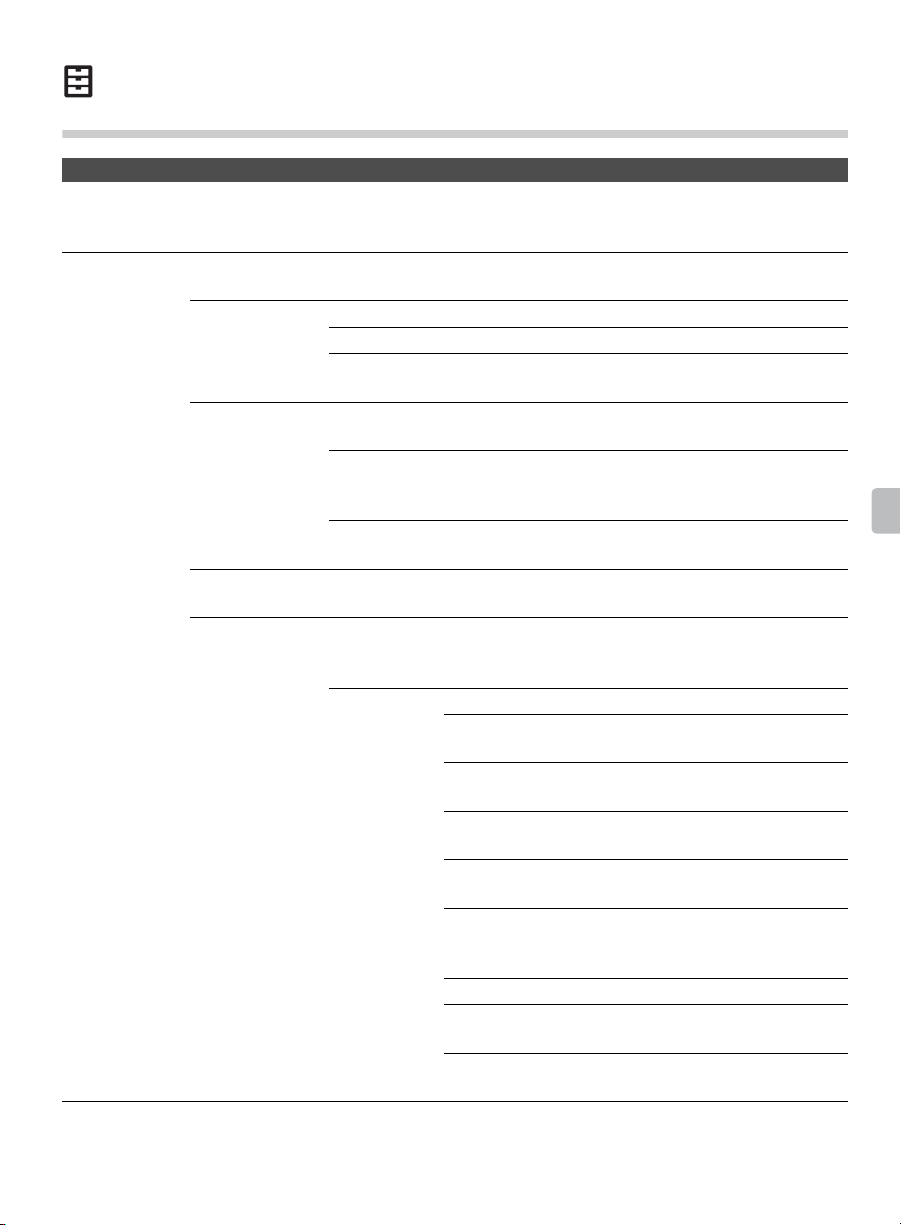
Option Description
English Rating C All children.
C8+ Children 8 years and older.
G General programming.
PG Parental guidance.
14+ Viewers 14 and older.
18+ Adult programming.
French Rating G General programming.
8 ans+ Not recommended for young children.
13 ans+ Not recommended for ages under 13.
16 ans+ Not recommended for ages under 16.
18 ans+ Programming restricted to adults.
U.S.A. Rating See “US Models” on page 43 for details.
45
Using the Menus
Using the Setup Settings
Option Description
USB Auto
Start
Select On to start photo playback automatically when the TV is turned on and a
digital still camera or other device containing photo files is connected to the USB
port then turned on.
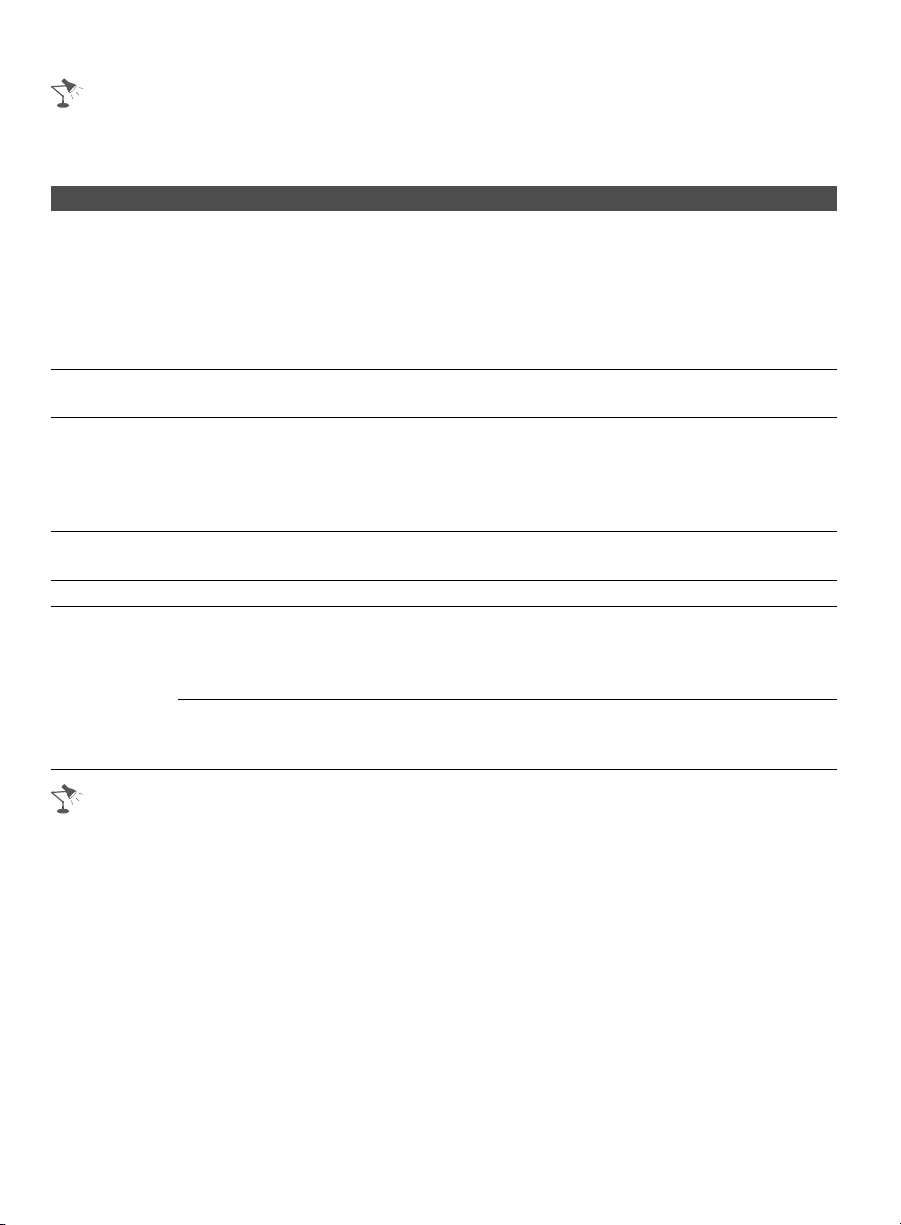
Closed
Captions
(CC)
Allows you to select from several closed caption modes (for programs that are
broadcast with closed captioning).
CC Display On Closed Captions (CC) is turned on.
Off Closed Captions (CC) is turned off.
On when
Muting
Closed Captions (CC) is turned on when the TV
is muted.
Analog CC Allows you to select basic analog (EIA-608) closed caption
options.
CC1, CC2,
CC3, CC4
Displays a printed version of the dialogue or
sound effects of a program. (Should be set to
CC1 for most programs.)
Text1, Text2,
Text3, Text4
Displays network/station information presented
using either half or the whole screen (if available).
Digital CC When the digital closed caption service is available, select from
the Service 1-6 or CC1-4.
Digital CC
Options
Allows you to make additional settings for digital closed caption
options. Select As Broadcast or Custom. The Custom option is
available on the Digital CC setting.
Custom Allows you to customize the following settings:
Character
Size
Small, Standard, Large
Character
Style
Style 1-7
Character
Color
Color 1-8
Character
Opacity
Solid, Translucent
Edge Type None, Raised, Depressed,
Outline, Left Shadow,
Right Shadow
Edge Color Color 1-8
Background
Color
Color 1-8
Background
Opacity
Solid, Translucent
(Continued)
46
• You can turn on Closed Captions (CC) options (On, Off or On when Muting) by pressing the
CC button on the remote control.
• You can assign following labels for each input (except TV):
–, Cable, Satellite, VCR, DVD/BD, Home Theater, Game, Camcorder, Digital Camera, PC,
Edit (except PC IN)
–, Edit (for PC IN)
•“–” indicates that no labels are assigned.
• If you select Edit, you can edit video labels. Follow the same steps for Edit Channel Labels on
page 41.
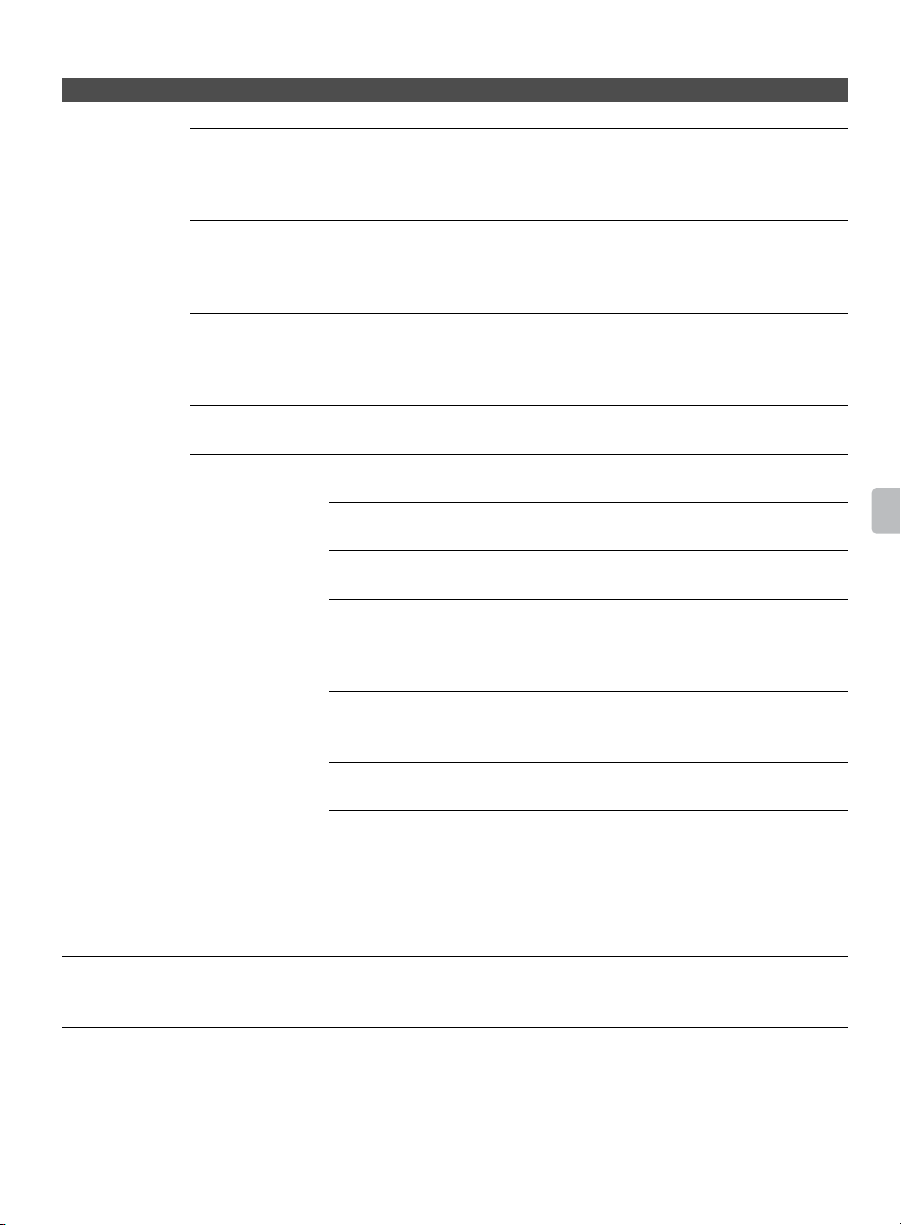
Option Description
Info
Banner
Displays the information related to the input signal you are watching.
Select Small to display minimal channel and program title or select Large to
display detailed channel and program information along with the TV icon if you
are viewing the TV. This information will appear if it is available from the
broadcaster.
Info Banner appears on the screen each time the channel and external inputs
are changed or when DISPLAY on the remote control is pressed.
Sleep Timer Set the time in minutes (Off, 15, 30, 45, 60, 90, or 120) that you would like the TV
to remain on before shutting off automatically.
Initial Setup If you miss the Initial Setup when you first connect the TV or if you want to scan
all receivable channels, select Initial Setup. Follow the instructions on the screen.
Some settings such as Picture, Sound, and Parental Lock will not be affected
by this Initial Setup. If you wish to return your TV to factory settings, please see
the Troubleshooting section on page 61.
Language Select to display all on-screen settings in your language of choice: English,
Español, Français.
Startup Logo Select On to display the logo when the TV is turned on. Select Off to disable it.
AV Setup Manage Inputs Assigns a name to external equipment.
Select Auto to display names only when the equipment is
connected, or Always to display regardless of connection
status or Off to disable input (only for TV and PC inputs).
Video1/
Component
Selection
Select Auto to have the TV detect and switch between the
Video 1 or Component when Video 1 or Component is
connected.
47
Using the Menus
Option Description
HDMI
Settings
Communicates with equipment compatible with the Control for HDMI function.
Control for
HDMI
Links the operations of the TV and the equipment.
For specific Sony equipment compatible with Control for HDMI,
this setting is applied automatically to the connected equipment
when set to On.
Device Auto
Power Off
Select On to have your connected equipment with Control for
HDMI function power off automatically when the TV is turned off.
Select Off to disable this function. This feature is available when
Control for HDMI is On.
TV Auto Power
On
Select On to control your TV’s power on from your connected
equipment with Control for HDMI function. Select Off to disable
this function. This feature is available when Control for HDMI is
On.
Device List Displays a list of equipment with Control for HDMI function
connected to the TV.
Device Control
Keys
Select button functions of the TV’s remote control to operate the
connected equipment.
None Deactivates the control by the TV’s remote
control.
Normal Enables basic operations, such as navigation
buttons (up, down, left or right, etc.).
Tuning Keys For basic operations and operation of channel-
related buttons, such as CH +/– or 0-9, etc. Useful
when you control a tuner or set-top box, etc; via
the remote control.
Menu Keys For basic operations and operation of the HOME/
OPTIONS buttons. Useful when you select menus
of a BD player, etc; via the remote control.
Tuning and
Menu Keys
For basic operations and operation of channel-
related buttons and HOME/OPTIONS buttons.
•Press OPTIONS while the equipment supporting Control for HDMI is
connected to display the Device Control options. The Device Control option
provides access to the Home (Menu), Options and Content List of your
connected equipment with your TV remote control.
• Some equipment with Control for HDMI
does not support the Device Control
feature.
• HDMI Settings must be setup on the connected equipment.
Picture
Adjustments
Lock
Select Lock so no adjustment can be made to items grayed out.
Select Unlock to allow adjustment to any of the Picture settings.
(Continued)

48
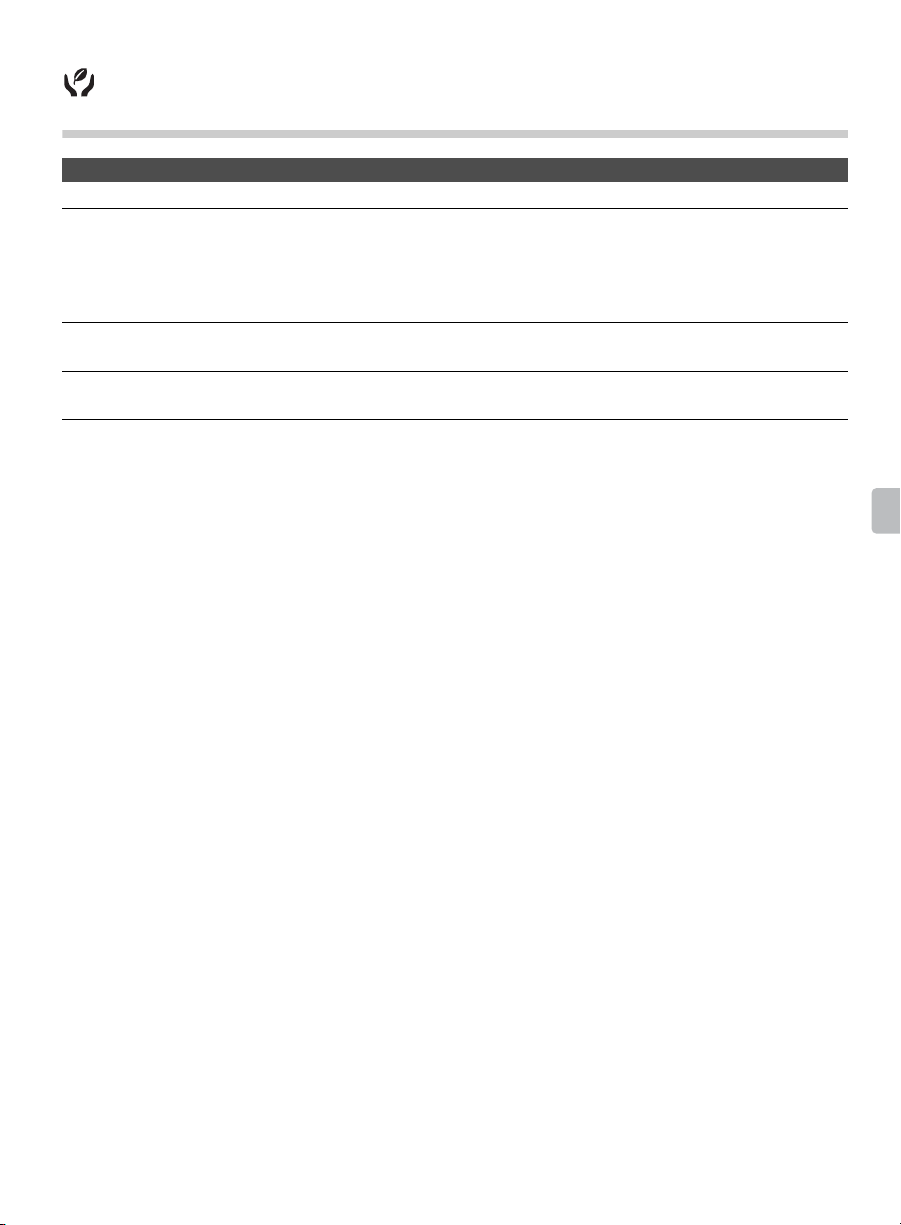
• Favorite channel list will be cleared each time you run the Initial Setup.
Product
Support
Contact Sony Sony contact information is available on this screen for your
convenience. TV specific information such as Model Name,
Serial Number, Software Version and downloadable ratings (if
available from the TV) are displayed here.
Signal
Diagnostics
Press to display the diagnostics information for the current
signal.
Option Description
49
Using the Menus
Using the Eco Settings
Option Description
Reset Resets the current Eco settings to the default values.
Power Saving Select from Off, Low, High, Picture Off to adjust your TV’s power consumption.
By selecting the High option, you will reduce the power consumption more than
the other available settings.
While Picture Off is set, pressing VOL +/– or MUTING buttons will not disable this
function. Press other buttons to disable it.
Idle TV
Standby
Select to automatically power off the TV after 1h, 2h, or 4h when no buttons are
pressed on the remote control or the TV. Select Off to disable this function.
Auto Shut Off Select On to automatically power off the TV when no input signal is detected for a
certain period of time. Select Off to disable this function.
50
Other Information
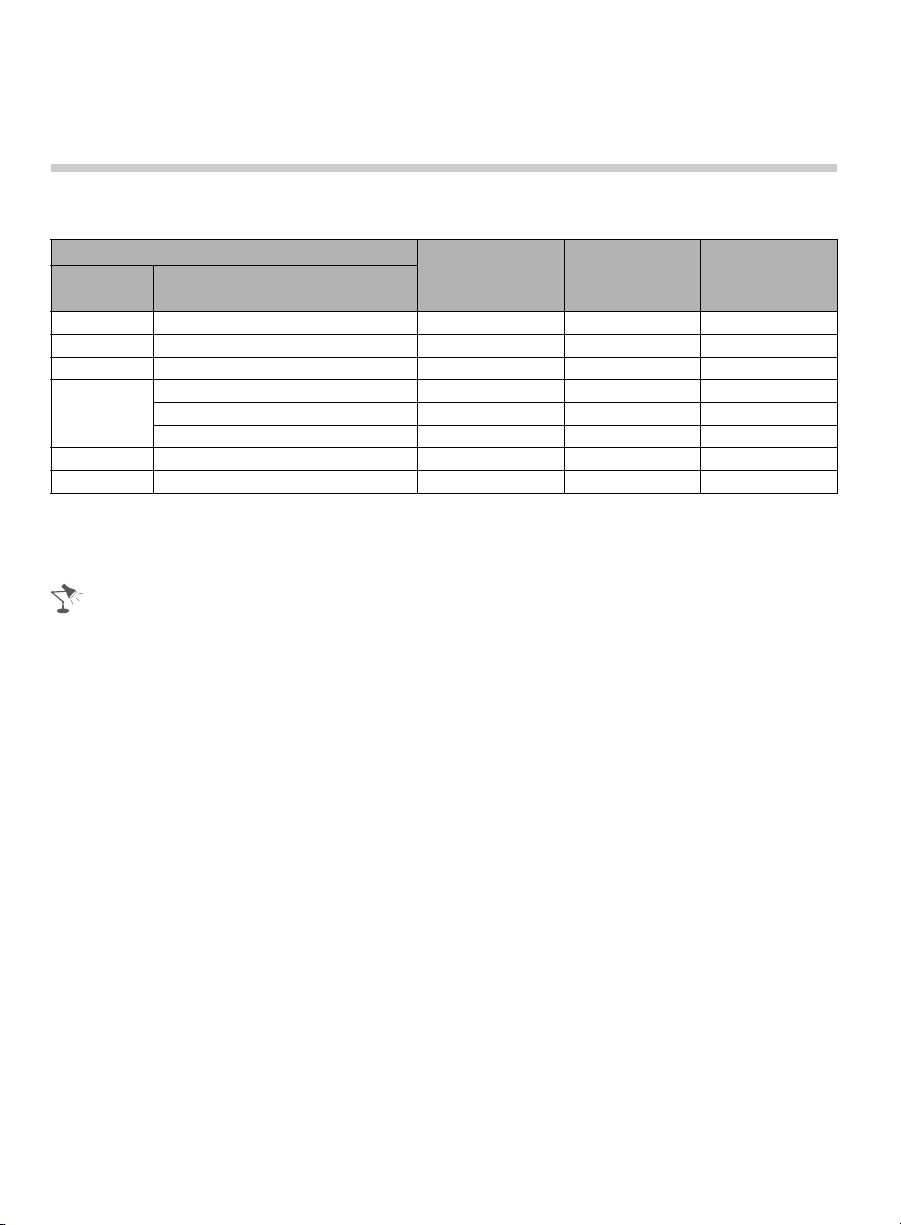
PC Input Signal Reference Chart for
PC and HDMI IN
After connecting the PC to the TV, set the output signal from the PC according to the
chart below.
* The 1080p timing when applied to the HDMI input will be treated as a video timing and not PC
timing. This affects Picture settings and Wide Mode settings. To view PC content set Scene
Select to Graphics, Wide Mode to Full, and Display Area to Full Pixel.
• This TV’s PC input does not support Sync on Green or Composite Sync.
• This TV’s PC VGA input does not support interlaced signals.
• Your PC must support one of the above PC input signals to display on the television.
• In plug and play, signals with a 60 Hz vertical frequency will be detected automatically. (PC
reboot may be necessary.)
Resolution
Horizontal
frequency (kHz)
Vertical
frequency (Hz)
Standard
Signals Horizontal
(Pixel)
× Vertical
(Line)
VGA 640 × 480 31.5 60 VGA
SVGA 800 × 600 37.9 60 VESA Guidelines
XGA 1,024 × 768 48.4 60 VESA Guidelines
WXGA 1,280 × 768 47.4 60 VESA
1,280 × 768 47.8 60 VESA
1,360 × 768 47.7 60 VESA
SXGA 1,280 × 1,024 64.0 60 VESA
HDTV* 1,920 × 1,080 67.5 60 CEA-861*

51
Other Information
Using a Wall-Mount Bracket
Your TV can be mounted on a wall using a Wall-Mount Bracket (not supplied) out of the
box as packaged. Some larger size TV may require removing the Table-Top Stand; refer
to the instructions provided with the TV.
Prepare the TV for the Wall-Mount Bracket before making cable connections.
For product protection and safety reasons, Sony strongly recommends that you
use the Wall-Mount Bracket designed for your TV and the installation should be
performed by a Sony dealer or licensed contractor.
• Follow the instruction guide provided with the Wall-Mount Bracket for your model.
Sufficient expertise is required in installing this TV, especially to determine the strength
of the wall for withstanding the TV’s weight.
• Be sure to use the screws supplied with the Wall-Mount Bracket when attaching the
mounting hooks to the TV set.
The supplied screws are designed as indicated by illustration when measured from
the attaching surface of the mounting hook.
The diameter and length of the screws differ depending on the Wall-mount bracket
model. Use of screws other than those supplied may result in internal damage to the
TV set or cause it to fall, etc.
• Be sure to store the unused screws and Table-Top Stand in a safe place until you are
ready to attach the Table-Top Stand. Keep the screws away from small children.
• Read the supplied Safety Booklet for additional safety information.
8-12 mm
Screw (supplied with the Wall-Mount Bracket)
Mounting Hook
Hook attachment on rear of TV set
52
Installing the Wall-Mount Bracket
x To Customers
Your TV can be wall-mounted using SU-WL500 Wall-Mount Bracket (sold separately).
Please provide this installation information as well as the instruction supplied with SU-
WL500 Wall-Mount Bracket to your installer.
x To Sony Dealers and Licensed Contractors
To avoid injury and property damage, read these instructions carefully. Periodic
inspection and maintenance is highly recommended to ensure that TV is securely
mounted.
x Note when installing
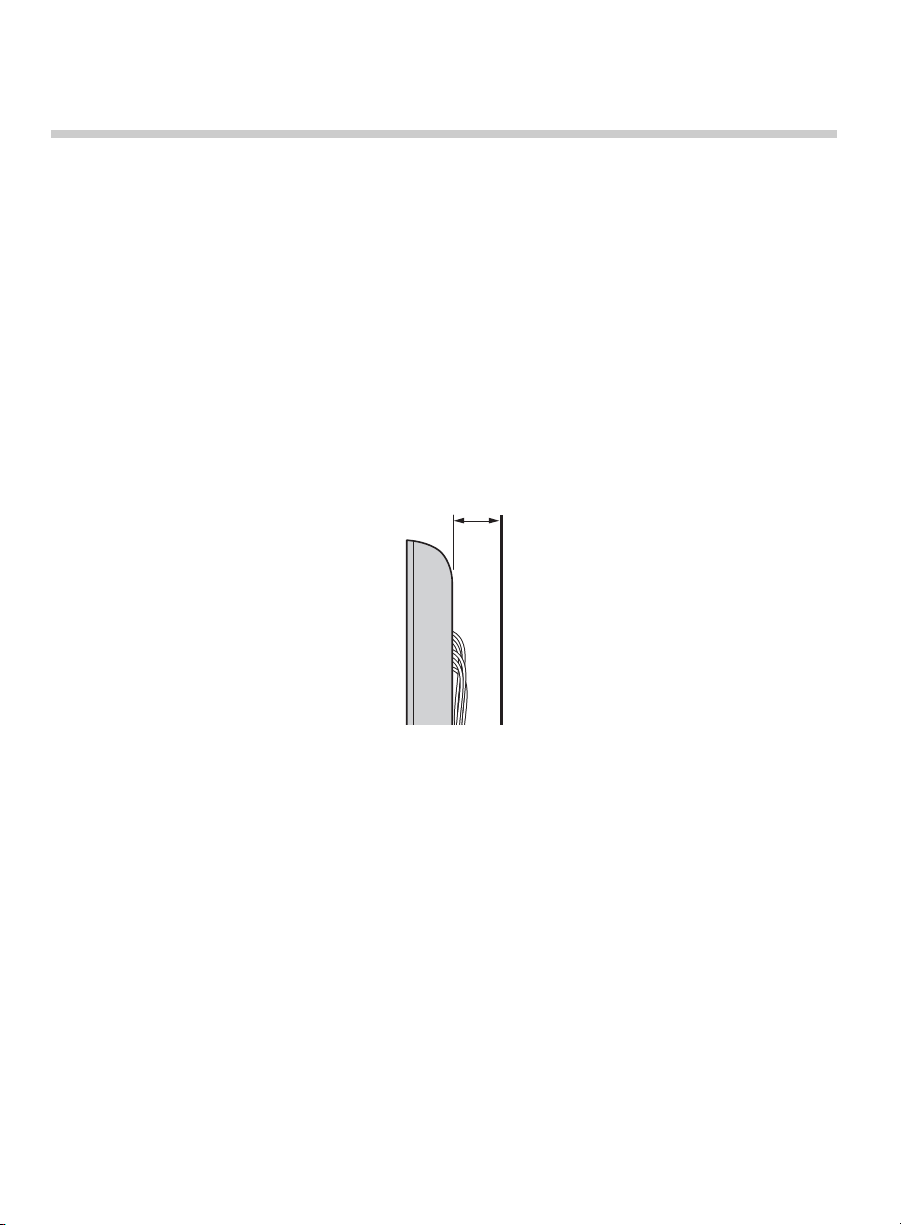
When using the SU-WL500 Wall-Mount Bracket, the space between the wall and the TV
will be 6 cm (2
3
/8 inches). Use this space to route cables to the TV.
6 cm (2
3
/8 inches)
53
Other Information
For SU-WL500
Step 1: Check the parts required for the installation
Open the Wall-Mount Bracket package and check the contents for all required parts
along with the Instructions.
Step 2: Decide on the installation location
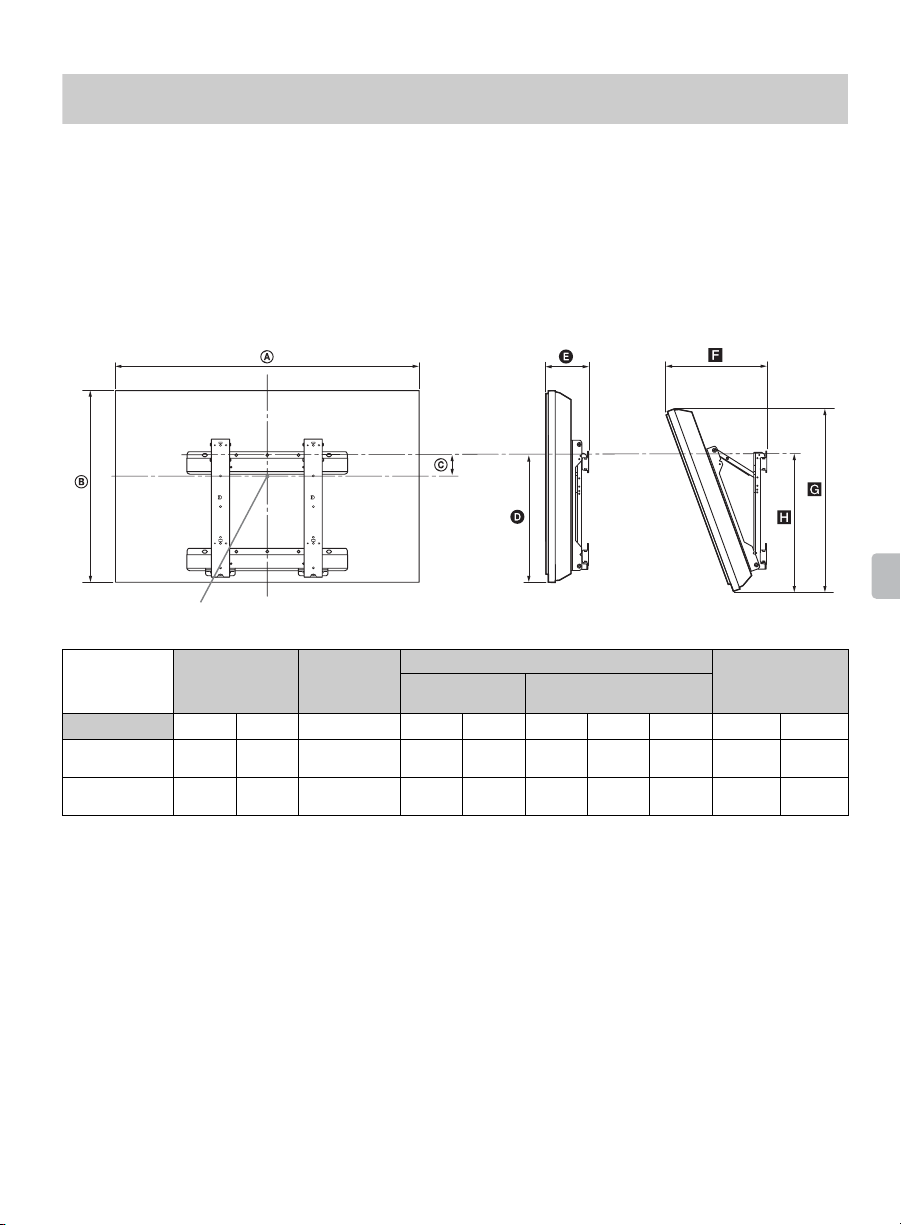
Decide where you want to install your TV. Refer to the TV installation dimensions table.
Refer to the Instructions for SU-WL500.
x Dimension Table
Figures in the above table may differ slightly depending on the installation.
CAUTION
The wall that the TV will be installed on should be capable of supporting a weight of at
least four times that of the TV. Refer to your TV’s operating instructions for its weight.
Step 3: Install the Base Bracket on the wall
Refer to the Instructions for SU-WL500.
Unit: mm
(inches)
TV Dimensions Screen
center
dimensions
Length for each mounting angle Weight
Angle (0°) Angle (20°)
TV Model
AB C DEFGH
TV ×4
KDL-46BX451
KDL-46BX450
1,112
(43
7
/
8
)
675
(26
5
/
8
)
88
(3
1
/
2
)
426
(16
7
/
8
)
151
(6)
359
(14
1
/
4
)
640
(25
1
/
4
)
460
(18
1
/
8
)
16.0 kg
(35.3 lb.)
64.0 kg
(141.2 lb.)
KDL-40BX451
KDL-40BX450
980
(38
5
/
8
)
601
(23
3
/
4
)
122
(4
7
/
8
)
427
(16
7
/
8
)
151
(6)
334
(13
1
/
4
)
566
(22
3
/
8
)
460
(18
1
/
8
)
12.8 kg
(28.2 lb.)
51.2 kg
(112.8 lb.)
Screen center point
(Continued)

54
Step 4: Prepare the TV for wall mount installation
Follow the steps below to prepare for installing the TV.
1 Disconnect all the cables from the TV.
2 Detach the Table-Top Stand from the TV.
1 Place the TV with its screen facing down on a level and stable surface covered with a thick
and soft cloth.
2 Remove the screws guided by the arrow marks and of the TV.
Do not remove any other screws from the TV.
• Hold the Table-Top Stand with one hand to avoid it dropping when detaching.
• Before attaching the Wall-Mount Bracket, hang the AC power cord down behind the TV.
• Be careful not to hit the Table-Top Stand against the edge of the surface when placing
the TV with its screen facing down.
Thick and
soft cloth
55
Other Information
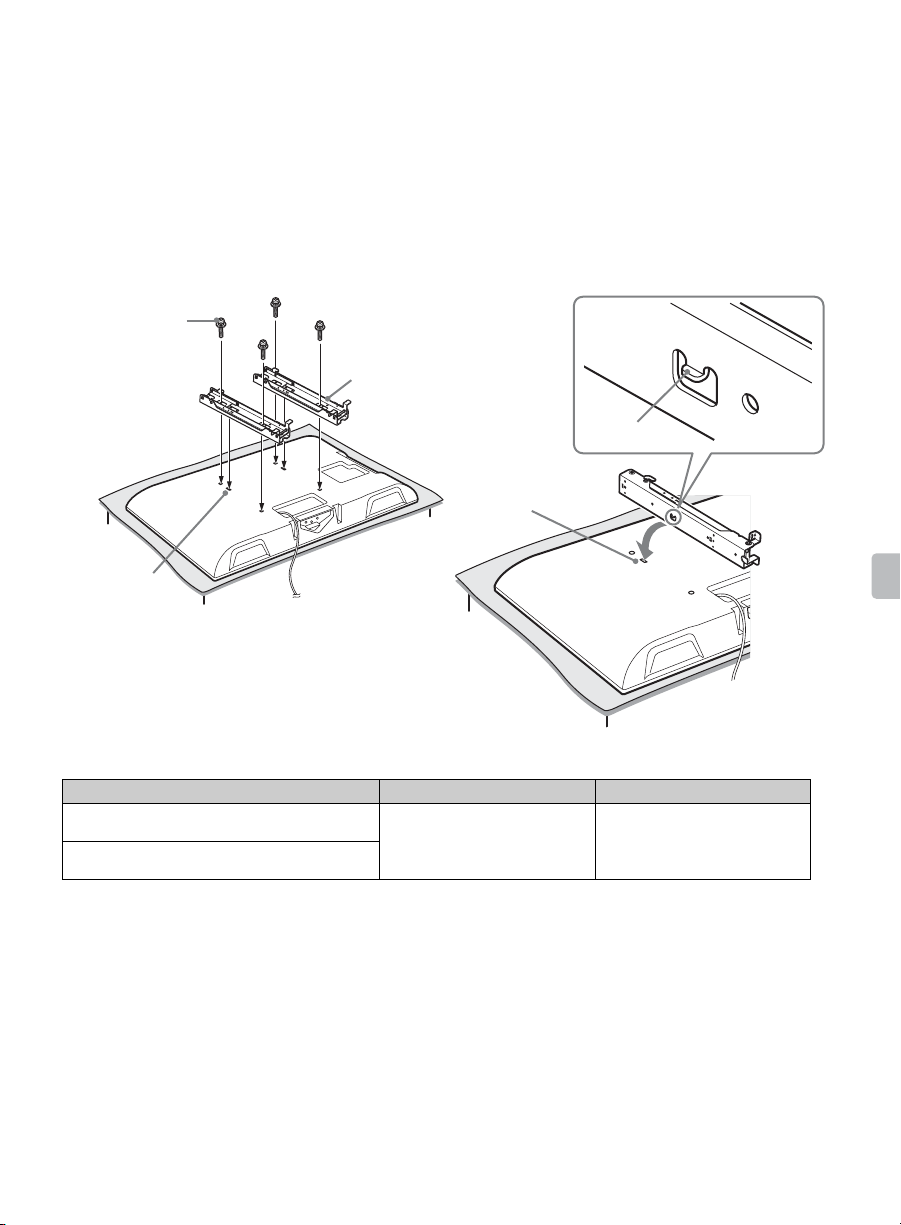
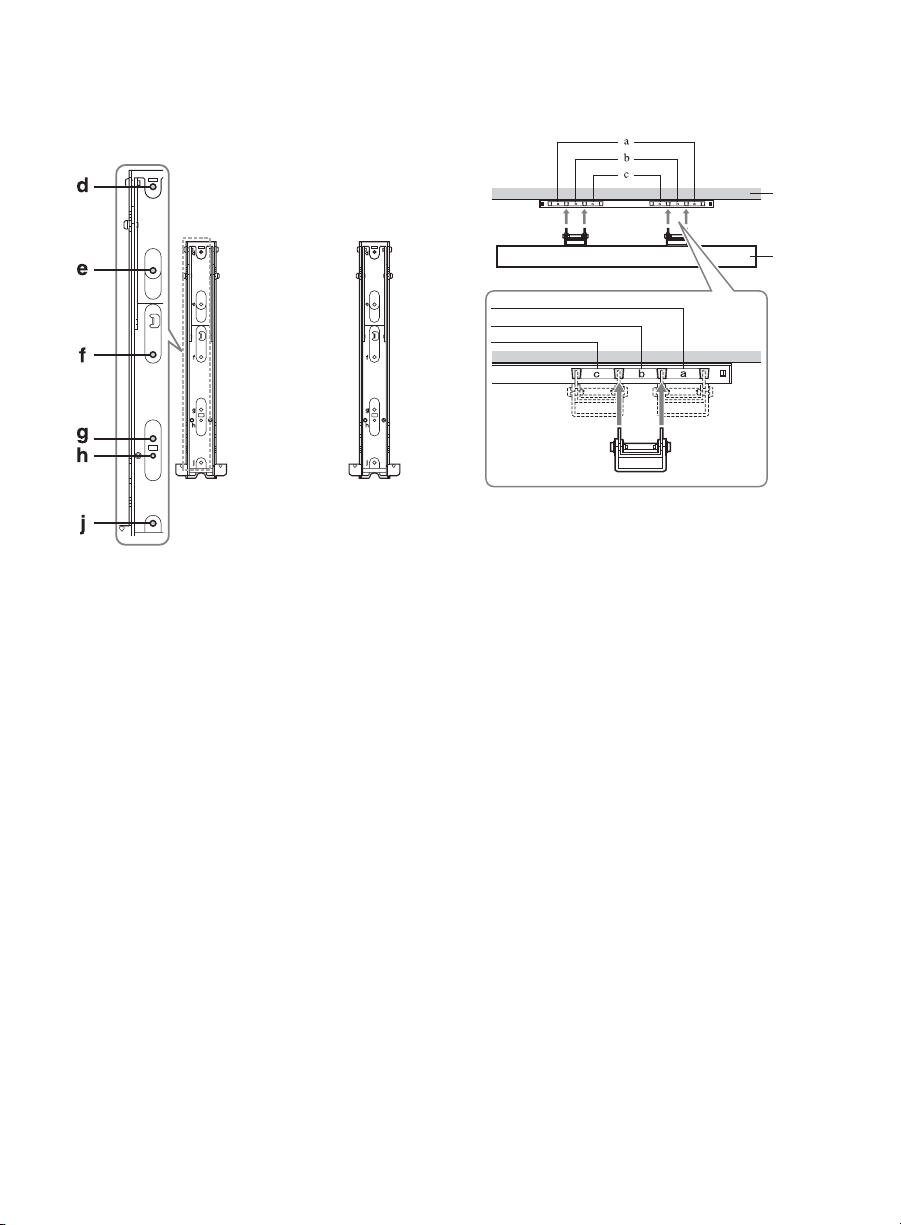
3 Secure the Mounting Hook to the rear of the TV.
Determine the screw locations and secure the Mounting Hooks to the rear of the TV.
Refer to the “Screw and Hook Locations Diagram/Table” shown below.
1 Secure the Mounting Hooks to the rear of the TV using only the supplied screws
(M6 × 16).
2 Be sure to tighten the screws with equal torque strength.
x Screw and Hook Locations Diagram/Table
TV Model Screw location Hook location
KDL-46BX451
KDL-46BX450
d, g b
KDL-40BX451
KDL-40BX450
Square hole
Screw
(M6 × 16)
Mounting
Hook
Square
hole
Align the tab on the rear of the
Mounting Hook with the square hole
on the rear of the TV as illustrated.
Tab
(Continued)
56
4 Adjust the angle of the Mounting Hook.
Refer to the Instructions for SU-WL500.
Step 5: Install the TV on the wall
Refer to the Instructions for SU-WL500.
~
• When you put the TV back on the Table-Top Stand, reverse the above steps.
• When moving the TV, do not squeeze the bottom of the front panel too tight.
• Remove the screws or install the Mounting Hook on a stable and level surface.
Screw location
When installing the Mounting Hooks on
the TV.
Hook location
When installing the TV onto Base Bracket.
Wall
TV
57
Other Information
Troubleshooting
Many of the poor pictures and poor sound conditions are related to improper connection
of the cables; refer to the Quick Setup Guide provided for connections.
If you have questions, service needs, or require technical assistance related to the use
of your Sony TV even after you read this operating instructions manual, contact the
following:
For US Support:
http://www.sony.com/tvsupport
or call 1-800-222-SONY (7669)
For Canadian Support:
http://www.sony.ca/support
or call 1-877-899-SONY (7669)
x Things to consider
• Check the input selection by pressing the INPUT button. You may be watching the
wrong input.
• If you cannot hear sound from the TV, you may have accidentally pressed the MUTING
button on your remote control; press the MUTING button again or press VOL + to
deactivate muting.
• If the remote control is not functioning properly, the batteries may be installed
incorrectly or may be low or an object or light may be interfering with the remote
control.
• To reset the TV to factory default settings:
1 Turn on the TV.
2 Press and hold down the V button on the remote, press the 1 button on the TV set.
(The TV will turn itself off, then back on again.)
3 Release the V button when the TV is turn on.
IMPORTANT: The factory reset will clear all of your customized settings including the
Parental Lock setting.
When the Password is lost or cannot be remembered, enter the master password: 4357.
This password clears your previous password and allows you to enter a new password.
Condition Explanation/Solution
No picture
No picture • Check the Power Saving settings (see page 49).
Cannot receive any
channels
• Make sure the power cord is connected securely.
• Turn on the power of the TV.
• Check cable/antenna connections.
• Make sure the Signal Type setting is correct for your TV signal
source.
(Continued)
58
TV is locked to one
channel
•Perform Auto Program to add receivable channels that are not
present in the TV’s memory (see pages 20 and 41).
Cannot receive or select
channels
•Perform Auto Program to add receivable channels that are not
present in the TV’s memory (see pages 20 and 41).
• To receive or select cable channels, make sure that Signal Type
in the Channel settings is set to Cable (see page 41). To receive
or select UHF channels over an antenna, make sure Signal Type
is set to Antenna.
The TV turns off
automatically
• Check if Sleep Timer is activated (see page 46).
• Check Idle TV Standby in the Eco settings.
No picture from some
video sources
• Check the connection between the optional video equipment
and the TV.
•Press INPUT on the remote control (see page 31).
Poor picture
Picture quality not as
good as viewed at the
store
• Picture quality depends on the signal content. See Quick Setup
Guide (supplied) to display the best possible picture for that
signal.
Broadcast HD formats
have poor quality
• Content and signal quality are controlled by the signal provider.
Many HD channels and content are actually upscaled versions of
standard-definition broadcasts. The picture is affected by the
quality of the signal received, which varies between channel and
program.
Double images or ghosts • Check cable/antenna connections.
• Check the antenna location and direction.
Only snow and noise
appear on the screen
• Check if the antenna is broken or bent.
• Check if the antenna has reached the end of its serviceable life.
(3-5 years in normal use, 1-2 years at the seaside.)
Dotted lines or stripes • Keep the TV away from noise sources such as cars, motorcycles,
or hair-dryers.
• If using 300 ohm twin lead, move the excess lead away from the
TV or try using 75-ohm coaxial cable instead.
No color / Dark picture /
Color is not correct / The
picture is too bright
• Adjust the Picture Mode options in the Picture settings (see
page 35).
• If you set the Power Saving mode to Low or High, it will
enhance the black level.
Noisy picture • Make sure that the antenna is connected using a 75-ohm coaxial
cable (not supplied).
• Keep the antenna cable away from other connecting cords.
• To avoid TV interference, make sure to use an undamaged
antenna cable.
Blurry picture / Poor color • Transporting the TV from a cold to a warm location or a sudden
change in room temperature may cause moisture condensation,
resulting in a blurry picture or poor color. Turn off your TV and
wait a few hours before powering on again.
Condition Explanation/Solution
59
Other Information
No sound / Noisy sound
No sound but good
picture
• Check the volume control.
•Press MUTING or VOL + so that “Muting” disappears from the
screen (see page 24).
•Set Speakers to TV Speakers in the Sound settings (see page
38). If it is set to Audio System, sound is not output from the TV’s
speakers regardless of the TV’s volume control.
• When using HDMI input with Super Audio CD or DVD-Audio,
DIGITAL AUDIO OUT (OPTICAL) may not provide an audio
signal.
• When tuned to a digital channel with Alternate Audio, the
broadcaster may not be broadcasting your preferred Alternate
Audio language. Press OPTIONS, highlight and select Alternate
Audio, and change the Alternate Audio language (see page
38).
Audio noise • Make sure that the antenna is connected using a 75-ohm coaxial
cable (not supplied).
• Keep the antenna cable away from other connecting cords.
• To avoid TV interference, make sure to use an undamaged
antenna cable.
No audio or low audio
with Home Theater
System
•Set Speakers to Audio System in the Sound settings (see page
38).
•Set Audio Out to Fixed in the Sound settings (see page 38).
No color / Irregular
picture
• Verify that the Video1/Component Selection (see page 46) is
set to the current input type in use. We suggest leaving this
setting to Auto.
BRAVIA Sync
Cannot find connected
BRAVIA Sync HDMI
device
• Make sure that the Control for HDMI is set up on both the TV
and the optional device compatible with BRAVIA Sync (see
page 27).
Second A/V receiver is
not listed on the Device
List
• Only one A/V receiver may be used with the BRAVIA Sync and
Control for HDMI functions at one time (see page 47).
PC Input
No picture / No signal • Confirm the PC is correctly connected to the TV with either the
PC IN (with an HD15 cable) or with the HDMI IN.
• Ensure the output signal from the PC is one of the formats listed
on page 50.
• Turn the PC off. Confirm the PC connection and restart the PC.
Plug-and-play will auto-detect the TV and correctly set up PC
timing.
• Verify the PC is not in standby or hibernation mode.
Poor Picture • Adjust the resolution (see page 50).
•Adjust Pitch and Phase.
Condition Explanation/Solution
(Continued)
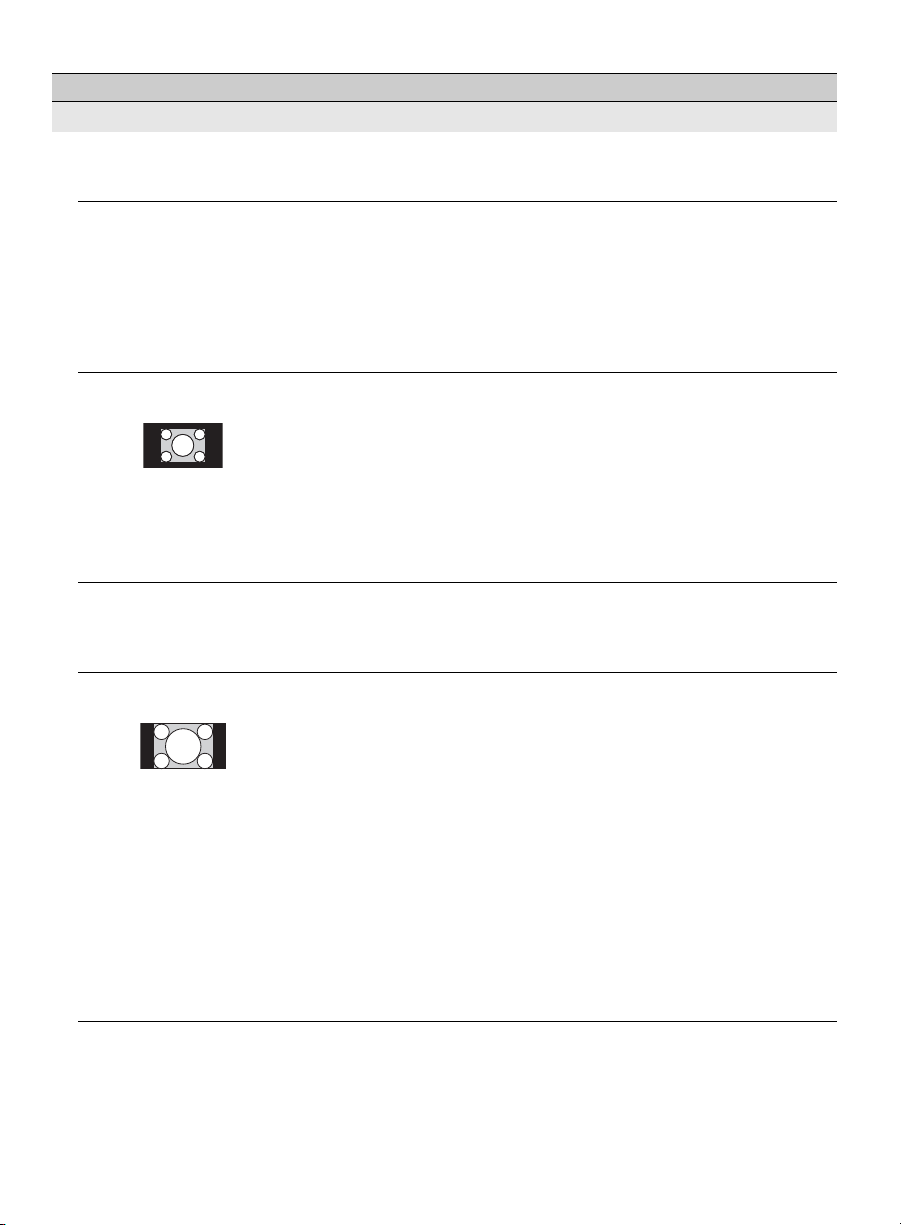
60
General
TV screen feels warm • Due to the thin profile of this television, the heat generated by the
LCD panel backlight and supporting electronics will be more
noticeable. This is normal operation and not a cause for concern.
Wide Mode changes
automatically
• The current Wide Mode setting is automatically replaced with the
4:3 Default setting when you change the channel or video input,
if 4:3 Default in the Screen settings is set to other than Off. If you
want to lock in Wide Mode selected with WIDE on the remote
control, set 4:3 Default to Off in the Screen settings (see page
39).
• Check the Auto Wide option in the Screen settings (see page
39).
Suddenly the picture
gets smaller
• The picture gets smaller during the commercials due to the
method in which the provider broadcasts their content. When HD
content channels switch to SD content (commercials), the picture
may be small with a black border.
• Auto Wide will not expand the picture during these content
changes since the content information is regulated by the
channel signal provider. You can manually change the Wide
Mode if you prefer (see page 29). This setting will remain in
effect until you change the channel or input or manually change
the Wide Mode again.
“Black box” on screen • You have selected a text option and no text is available (see
page 45). To turn off this feature, set the CC Display option to
Off. If you were trying to select closed captioning, select CC1
instead of Text1-4.
Black bands appear at
the edges of the screen
• Some wide screen programs are filmed in aspect ratios that are
greater than 16:9 (this is especially common with theatrical
releases). Your TV will show these programs with black bands at
the top and bottom of the screen. For more details, check the
documentation that came with your DVD/Blu-ray (or contact your
program provider).
• Programs in 4:3 aspect ratio will have bands on left and right
sides of the screen.
• Programs broadcast in HD formats (720p and 1080i) with 4:3
content will commonly have black bands on the left and right
sides of the screen which are added by the broadcaster (see
image on left).
• Auto Wide will not expand the picture when the black bands on
the sides of the screen are added by the broadcaster. You can
manually change the Wide Mode to Wide Zoom, or Zoom to fill
the screen, which will remain in affect until you change the
channel or input or manually change the Wide Mode again.
Condition Explanation/Solution
61
Other Information
Certain programs on
DVD or other digital
sources display a loss of
detail, especially during
fast-motion or dark
scenes
• This is due to the digital compression of the source content used
by certain digital broadcasts and DVDs which may cause your
TV’s screen to display less detail than usual, or cause artifacts
(small blocks or dots, pixelations) to appear on your screen.
These signal compressions are more visible and are dependent
on the clarity and resolution of the TV.
Remote control does not
operate
• To determine if the problem is with the remote control or not,
press a button on the TV.
• Check the polarity of the batteries or replace the batteries.
• Point the remote control at the remote control sensor located at
the front of the TV.
• Keep the remote control sensor area clear from obstacles.
• Fluorescent lamps can interfere with your remote control
operation; try turning off the fluorescent lamps.
Some digital cable
channels are not being
displayed
• Certain cable companies have limitations on the broadcast of
digital cable channels. Check with your cable company for more
information.
• The digital cable channel may be set to Hidden in the Show/
Hide Channels setting (see page 41).
Some photo, music, or
video files are not
displaying from my USB
equipment
• The accessible file or folder limit in a directory is 1,000 for USB
connected equipment. This limit includes non-supported files or
just folders. Files or folders are populated based on their time
stamps. Photo, music files or folders exceeding the limit will not
be displayed.
Photo images appear
small in the screen
• Set display size to expanded.
• Whether or not photo images can or cannot be displayed in full-
screen depends on the resolution or aspect ratio of the file.
Photo images or folders
take time to display
• Depending on the image dimension, file size, and number of files
in a folder, some photo images or folders take time to display.
• The first time a camera is connected to the TV via USB cable, it
may take up to a couple of minutes for the photos to display.
Lost password • Select the Password settings on the Parental Lock settings,
then enter the following master password: 4357. This password
clears your previous password and allows you to enter a new
password (see page 42).
How to reset the TV to
factory settings
• Turn on the TV. While holding down V on the remote control,
press "/1 on the TV. (The TV will turn itself off, then back on
again.) Release V.
IMPORTANT: The reset will clear all of your customized settings
including the Parental Lock setting.
Condition Explanation/Solution

62
Important Notices
For Customers in Canada
This Class B digital apparatus complies with Canadian
ICES-003.
FCC Related Information
This equipment has been tested and found to comply with
the limits for a Class B digital device, pursuant to Part 15 of
the FCC Rules. These limits are designed to provide
reasonable protection against harmful interference in a
residential installation. This equipment generates, uses and
can radiate radio frequency energy and, if not installed and
used in accordance with the instructions, may cause harmful
interference to radio communications. However, there is no
guarantee that interference will not occur in a particular
installation. If this equipment does cause harmful
interference to radio or television reception, which can be
determined by turning the equipment off and on, the user is
encouraged to try to correct the interference by one or more
of the following measures:
❑ Reorient or relocate the receiving antenna.
❑ Increase the separation between the equipment and
receiver.
❑ Connect the equipment into an outlet on a circuit
different from that to which the receiver is connected.
❑ Consult the dealer or an experienced radio/TV
technician for help.
Compatible Wall-Mount Bracket
Information
Use the following Sony Wall-Mount Bracket with your TV
model.
Use with other Wall-Mount Brackets may cause instability
and could result in property damages or injury.
Note
This television includes a QAM demodulator which should
allow you to receive unscrambled digital cable television
programming via subscription service to a cable service
provider. Availability of digital cable television programming
in your area depends on the type of programming and signal
provided by your cable service provider.
For Customers in the United States
Lamp in this product contains mercury. Disposal of these
materials may be regulated due to environmental
considerations. For disposal or recycling information, please
contact your local authorities or the Telecommunications
Industry Association (http://www.eiae.org).
To Customers
Sufficient expertise is required for TV installations. Be sure to
subcontract the installation to a Sony dealer or licensed
contractor and pay adequate attention to safety during the
installation.
Pour les clients résidant au Canada
Cet appareil numérique de la classe B est conforme à la
norme NMB-003 du Canada.
Information sur le support de fixation murale
compatible
Utilisez le support de fixation murale Sony ci-dessous
correspondant au modèle de votre téléviseur.
L’utilisation d’un autre support de fixation murale peut
provoquer l’instabilité de l’appareil et causer des blessures
ou des dommages matériels.
Declaration of Conformity
Trade Name: SONY
Model: KDL-46BX451/KDL-46BX450/KDL-40BX451/
KDL-40BX450
Responsible Party: Sony Electronics Inc.
Address: 16530 Via Esprillo,
San Diego, CA 92127 U.S.A.
Telephone Number: 858-942-2230
This device complies with part 15 of the FCC rules.
Operation is subject to the following two conditions: (1)
This device may not cause harmful interference, and (2)
this device must accept any interference received,
including interference that may cause undesired
operation.
Pursuant to FCC regulations, you are cautioned that any
changes or modifications not expressly approved in this
manual could void your authority to operate this
equipment.
Sony TV Model No.
KDL-46BX451/KDL-46BX450/
KDL-40BX451/KDL-40BX450
Sony Wall-Mount
Bracket Model
No.
SU-WL500
Numéro de modèle de
téléviseur Sony
KDL-46BX451/KDL-46BX450/
KDL-40BX451/KDL-40BX450
Numéro de
modèle du
support de
fixation murale
Sony
SU-WL500
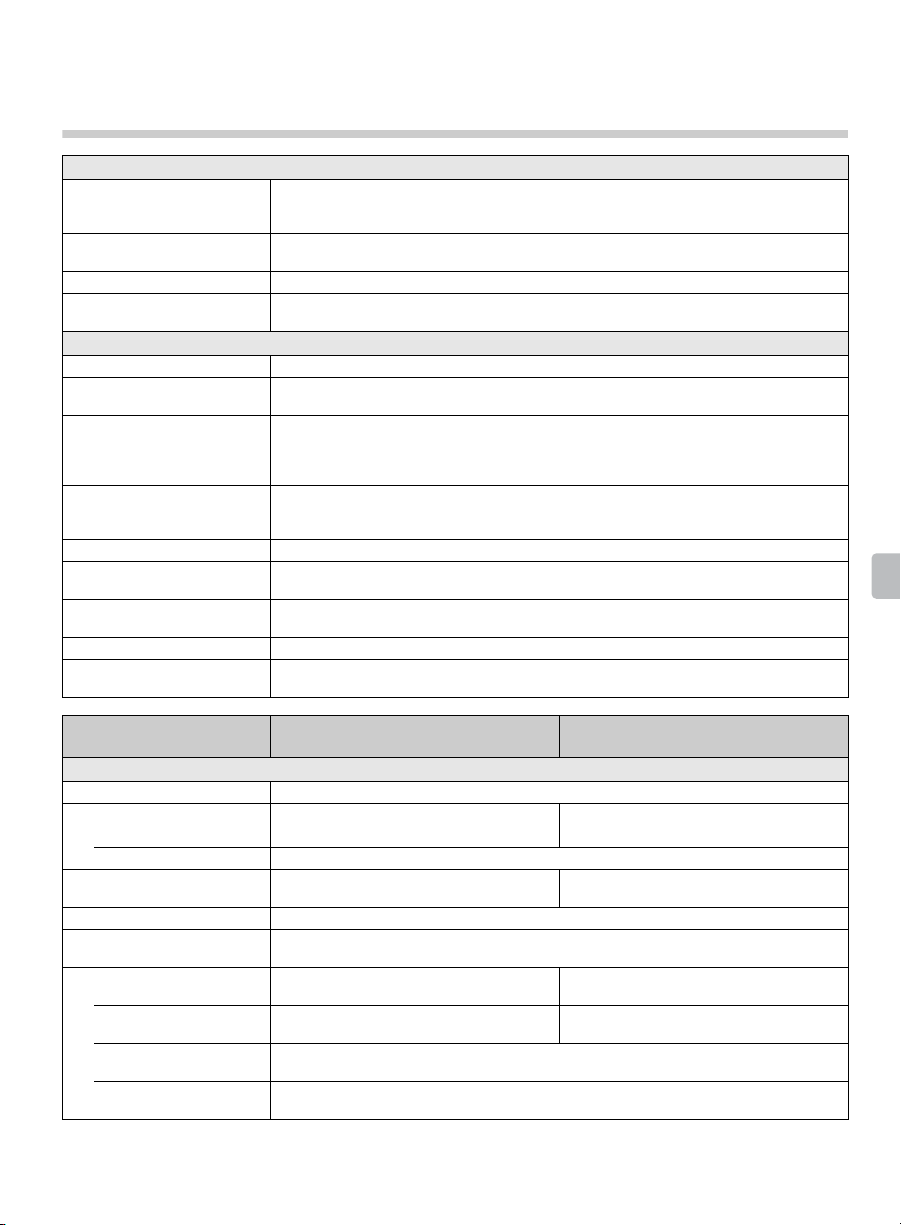
63
Other Information
Specifications
System
Television system NTSC: American TV standard
ATSC (8VSB terrestrial): ATSC compliant 8VSB
QAM on cable: ANSI/SCTE 07 2000 (Does not include CableCARD functionality)
Channel coverage Analog terrestrial: 2 - 69 / Digital terrestrial: 2 - 69
Analog Cable: 1 - 135 / Digital Cable: 1 - 135
Panel system LCD (Liquid Crystal Display) Panel
Speaker output KDL-46/40BX450: 6 W + 6 W
KDL-46/40BX451: 8 W + 8 W
Input/Output jacks
CABLE/ANTENNA 75-ohm external terminal for RF inputs
VIDEO IN 1 VIDEO: 1 Vp-p, 75 ohms unbalanced, sync negative
AUDIO: 500 mVrms (Typical) / Impedance: 47 kilohms
COMPONENT IN YP
BPR (Component Video): Y: 1.0 Vp-p, 75 ohms unbalanced, sync negative / PB: 0.7 Vp-p,
75 ohms
P
R: 0.7 Vp-p, 75 ohms / Signal format: 480i, 480p, 720p, 1080i, 1080p
AUDIO: 500 mVrms (Typical) / Impedance: 47 kilohms
HDMI IN 1/2 HDMI: Video: 480i, 480p, 720p, 1080i, 1080p, 1080/24p
Audio: Two channel linear PCM 32, 44.1 and 48 kHz, 16, 20 and 24bits, Dolby Digital
PC Input (see page 50)
AUDIO OUT 500 mVrms (typical)
DIGITAL AUDIO OUT
(OPTICAL)
PCM/Dolby Digital optical signal
PC IN D-sub 15-pin, analog RGB, 0.7 Vp-p, 75 ohms, positive
See the PC Input Signal Reference Chart for PC and HDMI IN on page 50.
PC/HDMI IN 1 AUDIO IN Stereo mini jack, 500 mVrms, (Typical) / Impedance: 47 kilohms
USB KDL-46/40BX450: Photo, Music and Video
KDL-46/40BX451: Photo and Video
Model name KDL-46BX451
KDL-46BX450
KDL-40BX451
KDL-40BX450
Power and others
Power requirement 110-240 V AC, 50/60 Hz (U.S.A./Canada/Mexico 120 V AC, 60 Hz)
Power consumption
188 W 158 W
in use
in standby Less than 0.2 W with 120 V AC and with 240 V AC less than 0.3 W
Screen size*
(inches measured diagonally)
46 40
Display resolution 1,920 dots (horizontal) × 1,080 lines (vertical)
Speaker/Full range (2) (mm)
(inches)
40 × 100
(1
5
/
8
× 4)
Dimensions* with stand (mm)
(inches)
1,112 × 713 × 279
43
7
/
8
× 28
1
/
8
× 11
980 × 639 × 231
38
5
/
8
× 25
1
/
4
× 9
1
/
8
without stand (mm)
(inches)
1,112 × 675 × 97
43
7
/
8
× 26
5
/
8
× 3
7
/
8
980 × 601 × 94
38
5
/
8
× 23
3
/
4
× 3
3
/
4
wall-mount hole pattern
(mm)
300 × 300
wall-mount screw size
(mm)
M6 (length: refer to diagram on page 51)
(Continued)
64
• Optional accessories availability depends on its stock.
• Design and specifications are subject to change without notice.
* Dimensions and mass are approximate values.
Mass* with stand (kg)
(lb.)
17.2
37.9
13.8
30.4
without stand (kg)
(lb.)
16.0
35.3
12.8
28.2
Supplied accessories Remote control RM-YD080 (1)/Size AA batteries (2)/Operating Instructions (1)/Quick Setup
Guide (1)/Warranty Card (1)/Safety and Regulatory Booklet (1)/Software License (1)/Stand
installation guide (1)/Table-Top Stand (1 set)/Screw (3)
common to all models
Optional accessories Connecting cables / Support Belt Kit / Wall-Mount Bracket: SU-WL500
Model name KDL-46BX451
KDL-46BX450
KDL-40BX451
KDL-40BX450
65
Other Information
Index
0-9 buttons 24
4:3 Default 39
A
Add Digital Channels 41
Advanced Settings 36
Alternate Audio 38
Analog Fine Tune 41
AUDIO OUT 11
Audio Out 38
Auto Display Area 39
Auto Program 20, 41
Auto Shut Off 49
Auto Wide 39
AV Setup 46
B
Backlight 35
Balance 37
Bass Booster 37
Brightness 35
C
CABLE/ANTENNA 10
CC button 24
CH +/– button 24, 25
Change Password 42
Channel Block 42
CineMotion 35
Closed Captions (CC) 45
Color 35
Color Temperature 35
Colored buttons 23
COMPONENT IN 11
Country 42
D
DIGITAL AUDIO OUT (OPTICAL)
10
Display Area 39
DISPLAY button 24
Downloadable U.S. Rating 42
E
Edit Channel Labels 41
English Rating 44
Equalizer 37
Equipment Control button 22
External Input Block 42
F
French Rating 44
H
HDMI IN 10
HDMI Settings 47
HDMI/DVI Audio Source 38
HOME/MENU button 23, 25
Horizontal Center 39, 40
Hue 35
I
Idle TV Standby 49
Info Banner 46
Infrared Receiver (IR) 25
Initial Setup 46
INPUT button 22, 25
Installing the TV on a wall 51, 52
J
JUMP button 24
L
Language 46
M
Movie Rating 43
MPEG Noise Reduction 35
MTS Audio 38
Music 31
MUTING button 24
N
Noise Reduction 35
O
OPTIONS button 24
P
Password 42
PC IN 10
PC Settings 40
Photo 31
Picture 35
Picture Adjustments Lock 47
Picture Mode 35
Picture Off ( ) LED 25
PIP 28
Power ("/1) button 25
POWER ("/1) button 24
POWER (") LED 25
Power Saving 49
Product Support 48
R
Rating 42
Reset 35, 37, 49, 61
RETURN button 23
S
SCENE button 23
Settings
Channel
41
Eco 49
Parental Lock 42
Picture 35
Screen 39
Setup 45
Sound 37
Sharpness 35
Show/Hide Channels 41
Signal Type 41
Sleep Timer 46
Sound Mode 37
Speaker 25
Speakers 38
Standby (1) LED 25
Startup Logo 46
Steady Sound 37
Surround 37
SYNC MENU button 22
T
Timer ( ) LED 25
Troubleshooting 57–61
TV Rating 43
U
U.S.A. Rating 44
Unrated 42
USB 11
USB Auto Start 45
V
Vertical Center 40
Video 31
VIDEO IN 11
Viewing Blocked Programs 44
VOL (2) +/– button 24, 25
Volume Offset 37
W
WIDE button 24
Wide Mode 39, 40


© 2012 Sony Corporation Printed in Mexico
4-418-206-13(1)
For Your Convenience
Online
Registration:
Be sure to register your TV.
United States
Canada
http://productregistration.sony.com
http://www.sony.ca/registration