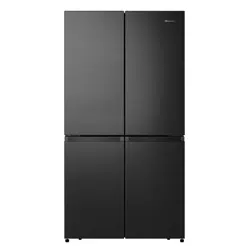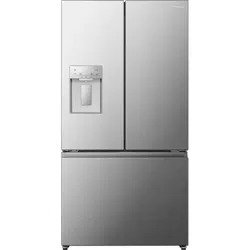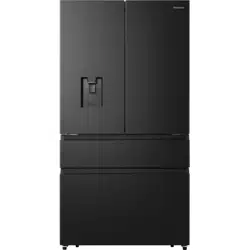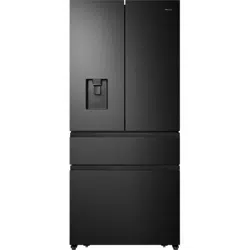
Refrigerator Use & Care Guide
Refrigerator Use & Care Guide
Refrigerator Use & Care Guide
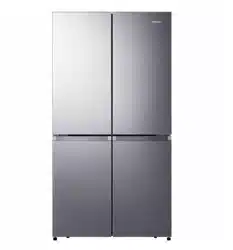
HR6CDFF670S

Table of Contents
Thank you for choosing Hisense. We are sure you will find your new refrigerator a
pleasure to use. However, before you use the appliance, we recommend that you
carefully read the instructions, which provide details about installing and using the
product. Please keep this manual for future reference.
REFRIGERATOR SAFETY............................................................................................................3
PARTS AND FEATURES...............................................................................................................4
INSTALLATION REQUIREMENTS.................................................................................................5
Location Requirements.....................................................................................................5
Electrical Requirements...................................................................................................5
INSTALLATION INSTRUCTIONS..................................................................................................6
Unpack the Refrigerator..................................................................................................6
Complete the Installation ................................................................................................6
Level Refrigerator.............................................................................................................6
Align Doors.........................................................................................................................7
REFRIGERATOR USE...................................................................................................................7
Opening and Closing Doors...............................................................................................7
Using the Controls..............................................................................................................8
Features...............................................................................................................................9
General Use Information..................................................................................................10
REFRIGERATOR CARE................................................................................................................11
Cleaning...............................................................................................................................11
Lights...................................................................................................................................11
Vacation and Moving Care.............................................................................................11
Reinstalling/Using Refrigerator Again........................................................................12
TROUBLESHOOTING................................................................................................................. 13
2
Refrigerator Safety
Your safety and the safety of others are very important.
DANGER
WARNING
CA
UTION
We have provided many important safety messages in this manual and on your appliance. Always
read and obey all safety messages.
These words mean:
This is the safety alert symbol.
This symbol alerts you to potential hazards that can kill or hurt you and others. All
safety messages will follow the safety alert symbol and either the word “DANGER,”
“WARNING” or “CAUTION.”
An imminently hazardous situation. You could be killed or seriously
injured if you don’t immediately follow instructions.
A potentially hazardous situation which, if not avoided, could result in
death or serious bodily injury.
A potentially hazardous situation which, if not avoided, may result in
moderate or minor injury.
WARNING: To reduce the risk of fire, electrical shock, injury to persons, or damage when using the
refrigerator, follow basic precautions, including the following:
Important Safety Instructions
Flammable refrigerant used. Follow
handling instructions carefully. Risk of fire
or explosion due to puncture of
refrigerant tubing.
Use nonflammable cleaner.
Do not use mechanical devices or other
means to accelerate the defrosting
process, other than those recommended
by the manufacturer.
Keep flammable materials and vapors,
such as gasoline, away from refrigerator.
CAUTION: Do not store products which
contain flammable propellants (e.g. spray
cans) or explosive substances in the
refrigerator.
Keep ventilation openings in the appliance
enclosure or in the built-in structure clear
of obstruction.
Connect to potable water supply only.
Use two or more people to move and
install refrigerator.
To avoid the risk of children becoming
trapped and suffocating, do not allow
them to play or hide inside the
refrigerator.
Ensure everyone using this appliance is familiar
with its operations and safety features.
This appliance is not intended for use by
persons (including children) with reduced
physical, sensory or mental capabilities, unless
supervised or properly instructed.
Plug into a grounded 3 prong outlet.
Do not remove ground prong.
Do not use an adapter.
Do not use an extension cord.
If the power supply cord is damaged, it must
be replaced by the manufacturer, its service
agent or a similarly qualified person to avoid a
hazard.
Disconnect power before servicing.
Do not use electrical appliances inside the
food storage compartments of the
refrigerator,unless they are of the type
recommended by the manufacturer.
Replace all parts and panels before operating.
Flammable refrigerant used. To be repaired
only by trained service personnel. Do not
puncture refrigerant tubing.
Flammable refrigerant used. Dispose of
properly in accordance with federal or local
regulations.
Read and Save These Instructions
•
•
•
•
•
•
•
•
•
•
•
•
•
•
•
•
•
•
•
•
•
All safety messages will tell you what the potential hazard is, tell you how to reduce the chance of
injury, and tell you what can happen if the instructions are not followed.
3
•
It is hazardous for anyone other
than an
Authorized Service Person to service this
appliance.In Queensland the Authorized
Service Persion MUST hold a Gas
Work
Authorization for hydrocarbon refrigerants to
carry out servicing or repairs which
involve
removal of covers
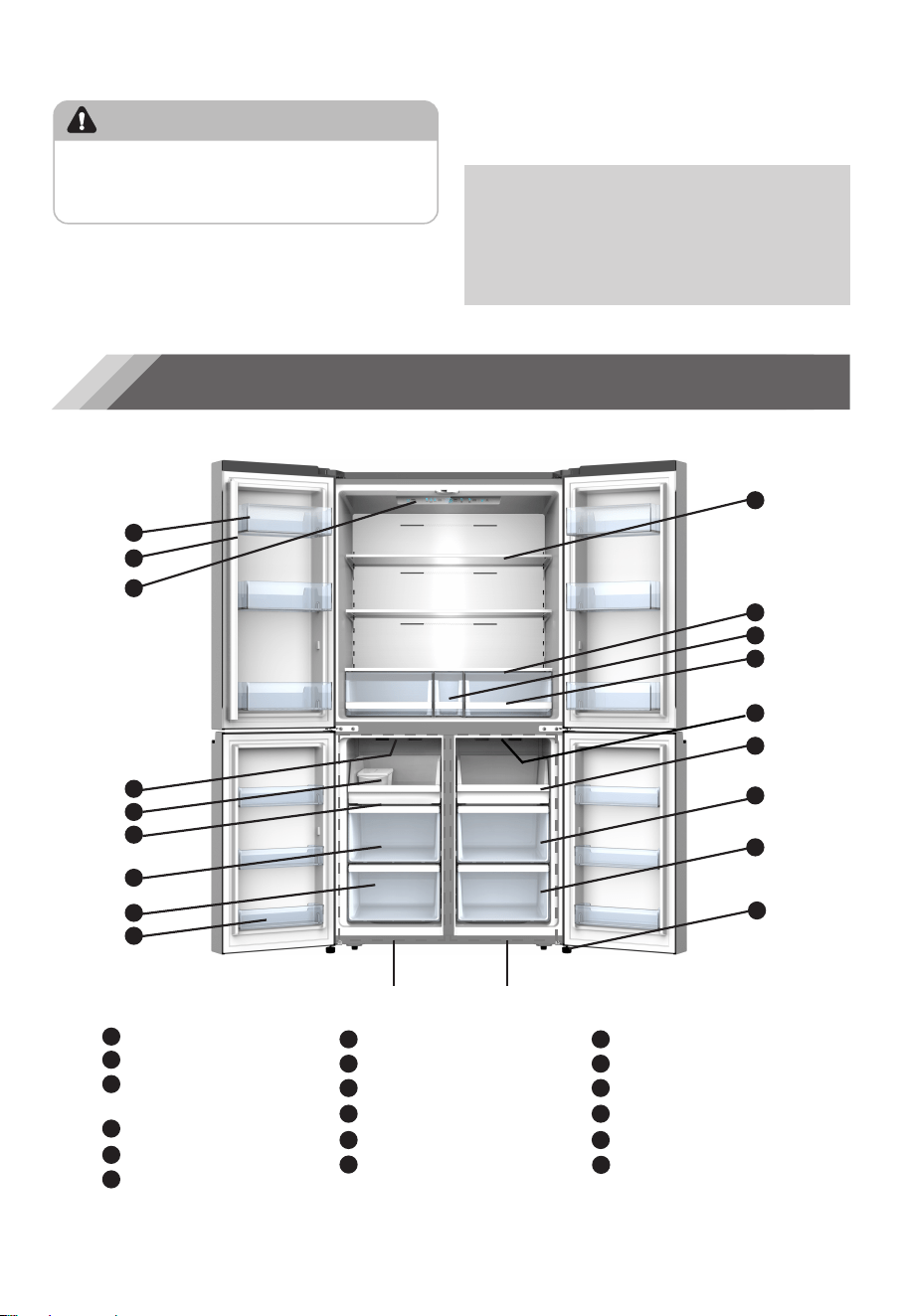
Note: Your model may look different from this and other images in this manual,depending on your
model’s features.
Proper Disposal of Your Old Refrigerator
WARNING
Remove doors from your old refrigerator.
Failure to do so can result in death or brain damage.
Suffocation Hazard
IMPORTANT: Child entrapment and suffocation are
not problems of the past. Junked or abandoned
refrigerators are still dangerous– even if they will sit
for “just a few days.” If you are getting rid of your old
refrigerator, please follow these instructions to help
prevent accidents.
Before You Throw Away Your Old Refrigerator or
Freezer:
• Take off the doors.
• Leave the shelves in place so that children may
not easily climb inside.
Important information to know about disposal
of refrigerants:
Dispose of refrigerator in accordance with
Federal and Local regulations. Refrigerants
must be evacuated by a licensed, EPA certified
refrigerant technician in accordance with
established procedures.
Parts and Features
L
I
J
A
C
D
E
F
B
G
H
K
A
C
D
F
B
J
4
Refrigerator Door Bin
Mullion
Refrigerator LED Light
Freezer LED Light
Ice Maker
Freezer pallet
Freezer Middle Drawer
Freezer Lower Drawer
Freezer Door Bin
Glass Shelf
Cover
Middle Storage Drawer
Storage Drawer
Convertible pallet
Convertible Middle Drawer
Convertible Lower Draw
Leveling Leg
O
P
M
N
Q
E
G
I
K
L
M
N
O
P
Q
H
Freezer
Compartment
Convertible
Compartment
And Display
R
Convertible LED Light
R
IMPORTANT: This refrigerator is designed for
indoor, household use only.
Temperature
This refrigerator is intended for use in a location
where the temperature ranges from a minimum
of 13°C to a maximum of 43°C. The preferred
room temperature range for optimum
performance, which reduces electricity usage
and provides superior cooling, is between 15°C
and 32°C. It is recommended that you do not
install the refrigerator near a heat source, such as
an oven or radiator.
Ventilation
Adequate air circulation around the refrigerator
is required for efficient operation.
To ensure proper ventilation, maintain the
recommended clearances.
Installation Requirements
Location Requirements
WARNING
Explosion and Fire Hazard
Keep flammable materials and vapors, such as
gasoline, away from appliance.
Failure to do so can result in death, explosion or fire.
Before you move your refrigerator into its final
location, it is important to make sure you have the
proper electrical connection.
Recommended Grounding Method
A 220 volt, 50 Hz, AC only 15- or 20-amp fused,
grounded electrical supply is required. It is
recommended that a separate circuit serving only
your refrigerator be provided. Use an outlet that
cannot be turned off by a switch. Do not use an
extension cord.
NOTE: Before performing any type of installation
or cleaning, disconnect the refrigerator from the
electrical source. When you are finished,
reconnect the refrigerator to the electrical source
and reset the temperature controls to the desired
setting.
5
Electrical Requirements
WARNING
Plug into a grounded 3 prong outlet.
Do not remove the ground prong from the power
cord plug.
Do not use an adapter.
Do not use an extension cord.
Failure to do so can result in death, fire or
electrical shock.
Electrical Shock Hazard
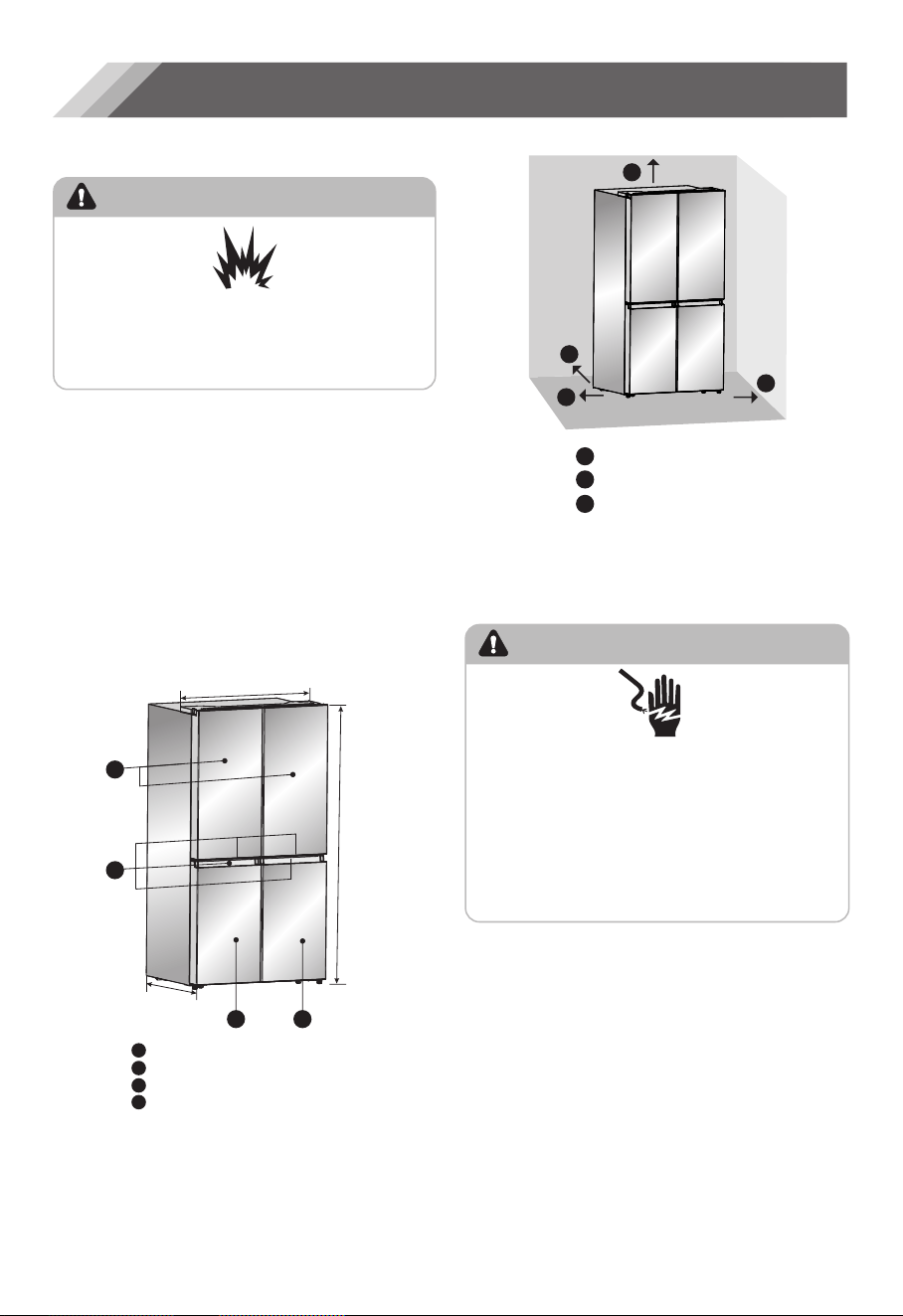
Note: If you place the refrigerator next to a fixed
wall, leave 1471.4mm minimum space to allow the
door to swing open.
100mm Above
50 mm Behind
50mm Each Side
A
C
B
A
B
C
C
Exterior and Dimensions
Refrigerator doors
Handles
Freezer door
Convertible door
A
B
C
D
Recommended Clearances
A
C
D
B
725mm
912mm
1785mm
WARNING
Plug into a grounded 3 prong outlet.
Do not remove the ground prong from the power
cord plug.
Do not use an adapter.
Do not use an extension cord.
Failure to do so can result in death, fire or
electrical shock.
Electrical Shock Hazard
Installation Instructions
WARNING
WARNING
Unpack the Refrigerator
Do not puncture refrigerant tubing.
Follow handling instructions carefully.
Flammable refrigerant used.
Failure to do so can result in death, explosion or fire.
Fire or Explosion Hazard
IMPORTANT: Handle with care when moving
refrigerator to avoid either damaging the
refrigerant tubing or increasing the risk of a leak.
Failure to do so can result in back or other injury.
Excessive Weight Hazard
Use two or more people to move and install
refrigerator.
Remove the Packaging
Remove tape and glue residue from surfaces
before turning on the refrigerator. Rub a small
amount of liquid dish soap over the adhesive
with your fingers. Wipe with warm water and
dry.
NOTE: Do not use sharp instruments, rubbing
alcohol, flammable fluids, or abrasive cleaners
to remove tape or glue. These products can
damage the surface of your refrigerator. For
more information, see “Refrigerator Safety.”
Dispose of/recycle all packaging materials.
If the refrigerator has been placed in a
horizontal or tilted position for any period of
time wait 4 hours before plugging it in to allow
the oil to settle into the compressor.
Clean Before Using
After you remove all of the packaging materials,
clean the inside of the refrigerator before using
it. See the cleaning instructions in “Refrigerator
Care.”
When Moving Your Refrigerator:
Your refrigerator is heavy. When moving
the refrigerator for cleaning or service, be
sure to cover the floor with cardboard or
hardboard to avoid floor damage. Always pull
the refrigerator straight out when moving it.
Do not wiggle or “walk” the refrigerator when
trying to move it, as floor damage could occur.
Important information to know about glass
shelves and covers:
Do not clean glass shelves or covers with
warm water when they are cold. Shelves
and covers may break if exposed to sudden
temperature changes or impact, such as
bumping. Tempered glass is designed to
shatter into many small, pebble-size pieces.
This is normal. Glass shelves and covers are
heavy. Use both hands when removing them to
avoid dropping.
The refrigerator must be level to maintain optimal
performance and appearance.
1. Turn the leveling feet on the bottom, front of
the cabinet to raise or lower that side of the
refrigerator until the refrigerator is level side
to-side.
2. Turn both feet, by the same amount, to slightly
raise the front of the refrigerator. This will make
it easier for the doors to close.
NOTE: Having someone push against the top
of the refrigerator takes some weight off the
leveling feet. This makes it easier to turn the
feet.
Complete the Installation
1. Plug into a grounded 3 prong outlet.
NOTE: This refrigerator begins operating as
soon as it is connected to the power supply.
2. Move the refrigerator into its final location,
making sure to maintain the recommended
clearance.
Level Refrigerator
(if needed)
6
Align Doors
(if needed)
Refrigerator Use
Opening and Closing Doors
There is a mullion on the left-hand side
refrigerator compartment door.
When closing the left-hand door, the mullion
folds behind the right-hand door joining the
two doors.
The temperature of the door frame is
controlled to help prevent moisture from
The four doors can be opened and closed either
separately or together.
NOTE: Before closing the left-hand door, make sure
the mullion is folded inward. If the mullion is pulled
outward it may become damaged when you try to
close the door.
7
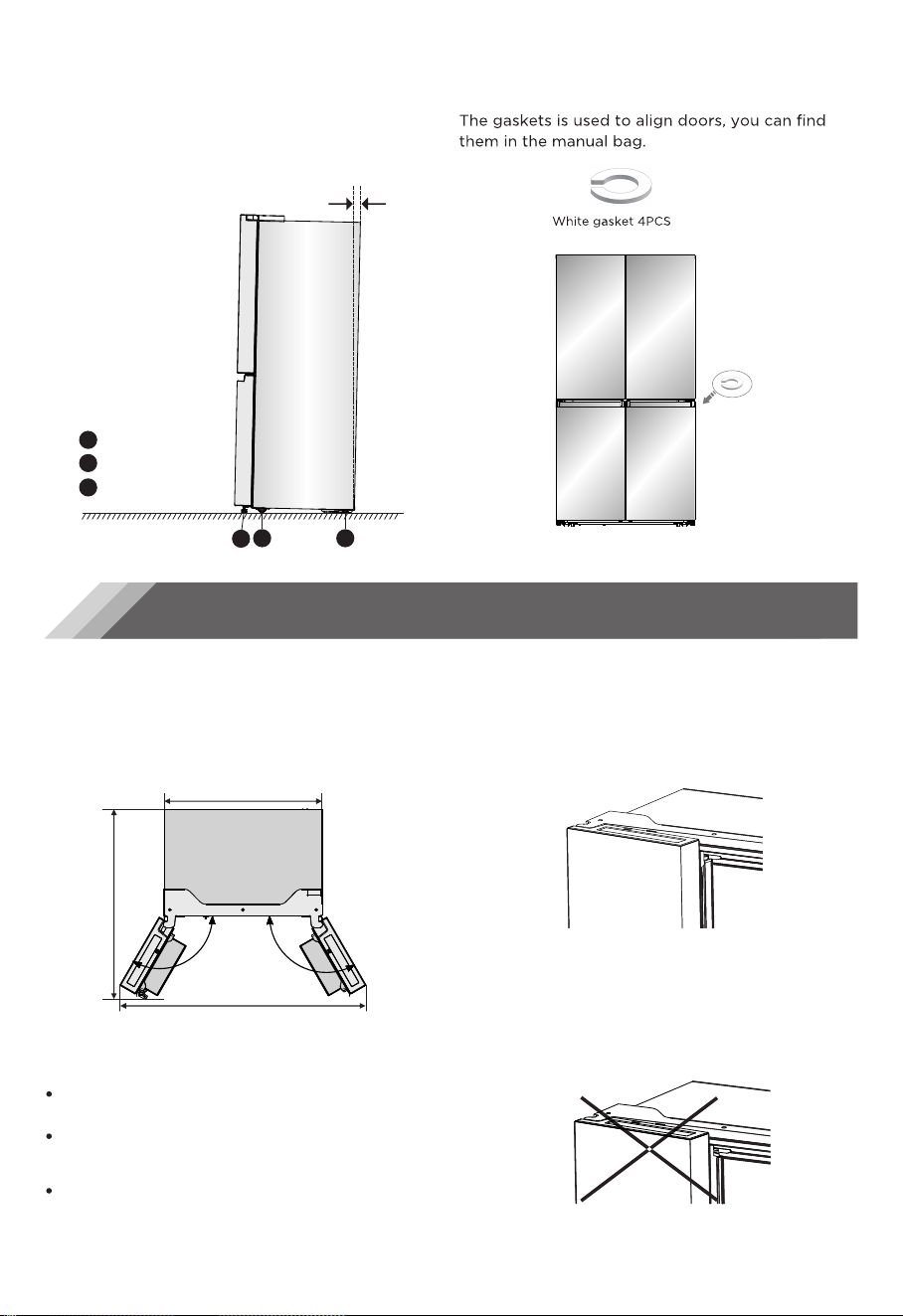
Rotate the adjustable feet clockwise to raise
or raise counter-clockwise to lower your
refrigerator. To make sure that the doors close
automatically, tilt the top of your refrigerator
backward about 10mm to 15mm. If necessary,
use a spanner wrench to adjust the feet.
10mm to 15mm
A
C
B
A
C
B
Adjustable foot
Roller
Roller
Providing room for doors to open
Make sure that you have enough room in front of
your refrigerstor to swing the doors open.
125 °125 °
908mm
1471.4mm
1080.6mm
developing on the mullion. The temperature of the
surface may be warm, which is normal, and will not
affect the performance of the refrigerator.
Using the Controls
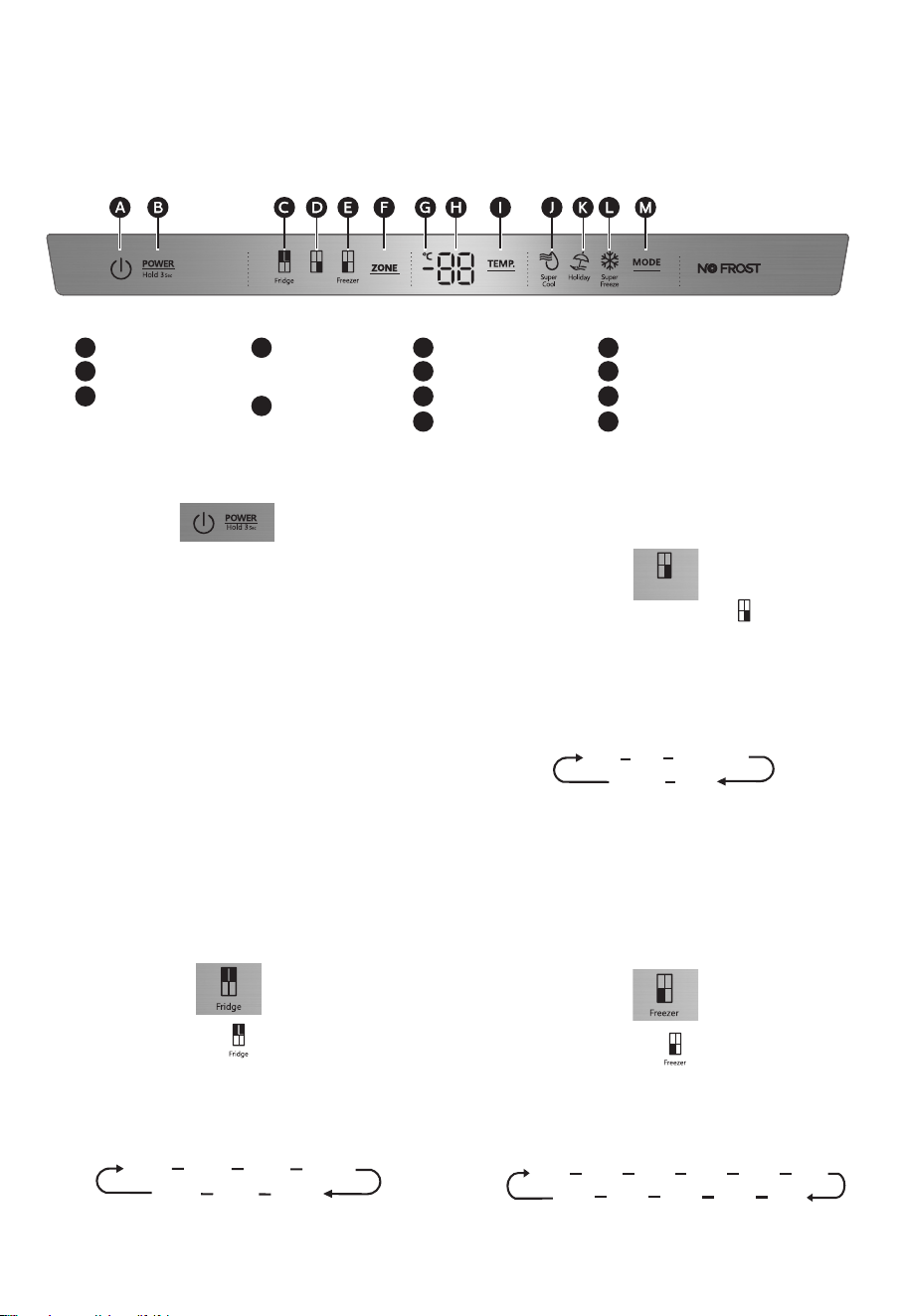
Use your appliance according to the following control regulations, your appliance has the corresponding
functions and modes as the control panels showed in the pictures below. When the appliance is
powered on for the first time, the backlighting of the icons on display panel starts working.If no buttons
have been pressed and the doors are closed, the backlighting will turn off.
Power Icon
Power Control
Fridge
Compartment
Temp Icon
Convertible
Compartment
Icon
Freezer
Compartment
Temp Icon
Zone Choice
Celsius Indicator
Temperature
Temp Control
POWER
Press the “POWER” 3 seconds to turn the
power on, and press 3 seconds will enter
standby mode and will display "OF".
Setting Compartment Temperatures
When you set a temperature, you are setting an
average temperature for the entire
compartment. The actual compartment
temperatures may vary from the temperatures
displayed depending on the amount and
placement of stored food, and the surrounding
room temperature.
Recommended Temperature Settings
• Fridge Compartment: 4°C
• Fresh Choice Compartment: -7°C
• Freezer Compartment: -18°C
Refrigerator (Fridge) Compartment Temperature
1. Press ZONE repeatedly until the Fridge icon
appears.
2. When Fridge is on, is illuminated and
then press TEMP. repeatedly to cycle
through the available temperature settings,
from 8°C to 2°C.
NOTE: Each press of the button advances the
setting by one degree.
3. Release the TEMP. control when the desired
temperature setting appears.
My Fresh Choice Compartment Temperature
1. Press ZONE repeatedly until the My Fresh
Choice appears.
2. When My Fresh Choice is on, is
illuminated and then press TEMP. repeatedly
to cycle t h rough the available temperature
settings, from 5°C to -20°C.
NOTE: Each press of the button advances the
setting by one degree.
3. Release the TEMP. control when the desired
temperature setting appears.
Freezer Compartment Temperature
1. Press ZONE repeatedly until the Freezer icon
appears.
2. When Freezer is on, is illuminated and
then press TEMP. repeatedly to cycle
through the available temperature settings,
from -18°C to -24°C.
NOTE: Each press of the button advances the
setting by one degree.
3. Release the TEMP. control when the desired
temperature setting appears.
8°C 7°C 6°C 5°C
4°C3°C2°C
-18°C -19°C -20°C -21°C -22°C -23°C
-17°C -16°C -15°C -14°C -24°C
-20°C
4°C5°C
-19°C
My Fresh
Choice
A
B
C
D
E
F
G
H
I
Super Cool Icon
Holiday Icon
Super Freeze Icon
Mode Control
J
K
L
M
My Fresh
Choice
My Fresh
Choice
8
……
Super Cool
The Super Cool feature helps to keep food
stored in the refrigerator at the set
temperature during periods of high usage,
large grocery loads, or temporarily warm
room temperatures.
The Super Cool feature lowers the
temperature in the fridge compartment to
2°C to cool food faster.
1. Press MODE repeatedly until the Super
Cool icon appears.
NOTE: When Super Cool is on, is
illuminated and 2°C appears in the
temperature display.
2. Press MODE to manually turn off Super
Cool and return to the previously set
temperature.
NOTE: Super Cool will automatically turn
off after 3 hours, and the refrigerator will
revert to the previously set temperature.
Super Freeze
The Super Freeze feature helps to keep the
food stored in the freezer at the set
temperature during periods of high usage,
large grocery loads, or temporarily warm
room temperatures.
The Super Freeze feature lowers the
temperature in the freezer compartment to
-24°C to freeze food faster.
1. Press MODE repeatedly until the Super
Freeze icon appears.
NOTE: When Super Freeze is on, is
illuminated and -24°C appears in the
temperature display.
2. Press MODE to manually turn off Super
Freeze and return to the previously set
temperature.
NOTE: Super Freeze will automatically turn
off after 52 hours, and the freezer will
revert to its previous temperature setting.
When selecting the Super Freeze function.
ensure there are no bottled
in the
freezer
compartment. Bottles and cans
may explode.
Holiday
If leaving the appliance for a long period of
time, you can switch the appliance over to the
holiday mode.
Important! Do not store any food in the fridge
compartment during this time.
1. Press MODE until the Holiday icon appears.
The appliance automatically sets the following
temperatures:
• Fridge compartment: 15 °C
• Freezer compartment: -18°C
2. Press MODE to turn off Holiday mode and
the refrigerator temperature will revert to its
previous temperature setting.
Door Open Alarm
If a door is open for longer than 2 minutes, an
alarm will sound to alert you and the control
panel will display “dr”. The alarm will sound 3
times every minute for 8 minutes.
• To turn off the alarm, close all doors
completely.
9
IMPORTANT: To avoid damage to the doors, make
sure all shelves and drawers are pushed fully into
the cabinet before closing a door.
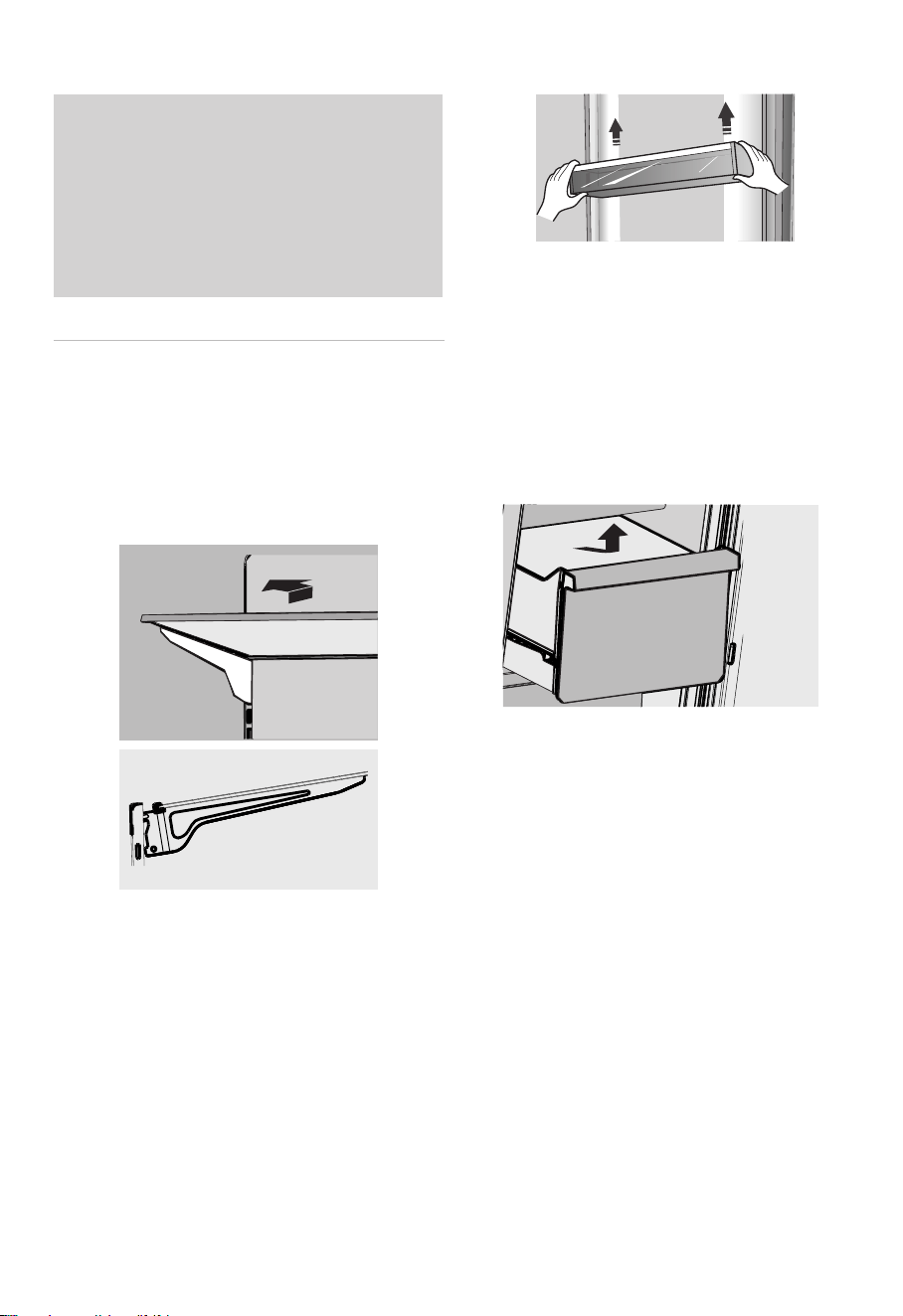
Adjustable Shelves
The height of the shelves can be adjusted to fit
your storage needs.
1. To remove a shelf, gently lift upward and then
pull the shelf forward until the end of the shel f
is past the rail support.
2. To reinstall a shelf, gently slide the shelf back
into the refrigerator compartment, and the n
lower the shelf onto the rail support.
Removable Door Bins
The bins located in the middle of the door are
adjustable.
To Remove and Replace a Door Bin:
1. Place hands on both sides of the bin and lift
upward.
2. Pull the door bin out.
3. Replace the door bin by inserting it above the
support and pressing down to snap into place.
Note: The quality of your ice will be only as
good as the quality of the water supplied to
your ice maker. Avoid connecting the ice maker
to a softened water supply. Water softener
chemicals (such as salt) can damage parts of
the ice maker and lead to poor quality ice. If a
softened water supply cannot be avoided,
make sure the water softener is operating
properly and is well-maintained.
Freezer Drawers
To Remove/Replace Freezer Drawer:
1. Pull out drawer to maximum extension.
2. Lift up to remove the drawer.
3. Reverse steps 1 and 2 to replace the drawer.
• When first turning on refrigerator after a
period of non-use, allow the refrigerator to
cool at least 2 hours before adding food.
• Do not block air circulation vents with stored
items.
• Store items so that the air can circulate
freely around them.
• Cover or wrap stored food well to avoid
transfer of odors.
• Once defrosted, food quality will deteriorate
rapidly. Defrosted food should not be refrozen.
• Neither bottled nor canned drinks should be
stored in the freezer compartment. Bottles
and cans may explode.
Features
Important information to know about glass shelves
and covers:
Do not clean glass shelves or covers with warm
water when they are cold. Shelves and covers
may break if exposed to sudden temperature
changes or impact, such as bumping. Tempered
glass is designed to shatter into many small,
pebble-size pieces. This is normal. Glass shelves
and covers are heavy. Use both hands when
removing them to avoid dropping.
Refrigerator
General Use Information
10
WARNING
Do not puncture refrigerant tubing.
Follow handling instructions carefully.
Flammable refrigerant used.
Failure to do so can result in death, explosion or fire.
Fire or Explosion Hazard
Refrigerator Care
Cleaning
Both the refrigerator and freezer sections defrost
automatically. However, clean both sections about
once a month to avoid buildup of odors. Wipe up
spills immediately. To avoid odor transfer and
drying out of food, wrap or cover foods tightly.
Explosion Hazard
Use nonflammable cleaner.
Failure to do so can result in death, explosion or fire.
IMPORTANT:
• Do not use harsh chemicals, ammonia, chlorine
bleach, concentrated detergent, solvents,
abrasives or metal scouring pads to clean your
refrigerator inside or out. They can damage
and/or discolor the refrigerator finish.
• Do not use warm water to clean glass shelves
while they are still cold. Glass may break when
exposed to sudden temperature changes or
impact.
WARNING
WARNING
Electrical Shock Hazard
Unplug your appliance or disconnect power before
cleaning.
Failure to do so can result in death, electric shock or
personal injury.
1. Unplug refrigerator or disconnect power.
2. Clean the interior.
Hand wash, rinse, and dry removable parts
and interior surfaces thoroughly. Use a clean
sponge or soft cloth and a mild detergent in
warm water.
3. Clean the door seals (gaskets). A dirty or
sticky door seal may adhere to the cabinet
and tear when you open the door.
Using a soft cloth and a solution of mild
detergent and warm water, hand wash the
door seals. Rinse with clear water and dry
thoroughly.
4. Clean the exterior surfaces.
Wash exterior surfaces with a clean, soft cloth
or sponge and a mild detergent in warm water.
Rinse surfaces with clean, warm water and dry
immediately to avoid water spots.
5. Plug in refrigerator or reconnect power.
IMPORTANT: Your refrigerator is equipped with
LED lighting. These lights are designed to last
for the life of your refrigerator. However, if the
lights stop operating, please contact a qualified
technician for replacement.
Vacation
If You Choose to Leave the Refrigerator On While
You’re Away:
1. Use up any perishables and freeze other
items.
If You Choose to Turn Off the Refrigerator Before
You Leave:
1. Remove all food from the refrigerator and
freezer.
2. Unplug refrigerator or disconnect power.
3. Clean refrigerator, wipe it, and dry well.
4. Tape rubber or wood blocks to the tops of
both doors to prop them open far enough for
air to get in. This stops odor and mold from
building up.
Lights
Vacation and Moving Care
Moving
IMPORTANT: Handle with care when moving
refrigerator to avoid either damaging the
refrigerant tubing or increasing the risk of a leak.
11
WARNING
Plug into a grounded 3 prong outlet.
Do not remove the ground prong from the power
cord plug.
Do not use an adapter.
Do not use an extension cord.
Failure to do so can result in death, fire or
electrical shock.
Electrical Shock Hazard
WARNING
Use two or more people to move and install
refrigerator.
Failure to do so can result in back or other injury
Excessive Weight Hazard
When you are moving your refrigerator to a new
home, follow these steps to prepare it for the
move.
1. Remove all food from the refrigerator and
pack all frozen food in dry ice.
2. Unplug refrigerator.
3. Clean, wipe, and dry thoroughly.
4. Take out all removable parts, wrap them well,
and tape them together so they don’t shift and
rattle during the move.
5. Raise the leveling legs so they don’t scrape
the floor . See “Level Refrigerator.”
6. Tape the doors closed and tape the power
cord to the back of the refrigerator. When
you get to your new home, put everything
back and refer to the “Installation Instructions”
section for preparation instructions.
If the refrigerator has been placed in a horizontal
or tilted position for any period of time wait 4
hours before plugging it in to allow the oil to
settle into the compressor.
1. Clean refrigerator. See “Cleaning.”
2. Place refrigerator in desired location and
level.
Reinstalling/Using Refrigerator Again
3. Plug into grounded 3 prong outlet.
12
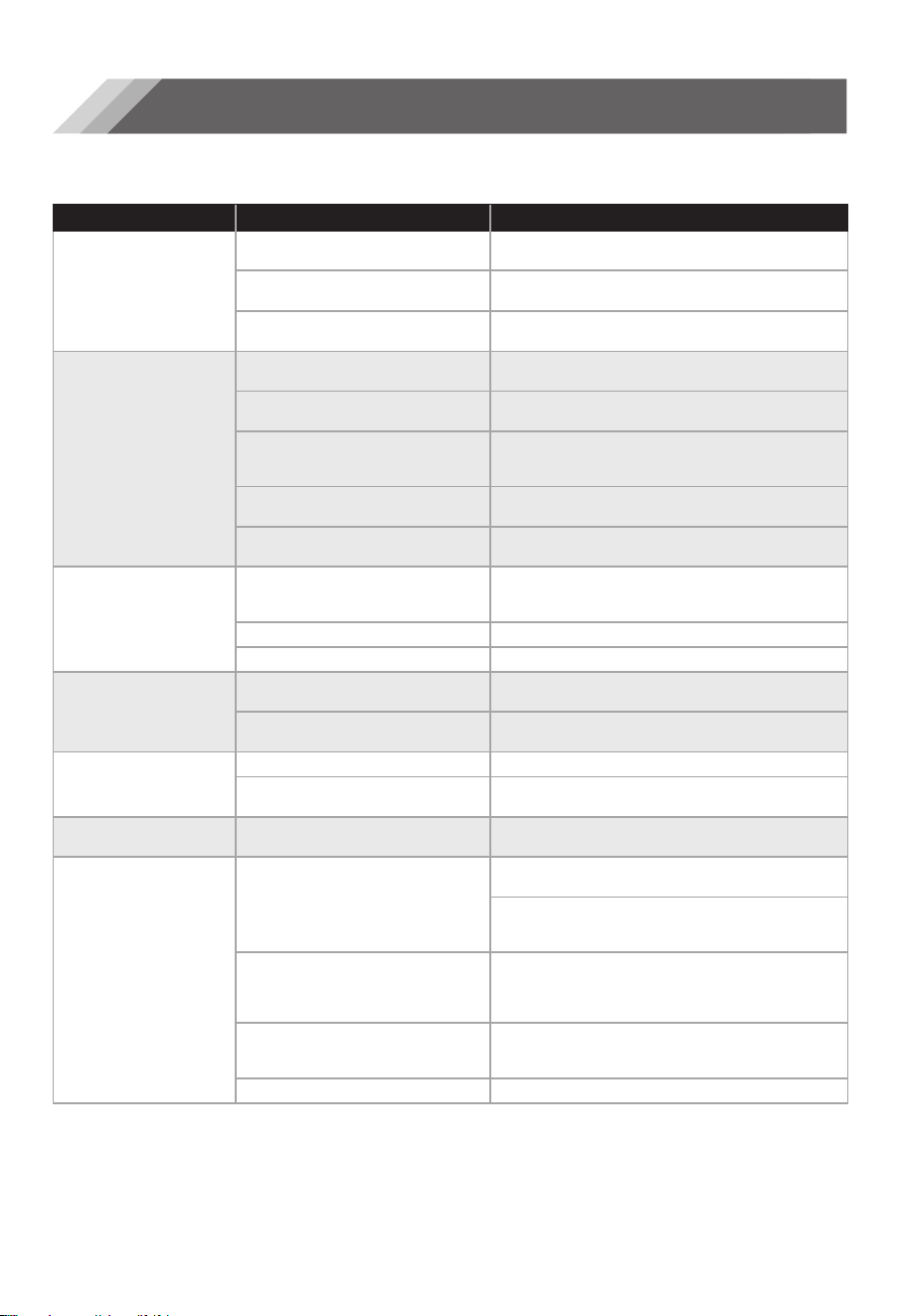
PROBLEM POSSIBLE CAUSE(S) SOLUTION
Refrigerator does not
run
Refrigerator
compressor runs
frequently or for long
periods of time
Note: This
refrigerator is
designed to run for
longer periods of time
at a lower energy
usage.
Refrigerator has an
odor
Light does not come
on
Doors do not close
properly
Vibration or rattling
Normal Sounds
Refrigerator is unplugged.
Breaker is tripped or turned off,
or fuse is blown.
Refrigerator is in defrost mode.
Refrigerator is first plugged in.
Warm or large amounts of food
added.
Door is left open, or refrigerator
is not level.
Hot weather or frequent
openings.
Temperature control set to
coldest setting.
Food is not sealed or packaged
properly.
Interior needs to be cleaned.
Food stored too long.
Refrigerator is unplugged.
LED light is burned out.
Refrigerator is not level.
Something is obstructing door
closure.
Refrigerator is not resting firmly
on floor.
It sounds like water is flowing
from the refrigerator.
Humming or buzzing sounds
Cracking or clicking sounds
Popping noise
Plug refrigerator into a grounded 3 prong
outlet.
Reset/Turn on breaker or replace fuse.
Wait for defrost cycle to end and cooling
system to restart.
This is normal. Allow 24 hours for the
refrigerator to cool down.
This is normal.
Check that an item is not preventing door
from closing. Level the refrigerator. See
“Level Refrigerator.”
This is normal.
Adjust temperature to a warmer setting.
Reseal packaging. Place an opened box of
baking soda in the refrigerator, replace every
3 months.
Clean the interior. See “Cleaning.”
Dispose of spoiled food.
Plug refrigerator into a grounded 3 prong
outlet.
Contact a qualified technician to replace the
burned out LED.
See “Level Refrigerator.”
Check for and remove obstructions.
See “Level Refrigerator.”
Refrigerant flowing in the lines will make this
sound when the compressor starts and stops.
The refrigerator has an automatic defrosting
system. The defrosted water will make this
sound.
The compressor and fans used for cold
air circulation can make this sound. If the
refrigerator is not level, the sound will be
louder.
The interior parts will make this sound as
they contract and expand in response to
temperature changes.
May occur during automatic defrosting.
Troubleshooting
Try the solutions suggested here first in order to avoid the cost of an unnecessary service call.
Refrigerator is Not Operating
13
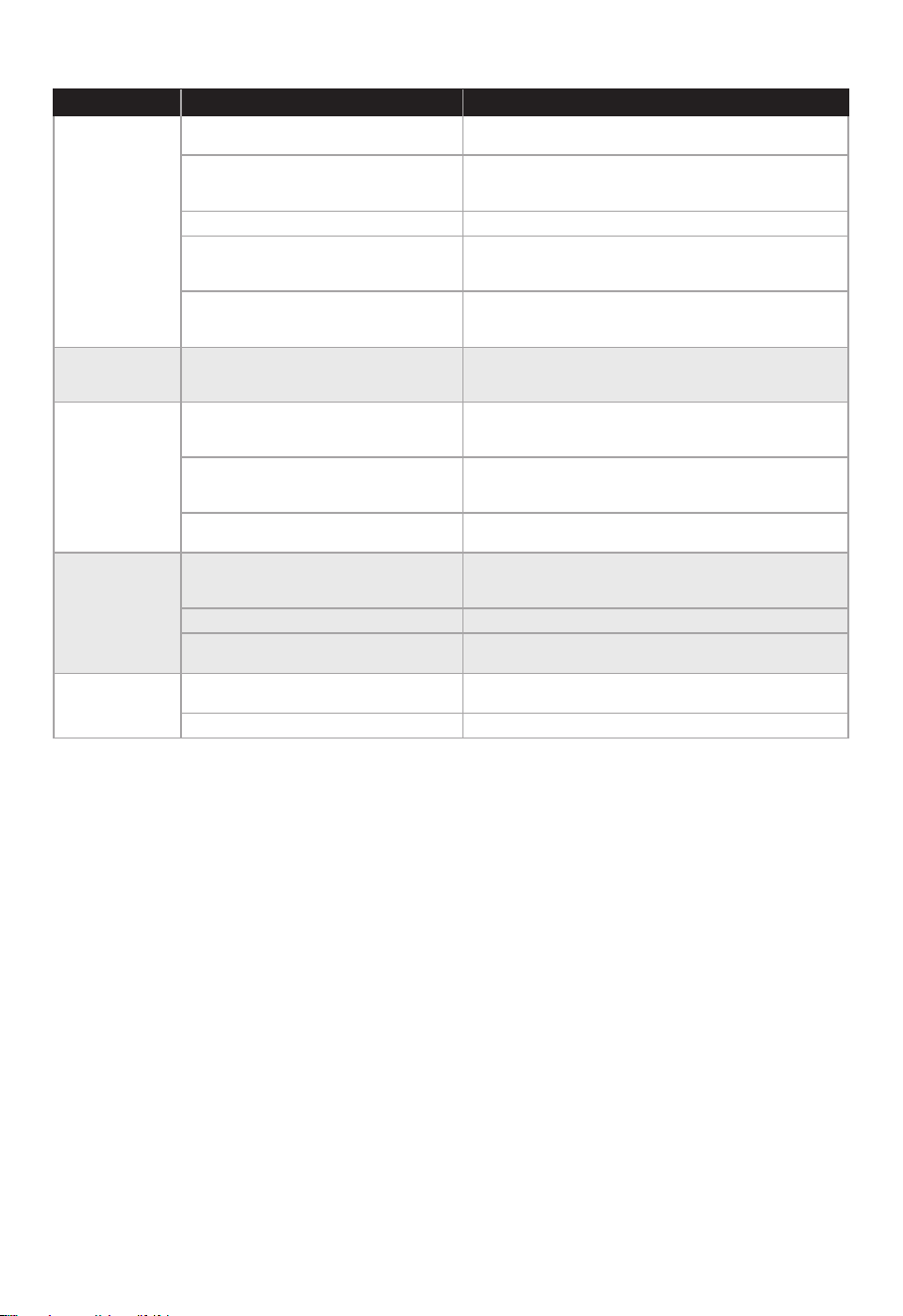
Temperature and Moisture
Refrigerator or
freezer is too
warm
Refrigerator or
freezer is too
cold
Moisture on
exterior/
interior of
refrigerator
Frost or ice
crystals on
frozen food
Food freezing
in refrigerator
Temperature control is not set cold
enough.
Doors opened frequently or left
open.
Warm food added recently.
The space between the back of
the refrigerator and the wall is too
close.
Items against back of
compartments are blocking proper
airflow.
Temperature control is set too cold.
High humidity
Doors opened frequently or left
open.
Open container of water in
refrigerator.
Freezer door left open or opened
frequently.
Refrigerator is not level.
Items blocking freezer air vents and
preventing proper air flow.
Food placed too close to the air
vent.
Temperature control set too cold.
Adjust the compartment to a colder setting;
allow 24 hours for the temperature to adjust.
Limit door openings to maintain the internal
temperature. Check that an item is not
preventing door from closing.
Allow time for food and refrigerator to cool.
Allow 5 cm space between the back of the
refrigerator and the wall.
Store items only inside the trim of the glass
shelves; don’t place items against sides of the
compartments or directly in front of any vents.
Adjust temperature in the compartment to
the next warmer setting; allow 24 hours for
temperature to adjust.
This is normal during times of high humidity.
Dry surface and adjust temperature to a slightly
colder setting.
Keep door closed. Check that an item is not
preventing the door from closing. Level the
refrigerator. See “Level Refrigerator.”
Cover or seal container
Limit door openings to maintain the internal
temperature. Check that an item is not
preventing door from closing.
Level the refrigerator. See “Level Refrigerator.”
Move items away from rear wall.
Move items away from back and top of the
refrigerator.
Adjust the temperature to a less cold setting.
PROBLEM POSSIBLE CAUSE(S) SOLUTION
14