
INSTALLATION GUIDE / USER GUIDE
US CA
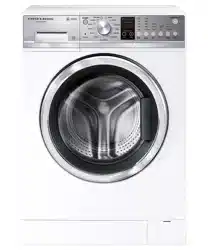
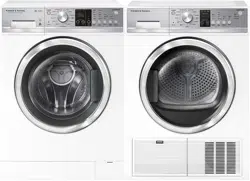
WH2424F & WH2424P
models
FRONT LOADING CONDENSER
CLOTHES WASHER


3
CONTENTS
Registration
To register your product visit our website: fisherpaykel.com/register
Introduction 5
Safety and warnings 6
Installation instructions 9
Before you do your first wash 19
Getting started 20
Washer controls 24
Safety features 25
Sorting and loading 26
Detergent and fabric softener 28
Wash cycles 32
Wash cycle options 34
Caring for your washer 39
Before you call for service 42
Fault codes 44
Troubleshooting 45
Limited Warranty 51

5
Welcome
Thank you for buying a Fisher & Paykel clothes washer. We are proud of this washer and
trust it will serve you well for many years.
At Fisher & Paykel we aim to provide innovative products that are simple to use, ergonomic
and kind to the environment. Your washer has numerous wash cycles and options so you
can perform every wash task with ease and the knowledge your clothes are receiving the
best possible care.
Please take the time to read these instructions carefully before you begin using your
machine.
Following the advice in this User guide will ensure you get the performance you expect
from your machine and that you get the best possible wash results. Keep these instructions
for future reference.
We hope you enjoy your new washer. We have certainly enjoyed designing it for you.
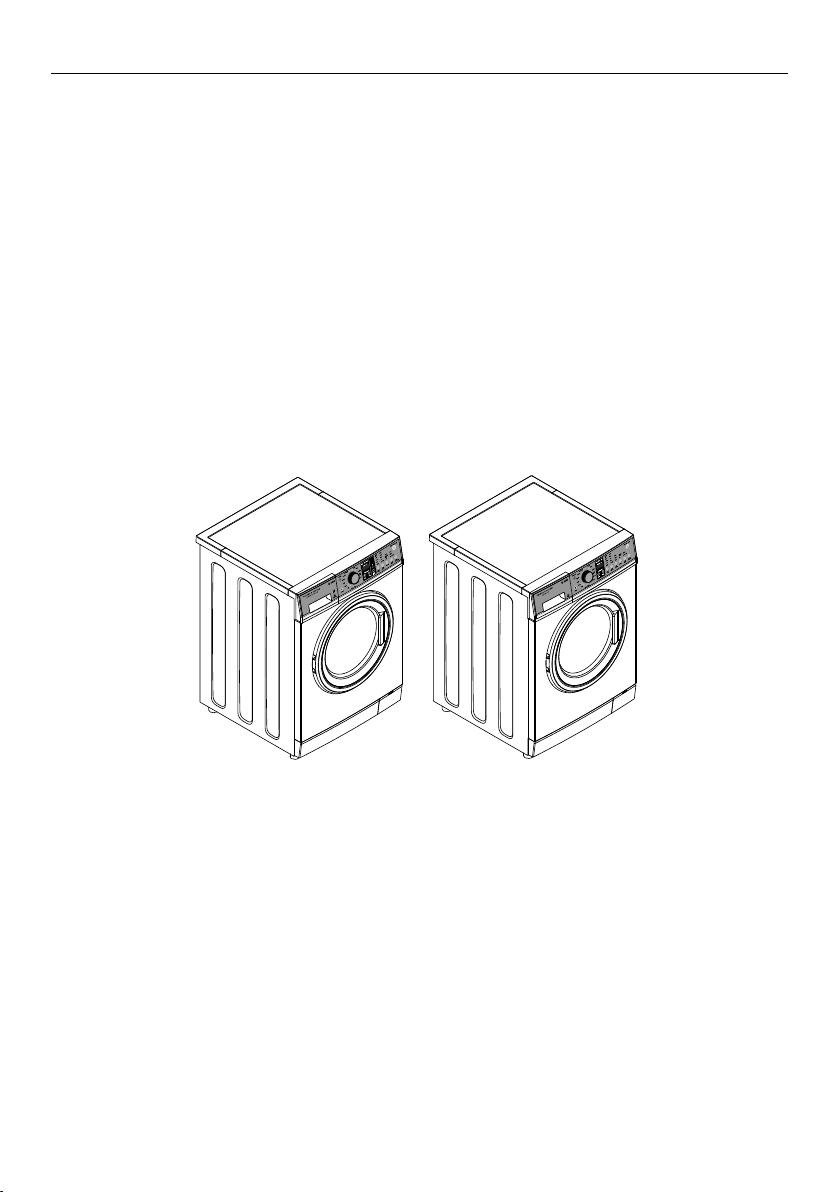
Front loading washer models
INTRODUCTION
6
SAFETY AND WARNINGS
READ AND SAVE THIS GUIDE
Many washers are located near a gas dryer or a water heater in the home.
!
WARNING!
Risk of Fire Hazard
z
For your safety the information in this manual must be followed to
minimize the risk of fire or explosion or to prevent property damage,
personal injury or loss of life.
z
Do not store or use gasoline or other flammable vapors and liquids in
the vicinity of this or any other appliance.
z
Installation and service must be performed by a qualified installer,
service agency or the gas supplier.
What to do if you smell gas
z
DO NOT try to light any appliance.
z
DO NOT touch an electrical switch; do not use any phone in your building.
z
Clear the room, building or area of all occupants.
z
Immediately call your gas supplier from your neighbor’s phone.
Follow the gas supplier’s instructions.
z
If you cannot reach your gas supplier, call the fire department.
Water heater safety
Under certain conditions Hydrogen gas may be produced in a water heater that has not
been used for two weeks or more.
HYDROGEN GAS CAN BE EXPLOSIVE UNDER THESE CIRCUMSTANCES.
If the hot water has not been used for two weeks or more, prevent the possibility of
damage or injury by turning on all hot water faucets and allowing them to run for several
minutes before using any electrical appliance which is connected to the hot water system.
This will allow any hydrogen gas to escape. Since the gas is flammable, do not smoke or use
an open flame or appliance during this process.
7
SAFETY AND WARNINGS
!
WARNING!
Risk of Fire, Electric Shock and Injury to Persons Hazards
●
Follow the safety precautions outlined in this User guide.
●
Failure to do so can result in death, electric shock, fire or injury to
persons.
WARNING!
When using your clothes washer, follow basic precautions, including thefollowing:
z
Read all instructions before using the appliance.
z
This clothes washer is not intended for use by persons (including children) with
reduced physical, sensory or mental capabilities, or lack of experience and knowledge,
unless they are supervised or given instructions on how to use the washer by someone
responsible for their safety.
z
DO NOT wash or dry articles that have been previously cleaned in, washed in, soaked
in or spotted with gasoline, dry-cleaning solvents, or other flammable or explosive
substances, as they give off vapors that could ignite or explode.
z
DO NOT add gasoline, dry-cleaning solvents, or other flammable or explosive
substances to the wash water. These substances give off vapors that could ignite or
explode.
z
Under certain conditions, hydrogen gas may be produced in a hot-water system that
has not been used for 2 weeks or more. HYDROGEN GAS IS EXPLOSIVE. If the hot
water system has not been used for such a period, before using a washing machine,
turn on all hot-water faucets and let the water flow from each for several minutes. This
will release any accumulated hydrogen gas. As the gas is flammable, DO NOT smoke or
use an open flame during this time.
z
DO NOT allow children to play on or in this appliance. Close supervision of children
is necessary when this appliance is used near children. Before the washer is removed
from service or discarded, remove the door. Failure to follow these instructions may
result in death or injury to persons.
z
DO NOT reach into the appliance if the tub or agitator is moving to prevent accidental
entanglement.
z
DO NOT install or store this appliance where it will be exposed to the weather.
z
DO NOT tamper with controls, repair or replace any part of the appliance or attempt
any servicing unless specifically recommended in this User guide or in published user
repair instructions that you understand and have skills to carry out.
z
DO NOT operate this appliance if it is damaged, malfunctioning, partially disassembled,
or has missing or broken parts including a damaged cord or plug.
z
Unplug the appliance or turn off the circuit breaker before servicing. Pressing the
Power button DOES NOT disconnect power.
z
Refer to the ‘Electrical connection’ section located in the installation instructions for
grounding instructions.

8
SAFETY AND WARNINGS
z
Use this appliance only for its intended purpose as described in this User guide.
z
Connect to a properly rated, protected and sized power supply circuit to avoid
electrical overload.
z
Connect to adequate plumbing and drain facilities as described in the Installation
Instructions.
z
When disconnecting the appliance pull by the plug rather than the cord or junction of
cord to avoid damage to the cord or junction of the cord and plug.
z
Make sure that the cord is located so that it will not be stepped on, tripped over or
otherwise subject to damage or stress.
z
A damaged power cord must be replaced by a Fisher & Paykel trained and supported
service technician or similarly qualified person in order to avoid a hazard.
z
Keep all laundry aids (such as detergents, bleach, fabric softener, etc.) out of the reach
of children, preferably in a locked cabinet. Observe all warnings on container labels to
avoid personal injury.
z
Keep the area around/underneath your appliance free from the accumulation of
combustible materials, such as lint, paper, rags, chemicals, etc.
z
Keep the floor around your appliance clean and dry to reduce the possibility of
slipping.
z
Before unloading or adding clothes, press and wait until the washer has completely
stopped before opening the door.
z
Do not leave washer door open during the cycle. The washer will not function. To start
close door and press .
z
The laundry process can reduce the flame retardancy of fabrics. To avoid such a result,
the garment manufacturer’s care instructions should be followed very carefully.
z
Do not mix chlorine bleach with ammonia or acid such as vinegar and/or rust remover.
Mixing can produce a toxic gas which may cause death.
z
Never climb on or stand on the washer top.
z
Do not wash fiberglass articles in your washer. Skin irritation could result from the
remaining particles that may be picked up by clothing during subsequent washer use.
z
Do not touch the glass part of the door during a cycle as the door can become hot.
WARNING!
This product contains a chemical known to the State of California to cause cancer, birth
defects or other reproductive harm.
For more information on these regulations and a list of chemicals, visit:
https://oehha.ca.gov/proposition-65/general-info/proposition-65-plain-language.
SAVE THESE INSTRUCTIONS
9
INSTALLATION INSTRUCTIONS
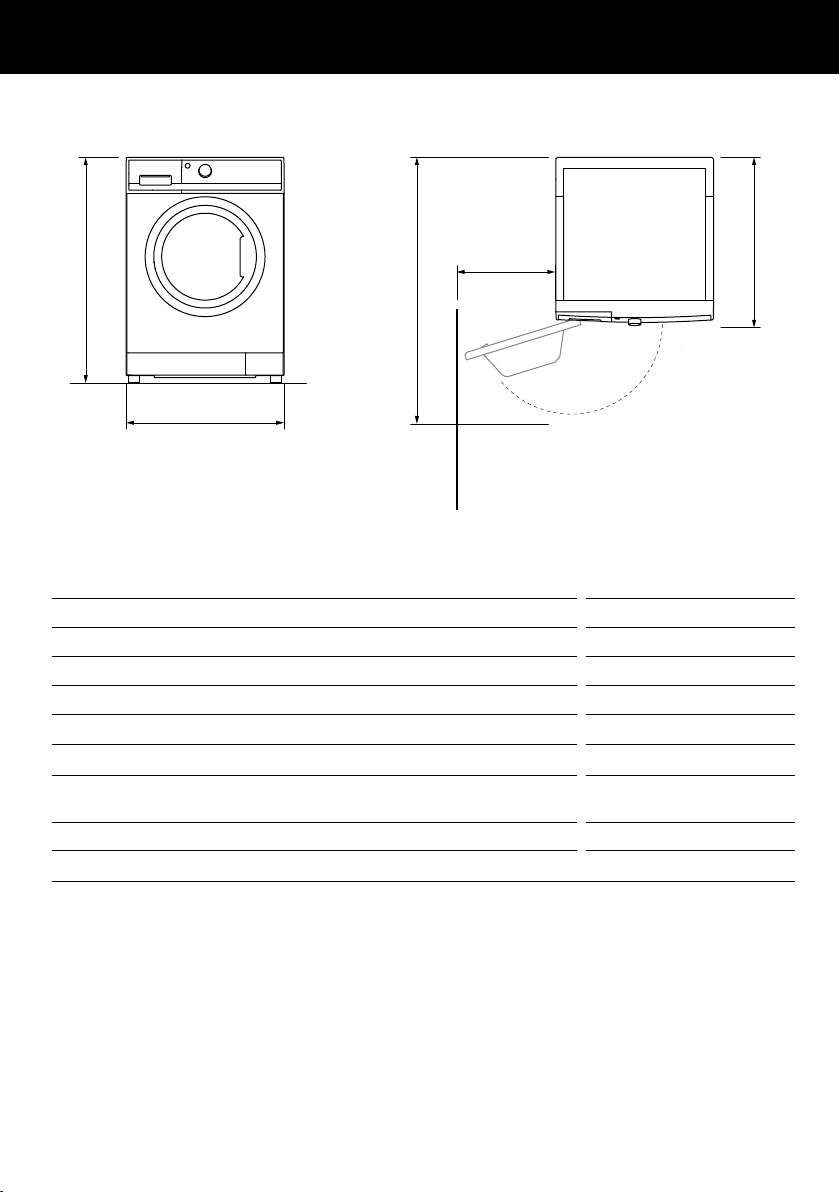
Product dimensions
WH2424F & WH2424P
PRODUCT DIMENSIONS
INCHES (MM)
A Overall height of product
331/2” (850)
B Overall width of product
235/8” (600)
C Overall depth of product (including dial and door whenclosed)
255/8” (645)
D Depth of door open
42” (1065)
E Minimum door clearance to adjacent wall
13” (330)
Standpipe height
min. 311/2” – 471/4”
(min. 800–1200)
CAPACITY
2.4 cu ft
Note: the exact height of your washer is dependent on how far the feet are extended from
the base of the machine. The space where you install your washer needs to be at least
13/5” (40mm) wider and 3/4” (20mm) deeper than its dimensions.
z
Electrical supply: 2 wire plus ground, 120V, single phase, 60Hz, alternating current.
z
For WH2424P2 washer mode, the power cord plug is compatible with the power socket
of DE4024P2 dryer model.
z
Inlet water static pressure: Max. (120psi), Min. 10psi.
z
Inlet water flow rate at faucet: Min. 11/2 gallons/min (6liters/min).
E
D
A
B
C
TOP VIEWWallFRONT VIEW
INSTALLATION INSTRUCTIONS

10
INSTALLATION INSTRUCTIONS
Accessories
Please check you received the following accessories with your Fisher & Paykel washer. You
will find them inside the drum or attached to the packaging.
z
2 x Inlet hoses
z
1 x Drain hose guide
z
1 x Installation instructions and User guide
z
1 x Wrench
z
1 x Installation leaflet (attached to the top of the washer)
Unpacking
WARNING!
Recycle or destroy the carton and plastic bags after the washer is unpacked. Make materials
inaccessible to children. Children might use them for play. Cartons covered with rugs,
bedspreads or plastic sheets can become airtight chambers causing suffocation.
To ensure the best performance from your new washer please follow the instructions below.
Removing the packaging:
1 Remove the outer packaging. Note: a small amount of water may be seen inside the
packaging and inside the washer. This is the result of factory testing and is normal.
2 Tilt the machine backwards and ‘walk’ it off the base one foot at a time. Not doing so
may cause damage to your floor and washer.
3 Remove all packaging and accessories from inside the drum. Note: DO NOT remove
the screw or clip holding the hose.
Removing the transit bolts
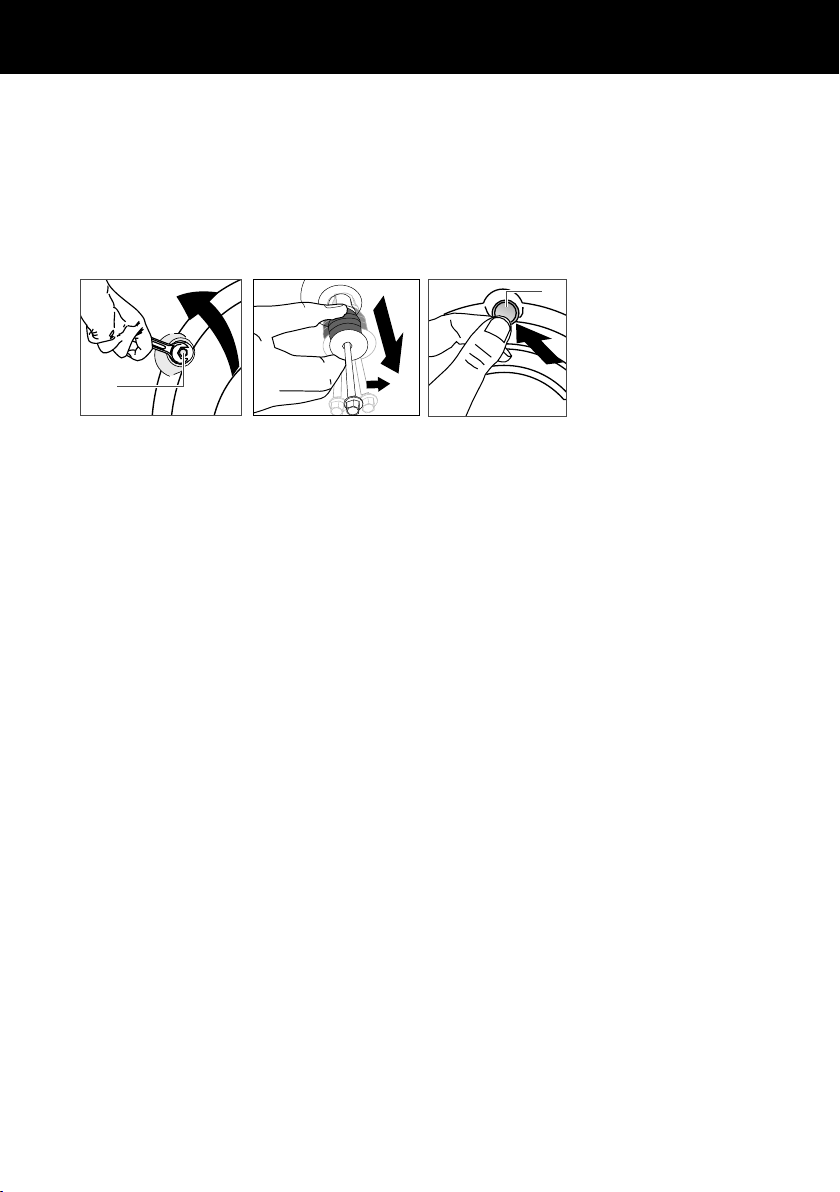
The clothes washer is fitted with 4 transit bolts at the rear to avoid damage during
transportation.
IMPORTANT!
The 4 transit bolts MUST be removed prior to operation of the machine. Failure to remove
these will result in damage to the machine.
11
INSTALLATION INSTRUCTIONS
To remove the bolts:
1 Use a wrench or socket to unscrew and remove all four transit bolts at the back of the
washer (A).
2 Pull the black rubber grommets to remove the bolt, grommet and black plastic spacers
from the machine. Keep the transit bolts in case they are required for future transit of the
machine. Never transport the machine without the transit bolts properly fixed in place.
3 Cover the bolt holes with the white plastic covers which are attached to the machine
and located near each hole (B). Push to clip into place.
A
B
Removing the transit safety bolts
Location
IMPORTANT!
Install the machine on a solid and level floor surface ensuring it has at least 3/4”
(20mm) clearance on each side. The washer must not be installed on any textured
floor coverings (eg carpet, rugs).
DO NOT install the washer:
1
In an area exposed to dripping water or outside weather conditions. The ambient
temperature should never be below 60°F (15.6°C) for proper washer operation.
2
In an area where it will come in contact with curtains or drapes.
3
On carpet. The floor MUST be a hard surface with a maximum slope of 1/2” per foot
(1.27cm per 30cm). To make sure the washer does not vibrate or move, you may have to
reinforce the floor.
Note: if floor is in poor condition, use 3/4” (20mm) impregnated plywood sheet solidly
attached to existing floor covering.
IMPORTANT!
Minimum installation clearances
●
When installed in alcove: Sides, Rear, Top = 1” (2.54cm)
●
When installed in closet: Sides, Rear, Top = 1” (2.54cm), Front = 1” (2.54cm)
●
Consideration must be given to provide adequate clearance for installation and service.
●
Closet doors must be louvered or otherwise ventilated and have at least 60 square
inches (387.1 cm
2
) of open area. If the closet contains both a washer and a dryer, doors
must contain a minimum of 120 square inches (774.2cm
2
) of open area.
Note: this machine must not be installed and operated on a plinth.
12
INSTALLATION INSTRUCTIONS
Installing the washer
1
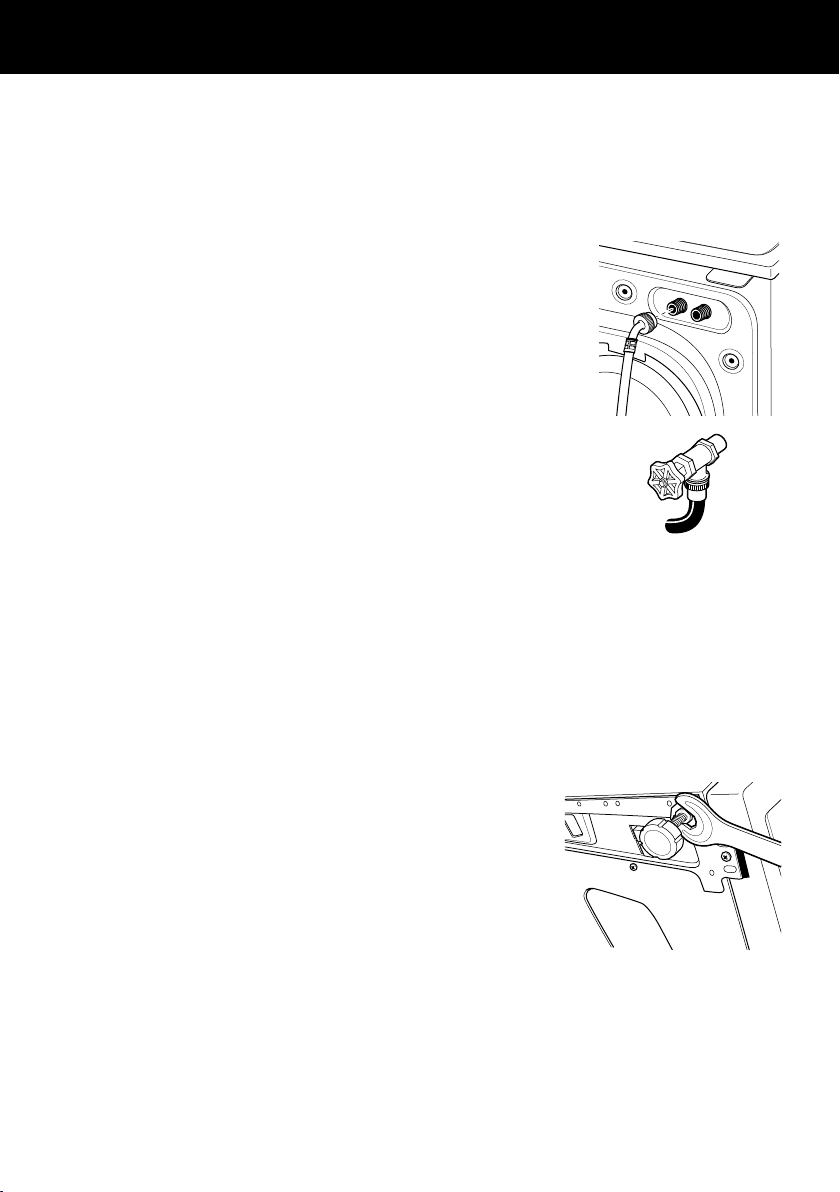
Run some water from the hot and cold faucets to flush
the water lines and remove particles that might clog the
water valve screens.
2
Remove the inlet hoses from the plastic bag. Remove
black rubber washers from bag and insert into hose
fitting before connecting to unit.
3
90° elbow end – Carefully connect the inlet hose marked
HOT to the outside “H” outlet of the water valve. Tighten
by hand; then tighten another 2/3 turn with pliers.
Carefully connect the other inlet hose to the inside “C”
outlet of the water valve. Tighten by hand; then tighten
another 2/3 turn with pliers. Do not cross-thread or
overtighten these connections.
4
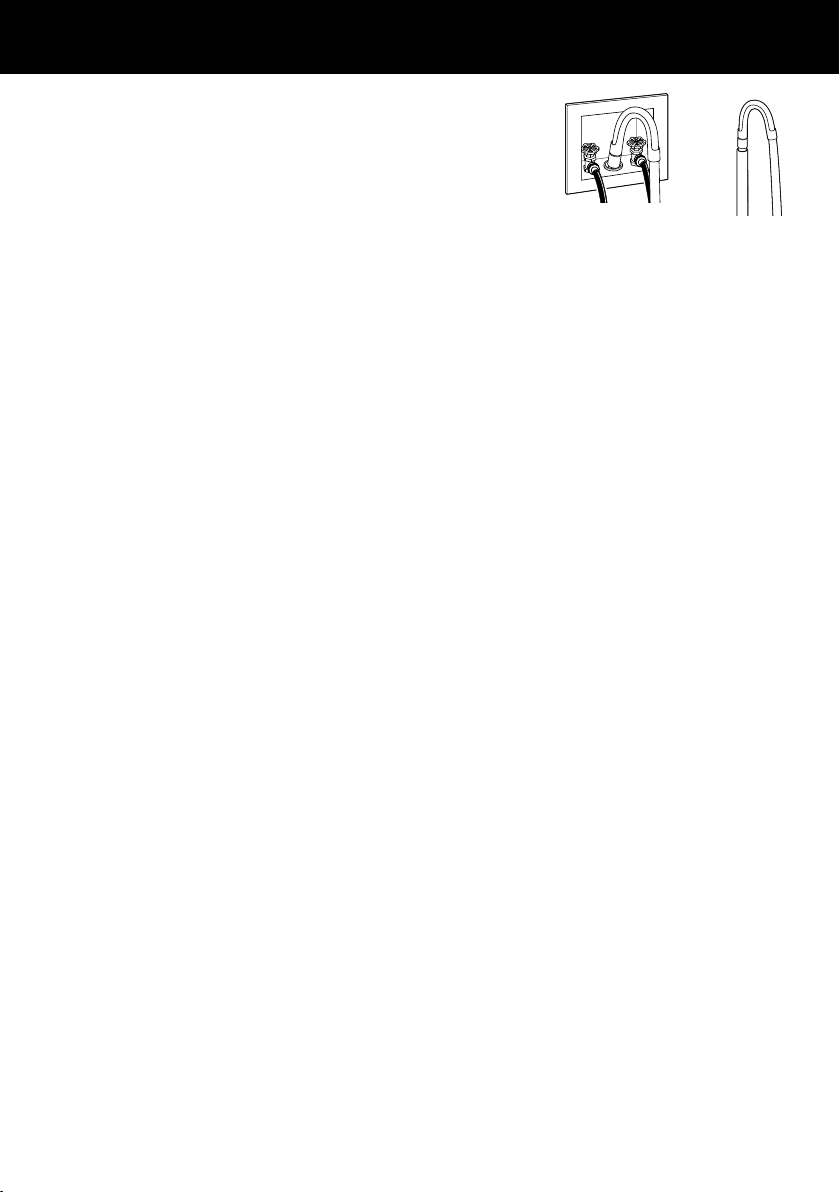
Connect the inlet hose ends to the HOT and COLD water
faucets tightly by hand; then tighten another 2/3 turn
with pliers. Turn the water on and check for leaks.
5
Carefully move the washer to its final location. Gently
rock the washer into position. It is important not to
damage the rubber leveling legs when moving your
washer to its final location. Damaged legs can increase
washer vibration. It may be helpful to spray window
cleaner on the floor to help move your washer into its
final position.
Note:
●
To reduce vibration, ensure that all four rubber leveling
legs are firmly touching the floor. Push and pull on the
back right and then back left of your washer.
●
Do not use the dispenser drawer or door to lift the
washer.
●
If you are installing into a drain pan, you can use a
24-inch-long 2x4 to lever the washer into place.
6
With the washer in its final position, place a level on top
of the washer (if the washer is installed under a counter,
the washer should not be able to rock). Adjust the front
leveling legs up or down to ensure the washer is resting
solidly. Turn the locknuts on each leg up toward the base
of the washer and snug with a wrench.
Note: keep the leg extension at a minimum to prevent
excessive vibration. The farther out the legs are
extended, the more the washer will vibrate.
If the floor is not level or is damaged, you may have to
extend the rear leveling legs.
Inlet hoses
Locking the feet
13
INSTALLATION INSTRUCTIONS
7
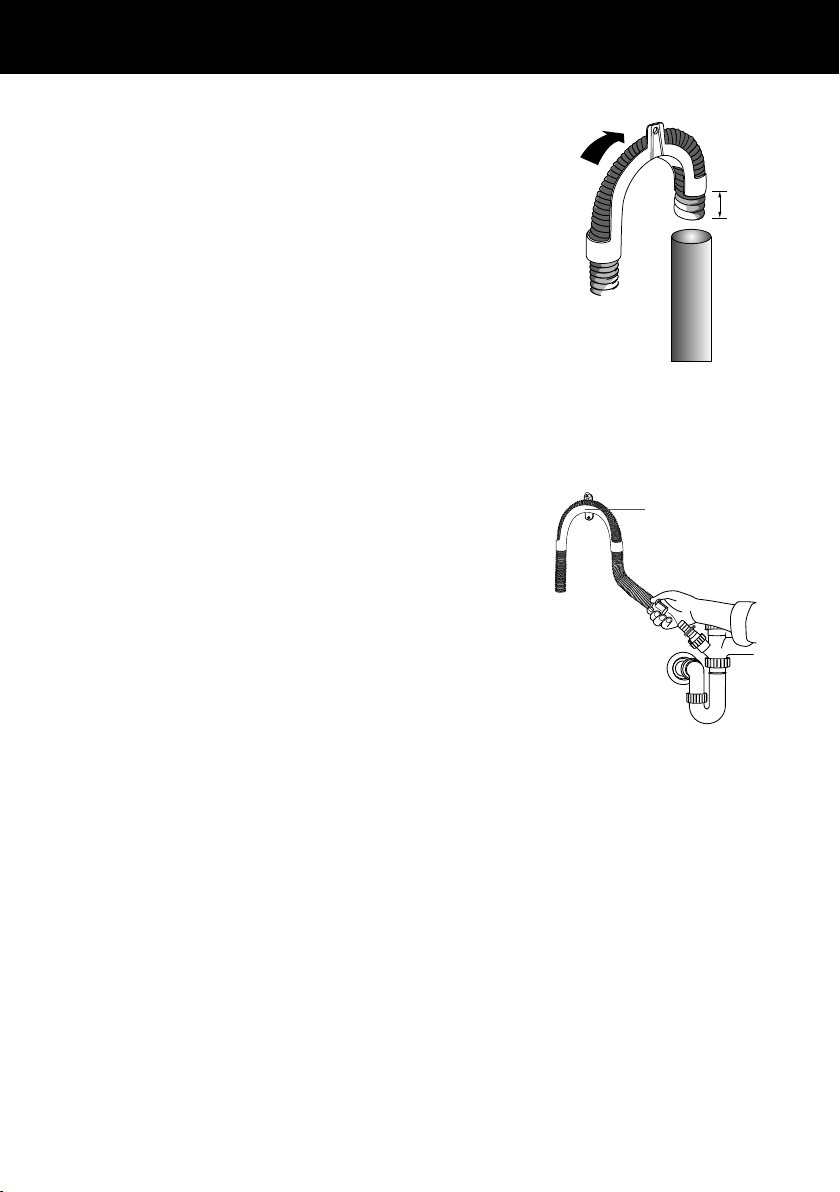
Attach U-shaped hose guide to the end of the drain
hose. Place the hose in a standpipe.
Note: if the drain hose is placed in a standpipe
without forming a U shape, a siphoning action could
occur. There must be an air gap around the drain hose.
A snug hose fit can also cause a siphoning action.
Note: do not place drain hose deeper than 7” (177.8mm) into the drain. The suggested
depth is 4–7” (101.6–177.8mm). Deeper than 7” (177.8mm) can cause a siphoning action.
8
Plug the power cord into a grounded outlet.
Note: check to be sure the power is off at the circuit breaker/fuse box before plugging
the power cord into an outlet.
9
Turn on the power at the circuit breaker/fuse box.
!0
Read the rest of this User guide. It contains valuable and helpful information that will
save you time and money.
!1
Before starting the washer, check to make sure:
●
Main power is turned on.
●
The washer is plugged in.
●
The water faucets are turned on.
●
The unit is level and all four leveling legs are firmly on the floor.
●
The shipping support hardware is removed and saved.
●
The drain hose is properly tied up.
●
There are no leaks at the faucet, drain line or washer.
!2
Run the washer through a complete cycle. Check for water leaks and proper operation.
!3
If your washer does not operate, please review the ‘Troubleshooting’ section before
calling for service.
!4
Place these instructions in a location near the washer for future reference.
IMPORTANT!
●
The hot water temperature should not exceed 149°F (65°C) and the cold water
temperature not exceed95°F (35°C). Temperatures above these may cause the
machine to fault or cause damage to the machine.
●
New hose sets provided with the washer should be used to connect the washer to the
water mains.
●
Old hose sets should not be re-used.
●
We recommend the inlet hose(s) are changed every 5 years. WARNING: Failure to do
so may result in a flood and damage to property.
Installing the drain hose

14
INSTALLATION INSTRUCTIONS
If you have an uncontrolled water heating source (eg a wet back or solar heating
system) you should fit a tempering valve. This will ensure the hot water temperature
remains within safe limits.
Contact your registered plumber to select and install the tempering valve.
IMPORTANT!
●
This appliance must be installed in accordance with the installation instructions before use.
●
Provide accessibility to the plug or incorporate a switch in the fixed wiring in
accordance with the wiring rules to allow disconnection of the appliance from the
supply after installation.
Water supply requirements
Hot and cold water faucets MUST be installed within 42” (107cm) of your washer’s
water inlet. The faucets MUST be 3/4” (1.9cm) garden hose-type so inlet hoses can be
connected. Water pressure MUST be between 10 and 120 pounds per square inch. Your
water department can advise you of your water pressure. The hot water temperature
should be set to deliver water at 120° to 140°F (48°–60°C) to provide proper
Automatic Temperature Control (ATC) performance.
15
INSTALLATION INSTRUCTIONS
Draining
Drain hose placement in a stand pipe or tub:
1
To guide the drain hose over the tub or standpipe
the hose guide must be fitted to the drain hose.
The height of the standpipe or tub should be
between 311/2”–471/4” (800–1200mm).
2
Secure the hose guide so it cannot become
dislodged from the standpipe or tub.
IMPORTANT!
●
If the drain hose is placed on the ground or if the
standpipe or tub is less than 311/2” (800mm)
high, the washing machine will continuously drain
while being filled (siphon).
●
Regularly check that your standpipe or tub is free
from lint or other obstructions, which may affect
how your machine works or may cause flooding.
Attaching drain hose to spigot:
1
Guide drain hose through hose guide
2
Secure hose guide to back wall of cupboard using
a screw. The height of the drain hose should be
between 197/8”–311/2” (500–800mm) from
ground level.
3
Attach drain hose to spigot and secure using a
hose clamp ensuring the blanking insert is cleared
from spigot.
4
Check for leaks.
●
The drain hose should be checked from time to
time and replaced if any damage (egwear, cuts,
bulges, kinks, leaks, etc) is found. Do not bend the
drain hose sharply, as this may cause it to split.
●
In multi-storey apartments or any upper floor, the
machine should be installed on a floor equipped
with a drain.
●
Draining must comply with local by-laws.
Mobile home installation:
Installation must conform to Standard for Mobile Homes, ANSI A119.1 and National Mobile
Home Construction and Safety Standards Act of 1974 (PL93-383).
Fitting the drain hose guide
3/4”
(20mm)
maximum
Standpipe 311/2”-471/4”
(800 – 1200mm)
Pull hose
through
guide
Attaching drain hose to spigot
Height 197/8”–311/2”
(500 – 800mm)
from ground
16
INSTALLATION INSTRUCTIONS
Electrical connection
!
WARNING!
Electric Shock Hazard
●
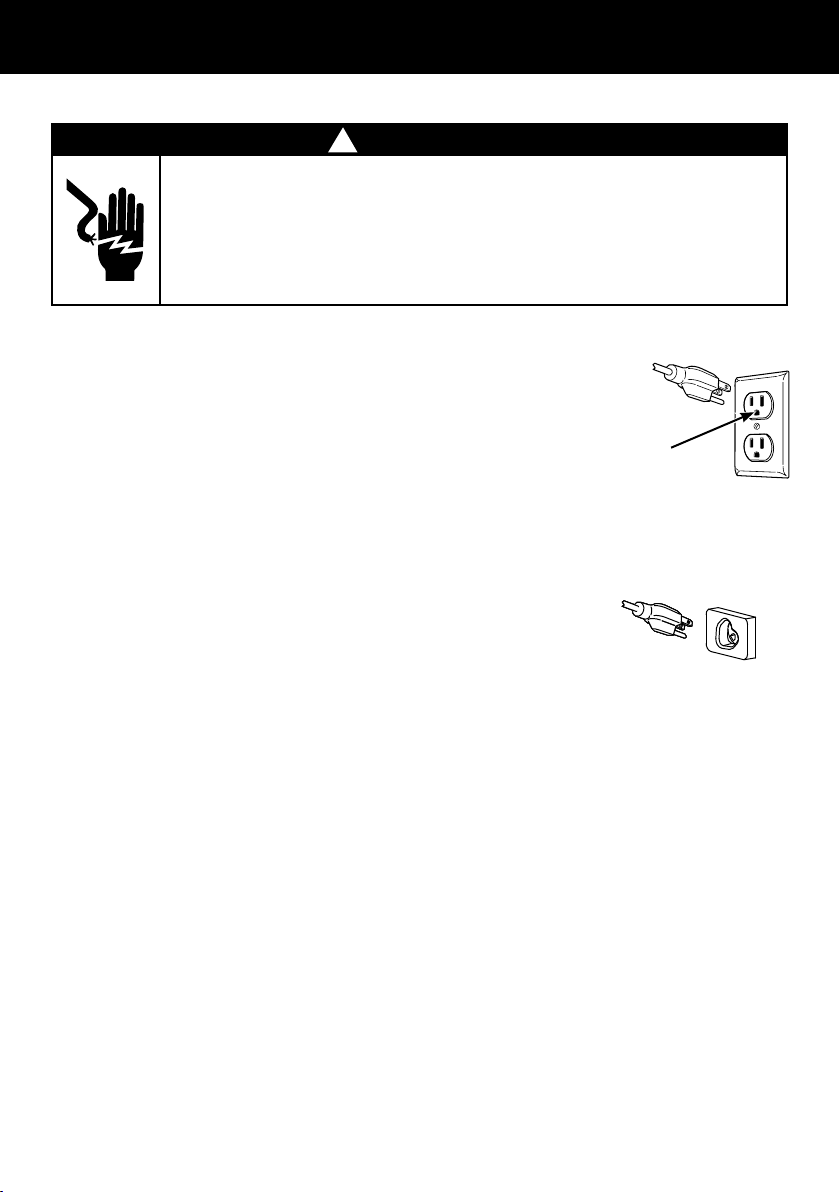
Plug into a grounded 3-prong outlet
●
DO NOT remove ground prong.
●
DO NOT use an adapter.
●
DO NOT use an extension cord.
●
Failure to follow these instructions can result in death, fire or
electricalshock.
Circuit
Individual, properly polarized and grounded 15 or 20amp circuit
breaker or time-delay fuse.
Power supply
2 wire plus ground, 120 Volt, single phase, 60 Hz, alternating current.
Outlet receptacle
Properly grounded 3-prong receptacle to be located so the power
cord is accessible when the washer is in an installed position. If a
2-prong receptacle is present, it is the owner’s responsibility to have a licensed electrician
replace it with a properly grounded 3-prong grounding type receptacle.
For WH2424P2 model
The power cord plug is compatible with the power socket of
DE4024P2 dryer model.
Grounding instructions
This appliance must be grounded. In the event of malfunction or breakdown, grounding
will reduce the risk of electric shock by providing a path of least resistance for electric
current. This appliance is equipped with a cord having an equipment-grounding conductor
and a grounding plug. The plug must be plugged into an appropriate outlet that is properly
installed and grounded in accordance with all local codes and ordinances.
WARNING!
Improper connection of the equipment-grounding conductor can result in a risk of
electric shock. Check with a qualified electrician or serviceman if you are in doubt as to
whether the appliance is properly grounded.
Do not modify the plug provided with the appliance - if it will not fit the outlet, have a
proper outlet installed by a qualified electrician
Ensure proper
ground exists
before use.

17
INSTALLATION INSTRUCTIONS
Washer must be electrically grounded in accordance with local codes and ordinances, or
in the absence of local codes, with latest edition of the NATIONAL ELECTRICAL CODE,
ANSI/NFPA NO. 70 or CANADIAN ELECTRICAL CODE, CSA C22.1. Check with a licensed
electrician if you are not sure that the washer is properly grounded.
1 Uncoil the power cord, remove and discard the plastic pin cover and plug into a
wallsocket.
2 Connect the appliance to an earthed outlet protected by a fuse of suitable capacity.
z
Check the power cord for damage and make sure it is not deformed or twisted when
installing the washer.
z
Always remove the power cord from a socket by the plug, not by the cord.
IMPORTANT!
z
If you are using an extension cord or a portable electrical outlet device (eg multi-socket
outlet box), ensure that it is positioned so that it does not come into contact with water
or moisture. FAILURE TO DO SO MAY RESULT IN DEATH OR ELECTRICAL SHOCK.
z
Do not touch or operate the machine with wet hands or with bare-feet.
z
A damaged power cord must be replaced by a Fisher & Paykel trained and supported
service technician, in order to avoid a hazard. The appliance must not be operated until
it is repaired, as there is risk of electric shock.
z
Do not operate this machine if it has been damaged during transport. Contact your
Fisher & Paykel dealer or Fisher & Paykel trained and supported service technician.
SPARE PARTS
Contact Customer Care 1.888.936.7872 or go on line to
www.fisherpaykel.com/customercare for spare parts information.
Drain Hose Extension
(Not suitable for attaching to a spigot).
Part No. 425627P

18
INSTALLATION INSTRUCTIONS
Completing the installation
Installation test cycle
IMPORTANT!
Do this before you wash any items in your washer. This is to check that your washer is
installed correctly and that it is functioning correctly prior to use.
1
Turn your washer on by pressing the ‘POWER’ button.
2
Select the ‘Quick’ cycle. Ensure the drum is empty and the door closed.
3
Touch the button. The machine will start to fill.
●
Observe the machine for any problems (eg leaking from the hose(s), excess noise
orvibrations).
●
The washer will beep and display any faults on the screen if there are any problems.
Refer to ‘Before you call for Service’ section at the back of this book.
4
Wait until you see water in the bottom of the drum.
5
Touch to stop the cycle, then press ‘POWER’ to turn the machine off.
6
Press ‘POWER’ again, select the ‘Spin’ cycle and touch .
●
Check the drain hose is firmly secured to the standpipe or tub, or spigot.
●
Observe that the machine pumps out the water, and spins.
IMPORTANT!
If there are any problems, you must address these before proceeding with normal use.
The washer will automatically turn off at the end of the cycle if there are no problems.

19
BEFORE YOU DO YOUR FIRST WASH
Before you start, it is a good idea to go through the following checklist:
1
Have the packaging and transit bolts been removed?
2
Is the drain hose threaded through the ‘Ubend’ (with no more than 3/4” (20mm)
extended) and hooked into your standpipe or tub, or attached to a spigot?
3
Is the hot hose connected to the hot valve (color-coded orange, if present)? Is the
cold hose connected to the cold valve (color-coded white)? Have the faucets been
turned on?
4
Is the machine correctly leveled, feet are locked and cabinet corners clear of the floor
and walls?
5
Has the power cord been connected to an appropriate power supply and the power
turned on?
6
Have you performed the installation test cycle?
7
We recommend you complete your first cycle with a half-load amount of detergent
and without a load in order to remove any residues remaining in the machine from the
manufacturing process.
IMPORTANT!
You must ensure all 4transit bolts have been removed from your washer before you
start using it. If the transit bolts are not removed, they will damage your washer and
YOUR LIMITED WARRANTY WILL BE COMPROMISED.
20
WARNING!
To reduce the risk of fire, electric shock, or injury to
persons, read the IMPORTANT SAFETY INSTRUCTIONS
before operating this appliance.
WH2424F model
●
Sort your washing carefully. Separate white/light colors from
dark colors. Wash new, highly colored and dark colored
items separately to prevent dye transfer. Refer to the ‘Sorting
and loading’ section.
●
Load your clothes individually into the wash drum. Close the
door.
●
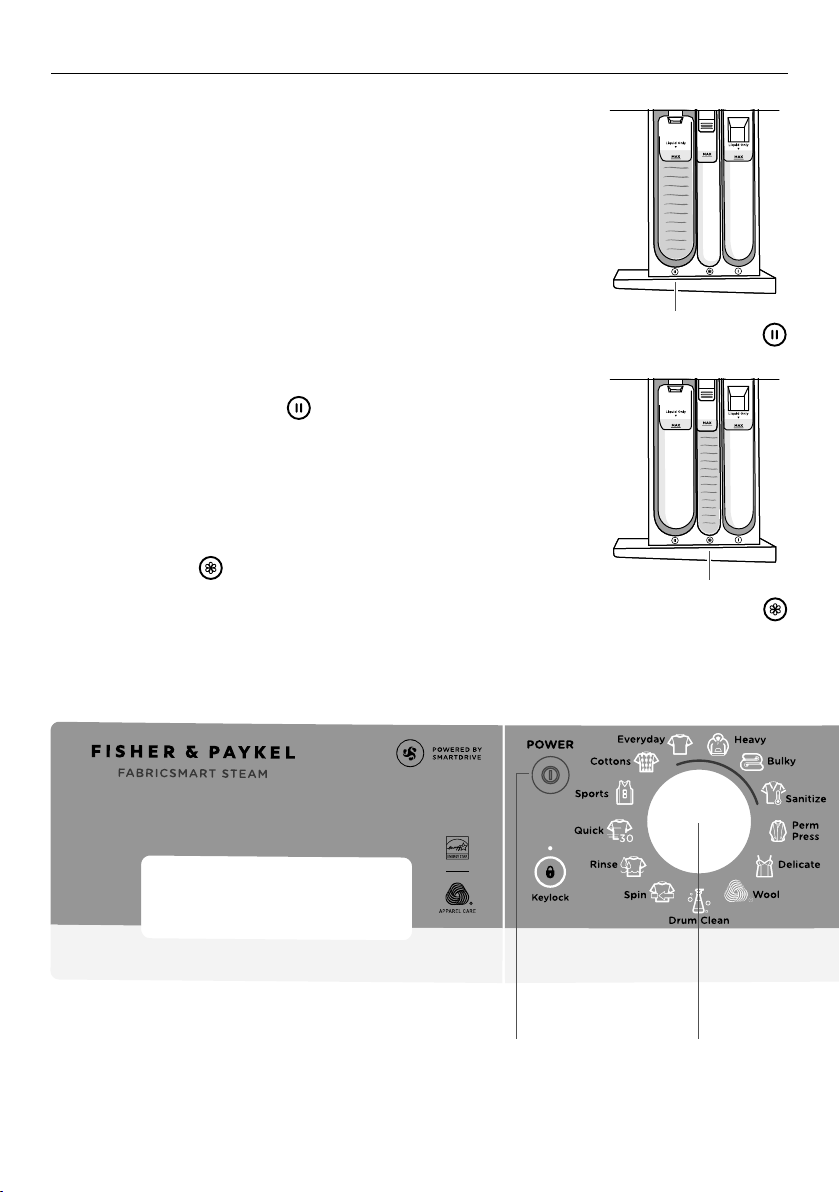
Use ‘HE’ or ‘High Efficiency’ liquid, powder or pods.
Placeliquid detergent into the correct compartment in the
dispenser drawer marked . Ifyou wish to use powdered
detergent you MUST remove the liquid detergent insert
by firmly grasping and twisting the left hand side of the
internal compartment and pulling upwards. If you are using
detergent pods place them at the back of the drum before
you load your clothing. For more information on detergent
refer to the ‘Detergent and fabric softener’ section.
●
If you wish to use fabric softener, place it in the compartment
marked with a . For more information on fabric softener
refer to the ‘Detergent and fabric softener’ section.
IMPORTANT!
Fabric softener should not be used if you have selected the
‘Quick’ cycle.
GETTING STARTED
PUSH
Liquid detergent in
compartment marked
Fabric softener in
compartment marked
PUSH
WH2424F model
1 2
21
GETTING STARTED
1
Press ‘POWER’ to activate your washer.
2
Select your wash cycle by turning the SmartTouch™ Control Dial.
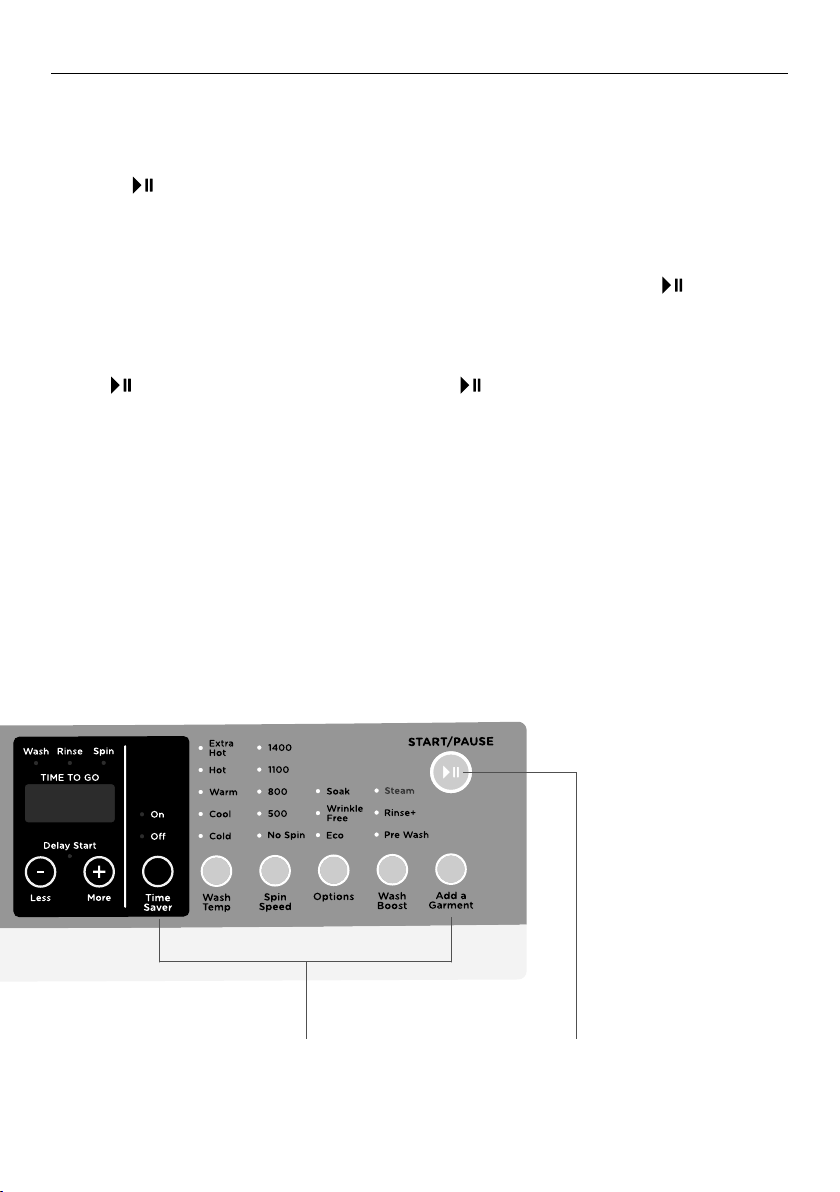
3
Choose your wash options, if you wish to select options different from the default
options for the cycle.
4
Touch to start the cycle.
●
If you make an invalid selection the washer will beep to alert you.
●
When the cycle finishes, your washer will perform end of cycle beeps and then turn
offautomatically.
●
If you wish to stop your washer at any point during a cycle simply touch to pause the
cycle. There may be a slight delay while the drum comes to a stop, then the door will
unlock. Under certain conditions however the door will remain locked for safety reasons
(refer to the ‘Safety features’ section).
●
If you wish to cancel or change the wash cycle once a cycle has started, simply touch
the button then select the new cycle. Touch to restart the washer.
IMPORTANT!
●
For the best fabric and color care, remove your clothes as soon as the cycle has
finished.
●
Failure to follow the advice in this guide may result in damage to your garments and
your expectations of wash performance may not be met.
3 4
22
WARNING!
To reduce the risk of fire, electric shock, or injury to
persons, read the IMPORTANT SAFETY INSTRUCTIONS
before operating this appliance.
WH2424P model
●
Sort your washing carefully. Separate white/light colors from
dark colors. Wash new, highly colored and dark colored items
separately to prevent dye transfer. Refer to the ‘Sorting and
loading’ section.
●
Load your clothes individually into the wash drum. Close the
door.
●
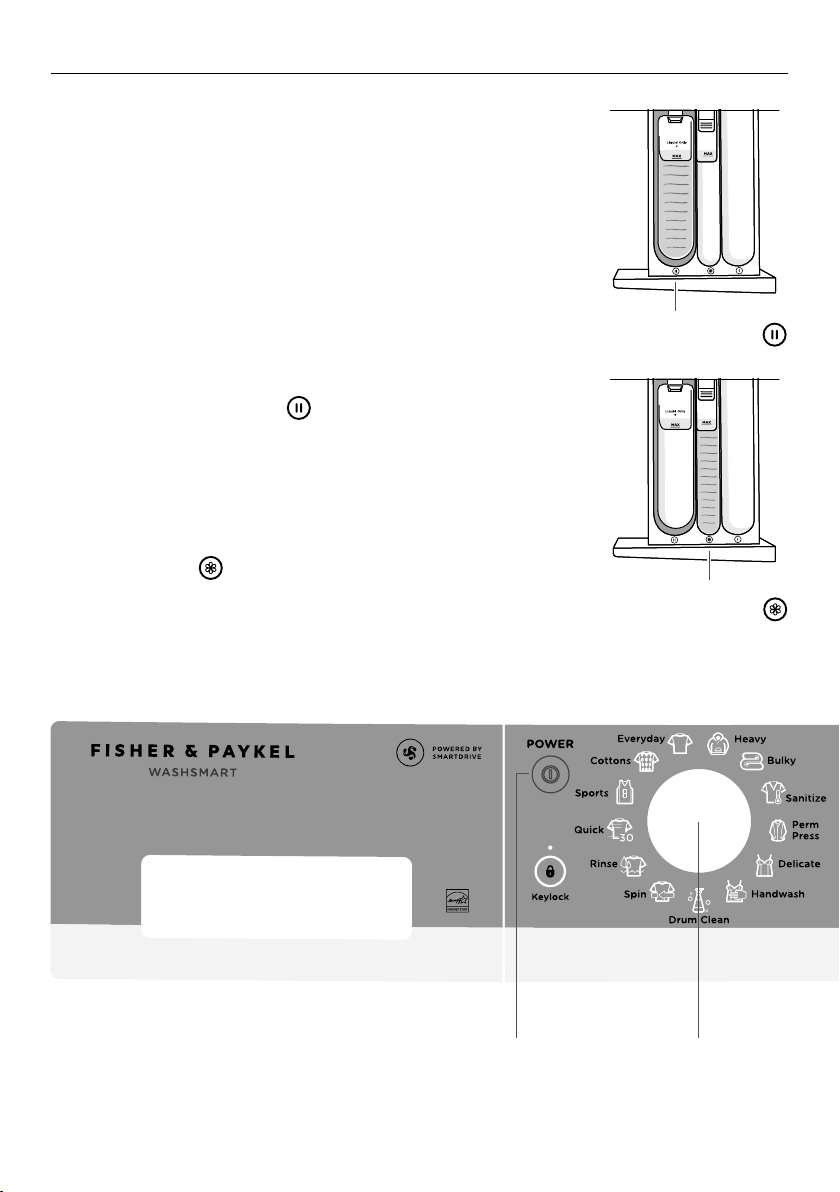
Use ‘HE’ or ‘High Efficiency’ liquid, powder or pods.
Placeliquid detergent into the correct compartment in the
dispenser drawer marked . Ifyou wish to use powdered
detergent you MUST remove the liquid detergent insert by
firmly grasping and twisting the left hand side of the internal
compartment and pulling upwards. If you are using detergent
pods place them at the back of the drum before you load
your clothing. For more information on detergent refer to the
‘Detergent and fabric softener’ section.
●
If you wish to use fabric softener, place it in the compartment
marked with a . For more information on fabric softener
refer to the ‘Detergent and fabric softener’ section.
IMPORTANT!
Fabric softener should not be used if you have selected the
‘Quick’ cycle.
GETTING STARTED
WH2424P model
1 2
PUSH
Liquid detergent in
compartment marked
Fabric softener in
compartment marked
PUSH
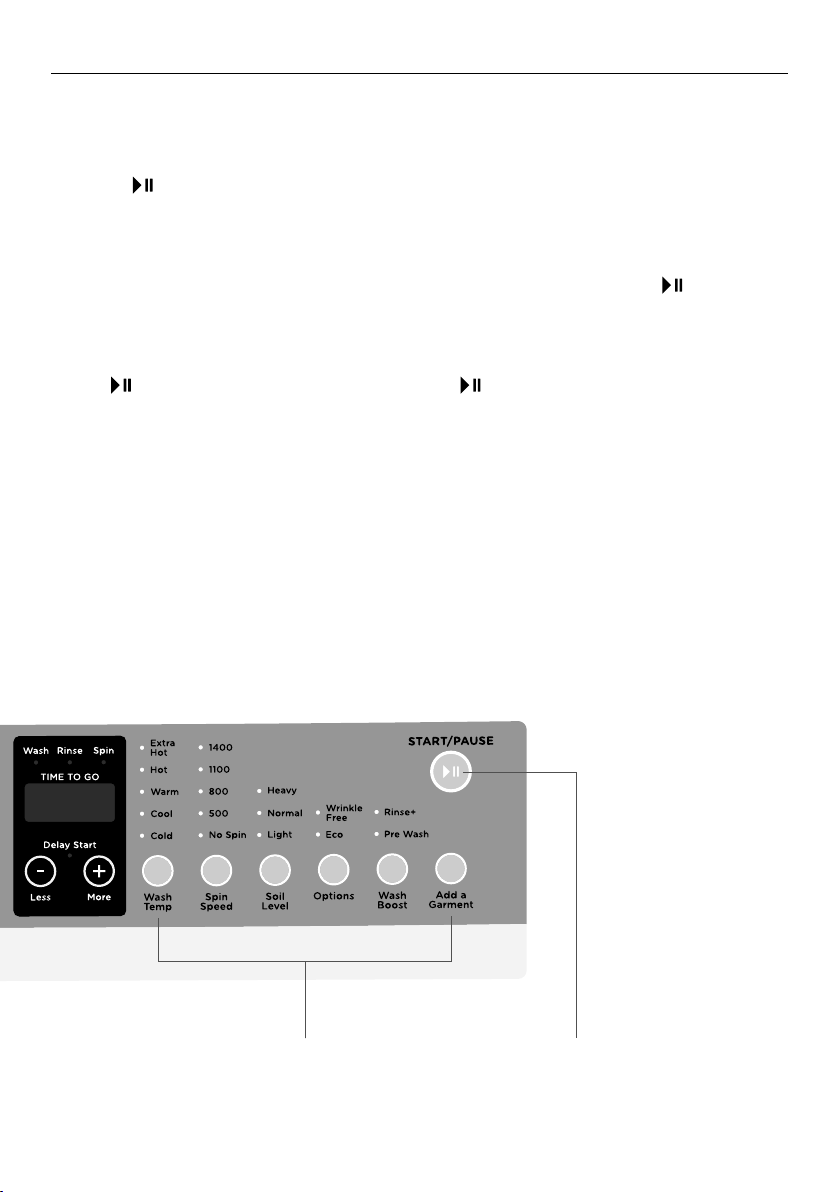
23
GETTING STARTED
1
Press ‘POWER’ to activate your washer.
2
Select your wash cycle by turning the SmartTouch™ Control Dial.
3
Choose your wash options, if you wish to select options different from the default
options for the cycle.
4
Touch to start the cycle.
●
If you make an invalid selection the washer will beep to alert you.
●
When the cycle finishes, your washer will perform end of cycle beeps and then turn
offautomatically.
●
If you wish to stop your washer at any point during a cycle simply touch to pause the
cycle. There may be a slight delay while the drum comes to a stop, then the door will
unlock. Under certain conditions however the door will remain locked for safety reasons
(refer to the ‘Safety features’ section).
●
If you wish to cancel or change the wash cycle once a cycle has started, simply touch
the button then select the new cycle. Touch to restart the washer.
IMPORTANT!
●
For the best fabric and color care, remove your clothes as soon as the cycle has
finished.
●
Failure to follow the advice in this guide may result in damage to your garments and
your expectations of wash performance may not be met.
3 4

24
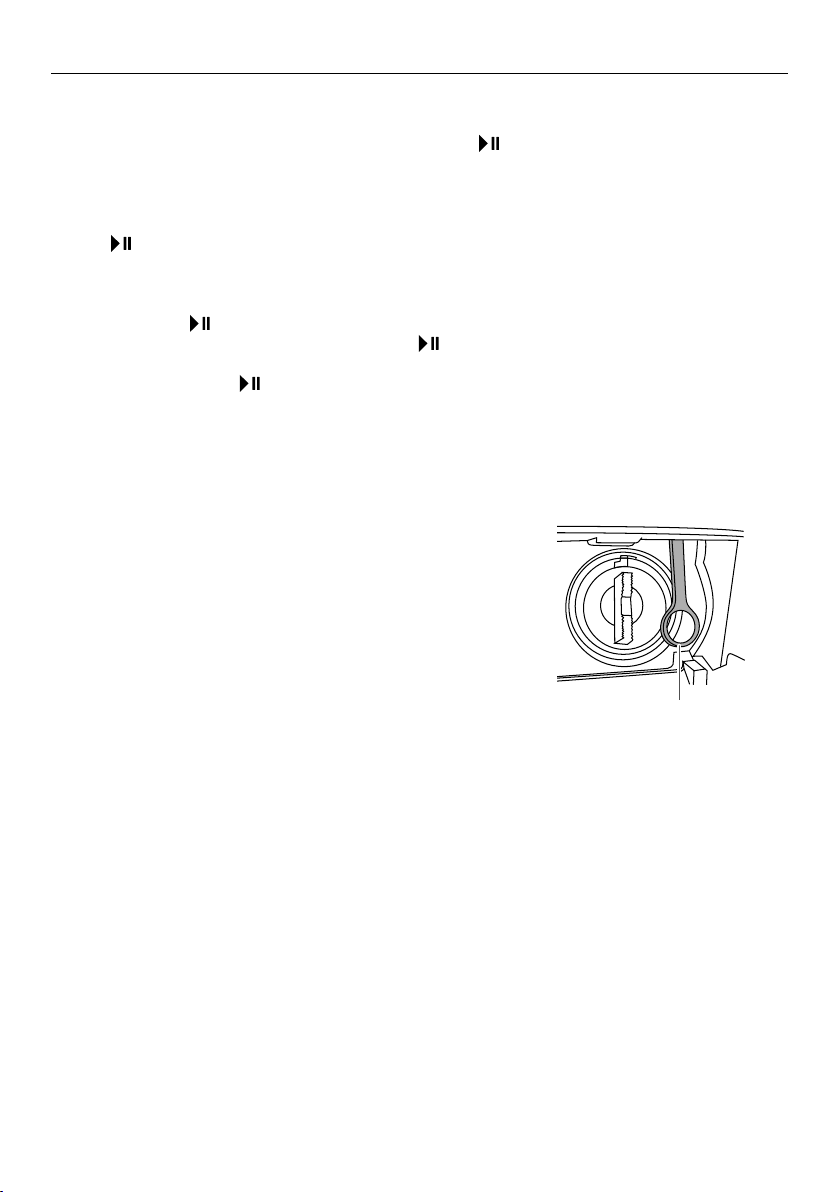
WASHER CONTROLS
SmartTouch™ Control Dial
The SmartTouch™ Control Dial provides easy and efficient wash cycle selection. As you
rotate the dial, the icon of the wash cycle selected will be illuminated, along with the
default settings for that cycle on the right side of the control panel.
SmartTouch™ buttons
The smooth, easy clean buttons enable easy selection of options with lights clearly
showing the selections you are making.
Digital display screen
The digital display screen provides feedback on how long the wash cycle has to go. If
you have programmed a ‘Delay Start’, the time remaining until the cycle will start will
be displayed here, along with any messages to help you with the overall running of your
washer (eg user warnings).
Time to go
Your washer displays approximately how many minutes the cycle you are running has
remaining, so that you can tell at a glance when your washing will be finished.
Please be aware that a number of factors can influence the overall cycle time, eg
the water flow rate, water pressure, whether hot water is being used from the faucet
or the water is heated by the internal heater, load size, cycle and option selections.
Therefore cycle times will vary. Unexpected events in a wash cycle (eg out of balance,
oversudsing) can lengthen the cycle time.
Progress lights
The progress lights indicate what part of the cycle the washer is currently on (wash,
rinse or spin). All three lights are on at the beginning of the cycle. The light for the
current part of the cycle flashes, and each one goes out when that part of the cycle
iscomplete.
Keylock mode
Keylock can be used to lock the buttons on your washer. This will avoid accidental
button pushes. For more detail please refer to the ‘Wash cycle options’ section.
Drum light (WH2424F model only)
Your machine has a drum light to help assist you when loading and unloading your
washing machine. When you press ‘POWER’, the LED light in the drum will turn on,
after2 minutes it will automatically turn off. At the end of the cycle, the drum light
will turn on again for 5 minutes to help facilitate unloading.
25
SAFETY FEATURES
Door lock
The door of your washer will lock once you touch until the machine beeps at the end
of the cycle, ensuring safety for you and your family while your machine is operating.
To unlock the door during the cycle:
●
You can open the door to add or remove items during the wash simply by touching
the button. Note: the door will remain locked until the drum is stationary, if the
temperature inside the washer is above 60°C and/or the water level is above the bottom
of the door seal (a warning will be displayed in these circumstances, refer to ‘Before you
call for service’).
●
Simply touch , the machine will pause and the door will automatically unlock if the
conditions inside the washer are safe. The button and time to go will flash on the
screen while the washer is paused. Open the door and remove or add garments. Close
the door and touch to resume the cycle.
Add a Garment
The ‘Add a Garment’ function can be used to interrupt the cycle to add or remove a
garment at any time during the wash part of the cycle (as long as the wash temperature
selected is lower than ‘Hot’ temperature). Water in the machine will be drained to a level
where the door can be opened, if necessary. Refer to ‘Wash cycle options’ for more
information.
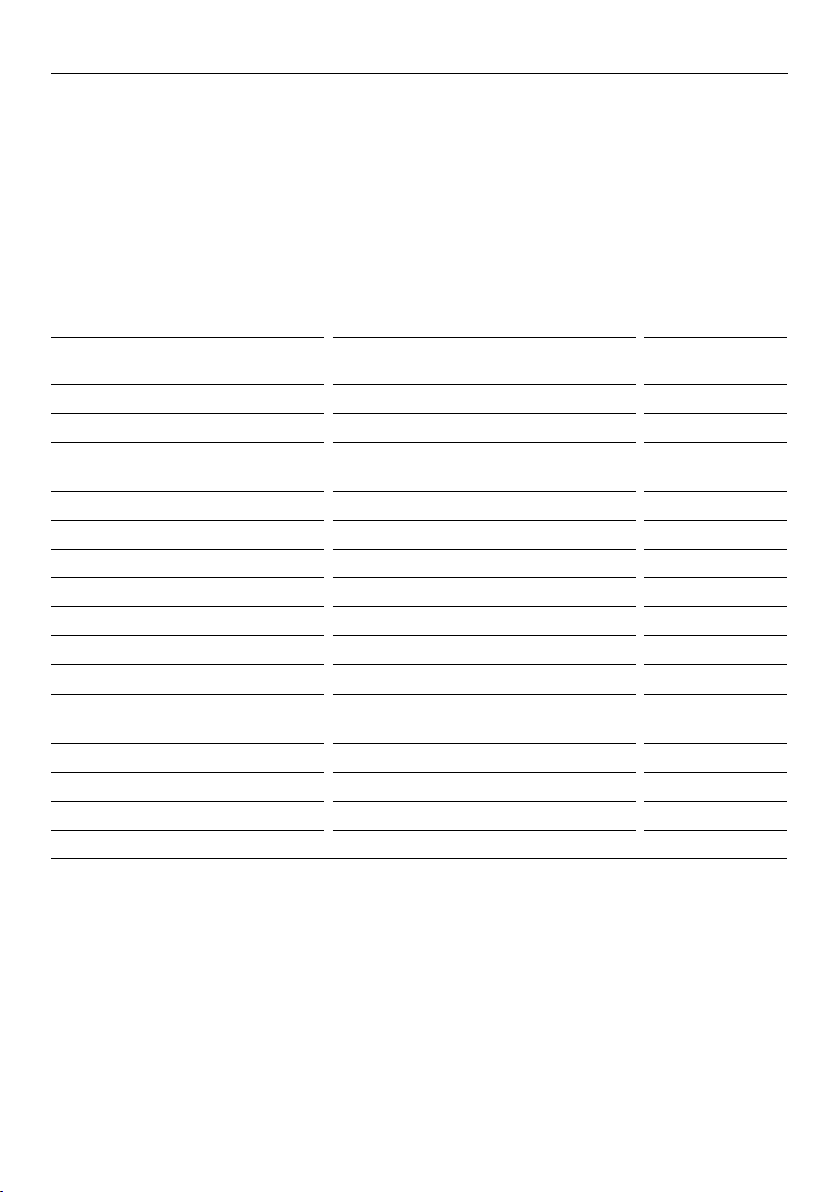
Opening the door during a power failure
If there is a power failure during a wash cycle your
washer will stop and the door will remain locked.
You can unlock the washer door to remove your
clothes by opening the pump filter cover at the
bottom right of your washer. Simply place a coin or
key in the slot and tilt it upwards to lever the cover
open, then pull the door release tab.
IMPORTANT!
Do not attempt to do this if the water level in the
washer is above the level of the door.
When power is restored you will need to restart your machine by simply pressing
‘POWER’. The washer will remember where it was stopped and continue from this point
to finish the cycle.
Your washer also has the following protective measures:
●
Flood protection – turns off valves and turns pump on if a flood condition is detected.
●
Out-of-balance protection – stops and redistributes the load if an unbalanced load
condition is sensed, and/or slows the spin speed to compensate.
●
Excess suds protection – pauses to allow suds to break down before continuing the cycle.
Door release tab
Manual door opening mechanism
26
SORTING AND LOADING
When preparing your wash load there are some important things to consider:
Sorting
Sort items according to color, fabric type, and soil type. Wash fine, delicate fabrics
separately from thick, heavy fabrics. Always separate colored items from whites,
especially when they are new. Color run could be an issue if you wash items at higher
temperatures. Some soils, like mud and blood are best washed in cold water. Oily
soils (eg some foods and marks on shirt collars) are best washed in warm water. The
following are recommendations for what cycles and settings you may wish to wash
different items on, and suggestions for special wash requirements.
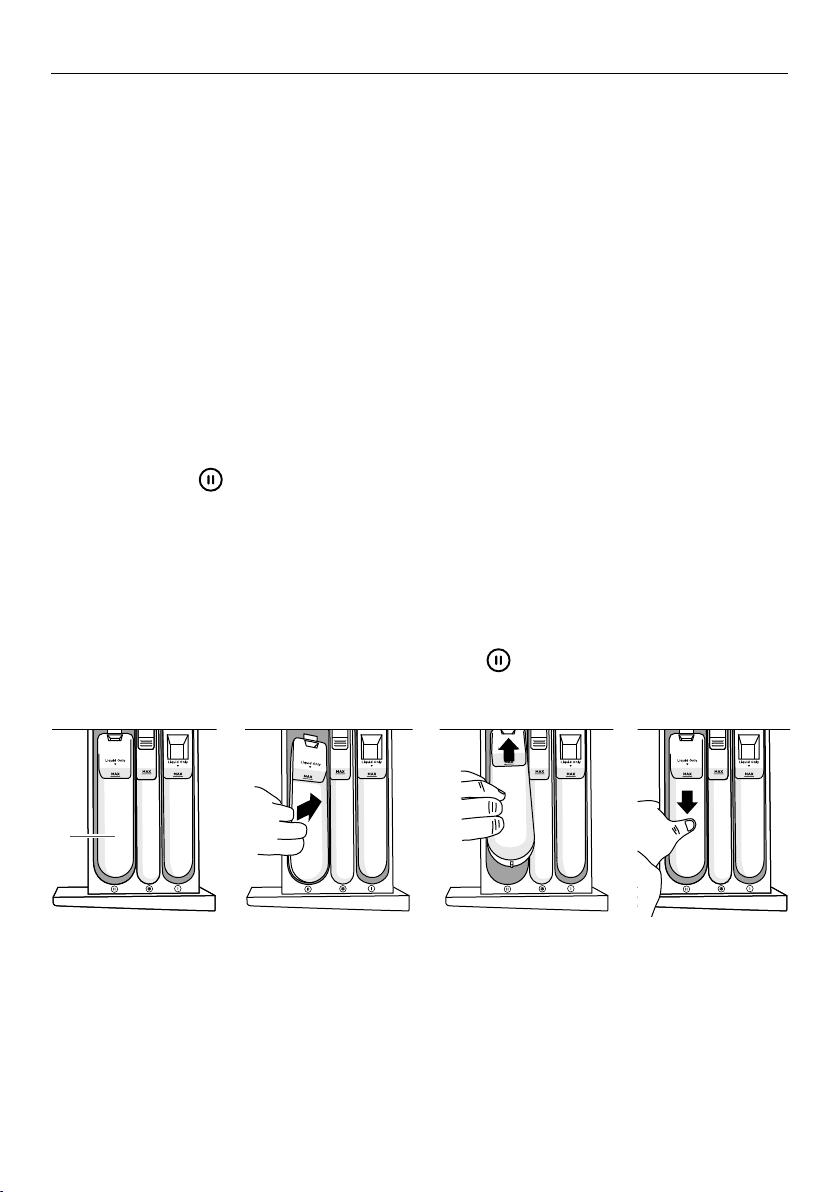
ITEMS/WASH
REQUIREMENTS
SUGGESTED CYCLE
AND OPTIONS*
SUGGESTED
TEMPERATURE
Towels Everyday, 1400 or 1100 rpm spin Cool or Warm
Sheets, pillowcases Everyday, 1400 or 1100 rpm spin Cool or Warm
Bulky items – comforters,
duvets, sleeping bags
Bulky Cool or Warm
Shirts, pants, other creasables Perm Press, 800 rpm Cool or Warm
Woollens, silks Wool, Handwash, 500 rpm Cool or Warm
Delicates, fine fabrics Delicate, Wool or Handwash Cool
Jeans Everyday or Heavy Cold or Cool
Highly colored items Everyday Cold or Cool
Whites, cotton items Cottons, 1400 or 1100 rpm spin Warm or Hot
Sportswear, running gear Sports Warm
Have sensitive skin or require
extra rinsing?
Sanitize, Rinse+, 1400 or 1100 rpm
spin
Extra Hot
Asthma/allergies Sanitize, Rinse+ Extra Hot
Lightly soiled items Quick or TimeSaver Cool
Muddy, sandy or linty items Everyday, Pre Wash and Rinse+ Cold
Smelly washer Drum Clean Extra Hot
* Cycles and spin speeds available will depend on your washer model.

27
Before you load
●
Check pockets for items that could damage your clothes or get caught in the washer.
●
Close zippers, hooks and eyes, and other fastenings (ie fasten the opening of comforter),
and remove loose bra wires. All these can damage both your washer and your clothes.
●
Place delicate items, such as lingerie, in a mesh laundry bag before placing in the
machine.
●
Pre-treat any stains, taking care not to spray pre-treaters on your washer as they can
cause damage to the plastic surfaces.
Loading
Your washer will be more efficient when washing larger loads, so try to collect enough
items to loosely fill the drum when the items are dry.
IMPORTANT!
●
Do not overload your washing machine beyond its rated capacity.
●
Please do not under any circumstances wash an electric blanket in your washer unless
the care label specifically states it is safe to do so.
●
Do not wash curtains in this washer, as sunlight makes them brittle and they may
disintegrate during washing.
SORTING AND LOADING
28
DETERGENT AND FABRIC SOFTENER
Detergent type
Your washer requires low sudsing detergent to prevent oversudsing problems. Low
sudsing detergent comes in powder, liquid or pod form and is labelled ‘High Efficiency’
or‘HE’.
Using top loading detergent in your front loader washer may lead to excessive suds
formation, which will lengthen the cycle time as the machine waits for the suds to dissolve.
IMPORTANT!
Do not use chlorine based bleaches in the washer as damage to the machine and
clothing may result. Wash boosters and additives based on oxygen or containing
sodium per carbonate may be used by adding to the detergent in the dispenser as
required. Follow manufacturer’s instructions for the correct dosage.
Where do I put my detergent?
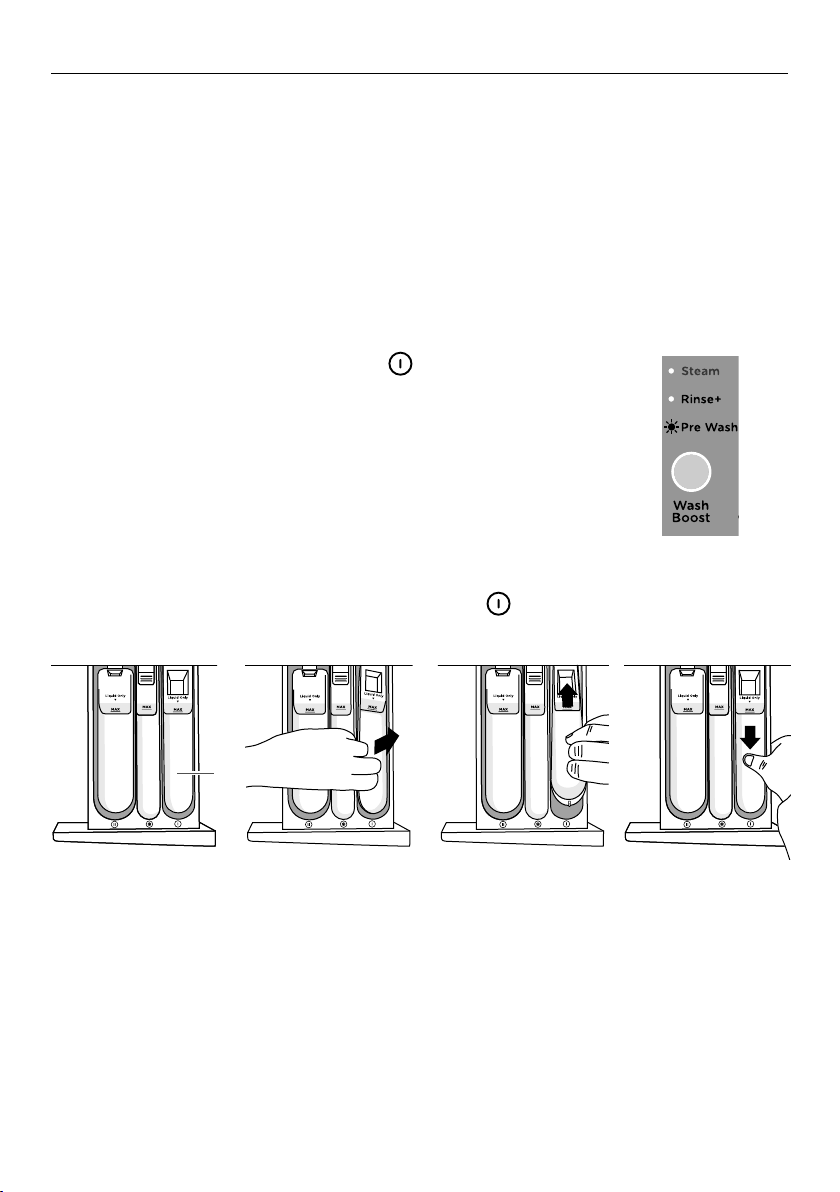
Liquid detergent
Add to the main wash compartment on the left side of the dispenser compartment
marked with a (A). As the machine fills, water is flushed into this compartment and is
mixed with the detergent, the detergent solution is then delivered into the drum. There
may be a small volume of water left in the liquid detergent dispenser at the end of the
cycle. This is normal.
Powdered detergent
If you wish to use powdered detergent, the liquid detergent compartment MUSTbe
removed from the dispenser drawer. To do this firmly grasp and twist the left hand
side of the internal compartment and pull upwards (B). To replace the liquid detergent
compartment slide it back into the drawer marked (C). Press down in the middle
untilit clicks (D).
WH2424F model shown, dispenser compartments in WH2424P models will differ.
D
PUSH
PUSH
PUSH
PUSH
Detergent dispenser
compartment
Removing the liquid
detergent compartment
Replacing the liquid
detergent compartment
Clicking in the liquid
detergent compartment
A
B
C
IMPORTANT!
●
If using liquid detergent ensure the liquid detergent compartment is installed.
●
If using powder ensure the liquid detergent compartment has been removed.
●
Make sure the detergent drawer is completely closed before starting the cycle.
29
DETERGENT AND FABRIC SOFTENER
Pods
Detergent pods are a ‘no mess’ alternative to powdered or liquid detergent. Pod type
detergent or wash boosters must be placed at the back of the drum prior to loading your
clothes. This will ensure they are activated quickly in the wash. Do not place pods in the
detergent dispenser drawer or on top of your clothes.
Pre wash
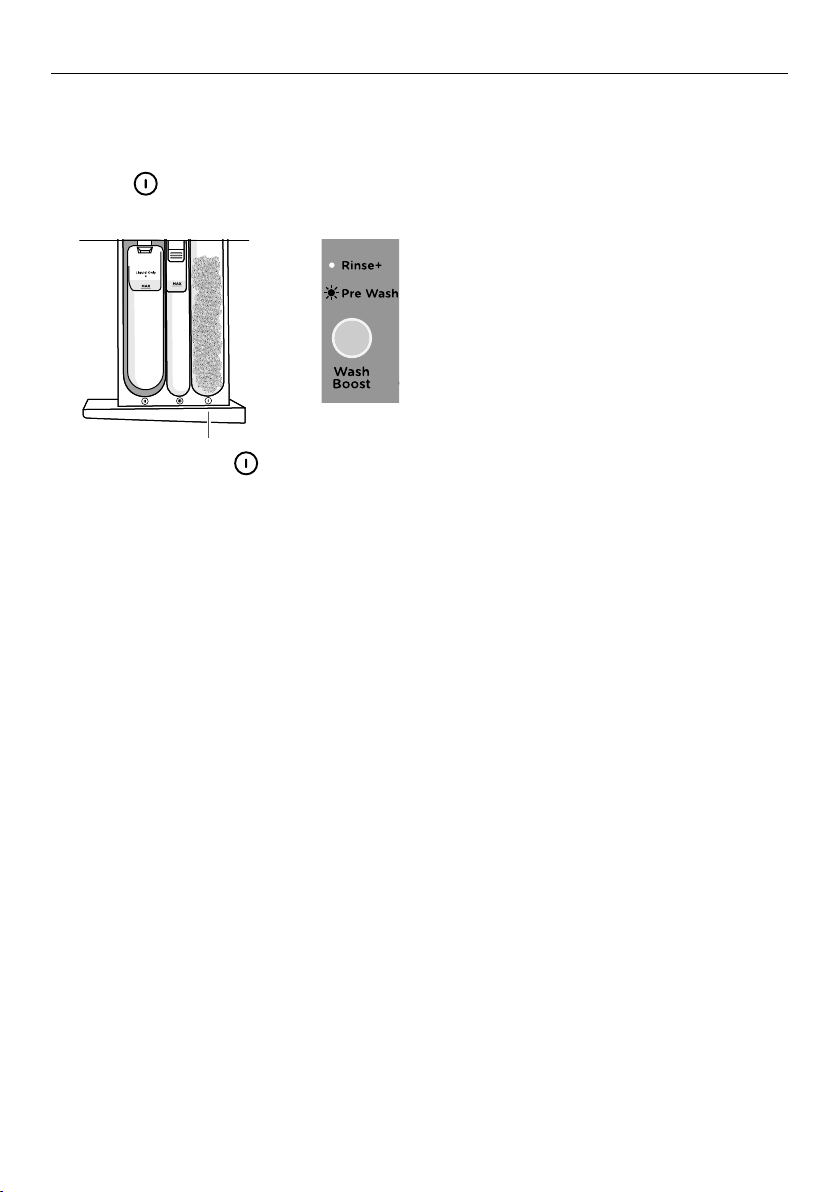
WH2424F model
Liquid detergent
If you wish to use the ‘Pre Wash’ option, liquid detergent is added
to the pre wash compartment marked (A). When you select
‘Pre Wash’, water is flushed into the pre wash compartment at the
start of the cycle and mixed with the detergent, the detergent
solution is then delivered into the drum. There may be a small
amount of water left in the pre wash compartment at the end of
the cycle. This is normal.
Powdered detergent
If you wish to use powdered detergent, the liquid pre wash
compartment MUST be removed from the dispenser drawer. To
do this firmly grasp and twist the left hand side of the internal
compartment and pull upwards (B). To replace the liquid pre wash
compartment slide it back into the drawer marked (C). Press
down in the middle until it clicks (D).
PreWash detergent
dispenser compartment
Removing the PreWash
liquid detergent
compartment
Replacing the PreWash
liquid detergent
compartment
Clicking in the PreWash
liquid detergent
compartment
A
B
C
D
‘Pre Wash’ option
30
DETERGENT AND FABRIC SOFTENER
WH2424P model
If you wish to use the ‘Pre Wash’ option, liquid or powdered detergent only must be
placed in the pre wash detergent compartment on the right side of the drawer, marked
with a . When you select ‘Pre Wash’, the pre wash compartment is flushed
at the start of the cycle. For more information refer to ‘Wash cycle options’.
PUSH
Detergent in the PreWash
compartment marked
‘Pre Wash’ option
IMPORTANT!
Make sure the detergent dispenser drawer is completely closed before starting
thecycle.
How much detergent?
The correct detergent dosage varies depending on the amount of soil in your load, the
size of the load and the water quality, so getting the correct dose takes some trial and
error. Use the instructions stated on the detergent package as a guide, then alter the
dosage according to the results.
If you overdose, you will get over foaming issues, but if you under-dose you will get poor
performance and over time your washer will start to smell as scum builds up inside it.
Detergent advice
1
If your washer smells you are probably not using enough detergent for the soil level
in your loads. Run a ‘Drum Clean’ cycle and either buy a better quality detergent or
use a higher dose. If you are using an ‘Eco’ detergent, alternate the use of this with a
mainstream detergent. We recommend running your ‘Drum Clean’ cycle with a drum
cleaning powder, follow the manufacturers instructions for the correct dosage of
detergent. If symptoms persist, contact a service company to clean the bowl.
2
Add the detergent BEFORE starting the cycle, close the dispenser and do not open it
while the cycle is running.
3
If you find foam leaking from your washer, check you are using a ‘HE’ or ‘High
Efficiency’ type detergent and check the quantity you are using against the detergent
manufacturers recommendation. You may need to reduce the amount you are using.

31
DETERGENT AND FABRIC SOFTENER
Fabric softener
Add fabric softener to the middle compartment of the dispenser marked with a .
The washer will automatically flush the fabric softener during the rinse part of the cycle.
If you wish to use fabric softener we recommend to:
1
Use it sparingly. Measure it carefully and do not use more than 0.85 ounces (25ml or
1/2cap), some thicker varieties may need diluting.
2
Clean your dispenser regularly.
3
Clean your machine regularly using the ‘Drum Clean’ cycle.
4
Complete wash cycles at a wash temperature of ‘Warm’ or above at regular intervals
(eg every 5thwash) as washing in cold water increases the chance of scrud occurring
(see below).
Note: if you fill beyond the MAX mark, the fabric softener will be dispensed into the
bowl prematurely and contribute to scrud.
Scrud
Scrud is the name of the waxy build-up that can occur within any washer when fabric
softener comes in contact with detergent. This build-up is not brought about by a fault
in the machine. If scrud is allowed to build up in the machine it can result in stains on
clothes and an unpleasant smell in your washer.
If you wash a particularly dirty load, we recommend putting the washer through a
‘Rinse’ cycle once the cycle has finished and the load has been removed, to clean
outany remnants from that cycle.
32
WASH CYCLES
Your washer has a number of wash cycles to suit your laundering needs. Selecting the most
appropriate cycle for each particular wash load will help ensure you get the best wash result.
CYCLE DESIGNED FOR DESCRIPTION
MAX.
LOAD
SIZE
DEFAULT
WASH
TEMP.
MAX.
WASH
TEMP.
DEFAULT
SPIN
SPEED
(rpm)
MAX. SPIN
SPEED
(rpm)
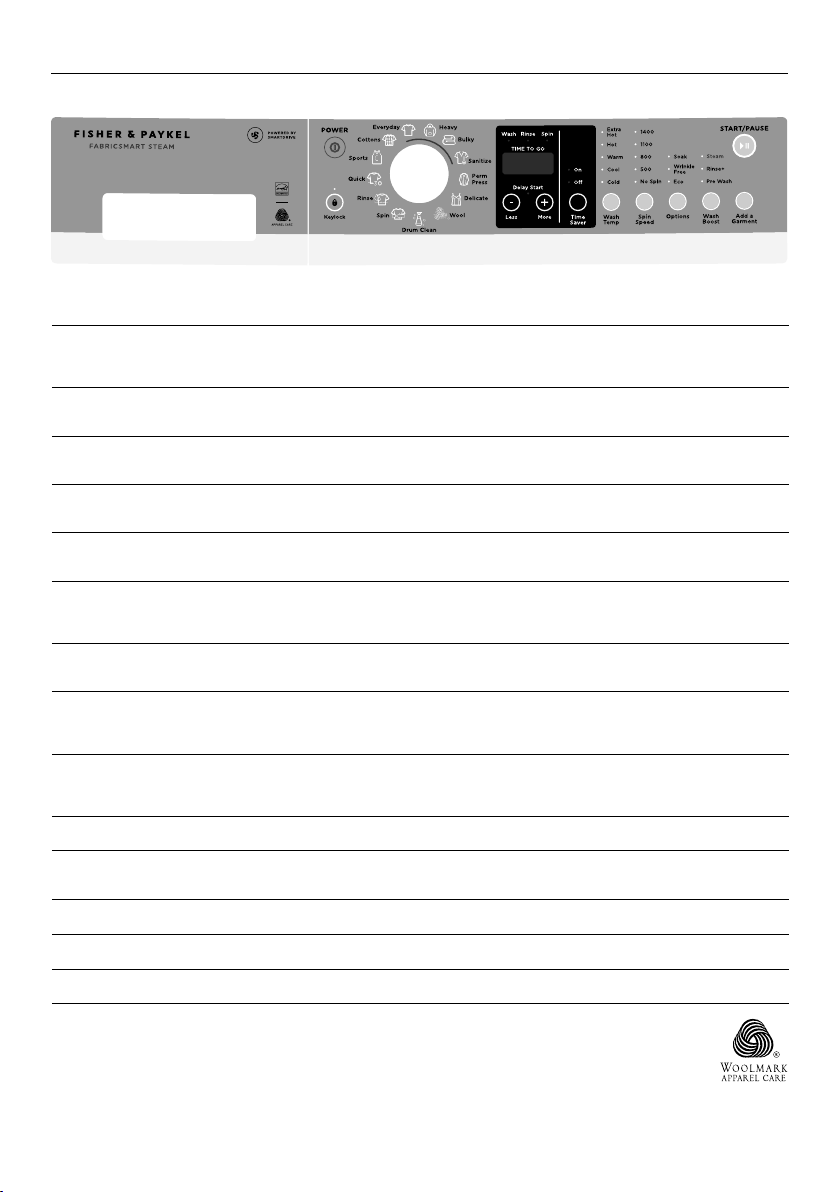
Cottons Normally soiled everyday
cotton loads, eg whites.
A comprehensive cycle
specifically designed for
cottons.
17.6lbs
(8kg)
Warm Extra Hot 1400 1400
Everyday Normally or lightly soiled
everyday items eg towels,
sheets, sweatshirts, t-shirts.
A faster cycle designed
for mixed loads with
normal soiling.
17.6lbs
(8kg)
Warm Extra Hot 1400 1400
Heavy Heavy soiled durable
garments eg tea towels,
rugby shorts.
A stronger, hotter wash
for more durable items.
17.6lbs
(8kg)
Hot Extra Hot 1400 1400
Delicate Delicate, lightly soiled
items, eg tops, blouses.
Gentler wash with more
water to look after
delicate items.
8.8lbs
(4kg)
Warm Hot 500 800
Perm
Press
Minimizing creasing eg
shirts, trousers.
Less spinning with
‘Wrinkle Free’ option to
help minimize the need
for ironing.
8.8lbs
(4kg)
Warm Hot 800 800
Bulky Washing bulky items. A warm, gentle wash and
slow spin for special care
of bulky items.
8.8lbs
(4kg)
Hot Extra Hot 800 800
Sanitize** Asthma sufferers
and people with skin
sensitivities.
Hot wash to kill dust
mites and extra rinses
to remove all traces of
detergent.
17.6lbs
(8kg)
Extra
Hot
Extra Hot 1400 1400
Wool* Machine washable
woollen items.
Extra gentle wash action
that complies with
Woolmark Apparel Care
criteria.
4.4lbs
(2kg)
Warm Warm 800 800
Quick Lightly soiled garments. A quick cycle for lightly
soiled loads.
8.8lbs
(4kg)
Warm Hot 800 1400
Sports Cotton/synthetic sports
clothing.
A cycle tailored to
washing sports type
clothing.
8.8lbs
(4kg)
Warm Warm 1100 1400
Rinse Items that require rinsing
only.
Two rinses followed by
a spin.
17.6lbs
(8kg)
Cold Cold 1400 1400
Spin Spinning wet items. Spin only. 17.6lbs
(8kg)
N/A N /A 1400 1400
Drum
Clean
Maintaining the cleanliness
of your washer.
A hot cycle to remove any
residues inside the washer.
–
Extra
Hot
Extra Hot 1100 1100
* Woolmark Apparel Care
The wool wash cycle of this machine has been approved by The Woolmark Company for the washing of
machine washable wool products provided that the products are washed according to the instructions on the
garment label and those issued by the manufacturer of these washing machines M1528.
** Note: the Sanitize cycle water temperatures CANNOT be changed. The Sanitize cycle is certified by NSF
International, an independent third party testing and certification organization.
The Sanitize certification verifies that the cycle reduced 99.9% of bacteria typically found in residential laundry and that
no significant contamination is transferred to subsequent washer loads. Only the Sanitize cycle has been designed to
meet the requirements of NSF Protocol P172 for sanitizing effectiveness.
WH2424F model
33
WASH CYCLES
Your washer has a number of wash cycles to suit your laundering needs. Selecting the most
appropriate cycle for each particular wash load will help ensure you get the best wash result.
CYCLE DESIGNED FOR DESCRIPTION
MAX.
LOAD
SIZE
DEFAULT
WASH
TEMP.
MAX.
WASH
TEMP.
DEFAULT
SPIN
SPEED
(rpm)
MAX. SPIN
SPEED
(rpm)
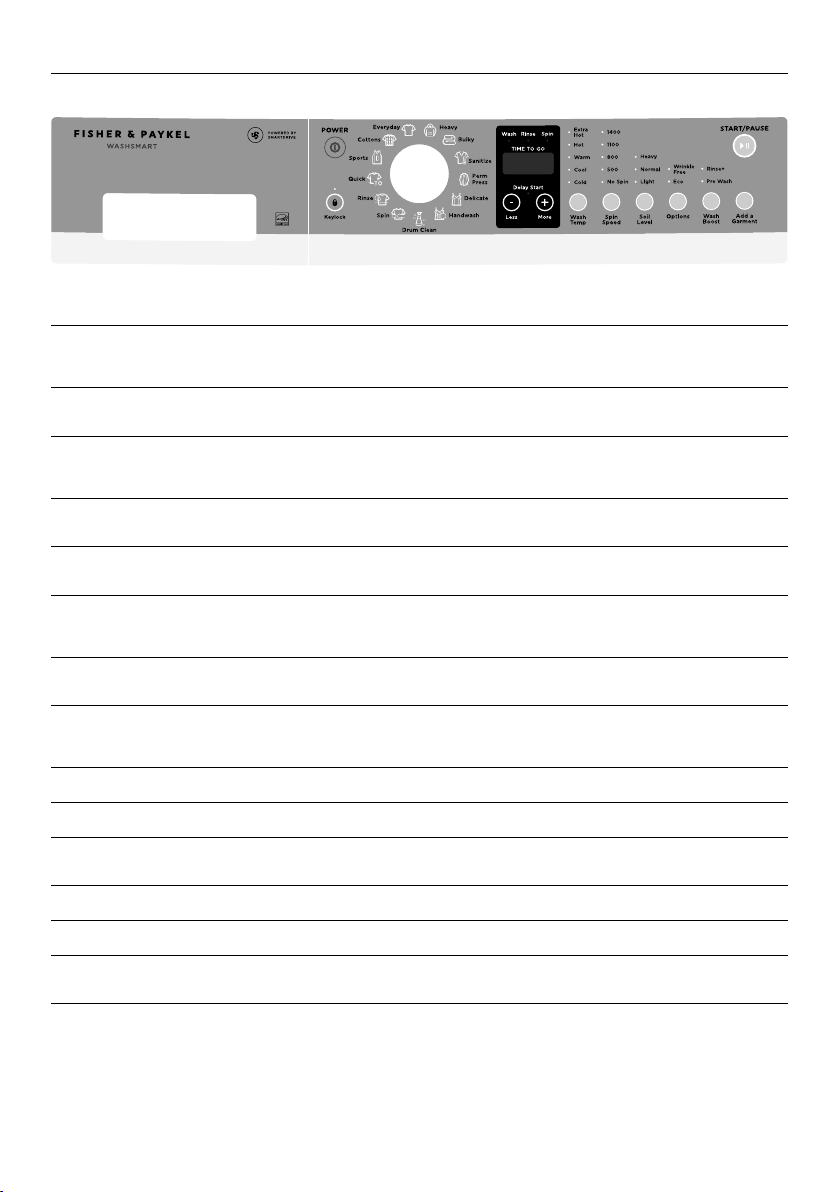
Cottons Normally soiled everyday
cotton loads, eg whites.
A comprehensive cycle
specifically designed for
cottons.
17.6lbs
(8kg)
Warm Extra Hot 1400 1400
Everyday Normally or lightly soiled
everyday items eg towels,
sheets, sweatshirts,
t-shirts.
A faster cycle designed
for mixed loads with
normal soiling.
17.6lbs
(8kg)
Warm Extra Hot 1400 1400
Heavy Heavy soiled durable
garments eg tea towels,
rugby shorts.
A stronger, hotter wash
for more durable items.
17.6lbs
(8kg)
Hot Extra Hot 1400 1400
Delicate Delicate, lightly soiled
items, eg tops, blouses.
Gentler wash with more
water to look after
delicate items.
8.8lbs
(4kg)
Warm Hot 500 800
Perm
Press
Minimizing creasing eg
shirts, trousers.
Less spinning with
‘Wrinkle Free’ option to
help minimize the need
for ironing.
8.8lbs
(4kg)
Warm Hot 800 800
Bulky Washing bulky items. A warm, gentle wash and
slow spin for special care
of bulky items.
8.8lbs
(4kg)
Hot Extra Hot 800 800
Sanitize Asthma sufferers
and people with skin
sensitivities.
Hot wash to kill dust
mites and extra rinses
to remove all traces of
detergent.
17.6lbs
(8kg)
Extra
Hot
Extra Hot 1400 1400
Handwash Very delicate lightly soiled
garments, eg woollens.
Very gentle wash action
for extra special items.
4.4lbs
(2kg)
Cool Warm 500 800
Quick Lightly soiled garments. A quick cycle for lightly
soiled loads.
8.8lbs
(4kg)
Warm Hot 800 1400
Sports Cotton/synthetic sports
clothing.
A cycle tailored to
washing sports type
clothing.
8.8lbs
(4kg)
Warm Warm 1100 1400
Rinse Items that require rinsing
only.
Two rinses followed by
a spin.
17.6lbs
(8kg)
Cold Cold 1400 1400
Spin Spinning wet items. Spin only. 17.6lbs
(8kg)
N/A N /A 1400 1400
Drum
Clean
Maintaining the
cleanliness of your
washer.
A hot cycle to remove
any residues inside the
washer.
–
Extra
Hot
Extra Hot 1100 1100
WH2424P model
34
WASH CYCLE OPTIONS
All wash cycles default to the recommended options for that cycle based on the average
expected load to be washed. You can vary the options (eg ‘Wash Temp’, ‘Spin Speed’)
to create your desired cycle. Note: some options are not available on some cycles, for
clothes care reasons, or because the option is not appropriate for the cycle.
To change a wash option or options you have selected after a cycle has started, touch
and select your new setting, then touch again to resume the cycle with the new
setting or settings. Note: some options may not be available for selection under certain
conditions and after particular stages of the cycle have passed.
Wash Temp
Your washer offers five wash temperatures:
Cold Cool Warm Hot Extra Hot
●
Simply touch the ‘Wash Temp’ button to increase or decrease the wash temperature.
●
The washer will fill with both hot and cold water (if possible) to achieve the selected
wash temperature.
●
Some temperatures are not available on some cycles as a safeguard for your clothes
(eg‘Extra Hot’ on the ‘Delicate’ cycle).
IMPORTANT!
When ‘Extra Hot’ temperature is selected, the door glass will become hot. Do not
touch the glass part of the door. Keep children away from the washer.
Time Saver (WH2424F model only)
Your washer offers a ‘Time Saver’ feature that when selected adjusts the cycle
programming, by combining special temperature profiling and a unique tumble
sequence. The result – excellent wash performance combined with time savings.
This option can be selected on the ‘Everyday’, ‘Cottons’, ‘Heavy’, ‘Perm Press’, ‘Sanitize’,
‘Sports’ and ‘Quick 30’ cycles.
Please be aware that a number of factors can influence the amount of time saved on a cycle,
including the load size, cycle chosen, water flow rate and load distribution during spin.
Spin Speed
●
Your washer offersfour spin speeds: 500rpm, 800rpm, 1100rpm and 1400rpm, plus
an additional ‘No Spin’ option.
●
Simply increase or decrease the spin speed by touching the ‘Spin Speed’ button.
●
Selecting ‘No Spin’ will end the cycle after the rinse, allowing you to remove items you
wish to drip dry. Note: the washer will complete the default wash and rinse spins for
the cycle; only the final spin will not be completed. If you have removed the items you
wish to drip dry and there are items remaining that you would like to proceed to spin,
press ‘POWER’ and select the ‘Spin’ cycle. If necessary, modify the spin speed to best
care for your load (ie spin delicate items at 500rpm for best garment care).
35
WASH CYCLE OPTIONS
Soil Level (WH2424P model only)
The ‘Soil Level’ option lets you adjust the wash to suit the amount of soil in your load.
For example, select ‘Heavy’ for dirty clothes; for items that are only lightly soiled, select
‘Light’. This adjusts the wash time accordingly to give the load the right amount of
agitation to remove the soil.
Wash Boost
Pre Wash
For extra dirty loads you can perform a ‘Pre Wash’. Your washer will start the wash with
a short wash in cool water to remove excess soil. After this the machine will drain and
then fill at the selected temperature for the main wash.
Simply touch the ‘Wash Boost’ button and select ‘Pre Wash’ when choosing your wash
options. Note: ‘Pre Wash’ cannot be selected after a wash cycle has been started, ie
if you touch and try to select ‘Pre Wash’ it will be unavailable. ‘Pre Wash’ must be
selected at the start of the cycle.
If you use the ‘Pre Wash’ option, liquid or powdered detergent needs to be placed in the
correct detergent compartment. The pre wash compartment is on the right hand side of
the drawer, marked . When you select ‘Pre Wash’, the compartment is flushed at the
start of the cycle.
The detergent for the main wash can either be a powder or a liquid. Place this in the
compartment marked . If using liquid, ensure the internal compartment is installed.
Rinse+
If you have a particularly dirty load, or you have sensitive skin and wish to give your
clothes an extra rinse, select ‘Rinse+’ from the ‘Wash Boost’ options. Your load will
undergo an extra rinse to get rid of any residual detergent or soil in the items.
Note: ‘Rinse+’ will not be available if the ‘Eco’ option has been selected.
Steam (WH2424F model only)
The Steam option adds steam to the wash to actively loosen fibers to improve soil
removal. Use the steam option if you have a particularly heavily soiled load. This option
is available on the ‘Everyday’, ‘Heavy’, ‘Bulky’ and ‘Sanitize’ cycles only.
Only use with colorfast loads.
Note: the ‘Steam’ option cannot be selected after a wash cycle has been started, ie if
you touch and try to select ‘Steam’ it will be unavailable. ‘Steam’ must be selected at
the start of the cycle.
IMPORTANT!
Do not touch the door when the steam option is selected. The door will get hot during
the steam phase of the cycle. Ensure no children play around the washer.
36
WASH CYCLE OPTIONS
Options
Soak (WH2424F model only)
A soak option is available on selected wash cycles. When this option is chosen the
machine will add a one hour soak sequence, which combines periods of tumbling with
soaking to help lift stubborn stains.
If ‘Soak’ and ‘Time Saver’ are selected in the same cycle, the soak duration will be
reduced to 30 minutes.
‘Soak’ is not available on the ‘Wool’, ‘Drum Clean’, ‘Quick’, ‘Rinse’ or ‘Spin’ Cycles.
Wrinkle Free
We recommend you remove the clothes from the washer immediately after the
completion of the cycle to minimize wrinkling and creasing of items and to prevent
dyerun. However, if you will not be present at the end of the cycle you can select
‘Wrinkle Free’.
When ‘Wrinkle Free’ is selected, the washer will tumble the clothes once every
15minutes for up to 12 hours after the cycle has finished. The ‘Wrinkle Free’ light and
button will flash, and the washer will beep at regular intervals to remind you to
remove your load. To remove the load during this phase, simply press the button.
Eco
Use the ‘Eco’ option to save water and energy. Selecting ‘Eco’ will reduce the wash
temperature slightly and alter the wash and rinse programming.
Note: this option will not be available if ‘Rinse +’ has been selected.
●
If you wish to, you can select both the ‘Pre Wash’ and ‘Rinse+’ ‘Wash Boost’ options
to perform on the same cycle. Likewise, you can select ‘Eco’ and ‘Wrinkle Free’ to
perform on the same cycle. Touch the appropriate button until both options are
selected. Repeat to deselect an option.
●
For clothes care and performance reasons not all options may be available on some
cycles.
Add a Garment
The ‘Add a Garment’ option enables you to add or remove items during the wash stage
of the cycle, under certain conditions. Once the ‘Add a Garment’ button is touched,
the button and time to go will flash. Wait until you hear the door unlock. Open the
door and add or remove items. Close the door and touch to restart the cycle. The
‘Add a Garment’ button will only operate during the wash part of the cycle and when
the temperature selected is lower than ‘Hot’ temperature. ‘Add a Garment’ can be used
when the total wash volume has been reached, as your washer will drain the water to a
lower level if necessary, so the door can be opened.
37
WASH CYCLE OPTIONS
Keylock
This option enables you to deactivate the buttons on the display panel, except for the
‘Power’ and ‘Keylock’ buttons. This prevents accidental button presses.
To turn Keylock mode ON or OFF when the washer is powered on:
●
Touch and hold the button for 2 seconds.
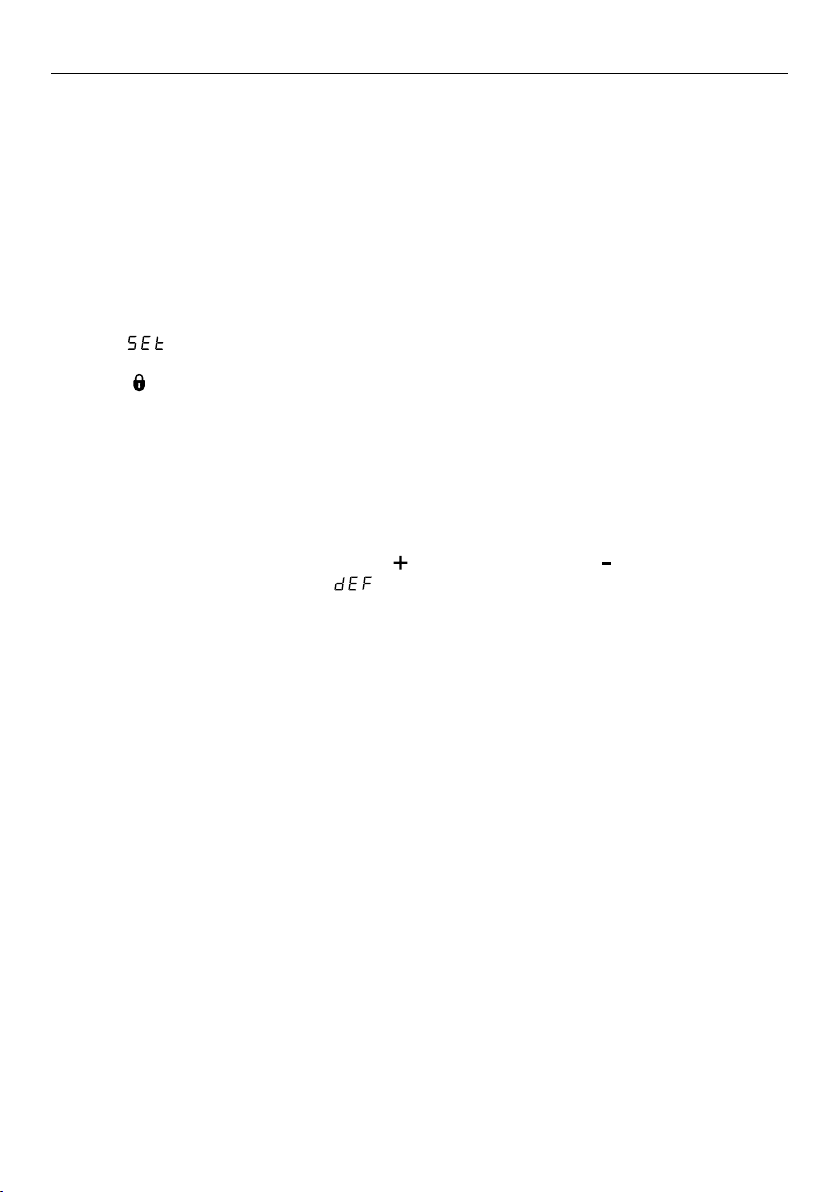
Note: when activated, the light above the button is illuminated. will be
displayed on the display panel.
If Keylock mode is activated and the machine is powered off:
●
To turn your washer on, press the ‘POWER’ button, then touch and hold the button
for twoseconds. Select your wash cycle, options and then touch to start the cycle.
●
To turn the washer off at anytime when keylock is activated simply press the ‘POWER’
button.
Delay Start
The ‘Delay Start’ option enables you to delay the start of the wash cycle from between
5minutes and 12hours. Times you can select are 5min, 15min, 30min, 1hour, then
hourly up to 12hours. This can be useful to time your washing to finish when you arrive
home from work, or to start once you have finished in the shower. Some stain removers
also require you to spray them on then leave for several minutes, before washing.
Your washer will wait for the selected time then start without you having to wait or
remember to start your machine.
To program a ‘Delay Start’ time, simply touch the ‘More’ button to increase the delay
time and ‘Less’ button to decrease the time or turn ‘Delay Start’ off. Touch to
confirm your selection and start the countdown. Once started, the time will count down
on the digital display screen in 1 minute increments, the ‘Delay Start’ light will flash and
the light will stop flashing and turn on solid.
Note: if you hold the ‘More’ button down, the time displayed on the screen will increase
after every half a second (more convenient than touching the button repetitively).
To remove a ‘Delay Start’ time once it is counting down, simply touch , then touch the
‘Less’ button to decrease the time to zero. Touch to start the cycle immediately.
Note: we suggest that you avoid using ‘Delay Start’ for damp, non-colorfast items as this
may cause dye run to occur.
38
CUSTOMIZING WASH CYCLES
After using your washer a few times you may discover there are some wash options you
prefer for some cycles.
You can program your washer to remember the wash options you prefer for each
wash cycle. For instance, you may want to set the ‘Perm Press’ cycle to cold wash
temperature or set the ‘Everyday’ cycle so it gives you Rinse+ every cycle.
To customize a cycle:
1
Press ‘POWER’ to turn the machine on.
2
Turn the dial to select the cycle you wish to customize.
3
Touch and hold any of the wash option buttons for 3seconds. The cycle icon will flash
on and off to indicate that the product is in cycle adjustment mode. The display will
show .
4
Select the wash options you prefer by touching the relevant option button.
5
Touch to save the selected settings.
Your washer will automatically remember your changes for all future washes you do on
this cycle.
Factory Reset
You can reset your washer to the default settings it left the factory with:
1
Turn the dial to select ‘Spin’.
2
Touch and hold the ‘Delay Start’ ‘More’ , the ‘Delay Start’ ‘Less’ and ‘Options’
buttons together for 3seconds will appear on the screen and the machine
will beep.
3
Your washer will now be reset to the default settings.
39
CARING FOR YOUR WASHER
When you have finished using your washer
●
Unplug the machine from the power socket.
●
Wipe around the door and in the rubber gasket to remove any remaining water and
foreign matter.
●
Turn off the faucets to prevent the chance of flooding should a hose burst.
Cleaning your washer
Before you start cleaning your washer, ensure that it is disconnected from the power
(ieunplug the machine from the power socket).
Cleaning the control panel and outer surfaces of the washer
Use a soft damp cloth to wipe all surfaces, then wipe dry. Avoid using chemical or
scouring cleaners, as these will damage the paint and plastic surfaces of your washer.
Cleaning the detergent dispenser drawer
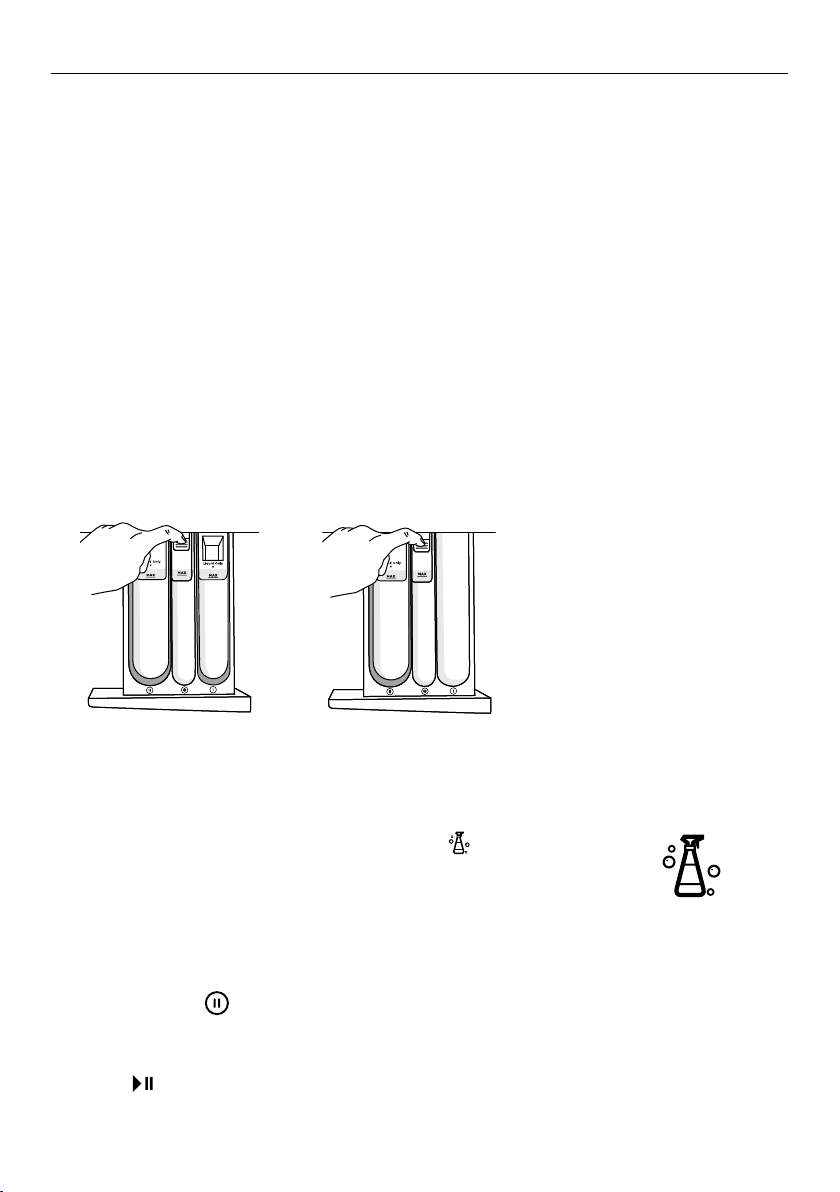
Wipe out the detergent dispenser drawer with a damp cloth. Clean it regularly, especially
if you use fabric softener. To remove the drawer, pull it open, push down on the tab in the
fabric softener compartment and pull out. Rinse it out under warm water and replace.
Removing the dispenser drawer for cleaning
PUSH
WH2424P model
WH2424F model
Cleaning the inside of your washer
It is important that you regularly clean the inside of your machine
using the ‘Drum Clean’ cycle. After 100cycles icon will flash
every time you turn your washer on to remind you to do this.
If your washer starts to smell this is a sign that you should
complete a ‘Drum Clean’ cycle. We recommend that you do not
have any items in the washer when you run this cycle.
Cleaning steps
1
Add detergent directly into the main wash detergent compartment of the dispenser
drawer marked . The suggested amount of detergent is bar 3 marked on the scoop
of a good quality detergent or use a drum cleaning product specifically designed for
front loading washing machines (follow manufactures instructions).
2
Press ‘POWER’ to turn your machine on and select the ‘DrumClean’ cycle.
3
Touch to start the cycle (refer to the ‘Wash cycles’ section).
‘Drum Clean’ cycle
40
CARING FOR YOUR WASHER
Cleaning the drum and the door
●
Use a soft damp cloth to wipe the door, cleaning any water marks or residue off it.
●
Wipe the rubber seal around the door. Remove any items or lint accumulating in the
bottom of the seal catchment and wipe out any accumulated water. If this is not cleaned
out, unpleasant odors will develop.
●
If the drum has any residual dirt or lint stuck to it, remove this and wipe the drum clean.
Do not leave any metal objects in the drum as these may rust and cause staining.
●
The WH2424F model also has a self cleaning door flush that directs a portion of the
rinse water over the door during various stages of the cycle to help to clean lint and
insolubles from the inside of the door and surrounding parts. We still recommend that
you manually clean it with a soft cloth periodically as per the instructions above.
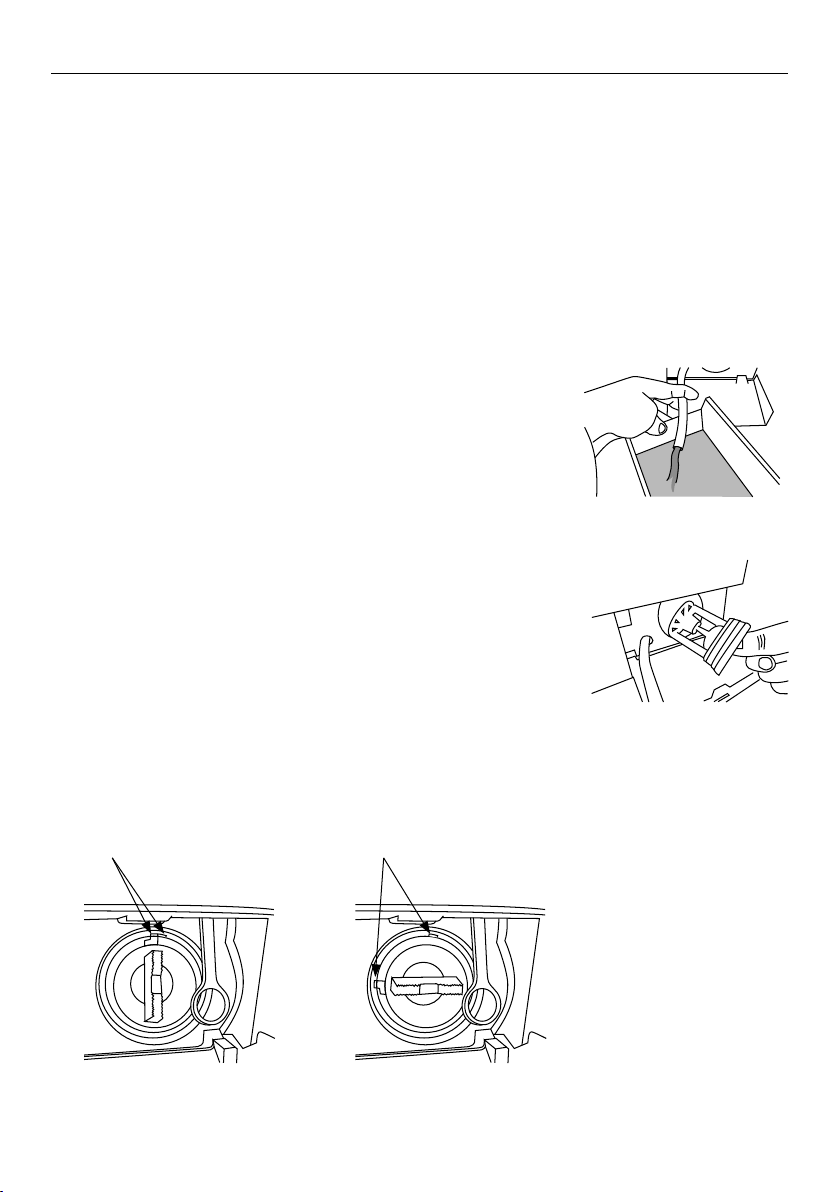
Cleaning the pump filter
The pump has a filter to trap foreign objects that enter
the washer along with clothing. The pump filter can be
accessed from the front of the washer.
To clean the filter:
This should be cleaned out approximately once a month.
1
Turn the power off and unplug the machine.
2
Use a coin to open the filter cover. Place the edge of the coin
into the slot and tilt upwards while levering the cover open.
3
Unhook the pump outlet hose and pull it out (about
150mm). Remove the plug and allow any water
(approximately 250ml) to drain into a shallow dish.
4
After the draining process is complete, replace the plug
intothe hose and refit the hose back into the housing.
5
Remove the filter by turning anti-clockwise. Clean and
rinseunder a faucet. Check the pump filter cavity for any
further obstruction.
6
Replace the filter by turning clockwise until the white mark
on the filter is in line with the white line on the pump housing.
7
Make sure the propeller is freely moving at the back of the
filter cavity; remove any foreign objects.
8
Close the filter cover.
White mark on filter must be in line with white line on pump housing
White marks are in line
Correct
Incorrect
White marks are not in line
Drain residual water
Replacing filter

41
CARING FOR YOUR WASHER
Cleaning the hose(s)
Each hose has a filter in it, preventing any solid contaminants in the water entering
your washing machine. Occasionally you should disconnect the water inlet hose(s)
where they connect to the faucet(s). Check these for any build up of dirt and wash
this out.
Diaper sanitizers/bleach
Diaper sanitizers and bleach are very corrosive to metal surfaces. DO NOT tip the
contents of a diaper bucket into your machine. Rinse and wring items out thoroughly
before placing them in the machine.
Moving your washer
If you need to move your washer a considerable distance (eg moving house),
remember to replace the transit bolts before moving it. These will protect internal
components of the washer from damage.
To replace the transit bolts, pull out the bolt-hole covers in the back of the machine.
Push the transit bolt rubber grommets and plastic spaces into the hole left and
tighten it with the wrench provided with the product.
Make sure any water in the washer is drained out. This can be done by cleaning out
the pump filter (refer to ‘Caring for your washer’ section ‘Cleaning the pump filter’).
IMPORTANT!
●
Leave the door to your washer open when it is not in use to allow the washer to
dry out, otherwise it will develop unpleasant odors. When leaving the door open
like this, it is extremely important that children and pets are kept away from the
washer so they cannot be accidentally trapped inside it.
●
Aside from the detergent dispenser, water hose(s), and the pump filter, no other
parts are designed to be removed from the machine for cleaning. Do not attempt
to remove any other part of the machine.
WARNING!
Certain internal parts are intentionally not grounded and may present a risk
of electricshock only during servicing. Service Personnel - Do not contact the
followingparts while the appliance is energized: electrical valve, drain pump,
NTCandmotor control unit.
42
BEFORE YOU CALL FOR SERVICE
User warnings
Your washer is capable of diagnosing a number of its own problems. In most cases,
your washer will sound a continuous series of beeps and display a code when it has a
problem that you can correct yourself. All control panel lights will turn off and the code
will be displayed to inform you what the problem is. To stop the beeps, press any button
on the control panel. Do not try to continue washing once you stop the noise. You must
address the problem the washer is alerting you to.
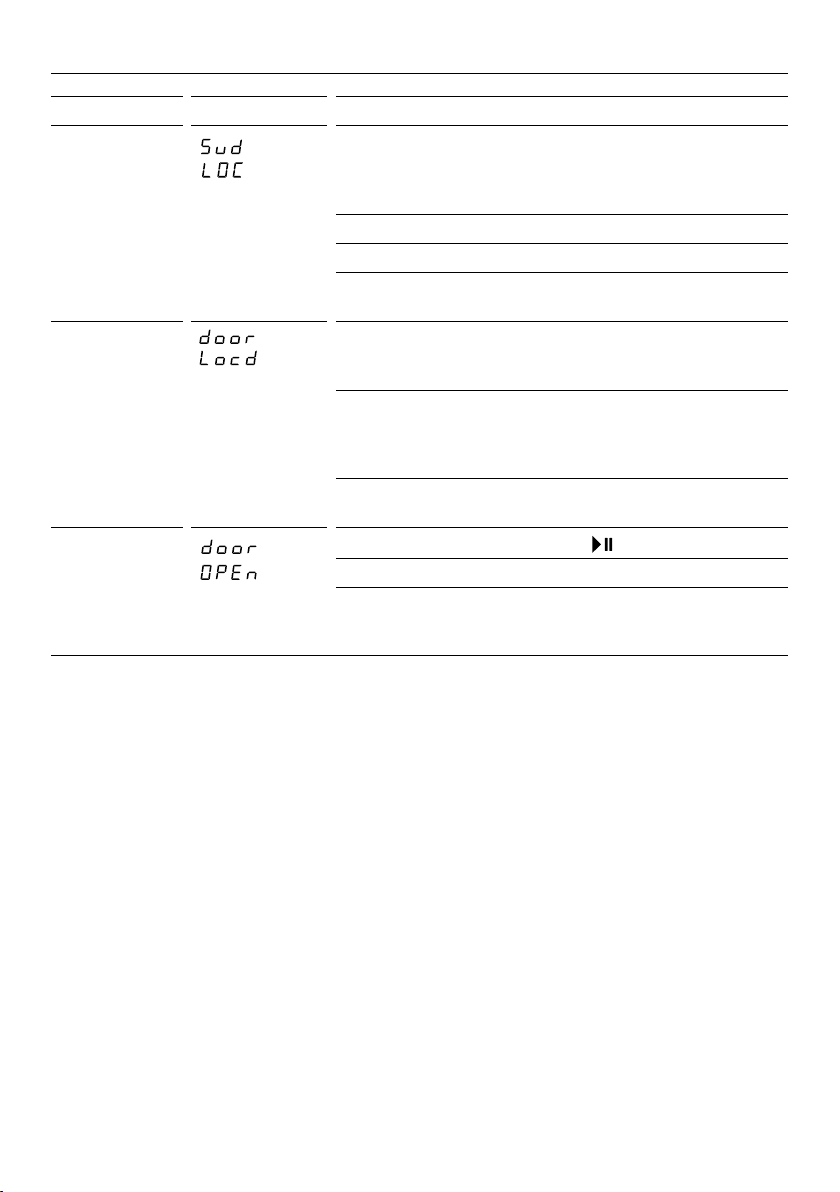
Check this chart before you call for service.
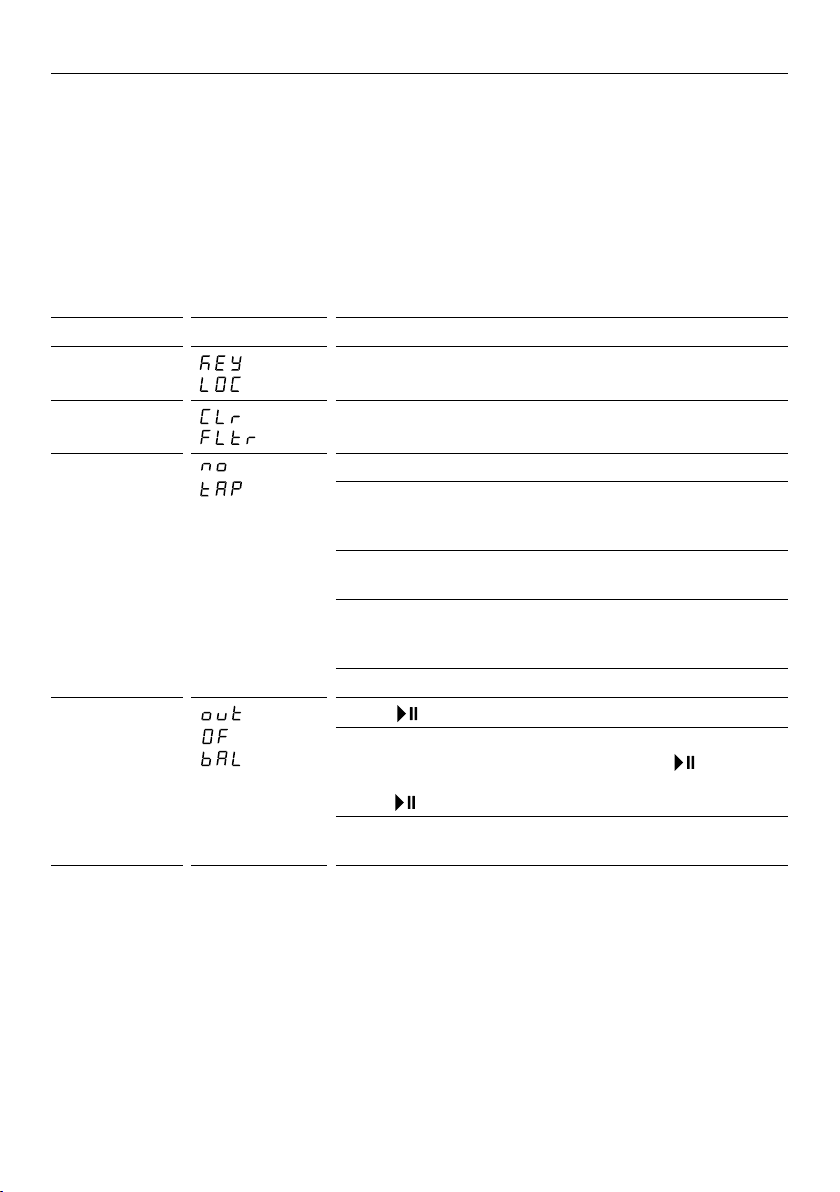
PROBLEM DISPLAYED AS WHAT TO DO
Keylock is
activated
Touch and hold the ‘Keylock’ button for 2seconds.
Pump filter is
blocked
Clear the pump filter (refer to page38).
Water is not
getting to the
machine
Check the faucets have been turned on.
Check the hose connections. If the cold water
supply is connected to the hot valve and there is no
connection to the cold valve the machine will not fill.
Check the inlet hose filters are not blocked, the
hose(s) are not kinked and are attached correctly.
Check that the drain hose is not too low or pushed
into the standpipe too far. This will cause the water to
siphon out of the machine.
Check the water flow rate. It maybe too low.
Wash load
is out of
balance
Touch to try the spin again.
If the out of balance persists, pause the cycle,
manually redistribute the load and touch
to spin
again. If necessary, stop the cycle, select ‘Spin’ and
touch .
If the problem persists, check the machine is correctly
leveled.
43
BEFORE YOU CALL FOR SERVICE
PROBLEM DISPLAYED AS WHAT TO DO
Too many
suds
Machine will stop and flash while waiting for suds
to dissipate. The machine will not beep during this
time. When the suds have dissipated, the machine will
automatically restart.
Check you are using a suitable detergent.
Check you are not overdosing the detergent.
Check the standpipe height for the drain does not
exceed 471/5” (1200mm).
Door is
locked
The temperature in the drum is over 140°F (60°C)
therefore it is not safe to open the door. Wait until the
temperature drops below 140°F (60°C).
Check the water level in the drum. If the level is above
the bottom of the door seal, the door cannot be
opened. Use the ‘Add a Garment’ button if you wish
to add or remove items.
If the drum is still moving, wait for it to stop before
attempting to open the door.
Door is open
Close the door fully and touch .
Try opening and closing the door again.
Reposition the load, make sure the load is correctly in
the drum and that protruding items are not stopping
the door from closing.

44
FAULT CODES
When a continuous series of beeps is sounded, all the lights turn off on the control
panel and a number appears on the display, a fault has occurred. The washer will
automatically enter this mode if a fault occurs. The fault code will be displayed as
followed by a number on the digital display. To stop the sound, touch any button and
perform the following steps:
1
Turn your machine off at the power point.
2
Wait one minute and turn it back on.
3
Check your machine is correctly leveled (refer to page10).
4
Remove your wash load.
5
Perform a ‘Rinse’ cycle.
6
If the fault re-occurs repeat steps
1
and
2
.
7
If the machine still will not work you will be required to call a Fisher & Paykel trained
and supported service technician to arrange service (refer to the ‘Limited warranty’
section). Record the fault code number displayed and the serial number of your washer
(located on the rear of the machine, and/or above the drum opening when the door is
open) before calling. The fault code will indicate to the Repairer what the problem could
potentially be.
If a fault code is being displayed, you can still turn your washer off by pressing ‘POWER’.
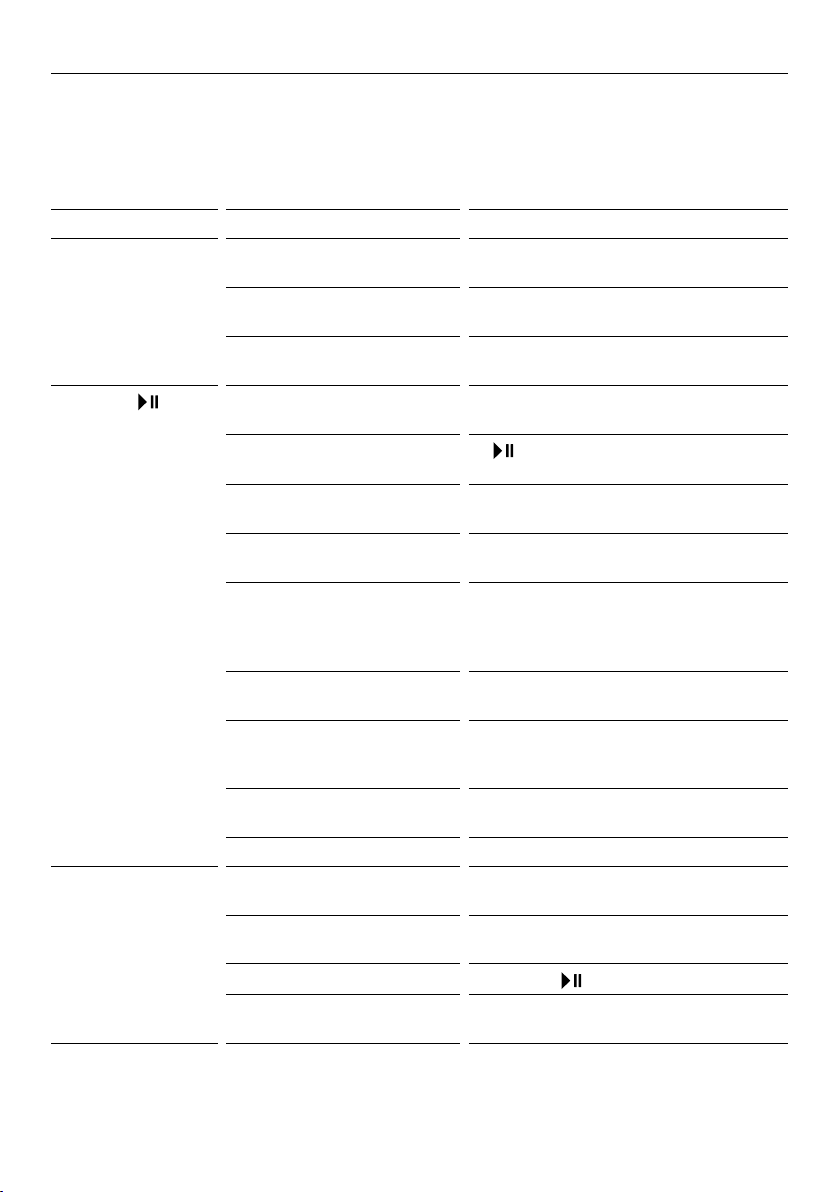
45
TROUBLESHOOTING
The following is a list of problems you may encounter when using this appliance and
some suggestions that may help to correct the problem. If you still have problems,
please contact your Fisher & Paykel trained and supported service technician.
Solving operating problems
PROBLEM POSSIBLE CAUSES WHAT TO DO
Washer not
turning on
Power not switched on at
the wall.
Switch the power on at the wall. Then
press ‘POWER’.
Household power supply
not working.
Try plugging in another electrical
appliance.
Keylock may be activated. Touch and hold the ‘Keylock’ button
for 2 seconds (refer to page35).
Touching
does
not start the fill
Washer door not closed
properly.
Open and reclose door.
The washer is waiting for a
command from you.
If
is flashing then the washer is
waiting for a command from you.
The washer has detected
a fault.
Check if a code is being displayed on
the panel (refer to pages 40 – 42).
Hot and cold faucets not
turned on.
Check that both hot and cold faucets
are turned on.
Hot and cold faucets
not connected to the
corresponding valve on the
machine.
Check the cold faucet is connected
to the cold valve on the machine and
the hot faucet is connected to the
hot valve (if present).
Blocked hose filters. Check the faucet end of the inlet
hose(s) for blockages.
Inlet hose leaking, twisted
or damaged.
Check the inlet hose for leaks or
damage. Check that the inlet hose is
not twisted.
Faulty water supply. Check faucets that aren’t connected
to the machine are working.
Delay start maybe set. Refer to page 35.
Washer stops
working mid cycle
The washer has detected
a fault.
Refer to pages 40 – 42.
Power or water failure. Check the power and/or water is
working correctly.
Washer has been paused.
Touch the
button to continue.
Too many suds. Washer is waiting for suds to dissolve
before continuing the cycle.
46
TROUBLESHOOTING
Solving operating problems
PROBLEM POSSIBLE CAUSES WHAT TO DO
Washer drains
while filling
Drain hose too low. Ensure the height of the drain hose is
at least 311/2” (800mm) from the floor
level (refer to page13).
Drain hose sitting in water. Clear the drain.
Washer is not
draining
Drain hose blocked. Clear the drain hose.
Pump filter blocked. Clear the pump filter (refer to page 38).
Drain hose higher than
471/5” (1200mm) above
floor level.
Lower the level of the drain hose (refer
to page 13).
Filling
continuously
Drain hose not connected
to standpipe or tub.
Connect drain hose correctly (refer to
page 13).
Machine siphoning. Ensure standpipe or tub is at least
311/2” (800mm) from the floor level.
Poor rinsing Incorrect detergent used. Use low sudsing, front loader
detergent only (refer to page 26).
Too much detergent used. Ensure the correct dose of detergent
is used for the load size and soil level
(refer to page 28).
Not spinning
properly
Load has gone out of
balance.
Open door and redistribute load, then
restart the washer.
Machine is not level. Ensure machine is correctly leveled
(refer to page10).
Suds build up. Check the amount of detergent used,
reduce if necessary.
Too many soap
suds
Incorrect type of
detergent used.
Use low sudsing, front loader
detergent only (refer to page 26).
Too much detergent used. Ensure the correct dose of detergent
is used for the load size and soil level
(refer to page 28).

47
TROUBLESHOOTING
Solving operating problems
PROBLEM POSSIBLE CAUSES WHAT TO DO
Small puddle of
water from under
the machine
Inlet hose or drain hose
leaking.
Check inlet hose(s) and the drain
hose are correctly attached and not
damaged.
Lots of suds. Suds may have leaked and then
dissolved.
Detergent dispenser
blocked.
Clean detergent dispenser drawer
(refer to page 37).
Detergent dispenser
drawer not fully closed.
Close detergent dispenser drawer
fully and ensure it remains closed
during the cycle.
Damage to door seal. Check seal inside door for damage. If
it sustains any damage it will need to
be replaced.
Cycle time
longer than
usual/Inaccurate
time reading/
Adjustment of
time remaining
during cycle
Wash time is approximate. Wash time may be influenced by a
number of factors (refer to page22).
Low water pressure or
flow rate.
Ensure that inlet hose filters are not
blocked.
Out of balance or
oversudsing.
Recovery from out of balance or
oversudsing will extend cycle time
(refer to pages 40–41).
Washing a large load. Be aware that it will take longer for
the machine to fill.
Selecting various options. Be aware that some options will
extend cycle time.
Detergent or
fabric softener
remaining
in detergent
dispenser at the
end of the cycle
Detergent drawer not
properly closed or was
opened part way through
the cycle.
Ensure the detergent dispenser
drawer is fully closed at the start
of the cycle and remains closed
throughout the cycle.
Dirty or blocked detergent
dispenser.
Clean the detergent dispenser (refer
to page 37).
Liquid sitting at the ‘Max’
level at the end of the
cycle indicates a blockage.
Clean the fabric softener dispenser
(refer to page 37).
Dispenser over loaded
with detergent.
Clean out remaining detergent
and refer to page 28 for dosing
information.
48
TROUBLESHOOTING
Solving operating problems
PROBLEM POSSIBLE CAUSES WHAT TO DO
Washing very wet
at the end of the
cycle
Cycle selected not
appropriate.
Particularly short or delicate cycles
have shorter spins which can result in
wetter washing at the end of the cycle.
Incorrect spin speed for
load selected.
Select a faster spin speed.
An out of balance load
has occurred.
The washer compensates for the
out of balance by using a lower spin
speed, to reduce noise and potential
damage to itself.
Vibrating Transit bolts left in place. Ensure transit bolts are removed prior
to use of the machine (refer to page 9).
Washer may not be level. Ensure washer is installed on an
appropriate surface and leveled
correctly (refer to page 10).
Load is out of balance. Wash an average sized load rather than
a smaller load or a single item. Washing
one item at a time is not recommended
as it is difficult for the washer to
balance a single item during spin.
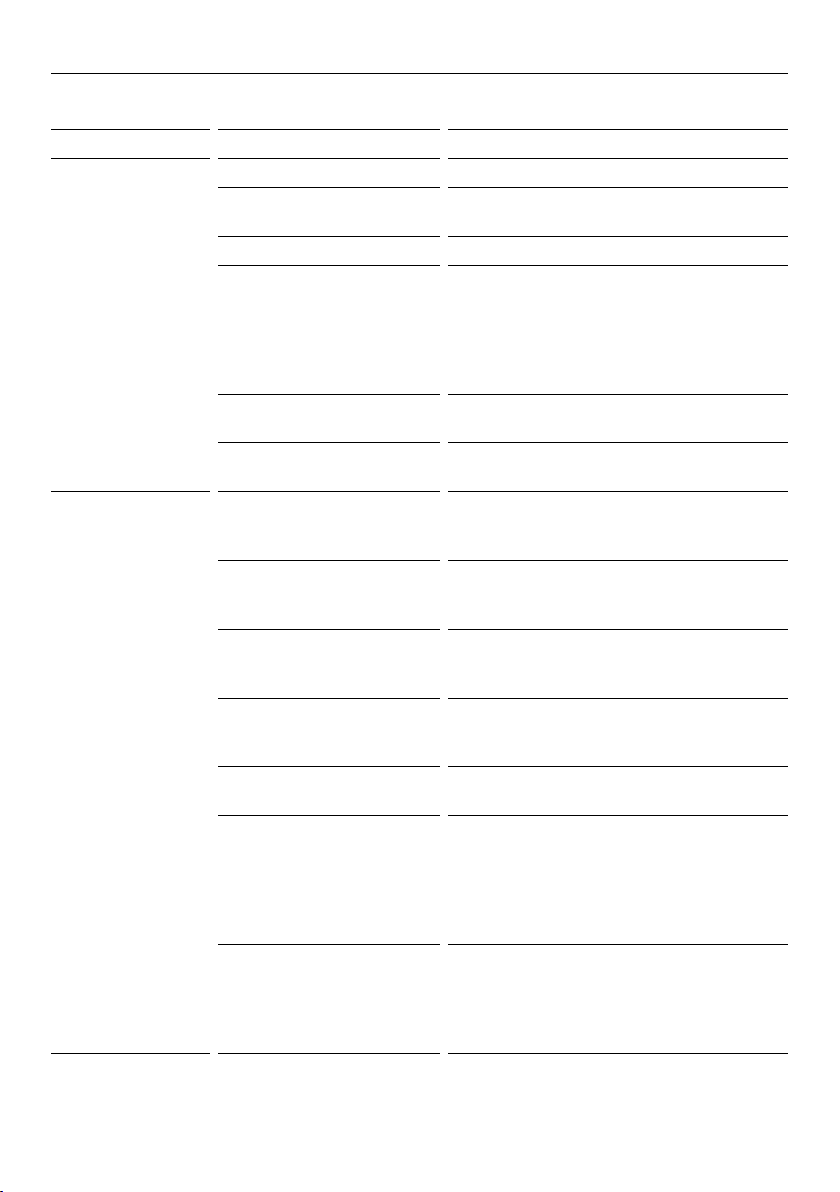
49
TROUBLESHOOTING
Solving wash problems
PROBLEM POSSIBLE CAUSES WHAT TO DO
Creasing Washer overloaded. Do not overload washer.
Incorrect cycle for load
type.
Use the ‘Perm Press’ or ‘Delicate’ cycle
for creasable items.
Spin speed too fast. Select a slower spin speed.
Wet clothes left in
washer or laundry basket.
Laundry left sitting wet is more likely
to crease. If not removing clothes from
washer immediately at end of cycle,
select the ‘Wrinkle Free’ option. Do not
leave wet washing sitting in a washing
basket.
Wash temperature too
hot for load type.
Select a lower wash temperature. Check
items care label for correct care.
Items not sorted
correctly.
Sort load so that items of similar weight
are washed together (refer to page 24).
Poor soil
Removal
Incorrect wash cycle
selected.
Select a wash cycle that is appropriate
for the amount of dirt (refer to pages
30 – 31).
Insufficient detergent. Ensure the correct dose of detergent
is used for the load size and soil level
(refer to page 28).
Washer overloaded. Ensure the washer is not overloaded
in terms of its capacity or the cycle
selected (refer to pages 30 – 31).
Load was particularly
dirty.
Select ‘Pre Wash’ and/or ‘Steam’
for particularly dirty loads (refer to
page33).
Items not sorted
correctly.
Wash heavily and lightly soiled
garments separately.
Washer dirty from
previous wash.
After washing particularly dirty clothing,
we recommend putting the washer
through a ‘Rinse’ cycle after the load
has been removed, to wash away any
remnants of dirt and to prevent it
contaminating future washes.
Incorrect wash
temperature selected in
relation to the type of
soil.
Select a wash temperature suitable for
the type of soil, eg warm for greasy soils,
cold for muddy soils. Increasing the wash
temperature generally improves soil
removal and overall wash performance.
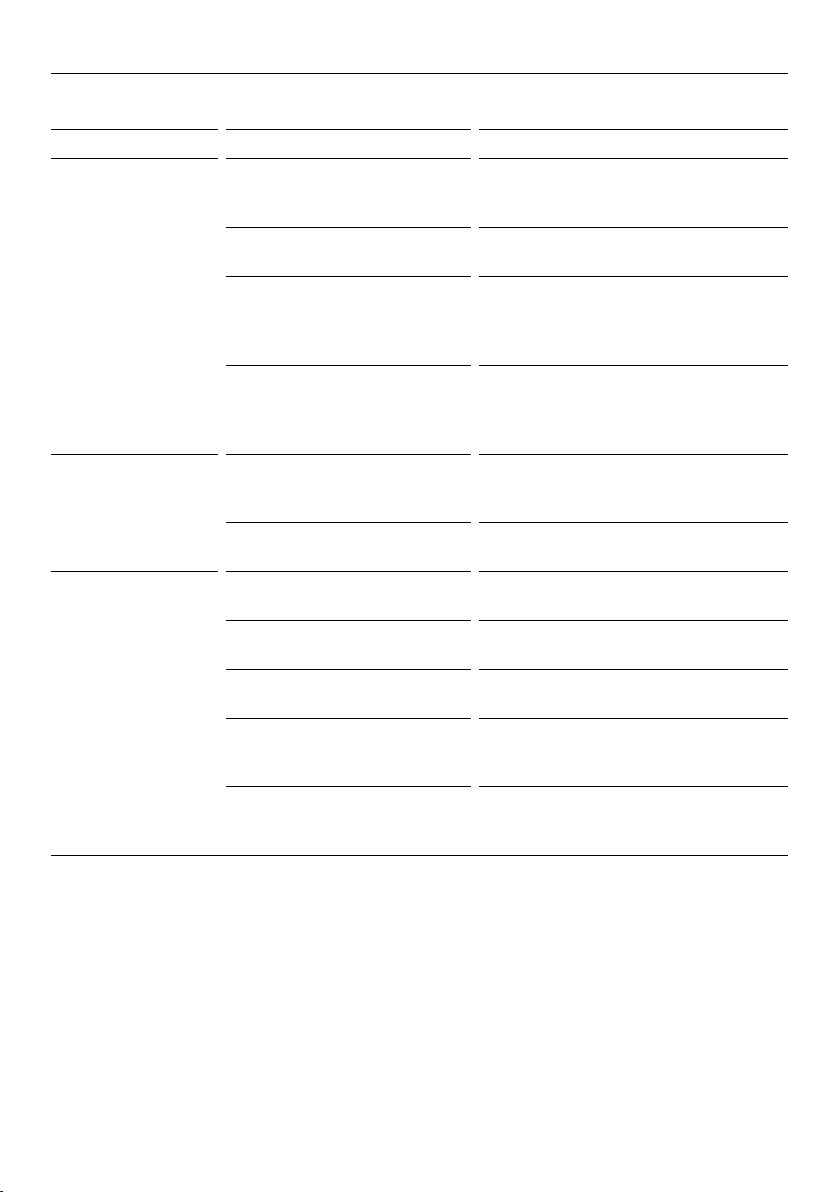
50
TROUBLESHOOTING
Solving wash problems
PROBLEM POSSIBLE CAUSES WHAT TO DO
Dye transfer Colored items not washed
separately from white/light
colored items.
Remember to separate whites and
colors.
New or non-colorfast items
not washed separately.
Wash non-colorfast items separately
and select ‘Cold’ wash temperature.
Wet items have been left
sitting for too long.
Remove items from washer as soon
as the cycle is finished, or if items are
not to be removed from the washer
immediately select ‘Wrinkle Free’.
Wash temperature. Consider the wash temperature
you select for your colored items.
Lower the temperature if you are
concerned.
Black or grey
marks on clothes
Correct amount of
detergent.
Ensure the correct dose of
detergent is used for the load size
and soil level (refer to page 28).
Washer needs to be
cleaned.
Empty the machine and complete a
‘Drum Clean’ cycle (refer to page37).
Tangling Items not sorted correctly. Separate larger items from smaller
items.
Washer loaded incorrectly. Load items loosely and individually
into the washer (ie not folded).
Incorrect cycle for load type
selected.
Use the ‘Perm Press’ cycle to wash
shirts.
Washer overloaded in terms
of its capacity or the cycle
selected.
Try washing average to smaller load
sizes.
Delicate items. Wash pantyhose, bras and any other
delicate items prone to tangling in a
mesh laundry bag.
Contact a Fisher & Paykel trained and supported service technician if a problem persists.

51
LIMITED WARRANTY
When you purchase any new Fisher & Paykel FabricSmart™ or WashSmart™ clothes
washer product for personal or consumer use you automatically receive a two year
limited warranty covering parts and labor for servicing within the 48 mainland United
States, Hawaii, Alaska, Washington DC and Canada. You also receive an additional eight
year parts only limited warranty on the direct drive motor part only. This additional
eight year limited warranty commences on the day following the expiry of the two
year limited warranty and excludes the motor controller and labor. Products for use
in Canada must be purchased through the Canadian distribution channel to ensure
regulatory compliance.
Fisher & Paykel undertakes to:
Repair or at its option replace without cost, with limited exceptions described herein,
to the owner either for material or labor any part of the product, the serial number of
which appears on the product, which is found to be defective. In Alaska only, neither
the two year limited warranty nor the additional eight year direct drive motor part only
limited warranty include the cost of transport of your product and you must pay to
ship the product to the service shop or the service technician’s travel to your home. If
the product is installed in a motor vehicle, boat or similar mobile facility, you receive
the same two year limited warranty, and, if your product qualifies, additional eight year
direct drive motor part only limited warranty (excluding the motor controller and labor)
but you must bring the vehicle, boat or mobile facility containing the product to the
service shop at your expense or pay the service technician’s travel to the location of
the product. For any product covered by the additional eight year direct drive motor
part only limited warranty, Fisher & Paykel will also repair (as to parts) or, at its option,
replace any direct drive motor (but not the motor controller) which is found to be
defective within eight years following the expiry of the two year limited warranty. You
will be responsible for any labour costs. If we are unable to repair a defective part of the
product after a reasonable number of attempts, at our option we may replace the part
or the product, or we may provide you a full refund of the purchase price of the product
(not including installation or other charges).
These limited warranties extend to the original purchaser and any succeeding owner of
the product during the term of the warranty for products purchased for ordinary single-
family homeuse.
All service under the above limited warranties shall be provided by Fisher & Paykel or its
Authorized Service Agent during normal business hours.
How long do these limited warranties last?
Our liability under the two year limited warranty expires TWO YEARS from the date of
purchase of the product by the first consumer. The additional direct drive motor part only
limited warranty expires eightyears after the expiration of the two year limited warranty.
Our liability under any implied warranties, including the implied warranty of
merchantability (an unwritten warranty that the product is fit for ordinary use) also
expires TWO YEARS (or such longer period as required by applicable law) from the date
of purchase of the product by the first consumer. Some States do not allow limitations
on how long an implied warranty lasts, so this limit on implied warranties may not apply
to you. Fisher & Paykel will honor any warranty required by the law of the particular
country or state in which the product is sold.

52
LIMITED WARRANTY
These limited warranties do not cover:
A
Service calls that are not related to any defect in the product. The cost of a service call
will be charged if the problem is not found to be a defect of the product. For example:
1
Correcting faulty installation of the product.
2
Instructing you how to use the product.
3
Replacing house fuses, resetting circuit breakers, correcting house wiring or
plumbing, or replacing light bulbs.
4
Correcting fault(s) caused by the user.
5
Changing the set-up of the product.
6
Unauthorized modifications of the product.
7
Noise or vibration that is considered normal, for example, drain/fan sounds or user
warning beeps.
8
Correcting damage caused by pests, for example, rats, cockroaches, etc.
B
Defects caused by factors other than:
1
Normal domestic use or
2
Use in accordance with the product’s User guide.
C
Defects to the product caused by accident, neglect, misuse, fire, flood or ‘act of God’.
D
The cost of repairs carried out by non-authorized repairers or the cost of correcting
such unauthorized repairs.
E
Travel fees and associated charges incurred when the product is installed in a location
with limited or restricted access (eg airplane flights, ferry charges, isolated geographic
areas).
F
Normal recommended maintenance as set forth in the product’s User guide.
G
Damage (including water damage) caused by faulty installation, plumbing or wiring.
If you have an installation problem contact your dealer or installer. You are responsible
for providing adequate electrical, exhausting and other connection facilities.
We may not be responsible for consequential or incidental damages (the cost of
repairing or replacing other property damaged if the product is defective or any of your
expenses caused if the product is defective). Some States do not allow the exclusion or
limitation of incidental or consequential damages, so the above limitation or exclusion
may not apply to you..

53
LIMITED WARRANTY
How to get service
Please read your User guide. If you then have any questions about operating the
product, need the name of your local Fisher & Paykel Authorized Service Agent, or
believe the product is defective and wish service under this limited warranty, please
contact your dealer or call us at:
USA and Canada
TOLL FREE 1.888.9.FNP.USA (1.888.936.7872)
or use the link at: www.fisherpaykel.com/locator/servicer/
You may be required to provide reasonable proof of the date of purchase of the product
before the product will be serviced under this limited warranty.
Commercial use
If you are using the product in a commercial setting (any use other than a single family
dwelling), we agree to repair or replace, without cost to you for parts only, any defective
parts, the serial number of which appears on the product. Our liability for these repairs
expires ONE YEAR from the date of original purchase.
At our option we may replace the part or the product, or we may provide you a full
refund of the purchase price of the product (not including installation or other charges).
All service under this limited warranty shall be provided by Fisher & Paykel or its
Authorized Service Agent during normal business hours.
No other warranties
This limited warranty is the complete and exclusive agreement between you and
Fisher&Paykel regarding any defect in the product. None of our employees (or our
Authorized Service Agents) are authorized to make any addition or modification to this
limited warranty.
Warrantor: Fisher & Paykel Appliances, Inc.
If you need further help concerning this limited warranty, please call us at above number,
or write to:
Fisher & Paykel Appliances, Inc.
695 Town Center Drive, Suite 180
Costa Mesa
CA 92626
This limited warranty gives you specific legal rights, and you may also have other rights
which vary from state to state.

54
LIMITED WARRANTY
Complete and keep for safe reference:
Model
Serial No.
Purchase Date
Purchaser
Dealer
City
State
Zip
Country


429798D 09.20
FISHERPAYKEL.COM
© Fisher & Paykel Appliances 2020. All rights reserved.
The models shown in this guide may not be available in all markets
and are subject to change at any time.
The product specifications in this guide apply to the specific products and
models described at the date of issue. Under our policy of continuous product
improvement, these specifications may change at any time.
For current details about model and specification availability in your country,
please go to our website or contact your local Fisher&Paykel dealer.