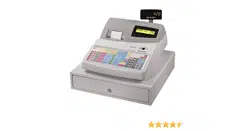
ELECTRONIC CASH REGISTER
CAJA REGISTRADORA ELECTRONICA
INSTRUCTION MANUAL MANUAL DE INSTRUCCIONES
XE-A302
MODEL
MODELO

FCC Regulations state that any unauthorized changes or modifications to
this equipment not expressly approved by the manufacturer could void
the user’s authority to operate this equipment.
Note: This equipment has been tested and found to comply with the
limits for a Class A digital device, pursuant to Part 15 of the FCC Rules.
These limits are designed to provide reasonable protection against
harmful interference when this equipment is operated in a commercial
environment.
This equipment generates, uses, and can radiate radio frequency energy
and, if not installed and used in accordance with the instruction manual,
may cause harmful interference to radio communications. Operation of
this equipment in a residential area is likely to cause harmful interference
in which case the user will be required to correct the interference at his
own expense.
WARNING
CAUTION
The AC power socket-outlet should be installed near the equipment
and should be easily accessible.
Please record below the model number and serial number for easy
reference in case of loss or theft. These numbers are located on the
right side of the unit. Space is provided for further pertinent data.
Model Number
Serial Number
Date of Purchase
Place of Purchase
FOR YOUR RECORDS
1
English
English
INTRODUCTION
Thank you very much for your purchase of the SHARP Electronic Cash Register, Model XE-A302.
Please read this manual carefully before operating your machine in order to gain full understanding of
functions and features.
Please keep this manual for future reference. It will help you if you encounter any operational problems.
Be sure to initialize the cash register before you start operating the cash register. Otherwise, distorted
memory contents and malfunction of the cash register will occur. For this procedure, please refer to page 8.
IMPORTANT
• On the printer cover, a paper cutter is mounted. Be careful not to cut yourself on the paper cutter.
• Install your register in a location that is not subject to direct radiation, unusual temperature changes,
high humidity or exposed to water sources. Please keep the register away from heat and magnetic
sources.
Installation in such locations could cause damage to the cabinet and the electric components.
• Never operate the register with wet hands.
The water could seep into the interior of the register and cause component failure.
• When cleaning your register, use a dry, soft cloth. Never use solvents, such as benzine and/or
thinner.
The use of such chemicals will lead to discoloration or deterioration of the cabinet.
• The register plugs into any standard wall outlet (120V AC ±10%) with a dedicated earth-guard.
Other electrical devices on the same electrical circuit could cause the register to malfunction.
• If the register malfunctions, call 1-800-BE-SHARP for service - do not try to repair the register
yourself.
• For complete electrical disconnection, remove the AC power cord from the wall outlet.
PRECAUTION
This Electronic Cash Register has a built-in memory protection circuit which is operated by rechargeable
batteries.
Please note that all batteries will, in time, dissipate their charge even if not used. Therefore to insure an
adequate initial charge in the protection circuit, and to prevent any possible loss of memory upon installation, it
is recommended that each unit be allowed to recharge for a period of 24 to 48 hours prior to use by the
customer.
After installation, the rechargeable batteries are charged when the machine is plugged in and its mode switch
is set to the ON position (other than OFF position). This recharging precaution can prevent unnecessary initial
service calls.
CAUTION!
Customer Service Hotline
1-800-BE-SHARP
For Easy Set-up, see
“GETTING STARTED” (page 8).
The Spanish version (summary of English version) is after the English version.
La versión española (el resumen de la versión inglesa) sigue a la versión inglesa.

CONTENTS
INTRODUCTION............................................................................................................................................1
IMPORTANT ..................................................................................................................................................1
PRECAUTION................................................................................................................................................1
CONTENTS....................................................................................................................................................2
PARTS AND THEIR FUNCTIONS.................................................................................................................4
1 External View ........................................................................................................................................4
2 Printer....................................................................................................................................................4
3 Mode Switch and Mode Keys................................................................................................................5
4 Keyboard ...............................................................................................................................................5
5 Displays.................................................................................................................................................6
6 Drawer Lock Key ...................................................................................................................................6
GETTING STARTED......................................................................................................................................8
OVERVIEW OF FLOW OF DAILY SALES ENTRIES .................................................................................12
BASIC SALES ENTRY ................................................................................................................................13
1 Basic Sales Entry Example .................................................................................................................13
2Error Warning ......................................................................................................................................14
3 Item Entries .........................................................................................................................................15
Single item entries ........................................................................................................................15
Repeat entries ..............................................................................................................................16
Multiplication entries .....................................................................................................................16
Split pricing entries .......................................................................................................................17
Single item cash sale (SICS) entry...............................................................................................18
4 Displaying Subtotals............................................................................................................................18
5 Finalization of Transaction ..................................................................................................................18
Cash or check tendering...............................................................................................................18
Cash or check sale that does not require tender entry.................................................................19
Charge (credit) sale ......................................................................................................................19
Mixed-tender sale .........................................................................................................................19
6 Tax Calculation....................................................................................................................................20
Automatic tax................................................................................................................................20
Manual tax ....................................................................................................................................20
Tax delete.....................................................................................................................................20
Tax status shift .............................................................................................................................21
OPTIONAL FEATURES...............................................................................................................................22
1 Auxiliary Entries...................................................................................................................................22
Discount and premium entries using the percent key...................................................................22
Discount and premium entries using the discount key .................................................................22
Refund entries ..............................................................................................................................23
Non-add code number entries and printing ..................................................................................23
2 Auxiliary Payment Treatment ..............................................................................................................24
Currency conversion.....................................................................................................................24
Received-on account and paid-out entries ...................................................................................25
No sale (exchange) ......................................................................................................................25
Bottle return ..................................................................................................................................25
3 Automatic Sequence Key (
a
key) Entries.........................................................................................25
CORRECTION .............................................................................................................................................26
1 Correction of the Last Entry (direct void).............................................................................................26
2 Correction of the Next-to-last or Earlier Entry (indirect void)...............................................................26
3 Subtotal Void .......................................................................................................................................27
4 Correction of Incorrect Entries not Handled by the Direct or Indirect Void Function ...........................27
FOR THE OPERATOR
2

PRIOR TO PROGRAMMING ......................................................................................................................28
BASIC FUNCTION PROGRAMMING (For Quick Start) ............................................................................28
1 Date and Time Programming ..............................................................................................................28
2 Tax Programming for Automatic Tax Calculation Function .................................................................29
Tax programming using a tax rate................................................................................................29
The tax table (applicable to the add-on tax) .................................................................................30
Quantity for doughnut tax exempt (for Canadian tax system) ......................................................32
AUXILIARY FUNCTION PROGRAMMING .................................................................................................33
1Department Programming ...................................................................................................................33
2 PLU (Price Look-Up) and Subdepartment Programming ....................................................................35
3 Commission Rate Programming .........................................................................................................36
4 Miscellaneous Key Programming........................................................................................................37
Rate for
%
,
&
and
V
..............................................................................................................37
Amount for
-
..............................................................................................................................37
Percent rate limitation for
%
and
&
..........................................................................................38
Function parameters for
%
,
&
and
-
....................................................................................38
Function parameters for
V
.........................................................................................................39
Entry digit limit for
r
,
R
and
t
............................................................................................39
Function parameters for
C
,
X
,
Y
and
A
(when using as CA key).....................................40
5 Text Programming...............................................................................................................................41
ADVANCED PROGRAMMING....................................................................................................................48
1 Register Number and Consecutive Number Programming .................................................................48
2 Various Function Selection Programming 1 ........................................................................................48
Function selection for miscellaneous keys ...................................................................................49
Print format ...................................................................................................................................49
Receipt print format ......................................................................................................................50
Electronic journal (EJ) function parameters..................................................................................50
Function selection for tax..............................................................................................................51
Other programming ......................................................................................................................51
3 Various Function Selection Programming 2 ........................................................................................54
Power save mode.........................................................................................................................54
Logo message print format...........................................................................................................54
High amount lockout (HALO) for cash in drawer (CID) (sentinel).................................................55
RS-232C interface ........................................................................................................................55
Thermal printer density.................................................................................................................56
Language selection ......................................................................................................................56
Training clerk specification for training mode ...............................................................................57
AUTO key programming...............................................................................................................57
4 Reading Stored Programs...................................................................................................................57
TRAINING MODE ........................................................................................................................................59
READING (X) AND RESETTING (Z) OF SALES TOTALS ........................................................................60
EJ REPORT READING AND RESETTING .................................................................................................66
OVERRIDE ENTRIES ..................................................................................................................................67
CORRECTION AFTER FINALIZING A TRANSACTION (Void mode).......................................................67
OPERATOR MAINTENANCE......................................................................................................................68
1 In Case of Power Failure.....................................................................................................................68
2 In Case of Printer Error .......................................................................................................................68
3 Cautions in Handling the Printer and Recording Paper.......................................................................68
4 Replacing the Paper Roll.....................................................................................................................69
5 Removing a Paper Jam.......................................................................................................................71
6 Cleaning the Printer (Print Head / Sensor / Roller) .............................................................................71
7 Removing the Till and the Drawer .......................................................................................................72
8 Opening the Drawer by Hand..............................................................................................................72
9 Before Calling for Service....................................................................................................................73
SPECIFICATIONS .......................................................................................................................................74
MANUAL DE INSTRUCCIONES (VERSION EN ESPAÑOL)
FOR THE MANAGER
3

4
PARTS AND THEIR FUNCTIONS
Front view Rear view
External View
1
The printer is one station type thermal printer, therefore it does not require any
type of ink ribbon or cartridge.
Lift the rear of the printer cover to remove. To re-install, hook the pawls on
the cabinet and close.
Caution: The paper cutter is mounted on the printer cover. Be careful
not to cut yourself.
Printer
2
RS-232C connector
Operator display
Receipt paper
Drawer lock
Drawer
Printer cover
Customer display
(Pop-up type)
Mode switch
Power cord
Keyboard
Take-up spool
Print roller
release rever
Print roller arm
Inner cover
Paper roll cradle
Paper positioning guides
Do not attempt to remove the paper roll
with the print roller arm is locked. This may
result in damage to the printer and print
head.
5
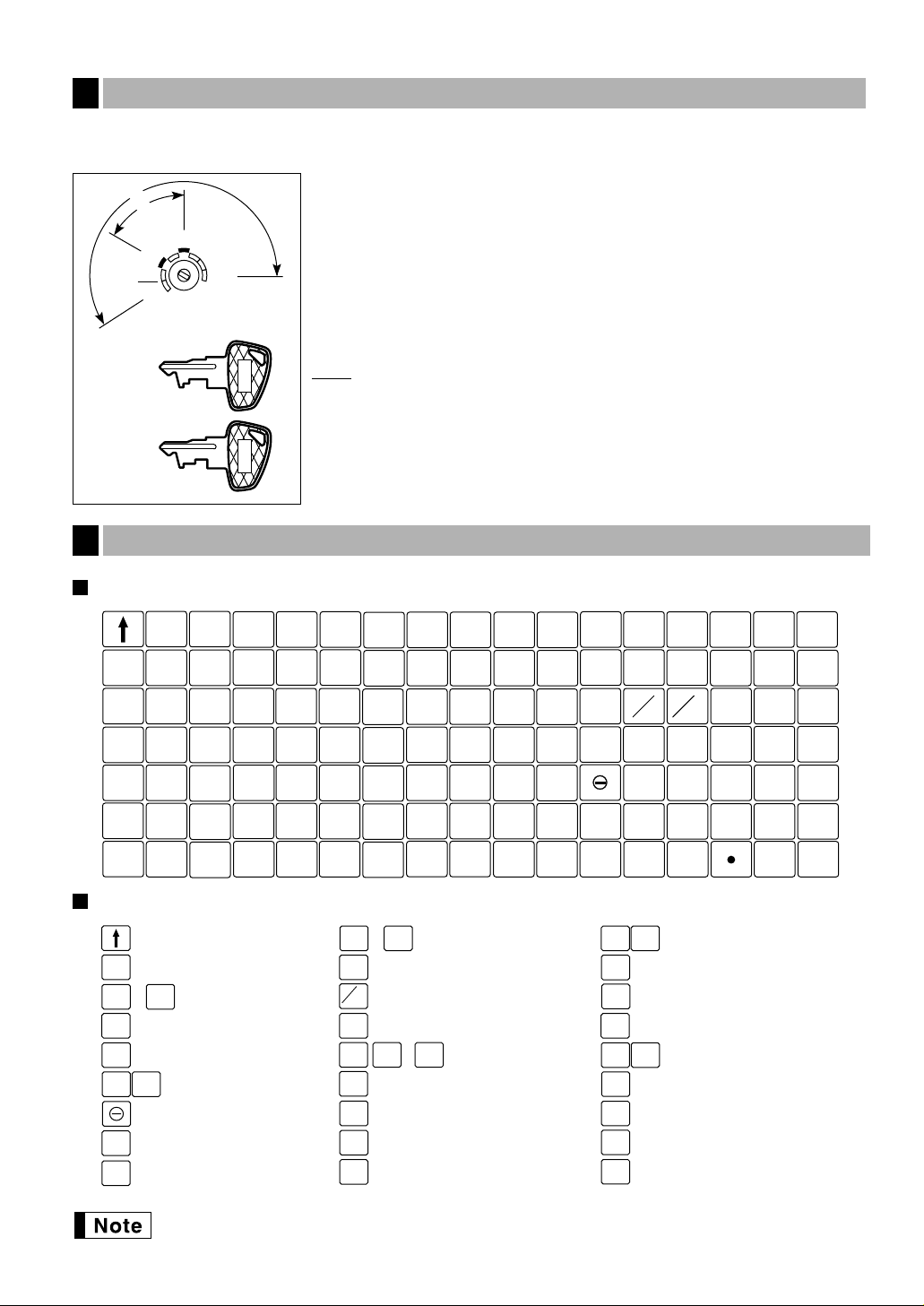
The mode switch can be operated by inserting one of the two supplied mode keys - manager (MA) and operator
(OP) keys. These keys can be inserted or removed only in the “REG” or “OFF” position.
The mode switch has these settings:
OFF: This mode locks all register operations. (AC power turns off.)
No change occurs to register data.
OP X/Z: To take individual clerk X or Z reports, and to take flash reports.
It can be used to toggle receipt state “ON” and “OFF” by pressing
the
R
key.
REG: For entering sales.
PGM: To program various items.
VOID
: Enters into the void mode. This mode allows correction after
finalizing a transaction.
MGR: For manager’s entries. The manager can use this mode for an
override entry.
X1/Z1: To take the X/Z report for various daily totals
X2/Z2: To take the X/Z report for periodic (weekly or monthly)
consolidation
Keyboard layout
Key names
In this manual, key tops are shown in one line, such as
p
for easy reading. Department keys
are shown like
!
, and numeric keys are indicated with simple number indication, such as 1,
unless otherwise specified.
Keyboard
4
PGM
VOID
OFF
OP
X/Z
REG
MGR
X
1/Z1
X2/Z2
OP
MA
MA
OP
Manager key (MA)
Operator key (OP)
Mode Switch and Mode Keys
3
RCPT
/PO
CA/AT
Electronic journal print key
Receipt print/Paid-out key
Void key
Conversion key
Multiplication key
Decimal point key
Clear key
Department code entry key
PLU/Subdepartment key
Clerk code entry key
Department keys~
~
Numeric keys
90
00
VOID
@
FOR
CL
•
CONV
RFND
Refund key
%1
%2
Percent 1 and 2 keys
Discount key
PLU
/SUB
DEPT
#
TAX1
SHIFT
Merchandise subtotal key
MDSE
SBTL
Non-add code/Time display
/Subtotal key
Total/Amount tender
/No sale key
#/TM
SBTL
CLK
#
Tax key
Automatic sequence key
AUTO
CH1 CH2
16
TAX2
SHIFT
Tax 1 and 2 shift keys
Charge 1 and 2 keys
Paper feed key
E/J
PRINT
Direct PLU keys~
175
ESC
Escape key
RA
Received-on account key
Check key
CHK
TAX
1234567891011
12 13 14 15 16 17 18 19 20 21 22
23 24 25 26 27 28 29 30 31 32 33
34 35 36 37 38 39 40 41 42 43 44
45 46 47 48 49 50 51 52 53 54 55
56 57 58 59 60 61 62 63 64 65 66
67 68 69 70 71 72 73 74 75
1
2
3
4
5
6
0
1
2
3
456
78
9
CL
00
FOR
@
SUB
PLU
CA/AT
ESC
RA
CONV
CH2
CHK
AUTO
TAX
CH
1
%1
%2
RFND
VOID
E/J
PRINT
CLK
#
DEPT
#
TAX1
SHIFT
TAX2
SHIFT
#/TM
SBTL
MDSE
SBTL
RCPT
/PO
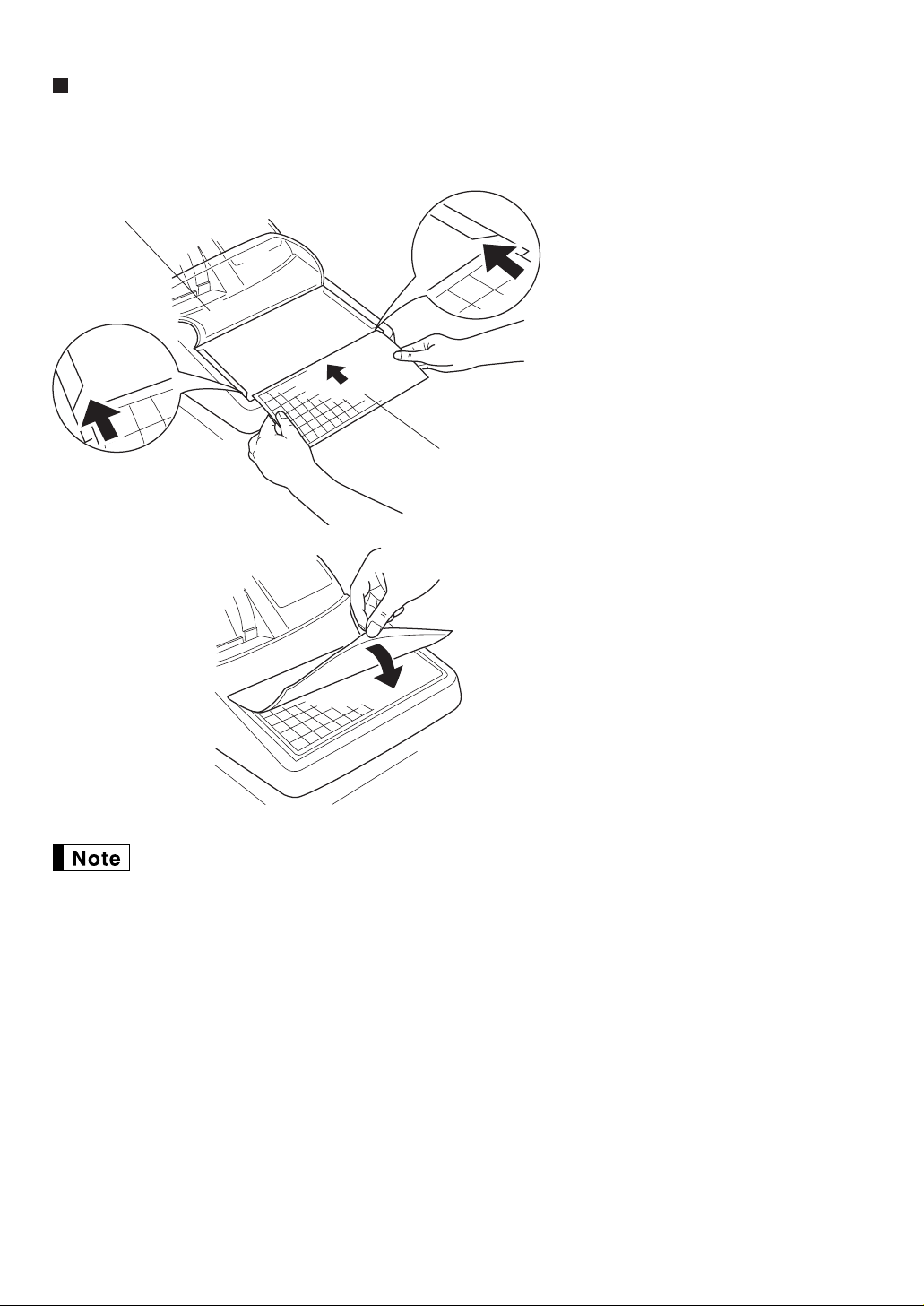
Keyboard sheet
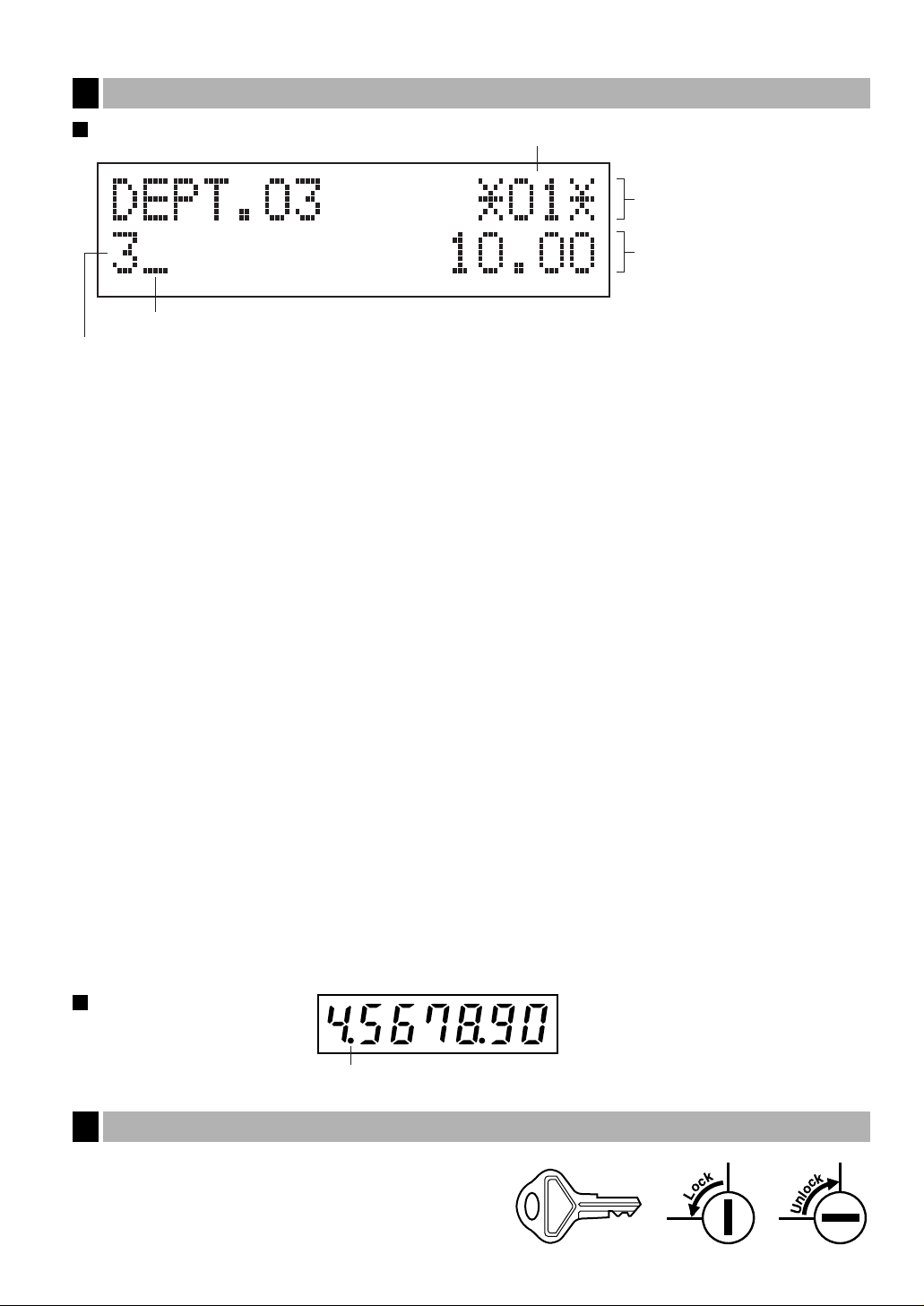
Two types of keyboard sheets are installed on the cash register; one for ordinal use and one for text
programming.
To reinstall the keyboard sheet or a new sheet, please follow the procedure below.
• Do not spread the keyboard cover too far as it might tear the tabs.
• Replace the keyboard sheet with a new one if chance it gets wet. Use of a wet keyboard sheet
may cause problems.
• Be sure to use only SHARP-supplied keyboard sheets. Thick or hard sheets can make key
operations difficult.
• Place the keyboard sheet evenly under the keyboard cover.
• If you require a new keyboard sheet, please call the customer service hotline.
• The keyboard cover will eventually wear out. If your keyboard cover is dirty or broken, replace the
cover with a new one. For details, please call the customer service hotline.
6
Keyboard sheet
Keyboard cover
➀
Turn over the keyboard cover.
➁
Insert the keyboard sheet into a slit.
➂
Close the keyboard cover.
7
This key locks and unlocks the drawer. To lock it, turn 90
degrees counterclockwise. To unlock it, turn 90 degrees
clockwise.
Drawer Lock Key
6
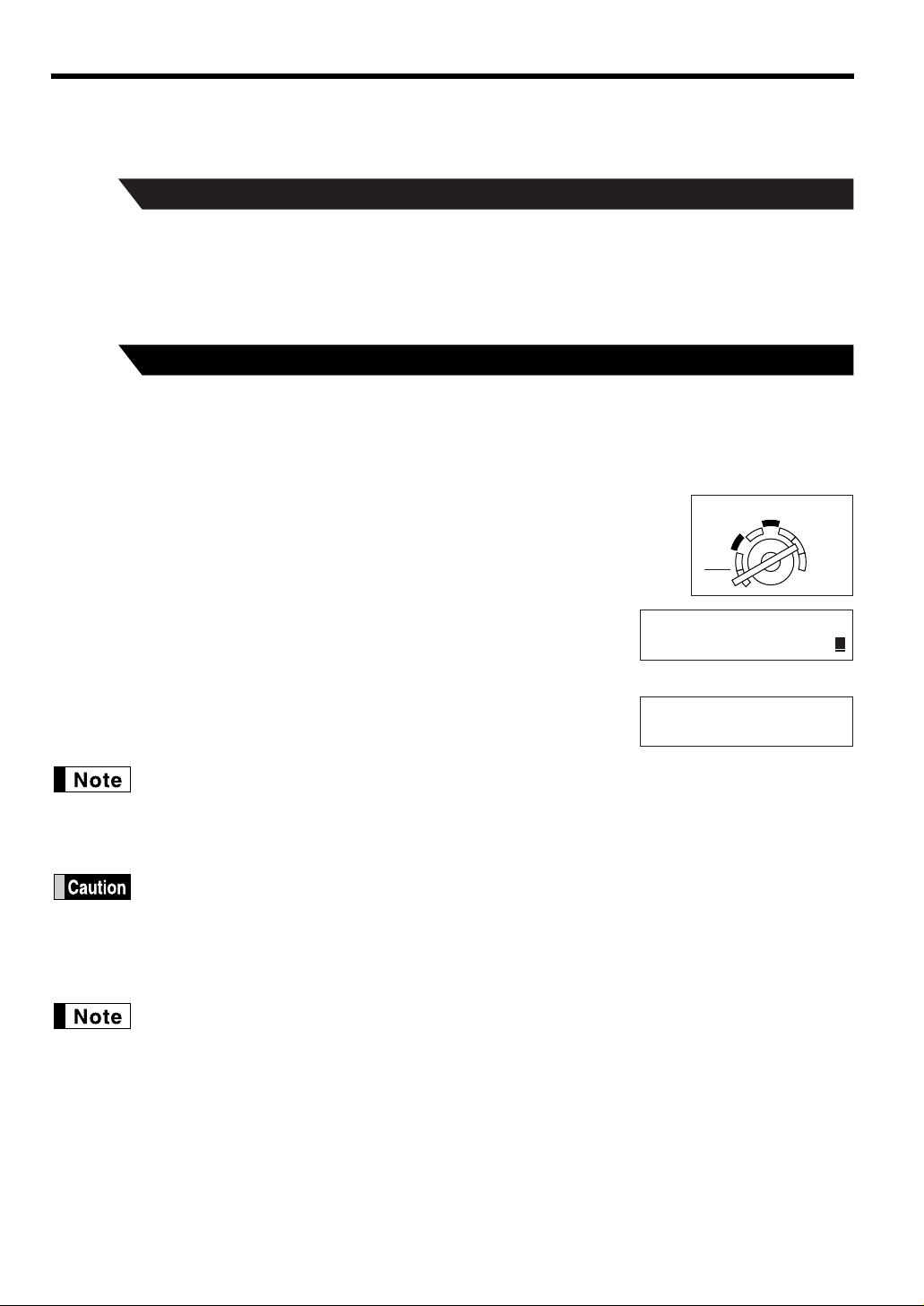
Operator display
• Clerk code or Mode name
The mode you are in is displayed. When a clerk is assigned, the clerk code is displayed in the REG or
OP X/Z mode. For example, “?01?” is displayed when clerk 01 is assigned.
• Repeat
The number of repeats is displayed, starting at “2” and incremental with each repeat. When you have
registered ten times, the display will show “0”. (2 ➞ 3 ......9 ➞ 0 ➞ 1 ➞ 2...)
• Sentinel mark
When amount in the drawer reaches the amount you preprogrammed, the sentinel mark “X” is displayed
advising you to remove the money to a safe place.
• Power save mark
When the cash register goes into the power save mode, the power save mark (decimal point) lights up.
• Function message display area
Item labels of departments and PLU/subdepartments and function texts you use, such as %1, (-) and
CASH are displayed. For the details of function texts, please refer to pages 45 and 46.
When an amount is to be entered or entered, “AMOUNT” is displayed: When an amount is to be
entered, ------- is displayed at the numeric entry area with “AMOUNT”. When a preset price has been
set, the price is displayed at the numeric entry area with “AMOUNT”.
• Numeric entry display area
Numbers entered using numeric keys are displayed here.
Date and time display
Date and time appear on the display in the OP X/Z, REG, or MGR mode. In the REG or MGR mode, press
the
s
key to display the date and time.
Error message
When an error occurs, the corresponding error message is displayed in the function message display area.
For details of error messages, please refer to “Error message table” on page 73.
Customer display
(Pop-up type)
Power save mark (Mark only lights up in the power save mode.)
Displays
5
SK1-1
Function message display area
Clerk code or mode name
Numeric entry display area
Receipt OFF indicator
Repeat / Sentinel mark / Power save mark
8
GETTING STARTED
Please follow the procedure shown below.
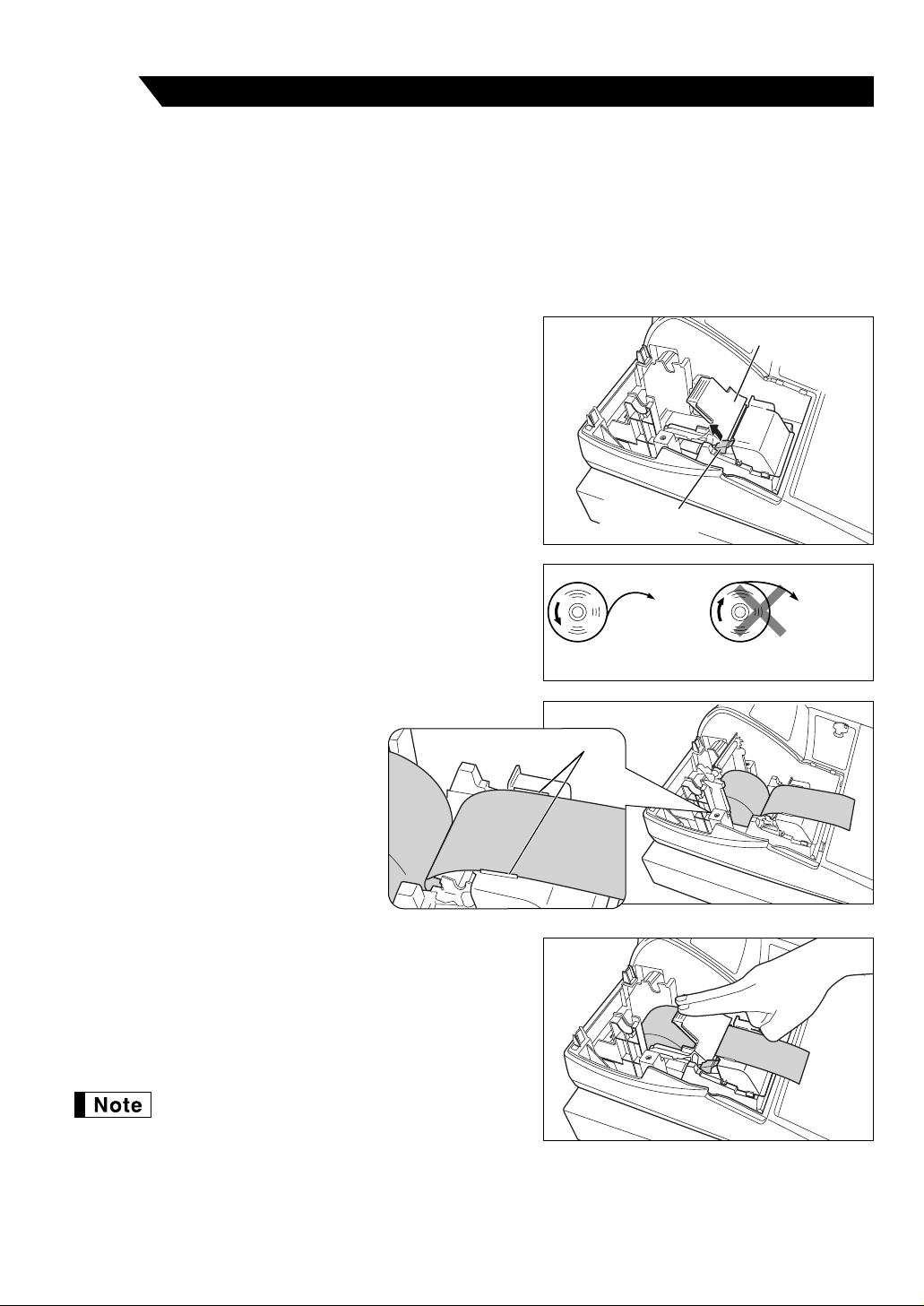
Initializing the cash register
In order for the cash register to operate properly, you must initialize it before operating for the first time.
Follow this procedure.
1. Make sure the power cord plug is not plugged into the AC outlet.
2. Insert the manager (MA) key into the mode switch and turn it to the PGM position.
3. While holding down both the
F
key and the
/
key, insert the plug into the
AC outlet. The buzzer will sound three times and “??? MRS. ???” will
be displayed.
4. The cash register has now been initialized. The register display will now
show “0.00” with “PGM”.
If the buzzer does not sound when the plug is inserted, the initialization has not been done
successfully. (This will occur when the voltage is high because you operated the cash register
before starting initialization.) Wait at least ten seconds after pulling out the plug and initialize the
cash register again.
The cash register has a built-in memory protection circuit which is operated by rechargeable
batteries. Since the rechargeable batteries have been discharged, please charge the batteries for
one or two days before using the cash register for the first time. To charge the batteries, set the
mode switch to a position other than “OFF” with the power cord plugged into the AC outlet.
Unless the batteries have been charged, all of the programmed data and sales data is not saved.
If you press a key by mistake, an error message such as “HEAD UP” or “PAPER EMPTY” may be
displayed. Press the
l
key to clear message after installing a paper roll.
Find a stable surface near an AC outlet where the cash register will not subject to water sources or
direct sunlight .
Unpack the cash register and make sure all accessories are included. For details of accessories, please refer to
“Specifications” section.
REG
OPX/Z MGR
PGM
X1/Z1
X2/Z2
OFF
VOID
2
Installing the cash register
1
PGM
0.00
*** MRS. ***
9
Precaution: The paper cutter is mounted on the printer cover. Take caution when installing
paper rolls.
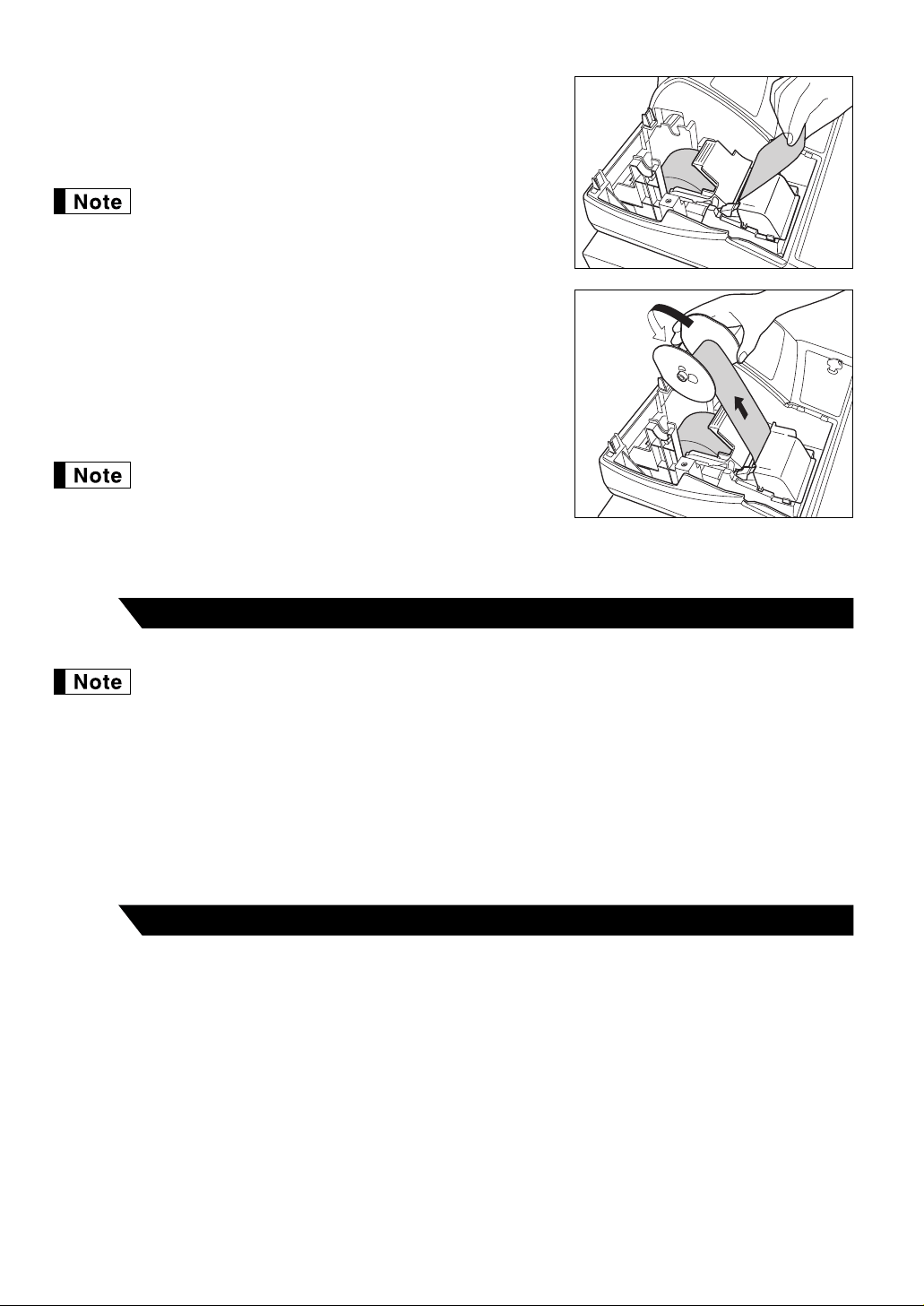
The register can print receipts or journals. For the printer, you must install the paper roll provided with the
register.
Install the paper roll according to the procedure shown below with the power cord connected and the mode
switch set to the PGM position:
1. Push the printer cover forward and detach it.
2. Lift up the print roller release lever to unlock and open the
print roller arm.
3. Set a paper roll in the paper roll cradle as illustrated at the
right.
4. Feed the end of the paper along with
the paper positioning guides as
illustrated at the right.
5. While holding down the paper, slowly close the print roller
arm, and push down the arm until you hear a click locking
the arm. Make sure securely you push down the center of
the wing part of the arm as illustrated at the right. The
paper will be fed automatically.
If the print roller arm is not securely locked,
printing is not done right. If this problem occurs,
open the arm, and close the arm as instructed
above.
Print roller
release lever
Print roller arm
To the printer
Incorrect
To the printer
Correct
Installing a paper roll
3
Paper positioning guides
10
6. When not using the take-up spool (using as receipt paper):
• Cut off the excess paper using the edge of the inner cover, and
replace the printer cover. Press the
F
key to make sure the
paper end comes out of the printer cover and clean paper
appears.
If the paper end does not come out, open the printer
cover, and pass the paper end between the paper cutter
and the paper guide of the printer cover, and replace the
cover.
When using the take-up spool (using as journal paper):
• Insert the end of the paper into the slit in the spool. (Press the
F
key to feed more paper if required.)
• Wind the paper two or three turns around the spool shaft.
• Set the spool on the bearing, and press the
F
key to take up
excess slack in the paper.
• Replace the printer cover.
When using a paper roll as journal paper, you must change
the printing style. Refer to “Print Format” in “Various
Function Selection Programming 1” section (Job code 6)
for changing the printing style.
The cash register provides text languages of English, French and Spanish. It is preset to English.
If you want to change the language, you must change it before programming. Refer to “Language
selection” in “Various Function Selection Programming 2” section for changing the language.
Before you can proceed with registration of sales, you must program:
• date
• time
• tax
Please refer to the BASIC FUNCTION PROGRAMMING section for details (page 28).
Programming date, time and tax
4
While the cash register is pre-programmed to be used with minimal setup, it does provide you with
optional functions. Before you start programming, please read through the sales operations section to
understand optional functions. The main optional functions are listed below:
• PLU (price lookup)/subdepartment
• Consecutive number
• Machine number
• Power save mode (factory setting: goes into power save mode after 30 minutes)
• Electronic Journal (EJ)
• Text programming for clerk names, department items, PLU/subdepartment items, logo messages printed
on the top or bottom of receipts, function texts and foreign currency symbol
• Bottle return department
• Split pricing entry
Programming other necessary items
5

11
Now you are ready for sales registration.
Starting sales entries
6
This is not factory preset. You must enable this function.
• Foreign currency conversion rate
You must set a conversion rate to use
V
key.
• Preset unit price for departments
• Preset amount for
-
• Preset rates for
%&
You do not have to program these preset prices/amount/rates since they can be entered at
registration. It might be convenient to preset so you do not have to re-enter every time.
• Amount entry digit limit for PO amount, RA amount, Manual tax amount
The factory setting makes the maximum amount you can enter. You can program to limit the amount.
• Sentinel - High amount lockout (HALO) for cash in drawer (CID)
• Department group
You can classify departments into a maximum of 9 groups (0 to 9 groups: 0: non-group is assigned).
Sales in each group can later be printed on an individual group total report and full group total report.
• Commission
If you program commission rates (up to two) and classify departments and PLUs/subdepartments into
commission groups (0 to 2 groups: 0: non-commission), commission sales and amount in each
commission group can later be printed on individual and full clerk reports.
• Key sequence for AUTO key
• RS-232C programming
• Specification of clerk to be trained
Department programming:
The cash register is pre-programmed for departments as follows:
Department: Allow open price entry in normal department (group: 0, commission group: 0), taxable status-
taxable 1 for department 1 to 6, and non taxable for department 7 to 99
When you use department 7 or above, and/or you apply taxable status other than taxable 1 for department 1 to
6, you must change department settings. Please refer to the department programming section for programming
details.
PLU/subdepartment programming:
The cash register is preprogrammed for PLUs/subdepartments as follows:
PLU/subdepartment selection: PLU is selected for all PLU codes so that you only have to program unit prices
and associated departments for them (by default, unit price is set to 0 and associated department is set to
department 1). Function parameters including tax status depend on the status of associated department.
• For direct PLU keys, PLU codes 1 through 75 are assigned for PLU 1 through 75 keys respectively.

12
OVERVIEW OF FLOW OF DAILY SALES ENTRIES
Things to do before starting sales entries:
• Make sure the power cord is securely connected to the AC outlet.
• Turn the mode switch to OP X/Z position and check if date and time are correctly set.
• Replace the till, if removed for safety.
• Check if there is enough paper on the roll.
• Select receipt ON/OFF function.
• Make any necessary programming for the day in PGM mode.
For details, refer to BASIC SALES ENTRY, page 13. For the till and paper roll, refer to OPERATOR
MAINTENANCE, page 68 and for programming, refer to programming sections.
Things you can do for sales entries:
• Item entries
• Item repeat entries
• Item multiplication entries
• Single item cash sale (SICS), if programmed.
• Split pricing entries, if programmed.
• Displaying subtotals
• Cash/Check/Charge sale
• Cash tendering in a foreign currency, if the currency conversion rate is programmed.
• Manual tax entry
• Discount or premium using
%&
and
-
key
• Refund entry
• No sale
• Paid-out entries
• Received on account entries
• Printing non-add code number
• Making corrections
• Checking sales reports
For details of sales entry method, refer to BASIC SALES ENTRY (page 13) and OPTIONAL FEATURES
(page 22). For details of correcting sales entries, refer to CORRECTION (page 26). For details on reading
sales information, refer to READING (X) AND RESETTING (Z) OF SALES TOTAL (page 60).
Things to do after close of business:
• Print sales reports, and clear sales data for the day.
• Print Electronic Journal (EJ) reports, and clear Electronic Journal (EJ) data, if necessary.
• Account money - comparing it with the amount in cash in drawer printed on the general report.
• Remove the till for safety.
• Turn the mode switch to OFF position.
For details of reading sales information, refer to READING (X) AND RESETTING (Z) OF SALES TOTAL (page
60) and EJ REPORT READING AND RESETTING (page 66). For details of removing the till and maintenance
details, refer to OPERATOR MAINTENANCE (page 68).
FOR THE OPERATOR
13
BASIC SALES ENTRY
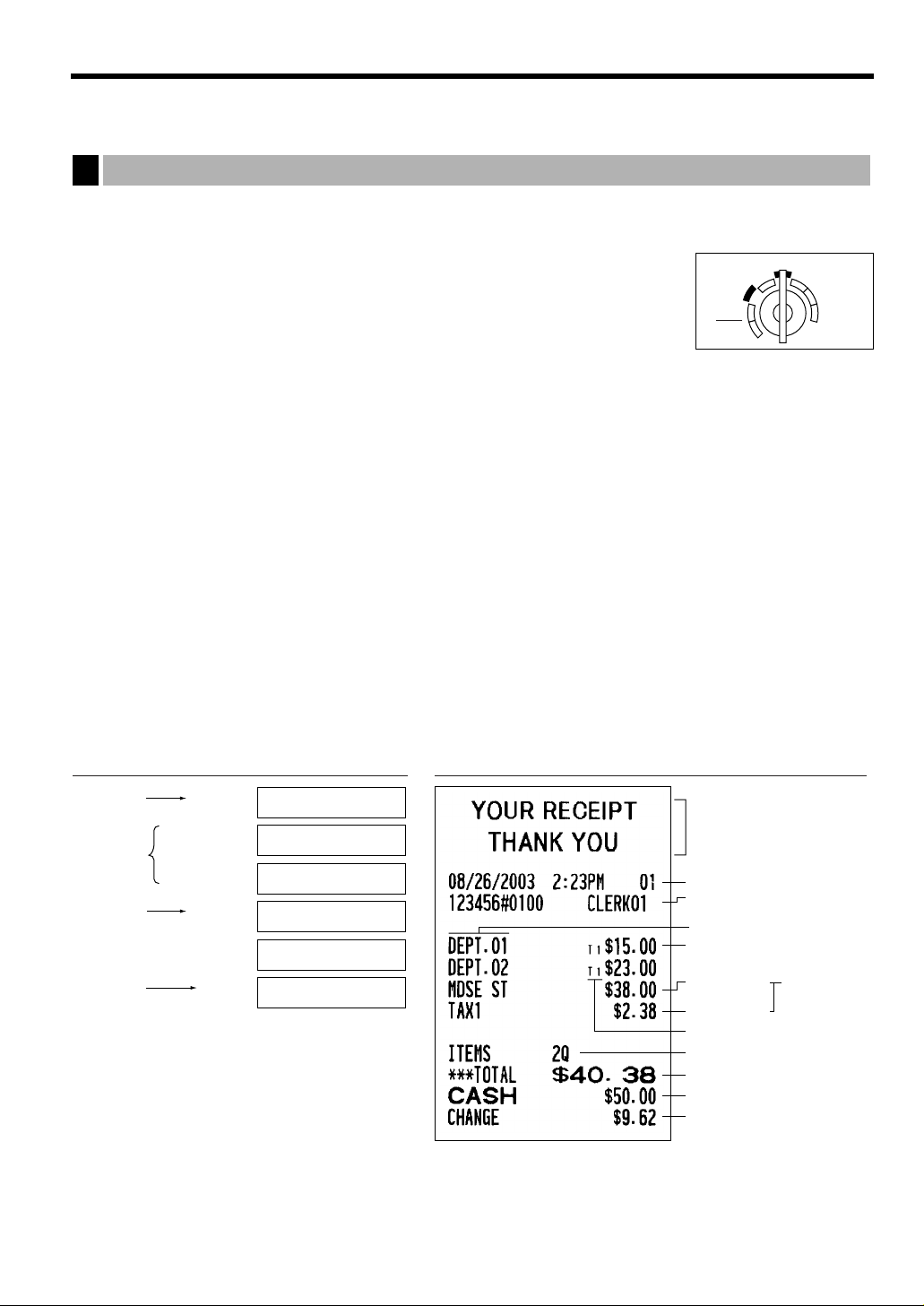
Listed below is a basic sales entry example when selling items by cash. For operation details, please refer to
each section.
Mode switch setting
1. Turn the mode switch to the REG position.
Clerk assignment
2. Enter your clerk code. (For example, clerk code is 1. Enter 1 using the numeric
key and press the
L
key.) The clerk code 1 is automatically selected just after
initialization of the cash register.
Item entries
3. Enter the price for the first department item. (For example, for 15.00, enter 1500 using the numeric keys, and
press the appropriate department key.)
For department 7 and above, enter the department code using numeric keys, and press the
d
key,
then enter the price and press the
d
key again.
4. Repeat step 3 for all department items.
Displaying subtotals
5. Press the
s
key to display the amount due.
Finalizing the transaction
6. Enter the amount received from the customer. (You can omit this step if the amount tendered is the same as
the subtotal.)
7. Press the
A
key, and the change due is displayed (when the amount received was not entered, the total
amount is displayed) and the drawer is opened.
8. Tear off the receipt and give it to the customer with his or her change.
9. Close the drawer.
Receipt printKey operation example
Basic Sales Entry Example
1
REG
OPX/Z MGR
PGM
X1/Z1
X2/Z2
OFF
VOID
Graphic logo
Date/Time/Clerk code
Register number
/Consecutive number/Clerk name
Items
Tax status (T1: taxable 1)
Price
Merchandise
subtotal
Not printed when
non-taxable items
only are sold.
Tax amount
Total amount
Cash tendering/amount received
Change
Total quantity
1 L
1500 !
*
2300
"
*
s
5000
A
Item
entries
Clerk
assignment
Displaying
subtotal
Finalizing
the transaction
*
! "
:
(In this example, the tax rate is set to 6.25%.)
CLERK01
?
01
?
-01-
DEPT.01
?
01
?
15.00
DEPT.02
?
01
?
23.00
SUBTOTAL
?
01
?
40.38
?
01
?
5000
CHANGE
?
01
?
9.62
indicate department keys.

14
Clerk assignment
Prior to any item entries, clerks must enter their clerk codes into the register. However, the code entry may not
be necessary when the same clerk handles consecutive transactions.
Receipt ON/OFF function
You can disable receipt printing in the REG mode to save paper using the receipt ON/OFF function. To disable
receipt printing, press the
R
key in the OP X/Z position. This key toggles the receipt printing status ON and
OFF.
To check the receipt printing status, turn the mode switch to the OP X/Z position or press the
l
key in the REG
mode. When the function is in the OFF mode, the receipt off indicator “_” is illuminated.
The register will print reports regardless of the receipt state, so the paper roll must be installed.
To issue a receipt when receipt ON/OFF function is set to OFF:
If your customer wants a receipt after you finalized a transaction with the receipt ON/OFF function in the OFF
mode, press the
R
key. This will produce a receipt. If more than 30 items were entered, the receipt will be
issued in a summary receipt format.
Power Save Mode
The register will enter into power save mode when no entries are performed based on the pre-programmed time
limit (by default, 30 minutes).
When the register goes to the power save mode, all display lights will turn off except the decimal point at the
leftmost position of the lower line. The register will return to normal operation mode when any key is pressed or
a mode is changed with the mode key. Please note when the register is recovered by a key entry, its key entry
is invalid. After the recovery, start the key entry from the beginning.
L
Clerk code 1 to 40
To display the signed-on clerk code
LL
■ Sign-on (in REG, MGR, VOID mode) ■ Sign-off (in REG, MGR, VOID mode)
In the following examples, your register will go into an error state accompanied with a warning beep and a
corresponding error message. Clear the error state by pressing the
l
key and take proper action.
Please refer to the error message table on page 73.
• Enter over a 32-digit number (entry limit overflow): Cancel the entry and re-enter the correct number.
• An error in key operation: Clear the error and continue operation.
• An entry beyond a programmed amount entry limit: Check to see if the entered amount is correct. If it is
correct, it can be rung up in the MGR mode. Contact your manager.
• An including-tax subtotal exceeds eight digits: Delete the subtotal by pressing the
l
key and press the
A
,
C
,
X
or
Y
key to finalize the transaction.
Error escape function
To quit a transaction due to an error or an unforeseen event, use the error escape function as shown below:
The transaction is voided (treated as a subtotal void) and the receipt is issued by this function. If you have
already entered a tendered amount, the operation is finalized as a cash sale.
l
Transaction
To clear the error state
E
E
Error Warning
2

15
Single item entries
Department entries
The cash register provides a maximum of 99 departments for a merchandise classification. Group attributes,
such as taxable status, are applied to items when they are entered to the departments.
• When using the department keys (for department 1 to 6)
For department 1 to 6, enter a unit price and press a department key. If you use a programmed unit price,
press a department key only.
* Less than the programmed upper limit amounts
When zero is entered, only the sales quantity is
added.
• When using the department code entry key
Enter a department (dept.) code and press the
d
key, then enter a unit price and press the
d
key again. If
the dept. code is programmed to preset price entry style and a unit price is preset, the cash register will finish
its registration operation.
* Less than the programmed upper limit
amounts
When zero is entered, only the sales
quantity is added.
PLU/subdepartment entries
For another merchandise classification, the cash register provides a maximum of 1800 PLUs/subdepartments.
PLUs are used to call up preset prices by pressing direct PLU keys or entering PLU codes with a press of the
p
key. Subdepartments are used to classify merchandise into smaller groups under the departments.
Every PLU and subdepartment has a code from 1 to 1800, and should belong to a department to obtain
attributes of that department.
The cash register is pre-programmed to PLU mode (belonging to dept. 1) and zero for unit price. To use PLU
entries, their preset unit prices should be previously programmed. (Refer to page 35.)
To use subdepartment entries, change to subdepartment mode for the PLU codes.
• PLU entries
• Subdepartment (open PLU) entries
* Less than the programmed upper limit amounts
When zero is entered, only the sales quantity is added.
PLU code
(1 to 1800)
p
Unit price *
(max. 7 digits)
p
Direct key entry
PLU code entry
Direct PLU key
Unit price *
(max. 7 digits)
PLU code
(1 to 1800)
Direct key entry
p
Direct PLU key
PLU code entry
Dept. code
(1 to 99)
Unit price *
(max. 7 digits)
When using a programmed unit price
(In case only preset price entry is allowed.)
dd
Department keyUnit price *
(max. 7 digits)
When using a programmed unit price
Item Entries
3
16
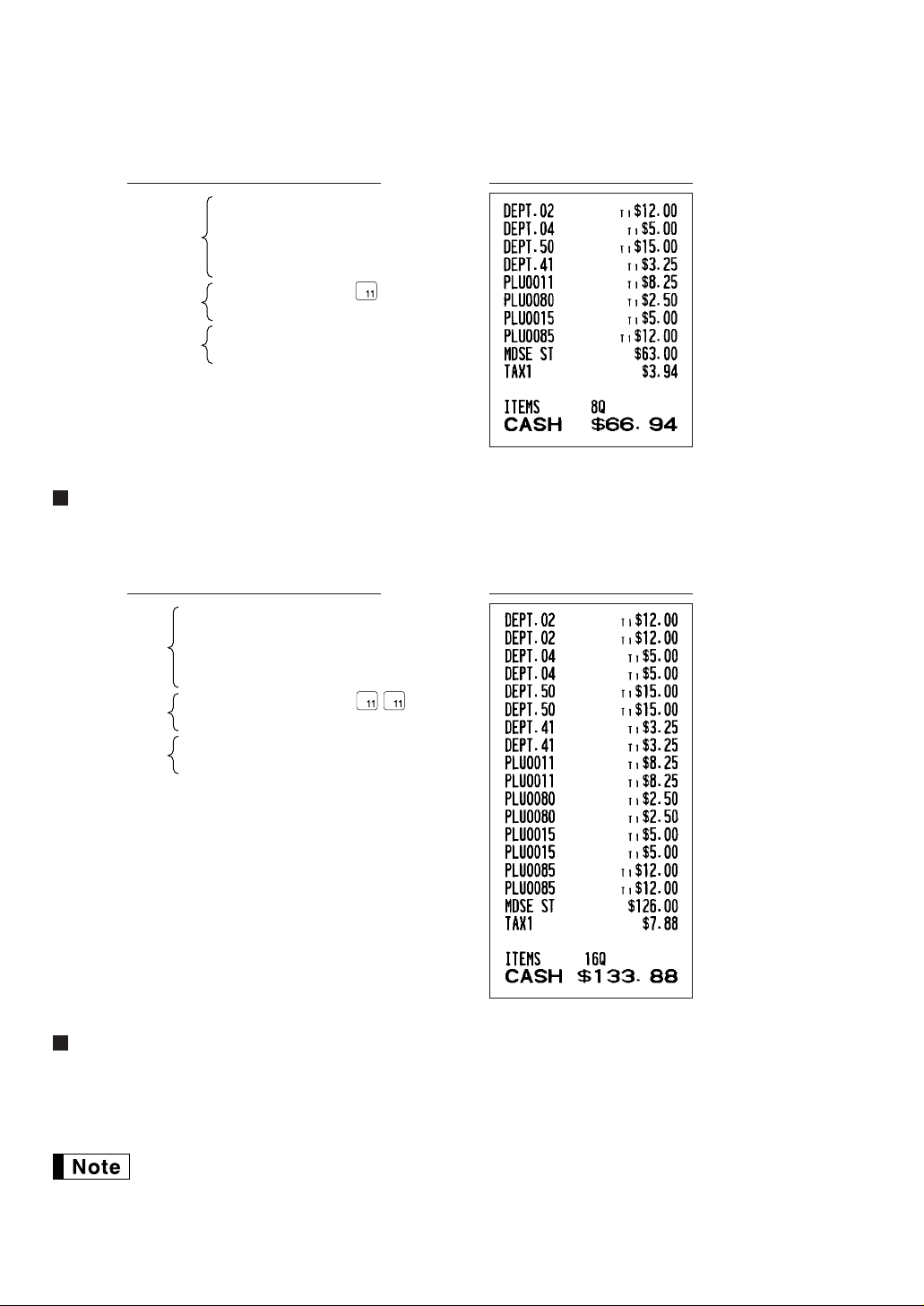
Example: Selling a dept. 2 item ($12.00), a dept. 4 item (using preset price), a dept. 50 item ($15.00), a dept. 41
item (using preset price), a PLU 11 item (PLU entry using a direct key), a PLU 80 item (PLU entry
with a code entry), a PLU 15 item (subdept. entry using a direct key, $5.00) and a PLU 85 item
(subdept. entry with a code entry, $12.00)
Repeat entries
You can use this function for entering a sale of two or more of the same items. Consecutive pressing of a
department key,
d
key, a direct PLU key or
p
key is as shown on key operation example below.
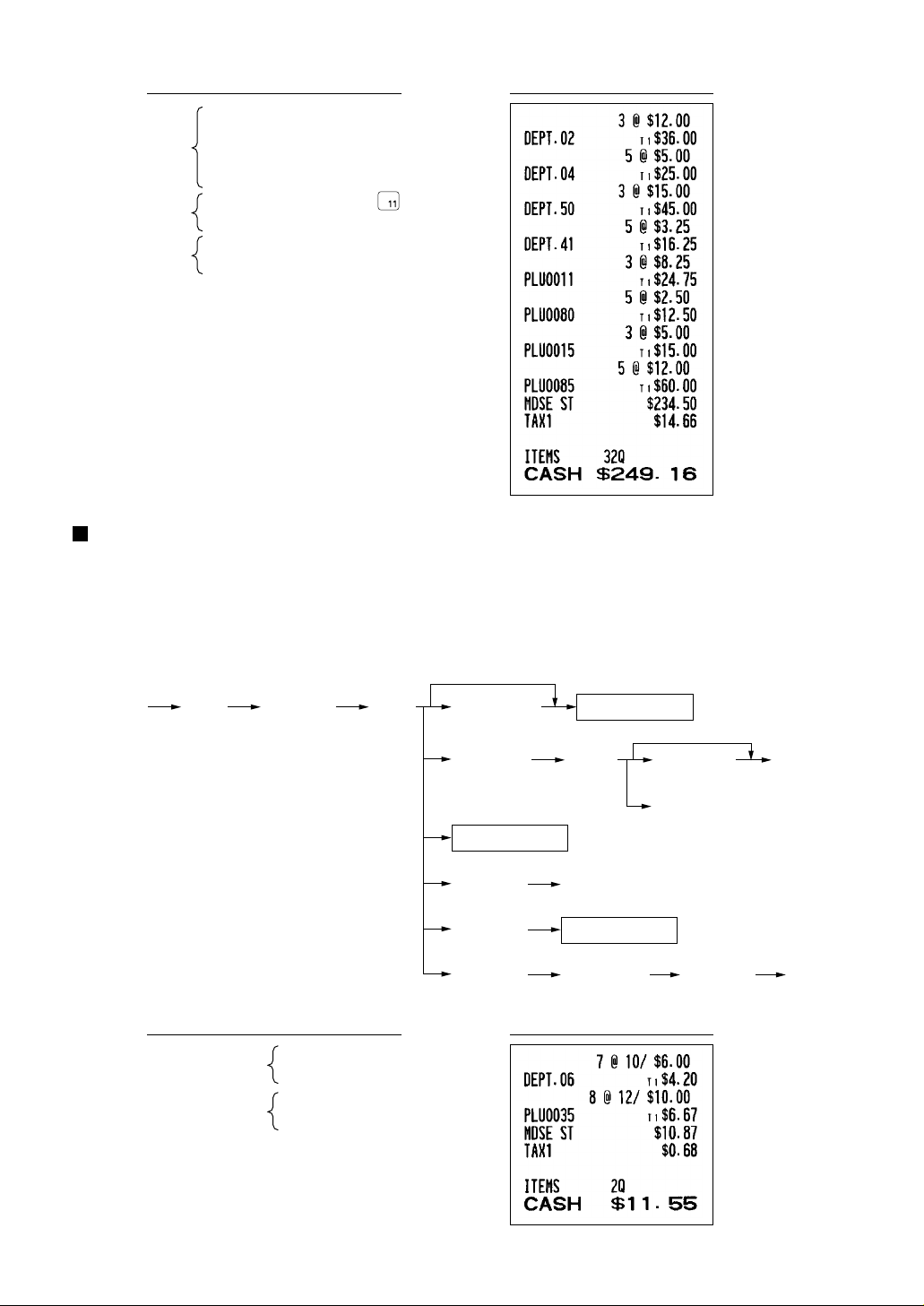
Multiplication entries
When selling a large quantity of items, it is convenient to use the multiplication entry method. Enter quantity
using numeric keys and press the
@
key before starting item entry as shown in the example on the following
page.
When programmed to allow fractional quantity entries, you can enter up to four integers and three
digit decimal, though the quantity is counted as one for sales reports. To enter a fractional quantity,
use the decimal point key between integer and decimal.
1200 " "
$ $
50 d 1500 d d
41 d d
80 p p
500 fi fi
85 p 1200 p p
A
Subdepart-
ment entry
PLU entry
Department
entry
Receipt printKey operation example
Subdepartment
entry
PLU entry
Department entry
1200 "
$
50 d 1500 d
41 d
80 p
500 fi
85 p1200p
A
Receipt printKey operation example
17
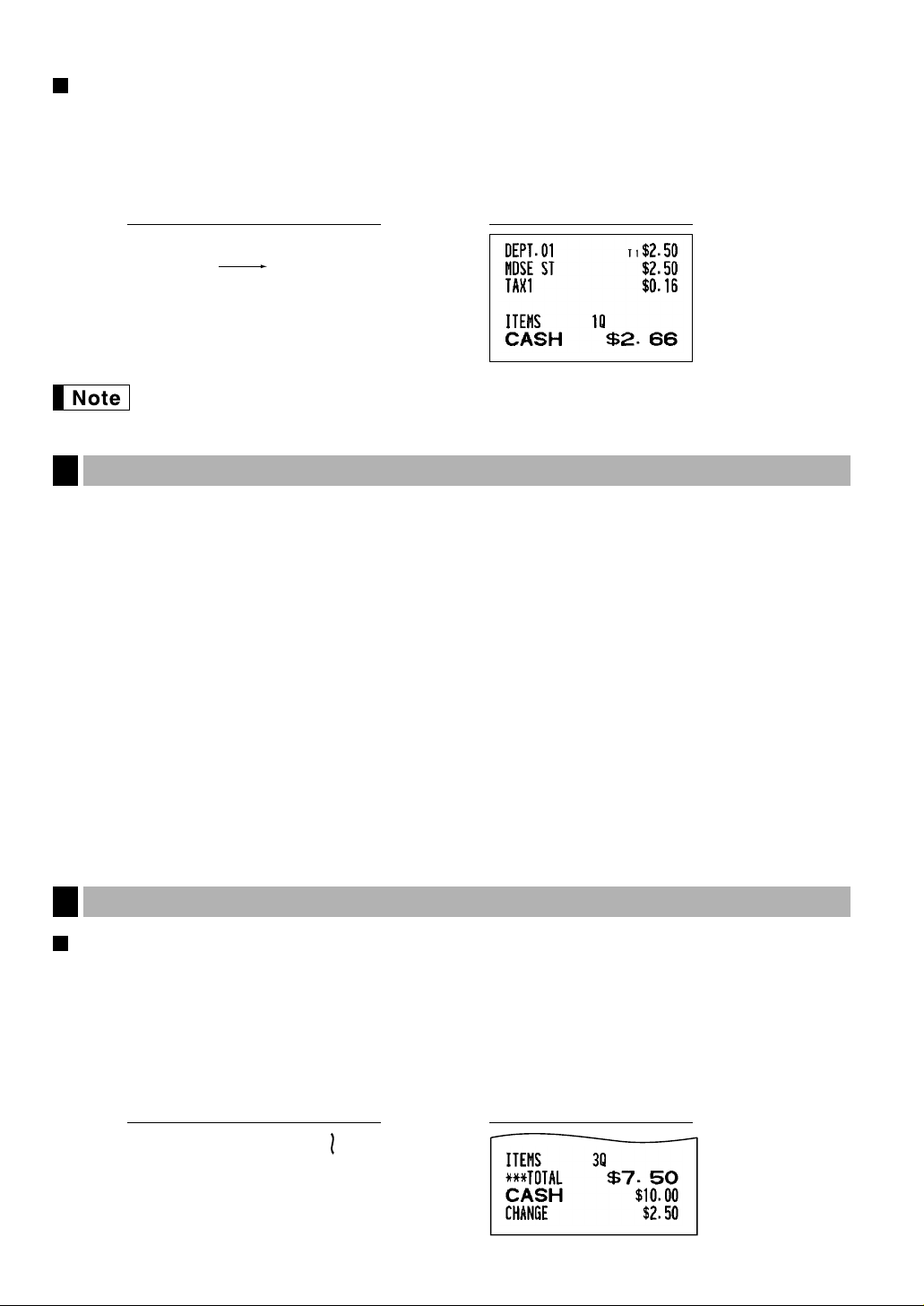
Split pricing entries
This function is practical when the customer wants to purchase items normally sold in bulk.
To realize this function, you must change the programmed setting. Refer to “Various Function Selection
Programming 1” (job code 70) for programming details.
To make split pricing entries, follow the procedure below:
Department entry
PLU entry
7 @ 10 @
600 (
8 @ 12 @
fl
A
Receipt printKey operation example
Selling q'ty
(Up to 4 digits)
Base q'ty
(Up to 2 digits)
Unit price
per base q'ty
When using a programmed unit price
@ @
Dept. code
d
PLU code
p
Unit price
per base q'ty
PLU code Unit price
per base q'ty
p p
Unit price
per base q'ty
d
(Only preset entry is allowed.)
Department key
Direct PLU key
Direct PLU key
3 @ 1200 "
5 @ $
3 @ 50 d 1500 d
5 @ 41 d
3 @
5 @ 80 p
3 @ 500 fi
5@ 85p1200p
A
Subdepart-
ment entry
PLU entry
Department
entry
Receipt printKey operation example
18
Single item cash sale (SICS) entry
• This function is useful when a sale is for only one item and is for cash. This function is applicable only to those
departments that have been set for SICS or to their associated PLUs or subdepartments.
• The transaction is complete and the drawer opens as soon as you press the department key,
d
key, the
direct PLU key or
p
key.
If an entry to a department or PLU/subdepartment set for SICS follows the ones to departments or
PLUs/subdepartments not set for SICS, it does not finalize and results in a normal sale.
For finishing
the transaction
250
!
Receipt printKey operation example
The register provides three types of subtotals:
Merchandise subtotal
Press the
m
key at any point during a transaction. The net sale subtotal - not including tax - will appear in
the display with the function message “MDSE ST”.
Taxable subtotal
Taxable 1 subtotal
Press the
T
and
s
keys in this order at any point during a transaction. The sale subtotal of
taxable 1 items will appear in the display with the function message “TAX1 ST”.
Taxable 2 subtotal
Press the
U
and
s
keys in this order at any point during a transaction. The sale subtotal of
taxable 2 items will appear in the display with the function message “TAX2 ST”.
Including-tax subtotal (complete subtotal)
Press the
s
key at any point during a transaction. The sale subtotal including tax will appear in the display
with the function message “SUBTOTAL”.
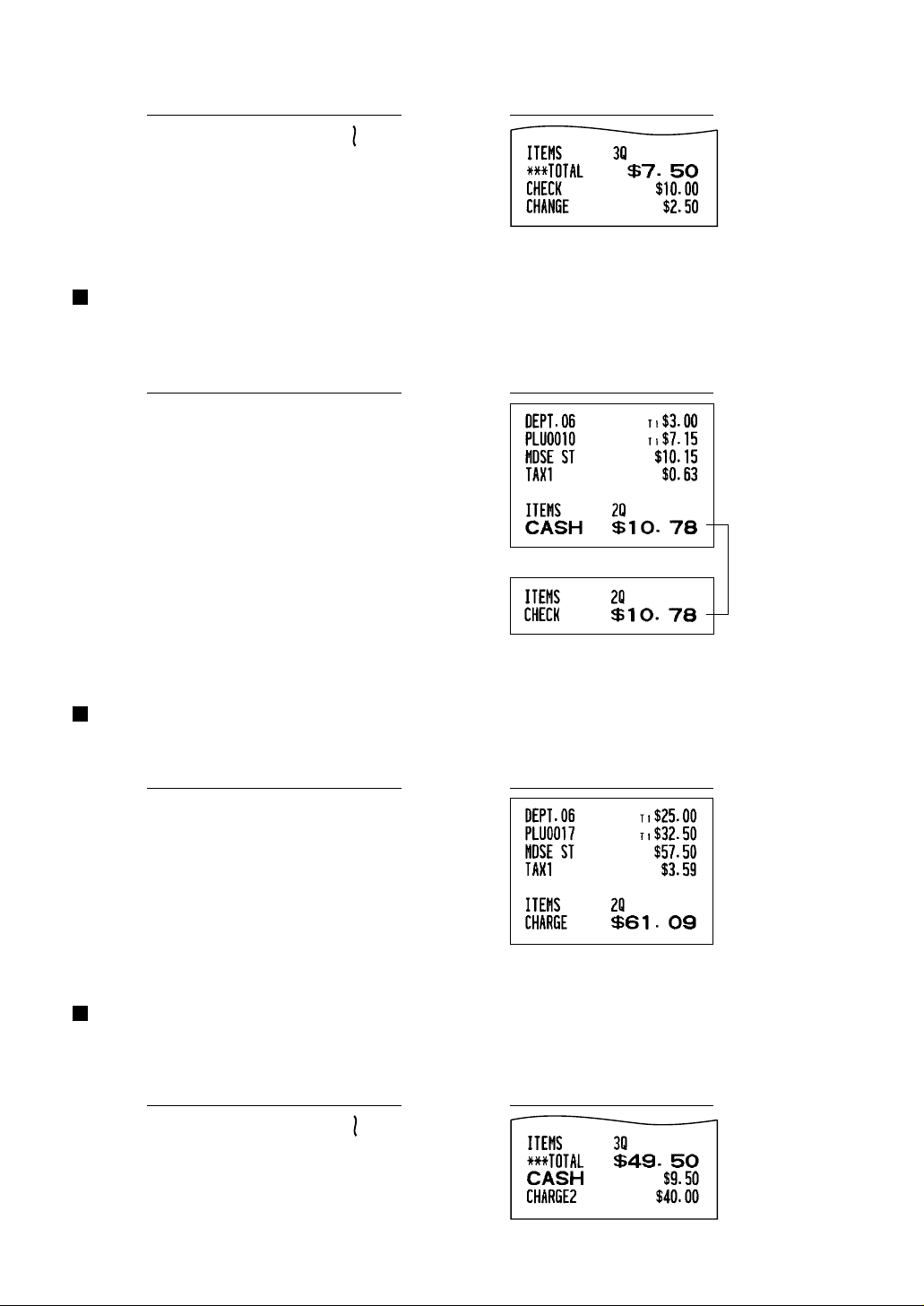
Cash or check tendering
Press the
s
key to get a complete tax subtotal, enter the amount tendered by your customer, then press the
A
key if it is a cash tender or press the
C
key if it is a check tender. When the amount tendered is greater
than the amount of the sale, the register will show the change due amount with the function message
“CHANGE”. Otherwise the register will show a deficit with the function message “DUE”. You now must make a
correct tender entry.
Cash tendering
s
1000 A
Receipt printKey operation example
Finalization of Transaction
5
Displaying Subtotals
4
19
Check tendering
Cash or check sale that does not require entry
Enter items and press the
A
key if it is a cash sale or press the
C
if it is a check sale. The register will
display the total sale amount.
Charge (credit) sale
Enter items and press a charge key (
X
or
Y
).
Mixed-tender sale
You can perform mixed-tendering of check and cash, cash and charge, and check and charge.
Example: The customer pays $9.50 in cash and $40.00 by charge 2 for an including-tax subtotal of $49.50.
s
950 A
Y
Receipt printKey operation example
2500
(
‡
X
Receipt printKey operation example
In the case of check sale
300
(
º
A
Receipt printKey operation example
s
1000 C
Receipt printKey operation example
20
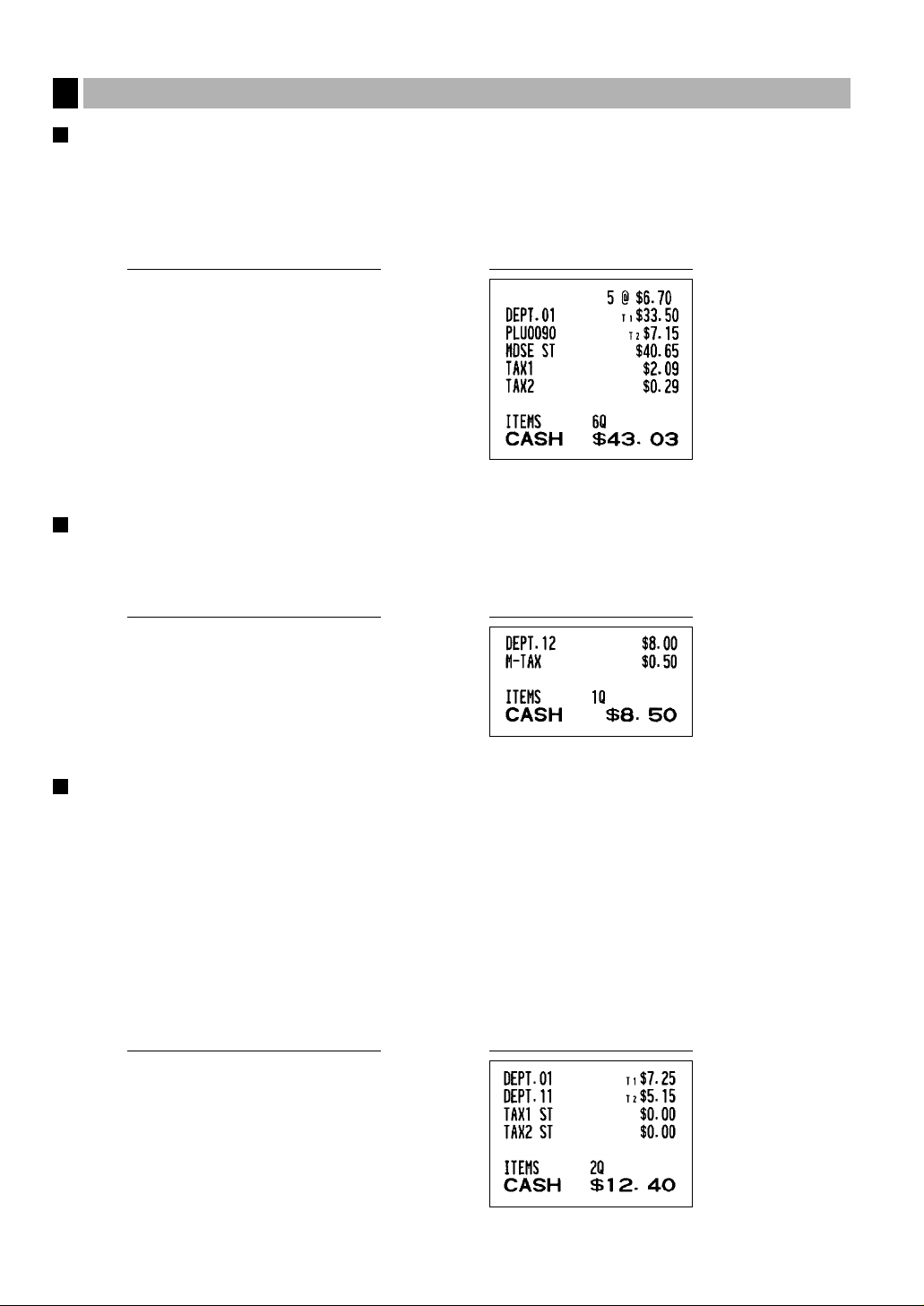
Automatic tax
When the register is programmed with a tax rate (or tax table) and the tax status of an individual department is
set for taxable, it computes the automatic tax on any item that is entered directly into the department or indirectly
via a related PLU.
Example: Selling five $6.70 items (dept. 1, taxable 1) and one $7.15 item (PLU 90, taxable 2) for cash
Manual tax
The machine allows you to enter tax manually after it finalizes an item entry.
Example: Selling an $8.00 item (dept. 12) for cash with 50 cents as tax
Tax delete
You can delete the automatic tax on the taxable 1 and taxable 2 subtotal of each transaction by pressing the
t
key after the subtotal is displayed.
To delete taxable 1 subtotal, press
T
,
s
to get taxable 1 subtotal, and then press
t
to delete the
subtotal.
To delete taxable 2 subtotal, press
U
,
s
to get taxable 2 subtotal, and then press
t
to delete the
subtotal.
To delete all taxable (1-4) subtotals, press
T
,
U
and
s
( “TAX ST 0.00” is displayed) and press
t
to delete all the taxable subtotals.
Example: Selling a $7.25 item (dept. 1, taxable 1) and another $5.15 item (dept. 11, taxable 2) for cash and
entering the sale as non-taxable
725
!
11
d
515
d
Ts
t
Us
t
A
Receipt printKey operation example
12
d
800
d
50
t
A
Receipt printKey operation example
5
@
670
!
90
p
A
Receipt printKey operation example
Tax Calculation
6
21
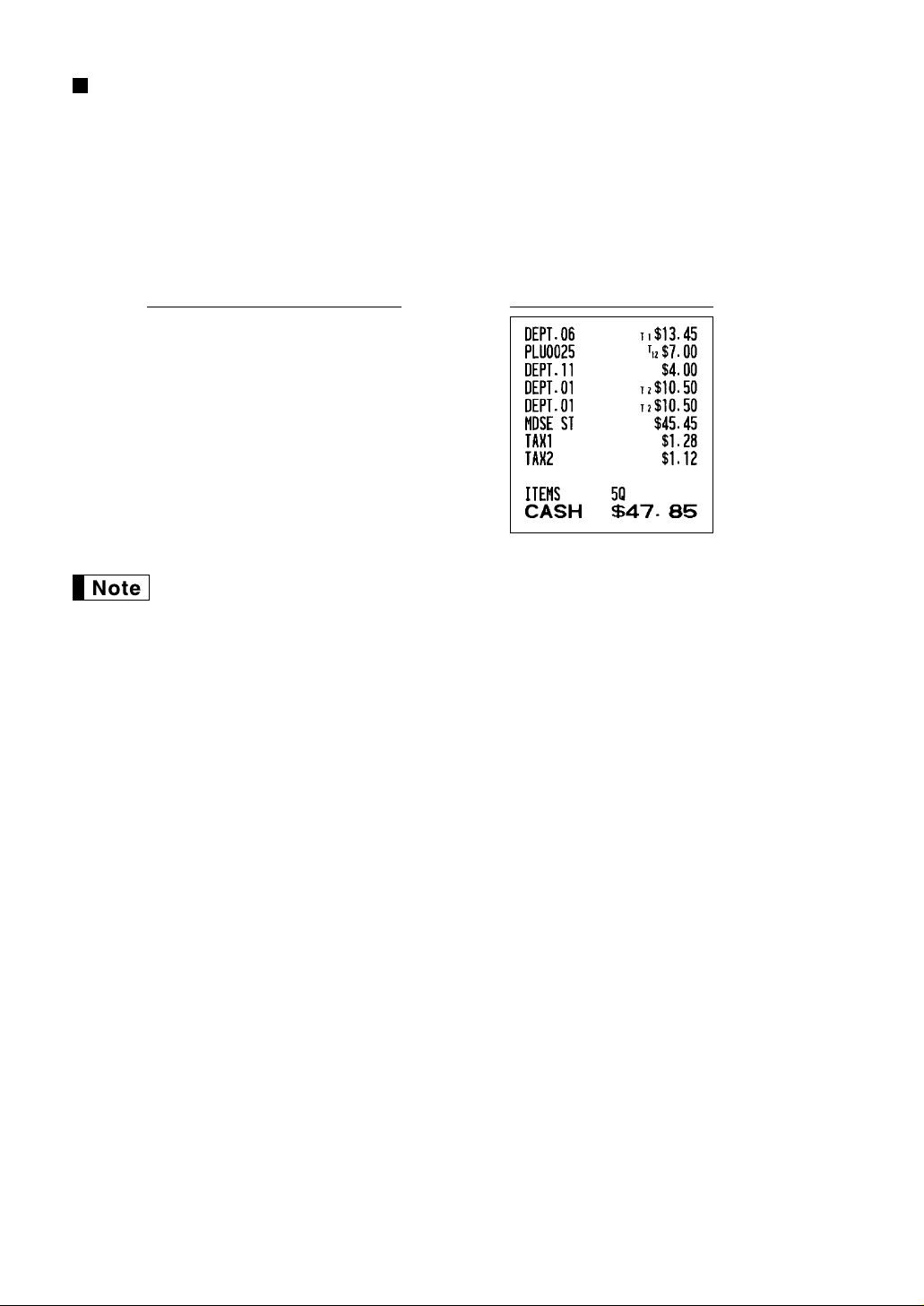
Tax status shift
The machine allows you to shift the programmed tax status of each department or PLU/subdepartment by
pressing the
T
and/or
U
keys before those keys. After each entry is completed, the programmed tax
status of each key is resumed.
Example: Selling the following items for cash with their programmed tax status reversed
• One $13.45 item of dept. 6 (non-taxable) as a taxable 1 item
• One $7.00 item of PLU 25 (non-taxable) as a taxable 1 and 2 item
• One $4.00 item of dept. 11 (taxable 2) as a non-taxable item
• Two $10.50 items of dept. 1 (taxable 1) as taxable 2 items
When Canadian tax system is applied:
When using a tax status shift, the entry of a multi-taxable item for PST or GST will be prohibited.
Please see below:
In case of; Tax 1: PST, Tax 2: PST,
Tax 3: PST, Tax 4: GST
Taxable 1 and 2 item ········· prohibited
Taxable 1 and 3 item········· prohibited
Taxable 2 and 3 item ········· prohibited
Taxable 1 and 4 item ············· allowed
Taxable 2 and 4 item ············· allowed
Taxable 3 and 4 item ············· allowed
In case of; Tax 1: PST, Tax 2: PST,
Tax 3: GST, Tax 4: GST
Taxable 1 and 2 item ········· prohibited
Taxable 1 and 3 item ············· allowed
Taxable 2 and 3 item ············· allowed
Taxable 1 and 4 item ············· allowed
Taxable 2 and 4 item ············· allowed
Taxable 3 and 4 item ········· prohibited
1345
T(
TU›
11
Ud
400
d
1050
TU!
!
A
Receipt printKey operation example
22
OPTIONAL FEATURES
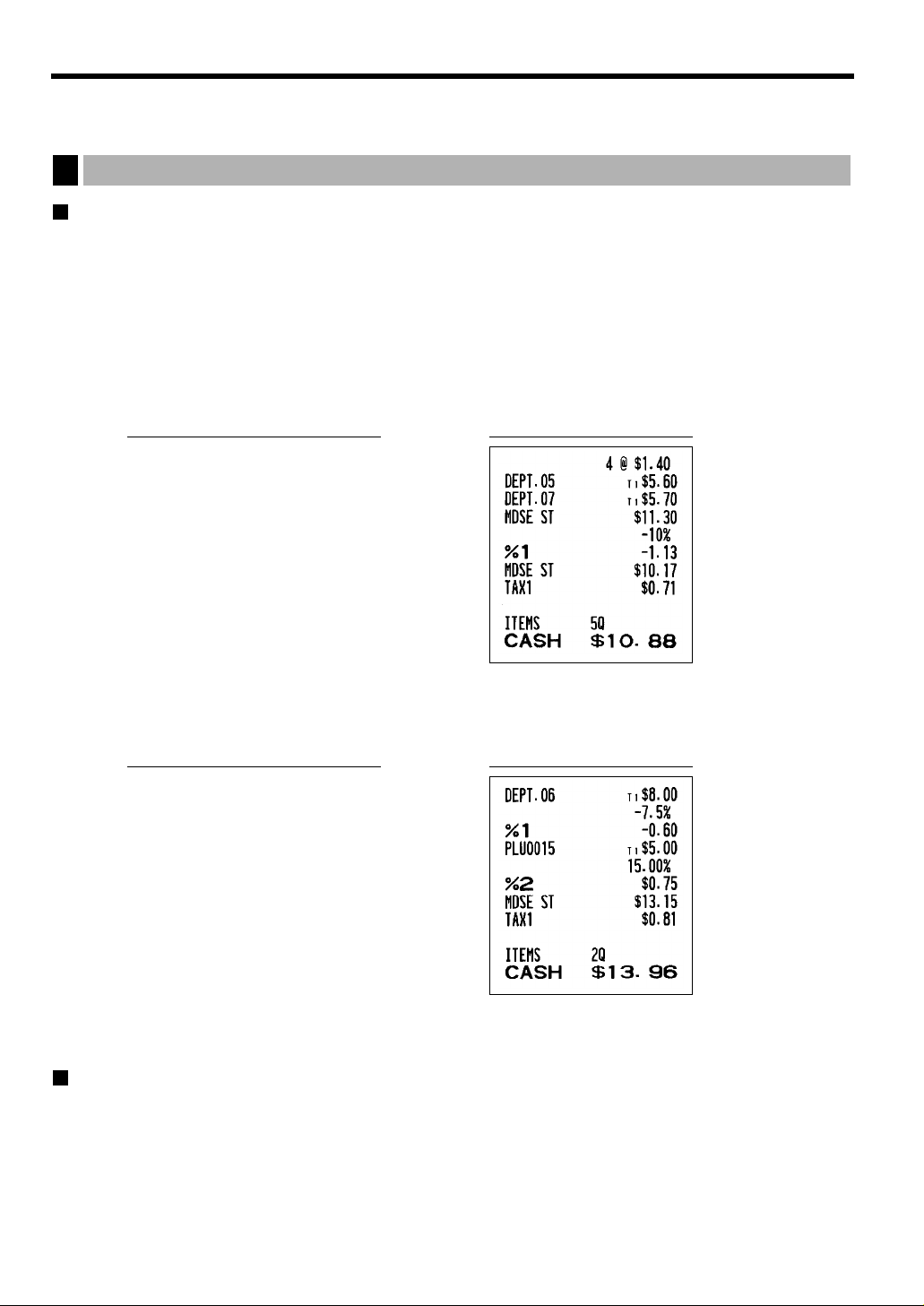
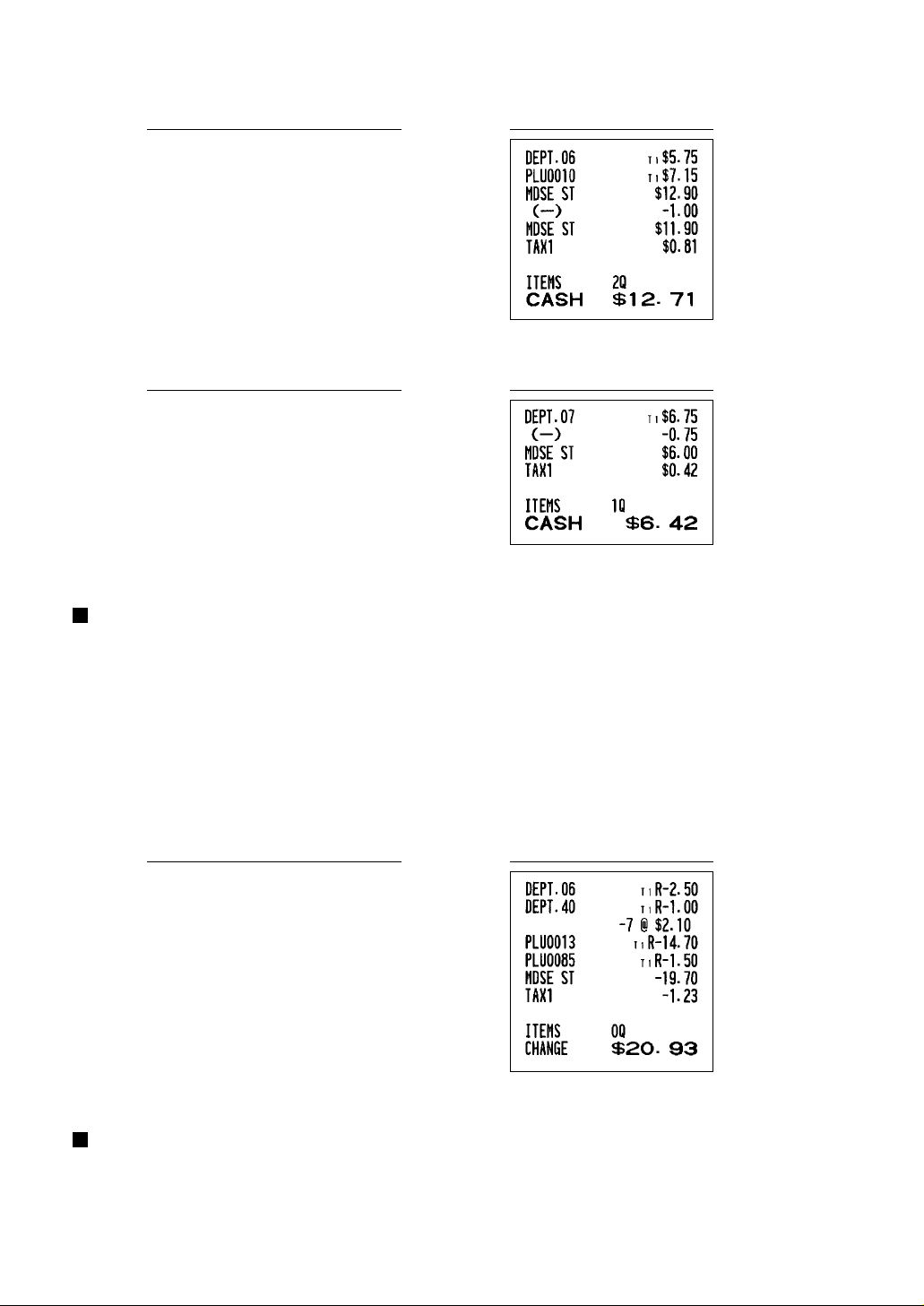
Discount and premium entries using the percent key
The percent key is used to apply a manually entered or preset discount or premium percent rate to individual
items or to a merchandise subtotal. In the default setting, you can manually enter a discount percent rate to
both individual items and merchandise subtotal. For manual entry of discount or premium percent rate, enter the
rate (up to 100.00) with the numeric keys (you need a decimal point when you enter a fractional percent rate),
and press a percent key. When using a preset rate (if programmed), press a percent key.
When entry limit is programmed for a percent key, you can not enter a rate over the limit.
Percent calculation for merchandise subtotal
Percent calculation for item entries
Discount and premium entries using the discount key
The discount key is used to apply a manually entered or preset discount or premium amount to individual items
or to a merchandise subtotal. In the default setting, you can manually enter a discount amount to both individual
items and merchandise subtotal. For manual entry of discount or premium amounts, enter the amount with the
numeric keys, and press the discount key. When using a preset amount (if programmed), press the discount
key.
When entry digit limit is programmed for the discount key, you can not enter an amount over the limit.
800
(
7
P
5
%
fi
&
A
(When premium and 15% are
programmed for the
&
key)
Receipt printKey operation example
4
@
140
'
7
d
570
d
m
10
%
A
Receipt printKey operation example
Auxiliary Entries
1
23
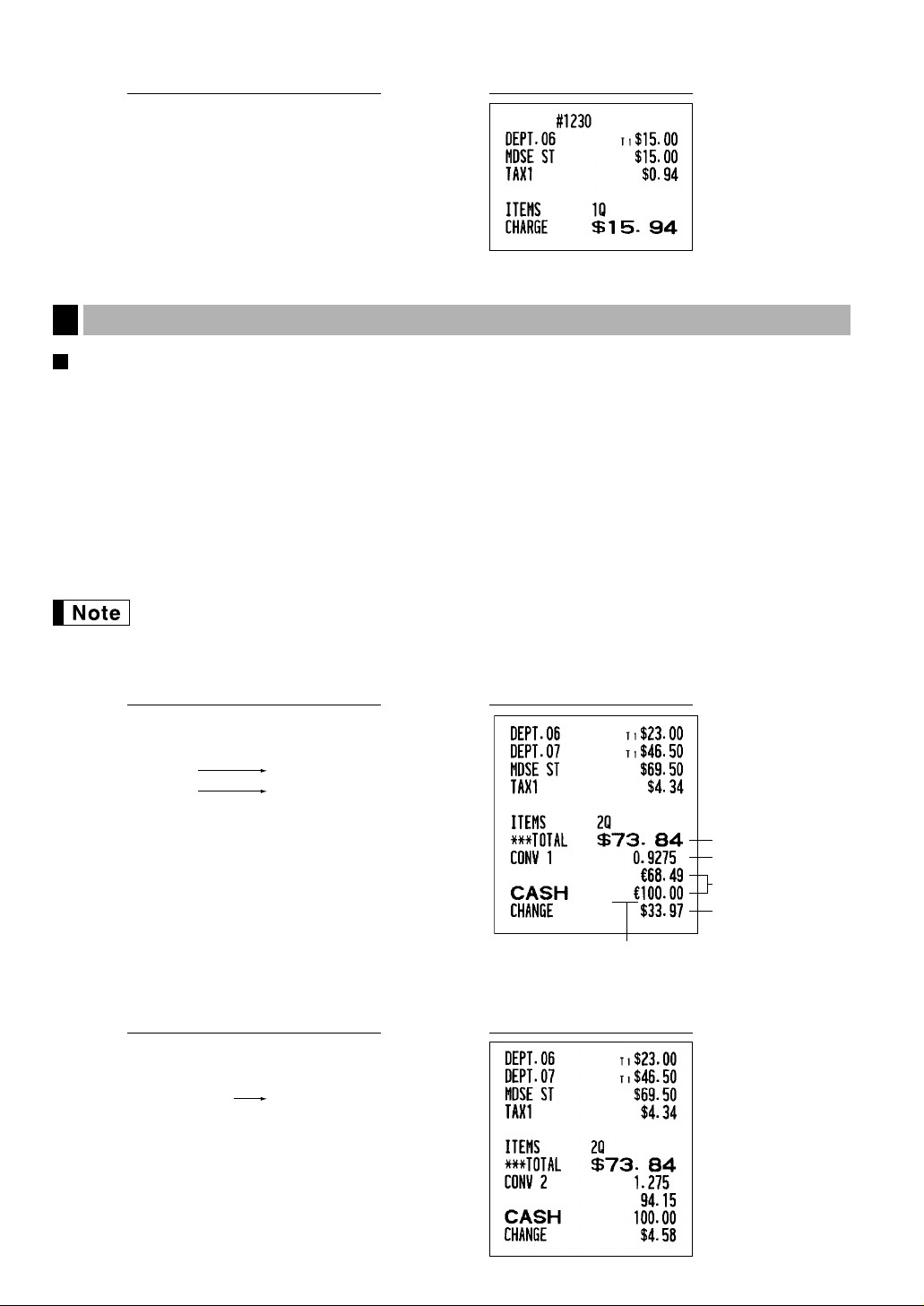
Discount for merchandise subtotal
Discount for item entries
Refund entries
For departments 1 to 6, enter the refund amount and press the
f
key, and then press the corresponding
department key (when using the preset price, omit entering the amount), and for departments 7 to 99, enter the
department code and press the
f
and
d
keys, then enter the refund amount and press the
d
key if
necessary.
For a refund of a PLU item, press the
f
key and the corresponding direct PLU key, or enter the PLU code and
press the
f
key, then press the
p
key.
For a refund of a subdepartment item, enter the refund amount and press the
f
key, then press the
corresponding direct PLU key, or enter the PLU code and press the
f
and
p
keys, then enter the refund
amount and press the
p
key.
Non-add code number entries and printing
You can enter a non-add code number such as a customer’s code number and credit card number, a maximum
of 16 digits, at any point during the entry of a sale. The cash register will print it at once.
To enter a non-add code number, enter the number and press the
s
key.
250
f(
40
fd
100
d
7
@
f‹
85
fp
150
p
A
Receipt printKey operation example
7
d
675
d
-
A
(When a discount amount of
$0.75 is programmed.)
Receipt printKey operation example
575
(
º
m
100
-
A
Receipt printKey operation example
24
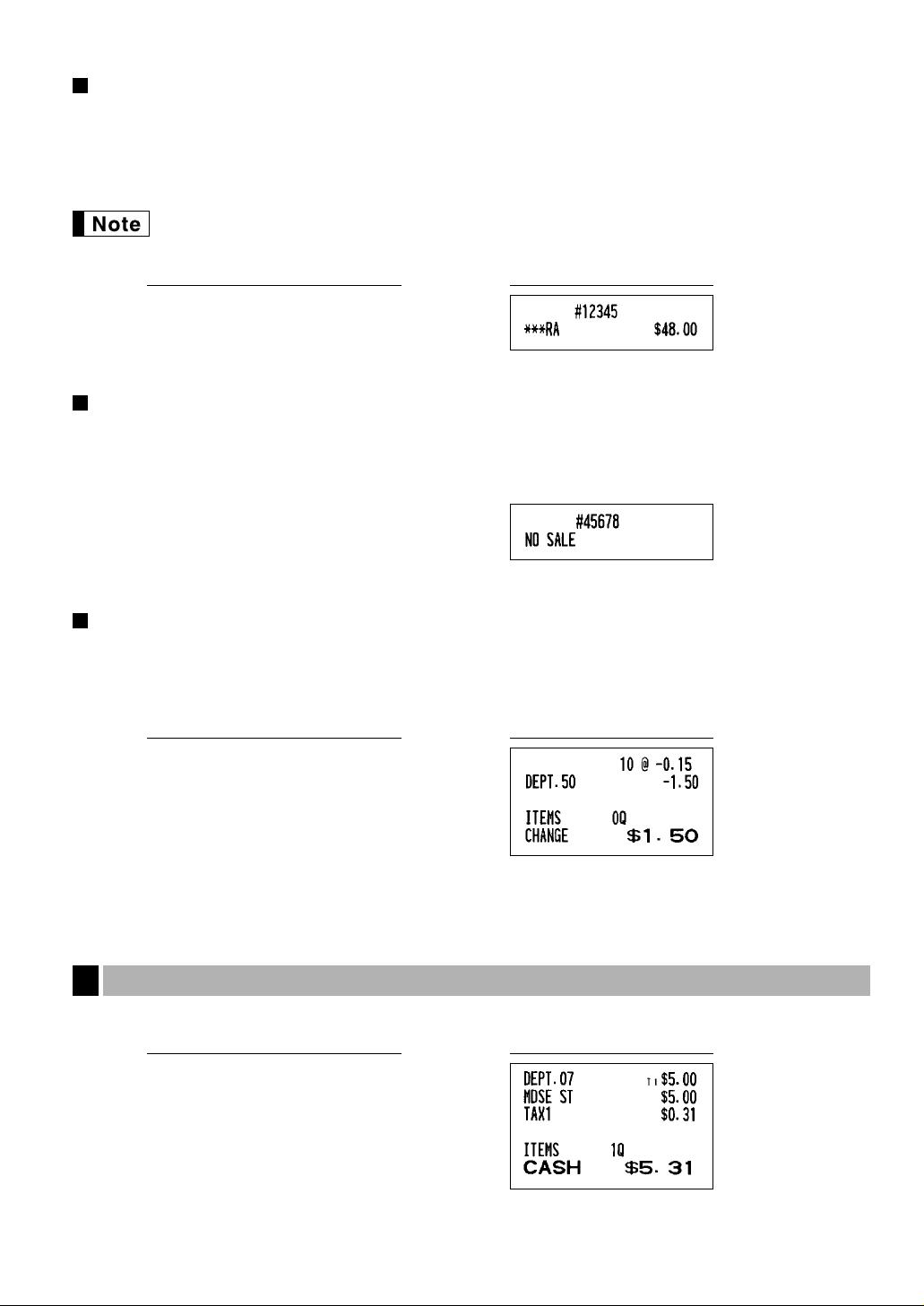
Currency conversion
The register allows payment entries in a foreign currency (only cash payment is available). Pressing the
V
key
creates a subtotal in the foreign currency.
When using a programmed currency conversion rate, press the
V
key after item entries, then enter the
tendered amount in foreign currency if not exact amount payment, and press the
A
key.
When making a manual entry of a currency conversion rate, after item entries, enter the conversion rate (0.0000
to 9999.9999; you need a decimal point when entering a fractional conversion rate) and press the
V
key, then
enter the tendered amount in foreign currency if not exact amount payment, and press the
A
key.
In both cases, the change due will be displayed in domestic currency, and when the amount tendered is short,
the deficit is shown in domestic currency.
• Press the
l
key after pressing the
V
key to cancel payment in a foreign currency.
• If programmed, a foreign currency symbol is printed when you use a preset rate.
Applying preset conversion rate
Applying manual conversion rate
Conversion rate
2300 (
7 d 4650 d
1 P 275 V
10000 A
Receipt printKey operation example
Domestic currency
Conversion rate
Domestic currency
Foreign currency
Foreign currency symbol
(Printed if programmed)
Currency
conversion
Amount
tendered in
foreign currency
(When a currency conversion
rate of 0.9275 is programmed for
the
V
key.)
2300 (
7 d 4650 d
V
10000 A
Receipt printKey operation example
Auxiliary Payment Treatment
2
1230
s
1500
(
X
Receipt printKey operation example
25
Received-on account and paid-out entries
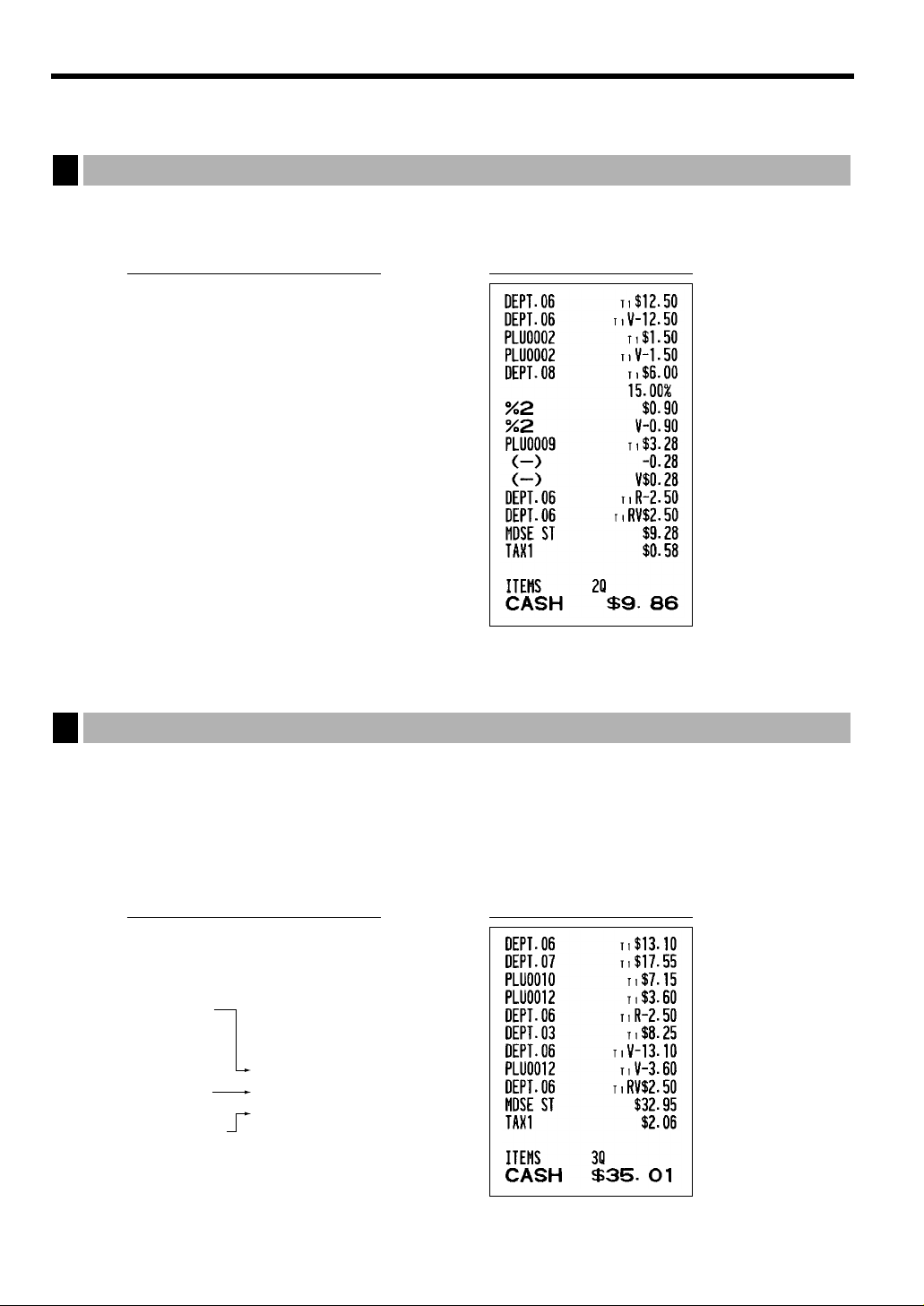
When you receive on account from a customer or when you pay an amount to a vendor, use the
r
key or the
R
key respectively.
For the received-on-account (RA) entry, enter the amount, and press the
r
key.
For the paid-out (PO) entry, enter the amount and press the
R
key.
Cash tendering only available for RA and PO operation.
No sale (exchange)
When you need to open the drawer with no sale, press the
A
key. The drawer will open and printer will print
“NO SALE” on the receipt or journal. If you let the machine print a non-add code number before pressing the
A
key, a no sale entry is achieved and a non-add code number is printed.
Bottle return
This function is used to handle the deposit and payment (paid out) for returned empty bottles or cans.
This function is applicable only to those departments that have been set for bottle return departments or their
associated PLUs or subdepartments.
You can achieve a programmed transaction by pressing the
a
key.
a
(
a
= 7
d
500
dA
)
Receipt printKey operation example
Automatic Sequence Key (
a
key) Entries
3
(When dept. 50 is preprogrammed as a
bottle return dept. and also a negative
dept.)
10
@
50
d
15
d
A
Receipt printKey operation example
12345
s
4800
r
Receipt printKey operation example
26
CORRECTION
If you make an incorrect entry relating to a department, PLU/subdepartment, percentage (
%
and
&
), discount
(
-
) or refund, you can void this entry by pressing the
v
key immediately after the incorrect entry.
You can void any incorrect department entry, PLU/subdepartment entry or item refund entry made during a
transaction if you find it before finalizing the transaction (e.g. pressing the
A
key). This function is applicable
to department, PLU/subdepartment and refund entries only.
Press the
v
key just before you press a department key,
d
key (before the first depression of the
d
key in
case open and preset entries are allowed), direct PLU key or
p
key. For the refund indirect void, press the
v
key after you press the
f
key.
Correction
of a PLU entry
Correction of
a refund entry
Correction
of a
department
entry
1310 (
7 d 1755 d
º
¤
250 f (
825 #
1310 v (
v ¤
250 f v (
A
Receipt printKey operation example
Correction of the Next-to-last or Earlier Entry (indirect void)
2
1250
(
v
™
v
8
d
600
d
&
v
328
ª
28
-
v
250
f(
v
A
Receipt printKey operation example
Correction of the Last Entry (direct void)
1

27
You can void an entire transaction. Once subtotal void is executed, the transaction is aborted and the register
issues a receipt. This function does not work when more than 30 items have been entered.
Any errors found after the entry of a transaction has been completed or during an amount tendered entry cannot
be voided. These errors must be corrected by the manager.
The following steps should be taken:
1. If making the amount tendered entry, finalize the transaction.
2. Make correct entries from the beginning.
3. Hand the incorrect receipt to the manager for its cancellation.
Correction of Incorrect Entries not Handled by the Direct or Indirect Void
Function
4
Subtotal void
1310 "
"
1755 (
º
fl
s
v
s
Receipt printKey operation example
Subtotal Void
3
28
PRIOR TO PROGRAMMING
Before starting sales entries, you must first program necessary items so the cash register suits your sales
needs. In this manual, there are three sections, BASIC FUNCTION PROGRAMMING where required items
must be programmed, AUXILIARY FUNCTION PROGRAMMING where you can program for more convenient
use of keys on the keyboard, and ADVANCED PROGRAMMING where various optional programming features
are provided. Find the appropriate features for your needs, and make the necessary programming.
You can select the language of text (English, French or Spanish) printed on receipts or journals.
For the language selection, please refer to “Language Selection” described later in this section.
Procedure for programming
1.
Check to see whether a paper roll is present in the machine. If there is not enough paper on the roll, replace
it with a new one (refer to MAINTENANCE section for the replacement).
2. Put the manager key in the mode switch and turn it to the PGM position.
3. Program necessary items into the cash register.
Every time you program an item, the cash register will print the setting. Please
refer to print samples in each section.
4. If necessary, issue programming reports for your reference.
• On the procedures and key operation examples shown in the programming details, numbers such
as “08262003” indicates the parameter which must be entered using the corresponding numeric
keys.
• Asterisks in the tables shown in the programming details indicate default settings.
BASIC FUNCTION PROGRAMMING
(For Quick Start)
Date
For setting the date, enter the date in 8 digits using the month-day-year (MM/DD/YYYY) format, then press the
s
key.
You can use the date format of day-month-year (DD/MM/YYYY) or year-month-day (YYYY/MM/DD)
format. To change the format, refer to “Various Function Selection Programming 1” section (Job
code 61).
Date
08262003
s
(Aug. 26, 2003)
PrintKey operation example
Date(MM/DD/YYYY)
s
Date and Time Programming
1
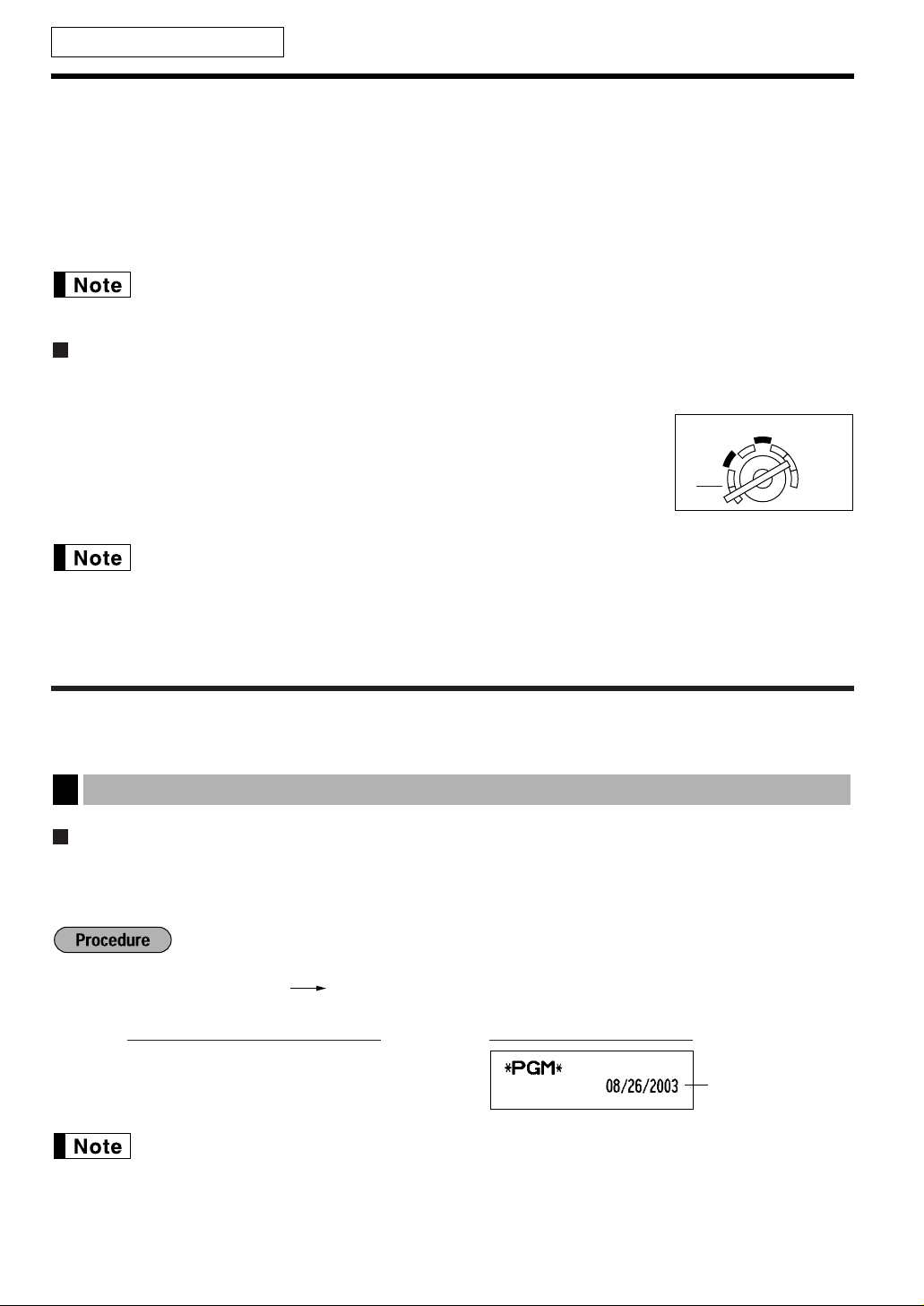
FOR THE MANAGER
REG
OPX/Z MGR
PGM
X1/Z1
X2/Z2
OFF
VOID
29
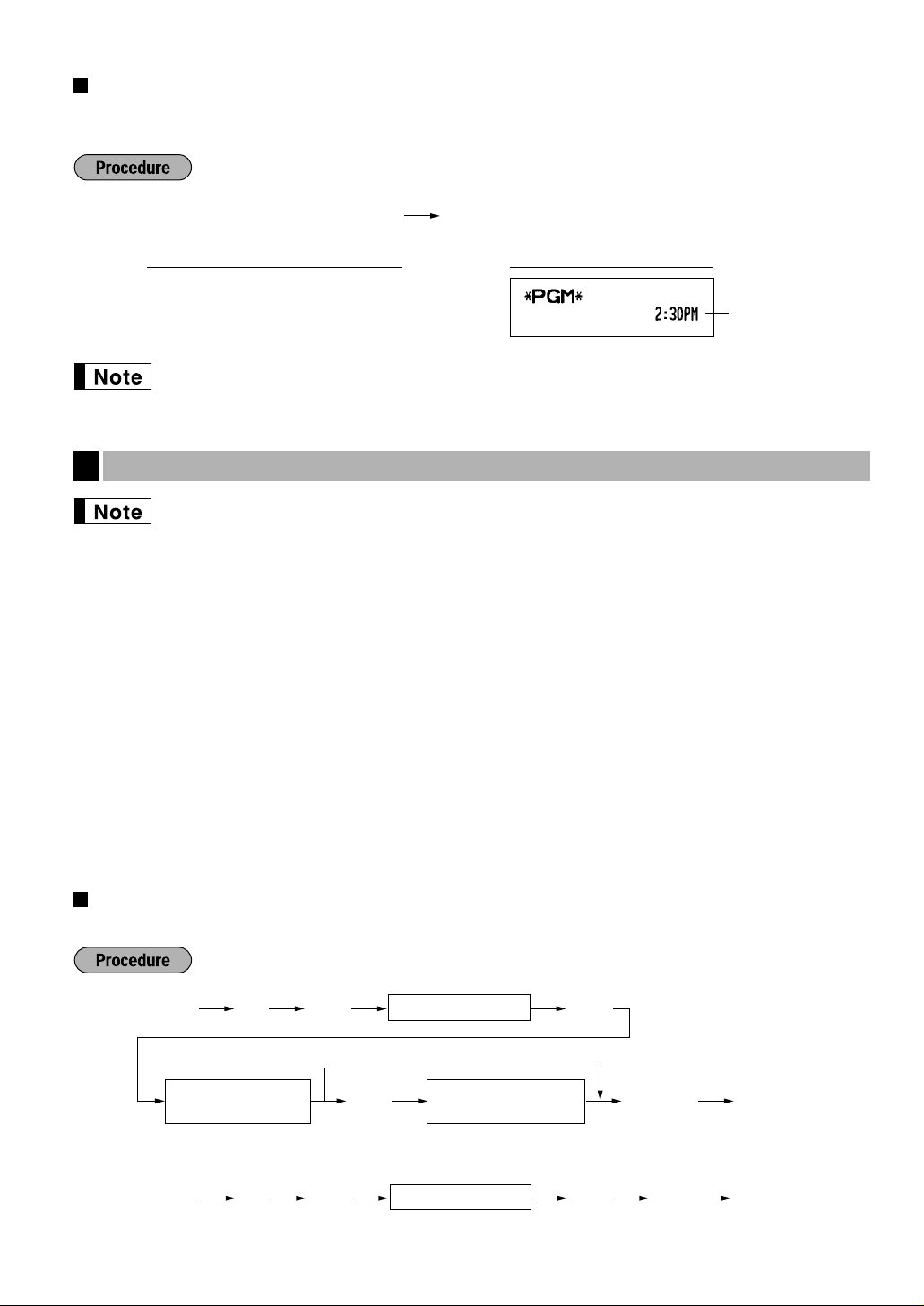
Time
For setting the time, enter the time in 4 digits using the 24-hour format. For example, when the time is set to
2:30 AM, enter 230; and when it is set to 2:30 PM, enter 1430.
For display and print,12-hour format is applied by default. To change it to 24-hour format, refer to
“Various Function Selection Programming 1” section (Job code 61).
The cash register can support US and Canadian tax systems. If you use the Canadian tax system,
you must first change the tax system, then program the tax rate or tax table and quantity for
doughnut exempt which are described in this section. For changing the cash register’s tax system,
please refer to “Various Function Selection Programming 1” section (job code 70).
Before you can proceed with registration of sales, you must first program the tax that is levied in accordance
with the law of your state. The cash register comes with the ability to program four different tax rates. In most
states, you will only need to program Tax 1. However if you live in an area that has a separate local tax (such
as a Parish tax) or a hospitality tax, the register can be programmed to calculate these separate taxes.
When you program the tax status for a department, tax will automatically be added to sales of items assigned to
the department according to the programmed tax status for the department. You can also enter tax manually.
There are two tax programming methods. The tax rate method uses a straight percentage rate per dollar. The
tax table method requires tax break information from your state or local tax offices. Use the method which is
acceptable in your state. You can obtain necessary data for tax programming from your local tax office.
Tax programming using a tax rate
The percent rate specified here is used for tax calculation on taxable subtotals.
To delete a tax rate, use the following sequence:
s @ v A@
Tax number (1 to 4)
9
s @
9
@
@ s A
When the lowest taxable amount is zero
Tax number (1 to 4)
Tax rate
(0.0000 to 100.0000)
Lowest taxable amount
(0.01 to 999.99)
Tax Programming for Automatic Tax Calculation Function
2
Time
1430
s
PrintKey operation example
Time(max. 4 digits in 24-hour format)
s
30
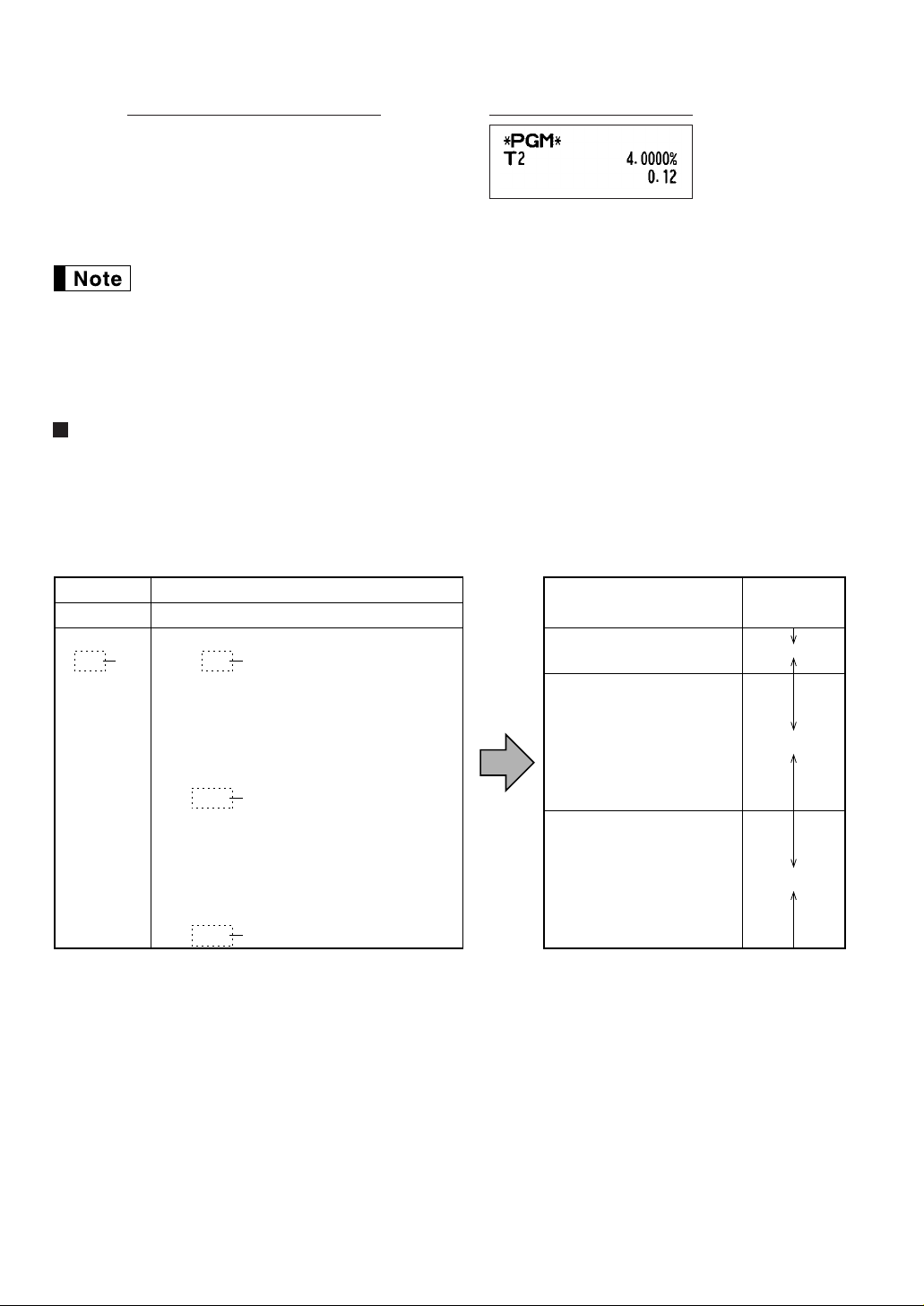
Example: Programming the tax rate 4% as tax rate 2 with tax exempt as 12¢
• If you make an incorrect entry before pressing the third
@
key in programming a tax rate, cancel
it with the
l
key.
• You do not need to enter the trailing zeros of a tax rate (after the decimal point), but you do need
to enter the decimal for fractions.
• The lowest taxable amount setting is ignored when you select VAT system for Canadian tax.
The tax table (applicable to the add-on tax)
If you are in an area that uses a tax table for tax calculation, you can program the cash register accordingly. Tax
table programming can be performed for Tax 1 through Tax 4.
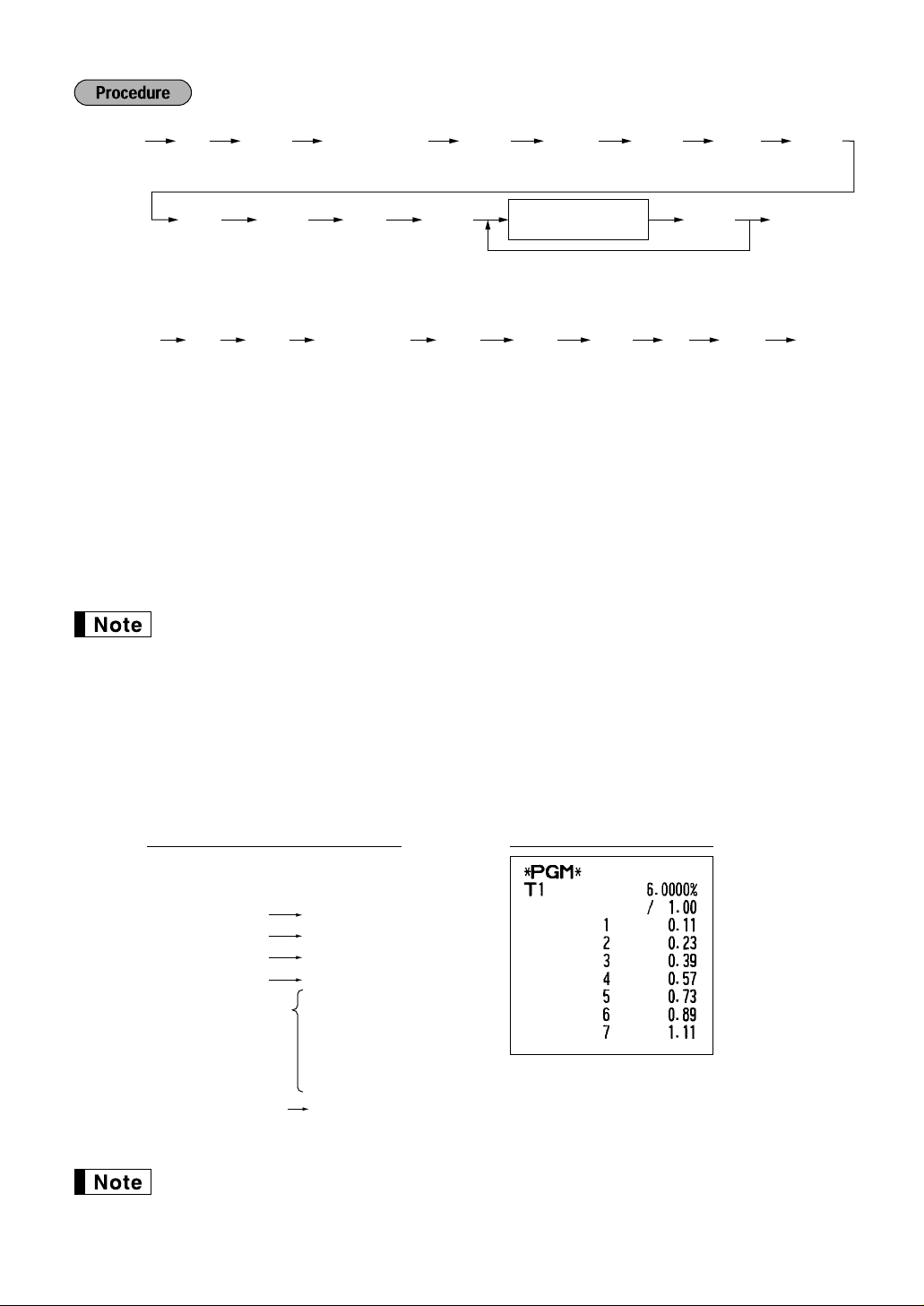
Sample tax table
New Jersey tax table: 6%
To program a tax table, first make a table like the one shown above right.
From the tax table, calculate the differences between a minimum break point and the next one (A). Then, from
the differences, find irregular cycles (B) and regular cycles (C and D). These cycles will show you the following
items necessary to program the tax table:
T: The tax amount collected on the minimum taxable amount (Q)
Q: The minimum taxable amount
M1: The maximum value of the minimum breakpoint on a regular cycle (C)
We call this point “MAX point.”
M2: The maximum value of the minimum breakpoint on a regular cycle (D)
We call this point “MAX point.”
M: Range of the minimum breakpoint on a regular cycle: difference between Q and M1 or between M1 and M2
Taxes
Range of sales amount
Minimum breakpoint
.00
.01
.02
.03
.04
.05
.06
.07
.08
.09
.10
.11
.12
.13
.01
.11
.23
.39
.57
.73
.89
1.11
1.23
1.39
1.57
1.73
1.89
2.11
Maximum breakpoint
.10
.22
.38
.56
.72
.88
1.10
1.22
1.38
1.56
1.72
1.88
2.10
2.22
to
to
to
to
to
to
to
to
to
to
to
to
to
to
T Q
M1
M2
A: Difference between the
minimum breakpoint and
the next one (¢)
–
10 (0.11 - 0.01)
12 (0.23 - 0.11)
16 (0.39 - 0.23)
18 (0.57 - 0.39)
16 (0.73 - 0.57)
16 (0.89 - 0.73)
22 (1.11 - 0.89)
12 (1.23 - 1.11)
16 (1.39 - 1.23)
18 (1.57 - 1.39)
16 (1.73 - 1.57)
16 (1.89 - 1.73)
22 (2.11 - 1.89)
B: Non-cyclic
C: Cyclic-1
D: Cyclic-2
s
9
@
2
@
4
@
12
s
A
PrintKey operation example
31
The first figure to be entered depends upon whether the difference between a minimum
breakpoint to be entered and the preceding minimum breakpoint is not less than $1.00 or
more than 99¢. When the difference is not less than $1.00, enter “1,” and when it is not more
than 99¢, enter “0” or nothing.
The second figure depends upon whether your tax table is to be programmed as tax table 1,
2, 3 or 4.
*2 If the rate is fractional (e.g. 4-3/8%), then the fractional portion (3/8) would be converted to its decimal
equivalent (i.e. .375) and the resulting rate of 4.375 would be entered. Note that the nominal rate (R) is
generally indicated on the tax table.
If you make an incorrect entry before entering the M in programming a tax table, cancel it with the
l
key; and if you make an error after entering the M, cancel it with the
s
key. Then program
again from the beginning.
• Limitations to the entry of minimum breakpoints
The register can support a tax table consisting of no more than 72 breakpoints. (The maximum number of
breakpoints is 36 when the breakpoint difference is $1.00 or more.) If the number of breakpoints exceeds the
register’s table capacity, then the manual entry approach should be used.
Example: Programming the sample tax table shown on the previous page as tax table 1
You do not need to enter the trailing zeros of a tax rate (after the decimal point) but you do need to
enter the decimal point for fractions.
s 8 @
1 @
6 @
100 @
1 @
11 @
23 @
39 @
57 @
73 @
89 @
111 @
A
Tax rate
M
T
Q
M1
(MAX point)
The first
cyclic
portion
PrintKey operation example
Second figure:
(1 to 4)
*1 First figure:
(1 or 0)
s @ s@
max. six digits
(0.0001 - 99.9999%)
max. four
digits
One- or two-
digit number
Rate
M
*1
*2
@@
To delete a tax table, use the following sequence:
8
s @ @
max. six digits
(0.0001 - 99.9999%)
max. four
digits
One- or two-
digit number
Rate
M
*1
*2
@
max. three
digits
T
@
max. five
digits
Q
@ A
Minimum breakpoint
max. five digits
Repeat until the MAX point is entered.
@@
8
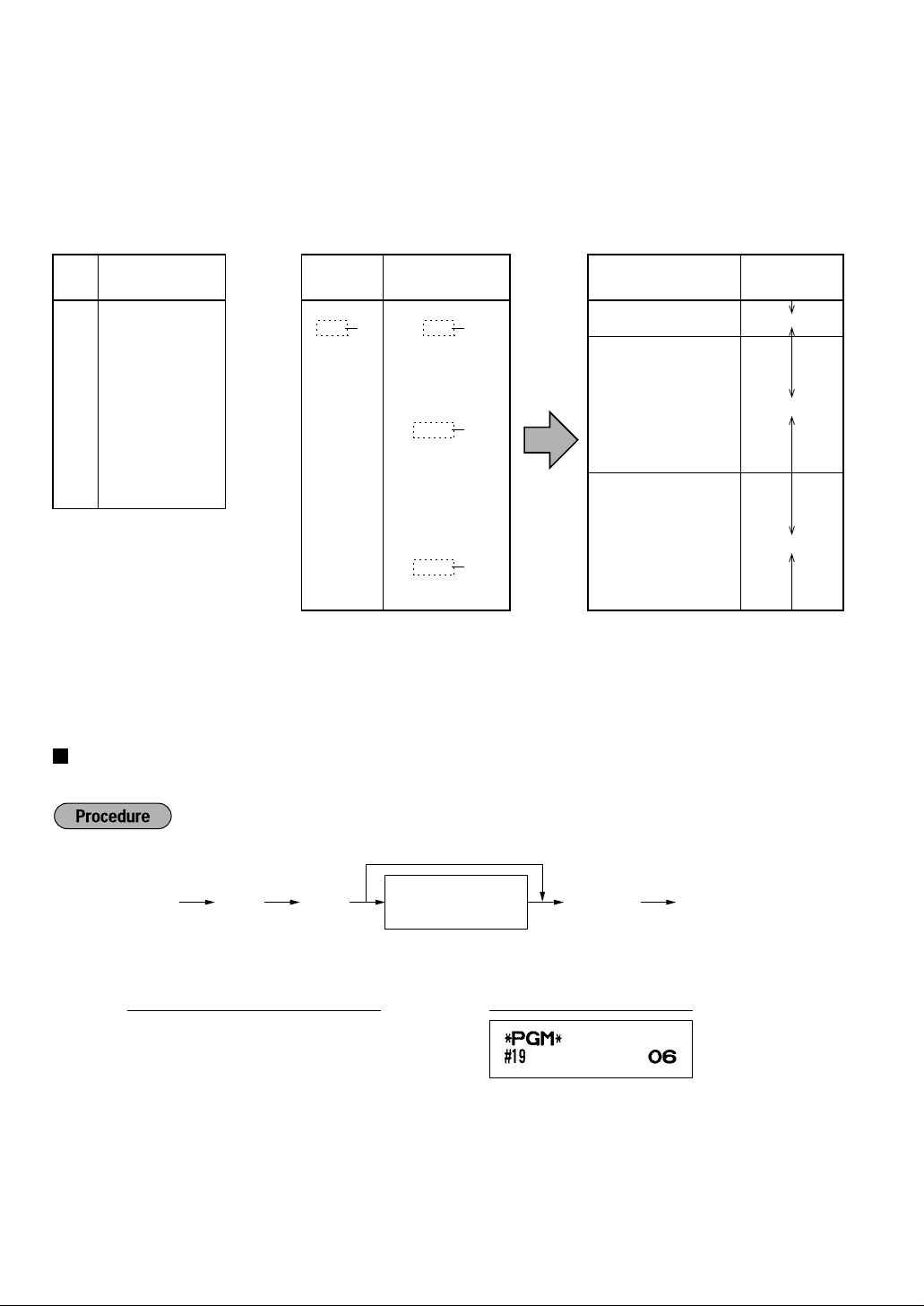
32
• If the tax is not provided for every cent, modify the tax table by setting the tax for every cent
in the following manner.
When setting the tax, consider the minimum breakpoint corresponding to unprovided tax to be the same as the
one corresponding to the tax provided on a large amount.
Sample tax table Modification of the left tax table
Example 8%
From the modified tax table above;
Rate = 8(%), T = $0.01 = 1¢, Q = $0.11 = 11¢, M1 = 1.11, M2 = 2.11, M = 100
Quantity for doughnut tax exempt (for Canadian tax system)
This option is available only when the Canadian tax system is selected.
Example: To program the quantity “6”
s
19
@
6
s
A
PrintKey operation example
s @ s A
To program zero
Q’ty for doughnut
tax exempt
(max. 2 digits: 1 to 99)
19
Tax
Minimum
breakpoint
.00
.01
.02
.03
.04
.05
.06
.07
.08
.09
.10
.11
.12
.13
.14
.15
.16
.17
.01
.11
.26
.47
.68
.89
.89
1.11
1.11
1.11
1.26
1.47
1.68
1.89
1.89
2.11
2.11
2.11
T Q
M1
M2
Tax
Minimum
breakpoint
.00
.01
.02
.03
.04
.06
.09
.10
.11
.12
.14
.17
.01
.11
.26
.47
.68
.89
1.11
1.26
1.47
1.68
1.89
2.11
Breakpoint
difference (¢)
1
10 (0.11-0.01)
15 (0.26-0.11)
21 (0.47-0.26)
21 (0.68-0.47)
21 (0.89-0.68)
0 (0.89-0.89)
22 (1.11-0.89)
0 (1.11-1.11)
0 (1.11-1.11)
15 (1.26-1.11)
21 (1.47-1.26)
21 (1.68-1.47)
21 (1.89-1.68)
0 (1.89-1.89)
22 (2.11-1.89)
0 (2.11-2.11)
0 (2.11-2.11)
B: Non-cyclic
C: Cyclic-1
D: Cyclic-2
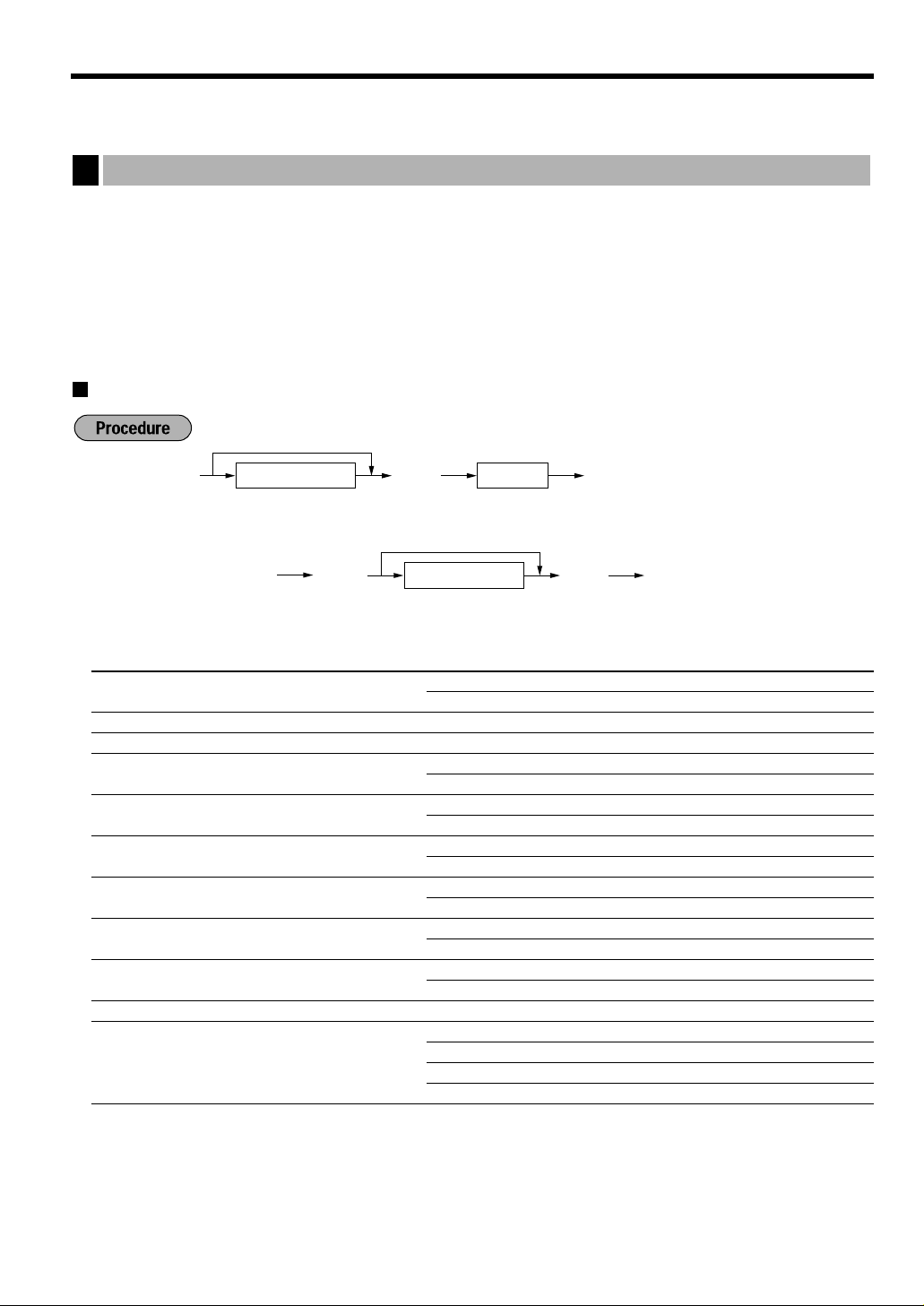
33
AUXILIARY FUNCTION PROGRAMMING
Merchandise can be classified into a maximum of 99 departments. Items sold using the department keys can
later be printed on a report shown as the quantities sold and sales amounts classified by department. The data
is useful for making purchasing decisions and other store operations. Departments can be assigned to articles
whose prices were set using PLU/subdepartment function.
When using a department key, you must set the parameters to specify the department status, such as positive
or negative department. Prices can be assigned directly to departments for frequently purchased items, which
enables you to enter the prices by simply pressing the department keys or dept. code entries.
Department status
To program another department, start from the beginning without pressing the
A
key.
*: Item: Selection: Entry:
A Type Bottle return 1
Normal* 0
B Group number 0-9 (0:Non group) (default: 0)
C Commission group number 0-2 (0:Non commission) (default: 0)
D Tax 4 status Taxable 1
Non-taxable* 0
E Tax 3 status Taxable 1
Non-taxable* 0
F Tax 2 status Taxable 1
Non-taxable* 0
G Tax 1 status Taxable (*for dept. 1 thru 6) 1
Non-taxable (*for dept. 7 and above) 0
H SICS / Normal SICS 1
Normal* 0
I Sign Negative department 1
Positive department* 0
J Entry digit limit 0-7 (default: 7)
K Type of unit price entry Open and preset 3
Preset only 2
Open only* 1
Inhibit department key 0
Type
• Select the department as normal or for bottle return.
Group number
• If group setting (0 to 9, 0: non group) is done, items sold using the department keys and the associated PLUs
and subdepartments can be classified into groups for reporting the sales.
For department 7-99:
d@
Dept. code
A
To set all zeros
ABCDEFGHIJK
*
To set all zeros
@
Dept. keyABCDEFGHIJK
A
*
Department Programming
1
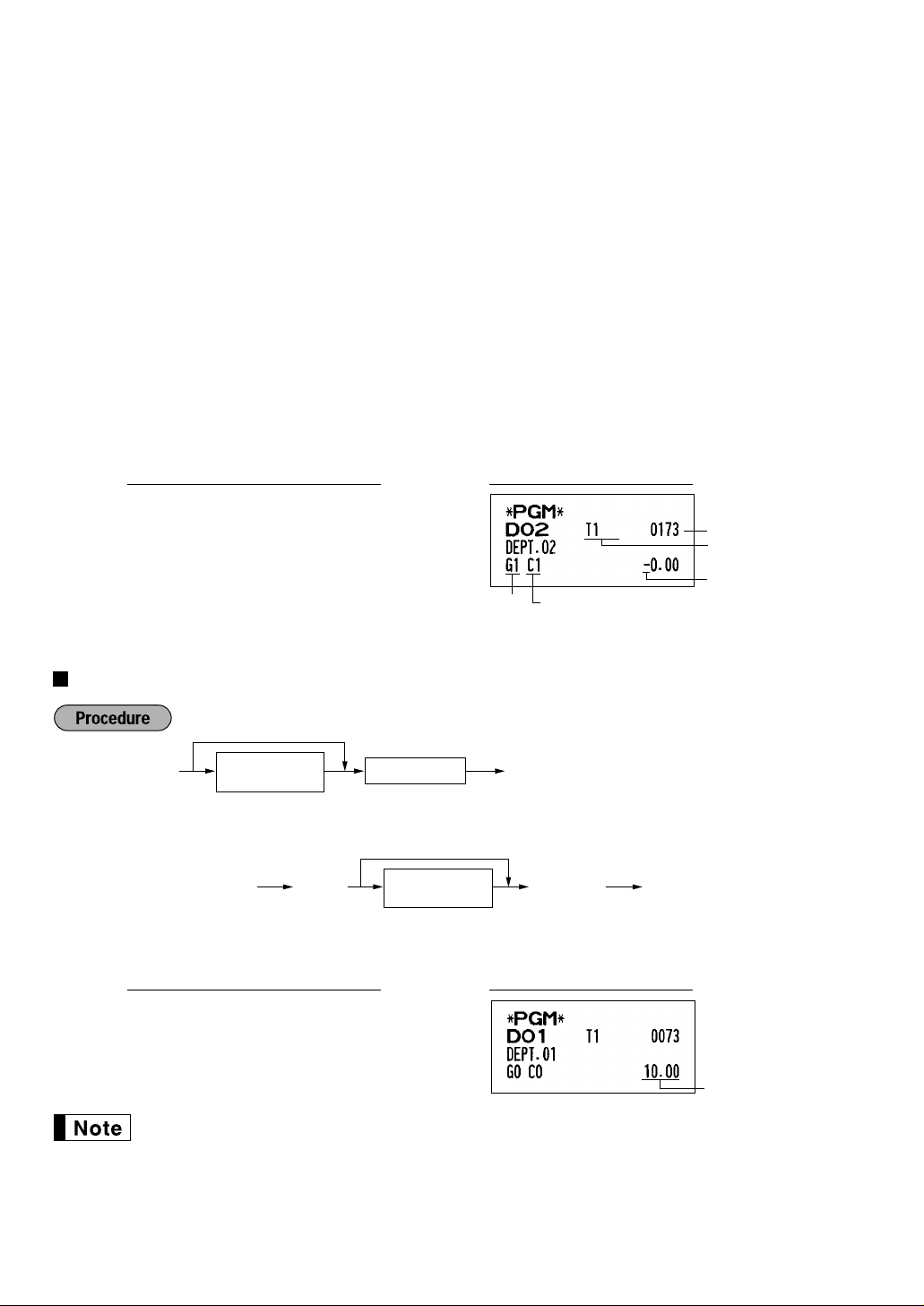
34
Commission group number
• A commission group (0 to 2, 0: non commission) can be assigned to each department for commission for
clerks. The commission amount for each clerk is calculated based on a programmed commission rate and
later printed on clerk reports.
Tax status (taxable 1 through 4 / non-taxable)
• When any entry of a taxable department is made in a transaction, tax is automatically computed according to
the associated tax table or rate.
SICS (Single Item Cash Sale)
• If an entry of a department programmed for SICS is made first, the sale will be finalized as a cash sale as
soon as the department key is pressed. If the entry is made after entering a department not programmed for
SICS, the sale will not be finalized until the
A
key is pressed.
Entry digit limit
• Set the number of allowable digits for the maximum entry amount for each department. The limit is effective
for operations in the REG mode and can be overridden in the MGR mode.
Example: Programming department 2 as normal dept. group 1, commission group 1, taxable 1, SICS, negative
department, entry digit limit - 7 digits, and allowing open & preset entry.
(ABCDEFGHIJK: 01100011173)
Preset unit price
To program another department, start from the beginning without pressing the
A
key.
If a department is not programmed to allow the entry of preset unit prices in functional
programming, the department is automatically changed to allow the entry of preset unit prices by
this programming entry.
Unit price
1000
!
A
PrintKey operation example
For department 7-99:
ds
Dept. code
Unit price
(max. six digits)
A
To program zero
To program zero
Dept. key
Unit price
(max. six digits)
A
Tax status
Dept. group
Commission group
From left, AHJK
Sign(I)
01100011173
@
"A
PrintKey operation example
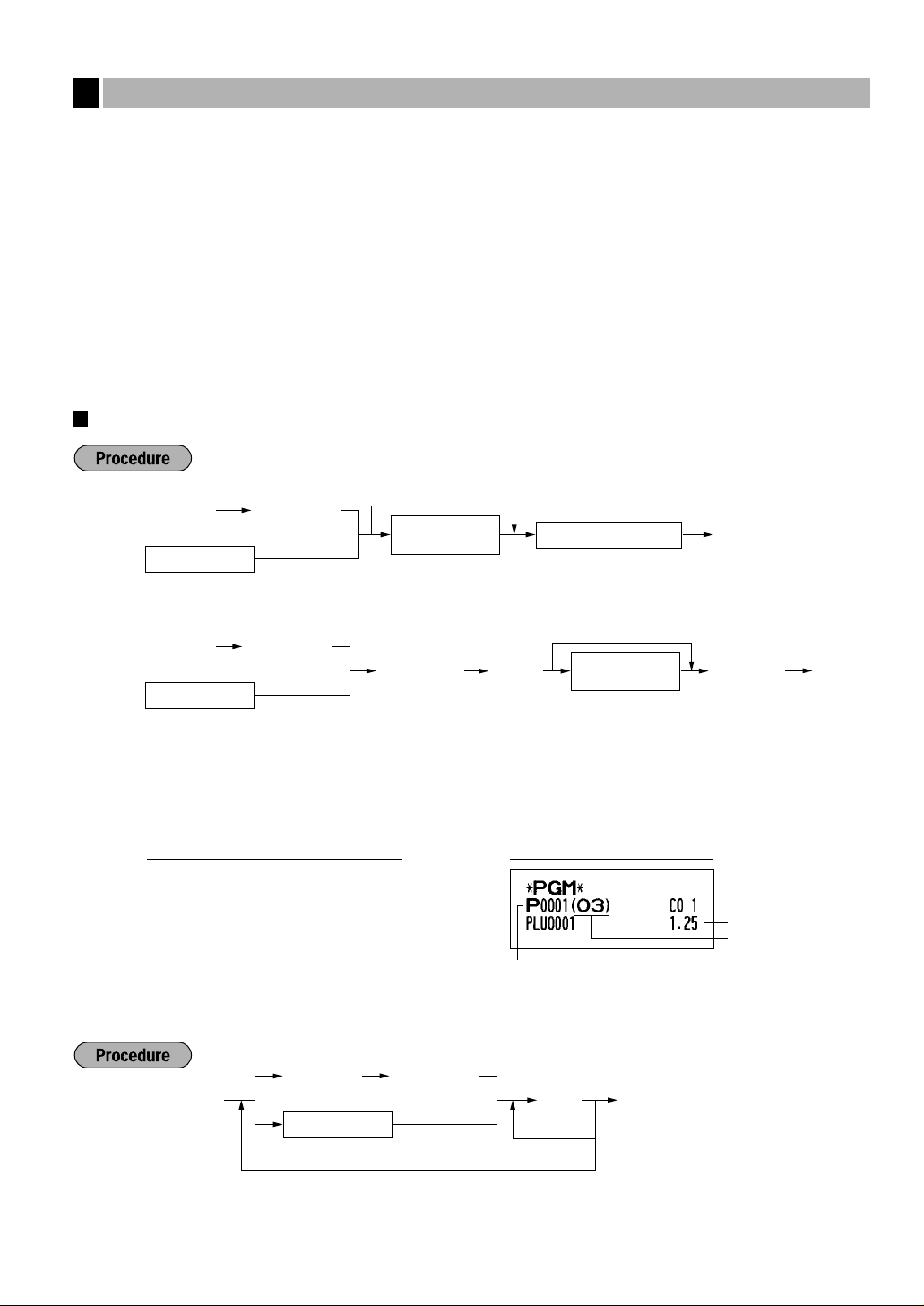
35
The PLU function allows speedy key entries whereby a price is automatically called up when a direct PLU key is
pressed or a code is entered. The subdepartment is a kind of “open PLU”, which requires you to enter a price
before a direct PLU key is pressed or after the PLU code is entered. A maximum of 1800 PLU/subdepartment
settings are possible. Each one belongs to a department and acquires the department’s parameters (dept. type
(normal or bottle return), dept. group, tax status, SICS and sign).
A commission group (0 to 2, 0: No commission is applied) can be assigned to each PLU/subdepartment for
commission for clerks. Each commission amount for individual clerk is calculated based on the corresponding
programmed commission rate and printed later on clerk reports.
The cash register is preprogrammed so all 1800 codes are assigned as PLUs (commission group: 0) associated
with department 1 and preset unit price “0”.
Totally 75 direct PLU keys are provided on the keyboard for PLU and subdepartment entries, and PLU codes 1
thru 75 are previously allocated for direct PLU 1 key thru PLU 75 key respectively.
Unit price and associated department assignment
*: For a subdepartment, set the limit amount of unit price entry.
To program the following PLU, start from entering a unit price or an associated department code without
pressing the
A
key.
To program another PLU, start from the beginning without pressing the
A
key.
To delete a PLU code, use the following sequence:
To delete the following PLU
To delete another PLU
PLU code
(1-1800)
p
Direct PLU key
vA
PLU code
Unit price
Associated dept.
¡
125
#
A
PrintKey operation example
When the associated department is department 7-99:
ds
To program zero
Associated
dept. code
(1 to 99)
A
Unit price
(max. six digits)
*
PLU code
(1-1800)
p
Direct PLU key
To program zero
Unit price
(max. six digits)
A
*
Associated Dept. key
PLU code
(1-1800)
p
Direct PLU key
PLU (Price Look-Up) and Subdepartment Programming
2
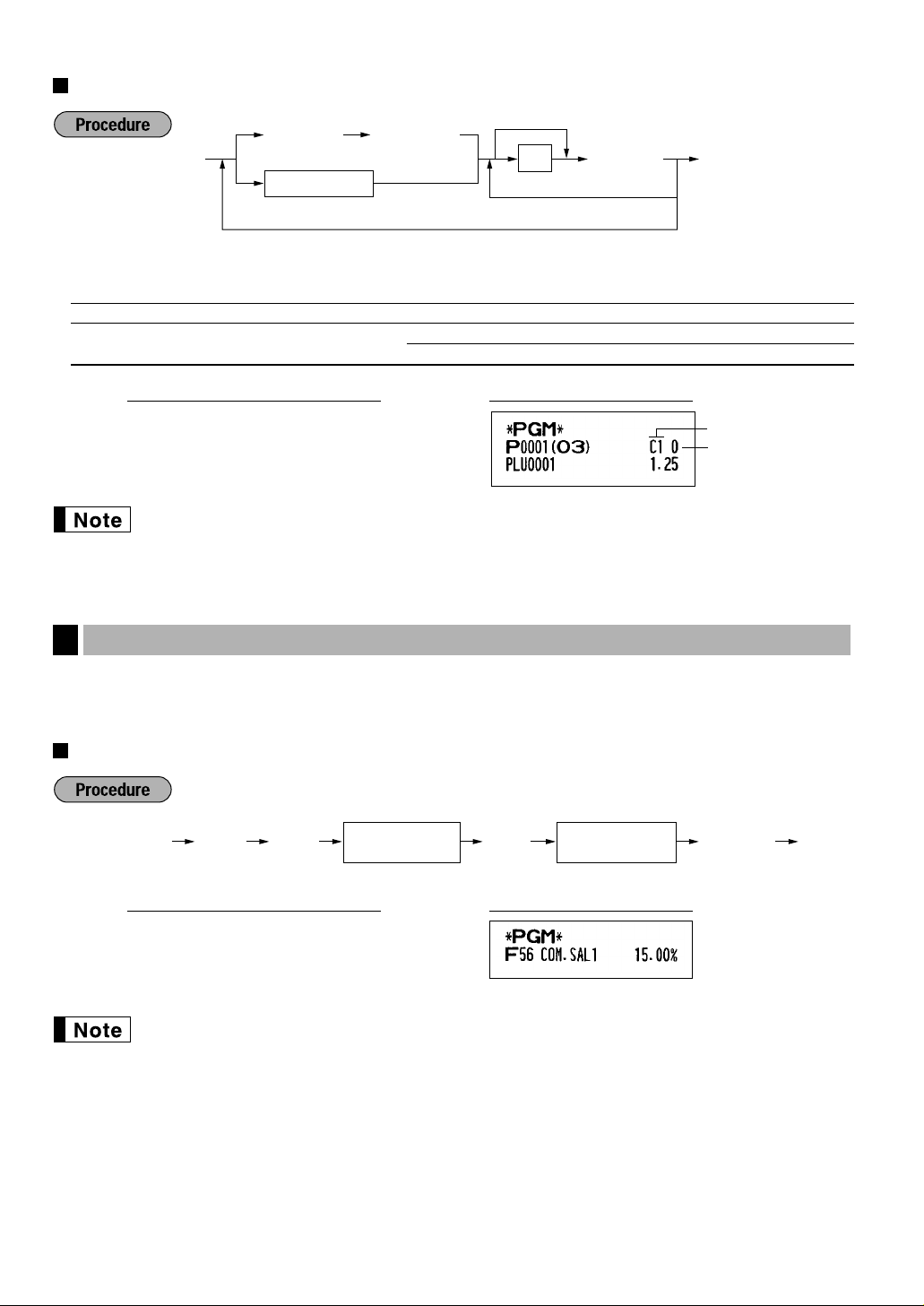
36
Function selection
*: Item: Selection: Entry:
A Commission group number 0-2 (0: Non commission) (default: 0)
B PLU/subdepartment selection Subdepartment 0
PLU* 1
When you program the last PLU code, the programming sequence will be complete with a press of
the
s
key.
Based on each clerk’s sales total of each commission group and the corresponding commission rate, the
commission amounts are calculated, and printed on clerk reports.
Commission rate
You must use a decimal point when setting a fractional rate.
s
28
@
1
@
15
sA
PrintKey operation example
s
Commission
number (1 or 2)
@@ sA
Commission rate
(0.00 - 999.99)
28
Commission Rate Programming
3
PLU/subdept. selection
Commission group
¡
10
sA
PrintKey operation example
To program “00”
To program the following PLU
To program another PLU
As
AB
*
PLU code
(1-1800)
p
Direct PLU key
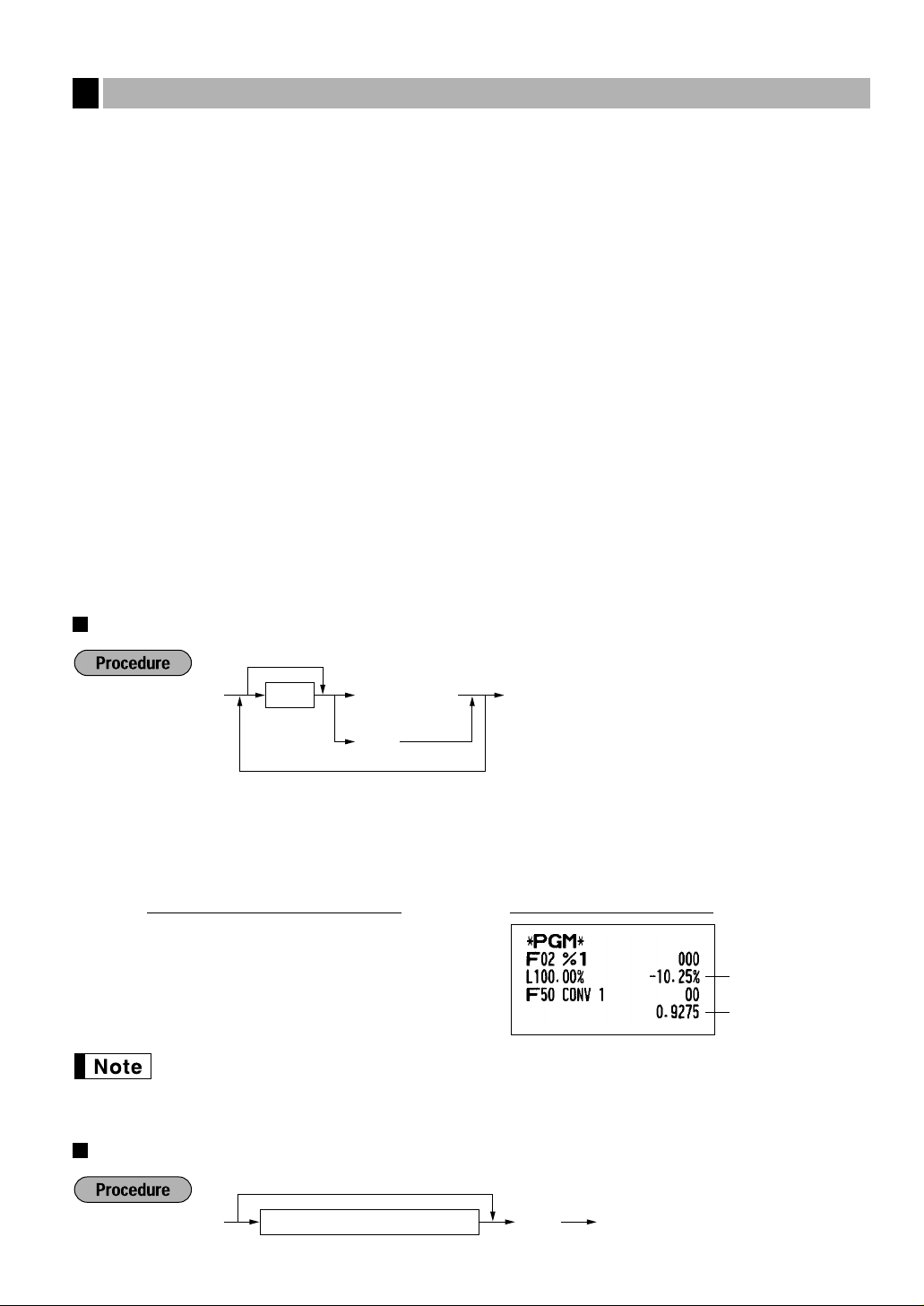
37
The cash register provides miscellaneous keys such as
%
,
&
,
-
,
f
,
r
,
R
,
V
,
t
,
C
,
X
,
Y
and
A
. While the cash register is pre-programmed so you can use these keys, you must set a currency
conversion rate to use
V
key. You can also program these keys for more convenient use. Please refer to the
data below for programming these keys. Factory setting is indicated with parentheses.
%
,
&
Percent rate (0.00%), tax status (non-taxable), sign (minus), item % and subtotal %
entry* (both are allowed), percent rate limitation (100%)
-
Amount (0.00), tax status (non-taxable), sign (minus), item
_
and subtotal
_
entry*
(both are allowed), entry digit limit (7 digits)
f
Not necessary to program
r
,
R
Entry digit limit (9 digits)
V
Currency conversion rate (0.0000), currency conversion rate entry method - open or
preset (both are enabled)
C
,
X
,
Y
and
A
Compulsory entry of amount tender (not compulsory), entry digit limit (8 digits), footer
printing (not printed)
t
(Manual tax) Entry digit limit (7 digits)
* Item %/Item
_
: Percent/discount calculation is applied to individual department and
PLU/subdepartment.
* Subtotal %/Subtotal
_
: Percent/discount calculation is applied to subtotals.
Rate for
%
,
&
and
V
*: Rate
0.00 — 100.00 (% rate)
0.0000 — 9999.9999 (Currency conversion rate)
You must use a decimal point when setting fractional rates.
Amount for
-
Discount amount (max. six digits)
A-
To program zero
Percent rate
Currency
conversion rate
10
P
25
%
0
P
9275
V
A
PrintKey operation example
*Rate or
%
V
A&
To program another rate
To program zero
Miscellaneous Key Programming
4
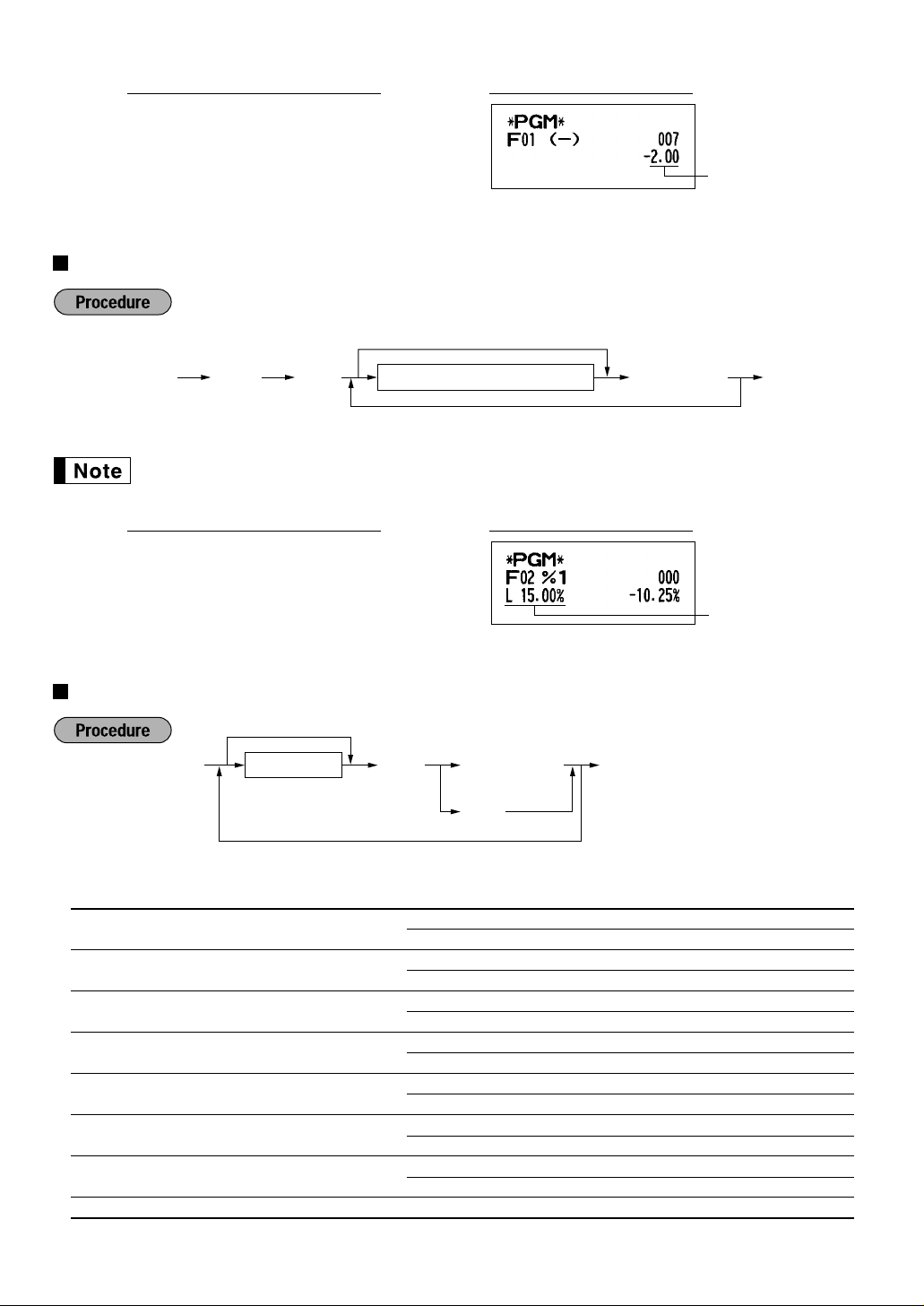
38
Percent rate limitation for
%
and
&
• Percent entries that exceed the upper limit may be overridden in the MGR mode.
• You must use a decimal point when setting fractional rates.
Function parameters for
%
,
&
and
-
*: Item: Selection: Entry:
A Tax 4 status Taxable 1
Non-taxable* 0
B Tax 3 status Taxable 1
Non-taxable* 0
C Tax 2 status Taxable 1
Non-taxable* 0
D Tax 1 status Taxable 1
Non-taxable* 0
E +/- sign + (premium) sign 0
- (discount) sign* 1
F Item % / Item
_
Allow* 0
Disallow 1
G Subtotal % / Subtotal
_
Allow* 0
Disallow 1
H Entry digit limit for discount key 0-7 (default: 7)
When programming for percent keys, always enter 0 for H.
*ABCDEFGH or
%@
-
A&
To program for another key
To program “0” for all items
Percentage limit
s
29
@
15
P
00
%
A
PrintKey operation example
s @
Percentage limit (0.00 -100.00%)
A
To program zero
To program for another percent key
or
%&
29
Discount amount
200
-
A
PrintKey operation example
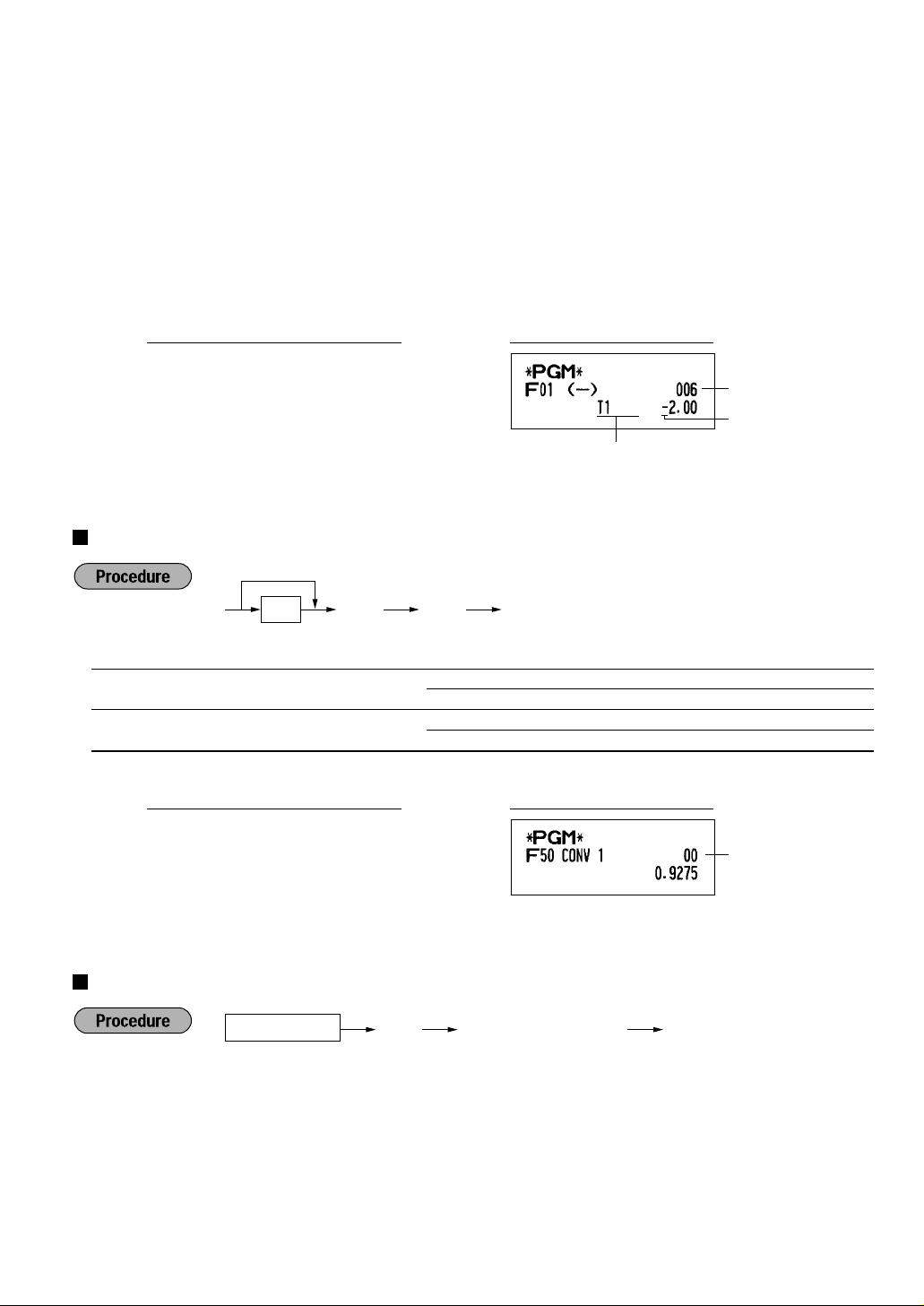
39
Tax status (taxable 1 through 4 / non-taxable)
• When taxable is selected, tax is applied to the amount obtained after premium or discount calculation.
+/- sign
• Programming of the +/- sign assigns the premium or discount function for each key.
Entry digit limit (For discount key only)
• The entry digit limit is in effect for the REG mode operations but can be overridden in the MGR mode. The
entry digit limit is represented by the number of allowable digit for the maximum entry amount for discount
key. If “0” is set, open price entry is prohibited.
Example: Programming the discount key as taxable 1, discount (minus sign), allowing both of item and subtotal
(-), and entry digit limit - 6 digits. (ABCDEFGH: 00011006)
Function parameters for
V
*: Item: Selection: Entry:
A Open rate entry Allow* 0
Disallow 1
B Preset rate entry Allow* 0
Disallow 1
Entry digit limit for
r
,
R
and
t
*: For
r
and
R
, enter 0 to 9 (digits), and for
t
(manual tax), enter 0 to 7 (digits). By default, 9 for
r
and
R
and 7 for
t
are set.
• Entry digit limit is in effect for REG mode operation but can be overridden in the MGR mode. The entry digit
limit is represented by the number of allowable digits for maximum entry or total amount. When “0” is set, the
operation of the corresponding key is prohibited.
* Entry digit limit
(only for manual entry)
A@r, R
or
t
From left, AB
00
@
VA
PrintKey operation example
*AB
A
To program “0” for all items
@V
From left, FGH
Sign(E)
Tax status
00011006
@
-A
PrintKey operation example
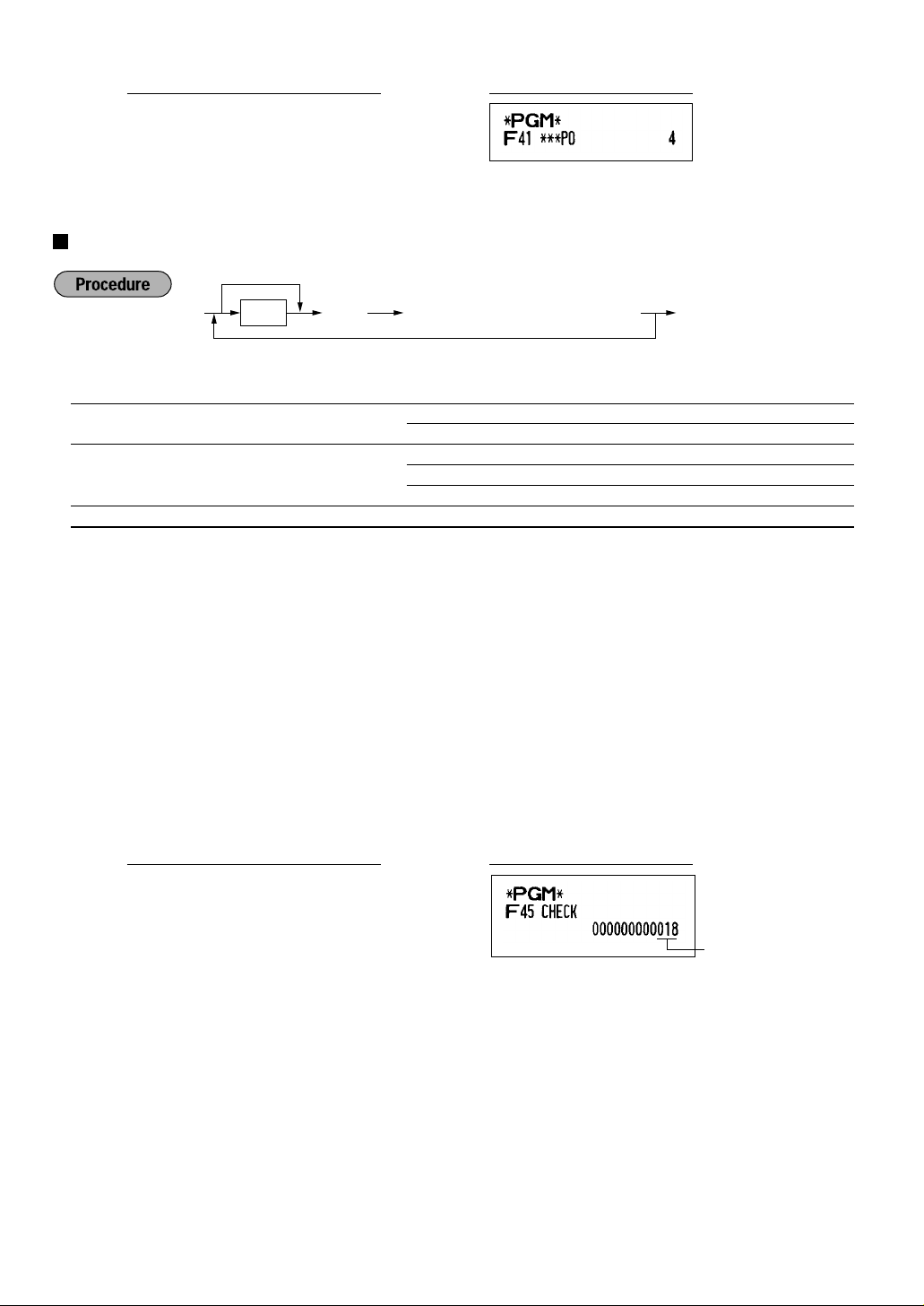
40
Function parameters for
C
,
X
,
Y
and
A
(when using as CA key)
*1:Item: Selection: Entry:
A Footer printing Allow 1
Disallow* 0
B Amount tendered entry Compulsory 1
Non-compulsory (for the CA or CHK keys)* 0
Inhibit (for the CH1 or CH2 key)* 0
C Entry digit limit 0-8 (default: 8)
Footer printing
• This programming decides whether or not the machine should print a message at the foot of a receipt when a
specified media key is used. With regard to programming method of footer logo message, refer to “Logo
messages” section on page 46.
Amount tendered entry
• You may select amount tendered, compulsory or optional, for the
A
and
C
keys.
• You may select amount tendered, compulsory or inhibited, for the
X
and
Y
key.
Entry digit limit
• For the
X
,
Y
and
C
keys, program upper limit entry amount for the tendered amount. For the
A
key,
program upper limit entry for total cash amount which can be handled on the register. The entry digit limit is
in effect for REG mode operation but can be overridden in the MGR mode. The entry digit limit is represented
by the number of allowable digits for the maximum entry or total amount. When “0” is set, the operation of the
corresponding key is prohibited.
ABC (A:0, B:1, C:8)
018
@
CA
PrintKey operation example
*
1
ABC or
A
To program “0” for all items
To program for another key
*
2
:Press s key for CA key setting.
@s, C, X
*
2
Y
4
@
RA
PrintKey operation example
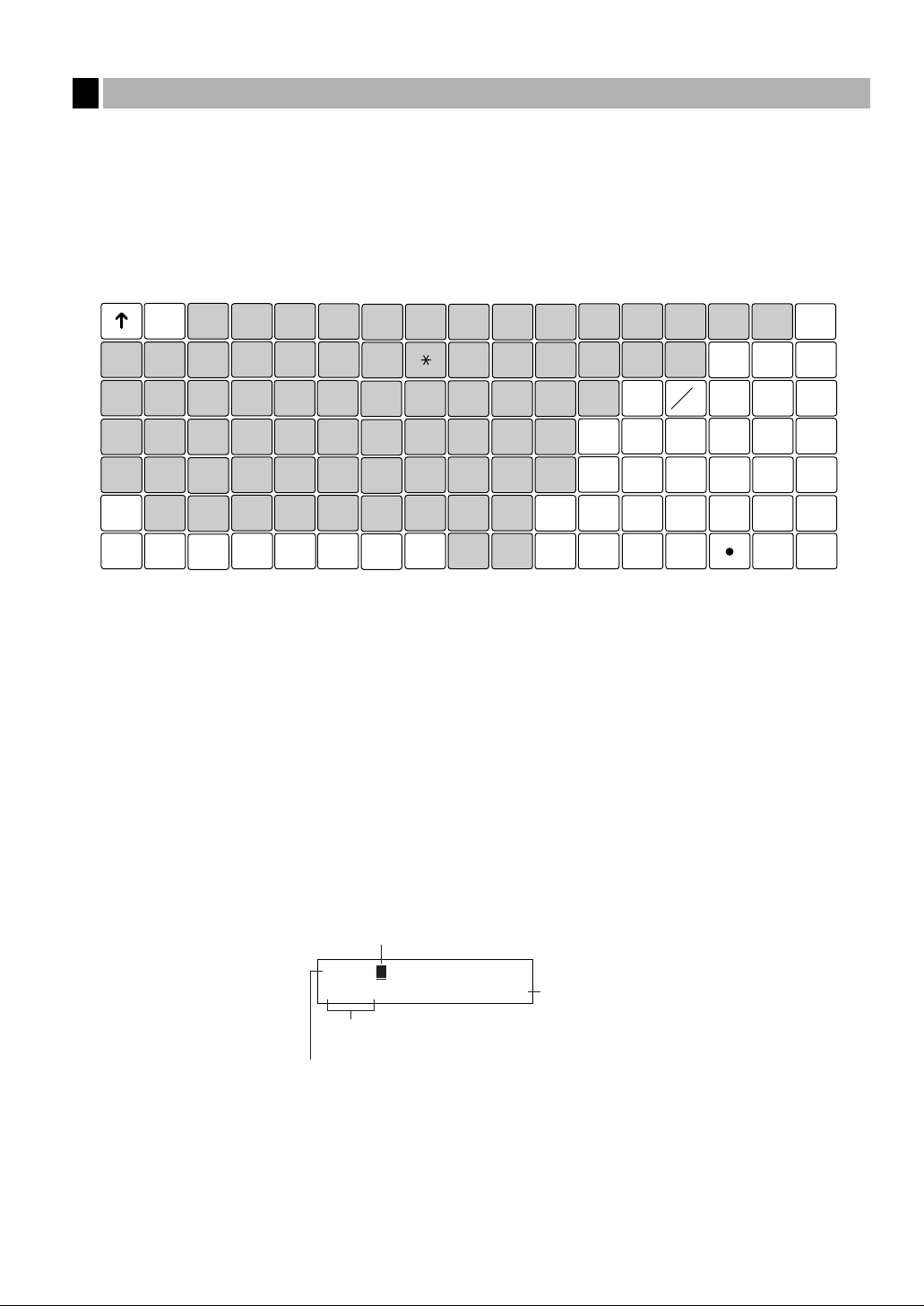
41
The register allows you to program text for clerk names, department item names, PLU/subdepartment item
names, if necessary. Place the keyboard sheet for text programming over the keyboard sheet for ordinal use.
For the placement, please refer to “Keyboard sheet” section on page 6.
There are two ways for programming text; using character keys (shaded area shown below on the keyboard
sheet for text programming) or entering character codes with numeric keys on the keyboard.
Keyboard sheet for text programming
Please note that the character keys used for entering numbers (shaded area) are different from numeric keys.
The following are used as control keys for text programming.
H
Toggles between upper-case and lower-case letters. By default, the upper-case letter is selected. Once
the
H
key is pressed, you are locked in for entering lower-case letters. “a” is displayed when lower-case
letters entry is selected as shown in the operator display example below.
W
Toggles between single-size and double-size characters. By default, the single-size character is selected.
Once the
W
key is pressed, you are locked in for entering double size characters. “W” is displayed when
double-size characters entry is selected as shown in the operator display example below.
B
Backs up the cursor, erasing the character to the left.
Using character keys (Keys on the shaded area)
To enter numerals, letters and symbols, simply press the corresponding character on the shaded area on the
keyboard.
Operator display (Example)
ABCD PGM
01 Wa 04
Cursor
Number of characters programmed
Department code, PLU code, function number,
clerk code or logo message line number is displayed here.
Characters entered using character keys is displayed here.
”
Z
œ
X
(
SPACE
)
(
SPACE
)(
SPACE
)
(
SPACE
)
(
SPACE
)(
SPACE
)
C
V
B
N
M
Ñ
A
S
D
F
G
H
J
K
L
Q
W
E
R
T
Y
U
I
O
P
1
2
3
4
5
6
7
8
9
0
#
$
%
@
’
(
)
BACK
SPACE
(
”
)
=
^
▲
(DC)
(
SHIFT
)
?
!
,
<
.
>
;
+
:
/
–
[
{
]
}
”
0
1
2
3
456
78
9
CL
00
FOR
@
➞
➞
▲
➞
➞
&
?
–
CA/AT
SBTL
(ESC)
Text Programming
5
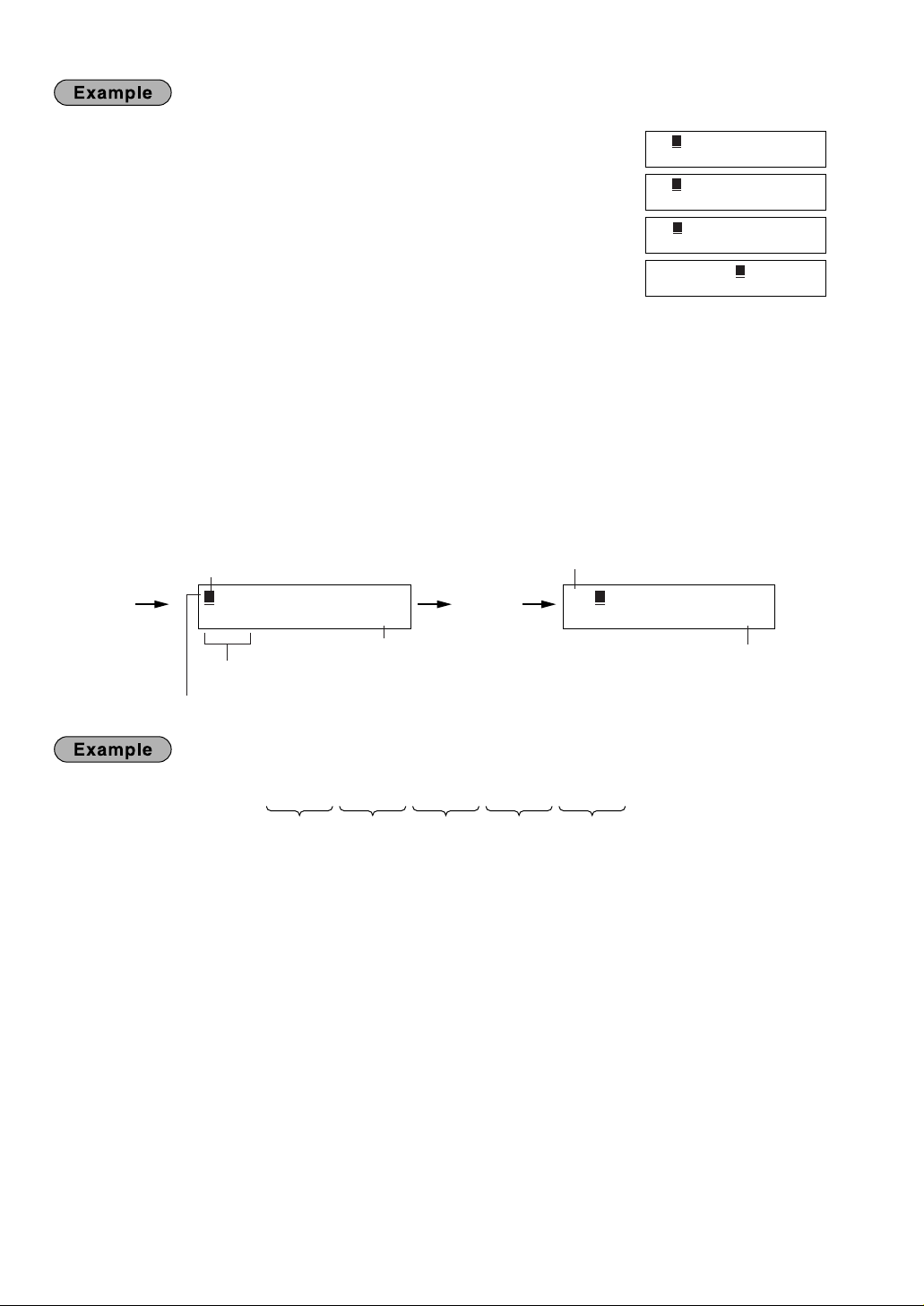
42
To program the word “Clerk01” with the letter “C” being double size.
To make the letter “C” double size character
To make character size return to normal size
To toggle the characters to lower-case letters
Entering character codes with numeric keys on the keyboard
To enter a numeral, letter or symbol, enter a character code using numeric keys and press the numeric key
:
.
For the character codes, please refer to the alphanumeric character code table on the next page. Be doing this,
you can program characters other than those on the key tops.
• Double-size characters can be made by entering the character code 253 or pressing the
W
key. “W” is
displayed when double-size characters entry is selected as shown in the operator display example below.
• All three digits of the character code MUST be entered (even if it starts with zero).
Operator display (Example)
To program the word “SHARP” in double-size characters
When you press an appropriate number key (job code number) and press the
P
key for text entry just after you
start programming with the
s
key, the cash register will automatically be ready for text entry.
253
:
083
:
072
:
065
:
082
:
080
:
S H A R P
PGM
01 W 065
Character code
=A PGM
01 W 02
Characters: Indicating double size character of “A”
Number of characters
programmed
Press of
253
:
065
Press of
:
Cursor
Department code, PLU code, function number,
clerk code or logo message line number is displayed here.
Characters entered are displayed here.
=C PGM
01 02
=C PGM
01 W 02
=C PGM
01 a 02
Wg
W
H
hijk01
=Clerk01 PGM
01 a 08
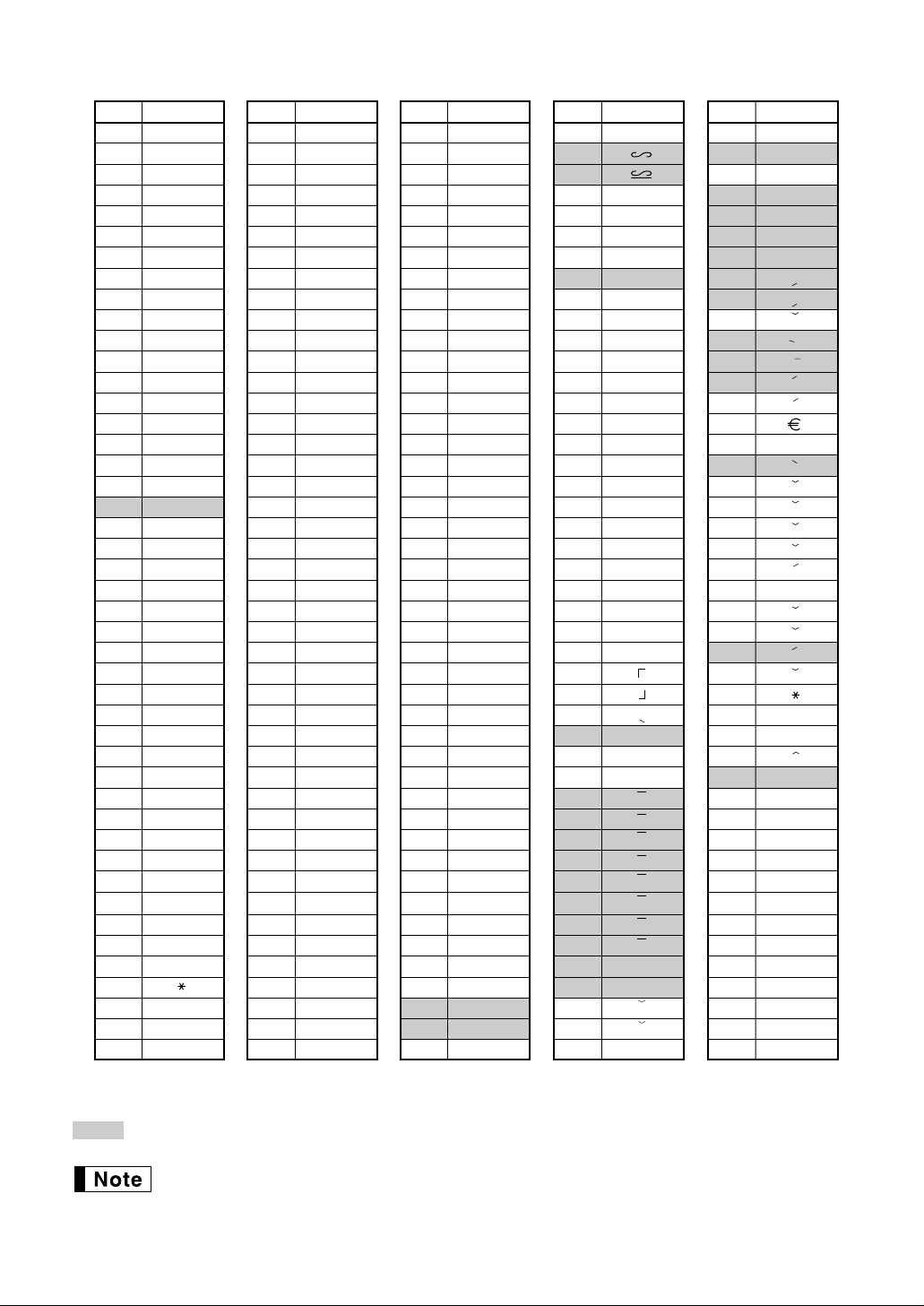
43
Alphanumeric character code table
*(DC): Double-size character code
: The shaded character cannot be displayed (displayed as space).
The character “!!” (code 128) cannot be displayed (displayed as “!”).
Code
001
002
003
004
005
006
007
008
009
010
011
012
013
014
015
016
017
018
019
020
021
022
023
024
025
026
027
028
029
030
031
032
033
034
035
036
037
038
039
040
041
042
043
044
045
Character
á
â
ê
î
ì
í
ô
ó
û
ú
œ
u
ú
o
ó
⌳
⌿
⌫
¨
⍀
⌬
⍜
⌶
⌸
⌺
⌼
⌽
U
Ú
O
Ó
(space)
!
”
#
$
%
&
’
(
)
+
,
-
Code
046
047
048
049
050
051
052
053
054
055
056
057
058
059
060
061
062
063
064
065
066
067
068
069
070
071
072
073
074
075
076
077
078
079
080
081
082
083
084
085
086
087
088
089
090
Character
.
/
0
1
2
3
4
5
6
7
8
9
:
;
<
=
>
?
@
A
B
C
D
E
F
G
H
I
J
K
L
M
N
O
P
Q
R
S
T
U
V
W
X
Y
Z
Code
091
092
093
094
095
096
097
098
099
100
101
102
103
104
105
106
107
108
109
110
111
112
113
114
115
116
117
118
119
120
121
122
123
124
125
126
127
128
129
130
131
132
133
134
135
Character
Ä
Ö
Ü
^
_
a
b
c
d
e
f
g
h
i
j
k
l
m
n
o
p
q
r
s
t
u
v
w
x
y
z
{
|
}
ß
¢
!!
1
2
3
4
1/2
F
T
←
Code
136
137
138
139
140
141
142
143
144
145
146
147
148
149
150
151
152
153
154
155
156
157
158
159
160
161
162
163
164
165
177
178
180
181
182
183
184
185
186
187
188
189
190
191
192
Character
→
F
T
↓
ç
°
¿
ù
à
Æ
ø
Å
¤
é
è
Pt
i
Ñ
ò
£
¥
°
Á
Í
A
a
E
e
I
i
U
u
N
n
C
S
C
▲
▲
´´
´´
´´
´´
193
194
195
196
197
198
199
200
201
202
203
204
205
206
207
208
209
210
211
212
213
214
215
216
217
218
219
224
225
226
227
228
229
230
231
232
233
234
235
236
237
238
253
I
G
S
G
g
K
k
L
l
Z
D
d
C
c
P
e
s
c
z
y
u
n
r
§
Ø
↑
]
[
ä
ö
ü
æ
å
É
ñ
*(DC)
’
.
.
.
.
.
.
.
.
.
.
.
.
”
Code
Character
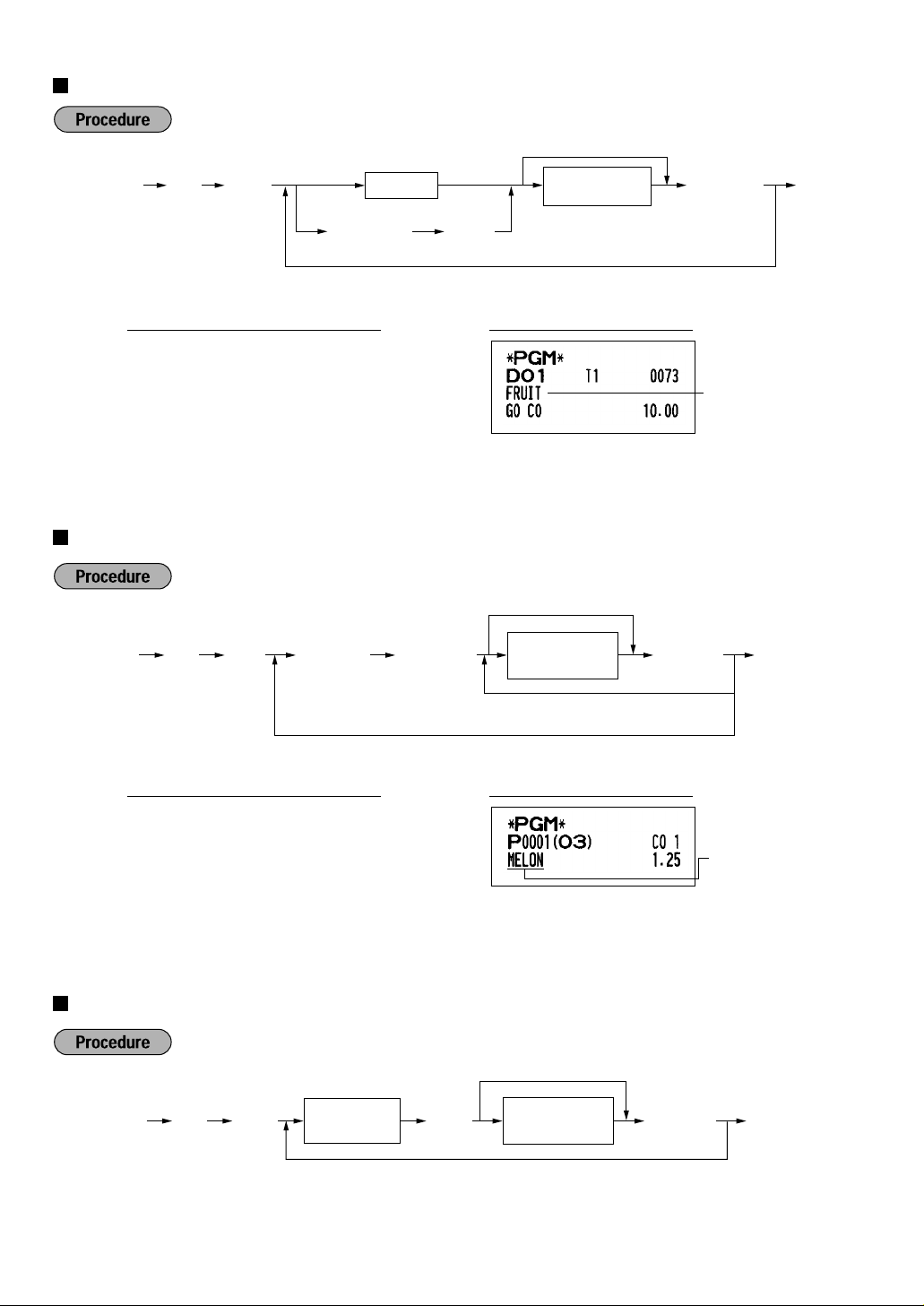
44
Department text (item label)
PLU text (item label)
Function text
* Function no.: See “List of function texts” shown on the following page.
s P @
*Function no.
(max. 2 digits)
Character keys
(max. 8 digits)
A
To keep the current setting
s
To program another function text
3
Text
programmed for
PLU code 1
s
2
P
1
p
MELON
s
A
(Programming MELON to PLU1)
PrintKey operation example
s P p
PLU code
(1-1800)
When the next PLU code immediately
follows the one just entered
Character keys
(max.16 digits)
As
To keep current setting
To program another PLU
2
Text
programmed for
dept. 1
s
1
P
!
FRUIT
s
A
(Programming FRUIT for dept.1)
PrintKey operation example
s P
d
s
To program another dept.
To keep current setting
Dept. key
Character keys
(max.16 digits)
Dept. code
(1 to 99)
A
1
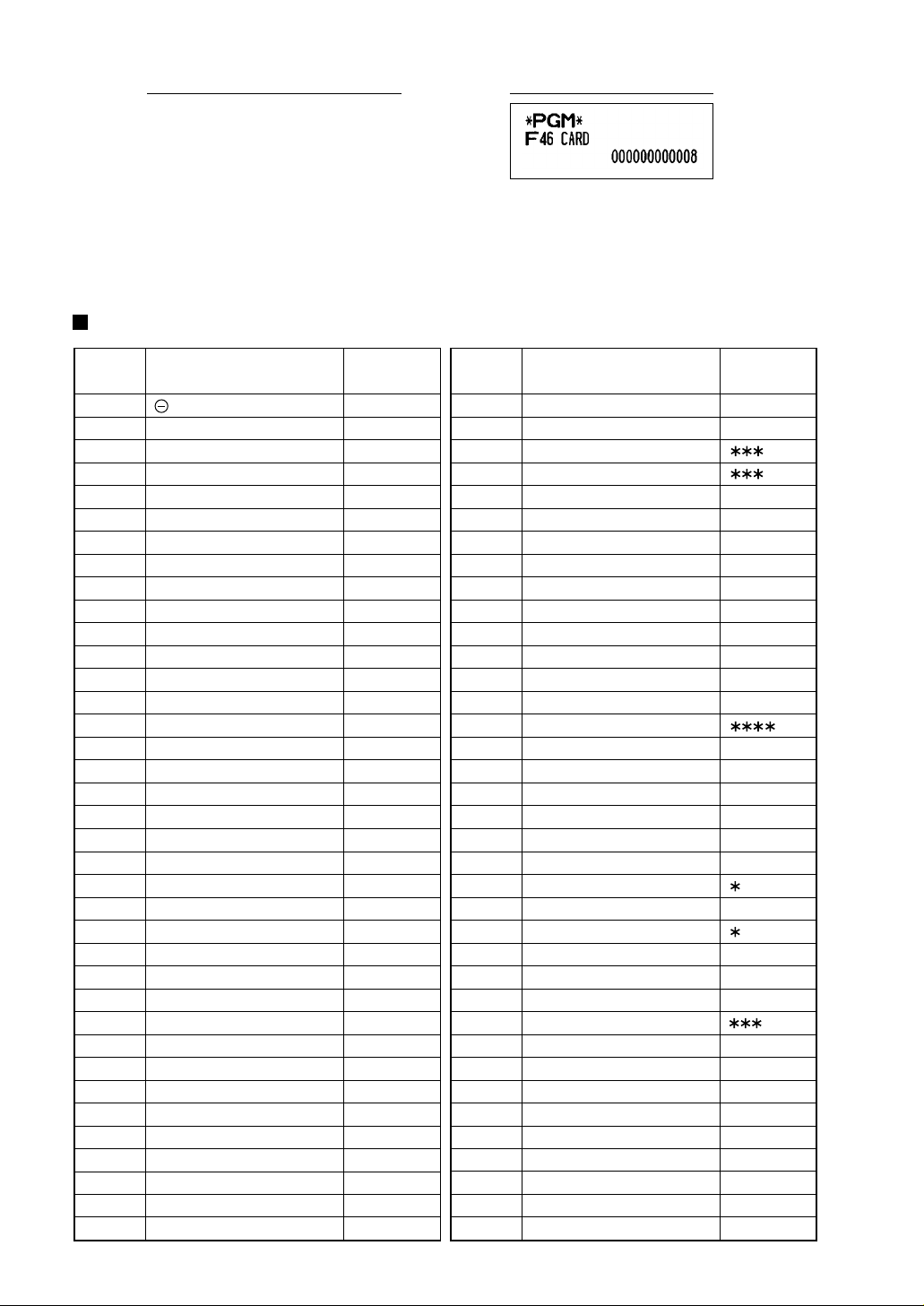
45
List of function texts
1
2
3
4
5
6
7
8
9
10
11
12
13
14
15
16
17
18
19
20
21
22
23
24
25
26
27
28
29
30
31
32
33
34
35
36
37
(–)
%1 %1
%2 %2
Net sales total NET1
Net taxable 1 subtotal TAX1 ST
Gross tax 1 total GRS TAX1
Tax 1 total of refund entries RFD TAX1
Net tax 1 total TAX1
Exempt tax 1 TX1 EXPT
Net taxable 2 subtotal TAX2 ST
Gross tax 2 total GRS TAX2
Tax 2 total of refund entries RFD TAX2
Net tax 2 total TAX2
Exempt tax 2 TX2 EXPT
Net taxable 3 subtotal TAX3 ST
Gross tax 3 total GRS TAX3
Tax 3 total of refund entries RFD TAX3
Net tax 3 total TAX3
Exempt tax 3 TX3 EXPT
Net taxable 4 subtotal TAX4 ST
Gross tax 4 total GRS TAX4
Tax 4 total of refund entries RFD TAX4
Net tax 4 total TAX4
Exempt tax 4 TX4 EXPT
Gross manual tax total GRS MTAX
Refund manual tax total RFD MTAX
Net manual tax total M-TAX
Exempt total from GST GST EXPT
PST total PST TTL
GST total GST TTL
Tax total TTL TAX
Net
NET
Sales total including tax total NET2
Refund REFUND
Item void VOID
Void mode
VOID
Manager void MGR VD
Function
no.
Key or function
Default
setting
38
39
40
41
42
43
44
45
46
47
48
49
50
51
52
53
54
55
56
57
58
59
60
61
62
63
64
65
66
67
68
69
70
71
72
73
74
Subtotal void SBTL VD
No sale NO SALE
RA RA
PO PO
Customer counter TRANS CT
Sales total
NET3
Cash CASH
Check CHECK
Gross charge 1 CHARGE
Refund charge 1 CHARGE–
Gross charge 2 CHARGE2
Refund charge 2 CHARGE2–
Currency conversion1
(Preset)
CONV 1
Currency conversion2
(Open)
CONV 2
Cash in drawer CID
Cash+check in drawer CA+CH ID
Check change CHK/CG
Exempt VAT VAT EXPT
Commission sale 1 COM. SAL1
Commission sale 2 COM. SAL2
Non commission sale NON COM.
(+)Dept. total DEPT TL
(–)Dept. total DEPT(–)
(+)Bottle return dept. total BTTL TL
(–)Bottle return dept. total BTTL(–)
Subtotal SUBTOTAL
Merchandise subtotal MDSE ST
Total TOTAL
Change CHANGE
Items ITEMS
Commission amount 1 COM. AMT1
Commission amount 2 COM. AMT2
Commission amount total COM. TTL
Department report title
DEPT
PLU report title PLU
Transaction report title TRANS.
Clerk report title CLERK
Function
no.
Key or function
Default
setting
*
*
*
s
3
P
46
@
CARD
s
A
(Programming CARD for gross
charge 1)
PrintKey operation example
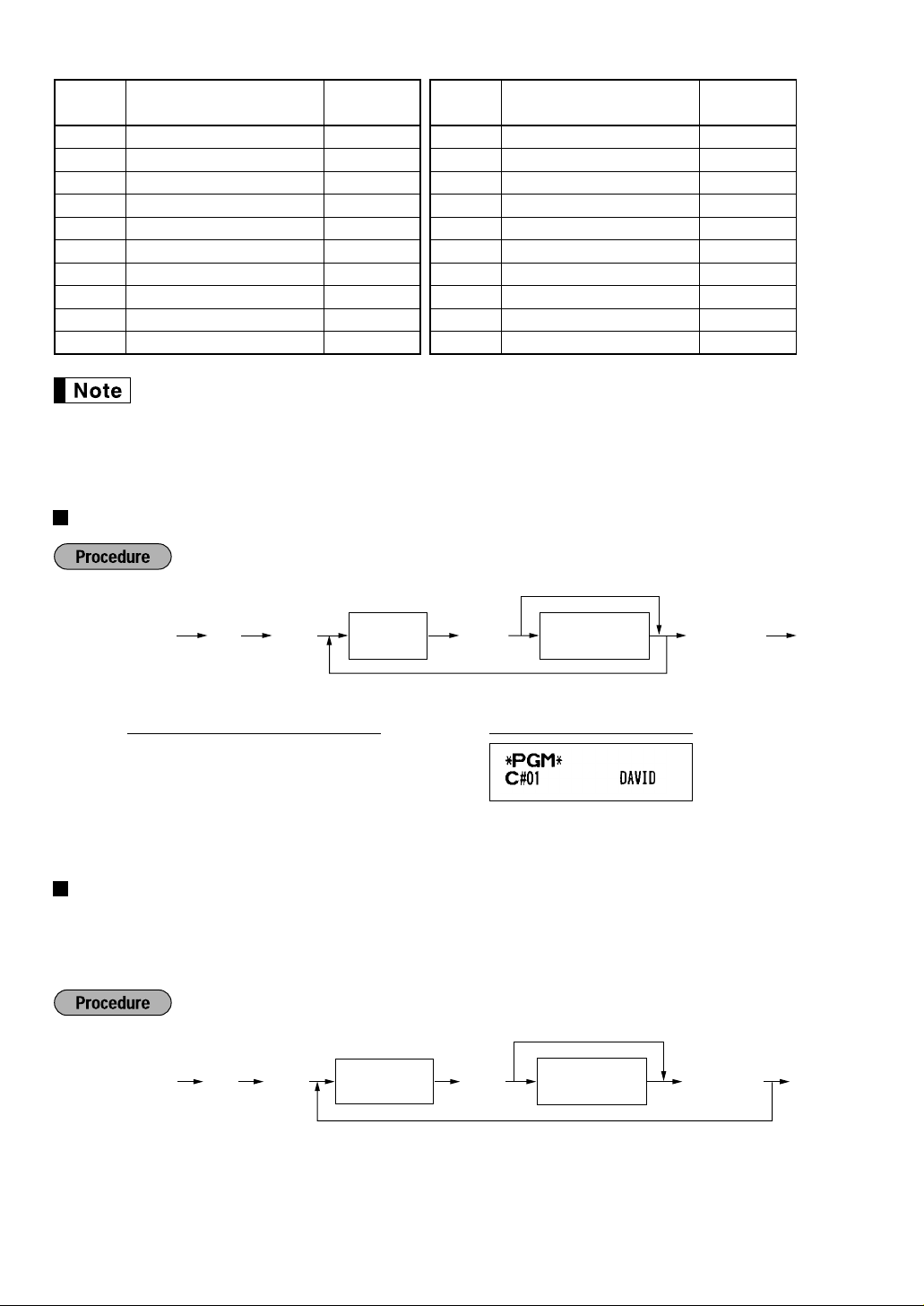
46
• The items marked with “ * ” are for Canada only.
• The items marked with “**” are for display only.
• The function no. 55 “Exempt VAT” is only effective for the Canadian tax system (2 GST, VAT
type).
Clerk names
Logo messages
The register can print programmed messages on every receipt. On the standard model, the graphic logo is
printed on the receipt. If you want to print logo messages, please change the logo message print format. (See
page 54 for the programming details.) The options are listed below:
* “Header 3-line message” type: 1 to 3
“Footer 3-line message” type : 4 to 6
“Header 6-line message” type: 1 to 6
“Header 3-line and footer 3-line message” type: 1 to 6 (1 to 3 as header, 4 to 6 as footer)
s P @
*Line number
(1-6)
Character keys
(max. 24 digits)
As
To keep the current setting
To program another line
4
s
5
P
1
@
DAVID
s
A
PrintKey operation example
s P s@
To program another clerk
Character keys
(max. 8 digits)
Clerk code
(1-40)
A
To keep current setting
5
75
76
77
78
79
80
81
82
83
84
Hourly report title HOURLY
Daily report title DAILY
Group report title GROUP
Total in drawer TL-ID
Non add symbol #
Copy receipt title
COPY
EJ report title EJ
EJ report end title EJ
END
Group 1 G
ROUP01
Group 2 G
ROUP02
Function
no.
Key or function
Default
setting
85
86
87
88
89
90
91
92
93
94
Group 3
G
ROUP03
Group 4 G
ROUP04
Group 5 G
ROUP05
Group 6 G
ROUP06
Group 7 G
ROUP07
Group 8 G
ROUP08
Group 9 G
ROUP09
Change due DUE
Taxable ST for all tax delete TAX ST
Amount entry AMOUNT
Function
no.
Key or function
Default
setting
**
**
**
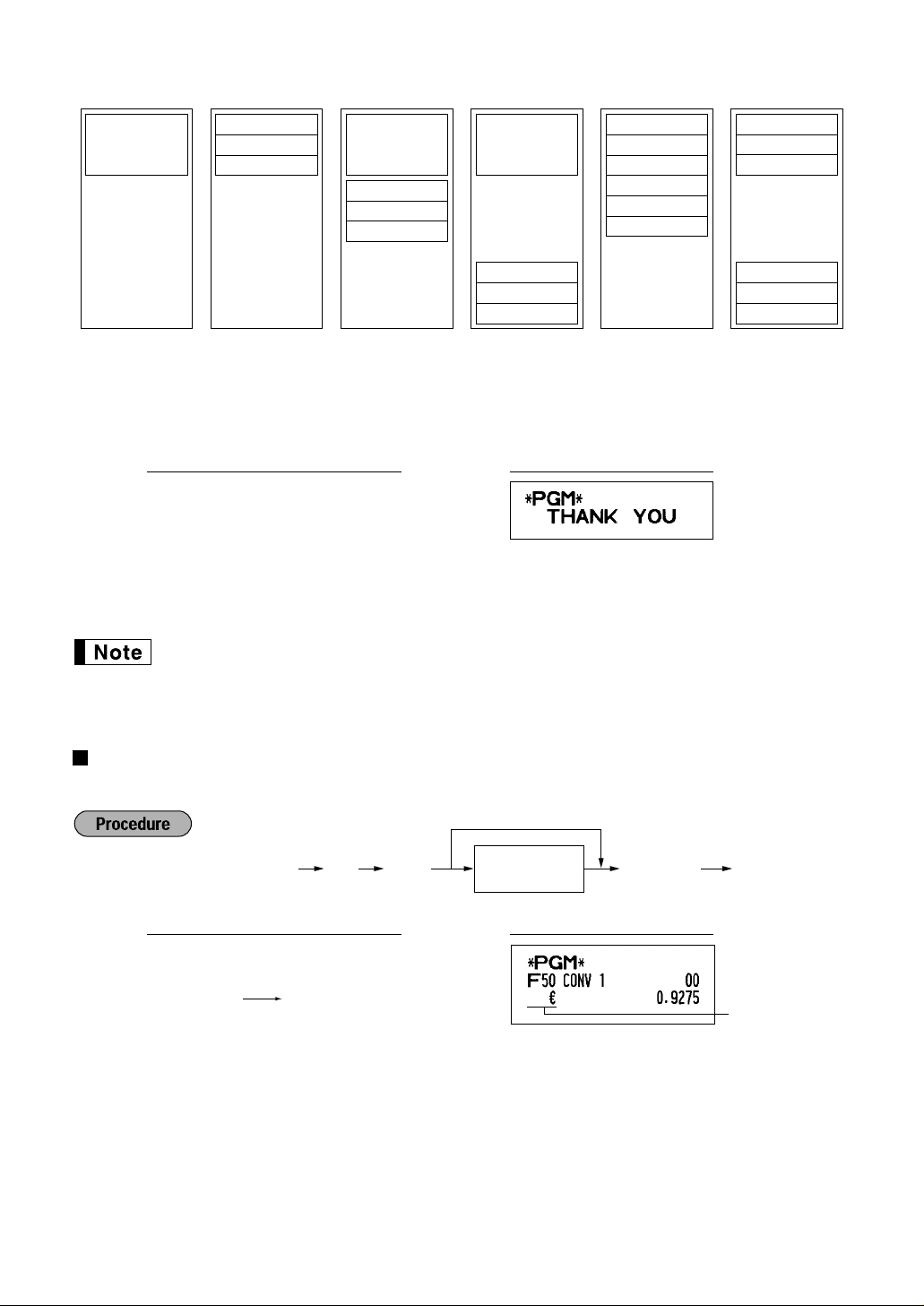
47
Logo print format (6 types)
To print the logo message “THANK YOU” using double sized characters and centering on the third line.
A 6-line logo message is preprogrammed when shipped. Please start entering from the first line
when you first program a logo message.
Foreign currency symbol
Foreign currency symbol for the
V
key is printed with a foreign currency exchange amount.
Foreign currency
symbol
Entry using
character code
s 6 P
S S S
207 :
s
A
PrintKey operation example
s P
Character keys
(max. 4 digits)
As
To keep the current setting
6
s
4
P
3
@
SSS
W
THANK
S
YOU
W
SSS
sA
PrintKey operation example
Graphic logo
Default setting
Text 2nd line
Graphic logoGraphic logo
Text 3rd line
Text 1st line
Header 3-line
message and
footer 3-line
messages
Header 3-line message Footer 3-line
message
Header 6-line
message
Text 2nd line
Text 3rd line
Text 1st line
Text 2nd line
Text 3rd line
Text 1st line
Text 2nd line
Text 3rd line
Text 1st line
Text 5th line
Text 6th line
Text 4th line
Text 5th line
Text 6th line
Text 4th line
Text 5th line
Text 6th line
Text 4th line
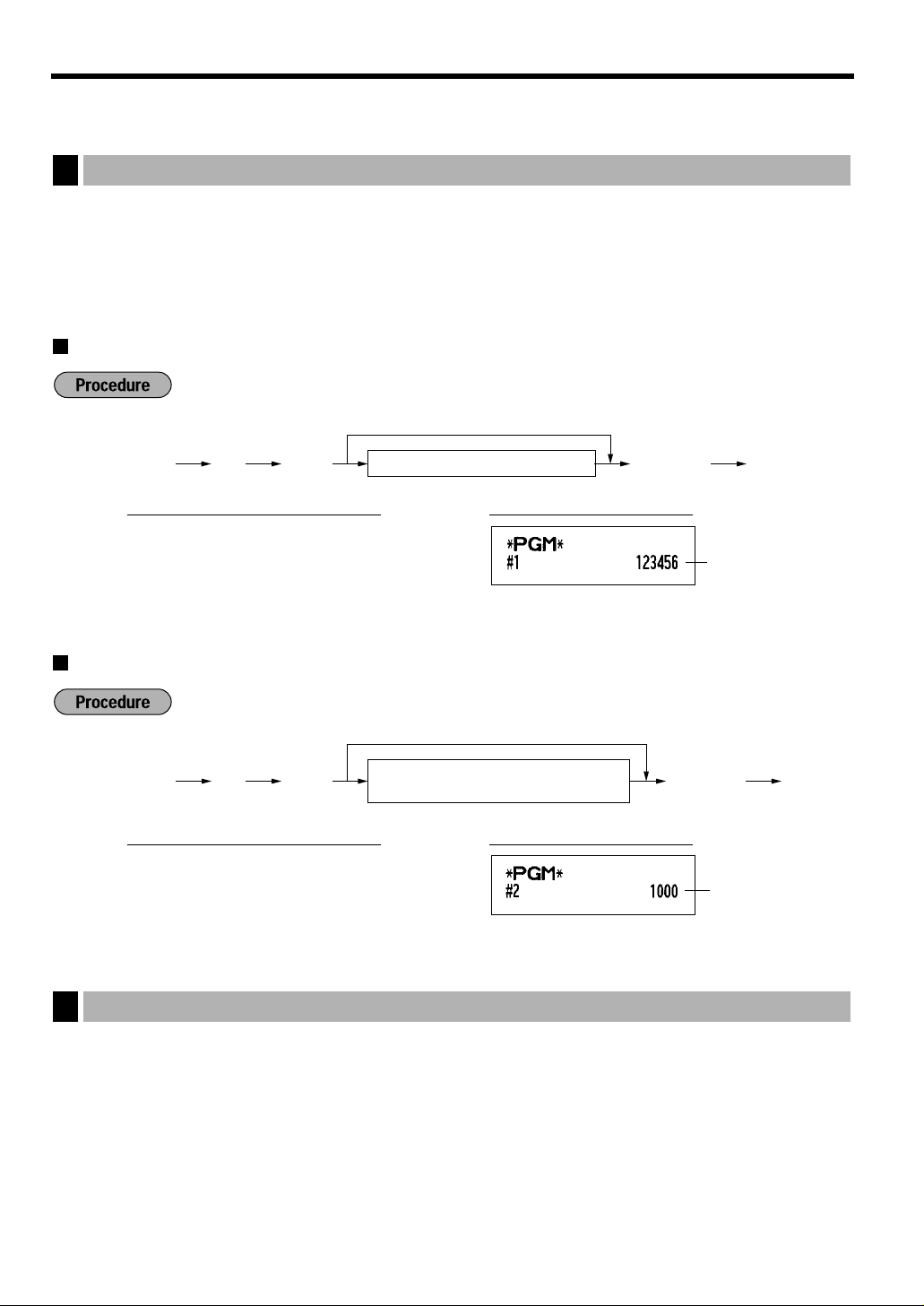
48
ADVANCED PROGRAMMING
The register number and consecutive numbers are printed on every receipt or journal.
When your store has two or more registers, it is practical to set separate register numbers for identification. The
consecutive number is increased by one each time a receipt is issued or when a journal print occurs.
For consecutive number programming, enter a number (max. 4 digits) that is one less than the desired starting
number.
Register number
Consecutive numbers
The cash register provides various detailed functions listed below.
• Function selection for miscellaneous keys
• Print format
• Receipt print format
• Electronic journal (EJ) function parameters
• Function selection for tax
• Others
For this programming, the job code entry style is applied. You can continue programming until you press the
A
key for the programming described in this section. To continue programming, repeat from a job code entry.
Various Function Selection Programming 1
2
Consecutive
number
s
2
@
1000
sA
PrintKey operation example
Register number
s
1
@
123456
sA
PrintKey operation example
Register Number and Consecutive Number Programming
1
s
@
s A
Register number (one to six digits)
To set the register number “0”
1
s
@
s A
A number (one to four digits) that is one
less than the desired starting number
To begin the count from 0001
2
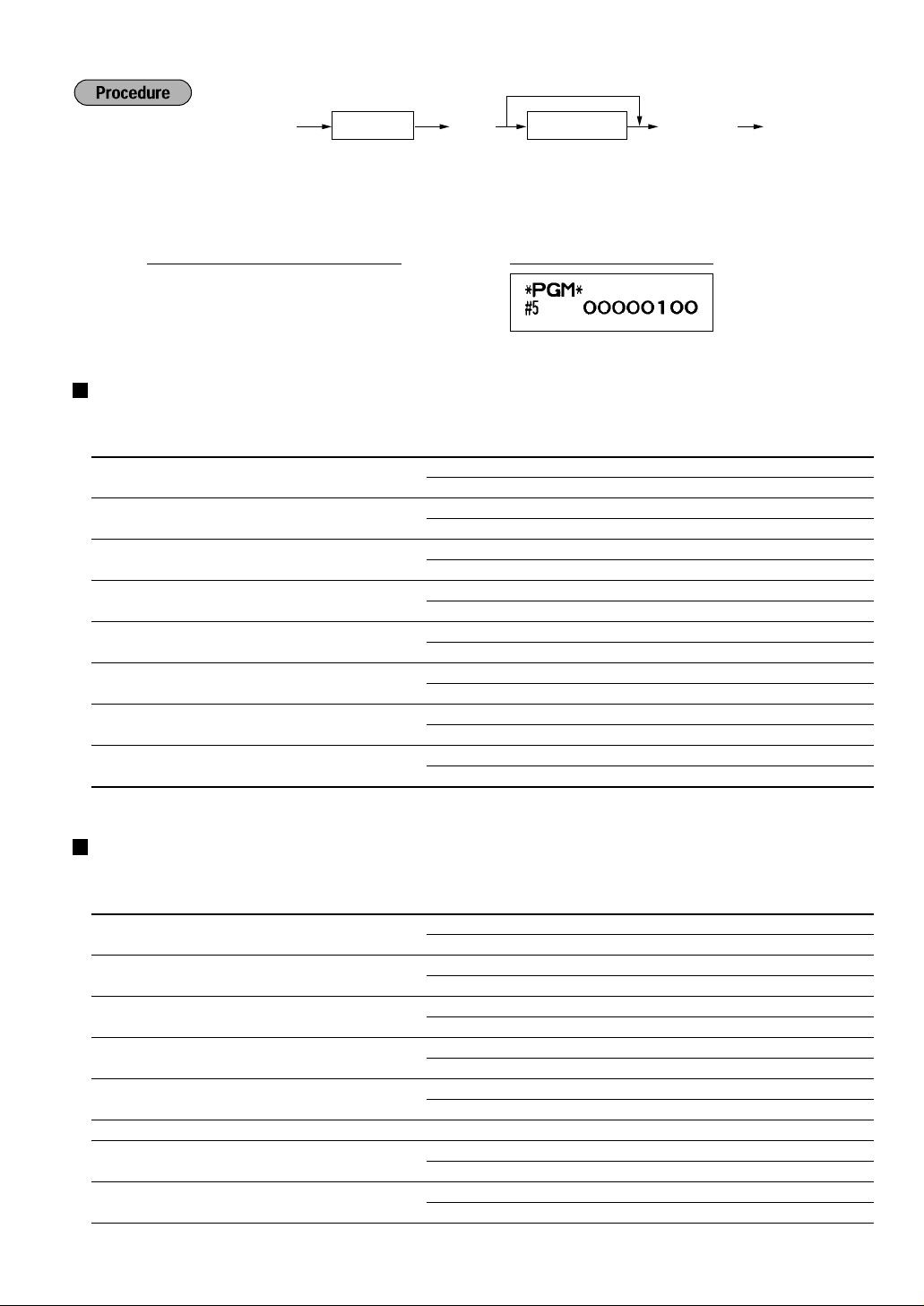
49
*1 Enter job code using numeric keys specified in each section below.
*2 Data entry details are listed on each table in each section below.
Example: When programming for job code 5 as ABCDEFGH: 00000100.
Function selection for miscellaneous keys
Job code: 5
* Item: Selection: Entry:
A PO in REG mode Allow the PO operation in REG mode* 0
Disallow it 1
B RA in REG mode Allow the RA operation in REG mode* 0
Disallow it 1
C Subtotal void in REG mode Allow the REG mode subtotal void* 0
Disallow it 1
D Indirect void in REG mode Allow the REG mode indirect void* 0
Disallow it 1
E Direct void in REG mode Allow the REG mode direct void* 0
Disallow it 1
F Refund key availability Allow the REG mode refund entry* 0
Disallow it 1
G No sale in REG mode Allow the no sale operation in REG mode* 0
Disallow it 1
H Fractional quantity availability Allow fractional quantity entry 0
Disallow it* 1
Print format
Job code: 6
* Item: Selection: Entry:
A Printing style Journal printing 0
Receipt printing* 1
B Receipt print form Total 0
Detailed* 1
C Time print on all receipts Allow time printing* 0
Disallow it 1
D Date print on all receipts Allow date printing* 0
Disallow it 1
E Consecutive no. print on all receipts Allow consecutive no. printing* 0
Disallow it 1
F Always enter 0. (Fixed position) 0
G Zero skip for PLU report Disallow zero skip 0
Allow zero skip* 1
H Zero skip for general, clerk, Disallow zero skip 0
hourly and daily net sales reports Allow zero skip* 1
s
5
@
00000100
sA
PrintKey operation example
s @
*
2
ABCDEFGH*
1
Job code
As
To set “00000000”
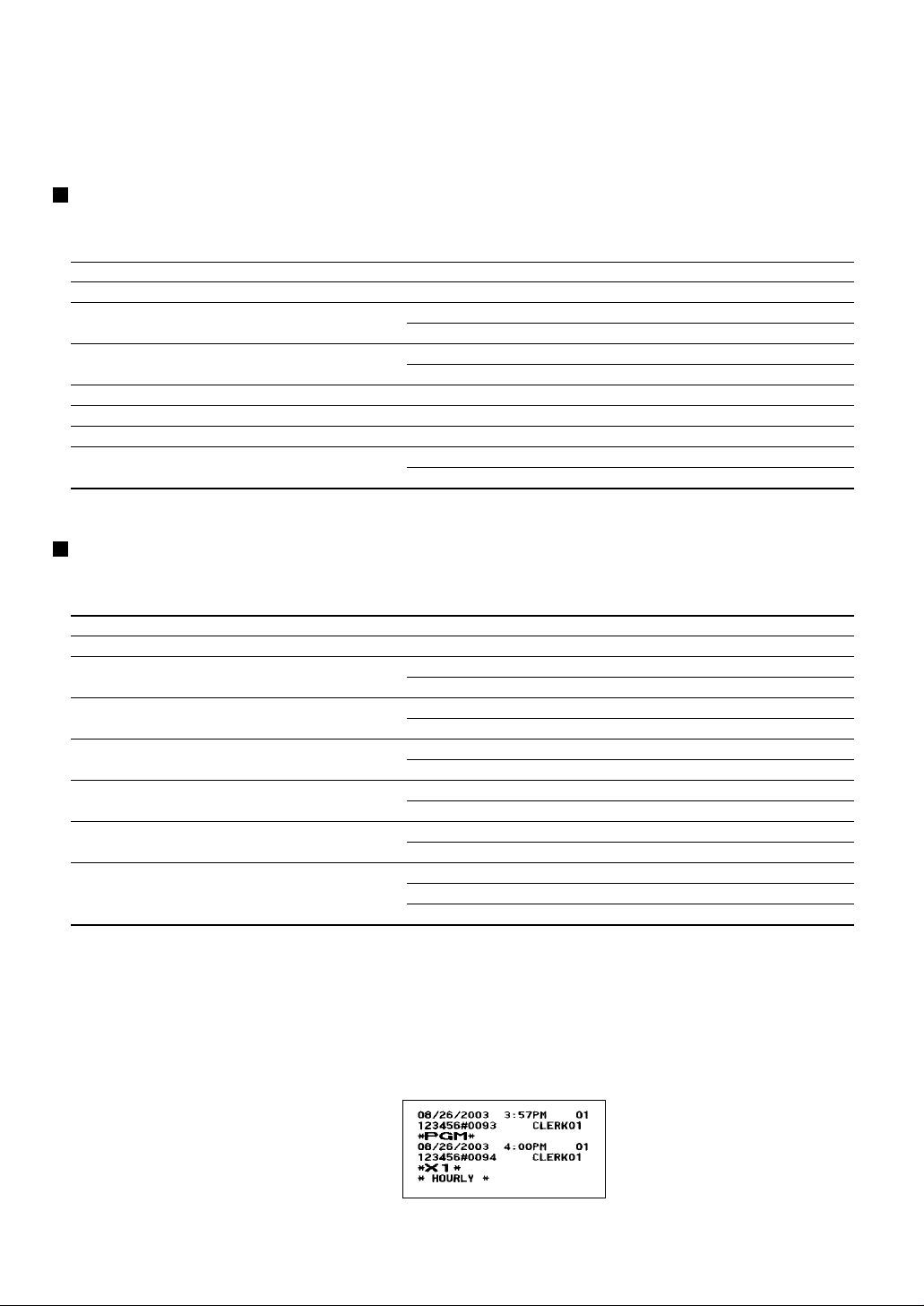
50
Printing style
• Even when receipt printing is selected, the journal rewind motor will be driven in PGM, OP X/Z, X1/Z1 and
X2/Z2 modes so you can wind sales and programming reports.
Receipt print format
Job code: 7
* Item: Selection: Entry:
A Always enter 0. (Fixed position) 0
B Always enter 0. (Fixed position) 0
C Subtotal print with a press of subtotal key Disallow subtotal printing* 0
Allow it 1
D Merchandise subtotal print with a press of Disallow merchandise subtotal printing* 0
merchandise subtotal key Allow it 1
E Always enter 0. (Fixed position) 0
F Always enter 0. (Fixed position) 0
G Always enter 0. (Fixed position) 0
H Number of purchases print Allow printing of number of purchases* 0
Disallow it 1
Electronic journal (EJ) function parameters
Job code: 68
* Item: Selection: Entry:
A Always enter 0. (Fixed position) 0
B Always enter 0. (Fixed position) 0
C Temporary EJ printing during a transaction Disallow temporary EJ printing 0
Allow it* 1
D EJ printing and clearing EJ data Disallow EJ printing and clearing EJ data* 0
when issuing general Z1 report Allow it 1
E PGM mode operation records type Details* 0
Header information only 1
F REG/MGR/VOID modes operation Details* 0
records type Total 1
G Compression printing for EJ data No (normal size) 0
Yes (small size)* 1
H Action when EJ memory area is full Continue 0
Continue and warn (near full warning)* 1
Lock and warn (with near full warning) 2
Temporary EJ printing during a transaction
• You can print journal data of a current transaction recorded in EJ memory by pressing the
R
key during the
transaction. To realize this function completely, the cash register is programmed to receipt printing and set
Receipt ON/OFF function to OFF.
PGM mode operation records type
• The header information only is printed during the program reading operation.
The header information only is printed for X/Z reports.
(Receipt sample for Header Information only)

51
Action when EJ memory area is full
• By default, when the memory for EJ becomes nearly full, the cash register shows “N” at the 14th position of
the display (EJ memory nearly full message), and the cash register keeps storing new data while erasing the
oldest data. When “0” is selected, the cash register will no longer show EJ memory nearly full message.
When “2” is selected, the cash register shows EJ memory nearly full message and when the memory is totally
full, the cash register locks the sales/data entry with a display of the memory full message “EJ DATA FULL”.
You will only be able to issue an EJ report.
Function selection for tax
Job code: 15
* Item: Selection: Entry:
A Always enter 0. (Fixed position) 0
B Always enter 0. (Fixed position) 0
C Always enter 0. (Fixed position) 0
D Always enter 0. (Fixed position) 0
E Always enter 0. (Fixed position) 0
F Always enter 0. (Fixed position) 0
G Tax delete in REG mode availability Allow tax delete in REG mode* 0
Disallow it 1
H Manual tax entry in Allow manual tax entry in REG mode* 0
REG mode availability Disallow it 1
Other programming
Job code: 61
* Item: Selection: Entry:
A Always enter 0. (Fixed position) 0
B Always enter 0. (Fixed position) 0
C Minus dept. and PLU/subdept. availability Disallow to program minus dept. and PLU/subdept. 0
Allow it* 1
D Fractional treatment Round off (4 down, 5 up)* 0
Raising to unit 1
Disregarding fractional treatment 2
E Use of
:
key Use
:
key as 00 key* 0
Use
:
key as 000 key 1
F Time format Use 12-hour format* 0
Use 24-hour format 1
G Date format Use month-day-year format* 0
Use day-month-year format 1
Use year-month-day format 2
H
Position of decimal point (from right) (TAB)
0 to 3 (default 2)

52
Job code: 62
* Item: Selection: Entry:
A Always enter 0. (Fixed position) 0
B Error beep activation By lock error* 0
By misoperation 1
C Key touch sound availability Allow to sound* 0
Disallow it 1
D Buffered keyboard Yes* 0
No 1
E Void mode operation availability Allow void mode operation* 0
Disallow it 1
F Void mode entry data print in Z2 reports Allow printing of void mode entry data in Z2 reports* 0
Disallow it 1
G Void mode entry data print in Z1 reports Allow printing of void mode entry data in Z1 reports* 0
Disallow it 1
H Addition of hourly sales total data in No* 0
void mode Yes 1
Job code: 66
* Item: Selection: Entry:
A Printing a receipt after transaction Total only 0
Details* 1
B Amount printing when PLU/subdept. Disallow printing* 0
unit price is zero Allow it 1
C Subtotal printing for conversion of Allow printing* 0
deficit Disallow it 1
D Always enter 0. (Fixed position) 0
E Compression print on journal at PGM, No (normal size) 0
X1/Z1 and X2/Z2 modes Yes (small size)* 1
F Compression print on journal at REG, No (normal size) 0
MGR and VOID modes Yes (small size)* 1
G Logo message printing on journals Disallow logo message printing on journals* 0
Allow logo message printing on journals 1
H Footer printing Printing footer on all receipts* 0
Printing footer with selected function key at the time of finalization
1
Compression print on journal
• This selection is valid only when “printing style” (job code 6) is set to “journal printing”.
Job code: 70
* Item: Selection: Entry:
A Split pricing counting Quantity* 0
Package 1
B Multiplication/split pricing entry availability Allow multiplication entry only* 0
Allow both of multiplication and split pricing 1
C Always enter 0. (Fixed position) 0
D Always enter 0. (Fixed position) 0
E Tax printing when GST is VAT Allow tax printing* 0
Disallow it 1
F GST exempt printing on X/Z reports Allow printing of GST exempt* 0
Disallow it 1
GH Tax calculation system Auto tax* 00
Canadian tax (tax type number) 01 through 11
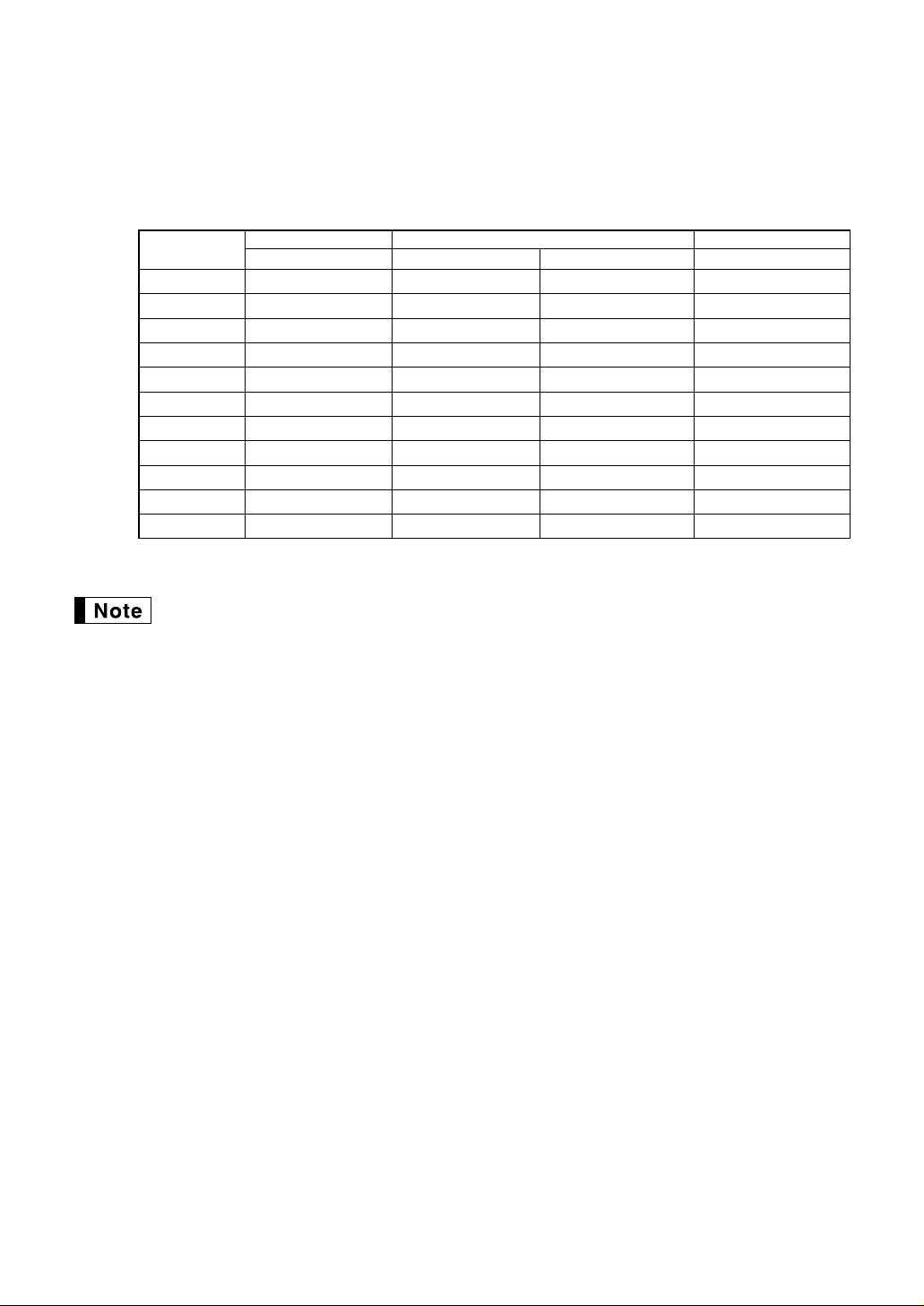
53
Tax calculation system
• For US tax system, select “auto-tax”.
• For Canadian tax, from the table below, specify a tax system suitable for your province (if necessary contact
your local tax office for correct sales tax information) and for your type of retail business. In the cash register,
four kinds of tax can be set and each tax is arranged to match GST or PST as follows:
Tax 1: PST Tax 2: PST
Tax 3: PST or GST Tax 4: GST
(The most common type for Canada is type number 06.)
• To program a GST, use Tax 4; and to program two GSTs, use Tax 3 and 4. To program a PST,
use Tax 1; to program two PSTs, use Tax 1 and 2; and to program three PSTs, use Tax 1, 2 and
3.
• The entry of a multi-taxable item for PST or GST is prohibited as follows for the Canadian tax
system. When programming for departments, avoid programming the prohibited multi-taxable
status.
In case of; Tax 1: PST, Tax 2: PST,
Tax 3: PST, Tax 4: GST
Taxable 1 and 2 item ········· prohibited
Taxable 1 and 3 item ········· prohibited
Taxable 2 and 3 item ········· prohibited
Taxable 1 and 4 item ············· allowed
Taxable 2 and 4 item ············· allowed
Taxable 3 and 4 item ············· allowed
In case of; Tax 1: PST, Tax 2: PST,
Tax 3: GST, Tax 4: GST
Taxable 1 and 2 item ········· prohibited
Taxable 1 and 3 item ············· allowed
Taxable 2 and 3 item ············· allowed
Taxable 1 and 4 item ············· allowed
Taxable 2 and 4 item ············· allowed
Taxable 3 and 4 item ········· prohibited
Canadian tax
Tax 4 method Tax 3 method Tax 2 and 1 method
type number
GST GST PST PST
01 VAT VAT - Tax on tax
02 VAT VAT - Tax on base
03 VAT - Tax on tax Tax on tax
04 VAT - Tax on base Tax on base
05 Add on Tax - Tax on tax Tax on Tax
06 Add on Tax - Tax on base Tax on base
07 Add on Tax VAT - Tax on tax
08 Add on Tax VAT - Tax on base
09 Add on Tax Add on Tax - Tax on tax
10 Add on Tax Add on Tax - Tax on base
11 VAT - VAT (Tax on base) Tax on tax
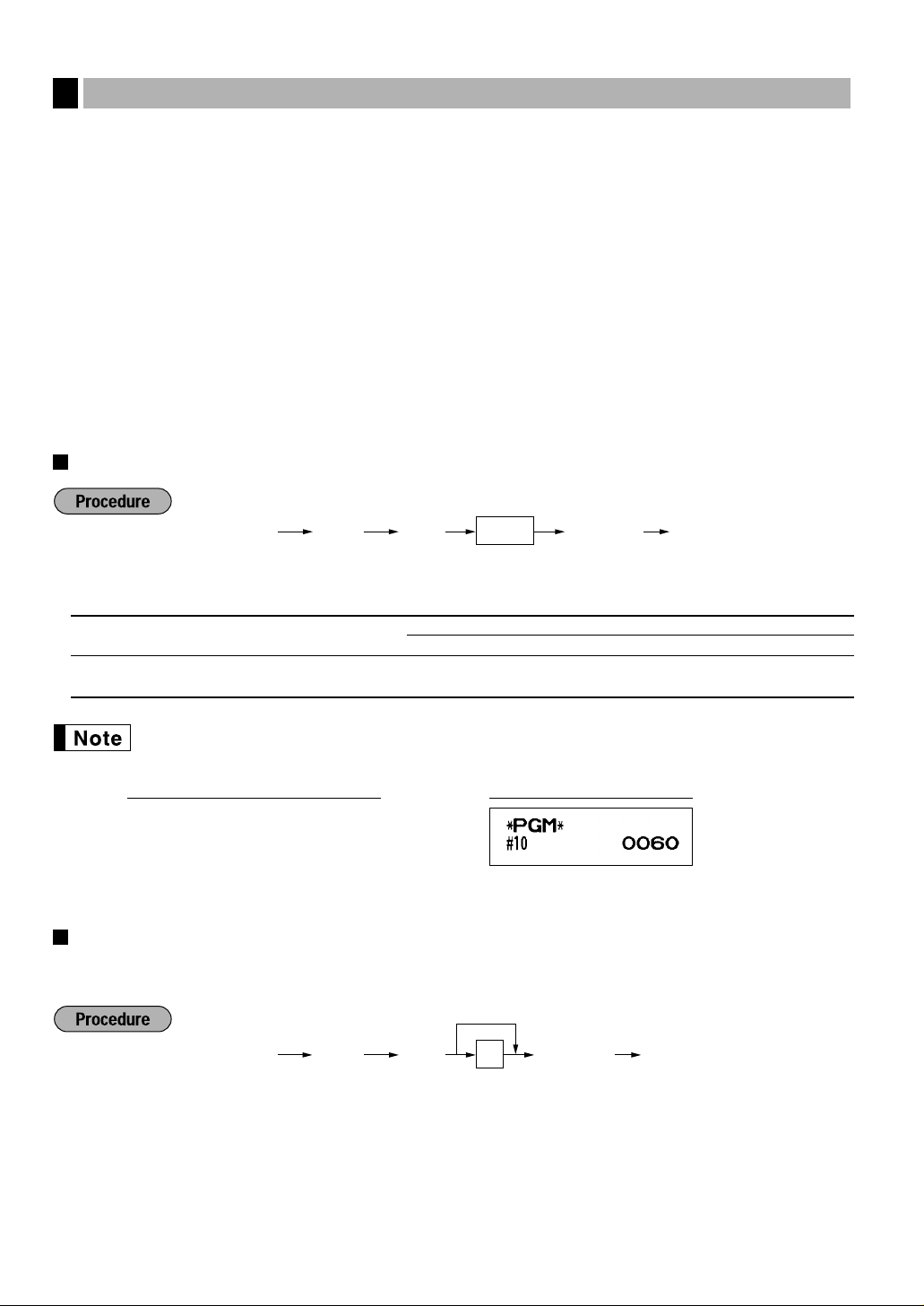
54
The cash register provides various options so you can use the register to suit your sales needs.
In this section, you can program the following features (parameters within parentheses indicates default setting):
• Power save mode (entering the power save mode after 30 minutes)
• Logo message print format (graphic logo only)
• High amount lockout (HALO) for cash in drawer (CID) (9999999.99) (sentinel) - When the cash in drawer
reaches the amount programmed, the sentinel mark “X” will be displayed at the leftmost position on the lower
line of the operator display.
• Thermal printer density (standard density)
• RS-232C interface
• Language selection (English)
• Training clerk specification (none)- If you specify a clerk code who is trained for use on this cash register, the
cash register will go into training mode when the clerk code is registered for sales entries. The sales
operations done by the trained clerk do not affect sales totals. For details, refer to TRAINING MODE section.
Power save mode
* Item: Selection: Entry:
A Entering power save mode Yes* 0
when time is displayed No 1
B-D Time(min.) to entering power save mode 001-254 or 999
since no operation is made (Default 030)
When 999 is set for B to D, entering into power save mode is inhibited.
Logo message print format
You can select the number of lines for your logo message, and the position to print it on receipt.
For details of the logo message type, please refer to “Logo messages” on page 46.
*A: Logo message type
0: Header 3-line message without graphic logo
1: Graphic logo only (default)
2: Footer 3-line message with graphic logo
3: Header 6-line message
4: Header 3-line message with graphic logo
5: Header 3-line message and footer 3-line message
s @
*A
As
To set “0”
11
s
10
@
0060
sA
PrintKey operation example
s @
*ABCD
As
10
Various Function Selection Programming 2
3
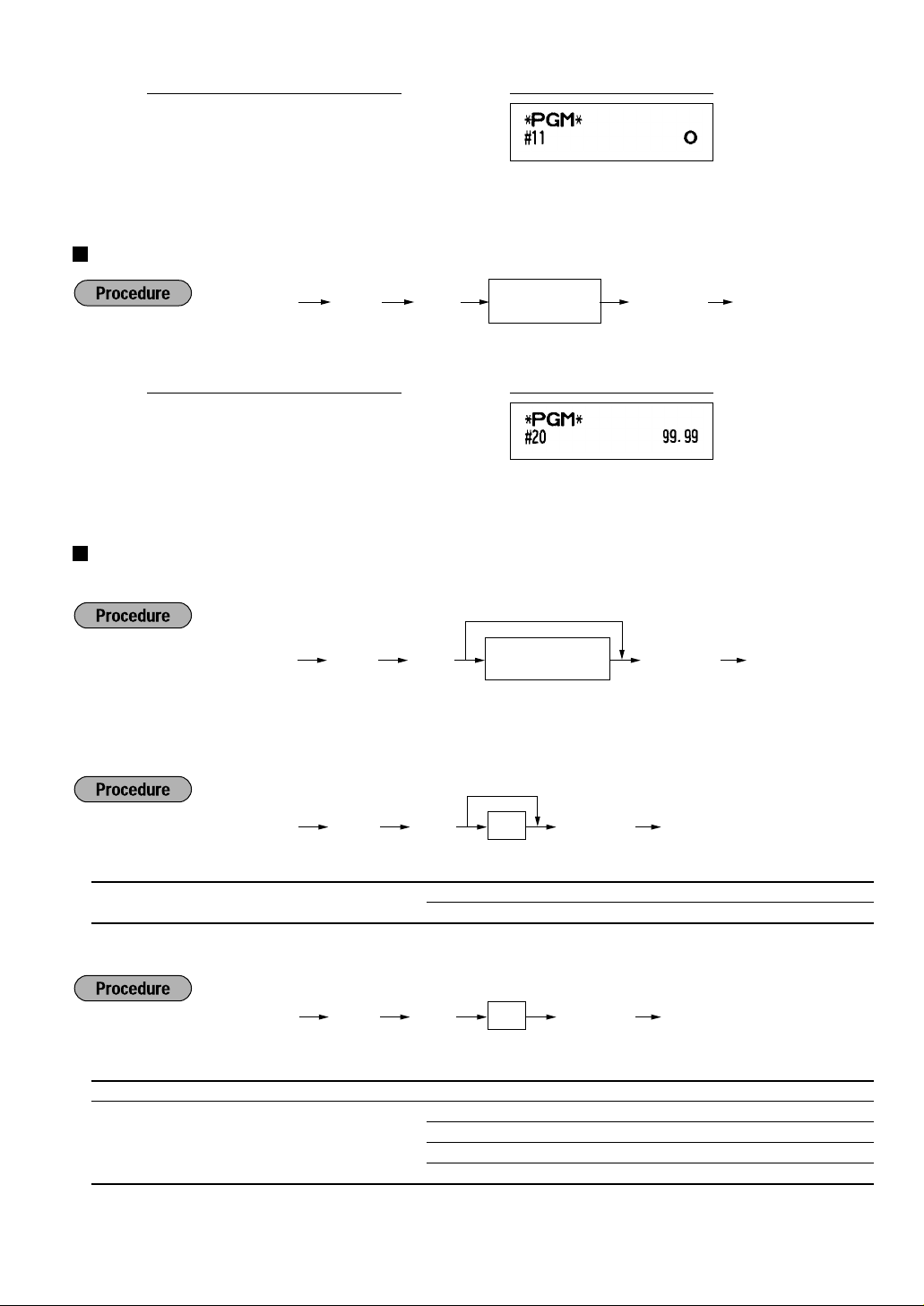
55
High amount lockout (HALO) for cash in drawer (CID) (sentinel)
Default: 999999999
RS-232C interface
(1) RS-232C terminal number
Default: 1
(2) RS-232C transmission form
* Item: Selection: Entry:
A Transmission line form Full duplex system* 0
Half duplex system 1
(3) RS-232C baud rate
* Item: Selection: Entry:
A Always enter 0. 0
B Baud rate (bps) 2400 3
4800 4
9600* 5
19200 6
s @
*AB
As
32
s @
*A
As
To set “0”
31
s @
Terminal number
(max. 6 digits)
As
To set “0”
30
s
20
@
9999
sA
PrintKey operation example
s @
HALO for CID
(max. 9 digits)
As
20
s
11
@
0
sA
PrintKey operation example
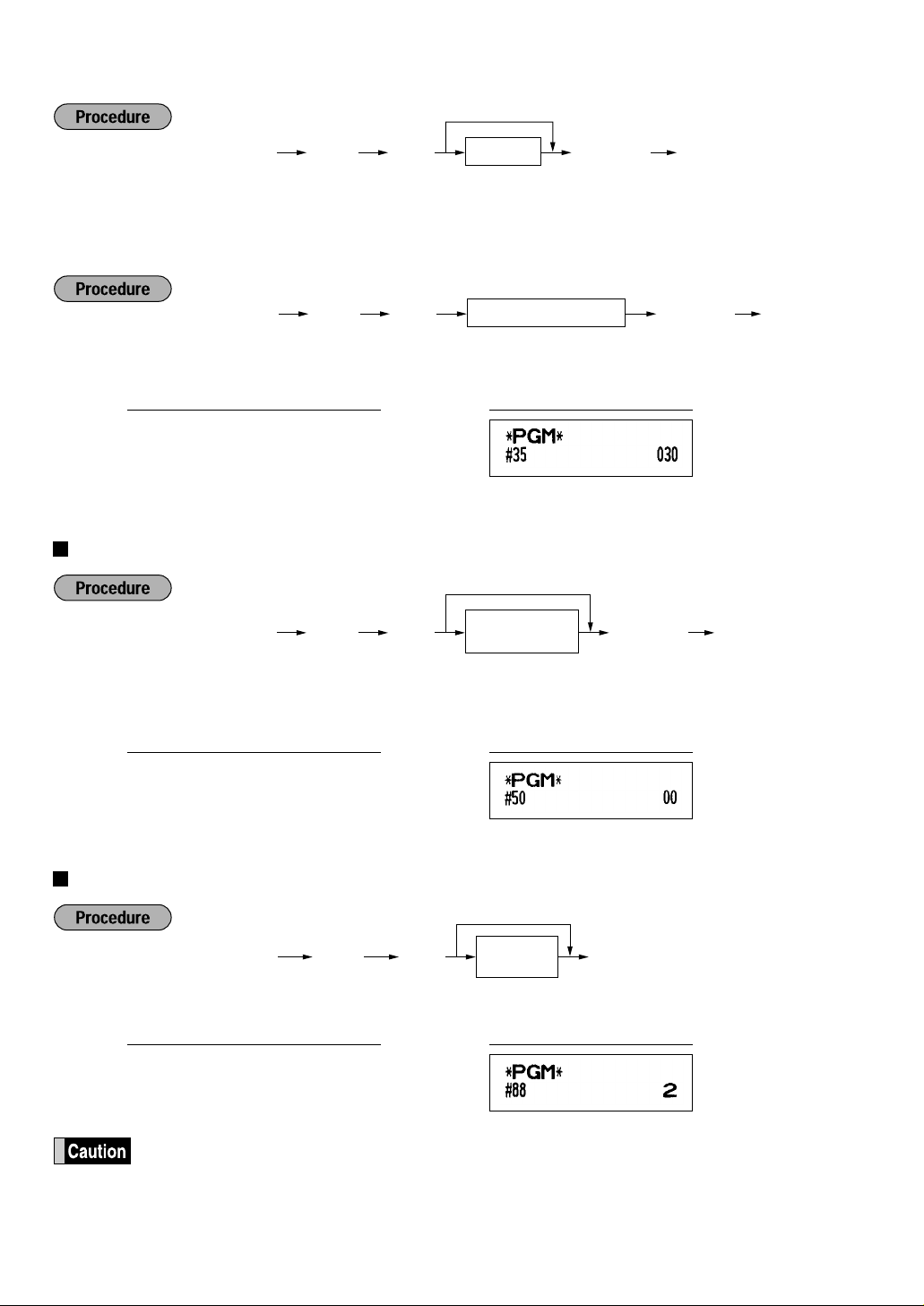
56
(4) RS-232C start code and end code
*A-C: Start code 000-127 (default: 002)
D-F: End code 000-127 (default: 013)
(5) RS-232C time out setting
Default: 007
Thermal printer density
* 50 is the default setting. To make the print darker, set a larger number, and to make the print lighter, set a
smaller number.
Language selection
*Language: 0: English 2: French 3: Spanish (default: English)
When you change the language, the texts such as clerk names, logo messages and function texts
(refer to page 45), which you programmed, will be reset to the default settings. The language
selection must be made before programming clerk names, logo messages and function texts.
s
88
@
2
A
PrintKey operation example
s @
*Language
(0, 2 or 3)
A
To set “0”
88
s
50
@
00
sA
PrintKey operation example
s @
*Printer density
(00-99)
As
To set “0”
50
s
35
@
30
sA
PrintKey operation example
s @
Time out (1 to 255 sec.)
As
35
s @
*ABCDEF
As
To set “000000”
33
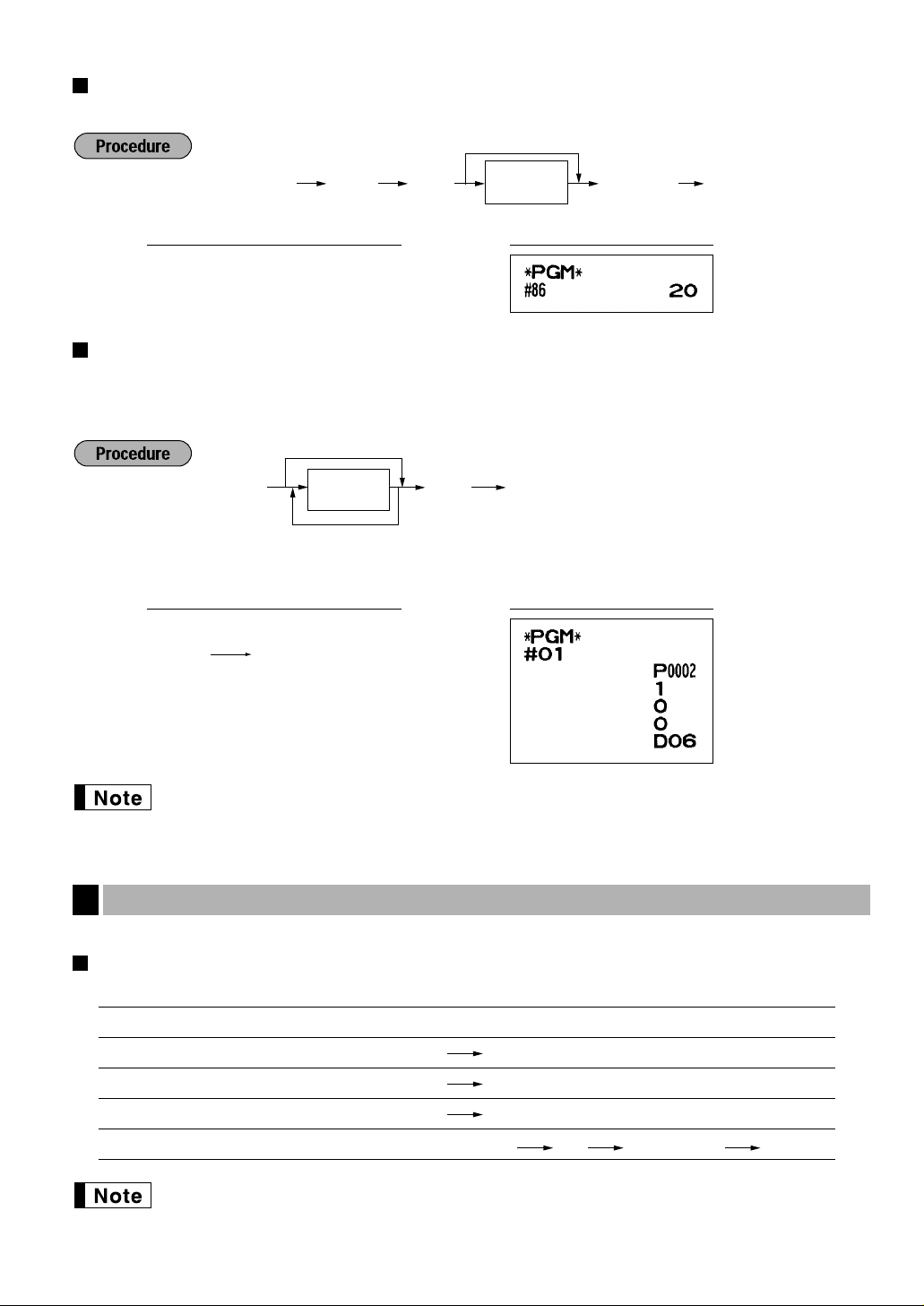
57
Training clerk specification for training mode
For the details of clerk training, please refer to “TRAINING MODE” on page 59.
AUTO key programming — Automatic sequence key
If you program frequently performed transactions or report sequences for the
a
key, you can recall those
transactions and/or reports simply by pressing the
a
key in key operations.
Programming for
a
; entering a PLU 2 item (programmed unit price: 1.50) and a dept. 6 item (unit price: 1.00)
When the
a
key has been programmed to execute a report job function, the mode switch must be
in the appropriate position (OPX/Z for individual clerk reports, X1/Z1 for daily reports or X2/Z2 for
weekly or monthly reports).
a
™
100
(
a
A
AUTO
setting
PrintKey operation example
a
A
a
Transaction
(key entry)
Delete
max. 25 times
s
86
@
20
sA
PrintKey operation example
s @
Clerk code
(1 to 40)
As
To cancel
86
The machine allows you to read every program stored in the PGM mode.
Key sequence for reading stored program
• To stop reading programming report 1 or PLU programming report, turn the mode switch to the
MGR position.
• When printing is performed continuously, the printing may be intermitted several seconds. After
the intermission, the printing will be restarted.
Report name Key sequence
Programming report 1
A
Programming report 2 2 A
Auto key programming report 1 A
Printer density programming report 3 A
PLU programming report Start PLU code @ End PLU code p
Reading Stored Programs
4
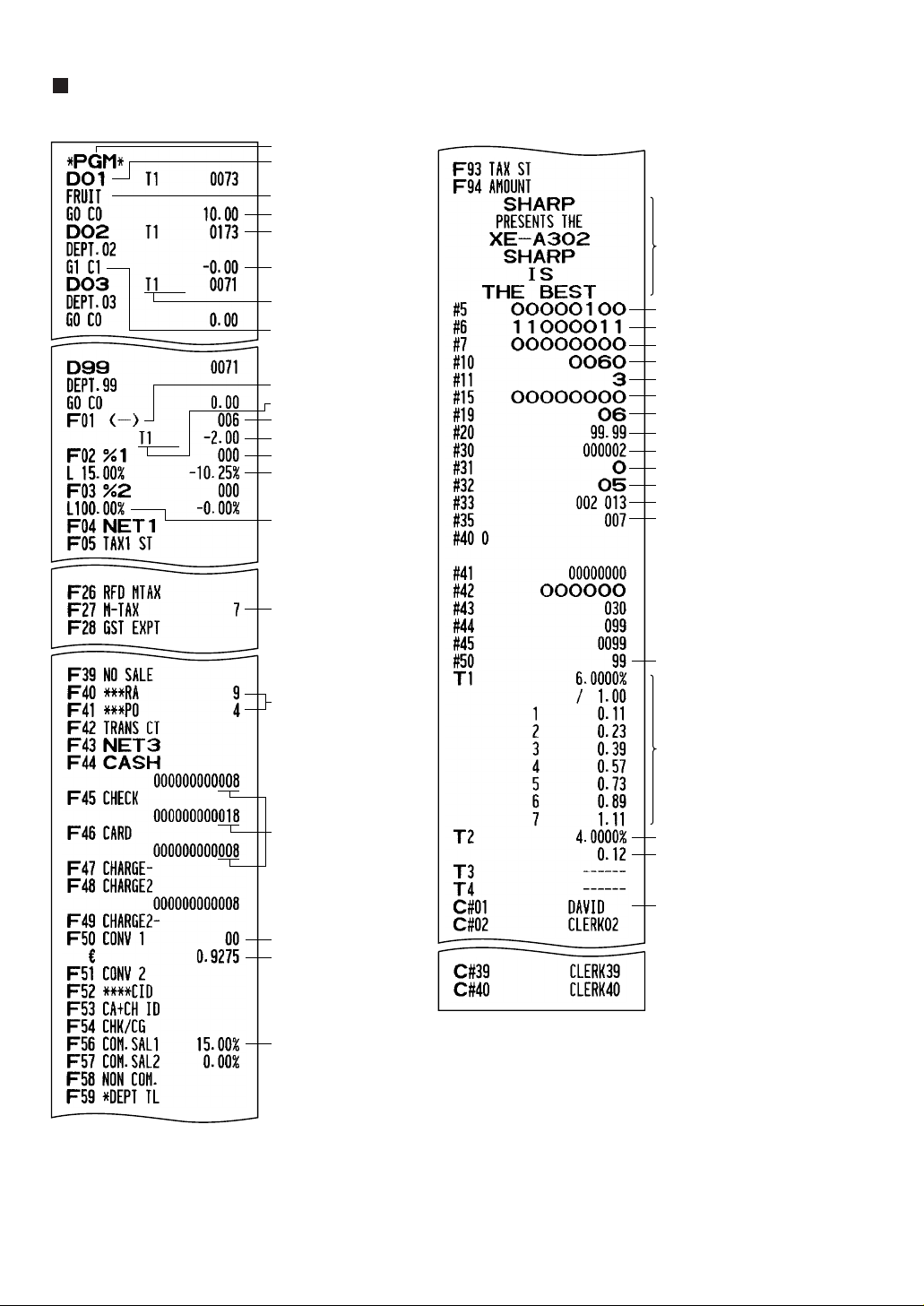
58
Mode
Dept. code
Function no.& its text
Dept. unit price w/sign
Dept. function
Dept. group &
commission group
Minus department
Function parametrs (F-H)
Function parametrs (F-H)
Discount amt. w/sign
Percent limit
Tax status
Tax status
Logo Message
Print format (A-H)
Receipt print format(A-H)
Power save mode(A-D)
Logo message print format
Function selection for tax (A-H)
Percent rate with sign
Entry digit limit
Entry digit limit
Function parameters (A-C)
Function parameters
Foreign currency
symbol/Rate
Thermal printer density
Function selection for
miscellaneous keys (A-H)
Tax rate
Min. taxable amount
Clerk code/name
Commission rate
Tax table
Doughnut tax exempt
HALO for CID (sentinel)
RS-232C terminal no.
RS-232C transmission form (A)
RS-232C baud rate(AB)
RS-232C Start-End code
RS-232C timeout
Dept. text
Sample printouts
1 Programming report 1
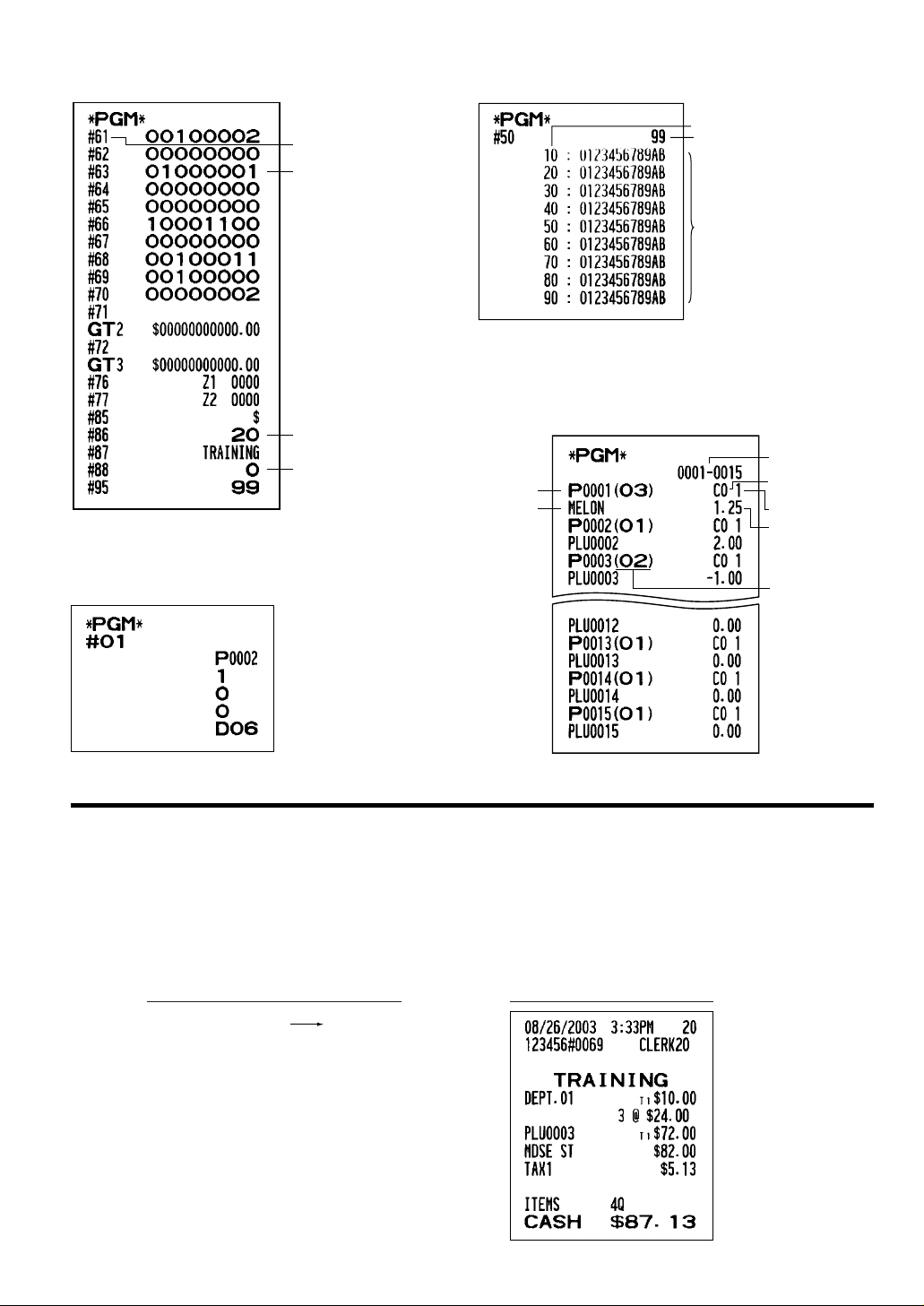
59
2 Programming report 2
Job code
A to H from the left
Training clerk specification
Language selection
* Job code #63, 64, 65, 67,
69, 71, 72, 76, 77, 85, 87
and 95 are fixed settings,
for which you cannot
change the settings.
4 Printer density programming report
Entered value
Printer density
Printing density
example
5 PLU programming report
PLU code
PLU text
Mode parameter
Unit price
Commission
group
Range
Associated
dept. code
3 Auto key programming report
TRAINING MODE
The training mode is used when the operator or the manager practices register operations.
When a clerk in training is selected, the machine automatically enters the training mode. To specify a clerk to be
trained, refer to “Training clerk specification for training mode” in “ADVANCED PROGRAMMING” in page 57.
The training operation is valid only in REG, MGR and VOID mode.
The corresponding clerk memory is only updated in the training mode.
A clerk set in training
20 L
1000 !
3 @
£
A
Receipt printKey operation example
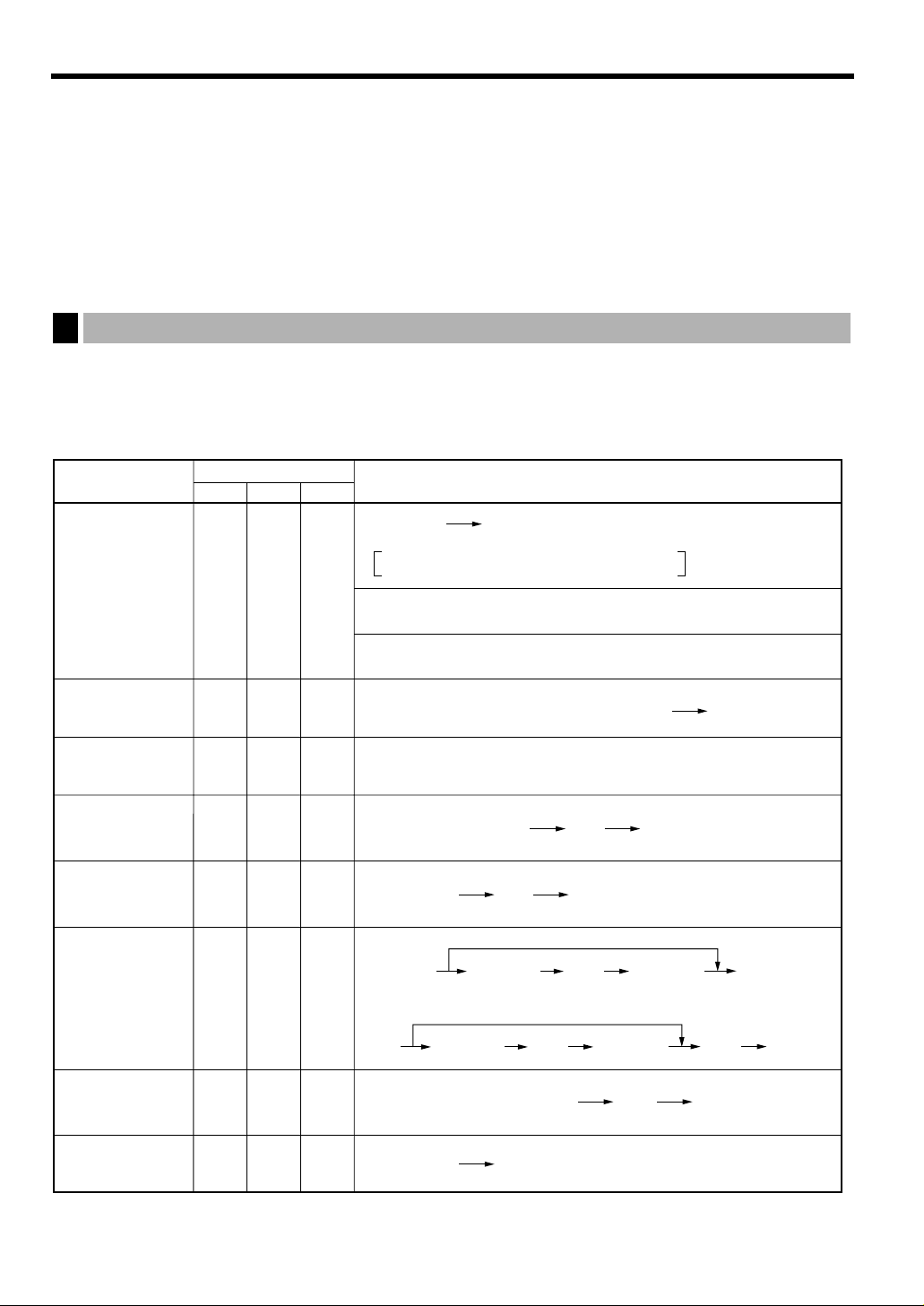
60
READING (X) AND RESETTING (Z)
OF SALES TOTALS
• Use the reading function (X) when you need to take a reading of sales information entered since the last reset.
You can take this reading any number of times. It does not affect the register’s memory.
• Use the resetting function (Z) when you need to clear the register’s memory. Resetting prints all sales
information and clears the entire memory except for the GT1 through GT3, Training GT, reset count, and
consecutive number.
X1 and Z1 reports: Daily sales reports
X2 and Z2 reports: Periodic (monthly) consolidation reports
When you take an X or Z report, turn the mode switch to the appropriate position referring to the column of
“Mode switch position” shown on the table below, and use the following corresponding key sequence.
Item
Mode switch position
Key operation
OPX/Z
X
--
--
--
--
--
--
--
A
key: Sales total
@
key: Amount of cash in drawer
Dept. code : Department sales total
d
For dept. 1 to 6 : Dept. key (
!
to
(
)
Individual group
total report on
department
PLU report by
designated range
X1/Z1
--
X1, Z1
X1, Z1
X2/Z2
--
X2, Z2
X2, Z2
Flash report:
(Only display)
To clear the
display, press the
l
key or turn the
mode switch to
another position.
Full sales report
Department report
X1 X2
Transaction report
X1 X2
X1 X2
Full group total
report on
department
X1 X2
PLU report by
associated
department
X1 X2
P
AA
Reading: Resetting:
d
Reading:
Reading:
@
1
0
A
Reading:
d
Reading: Associated dept. code
d
p
@
d
Reading: Group number
Resetting:
P
All PLUs
End
PLU code
Start
PLU code
p@
Reading:
All PLUs
End
PLU code
Start
PLU code
p@
Summary of Reading (X) and Resetting (Z) Reports
1
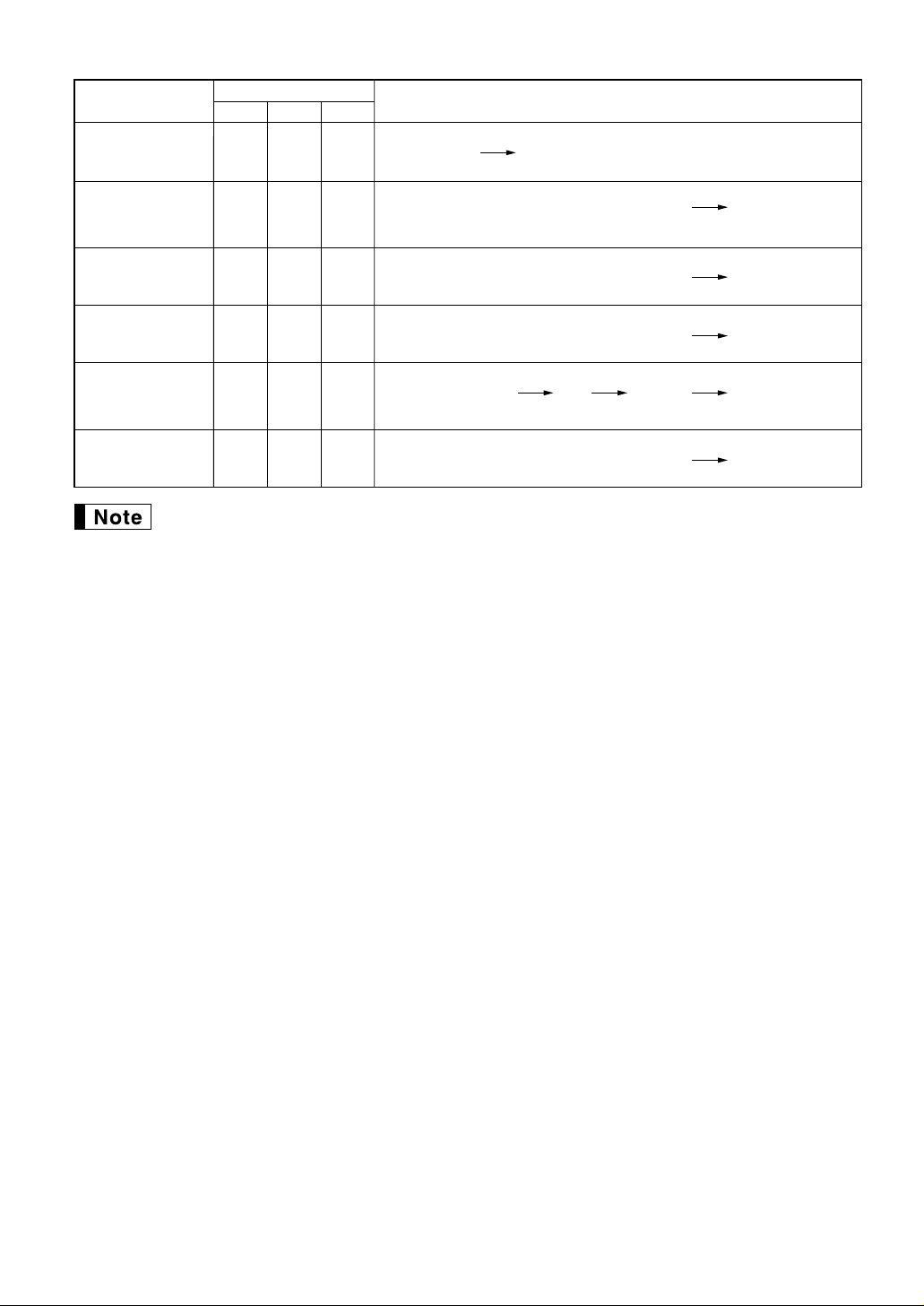
61
• When both sales quantities and sales amounts are zero, printing is skipped. If you do not want to
skip, change the programming. (Refer to “Print format” of “Various Function Selection
Programming 1”.)
• “X” represents read symbol and “Z” represents reset symbol in the reports.
• To stop reading and resetting the PLU sales report, turn the mode switch to the MGR position.
The data will not be erased when you reset.
• When printing is performed continuously, the printing may be intermitted several seconds. After
the intermission, the printing will be restarted.
Item
Mode switch position
Key operation
OPX/Z X1/Z1 X2/Z2
X2, Z2
X2, Z2
Total in drawer
report
X1
X1 X2
A
Reading:
--
--
--
--
--
X, Z
Full clerk report
Hourly report
(full)
X1, Z1
X1, Z1
--
--
--
--
--
Individual clerk
report
P
LL
Reading: Resetting:
P
LL
Reading: Resetting:
P
ss
Reading: Resetting:
Hourly report
(by range)
s@
Reading: Start time End time
Daily net sales
report
P
ss
Reading: Resetting:
(The report of the current clerk)
(hour) (hour)
2
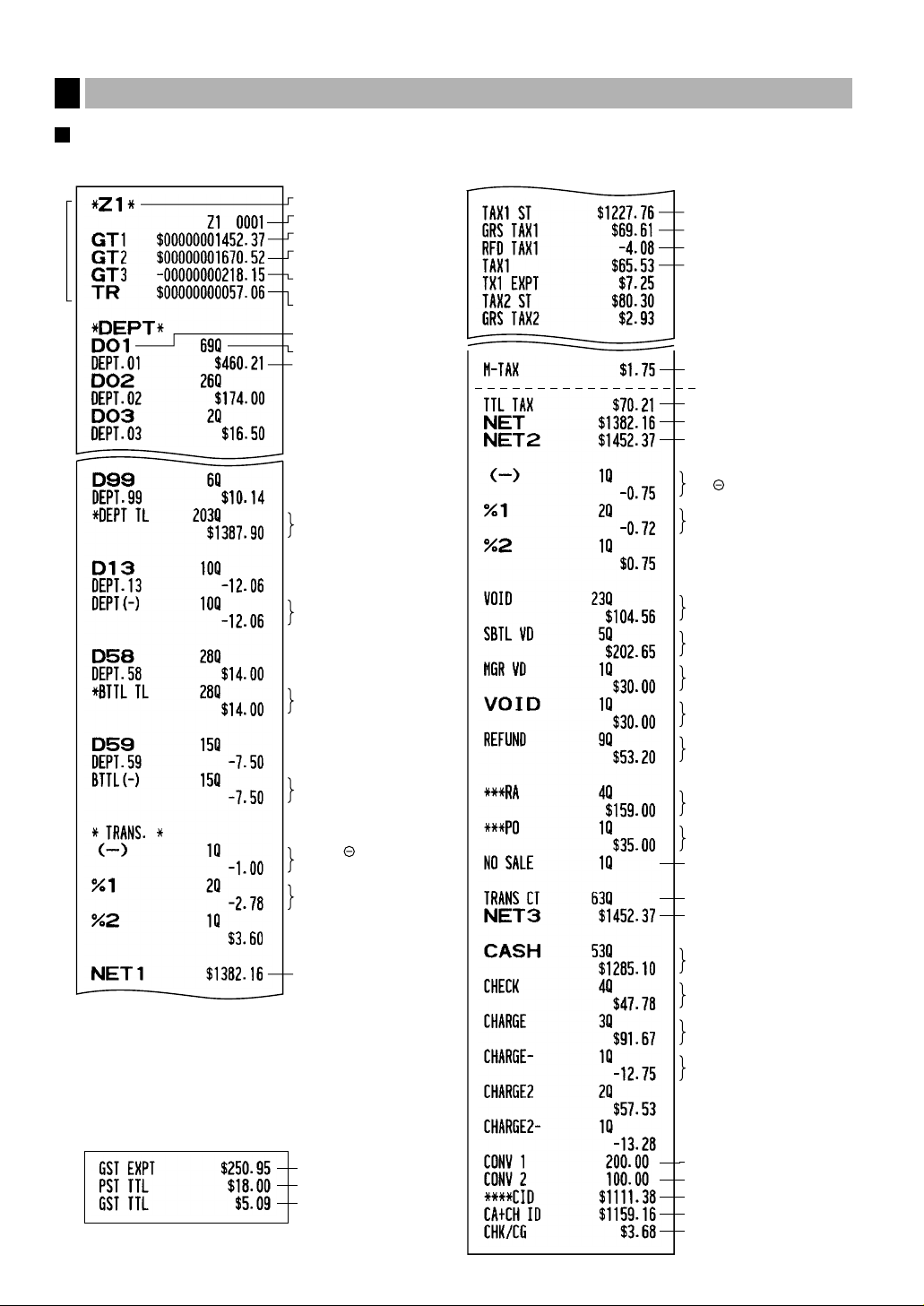
62
Full sales report
• Sample report
Daily Sales Totals
2
Taxable 1 total
Gross tax 1 total
Refund tax 1 total
Net tax 1 total
Mode title*1
Reset counter
Net grand total(GT2-GT3)
Dept. code
Sales q'ty
Sales amount
“+” dept. counter
and total
“+” bottle return dept.
counter and total
“-” bottle return dept.
counter and total
“-” dept. counter
and total
Subtotal counter
and total
Subtotal percent 1
counter and total
*2
REG-mode void counter
and total
Subtotal void counter and
total
Manager item void counter
and total
Void-mode transaction
counter and total
Refund counter and total
Received on account
counter and total
Paid out counter and total
Item counter and total
Item percent 1
counter and total
Manual tax total
*3
Tax total
Net total without tax
Net total with tax
No-sales counter
Customer counter
Sales total
Foreign currency total (preset)
Foreign currency total (open)
Cash in drawer
Cash + check in drawer
Change total for check tendering
Cash counter and total
Check sales counter and total
Charge1 sales counter and total
Charge1 refund counter and total
Grand total of plus
registration
Grand total of
minus registration
Grand total of training
mode registration
Net sales total
*1: When you take X1 report, “X1” is printed.
*2: Printed in the Z1 report only.
*3: When the Canadian tax system is selected, the
following is printed here.
Exempt total from GST
PST total
GST total
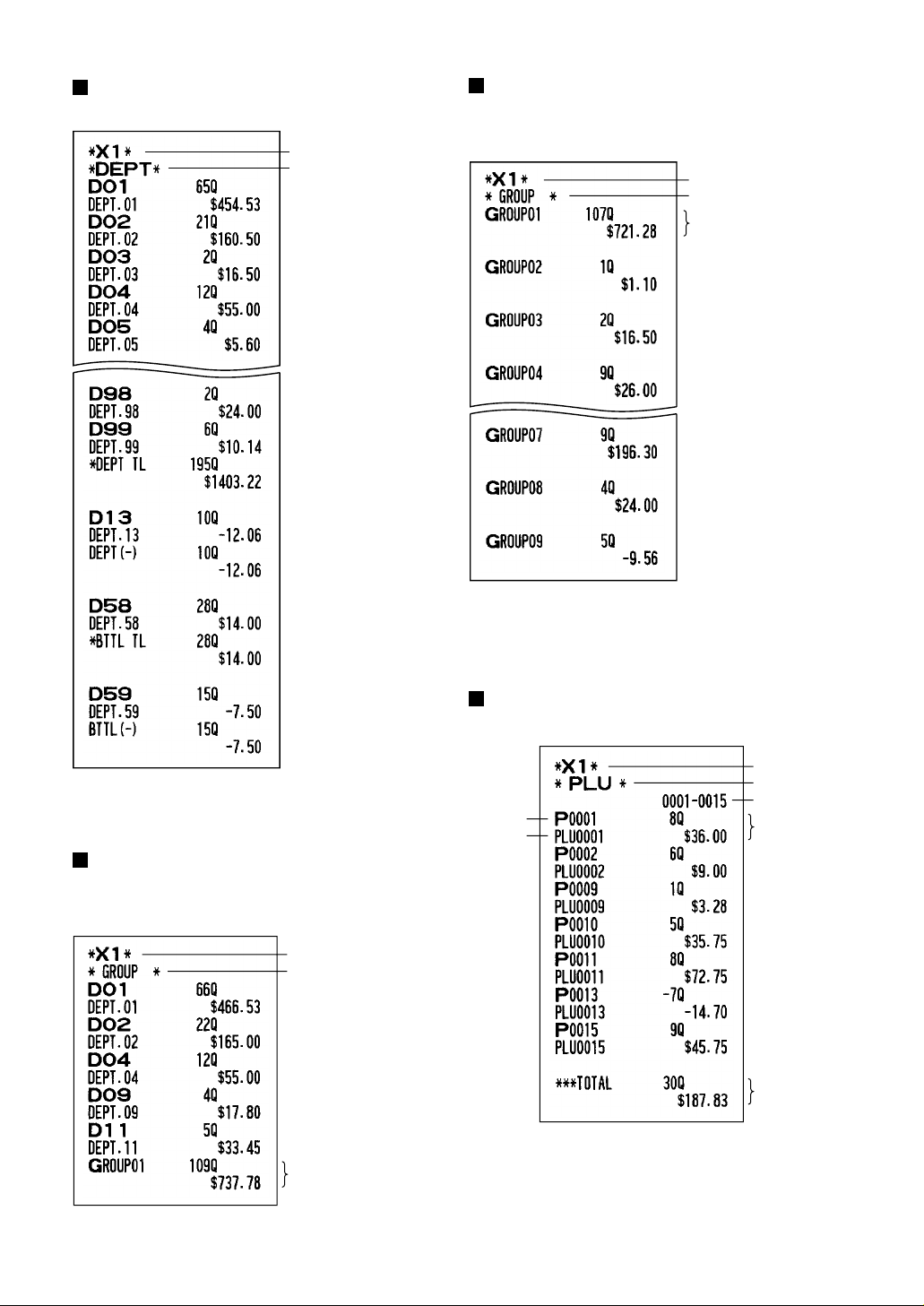
63
PLU report by designated range
• Sample report
*: When you take Z1 report, “Z1” is printed.
PLU code
Item label
Mode title*
Report title
Range
Range sum
Sales q'ty and total
Department report
• Sample report
Mode title
Report title
Full group total report on
department
• Sample report
Group 1 total
Mode title
Report title
Individual group total report on
department
• Sample report
Group 1 total
Mode title
Report title
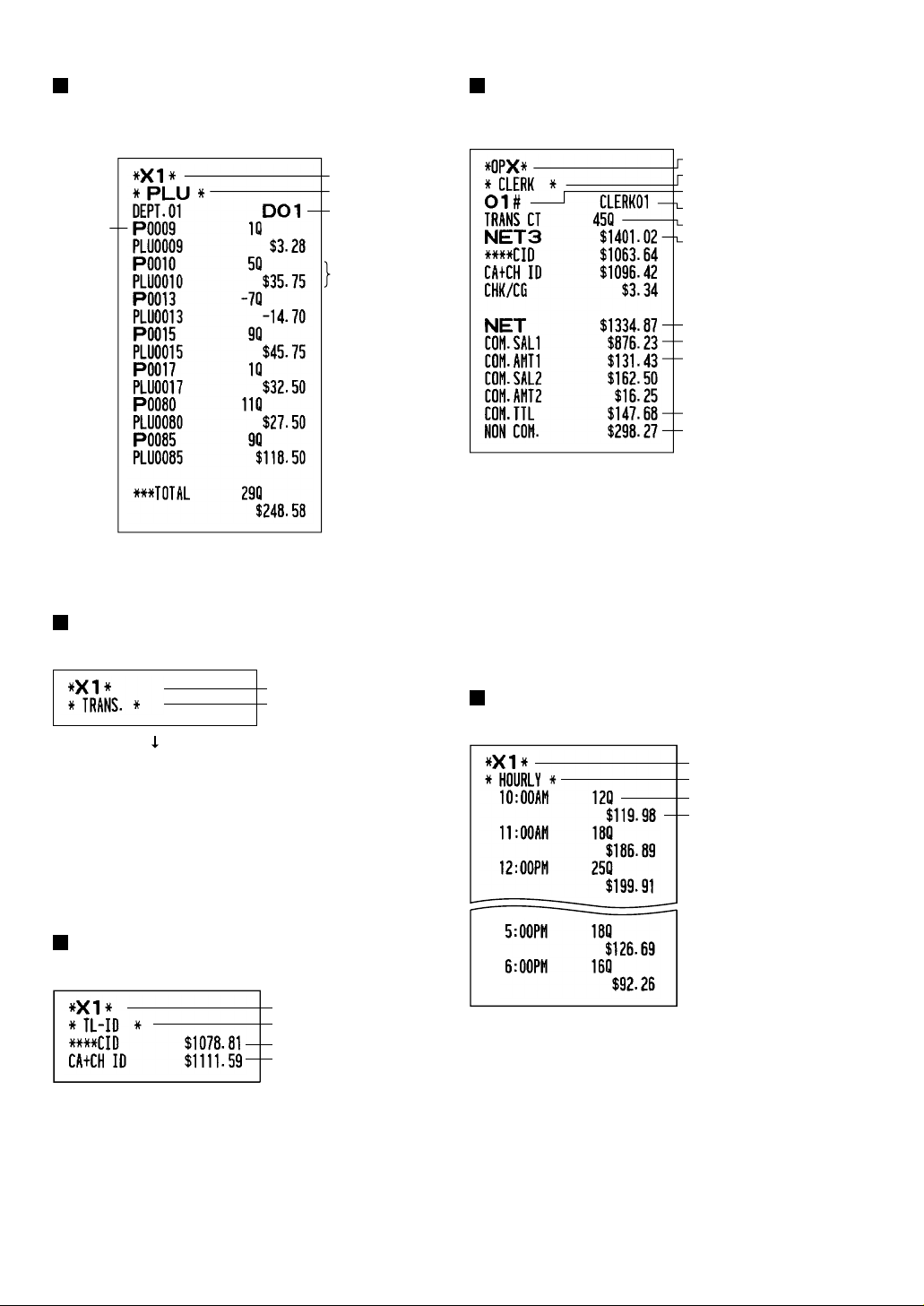
64
Total in drawer report
• Sample report
Cash in drawer
Cash plus check in drawer
Mode title
Report title
Transaction report
• Sample report
This report shows the same
transaction data as when a full sales
report is run.
Mode title
Report title
PLU report by associated
department
• Sample report
Sales q'ty and total
Mode title
Report title
Associate
dept. code
PLU code
Clerk reports
Individual clerk report
• Sample report
*: When you take OPZ report, “OPZ” is printed.
Full clerk report
The printout occurs in the same format as in the
sample report of individual clerk, but all clerk’s sales
data are printed in the order of clerk code number
(from #1 to #40).
Mode title*
Report title
Clerk code
Clerk name
Customer counter
Sales total
Net sales
Commission 1 sales total
Commission 1 amount
Commission amount total
Non commission sales
total
Hourly report
• Sample report
*: When you take Z1 report, “Z1” is printed.
When you take an hourly report by range, a report
of the specified range of time (hour) is printed.
Mode title*
Report title
Customer counter
Sales total
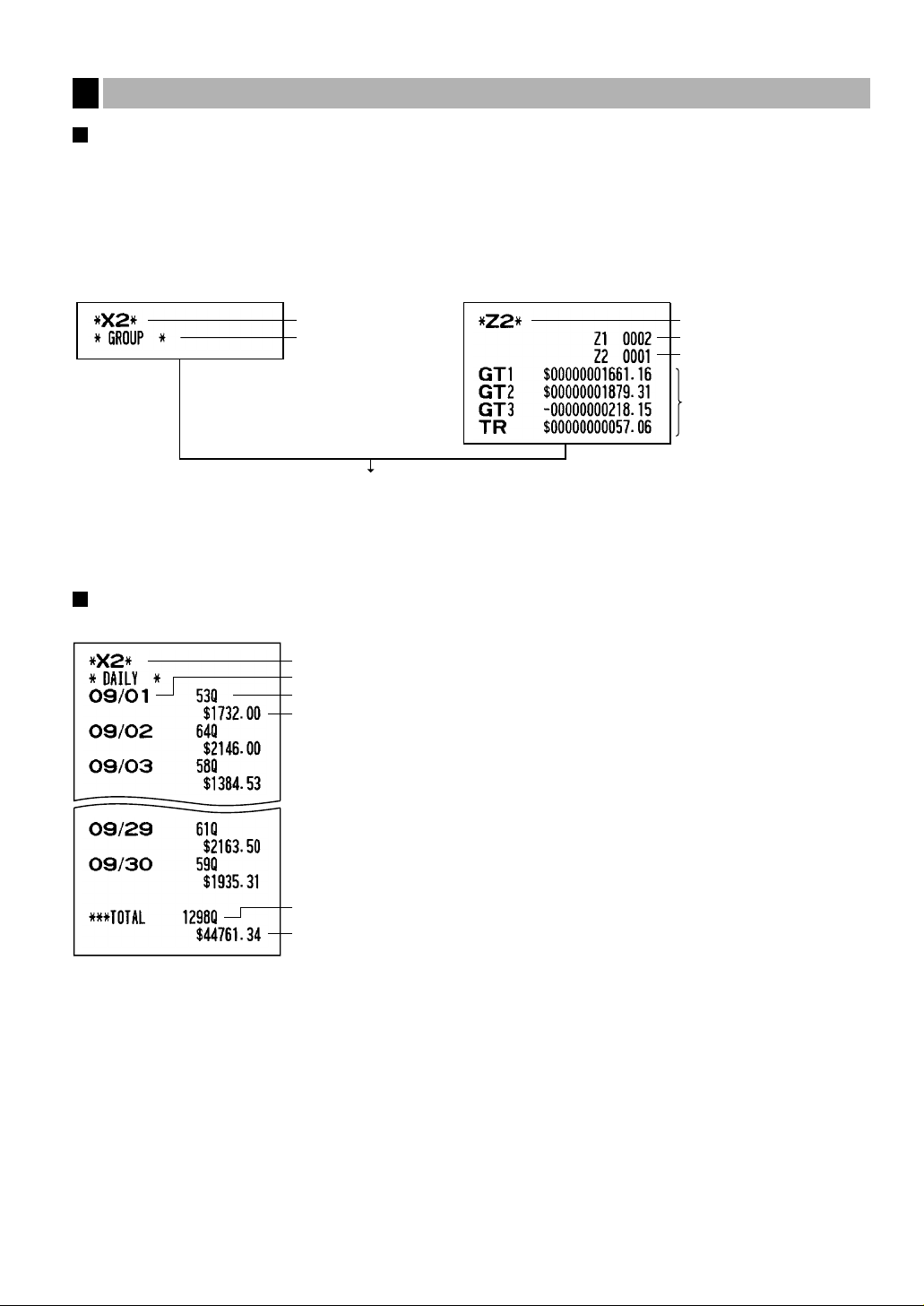
65
Daily net sales reports
• Sample report
*: When you take Z report, “Z2” is printed instead of “X2”.
Customer counter
Sales total
Net amount total
Mode title*
Date
Customer total
General information
The periodic reading or resetting reports are the same in format as those in the X1/Z1 report for daily sales. The
mode indicator will read “X2” or “Z2”.
• Sample X report
(Individual group total report on department)
• Sample Z report
(Full sales report)
The subsequent printouts are the same in format
as those in the X/Z report for daily totals.
Grand totals
Reset counter of daily total
Reset counter of
periodic consolidation
Mode title
Report title
Mode title
Periodic Consolidation
3
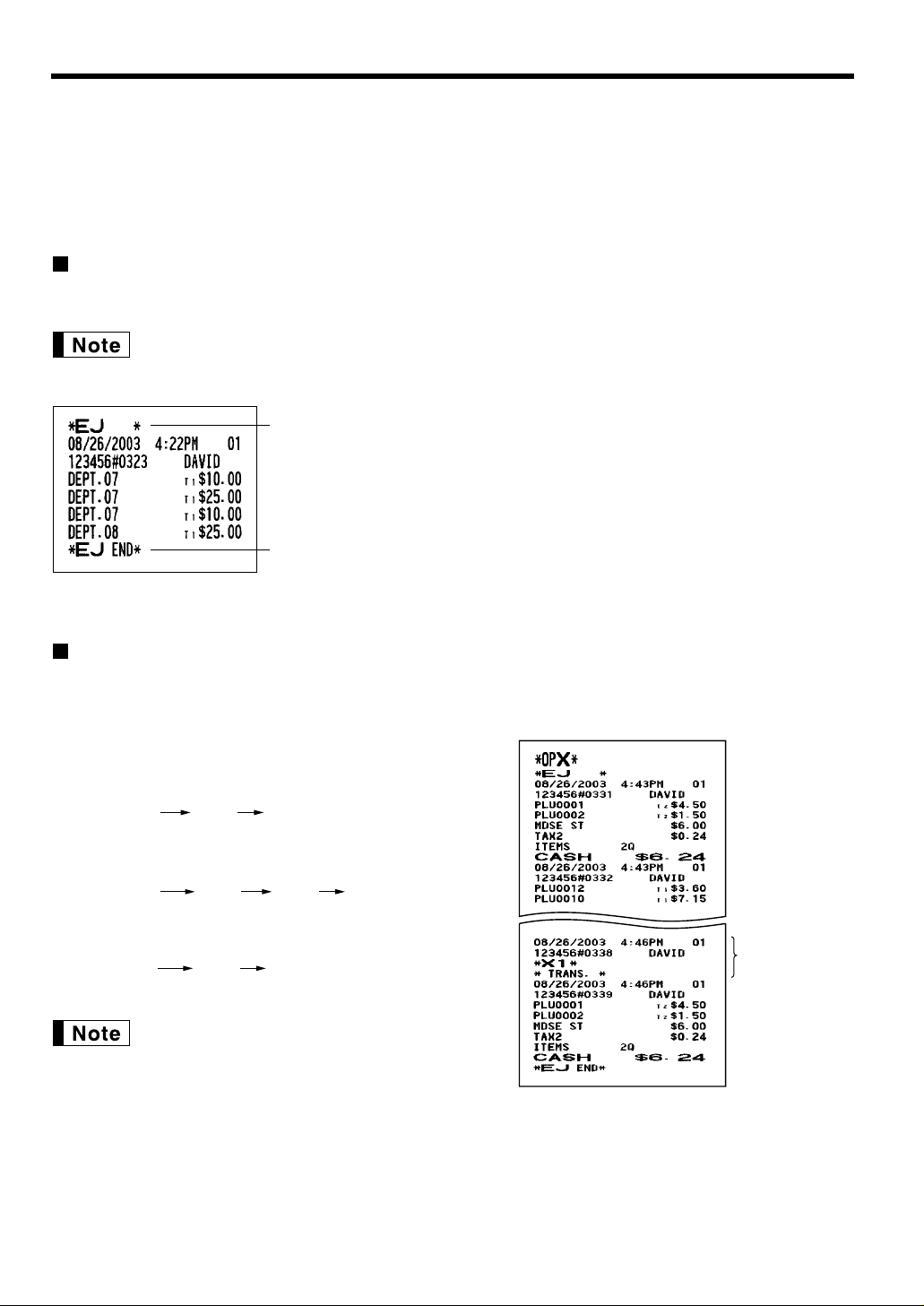
66
EJ REPORT READING AND RESETTING
The cash register provides an electronic journal (EJ) function. This function is intended to record the journal
data in a memory instead of journal paper, and print the data as an EJ report. The register records the journal
data in REG, PGM, VOID, X1/Z1 and X2/Z2 modes. For details of EJ programming, please refer to “Electronic
journal (EJ) function parameters” section (page 50).
Printing journal data on the way of a transaction
You can print journal data of a current transaction recorded in EJ memory by pressing the
R
key during the
transaction.
This function is valid when the printing style is programmed to receipt, and the receipt ON/OFF
function is set to OFF.
• Sample print
Reading and resetting the electronic journal data (Issuing EJ report)
You can read the journal data stored in the EJ memory in the journal format by executing the following
procedure in the X1/Z1 or OP X/Z mode.
• Sample EJ report
• On the EJ memory, a maximum of 3000 lines of data can be
stored. When executing all data reading, all of the data stored
in the EJ memory will be printed. To save paper, compression
print is available.
• To stop reading or resetting the data, turn the mode switch to
“MGR” position. The data will not be erased when resetting.
• When printing is performed continuously, the printing may be intermitted several seconds. After the
intermission, the printing will be restarted.
Header
information
print
P
To reset all of the data:
A@
To read the last 10 records:
A@
e
To read all of the data:
700
700
710
(X1/Z1 mode only)
A@
EJ report title
EJ report end title
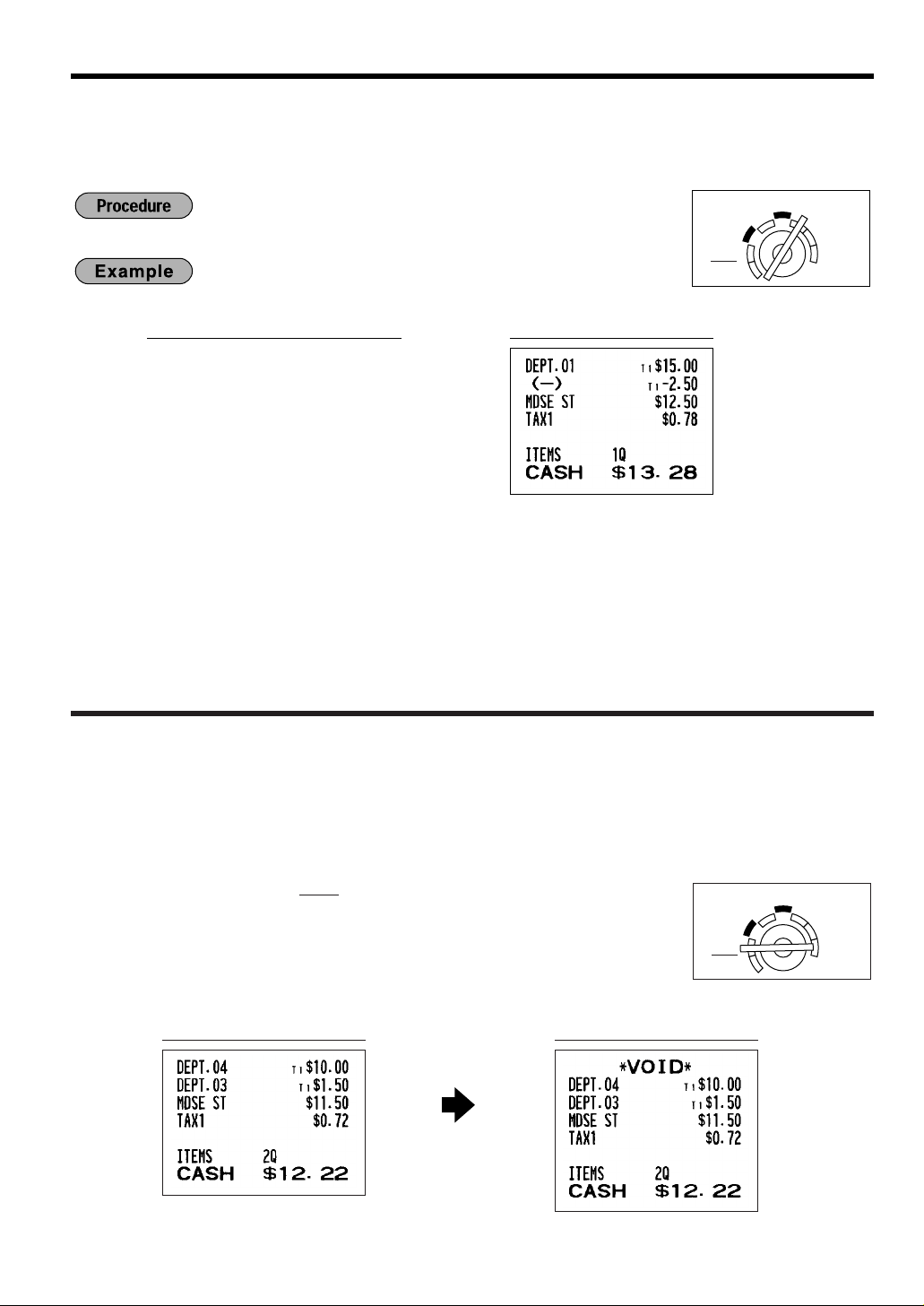
67
OVERRIDE ENTRIES
Programmed limit for functions (such as for maximum amounts) can be overridden by making an entry in the
MGR mode.
In this example, the register has been programmed not to allow
discounts entries over $1.00.
REG-mode 1500
!
entries 250
-
...Error
l
Turn the mode switch
to the MGR position.
250
-
Return the mode switch
to the REG position.
A
Receipt printKey operation example
REG
OPX/Z MGR
PGM
X1/Z1
X2/Z2
OFF
VOID
1. Turn the mode switch to the MGR position.
2. Make an override entry.
CORRECTION AFTER FINALIZING A
TRANSACTION (Void mode)
When you need to void incorrect entries that clerks cannot correct (incorrect entries found after finalizing a
transaction or cannot be corrected by direct or indirect void), follow this procedure:
1. Turn the mode switch to the VOID position using the manager key (MA), to enter
into the void mode.
2. Repeat the entries that are recorded on an incorrect receipt. (All data on the
incorrect receipt is removed from register memory; the voided amounts are added
to the void-mode transaction totalizer.)
Cancellation receiptIncorrect receipt
REG
OPX/Z MGR
PGM
X1/Z1
X2/Z2
OFF
VOID
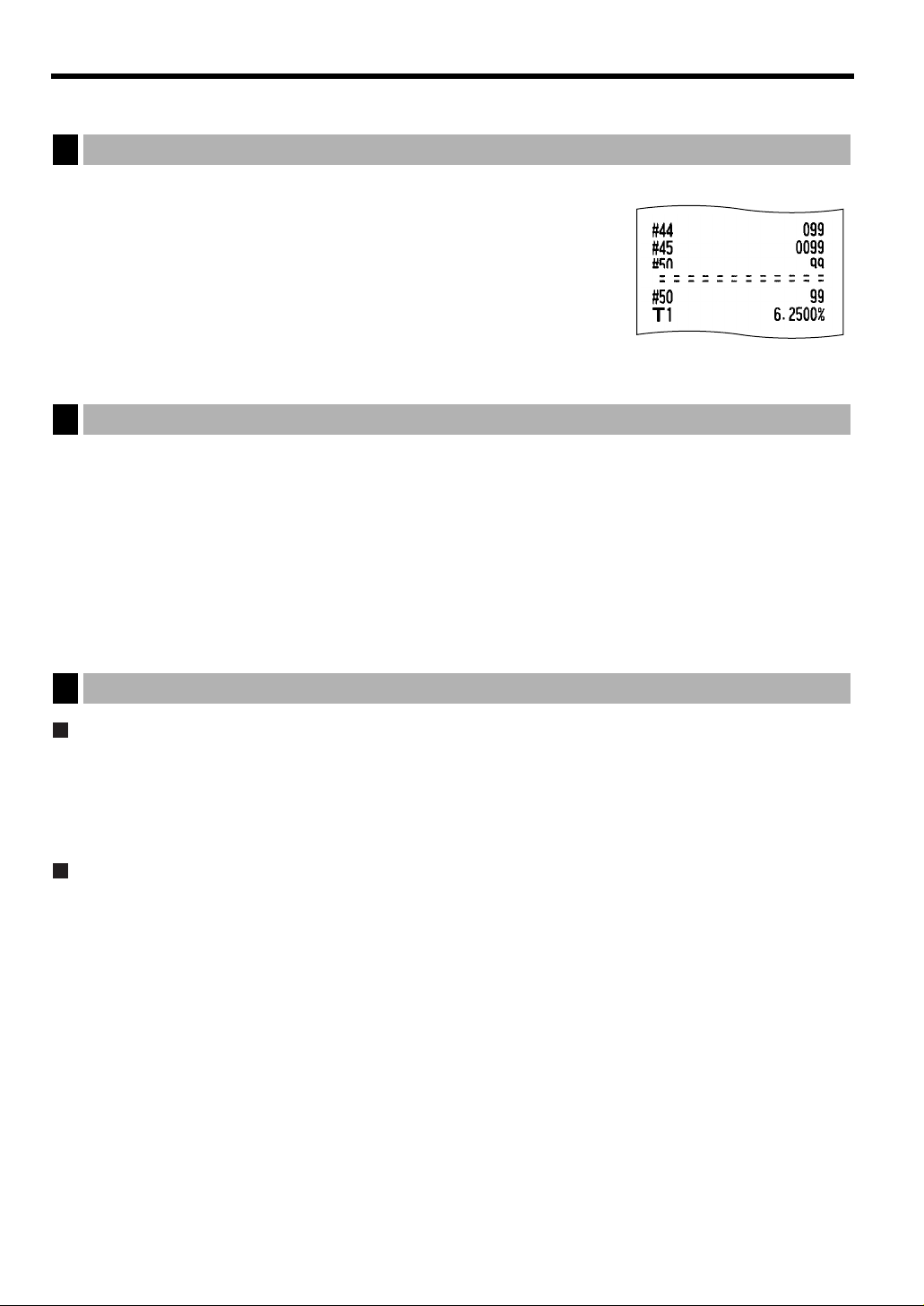
68
OPERATOR MAINTENANCE
When power is lost, the machine retains its memory contents and all information on sales entries.
• When power failure is encountered in register idle state or during an entry, the
machine returns to normal operation after power recovery.
• When power failure is encountered during a printing cycle, the register prints
“============” and then carries out the correct printing procedure after
power recovery. (See the sample print.)
If the printer runs out of paper, the printer will stall, and “PAPER EMPTY” will appear on the display. Key entries
will not be accepted. Refer to section 4 in this chapter, install a new roll, then press the
l
key. The printer will
print the power failure symbol and resume printing.
If the print roller arm comes up, the printer stalls, “HEAD UP” will appear on the display. Key entries will not be
accepted. Push down the arm until it is securely locked, then press the
l
key. The printer will print the power
failure symbol and resume printing.
Cautions in handling the printer
• Avoid dusty and humid environments, direct sunlight and iron powder. (A permanent magnet and
electromagnet are used in this machine.)
• Never pull the paper when the print roller arm is locked. First lift up the arm, and then remove the paper.
• Never touch the surface of the print head and print roller.
Cautions in handling the recording paper (thermal paper)
• Use only paper specified by SHARP.
• Do not unpack the thermal paper until you are ready to use it.
• Avoid heat. The paper will color at around 70°C.
• Avoid dusty and humid storage places. Avoid direct sunlight.
• The printed text on the paper can discolor under conditions of high humidity and temperature, exposure to the
direct sunlight, contact with glue, thinner or a freshly copied blueprint, and heat caused by friction from
scratching or other means.
• Be very careful when handling the thermal paper. If you want to keep a permanent record, copy the printed text
with a photocopier.
Cautions in Handling the Printer and Recording Paper
3
In Case of Printer Error
2
In case of Power Failure
1
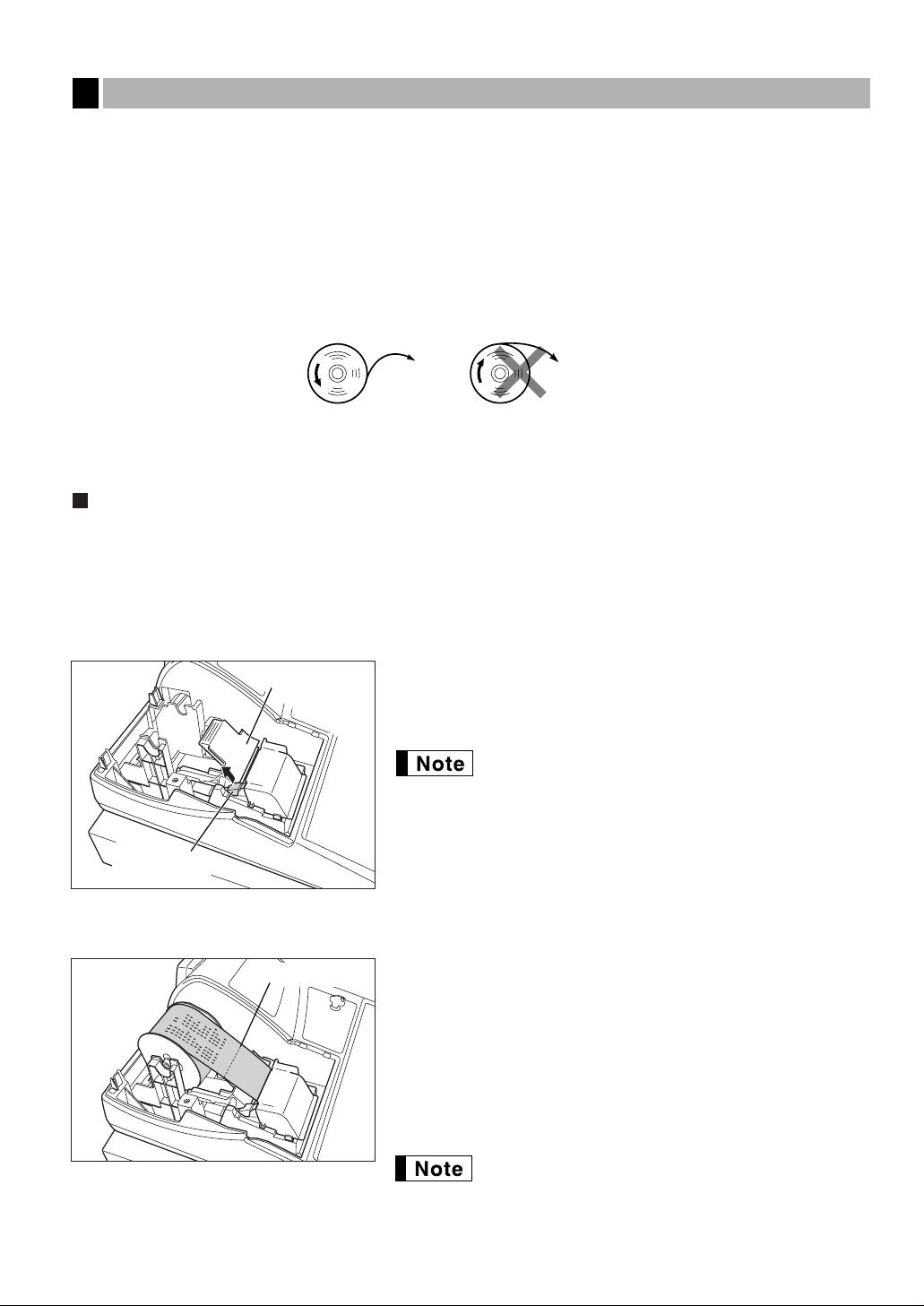
69
Be sure to use paper rolls specified by SHARP.
The use of any other paper rolls other than those specified could cause paper jamming, resulting in register
malfunction.
Paper specification
Paper width: 2.25 ± 0.02 in (57.5 ± 0.5 mm)
Max. outside diameter: 3.15 in (80 mm)
Quality: Thermal paper
• Be sure to set the paper roll prior to using your machine, otherwise it may cause a malfunction.
Install the paper roll in the printer. Be careful to set the roll correctly.
(How to set the paper roll)
Removing the paper roll
When a red dye appears on the paper roll, it is time to replace it. Replace the paper roll with a new one. If you
plan on not using the register for an extended period of time, remove the paper roll, and store it in an appropriate
place.
Caution: The paper cutter is mounted on the printer cover. Be careful not to cut yourself.
When not using the take-up spool (using as receipt paper):
1. Remove the printer cover.
2. Lift up the print roller release lever to unlock and open the print
roller arm.
3. Remove the paper roll from the paper roll cradle.
Do not pull the paper through the printer.
When using the take-up spool (using as journal paper):
1. Turn the mode switch to a position other than OFF with the
power cord connected.
2. Remove the printer cover.
3. Press the
F
key to advance the journal paper until its printed
part is out of the way.
4. Cut the paper and remove the take-up spool.
5. Lift up the print roller release lever to unlock and open the print
roller arm.
6. Remove the paper roll from the paper roll cradle.
Do not pull the paper through the printer.
Area to cut
Print roller
release lever
Print roller arm
To the printer
Incorrect
To the printer
Correct
Replacing the Paper Roll
4

70
7. Remove the outer side of the take-up spool as shown
on the left.
8. Remove the printed journal roll from the take-up spool.
Installing the paper roll
Caution: The paper cutter is mounted on the printer cover. Be careful not to cut yourself.
Installing the receipt paper roll:
1. Turn the mode switch to a position other than
OFF with the power cord connected.
2. Remove the printer cover.
3. Lift up the print roller release lever to unlock
and open the print roller arm.
4. Set the paper correctly in the paper roll cradle.
5. Feed the end of the paper along with the paper
positioning guides.
6. While holding down the paper, slowly close the print roller arm,
and push down the arm until you hear a click locking the arm.
Make sure securely you push down the center of the wing part of
the arm as illustrated at the left. The paper will be fed
automatically.
If the print roller arm is not securely locked, printing is
not done right. If this problem occurs, open the arm, and
close the arm as instructed above.
7. Cut off the excess paper using the edge of the inner cover, and
replace the printer cover. Press the
F
key to make sure the
paper end comes out of the printer cover and clean paper appears.
If the paper end does not come out, open the printer
cover, and pass the paper end between the paper cutter
and the paper guide of the printer cover, and replace the
cover.
Paper positioning guides
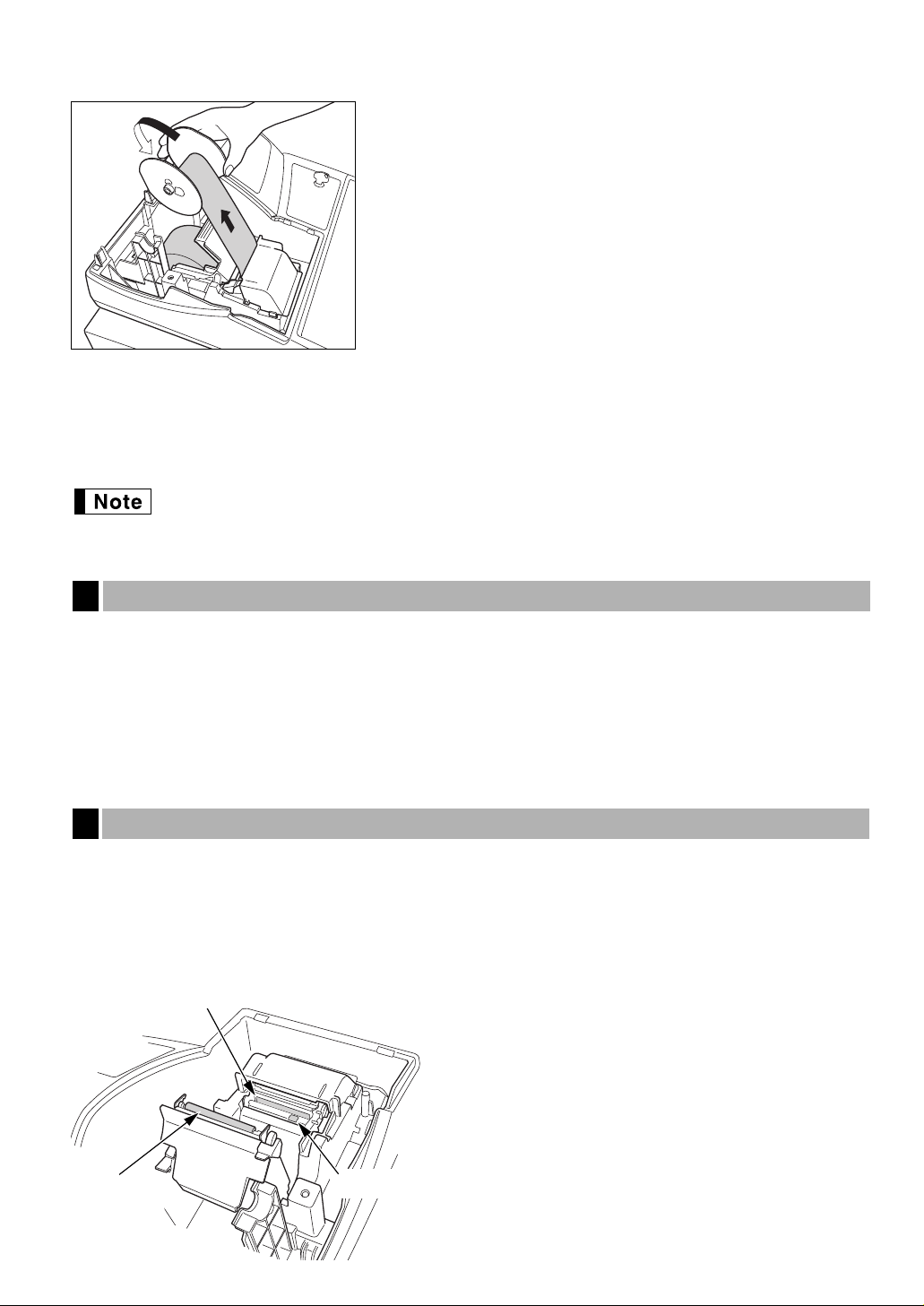
71
Installing the journal paper roll:
1. Turn the mode switch to a position other than OFF with the power
cord connected.
2. Remove the printer cover.
3. Lift up the print roller release lever to unlock and open the print
roller arm.
4. Set the paper correctly in the paper roll cradle.
5. Feed the end of the paper along with the paper positioning guides.
6. While holding down the paper, slowly close the print roller arm, and
push down the arm until you hear a click locking the arm. Make
sure securely you push down the center of the wing part of the arm
as illustrated at the left. The paper will be fed automatically.
7. Insert the end of the paper into the slit in the spool. (Press the
F
key to feed more paper if required.)
8. Wind the paper two or three turns around the spool shaft.
9. Set the spool on the bearing, and press the
F
key to take up
excess slack in the paper.
10. Replace the printer cover.
You can wind the roll paper in OP X/Z, X1/Z1, and X2/Z2 modes even if you programmed so that
the printer is used for issuance of receipts. This may be convenient to wind reports. In this case,
set the roll paper to the take-up spool.
Caution: The paper cutter is mounted on the printer cover. Be careful not to cut yourself. Never touch
the print head immediately after printing, as the head may still be hot.
1. Remove the printer cover.
2. Lift up the print roller release lever to unlock and open the print roller arm.
3. Remove the paper jam. Check for and remove any shreds of paper that may remain in the printer.
4. Reset the paper roll correctly by following the steps in “Installing the paper roll”.
When the printed text is getting dark or faint, paper dust may be stuck to the print head, sensor and/or roller.
Clean them as follows:
Caution:
• Never touch the print head with a tool or anything hard as it may damage the head.
• The paper cutter is mounted on the printer cover. Be careful not to cut yourself.
1. Turn the mode switch to the OFF position.
2. Remove the printer cover.
3. Lift up the print roller release lever to unlock and open
the print roller arm.
4. Remove the paper roll referring to the “Removing the
paper roll” section.
5. Clean the print head with a cotton swab or soft rag
moistened with ethyl alcohol or isopropyl alcohol. Clean
the roller and the sensor in the same manner.
6. Reset the paper roll correctly by following the steps in
“Installing the paper roll”.
Cleaning the Printer (Print Head / Sensor / Roller)
6
Removing a Paper Jam
5
Print head
Roller
Sensor
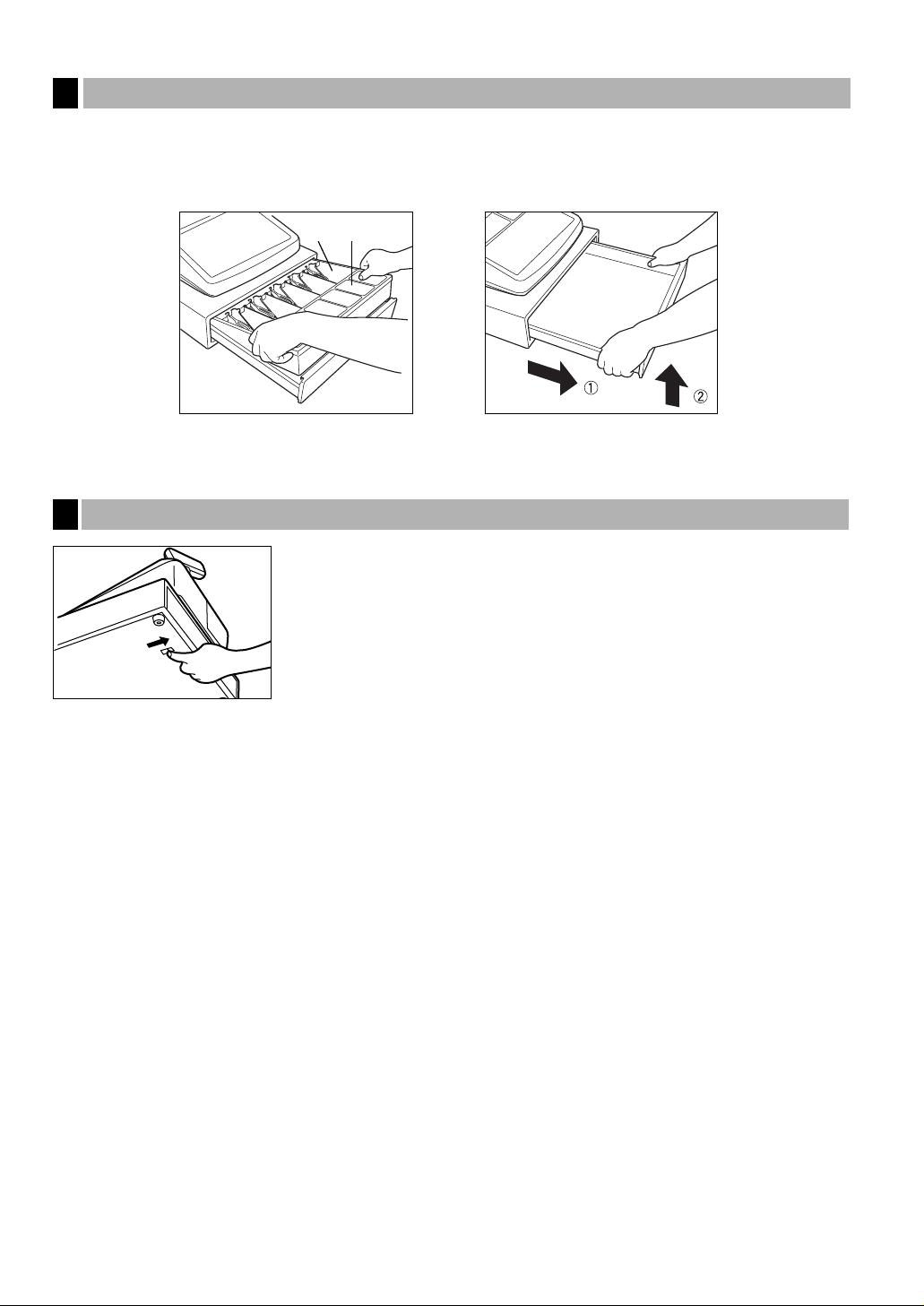
72
The till in the register is detachable. After closing your business for the day, remove the till from the drawer and
keep the drawer open. To detach the drawer, pull it forward fully with the till removed. And remove it by lifting it
up. The 6-denomination coin case is detachable.
The drawer automatically opens. However, when a power failure occurs or the
machine becomes out of order, slide the lever located on the bottom of the
machine in the direction of the arrow. (See the figure at the left.)
The drawer will not open if it is locked with the key.
Lever
Opening the Drawer by Hand
8
Till
Coin case
Removing the Till and the Drawer
7
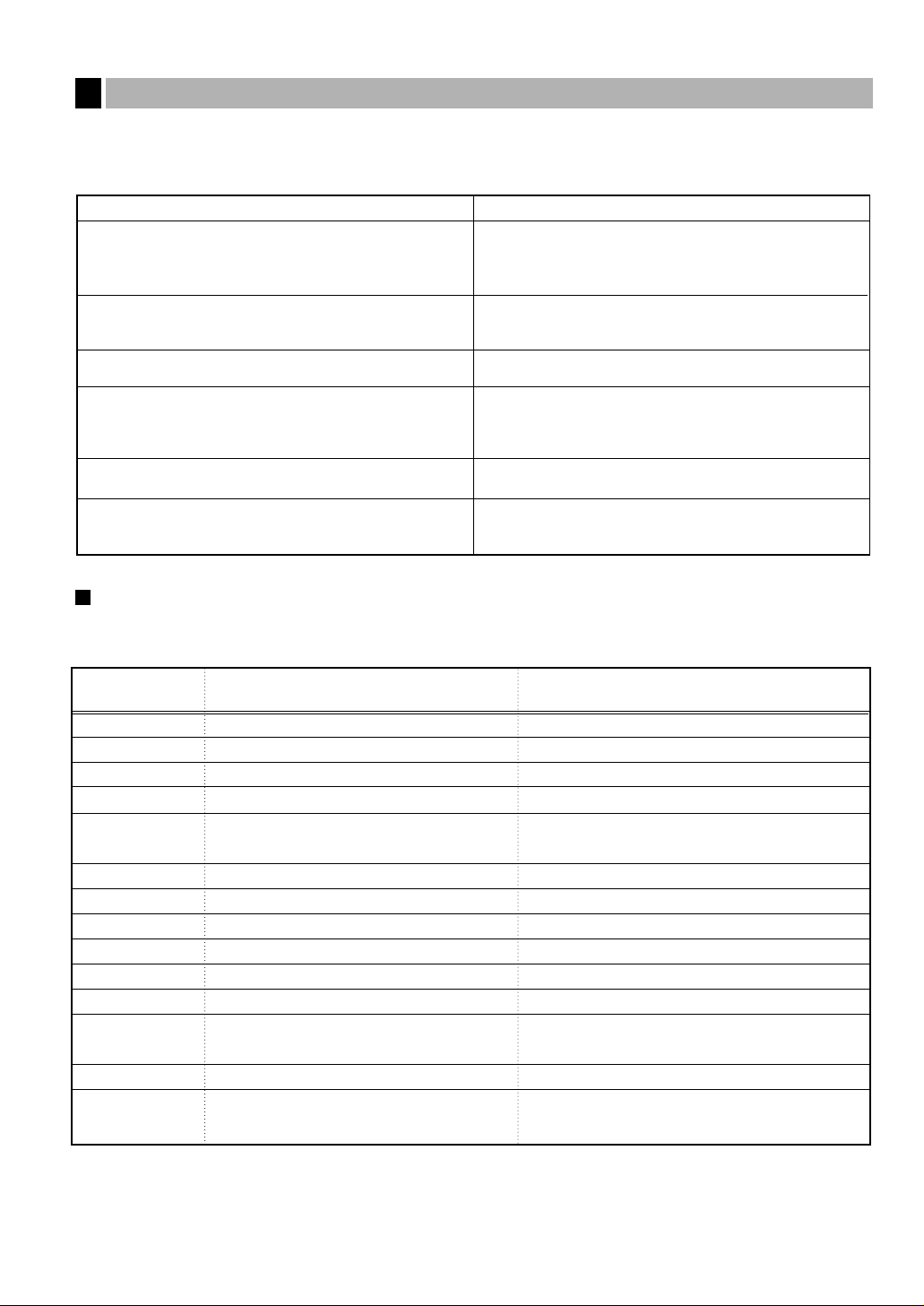
73
The malfunctions shown in the left-hand column below, labelled “Fault,” do not necessarily indicate functional
faults of the machine. It is therefore advisable to refer to “Checking” shown in the right-hand column before
calling for service.
Error message table
When the following error messages are displayed, press the
l
key and take a proper action according to the
table below.
Fault Checking
The display won’t illuminate even when the mode switch
is turned to any other position than “OFF”.
• Is power supplied to the electrical outlet?
• Is the power cord plug out or loosely connected to the
AC outlet?
(2)
The display shows symbols that do not make sense. • Has the machine been initialized properly as shown in
“GETTING STARTED”?
(Note that initialization clears all the data and programmed
settings stored in memory.)
(1)
The display is illuminated, but the whole machine
refuses registrations.
• Is a clerk code assigned to the register?
• Is the mode switch set properly at the “REG” position?
(3)
No receipt is issued. • Is the paper roll properly installed?
• Is there a paper jam?
• Is the receipt function in the “OFF” status?
• Is the print roller arm securely locked?
(4)
No journal paper is taken up. • Is the take-up spool installed on the bearing properly?
• Is there a paper jam?
(5)
Printing is unusual. • Is the paper roll properly installed?
• Is the print roller arm securely locked?
• Are the print head/sensor/roller clean?
(6)
Before Calling for Service
9
Error message Error status Action
ENTRY ERROR Registration error Make a correct key entry.
MISOPERATION Misoperation error Make a correct key entry.
NO RECORD Undefined code is entered. Enter a correct code.
MEMORY FULL Memory is full (in the
a
key programming). Program the
a
key within 25 steps.
SBTL COMPUL. Compulsory depression of the
s
key for Press the
s
key and continue the operation.
direct finalization
TEND COMPUL. Compulsory tendering Make a tendering operation.
NOT ASSIGNED No entry of a clerk code Make a clerk code entry.
OVER LIMIT. Overflow limitation error Make a registration within a limit of entry.
INH. OPEN PR The open price entry is inhibited. Make a preset price entry.
INH. UNIT PR The preset price entry is inhibited. Make an open price entry.
NOT NON-TEND The direct finalization is inhibited. Make a tendering operation.
BUFFER FULL Subtotal void is not allowed. Finalize the transaction, and correct the wrong
entries in the
void mode.
HEAD UP Print roller arm is lifted up. Make sure the print roller arm is surely locked.
PAPER EMPTY Receipt or journal paper roll is not Install a receipt or journal paper.
installed or empty.

74
SPECIFICATIONS
Model: XE-A302
Dimensions: 16.6 (W) x 16.9 (D) x 11.7 (H) in. (421 (W) x 429 (D) x 297 (H) mm)
Weight: 27.6 Ib (12.5 kg)
Power source: 120V AC ± 10%, 60 Hz
Power consumption: Stand-by 8 W
Operating 30 W (max.)
Working temperature: 32 °F to 104 °F (0 °C to 40 °C)
Electronics: LSI (CPU) etc.
Built-in battery: Rechargeable batteries, memory holding time about 1 month
(with fully charged built-in batteries, at room temperature)
Display:
Operator display: Dot matrix display (16 positions and 2 lines)
Customer display: 7-segment display (7 positions)
Printer:
Type: One-station thermal printer
Printing speed: Approx. 14 lines/second
Printing capacity: 24 digits for receipt/journal paper
Other functions: • Graphic logo printing function
• Logo message function
• Receipt (ON-OFF) function
• Compression printing function
Paper roll: Width: 2.25 ± 0.02 in (57.5 ± 0.5 mm)
Max. diam.: 3.15 in (80 mm)
Quality: High quality (0.06 to 0.08 mm thickness)
Cash drawer: 5 slots for bill and 6 for coin denominations
Accessories: Manager key 2
Operator key 2
Drawer lock key 2
Paper roll 1
Take-up spool 1
RS-232C cable (QCNWG3190BHZZ) 1
Fixing tape for peripherals 1 set
Keyboard sheet 1 (mounted on the keyboard)
Keyboard sheet for text programming 1 (mounted on the keyboard)
Customer support tool 1 disk
Quick Start Guide 1 copy
Instruction manual 1 copy
* Specifications and appearance subject to change without notice for improvement.
75
Function
TextUnit price
Dept.
code
BR G CM T4 T3 T2 T1 SICS SIGN LMT ENT
ABCDEFGH I JK
01000010053Ex.5 FRUIT100
Programming sheet for departments (Please make copies of this sheet.)
For details of programming, refer to pages 33, 34, and 44.
Unit price Max. 6 digits
Function
A BR (bottle return) Bottle return: 1, Normal: 0
B G (group number) 0 to 9 (0: non group)
C CM (commission group numer) 0 to 2 (0: non commission)
D-G T4 - T1 (taxable 4 - taxable 1) Taxable: 1, Non-taxable: 0
H SICS (single item cash sale) SICS: 1, Normal: 0
I SIGN Negative dept.: 1, Positive dept.: 0
J LMT (entry digit limit) 0 to 7 digits
K ENT (entry method) Open and preset: 3, Preset only: 2, Open only: 1, Inhibit: 0
Text Max. 16 digits
76
Function
Text
Unit price/
Limit amount
PLU
code
Associated
dept.
CM TYPE
AB
11MELONEx. 1 125 1
Programming sheet for PLUs/subdepartments (Please make copies of this sheet.)
For details of programming refer to pages 35, 36 and 44.
Unit price/Limit amount Max. 6 digits
Enter unit price for PLUs.
Enter entry limit amount for subdepartments.
Function
A CM (commission group number) 0 to 2 (0: non commission)
B TYPE (PLU/subdepartment selection) 1: PLU, 0: Subdepartment
Text Max. 16 digits
1
English
Español
INTRODUCCION
Le agradecemos la adquisición de la caja registradora electrónica SHARP modelo XE-A302.
Sírvase leer este manual detenidamente antes de hacer funcionar la caja registradora para familiarizarse y
comprender por completo sus funciones y características.
Guarde este manual para futura referencia dado que le servirá de ayuda en caso de tener algún problema de
funcionamiento con la caja registradora.
Asegúrese de inicializar la caja registradora antes de ponerla en funcionamiento. De lo contrario, se
perturbará el contenido de la memoria y se producirá el mal funcionamiento de la caja registradora. Para ver
los procedimientos, consulte la página 7.
IMPORTANTE
• En la cubierta de la impresora, un cortador de papel está montado. Tenga mucho cuidado de no
cortarse con el cortador de papel.
• Instale la caja registradora en un lugar en el que no esté expuesta a radiaciones directas, cambios
anormales de temperatura, alta humedad o en contacto con agua. Mantenga la caja registradora
apartada del calor y fuentes magnéticas.
Si la instala en estos lugares, podría originar daños en la caja y en los componentes eléctricos.
• No opere nunca la caja registradora con las manos mojadas.
El agua podría filtrarse al interior de la registradora y causar averías en sus componentes.
• Cuando limpie la caja registradora, utilice un paño suave y seco. No use nunca líquidos volátiles
como por ejemplo bencina y/o disolventes.
La utilización de estos productos químicos hará que la caja pierda color o sufra daños.
• La registradora debe enchufarse a cualquier tomacorriente normal de pared (120V CA ±10%) con un
protector de tierra exclusivo.
Otros aparatos eléctricos enchufados en el mismo circuito eléctrico pueden hacer que la registradora
funcione mal.
• Si la caja registradora no funciona como debiera, solicite el servicio llamando al 1-800-BE-SHARP.
No intente reparar la caja registradora usted mismo.
• Para desconectar por completo la alimentación eléctrica, desenchufe el cable de alimentación de CA
del tomacorriente de pared.
PRECAUCION
Esta caja registradora electrónica tiene un circuito de protección de la memoria incorporado que funciona
mediante baterías.
Tenga presente que todas las baterías con el tiempo se desgastan aunque no se utilicen. Por lo tanto, para
asegurarse una carga inicial adecuada en el circuito de protección y evitar cualquier pérdida de la memoria
una vez instalada la máquina, se recomienda recargar cada caja durante un período de 24 a 48 horas antes
de ser utilizada por el cliente.
Después de la instalación, se cargan las baterías cuando se enchufa la máquina y se pone el selector de
modo en la posición ON (una que no sea la posición OFF). Esta precaución relativa a la recarga evitará
llamadas iniciales innecesarias al servicio técnico.
¡PRECAUCION!
Línea directa de asistencia a
los clientes
1-800-BE-SHARP
Para realizar la configuración
con facilidad, vea el apartado
“PARA EMPEZAR” (página 7).

INDICE
INTRODUCCION............................................................................................................................................1
IMPORTANTE................................................................................................................................................1
PRECAUCION ...............................................................................................................................................1
INDICE ..........................................................................................................................................................2
PARTES Y SUS FUNCIONES.......................................................................................................................3
PARA EMPEZAR...........................................................................................................................................7
REGISTRO BASICO DE VENTAS ................................................................................................................8
1 Ejemplo de registro básico de ventas ...................................................................................................8
2 Aviso de error ........................................................................................................................................9
3 Registros de artículos..........................................................................................................................10
Registros de un solo artículo ........................................................................................................10
Registros repetidos.......................................................................................................................10
Registros de multiplicación...........................................................................................................10
Registros de precios divididos......................................................................................................11
Registros de venta en metálico de un solo artículo (SICS) ..........................................................11
4 Visualización de los subtotales ...........................................................................................................11
5 Finalización de una transacción ..........................................................................................................12
6 Cálculo de los impuestos ....................................................................................................................12
CARACTERISTICAS OPCIONALES ..........................................................................................................13
1 Registros auxiliares .............................................................................................................................13
2 Tratos de pagos auxiliares ..................................................................................................................14
3 Registros con tecla de secuencia automática (tecla
a
)....................................................................15
CORRECCION.............................................................................................................................................16
PROGRAMACION DE LAS FUNCIONES BASICAS (Para el inicio rápido)............................................17
1 Programación de la fecha y de la hora................................................................................................17
2 Programación de los impuestos para la función de cálculo automático de los impuestos..................17
PROGRAMACION DE FUNCIONES AUXILIARES ....................................................................................19
1 Programación de secciones ................................................................................................................20
2 Programación de PLU (codificación de precios) y subsección ...........................................................21
3 Programación de la tasa de comisión .................................................................................................22
4 Programación de teclas misceláneas..................................................................................................22
5 Programación de texto ........................................................................................................................25
PROGRAMACION AVANZADA..................................................................................................................29
1 Programación de número de caja registradora y de números consecutivos ......................................29
2 Programación 1 de selección de diversas funciones ..........................................................................30
3 Programación 2 de selección de diversas funciones ..........................................................................33
4 Lectura de programas almacenados...................................................................................................36
MODO DE INSTRUCCION ..........................................................................................................................36
LECTURA (X) Y REPOSICION (Z) DE LOS TOTALES DE VENTAS .......................................................37
LECTURA Y REPOSICION DE INFORMES EJ..........................................................................................38
REGISTROS DE ANULACION....................................................................................................................39
CORRECCION DESPUES DE FINALIZAR UNA TRANSACCION (Modo de cancelación).....................39
MANTENIMIENTO PARA EL OPERADOR.................................................................................................40
1 En caso de corte de la alimentación ...................................................................................................40
2 En el caso de error de impresora ........................................................................................................40
3 Precauciones al manejar la impresora y el papel de registro..............................................................40
4 Reemplazo del rollo de papel..............................................................................................................41
5 Extracción del papel atascado ............................................................................................................42
6 Limpieza de la impresora (cabezal de impresión / sensor / rodillo) ....................................................43
7 Extracción del separador de dinero y del cajón ..................................................................................43
8 Abertura manual del cajón ..................................................................................................................43
9 Antes de solicitar el servicio de un técnico..........................................................................................44
2
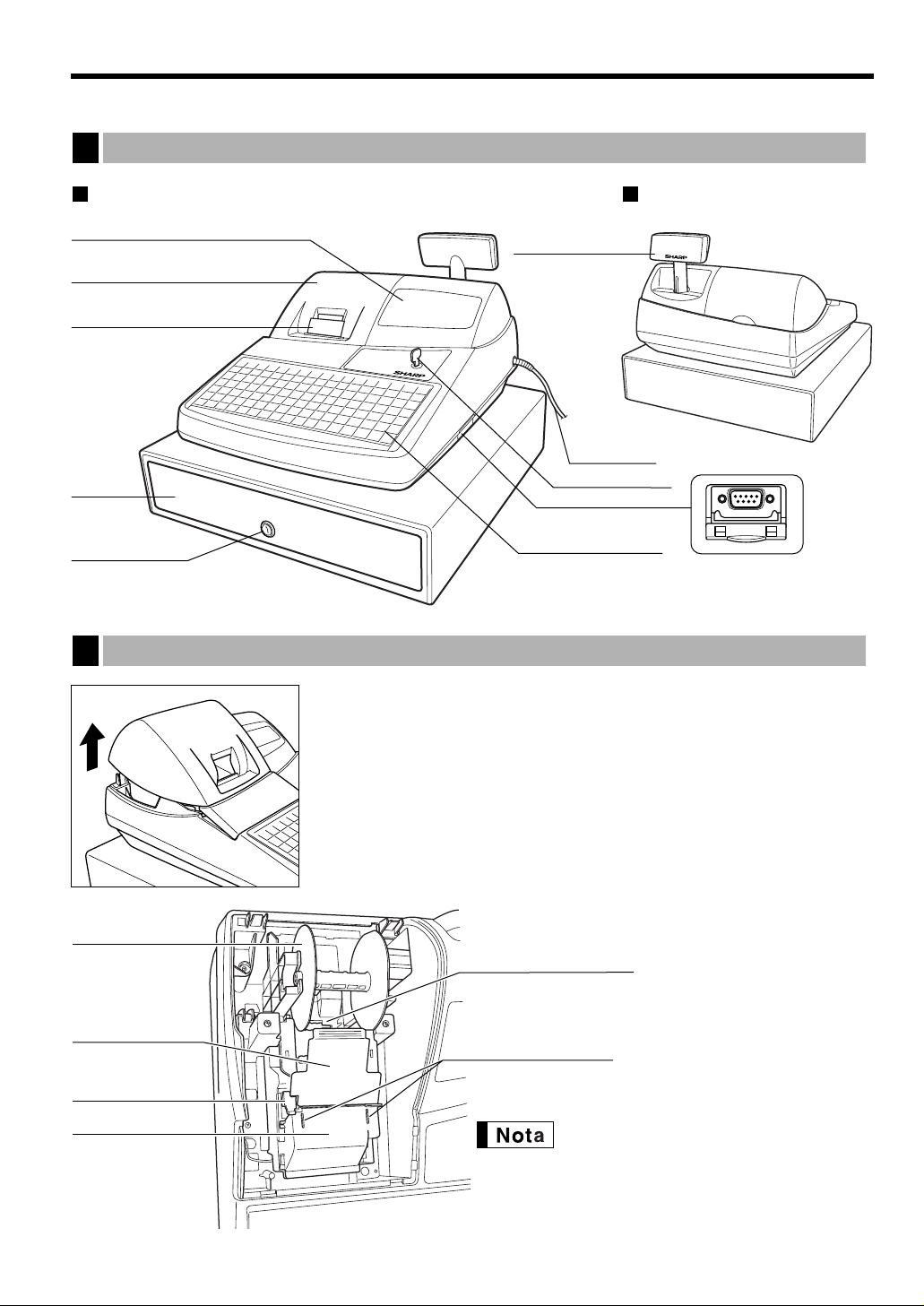
3
PARTES Y SUS FUNCIONES
Vista delantera Vista trasera
Vista exterior
1
La impresora es una impresora térmica de una estación, y por lo tanto no
requiere ningún tipo de cartucho ni cinta entintada.
Levante la parte posterior de la cubierta de la impresora para extraerla. Para
volver a instalar la cubierta de la impresora, engánchela en los trinquetes que
hay en la caja y ciérrela.
Precaución: El cortador de papel está montado en la cubierta de la
impresora. Tenga mucho cuidado de no cortarse por
accidente.
Impresora
2
Conector RS-232C
Visualizador para el operador
Papel de recibos
Cerradura
del cajón
Cajón
Cubierta de la impresora
Visualizador para el
cliente (tipo saliente)
Selector de modo
Cable de
alimentación
Teclado
Carrete de toma
Palanca de
liberación del
rodillo impresor
Brazo del
rodillo impresor
Cubierta interior
Soporte del rollo de papel
Guías de papel
No intente quitar el rollo de papel con el
brazo del rodillo impresor bloqueado. Esto
podría causar daños en la impresora y en
su cabezal.
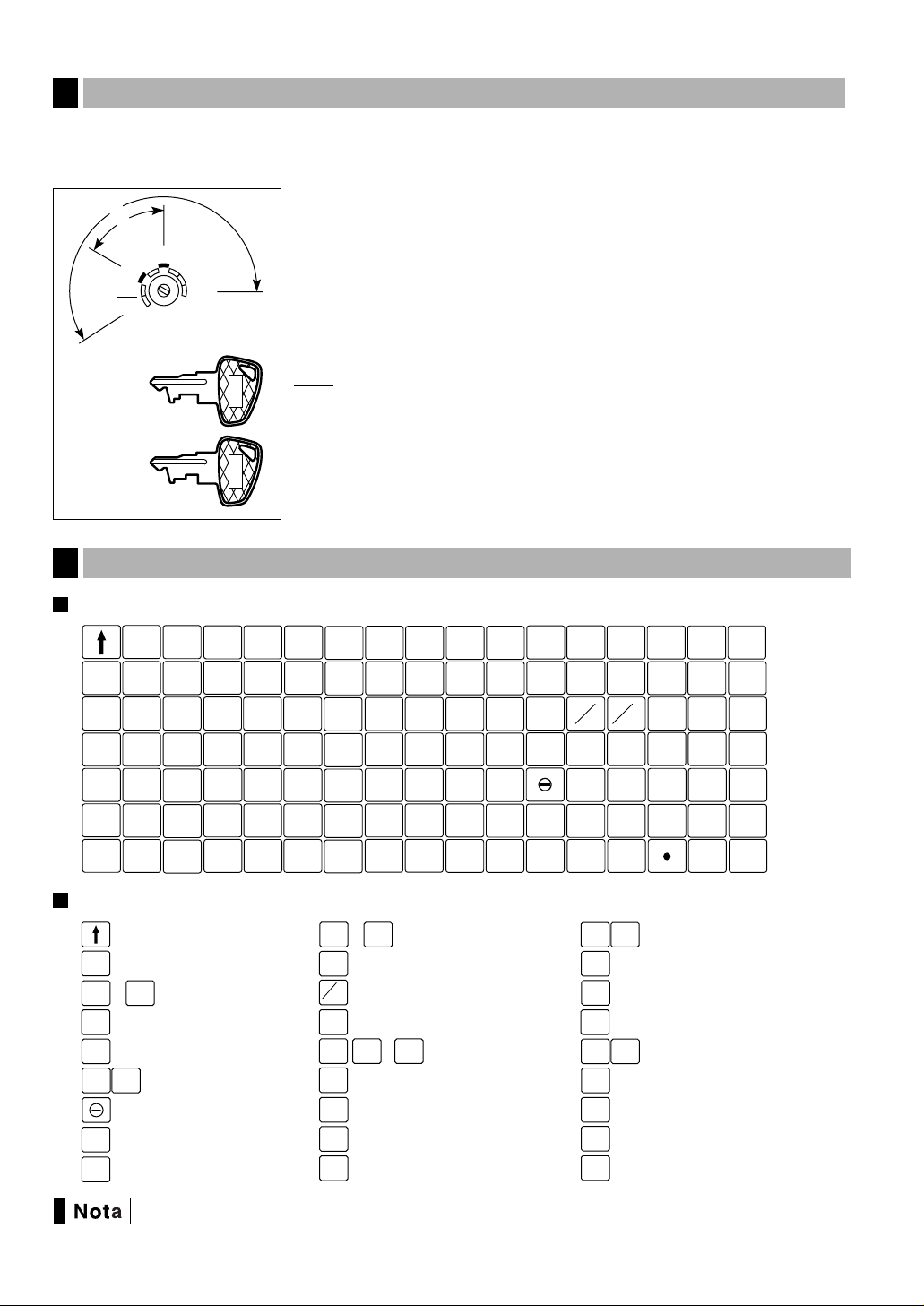
4
El selector de modo funciona insertando una de las dos llaves de modo suministradas: la llave del administrador
(MA) y la del operador (OP). Estas llaves pueden insertarse o sacarse sólo cuando el selector esté en la
posición “REG” u “OFF”.
El selector de modo tiene estos ajustes:
OFF: Este modo bloquea todas las operaciones de la caja. (La
alimentación de CA está desconectada.)
No hay cambios en los datos registrados.
OP X/Z: Para sacar informes X o Z de dependiente individual, y para sacar
informes rápidos. Puede usarse para alternar el estado “ON” u
“OFF” de emisión de recibos pulsando la tecla
R
.
REG: Para registrar ventas.
PGM: Para programar diversos artículos.
VOID
: Para establecer la caja registradora en el modo de cancelación.
Este modo permite la corrección después de haber finalizado una
transacción.
MGR: Para los registros del administrador. El administrador puede usar
este modo para un registro de anulación.
X1/Z1: Para sacar el informe X/Z de varios totales diarios.
X2/Z2: Para sacar el informe X/Z de consolidación periódica (semanal o
mensual).
Disposición del teclado
Nombres de las teclas
En este manual, la parte superior de las teclas se muestra en una línea, como
p
, para poder
leerlas fácilmente. Se muestran las teclas de sección como
!
, y se indican las teclas numéricas
con la indicación de números sencillos, como 1, a menos que se especifique de otro modo.
Teclado
4
PGM
VOID
OFF
OP
X/Z
REG
MGR
X
1/Z1
X2/Z2
OP
MA
MA
OP
Llave del administrador (MA)
Llave del operador (OP)
Selector de modo y llaves de modo
3
RCPT
/PO
CA/AT
Tecla de impresión de
registro diario electrónica
Tecla de impresión de
recibos/pagos
Tecla de cancelación
Tecla de conversión
Tecla de multiplicación
Tecla del punto decimal
Tecla de borrado
Tecla de registro de código
de sección
Tecla de codificación de
precios (PLU)/subsección
Tecla de registro de código
de dependiente
Teclas de sección
~
~
Teclas numéricas
90
00
VOID
@
FOR
CL
•
CONV
RFND
Tecla de devolución
%1
%2
Teclas de porcentaje 1
y 2
Tecla de descuento
PLU
/SUB
DEPT
#
TAX1
SHIFT
Tecla de subtotal de
mercancías
MDSE
SBTL
Tecla de código de no suma/
visualización de la hora/subtotal
Tecla de total/importe
recibido/no venta
#/TM
SBTL
CLK
#
Tecla de impuestos
Tecla de secuencia automática
AUTO
CH1 CH2
16
TAX2
SHIFT
Teclas de cambio de
impuestos 1 y 2
Teclas de carga 1 y 2
Tecla de suministro de papel
E/J
PRINT
Teclas de codificación de
precios (PLU) directas
~
175
ESC
Tecla de escape
RA
Tecla de recibido a cuenta
Tecla de cheque
CHK
TAX
1234567891011
12 13 14 15 16 17 18 19 20 21 22
23 24 25 26 27 28 29 30 31 32 33
34 35 36 37 38 39 40 41 42 43 44
45 46 47 48 49 50 51 52 53 54 55
56 57 58 59 60 61 62 63 64 65 66
67 68 69 70 71 72 73 74 75
1
2
3
4
5
6
0
1
2
3
456
78
9
CL
00
FOR
@
SUB
PLU
CA/AT
ESC
RA
CONV
CH2
CHK
AUTO
TAX
CH
1
%1
%2
RFND
VOID
E/J
PRINT
CLK
#
DEPT
#
TAX1
SHIFT
TAX2
SHIFT
#/TM
SBTL
MDSE
SBTL
RCPT
/PO
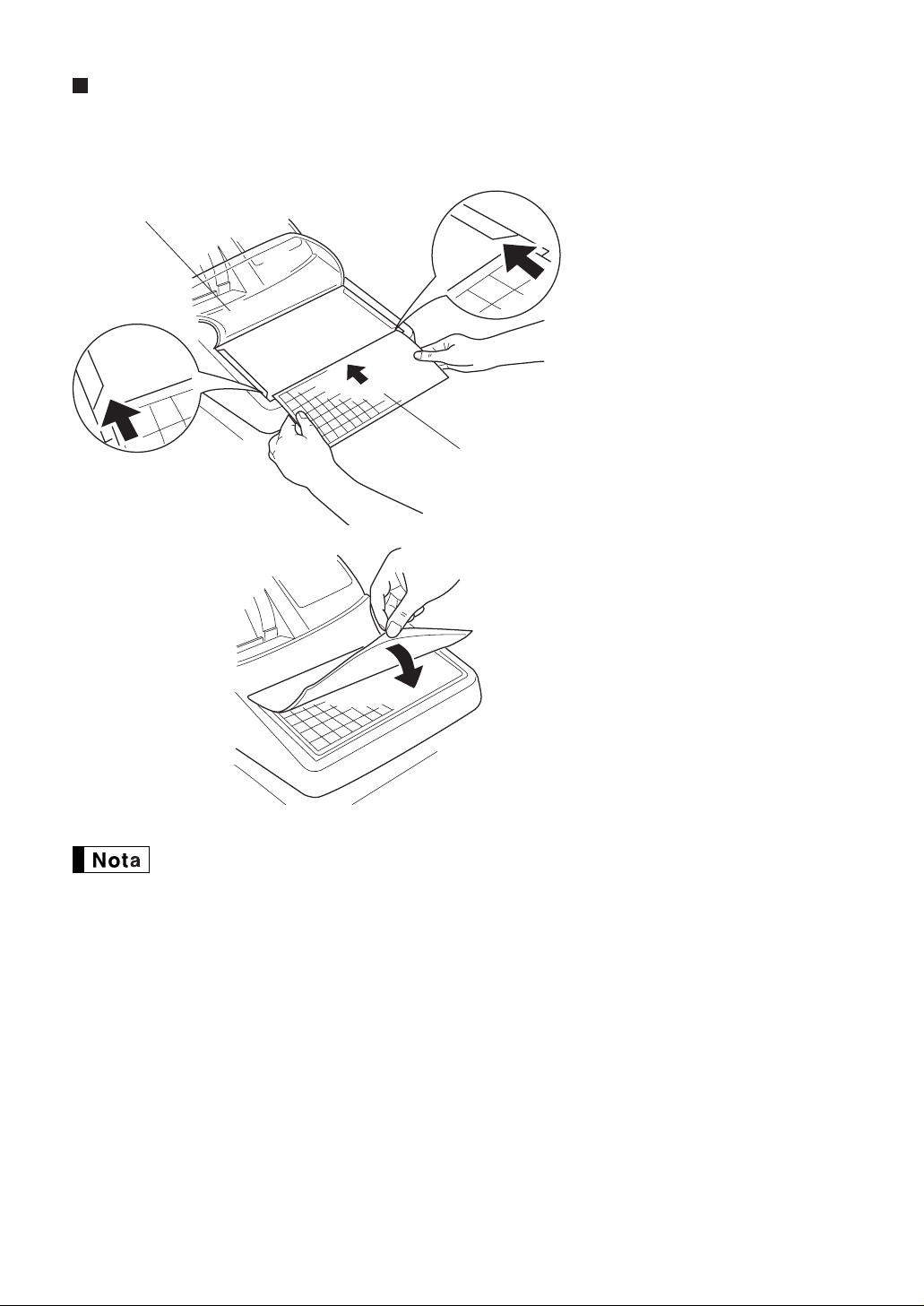
5
Lámina del teclado
Hay dos tipos de las láminas del teclado que se instalan en la caja registradora; uno para el uso normal y el otro
para la programación del texto.
Para volver a instalar la lámina del teclado o una lámina nueva, siga el procedimiento de abajo.
• No abra demasiado la cubierta del teclado porque podrían romperse los ganchos.
• Reemplace la lámina del teclado por otra nueva si se moja por cualquier motivo. El empleo de
una lámina del teclado mojada puede causar problemas.
• Asegúrese de emplear sólo láminas de teclado suministradas por SHARP. Las láminas gruesas o
duras pueden dificultar la operación de las teclas.
• Coloque bien la lámina del teclado debajo de la cubierta del teclado.
• Si necesita una lámina de teclado nueva, llame el servicio de clientes.
• La cubierta del teclado se desgasta con el tiempo. Si la cubierta del teclado está sucia o rota,
reemplácela por otra nueva. Para detalles al respecto, llame el servicio de clientes.
Lámina del teclado
Cubierta del teclado
➀
Levante la cubierta del teclado.
➁
Inserte la lámina del teclado en una
ranura.
➂
Vuelva a poner la cubierta del teclado
en su sitio.
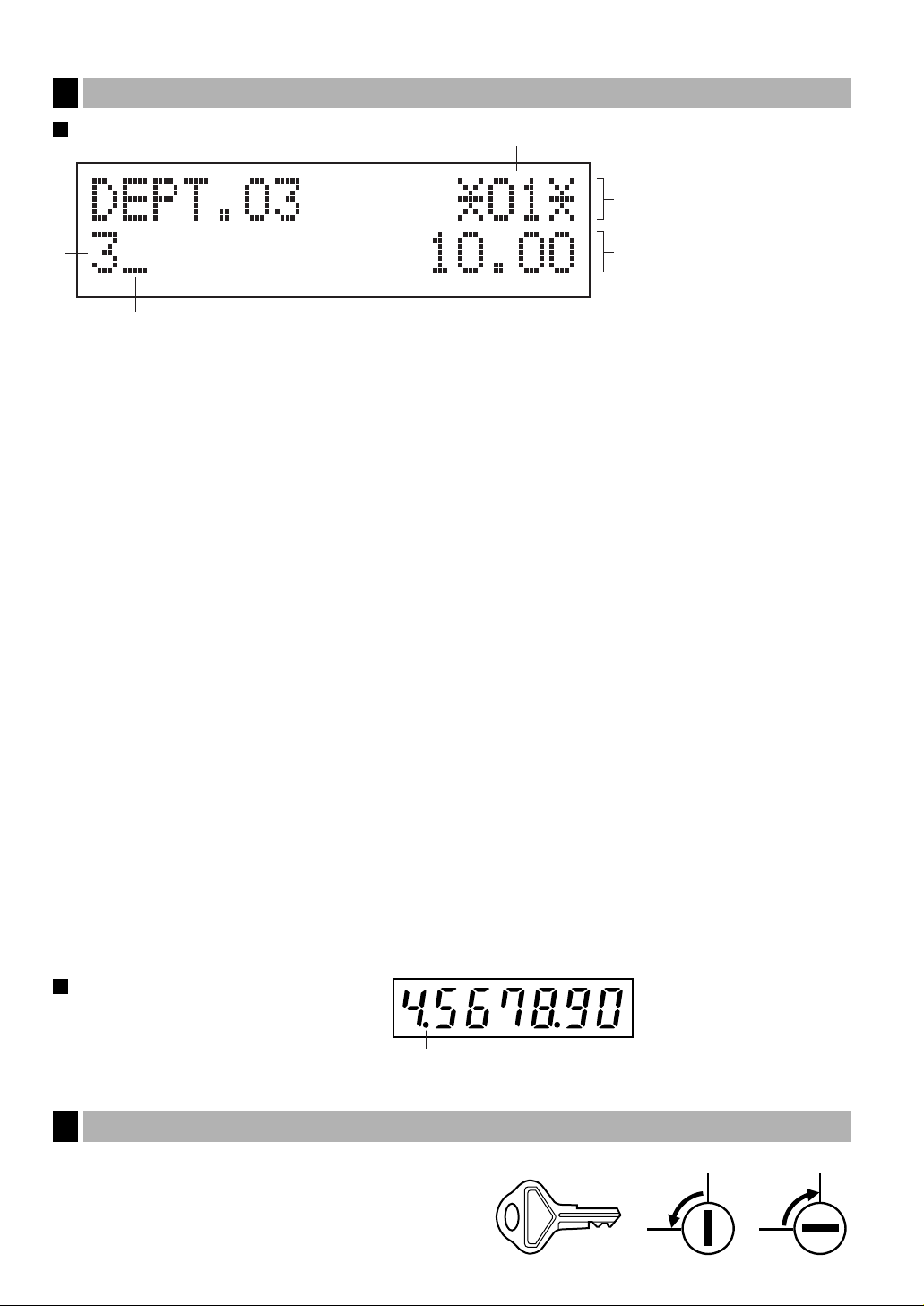
6
Esta llave bloquea y desbloquea el cajón. Para bloquear el
cajón, gire la llave 90 grados hacia la izquierda. Para
desbloquearlo, gírela 90 grados hacia la derecha.
Llave de la cerradura del cajón
6
Visualizador para el operador
• Código de dependiente o nombre de modo
Se visualiza el modo en el que ahora se encuentre. Cuando se asigna un dependiente, se visualiza el
código de dependiente en el modo REG u OP X/Z. Por ejemplo, se visualiza “?01?” cuando se asigna
el dependiente 01.
• Marca de repetición
Se visualiza el número de repeticiones, empezando por “2” y se incrementa con cada repetición.
Cuando haya registrado diez veces, el visualizador mostrará “0”. (2 ➞ 3 ......9 ➞ 0 ➞ 1 ➞ 2...)
• Marca centinela
Cuando el importe en el cajón llega al importe que haya programado, la marca centinela “X” se visualiza
para avisarle que ponga el dinero en un lugar seguro.
• Marca de ahorro de energía
Cuando la caja registradora se establece en el modo de ahorro de energía, se enciende la marca de
ahorro de energía (punto decimal).
• Area de visualización de mensajes de función
Se visualizan las etiquetas de artículos de secciones y PLU/subsecciones y textos de función que usted
usa, como por ejemplo, %1, (-), y CASH: Para los detalles de los textos de función, consulte la página 28.
Cuando se debe introducir o se introduce un importe, se visualiza “AMOUNT”. Cuando se debe
introducir un importe, se visualiza ------- en el área de registro numérico con “AMOUNT”. Cuando ha sido
ajustado un precio preajustado, se visualiza el precio en el área de registro numérico con “AMOUNT”.
• Area de visualización de registro numérico
Aquí se visualizan los números que se introducen empleando las teclas numéricas.
Visualización de la fecha y de la hora
La fecha y la hora aparecen en el visualizador en el modo OP X/Z, REG, o MGR. En el modo REG o MGR,
pulse la tecla
s
para visualizar la fecha y la hora.
Mensaje de error
Cuando ocurre un error, se visualiza el mensaje de error correspondiente en el área de visualización de
mensajes de función. Para los detalles de los mensajes de error, consulte el apartado de “Tabla de
mensajes de error” de la página 44.
Visualizador para el cliente
(tipo saliente)
Marca de ahorro de energía (Se enciende la marca
sólo en el modo de ahorro de energía.)
Visualizaciones
5
SK1-1
Bloqueo
Desbloqueo
Area de visualización de
mensajes de función
Código de dependiente/nombre de modo
Area de visualización de
registro numérico
Indicador de desactivación (OFF) de recibos
Repetición / marca centinela / marca de ahorro de energía
7
PARA EMPEZAR
Para que la caja registradora pueda funcionar correctamente, deberá inicializarla antes de ponerla en
funcionamiento por primera vez. Siga el procedimiento siguiente.
1. Asegúrese de que la clavija del cable de alimentación no esté enchufada en la toma de corriente de CA.
2. Inserte la llave de administrador (MA) en el selector de modo y gírelo a la posición PGM.
3. Mientras mantiene pulsadas la tecla
F
y la tecla
/
, enchufe la clavija en la toma de corriente de CA. El
zumbador sonará tres veces y se visualizará “??? MRS. ???”.
4. La caja registradora habrá quedado ahora inicializada. El visualizador de la caja registradora mostrará “0.00”
con “PGM”.
La caja registradora tiene un circuito de protección de la memoria incorporado que funciona
mediante baterías. Puesto que se han descargado las baterías, cargue las baterías durante uno o
dos días antes de usar la caja registradora por primera vez. Para cargar las baterías, ponga el
selector de modo en una posición que no sea “OFF” con el cable de alimentación enchufado en la
toma de corriente de CA. A menos que se hayan cargado las baterías, no se almacenan todos los
datos programados y los datos de ventas.
Precaución: El cortador de papel está montado en la cubierta de la impresora. Tenga mucho cuidado al
instalar rollos de papel.
1. Empuje la cubierta de la impresora hacia delante y sepárela.
2. Levante la palanca de liberación del rodillo impresor para desbloquear y abrir el brazo del rodillo impresor.
3. Ponga un rollo de papel en el soporte del rollo de papel.
4. Haga avanzar el extremo del papel junto con las guías de papel.
5. Mientras mantiene retenido el papel, cierre lentamente el brazo del rodillo impresor, y empuje el brazo hacia
abajo hasta oír un sonido seco de confirmación. Asegúrese que empuja con seguridad el centro de la parte
del ala del brazo. El papel avanzará automáticamente.
Si el brazo del rodillo impresor no está bloqueado correctamente, no se podrá imprimir con éxito. Si
ocurre este problema, abra el brazo, y ciérrelo de nuevo como se ha indicado arriba.
6. Cuando no emplee el carrete de toma (empleo como papel de recibos):
• Corte el papel sobrante empleando el borde de la cubierta interior, y vuelva a colocar la cubierta de la
impresora. Pulse la tecla
F
para asegurarse que el papel sale por la cubierta de la impresora y que
aparece papel limpio.
Si no sale el papel, extraiga la cubierta de la impresora, y haga pasar el extremo del papel entre el
cortador de papel y las guías de papel de la cubierta de la impresora, y luego vuelva a colocar la
cubierta.
Cuando emplee el carrete de toma (empleo como papel de registro diario):
• Inserte el extremo del papel en la ranura del carrete. (Pulse la tecla
F
para hacer avanzar más el papel si
es necesario.)
• Bobine el papel dos o tres vueltas en torno al eje del carrete.
• Coloque el carrete en el rodamiento, y pulse la tecla
F
para tensar el papel.
• Vuelva a colocar la cubierta de la impresora.
Cuando emplee un rollo de papel como papel de registro diario, deberá cambiar el estilo de
impresión. Consulte el apartado de “Formato de impresión” de la sección “Programación 1 de
selección de diversas funciones” (Código de tarea 6) para cambiar el estilo de impresión.
La caja registradora le ofrece los idiomas inglés, francés y español para el texto. El idioma
preajustado es el inglés. Si desea cambiar el idioma, deberá cambiarlo antes de realizar la
programación. Consulte el apartado de “Selección del idioma” de la sección “Programación 2 de
selección de diversas funciones” para cambiar el idioma.
Antes de poder seguir con el registro de las ventas, deberá programar:
•la fecha • la hora • los impuestos
Consulte la sección de PROGRAMACION DE LAS FUNCIONES BASICAS para encontrar más detalles (página 17).
Aunque la caja registradora viene ya programada para utilizarla con la mínima configuración, la máquina le
ofrece funciones opcionales. Antes de comenzar la programación, lea la sección de operaciones de ventas
para entender las funciones opcionales.
Programe otros elementos necesarios.
4
Programe la fecha, la hora y los impuestos.
3
Instale un rollo de papel.
2
Inicialice la caja registradora.
1

8
REGISTRO BASICO DE VENTAS
A continuación se muestra un ejemplo de registro básico de ventas en metálico de artículos. Para los detalles
de la operación, consulte cada sección respectiva.
Ajuste del selector de modo
1. Gire el selector de modo a la posición REG.
Asignación de dependientes
2. Introduzca su código de dependiente. (Por ejemplo, si el código de dependiente
es el 1. Introduzca 1 empleando la tecla numérica y pulse la tecla
L
.) Se
selecciona automáticamente el código de dependiente 1 justo después de inicializar la caja registradora.
Registros de artículos
3. Introduzca el precio para el primer artículo de sección. (Por ejemplo, para 15,00, introduzca 1500
empleando las teclas numéricas, y pulse la tecla de la sección correspondiente.)
Para la sección 7 y posteriores, introduzca el código de sección empleando las teclas numéricas, y pulse
la tecla
d
, y luego introduzca el precio y pulse de nuevo la tecla
d
.
4. Repita el paso 3 para todos los artículos de sección.
Visualización de subtotales
5. Pulse la tecla
s
para visualizar el importe a cobrar.
Finalización de la transacción
6. Introduzca el importe recibido del cliente. (Podrá omitir este paso si el importe recibido es el mismo que el
subtotal.)
7. Pulse la tecla
A
, y se visualizará la vuelta (cuando no se ha introducido el importe recibido, se visualiza el
importe total) y se abrirá el cajón.
8. Corte el recibo y déselo al cliente con su vuelta.
9. Cierre el cajón.
Impresión en el reciboEjemplo de operación de teclas
Ejemplo de registro básico de ventas
1
REG
OPX/Z MGR
PGM
X1/Z1
X2/Z2
OFF
VOID
Membrete gráfico
Fecha/hora/código de
dependiente
Número de caja registradora/
número consecutivo/nombre de
dependiente
Artículos
Estado de impuestos
(T1: imponible 1)
Precio
Subtotal de
mercancías
No se imprime
cuando sólo se
venden artículos
no imponibles.
Importe de
impuestos
Importe total
Pago en metálico/importe recibido
Vuelta
Cantidad total
1 L
1500 !
*
2300
"
*
s
5000
A
Registros de
artículos
Asignación de
dependiente
Visualización
del subtotal
Finalización de
la transacción
*
!
y
"
:
(El este ejemplo, la tasa de impuestos está
ajustada a 6,25%.)
CLERK01
?
01
?
-01-
DEPT.01
?
01
?
15.00
DEPT.02
?
01
?
23.00
SUBTOTAL
?
01
?
40.38
?
01
?
5000
CHANGE
?
01
?
9.62
indican la teclas de sección.
PARA EL OPERADOR

9
Asignación de dependiente
Antes de los registros de artículos, los dependientes deberán asignar sus códigos de dependiente a la caja
registradora. Sin embargo, la entrada de códigos puede resultar innecesaria cuando el mismo dependiente
maneja las transacciones consecutivas.
Función de activación/desactivación (ON/OFF) de recibo
Podrá inhabilitar la impresión de recibos en el modo REG para ahorrar papel empleando la función de
activación/desactivación (ON/OFF) de recibo. Para desactivar la impresión de recibos, pulse la tecla
R
en la
posición OP X/Z. Esta tecla cambia el estado de impresión de recibos de ON a OFF.
Para emitir un recibo cuando la función de activación/desactivación (ON/OFF) de recibo está
desactivada (OFF):
Si el cliente quiere el recibo después de haber finalizado la transacción con la función de
activación/desactivación (ON/OFF) de recibo desactivada (OFF), pulse la tecla
R
.
Modo de ahorro de energía
La caja registradora se establecerá en el modo de ahorro de energía cuando no se efectúe ningún registro
basándose en el límite de tiempo ya programado (ajuste inicial de 30 minutos).
Cuando la caja registradora se establezca en el modo de ahorro de energía, se apagará toda la visualización
excepto el punto decimal de la posición de la izquierda de la línea inferior. La caja registradora volverá al modo
de operación normal al pulsar alguna tecla o al cambiar un modo con la llave de modo. Tenga presente que
cuando se recupere la caja registradora mediante una entrada con una tecla, esta entrada de tecla será
inválida. Después de la recuperación, inicie la entrada de teclas desde el principio.
L
Código de dependiente 1 a 40
Para visualizar el código de dependiente asignado
LL
■ Activación de identificación (en los modos de
REG, MGR, VOID)
■ Desactivación de identificación (en los modos
REG, MGR, VOID)
En los siguientes ejemplos, la caja registradora se establece en estado de error haciendo sonar un aviso
audible y visualizando el mensaje de error correspondiente. Anule el estado de error pulsando la tecla
l
y
tome las medidas oportunas.
Consulte la tabla de mensajes de error en la página 44.
• Registre un número de más de 32 dígitos (desborde del límite de registro): Cancele el registro y vuelva a
introducir un número correcto.
• Un error en la operación de teclas: Borre el error y continúe la operación.
• Un registro más allá del límite de registro de importes programado: Vea si el importe registrado es correcto. Si
es correcto, puede introducirse en el modo MGR. Llame al administrador.
• Un subtotal con impuestos incluido excede de ocho dígitos: Borre el subtotal pulsando la tecla
l
y pulse la
tecla
A
,
C
,
X
o
Y
para finalizar la transacción.
Función de escape de error
Para abandonar una transacción debido a un error o a un imprevisto, emplee la función de escape de error
como se muestra a continuación:
La transacción se cancela (se trata como un subtotal cancelado) y se emite el recibo mediante esta función. Si
ya había introducido el importe entregado para el pago, la operación se finaliza como una venta en metálico.
l
Transacción
Para cancelar el estado de error
E
E
Aviso de error
2
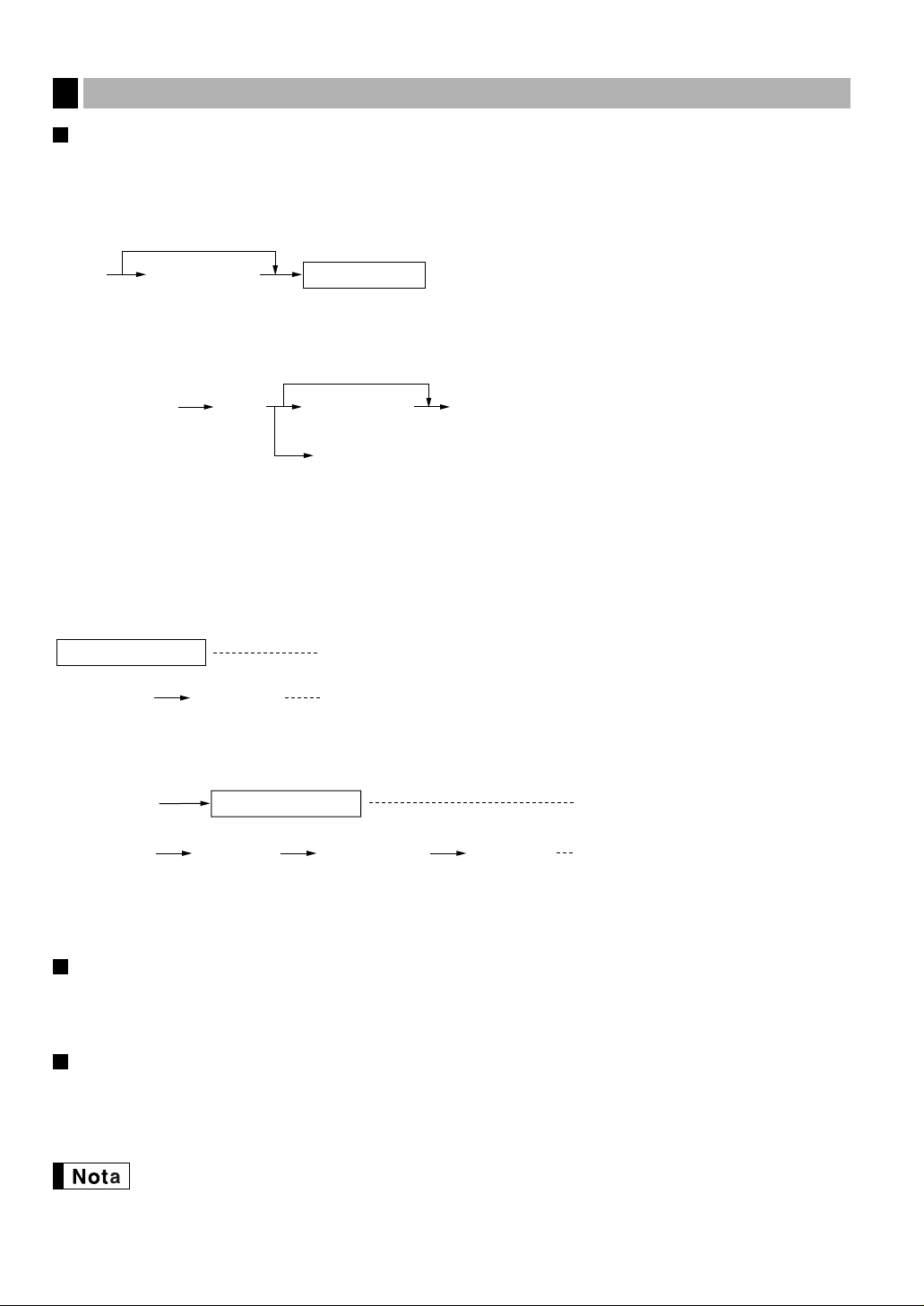
10
Registros de un solo artículo
Registros de sección
• Cuando se emplean las teclas de sección (para las secciones 1 a 6)
* Menos que los importes de límite superior
programado
Cuando se introduce cero, sólo se añade la
cantidad de ventas.
• Cuando se emplea la tecla de registro de código de sección
* Menos que los importes de límite
superior programado
Cuando se introduce cero, sólo se
añade la cantidad de ventas.
Registros de PLU/subsecciones
La caja registradora ya está programada para el modo PLU (perteneciendo a la sección 1) y cero para el precio
unitario. Para emplear registros de PLU, deberán haberse programado de antemano sus precios unitarios
preajustados.
Para emplear los registros de subsecciones, cambie al modo de subsección para los códigos de PLU.
• Registros de PLU
• Registros de subsección (PLU abierta)
* Menos que los importes de límite superior programado
Cuando se introduce cero, sólo se añade la cantidad de ventas.
Registros repetidos
Puede utilizar esta función para registrar una venta de dos o más artículos iguales. Repita la pulsación de una
tecla de sección, tecla
d
, tecla de PLU directa o una tecla
p
.
Registros de multiplicación
Cuando venda una gran cantidad de artículos, es conveniente emplear el método de registro de multiplicación.
Introduzca la cantidad empleando las teclas numéricas y pulse la tecla
@
antes de comenzar el registro de
artículos.
Cuando haya programado que se permite el registro de cantidad fraccionaria, podrá introducir
hasta cuatro dígitos enteros y tres dígitos decimales, aunque la cantidad se contará como uno para
los informes de ventas. Para introducir cantidades fraccionarias, emplee la tecla del punto decimal
entre los enteros y los decimales.
Código de PLU
(1 a 1.800)
p
Precio unitario*
(máx. 7 dígitos)
p
Registro de la tecla directa
Registro del código de PLU
Tecla de PLU directa
Precio unitario*
(máx. 7 dígitos)
Código de PLU
(1 a 1.800)
Registro de la tecla directa
p
Tecla de PLU directa
Registro del código de PLU
Código de sección
(1 a 99)
Precio unitario *
(máx. 7 dígitos)
Cuando utilice un precio unitario programado
(En caso de que sólo esté permitido
el registro de precio preajustado.)
dd
Tecla de sección
Precio unitario *
(máx. 7 dígitos)
Cuando utilice un precio unitario programado
Registros de artículos
3
11
Registros de precios divididos
Esta función es práctica cuando un cliente desea comprar artículos que normalmente se venden en lotes. Para
llevar a cabo esta función, deberá cambiar el ajuste programado. Consulte el apartado “Programación 1 de
selección de diversas funciones” (código de tarea 70) para ver los detalles de la programación.
Para realizar los registros de precios divididos, siga el procedimiento siguiente:
Registros de venta en metálico de un solo artículo (SICS)
• Esta función es útil cuando se vende solamente un artículo en metálico. Esta función es aplicable sólo a las
secciones que se han ajustado para SICS o a sus PLU o subsecciones asociadas.
• Se completa la transacción y el cajón se abre tan pronto como pulse la tecla de sección, la tecla
d
, la tecla
de PLU directa o la tecla
p
.
La caja registradora ofrece tres tipos de subtotales:
Subtotal de mercancías
Pulse la tecla
m
en cualquier momento durante la transacción. Aparecerá el subtotal de venta neto, sin
incluir los impuestos, en el visualizador con el mensaje de función “MDSE ST”.
Subtotal imponible
Subtotal de imponible 1
Pulse las teclas
T
y
s
en este orden en cualquier momento durante la transacción. Aparecerá
el subtotal de venta de los artículos de imponible 1 en el visualizador con el mensaje de función “TAX1
ST”.
Subtotal de imponible 2
Pulse las teclas
U
y
s
en este orden en cualquier momento durante la transacción. Aparecerá
el subtotal de venta de los artículos de imponible 2 en el visualizador con el mensaje de función “TAX2
ST”.
Subtotal incluyendo los impuestos (subtotal completo)
Pulse la tecla
s
en cualquier momento durante la transacción. Aparecerá el subtotal de venta con los
impuestos incluidos en el visualizador con el mensaje de función “SUBTOTAL”.
Visualización de los subtotales
4
Cant. de venta
(hasta 4 dígitos)
Cant. básica
(hasta 2 dígitos)
Precio unitario
por cant. básica
Cuando emplee un precio unitario programado
@ @
Código de sección
d
Código de PLU
p
Precio unitario
por cant. básica
Código de PLU
Precio unitario
por cant. básica
p p
Precio unitario
por cant. básica
d
(Sólo se permite el registro
preajustado.)
Tecla de sección
Tecla de PLU directa
Tecla de PLU directa

12
Importe recibido en metálico o cheque
Pulse la tecla
s
para obtener un subtotal completo, registre el importe entregado por el cliente, y entonces
pulse la tecla
A
si el importe es en metálico o pulse la tecla
C
si el importe es un cheque. Cuando el importe
recibido es mayor que el importe de la venta, la caja registradora le mostrará el importe de la vuelta con el
mensaje de función “CHANGE”. De lo contrario, la caja registradora mostrará un déficit con el mensaje de
función “DUE”. Ahora deberá hacer el registro correcto del importe recibido.
Ventas en metálico o cheque que no necesitan un registro
Registre los artículos y pulse la tecla
A
si se trata de una venta en metálico o pulse la tecla
C
si es una
venta con cheque. La caja registradora visualizará el importe total de la venta.
Venta a cargo en cuenta (crédito)
Registre los artículos y pulse una tecla de cargo (
X
o
Y
).
Ventas con importe recibido mixto
Podrá efectuar la mezcla de pagos con cheques y metálico, metálico y a cargo en cuenta, y cheque y a cargo
en cuenta.
Por ejemplo: El cliente paga $9,50 en metálico y $40,00 a cargo a su cuenta 2 para un subtotal de $49,50 con
impuestos incluidos.
Impuestos automáticos
Cuando se ha programado una tasa de impuestos (o tabla de impuestos) en la caja registradora y el estado de
impuestos para una sección individual está ajustado a imponible, la caja calcula los impuestos automáticos para
cualquier artículo que se introduzca directamente en la sección o indirectamente mediante una PLU
relacionada.
Impuestos manuales
La máquina le permite introducir manualmente los impuestos después de haber terminado el registro de
artículos.
Ejemplo: Venta en metálico de un artículo de $8,00 (sección 12) con 50 centavos como impuestos
Borrado de los impuestos
Podrá borrar los impuestos automáticos en el subtotal de imponible 1 y de imponible 2 de cada transacción
pulsando la tecla
t
después de haberse visualizado el subtotal.
Para efectuar el borrado del subtotal de imponible 1, pulse
T
,
s
para obtener el subtotal de imponible
1, y entonces pulse
t
para borrar el subtotal.
Para efectuar el borrado del subtotal de imponible 2, pulse
U
,
s
para obtener el subtotal de imponible
2, y entonces pulse
t
para borrar el subtotal.
Para borrar todos los subtotales de imponibles (1-4), pulse
T
,
U
y
s
(se visualiza “TAX ST 0.00”)
y pulse
t
para borrar todos los subtotales de imponibles.
12
d
800
d
50
tA
Ejemplo de operación de teclas
Cálculo de los impuestos
6
~
s
950
AY
Ejemplo de operación de teclas
Finalización de una transacción
5

13
CARACTERISTICAS OPCIONALES
Registros de descuento y recargo empleando la tecla de porcentaje
La tecla de porcentaje se emplea para aplicar un porcentaje de descuento o recargo manualmente introducido o
preajustado a artículos individuales o a un subtotal de mercancías. Para el registro manual del porcentaje de
descuento o de recargo, introduzca el porcentaje (hasta 100,00) con las teclas numéricas (necesitará un punto
decimal cuando introduzca una tasa porcentual fraccionaria), y pulse la tecla de porcentaje. Cuando emplee un
porcentaje preajustado (si se ha programado), pulse una tecla de porcentaje.
Cálculo porcentual para el subtotal de mercancías
Cálculo porcentual para registros de artículos
Registros de descuento y recargo empleando la tecla de descuento
La tecla de descuento se emplea para aplicar un importe de descuento o recargo manualmente introducido o
preajustado a artículos individuales o a un subtotal de mercancías. Para el registro manual de los importes de
descuento o de recargo, introduzca el importe con las teclas numéricas, y pulse la tecla de descuento. Cuando
emplee un importe preajustado (si se ha programado), pulse la tecla de descuento.
Descuento para el subtotal de mercancías
Descuento para registros de artículos
7
d
675
d-A
(Cuando se programa el importe de
descuento de $0,75)
Ejemplo de operación de teclas
~
m
100
-A
Ejemplo de operación de teclas
800
(
7
P
5
%fi&A
(Cuando se programa un recargo del 15%
para la tecla
&
)
Ejemplo de operación de teclas
~
m
10
%A
Ejemplo de operación de teclas
Registros auxiliares
1
Cambio del estado de impuestos
La máquina le permitirá cambiar el estado de impuestos programado de cada sección o PLU/subsección
pulsando las teclas
T
y/o
U
antes de tales teclas. Después de completar cada registro, el estado de
impuestos programado de cada tecla se repondrá al programado.

14
Registros de devolución
Para las secciones 1 a 6, introduzca el importe de devolución y pulse la tecla
f
, y luego pulse la tecla de la
sección correspondiente (cuando emplee el precio preajustado, omita la introducción del importe), y para las
secciones 7 a 99, introduzca el código de sección y pulse las teclas
f
y
d
, y luego introduzca el importe de
devolución y pulse la tecla
d
cuando sea necesario.
Para la devolución de un artículo de PLU, pulse la tecla
f
y la tecla de PLU directa correspondiente, o
introduzca el código de PLU y pulse la tecla
f
, y luego pulse la tecla
p
.
Para la devolución de un artículo de subsección, introduzca el importe de devolución y pulse la tecla
f
, y
luego pulse la tecla de PLU directa correspondiente, o introduzca el código de PLU y pulse las teclas
f
y
p
, y luego introduzca el importe de devolución y pulse la tecla
p
.
Registros e impresión de números de código de no suma
Podrá introducir un número de código de no suma, como pueda ser un número de código de cliente o número
de tarjeta de crédito, con un máximo de 16 dígitos, en cualquier momento durante el registro de una venta. La
caja registradora lo imprimirá.
Para introducir un número de código de no suma, introduzca el número y pulse la tecla
s
.
Conversión de divisas
La caja registradora permite registros de pago con divisas (sólo está disponible el pago en metálico). Pulsando
la tecla
V
se crea un subtotal en la divisa en cuestión.
Cuando emplee una tasa de conversión de divisas programada, pulse la tecla
V
después de los registros de
los artículos, e introduzca entonces el importe recibido en la divisa si no se trata de un pago con el importe
justo, y pulse la tecla
A
.
Cuando efectúe un registro manual de una tasa de conversión de divisas, después de los registros de todos los
artículos, introduzca la tasa de conversión (0,0000 a 9999,9999; necesitará un punto decimal cuando introduzca
una tasa de conversión fraccionaria), y pulse la tecla
V
, y luego introduzca el importe recibido en la divisa en
cuestión si no es un pago del importe justo, y pulse la tecla
A
.
En ambos casos, la vuelta se visualizará en moneda nacional y, cuando el importe recibido sea insuficiente, el
déficit se mostrará en moneda nacional.
• Pulse la tecla
l
después de pulsar la tecla
V
para cancelar el pago en una divisa.
• Si se programa, se imprime un símbolo de moneda extranjera cuando emplea una tasa
preajustada.
Aplicación de la tasa de conversión preajustada
Conversión
de divisas
Importe recibido
en divisas
2300 (
7 d 4650 d
V
10000 A
Ejemplo de operación de teclas
Tratos de pagos auxiliares
2

15
Aplicación de la tasa de conversión manual
Registros de recibido a cuenta (RA) y de pagado (PO)
Cuando reciba un pago a cuenta o cuando usted paga a un abastecedor, emplee la tecla
r
o la tecla
R
respectivamente.
Para el registro de recibido a cuenta (RA), introduzca el importe y pulse la tecla
r
.
Para el registro de pagado (PO), introduzca el importe y pulse la tecla
R
.
Los pagos en metálico sólo están disponibles en la operación RA y PO.
Sin ventas (cambios)
Cuando deba abrir el cajón para algo que no sea una venta, pulse la tecla
A
. El cajón se abrirá y la caja
registradora imprimirá “NO SALE” en el recibo o en el registro diario. Si deja que la caja registradora imprima un
número de código de no suma antes de pulsar la tecla
A
, se obtendrá un registro sin venta y se imprimirá un
número de código de no suma.
Devolución de botellas
Esta función se usa para manipular el depósito y pago (pagado) para botellas o latas vacías devueltas.
Esta función es aplicable sólo a las secciones que hayan sido ajustadas para secciones de devolución de
botellas o sus PLU o subsecciones asociadas.
Puede lograr una transacción programada pulsando la tecla
a
.
Registros con tecla de secuencia automática (tecla
a
)
3
Tasa de conversión
2300 (
7 d 4650 d
1 P 275 V
10000 A
Ejemplo de operación de teclas

CORRECCION
Si hace un registro incorrecto relativo a una sección, PLU/subsección, porcentaje (
%
y
&
), descuento (
-
) o
devolución, puede cancelar este registro pulsando la tecla
v
inmediatamente después del registro incorrecto.
Podrá cancelar cualquier registro de sección incorrecto, registro de PLU/subsección o registro de devolución de
artículo hechos durante una transacción, si lo encuentra antes de finalizar la transacción (por ejemplo, pulsando
la tecla
A
). Esta función es aplicable sólo a los registros de sección, PLU/subsección y de devolución.
Pulse la tecla
v
justo antes de pulsar una tecla de sección, la tecla
d
(antes de la primera pulsación de la
tecla
d
en caso de que se habiliten registros de abertura y de preajuste), la tecla de PLU directa o la tecla
p
. Para la cancelación indirecta de devolución, pulse la tecla
v
después de haber pulsado la tecla
f
.
Puede cancelar una transacción completa. Una vez ejecutada la cancelación del subtotal, la transacción se
detiene y la caja registradora emite un recibo. Esta función no funciona cuando se han introducido más de 30
artículos.
Cualquier error que encuentre después de haber terminado el registro de una transacción o durante el registro
del importe recibido no podrá cancelarlo. Estos errores deben ser corregidos por el administrador.
Deben tomarse los pasos siguientes:
1. Si está haciendo usted el registro de importe recibido, finalice la transacción.
2. Haga los registros correctos desde el principio.
3. Entregue el recibo incorrecto al administrador para que lo cancele.
Corrección de registros incorrectos no hechos con la función de
cancelación directa o indirecta
4
Cancelación del subtotal
3
Corrección del registro siguiente al último o anterior (cancelación indirecta)
2
Corrección del último registro (cancelación directa)
1
16
17
PROGRAMACION DE LAS
FUNCIONES BASICAS (Para el inicio rápido)
Para programar la caja registradora, ponga la llave del administrador en el selector de modo y gírelo a la
posición PGM.
• En los procedimientos y ejemplos ejemplo de operación de teclas mostrados en los detalles de la
programación, una visualización numérica como por ejemplo “08262003” indica el parámetro que
debe introducirse empleando las teclas numéricas correspondientes.
• Los asteriscos en las tablas mostradas en los detalles de programación indican los ajustes
iniciales.
Fecha
Para ajustar la fecha, introduzca la fecha con 8 dígitos empleando el formato de mes-día-año (MM/DD/AAAA), y
pulse entonces la tecla
s
.
Hora
Para ajustar la hora, introduzca la hora con 4 dígitos empleando el formato de 24 horas. Por ejemplo, para
ajustar la hora a las 2:30 AM, introduzca 230; y para ajustarla a las 2:30 PM, introduzca 1430.
Antes de poder proceder al registro de ventas, primero deberá programar los impuestos que se cargan de
acuerdo con las leyes de su estado. En esta caja registradora pueden programarse cuatro tasas de impuestos
distintas. En la mayor parte de estados, sólo será necesario programar los impuestos 1. Sin embargo, si vive en
una zona que tiene impuestos locales propios o impuestos de hospitalidad, podrá programar la caja registradora
para que calcule estos impuestos por separado.
Cuando programe el estado de impuestos para una sección, los impuestos se añadirán automáticamente a los
artículos de venta asignados a la sección de acuerdo con el estado de impuestos programado para la sección.
También podrá introducir manualmente los impuestos.
Hay dos métodos para programar los impuestos. El método de la tasa de impuestos emplea una tasa
porcentual directa por dólar. El método de tabla de impuestos requiere la información detallada de impuestos
para las oficinas de impuestos estatales o locales. Emplee el método que sea aceptable para su estado. Podrá
obtener los datos necesarios en la oficina de impuestos local para efectuar la programación de los impuestos.
Programación de los impuestos para la función de cálculo automático de los impuestos
2
1430
s
Ejemplo de operación de teclas
08262003
s
(26 de agosto, 2003)
Ejemplo de operación de teclas
Programación de la fecha y de la hora
1
PARA EL ADMINISTRADOR
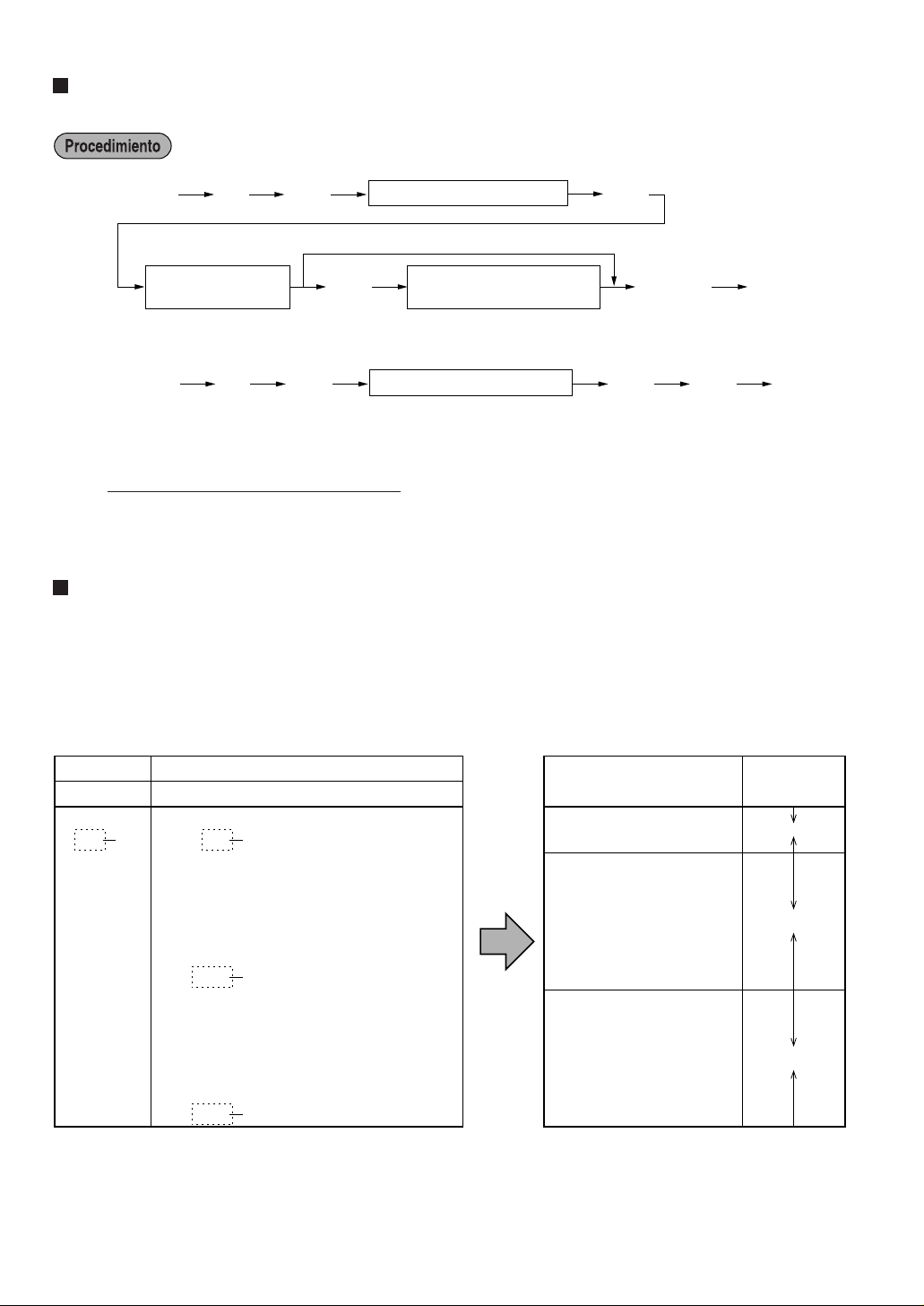
18
Programación de los impuestos empleando una tasa de impuestos
La tasa porcentual aquí especificada se emplea para calcular los impuestos sobre subtotales imponibles.
Ejemplo: Programación de la tasa de impuestos del 4% como tasa de impuestos 2 con exención de impuestos
de 12¢
Tabla de impuestos (aplicable al impuesto añadido)
Si se encuentra en una localidad que emplea una tabla de impuestos para el cálculo de los impuestos, podrá
programar consecuentemente la caja registradora. La programación de la tabla de impuestos puede efectuarse
para impuestos 1 a impuestos 4.
Tabla de impuestos de muestra
Tabla de impuestos de New Jersey: 6%
Para programar una tabla de impuestos, primero haga una tabla como la tabla de la derecha arriba mostrada.
Partiendo de la tabla de impuestos, calcule las diferencias entre el punto de división mínimo y el siguiente (A).
Luego, partiendo de las diferencias, busque ciclos irregulares (B) y ciclos regulares (C y D). Estos ciclos le
mostrarán los elementos necesarios para programar la tabla de impuestos:
Impuestos
Margen de importe de venta
Punto de división mínimo
.00
.01
.02
.03
.04
.05
.06
.07
.08
.09
.10
.11
.12
.13
.01
.11
.23
.39
.57
.73
.89
1.11
1.23
1.39
1.57
1.73
1.89
2.11
Punto de división máximo
.10
.22
.38
.56
.72
.88
1.10
1.22
1.38
1.56
1.72
1.88
2.10
2.22
to
to
to
to
to
to
to
to
to
to
to
to
to
to
T Q
M1
M2
A: Diferencia entre el
punto de división mínimo
y el siguiente (¢)
–
10 (0.11 - 0.01)
12 (0.23 - 0.11)
16 (0.39 - 0.23)
18 (0.57 - 0.39)
16 (0.73 - 0.57)
16 (0.89 - 0.73)
22 (1.11 - 0.89)
12 (1.23 - 1.11)
16 (1.39 - 1.23)
18 (1.57 - 1.39)
16 (1.73 - 1.57)
16 (1.89 - 1.73)
22 (2.11 - 1.89)
B: No cíclico
C: Cíclico 1
D: Cíclico 2
s
9
@
2
@
4
@
12
sA
Ejemplo de operación de teclas
Para borrar una tasa de impuestos, emplee la secuencia siguiente:
s @ v A@
Número de impuestos (1 a 4)
9
s @
9
@
@ s A
Cuando el importe imponible más bajo es cero
Número de impuestos (1 a 4)
Tasa de impuestos
(0,0000 a 100,0000)
Importe imponible más bajo
(0,01 a 999,99)
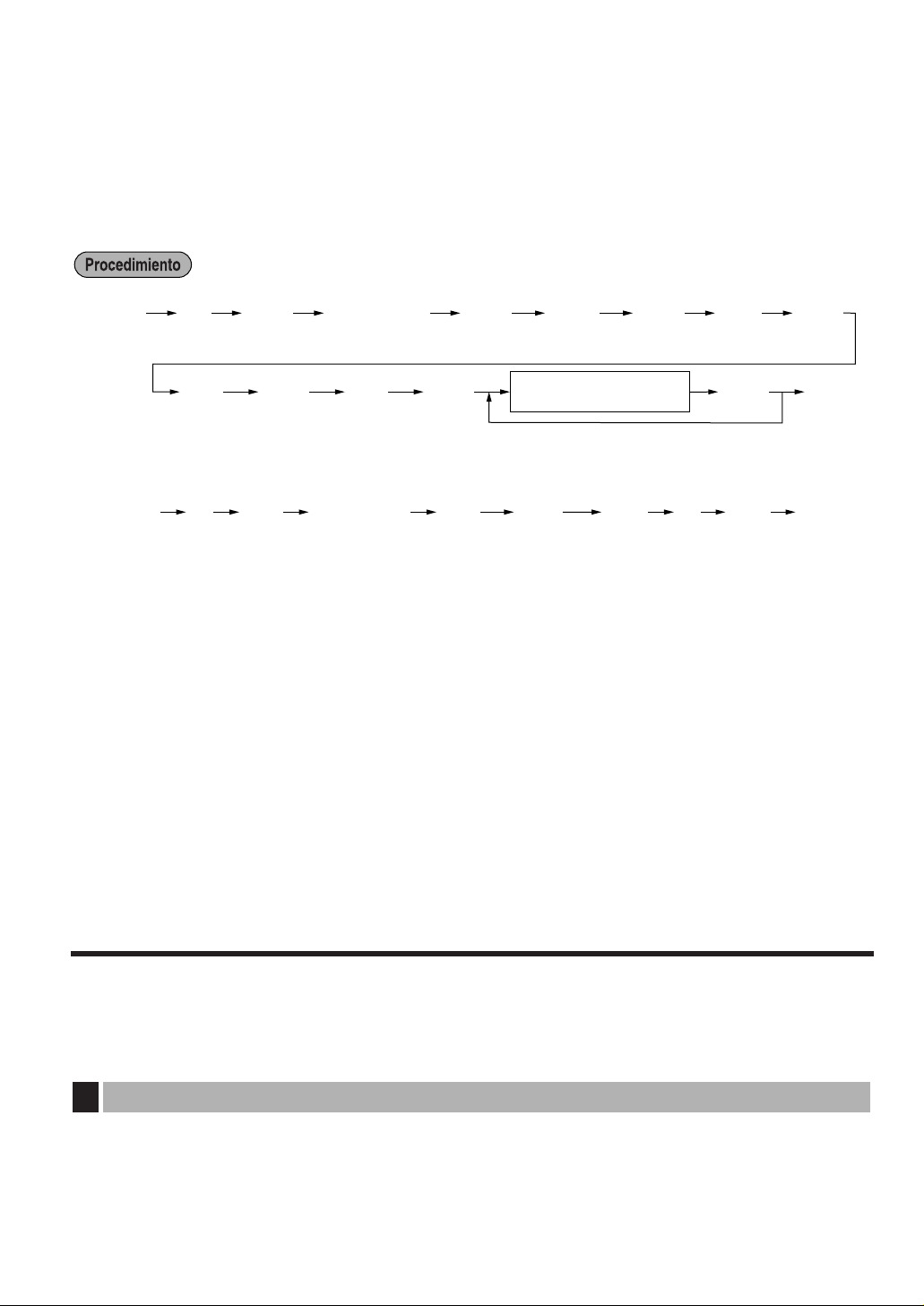
19
T: El importe de impuestos recolectados en el importe imponible mínimo (Q)
Q: El importe imponible mínimo
M1: El valor máximo del punto de división mínimo en un ciclo regular (C)
A esto lo denominamos “punto MAX”.
M2: El valor máximo del punto de división mínimo en un ciclo regular (D)
A esto lo denominamos “punto MAX”.
M: Margen del punto de división mínimo en un ciclo regular: diferencia entre Q y M1 o entre M1 y M2
Este primer número que se introduce depende de si la diferencia entre un punto de
división mínimo a introducirse y el punto de división mínimo anterior no son de menos de
$1,00 ni de más de 99¢. Cuando la diferencia no sea de menos de $1,00, introduzca “1”,
y cuando no sea de más de 99¢, introduzca “0” o no introduzca nada.
El segundo número depende de si su tabla de impuestos debe programarse como tabla
de impuestos 1, 2, 3, ó 4.
*2 Si la tasa es fraccionaria (por ejemplo 4-3/8%), la fracción (3/8) se convierte a su equivalente decimal (es
decir, 0,375) y se introduce la tasa resultante de 4,375. Tenga presente que la tasa nominal (R)
generalmente se indica en la tabla de impuestos.
• Limitaciones para el registro de puntos de división mínimos
La caja registradora puede trabajar con una tabla de impuestos que conste hasta de 72 puntos de división como
máximo. (El número máximo de puntos de división es de 36 cuando la diferencia de puntos de división es de
$1,00 o más.) Si el número de puntos de división excede la capacidad de tablas de la caja registradora, deberá
emplear entonces el registro manual.
Segundo número:
(1 a 4)
*1 Primer número:
(1 ó 0)
s @ s@
máx. de seis dígitos
(0,0001 a 99,9999%)
máx. de
cuatro dígitos
Número de
uno o dos dígitos
Tasa
M
*1
*2
@@
Para borrar una tabla de impuestos, emplee la secuencia siguiente:
8
s @ @
máx. de seis dígitos
(0,0001 a 99,9999%)
máx. de
cuatro dígitos
Número de
uno o dos dígitos
Tasa
M
*1
*2
@
máx. de
tres dígitos
T
@
máx. de
cinco dígitos
Q
@ A
Punto de división mínimo
máx. de cinco dígitos
Repetir hasta que se introduzca el punto MAX.
@@
8
PROGRAMACION DE FUNCIONES
AUXILIARES
La mercancía se puede clasificar en un máximo de 99 secciones.
Cuando emplee una tecla de sección, deberá establecer los parámetros para especificar el estado de la
sección, como por ejemplo una sección positiva o negativa. Se pueden asignar directamente los precios a
secciones para artículos frecuentemente comprados, lo que le permite introducir los precios pulsando
simplemente las teclas de sección o los registros de códigos de sección.
Programación de secciones
1
20
Estado de sección
Para programar otra sección, comience desde el principio sin pulsar la tecla
A
.
*: Elemento: Selección: Registro:
A Tipo Devolución de botellas 1
Normal* 0
B Número de grupo 0 a 9 (0: Sin grupo) (ajuste inicial: 0)
C Número de grupo de comisión 0 a 2 (0: Sin comisión) (ajuste inicial: 0)
D Estado de impuestos 4 Imponible 1
No imponible* 0
E Estado de impuestos 3 Imponible 1
No imponible* 0
F Estado de impuestos 2 Imponible 1
No imponible* 0
G Estado de impuestos 1 Imponible (*para las secciones 1 a 6) 1
No imponible (*para la sección 7 y posteriores) 0
H SICS / Normal SICS 1
Normal* 0
I Signo Sección negativa 1
Sección positiva* 0
J Límite de dígitos de entrada 0 a 7 (ajuste inicial: 7)
K Tipo de registros de precio unitario Abertura y preajuste 3
Sólo preajuste 2
Sólo abertura* 1
Tecla de sección invalidada 0
Número de grupo
• Si se realiza un ajuste de grupo (0 a 9, 0: sin grupo), los artículos vendidos empleando las teclas de sección
y las PLU y subsecciones asociadas se pueden clasificar en grupos para los informes de ventas.
Número de grupo de comisión
• Puede asignar un grupo de comisión (0 a 2, 0: sin comisión) a cada sección para la comisión de los
dependientes. Cada importe de comisión para cada dependiente se calcula basándose en una tasa de
comisión programada y luego se imprime en los informes de dependiente.
Estado de impuestos (imponible 1 a 4 / no imponible)
• Cuando se efectúa un registro de una sección imponible en una transacción, los impuestos se calculan
automáticamente de acuerdo con la tabla o tasa de impuestos asociada.
SICS (Venta en metálico de un solo artículo)
• Si se efectúa primero un registro de una sección programada para SICS, la venta se finalizará como venta de
pago en metálico así que se pulse la tecla de la sección. Si realiza el registro después de introducir una
sección no programada para SICS, no se finalizará la venta hasta que se pulse la tecla
A
.
Límite de dígitos de entrada
• Ajuste el número de dígitos permisibles para importes máximos de entrada para cada sección. El límite es
eficaz para operaciones en el modo REG y puede pasarse por alto en el modo MGR.
Para las secciones 7 a 99:
d@
Código de sección
A
Para ajustar todo ceros
ABCDEFGHIJK
*
Para ajustar todo ceros
@
Tecla de secciónABCDEFGHIJK
A
*
21
Precio unitario preajustado
La función de PLU permite realizar registros rápidos con las teclas en los que el precio se busca
automáticamente al pulsar una tecla de PLU directa o al introducir un código. La subsección es un tipo de “PLU
abierta”, que requiere que usted introduzca un precio antes de la tecla de PLU directa o detrás del código de
PLU. Pueden realizarse ajustes para un máximo de 1.800 PLU/subsecciones. Cada una pertenece a una
sección y adquiere los parámetros de la sección (tipo de sección (normal o devolución de botellas), grupo de
sección, estado de impuestos, SICS y signo).
Se puede asignar un grupo de comisión (0 a 2, 0: No se aplica ninguna comisión) a cada PLU/subsección para
la comisión de los dependientes. La caja registradora ya está programada de modo que los 1.800 códigos están
asignados a las PLU (grupo de comisión: 0) asociadas con la sección 1 y precio unitario preajustado “0”. En
total se proporcionan las 75 teclas de PLU directas en el teclado para los registros de PLU y subsecciones, y se
asignan anteriormente los códigos de PLU 1 a 75 a las teclas de PLU directas 1 a 75 respectivamente.
Asignación de precios unitarios y de secciones asociadas
*: Para una subsección, ajuste el importe límite de registro de precio unitario.
Para borrar un código de PLU, emplee la secuencia siguiente:
Para borrar la PLU siguiente
Para borrar otra PLU
Código de PLU
(1 a 1.800)
p
Tecla de PLU directa
vA
Cuando la sección asociada es una de las secciones 7 a 99:
ds
Para programar cero
Código de
sección
asociada
(1 a 99)
A
* Precio unitario
(máx. seis dígitos)
Código de PLU
(1 a 1.800)
p
Tecla de PLU directa
Para programar cero
Precio unitario
(máx. seis dígitos)
A
*
Tecla de sección asociada
Código de PLU
(1 a 1.800)
p
Tecla de PLU directa
Programación de PLU (codificación de precios) y subsección
2
Para las secciones 7 a 99:
ds
Código de sección
Precio unitario
(máx. seis dígitos)
A
Para programar cero
Para programar cero
Tecla de sección
Precio unitario
(máx. seis dígitos)
A
22
Selección de función
*: Elemento: Selección: Registro:
A Número de grupo de comisión 0 a 2 (0: Sin comisión) (ajuste inicial: 0)
B Selección de PLU/subsección Subsección 0
PLU* 1
Basándose en el total de ventas de cada dependiente de cada grupo de comisión y en la tasa de comisión
correspondiente, se calculan los importes de comisión, y se imprimen en los informes de dependiente.
Tasa de comisión
Deberá emplear un punto decimal para ajustar una tasa fraccionaria.
Tasa para
%
,
&
y
V
*: Tasa
0,00 a 100,00 (Tasa de porcentaje)
0,0000 a 9999,9999 (Tasa de conversión de divisas)
Deberá emplear un punto decimal para ajustar tasas fraccionarias.
Importe para
-
Importe de descuento (máx. seis dígitos)
A-
Para programar cero
*Tasa o
%
V
A&
Para programar otra tasa
Para programar cero
Programación de teclas misceláneas
4
s
Número de comisión
(1 ó 2)
@@ sA
Tasa de comisión
(0,00 a 999,99)
28
Programación de la tasa de comisión
3
Para programar “00”
Para programar la PLU siguiente
Para programar otra PLU
As
AB
*
Código de PLU
(1 a 1.800)
p
Tecla de PLU directa
23
Límite de tasa porcentual para
%
y
&
• Los registros porcentuales que exceden al límite superior pueden suprimirse en el modo MGR.
• Deberá emplear un punto decimal para ajustar tasas fraccionarias.
Parámetros de función para
%
,
&
y
-
*: Elemento: Selección: Registro:
A Estado de impuestos 4 Imponible 1
No imponible* 0
B Estado de impuestos 3 Imponible 1
No imponible* 0
C Estado de impuestos 2 Imponible 1
No imponible* 0
D Estado de impuestos 1 Imponible 1
No imponible* 0
E Signo +/- Signo + (recargo) 0
Signo - (descuento)* 1
F % de artículo /
_
de artículo Habilitar* 0
Inhabilitar 1
G % de subtotal /
_
de subtotal Habilitar* 0
Inhabilitar 1
H Límite de dígitos de entrada para la tecla de descuento 0 a 7 (ajuste inicial: 7)
Cuando se programen las teclas de porcentaje, introduzca siempre 0 para H.
Estado de impuestos (imponible 1 a 4 / no imponible)
• Cuando se selecciona imponible, se aplican impuestos al importe obtenido después del cálculo de recargo o
descuento.
Signo +/-
• La programación del signo +/- asigna la función de recargo o de descuento para cada tecla.
Límite de dígitos de entrada (Sólo para la tecla de descuento)
• El límite de dígitos de entrada es de hecho para operaciones en el modo REG, pero puede suprimirse en el
modo MGR. Cuando se ajusta “0”, el registro de precio abierto se prohíbe.
*ABCDEFGH o
%@
-
A&
Para programar otra tecla
Para programar “0” para todos los artículos
s @
Límite de porcentaje (0,00 a 100,00%)
A
Para programar cero
Para programar otra tecla de porcentaje
o
%&
29
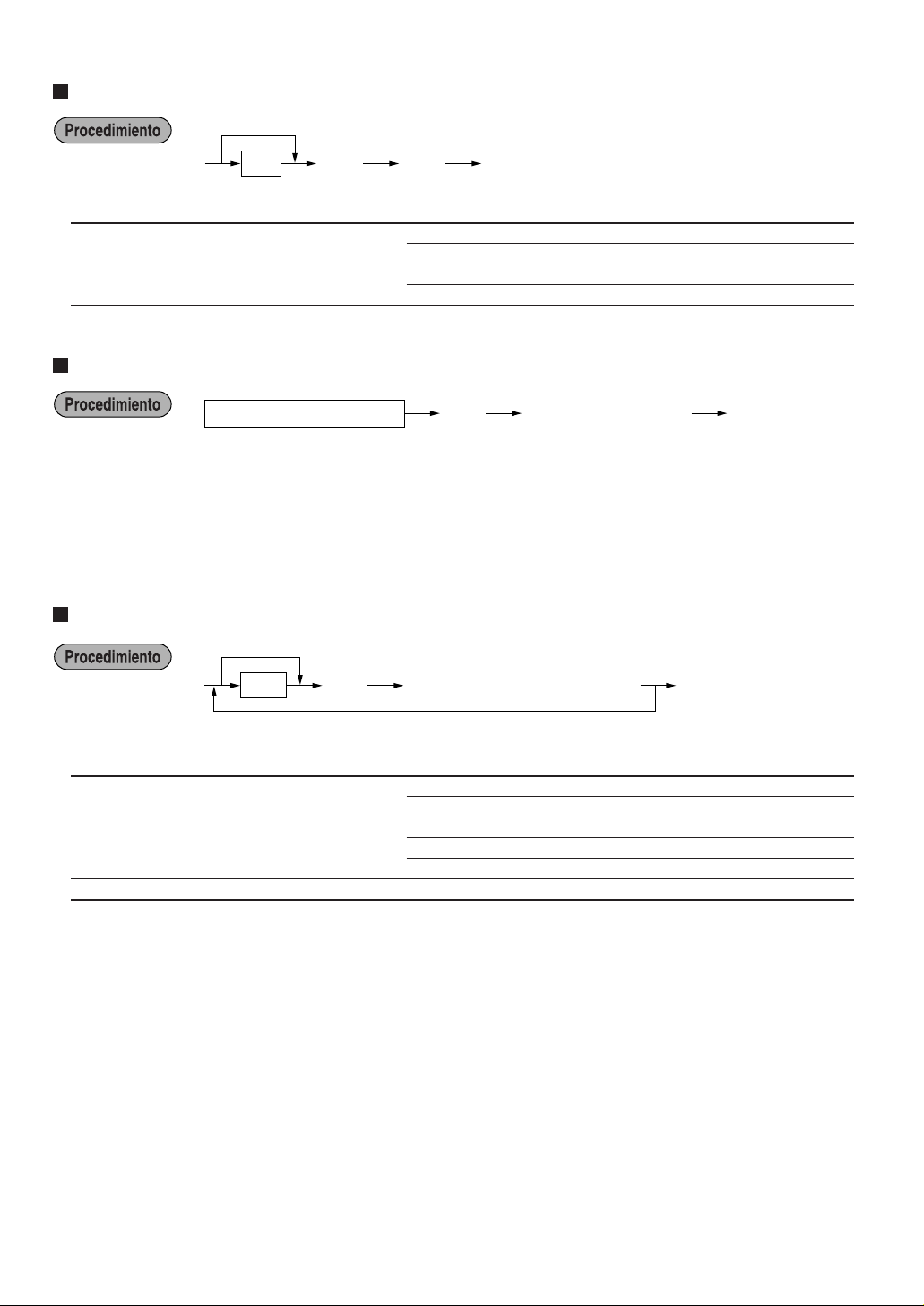
24
Parámetros de función para
V
*: Elemento: Selección: Registro:
A Registro de tasa abierta Habilitar* 0
Inhabilitar 1
B Registro de tasa preajustada Habilitar* 0
Inhabilitar 1
Límite de dígitos de entrada para
r
,
R
y
t
*: Para
r
y
R
, introduzca 0 a 9 (dígitos), y para
t
(impuestos manuales), introduzca 0 a 7 (dígitos). Como
ajuste inicial, se ajustan 9 para
r
y
R
y 7 para
t
.
• El límite de dígitos de entrada es de hecho para operaciones en el modo REG, pero puede suprimirse en el
modo MGR. Cuando se ajusta “0”, la operación de la tecla correspondiente se prohíbe.
Parámetros de función para
C
,
X
,
Y
y
A
(cuando se usa como tecla CA)
*1:Elemento: Selección: Registro:
A Impresión de pie del recibo Habilitar 1
Inhabilitar* 0
B Registro de importe recibido Obligatorio 1
No obligatorio (para las teclas CA o CHK)* 0
Invalidar (para la tecla CH1 o CH2)* 0
C Límite de dígitos de entrada 0 a 8 (ajuste inicial: 8)
Impresión de pie del recibo
• Esta programación decide si la registradora debe imprimir un mensaje en la parte inferior del recibo cuando
se usa una de estas teclas de finalización especificada. Con respecto al método de programación del
mensaje del membrete del pie de recibo, consulte la sección “Mensajes de membrete” en la página 29.
Límite de dígitos de entrada
• Para las teclas
X
,
Y
y
C
, programe un importe de entrada de límite superior para el importe recibido.
Para la tecla
A
, programe un importe de entrada de límite superior para el importe total en metálico que
puede manipularse en la caja registradora. El límite de dígitos de entrada es de hecho para operaciones en
el modo REG, pero puede suprimirse en el modo MGR. Cuando se ajusta “0”, la operación de la tecla
correspondiente se prohíbe.
*
1
ABC o
A
Para programar “0” para todos los artículos
Para programar otra tecla
*
2
: Pulse la tecla
s
para ajustar la tecla CA.
@s, C, X
*
2
Y
* Límite de dígitos de entrada
(sólo para entrada manual)
A@r, R
o
t
*AB
A
Para programar “0” para todos los artículos
@V
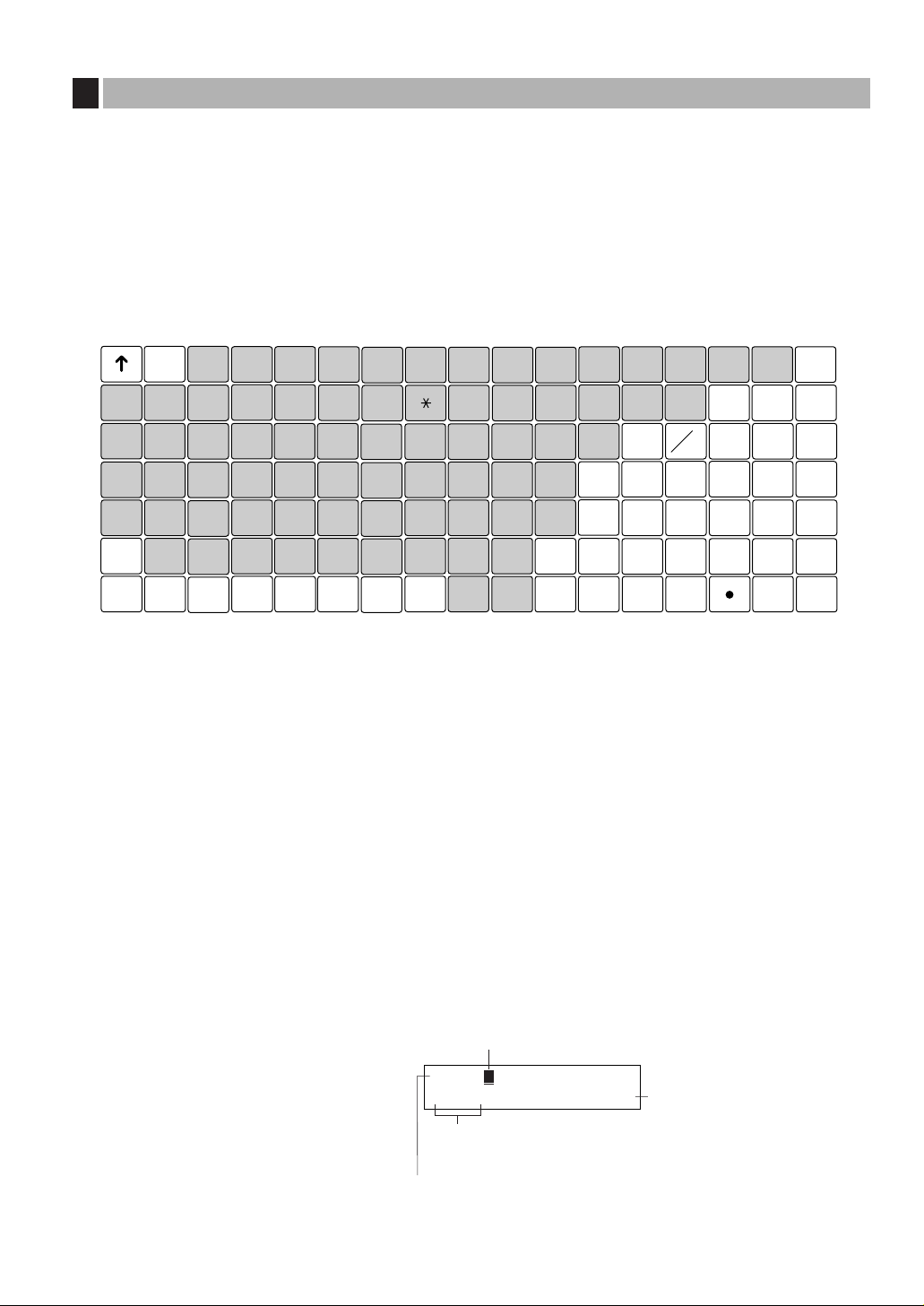
25
La caja registradora le permite programar el texto para los nombres de dependiente, nombres de artículos de
sección y nombres de artículos de PLU/subsección, cuando sea necesario. Coloque la lámina del teclado para
la programación del texto sobre la lámina del teclado para el uso normal. Para la colocación, consulte la sección
“Lámina del teclado” de la página 5.
Hay dos formas de programar el texto: empleando las teclas de caracteres (área sombreada, mostrada abajo,
en la lámina del teclado para la programación del texto) o introduciendo los códigos de los caracteres con las
teclas numéricas del teclado.
Lámina del teclado para la programación del texto
Tenga presente que las teclas de caracteres usadas para introducir números (área sombreada) son diferentes
de las teclas numéricas.
Las teclas siguientes se emplean como teclas de control para la programación del texto.
H
Cambia entre letras mayúsculas y minúsculas. El ajuste inicial es el de letras mayúsculas seleccionadas.
Una vez se ha pulsado la tecla
H
, se fija la entrada para letras minúsculas. “a” se visualiza cuando se
selecciona la entrada de letras minúsculas como se muestra en el ejemplo del visualizador para el
operador de abajo.
W
Cambia entre caracteres de tamaño normal y de tamaño doble. En el ajuste inicial se han seleccionado los
caracteres de tamaño normal. Una vez se pulsa la tecla
W
, se fija la entrada para caracteres de tamaño
doble. “W” se visualiza cuando se selecciona la entrada de caracteres de tamaño doble como se muestra
en el ejemplo del visualizador para el operador de abajo.
B
Hace retroceder el cursor, borrando el carácter de la izquierda.
Empleando las teclas de caracteres (Teclas en la área sombreada)
Para introducir números, letras y símbolos, pulse simplemente el carácter correspondiente en la área
sombreada del teclado.
Visualizador para el operador (Ejemplo)
ABCD PGM
01 Wa 04
Cursor
Número de caracteres
programados
Aquí, se visualiza código de sección, código de PLU,
número de función, código de dependiente o número
de línea de mensajes de membrete.
Aquí, se visualizan los caracteres introducidos empleando las
teclas de caracteres.
”
Z
œ
X
(
SPACE
)
(
SPACE
)(
SPACE
)
(
SPACE
)
(
SPACE
)(
SPACE
)
C
V
B
N
M
Ñ
A
S
D
F
G
H
J
K
L
Q
W
E
R
T
Y
U
I
O
P
1
2
3
4
5
6
7
8
9
0
#
$
%
@
’
(
)
BACK
SPACE
(
”
)
=
^
▲
(DC)
(
SHIFT
)
?
!
,
<
.
>
;
+
:
/
-
[
{
]
}
”
0
1
2
3
456
78
9
CL
00
FOR
@
➞
➞
▲
➞
➞
&
?
–
CA/AT
SBTL
(ESC)
Programación de texto
5
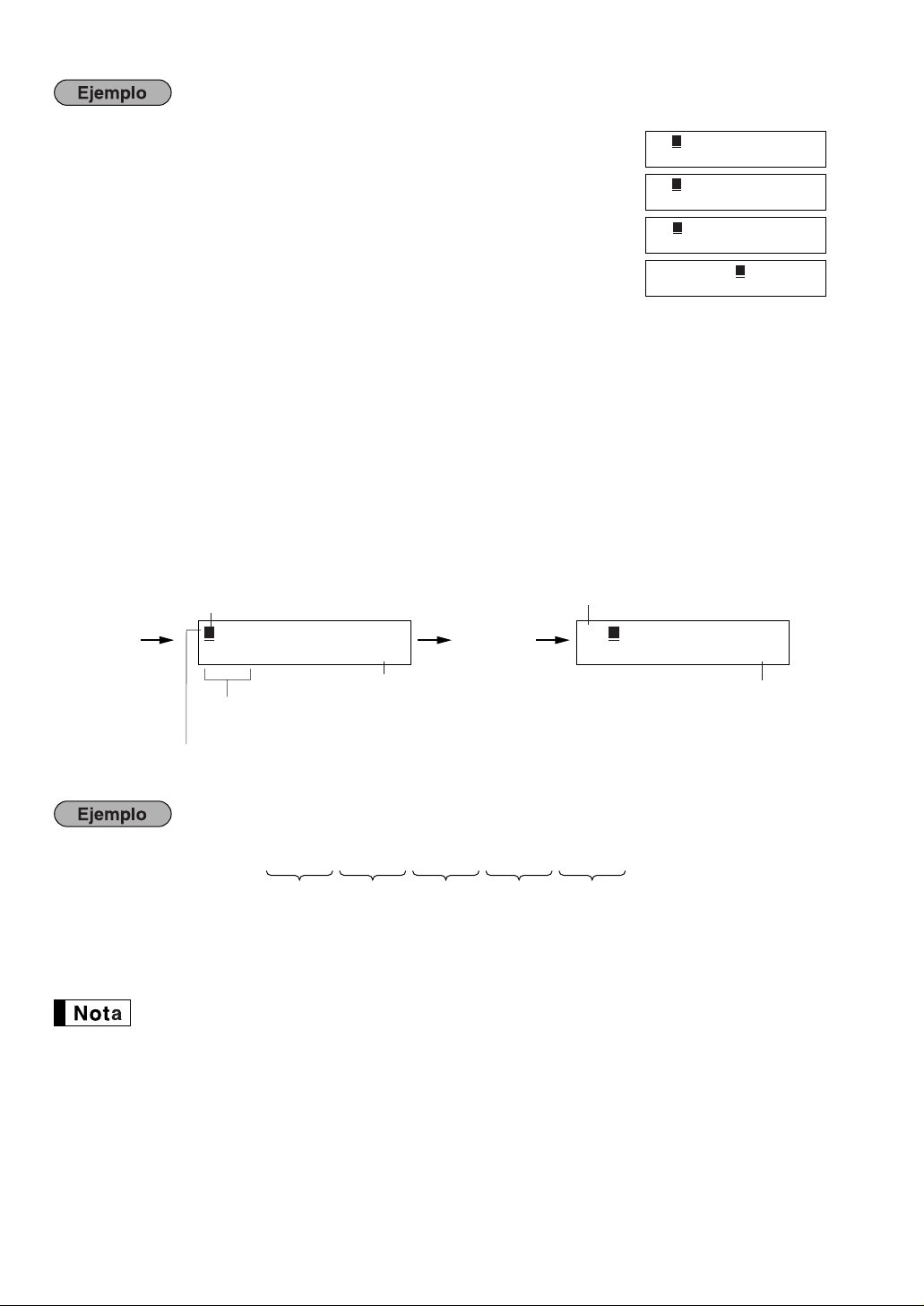
26
Para programar la palabra “Clerk01” con la letra “C” de tamaño doble.
Para que la letra “C” sea de tamaño doble
Para que el tamaño de los caracteres vuelva al normal
Para cambiar a letras minúsculas
Introducción de códigos de caracteres con las teclas numéricas del teclado
Para introducir un número, una letra o un símbolo, introduzca un código de carácter empleando las teclas
numéricas y pulse la tecla numérica
:
. Para los códigos de caracteres, consulte la tabla de códigos de
caracteres alfanuméricos. De este modo, podrá programar caracteres distintos a los que hay en las teclas.
• Pueden obtenerse caracteres de tamaño doble introduciendo el código de caracteres 253 o pulsando la tecla
W
. “W” se visualiza cuando se selecciona la entrada de caracteres de tamaño doble como se muestra en el
ejemplo del visualizador para el operador de abajo.
• DEBEN introducirse los tres dígitos del código del carácter (aunque empiece con cero).
Visualizador para el operador (Ejemplo)
Para programar la palabra “SHARP” en caracteres de tamaño doble
Cuando pulsa una tecla del número apropiado (número de código de tarea) y pulsa la tecla
P
para entrada de
texto justo después de haber comenzado la programación con la tecla
s
, la caja registradora quedará
automáticamente preparada para la entrada siguiente.
Para los códigos de los caracteres alfanuméricos, consulte la tabla de la página 43 de la versión
inglesa.
253
:
083
:
072
:
065
:
082
:
080
:
S H A R P
PGM
01 W 065
Código del carácter
=A PGM
01 W 02
Caracteres: Indicación de caracteres
de tamaño doble al de “A”
Número de caracteres
programados
Pulsación de
253
:
065
Pulsación de
:
Cursor
Aquí, se visualiza código de sección, código de PLU,
número de función, código de dependiente o número
de línea de mensajes de membrete.
Aquí, se visualizan los caracteres introducidos.
=C PGM
01 02
=C PGM
01 W 02
=C PGM
01 a 02
Wg
W
H
hijk01
=Clerk01 PGM
01 a 08
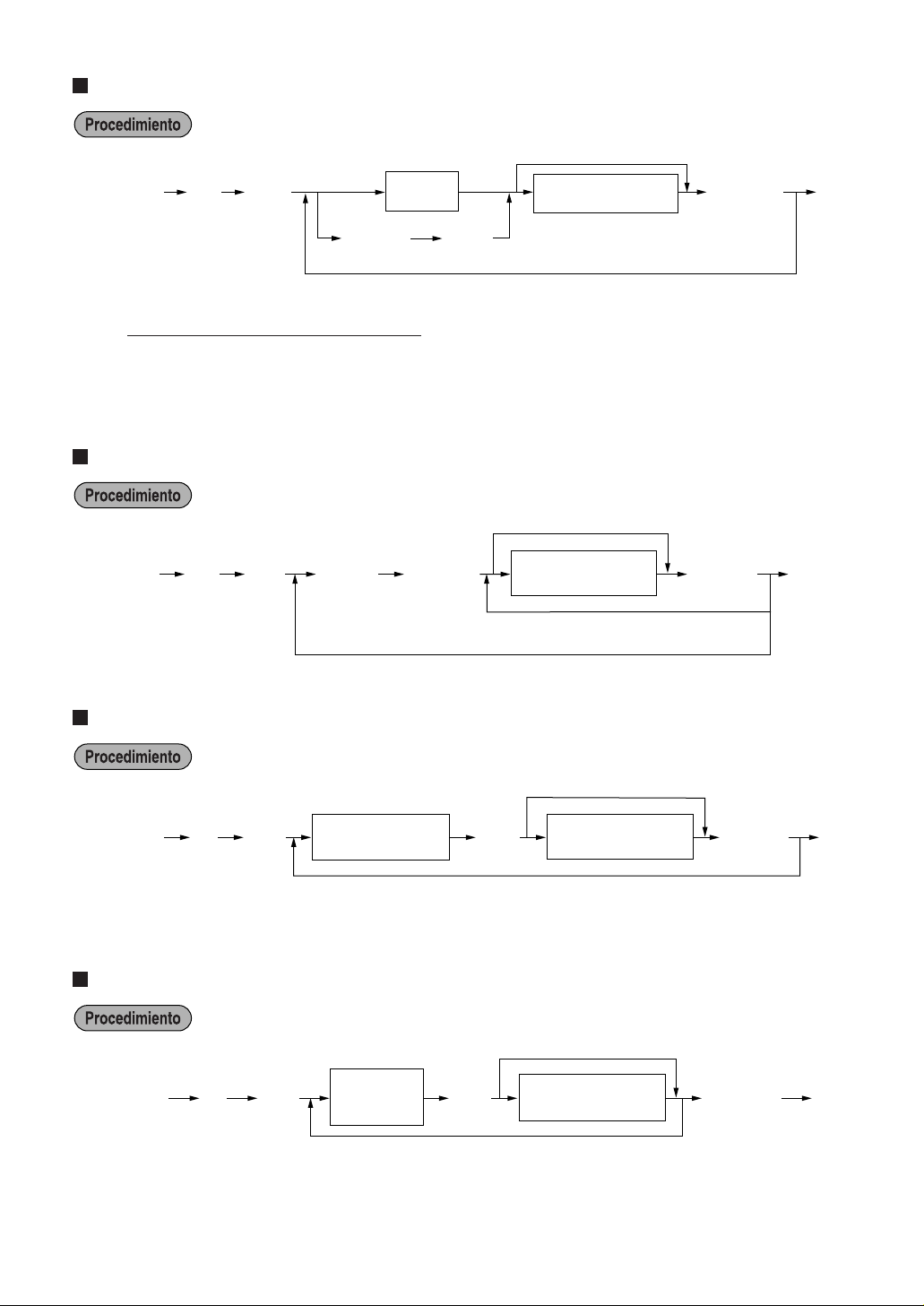
27
Texto de sección (etiqueta de artículo)
Texto de PLU (etiqueta de artículo)
Texto de función
* Número de función: Vea la “Lista de textos de función” mostrada de la página siguiente.
Nombres de dependiente
s P s@
Para programar otro dependiente
Teclas de caracteres
(máx. 8 dígitos)
Código de
dependiente
(1 a 40)
A
Para mantener el ajuste vigente
5
s P @
*Número de función
(máx. 2 dígitos)
Teclas de caracteres
(máx. 8 dígitos)
A
Para mantener el ajuste vigente
s
Para programar el texto de otra función
3
s P p
Código
de PLU
(1 a 1.800)
Cuando el siguiente código de PLU sigue
inmediatamente al que se acaba de introducir
Teclas de caracteres
(máx. 16 dígitos)
As
Para mantener el ajuste vigente
Para programar otra PLU
2
s
1
P!
FRUIT
sA
(Programación de FRUIT para la sección 1)
Ejemplo de operación de teclas
s P
d
s
Para programar otra sección
Para mantener el ajuste vigente
Tecla de
sección
Teclas de caracteres
(máx. 16 dígitos)
Código de
sección
(1 a 99)
A
1
28
Lista de textos de función
1
2
3
4
5
6
7
8
9
10
11
12
13
14
15
16
17
18
19
20
21
22
23
24
25
26
27
28
29
30
31
32
33
34
35
36
37
38
39
40
41
42
43
44
45
46
47
(–)
%1 %1
%2 %2
Total neto de ventas NET1
Subtotal neto de imponible 1 TAX1 ST
Total bruto de impuestos 1 GRS TAX1
Total de impuestos 1 de registros de devoluciones
RFD TAX1
Total neto de impuestos 1 TAX1
Exención de impuestos 1 TX1 EXPT
Subtotal neto de imponible 2 TAX2 ST
Total bruto de impuestos 2 GRS TAX2
Total de impuestos 2 de registros de devoluciones
RFD TAX2
Total neto de impuestos 2 TAX2
Exención de impuestos 2 TX2 EXPT
Subtotal neto de imponible 3 TAX3 ST
Total bruto de impuestos 3 GRS TAX3
Total de impuestos 3 de registros de devoluciones
RFD TAX3
Total neto de impuestos 3 TAX3
Exención de impuestos 3 TX3 EXPT
Subtotal neto de imponible 4 TAX4 ST
Total bruto de impuestos 4 GRS TAX4
Total de impuestos 4 de registros de devoluciones
RFD TAX4
Total neto de impuestos 4 TAX4
Exención de impuestos 4 TX4 EXPT
Total bruto de impuestos manuales
GRS MTAX
Total de impuestos manuales de devoluciones
RFD MTAX
Total neto de impuestos manuales
M-TAX
Total de exención desde GST
GST EXPT
Total de PST PST TTL
Total de GST GST TTL
Total de impuestos TTL TAX
Neto
NET
Total de ventas incluyendo el total de impuestos
NET2
Devoluciones REFUND
Cancelación de artículos VOID
Modo de cancelación
VOID
Cancelación del administrador
MGR VD
Cancelación de subtotal SBTL VD
Sin venta NO SALE
Recibido a cuenta RA
Pagos PO
Contador de clientes TRANS CT
Total de ventas
NET3
Metálico CASH
Cheque CHECK
Cargo bruto 1 CHARGE
Cargo de devolución 1 CHARGE–
Número
de función
Tecla o función
Ajuste inicial
48
49
50
51
52
53
54
55
56
57
58
59
60
61
62
63
64
65
66
67
68
69
70
71
72
73
74
75
76
77
78
79
80
81
82
83
84
85
86
87
88
89
90
91
92
93
94
Cargo bruto 2 CHARGE2
Cargo de devolución 2 CHARGE2–
Conversión de divisas 1 (preajustada)
CONV 1
Conversión de divisas 2 (abierta)
CONV 2
Metálico en el cajón CID
Metálico+cheque en el cajón
CA+CH ID
Vuelta de cheques CHK/CG
Exento de IVA VAT EXPT
Venta de comisión 1 COM. SAL1
Venta de comisión 2 COM. SAL2
Sin venta de comisión NON COM.
Total de secciones (+) DEPT TL
Total de secciones (–) DEPT(–)
Total de secciones de devolución de botellas (+)
BTTL TL
Total de secciones de devolución de botellas (–)
BTTL(–)
Subtotal SUBTOTAL
Subtotal de mercancías MDSE ST
Total TOTAL
Cambio CHANGE
Artículos ITEMS
Importe de comisión 1 COM. AMT1
Importe de comisión 2 COM. AMT2
Total de importe de comisión
COM. TTL
Título de informe de secciones
DEPT
Título de informe de PLU PLU
Título de informe de transacciones
TRANS.
Título de informe de dependientes
CLERK
Título de informe horario HOURLY
Título de informe diario DAILY
Título de informe de grupo GROUP
Total en el cajón TL-ID
Símbolo de no adición #
Título de copia de recibo
COPY
Título de informe EJ EJ
Título de fin de informe EJ EJ
END
Grupo 1 G
ROUP01
Grupo 2 G
ROUP02
Grupo 3 G
ROUP03
Grupo 4 G
ROUP04
Grupo 5 G
ROUP05
Grupo 6 G
ROUP06
Grupo 7 G
ROUP07
Grupo 8 G
ROUP08
Grupo 9 G
ROUP09
Vuelta DUE
Borrado del ST imponible para todos los impuestos
TAX ST
Registro de importe AMOUNT
Número
de función
Tecla o función
Ajuste inicial
*
*
*
**
**
**
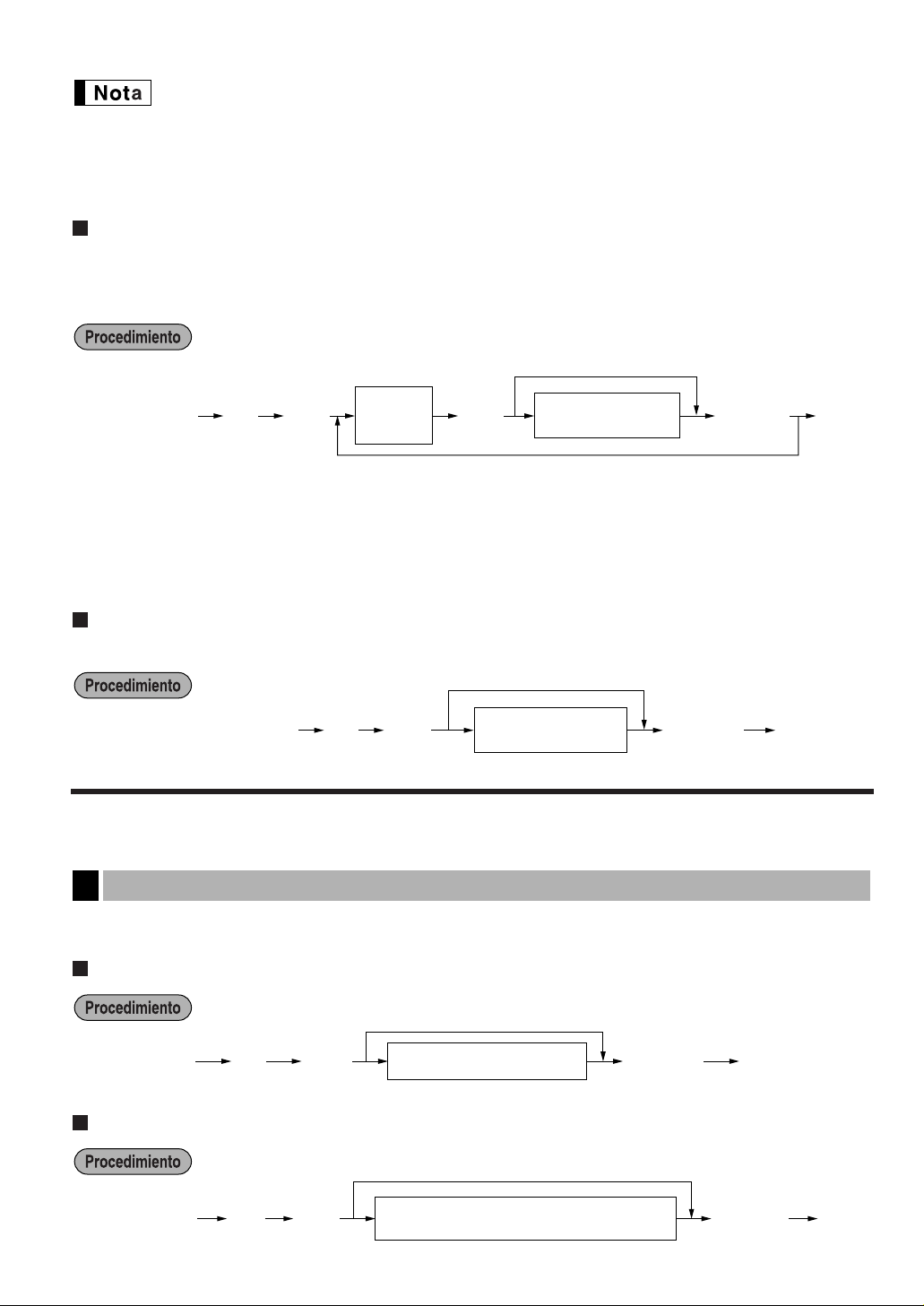
29
• Los ajustes iniciales son los de español (cambio del ajuste de programación para selección del
idioma al español).
• Los elementos marcados con “*” son sólo para Canadá.
• Los elementos marcados con “**” son sólo para la visualización.
• El número de función 55 “Exento de IVA” es sólo eficaz para el sistema de impuestos de Canadá
(2 GST, tipo IVA).
Mensajes de membrete
La caja registradora puede imprimir mensajes programados en cada recibo. En el modelo estándar, se imprime
el membrete gráfico en el recibo. Si desea imprimir mensajes de membrete, cambie el formato de impresión de
mensajes de membrete. (Para los detalles de la programación, vea la página 34.)
* Tipo de “Mensaje de 3 líneas de encabezamiento”: 1 a 3
Tipo de “Mensaje de 3 líneas de pie de recibo”: 4 a 6
Tipo de “Mensaje de 6 líneas de encabezamiento”: 1 a 6
Tipo de “Mensaje de 3 líneas de encabezamiento y 3 líneas de pie de recibo”: 1 a 6 (1 a 3 como
encabezamiento, 4 a 6 como pie de recibo)
Símbolo de divisas
El símbolo de divisas para la tecla
V
se imprime con un importe de cambio de divisas.
s P
Teclas de caracteres
(máx. 4 dígitos)
As
Para mantener el ajuste vigente
6
s P @
*Número
de líneas
(1 a 6)
Teclas de caracteres
(máx. 24 dígitos)
As
Para mantener el ajuste vigente
Para programar otra línea
4
PROGRAMACION AVANZADA
El número de caja registradora y los números consecutivos se imprimen en el recibo o en el registro diario.
Número de caja registradora
Números consecutivos
Programación de número de caja registradora y de números consecutivos
1
s
@
s A
Número de caja registradora
(de uno a seis dígitos)
Para ajustar a “0” el número de la caja registradora
1
s
@
s A
Un número (de uno a cuatro dígitos) que sea
inferior en uno al número inicial deseado
Para empezar a contar desde 0001
2
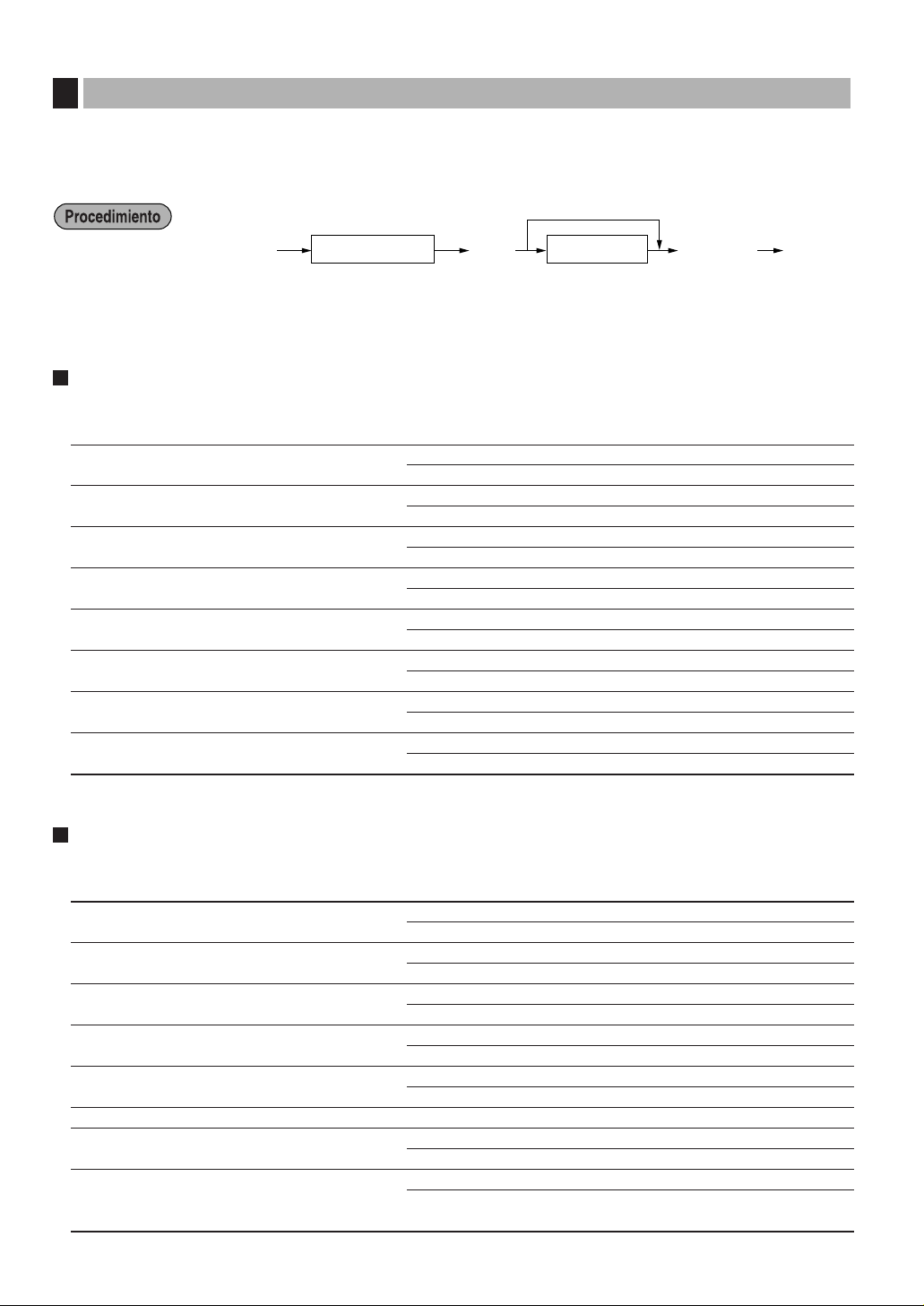
30
Para la programación siguiente, se aplica el estilo de entrada de código de tarea. Podrá seguir la programación
hasta que pulse la tecla
A
para la programación que se describe en esta sección. Para seguir la
programación, repita desde la entrada de un código de tarea.
*1 Introduzca el código de tarea empleando las teclas numéricas especificadas en cada sección de abajo.
*2 Los detalles de la entrada de datos se enumeran en cada tabla de cada sección de abajo.
Selección de función para teclas misceláneas
Código de tarea: 5
* Elemento: Selección: Registro:
A PO en el modo REG Habilitar la operación PO en el modo REG* 0
Inhabilitarla 1
B RA en el modo REG Habilitar la operación RA en el modo REG* 0
Inhabilitarla 1
C Cancelación de subtotal en el modo Habilitar la cancelación de subtotal en el modo REG* 0
REG
Inhabilitarla 1
D Cancelación indirecta en el modo REG Habilitar la cancelación indirecta en el modo REG* 0
Inhabilitarla 1
E Cancelación directa en el modo REG Habilitar la cancelación directa en el modo REG* 0
Inhabilitarla 1
F Disponibilidad de la tecla de Habilitar registros de devolución en el modo REG* 0
devoluciones
Inhabilitarlos 1
G No venta en el modo REG Habilitar las operaciones de no venta en el modo REG* 0
Inhabilitarlas 1
H Disponibilidad de cantidades Habilitar el registro de cantidades fraccionarias 0
fraccionarias
Inhabilitarlo* 1
Formato de impresión
Código de tarea: 6
* Elemento: Selección: Registro:
A Estilo de impresión Impresión de registro diario 0
Impresión de recibos* 1
B Formato de impresión de recibos Total 0
Detallado* 1
C Impresión de la hora en todos los Habilitar la impresión de la hora* 0
recibos
Inhabilitarla 1
D Impresión de la fecha en todos los Habilitar la impresión de la fecha* 0
recibos
Inhabilitarla 1
E Impresión del N.° consecutivo en todos Habilitar la impresión del N.° consecutivo* 0
los recibos
Inhabilitarla 1
F Introduzca siempre 0. (Posición fija) 0
G Salto de ceros para informe de PLU Inhabilitar el salto de ceros 0
Habilitar el salto de ceros* 1
H Salto de ceros para informes generales, Inhabilitar el salto de ceros 0
de dependientes, horarios y de ventas
Habilitar el salto de ceros* 1
de neto diario
s @
*
2
ABCDEFGH
*
1
Código de tarea
As
Para ajustar “00000000”
Programación 1 de selección de diversas funciones
2

31
Formato de impresión de recibos
Código de tarea: 7
* Elemento: Selección: Registro:
A Introduzca siempre 0. (Posición fija) 0
B Introduzca siempre 0. (Posición fija) 0
C Impresión de subtotal con una pulsación Inhabilitar la impresión de subtotales* 0
de la tecla de subtotal
Habilitarla 1
D
Impresión de subtotal de mercancías con una
Inhabilitar la impresión de subtotal de mercancías* 0
pulsación de la tecla de subtotal de mercancías
Habilitarla 1
E Introduzca siempre 0. (Posición fija) 0
F Introduzca siempre 0. (Posición fija) 0
G Introduzca siempre 0. (Posición fija) 0
H Impresión del número de compras Habilitar la impresión del número de compras* 0
Inhabilitarla 1
Parámetros de función para el registro diario electrónico (EJ)
Código de tarea: 68
* Elemento: Selección: Registro:
A Introduzca siempre 0. (Posición fija) 0
B Introduzca siempre 0. (Posición fija) 0
C Impresión temporal de EJ durante una Inhabilitar la impresión temporal de EJ 0
transacción
Habilitarla* 1
D Impresión de EJ y borrado de datos de
Inhabilitar la impresión de EJ y el borrado de datos de EJ
*0
EJ cuando se emite el informe Z1 general
Habilitarlos 1
E Tipo de registros de operación en el modo Detalles* 0
PGM
Sólo información de encabezamiento 1
F Tipo de registros de operación en el Detalles* 0
modo REG/MGR/VOID
Total 1
G Impresión comprimida para datos de EJ No (tamaño normal) 0
Sí (tamaño pequeño)* 1
H Acción cuando el área de memoria de Continuación 0
EJ está llena Continuación y aviso (aviso de casi llena)* 1
Bloqueo y aviso (con aviso de casi llena) 2
Impresión temporal de EJ durante una transacción
• Podrá imprimir los datos del registro diario de la transacción actual registrada en la memoria de EJ pulsando
la tecla
R
durante la transacción. Para poder realizar esta función por completo, la caja registradora debe
ser programada para imprimir el recibo y ajustar la función de activación/desactivación (ON/OFF) de recibo
en OFF (desactivada).
Tipo de registros de operación en el modo PGM
• Se imprime sólo la información del encabezamiento durante la operación de lectura de programación.
Para informes X/Z, se imprime sólo la información del encabezamiento.
Acción cuando el área de memoria de EJ está llena
• Según el ajuste inicial, cuando la memoria para EJ está casi llena, la caja registradora muestra “N” en la
posición catorcena del visualizador (mensaje de memoria EJ casi llena), y la caja registradora sigue
almacenando nuevos datos mientras va borrando los más antiguos. Cuando se selecciona “0”, la caja
registradora ya no mostrará el mensaje de memoria EJ casi llena. Cuando se selecciona “2”, la caja
registradora mostrará el mensaje de memoria EJ casi llena, y cuando se llene totalmente la memoria, la caja
registradora bloqueará la entrada de ventas/datos y visualizará el mensaje de memoria llena “EJ DATA
FULL”. Podrá sólo emitir un informe EJ.

32
Selección de función para impuestos
Código de tarea: 15
* Elemento: Selección: Registro:
A Introduzca siempre 0. (Posición fija) 0
B Introduzca siempre 0. (Posición fija) 0
C Introduzca siempre 0. (Posición fija) 0
D Introduzca siempre 0. (Posición fija) 0
E Introduzca siempre 0. (Posición fija) 0
F Introduzca siempre 0. (Posición fija) 0
G Disponibilidad de borrado de los Habilitar el borrado de impuestos en el modo REG* 0
impuestos en el modo REG
Inhabilitarlo 1
H Disponibilidad de entrada de impuestos
Habilitar la entrada de impuestos manuales en el modo REG
*0
manuales en el modo REG
Inhabilitarla 1
Otras programaciones
Código de tarea: 61
* Elemento: Selección: Registro:
A Introduzca siempre 0. (Posición fija) 0
B Introduzca siempre 0. (Posición fija) 0
C Disponibilidad de sección y PLU/
Inhabilitar la programación de sección y PLU/subsección negativas
0
subsección negativas
Habilitarla* 1
D Trato fraccionario Redondeo (4 por defecto, 5 por exceso)* 0
Aumento a la unidad 1
Descartar el trato fraccionario 2
E Empleo de la tecla
:
Empleo de la tecla
:
como tecla 00* 0
Empleo de la tecla
:
como tecla 000 1
F Formato de la hora Empleo del formato de 12 horas* 0
Empleo del formato de 24 horas 1
G Formato de la fecha Empleo del formato de mes-día-año* 0
Empleo del formato de día-mes-año 1
Empleo del formato de año-mes-día 2
H Posición del punto decimal (desde la derecha) (TAB) 0 a 3 (ajuste inicial: 2)
Código de tarea: 62
* Elemento: Selección: Registro:
A Introduzca siempre 0. (Posición fija) 0
B Activación del pitido de error Por error de bloqueo* 0
Por operación incorrecta 1
C Disponibilidad del sonido de Habilitar el sonido* 0
accionamiento de teclas
Inhabilitarlo 1
D Teclado con memoria intermedia Sí* 0
No 1
E Disponibilidad de la operación en el Habilitar la operación del modo de cancelación* 0
modo de cancelación
Inhabilitarla 1
F Impresión de datos de entradas en el Habilitar la impresión de datos de entradas en el 0
modo de cancelación en los informes Z2 modo de cancelación en los informes Z2*
Inhabilitarla 1
G Impresión de datos de entradas en el Habilitar la impresión de datos de entradas en el 0
modo de cancelación en los informes Z1 modo de cancelación en los informes Z1*
Inhabilitarla 1
H Adición de datos de total de ventas No* 0
horario en el modo de cancelación
Sí 1
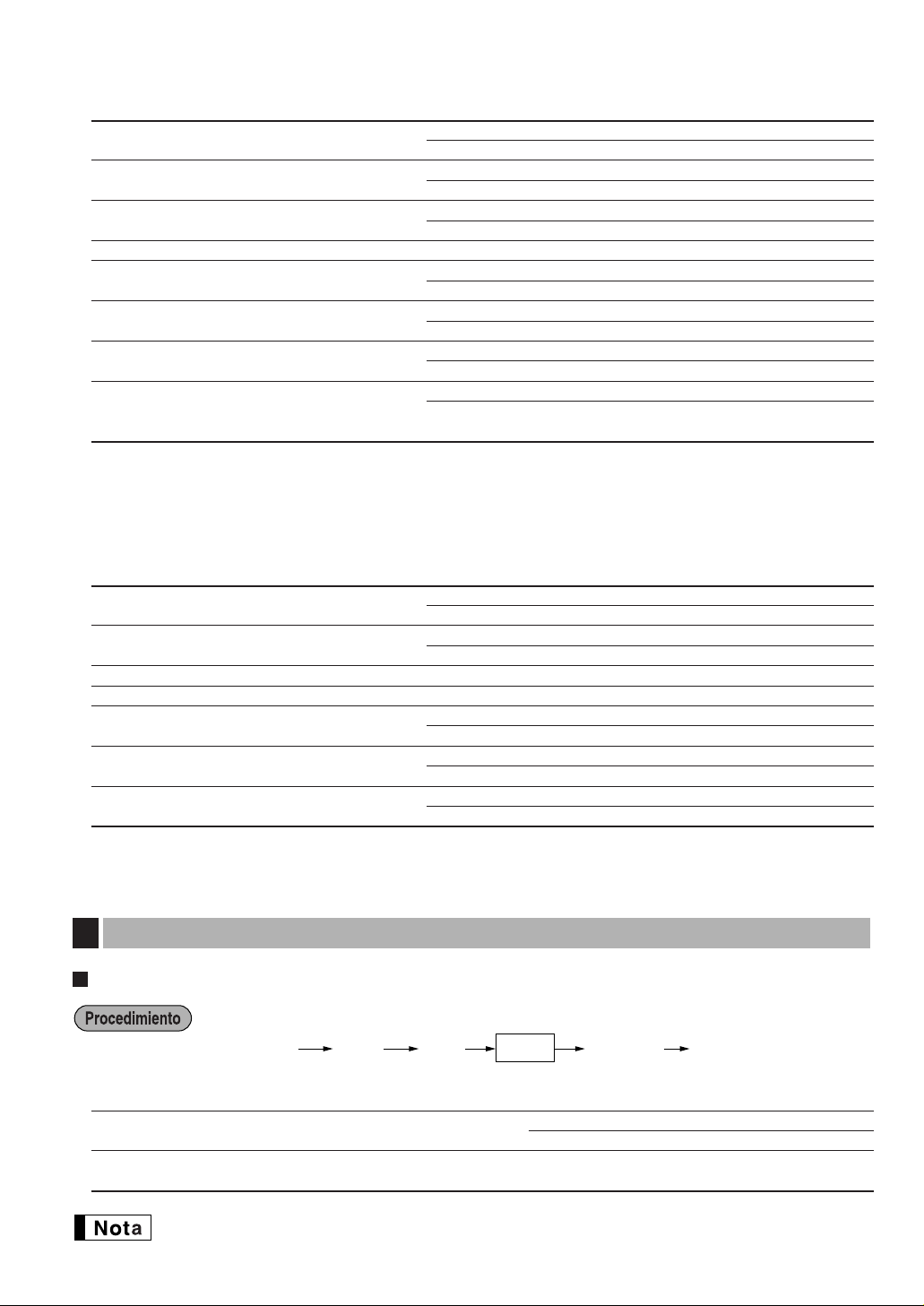
33
Código de tarea: 66
* Elemento: Selección: Registro:
A Impresión de un recibo después de la Sólo el total 0
transacción
Detalles* 1
B Impresión del importe cuando el precio Inhabilitar la impresión* 0
unitario de PLU/subsección es cero
Habilitarla 1
C Impresión del subtotal para conversión Habilitar la impresión* 0
de déficit
Inhabilitarla 1
D Introduzca siempre 0. (Posición fija) 0
E Impresión comprimida en el registro diario No (tamaño normal) 0
en los modos PGM, X1/Z1 y X2/Z2
Sí (tamaño pequeño)* 1
F Impresión comprimida en el registro diario No (tamaño normal) 0
en los modos REG, MGR y VOID
Sí (tamaño pequeño)* 1
G Impresión del mensaje del membrete en
Inhabilitar la impresión del mensaje del membrete en el registro diario
*0
el registro diario
Habilitar la impresión del mensaje del membrete en el registro diario
1
H Impresión de pie de recibo Impresión de pie de recibo en todos los recibos* 0
Impresión de pie de recibo con la tecla de función 1
seleccionada en el momento de la finalización
Impresión comprimida en el registro diario
• Esta selección sólo es válida cuando se ajusta “estilo de impresión” (código de tarea 6) como “impresión del
registro diario”.
Código de tarea: 70
* Elemento: Selección: Registro:
A Cómputo de precios divididos Cantidad* 0
Paquete 1
B Disponibilidad de entrada de precios con Habilitar sólo la entrada de multiplicación* 0
multiplicación/división
Habilitar la entrada de multiplicación y la de división de precios
1
C Introduzca siempre 0. (Posición fija) 0
D Introduzca siempre 0. (Posición fija) 0
E Impresión de impuestos cuando GST es Habilitar la impresión de impuestos* 0
IVA
Inhabilitarla 1
F Impresión de exención de GST en Habilitar la impresión de exención de GST* 0
informes X/Z
Inhabilitarla 1
G y H Sistema de cálculo de impuestos Impuestos automáticos* 00
Impuestos canadienses (número del tipo de impuestos) 01 a 11
Sistema de cálculo de impuestos
• Para el sistema de impuestos de EE.UU., seleccione “auto-tax” (impuestos automáticos).
Modo de ahorro de energía
* Elemento: Selección: Registro:
A Entrar en el modo de ahorro de energía cuando se Sí* 0
visualice la hora
No 1
B a D Tiempo (min.) para entrar en el modo de ahorro de 001 a 254 ó 999
energía desde que se efectuó la última operación (Ajuste inicial: 030)
Cuando se ajusta 999 para B a D, se inhabilita el establecimiento en el modo de ahorro de
energía.
s @
*ABCD
As
10
Programación 2 de selección de diversas funciones
3

34
Formato de impresión del mensaje del membrete
Podrá seleccionar el número de líneas del mensaje del membrete, y la posición en la que se imprime en el
recibo. Para los detalles del tipo de mensaje del membrete, consulte el apartado “Mensajes de membrete” de la
página 29.
*A: Tipo de mensaje del membrete
0: Mensaje de 3 líneas de encabezamiento sin membrete gráfico
1: Sólo membrete gráfico (ajuste inicial)
2: Mensaje de 3 líneas de pie de recibo con membrete gráfico
3: Mensaje de 6 líneas de encabezamiento
4: Mensaje de 3 líneas de encabezamiento con membrete gráfico
5: Mensaje de 3 líneas de encabezamiento y mensaje de 3 líneas de pie de recibo
Bloqueo de importe alto (HALO) para metálico en el cajón (CID) (centinela)
Ajuste inicial: 999999999
Interfaz RS-232C
(1) Número de terminal RS-232C
Ajuste inicial: 1
(2) Forma de transmisión RS-232C
* Elemento: Selección: Registro:
A Forma de la línea de transmisión Sistema dúplex* 0
Sistema semidúplex 1
(3) Velocidad de transmisión RS-232C
* Elemento: Selección: Registro:
A Introduzca siempre 0. 0
B Velocidad de transmisión (bps) 2400 3
4800 4
9600* 5
19200 6
s @
*AB
As
32
s @
*A
As
Para ajustar “0”
31
s @
Número de terminal
(máx. 6 dígitos)
As
Para ajustar “0”
30
s @
HALO para CID
(máx. 9 dígitos)
As
20
s @
*A
As
Para ajustar “0”
11
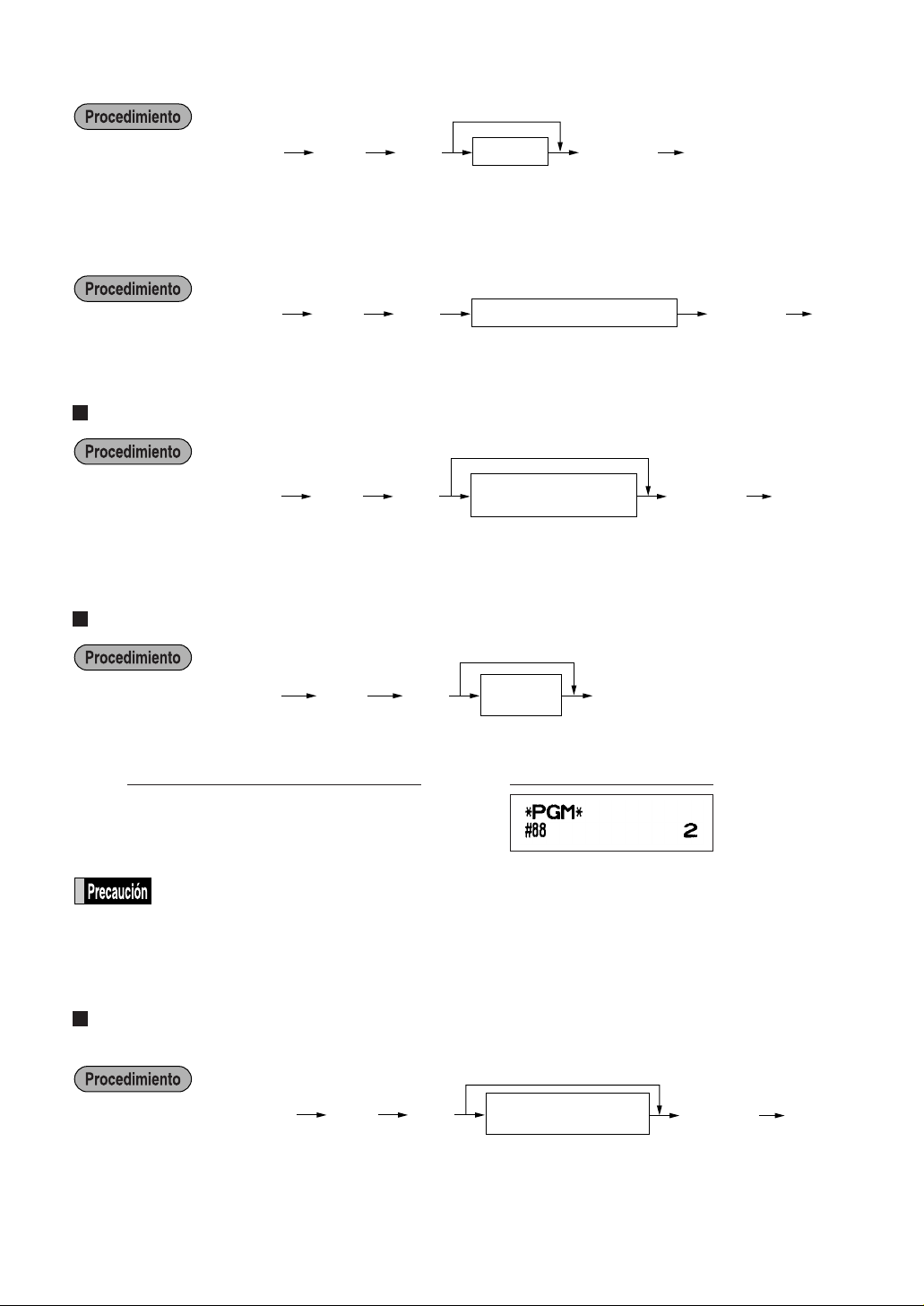
35
(4) Código inicial y código final de RS-232C
*A a C: Código inicial 000 a 127 (ajuste inicial: 002)
D a F: Código final 000 a 127 (ajuste inicial: 013)
(5) Ajuste de tiempo vencido de RS-232C
Ajuste inicial: 007
Densidad de la impresora térmica
* El ajuste inicial es 50. Para oscurecer la impresión, ajuste un número mayor, y para que sea más clara, ajuste
un número menor.
Selección del idioma
*Idioma: 0: Inglés 2: Francés 3: Español (ajuste inicial: Inglés)
Cuando cambie el idioma, los textos como los del nombre de dependiente, mensaje de membrete y
los textos de funciones (consulte la página 28), que usted haya programado, se repondrán a los
ajustes iniciales. Por lo tanto, antes de programar nombres de dependiente, mensajes de
membrete y textos de funciones, se debe hacer la selección del idioma.
Especificación de dependientes de instrucción para el modo de instrucción
Para los detalles sobre la instrucción de dependientes, consulte el “MODO DE INSTRUCCION” en la página 36.
s @
Código de dependiente
(1 a 40)
As
Para cancelar
86
s
88
@
2
A
ImpresiónEjemplo de operación de teclas
s @
*Idioma
(0, 2 ó 3)
A
Para ajustar “0”
88
s @
*Densidad de impresora
(00 a 99)
As
Para ajustar “0”
50
s @
Tiempo vencido (1 a 255 seg.)
As
35
s @
*ABCDEF
As
Para ajustar “000000”
33
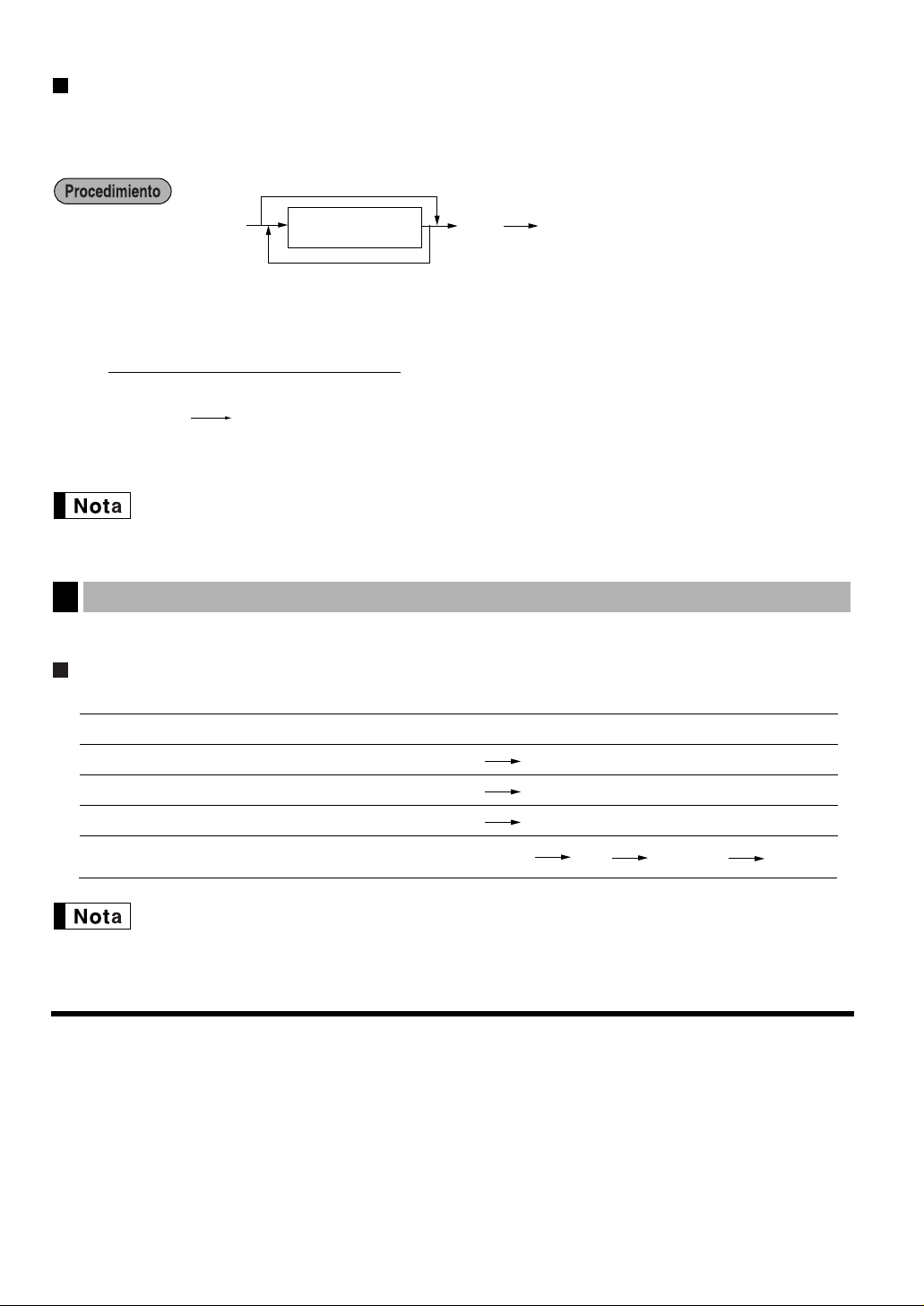
36
Programación de la tecla AUTO — Tecla de secuencia automática
Si se programan transacciones que se realizan con frecuencia o secuencias de informes para la tecla
a
,
puede volver a llamar estas transacciones y/o informes pulsando simplemente la tecla
a
en las operaciones
de teclas.
Programación para
a
; registro de un artículo de PLU 2 (precio unitario programado: 1,50) y de un artículo de
la sección 6 (precio unitario: 1,00)
Cuando se ha programado la tecla
a
para ejecutar una función de tarea de informe, el selector
de modo deberá estar en la posición apropiada (OP X/Z para informes de dependiente individual,
X1/Z1 para informes diarios o X2/Z2 para informes semanales o mensuales).
La máquina le permitirá leer todos los programas almacenados en el modo PGM.
Secuencia de las teclas para la lectura de programas almacenados
• Para detener la lectura del informe de programación 1 o del informe de programación de PLU,
gire el selector de modo a la posición MGR.
• Cuando se efectúa continuamente la impresión, se interrumpe una vez. Sin embargo, la
impresión se reiniciará algunos segundos después.
Nombre del informe Secuencia de teclas
Informe de programación 1
A
Informe de programación 2 2 A
Informe de programación de tecla automática 1 A
Informe de programación de densidad de impresora 3 A
Informe de programación de PLU
Código de
PLU final
Código de
PLU inicial
@p
Lectura de programas almacenados
4
a
™
100
(
a
A
Ajuste
AUTO
Ejemplo de operación de teclas
a
A
a
Transacción
(entrada de teclas)
Borrar
máx. 25 veces
MODO DE INSTRUCCION
El modo de instrucción se utiliza cuando el operador o el administrador practica las operaciones de la caja
registradora.
Cuando se selecciona un dependiente que está en instrucción, la máquina se establece automáticamente en el
modo de instrucción. Para especificar un dependiente que deba recibir instrucción, consulte el apartado de
“Especificación de dependientes de instrucción para el modo de instrucción” en “PROGRAMACION
AVANZADA” de la página 35.
La operación de instrucción sólo es válida en los modos REG, MGR y VOID.
La memoria del dependiente correspondiente sólo se actualiza en el modo de instrucción.
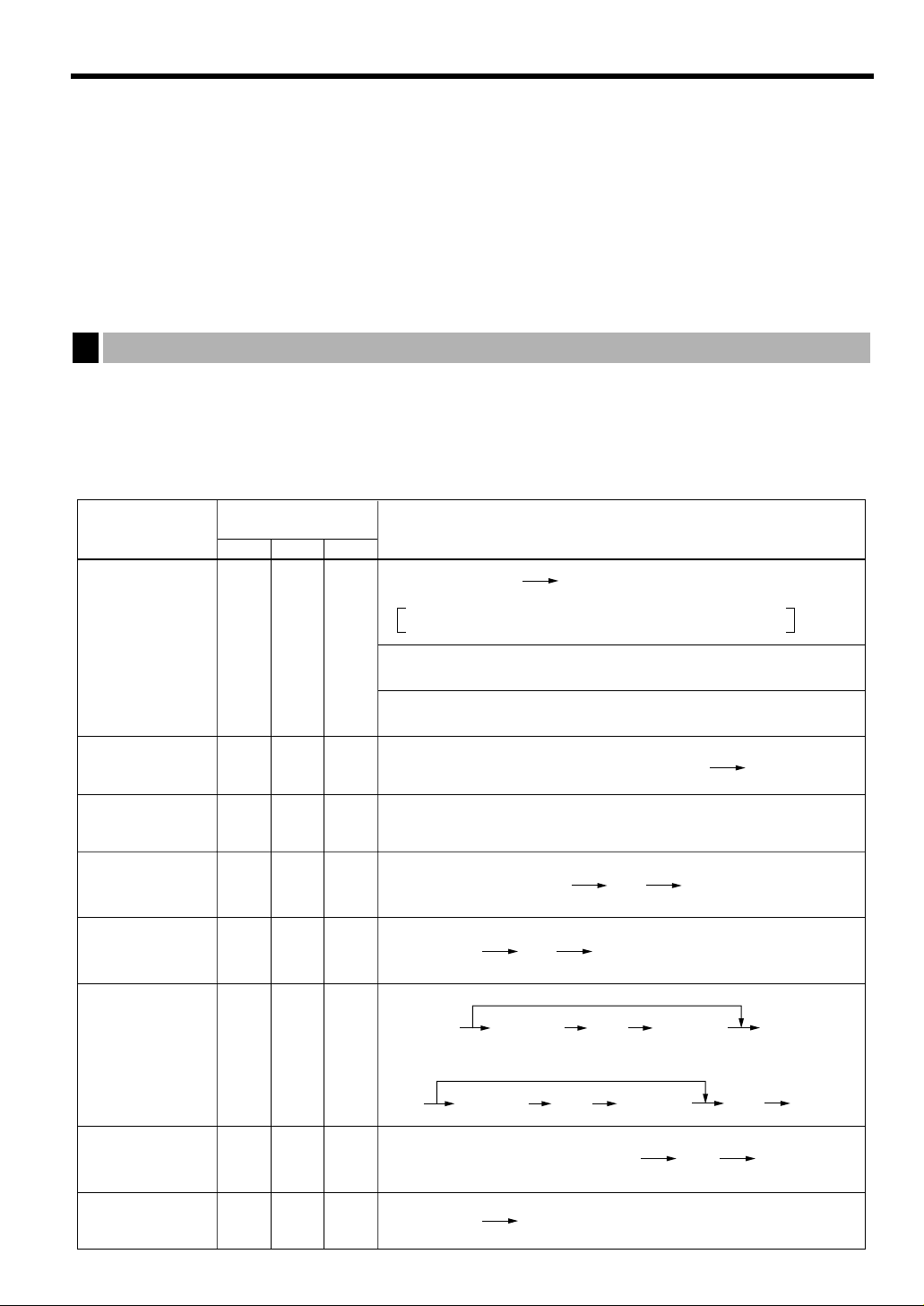
37
LECTURA (X) Y REPOSICION (Z) DE
LOS TOTALES DE VENTAS
• Utilice la función de lectura (X) cuando necesite leer la información de ventas registrada desde la última
reposición. Puede obtener esta lectura todas las veces que quiera dado que no afecta a la memoria de la
registradora.
• Utilice la función de reposición (Z) cuando necesite borrar la memoria de la registradora. La reposición
imprime toda la información de ventas y borra toda la memoria excepto para GT1 a GT3, GT de instrucción,
cuenta de reposición y número consecutivo.
Informes X1 y Z1: Informes de ventas diarias
Informes X2 y Z2: Informes de consolidación periódica (mensual)
Para hacer un informe X o Z, gire el selector de modo a la posición apropiada consultando la columna de
“Posición del selector de modo” mostrada en la tabla siguiente, y emplee la siguiente secuencia de teclas
correspondiente.
Elemento
Posición del selector
de modo
Operación de teclas
OPX/Z
X
--
--
--
--
--
--
--
Tecla
A
: Total de ventas
Tecla
@
: Importe de metálico en el cajón
Código de sección : Total de ventas de sección
d
Para las secciones 1 a 6: Tecla de sección (
!
a
(
)
Informe del total de
grupo individual en
sección
Informe de PLU
por margen
designado
X1/Z1
--
X1, Z1
X1, Z1
X2/Z2
--
X2, Z2
X2, Z2
Informe rápido:
(Sólo
visualización)
Para borrar la
visualización,
pulse la tecla
l
o
gire el selector de
modo a otra
posición.
Informe de ventas
completo
Informe de sección
X1 X2
Informe de
transacciones
X1 X2
X1 X2
Informe del total de
todos los grupos
en sección
X1 X2
Informe de PLU
por sección
asociada
X1 X2
P
AA
Lectura: Reposición:
d
Lectura:
Lectura:
@
1
0
A
Lectura:
d
Lectura: Código de sección asociada
d
p
@
d
Lectura: Número de grupo
Reposición:
P
Todas las PLU
Código de
PLU final
Código de
PLU inicial
p@
Lectura:
Todas las PLU
Código de
PLU final
Código de
PLU inicial
p@
Resumen de informes de lectura (X) y reposición (Z)
1
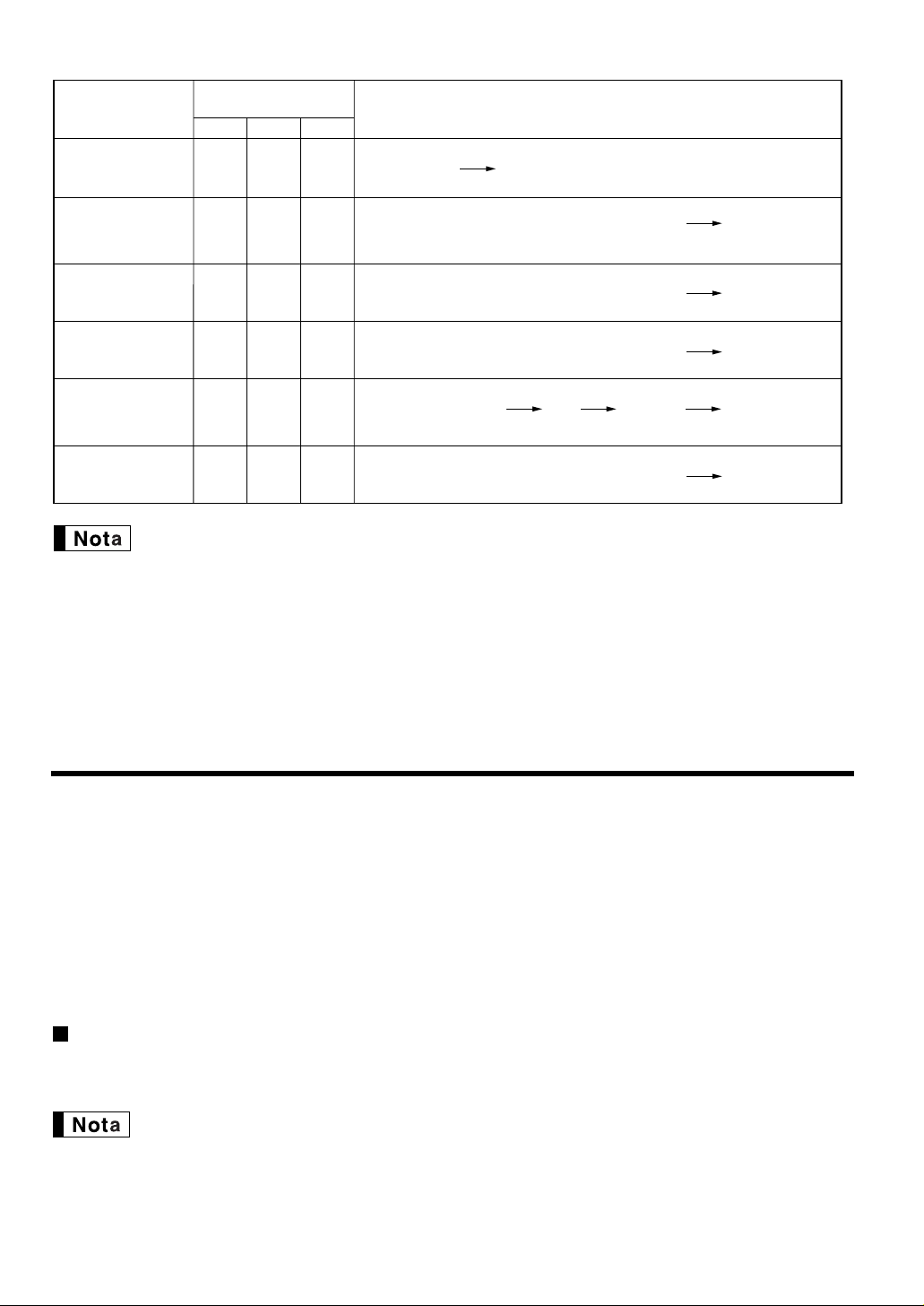
38
• Cuando las cantidades de ventas y los importes de ventas son cero, se pasa por alto la
impresión. Si no desea que se pase por alto, cambie la programación. (Consulte el apartado de
“Formato de impresión” de la sección “Programación 1 de selección de diversas funciones”.)
• “X” representa el símbolo de lectura y “Z” representa el símbolo de reposición en los informes.
• Para dejar de leer y reponer el informe de ventas de PLU, gire el selector de modo a la posición
MGR. Los datos no se borrarán al efectuar la reposición.
• Cuando se efectúa continuamente la impresión, se interrumpe una vez. Sin embargo, la
impresión se reiniciará algunos segundos después.
Elemento
Posición del selector
de modo
Operación de teclas
OPX/Z X1/Z1 X2/Z2
X2, Z2
X2, Z2
Informe del total en
el cajón
X1
X1 X2
A
Lectura:
--
--
--
--
--
X, Z
Informe de todos
los dependientes
Informe horario
(completo)
X1, Z1
X1, Z1
--
--
--
--
--
Informe de
dependiente
individual
P
LL
Lectura: Reposición:
P
LL
Lectura: Reposición:
P
ss
Lectura: Reposición:
Informe horario
(por margen)
s@
Lectura: Hora inicial Hora final
Informe de ventas
de neto diario
P
ss
Lectura: Reposición
(El informe del dependiente actual)
(hora) (hora)
2
LECTURA Y REPOSICION DE
INFORMES EJ
La caja registradora está provista de una función de registro diario electrónico (EJ). Esta función sirve para
registrar los datos del registro diario en una memoria en lugar de hacerlo en el papel de registro diario, y para
imprimir los datos como un informe EJ. La caja registradora registra los datos de registro diario en los modos
REG, PGM, VOID, X1/Z1 y X2/Z2. Para los detalles de la programación de EJ, consulte el apartado
“Parámetros de función para el registro diario electrónico (EJ)” de la página 31.
Impresión de los datos del registro diario en forma de una transacción
Podrá imprimir los datos del registro diario de una transacción actual registrada en la memoria EJ pulsando la
tecla
R
durante la transacción.
Esta función es válida cuando se programa el estilo de impresión para recibos, y la función de
activación/desactivación (ON/OFF) de recibo se ajusta a OFF (desactivación).

39
Lectura y reposición de los datos del registro diario electrónico (emisión
de informe EJ)
Podrá leer los datos del registro diario almacenados en la memoria EJ en el formato del registro diario
ejecutando el procedimiento siguiente en el modo X1/Z1 u OP X/Z.
• En la memoria EJ pueden almacenarse un máximo de 3.000 líneas de datos. Cuando se ejecuta la lectura de
todos los datos, se imprimen todos los datos almacenados en la memoria EJ. Para ahorrar papel, está
disponible la impresión comprimida.
• Para dejar de leer o reponer los datos, gire el selector de modo a la posición “MGR”. Los datos no se borrarán
al efectuar la reposición.
• Cuando se efectúa continuamente la impresión, se interrumpe una vez. Sin embargo, la impresión se
reiniciará algunos segundos después.
P
Para reponer todos los datos:
A@
Para leer los 10 registros últimos:
A@
e
Para leer todos los datos:
700
700
710
(Sólo en el modo X1/Z1)
A@
REGISTROS DE ANULACION
El límite programado para las funciones (tales como importes máximos) puede anularse haciendo un registro de
anulación en el modo MGR.
1. Gire el selector de modo a la posición MGR.
2. Haga el registro de anulación.
CORRECCION DESPUES DE FINALIZAR
UNA TRANSACCION (Modo de cancelación)
Cuando necesite cancelar los registros incorrectos que los dependientes no pueden corregir (registros
incorrectos que se encuentran después de finalizar una transacción o que no pueden corregirse mediante
cancelación directa o indirecta), siga este procedimiento:
1. Gire el selector de modo a la posición VOID empleando la llave del administrador (MA) para establecer la
máquina en el modo de cancelación.
2. Repita los registros anotados en el recibo incorrecto. (Todos los datos del recibo incorrecto se suprimirán de
la memoria de la registradora y los importes cancelados se añadirán al totalizador de transacción del modo
de cancelación.)

40
MANTENIMIENTO PARA EL OPERADOR
Si se corta la alimentación, la registradora retiene el contenido de su memoria y toda la información sobre las
entradas de ventas.
• Cuando el corte de la alimentación ocurre en el estado libre de la registradora o cuando está realizando una
entrada, la máquina retorna al funcionamiento normal después de recuperarse la alimentación.
• Cuando el corte de la alimentación ocurre durante un ciclo de impresión, la registradora imprime
“============” y lleva a cabo después el procedimiento de impresión correcto después de recuperarse la
alimentación.
Si se termina el papel de la impresora, se parará la impresora, y aparecerá “PAPER EMPTY” en el visualizador.
No pueden aceptarse los registros de teclas. Consultando la sección 4 en este capítulo, instale un rollo de papel
nuevo, y luego pulse la tecla
l
. La impresora imprimirá el símbolo de falla de la alimentación y reanudará la
impresión.
Si se levanta el brazo del rodillo impresor, se parará la impresora y aparecerá “HEAD UP” en el visualizador. No
pueden aceptarse los registros de teclas. Empuje el brazo hacia abajo hasta que se bloquee con seguridad, y
entonces pulse la tecla
l
. La impresora imprimirá el símbolo de falla de la alimentación y reanudará la
impresión.
Precauciones al manejar la impresora
• Evite los lugares polvorientos y húmedos, la luz directa del sol y el polvo metálico. (En esta máquina se
emplean un imán permanente y un electroimán.)
• No tire nunca del papel cuando esté bloqueado el brazo del rodillo impresor. Levante primero el brazo, y luego
quite el papel.
• No toque nunca la superficie del cabezal de impresión ni el rodillo impresor.
Precauciones al manejar el papel de registro (papel térmico)
• Utilice solamente el papel especificado por SHARP.
• No desembale el papel térmico hasta que esté listo utilizarlo.
• Evite el calor. El papel se coloreará a 70°C.
• Evite lugares polvorientos y húmedos para guardar el papel. Evite la luz directa del sol.
• El texto impreso en el papel puede descolorarse bajo condiciones de exposición a altas humedad y
temperatura, exposición a la luz directa del sol, contacto con agentes adhesivos, disolvente, o cianocopias
hechas recientemente, y al calor causado por la fricción de rayadas o por otras razones.
• Tenga cuidado cuando maneje el papel térmico. Si desea guardar un registro permanente, copie el texto
impreso con una fotocopiadora.
Precauciones al manejar la impresora y el papel de registro
3
En el caso de error de impresora
2
En caso de corte de la alimentación
1
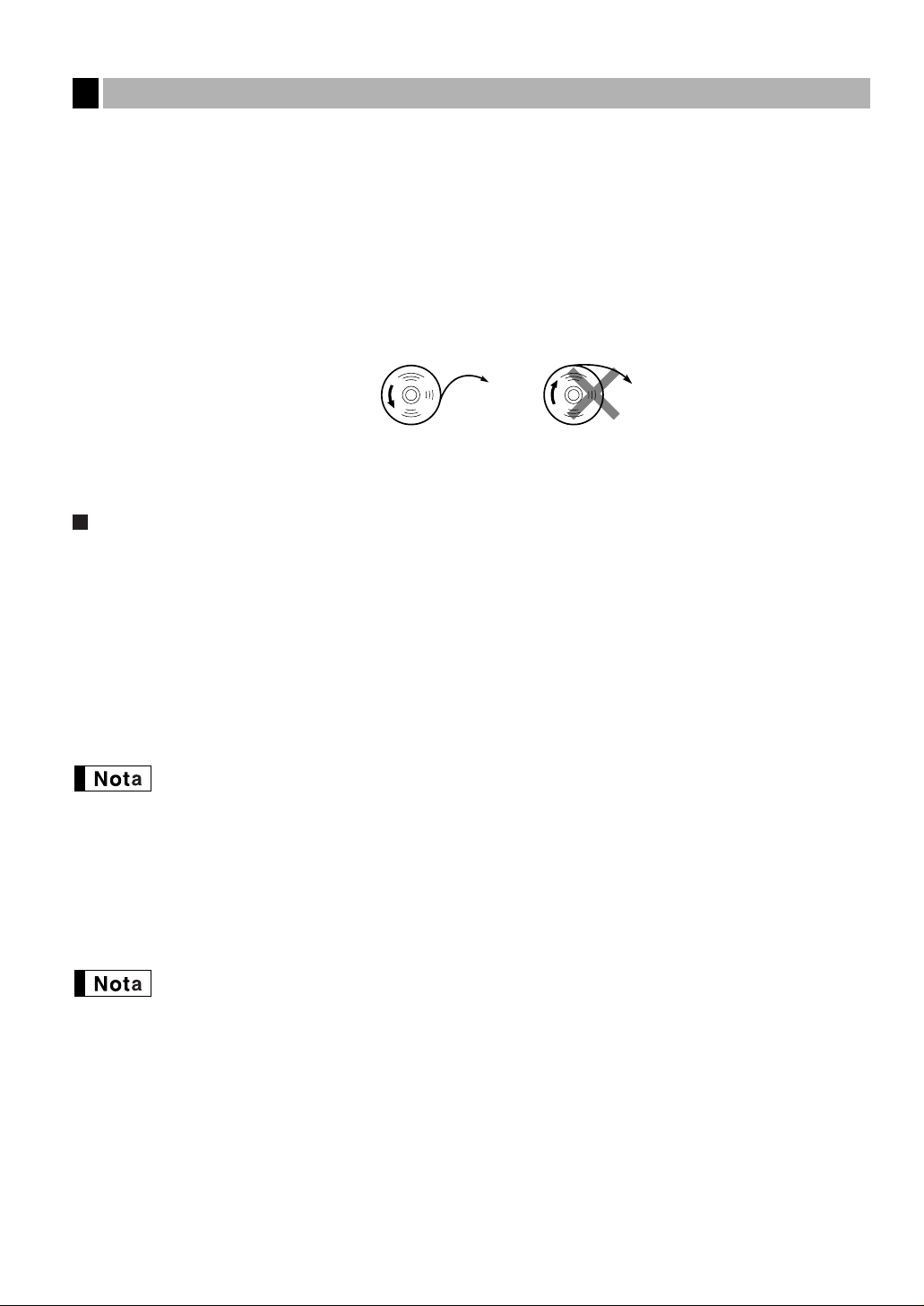
41
Utilice siempre rollos de papel especificados por SHARP.
Si usa otros rollos de papel que no sean los especificados, pueden originarse atascos de papel y funcionar mal
la caja registradora.
Especificaciones del papel
Anchura del papel: 57,5±0,5 mm
Diámetro exterior máximo: 80 mm
Calidad: Papel térmico
• Asegúrese de colocar el rollo de papel antes de utilizar la caja registradora pues, de lo contrario,
podría funcionar mal.
Instale el rollo de papel en la impresora. Tenga cuidado de colocar el rollo de la forma correcta.
(Forma de colocar el rollo de papel)
Extracción del rollo de papel
Cuando aparezca tinta de color rojo en el rollo de papel, será indicación de que tiene que cambiarlo. Reemplace
el rollo de papel por otro nuevo. Si no piensa utilizar la caja registradora durante mucho tiempo, extraiga el rollo
de papel y guárdelo en el lugar apropiado.
Precaución: El cortador de papel está montado en la cubierta de la impresora. Tenga mucho cuidado de
no cortarse por accidente.
Cuando no emplee el carrete de toma (empleo como papel de recibos):
1. Extraiga la cubierta de la impresora.
2. Levante la palanca de liberación del rodillo impresor para desbloquear y abrir el brazo del rodillo impresor.
3. Extraiga el rollo de papel del soporte del rollo de papel.
No tire del papel por la impresora.
Cuando emplee el carrete de toma (empleo como papel de registro diario):
1. Gire el selector de modo a una posición que no sea la posición OFF con el cable de alimentación enchufado.
2. Extraiga la cubierta de la impresora.
3. Pulse la tecla
F
para hacer avanzar el papel de registro diario hasta que la parte impresa salga del paso.
4. Corte el papel y extraiga el carrete de toma.
5. Levante la palanca de liberación del rodillo impresor para desbloquear y abrir el brazo del rodillo impresor.
6. Extraiga el rollo de papel del soporte del rollo de papel.
No tire del papel por la impresora.
7. Extraiga el lado exterior del carrete de toma.
8. Extraiga el rollo de registro diario impreso del carrete de toma.
A la impresora
Incorrecto
A la impresora
Correcto
Reemplazo del rollo de papel
4
42
Instalación del rollo de papel
Precaución: El cortador de papel está montado en la cubierta de la impresora. Tenga mucho cuidado de
no cortarse por accidente.
Instalación del rollo de papel de recibos:
1. Gire el selector de modo a una posición que no sea la posición OFF con el cable de alimentación enchufado.
2. Extraiga la cubierta de la impresora.
3. Levante la palanca de liberación del rodillo impresor para desbloquear y abrir el brazo del rodillo impresor.
4. Coloque correctamente el papel en el soporte del rollo de papel.
5. Haga avanzar el extremo del papel junto con las guías de papel.
6. Mientras mantiene retenido el papel, cierre lentamente el brazo del rodillo impresor, y empuje el brazo hacia
abajo hasta oír un sonido seco de confirmación. Asegúrese que empuja con seguridad el centro de la parte
del ala del brazo. El papel avanzará automáticamente.
Si el brazo del rodillo impresor no está bloqueado correctamente, no se podrá imprimir con éxito.
Si ocurre este problema, abra el brazo, y ciérrelo de nuevo como se ha indicado arriba.
7. Corte el papel sobrante empleando el borde de la cubierta interior, y vuelva a colocar la cubierta de la
impresora. Pulse la tecla
F
para asegurarse que el papel sale por la cubierta de la impresora y que
aparece papel limpio.
Si no sale el papel, extraiga la cubierta de la impresora, y haga pasar el extremo del papel entre el
cortador de papel y las guías de papel de la cubierta de la impresora, y luego vuelva a colocar la
cubierta.
Instalación del rollo de papel de registro diario:
1. Gire el selector de modo a una posición que no sea la posición OFF con el cable de alimentación enchufado.
2. Extraiga la cubierta de la impresora.
3. Levante la palanca de liberación del rodillo impresor para desbloquear y abrir el brazo del rodillo impresor.
4. Coloque correctamente el papel en el soporte del rollo de papel.
5. Haga avanzar el extremo del papel junto con las guías de papel.
6. Mientras mantiene retenido el papel, cierre lentamente el brazo del rodillo impresor, y empuje el brazo hacia
abajo hasta oír un sonido seco de confirmación. Asegúrese que empuja con seguridad el centro de la parte
del ala del brazo. El papel avanzará automáticamente.
7. Inserte el extremo del papel en la ranura del carrete de papel. (Pulse la tecla
F
para hacer avanzar más
papel si es necesario.)
8. Bobine el papel dos o tres vueltas en torno al eje del carrete.
9. Coloque el carrete en el rodamiento, y pulse la tecla
F
para sacar la flojedad excesiva del papel.
10. Vuelva a colocar la cubierta de la impresora.
Podrá bobinar el papel de rollo en los modos OP X/Z, X1/Z1 y X2/Z2 aunque haya programado
para utilizar la impresora para emisión de recibos. Esto puede ser conveniente para bobinar los
informes. En este caso, ajuste el papel de rollo en el carrete de toma.
Precaución: El cortador de papel está montado en la cubierta de la impresora. Tenga mucho cuidado de
no cortarse por accidente. No toque nunca el cabezal de impresión inmediatamente
después de imprimir, porque éste estará aún caliente.
1. Extraiga la cubierta de la impresora.
2. Levante la palanca de liberación del rodillo impresor para desbloquear y abrir el brazo del rodillo impresor.
3. Extraiga el papel atascado. Compruebe si quedan restos de papel en la impresora y, si los hubiera, quítelos.
4. Ponga correctamente el rollo de papel siguiendo los pasos mencionados en “Instalación del rollo de papel”.
Extracción del papel atascado
5
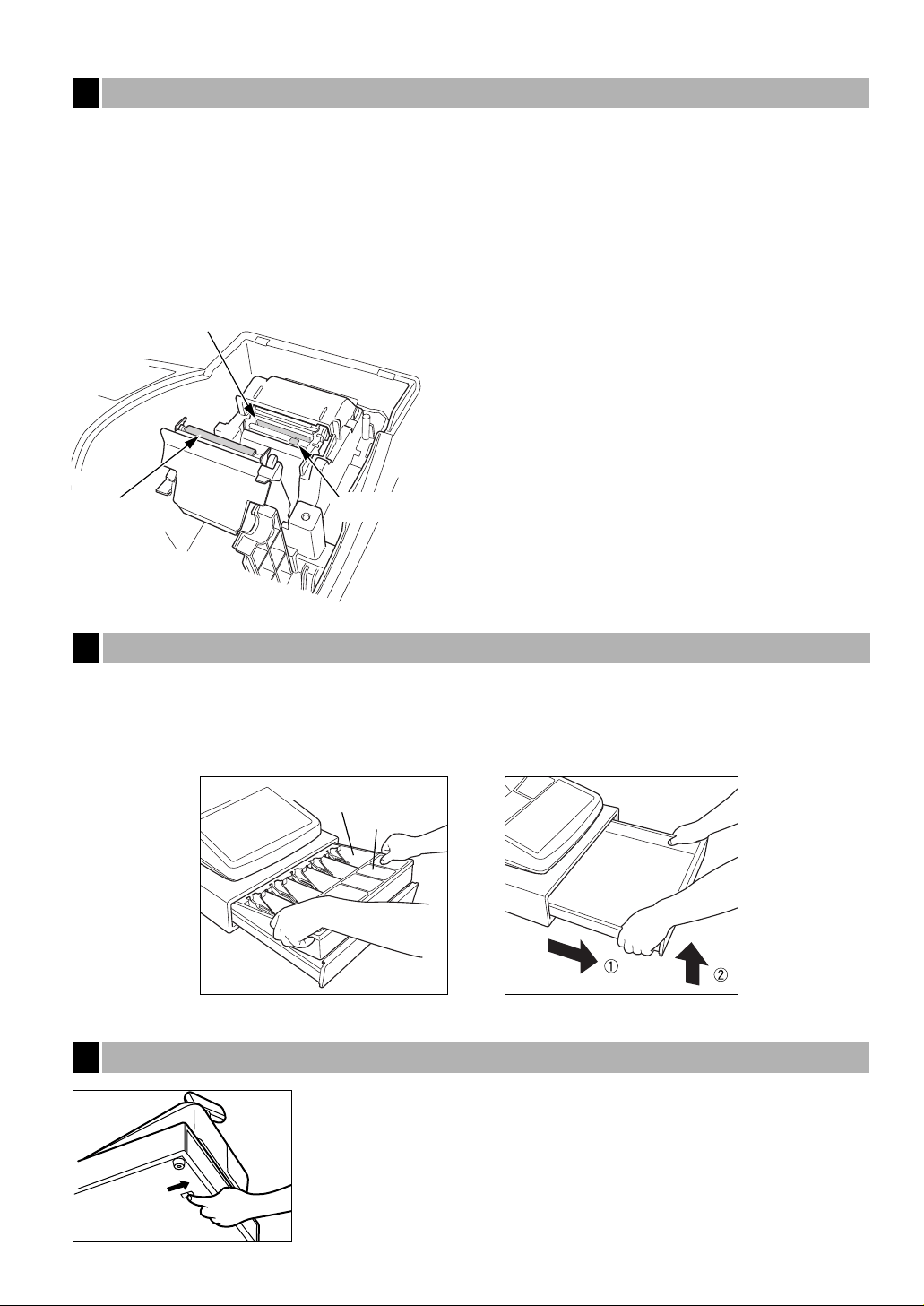
43
Cuando el texto impreso se oscurece o aparece borroso, el polvo del papel puede pegarse en el cabezal de
impresión, el sensor y/o el rodillo. Límpielos de la forma siguiente:
Precaución:
• No toque nunca el cabezal de impresión con una herramienta ni nada que sea duro porque podría
estropear el cabezal.
• El cortador de papel está montado en la cubierta de la impresora. Tenga mucho cuidado de no cortarse
por accidente.
1. Gire el selector de modo a la posición OFF.
2. Extraiga la cubierta de la impresora.
3. Levante la palanca de liberación del rodillo impresor
para desbloquear y abrir el brazo del rodillo impresor.
4. Extraiga el rollo de papel consultando la sección
“Extracción del rollo de papel”.
5. Limpie el cabezal de impresión con un palillo de algodón
o un paño blando humedecido en alcohol etílico o
alcohol isopropílico. Limpie el rodillo y el sensor de la
misma manera.
6. Ponga correctamente el rollo de papel siguiendo los
pasos mencionados en “Instalación del rollo de papel”.
El separador de dinero de la caja registradora es separable. Después de terminar la jornada laboral, extraiga el
separador de dinero del cajón y deje el cajón abierto. Para extraer el cajón, tire del mismo completamente hacia
delante con el separador de dinero sacado. Y extráigalo levantándolo. La caja de monedas de 6
denominaciones también es extraíble.
El cajón se abre automáticamente. Sin embargo, cuando haya un fallo o corte
de la corriente o la registradora quede fuera de servicio, deslice la palanca
situada en la parte inferior de la registradora en la dirección de la flecha. (Vea
la figura a la izquierda.)
El cajón no se abrirá, sin embargo, si está cerrado con la llave.
Palanca
Abertura manual del cajón
8
Separador
de dinero
Caja de
monedas
Extracción del separador de dinero y del cajón
7
Limpieza de la impresora (cabezal de impresión / sensor / rodillo)
6
Cabezal de impresión
Rodillo
Sensor
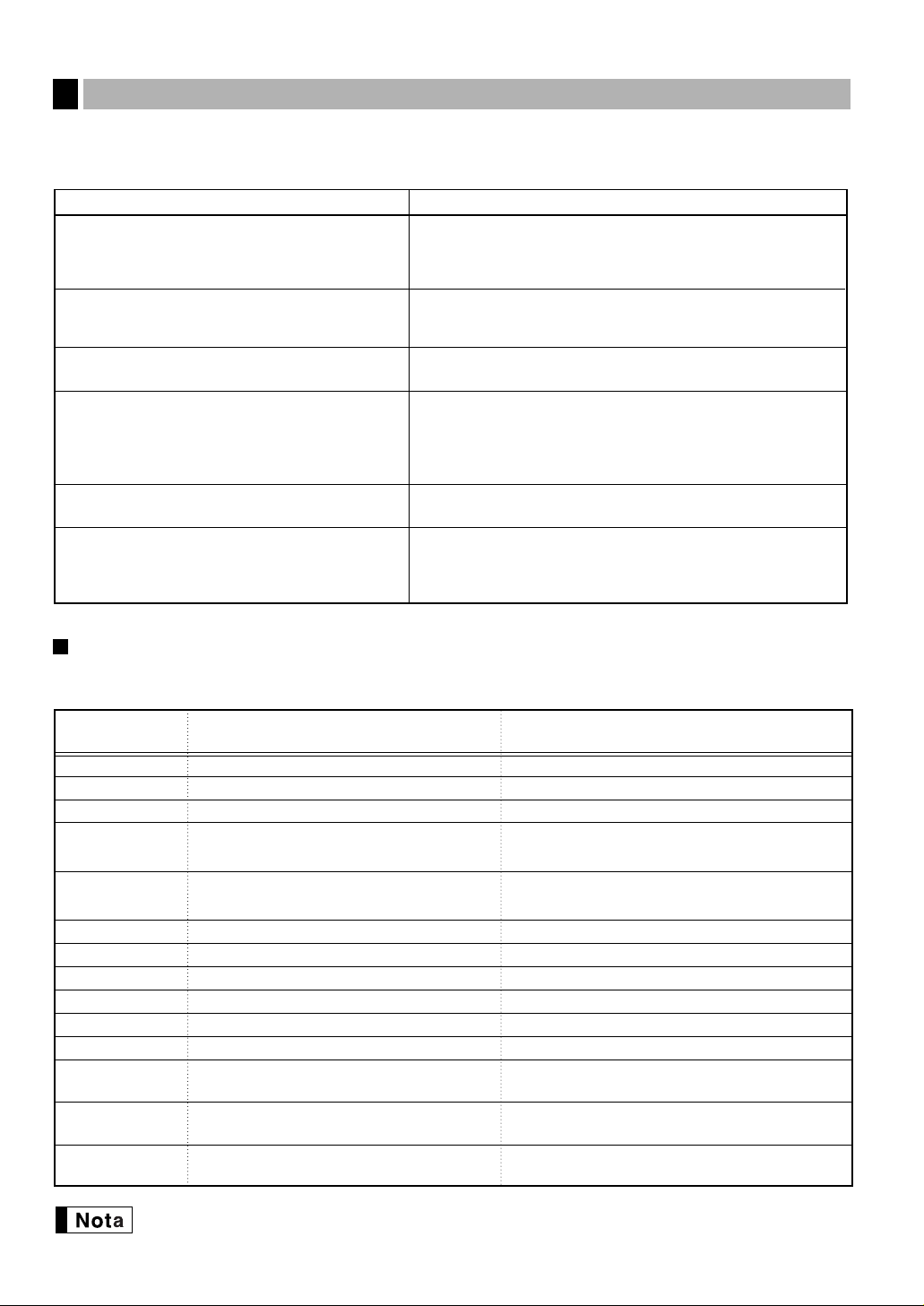
44
Los casos de mal funcionamiento de la columna de la izquierda de la tabla siguiente, indicados bajo el título
“Fallo”, no son necesariamente averías de la registradora. Se recomienda pues consultar la sección
“Comprobación” de la columna de la derecha antes de llamar al servicio técnico.
Tabla de mensajes de error
Cuando se visualicen los siguientes mensajes de error, pulse la tecla
l
y tome la acción apropiada de
acuerdo con la tabla siguiente.
Fallo Comprobación
El visualizador no se ilumina aunque el selector
de modo esté colocado en cualquier otra
posición que no sea “OFF”.
• ¿Se suministra alimentación en la toma de corriente?
• ¿Está la clavija del cable de alimentación desenchufada o mal
conectada a la toma de corriente de CA?
(2)
El visualizador muestra los símbolos que no
tienen ningún sentido.
• ¿Se ha inicializado correctamente la máquina como se muestra
en “PARA EMPEZAR”?
(Tenga presente que la inicialización borra todos los datos y
ajustes programados que están almacenados en la memoria.)
(1)
El visualizador se ilumina, pero la registradora
no responde a los registros.
• ¿Está el código del dependiente asignado a la registradora?
• ¿Está el selector de modo bien colocado en la posición “REG”?
(3)
No se emiten recibos. • ¿Está el rollo de papel bien instalado?
• ¿Hay algún atasco de papel?
• ¿Está la función de recibos en el estado “OFF”?
• ¿Está la palanca de liberación del rodillo impresor bloqueado
con seguridad?
(4)
No sale el papel del registro diario. • ¿Está el carrete de toma bien instalado en el rodamiento?
• ¿Hay algún atasco de papel?
(5)
La impresión no es normal. • ¿Está el rollo de papel correctamente instalado?
• ¿Está la palanca de liberación del rodillo impresor bloqueado
con seguridad?
• ¿Están limpios el cabezal de impresión/sensor/rodillo?
(6)
Antes de solicitar el servicio de un técnico
9
Mensaje de error
Estado de error Acción
ENTRY ERROR Error de registro Haga el registro con las teclas correctas.
MISOPERATION Error de operación incorrecta Haga el registro con las teclas correctas.
NO RECORD Se ha introducido un código no definido. Introduzca un código correcto.
MEMORY FULL La memoria está llena (en la programación Programe la tecla
a
con 25 pasos.
de la tecla
a
).
SBTL COMPUL. Pulsación obligatoria de la tecla
s
para Pulse la tecla
s
y prosiga la operación.
finalización directa
TEND COMPUL. Importe recibido obligatorio Efectúe una operación de importe recibido.
NOT ASSIGNED Falta el registro de un código de dependiente. Efectúe un registro de código de dependiente.
OVER LIMIT. Error de límite de rebose Haga el registro dentro del límite de registro.
INH. OPEN PR La entrada de precio abierto está inhibida. Haga un registro de precio preajustado.
INH. UNIT PR
La entrada de precio preajustado está inhibida.
Haga un registro de precio abierto.
NOT NON-TEND La finalización directa está inhibida. Haga una operación de importe recibido.
BUFFER FULL No se permite la cancelación del subtotal. Finalice la transacción y corrija las entradas
erróneas en el modo de cancelación.
HEAD UP El brazo del rodillo impresor está levantado. Asegúrese de que el brazo del rodillo impresor esté
bloqueado con seguridad.
PAPER EMPTY El rollo de papel de recibos o de registro Instale un rollo de papel de recibos o de registro
diario no está instalado o está vacío. diario.
Los mensajes de error son los de español (cambio del ajuste de programación para selección del idioma
español).

LIMITED WARRANTY
SHARP ELECTRONICS CORPORATION warrants to the first consumer purchaser that this Sharp
brand product (the "Product"), when shipped in its original container, will be free from defective
workmanship and materials and agrees that it will, at its option, either repair the defect or replace the
defective Product or part thereof at no charge to the purchaser for parts or labor for the time
period(s) set forth below.
This warranty does not apply to any appearance items of the Product nor to the additional excluded
item(s) set forth below nor to any product the exterior of which has been damaged or defaced, which
has been subjected to misuse, abnormal service or handling or which has been altered or modified
in design or construction.
In order to enforce the rights under this limited warranty, the purchaser should follow the steps set
forth below and provide proof of purchase to the servicer.
The limited warranty described herein is in addition to whatever implied warranties may be granted
to purchasers by law. ALL IMPLIED WARRANTIES INCLUDING THE WARRANTIES OF
MERCHANTABILITY AND FITNESS FOR USE ARE LIMITED TO THE PERIOD(S) FROM THE
DATE OF PURCHASE SET FORTH BELOW. Some states do not allow limitations on how long an
implied warranty lasts, so the above limitation may not apply to you.
Neither the sales personnel of the seller nor any other person is authorized to make any warranties
other than those described herein or to extend the duration of any warranties beyond the time period
described herein on behalf of Sharp.
The warranties described herein shall be the sole and exclusive warranties granted by Sharp and
shall be the sole and exclusive remedy available to the purchaser. Correction of defects, in the
manner and for the period of time described herein, shall constitute complete fulfillment of all
liabilities and responsibilities of Sharp to the purchaser with respect to the Product and shall
constitute full satisfaction of all claims, whether based on contract, negligence, strict liability or
otherwise. In no event shall Sharp be liable, or in any way responsible, for any damages or defects
in the Product which were caused by repairs or attempted repairs performed by anyone other than
an authorized servicer. Nor shall Sharp be liable, or in any way responsible, for any incidental or
consequential economic or property damage. Some states do not allow the exclusion or incidental or
consequential damages, so the above exclusion may not apply to you.
THE WARRANTY GIVES YOU SPECIFIC LEGAL RIGHTS. YOU MAY ALSO HAVE OTHER
RIGHTS WHICH VARY FROM STATE TO STATE.
Your Product:
XE series Electronic Cash Register
Warranty Period of this Product:
One (1) year for parts and ninety (90) days parts and labor from
the date of purchase.
Additional items excluded from
Any consumable items such as paper supplied with the Product.
warranty coverage:
Where to obtain service: At a Sharp Authorized Servicer located in the United States. To
find the location of the nearest Sharp Authorized Servicer, call
toll free at 1-800-BE-SHARP.
What to do to obtain service:
Ship (prepaid) or carry your Product to a Sharp Authorized
Servicer. Be sure to have proof of purchase available. If you ship
or mail the Product, be sure it is packaged carefully.
TO OBTAIN SUPPLIES, ACCESSORIES OR PRODUCT INFORMATION, CALL 1-800-BE-SHARP.

SHARP ELECTRONICS CORPORATION
SHARP CORPORATION
Sharp Plaza, Mahwah, New Jersey 07430-2135
1-800-BE-SHARP
http://www.sharp-usa.com
Printed in China / Impreso en China
KS(TINSZ2503RCZZ)
➀