4G LTE SMARTPHONE
User Manual
Please read this manual before operating your
phone, and keep it for future reference.

Warning!
This product contains chemicals known to the State of California to cause cancer and reproductive toxicity.
Intellectual Property
All Intellectual Property, as defined below, owned by or which is otherwise the property of Samsung or its respective suppliers
relating to the SAMSUNG Phone, including but not limited to, accessories, parts, or software relating there to (the “Phone
System”), is proprietary to Samsung and protected under federal laws, state laws, and international treaty provisions. Intellectual
Property includes, but is not limited to, inventions (patentable or unpatentable), patents, trade secrets, copyrights, software,
computer programs, and related documentation and other works of authorship. You may not infringe or otherwise violate the
rights secured by the Intellectual Property. Moreover, you agree that you will not (and will not attempt to) modify, prepare
derivative works of, reverse engineer, decompile, disassemble, or otherwise attempt to create source code from the software. No
title to or ownership in the Intellectual Property is transferred to you. All applicable rights of the Intellectual Property shall remain
with SAMSUNG and its suppliers.
Open Source Software
Some software components of this product incorporate source code covered under GNU General Public License (GPL), GNU Lesser
General Public License (LGPL), OpenSSL License, BSD License and other open source licenses. To obtain the source code covered
under the open source licenses, please visit:
http://opensource.samsung.com
.
Disclaimer of Warranties; Exclusion of Liability
EXCEPT AS SET FORTH IN THE EXPRESS WARRANTY CONTAINED ON THE WARRANTY PAGE ENCLOSED WITH THE PRODUCT, THE
PURCHASER TAKES THE PRODUCT “AS IS”, AND SAMSUNG MAKES NO EXPRESS OR IMPLIED WARRANTY OF ANY KIND
WHATSOEVER WITH RESPECT TO THE PRODUCT, INCLUDING BUT NOT LIMITED TO THE MERCHANTABILITY OF THE PRODUCT OR
ATT_SGH-I527_UM_English_NE7_TN_061114_F2

ITS FITNESS FOR ANY PARTICULAR PURPOSE OR USE; THE DESIGN, CONDITION OR QUALITY OF THE PRODUCT; THE
PERFORMANCE OF THE PRODUCT; THE WORKMANSHIP OF THE PRODUCT OR THE COMPONENTS CONTAINED THEREIN; OR
COMPLIANCE OF THE PRODUCT WITH THE REQUIREMENTS OF ANY LAW, RULE, SPECIFICATION OR CONTRACT PERTAINING
THERETO. NOTHING CONTAINED IN THE INSTRUCTION MANUAL SHALL BE CONSTRUED TO CREATE AN EXPRESS OR IMPLIED
WARRANTY OF ANY KIND WHATSOEVER WITH RESPECT TO THE PRODUCT. IN ADDITION, SAMSUNG SHALL NOT BE LIABLE FOR
ANY DAMAGES OF ANY KIND RESULTING FROM THE PURCHASE OR USE OF THE PRODUCT OR ARISING FROM THE BREACH OF
THE EXPRESS WARRANTY, INCLUDING INCIDENTAL, SPECIAL OR CONSEQUENTIAL DAMAGES, OR LOSS OF ANTICIPATED PROFITS
OR BENEFITS.
Modification of Software
SAMSUNG IS NOT LIABLE FOR PERFORMANCE ISSUES OR INCOMPATIBILITIES CAUSED BY YOUR EDITING OF REGISTRY SETTINGS,
OR YOUR MODIFICATION OF OPERATING SYSTEM SOFTWARE.
USING CUSTOM OPERATING SYSTEM SOFTWARE MAY CAUSE YOUR DEVICE AND APPLICATIONS TO WORK IMPROPERLY. YOUR
CARRIER MAY NOT PERMIT USERS TO DOWNLOAD CERTAIN SOFTWARE, SUCH AS CUSTOM OS.
IF YOUR CARRIER PROHIBITS THIS, IF YOU ATTEMPT TO DOWNLOAD SOFTWARE ONTO THE DEVICE WITHOUT AUTHORIZATION,
YOU WILL BE NOTIFIED ON THE SCREEN THAT UNAUTHORIZED SOFTWARE HAS BEEN DETECTED. YOU SHOULD THEN POWER
DOWN THE DEVICE AND CONTACT YOUR CARRIER TO RESTORE THE DEVICE TO THE CARRIER AUTHORIZED SETTINGS.
SAFE™ (Samsung Approved For Enterprise)
SAFE™: "SAFE™" (Samsung for Enterprise) is a mark for a Samsung device which has been tested against Samsung's own
internal criteria for interoperability with certain third party security-related solutions for MDM and VPN. The testing includes field
testing with local network connection and menu tree testing which tests functionality of the solutions in conjunction with the
Samsung device. During the testing, the device is tested with the security solutions to see if the solutions work with the device as
described by the third party security solution providers. The testing, for example, includes field testing with local network

connection and menu tree testing which tests functionality of the solutions in conjunction with the Samsung device. For more
information about Samsung's SAFE™ program, please refer to
www.samsung.com/us/safe
.
Disclaimer of Warranties: EXCEPT AS OTHERWISE PROVIDED IN THEIR STANDARD END USER LICENSE AND WARRANTY, TO THE
FULL EXTENT PERMITTED BY LAW SAMSUNG ELECTRONICS CO., LTD., SAMSUNG TELECOMMUNICATIONS AMERICA, LLC, AND
THEIR AFFILIATES (COLLECTIVELY REFERRED TO HEREIN AS THE "SAMSUNG ENTITIES") EXPRESSLY DISCLAIM ANY AND ALL
WARRANTIES, EXPRESS OR IMPLIED, INCLUDING ANY WARRANTY OF MERCHANTABILITY, FITNESS FOR A PARTICULAR PURPOSE,
INTEROPERABILITY OR NON-INFRINGEMENT, WITH RESPECT TO INFORMATION TECHNOLOGY SECURITY PROTECTION, SAFE™
DEVICES AND APPLICATIONS TESTED WITH SAFE™ DEVICES. IN NO EVENT SHALL THE SAMSUNG ENTITIES BE LIABLE FOR ANY
DIRECT, INDIRECT, INCIDENTAL, PUNITIVE, OR CONSEQUENTIAL DAMAGES OF ANY KIND WHATSOEVER WITH RESPECT TO
INFORMATION TECHNOLOGY SECURITY PROTECTION, SAFE™ DEVICES OR APPLICATIONS TESTED WITH SAFE™ DEVICES. In
addition, information technology security protection will be affected by features or functionality associated with, among other
things the e-mail platform, master data management, and virtual private network solutions selected by the software provider,
solution provider or user. Choice of an e-mail, master data management, and virtual private network solution is at the sole
discretion of the software provider, solution provider or user and any associated effect on information technology security
protection is solely the responsibility of the software provider, solution provider or user. For complete statement of limited
warranty, please refer to
www.samsung.com/us/safe
, available on the web and where Samsung smartphone and Galaxy Tab™
devices are sold. [101212]
Samsung Telecommunications America (STA), LLC
Headquarters:
1301 E. Lookout Drive
Richardson, TX 75082

Customer Care Center:
1000 Klein Rd.
Plano, TX 75074
Toll Free Tel: 1.888.987.HELP (4357)
Internet Address:
http://www.samsung.com
©2013 Samsung Telecommunications America, LLC. Samsung is a registered trademark of Samsung Electronics Co., Ltd.
Do you have questions about your Samsung Mobile Phone? For 24 hour information and assistance, we offer a new FAQ/ARS
System (Automated Response System) at:
http://www.samsung.com/us/support.
The actual available capacity of the internal memory is less than the specified capacity because the operating system and default
applications occupy part of the memory. The available capacity may change when you upgrade the device.
Nuance
®
, VSuite™, T9
®
Text Input, and the Nuance logo are trademarks or registered trademarks of Nuance Communications,
Inc., or its affiliates in the United States and/or other countries.
The Bluetooth
®
word mark, figure mark (stylized “B Design”), and combination mark (Bluetooth word mark and “B Design”) are
registered trademarks and are wholly owned by the Bluetooth SIG.
microSD™ and the microSD logo are Trademarks of the SD Card Association.
Openwave
®
is a registered Trademark of Openwave, Inc.
LTE is a trademark of ETSI.

and are trademarks of SRS Labs, Inc. CS Headphone and WOW HD technologies are incorporated under
license from SRS Labs, Inc.
Google, the Google logo, Android, the Android logo, Gmail, Google Play, Google Hangouts, Google Maps, Google Play Music,
YouTube and other marks are trademarks of Google Inc.
Wi-Fi is a registered trade
mark of the Wireless Fidelity Alliance, Inc.
Swype and the Swype logos are trademarks of Swype, Inc.
©
2010 Swype, Inc. All rights reserved.
Devices purchased for use on AT&T's system are designed for use exclusively on AT&T's system. You agree that you won't make
any modifications to the Equipment or programming to enable the Equipment to operate on any other system. A voice plan is
required on all voice-capable devices, unless specifically noted otherwise in the terms governing your agreement. Some devices
or plans may require you to subscribe to a data plan.
Your phone is designed to make it easy for you to access a wide variety of content. For your protection, AT&T wants you to be
aware that some applications that you enable may involve the location of your phone being shared. For applications available
through AT&T, AT&T offers privacy controls that let you decide how an application may use the location of your phone and other
phones on your account. However, AT&T's privacy tools do not apply to applications available outside of AT&T. Please review the
terms and conditions and the associated privacy policy for each location-based service to learn how location information will be
used and protected.
Your phone may be used to access the Internet and to download, and/or purchase goods, applications, and services from AT&T or
elsewhere from third parties. AT&T provides tools for you to control access to the Internet and certain Internet content. These
controls may not be available for certain devices which bypass AT&T controls.
AT&T may collect certain types of information from your device when you use AT&T services to provide customer support and to
improve its services. For more information on AT&T's Privacy Policy, visit
http://www.att.com/privacy
.

Your phone features earSmart™, an intelligent voice processor that delivers a clear voice experience, allowing you to
hear and be
heard
™ in nearly any environment. earSmart technology uses the science of human hearing to distinguish sounds, identify your
voice and suppress surrounding noise, for clear conversations just about anywhere.
How Does It Work?
•
The earSmart voice processor in your phone captures your voice and all the sounds around you.
•
Working like the human ear, it processes and distinguishes these sounds, isolates your voice conversation, and removes background noise -
from both ends of a call.
•
It also automatically equalizes and adjusts voice volume so you can hear and talk naturally, even in the noisiest places.
•
With earSmart technology, you can talk where you want, and have clear conversations for mobile calls, video chats, even speakerphone calls,
without worrying about surrounding noise.
Online Legal Information
The online version of the Health/Safety and Warranty guide for your device can be found at:
English:
www.samsung.com/us/Legal/Phone_HSGuide
Spanish:
www.samsung.com/us/Legal/Phone_HSGuide_SP
The online version of the End User Licensing Agreement for your device can be found:
Online at:
www.samsung.com/us/Legal/SamsungLegal-EULA1
.

Table of Contents
Section 1: Getting Started ...........................6
Understanding This User Manual . . . . . . . . . . . . . 6
Removing the Back Cover
. . . . . . . . . . . . . . . . . . 7
Installing the SIM and MicroSD Cards
. . . . . . . . . 8
Installing the Battery
. . . . . . . . . . . . . . . . . . . . . . 9
Replacing the Back Cover
. . . . . . . . . . . . . . . . . . 9
Charging the Battery
. . . . . . . . . . . . . . . . . . . . . 10
Turning Your Phone On or Off
. . . . . . . . . . . . . . 11
Locking and Unlocking the Touch Screen
. . . . . 12
Setting Up Your Phone
. . . . . . . . . . . . . . . . . . . 12
Creating a New Google Account
. . . . . . . . . . . . 13
Creating a Samsung Account
. . . . . . . . . . . . . . 13
Retrieving Your Google Account Password
. . . . 14
Setting Up Your Voice Mail
. . . . . . . . . . . . . . . . 14
Section 2: Understanding Your Phone .....15
Features of Your Phone . . . . . . . . . . . . . . . . . . . 15
Front View of Your Phone
. . . . . . . . . . . . . . . . . 16
Side Views of Your Phone
. . . . . . . . . . . . . . . . . 17
Rear View of Your Phone
. . . . . . . . . . . . . . . . . . 18
Navigating Your Device
. . . . . . . . . . . . . . . . . . . 18
Using Motions and Gestures
. . . . . . . . . . . . . . . 19
Home Screen
. . . . . . . . . . . . . . . . . . . . . . . . . .22
Notifications
. . . . . . . . . . . . . . . . . . . . . . . . . . .25
Status Bar
. . . . . . . . . . . . . . . . . . . . . . . . . . . . .26
Primary Shortcuts
. . . . . . . . . . . . . . . . . . . . . . .30
Other App Shortcuts
. . . . . . . . . . . . . . . . . . . . .30
Widgets
. . . . . . . . . . . . . . . . . . . . . . . . . . . . . . .31
App Shortcuts
. . . . . . . . . . . . . . . . . . . . . . . . . .32
Folders
. . . . . . . . . . . . . . . . . . . . . . . . . . . . . . .33
Wallpapers
. . . . . . . . . . . . . . . . . . . . . . . . . . . .34
Apps Screen
. . . . . . . . . . . . . . . . . . . . . . . . . . .34
Navigating Through the Home Screens
. . . . . . . 36
Navigating Through the Apps Screens
. . . . . . . . 36
Multi Window
. . . . . . . . . . . . . . . . . . . . . . . . . .37
Smart Screen
. . . . . . . . . . . . . . . . . . . . . . . . . .41
Pop-up Video
. . . . . . . . . . . . . . . . . . . . . . . . . .42
Memory Card
. . . . . . . . . . . . . . . . . . . . . . . . . .42
Entering Text
. . . . . . . . . . . . . . . . . . . . . . . . . . .44
1

Section 3: Contacts and Your Address
Book
........................................................ 51
Your Address Book . . . . . . . . . . . . . . . . . . . . . .51
AT&T Address Book Activation
. . . . . . . . . . . . . .51
Adding a New Contact
. . . . . . . . . . . . . . . . . . . .52
Updating Contacts
. . . . . . . . . . . . . . . . . . . . . . .54
Using Contacts
. . . . . . . . . . . . . . . . . . . . . . . . .54
Linking Contacts
. . . . . . . . . . . . . . . . . . . . . . . .55
Synchronizing Accounts
. . . . . . . . . . . . . . . . . . .57
Address Book Options
. . . . . . . . . . . . . . . . . . . .57
Groups
. . . . . . . . . . . . . . . . . . . . . . . . . . . . . . . .
60
Address Book Favorites
. . . . . . . . . . . . . . . . . . .62
Managing Address Book Contacts
. . . . . . . . . . .63
Speed Dials
. . . . . . . . . . . . . . . . . . . . . . . . . . . .65
Using the Service Dialing Numbers
. . . . . . . . . .65
Section 4: Call Functions ......................... 66
Displaying Your Phone Number . . . . . . . . . . . . .66
Phone
. . . . . . . . . . . . . . . . . . . . . . . . . . . . . . . .66
Making a Call
. . . . . . . . . . . . . . . . . . . . . . . . . .66
Making Emergency Calls
. . . . . . . . . . . . . . . . . .68
Making a Call Using Speed Dial
. . . . . . . . . . . . .69
Making a Call from the Address Book
. . . . . . . .69
Answering a Call
. . . . . . . . . . . . . . . . . . . . . . . 70
Dialing Options
. . . . . . . . . . . . . . . . . . . . . . . . 70
Call Log
. . . . . . . . . . . . . . . . . . . . . . . . . . . . . . 71
Call Duration
. . . . . . . . . . . . . . . . . . . . . . . . . . 73
Options During a Call
. . . . . . . . . . . . . . . . . . . . 73
Call Settings
. . . . . . . . . . . . . . . . . . . . . . . . . . 81
Section 5: Messaging ................................82
Types of Messages . . . . . . . . . . . . . . . . . . . . . 82
Creating and Sending Messages
. . . . . . . . . . . 83
Message Options
. . . . . . . . . . . . . . . . . . . . . . . 84
Viewing New Received Messages
. . . . . . . . . . 85
Deleting Messages
. . . . . . . . . . . . . . . . . . . . . 87
Message Search
. . . . . . . . . . . . . . . . . . . . . . . 87
Messaging Settings
. . . . . . . . . . . . . . . . . . . . . 88
Email
. . . . . . . . . . . . . . . . . . . . . . . . . . . . . . . . 89
Gmail
. . . . . . . . . . . . . . . . . . . . . . . . . . . . . . . . 92
Messages
. . . . . . . . . . . . . . . . . . . . . . . . . . . . 93
ChatON
. . . . . . . . . . . . . . . . . . . . . . . . . . . . . . 94
Google+
. . . . . . . . . . . . . . . . . . . . . . . . . . . . . . 95
Hangouts
. . . . . . . . . . . . . . . . . . . . . . . . . . . . . 95
Section 6: Photos and Videos ...................96
Camera . . . . . . . . . . . . . . . . . . . . . . . . . . . . . . 96
2

Camcorder
. . . . . . . . . . . . . . . . . . . . . . . . . . . 102
Gallery
. . . . . . . . . . . . . . . . . . . . . . . . . . . . . . 103
Section 7: Connections ...........................108
Wi-Fi . . . . . . . . . . . . . . . . . . . . . . . . . . . . . . . . 108
Bluetooth
. . . . . . . . . . . . . . . . . . . . . . . . . . . . 113
NFC
. . . . . . . . . . . . . . . . . . . . . . . . . . . . . . . . 117
PC Connections
. . . . . . . . . . . . . . . . . . . . . . . . 117
Section 8: Applications ...........................118
Managing Applications . . . . . . . . . . . . . . . . . . 118
Accessing Applications
. . . . . . . . . . . . . . . . . . 120
Amazon Kindle
. . . . . . . . . . . . . . . . . . . . . . . . 120
AT&T Code Scanner
. . . . . . . . . . . . . . . . . . . . 121
AT&T FamilyMap
. . . . . . . . . . . . . . . . . . . . . . . 121
AT&T Locker
. . . . . . . . . . . . . . . . . . . . . . . . . . 122
AT&T Navigator
. . . . . . . . . . . . . . . . . . . . . . . . 122
AT&T Ready2Go
. . . . . . . . . . . . . . . . . . . . . . . 123
AT&T Smart Wi-Fi
. . . . . . . . . . . . . . . . . . . . . . 123
Beats Music
. . . . . . . . . . . . . . . . . . . . . . . . . . 123
Browser
. . . . . . . . . . . . . . . . . . . . . . . . . . . . . 123
Calculator
. . . . . . . . . . . . . . . . . . . . . . . . . . . . 126
Calendar
. . . . . . . . . . . . . . . . . . . . . . . . . . . . . 127
Camera
. . . . . . . . . . . . . . . . . . . . . . . . . . . . . . 127
ChatON
. . . . . . . . . . . . . . . . . . . . . . . . . . . . . .128
Chrome
. . . . . . . . . . . . . . . . . . . . . . . . . . . . . .128
Clock
. . . . . . . . . . . . . . . . . . . . . . . . . . . . . . .128
Contacts
. . . . . . . . . . . . . . . . . . . . . . . . . . . . .132
DeviceHelp
. . . . . . . . . . . . . . . . . . . . . . . . . . .132
Downloads
. . . . . . . . . . . . . . . . . . . . . . . . . . .132
Drive
. . . . . . . . . . . . . . . . . . . . . . . . . . . . . . . .133
DriveMode
. . . . . . . . . . . . . . . . . . . . . . . . . . .133
Email
. . . . . . . . . . . . . . . . . . . . . . . . . . . . . . .133
Flipboard
. . . . . . . . . . . . . . . . . . . . . . . . . . . . .134
Gallery
. . . . . . . . . . . . . . . . . . . . . . . . . . . . . .134
Games
. . . . . . . . . . . . . . . . . . . . . . . . . . . . . .134
Gmail
. . . . . . . . . . . . . . . . . . . . . . . . . . . . . . .134
Google
. . . . . . . . . . . . . . . . . . . . . . . . . . . . . .135
Google Settings
. . . . . . . . . . . . . . . . . . . . . . . .135
Google+ . . . . . . . . . . . . . . . . . . . . . . . . . . . . .135
Group Play . . . . . . . . . . . . . . . . . . . . . . . . . . .136
Hangouts
. . . . . . . . . . . . . . . . . . . . . . . . . . . .136
Maps
. . . . . . . . . . . . . . . . . . . . . . . . . . . . . . .136
Messages
. . . . . . . . . . . . . . . . . . . . . . . . . . . .137
Messaging
. . . . . . . . . . . . . . . . . . . . . . . . . . .137
Mobile Hotspot
. . . . . . . . . . . . . . . . . . . . . . . .
137
3

Music . . . . . . . . . . . . . . . . . . . . . . . . . . . . . . .138
My Files
. . . . . . . . . . . . . . . . . . . . . . . . . . . . . .141
myAT&T
. . . . . . . . . . . . . . . . . . . . . . . . . . . . .143
Phone
. . . . . . . . . . . . . . . . . . . . . . . . . . . . . . .143
Photos
. . . . . . . . . . . . . . . . . . . . . . . . . . . . . . .144
Play Books
. . . . . . . . . . . . . . . . . . . . . . . . . . . .144
Play Games
. . . . . . . . . . . . . . . . . . . . . . . . . . .145
Play Movies & TV
. . . . . . . . . . . . . . . . . . . . . . .145
Play Music
. . . . . . . . . . . . . . . . . . . . . . . . . . . .145
Play Newsstand
. . . . . . . . . . . . . . . . . . . . . . . .146
Play Store
. . . . . . . . . . . . . . . . . . . . . . . . . . . .146
Qello
. . . . . . . . . . . . . . . . . . . . . . . . . . . . . . . .147
S Memo
. . . . . . . . . . . . . . . . . . . . . . . . . . . . . .147
S Translator
. . . . . . . . . . . . . . . . . . . . . . . . . . .
148
S Voice
. . . . . . . . . . . . . . . . . . . . . . . . . . . . . .149
Samsung Apps
. . . . . . . . . . . . . . . . . . . . . . . .149
Samsung Hub
. . . . . . . . . . . . . . . . . . . . . . . . .150
Samsung Link
. . . . . . . . . . . . . . . . . . . . . . . . .152
Settings
. . . . . . . . . . . . . . . . . . . . . . . . . . . . . .154
Story Album
. . . . . . . . . . . . . . . . . . . . . . . . . . .154
TripAdvisor
. . . . . . . . . . . . . . . . . . . . . . . . . . .155
Usage Manager
. . . . . . . . . . . . . . . . . . . . . . . .155
Video . . . . . . . . . . . . . . . . . . . . . . . . . . . . . . . 155
Voice Recorder
. . . . . . . . . . . . . . . . . . . . . . . 157
Voice Search
. . . . . . . . . . . . . . . . . . . . . . . . . 157
Wallet
. . . . . . . . . . . . . . . . . . . . . . . . . . . . . . 158
WatchON
. . . . . . . . . . . . . . . . . . . . . . . . . . . . 158
YouTube
. . . . . . . . . . . . . . . . . . . . . . . . . . . . 159
YP
. . . . . . . . . . . . . . . . . . . . . . . . . . . . . . . . . 160
Section 9: Settings ..................................162
Accessing Settings . . . . . . . . . . . . . . . . . . . . . 162
Settings Tabs
. . . . . . . . . . . . . . . . . . . . . . . . . 162
Wi-Fi
. . . . . . . . . . . . . . . . . . . . . . . . . . . . . . . 163
Bluetooth
. . . . . . . . . . . . . . . . . . . . . . . . . . . . 164
Data Usage
. . . . . . . . . . . . . . . . . . . . . . . . . . 165
More Networks
. . . . . . . . . . . . . . . . . . . . . . . 166
NFC
. . . . . . . . . . . . . . . . . . . . . . . . . . . . . . . . 170
S Beam
. . . . . . . . . . . . . . . . . . . . . . . . . . . . . 172
Nearby Devices
. . . . . . . . . . . . . . . . . . . . . . . 172
Screen Mirroring
. . . . . . . . . . . . . . . . . . . . . . 173
Lock Screen
. . . . . . . . . . . . . . . . . . . . . . . . . . 174
Display
. . . . . . . . . . . . . . . . . . . . . . . . . . . . . 176
LED Indicator
. . . . . . . . . . . . . . . . . . . . . . . . . 177
Sound
. . . . . . . . . . . . . . . . . . . . . . . . . . . . . . 177
4

Home Screen Mode . . . . . . . . . . . . . . . . . . . . 179
Call
. . . . . . . . . . . . . . . . . . . . . . . . . . . . . . . . . 180
Blocking Mode
. . . . . . . . . . . . . . . . . . . . . . . . 184
Hands-Free Mode
. . . . . . . . . . . . . . . . . . . . . . 185
Power Saving Mode
. . . . . . . . . . . . . . . . . . . . 186
Accessories
. . . . . . . . . . . . . . . . . . . . . . . . . . 186
Accessibility
. . . . . . . . . . . . . . . . . . . . . . . . . . 187
Browser Bar
. . . . . . . . . . . . . . . . . . . . . . . . . . 189
One-Handed Operation
. . . . . . . . . . . . . . . . . . 189
Language and Input
. . . . . . . . . . . . . . . . . . . . 190
Motions and Gestures
. . . . . . . . . . . . . . . . . . . 195
Smart Screen
. . . . . . . . . . . . . . . . . . . . . . . . . 196
Air View
. . . . . . . . . . . . . . . . . . . . . . . . . . . . . 197
Voice Control
. . . . . . . . . . . . . . . . . . . . . . . . . 198
Accounts
. . . . . . . . . . . . . . . . . . . . . . . . . . . . . 198
Back Up and Reset
. . . . . . . . . . . . . . . . . . . . . 201
Location
. . . . . . . . . . . . . . . . . . . . . . . . . . . . . 202
Security
. . . . . . . . . . . . . . . . . . . . . . . . . . . . . 204
Application Manager
. . . . . . . . . . . . . . . . . . . . 208
Default
Applications
. . . . . . . . . . . . . . . . . . . . 210
Battery
. . . . . . . . . . . . . . . . . . . . . . . . . . . . . . 210
Storage
. . . . . . . . . . . . . . . . . . . . . . . . . . . . . . 210
Date and Time . . . . . . . . . . . . . . . . . . . . . . . . 212
About Device
. . . . . . . . . . . . . . . . . . . . . . . . . .212
Section 10: Samsung Product
Registration ..........................................214
Index .........................................................215
5

Section 1: Getting Started
This section explains how to start using your phone by
configuring your hardware, setting up accounts, and setting
up your voice mail.
Understanding This User Manual
The sections of this manual generally follow the features of
your device. A robust index for features begins on page 215
.
This manual gives navigation instructions according to the
default display settings. If you select other settings,
navigation steps may be different.
Unless otherwise specified, all instructions in this manual
assume that you are starting from a Home screen. To
get to a
Home screen, you may need to unlock the device. For more
information, refer to “Locking and Unlocking the Touch
Screen” on page 12.
Note:
Instructions in this manual are based on default settings
and may vary from your device depending on the
software version on your device and any changes to the
device’s settings.
Note:
Unless stated otherwise, instructions in this user manual
start with the device unlocked, at the Home screen.
All screen images in this manual are simulated. Actual
displays may vary depending on the software version of
your device and any changes to the device’s settings.
Special Text
In this manual, some text is set apart from the rest. This
special text is intended to point out important information,
share quick methods for activating features, define terms,
and more. The definitions for these methods are as follows:
•
Note
: Presents alternative options for the current feature, menu,
or sub-menu.
•
Tip
: Provides quick or innovative methods or useful shortcuts.
•
Important!
: Points out important information about the current
feature that could affect performance.
•
Warning!
: Brings important information to your attention that can
help to prevent loss of data or functionality or damage to your
device.
Getting Started 6
Arrows are used to represent the sequence of
selecting successive options in longer, or
repetitive, procedures.
For example:
From a Home screen, touch
Apps
Settings
My device
Display
Screen timeout
.
My
My
device
device
OFF/ON
Certain features and options use an
OFF/ON
button.
For example:
Touch the
OFF/ON
button to turn Bluetooth
ON or OFF .
Text Conventions
This manual provides condensed information about how to
use your device. To make this possible, the following text
conventions are used to represent often-used steps:
Removing the Back Cover
Prior to use it is necessary to install both the battery and SIM
into their corresponding internal compartments. The microSD
card slot is also located in this same internal area.
Caution!
Do not bend or twist the back cover excessively.
Doing so may damage the cover.
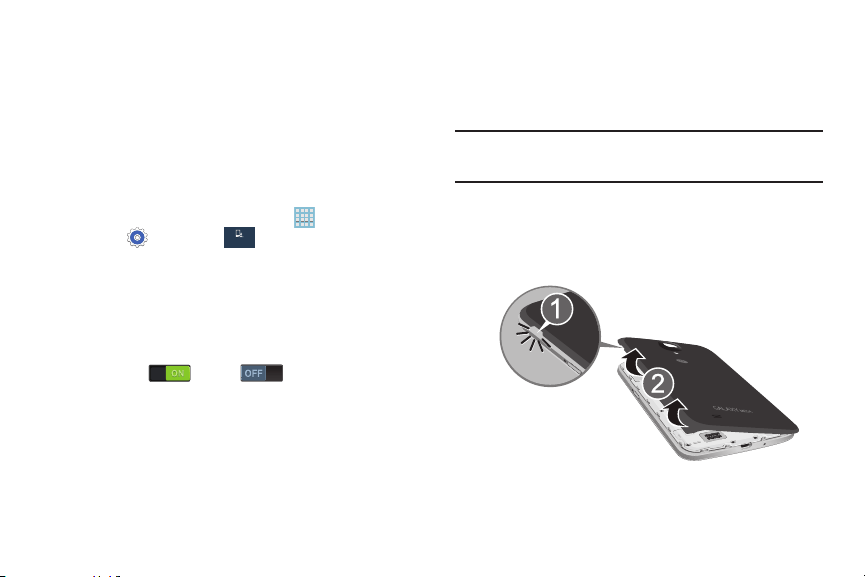
To remove the back cover:
1. Remove the back cover by inserting a fingernail into
the slot on the top of your phone (1) then lift the cover
up (2).
7
Installing the SIM and MicroSD Cards
When you subscribe to a cellular network, you are provided
with a plug-in SIM card loaded with your subscription details,
such as your PIN, available optional services, and many
others features. You can also install a MicroSD card (memory
card) to hold additional media (optional).
Important!
The plug-in SIM card information and its contacts
can be easily damaged by scratching or bending,
so be careful when handling, inserting, or
removing the card. Keep all SIM cards out of reach
of small children.
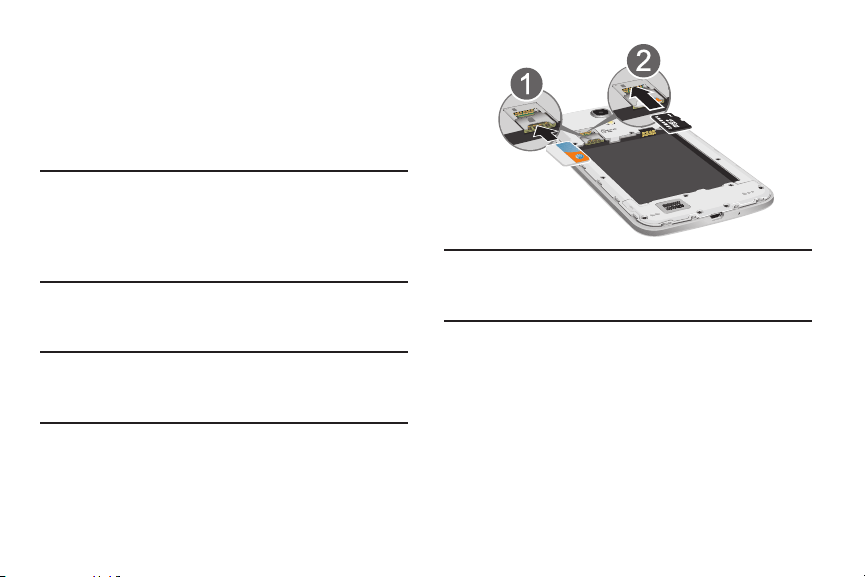
1. Carefully slide the SIM card under the bottom metal
plate into the SIM card socket (as shown).
Caution!
Make sure that the card’s gold contacts face into the
phone and that the upper-left angled corner of the
card is positioned as shown.
Note:
If the card is not inserted correctly, the phone will not
detect the SIM card. Re-orient the card back into the slot
if the SIM is not detected.
2. To insert a MicroSD card (optional), carefully slide the
MicroSD card under the top metal plate into the
MicroSD card socket (as shown).
Getting Started 8
Installing the Battery
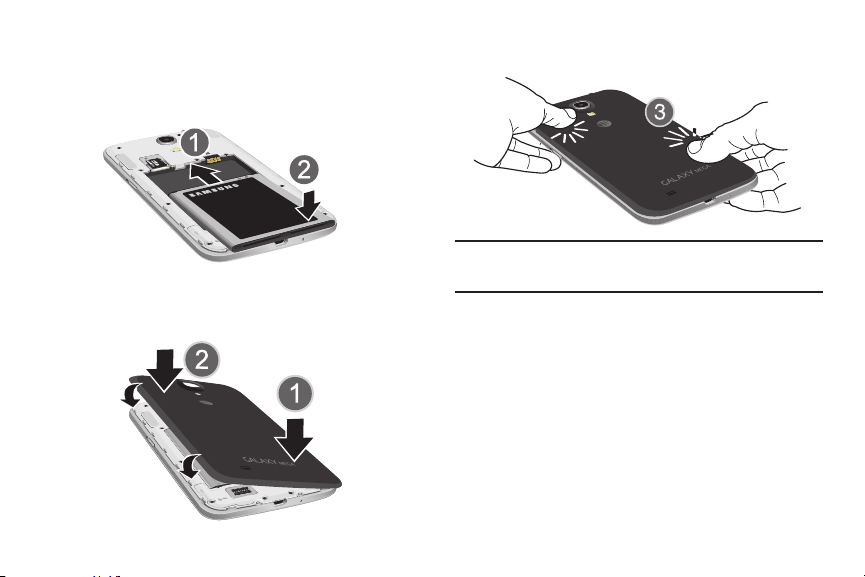
1. Insert the battery into the opening on the back of the
phone, making sure the connectors align (1).
2. Gently press down to secure the battery (2).
Replacing the Back Cover
1. Place the battery cover onto the back of the phone (1)
and press down (2).
2. Press along the edge of the back cover (3) until you
have a secure seal.
Note:
Make sure the battery is properly installed before
switching on the phone.
9
Charging the Battery
Your device is powered by a rechargeable Li-ion battery. The
Travel Charger, which is used to charge the battery, is
included with your device. Use only Samsung-approved
batteries and chargers.
Note:
You must fully charge the battery before using your
phone for the first time. A discharged battery recharges
fully in approximately 4 hours.
Note:
Long backlight settings, searching for service, vibrate
mode, web browser use, and other variables may
reduce the battery’s talk and standby times.
Although you can use the phone while the battery is
charging, doing so requires additional charging time.
Using the Travel Charger
To use the Travel Charger:
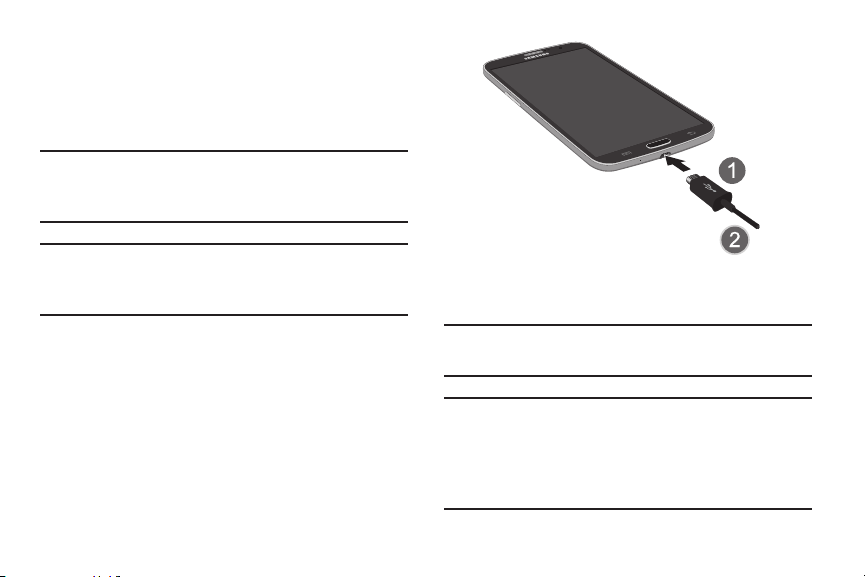
1. Plug the flat end of the Travel Charger (1) into the
Power/Accessory Interface connector and the other
end (2) into a standard AC wall outlet.
2. When charging is finished, remove the flat end from
the interface connector jack on the phone.
Note:
Failure to unplug the wall charger before you remove the
battery, can cause damage to the phone.
Important!
Verify that the handset battery is installed prior to
connection. If the battery is not properly installed
and the wall charger is connected, the handset
may power off and on continuously, preventing
proper operation.
Getting Started 10
Warning!
If your handset has a touch screen display, please
note that a touch screen responds best to a light
touch from the pad of your finger. Using excessive
force or a metallic object when pressing on the touch
screen may damage the tempered glass surface and
void the warranty.
Low Battery Indicator
When the battery is weak and only a few minutes of talk time
remain, the battery icon blinks and the device sounds a
warning tone at regular intervals. In this condition, your
phone conserves its remaining battery power, not by turning
off the backlight, but by entering the dimming mode. For a
quick check of your battery level, glance at the battery
charge indicator located in the upper-right corner of your
device’s display. Solid color
(
)
(
) indicates a full charge.
When the battery level becomes too low, the phone
automatically turns off.
You can also choose to display a percentage value. Having a
percentage value onscreen can provide a better idea of the
remaining c
harge on the battery.
From a Home screen, touch
Apps
Settings
My device
My device
My device
Display
Show battery
percentage
.
Turning Your Phone On or Off
To turn your phone on:
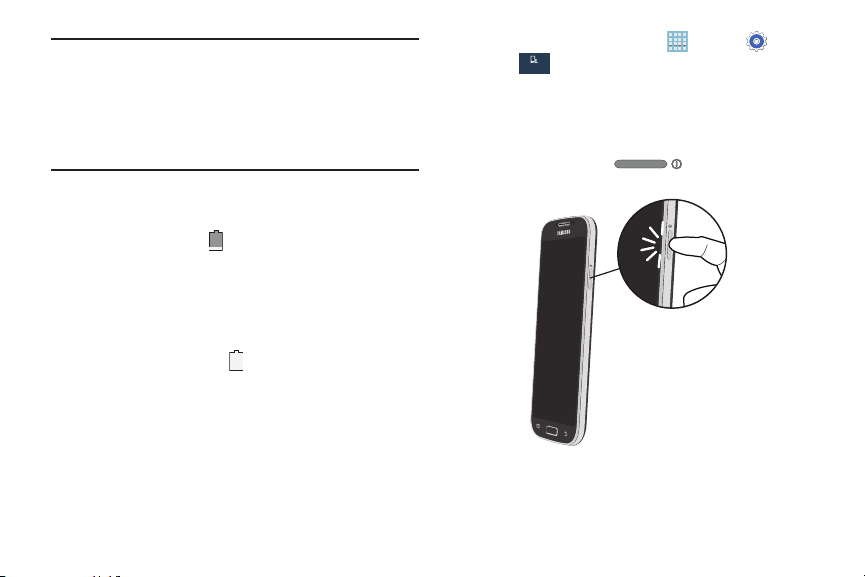
Press and hold the
Power/Lock Key
until
the phone switches on.
For more information, refer to “Locking and Unlocking the
Touch Screen” on page 12.
11
Note:
The display language is preset to English at the factory.
To change the language, use the Language menu. For
more information, refer to “Settings” on page 162.
To turn your phone off:
1. Press and hold the
Power/Lock Key
until
the
Device options
screen displays.
2. Touch
Power off
to turn off the phone.
3. At the
Power off
prompt, touch
OK
.
Locking and Unlocking the Touch
Screen
1. Press to lock the touch screen.
2. Press again to display the lock screen
then swipe your finger across the screen to unlock.
Note:
Swipe is the default screen locking method. To change
your screen lock, see “Lock Screen” on page 174.
Setting Up Your Phone
When you first turn on your phone, you are asked to set up a
few things. To do that, several screens display. Some
screens can be skipped (touch
Skip
) or re-displayed (touch
Back
). Some screens display depending on the options you
choose.
1. When you first turn on your phone, the
Let’s set up your
device!
screen displays.
2. The default language for your phone is English. If you
would like to select Spanish, touch
Español
on the
bottom right-hand side of the screen.
3. Touch
Terms & Conditions
, read the End User License
Agreement for Ready2Go, then touch
Back
.
4. Touch
get started
.
– or –
Touch
Remind Later
and then touch
exit
to set up your
phone later. You can access Ready2Go by touching
Apps
AT&T Ready2Go
.
5. Read and follow the instructions on each screen to set
up your phone.
Getting Started 12
Creating a New Google Account
In order to utilize your device to the fullest extent, create a
Google Account when you first use your device. With a
Google Account, Google applications will always be in sync
between your phone and computer.
If you did not create a new account during the setup
procedure when you first turned your tablet on, follow these
steps:
1. From a Home screen, touch
Apps
Gmail
.
The
Add a Google Account
screen displays.
2. Touch
New
to create a new Google account.
– or –
If you already have a Google account, touch
Existing
to
sign in and add the account to your phone.
3. Follow the onscreen instructions to add a Google
Account.
Note:
Once you have created a Google account, you only need
to sign in.
Creating a Samsung Account
An active Samsung account is required to begin accessing
applications such as ChatON and Samsung Hub. If you did
not create a Samsung account when you first set up your
tablet, follow these steps:
1. From a Home screen, touch
Apps
Settings
Accounts
Add account
.
Accounts Accounts
2. Touch
Samsung account
.
3. Touch
Create account
.
4. Enter the required information and touch
Sign up
.
5. Touch
Terms and conditions
to read them and touch
Close
. Touch Special terms to read them and touch
Back
.
Touch the
I accept all the terms above
check box.
6. Touch
Privacy policy
to read it and touch
Close
.
Touch the
I acknowledge...
check box.
7. Touch
Data combination
to read it and touch
Close
.
Touch the
I have read...
check box.
8. Touch
Agree
.
Your Samsung account is created.
13
Retrieving Your Google Account
Password
A Google account password is required for Google
applications. If you misplace or forget your Google Account
password, follow these instructions to retrieve it:
1. From your computer, use an Internet browser and
navigate to
google.com/accounts.
2. Follow the password recovery procedure.
Setting Up Your Voice Mail
1. From a Home screen, touch
Phone
.
2. Touch
Voicemail
.
3. Follow the tutorial to create a password, record a
greeting, and record your name.
Note:
These steps may be different depending on your
network.
Accessing Your Voice Mail
1. From a Home screen, touch
Phone
.
2. Touch
Voicemail
.
You may be prompted to enter a password.
3. When connected, follow the voice prompts from the
voice mail center.
Accessing Your Voice Mail from Another Phone
1. Dial your wireless phone number.
2. When you hear your voicemail greeting, press the
asterisk key on the phone you are using.
3. Enter your password.
Getting Started 14

Section 2: Understanding Your Phone
This section outlines some key features of your phone and
describes the screen and the icons that appear when the phone
is in use. It also shows how to navigate through the phone and
provides information on using a memory card.
Features of Your Phone
Your phone is lightweight, easy-to-use and offers many
useful features. The following list outlines a few of the
features included in your phone.
•
LTE network with 1.7 gigahertz dual-core processor
• Android Version: KitKat 4.4.2
•
Brilliant 6.3” HD PLS TFT display
•
Touch screen provides quick response to a variety of in-phone
menus and options including applications, multi windows and up
to seven home screens.
•
Smart Switch™ compliant. For more information, see
www.samsungsmartswitch.com
.
•
Ready access to the Internet
•
Built-in Bluetooth and advanced Wi-Fi
®
technology
•
Mobile Hotspot and USB Tethering capability
•
8 Megapixel camera and camcorder with Front Facing camera
•
Smart Remote using WatchON
•
AT&T GPS Navigation functionality provides real-time navigation
•
Delivers data faster using 4G LTE and High Speed Packet Access
Plus (HSPA+).
•
Up to 64GB expandable memory slot
•
Corporate and Personal Email
•
Sync and update social network applications
•
Over 750,000 Apps available to download via Google Play Store
and Samsung Hub
•
Full Integration of Google Mobile™ Services (Gmail, YouTube,
Google Maps, Google Voice Search)
•
Multiple Messaging Options: Text/Photo/Video Messaging, and
Instant Messaging with Google Hangouts
•
Samsung Link to share your media content across DLNA certified
devices
15
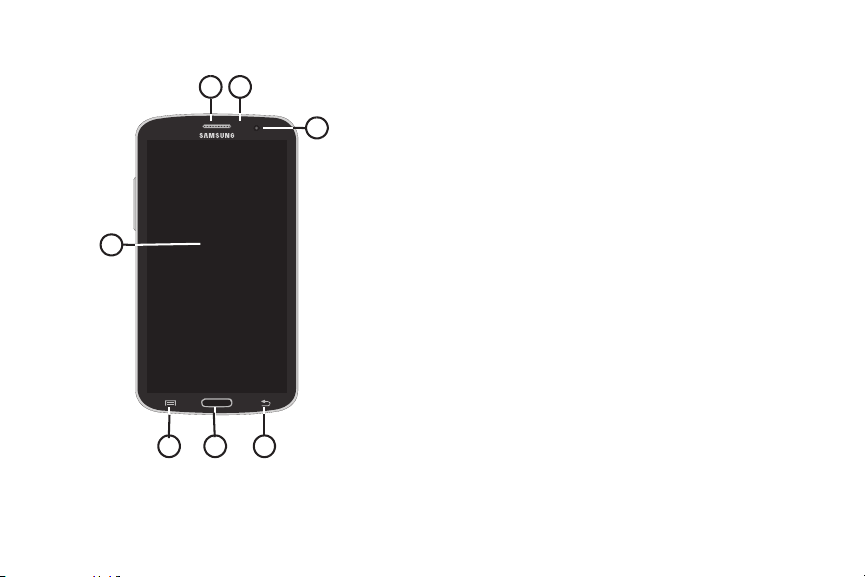
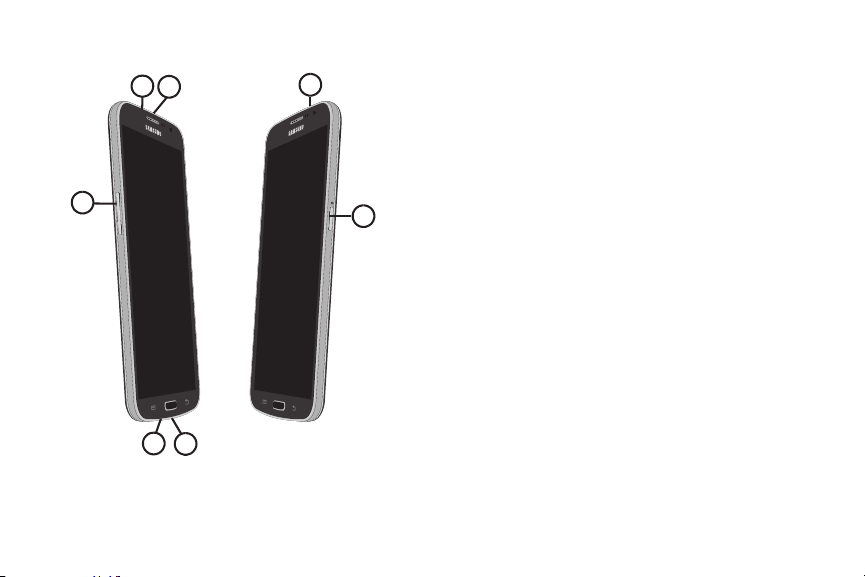
Front View of Your Phone
1.
External Speaker
: Allows you to hear the caller.
2.
Proximity and Light Sensors
: Uses the ambient light
level to adjust keypad access. If the light path is
blocked, for example, when holding the phone close to
your ear, the touch screen will turn off.
3.
Front Facing Camera
: Used to take pictures of yourself
when you set the camera shooting mode to Self shot.
4.
Display Screen
: The orientation of the display screen
rotates with the phone as you turn it. You can turn this
feature on and off. For more information, refer to
“Accessibility” on page 187.
5. Menu Key: Access sub-menus with additional options
for different features and applications such as Home
screen, Phone, Contacts, Messaging, and Web.
6. Home Key: Press to return to the Home screen. Press
and hold to display Recent apps, Task Manager, and
Google Search. Quickly press twice to activate the
S Voice application.
7. Back Key: Used to step backwards when navigating a
menu or web page.
5 6
7
1
2
3
4
Understanding Your Phone 16
5
1
2
4
3
6
7
Side Views of Your Phone
1.
Microphone
: Used for noise cancellation and stereo
recording.
2.
3.5mm Headset jack
: Allows you to plug in headphones.
3.
Volume keys
: Used to adjust the ringer volume while in
standby mode or adjust the voice volume during a call.
When receiving an incoming call, briefly press down
either volume key to mute the ring tone. Adjusts text
size when reading a message.
4.
Microphone
: Makes it possible for other callers to hear
you when you are speaking to them. It is also used for
the Speakerphone.
5. Power/Accessory Interface connector: Used to
connect a Travel Charger or other optional accessories
such as a USB/data cable or a hands-free headset for
convenient, hands-free conversations.
6. Power/Lock key: Used to power your phone on and
off. Also allows you to lock or unlock the touch screen.
For more information, refer to “Locking and Unlocking
the Touch Screen” on page 12.
7.
Infrared Blaster
: Used to emit infrared signals used for
controlling external devices.
17
1
2
3
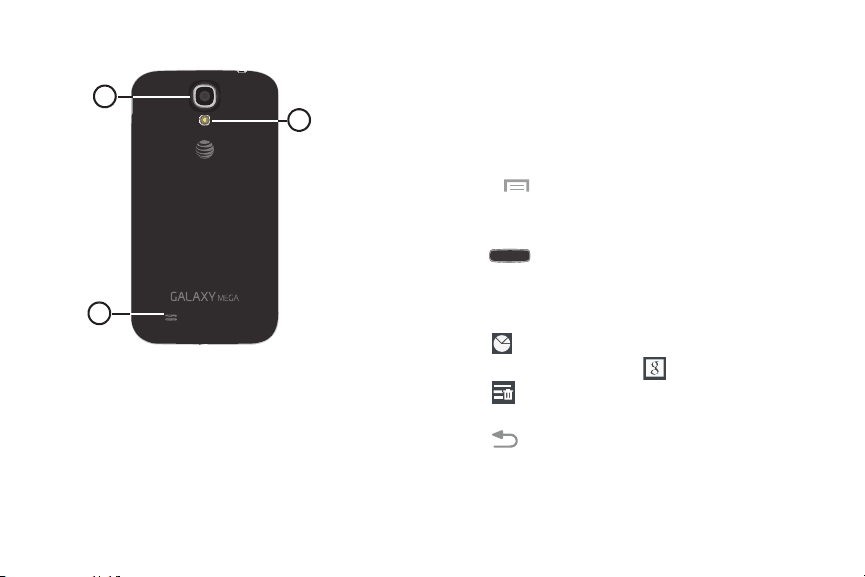
Rear View of Your Phone
1.
Camera lens
: is used to take pictures and shoot videos.
2.
Flash
: is used to provide adequate light when taking
pictures in dark places.
3.
External speaker
: allows you to hear when the
Speakerphone is turned on.
Navigating Your Device
Use command buttons and the touch screen to navigate.
Command Buttons
Context-Sensitive Menus
Context-sensitive menus offer options for features or
screens. To access context-sensitive menus:
• Touch
Menu
to display a list of options.
• Touch an option in the list.
Home
Press
Home
to display the main Home screen, which
is usually the center Home screen.
Press and hold to open a list of thumbnail images of apps
you have worked with recently. Touch an App to open it.
Touch to display the Task Manager.
To launch Google Search, touch .
Touch to clear all thumbnail images.
Back
Touch
Back
to return to the previous screen, option
or step.
Understanding Your Phone 18

Using Motions and Gestures
By activating the various motion and gesture features, you
can access a variety of time saving functions.
Terms used in this user manual
Touch
Lightly touch items to select or launch them. For example:
•
Touch the onscreen keyboard to enter characters or text.
•
Touch a menu item to select it.
•
Touch an application’s icon to launch the application.
Touch and Hold
Activate onscreen items by a touch and hold gesture. For
example:
•
Touch and hold a widget on the home screen to move it.
•
Touch and hold on a field to display a pop-up menu of options.
Swipe and Palm Swipe
To swipe, lightly drag your finger vertically or horizontally
across the screen. Use swipe when:
•
Unlocking the screen
•
Scrolling through the Home screen or a menu
To palm swipe, swipe the side of your hand horizontally
across the screen. Use palm swipe when:
•
Capturing the screen
Panning
To pan, touch and hold a selected icon, then move the device
to the left or right to reposition it to another page. You must
first activate Motion on your device. Use panning to:
•
Move icons on your Home screens or Application Menus to
another page.
19
Tilt
To activate the tilt feature, touch and hold two points on the
screen then tilt the device back and forth to reduce or
enlarge the screen. Use tilt to:
•
Reduce or enlarge the screen in the Gallery or Browser.
Turn Over
Turn your phone over so that the screen faces downward. For
example:
•
Mute incoming calls and playing sounds by turning your phone
over.
Activating Motions and Gestures
Caution!
Excessive shaking or impact to the device may cause
unintended results.
To learn how to properly control motions:
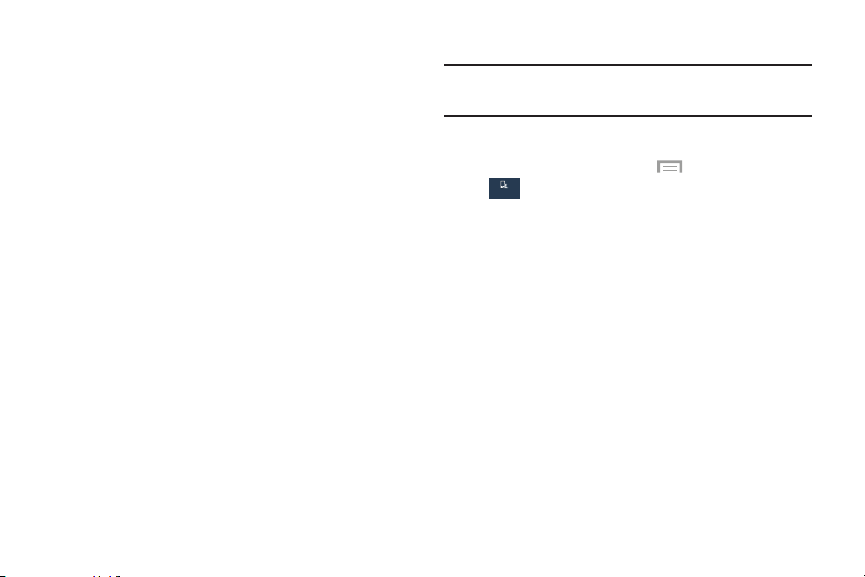
From a Home screen, touch
Menu
Settings
My device
Motions and gestures
.
When touched, each entry comes with an onscreen
tutorial.
My device
My device
• Motion
: Allows you to control your device using natural
movements (on the screen).
• Palm motion
: Allows you to control your device by touching the
screen with your entire hand.
Understanding Your Phone 20
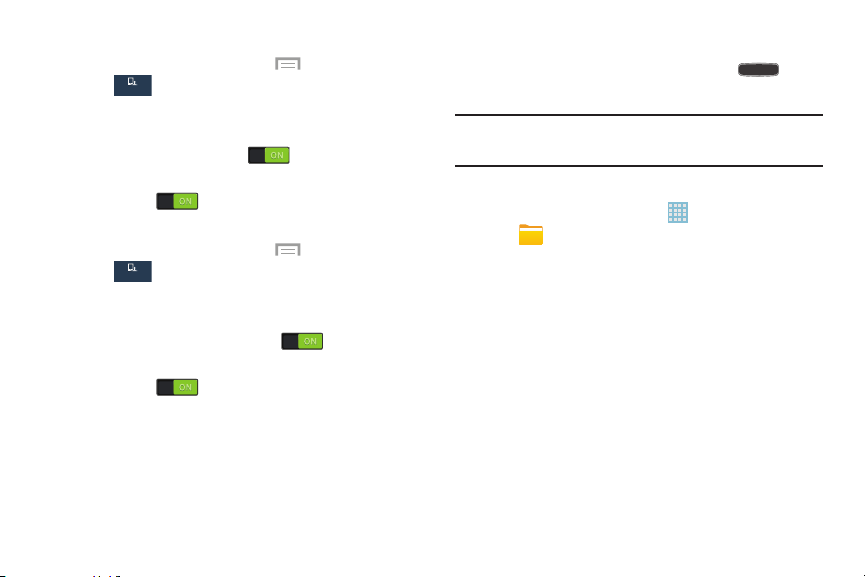
To activate Motion:
1. From the Home screen, touch
Menu
Settings
My device
My device
My device
Motions and gestures
.
2. Touch
Motion
.
3. Touch the
OFF/ON
button at the top of the Motion
screen to turn Motion ON .
4. Touch the
OFF/ON
button to the right of each feature to
turn it ON
.
To activate Palm Motion:
1. From the Home screen, touch
Menu
Settings
My device
My device
My device
Motions and gestures
.
2. Touch
Palm motion
.
3. Touch the
OFF/ON
button at the top of the Palm motion
screen to turn Palm motion ON
.
4. Touch the
OFF/ON
button to the right of each feature to
turn it ON
.
For more information, refer to “Motions and Gestures” on
page 195.
Screen Capture
Touch and hold the
Power/Lock Key
and
Home
to capture and save an image of the current screen.
Note:
A copy of the screenshot is automatically saved to the
clipboard.
To view the screen shots:
1. From a Home screen, touch
Apps
My Files
.
2. Touch
All files
Device storage
Pictures
Screenshots
.
3. Touch a screen capture file to display it.
21
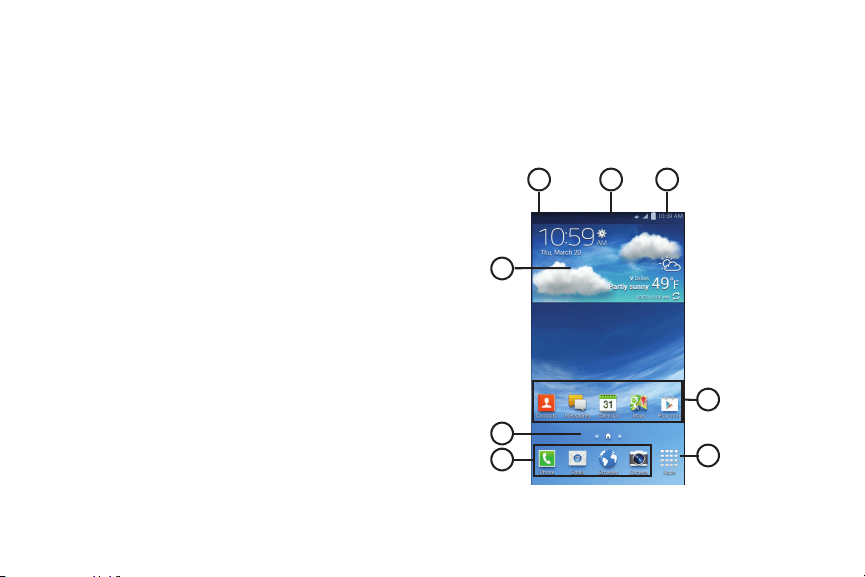
Home Screen
7.
Primary Shortcuts
: Access to important features such
as Phone, Email, Browser, and Camera. For more
The Home screen is the starting point for using your device. It
consists of:
information, refer to “Adding and Removing Primary
Shortcuts” on page 32.
8.
Apps Screen
: Access to all your apps and widgets.
1.
Notifications
: Notification icons appear on the Status
Bar at the top of the screen to report new messages,
calendar events, device status, and more. Drag down
from the Status Bar to open the Notification Panel.
2.
Status Bar
: The Status Bar displays notifications on the
left side and status indicators on the right side.
3.
Status indicators
: Display your current network status,
signal strength, battery charge, and time.
4.
Widgets
: Applications that run on the Home screen.
Some widgets are found on the Home screen by
default. For more information, refer to “Widgets” on
page 31.
5.
App Shortcuts
: Touch to launch your favorite apps.
6.
Current Screen
: Shows which Home screen is presently
displayed.
21 3
4
5
6
7
8
Understanding Your Phone 22

Extended Home Screen
The Home screen consists of the Home panel, plus additional
panels that extend beyond the display width to provide more
space for adding shortcuts and widgets.
Slide your finger horizontally across the screen to scroll to
the left or right side panels. As you scroll, the Current Screen
indicator shows your current position.
Note:
A Home screen displays when you touch
Home
.
Customizing the Home Screens
To customize the Home screens to suit your preferences:
1. Navigate to one of the Home screen panels.
2. Touch and hold on the screen until the
Home screen
pop-up displays.
3. Touch
Set wallpaper
to change the Home screen
wallpaper. For more information, refer to “Wallpapers”
on page 34.
– or –
Under
Add to Home Screen
touch:
• Apps and widgets
to add app or widget shortcuts on the
Home screen.
•Folder
to add a folder on a Home screen. For more
information, refer to “Folders” on page 33.
•Page
to add a Home screen.
Display Settings
You can customize display screen settings to your
preferences. For more information, refer to “Display” on
page 176.
23
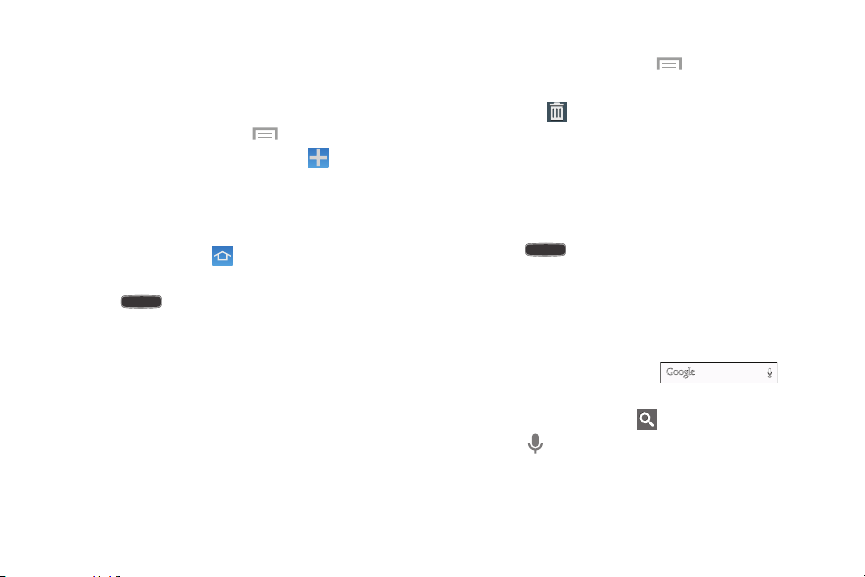
Adding and Removing Home Screen Panels
You can add and delete Home screens. You can have up to
seven Home screens.
To add a new Home screen:
1. From a Home screen, touch
Menu
Edit page
.
.
A new screen is added.
2. Touch the Home screen that contains
3. If desired, touch and hold the new screen and drag it to
a different location.
4. Touch the Home icon
at the top of a panel to set it
as the default home screen.
Home
to return to the main Home screen.
You can now add items to your new Home screen.
5. Press
To delete a Home screen:
1. From a Home screen, touch
Menu
Edit page
.
2. Touch and hold the Home screen you want to delete.
3. Drag it to
Remove
located at the top of the screen.
The page will turn red.
4. If there are items on the Home screen, the
Remove
home screen page
prompt displays.
5. Touch
OK
to delete the page and its contents, otherwise
touch
Cancel
.
6. Press
Home
to return to the main Home screen.
Google Search Bar
The Google Search Bar provides an onscreen Internet search
engine powered by Google.
1. From the main Home screen, swipe to the left and
touch the Google Search bar
.
2. Use the onscreen keyboard to enter the item you want
to search for, then touch
on the keyboard.
3. Touch
to use Google Voice Search. Follow the
onscreen instructions.
Understanding Your Phone 24

1. To go t
o Settings, touch
Settings
.
For more
information, refer to “Setti
ngs” on page 162.
2. Touch
to display ad
ditional options.
The following functions can either be activated (gr
een)
or deactivated (gray): Wi-Fi, Location, Sound/Vibrate/
Mute, Screen rotation, Bluetooth, Multi window,
Screen Mirroring, S Beam, NFC, Sync, Smart stay,
Power saving, Blocking mode, Airplane mode, Air view,
and Hands-free mode.
Notifications
Notification icons appear on the Status Bar at the top of the
screen to report new messages, calendar events, device
status, and more. For details about these notifications, open
the Notification Panel.
Notification Panel
To view the Notification Panel:
1. Swipe downward from the top of the screen.
2. Scroll down the list to see additional notification
details.
3. Touch an item to open it.
4. To clear a single notification, drag the notification left
or right.
– or –
Touch
Clear
to clear all notifications.
To close the Notification Panel:
Swipe upward from the bottom of the screen or touch
Back
.
Accessing Additional Panel Functions
In addition to notifications, the Notification Panel also
provides quick access to separate device functions. These
can be quickly activated or deactivated by toggling them on
or off. You can choose the functions that display.
From the Notification Panel:
25
3. Touch and locate the Notification Panel area at the
bottom of the Notification Panel screen.
•
In a single motion, touch and hold a desired function, such as
Airplane mode, then drag it to the top two rows.
•
Touch
Brightness adjustment
to create a check mark if you
want t
o be
able to adjust the screen brightness and volume
from the N
o
tification Panel.
•
Touch
Back
to exit the Notification Panel.
Brightness
slider and drag it to set the brightness or touch
Auto
to
allow the device to set brightness automatically based
on available light and battery charge status.
4. Touch
to display only your primary functions.
For more
information, refer to “Display” on page 176.
5. To set the display brightness, touch the
Notifications
displays system notifications.
Touch a notification entry to display the details. Drag a
notification left or right to remove it and remove
Notification Icons from the Status Bar.
For more information, refer to “Notification Panel” on
page 25.
To close the Notification Panel:
Touch
Back
, or swipe up.
Status Bar
The Status Bar at the top of the home screen provides device
information (such as network status, signal strength, battery
charge, and time) on the right side and notification alerts on
the left.
To display the Status Bar:
From a Home screen, swipe downward from the top of
the screen. The grey Status Bar will appear. It will
disappear after a few seconds.
Understanding Your Phone 26
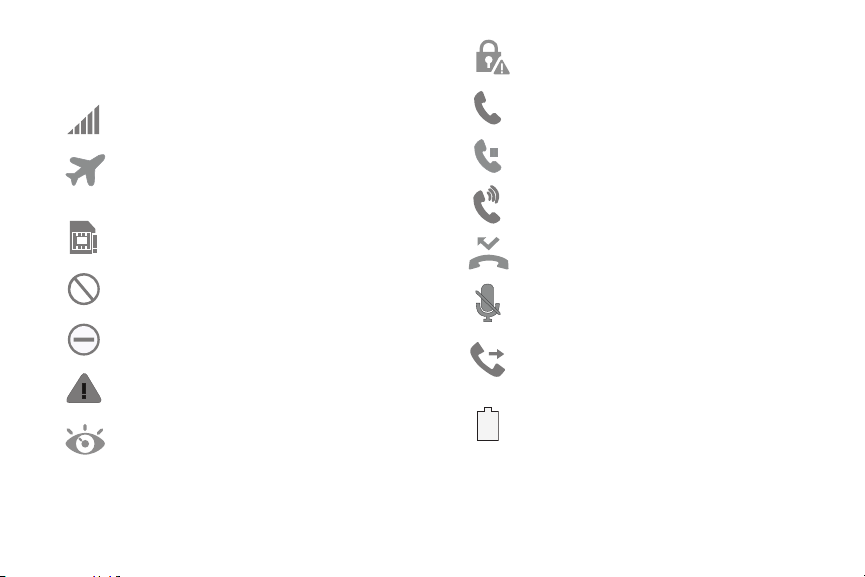
Status Bar Icons
Some common status and notification icons are shown
below.
Displays your current signal strength. The greater
the number of bars, the stronger the signal.
Indicates that the Airplane Mode is active. You
cannot send or receive any calls or access online
information.
Displays when there is no SIM card in the phone.
Displays when there is no network available.
Displays when your phone is in Blocking mode.
Displays when there is a system error or alert.
Displays when the Smart stay feature is activated.
The screen stays on as
long as you are
looking at it.
Displays to indicate a security warning. You are
prompted to set a screen lock password.
Displays when a call is in progress.
Displays when a call is on hold.
Displays when the speakerphone is on.
Displays when a call has been missed.
Displays when a call has be
en muted.
Displays when Call forwarding is set to Always
forward. For more information, refer to “Call
For
warding” on page 80.
Displays your battery charge level. Icon shown is
fully charged.
27
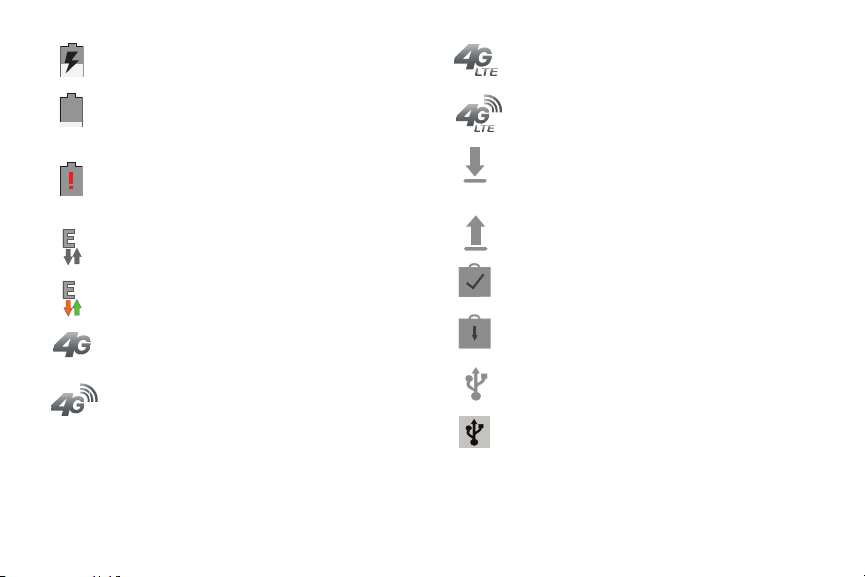
Displays when your battery is charging. Also
displays battery charge level.
Device Power Very Low – Shows your current
battery only has between 5 and 15 percent
power remaining.
Device Power Critical – Shows your current battery
only has less than 5 percent power remaining and
will immediately shutdown.
Displays when your connection to an
EDGE network
is active.
Displays when
your phone is communicating
with
the EDGE network.
Displays when your connection to a UTMS, HSDPA,
HSPA, or HSPA+ network is active.
Displays when
your phone is communicating
with
the UTMS, HSDPA, HSPA, or HSPA+ network.
Displays when your connection to a 4G LTE network
is active.
Displays when your phone is communicating with
the 4G LTE network.
Displays when your phone is downloading or has
downloaded a file. It will blink green when it is
installing.
Displays when the an outbound file transfer is in
progress.
Displays when a Play Store download has
completed.
Displays when updates are available for download.
Display
s when the phone is connected to a
computer via a supported US
B cable connection.
Displays when the phone i s tethered via a
supported USB cable connection.
Understanding Your Phone 28
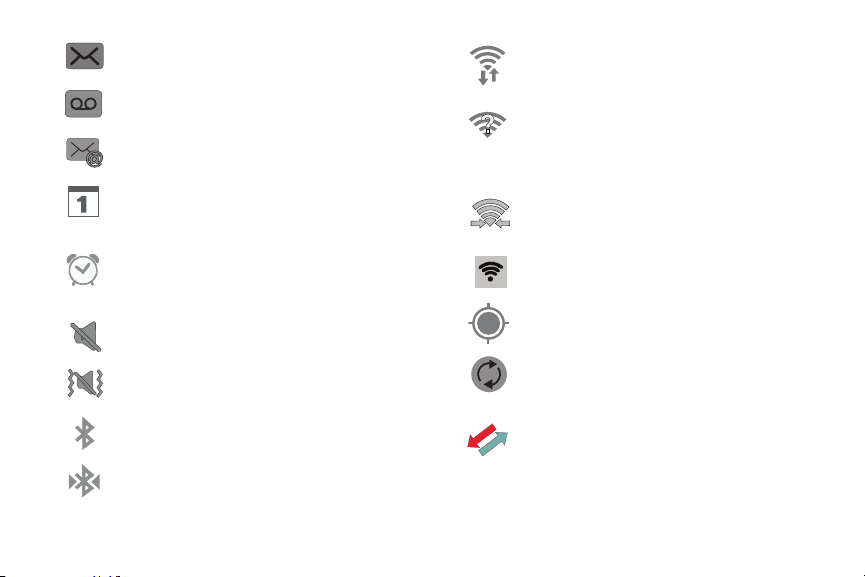
Displays when a new text or multimedia message
is received.
Displays when a new voice mail is received.
Displays when Email is received.
Displays whe
n the time
and da
te for a Calendar Event
has arrived.
For more information, refer to
“Calendar” on page 127.
Displays when you set an alarm to ring at a specified
time. For more informat
ion, refer to “Alarm” on
page 128.
Displays when the Sound profile is set to Mute.
Displays when the Sound profile is set to Vibrate.
Displays when Bluetooth is activated.
Displays when a Bluetooth devic
e
has been paired
with the phone.
Displays when Wi-Fi is connected, active, and
communicating with a Wireless Access Point
(WAP).
Displays when there is a Wi-Fi access point
available but
you are not connected to it. May also
display if
there is
a communication issue with the
target Wireless Access Point (WAP).
Displays when Wi-Fi Direct is active and your phone
is connected to another device.
Displays when
your phone as been configured as a
portable Wi-Fi hotspot.
Displays when GPS is active and acquiring a signal.
Displays when data synchronization and
appli
cation sync is active and synchronization is in
progress for Gmail, Calendar, and Contacts.
Displays when your phone is connecting to the
Device Management server when you first turn on
your phone.
29

Displays when Near Field Communication (NFC)
has been activated.
Displays when your device is connected being used
to
control streaming media and is connected to a
Digital Living Network Alliance (DLNA) certified
device using the Samsung Link application.
Displays when your device is currently sharing/
streaming media to a paired device using the
Samsung Link application.
Displays when TTY device has been inserted.
Displays when a screen
capture has been taken.
Displays when the keypad is active.
Primary Shortcuts
Primary Shortcuts display at the bottom of each Home
screen.
The default Primary Shortcuts are: Phone, Messaging,
Internet, and Apps.
You can change the Phone, Messaging, and Internet
application shortcuts to any icon that is displayed in the
Apps menu.
For more information, refer to “Adding and Removing
Primary Shortcuts” on page 32.
Other App Shortcuts
There are also other application shortcuts on the second
Home screen, which are: AT&T apps folder, Play Store, and
Gallery.
Application shortcuts can be added to any Home screen. For
more information, refer to “App Shortcuts” on page 32.
Understanding Your Phone 30

Navigate to the third Home screen and touch
AT&T
.
The AT&T apps folder provides quick access to all the AT&T
apps listed on your Apps screen.
The AT&T apps folder pop-up displays.
2. Touch the
Widgets
tab.
AT&T Apps Folder
Widgets
Widgets are self-contained applications that you can place
on the Home screens to access your favorite features.
When you first turn on your tablet, there are various widgets
on the center Home screen. Widgets can be added to all
Home screens.
Adding Widgets to a Home Screen
1. Navigate to the Home screen on which you want to
place the Widget and touch
Apps
.
Note:
Swipe across the screen horizontally to view all Widgets.
3. Touch and hold the widget’s icon until the Home screen
displays, then slide your finger where you want to
place the icon and release it.
Note:
There must be room on the screen where you want to
place the widget, otherwise the widget will not add to
the Home screen.
Removing Widgets
Touch and hold the Widget until
Remove
displays,
then drag the widget to the
Remove
icon.
Note:
This action does not actually delete the Widget, it just
removes it from the current Home screen.
31

App Shortcuts
Use App Shortcuts for quickly access to applications or
features, such as Email or other applications.
1. Navigate to the Home screen on which you want to
place the App Shortcut.
Apps
.
– or –
Touch and hold on the screen until the
Home screen
options pop-up displays and then touch
Apps and
widgets
.
2. Touch
3. Touch the
Apps
tab.
4. Touch and hold the application icon until the Home
screen displays, then slide your finger where you want
to place the icon and release it.
For more information, refer to “Apps Screen” on
page 34.
5. Touch and hold the App Shortcut and then drag the
application icon to reposition it on the Home screen.
Removing App Shortcuts
Touch and hold the App Shortcut until
Remove
displays, then drag the App Shortcut to the
Remove
icon.
Adding and Removing Primary Shortcuts
You can change any of your Primary Shortcuts with the
exception of the
Apps
shortcut.
1. Press
Home
to activate the main Home screen.
2. Touch and hold the Primary Shortcut until
Remove
displays, then drag the Primary Shortcut to the
Remove
icon.
3. Touch
Apps
and scroll through the App menu to
find the shortcut you want to add as the new Primary
Shortcut.
4. Touch and hold the new shortcut, then drag it to the
empty space in the row of Primary Shortcuts.
The new Primary Shortcut displays on all Home
screens.
Understanding Your Phone 32

Folders
Place Folders on a Home screen to organize items together.
Adding Folders
To create a folder on a Home page:
1. Navigate to the desired Home screen.
2. Touch and hold on the screen until the
Home screen
pop-up displays and then touch
Folder
.
The Create folder pop-up displays.
3. Touch the
Unnamed folder
field, use the keyboard to
enter a name for the folder, and touch
OK
.
A new folder displays on the Home screen.
Managing Folders
To rename a folder:
Touch the folder, touch the current name, and use the
keyboard to enter a new name for the folder.
To add an App shortcut to a folder:
1. Add the App shortcut to the Home screen that the
folder is on.
2. Touch and hold the App shortcut, drag it to the folder,
and drop it.
To remove an App shortcut from a folder:
1. Touch the folder to view the contents.
2. Touch the App shor
tcut, dra
g it out of the folder, and
drop it on the Home screen.
Removing a Folder
Touch and hold the folder until the
Remove
icon
displays, then drag the folder to the
Remove
icon.
Note:
Any App shortcuts in the folder are also removed.
33

Wallpapers
You can choose a picture to display on the Home Screen,
Lock screen, or on both the Home and Lock screens. Choose
from preloaded wallpaper images or select a photo you have
downloaded or taken with the Camera.
1. From a Home screen, touch and hold on the screen.
The
Home screen
options pop-up displays.
2. Touch
Set wallpaper
.
The Set wallpaper pop-up displays.
3. Touch
Home screen
,
Lock screen
, or
Home and lock
screens
.
The
Select wallpaper from
pop-up displays the
following options:
•Gallery
: Access the Gallery to select a photo. Touch a photo to
select it. Crop and resize the picture, if desired. Touch
Done
to
save the picture as wallpaper. Touch
Cancel
to cancel.
• Live wallpapers
: Choose from pre-loaded interactive animated
wallpapers. Touch a wallpaper to see an example. If available,
touch
Settings
to view options for the selection. Touch
Set
wallpaper
to save your choice. Touch
Back
to return to
the Live wallpapers menu.
•Photos
: Access Google Photos to select a photo (Home screen
only).
• Wallpapers
: Choose from pre-loaded wallpaper images. Touch
an image to view it. Touch
Set wallpaper
to save it as
wallpaper. Touch
Back
to return to the Home screen.
Note:
Live wallpapers is not available for the Lock screen.
Apps Screen
The
Apps
screen displays all applications installed on your
wireless device. Applications that you download and install
from Google Play or from the web are also added to a Home
screen.
For more information, refer to “Applications” on page 118.
Understanding Your Phone 34
Customizing the Apps Screen
The Apps icons can be arranged in various ways. To change
the arrangement of the Apps icons:
1. From a Home screen, touch
Apps
.
Menu
View type
.2. Touch
3. Touch
Customizable grid
,
Alphabetical grid
, or
Alphabetical list
.
To manually change the order of the icons on the Apps
screen:
1. From a Home screen, touch
Apps
.
Menu
Edit
.2. Touch
3. Touch and hold an icon and drag it to a new position.
4. Touch
Save
to save the changes.
You can place shortcuts to applications on the Home screen
for quick access to the application.
For more information,
refer to “App Shortcuts” on page 32.
To view
your downloaded applications:
1. From a Home screen, touch
Apps
.
2. Touch
Downloaded applications
to view
downloaded apps.
3. Touch an icon on the
Downloaded applications
screen
to launch the application.
– or –
Add an App Shortcut to a Home screen by dragging
the
App icon onto the Home Screen. For more information,
refer to “App Shortcuts” on page 32.
Application Information
To view information about an App, such as the amount of
storage it uses, force the App to stop, uninstall updates, and
clear data:
1. From a Home screen, touch
Apps
More
Settings
More
Application manager
.
2. Highlight the
ALL
tab, scroll through the apps list, and
touch the app to open a screen with details about
the App.
35

Navigating Through the Home Screens
Your phone originally has three home screens, but you can
expand up to seven home screens. If you like, you can place
different applications on each of the home screens.
From the main Home screen, sweep the screen with
your finger in either direction. The main Home Screen
is located in the middle with a Home screen on
each side.
Navigating Through the Apps Screens
Your phone initially has three Apps screens available. Follow
these steps to navigate through the Apps screens:
1. From a Home screen, touch
Apps
.
The first Apps screen displays.
2. Sweep the screen left or right to access the other two
screens.
3. Touch an app’s icon to launch the app.
Note:
As you add apps, the number of Application menus that
you have available will increase.
Navigating Using Sub-Menus
Sub-menus are available when you are at any Home screen
or have selected a feature or application such as Phone,
Contacts, Messaging, or Internet.
To access a sub-menu:
1. Touch
Menu
.
A sub-menu displays at the bottom of the phone
screen.
2. Touch an option.
Understanding Your Phone 36
Multi Window
This feature can be used to run multiple applications on the
current screen at the same time.
Note:
Only applications found within the Multi window panel
can be active atop another current application on the
screen.
When launching applications that contain multimedia
files (music or video), audio from both files will be
played simultaneously.
Activating and Deactivating Multi Window
To activate Multi window:
1. From a Home screen, touch
Apps
Settings
My device
My device
My device
Display
Multi window
.
A check mark will appear.
2. Touch
Home
to return to the Home screen.
3. Touch the Multi window tab
to open the application
panel showing all the available Multi window apps.
Note:
Initially upon activation, the entire apps panel is briefly
displayed, then minimized to only show the tab.
Tip:
Multi window can also be activated or deactivated by
touching the top of the screen, dragging downward to
display the Notification Panel, and then touching
Multi window
.
To deactivate Multi window:
Touch and hold
Back
. This action hides the Multi
window tab from view.
Note:
Once you have set the Multi window option On, you only
need to touch and hold
Back
to reactivate the Multi
window feature.
37

Repositioning the Multi Window
The Multi window contains two components: the tab and the
apps panel. The tab can be manually moved up or down the
left or right edge of the screen. The Apps panel, which
contains the scrollable apps, and the tab can be relocated to
lock onto the left or right side of the screen.
To move the tab and relocate the apps panel:
1. Activate the Multi window feature.
2. In a single motion, touch and hold the Multi window
tab
for approximately one-second.
3. Slowly drag up or down the current side of the screen.
Note:
This is a quick way to get the tab out of the way if you
cannot get to a button or option behind it.
– or –
In a single motion, touch and hold the tab
for
approximately one-second to detach it from the
screen, then slowly drag it to the opposite screen edge.
To remove or restore a Multi window application:
1. Activate the Multi window feature.
2. Touch the Multi window tab
to display the apps
panel and the scrollable apps.
3. Touch the
Edit
button, which is located at the bottom of
the list, to reveal a staging area that can house any
removed applications from the Multi window panel.
4. In a single motion, touch and hold a desired app icon
until it detaches from the panel, then carefully drag it
out of the apps panel and onto the staging area.
– or –
In a single motion, touch and hold a desired app until it
detaches from the staging area, then carefully drag it
to a new location in the current list of apps.
5. Touch
Done
once you have completed the removal
process. The staging area is removed.
Understanding Your Phone 38
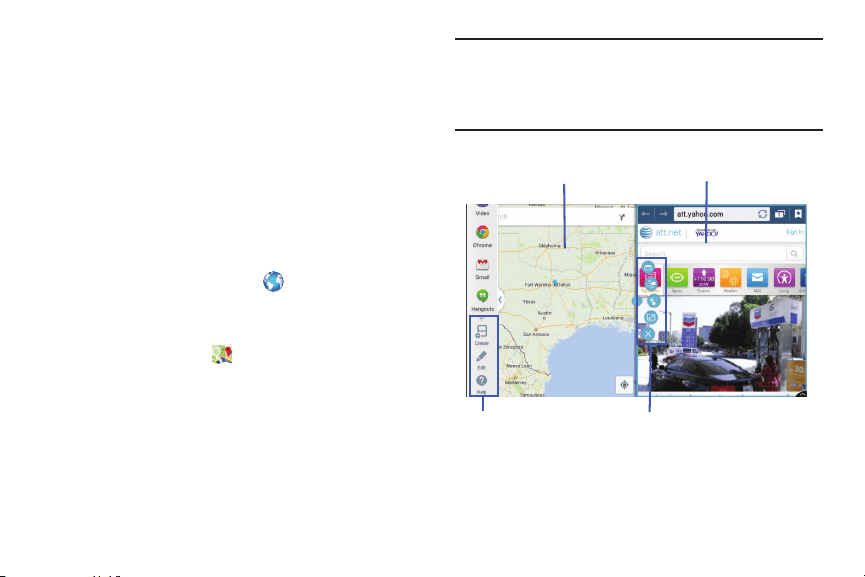
Using Multi Window
You can use Multi Window to run multiple apps on the same
screen.
Any of the apps found within the Multi window panel can be
run at the same time as a current onscreen app.
Once multiple apps are running on the same screen, you can
then choose to either swap their positions or maximize a
desired app.
In the following example, we will be launching both the
Internet and Maps applications, but any two apps listed in
the Multi window apps panel will work the same way.
1. From a Home screen, touch
Browser
.
2. Activate the Multi window feature.
3. Touch the tab to display the apps panel.
4. Touch and hold the
Maps
icon until it detaches
from the panel.
5. In a single motion, drag it over the current
Browser
screen and drop it over either the top or bottom area of
the screen.
Note:
Once the two applications are running, the device
displays a split screen view containing both the initial
Multi window app and the second Multi window app.
Each application is still independent of the other.
App 1
App 2
Panel
Multi Window
Controls
Controls
39
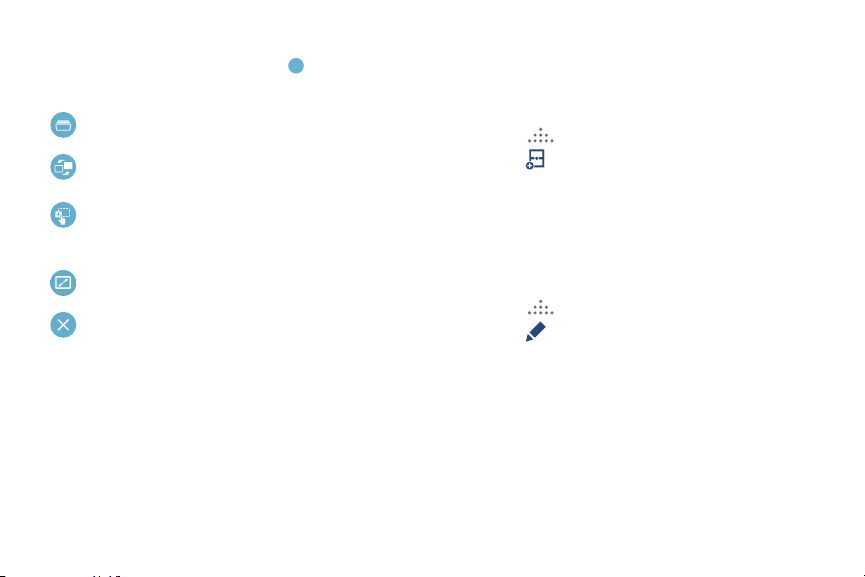
Select an application window and touch in the middle of
the windows. Window controls appear:
Switch app to compact screen.
Switch locations between Multi Window
applications.
Share items between the application windows. Drag
an item to share from one window to another. Some
applications may not support this feature.
Maximize the application.
Close the application.
Creating a Paired Window
Use this feature to save the combination of current running
Multi window applications.
On the Multi window panel:
1. Touch to access the panel controls.
2. Touch
Create
.
3. Enter a title and then touch
OK
.
Panel Configuration
You can rearrange the apps on the Multi window panel, add
new apps, or remove apps.
On the Multi window panel:
1. Touch
to access the panel controls.
2. Touch
Edit
.
Window Controls
Understanding Your Phone 40

Configuring Apps
To remove an app from the panel:
Touch and drag it off of the panel and place it in the
storage area.
To add an app to the panel:
Touch and drag it from the storage area to the panel.
To relocate an app:
Touch and drag it to a new location.
To save your changes:
Touch
Done
.
Smart Screen
With Smart screen activated your phone automatically
adjusts screen time-out and rotation when it detects you are
looking at the screen.
Smart screen features include:
•
Smart stay
: The screen does not time out as long as you are
looking at it.
Smart screen uses the front camera to detect when you are
facing the screen. Some factors may affect the ability of the
front camera to detect your face:
•
When the phone is not docked or held upright. For example, when
placed on a table.
•
When the front camera cannot detect your face and eyes.
•
When the front camera is used for the current application.
•
When the light source is behind you or when using the phone in
the dark.
41

Configure Smart Screen
Memory Card
To enable Smart screen features:
Your device lets you use a microSD (SD) or microSDHC card
to expand available memory space. This secure digital card
enables you to exchange images, music, and data between
SD
-compatible devices. This section addresses the features
and options of your device’s SD functionality. The device has
a USB SD card mode.
From a Home screen, touch
Apps
Settings
My device
Smart screen
.
My device
My device
For more information, refer to “Smart Screen” on pag
e 196.
Pop-up Video
Multitask with Pop-up Video by transforming your video
player into a pop-up window floating on the screen. The
video continues to play, and the pop-up window can be
resized or moved anywhere on the screen.
Mounting the SD Card
To store additional photos, music, videos, and other
applications, you must mount (install) the SD card prior to
use. Mounting the SD card establishes a USB connection
with your computer.
To use Pop-up Video:
While watching a video, touch the
Pop-up Video
icon in the lower right corner of the screen.
1. Insert the SD card into the external, SD card slot. For
more information, refer to “Installing the SIM and
MicroSD Cards” on page 8.
2. Your SD card is scanned to see the available
information on it.
Understanding Your Phone 42
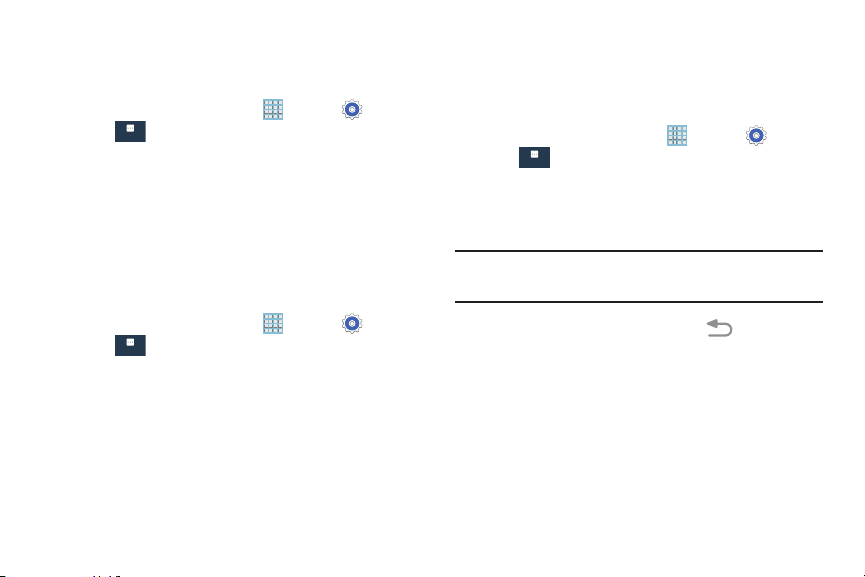
Unmounting the SD Card
Unmounting the SD card prevents corruption and damage to
the SD card while removing it from the slot.
1. From a Home screen, touch
Apps
Settings
More
More
Storage
.
2. Scroll to the bottom of the display and touch
Unmount
SD card
.
3. Touch
OK
.
For more information, refer to “Installing the SIM and
MicroSD Cards” on page 8.
SD Card Available Memory Status
To view the memory allocation for your external SD card:
1. From a Home screen, touch
Apps
Settings
More
More
Storage
.
2. The available memory for Device and SD card displays
under the
Total space
and
Available space
headings.
Erasing Files from the SD Card
You can erase files from the SD card using the phone.
1. Ensure the SD card is mounted.
For more information,
refer to “Mounting the SD Card” on page 42.
2. From a Home screen, touch
Apps
Settings
More
More
Storage
.
3. Touch
Format SD card
.
4. At the
Format SD card
confirmation prompt, touch
Format SD card
.
Warning!
Performing the next step erases all data stored on
the SD card.
5. Touch
Delete all
to format or touch
Back
to
cancel.
43

Entering Text
This section describes how to select the desired text input
method when entering characters into your phone. This
section also describes the predictive text entry system that
reduces the amount of key strokes associated with
entering text.
Your phone comes equipped with an orientation detector that
can tell if the phone is being held in an upright (Portrait) or
sideways (Landscape) orientation. This is useful when
entering text.
Text Input Methods
There are three text input methods available:
•
Samsung keyboard (default)
: Samsung’s onscreen QWERTY
keyboard that can be used in both portrait and landscape
orientation.
•
Swype
: a new way to enter text on touch screens. Instead
of touching each key, use your finger to trace over each
letter of a word.
•
Google Voice typing
: allows you to enter text by speaking.
To change the input method,
see “Keyboards and Input
Methods” on page 190.
To choose a text input method while entering text:
1. Touch the top of the screen and swipe downward
.
The Notification Panel displays.
Choose input method
.
The Choose input method pop-up displays.
2. Touch
3. Touch an input method to activate it.
For more information, refer to “Keyboards and Input
Methods” on page 190.
Using the Samsung Keyboard
The Samsung keyboard is a custom virtual QWERTY
keyboard, featuring optional predictive text. Input characters
by touching the onscreen keys with your finger or use speech
recognition.
You can enable predictive text, to have the Samsung
keyboard match your key touches to common words and
display them. The Personalization option learns from Gmail,
Facebook, and Twitter. Log into these applications to enable
the Samsung keyboard to learn from your text input.
Understanding Your Phone 44
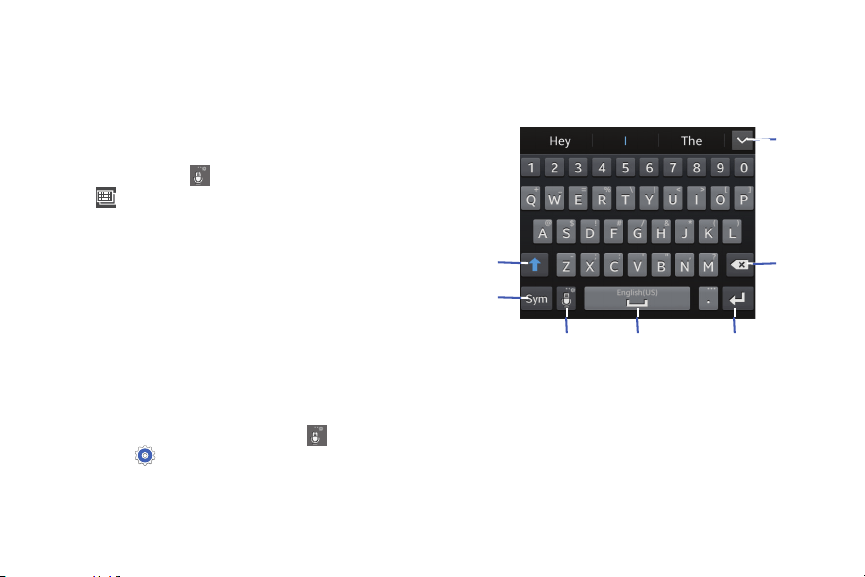
Keyboard Types
In addition to the default QWERTY keyboard, there are two
other types of the Samsung keyboard: a Floating keyboard
and a One-handed operation keyboard.
To change the keyboard type:
1. Access the QWERTY keyboard.
2. Touch and hold
Options
on the keyboard, touch
, and then select
Floating
or
One-handed operation
from the pop-up menu
.
3. Touch the tab at the top of the Floating keyboard to
move it.
– or –
Touch the triangular button to the left or right of the
One-handed operation keyboard to switch it to the right
or left position.
Configuring the Samsung Keyboard
Configure the Samsung keyboard to your preferences.
While entering text, touch and hold
Options
, then
select
Settings
in the pop-up menu.
The Samsung keyboard settings screen displays.
For more information, refer to “Samsung Keyboard”
on page 191.
Entering Text Using the Samsung Keyboard
From a screen where you can enter text, rotate your phone
counterclockwise to a Landscape orientation. The onscreen
QWERTY keyboard displays.
Display
More
words
Shift
Delete
Key
Key
Tex t
Input
Mode
Voice Typing Space
New
and More Bar
Paragraph
Options
45
to input another upper-case letter or
double-tap
to switch to ABC mode. The shift key
will change to
5. Touch
in ABC mode. All following letters
will be uppercase until you touch the shift key again.
Changing the Text Input Mode
There are two main keyboard layout keys that will change
the onscreen keys within the QWERTY keyboard.
The available Text Input modes are:
Sym
and
Abc
.
Sym
Sym
ABC
ABC
Sym
Sym
Symbol/Numeric Mode
: Activates the number,
symbol, and emoticon keys.
ABC Mode
: Activates the default alphabet keys.
Can also be set to
Abc
or
abc
by using the shift
key.
(
)
Note:
When in
Abc
mode, the
Sym
button appears. When in
Sym
mode, the
Abc
/
ABC
/
abc
button appears.
Using ABC Mode
1. If desired, rotate your phone counterclockwise to a
Landscape orientation.
2. When you touch the
Enter message
field, the following
screen displays:
3. Touch the desired alphabetic characters.
4. The screen initially opens in ABC mode. After typing the
first letter, the shift key
( ) will change to
and
following letters will be lowercase.
Understanding Your Phone 46
at the bottom of the screen.
button to access additional symbols.
1. Rotate your phone counterclockwise to a Landscape
orientation.
2. Touch
Sy
Sy
m
m
Sym
Sym
Sym
Sym
3. Touch the desired number, symbol, or emoticon
characters.
4. Touch the
1/2
5. Touch
ABC
ABC
to return to Abc mode.
Using Symbol/Numeric Mode Predictive Text
Use Symbol/Numeric Mode to add numbers, symbols, or
emoticons.
The Predictive Text option provides next-letter prediction and
regional error correction, which compensates for touching
the wrong keys on the QWERTY keyboard. Predictive text is
turned on by default.
1. Touch and hold
Options
on the keyboard, then
touch
Settings
.
The Samsung keyboard settings screen displays.
2. Touch the
OFF/ON
button to turn Predictive text
ON .
3. While entering characters, potential word matches
display in the Predictive text area above the keyboard.
Touch a word to insert it into your text.
Note:
Predictive Text mode is available for landscape or
portrait orientation.
47

1. From the keyboard, touch
Options
and then touch
Handwriting
.
2. Use your finger tip to write out each character. You can
print or use cursive.
3.
You can write out your entire message using the
Handwriting feature or touch to switch back to
Samsung keyboard mode.
Entering Text Using Handwriting
You can enter text simply by using your finger to handwrite
letters on your screen.
Using the Google Voice Typing Feature
You can use your voice to enter text using the Google Voice
typing feature.
1. From the keyboard, touch the top of the screen and
drag downward to display the Notification Panel.
2. Touch
Choose input method
.
3. Touch
Google voice typing
.
4. At the
Speak now
prompt, speak clearly and distinctly
into the microphone.
5. If the red microphone turns gray, then the feature has
timed out and you should touch the microphone icon to
start again.
The text displays in the message as you are speaking.
6. After you have quit speaking for several seconds, touch
to return to the keyboard.
Note:
The feature works best when you break your message
down into smaller segments.
Understanding Your Phone 48
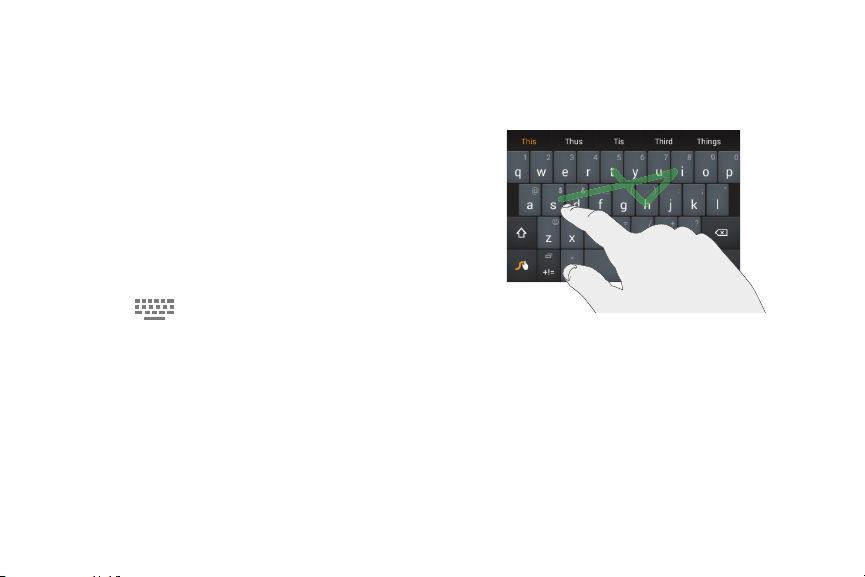
Entering Text Using Swype
Swype is a text input method that makes it possible to enter
a word by sliding your finger or stylus from letter to letter,
lifting your finger between words. Swype uses error
correcting algorithms and a language model to predict the
next word. Swype also includes a touch predictive text
system.
Enabling and Configuring Swype
To enable the Swype keyboard while entering text:
1. Touch the top of the screen and swipe downward, to
display the Notification Panel.
The Notification Panel displays.
2. Touch
Choose input method
.
The Choose input method pop-up displays.
3. Touch
Swype
.
The Swype keyboard displays.
Swype Tips
The following example shows how to enter the word “This”.
Put your finger down on the “T”, and without lifting, glide it
to the “h”, then to the “i” then over to the “s”.
49

Here are a few tips to get you started:
•
Create a squiggle (like an S shape) to create a double letter (such
as
pp
in apple).
•
Touch and hold a key to view the punctuation menu then make a
selection.
•
Move your finger or stylus over the apostrophe to enter
contractions.
•
Double-tap on the word you want to change to correct a
misspelled word, then touch the delete key to erase one
character. Touch and hold the delete key to erase an entire word.
Swype Settings
To configure Swype to your preferences.
While entering text, touch and hold the
Swype Key
to display the Settings s creen.
For more information, refer to “Swype” on page 192.
Swype Help
While entering text, you can get information about Swype.
1. Touch and hold the
Swype Key
to access the
Swype options menu.
2. Touch
Help
How to Swype
.
The Swype tutorial displays.
Understanding Your Phone 50
Section 3: Contacts and Your Address Book
This section explains how to manage your daily contacts by
storing their name and number in your Address Book.
Address Book entries can be sorted by name, entry, or group.
Your Address Book
You can store phone numbers and their corresponding
names onto your SIM card and phone’s onboard memory.
The two locations are physically separate, but are used as a
single entity called the Address Book.
Depending on your particular SIM card, the maximum
number of phone numbers the SIM card can store and how
they are stored may differ.
AT&T Address Book Activation
When you access the AT&T Address Book, the network
backup service, contacts are automatically synchronized
between your phone and online address book. The changes
you make are automatically saved and, if you ever upgrade,
damage, or lose your phone, you can easily restore your
contacts onto your new phone.
To activate the AT&T Address Book:
1. From the main Home screen, touch
Contacts
.
– or –
From a Home screen, touch
Apps
Contacts
.
– or –
From a Home screen, touch
Contacts Contacts
Phone
Contacts
.
Your Address Book is displayed.
2. If you have not synchronized your phone with your
online AT&T Address Book recently, the
AT&T Address
Book
screen is displayed. If you want to synchronize
your Address Book, touch
Yes
.
3. Follow the onscreen instructions.
Your AT&T Address Book
is Ready to Use. You can now make
a call or send a message through your Address Book.
Yo
u can also manage your Address Book on the web
at
www.att.com/addressbook
.
51
Synchronizing Your AT&T Address Book
If you ever upgrade, damage, or lose your phone, you can
easily restore your contacts onto your new phone by
following these steps:
1. Touch
Contacts
.
2.
Touch
Menu
Settings
AT&T Address Book
.
3. At the AT&T Address Book screen, touch
Yes
to
synchronize your phone with your online Address Book.
4. If there are existing contacts on your phone, you will be
prompted whether you would like to remove them first.
Touch
Yes
or
No
.
Note:
You must first copy any contacts that exist on your SIM
card to your phone. For more information, refer to
“Copying Contacts to the Phone” on page 63.
Your phone is synchronized and your Contact list
displays.
Adding a New Contact
Use the following procedure to add a new contact:
1. Touch
Contacts
Add
.
The Add Contact screen displays.
2. At the top of the screen, touch
and then touch
Device
,
SIM
, or an account, depending on where you
want to store the new contact.
3. Touch the Contact image to choose a picture to identify
the contact.
4. Touch contact fields to display the keyboard and enter
information:
•
Some fields have preset values. Touch the field and touch the
desired value. For example, touch the Label tab and touch
a label for the field.
•
Other fields have to be input. Touch the field and use the
onscreen keyboard to input information.
Contacts and Your Address Book 52
•
Touching the check box next to some fields may make
additional fields available.
•
Touch to add additional fields.Touch to remove an
unused field. Also, touch
Add another field
to add other fields.
•
Touch the screen and swipe up or down to display additional
fields or touch
Next
on the keyboard to move to the next field.
5. Touch
Back
to remove the keyboard.
6. When you finish entering information, touch
Save
to
save your changes or touch
Cancel
OK
to cancel and
discard changes.
Tip:
Display a contact’s record and touch the
Email
field to
send an email, the
Address
field to display the address on
a map, or the
Website
field to link to the website.
Adding Pauses to Contact Numbers
When you call automated systems, you are often required to
enter a password or account number. Instead of manually
entering the numbers each time, you can store the numbers
in your Contacts along with special characters called pauses
and waits. A pause stops the calling sequence for two
seconds and a wait pauses the calling sequence until you
enter a number or touch a key.
To add a pause or a wait to an existing Contact:
1. Touch
Contacts
.
2. Touch the name or number to open the Contact.
3. Touch
Edit
to edit.
4. Touch the phone number field.
5. Touch the screen at the position where the pause or
wait needs to be added.
6. Touch
Sym Sym
.
53
7. Touch
Pause(,)
to add a two-second pause or touch
Wait(;)
to add a wait. A pause displays as a
,
(comma)
and a wait displays as a
;
(semicolon).
8. Touch
123
and use the keypad to enter the additional
numbers
9. Touch
Save
to save your changes or touch
Cancel
OK
to cancel and discard changes.
Updating Contacts
To update an existing contact:
1. Touch
Contacts
.
2. Touch a contact in the Contacts list to view its
information.
3. Touch
Edit
.
4. Continue entering contact information.
For more
information, refer to “Adding a New Contact” on
page 52.
Using Contacts
Dialing or Messaging from Address Book
Once you have stored phone numbers in the Address Book,
you can call those contacts easily and quickly by either using
their phone number or by using the Search field to locate a
contact entry.
You can also send messages from the Address book.
Finding an Address Book Entry
To find an Address Book entry:
1. Touch
Contacts
.
2. Within the Contacts list (sorted alphabetically), touch a
letter on the right side of the display to quickly jump to
the contacts beginning with that letter.
3. Touch the contact you want to call or message.
4. To make a phone call, touch the phone icon
.
– or –
To send a message, touch the message icon
.
For more information, refer to “Creating and Sending
Messages” on page 83.
Contacts and Your Address Book 54
Tip:
From the Contact list, swipe right over a listing to make a
call. Swipe left over a listing to send a message.
Linking Contacts
Linking Contact Information
Your device can synchronize with multiple accounts,
including Google, Corporate, and other providers, plus social
networking sites like Facebook. When you synchronize
contacts from these accounts with your device, you may
have multiple contacts for one person.
Link contact records to see all the contact’s numbers and
addresses together. Linking also helps you keep your
contacts updated because any changes to information in the
respective accounts is automatically updated the next time
you synchronize with the account.
The next time you synchronize your phone with your
accounts, any updates that contacts make to email account
names, email addresses, and so on, automatically update in
your contacts list.
For more information about synchronizing accounts,
see
“Synchronizing Accounts” on page 57.
Linking Contacts
1. Touch
Contacts
.
2. Touch a contact name that you want to link to another
contact entry.
Note
: Typically this is the same contact with a different
name or account information.
3. Touch
Menu
Link contact
.
The contact list displays.
Note:
Only contacts stored on your phone can be linked.
4. Touch the second contact entry that you want to link
with the first contact entry.
The second contact is now linked with t
he first contact
and the account information is merged into one screen.
Note:
When you link the contacts, the information is still
maintained in both entries, but displays in one record
for easier viewing.
55
5. Touch in the
Connection
section to view the
linked contact information. The location of the contact,
such as Device or SIM, displays along with the
contact’s name.
Unlinking Contacts
1. Touch
Contacts
.
2. Touch the linked contact name.
In the
Connection
section, various icons show how
many contacts are linked in this record.
3. Touch
in the
Connection
section to display the
linked contacts list.
4. Touch
next to a contact to remove it from the
linked contact record.
5. At the
Separate contact
prompt, touch
OK
.
The contact is now separated and no longer displays in
the merged record screen.
Marking a Contact as Default
When you use messaging type applications, the application
needs to know which information is primary (default) in a
contact entry list. For example, you may have three different
contact records for John Smith, so the application will be
looking for the “default” number or entry.
1. Touch
Contacts
.
2. Touch a Contact name.
3.
Touch
Menu
Mark as default
.
The Mark as default screen displays radio buttons next
to the contact names or phone numbers of all the
linked contacts. The radio button next to the default
contact will be green.
4. To change the default contact, touch the radio button
next to another entry that you want to be the default.
The radio button turns green.
5. Touch
Done
.
Contacts and Your Address Book 56
Synchronizing Accounts
From the Accounts menu you decide whether you want
applications to synchronize, send, and receive data at any
given time, or if you want the applications to synchronize
automatically. After determining how you want the accounts
to synchronize, indicate which account to synchronize with
your Contacts list.
1. Touch
Contacts
.
2.
Touch
Menu
Accounts
.
If you have previously added any accounts, the
Sync settings
screen displays with your current
accounts listed.
3. Touch an account that you would like to synchronize.
4. At the
Sync settings
screen, touch the options that you
would like to synchronize for that account.
5. Touch
Sync now
to synchronize the account.
The account is synchronized.
Back
to return to the Contacts list. 6. Touch
Note:
You can also synchronize your accounts using the
Settings menu. For more information, refer to
“Synchronizing Accounts” on page 199.
Address Book Options
You can access Address Book options while at the main
Contacts screen or while in the details screen for a specific
entry.
Options in Address Book
Touch
Contacts
Menu
.
The following options are displayed:
• Delete:
Deletes one or more contacts.
• SIM Management
: Copies contacts from your phone to your
SIM card or from your SIM card to your phone. You can also
delete contacts from your SIM.
•Import/Export
: Moves contacts to or from your memory card
or USB storage.
57

• Share namecard via
: Sends one or more contact’s information
by using Bluetooth, ChatON, Drive, Email, Gmail, Messaging, or
Wi-Fi Direct.
• Accounts
: Displays the accounts set up on your phone. Touch
Add account
to add additional accounts or touch an existing
account to manage sync settings.
• Speed dial setting
: Sets up speed-dialing. For more
information, refer to “Making a Call Using Speed Dial” on
page 69.
• Send message/email
: Sends a text message or an email to
one or more contacts.
• Contacts to display
: You can choose to display all of your
contacts or only display contacts on your Device, SIM, or
contacts stored to other accounts. You can also touch
Customized list to change other options on how your contacts
are displayed.
•Settings
: Displays options for viewing contacts:
–
Only contacts with phones
: Only displays contacts that have
phone numbers.
–
List by
: Lists contacts by First name or Last name.
–
Display contacts by
: Displays contacts by First name first or
Last name first.
–
Service numbers
:
Displays or edit your service numbers.
–
Contact sharing settings
: Touch
Settings
to specify how
contacts are transferred to another device, either as a full group
or individually.
–
AT&T Address Book
: Accesses the AT&T Address Book so
you can sync your contacts.
Contacts and Your Address Book 58

Contact Options
1. Touch
Contacts
.
2. Touch a contact and at the contact’s display screen,
touch
Menu
.
The following options are displayed:
•History
: Displays the phone and message history for the
contact.
•Edit
: Edits the contact’s information.
•Delete
: Deletes the contact from your Address Book.
• Link contact
: Links contacts with other contacts.
• Separate contact
: Separates contacts that have been linked.
This option only appears if the contact has been linked.
• Mark as default
: When you have multiple contacts linked
together, you can mark one of them as default (only displays
when contact is saved to the phone).
For more information,
refer to “Marking a Contact as Default” on page 56.
• Assign speed dial
: Assigns this contact to your speed dial list.
For more information, refer to “Making a Call Using Speed Dial”
on page 69.
• Share namecard via
: Sends the contact’s information by
using Bluetooth, ChatON, Drive, Email, Gmail, Messaging, or
Wi-Fi Direct.
• Add to/Remove from reject list
: Adds or removes the contact
from your reject list. If they call while being on the reject list, the
call will be sent directly to voice mail.
• Add shortcut to home
: Places a shortcut for this contact on
your Home screen.
59
Groups
Assign contacts to Groups to make searching for contacts
faster or to quickly call or send messages to group members.
There are several default groups that are predefined, which
you can use to add your contacts, or you can create new
groups.
Creating a New Group
1. Touch
Contacts
Groups
Groups
Menu
Create
.
2. Touch the
Group name
field and use the onscreen
keyboard to enter a new group name. Touch
Done
to
remove the keyboard.
3. Touch
Group ringtone
to choose a ringtone for
assignment to this new group. Touch a ringtone to hear
how it sounds, then touch
OK
.
– or –
Touch
Add
to select a ringtone from your music files.
4. Touch
Message alert
to choose an alert tone for
assignment to this new group, then touch
OK
.
5. Touch
Vibration pattern
to choose a vibration audio file
for assignment to this new group, then touch
OK
.
– or –
Touch
Create
and follow the onscreen instructions to
create your own vibration pattern.
6. Touch
Add member
to add contacts to the new group.
Touch each contact you want to add to create a check
mark. You can also touch
Select all
.
Touch
Done
to add the members.
7. Touch
Save
to save the new contact Group.
Adding Contacts to a Group
1. Touch
Contacts
Groups
Groups
.
2. Touch a group entry.
Add
to add to a member to the group. 3. Touch
4. Touch contacts to add to the group or touch
Select all
.
5. Touch
Done
.
The contacts are added to the group.
Contacts and Your Address Book 60
Removing a Contact from a Group
1. Touch
Contacts
Groups
Groups
.
2. Touch a group entry.
3.
Touch
Menu
Remove from group
.
4. Touch contacts you want to remove from this group or
touch
Select all
.
5. Touch
Done
.
The contacts are removed from the group.
Editing a Group
To edit a Group entry, there must be at least one member as
part of the selected group.
1. Touch
Contacts
Groups
Groups
.
2. Touch a group entry.
3.
Touch
Menu
Edit group
.
4. Make modifications to the
Group name
,
Group ringtone
,
Message alert
, or
Vibration pattern
fields.
5. Touch
Add member
to add more contacts to this group.
Touch
Done
to add the members.
6. Touch
Save
to save the edited contact Group.
Deleting a Group
1. Touch
Contacts
Groups
Groups
.
2. Touch
Menu
Delete groups
.
3. Touch each group that you want to remove or touch
Select all
.
4. Touch
Delete
, then choose
Group only
or
Group and
group members
, and touch
OK
.
Note:
You cannot delete default groups.
61
oups
Sending a Message to Group Members
Create a new text or email message, addressed to a group’s
members.
1. T
ouch
Contacts
Groups
.
Gr
Favorites
2. Touch a Group to display it .
3.
Touch
Menu
Send message
or
Send email
.
4. Touch contacts to mark them as recipients for the new
message or touch
Select all
, and then touch
Done
.
The new message opens with the marked contacts as
recipients. Continue creating the message, as desired.
For more information,
see “Creating and Sending
Messages” on page 83, or se e “Email” on
page 89.
Address Book Favorites
Mark contacts with a
gold star to identify them as
Favorites.
Favorites display on the Favorites tab in the Phone and
Contacts apps for fast dialing or
messaging, and are
in
dicated by the
.
To view your Favorites list:
Touch
Contacts
Favorites
.
Groups
Favorites
Contacts and Your Address Book
Adding Favorites
To add multiple favorites:
1. Touch
Contacts
Favorites
.
Favorites
2. Touch
Menu
Add to Favorites
.
3. Touch con
tacts to mark them as favorites or touch
Select all
, and then touch
Done
.
A gold star displays next to the contact in the
Address Book.
To mark one contact as a favorite:
1. Touch
Contacts
.
2. Touch the contact.
3. Touch the star in the upper right corner of the contact
screen so that it turns gold
.
1.
Removing Favorites
Touch
Contacts
Favorites
.
Favorites
2. Touch
Menu
Remove from Favorites
.
3. Touch contacts to mark them for removal or touch
Select all
, and then touch
Done
.
The gold star no longer displays next to the removed
cont
acts in the Address Book.
62
Managing Address Book Contacts
You can copy, delete, and view the memory status for the
Phone and SIM contacts on your phone.
Copying Contacts to the SIM Card
Note:
When storing an Address Book entry into the SIM card,
only the name, phone number, and email address are
available as fields. Also, if you move the SIM card to
another phone that does not support additional fields on
the SIM card, this additional information may not be
available.
1. Touch
Contacts
Menu
SIM Management
.
2. Touch
Copy contacts to SIM
.
A list of your current phone contacts displays.
3. Touch contacts to mark them to be copied or touch
Select all
.
4. Touch
Done
to copy.
5. At the
Copy to SIM
pop-up, touch
OK
.
The selected numbers are copied to the SIM card.
Copying Contacts to the Phone
1. Touch
Contacts
Menu
SIM Management
.
2. Touch
Copy contacts from SIM
.
3. At the
Create contact under account
prompt, touch
Phone
or an account name to which you would like to
copy the contact.
A list of contacts stored on your SIM card displays.
4. Touch contacts to mark them to be copied or touch
Select all
.
5. Touch
Done
to copy.
The selected Contacts are copied.
63
Deleting Contacts from the SIM Card
1. Touch
Contacts
Menu
SIM Management
.
2. Touch
Delete contacts from SIM
.
A list of contacts stored on your SIM card displays.
3. Touch contacts to mark them to be deleted or touch
Select all
.
4. Touch
Delete
.
The Delete contacts from SIM pop-up displays the
number of contacts that will be deleted from your
SIM card.
5. Touch
OK
.
The selected contacts are deleted from your SIM card.
Deleting Contact Entries from the Phone
You can delete Phone or SIM entries from your phone’s
memory.
1. Touch
Contacts
.
2. Touch and hold a contact that you want to delete
, then
touch
Delete
in the pop-up menu.
Note:
Deleting contacts that are saved under an account will
be deleted from the account, if sync is turned on.
3. At the Delete contact prompt, touch
OK
to delete the
contact or
Cancel
to exit.
Contacts and Your Address Book 64
Speed Dials
Speed dials are 1-, 2-, or 3-digit shortcuts (1 to 100) you
assign to contacts, to allow you to quickly call the contact.
For more information about calling using speed dials, see
“Making a Call Using Speed Dial” on page 69.
Note:
Speed dial 1 is reserved for Voicemail by default, and
cannot be assigned.
Assigning Speed Dials
1. Touch
Contacts
.
Menu
Speed dial setting
.
A list of speed dials displays.
2. Touch
3. Touch a
Not assigned
speed dial field, then touch a
contact to assign the contact to the speed dial location.
Removing or Reassigning a Speed Dial
1. Touch
Contacts
.
2. Touch
Menu
Speed dial setting
.
3. Touch
Menu
, then touch an option:
• Change order
: Touch an assigned speed dial, then touch a
new speed dial location to change the order.
•Remove
: Touch a speed dial to remove it.
Using the Service Dialing Numbers
You can view the list of Service Dialing Numbers (SDN)
assigned by your service provider. These numbers may
include emergency numbers, customer service numbers, and
directory inquiries.
1. Touch
Contacts
.
2. Touch
Menu
Settings
Service numbers
.
3. Scroll through the available numbers.
4. Touch a number and the call is made.
Note:
This menu is available only when your SIM card
supports Service Dialing Numbers.
65
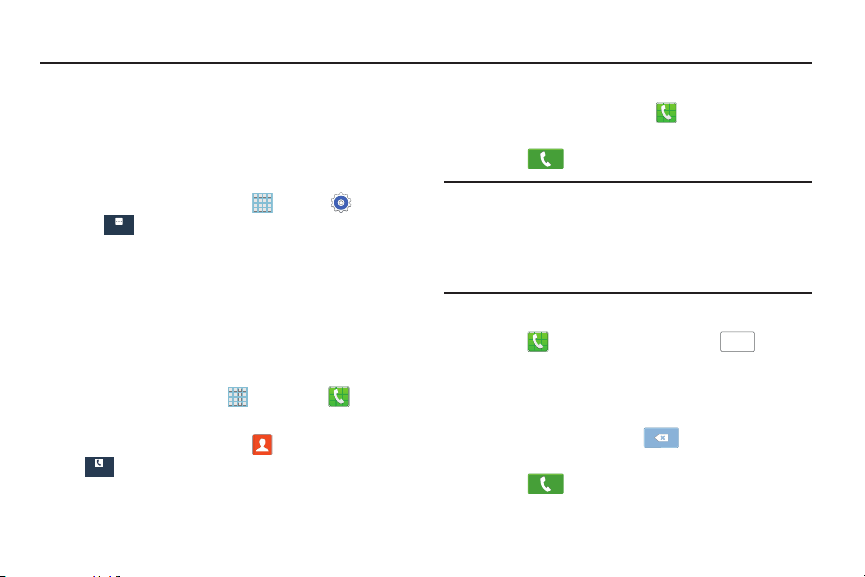
Phone
and use the
onscreen keypad to enter the number you want to dial.
Section 4: Call Functions
This section describes how to make or answer a call. It also
includes the features and functionality associated with
making or answering a call.
Making a Call
1. From a Home screen, touch
For more information, refer to “Call” on page 180.
2. Touch
Call
to make the call.
Displaying Your Phone Number
Note:
When you activate the
Auto redial
option in the Call
settings, the phone automatically redials up to 10 times
when the person does not answer the call or is already
on the phone. For more information, see
Auto redial
on
From a Home screen, touch
Apps
Settings
More
More
About device
Status
.
Your phone number displays in the
My phone number
field.
page 181
.
Phone
Making an International Call
Use the Phone app to access the phone Keypad, Recent
calls, Favorites, and Contacts.
1. Touch
Phone
, then touch and hold
0
+
.
The + character appears.
There are several ways to access Phone:
From a Home screen or
Apps
, touch
Phone
.
– or –
From a Home screen, touch
Contacts
Phone
.
2. Use the onscreen keypad to enter the country code,
area code, and phone number.
•
If you make a mistake, touch until the desired numbers
have been deleted.
Phone
3. Touch
Call
to make the call.
Call Functions 66
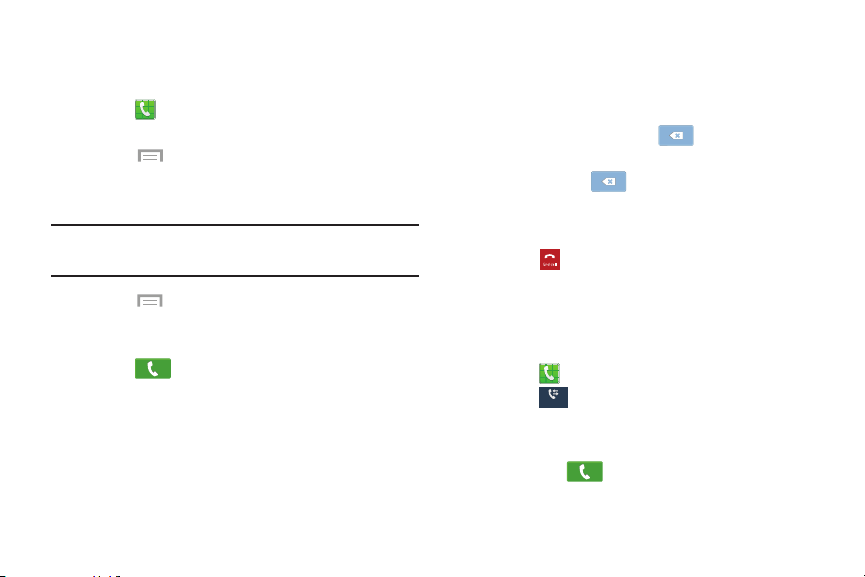
Manual Pause Dialing
To manually call a number with pauses without storing them
in your Contacts list:
1. Touch
Phone
and use the onscreen keypad to
enter the phone number .
2.
Touch
Menu
to display the dialer sub-menu.
3. Touch
Add 3-sec pause
to add a three second pause,
and use the keypad to enter the additional numbers.
Tip:
You can create pauses longer than three seconds by
entering multiple three second pauses.
4.
Touch
Menu
Add wait
to add a wait. A wait will
pause the calling seq
uence until you enter a number or
touch a key
.
5. Touch
Call
to make the call.
For more information, refer to
“Adding Pauses to Contact
Numbers” on page 53.
Correcting an Entered Number
Use the following steps to correct a mis-typed entry when
dialing.
After entering a number using the keypad:
•
If you make a mistake, touch
to erase a single
character.
•
Touch and hold
to erase the entire string of numbers.
Ending a Call
To end a call:
Touch
End call
.
Dialing a Recent Number
All incoming, outgoing and missed calls are recorded in the
Call log. If the number or caller is listed in your Address
Book, the associated name is al
so displayed.
1. Touch
Phone
.
2. Touch
Logs.
A list of recent calls displays.
3. Touch the desired Contact to enter the
Details
page,
then touch
Call
to make a call.
Logs
67
Making an Emergency Call without a SIM Card
1.
Touch
Emergency call
from the onscreen display to
make an emergency call.
2. Enter 9-1-1 and touch
Call
. Complete your call.
During this type of call, you will have access to the
Speaker mode, Keypad, and End Call features.
3. Touch
End call
to exit this calling mode.
Making Emergency Calls
If you do not have a SIM card installed the first time you turn
on the phone, the
Insert SIM card to make calls
message
displays and an animated tutorial shows you how to install
the SIM card.
Without a SIM car
d, you can only make an emergency call
with the phone. Nor
mal cell phone service is not available.
Making an Emergency Call with a SIM Card
The Emergency calling mode makes redialing an emergency
number a 1-touch process. Before you can resume normal
calling operations, you should first exit this mode.
1. Touch
Phone
.
2. Enter the emergency number (example: 911) and then
touch
Call
.
3. Complete your call. During this type of call, you will
have access to the Speaker mode, Keypad, and End
Call features.
Note:
This mode can drain your battery power more rapidly
than norm
al calling mode.
Call Functions 68
Making a Call Using Speed Dial
You can assign a shortcut number to a phone number in your
Contacts List for speed dialing.
1. From a Home screen, touch
Apps
Contacts
to display your Contacts List.
2.
Touch
Menu
Speed dial setting
.
The Speed dial setting screen displays showing the
numbers 1 through 100. The number 1 is reserved for
Voicemail.
3. Touch an unused number.
The Select contact screen displays.
4. Touch a contact to assign to the number.
The selected contact displays in the speed dial
number box.
To remove a speed dial number or change the order:
1. From the Speed dial setting screen, touch
Menu
.
2. In the pop-up menu, touch
Change order
or
Remove
.
To make a call using Speed Dial:
1. Touch
Phone
.
2. Touch
Keypad
Keypad
, if necessary.
3. From the onscreen keypad, touch and hold the speed
dial number.
If the speed dial number is more than 1 digit long,
enter the first
digits, then hold the last digit.
Making a Call from the Address Book
You can store phone numbers that you use regularly on the
SIM card or in the phone’s memory. These entries are
collectively called the Address Book.
For further details about the Address Book feature,
see
“Finding an Address Book Entry” on page 54.
69
Call Functions
Answering a Call
You can answer incoming calls when the device is locked or
unlocked. When you receive a call, an incoming call screen
displays. The caller’s phone number or name is displayed, if
stored in the Addre
ss Book.
To answer the call
:
Touch and dr
ag
in any direction.
To reject the call a
nd send it to your voicemail:
Touch and dr
ag
in any direction.
To reject the call w
ith a message:
Touch
an
d drag the
Reject call with message
tab upward.
•
Touch a predefined text message to send to the caller.
– or –
•
To end the call:
Touch
End call
.
Note:
You can answer a call while using the Address Book or
other functions. After ending the call, the phone returns
to the previously active function screen.
Dialing Options
From a Home screen or the Apps menu, you have the option
to access the Dialer and initiate a call:
Touch
Phone
Keypad
, if necessary.
Keypad
From the Dialer and the Contacts screen, the following tabs
are located at the top of the screen:
•
Keypad
: Dials the current number entered using the onscreen
keypad.
•
Logs
: Displays a list of all dialed, received, and missed calls.
•
Favorites
: Displays your contacts that you have marked as
Favorites.
•
Contacts
: Go to your Address Book where you can select a
contact to call.
After you begin to enter numbers:
Touch
Menu
Add to contacts
to save the
Contact, if needed.
– or –
Touch
Add to contacts
, which appears below the
numbers that you are typing.
Touch
Create new message
to compose a new message.
70
Call Log
The phone stores the numbers of the calls you have dialed,
received, or missed in the Call log. The Call log displays the
details of the call.
1. Touch
Phone
.
2. Touch
Logs.
A list of recent calls displays. If the number or caller is
listed in your Address Book, the associated name
displays.
All calls made, received, and missed are listed. Types of calls
are identified by the following icons:
•
Incoming Calls
:
•
Outgoing Calls
:
•
Missed Calls
:
•
Rejected Calls
:
•
Auto Rejected Calls
:
Viewing Missed Calls from the Lock Screen
Calls you have missed display on the Lock screen.
Touch the missed call number to display the Call log.
The Call log displays. Missed calls are identified by the
icon next to the number
.
Logs
Note:
If there is a voicemail sent by the same number,
associated icons are displayed and can then be
selected.
Calling or Messaging a Missed Call
To call back a missed call number:
1. Touch
Phone
Logs
Logs.
A list of recent calls displays. If the number or caller is
listed in your Address Book, the associated name
displays.
2. Swipe the desired missed call to the right to call.
– or –
Swipe the desired miss
ed call to the left to message.
For more informat
ion, refer to “Creating and Sending
Messages” on page 83.
71

Saving a Recent Call to Your Address Book
1. Touch
Phone
Logs
Logs.
A list of recent calls displays.
2. Touch the call you want to save to your Address Book.
The call detail page displays.
3. Touch
Create contact
to add the call to your
Address Book.
The Create contact screen displays.
– or –
If you want to replace the number for an existing
contact, touch
Update existing
.
4. Enter information into the various fields using the
keyboard.
5. Touch
Save
to save when you are finished.
For further details about the Address Book feature, see
“Adding a New Contact” on page 52.
Deleting a Call Log Entry
1. Touch
Phone
Logs
Logs.
A list of recent calls displays.
2. Touch and hold the call you want to delete from the
Call log.
3. Touch Delete.
4. At the Delete log prompt, touch
Delete
.
The call is deleted from the Call log.
Adding a Call to the Reject List
1. Touch
Phone
Logs
Logs.
A list of recent calls displays.
2. Touch and hold the call you want to add to the
Reject List.
3. Touch Add to reject list.
4. At the Add to reject list prompt, touch
OK
.
Future calls from this number will be rejected and sent
to your voicemail.
Call Functions 72
Tip:
Once a number has been added to the Reject list,
Remove from reject list
displays and can be used to
remove the number.
Call Duration
1. Touch
Phone
Logs
Logs.
2.
Touch
Menu
Call duration
.
The following times are displayed for Voice and Data:
•Last call
: The length of time for the last call.
• Dialed calls
: The total length of time for all calls made.
• Received calls
: The total length of time for all calls received.
• All calls
: The total length of time for all calls made and
received.
3. To reset these times to zero, touch
Menu
Reset
.
Options During a Call
Your phone provides a number of control functions that you
can use during a call.
Adjusting the Call Volume
During a call, to adjust the volume, use the
Volume
keys on
the left side of the phone.
Press the
Up
volume key to increase the volume level
and press the
Down
volume key to decrease the
volume level.
– or –
Quickly add more volume to the incoming audio by
touching the onscreen
Extra volume
button .
From a Home screen, you can also adjust the ringer volume
using these same keys.
73

In-Call Options
During an active call there are several functions available by
touching a corresponding onscreen button.
•
Hold
:
Places the current active call on hold.
•
Add call
: Displays the dialer so you can call another person.
•
Keypad
: Displays the onscreen keypad, where you can
enter a number using DTMF (Dual Tone Multi-Frequency).
•
End call
: Terminates the call.
•
Speaker
: Routes the phone’s audio through either the speaker or
through the earpiece.
–
Touch
Speaker
to route the audio through the speaker. (You
can adjust the speaker volume using the volume keys.) A green
line appears under the Speaker button.
–
Touch
Speaker
again to use the phone’s earpiece (see “Using
the Speakerphone During an Active Call” on page 78). The
green line disappears when Speaker is not activated.
•
Mute/Unmute
: Turns the onboard microphone either on or off.
–
Touch
Mute
during a call to mute the microphone. A green line
appears under the Mute button.
–
Touch
Mute
again to unmute the microphone. The green line
disappears when Mute is not activated.
•
Headset
: Connects to a Bluetooth headset.
–
Touch
Headset
during a call to activate a Bluetooth headset. A
green line appears under the Headset button.
–
Touch
Headset
again to de-activate the Bluetooth headset. The
green line disappears when the Headset is not activated.
•
Touch
Menu
for more options:
–
Contacts
: Go to your Contact list.
–
Memo
: Write a note using the S Memo app.
–
Message
: Write a message during a call.
–
One-handed operation on
: Activate one-handed operation. For
more information, refer to “One-Handed Opera
tion” on
page 189.
Call Functions 74
Personalizing the Call Sound Setting
During a call, it may be necessary to adjust the sound of the
incoming call by selecting an audio equalizer setting for the
current call.
1. From the call screen, touch
to enable the feature.
displays when the feature is enabled.
2. Select an available option. Choose from: Off,
Soft sound, Clear sound, Adapt Sound Left, and
Adapt Sound right.
Activating Noise Reduction
During a call it may be necessary to activate the noise
reduction feature. Activating this feature can improve the
quality of your conversation by reducing ambient noise.
Noise reduction in on by default.
1. To turn
Noise reduction off
, touch .
2. To turn
Noise reduction on
, touch .
Placing a Call on Hold
You can place the current call on hold at any point during a
conversation. You can also make another call while you have
a call in progress, if your network supports this service.
1. While on a call, touch
Hold
Hold
. This action places
the current caller on hold.
2. To reactivate this call, touch
Unhold
Unhold.
Making a New Call During a Call in Progress
To make a new call while you have a call in progress:
1. Touch
Hold
Hold
.
2. Touch
Add call
to display the dialer.
3. Enter the new number and touch
Call
.
Once connected, the active call appears in a large box
at the top of your screen and the call on hold appears
in a smaller box in the middle of your screen.
75
Switching Between Calls
When you have an active call and a call on hold, you may
switch between the two calls, changing the one on hold to
active and placing the other on hold.
1. Touch Swap.
The current call (caller #2) is placed on hold and the
previous call on hold (caller #1) is then reactivated so
that you ca
n continue conversing with that person. The
active call appears in a green box.
2. Touch
End call
to end the currently active call.
1. Touch
Swap
until the call you want to end appears in a
green box.
2.
Touch
End call
to end the remaining call.
3.
Touch
End call
to end the specific call.
To end a specific call:
Ending a Specific Call
Answering a Call During a Call in Progress
You can answer another call while you have a call in
progress, if you have activated the Call waiting feature.
Otherwise, the other call goes to your Voicemail box. For
more information, refer to “Additional Settings” on
page 181.
To answer another call:
1. Touch
and slide to the right.
2. Touch
Putting “Name/Number” on hold
to put the first
call on hold.
– or –
Touch
Ending call with “Name/Number”
to end the
first call.
3. To switch between the two calls, touch Swap.
Swap places the current call on hold and then
activates the previous call. The active call appears
in a green box.
4. Touch Swap again to switch back.
Call Functions 76
Ending a Call On Hold
To end a call on hold:
1. Touch
End call
to disconnect the active call.
The call on hold becomes the active call.
2. Touch
End call
to end the remaining call.
1. To answer the call, touch
2. To answer the next call, touch
This feature joins all of the calls you have established with
your phone (both active and on hold) into a multi-party call.
and slide to the right.
and slide to
the right.
3-Way Calling (Multi-Party Calling)
Use the 3-Way or Multi-Party feature to answer a series of
incoming calls and place them on hold. If this service is
supported by the network, all
calls can be joined together.
You are notified of an incoming call by a call waiting tone.
Note:
The Merge option combines all of the calls you have
established with your phone (both active and on hold).
Swap places the current call on hold and then activates
the previous call.
3. Touch
Putting “Name/Number” on hold
to put the first
call on hold.
4. To join the first two callers into a single multi-party call,
touch
Merge.
Merge
5. To temporarily leave the conference call, touch
Hold
Hold
.
To rejoin the conference call, touch
Unhold
Unhold.
End call
to end the call. 6. Touch
77
Using the Speakerphone During an Active Call Switching Off the Microphone (Mute)
While in an active call, it is possible to enable the
speakerphone feature.
You can temporarily switch your phone’s microphone off, so
that the other person cannot hear you.
1. Touch
Speaker
.
Speaker
Example:
You want to say something to someone in the
room, but do not want the person on the phone to
hear what you say.
The
Speaker
button now appears as and the
speakerphone is activated.
Speaker
2. Use the
Volume
keys (located on the left side of your
phone) to adjust the volume.
Muting Your Phone During a Call
To mute your phone during a call:
3. To deactivate the speakerphone, touch
Speaker
.
Speaker
1. Touch
Mute.
The
Mute
button now appears as
Mute
and Mute is
activated.
Mute
2. Touch
Mute to deactivate the Mute function and
reactivate the microphone.
Mute
Call Functions 78
Headset
Bluetooth Headset
1. Touch
Headset
Headset.
2. The phone will scan for your Bluetooth headset. When
found, connect to the headset.
The
Headset
button now appears as and the
Bluetooth headset is activated.
3.
HeadsetHeadset
Touch Headset to deactivate the Bluetoot
h
headset and reactivate the phone speaker.
Call Waiting
The Call Waiting feature can be used to answer an incoming
call while you have a call in progress, if this service is
supported by the network.
To activate the Call Waiting feature:
Touch
Phone
Menu
Call settings
Additional settings
Call waiting
.
You are notified of an incoming call by a call
waiting tone.
Searching for a Number in Address Book
1. During an active call, touch
Menu
then touch
Contacts
.
2. Touch the Address Book entry.
For further details about the Address Book feature, see
“Finding an Address Book Entry” on page 54.
79

Call Forwarding
To select when to forward incoming calls:
1. Touch
Phone
Menu
Call settings
Additional settings
Call forwarding
.
2. Touch one of the following options:
• Always forward
: Forwards all voice calls.
• Forward when busy
: Forwards voice calls to a designated
number instead of your voicemail number, if you are on another
phone call.
• Forward when unanswered
: Forwards voice calls to a
designated number instead of your voicemail number when
there is no answer on your phone. You can also select the
amount of time that the phone delays before forwarding.
• Forward when unreachable
: Forwards voice calls to a
designated number instead of your voicemail number when
you are not in an area covered by your service provider or when
your phone is switched off.
Using Fixed Dialing Numbers
Turn On FDN
To turn on FDN:
1. From the Home screen, touch
Phone
Menu
Call settings
Additional settings
Fixed dialing numbers
.
2. Touch
Turn on FDN
.
3. At the prompt, enter your PIN2 code and touch
OK
.
FDN is turned on.
Call Functions 80
Turn Off FDN
To turn off FDN after it has been turned on:
1. Touch
Turn off FDN
.
2. At the prompt, enter your PIN2 code and touch
OK
.
FDN is turned off.
Important!
Not all SIM cards use a PIN2 code. If your SIM card
does not, this menu does not display.
The PIN2 code is provided by your carrier. Entering
an incorrect PIN2 code could cause the phone to
lock. Contact customer service for assistance.
Changing the PIN2 Code
To change the PIN2 code:
1. From the Home screen, touch
Phone
Menu
Call settings
Additional settings
Fixed dialing numbers
.
2. Touch
Change PIN2
.
3. At the prompt, enter your old PIN2 code.
4. At the prompt, enter a new PIN2 code.
5. Confirm your PIN2 code.
Managing the FDN List
When this feature is enabled, you can make calls only to
phone numbers stored in the FDN list on the SIM card.
Note:
Before you can manage an FDN list a list must be
created.
Phone
Menu
Call settings
Additional settings
Fixed dialing numbers
.
1. From the Home screen, touch
2. Touch
FDN list
.
3. A list of all existing FDN numbers displays.
Call Settings
To access the Call settings menu:
Touch
Phone
Menu
Call settings
.
– or –
From a Home screen, touch
Apps
Settings
My device
My device
My device
Call
.
For detailed information on all of the call settings, see “Call”
on page 180.
81

Section 5: Messaging
This section describes how to send and receive different
types of messages. It also includes the features and
functionality associated with messaging.
Types of Messages
Your phone provides the following message types:
•
Text Messages
•
Multimedia (Picture, Video, and Audio) Messages
•
Email and Gmail Messages
•
AT&T Messages
•
ChatON
•
Google+ Messages
•
Hangouts
The Short Message Service (SMS) lets you send and receive
text messages to and from other mobile phones or email
addresses. To use this feature, you may need to subscribe to
your service provider’s message service.
The Multimedia Messaging Service (MMS) lets you send and
receive multimedia messages (such as photo, video, audio
messages, and so on) to and from other mobile phones or
email addresses. To use this feature, you may need to
subscribe to your service provider’
s multimedia message
service.
Important!
When creating a message, adding an image, a
sound file, or a video clip to a text message
changes the message from a text message to a
multimedia message.
Messaging icons are displayed at the top of the screen and
indicate when messages are received. For more information,
refer to “Status Bar Icons” on page 27.
Messaging 82
Creating and Sending Messages
1. From a Home screen, touch
Messaging
.
– or –
From a Home screen, touch
Apps
Messaging
2. Touch
Compose
.
3. Touch the
Enter recipient
field to manually enter a
recipient or touch
to select a recipient from your
Contacts. You can also select the recipient based on
Groups, Favorites, or Logs.
4. If adding a recipient from your Contacts, touch the
contact to place a check mark then touch
Done
.
The contact is placed in the recipient field.
Note:
For the Group option, if the number of recipients is 10 or
less, all members in the group will be added. You will
need to delete any unnecessary members in the list by
selecting the trash can icon and deleting unwanted
entries.
Note:
Enter additional recipients by separating each entry with
a semicolon (;) then repeating Steps 3 and 4 of this
procedure.
5. Touch the
Enter message
field and use the onscreen
keyboard to enter a message.
6. To add more recipients, touch the recipient field.
7. Review your message and touch
Send
.
Note:
If you exit a message before you send it, it will be
automatically saved as a draft.
Adding Attachments to a Message
To add an attachment to your message, touch
Attach
and select one of the options, such as Image, Take picture,
Record Video, and so on.
83

Message Options
Options Before Composing a Message
1. Touch
Messaging
.
2. Before composing a message, touch
Menu
to
reveal additional messaging options:
•Search
: Search through all of your messages for a certain
word or string of words. Enter a search string in the Messaging
Search window then touch
on the keyboard.
• Delete threads
: Deletes any message thread. Select the
messages to delete and a green check mark appears next to
the message. Touch
Delete
.
• Draft messages
: Displays the draft messages folder and its
contents.
• Locked messages
: Displays the locked messages folder and
its contents.
• Scheduled messages
: Displays the scheduled messages
folder and its contents.
• Spam messages
: Displays the spam messages folder and its
contents.
•Font size
: Sets a default font size for messages.
•Settings
: Accesses Messaging settings. For more information,
refer to “Messaging Settings” on page 88.
Options While Composing a Message
While composing a message:
Touch
Menu
to reveal additional messaging
options.
Note:
Available options will slightly differ between new
messages and messages composed within a thread.
• Insert smiley
: Adds emoticons, such as a happy face, to your
message.
•Add text
: Copies text from your contacts, calendar, or from a
memo to add to your message. This is a convenient feature for
adding names, phone numbers, events, and so on, to your
message.
•Preview
: Displays a preview of the message.
Messaging 84
• Add to contacts
: Adds the recipient to your Contacts list. This
option only appears if the recipient is not already in your
Contacts list.
•View contact
: See information on the recipient. This option
only appears if the recipient is in your Contacts list.
• Add slide
: Adds a new page to a message.
• Remove slide
: Removes a recently added page from a
message.
•Duration
: Duration for slide in seconds.
•Layout
: Layout of the message. Choose from
Text at top
or
Text at bottom
.
• Scheduling
: Assigns the current message for scheduled
delivery at a designated time.
•Discard
: Deletes the current message.
•Translate
: Launches the S Translator app where you can both
assign the sender’s original language and assign a target
language for the recipient (they will receive your message in the
designated language). For more information, refer to
“S Translator” on page 148.
•Font size
: Sets a font size for this message.
Viewing New Received Messages
When you receive a new message, the new message
icon displays at the top of the screen.
To view a received message:
Open the Notification Panel and select the message.
For more information, refer to “Notification Panel” on
page 25.
– or –
Touch
Messaging
and then touch the new
message to view it.
The selected message displays.
To play a multimedia message:
1. Touch
.
2. To pause playback of the multimedia message,
touch
.
To scroll through the message (if additional text pages have
been added):
Touch the screen and in a single motion, scroll up or
down the page.
85

Message Threads
Sent and received text and photo messages are grouped into
message threads. Threaded messages allow you to see all
the messages exchanged (similar to a chat program) and
displays a contact on the screen. Message threads are listed
in the order in which they were received, with the latest
message displayed at the top.
To access message thread options:
From the main Messaging screen, touch and hold the
message to display the following options:
•Delete
: Displays a confirmation dialog box that when pressed,
deletes the entire thread.
•View contact
: Displays the contact’s information. This option
only displays if the sender is in your Contacts list.
•Add to contacts
: Displays the Contacts information screen.
This option only displays if the sender is not in your Contacts
list.
• Add to spam numbers
: Adds the current sender to a spam
list. Any new texts from this sender are automatically blocked.
• Remove from spam numbers
: Removes a number from the
spam number list. This option only appears if the number was
previously registered as spam.
To access additional Bubble options:
Touch and hold the message bubble within an active
message conversation to display the following options:
• Delete
: Deletes any currently selected message bubble from
the thread.
•View slideshow
: Views a slideshow of the attached photos or
videos.
• Copy text
: Copies the currently selected message bubble from
the thread.
•Forward
: Forwards the currently selected message bubble to
an external recipient.
•Lock/Unlock
: Locks or unlocks the currently selected
message bubble from being accidentally deleted.
• Save attachment
: Saves attached photos or videos.
•Copy to SIM
: Copies the currently selected message bubble as
a single text message within the SIM card.
• View message details
: Displays details for the currently
selected message bubble.
•Translate
: Launches the S Translator app. For more
information, refer to “S Translator” on page 148.
Messaging 86
Deleting Messages
To delete a single message thread:
1. Touch
Messaging
.
2. Touch and hold a message, then touch
Delete
.
3. At the
Delete
prompt, touch
OK
to delete or
Cancel
to
cancel.
To delete multiple message threads:
1. Touch
Messaging
.
2. Touch
Menu
Delete threads
.
3. Touch each message you want to delete or touch
Select all
.
A check mark displays beside each message you
select.
4. Touch
Delete
.
5. At the
Delete all
prompt, touch
OK
to delete or
Cancel
to
cancel.
Message Search
You can search through your messages by using the
Message Search feature.
1. Touch
Messaging
.
2. Touch
Menu
Search
.
3. Use the onscreen keyboard to enter a word or phrase
to search for, then touch
on the keyboard.
4. All messages that contain the search string you
entered are displayed.
87

Messaging Settings
To configure the settings for text messages, multimedia
messages, Voice mails, and Push messages.
1. Touch
Messaging
Menu
Settings
.
General settings, Text message (SMS) settings,
Multimedia message (MMS) settings, Display,
Push message settings, Cell Broadcast (CB) settings,
Notification settings, Emergency message settings,
Signature settings, and Spam message settings are
listed.
2. Options are described on the screen.
Touch the check box to create a check mark
,
which indicates that an option is enabled. Checking
some options causes other options to become available
to set.
Touch
to set some options.
Touch other options, such as Bubble style, to display
additional instructions for setting the option.
Menu
Restore default settings
to restore
all Messaging settings to their original state.
3. Touch
Emergency Alerts
This device is designed to receive wireless emergency alerts
from the Commercial Mobile Alerting System (CMAS) which
may also be known as the Personal Localized Alerting
Network (PLAN). If your wireless provider has chosen to
participate in CMAS/PLAN, alerts are available while in the
provider's coverage area. If you travel outside your provider's
coverage area, wireless emergency alerts may not be
available. For more information, please contact your wireless
provider.
Emergency Alerts allows customers to receive
geographically-targeted messages. Alert messages are
provided by the US Department of Homeland Security and
will alert customers of imminent threats to their safety within
their area. There is no charge for receiving an Emergency
Alert message.
There are three types of Emergency Alerts:
•
Alerts issued by the President
•
Alerts involving imminent threats to safety of life (Extreme and
Severe)
•
AMBER Alerts (missing child alert)
Messaging 88

Customers may choose not to receive Imminent Threats
(Extreme and Severe) and AMBER Alerts. Alerts issued by the
President cannot be disabled.
To disable Imminent Threats and AMBER Alerts, follow the
instructions below:
1. Touch
Messaging
.
2. Touch
Menu
Settings
.
3. Scroll to the Emergency message settings section and
touch
Emergency alerts
.
All alerts are enabled by default (check mark showing).
4. To disable an alert, touch the alert option and remove
the check mark.
Email
Email enables you to review and create email using various
email services. You can also receive text message alerts
when you receive an important email.
To access the Email app:
From a Home screen, touch
Email
.
– or –
From a Home screen, touch
Apps
Email
.
Adding an Email Account
To create your first email account:
1. Touch
Email
.
The Set up account screen displays.
2. Enter your email address in the
Email address
field.
3. Enter your password in the
Password
field.
4. If you want to see your password as it is being typed,
touch
Show password
to create a check mark.
5. Touch
Next
or touch
Done
on the keyboard.
The Account options screen displays.
6. Review and configure the settings.
7. Touch
Next
.
8. Enter a name for this email account (optional).
9. Touch
Done
.
89

Adding a Corporate Email Account
Use the following procedure to configure your phone to
synchronize with a corporate email account.
1. Touch
Email
.
The Set up email screen displays.
2. Enter your email address and password.
3. Touch
Manual setup
.
4. Touch the
Microsoft Exchange ActiveSync
field.
5. Enter all the Exchange server information, Domain,
User name, and P
assword, then touch
Next
.
6. At the
Activation
prompt, touch
OK
.
The
Account options
screen displays.
7. Enter the desired information in the different fields,
then touch
Next
.
8. Enter an Account name for this account (Optional) and
touch
Done
.
Wait for the Inbox to synchronize before use.
9.
Touch
Menu
Settings
to change the account
settings.
Adding Additional Email Accounts
To create additional email accounts after setting up your first
account, follow these steps:
1. Touch
Email
.
Your Email screen displays showing your emails from
the active account.
2. Touch
Menu
Settings
.
3. Touch
Add account
.
4. Enter the information required to set up another
account.
Touch
Send email from this account by default
, if you
want to enable the option. Touch the check box to
create a check mark.
For more information, refer to “Adding an Email
Account” on page 89.
Messaging 90
1. Touch
Email
.
Your Email screen displays showing your emails from
the active account.
2. Touch
Inbox
at the top of the screen.
Your Email accounts screen displays.
Touch
Email
Refresh
.
Syncing refreshes your phone with the account’s servers.
When you set up an email account, you can choose whether
the account syncs in the background or manually.
Switching Between Email Accounts
3. Touch the Email account
Inbox
you would like to make
active.
– or –
Touch
Combined inbox
to display email messages from
all accounts.
The new Email account inbox or Combined inbox
displays.
Syncing Email Accounts
Deleting Email Accounts from your Phone
To delete an email account from your phone:
1. Touch
Email
.
2.
Touch
Menu
Settings
Account settings
.
3. Touch
Delete account
.
4. Touch each account you want to delete to create a
check mark .
5. Touch
Delete
and then touch
OK
.
The selected accounts are removed from your phone.
91
Email Settings
Use the Email Settings to configure your Email preferences.
Note:
Available settings depend on the email provider.
1. Touch
Email
.
2. Touch
Menu
Settings
. The following
General settings
display:
•Display
: Sets how email is shown in the email list and when
you open them.
• Composing and sending
: Sets what functions are available
while composing and sending email.
•Auto advance
: Sets the screen to show after deleting a
message. Choices are: Next email, Previous email, or Email list.
• Confirm deletions
: Asks for confirmation before deleting
email.
•Priority senders
: Enters email addresses that you want treated
as a priority.
• Spam addresses
: Manages your spam address list.
• Rules for filtering
: Creates rules for filtering email based on
names, address, or subject.
•Split view mode
: Turns on split view on landscape screen.
3. Touch an account to configure specific settings.
Available options depend on the account.
Gmail
Send and receive email with Gmail, which is Google’s
web-based email.
To access Gmail:
From a Home screen, touch
Apps
Gmail
.
Setting Up Your Gmail Account
Note:
You must sign in to your Gmail account in order to
access Gmail.
1. Sign on to your Google account, if you are not already
signed on. For more information, refer to “Creating a
New Google Account” on page 13.
Gmail
.2. Touch
3. Follow the onscreen instructions.
The Inbox loads conversations and email.
Refreshing Your Gmail Account
Refresh your account to update your device from the Gmail
servers.
1. Touch
Gmail
.
Menu
Refresh
.2. Touch
Messaging 92
Gmail Settings
Use the Gmail Settings to configure your Gmail preferences.
1. Touch
Gmail
.
2. Touch
Menu
Settings
for settings.
Tip:
Touch
Menu
Help
for more information.
Composing and Sending Gmail
1. Touch
Gmail
.
2. Touch
Compose
, then touch fields to compose the
message.
While composing a message, touch
Menu
for
options.
3. Touch
SEND
to send this message
– or –
Touch
Menu
Save draft
to save a draft of this
message.
Messages
AT&T Messages brings your texts, calls, and voicemail
messages together into a single conversation thread and is
accessible by phone or computer.
1. From a Home screen, touch
Apps
Messages
.
2. Sign in to your Google account, if you are not already
signed in. For more information, refer to “Setting Up
Your Gmail Account” on page 92.
Note:
The first time you use the Messages app, touch
Update AT&T Messages
to download the updated
application from the Play Store. When the Play Store
page displays, touch
UPDATE
ACCEPT
OPEN
. For
more information, refer to “Play Store” on page 146.
3. Follow the onscreen instructions to use the
Messages app.
93
ChatON
Provides a global mobile communication service where you
can chat with more than two buddies in a group chat. Share
things such as photos, videos, animation messages
(Scribbles), audio, Contacts, Calendar entries, and Location
information.
Important!
The Samsung account manages the access
information (username/password) to several
applications, such as ChatON and Samsung Hub.
For more information, refer to “Signing In to Your
Samsung Account” on page 200.
1. Sign in to your Google account.
For more information,
refer to “Setting Up Your Gmail Account” on page 92.
2. From a Home screen, touch
Apps
ChatON
.
The Terms and privacy screen displays.
3. Read the Terms and conditions and the Privacy policy
and then touch
Accept
.
Note:
The first time you use the ChatON app, an update
notification pop-up displays. Touch
OK
and follow the
onscreen instructions to download the updated
application.
The main ChatON screen displays.
Menu
Settings
to configure your ChatON
preferences.
4. Touch
5. Touch
Menu
Support
Help
to display
additional help information.
– or –
Visit:
web.samsungchaton.com
for more information.
Messaging 94
Google+
Stay connected and share life as it happens with Google+ on
your device. Join a Hangout, post a photo, or see what
friends are sharing while you are on the go.
1. Sign in to your Google account. For more information,
refer to “Setting Up Your Gmail Account” on pa
ge 92.
2. From a Home screen, touch
Apps
Google+
.
3. Follow the onscreen instructions to use Google+.
4. Touch
Menu
Settings
to configure your
Google+ preferences.
5. Touch
Menu
Help
to display additional help
information.
– or –
Visit
www.google.com/mobile/+/
for more information.
Hangouts
Hangouts is a free, web-based application for instant
messaging offered by Google. You can connect with your
friends across computers and various Android devices. You
can have conversations or video calls with up to 10 friends.
1. Log on to your Google account, if you have not already
done so.
For more information, refer to “Setting Up
Your Gmail Account” on page 92.
2. From a Home screen, touch
Apps
Hangouts
.
3. The first time you access Hangouts, touch
Confirm
to
confirm your mobile number. If the number is not
correct, touch
Edit Number
to change it.
4. Begin using Hangouts.
5.
Touch
Menu
Help
for more information on
using Hangouts.
95

Section 6: Photos and Videos
This section explains features related to the use of the
camera and camcorder on your phone. You can take
photographs and record video by using the built-in camera
functionality. Your 8 megapixel camera produces photos in
JPEG format.
Camera
Use your device’s built-in camera and camcorder to
take
photos and record videos.
To access the Camera:
1. From a Home screen, touch
Camera
.
– or –
From a Home screen, touch
Apps
Camera
.
If a memory card is inserted, the Storage location
pop-up displays.
2. Touch
OK
to change the storage location to memory
card for storing photos and videos.
– or –
Touch
Cancel
to use the device storage.
The Camera screen displays.
Important!
Do not take photos of people without their
permission.
Do not take photos in places where cameras are
not allowed.
Do not take photos in places where you may
interfere with another person’s privacy.
Photos and Videos 96
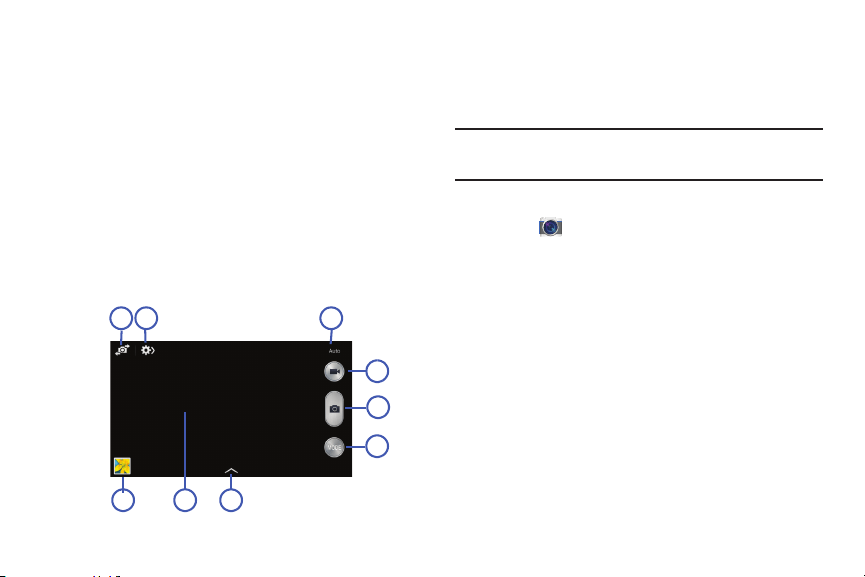
Camera Screen
The following items can be found on the Camera screen:
1. Front Facing Camera
2. Quick Settings
3. Current Camera Mode
4. Record Video Button
5. Camera Button
6. Mode Button
7. Image Viewer
8. Viewfinder
9. Effects
1 2 3
4
5
6
7 8 9
Taking Photos
Taking photos with your device’s built-in camera is as simple
as choosing a subject, pointing the camera, then pressing
the camera key.
Note:
When taking a photo in direct sunlight or in bright
conditions, shadows may appear on the photo.
To take a photo:
1. Touch
Camera
to activate the camera mode.
2. Using the phone’s main display screen as a viewfinder,
adjust the image by aiming the camera at the subject.
3. Before you take a photo, use the
Up
and
Down
Volume
keys to zoom in or out. You can magnify the photo up to
four times (400 percent).
– or –
Use two fingers to make an inward pinch motion on the
screen to zoom out or an outward motion by sweeping
your fingers out to zoom in.
97

4. If desired, before taking the photo, you can touch
onscreen icons to access various camera options and
settings.
5. You can also touch the screen to move the focus to the
area you touch.
6. Press the Camera button ( ) until the shutter sounds.
(The photo is automatically stored within your
designated storage location. If no microSD is installed,
all photos
are stored on the Phone.)
7. While viewing a photo, after you have taken it, pinch
the screen
outwards to zoom in or pinch the screen
inwards to zoom out.
You can magnif
y the photo up to four times
(400 percent).
8. Touch
Back
to return to the viewfinder.
Camera Modes
There are many different camera modes that you can use to
help optimize your photos depending on the conditions and
your experience.
1. From the camera viewfinder, touch the Mode button
MODE
MODE
MODE
MODE
to change the mode to one of the following:
• Auto
: Automatically adjusts your camera to optimize color and
brightness. This is the default setting
• Beauty face
: Use this to take photos with lightened faces for
gentler images.
• Best photo
: Use this to take multiple photos in a short time,
and then choose the best photos among them. Press the
Shutter button to take multiple photos. When Gallery opens,
touch and hold thumbnails of photos to save, and then touch
Done.
• Continuous shot
: Use this to take photos continuously at a rate
of 3 per second. You can take up to 20 continuous photos at a
time.
Photos and Videos 98

• Best face
: Use this to take multiple group shots at the same
time and combine them to create the best possible image.
Press the Shutter button to take multiple photos. When Gallery
opens, touch the yellow frame on each face, and choose the
best individual face for the subject. After choosing a pose for
each individual, touch Done to merge the images into a single
photo, and touch Save.
• Sound & shot
: Use this mode to enrich photos by adding
background sounds for a few seconds. The background sound
is recorded for up to 9 seconds after taking the photo.
• Rich tone (HDR)
: Use this to take photos with richer colors and
contrasts.
• Panorama
: Use this to take wide panoramic photos. Press the
Shutter button to take a photo, and then move the camera in
any direction. When the blue frame aligns with the preview
screen, the camera automatically takes another shot in the
panoramic sequence. To stop recording, press the Shutter
button again.
•Sports
: Use this to take fast action photos.
•Night:
Use this to take photos in low-light conditions, without
using the flash. Press the Shutter button to take multiple
photos. Photos are automatically merged into a single photo.
Quick Settings
Touch at the top of the display to quickly change
Camera settings. Not all of the following options are available
in both still camera and video camera modes. The available
options vary by mode.
Configure Camera settings.
Activate or deactivate the flash.
Activate or deactivate the voice control to take photos.
Set a timer.
Select a resolution for videos.
Activate or deactivate the sharing options.
Hide Quick settings.
99

Camera and Camcorder Settings
This section describes the different settings that you can
configure on your camera. Not all of the following options are
available in both still camera and video camera modes. The
available options vary by mode.
1. From the viewfinder, touch
(
Quick Settings
)
(
Camera Settings
).
2. The follow settings are located under the Camera,
Camcorder, and General tabs. The sett
ings that are
displayed will depend on what camera mode you are
in.
Camera
•Photo size
: Select a resolution for photos. Use higher
resolution for higher quality. Higher resolution photos take up
more memory.
• Face detection
: Adjusts the camera focus based on face
detection technology.
• Metering modes
: Sets how the camera measures or meters
the light source: Center-weighted, Matrix, or Spot.
•ISO
: Determines how sensitive the light meter is on your digital
camera. Choose from Auto, 100, 200, 400, or 800. Use a
lower ISO number to make your camera less sensitive to light, a
higher ISO number to take photos with less light, or Auto to let
the camera automatically adjust the ISO for each of your shots.
•Anti-Shake
: Compensates for camera movement.
•Save as
: Assigns rich tone usage to an image.
Camcorder
•Video size
: Selects a resolution for videos. Use higher
resolution for higher quality. Higher resolution videos take up
more memory.
Settings
•Location tag
: Attaches a GPS location tag to the photo. To
improve GPS signals, avoid recording in locations where the
signal may be obstructed, such as between buildings or in
low-lying areas, or in poor weather conditions. Your location
may appear on your photos when you upload them to the
Internet. To avoid this, deactivate the GPS tag setting.
Photos and Videos 100

• Review pics/videos
: Views each photo after you take it. Select
a time value.
•Volume key
: Assigns a function to the volume key. Choose
from The zoom key, The camera key, or The record key.
•Timer
: Use this for delayed-time shots. You can set the timer to
Off, 2 sec, 5 sec, or 10 sec.
• White balance
: Selects an appropriate white balance, so
images have a true-to-life colour range. The settings are
designed for specific lighting situations. These settings are
similar to the heat range for white-balance exposure in
professional cameras.
•Exposure value
: Adjusts the brightness level by moving
the slider.
• Guidelines
: Displays viewfinder guides to help composition
when selecting subjects.
•Flash
: Activates or deactivates the flash.
• Voice control
: Activates or deactivates voice control feature
that allows you to verbally take a photo.
• Contextual filename
: Adds your location as part of the
filename. You must first activate Location tag described above.
•Storage
: Selects the memory location for storage.
•Shutter sound
: Turns the shutter sound on or off.
• Reset
: Resets the camera settings.
Viewing Your Photos
After you take a photo, you can access various options from
the Image Viewer. The Image Viewer uses your Gallery.
For
more information, refer to “Gallery” on page 103.
101

Camcorder
In addition to taking photos, the camera also doubles as a
camcorder that also allows you to record, view, and send
videos.
Note:
The camera may not be able to properly record videos to
a memory card with a slow transfer speed.
Recording Videos
Tip:
When recording video in direct sunlight or in bright
conditions, it is recommended that you provide your
subject with sufficient light by having the light source
behind you.
Camera
to activate the camera mode. 1. Touch
2. Using the camera’s main display screen as a
viewfinder, adjust the image by aiming the camcorder
at the subject.
3. Before you record a video, use the
Up
and
Down
Volume keys to zoom in or out. You can magnify the
video up to four times (400 percent).
– or –
Use two fingers to make an inward pinch motion on the
screen to zoom out or an outward motion by sweeping
your fingers out to zoom in.
4. To start recording, touch
Record
.
During recording, the
Recording Indicator
flashes.
5. You can touch the screen to move the focus to the area
you touch.
6. To capture an image from the video while recording,
touch
. This feature is not available when the
anti-shake feature is activated.
7. To pause recording, touch
Pause.
8. To stop recording and save the video file to your
Camera folder, touch
Stop
.
9. Once the file has been saved, touch the image viewer,
then touch
to play your video for review.
Back
to return to the viewer. 10. Touch
Photos and Videos 102
Viewing Your Videos
After you take a video, you can access various options from
the Image Viewer. The Image Viewer uses your Gallery and
the Video player. For more information, refer to “Gallery” on
page 103. Also, see “Video” on page 155.
Gallery
The Gallery can be used to view photos and play back videos.
For photos, you can also perform basic editing tasks, view a
slideshow, set photos as wallpaper or contact image, and
share as a photo message.
To access the Gallery:
1. From a Home screen, touch
Apps
Gallery
.
All of the Albums that hold your photos and videos
display with folder name and number of files.
2. Touch an Album.
Thumbnails of the contents display.
Note:
If your device displays that the memory is full when you
access Gallery, delete some of the files by using
My Files
or another file management application and try again.
For more information, refer to “My Files” on page 141.
Viewing Photos
To view photos:
1. Touch a thumbnail to view a single photo.
Note:
If no control icons are displayed on the screen in
addition to the photo, touch anywhere on the screen to
display them.
2. The following options are available at the top of the
screen:
Change player
:
Select a DLNA-enabled device.
Share via
: Share the photo by using ChatON,
Group Play, AT&T Locker, Bluetooth, Drive, Email,
and so on.
Delete
: Delete the photo.
Camera
: Activate the camera.
3.
Touch
Menu
for additional options.
103
Editing a Photo
You can edit your photos using the built-in Photo editor
application on your device. The photo editor application
provides basic editing functions for photos that you take on
your phone. Along with basic image tuning like brightness,
contrast, and color it also provides a wide variety of effects
used for editing the photo.
1. From a Home screen, touch
Apps
Gallery
.
2. Select a folder location and touch a file to open it.
3. With the image displayed, touch
Menu
Edit
to
launch the Photo Editor.
4. Select an image area by touching and holding the
image and then selecting an available option:
• Selection mode
: Provides several onscreen selection options
such as: Select area, Inverse selection, Selection size, and
Selection mode (Magnetic, Lasso, Brush, Round, and Square).
• Select all
: Selects the entire area of the current image.
•Clipboard
: Copies the currently selected area to your device’s
clipboard.
5. Use the following editor controls to edit your photo:
Previous
: Moves to previous photo project.
Next
: Moves to next photo project.
Rotate
: Allows you to rotate a photo in all 4
directions. You can also mirror image a photo.
Crop
: Allows you to crop (cut-out) an area of a
photo.
Color
: Allows you to Auto adjust color,
Brightness, Contrast, Saturation, Adjust RGB,
Temperature, Exposure, and Hue of a photo.
Effects
: Adds various effects to your photo.
Portrait
: Allows you to apply various face
correction effects such as: Red-eye fix,
Airbrush face, Face brightness, Out-of-focus,
Beauty face, Face reshaping, or Spot healing.
Sticker
: Allows you to place various pre-
created onscreen stickers atop your current
image.
Photos and Videos 104
Drawing
: Allows you to add draw directly on
your current picture by using either a brush/pen
or eraser.
Frame
: Places a pre-created border style atop
your current image.
6. Touch
Menu
to access the following options:
•Save as
: Renames your current image and save it to your
gallery.
• Select image
: Selects a new image for editing.
• Take picture
: Activates the camera and take a new photo for
editing.
•Share via
: Shares your saved photo by using AT&T Locker,
Bluetooth, ChatON, Drive, Email, and so on.
•Set as
: Assigns the currently saved image as either a Contact
photo, Home and lock screens, Home screen, or Lock screen.
Viewing Videos
Note:
If no control icons are displayed on the screen in
addition to the photo, touch anywhere on the screen to
display them.
1. Touch a video to select it.
2. Touch
to play the video.
3.
Touch
Menu
for additional options.
For video player controls, see “Video” on page 155
.
105
Using S Beam to Share Photos
This feature (when activated via NFC) allows you to beam
large files directly to another compatible device that is in
direct contact. These files can be larger, such as Videos, HD
photos, and other large files.You can beam images and
videos from your gallery, music files from your Music, and
more.
1. From a Home screen, touch
Apps
Settings
Connections
.
Connections
2. If not already active, touch the
OFF/ON
button to the
right of
NFC
to turn the feature ON
3. If not already active, touch the
OFF/ON
button to the
right of
S Beam
to turn the feature ON
4. On the source device that contains the desired image
or video, touch
Apps
Gallery
.
5. Locate and touch the selected image to open it in the
preview window.
Important!
Neither device must be in Lock mode or displaying
the Lock screen. They must both be active and
unlocked. It is recommended that the target device
be on the Home screen.
6. Place the two active NFC-enabled devices back to back
to begin.
Note:
If the
Touch to beam
screen does not appear on the
source device:
- Pull them apart
- Verify the image is visible in the preview window on
the source device (providing the file)
- Place them together again
7. From the
Touch to beam
screen, touch the reduced
image preview to begin the transfer.
8. When prompted, separate the two devices. After a few
seconds (depending on file size) the recipient with then
see the transferred file displayed on their screen.
Photos and Videos 106

To share multiple photos using S Beam:
1. On the source device that contains the desired image
or video, touch
Apps
Gallery
.
2. Locate the selected folder.
3. Touch and hold the first image and place a check mark
on it and all desired images.
4. Place the two active NFC-enabled devices back to back
to begin.
5. From the
Touch to beam
screen, touch the reduced
image preview to begin the transfer.
6. When prompted, separate the two devices.
7. The photos are transferred to the other device.
107
Section 7: Connections
This section describes the various connections your phone
can make including accessing Wi-Fi, Bluetooth, and
Connecting your PC.
Turning Wi-Fi On or Off
By default, your device’s Wi-Fi feature is turned off. Turning
Wi-Fi on makes your device able to discover and connect to
compatible in-range WAPs.
Wi-Fi
About Wi-Fi
1. From a Home screen, touch
Apps
Settings
Connections
Connections
Wi-Fi
.
Wi-Fi (short for “wireless fidelity” and sometimes referred to
as wifi) is a term used for certain types of Wireless Local
Area Networks (WLAN). These device types use an 802.11
wireless speci
fication to transmit and receive wireless data.
Wi-Fi communication requires access to an existing and
accessible Wireless Access Point (WAP). These WAPs can
either be Open (unsecured) as within most Hot Spots, or
Secured (requiring knowledge of the Router name and
password).
2. Touch the
OFF/ON
button to turn Wi-Fi ON or
OFF
.
Note:
Use of wireless data connections such as Wi-Fi and
Bluetooth can cause an added drain to your battery and
reduce your use times.
Connections 108
Connect to a Wi-Fi Network
1. From a Home screen, touch
Apps
Settings
Connections Connections
Connections
Wi-Fi
.
The network names and security settings (Open
network or Secured with WEP) of detected Wi-Fi
networks are displayed in the Wi-Fi networks section.
2. Touch the network you want to connect to.
Note:
When you select an open network, you will be
automatically connected to the network.
3. Enter a wireless password, if necessary.
Manually Add a New Network Connection
1. From a Home screen, touch
Apps
Settings
Connections Connections
Connections
Wi-Fi
.
2. Touch
Add Wi-Fi network
.
3. Enter the
Network SSID
. This is the name of your
Wireless Access Point.
4. Touch the
Security
field and select a security option.
This must match the current security setting on your
target WAP.
5. If secured, you will also need to enter your WAP’s
password.
6. Touch
Show advanced options
, if you need to add
advanced options such as Proxy settings, IP settings,
or Key management.
7. Touch
Connect
to store the new information and
connect to your target WAP.
Note:
The next time your device connects to a previously
accessed or secured wireless network, you are not
prompted to enter the WAP key again, unless you reset
your device back to its factory default settings.
109
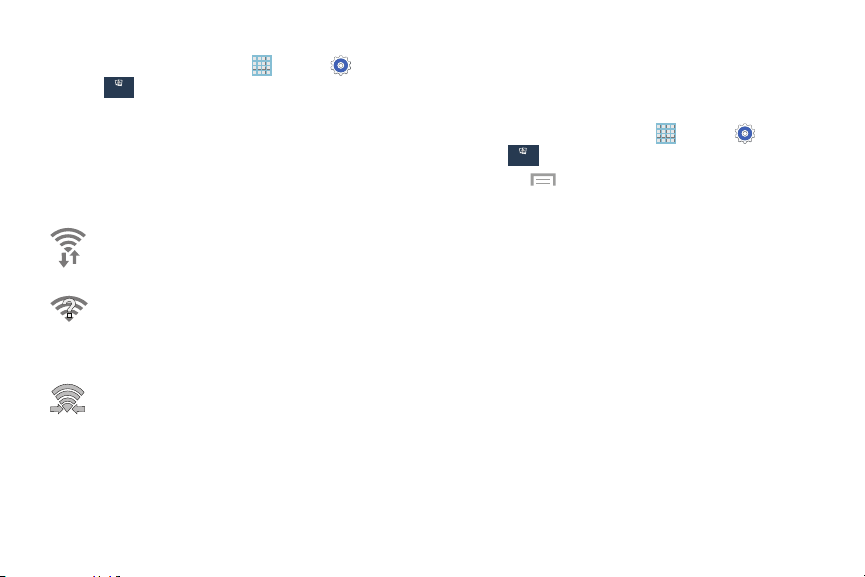
Manually Scan for a Wi-Fi Network Wi-Fi Advanced Settings
1. From a Home screen, touch
Apps
Settings
Connections
Wi-Fi
.
The Advanced Wi-Fi menu can be used to set up many of
your device’s advanced Wi-Fi services.
Connections Connections
2. Touch
Scan
.
All available Wi-Fi networks are displayed.
To access the Advanced Wi-Fi menu:
1. From a Home screen, touch
Apps
Settings
Connections
Connections
Wi-Fi
.
Wi-Fi Status Indicators
2.
Touch
Menu
Advanced
.
The following icons show your Wi-Fi connection status at a
glance:
For more information, refer to “Advanced Wi-Fi Settings” on
page 163.
Displays when Wi-Fi is connected, active, and
communicating with a Wireless Access Point
(WAP).
Displays when there is a Wi-Fi access point
available, but you are not connected to it. May also
display if there is a communication issue with the
target Wireless Access Point (WAP).
Displays when connected to another device using
Wi-Fi Direct.
For more information, refer to “Wi-Fi
Direct” on page 111.
Connections 110
Wi-Fi Direct
Wi-Fi Direct allows device-to-device connections so you can
transfer large amounts of data over a Wi-Fi connection.
Note:
See your service plan for applicable charges for
Wi-Fi Direct.
1. From a Home screen, touch
Apps
Settings
Connections
Connections
Wi-Fi
.
2. Touch the
OFF/ON
button to turn Wi-Fi ON .
3. At the bottom of the Wi-Fi screen, touch
Wi-Fi Direct
.
4. Enable Wi
-Fi Direct on the other
device with which you
want to connect.
The steps
on the other device may vary depending on
the device. Refer to the documentation for that device.
5. On your phone, touch
Scan
.
The device scans for other Wi-Fi Direct devices.
6. Once the device you want to connect to displays,
touch it.
7. The other device has 2 minutes to touch
Accept
for the
connection to be made.
8. Once connected, the other device will show as
Connected
in your list of Wi-Fi Direct devices and the
icon will display at the top of your screen.
111

Sharing Information with Connected Device
To share Videos, Photos, or other information with the
connected device, follow these steps:
1. View the information that you want to share. For
example, if you want to share a photo, find the photo in
your camera viewer or
My Files
folder, then touch the
Share via
option.
2. Touch the
Wi-Fi Direct
option.
3. Touch the connected device name. For example,
Android_55ca.
4. Touch
Done
.
The file is transferred and the other device will receive
a screen notification that a Wi-Fi file has been
received. The file can be foun
d in
My Files
All files
Device storage
in the
ShareViaWifi
folder.
Note:
Depending on the other device model, the prompts and
shared folder information may differ.
AT&T Smart Wi-Fi
Use AT&T Smart Wi-Fi to maximize your battery
performance, maximize your data, simplify access to
AT&T Hot Spots and Wi-Fi networks, automate your Wi-Fi
connections, and track your data use.
1. From a Home screen, touch
Apps
AT&T Smart Wi-Fi
.
2. Touch
Continue
to use AT&T Smart Wi-Fi or touch
No Thanks
to quit.
3. Read the License Agreement and touch
Accept
to
continue.
4. At the Welcome screen, touch
OK
.
5. At the Initial Setting screen, touch
Yes
if you want AT&T
Smart Wi-Fi to automatically connect to any hotspot
that is available for public use. Otherwise, touch
No
.
6. Follow the onscreen instructions to use
AT&T Smart Wi-Fi.
For more infor
mation on how to use this application, go to
www.att.com/smartwifi
.
Connections 112
Bluetooth
About Bluetooth
Bluetooth is a short-range communications technology that
is used to connect wirelessly to a number of Bluetooth
devices, such as headsets and hands-free car kits, and
Bluetooth-enabled handhelds, computers, printers, and
wireless devices. The Bluetooth communication range is
usually up to approximately 30 feet.
Turning Bluetooth On and Off
1. From a Home screen, touch
Apps
Settings
Connections
Connections
Bluetooth
.
2. Touch the
OFF/ON
button to turn Bluetooth ON
or OFF
.
Note:
When enabled, the Bluetooth icon displays in the
Status Bar.
Bluetooth Status Indicators
The following icons show your Bluetooth connection status at
a glance:
Displays when Bluetooth is active.
Displays when Bluetooth is connected (paired)
and communicating with certain devices, such
as a headset.
Bluetooth Settings
The Bluetooth settings menu is used to set up many of the
characteristics of your device’s Bluetooth service, including:
•
Entering or changing the name your device uses for Bluetooth
communication and description
•
Setting your device’s visibility (or “discoverability”) for other
Bluetooth devices
113
Apps
Settings
Connections
Bluetooth
.
Bluetooth Settings Menu Make Your Device Visible
To access the Bluetooth Settings menu: To make your device visible:
1. From a Home screen, touch
1. From the Bluetooth settings screen, touch
Menu
Visibility timeout
.
Connections
2. Touch the
OFF/ON
button to turn Bluetooth ON . Making your device visible allows it to be detected by
other devices for pairing and communication.
3. Touch the checkbox next to
SAMSUNG-SGH-I527
, if you
want your phone to be visible to other Bluetooth
devices.
2. Select a time that you would like your device visibility
to time-out.
Change Bluetooth Name
Show Received Files
To change your Bluetooth name:
To show received files:
1. From a Home screen, touch
Apps
Settings
More
From the Bluetooth settings screen, touch
Menu
Received files
.
A list of all files received from Bluetooth displays.
More
About device
Device name
.
2. Use the keyboard to modify your device name and
touch
OK
.
Rename Your Device
To change the name of your device:
From the Bluetooth settings screen, touch
Menu
Rename device
.
This is the name other Bluetooth devices will see.
Connections 114
Scan for Bluetooth Devices
To scan for Bluetooth devices:
1. Verify that Bluetooth is ON
.
2. From the Bluetooth settings screen, touch
Scan
to
search for visible external Bluetooth-compatible
devices such as headsets, devices, printers, and
computers.
Pairing Bluetooth Devices
Use the Bluetooth pairing process to establish a trusted
connection between your device and another Bluetooth
device. When you pair devices, they share a passkey,
allowing for fast, secure connections while bypassing the
discovery and authentication process.
To pair your device with another Bluetooth device:
1. Verify your Bluetooth is active.
2. Touch
Scan
. Your device will display a list of discovered
in-range Bluetooth devices.
3. Touch a device from the list to initiate pairing.
4. Enter the passkey or PIN code, if needed, and
touch
OK
.
5. The external device will then have to also accept the
connection and enter your device’s PIN code.
Note:
Due to different specifications and features of other
Bluetooth-compatible devices, display and operations
may be different, and functions such as transfer or
exchange may not be possible with all Bluetooth
compatible devices.
Note:
Pairing between two Bluetooth devices is a one-time
process. Once a pairing has been created, the devices
will continue to recognize their partnership and
exchange information without having to re-enter a
passcode again.
115
Rename or Unpair a Paired Device
Unpair a paired device to break the connection between the
device and your phone, but retain the knowledge of the
pairing. At a later point when you want to reconnect the
device, there is no need to setup the connection
information again.
Note:
Disconnections often occur automatically if the
paired device goes out of range of your phone or it
is powered off. Upon reconnection, you may be required
to re-enter all the previous pairing information.
1. Verify your Bluetooth is active.
2. From the Bluetooth settings screen, touch next to
the previously paired device. This
opens the connected
device’s menu options.
3. Touch
Rename
to change the name of the paired
device.
4. Touch
Unpair
to unpair from the paired device.
Sending Contacts with Bluetooth
Depending on your paired devices’ settings and capabilities,
you may be able to send photos, Contact information, or
other items using a Bluetooth connection.
Note:
Prior to using this feature, Bluetooth must first be
enabled, and the recipient’s device must be visible.
1. Verify your Bluetooth is active.
2. From the Home screen, touch
Contacts
.
3. Touch
Menu
Share namecard via
.
4. Touch each contact that you would like to send via
Bluetooth. A green check mark will appear next to each
entry you select.
5. Touch
Done
.
6. Touch
Bluetooth
.
7. Select the paired device to send the contacts to.
Note:
The external Bluetooth device must be visible and
communicating for the pairing to be successful.
A Bluetooth share notification will appear in your
notifications list.
Connections 116

NFC
NFC (Near Field Communication) allows data exchange when
you touch your device with another compatible device. This
is used for applications such as S Beam and Android Beam.
To activate NFC on your device, see “NFC” on page 170.
PC Connections
You can connect your device to a PC using your PC data
cable using various USB connection modes.
Storage
: Use the onboard storage capacity of the phone to
store
and upload files. This option allows your computer to
detect the phone as a removable storage drive.
Kies
: Use Kies to manage music, movies and photos. You can
also backup precious contacts and calendars, download
apps and podcasts and automatically upgrade device
firmware. Kies conveniently syncs your life across all your
devices.
Note:
To sync your device to a PC, it is highly recommended
that you install Samsung Kies, which is available at
samsung.com/us/kies
(for Windows or Mac).
Note:
If you are a Windows XP user, ensure that you have
Windows XP Service Pack 3 or higher installed on your
computer. Also, ensure that you have Samsung Kies 2.0
or Windows Media Player 10 or higher installed on your
computer.
Connecting as a Storage Device
You can connect your device to a PC as a removable disk and
access the file directory. If you insert a memory card in the
device, you can also access the files directory from the
memory card by using the device as a memory card reader.
Note:
The file directory of the memory card displays as a
removable disk, separate from the internal memory.
1. Connect the USB cable to the device and connect the
cable to the computer. After a few seconds, a pop-up
window displays on the PC when connected.
2. On the PC pop-up, click
Open device to view files
.
3. Copy files from the PC to the memory card.
117
Section 8: Applications
This section contains a description of each application that is
available on the Apps screen, its function, and how to
navigate through that particular application. If the application
is described in another section of this user manual, then a
cross reference to that description is provided.
Managing Applications
The Apps screen displays all applications
installed on your
phone, including apps you download and install.
From Apps, you can change the way apps appear on the
screen, uninstall apps you have downloaded, and share apps
with friends. When you install new apps, new screens are
added to hold them.
Tip:
To open applications quickly, add the icons of
frequently-used applications to one of the Home
screens, if it is not there by default. For details, see “App
Shortcuts” on page 32.
Updating Applications
Once you have registered your device (see “Software
Update” on page 213) and signed into your Google account
(
see “Creating a New Google Account” on page 13), you may
see the
Updates Available
notification in the Status Bar if
there is a new version of one or more apps available or, when
you open an application that is preloaded on your device, an
Update Available
message may be displayed.
To update the applications:
1. Touch the top of the screen and swipe downward.
The Notification Panel displays.
2. Touch
Updates available
.
For more information, refer to “Updates to Downloaded
Apps” on page 146.
Applications 118
Uninstalling Apps
You can uninstall apps you download and install. Pre-loaded
apps cannot be uninstalled.
1. From a Home screen, touch
Apps
.
Menu
Uninstall
.2. Touch
3. Apps that can be uninstalled show
on their icon.
Touch
, and then follow the prompts to uninstall the
app. Pre-loaded apps cannot be uninstalled.
Customizing the Apps Screens
Choosing a View
By default, app icons appear in Grid view. You can change
the view to list view.
1. From a Home screen, touch
Apps
.
2. Touch
Menu
, and then touch
View type
.
3. Choose an option:
• Customizable grid
: The default view, which allows you to
touch and hold on apps to move them from screen to screen.
• Alphabetical grid
: Icons are arranged in a grid, in A-Z order.
• Alphabetical list
: Icons display in a list, sorted from A-Z.
Apps Screen Options
1. From a Home screen, touch
Apps
.
2. Touch
Menu
for these options:
•Edit
: Touch and hold an app icon then drag it to the Create
folder icon to create a new folder. Drag it to the Create page
icon to create a new apps screen and place the icon on it. Or
drag it to App info to view information about this app.
• Create folder
: Creates a new folder to hold the app icon.
• Uninstall/disable apps
: Removes an app that you downloaded
to your phone. Preloaded apps cannot be uninstalled. Touch
to remove the selected app.
•View type
: Configures the apps screen.
•
Show disabled apps: Displays disabled apps.
Touch an app to make it visible again.
119

Accessing Applications
To access applications:
1. From a Home screen, touch
Apps
.
2. Locate the application’s icon and touch it to launch the
application.
3. To return to the main Home screen, press
Home
.
Note:
This manual only addresses applications that have been
loaded on your device as of the date of purchase.
Information concerning third party applications that you
may choose to download from the Google Play Store or
otherwise should be obtained from the application
provider directly and not from Samsung.
Amazon Kindle
This application allows you to download books, magazines,
and newspapers to read on your phone.
1. Touch
Amazon Kindle
.
2. At the Kindle display, tap
Get Kindle for Android
.
3. Sign on to your Google account.
For more information,
refer to “Creating a New Google Account” on page 13.
4. Follow the onscreen instructions to download the
application from the Play Store.
Applications 120

AT&T Code Scanner
Use AT&T Code Scanner to scan two-dimensional (QR and
datamatrix codes) and one-dimensional (UPC and EAN)
barcodes found in magazines, stores, and online.
1. Touch
AT&T Code Scanner
.
2. Sign into your Google Account. If you have not set up
an account, see “Creating a New Google Account” on
page 13.
3. The first time you use the AT&T Code Scanner, you will
need to download the updated application from the
Play Store. Touch
Update AT&T Code Scanner
.
4. When the Play Store page displays, touch
UPDATE
and
follow the onscreen instructions to download the app.
For more information, refer to “Play Store” on
page 146.
5. At the App permissions screen, touch
ACCEPT
.
6. At the License screen, touch
Agree
to continue or
Disagree
to exit.
7. At the Welcome screen, follow the onscreen
instructions to use the AT&T Code Scanner.
8. Touch
Menu
Help
for additional information.
AT&T FamilyMap
AT&T FamilyMap provides peace of mind because you can
use it to conveniently locate a family member on a map from
your wireless device. Plus, AT&T FamilyMap is secure and
private. Only authorized users have permission to locate your
family members.
Note:
FamilyMap requires a paid subscription. To sign up for
service, visit
www.att.com/familymap
for more information
or contact your AT&T Customer Service Representative.
1. Sign in to your Google account, if you are not already
signed in. For more information, refer to “Creating a
New Google Account” on page 13.
2. Touch
AT&T FamilyMap
.
The AT&T FamilyMap screen displays.
3. Touch
Get FamilyMap
to update the software.
4. Touch
UPDATE
on the Play Store AT&T FamilyMap
screen, and then touch
ACCEPT
.
The AT&T FamilyMap app is downloaded and installed.
121
122
2. Touch
Terms and Conditions
, read the End User License
Agreement , touch
Back
, and then touch
I Accept
.
1. Touch
AT&T Navigator
.
The Terms of Service screen displays.
3. Follow the onscreen instructions.
5. At the AT&T FamilyMap Sign In screen, touch
Get Started
to create an account.
– or –
Touch
Sign In
if you already have an account.
6. Follow the onscreen instructions.
AT&T Locker
Use AT&T Locker to store, share, and sync all of your photos,
videos, and documents in one safe, convenient place – the
AT&T cloud.
1. Sign in to your Google account, if you are not already
signed in.
For more information, refer to “Creating a
New Google Account” on page 13.
2. Touch
AT&T Locker
.
3. At the AT&T Locker home screen, touch
Sign Up
to
create an account.
– or –
Touch
Log In
if you already have an account.
4. Follow the onscreen instructions to use AT&T Locker.
AT&T Navigator
AT&T Navigator provides access to real-time GPS-driven
applications. These programs not only allow you to achieve
turn-by-turn navigation, but also access local searches.
Important!
You must have a data plan to use this feature.
Note:
These services require the purchase of a subscription.
To launch the AT&T Navigator application:
Applications

AT&T Ready2Go
AT&T Ready2Go is used to quickly and easily set up your
Google, Gmail, and email accounts, import contacts, and
configure Wi-Fi.
Touch
AT&T Ready2Go
.
For more information, refer to “Setting Up Your Phone” on
page 12.
AT&T Smar t Wi-Fi
With AT&T Smart Wi-Fi, you can maximize your battery
performance, maximize your data, simplify access to
AT&T Hot Spots and Wi-Fi networks, automate your Wi-Fi
connections, and track your data use.
Touch
AT&T Smart Wi-Fi
.
For more information, refer to “AT&T Smart Wi-Fi” on
page 112.
Beats Music
1. Touch
Beats Music
.
2. Sign in to your Google account, if you are not already
signed in. For more information, refer to “Creating a
New Google Account” on page 13.
3. Follow the onscreen instructions to use Beats Music.
Browser
The Internet application is your access to the mobile web.
This section explains how to navigate the Internet app and
introduces you to the basic features.
To access the Internet app:
From a Home screen, touch
Browser
.
– or –
From a Home screen, touch
Apps
Browser
.
The AT&T/YAHOO! mobile homepage displays.
Navigating with the Internet App
1. To select an item, touch an entry.
2. To scroll through a website, sweep the screen with
your finger in an up or down motion.
3. Sweep the screen left to right to move laterally across
a web page.
4. To return to a previous page, touch
.
5. To move forward to a web page, touch .
123

Zooming In and Out of the Browser
There are several ways to Zoom in and out on your browser.
After touching on a link or article, use one of these methods:
•
Tilting
: Touch and hold the screen at two points then tilt the
device back and forth to reduce or enlarge the screen. You must
first enable motion in the Settings section.
For more information,
refer to “Motions and Gestures” on page 195.
•
Double tap
: Quickly tap the screen twice on the web page to
zoom in or out.
•
Pinching
: Sweep in opposite directions at the same time to zoom
in or out (use a pinching-in or pinching-out motion).
Internet Options
From any web page, touch
Menu
to access your
browser options.
Enter a URL
You can access a website quickly by entering the URL.
Websites are optimized for viewing on your phone.
To enter a URL and go to a particular website, follow these
steps:
1. Touch the URL field at the top of your screen
.
2. Enter the URL using the onscreen keyboard.
The website displays.
Search the Internet
To perform an internet search using keywords, follow these
steps:
1. Touch the Search bar at the top of the browser.
2. Enter a search word or phrase using the onscreen
keyboard and touch
Go.
3. Touch a link to view the website.
Applications 124
Adding and Deleting Windows
You can have up to eight Internet windows open at one time.
To add a new window, follow these steps:
1. From your browser, touch
Menu
New window
.
A new browser window is opened.
2. Touch
2
(
Windows
) to see thumbnails of all open
windows.
3. Touch a window listing to open up that Internet
window.
at the top right corner of the web page
thumbnail to delete the window.
4. Touch
Going Incognito
Use the Incognito feature to view Internet sites outside of
normal browsing. Pages viewed in this incognito window do
not appear within your browser history or search history, and
no traces (such as cookies) are left on your device.
Note:
Any downloaded files will be preserved and will stay on your
device after you exit the incognito mode.
To add a new incognito window:
1. From your browser window, touch
2
(
Windows
)
Incognito page
.
2. A new browser window displays.
To exit from the incognito window:
1. From your browser window, touch
2
(
Windows
).
2. Scroll across the available windows and locate the
incognito window. The Incognito icon
appears on
the bottom of the browser window while you are in this
mode.
next to the incognito listing to delete this
window.
3. Touch
125

to clear the result.
located at the
top of the calculator buttons. A history of your past
calculations displays.
To clear the calculator history, touch
Menu
, and
then touch
Clear history
.
or
7. Touch
8.
To
view calculator
history, touch
9. Touch and hold entries in the Calculator’s display field
to copy or cut the contents of the display.
Copied to clipboard
displays. Paste the copied value in
another app.
10. Touch
Menu
and select
One-handed operation on
and touch the
button to position the
Calculator keypad to the left or right side of the screen.
Touch
One-handed operation off
to display the default
keypad.
Using Bookmarks
While navigating a website, you can bookmark a site to
quickly and easily access it at a future time. The URLs
(website addresses) of the bookmarked sites are displayed in
the Bookmarks page. From the Bookmarks page you can
also view your Most visited websites and view your History.
1. From the Home
webpage, touch
(
Bookmarks
).
The Bookmarks page displays.
2. Touch
Menu
to display the Bookmark options.
Calculator
The calculator provides the basic arithmetic functions to
solve simple arithmetic problems and advanced operators to
solve more complex problems. The Calculator also keeps a
history of recent calculations.
1. Touch
Calculator
.
2. Enter the first number using the numeric keys.
3. Enter the operation for your calculation by touching the
corresponding onscreen arithmetic function key.
4. Enter the next number.
5. To view the result, touch the
=
(equals) key.
6. Repeat Steps 3 through 5 as many times as required.
Applications 126

Calendar
Your device includes a powerful Calendar to help you
organize your schedules more conveniently and effectively.
Learn to create and manage events and tasks, and set
alarms to remind yourself of important events and tasks.
To access the Calendar:
1. Touch
Calendar
.
2. The following tabs are available on the right side of the
display:
•Year
: Displays the Year view.
•Month
: Displays the Month view.
• Week
: Displays the Week view.
•Day
: Displays the Day view.
•List
: Displays the List view.
•Task
: Searches for tasks.
3. Touch
Add new
to create a new Calendar event.
4. Touch
Today
to display the current date, which is
indicated by a blue box.
5. Touch
Menu
and select one of the following
options:
•Go to
: Displays a specific date.
•Delete
: Deletes All events, All events before today, or an
individual event.
•Search
: Searches within your current events.
•Calendars
: Displays various information such as My calendars,
My task, your linked accounts, and Contact’s birthdays.
• Settings
: Displays a list of configurable settings.
Camera
Take photos and record video with your device’s built in
Camera.
Touch
Camera
.
For more information, refer to “Camera” on page 96.
127
ChatON
Use ChatON to send and receive instant messages from any
device that has a mobile phone number. You can interact
with friends and family with text, images, hand-written notes
and video shared instantly. You can chat in groups, while a
Web client allows the easy sharing of content and
conversations between your phone and PC.
Touch
ChatON
.
For more information, refer to “ChatON” on page 94.
Chrome
The Google Chrome app uses the Google Chrome web
browser on your phone.
1. Touch
Chrome
.
2. Follow the onscreen instructions.
Clock
Use the Clock application to access alarms, view the World
Clock, set a stopwatch, and use a timer.
Alarm
This feature can be used to set an alarm to ring at a
specific time.
1. Touch
Clock
Alarm
Create alarm
.
The following options display:
•Time
: Touch
Up
or
Down
to set the new time for
the alarm to sound. Touch
AM
or
PM
.
• Alarm repeat
: Sets the repeating status for the alarm by
touching on the days that you want the alarm to sound. Touch
the
Repeat weekly
check box to have the alarm repeat weekly.
• Alarm type
: Sets the way in which the alarm sounds when
activated: Melody, Vibration, Vibration and melody, or Briefing.
• Alarm tone
: Sets the sound file, which is played when the
alarm is activated. Select an option or touch
Add
for additional
options.
• Alarm volume
: Drag the slider to adjust the alarm’s volume.
Applications 128
• Location alarm
: When activated, the alarm only sounds when
you are at a specific location. Touch the
OFF/ON
button to turn
it ON then follow the on-screen instructions to enter a
location.
• Snooze
: Use this option to set an Interval (3, 5, 10, 15, or
30 Minutes) and Snooze repeat (1, 2, 3, 5, or 10 Times). Touch
the
OFF/ON
button to turn it ON to activate.
• Smart alarm
: Tracks body movements and calculates the best
time for sounding the alarm. Place the phone somewhere on
your bed then the phone's movement sensor (also known as
accelerometer) is sensitive enough to work from any part of the
bed. Set the Interval and the Tone. Touch the
OFF/ON
button to
turn it ON
.
• Name
: Use a specific name for the alarm. The name displays
when the alarm activates.
2. Touch
Save
to store the alarm details.
Turning Off an Alarm
To stop an alarm when it sounds, touch and sweep the
icon to the right.
Setting the Snooze Feature
To activate the Snooze feature after an alarm sounds,
touch and sweep the
Z
Z
Z
Z
icon to the left. Snooze must
first be set in the alarm settings. For more information,
refer to “Alarm” on page 128.
Deleting Alarms
To delete an alarm:
1. Touch
Clock
Alarm
Menu
Delete
.
2. Touch the alarm or alarms you want to delete. A green
check mark appears next to each selection. Touch
Select all
to delete all alarms.
3. Touch
Delete
.
129

World Clock
World Clock displays time in hundreds of different cities,
within all 24 time zones around the world.
1. Touch
Clock
World Clock
.
A list of the locations you have added displays.
2. Touch
Add city
to add another city to the list.
3. Scroll through the list of cities to find the city you want
to add or touch the Search bar and use the keyboard to
enter the name of the city you want to add.
Tip:
Touch the first letter of the city’s name, to the right of the
list, to find the city more quickly.
4. Touch the city.
The list of your locations displays including the city
just added.
5. To set Daylight Savings time, touch and hold a city,
then touch
DST settings
. Select Automatic, Off, or
1hour.
If Daylight Savings Time is active, a sun symbol
appears on the World Clock listing.
Deleting a World Clock Entry
1. Touch
Clock
World Clock
.
2. Touch and hold a city, then touch
Delete
.
– or –
Touch
Menu
Delete
to delete one or more
entries.
Stopwatch
You can use this option to measure intervals of time.
1. Touch
Clock
Stopwatch
.
2. Touch
Start
to start the stopwatch and touch
Lap
to
mark a unit of time per lap.
3. Touch
Stop
to stop the stopwatch.
4. Touch
Restart
to continue or touch
Reset
to erase all
times recorded.
Applications 130

Timer
You can use this option to set a countdown timer. Use a timer
to count down to an event based on a preset time length
(hours, minutes, and seconds).
1. Touch
Clock
Timer
.
2. The
Minutes
field is highlighted and set to 1 minute.
Use the keypad to set the number of minutes you want.
3. Touch the
Hours
field to set hours, if desired. As you
touch different fields, they will become highlighted.
4. Touch the
Seconds
field to set seconds.
5. Touch
Start
to begin the timer and touch
Stop
to pause
the timer.
6. After stopping, touch
Restart
to continue or touch
Reset
to set the timer back to the original setting.
Desk Clock
You can use the Desk clock when you have a desk dock and
you want your phone to display the time, day, date, location,
and weather conditions when it is docked.
1. Touch
Clock
Desk clock
.
The default Desk clock displays.
2. To display the Desk clock in full-screen mode,
touch
.
3. To make changes, touch
Menu
Settings
.
The following options are displayed while in full-screen
mode:
•Hide status bar
: When this is checked, the status bar is hidden
from view.
•Wallpaper
: Touch to select Desk clock wallpaper from Default,
Gallery, or Same as home screen.
•Calendar
: Display the calendar.
• Weather
: Display the location, temperature, and weather
conditions. Touch the
OFF/ON
button to turn it ON .
•Dock
: Set your Dock settings such as Dock sound, Audio
output mode, Desk home screen display, and Automatic
unlock.
131

Contacts
You can manage your daily contacts by storing their name
and number in your Address Book. Address Book entries can
be sorted by name, entry, or group.
You can also synchronize your phone Address Book with
AT&T
Address Book, the network backup service.
Touch
Contacts
.
For more information, refer to “ Contacts and Your Address
Book”
on page 51.
DeviceHelp
DeviceHelp provides onli
ne information to help with your
device questions.
1. Touch
DeviceHelp
.
Follow the onscreen instructions for accessing helpful
information.
2.
The
AT&T Device Help
screen is displayed.
Downloads
Use the Downloads application to manage all of your
downloads from the Play Store and the Browser.
1. Touch
Downloads
.
All of your
downloads are listed.
2. Touch the
Internet downloads
tab to see all of the
do
wnloads you have made from the Internet.
3. Touch the
Other downloads
tab to see all other
downloads.
4. Touch
Sort by size
to see your downloads sorted in
size order.
5. Touch
Sort by date
to see your downloads sorted in
time order.
6. Touch
Clear list
to remove all downloaded items.
Applications 132
Drive
Use the Google Drive app to open, view, rename, and share
your Google Docs and files.
1. Touch
Drive
.
2. Sign in to your Google account.
For more information,
refer to “Creating a New Google Account” on page 13.
A product tour displays the first time you access Drive.
3. Touch
Next
to view the product tour or touch
Go to Drive
to get started.
Tip:
Touch
Menu
Product Tour
to repeat the product
tour at any time.
4. Follow the onscreen instructions to use Drive.
5. Touch
Menu
Settings
to configure your Drive
preferences.
6. Touch
Menu
Help
to display additional help
information.
DriveMode
With the AT&T DriveMode application, you can set your
phone to auto reply when you are driving and do not want to
answer the phone. You can set auto reply to Messages,
Emails, and Phone Calls. You can also allow up to five of your
contacts to contact you while you are in Drive mode.
1. Touch
DriveMode
.
The
AT&T DriveMode
screen is displayed.
2. Read the Terms and Conditions and Privacy Policy and
touch
Continue
to continue.
3. Read the additional information and touch
Next
.
4. Follow the onscreen instructions to set up your AT&T
DriveMode options.
Email
Send and receive email using popular email services. You
can also receive message alerts when you receive an
important email.
Touch
Email
.
For more information, refer to “Email” on page 89.
133

Flipboard
This application creates a personalized digital magazine out
of everything being shared with you. Access news stories,
personal feeds and other related material. Flip through your
Facebook newsfeed, tweets from your Twitter account,
photos from friends and much more.
1. Touch
Flipboard
.
2. Touch
Tap to sign in
to sign into your previously created
Flipboard account.
– or –
Swipe up on the Flipboard screen, and select the
desired category.
3. Touch
Build Your Flipboard
to build your Flipboard.
4. Follow the onscreen instructions to use Flipboard.
Gallery
Use Gallery to view, capture, and manage photos and videos.
Touch
Gallery
.
For more information, refer to “Gallery” on page 103.
Games
Access social and premium games. Join Game Hub to enjoy
free games with your friends.
1. Touch
Games
.
2. Tap a game and follow the onscreen instructions.
Gmail
Send and receive email with Gmail, which is Google’s
web-based email.
Touch
Gmail
.
For more information, refer to “Gmail” on page 92.
Applications 134
Google
Search the internet using the Google search engine.
Tip:
Google Search appears by default on the main Home
screen.
1. From a Home screen, touch
Google
.
– or –
Touch
Google
.
2. Use the keyboard to enter search criteria to display
matching searches.
– or –
Touch
and speak the search criteria slowly and
clearly. Google searches for the information and
displays results.
Suggestions display below the text entry area.
3. Touch a suggestion to search for that term or touch
on the keyboard to start the search.
A browser window displays the search results.
For more information, refer to “Google Search Bar” on
page 24.
Google Settings
Use this app to manage your Google settings.
1. Touch
Google Settings
.
Stay connected and share life as it happens with Google+ on
your device. Join a Hangout, post a photo, or see what
friends are sharing while you are on the go.
2. Follow the onscreen prompts to modify your
Google Settings.
Google+
Touch
Google+
.
For more information, refer to “Google+” on page 95.
135
2. Follow th
e onscreen instructions to use the Maps
applicatio
n.
1. Touch
Maps
.
A map w
ill display with your location in the very
center.
Using Maps
Hangouts
.
Group Play
Using Group Play, you can share documents or photos you
are viewing, or music you are listening to, with other devices
connected to the same Wi-Fi network as your device.
1. Touch
Group Play
.
The first time you access Group Play, read the
Disclaimer and touch
Agree
.
The Group Play main screen displays.
2. Touch
Create group
to create a Group Play session or
touch
Join group
to join a Group Play session in
progress.
3. For instructions on using Group Play, touch
Menu
Info
.
Hangouts
Hangouts is a free web-based application for instant
messaging offered by Google. You can connect with your
friends across computers and various Android devices. You
can have conversations or video calls with up to 10 friends.
Touch
For more information, refer to “Hangouts” on page 95.
Maps
Depending on your location, you can view basic, custom, and
satellite maps and local business information, including
locations, contact information, and driving directions. You
can also post public messages about a location and track
your friends.
Important!
Before using Google Maps you must have at least
an active data (3G) connection. The Maps
application does not cover every country or city.
Note:
You must enable location services to use Maps. For
more information, refer to “Location” on page 202.
Applications 136

Maps Menu
While viewing a map:
Touch
Menu
, in the lower left corner of the screen,
for options.
To configure Maps settings:
Touch
Menu
Settings
.
Follow the onscreen instructions.
For more information touch
Menu
Help
.
Messages
The AT&T Messages app brings your texts, calls, and
voicemail messages together into a single conversation
thread and is accessible by phone or computer.
Touch
Messages
.
For more information, refer to “Messages” on page 93.
Messaging
You can send and receive different types of messages.
Touch
Messaging
.
For more information, refer to “Messaging” on page 82.
Mobile Hotspot
Use Mobile Hotspot to share your phones’s mobile data
connection by way of USB or as a portable Wi-Fi hotspot.
Touch
Mobile Hotspot
.
For more information, refer to “Tethering and Wi-Fi Hotspot”
on page 168.
137
Music
Music is an application that can play music files. Music
supports files with extensions AAC, AAC+, eAAC+, MP3,
WMA, 3GP, MP4, and M4A. Launch Music to navigate
through your music library, play songs, and create playlists
(music files bigger than 300 KB are displayed).
Playing Music
1. From a Home screen, touch
Apps
Music
.
2. Touch a library category at the top of the screen
(Songs, Playlists, Albums, Artists, or Folders) to view
the available music files.
3. Scroll through the list of songs and touch an entry to
begin playback.
4. The following Music controls are available:
Streams the current music file to another device
via Samsung Link.
Volume control and SoundAlive.
Volume control showing volume muted.
Shuffles the current list of songs randomly.
Songs play in order and are not shuffled.
Assign
the current song as a Favorite.
Plays the entire song list once.
Replays the current list when the list ends.
Repeats the currently playing song.
Displays the current song in the p layer window.
Touch and hold to rewind the song. Touch to go to
previous song.
Pa
use the song.
Start the song after pausing.
Applications 138
Touch and hold to fast-forward the song. Touch to
go to next song.
Lists the current playlist songs.
Music Options
To access additional options, follow these steps:
1. Touch
Music
.
2. Touch
Menu
.
The follow options are available before you play music:
Note:
The following options may or may not appear depending
on whether or not music is actually playing. Also,
options will be different if the song you are listening to is
in a playlist.
• Add to playlist
: A
dd the current music file to a selected playlist.
• Via Bluetooth
: Scan for devices and pair with a Bluetooth
headset.
•Delete
: Delete the music file.
•Search
: Search your device for a certain song.
• Scan for nearby devices
: Scan for nearby devices in order to
share music.
• Settings
: The Music Settings menu allows you to set
preferences for the Music app.
–
Music menu
: Select which categories you want to display.
Touch each item that you want to display in the Music menu.
–
Adapt Sound
: Set Adapt sound on when your are listening with
earphones to alert of incoming calls and notifications.
–
SoundAlive
: Set a type of equalization such as Normal, Pop,
Rock, Jazz, Dance, Classic, and so on.
–
Play speed
: Set the play speed anywhere between 0.5X and
2.0X using the slider.
–
Music auto off
: When activated, music will automatically turn
off after a set interval.
–
Lyrics
: When activated, displays lyrics when available.
–
Smart volume
: Automatically adjusts each track’s volume to
an equal level.
–
Voice control
: Use voice commands to control the Music app.
•End
: End the Music app.
139
Using Playlists
Playlists are used to assign songs to a list of preferred media
which can then be grouped into a list for later playback.
These Playlists can be created via either the handset’s Music
options menu or from within a 3rd party music application
(such as Windows Media Player) and then downloaded to the
handset.
Creating a Playlist
1. Touch
Music
.
2. Touch the
Playlists
tab.
3.
Touch
Menu
Create playlist
.
4. Type a name for the playlist in the field and touch
OK
.
5. Add music to the playlist.
Adding Music to a Playlist
To add music files to the playlist:
1. Touch
Music
.
2. Touch the
Playlists
tab.
3. Touch the playlist name to which you want to
add music.
4. Touch
Add music
.
5. Touch the check box to the left of each track you want
to add to this playlist. Touch
Select all
to add all the
music tracks to this playlist
6. Touch
Done
.
Removing Music from a Playlist
To remove music files from a playlist:
1. Touch
Music
.
2. Touch the
Playlists
tab.
3. Touch the playlist name from which you want to
delete music.
4.
Touch
Menu
Remove
.
5. Touch the check box to the left of each track you want
to remove from this playlist. Touch
Select all
to remove
all the music tracks from this playlist
6. Touch
Remove
.
Applications 140
Editing a Playlist
Besides adding and removing music files in a playlist, you
can also rename the playlist.
To edit a playlist:
1. Touch
Music
.
2. Touch
Playlists
.
3.
Touch
Menu
Edit title
.
4. Touch a playlist name to edit.
5. Enter a new name for the playlist then touch
OK
.
My Files
Manage your sounds, images, videos, bluetooth files,
Android files, and other memory card data in one convenient
location.
1. Touch
My Files
All files
.
2. Touch
Device storage
to see the contents of your
internal SD card.
Note:
Different folders may appear depending on how your
phone is configured.
3. If you have an external SD card inserted, touch
SD memory card
to see the contents of your external
SD card (memory card).
4. Touch a folder and scroll down or up until you locate
a file.
Note:
You may have to touch one or more sub-folders before
you encounter files.
5. Touch a file to launch it in the associated application, if
the file is associated with an application.
141

6. While browsing files, use these controls:
Home
: Displays the root directory.
Up
: Displays a higher directory.
Menu
: Displays the following options:
•
Select all
: Marks all files or folders.
•
Create folder
: Creates a new folder.
•
Search
: Lists files and folders that contain
the keywords you enter with the onscreen
keyboard.
•
View by
: Sets how you want to view files and
folders.
•
Sort by
: Sets the order in which you want to
view files and folders.
•
Settings
: Manages My Files settings.
Mark files
: Touch the box to the left of each file
or next to the folder to select all files in the
folder. Then touch
Delete
in the Application bar
to delete the selected items. Touch
selected
to
Select all
or
Unselect all
.
More options
: Once files or folders are marked,
touch this icon to move, copy, or rename the
file or folder, or view details about the file or
folder.
7. To view a photo file:
•
Touch the file.
The Gallery app is used to open the photo. For more information,
refer to “Viewing Photos” on page 103.
8. To view a video file:
•
Touch the file.
The Video Player is launched and plays the video. For more
information, refer to “Video” on page 155.
Applications 142
myAT&T
Use myAT&T to manage your own AT&T account. You can
review and pay your bill, check minutes and data usage,
upgrade to a new device, or change your rate plan.
Initial Setup
The first time you use myAT&T, you must download the
updated application from the Play Store. For more
information, refer to “Play Store” on page 146.
1. Touch
myAT&T
.
2. Touch
Install Now
to go to the Google Play Store.
If you have not signed in to your Google Account, the
Add a Google Account screen displays. Follow the
on-screen instructions. For more information, refer to
“Creating a New Google Account” on page 13.
After signing into your Google Account, the Play Store
displays the
myAT&T
application.
3. Touch
UPDATE
ACCEPT
.
The updated myAT&T app downloads to your device.
4. When the app successfully downloads, touch
OPEN
.
– or –
Touch
Back
to return to the Apps screen.
Using myAT&T
1. Touch
myAT&T
.
The End User License Agreement for myAT&T
Application screen displays.
2. Read the agreement and touch
Accept
to continue.
3. Enter your
User ID
and
Password,
using the onscreen
keyboard, and touch
Log in
.
4. Follow the onscreen instructions.
Phone
Use the Phone application to access the dialer keypad, call
logs, and favorites.
Touch
Phone
.
For more information, refer to “Call Functions” on page 66.
143
Photos
Use this application to view and share images or videos via
Google’s social network services.
1.
Touch
Photos
.
Note:
This application may not be available depending on the
region or service provider.
2. Select one of the following categories:
•CAMERA
: View all the images or videos that are taken or
downloaded to the device.
• HIGHLIGHTS
: View images or videos grouped by date or
album. Touch to view all of the images or videos in the group.
3.
Select an image or video.
4.
While viewing the image or video, use one of the
following options:
•
: Modify the image.
•
: Share the image or video with others.
•
: Delete the image or video.
Play Books
Use the Play Books app to read eBooks from the Internet-
based Google Play Books service. Google eBooks is a new
way to discover, buy, and enjoy your favorite books online
and offline.
Touch
Play Books
.
The Google Play Books main screen displays.
Note:
You may be asked to create or sign on to your Google
account. For more information, refer to “Creating a New
Google Account” on page 13.
Play Books Menu
From the Play Books main screen:
Touch
Menu
for options.
To configure Play Books settings:
Touch
Menu
Settings
.
Follow the onscreen instructions.
For more information touch
Menu
Help
.
Applications 144
Play Games
Use this application to download and play games.
Touch
Play Games
.
Play Movies & TV
With Google Play Movies & TV, you can rent thousands of
different movies and television shows. You can watch
instantly, or download your movie or show for offline viewing
at a later time.
1. Touch
Play Movies & TV
.
2. Log on to your Google account, if you have not already
done so.
3. Following the onscreen instructions for renting and
viewing movies and TV shows.
4. To configure Play Movies & TV settings, touch
Menu
Settings
.
5. For more information, touch
Menu
Help
.
Play Music
With Google Play Music, you can play music you have
downloaded and music you have copied from your computer.
While offline, you can listen to music you have copied from
your PC.
Touch
Play Music
.
The Google Play Music screen displays.
Play Music Menu
From any Play Music screen:
Touch
Menu
for options.
To configure Play Music settings:
Touch
Menu
Settings
.
Follow the onscreen instructions.
For more information touch
Menu
Help
.
145
Play Newsstand
Subscribe to your favorite magazines so you can have them
available to read on your tablet at your leisure.
Visit
play.google.com/store/newsstand
to learn more.
Note:
This app requires a Google Account.
Touch
Play Newsstand
.
Play Store
Google Play Store provides access to downloadable
applications and games to install on your phone. Also, you
can provide feedback and comments about an application,
or flag an application that might be incompatible with
your phone.
Note:
Before using the Play Store you must have a Google
Account. For more information, refer to “Creating a New
Google Account” on page 13.
1. Touch
Play Store
.
2. Sign in to your Google account.
3. The first time you sign in, the Play Store Terms of
Service will be displayed. Touch
Accept
to continue or
Decline
to exit.
4. Touch
APPS
,
GAMES
,
MOVIES & TV
,
MUSIC
,
BOOKS
, or
MAGAZINES
to download or purchase games,
applications, and so on. You can also download
updates to existing applications.
5. Follow on the onscreen instructions.
Updates to Downloaded Apps
You can check for new versions of applications by visiting the
Google Play Store. Items that have a new version available
will say
Update
.
You can also select apps that you would like to be updated
automatically. To do this:
1. Touch
Play Store
.
2. Touch
Menu
My apps
.
3. Touch the
INSTALLED
tab to list the Play Store apps
installed on your device.
UPDATE
displays if there is an update available for
the app.
4. Touch
UPDATE ALL
to update all your apps.
Applications 146
5. Touch an app and then touch
OPEN
to open the app on
your device.
– or –
Touch
UPDATE
to immediately update the app on your
device.
6. Touch an app and then touch
Menu
Auto-update
to enable automatic updating.
Qello
Qello is an on-demand streaming application for HD concert
films and music documentaries.
Note:
Qello requires a paid subscription. To sign up for service,
contact your AT&T Customer Service Representative.
1. Touch
Qello
.
2. Follow the onscreen instructions for setting up an
account and using Qello.
S Memo
The S Memo application can be used to create memos using
the keyboard, your finger, or both. You can add images, voice
recordings, and text all in one place.
Creating a New Memo
1. Touch
S Memo
.
2. Touch an existing Memo to open it then touch the
screen to enter edit mode.
– or –
Touch
to start a new memo in text mode with
the keyboard displayed.
– or –
Touch
to start a new memo in drawing mode
using your finger or a compatible onscreen writing tool.
You can change back and forth in a memo to add text
with the keyboard and the pen.
147

Memo Viewing Options
While viewing your Memos:
1. Press
Menu
List view
to view your memos in a
list mode.
– or –
Press
Menu
Thumbnail view
to view your
memos in a thumbnail mode.
2. To delete one or more memos, press
Menu
Delete
, select one or all memos, and touch
Delete
.
3. Touch and hold a memo thumbnail or list entry to
display the following options: Delete, Share via, Export,
Copy, Rename, Lock/Unlock, and Print.
Memo Options
While viewing a Memo:
Press
Menu
for the following options: Delete,
Share via, Export, Add to Favorites, Create event,
Set as, and Print.
S Translator
Use S Translator to translate text speech composed of any
of 9 written or spoken languages to or from UK English or
US English.
With the S Translator you can easily translate words and
phrases into many different languages.
1. Sign in with your Samsung Account if you have not
already done so.
For more information, refer to
“Signing In to Your Samsung Account” on page 200.
2. Touch
S Translator
.
3. At the S Translator screen, touch the top language bar
and enter a language.
4. Touch the language bar at the bottom of the screen to
select a different language.
5. Enter text into the upper box and touch
.
The translated text displays in the lower box translated
into that language.
– or –
Enter text into the lower box and touch
.
The translated text displays in the upper box translated
into that language.
Applications 148
6. Touch either of the
Speak
buttons at the bottom of the
screen to translate using either language by using your
voice. The translation displays automatically in the
appropriate box.
7. Press
Menu
for additional options.
S Voice
With the S Voice application you can use your voice to
perform operations that you would normally have to do by
hand such as dialing a phone number, texting a message,
playing music, and so on.
1. Touch
S Voice
.
2. Read the Samsung Disclaimer then touch
Confirm
to
continue.
3. Read the Terms of Service then touch
Agree
to
continue.
4. Read the information on the
About S Voice
,
Say what
you want
,
Wake up S Voice
, and
Edit what you said
screens, and touch
Next
to display the next screen.
5. Read the information on the
Help
screen, then touch
Finish
.
6. At the S Voice screen, touch
or say
“Hi Galaxy” to wake up S voice.
7. Speak into the phone and follow the onscreen
instructions.
8.
Touch
Menu
for Settings.
Samsung Apps
With Samsung Apps, you can download hundreds of
applications from a variety of categories.
Note:
To use this feature to download applications, you must
have a Samsung account. For more information, refer to
“Signing In to Your Samsung Account” on page 200.
1. Touch
Samsung Apps
.
The DISCLAIMER screen displays.
2. Read the Terms and conditions and the Privacy policy
and touch
Accept
.
3. Touch an application that you would like, then follow
the onscreen instructions to download.
4.
Touch
Menu
Help
for additional information.
149

Samsung Hub
Samsung Hub makes it easy to find, sample, and purchase
movies, TV shows, books, games, and music, in one
user-friendly location. You can rent or purchase your favorite
content and watch from any location. Samsung Hub is your
gateway to mobile entertainment.
Note:
Samsung Hub usage is based on service availability.
Important!
You must be using an active Wi-Fi/4G/LTE
connection to preview and download a media file.
The internal memory acts as a storage location for
your downloaded rental or purchase.
Accessing Samsung Hub
To access Samsung Hub:
1. Touch
Samsung Hub
.
2. Select Music, Video, Books, or Games from the
Samsung Hub screen.
3. Follow the onscreen instructions to browse, view, or
purchase media.
Menu
Help
for more information. 4. Touch
Applications 150

Samsung Hub Notices
•
Any media item (Media Content) may be rented or purchased after
you create an account in Samsung Hub.
•
Media Content that is purchased and downloaded may be viewed
concurrently on up to five (5) devices with Samsung Hub (or “the
service”) that are also registered to the same account.
•
You may remove a device from your account no more than once
every 90 days.
•
You may remove Media Content from a device as many times as
you’d like. You will have the ability to re-download the Media
Content later subject to content re-download availability and
content provider permissions.
•
You may need network coverage to access Media Content you
have acquired through the Service.
•
You can use 3G, 4G, or Wi-Fi connectivity to download Media
Content.
•
Unlike purchased Media Content, rented Media Content will be
viewable on only 1 device in your account at a time.
•
Media Content is downloaded and saved to your authorized
device's SD card. No SD Card included out of box.
•
Your Media Content may pause/stop or not download in networks
where there is a weak signal.
•
You may begin watching downloaded Media Content as soon as a)
license acquisition has occurred and b) sufficient amount of the
Media Content has been buffered.
•
You must finish watching Media Content within the time limit
set out for each piece of content (which may be as short as
24 consecutive hours).
–
Stopping, pausing or restarting rented Media Content does not
extend the available viewing time.
–
In no event will rented Media Content be available for a period
of more than thirty (30) days (or shorter on a title-by-title basis)
after the Media Content has been rented (for example, if you
begin viewing rented Media Content on the 29th day after the
rental transaction, but do not finish viewing the entire title, that
rented Media Content may not be available for the entire
twenty-four (24) consecutive hour period if such period would
extend the viewable time beyond the thirty (30) day rental
window).
Unless otherwise restricted by the Content Providers, you can
download Media Content to your TV using HDMI connections;
otherwise, you cannot play Media Content downloaded from
your mobile device output.
151
1. Touch
Samsung Link
.
Samsung Link
This application wirelessly synchronizes your Samsung
device with your TV, streams content, and even keeps tabs
on who calls or sends text messages with real-time,
on-screen monitoring. Samsung Link makes staying
connected easy.
Samsung Link allows users to share their in-device media
content with other external devices using DLNA certified™
(Digital Living Network Alliance) Devices. These external
devices must also be DLNA-compliant. Wi-Fi capability can
be provided to TVs via a digital multimedia streamer.
Important!
You must first connect both of your communicating
devices to the same Wi-Fi.
For more information,
refer to “Wi-Fi” on page 163.
1. Touch
Samsung Link
.
2.
If prompted, read the onscreen message about
network charges and touch
OK
to continue and return
to the main Samsung Link screen.
3. Touch
Sign in
to sign into your Samsung Account, if you
have not already done so.
For more information, refer
to “Signing In to Your Samsung Account” on page 200.
2.
Touch
Menu
Settings
and configure the
following settings as desired:
The Samsung Link All content screen displays.
4. The Samsung Link All content screen contains two
separate streaming media options:
• Registered devices
: Stream/share selected multimedia
content from your device to DLNA compliant device connected
to the same Wireless Access Point.
•Registered storage
: Receive and playback media stored
externally (server, laptop, and so on) directly on your device by
adding a Web storage service for streaming content.
Configuring Samsung Link Settings
Samsung Link must first be configured prior to its initial use.
You must set up parameters such as connected Wi-Fi, Items
to share, source server address, and external device
acceptance rights.
•Registered storage
: Add a Web storage location. Without a
storage service/location added, you will not be able to use
Samsung Link.
Applications 152
indicates it is stored remotely on a Web
storage location. Selecting this media causes your device to
access the file currently stored on your services’ servers.
•
A file marked with
Note:
You must be signed in to your Samsung Account before
you can use th
is feat
ure.
3. Swipe the s
creen to
the right to display the All content
screen.
4. Touch your device name in the
Registered devices
area.
5. Touch an a
v
ailable category tab (Photo, Music, Video,
or Docum
e
nt) and select a file.
•Save to
: Save your media to your internal phone memory or to
an SD card.
Using Samsung Link to Share Media with a
Target Device
•Auto upload
: Enable automatic upload of images from your
device to those storage locations specified within the Web
storage list. Touch the
OFF/ON
button to turn it ON .
Important!
Make sure all communicating devices are
connected to the same Wi-Fi.
• Video optimization
: Set up the video quality for streamed
video content.
Touch the
OFF/ON
button
to turn it ON .
1. Launch Samsung Link on the target device, such as an
Internet TV or Samsung Tablet.
• Password lock
: Restrict access to Samsung Link by
requiring a user enter the currently active and associated
Samsung account password.
Touch the
OFF/ON
button
to turn it
ON
.
• My account
: Samsung account information.
• About this service
: Display application information.
2. Touch
Samsung Link
.
153

6. Touch
and hold a file for these options:
• Send to
: Send files directly to a target device. On the Send to
screen, touch the target device.
•Share via
: Share files by using AT&T Locker, Bluetooth,
ChatON, Drive, Email, Gmail, and so on.
• Change Player
: Select an available target device and stream
files to it. On a target device, such as an Internet TV, select the
onscreen
Allow
button to continue.
Note: Nearby Devices
appears in the Notification area at
the top of the device to indicate you are using your device as the
media source.
•Delete
: Delete the file.
•Details
: Display details about the file, such as file name, file
size, and so on.
For additional information, touch
Menu
Help
.
Settings
Configure your device to your preferences. It includes such
settings as: display, security, memory, and any extra settings
associated with your phone.
Touch
Settings
.
For more information, refer to “Settings” on page 162.
Story Album
With Story Album, you can create a digital Album of your
story in media. Special moments will be on a timeline, and if
you want, you can have your album published as a hard
copy.
Note:
This application must be installed when it is opened for
the first time. Read the installation prompt and touch
OK
to accept the terms. Then, select
Install
to install the
application.
1. Touch
Story Album
.
2. Read the introductory information and touch
Next
.
3. Touch
Start
to begin your Story Album.
4. Follow the onscreen instructions.
Applications 154
TripAdvisor
Use TripAdvisor to plan and have your perfect trip.
TripAdvisor gives you access to traveler reviews and
opinions, which makes it easier to find the best hotels,
restaurants, and fun things to do.
Note:
This application requires a Samsung account sign in to
access its features.
Note:
This application must be installed when it is opened for
the first time. Read the installation prompt and touch
OK
to accept the terms. Then, select
Install
to install the
application.
TM TM
TripAdvisor
.1. Touch
2. Follow the onscreen instructions to use TripAdvisor
.
Usage Manager
This app is a shortcut to your Data usage settings so you can
manage your data.
Touch
Usage Manager
.
For more information, refer to “Data Usage” on page 165.
Video
The Video application plays video files stored on your phone
or microSD card.
1. From a Home screen, touch
Apps
Video
.
All videos that you have on your phone and memory
card display.
2. Touch the video that you want to play.
The video will begin to play.
The following video controls are available:
Streams the current video file to another device
via Samsung Link.
Volume control.
Volume
control showing volume
muted.
155
Full-screen in ratio view. The video is enlarged as
much as possible without becoming distorted.
Full-screen view. The entire screen is used,
which ma
y cause some minor distortion.
Original size view. The vi
deo will be played in its
original size.
Stretch to fit. The video is enlarged to fit the
screen without becoming distorted.
Touch and hold to rewind the
video. Touch to go
to previous video.
Pause the video.
Start the video after being paused.
Touch and hold to fast-forward the video. Touch
to go to next video.
Play a video as a small pop-up while viewing
another screen. Touch and drag the pop-up
video to the desired location on the screen.
Double-tap the pop-up to return to full
screen mode.
Note:
The screen view icons are a four-way toggle. The icon
that is displayed, is the mode that will display after the
icon is touched.
Applications 156

Voice Recorder
Record your voice or other sounds, and share recordings by
using Bluetooth, Messaging, Gmail, and so on. Recording
time varies based on the available memory within the phone.
1. Touch
Voice recorder
.
2. To start recording, touch
Record
and speak into
the microphone.
3. During the recording process you can either touch
Stop
to stop and save the recording or
Pause
to temporarily halt the recording. After pausing, touch
Record
to resume recording. Once the audio
recording has stopped, the message is automatically
saved. Touch
Cancel
to cancel the recording
without saving.
4. Touch
Recording quality
to adjust the recording
quality. Choose either Normal or High quality recording.
Recorded files
to display a list of all your
voice recordings. Touch a voice recording to play it.
5. Touch
6.
Touch
Menu
for additional options.
Voice Search
The Google Voice Search application can be used to search
the web using only your voice.
1. Touch
Voice Search
.
2. When the Google Voice Search screen displays, speak
the word or words that you would like to search for on
the internet.
3. If the timer expires and the mic icon changes from red
to gray, touch the mic icon and speak the word or
words that you would like to search for on the internet.
Results are displayed on your phone.
4. Examples display at the bottom of the screen. Touch
Show another example
to display additional examples.
5. Touch
Menu
for options.
•
To configure Voice Search settings, touch
Settings
and follow
the onscreen instructions.
•
To send feedback via email, touch
Send feedback
.
•
For more information, touch
Help
.
157

Wallet
Isis Mobile Wallet uses NFC technology to let you pay for
purchases with just a tap of your phone. The Wallet holds
credit, debit, and loyalty cards while organizing offers, deals,
and promotions. Isis helps you manage your spending by
showing you card balances and recent purchases for most
of the cards in your Wallet.
1. Make sure NFC is activated on your phone. For more
information, refer to “NFC” on page 117.
2. Touch
Wallet
.
Note:
Isis Mobile Wallet requires a special SIM card. See your
AT&T Customer Service representative for more
information.
3. If you have not acquired your enhanced SIM card,
touch
LEARN MORE
to learn more about Isis Mobile
Wallet.
4. Follow the onscreen instructions to use Isis Mobile
Wallet.
WatchON
Enjoy all of your favorite movies and TV shows with
WatchON. Once you have completed the WatchON setup, you
can use your phone to control your TV and other devices.
Important!
Before you use WatchON, verify that you have an
active Internet connection available (either mobile
network or Wi-Fi connection).
For more
information, refer to “Wi-Fi” on page 108.
Notes:
•
If you are not connected to an active Wi-Fi, you may be prompted
to continue the set up process via a mobile network. Click
Connect
to proceed.
•
Before beginning your initial WatchON application setup, make
sure that your TV is turned off.
•
Sign into your Samsung account before using WatchON. For more
information, refer to “Signing In
to Your Samsung Account” on
page 200.
Applications 158

1. Touch
WatchON
.
2. Touch
Select country or region
and touch your country
or region.
3. Enter your current ZIP code and touch
Done
. This zip
code must correspond to the location of your desired
TV and set top box.
4. From the
Find your TV service
screen, select a service
provider from the available channel listing.
5. From the
Personalize
screen, you can either follow the
onscreen prompts to personalize your desired content
or touch
Skip
to continue without customizing your
content.
6. Read the onscreen Peel Disclaimer and touch
Agree
to
complete the set up process.
7. From the top of the main screen, touch
(Remote
Control)
Continue
.
Initial Configuration
8. Follow the onscreen instructions.
WatchON Menu
1. Touch
WatchON
.
2.
Press
Menu
for the following options.
• Change room
: Indicate a room.
• Edit channels
: Add or remove channels from your custom list.
• Settings
: Configure Samsung WatchON settings. Follow the
onscreen instructions.
• About
: Display WatchON version, build, and copyright
information.
•Help
: Display Samsung WatchON help information.
YouTube
YouTube is a video sharing website on which users can
upload and share videos. The site is used to display a wide
variety of user-generated video content, including movie
clips, TV clips, and music videos, as well as video content
such as video blogging, informational shorts and other
original videos.
159
1. Touch
YouTube
.
2. Touch the search field to search for specific
videos, scroll down to browse through the main page
thumbnails, or scroll to the bottom to explore additional
options.
Note:
YouTube is a data-intensive feature. It is recommended
that you upgrade to a large data plan to avoid additional
data charges.
3. To view a video, touch an available preview thumbnail
or touch the title link.
4.
Touch
Menu
for additional options.
Note:
Preloading YouTube videos uses some of your device’s
storage space and may result in additional charges if
your Wi-Fi plan is not unlimited.
YP
The Yellowpages Mobile application provides quick and ready
access to businesses, map locations, and storage of your
favorite searches. Use YP to tap into local businesses,
locations, and events, and connect to your search in
real-time.
1. Touch
YP
.
The YP welcome screen displays.
2. Touch
Take a Tour!
to view YPmobile information.
– or –
Touch
Skip
.
The YP sign up screen displays.
3. Touch
facebook
,
Sign Up With Email
, or
Sign in
, if you
already have an account.
– or –
Touch
Skip to Home
, if you would rather not sign in.
Applications 160

on the keyboard to search.
– or –
Touch one of the displayed shortcuts (Gas Prices,
Restaurants). Touch
More Nearby
for even more
shortcuts.
Results display.
4. Your location is found using GPS. Touch
Please select a
location
to set up your current location.
5. Touch the
What do you want to find?
field, use the
on-screen keyboard to enter your search value, and
touch
6. Touch
Add New
to create a new shortcut.
Touch one or more categories to check (add) or
uncheck (remove) them.
7. Touch
Menu
to display additional options.
161
Connections
My device
My device
Accounts
More
Section 9: Settings
This section explains the settings used for customizing your
device. If settings are described in another section of this
user manual, then a cross reference to that description is
provided.
Accessing Settings
From a Home screen, touch
Apps
Settings
.
– or –
From a Home screen, touch
Menu
Settings
.
– or –
From any screen, touch the top of the screen and
swipe downward, to display the Notification Panel, and
then touch
Settings
.
The Settings screen displays.
Settings Tabs
The Settings are divided into four main groups. When the
Settings screen displays, the following four tabs are located
at the top of the screen:
Connections
: Touch this tab to see all settings
related to the connection of your device to
external sources, such as, Wi-Fi, Bluetooth, and
Nearby devices.
My device
: Touch this tab to access device
configuration and customization features, such
as, Lock screen, Display, Sound, Power saving
mode, and Accessibility.
Accounts
: Touch this tab for both the ability to
create and modify your accounts (such as,
Samsung account, Email, and Google account)
and access Backup and reset features.
More
: Touch this tab to access the remaining set
of device settings not listed under the other three
tabs, such as, Location, Security, Application
manager, and About device.
Settings 162
Note:
The settings for your device are described below in the
order that they appear within the Settings menu. Options
under the Connections tab are listed first, followed by
My phone, Accounts, and More settings.
Wi-Fi
This section describes the Wi-Fi settings. For information on
how to use Wi-Fi,
see “Wi-Fi” on page 108.
Activating Wi-Fi
1. From the
Settings
screen, touch
Connections
Connections
Wi-Fi
.
2. Touch the
OFF/ON
button to turn Wi-Fi ON .
3. Touch
Scan
to scan for available Wi-Fi networks. For
more information, refer to “Connect to a Wi-Fi
Networ
k” on page 109.
Advanced Wi-Fi Settings
The advanced Wi-Fi settings allow you to set up and manage
wireless access points.
1. From the
Settings
screen, touch
Connections
Connections
Wi-Fi
.
2. Touch
Smart network switch
to automatically switch
between Wi-Fi and mobile networks to maintain a
stable Internet connection.
3.
Touch
Menu
Advanced
.
The following options are available:
• Network notification
: Alerts you when a new WAP is
available.
• Passpoint
: Connects to passpoint-enabled Wi-Fi Access Points
automatically. Touch the check box to create a check mark and
activate the feature.
•Sort by
: Sorts Wi-Fi networks by alphabet or RSSI (received
signal strength indicator).
• Keep Wi-Fi on during sleep
: Specifies when to disconnect
from Wi-Fi.
163
•Auto connect
: Automatically connects to an AT&T Wi-Fi
Hotspot as soon as your phone detects it.
• Install certificates
: Installs authentication certificates.
•MAC address
: Views your device’s MAC address, required
when connecting to some secured networks (not configurable).
•IP address
: Views your device’s IP address.
• Always allow scanning
: Allows Google location service and
other apps to scan for networks, even when Wi-Fi is turned off.
Bluetooth
In this menu you can activate Bluetooth, view or assign a
device name, activate your phone so other Bluetooth devices
can discover it, or scan for other, available Bluetooth devices
with which to pair.
Activating Bluetooth
1. From the
Settings
screen, touch
Connections
Connections
.
2. Touch the
OFF/ON
button, located to the right of the
Bluetooth field, to turn Bluetooth ON .
Activating Wi-Fi Direct
Wi-Fi Direct allows device-to-device connections so you can
transfer large amounts of data over a Wi-Fi connection.
Note:
When enabled, the Bluetooth icon displays in the
Status Bar.
1. From the
Settings
screen, touch
Connections
Connections
Wi-Fi
.
2. Touch the
OFF/ON
button to turn Wi-Fi ON .
3. At the bottom of the Wi-Fi screen, touch
Wi-Fi Direct
.
For more information, refer to “Wi-Fi Direct” on
page 111.
Settings 164

Additional Bluetooth Settings
When Bluetooth is on, additional settings are available.
1. From the
Settings
screen, touch
Connections
Connections
Bluetooth
.
2. Touch
Scan
to scan for nearby discoverable devices.
3. After searching, touch a device to pair with it.
For more information, refer to “Pairing Bluetooth
Devices” on page 115.
4.
Touch
Menu
and select a Bluetooth setting to
configure:
• Visibility timeout
: Use this setting to control when to
automatically turn off the Discoverable option: 2 minutes,
5 minutes, 1 hour, or Never time out.
• Received files
: Shows the list of files received by using
Bluetooth.
• Rename device
: Changes the name of your device.
5. Touch the check box next to
SAMSUNG-SGH-I527
to
create a check mark, if you want your phone to be
visible to other Bluetooth devices.
Data Usage
From this screen you can view your Mobile data usage and
turn your Mobile data capability On or Off.
1. From the
Settings
screen, touch
Connections
Connections
Data usage
.
2. Touch
Mobile data
to create a check mark and turn
Mobile data usage on.
3. Touch
Set mobile data limit
to create a check mark and
allow a data limit to be set.
4. Touch and drag the red limit bar up or down to the
desired GB limit.
5. Touch the
Data usage cycle
drop-down menu and
select a date.
The data usage displays as a visual (chart) and also
displays a list of each application with a breakdown of
how much data was used per application.
Note:
Data is measured by your device. Your service provider
may account for data usage differently.
165
to display additional options and then touch
Airplane mode
.
– or –
From th
e
Settings
screen, touch
Connections
More networks
and then touch the
Airplane mode
check box to create a check mark and activate the
feature.
Touch
Connections Connections
6.
Touch
Menu
to display additional options. Touch
to activate.
• Data roaming
: Enables data roaming on your device.
• Restrict background data
: Restricts some apps and services
from working unless you are connected to a Wi-Fi network.
• Auto sync data
: Sets your accounts to automatically sync.
•Show Wi-Fi usage
: Displays a Wi-Fi tab that shows
Wi-Fi usage.
• Mobile hotspots
: Displays available mobile hotspots.
More Networks
This option displays additional Connectivity information.
From the
Settings
screen, touch
Connections
Connections
More networks
.
The following options display.
Airplane Mode
Use Airplane mode when you are in an airplane or in any
other area where making or receiving calls or data is
prohibited. When Airplane mode is active, you can still use
many of your phone’s features, such as Camera, Games,
and more.
Important!
When your phone is in Airplane Mode, it cannot
send or receive any calls or access online
information or applications.
Press and hold the
Power
button then touch
Airplane mode
.
– or –
From a Home screen, touch the top of the screen and
swipe downward to display the Notification Panel.
Note:
When enabled, the Airplane mode icon displays in
the Status Bar.
Settings 166

Default messaging app
This option allows you to set the default messaging app that
you can use to send all of your messages.
From the
Settings
screen, touch
Connections
Connections
More networks
Default messaging app
and make a
selection.
Printing
With the Printing option, you can set your device to print on
compatible Samsung Wi-Fi printers.
1. From the
Settings
screen, touch
Connections
Connections
More networks
Printing
.
2. Touch
Samsung Print Service Plugin
.
3. Touch the
OFF/ON
button to turn Printing ON .
Your device will search for compatible printers.
4. Follow the onscreen instructions.
Menu
for additional options. 5. Touch
Mobile Networks
Before you use applications such as Google Maps and find
your location or search for places of interest, you must
enable the Mobile networks options.
Touch
Mobile networks
to display the following options:
•Mobile data
: Touch to create a check mark and activate the
feature. To enable data access over the mobile network, this
option must be selected. It is set on by default.
• Data roaming
: Touch to create a check mark and activate the
feature. Data roaming causes your device to connect to your
service provider’s partner networks and access data services
when you are out of your service providers area of coverage.
• Access Point Names
: To use Wi-Fi you need access to a
wireless access point (hotspot). Touch to display a list of the
Access Point names. The active access point displays a green,
filled circle to the right of the name.
•Network operators
: Using this feature you can view the
current network connection. You can also scan and select a
network operator manually, or set the network selection to
Automatic. The current network connection displays at the
bottom of the list.
167
Important!
You must deactivate data service prior to searching
for an available network.
Note:
Connecting to 2G networks slows the data transfer
speed and time.
Default Setup Options
Your phone default is set to Automatic, which causes your
phone to automatically search for an available network.
To select a network each time you connect, set this option to
Manual:
1. From the
Settings
screen, touch
Connections
Connections
More networks
Mobile networks
.
2. Touch
Network operators
.
3. Touch
Default setup
.
4. Touch
Manual
to locate and connect to a network
manually or touch
Automatic
to allow the device to
automatically select a network.
Tethering and Wi-Fi Hotspot
Use this option to share your phones’s mobile data
connection with a Mobile Hotspot or USB tethering.
Mobile Hotspot
Note:
To enable Mobile Hotspot on your phone, dial 611 or go
to
att.com/mywireless
to set up the service.
Apps
Mobile Hotspot
.
– or –
From the
Settings
screen, touch
Connections
1. From a Home screen, touch
Connections
More networks
Tethering and Wi-Fi hotspot
Mobile Hotspot
.
The Mobile Hotspot screen displays.
2. Touch the
OFF/ON
button at the top of the screen to turn
Mobile Hotspot ON
.
Note:
When enabled, the Mobile Hotspot icon displays in
the Status Bar.
3. Follow the onscreen instructions to use Mobile Hotspot.
Settings 168
USB Tethering
Note:
To enable USB tethering on your phone, dial 611 or go to
att.com/mywireless
to set up the service.
1. From the
Settings
screen, touch
Connections
More networks
Tethering and Wi-Fi hotspot
.
Connections
2. Connect your phone to your PC using a USB cable.
3. Touch
USB tethering
to add a check mark and activate
the feature.
Note:
When enabled, the USB tethering icon displays in
the Status Bar.
4. Follow the onscreen instructions to use USB te
thering.
Help
From the
Tethering and Wi-Fi hotspot
menu, touch
Help
for additional information
VPN
The VPN settings menu can be used to set up and manage
Virtual Private Networks (VPNs).
Before using VPN, you must first set up a screen unlock PIN
or password.
For more information, refer to “Lock Screen”
on page 174.
Important!
Before you can use a VPN you must establish and
configure one.
Adding a Basic VPN
Before you add a VPN you must determine which VPN
protocol to use: PPTP, L2TP/IPSec PSK, L2TP/IPSec RSA,
IPSec Xauth PSK, IPSec Xauth RSA, or IPSec Hybrid RSA.
1. From the
Settings
screen, touch
Connections
Connections
More networks
VPN
.
2. Touch
Basic VPN
.
Add
.3. Touch
4. Enter a name for the VPN network in the
Name
field.
5. Select a VPN type from the
Type
drop-down menu.
169
6. Enter the Server address and any other required fields
that are dependent upon the
Type
you entered
previously.
7. Touch the
Show advanced options
check box to display
additional VPN options.
8. Touch
Save
to save your VPN settings.
Adding an IPsec VPN
1. From the
Settings
screen, touch
Connections
Connections
More networks
VPN
.
2. Touch
Advanced IPsec VPN
.
Add VPN Connection
.3. Touch
4. Enter a name for the VPN connection in the
VPN connection name
field.
5. Select a IPsec connection type from the drop-down
menu.
6. Enter any other required information.
7. Touch
Show advanced options
to display additional VPN
options.
8. Touch
Save
to save your VPN settings.
NFC
Use NFC (Near Field Communication) to share information
between your phone and another NFC device by touching the
devices together, typically back-to-back. This is used for
applications such as Android Beam and S Beam.
To activate NFC:
1. From the
Settings
screen, touch
Connections
Connections
NFC
.
The NFC screen displays.
2. Touch the
OFF/ON
button at the top of the screen to turn
NFC ON .
Note:
NFC must be turned on to use Android Beam, Tap and
pay, or S Beam.
Settings 170
Android Beam
When Android Beam is activated, you can beam app content
to another NFC-capable device by holding the devices close
together. You can beam browser pages, YouTube videos,
contacts, and more.
1. From the
Settings
screen, touch
Connections
Connections
NFC
.
2. Touch the
OFF/ON
button next to
Android Beam
, if
necessary, to turn Android Beam ON .
3. Touch the back of your device with another
NFC-capable device and the content is transferred.
Tap and Pay
When NFC is turned on, you can use the Tap and Pay feature
to pay for items just by touching your phone to a reader at a
register.
To manage your Tap and Pay apps:
1. From the
Settings
screen, touch
Connections
Connections
NFC
.
2. Touch
Tap and pay
.
3. Touch an app to make it your default payment app.
Tip:
Isis Wallet is your default payment app. Browse Google
Play Store for other payment apps.
171
S Beam Nearby Devices
When S Beam is activated, you can beam files to another
NFC-capable device by holding the devices close together.
You can beam images and videos from your Gallery, music
files from your Music app, and more.
Share your media files with nearby devices using DLNA
(Digital Living Network Alliance) standards, over Wi-Fi.
1. Connect to a Wi-Fi network.
For more information, refer
Connections
to “Activating Wi-Fi” on page 163.
1. From the
Settings
screen, touch
Connections
S Beam
.
The S Beam screen displays.
2. Touch the
OFF/ON
button at the top of the screen
to turn
S Beam ON .
3. Touch the back of your device with another
NFC-capable device to transfer the content.
2. From the
Settings
screen, touch
Connections
Nearby devices
.
The Nearby devices screen displays.
Connections
3. Touch the
OFF/ON
button at the top of the screen to turn
Nearby devices ON , which activates file
sharing.
The device name displays under Device name. The
default is the model number: SAMSUNG-SGH-I527.
Note:
When enabled, the Nearby devices icon displays in
the Status Bar.
Settings 172

4. In the Advanced section, set the following options:
• Shared contents
: Selects the content to share. Choices are:
Videos, Photos, and Music.
• Allowed devices
: Indicates the devices accessible to your
device.
• Denied devices
: Indicates the devices not accessible to your
device.
•Download to
: Sets whether to download data to Device or
SD card.
• Download from other devices
: If a nearby device attempts to
send data, this setting indicates the response. Options are:
Always accept, Always ask, and Always reject.
Screen Mirroring
Use the Screen Mirroring feature to share media files on your
phone with an HDMI device, such as an HDMI TV.
Note:
This feature requires an optional AllShare Cast dongle
accessory. See your AT&T Customer Service
Representative for more information.
1. From the
Settings
screen, touch
Connections
Screen Mirroring
.
Connections
2. Connect the optional AllShare Cast dongle to the HDMI
device using an HDMI A-to-A cable (not included).
3.
Touch
Menu
Help
for Screen Mirroring help
information.
173

Lock Screen
Choose settings for unlocking your screen. For more
information about using the lock and unlock features, see
“Locking and Unlocking the Touch Screen” on page 12.
Screen Lock
1. From the
Settings
screen, touch
My device
My device
My device
Lock screen
.
2. Touch
Screen lock
for these options then follow the
onscreen instructions to set up your Screen lock:
• Swipe
: Swipe the screen to unlock it.
• Face unlock
: Look at your phone to unlock it.
• Face and voice
: Look at your phone and speak to unlock.
• Pattern
: A screen unlock pattern is a touch gesture you create
and use to unlock your device. Follow the prompts to create or
change your screen unlock pattern.
• PIN
: Select a PIN to use for unlocking the screen.
• Password
: Create a password for unlocking the screen.
• None
: No pattern, PIN, or password is required. The screen will
never lock.
Lock Screen Options
The following options are available depending on the
Screen Lock type that you have selected.
Swipe Options
The options available when Screen lock is set to Swipe are:
•
Multiple widgets
: Displays multiple widgets on your lock screen.
Appears as an option after a lock mode is enabled.
•
Lock screen widgets
: Locks the widgets that are displayed on
your home screens.
•
Shortcuts
: Sets shortcuts to appear at the bottom of the Lock
screen. You can select None, Camera, or Custom.
•
Edit Shortcuts
: (appears if Custom is selected under Short Cuts)
Sets custom short cuts to appear at the bottom of the Lock
screen. You can select Phone, Messaging, Google, Email, or
Camera.
•
Unlock effect
: Sets the effect you receive when unlocking the phone.
You can select None, Ripple effect, or Light effect.
•
Help text:
Shows help information on the Lock screen.
•
Wake up in lock screen
: Requires you to say a command to
wake-up your phone.
Settings 174

•
Set wake-up command
: Designates your wake-up commands.
Touch Set wake-up command and follow the onscreen prompts to
create a new verbal command.
Face Unlock Options
These options are available when Screen lock is set to Face
unlock or Face and voice:
•
Lock screen widgets
: Locks the widgets that are displayed on
your home screens.
•
Improve facial recognition
: Improve your device’s face
matching capability by capturing your face in different lighting,
with or without glasses, and bearded or clean-shaven. Follow the
onscreen instructions.
•
Presence check:
Requires you to blink when using the Face
unlock feature. This will increase the security of the feature.
•
Secured lock time
: Sets a time-out for lock screen.
Pattern Options
These options are available when Screen lock is set to
Pattern:
•
Lock screen widgets
: Locks the widgets that are displayed on
your home screens.
•
Make pattern visible
: Allows you to see the pattern as you draw
it.
•
Secured lock time
: Sets a time-out for lock screen.
PIN and Password Options
These options are available when Screen lock is set to Pin or
Password:
•
Lock screen widgets
: Locks the widgets that are displayed on
your home screens.
•
Secured lock time
: Sets a time-out for lock screen.
175

Display
In this menu, you can change various settings for the display.
From the
Settings
screen, touch
My device
My device
My device
Display
.
The following options display:
General
• Wallpaper
: Sets the Wallpaper for your Home screen, Lock
screen, or both.
For more information, refer to “Wallpapers” on
page 34.
• Notification panel
: Sets the brightness of your Notification
Panel and also provides the quick setting buttons that you want
to display at the top of the Notification Panel. For more
information, refer to “Notification Panel” on page 25.
• Multi window
: Enables or disables the automatic Multi window
feature.
Screen
• Screen mode
: Select from several different color modes.
• Brightness
: Configures the LCD Brightness levels. Touch
Automatic brightness to allow the phone to self-adjust or drag
the slider and touch OK.
• Auto rotate screen
: Switches the display orientation
automatically when you rotate the phone.
• Screen timeout
: Adjusts the delay time before the screen
automatically turns off. Selections are: 15 seconds,
30 seconds, 1 minute, 3 minutes, 5 minutes, and 10 minutes.
•Daydream
: Controls what your screen does when your device
is docked or sleeping. Touch the
OFF/ON
button next to
Daydream to turn it ON . Follow the onscreen
instructions.
Font
• Font style
: Sets the font style that your phone will use. You can
also touch Get fonts online to choose from a wider selection.
• Font size
: Select which size of font displays.
• Increase legibility
: Enhances the clarity of the text.
Settings 176

More settings
• Touch key light duration
: Adjusts the delay before the Touch
key light automatically turns off.
• Show battery percentage
: Displays the battery charge
percentage next to the battery charge icon at the top of the
display.
• Edit after screen capture
: Edits a screen immediately after
taking a screen capture.
LED Indicator
This option is used to turn on your LED lights for charging,
missed events, and incoming notifications. The light will turn
on by default unless you turn them off.
1. From the
Settings
screen, touch
My device
My device
My device
LED indicator
.
2. Touch the following LED indicator options to turn them
on or off:
• Charging
: LED lights up when the device is connected to the
charger.
• Low battery
: LED lights up when the battery level is low.
• Notifications
: LED lights up when you have missed calls,
messages, or application events.
• Voice recording
: LED lights up when you are recording voice.
The LED only lights up when the screen is off.
Sound
From this menu you can control the sounds on the phone.
From the
Settings
screen, touch
My device
My device
My device
Sound
.
The following options display:
• Volume
: Changes the volume for all phone sounds in one easy
location. Touch and drag the sliders to adjust the sound volume
for Ringtone, Music, video, games and other media,
Notifications, and System. Touch
OK
.
• Vibration intensity
: Set the vibration intensity of incoming
calls, notifications, and Haptic feedback.
177

Ringtones and notifications
•Ringtones
: Sets the ringtone. Touch a ringtone and touch
OK
.
– or –
Touch
Add
to select a file from your music files.
•Vibrations
: Set your phone to vibrate and ring. Select a
vibration pattern and touch
OK
.
– or –
Touch
Create
and follow the onscreen instructions to create
your own vibration.
• Notifications
: Sets the ringtone that will sound for notifications
and alarms. Touch a ringtone and touch
OK
.
• Vibrate when ringing
: Enables your phone to vibrate
whenever it rings. Touch
Vibrate when ringing
to create a
check mark and enable the feature.
Feedback
Touch any of the following options to create a check mark
and activate the feature:
• Dialing keypad tone
: Makes a sound when you touch a key on
the keyboard.
• Touch sounds
: Makes a sound when you touch the screen.
• Screen lock sound
: Makes a sound when your screen is
locked or unlocked.
• Haptic feedback
: Makes a vibration when you touch soft keys
and on certain UI interactions.
Samsung applications
Set the applications sounds.
Touch any of the following
options to display more options for the feature
:
•Call
: Configures Call alerts, Call ringtones and keypad tones,
and Voicemail sounds.
• Message
: Configures Messaging notifications, ringtones, and
message alert repetition.
•Email
: Configures Email notifications, select a ringtone, and set
vibration.
•Calendar
: Sets Calendar alerts and notifications, select a
ringtone, and set vibration.
Settings 178

Samsung keyboard
Set the keyboard sounds.
Touch either of the following
options to create a check mark and activate the feature
:
• Sound when tapped
: Enables auditory feedback when you
touch an onscreen key.
• Vibrate when tapped
: Enables the device to vibrate when you
touch an onscreen key.
HDMI
To set the HDMI (High-Definition Multimedia Interface)
audio setting:
• Audio ou tpu t
: Touch Stereo or Surround to set the audio
output setting.
More settings
• Adapt Sound
: The Adapt sound feature allows you to
customize your call sounds. Read the instructions and touch
Start
. Follow the onscreen instructions to set up your personal
call sound.
Home Screen Mode
Home screen mode is used to set your display to the
conventional layout of
Standard mode
or provide an easier
user experience for the first-time smartphone users using
Easy mode
.
1. From the
Settings
screen, touch
My device
My device
My device
Home screen mode
.
2. Touch the radio button to select one of these options:
• Standard mode
: Use a conventional layout for the apps and
widgets on your home screens.
• Easy mode
: Use an easier user experience for first-time
smartphone users on the home screens.
3. Touch
Apply
.
179
Call
To access the Call settings menu:
My device
My device
From the
Settings
screen, touch
My device
Call
.
– or –
From a Home screen, touch
Phone
Menu
Call settings
.
The following options display.
Call Rejection
1. Touch
Auto reject mode
and touch one of the following
options:
• Off
: Turns Auto reject mode off.
• All numbers
: Rejects all calls.
• Auto reject numbers
: Rejects all calls in your Reject list.
2. Touch
Auto reject list
and then touch
Create
to
manually add numbers to the Reject list.
Touch
Unknown
, to create a check mark and
automatically reject all calls that are not in your
Contacts list.
Set Up Call Rejection Messages
1. Touch
Set up call rejection messages
.
2. Touch
Create
to manually add a reject message.
– or –
Touch one of the pre-written messages to be displayed
when you want the call to be rejected. You can edit the
message, if desired.
3. Touch
Save
to save the reject message.
4. Touch
Delete
to remove messages.
Answering/Ending Calls
Touch
Answering/ending calls
.
The following options are available:
• The home key answers calls
: Accepts incoming calls by
pressing the Home key.
• Voice control
: Accepts incoming calls by using your voice.
• The power key ends calls
: Press the
Power/Lock
key to end a
call without turning off the screen.
Settings 180

Turn Off Screen During Calls
This option turns on the proximity sensor during calls so that
your phone will know to turn the screen off to save power.
Touch
Turn off screen during calls
to create a check
mark and enable the feature.
Call Alerts
Touch
Call alerts
and then touch the following options
to create a check mark and activate the features:
• Answer vibration
: Sets your phone to vibrate when the called
party answers the phone.
• Call-end vibration
: Sets your phone to vibrate when the call
ends.
• Call connect tone
: Plays a tone when a call is connected.
• Minute minder
: Beeps twice every minute that you are on a
call.
• Call end tone
: Plays a tone when a call is ended.
• Alerts on call
: Turns on alarm and message notifications
during a call.
Call Accessories
Touch
Call accessories
.
The following options are available:
• Automatic answering
: Automatically answers an incoming
call when a headset is detected.
• Automatic answering timer
: Configures the time delay before
the device automatically accepts the incoming call.
• Outgoing call conditions
: Configures whether to make calls
when the device is locked or only when it is unlocked.
Additional Settings
Touch
Additional settings
.
The following options are available:
•Caller ID
: Choose how your Caller ID will be displayed. Select
Network default, Hide number, or Show number.
• Call forwarding
: Forward your calls to another number.
–
Always forward
: Forwards all voice calls.
–
Forward when busy
: Forward voice calls to a designated
number instead of your voice mail number, if you are on another
phone call.
181

–
Forward when unanswered
: Forwards voice calls to a
designated number instead of your voicemail number when
there is no answer on your phone. You can also select the
amount of time that the phone delays before forwarding.
–
Forward when unreachable
: Forwards voice calls to a
designated number instead of your voicemail number when you
are not in an area covered by your service provider or when your
phone is switched off.
• Auto area code
: Automatically adds a specific area code to all
outbound calls.
• Call waiting
: The network service informs you when someone
is trying to reach you during another call. Touch to activate.
• Auto redial
: Automatically redials the last number, if the call
was either cut off or was unable to connect. Touch to activate.
• Fixed dialing numbers
: Restricts outgoing calls to a limited set
of phone numbers.
For more information, refer to “Using Fixed
Dialing Numbers” on page 80.
Ringtones and Keypad Tones
Touch
Ringtones and keypad tones
.
The following options are available:
•Ringtones
: Select a ringtone and touch
OK
.
•Vibrations
, Select a vibration type and touch
OK
.
• Vibrate when ringing
: Create a check mark, if you want your
phone to vibrate when a call is incoming.
• Dialing keypad tone
: Create a check mark, if you want tones
to play when the keypad is touched.
Personalize Call Sound
Use this option to personalize the sounds you hear during a
call with and without earphones.
Touch
Personalize call sound
.
The following options are available:
• In-call sound EQ
: Touch and select one of the following
options: Off, Soft sound, Clear sound, Adapt Sound left, or
Adapt Sound right.
• Adapt Sound
: Touch this option and follow the onscreen
instructions to set up your personal call sound.
Settings 182

Noise Reduction
This option helps to suppress background noise from your
side during a call.
Touch
Noise reduction
to create a check mark and
enable the feature.
Increase Volume in Pocket
This option increases the ringtone volume when the device is
in a pocket or a bag. It uses the proximity sensor to detect its
location.
Touch
Increase volume in pocket
to create a check
mark and enable the feature.
Voicemail Service
1. Touch
Voicemail service
.
Voicemail service provided by your carrier is the
default.
2. Touch
My carrier
to remove the carrier Voicemail
service.
Voicemail Settings
To view or modify your voicemail number:
1. Touch
Voicemail settings
.
2. Touch the
Voicemail number
field, backspace to erase
the digits, and enter a new voicemail number using the
keypad, then touch
OK
.
3. Touch
OK
.
Sound
To set your default ringtone:
1. Touch
Sound
.
2. Touch a ringtone to hear it played.
3. Select a ringtone and touch
OK
.
Vibrate
This option allows you select vibration settings.
Touch
Vibrate
to create a check mark and activate the
Vibrate feature.
183
TTY Mode
A TTY (also known as a TDD or Text Telephone) is a
telecommunications device that allows people who are deaf,
hard of hearing, or who have speech or language disabilities,
to communicate by telephone.
Your phone is compatible with select TTY devices. Please
check with the manufacturer of your TTY device to ensure
that it is compatible with digital cell phones.
Your phone and TTY device will connect via a special cable
that plugs into your phone’s headset jack. If this cable was
not provided with your TTY device, contact your TTY device
manufacturer to purchase the connector cable.
1. Touch
TTY mode
.
2. Touch
TTY Full
,
TTY HCO
, or
TTY VCO
.
A green circle displays next to your selection.
3. Touch
TTY Off
to turn it off.
Hearing Aids
To turn on Hearing aid compatibility on your device:
Touch
Hearing aids
to create a check mark and enable
the Hearing aid compatibility feature.
Blocking Mode
When Blocking mode is enabled, notifications for selected
features are disabled. You only receive notifications of
incoming calls from people on your allowed list.
1. From the
Settings
screen, touch
My device
Blocking mode
.
The Blocking mode screen displays.
My device
My device
2. Touch the
OFF/ON
button at the top of the screen to turn
Blocking mode ON .
Note:
When enabled, the Blocking mode active icon
displays in the Status Bar.
Settings 184
3. Touch
Block incoming calls
,
Turn off notifications
,
Turn off alarm and timer
, or
Turn off LED indicator
to
place a green check mark adjacent to those features
you would like to enable.
4. Configure a timeframe for these features to be active.
Remove the check mark from the
Always
field to
configure the
From
and
To
time fields.
5. Touch
Allowed contacts
to assign those contacts that
are exempted from these rules. Choose from None, All
contacts, Favorites, or Custom. Allowed contacts will
then appear in the
Allowed contact list
.
Hands-Free Mode
When Hands-free mode is enabled, incoming calls and
notifications are read out automatically.
1. From the
Settings
screen, touch
My device
My device
My device
Hands-free mode
.
The Hands-free mode screen displays.
2. Touch the
OFF/ON
button at the top of the screen to turn
Hands-free mode ON .
Note:
When enabled, the Hands-free mode active icon
displays in the Status Bar.
3. Touch
Incoming call
,
Messages
,
Alarm
, or
Calendar
event info
to enable notifications to be read out
automatically.
Note:
You can disable Hands-free mode by saying “Hands-free
mode off” while in S voice, by accessing the Settings
menu and touching the
OFF/ON
button to turn
Hands-free mode OFF
, or by using the
Notification Panel.
185

Power Saving Mode
Use Power saving mode to manage your phone to
conserve power.
1. From the
Settings
screen, touch
My device
My device
My device
Power saving mode
.
The Power saving mode screen displays.
2. Touch the
OFF/ON
button at the top of the screen to turn
Power saving mode ON .
3. Touch
Select when turned on
to set
Always
or
Auto
enable
, which automatically turns on Power saving
mode when the battery falls below 20%.
4. Touch the following options to create a check mark and
conserve power:
• CPU power saving
: Limit the maximum performance of
the CPU.
• Screen power saving
: Lower the screen power level.
• Turn off haptic feedback
: Turn off vibration when you touch
the screen to extend battery life.
5. Touch
Learn about power saving
to learn about various
ways to conserve battery power.
Accessories
To select the Audio output mode when using a car or desk
dock:
From the
Settings
screen, touch
My device
My device
My device
Accessories
.
The following options display:
Dock
• Dock sound
: Play sounds when inserting or removing the
phone from the dock.
• Audio output mode
: Use the external dock speakers when
the phone is docked.
• Desk home screen display
: Display the desk home screen
whenever the phone is docked.
S View Cover
• Automatic unlock
: Set this option If you are using a phone
cover and you want your phone to unlock when you open the
cover.
HDMI
• Audio output
: Set your Audio output to Stereo or Surround.
Settings 186

Accessibility
Accessibility services are special features to make using the
device easier for those with certain physical disabilities. Use
the Accessibility settings to activate these services.
Note:
You can download accessibility applications from
Play Store and manage their use here.
1. From the
Settings
screen, touch
My device
My device
My device
Accessibility
.
2. The following options are available:
• Auto rotate screen
: Automatically rotates the screen from
landscape to portrait when you rotate your phone.
• Screen timeout
: Sets the length of delay between the last key
press or screen touch and the automatic screen timeout (dim
and lock).
• Secured lock time
: Locks the screen after the selected
amount of inactivity time.
Note:
The
Secured lock time
option only displays after you set
a Screen Lock other than Swipe or None. For more
information, refer to “Screen Lock” on page 174.
• Speak passwords
: Reads out password information.
• Answering/ending calls
: Accepts incoming calls by
pressing the
Home
key or end calls using the power key.
• Show shortcut
: Adds Accessibility and Talkback as shortcuts
under the device options available after pressing and holding
the
Power/Lock
key.
• Manage accessibility
: Saves and updates your accessibility
settings or share them with another device. You can export your
settings, import a previously saved file, or share your file with
another device.
Services
• TalkBack
: Activates the TalkBack feature.
Note:
TalkBack, when installed and enabled, speaks feedback
to help blind and low-vision users.
Important!
TalkBack can collect all of the text you enter,
except passwords, including personal data and
credit card numbers. It may also log your user
interface interactions with the device.
187

Vision
•Font size
: Changes the size of the fonts used on the device
within menus, options, and so on. Choose from: Tiny, Small,
Normal, Large, or Huge.
• Magnification gestures
: Uses exaggerated gestures such as
triple-tapping, double pinching, and dragging two fingers
across the screen.
• Negative colors
: Reverses the display of onscreen colors
from White text on a Black background to Black text on a White
background.
•Color adjustment
: Adjusts the display colors if you are color
blind and have difficulty reading the display because of the
colors. Touch the
OFF/ON
button to turn it ON . Follow
the onscreen instructions.
• Accessibility shortcut
: Quickly enables accessibility features
in two quick steps. Touch the
OFF/ON
button to turn it
ON . Follow the onscreen instructions.
• Text-to-speech options
: Adjusts your text-to-speech
settings. For more information, refer to “Speech” on page 193.
Hearing
• Sound balance
: Use the slider to set the Left and Right
balance when using a stereo device.
• Mono audio
: Enables stereo audio to be compressed into a
single mono audio stream for use with a single earbud or
earphone.
• Turn off all sounds
: Mutes every sound made by the device.
• Flash notification
: Sets your camera light to blink whenever
you receive a notification.
• Google subtitles (CC)
: Use Google subtitles with multimedia
files when available. Touch the
OFF/ON
button to turn the
feature ON
. Touch
Google subtitles (CC)
for
options.
• Samsung subtitles (CC)
: Use Samsung subtitles with
multimedia files when available. Touch the
OFF/ON
button to
turn the feature ON
. Touch
Samsung subtitles (CC)
for options.
Settings 188

Dexterity
• Assistant menu
: Allows you to improve the device
accessibility for users with reduced dexterity. Touch the
OFF/ON
button to turn it ON . Follow the onscreen
instructions.
• Press and hold delay
: Select a time interval for this action.
Recognition
• Interaction control
: Allows you to enable or disable motions
and screen timeout. You can also block areas of the screen
from touch interaction. Touch the
OFF/ON
button to turn it
ON
. Follow the onscreen instructions.
Browser Bar
Use the Browser Bar option to set up your Browser Bar for
your web browser.
1. From the
Settings
screen, touch
My device
My device
My device
Browser Bar
.
2. Follow the onscreen instructions to set up or modify
your Browser Bar.
One-Handed Operation
The one-handed operation settings help you to use your
phone keypads easily with only one hand.
From the
Settings
screen, touch
My device
My device
My device
One-handed operation
.
The following options are available:
• Keypad and in-call buttons
: Adjusts the position of the dialing
keypad and in-call buttons to the left or the right to make it
easier to use with one hand.
• Calculator
: Adjusts the position of the calculator keypad to the
left or the right to make it easier to use with one hand.
• Unlock pattern
: Adjusts the scale of the unlock pattern for use
with one hand.
• Learn about one-handed operation
: View more information
about using one-handed operation.
189

Language and Input
Keyboards and Input Methods
Use this menu to configure the language used to display text
on your phone. You can also set onscreen keyboard options.
You can change the keyboard used by your device by
following these steps:
My device
My device
1. From the
Language and input
screen, touch
Default
and
select a keyboard.
Select Samsung keyboard, or Swype.
– or –
Touch
Set up input methods
.
From the
Settings
screen, touch
My device
Language and input
.
The following options display.
Language
You can change the language used by your device by
followin
g these steps:
2. Touch
Settings
next to the input method that you
would like to configure.
Depending on the input method selected, the
appropriate settings display and are explained below.
1. From the
Language and input
screen, touch
Language
.
2. Touch a language from the list.
Settings 190

Samsung Keyboard
To configure the Samsung keyboard:
From the
Language and input
screen, touch next to
Samsung keyboard
.
The following options are available:
•English(US)
: Set the keyboard type: Qwerty keyboard or
3x4 keyboard.
•
Select input languages
: Set the input language. Touch a
language from the available list. The keyboard is updated to the
selected language.
Smart typing
•Predictive text
: Enables predictive text entry mode. This must
be enabled to gain access to the advanced settings. Touch and
hold to access the advanced settings. Touch the
OFF/ON
button to turn it ON .
The following options are available:
–
Live word update
: Automatically update predictive text with
popular new words daily.
–
Personalized data
: Use personal language that you have
added to make your prediction results better.
–
Learn from Facebook
: Log in to your Facebook account so
your phone can learn your Facebook style.
–
Learn from Gmail
: Log in to your Gmail account so your phone
can learn your Gmail style.
–
Learn from Twitter
: Log in to your Twitter account so your
phone can learn your Twitter style.
–
Learn from Messages
: Allow your device to learn from your
Messages.
–
Learn from Contacts
: Allow your device to learn from your
Contacts.
–
Clear server data
: Delete anonymous data that is stored on
the personalization server.
–
Clear personal data
: Remove all personalized data that you
have entered.
–
Privacy Policy
: Read the privacy policy. Follow the onscreen
instructions.
•
Auto replacement
: When set to ON, lets you complete or
replace the word you are typing with the most probable word by
touching the space bar or a punctuation mark.
191

•Auto capitalization
: Automatically capitalizes the first letter of
the first word in each sentence (standard English style).
•Auto spacing
: Automatically inserts spaces between words.
• Auto punctuate
: Automatically inserts a full stop in a sentence
by touching the space bar twice when using the onscreen
QWERTY keyboard.
Keyboard swipe
•None
: Turn Keyboard swipe off.
• SwiftKey Flow
: Enable the SwiftKey Flow feature. When
enabled, you can enter text by sliding your finger across the
keyboard.
• Cursor control
:
Move the cursor by sliding your finger across
the keyboard.
Key-tap feedback
• Sound
: Enables or disables auditory feedback when you touch
an onscreen key.
•Vibration
: Enables or disables vibration when you touch an
onscreen key.
• Character preview
: Provides an automatic preview of the
current character selection within the text string. This is helpful
when multiple characters are available within one key.
More settings
•Tutorial
: Displays more information about using the Samsung
keyboard.
• Reset settings
: Resets the keyboard settings back to their
original configuration.
Swype
To configure Swype settings:
From the
Language and input
screen, touch next
to
Swype
to display the following options:
•Settings
: Configures basic Swype settings. When an option is
enabled, a check mark
appears in the check box.
•
Themes
: Sets keyboard options.
•My Words
: Sets options for managing your dictionary and data.
• Languages
: Manages the language used for Swype. The
default language is English. Touch
Download languages
, to
download additional languages.
•Gestures
: Displays helpful information on using gestures while
using Swype.
•Help
: Touch
How to Swype
to view an onscreen manual for
Swype. Touch
Show helpful tips
for more Swype information.
•Updates
: Checks for available Swype updates.
Settings 192

Google Voice Typing
To configure Google voice typing:
From the
Language and input
screen, touch next to
Google voice typing
.
The following options are available:
• Choose input languages
: Touch a language that you want to
input. Select
Automatic
to use the local language or select a
language from the list.
• Block offensive words
:
Creates a check mark and enable the
blocking of recognized offensive words from the results of your
voice-input Google typing.
• Offline speech recognition
: Enables voice input while offline.
Speech
Use this menu to set the speech settings for Voice input.
Voice Search
From the
Language and input
screen, touch
Voice search
to configure the following:
• Language
: Choose a language for your voice input.
• “Ok Google” hotword detection
:
Enable to being able to
launch voice search by saying the word “OK Google”.
Touch the
OFF/ON
button to turn Hotword detection
ON .
• Speech output
: Sets whether you will use speech output
always or only when using Hands-free mode.
• Block offensive words
: Enables or disables blocking of
recognized offensive words from the results of your voice-input
Google searches.
• Offline speech recognition
: Enables voice input while offline.
• Bluetooth headset
: Record audio through a Bluetooth
headset, if available.
193

Text-to-Speech Options
Pointer Speed
Voice output provides audible readout of text, for example,
the contents of email messages.
This option sets your Pointer speed for your mouse or
trackpad when you are using a keyboard dock accessory.
1. From the Language and input screen, touch
Text-to-speech options
and select the preferred TTS
engine,
Samsung text-to-speech engine
or
Google Text-to-speech Engine
.
1. From the
Language and input
screen, touch
Pointer speed
.
2. Drag the slider to the right to go faster or to the left to
go slower.
2. Touch
next to the preferred TTS engine and
configure.
3. Touch
OK
to save your setting.
3. Under General, configure the following:
• Speech rate
: Sets the speed at which the text is spoken.
• Listen to an example
: Plays a sample of speech synthesis
(available if voice data is installed).
•
Default language status
: Displays the default language
in use.
Settings 194
Motions and Gestures
The Motions and Gestures settings allow you to set up
various Motion activation services. For more information on
using gestures, see “Using Motions and Gestures” on
page 19.
From the
Settings
screen, touch
My device
My device
My device
Motions and gestures
.
Motion
Motion allows you to control your device by performing
natural movements.
1. From the
Settings
screen, touch
My device
My device
My device
Motions and gestures
Motion
.
2. Touch the
OFF/ON
button at the top of the screen to turn
Motion ON
.
3. The following options are available:
• Direct cal l
: Once enabled, the device will dial the currently
displayed onscreen Contact entry as soon as you place the
device to your ear. Touch the
OFF/ON
button to turn it
ON
.
• Smart alert
: Once enabled, pickup the device to be alerted and
notified of you have missed any calls or messages. Touch the
ON/OFF icon
to turn it on.
•Zoom
: Once enabled, you must be on a screen where content
can be zoomed. In a single motion, touch and hold two points
on the display then tilt the tilt the device back and forth to zoom
in or out. Touch the
OFF/ON
button to turn it ON .
•Move an icon
:
Once enabled, you can move an icon to another
page by holding the icon, then moving the device to the left or
right. Touch the
OFF/ON
button to turn it ON .
•Browse an image
:
Once enabled, touch and hold a desired
onscreen image to pan around it. Move the device left or right
to pan vertically or up and down to pan horizontally. Touch the
OFF/ON
button to turn it ON .
• Mute/pause
: Once enabled, mute incoming calls and any
playing sounds by turning the device display down on a
surface. Touch the
OFF/ON
button to turn it ON .
195

Palm Motion
Smart Screen
Palm motion allows you to control your device by touching
your screen with the palm of your hand.
The Smart screen options allow you to customize your
screen settings to make the screen more responsive and
easier to use
. 1. From the Motions and gestures screen, touch
Palm motion
. 1. From the
Settings
screen, touch
My device
Smart screen
.
My device
My device
2. Touch the
OFF/ON
button at the top of the screen to turn
Palm motion ON .
The following options are available:
2. Touch the following option to create a check mark and
activate the feature:
• Smart stay
: Sets the screen to stay on as long as you look at it.
• Capture screen
: Once enabled, you can capture any onscreen
information swiping across the screen. In a single motion,
press the side of your hand on the screen and swipe form left
to right. The image is then copied to the clipboard. Touch the
OFF/ON
button to turn it ON .
• Mute/pause
: Once enabled, you can pause any onscreen
video or mute any current sound by simply covering the
screen with your hand. Once you remove your hand from the
screen, the device goes back to normal by either continuing to
play the current video or unmuting the current sound. Touch
the
OFF/ON
button to turn it ON .
Settings 196
Air View
With the Air view feature, you can hover your finger over the
screen and Air view features will be displayed. For example,
you can hover your finger over a scheduled item in your
calendar to see more details.
1. From the
Settings
screen, touch
My device
My device
My device
Air view
.
2. Touch the
OFF/ON
button at the top of the screen to turn
Air view ON
.
The following options are available:
• Information preview
: Displays information previews, extended
text, and enlarged images when you hover your finger over the
screen. Touch the
OFF/ON
button to turn it ON .
• Progress preview
: Previews a scene or shows elapsed time
when you hover your finger over the progress bar while
watching a video. Touch the
OFF/ON
button to turn it
ON
.
• Speed dial preview
: Views contacts and their speed dial
numbers when you hover your finger over them in your
contacts list. Touch the
OFF/ON
button to turn it ON .
• Webpage magnifier
: Views magnified links on webpages
when you hover your finger over them. Touch the
OFF/ON
button to turn it ON .
Tip:
Touch any of the previous options to try the feature.
• Sound and vibration feedback
: Plays sound and vibrates
when you hover your finger over Air view items. Touch the
check box to create a check mark and enable the feature.
197

Voice Control
Note:
If you set the alert type for calls or alarms to vibration,
voice control is not available.
The Voice control settings allow you to set up voice
commands to control your device.
1.
device
device
My
My
From the
Settings
screen, touch
My device
Voice control
.
The Voice control screen displays.
Accounts
Use this option to set up, manage, and synchronize accounts,
including your Google and email accounts.
2. Touch the
OFF/ON
button at the top of the screen to turn
Voice control ON .
Touch the following options to create a check mark and
activate the feature.
Adding an Account
1. From the
Settings
screen, touch
Accounts
Add account
.
Accounts
2. Touch one of the account types.
3. Use the keyboard and follow the prompts to enter your
credentials and set up the account.
A green button appears n
ext to the account type once
you have created an account. Your accounts are also
displayed in the
My accounts
section of the main
Accounts menu.
• Incoming calls
: Answer or reject calls using the commands
Answer
and
Reject
.
• Alarm
: Stop or snooze an alarm by using the commands
Stop
and
Snooze
.
• Camera
: Take photos by using the voice commands such as
Capture
,
Shoot
,
Smile
, and
Cheese
.
• Music
: Control your Music app using the voice commands
Next
,
Previous
,
Play
,
Pause
,
Volume up
, and
Volume down
.
Settings 198
Synchronizing Accounts
Select the items you want to synchronize on your account
such as Books, Calendar, Contacts, and more.
1. From the
Settings
screen, touch
Accounts
Accounts
.
2. Touch the account type, which is located in the
My accounts
section.
3. Touch the account name.
•
Touch the items you want to synchronize with your account to
create a check mark then touch
Sync now
.
This includes items such as app data, calendar, contacts, gmail or
email, photos, and so on.
Note:
The items that are available to Sync depends on the type of
account.
•
Touch
Cancel sync
to stop the synchronization.
4. Touch
Settings
or
Account Settings
to access the
account settings.
5. Touch
Storage usage
, if available, to see your storage
usage for different applications.
6. Touch
Sync all
to synchronize all accounts of this type.
Removing an Account
Important!
Removing an account also deletes all of its
messages, contacts, and other data from the
device.
1. From the
Settings
screen, touch
Accounts
Accounts
.
2. Touch the account type, which is located in the
My accounts
section.
3. Touch the account name.
4. At the bottom of the screen, touch
Remove account
, then
touch
Remove account
at the prompt to remove the
account and delete all its messages, contacts, and
other data.
199
Google
Configure options for Google accounts and privacy settings.
Note:
To display these options, you must have a Google
account set up on your phone.
1. From the
Settings
screen, touch
Accounts
Add account
.
Accounts
2. Touch
Google
.
Configure the following options:
• Accounts
: View Google accounts set up on your device. Touch
a Google account to configure syncing or to remove the
account.
•Privacy
: Configures Search, Location settings, Google+, and
Ads.
Signing In to Your Samsung Account
Several applications and options require that you create and
sign in to a Samsung Account.
To sign in to your Samsung account:
1. From the
Settings
screen, touch
Accounts
Accounts
Add account
.
2. Touch
Samsung account
.
The Samsung account sign in screen displays.
3. Touch
Learn more
to display information about
Samsung services that are available.
4. If you have a Samsung account, touch
Sign in
.
– or –
If you have no Samsung account, touch
Create account
.
The Samsung account screen displays.
5. Use the keyboard to enter the required information and
touch
Sign in
or
Sign up
.
Settings 200

Tip:
The password is for your Samsung account, not the
password you use for the email address you are entering.
Plus, you can use only letters, numbers, !, @, $, %, &, ^,
and * for your Samsung account password.
6. If you are creating a new account, the Terms and
Conditions screen displays. Read the Terms and
conditions, Special terms, and Privacy policy and touch
I accept all the terms above
.
The Settings screen displays with Samsung account
listed under Accounts.
Back Up and Reset
The Back up and reset settings allow you to back up your
data, back up accounts, automatically restore your phone,
and reset your phone settings to the factory settings.
From the
Settings
screen, touch
Accounts
Accounts
Back up and reset
.
The following options display:
• Back up my data
: By setting this option, the Google server will
back up all of your settings and data, such as application data,
WI-Fi passwords, and other settings, to the Google server.
• Backup account
: If you have enabled the
Back up my data
option, then the
Backup account
option is available. Touch
Backup account
and touch your Google Gmail account or
touch
Add account
to set your Google Gmail account to be
backed up to the Google server.
• Automatic restore
: By setting this option, when you reinstall
an application, all of your backed up settings and data will be
restored from the Google server.
201
Factory Data Reset
From this menu you can reset your phone and sound settings
to the factory default settings.
1. From the
Settings
screen, touch
Accounts
Accounts
Back up and reset
.
2. Touch
Factory data reset
.
The Factory data reset screen displays reset
information.
3. Touch
Reset device
, then follow the prompts to perform
the reset.
Warning!
Performing a Factory data reset erases all data from
your phone and internal SD card, including your
Google account, system and application data and
settings, and downloaded applications. It does not
erase current system software, bundled
applications, and external SD card files such as
music and photos.
Location
You must enable location services on your device for apps,
such as Google Maps, to use your location.
Note:
Some apps may require one or more location services
be turned on for full functionality.
1. From the
Settings
screen, touch
More
Location
.
More
2. Touch the
OFF/ON
button to turn Location services
ON .
3. Touch
Mode
to select how your location is determined:
•
High accuracy
: Uses GPS, Wi-Fi, and mobile networks.
•
Power saving
: Uses Wi-Fi and mobile networks (no
GPS).
•
GPS only
: Uses GPS only.
4. Apps that have requested your location are listed under
Recent location requests
. Touch an entry to view its
settings.
Settings 202
Location Reporting
Google uses Location Reporting to store and use your
device’s most recent location data. Google apps, such as
Google Maps, can use this data to improve your search
results based on places that you have visited.
To manage your Location Reporting settings:
1. From the
Settings
screen, touch
More
More
Location
.
2. Touch the
OFF/ON
button to turn Location services
ON
.
3. Touch
Google Location Reporting
for options:
•
Location Reporting
: Allow Google apps to use your
device’s most recent location data. Touch the
OFF/ON
button to
turn Location Reporting ON
.
•
Location History
: Allow Google to store a history of your
location data. Touch the
OFF/ON
button to turn Location History
ON
. Touch
DELETE LOCATION HISTORY
to
permanently delete your location history.
•
Touch
Menu
Help
for more information.
My Places
You can save your favorite locations for use with services
that require location information. This information can
improve your search results and other location-related
activities.
1. From the
Settings
screen, touch
More
More
Location
.
2. Touch the
OFF/ON
button to turn Location services
ON .
3. Touch
My places
.
4. Touch a category (Home, Office, or Car) to add a
location:
•
Touch
Select method
to select how your location is
determined for that particular place.
•
Touch
Save
.
5. Touch
Add
to add additional categories.
6. Touch
Menu
Delete
to delete a custom
category.
Note:
Home, Office, and Car cannot be deleted.
203
Security
The Security settings allow you to determine the security
level for your phone.
Encryption
To require a numeric PIN or password to decrypt your phone
each time you power it on or encrypt the data on your SD
card each time it is connected:
1. From the
Settings
screen, touch
More
More
Security
.
2. You must first set up a screen lock type, if you have not
already done so. For more information, refer to “Screen
Lock” on page 174.
3. Touch
Encrypt device
. For more information, read the
displayed help screen.
4. Touch
Encrypt external SD card
to enable the encryption
on SD card data that requires a password be entered
each time the microSD card is connected.
Tip:
Make sure your battery is charged more than 80 percent.
Encryption may take an hour or more.
Set Up or Change Password
Use this option to set up your password when one is first
required or change your current password.
1. From the
Settings
screen, touch
More
More
Security
Set up/change password
.
2. Enter a new password and touch
Confirm
.
3. Enter the new password again and touch
Confirm
.
Set Up SIM Card Lock
To prevent another person from using your SIM card to make
unauthorized calls or from accessing information stored on
your SIM card, you can protect the information by using a
PIN code.
When enabled, your phone asks for a PIN number each time
you use the phone. Using this option you can also change
your SIM PIN number.
1. From the
Settings
screen, touch
More
More
Security
Set up SIM card lock
.
2. Touch
Lock SIM card
, enter your SIM PIN code, then
touch
OK
.
Settings 204

Note:
You must activate
Lock SIM card
before you can change
your SIM PIN code.
To change your SIM PIN code:
1. Touch
Change SIM PIN
.
2. Enter your old SIM PIN code and touch
OK
.
3. Enter your new SIM PIN code and touch
OK
.
4. Re-type your new SIM PIN code and touch
OK
.
Forgotten SIM PIN Password
If you enter the wrong SIM PIN more than 3 times, you must
contact your AT&T Customer Service Representative to get
the PUK code for your device.
1. Each time you enter a wrong SIM PIN number the
phone displays how many attempts you have
remaining.
2. After the third incorrect attempt,
SIM is now disabled,
Enter PUK code to continue. Contact carrier for details
displays and your SIM card is locked.
3. When you receive the new PUK code from your
AT&T Customer Service Representative, enter it in
the
PUK code
field.
4. Enter a new PIN code in the
Enter a new PIN
field and
touch
OK
.
5. Enter the new PIN code again in the
Confirm your new
PIN
field and touch
OK
.
Note:
While your SIM PIN is locked, you can still make
Emergency calls, if necessary.
Make Passwords Visible
When enabled, password characters display briefly as you
touch them while entering passwords.
1. From the
Settings
screen, touch
More
More
Security
.
2. Touch
Make passwords visible
to enable or disable brief
displays of password characters.
205
Device Administration
3. Touch
Unknown sources
to download and install
non-Market applications.
Use the Device Administration feature to select one or more
administration applications that control your device for
security purposes (for example, if your phone is lost of
stolen). These applications enforce remote or local device
security policies.
Warning!
Enabling this option causes your phone and personal
data to be more vulnerable to attack by applications
from unknown sources.
Some of the features a device administration application
might control are:
4. Touch
Verify apps
to cause your phone to either block or
warn you before installing apps that may cause harm
to your phone.
•
Setting the number of failed password attempts before the device
is restored to factory settings.
Security Update Service
•
Automatically locking the device.
•
Restoring factory settings on the device.
To set security update service settings:
1. From the
Settings
screen, touch
More
Security
.
More
Note:
If a device uses multiple enabled administration
applications, the strictest policy is enforced.
2. Tou
ch
Security policy updates
to automatically check
for changes to the security policy and download any
updates to improve security and service.
1. From the
Settings
screen, touch
More
Security
.
More
3. Touch
Send security reports
to send security reports to
Samsung, using Wi-Fi, for threat analysis.
2. Touch
Device administrators
, to select a device
administrator, and follow the prompts.
If no device administrators are listed, you can
download them from the Play Store.
Settings 206

Credential Storage
If a certificate authority (CA) certificate gets compromised or
for some other reason you do not trust it, you can disable or
remove it.
1. From the
Settings
screen, touch
More
More
Security
.
2. Touch
Storage type
to set a storage type for credential
contents.
3. Touch
Trusted credentials
.
The trusted credentials screen has two tabs:
• System
: Displays CA certificates that are permanently installed
in the ROM of your device.
•User
: Displays any CA certificates that you installed, for
example, in the process of installing a client certificate.
4. Touch a CA certificate to examine its details.
A scrolling screen displays the details.
Scroll to the bottom of the details screen and touch
Turn off
to disable a System certificate.
Caution!
When you disable a system CA certificate, the
Turn off
button changes to
Turn on
, so you can
enable the certificate again, if necessary.
Touch
OK
to return to the certificate list.
5. Touch
Install from device storage
, then choose a
certificate and follow the prompts to install encrypted
certificates stored on the USB storage.
Note:
The installed a memory card must contain encrypted
certificates to use this feature.
6. Touch
Clear credentials
to erase the credential contents
from the device and reset the password.
Note:
This setting only appears if you have installed encrypted
certificates.
207
Application Manager
Downloaded
Displays apps you have downloaded onto your device.
1. From the
Settings
screen, touch
You can download and install applications from Play Store or
create applications using the Android SDK and install t
hem
on your device. Use Application manager settings to manage
applications.
More
More
Application manager
.
2. Touch the
DOWNLOADED
tab to view a list of all the
downloaded applications on your device.
Warning!
Because this device can be configured with system
software not provided by or supported by Google or
any other company,
end-users
operate these devices
at their own risk.
3. To swi
tch the order of the lists displayed in the
Downloaded tabs,
touch
Menu
Sort by size
.
4. To reset your application preferences,
touch
Menu
Reset app preferences
.
Memory Usage
Note:
This will reset the preferences for disabled apps,
disabled app notifications, default applications for
actions, and background data restrictions for apps. You
will not lose any app data.
See how memory is being used by Downloaded or Running
applications.
1. From the
Settings
screen, touch
More
Application manager
.
More More
2. Touch
DOWNLOADED
,
SD CARD
,
RUNNING
, or
ALL
to
display memory usage for that category of
applications.
The graph at the bottom of the DOWNLOADED tab
shows used and free device memory. The graph at the
bottom of the RUNNING tab shows used and free RAM.
5. Touch an application to view and update information
about the application, including memory usa
ge, default
settings, and permissions.
Settings 208
SD Card
Displays apps you have downloaded onto your SD card.
1. From the
Settings
screen, touch
More
More
Application manager
.
2. Touch the
SD CARD
tab to view a list of all the
downloaded applications on your device.
3. To switch the order of the lists displayed in the
SD CARD tab, touch
Menu
Sort by size
.
4. To reset your application preferences, touch
Menu
Reset app preferences
.
Note:
When you Reset app preferences, you will not lose any
app data.
5. Touch an application to view and update information
about the application, including memory usage, default
settings, and permissions.
Running Services
View and control services running on your device.
1. From the
Settings
screen, touch
More
More
Application manager
.
2. Touch the
RUNNING
tab. All the applications that are
currently running on the device display.
3. Touch
Show cached processes
to display all the cached
processes that are running. Touch
Show services in use
to switch back.
4. Touch one of the applications to view application
information.
The following options display:
•Stop
: Stops the application from running on the device. This is
usually done prior to uninstalling the application.
Warning!
Not all services can be stopped. Stopping services
may have undesirable consequences on the
application or Android System.
•Report
: Report failure and other application information.
Note:
Options vary by application.
209
Default Applications
Set and manage your default applications.
1. From the
Settings
screen, touch
More
More
Default applications
.
2. Touch an app to set it as the default application.
– or –
Touch an app to remove it as the default application.
Battery
See how much battery power is used for device activities.
1. From the
Settings
screen, touch
More
More
Battery.
The battery level displays as a percentage. The amount
of time the battery has been used also displays.
Battery usage displays in percentages per application.
2. Touch
Screen
,
Android System
,
Android OS
, or any other
listed application to view how it is affecting battery
use.
Note:
Other applications may be running that affect
battery use.
3. Touch
Refresh
to update the listing.
4. Touch
Show battery percentage
to display the battery
charge percentage next to the battery charge icon in
the Status Bar.
Storage
From this menu you can view the memory allocation for the
memory card and mount or unmount the SD card.
Device Memory
To view the memory allocation for your phone:
From the
Settings
screen, touch
More
More
Storage
.
The Device memory displays as Total space,
System memory, Used space, Cached data,
Miscellaneous files, and Available space.
SD Card
Once a memory card has been installed in your device,
the SD card memory displays as Total space and
Available space.
Settings 210
Mounting an SD Card
1. Install an SD card. For more information, refer to
“Installing the SIM and MicroSD Cards” on page 8.
2. From the
Settings
screen, touch
More
More
Storage
.
3. Touch
Mount SD card
.
Unmounting an SD Card
1. From the
Settings
screen, touch
More
More
Storage
.
2. Touch
Unmount SD card
.
3. At the prompt, select
OK
to safely unmount the
memory card.
4. Remove the SD card from the slot.
Note:
Unmounting an SD card will stop some applications
from functioning. Applications may not be available until
you mount the SD card again.
Formatting an SD Card
When formatting an SD card you will want to backup your
music and photo files that are stored on the card because
formatting the SD card deletes all the stored data.
1. From the
Settings
screen, touch
More
More
Storage
.
2. Touch
Format SD card
and then touch
Format SD card
again on the warning screen.
3. Touch
Delete all
.
Note:
The
Format SD card
option is only available when your
SD card is mounted.
211

Date and Time About Device
To change the current time and date displayed: This menu contains legal information, system tutorial
information, and other phone information such as the model
number, firmware version, baseband version, kernal version,
and software build number.
From the
Settings
screen, touch
More
More
Date and time
.
The following options display:
To access phone information:
• Automatic date and time
: Allows the network to set the date
and time. Disable this option to set date and time manually.
–
Set date
: Enter the current date.
–
Set time
: Enter the current time.
• Automatic time zone
: When enabled, the phone takes the
time zone from the wireless network. Disable this option to set
time zone manually
–
Select time zone
: Choose your local time zone (only available
when the Automatic setting is disabled).
• Use 24-hour format
: Sets the format for time displays. If this
option is not selected, the phone automatically uses a 12-hour
format.
• Select date format
: Sets the format for date displays.
From the
Settings
screen, touch
More
About device
.
The following information displays:
More
• Software update
: Update your phone software, if available. For
more information, refer to “Software Update
” on page 213.
•Status
: View the status of your device. Battery status, Battery
level, Network, Signal strength, and so on, are displayed as
described on the screen.
• Legal information
: Displays Open source licenses and Google
legal information. This information clearly provides copyright
and distribution legal information and facts as well as Google
Terms of Service, Terms of Service for Android-powered
Phones, and much more pertinent information as a reference.
Settings 212

• Device name
: Enter the name for your device. The default is
the model number: SAMSUNG-SGH-I527.
• Model number
: Displays the phone’s model number.
• Android version
: Displays the Android version loaded on this
phone.
•Baseband version
: Displays the Baseband version loaded on
this phone.
•Kernel version
: Displays the Kernel version loaded on this
phone.
• Build number
: Displays the software build number.
• SE for Android status
: Displays Security Enhancements for
Android status information.
• Secure boot status
: Displays the status of the Secure boot.
Note:
Baseband, kernal, and build numbers are usually used
for updates to the handset or support. For additional
information please contact your AT&T service
representative.
Software Update
The AT&T Software Update feature enables you to use your
phone to connect to the network and upload any new phone
software directly to your phone. The phone automatically
updates with the latest available software when you access
this option.
1. From the
Settings
screen, touch
More
More
About
device
Software update
.
2. Touch
Check for updates
.
3. At the
AT&T Software update
prompt, touch
OK
to
continue.
4. The phone automatically updates the software (if
available), otherwise, when the
Current software is up
to date
prompt displays, touch
OK
.
When updating software, once the update file is downloaded,
you can delay the update on the start screen by postponing it
for a certain period of time. If you want to resume the update
before the selected time, touch
Continue update
.
213

Index
A
Abc Mode 46
About Device 212
Accounts 198
Add Accounts 198
Address Book 51
adding a new contact
52
adding pauses to contact
numbers
53
copying a contact to the phone 64
copying contacts to phone
63
copying contacts to SIM card 63
deleting contacts from SIM
card
64
deleting entries 64
dialing a number 54
Favorites
62
finding an Address Book entry 54
Group settings 60
managing contacts 63
Service Dialing Numbers 65
using contacts list 54
Address Book Options 57
Air Gesture
Quick Glance 21
Air view 197
Airplane Mode 166
Alarm 128
Amazon Kindle 120
Android Beam 171
App Shortcuts 32
Application Settings
m
anaging
208
running services 209
Applications 34
Camcorder 102
Camera 96
list of
118
Apps
uninstalling
119
AT&T Code Scanner 121
AT&T DriveMode 133
AT&T FamilyMap 121
AT&T Locker 122
AT&T Navigator 122
AT&T Ready2Go 123
AT&T Smart Wi-Fi 112
, 123
Auto Rotate Screen 176
B
Back Key 18
Backing Up Your Data 201
Battery
charging 10
Display Percentage 11
Installing
9
Low Battery Indicator 11
Beats Music 123
Bigger Font
setting
188
Blocking Mode 184
Bluetooth 113
sending contacts
116
Browser 123
Bubble
options
86
215

C
Calculator 126
Calendar 127
Call Functions 66
3-Way Calling (Multi-Party
Calling)
77
Address Book 69
adjusting the call volume 73
answering a call 70
call back missed call 71
call duration 73
call forwarding 80
Call Log 71
Call Waiting 79
correcting the number 67
dialing a recent number 67
ending a call 67
International Call 66
making a call 66
manual pause dialing 67
options during a call 73
putting a call on hold 75
saving a recent call number to
Address Book
72
searching for a number in Address
Book
79
using the speakerphone 78
viewing all calls
71
viewing missed calls 71
Call Rejection 180
Call Sound
adding more volume
73
personalize 75
Camcorder
102
Recording Video 102
Settings 100
Camcorder Options
Camcorder Options after a Video is
Taken
103
Camera
Modes
98
Quick Settings 99
Settings
100
Taking Pictures 97
Charging battery 10
ChatON 94
Chrome 128
Clock 128
Code Sc
anner 121
Commercial Mobile Alerting System
(CMAS) 88
Contacts 51
speed dials
65
updating 54
Creating a Playlist 140
D
DeviceHelp 132
Dialing Options 70
Display
using negative colors 188
Downloads 132
Draft Messages 84
Drive 133
DriveMode 133
E
Editing a Photo 104
Email 89
adding a corporate email
account 90
adding additional email
accounts
90
combined Inbox 91
216

refreshing your accounts
91
switching between email
accounts
91
Emergency Alerts (CMAS) 88
Emergency Calls
making
68
with SIM 68
without SIM 68
Entering Text
changing the text entry mode
46
using 123Sym mode 47
using Abc mode 46
using Swype 49
using symbol/numeric mode 47
Extra Volume 73
F
Family Map 121
Flipboard 134
Font Size
changing 188
G
Gallery 134
Photos
103
viewing pictures 103
viewing videos 105
Games 134
Gestures
Overview
19
Getting Started 6
Voice mail 14
Gmail
92
composing and sending 93
refreshing your account 92
setting up your account 92
settings 93
Google
settings
135
Google Chrome 128
Google Maps 136
Google Play Music 145
Google Settings 135
Google Voice Typing 48
Google Voice Typing Settings 193
Google+
settings
135
Group
adding a contact
60
editing 61
removing a contact 61
Group Settings
editing a Caller Group 61
Group Play
136
Groups
sending a message
62
H
Hands-Free Mode 185
Handwriting Feature 48
Hangouts 95
Home Key 18
Home Screen
adding widgets 31
folders 33
wallpaper 34
Home Screen Mode 179
Hotspot 166
, 167, 168
I
In-Call Options 74
Incognito 125
create window
125
exit window 125
International Call 66
Internet 123
217

Isis Mobile Wallet 158
K
Keyboard
changing text input
46
Keyboard Input Methods 190
Keyboard Settings 191
Kies via Wi-F
i 168
Kindle 120
L
Landscape 45
Language and Input
keyboards and input
methods 190
select language 190
Linking Contacts 55
Location Services Settings 202
Locations 202
Lock Sc
reen
say wake-up command 174
shortcuts 174
M
Maps 136
Memory Card 42
Message
thread options
86
Messaging
adding an email account
89
creating and sending text
messages
83
deleting a message 87
draft 84
Gmail 92
handwriting 48
locked 84
options 84
register a number as spam 86
scheduled messages 84
search 87
settings 88
Spam 84
translate text 85
, 86
types of messages
82
microSD card 42
microSDHC card 42
Mobile Hotspot 168
Mobile Wallet 158
Mobile Web 123
entering text in the Mobile Web
browser
124
navigating with the Mobile
Web
124
using bookmarks 126
Mono
audio setup
188
Motion 195
Activate
21
Overview 19
Movies 145
Multi Window
activate/deactivate
37
panel relocation 38
removing apps 38
running multiple apps 39
tab repositioning 38
using
37
Music 138
playlists
140
Music File Types 138
218

Music Player 138
adding music
140
creating a playlist 140
removing music
140
Mute 74
, 78
My Files 141
myAT&T 143
N
Navigation 18
command keys
18
context-sensitive menus 19
terms used 19
touch gestures 19
Navigator
122
Nearby Devices 172
Negative Colors 188
Noise Reduction 75
Notifications 25
O
One-Handed Operation 189
Outgoing Call Conditions 181
P
Palm Motion
Activate
21
PC Connections 117
Personal Localized Alerting N
etwork
(PLAN) 88
Phone
Front View 16
Rear View 18
Side View 17
turning On or Off 11
Photo
color correction
104
Editing 104
Photos
Gallery
103
, 134
Picture
Face Corrections
104
Frame 105
Pictures 134
Sharing 106
Play Books 144
Play Games 145
Play Movies & TV 145
Play Music 145
Play Newsstand 146
Play Store 146
Pointer Speed 194
Power Saving Mode 186
Powering
On or Off
11
Privacy Settings
factory data reset
202
Q
Qello 147
QWERTY Keyboard 45
R
Red Eye
Correction
104
Reject List 72
Reject list 72
Remote Control WatchON 158
Reset
factory data
202
219

S
S Beam 172
Sharing Multiple Pictures
107
Sharing Pictures 106
S Memo
147
creating a new memo 147
S Translator 148
S Voice 149
set wake-up command
175
Samsung Account
signing in
200
Samsung Apps 149
Samsung Hub 150
Samsung Keyboard
configuring 45
entering text 44
Samsung Link 152
settings
152
sharing media 153
SD Card
42
Security 201
, 204
Security Settings
device administration
206
Service Dialing Numbers 65
Settings 100
, 162
Locations
202
sound 177
Shortcuts 30
, 32
SIM card
installation 8
Installing 8
Smart Screen 196
Smart Switch 15
Smart Wi-Fi 112
Snooze 129
Software Update 213
Sound Settings 177
Spam
add number
86
settings 88
Spam Messages
assigning
84
Speakerphone Key 78
Speed Dials
assigning
65
removing or reassigning 65
Stopwatch 130
Story Album 154
Swap 76
SWYPE
entering text using
49
Swype
keyboard settings 1
92
settings 50
Symbol/Numeric Mode 47
Synchronizing Accounts 199
T
Tethering 168
Text Input
Abc mode
46
Methods 44
numeric mode 47
symbol mode 47
Timer 131
automatic answering
181
Touch Screen 12
Lock/Unlock
12
Transferring Large Files 106
Translate 85
, 86
Translator 148
Travel Charger 10
Using 10
220

TripAdvisor 155
TTY Mode 184
U
Understanding Your Phone 15
Features of Your Phone
15
Front View 16
Rear View 18
Side Views 17
Uninstall Applications 119
Unmute 74
Updating Applications 118
Usage Manager 155
USB Settings
mass
storage device
117
USB Tethering 169
V
Video 155
Video Player 155
Voice Control 198
Voice Mail
accessing
14
from another phone 14
set up 14
Voice Recorder 157
221
Voice Search 157
Volume 177
W
Wallet 158
WatchON 158
help
159
initial configuration 159
settings
159
Web 123
Widgets 31
Wi-Fi 108
Wi-Fi Direct 111
, 164
Wi-Fi Settings 163
World Clock
deleting an entry 130
Y
YouTube 159
YP (Yellowpages Mobile) 160