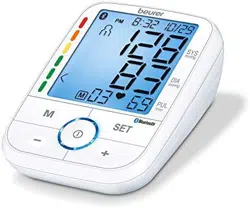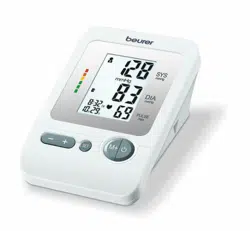

ENGLISH
Blood pressure monitor
Instruction manual ................... 2
ESPANOL
Tensiómetro
Manual de instrucciones ....... 26
Electromagnetic Compatibility Information ................. 50
BM 47
READ THIS MANUAL COMPLETELY AND CARE-
FULLY BEFORE USING THIS PRODUCT
Keep this manual in a safe location for future reference
LEA TODO ESTE MANUAL CON ATENCIÓN
ANTES DE USAR ESTE PRODUCTO
Conserve este manual en un lugar seguro
para consultarlo en el futuro
Questions or Comments? Call our US-based customer
service toll free at 1-800-536-0366.
¿Preguntas o comentarios? Llame a nuestro servicio al cliente
en Estados Unidos gratis al teléfono 1-800-536-0366.
Distributed by/Distribuido por:
Beurer North America LP
1 Oakwood Boulevard, Suite 255
Hollywood, FL 33020
www.beurer.com
2
IMPORTANT SAFETY NOTES
Signs and symbols
Whenever used, the following signs identify safety and
property damage messages and designate a level of hazard
or seriousness.
WARNING WARNING indicates a hazardous
situation which, if not avoided, could
result in death or serious injury.
CAUTION CAUTION indicates a hazardous
situation which, if not avoided, may
result in minor or moderate injury.
NOTICE NOTICE addresses practices not
related to personal injury, such as
product and/or property damage.
READ THIS ENTIRE MANUAL, THE SAFETY
SECTION AND ALL INSTRUCTIONS AND WARNINGS
COMPLETELY AND CAREFULLY BEFORE USING THIS
PRODUCT. FOLLOW ALL SAFETY INSTRUCTIONS AND
WARNINGS TO AVOID HAZARDOUS SITUATIONS AND
TO MAKE CORRECT USE OF THIS PRODUCT.
ENGLISH
Contents
IMPORTANT SAFETY NOTES ......................................... 2
1. Getting to know your instrument ............................. 10
2. Important information ............................................... 10
3. Package contents ...................................................... 11
4. Device description..................................................... 12
5. Getting started ........................................................... 13
5.1 Inserting/Replacing batteries ................................ 13
5.2 Cuff selection ........................................................ 13
5.3 Setting the date and time ...................................... 13
6. Measuring blood pressure........................................ 14
6.1 Positioning cuff ...................................................... 14
6.2 Correct posture ..................................................... 15
6.3 General notes ........................................................ 15
6.4 Taking measurement ............................................. 16
6.5 Saving, displaying and deleting measurements.... 16
7. Evaluating results ...................................................... 17
7.1 Joint National Committee (JNC) classification ...... 18
8. Care, maintenance and disposal ............................. 18
9. Error messages / troubleshooting ............................ 19
10. Technical Specifications ........................................... 20
11. FCC Compliance Information................................... 22
12. Warranty ..................................................................... 23

3
WARNING:
•
Consult your physician or pharmacist before starting
to measure your blood pressure.
•
Read and understand all instructions and warnings
before using this device.
•
Like any oscillometric blood pressure measurement
devices, certain medical conditions can affect the
measurement accuracy, among others:
– disorder of the cardiac rhythm
– very low blood pressure
– patients in shock
– patients with very low blood perfusion
– diabetes
– vessel anomalities
– people with electrical implants, such as a cardiac
pacemaker
– women who are pregnant.
•
Due to their condition the oscillometric measurement
method can produce incorrect readings. This represents
a risk for your health, since values may be interpreted
incorrectly. Always consult your physician to determine
what will be suitable for you.
•
This product does not and is not intended to provide
a medical diagnosis. Measurements results are for
reference only. Self-diagnosis and treatment, e.g.
regarding medication, using measured results represent
a risk for your health. Always consult with a licensed
physician for determination of appropriate medication
and dosage thereof. Follow the instructions of your
physician or licensed healthcare provider. If you have
or suspect that you have a medical problem, promptly
consult your physician. If you have an emergency please
call 911 immediately.
•
Only a physician or a trained health care professional
who is familiar with your medical history is able to
accurately interpret your blood pressure measurements.
Consult your physician before starting blood pressure
monitoring.
•
This product is not intended to serve as a substitute
for the advice of a physician or medical professional.
This product is not intended to substitute for regular
medical checkups. Contact your physician for specific
information about your blood pressure.
•
Please note that technically related measuring
tolerances are possible. Please see section “Technical
specifications” for details.
•
Any cuff related blood pressure measurement in high
repetition rates, can lead to severe measurement side
effects, e.g.
– any nerv compression with temporary arm/hand
paralysis
– the release of an arterial or venous thrombus, which
can cause a life threatening situation.

4
Please contact your physician about the specific risks
of cuff pressure in your specific case.
•
The ’irregular heartbeat’ function does not replace a
cardiac examination, but may help to detect potential
pulse irregularities at an early stage. Always consult
your physician to determine what will be suitable for
you.
•
The ’irregular heartbeat’ function is not designed
for diagnosing or treating an arrhythmic disorder.
Arrhythmia can only be ascertained by a licensed
physician.
•
The JNC chart is not intended to replace a medical
diagnosis. This chart is only a reference for different
classifications of blood pressure.
•
If you notice abnormal or suspicious variations in
blood pressure measurements, consult your physician
immediately.
•
Women who underwent a breast or axillar lymph
node removal operation should consult a physician
or licensed healthcare provider before starting blood
pressure measurements.
•
Prior to use, you have to ensure that the blood pressure
monitor is free of damage. If in doubt, do not use the
unit and contact customer service at 1-800-536-0366.
•
This device is intended only for personal, non-
commercial, adult use in measuring blood pressure
and pulse rate. Do not use the product for any other
purpose. This product is not intended for use in a
hospital, physician’s office, or any other health care
facility.
•
The unit must be used in accordance to the specified
ambient conditions, otherwise the accuracy of readings
might be affected. See section “Care, maintenance
and disposal” and section “Technical specifications”
for details.
•
Do not wrap the cuff around body parts other than your
upper left arm. Misuse represents a risk to your health.
•
Please do not share the cuff with other persons, to avoid
cross infection.
•
Use this monitor only on humans.
•
This product is not intended for use by or on children,
toddlers and infants or on persons who cannot express
their consent, e.g. persons with mental disorders or the
like. Consult your physician for alternative methods of
measuring a child’s blood pressure.
•
This product is not a toy. Keep it out of reach of
children, toddlers, and infants.
•
Keep the product out of the reach of pets.
•
Packaging materials are a deadly hazard for children
and can cause suffocation. Remove all packaging
materials immediately and keep them away from
children at all times.
•
This product contains small parts that may present a
choking hazard to children. Keep the unit and all parts

5
out of reach of children. NEVER LEAVE CHILDREN
OR THOSE WHO REQUIRE CLOSE SUPERVISION
UNATTENDED WITH THIS DEVICE.
•
The tubing presents a strangulation hazard. Keep this
product away from children and those who require close
supervision, e.g. people with mental disorders. NEVER
LEAVE CHILDREN OR THOSE WHO REQUIRE CLOSE
SUPERVISION UNATTENDED WITH THIS DEVICE.
•
Do not drape tube around neck. This presents a
strangulation hazard.
•
People with disabilities, activity limitations, or who are
physically frail, should be assisted by another person
when using this unit.
•
Proper cuff size is important for accurate
measurements. Only use the device on adults who have
the right upper arm circumference for this instrument.
See section “Technical specifications” for suitable arm
circumferences.
•
Do not use any cuffs, tubes, parts and accessories other
than those explicitly recommended by the manufacturer
for use with this product. Parts and accessories not
approved for use with the device may cause damage
to your health and to the product.
•
Electromagnetic interference: Avoid strong electrical or
electromagnetic fields in the direct vicinity of the device
(e.g. mobile telephones, microwave ovens) while it is in
operation, as inaccurate measurements may result. To
prevent such interference, use the unit at a sufficient
distance from such devices or turn the devices off.
•
The blood pressure monitor must not be used in
connection with a high-frequency surgical unit.
•
Do not measure your blood pressure while operating
a vehicle or in any situation which requires your full
attention.
•
During the blood pressure measurement, blood
circulation must not be stopped for an unnecessarily
long time. If the device malfunctions, remove the cuff
from the arm.
•
Avoid any mechanical restriction, compression or
bending of the cuff line.
•
Do not allow sustained pressure in the cuff or frequent
measurements. The resulting restriction of the blood
flow may cause injury.
•
Ensure that the cuff is not placed on an arm in which the
arteries or veins are undergoing medical treatment, e.g.
intravascular access or therapy, or an arteriovenous
(AV) shunt.
•
Do not use the cuff on people who have undergone a
mastectomy.
•
It is inappropriate for people with serious arrhythmia to
use this Electronic Sphygmomanometer.

6
CAUTION:
•
The device should not be used when your arm has been
wounded/injuried or when a catheter has been inserted.
Such use may result in injury.
•
Remove any kind of upper arm jewelry or the like before
taking a measurement. This could cause bruises.
•
Do not place the arm cuff over heavy clothing (e.g. a
jacket or sweater sleeve) as the blood pressure monitor
will not be able to take a proper measurement and there
is an elevated danger of acquiring hematoma or skin
marks during the course of the measurement.
•
In case the cuff does not stop inflating, interrupt the
measurement by pressing the START/STOP button
and open the cuff at once.
•
Do not disassemble the unit, it may result in injuries.
•
When applying the arm cuff, make sure there are no
wrinkles in the cuff. This could cause bruises.
•
Do not exert any kind of pressure on the hose during
measurement, e.g. laying your arms or any other object
on the hose. This could cause incorrect measurements.
•
Blood pressure measurements can lead to temporary
marks on the skin at the site of the cuff placement.
This is especially the case in high repetition rates, in
hypertonic patients and in patients with weak pulses.
In rare cases a mark may persist for a couple of days.
Please contact your physician about these specific
risks of cuff pressure in your specific case.
•
For hygienic reasons the cuff is intended only for the
use by one person.
•
Prolonged over-inflation (cuff pressure exceeds 300
mmHg or maintained above 15mmHg for longer than
3 minutes) of the bladder may cause ecchymoma of
your arm.
•
Please note that when inflating, the functions of the limb
in question may be impaired.
•
Do not place the cuff over wounds as this may cause
further injury.
•
The accuracy of any blood pressure measurement with
this device can be affected by a multitude of causes.
Some can be avoided some have to be accepted at
the time of measurement. Speak with your physician
about possible causes affecting your blood pressure.
•
Do not inflate the cuff unless wrapped around arm.
•
Do not touch the unit, the tube and cuff and/or press
any buttons when measurement is in progress, except
for stopping the measurement. Doing so may cause
incorrect readings.
NOTICE:
•
The blood pressure monitor is made up of precision
electronic components. Accuracy of readings and the
instrument’s service life depend on careful handling.
Protect the unit against hard knocks (e.g. dropping the
unit), moisture, water, dirt, dust, chemicals, extreme hot
or cold temperatures, major temperature fluctuations,

7
direct exposure to sunlight and heat sources which
are too close (e.g. stoves, heating radiators). This may
damage the unit. The device must be stored in the
specified ambient conditions. Please see section “Care,
maintenance and disposal” and section “Technical
specifications” for details.
•
Do not use any aggressive solvents, cleaning agents,
detergents or any other strong chemicals to clean the
device.
•
Never immerse and or spill water or any other liquid
onto the monitor or any components, otherwise liquid
will enter it and cause damage.
•
Do not wash the unit in a washing machine, dish washer
or tumble dryer.
•
Observe the local regulations for material disposal.
Dispose of the device, components and optional
accessories according to applicable local regulations.
Unlawful disposal may cause environmental pollution.
•
Never attempt to repair, open and/or disassemble
the unit (including arm cuff and optional accessory)
or adjust it yourself. This may damage the unit and
impair the functions. If you need to have the unit
repaired, please contact our customer service. Please
see warranty for service contact. Before submitting any
complaint, first check the batteries and replace them
if necessary.
•
Changes or modifications to the device will nullify the
user warranty.
•
Do not drop or insert any object into any opening or
hose. This may damage the unit.
•
Do not press the buttons with excessive force or with
pointed objects.
•
To conserve the batteries, the monitor switches off
automatically if no buttons are pressed for one minute.
•
The device is only intended for the purpose described
in these instructions for use. The manufacturer is not
liable for damage resulting from improper or careless
use.
•
If you are using the unit for the first time, please remove
the protective film from the display.
•
The monitor can maintain the safety and performance
characteristics for a minimum of 10,000 measurements
or 3 years.
•
Further documents which include information for the
calibration of the device can be asked at the service
address.
•
The device can be tested in case of supposed
inaccuracy every two years. Please contact the nearest
service address
Cleaning and storing the device and cuff
To keep your digital blood pressure monitor in the best
condition and protect the unit from damage follow the
directions listed below:

8
•
Clean your device and cuff carefully only with a slightly
moistened soft cloth and dry it immediately with a soft
dry cloth. Do not press.
•
When storing the device, make sure that no heavy
objects are placed on top of it.
•
Do not fold the cuff and tubing tightly. The cuff tube
should not have any sharp kinks and keep it away from
sharp edges.
•
If the unit is stored near freezing, allow it to acclimate
to room temperature before use.
•
Always store the unit in its storage pouch after use.
•
This unit may not meet its performance specifications if
stored or used outside of the temperature and humidity
ranges (see section “Technical specifications”).
•
Use the unit consistent with the instruction provided
in this manual.
Advice on use
•
For consistency, always measure your blood pressure
at the same time each day.
•
Always wait at least 1 minute between measurements
to allow the blood circulation in your arm to return
to normal. You may need to increase the wait
time depending on your individual physiological
characteristics. Because of normal physiologic changes
and the many external factors influencing blood
pressure, it is unusual to obtain identical blood pressure
measurements, even when taken a few minutes apart.
Speak with your physician to determine what is
affecting your blood pressure and which variation may
be seen as normal in your case.
•
When performing multiple measurements on
an individual, wait five minutes between each
measurement.
•
Do not take a measurement within 30 minutes of eating,
drinking, smoking or exercising. You should not be
physically tired or exhausted while taking measurement.
•
Repeat the measurement if you are unsure of the
results.
•
Measurements are for your information only they are
no substitute for a medical examination. Discuss the
measurements with your doctor and never base any
medical decisions on them (e.g. medicines and their
administration).
•
Do not use the blood pressure monitor on newborns,
pregnant women or patients with pre-eclampsia.
Consult your doctor before using the blood pressure
monitor during pregnancy.
•
Cardiovascular diseases may lead to incorrect
measurements or have a detrimental effect on
measurement accuracy. The same also applies to very
low blood pressure, diabetes, circulatory disorders and
arrhythmias as well as chills or shaking.
•
For reliable monitoring and reference of blood pressure,
keeping long-term records is recommended.

9
•
To minimize measurement variations due to physical
activity, rest at least 1 minute before measuring your
blood pressure (or 15 minutes after strenuous activity).
•
Stress raises blood pressure.
•
Perform measurements in a quiet and relaxed
environment at room temperature.
Notes on electromagnetic compatibility
•
The device is suitable for use in all environments
listed in these instructions for use, including domestic
environments.
•
The use of the device may be limited in the presence
of electromagnetic disturbances. This could result in
issues such as error messages or the failure of the
display/device.
•
Avoid using this device directly next to other devices
or stacked on top of other devices, as this could lead
to faulty operation. If, however, it is necessary to use
the device in the manner stated, this device as well as
the other devices must be monitored to ensure they
are working properly.
•
The use of accessories other than those specified or
provided by the manufacturer of this device can lead to
an increase in electromagnetic emissions or a decrease
in the devices electromagnetic immunity; this can result
in faulty operation.
•
Failure to comply with the above can impair the
performance of the device.
Battery Handling Safety Precautions
•
Use only the size and type of batteries specified.
•
Be sure to follow the correct polarity when installing
the batteries. Reversed batteries may cause damage
to the device.
•
Do not mix different types of batteries together (e.g.
Alkaline and Carbon-zinc or rechargeable batteries) or
old batteries with fresh ones. Always replace batteries
as a simultaneous set.
•
If the batteries in the device are depleted or the device
will not be used for a long period of time, remove the
batteries to prevent damage or injury from possible
battery leakage.
•
Do not try to recharge batteries not intended to be
recharged; they can overheat and rupture (follow
battery manufacturer’s directions.)
•
Do not dispose of batteries in fire, batteries may
explode or leak.
•
Clean the battery contacts and also those of the device
prior to battery installation.
•
Remove discharged batteries from the product and
dispose/recycle in compliance with all applicable laws.
•
Keep batteries away from children and pets. Batteries
may be harmful if swallowed. Should a child or pet
swallow a battery, seek medical assistance immediately.

10
SAVE THESE INSTRUCTIONS FOR FUTURE
REFERENCE
If the instruction manual is damaged or if you no longer
have the instruction manual in your possession, please
contact customer service at 1-800-536-0366 or at
info@beurer.com.
Dear Valued Customer,
Thank you for choosing one of our products. Our name
stands for high-quality, thoroughly tested products for
application in the areas of heating, weight management,
blood pressure, body temperature, pulse, gentle therapy,
massage, and beauty.
Register your product today to receive further benefits:
• added protection for your purchase
• health and wellness tips
• new product information
• continual outstanding customer service and support.
Visit www.registerbeurer.com or contact customer service
at 1-800-536-0366.
Please read these instructions for use carefully and keep
them for later use.
Make them accessible to other users and observe the
information they contain.
With kind regards,
Your Beurer Team
1. Getting to know your instrument
The upper arm blood pressure monitor is used for non-
invasive measurement and monitoring of adults’ arterial
blood pressure. This allows you to quickly and easily
measure your blood pressure and to display the last
recorded measurement. The values determined are
classified and graphically evaluated according to Joint
National Committee (JNC) guidelines.
Blood pressure measurements determined by this monitor
are equivalent to those obtained by a trained observer using
the cuff/stethoscope auscultation method, within the limits
prescribed by the U.S. Department of Health and Human
Service (Joint National Committee; JNC).
It is recommended the performance should be checked
every 5 years or after repair. Please contact customer
service.
2. Important information
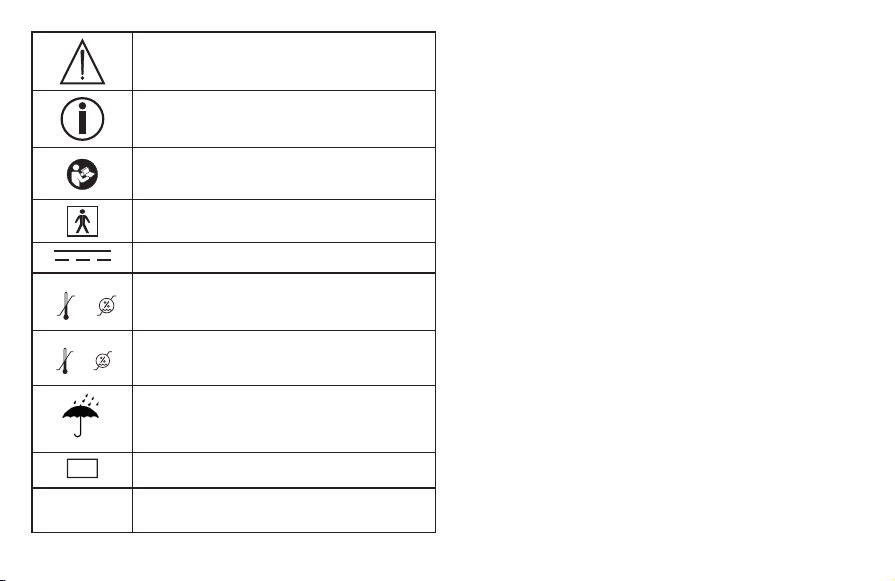
Signs and symbols
Whenever used, the following signs identify safety and
property damage messages and designate a level of hazard
or seriousness.
11
Caution
Note
Note on important information
Follow instructions for use
Type BF applied part (cuff only)
Direct current
Storage
Permissible storage temperature and
humidity
Operating
Permissible operating temperature and
humidity
Keep dry
S
N
Serial number
IP 20
Protected against solid foreign objects
12.5 mm in diameter and larger
3. Package contents
• Blood pressure monitor BM 47
• Universal arm cuff 8.7 - 16.5 in (22 - 42 cm)
• Instruction manual
• Quick start guide
• Storage bag
• 4 x 1.5 V AA alkaline batteries
12
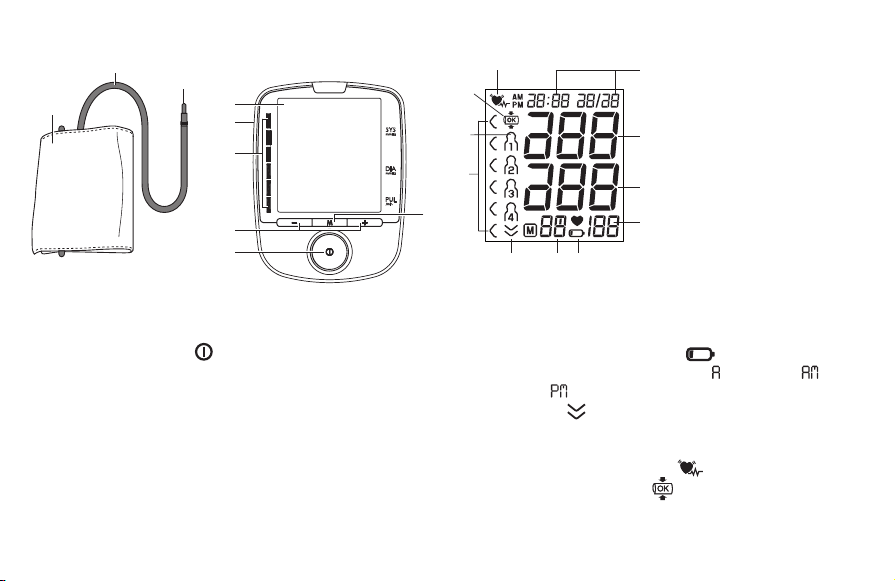
4. Device description
1. Cuff
2. Cuff tube
3. Cuff connector
4. START/STOP button
5. Function buttons -/+
6. LED JNC scale
7. Connection for cuff connector
8. Display
9. Memory button M
Icons in the display:
BM 47 Display Shoppers
1117
10
1
2
11
9
8
7 6 5
3
4
1. Time and date
2. Systolic pressure
3. Diastolic pressure
4. Measured heart rate
5. Battery replacement symbol
6. Memory display: average value ( ), morning ( ),
evening ( ), memory space number
7. Release air
8. JNC classification
9. User memory
10. Cardiac arrhythmia symbol
11. Cuff tightness indicator
For product information, questions or customer service call
toll free 1-800-536-0366 or email: info@beurer.com
2
1
3
8
7
6
5
4
9
13
5. Getting started
NOTE:
To conserve the batteries, the monitor switches off
automatically if you do not press any buttons for 1 minute.
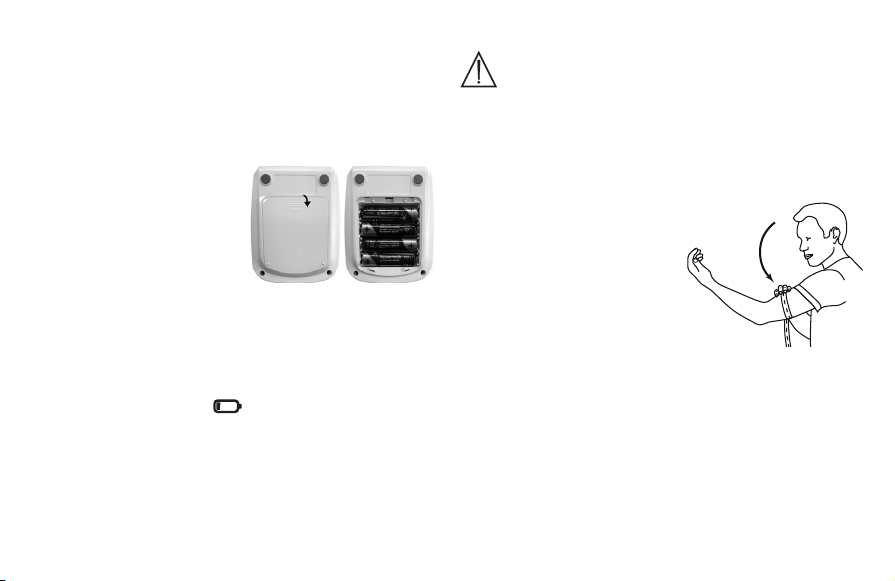
5.1 Inserting/Replacing batteries
• Remove the battery cover
from the back of the monitor.
• Clean the battery contacts
and those of the device prior
to installation with a soft dry
cloth.
• Insert or replace with only
four AA 1.5 V alkaline batteries. Make absolutely sure that
you insert them with the correct polarity (+/-) as indicated
(see the diagram inside the battery compartment). Do not
use other types of batteries.
• Replace the battery cover carefully.
If the battery change icon
is continuously illuminated,
measurement is no longer possible and you must replace
all the batteries.
5.2 Cuff selection
WARNING:
•
Proper cuff size is important for accurate measurements.
Only use the device on adults who have the right upper
arm circumference for this instrument.
This unit includes 1 size of arm cuffs:
• Universal size fits 8.7 - 16.5 in (22 - 42 cm)
Measure your arm circumference
around your bicep using a
normal measuring tape.
5.3 Setting the date and time
It is essential to set the date and time. Otherwise, you will
not be able to save your measured values correctly with a
date and time and to access them again later.
To set the date and time, proceed as follows:
• Press the memory button M for at least three seconds.
• The year display will start to flash. Set the year with the
function buttons -/+ and confirm with the memory button
M.
14
• Set the month, day, hour and minutes and confirm each
setting with the memory button M.
6. Measuring blood pressure
6.1 Positioning cuff
NOTE:
Always properly position the arm cuff on the arm at heart
level, according to the following instructions.
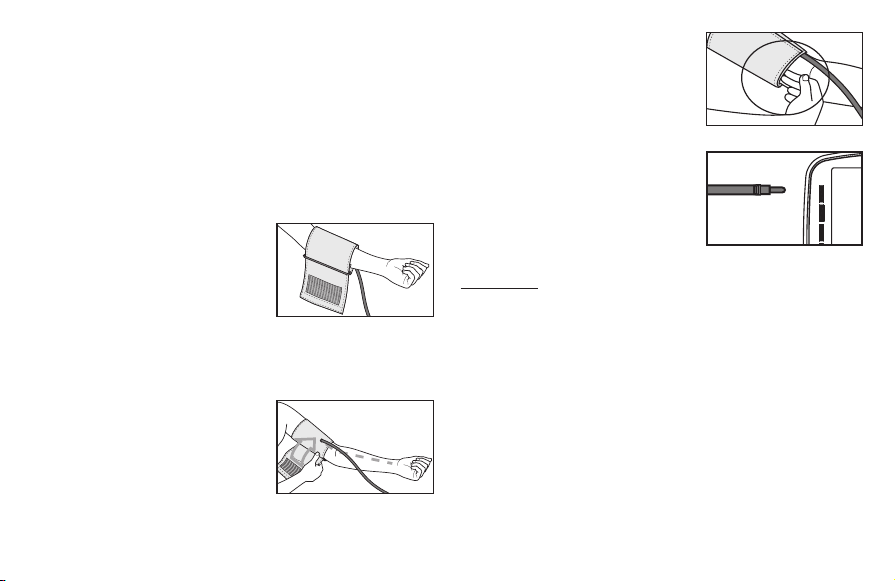
Fit the cuff round your bare left
upper arm. Do not place the arm
cuff over heavy clothing (e.g. a
jacket or sweater sleeve) as the
blood pressure monitor will not be
able to take a proper measurement.
Blood circulation in the arm should
not be restricted by tight clothing or
other objects.
The cuff should be placed on the
upper arm so that the lower edge is
0.8 to 1.2 in (2 to 3 cm) above the
bend of the elbow and above the
artery. The tube should be in line
with the centre of the palm.
Now place the free end of the cuff
snugly, but not too tightly, around
the arm, and fix it with the Velcro
fastener. The cuff should be fitted
tight enough to allow just two
fingers to fit beneath the cuff.
Insert the cuff tubing into the
socket for the cuff attachment on
the left side of the unit. Make sure
it is inserted securely in the main
unit and that there are no kinks in
the cuff tubing.
Important: This device should only be operated with the
original cuff. The cuff included with the device is suitable
for an upper arm circumference of 8.7 - 16.5 in (22 - 42 cm).
Replacement cuffs from other models cannot be used with
this model. Doing so, will result in inaccurate readings or
error messages.
15
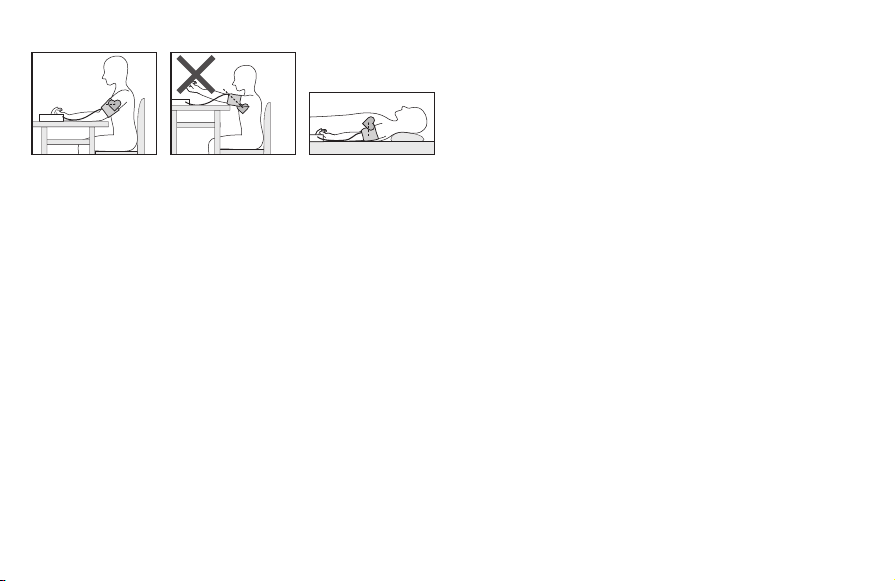
6.2 Correct posture
• Rest at least for 1 minute before each measurement.
Otherwise there may be erroneous results.
• You can perform the measurement either sitting or lying
down. Always make sure that the cuff is on a level with
your heart.
• Open and relax your hand with your palm facing up. While
taking your blood pressure measurement, remain calm
and still; do not move or talk while the measurement is
in progress.
• Sit up straight comfortably with your left arm resting on
a flat surface. Do not cross your legs. Place your feet flat
on the floor.
• Please note that any muscle movement during inflation
or deflation can cause measurement error.
6.3 General notes
• For reliable monitoring and reference of blood pressure,
keeping long-term records is recommended.
• To minimize measurement variations due to physical
activity, rest at least 1 minute before measuring your
blood pressure (or 15 minutes after strenuous activity).
You should not be physically tired or exhausted while
taking measurement.
• In order to obtain a resting condition blood pressure,
avoid eating, drinking alcohol and caffeinated beverages,
smoking, exercising, and bathing for at least 30 minutes
before taking a measurement.
• Stress raises blood pressure.
• Perform measurements in a quiet and relaxed environment
at room temperature.
• Always wait at least 1 minute between measurements to
allow the blood circulation in your arm to return to normal.
You may need to increase the wait time depending on
your individual physiological characteristics. Because of
normal physiologic changes and the many external factors
influencing blood pressure, it is unusual to obtain identical
blood pressure measurements, even when taken a few
minutes apart. Speak with your physician to determine
what is affecting your blood pressure and which variation
may be seen as normal in your case.
• The accuracy of any blood pressure measurement with
this device can be affected by a multitude of causes.
Some can be avoided some have to be accepted at the
time of measurement. Speak with your physician about
possible causes affecting your blood pressure.
• Do not inflate the cuff unless wrapped around arm.
• If no button is pressed for approx. 1 minute the automatic
shutoff function shuts off the unit in order to preserve the
batteries.

16
• Do not touch the unit, the tube and cuff and/or press
any buttons when measurement is in progress, except for
stopping the measurement. Doing so may cause incorrect
readings.
6.4 Taking measurement
NOTE:
If you are using the unit for the first time, please remove the
protective film from the display.
• Put on the cuff around your bare left upper arm as
described previously and assume the position in which
you want to carry out the measurement.
• Switch on the blood pressure monitor with the START/
STOP button .
• Before the measurement, the last saved test result
is briefly displayed. If there is no measurement in the
memory, the instrument always displays the value “0”.
• The cuff is pumped up. Cuff air pressure is released
slowly.
NOTE:
This monitor will re-inflate automatically if the system
detects that your body requires more pressure for
measurement. As soon as a heart rate is detected, the heart
rate symbol is displayed.
• The cuff tightness indicator symbol is displayed
if the cuff is applied tight enough on your arm. If the
cuff is too loosely during the measurement,
and
“ ” is shown on the display. If the cuff is too tight during
the measurement, , “ ” and “ ” is shown on the
display. In such cases, the measurement is cancelled.
Apply the cuff correctly and take a new measurement.
• When the measurement is completed the cuff will deflate
entirely. Heart rate, systolic and diastolic blood pressure
are displayed.
• You can interrupt measurement at any time by pressing
the START/STOP button
.
• “
_” appears if it has not been possible to perform the
measurement properly. Observe the section on error
messages/troubleshooting and repeat the measurement.
• The test result is saved automatically.
• To switch off and release the pressure, press the START/
STOP button again. If you forget to switch off the
device, it switches off automatically after approx. 1
minute.
Wait at least 1 minute before taking another measurement.
6.5 Saving, displaying and deleting measurements
• The results of every successful measurement are stored
together with the date and time. If there are more than 30
measurements, the oldest measurements are lost.
17
• Press the - or + function button. Select the desired user
memory ( ... ) by pressing the -/+ function button.
Confirm your selection with the START/STOP button .
• If you press the memory button M, the average value A of
all the stored measured values in the user memory will be
displayed. If you press the memory button M again, the
average value of the morning measurements for the last 7
days will be displayed. (morning: 5.00 – 9.00, display AM ).
If you press the memory button M again, the average
value of the evening measurements for the last 7 days
will be displayed. (evening: 18.00 – 20.00, display PM ).
If you continue to press the memory button M, the most
recent individual measured values are displayed in turn
with the date and time.
• You can delete the memory by pressing and holding the
memory button M for 3 seconds.
• To switch off, press the START/STOP button
.
• If you forget to switch off the unit, it will switch off
automatically after 1 minute.
NOTE:
This monitor will re-inflate automatically if the system
detects that your body requires more pressure for
measurement. As soon as a heart rate is detected, the heart
rate symbol is displayed.
• When the measurement is completed the cuff will deflate
entirely. Heart rate, systolic and diastolic blood pressure
are displayed.
• You can interrupt measurement at any time by pressing
the START/STOP button
.
• “
_” appears if it has not been possible to perform the
measurement properly. Observe the section on error
messages/troubleshooting and repeat the measurement.
• The test result is saved automatically.
• To switch off and release the pressure, press the START/
STOP button again. If you forget to switch off the
device, it switches off automatically after approx. 1
minute.
Wait at least 1 minute before taking another measurement.
7. Evaluating results
This symbol indicates that certain heartbeat/pulse
irregularities were detected during the measurement.
NOTE:
• Talking, moving, shaking or an irregular pulse during the
measurement can result in the appearance of this symbol.
• Repeat the measurement if the flashing icon is displayed
after the measurement. Please note that you should rest
at least 1 minute between measurements and not talk or
move during the measurement. If the icon continues to be
displayed in subsequent readings, we recommend you to
consult your physician in order to determine if it is cause
for concern. Do not try to interpret readings or attempt to

18
treat any condition yourself. Always follow the guidance
of a health professional. If you have an emergency call
911 immediately.
7.1 Joint National Committee (JNC) classification
According to JNC Guidelines/Definitions and the latest
findings, the test results of adults can be classified and
evaluated according to the following chart:
NOTE:
This standard, however, is a general guideline as an
individual’s blood pressure varies among different people,
age groups, etc. Please consult your physician for proper
diagnosis.
The bar graph in the display and the scale on the unit
indicate the range of the blood pressure which has been
recorded.
NOTE:
If the values for systolic and diastolic pressure are in two
different JNC ranges (e.g. systolic in the high-normal range
and diastolic pressure in the normal range) the graphic JNC
classification on the unit indicates the higher range (high-
normal in the example described).
8. Care, maintenance and disposal
To keep your digital blood pressure monitor in the best
condition and protect the unit from damage follow the
directions listed below:
Stages of blood pressure levels Systolic (mmHg) Diastole (mmHg) Color
Stage 2 Hypertension > = 180 > = 110 Red
160 –179 100 –109 Red
Stage 1 Hypertension 140 –159 90 – 99 Red
Pre-hypertension 130 –139 85 – 89 Yellow
120 –129 80 – 84 Green
Normal <120 <80 Green
Source: U.S. Department of Health and Human Service, JNC7 (2004), adapted

19
• Clean your device and cuff carefully only with a slightly
moistened soft cloth and dry it immediately with a soft
dry cloth. Do not press.
• It is recommended the cuff should be disinfected 2
times every week if needed (For example, in hospital or
in clinique). Wipe the inner side (the side contacts skin)
of the cuff by a soft cloth squeezed after moistened with
Ethyl alcohol (75-90%), then dry the cuff by airing.
• Please keep the cuff clean. If the cuff becomes dirty,
remove it from the monitor and clear it by hand in a mild
detergent, then rinse it thoroughly in cold water. Never
dry the cuff in clothes dryer or iron it.
• When storing the device, make sure that no heavy objects
are placed on top of it.
• Do not fold the cuff and tubing tightly. The cuff tube
should not have any sharp kinks and keep it away from
sharp edges.
• If the unit is stored near freezing, allow it to acclimate to
room temperature before use.
• Always store the unit in its storage bag after use.
• This unit may not meet its performance specifications if
stored or used outside of the temperature and humidity
ranges (see section “Technical specifications”).
• Use the unit consistent with the instruction provided in
this manual.
• The monitor requires 6 hours to warm/cool from the
minimum/maximum storage temperature between uses
until the monitor is ready for its Intended Use (with an
ambient temperature of 68°F (20°C)).
• It is recommended to clean the cuff after the usage of
every 200 times.
• The cuff integrity is maintained after 1,000 open–close
cycles of the closure.
• Avoid high temperature and solarization.
• No component can be maintained by user in the monitor.
The circuit diagrams, component part lists, descriptions,
calibration instructions, or other information which
will assist the users appropriately qualified technical
personnel to repair those parts of equipment which are
designated repairably can be supplied.
Disposal
Observe the local regulations for material disposal. Dispose
of the device in accordance with local regulations. If you
have any questions, please contact the local authorities
responsible for waste disposal.
9. Error messages / troubleshooting
In the event of errors, the error message “ _” appears
on the display.
Error messages may appear if:
• systolic or diastolic pressure could not be measured
(“ ” or “ ” appears on the display),

20
• systolic or diastolic pressure was outside the
measurement range (“ ”
or “
” appears on the display),
• the cuff is fastened too tightly or loosely
(“ ” or “ ” appears on the display),
• the pump pressure is higher than 300 mmHg
(“ ” appears on the display),
• pumping up takes longer than 160 seconds
(“ ” appears on the display),
• there is a system or device error
(“ ”, “ ”, “ ” or “ ” appears on the display),
• the batteries are almost empty
.
In such cases, repeat the measurement. Ensure that you
do not move or speak.
If necessary, reinsert or replace the batteries.
T
echnical alarm – description
Should the recorded blood pressure (systolic or diastolic)
lie outside the limits specified in the section “Technical
specifications”, the technical alarm will appear on the
display indicating either “
” or
“
”. In such cases, you
should seek medical assistance and check the accuracy
of your procedure.
The limit values for the technical alarm are factory set
and cannot be adjusted or deactivated. These alarm limit
values are accorded second priority under the standard
IEC 60601-1-8.
The technical alarm is a non-locking alarm and must not
be reset. The signal shown on the display will disappear
automatically after about 8 seconds.
NOTE:
If the unit still does not work, contact customer service at
1-800-536-0366.
10. Technical Specifications
Model BM 47
Measurement
method
Oscillometric, non-invasive blood
pressure measurement on the up
-
per arm
Measurement range Cuff pressure 0-300 mmHg,
systolic 60-260 mmHg,
diastolic 40-199 mmHg,
Pulse 40-180 beats/minute
Display accuracy Systolic ± 3 mmHg,
diastolic ± 3 mmHg,
pulse ± 5 % of the value shown
Measurement
inaccuracy
Max. permissible standard devia
-
tion according to clinical testing:
systolic 8 mmHg /diastolic 8 mmHg
Memory 4 x 30 memory spaces

21
Dimensions
5.3 x 4 x 2 in
(134 x 102 x 52.5 mm)
Weight Approximately 280g
(without batteries and cuff)
Cuff size 8.7 - 16.5 in (22 - 42 cm)
Permissible operat
-
ing conditions
+50 °F to +104 °F (+10 °C to +40 °C)
,
≤ 85 % relative air humidity (non-
condensing)
Permissible storage
conditions
-4 °F to +122 °F (-20 °C to +50 °C),
≤ 85 % relative air humidity, 800-
1050 hPa ambient pressure
Power supply 4 x 1.5 V
AA batteries
Battery life For approx. 500 measurements,
depending on the blood pressure
level and/or pump pressure
Accessories Instruction for use, 4 x 1.5 V AA
batteries, storage pouch
Classification Internal supply, IP20, no AP or
APG, continuous operation, type
BF applied part
Key to symbols
WARNING! Read the safety
information and all instruc-
tions to avoid serious injury.
application part Type BF
Auto-shut-off approx. 1 minute after last button
operation
These specifications are subject to change without notice
for purpose of improvement.
The serial number can be found on the unit itself or in the
battery compartment.
• This unit is in line with European Standard EN 60601-1-2
(In accordance with CISPR 11, IEC 61000-4-2,
IEC 61000-4-3 and IEC 61000-4-8) and is subject to
particular precautions with regard to electromagnetic
compatibility (EMC).
Please note that portable and mobile HF communication
systems may interfere with this instrument. For more
details, please contact customer service at the address
indicated.
• The instrument is in line with the EU Medical Products
Directive 93/42/EC, the German medical products act
and European standards EN 1060-1 (non-invasive Blood
Pressure Monitors, Part 1: general requirements) and
EN 1060-3 (non-invasive Blood Pressure Monitors, Part 3:

22
Supplementary Requirements for Electromechanical
Blood Pressure Measurement Systems).
• The Electronic Sphygmomanometers corresponds to
the below standards : ISO81060-2 : 2013 (Non-Invasive
Sphygmomanometers - Part 2: Clinical Validation Of
Automated Measurement Type).
11. FCC Compliance Information
Blood Pressure Monitor BM 47
Responsible Party – U.S. Contact Information:
Beurer North America LP
1 Oakwood Boulevard, Suite 255
Hollywood, FL 33020
United States
1-800-536-0366
info@beurer.com
FCC Compliance Statement
This device complies with part 15 of the FCC Rules.
Operation is subject to the following two conditions:
1. This device may not cause harmful interference, and
2. This device must accept any interference received,
including interference that may cause undesired
operation.
Changes or modifications not expressly approved by the
party responsible for compliance could void the user’s
authority to operate the equipment.
NOTE: This equipment has been tested and found to
comply with the limits for a Class B digital device, pursuant
to part 15 of the FCC Rules. These limits are designed to
provide reasonable protection against harmful interference
in a residential installation. This equipment generates, uses
and can radiate radio frequency energy and, if not installed
and used in accordance with the instructions, may cause
harmful interference to radio communications. However,
there is no guarantee that interference will not occur in a
particular installation. If this equipment does cause harmful
interference to radio or television reception, which can be
determined by turning the equipment off and on, the user
is encouraged to try to correct the interference by one or
more of the following measures:
— Reorient or relocate the receiving antenna.
— Increase the separation between the equipment and
receiver.
— Connect the equipment into an outlet on a circuit different
from that to which the receiver is connected.
— Consult the dealer or an experienced radio/TV technician
for help.

23
12. Warranty
Limited Lifetime Warranty For Original Purchaser
Your Beurer Blood Pressure Monitor, model BM 47,
excluding cuff (incl. tube), batteries and any optional
accessory, is warranted to be free from defects in
materials and workmanship for the life of the product
under normal conditions of intended use and service. The
cuff is warranted to be free from defects in materials and
workmanship appearing within two years from date of
purchase when the monitor is used in accordance with the
instructions provided with the unit. This warranty extends
only to the original retail purchaser and does not extend to
retailers or subsequent owners.
We will, at our option, repair or replace the Beurer Blood
Pressure Monitor, model BM 47, without additional charge,
for any part or parts covered by these written warranties.
No refunds will be given. Repair or replacement is our only
responsibility and your only remedy under this written
warranty. If replacement parts for defective materials are
not available, Beurer reserves the right to make product
substitutions in lieu of repair or replacement.
For warranty service contact our customer service
department at 1-800-536-0366 or at info@beurer.com
to provide a description of the problem. If the problem
is deemed to be within the scope of the limited lifetime
warranty, you will be asked to mail the product at your costs
in its original package with proof of purchase, your name,
address and phone number. If the problem is not deemed
to be within the scope of the limited lifetime warranty, we
will provide a quotation for repair, respectively, replacement
and return shipping fees.
This warranty does not cover damage caused by misuse
or abuse; accident; the attachment of unauthorized
accessories; alteration to the product; improper installation;
misapplication; lack of reasonable care with respect to the
product; unauthorized repairs or modifications; improper
use of electrical/power supply; old worn batteries; normal
wear; loss of power; dropped product; malfunction or
damage of an operating part as a result of failure to comply
with instructions for use or to provide manufacturer’s
recommended maintenance; transit damage; theft; neglect;
vandalism; or environmental conditions; loss of use during
the period the product is at a repair facility or otherwise
awaiting parts or repair; or any other conditions whatsoever
that are beyond the control of Beurer. This warranty is void
if the product is ever used in a commercial or business
environment. The maximum liability of Beurer under this
warranty is limited to the purchase price actually paid by
the customer for the product covered by the warranty, as
confirmed by proof of purchase, regardless of the amount
of any other direct or indirect damage suffered by the
customer.

24
This warranty is effective only if the product is purchased
and operated in the country in which the product is pur
chased. A product that requires modifications or adoption
to enable it to operate in any other country than the country
for which it was designed, manufactured, approved and/
or authorized, or repair of products damaged by these
modifications is not covered under this warranty.
THE WARRANTY PROVIDED HEREIN SHALL BE THE
SOLE AND EXCLUSIVE WARRANTY. ANY IMPLIED
WARRANTIES, OBLIGATIONS, OR LIABILITES,
INCLUDING BUT NOT LIMITED TO THE IMPLIED
WARRANTY OF MERCHANTABILITY AND FITNESS FOR
A PARTICULAR PURPOSE, ARE LIMITED IN DURATION
TO THE DURATION OF THIS APPLICABLE WRITTEN
WARRANTY. Some states do not allow limitations on how
long an implied warranty lasts, so the above limitations may
not apply to you.
IN NO EVENT SHALL BEURER BE LIABLE FOR ANY
SPECIAL, INCIDENTAL, INDIRECT OR CONSEQUENTIAL
DAMAGES FOR BREACH OF THIS OR ANY OTHER
WARRANTY, EXPRESS, IMPLIED OR ANY OTHER
THEORY OF LIABILITY, WHATSOEVER. Some states do
not allow the exclusion or limitation of special, incidental,
or consequential damages, so the above limitation may
not apply to you.
Beurer does not authorize anyone, including, but not limited
to, retailers, the subsequent consumer purchaser of the
product from a retailer or remote purchaser, to obligate
Beurer in any way beyond the terms set forth herein.
This warranty does not extend to the purchase of opened,
used, repaired, repackaged and/or resealed products,
including but not limited to sale of such products on Internet
auction sites and/or products by surplus or bulk resellers.
Any and all warranties or guarantees shall immediately
cease and terminate in connection with any products or
parts thereof which are repaired, replaced, altered, or
modified, without the prior explicitly written consent of
Beurer.
This warranty gives you specific legal rights, and you may
also have other rights which may vary from state to state.
For more information regarding our product line in the USA,
please visit: www.beurer.com.
If you have questions regarding the operation of your
monitor call the Beurer Blood Pressure Help Line:
1-800-536-0366
or send an email to: info@beurer.com

25
Subject to error and change
Distributed by:
Beurer North America LP
1 Oakwood Boulevard, Suite 255
Hollywood, FL 33020
Made in China.
26
ESPAÑOL
Contenido
NOTAS IMPORTANTES DE SEGURIDAD ..................... 26
1. Conozca su instrumento........................................... 35
2. Información importante ............................................ 35
3. Contenido del paquete.............................................. 36
4. Descripción del dispositivo ...................................... 36
5. Inicio ........................................................................... 37
5.1 Inserción y reemplazo de las baterías ................... 37
5.2 Selección del brazalete ......................................... 38
5.3 Ajuste de la fecha y hora ....................................... 38
6. Medición de la presión sanguínea ........................... 38
6.1 Colocación del brazalete ....................................... 38
6.2 Postura correcta ................................................... 39
6.3 Notas generales .................................................... 40
6.4 Para hacer una medición ....................................... 40
6.5. Cómo guardar, visualizar y borrar mediciones ..... 41
7. Evaluación de resultados ......................................... 42
7.1 Clasificación del Comité Nacional Conjunto (JNC) 42
8. Cuidado, mantenimiento y desecho ........................ 43
9. Mensajes de error y solución de problemas .......... 44
10. Especificaciones técnicas ........................................ 45
11. Información de conformidad de la FCC .................. 46
12. Garantía ...................................................................... 47
NOTAS IMPORTANTES DE
SEGURIDAD
Signos ysímbolos
Siempre que se usan, estos signos identifican mensajes
de seguridad y daños a la propiedad, indicando el nivel de
gravedad del peligro.
ADVERTENCIA ADVERTENCIA indica una
situación peligrosa que, si no
se evita, podría causar la
muerte o una lesión grave.
PRECAUCIÓN PRECAUCIÓN indica una
situación peligrosa que, si no
se evita, podría causar una
lesión menor omoderada.
AVISO AVISO se refiere a prácticas
que no están relacionadas
con lesiones, como es el
caso de daños al producto
o daños materiales.

27
LEA CON ATENCIÓN TODO ESTE MANUAL, LA SECCIÓN
DE SEGURIDAD Y TODAS LAS INSTRUCCIONES
YADVERTENCIAS ANTES DE USAR ESTE PRODUCTO.
SIGA TODAS LAS INSTRUCCIONES YADVERTENCIAS
DE SEGURIDAD PARA EVITAR SITUACIONES
PELIGROSAS YPARA USAR CORRECTAMENTE ESTE
PRODUCTO.
ADVERTENCIA:
•
Consulte asu médico o al farmacéutico antes de
comenzar amedir su presión sanguínea.
•
Lea y comprenda todas las instrucciones y advertencias
antes de usar este dispositivo.
•
Al igual que con cualquier dispositivo oscilométrico de
medición de la presión sanguínea, algunas afecciones
pueden afectar la exactitud de la medición, entre otras:
– trastorno del ritmo cardiaco
– presión sanguínea muy baja
– pacientes de estado de shock
– pacientes con perfusión sanguínea muy baja
– diabetes
– anormalidades en vasos sanguíneos
– personas con implantes eléctricos, como marcapasos
– mujeres embarazadas
•
Debido a su afección, el método de medición
oscilométrica puede dar lecturas incorrectas. Esto
representa un riesgo para su salud, puesto que
los valores se pueden interpretar incorrectamente.
Consulte siempre a un médico para determinar qué es
lo más adecuado para usted.
•
Este producto no tiene el propósito de hacer un
diagnóstico médico. Las mediciones son solo como
referencia. El autodiagnóstico y el tratamiento, por
ejemplo respecto a medicamentos, basados en los
resultados de las mediciones representan un riesgo
para su salud. Consulte siempre con un médico para
determinar el medicamento adecuado y su dosis.
Siga las instrucciones de su médico o proveedor de
atención médica autorizado. Si tiene un problema
médico o sospecha tenerlo, consulte inmediatamente
a su médico. Si se le presenta una emergencia, llame
al 911 de inmediato.
•
Solo un médico o un profesional capacitado de salud
que esté familiarizado con su historial médico podrá
interpretar con exactitud sus mediciones de presión
sanguínea. Consulte a su médico antes de comenzar
un monitoreo de la presión sanguínea.
•
Este producto no tiene el propósito de ser un
sustituto del consejo de un médico o un profesional
de la medicina. Este producto no es para sustituir los
exámenes médicos periódicos. Comuníquese con su
médico para pedir información específica sobre su
presión sanguínea.

28
•
Observe que son posibles tolerancias de medición
técnicamente relacionadas. Vea la sección
“Especificaciones técnicas” para más detalles.
•
Cualquier medición de la tensión arterial con brazalete
realizada en repetidas ocasiones puede resultar en
efectos secundarios serios de la medición, por ejemplo:
– compresión de nervios con parálisis temporal del
brazo ola mano
– liberación de un trombo arterial ovenoso que puede
causar una situación que pone en riesgo la vida.
Consulte asu médico con respecto alos riesgos
específicos de presión del brazalete en su caso
específico.
•
La función “ritmo cardiaco irregular” no reemplaza
un examen cardiaco, pero puede ayudar a detectar
irregularidades potenciales en el pulso en una etapa
temprana. Consulte siempre a un médico para
determinar qué es lo más adecuado para usted.
•
La función “ritmo cardiaco irregular” no está diseñada
para diagnosticar ni tratar arritmias. Solo un médico
puede diagnosticar la arritmia.
•
La tabla del Comité Nacional Conjunto (JNC, por sus
siglas en inglés) no sustituye a ningún diagnóstico
médico. Esta tabla es solo una referencia para
diferentes clasificaciones de la presión sanguínea.
•
Si observa variaciones anormales o sospechosas en
las mediciones de presión sanguínea, consulte a su
médico inmediatamente.
•
Las mujeres que se sometieron auna operación para
extirpar una mama oun nodo linfático axilar deberán
consultar aun médico antes de comenzar ahacer
mediciones de presión sanguínea.
•
Antes de usarlo, asegúrese de que el tensiómetro no
esté dañado. En caso de duda, no use la unidad yllame
al servicio al cliente al teléfono 1-800-536-0366.
•
Este dispositivo es solo para uso personal, no comercial
y en adultos para medir la tensión arterial y el pulso.
No use el producto para ningún otro propósito. Este
producto no está diseñado para su uso en un hospital,
consultorio médico oningún otro centro de atención
médica.
•
La unidad se debe usar de conformidad con las
condiciones ambientales especificadas; de otro modo,
la exactitud de las lecturas podría verse afectada. Vea
la sección “Cuidado, mantenimiento y desecho” y la
sección “Especificaciones técnicas” para más detalles.
•
No se envuelva el brazalete en ninguna parte del cuerpo
que no sea su brazo izquierdo. El mal uso representa
un riesgo para su salud.
•
Por favor, no comparta el brazalete con otras personas
para evitar el riesgo de infección cruzada.
•
Use este monitor solo en humanos.
•
Este producto no es para usarse en ni por niños, niños
pequeños, infantes ni en personas que no puedan
expresar su consentimiento, es decir, personas con
trastornos mentales osimilares. Consulte asu médico

29
para conocer métodos alternos para medir la presión
sanguínea de un niño.
•
Este producto no es un juguete. Manténgalo lejos del
alcance de los niños einfantes.
•
Mantenga el producto fuera del alcance de las
mascotas.
•
Los materiales de embalaje son un riesgo mortal para
los niños ypueden causar asfixia. Retire de inmediato
todos los materiales de embalaje y manténgalos
alejados de los niños en todo momento.
•
Este producto contiene piezas pequeñas que pueden
representar riesgo de asfixia para los niños. Mantenga
la unidad ytodas las piezas lejos del alcance de los
niños. NUNCA DEJE A NIÑOS QUE REQUIERAN
SUPERVISIÓN ESTRECHA SOLOS CON ESTE
DISPOSITIVO.
•
El tubo representa un riesgo de estrangulación.
Mantenga este producto lejos del alcance de los
niños yde quienes necesiten supervisión, tal como
las personas con trastornos mentales. NUNCA DEJE
ANIÑOS QUE REQUIERAN SUPERVISIÓN ESTRECHA
SOLOS CON ESTE DISPOSITIVO.
•
No envuelva el tubo alrededor del cuello. Esto
representa riesgo de estrangulación.
•
Las personas con discapacidades, limitaciones en su
actividad, oque son físicamente frágiles, deben recibir
asistencia de otra persona cuando usen esta unidad.
•
El tamaño de brazalete adecuado es importante para
obtener mediciones exactas. Use el dispositivo solo en
adultos que tengan la circunferencia de brazo derecho
adecuada para este instrumento. Vea la sección
“Especificaciones técnicas” para obtener información
de las circunferencias del brazo adecuadas.
•
No use brazaletes, tubos, piezas ni accesorios que no
sean los que recomienda explícitamente el fabricante
para este producto. Las partes y accesorios no
aprobados para usarse con este dispositivo pueden
afectar a su salud y al producto.
•
Interferencia electromagnética: Evite los campos
eléctricos oelectromagnéticos fuertes cercanos al
dispositivo (como teléfonos celulares yhornos de
microondas) mientras está en operación, ya que se
pueden producir mediciones inexactas. Para prevenir
esa interferencia, use la unidad a una distancia
suficiente de estos dispositivos oapáguelos.
•
El tensiómetro no debe usarse junto con una unidad
quirúrgica de alta frecuencia.
•
No mida su presión sanguínea mientras opera un
vehículo oesté en una situación que exija toda su
atención.
•
Durante la medición de la presión sanguínea, no debe
interrumpirse la circulación de la sangre durante un
periodo de tiempo innecesariamente largo. Si el
dispositivo funciona incorrectamente, extraiga el
brazalete del brazo.

30
•
Evite cualquier restricción mecánica, compresión o
flexión en la línea del brazalete.
•
No mantenga una presión sostenida en el brazalete ni
realice lecturas frecuentes, ya que la reducción del flujo
sanguíneo resultante podría provocar lesiones.
•
Asegúrese de que el brazalete no esté colocado en el
brazo donde las arterias o venas reciben el tratamiento
médico; es decir, de acceso o terapia intravascular o
derivación arteriovenosa.
•
No use el brazalete en personas que han sido sometidas
a mastectomía.
•
No es conveniente que las personas con arritmia seria
usen este esfigmomanómetro electrónico.
PRECAUCIÓN:
•
El dispositivo no se deberá usar si hay lesiones
o heridas en su brazo ocuando tiene un catéter
insertado. Usarlo así puede producir lesiones.
•
Retire toda clase de joyas yobjetos similares del
brazo antes de hacer una medición. Eso podría causar
moretones.
•
No ponga el brazalete sobre ropa gruesa (como
una chaqueta ola manga de un suéter), ya que el
tensiómetro no podrá hacer una medición adecuada
yexiste un alto riesgo de provocar un hematoma odejar
marcas en la piel durante el curso de la medición.
•
En caso de que el brazalete no deje de inflarse,
interrumpa la medición presionando el botón START/
STOP (inicio/detención) y abra el brazalete
inmediatamente.
•
No desarme la unidad; esto puede causar lesiones.
•
Al aplicar el brazalete, asegúrese de que no haya
arrugas en él. Eso podría causar moretones.
•
No ejerza ninguna clase de presión en la manguera
durante la medición, por ejemplo, no ponga los brazos
ni otro objeto sobre la manguera. Esto podría causar
mediciones incorrectas.
•
Las mediciones de presión sanguínea pueden causar
marcas temporales en la piel en el lugar donde se
colocó el brazalete. Este es el caso especialmente
cuando se usa repetidamente, en pacientes
hipertónicos y en pacientes con pulso débil. En algunos
casos poco comunes una marca puede persistir varios
días. Consulte asu médico con respecto alos riesgos
específicos de presión del brazalete en su caso en
particular.
•
Por razones higiénicas, el brazalete es exclusivamente
de uso personal.
•
El inflado excesivo prolongado de la cámara de aire
(una presión del brazalete superior a 300mmHg o una
presión mantenida por encima de los 15mmHg durante
más de tres minutos) puede causar equimoma en el
brazo.

31
•
Observe que al inflar, las funciones de la extremidad en
cuestión pueden afectarse.
•
No coloque el brazalete sobre heridas, ya que esto
puede causar otras lesiones.
•
La exactitud de cualquier medición de la presión
sanguínea con este dispositivo puede verse afectada
por numerosas causas. Algunas pueden evitarse y
algunas se tienen que aceptar en el momento de la
medición. Hable con su médico sobre las posibles
causas que afectan a su presión sanguínea.
•
No infle el brazalete a menos que esté envuelto en el
brazo.
•
No toque la unidad, el tubo o el brazalete, ni presione
ningún botón cuando se esté llevando a cabo la
medición, excepto para detener la medición. Hacerlo
puede causar lecturas incorrectas.
AVISO:
•
El tensiómetro está integrado por componentes
electrónicos de precisión. La precisión de las lecturas
y la vida de servicio del instrumento dependen del
manejo cuidadoso. Proteja esta unidad de golpes
fuertes (como dejarla caer), humedad, agua, suciedad,
polvo, químicos, temperaturas demasiado altas o bajas,
cambios drásticos de temperatura, y exposición a
la luz solar directa y a fuentes de calor demasiado
cercanas (como estufas y radiadores de calor). Esto
puede dañar la unidad. El dispositivo debe guardarse
en las condiciones ambientales especificadas. Vea
la sección “Cuidado, mantenimiento y desecho” y la
sección “Especificaciones técnicas” para más detalles.
•
No use solventes, limpiadores, detergentes uotros
químicos dañinos para limpiar el dispositivo.
•
Nunca sumerja la unidad en agua u otros líquidos ni
derrame agua o líquidos sobre el tensiómetro, ya que
éstos entrarán en él y lo dañarán.
•
No lave esta unidad en una lavadora de ropa, máquina
lavaplatos o secadora de ropa.
•
Aplique las normas locales para desecho de materiales.
Deseche el dispositivo, componentes y accesorios
opcionales de acuerdo con las regulaciones del lugar
donde vive. Desecharlo en forma indebida puede
causar contaminación ambiental.
•
Nunca trate de reparar, abrir o desarmar esta unidad
(incluyendo el brazalete y el accesorio opcional) ni de
ajustarla usted mismo. Podría dañar la unidad e impedir
su funcionamiento correcto. Si la unidad requiere
reparación, llame a nuestro servicio al cliente. Vea
en la garantía la información de contacto de servicio.
Antes de presentar cualquier queja, revise las baterías
y reemplácelas si es necesario.
•
Los cambios o modificaciones en el dispositivo
anularán la garantía del usuario.

32
•
No permita que caiga ni introduzca ningún objeto por
ninguna abertura o manguera. Esto puede dañar la
unidad.
•
No presione los botones con fuerza excesiva o con
objetos punzantes.
•
Para conservar las baterías, el tensiómetro se apaga
automáticamente si no se presiona ningún botón
durante un minuto.
•
El dispositivo solamente es para el uso descrito en estas
instrucciones. El fabricante no se hace responsable por
los daños que cause el uso indebido o imprudente.
•
Si está usando la unidad por primera vez, retire la
película protectora de la pantalla.
•
El tensiómetro puede utilizarse de forma segura y con
el desempeño esperado durante, al menos, 10,000
mediciones o tres años.
•
Se pueden solicitar otros documentos, incluida
información sobre la calibración del dispositivo, en la
dirección de servicio.
•
Se puede probar el dispositivo cada dos años en caso
de supuestas imprecisiones. Comuníquese con la
dirección de servicio más cercana.
Limpieza y almacenamiento del dispositivo y el
brazalete
Para mantener su tensiómetro digital en la mejor con
dición y protegerlo contra daños, siga estas instrucciones:
•
Limpie su dispositivo y brazalete con cuidado solamente
con una tela suave ligeramente humedecida,y séquelo
inmediatamente con una tela seca y suave. No lo
presione.
•
Al almacenar el dispositivo, asegúrese de que no se
pongan objetos pesados sobre él.
•
No doble el brazalete y el tubo con mucha fuerza.
El tubo del brazalete no deberá tener torceduras;
manténgalo alejado de bordes afilados.
•
Si la unidad se guarda cerca de la temperatura de
congelación, deje que llegue a temperatura ambiente
antes de usarla.
•
Guarde siempre la unidad en su estuche después de
usarla.
•
Es posible que esta unidad no cumpla las
especificaciones de desempeño si se almacena o usa
fuera de los intervalos de temperatura y
•
Use la unidad de acuerdo con las instrucciones de este
manual.
Consejos sobre su uso
•
Por razones de uniformidad, mida siempre su presión
arterial a la misma hora cada día.
•
Espere siempre al menos un minuto entre mediciones
para dejar que la circulación sanguínea en el brazo
vuelva a la normalidad. Es posible que necesite
aumentar el tiempo de espera dependiendo de sus
características fisiológicas individuales. Debido a los

33
cambios fisiológicos normales y los numerosos factores
externos que afectan a la presión sanguínea, es raro
obtener mediciones idénticas de presión sanguínea,
incluso cuando se toman con intervalo de pocos
minutos. Hable con su médico para determinar qué
está afectando a su presión sanguínea y qué variación
podría considerarse normal en su caso.
•
Cuando tome varias lecturas a una misma persona,
espere un minuto entre cada una.
•
No realice ninguna lectura dentro de 30 minutos
después de haber comido, bebido, fumado o hecho
ejercicio. No deberá estar físicamente cansado ni
agotado al hacer la medición.
•
Repita la lectura si no está seguro de los resultados.
•
Las lecturas son únicamente para información: no son
un sustituto de los exámenes médicos. Hable acerca
de dichas mediciones con su médico y nunca base
ninguna decisión médica exclusivamente en ellas (por
ejemplo, sobre medicamentos y su administración).
•
No utilice el tensiómetro en recién nacidos, mujeres
embarazadas o pacientes con preeclampsia. Consulte
a su médico antes de usar el tensiómetro durante el
embarazo.
•
Las enfermedades cardiovasculares pueden provocar
mediciones incorrectas o presentar un efecto
perjudicial sobre la precisión de las mediciones. Lo
mismo ocurre con la presión arterial muy baja, la
diabetes, los problemas circulatorios, las arritmias y
con los escalofríos o los tiriteos.
•
Para lograr un monitoreo y referencia fiables de la
presión sanguínea, se recomienda mantener registros
a largo plazo.
•
Para minimizar las variaciones del instrumento debido a
la actividad física, descanse al menos un minuto antes
de medirse la presión sanguínea (o 15 minutos después
de una actividad extenuante).
•
El estrés eleva la presión sanguínea.
•
Haga las mediciones en un entorno tranquilo y relajado
a temperatura ambiente.
Indicaciones relativas a la compatibilidad
electromagnética
•
El aparato está diseñado para usarse en todos los
entornos que se especifican en estas instrucciones de
uso, incluido el ámbito doméstico.
•
El aparato solo se puede usar cerca de perturbaciones
electromagnéticas de forma restringida y en
determinadas circunstancias. Como consecuencia,
podrían mostrarse mensajes de error o producirse
averías en la pantalla o el dispositivo.
•
Se debe evitar el uso de este aparato junto a otros
aparatos o apilado con otros aparatos, ya que esto
podría provocar un funcionamiento incorrecto. Pero
si resulta inevitable hacerlo, deberá vigilar este y los

34
demás aparatos hasta estar seguro de que funcionan
correctamente.
•
El uso de accesorios que no sean los indicados o
facilitados por el fabricante de este aparato puede
tener como consecuencia mayores interferencias
electromagnéticas o una menor resistencia contra
interferencias electromagnéticas del aparato y provocar
un funcionamiento incorrecto.
•
Si no se tienen en cuenta estas indicaciones, podrían
verse afectadas las características de funcionamiento
del aparato.
Precauciones de seguridad en el manejo de la batería
•
Use solo el tamaño y tipo de baterías que se
especifican.
•
Asegúrese de utilizar la polaridad correcta cuando
instale las baterías. Las baterías colocadas con la
polaridad invertida pueden dañar el dispositivo.
•
No combine tipos distintos de baterías (por ejemplo,
alcalinas con carbono-zinc o recargables) ni baterías
usadas con baterías nuevas. Cuando sustituya las
baterías, sustitúyalas todas al mismo tiempo.
•
Si las baterías del dispositivo están agotadas o el
dispositivo no se va a utilizar durante un periodo de
tiempo prolongado, retire las baterías para evitar daños
o lesiones por un posible derrame de las baterías.
•
No intente recargar baterías que no estén diseñadas
para ser recargadas; se pueden sobrecalentar y romper
(siga las instrucciones del fabricante de la batería).
•
No arroje las baterías al fuego, ya que podrían explotar
o derramarse.
•
Limpie los contactos de la batería y también los del
dispositivo antes de la instalación de la batería.
•
Retire las baterías descargadas del producto y
deseche/recicle siguiendo la legislación aplicable.
•
Mantenga las baterías lejos del alcance de los niños y
las mascotas. Las baterías pueden ser dañinas en caso
de ingestión. Si un niño o una mascota llegan a ingerir
una batería, busque atención médica de inmediato.
CONSERVE ESTAS INSTRUCCIONES PARA
REFERENCIA FUTURA
Si el manual de instrucciones está dañado o si ya no lo
tiene, llame a servicio al cliente al 1-800-536-0366 o a
info@beurer.com
Estimado cliente:
Gracias por elegir uno de nuestros productos. Nuestro
nombre es sinónimo de productos de alta calidad,
minuciosamente probados, que se utilizan en las áreas de
calefacción, control de peso, presión arterial, temperatura
corporal, pulso, terapia moderada, masajes y belleza.
35
Registre su producto hoy para disfrutar de más ventajas:
• mayor protección por su compra
• consejos sobre salud y bienestar
• información sobre nuevos productos
• servicio continuo y de gran calidad al cliente.
Visite www.registerbeurer.com o póngase en contacto
con el servicio al cliente llamando al 1-800-536-0366.
Lea atentamente estas instrucciones de uso y consérvelas
para poder consultarlas en el futuro.
Asegúrese de que estén disponibles para los demás
usuarios y tenga en cuenta la información que contienen.
Saludos cordiales,
Su equipo de Beurer
1. Conozca su instrumento
El tensiómetro para brazo se usa para medición y monitoreo
no invasivos de la presión sanguínea arterial de adultos.
Esto le permite medir rápida y fácilmente la tensión arterial,
y visualizar la última medición registrada. Los valores
determinados se clasifican y se evalúan gráficamente según
las pautas de la Organización Mundial de la Salud (Comité
Nacional Conjunto, o JNC, por sus siglas en inglés).
Las mediciones de presión sanguínea que se tomen con
este tensiómetro equivalen a las que obtiene un observador
entrenado con un método de auscultación con brazalete y
estetoscopio y están dentro de los límites que prescribe
el Instituto Nacional Estadounidense de Estándares para
esfigmomanómetros electrónicos o automatizados.
Se recomienda que el funcionamiento se verifique cada
cinco años o después de cada reparación. Para ello, llame
al servicio al cliente.
2. Información importante
Signos y símbolos
Siempre que se usan, estos signos identifican mensajes
de seguridad y daños a la propiedad, indicando el nivel de
gravedad del peligro.
Precaución
Nota
Nota sobre información importante
Siga las instrucciones de uso
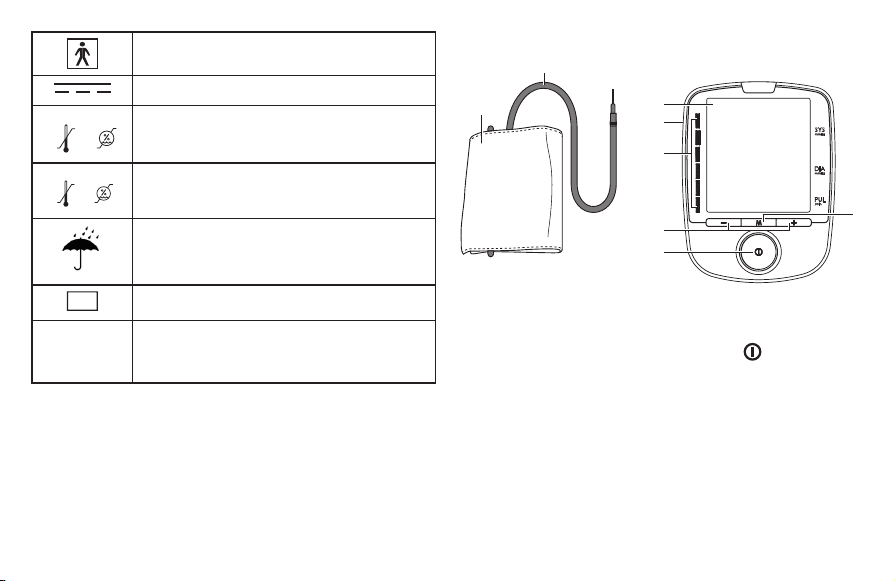
36
Pieza aplicada tipo BF (solo brazalete)
Corriente directa
Storage
Temperatura y humedad de
almacenamiento permitidas
Operating
Temperatura y humedad de
funcionamiento permitidas
Mantenga seco
S
N
Número de serie
IP 20
Protección contra cuerpos extraños
sólidos con un diámetro de 12.5 mm y
superior
3. Contenido del paquete
• Tensiómetro BM 47
• Brazalete universal de 8.7 a 16.5 in (22 - 42 cm)
• Manual de instrucciones
• Manual de inicio rápido
• Bolsa de almacenamiento
• 4 baterías alcalinas de 1.5 V, AA
4. Descripción del dispositivo
1. Brazalete
2. Tubo para brazalete
3. Conector del brazalete
4. Botón START/STOP (inicio/detención)
5. Botones de función -/+
6. Escala JNC LED
7. Conexión para el conector del brazalete
8. Pantalla
9. Botón de memoria M
2
1
3
8
7
6
5
4
9
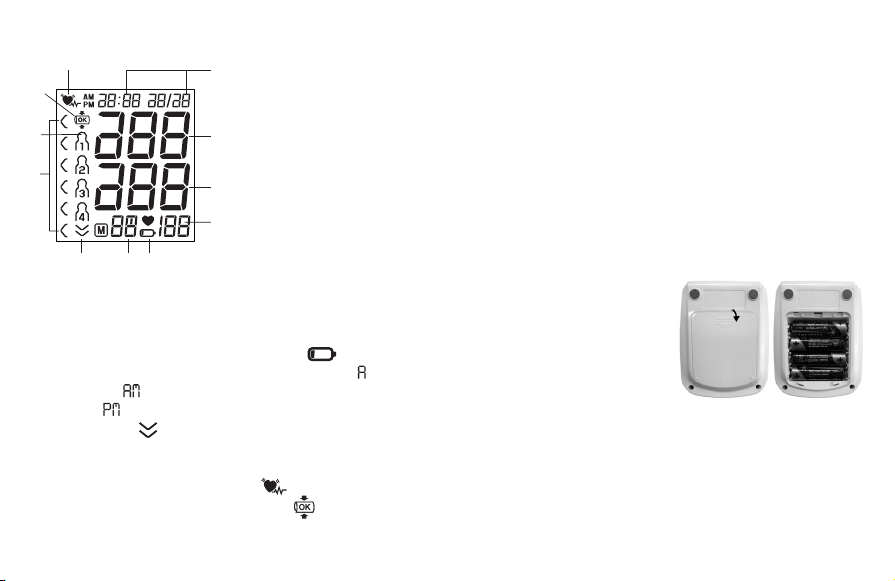
37
Íconos en la pantalla:
BM 47 Display Shoppers
1117
10
1
2
11
9
8
7 6 5
3
4
1. Hora y fecha
2. Presión sistólica
3. Presión diastólica
4. Ritmo cardiaco medido
5. Símbolo de reemplazo de la batería
6. Visualización de memoria: valor promedio ( ),
mañana (
),
tarde ( ), número de espacio de memoria
7. Liberar aire
8. Clasificación del JNC
9. Memoria de usuario
10. Símbolo de arritmia cardiaca
11. Indicador de apriete del brazalete
Para obtener más información relacionada con el producto,
consultar dudas o ponerse en contacto con el servicio al
cliente, llame gratis al 1-800-536-0366 o escriba un correo
electrónico a info@beurer.com.
5. Inicio
NOTA:
Para conservar las baterías, el tensiómetro se apaga
automáticamente si no se oprime ningún botón durante
un minuto.
5.1 Inserción y reemplazo de las baterías
• Retire la tapa de las baterías
de la parte posterior del
tensiómetro.
• Limpie los contactos de la
batería y los del dispositivo
con una tela seca y suave
antes de la instalación.
• Inserte o reemplace solo con cuatro baterías alcalinas AA
de 1.5 V. Asegúrese bien de insertarlas con la polaridad
correcta (+/-) según lo indicado (vea el diagrama dentro
del compartimiento de baterías). No use otros tipos de
baterías.
• Reinstale la tapa de las baterías con cuidado.
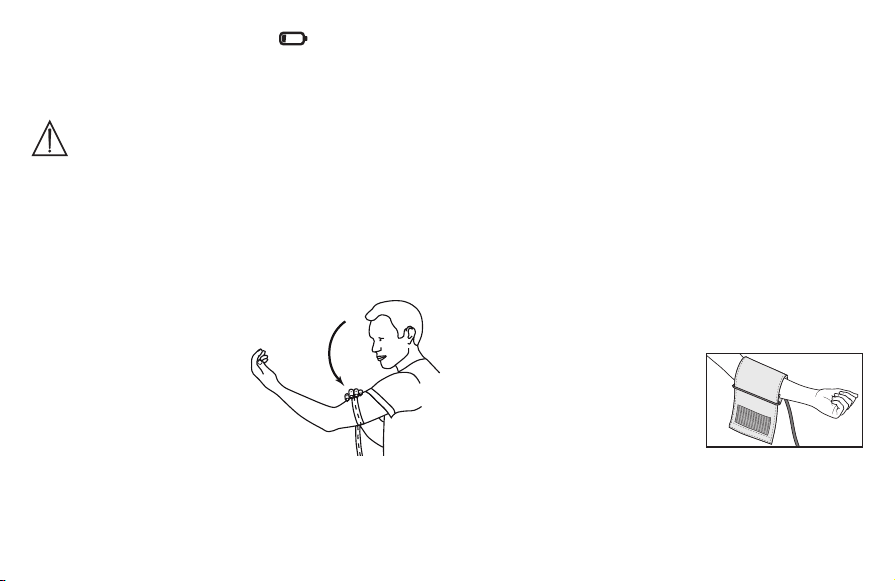
38
Si el ícono “cambiar batería” está iluminado
continuamente, ya no podrá realizar mediciones y deberá
reemplazar todas las baterías.
5.2 Selección del brazalete
ADVERTENCIA:
•
El tamaño de brazalete adecuado es importante para
obtener mediciones exactas. Use el dispositivo solo en
adultos que tengan la circunferencia de brazo derecho
adecuada para este instrumento.
Esta unidad incluye un tamaño de brazalete:
• Brazalete universal de 8.7 a 16.5 pulg. (22 - 42 cm)
Mida la circunferencia de
su brazo alrededor del bíceps
con una cinta para medir
común.
5.3 Ajuste de la fecha y hora
Es esencial ajustar la fecha y la hora. De otro modo, no
podrá guardar sus valores medidos correctamente con una
fecha y hora para acceder a ellos más adelante.
Para ajustar la fecha y hora proceda como sigue:
• Presione el botón de memoria M durante al menos tres
segundos.
• Los números del año empezarán a parpadear. Ajuste el
año con los botones de función -/+ y confírmelo con el
botón de memoria M.
• Ajuste el mes, el día, la hora y los minutos, y confirme
cada ajuste con el botón de memoria M.
6. Medición de la presión sanguínea
6.1 Colocación del brazalete
NOTA:
Coloque siempre el brazalete correctamente sobre el
brazo al nivel del corazón, de acuerdo con las siguientes
instrucciones.
Ajuste el brazalete alrededor del
brazo izquierdo descubierto. No
ponga el brazalete sobre sopa
gruesa (como una chaqueta o la
manga de un suéter), ya que el
tensiómetro no podrá hacer una
medición adecuada. La circulación
de la sangre en el brazo no deberá
estar restringida por ropa apretada
ni otros objetos.
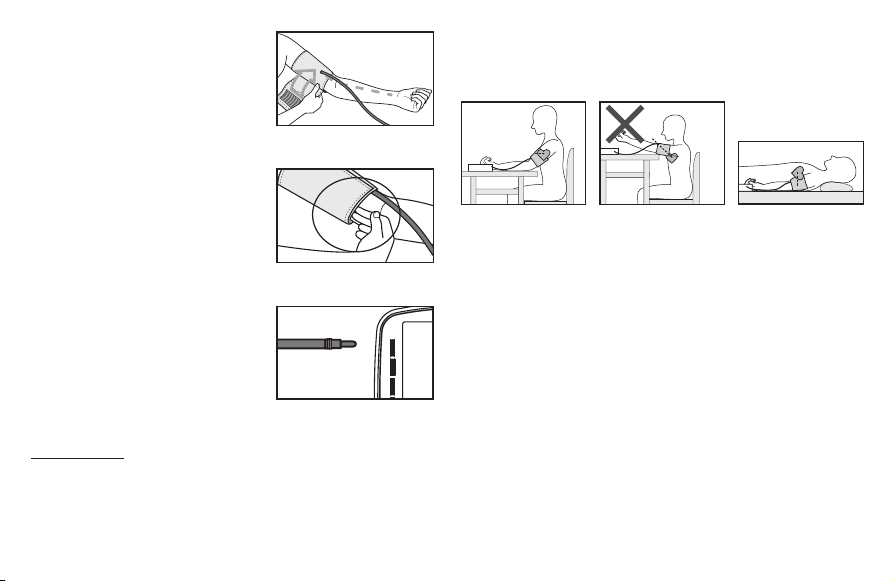
39
El brazalete debe ubicarse en el
brazo de modo que el borde inferior
quede entre 0.8 y 1.2 pulg. (2 y 3
cm) por encima de la curva del
codo y encima de la arteria. El tubo
deberá estar alineado con el centro
de la palma.
Ahora ajuste suficientemente el
extremo libre del brazalete
alrededor del brazo, pero sin
apretar demasiado, y fíjelo con el
sujetador de velcro. El brazalete
deberá estar suficientemente
ajustado para permitir meter dos dedos debajo de él.
Inserte el tubo del brazalete en el
receptáculo para el accesorio del
brazalete, en el lado izquierdo de
la unidad. Asegúrese de que se
inserte firmemente en la unidad
principal y de que no haya
torceduras en el tubo del brazalete.
Importante: Este dispositivo solo debe usarse con
brazaletes originales. El brazalete que se incluye con el
dispositivo es adecuado para brazos con una circunferencia
de 8.7 a 16.5 pulg. (22 - 42 cm). No se pueden utilizar
los brazaletes de reemplazo de otros modelos con este
modelo. De hacerlo, se obtendrán lecturas imprecisas o
mensajes de error.
6.2 Postura correcta
• Descanse al menos un minuto antes de cada medición.
De otro modo podría obtener resultados erróneos.
• Puede realizar la medición sentado o acostado.
Asegúrese siempre de que el brazalete esté al mismo
nivel que el corazón.
• Abra y relaje la mano con la palma hacia arriba. Durante
la medición de la presión arterial, permanezca calmado
y quieto, no se mueva ni hable mientras se realiza la
medición.
• Siéntese recto y cómodamente con el brazo izquierdo
apoyado en una superficie plana. No cruce las piernas.
Coloque sus pies en el piso.
• Tenga en cuenta que cualquier movimiento muscular
durante el proceso de inflado o desinflado puede causar
un error de medición.

40
6.3 Notas generales
• Para lograr un monitoreo y referencia de la presión
sanguínea confiables, se recomienda mantener registros
a largo plazo.
• Para minimizar las variaciones en las mediciones debido a
la actividad física, descanse al menos un minuto antes de
medirse la presión sanguínea (o 15 minutos después de
una actividad extenuante). No deberá estar físicamente
cansado ni agotado al hacer la medición.
• Para obtener la presión sanguínea en condiciones de
reposo, evite comer, ingerir bebidas alcohólicas y con
cafeína, fumar, hacer ejercicio y bañarse al menos en los
30 minutos anteriores a la medición.
• El estrés eleva la presión sanguínea.
• Haga las mediciones en un entorno tranquilo y relajado
a temperatura ambiente.
• Espere siempre al menos un minuto entre mediciones
para dejar que la circulación sanguínea en el brazo vuelva
a la normalidad. Es posible que necesite aumentar el
tiempo de espera dependiendo de sus características
fisiológicas individuales. Debido a los cambios
fisiológicos normales y los numerosos factores externos
que afectan ala presión sanguínea, es raro obtener
mediciones idénticas de presión sanguínea, incluso
cuando se toman con intervalo de pocos minutos. Hable
con su médico para determinar qué está afectando a su
presión sanguínea y qué variación podría considerarse
normal en su caso.
• La exactitud de cualquier medición de la presión
sanguínea con este dispositivo puede verse afectada por
numerosas causas. Algunas pueden evitarse y algunas se
tienen que aceptar en el momento de la medición. Hable
con su médico sobre las posibles causas que afectan a
su presión sanguínea.
• No infle el brazalete a menos que esté envuelto en el
brazo.
• Si durante aproximadamente un minuto no se aprieta
ningún botón, la función de apagado automático apaga
la unidad para conservar las baterías.
• No toque la unidad, el tubo o el brazalete, ni oprima
ningún botón cuando se esté llevando a cabo la medición,
excepto para detener la medición. Hacerlo puede causar
lecturas incorrectas.
6.4 Para hacer una medición
NOTA:
Si está usando la unidad por primera vez, retire la película
protectora de la pantalla.
• Ponga el brazalete alrededor de su brazo izquierdo
descubierto en la forma descrita arriba y asuma la
posición en que desea hacer la medición.
• Encienda el tensiómetro con el botón START/STOP
(inicio/detención) .
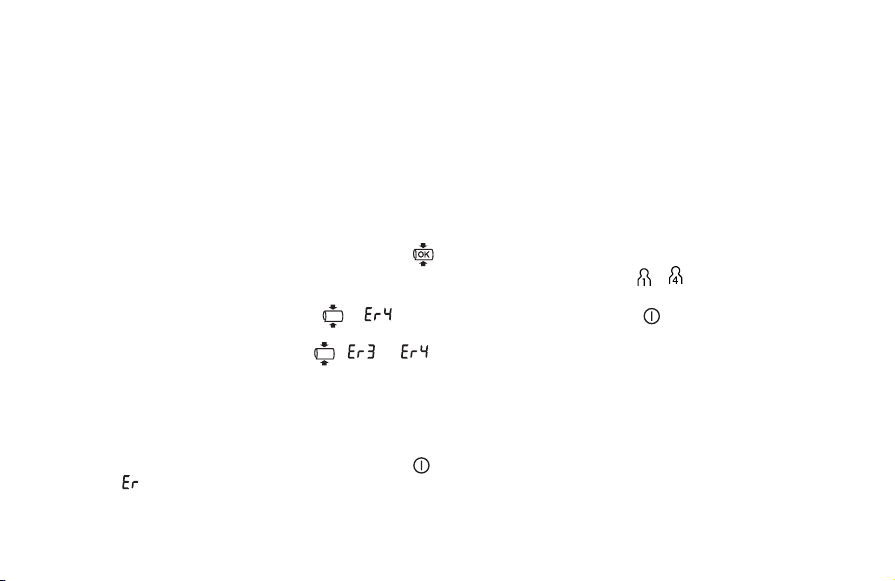
41
• Antes de la medición, se muestra brevemente el último
resultado guardado. Si no hay ninguna medición en la
memoria, el instrumento siempre muestra el valor “0”.
• El brazalete se infla. La presión del brazalete se libera
lentamente.
NOTA:
Este monitor se volverá a inflar si el sistema detecta que su
cuerpo requiere más presión para la medición. Tan pronto
como se detecta un ritmo cardiaco, se muestra el símbolo
de ritmo cardiaco.
• El símbolo del indicador de apriete del brazalete
se muestra si el brazalete está suficientemente bien
apretado. En el caso de que el brazalete no esté bien
apretado durante la medición, aparecen y “ ” en la
pantalla. En el caso de que el brazalete esté demasiado
apretado durante la medición, aparecen , “ ” y “ ”
en la pantalla. En tales casos, se cancela la medición.
• Cuando la medición termina, el brazalete se desinfla por
completo. Se muestran el ritmo cardíaco y la presión
sanguínea sistólica y diastólica.
• Puede interrumpir la medición en cualquier momento
presionando el botón START/STOP (inicio/detención) .
• Aparece “ _” si no se ha podido llevar a cabo la
medición correctamente. Consulte la sección sobre
mensajes de error y solución de problemas, y repita la
medición.
• El resultado de la prueba se guarda automáticamente.
• Para apagar y liberar la presión, vuelva a presionar
el botón de encendido/apagado. Si olvida apagar el
dispositivo, se apaga automáticamente después de
aproximadamente 1 minuto.
Espere al menos un minuto antes de hacer otra lectura.
6.5. Cómo guardar, visualizar y borrar mediciones
• Los resultados de cada medición correcta se guardan
junto con la fecha y la hora. Si hay más de 30mediciones,
se pierden las mediciones más antiguas.
• Presione el botón de función - o +. Seleccione la memoria
de usuario que desee ( a ) presionando el botón de
función -/+. Confirme su selección con el botón START/
STOP (inicio/detención)
.
• Si oprime el botón de memoria M, se mostrará el valor
promedio A de todos los valores medidos almacenados
en la memoria de usuario. Si oprime el botón de memoria
M de nuevo, se mostrará el valor promedio de todas
las mediciones realizadas por la mañana durante los
últimos siete días (mañana: 5.00 – 9.00, se muestra AM).
Si oprime el botón de memoria M de nuevo, se mostrará
el valor promedio de todas las mediciones realizadas
por la tarde durante los últimos siete días (tarde: 18.00 –
20.00, se muestra PM). Si continúa presionando el botón
de memoria M, se mostrarán los valores más recientes de
las distintas mediciones, con la fecha y la hora.

42
• Puede borrar la memoria manteniendo presionado el
botón de memoria M durante tres segundos.
• Para apagar el tensiómetro, presione el botón START/
STOP (inicio/detención) .
• Si olvida apagar la unidad, esta se apaga automáticamente
después de un minuto.
NOTA:
Este monitor se volverá a inflar si el sistema detecta que su
cuerpo requiere más presión para la medición. Tan pronto
como se detecta un ritmo cardiaco, se muestra el símbolo
de ritmo cardiaco.
• Cuando la medición termina, el brazalete se desinfla por
completo. Se muestran el ritmo cardiaco y la tensión
arterial sistólica y diastólica.
• Puede interrumpir la medición en cualquier momento
presionando el botón START/STOP (inicio/detención) .
• Aparece “ _” si no se ha podido llevar a cabo la
medición correctamente. Consulte la sección sobre
mensajes de error y solución de problemas, y repita la
medición.
• El resultado de la prueba se guarda automáticamente.
• Para apagar y liberar la presión, oprima el botón START/
STOP (inicio/detención) una vez más. Si olvida apagar
el dispositivo, se apaga automáticamente después de
aproximadamente 1 minuto.
Espere al menos 5 minutos antes de hacer otra medición.
7. Evaluación de resultados
Este símbolo indica que se detectaron algunas
irregularidades en el ritmo cardiaco/pulso durante la
medición.
NOTA:
• Hablar, moverse, agitarse o un pulso irregular durante la
medición pueden causar la aparición este símbolo.
• Repita la medición si el ícono parpadeante se muestra
después de la medición. Tenga en cuenta que deberá
descansar al menos 5 minutos entre mediciones y no
hablar ni moverse durante la medición. Si el ícono sigue
apareciendo en lecturas subsecuentes, le recomendamos
que consulte a su médico para determinar si eso es
motivo de inquietud. No trate de interpretar las lecturas
ni tratar una afección usted mismo. Siga la orientación
de un profesional de la salud. Si se le presenta una
emergencia, llame al 911 de inmediato.
7.1 Clasificación del Comité Nacional Conjunto (JNC)
Según las Pautas y Definiciones del JNC y los más
recientes descubrimientos, los resultados de pruebas en
adultos se pueden clasificar y evaluar según la siguiente
tabla:

43
NOTA:
Este estándar, sin embargo, es una pauta general, ya
que la presión sanguínea individual varía entre diferentes
personas, grupos de edad, etc. Consulte a su médico para
obtener un diagnóstico adecuado.
La gráfica de barras en la pantalla y la escala de la unidad
indican el intervalo de la tensión arterial que se registró.
NOTA:
Si los valores para la presión sistólica y diastólica están en
dos intervalos diferentes del JNC (por ejemplo, la sistólica
en el intervalo alto-normal y la diastólica en el intervalo
normal), la clasificación gráfica del JNC en la unidad indica
el intervalo mayor (alto-normal en el ejemplo).
8. Cuidado, mantenimiento y
desecho
Para mantener su tensiómetro digital en la mejor condición
y protegerlo contra daños, siga estas instrucciones:
• Limpie su dispositivo y brazalete con cuidado solamente
con una tela suave ligeramente humedecida, y séquelo
inmediatamente con una tela seca y suave. No lo
presione.
• Para limpiar, humedezca un paño suave con alcohol
etílico (75-90 %), escúrralo y frote el lado interior del
brazalete (el lado que está en contacto con la piel). Déjelo
al aire para que se seque.
• Al almacenar el dispositivo, asegúrese de que no se
pongan objetos pesados sobre él.
• No doble el brazalete y el tubo con mucha fuerza. El tubo
del brazalete no deberá tener torceduras; manténgalo
alejado de bordes afilados.
• Si la unidad se guarda cerca de la temperatura de
congelación, deje que llegue a temperatura ambiente
antes de usarla.
• Guarde siempre la unidad en la bolsa de almacenamiento
después de usarla.
• Es posible que esta unidad no cumpla las especificaciones
de desempeño si se almacena o usa fuera de los
intervalos de temperatura y humedad adecuados
(consulte la sección “Especificaciones técnicas”).
• El tensiómetro requiere 6 horas para calentarse/enfriarse
desde la temperatura mínima/máxima de almacenamiento
entre cada uso, hasta que esté listo para su uso previsto
(con una temperatura ambiente de 68°F (20°C)).
• Se recomienda limpiar el brazalete después de cada 200
usos.
• El brazalete se mantiene íntegro después de 1000 ciclos
de apertura y cierre.
• Evite guardar la unidad a altas temperaturas o bajo la luz
directa del sol.
• Use la unidad de acuerdo con las instrucciones de este
manual.
• El usuario no puede realizar el mantenimiento de ninguno
de los componentes de este tensiómetro. Diagramas de
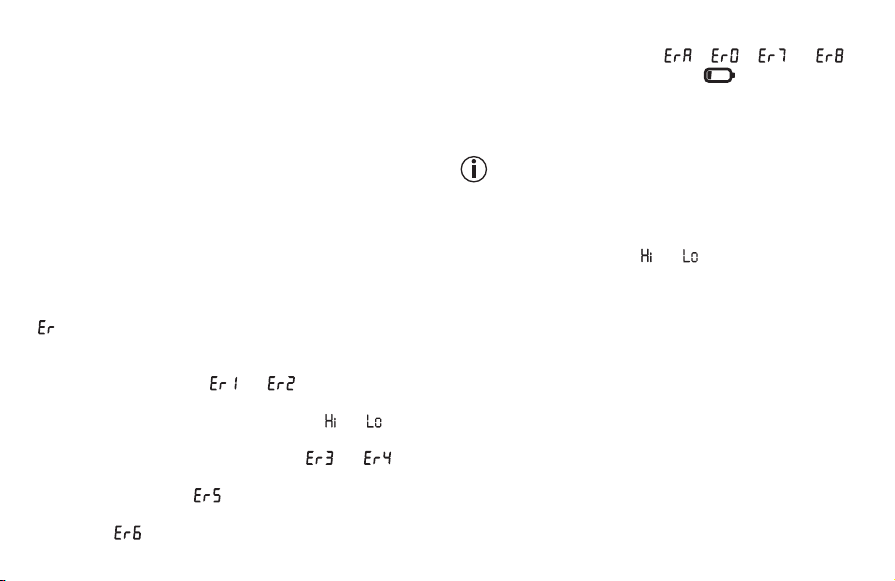
44
circuito, listas de piezas componentes, descripciones,
instrucciones de calibración u otras información
necesarias para el personal de servicio cualificado para
la reparación de piezas diseñadas como reparables están
disponibles por solicitud.
Desecho
Respete las normas locales para el desecho de materiales.
Deseche el dispositivo de acuerdo con las normas locales.
Si tiene alguna pregunta, consulte a las autoridades locales
encargadas del desecho de residuos.
9. Mensajes de error y solución de
problemas
En caso de error, aparece en la pantalla el mensaje de error
“ _”.
Los mensajes de error pueden aparecer si:
• no se ha podido medir la presión sistólica o diastólica (en
la pantalla se muestra “ ” o “ ”),
• la presión sistólica o diastólica estaba fuera del intervalo
de medición (en la pantalla se muestra “
” o
“
”),
• el brazalete se apretó demasiado o no se apretó lo
suficiente (en la pantalla se muestra “ ” o “ ”),
• la presión de la bomba es superior a 300 mmHg (en la
pantalla se muestra “ ”),
• el inflado tarda más de 160 segundos (en la pantalla se
muestra “
”),
• se ha producido un error en el sistema o el dispositivo
(en la pantalla se muestra “ ”, “ ”, “ ” o “ ”),
• las baterías están casi agotadas
.
En tales casos, repita la medición y asegúrese de no
moverse ni hablar.
Si es necesario, vuelva a insertar las baterías o reemplácelas.
A
larma técnica: descripción
Si la presión sanguínea medida (sistólica o diastólica)
queda fuera de los límites especificados en la sección
“Especificaciones técnicas”, aparecerá la alarma técnica
en la pantalla, indicando “ ” o
“
”. En estos casos, debe
pedir asistencia médica y comprobar la precisión del
procedimiento utilizado.
Los valores límite para la alarma técnica se programan en la
fábrica y no pueden ajustarse ni desactivarse. Estos valores
límite tienen asignada segunda prioridad según la norma
IEC 60601-1-8.
La alarma técnica no es de retención y no debe
restablecerse. La señal que aparece en la pantalla
desaparecerá automáticamente después de unos ocho
segundos.
NOTA:
Si aún no funciona la unidad, llame al servicio al cliente al
1-800-536-0366.
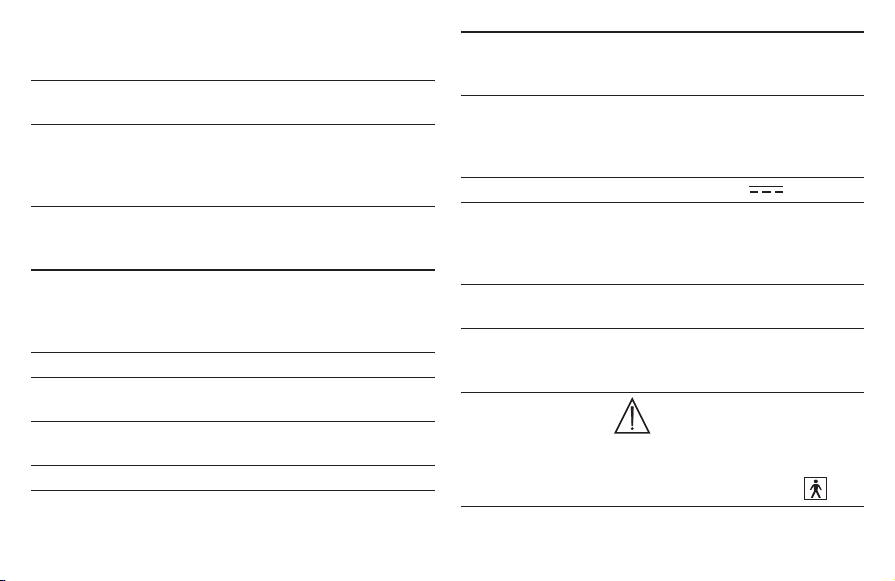
45
10. Especificaciones técnicas
Modelo BM 47
Método de medición Medición de presión sanguínea os
-
cilométrica, no invasiva, en el brazo
Rango de medición Presión del brazalete: 0–300
mmHg, sistólica: 60–260 mmHg,
diastólica: 40–199 mmHg, pulso:
40–180 latidos/minuto
Exactitud de la
pantalla
Sistólica: ±3 mmHg, diastólica: ±3
mmHg, pulso: ±5% del valor mos
-
trado
Imprecisión de la
medición
Máxima desviación estándar per
-
mitida según las pruebas clínicas:
sistólica 8 mmHg/diastólica 8
mmHg
Memoria 4 x 30 espacios de memoria
Dimensiones
5.3 x 4 x 2 pulg.
(134 x 102 x 52.5 mm)
Peso Aproximadamente 280g
(sin baterías ni brazalete)
Tamaño de brazalete 8.7 a 16.5 pulg. (22 - 42 cm)
Condiciones de
operación per
-
mitidas
+50 °F a +104 °F (+10 °C a +40 °C),
≤ 85% de humedad relativa en el
aire (no condensante)
Condiciones de
almacenamiento
permitidas
-4 °F a +122 °F (-20 °C to +50 °C),
≤ 85% de humedad relativa en el
aire, presión ambiental de 800-
1050 hPa
Energía 4 baterías de 1.5 V
AA
Duración de la
batería
Aproximadamente para 500 medi
-
ciones, dependiendo del nivel de
presión sanguínea o presión de la
bomba
Accesorios Instrucciones de uso, 4 baterías de
1.5V AA, bolsa de almacenamiento
Clasificación Alimentación interna, IP20, sin AP
ni APG, funcionamiento continuo,
parte aplicada tipo BF
Clave de los
símbolos
¡ADVERTENCIA!
Lea la
información de seguridad y
todas las instrucciones para
evitar lesiones graves.
Parte de aplicación tipo BF

46
Apagado automático aprox. 1 minuto después de la última
vez que se pulsa un botón
Estas especificaciones están sujetas a cambios sin previo
aviso con propósitos de mejora.
El número de serie se encuentra en el aparato o en el
compartimento de las pilas.
• Este aparato cumple con la norma europea EN60601-1-2
(Conformidad con IEC 61000-4-2, IEC 61000-4-3,
IEC 61000-4-4, IEC 61000-4-5, IEC 61000-4-6,
IEC 610004-8, IEC 610004-11) y está sujeto a las
medidas especiales de precaución relativas a la
compatibilidad electromagnética (EMC). Tenga en
cuenta que los sistemas de comunicación HF portátiles
y móviles pueden interferir con este instrumento. Para
más detalles, comuníquese con nuestro servicio al cliente
en la dirección proporcionada.
• El instrumento cumple la directiva sobre productos
sanitarios de la UE 93/42/CE, la ley alemana sobre
productos sanitarios y las normas europeas EN 1060-1
(esfigmomanómetros no invasivos, parte1: requisitos
generales) y EN 1060-3 (esfigmomanómetros no
invasivos, parte3: requisitos suplementarios aplicables a
los sistemas electromecánicos de medición de la presión
sanguínea).
• Los esfigmomanómetros electrónicos corresponden
a los siguientes estándares: ISO81060-2: 2013
(esfigmomanómetros no invasivos, parte 2: Validación
clínica de tipo de medición automatizada).
11. Información de conformidad de
la FCC
Tensiómetro BM 47
Parte responsable – Información de contacto en Estados
Unidos:
Beurer North America LP
1 Oakwood Boulevard, Suite 255
Hollywood, FL 33020
Estados Unidos
1-800-536-0366
info@beurer.com
Déclaración de conformidad de la FCC
Este dispositivo cumple con la parte 15 de las Reglas de
la FCC. El funcionamiento está sujeto a las siguientes dos
condiciones:
(1) este dispositivo no podrá causar interferencia dañina, y
(2) este dispositivo debe aceptar cualquier interferencia
recibida, incluyendo interferencia que podría causar
funcionamiento no deseado.

47
Los cambios o modifcaciones que la parte responsable del
cumplimiento no apruebe expresamente podrían anular la
autoridad del usuario para operar el equipo.
NOTA: Este equipo ha sido probado y se determinó que
cumple con los límites para los dispositivos digitales
Clase B, de acuerdo con la parte 15 de las reglas de la
FCC. Estos límites sirven para proporcionar protección
razonable contra la interferencia dañina en instalaciones
residenciales. Este equipo genera, usa y puede emitir
energía de radiofrecuencia y, si no se instala de acuerdo
con las instrucciones, puede causar interferencias dañinas a
las comunicaciones de radio. Sin embargo, no hay garantía
de que no se producirán interferencias en una instalación en
particular. Si este equipo efectivamente causa interferencias
dañinas a la recepción de radio o televisión, lo cual puede
determinarse al apagar y encender el equipo, se recomienda
al usuario que intente corregir las interferencias mediante
una o más de las siguientes medidas:
— Reorientar o cambiar de lugar la antena receptora.
— Aumentar la distancia entre el equipo y el receptor.
— Conectar el equipo en una toma o circuito diferente a
aquel donde está conectado el receptor.
— Consultar al distribuidor o a un técnico con experiencia
en radio y televisión.ibuidor o técnico con experiencia
en radio y televisión.
12. Garantía
Garantía limitada de por vida de la compra original
Se garantiza que su tensiómetro Beurer, modelo BM47,
excepto los brazaletes (incluido el tubo), las baterías
y cualquier accesorio opcional, está libre de defectos
en los materiales y la mano de obra durante la vida del
producto bajo condiciones normales de uso y servicio
para los que fue diseñado. El brazalete está garantizado
de estar libre de defectos en materiales y mano de obra que
aparezcan en un plazo de dos años a partir de la fecha de
compra cuando el monitor se usa de conformidad con las
instrucciones proporcionadas con la unidad. Esta garantía
se aplica solamente al comprador original y no se extiende
a vendedores minoristas o futuros propietarios.
A nuestra discreción, repararemos o reemplazaremos el
tensiómetro Beurer, modelo BM47, sin cargo adicional,
por cualquier parte o partes cubiertas por esta garantía
escrita. No se harán reembolsos. La reparación o reemplazo
es nuestra única responsabilidad y el único recurso de
usted bajo esta garantía por escrito. Si no hay partes de
reemplazo para los materiales defectuosos, Beurer se
reserva el derecho de sustituciones del producto en lugar
de reparación o remplazo.
Para servicio de garantía, llame a nuestro departamento
de servicio al cliente al teléfono 1-800-536-0366 o escriba
a info@beurer.com para proporcionar una descripción del

48
problema. Si se considera que el problema está dentro del
alcance de la garantía limitada de por vida, se le pedirá
que envíe el producto a su cargo en su empaque original
con el comprobante de compra, y su nombre, domicilio y
número telefónico. Si se estima que el problema no está
cubierto por la garantía limitada de por vida, le enviaremos
una cotización para la reparación o remplazo así como el
costo del transporte.
Esta garantía no cubre daños causados por mal uso o
abuso; accidente; conexión de accesorios no autorizados;
alteración del producto; instalación incorrecta; aplicación
errónea; falta de cuidado razonable con respecto al
producto; reparaciones o modificaciones no autorizadas;
uso indebido de alimentación o energía eléctrica; baterías
usadas desgastadas; desgaste normal; falta de potencia;
producto dejado caer; mal funcionamiento o daño de una
parte operativa por falta de cumplir con las instrucciones
de uso o de proporcionar el mantenimiento recomendado
por el fabricante; daño en el transporte; robo; negligencia;
vandalismo; condiciones ambientales; pérdida del
uso durante el periodo en que el producto esté en una
instalación de reparación o en espera de partes o reparación
por otra causa; o cualquier condición de otro tipo que esté
fuera del control de Beurer. Esta garantía no es válida si el
producto se usa alguna vez en un ambiente comercial o de
negocio. La máxima responsabilidad de Beurer bajo esta
garantía se limita al precio de compra pagado realmente por
el cliente por el producto cubierto por la garantía, según se
confirme mediante prueba de compra, independientemente
de la cantidad de cualquier otro daño directo o indirecto
que sufra el cliente.
Esta garantía es efectiva solamente si el producto se
compra y usa en el país de compra del producto. Un
producto que requiere modificaciones o adaptación para
permitirle funcionar en cualquier otro país que no es el
país para el cual fue diseñado, fabricado, aprobado y/o
autorizado, o la reparación de productos dañados debido
a esas modificaciones no están cubiertos por esta garantía.
LA GARANTÍA AQUÍ PROPORCIONADA SERÁ LA
GARANTÍA ÚNICA Y EXCLUSIVA. CUALESQUIER
GARANTÍAS, OBLIGACIONES O RESPONSABILIDADES
IMPLÍCITAS, INCLUYENDO PERO SIN LIMITARSE A
LA GARANTÍA IMPLÍCITA DE COMERCIABILIDAD E
IDONEIDAD PARA UN PROPÓSITO EN PARTICULAR,
ESTÁN LIMITADAS EN CUANTO A DURACIÓN A LA
DURACIÓN DE ESTA GARANTÍA ESCRITA APLICABLE.
Algunos estados no permiten limitaciones acerca de la
duración de una garantía implícita, de manera que las
limitaciones anteriores podrían no ser aplicables para usted.
EN NINGÚN CASO BEURER SERÁ RESPONSABLE
DE CUALESQUIERA DAÑOS ESPECIALES,
INCIDENTALES, INDIRECTOS O CONSECUENTES
POR INCUMPLIMIENTO DE ESTA O DE CUALQUIER

49
OTRA GARANTÍA, EXPRESA, IMPLÍCITA O POR
CUALQUIER OTRA TEORÍA DE LA RESPONSABILIDAD,
DE CUALQUIER TIPO. Algunos estados no permiten la
exclusión o limitación de daños especiales, incidentales o
consecuentes, de manera que la limitación anterior podría
no ser aplicable para usted.
Beurer no autoriza a ninguna persona, incluyendo, pero
sin limitarse a, vendedores minoristas, al comprador
consumidor subsiguiente del producto de un vendedor
minorista o comprador remoto, a obligar a Beurer en
cualquier forma más allá de los términos establecidos en
la presente.
Esta garantía no se extiende a la compra de productos
abiertos, usados, reparados, reempaquetados y/o
resellados, incluyendo pero sin limitarse a la venta de
dichos productos en sitios de subasta de Internet y/o
productos de revendedores de excedentes o en volumen.
Cualesquier garantías cesarán y terminarán inmediatamente
en relación a productos o partes de los mismos que sean
reparadas, reemplazadas, alteradas o modificadas sin el
consentimiento explícito por escrito de parte de Beurer.
Esta garantía le da derechos específicos, y usted puede
también tener otros derechos que pueden variar de un
estado a otro.
Para obtener más información relacionada con nuestra
línea de productos en los Estados Unidos, visite: www.
beurer.com.
Si tiene alguna duda relacionada con el funcionamiento
de su tensiómetro, llame al número de asistencia para el
tensiómetro Beurer:
1-800-536-0366
o envíe un correo electrónico a: info@beurer.com.
Distribuido por:
Beurer North America LP
1 Oakwood Boulevard, Suite 255
Hollywood, FL 33020
Hecho en China.
Salvo errores y modificaciones

50
1. Electromagnetic Compatibility Information
Table 1 - Emission
Phenomenon Compliance Electromagnetic environment
RF emissions CISPR 11
Group 1, Class B
Home healthcare environment
Harmonic distortion IEC 61000-3-2
Class A
Home healthcare environment
Voltage fluctuations and flicker IEC 61000-3-3
Compliance
Home healthcare environment
Table 2 - Enclosure Port
Phenomenon
Basic EMC
standard
Immunity test levels
Home Healthcare Environment
Electrostatic
Discharge
IEC 61000-4-2 ±8 kV contact
±2kV, ±4kV, ±8kV, ±15kV air
Radiated RF EM field IEC 61000-4-3 10V/m
80MHz-2.7GHz
80% AM at 1kHz
Proximity fields from RF wireless com-
munications equipment
IEC 61000-4-3 Refer to table 3
Rated power frequency magnetic fields IEC 61000-4-8 30A/m
50Hz or 60Hz

51
Table 3 - Proximity fields from RF wireless communications equipment
Test
Frequency
(MHz)
Band
(MHz)
Immunity test levels
Professional healthcare facility environment
385 380-390 Pulse modulation 18Hz, 27V/m
450 430-470 FM, ±5kHz deviation, 1kHz sine, 28V/m
710
704-787
Pulse modulation 217Hz, 9V/m
745
780
810
800-960
Pulse modulation 18Hz, 28V/m
870
930
1720
1700-1990
Pulse modulation 217Hz, 28V/m
1845
1970
2450 2400-2570 Pulse modulation 217Hz, 28V/m
5240
5100-5800
Pulse modulation 217Hz, 9V/m
5500
5785

52
660.73_BM47_2019-09-23_01_IM_BEU-USA