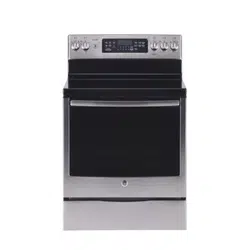

295D1697P001
29-6023
www.GEAppliances.ca
Write the model and serial
numbers here:
Model # ________________
Serial # ________________
You can find them on a label
behind the drawer or behind the
lower oven door on the front of
the range frame.
Owner’s Manual
Ranges
Safety Instructions . . . . . . . . . . . . . . . . . . . . . . . . . . . .2–5
Operating Instructions
Surface Units . . . . . . . . . . . . . . . . . . . . . . . . . . . . . . . . . . . 6-10
Care and Cleaning
Controls . . . . . . . . . . . . . . . . . . . . . . . . . . . . . . . . . . . . . . . 10-12
Oven . . . . . . . . . . . . . . . . . . . . . . . . . . . . . . . . . . . . . . . . . . 13-15
Cookware . . . . . . . . . . . . . . . . . . . . . . . . . . . . . . . . . . . . . 7-16
Knob-Controlled Models . . . . . . . . . . . . . . . . . . . . . . . 8-10
Steam Clean Mode . . . . . . . . . . . . . . . . . . . . . . . . . . . . . . . 20
Self-Cleaning . . . . . . . . . . . . . . . . . . . . . . . . . . . . . . . . . . . . 20
Exterior Cleaning . . . . . . . . . . . . . . . . . . . . . . . . . . . . . . . . 23
Lift-off Oven Door . . . . . . . . . . . . . . . . . . . . . . . . . . . . . . . . 24
Oven Racks . . . . . . . . . . . . . . . . . . . . . . . . . . . . . . . . . . . . . . 25
Removable Warming Drawer/Lower . . . . . . . . . . . . . . 26
Surfaces . . . . . . . . . . . . . . . . . . . . . . . . . . . . . . . . . . . . . . . . . 28
Special Features . . . . . . . . . . . . . . . . . . . . . . . . . . . . . . . . . 13
Sabbath Features . . . . . . . . . . . . . . . . . . . . . . . . . . . . . . . . 14
Cooking Modes . . . . . . . . . . . . . . . . . . . . . . . . . . . . . . . . . . 16
Convection Oven . . . . . . . . . . . . . . . . . . . . . . . . . . . . . . . . . 16
Probe . . . . . . . . . . . . . . . . . . . . . . . . . . . . . . . . . . . . . . . . .17-19
Warming Drawer . . . . . . . . . . . . . . . . . . . . . . . . . . . . . . . . . 21
Lower Oven Drawer . . . . . . . . . . . . . . . . . . . . . . . . . . . . . . 22
Troubleshooting Tips . . . . . . . . . . . . . . . . . . . . . . . . . 30
Accesories . . . . . . . . . . . . . . . . . . . . . . . . . . . . . . . . . . . . . 36
Consumer Support
Consumer Support . . . . . . . . . . . . . . . . . . . . . . . . . . . . . . . . . . . . 41
Ownership Registration . . . . . . . . . . . . . . . . . . . . . . . . . . . . . . . 38
Warranty . . . . . . . . . . . . . . . . . . . . . . . . . . . . . . . . . . . . . . . . . . . . . . 41
Free-Standing Electric
PCB905
PCB915
PCB940
PCB985
Consumer Support Troubleshooting Tips
Care and Cleaning
Operating
Instructions
Safety Instructions
Read all safety instructions before using the product. Failure to follow these instructions may result in fire, electric
shock, serious injury or death.
IMPORTANT SAFETY INFORMATION.
READ ALL INSTRUCTIONS BEFORE USING.
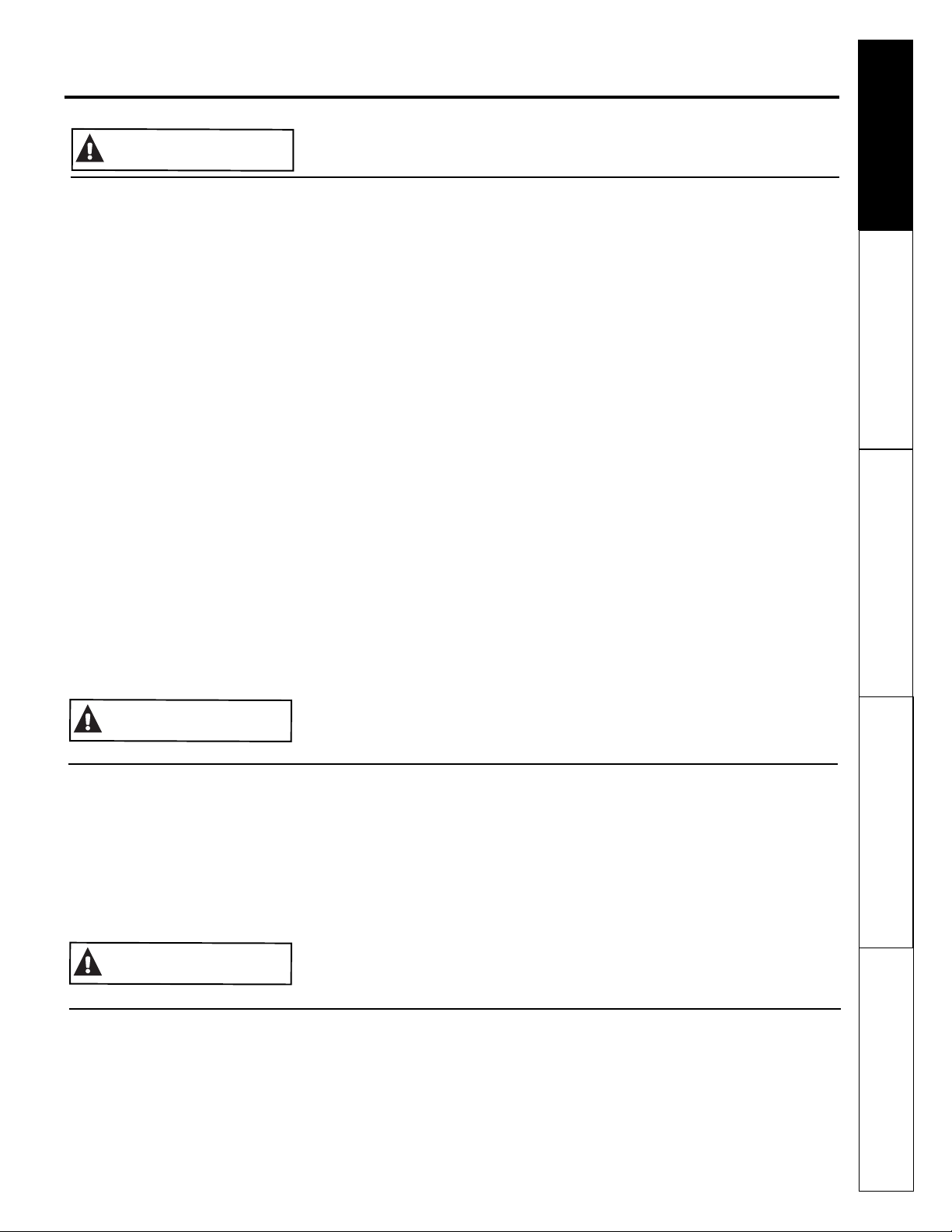
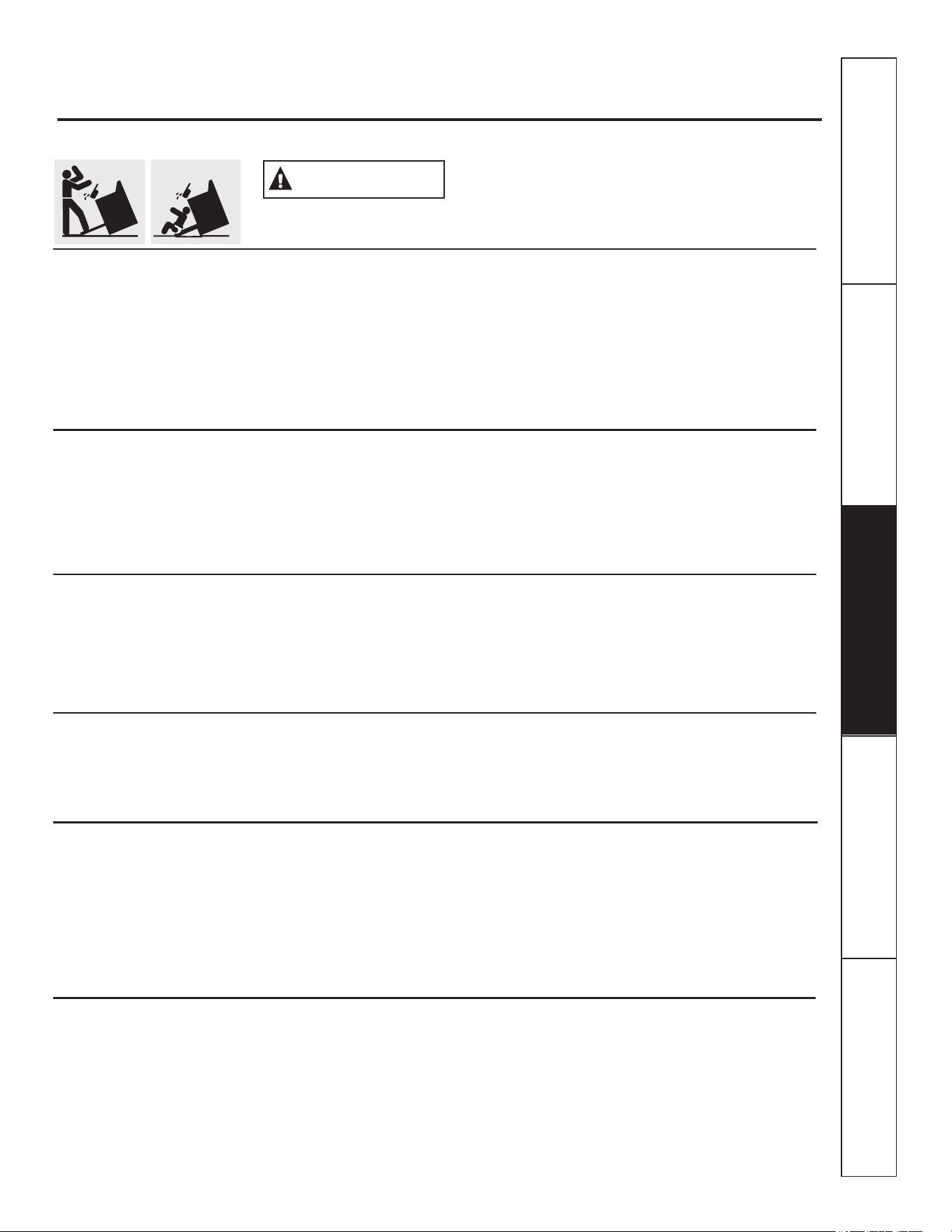
To reduce the risk of tipping the range, the range must be secured
by a properly installed anti-tip bracket. See installation instructions
shipped with the bracket for complete details before attempting
to install.
For Freestanding Ranges:
To check if the bracket is installed and engaged properly, remove
the storage drawer or kick panel and look underneath the range
to see that the leveling leg is engaged in the bracket. On models
without a storage drawer or kick panel, carefully tip the range
forward. The bracket should stop the range within 10.2 cm
(4 inches). If it does not, the bracket must be reinstalled. If the range
is pulled from the wall for any reason, always repeat this procedure
to verify the range is properly secured by the anti-tip bracket.
Never completely remove the leveling legs or the range will not
be secured to the anti-tip device properly.
If you did not receive an anti-tip bracket with your purchase,
call 1.800.561.3344 receive one at no cost. For installation
instructions of the bracket, visit. www.GEAppliances.ca
ANTI-TIP DEVICE
2
WARNING
Safety Instructions
Operating Instructions
Safety Instructions
Operating
Instructions
Care and Cleaning
Troubleshooting Tips
Consumer Support
Use this appliance for its intended purpose as described in this
Owner’s Manual.
Be sure your appliance is properly installed and grounded
by a qualified installer in accordance with the provided
installation instructions.
Do not attempt to repair or replace any part of your range
unless it is specifically recommended in this manual. All
other servicing should be transferred to a qualified
technician.
Before performing any service, unplug the range or
disconnect the power supply at the household distribution
panel by removing the fuse or switching off the circuit
breaker.
Do not leave children alone―children should not be left
alone or unattended in an area where an appliance is in use.
They should never be allowed to climb, sit or stand on any
part of the appliance.
CAUTION:Do not store items of interest to children
above a range or on the backguard of a range―children
climbing on the range to reach items could be seriously
injured.
Use only dry pot holders―moist or damp pot holders on
hot surfaces may result in burns from steam. Do not let pot
holders touch hot surface units or heating elements. Do not
use a towel or other bulky cloth in place of pot holders.
Never use your appliance for warming or heating the room.
Do not touch the surface units, the heating elements or
the interior surface of the oven. These surfaces may be
hot enough to burn even though they are dark in color.
During and after use, do not touch, or let clothing or other
flammable materials contact the surface units, areas nearby
the surface units or any interior area of the oven; allow
sufficient time for cooling first. Other surfaces of the
appliance may become hot enough to cause burns.
Potentially hot surfaces include the cooktop, areas facing
the cooktop, oven vent opening, surfaces near the opening
and crevices around the oven door.
Do not heat unopened food containers. Pressure could build
up and the container could burst, causing an injury.
Do not use aluminum foil to line the drip pans or anywhere
in the oven, except as described in this manual. Misuse could
result in damage to the range and shock or fire hazard.
Avoid scratching or impacting glass doors, cooktops or
control panels. Doing so may lead to glass breakage. Do not
cook on a product with broken glass. Shock, fire or cuts may
occur.
Cook meat and poultry thoroughly―meat to at least an
internal temperature of 71.1°C (160°F) and poultry to at least
an internal temperature of 82.2°C (180°F). Cooking to these
temperatures usually protects against foodborne illness.
Do not store or use flammable materials in an oven or near
the cooktop, including paper, plastic, pot holders, linens, wall
coverings, curtains, drapes and gasoline or other flammable
vapors and liquids.
Never wear loose-fitting or hanging garments while using
the appliance. These garments may ignite if they contact hot
surfaces, causing severe burns.
Do not let cooking grease or other flammable materials
accumulate in or near the range. Grease in the oven or on
the cooktop may ignite.
Clean ventilating hoods frequently. Grease should not be
allowed to accumulate on the hood or filter.
www.GEAppliances.ca
Do not use water on grease fires. Never pick up a flaming
pan. Turn the controls off. Smother a flaming pan on
a surface unit by covering the pan completely with a
well-fitting lid, cookie sheet or flat tray. Use a multi-purpose
dry chemical or foam-type fire extinguisher.
If there is a fire in the oven during baking, smother the fire by
closing the oven door and turning the oven off or by using a
multi-purpose dry chemical or foam-type fire extinguisher.
If there is a fire in the oven during self-clean, turn the oven
off and wait for the fire to go out. Do not force the door
open. Introduction of fresh air at self-clean temperatures
may lead to a burst of flame from the oven. Failure to follow
this instruction may result in severe burns.
3
GENERAL SAFETY INSTRUCTIONS
WARNING
KEEP FLAMMABLE MATERIALS AWAY FROM
THE RANGE.
WARNING
IN THE EVENT OF A FIRE, TAKE THE FOLLOWING
STEPS TO PREVENT THE FIRE FROM SPREADING:
WARNING
Consumer Support Troubleshooting Tips
Care and Cleaning
Operating
Instructions
Safety Instructions
IMPORTANT SAFETY INFORMATION.
READ ALL INSTRUCTIONS BEFORE USING.
Never leave the surface units unattended at
medium or high heat settings. Boilovers cause
smoking and greasy spillovers that may catch
on fire.
Never leave oil unattended while frying. If allowed
to heat beyond its smoking point, oil may ignite,
resulting in fire that may spread to surrounding
cabinets. Use a deep fat thermometer whenever
possible to monitor oil temperature.
To avoid oil spillover and fire, use a minimum
amount of oil when shallow pan-frying and avoid
cooking frozen foods with excessive amounts of ice.
Use proper pan size―select cookware having flat
bottoms large enough to cover the surface heating
element. The use of undersized cookware will
expose a portion of the surface unit to direct
contact and may result in ignition of clothing.
Proper relationship of cookware to surface unit
will also improve efficiency.
Only certain types of glass, glass/ceramic,
earthenware or other glazed containers are suitable
for cooktop service; others may break because of
the sudden change in temperature.
To minimize the possibility of burns, ignition of
flammable materials and spillage, the handle of a
container should be turned toward the center of the
range without extending over nearby surface units.
When preparing flaming foods under a hood, turn
the fan on.
Use care when touching the cooktop. The glass
surface of the cooktop will retain heat after the
controls have been turned off.
Do not cook on a broken cooktop. If glass cooktop
should break, cleaning solutions and spillovers may
penetrate the broken cooktop and create a risk of
electric shock. Contact a qualified technician
immediately.
Avoid scratching the glass cooktop. The cooktop
can be scratched with items such as knives, sharp
instruments, rings or other jewelry and rivets on
clothing.
Do not place or store items that can melt or catch
fire on the glass cooktop, even when it is not being
used. If the cooktop is inadvertently turned on, they
may ignite. Heat from the cooktop or oven vent
after it is turned off may cause them to ignite also.
Use CERAMA BRYTE
®
ceramic Cooktop Cleaner and
CERAMA BRYTE
®
Cleaning Pad to clean the cooktop.
Wait until the cooktop cools and the indicator light
goes out before cleaning. A wet sponge or cloth
on a hot surface can cause steam burns. Some
cleaners can produce noxious fumes if applied to
a hot surface. NOTE: Sugar spills are an exception.
They should be scraped off while still hot using an
oven mitt and a scraper. See the Cleaning the glass
cooktop section for detailed instructions.
Read and follow all instructions and warnings on
the cleaning cream label.
4
COOKTOP SAFETY INSTRUCTIONS
WARNING
RADIANT COOKTOP SAFETY INSTRUCTIONS
WARNING
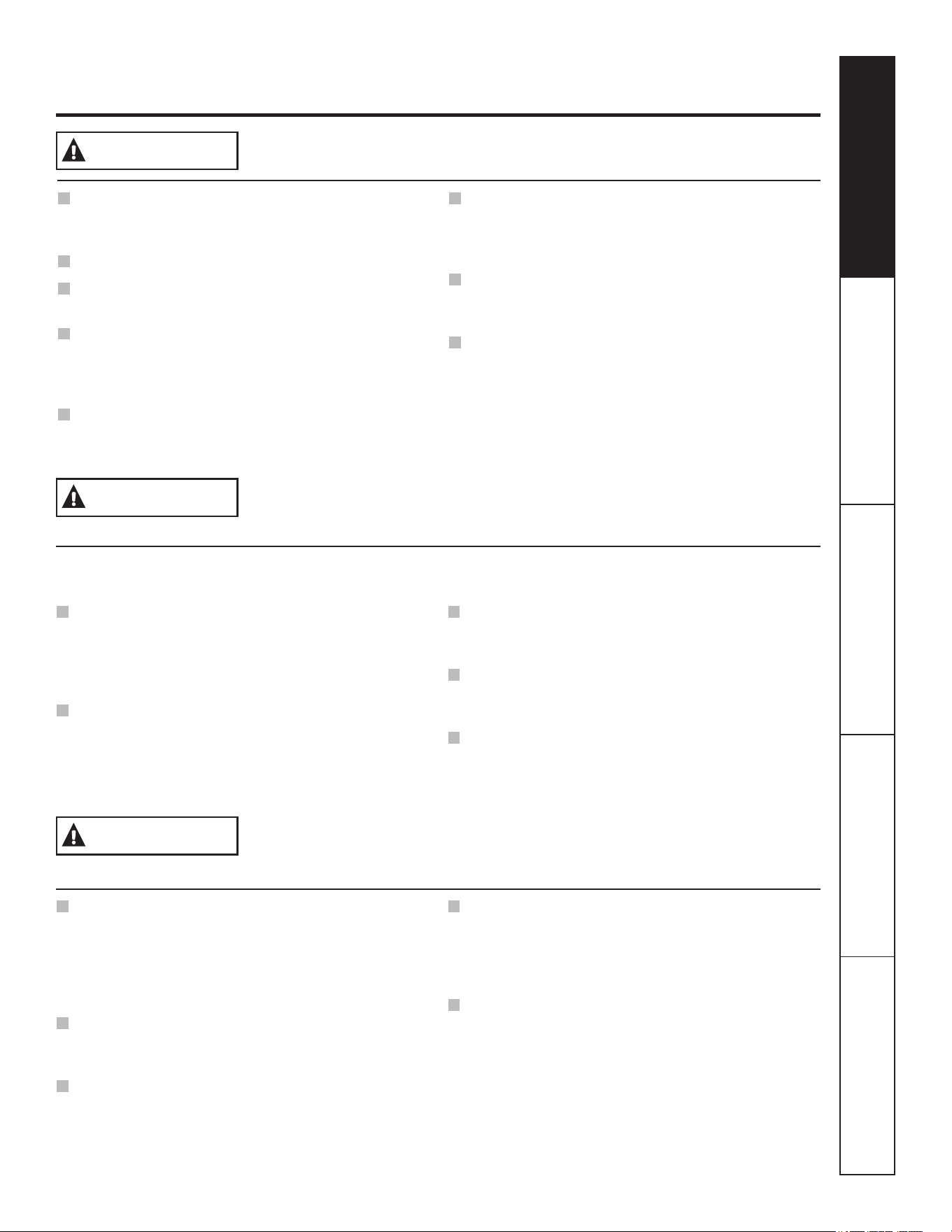
Safety Instructions
Operating Instructions
Safety Instructions
Operating
Instructions
Care and Cleaning
Troubleshooting Tips
Consumer Support
www.GEAppliances.ca
Stand away from the range when opening the oven
door. Hot air or steam which escapes can cause
burns to hands, face and/or eyes.
Keep the oven vent unobstructed.
Keep the oven free from grease buildup. Grease
in the oven may ignite.
Place oven racks in desired location while oven
is cool. If rack must be moved while oven is hot,
do not let pot holder contact hot heating element
in oven.
When using cooking or roasting bags in the oven,
follow the manufacturer’s directions.
Pull the oven rack to the stop-lock position when
loading and unloading food from the oven. This
helps prevent burns from touching hot surfaces
of the door and oven walls.
Do not leave items such as paper, cooking utensils
or food in the oven when not in use. Items stored in
an oven can ignite.
Do not use aluminum foil to line the oven bottom.
Foil may trap or reflect heat, leading to a shock or
fire hazard.
The self-cleaning feature operates the oven at temperatures high enough to burn away food soils in the
oven. Follow these instructions for safe operation.
Before operating the self-clean cycle, remove pans,
shiny metal oven racks and other utensils from the
oven. Only gray porcelain-coated oven racks may
be left in the oven. Do not use self-clean to clean
other parts, such as drip pans or bowls.
Before operating the self-clean cycle, wipe grease
and food soils from the oven. Excessive amount of
grease may ignite, leading to smoke damage to
your home.
If the self-cleaning mode malfunctions, turn the
oven off and disconnect the power supply. Have it
serviced by a qualified technician.
Do not clean the door gasket. The door gasket is
essential for a good seal. Care should be taken not
to rub, damage or move the gasket.
Do not use oven cleaners. No commercial oven
cleaner or oven liner protective coating of any kind
should be used in or around any part of the oven.
The purpose of the warming drawer is to hold hot
cooked foods at serving temperature. Bacteria will
grow in food while it is below 60°C (140°F). Do not
put cold food in warming drawer. Do not heat food
for more than 2 hours. Failure to follow these
instructions may result in foodborne illness.
Do not leave paper products, plastics, canned food
or combustible materials in the drawer. They may
ignite.
Do not touch the heating element or the interior
surface of the drawer. These surfaces may be hot
enough to cause burns.
Use care when opening the drawer. Open the
drawer a crack and let hot air or steam escape
before removing or replacing food. Hot air or
steam that escapes can cause burns to hands,
face and/or eyes.
Do not use aluminum foil to line the warming
drawer. Foil is an excellent heat insulator and
will trap heat beneath it. This will upset the
performance of the drawer and potentially
cause a fire hazard.
5
OVEN SAFETY INSTRUCTIONS
WARNING
SELF-CLEANING OVEN SAFETY INSTRUCTIONS
WARNING
WARMING DRAWER/LOWER OVEN DRAWER
SAFETY INSTRUCTIONS
(some models)
WARNING
6
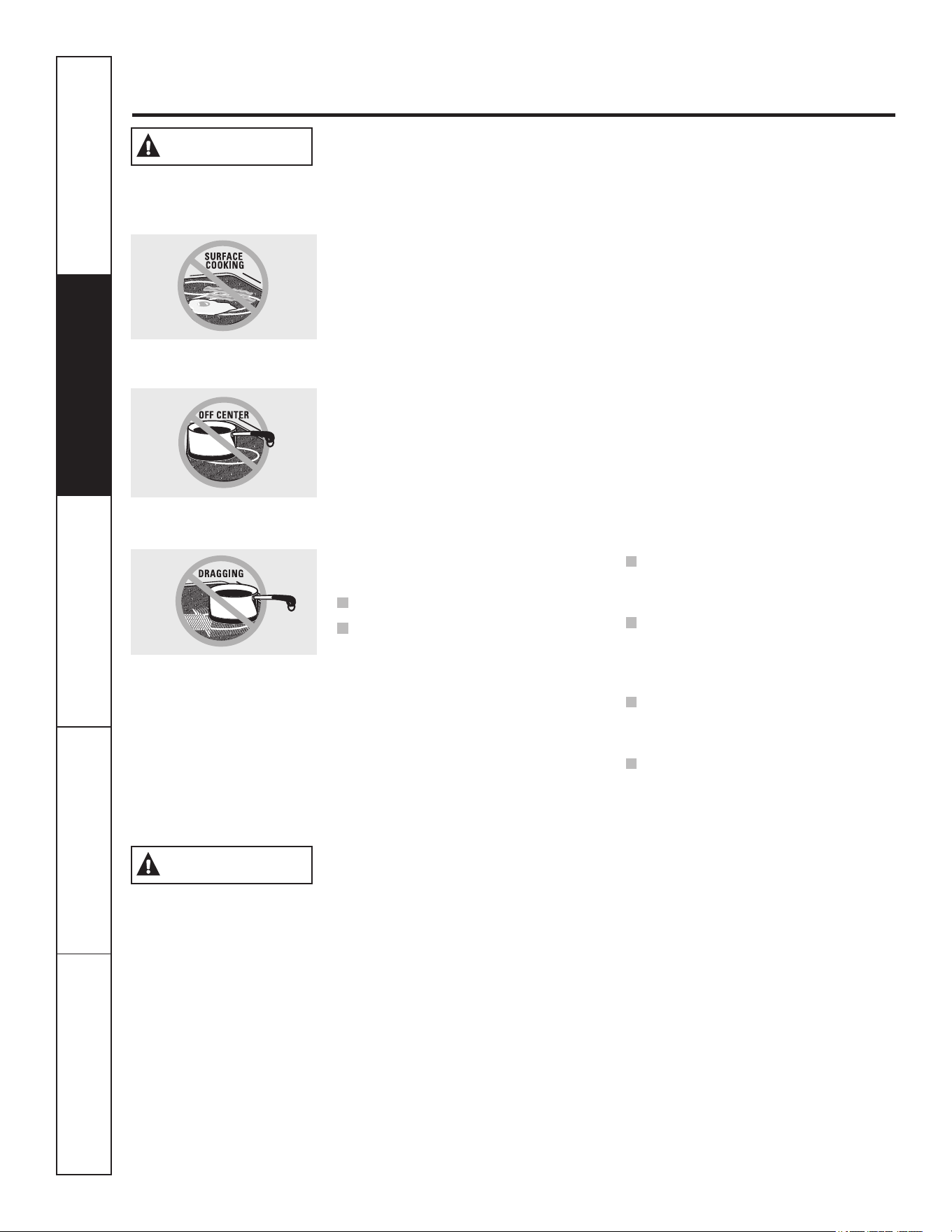
For models with a glass cooktop.
Never cook directly on the glass.
Always use cookware.
About the radiant surface units
The radiant cooktop features heating units
beneath a smooth glass surface.
Cooktop temperatures increase with
the number of surface units that are
on. With 3 or 4 units turned on, surface
temperatures are high. Always use caution
when touching the cooktop.
An indicator light will come on when the
surface unit is turned on.
The appropriate HOT SURFACE indicator
light will glow when its corresponding
radiant element is turned on and will
remain on until the surface has cooled
below 65.6°C (150°F).
NOTE:
Hot surface indicator light will:
Stay on even after the unit is turned off.
Glow brightly until the unit has cooled
below 65.6°C (150°F).
NOTE: A slight odor is normal when a new
cooktop is used for the first time. It is caused
by the heating of new parts and insulating
materials and will disappear in a short time.
NOTE: On models with light-colored glass
cooktops, it is normal for the cooking zones
to change color when hot or cooling down.
This is temporary and will disappear as
the glass cools to room temperature.
It is safe to place hot cookware from the
oven or surface on the glass cooktop when
the surface is cool.
Even after the surface units are turned off,
the glass cooktop retains enough heat to
continue cooking. To avoid overcooking,
remove pans from the surface units when
the food is cooked. Avoid placing anything
on the surface unit until it has cooled
completely.
Water stains (mineral deposits) are
removable using the cleaning cream or
full strength white vinegar.
Use of window cleaner may leave an
iridescent film on the cooktop. The
cleaning cream will remove this
discoloration.
Don’t store heavy items above the
cooktop. If they drop onto the cooktop,
they can cause damage.
Do not use the surface as a cutting board.
Always place the pan in the center
of the surface unit you are cooking on.
Do not slide cookware across the
control or cooktop surface because
it can scratch the glass. The glass is
scratch-resistant, not scratchproof.
Consumer Support Troubleshooting Tips
Care and Cleaning
Operating
Instructions
Safety Instructions
FIRE HAZARD: Never leave the range unattended with the cooktop on medium
or high settings. Keep flammable items away from the cooktop. Turn off all
controls when done cooking. Failure to follow these instructions can result in
fire, serious injury or death.
NOTE: Throughout this manual, features and appearance may vary from your model.
WARNING
FOOD POISON HAZARD: Bacteria may grow in food at temperatures below 60°C
(140°F).
• Always start with hot food. Do not use warm settings to heat cold food.
• Do not warm food for more than 2 hours.
Failure to follow these instructions may result in foodborne illness.
WARNING
Safety Instructions
Operating Instructions
Safety Instructions
Operating
Instructions
Care and Cleaning
Troubleshooting Tips
Consumer Support
Selecting types of cookware
for glass cooktop models. www.GEAppliances.ca
Stainless Steel:
recommended
Aluminum:
heavy weight recommended
Good conductivity. Aluminum residues
sometimes appear as scratches on the
cooktop but can be removed if cleaned
immediately. Because of its low melting
point, thin weight aluminum should not
be used.
Copper Bottom:
recommended
Copper may leave residues which can
appear as scratches. The residues can
be removed, as long as the cooktop is
cleaned immediately. However, do not let
these pots boil dry. Overheated metal can
bond to glass cooktops. An overheated
copper bottom pot will leave a residue
that will permanently stain the cooktop
if not removed immediately.
Porcelain Enamel on Cast Iron:
recommended if bottom of pan is coated
Porcelain Enamel on Steel:
not recommended
Heating empty pans can cause permanent
damage to cooktop glass. The enamel can
melt and bond to the ceramic cooktop.
Glass-ceramic:
not recommended
Poor performance. Will scratch the surface.
Stoneware:
not recommended
Poor performance. May scratch the
surface.
Cast Iron:
not recommended―unless designed
specifically for glass cooktops
Poor conductivity and slow to absorb heat.
Will scratch the cooktop surface.
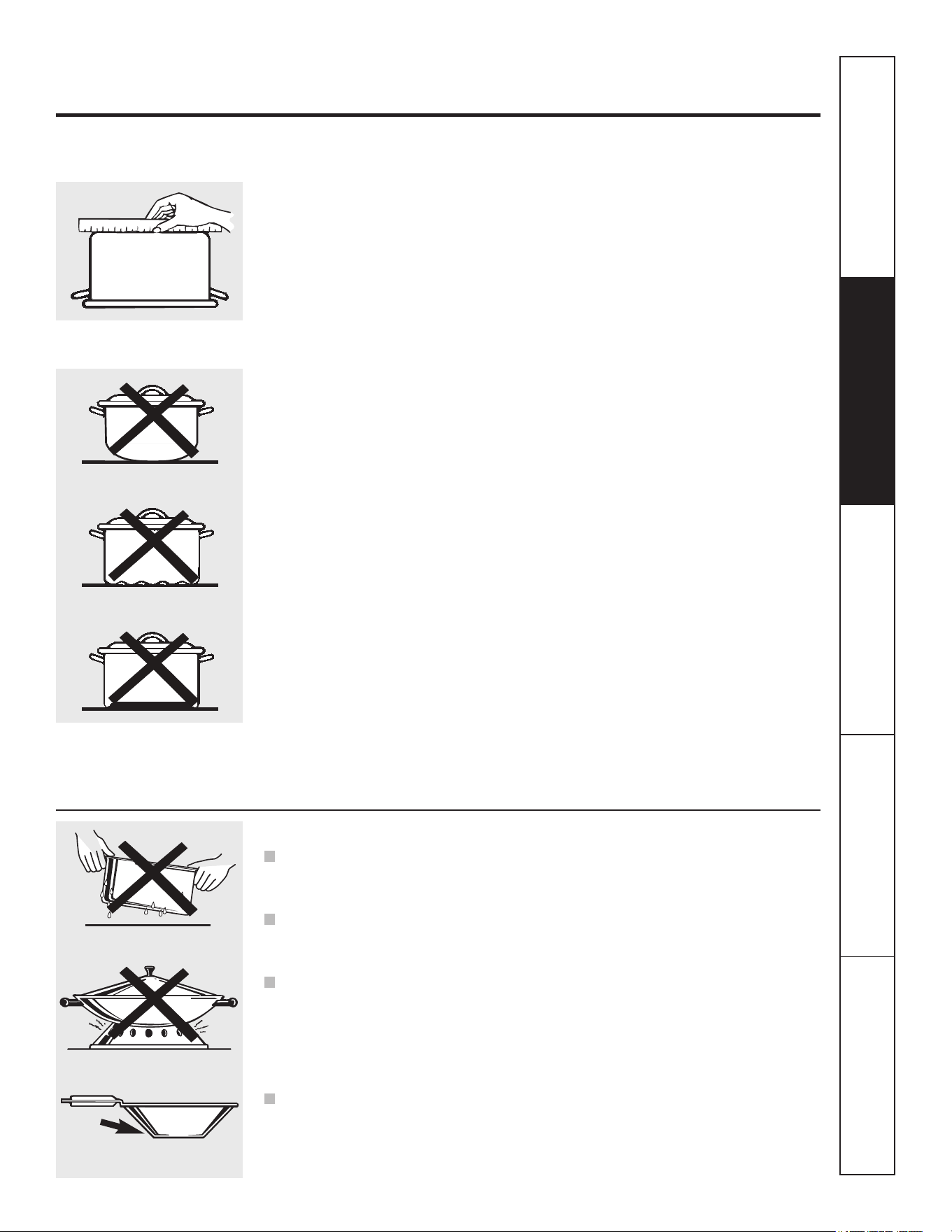
Check pans for at bottoms by using
a straight edge.
Pans with rounded, curved, ridged or
warped bottoms are not recommended.
The following information will help you choose cookware which will give good performance on glass cooktops.
See insert for cookware to use with induction cooktops.
For Best Results
Place only dry pans on the surface
elements. Do not place lids on the
surface elements, particularly wet lids.
Do not use woks that have support
rings. This type of wok will not heat
on glass surface elements.
We recommend that you use only a
flat-bottomed wok. They are available
at your local retail store. The bottom
of the wok should have the same
diameter as the surface element
to ensure proper contact.
Some special cooking procedures
require specific cookware such as
pressure cookers, deep-fat fryers, etc.
All cookware must have flat bottoms
and be the correct size.
Do not place wet pans
on the glass cooktop.
Do not use woks with support
rings on the glass cooktop.
Use at-bottomed woks
on the glass cooktop.
NOTE: Follow all cookware manufacturer’s recommendations when using any type of
cookware on the ceramic cooktop.
7
8
Consumer Support Troubleshooting Tips
Care and Cleaning
Operating
Instructions
Safety Instructions
Surface Units - Knob Models
FIRE HAZARD: Never leave the range unattended with the cooktop on medium or high
cooking. Failure to follow these instructions can result in fire, serious injury or death.
WARNING
Throughout this manual, features and appearance may vary from your model.
How to Set
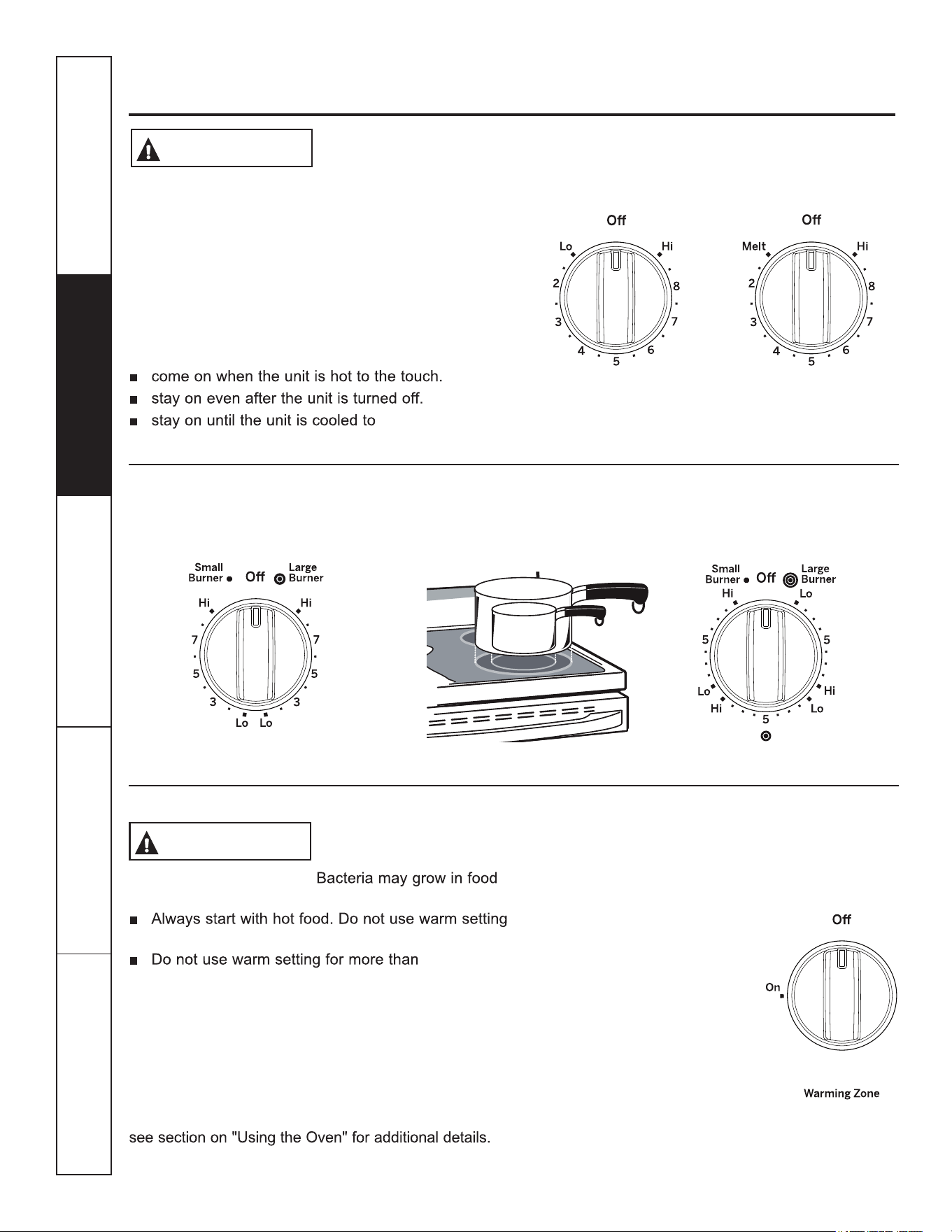
Push the knob in and turn in either direction to the
setting you want.
A surface ON indicator light will glow when any surface
unit is on
For glass cooktop surfaces:
A HOT COOKTOP indicator light will:
approximately 150°F.
Dual and Triple Surface Units and Control Knobs (on some models)
The surface unit has 2 or 3 cooking sizes to select from so you can match the size of the unit to the size of the
cookware you are using.
At both OFF and HI the control clicks into
position. You may hear slight clicking
sounds during cooking, indicating the
control is maintaining your desired setting.
Be sure you turn the control knob to OFF
when you finish cooking.
Models with a Dual-Ring surface
element only
Models with a Tri-Ring surface
element only.
Melt setting (on some models) will
melt chocolate or butter.
Using the Warming Zone (on some models)
FOOD POISON HAZARD:
at temperatures below 140°F.
to heat cold food.
2 hours.
The WARMING ZONE, located in the back center of
the glass surface, will keep hot, cooked food at serving
temperature. Always start with hot food. Do not use to
heat cold food. Placing uncooked or cold food on the
WARMING ZONE could result in foodborne illness.
Turn the control knob to the ON position.
For models using the touch pads for warming zone control,
For best results, all foods on the WARMING ZONE
should be covered with a lid or aluminum foil. When
warming pastries or breads, the cover should be vented
to allow moisture to escape.
The initial temperature, type and
amount of food, type of pan, and
the time held will affect the quality
of the food.
Always use pot holders or oven
mitts when removing food from the
WARMING ZONE, since cookware
and plates will be hot.
NOTE: The surface warmer will
not glow red like the cooking
elements.
WARNING
serrings. Keep flammable items away from the cooktop. Turn off all controls when done
www.GEAppliances.ca
Safety Instructions
Operating
Instructions
Care and Cleaning
Troubleshooting Tips
Consumer Support
9
Surface Units - Knob-Free Models
NOTE: All protective packing must be removed from all parts. It cannot be removed if it is baked on.
Radiant Glass Cooktop
The surface unit will cycle on and off to maintain your
selected control setting. This is normal.
For glass cooktop surfaces:
A HOT COOKTOP indicator light will:
150°F.
To Turn On a Surface Unit:
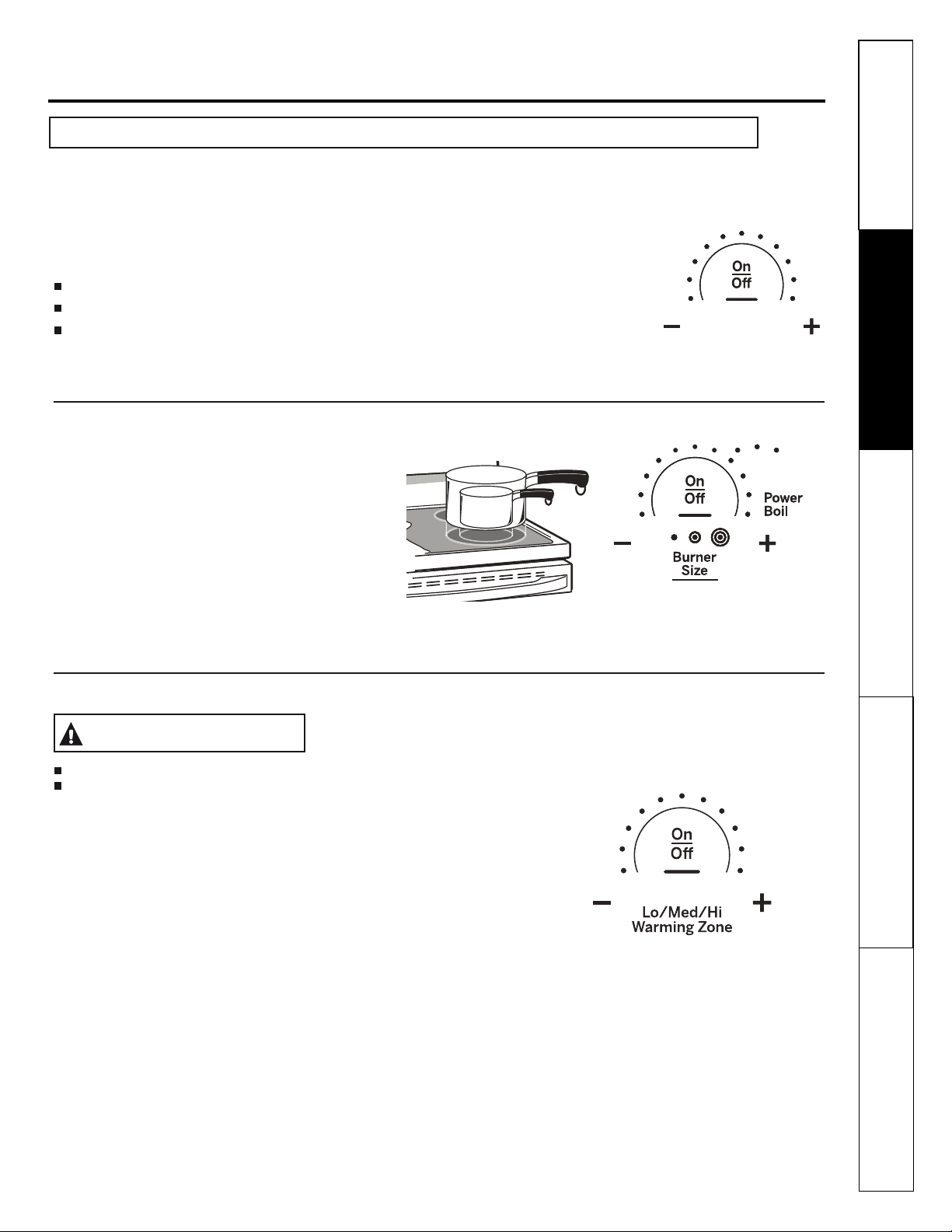
1. Touch the On/Off pad, then touch the + or - pad.
+ or - pad to choose the desired power
setting.
3. For the dual and triple surface
units, touch the Burner Size
pad to select the desired
burner size.
To Turn Off a Surface Unit:
Touch the On/Off pad.
Using the Warming Zone
FOOD POISON HAZARD:
To Use the Warming Zone:
1. Touch the Warming Zone On/Off pad.
+ or -
setting.
To Turn Off the Warming Zone:
Touch the Warming Zone On/Off pad.
WARNING
Dual and Triple Surface Units (on some models)
The surface unit has 2 or 3 cooking sizes to select from
so you can match the size of the unit to the size of the
cookware you are using.
Models with a Tri-Ring
surface element only.
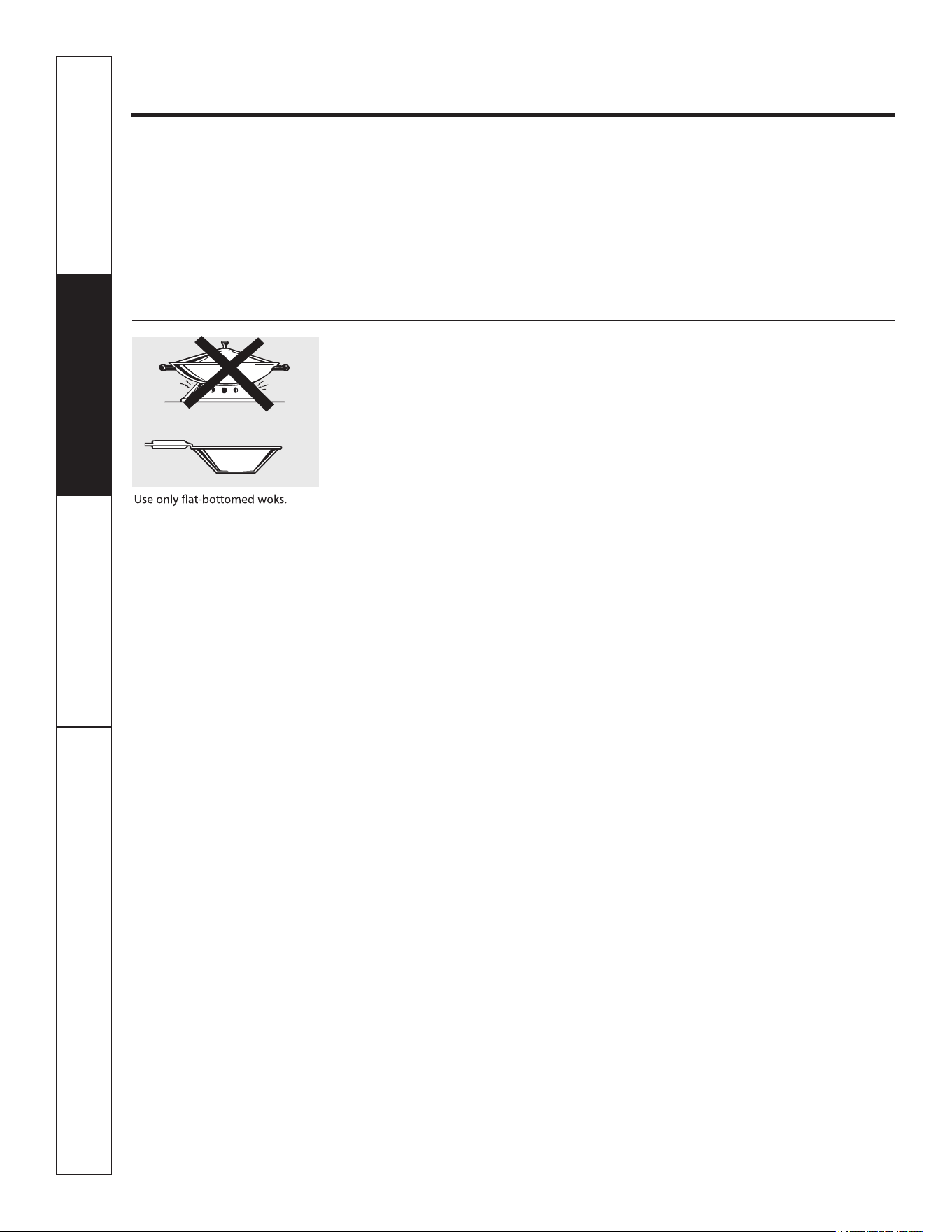
Wok Cooking
We recommend that you use only
a flat-bottomed wok. They are available
at your local retail store.
Do not use woks that have support rings.
Do not use round-bottom woks. You could
be seriously burned if the wok tipped over.
Home Canning Tips
Be sure the canner is centered over
the surface unit.
Make sure the canner is flat on the bottom.
To prevent burns from steam or heat,
use caution when canning.
Use recipes and procedures from
reputable sources. These are available
from manufacturers such as Ball
®
and
Kerr
®
Flat-bottomed canners are recommended.
Use of water bath canners with rippled
bottoms may extend the time required
to bring the water to a boil.
10
Consumer Support Troubleshooting Tips Care and Cleaning
Operating
Instructions
Safety Instructions
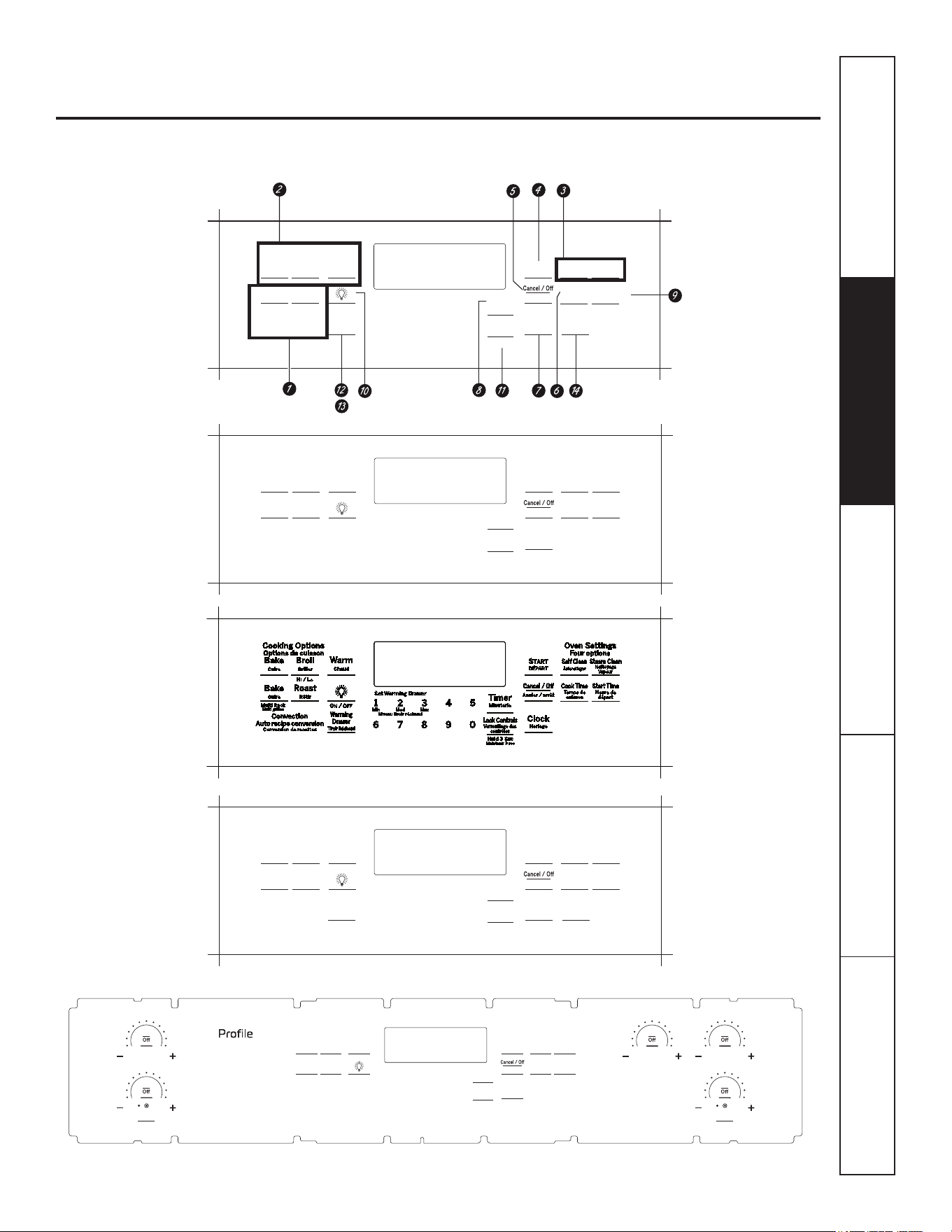
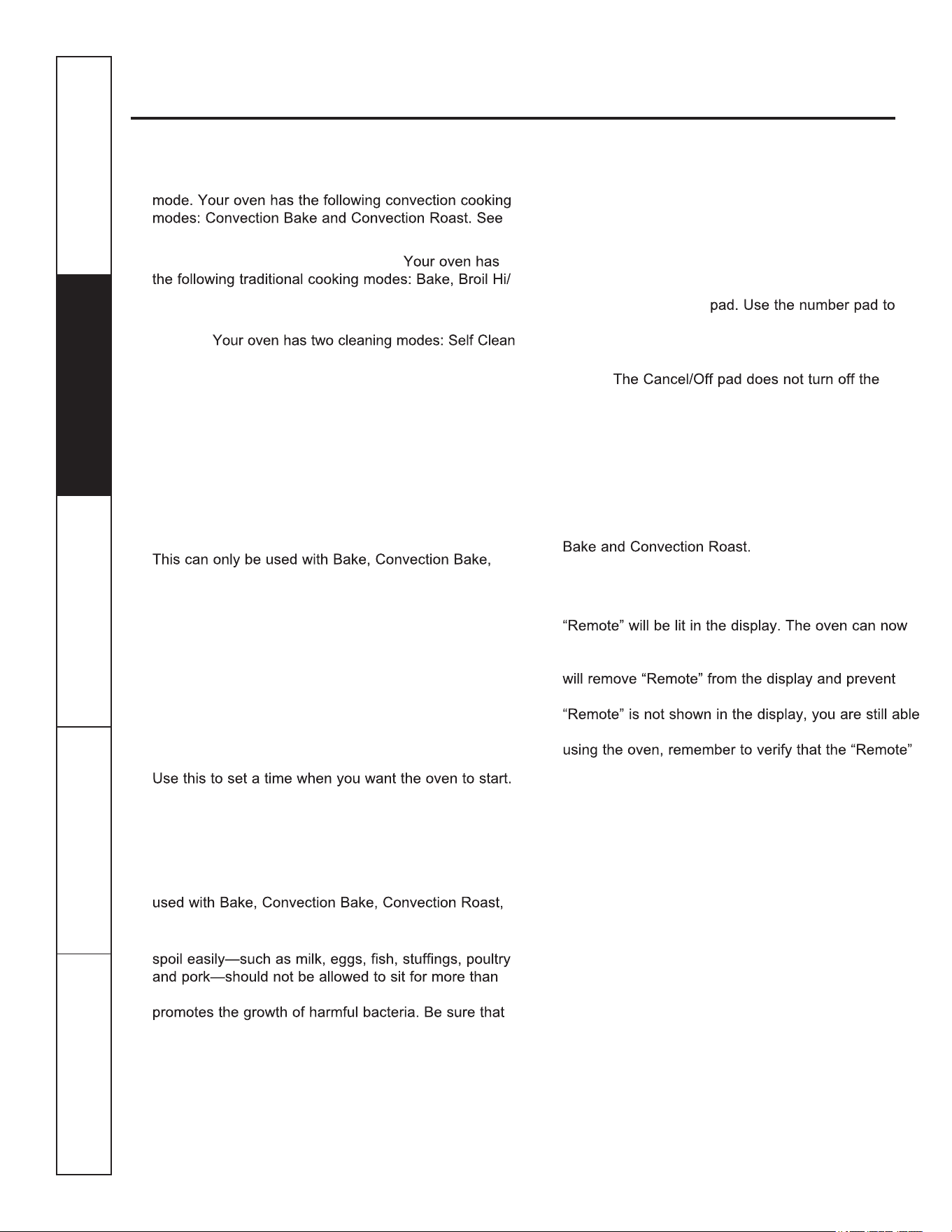
Throughout this manual, features and appearance may vary from your model. See the control panel below that
matches your model.
Using the oven controls.
www.GEAppliances.ca
Safety Instructions
Operating
Instructions
Care and Cleaning
Troubleshooting Tips
Consumer Support
11
Melt
Fondre
Power Boil
Ébullition Plus
Melt
Fondre
Lo/Med/Hi
Warming Zone
Zone réchaud
Multi grilles
Multi Rack
Hold 3 Sec
Maintenir 3 sec
On
On
Burner Size
Taille du brûleur
On
On
On
Burner Size
Taille du brûleur
Bake Broil
Warm
GrillerCuire
Options de cuisson
Cooking Options
Chaud
H
i
/
L
o
Bake
Cuire
Roast
Rôtir
O
N
/ O
FF
Conversion de recettes
Convection
Auto recipe conversion
1
2
3 4
5
6 7
8 9
0
Horloge
Clock
Temps de
cuisson
Cook Time
Minuterie
Timer
Autonettoyer
Self Clean
Verrouillage des
contrôles
Lock Controls
S
TART
Anuler / arrêt
DÉPART
Steam Clean
Heure de
départ
Start Time
Oven Settings
Nettoyage
Vapeur
Four options
Affect PCB915
Horloge
Clock
Bake
Temps de
cuisson
Cook Time
Minuterie
Timer
O
N
/
O
FF
Hi
/
Lo
Autonettoyer
Self Clean
Verrouillage des
contrôles
Lock Controls
Broil
Warm
Griller
S
TART
Anuler / arrêt
DÉPART
Cuire
Bake
Cuire
Roast
Rôtir
Conversion de recettes
Convection
Auto recipe conversion
Options de cuisson
Cooking Options
Chaud
Nettoyage
Vapeur
Steam Clean
Heure de
départ
Start Time
1
2
3 4
5
6 7 8 9
0
Activer commande
à distance
Remote Enable
Probe
Sonde
Four options
Oven Settings
Multi grilles
Multi Rack
Hold 3 Sec
Maintenir 3 sec
Horloge
Clock
Bake
Temps de
cuisson
Cook Time
Minuterie
Timer
ON
/
OFF
H
i
/
L
o
Autonettoyer
Self Clean
Verrouillage des
contrôles
Lock Controls
Broil
Warm
Griller
START
Anuler / arrêt
DÉPART
Cuire
Bake
Cuire
Roast
Rôtir
Conversion de recettes
Convection
Auto recipe conversion
Options de cuisson
Cooking Options
Chaud
Nettoyage
Vapeur
Steam Clean
Heure de
départ
Start Time
1
2
3 4
5
6 7 8 9
0
Activer commande
à distance
Remote Enable
Probe
Sonde
Four options
Oven Settings
Multi grilles
Multi Rack
Hold 3 Sec
Maintenir 3 sec
Horloge
Clock
Bake
Temps de
cuisson
Cook Time
Minuterie
Timer
ON / OFF
H
i
/ L
o
Autonettoyer
Self Clean
Verrouillage des
contrôles
Lock Controls
Broil
Warm
Griller
START
Anuler / arrêt
DÉPART
Cuire
Bake
Cuire
Roast
Rôtir
Conversion de recettes
Convection
Auto recipe conversion
Options de cuisson
Cooking Options
Chaud
Nettoyage
Vapeur
Steam Clean
Heure de
départ
Start Time
1
2
3 4
5
6 7 8 9
0
Four options
Oven Settings
Multi grilles
Multi Rack
Hold 3 Sec
Maintenir 3 sec
Affect PCB905
Affect PCB940
Affect PCB985
12
Consumer Support Troubleshooting Tips Care and Cleaning
Operating
Instructions
Safety Instructions
1. Convection Cooking Modes: Convection
cooking modes use increased air circulation to improve
performance. The type of benefit depends on the
the Cooking Modes section for more information.
2. Traditional Cooking Modes:
Lo, and Warm. See the Cooking Modes section for
more information.
3.
Clean:
and Steam Clean. See the Cleaning the Oven section
for important information about using these modes.
4.
Start: Must be pressed to start any cooking,
cleaning, or timed function.
5. Cancel/Off: Cancels ALL oven operations except
the clock, timer, Warming Drawer and Warming Zone.
6. Cook Time: Counts down cooking time and turns
off the oven when the cooking time is complete. Press
the Cook Time pad, use the number pads to program
a cooking time in hours and minutes, then press Start.
and Convection Roast.
7. Clock: Sets the oven clock time. Press the Set
Clock pad, then use the number pads to program the
clock. Press Start to save the time.
8. Timer On/Off: Works as a countdown timer.
Press the Timer On/Off pad and the number pads
to program the time in hours and minutes. Press the
Start pad. The timer countdown is complete. To turn
the timer off press the Timer On/Off pad.
9. Delay Time: Delays when the oven will turn on.
Press the Delay Time pad and use the number pads
to program the time of day for the oven to turn on
then press Start. Press the desired cooking mode and
temperature then press Start. A Cook Time may also
be programmed if desired. Follow the directions under
Cook Time for setting this feature. This can only be
and Self-Clean.
NOTE: When using the Delay Time feature, foods that
1 hour before or after cooking. Room temperature
the oven light is off because heat from the bulb will
speed harmful bacteria growth.
10. Oven Light: Turns the oven light on or off.
11. Lock Controls: Locks out the control so that
pressing the pads does not activate the controls. Press
the Lock Controls pad, for three seconds to lock or
unlock the control. Cancel/Off is always active, even
when the control is locked.
12. Warming Drawer (on some models):
Will keep hot, cooked foods at serving temperature. Press
the Warming Drawer
select the temperature setting. Press 1 for Low, 2 for
Medium or 3 for High, then press Start. Drawer is
below the Oven.
NOTE:
Warming Drawer. To turn off, press the Warming
Drawer pad.
13. Probe (on some models): Monitors internal
food temperature and turns the oven off when the
food reaches the programmed temperature. Insert the
probe, program the cooking mode, and program the
probe temperature. See the Cooking Modes section
for more information. The probe can only be used with
14. Remote Enable (on some models): Allows
you to control your oven remotely. To be able to start
the oven remotely, press the Remote Enable pad, and
be remotely started with a connected device. Opening
the oven door or pressing the Remote Enable pad
you from being able to turn the oven on remotely. If
to change the oven settings or turn the oven off. After
icon is displayed if you wish to start the oven remotely
in the future. For instructions on how to connect your
oven, see the "Connecting your WiFi Connect Enabled
oven" instruction sheet.
Oven Controls
www.GEAppliances.ca
Safety Instructions
Operating
Instructions
Care and Cleaning
Troubleshooting Tips
Consumer Support
13
Special Features
There are several different special features on your range.
Bake and Broil pads at the same time and hold for three
seconds. "OFFSEt" will appear in the display.
8 pad for down and the 3 pad for up.
0 pad.
6 pad. To exit the Special Features
menu, press the 6 pad again.
Adjust the Oven Temperature (OFFSEt)
This feature allows the oven baking and convection
baking temperature to be adjusted up to 35ºF hotter
your oven temperature is too hot or too cold and wish to
select "OFFSEt". A number between positive and
8 or 3 pads to increase
or decrease the offset value. Save and confirm by
pressing the 0 pad.
End of Timer Signals (End tonE)
This is the tone that signals the end of a timer. The tone
can be continuous (Con bEEP) or one repeating beep
(bEEP). A continuous setting will continue to sound a
tone until a button on the control is pressed.
Fahrenheit or Celsius Temperature Display
(dEg Unit)
The oven control is set to use Fahrenheit temperatures
(F), but you can change it to use Celsius temperatures (C).
Clock Configuration (Cloc cFg)
This feature specifies how the time of day will be
or 24-hour military time (24 H).
Clock Display (Cloc diSP)
This feature specifies whether the clock appears in the
display. It may be On or Off.
Auto Recipe Conversion (Auto rEciPE)
Conversion will automatically convert the regular baking
temperatures entered to convection bake cooking
temperatures when turned on. Note that this option does
not convert convection bake cooking times, it only converts
temperatures. This feature may be turned On or Off.
Sound Volume (Sound)
This feature allows the oven tone volume to be adjusted
between high (Hi), medium (Reg), low (lo), and off (Off).
The control will sound the oven tone at the new volume
level each time the sound level is changed.
12-hour Shutoff (2H ShutoFF)
This feature shuts the oven down after 12 hours of
continuous operation. It may be enabled or disabled.
14
Consumer Support Troubleshooting Tips
Care and Cleaning
Operating
Instructions
Safety Instructions
Sabbath Mode
be noticed by the consumer include the disabling of tones, disabling of oven lights, and delays of about 30 seconds
to one minute on display changes. Only continuous baking or timed baking is allowed in the Sabbath mode. Cooking
in the Sabbath mode is a two-step process, first the Sabbath mode must be set and then the bake mode must be set.
Setting the Sabbath Mode
1. Press the Bake and Broil pads at the same time and
hold until the special features menu is displayed.
3 or 8 number pads to scroll through the
press 0. Refer to the graphic in the Special Features
section to see how the number keys are mapped.
3 or 8 number pads to scroll through the
the 0 number pad to save the setting. Press 6 to exit
appear in the display indicating that the Sabbath mode
is set. The clock will not be displayed. Continuous
bake or timed bake can now be programmed.
Starting a Continuous Bake
1. Press the Bake pad.
2. If the desired temperature is 350F, press Start. If
a different cooking temperature is desired, use the
1 through 5 number pads or Timer pad to select a
preset cooking temperature, then press Start. Refer
to the graphic below to determine which pad sets the
desired cooking temperature.
After a delay, a second bracket “] [“ will appear in the
display indicating that the oven is baking.
Adjusting the Temperature
1. Press Bake, use the 1 through 5 number pads and
the Timer pad to select a different preset cooking
temperature, and press Start.
2. Since no feedback is given during temperature
change, an oven thermometer can be used to confirm
temperature changes.
Starting a Timed Bake
1. Press the Bake pad.
2. If the desired temperature is 350F, use the 6 through
0 number pads or the Lock Control pad to select
a cooking time. If a cooking temperature other
than 350F is desired, use the 1 through 5 number
pads or the Timer pad to select a preset cooking
temperature, then select the cooking time. Refer to
the graphic on this page to determine which pad sets
the desired cooking temperature and cooking time.
3. Press Start.
After a delay, a second bracket “] [“ will appear in the
display indicating that the oven is baking. When the cook
time expires, the display will change back to a single
No tone will sound when the cook time is complete.
Exit the Sabbath Mode
Exiting the Sabbath mode should be done after the
Sabbath is over.
1. Press Cancel/Off to end any bake mode that may be
running.
2. Press Bake and Broil pads at the same time and
hold until the Special Features menu is displayed.
3 or 8 number pads to scroll through the
press 0.
3 or 8 number pads to scroll through the
0 to save
the setting. Press the 6 number pad to exit the
Special Features menu.
Sabbath Mode Power Outage Note
If a power outage occurs while the oven is in Sabbath
Mode, the unit will return to Sabbath Mode when power
is restored, however the oven will return to the off state
even if it was in the middle of a bake cycle when the
power outage occurred.
1 = 170° F, 2 = 200° F, 3 = 250° F, 4 = 300° F, 5 = 325° F, Timer = 400° F
6 = 2 hours, 7 = 2.5 hours, 8 = 3 hours, 9 = 3.5 hours,
0 = 4 hours, Lock Controls = 6 hours
Temperature (°F) 400
Time (hours)
6h
170
2h
200
2.5h
250
3h
300
3.5h
325
4h

Extension Racks (on some models)
Extension racks have a frame that locks into the rack supports on
both sides.
Once the frame is locked into place, always pull the rack out, by its
upper front rail, to its full estension stop position, when placing or
removing cookware. If extension racks are difficult to extend,
lubricate the racks with the graphite lubricant provided with your
oven. Remove the rack from the oven, remove debris in the slide tracks
with a paper towel, shake the graphite lubricant and place 4 small
drops on the two bottom tracks of the left and right sides. Open and
close the rack several times to distribute the lubricant.
To order additional graphite lubricant, read the Assistance and
Accessories section at the beginning of this manual.
To Remove An Extension Rack;
1. Make sure the rack is pushed all the
way into the oven.
2. Firmly holding onto both the upper
and lower front rails, pull the rack
toward you, tilt the front end up and
pull the rack out.
To Replace An Extension Rack;
1. Place the curved end of the rack
onto the rack supports.
2. Tilt the front of rack up and push
the rack in.
If extension racks are difficult to replace
or remove, wipe the oven rack supports
with cooking oil. Do not wipe oil on the
rack slides.
www.GEAppliances.ca
Using the oven.
To avoid possible burns, place the racks in the desired position before you turn on the oven.
Before you begin…
The racks have stops, so that when placed
correctly on the supports, they will stop
before coming completely out and will
not tilt.
When placing and removing cookware,
pull the rack out until it stops.
On some models, the bake heating element
is under the oven floor. Do not place foods
on the oven bottom for cooking.
To remove a rack, pull it toward you,
tilt the front end up and pull it out.
To replace, place the end of the rack
(stop-locks) on the support, tilt up the front
and push the rack in.
When you are using a rack in the lowest
position (A), you will need to use caution
when pulling the rack out. We recommend
that you pull the rack out several inches and
then, using two pot holders, pull the rack
out by holding the sides of it. The rack is low
and you could be burned if you place your
hand in the middle of the rack and pull all
the way out. Be very careful not to burn
your hand on the door when using the rack
in the lowest position (A).
The number of rack positions may
vary by model.
Aluminum Foil
Do not use aluminum foil on the bottom
of the oven.
Never entirely cover a rack with aluminum
foil. This will disturb the heat circulation
and result in poor baking.
A smaller sheet of foil may be used to
catch a spillover by placing it on a lower
rack several inches below the food.
CAUTION
T he oven has 6 rack positions.
It also has a special low rack
position (R ) for extra large items,
such as a large turkey.
A
B
C
D
E
F
R
Safety Instructions
Operating
Instructions
Care and Cleaning
Troubleshooting Tips
Consumer Support
15
16
Consumer Support Troubleshooting Tips
Care and Cleaning
Operating
Instructions
Safety Instructions
below. Refer to the Cooking Guide section for recommendations for specific foods. Remember, your new oven
may perform differently than the oven it is replacing.
Baking and Roasting Modes
Select a mode for baking and roasting based on the
type and quantity of food you are preparing. When
preparing baked goods such as cakes, cookies, and
pastries always preheat the oven first. Follow recipe
recommendations for food placement. If no guidelines
are provided, center food in the oven.
Traditional Bake
The traditional bake mode is intended for single rack
cooking. This mode uses heat primarily from the lower
element but also from the upper element to cook
food. To use this mode press the Bake pad, enter
a temperature, and then press Start. Preheating is
generally recommended when using this mode.
Convection Bake
multiple racks at the same time. This mode uses heat
primarily from the rear element but also heat from the
upper and lower elements, along with air movement
from the convection fan to enhance cooking evenness.
so it is not necessary to convert the temperature when
multiple racks than what would be expected for a single
rack. To use this mode press the Convection Bake
pad, enter a temperature, and then press Start. Always
preheat when using this mode.
Convection Roast
The Convection Roast mode is intended for roasting
whole cuts of meat on a single rack. This mode uses
heat from the lower, upper, and rear elements along
with air movement from the convection fan to improve
browning and reduce cooking time. It is not necessary to
convert temperature. Check food earlier than the recipe
suggested time when using this mode or use a meat
probe. To use this mode press the Convection Roast
pad, enter a temperature, and then press Start. It is not
necessary to preheat when using this mode.
Broiling Modes
broiling on upper rack positions as placing food closer to
the broil element increases smoking, spattering, and the
possibility of fats igniting. For best performance center
food below the broil heating element.
Try broiling foods that you would normally grill. Adjust
rack positions to adjust the intensity of the heat to the
food. Place foods closer to the broil element when a
seared surface and rare interior is desired. Thicker foods
and foods that need to be cooked through should be
broiled on a rack position farther from the broiler or by
using Broil Lo.
Cookware
Cookware Guidelines
The material, finish, and size of cookware affect baking
performance.
Dark, coated and dull pans absorb heat more readily
than light, shiny pans. Pans that absorb heat more
readily can result in a browner, crisper, and thicker crust.
If using dark and coated cookware check food earlier
than minimum cook time. If undesirable results are
obtained with this type of cookware consider reducing
oven temperature by 25º F next time.
Shiny pans can produce more evenly cooked baked
goods such as cakes and cookies.
Glass and ceramic pans heat slowly but retain heat well.
These types of pans work well for dishes such as pies
and custards.
Air insulated pans heat slowly and can reduce bottom
browning.
Cooking Modes
CAUTION: Do not use any type of foil or oven liner to cover the oven bottom. These items can trap
heat or melt, resulting in damage to the product and risk of shock, smoke or fire. Damage from improper use
of these items is not covered by the product warranty.
Foil may be used to catch spills by placing a sheet on a lower rack, several inches below the food. Do not use more
oven walls to prevent poor heat circulation.
Using Oven
www.GEAppliances.ca
Safety Instructions
Operating
Instructions
Care and Cleaning
Troubleshooting Tips
Consumer Support
17
Broil Hi
Broil Lo
The Traditional Broil Lo mode uses less intense heat
from the upper element to cook food thoroughly while
also prodicing surface browning. Use Broil Lo for
thicker cuts of meat and/or foods that you would like
cooked all the way through. To use this mode press
the Broil pad twice and then press Start. It is not
necessary to preheat when using this mode.
Warm
To use this mode, press the Warm pad then press
Start. Cover foods that need to remain moist and do
not cover foods that should be crisp. Preheating is
not required. Do not use warm to heat cold food other
than crisping crackers, chips or dry cereal. It is also
recommended that food not be kept warm for more
than 2 hours.
Probe (on some models)
Internal food temperature is frequently used as an
indicator of doneness, especially for roasts and poultry.
The Probe mode monitors the internal food temperature
and turns the oven off when the internal food
temperature reaches the programmed temperature.
Minimum temperatures for food safety can be found at
www.IsItDoneYet.gov. The temperature probe can only
be used with Bake, Convection Bake, and Convection
Roast modes.
To use the probe with preheating:
1. Press the desired cook mode (Bake, Convection
Bake, or Convection Roast) pad and enter the
desired cooking temperature.
2. Insert the probe into the food (see Proper Probe
Placement Guidelines in this section).
3. Once the oven is preheated, place the food in the
oven and connect the probe to the probe outlet,
making sure it is fully inserted. Use caution, the oven
walls and probe outlet are hot.
4. Program the probe temperature by pressing the
Probe pad and entering the desired food temperature.
The maximum internal food temperature that you can
set is 200º F.
To use the probe without preheating:
1. Insert the probe into the food (see Proper Probe
Placement Guidelines in this section).
2. Place the food in the oven and connect the probe into
the probe outlet in the oven.
3. Program the desired probe and cooking mode settings
by pressing the Probe pad and entering the desired
food temperature, then pressing the cook mode pad
(Bake, Convection Bake, or Convection Roast) and
entering the desired cooking temperature.
Proper Probe Placement Guidelines
After preparing the meat and placing it on the cooking
pan follow these guidelines for proper probe placement.
handle, such that the point of the probe will rest in the
center of the thickest part of the meat.
part of the breast.
of the roast.
center of the lowest large muscle or joint.
probe into the center of the dish.
the meatiest area, parallel to the backbone.
Check the temperature at other locations in the food
with a food thermometer once the probe temperature
is reached to ensure that all portions of the food have
reached desired temperatures.
Probe Care Guidelines
product may result in damage to the probe.
and removing them from the meat and outlet
pull on the cable when removing it.
completely defrosted before inserting the probe.
from the outlet until the oven has cooled.
steam clean cycle.
Cooking Modes (Cont.)
The Traditional Broil Hi mode uses intense heat
from the upper element to sear foods. Use Broil Hi
for thinner cuts of meat and/or foods you prefer less
done on the interior. To use this mode press the
Broil pad once and then press Start. It is not
necessary to preheat when using this mode.
18
Consumer Support Troubleshooting Tips
Care and Cleaning
Operating
Instructions
Safety Instructions
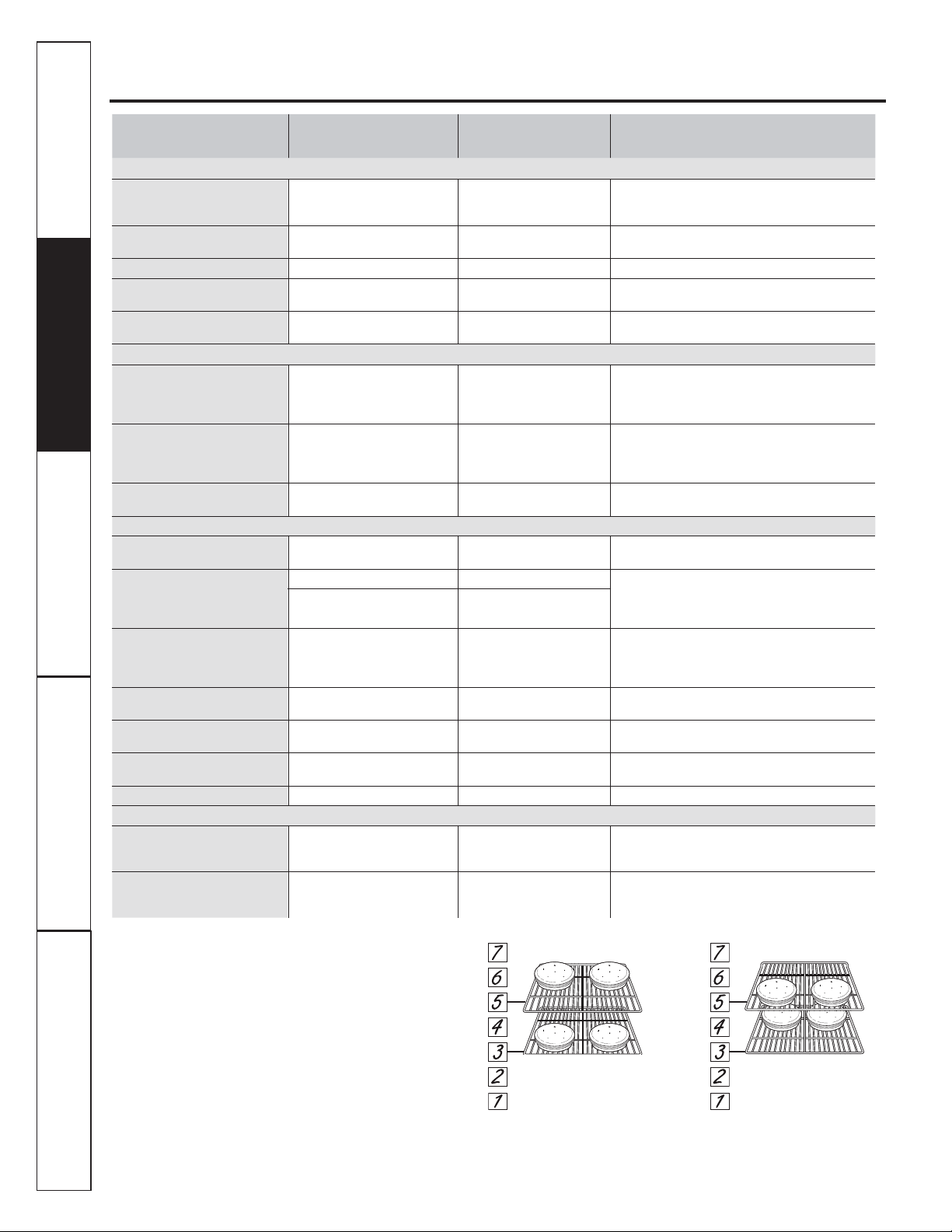
FOOD TYPE
RECOMMENDED
MODE(S)
RECOMMENDED
RACK POSITION(S) ADDITIONAL SUGGESTIONS
Baked Goods
Layer Cakes, sheet cakes,
bundt cakes, muffins, quick
breads on a Single Rack
3
Layer cakes* on Multiple
Racks
3 and 5
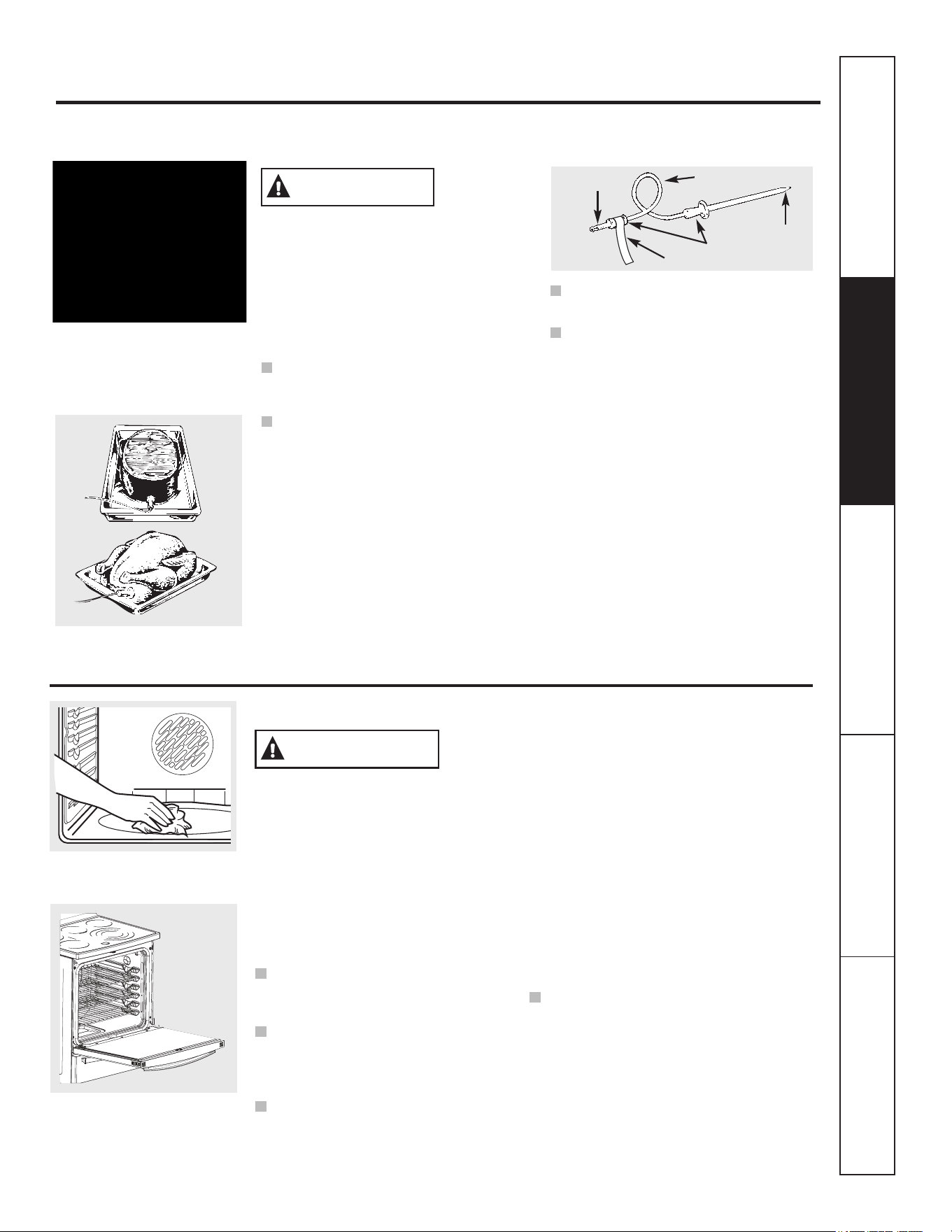
Ensure adequate airflow
(see illustration below).
Chiffon cakes (angel food) 1
Cookies, biscuits, scones on a
Single Rack
3
Cookies, biscuits, scones on
Multiple Racks
3 and 5
2, 4, and 6
Ensure adequate airflow.
Beef & Pork
Hamburgers
6
-
For best performance center food below the broil
heating element.
Steaks & Chops 6
-
For best performance center food below the broil
heating element.
Roasts
Convection Roast
3 or 4
is not necessary.
Poultry
Whole chicken
Convection Roast
3 or 4
thighs
2
broiling. For best performance when broiling, center
food below the broil heating element.
2 or 3
2 or 3
For best performance when broiling, center food
below the broil heating element
Whole turkey
Convection Roast
1 or 2
Convection Roast
2 or 3
Fish
Watch food closely when broiling. For best perfor-
mance center food below the broil heating element.
Casseroles 4
Frozen Convenience Foods
Pizza, potato products,
chicken nuggets, appetizers
on a Single Rack
4
Pizza, potato products,
chicken nuggets, appetizers
on Multiple Racks
3 and 5
Cooking Guide
*When baking four cake layers at a time with traditional
bake, use racks 3 and 5.
*When baking four cake layers at a time with convection
bake, use racks 3 and 5.
Cook food thoroughly to help protect against food
borne illness. Minimum safe food temperature
recommendations for food safety can be found at
www.IsItDoneYet.gov. Make sure to use a food
thermometer to take food temperatures.
Rack position for Traditional
Bake, cakes in front of rack 3
and back of rack 5
Rack position for Convection
Bake, cakes in back of rack 3
and front of rack 5
Safety Instructions
Operating
Instructions
Care and Cleaning
Troubleshooting Tips
Consumer Support
19
www.GEAppliances.ca
Using the probe. (on some models)
To prevent burns, do not unplug the probe
from the oven outlet until the oven has cooled.
Use of probes other than the one provided
with this product may result in damage to
the probe or oven control.
Use the handles of the probe and plug
when inserting and removing them from
the food and outlet.
To avoid damaging your probe, do not
use tongs to pull on the cable when
removing it.
To avoid breaking the probe, make sure
food is completely defrosted before
inserting.
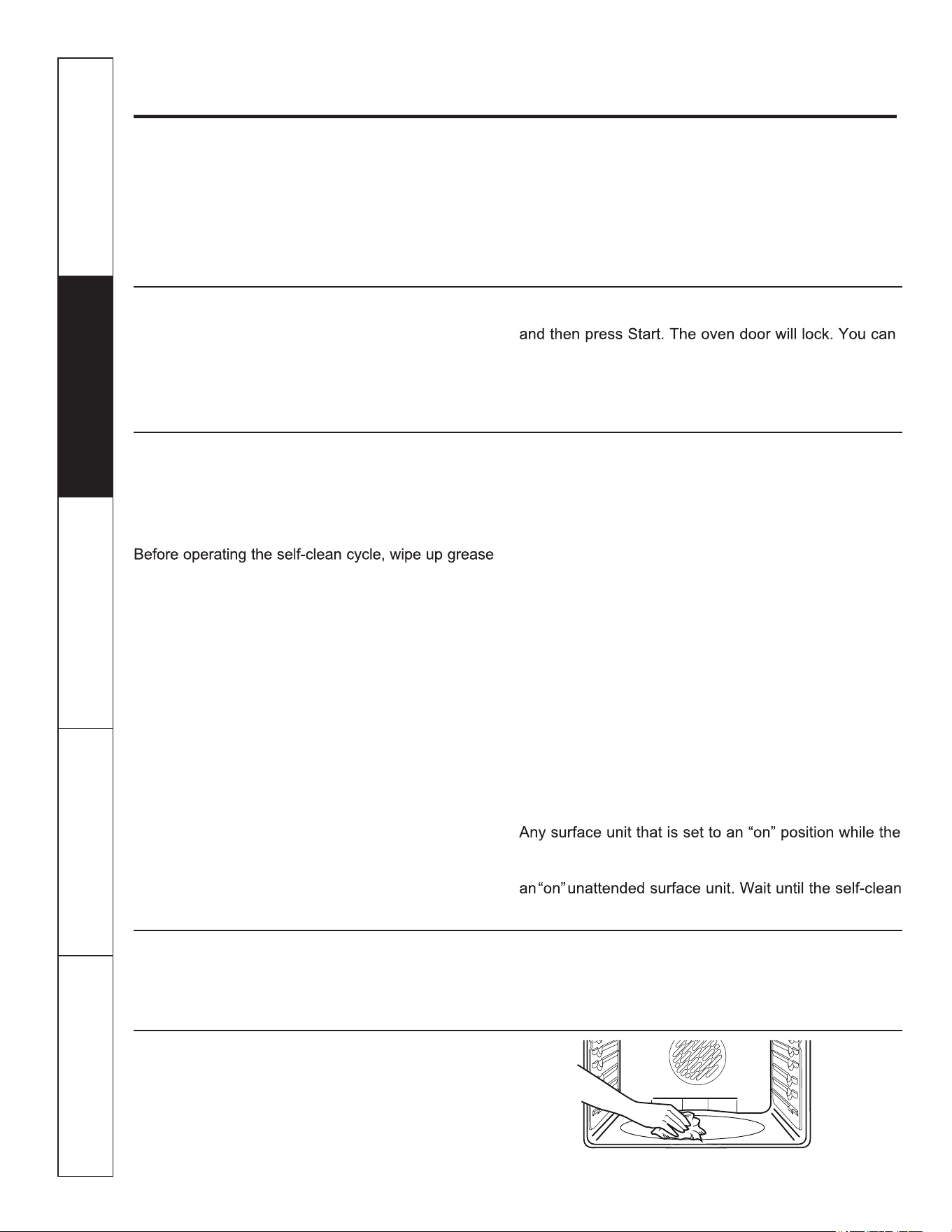
After preparing the meat and placing it on
a trivet or a broiler pan grid, follow these
directions for proper probe placement.
Insert the probe completely into the meat.
It should not touch bone, fat or gristle.
NOTE: Failure to fully insert the probe
into the meat may result in poor cooking
performance because the probe will sense
the oven air vs. the food temperature.
Never leave your probe inside the oven
during a self-cleaning or broil cycle.
Do not store the probe in the oven.
For roasts with no bone, insert the probe
into the meatiest part of the roast. For
bone-in ham or lamb, insert the probe into
the center of the lowest large muscle.
Insert the probe into the center of dishes
such as meat loaf or casseroles.
Insert the probe into the meatiest part
of the inner thigh from below and parallel
to the leg of a whole turkey.
NOTE: Self-clean and Broil settings will not
work if the temperature probe is plugged in.
The temperature probe has a
skewer-like probe at one end and
a plug at the other end that goes
into the outlet in the oven.
Plug
Cable
Handles
Probe
For many foods, especially roasts and poultry, internal food temperature is the best test for doneness. The
temperature probe takes the guesswork out of roasting by cooking foods to the exact doneness you want.
Read and remove label
CAUTION
Using the self-cleaning oven.
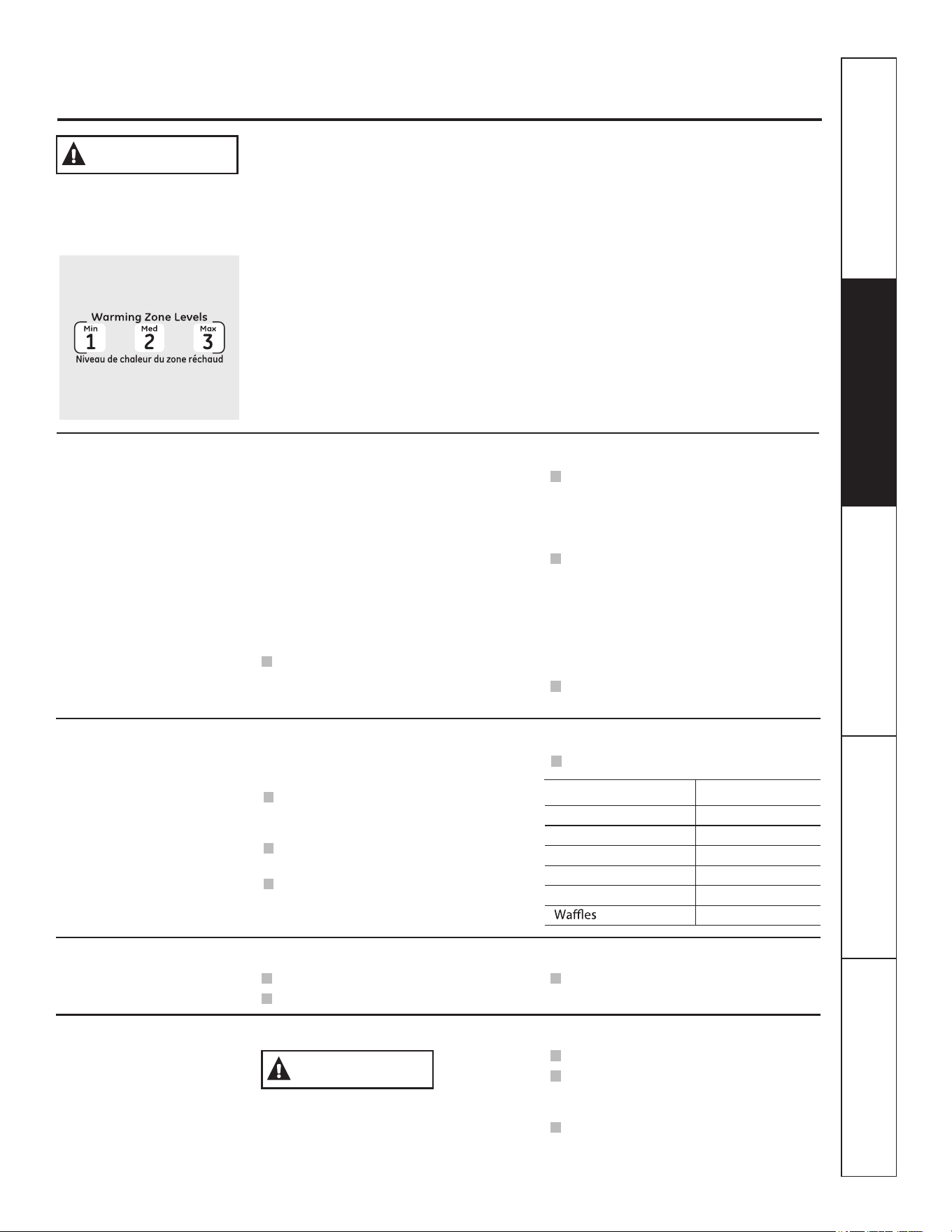
Wipe up heavy soil on the oven bottom.
Before a Clean Cycle
FIRE HAZARD: Wipe grease and heavy soil
from the oven bottom before self-cleaning.
Failure to do so may result in an oven fire.
We recommend venting your kitchen with
an open window or using a ventilation fan
or hood during the first self-clean cycle.
Remove any broiler pan, broiler grid, probe,
all cookware and any aluminum foil from
the oven.
NOTE:
If your oven is equipped with shiny,
silver-colored oven racks, remove them
before you begin the self-clean cycle.
The shiny, silver-colored oven racks
(on some models) can be self-cleaned,
but they will darken, lose their luster and
become hard to slide.
If your oven is equipped with gray
porcelain-coated oven racks, they
may be left in the oven during the
self-clean cycle.
Soil on the front frame of the range and out-
side the gasket on the door will need to be
cleaned by hand. Clean these areas with hot
water, soap-filled steel-wool pads or cleansers
such as Soft Scrub . Rinse well with clean water
and dry.
Do not clean the gasket. The fiberglass material
of the oven door gasket cannot withstand
abrasion. It is essential for the gasket to remain
intact. If you notice it becoming worn or frayed,
replace it.
Make sure the oven light bulb cover is in place
and the oven light is off.
IMPORTANT: The health of some birds is
extremely sensitive to the fumes given off
during the self-cleaning cycle any range.
Move birds to another well-ventilated room.
®
Remove any excessive spillovers in the oven
cavity before starting the Self-Cleaning cycle.
To clean use hot, soapy water and a cloth.
Large spillovers can use heavy smoke or fire
when subjected to high temperatures.
DO NOT allow food spills with a high sugar
or acid content (such as milk, tomatoes,
sauerkraut, fruit, juices or pie filling) to remain
on the surface as they may leave a dull spot
even after cleaning.
Make sure the oven light bulb cover is
in place and the oven light is off.
WARNING
Gently wipe off glass inner door with
hot, soapy water and a sponge or soft
cloth. Never use fiber, abrasive
cleaners or ammonia based products.
20
Consumer Support Troubleshooting Tips
Care and Cleaning
Operating
Instructions
Safety Instructions
The interior of your new oven can be cleaned manually or by using Steam Clean or Self Clean modes.
Spillage of marinades, fruit juices, tomato sauces and basting liquids containing acids may cause discoloration
and should be wiped up immediately. Let hot surfaces cool, then clean and rinse.
Manual Cleaning
Do not use oven cleaners, abrasive cleaners, strong
liquid cleansers, steel wool, scouring pads, or cleaning
powders on the interior of the oven. Clean with a mild
soap and water or vinegar and water solution. Rinse with
clean water and dry with a soft cloth. When cleaning
surfaces, make sure that they are at room temperature.
Steam Clean Mode
Steam clean is intended to clean small spills using
water and a lower cleaning temperature than Self-Clean.
To use the Steam Clean feature, wipe grease and soils
from the oven. Pour one cup of water into the bottom of
the oven. Close the door. Press the Steam Clean pad
not open the door during the 30 minute steam clean as
this will decrease the steam clean performance. At the
end of the steam clean cycle the door will unlock. Wipe
out any excess water and any remaining soil.
Self Clean Mode
Read Self-Cleaning Oven Safety Instructions at the
beginning of this manual before using Self Clean Mode.
Self clean uses very high temperatures to clean the oven
interior. The oven door will lock when using this feature.
and soils from the oven. Remove all items from the oven
other than enameled (dark color) racks. Shiny or silver
racks, the meat probe, and any cookware or other items
should all be removed from the oven before initiating a
self-clean cycle. Close the door. Press the Self Clean
pad and a default self-clean time is displayed. The clean
time can be changed to any time between 3:00 and
5:00 hours by using the number pads to enter a different
time and pressing Start. For heavily soiled ovens, the
maximum 5 hour clean time is recommended. If you wish
to use the default time, press the Start pad immediately
after pressing the Clean pad. The oven will turn off
automatically when the self-clean cycle is complete. The
door will stay locked until the oven has cooled down. After
the oven has cooled down wipe any ash out of the oven.
We recommend venting your kitchen with an open
window or using a ventilation fan or hood during the
first self-clean cycle.
Soil on the front frame of the range and outside the
gasket on the door will need to be cleaned by hand.
Clean these areas with hot water, soap-filled steel-wool
pads or cleansers such as Soft Scrub
®
. Rinse well with
clean water and dry.
Do not clean the gasket. The fiberglass material of
the oven door gasket cannot withstand abrasion. It is
essential for the gasket to remain intact. If you notice it
becoming worn or frayed, replace it.
Make sure the oven light bulb cover is in place and the
oven light is off.
IMPORTANT: The health of some birds is extremely
sensitive to the fumes given off during the self-cleaning
cycle of any range. Move birds to another well-
ventilated room.
On Some Models:
The surface units are automatically disabled during the
self-clean cycle. Make sure that all surface unit controls
are turned off at all times during the self-clean cycle.
self-clean cycle is operating will automatically come on
after the self-clean cycle is finished, and could result in
cycle is finished to set and use the surface units.
Cleaning the Range
Racks
All racks can be washed with warm, soapy water.
Enameled (not shiny) racks can be left in the cavity
during self clean.
Racks may be more difficult to slide, especially after
a self-clean. Put some vegetable oil on a soft cloth or
paper towel and rub onto the left and right edges.
Oven Heating Elements
Do not clean the broil element. Any soil will burn off
when the elements are heated.
The bake element is not exposed and is under the oven
floor. Clean the oven floor with warm, soapy water.
Wipe up heavy soil on the oven bottom.
To Use the Warming Drawer
Touch the WARMING DRAWER pad.
ON
display “1” changes corresponding to the
number pad selected. The warming drawer
starts automatically after you touch 1, 2 or
3. “WARMER ON” and the number remain lit.
“Set” stop blinking. On some models press START.
” and “1” are lit on the display and “. The
On some models there are just 2 levels, 1 for low
and 2 for High.
To cancel, touch the WARMING DRAWERpad.
NOTE: Touching the CLEAR/OFF pad does not
turn off the warming drawer.
When Using the Warming Drawer
The warming drawer will keep hot, cooked
foods warm. Always start with hot food. Do not
use to heat cold food other than crisping
crackers, chips or dry cereal.
Do not line the warming drawer or pan
with aluminum foil. Foil is an excellent heat
insulator and will trap heat beneath it. This
will upset the performance of the drawer
and could damage the interior finish.
Allow approximately 25 minutes for the
warming drawer to preheat.
Do not put liquid or water in the warming
drawer.
All foods placed in the warming drawer
should be covered with a lid or aluminum foil.
When warming pastries or breads, the cover
should be vented to allow moisture to
escape.
Food should be kept hot in its cooking
container or transferred to a heat-safe
serving dish.
NOTE: Plastic containers or plastic wrap will
melt if in direct contact with the drawer, pan or a
hot utensil. Melted plastic may not be removable
and is not covered under your warranty.
Remove serving spoons, etc., before placing
containers in warming drawer.
Temperature Selection Chart
To keep several different foods hot, set the
control to the food needing the highest setting.
The temperature, type and amount of food,
and the time held will affect the quality of
the food.
Repeated opening of the drawer allows
the hot air to escape and the food to cool.
With large loads it may be necessary
to use a higher warming drawer setting
and cover some of the cooked food items.
To Crisp Stale Items
Place food in low-sided dishes or pans.
Preheat on LO/1 setting.
Check crispness after 45 minutes. Add time
as needed.
To Warm Serving Bowls and Plates
Dishes will be hot. Use pot holders or mitts
when removing hot dishes.
To warm serving bowls and plates, set the
control on LO/1.
Use only heat-safe dishes.
FOOD POISON HAZARD: Bacteria may grow in food at temperatures below 60°C (140°F).
• Always start with hot food. Do not use warm settings to heat cold food.
• Do not warm food for more than 2 hours.
Failure to follow these instructions may result in foodborne illness.
The warming drawer will keep hot, cooked foods at serving temperature. Always start with hot food.
Do not use to heat cold food other than crisping crackers, chips or dry cereal.
Using the warming drawer. (on some models)
WARNING
CAUTION
Do not use plastic containers or plastic wrap.
Food Type Control Setting
MED/2
MED/2
Casserole
Chili
Pizza
HI/3
Potatoes, baked
HI/3
Tortilla Chips
LO/1
LO/1
If you want to heat fine china, please check
with the manufacturer of the dishes for
their maximum heat tolerance.
You may warm empty serving dishes
while preheating the drawer.
www.GEAppliances.ca
Safety Instructions
Operating
Instructions
Care and Cleaning
Troubleshooting Tips
Consumer Support
21

Using the lower oven drawer. (on some models)
To Use the Lower Oven Drawer
Push in and turn the lower oven
drawer knob to any desired setting.
Allow the lower oven drawer to
preheat.
The ON signal light is located above the
knob and glows when the knob is in the
ON position. It remains ON until the knob
is moved to the OFF position.
The “Heating” signal light is located below
the knob and glows when the heating
elements are active. Preheat is complete
after the “Heating” signal has turned
off for the first time after the knob is
turned on.
NOTES:
Always use the included drawer rack
when using the lower oven drawer.
The lower oven drawer cannot be used
during a self-clean cycle of the upper
oven.
Do not put food, foil or cookware directly
on the bottom of the lower oven drawer.
Always use the included drawer rack.
If foods require a cover, use only
foil or lids able to withstand baking
temperatures. Do not use plastic.
Maximum height of foods that can be
baked in the lower oven drawer is 8.9 cm
(3
1
/2″).
Do not put liquid or water in the lower
oven drawer.
Never place plastics, paper, canned foods
or combustible material in the lower oven
drawer.
The lower oven drawer may be used to bake foods using the same times and temperatures as a standard oven.
Foods ideal for baking in the lower oven drawer include pizza, frozen foods, casseroles, biscuits, rolls and many
desserts.
Push in and turn the lower oven drawer
knob to any desired setting.
When Using the Lower Oven Drawer Warm Setting
The WARM SETTING of the lower oven
drawer can be used to keep hot, cooked
foods at serving temperatures. Always start
with hot food. Do not use the WARM
SETTING to heat cold food other than
crisping crackers, chips or dry cereal.
NOTE: The beginning temperature of the
food, the amount of food, the type of food,
the container and the amount of time the
food is in the drawer will affect the quality
and ending temperature of the food.
Push in and turn the control knob
to the warm setting.
The lower oven drawer uses less energy than the upper oven.
Allow the following approximate times for preheating:
WARM
Oven Temperature
Desired Lower
Time
Preheat
10 minutes
176.7°C (350°F) 15 minutes
218.3°C (425°F) 25 minutes
Consumer Support Troubleshooting Tips
Care and Cleaning
Operating
Instructions
Safety Instructions
22
Do not use a steel wool pad; it will
scratch the surface.
To clean the stainless steel surface, use
warm, sudsy water or a stainless steel
cleaner or polish. Always wipe the surface
in the direction of the grain. Follow the
cleaner instructions for cleaning the
stainless steel surface.
To inquire about purchasing stainless steel
appliance cleaner or polish or to find the
location of a dealer nearest you, please
call our toll-free number:
National Parts Centre 1.800.661.1616
www.GEAppliances.ca
Stainless Steel Surfaces (on some models)
Be sure all controls are off and all surfaces are cool before cleaning any part of the range.
If your range is removed for cleaning, servicing or any
reason, be sure the anti-tip device is reengaged properly
when the range is replaced. Failure to take this precaution
could result in tipping of the range and cause injury.
Control Panel
If desired, the touch pads may be deactivated
before cleaning.
See the Control Lockout information in the Using
the clock, kitchen timer and control lockout
section in this manual.
Clean up splatters with a damp cloth.
You may also use a glass cleaner.
Remove heavier soil with warm, soapy water.
Do not use abrasives of any kind.
Reactivate the touch pads after cleaning.
Painted Surfaces
Painted surfaces include the sides of the range
and the door, top of control panel and the
drawer front. Clean these with soap and water
or a vinegar and water solution.
Do not use commercial oven cleaners, cleaning
powders, steel wool or harsh abrasives on any
painted surface.
How to Remove Protective Shipping Film and Packaging Tape
Carefully grasp a corner of the protective
shipping film with your fingers and slowly peel
it from the appliance surface. Do not use any
sharp items to remove the film. Remove all
of the film before using the appliance
for the first time.
To ensure no damage is done to the finish
of the product, the safest way to remove
the adhesive from packaging tape on new
appliances is an application of a household
liquid dishwashing detergent. Apply with a soft
cloth and allow to soak.
NOTE: The adhesive must be removed from all
parts. It cannot be removed if it is baked on.
Control Knobs
The control knobs may be removed for easier
cleaning.
Make sure the knobs are in the OFF positions
and pull them straight off the stems for
cleaning.
The knobs can be cleaned in a dishwasher or
they may also be washed with soap and water.
Make sure the inside of the knobs are dry
before replacing.
Replace the knobs, in the OFF position to
ensure proper placement.
Porcelain Enamel Cooktop (on some models)
The porcelain enamel finish is sturdy
but breakable if misused. This finish is
acid-resistant. However, any acidic foods
spilled (such as fruit juices, tomato or
vinegar) should not be permitted to
remain on the finish.
If acids spill on the cooktop while it is hot,
use a dry paper towel or cloth to wipe it up
right away. When the surface has cooled,
wash with soap and water. Rinse well.
For other spills such as fat spatterings,
wash with soap and water or cleansing
powders after the surface has cooled.
Rinse well. Polish with a dry cloth.
Care and cleaning of the range.
WARNING
www.GEAppliances.ca
Safety Instructions
Operating
Instructions
Care and Cleaning
Troubleshooting Tips
Consumer Support
Care and Cleaning
23
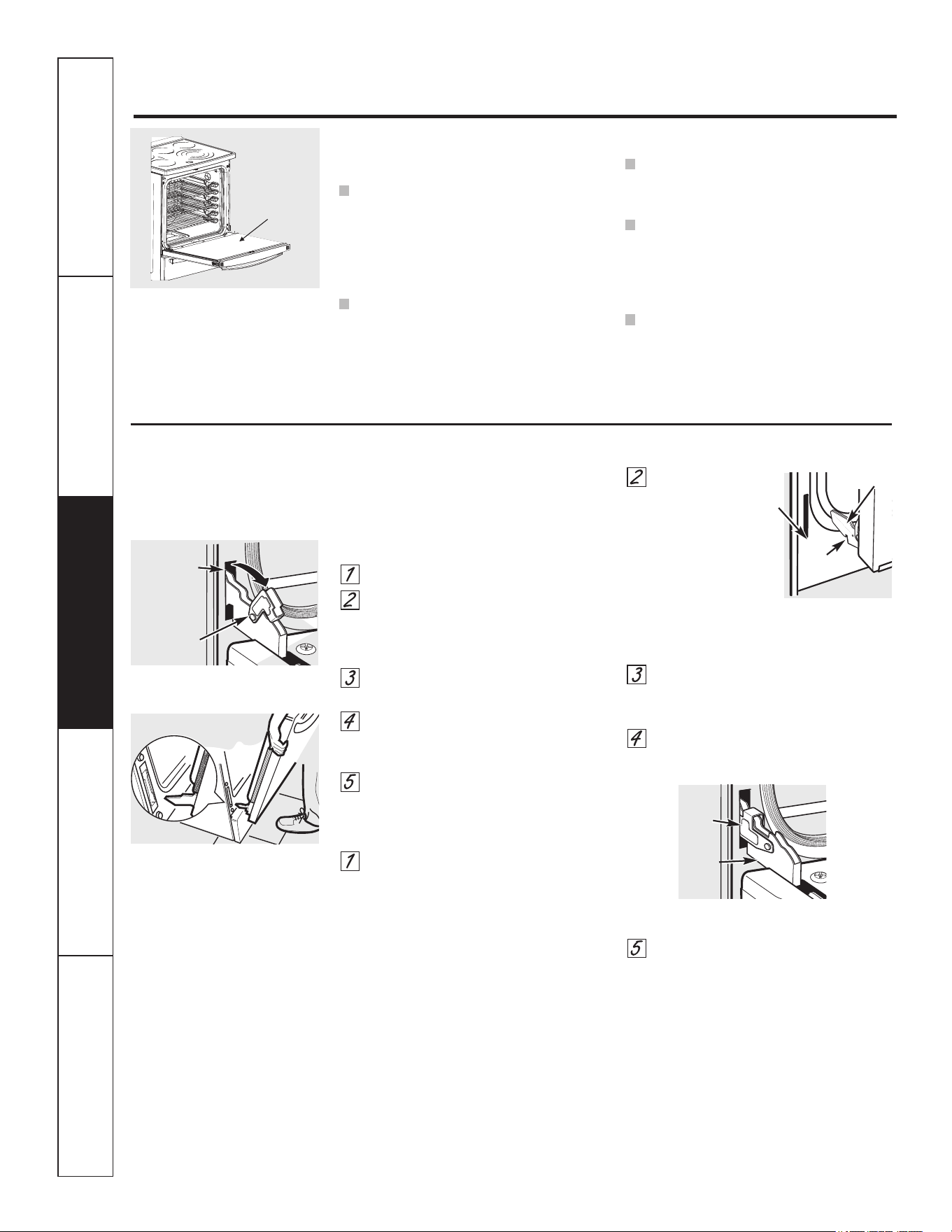
The door is very heavy. Be careful when
removing and lifting the door.
Do not lift the door by the handle.
To remove the door:
Fully open the door.
Pull the hinge locks down toward the door
frame, to the unlocked position. A tool,
such as a small flat-blade screwdriver,
may be required.
Firmly grasp both sides of the door
at the top.
Close door to the door removal position,
which is halfway between the broil stop
position and fully closed.
Lift door up and out until the hinge arm
is clear of the slot.
To replace the door:
Firmly grasp both sides of the door
at the top.
With the
door at the
same angle
as the removal
position, seat the
indentation of the
hinge arm into the
bottom edge of the
hinge slot. The notch in the hinge arm
must be fully seated into the bottom of
the slot.
Fully open the door. If the door will not
fully open, the indentation is not seated
correctly in the bottom edge of the slot.
Push the hinge locks up against the front
frame of the oven cavity to the locked
position.
Close the oven door.
Do not rub or clean the oven gasket—it has
an extremely low resistance to abrasion.
If you notice the gasket becoming worn,
frayed or damaged in any way you should
have it replaced.
To clean the inside of the door:
Gently wipe off glass inner door with hot,
soapy water and a sponge or soft cloth.
Never use fiber, abrasive cleaners or
ammonia based products.
To clean the outside of the door:
Use soap and water to thoroughly clean the
top, sides and front of the oven door. Rinse
well. You may also use a glass cleaner to
clean the glass on the outside of the door.
Do not let water drip into the vent openings.
If any stain on the door vent trim is
persistent, use a soft abrasive cleaner
and a sponge-scrubber for best results.
Spillage of marinades, fruit juices, tomato
sauces and basting materials containing
acids may cause discoloration and should
be wiped up immediately. When surface is
cool, clean and rinse.
Do not use oven cleaners, cleaning powders
or harsh abrasives on the outside of the door.
Lift-Off Oven Door (on some models)
Cleaning the Oven Door
Hinge
lock
Removal position
Indentation
Bottom
edge of
slot
Hinge
lock
Slot
Push hinge locks up to lock.
Pull hinge locks down to unlock.
Hinge arm
Hinge
arm
Consumer Support Troubleshooting Tips
Care and Cleaning
Operating
Instructions
Safety Instructions
Do hand
clean the
glass door
24

Oven Racks
All oven racks may be cleaned by hand
with an abrasive cleaner or steel wool. After
cleaning, rinse the racks with clean water
and dry with a clean cloth. Gray porcelain-
coated oven racks may remain in the oven
during the self-cleaning cycle without being
damaged. The nickel-plated oven racks
may remain in the oven during the
self-cleaning cycle, but they will lose their
luster and become hard to slide. It will be
necessary to grease all oven rack side
edges with a light coating of vegetable oil
after cleaning them by hand or in the oven.
This will help maintain the ease of sliding
the racks in and out of the oven.
www.GEAppliances.ca
Safety Instructions
Operating
Instructions
Care and Cleaning
Troubleshooting Tips
Consumer Support
Care and Cleaning
25
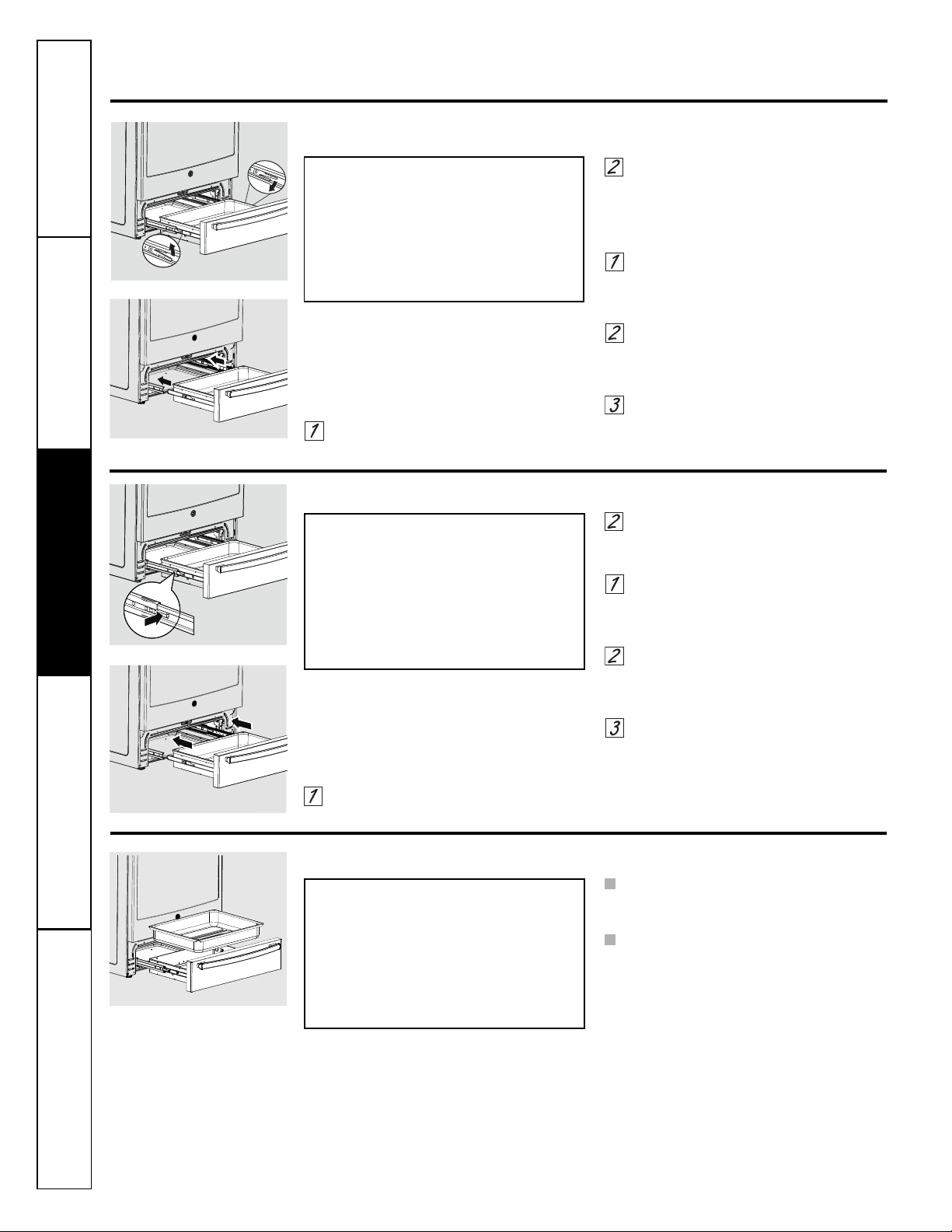
Consumer Support Troubleshooting Tips
Care and Cleaning
Operating
Instructions
Safety Instructions
Removable Drawer (Warming Drawer Models only)
Removable Drawer (Lower Oven Drawer Models only)
Most cleaning can be done with the drawer
in place. However, the drawer may be
removed if further cleaning is needed. Use
soap and warm water to clean thoroughly.
Most cleaning can be done with the drawer
in place. However, the drawer may be
removed if further cleaning is needed. Use
soap and warm water to clean thoroughly.
Pull the drawer straight out until
it stops.
Pull the drawer straight out until
it stops.
Place the left drawer rail around the
inner left rail guide and slide it in
slightly to hook it.
Place the right drawer rail around the
inner right rail guide and slide it in
slightly to hook it.
Slide the drawer all the way in.
Press the left rail release up and press
the right rail release down, while pulling
the drawer forward and free.
Press the tabs no both sides in while
pulling the drawer forward and free.
To remove the drawer:
To remove the drawer:
To replace the drawer:
To replace the drawer:
Place the left drawer rail around the
inner left rail guide and slide it in slightly
to hook it.
Place the right drawer rail around the
inner right rail guide and slide it in
slightly to hook it.
Slide the drawer all the way in.
NOTE: For models with an electric warming
drawer, before performing any adjustments,
cleaning or service, disconnect the range
electrical power supply at the household
distribution panel by removing the fuse or
switching off the circuit breaker. Make sure
the warming drawer heating element is cool.
Removable Lower Oven Drawer Pan
NOTE: For models with an electric warming
drawer or lower oven drawer, before
performing any adjustments, cleaning or
service, disconnect the range electrical
power supply at the household distribution
panel by removing the fuse or switching off
the circuit breaker. Make sure the drawer
heating element is cool.
NOTE: Allow lower oven drawer to cool
before removing pan.
NOTE: Wipe spills promptly after each use.
NOTE: For models with an electric warming
drawer or lower oven drawer, before
performing any adjustments, cleaning or
service, disconnect the range electrical
power supply at the household distribution
panel by removing the fuse or switching off
the circuit breaker. Make sure the warming
drawer heating element is cool.
Never place, use or self-clean the lower
oven drawer pan in the upper oven.
Lower oven drawer has a removable pan
for easy cleaning. Clean with hot soopy
water and a sponge or dish towel. Dry with
a clean cloth. An oven cleaner, such as
Easy-Off
®
. may also be used. Be sure to
follow the directions on the oven cleaner.
Replace the pan in the lower oven drawer.
26
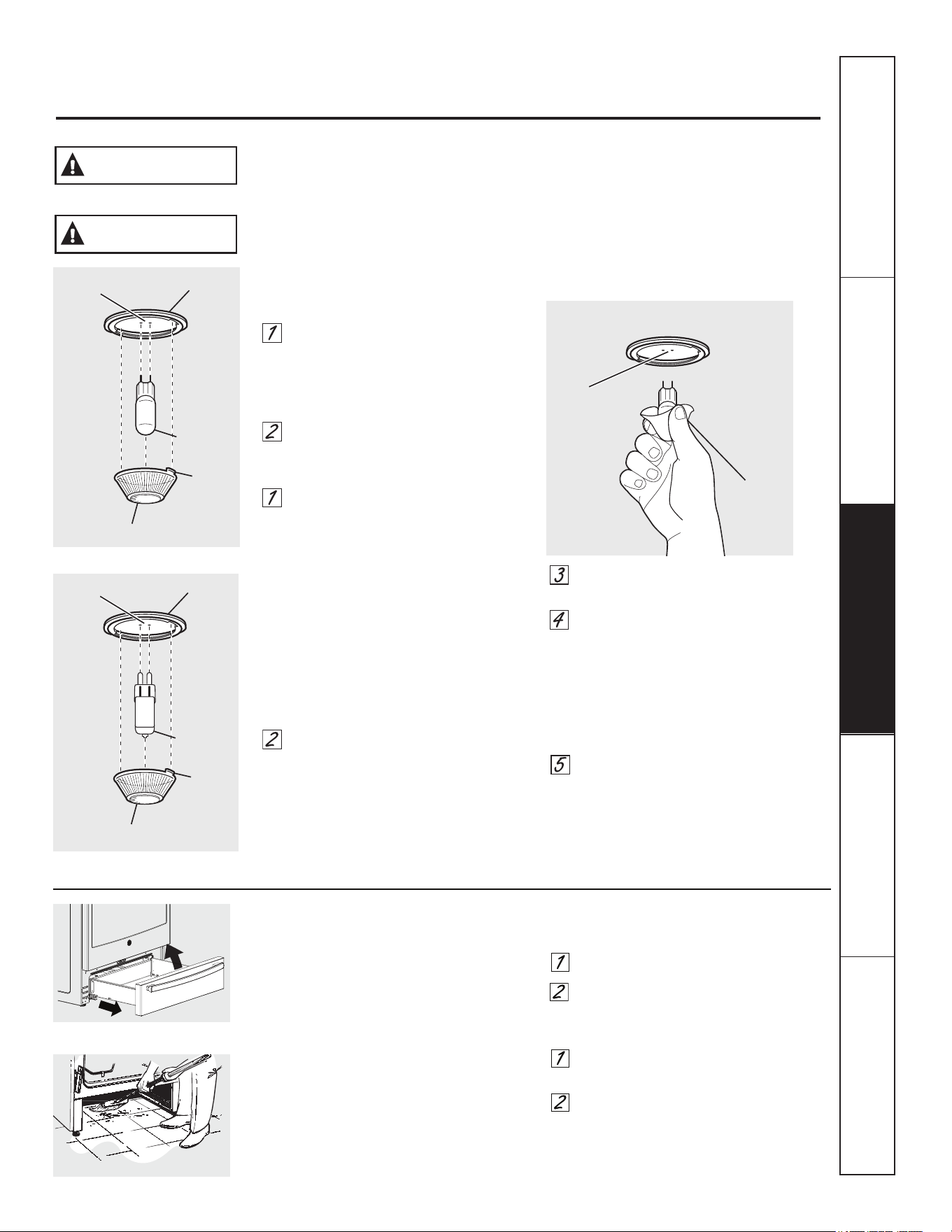
Care and cleaning of the range.
Oven Light Replacement
To remove:
Turn the glass cover counterclockwise
1/4 turn until the tabs of the glass
cover clear the grooves of the socket.
Wearing latex gloves may offer
a better grip.
Using gloves or a dry cloth, remove
the bulb by pulling it straight out.
To replace:
Use a new 120/130-volt halogen bulb,
not to exceed 50 watts. Replace the
bulb with the same type of bulb that
was removed. Your model will have
one of the two types shown on
the left. To determine the correct
replacement bulb, check the bulb
terminals. Bulbs with 2 straight pin
terminals are G6.35 bulbs. Bulbs
with 2 looped terminals are G9 bulbs.
(Do not interchange.) Be sure the
replacement bulb is rated 120 volts
or 130 volts (NOT 12 volts).
Using gloves or a dry cloth, remove
the bulb from its packaging. Do not
touch the bulb with bare fingers. Oil
from skin will damage the bulb and
shorten its life.
Some models are provided with 2
lights, one at oven top and other at
oven back.
Push the bulb straight into the
receptacle all the way.
Place the tabs of the glass cover into
the grooves of the socket. Turn the
glass cover clockwise 1/4 turn.
For improved lighting inside the oven,
clean the glass cover frequently using
a wet cloth. This should be done when
the oven is completely cool.
Reconnect electrical power to
the oven.
G6.35 Bulb
Socket
Tab
Glass cover
Receptacle
Use gloves
or cloth
Receptacle
(on some models)
SHOCK OR BURN HAZARD: Before replacing oven light bulb, disconnect
the electrical power to the range at the main fuse or circuit breaker panel.
Failure to do so may result in electric shock or burn.
BURN HAZARD: The glass cover and bulb should be removed when cool.
Touching hot glass with bare hands or a damp cloth can cause burns.
CAUTION
www.GEAppliances.ca
Safety Instructions
Operating
Instructions
Care and Cleaning
Troubleshooting Tips
Consumer Support
Care and Cleaning
bluB 9G
Socket
Tab
Glass cover
Receptacle
n some model )so(
Removable Storage Drawer (on some models)
The storage drawer is a good place to store
cookware and bakeware. Do not store plastics
and flammable material in the drawer.
The storage drawer may be removed for
cleaning under the range. Clean the storage
drawer with a damp cloth or sponge. Never
use harsh abrasives or scouring pads.
To remove storage drawer:
Pull drawer straight out until it stops.
Tilt the front of the drawer up and free of
the range.
To replace storage drawer:
Set the stops on the back of the drawer
over the stops in the range.
Slide drawer evenly and straight back, so
that the rails in the range are engaged.
The storage drawer may be removed
for cleaning under the range.
27
WARNING
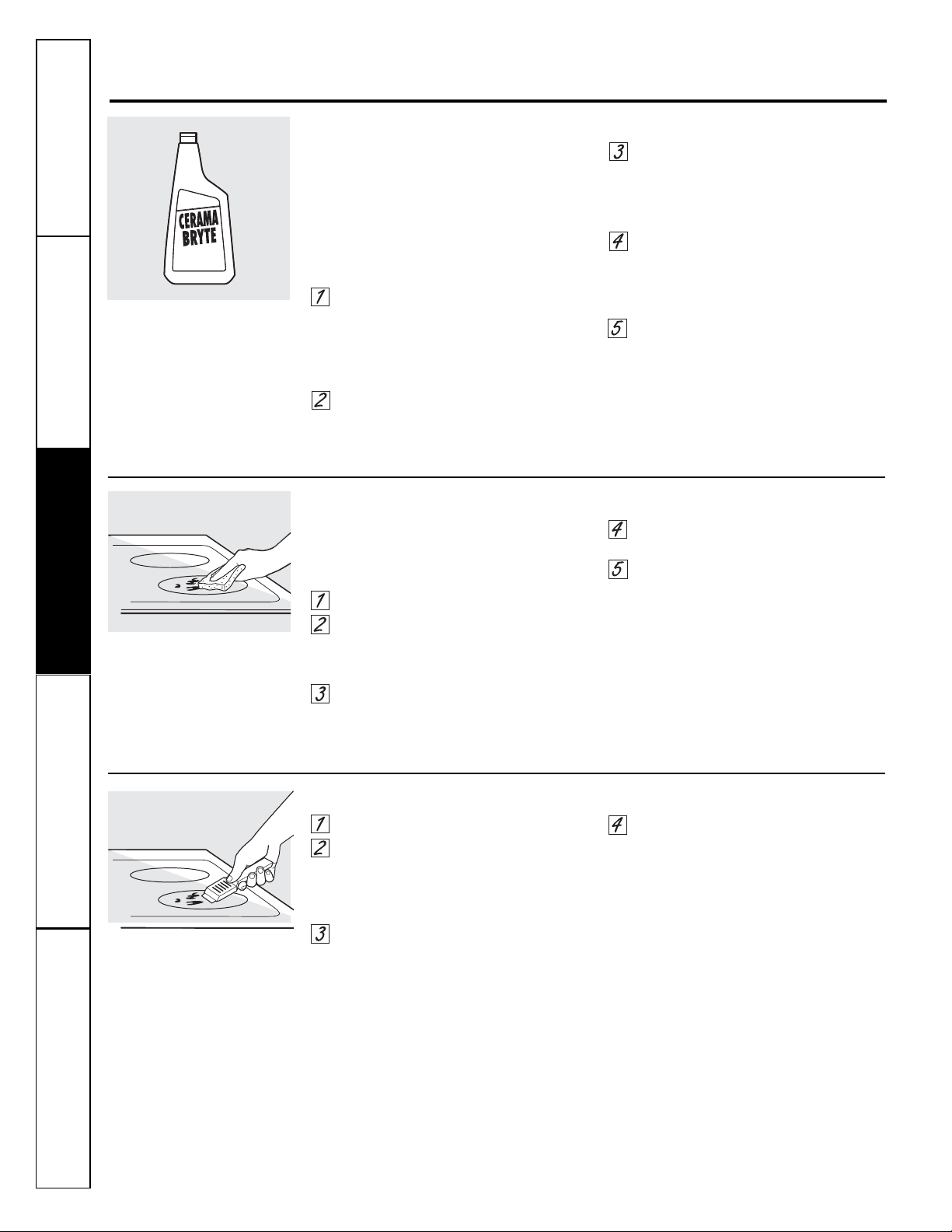
Allow the cooktop to cool.
Use a single-edge razor blade
scraper at approximately a 45°
angle against the glass surface and
scrape the soil. It will be necessary
to apply pressure to the razor
scraper in order to remove
the residue.
After scraping with the razor
scraper, spread a few drops of
CERAMA BRYTE
®
Ceramic Cooktop
Cleaner on the entire burned residue
area. Use the CERAMA BRYTE
®
Cleaning Pad to remove any
remaining residue.
For additional protection, after all
residue has been removed, polish
the entire surface with CERAMA
BRYTE
®
Ceramic Cooktop Cleaner
and a paper towel.
Burned-On Residue
NOTE: DAMAGE to your glass surface
may occur if you use scrub pads other
than those recommended.
Allow the cooktop to cool.
Spread a few drops of CERAMA
BRYTE
®
Ceramic Cooktop Cleaner on
the entire burned residue area.
Using the included CERAMA BRYTE
®
Cleaning Pad for Ceramic Cooktops,
rub the residue area, applying
pressure as needed.
If any residue remains, repeat
the steps listed above as needed.
For additional protection, after all
residue has been removed, polish
the entire surface with CERAMA
BRYTE
®
Ceramic Cooktop Cleaner
and a paper towel.
The CERAMA BRYTE
®
Ceramic Cooktop
Scraper and all recommended supplies
are available through our Parts Centre.
See instructions under “To Order Parts”
section on next page.
NOTE: Do not use a dull or
nicked blade.
Heavy, Burned-On Residue
Use a CERAMA BRYTE
®
Cleaning Pad for
Ceramic Cooktops.
Normal Daily Use Cleaning
ONLY use CERAMA BRYTE
®
Ceramic
Cooktop Cleaner on the glass cooktop.
Other creams may not be as effective.
To maintain and protect the surface of
your glass cooktop, follow these steps:
Before using the cooktop for the
first time, clean it with CERAMA
BRYTE
®
Ceramic Cooktop Cleaner.
This helps protect the top and makes
cleanup easier.
Daily use of CERAMA BRYTE
®
Ceramic
Cooktop Cleaner will help keep the
cooktop looking new.
Shake the cleaning cream well.
Apply a few drops of CERAMA BRYTE
®
Ceramic Cooktop Cleaner directly
to the cooktop.
Use a paper towel or CERAMA
BRYTE
®
Cleaning Pad for Ceramic
Cooktops to clean the entire cooktop
surface.
Use a dry cloth or paper towel
to remove all cleaning residue.
No need to rinse.
NOTE: It is very important that you DO
NOT heat the cooktop until it has been
cleaned thoroughly.
Clean your cooktop after
each spill. Use CERAMA
BRYTE
®
Ceramic Cooktop
Cleaner.
Cleaning the glass cooktop.
(on some models)
Consumer Support Troubleshooting Tips
Care and Cleaning
Operating
Instructions
Safety Instructions
28

To order CERAMA BRYTE
®
Ceramic
Cooktop Cleaner and the cooktop
scraper, please call our toll-free number:
National Parts Centre
800.661.1616
CERAMA BRYTE
®
Ceramic
Cooktop Cleaner . . . . . . . . .#WX10X300
CERAMA BRYTE
®
Ceramic
Cooktop Scraper . . . . . . . . . .#
WX10X0302
Kit . . . . . . . . . . . . . . . . . . . . . . .#WB64X5027
(Kit includes cream and cooktop scraper)
CERAMA BRYTE
®
Cleaning Pads for
Ceramic Cooktops . . . . . . .#WX10X350
Turn off all surface units. Remove
hot pans.
Wearing an oven mitt:
a. Use a single-edge razor
blade scraper (CERAMA BRYTE
®
Ceramic Cooktop Scraper)
to move the spill to a cool
area on the cooktop.
b. Remove the spill with paper
towels.
Any remaining spillover should be
left until the surface of the cooktop
has cooled.
Don’t use the surface units again
until all of the residue has been
completely removed.
NOTE: If pitting or indentation in the
glass surface has already occurred, the
cooktop glass will have to be replaced.
In this case, service will be necessary.
Damage from Sugary Spills and Melted Plastic
Sugary spillovers (such as
jellies, fudge, candy, syrups)
or melted plastics can cause
pitting of the surface of your
cooktop (not covered by the
warranty) unless the spill
is removed while still hot.
Special care should be
taken when removing hot
substances.
Be sure to use a new, sharp
razor scraper.
Do not use a dull or nicked
blade.
Be careful not to slide pots and
pans across your cooktop. It will
leave metal markings on the
cooktop surface.
These marks are removable using
the CERAMA BRYTE
®
Ceramic
Cooktop Cleaner with the CERAMA
BRYTE
®
Cleaning Pad for Ceramic
Cooktops.
If pots with a thin overlay of
aluminum or copper are allowed
to boil dry, the overlay may leave
black discoloration on the cooktop.
This should be removed
immediately before heating
again or the discoloration
may be permanent.
NOTE: Carefully check the bottom of
pans for roughness that would scratch
the cooktop.
Metal Marks and Scratches
To Order Parts
Glass surface―potential for permanent damage.
To clean the cooktop seal around the
edges of the glass, lay a wet cloth on it
for a few minutes, then wipe clean with
nonabrasive cleaners.
Cooktop Seal
www.GEAppliances.ca
Safety Instructions
Operating
Instructions
Care and Cleaning
Troubleshooting Tips
Consumer Support
Care and Cleaning
29
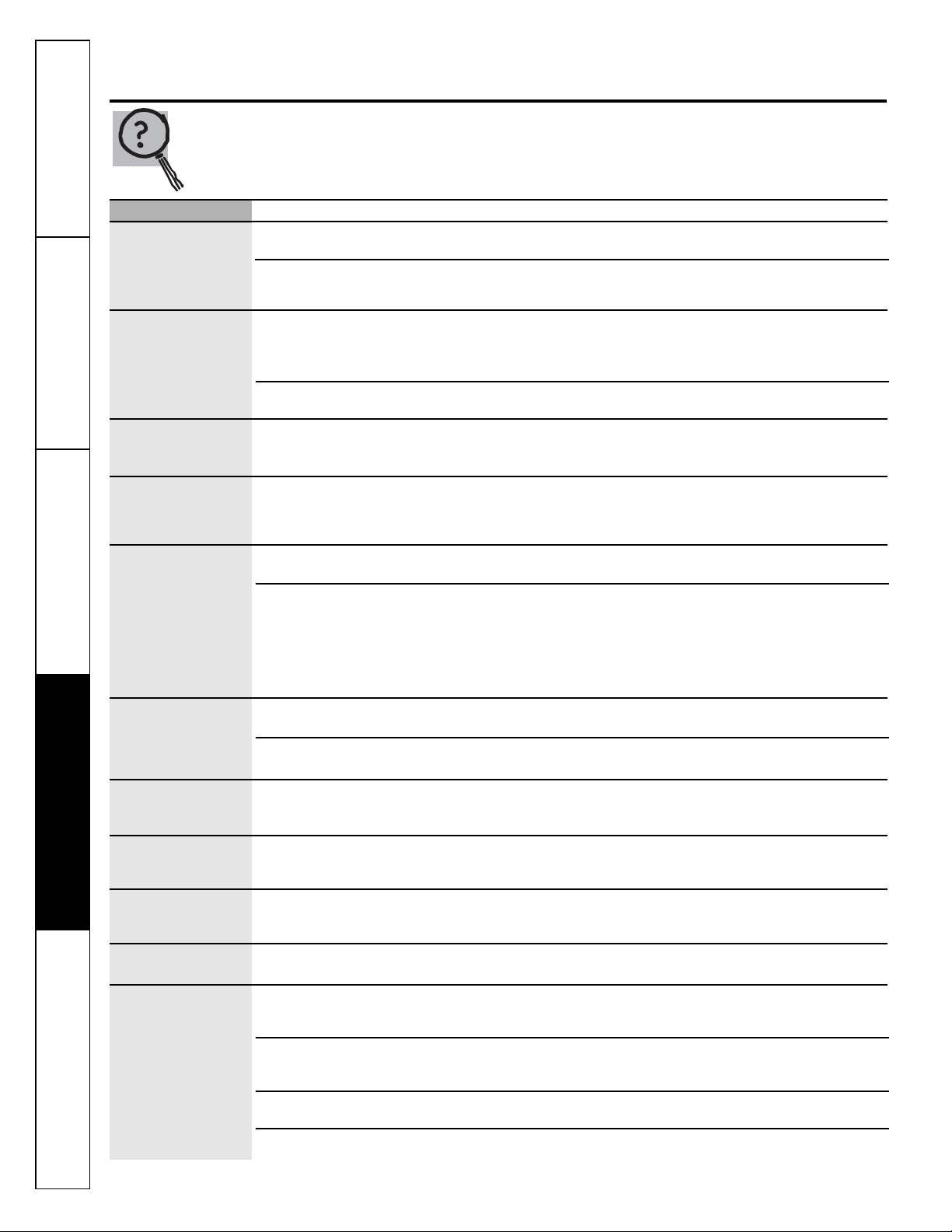
Troubleshooting Tips
Save time and money! Review the charts on the following
pages first and you may not need to call for service.
Problem Possible Causes What To Do
Surface units will not Improper cookware • Use pans which are flat and match the diameter of
maintain a rolling boil being used. the surface unit selected.
or cooking is not
In some areas, the power • Cover pan with a lid until desired heat is obtained.
fast enough
(voltage) may be low.
Surface units do A fuse in your home may be • R
Surface units do not
work.
There has been a main
power supply surge and/or
a power interruption and
surge.
•
•
•
On the Control Panel, activate the Self Clean mode
(press the SELF CLEAN button).
Wait for 30 seconds and then press the OFF button.
The cooktop should now be ready to operate.
eplace the fuse or reset the circuit breaker.
not work properly blown or the circuit breaker
tripped.
Cooktop controls • Check to see the correct control is set for the surface
improperly set. unit you are using.
Surface unit stops This is normal. The unit
glowing when turned
is still on and hot.
to a lower setting
Scratches (may appear Incorrect cleaning • Scratches are not removable. Tiny scratches will become
as cracks) on cooktop methods being used. less visible in time as a result of cleaning.
glass surface
Cookware with rough bottoms • To avoid scratches, use the recommended cleaning
being used or coarse particles procedures. Make sure bottoms of cookware are clean
(salt or sand) were between before use, and use cookware with smooth bottoms.
the cookware and the surface
of the cooktop.
Cookware has been slid
across the cooktop surface.
Areas of discoloration Food spillovers not cleaned • See the Cleaning the glass cooktop section.
on the cooktop before next use.
Hot surface on a model • This is normal. The surface may appear discolored
with a light-colored cooktop. when it is hot. This is temporary and will disappear
as the glass cools.
Plastic melted to Hot cooktop came into • See the Glass surface―potential for permanent damage
the surface contact with plastic placed section in the Cleaning the glass cooktop section.
on the hot cooktop.
Pitting (or indentation) Hot sugar mixture spilled • Call a qualified technician for replacement.
of the cooktop on the cooktop.
Frequent cycling Improper cookware • Use only flat cookware to minimize cycling.
off and on of being used.
surface units
Oven light does Light bulb is loose. • Tighten or replace the bulb.
not work
Oven will not work Plug on range is not completely • Make sure electrical plug is plugged into a live, properly
inserted in the electrical outlet. grounded outlet.
A fuse in your home may • Replace the fuse or reset the circuit breaker.
be blown or the circuit
breaker tripped.
Oven controls improperly set. • See the Using the oven section.
Oven too hot. • Allow the oven to cool to below locking temperature.
Before You Call For Service…
Consumer Support Troubleshooting Tips
Care and Cleaning
Operating
Instructions
Safety Instructions
30
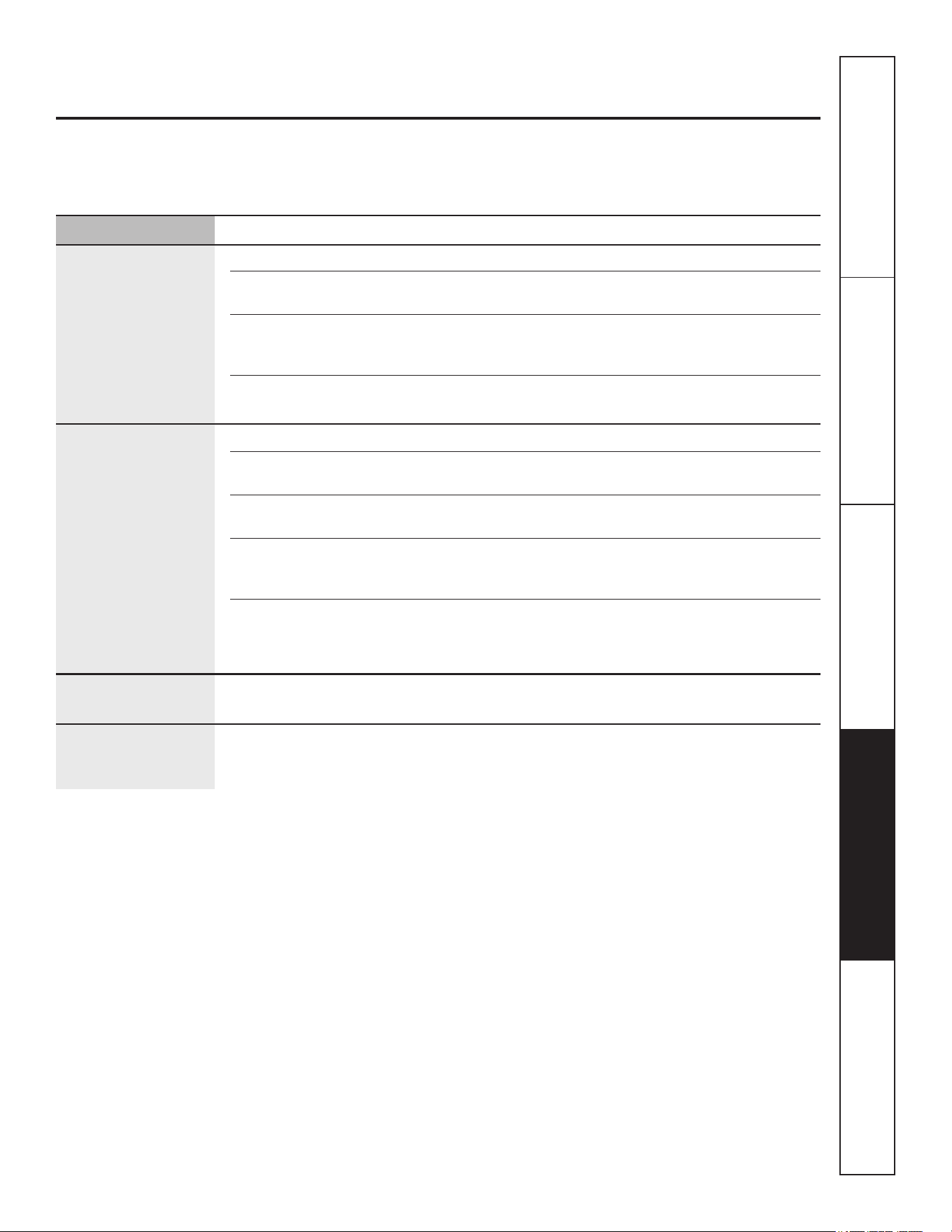
Problem Possible Causes What To Do
Food does not bake Oven controls improperly set. • See the Using the oven section.
or roast properly
Rack position is incorrect • See the Using the oven section.
or the rack is not level.
Incorrect cookware or • See the Using the oven section.
cookware of improper
size being used.
Oven thermostat needs • See the Adjust the oven thermostat―Do it yourself!
adjustment. section.
Food does not Oven controls improperly set. • Make sure you touch the BROIL HI/LO pad.
broil properly
Improper rack position • See the Broiling Guide.
being used.
Cookware not suited • For best results, use a pan designed for broiling.
for broiling.
The probe is plugged • Unplug and remove the probe from the oven.
into the outlet in the oven.
(on some models)
In some areas the power • Preheat the broil element for 10 minutes.
(voltage) may be low.
• Broil for the longest period of time recommended
in the Broiling Guide.
Oven temperature Oven thermostat • See the Adjust the oven thermostat―Do it yourself!
too hot or too cold needs adjustment. section.
Oven door is crooked The door is out of position. • Because the oven door is removable, it sometimes gets out
of position during installation. To straighten the door, push
down on the high corner.
www.GEAppliances.ca
Safety Instructions
Operating
Instructions
Care and Cleaning Consumer Support
Care and Cleaning
Troubleshooting Tips
31
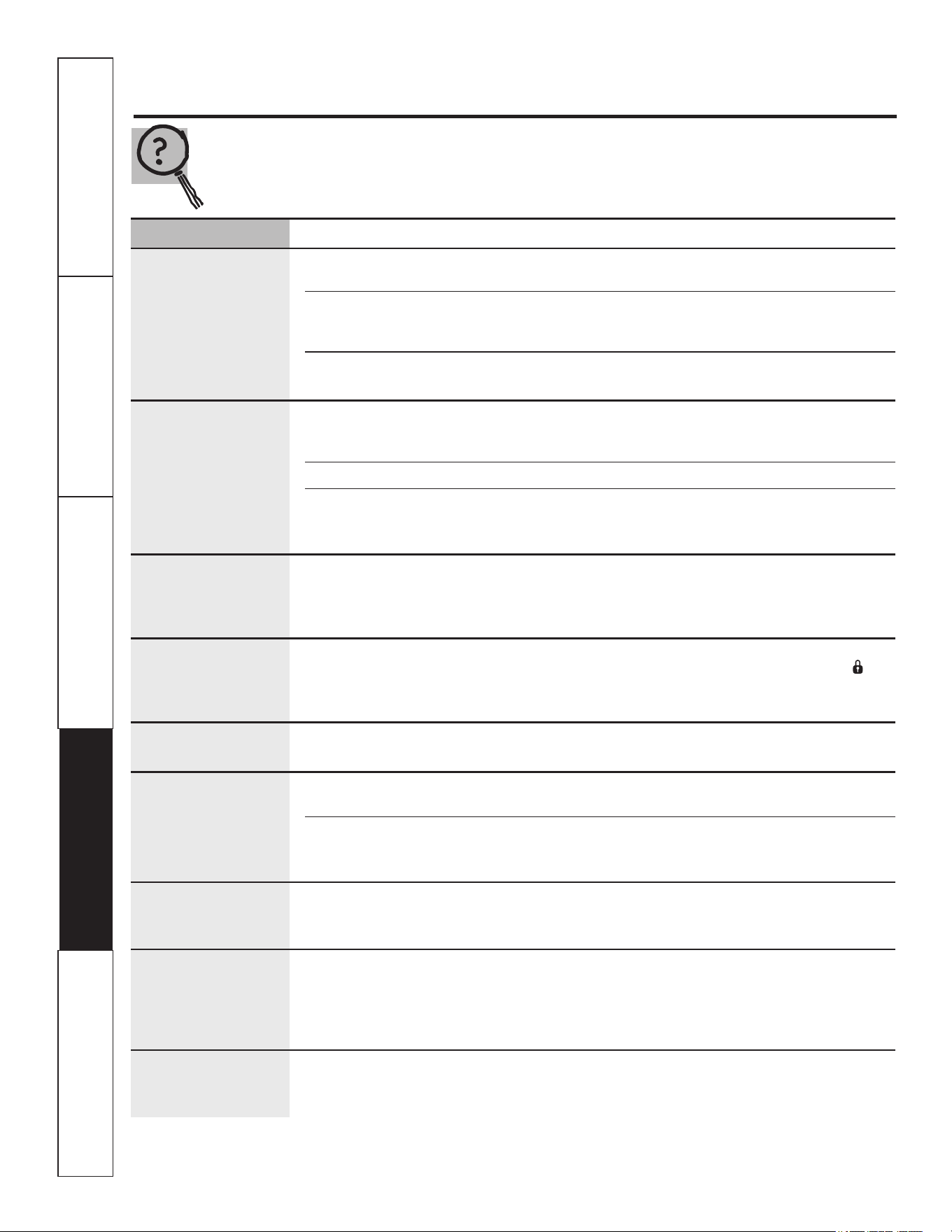
Before You Call For Service…
Troubleshooting Tips
Problem Possible Causes What To Do
Clock and timer do Plug on range is not completely • Make sure electrical plug is plugged into a live, properly
not work inserted in the electrical outlet. grounded outlet.
A fuse in your home • Replace the fuse or reset the circuit breaker.
may be blown or the
circuit breaker tripped.
Oven controls improperly set. • See the Using the clock, kitchen timer and control
lockout section.
Oven will not self-clean The oven temperature is • Allow the range to cool and reset the controls.
too high to set a self-clean
operation.
Oven controls improperly set. • See the Using the self-cleaning oven section.
The probe is plugged into • Remove the probe from the oven.
the outlet in the oven.
(on some models)
“Crackling” or This is the sound of the • This is normal.
“popping” sound metal heating and cooling
during both the cooking and
cleaning functions.
Excessive smoking Excessive soil. • Touch the CLEAR/OFF pad. Open the windows to
during a clean cycle rid the room of smoke. Wait until LOCKED/DOOR
goes off. After the oven cools, wipe up the excess soil
and reset the clean cycle.
Oven door will not Oven too hot. • Allow the oven to cool below locking temperature.
open after a clean cycle
Oven not clean after a Oven controls not properly set. • See the Using the self-cleaning upper and lower ovens
clean cycle section.
Oven was heavily soiled. • Clean up heavy spillovers before starting the clean
cycle. Heavily soiled ovens may need to self-clean
again or for a longer period of time.
“LOCKED” flashes The self-clean cycle has been • Close the oven door.
in the display selected but the door is not
closed.
“LOCKED” is on The oven door is locked • Touch the CLEAR/OFF pad. Allow the oven to cool.
when you want because the temperature
to cook inside the oven has not
dropped below the
locking temperature.
“F―” and a number You have a function error code. • Disconnect all power to the range for at least
or letter flash 30 seconds and then reconnect power. If the function
in the display error code repeats, call for service.
Consumer Support
Troubleshooting Tips
Care and Cleaning
Operating
Instructions
Safety Instructions
32
Problem Possible Causes What To Do
Range Locked or LOC The controls have • See the Control Lockout section to unlock.
On appears in the oven been locked.
display or LC appears
in the surface display
Control signals after You forgot to enter a • Touch the BAKE pad and desired temperature or
entering cooking time bake temperature or the SELF CLEAN pad and desired clean time.
or start time cleaning time.
Display goes blank A fuse in your home may be • Replace the fuse or reset the circuit breaker.
blown or the circuit
breaker tripped.
The clock is in the • See the Special features of your oven control section.
black-out mode.
Display flashes Power failure. • Reset the clock.
Unable to get the Oven control pads were • The BROIL HI/LO and BAKE pads must be touched at
display to show “SF” not touched properly. the same time and held for 3 seconds.
“Probe” appears in This is reminding you to • Enter a probe temperature.
the display enter a probe temperature
(on some models) after plugging in the probe.
Power outage, Power outage or surge. • Reset the clock. If the oven was in use, you must reset
clock flashes it by touching the CLEAR/OFF pad, setting the clock
and resetting any cooking function.
Steam from the vent When using the ovens, • This is normal.
it is normal to see steam
coming out of the oven
vents. As the number of racks
or amount of food being
cooked increases, the amount
of visible steam will increase.
“Burning” or “oily” This is normal in a new oven • To speed the process, set a self-clean cycle for a
“CLOSE DOOR”
flashes or scrolls in
the display.
This is a normal condition.
The “CLOSE DOOR” is a
reminder message to keep
the oven door closed during
broil mode.
• This is normal. Keep oven door closed during broil mode.
odor emitting from and will disappear in time. minimum of 3 hours. See the Using the self-cleaning
the vent upper and lower ovens section.
Strong odor An odor from the insulation • This is temporary.
around the inside of the oven
is normal for the first few times
the oven is used.
Fan noise A convection fan may • This is normal. To maximize cooking evenness,
automatically turn on the fan is designed to operate in both directions,
and off. with a pause in between.
• The convection fan will operate during preheat
of the bake cycle. The fan will turn off after the oven
is heated to the set temperature. This is normal.
www.GEAppliances.ca
Safety Instructions
Operating
Instructions
Care and Cleaning Consumer Support
Care and Cleaning
Troubleshooting Tips
33
Problem Possible Causes What To Do
Oven racks are The shiny, silver-colored • Apply a small amount of vegetable oil to a paper
difficult to slide racks were cleaned in a towel and wipe the edges of the oven racks with
self-clean cycle. the paper towel. Do not spray with Pam
®
or other
lubricant sprays.
Drawer does not slide The drawer is out • Fully extend the drawer and push it all the way in.
smoothly or drags of alignment. See the Care and cleaning of the range section.
Drawer is over-loaded or • Reduce weight. Redistribute drawer contents.
load is unbalanced.
Warming drawer or A fuse in your home may be • Replace the fuse or reset the circuit breaker.
lower oven drawer blown or the circuit breaker
will not work tripped.
Controls improperly set. • See the Using the warming drawer section.
Excessive condensation Liquid in drawer. • Remove liquid.
in the drawer
Uncovered foods. • Cover food with lid or aluminum foil.
Temperature setting too high. • Reduce temperature setting.
Food dries out in the Moisture escaping. • Cover food with lid or aluminum foil.
warming drawer
Drawer not fully closed. • Push drawer in until latch engages.
Troubleshooting Tips
Before You Call For Service…
Consumer Support
Troubleshooting Tips
Care and Cleaning
Operating
Instructions
Safety Instructions
34

Notes.
www.GEAppliances.ca
Safety Instructions
Operating
Instructions
Care and Cleaning Consumer Support
Troubleshooting Tips
35
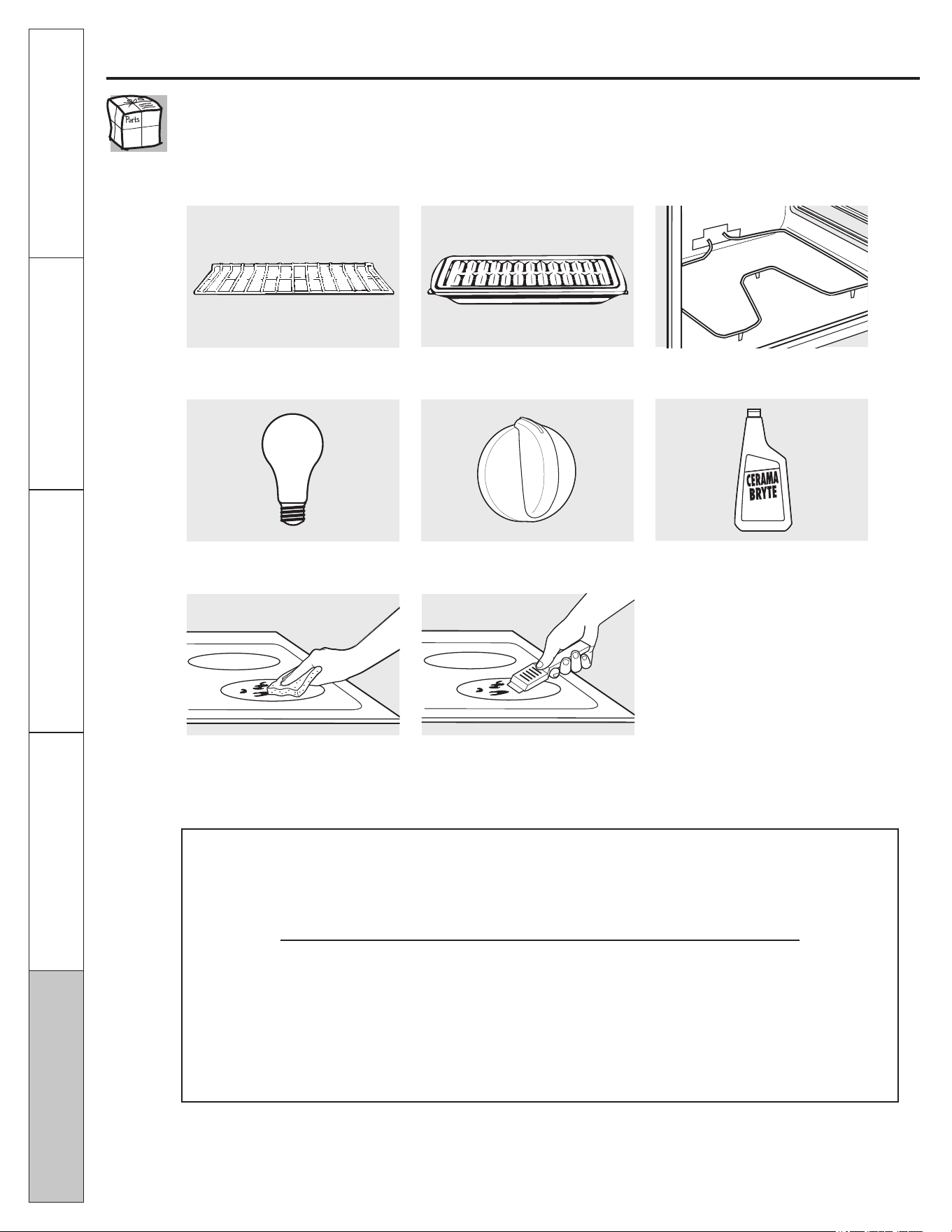
Consumer Support
Troubleshooting Tips
Care and Cleaning
Operating Instructions
Safety Instructions
Accessories. GEAppliances.com
Looking For Something More?
You can find these accessories and many more at www.GEAppliances.ca,
or call 800.661.1616 (during normal business hours). Have your model number ready.
Tired of discolored racks? Wishing you had extra-heavy-duty oven racks?
NOW AVAILABLE for your range:
GE’s innovative, self-cleanable porcelain-coated oven racks!
• Heavy Duty
• Durable
• Able to be cleaned in a self-cleaning oven
Visit www.GEAppliances.ca for more information.
Light Bulbs Knobs
Cleaning Pads Scraper
Oven Racks Broiler Pan
Oven Elements
Cleaner
36

OWNERSHIP REGISTRATION
P.O. BOX 1780
MISSISSAUGA, ONTARIO
L4Y 4G1
(FOR CANADIAN CONSUMERS ONLY)
Please place in envelope and mail to:
Veuillez mettre dans une enveloppe et envoyez à :
37
POSTAL CODE / POSTAL
PROVINCE
38

www.GEAppliances.ca
Safety Instructions
Operating
Instructions
Care and Cleaning Consumer Support
Troubleshooting Tips
Notes.
39

Notes.
Consumer Support Troubleshooting Tips
Care and Cleaning
Operating
Instructions
Safety Instructions
40
Safety Instructions Operating InstructionsSafety Instructions
Operating
Instructions
Care and Cleaning
Troubleshooting Tips
Consumer Support
Service trips to your home to teach you how to use
the product.
Improper installation, delivery or maintenance.
Failure of the product if it is abused, misused,
or used for other than the intended purpose
or used commercially.
Damage to the glass cooktop caused by use of
cleaners other than the recommended cleaning
creams and pads.
Damage to the glass cooktop caused by hardened
spills of sugary materials or melted plastic that
are not cleaned according to the directions in
the Owner’s Manual.
Replacement of house fuses or resetting of circuit
breakers.
Damage to the product caused by accident, fire, floods
or acts of God.
Incidental or consequential damage caused by possible
defects with this appliance.
Damage caused after delivery.
Product not accessible to provide required service.
What Mabe Will Not Cover:
This warranty is extended to the original purchaser and any succeeding owner for products purchased in Canada
for home use within Canada. In-home warranty service will be provided in areas where it is available and deemed
reasonable by MC Comercial to provide.
Some provinces do not allow the exclusion or limitation of incidental or consequential damages, so the above
exclusion may not apply to you. This warranty gives you specific legal rights, and you may also have other rights
which vary from province to province. To know what your legal rights are in your province, consult your local or
provincial consumer affairs office.
Warrantor: MC Comercial,
Burlington, Ontario
All warranty service provided by our Factory Service Centres
or an authorized Customer Care
®
technician. To schedule
service, visit us on-line at www.GEAppliances.ca or call
1.800.561.3344.
number available when calling for service.
Please have serial number and model
Staple your receipt here.
Proof of the original purchase
date is needed to obtain service
under the warranty.
EXCLUSION OF IMPLIED WARRANTIES―Your sole and exclusive remedy is product repair as provided in this Limited
Warranty. Any implied warranties, including the implied warranties of merchantability or fitness for a particular
purpose, are limited to one year or the shortest period allowed by law.
For The Period Of: MC Comercial Will Provide:
One Year Any part of the range which fails due to a defect in materials or workmanship.
From the date of the During this limited one-year warranty, MC Comercial will also provide, free of charge,
original purchase all labor and in-home service to replace the defective part.
GE Electric Range Warranty. www.GEAppliances.ca
41
GE Appliances Website www.GEAppliances.ca
Have a question or need assistance with your appliance? Try the GE Appliances Website 24 hours a day, any
day of the year! For greater convenience and faster service, you can now download Owner’s Manuals on-line.
Schedule Service www.GEAppliances.ca
Expert GE repair service is only one step away from your door. Call 1.800.561.3344, 7 days a week.
Parts and Accessories www.GEAppliances.ca
To inquire about purchasing a part or an accessory for your appliance, call our National Parts Centre at
1.800.661.1616.
Contact Us www.GEAppliances.ca
If you are not satisfied with the service you receive from GE, contact us on our Website with all the details
including your phone number, or write to: MC Comercial
1 Factory Lane
Moncton, New Brunswick
E1C 9M3
Register Your Appliance www.GEAppliances.ca
Register your new appliance on-line―at your convenience! Timely product registration will allow for
enhanced communication and prompt service under the terms of your warranty, should the need arise.
You may also mail in the preprinted registration card included in the packing material.
Consumer Support.
42

