2005

A010A02A-AAT
WARRANTIES FOR YOUR HYUNDAI VEHICLE
o New Vehicle 60 Months/60,000 Miles Limited Warranty
o New Vehicle 120 Months/100,000 Miles Limited Powertrain Warranty (original owner only)
o Anti-Perforation Limited Warranty
o Emission Defect Warranty - Federal Vehicle
o California Emission Control System Warranty (if applicable)
o Emission Performance Warranty - Federal Vehicle
o Replacement Parts and Accessories Limited Warranty
NOTE:
Detailed warranty information is provided in your Hyundai Owner's Handbook.
A020A01A-AAT
RESPONSIBILITY FOR MAINTENANCE
The maintenance requirements for your new Hyundai are found in Section 5. As the owner, it is your responsibility
to see that all maintenance operations specified by the manufacturer are carried out at the appropriate intervals.
When the vehicle is used in severe driving conditions, more frequent maintenance is required for some operations.
Maintenance requirements for severe operating conditions are also included in Section 5.
OWNER'S MANUAL
A030A01NF-AAT
Operation
Maintenance
Specifications
All information in this Owner's Manual is current at the time of publication. However, Hyundai reserves the right to make changes at any
time so that our policy of continual product improvement may be carried out.
This manual applies to all Hyundai models and includes descriptions and explanations of optional as well as standard
equipment. As a result, you may find material in this manual that does not apply to your specific vehicle.
A030A01NF-A
A070A01A-AAT
CAUTION: MODIFICATIONS TO YOUR HYUNDAI
Your Hyundai should not be modified in any way. Such modifications may adversely affect the performance, safety
or durability of your Hyundai and may, in addition, violate conditions of the limited warranties covering the vehicle.
Certain modifications may also be in violation of regulations established by the U.S. Department of Transportation
and other federal or state agencies.
A080A01S-AAT
TWO-WAY RADIO OR CELLULAR TELEPHONE INSTALLATION
Your vehicle is equipped with electronic fuel injection and other electronic components. It is possible for an
improperly installed/adjusted two-way radio or cellular telephone to adversely affect electronic systems. For this
reason, we recommend that you carefully follow the radio manufacturer's instructions or consult your Hyundai
dealer for precautionary measures or special instructions if you choose to install one of these devices.
!
A040A01A-AAT
FOREWORD
Thank you for choosing Hyundai. We are pleased to welcome you to the growing number of discriminating people who
drive Hyundais. The advanced engineering and high-quality construction of each Hyundai we build is something of which
we're very proud.
Your Owner's Manual will introduce you to the features and operation of your new Hyundai. It is suggested that you read
it carefully because the information it contains can contribute greatly to the satisfaction you receive from your new car.
The manufacturer also recommends that all service and maintenance on your car be performed by an authorized Hyundai
dealer. Hyundai dealers are prepared to provide high-quality service, maintenance and any other assistance that may
be required.
A050A04A-AAT
HYUNDAI MOTOR COMPANY
Note : Because future owners will also need the information included in this manual, if you sell this Hyundai, please leave
the manual in the vehicle for their use. Thank you.
CAUTION:
Severe engine and transaxle damage may result from the use of poor quality fuels and lubricants that do not
meet Hyundai specifications. You must always use high quality fuels and lubricants that meet the specifica-
tions listed on Page 9-4 in the Vehicle Specifications section of the Owner's Manual and which also appear
in the Service Station Information on the back cover of the Owner's Manual.
Copyright 2005 Hyundai Motor Company. All rights reserved. No part of this publication may be reproduced, stored in
any retrieval system or transmitted in any form or by any means without the prior written permission of Hyundai Motor
Company.
!
A090A01A-AAT
SAFETY AND VEHICLE DAMAGE WARNING
This manual includes information titled as WARNING, CAUTION and NOTE.
These titles indicate the following:
WARNING:
This indicates that a condition may result in harm, serious injury or death to you or other persons if
the warning is not heeded. Follow the advice provided with the warning.
CAUTION:
This indicates that a condition may result in damage to your vehicle or its equipment if the caution is
not heeded. Follow the advice provided with the caution.
NOTE:
This indicates that interesting or helpful information is being provided.
!
!

TABLE OF CONTENTS
SECTION
5
1
2
3
4
6
7
8
9
10
FEATURES OF YOUR HYUNDAI
DRIVING YOUR HYUNDAI
WHAT TO DO IN AN EMERGENCY
CORROSION PREVENTION & APPEARANCE CARE
VEHICLE MAINTENANCE REQUIREMENTS
DO-IT-YOURSELF MAINTENANCE
EMISSION CONTROL SYSTEMS
CONSUMER INFORMATION, REPORTING SAFETY DEFECTS &
BINDING ARBITRATION OF WARRANTY CLAIMS
VEHICLE SPECIFICATIONS
INDEX
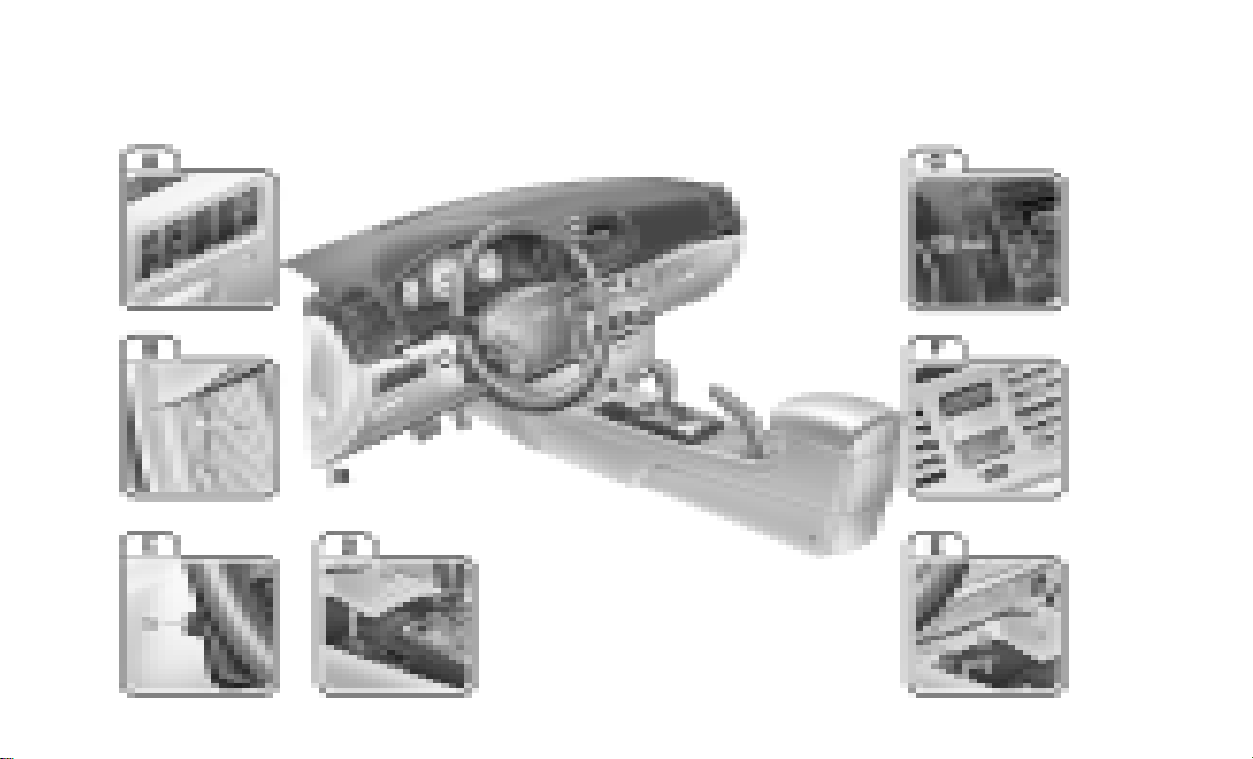
INSTRUMENTS AND CONTROLS (I)
B250A01NF-AAT
B250A01NF-A
1. Electronic Stability Control (ESC) Switch
2. Power Adjustable Pedals Switch (If Installed)
3. Panel Brightness Control Knob (Rheostat Switch)
4. Hood Release Lever
5. Steering Wheel Tilt Lever (If Installed)
6. Front Seat Warmer (If Installed)
CAUTION:
When installing a container of liquid air freshener inside the vehicle, do not place it near the instrument cluster nor
on the instrument panel surface. If there is any leakage from the air freshener onto these areas (Instrument cluster,
instrument panel or air ventilator), it may damage these parts. If the liquid from the air freshener does leak onto these
areas, wash them with water immediately.
!
7. Power Outlet
8. Ashtray
9. Cigarette Lighter
10.Digital Clock
11."PASSENGER AIR BAG OFF" Indicator
12.Hazard Warning Switch
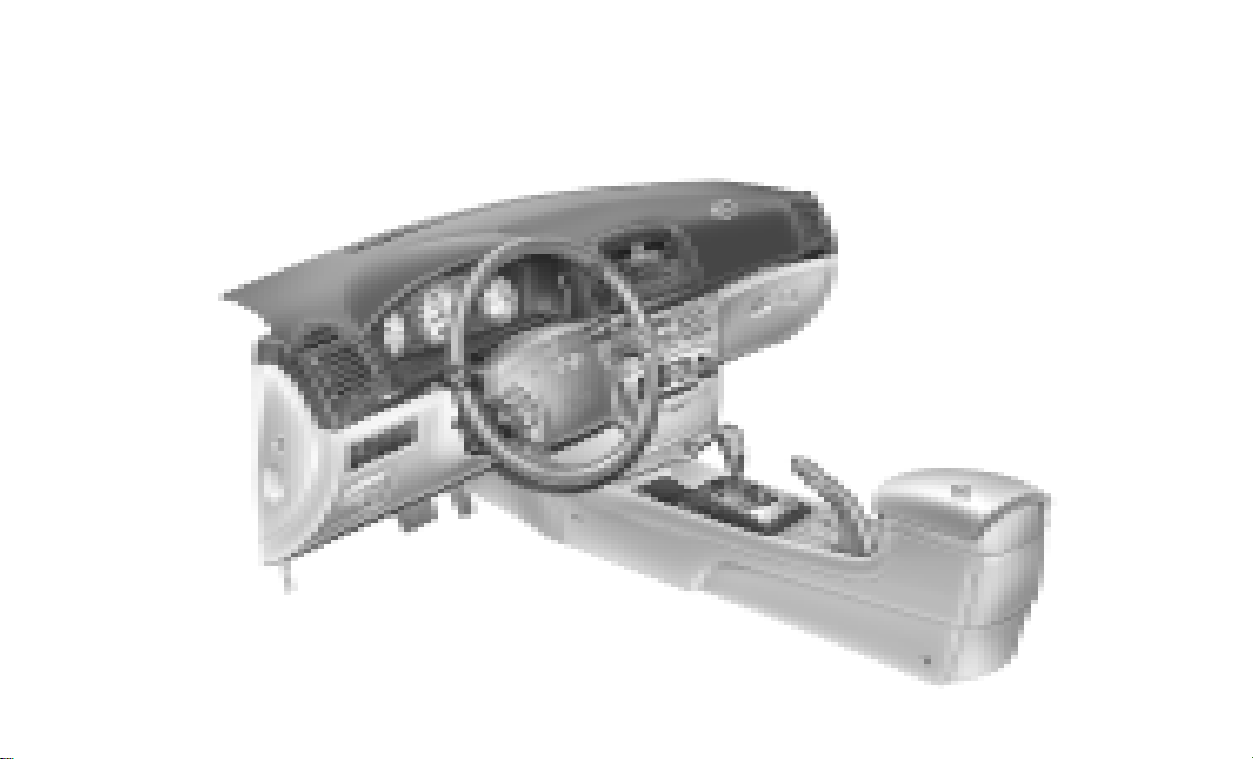
INSTRUMENTS AND CONTROLS (II)
B250B01NF-AAT
B250A02NF-A
1. Fuse Box
2. Multi Box
3. Instrument Cluster
4. Multi-Function Light/Front Fog Light Switch
5. Audio Remote Control Switch (If Installed)
6. Horn and Driver's Airbag
7. Windshield Wiper/Washer Switch
8. Cruise Control Switch
CAUTION:
When installing a container of liquid air freshener inside the vehicle, do not place it near the instrument cluster nor
on the instrument panel surface. If there is any leakage from the air freshener onto these areas (Instrument cluster,
instrument panel or air ventilator), it may damage these parts. If the liquid from the air freshener does leak onto these
areas, wash them with water immediately.
!
9. Audio System (If Installed)
10. Passenger's Airbag
11. Glove Box
12. Heating/Air Conditioning Control Panel
13. Shift Lever
14. Parking Brake Lever
15. Drink Holder
16. Center Console
YOUR VEHICLE AT A GLANCE
B255A01NF-AAT
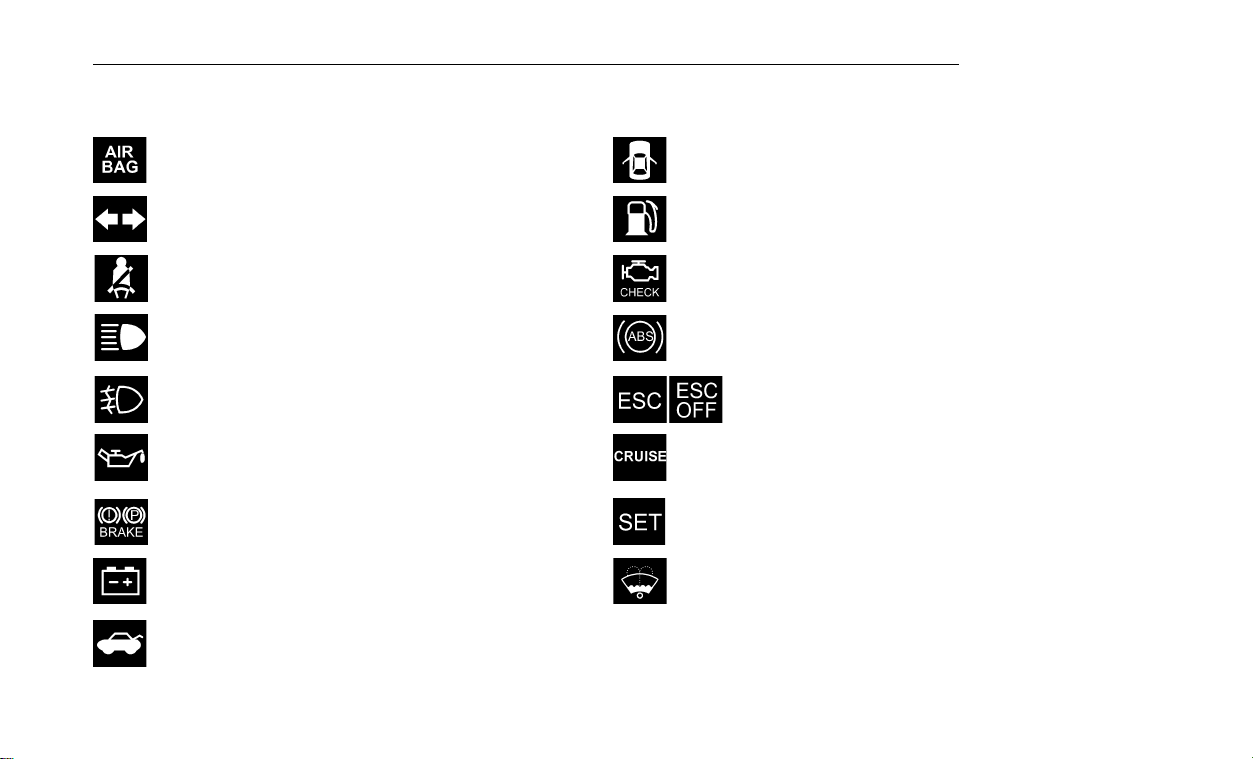
INDICATOR SYMBOLS ON THE INSTRUMENT CLUSTER
High Beam Indicator Light
Door Ajar Warning Light
Seat Belt Reminder Light
Turn Signal Indicator Lights
ABS Service Reminder Indicator (If Installed)
Low Oil Pressure Warning Light
Parking Brake/Low Brake Fluid Level
Warning Light
Charging System Warning Light
SRS (Airbag) Warning Light
Cruise Indicator Light
Check Engine - Malfunction Indicator Light (MIL)
Electronic Stability Control (ESC) Indicator
Lights (If Installed)
Low Windshield Washer Fluid Level Warning Light
Front Fog Light Indicator Light
Cruise SET Indicator Light
Low Fuel Level Warning Light
Trunk Lid Open Warning Light
* More detailed explanations of these items will be found beginning on page 1-52.
A100A03A-AAT
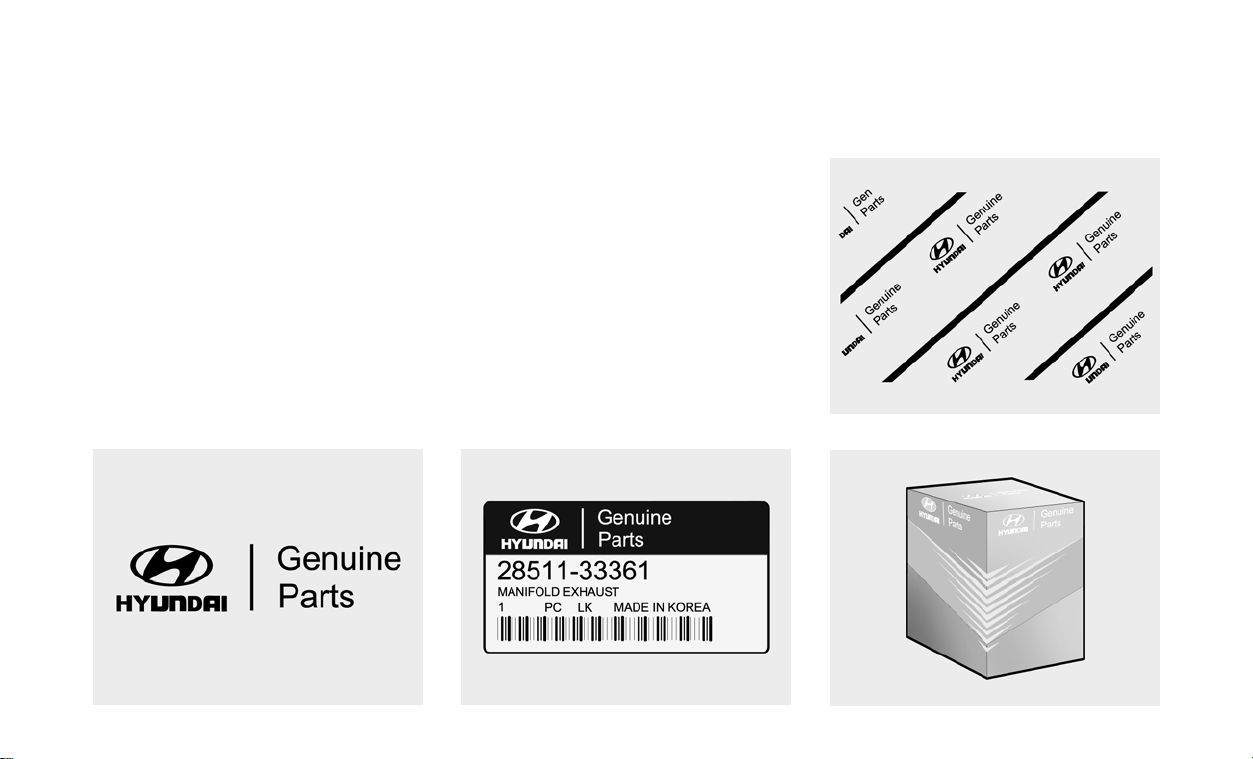
Guide to Hyundai Genuine Parts
1. What are Hyundai Genuine Parts?
Hyundai Genuine Parts are the same parts
used by Hyundai Motor Company to manu-
facture vehicles. They are designed and
tested for the optimum safety, performance,
and reliability to our customers.
2. Why should you use genuine parts?
Hyundai Genuine Parts are engineered and
built to meet rigid manufacturing require-
ments. Using imitation, counterfeit or used
salvage parts is not covered under the
Hyundai New Vehicle Limited Warranty or
any other Hyundai warranty. In addition, any
damage to or failure of Hyundai Genuine
Parts caused by the installation or failure of
an imitation, counterfeit or used salvage part
is not covered by any Hyundai Warranty.
3. How can you tell if you are purchasing
Hyundai Genuine Parts?
Look for the Hyundai Genuine Parts Logo on
the package (see below).
Hyundai Genuine Parts exported to the United
States are packaged with labels written only
in English.
Hyundai Genuine Parts are only sold through
authorized Hyundai Dealerships.
To find the closest authorized dealer call
1-800-826-CARS
A100A01L A100A02L A100A04L
A100A03L

1
Fuel Recommendations .................................................... 1-2
Breaking in Your New Hyundai .........................................1-3
Keys ...................................................................................1-3
Door Locks ........................................................................1-4
Theft-Alarm System ..........................................................1-8
Windows ..........................................................................1-11
Seats ................................................................................ 1-14
Seat Belts ........................................................................1-21
Child Restraint System ....................................................1-28
Advanced Supplemental Restraint (AIRBAG)
System (SRS) ................................................................1-36
Instrument Cluster and Indicator Lights .........................1-50
Warning and Indicator Lights ..........................................1-52
Trip Computer .................................................................1-58
Multi-Function Light Switch .............................................1-61
Windshield Wiper and Washer Switch ............................1-64
Sunroof ............................................................................1-70
Mirror ...............................................................................1-77
Homelink Mirror ............................................................... 1-79
Hood Release ..................................................................1-89
Cruise Control..................................................................1-93
Heating and Cooling Control ...........................................1-96
Stereo Sound System .................................................. 1-113
Audio System................................................................ 1-115
Antenna ........................................................................ 1-130
FEATURES OF YOUR HYUNDAI
1
1
FEATURES OF YOUR HYUNDAI
2
B010A01NF-A
FUEL RECOMMENDATIONS
CAUTION:
Your Hyundai's New Vehicle Limited War-
ranty may not cover damage to the fuel
system and any performance problems that
are caused by the use of fuels containing
methanol or fuels containing MTBE (Methyl
Tertiary Butyl Ether) over 15.0% vol. (Oxy-
gen Content 2.7% weight.)
B010B01A-AAT
What About Gasohol?
Gasohol (a mixture of 90% unleaded gasoline
and 10% ethanol or grain alcohol) may be used
in your Hyundai. However, if your engine devel-
ops driveability problems, the use of 100%
unleaded gasoline is recommended. Fuels with
unspecified quantities of alcohol, or alcohols
other than ethanol, should not be used.
B010A01NF-AAT
Use Unleaded Gasoline
Unleaded gasoline with a Pump Octane
Rating of 87 (Research Octane Number 91)
or higher must be used in your Hyundai.
B010C01A-AAT
Use of MTBE
Hyundai recommends that fuels containing
MTBE (Methyl Tertiary Butyl Ether) over 15.0%
vol. (Oxygen Content 2.7% weight) should not
be used in your Hyundai.
Fuel containing MTBE over 15.0% vol. (Oxygen
Content 2.7% weight) may reduce vehicle per-
formance and produce vapor lock or hard
starting.
B010D01A-AAT
Do Not Use Methanol
Fuels containing methanol (wood alcohol) should
not be used in your Hyundai. This type of fuel
can reduce vehicle performance and damage
components of the fuel system.
!
!
UNLEADED
FUEL ONLY
CAUTION:
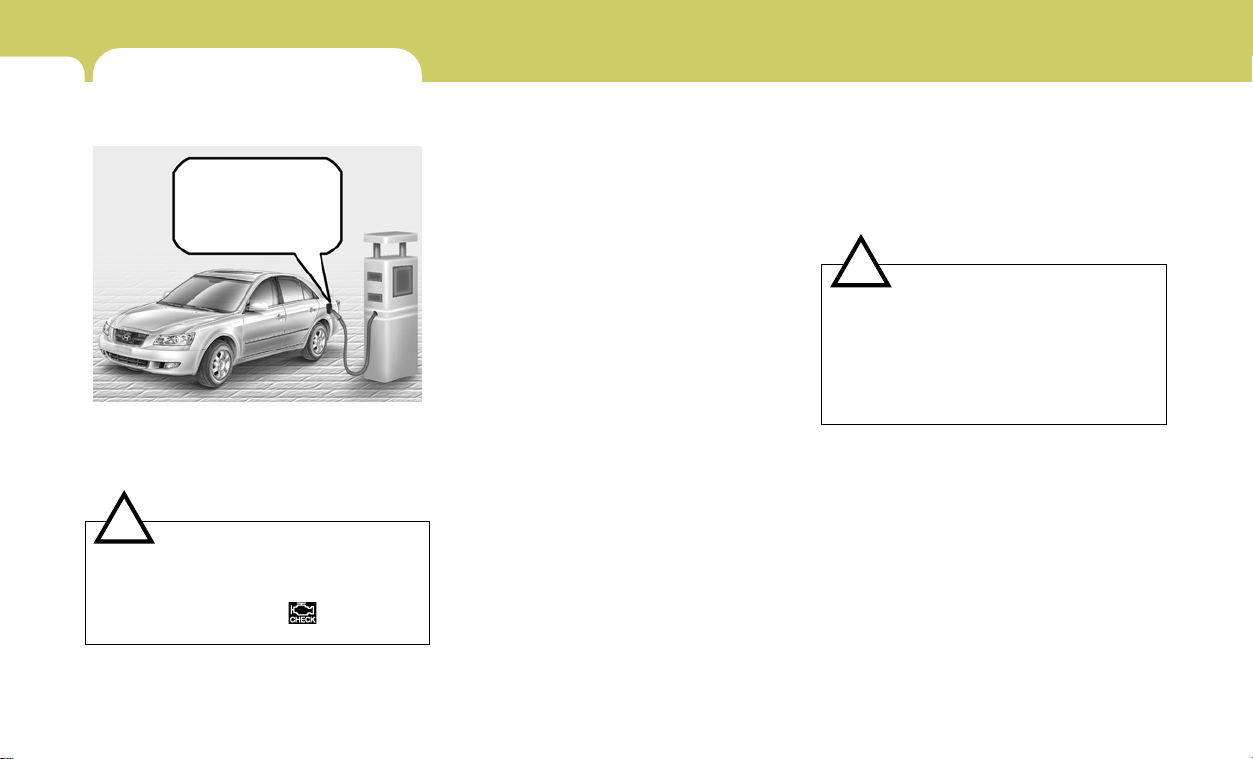
o Do not "TOP-OFF" after the first nozzle
shut off when refueling.
o The fuel cap must be tightened until cap
clicks, otherwise " " light will
illuminate.

1
FEATURES OF YOUR HYUNDAI
3
KEYSBREAKING IN YOUR NEW HYUNDAI
B010F01A-AAT
Operation in Foreign Countries
If you are going to drive your Hyundai in another
country, be sure to:
o Observe all regulations regarding registra-
tion and insurance.
o Determine that acceptable fuel is available.
B010E01A-AAT
Gasolines for Cleaner Air
To help contribute to cleaner air, Hyundai rec-
ommends that you use gasolines treated with
detergent additives, which help prevent deposit
formation in the engine. These gasolines will
help the engine run cleaner and enhance per-
formance of the Emission Control System.
B020A01S-AAT
During the First 1,200 Miles (2,000 Km)
No formal "break-in" procedure is required with
your new Hyundai. However, you can contrib-
ute to the economical operation and durability of
your Hyundai by observing the following recom-
mendations during the first 1,200 miles (2,000
km).
o Don't drive faster than 55 MPH (88 km/h).
o While driving, keep your engine speed (rpm,
or revolutions per minute) between 2,000
rpm and 4,000 rpm.
o Use moderate acceleration. Don't start
quickly or depress the accelerator pedal
fully.
o For the first 200 miles (300 km), try to avoid
hard stops.
o Don't lug the engine (in other words, don't
drive so slowly in too high a gear that the
engine "bucks":shift to a lower gear).
o Whether going fast or slow, vary your speed
from time to time.
o Don't let the engine idle longer than 3 minutes
at one time.
o Don't tow a trailer during the first 1,200 miles
(2,000 km) of operation.
B030A01NF-GAT
For greater convenience, your Hyundai has
two master keys and a sub key. The master
keys will open all locks on your vehicle. The sub
key will only function in the ignition and the door
locks.
Leaving your sub key with a parking attendant
will ensure that your vehicle's trunk, trunk lid
release, glove box compartment and rear trunk
access may not be unlocked in your absence.
NOTE:
Before leaving your sub key with a parking
attendant, make sure that the lock knobs of
the rear seatback lock and the trunk lid lock
are switched to the "LOCK" position.
B030A01NF
Master key
Sub key
1
FEATURES OF YOUR HYUNDAI
4
DOOR LOCKS
!
B040A01A-AATB030C01JM-AAT
ILLUMINATED IGNITION SWITCH
Whenever either front door is opened, the igni-
tion switch will be illuminated for your conve-
nience, provided the ignition switch is not in the
"ON" position.
The light will go off approximately 10 seconds
after closing the door or when the ignition switch
is turned on.
WARNING:
o Unlocked doors can be dangerous. Be-
fore you drive away (especially if there
are children in the car), be sure that all the
doors are securely closed and locked so
that the doors cannot be opened from
the inside. This helps ensure that the
doors will not be opened accidentally.
Also, when combined with the proper
use of seat belts, locking the doors helps
keep occupants from being ejected from
the car in case of an accident.
o Before opening the door, always look for
and avoid oncoming traffic.
B030B01NF-GAT
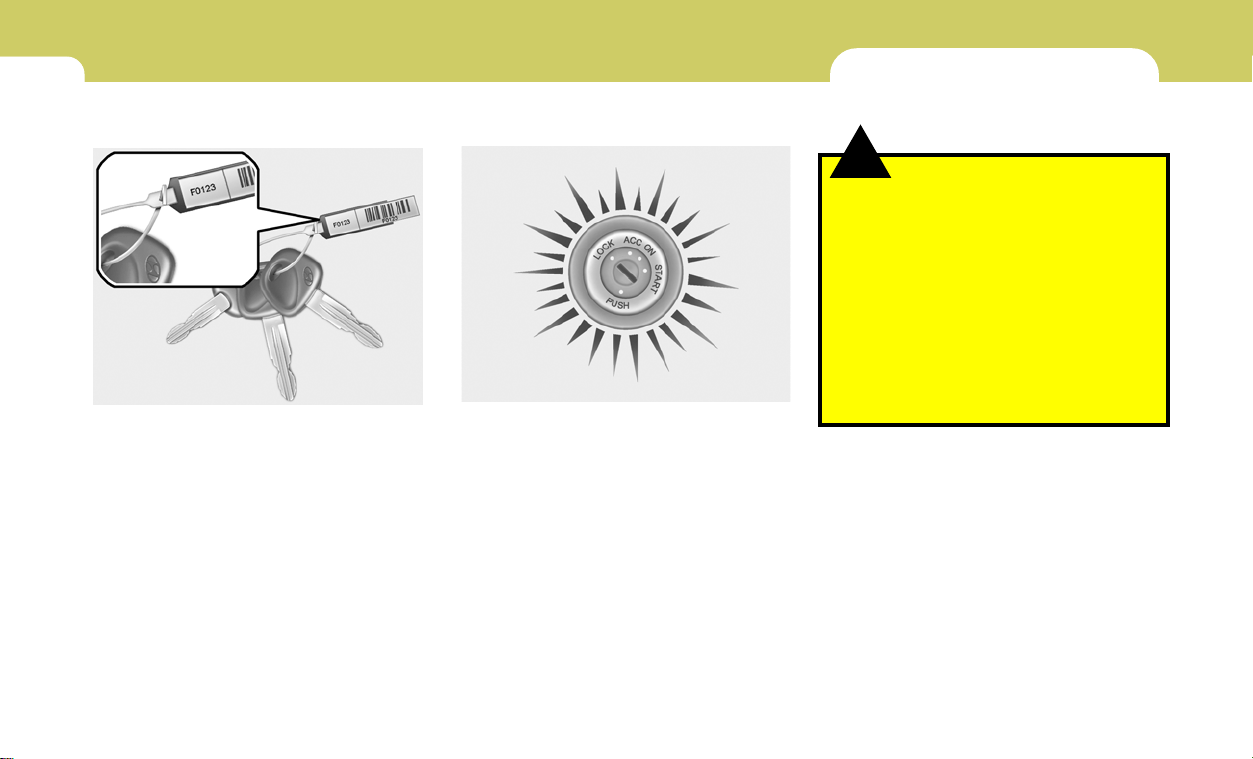
Record Your Key Number
A code number is attached on the number tag
that came with the keys to your Hyundai. This
key number tag should not be left with the keys
but kept in a safe place, not in the vehicle. The
key number should also be recorded in a place
where it can be found in an emergency.
If you need additional keys, or if you should lose
your keys, your authorized Hyundai dealer can
make new keys if you can supply the key
number.
B030B01NF
B030C01E
1
FEATURES OF YOUR HYUNDAI
5
B040B01JM-AAT
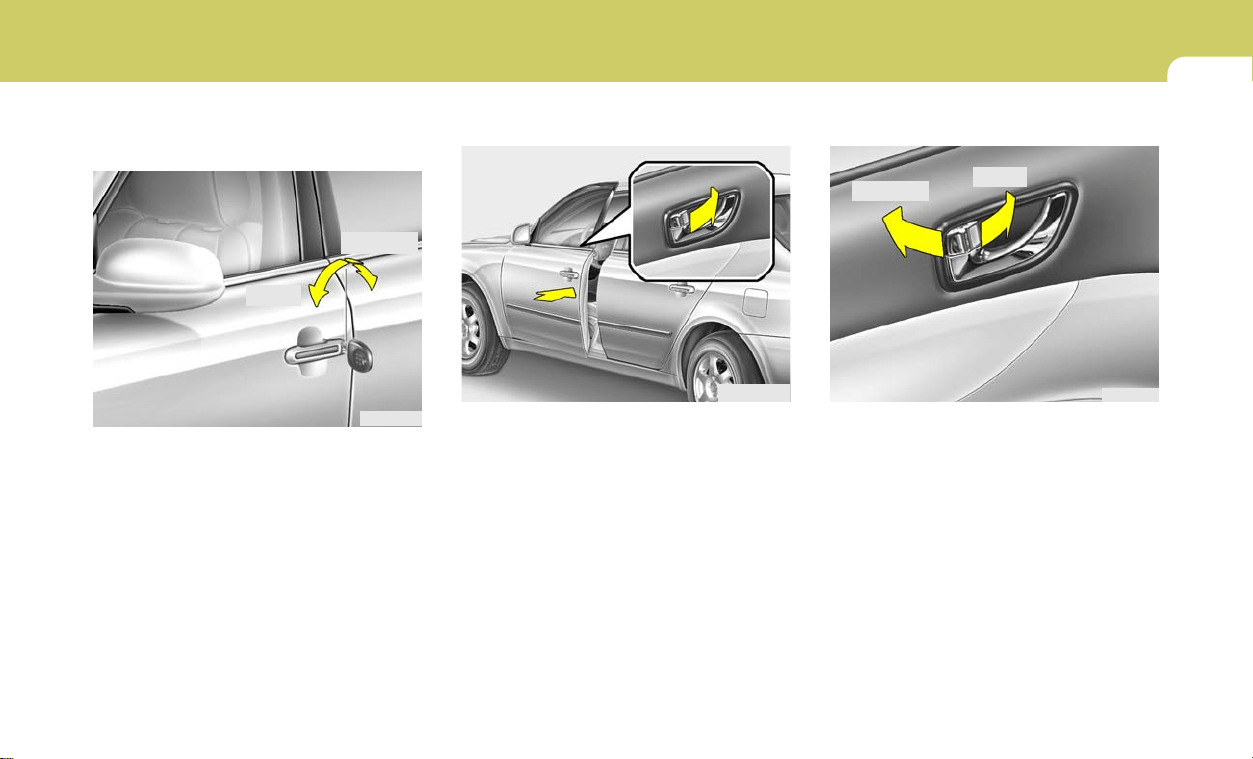
Locking, unlocking front doors with a
key
o The door can be locked or unlocked with a
key.
o Lock the door by turning the key toward the
front of the vehicle and unlock it by turning the
key toward the rear.
NOTE:
The driver's door can be unlocked by turn-
ing the key once toward the rear. If you wish
to unlock all doors, turn the key again
toward the rear within 4 seconds. The
passenger's side will lock or unlock all
doors with just one rotation.
B040C02Y-AAT
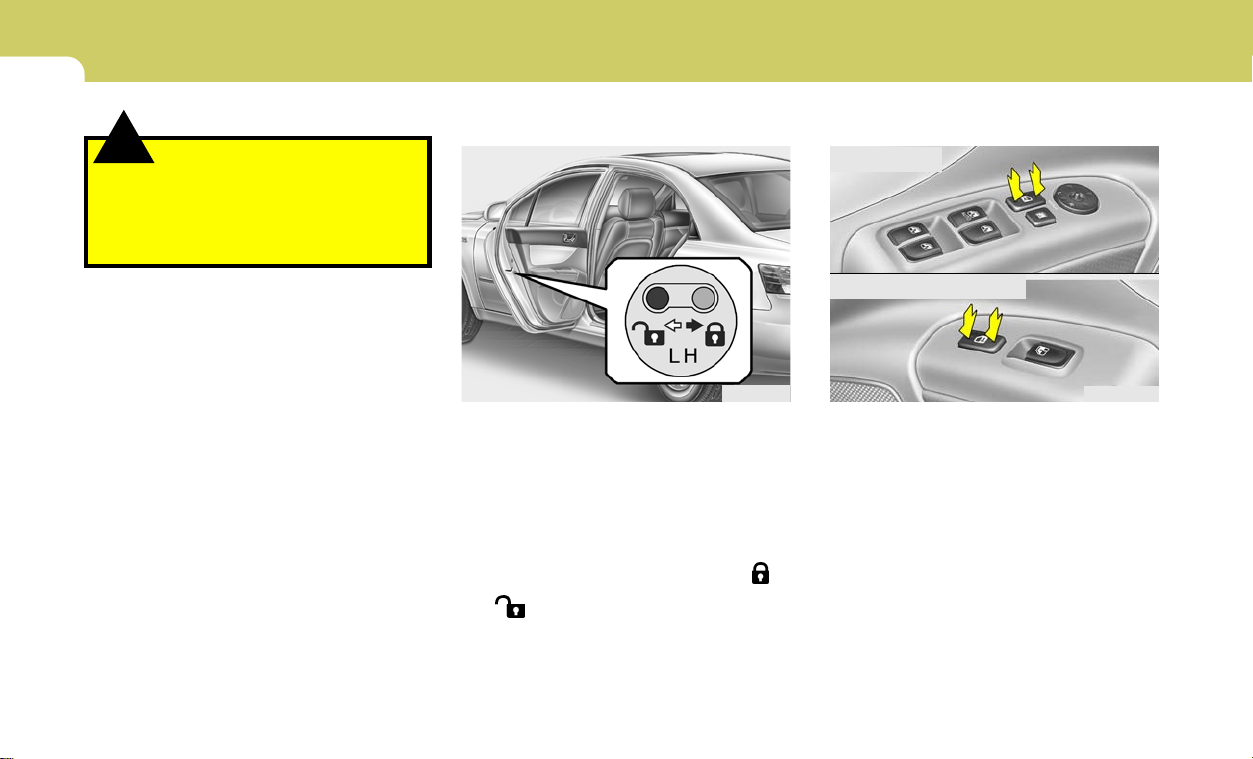
Locking from the Outside
The doors can be locked without a key. To lock
the doors from the outside, first push the inside
lock switch to the "LOCK" position, so that the
red mark on the switch is not visible, then close
the door.
The door will not lock if the key is left in the ignition
switch when the front doors are closed. This is
normal.
NOTE:
o When locking the door this way, be care-
ful not to lock the door with the key left
in the vehicle.
o To discourage theft, always remove the
ignition key, close all windows and lock
all doors when leaving your vehicle un-
attended.
HNF2007
LOCK
UNLOCK
B040C01NF-A
B040D01NF-AAT
Locking from the Inside
To lock the doors from the inside, simply close
the door and push the lock switch to the "LOCK"
position.
NOTE:
o When the door is locked, the red mark on
the switch is not visible.
o The driver's and front passenger's doors
can be opened by pulling the inside door
handle even if the inside lock switch is
pushed to the "LOCK" position.
HNF2008
LOCK
UNLOCK
1
FEATURES OF YOUR HYUNDAI
6
B040E04A-AAT
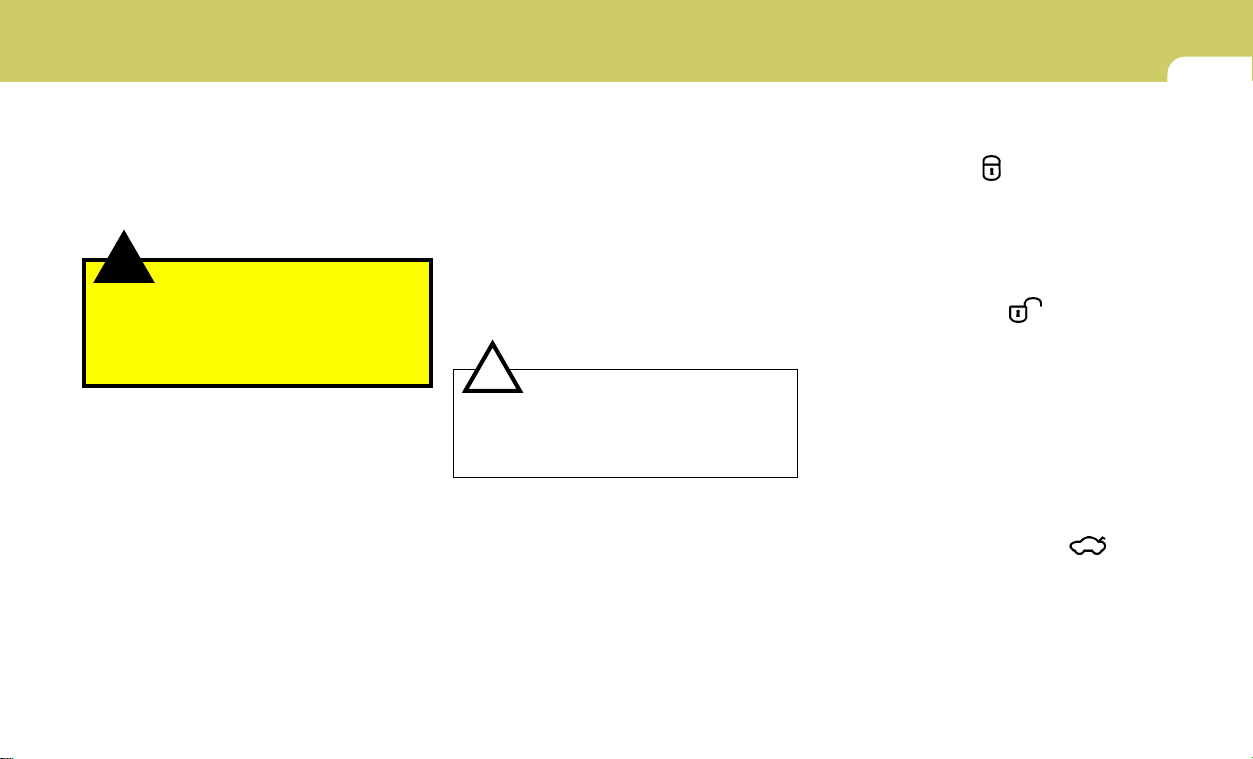
Child-Protector Rear Door Lock
Your Hyundai is equipped with left and right side
"child-protector" rear door locks. When the lock
mechanism is engaged, the rear door cannot be
opened from the inside. Its use is recommended
whenever there are small children in the rear
seat.
To engage the child-protector feature so that
the door cannot be opened from the inside,
move the child-protector lever to the " "
position and close the door. Move the lever to
the " " position when normal door operation
is desired.
To open the door from the outside, pull the
outside door handle.
HNF2011-1
B040G01NF-AAT
Central Door Locks
The central door locking switch is located on the
driver's and front passenger's armrest. It is
operated by depressing the door lock switch. If
any door is open when the switch is depressed
to the "LOCK" position, the door will remain
locked when closed.
NOTE:
o When depressing the front portion of
the driver's or front passenger's door
lock switch, all vehicle doors will lock.
o When depressing the rear portion of
these switches, all vehicle doors will
unlock.
B040G01NF
Driver's side
Front passenger's side
LOCK
UNLOCK
LOCK
UNLOCK
WARNING:
Be careful not to pull the inside door handle
while driving. If you pull the inside door
handle, the door can be opened and you
may be ejected from the vehicle and can be
injured or killed.
!
1
FEATURES OF YOUR HYUNDAI
7
!
WARNING:
Be careful not to pull the inside door handle
while driving. If you pull the inside door
handle, the door can be opened and you
may be ejected from the vehicle and can be
injured or killed.
o The driver's and front passenger's doors
can be opened by pulling the inside door
handle even if the front portion of the
driver's or front passenger's central door
locking switch has been depressed to
lock the doors.
B070F01NF-AAT
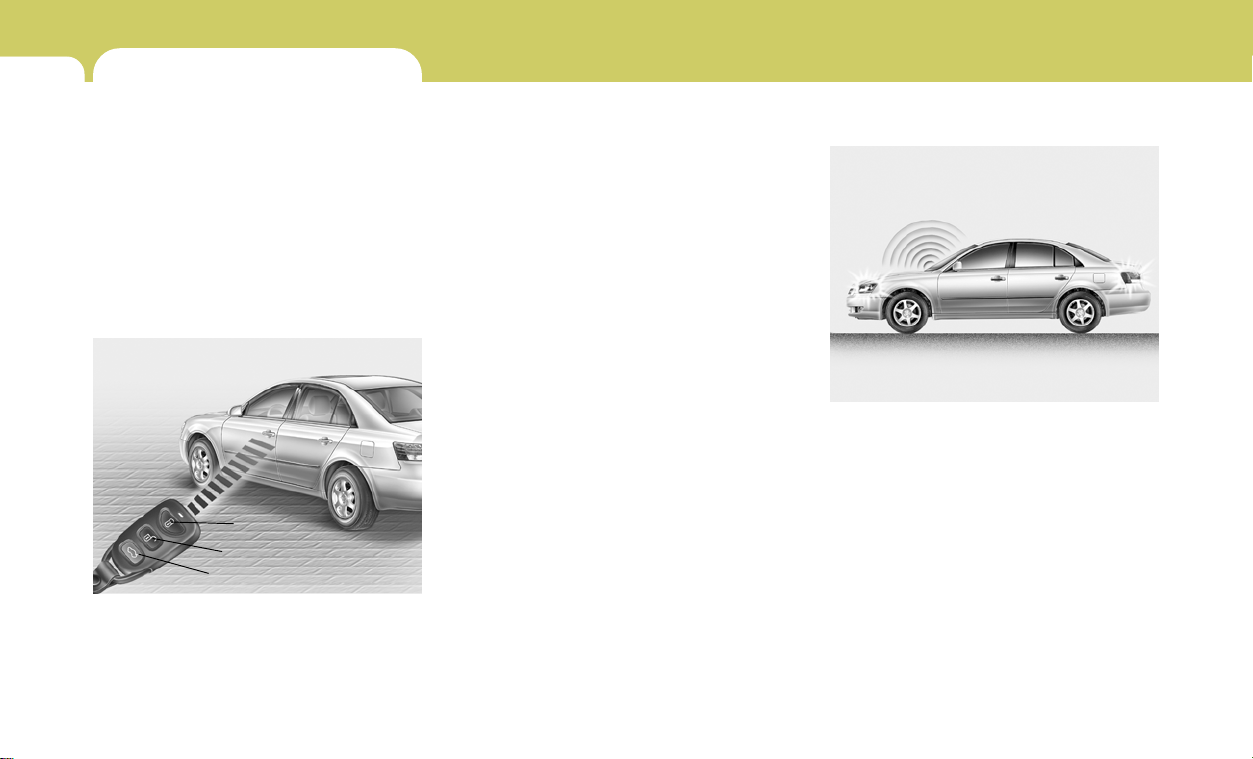
KEYLESS ENTRY SYSTEM
NOTE:
This device complies with Part 15 of the
FCC rules. Operation is subject to the fol-
lowing two conditions:
(1) This device may not cause harmful in-
terference, and (2) this device must accept
any interference received, including inter-
ference that may cause undesired opera-
tion.
CAUTION:
Changes or modifications not expressly
approved by the party responsible for com-
pliance could void the user's authority to
operate the equipment.
Locking doors
1. Close all doors.
2. Push the "LOCK ( )" button on the trans-
mitter.
3. At the same time, all doors lock and the turn
signal lights will blink once to indicate that the
system is armed.
Unlocking doors
1. Push the "UNLOCK ( )" button on the
transmitter.
2. At the same time, the driver's door unlocks
and the turn signal lights will blink twice to
indicate that the system is disarmed.
NOTE:
If you wish to unlock all the doors, press the
"UNLOCK" button on the transmitter again
within 4 seconds.
Releasing the trunk lid
Push the trunk lid release button ( ) on the
transmitter for longer than 1 second.
!
B040H02NF-GAT
Speed Sensing Auto Door Locking
(If Installed)
When the speed of the vehicle keeps above the
specific speed for 1 second, it will automatically
lock all doors for driver and passenger's safety.
For further information, contact an authorized
Hyundai dealer.
1
FEATURES OF YOUR HYUNDAI
8
2) Make sure that the engine hood and trunk lid
are closed and latched.
3) Lock the doors using the transmitter of the
keyless entry system.
After completion of the steps above, the turn
signal lights will blink once to indicate that the
system is armed.
NOTE:
1) If any door, trunk lid or engine hood
remains open, the system will not be
armed.
2) If this happens, rearm the system as
previously described.
NOTE:
Do not arm the system until all passengers
have left the car. If the system is armed while
a passenger(s) remains in the car, the alarm
may be activated when the remaining
passenger(s) leaves the car.
B070C01NF-AAT
Alarm Stage
The alarm will be activated if any of the following
occurs while the car is parked and the system
is armed.
1) A front or rear door is opened without using
the transmitter or the ignition key.
2) The trunk lid is opened without using the
transmitter or the ignition key.
3) The engine hood is opened.
The alarming horn will sound and the turn signal
lights will blink continuously for 27 seconds
(This will repeat 3 times). To turn off the system,
unlock the door or trunk lid with the transmitter
or the ignition key.
B070C01NF-A
THEFT-ALARM SYSTEM
B070A01A-AAT
This system is designed to provide protection
from unauthorized entry into the car. This sys-
tem is operated in three stages : the first is the
"Armed" stage, the second is the "Alarm" stage
and the third is the "Disarmed" stage. If trig-
gered, the system provides an audible alarm
with blinking of the turn signal lights.
B070B01NF-AAT
Armed Stage
B070B01NF-A
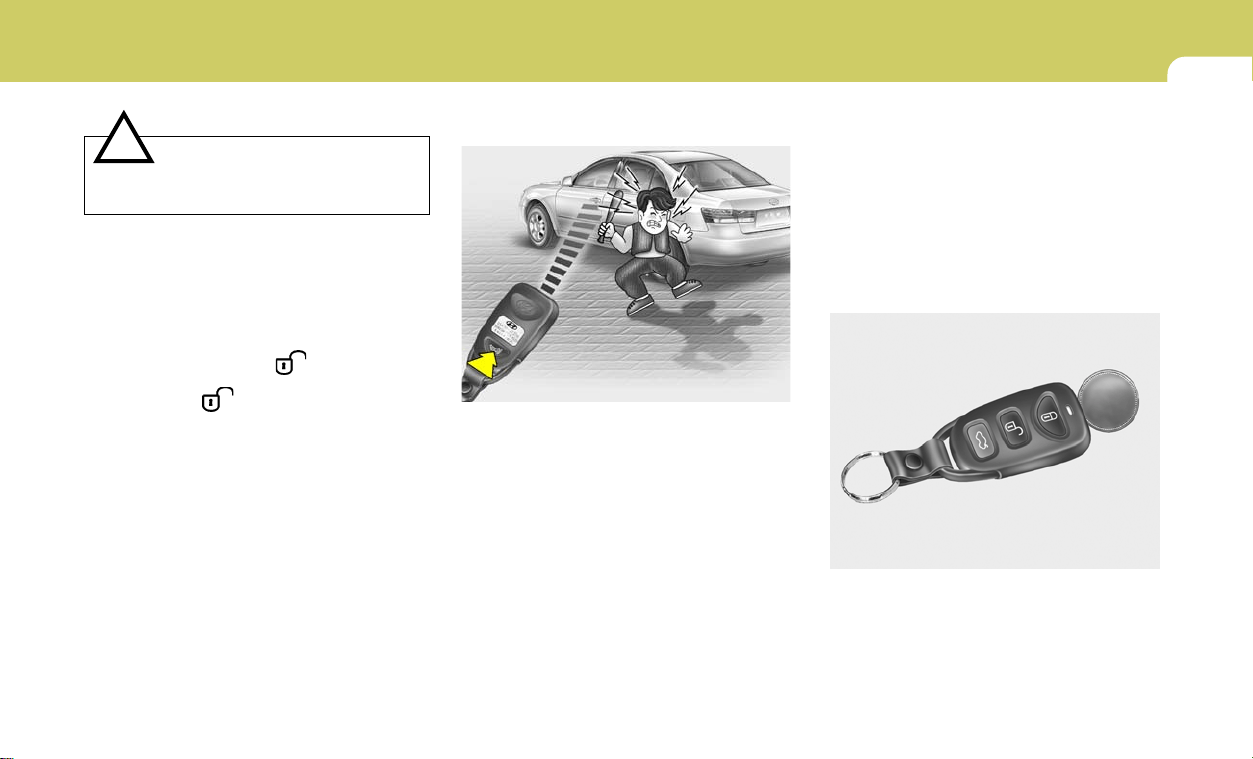
Lock
Unlock
Trunk Unlock
Park the car and stop the engine. Arm the
system as described below.
1) Remove the ignition key from the ignition
switch.
1
FEATURES OF YOUR HYUNDAI
9
B070D01NF-AAT
Disarmed Stage
The system will be disarmed by using the
transmitter or the ignition key.
Only the driver's door is unlocked by depress-
ing once the "UNLOCK ( )" button on the
transmitter. If you wish to unlock all doors, press
the "UNLOCK ( )" button on the transmitter
again within 4 seconds.
Whenever the step above is completed, the turn
signal lights will blink twice to indicate that the
system is disarmed.
If any door, trunk lid or engine hood is not opened
or the ignition key is not inserted in the ignition
switch within 30 seconds, the system will be
rearmed.
NOTE:
When the system is disarmed while the
"DOOR" button of the interior light is de-
pressed, the interior light will illuminate for
30 seconds.
CAUTION:
Avoid trying to start the engine while the
system is armed.
!
B070E01NF-AAT
Panic Warning
1. Push the "PANIC" button on the backside of
the transmitter.
2. At the same time, the alarming horn will
sound and the turn signal lights will blink
continuously for 30 seconds.
3. To turn off the system, push the "PANIC"
button again on the backside of the transmit-
ter.
B070E02NF-A
B070E01NF-GAT
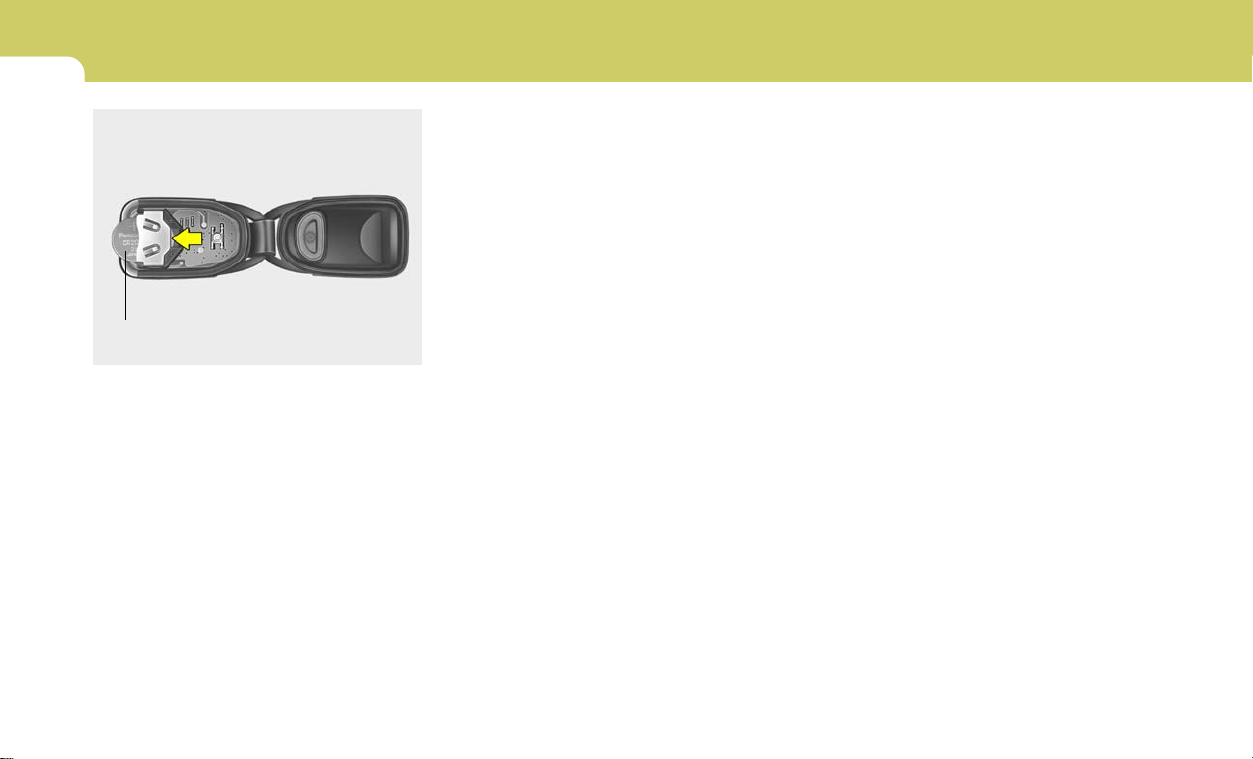
Replacing the battery
When the transmitter's battery begins to get
weak, it may take several pushes on the button
to lock or unlock the doors, and the LED will not
light. Replace the battery as soon as possible.
Battery type : CR2032
Replacement instructions:
1. Carefully separate the case with a coin as
shown in the illustration.
B070E01NF
1
FEATURES OF YOUR HYUNDAI
10
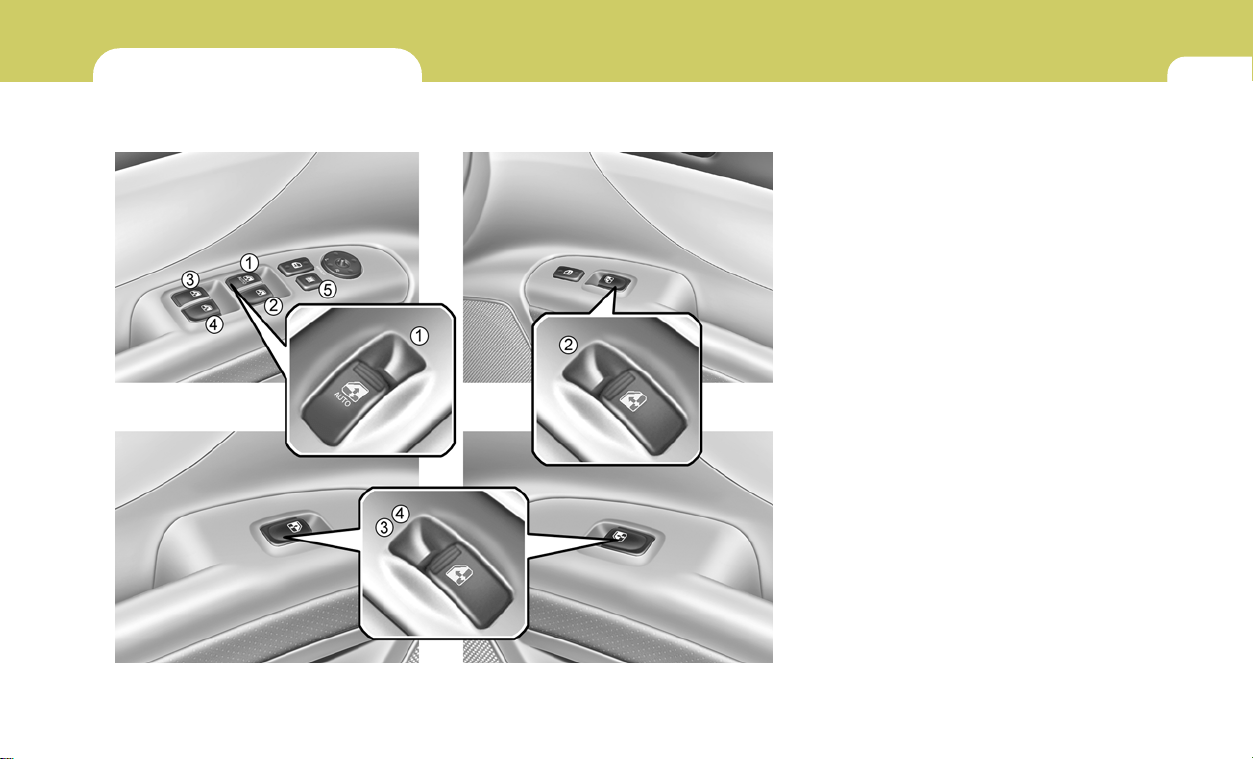
HNF2005
Battery
2. Remove the old battery from the case and
note the polarity. Make sure the polarity of
the new battery is the same(+side facing up),
then insert it in the transmitter.
1
FEATURES OF YOUR HYUNDAI
11
WINDOWS
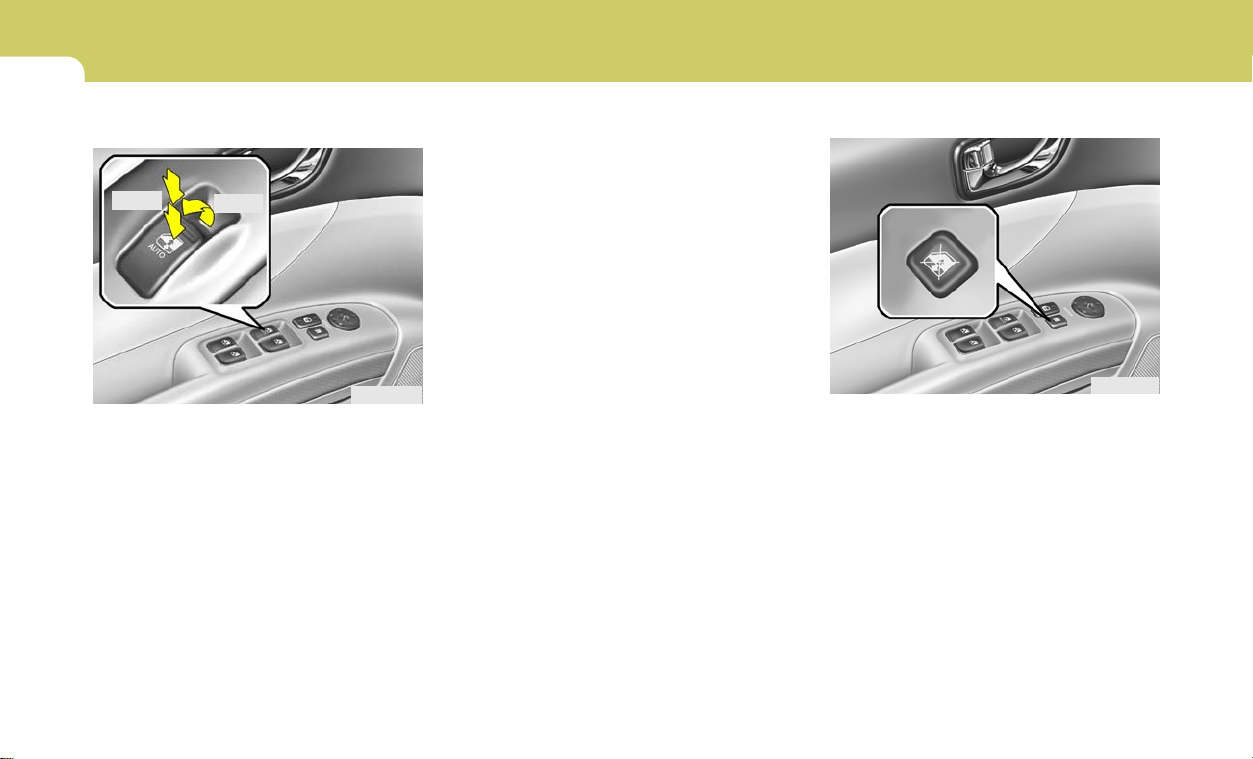
HNF2017-1
1. Driver's door power window switch
2. Front passenger's door power window switch
3. Rear passenger's door power window switch
(left side)
4. Rear passenger's door power window switch
(right side)
5. Window lock switch
B060D01NF-GAT
1
FEATURES OF YOUR HYUNDAI
12
B060A01NF-GAT
POWER WINDOWS
The power windows operate when the ignition
key is in the "ON" position. The main switches
are located on the driver's armrest and control
the front and rear windows on both sides of the
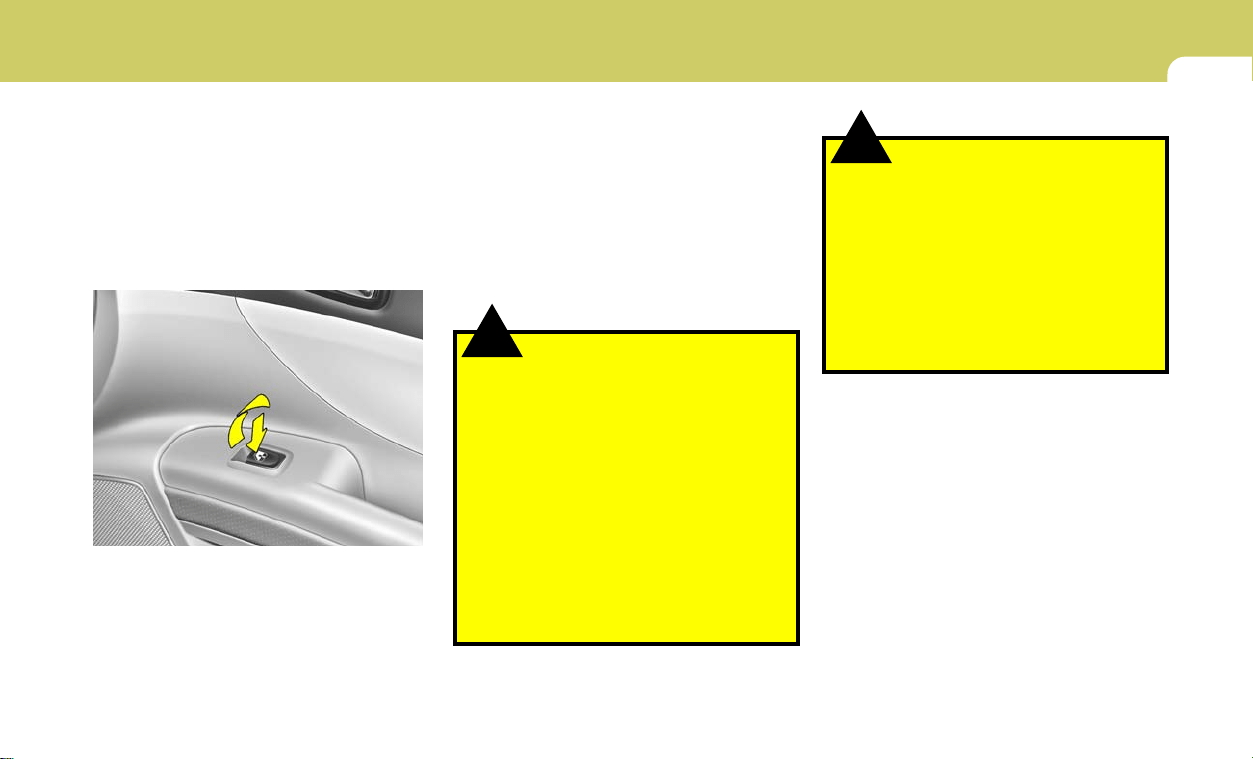
vehicle. The windows may be opened by de-
pressing the appropriate window switch and
closed by pulling up the switch. To open the
window on the driver's side, press the switch
halfway down. The window moves as long as
the switch is operated.
B060A01NF
Window lock (Driver's side)
HNF2019-A
Auto Up/Down Window
(Driver's side)
The auto up/down window is controlled by the
main switch on the driver's armrest.
To fully open the window automatically, press
the switch fully down. To fully close the window
automatically, pull the switch fully up. In auto-
matic operation, the window will fully open or
close even if you let go of the switch. To stop the
window at the desired position while the window
is in operation, pull up or depress and release
the switch to the opposite direction of the move-
ment.
NOTE:
If the battery has been recharged or discon-
nected, the auto up/down window system
must be reset as follows;
1. Turn the ignition key to "ON" position.
2. Pull up the driver's window switch until
the window is fully closed and continue
pulling up the driver's window switch
for at least 0.2 second.
If the auto up/down window is not reset, it
may not operate properly.
Open
Close
In order to prevent operation of the passenger
front and rear windows, a window lock switch is
provided on the armrest of the driver's door. To
disable the power windows, press the window
lock switch. To revert to normal operation,
press the window lock switch a second time.
1
FEATURES OF YOUR HYUNDAI
13
!
!
HNF2018
Close
Open
WARNING:
o Be careful that someone's head, hands
and body are not trapped by a closing
window.
o Never try to operate the main switch on
the driver's door and the individual door
window switch in opposing directions
at the same time. If this is done, the
window will stop and cannot be opened
or closed.
o Do not leave children alone in the car.
o Never leave the ignition key in the car.
WARNING:
o The automatic reverse window will only
operate when the automatic up window
operation feature is used. The automatic
reverse feature of the window will not
operate if the window is raised using the
halfway position on the power window
switch.
o If an object less than 0.16 in.(4 mm) in
diameter is caught between the window
glass and the upper window channel,
the automatic reverse window may not
detect the resistance and will not stop
and reverse direction. Therefore, always
check for any obstructions before rais-
ing any window.
B060C01NF-AAT
Automatic Reverse Window
(Driver's side)
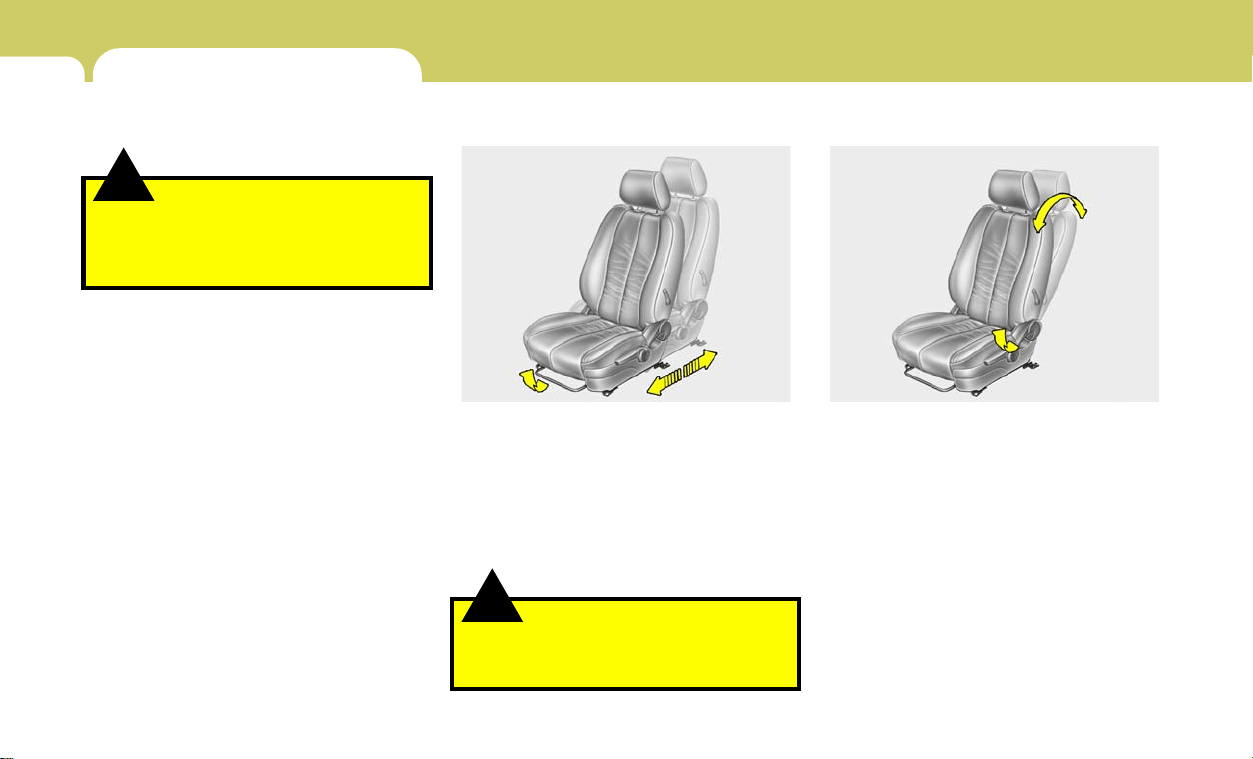
If the upward movement of the window is blocked
by an object or part of the body, the window will
detect the resistance and will stop upward
movement. The window will then lower approxi-
mately 11.8 in.(30cm) to allow the object to be
cleared.
NOTE:
The power windows can be operated for 30
seconds after the ignition key is turned to
the "ACC" or "LOCK" positions, or removed
from the ignition switch.
If the front doors are opened during this 30
second period, the power windows can no
longer be operated without the ignition key
turned to the "ON" position.
1
FEATURES OF YOUR HYUNDAI
14
!
B080B02A-AAT
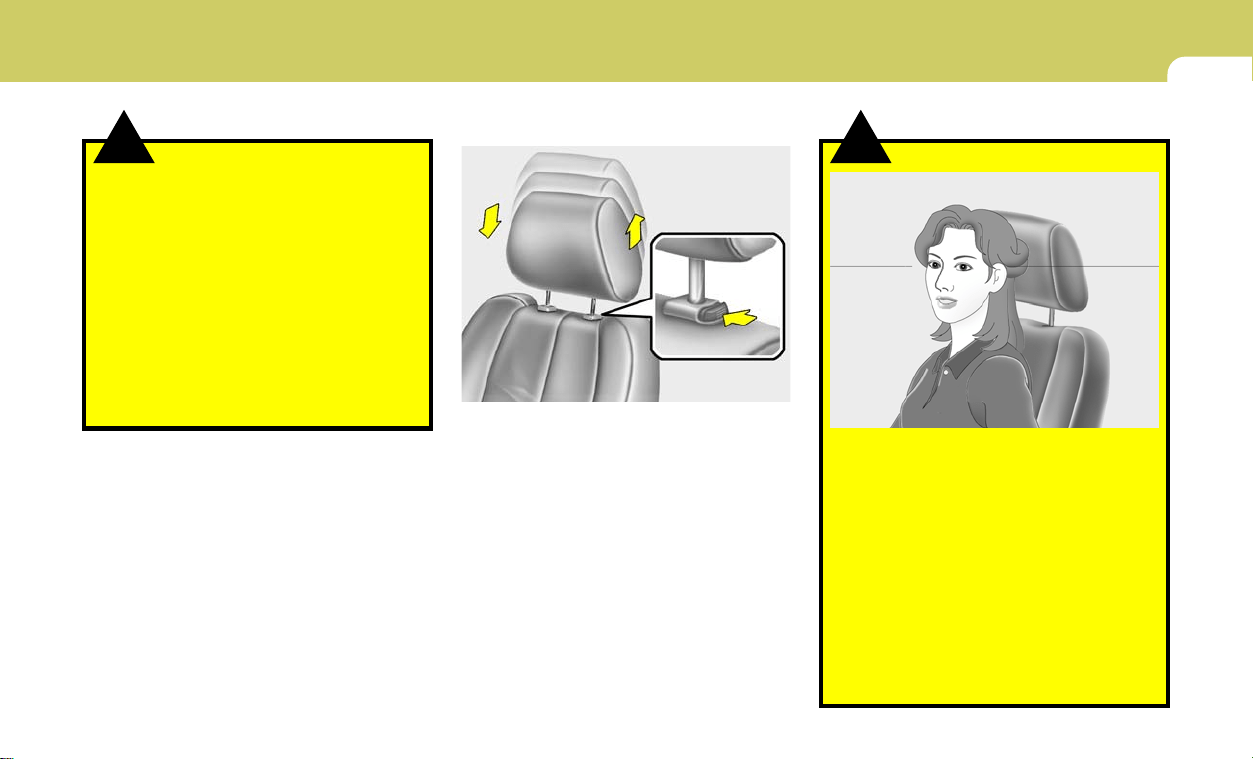
Adjusting Seat Forward and Rearward
To move the seat toward the front or rear, pull
the lock release lever upward. This will release
the seat on its track so you can move it forward
or rearward to the desired position. When you
find the position you want, release the lever and
slide the seat forward or rearward on its track
until it locks into the desired position and cannot
be moved further.
B080C01A-AAT
Adjusting Seatback Angle
To recline the seatback, lean forward to take
your weight off it, then pull up on the recliner
control lever at the outside edge of the seat. Now
lean back until the desired seatback angle is
achieved. To lock the seatback into position,
release the recliner control lever.
WARNING:
To ensure the seat is locked securely, at-
tempt to move the seat forward or rearward
without using the lock release lever.
SEATS
B080A01A-AAT
ADJUSTABLE FRONT SEATS
!
WARNING:
Never attempt to adjust the seat while the
vehicle is moving. This could result in loss
of control or an accident which may cause
death, serious injury, or property damage.
HNF2032
HNF2033
1
FEATURES OF YOUR HYUNDAI
15
!
WARNING:
To minimize risk of severe injury in the
event of a collision or a sudden stop, both
the driver and passenger seatbacks should
always be in an upright position while the
vehicle is in motion. The protection pro-
vided by the seat belts and airbags may be
reduced significantly when the seatbacks
are reclined. There is greater risk that the
driver and passenger will slide under the
seat belt which may result in serious injury
if a crash occurs when the seatbacks are
reclined.
The seat belt cannot provide full protection
to an occupant if the seat back is reclined.
!
B080D02JM-AAT
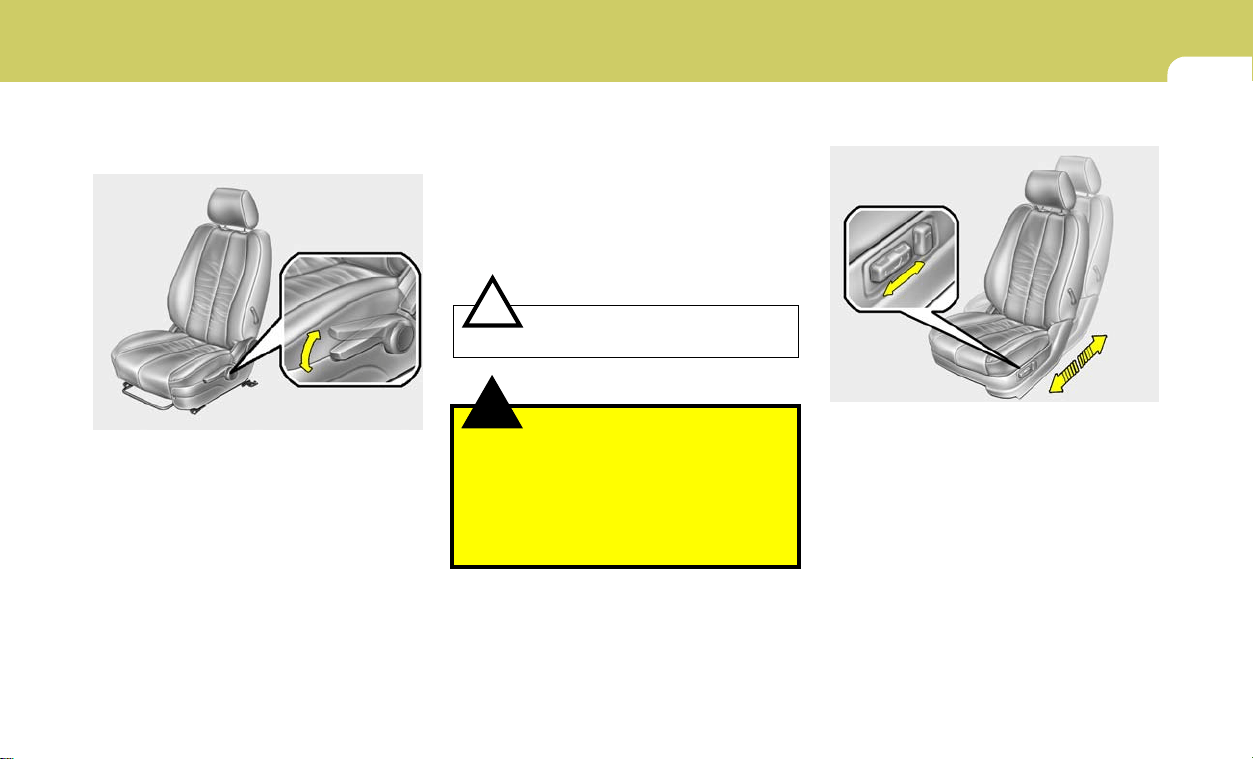
Adjustable Headrests
Headrests are designed to help reduce the risk
of neck injuries.
To raise the headrest, pull it up. To lower it, push
it down while pressing the lock knob. To remove
the headrest, raise it as far as it can go then
press the lock knob while pulling upward. This
should only be done when the seat is not
occupied.
WARNING:
o For maximum effectiveness in case of an
accident the headrest should be ad-
justed so the middle of the headrest is at
the same height as the top of the
occupant's eyes. For this reason, the
use of a cushion that holds the body
away from the seatback is not recom-
mended.
o Do not operate the vehicle with the head-
rests removed as injury to the occupants
may occur in the event of an accident.
Headrests may provide protection against
neck injuries when properly adjusted.
o Do not adjust the headrest height while
the vehicle is in motion.
B080D01JM
B080D01NF
Lock knob

1
FEATURES OF YOUR HYUNDAI
16
B083D01NF-AAT
Active Headrests (If Installed)
The active headrest is designed to move for-
ward and upward during a rear impact. This
helps to prevent the driver's and front
passenger's head from moving backward and
thus helps prevent neck injuries.
B081D01LZ-AAT
Tilting Headrest Forward and Rearward
The headrest may be tilted forward to three
different positions by pulling the headrest for-
ward. To adjust the headrest rearward, pull it
fully forward to the farthest position and release
it. Adjust the headrest so that it properly sup-
ports the head and neck.
B081D01NF
HNF2041-1
B080E01Y-AAT
Lumbar Support Control
(Driver's Seat Only) (If Installed)
To adjust the lumbar support, turn the handle on
the outboard or left side of the seat. To increase
the amount of lumbar support, pull the lever
forward. To decrease it, push the lever toward
the rear.
1. Minimum support
2. Maximum support
HNF2039
1
2
1
FEATURES OF YOUR HYUNDAI
17
!
B090A01Y-AAT
POWER DRIVER'S SEAT (If Installed)
The driver's seat can be adjusted by using the
control knobs on the left side of the seat. Before
driving, adjust the seat to the proper position so
as to easily control the steering wheel, pedals
and switches on the instrument panel.
CAUTION:
Do not operate two knobs at the same time.
WARNING:
o Never attempt to adjust the seat while
the vehicle is moving. This could result
in loss of control or an accident causing
death, serious injury, or property dam-
age.
o Do not sit or lean unnecessarily close to
the airbag.
!
B080F01NF-GAT
Seat Height Adjustment
(Driver's Seat Only)
To raise or lower the seat, raise or lower the
control lever to the desired seat height.
HNF2034
B090B01NF-GAT
Adjusting Seat Forward and Rearward
Pull the control knob forward or backward to
move the seat forward or backward to the
desired position. Release the control knob and
the seat will remain at that position.
HNF2036
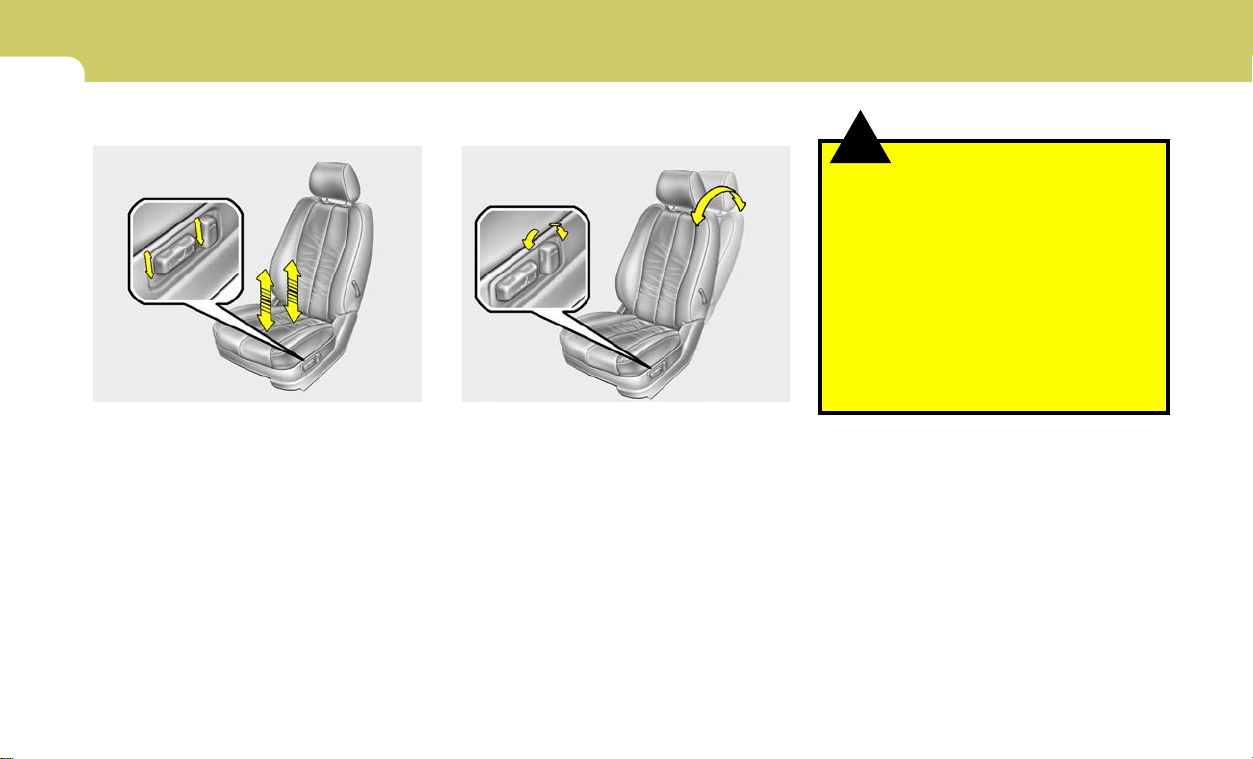
1
FEATURES OF YOUR HYUNDAI
18
!
WARNING:
To minimize the risk of personal injury in
the event of a collision or a sudden stop,
both the driver's and passenger's seatback
should remain in an upright position while
the car is in motion. The protection pro-
vided by the seat belts and airbags may be
reduced significantly when the seatbacks
are reclined. There is a greater risk that the
seat occupants will slide under the belt
resulting in serious injury if a crash occurs
when the seatbacks are reclined. The seat
belt cannot provide full protection to an
occupant if the seatback is reclined.
B090D01NF-GAT
Adjusting Seatback Angle
Pull the upper portion of the control knob forward
or backward to recline the seatback to the
desired position. Release the control knob and
the seatback will remain in that position.
B090C01Y-AAT
Seat Cushion Height Adjustment
Move the front portion of the control knob up or
down to raise or lower the front part of the seat
cushion. Move the rear portion of the control
knob up or down to raise or lower the rear part
of the seat cushion.
HNF2038
HNF2037
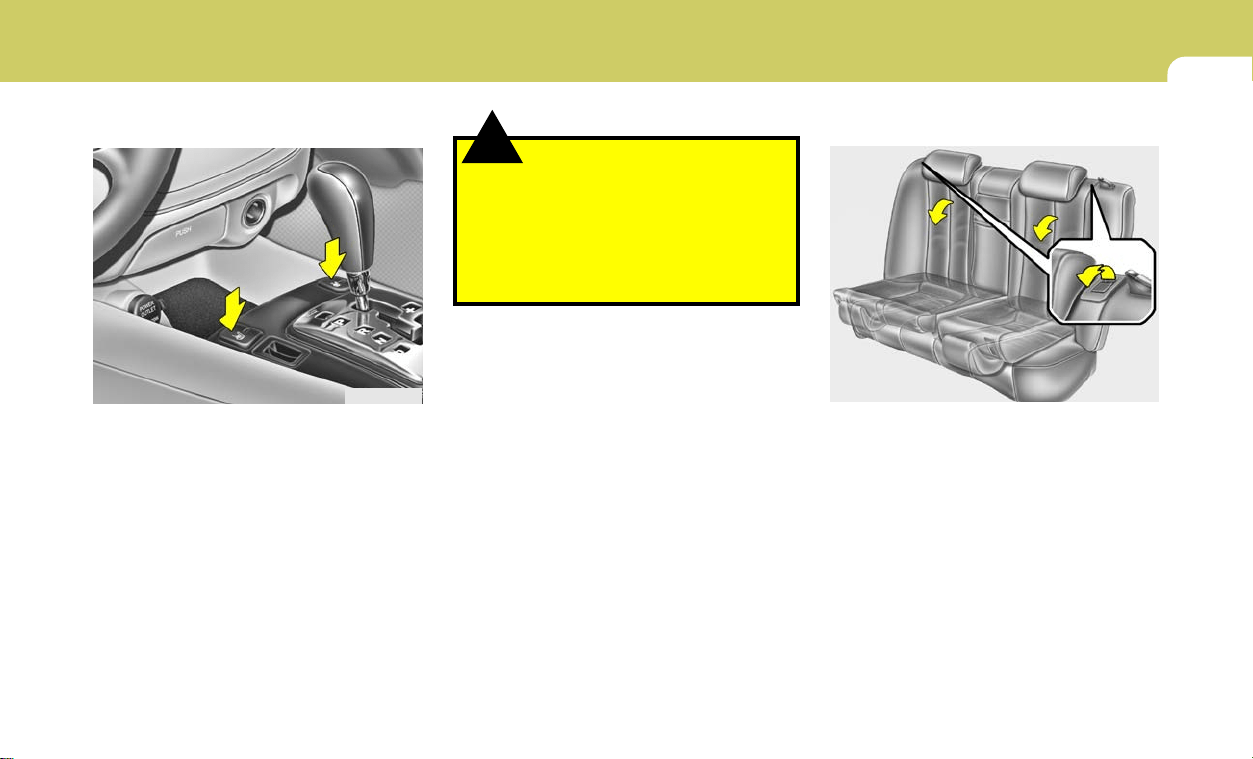
1
FEATURES OF YOUR HYUNDAI
19
!
B100A01NF-AAT
SEAT WARMER (If Installed)
The seat warmer is provided to warm the front
seats during cold weather. With the ignition key
in the "ON" position, push either of the switches
to warm the driver's seat or the front passenger's
seat.
During mild weather or under conditions where
the operation of the seat warmer is not needed,
keep the switches in the "OFF" position.
NOTE:
o The seat warmer may not operate if the
ambient temperature is warm.
o If the seat warmer doesn't operate when
the ambient temperature is lower than
75.2°F (24°C), it must be checked at an
authorized dealer.
B100A01NF
WARNING:
Do not turn on the seat warmers, if the seat
is occupied by someone who cannot moni-
tor the temperature and turn off the seat
warmer, if it becomes too warm. The seat
warmers should not be turned on when
children, the elderly, ill people, and sleep-
ing people occupy the seat.
B110A01NF-GAT
FOLDING REAR SEATBACKS
o To unlock the seatback, pull the seatback
release lever, then pull forward on the
seatback panel.
o When you return the seatback to its upright
position, always be sure it has locked into
position by pulling and pushing on the top of
the seatback.
B110A01NF-A
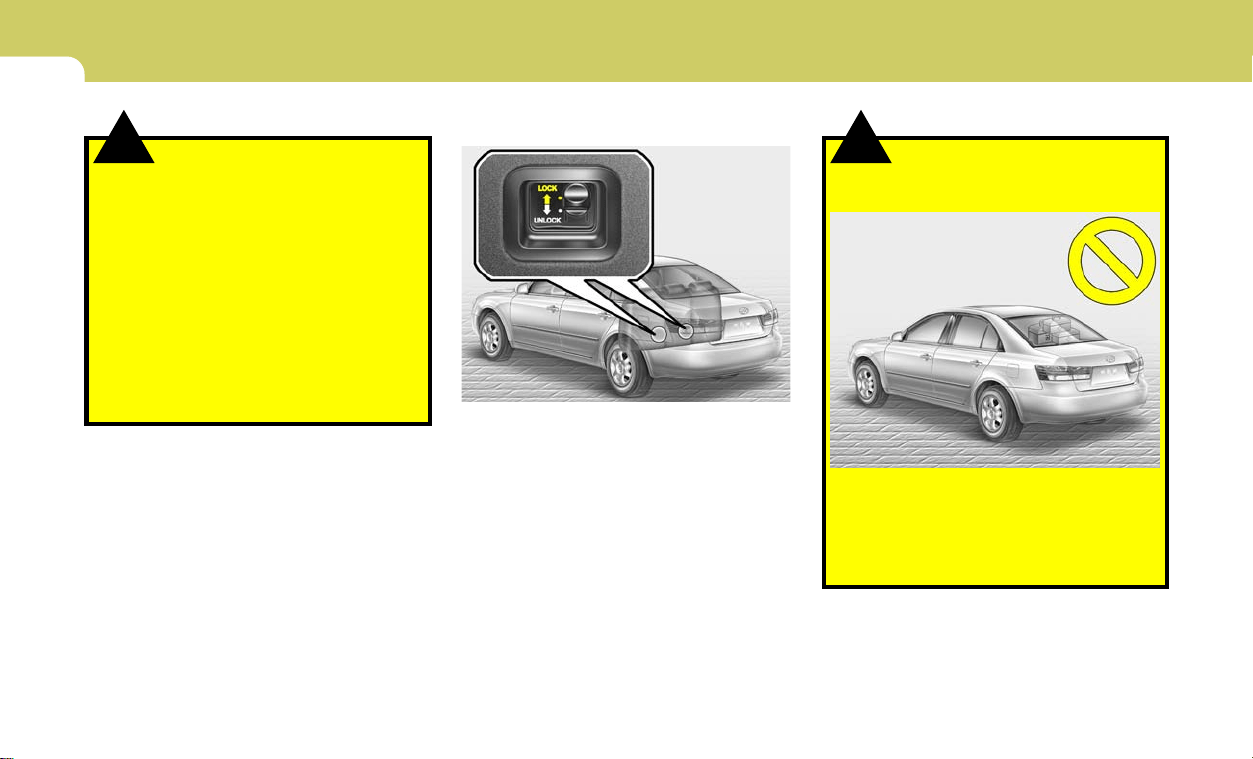
1
FEATURES OF YOUR HYUNDAI
20
!
B140A01S-AAT
REAR SEAT WARNING
For the safety of all passengers, luggage or
other cargo should not be piled higher than the
top of the seatback. In addition, do not place
objects on the rear shelf as they may move
forward during braking or in an accident and
may strike and injure vehicle passengers.
B140A01NF-A
!
WARNING:
The purpose of the folding rear seatbacks
is to allow you to carry longer objects than
could otherwise be accommodated. Do not
allow passengers to sit on top of the folded
down seatback, while the car is moving as
this is not a proper seating position and no
seat belts are available for use. This could
result in serious injury or death in case of an
accident or sudden stop. Objects carried
on the folded down seatback should not
extend higher than the top of the front
seats. This could allow cargo to slide for-
ward and cause injury or damage during
sudden stops.
B120A01NF-GAT
REAR SEATBACK SAFETY LOCK
If the rear seatback lock knob (located on the
backside of the rear seatback) is in the "LOCK"
position when the rear seatbacks are upright
and closed, it will not be possible to fold the rear
seatback by using the seatback release lever.
In this instance, move the lock knob to the
"UNLOCK" position and fold the rear seatback.
The rear seatback lock knob is designed to
provide protection from unauthorized entry into
the trunk.
B120A01NF-A
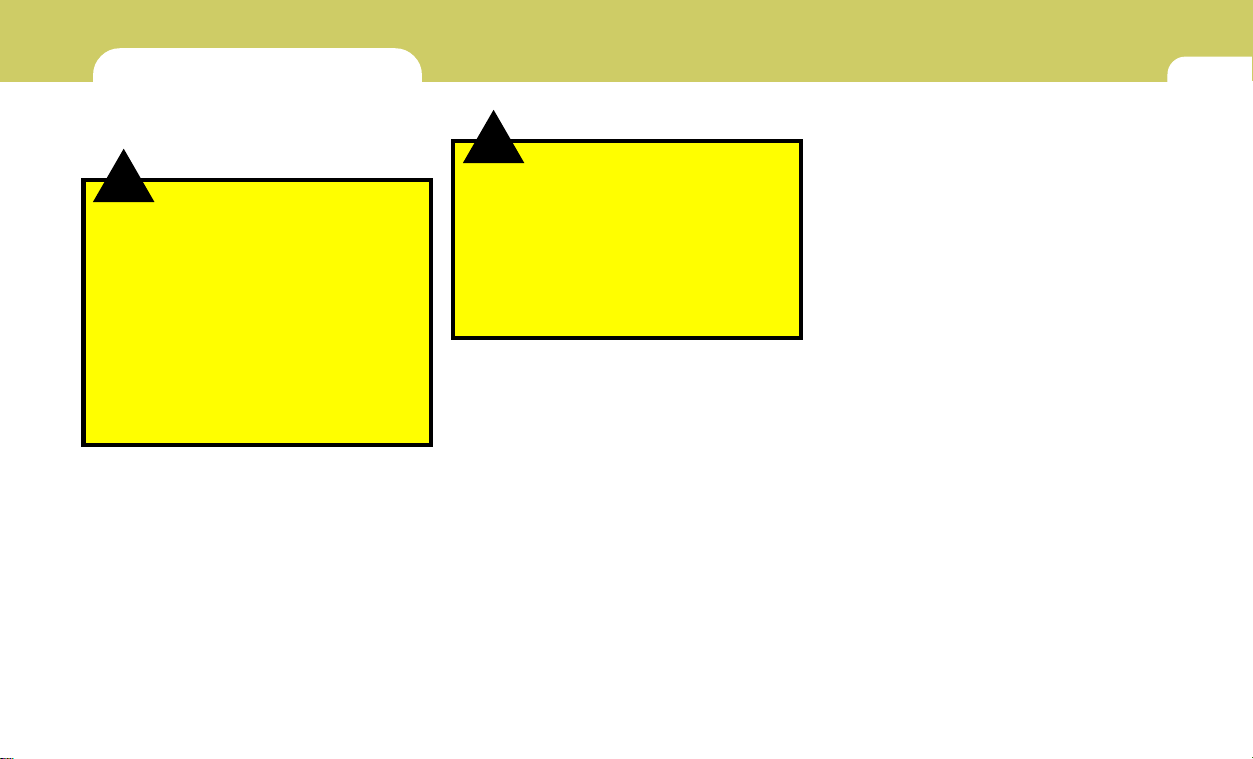
1
FEATURES OF YOUR HYUNDAI
21
SEAT BELTS
B150B03Y-AAT
Infant or Small Child
All 50 states have child restraint laws. You
should be aware of the specific requirements in
your state. Child and/or infant safety seats must
be properly placed and installed in the rear seat.
Information about the use of these restraints
begins on page 1-28.
!
B150A01S-AAT
SEAT BELT PRECAUTIONS
WARNING:
All occupants of the vehicle must wear their
seat belts at all times. Note that this vehicle
is equipped with a Supplemental Restraint
(Airbag) System as discussed beginning
on page 1-36. The seat belts must be used
in conjunction with the supplemental
airbag system. State laws require that some
or all occupants of the vehicle use seat
belts. The possibility of increased injury or
severity of injury in an accident will be
increased if this elementary safety precau-
tion is not observed. In addition, follow the
other instructions provided in this section.
!
WARNING:
Every person in your vehicle needs to be
properly restrained at all times, including
infants and children. In a collision, an unre-
strained child can become a "missile" in-
side the car. The force required to hold a
child on your lap could be so great that you
could not hold the child. Any child riding in
the vehicle should always be in a proper
restraint in the rear seat of the vehicle.
NOTE:
Small children are best protected from in-
jury in an accident when properly restrained
in the rear seat by a child restraint system
that meets the requirements of the Federal
Motor Vehicle Safety Standards. Before
buying any child restraint system, make
sure that it has a label certifying that it
meets Federal Motor Vehicle Safety Stan-
dard 213. The restraint must be appropriate
for your child's height and weight. Check
the label on the child restraint for this
information. See page 1-28.
B150C02A-AAT
Larger Children
Children who are too large for child restraint
systems should always occupy the rear seat
and use the available lap/shoulder belts. The lap
portion should be fastened snug on the hips and
as low as possible. Check belt fit periodically. A
child's squirming could put the belt out of posi-
tion. Children are afforded the most safety in the
event of an accident when they are restrained
by a proper restraint system in the rear seat. If
a larger child (over age 13) must be seated in
the front seat, the child should be securely
restrained by the available lap/shoulder belt and
the seat should be placed in the rearmost
position. Children under the age of 13 should be
restrained securely in the rear seat. NEVER
place a child under the age of 13 in the front seat.
NEVER place a rear facing child seat in the front
seat of a vehicle.
B150D01A-AAT
Pregnant Women
The use of a seat belt is recommended for
pregnant women to lessen the chance of injury
in an accident. When a seat belt is used, the lap
belt portion should be placed as low and snugly
as possible on the hips, not across the abdo-
men. For specific recommendations, consult a
physician.

1
FEATURES OF YOUR HYUNDAI
22
!
B160A01A-AAT
CARE OF SEAT BELTS
Seat belt systems should never be disassembled
or modified. In addition, care should be taken to
assure that seat belts and belt hardware are not
damaged by seat hinges, doors or other abuse.
WARNING:
When you return the rear seatback to its
upright position after the rear seatback was
folded down, be careful not to damage the
seat belt webbing or buckle. Be sure that
the webbing or buckle does not get caught
or pinched in the rear seat.
B160B01A-AAT
Periodic Inspection
It is recommended that all seat belts be in-
spected periodically for wear or damage of any
kind. Parts of the system that are damaged
should be replaced as soon as possible.
WARNING:
Sitting in a reclined position or lying down
when your vehicle is in motion can be
dangerous. Even if you buckle up, your seat
belts can't do their job when you're re-
clined.
The shoulder belt can't do its job because
it won't be against your body.
Instead, it will be in front of you. In a crash,
you could go into it with great force, receiv-
ing serious neck or other injuries.
The lap belt can't do its job either. In a crash,
the belt could go up over your abdomen.
The belt forces would be applied there, not
at your strong pelvic bones.
This could cause serious internal injuries.
For proper protection when the vehicle is in
motion, have the seatback upright.
Then sit back in the seat and wear your seat
belt properly. See page 1-24.
!
B150E01A-AAT
Injured Person
A seat belt should be used when an injured
person is being transported. When this is nec-
essary, you should consult a physician for
recommendations.
B150F01A-AAT
One Person Per Belt
Two people (including children) should never
attempt to use a single seat belt. This could
increase the severity of injuries in case of an
accident.
B150G01A-AAT
Do Not Lie Down
To reduce the chance of injuries in the event of
an accident and to achieve maximum effective-
ness of the restraint system, all passengers
should be sitting up and the front seats should
be in an upright position when the car is moving.
A seat belt cannot provide proper protection if
the person is lying down in the rear seat or if the
front seat is in a reclined position.
1
FEATURES OF YOUR HYUNDAI
23
B160C01A-AAT
Keep Belts Clean and Dry
Seat belts should be kept clean and dry. If belts
become dirty, they can be cleaned by using a
mild soap solution and warm water. Bleach, dye,
strong detergents or abrasives should not be
used because they may damage and weaken
the fabric.
B160D01A-AAT
When to Replace Seat Belts
Entire in-use seat belt assembly or assemblies
should be replaced if the vehicle has been
involved in an accident. This should be done
even if no damage is visible. Additional ques-
tions concerning seat belt operation should be
directed to your Hyundai Dealer.
B170A01NF-GAT
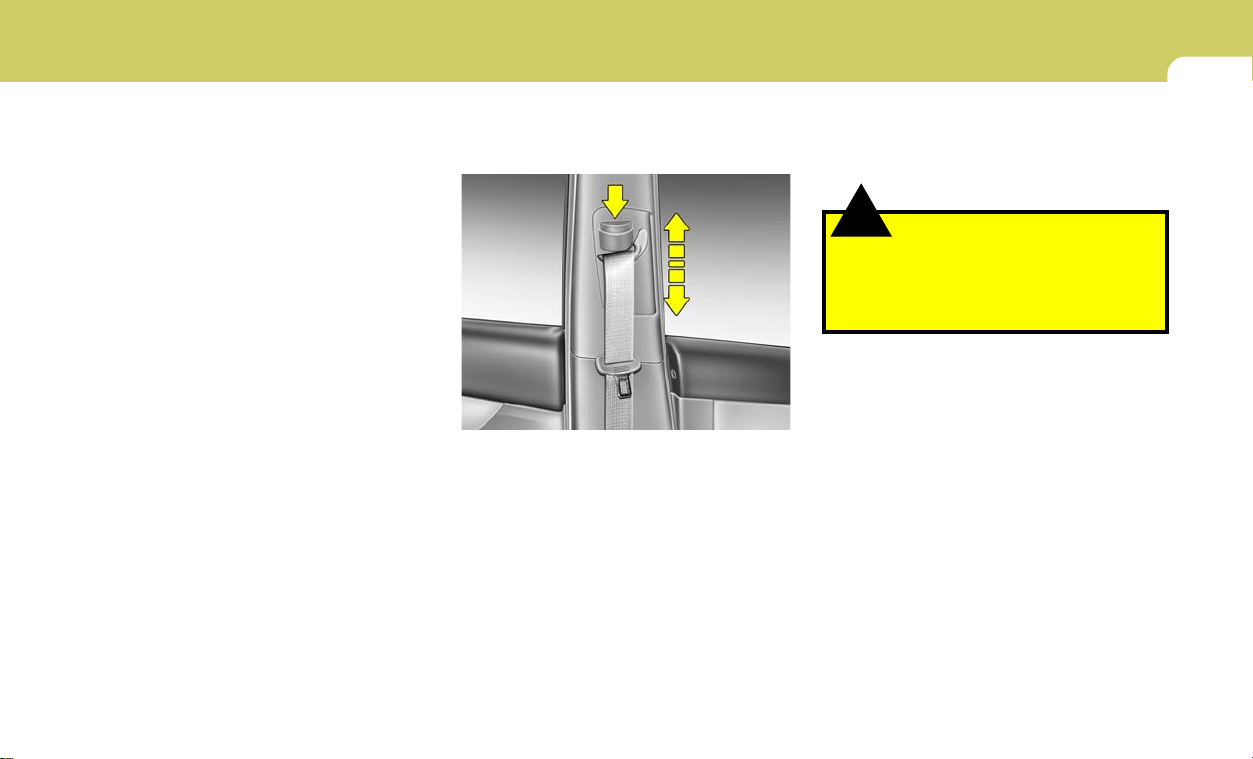
HEIGHT ADJUSTABLE FRONT SEAT
SHOULDER BELT
You can adjust the height of the shoulder belt
anchor to one of 3 positions for maximum
comfort and safety.
If the height of the adjusting seat belt is too near
your neck, you will not be getting the most
effective protection. The shoulder portion should
be adjusted so that it lies across your chest and
midway over your shoulder nearest the door
and not your neck.
To adjust the height of the seat belt anchor,
lower or raise the height adjuster into an appro-
priate position.
To raise the height adjuster, pull it up. To lower
it, push it down while pressing the height ad-
juster button.
HNF2049
!
Release the button to lock the anchor into
position. Try sliding the height adjuster to make
sure that it has locked into position.
WARNING:
o The height adjuster must be in the locked
position when the vehicle is moving.
o The misadjustment of height of the
shoulder belt could reduce the effective-
ness of the seat belt in a crash.
1
FEATURES OF YOUR HYUNDAI
24
B190A01NF-AAT
SEAT BELTS-Front Passenger and Rear
Seat 3-Point System with Combination
Locking Retractor
To Fasten Your Belt
Combination retractor type seat belts are in-
stalled in the rear seat positions to help accom-
modate the installation of child restraint systems.
Although a combination retractor is also installed
in the front passenger seat position, Hyundai
strongly recommends that children always be
seated in the rear seat. NEVER place any infant
restraint system in the front seat of the vehicle.
This type of seat belt combines the features of
both an emergency locking retractor seat belt
and an automatic locking retractor seat belt. To
fasten your seat belt, pull it out of the retractor
and insert the metal tab into the buckle. There
will be an audible "click" when the tab locks into
the buckle. When not securing a child restraint,
the seat belt operates in the same way as the
driver's seat belt (Emergency Locking Retrac-
tor Type). It automatically adjusts to the proper
length only after the lap belt portion of the seat
belt is adjusted manually so that it fits snugly
around your hips. When the seat belt is fully
extended from the retractor to allow the instal-
lation of a child restraint system, the seat belt
operation changes to allow the belt to retract, but
not to extend (Automatic Locking Retractor
Type). See page 1-32.
B180A01NF-AAT
SEAT BELT-Driver's 3-Point System with
Emergency Locking Retractor
To Fasten Your Belt
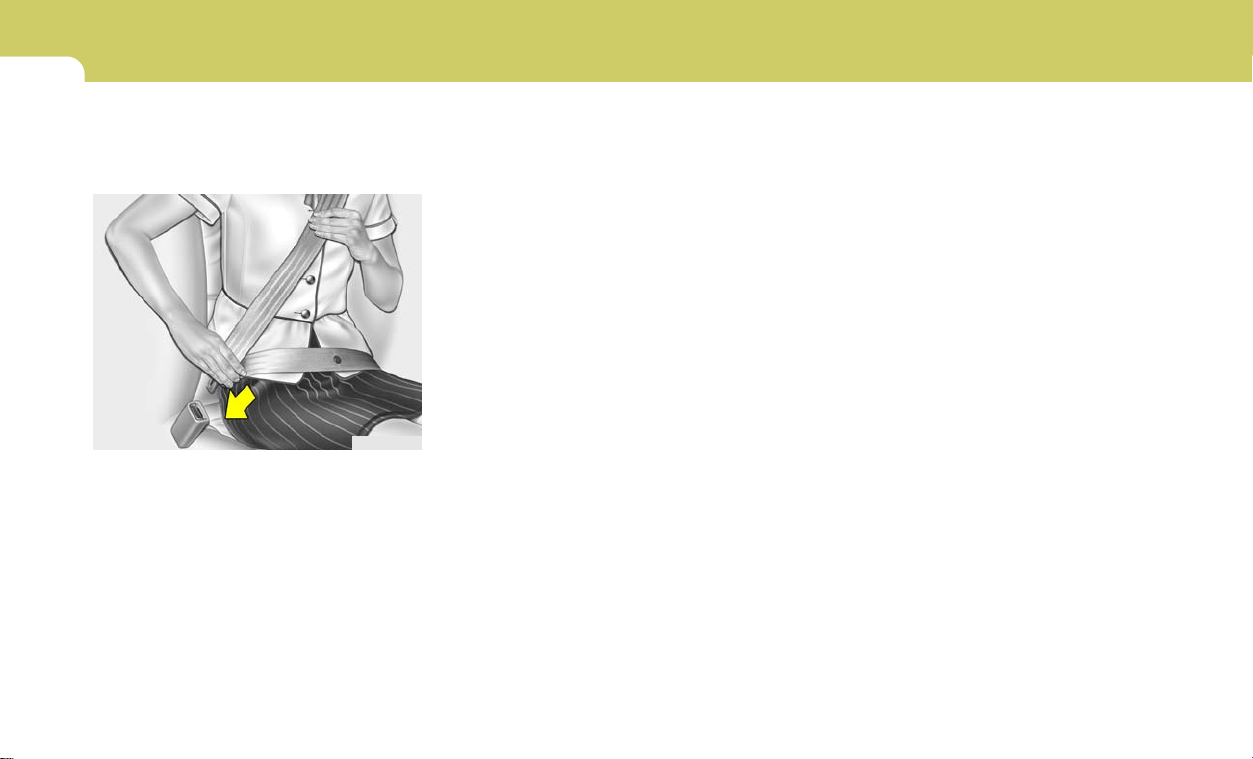
To fasten your seat belt, pull it out of the retractor
and insert the metal tab into the buckle. There
will be an audible "click" when the tab locks into
the buckle.
The seat belt automatically adjusts to the proper
length only after the lap belt portion is adjusted
manually so that it fits snugly around your hips.
If you lean forward in a slow, easy motion, the
belt will extend and let you move around. If there
is a sudden stop or impact, however, the belt will
lock into position. It will also lock if you try to lean
forward too quickly.
B180A01NF
NOTE:
If the driver's seat belt is not fastened when
the ignition key is turned from the "OFF"
position to the "ON" or "START" position,
the seat belt warning light will blink and the
warning chime will sound for approximately
six seconds to remind the driver to fasten
the driver's seat belt.
1
FEATURES OF YOUR HYUNDAI
25
NOTE:
o Although the combination retractor pro-
vides the same level of protection for
seated passengers in either emergency
or automatic locking modes, it is recom-
mended that seated passengers use the
emergency locking feature for improved
convenience. The automatic locking
function is intended to facilitate child
restraint installation. To convert from
the automatic locking feature to the
emergency locking operation mode, al-
low the unbuckled seat belt to fully re-
tract.
o The front passenger's seat belt warning
light on the center fascia panel blinks
until the front passenger's seat belt is
fastened to remind the front passenger
to fasten the front passenger's seat belt,
when the ignition key is turned from the
"OFF" position to "the "ON" or "START"
position.
WARNING:
o For maximum restraint system protec-
tion, the seat belts must always be used
whenever the car is moving.
o Seat belts are most effective when
seatbacks are in the upright position.
o Children must always be seatbelted in
the rear seats. Never allow children to
ride in the front passenger seat.
o The shoulder belt should be positioned
midway over the shoulder nearest the
door for the most effective protection.
Never wear the seat belt under the arm
nearest the door. Wearing the belt under
the arm nearest the door could cause
serious or fatal injuries in an accident.
o Avoid wearing twisted seat belts. A
twisted belt can't do its job as well. In a
collision, it could even cut into you. Be
sure the belt webbing is straight and not
twisted.
o Be careful not to damage the belt web-
bing or hardware. If the belt webbing or
hardware is damaged, replace it.
!
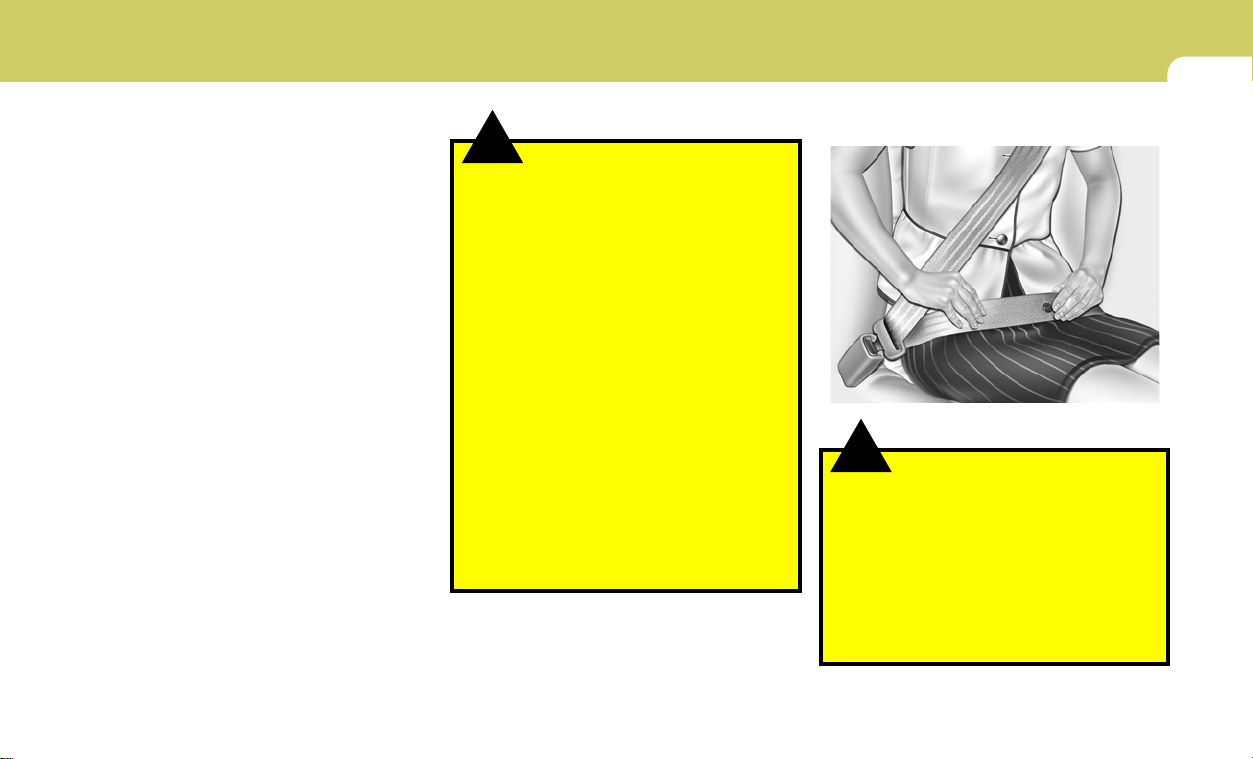
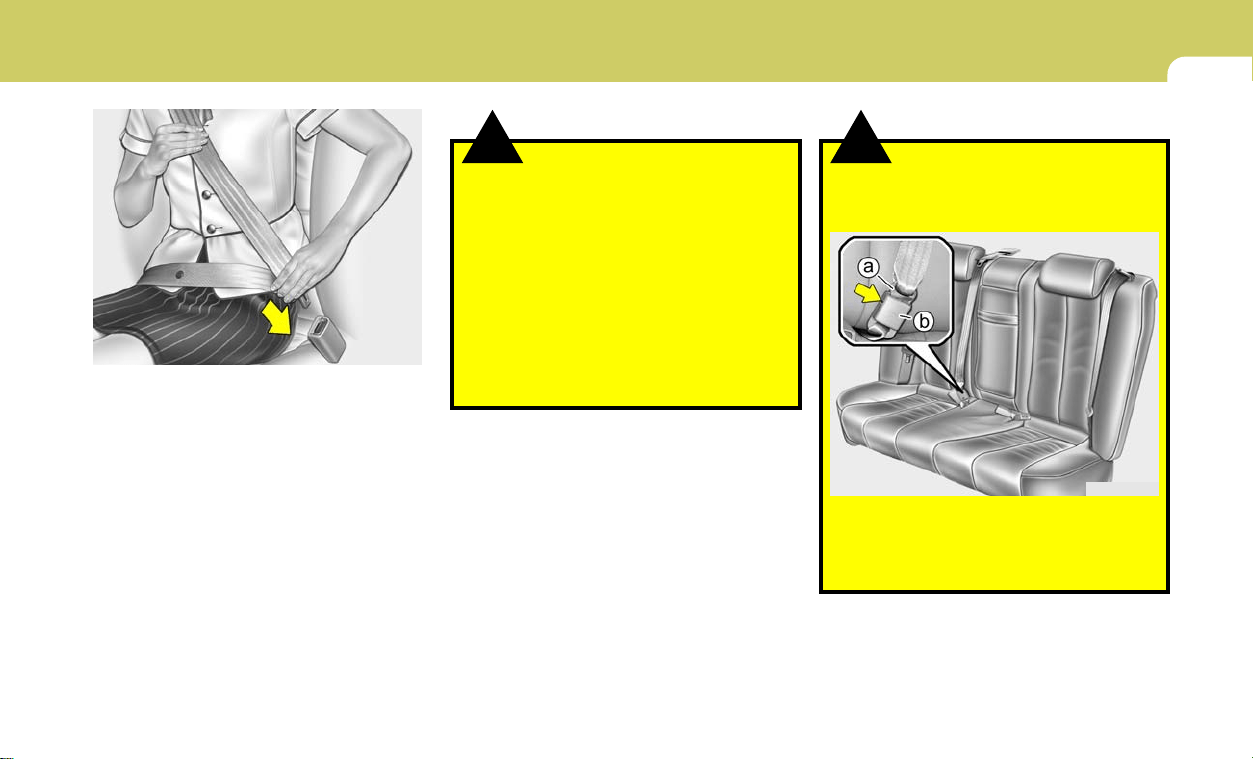
WARNING:
You should place the lap belt portion as low
as possible and snugly across your hips,
not on your waist. If the lap belt is located
too high on your waist, it may increase the
chance of injury in the event of a collision.
Both arms should not be under or over the
belt. Rather, one should be over and the
other under, as shown in the illustration.
Never wear the seat belt under the arm
nearest the door.
!
B200A01A-AAT
Adjusting Your Seat Belt
B200A01NF
1
FEATURES OF YOUR HYUNDAI
26
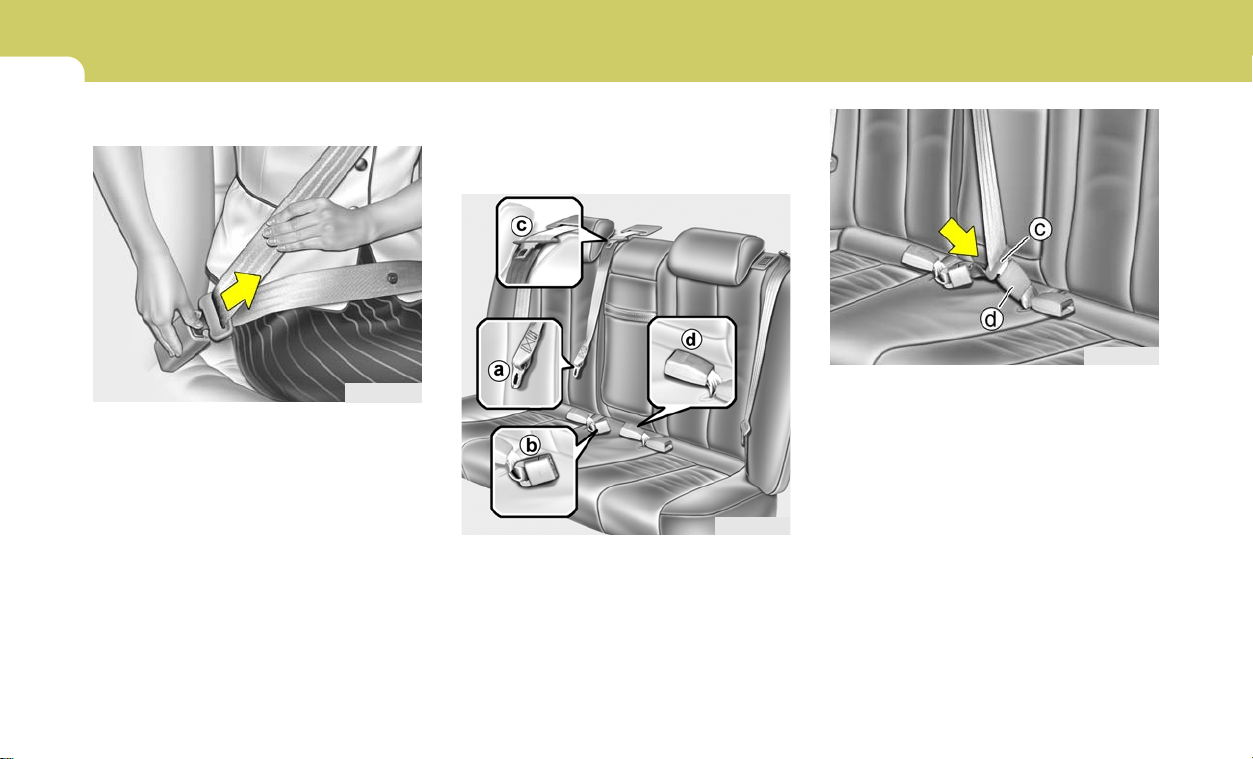
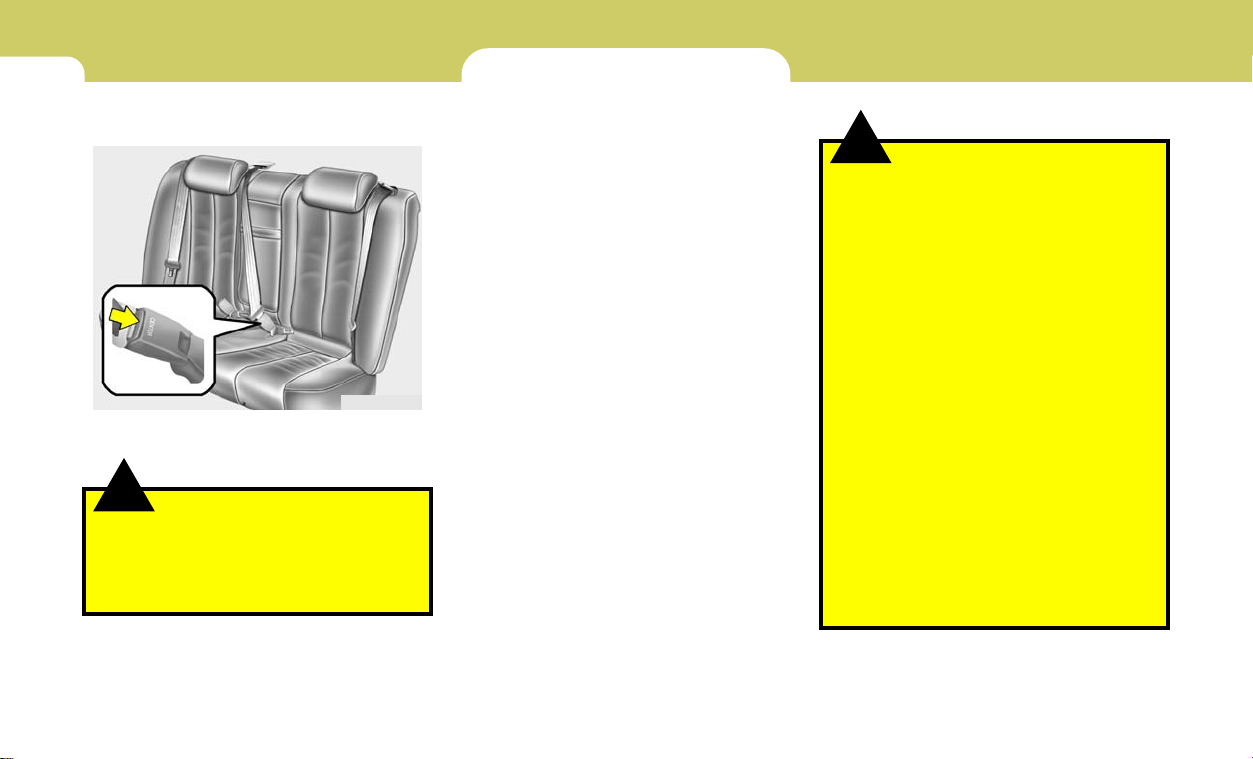
3. After confirming that (a) and (b) are latched,
pull the seat belt out of the retractor and insert
the metal tab (c) into the buckle (d).
B220A02NF-A
B200A01NF-AAT
SEAT BELTS - Rear Seat Center 3-Point
System With Combination Locking Re-
tractor
1. Pull the seat belt out of the rear seat package
tray.
2. Before fastening the rear seat center belt,
confirm the metal tab (a) and buckle (b) are
latched together.
B220A01NF-A
The seat belt is released by pressing the re-
lease button in the locking buckle. When it is
released, the belt should automatically draw
back into the retractor.
If this does not happen, check the belt to be sure
it is not twisted, then try again.
B210A01A-AAT
To Release the Seat Belt
B210A01NF
1
FEATURES OF YOUR HYUNDAI
27
There will be an audible "click" when the tab
locks in the buckle. The seat belt automatically
adjusts to the proper length only after the lap belt
is adjusted manually so that it fits snugly around
your hips. If you lean forward in a slow, easy
motion, the belt will extend and let you move
around. If there is a sudden stop or impact, the
belt will lock into position. It will also lock if you
try to lean forward too quickly.
!
WARNING:
o When using the rear seat center belt, you
must lock all metal tabs and buckles. If
any metal tab or buckle is not locked, it
will increase the chance of injury in the
event of collision.
o Never unlock the metal tab (a) and the
buckle (b) with the following excep-
tions.
(1) In case of folding rear seatbacks
down.
(2) If transporting an object on the rear
seat may cause damage to the rear
seat center belt.
B180A01NF-E
!
o Lock the metal tab (a) and the buckle (b)
immediately after folding rear seatbacks
up.
B220A03NF-A
WARNING:
o To disconnect the metal tab (a) from the
buckle (b), insert a narrow-ended tool
into the groove located on the buckle
(b).
1
FEATURES OF YOUR HYUNDAI
28
!
WARNING:
o A child restraint system must be placed
in the rear seat. Never install a child or
infant seat on the front passenger's seat.
Should an accident occur and cause the
passenger side airbag to deploy, it could
severely injure or kill an infant or child
seated in an infant or child seat. Thus
only use a child restraint in the rear seat
of your vehicle.
o A safety belt or child restraint system
can become very hot if it is left in a closed
vehicle on a sunny day, even if the out-
side temperature does not feel hot. Be
sure to check the seat cover and buckles
before placing a child there.
o When the child restraint system is not in
use, store it in the trunk or fasten it with
a safety belt so that it will not be thrown
forward in the case of a sudden stop or
an accident.
o Children who are too large to be in a child
restraint should sit in the rear seat and be
restrained with the available lap/shoul-
der belts. Never allow children to ride in
the front passenger seat.
B220C02A-GAT
To Release the Seat Belt
When you want to release the seat belt, press
the button in the locking buckle.
!
WARNING:
When fastening the outboard seat belts or
the center seat belt, make sure they are
inserted into the correct buckles to obtain
maximum protection from the seat belt
system and assure proper operation.
CHILD RESTRAINT SYSTEM
B230A03Y-AAT
Children riding in the car should sit in the rear
seat and must always be properly restrained to
minimize the risk of injury in an accident, sudden
stop or sudden maneuver. According to acci-
dent statistics provided by the National High-
way Traffic Safety Administration (NHTSA),
children are safer when properly restrained in
the rear seats than in the front seat. Larger
children not in a child restraint should use one
of the seat belts provided.
All 50 states have child restraint laws. You
should be aware of the specific requirements in
your state. Child and/or infant safety seats must
be properly placed and installed in the rear seat.
You must use a commercially available child
restraint system that meets the requirements of
the Federal Motor Vehicle Safety Standards
(FMVSS).
Children could be injured or killed in a crash if
their restraints are not properly secured. For
small children and babies, a child seat or infant
seat must be used. Before buying a particular
child restraint system, make sure it fits your car
seat and seat belts, and fits your child. Follow
all the instructions provided by the manufac-
turer when installing the child restraint system.
B220C02NF-A

1
FEATURES OF YOUR HYUNDAI
29
!
WARNING:
o Always make sure that the shoulder belt
portion of the lap/shoulder belt is posi-
tioned midway over the shoulder and
never across the neck or behind the
back. Moving the child closer toward the
seat belt buckle may help provide a good
shoulder belt fit. The lap belt portion of
the lap/shoulder belt must always be
positioned as low as possible on the
child's hips, and as snug as possible.
o If the seat belt will not properly fit the
child, Hyundai recommends the use of
an approved booster seat in the rear seat
in order to raise the child's seating height
so that the seat belt will properly fit the
child.
Before purchasing a booster seat, make
sure that it meets applicable Federal
Motor Vehicle Safety Standards (FMVSS)
and that it is satisfactory for use with this
vehicle.
o Never allow a child to stand up or kneel
on the seat.
o Never use an infant carrier or a child
safety seat that "hooks" over a seatback;
it may not provide adequate security in
an accident.
WARNING:
o Never allow a child to be held in a person's
arms while they are in a moving vehicle,
as this could result in serious injury to
the child in the event of an accident or a
sudden stop. Holding a child in a moving
vehicle does not provide the child with
any means of protection during an acci-
dent, even if the person holding the child
is wearing a seat belt.
!
B230B01NF-AAT
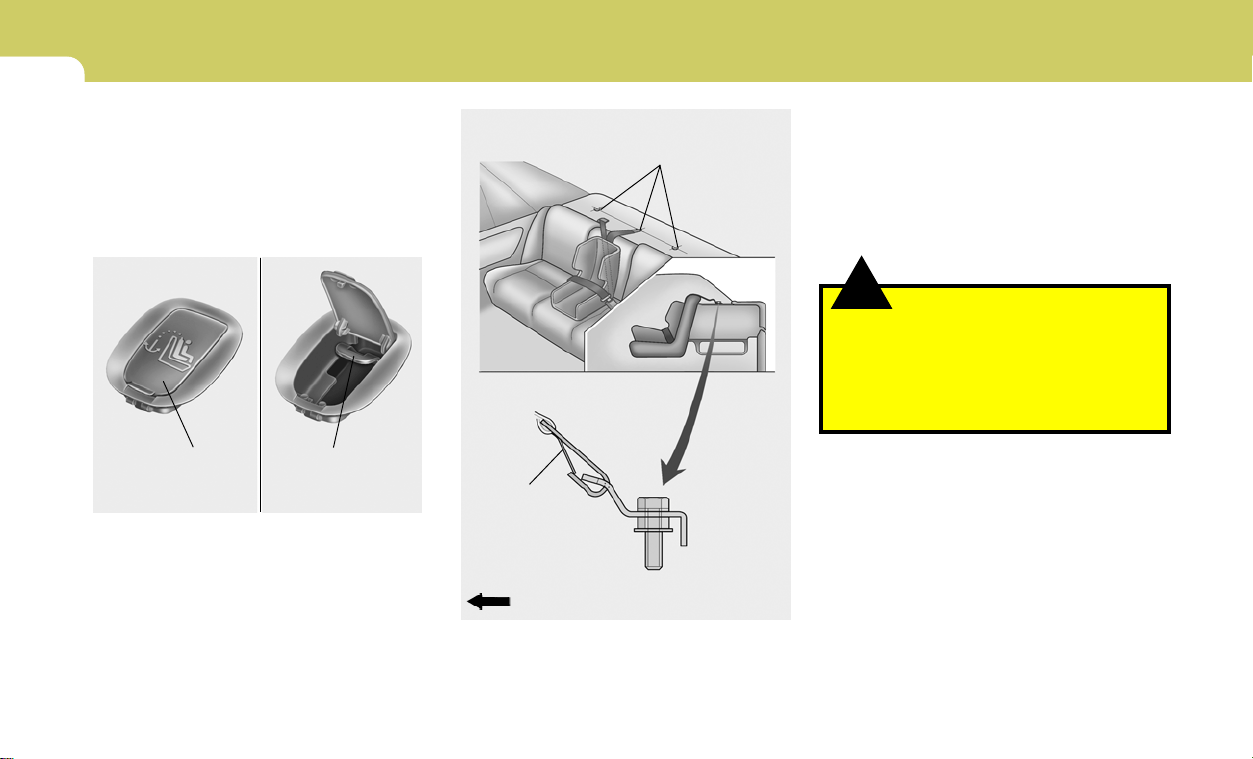
Using a Child Restraint System
For small children and babies, the use of a child
seat or infant seat is required. This child seat or
infant seat should be of appropriate size for the
child and should be installed in accordance with
the manufacturer's instructions. It is further
required that the seat be placed in the vehicle's
rear seat. Your vehicle is provided with three
child restraint hook holders for installing the
child seat or infant seat.
1
FEATURES OF YOUR HYUNDAI
30
!
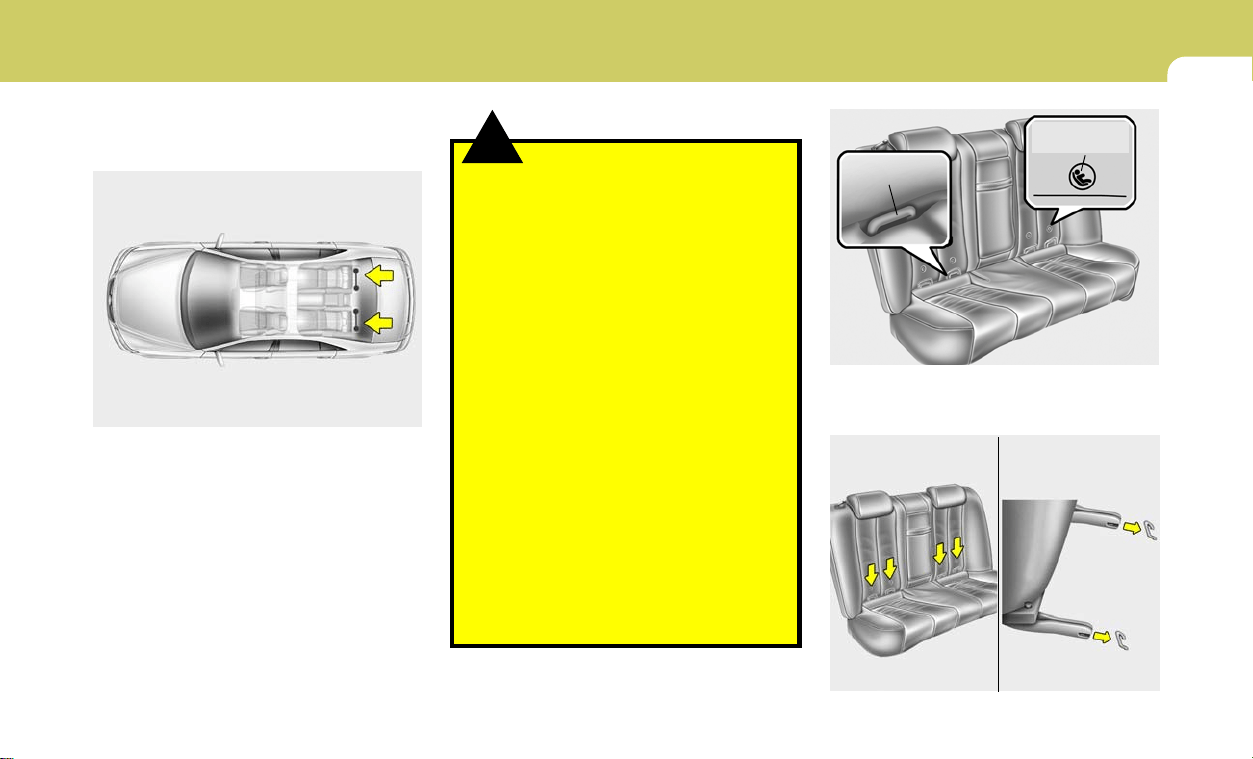
For vehicles with adjustable headrests, route
the tether strap under the headrest and
between the headrest posts, otherwise route
the tether strap over the top of the seatback.
3. Connect the tether strap hook to the child
restraint hook holder and tighten to secure
the seat.
WARNING:
Do not mount more than one child restraint
to a single tether or to a child restraint lower
anchorage point. The improper increased
load may cause the anchorage points or
tether anchor to break, causing serious
injury or death.
2. Route the child restraint seat tether strap
over the seatback.
B230C02NF
Rear seat package tray
Tether Strap Hook
Child Restraint Hook Holders
B230C04A-AAT
Installing a Child Restraint Seat with the
"Tether Anchorage" System
Three child restraint hook holders are located
on the rear seat package tray.
To install the child restraint seat
1. Open the tether anchor cover on the rear
seat package tray.
B230C01NF
Tether Anchor Cover
Child Restraint
Hook Holder
Front of Vehicle
1
FEATURES OF YOUR HYUNDAI
31
B230D03E-AAT
Securing the Child Restraint Seat with
the "ISOFIX" system
Some child seat manufacturers make safety
seats that are labeled as ISOFIX or ISOFIX-
compatible child seats. These seats include two
rigid or webbing mounted attachments that
connect to two ISOFIX anchors at specific
seating positions in your vehicle. This type of
child seat eliminates the need to use seat belts
to attach the child seat for forward-facing child
seats.
ISOFIX anchors have been provided in your
vehicle. The ISOFIX anchors are located in the
left and right outboard rear seating positions.
Their locations are shown in the illustration.
There is no ISOFIX anchor provided for the
center rear seating position.
B230D01NF
The ISOFIX anchors are located between the
seatback and the seat cushion of the rear seat
left and right outboard seating positions.
!
WARNING:
o Do not install a child restraint seat at the
center of the rear seat using the vehicle's
ISOFIX anchors. The ISOFIX anchors are
only provided for the left and right out-
board rear seating positions. Do not
misuse the ISOFIX anchors by attempt-
ing to attach a child safety seat in the
middle of the rear seat position to the
ISOFIX anchors. In a crash, the child seat
ISOFIX attachments may not be strong
enough to secure the child restraint seat
properly in the center of the rear seat and
may break, causing serious injury or
death.
o Do not mount more than one child re-
straint to a single tether or to a child
restraint lower anchorage point. The
improper increased load may cause the
anchorage points or tether anchor to
break, causing serious injury or death.
o Attach the ISOFIX or ISOFIX-compatible
child seat only to the appropriate loca-
tions shown.
o Always follow the installation and use
instructions provided by the manufac-
turer of the child restraint.
B230D02NF-A
ISOFIX Anchor
ISOFIX Anchor
Position Indicator
B230D03NF-A
1
FEATURES OF YOUR HYUNDAI
32
B230G03Y-AAT
Installation on Rear Seats
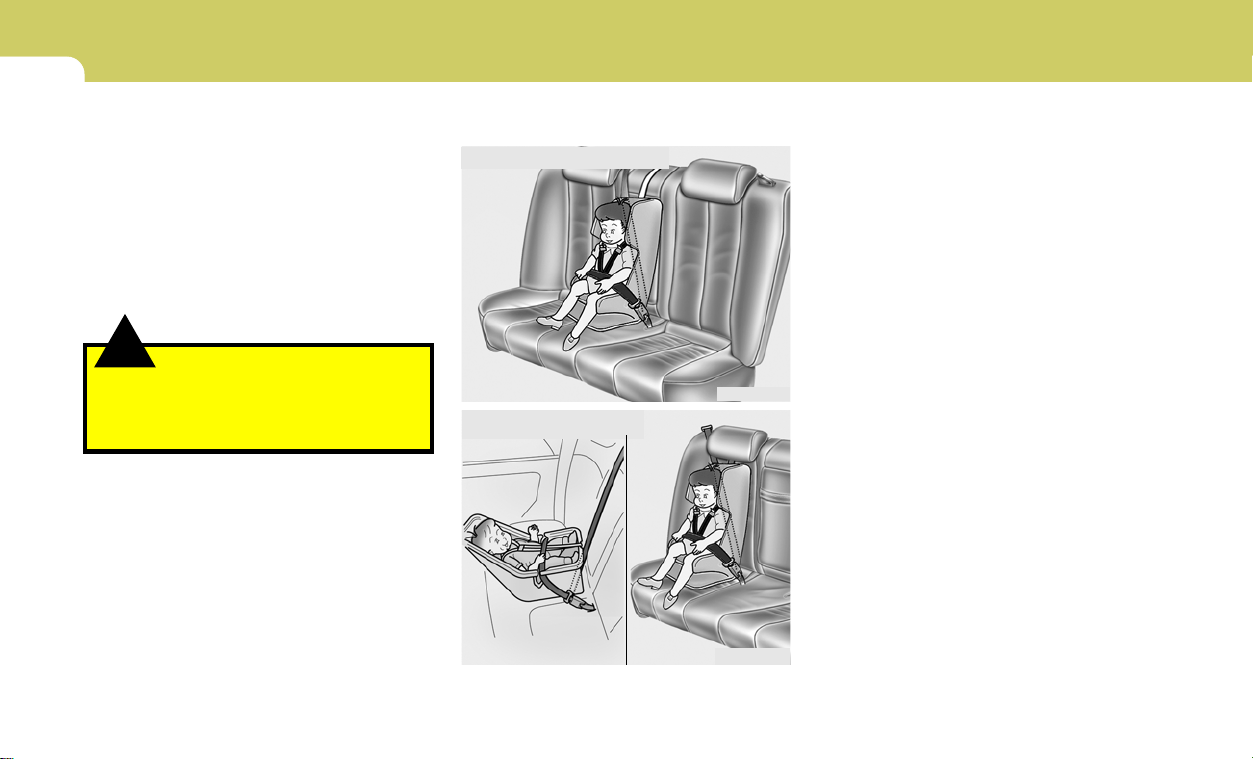
To install a child restraint system in the rear
seats, extend the shoulder/lap belt entirely from
its retractor until a "click" is felt. This will engage
the seat belt retractor automatic locking feature,
which allows the seat belt to retract but not
extend. Install the child restraint system, buckle
the seat belt and allow the seat belt to take up
any slack. Make sure that the lap portion of the
belt is tight around the child restraint system and
the shoulder portion of the belt is positioned so
that it cannot interfere with the child's head or
neck. Also, double check to be sure that the
retractor has engaged the Automatic Locking
feature by trying to extend webbing out of the
retractor. If the retractor is in the Automatic
Locking mode, the belt will be locked. After
installation of the child restraint system, try to
move it in all directions to be sure the child
restraint system is securely installed. If you need
to tighten the belt, pull more webbing toward the
retractor. When you unbuckle the seat belt and
allow it to retract, the retractor will automatically
revert back to its normal seated passenger
Emergency Locking usage condition.
B230G01NF-A
On outboard rear seats
!
WARNING:
If the child restraint seat is not anchored
properly, the risk of a child being seriously
injured or killed in a collision greatly in-
creases.
Follow the child seat manufacturer's instruc-
tions to properly install safety seats with ISOFIX
or ISOFIX-compatible attachments.
Once you have installed the ISOFIX child re-
straint seat, assure that the seat is properly
attached to the ISOFIX and tether anchors.
Also, test the safety seat before you place the
child in it. Tilt the seat from side to side. Also try
to tug the seat forward. Check to see if the
anchors hold the seat in place.
B235G02NF-A
On rear seat center position
1
FEATURES OF YOUR HYUNDAI
33
!
WARNING:
o If the retractor is not in the Automatic
Locking mode, the child restraint sys-
tem can move when your vehicle turns or
stops abruptly.
o Do not install any child restraint system
in the front passenger seat. Should an
accident occur and cause the passenger
side airbag to deploy, it could severely
injure or kill an infant or child seated in
an infant or child seat. Therefore, only
use a child restraint system in the rear
seat of your vehicle.
NOTE:
o Before installing the child restraint sys-
tem in any seating position, read the
instructions supplied by the child re-
straint system manufacturer.
o If the seat belt does not operate as de-
scribed, have the system checked imme-
diately by your authorized Hyundai dealer.
!
B180B01NF-AAT
Pre-tensioner Seat Belt
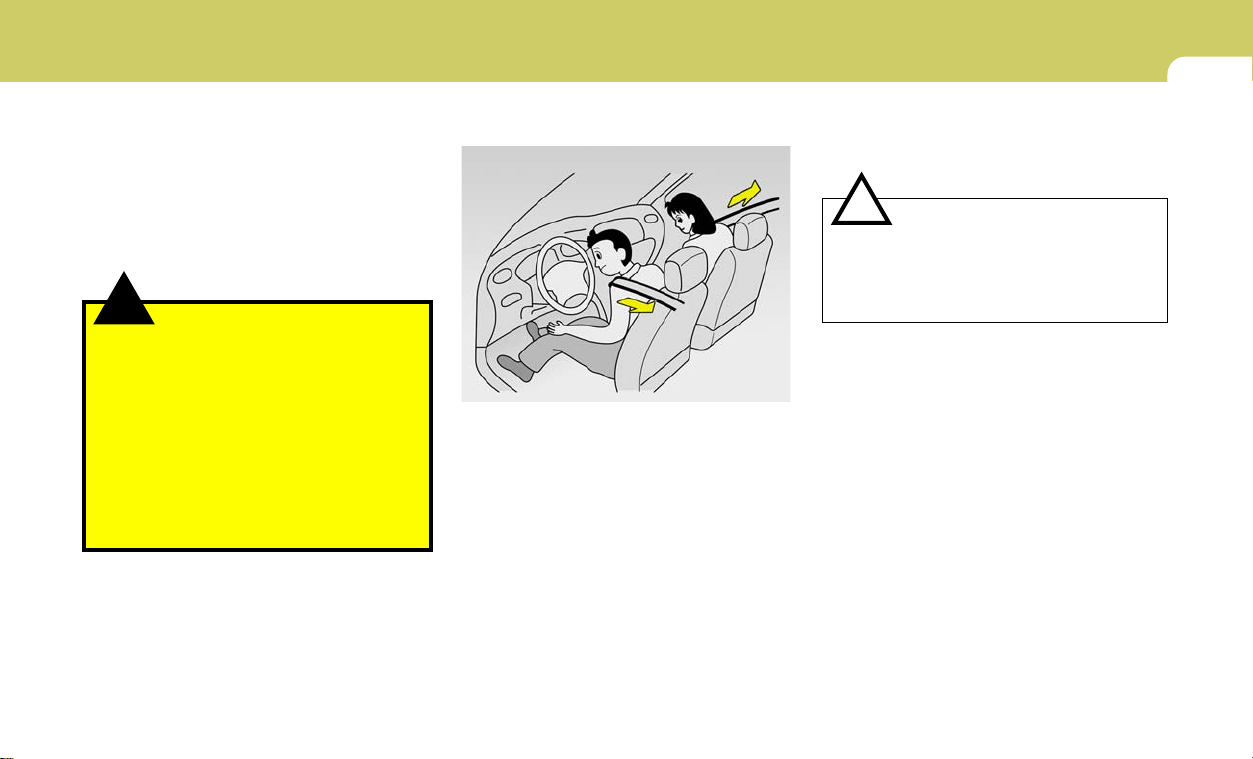
Your Hyundai vehicle is equipped with driver's
and front passenger's pre-tensioner seat belts.
The purpose of the pre-tensioner is to make
sure that the seat belts fit tightly against the
occupant's body in certain frontal collisions.
The pre-tensioner seat belts can be activated
alone or, where the frontal collision is severe
enough, together with the airbags.
When the vehicle stops suddenly, or if the
occupant tries to lean forward too quickly, the
seat belt retractor will lock into position. In
certain frontal collisions, the pre-tensioner will
activate and pull the seat belt into tighter contact
against the occupant's body. The buckle pre-
HXG229
CAUTION:
Do not put anything near the buckle. Plac-
ing objects near the buckle can adversely
affect the buckle pre-tensioner and may
increase the risk of personal injury in the
event of a collision.
If the system senses excessive seat belt ten-
sion on the driver or passenger's seat belt when
the pre-tensioner activates, the load limiter
inside the pre-tensioner will release some of the
pressure on the affected seat belt.
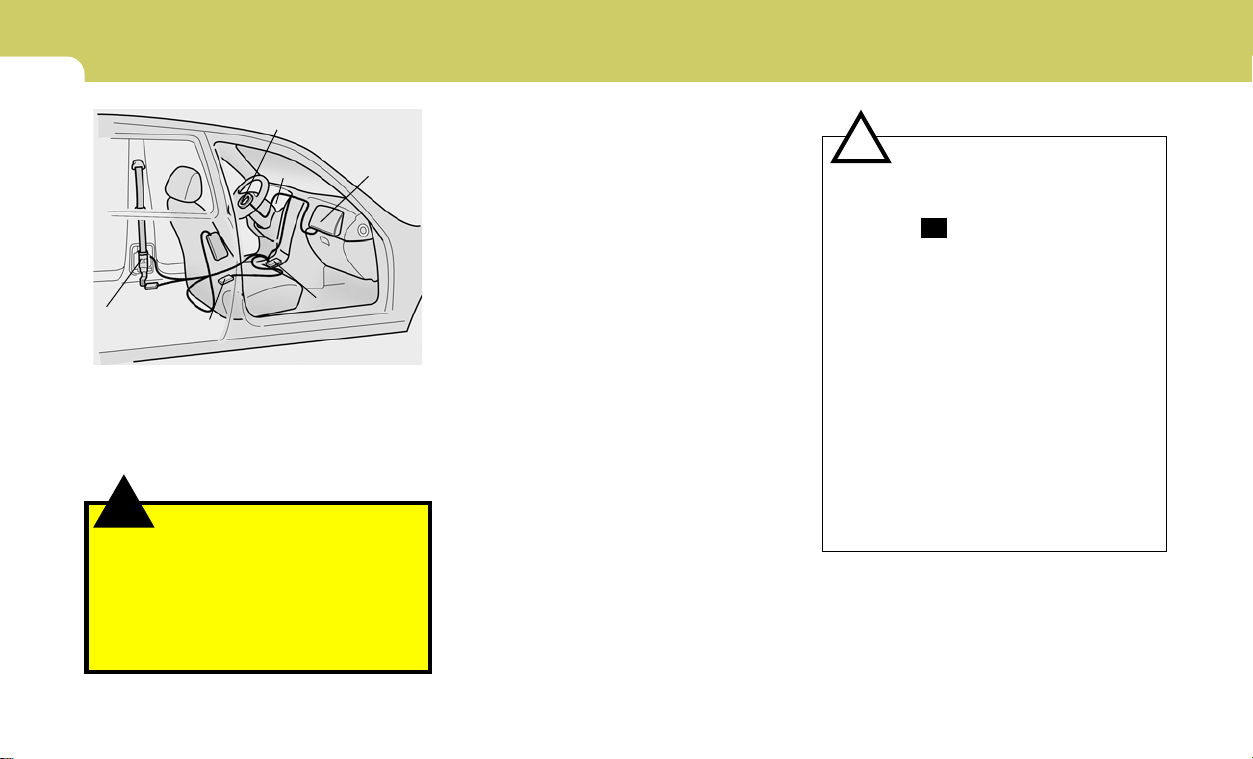
The seat belt pre-tensioner system consists
mainly of the following components. Their loca-
tions are shown in the illustration:
tensioner (which is installed in the buckle) will
also pull the seat belt into the buckle.
1
FEATURES OF YOUR HYUNDAI
34
!
!
AIR
BAG
1. SRS airbag warning light
2. Retractor pre-tensioner assembly
3. SRS control module
4. Buckle pre-tensioner assembly
B180B01NF
1
2
3
Driver's airbag
Passenger's
airbag
WARNING:
To obtain maximum benefit from a pre-
tensioner seat belt:
1. The seat belt must be worn correctly.
2. The seat belt must be adjusted to the
correct position.
3. Be sure you and your passengers always
wear seat belts and wear them properly.
NOTE:
o Both the driver's and front passenger's
pre-tensioner seat belts will be activated
in certain frontal collisions. The pre-
tensioner seat belts can be activated
alone or, where the frontal collision is
severe enough, together with the
airbags.
The pre-tensioners will not be activated
if the seat belts are not being worn at the
time of the collision.
o When the pre-tensioner seat belts are
activated, a loud noise may be heard and
fine dust, which may appear to be smoke,
may be visible in the passenger com-
partment. These are normal operating
conditions and are not hazardous.
o Although it is harmless, the fine dust
may cause skin irritation and should not
be breathed for prolonged periods. Wash
all exposed skin areas thoroughly after
an accident in which the pre-tensioner
seat belts were activated.
CAUTION:
o Because the sensor that activates the
SRS airbag is connected with the pre-
tensioner seat belt, the SRS airbag warn-
ing light on the instrument panel will
illuminate for approximately 6 seconds
after the ignition key has been turned to
the "ON" position, and then it should
turn off.
o If the pre-tensioner seat belt is not work-
ing properly, this warning light will illu-
minate even if there is no malfunction of
the SRS airbag. If the SRS airbag warning
light does not illuminate when the igni-
tion key is turned to "ON", or if it blinks
for a second and remains illuminated
after illuminating for approximately 6
seconds, or if it illuminates while the
vehicle is being driven, please have an
authorized Hyundai dealer inspect the
pre-tensioner seat belt or SRS airbag
system as soon as possible.
4

1
FEATURES OF YOUR HYUNDAI
35
!
WARNING:
o Pre-tensioners are designed to operate
only one time. After activation, pre-
tensioner seat belts must be replaced.
All seat belts, of any type, should always
be replaced after they have been worn
during a collision.
o The pre-tensioner seat belt assembly
mechanisms become hot during activa-
tion. Do not touch the pre-tensioner seat
belt assemblies for several minutes after
they have been activated.
o Do not attempt to inspect or replace the
pre-tensioner seat belts yourself. This
must be done by an authorized Hyundai
dealer.
o Do not strike the pre-tensioner seat belt
assemblies.
o Do not attempt to service or repair the
pre-tensioner seat belt system in any
manner.
o Improper handling of the pre-tensioner
seat belt assemblies, and failure to heed
the warnings not to strike, modify, in-
spect, replace, service or repair the pre-
tensioner seat belt assemblies may lead
to improper operation or inadvertent
activation and serious injury.
o Always wear the seat belts when driving
or riding in a motor vehicle.
1
FEATURES OF YOUR HYUNDAI
36
B240D01NF-AAT
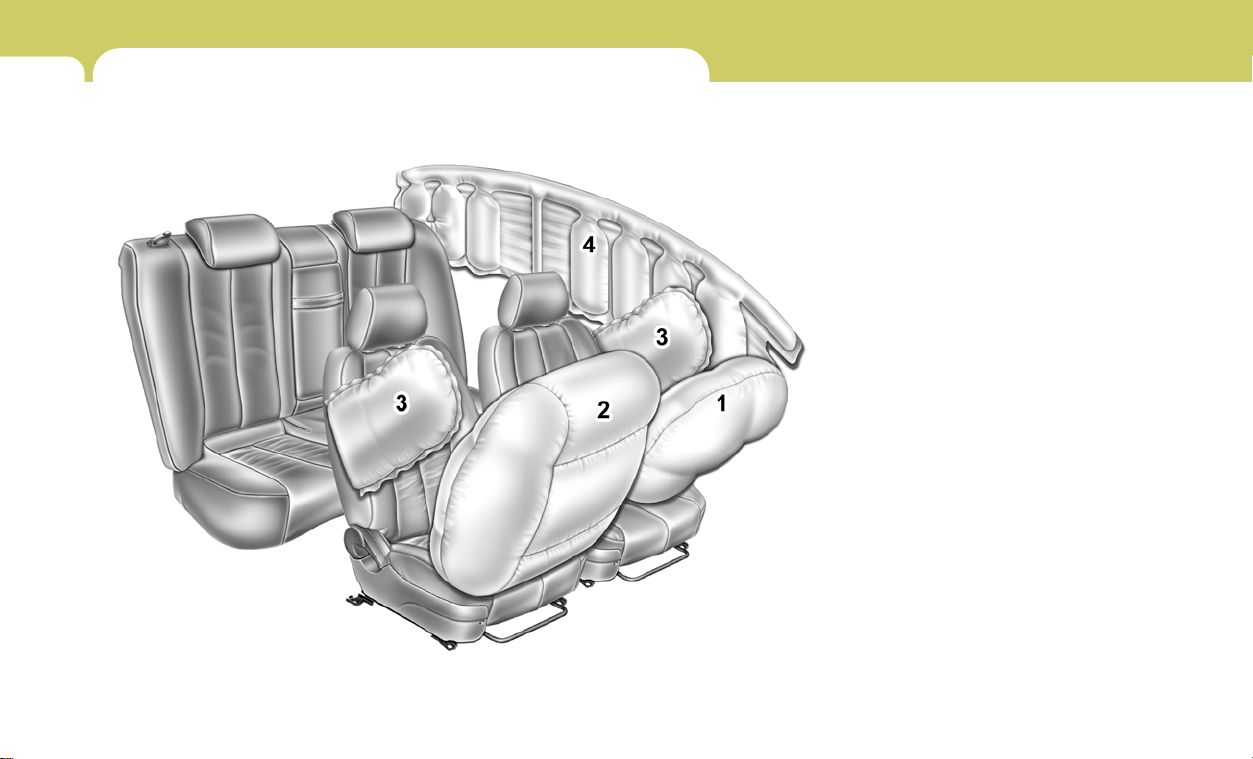
ADVANCED SUPPLEMENTAL RESTRAINT (AIRBAG) SYSTEM (SRS)
1. Driver's front airbag
2. Passenger's front airbag
3. Side impact airbag
4. Curtain airbag
HNF2052
1
FEATURES OF YOUR HYUNDAI
37
B240A01NF
The SRS uses sensors to gather information
about the driver's and front passenger's seat
position, the driver's and front passenger's seat
belt usage and impact severity.
The driver's and front passenger's seat track
position sensors, which are installed on the seat
track, determine if the seats are fore or aft of a
reference position. The seat belt buckle sen-
sors determine if the driver and front passenger's
seat belts are fastened. These sensors provide
the ability to control the SRS deployment based
on how close the driver's seat is to the steering
wheel, how close the passenger's seat is to the
instrument panel, whether or not the seat belts
are fastened, and how severe the impact is.
The advanced SRS offers the ability to control
the airbag inflation with two levels. A first stage
level is provided for moderate-severity impacts.
A second stage level is provided for more
severe impacts.
According to the impact severity, seating posi-
tion and seat belt usage, the SRSCM(SRS
Control Module) controls the airbag inflation.
Failure to properly wear seat belts can increase
the risk or severity of injury in an accident.
CAUTION:
If a seat track position sensor or an occu-
pant classification system is not working
properly, the SRS airbag warning light on
the instrument panel will illuminate be-
cause the SRS airbag warning light is con-
nected with the seat track position sensor
and the occupant classification system. If
the SRS airbag warning light does not illu-
minate when the ignition key is turned to
the "ON" position, remains illuminated af-
ter approximately 6 seconds when the igni-
tion key is turned to the "ON" position, or
if it illuminates while the vehicle is being
driven, have an authorized Hyundai dealer
inspect the advanced SRS airbag system as
soon as possible.
!
AIR
BAG
Additionally, your Hyundai is equipped with an
occupant classification system in the front
passenger's seat. The occupant classification
system detects the presence of a passenger in
the front passenger's seat and will turn off the
front passenger's airbag under certain condi-
tions. For more detail, see "Occupant Classifi-
cation System" later in this section.
B240A01NF-AAT
Driver's and Passenger's Front Airbag
Your Hyundai is equipped with an advanced
Supplemental Restraint (Airbag) System. The
indications of the system's presence are the
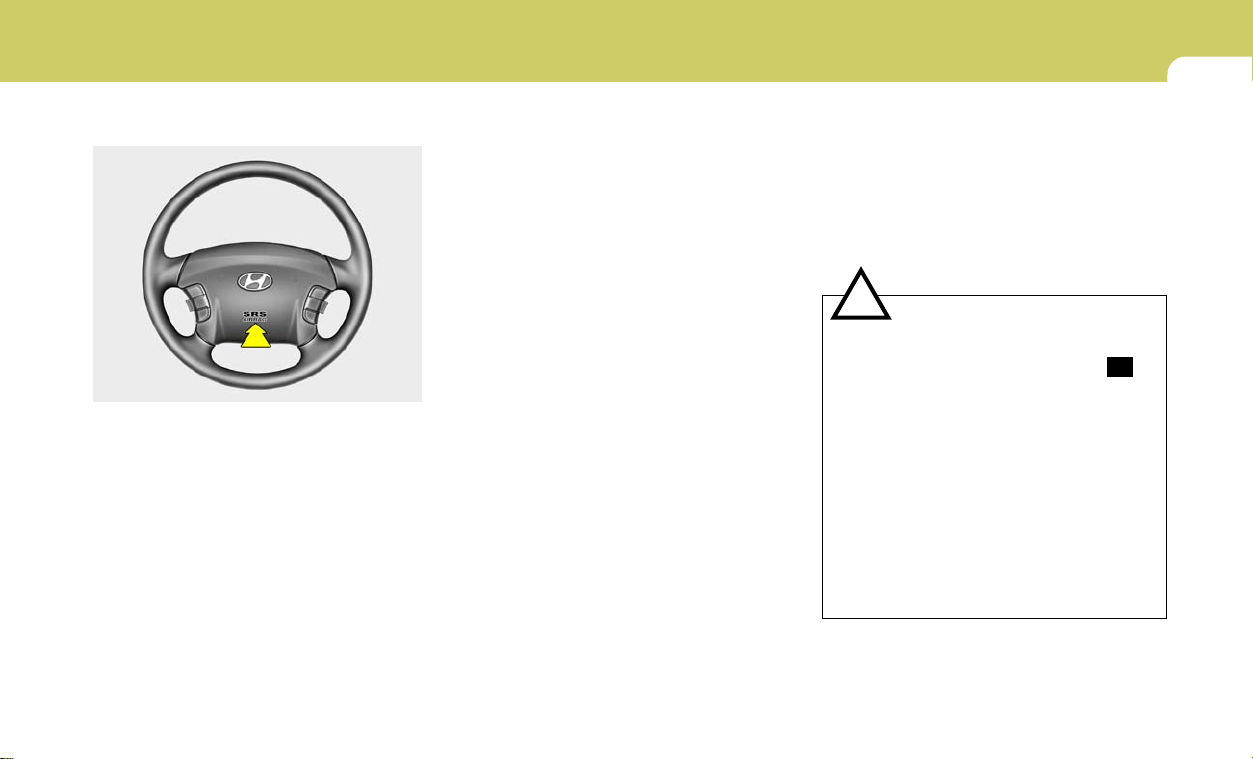
letters "SRS AIRBAG" embossed on the airbag
pad cover in the steering wheel and the
passenger's side front panel pad above the
glove box.
The Hyundai SRS consists of airbags installed
under the pad covers in the center of the
steering wheel and the passenger's side front
panel above the glove box. The purpose of the
SRS is to provide the vehicle's driver and/or the
front passenger with additional protection than
that offered by the seat belt system alone in
case of a frontal impact of sufficient severity.
Driver's Front Airbag
1
FEATURES OF YOUR HYUNDAI
38
B240A02NF
Rear impact
Side Impact
Rollover
!
o The driver should sit back as far as
possible while still maintaining control
of the vehicle. If you are sitting too close
to the airbag, it can cause death or seri-
ous injury when it inflates.
WARNING:
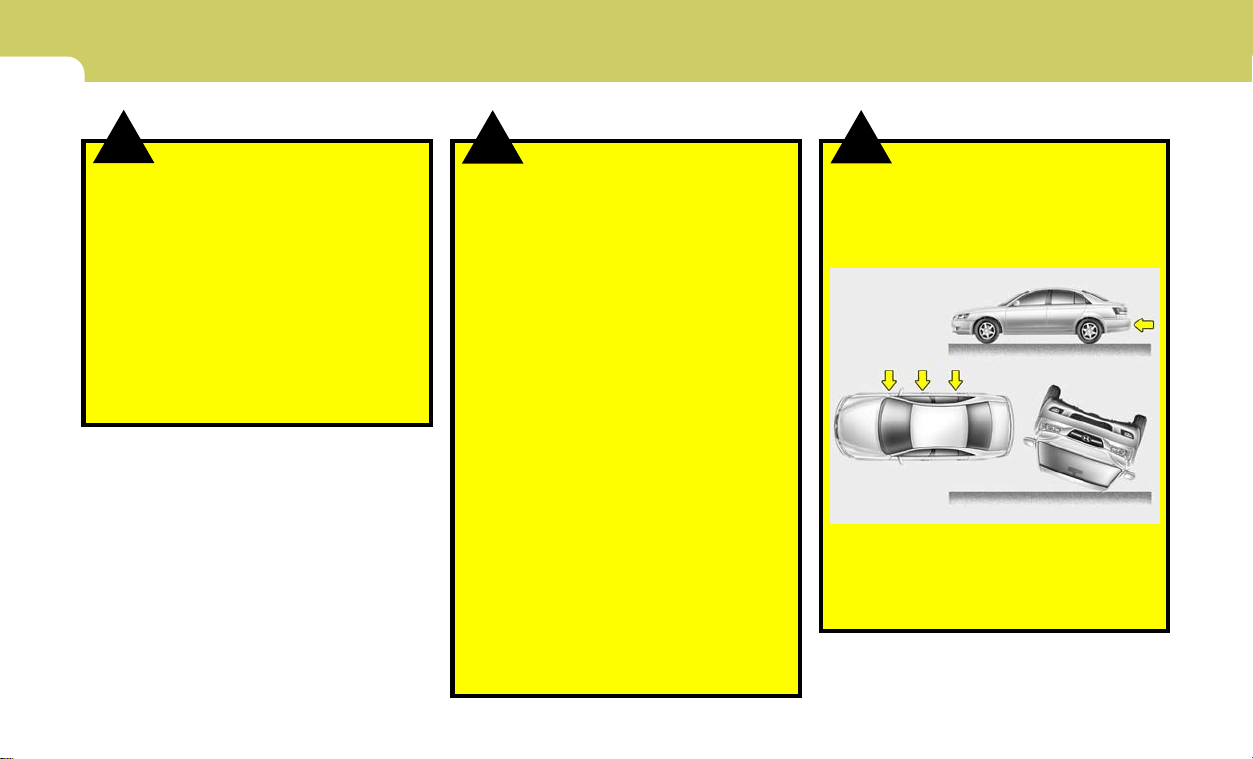
o Front airbags are not intended to deploy
in side-impact, rear-impact or rollover
crashes. In addition, front airbags will
not deploy in frontal crashes below the
deployment threshold.
!
WARNING:
o As its name implies, the SRS is designed
to work with, and be supplemental to the
driver's and the passenger's three point
seat belt systems and is not a substitute
for them. Therefore, your seat belts must
be worn at all times. The airbags deploy
only in certain frontal impact conditions
severe enough to cause significant in-
jury to the vehicle occupants.
o Sitting too close to a front airbag can
result in serious or fatal injury if the front
airbags inflate. Always sit as far back
from airbags as possible.
o Ignoring the SRS airbag warning light
can result in serious or fatal injury if the
airbags, occupant classification system
or pre-tensioners do not work properly.
Have your car checked by a dealer as soon
as possible if the SRS airbag warning
light alerts you to a potential problem.
o The SRS is designed to deploy the front
airbags only when an impact is suffi-
ciently severe and when the impact angle
is less than 30° from the forward longi-
tudinal axis of the vehicle. The front
airbags will not deploy in side, rear or
rollover impacts. Additionally, the
airbags will only deploy once. Seat belts
must be worn at all times.
!
WARNING:
o Modification to the seat structure can
adversely affect the seat track position
sensor and cause the airbag to deploy at
a different level than should be pro-
vided.
o Do not place any objects underneath the
front seats as they could damage the
seat track position sensor or interfere
with the occupant classification sys-
tem.
o Do not place any objects that may cause
magnetic fields near the front seat. These
may cause a malfunction of the seat
track position sensor.
NOTE:
o Be sure to read information about the
SRS on the labels provided on the back-
side of the sun visor and in the glove box.
o Advanced airbags are combined with
pre-tensioner seat belts to help provide
enhanced occupant protection in fron-
tal crashes. Front airbags are not in-
tended to deploy in collisions in which
sufficient protection can be provided by
the pre-tensioner seat belt.
o If you are considering modification of
your vehicle due to a disability, please
contact the Hyundai Customer Assis-
tance Center at 1-800-633-5151.
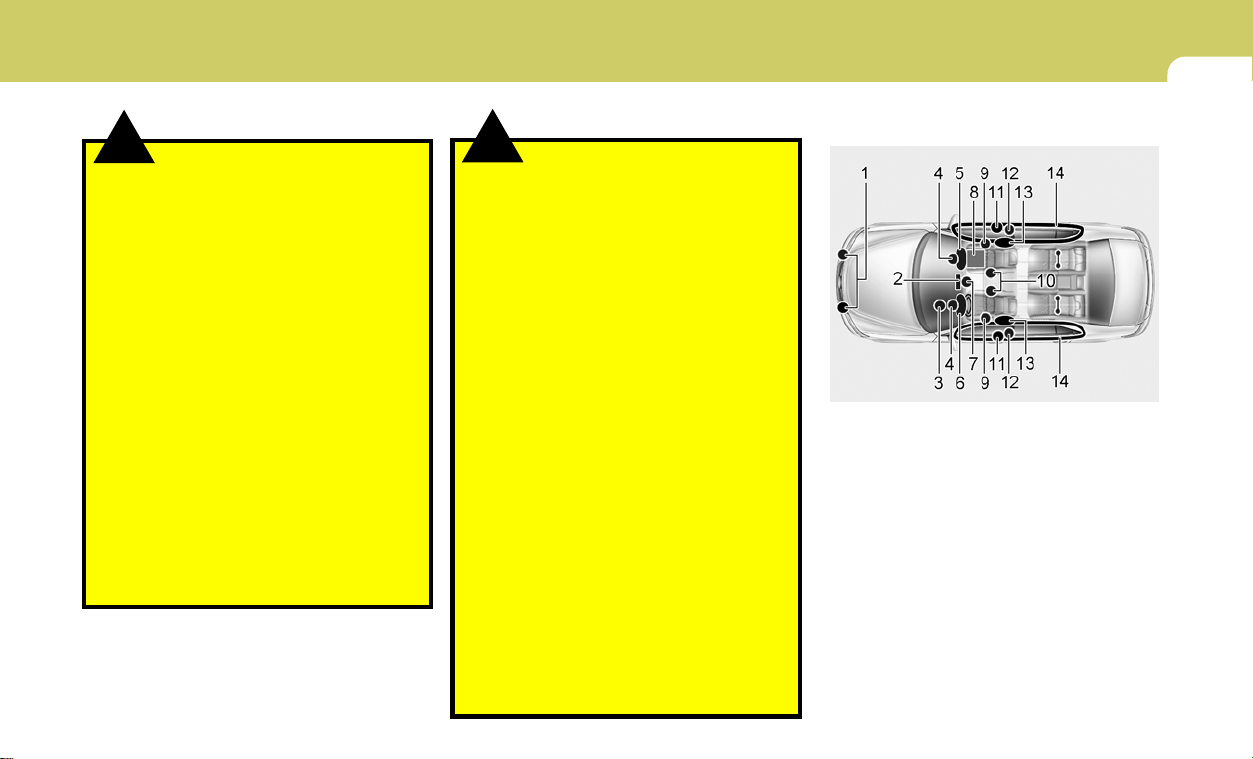
1
FEATURES OF YOUR HYUNDAI
39
!
WARNING:
o No objects should be placed over or near
the airbag modules on the steering
wheel, instrument panel, and the front
passenger's panel above the glove box,
because any such object could cause
harm if the vehicle is in a crash severe
enough to cause the airbags to deploy.
o If the airbags deploy, they must be re-
placed by an authorized Hyundai dealer.
o Do not tamper with or disconnect SRS
wiring or other components of the SRS
system. Doing so could result in injury,
due to accidental deployment of the
airbags or by rendering the SRS inopera-
tive.
o Even though your vehicle is equipped
with the occupant classification sys-
tem, do not install a child restraint sys-
tem in the front passenger seat position.
A child restraint system must never be
placed in the front seat. The infant or
child could be severely injured or killed
by an airbag deployment in case of an
accident.
o Do not allow children to ride in the front
passenger seat. If older children (teen-
agers and older) must ride in the front
seat, make sure they are always properly
belted and the seat is moved back as far
as possible.
o For maximum safety protection in all
types of crashes, all occupants includ-
ing the driver should always wear their
seat belts whether or not an airbag is
also provided at their seating position to
minimize the risk of severe injury or
death in the event of a crash. Do not sit
or lean unnecessarily close to the airbag
while the vehicle is in motion.
o Sitting improperly or out of position can
result in serious or fatal injury in a crash.
All occupants should sit upright with
the seat back in an upright position,
centered on the seat cushion with their
seat belt on, legs comfortably extended
and their feet on the floor until the ve-
hicle is parked and the ignition key is
removed.
o The SRS airbag system must deploy very
rapidly to provide protection in a crash.
If an occupant is out of position because
of not wearing a seat belt, the airbag may
forcefully contact the occupant causing
serious or fatal injuries.
!
WARNING:
B240B01NF-AAT
SRS Components and Functions
The SRS consists of the following components:
1. Front Impact Sensor
2. "PASSENGER AIR BAG OFF" Indicator
(Front passenger's seat only)
3. SRS "AIRBAG" warning light
4. Knee Bolster
5. Passenger's Airbag Module
6. Driver's Airbag Module
7. SRS Control Module (SRSCM)
8. Occupant Classification System
(Front passenger's seat only)
9. Driver's and Front Passenger's Seat Track
Position Sensors
10.Driver's and Front Passenger's Seat Belt
Buckle Sensors/Buckle Pre-tensioner As-
semblies
B240B01NF
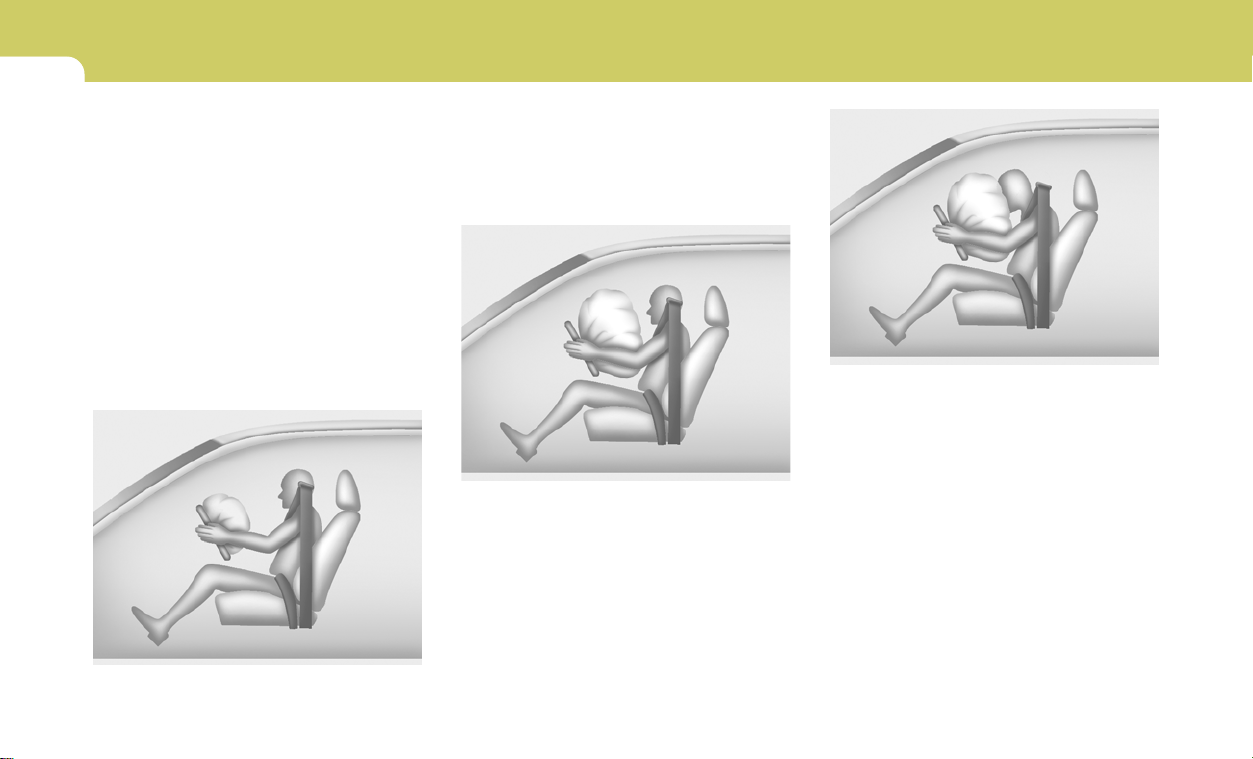
1
FEATURES OF YOUR HYUNDAI
40
B240B02L
Upon deployment, tear seams molded directly
into the pad covers will separate under pres-
sure from the expansion of the airbags. Further
opening of the covers then allows full inflation of
the airbags.
A fully inflated airbag, in combination with a
properly worn seat belt, slows the driver's or the
passenger's forward motion, reducing the risk
of head and chest injury.
After complete inflation, the airbag immediately
starts deflating, enabling the driver to maintain
forward visibility and the ability to steer or
operate other controls.
B240B03L
11.Side Impact Sensor
12.Retractor Pre-tensioner Assemblies
13.Side Impact Airbag Module
14.Curtain Airbag Module
The SRSCM continually monitors all elements
while the ignition is "ON" to determine if a frontal
or near-frontal impact is severe enough to
require airbag deployment or pre-tensioner seat
belt deployment.
The SRS "AIRBAG" warning light on the instru-
ment panel will illuminate for about 6 seconds
after the ignition key is turned to the "ON"
position or after the engine is started, after which
the "AIRBAG" warning light should go out.
The airbag modules are located both in the
center of the steering wheel and in the front
passenger's panel above the glove box. When
the SRSCM detects a sufficiently severe impact
to the front of the vehicle, it will automatically
deploy the front airbags.
B240B01L
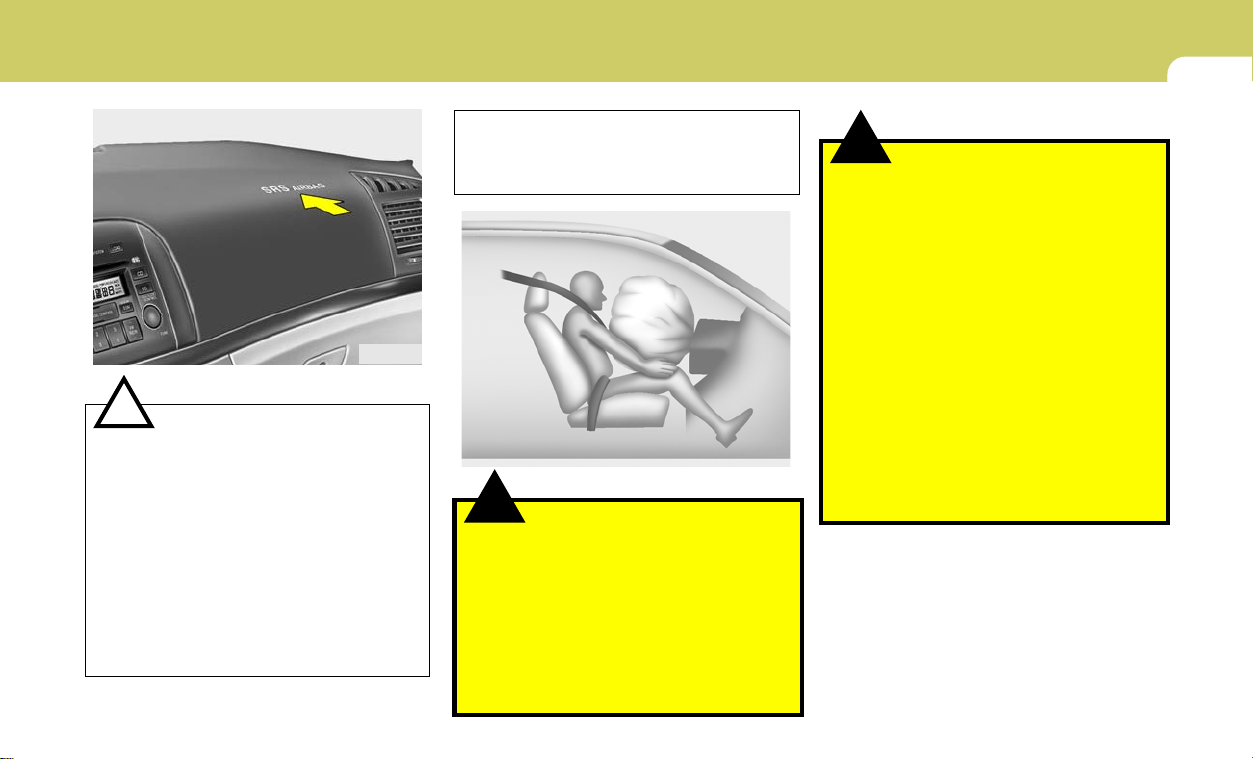
1
FEATURES OF YOUR HYUNDAI
41
!
Passenger's Front Airbag
B240B05L
!
o The SRS can function only when the
ignition key is in the "ON" position. If the
SRS "AIRBAG" warning light does not
illuminate, or continuously remains on
after illuminating for about 6 seconds
when the ignition key is turned to the
"ON" position, or after the engine is
started, comes on while driving, the SRS
is not working properly. If this occurs,
have your vehicle immediately inspect-
ed by your Hyundai dealer.
o Before you replace a fuse or disconnect
a battery terminal, turn the ignition key
to the "LOCK" position and remove the
ignition key. Never remove or replace the
airbag related fuse(s) when the ignition
key is in the "ON" position. Failure to
heed this warning will cause the SRS
"AIRBAG" warning light to illuminate.
Passenger's Front Airbag
CAUTION:
o Do not install or place any accessories
(drink holder, cassette holder, sticker,
etc.) on the front passenger's panel
above the glove box in a vehicle with a
passenger's airbag. Such objects may
become dangerous projectiles and cause
injury if the passenger's airbag inflates.
o When installing a container of liquid air
freshener inside the vehicle, do not place
it near the instrument cluster nor on the
instrument panel surface. If there is any
leakage from the air freshener onto these
areas (instrument cluster, instrument
!
B240B04NF
panel or air ventilator), it may damage
these parts. If the liquid from the air
freshener does leak onto these areas,
wash them with water immediately.
WARNING:
o When the SRS is activated, there may be
a loud noise and fine dust will be re-
leased throughout the vehicle. These
conditions are normal and are not haz-
ardous. However, the fine dust generat-
ed during airbag deployment may cause
skin irritation. Wash all exposed skin
areas thoroughly with lukewarm water
and a mild soap after an accident in
which the airbags were deployed.
WARNING:
NOTE:
Your vehicle's Supplemental Restraint Sys-
tem Control Module is equipped a record-
ing device which may record the use of the
seat belt restraint system by the driver and
front passenger in certain collisions.
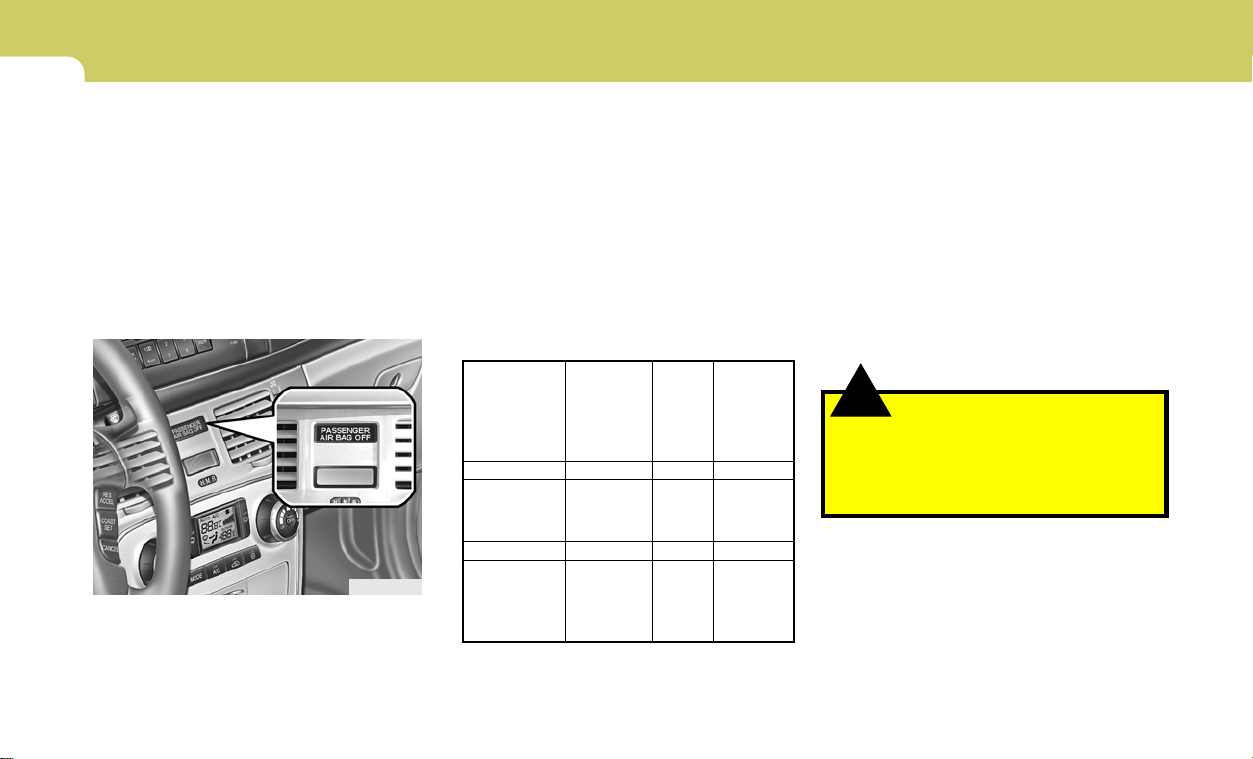
1
FEATURES OF YOUR HYUNDAI
42
!
legs comfortably extended and their feet on the
floor), the "PASSENGER AIR BAG OFF" indi-
cator will be turned off and the front passenger's
airbag will be able to inflate, if necessary, in
frontal crashes.
You will find the "PASSENGER AIR BAG OFF"
indicator on the center facia panel. This system
detects the conditions 1~4 in the following table
and activates or deactivates front passenger
airbags based on these conditions.
Condition and operation in the front pas-
senger occupant classification system
*1) The system judges a person of adult size as
an adult. When a smaller adult sits in the front
passenger seat, the system may recognize
him/her as a child depending on his/her
physique and posture.
*2) Do not allow children to ride in the front
passenger seat. When a larger child who
has outgrown a child restraint system sits in
the front passenger seat, the system may
recognize him/her as an adult depending on
his/her physique or posture.
*3) Never install a child restraint system on the
front passenger seat.
Front
passenger
airbag
Activated
Deactivated
Deactivated
Activated
Condition
detected by
the occupant
classification
system
1. Adult*
1
2. Child*
2
or
child restraint
system*
3
3. Unoccupied
4. There is a
malfunction
in the
system
SRS
warning
light
Off
Off
Off
On
"Passenger
air bag off"
indicator light
Off
On
On
Off
B990A01NF-AAT
OCCUPANT CLASSIFICATION SYSTEM
Your vehicle is equipped with an occupant
classification system in the front passenger's
seat.
The Occupant Classification system is de-
signed to detect the presence of a properly-
seated front passenger and determine if the
passenger's front airbag should be enabled
(may inflate) or not. The driver's front airbag is
not affected or controlled by the Occupant
Classification system.
If the front passenger seat is occupied by a
person that the system determines to be of adult
size, and he/she sits properly (sitting upright
with the seatback in an upright position, cen-
tered on the seat cushion with their seat belt on,
B990A02NF-A
WARNING:
Do not do any of the following. Placing
weight on the front passenger's seat or
sitting out-of-correct position adversely
affects occupant classification system
operation.
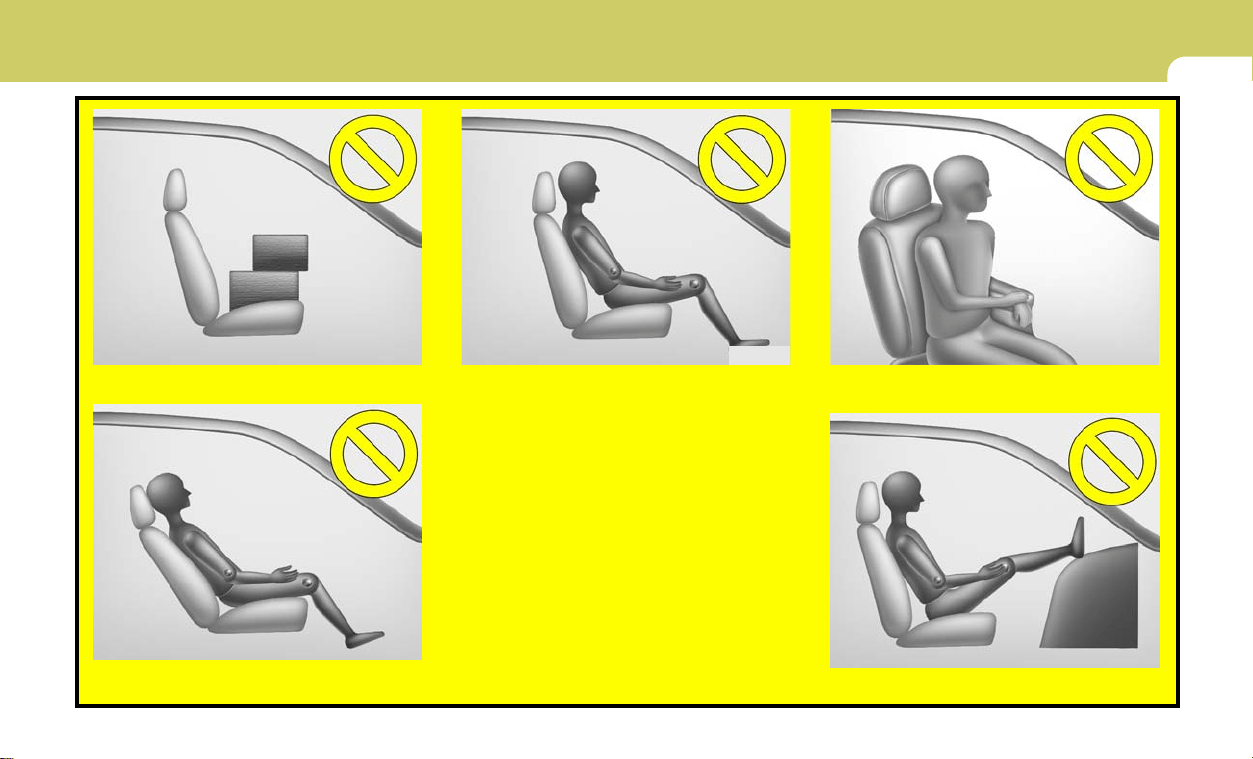
1
FEATURES OF YOUR HYUNDAI
43
- Lean on the center console.
- Sit on one side of the front passenger seat.
B990A07O
B990A05O
- Place feet on the dashboard.
o Excessively recline the front passenger
seatback.
o Sit with hips shifted towards the front of the
seat.
B990A03O
B990A02O
o Put a heavy load in the front passenger seat.
B990A08O
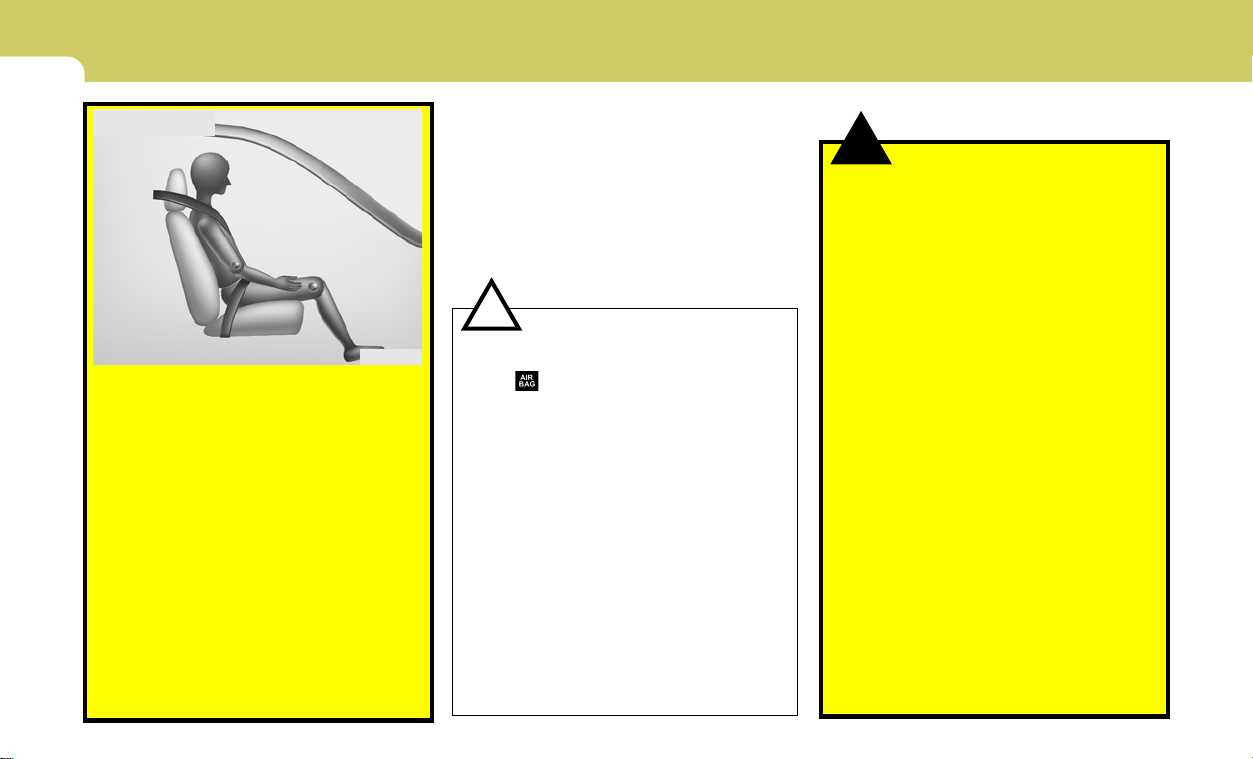
1
FEATURES OF YOUR HYUNDAI
44
!
NOTE:
The "PASSENGER AIR BAG OFF" indicator
illuminates for about 6 seconds after the
ignition key is turned to the "ON" position
or after the engine is started. If the front
passenger seat is occupied, the occupant
classification sensor will then classify the
front passenger within approximately 10
seconds after the ignition is turned on.
CAUTION:
If the occupant classification system is not
working properly, the SRS airbag warning
light on the instrument panel will
illuminate because the passenger's front
airbags are connected with the occupant
classification system. If there is a malfunc-
tion of the occupant classification system,
the "PASSENGER AIR BAG OFF" indicator
will not illuminate and the passenger's front
airbags will inflate in frontal impact crashes
even if there is no occupant in the front
passenger's seat. If the SRS airbag warning
light does not illuminate when the ignition
key is turned to the "ON" position, remains
illuminated after approximately 6 seconds
when the ignition key is turned to the "ON"
position, or if it illuminates while the vehicle
is being driven, have an authorized Hyundai
dealer inspect the occupant classification
system and the SRS airbag system as soon
as possible.
!
WARNING:
o Even though your vehicle is equipped
with the occupant classification sys-
tem, do not install a child restraint sys-
tem in the front passenger's seat. A child
restraint system must never be placed in
the front seat. Children who are too large
for child restraint systems should al-
ways occupy the rear seat and use the
available lap/shoulder belts. Children are
afforded the most safety in the event of
an accident when they are restrained by
a proper restraint system in the rear seat.
o If the "PASSENGER AIR BAG OFF" indi-
cator is illuminated when the front
passenger's seat is occupied by an adult
and he/she sits properly (sitting upright
with the seatback in an upright position,
centered on the seat cushion with their
seat belt on, legs comfortably extended
and their feet on the floor), have that
person sit in the rear seat.
o If you change the weight on the front
passenger seat just after sit-in or restart
of the engine, the "PASSENGER AIR
BAG OFF" indicator may be turned on or
off for a few seconds, disabling or en-
abling the passenger airbags. After the
initial stage of about 30 seconds, the
"PASSENGER AIR BAG OFF" indicator
will not toggle.
When an adult is seated in the front passenger
seat, if the "PASSENGER AIR BAG OFF" indica-
tor is on, turn the ignition key to "LOCK" and ask
the passenger to sit properly (sitting upright with
the seat back in an upright position, centered on
the seat cushion with their seat belt on, legs
comfortably extended and their feet on the
floor). Restart the engine and have the person
remain in that position for about 30 seconds. This
will allow the system to detect the person and to
enable the passenger airbag. If the "PASSEN-
GER AIR BAG OFF" indicator is still on, turn the
ignition key to "LOCK" and ask the passenger to
sit properly and restart the engine again.
If the "PASSENGER AIR BAG OFF" indicator is
still on, ask the passenger to move to the rear
seat. After the vehicle starts, the "PASSENGER
AIR BAG OFF" indicator will not change accord-
ing to the passenger's posture.
Normal position
B990A01O
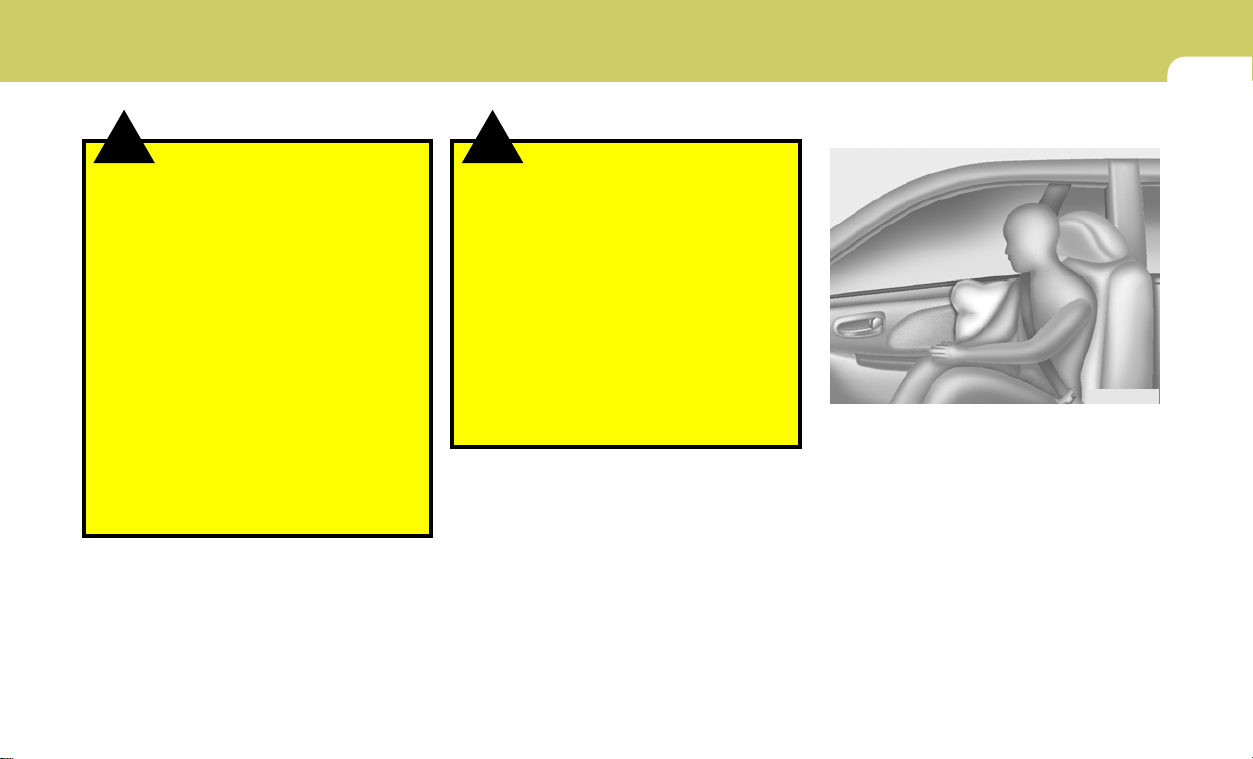
1
FEATURES OF YOUR HYUNDAI
45
!
WARNING:
o Do not modify or replace the front pas-
senger seat. Don't place anything on or
attach anything such as a blanket or
after market seat heater to the front
passenger seat. This can adversely af-
fect the occupant classification system.
o Do not sit on sharp objects such as tools
when occupying the front passenger
seat. This can adversely affect the occu-
pant classification system.
o Do not use accessory seat covers on the
front seats.
o Accident statistics show that children
are safer if they are restrained in the rear,
as opposed to the front seat. It is recom-
mended that child restraints be secured
in a rear seat, including an infant riding
in a rear-facing infant seat, a child riding
in a forward-facing child seat and an
older child riding in a booster seat.
!
WARNING:
o A smaller-stature adult who is not seated
correctly (for example: seat excessively
reclined, leaning on the center console,
or hips shifted forward in the seat) can
cause a condition where the advanced
frontal airbag system senses less weight
than if the occupant were seated prop-
erly (sitting upright with the seatback in
an upright position, centered on the seat
cushion with their seat belt on, legs
comfortably extended and their feet on
the floor). This condition can result in an
adult potentially being misclassified and
illumination of the "PASSENGER AIR
BAG OFF" indicator.
B990B04Y-AAT
Side Impact Airbag (If installed)
Your Hyundai is equipped with a side impact
airbag in each front seat. The purpose of the
airbag is to provide the vehicle's driver and/or
the front passenger with additional protection
than that offered by the seat belt alone. The side
impact airbags are designed to deploy only
during certain side-impact collisions, depend-
ing on the crash severity, angle, speed and point
of impact. The side impact airbags are not
designed to deploy in all side impact situations.
B990B02LZ
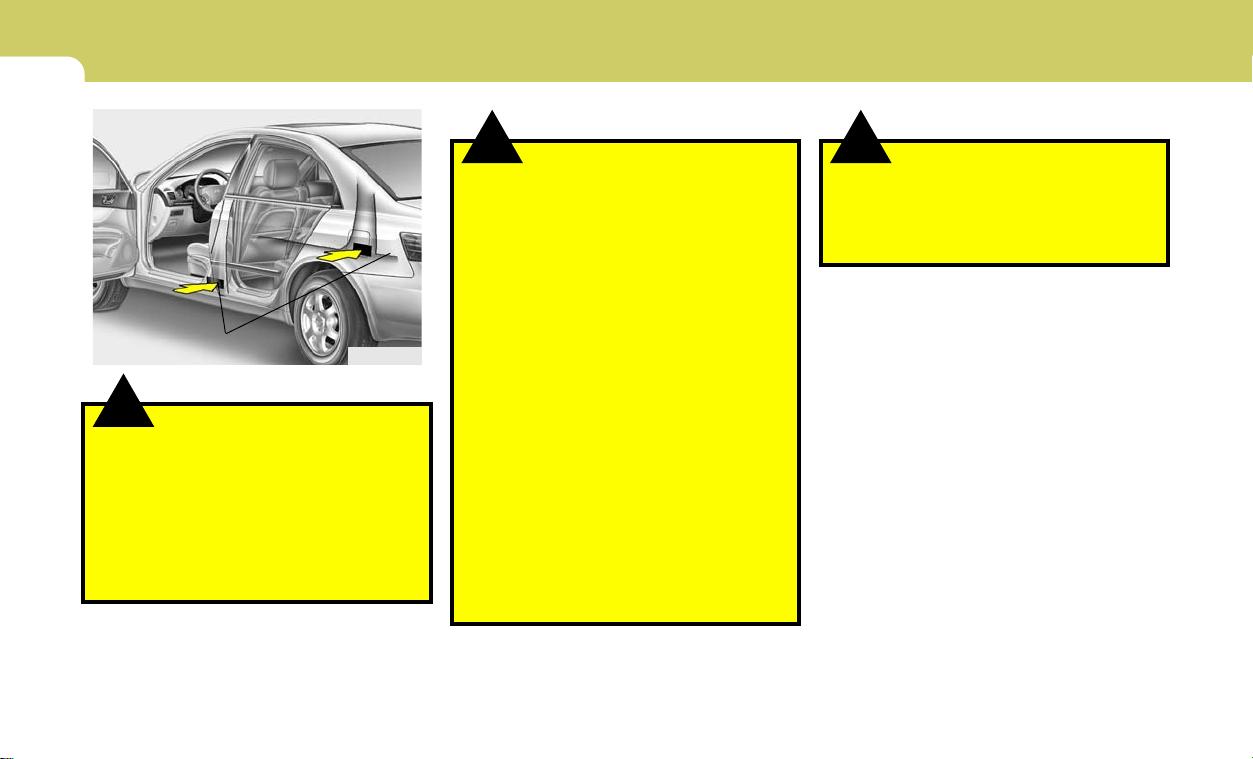
1
FEATURES OF YOUR HYUNDAI
46
!
o To prevent unexpected deployment of
the side impact airbag that may result in
personal injury, avoid impact to the side
impact sensor when the ignition key is
on.
WARNING:
!
o For best protection from the side impact
airbag system and to avoid being injured
by the deploying side impact airbag,
both front seat occupants should sit in
an upright position with the seat belt
properly fastened. The driver's hands
should be placed on the steering wheel
at the 9:00 and 3:00 positions. The
passenger's arms and hands should be
placed on their laps.
o Do not use any accessory seat covers.
o Use of seat covers could reduce or pre-
vent the effectiveness of the system.
o Do not install any accessories on the
side or near the side impact airbag.
o Do not use excessive force on the side of
the seat.
o Do not place any objects over the airbag
or between the airbag and yourself.
o Do not place any objects (an umbrella,
bag, etc.) between the front door and the
front seat. Such objects may become
dangerous projectiles and cause injury
if the supplemental side impact airbag
inflates.
WARNING:
WARNING:
o The side impact airbag is supplemental
to the driver's and the passenger's seat
belt systems and is not a substitute for
them. Therefore your seat belts must be
worn at all times while the vehicle is in
motion. The airbags deploy only in cer-
tain side impact conditions severe
enough to cause significant injury to the
vehicle occupants.
!
B990B01NF
Side impact sensor
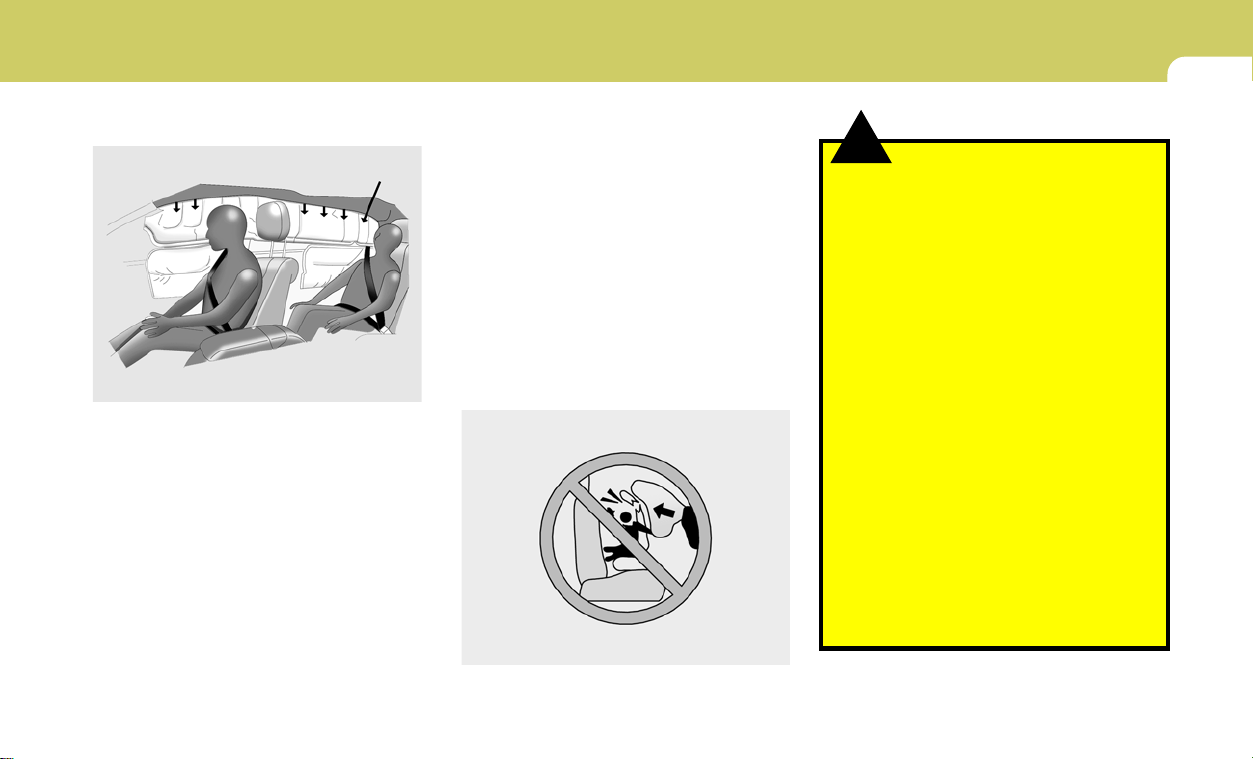
1
FEATURES OF YOUR HYUNDAI
47
B990C01LZ-GAT
Curtain Airbag
Curtain airbags are located along both sides of
the roof rails above the front and rear doors.
They are designed to help protect the heads of
the front seat occupants and the rear outboard
seat occupants in certain side impact collisions.
The curtain airbags are designed to deploy only
during certain side impact collisions, depending
on the crash severity, angle, speed and impact.
The curtain airbags are not designed to deploy
in all side impact situations, collisions from the
front or rear of the vehicle or in most rollover
situations.
HLZ2051
Curtain Airbag
B240C01NF-AAT
SRS Care
The SRS is virtually maintenance-free and so
there are no parts you can safely service by
yourself. If the SRS "AIRBAG" warning light
does not illuminate, or continuously remains on,
have your vehicle immediately inspected by
your Hyundai dealer.
Any work on the SRS system, such as remov-
ing, installing, repairing, or any work on the
steering wheel must be performed by a qualified
Hyundai technician. Improper handling of the
SRS system may result in serious personal
injury.
WARNING:
o Do not install a child restraint system in
the front passenger seat position.
A child restraint system must never be
placed in the front seat. The infant or
child could be severely injured by an
airbag deployment in case of an acci-
dent.
o Modification to SRS components or wir-
ing, including the addition of any kind of
badges to the pad covers or modifica-
tions to the body structure, can ad-
versely affect SRS performance and lead
to possible injury.
o For cleaning the airbag pad covers, use
only a soft, dry cloth or one which has
been moistened with plain water. Sol-
vents or cleaners could adversely affect
the airbag covers and proper deploy-
ment of the system.
o No objects should be placed over or near
the airbag modules on the steering wheel,
instrument panel, and the front
passenger's panel above the glove box,
because any such object could cause
harm if the vehicle is in a crash severe
enough to cause the airbags to inflate.
!
HSM393

1
FEATURES OF YOUR HYUNDAI
48
B240D01NF-AAT
Additional Safety Precautions
o Never let passengers ride in the cargo
area (trunk) or on top of a folded-down
back seat. All occupants should sit upright,
fully back in their seats with their seat belts
on and their feet on the floor.
o Passengers should not move out of or
change seats while the vehicle is mov-
ing. A passenger who is not wearing a seat
belt during a crash or emergency stop can
be thrown against the inside of the vehicle,
against other occupants, or out of the ve-
hicle.
o Each seat belt is designed to restrain one
occupant. If more than one person uses the
same seat belt, they could be seriously
injured or killed in a collision.
o Do not use any accessories on seat
belts. Devices claiming to improve occu-
pant comfort or reposition the seat belt can
reduce the protection provided by the seat
belt and increase the chance of serious
injury in a crash.
o Passengers should not place hard or
sharp objects between themselves and
the airbags. Carrying hard or sharp objects
on your lap or in your mouth can result in
injuries if an airbag inflates.
o Keep occupants away from the airbag
covers. All occupants should sit upright, fully
back in their seats with their seat belts on and
their feet on the floor. If occupants are too
close to the airbag covers, they could be
injured if the airbags inflate.
o Do not attach or place objects on or near
the airbag covers. Any object attached to
or placed on the front or side impact airbag
covers could interfere with the proper opera-
tion of the airbags.
o Do not modify the front seats. Modifica-
tion of the front seats could interfere with the
operation of the supplemental restraint sys-
tem sensing components or side impact
airbags.
o Do not place items under the front seats.
Placing items under the front seats could
interfere with the operation of the supple-
mental restraint system sensing compo-
nents and wiring harnesses.
o If the airbags inflate, they must be re-
placed by an authorized Hyundai dealer.
o Do not tamper with or disconnect SRS
wiring, or other components of the SRS
system. Doing so could result in injury,
due to accidental inflation of the airbags
or by rendering the SRS inoperative.
o If components of the airbag system must
be discarded, or if the vehicle must be
scrapped, certain safety precautions
must be observed. Your Hyundai dealer
knows these precautions and can give
you the necessary information. Failure
to follow these precautions and proce-
dures could increase the risk of personal
injury.
o If you sell your vehicle, make certain that
this manual is transferred to the new
owner.
o If your car was flooded and has soaked
carpeting or water on flooring, you
shouldn't try to start the engine; have
the car towed to an authorized Hyundai
dealer.
!
WARNING:

1
FEATURES OF YOUR HYUNDAI
49
!
WARNING:
o Sitting improperly or out of position can
result in serious injury or death in a
crash.
o Always sit upright with the seatback in
an upright position, centered on the seat
cushion with your seat belt on, legs
comfortably extended and your feet on
the floor.
o Never hold an infant or child on your lap.
The infant or child could be seriously injured
or killed in the event of a crash. All infants and
children should be properly restrained in
appropriate child safety seats or seat belts
in the rear seat.
Adding Equipment to or Modifying Your
Airbag-Equipped Vehicle.
If you modify your vehicle by changing your
vehicle's frame, bumper system, front end or
side sheet metal or ride height, this may affect
the operation of your vehicle's airbag system.
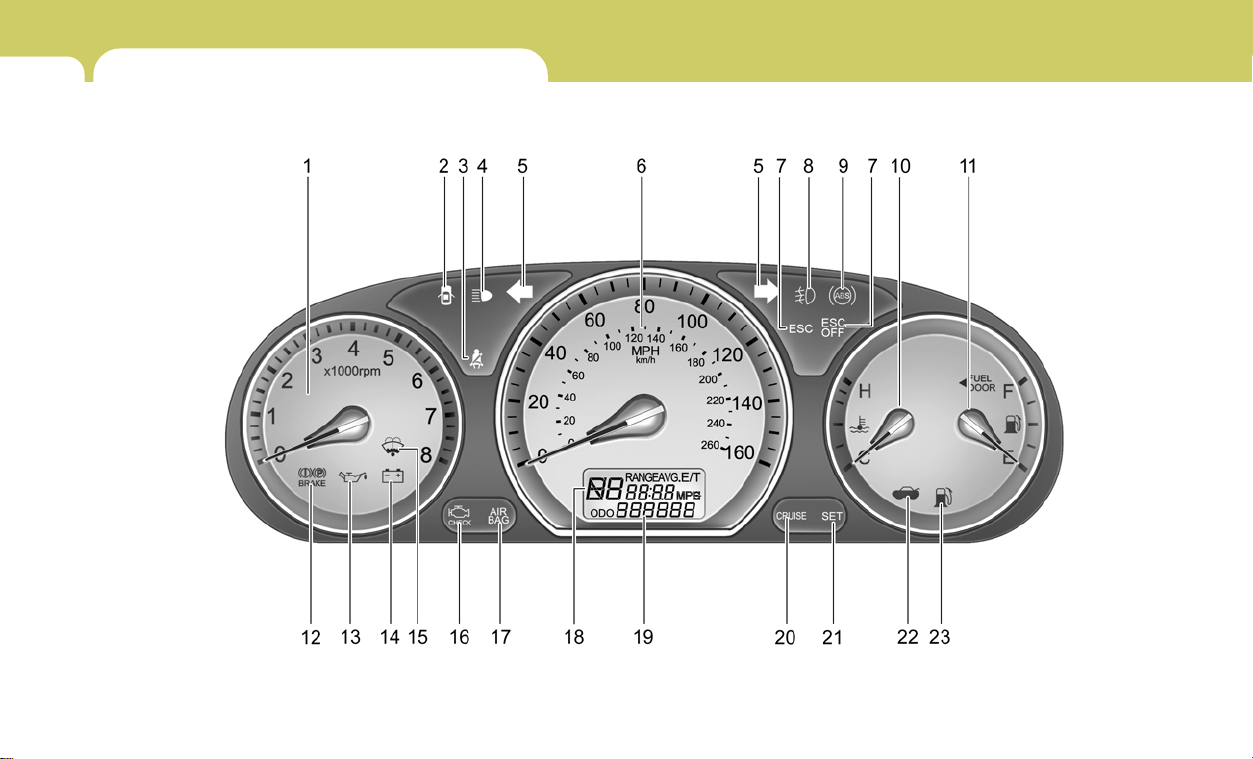
1
FEATURES OF YOUR HYUNDAI
50
INSTRUMENT CLUSTER AND INDICATOR LIGHTS
B260A01NF-AAT
B260B01NF-A

1
FEATURES OF YOUR HYUNDAI
51
1. Tachometer
2. Door Ajar Warning Light
3. Seat Belt Warning Light (Driver's side)
4. High Beam Indicator Light
5. Turn Signal Indicator Lights
6. Speedometer
7. Electronic Stability Control (ESC) Indicator Lights
(If Installed)
8. Front Fog Light Indicator Light
9. ABS Service Reminder Indicator (SRI) (If Installed)
10. Coolant Temperature Gauge
11. Fuel Gauge
12. Parking Brake/Low Brake Fluid Level Warning Light
13. Low Oil Pressure Warning Light
14. Charging System Warning Light
15. Low Windshield Washer Fluid Level Warning Light
16. Check Engine - Malfunction Indicator Light (MIL)
17. SRS (Airbag) Warning Light
18. Automatic Transaxle Position Indicator Light (If Installed)
19. Odometer/ Trip Odometer/ Trip Computer (If Installed)
20. CRUISE Indicator Light
21. Cruise SET Indicator Light
22. Trunk Lid Open Warning Light
23. Low Fuel Warning Light
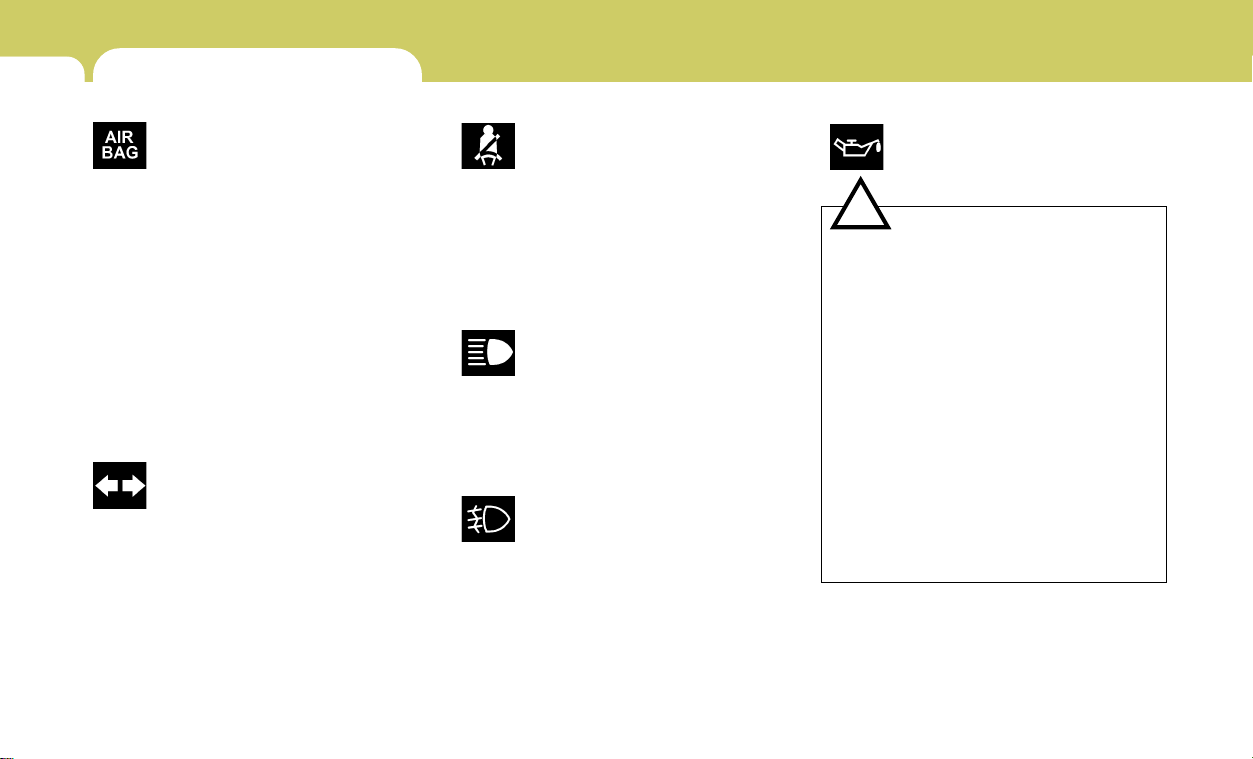
1
FEATURES OF YOUR HYUNDAI
52
WARNING AND INDICATOR LIGHTS
B260B01JM-AAT
SRS (Airbag) Warning Light
The SRS warning light comes on for about 6
seconds after the key is turned to the "ON"
position or after the engine is started, after which
it will go out.
This light also comes on when the SRS is not
working properly. If the AIRBAG warning light
does not come on, or continuously remains on
after operating for about 6 seconds when you
turned the ignition key to the "ON" position or
started the engine, or if it comes on while driving,
have the SRS inspected by an authorized
Hyundai dealer.
B260D01A-AAT
Turn Signal Indicator Lights
The blinking green arrows on the instrument
panel show the direction indicated by the turn
signals. If the arrow comes on but does not blink,
blinks more rapidly than normal, or does not
illuminate at all, a malfunction in the turn signal
system is indicated. Your dealer should be
consulted for repairs.
B260E01NF-AAT
Seat Belt Reminder Light
and Chime (Driver's side)
The driver's seat belt reminder light blinks and
the warning chime sounds for 6 seconds when
the ignition key is turned from the "OFF" position
to the "ON" or "START" position to remind the
driver to fasten the driver's seat belt.
B260F01A-AAT
High Beam Indicator Light
The high beam indicator light comes on when-
ever the headlights are switched to the high
beam or flash position.
B260G01A-AAT
Low Oil Pressure Warning Light
CAUTION:
If the low oil pressure warning light stays on
while the engine is running, serious engine
damage may result. The oil pressure warning
light comes on whenever there is insufficient
oil pressure. In normal operation, it should
come on when the ignition switch is turned on,
then go out when the engine is started. If the
oil pressure warning light stays on while the
engine is running, there is a serious malfunc-
tion.
If this happens, stop the car as soon as it is safe
to do so, turn off the engine and check the oil
level. If the oil level is low, fill the engine oil to
the proper level and start the engine again. If
the light stays on with the engine running, turn
the engine off immediately. In any instance
where the oil light stays on when the engine
is running, the engine should be checked by
a Hyundai dealer before the car is driven again.
!
B260A01Y-GAT
Front Fog Light Indicator Light
This fog indicator light comes on when the
ignition key is turned to the "ON" position and the
front fog light switch is on.

1
FEATURES OF YOUR HYUNDAI
53
!
B260H02A-AAT
Parking Brake/Low Brake Fluid
Level Warning Light
The brake fluid level warning light indicates that
the brake fluid level in the brake master cylinder
is low and hydraulic brake fluid conforming to
DOT 3 or DOT 4 specifications should be
added. After adding fluid, if no other trouble is
found, the car should be immediately and care-
fully driven to a Hyundai dealer for inspection.
If further trouble is experienced, the vehicle
should not be driven at all but taken to a dealer
by a professional towing service or some other
safe method.
Your Hyundai is equipped with dual-diagonal
braking systems. This means you still have
braking on two wheels even if one of the dual
systems should fail. With only one of the dual
systems working, more than normal pedal travel
and greater pedal pressure are required to stop
the car. Also, the car will not stop in as short a
distance with only half of the brake system
working. If the brakes fail while you are driving,
shift to a lower gear for additional engine braking
and stop the car as soon as it is safe to do so.
WARNING:
If you suspect brake trouble, have your
brakes checked by a Hyundai dealer as
soon as possible. Driving your car with a
problem in either the brake electrical sys-
tem or brake hydraulic system is danger-
ous, and could result in a serious injury or
death.
Warning Light Operation
The parking brake/brake fluid level warning light
should come on when the parking brake is
applied and the ignition switch is turned to "ON"
or "START". After the engine is started, the light
should go out when the parking brake is re-
leased.
If the parking brake is not applied, the warning
light should come on when the ignition switch is
turned to "ON" or "START", then go out when
the engine starts. If the light comes on at any
other time, you should slow the vehicle and bring
it to a complete stop in a safe location off the
roadway.
B260J02A-AAT
Charging System Warning Light
The charging system warning light should come
on when the ignition is turned on, then go out
when the engine is running. If the light stays on
while the engine is running, there is a malfunc-
tion in the electrical charging system. If the light
comes on while you are driving, stop, turn off the
engine and check under the hood. First, make
certain the generator drive belt is in place. If it is,
check the tension of the belt. Do this as shown
on page 6-19 by pushing down on the center of
the belt. Have the system checked by your
Hyundai dealer as soon as possible.
B260K01S-AAT
Trunk Lid Open Warning Light
This light remains on unless the trunk lid is
completely closed and latched.
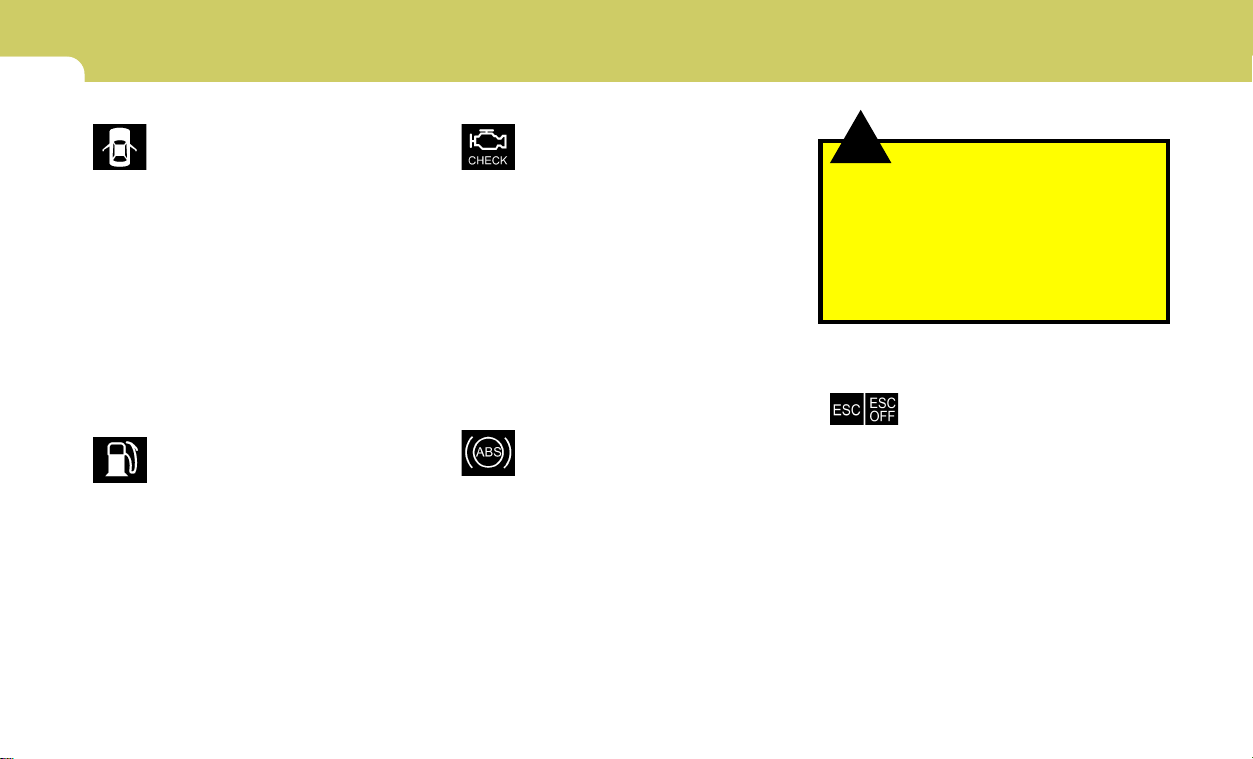
1
FEATURES OF YOUR HYUNDAI
54
B260L02HP-GAT
Door Ajar Warning Light and
Chime
The door ajar warning light warns you that a door
is not completely closed and the chime warns
you that the key is in the ignition switch.
NOTE :
The warning chime only sounds whenever
the key is in the ignition switch and the
driver's side front door is open simulta-
neously. The chime sounds until the key is
removed from the ignition switch or the
driver's side front door is closed.
!
B260M01A-AAT
Low Fuel Level Warning Light
The low fuel level warning light comes on when
the fuel tank is approaching empty. When it
comes on, you should add fuel as soon as
possible. Driving with the fuel level warning light
on or with the fuel level below "E" can cause the
engine to misfire and damage the catalytic
converter.
B260P02Y-GAT
ABS Service Reminder
Indicator (SRI) (If Installed)
When the key is turned to the "ON" position, the
Anti-Lock Brake System indicator will come on
and then go off in a few seconds. If the ABS SRI
remains on, comes on while driving, or does not
come on when the key is turned to the "ON"
position, this indicates that there may be a
problem with the ABS.
If this occurs, have your vehicle checked by
your Hyundai dealer as soon as possible. The
normal braking system will still be operational,
but without the assistance of the anti-lock brake
system.
WARNING:
If both the ABS SRI and Parking Brake/
Brake fluid level warning lights remain "ON"
or come on while driving, there may be a
problem with E.B.D. (Electronic Brake Force
Distribution).
If this occurs, avoid sudden stops and have
your vehicle checked by your Hyundai dealer
as soon as possible.
B260N02A-AAT
Check Engine - Malfunction In-
dicator Light (MIL)
This light illuminates when there is a malfunction
of an exhaust gas related component, and the
system is not functioning properly so that the
exhaust gas regulation values are not satisfied.
This light will also illuminate when the ignition key
is turned to the "ON" position, and will go out in a
few seconds after the engine is started. If it
illuminates while driving, or does not illuminate
when the ignition key is turned to the "ON" position,
take your car to your nearest authorized Hyundai
dealer and have the system checked.
B265C01NF-AAT
Electronic Stability Control
(ESC) Indicator Lights
(If Installed)
The electronic stability control indicators change
operation according to the ignition switch posi-
tion and whether the system is in operation or
not.
They will illuminate when the ignition key is
turned to the "ON" position, but should go out
after three seconds. If the ESC or ESC-OFF
indicator stays on, take your car to your autho-
rized Hyundai dealer and have the system
checked. See section 2 for more information
about the ESC.
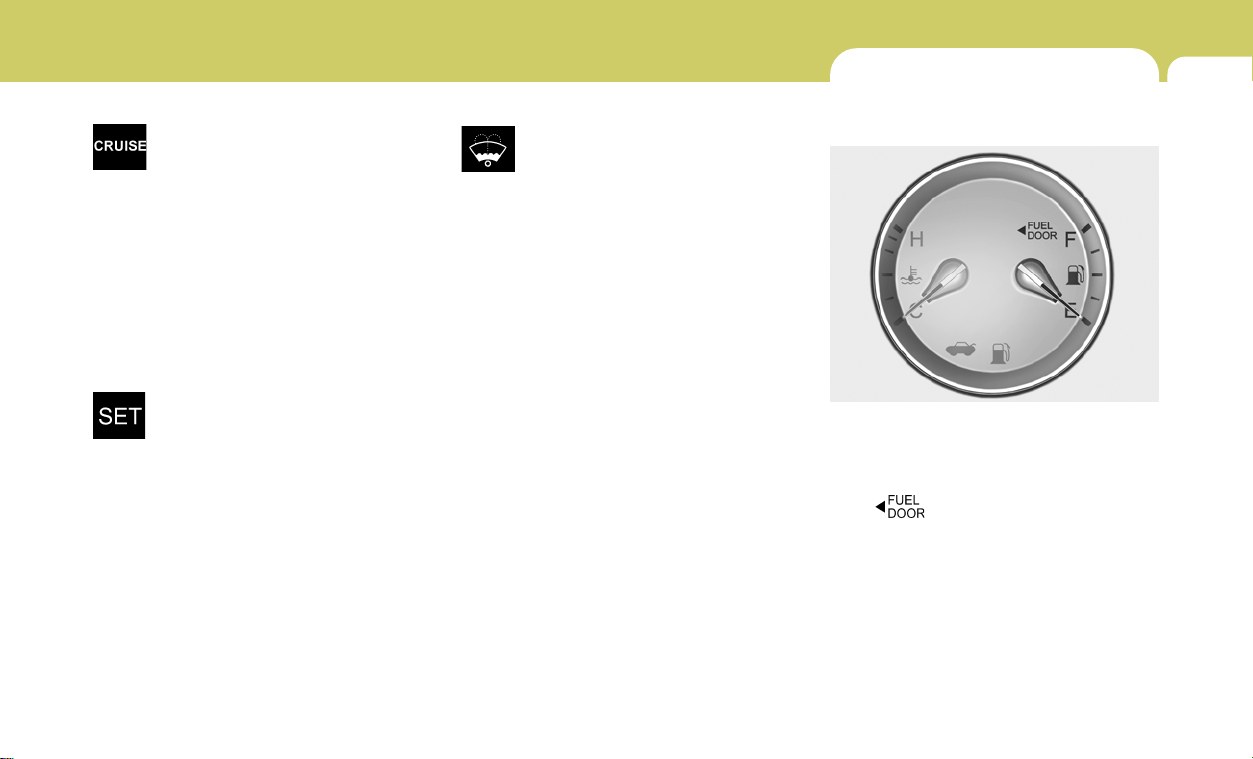
1
FEATURES OF YOUR HYUNDAI
55
B270A01O-AAT
BRAKE PAD WEAR WARNING SOUND
The front and rear disc brake pads have wear
indicators that should make a high-pitched
squealing or scraping noise when new pads are
needed. The sound may come and go or be
heard all the time when the vehicle is moving. It
may also be heard when the brake pedal is
pushed down firmly. Excessive rotor damage
will result if the worn pads are not replaced. See
your Hyundai dealer immediately.
B260Q01NF-GAT
CRUISE Indicator Light
The cruise indicator light in the instrument clus-
ter is illuminated when the cruise control ON/
OFF button on the steering wheel is pushed.
The indicator light turns off when the cruise
control ON/OFF button is pushed again. Infor-
mation about the use of cruise control begins on
page 1-93.
B260R01NF-GAT
Cruise SET Indicator Light
The Cruise SET indicator light in the instrument
cluster is illuminated when the cruise control
"COAST/SET" or "RES/ACCEL" switch is
pushed. The Cruise SET indicator light does not
illuminate when the cruise control "CANCEL"
switch is pushed or the system is disengaged.
To disengage the cruise control system, refer
to "To cancel the cruise speed" on page 1-94.
B260S01NF-GAT
Low Windshield Washer Fluid
Level Warning Light
The low windshield washer fluid warning light
comes on when the washer fluid reservoir is
approaching empty. When it comes on, add
washer fluid at your earliest opportunity.
INSTRUMENT CLUSTER
B280A01NF-AAT
FUEL GAUGE
The needle on the gauge indicates the approxi-
mate fuel level in the fuel tank. The fuel capacity
is given in section 9.
NOTE:
The " " symbol means, the fuel filler
lid is located on the left side of the vehicle.
B280A01NF
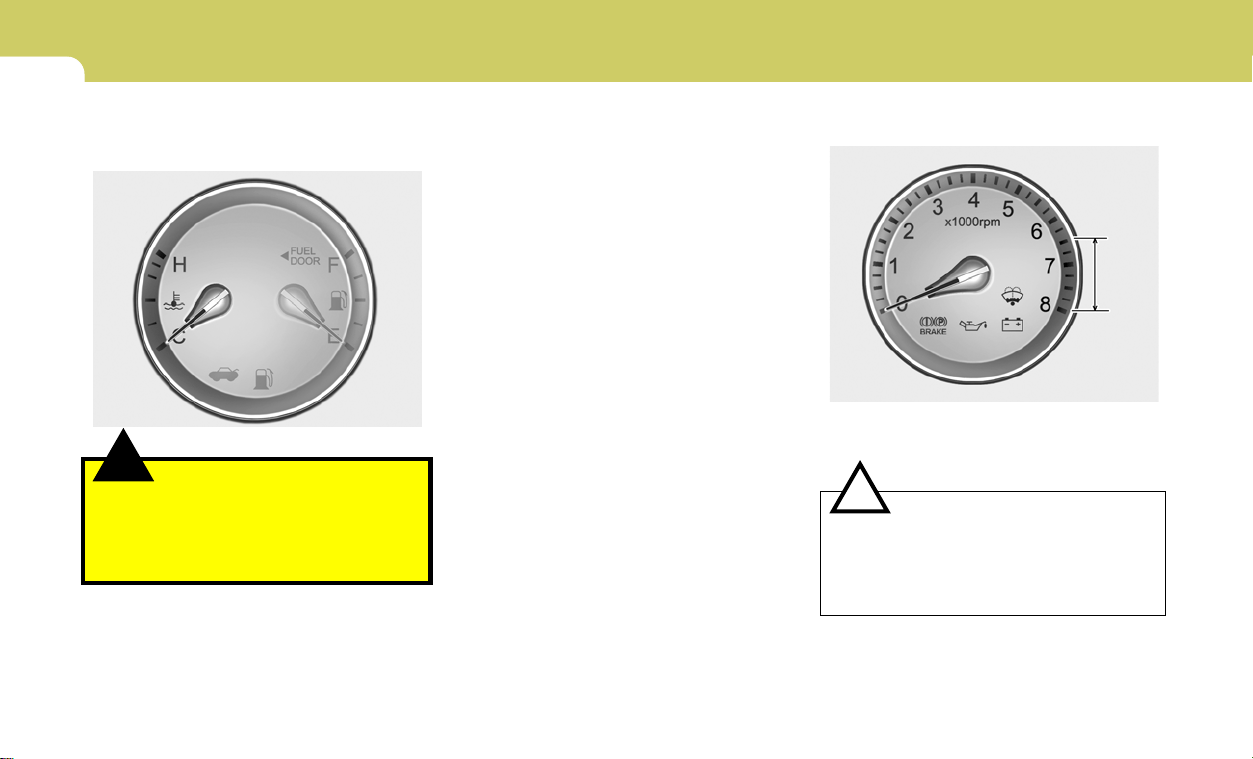
1
FEATURES OF YOUR HYUNDAI
56
B330A03A-AAT
TACHOMETER
The tachometer registers the speed of your
engine in revolutions per minute (rpm).
CAUTION:
The engine should not be raced to such a
speed that the needle enters the red zone
on the tachometer face. This can cause
severe engine damage and may void your
warranty coverage.
!
!
B290A03A-AAT
ENGINE COOLANT TEMPERATURE
GAUGE
WARNING:
Never remove the radiator cap when the
engine is hot. The engine coolant is under
pressure and could erupt and cause severe
burns. Wait until the engine is cool before
adding coolant to the reservoir.
The normal range is approximately in the middle
between "H" and "C". If it moves across the dial
to "H" (HOT), pull over and stop as soon as
possible and turn off the engine. Then open the
hood and, after the engine has cooled, check the
coolant level (See "If the engine overheats" on
the page 3-4.) and the water pump drive belt. If you
suspect cooling system trouble, have your cool-
ing system checked by a Hyundai dealer as soon
as possible.
B290A01NF
B330A01NF
Red
Zone
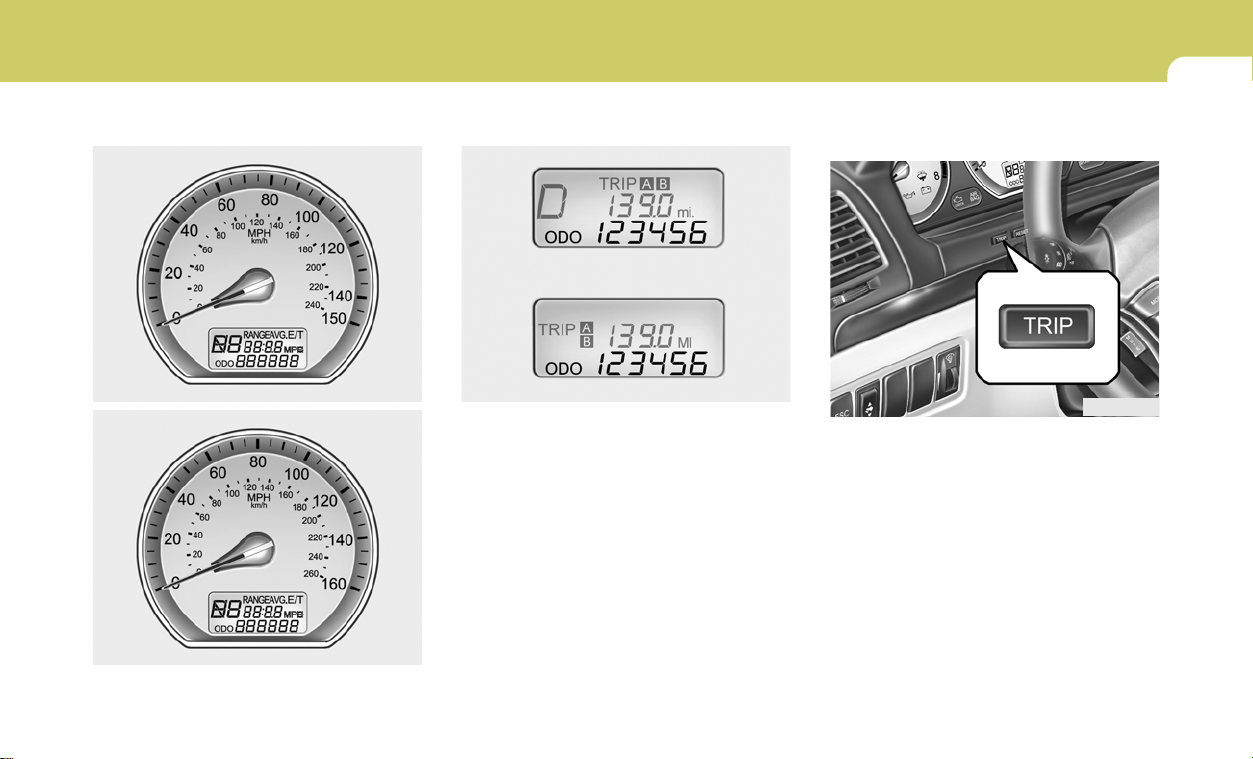
1
FEATURES OF YOUR HYUNDAI
57
B300A01A-AAT
SPEEDOMETER
Your Hyundai's speedometer is calibrated in
miles per hour or kilometers per hour.
B300A01NF-A
B300A02NF-A
2.4L
3.3L
B310B01NF-AAT
ODOMETER/TRIP ODOMETER
1. Odometer
The odometer records the total distance trav-
eled in miles. You will also find the odometer
useful to determine when periodic maintenance
should be performed.
NOTE:
Federal law forbids alteration of the odom-
eter of any vehicle with the intent to change
the mileage registered on the odometer.
The alteration may void your warranty cov-
erage.
Pushing in the TRIP switch behind the left side
of the steering wheel when the ignition switch is
turned "ON" will display two trip odometers in
miles.
B310B01NF-A
B400B01NF-A
With Automatic Transaxle
With Manual Transaxle
2. Trip Odometer
(Without Trip Computer)
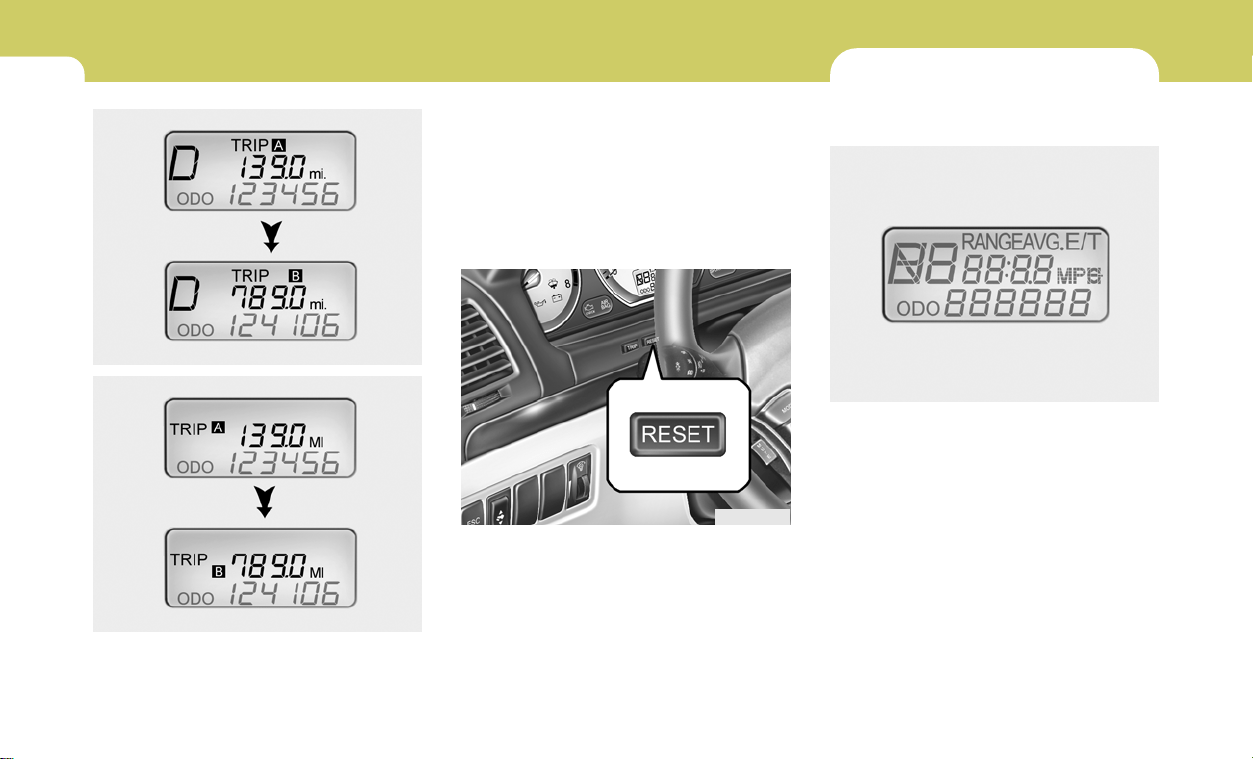
1
FEATURES OF YOUR HYUNDAI
58
With Automatic Transaxle
With Manual Transaxle
B310B03NF-A
B310B04NF-A
TRIP COMPUTER
B400B01NF-AAT
(With Automatic Transaxle)(If Installed)
The trip computer is a microcomputer-con-
trolled driver information gauge that displays
information related to driving, such as estimated
tripmeter, drive time, average speed, average
fuel consumption and distance to empty on the
LCD.
B400B08NF-A
B310B02NF-A
To shift from TRIP A to TRIP B, press the TRIP
switch.
TRIP A: First distance you have traveled
from your origination point to a first
destination.
TRIP B: Second distance from the first des-
tination to the final destination.
When the RESET switch is pressed for 1 sec-
ond, the trip odometer will reset to 0.
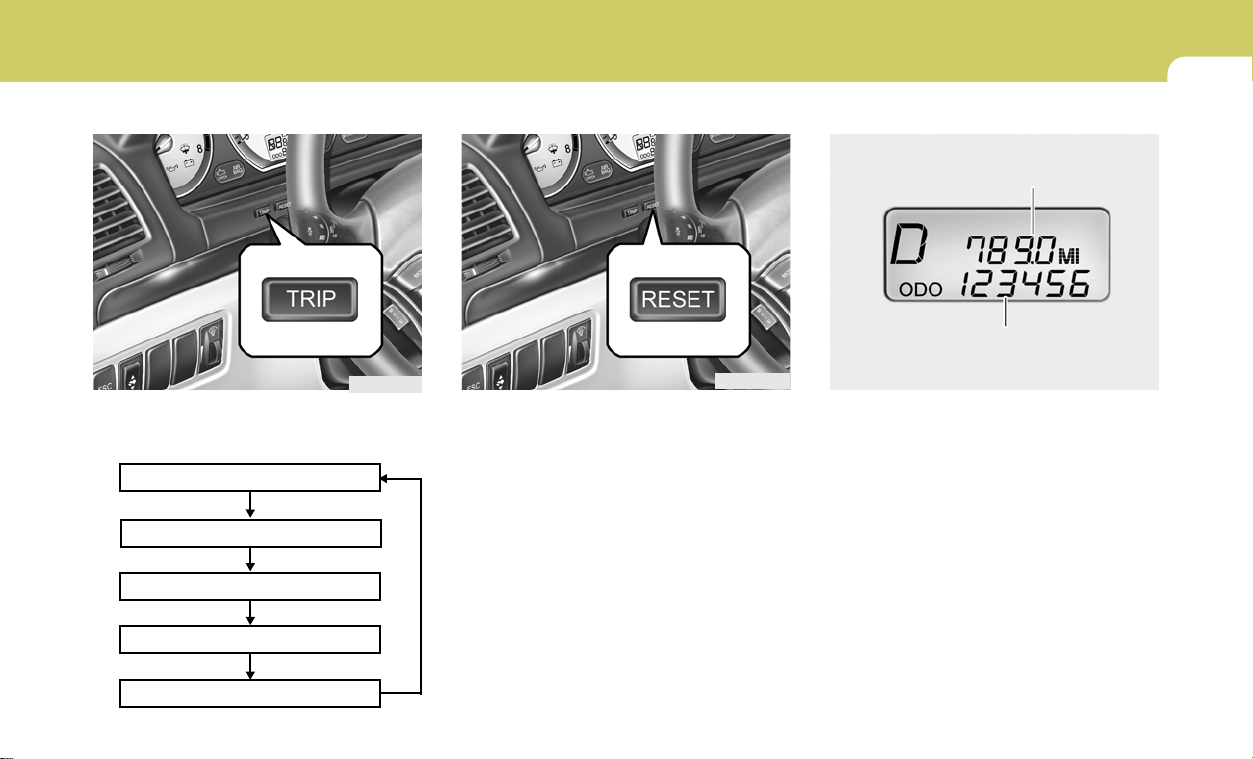
1
FEATURES OF YOUR HYUNDAI
59
TRIPMETER
DRIVE TIME
AVERAGE SPEED
AVERAGE FUEL CONSUMPTION
DISTANCE TO EMPTY
Pushing in the TRIP switch when the ignition
switch is in "ON" position changes the display
as follows;
B400B01NF-A
TRIP SWITCH
1. Tripmeter (Miles)
o This mode indicates the total distance trav-
elled since the last tripmeter reset. Total
distance is also reset to zero if the battery is
disconnected.
o Pressing the RESET switch for more than 1
second, when the tripmeter is being dis-
played, clears the tripmeter to zero.
o The meter's working range is from 0 to 999.9
miles.
B400B03NF-A
Odometer
Tripmeter
RESET SWITCH
Push in the RESET switch more than 1 second
to initialize the displayed information such as
tripmeter, average speed, average fuel con-
sumption and drive time.
B310B02NF-A
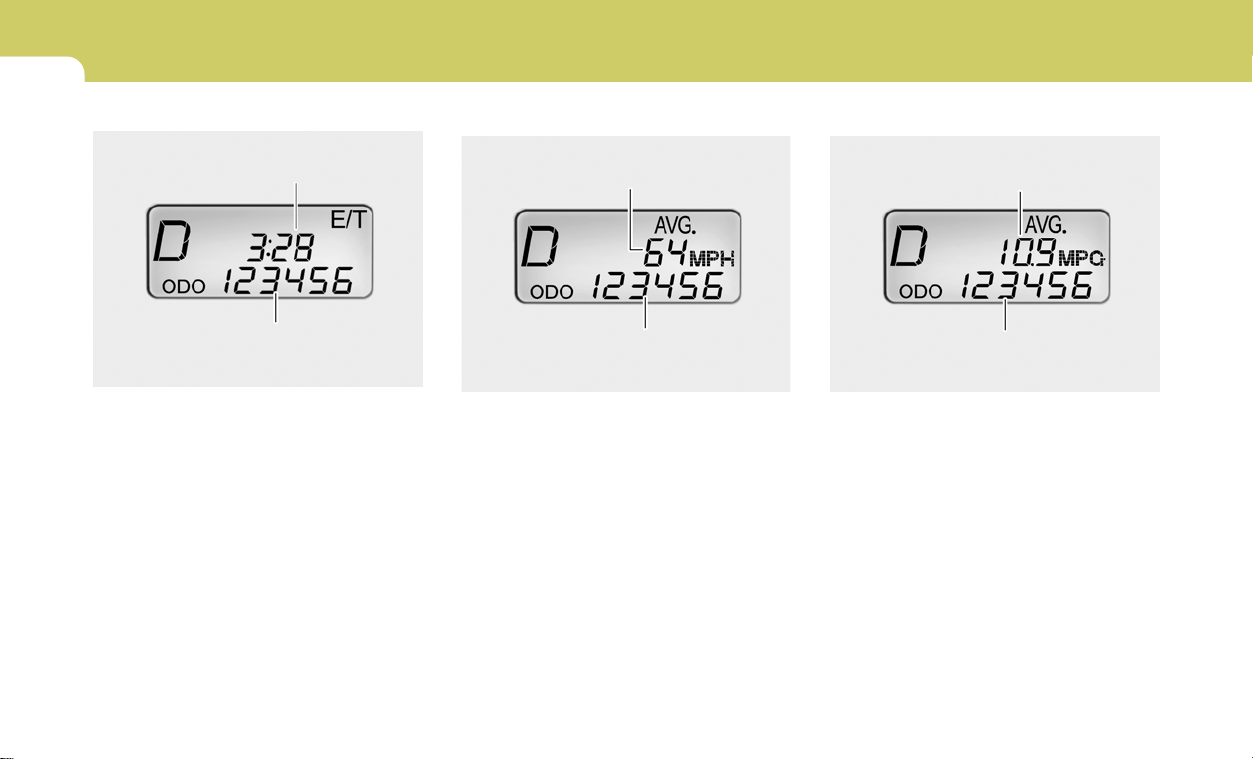
1
FEATURES OF YOUR HYUNDAI
60
2. Drive Time
o This mode indicates the total time from the
starting of the engine to the ignition key
"OFF" after resetting. When the RESET
switch is pushed, it will be initialized to '0:00'.
o The drive time will be initialized to '0:00' after
being displayed to '99:59'.
B400B04NF-A
Odometer
Drive time
3. Average Speed (MPH)
o This mode indicates the average speed from
the starting of the engine to the ignition key
"OFF".
o Average speed is reset to zero if the battery
is disconnected.
o To reset the average speed to zero (---),
press the RESET switch for more than 1
second.
o When you drive 0.5 mile and less after
resetting, the average speed will be dis-
played to '---'.
B400B05NF-A
Average speed
Odometer
4. Average Fuel Consumption (MPG)
o This mode calculates the average fuel con-
sumption from the total fuel used and the
distance since the last average consump-
tion reset.
o The total fuel used is calculated from the fuel
consumption input.
o Average fuel consumption is reset to zero if
the battery is disconnected.
o To reset the average fuel consumption to
zero (--), press the RESET switch for more
than 1 second.
o When you drive 0.5 mile and less after
resetting, the average fuel consumption will
be displayed to '--'.
HNF2084-A
Average fuel consumption
Odometer
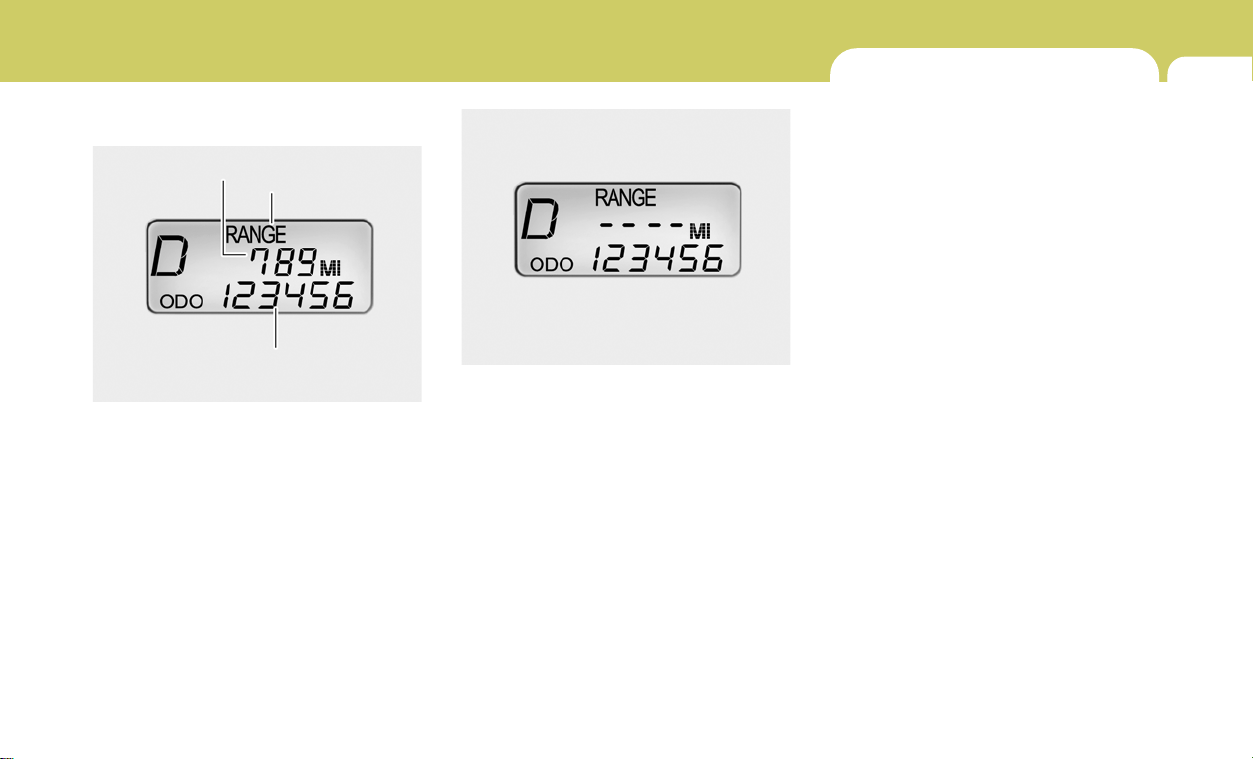
1
FEATURES OF YOUR HYUNDAI
61
MULTI-FUNCTION LIGHT SWITCH
B340A01A-AAT
COMBINATION TURN SIGNAL,
HEADLIGHT AND HIGH-BEAM
SWITCH
Turn Signal Operation
Pulling down on the lever causes the turn
signals on the left side of the car to blink. Pushing
upwards on the lever causes the turn signals on
the right side of the car to blink. As the turn is
completed, the lever will automatically return to
the center position and turn off the turn signals
at the same time. If either turn signal indicator
light blinks more rapidly than usual, goes on but
does not blink, or does not go on at all, there is
a malfunction in the system. Check for a burned-
out fuse or bulb or see your Hyundai dealer.
5. Distance to Empty (Miles)
o When the distance to empty is less than 30
miles (50 km), the distance to empty digits (-
---) will blink until more fuel is added.
NOTE:
o The distance to empty can differ from
the actual tripmeter according to driving
conditions.
o The distance to empty can vary accord-
ing to the driving conditions, driving
pattern or vehicle speed.
o This mode indicates the estimated distance
to empty from the current fuel level in the fuel
tank.
o The trip computer may not register additional
fuel if less than 1.36 gallons (6 liters) of fuel
are added to the vehicle.
B400B06NF-A
Distance to empty letter
Distance to empty
B400B07NF-A
Odometer
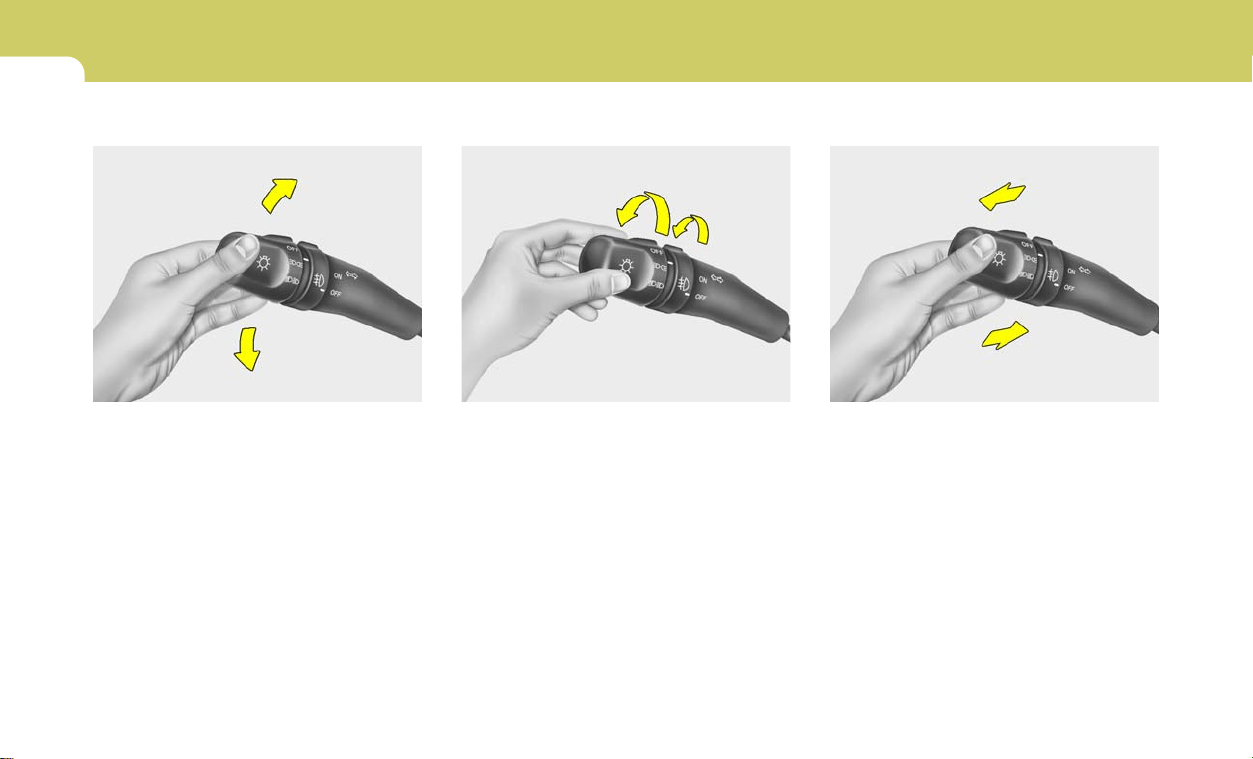
1
FEATURES OF YOUR HYUNDAI
62
B340D01A-AAT
High-beam Switch
B340B01A-AAT
Lane Change Signal
To indicate a lane change, move the lever up or
down to a point where it begins flashing.
The lever will automatically return to the center
position when released.
B340C03A-AAT
Headlight Switch
To operate the headlights, turn the barrel on the
end of the multi-function switch. The first posi-
tion turns on the parking lights, sidelights, tail
lights and instrument panel lights. The second
position turns on the headlights.
NOTE:
The ignition must be in the "ON" position
to turn on the headlights.
Parking Light Auto Off
If you do not turn the parking lights "OFF" after
driving, the parking lights will automatically shut
"OFF" when the driver's door is opened.
To turn them "ON" again, you must simply turn
the ignition key to the "ON" position.
B340B01NF
B340C01NF
To turn on the headlight high beams, push the
lever forward (away from you). The High Beam
Indicator Light will come on at the same time. For
low beams, pull the lever back toward you.
B340D01NF
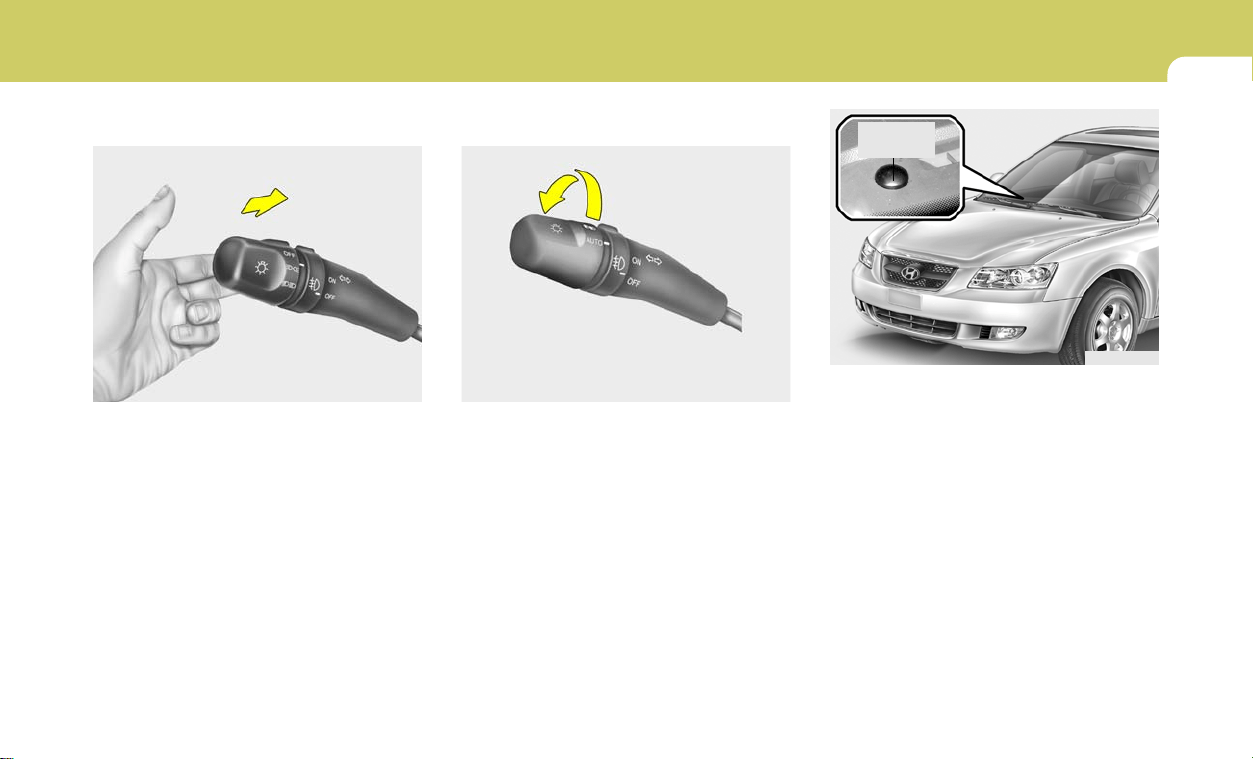
1
FEATURES OF YOUR HYUNDAI
63
B340E01A-AAT
Headlight Flasher
To flash the headlights, pull the switch lever
toward you, then release it. The headlights can
be flashed even though the headlight switch is
in the "OFF" position.
B340E01NF
B340G01LZ-AAT
Auto Light (If Installed)
HNF2094
To operate the automatic light feature, turn the
barrel on the end of the multi-function switch. If
you set the multi-function switch to "AUTO", the
tail lights and headlights will be turned automati-
cally on or off according to external illumination
conditions.
NOTE:
Turn the lights manually in foggy, cloudy
and rainy conditions.
NOTE:
o Never place anything over the sensor
located on the instrument panel to en-
sure better auto light system control.
o Don't clean the sensor using a window
cleaner.
o If your vehicle has window tint or other
types of coating on the windshield, the
AUTO light system may not work prop-
erly.
Auto light
sensor
B340G02NF-A
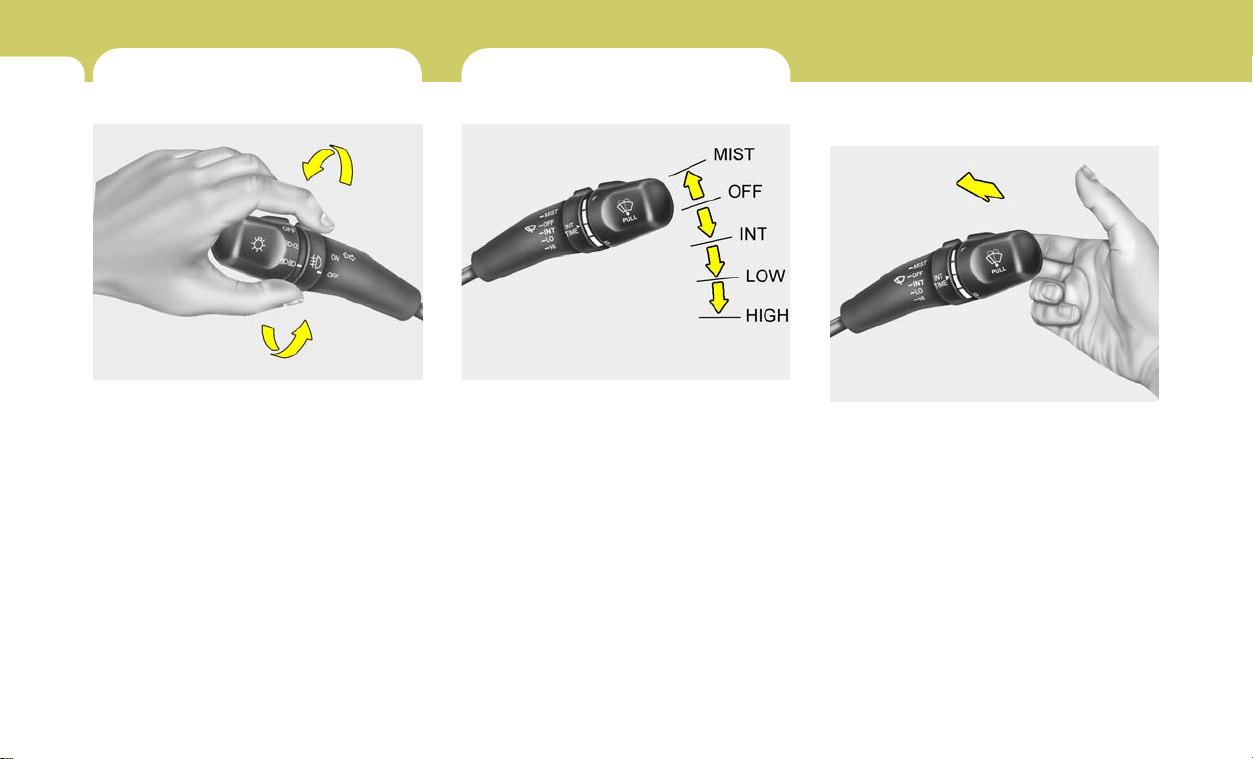
1
FEATURES OF YOUR HYUNDAI
64
WINDSHIELD WIPER AND WASHER
SWITCH
B350A01A-AAT
The windshield wiper switch has three posi-
tions:
1. Intermittent wiper operation
2. Low-speed operation
3. High-speed operation
NOTE:
To prevent damage to the wiper system, do
not attempt to wipe away heavy accumula-
tions of snow or ice. Accumulated snow
and ice should be removed manually. If
there is only a light layer of snow or ice,
operate the heater in the defrost mode to
melt the snow or ice before using the wiper.
HNF2101-A
(1)
(2)
(3)
B350B01O-GAT
Windshield Washer Operation
To use the windshield washer, pull the wiper/
washer lever toward the steering wheel. When
the washer lever is operated, the wipers auto-
matically make two passes across the wind-
shield. The washer continues to operate until
the lever is released.
NOTE:
o Do not operate the washer more than 15
seconds at a time or when the fluid
reservoir is empty.
o In icy or freezing weather, be sure the
wiper blades are not frozen to the glass
prior to operating the wipers.
o In areas where water freezes in winter,
use windshield washer antifreeze.
HNF2103-A
FRONT FOG LIGHT SWITCH
B360B01L-AAT
To turn on the front fog lights, place the switch
in the "ON" position. They will light when the
headlight switch is in the second position.
NOTE:
If you turn on the headlight high beams, the
front fog lights will be turned off.
B360B02NF
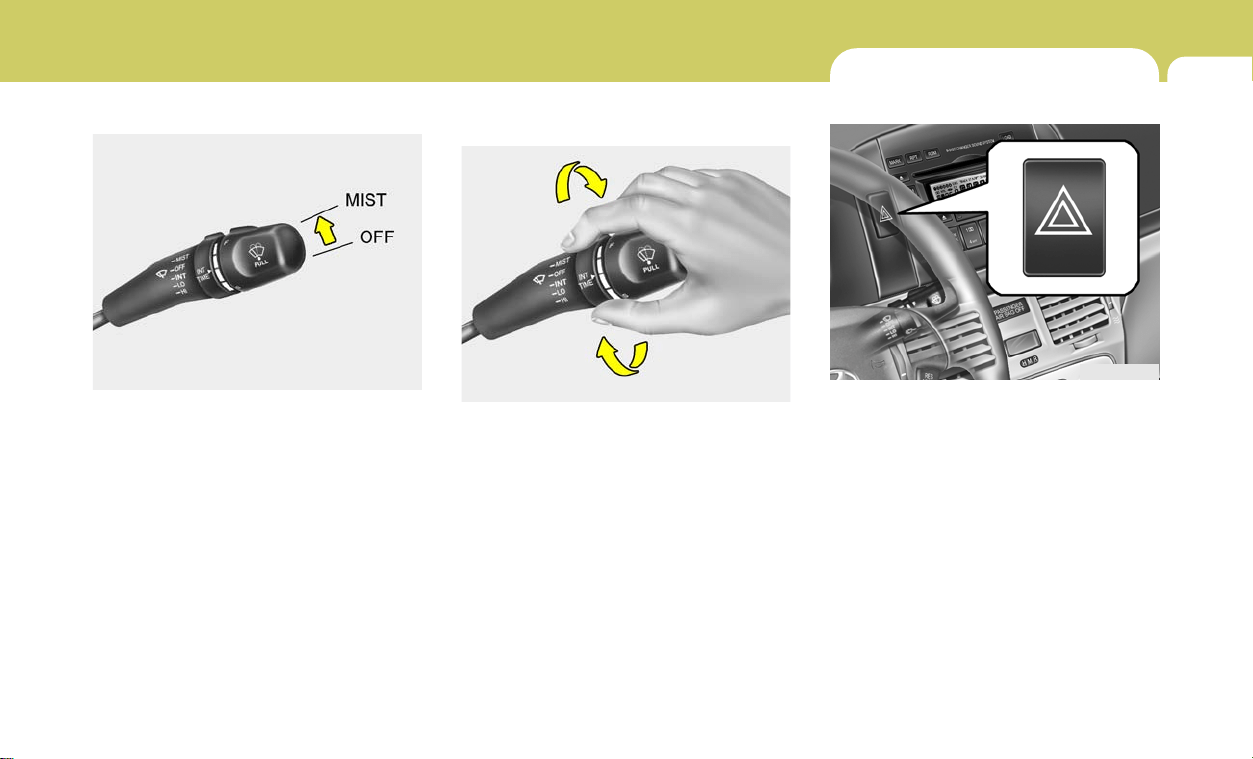
1
FEATURES OF YOUR HYUNDAI
65
B350C01NF-AAT
Adjustable Intermittent Wiper Operation
To use the intermittent wiper feature, place the
wiper switch in the "INT" position. With the
switch in this position, the interval between
wipes can be varied from approximately 1 to 18
seconds by turning the interval adjuster barrel.
HNF2102-A
HAZARD WARNING SYSTEM
B370A01A-AAT
The hazard warning system should be used
whenever you find it necessary to stop the car
in a hazardous location. When you must make
such an emergency stop, always pull off the
road as far as possible.
The hazard warning lights are turned on by
pushing in the hazard switch. This causes all
turn signal lights to blink. The hazard warning
lights will operate even though the key is not in
the ignition.
To turn the hazard warning lights off, push the
switch a second time.
B370A01NF-A
HNF2104-A
Mist Wiper Operation
If a single wipe is desired to clear mist, push the
windshield wiper and washer control lever up-
wards.
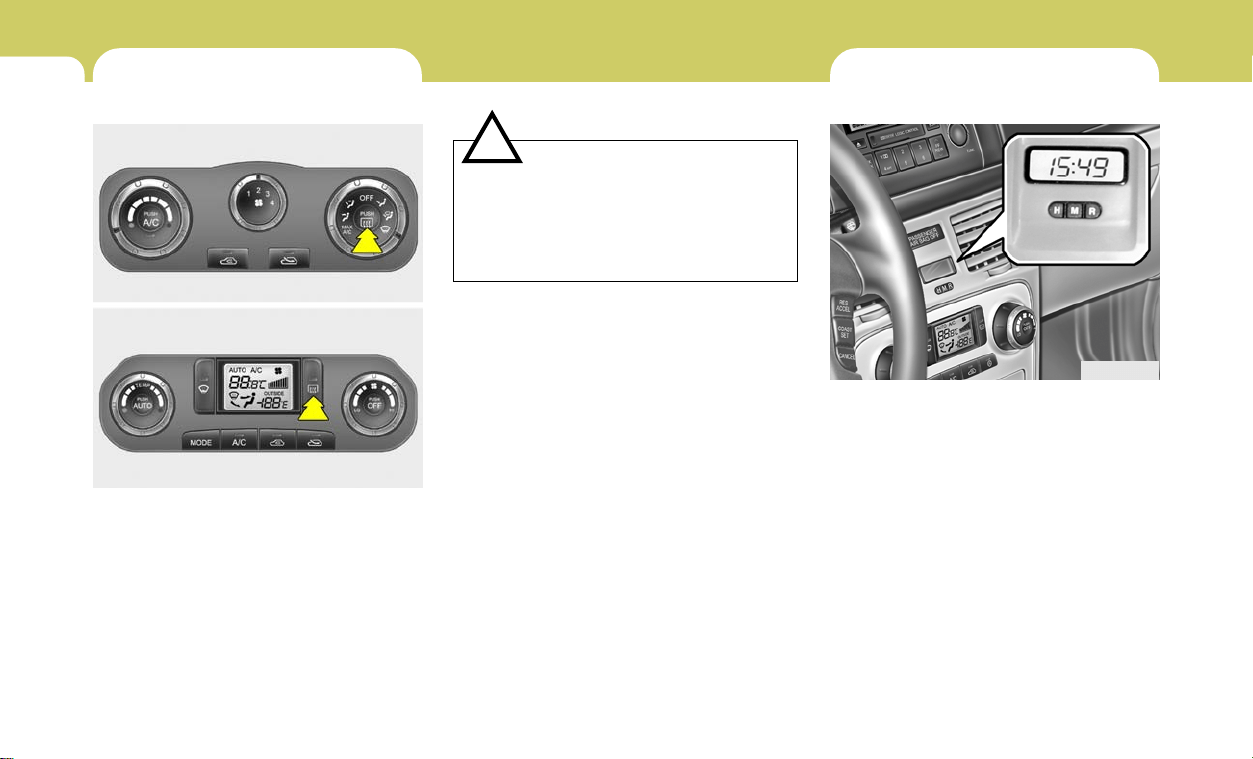
1
FEATURES OF YOUR HYUNDAI
66
DIGITAL CLOCK
B400A01NF-GAT
There are three control buttons for the digital
clock. Their functions are:
H - Push "H" to advance the hour indicated.
M - Push "M" to advance the minute indicated.
R - Push "R" to reset minutes to ":00" to
facilitate resetting the clock to the correct
time. When this is done:
Pressing "R" between 11 : 01 and 11 : 29
changes the readout to 11 : 00.
Pressing "R" between 11 : 30 and 11 : 59
changes the readout to 12 : 00.
Push the "R" button for 5 seconds to display
a 12 or 24-hour clock.
B400A01NF-A
NOTE:
The ignition must be in the "ON" position
for the rear window defroster to operate.
CAUTION:
Do not clean the inner side of the rear
window glass with an abrasive type of glass
cleaner or use a scraper to remove foreign
deposits from the inner surface of the glass
as this may cause damage to the defroster
elements.
!
B380A01HP-AAT
The rear window defroster switch also acti-
vates the outside rearview mirror heaters.
The rear window defroster and heated outside
rearview mirrors are turned on by pushing in the
switch. To turn the defroster off, push the switch
a second time. The rear window defroster
automatically turns itself off after about 20 min-
utes. To restart the defroster cycle, push in the
switch again after it has turned itself off.
HNF2113-A
REAR WINDOW DEFROSTER
SWITCH
With Manual A/C
With Automatic A/C
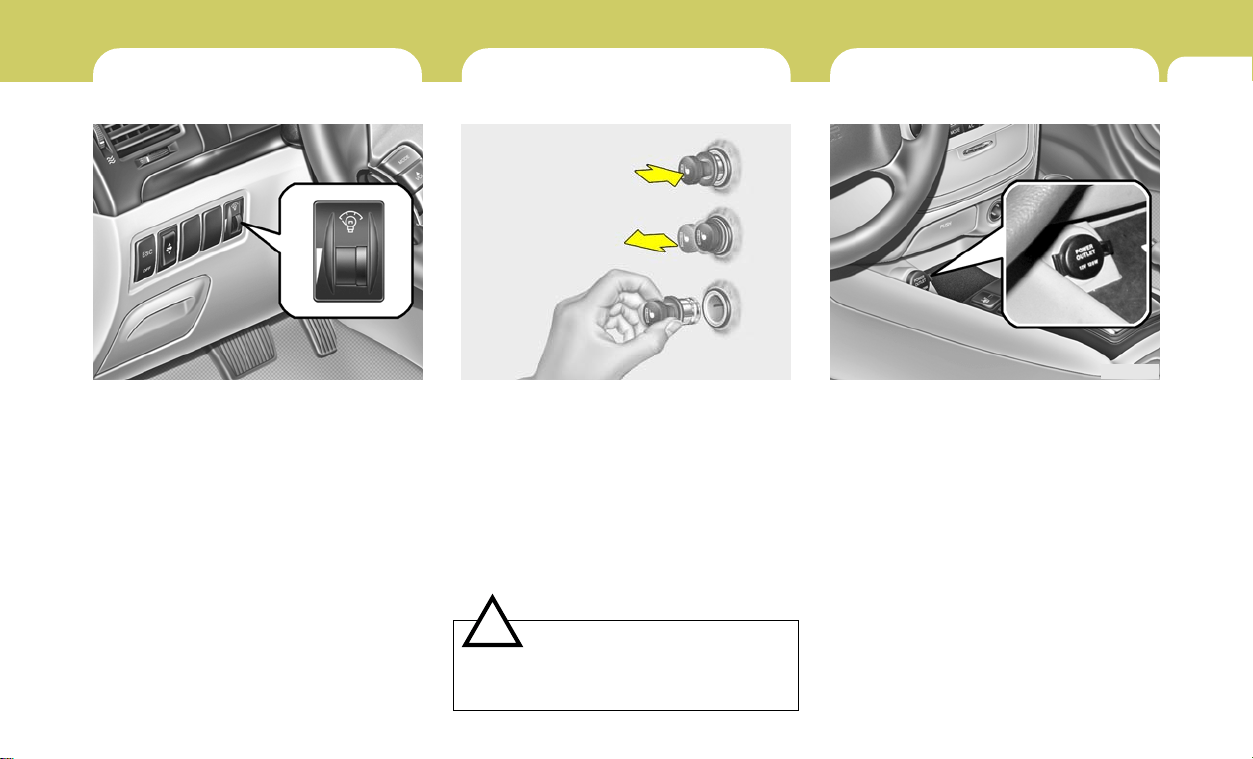
1
FEATURES OF YOUR HYUNDAI
67
INSTRUMENT PANEL LIGHT
CONTROL (RHEOSTAT)
B410A01A-AAT
The instrument panel lights can be made brighter
or dimmer by turning the instrument panel light
control knob.
B410A01NF-A
CIGARETTE LIGHTER
B420A02A-AAT
For the cigarette lighter to work, the key must
be in the "ACC" position or the "ON" position.
To use the cigarette lighter, push it all the way
into its socket. When the element has heated,
the lighter will pop out to the "ready" position.
Do not hold the cigarette lighter pressed in. This
can damage the heating element and create a
fire hazard.
If it is necessary to replace the cigarette lighter,
use only a genuine Hyundai replacement or its
approved equivalent.
B420A01NF
!
CAUTION:
Do not use electric accessories or equip-
ment other than the Hyundai genuine parts
in the socket.
POWER OUTLETS
B500D01NF-AAT
The power outlets are located on the center
fascia panel and in the trunk.
These supply 12V electric power to operate
electric accessories or equipment only when
the key is in the "ON" or "ACC" position.
HNF2182
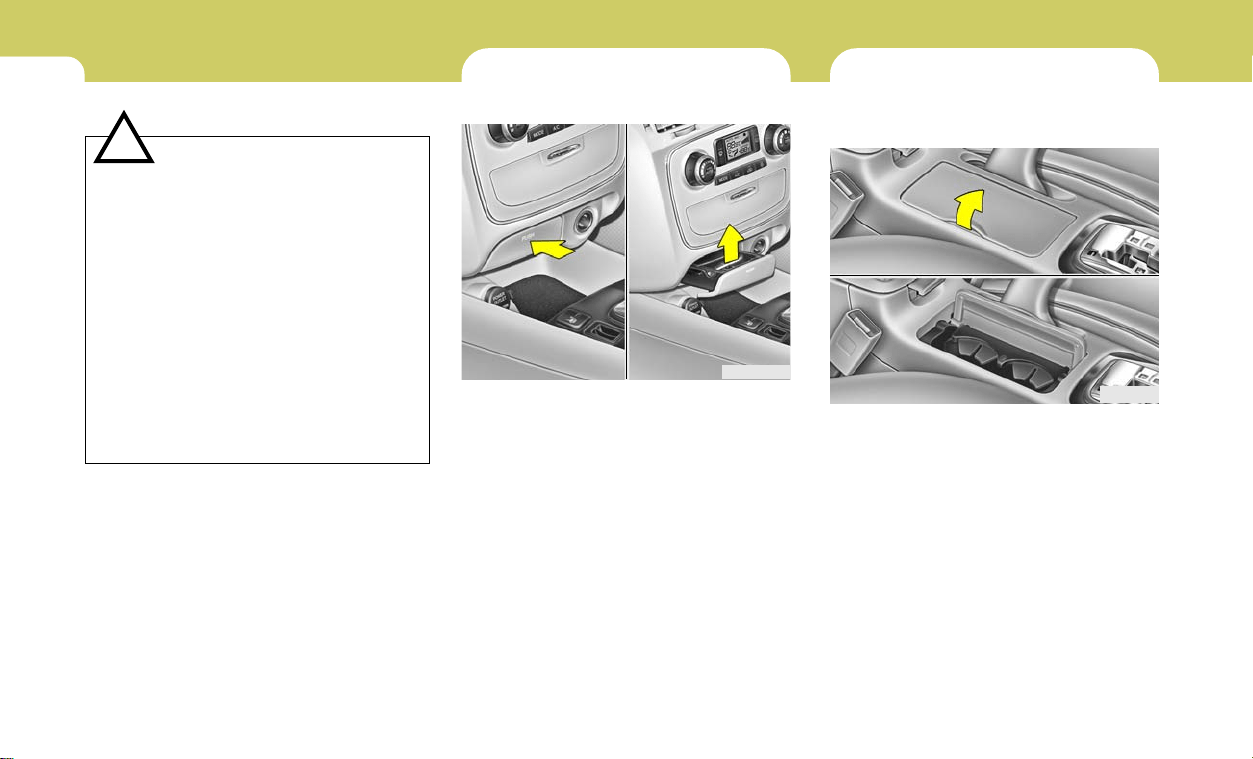
1
FEATURES OF YOUR HYUNDAI
68
ASHTRAY
B430A02NF-GAT
The front ashtray may be opened by pushing
and releasing the ashtray lid. To clean ashtray,
the plastic receptacle should be removed by
lifting the plastic ash receptacle upward and
pulling it out. The ashtray light will only illuminate
when the external lights are on.
B430A01NF
B450A01NF-GAT
Front Drink Holder
The drink holder for holding cups or cans is
located on the main console. The drink holder
can be used by lifting its cover.
HNF2184
DRINK HOLDER
!
CAUTION:
o Use the power outlets only when the
engine is running and remove the plug
from the power outlet after using the
electric device. Using the power outlets
when the engine stops or keeping the
electric device plugged in for many hours
may cause the battery to discharge.
o Do not use the power outlet to connect
electric accessories or equipment that
are not designed to operate on 12 volts.
o Some electronic devices can cause elec-
tronic interference when plugged into
the power outlet. These devices may
cause excessive audio noise and mal-
functions in other electronic systems or
devices in your vehicle.
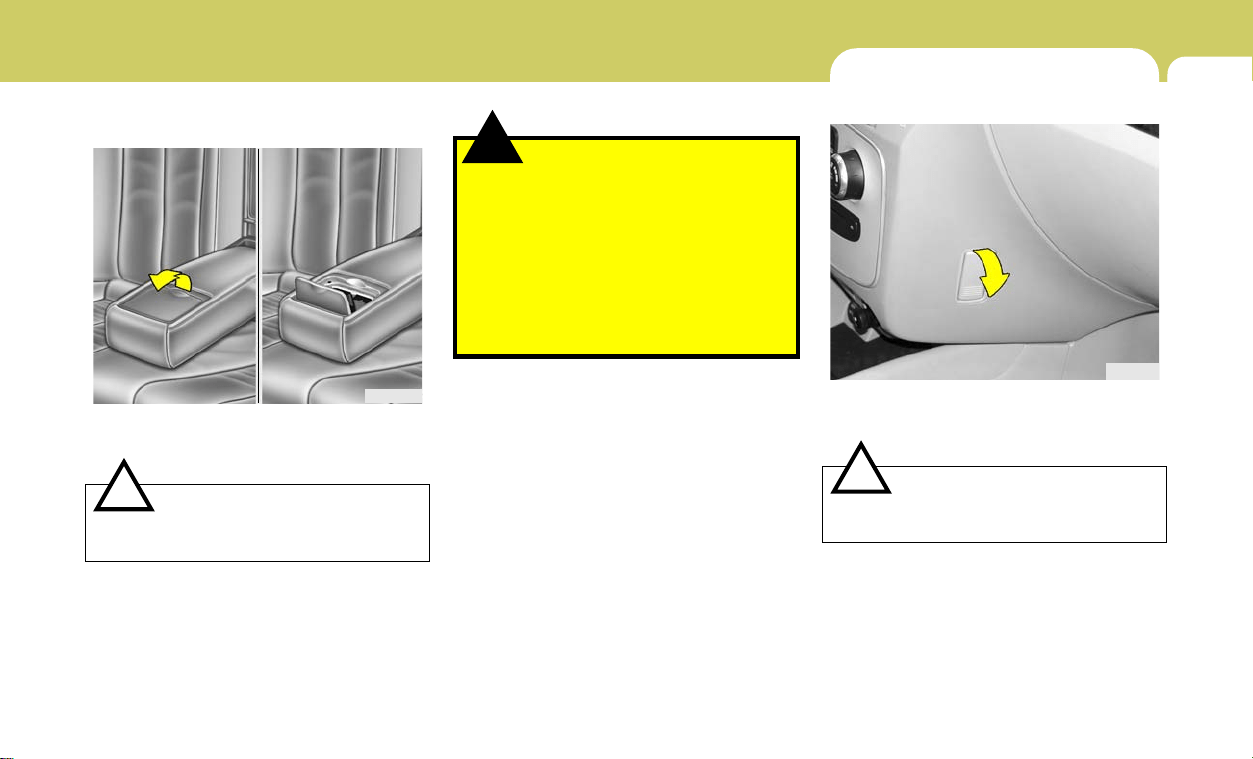
1
FEATURES OF YOUR HYUNDAI
69
!
CAUTION:
Place the drink holder in its closed position
while not in use.
HNF2185
B450B01NF-GAT
Rear Drink Holder
The rear drink holder for holding cups or cans
is located in the center of the rear seat armrest.
!
WARNING:
o Use caution when using the drink hold-
ers. A spilled beverage that is very hot
can injure you or your passengers. Spilled
liquids can damage interior trim and
electrical components.
o Do not place objects other than cups or
cans in the drink holder. These objects
can be thrown out in the event of a
sudden stop or an accident, possibly
injuring the passengers in the vehicle.
SHOPPING BAG HOLDER
B540A01NF-AAT
HNF2179
!
Shopping bag holder is located on the left side
of the glove box.
CAUTION:
Do not hang a bag beyond 7lbs (3 kg). It may
cause damage to the shopping bag holder.
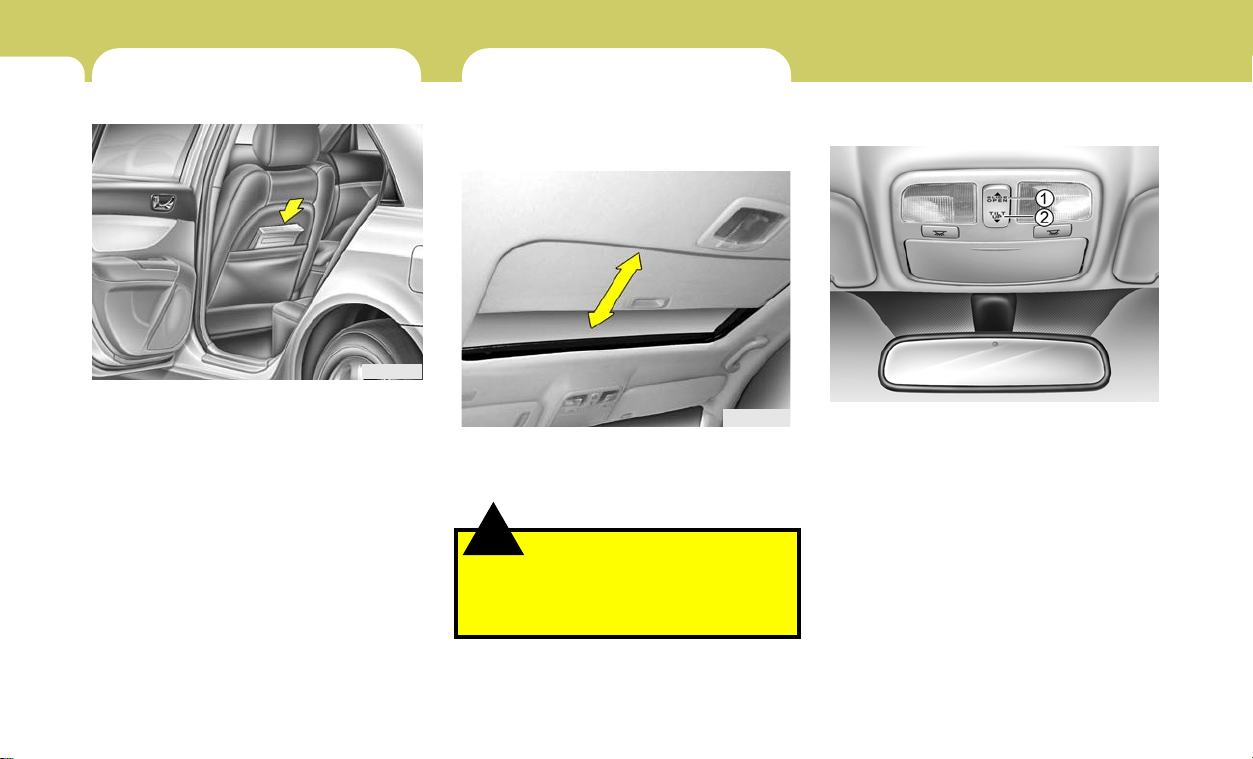
1
FEATURES OF YOUR HYUNDAI
70
!
SUNROOF
B460A02Y-AAT
(If Installed)
Sun Shade
B460A01NF
Your HYUNDAI is equipped with a sliding sun-
shade which you can manually adjust to let in
light with the sunroof closed, or to block sunlight.
WARNING:
Never adjust the sunshade while driving.
This could result in loss of control and an
accident that may cause death, serious
injury, or property damage.
B460B01NF-GAT
Opening the Sunroof System
If your vehicle is equipped with this feature, you
can slide or tilt your sunroof with the sunroof
control buttons located on the overhead con-
sole.
The sunroof can only be opened, closed, or
tilted when the ignition switch is in the "ON"
position.
HNF2026
SEATBACK POCKET
B540B01E-GAT
HNF2042
The seatback pockets for holding papers are
located on the backside of the front seats.
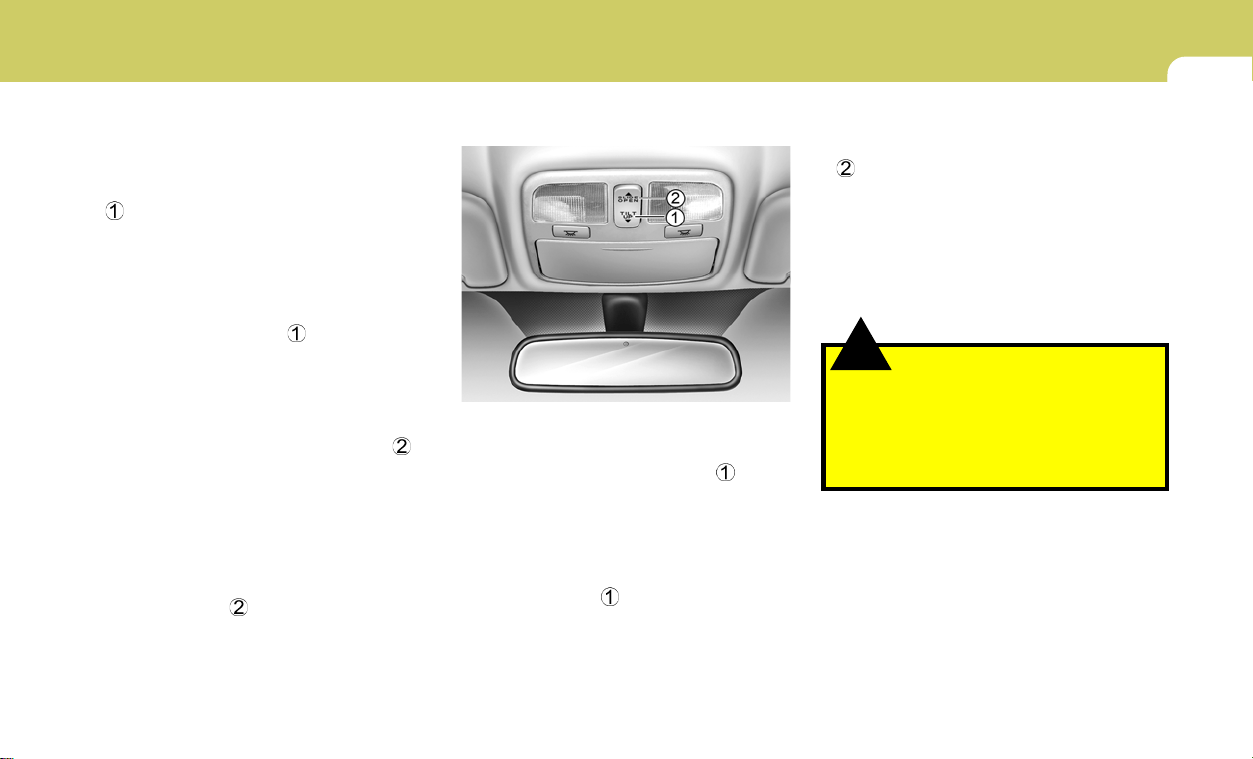
1
FEATURES OF YOUR HYUNDAI
71
Sliding the sunroof
Auto slide open
To use the auto slide feature, momentarily
(more than 1 second) press the SLIDE OPEN
( ) button on the overhead console. The
sunroof will slide all the way open. To stop the
sunroof sliding at any point, press any sunroof
control button.
Manual slide open
Press the SLIDE OPEN ( ) button on the
overhead console for less than 0.5 second.
Close
Auto slide close
To close the sunroof, press the TILT UP ( )
button on the overhead console for more than
1 second.
The sunroof will slide all the way close. To stop
at the desired point, press any sunroof control
button.
Manual slide close
Press the TILT UP( ) button on the overhead
console for less than 0.5 second.
B460C01NF-GAT
Tilting the Sunroof System
Auto tilt open
To use the auto tilt feature, momentarily (more
than 1 second) press the TILT UP ( ) button
on the overhead console. The sunroof will tilt all
the way open. To stop the sunroof tilting at any
point, press any sunroof control button.
Manual tilt open
Press the TILT UP ( ) button on the overhead
console for less than 0.5 second.
!
Close
To close the sunroof, press the SLIDE OPEN
( ) button on the overhead console and hold
it until the sunroof is closed.
NOTE:
After washing the car or after there is rain,
be sure to wipe off any water that is on the
sunroof before operating it.
HNF2027
WARNING:
o Do not close a sunroof if anyone's hands,
arms or body are between the sliding
glass and the sunroof sash, as this could
result in injury.
o Do not place your head or arms out of the
sunroof opening at any time.
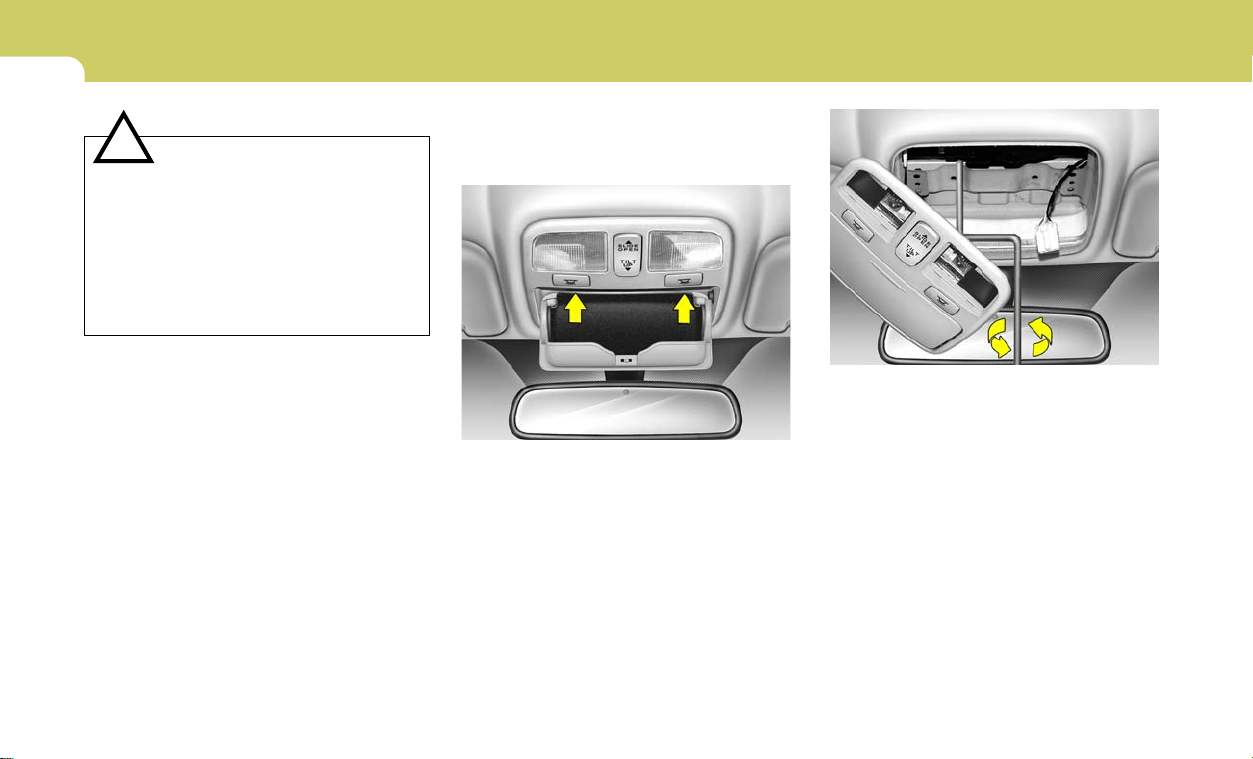
1
FEATURES OF YOUR HYUNDAI
72
B460D01NF-GAT
Manual Operation of Sunroof
If the sunroof does not operate electrically:
1. Open the spectacle case.
2. Remove the two mounting screws of the
front overhead console with a phillips screw-
driver.
HNF2028
3. Insert the hexagonal head wrench provided
with the vehicle into the socket. This wrench
can be found in the vehicle's glove box.
4. Turn the wrench clockwise to open or coun-
terclockwise to close the sunroof.
HNF2029
!
CAUTION:
o Do not open the sunroof in severely cold
temperatures or when it is covered with
ice or snow.
o Periodically remove any dirt that may
have accumulated on the guide rails.
o Do not press any sunroof control button
longer than necessary. Damage to the
motor or system components could
occur.
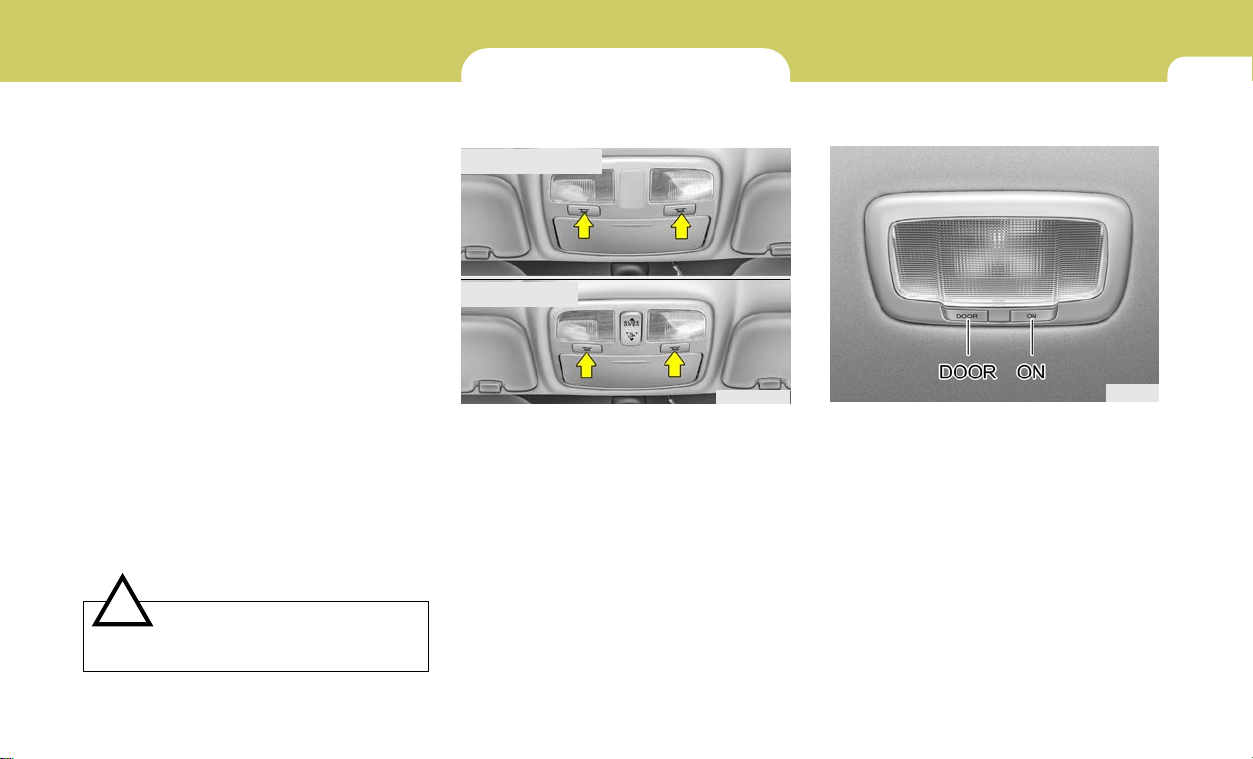
1
FEATURES OF YOUR HYUNDAI
73
!
CAUTION:
If the sunroof is not reset, it may not operate
properly.
B460E01NF-AAT
Resetting the sunroof
Whenever the vehicle battery is disconnected
or discharged, or you use the emergency handle
to operate the sunroof, you have to reset your
sunroof system as follows:
1. Turn the ignition key to the "ON" position.
2. According to the position of the sunroof, do
as follows.
1) In case that the sunroof has closed com-
pletely or been tilted : Press the TILT UP
button for 1 second.
2) In case that the sunroof has been opened:
Press and hold the TILT UP button for
more than 5 seconds until the sunroof
has closed completely. Then press the
TILT UP button for 1 second.
3. Then, release it.
4. Press and hold the TILT UP button once
again until the sunroof has returned to the
original TILT UP position after it raises a little
higher than the maximum TILT UP position.
When this is complete, the sunroof system
is reset.
B480B01Y-AAT
Map Light
Push in the map light switch to turn the light on
or off. This light produces a spot beam for
convenient use as a map light at night or as a
personal light for the driver and the passenger.
B480B01NF
INTERIOR LIGHT
Without sunroof
With sunroof
B490A02NF-GAT
Interior Light
The interior courtesy light has two buttons. The
two buttons are:
o DOOR
In the "DOOR" position, the interior courtesy
light comes on when any door is opened regard-
less of the ignition key position. The light goes
out gradually 30 seconds after the door is
closed.
oON
In the "ON" position, the light stays on at all
times.
HNF2110
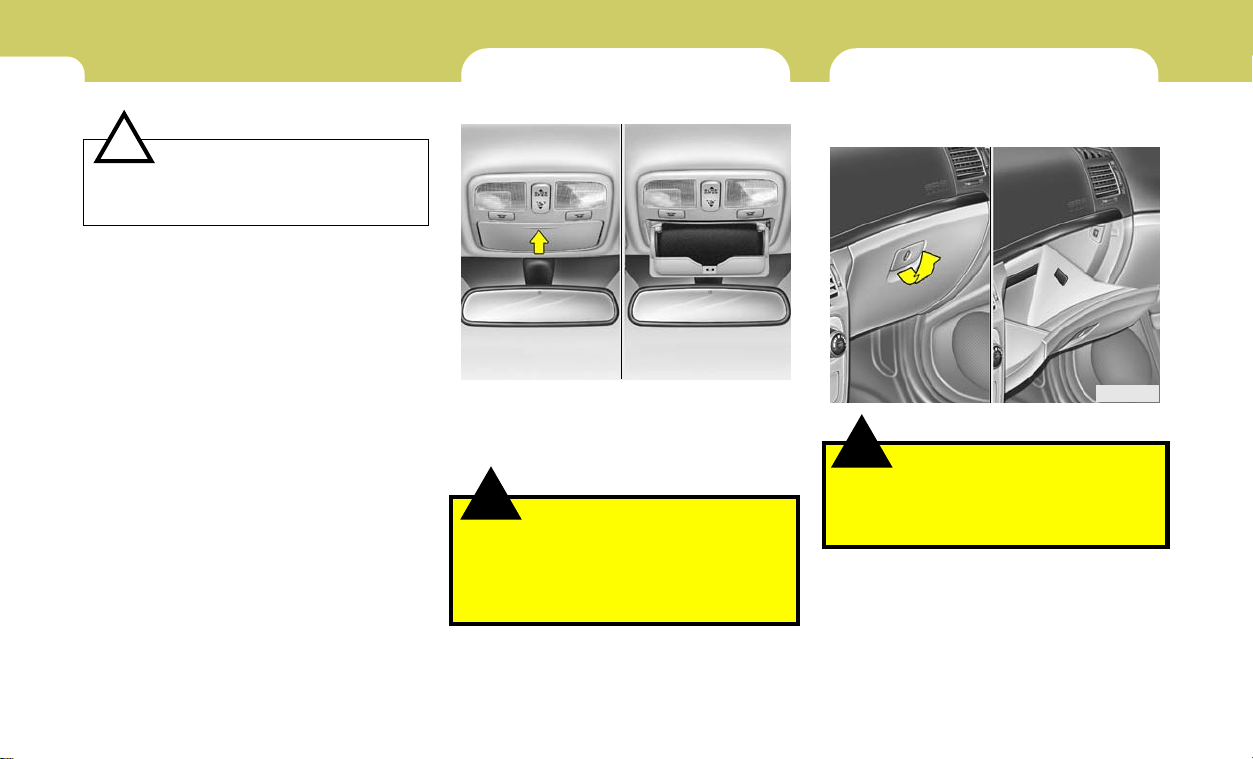
1
FEATURES OF YOUR HYUNDAI
74
CAUTION:
Do not leave this button pressed for an
extended period of time when the vehicle is
not running.
!
SPECTACLE CASE
!
B491A03O-GAT
The spectacle case is located on the front
overhead console.
Push the end of the cover to open the spectacle
case.
WARNING:
Do not keep objects except spectacles in-
side the spectacle case. Such objects can
be thrown from the case in the event of a
sudden stop or an accident, possibly injur-
ing the passengers in the vehicle.
HNF2183
!
STORAGE BOX
B500A01Y-AAT
GLOVE BOX
WARNING:
To avoid the possibility of injury in case of
an accident or a sudden stop, the glove box
door should be kept closed when the car is
in motion.
o To open the glove box, pull on the glove box
release lever.
o The glove box door can be locked (and
unlocked) with the key.
HNF2175
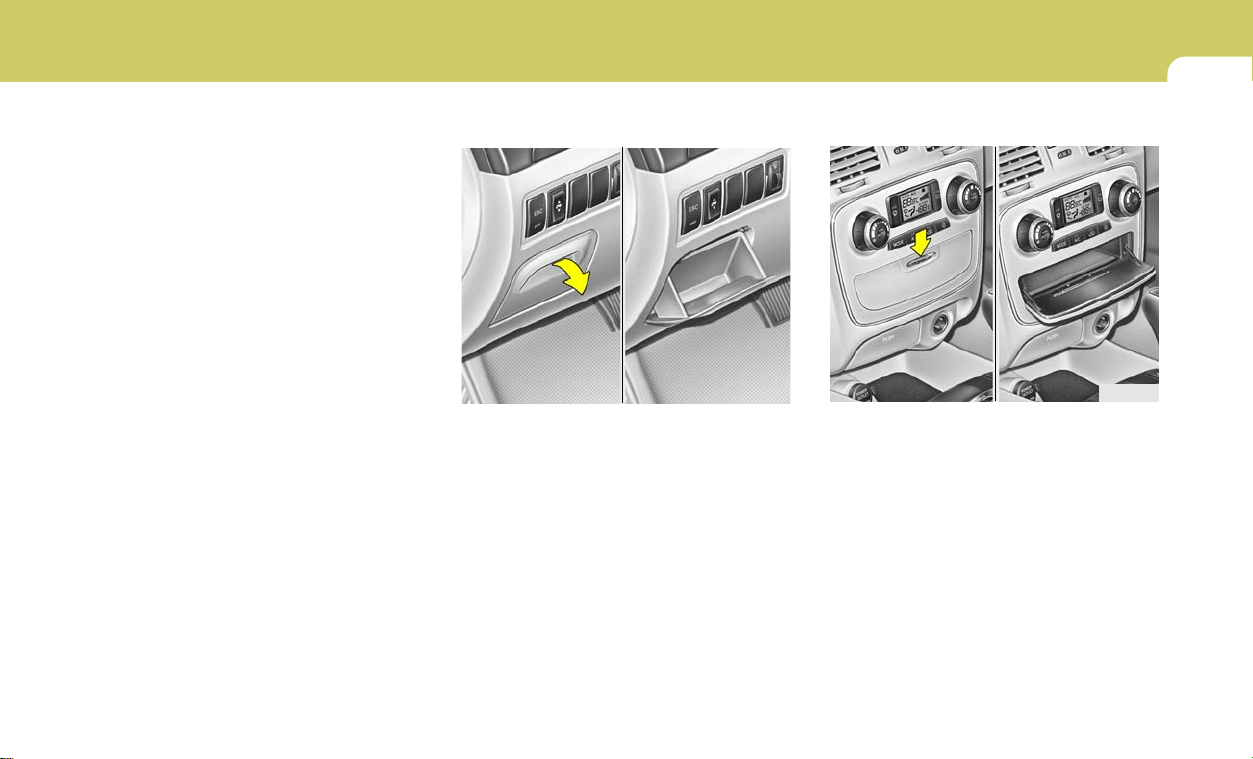
1
FEATURES OF YOUR HYUNDAI
75
B500A01NF-GAT
ACCESSORY BOX
The accessory box may be opened by pushing
the knob downward.
It is used for storing small articles.
B500A01NF
B500B01HP-DAT
MULTI BOX
The multi box may be opened by pulling it out by
its grip. It is used for storing small articles.
B500B02NF-A
B500B01NF-GAT
Illuminated Glove Box
Opening the glove box will automatically turn on
the light when the multi-function switch is turned
to the first position.
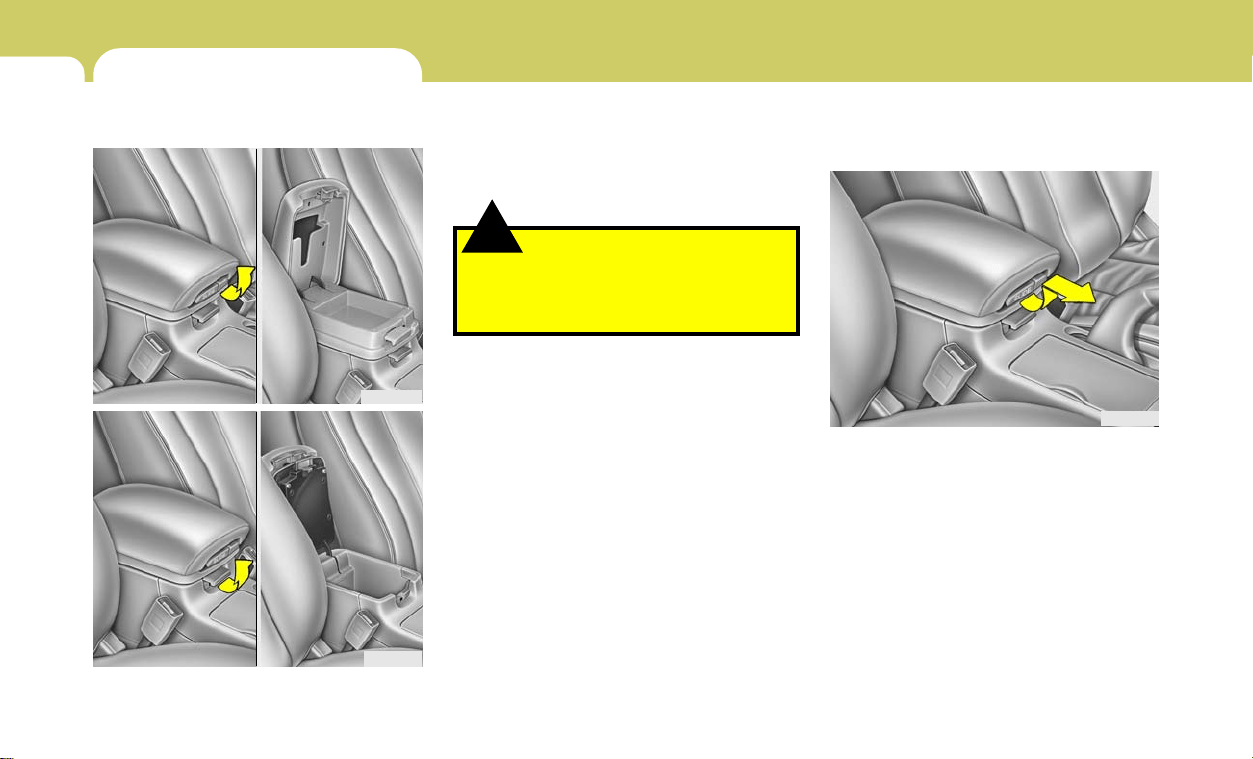
1
FEATURES OF YOUR HYUNDAI
76
!
WARNING:
To avoid the possibility of injury in case of
an accident or a sudden stop, the center
console box lid should be kept closed when
the car is in motion.
HNF2178
The center console box can be used as arm-
rest. To use the console armrest, pull out the
console box lid by pulling up the handle as
shown.
NOTE:
When not in use, always be sure it is locked
in position properly.
B505B01NF-GAT
Center Console Armrest
(If Installed)
The center console box is used for storing
cassette tapes or small articles.
To use the center console box, pull up the
handle and lift the lid as shown.
CENTER CONSOLE
COMPARTMENT
B505A01NF-GAT
Center Console Box
HNF2176
HNF2177
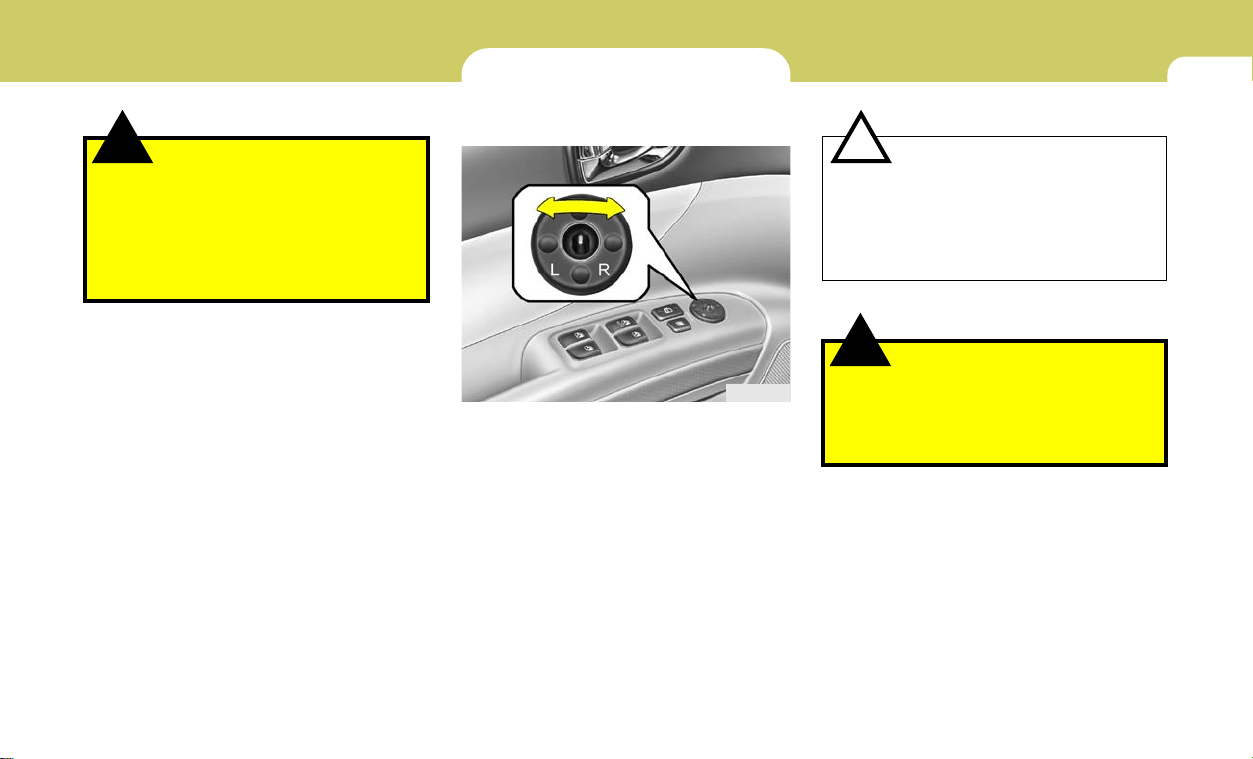
1
FEATURES OF YOUR HYUNDAI
77
!
OUTSIDE REARVIEW MIRROR
!
WARNING:
Do not place cups or cans in the drink
holder when the console box lid is used as
an armrest. It may result in spilling the
beverage. A spilled beverage that is very hot
can injure you or your passengers. Spilled
liquids can damage interior trim and elec-
tric components.
B510B01Y-AAT
Electric Type
The outside rearview mirrors can be adjusted
to your preferred rear vision, both directly be-
hind the vehicle, and to the rear of the left and
right sides.
The remote control outside rearview mirror
switch controls the adjustments for both right
and left outside mirrors.
To adjust the position of either mirror:
1. Move the selecting switch to the right or left
to activate the adjustable mechanism for the
corresponding door mirror.
2. Adjust mirror angle by depressing the appro-
priate perimeter switch as illustrated.
B510B01NF
CAUTION:
o Do not operate the switch continuously
for an unnecessary length of time.
o Scraping ice from the mirror face could
cause permanent damage. To remove
any ice, use a sponge, soft cloth or
approved de-icer.
!
WARNING:
Be careful when judging the size or dis-
tance of any object seen in the passenger
side rearview mirror. It is a convex mirror
with a curved surface, and any objects seen
in this mirror are closer than they appear.
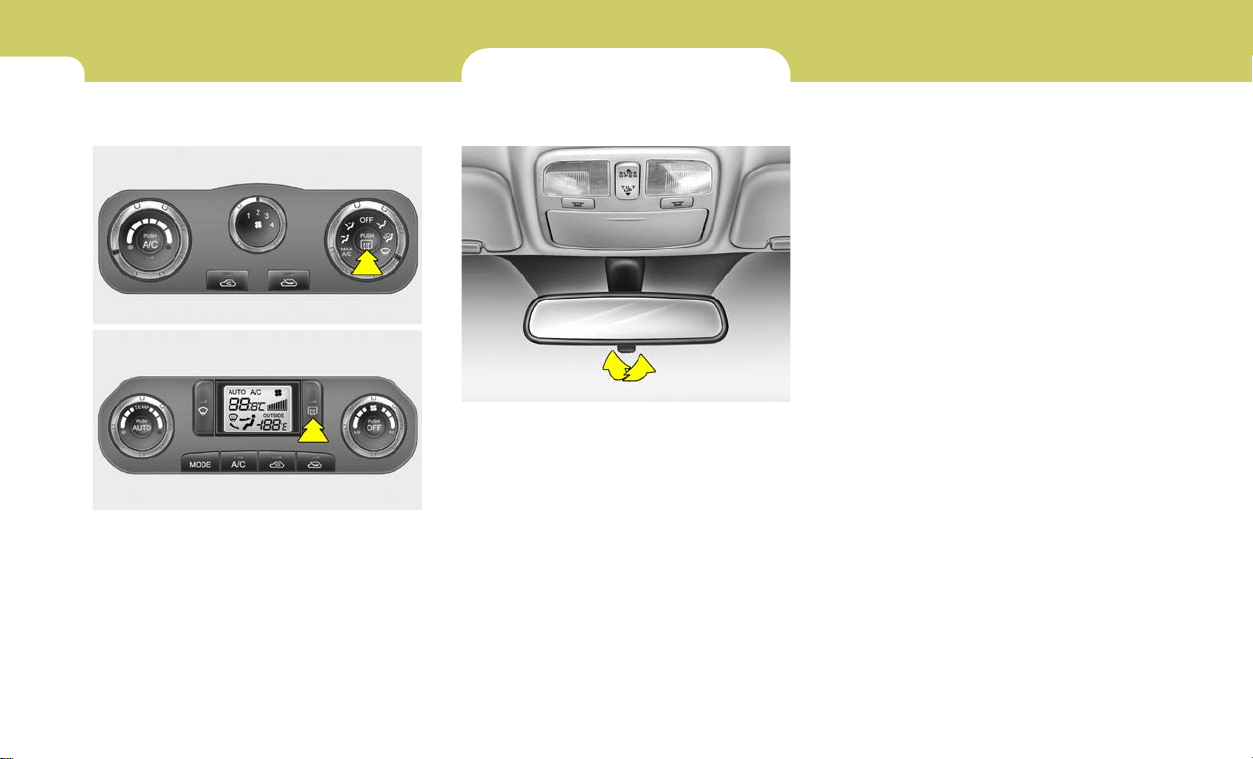
1
FEATURES OF YOUR HYUNDAI
78
The outside rearview mirror heater is actuated in
connection with the rear window defroster. To heat
the outside rearview mirror glass, push in the switch
for the rear window defroster. The rearview mirror
glass will be heated for defrosting or defogging and
will give you improved rear vision in inclement
weather conditions. Push the switch again to turn
the heater off. The outside rearview mirror heater
automatically turns itself off after 20 minutes.
B510D01HP-AAT
OUTSIDE REARVIEW MIRROR HEATER
HNF2113-A
With Manual A/C
With Automatic A/C
DAY/NIGHT INSIDE REARVIEW
MIRROR
B520A01A-AAT
Manual Type
Your Hyundai is equipped with a day/night inside
rearview mirror. The "night" position is selected
by flipping the tab at the bottom of the mirror
toward you. In the "night" position, the glare of
headlights of cars behind you is reduced.
B520A01NF
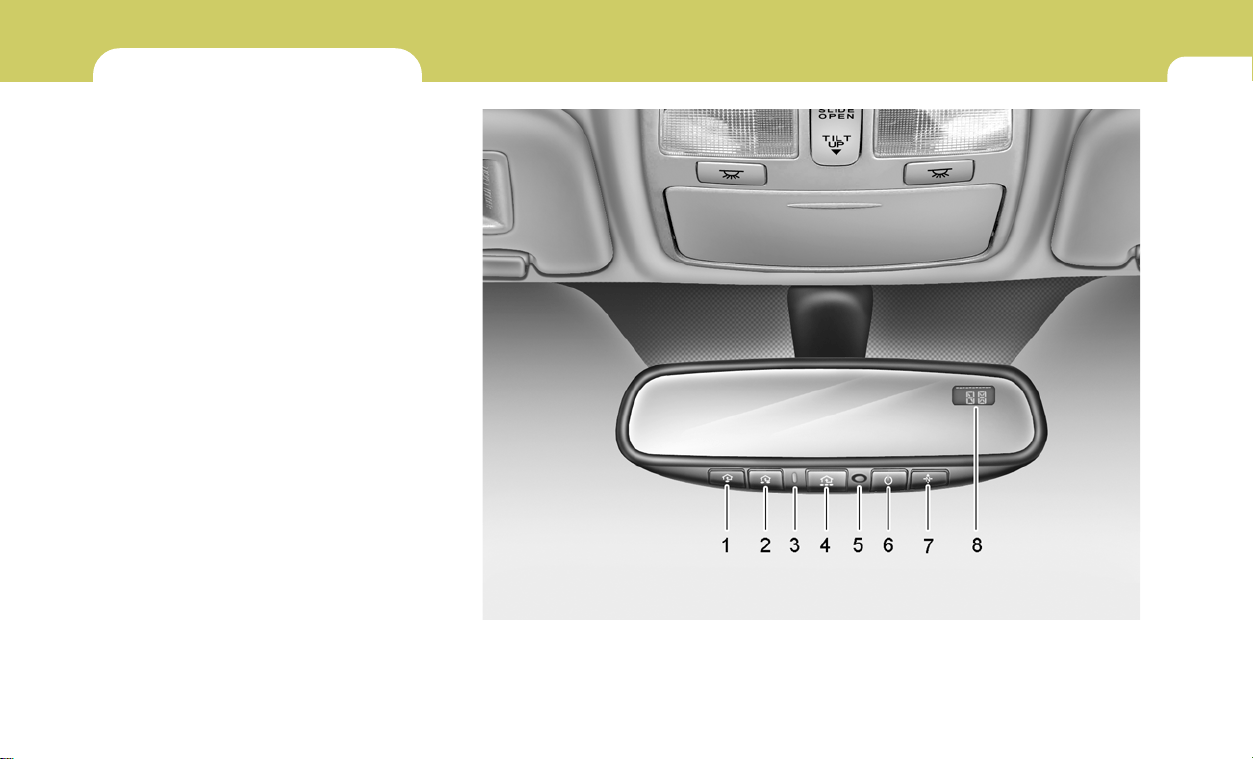
1
FEATURES OF YOUR HYUNDAI
79
HOMELINK MIRROR
B520C01NF-AAT
Automatic-Dimming Mirror
with Z-Nav™ Electronic Compass Dis-
play and HomeLink
®
(If Installed)
Your vehicle comes with a Gentex Automatic-
Dimming Mirror with a Z-Nav™ Electronic Com-
pass Display and an Integrated HomeLink
®
Wireless Control System. During nighttime driv-
ing, this safety feature will automatically detect
and eliminate dangerous rearview mirror glare
while the compass indicates the direction the
vehicle is pointed. The HomeLink
®
Universal
Transceiver allows you to activate your garage
door(s), estate gate, home lighting, etc.
1. Channel 1 Button
2. Channel 2 Button
3. Status Indicator LED
4. Channel 3 Button
5. Rear Light Sensor
6. Dimming On/Off Button
7. Compass Control Button
8. Display
B520C01NF
1
FEATURES OF YOUR HYUNDAI
80
Automatic-Dimming Night Vision
Safety™ (NVS
®
) Mirror
The NVS
®
Mirror in your vehicle is the most
advanced way to eliminate dangerous and an-
noying glare in the rearview mirror during any
driving situation. For more information regard-
ing NVS
®
mirrors and other applications, please
refer to the Gentex website:
www.gentex.com.
CAUTION:
The NVS
®
Mirror automatically reduces glare
during driving conditions based upon light
levels monitored in front of the vehicle and
from the rear of the vehicle. These light
sensors are visible through openings in the
front and rear of the mirror case. Any object
that would obstruct either light sensor will
degrade the automatic dimming control
feature.
!
Automatic-Dimming Function
To protect your vision during nighttime driving,
your mirror will automatically dim upon detecting
glare from the vehicles traveling behind you.
The auto-dimming function can be controlled by
the Dimming ON/OFF Button:
1. Pressing the button turns the auto-
dimming function OFF which is indicated by
the green Status Indicator LED turning off.
2. Pressing the button again turns the auto-
dimming function ON which is indicated by
the green Status Indicator LED turning on.
NOTE:
The mirror defaults to the "ON" position
each time the vehicle is started.
Compass Function
The Compass can be turned ON and OFF and
will remember the last state when the ignition is
cycled. To turn the display feature ON/OFF:
1. Press and release the button to turn the
display feature OFF.
2. Press and release the button again to
turn the display back ON.
Additional options can be set with press and hold
sequences of the button and are detailed
below.
There is a difference between magnetic north
and true north. The compass in the mirror can
compensate for this difference when it knows
the Magnetic Zone in which it is operating. This
is set either by the dealer or by the user. The
operating Zone Numbers for North America are
shown in the figure to the right.
Z-Nav™ Compass Display
The NVS™ Mirror in your vehicle is also
equipped with a Z-Nav™ Compass that shows
the vehicle Compass heading in the Display
Window using the 8 basic cardinal headings (N,
NE, E, SE, etc.).
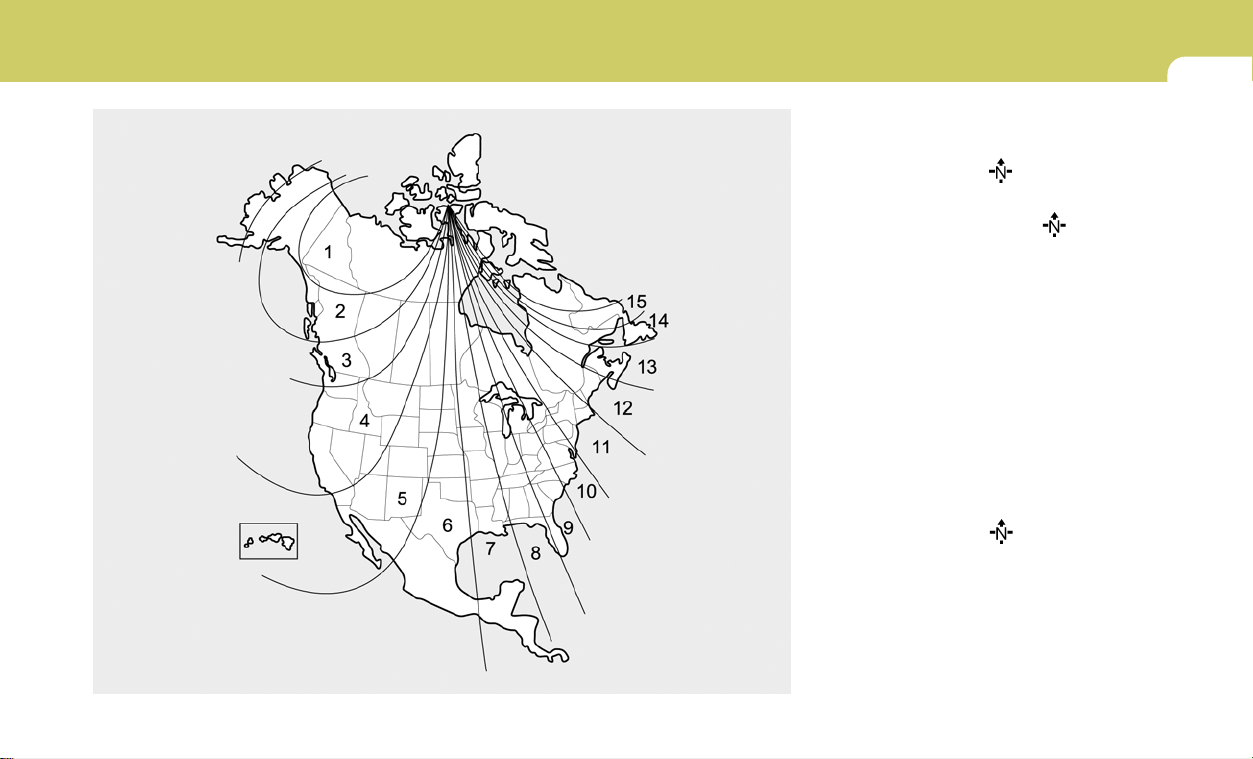
1
FEATURES OF YOUR HYUNDAI
81
To adjust the Zone setting:
1. Determine the desired Zone Number based
upon your current location on the Zone Map.
2. Press and hold the button for more than
3 but less than 6 seconds, the current Zone
Number will appear on the display.
3. Pressing and holding the button again
will cause the numbers to increment (Note:
they will repeat …13, 14, 15, 1, 2, …).
Releasing the button when the desired Zone
Number appears on the display will set the
new Zone.
4. Within about 5 seconds the compass will
start displaying a compass heading again.
There are some conditions that can cause
changes to the vehicle magnets. Items such as
installing a ski rack or a CB antenna or even
some body repair work on the vehicle can
cause changes to the vehicle's magnetic field.
In these situations, the compass will need to be
re-calibrated to quickly correct for these
changes. To re-calibrate the compass:
1. Press and hold the button for more than
6 seconds. When the compass memory is
cleared a "C" will appear in the display.
2. To calibrate the compass, drive the vehicle
in 2 complete circles at less than 5 MPH (8
Km/h).
B520C05NF
1
FEATURES OF YOUR HYUNDAI
82
!
Integrated HomeLink
®
Wireless Control
System
The HomeLink
®
Wireless Control System pro-
vides a convenient way to replace up to three
hand-held radio-frequency (RF) transmitters
with a single built-in device. This innovative
feature will learn the radio frequency codes of
most current transmitters to operate devices
such as gate operators, garage door openers,
entry door locks, security systems, even home
lighting. Both standard and rolling code-equipped
transmitters can be programmed by following
the outlined procedures. Additional HomeLink
®
information can be found at: www.homelink.com
or by calling 1-800-355-3515.
CAUTION:
Before programming HomeLink
®
to a ga-
rage door opener or gate operator, make
sure that people and objects are out of the
way of the device to prevent potential harm
or damage. Do not use HomeLink
®
with any
garage door opener that lacks the safety
stop and reverse features as required by
U.S. federal safety standards (this includes
any garage door opener model manufac-
tured before April 1, 1982). A garage door
that cannot detect an object - signaling the
door to stop and reverse - does not meet
current U.S. federal safety standards. Using
a garage door opener without these fea-
tures increases the risk of serious injury or
death.
Programming HomeLink
®
NOTE:
o When programming a garage door
opener, it is advised to park the vehicle
outside of the garage.
o It is recommended that a new battery be
placed in the hand-held transmitter of
the device being programmed to
HomeLink
®
for quicker training and ac-
curate transmission of the radio-fre-
quency signal.
o Some vehicles may require the ignition
switch to be turned to the second (or
"accessories") position for program-
ming and/or operation of HomeLink.
o In the event that there are still program-
ming difficulties or questions after fol-
lowing the programming steps listed
below, contact HomeLink
®
at:
www.homelink.com or 1-800-355-3515.
Retain the original transmitter of the RF device
you are programming for use in other vehicles
as well as for future HomeLink
®
programming.
It is also suggested that upon the sale of the
vehicle, the programmed HomeLink
®
buttons
be erased for security purposes.

1
FEATURES OF YOUR HYUNDAI
83
Standard Programming
To train most devices, follow these instructions:
1. For first-time programming, press and hold
the two outside buttons, HomeLink
®
Channel
1 and Channel 3 Buttons, until the indicator
light begins to flash (after 20 seconds).
Release both buttons. Do not hold the but-
tons for longer than 30 seconds.
2. Position the end of your hand-held transmit-
ter 1-3 inches (5-14 cm) away from the
HomeLink
®
buttons while keeping the indica-
tor light in view.
3. Simultaneously press and hold both the
HomeLink
®
and hand-held transmitter but-
ton. DO NOT release the buttons until step
4 has been completed.
4. While continuing to hold the buttons the red
Indicator Status LED will flash slowly and
then rapidly after HomeLink
®
successfully
trains to the frequency signal from the hand-
held transmitter. Release both buttons.
5. Press and hold the just-trained HomeLink
®
button and observe the red Status Indicator
LED. If the indicator light stays on constantly,
programming is complete and your device
should activate when the HomeLink
®
button
is pressed and released.
6. To program the remaining two HomeLink
®
buttons, follow steps 2 through 5.
Rolling Code Programming
Rolling code devices which are "code-pro-
tected" and manufactured after 1996 may be
determined by the following:
o Reference the device owner's manual for
verification.
o The handheld transmitter appears to pro-
gram the HomeLink Universal Transceiver
but does not activate the device.
o Press and hold the trained HomeLink button.
The device has the rolling code feature if the
indicator light flashes rapidly and then turns
solid after 2 seconds.
To train rolling code devices, follow these in-
structions:
1. At the garage door opener receiver (motor-
head unit) in the garage, locate the "learn" or
"smart" button. This can usually be found
where the hanging antenna wire is attached
to the motor-head unit. Exact location and
color of the button may vary by garage door
opener brand. If there is difficulty locating the
training button, reference the device owner's
manual or please visit our Web site at
www.homelink.com.
2. Firmly press and release the "learn" or
"smart" button (which activates the "training
light").
NOTE:
There are 30 seconds in which to initiate
step3.
3. Return to the vehicle and firmly press, hold
for two seconds and then release the de-
sired HomeLink
®
button. Repeat the "press/
hold/release" sequence a second time to
complete the programming. (Some devices
may require you to repeat this sequence a
third time to complete the programming.)
4. Press and hold the just-trained HomeLink
®
button and observe the red Status Indicator
LED. If the indicator light stays on constantly,
programming is complete and your device
should activate.
5. To program the remaining two HomeLink
®
buttons, follow either steps 1 through 4
above for other Rolling Code devices or
steps 2 through 5 in Standard Programming
for standard devices.
Gate Operator & Canadian Programming
During programming, your handheld transmit-
ter may automatically stop transmitting. Con-
tinue to press the Integrated HomeLink
®
Wire-
less Control System button (note steps 2 through
4 in the Standard Programming portion of this
document) while you press and re-press
("cycle") your handheld transmitter every two
seconds until the frequency signal has been
learned. The indicator light will flash slowly and

1
FEATURES OF YOUR HYUNDAI
84
!
then rapidly after several seconds upon suc-
cessful training.
Operating HomeLink
®
To operate, simply press and release the pro-
grammed HomeLink
®
button. Activation will now
occur for the trained device (i.e. garage door
opener, gate operator, security system, entry
door lock, home/office lighting, etc.). For con-
venience, the hand-held transmitter of the de-
vice may also be used at any time.
Reprogramming a Single HomeLink
®
But-
ton
To program a new device to a previously trained
HomeLink
®
button, follow these steps:
1. Press and hold the desired HomeLink
®
but-
ton. Do NOT release until step 4 has been
completed.
2. When the indicator light begins to flash slowly
(after 20 seconds), position the handheld
transmitter 1 to 3 inches away from the
HomeLink
®
surface.
3. Press and hold the handheld transmitter
button. The HomeLink
®
indicator light will
flash, first slowly and then rapidly.
4. When the indicator light begins to flash rap-
idly, release both buttons.
5. Press and hold the just-trained HomeLink
®
button and observe the red Status Indicator
LED. If the indicator light stays on constantly,
programming is complete and your new
device should activate.
Erasing HomeLink
®
Buttons
Individual buttons cannot be erased. However,
to erase all three programmed buttons:
1. Press and hold the two outer HomeLink
®
buttons until the indicator light begins to
flash-after 20 seconds.
2. Release both buttons. Do not hold for longer
than 30 seconds.
The Integrated HomeLink
®
Wireless Control
System is now in the training (learn) mode and
can be programmed at any time following the
appropriate steps in the Programming sections
above.
FCC ID: NZLZTVHL3
IC: 4112A-ZTVHL3
This device complies with Part 15 FCC Rules.
Operation is subject to the following two condi-
tions: (1) this device may not cause harmful
interference, and (2) this device must accept
any interference received, including interfer-
ence that may cause undesired operation.
WARNING:
The transceiver has been tested and com-
plies with FCC and Industry Canada rules.
Changes or modifications not expressly
approved by the party responsible for com-
pliance could void the user's authority to
operate the device.
NVS
®
is a registered trademark and Z-Nav™ is
a trademark of the Gentex Corporation, Zeeland,
Michigan. HomeLink
®
is a registered trademark
owned by Johnson Controls, Incorporated,
Milwaukee, Wisconsin.
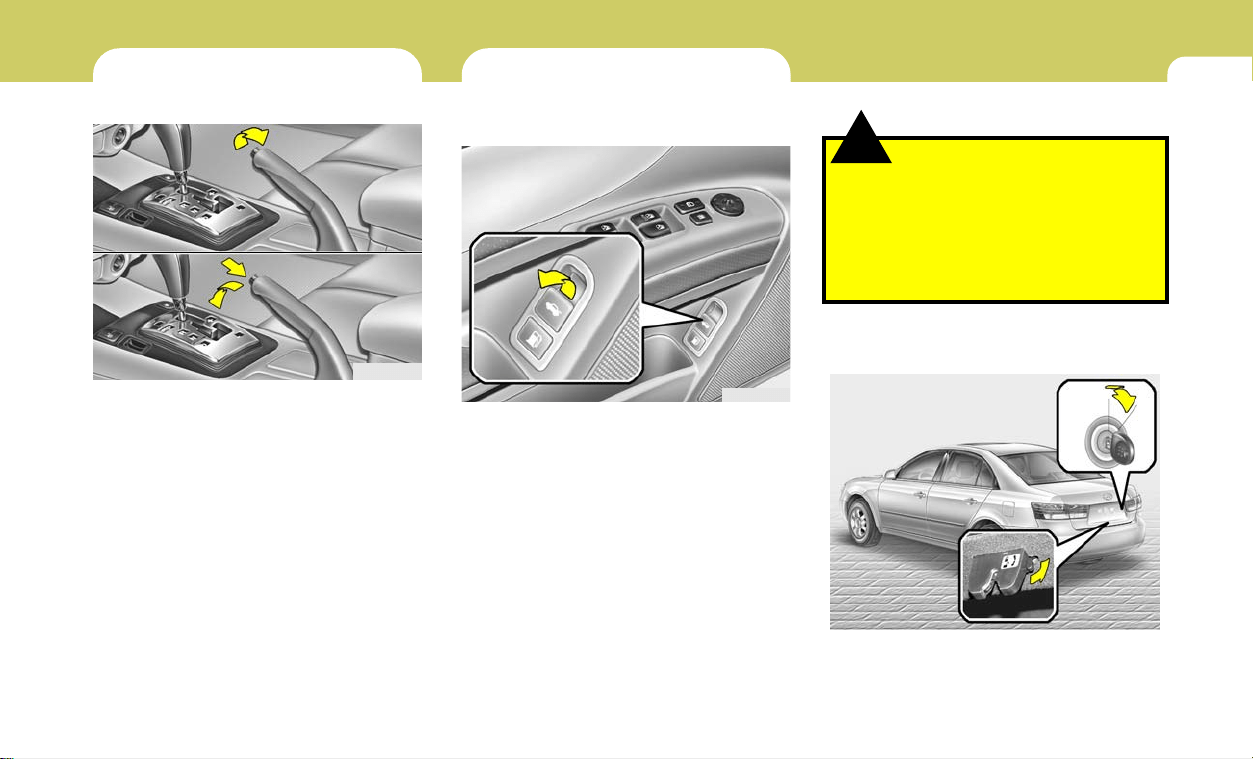
1
FEATURES OF YOUR HYUNDAI
85
!
WARNING:
The trunk lid should always be kept com-
pletely closed while the vehicle is in motion.
If it is left open or ajar, poisonous exhaust
gases may enter the car and serious illness
or death may result. See additional warn-
ings concerning exhaust gases on page 2-
2.
B540B04Y-AAT
Trunk Lid Lock Knob
HNF2014-A
If the trunk lid lock knob (located near the latch)
is in the "LOCK" position when the trunk lid is
closed, it will not be possible to open the trunk
PARKING BRAKE
B530A01A-AAT
Always engage the parking brake before leav-
ing the vehicle. This also turns on the parking
brake indicator light when the key is in the "ON"
or "START" position. Before driving away, be
sure that the parking brake is fully released and
the indicator light is off.
o To engage the parking brake, pull the lever
up as far as possible.
o To release the parking brake, pull up and
press the thumb button. Then, while holding
the button in, lower the brake lever.
B530A01NF
TRUNK LID
B540A01S-GAT
Remote Trunk Lid Release
To open the trunk lid without using the key, pull
up the lid release lever.
To close, lower the trunk lid, then press down
on it until it locks. To be sure the trunk lid is
securely fastened, always check by trying to
pull it up again.
B540A01NF
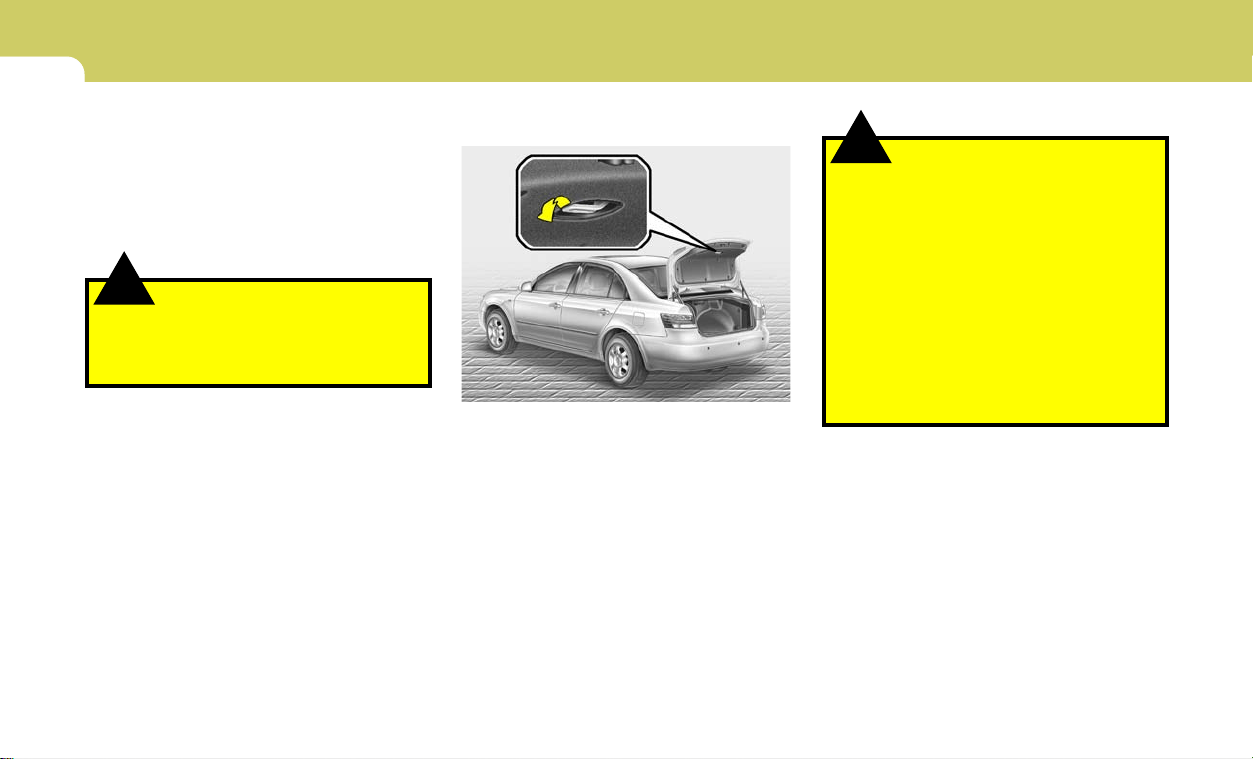
1
FEATURES OF YOUR HYUNDAI
86
!
HNF2016
B540B02E-AAT
Trunk Lid Emergency Latch Release
Your vehicle is equipped with a glow-in-the dark
emergency trunk release lever located inside
the trunk. It will glow after the trunk is closed.
When pulled, this lever will release the trunk
latch mechanism and open the trunk.
lid by using the remote release. In this instance,
use the master key to unlock and open the trunk
lid.
To allow the trunk lid to be opened with the
remote release, push the trunk lid lock knob
down, then to the opposite direction of the
"LOCK" position.
WARNING:
Doors and trunk should be kept locked and
keys be kept out of the reach of children.
Parents also should teach their children
about the dangers of playing in trunks.
!
WARNING:
o If a person is locked in the trunk, pull the
emergency trunk release lever on the
driver's side of the inside panel of the
trunk to open the trunk lid.
o HYUNDAI recommends that cars be kept
locked and keys be kept out of the reach
of children, and that parents teach their
children about the dangers of playing in
trunks.
o Parents should teach children about the
emergency trunk release lever in their
vehicle and how to open the trunk lid if
they are accidentally locked in the trunk.
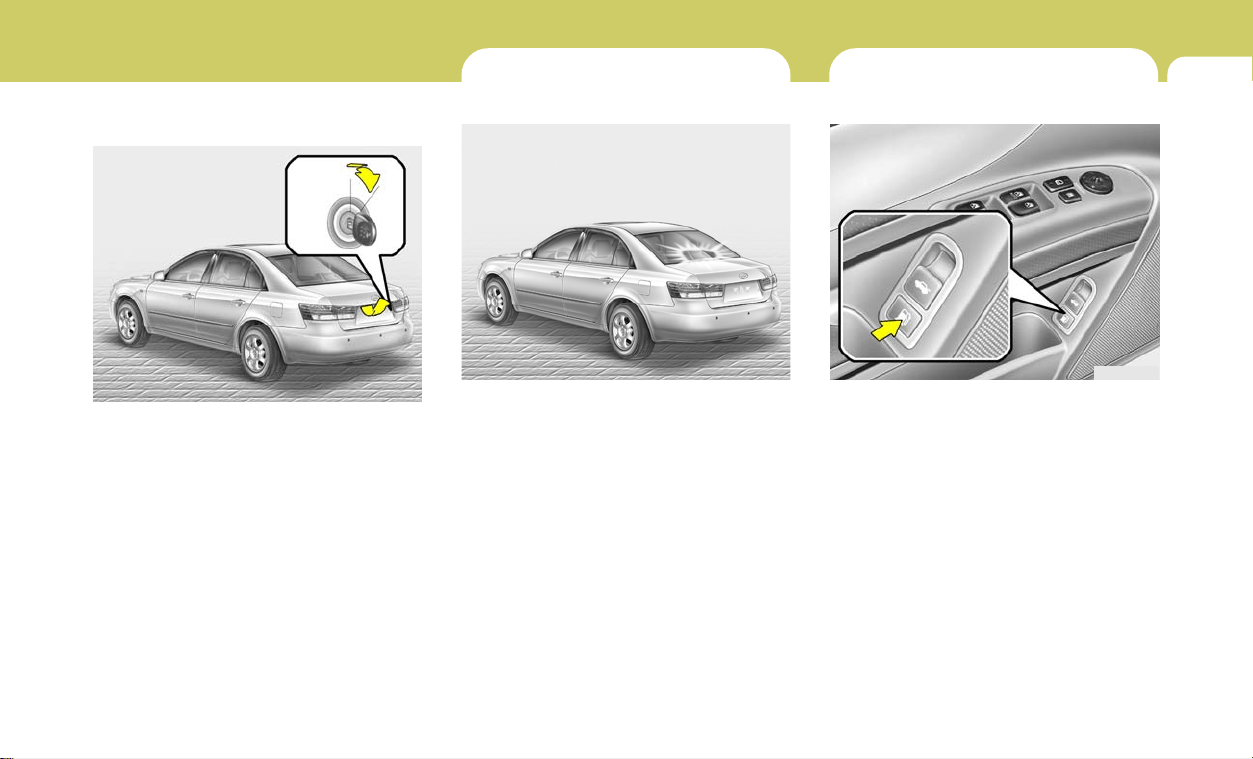
1
FEATURES OF YOUR HYUNDAI
87
REMOTE FUEL-FILLER LID RELEASE
B560A03Y-AAT
The fuel-filler lid may be opened from inside the
vehicle by pushing the fuel-filler lid opener switch
located on the driver's door.
NOTE:
If the fuel-filler lid will not open because ice
has formed around it, tap lightly or push on
the lid to break the ice and release the lid. Do
not pry on the lid. If necessary, spray around
the lid with an approved de-icer fluid (do
not use radiator anti-freeze) or move the
vehicle to a warm place and allow the ice to
melt.
B560A02NF
HNF2012
B540C01Y-AAT
To unlock using the key
To open the trunk lid, insert the key and turn it
clockwise to unlock. The trunk compartment
light illuminates when the trunk lid is opened.
HIGH-MOUNTED REAR STOP LIGHT
B550A02Y-AAT
In addition to the lower-mounted rear stop lights
on either side of the car, the high mounted rear
stop light in the center of the rear window also
lights when the brakes are applied.
B550A01NF
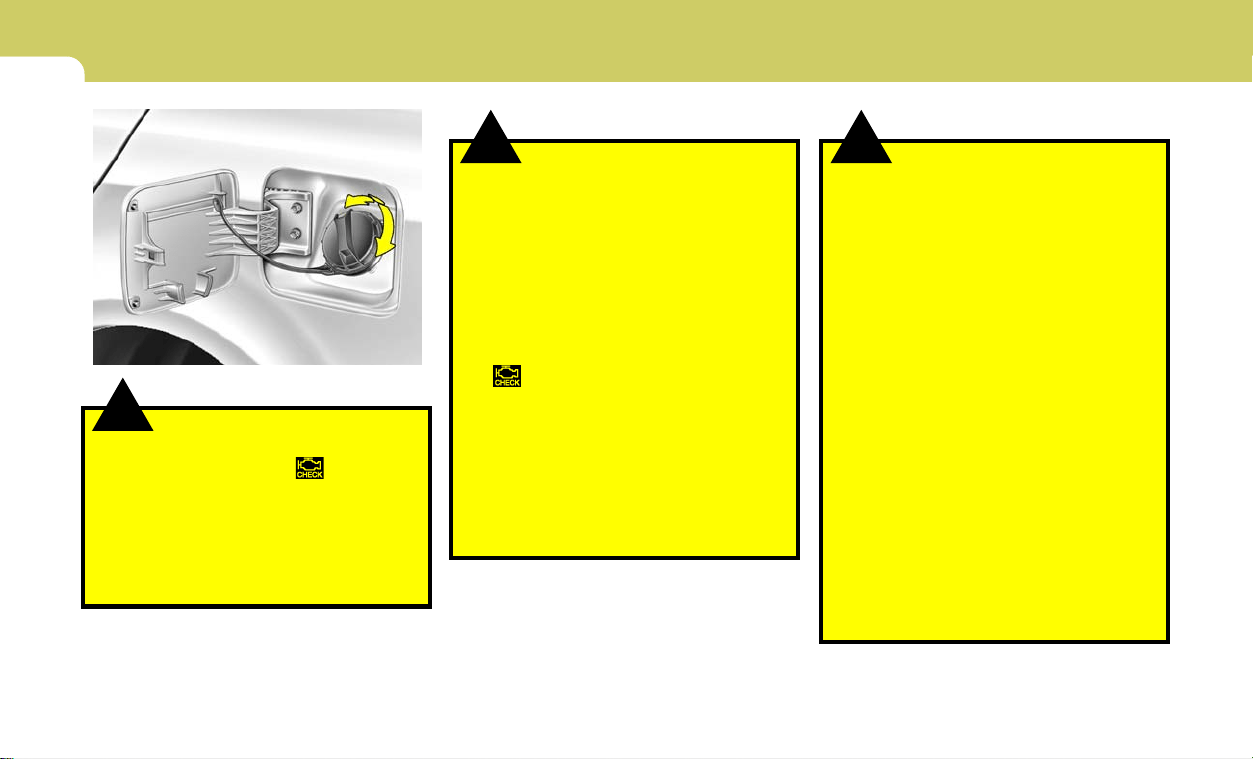
1
FEATURES OF YOUR HYUNDAI
88
WARNING:
o If you open the fuel filler cap during high
ambient temperatures, a slight "pres-
sure sound" may be heard. This is nor-
mal and not a cause for concern.
Whenever you open the fuel filler cap,
turn it slowly.
o Make sure the fuel filler cap is replaced
and securely seated after fueling. Failure
to replace or fully seat the fuel filler cap
will result in fuel vapors escaping into
the atmosphere and the check engine
" " indicator illuminating.
o Do not "TOP-OFF" after the first nozzle
shut off when refueling.
o Automotive fuels are flammable/explo-
sive materials. When refueling, please
note the following guidelines carefully.
- Before touching the fuel nozzle or fuel
filler cap, have one's hands in contact
with metal parts away from the filler
neck to discharge static electricity.
!
!
WARNING:
o The fuel cap must be tightened until the
cap clicks, otherwise " " light will
illuminate.
o Gasoline vapors are dangerous. Before
refueling, always stop the engine and
never allow sparks or open flames near
the filler area. If you need to replace the
filler cap, use a genuine Hyundai re-
placement part.
HNF2021
!
WARNING:
- Do not get back in the vehicle while
refueling. Do not operate anything that
can produce static electricity. Static
electricity discharge can ignite fuel
vapors resulting in an explosion.
- When using a portable fuel container,
be sure to place the container on the
ground while refueling. Static electric-
ity discharge from the container can
ignite fuel vapors causing a fire. While
starting refueling, contact should be
maintained until the filling is complete.
- Do not use cellular phones around a
gas station. The electric current or elec-
tronic interference from cellular phones
can ignite fuel vapors causing a fire.
- When refueling, always turn the engine
off. Sparks by engine compartment
electrical equipment can ignite fuel
vapors causing a fire. After refueling,
check to make sure the fuel filler cap is
securely closed, and then start the
engine.
- Do not smoke or try to light cigarettes
around a gas station. Automotive fuels
are flammable.
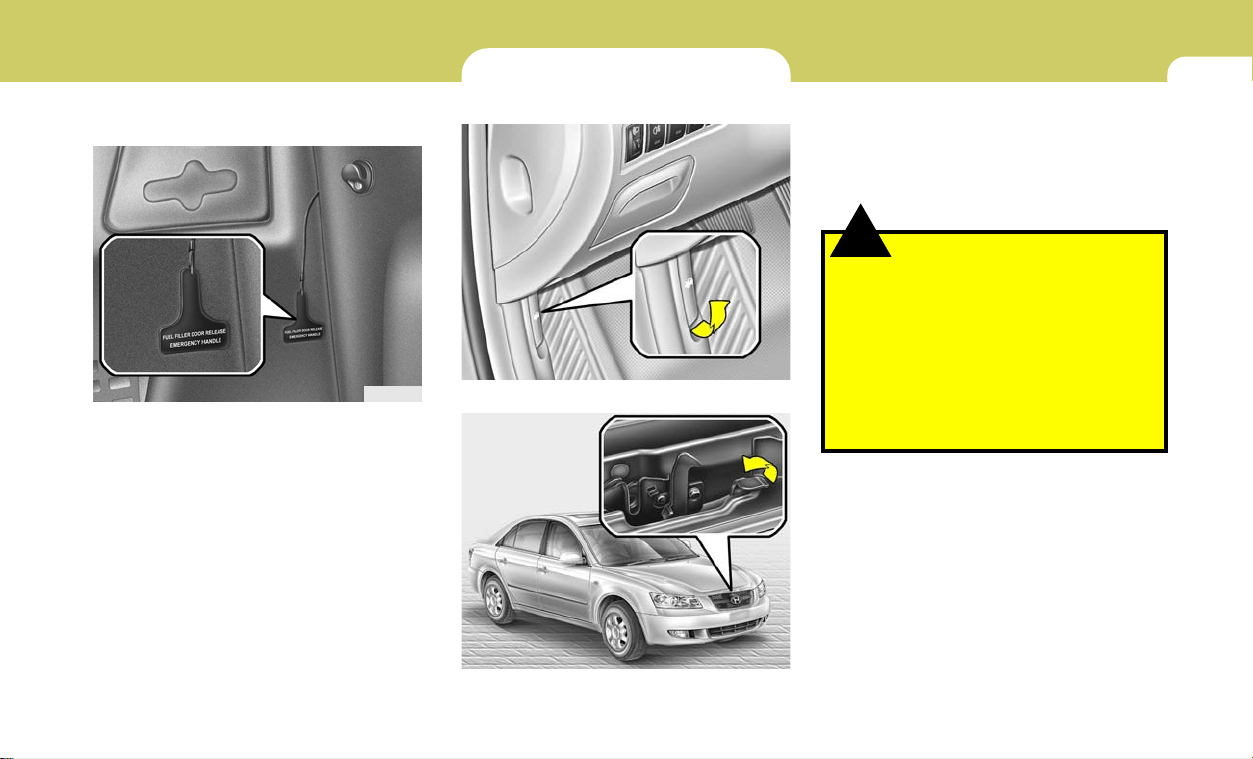
1
FEATURES OF YOUR HYUNDAI
89
!
3. Raise the hood by hand.
When closing the hood, slowly close the hood
and make sure it locks into place.
WARNING:
o Always double check to be sure that the
hood is firmly latched before driving
away. If it is not latched, the hood could
fly open while the vehicle is being driven,
causing a total loss of visibility, which
might result in an accident.
o Do not move the vehicle with the hood
in the raised position, as vision is ob-
structed and the hood could fall or be
damaged.
B560B01L-GAT
Manual Fuel Filler Lid Release
If the fuel filler lid cannot be opened using the
remote opener, a manual opener handle is
located inside the trunk on the left side. Open the
fuel filler lid by pulling on this handle as shown
in the illustration.
HNF2022
HOOD RELEASE
B570A01NF-GAT
1. Pull the release knob to unlatch the hood.
2. Pull the secondary latch up and lift the hood.
B570A01NF
HNF2024-E
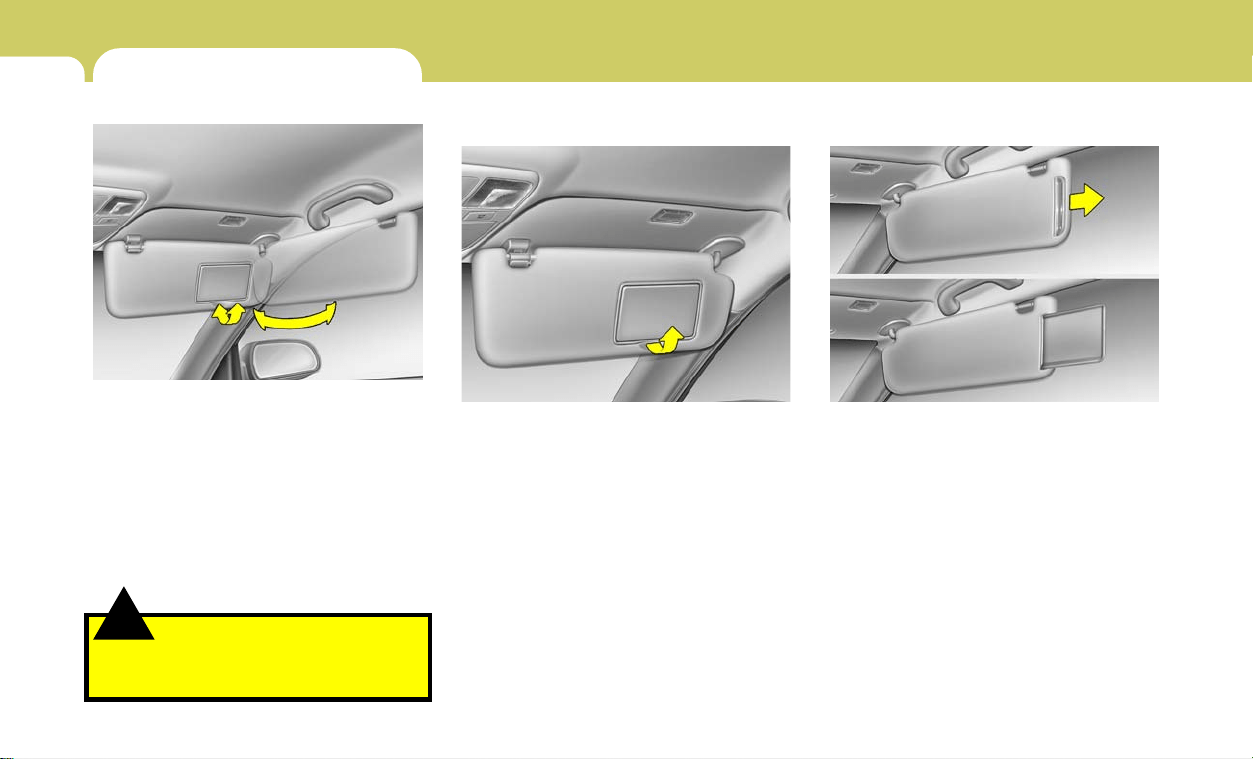
1
FEATURES OF YOUR HYUNDAI
90
!
SUN VISOR
B580A01NF-GAT
Your Hyundai is equipped with sun visors to give
the driver and front passenger either frontal or
sideward shade. To reduce glare or to shut out
direct rays of the sun, turn the sun visor down.
Vanity mirrors are provided on the back of the
sun visor for the driver and front passenger.
NOTE:
The Supplemental Restraint System (SRS)
label containing useful information can be
found on the back of each sun visor.
B580A01NF
WARNING:
Do not place the sun visor in such a manner
that it obscures visibility of the roadway,
traffic or other objects.
B500B01B-GAT
Illuminated Vanity Mirror
Opening the lid of the vanity mirror will automati-
cally turn on the mirror light.
HNF2172
B580C01JM-AAT
Sun Visor Extender
Your vehicle is equipped with sun visor extend-
ers that may be used when the visor is in the side
glass position.
B580C01NF
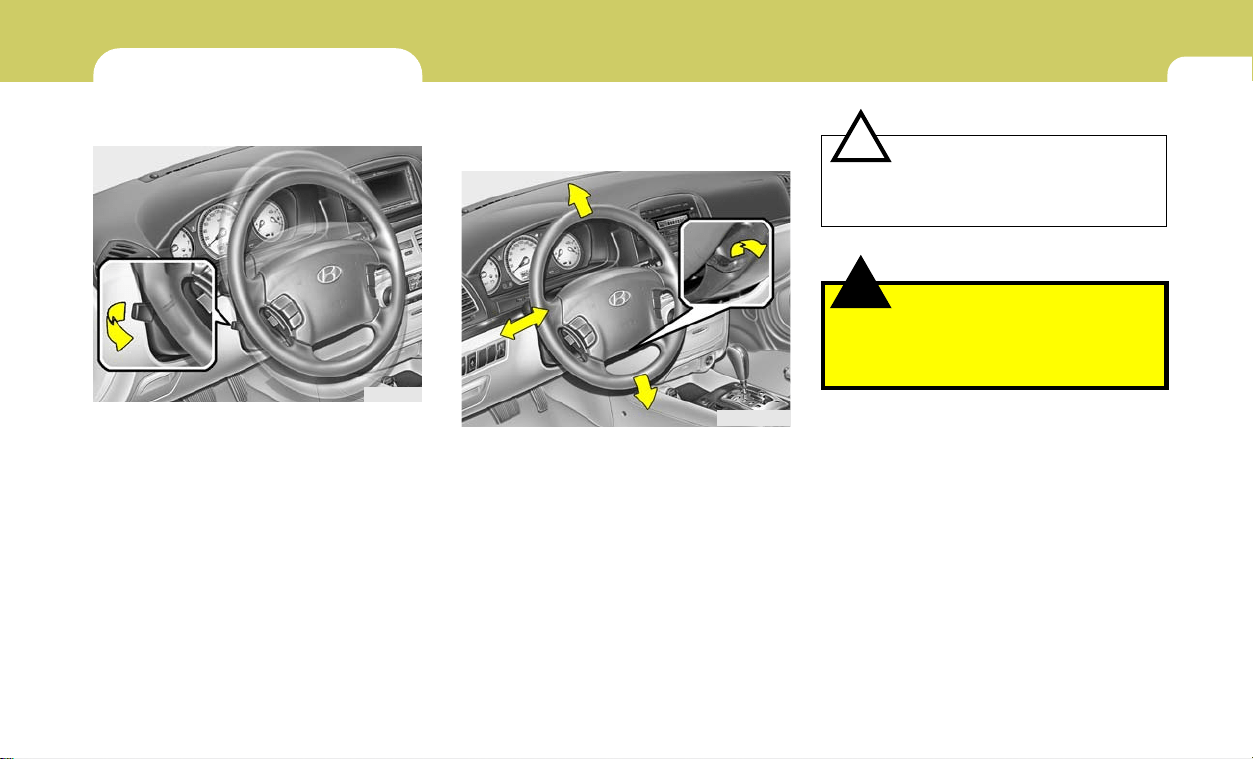
1
FEATURES OF YOUR HYUNDAI
91
!
CAUTION:
After adjusting the steering wheel, try mov-
ing it up and down to make sure it is locked
in position.
!
WARNING:
Do not attempt to adjust the steering wheel
while driving as this may result in loss of
control of the vehicle and serious injury or
death.
B600B01NF-GAT
Tilt and telescopic type
(If Installed)
To adjust the steering wheel:
1. Push the lever downward fully to unlock.
2. Adjust upward or downward and forward or
backward to set the steering wheel to the
desired position.
3. After adjustment, securely tighten the lever
by pulling it upward.
B600B01NF-A
STEERING WHEEL
B600A01NF-GAT
Tilt type
To adjust the steering wheel:
1. Pull the lever toward you and hold it to unlock.
2. Raise or lower the steering wheel to the
desired position.
3. After adjustment, release the lever.
HNF2067
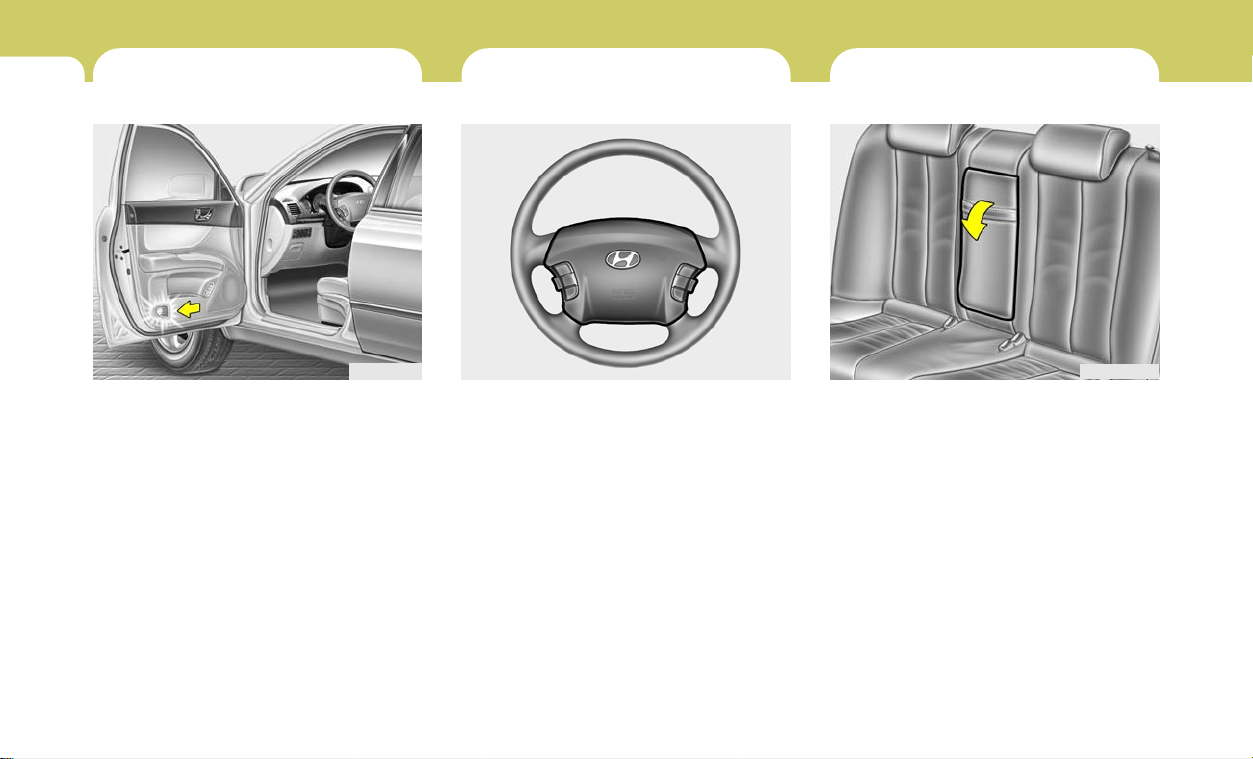
1
FEATURES OF YOUR HYUNDAI
92
FRONT DOOR WARNING
LIGHT
B620A01S-AAT
A red light comes on when the front door is
opened. The purpose of this light is to assist
when you get in or out and also to warn passing
vehicles.
B620A01NF
HORN
B610A01L-GAT
Press the pad on the steering wheel to sound the
horn.
B610A01NF
REAR SEAT ARMREST
B611A01Y-AAT
This armrest is located in the center of the rear
seatback.
B611A01NF-A
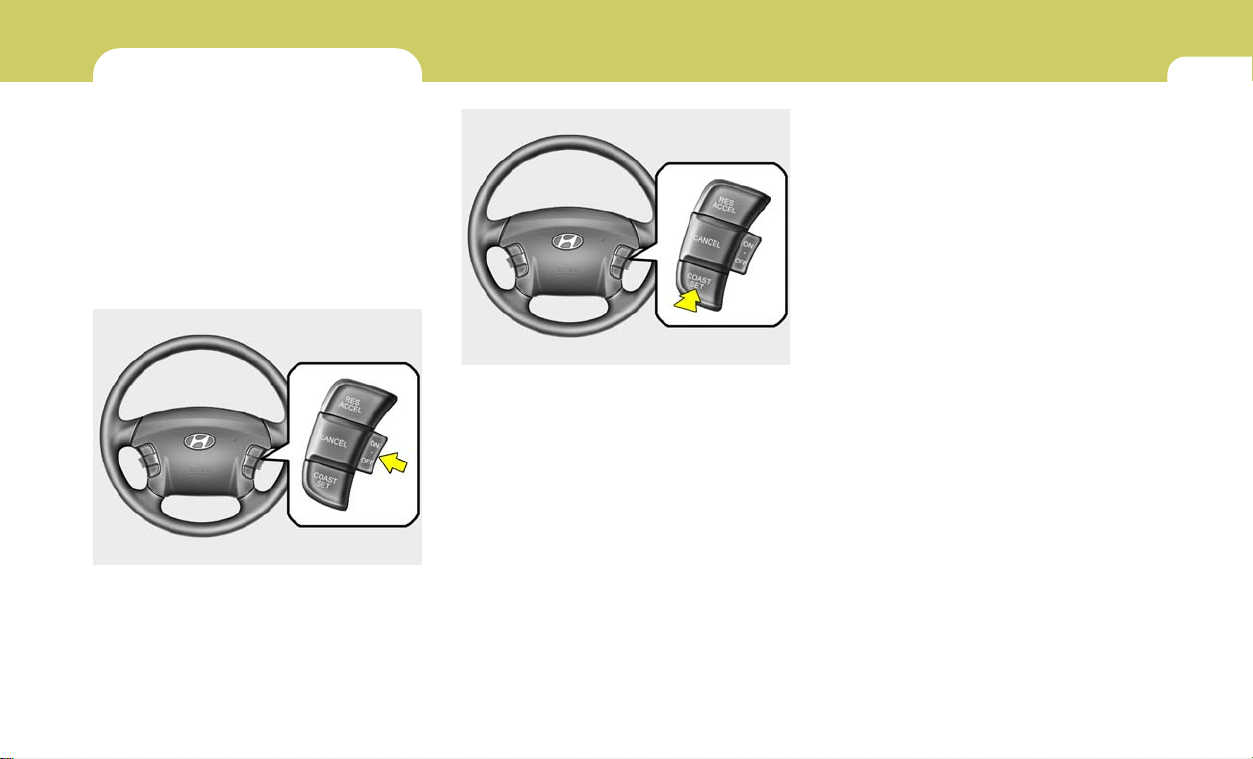
1
FEATURES OF YOUR HYUNDAI
93
NOTE:
If the vehicle speed decreases more than
9 mph (15 km/h) below the set speed or
decreases below 25 mph (40 km/h), the
cruise control system will automatically
cancel the set speed.
CRUISE CONTROL
B660A01S-AAT
The cruise control system provides automatic
speed control for your comfort when driving on
freeways, tollroads, or other noncongested
highways. This system is designed to function
above approximately 25 mph (40 km/h).
B660B01NF-AAT
To Set the Cruise Speed
1. Push the cruise control ON/OFF switch.
The "CRUISE" indicator light in the instru-
ment cluster will illuminate. This turns the
system on.
2. Accelerate to desired cruising speed above
40 km/h (25 mph).
B660A01NF
B660B02NF
3. Push the "SET" (COAST) switch after you
have set the vehicle speed at the desired
speed.
If the "SET (COAST)" switch is selected, the
cruise "SET" indicator light in the instrument
cluster will illuminate.
4. Remove your foot from the accelerator pedal
and the desired speed will automatically be
maintained.
5. To increase speed, temporarily depress the
accelerator pedal enough for the vehicle to
exceed the preset speed. When you remove
your foot from the accelerator pedal, the
vehicle will return to the speed you have set.
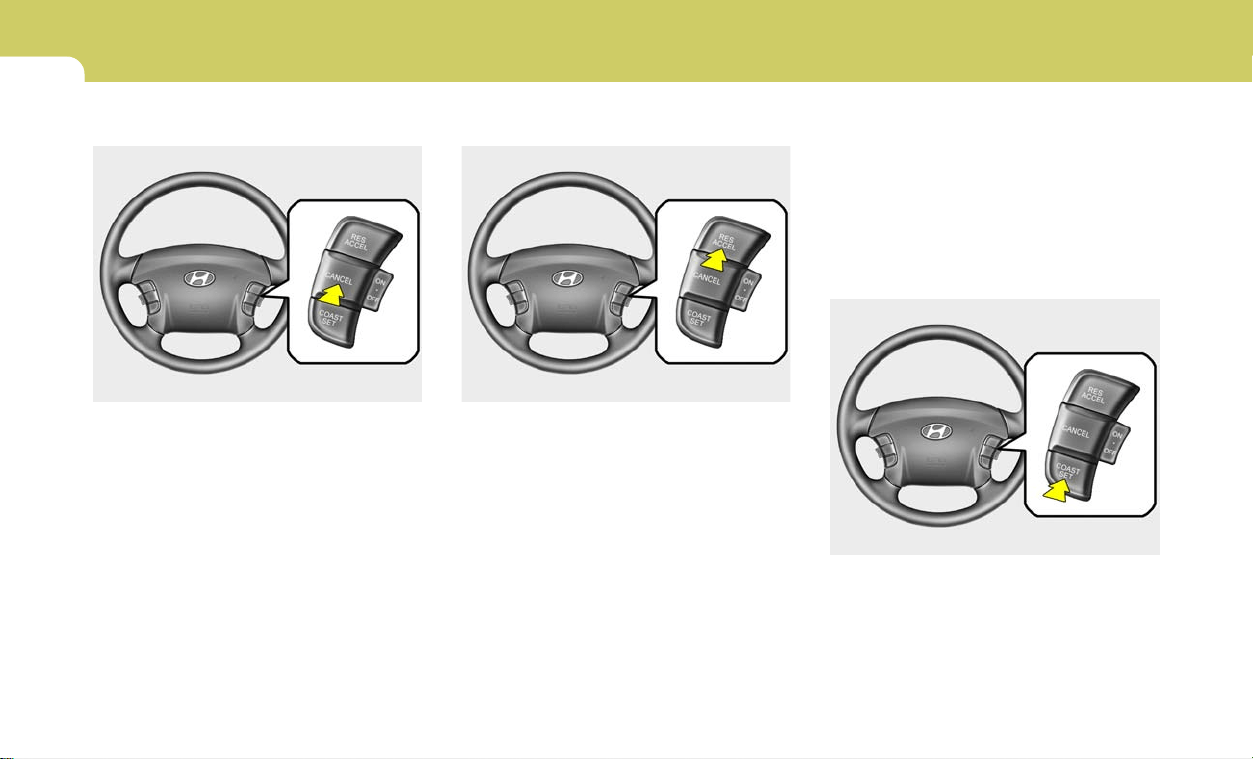
1
FEATURES OF YOUR HYUNDAI
94
B660E01NF-GAT
To Reset at a Faster Speed
1. Push the control switch "RESUME (ACCEL)"
and hold it.
B660C01NF-AAT
To Cancel the Cruise Speed
To disengage the cruise control system, push
the control switch "CANCEL".
Additionally, the following actions will disengage
the system:
o Depress the brake pedal.
o Depress the clutch pedal (Manual transaxle).
o Shift the selector lever to "N" position (Auto-
matic transaxle).
o Decrease the vehicle speed lower than the
memory speed by 9 mph (15 km/h).
o Decrease the vehicle speed to less than 25
mph (40 km/h).
o Release the cruise control ON/OFF switch.
B660C01NF
B660D01NF-AAT
To Resume the Preset Speed
The vehicle will automatically resume the speed
set prior to cancellation when you push the
control switch "RESUME (ACCEL)" and re-
lease it to return (when travelling above 25
mph).
If the control switch "RESUME(ACCEL)" is
selected, the cruise "SET" indicator in the in-
strument cluster will illuminate.
B660D01NF
B660F01NF-GAT
To Reset at a Slower Speed
1. Push the control switch "SET (COAST)" and
hold it. While the control switch is pushed, the
vehicle speed will gradually decrease.
If the "SET(COAST)" switch is selected, the
cruise "SET" indicator light in the instrument
cluster will illuminate.
2. When the desired speed is obtained, release
the control switch.
B660B02NF
If the control switch "RESUME(ACCEL)" is
selected, the cruise "SET" indicator in the
instrument cluster will illuminate.
2. Accelerate to desired speed and release the
control switch. While the control switch is
held, the vehicle will gradually gain speed.
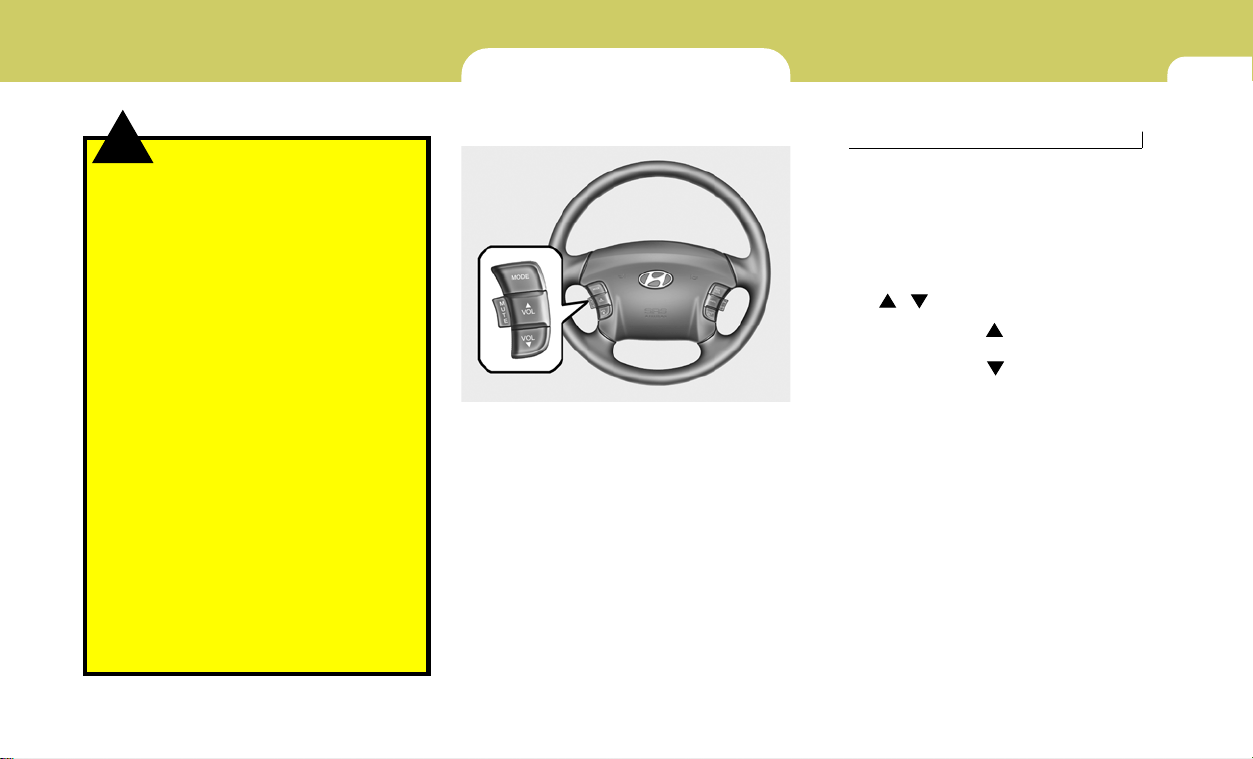
1
FEATURES OF YOUR HYUNDAI
95
MUTE Switch
o Press the MUTE switch to slience the sound.
o Once again press the MUTE switch to re-
store the sound.
VOL ( / ) Switch
o Press the VOL ( ) switch to increase
volume.
o Press the VOL ( ) switch to decease
volume.
RADIO (FM1 → FM2 → AM) → CD → CDC
→
!
AUDIO REMOTE CONTROL
SWITCH
B610A01NF-AAT
(If Installed)
NOTE:
Do not operate audio remote control
switches simultaneously.
MODE Switch
Press the MODE switch to select Radio, CD
(Compact Disc) and CDC (Compact Disc
Changer).
Each press of the switch changes the display
as follows:
B610A01NF-A
WARNING:
o Keep the cruise control ON/OFF switch
off when not using the cruise control.
o Use the cruise control system only when
traveling on open highways in good
weather.
o Do not use the cruise control when it
may not be safe to keep the car at a
constant speed, for instance, driving in
heavy or varying traffic, or on slippery
(rainy, icy or snow-covered) or winding
roads or over 6% up-hill or down-hill
roads.
o Pay particular attention to the driving
conditions whenever using the cruise
control system.
o During cruise-speed driving of a manual
transaxle vehicle, do not shift into neu-
tral without depressing the clutch pedal,
since the engine will be overrevved. If
this happens, depress the clutch pedal
or release the cruise control ON/OFF
switch.
o During normal cruise control operation,
when the "SET" switch is activated or
reactivated after applying the brakes,
the cruise control will energize after ap-
proximately 3 seconds. This delay is
normal.
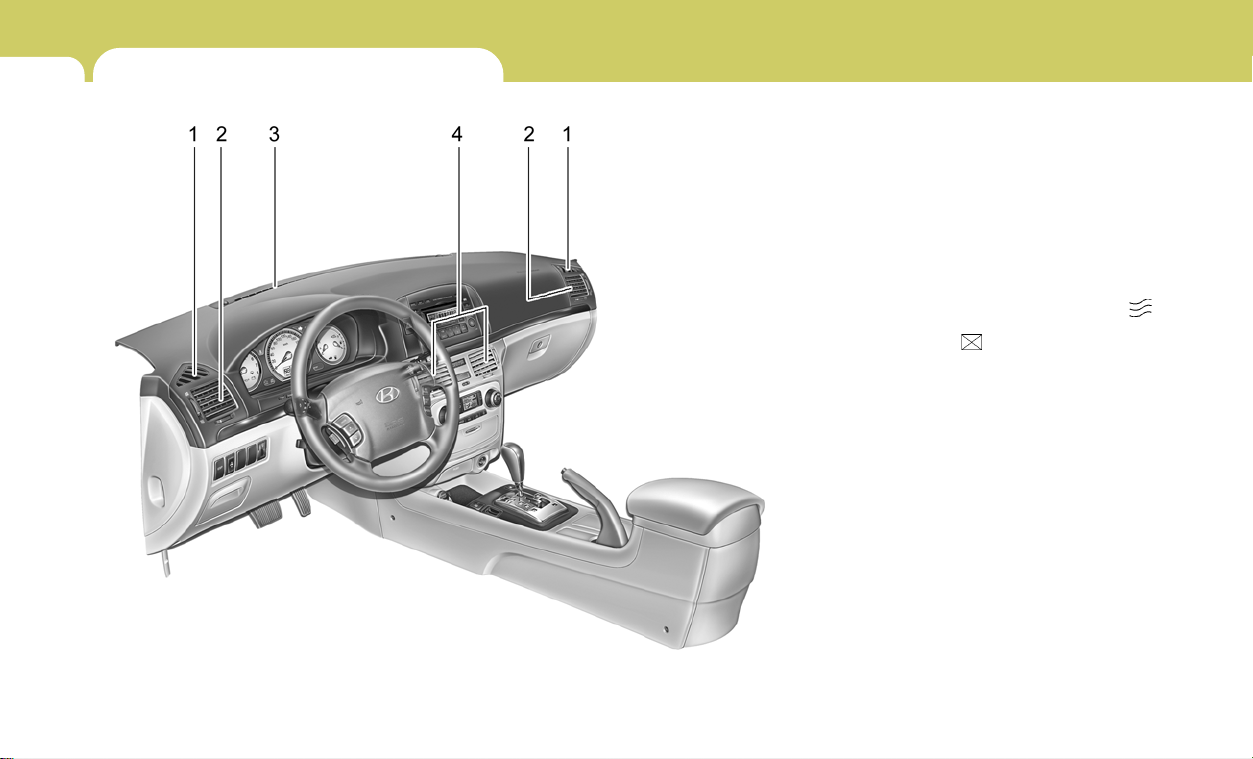
1
FEATURES OF YOUR HYUNDAI
96
HEATING AND COOLING CONTROL
B710A01E-GAT
B710A01NF-A
B710B01NF-GAT
Center Ventilator/Side Ventilator
The center ventilators are located in the middle
of the dashboard.
The side ventilators are located on each side of
the dashboard.
To change the direction of the air flow, turn the
control knob under the vents.
To control the amount of air, turn the control
knob on the left side of the vents. The vents are
opened when the vent knob is moved to " "
position. The vents are closed when the vent
knob is moved to " ". Keep these vents clear
of any obstructions.
1. Side Defroster Nozzle
2. Side Ventilator
3. Windshield Defroster Nozzle
4. Center Ventilator
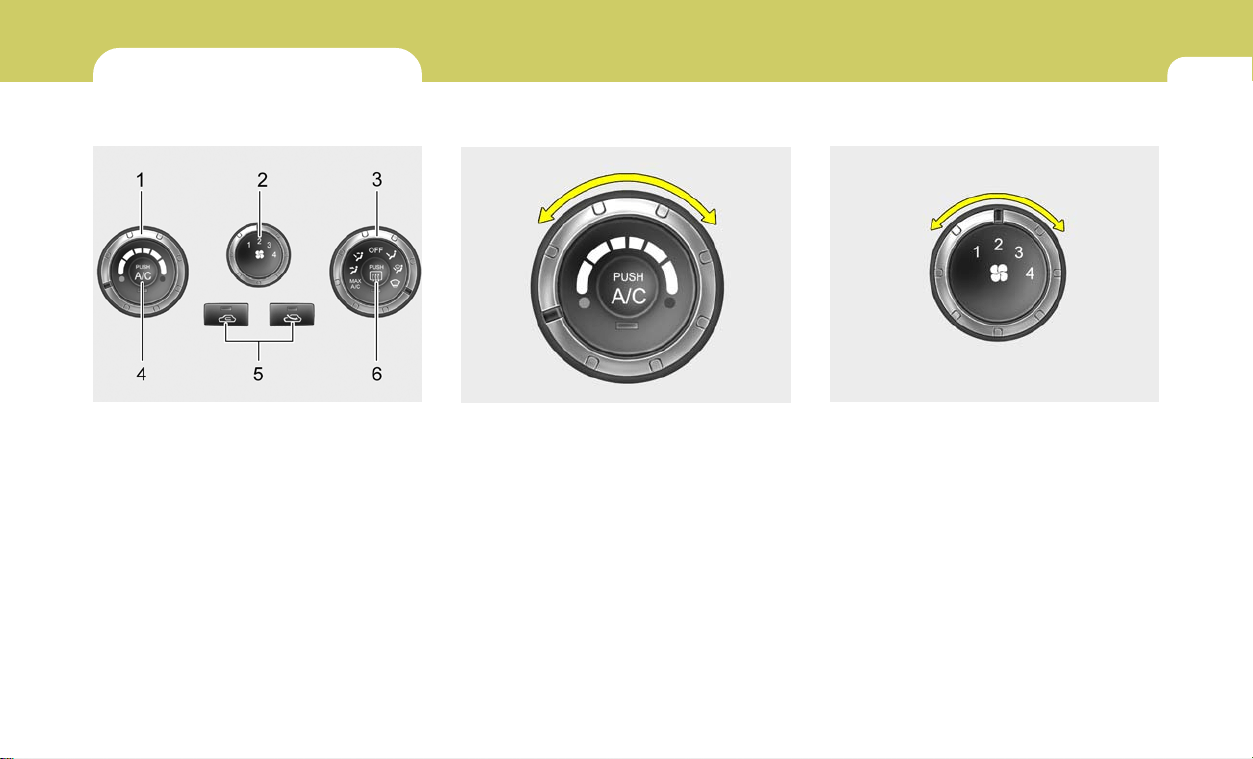
1
FEATURES OF YOUR HYUNDAI
97
B670B02O-AAT
Fan Speed Control (Blower Control)
HEATING AND VENTILATION
B670A01NF-GAT
Rotary and Push Button Type
1. Temperature control
2. Fan speed control
3. Air flow control
4. Air conditioning switch
5. Air intake control
6. Rear window defroster switch
This is used to select the blower fan speed.
The blower fan speed, and therefore the volume
of air delivered from the system, may be con-
trolled manually by setting the blower control
between the "1" and "4" position.
1 is the lowest fan speed and 4 is the highest fan
speed.
HNF2118-A HNF2125-A
B670E01A-AAT
Temperature Control
This is used to turn the heating system on and
off and to select the degree of heating desired.
HNF2126
Cool
Warm
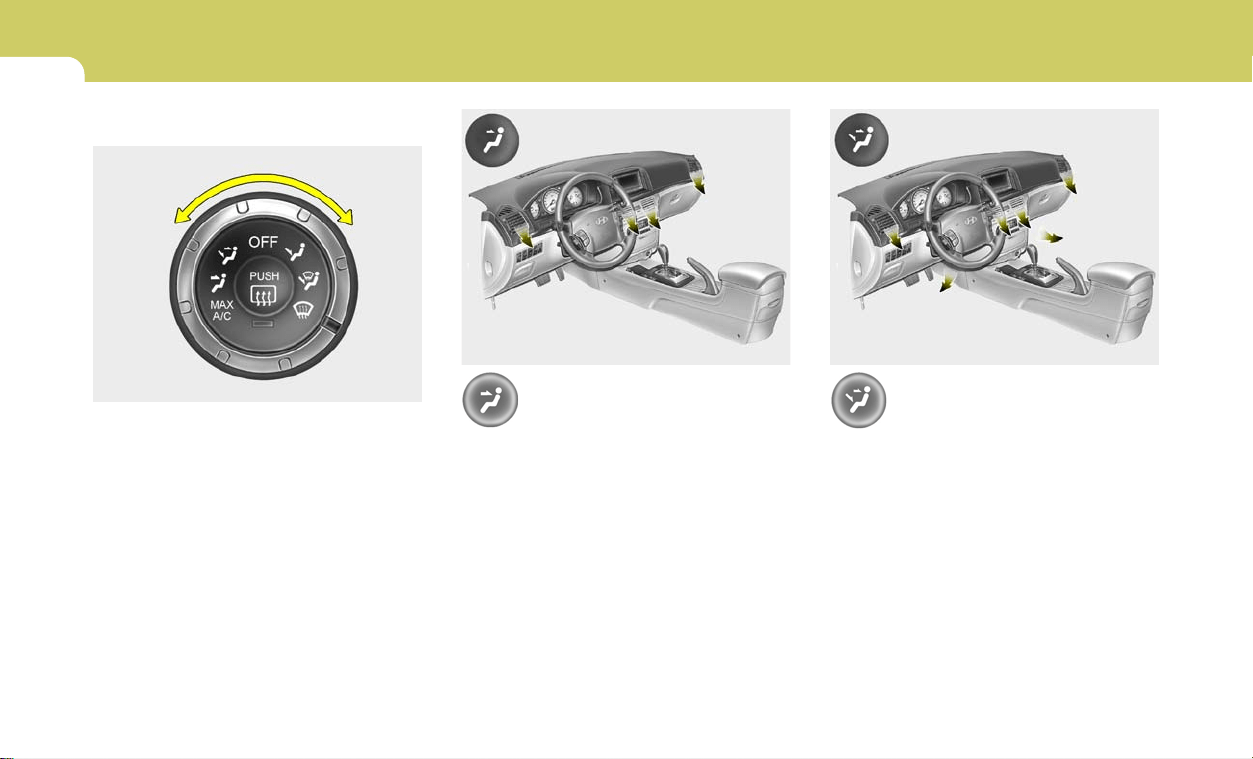
1
FEATURES OF YOUR HYUNDAI
98
B670D04O-AAT
Air Flow Control
This is used to turn the blower fan on/off and to
direct the flow of air. Air can be directed to the
floor, dashboard outlets, or windshield. Five
symbols are used to represent Face, Bi-Level,
Floor, Floor-Defrost and Defrost air position.
The MAX A/C mode is used to cool the inside of
the vehicle faster. The "OFF" mode is used to
turn the blower fan off.
Face-Level
Selecting the "Face" mode will cause air to be
discharged through the face level vents.
Bi-Level
Air is discharged through the face vents and the
floor vents. This makes it possible to have
cooler air from the dashboard vents and warmer
air from the floor outlets at the same time.
HNF2119-A
HNF2121
HNF2120
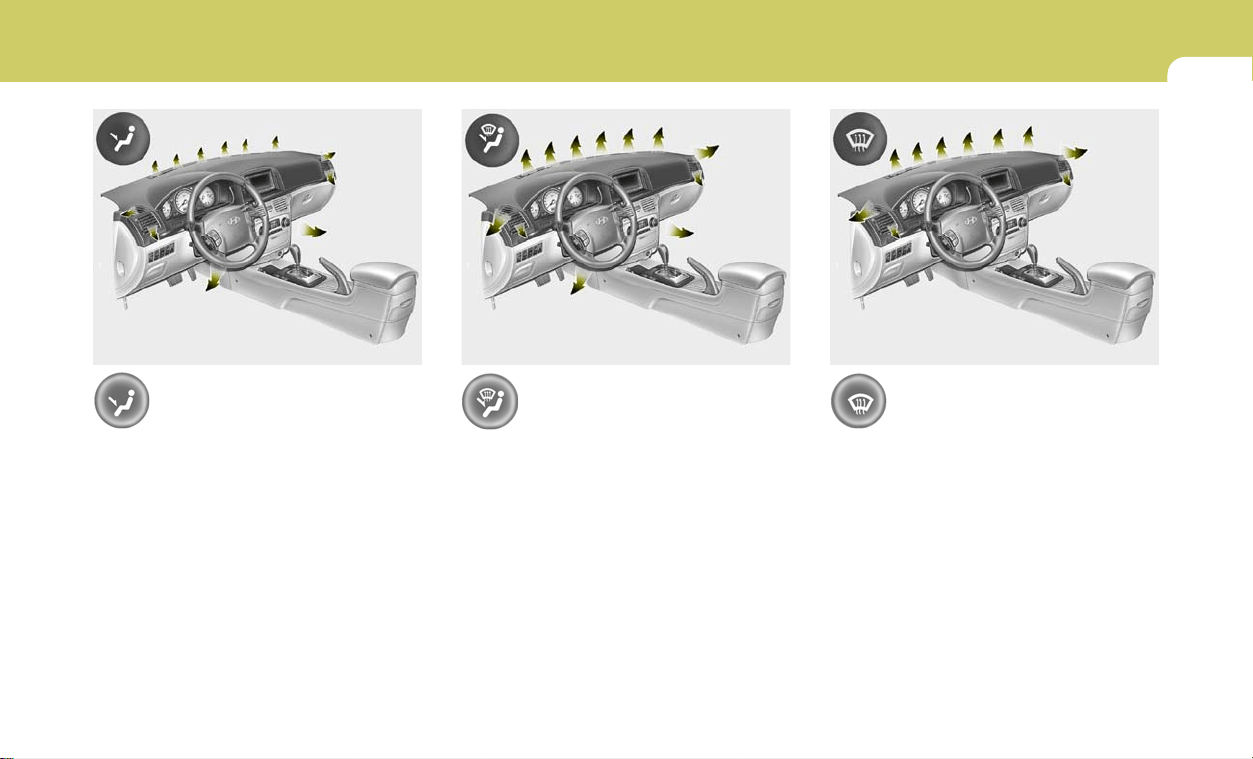
1
FEATURES OF YOUR HYUNDAI
99
Floor-Level
Air is discharged through the floor vents, wind-
shield defroster nozzle, side defroster nozzle
and side ventilator.
If the "Floor" mode is selected, the "Fresh"
mode will be activated.
Floor-Defrost Level
Air is discharged through the windshield de-
froster nozzle, the floor vents, side defroster
nozzle and side ventilator.
If the "Floor-Defrost" mode is selected, the A/C
will turn on automatically and "Fresh" mode will
be activated.
HNF2124
HNF2122
HNF2123
Defrost-Level
Air is discharged through the windshield de-
froster nozzle, side defroster nozzle and side
ventilator.
If the "Defrost" mode is selected, the A/C will turn
on automatically and "Fresh" mode will be ac-
tivated to improve windshield defrosting.
NOTE:
If the "Floor-Defrost" or "Defrost" mode is
selected, the air conditioning will not turn
off by pushing the A/C button.
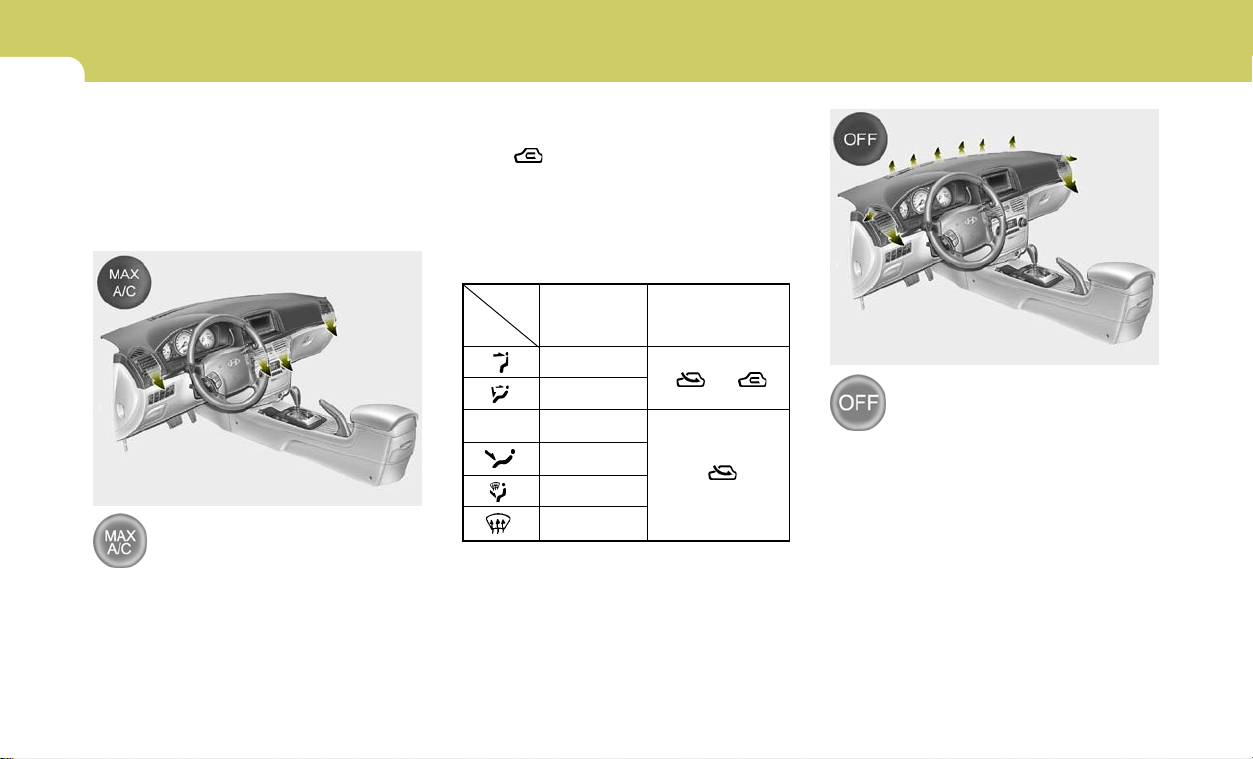
1
FEATURES OF YOUR HYUNDAI
100
If the air flow control is set to the floor-
defrost or the defrost mode, the A/C will
turn on automatically but the A/C indicator
light does not turn on. The A/C will not turn
off until the air flow control is set to the
another mode except the floor-defrost mode
and the defrost mode.
MAX A/C-Level
Air is discharged through the face level vents.
If the "MAX A/C" mode is selected, the A/C will
turn on automatically and "Recirculation" mode
will be activated.
B670D01NF-A
NOTE:
o The air intake control switch will change
to " " mode when the ignition switch
is turned "ON" with the MAX A/C mode
selected.
o When you change to another mode from
MAX A/C, the A/C and the air intake
control switch are set as shown in the
following chart.
* The A/C or the air intake control switch
returns to its former setting.
A/C
ON
ON or OFF *
OFF
ON or OFF *
ON
ON
Air Intake
Control Switch
or *
OFF
OFF-Level
Air is discharged through the windshield de-
froster nozzle, side defroster nozzle and side
ventilator.
NOTE:
If the air flow control is off, the air intake
control is set to the fresh mode automati-
cally.
B670D02NF-A
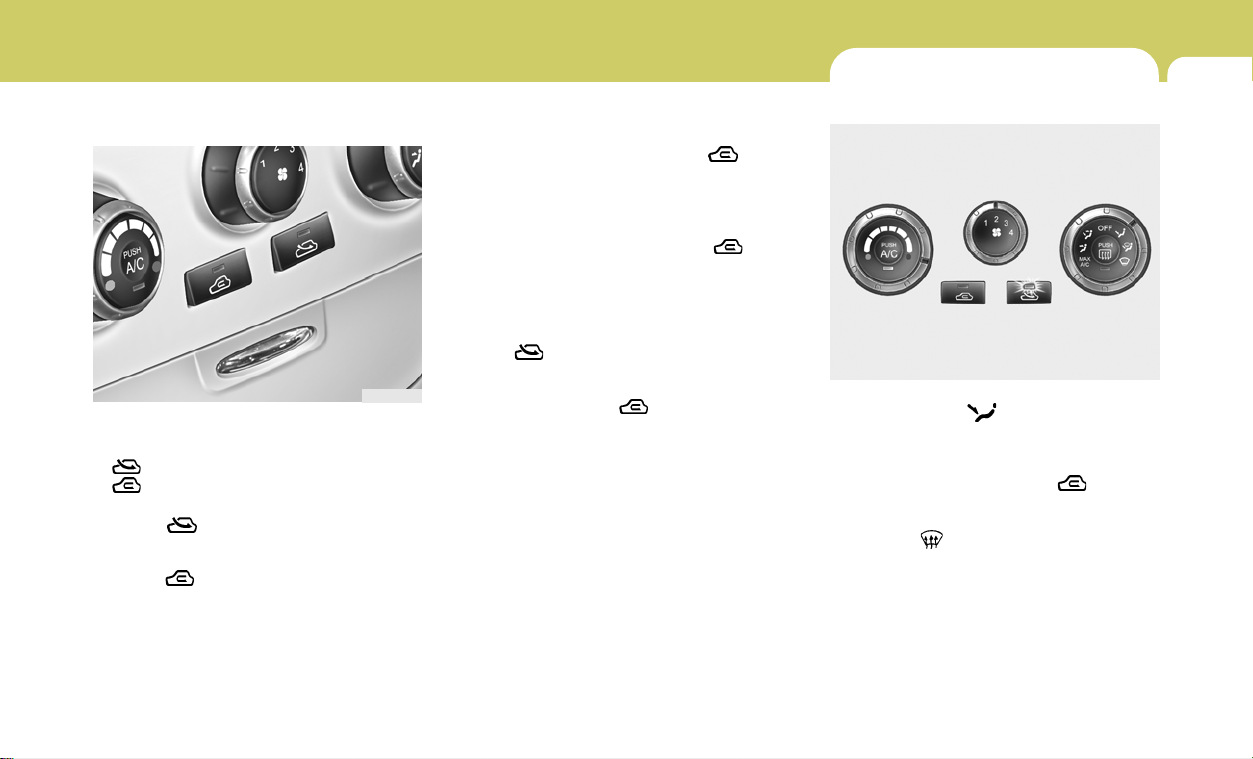
1
FEATURES OF YOUR HYUNDAI
101
For normal heating operation, set the air flow
control to the floor ( ) position. (The "Fresh"
mode will be activated.)
For faster heating, the air intake control switch
should be set in the recirculate ( ) position.
If the windows fog up, set the air flow control to
the defrost ( ) position (The A/C will turn on
automatically and "Fresh" mode will be acti-
vated.)
For maximum heat, move the temperature con-
trol to "Warm".
B670C02Y-AAT
Air Intake Control
This is used to select fresh outside air or
recirculation of inside air.
Fresh
Recirculation
With the " " mode selected, air enters the
vehicle from outside and is heated or cooled
according to the other functions selected.
With the " " mode selected, air from within
the passenger compartment is drawn through
the heating system and heated or cooled ac-
cording to the other functions selected.
NOTE:
o It should be noted that prolonged opera-
tion of the heating system in " " mode
will give rise to fogging of the wind-
shield and side windows and the air
within the passenger compartment will
become stale. In addition prolonged use
of the air conditioning with the " " mode
selected may result in the air within the
passenger compartment becoming ex-
cessively dry.
o When the ignition switch is turned "ON"
the air intake control switch will change
to " " mode in floor, floor-defrost and
defrost position. This is normal opera-
tion. But, the air intake control switch
will change to " " mode when the
ignition switch is turned "ON" with the
MAX A/C mode selected.
HNF2127-A
HEATING CONTROLS
B690A01O-AAT
B690A01NF-A
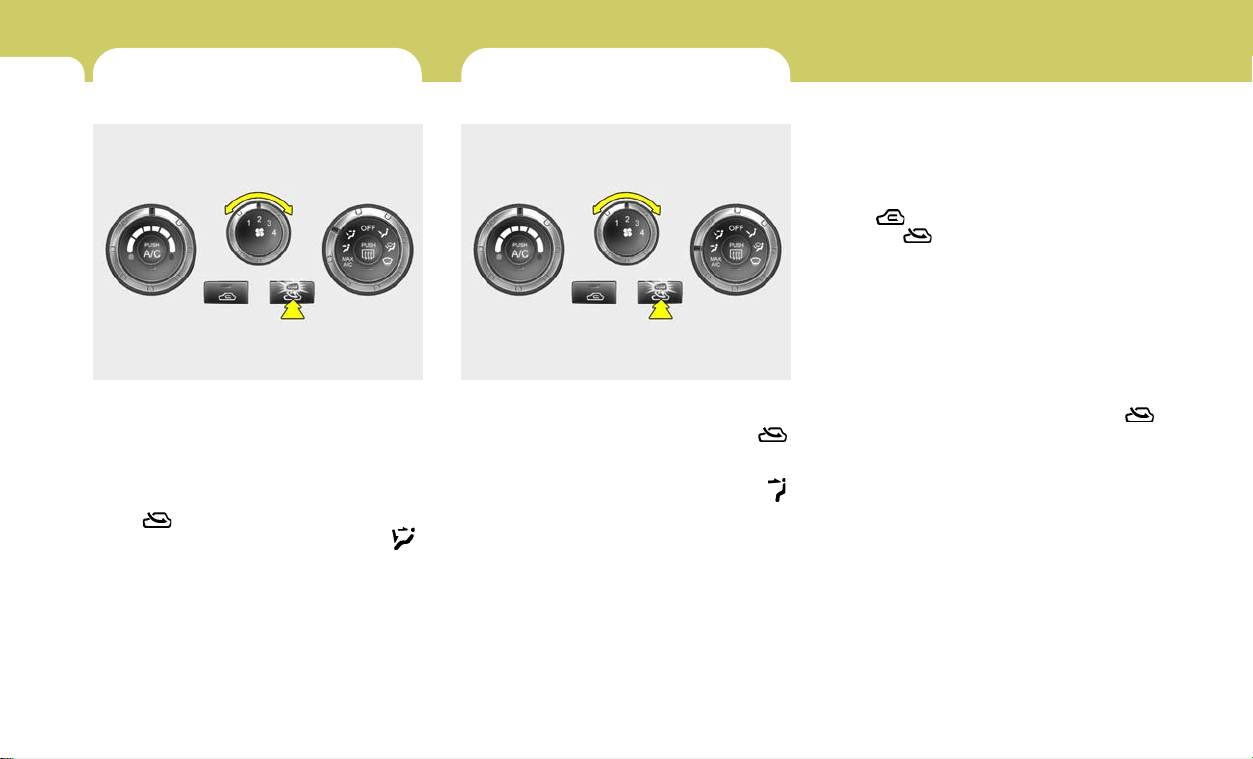
1
FEATURES OF YOUR HYUNDAI
102
VENTILATION
B700A02A-AAT
BI-LEVEL HEATING
B710A01A-AAT
Your Hyundai is equipped with bi-level heating
controls. This makes it possible to have cooler
air from the dashboard vents and warmer air
from the floor outlets at the same time. To use
this feature:
o Set the air intake control switch to the fresh
air ( ) position.
o Set the air flow control at the bi-level ( )
position.
o Adjust the fan speed control to the desired
speed.
o Set the temperature control between "Cool"
and "Warm".
B700A01NF-A
To operate the ventilation system:
o Set the air intake control to the fresh air ( )
position.
o To direct all intake air to the dashboard
vents, set the airflow control to the face ( )
position.
o Adjust the fan speed control to the desired
speed.
o Set the temperature control between "Cool"
and "Warm".
B710A02NF-A
B730A01L-AAT
Operation Tips
o To keep dust or unpleasant fumes from
entering the car through the ventilation sys-
tem, temporarily set the air intake control at
the position. Be sure to return the control
to the position when the irritation has
passed to keep fresh air in the vehicle. This
will help keep the driver alert and comfort-
able.
o Air for the heating/cooling system is drawn
in through the grilles just ahead of the wind-
shield. Care should be taken that these are
not blocked by leaves, snow, ice or other
obstructions.
o To prevent interior fog on the windshield, set
the air intake control to the fresh air ( )
position and fan speed to the desired posi-
tion, turn on the air conditioning system, and
adjust temperature control to desired tem-
perature.
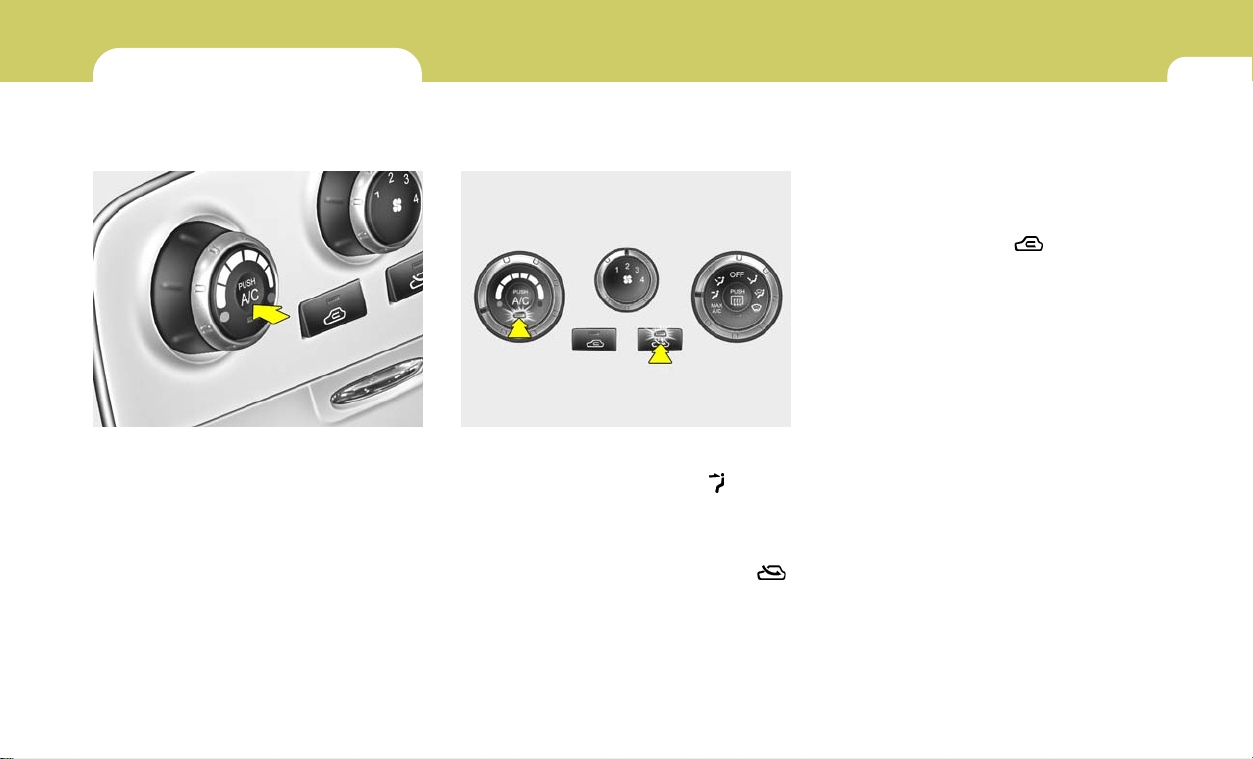
1
FEATURES OF YOUR HYUNDAI
103
AIR CONDITIONING SYSTEM
B740B03O-AAT
Air Conditioning Operation
Cooling
To use the air conditioning to cool the interior:
o Set the air flow control to the face ( ) position.
o Turn on the air conditioning switch by push-
ing in on the switch. The air conditioning
indicator light should come on at the same
time.
o Set the air intake control to the fresh air ( )
position.
B740A01S-AAT
Air Conditioning Switch
(If Installed)
The air conditioning is turned on or off by
pushing the A/C button on the heating/air con-
ditioning control panel.
HNF2128-A B740B01NF-A
o Set the temperature control to "Cool". ("Cool"
provides maximum cooling. The tempera-
ture may be moderated by moving the con-
trol toward "Warm".)
o Adjust the fan control to the desired speed.
For greater cooling, turn the fan control to
one of the higher speeds or temporarily
select the recirculate ( ) position on the
air intake control.
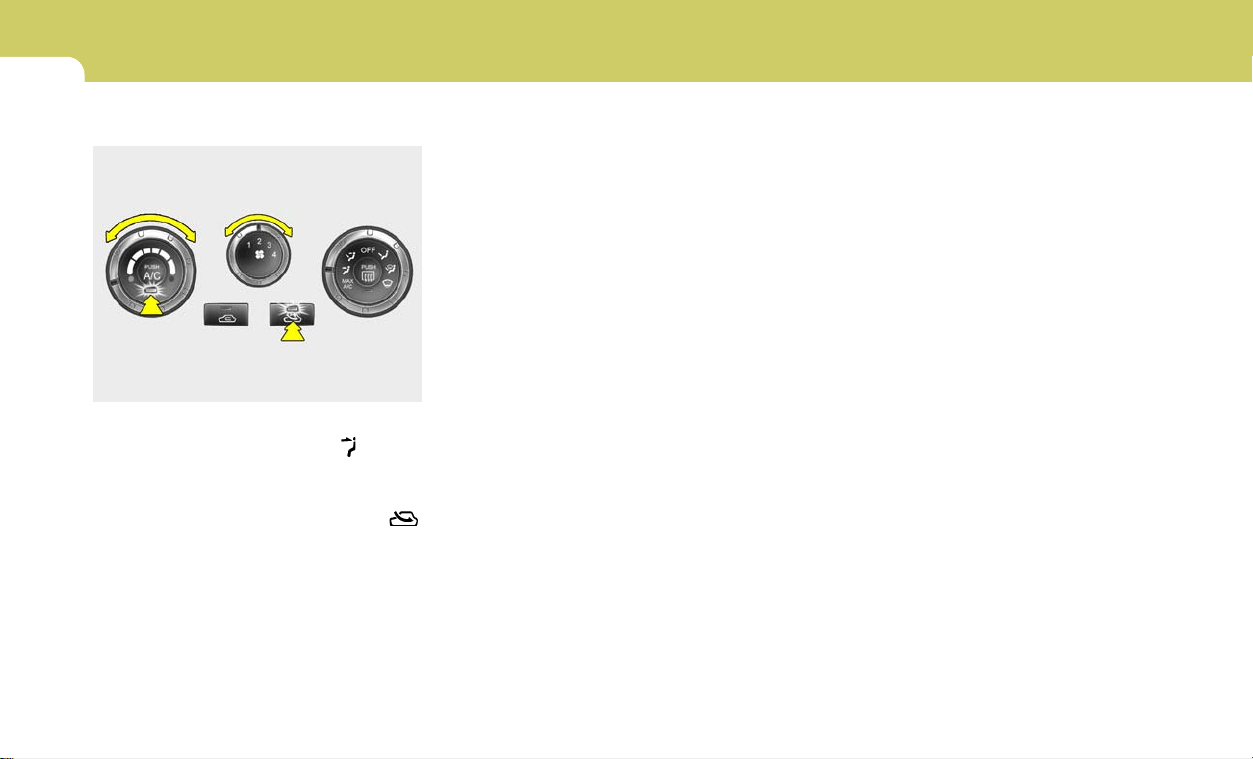
1
FEATURES OF YOUR HYUNDAI
104
B740C02O-AAT
De-Humidified Heating
For dehumidified heating:
o Set the air flow control to the face ( ) position.
o Turn on the air conditioning switch. The air
conditioning indicator light should come on at
the same time.
o Set the air intake control to the fresh air ( )
position.
o Adjust the fan control to the desired speed.
o For more rapid action, set the fan at one of
the higher speeds.
o Adjust the temperature control to provide the
desired amount of warmth.
B740C01NF-A
B740D02Y-AAT
Operation Tips
o If the interior of the car is hot when you first
get in, open the windows for a few minutes
to expel the hot air.
o When you are using the air conditioning
system, keep all windows closed to keep hot
air out.
o When moving slowly, as in heavy traffic, shift
to a lower gear. This increases engine speed,
which in turn increases the speed of the air
conditioning compressor.
o On steep grades, turn the air conditioning off
to avoid the possibility of the engine over-
heating.
o During winter months or in periods when the
air conditioning is not used regularly, run the
air conditioning once every month for a few
minutes. This will help circulate the lubri-
cants and keep your system in peak oper-
ating condition.
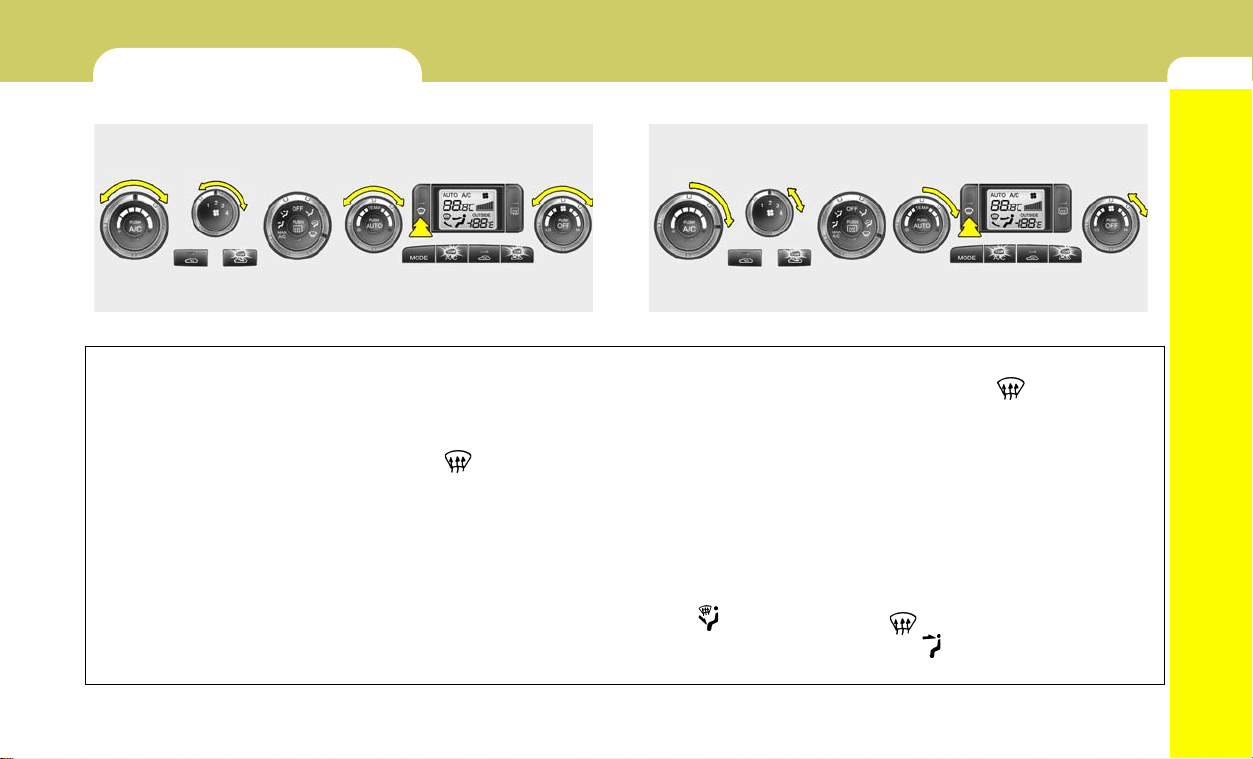
1
FEATURES OF YOUR HYUNDAI
105
DEFROSTING/DEFOGGING
B720A02E-AAT
Use the heating/ventilation system to defrost or defog the
windshield:
To remove interior fog on the windshield;
o Set the air flow control to the defrost ( ) position. (The
A/C will turn on automatically and the "Fresh" mode will be
activated.)
o Set the temperature control to the desired position.
o Set the fan speed control between "1" and "4" position.
To remove frost or exterior fog on the windshield;
o Set the air flow control to the defrost ( ) position. (The
A/C will turn on automatically and the "Fresh" mode will be
activated.)
o Set the temperature control to warm.
o Set the fan speed control to position "3" or "4".
NOTE:
When the A/C is operated continuously on the floor-defrost level ( ) or defrost level ( ), it may cause fog to form
on the exterior windshield. If this occurs, set the air flow control to the face level position ( ) and fan speed control
to the low position.
B720A01NF-A
B720A02NF-A
Manual A/C Automatic A/C Manual A/C Automatic A/C
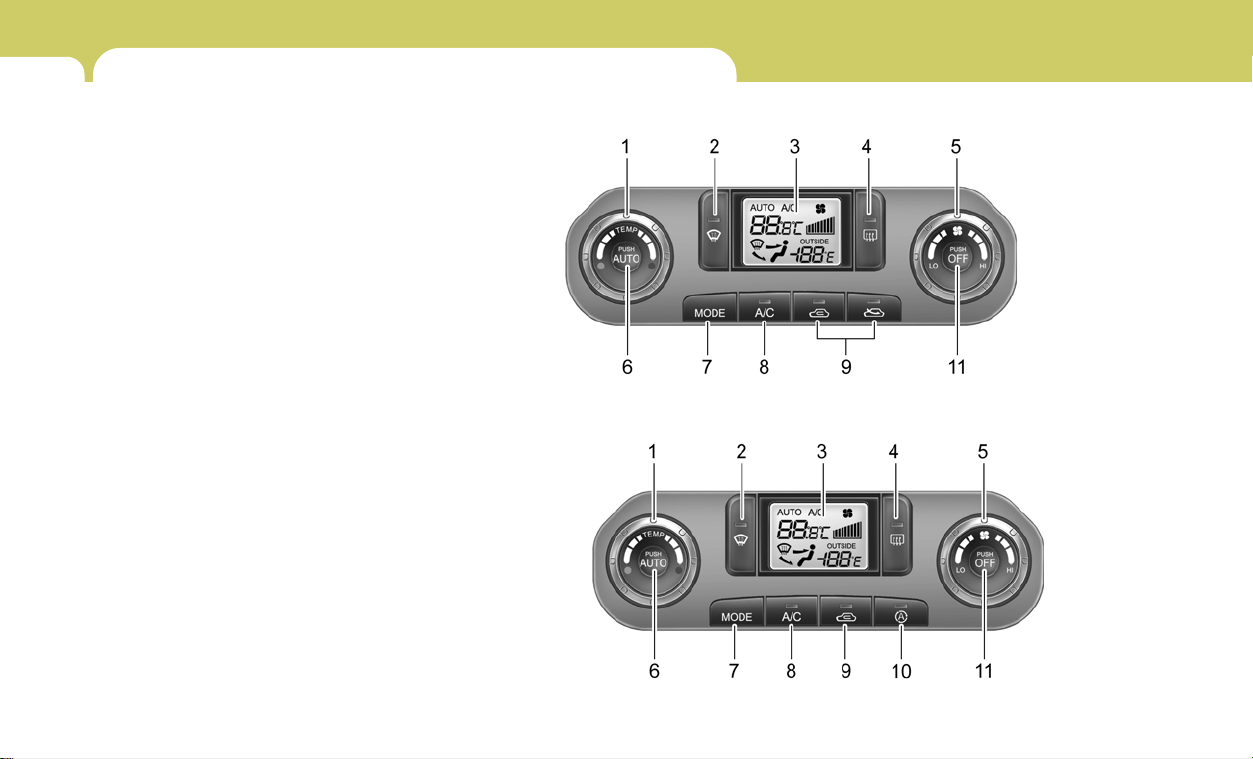
1
FEATURES OF YOUR HYUNDAI
106
AUTOMATIC HEATING AND COOLING CONTROL SYSTEM
B970A01Y-AAT
(If lnstalled)
Your Hyundai is equipped with an automatic
heating and cooling control system controlled
by simply setting the desired temperature.
B970B01NF-GAT
Heating and Cooling Controls
1. Temperature Control
2. Defroster Switch
3. Display Window
4. Rear Window Defroster Switch
5. Blower Fan Control
6. AUTO (Automatic Control) Switch
7. Air Flow Control Switch
8. Air Conditioning Switch
9. Air lntake Control Switch
10. Air Quality System Switch
(If Installed)
11. OFF Switch
TYPE B (With Air Quality System)
B970B01NF
B970B02NF
TYPE A (Without Air Quality System)
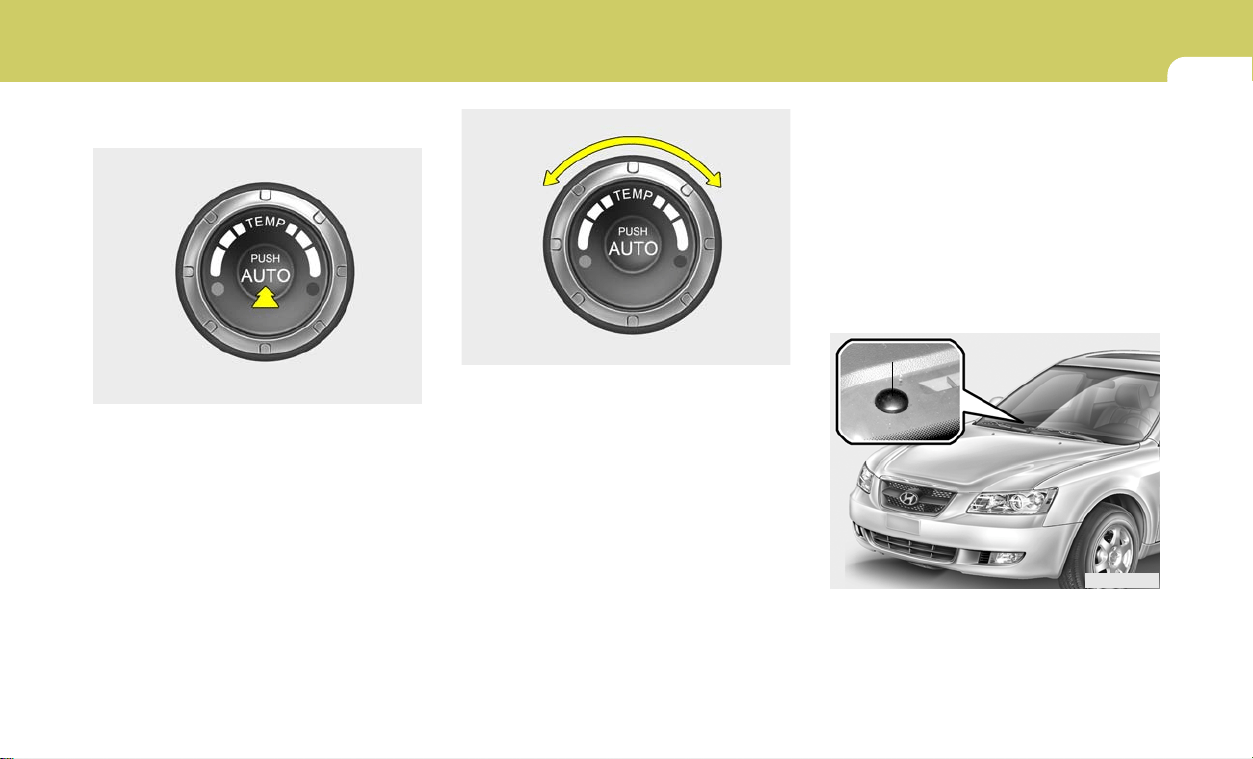
1
FEATURES OF YOUR HYUNDAI
107
B970C01NF-AAT
Automatic Operation
The FATC (Full Automatic Temperature Con-
trol) system automatically controls heating and
cooling as follows:
1. Push the "AUTO" switch. The indicator light
will illuminate confirming that the Face, Floor
and/or Bi-Level modes as well as the blower
speed and air conditioner will be controlled
automatically.
And, the air conditioning will operate if ambi-
ent temperature is higher than 34.7°F(1.5°C)
and automatically turns off if the ambient
temperature drops below 33.08°F(0.6°C).
2. Turn the "TEMP" knob to set the desired
temperature.
The temperature will increase to the maxi-
mum "HI" by turning the knob clockwise.
The temperature will decrease to the mini-
mum "LO" by turning the knob counter-
clockwise.
NOTE:
If the battery has been discharged or dis-
connected, the temperature mode will reset
to Centigrade degrees.
This is a normal condition and you can
change the temperature mode from Centi-
grade to Fahrenheit as follows;
Press the "OFF" and "AUTO " button simul-
taneously for 3 seconds.
The display shows that the unit of tempera-
ture is adjusted to Centigrade or Fahrenheit
(°C
→→
→→
→ °F or °F
→→
→→
→ °C).
HNF2135
HNF2137
B970C01NF-A
Photo Sensor
NOTE:
Never place anything over the sensor which
is located on the instrument panel to en-
sure better control of the heating and cool-
ing system.
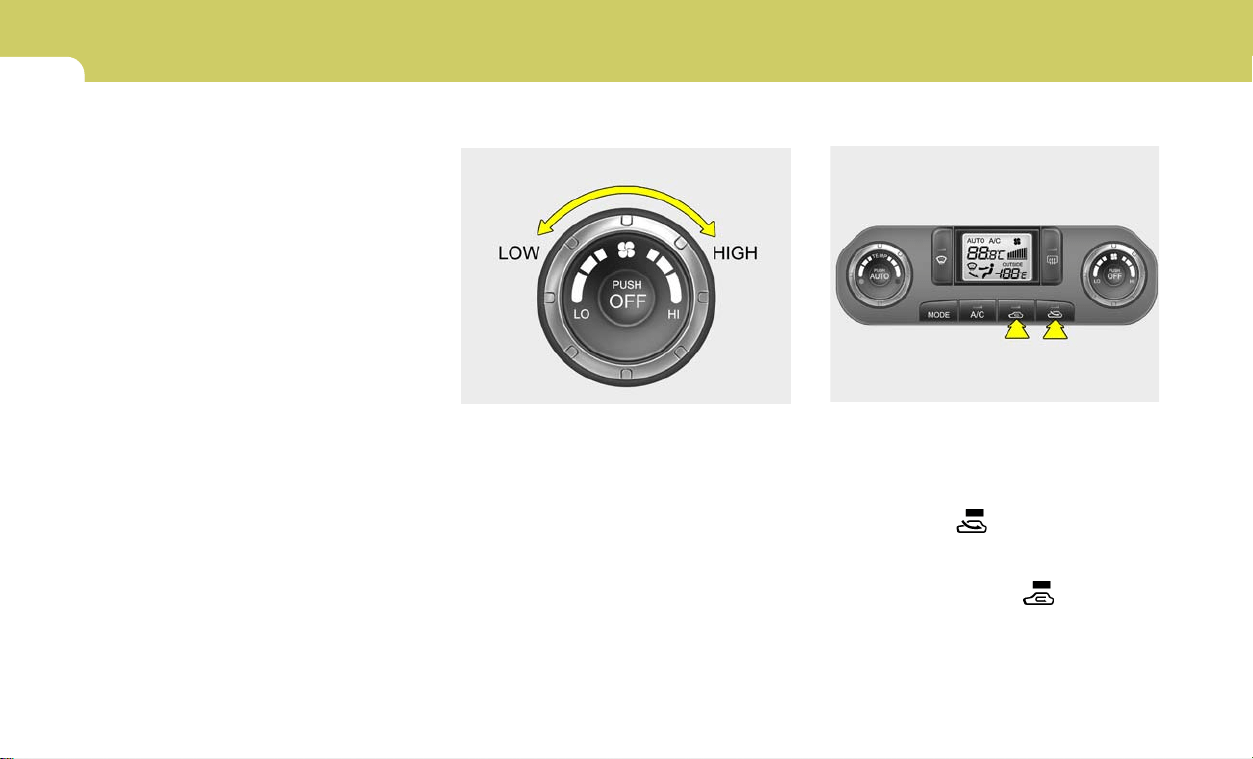
1
FEATURES OF YOUR HYUNDAI
108
B980B01NF-GAT
Fan Speed Control
The fan speed can be set to the desired speed
by turning the fan speed control knob. The
higher the fan speed is, the more air is delivered.
Pressing the "OFF" button turns off the fan.
HNF2133
B980A01Y-AAT
MANUAL OPERATION
The heating and cooling system can be con-
trolled manually as well by pushing buttons
other than the "AUTO" button. In this state, the
system sequentially works according to the
order of buttons selected.
The function of the buttons which are not se-
lected will be controlled automatically.
Press the "AUTO" button in order to convert to
automatic control of the system.
B670C02Y-AAT
Air Intake Control Switch (Without A.Q.S)
This is used to select fresh outside air or
recirculation of inside air.
To change the air intake control mode (Fresh
mode, Recirculation mode), push the control
button.
FRESH MODE ( ) : The indicator light on
the button goes on when the air intake control
is in fresh mode.
RECIRCULATION MODE ( ) : The indicator
light on the button is illuminated when the air
intake control is in recirculation mode.
HNF2139
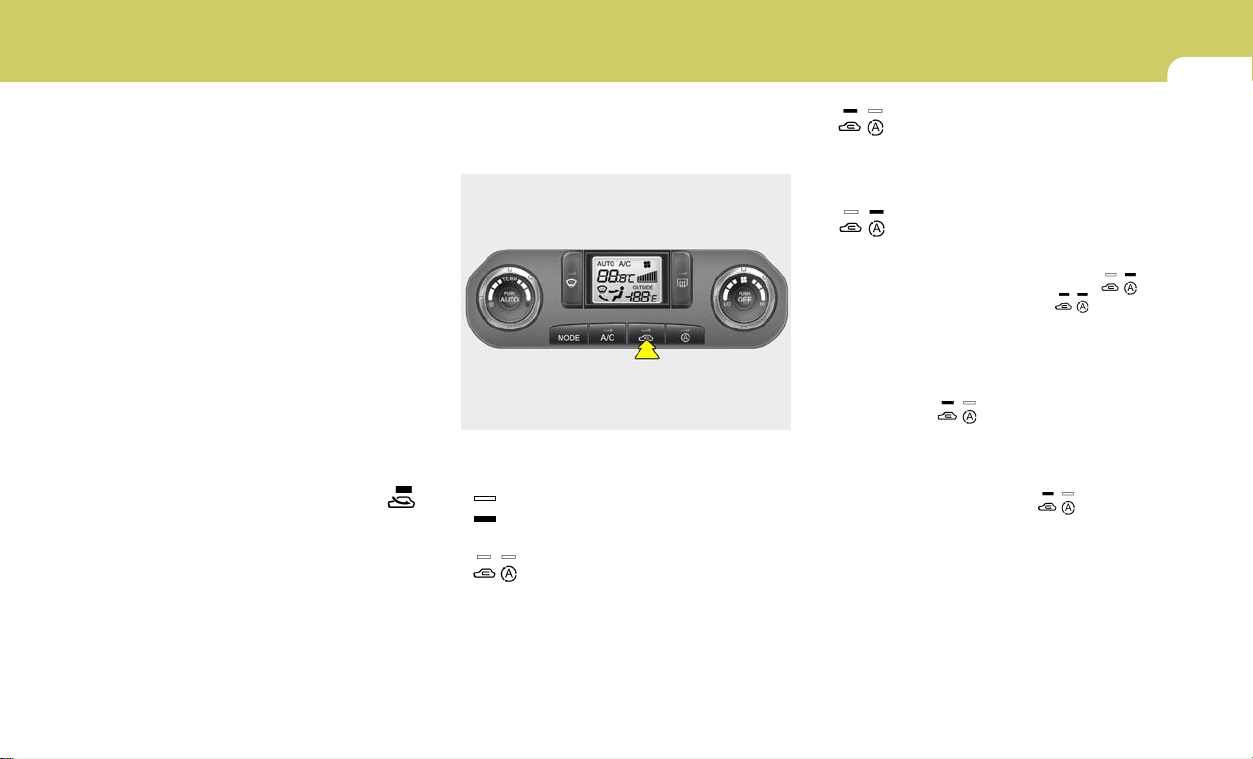
1
FEATURES OF YOUR HYUNDAI
109
With the "Fresh" mode selected, air enters the
vehicle from the outside and is heated or cooled
according to the function selected.
With the "Recirculation" mode selected, air from
within the passenger compartment will be drawn
through the heating system and heated or
cooled according to the function selected.
NOTE:
o It should be noted that prolonged opera-
tion of the heating system in "recircula-
tion" mode will give rise to fogging of the
windshield and side windows and the air
within the passenger compartment will
become stale. In addition, prolonged
use of the air conditioning with the "Re-
circulation" mode selected may result in
the air within the passenger compart-
ment becoming excessively dry.
o When the ignition switch is turned "ON"
the air intake control will change to " "
mode (regardless of switch position).
This is normal operation. The air intake
control operates in "AUTO" mode when
turning the ignition to the ON position if
the "AUTO" mode was used before shut-
ting off the engine.
Recirculation mode :
Air from witin the passenger compartment will
be drawn through the heating system and heated
or cooled according to the function selected.
Exhaust gas cutoff mode :
Air enters the vehicle from the outside.
But if exhaust gas enters the vehicle from the
outside, the exhaust gas cutoff mode ( ) is
automatically converted to the ( ) mode, to
prevent exhaust gas from entering the vehicle.
NOTE:
o It should be noted that prolonged opera-
tion of the heating system in recircula-
tion mode ( ) will give rise to misting
of the windshield and side windows and
the air within the passenger compart-
ment will become stale. In addition, pro-
longed use of the air conditioning with
the recirculation mode ( ) sele-cted
may result in the air within the passenger
compartment becoming excessively dry.
o When the ignition switch is turned "ON",
the air intake control will change to
"Fresh" mode (regardless of switch po-
sition). This is normal operation. The air
intake control operates in "AUTO" mode
when turning the ignition to the ON
position if the "AUTO" mode was used
before shutting off the engine.
B980C03Y-GAT
Air Intake Control Switch
(With A.Q.S) (If Installed)
This is used to select fresh outside air or
recirculate inside air automatically.
: OFF
:ON
Fresh mode :
Air enters the vehicle from the outside and is
heated or cooled according to the function
selected.
HNF2139-1
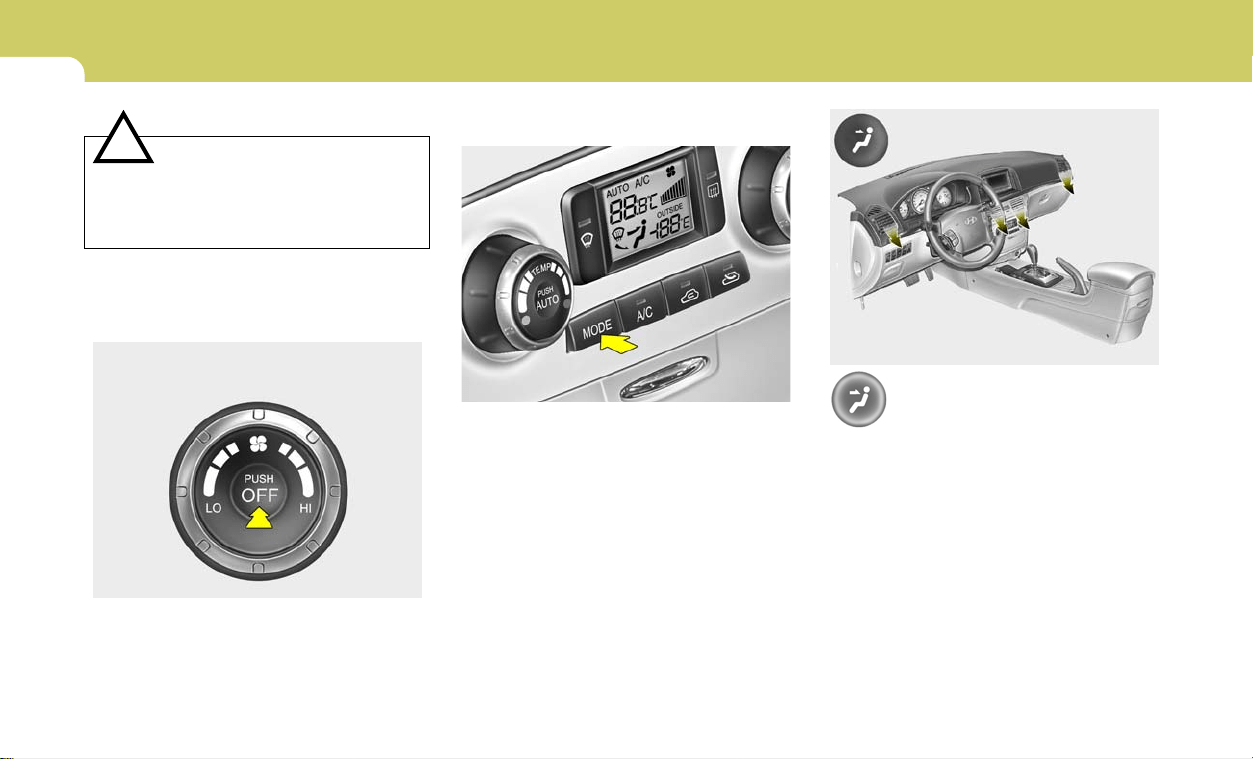
1
FEATURES OF YOUR HYUNDAI
110
Face-Level
When selecting the "Face-Level" mode, the
indicator light will come on, causing air to be
discharged through the face level vents.
HNF2120
B980D01Y-AAT
Heating and Cooling System Off
Press the "OFF" button to stop the operation of
the heating and cooling system.
HNF2143
B980E01NF-GAT
Air Flow Control
This is used to direct the flow of air. Air can be
directed to the floor, dashboard outlets, or
windshield. Four symbols are used to represent
Face, Bi-Level, Floor, Floor-Defrost position.
B980E01NF-A
!
CAUTION:
If the windows fog up with the Recircula-
tion or A.Q.S mode selected, set the air
intake control to the Fresh air position or
A.Q.S control to "OFF".
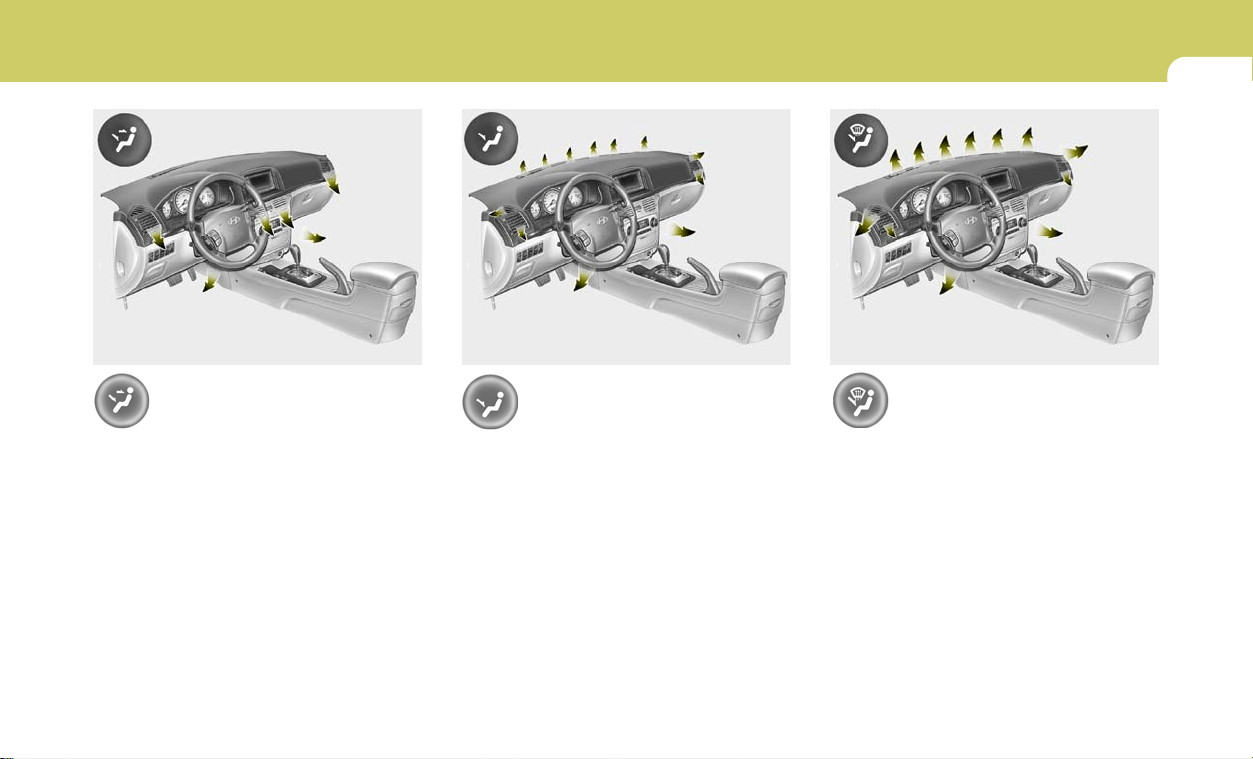
1
FEATURES OF YOUR HYUNDAI
111
HNF2122
Floor-Level
When selecting the "Floor-Level", the indicator
light will come on and the air will be discharged
through the floor vents, windsheld defroster
nozzle, side defroster nozzle and side ventila-
tor.
Bi-Level
When selecting the "Bi-Level", the indicator light
will come on and the air will be discharged
through the face vents and the floor vents. This
makes it possible to have cooler air from the
dashboard vents and warmer air from the floor
outlets at the same time.
HNF2121
Floor-Defrost Level
When selecting the "Floor-Defrost" mode, the
indicator light will come on and the air will be
discharged through the windshield defroster
nozzle, the floor vents, side defroster nozzle
and side ventilator.
If any of the temperature control switch, the
blower fan control switch, or the defrost switch
is selected in "Floor-Defrost" mode, the A/C will
turn on automatically and "Fresh" mode will be
activated.
HNF2123
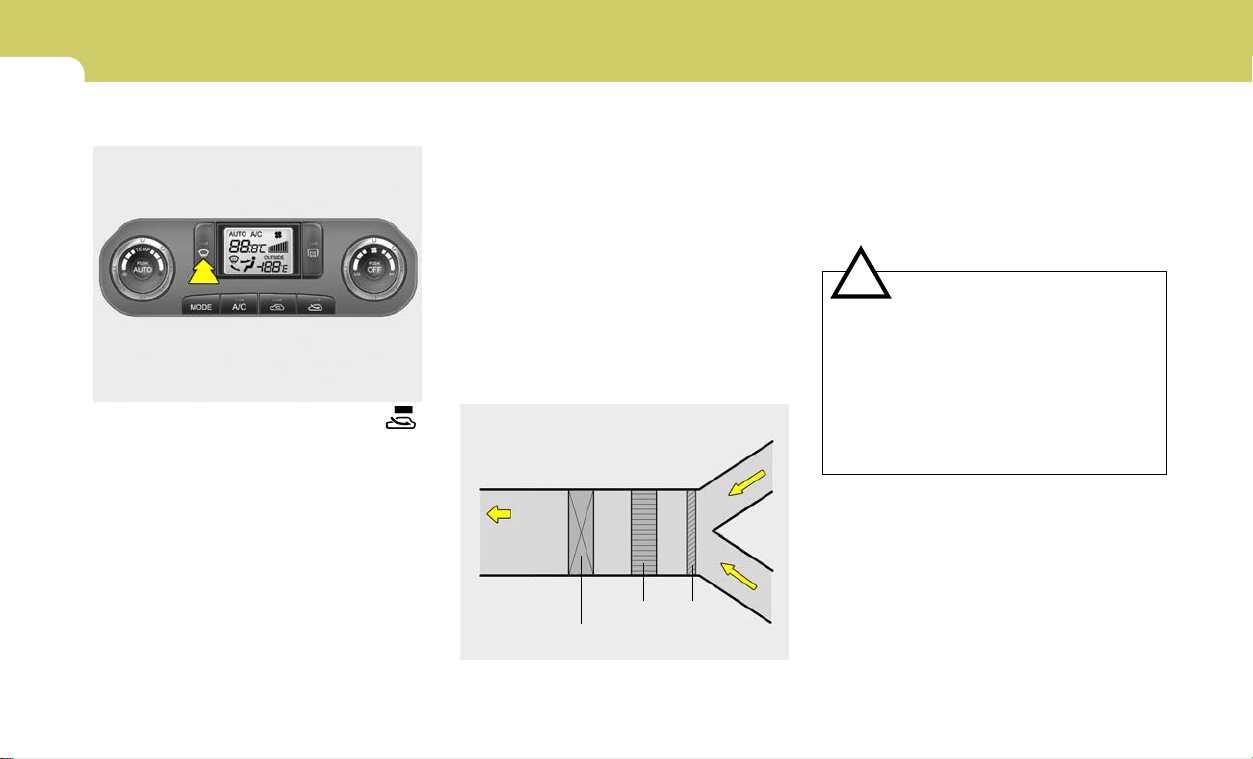
1
FEATURES OF YOUR HYUNDAI
112
B760A01NF-AAT
AIR CONDITIONER FILTER (FOR
EVAPORATOR AND BLOWER UNIT)
(If Installed)
The air conditioner filter is located in the right
side of the instrument panel.
It operates to decrease the amount of pollutants
entering the car.
To replace the air conditioner filter, refer to page
6-22.
HNF2181
Inside of
a vehicle
Evaporator core
FilterBlower
Outside air
Inside air
CAUTION:
o Replace the filter every 10,000 miles
(15,000 km) or once a year.
If the car is being driven in severe condi-
tions such as dusty, rough roads, more
frequent air conditioner filter inspec-
tions and changes are required.
o When the air flow rate is suddenly de-
creased, it must be checked at an autho-
rized dealer.
!
B980F01NF-AAT
Defrost Switch
When the "Defrost" button is pressed, the " "
mode will be automatically selected and the air
will be discharged through the windshield de-
froster nozzle, side defroster nozzle and side
ventilator. To assist in defrosting, the air condi-
tioning will operate if ambient temperature is
higher than 34.7°F(1.5°C) and automatically
turns off if the ambient temperature drops below
33.08°F(0.6°C).
B980F01NF-A
B980G01NF-AAT
Auto De-humidified Control
(If Installed)
There is a humidity sensor in the middle of the
instrument panel. If it is very humid inside the
car, the air conditioning is turned on automati-
cally to control the humidity.
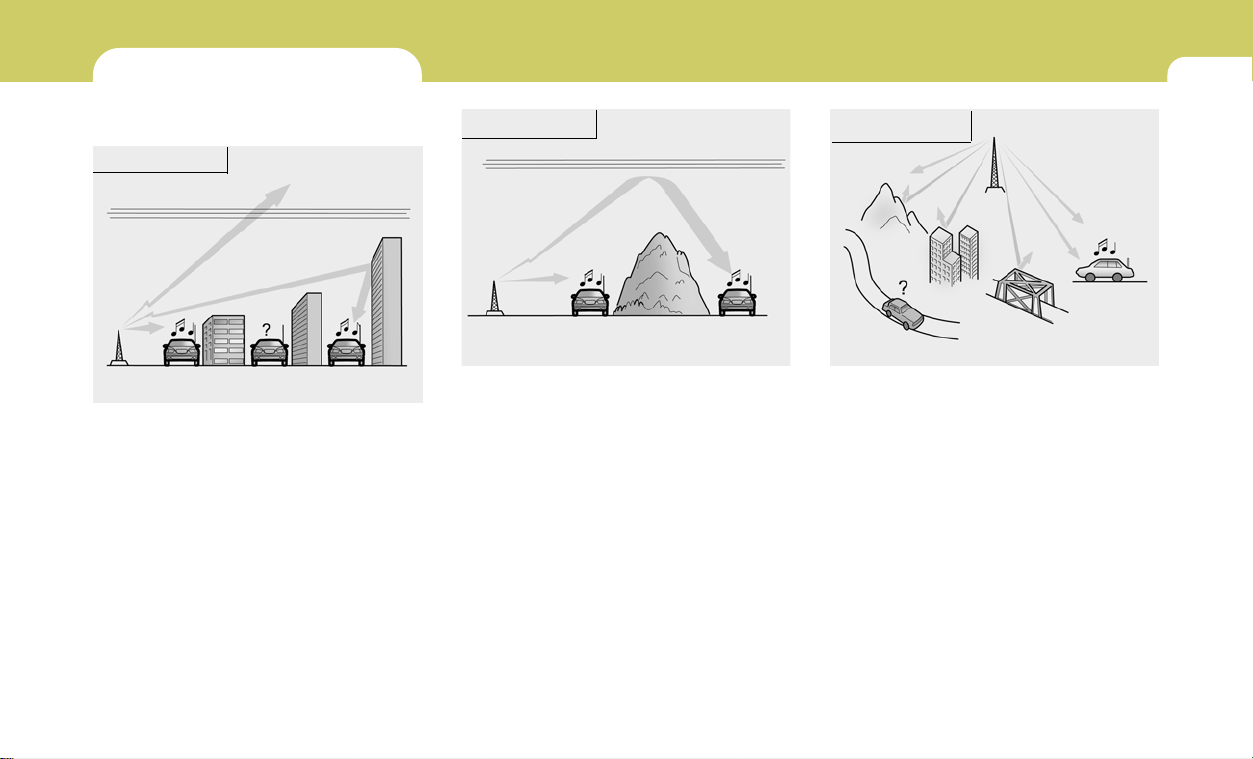
1
FEATURES OF YOUR HYUNDAI
113
STEREO SOUND SYSTEM
B750A02A-AAT
How Car Audio Works
AM broadcasts can be received at greater
distances than FM broadcasts. This is because
AM radio waves are transmitted at low frequen-
cies. These long, low frequency radio waves
can follow the curvature of the earth rather than
travelling straight out into the atmosphere. In
addition, they curve around obstructions so that
they can provide better signal coverage.
AM and FM radio signals are broadcast from
transmitter towers located around your city.
They are intercepted by the radio antenna on
your car. This signal is then received by the
radio and sent to your car speakers.
When a strong radio signal has reached your
vehicle, the precise engineering of your audio
system ensures the best possible quality repro-
duction. However, in some cases the signal
coming to your vehicle may not be strong and
clear. This can be due to factors such as the
distance from the radio station, closeness of
other strong radio stations or the presence of
buildings, bridges or other large obstructions in
the area.
FM broadcasts are transmitted at high frequen-
cies and do not bend to follow the earth's
surface. Because of this, FM broadcasts gen-
erally begin to fade at short distances from the
station. Also, FM signals are easily affected by
buildings, mountains, or other obstructions.
These can result in certain listening conditions
which might lead you to believe a problem exists
with your radio. The following conditions are
normal and do not indicate radio trouble:
Ionosphere
B750A02L
AM reception
Mountains
Buildings
Unobstructed
area
FM radio station
B750A03L
Ionosphere
FM reception
B750A01L
Obstructed area
Iron bridges
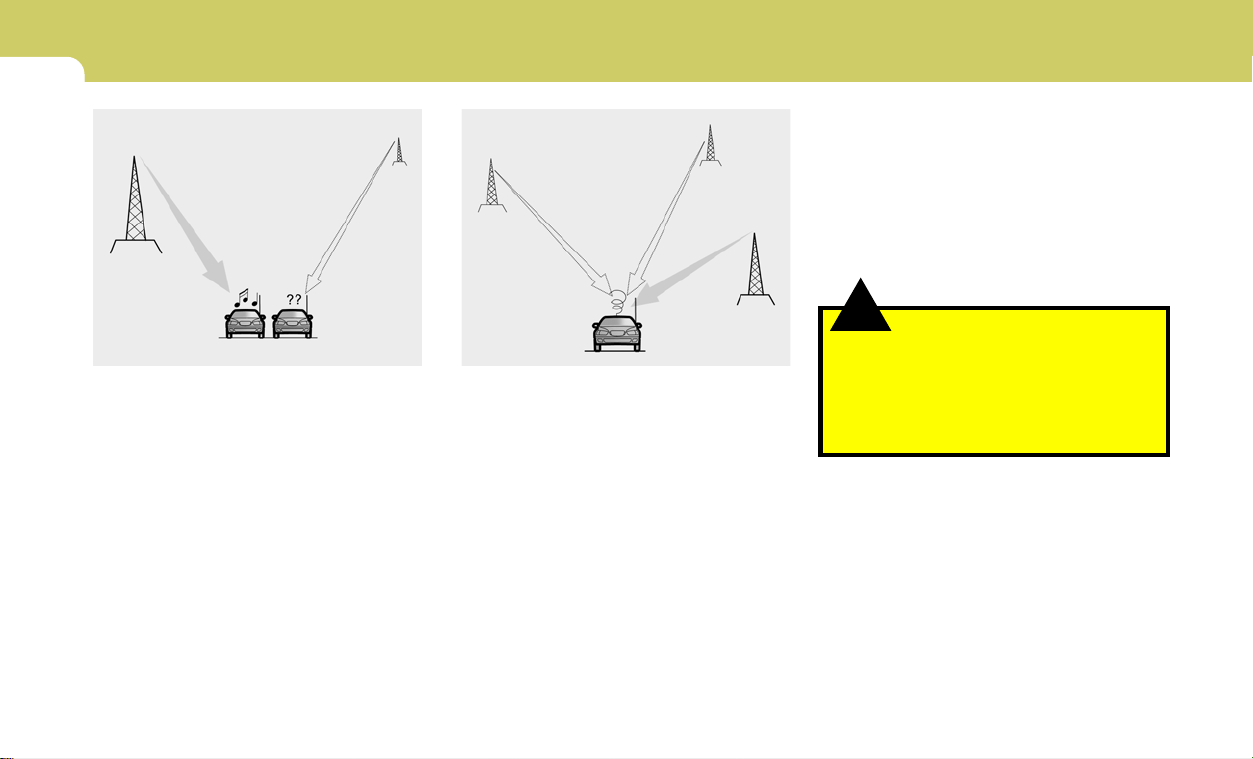
1
FEATURES OF YOUR HYUNDAI
114
!
o Fading - As your car moves away from the
radio station, the signal will weaken and
sound will begin to fade. When this occurs,
we suggest that you select another stronger
station.
o Flutter/Static - Weak FM signals or large
obstructions between the transmitter and
your radio can disturb the signal causing
static or fluttering noises to occur. Reducing
the treble level may lessen this effect until the
disturbance clears.
o Station Swapping - As an FM signal weak-
ens, another more powerful signal near the
same frequency may begin to play. This is
because your radio is designed to lock onto
the clearest signal. If this occurs, select
another station with a stronger signal.
o Multi-Path Cancellation - Radio signals being
received from several directions can cause
distortion or fluttering. This can be caused by
a direct and reflected signal from the same
station, or by signals from two stations with
close frequencies. If this occurs, select
another station until the condition has passed.
B750B04Y-AAT
Using a cellular phone or a two-way radio
When a cellular phone is used inside the vehicle,
noise may be produced from the audio equip-
ment. This does not mean that something is
wrong with the audio equipment. In such a case,
use the cellular phone at a place as far as
possible from the audio equipment.
WARNING:
Don't use a cellular phone when you are
driving. This could result in loss of control,
and an accident that may cause death,
serious injury, or property damage. You
must stop at a safe place to use a cellular
phone.
B750A04L
B750A05L
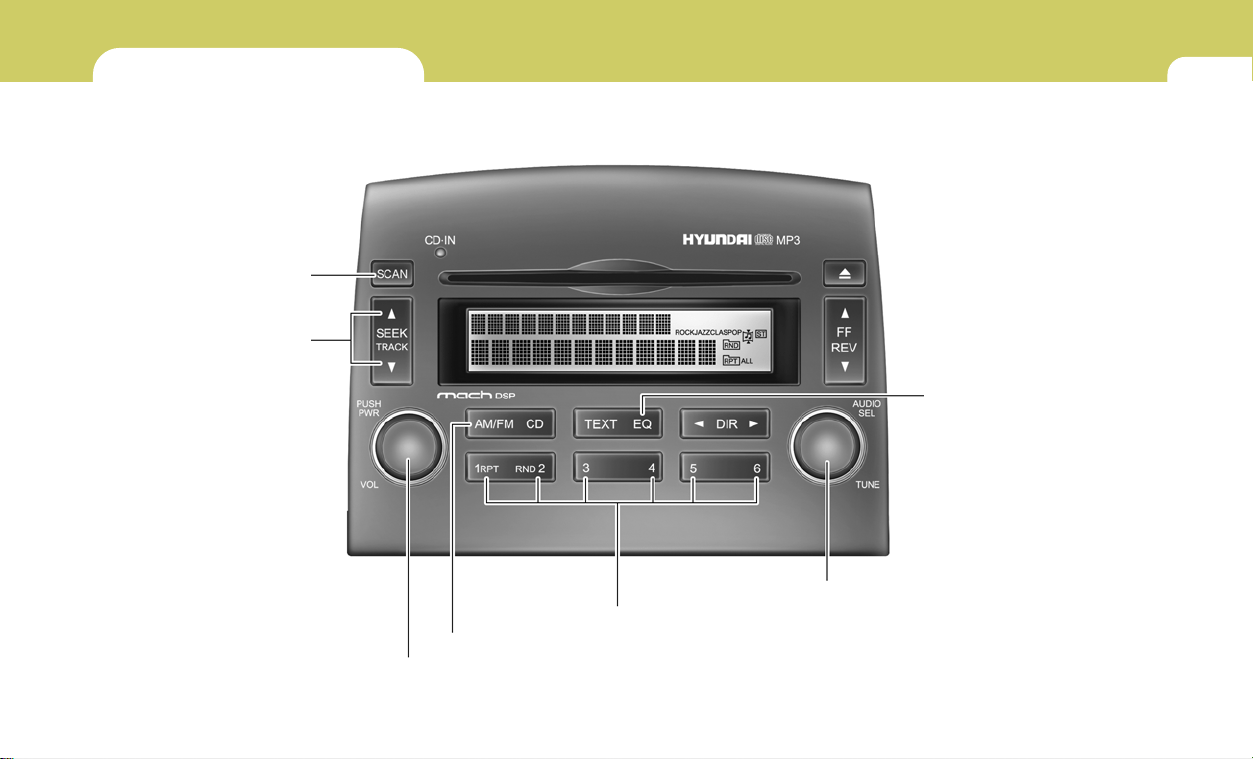
1
FEATURES OF YOUR HYUNDAI
115
AUDIO SYSTEM
V480A01NF-AAT
STEREO RADIO OPERATION (V480) (If Installed)
V480A01NF
1. POWER ON-OFF / VOLUME Control Knob
2. BAND Selector
3. Tune/Adjustment Mode Select Knob
4. SEEK Operation
5. SCAN Button
6. PRESET STATION SELECT Buttons
7. EQ Button

1
FEATURES OF YOUR HYUNDAI
116
V480B01NF-AAT
1. POWER ON-OFF / VOLUME Control
Knob
Press the PUSH PWR Control Knob to turn the
audio system on or off.
Rotate the knob clockwise to increase the
volume and turn the knob counterclockwise to
decrease the volume.
If the volume is set above a certain level and the
ignition is turned off, the volume will come back
on at a "nominal" listening level when the ignition
switch is turned back on.
2. BAND Selector
The AM/FM select control works in radio and
CD mode.
o AM/FM select in radio mode
This control allows you to select AM or FM
frequency bands. Press the button to switch
between FM1, FM2 and AM memory preset
stations.
o AM/FM select in CD mode
Press this button to stop CD play and begin radio
play.
3. Tune(manual) / Adjustment Mode Se-
lect Knob
o Rotate counterclockwise to the next fre-
quency down the band (whether or not a
listenable station is located there).
o Rotate clockwise to move to the next fre-
quency up the band (whether or not a listen-
able station is located there).
Adjustment Mode Select
Pressing the AUDIO SEL knob will initiate Audio
Mode. Each subsequent press will select the
next adjustment in the following order:
1) Bass adjust
The bass adjust control allows you to in-
crease or decrease the audio system's
bass output. Rotate the AUDIO SEL knob to
change the bass setting.
2) Midrange adjust
The midrange adjust control allows you to
increase or decrease the audio system's
midrange output. Rotate the AUDIO SEL
knob to change the midrange setting.
3) Treble adjust
The treble adjust control allows you to in-
crease or decrease the audio system's
treble output. Rotate the AUDIO SEL knob to
change the treble setting.
4) Speaker balance adjust
Speaker sound distribution can be adjusted
between the right and left speakers by rotat-
ing the AUDIO SEL knob.
5) Speaker fade adjust
Speaker sound can be adjusted between the
front and rear speakers by rotating the
AUDIO SEL knob.
4. SEEK Operation
(Automatic Channel Selection)
o Press (down arrow) to find the next
listenable station down the frequency band.
SEEK DOWN will display.
o Press (up arrow) to find the next listenable
station up the frequency band. SEEK UP will
display.
5. SCAN Button
Press the SCAN button to hear a brief sampling
of all listenable stations on the frequency band.
Press the SCAN button again to stop the scan
mode.
1
FEATURES OF YOUR HYUNDAI
117
6. PRESET STATION SELECT Buttons
The radio is equipped with six preset station
memory controls. These buttons can be used
to select up to 6 preset AM stations and 12
preset FM stations (six in AM, six in FM1, six in
FM2). There are a total possible of 18 preset
stations.
Setting memory preset stations
o Select the frequency band with the BAND
selector. Press the AM/FM control to toggle
between AM, FM1, or FM2.
o Press the SEEK control to access the next
listenable station up or down the frequency
band. Rotate the TUNE control to go up or
down the listening band in individual incre-
ments.
o Select a station.
o Press and hold a memory preset control.
You will hear a beep and the station is held
in memory on the control you selected.
7. EQ Button- Equalization Feature
The radio has five EQ modes: OFF, CLASSI-
CAL, POP, ROCK, and JAZZ.
Each press of the EQ button will advance to the
next EQ setting. Radio and CD have indepen-
dent EQ settings.
CAUTION:
o Do not place beverages close to the
audio system. The playback mechanism
may be damaged if you spill them.
o Do not impact or strike the audio system,
or the playback mechanism could be
damaged.
!
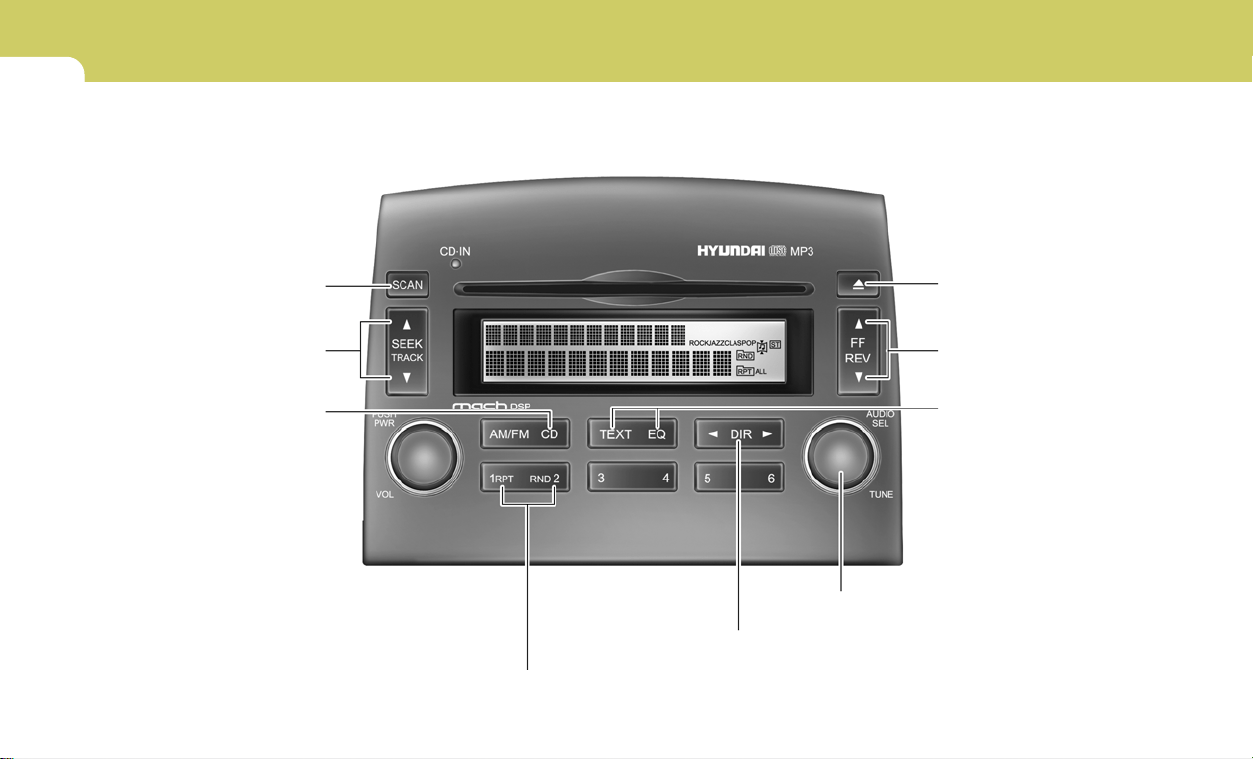
1
FEATURES OF YOUR HYUNDAI
118
V480C01NF-AAT
COMPACT DISC PLAYER OPERATION (V480) (If Installed)
- Compatiable with MP3
V480C01NF
1. AUDIO/MP3 CD Select Button
2. TRACK UP/DOWN
3. SCAN Button
4. FF/REV Button
5. REPEAT(RPT) /RANDOM Button
6.CHANGE DIRECTORY(DIR)
7. TEXT/EQ Button
8. Adjustment Mode Select Knob
9. CD EJECT

1
FEATURES OF YOUR HYUNDAI
119
V480C01NF-AAT
1. AUDIO/MP3 CD Select Button
CD mode may be entered by pressing the CD
button and then loading a CD into the audio
system. The first track of the disc will begin
playing. After that, the CD play will begin where
it stopped last.
NO CD will display if the CD control is activated
when there is not a CD present in the audio
system.
NOTE:
o Do not apply paper, tape, etc., onto the
label side or the recording side of any
discs, as it may cause a malfunction.
o The unit cannot play a CD-R(Recordable
CD) and CD-RW(Rewritable CD) that is
not finalized. Please refer to the manual
of the CD-R/CD-RW recorder or CD-R/
CD-RW software for more information
on the finalization process.
o Depending on the recording status,
some CD-Rs/CD-RWs may not be play-
able on this unit.
2. TRACK UP/DOWN
o Press (down arrow) to revert to the
previous track of the current disc. If the
beginning of the disc is reached, the CD
player seeks to the beginning of the last track
on the current disc and begins playing.
o Press (up arrow) to advance to the next
track of the current disc. After the last track
has been completed, the first track of the
current disc will automatically replay.
3. SCAN Button
Press the SCAN button to hear a short sampling
of all selections on the CD. (The CD scans in a
forward direction, wrapping back to the first
track at the end of the CD.) To stop on a
particular selection, press the button again.
4. FF/REV
o Press and hold the FF button until the desired
selection is reached. Release the button to
disengage fast forward mode. When in fast
forward mode, your audio system will auto-
matically lower the volume level of the play-
ing media.
o Press and hold the REV button until the
desired selection is reached. If the beginning
of the disc is reached, the CD will begin play
at the first track. Release the button to
disengage reverse mode. When in reverse
mode, your audio system will automatically
lower the volume level of the playing media.
5. REPEAT(RPT)
When engaged, the repeat feature has three
different modes: RPT Track, RPT DIR, RPT
OFF.
RPT Track will continuously play the current
track selected. RPT DIR will continuously play
the current MP3 directory.
o Press the RPT control until the desired
repeat mode is displayed. The audio system
will then engage the desired repeat mode.
RANDOM(RND)
When engaged, the random feature has three
different modes: Random Disc, Random Direc-
tory (MP3 only), and Random Off.
RANDOM DISC randomly plays tracks from
the disc presently in the audio system. RAN-
DOM DIRECTORY plays all the tracks on the
current MP3 directory in random order.

1
FEATURES OF YOUR HYUNDAI
120
o Press the RND button until the desired shuffle
mode is displayed. The audio system will
then engage the desired random mode.
6. CHANGE DIRECTORY(DIR)
Press DIR control to change MP3 directories.
7. MP3 TEXT mode
Each press of the TEXT button will advance
through the following MP3 track information:
1) Filename
2) Song Title
3) Artist Name
4) Album Name
5) Directory Name
6) Number of tracks on the current disc
Rotate the AUDIO-SEL knob to view additional
characters.
EQ Button - Equalization Feature
The Compact disc player has five EQ modes:
OFF, CLASSICAL (CLAS), POP, ROCK, and
JAZZ.
Each press of the EQ button will advance to the
next EQ setting. Radio and CD have indepen-
dent EQ settings.
8. Adjustment Mode Select Knob
Pressing the AUDIO SEL knob will initiate Audio
Mode. Each subsequent press will select the
next adjustment in the following order:
1) Bass adjust
The bass adjust control allows you to in-
crease or decrease the audio system's
bass output. Rotate the AUDIO SEL knob to
change the bass setting.
2) Midrange adjust
The midrange adjust control allows you to
increase or decrease the audio system's
midrange output. Rotate the AUDIO SEL
knob to change the midrange setting.
3) Treble adjust
The treble adjust control allows you to in-
crease or decrease the audio system's
treble output. Rotate the AUDIO SEL knob to
change the treble setting.
4) Speaker balance adjust
Speaker sound distribution can be adjusted
between the right and left speakers by rotat-
ing the AUDIO SEL knob.
5) Speaker fade adjust
Speaker sound can be adjusted between the
front and rear speakers by rotating the
AUDIO SEL knob.
9. CD EJECT
o Press the EJ button to stop and eject a CD.
If a CD is ejected and not removed, the player
will automatically reload the CD. This feature
may be used when the ignition is ON or OFF.
NOTE:
o To assure proper operation of the unit,
keep the vehicle interior temperature
within a normal range by using the
vehicle's air conditioning or heating
system.
o When replacing the fuse, replace it with
a fuse having the correct capacity.
o This equipment is designed to be used
only in a 12 volt DC battery system with
negative ground.
o This unit is made of precision parts. Do
not attempt to disassemble or adjust
any parts.
o When driving your vehicle, be sure to
keep the volume of the unit set low
enough to allow you to hear sounds
coming from the outside.
o Do not expose this equipment (includ-
ing the speakers) to water or excessive
moisture.

1
FEATURES OF YOUR HYUNDAI
121
!
CAUTION:
o Do not insert warped or poor quality
discs into the CD player as damage to the
unit may occur.
o Do not insert anything like coins into the
player slot as damage to the unit may
occur.
o Do not place beverages close to the
audio system. The playback mechanism
may be damaged if you spill them.
o Do not impact or strike the audio system,
or the playback mechanism could be
damaged.
o Driving off-road or other vibrations may
skip your compact disc. Do not use the
audio system off-road as the discs could
be scratched and damaged.
o Do not grip or pull out the disc with your
hand while the disc is being pulled into
the unit by the self loading mechanism.
These can cause poor disc scratching to
occur or damage the compact disc player.
o Avoid using CD-Recordable or CD
Rewritable to ensure proper operation.
When using the compact disc player,
professionally recorded CDs are recom-
mended.
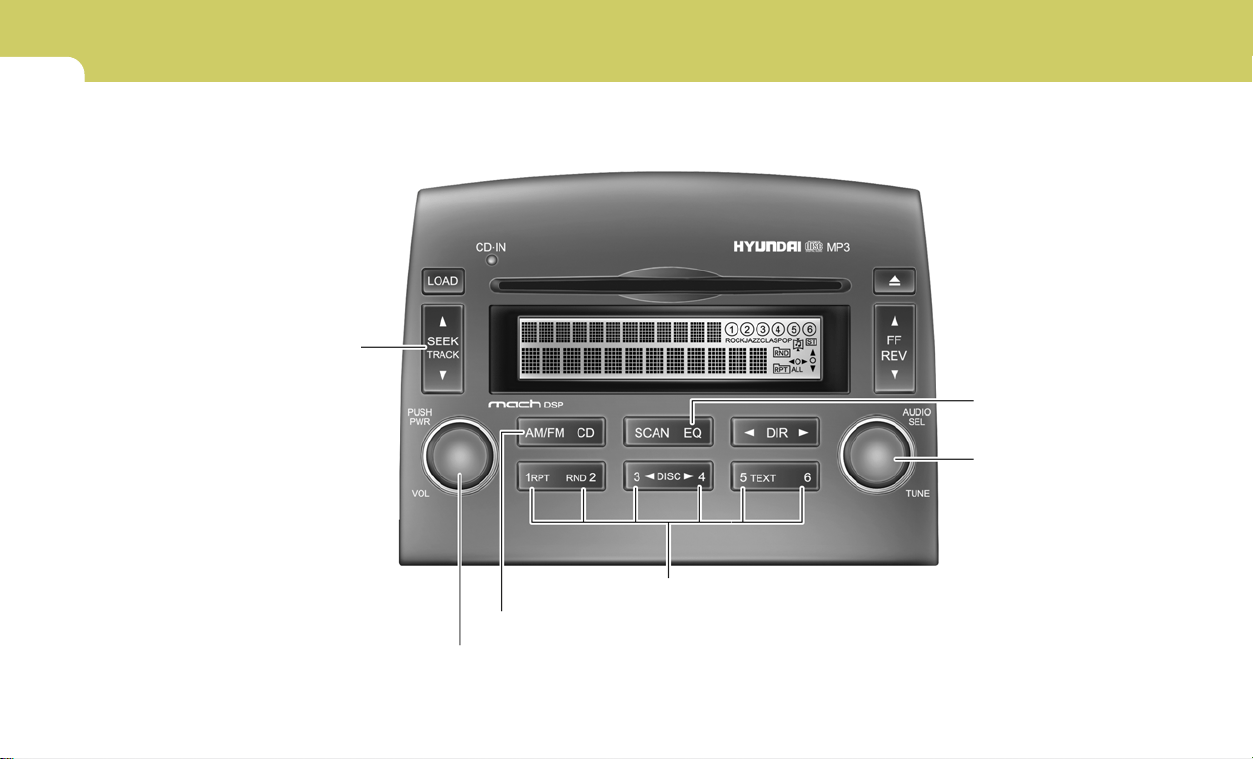
1
FEATURES OF YOUR HYUNDAI
122
V490A01NF-AAT
STEREO RADIO OPERATION (V490) (If Installed)
V490A01NF
1. POWER ON-OFF / VOLUME Control Knob
2. BAND Selector
3. Tune/Adjustment
Mode Select Knob
4. SEEK Button
5. SCAN/EQ Button
6. PRESET STATION SELECT Buttons

1
FEATURES OF YOUR HYUNDAI
123
V490B01NF-AAT
1. POWER ON-OFF / VOLUME Control
Knob
Press the PUSH PWR Control Knob to turn the
audio system on or off.
Rotate the knob clockwise to increase the
volume and turn the knob counterclockwise to
decrease the volume.
If the volume is set above a certain level and the
ignition is turned off, the volume will come back
on at a "nominal" listening level when the ignition
switch is turned back on.
2. BAND Selector
The AM/FM select control works in radio and
CD modes.
o AM/FM select in radio mode
This control allows you to select AM or FM
frequency bands. Press the button to switch
between FM1, FM2 and AM memory preset
stations.
o AM/FM select in CD mode
Press this button to stop CD play and begin radio
play.
3. Tune(manual) / Adjustment Mode Se-
lect Knob
o Rotate counterclockwise to the next fre-
quency down the band (whether or not a
listenable station is located there).
o Rotate clockwise to move to the next fre-
quency up the band (whether or not a listen-
able station is located there).
Adjustment Mode Select
Pressing the AUDIO SEL knob will initiate Audio
Mode. Each subsequent press will select the
next adjustment in the following order:
1) Bass adjust
The bass adjust control allows you to in-
crease or decrease the audio system's
bass output. Rotate the AUDIO SEL knob to
change the bass setting.
2) Midrange adjust
The midrange adjust control allows you to
increase or decrease the audio system's
midrange output. Rotate the AUDIO SEL
knob to change the midrange setting.
3) Treble adjust
The treble adjust control allows you to in-
crease or decrease the audio system's
treble output. Rotate the AUDIO SEL knob to
change the treble setting.
4) Speaker balance adjust
Speaker sound distribution can be adjusted
between the right and left speakers by rotat-
ing the AUDIO SEL knob.
5) Speaker fade adjust
Speaker sound can be adjusted between
the front and rear speakers by rotating the
AUDIO SEL knob.
4. SEEK Operation
(Automatic Channel Selection)
o Press (down arrow) to find the next
listenable station down the frequency band.
SEEK DOWN will display.
o Press (up arrow) to find the next listenable
station up the frequency band. SEEK UP will
display.
5. SCAN EQ Button
Press the SCAN button to hear a brief sampling
of all listenable stations on the frequency band.
Press the SCAN button again to stop the scan
mode.

1
FEATURES OF YOUR HYUNDAI
124
EQ Button- Equalization Feature
The radio has five EQ modes: OFF, CLASSI-
CAL, POP, ROCK, and JAZZ.
Each press of the EQ button will advance to the
next EQ setting. Radio and CD have indepen-
dent EQ settings.
6. PRESET STATION SELECT Buttons
The radio is equipped with six preset station
memory controls. These buttons can be used
to select up to 6 preset AM stations and 12
preset FM stations (six in AM, six in FM1, six in
FM2). There are a total possible of 18 preset
stations.
Setting memory preset stations
o Select the frequency band with the BAND
selector. Press the AM/ FM control to toggle
between AM, FM1, or FM2.
o Press the SEEK control to access the next
listenable station up or down the frequency
band. Rotate the TUNE control to go up or
down the listening band in individual incre-
ments.
o Select a station.
o Press and hold a memory preset control.
You will hear a beep and the station is held
in memory on the control you selected.
CAUTION:
o Do not place beverages close to the
audio system. The playback mechanism
may be damaged if you spill them.
o Do not impact or strike the audio system,
or the playback mechanism could be
damaged.
!
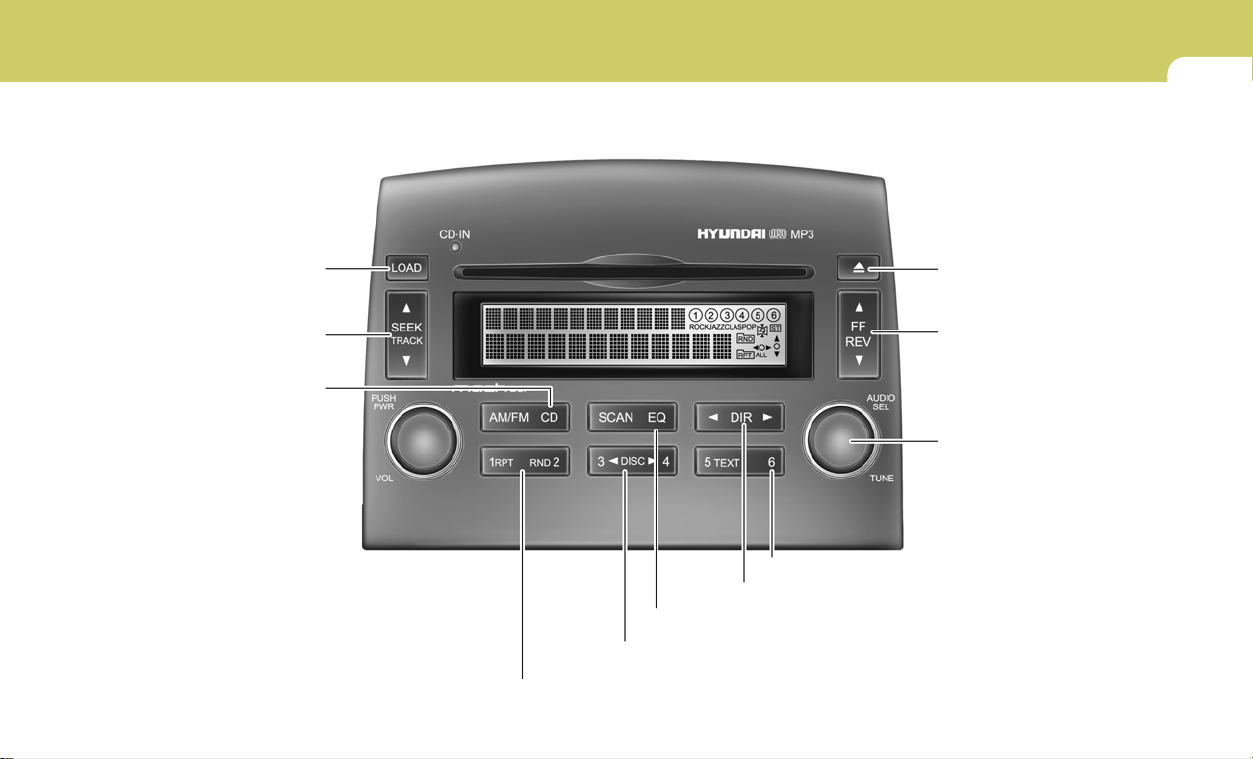
1
FEATURES OF YOUR HYUNDAI
125
V490C01NF-AAT
COMPACT DISC PLAYER OPERATION (V490) (If Installed)
- Compatiable with MP3
V490C01NF
1. AUDIO/MP3 CD Select Button
3. DISC Select Button
4. TRACK UP/DOWN
5. SCAN /EQ Button
2. LOAD Button
6. CD EJECT
7. FF/REV
8. REPEAT(RPT)/RANDOM Button
9. CHANGE DIRECTORY(DIR)
10.MP3 TEXT mode
11.Adjustment Mode Select Knob

1
FEATURES OF YOUR HYUNDAI
126
V490D01NF-AAT
1. AUDIO/MP3 CD Select Button
CD mode may be entered by pressing the CD
button and then loading a CD into the audio
system. The first track of the disc will begin
playing. After that, the CD play will begin where
it stopped last.
If an alternative CD is desired, press the corre-
sponding preset control (1- 6) of a loaded CD,
or press the DISC control to access the other
loaded CDs.
NO CD will display if the CD control is activated
when there is not a CD present in the audio
system. If the CD control is pressed followed by
a preset number, and that particular slot is
empty, NO CD will display and the system will
begin to play the next available disc.
NOTE:
o Do not apply paper, tape, etc., onto the
label side or the recording side of any
discs, as it may cause a malfunction.
o The unit cannot play a CD-R(Recordable
CD) and CD-RW(Rewritable CD) that is
not finalized. Please refer to the manual
of the CD-R/CD-RW recorder or CD-R/
CD-RW software for more information
on the finalization process.
o Depending on the recording status,
some CD-Rs/CD-RWs may not be play-
able on this unit.
2. LOAD Button
The load feature allows you to load single CDs
into the player internal to the audio.
o Press the LOAD button. Wait until the CD
displays the insert CD message.
o Load the CD into the player.
Autoload
This feature allows you to azzutoload up to six
discs into the multi-disc CD player internal to the
audio.
o Press and hold the LOAD button until
AUTOLOAD# is displayed.
o Load the desired discs, one at a time. The CD
is loaded into position and the audio system
will display CD#. Each time the audio is ready
for another CD, AUTOLOADING DISC
SLOT# message will be displayed. The player
will move to the next slot after each disc has
been loaded. The process is repeated until
all six slots are full.
The audio system plays the last CD loaded and
the display is updated. If some slots are already
full and autoload is activated, the system will fill
all empty slots.
NOTE:
o This CD player is suitable only for 4.7
inch discs, do not use irregular shaped
CDs.
o The disc player holds up to six discs. Do
not try to load more than six.
o This six-disc CD player is equipped with
a CD door.
Compact discs should only be inserted
into the player after the door has opened.
Do not attempt to force the door open.
Compact discs should only be loaded by
pressing the LOAD control.
3. DISC Select Button
o Press (left arrow) to select the previous
disc. (Play will begin on the first track of the
disc unless shuffle mode is engaged.) Hold
the button to continue reversing through the
discs.
o Press (right arrow) to select the next disc.
Hold the button to fast-forward through the
remaining discs.

1
FEATURES OF YOUR HYUNDAI
127
Display description
There are six CD slots in the audio system.
When a disc is loaded into a particular slot (1-
6), the number of a loaded slot is displayed by
a circle to indicate the currently selected CD.
4. TRACK UP/DOWN
o Press (down arrow) to revert to the
previous track of the current disc. If the
beginning of the disc is reached, the CD
player seeks to the beginning of the last
track on the current disc and begins playing.
o Press (up arrow) to advance to the next
track of the current disc. After the last track
has been completed, the first track of the
current disc will automatically replay.
5. SCAN /EQ Button
Press the SCAN button to hear a short sampling
of all selections on the CD. (The CD scans in a
forward direction, wrapping back to the first
track at the end of the CD.) To stop on a
particular selection, press the button again.
EQ Button - Equalization Feature
The radio has five EQ modes: OFF, CLASSI-
CAL, POP, ROCK, and JAZZ.
Each press of the EQ button will advance to the
next EQ setting. Radio and CD have indepen-
dent EQ settings.
6. CD EJECT
o Press the EJ button to stop and eject a CD.
If a CD is ejected and not removed, the player
will automatically reload the CD. This feature
may be used when the ignition is ON or OFF.
Auto eject
o Press and momentarily hold the EJ button to
engage auto eject. All CDs which are present
in the player will be ejected one at a time. If
a CD is ejected and not removed, the player
will automatically reload the CD. This feature
may be used when the ignition is ON or OFF.
7. FF/REV
o Press and hold the FF button until the desired
selection is reached. If the end of the disc is
reached, the CD will return to the first track
on the first disc. Release the button to disen-
gage fast forward mode. When in fast for-
ward mode, your audio system will automati-
cally lower the volume level of the playing
media.
o Press and hold the REV button until the
desired selection is reached. If the beginning
of the disc is reached, the CD will begin play
at the first track. Release the button to
disengage reverse mode. When in reverse
mode, your audio system will automatically
lower the volume level of the playing media.
8. REPEAT(RPT)
When engaged, the repeat feature has three
different modes: RPT Track, RPT DIR, RPT
OFF.
RPT Track will continuously play the current
track selected. RPT DIR will continuously play
the current MP3 directory.
o Press the RPT control until the desired
repeat mode is displayed. The audio system
will then engage the desired repeat mode.

1
FEATURES OF YOUR HYUNDAI
128
RANDOM(RND)
When engaged, the random feature has three
different modes: Random Disc, Random Di-
rectory (MP3 only), and Random Off.
RANDOM DISC randomly plays tracks from
the disc presently in the audio system. RAN-
DOM DIRECTORY plays all the tracks on the
current MP3 directory in random order.
o Press the RND control until the desired
shuffle mode is displayed. The audio sys-
tem will then engage the desired random
mode.
9. CHANGE DIRECTORY(DIR)
Press DIR control to change MP3 directories.
10. MP3 TEXT mode
Each press of the TEXT button will advance
through the following MP3 track information:
1) Song Title
2) Artist Name
3) Album Name
4) Filename
5) Directory Name
6) Number of tracks on the current disc
Rotate the AUDIO-SEL knob to view additional
characters.
11. Adjustment Mode Select Knob
Pressing the AUDIO SEL knob will initiate Audio
Mode. Each subsequent press will select the
next adjustment in the following order.
1) Bass adjust
The bass adjust control allows you to in-
crease or decrease the audio system's
bass output. Rotate the AUDIO SEL knob to
change the bass setting.
2) Midrange adjust
The midrange adjust control allows you to
increase or decrease the audio system's
midrange output. Rotate the AUDIO SEL
knob to change the midrange setting.
3) Treble adjust
The treble adjust control allows you to in-
crease or decrease the audio system's
treble output. Rotate the AUDIO SEL knob to
change the treble setting.
4) Speaker balance adjust
Speaker sound distribution can be adjusted
between the right and left speakers by rotat-
ing the AUDIO SEL knob.
5) Speaker fade adjust
Speaker sound can be adjusted between the
front and rear speakers by rotating the
AUDIO SEL knob.
NOTE:
o To assure proper operation of the unit,
keep the vehicle interior temperature
within a normal range by using the
vehicle's air conditioning or heating
system.
o When replacing the fuse, replace it with
a fuse having the correct capacity.
o This equipment is designed to be used
only in a 12 volt DC battery system with
negative ground.
o This unit is made of precision parts. Do
not attempt to disassemble or adjust
any parts.
o When driving your vehicle, be sure to
keep the volume of the unit set low
enough to allow you to hear sounds
coming from the outside.
o Do not expose this equipment (includ-
ing the speakers) to water or excessive
moisture.

1
FEATURES OF YOUR HYUNDAI
129
!
CAUTION:
o Do not insert warped or poor quality
discs into the CD player as damage to the
unit may occur.
o Do not insert anything like coins into the
player slot as damage to the unit may
occur.
o Do not place beverages close to the
audio system. The playback mechanism
may be damaged if you spill them.
o Do not impact or strike the audio system,
or the playback mechanism could be
damaged.
o Driving off-road or other vibrations may
skip your compact disc. Do not use the
audio system off-road as the discs could
be scratched and damaged.
o Do not grip or pull out the disc with your
hand while the disc is being pulled into
the unit by the self loading mechanism.
These can cause disc scratching to oc-
cur or damage the compact disc player.
o Avoid using CD-Recordable or CD
Rewritable to ensure proper operation.
When using the compact disc player,
professionally recorded CDs are recom-
mended.
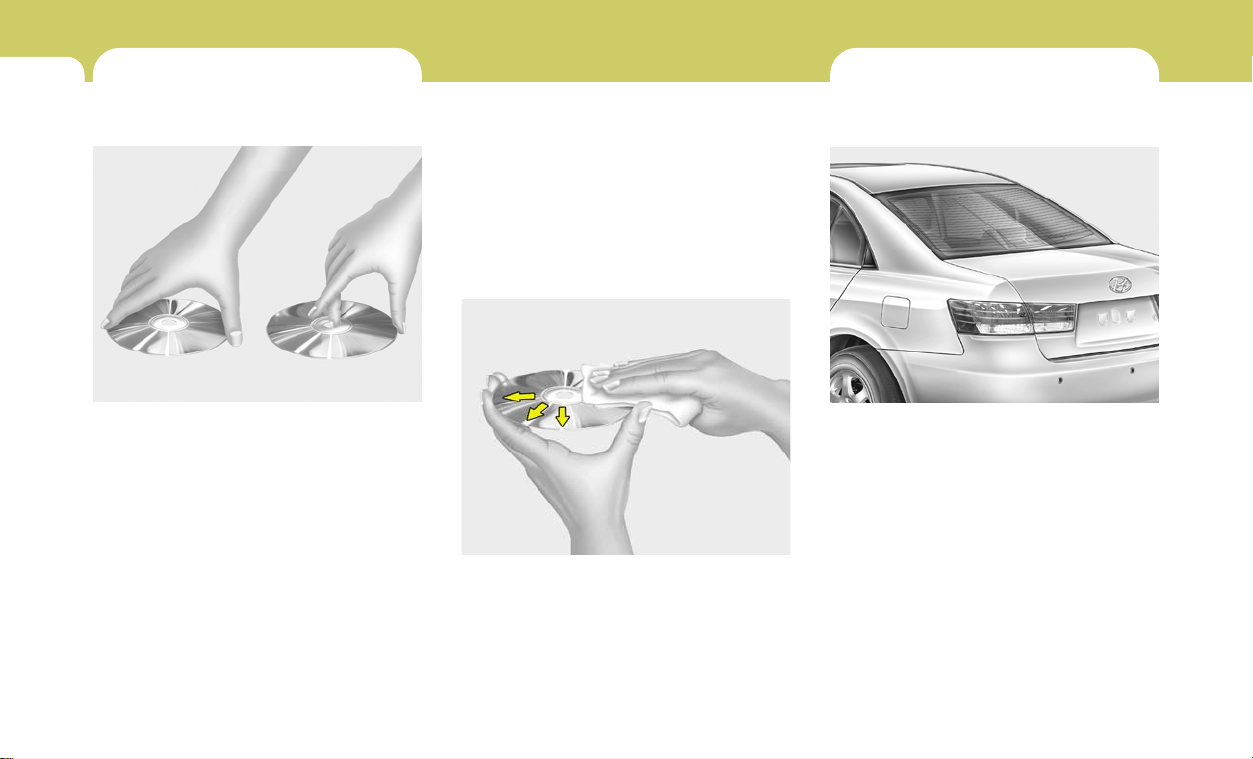
1
FEATURES OF YOUR HYUNDAI
130
ANTENNA
B870D01Y-AAT
Glass Antenna
When the radio power switch is turned on while
the ignition key is in either the "ON" or "ACC"
position, your car will receive both AM and FM
broadcast signals through the antenna in the
rear window glass.
HNF2189
CARE OF DISCS
B850A02L
B850A02F-AAT
Proper Handling
Storage
When not in use, place your discs in their
individual case and store them in a cool place
away from the sun, heat, and dust.
Do not grip or pull out the disc with your hand
while the disc is being pulled into the unit by the
self loading mechanism.
Keep Your Discs Clean
Handle your disc as shown. Do not drop the
disc. Hold the disc so you will not leave finger-
prints on the surface. If the surface is scratched,
it may cause the pickup to skip signal tracks. Do
not affix tape, paper, or gummed labels on the
disc. Do not write on the disc.
Damaged Disc
Do not attempt to play damaged, warped or
cracked discs. These could severely damage
the playback mechanism.
Fingerprints, dust, or soil on the surface of a disc
could cause the pickup to skip signal tracks.
Wipe the surface clean with a clean soft cloth.
If the surface is heavily soiled, dampen a clean
soft cloth in a solution of mild neutral detergent
to wipe it clean. See drawing.
B850A01L

1
FEATURES OF YOUR HYUNDAI
131
CAUTION:
o Do not clean the inner side of the rear
window glass with an abrasive type of
glass cleaner or use a scraper to remove
foreign deposits from the inner surface
of the glass as this may cause damage to
the antenna elements.
o Avoid adding metallic coatings to the
rear window glass, such as Ni, Cd, etc.
These can disturb receiving AM and FM
broadcast signals.
!

DRIVING YOUR HYUNDAI
2
Engine Exhaust Can Be Dangerous!............................ 2-2
Before Starting the Engine ............................................ 2-3
Key Positions................................................................ 2-3
Starting ......................................................................... 2-4
Operating the Manual Transaxle .................................. 2-5
Automatic Transaxle ..................................................... 2-8
Power Adjustable Pedals.............................................2-11
Anti-Lock Brake System (ABS) ...................................2-12
Electronic Stability Control (ESC) System ..................2-13
Good Braking Practices ..............................................2-14
Driving for Economy ....................................................2-15
Smooth Cornering ........................................................2-16
Winter Driving ..............................................................2-16
Trailer or Vehicle Towing .............................................2-19
Vehicle Load Limit ........................................................2-22
2

2
DRIVING YOUR HYUNDAI
2
WARNING: ENGINE EXHAUST CAN BE DANGEROUS!
C010A03A-AAT
Engine exhaust fumes can be extremely dangerous. If, at any time, you smell exhaust fumes inside the vehicle, open the windows immediately.
o Do not inhale exhaust fumes.
Exhaust fumes contain carbon monoxide, a colorless, odorless gas that can cause unconsciousness and death by asphyxiation.
o Be sure the exhaust system does not leak.
The exhaust system should be checked whenever the vehicle is raised to change the oil or for any other purpose. If you hear a change
in the sound of the exhaust or if you drive over something that strikes the underneath side of the car, have the exhaust system checked
as soon as possible by your Hyundai dealer.
o Do not run the engine in an enclosed area.
Letting the engine idle in your garage, even with the garage door open, is a hazardous practice. Never run the engine in your garage
any longer than it takes to start the engine and back the car out.
o Avoid idling the engine for prolonged periods with people inside the car.
If it is necessary to idle the engine for a prolonged period with people inside the car, be sure to do so only in an open area with the air
intake set at "Fresh" and fan operating at one of the higher speeds so fresh air is drawn into the interior.
If you must drive with the trunk lid open because you are carrying objects that make this necessary:
1. Close all windows.
2. Open side vents.
3. Set the air intake control at "Fresh", the air flow control at "Floor" or "Face" and the fan at one of the higher speeds.
To assure proper operation of the ventilation system, be sure the ventilation air intakes located just in front of the windshield are kept clear
of snow, ice, leaves or other obstructions.
!
!
PROPOSITION 65 WARNING:
Engine exhaust and a wide variety of automobile components and parts, including components found in the interior furnishings
in a vehicle, contain or emit chemicals known to the State of California to cause cancer and birth defects and reproductive harm.
In addition, certain fluids contained in vehicles and certain products of component wear contain or emit chemicals known to
the State of California to cause cancer and birth defects or other reproductive harm.
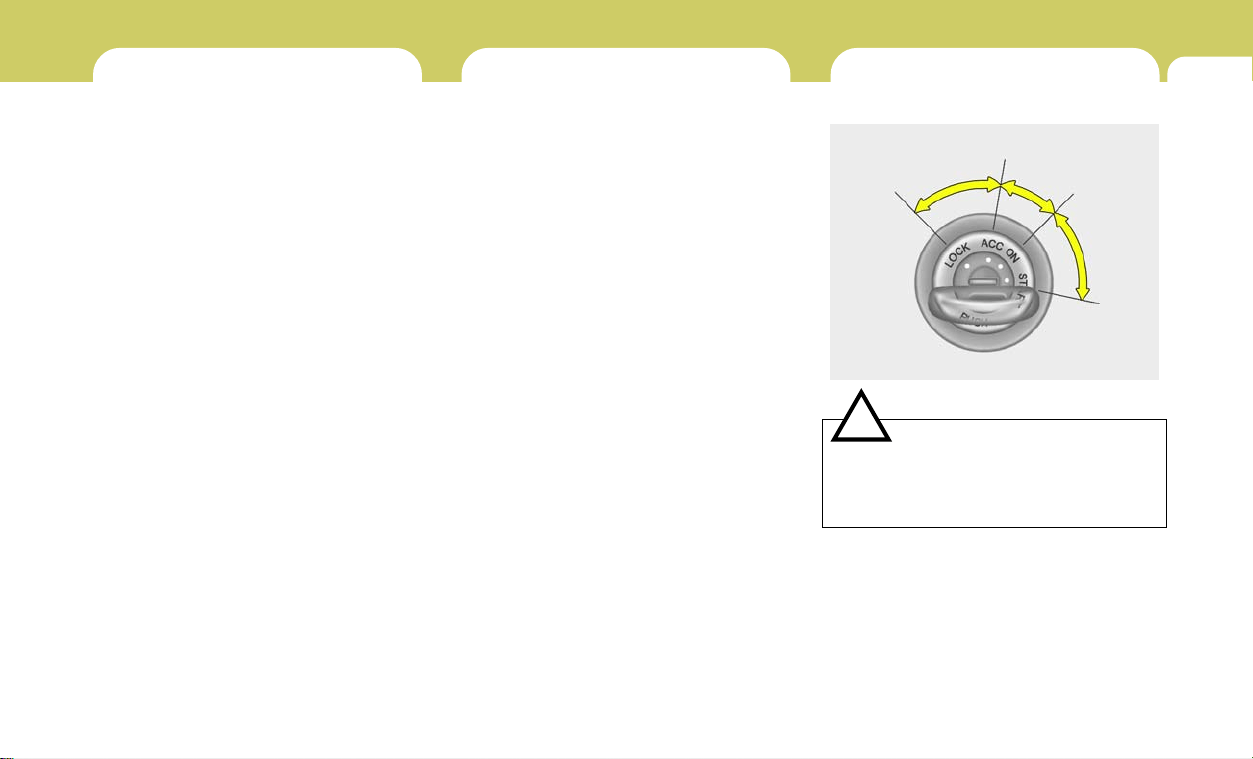
2
DRIVING YOUR HYUNDAI
3
BEFORE STARTING
THE ENGINE
C020A01A-AAT
Before you start the engine, you should always:
1. Look around the vehicle to be sure there are
no flat tires, puddles of oil, water or other
indications of possible trouble.
2. After entering the car, check to be sure the
parking brake is engaged.
3. Check that all windows and lights are clean.
4. Check that the interior and exterior mirrors
are clean and in position.
5. Check your seat, seatback and headrest to
be sure they are in their proper positions.
6. Lock all the doors.
7. Fasten your seat belt and be sure that all
other occupants have fastened theirs.
8. Turn off all lights and accessories that are
not needed.
9. When you turn the ignition switch to "ON",
check that all appropriate warning lights are
operating and that you have sufficient fuel.
10. Check the operation of warning lights and all
bulbs when key is in the "ON" position.
TO START THE ENGINE
C030A01E-AAT
COMBINATION IGNITION SWITCH
o If your Hyundai is equipped with a manual
transaxle, place the shift lever in neutral and
depress the clutch pedal fully.
o If your Hyundai has an automatic transaxle,
place the shift lever in "P" (park).
o To start the engine, insert the ignition key and
turn it to the "START" position. Release it as
soon as the engine starts. Do not hold the
key in the "START" position for more that 15
seconds.
NOTE:
o For safety, the engine will not start if the
clutch pedal is not depressed fully
(Manual Transaxle) or the shift lever is
not in "P" or "N" Position (Automatic
Transaxle).
o The ignition key cannot be turned from
"ACC" position to "LOCK" position un-
less the shift lever is in the "P" (Park)
position or the negative battery terminal
is disconnected from the battery. To
remove the key, always confirm that the
shift lever is securely positioned in "P"
(Park) (For Automatic Transaxle).
o For additional information about start-
ing, see page 2-4.
KEY POSITIONS
C040A01A-AAT
CAUTION:
The engine should not be turned off or the
key removed from the ignition key cylinder
while the car is in motion. The steering
wheel is locked by removing the key.
C040A01E
LOCK
ACC
ON
START
!
o "START"
The engine is started in this position. It will crank
until you release the key.
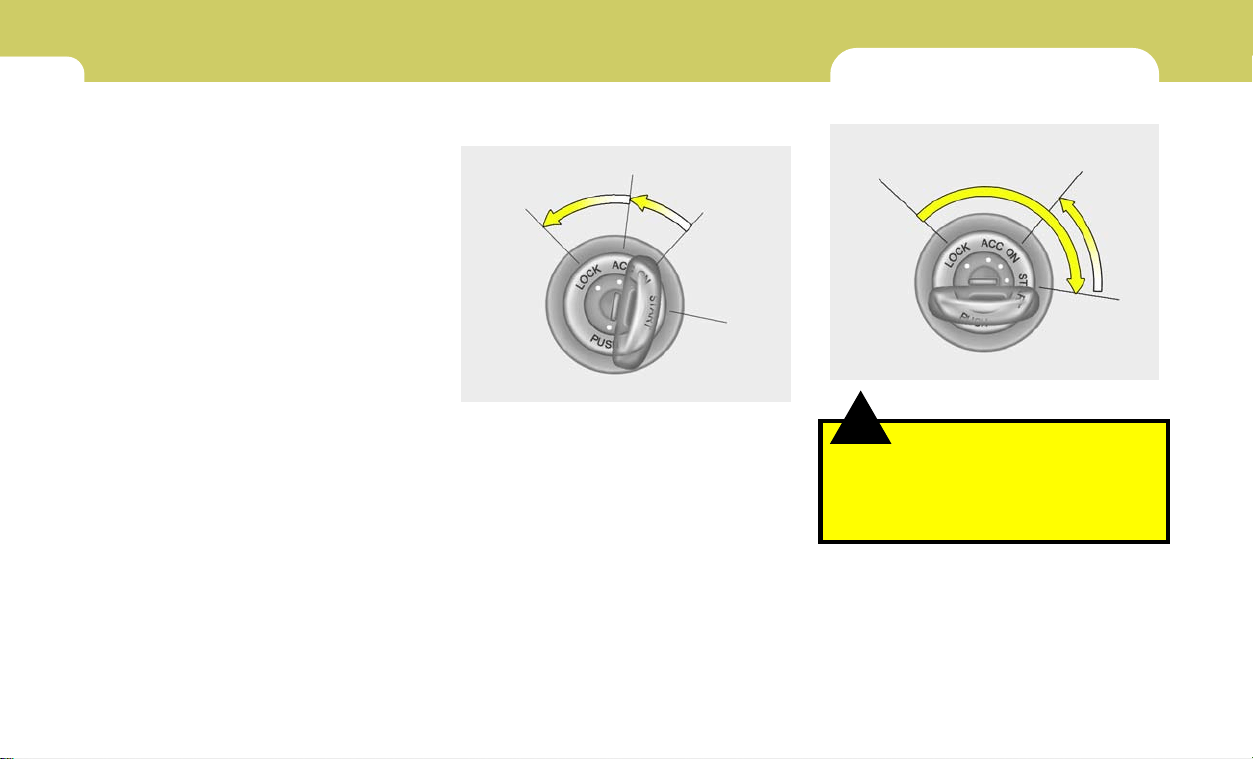
2
DRIVING YOUR HYUNDAI
4
NOTE:
Do not hold the key in the "START" position
for more than 15 seconds.
o "ON"
When the key is in the "ON" position, the ignition
is on and all accessories may be turned on. If
the engine is not running, the key should not be
left in the "ON" position. This will discharge the
battery and may also damage the ignition sys-
tem.
o "ACC"
With the key in the "ACC" position, some elec-
trical accessories (radio, etc.) may be oper-
ated.
o "LOCK"
The key can be removed or inserted in this
position.
To protect against theft, the steering wheel
locks by removing the key.
NOTE:
To unlock the steering wheel, insert the key,
and then turn the steering wheel and key
simultaneously.
STARTING
!
C070C01A-AAT
To remove the ignition key
C050A01A-AAT
1. Turn the ignition key to the "ACC" position.
2. Simultaneously push and turn the ignition
key counterclockwise from the "ACC" posi-
tion to the "LOCK" position.
3. The key can be removed in the "LOCK"
position.
WARNING:
Never run the engine in a closed or poorly
ventilated area any longer than is needed to
move your car in or out of the area. The
carbon monoxide gas emitted is odorless
and can cause serious injury or death.
C070C01E
C050A01E
LOCK
ACC
ON
START
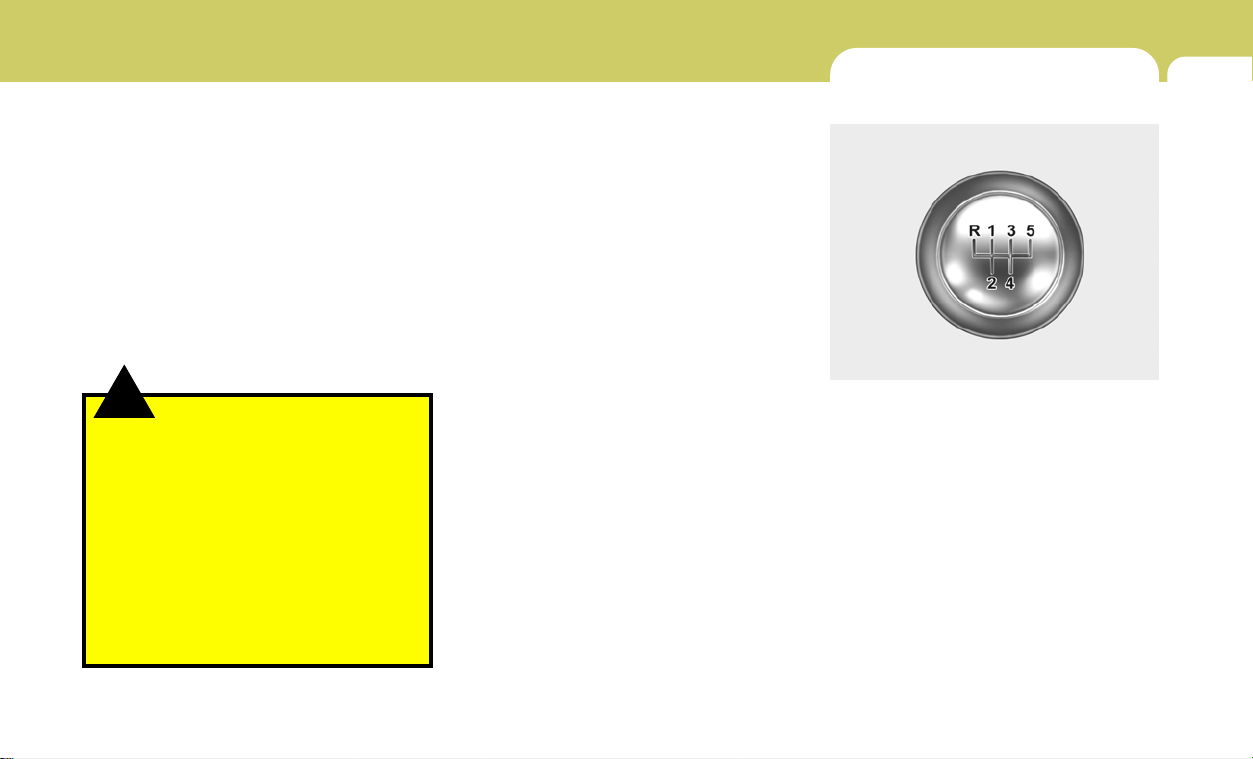
2
DRIVING YOUR HYUNDAI
5
OPERATING THE MANUAL
TRANSAXLE (5 SPEED M/T)
C070A01NF-GAT
This shift pattern is imprinted on the shift knob.
The transaxle is fully synchronized in all forward
gears so shifting to either a higher or a lower
gear is easily accomplished.
C070A01NF-A
4. Turn the ignition key to the "START" position
and release it when the engine starts.
After the engine has started, allow the engine
to run for 10 to 20 seconds prior to placing
the vehicle in gear.
The starter should not be operated for more
than 15 seconds at a time. Wait 15-30
seconds between starting attempts to pro-
tect the starter from overheating.
C050B01A-AAT
Normal Conditions:
The Starting Procedure:
1. Insert key, and fasten the seat belt.
2. Depress the clutch pedal fully and place the
gearshift lever (manual transaxle) in neutral
or the selector lever (automatic transaxle) in
"P" (park) position.
3. After turning the ignition key to the "ON"
position, make certain all warning lights and
gauges are functioning properly before start-
ing the engine.
WARNING:
Be sure that the clutch is fully depressed
when starting a manual transaxle vehicle.
Your manual transaxle equipped vehicle
will not start unless the clutch pedal is fully
depressed. On a manual transaxle equipped
vehicle that can be started without de-
pressing the clutch, there is the potential to
cause damage to the vehicle or injury to
someone inside or outside the vehicle as a
result of the forward or backward move-
ment of the vehicle that will occur if the
clutch is not depressed when the vehicle is
started.
!
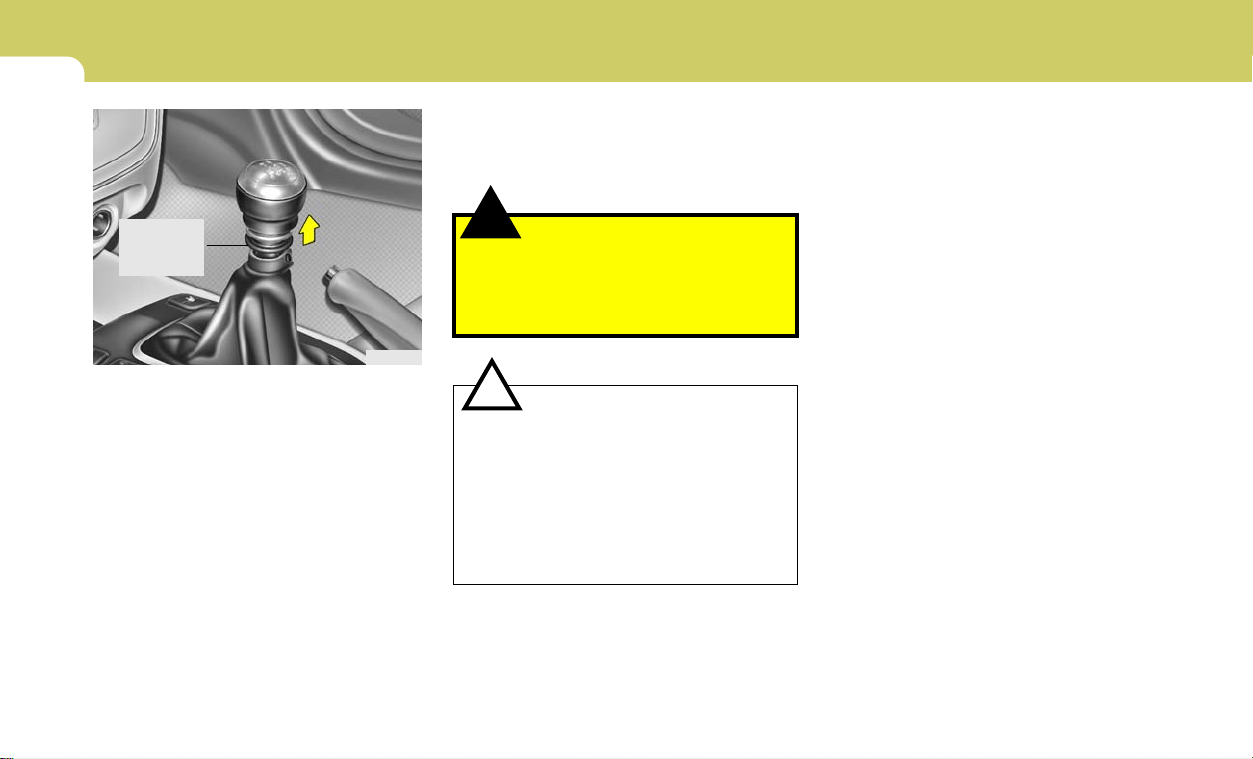
2
DRIVING YOUR HYUNDAI
6
!
WARNING:
Do not downshift more than 2 gears or
downshift the gear when the engine is
running at high speed (5,000 RPM or higher).
Such a downshifting may damage the en-
gine.
C070B02A-AAT
Using the Clutch
The clutch should be pressed all the way to the
floor before shifting, then released slowly. The
clutch pedal should always be fully released
while driving. Do not rest your foot on the clutch
pedal while driving. This can cause unneces-
sary wear. Do not partially engage the clutch to
hold the car on an incline. This causes unnec-
essary wear. Use the foot brake or parking
brake to hold the car on an incline. Do not
operate the clutch pedal rapidly and repeatedly.
o Do not use the shift lever as a handrest
during driving, as this can result in pre-
mature wear of the transaxle shift forks.
!
CAUTION:
When downshifting from fifth gear to fourth
gear, caution should be taken not to inad-
vertently press the gear shift lever sideways
in such a manner that second gear is en-
gaged. Such a drastic downshift may cause
the engine speed to increase to the point
that the tachometer will enter the red-zone.
Such over-revving of the engine may pos-
sibly cause engine damage.
When shifting into reverse gear, pull the mis-
shift prevention tab and shift into reverse gear
position.
NOTE:
o To shift into reverse, rest the lever in
neutral for at least 3 seconds after your
car is completely stopped. Then move
the lever into the reverse position.
o During cold weather, shifting may be
difficult until the transaxle lubricant has
warmed up. This is normal and not harm-
ful to the transaxle.
o If you've come to a complete stop and
it's hard to shift into 1st or R(Reverse),
put the shift lever in N(Neutral) position
and release the clutch. Press the clutch
pedal back down, and then shift into 1st
or R(Reverse) gear position.
Mis-shift
prevention
tab
HNF3020
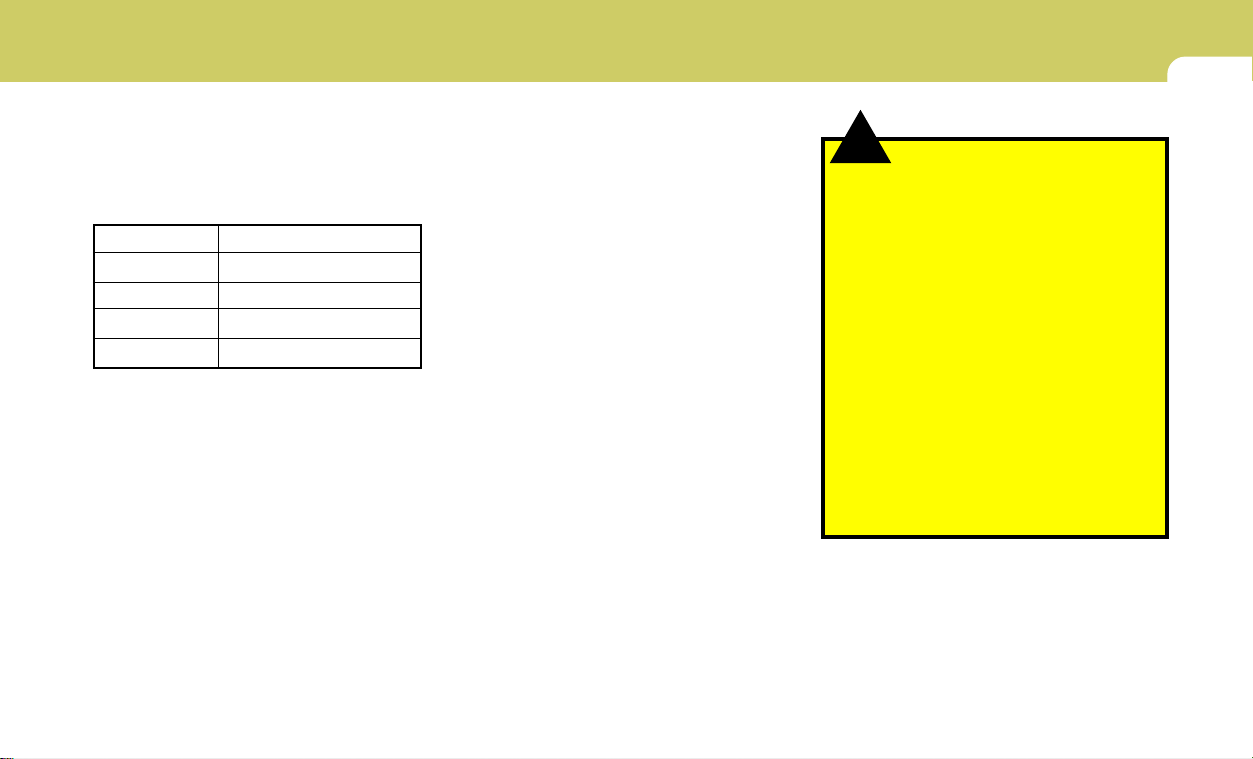
2
DRIVING YOUR HYUNDAI
7
!
WARNING:
o Avoid high cornering speeds.
o Do not make quick steering wheel move-
ments, such as sharp lane changes or
fast, sharp turns.
o Always wear your seat belts.
In a collision, an unbelted person is
significantly more likely to die than a
person wearing a seat belt.
o The risk of rollover is greatly increased if
you lose control of your vehicle at high-
way speeds.
o Loss of control often occurs if two or
more wheels drop off the roadway and
the driver oversteers to reenter the road-
way.
o In the event your vehicle leaves the road-
way, do not steer sharply. Instead, slow
down before pulling back into the travel
lanes.
o Never exceed posted speed limits.
C070D02O-AAT
Good Driving Practices
o Never take the car out of gear and coast
down a hill. This is extremely hazardous.
Always leave the car in gear.
o Don't "ride" the brakes. This can cause them
to overheat and malfunction. Instead, when
you are driving down a long hill, slow down
and shift to a lower gear. When you do this,
engine braking will help slow the car.
o Slow down before shifting to a lower gear.
This will help avoid over-revving the engine,
which can cause damage.
o Slow down when you encounter cross winds.
This gives you much better control of your
car.
o Be sure the car is completely stopped before
you attempt to shift into reverse. The
transaxle can be damaged if you do not. To
shift into reverse, depress the clutch, move
the shift lever to neutral, wait three seconds,
then shift to the reverse position.
o Exercise extreme caution when driving on a
slippery surface. Be especially careful when
braking, accelerating or shifting gears. On a
slippery surface, an abrupt change in ve-
hicle speed can cause the drive wheels to
lose traction and the vehicle to go out of
control.
C070E02O-AAT
RECOMMENDED SHIFT POINTS
The shift points as shown on the chart are
recommended for optimum fuel economy and
performance.
Shift from-to
1-2
2-3
3-4
4-5
Recommended
15 mph (20 km/h)
25 mph (40 km/h)
35 mph (55 km/h)
45 mph (75 km/h)
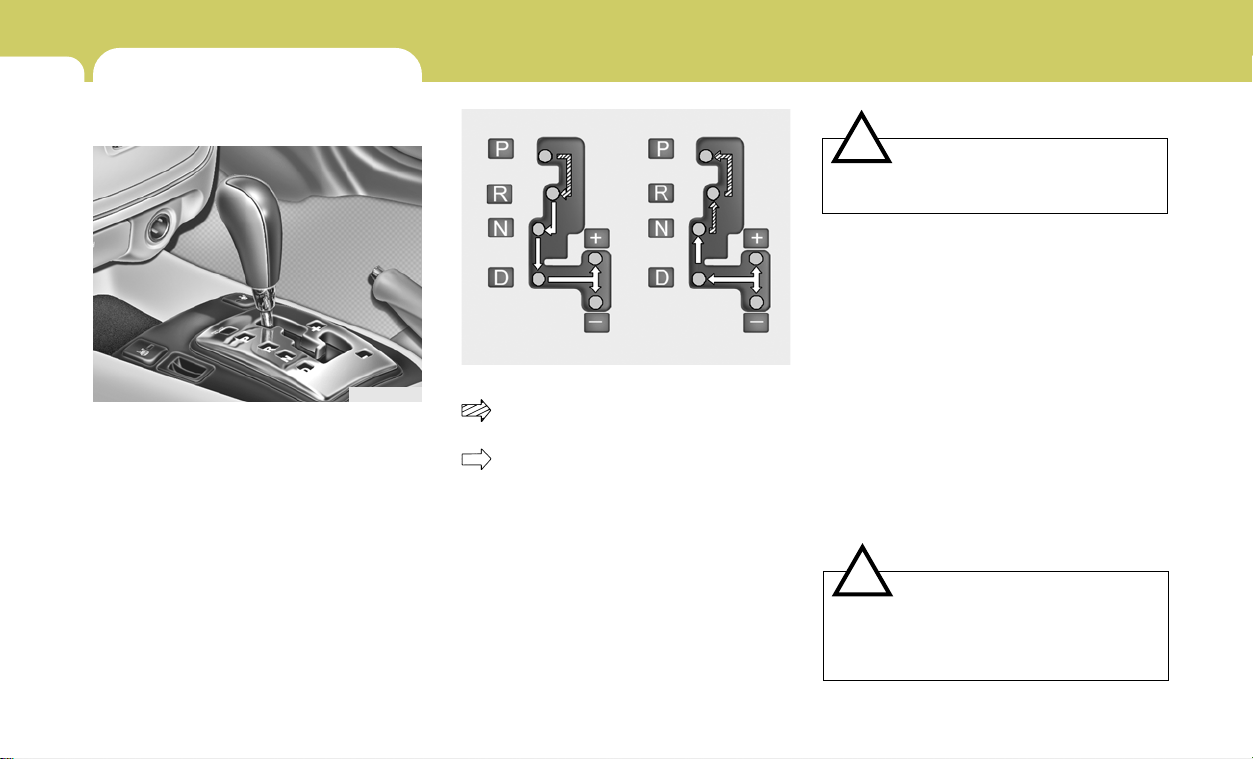
2
DRIVING YOUR HYUNDAI
8
NOTE:
Depress the brake pedal when shift-
ing.
The selector lever can be shifted freely.
The first few shifts on a new vehicle, or if the
battery has been disconnected, may be
somewhat abrupt. This is a normal condi-
tion, and the shifting sequence will adjust
after shifts are cycled a few times by the
T.C.M (Transaxle Control Module).
!
C090A02NF
CAUTION:
Never shift into "R" or "P" position while the
vehicle is moving.
The indicator lights in the instrument cluster
indicate the selector lever position when the
ignition is switched "ON". During sports mode
operation, the gear currently in use displays in
the numeral indicator.
C090B02A-AAT
The function of each position is as fol-
lows:
o P (Park):
Use to hold the vehicle in place when parked or
while starting the engine. Whenever parking the
car, apply the parking brake and shift the selec-
tor lever to the "P" (Park) position.
CAUTION:
Never place the selector lever in the "P"
(Park) position unless the vehicle is fully
stopped. Failure to observe this caution
will cause severe damage to the transaxle.
!
AUTOMATIC TRANSAXLE
(4 SPEED A/T, 5 SPEED A/T)
C090A01NF-GAT
(If Installed)
The highly efficient Hyundai automatic transaxle
has four/five forward speeds and one reverse
speed. The individual speeds are selected au-
tomatically, depending on the position of the
speed selector lever. The selector lever has 2
gates; the main gate and the manual gate.
NOTE:
For information on manual gate operation,
refer to "Sports Mode".
In the main gate, the selector lever has 4
positions.
C090A01NF
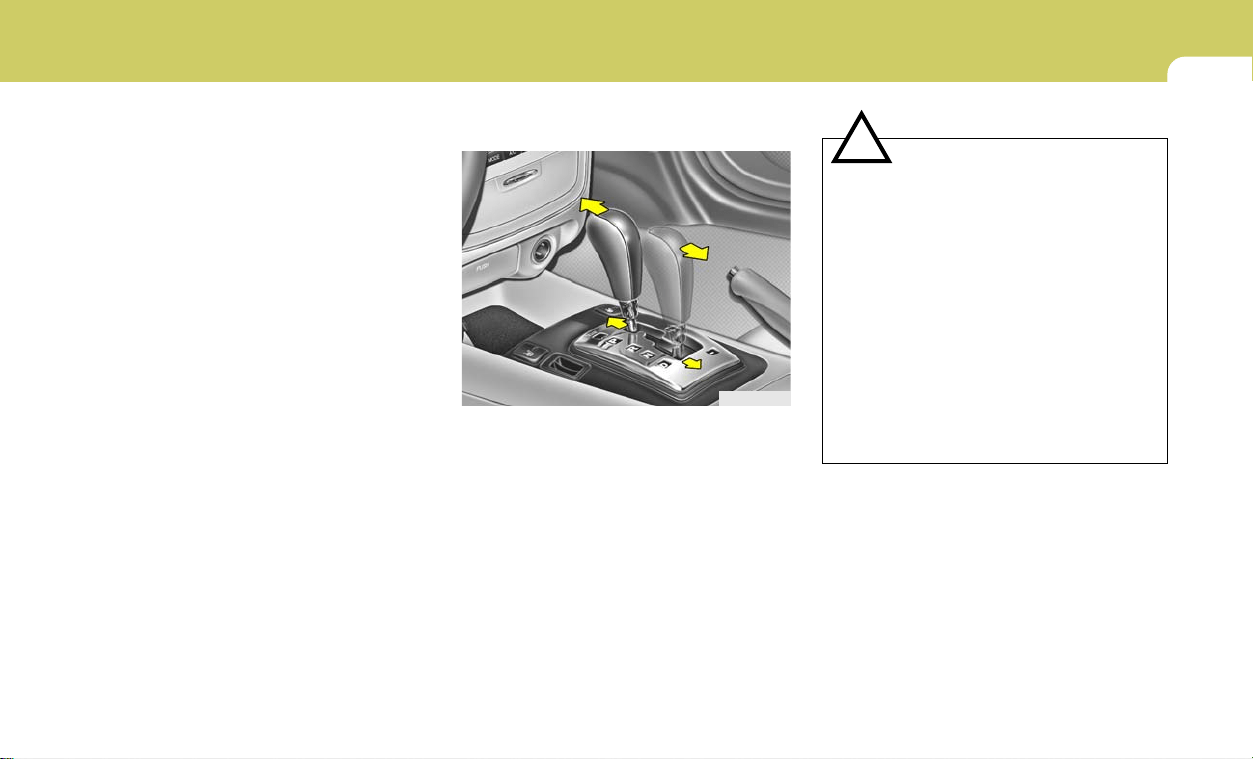
2
DRIVING YOUR HYUNDAI
9
C090E01NF-GAT
o D (Drive):
Use for normal driving. The transaxle will auto-
matically shift through a four/five gear sequence.
C090D02A-AAT
o N (Neutral):
In the "N" position, the transaxle is in neutral,
which means that no gears are engaged. The
engine can be started with the shift lever in "N"
position, although this is not recommended
except if the engine stalls while the car is
moving.
C090C01A-AAT
o R (Reverse):
Use for backing up the vehicle. Bring the car to
a complete stop before shifting the selector
lever to "R" position.
CAUTION:
o In sports mode, the driver must execute
upward shifts in accordance with pre-
vailing road conditions, taking care to
keep the engine speed below the red
zone.
o For engine protection, upward shifts are
made automatically when the engine
rpm reaches the red zone.
o By rapidly moving the selector lever
backwards (-) twice it is possible to skip
one gear, i.e., 3rd to 1st, 4th to 2nd or 5th
to 3rd. Since sudden engine braking
and/or rapid acceleration can cause a
loss of traction, however, downshifts
must be made carefully in accordance
with the vehicle's speed.
!
C090F02L-GAT
Sports Mode
Whether the vehicle is stationary or in motion,
sports mode is selected by pushing the selector
lever from the "D" position into the manual gate.
To return to "D" range operation, push the
selector lever back into the main gate.
In sports mode, moving the selector lever back-
wards and forwards can make rapid gearshifts
simple. In contrast to a manual transaxle, the
sports mode allows gearshifts with the accel-
erator pedal depressed.
UP (+) : Push the lever forward once to shift up
one gear.
DOWN (-) : Pull the lever backwards once to
shift down one gear.
SKIP : By rapidly moving the selector forward
or backward twice, it is possible to skip one
gear, i.e. 1st to 3rd or 3rd to 1st .
C090F02NF
NOTE:
o In sports mode, only the four/five for-
ward gears can be selected. To reverse or
park the vehicle, move the selector lever
to the "R" or "P" position as required.
o In sports mode, downward shifts are
made automatically when the vehicle
slows down. When the vehicle stops, 1st
gear is automatically selected.
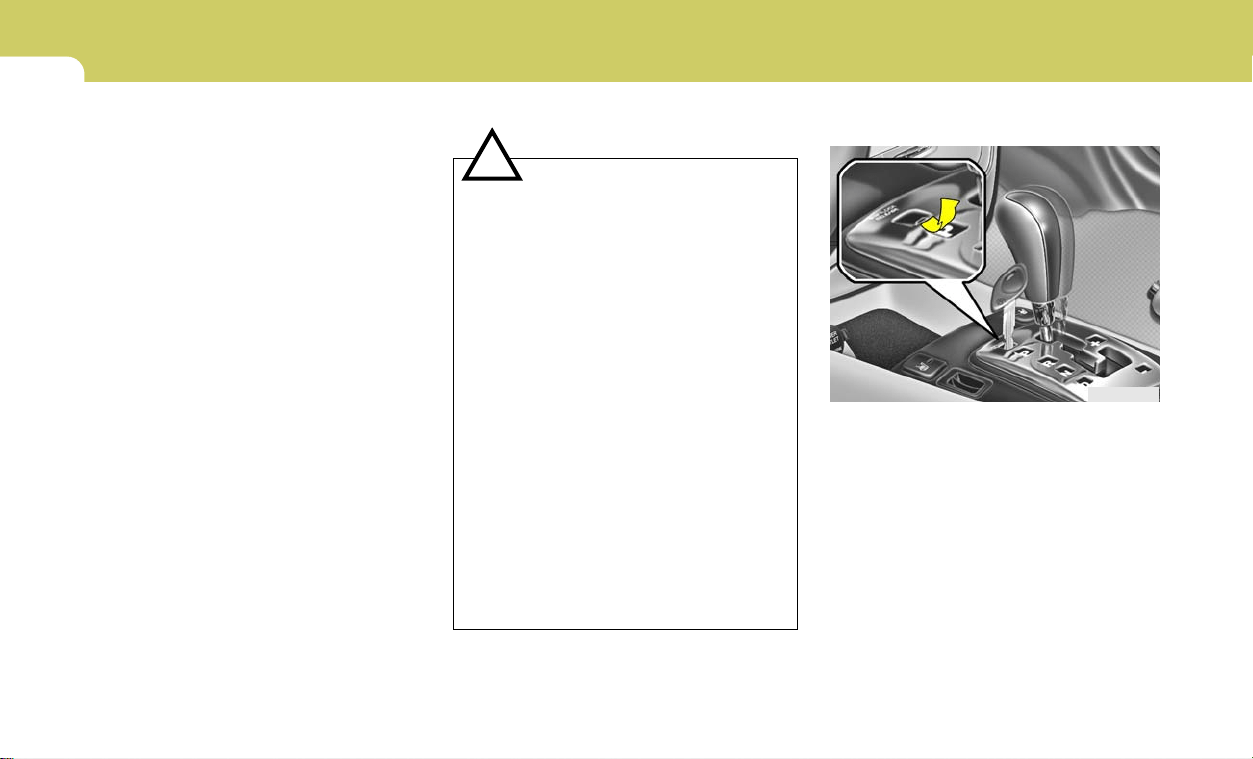
2
DRIVING YOUR HYUNDAI
10
!
C090I03L-GAT
CAUTION:
o Shift into "R" and "P" position only when
the vehicle has completely stopped.
o Do not accelerate the engine in reverse
or any of the forward positions with the
brakes applied.
o Always apply the footbrake when shift-
ing from "P" or "N", to "R" or "D"position.
o Do not use the "P" (Park) position in
place of the parking brake. Always set
the parking brake, shift the transaxle
into "P" (Park) position and turn off the
ignition when you leave the vehicle, even
momentarily. Never leave the vehicle
unattended while the engine is running.
o When accelerating from a stop on a
steep hill, the vehicle may have a ten-
dency to roll backwards. Shifting the
shift lever into 2nd gear while in Sport
mode will help prevent the vehicle from
rolling backwards.
o Check the automatic transaxle fluid level
regularly, and add fluid as necessary.
o See the maintenance schedule for the
proper fluid recommendation.
C090H01L-GAT
NOTE:
o For smooth and safe operation, depress
the brake pedal when shifting from "Neu-
tral" position or "Park" position to a
forward or reverse gear.
o The ignition key must be in the "ON"
position and the brake pedal fully de-
pressed in order to move the shift lever
from the "P" (Park) position to any of the
other positions.
o It is always possible to shift from "R",
"N", or "D" position to "P" position. The
vehicle must be fully stopped to avoid
transaxle damage.
o To maintain the required levels of ve-
hicle performance and safety, the sys-
tem may not execute certain gearshifts
when the selector lever is operated.
o Before driving away from a stop on a
slippery road, push the selector lever
forward into the +(UP) position. This
causes the transaxle to shift into 2nd
gear which is better for smooth driving
away on a slippery road. Push the selec-
tor lever to the -(DOWN) side to shift
back to 1st gear.
C090J01NF-GAT
SHIFT LOCK RELEASE (If Installed)
If you cannot move the shift lever from the "P"
(Park) position to any other position with the
brake pedal fully depressed and the ignition key
in the "ON" position, remove the cap on the
console and with a thin object such as a flat-
head screwdriver, push the shift lock release
button down. Then, with the brake pedal de-
pressed, move the shift lever to the desired
position, and then the shift lock release button
will automatically return to its original position
after shifting from the "P" (Park) position. Then,
reinstall the cap.
If you need to use the shift lock release, it could
mean your car is developing a problem. Have
the car checked by your Hyundai dealer.
C090J01NF
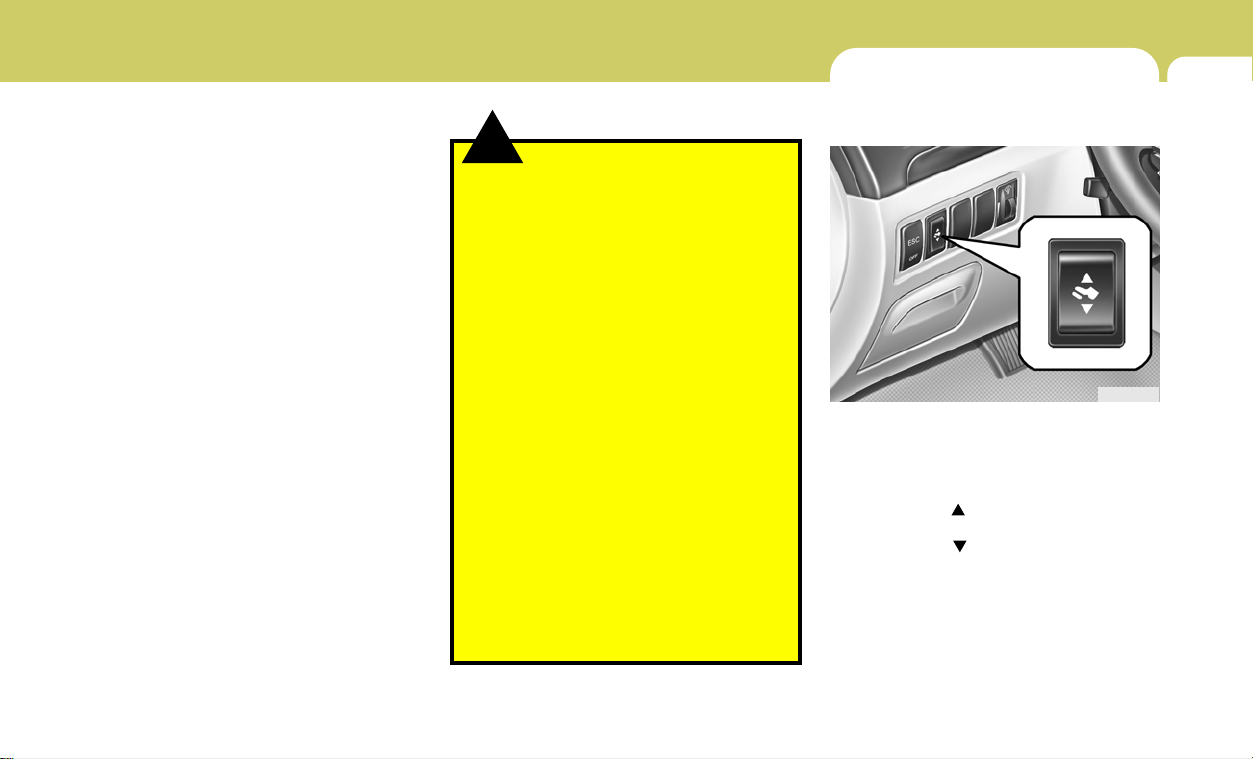
2
DRIVING YOUR HYUNDAI
11
POWER ADJUSTABLE PEDALS
!
C090N03O-AAT
Good Driving Practices
o Never move the gear selector lever from "P"
or "N" to any other position with the accelera-
tor pedal depressed.
o Never move the gear selector lever into "P"
when the vehicle is in motion.
o Be sure the car is completely stopped before
you attempt to shift into "R".
o Never take the car out of gear and coast
down a hill. This may be extremely hazard-
ous. Always leave the car in gear when
moving.
o Do not "ride" the brakes. This can cause
them to overheat and malfunction. Instead,
when you are driving down a long hill, slow
down and shift to a lower gear. When you do
this, engine braking will help slow the car.
o Slow down before shifting to a lower gear.
Otherwise, the lower gear may not be en-
gaged.
o Always use the parking brake. Do not de-
pend on placing the transaxle in "P" to keep
the car from moving.
o Exercise extreme caution when driving on a
slippery surface. Be especially careful when
braking, accelerating or shifting gears. On a
slippery surface, an abrupt change in ve-
hicle speed can cause the drive wheels to
lose traction and the vehicle to go out of
control.
WARNING:
o Avoid high cornering speeds.
o Do not make quick steering wheel move-
ments, such as sharp lane changes or
fast, sharp turns.
o Always wear your seat belts.
In a collision, an unbelted person is
significantly more likely to die than a
person wearing a seat belt.
o The risk of rollover is greatly increased if
you lose control of your vehicle at high-
way speeds.
o Loss of control often occurs if two or
more wheels drop off the roadway and
the driver oversteers to reenter the road-
way.
o In the event your vehicle leaves the road-
way, do not steer sharply. Instead, slow
down before pulling back into the travel
lanes.
o Never exceed posted speed limits.
o Excessive depressing of the accelerater
pedal in slippery driving conditions such
as pulling out of deep snow or mud may
cause severe damage to the transaxle.
Rocking the vehicle is not recommended.
Rather, use an appropriate towing
method.
C100A01NF-AAT
(With Automatic Transaxle) (If Installed)
To adjust the position of the accelerator and
brake pedals, turn the ignition key to the "ON"
position with the selector lever in the "P" position
and push the switch.
If you push the " " portion of the switch, the
pedals move rearward.
If you push the " " portion of the switch, the
pedals move forward.
HNF2115-A
2
DRIVING YOUR HYUNDAI
12
!
!
WARNING:
ABS (ESC) will not prevent accidents due to
improper or dangerous driving maneuvers.
Even though vehicle control is improved
during emergency braking, always main-
tain a safe distance between you and ob-
jects ahead. Vehicle speeds should always
be reduced during extreme road condi-
tions.
The braking distance for cars equipped
with an anti-lock braking system (ESC) may
be longer than for those without it in the
following road conditions.
During these conditions the vehicle should
be driven at reduced speeds:
o Rough, gravel or snow-covered roads.
o With tire chains installed.
o On roads where the road surface is pit-
ted or has different surface height.
The safety features of an ABS (ESC)
equipped vehicle should not be tested by
high speed driving or cornering. This could
endanger the safety of yourself or others.
ANTI-LOCK BRAKE SYSTEM (ABS)
C120A03A-AAT
(If Installed)
The Anti-Lock Brake System (ABS) is designed
to prevent wheel lock-up during sudden braking
or on hazardous road surfaces. The ABS con-
trol module monitors the wheel speed and con-
trols the pressure applied to each brake. Thus,
in emergency situations or on slick roads, ABS
will increase vehicle control during braking.
NOTE:
During ABS (ESC) operation, a pulsation
may be felt in the brake pedal when the
brakes are applied. Also, a noise may be
heard in the engine compartment while
braking. These conditions are normal and
indicate that the anti-lock brake system
(Electronic Stability Control System) is func-
tioning properly.
Setting the driver's position
1) Be sure the parking brake is engaged.
2) Move the accelerator and brake pedals to
the front most position by pushing the " "
portion of the switch.
3) Adjust the seat position and the steering
wheel angle properly.
4) Move the pedals toward you until you can
fully depress the brake pedal by pushing the
" " portion of the switch.
5) Depress the pedals a few times to get used
to the feel after adjusting.
WARNING:
o Adjust the pedals after parking the ve-
hicle on level ground. Never attempt to
adjust the pedals while the vehicle is
moving.
o Never adjust the pedals with your foot
on the accelerator pedal as this may
result in increasing the engine speed
and acceleration.
o Make sure that you can fully depress the
brake pedal before driving. Otherwise,
you may not be able to hold down the
brake pedal firmly in an emergency stop.
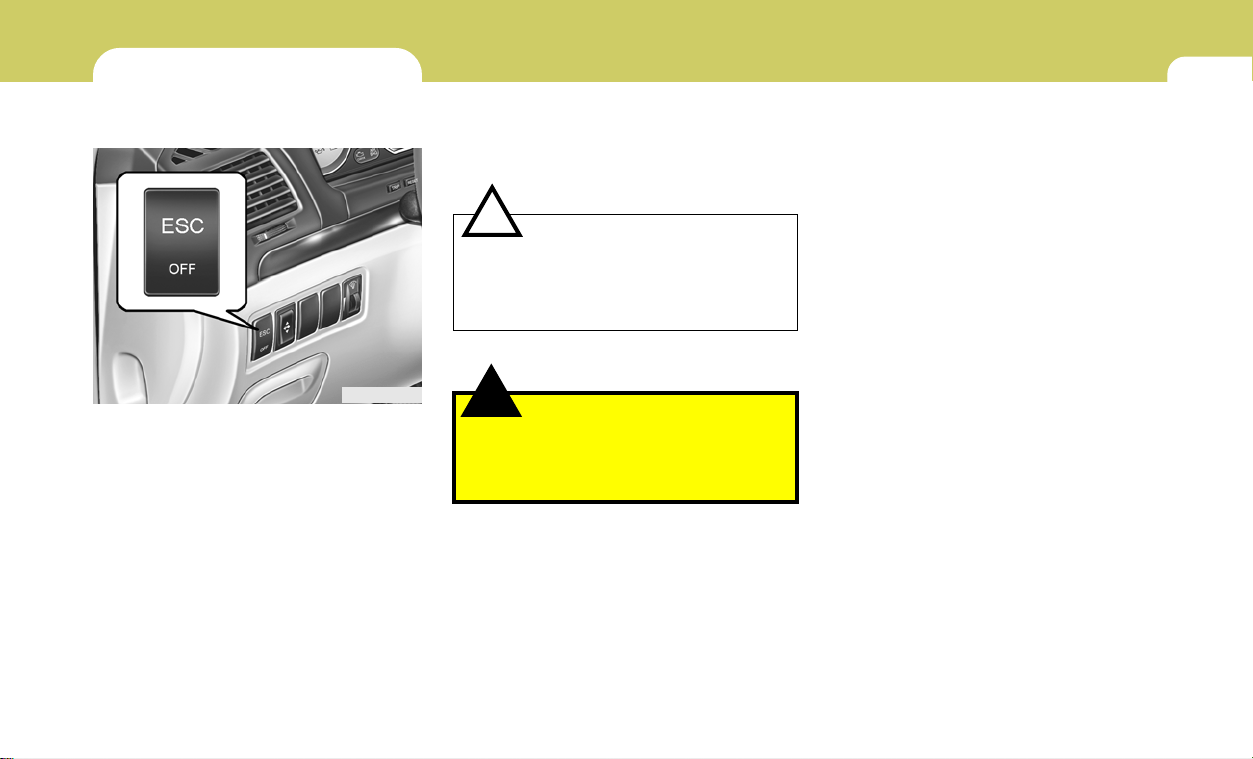
2
DRIVING YOUR HYUNDAI
13
CAUTION:
Driving with varying tire or wheel sizes may
cause the ESC system to malfunction. When
replacing tires, make sure they are the same
size as your original tires.
!
ELECTRONIC STABILITY CONTROL
(ESC) SYSTEM
C310A01NF-AAT
(If Installed)
The Electronic Stability Control (ESC) system
is designed to stabilize the vehicle during cor-
nering manuevers. ESC checks where you are
steering and where the vehicle is actually going.
ESC applies the brakes at individual wheels and
intervenes in the engine management system
to stabilize the vehicle.
The Electronic Stability Control (ESC) system
is an electronic system designed to help the
driver maintain vehicle control under adverse
conditions. It is not a substitute for safe driving
practices. Factors including speed, road con-
ditions and driver steering input can all affect
whether ESC will be effective in preventing a
B310A01NF-A
loss of control. It is still your responsibility to
drive and corner at reasonable speeds and to
leave a sufficient margin of safety.
!
WARNING:
Electronic stability control is only a driving
aid; all normal precautions for driving in
inclement weather and on slippery road
surfaces should be observed.
C310B01NF-AAT
ESC ON/OFF Mode
When the ESC is operating, the ESC indicator
in the instrument cluster will blink.
If you turn the system off by pressing the ESC
switch, the ESC-OFF indicator will come on and
stay on. In the ESC-OFF mode, the stability
control will be deactivated. Adjust your driving
accordingly. To turn the system back on, press
the switch again. The ESC-OFF indicator should
go off.
NOTE:
The ESC mode will automatically be turned
ON after the engine is turned off and re-
started.
2
DRIVING YOUR HYUNDAI
14
!
GOOD BRAKING PRACTICES
C130A01A-AAT
WARNING:
Nothing should be carried on top of the
shelf panel behind the rear seat. If there
were an accident or a sudden stop, such
objects could move forward and cause
damage to the vehicle or injure the occu-
pants.
o After being parked, check to be sure the
parking brake is not engaged and that the
parking brake indicator light is out before
driving away.
o Driving through water may get the brakes
wet. They can also get wet when the car is
washed. Wet brakes can be dangerous!
Your car will not stop as quickly if the brakes
are wet. Wet brakes may cause the car to
pull to one side. To dry the brakes, apply the
brakes lightly until the braking action returns
to normal, taking care to keep the car under
control at all times. If the braking action does
not return to normal, stop as soon as it is safe
to do so and call your Hyundai dealer for
assistance.
o Don't coast down hills with the car out of gear.
This is extremely hazardous. Keep the car
in gear at all times, use the brakes to slow
down, then shift to a lower gear so that engine
braking will help you maintain a safe speed.
o Don't "ride" the brake pedal. Resting your
foot on the brake pedal while driving can be
dangerous because it can result in the brakes
overheating and losing their effectiveness. It
also increases the wear of the brake com-
ponents.
o If a tire goes flat while you are driving, apply
the brakes gently and keep the car pointed
straight ahead while you slow down. When
you are moving slowly enough for it to be safe
to do so, pull off the road and stop in a safe
place.
o If your car is equipped with an automatic
transaxle, don't let your car creep forward.
To avoid creeping forward, keep your foot
firmly on the brake pedal when the car is
stopped.
o Use caution when parking on a hill. Engage
the parking brake and place the gear selec-
tor lever in "P" (automatic transaxle) or in first
or reverse gear (manual transaxle). If your
car is facing downhill, turn the front wheels
into the curb to help keep the car from rolling.
If your car is facing uphill, turn the front
wheels away from the curb to help keep the
car from rolling. If there is no curb or if it is
required by other conditions to keep the car
from rolling, block the wheels.
C310D01NF-AAT
Indicators and Warning
The indicators should illuminate when the igni-
tion key is turned to ON or START but should
go out after three seconds.
If the indicators do not illuminate, or the ESC or
ESC-OFF indicator does not go out after 3
seconds, have the vehicle checked by an
authorized dealer.
Should there be any unusual operation of the
device while driving, the ESC-OFF indicator
illuminates as a warning.
If the ESC-OFF indicator illuminates, drive your
car to a safe place and stop the engine.
Then, start the engine again to check if the ESC-
OFF indicator goes out.
If the indicator remains lit even after the engine
has been started, have your car checked by an
authorized Hyundai dealer.

2
DRIVING YOUR HYUNDAI
15
o Be sure that the wheels are aligned cor-
rectly. Improper alignment can result from
hitting curbs or driving too fast over irregular
surfaces. Poor alignment causes faster tire
wear and may also result in other problems
as well as greater fuel consumption.
o Keep your car in good condition. For better
fuel economy and reduced maintenance
costs, maintain your car in accordance with
the maintenance schedule in Section 5. If
you drive your car in severe conditions,
more frequent maintenance is required (see
Section 5 for details).
o Keep your car clean. For maximum service,
your Hyundai should be kept clean and free
of corrosive materials. It is especially impor-
tant that mud, dirt, ice, etc. not be allowed to
accumulate on the underside of the car. This
extra weight can result in increased fuel
consumption and also contribute to corro-
sion.
o Travel lightly. Don't carry unnecessary
weight in your car. Weight reduces fuel
economy.
o Don't let the engine idle longer than neces-
sary. If you are waiting (and not in traffic),
turn off your engine and restart only when
you're ready to go.
DRIVING FOR ECONOMY
C140A01A-AAT
You can save fuel and get more miles from your
car if you follow these suggestions:
o Drive smoothly. Accelerate at a moderate
rate. Don't make "jack-rabbit" starts or full-
throttle shifts and maintain a steady cruising
speed. Don't race between stoplights. Try to
adjust your speed to that of the other traffic
so you don't have to change speeds unnec-
essarily. Avoid heavy traffic whenever pos-
sible. Always maintain a safe distance from
other vehicles so you can avoid unneces-
sary braking. This also reduces brake wear.
o Drive at a moderate speed. The faster you
drive, the more fuel your car uses. Driving at
a moderate speed, especially on the high-
way, is one of the most effective ways to
reduce fuel consumption.
o Don't "ride" the brake or clutch pedal. This
can increase fuel consumption and also
increase wear on these components. In
addition, driving with your foot resting on the
brake pedal may cause the brakes to over-
heat, which reduces their effectiveness and
may lead to more serious consequences.
o Take care of your tires. Keep them inflated
to the recommended pressure. Incorrect
inflation, either too much or too little, results
in unnecessary tire wear. Check the tire
pressures at least once a month.
o Under some conditions your parking brake
can freeze in the engaged position. This is
most likely to happen when there is an
accumulation of snow or ice around or near
the rear brakes or if the brakes are wet. If
there is a risk that the parking brake may
freeze, apply it only temporarily while you put
the gear selector lever in "P" (automatic) or
in first or reverse gear (manual transaxle)
and block the rear wheels so the car cannot
roll. Then release the parking brake.
o Do not hold the vehicle on the upgrade with
the accelerator pedal. This can cause the
transaxle to overheat. Always use the brake
pedal or parking brake.

2
DRIVING YOUR HYUNDAI
16
o Remember, your Hyundai does not require
extended warm-up. As soon as the engine
is running smoothly, you can drive away. In
very cold weather, however, give your en-
gine a slightly longer warm-up period.
o Don't "lug" or "over-rev" the engine. Lugging
is driving too slowly in too high a gear result-
ing in the engine bucking. If this happens,
shift to a lower gear. Over-revving is racing
the engine beyond its safe limit. This can be
avoided by shifting at the recommended
speeds.
o Use your air conditioning sparingly. The air
conditioning system is operated by engine
power so your fuel economy is reduced
when you use it.
SMOOTH CORNERING
C150A01A-AAT
Avoid braking or gear changing in corners,
especially when roads are wet. Ideally, corners
should always be taken under gentle accelera-
tion. If you follow these suggestions, tire wear
will be held to a minimum.
C160A01A-AAT
The more severe weather conditions of winter
result in greater wear and other problems. To
minimize the problems of winter driving, you
should follow these suggestions:
C160B01A-AAT
Snowy or Icy Conditions
To drive your vehicle in deep snow, it may be
necessary to use snow tires or to install tire
chains on your tires. If snow tires are needed,
it is necessary to select tires equivalent in size
and type of the original equipment tires. Failure
to do so may adversely affect the safety and
handling of your car. Furthermore, speeding,
rapid acceleration, sudden brake applications,
and sharp turns are potentially very hazardous
practices.
During deceleration, use engine braking to the
fullest extent. Sudden brake applications on
snowy or icy roads may cause skids to occur.
You need to keep sufficient distance between
the vehicle in operation in front and your vehicle.
Also, apply the brake gently. It should be noted
that installing tire chains on the tire will provide
a greater driving force, but will not prevent side
skids.
NOTE:
Tire chains are not legal in all states. Check
state laws before fitting tire chains.
WINTER DRIVING

2
DRIVING YOUR HYUNDAI
17
C160H02A-AAT
Use Approved Window Washer Anti-
Freeze in System
To keep the water in the window washer system
from freezing, add an approved window washer
anti-freeze solution in accordance with instruc-
tions on the container. Window washer anti-
freeze is available from Hyundai dealers and
most auto parts outlets. Do not use engine
coolant or other types of anti-freeze as these
may damage the paint finish.
C160G01A-AAT
To Keep Locks from Freezing
To keep the locks from freezing, squirt an
approved de-icer fluid or glycerine into the key
opening. If a lock is covered with ice, squirt it with
an approved de-icing fluid to remove the ice. If
the lock is frozen internally, you may be able to
thaw it out by using a heated key. Handle the
heated key with care to avoid injury.
C160F01A-AAT
Check Spark Plugs and Ignition
System
Inspect your spark plugs as described in Sec-
tion 6 and replace them if necessary. Also
check all ignition wiring and components to be
sure they are not cracked, worn or damaged in
any way.
C160E01A-AAT
Change to "Winter Weight" Oil if
Necessary
In some climates it is recommended that a lower
viscosity "winter weight" oil be used during cold
weather. See Section 9 for recommendations.
If you aren't sure what weight oil you should use,
consult your Hyundai dealer.
C160D01A-AAT
Check Battery and Cables
Winter puts additional burdens on the battery
system. Visually inspect the battery and cables
as described in Section 6. The level of charge
in your battery can be checked by your Hyundai
dealer or a service station.
C160C01A-AAT
Use High Quality Ethylene Glycol
Coolant
Your Hyundai is delivered with high quality
ethylene glycol coolant in the cooling system. It
is the only type of coolant that should be used
because it helps prevent corrosion in the cool-
ing system, lubricates the water pump and
prevents freezing. Be sure to replace or replen-
ish your coolant in accordance with the main-
tenance schedule in Section 5. Before winter,
have your coolant tested to assure that its
freezing point is sufficient for the temperatures
anticipated during the winter.

2
DRIVING YOUR HYUNDAI
18
C160J01A-AAT
Don't Let Ice and Snow Accumulate
Underneath
Under some conditions, snow and ice can build
up under the fenders and interfere with the
steering. When driving in severe winter condi-
tions where this may happen, you should peri-
odically check underneath the car to be sure the
movement of the front wheels and the steering
components is not obstructed.
C160I01L-AAT
Don't Let Your Parking Brake Freeze
Under some conditions your parking brake can
freeze in the engaged position. This is most
likely to happen when there is an accumulation
of snow or ice around or near the rear brakes
or if the brakes are wet. If there is a risk the
parking brake may freeze, apply it only tempo-
rarily while you put the gear selector lever in "P"
and block the rear wheels so the car cannot roll.
Then release the parking brake.
C160K01A-AAT
Carry Emergency Equipment
Depending on the severity of the weather where
you drive your car, you should carry appropri-
ate emergency equipment. Some of the items
you may want to carry include tire chains, tow
straps or chains, flashlight, emergency flares,
sand, a shovel, jumper cables, a window scraper,
gloves, ground cloth, coveralls, a blanket, etc.
HIGHER SPEED MOTORING
C170A01A-AAT
Pre-Trip Inspections
1. Tires:
Adjust the tire inflation pressures to specifica-
tion. Low tire inflation pressures will result in
overheating and possible failure of the tires.
Avoid using worn or damaged tires which may
result in reduced traction or tire failure.
NOTE:
Never exceed the maximum tire inflation
pressure shown on the tires.
2. Fuel, engine coolant and engine oil:
High speed travel consumes more fuel than
urban motoring. Do not forget to check both
engine coolant and engine oil.
3. Drive belt:
A loose or damaged drive belt may result in
overheating of the engine.
2
DRIVING YOUR HYUNDAI
19
C190B01S-AAT
Trailer Hitches
Select the proper hitch and ball combination,
making sure that its location is compatible with
that of the trailer or vehicle being towed.
Use a quality non-equalizing hitch which distrib-
utes the tongue load uniformly throughout the
chassis.
The hitch should be bolted securely to the car
and installed by a qualified technician. DO NOT
USE A HITCH DESIGNED FOR TEMPORARY
INSTALLATION AND NEVER USE ONE THAT
ATTACHES ONLY TO THE BUMPER.
C190C01Y-AAT
Trailer Brakes
If your trailer is equipped with a braking system,
make sure it conforms to federal and/or local
regulations and that it is properly installed and
operating correctly.
NOTE:
If you tow a trailer or vehicle, your car will
require more frequent maintenance due to
the additional load. See Maintenance Under
Severe Usage Conditions" on page 5-6.
TRAILER OR VEHICLE TOWING
!
C190A01S-AAT
If you are considering towing with your car, you
should first check with your State's Department
of Motor Vehicles to determine their legal re-
quirements.
Since laws vary from State to State the require-
ments for towing trailers, cars, or other types of
vehicles or apparatus may differ. Ask your
Hyundai dealer for further details before towing.
CAUTION:
Do not do any towing with your car during
its first 1,200 miles (2,000 km) in order to
allow the engine to properly break in. Fail-
ure to heed this caution may result in seri-
ous engine or transaxle damage.
USE OF LIGHTS
C180A01A-AAT
Check your lights regularly for correct opera-
tion and always keep them clean. When driving
during the day in conditions of poor visibility, it
is helpful to drive with headlights on low beam.
This enables you to be seen as well as to see.
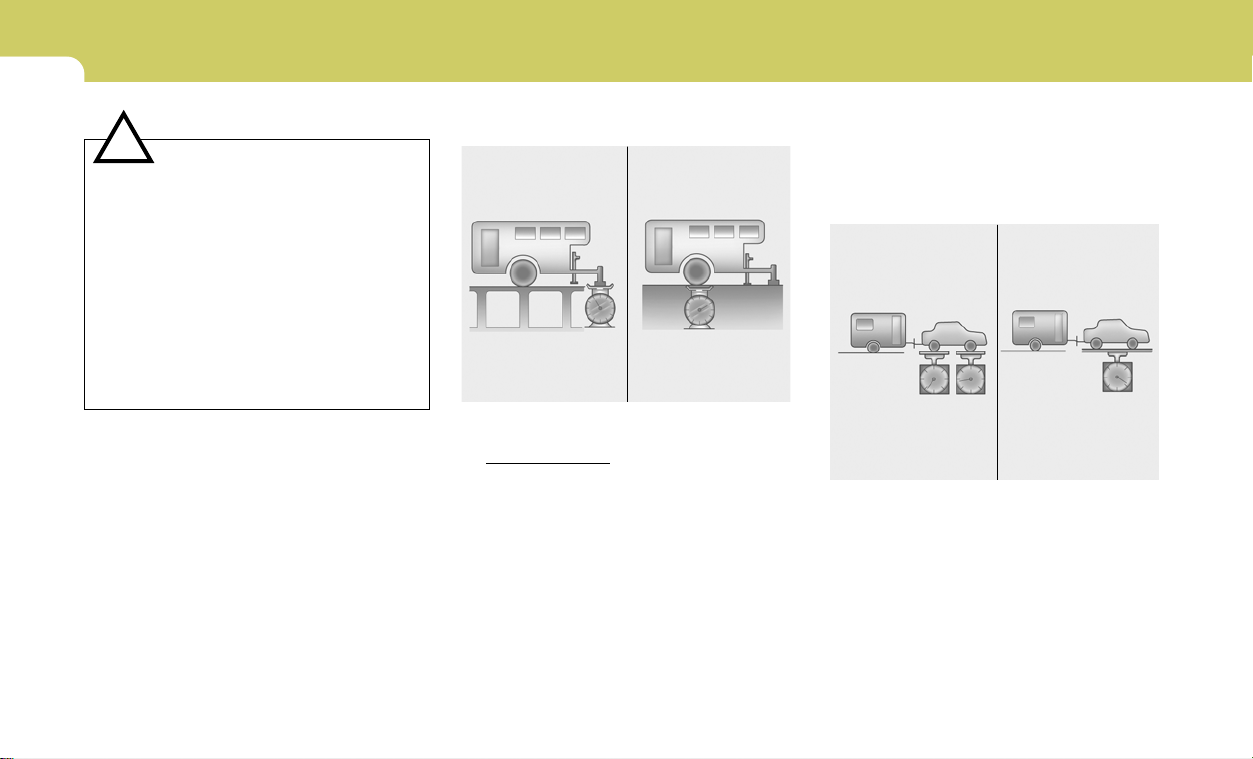
2
DRIVING YOUR HYUNDAI
20
C190D01S-AAT
Safety Chains
Should the hitch connection between your car
and the trailer or vehicle you are towing fail, the
trailer or vehicle could wander dangerously
across other lanes of traffic and ultimately leave
the roadway. To eliminate this potentially dan-
gerous situation, safety chains, attached be-
tween your car and the trailer or towed vehicle,
are required in most states.
CAUTION:
o Never connect a trailer brake system
directly to the vehicle brake system.
o When towing a trailer on steep grades (in
excess of 12%) pay close attention to the
engine coolant temperature gauge to
ensure the engine does not overheat. If
the needle of the coolant temperature
gauge moves across the dial towards
"H" (HOT), pull over and stop as soon as
it is safe to do so, and allow the engine
to idle until it cools down. You may
proceed once the engine has cooled
sufficiently.
!
C190E02JM
Gross Axle Weight
Gross Vehicle
Weight
2. The total gross vehicle weight with trailer
must not exceed the Gross Vehicle
Weight Rating (GVWR) shown on the
vehicle identification plate (see page 8-
2). The total gross vehicle weight is the
combined weight of the vehicle, driver,
all passengers and their luggage, cargo,
hitch, trailer tongue load and other op-
tional equipment.
C190E01NF-AAT
Trailer Weight Limit
Tongue Load Total Trailer Weight
o Keep the tongue load 10% of the total trailer
load.
o Tongue load
o Tongue loads can be increased or de-
creased by re-distributing the load in the
trailer.
This can be verified by checking the total
weight of the loaded trailer and then checking
the load on the tongue.
C190E01JM
x 100 = 10% (MAX)
Total trailer weight
NOTE:
1. Never load the trailer with more weight in
the back than in the front. About 60% of
the trailer load should be in the front half
on the trailer and the remaining 40% in
the rear.
2
DRIVING YOUR HYUNDAI
21
C190F01Y-GAT
Trailer or Vehicle Towing Tips
1. Before towing, check hitch and safety chain
connections as well as proper operation of
the trailer running lights, brake lights, and
turn signals.
2. Always drive your vehicle at a moderate
speed. (Less than 60 mph)
3. Trailer towing requires more fuel than normal
conditions.
4. To maintain engine braking efficiency and
electrical charging performance, do not tow
a trailer with the transaxle in fifth gear (manual
transaxle).
5. Always secure items in the trailer to prevent
load shift while driving.
6. Check the condition and air pressure of all
tires on the trailer and your car. Low tire
pressure can seriously affect the handling.
Also check the spare tire.
7. The vehicle/trailer combination is more af-
fected by crosswind and buffeting.
When being passed by a large vehicle, keep
a constant speed and steer straight ahead.
If there is too much wind buffeting, slow down
to get out of the other vehicle's air turbulence.
!
lbs(kg)
!
Tongue
200 (90)
-
With 3.3L
Brake 2.4L
Without Brake
Maximum Towable Weight
Trailer
2000 (900)
1500 (675)
1000 (450)
CAUTION:
The following specifications are recom-
mended when towing a trailer. The loaded
trailer weight cannot safely exceed the val-
ues in the chart below.
WARNING:
o Improperly loading your vehicle and
trailer can seriously affect its steering
and braking performance causing a
crash which could cause serious injury
or death.
o Towing a trailer affects vehicle handling
and braking.
o Drive more slowly when towing a trailer
and allow more distance when braking.
o Be careful when driving in slippery and
windy conditions.
o Be careful when turning and while driv-
ing up and down hills.
3. The front or rear axle weight must not
exceed the Gross Axle Weight Rating
(GAWR) shown on the vehicle identifi-
cation plate (see page 8-2). It is possible
that your towing package does not ex-
ceed the GVWR but exceeds the GAWR.
Improper trailer loading and/or too much
luggage in the trunk can overload the
rear axle. Redistribute the load and check
the axle weight again.
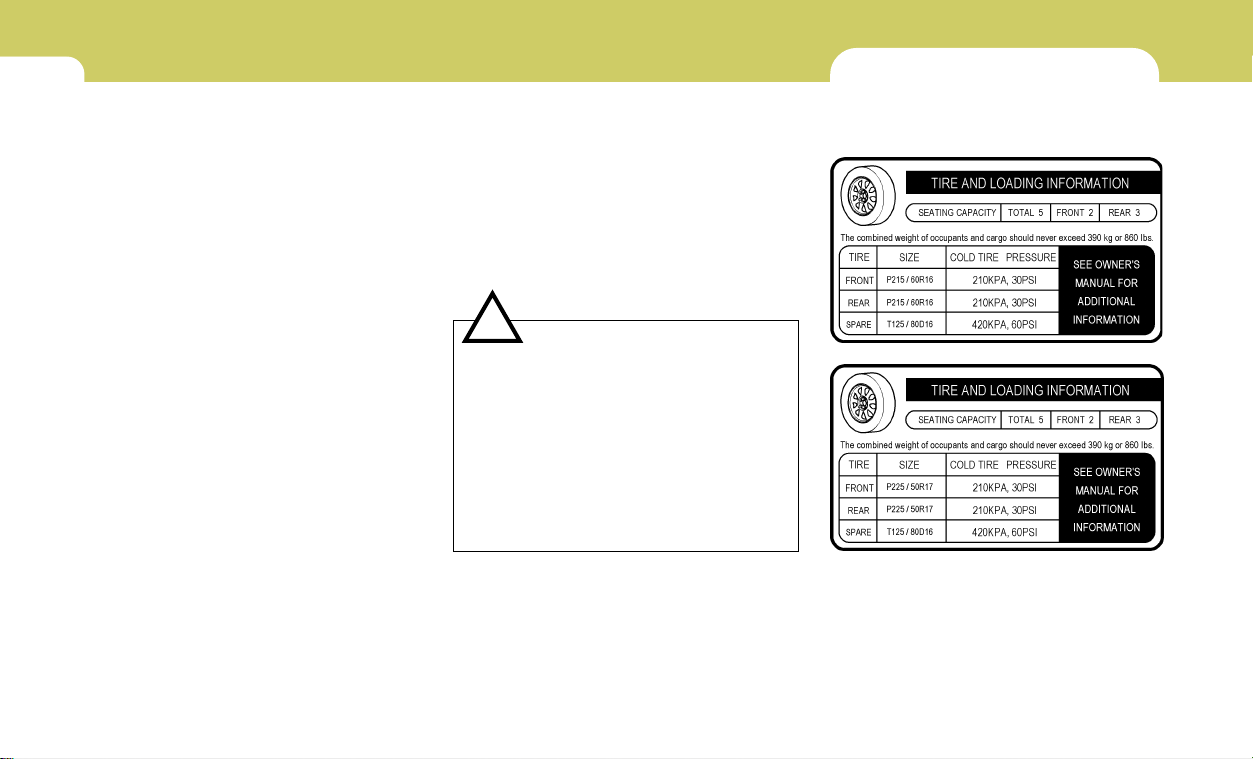
2
DRIVING YOUR HYUNDAI
22
8. When parking your car and trailer, especially
on a hill, be sure to follow all the normal
precautions. Turn your front wheel into the
curb, set the parking brake firmly, and put the
transaxle in 1st or Reverse (manual) or Park
(automatic). In addition, place wheel chocks
at each of the trailer's tires.
9. If the trailer has electric brakes, start your
vehicle and trailer moving, and then apply the
trailer brake controller by hand to be sure the
brakes are working. This lets you check
your electrical connection at the same time.
10.During your trip, check occasionally to be
sure that the load is secure, and that the
lights and any trailer brakes are still working.
11.Avoid jerky starts, sudden acceleration or
sudden stops.
12.Avoid sharp turns and rapid lane changes.
13.Avoid holding the brake pedal down too long
or too frequently. This could cause the brakes
to overheat, resulting in reduced braking
efficiency.
14.When going down a hill, shift into a lower gear
and use the engine braking effect.
When ascending a long grade, downshift the
transaxle to a lower gear and reduce speed
to reduce chances of engine overloading
and/or overheating.
CAUTION:
If overheating should occur when towing,
(the temperature gauge reads near red zone),
taking the following action may reduce or
eliminate the problem.
1. Turn off the air conditioner.
2. Reduce highway speed.
3. Select a lower gear when going uphill.
4. While in stop and go traffic, place the
gear selector in park or neutral and idle
the engine at a higher speed.
!
VEHICLE LOAD LIMIT
C190F01JM-AAT
Tire and Loading Information Label
I030A03NF-A
The tire label located on the driver's
side of the center pillar outer panel
gives the original tire size, cold tire
pressures recommended for your ve-
15.If you have to stop while going uphill, do not
hold the vehicle in place by pressing on the
accelerator. This can cause the automatic
transaxle to overheat. Use the parking brake
or footbrake.
NOTE:
When towing check transaxle fluid more
frequently.
I030A04NF-A
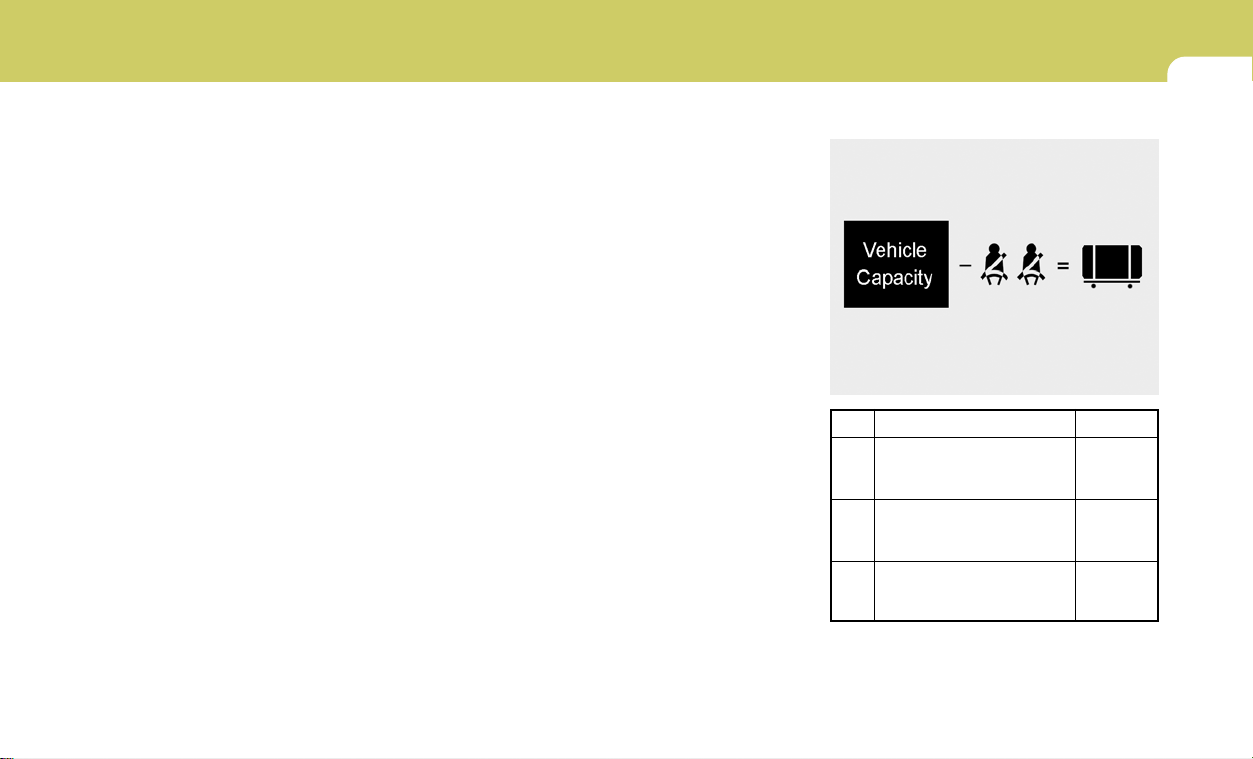
2
DRIVING YOUR HYUNDAI
23
C190F01JM
Total
1400 lbs
(635 kg)
300 lbs
(136 kg)
1100 lbs
(489 kg)
Example 1
Item
A
B
C
Description
Vehicle Capacity Weight
Subtract Occupant Weight
150 lbs (68 kg) × 2
Available Cargo and
Luggage Weight
ABC
hicle, the number of people that can be
in your vehicle and vehicle capacity
weight.
Steps for Determining Correct Load
Limit
(1)Locate the statement "The combined
weight of occupants and cargo should
never exceed XXX pounds'' on your
vehicle's placard.
(2)Determine the combined weight of
the driver and passengers that will be
riding in your vehicle.
(3)Subtract the combined weight of the
driver and passengers from XXX
kilograms or XXX pounds.
(4)The resulting figure equals the avail-
able amount of cargo and luggage
load capacity. For example, if the
"XXX" amount equals 1400 lbs, and
there will be five 150 lb. passengers
in your vehicle, the amount of avail-
able cargo and luggage load capac-
ity is 650 lbs. (1400-750 (5 x 150) =
650 lbs.)
(5)Determine the combined weight of
luggage and cargo being loaded on
the vehicle. That weight may not
safely exceed the available cargo
and luggage load capacity calcu-
lated in Step 4.
(6)If your vehicle will be towing a trailer,
load from your trailer will be trans-
ferred to your vehicle. Consult this
manual to determine how this re-
duces the available cargo and lug-
gage load capacity of your vehicle.
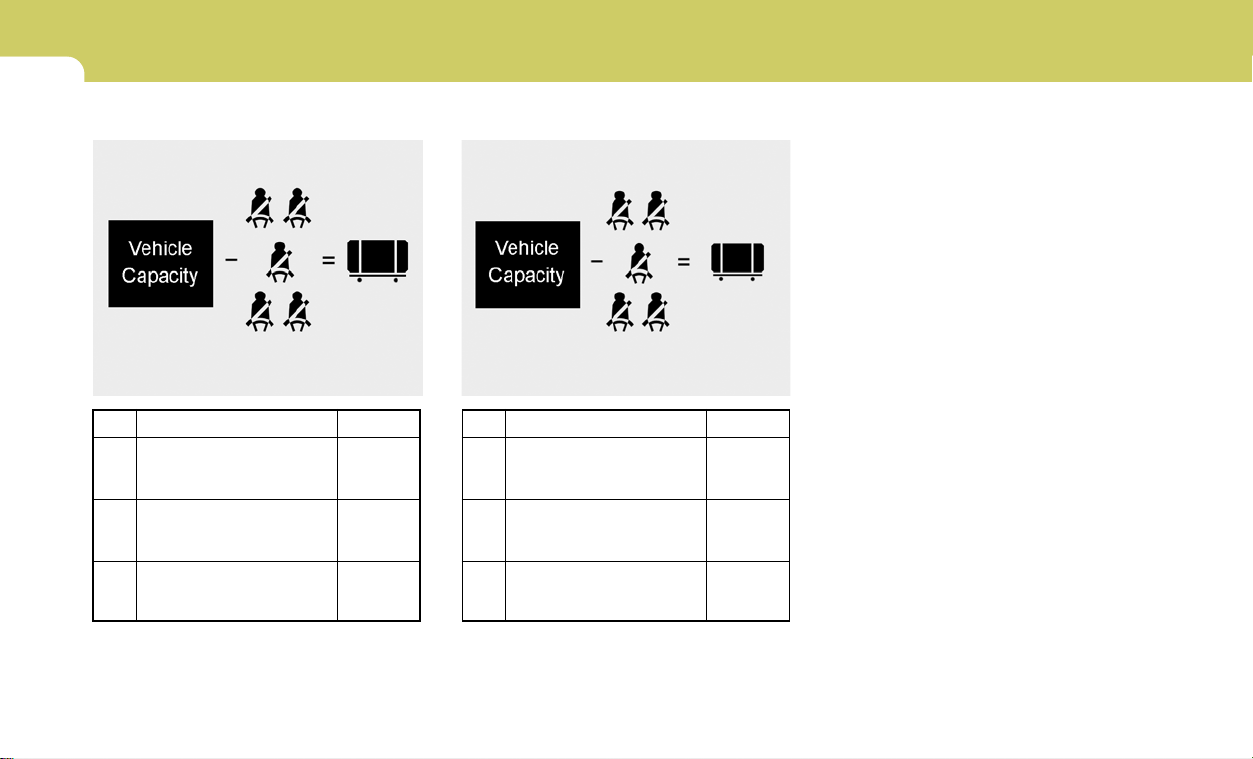
2
DRIVING YOUR HYUNDAI
24
C190F02JM
Example 2
Total
1400 lbs
(635 kg)
750 lbs
(340 kg)
650 lbs
(295 kg)
Item
A
B
C
Description
Vehicle Capacity Weight
Subtract Occupant Weight
150 lbs (68 kg) x 5
Available Cargo and
Luggage Weight
ABC
C190F03JM
Total
1400 lbs
(635 kg)
860 lbs
(390 kg)
540 lbs
(245 kg)
Item
A
B
C
Description
Vehicle Capacity Weight
Subtract Occupant Weight
172 lbs (78 kg) x 5
Available Cargo Weight
Example 3
ABC
Refer to your vehicle's tire and loading
information label for specific informa-
tion about your vehicle's capacity weight
and seating positions. The combined
weight of the driver, passengers and
cargo should never exceed your
vehicle's capacity weight.
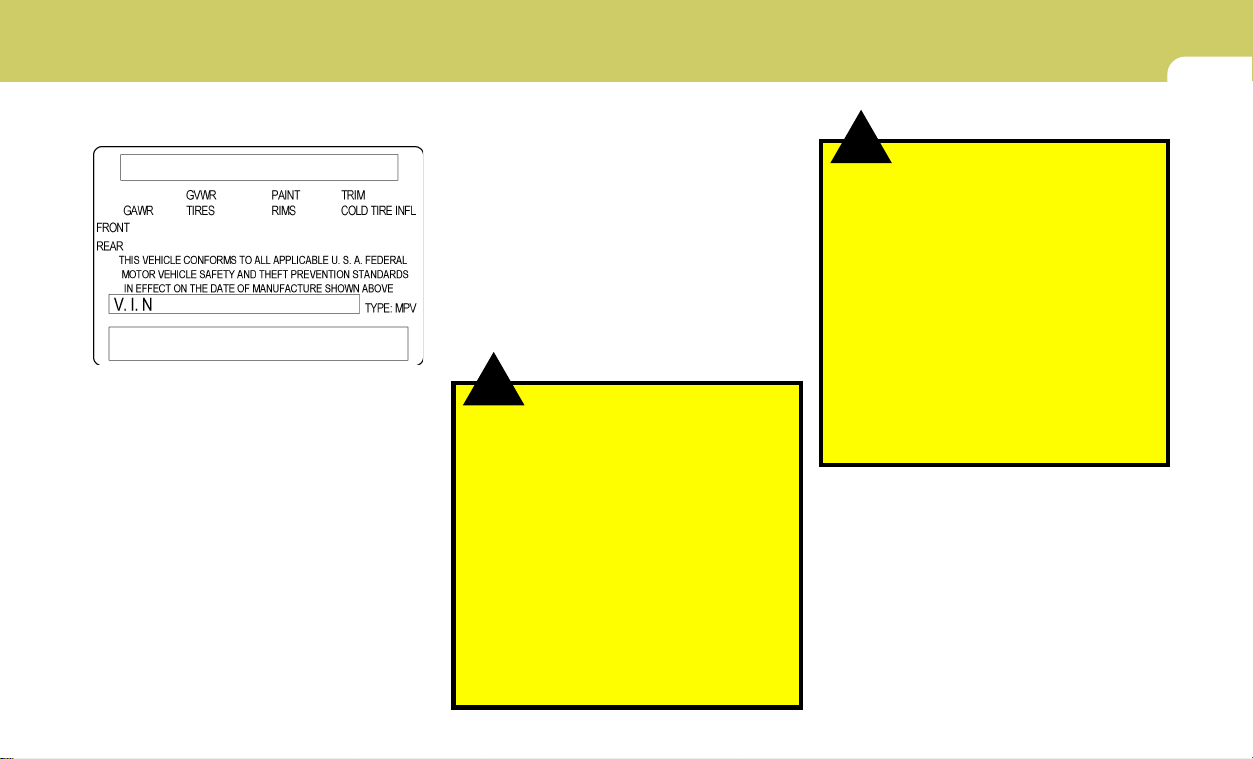
2
DRIVING YOUR HYUNDAI
25
!
WARNING:
o Overloading your vehicle can
cause heat buildup in your
vehicle's tires and possible tire
failure that could lead to a crash.
o Overloading your vehicle can
cause increased stopping dis-
tances that could lead to a crash.
o A crash resulting from poor han-
dling vehicle damage, tire failure,
or increased stopping distances
could result in serious injury or
death.
!
This label also tells you the maximum
weights that can be supported by the
front and rear axles, called Gross Axle
Weight Rating (GAWR). To find out the
actual loads on your front and rear
axles, you need to go to a weigh station
and weigh your vehicle. Your dealer can
help you with this. Be sure to spread out
your load equally on the left and right
sides of the centerline.
WARNING:
o Never exceed the GVWR for your
vehicle or the GAWR for either the
front or rear axle.
o Do not load your vehicle any
heavier than the GVWR or either
the maximum front or rear GAWR.
If you do, parts on your vehicle
can break, and it can change the
way your vehicle handles. This
could cause you to lose control
and crash. Also, overloading can
shorten the life of your vehicle.
C190G02JM-AAT
Compliance Label
The compliance label is located on the
driver's side of the center pillar outer
panel.
The label shows the size of your original
tires and the inflation pressures needed
to obtain the gross weight capacity of
your vehicle. This is called the GVWR
(Gross Vehicle Weight Rating). The
GVWR includes the weight of the ve-
hicle, all occupants, fuel and cargo.
C190G01JM
2
DRIVING YOUR HYUNDAI
26
!
WARNING:
Items you carry inside your vehicle
can strike and injure people in a
sudden stop or turn, or in a crash.
o Put things in the cargo area of
your vehicle. Try to spread the
weight evenly.
o Never stack items, like suitcases,
inside the vehicle above the tops
of the seats.
o Do not leave an unsecured child
restraint in your vehicle.
o When you carry something inside
the vehicle, secure it.
o Do not drive with a seat folded
down unless necessary.
NOTE:
o Overloading your vehicle may
cause damage. Repairs would not
be covered by your warranty. Do
not overload your vehicle.
o Using heavier suspension com-
ponents to get added durability
might not change your weight rat-
ings. Ask your dealer to help you
load your vehicle the right way.
The label will help you decide how much
cargo and installed equipment your
vehicle can carry.
If you carry items inside your vehicle –
like suitcases, tools, packages, or any-
thing else – they move as fast as the
vehicle goes. If you have to stop or turn
quickly, or if there is a crash, the items
will keep going and can cause an injury
if they strike the driver or a passenger.

If the Engine Will Not Start ............................................ 3-2
Jump Starting ................................................................ 3-3
If the Engine Overheats ................................................ 3-4
Spare Tire ..................................................................... 3-5
If You Have a Flat Tire .................................................. 3-6
Changing a Flat Tire ...................................................... 3-6
If Your Vehicle Must Be Towed................................... 3-11
Emergency Towing ..................................................... 3-13
If You Lose Your Keys ................................................ 3-13
3
WHAT TO DO IN AN EMERGENCY
3
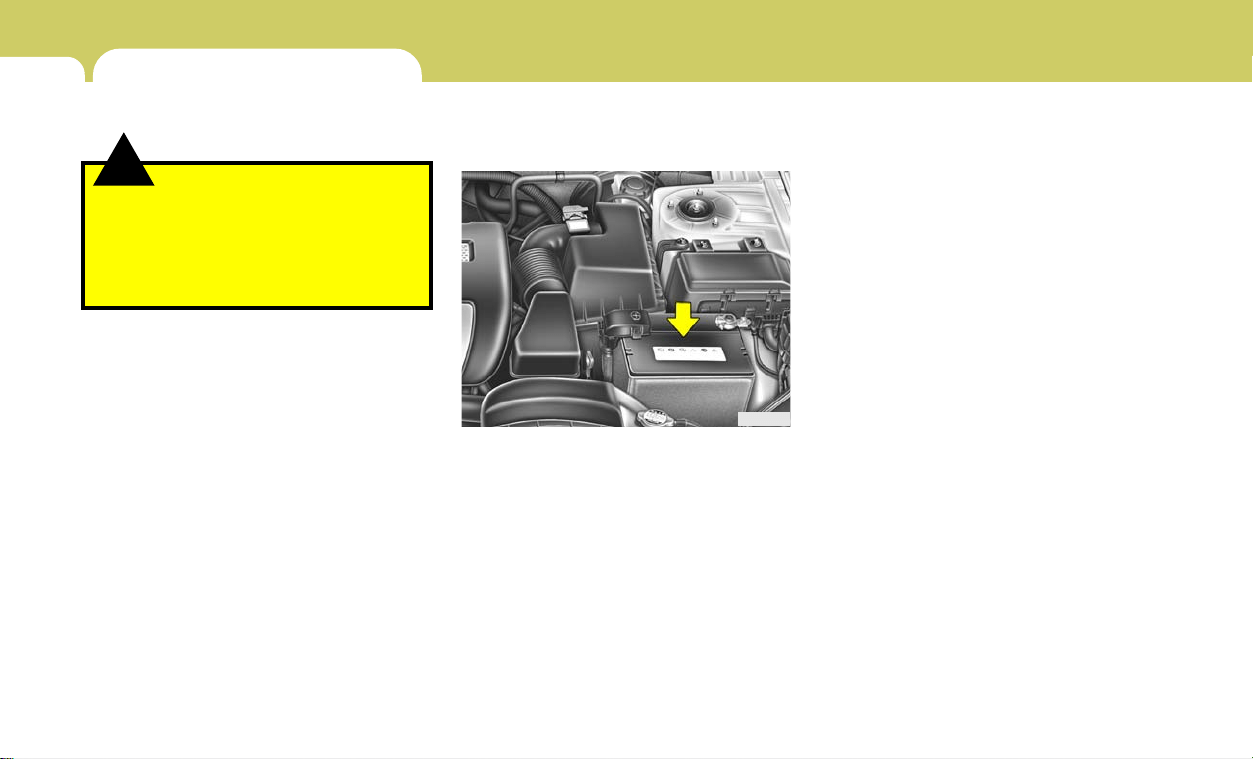
3
2
WHAT TO DO IN AN EMERGENCY
IF THE ENGINE WILL NOT START
!
D010A01A-AAT D010B02A-AAT
If Engine Doesn't Turn Over or Turns
Over Slowly
D010C02Y-AAT
If Engine Turns Over Normally but Does
Not Start
1. Check fuel level.
2. With the key in the "OFF" position, check all
connectors at ignition, coil and spark plugs.
Reconnect any that may be disconnected or
loose.
3. Check the fuel line in the engine compart-
ment.
4. If the engine still does not start, call a Hyundai
dealer or seek other qualified assistance.
D010D01A-AAT
If Engine Stalls While Driving
1. Reduce your speed gradually, keeping a
straight line. Move cautiously off the road to
a safe place.
2. Turn on your emergency flashers.
3. Try to start the engine again. If your vehicle
will not start, contact a Hyundai dealer or
seek other qualified assistance.
WARNING:
If the engine will not start, do not push or
pull the car to start it. This could result in a
collision or cause other damage. In addi-
tion, push or pull starting may cause the
catalytic converter to be overloaded and
create a fire hazard.
1. If your car has an automatic transaxle, be
sure the gear selector lever is in "N" or "P"
and the emergency brake is set.
2. Check the battery connections to be sure
they are clean and tight.
3. Turn on the interior light. If the light dims or
goes out when you operate the starter, the
battery is discharged.
4. Check the starter connections to be sure
they are securely tightened.
5. Do not push or pull the vehicle to start it. See
instructions for "Jump Starting".
HNF5017

3
WHAT TO DO IN AN EMERGENCY
3
JUMP STARTING
!
o If you should accidentally get acid on your
skin or in your eyes, immediately remove
any contaminated clothing and flush the area
with clean water for at least 15 minutes. Then
promptly obtain medical attention. If you
must be transported to an emergency facil-
ity, continue to apply water to the affected
area with a sponge or cloth.
o The gas produced by the battery during the
jump-start operation is highly explosive. Do
not smoke or allow a spark or an open flame
in the vicinity.
o The battery being used to provide the jump
start must be 12-volt. If you cannot deter-
mine that it is a 12-volt battery, do not attempt
to use it for the jump start.
o To jump start a car with a discharged battery,
follow this procedure exactly:
1. If the booster battery is installed in another
vehicle, be sure the two vehicles are not
touching.
2. Turn off all unnecessary lights and acces-
sories in both vehicles.
3. Attach the clamps of the jumper cable in the
exact location shown on the illustration. First,
attach one clamp of the jumper cable to the
positive (+) post or cable of the discharged
battery.
Then attach the other end of the same cable
to the positive (+) post or cable of the booster
battery. Next, using the other cable, attach
one clamp to the negative (-) post or cable
of the booster battery. Then attach the other
end of that cable to a solid metal part of the
engine of the vehicle with the discharged
battery away from the battery. Do not con-
nect the cable to any moving part.
4. Start the engine in the car with the booster
battery and let it run for a few minutes. This
will help to assure that the booster battery is
fully charged. During the jumping operation,
run the engine in this vehicle at about 2,000
rpm.
5. Start the engine in the car with the dis-
charged battery using the normal starting
procedure. After the engine starts, leave the
jumper cables connected and let the engine
run at fast idle or about 2,000 rpm for several
minutes.
6. Carefully remove the jumper cables in the
reverse order of attachment.
If you do not know why your battery became
discharged (because the lights were left on,
etc.), have the charging system checked by
your Hyundai dealer.
D020A03A-AAT
WARNING:
The gas produced by the battery during the
jump-start operation is highly explosive. If
these instructions are not followed exactly,
serious personal injury and damage to the
vehicle may occur! If you are not sure how
to follow this procedure, seek qualified
assistance. Automobile batteries contain
sulfuric acid. This is poisonous and highly
corrosive. When jump starting, wear pro-
tective glasses and be careful not to get
acid on yourself, your clothing or on the car.
HNF4001
Booster
battery
Discharged
battery
3
4
WHAT TO DO IN AN EMERGENCY
IF THE ENGINE OVERHEATS
!
!
!
WARNING:
While the engine is running, keep hair,
hands and clothing away from moving parts
such as the fan and drive belts to prevent
injury.
5. If the water pump drive belt is broken or
engine coolant is leaking out, stop the engine
immediately and call the nearest Hyundai
dealer for assistance.
WARNING:
Do not remove the radiator cap when the
engine is hot. This can allow coolant to be
blown out of the opening and cause seri-
ous burns.
6. If you cannot find the cause of the overheat-
ing, wait until the engine temperature has
returned to normal. Then, if coolant has been
lost, carefully add coolant to the reservoir
(page 6-9) to bring the fluid level in the
reservoir up to the halfway mark.
7. Proceed with caution, keeping alert for fur-
ther signs of overheating. If overheating
happens again, call a Hyundai dealer for
assistance.
CAUTION:
Serious loss of coolant indicates there is a
leak in the cooling system and this should
be checked as soon as possible by a Hyundai
dealer.
D030A02A-AAT
If your temperature gauge indicates overheat-
ing, you experience a loss of power, or hear loud
pinging or knocking, the engine is probably too
hot. If this happens, you should:
1. Pull off the road and stop as soon as it is safe
to do so.
2. Place the gear selector lever in "P" (auto-
matic) or neutral (manual transaxle) and set
the parking brake. If the air conditioning is on,
turn it off.
3. If engine coolant is running out under the car
or steam is coming out from the hood, stop
the engine. Do not open the hood until the
coolant has stopped running or the steaming
has stopped. If there is no visible loss of
engine coolant and no steam, leave the
engine running and check to be sure the
engine cooling fan is operating. If the fan is
not running, turn the engine off.
4. Check to see if the water pump drive belt is
missing. If it is not missing, check to see that
it is tight. If the drive belt seems to be
satisfactory, check for coolant leaking from
the radiator, hoses or under the car. (If the
air conditioning had been in use, it is normal
for cold water to be draining from it when you
stop).
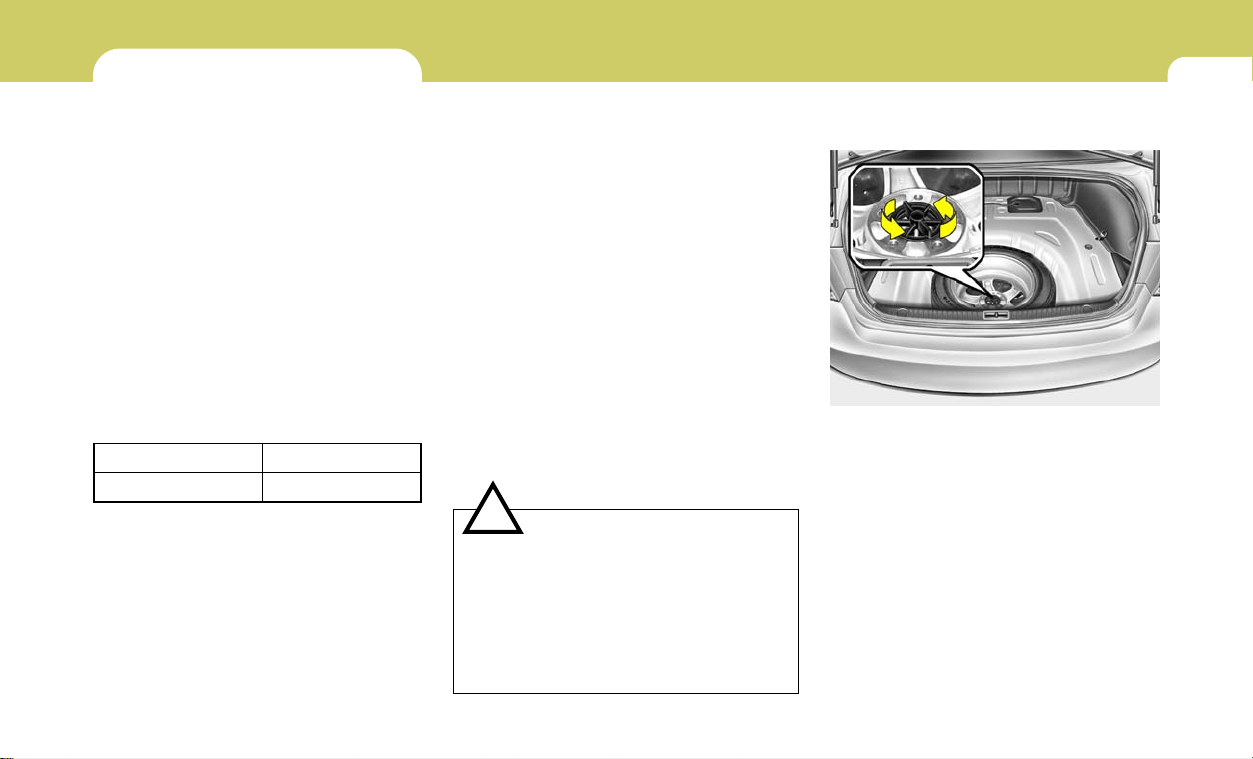
3
WHAT TO DO IN AN EMERGENCY
5
SPARE TIRE
D040A02GK-AAT
TEMPORARY SPARE TIRE
The following instructions for the tem-
porary spare tire should be observed:
1. Check inflation pressure as soon as
practical after installing the spare
tire, and adjust to the specified pres-
sure. The tire pressure should be
periodically checked and maintained
at the specified pressure while the
tire is stored.
Tire Size
Inflation Pressure
T125/80 D16
420 KPA(60 PSI)
4. As the temporary spare tire is spe-
cifically designed for your car, it
should not be used on any other
vehicle.
5. The temporary spare tire should not
be used on any other wheels, nor
should standard tires, snow tires,
wheel covers or trim rings be used
with the temporary spare wheel. If
such use is attempted, damage to
these items or other car components
may occur.
6. The temporary spare tire pressure
should be checked once a month
while the tire is stored.
2. The spare tire should only be used
temporarily and should be returned
to the luggage compartment as soon
as the original tire can be repaired or
replaced.
3. Continuous use at speeds of over 50
mph (80 km/h) is not recommended.
Spare Tire Pressure
CAUTION:
o Do not use snow chains with your
temporary spare tire.
o Do not use more than one tempo-
rary spare tire at a time.
o Do not tow a trailer while the tem-
porary spare tire is installed.
!
D040B01NF-GAT
Handling the Spare Tire
To remove the spare tire, take out the
tool receptacle and remove the installa-
tion bolt by turning it counterclockwise.
To replace the spare tire in its storage
compartment, tighten the bolt firmly
with your fingers until there is no more
play in the spare tire.
HNF4008
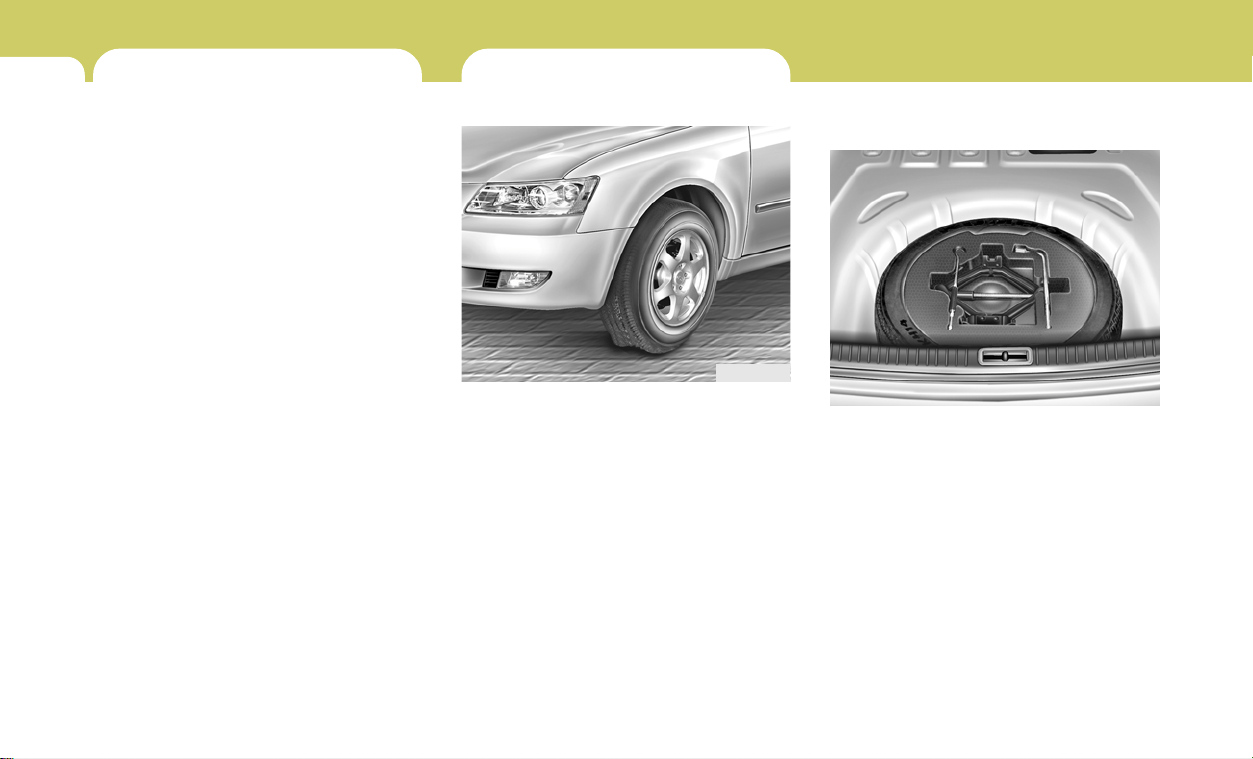
3
6
WHAT TO DO IN AN EMERGENCY
CHANGING A FLAT TIREIF YOU HAVE A FLAT TIRE
D060A01A-AAT
The procedure described on the follow-
ing pages can be used to rotate tires as
well as to change a flat tire. When
preparing to change a flat tire, check to
be sure the gear selector lever is in "P"
(automatic transaxle) or reverse gear
(manual transaxle) and that the parking
brake is set, then:
D050A01A-AAT
If a tire goes flat while you are driving:
1. Take your foot off the accelerator pedal
and let the car slow down while driving
straight ahead. Do not apply the brakes
immediately or attempt to pull off the
road as this may cause a loss of
control. When the car has slowed to
such a speed that it is safe to do so,
brake carefully and pull off the road.
Drive off the road as far as possible
and park on firm, level ground. If you
are on a divided highway, do not park
in the median area between the two
traffic lanes.
2. When the car is stopped, turn on your
emergency hazard flashers, set the
parking brake and put the transaxle in
"P" (automatic) or reverse (manual
transaxle).
3. Have all passengers get out of the car.
Be sure they all get out on the side of
the car that is away from traffic.
4. Change the tire according to the in-
structions provided as follows.
D060A01NF-A
D060B01NF-GAT
1. Obtain Spare Tire and Tool
D060B01NF-A
Take out the tool receptacle and turn
the installation bolt counterclockwise
to remove spare tire from the trunk.
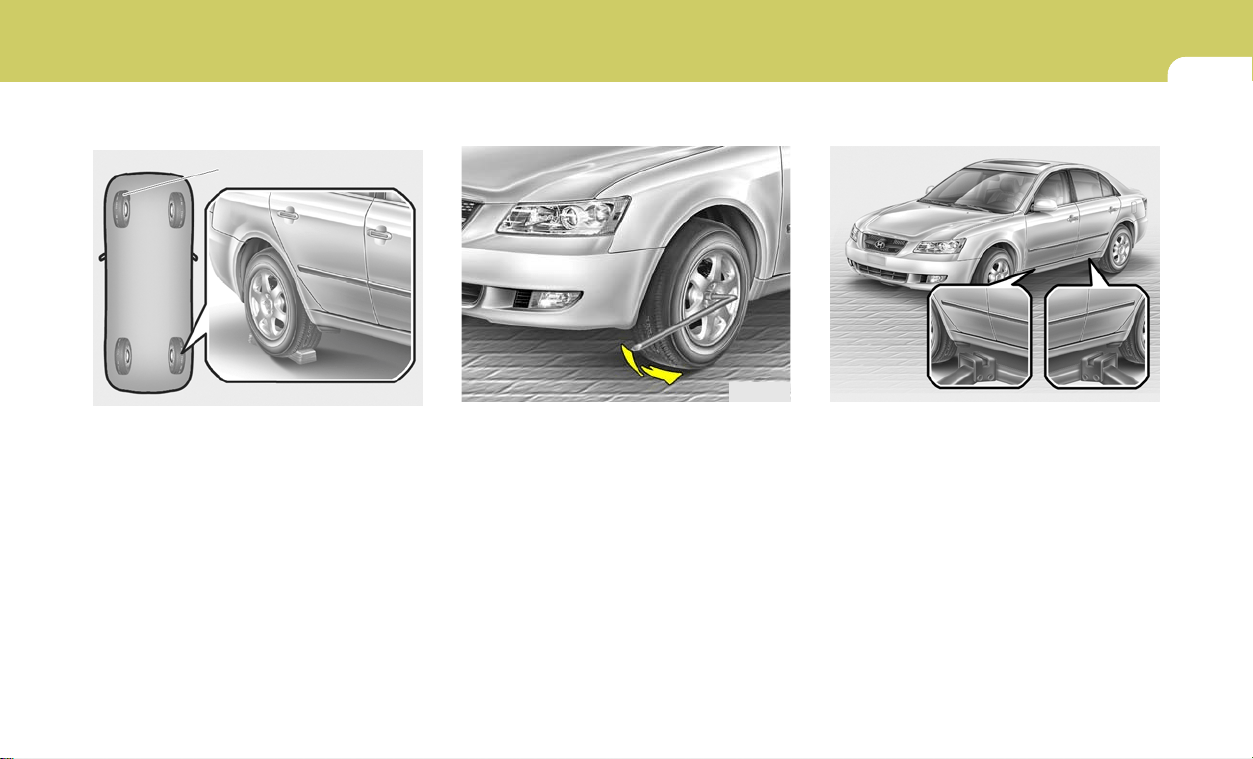
3
WHAT TO DO IN AN EMERGENCY
7
D060C01A-AAT
2. Block the Wheel
Block the wheel that is diagonally oppo-
site from the flat to keep the vehicle
from rolling when the car is raised on the
jack.
HNF4009
Flat tire
D060E01A-AAT
4. Put the Jack in Place
The base of the jack should be placed
on firm, level ground. The jack should
be positioned as shown in the drawing.
D060D01A-AAT
3. Loosen Wheel Nuts
The wheel nuts should be loosened
slightly before raising the car. To loosen
the nuts, turn the wrench handle coun-
terclockwise. When doing this, be sure
that the socket is seated completely
over the nut so it cannot slip off. For
maximum leverage, position the wrench
so the handle is to the left as shown in
the drawing. Then, while holding the
wrench near the end of the handle, push
down on it with steady pressure. Do not
remove the nuts at this time. Just
loosen them about one-half turn.
HNF4011-A
D060E01NF-A
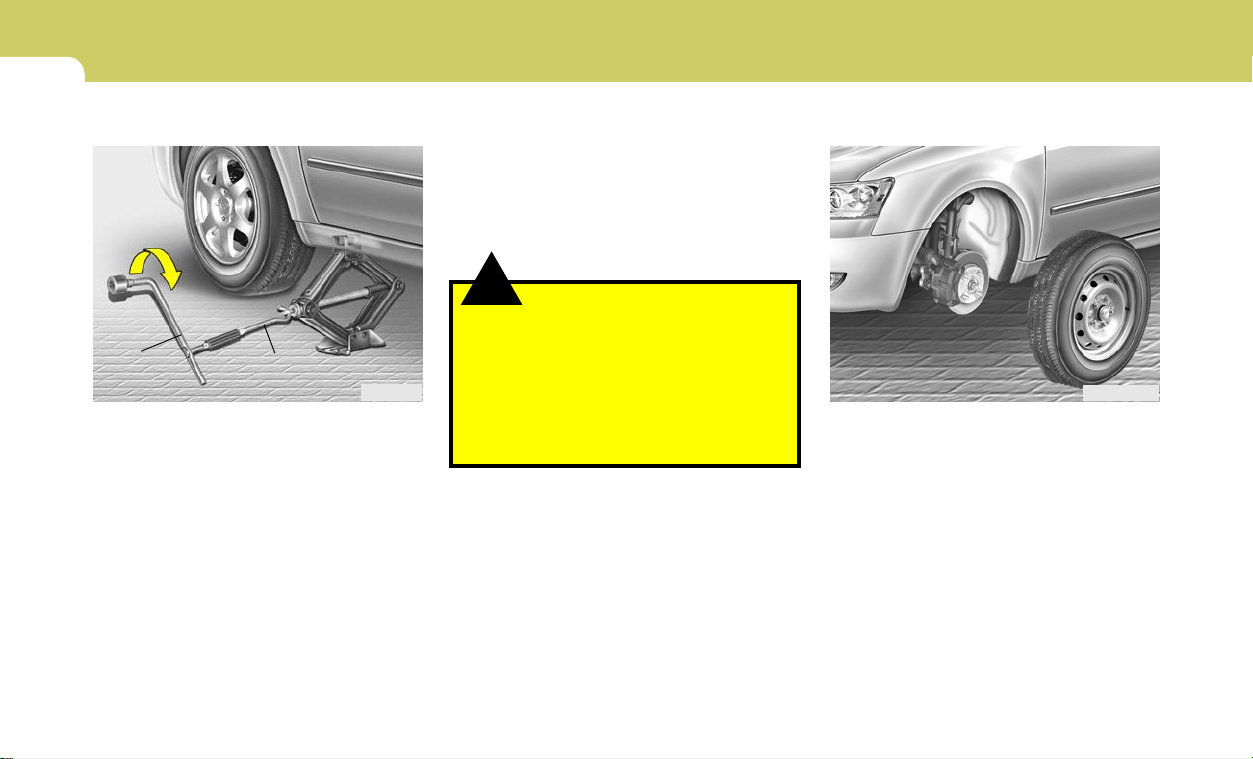
3
8
WHAT TO DO IN AN EMERGENCY
!
Raise the car high enough so that the
fully inflated spare tire can be installed.
To do this, you will need more ground
clearance than is required to remove
the flat tire.
D060F02E-AAT
5. Raising the Car
After inserting a wrench bar into the
wheel nut wrench, install the wrench bar
into the jack as shown in the drawing.
To raise the vehicle, turn the wheel nut
wrench clockwise. As the jack begins
to raise the vehicle, double check that
it is properly positioned and will not slip.
If the jack is on soft ground or sand,
place a board, brick, flat stone or other
object under the base of the jack to
keep it from sinking.
WARNING:
Do not get under the car when it is
supported by the jack! This is very
dangerous as the vehicle could fall
and cause serious injury or death.
No one should stay in the car while
the jack is being used.
D060G02Y-AAT
6. Changing Wheels
Loosen the wheel nuts and remove
them with your fingers. Slide the wheel
off the studs and lay it flat so it cannot
roll away. To put the wheel on the hub,
pick up the spare tire, line up the holes
with the studs and slide the wheel onto
them. If this is difficult, tip the wheel
slightly and get the top hole in the wheel
lined up with the top stud. Then jiggle
the wheel back and forth until the wheel
can be slid over the other studs.
HNF4025
Wrench bar
Wheel nut
wrench
D060G01NF-A
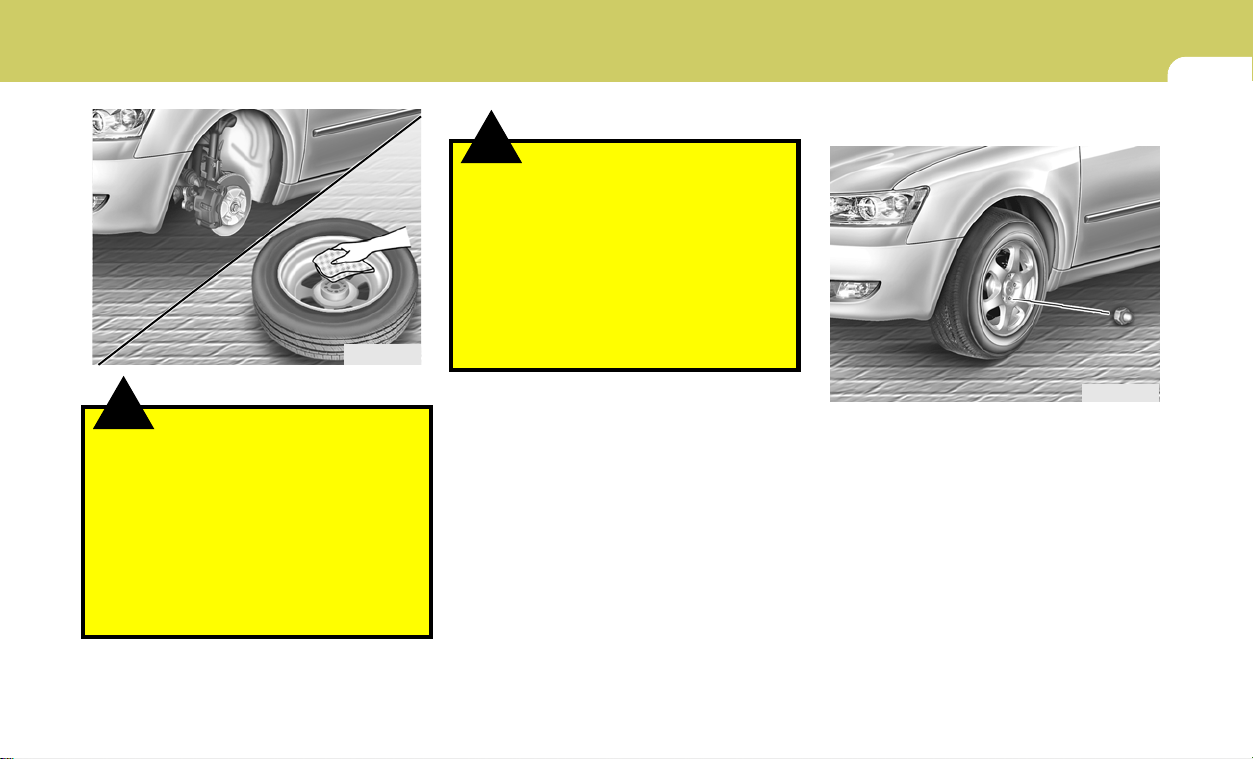
3
WHAT TO DO IN AN EMERGENCY
9
!
WARNING:
Wheels and wheel covers may have
sharp edges. Handle them carefully
to avoid possible severe injury. Be-
fore putting the wheel into place, be
sure that there is nothing on the hub
or wheel (such as mud, tar, gravel,
etc.) that interferes with the wheel
from fitting solidly against the hub.
D060G02NF
!
D060H02O-AAT
7. Reinstall Wheel Nuts
To reinstall the wheel, hold it on the
studs, put the wheel nuts on the studs
and tighten them finger tight. The nuts
should be installed with their small di-
ameter ends directed inward. Jiggle the
tire to be sure it is completely seated,
then tighten the nuts as much as pos-
sible with your fingers again.
If there is, remove it. If there is not
good contact on the mounting sur-
face between the wheel and hub, the
wheel nuts could come loose and
cause the loss of a wheel. Loss of a
wheel may result in loss of control of
the vehicle. This may cause serious
injury or death.
WARNING:
D060H01NF-A
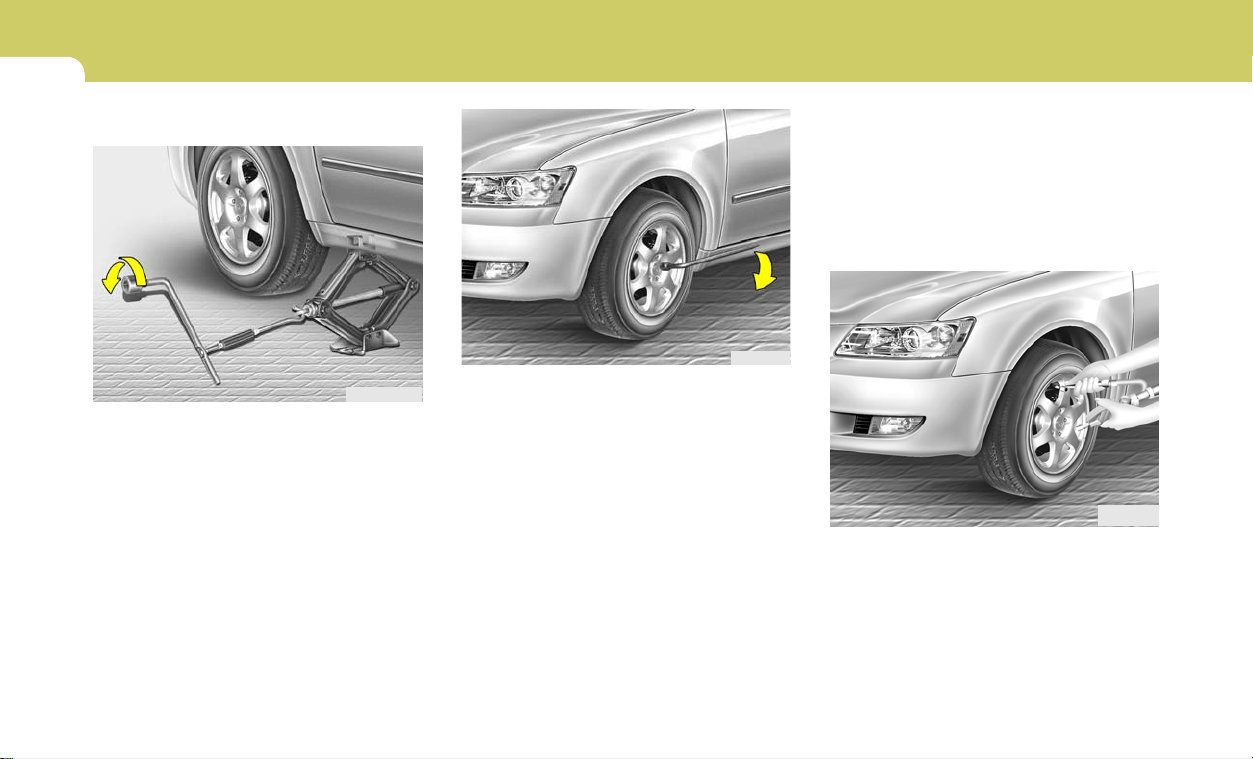
3
10
WHAT TO DO IN AN EMERGENCY
D060I01E-AAT
8. Lower Vehicle and Tighten Nuts
D060J02O-AAT
After Changing Wheels
Lower the car to the ground by turning
the wheel nut wrench counterclock-
wise.
If you have a tire gauge, remove the
valve cap and check the air pressure. If
the pressure is lower than recom-
mended, drive slowly to the nearest
service station and inflate to the correct
pressure. If it is too high, adjust it until
Then position the wrench as shown in
the drawing and tighten the wheel nuts.
Be sure the socket is seated com-
pletely over the nut. Do not stand on the
wrench handle or use an extension pipe
over the wrench handle.
Go around the wheel tightening every
other nut until they are all tight. Then
double-check each nut for tightness.
After changing wheels, have a techni-
cian tighten the wheel nuts to their
proper torque as soon as possible.
Wheel nut tightening torque:
Steel wheel & aluminium alloy wheel:
65-80 lb.ft (900-1,100 kg.cm)
D060I01NF
HNF4013-A
HNF5016-A
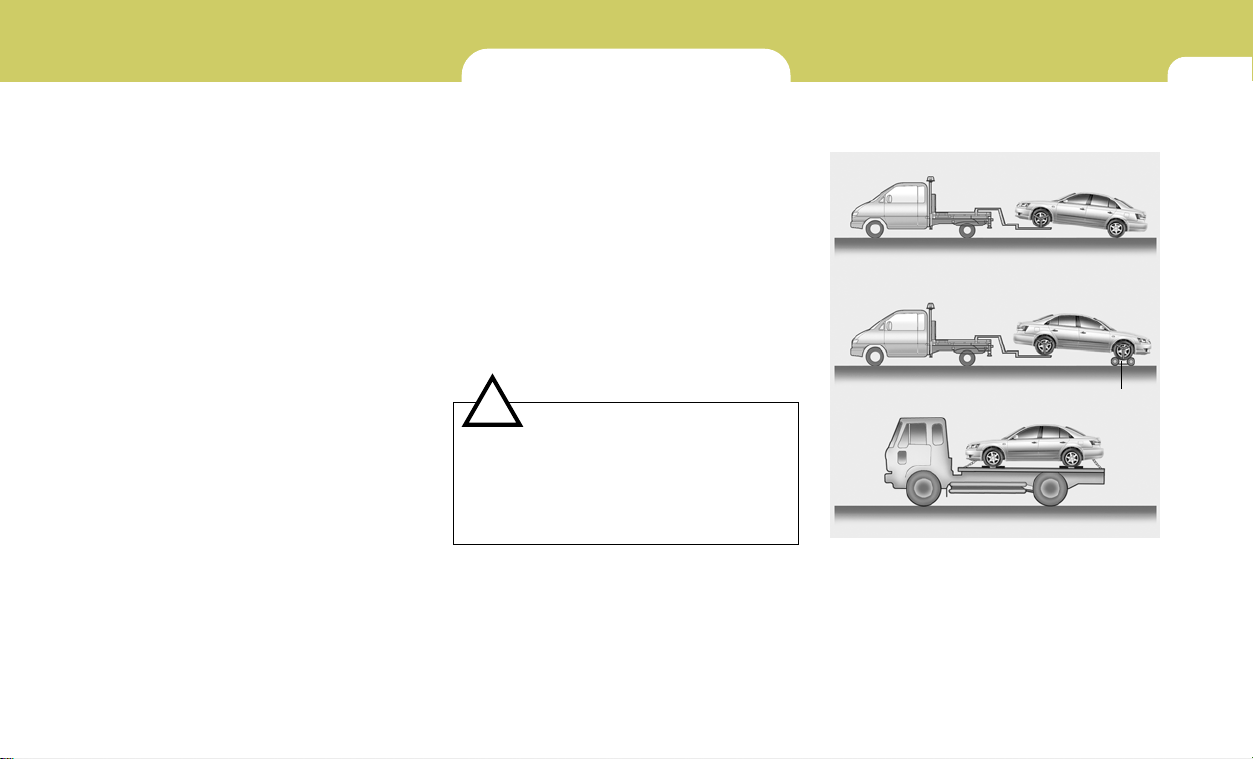
3
WHAT TO DO IN AN EMERGENCY
11
it is correct. Always reinstall the valve
cap after checking or adjusting tire
pressure. If the cap is not replaced, air
may leak from the tire. If you lose a
valve cap, buy another and install it as
soon as possible.
After you have changed wheels, al-
ways secure the flat tire in its place and
return the jack and tools to their proper
storage locations.
IF YOUR VEHICLE MUST BE
TOWED
D080A01O-GAT
If your vehicle has to be towed, it should be done
by your Hyundai dealer or a commercial tow
truck service. This will help assure that your
vehicle is not damaged in towing. Also, profes-
sionals are generally aware of local laws gov-
erning towing. In any case, rather than risk
damage to your car, it is suggested that you
show this information to the tow truck operator.
Be sure that a safety chain system is used and
that all local laws are observed.
It is recommended that your vehicle be towed
with a wheel lift and dollies or flatbed equipment
with all the wheels off the ground.
!
CAUTION:
o Your vehicle can be damaged if towed
incorrectly!
o Be sure the transaxle is in neutral.
o When the engine will not start, be sure
the steering is unlocked by placing the
key in the "ACC" position.
D080B01O-GAT
Towing the Vehicle
HNF4015
Your vehicle can be towed by wheel lift type
truck (1), (2) or flatbed equipment (3).
1)
2)
3)
dolly
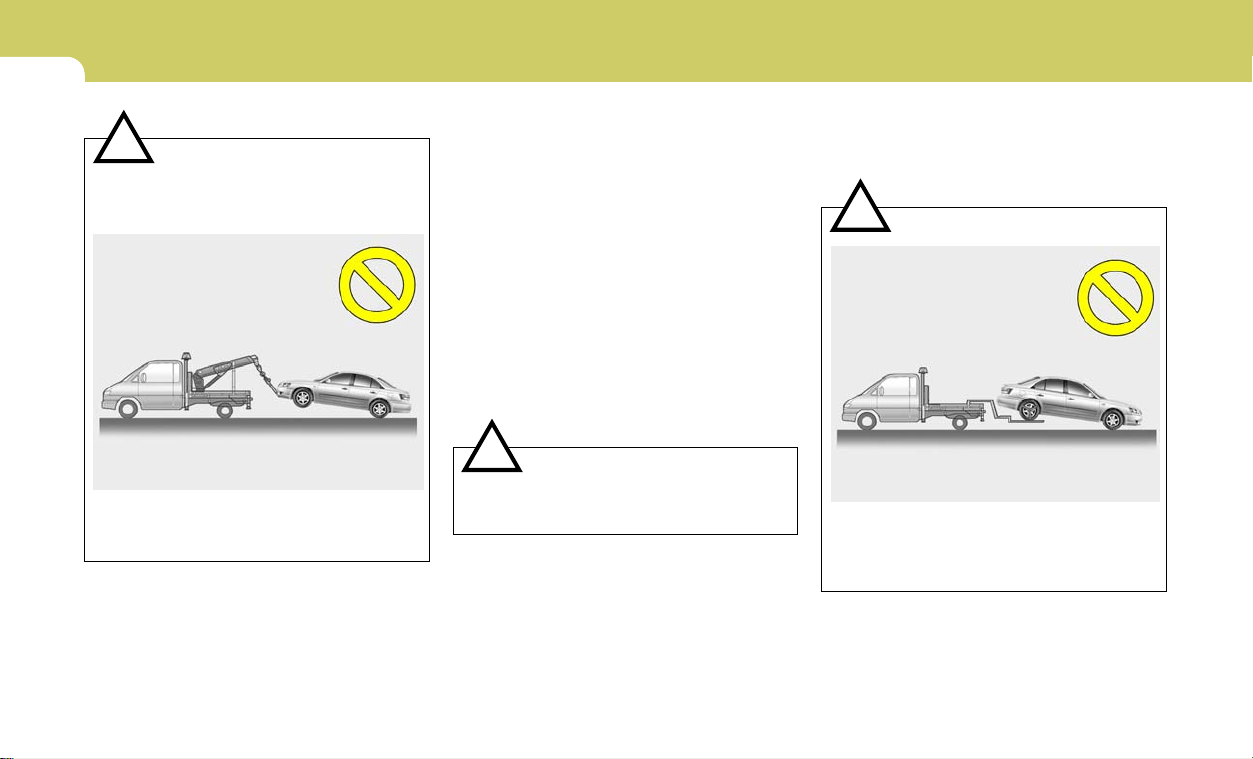
3
12
WHAT TO DO IN AN EMERGENCY
CAUTION:
o When towing the vehicle, take care not to
cause damage to the bumper or under-
body of the vehicle.
!
!
NOTE:
Before towing, check the level of the auto-
matic transaxle fluid. If it is below the "HOT"
range on the dipstick, add fluid. If you
cannot add fluid, a towing dolly must be
used.
2) If any of the loaded wheels or suspension
components are damaged or the vehicle is
being towed with the front wheels on the
ground, use a towing dolly under the front
wheels.
o Manual Transaxle:
If you do not use a towing dolly, place the
ignition key in the "ACC" position and put the
transaxle in "N (Neutral)".
D080B02NF
CAUTION:
Do not tow with the key removed or in the
"LOCK" position when towing from the
rear without a towing dolly.
D080B01NF
!
o Do not tow with sling type truck as this
may cause damage to the bumper or
underbody of the vehicle.
1) If the vehicle is being towed with the rear
wheels on the ground, be sure the parking
brake is released.
CAUTION:
o Automatic Transaxle:
Be sure to use a towing dolly under the front
wheels.
A vehicle with an automatic transaxle should
never be towed from the rear with the front
wheels on the ground. This can cause se-
rious damage to the transaxle.
3) It is recommended that your vehicle be
towed with all the wheels off the ground.
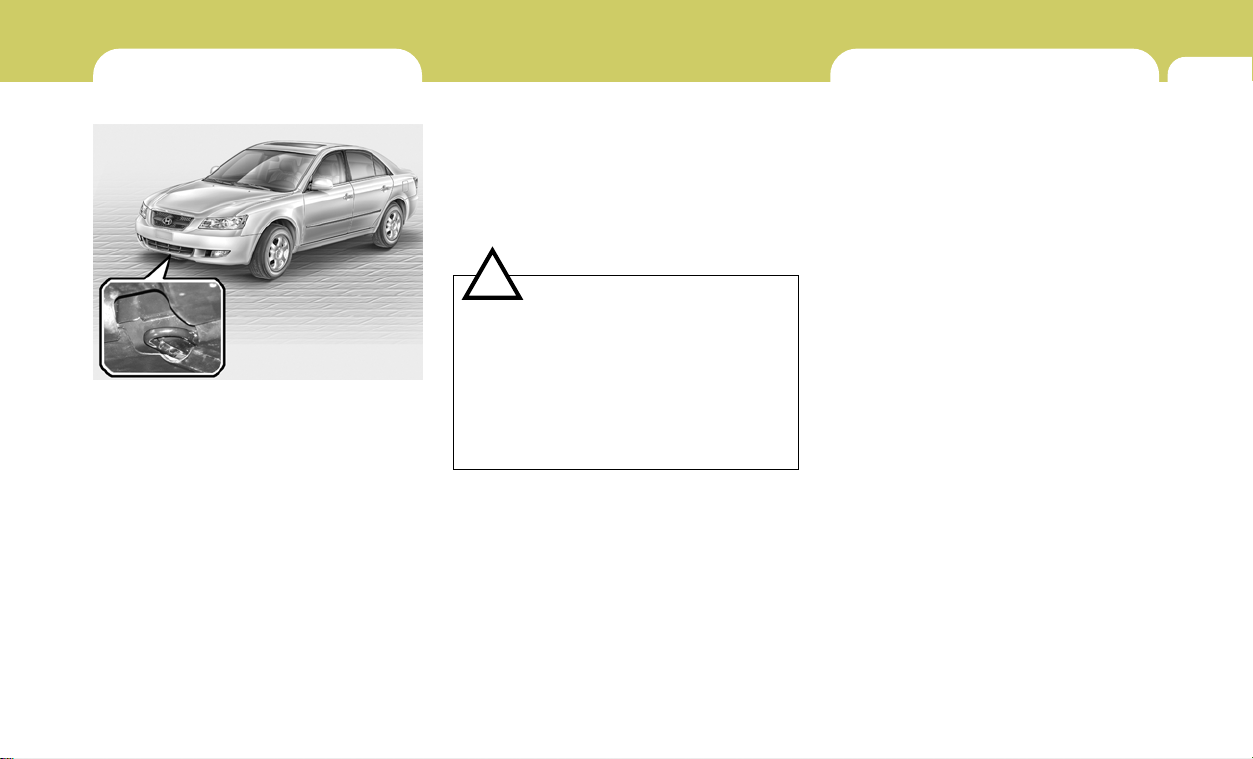
3
WHAT TO DO IN AN EMERGENCY
13
EMERGENCY TOWING
D080D01NF-AAT
!
D080D02NF-A
For emergency towing when no commercial
tow vehicle is available, attach a tow cable,
chain or strap to the towing hook under the front
of your car. Do not attempt to tow your vehicle
in this manner on any unpaved surface. This
could result in serious damage to your car.
Nor should towing be attempted if the wheels,
drive train, axles, steering or brakes are dam-
aged. Before towing, be sure the transaxle is in
neutral and the key is in "ACC" (with the engine
off) or in the "ON" position (with the engine
running). A driver must be in the towed car to
steer it and operate the brakes.
CAUTION:
If the car is being towed with all four wheels
on the ground, it can be towed only from the
front. Be sure that the transaxle is in neutral.
Do not tow at speeds greater than 30 mph
(50 km/h) and for more than 15 miles (25
km). Be sure the steering is unlocked by
placing the key in the "ACC" position. A
driver must be in the towed vehicle to
operate the steering and brakes.
NOTE:
Before towing, check the level of the auto-
matic transaxle fluid. If it is below the "HOT"
range on the dipstick, add fluid. If you
cannot add fluid, a towing dolly must be
used.
IF YOU LOSE YOUR KEYS
D120A01A-AAT
If you lose your keys, many Hyundai dealers
can make you a new key if you have your key
number.
If you lock the keys inside your car and you
cannot obtain a new key, many Hyundai dealers
can use special tools to open the door for you.

4
Corrosion Protection ..................................................... 4-2
To Help Prevent Corrosion ........................................... 4-2
Washing and Waxing .................................................... 4-3
Cleaning the Interior ...................................................... 4-5
CORROSION PREVENTION & APPEARANCE CARE
4

4
CORROSION PREVENTION AND APPEARANCE CARE
2
CORROSION PROTECTION
E020B01A-AAT
Keep Your Car Clean
The best way to prevent corrosion is to keep
your car clean and free of corrosive materials.
Attention to the underside of the car is particu-
larly important.
o If you live in a high-corrosion area — where
road salts are used, near the ocean, areas
with industrial pollution, acid rain, etc.—, you
should take extra care to prevent corrosion.
In winter, hose off the underside of your car
at least once a month and be sure to clean
the underside thoroughly when winter is
over.
o When cleaning underneath the car, give
particular attention to the components under
the fenders and other areas that are hidden
from view. Do a thorough job; just dampening
the accumulated mud rather than washing it
away will accelerate corrosion rather than
prevent it. Water under high pressure and
steam are particularly effective in removing
accumulated mud and corrosive materials.
E020A01A-AAT
You can help prevent corrosion from getting
started by observing the following:
E010D01A-AAT
Moisture Breeds Corrosion
Moisture creates the conditions in which corro-
sion is most likely to occur. For example, cor-
rosion is accelerated by high humidity, particu-
larly when temperatures are just above freez-
ing. In such conditions, the corrosive material is
kept in contact with the car surfaces by mois-
ture that is slow to evaporate.
Mud is particularly corrosive because it is slow
to dry and holds moisture in contact with the
vehicle. Although the mud appears to be dry, it
can still retain the moisture and promote corro-
sion.
High temperatures can also accelerate corro-
sion of parts that are not properly ventilated so
the moisture can be dispersed. For all these
reasons, it is particularly important to keep your
car clean and free of mud or accumulations of
other materials. This applies not only to the
visible surfaces but particularly to the underside
of the car.
E010C01A-AAT
High-Corrosion Areas
If you live in an area where your car is regularly
exposed to corrosive materials, corrosion pro-
tection is particularly important. Some of the
common causes of accelerated corrosion are
road salts, dust control chemicals, ocean air
and industrial pollution.
E010B01A-AAT
Common Causes of Corrosion
The most common causes of corrosion on your
car are:
o Road salt, dirt and moisture that is allowed to
accumulate underneath the car.
o Removal of paint or protective coatings by
stones, gravel, abrasion or minor scrapes
and dents which leave unprotected metal
exposed to corrosion.
E010A01A-AAT
Protecting Your Hyundai from Corro-
sion
By using the most advanced design and con-
struction practices to combat corrosion,
Hyundai produces cars of the highest quality.
However, this is only part of the job. To achieve
the long-term corrosion resistance your
Hyundai can deliver, the owner's cooperation
and assistance is also required.
TO HELP PREVENT CORROSION

4
CORROSION PREVENTION AND APPEARANCE CARE
3
WASHING AND WAXING
E020E01A-AAT
Don't Neglect the Interior
Moisture can collect under the floor mats and
carpeting to cause corrosion. Check under the
mats periodically to be sure the carpeting is dry.
Use particular care if you carry fertilizers, clean-
ing materials or chemicals in the car.
These should be carried only in proper contain-
ers and any spills or leaks should be cleaned up,
flushed with clean water and thoroughly dried.
E020C01A-AAT
Keep Your Garage Dry
Don't park your car in a damp, poorly ventilated
garage. This creates a favorable environment
for corrosion. This is particularly true if you
wash your car in the garage or drive it into the
garage when it is still wet or covered with snow,
ice or mud. Even a heated garage can contrib-
ute to corrosion unless it is well ventilated so
moisture is dispersed.
E030A01A-AAT
Washing Your Hyundai
Never wash your car when the surface is hot
from being in the sun. Always wash your car in
the shade.
Wash your car frequently. Dirt is abrasive and
can scratch the paint if it is not removed. Air
pollution or acid rain may damage the paint and
trim through chemical action if pollutants are
allowed to remain in contact with the surface. If
you live near the ocean or in an area where road
salts or dust control chemicals are used, you
should pay particular attention to the underside
of the car. Start by rinsing the car to remove dust
and loose dirt. In winter, or if you have driven
through mud or muddy water, be sure to thor-
oughly clean the underside as well. Use a hard
direct stream of water to remove accumulations
of mud or corrosive materials. Use a good
quality car-washing solution and follow the
manufacturer's directions on the package.
These are available at your Hyundai dealer or
auto parts outlet. Don't use strong household
detergents, gasoline, strong solvents or abra-
sive cleaning powders as these may damage
the finish.
Use a clean sponge or cloth, rinse it frequently
and don't damage the finish by rubbing too hard.
For stubborn spots, dampen them frequently
and remove them a little at a time.
o When cleaning lower door panels, rocker
panels and frame members, be sure that
drain holes are kept open so that moisture
can escape and not be trapped inside to ac-
celerate corrosion.
E020D02A-AAT
Keep Paint and Trim in Good Condition
Scratches or chips in the finish should be
covered with "touch-up" paint as soon as pos-
sible to reduce the possibility of corrosion. If
bare metal is showing through, the attention of
a qualified body and paint shop is recommended.
Bird droppings : Bird droppings are highly cor-
rosive and may damage painted surfaces in just
a few hours. Always remove bird droppings as
soon as possible.

4
CORROSION PREVENTION AND APPEARANCE CARE
4
E030D01A-AAT
When to Wax Again
You should polish and wax the car again when
water no longer beads on a clean surface but
spreads out over a larger area.
E030C01A-AAT
Polishing and Waxing
Always wash and dry the car before polishing
or waxing or using a combination cleaner and
wax. Use a good quality commercial product
and follow the manufacturer's directions on the
container. Polish and wax the bright trim pieces
as well as the paint.
E030B01A-AAT
Spot Cleaning
Don't use gasoline, strong solvents or corro-
sive cleaning agents. These can damage the
finish of the car. To remove road tar, use
turpentine on a clean, soft cloth. Be gentle.
To remove dead insects or tree sap, use warm
water and mild soap or car-washing solution.
Soak the spot and rub gently. If the paint has lost
its luster, use a commercial car-cleaning polish.
If you find any nicks or scratches in the paint,
use touch-up paint to cover them to prevent
corrosion. To protect the paintwork of the car
against corrosion, you must clean your Hyundai
(at least once a month). Give special attention
to the removal of salt, mud and other sub-
stances on the underside of the splashboards
of the car. Make sure that the outlets and the
underside of the doors are open. Paint damage
can be caused by small accumulation of tar,
industrial precipitation, tree resin, insects and
bird droppings, when not removed immediately.
If water alone is not strong enough to remove the
accumulated dirt, use a mild car washing solu-
tion. Be sure to rinse the surface after washing
to remove the solution. Never allow the solution
to dry on the painted surfaces.
To clean whitewall tires, use a stiff brush or
soapy steel-wool scouring pad.
To clean plastic wheel covers, use a clean
sponge or soft cloth and water.
To clean cast aluminum alloy wheels, use a mild
soap or neutral detergent. Do not use abrasive
cleaners. Protect the bare-metal surfaces by
cleaning, polishing and waxing. Because alumi-
num is subject to corrosion, be sure to give
aluminum alloy wheels special attention in win-
ter. If you drive on salted roads, clean the
wheels thoroughly afterwards.
After washing, be sure to rinse thoroughly. If
soapy water dries on the finish, streaking will
result.
When the weather is warm and the humidity low,
you may find it necessary to rinse each section
immediately after washing to avoid streaking.
After rinsing, dry the car using a damp chamois
or soft, absorbent cloth. The reason for drying
the car is to remove water from the car so it will
dry without water spots. Don't rub, this can
damage the finish.

4
CORROSION PREVENTION AND APPEARANCE CARE
5
CLEANING THE INTERIOR
E040B01A-AAT
To Clean the Leather Upholstery
(If Installed)
In the normal course of use, leather upholstered
surfaces will, like any material, pick-up dust and
dirt. This dust and dirt must be cleaned off or it
may work into the surface of the leather, caus-
ing damage.
Fine leather needs care, and should be cleaned
when necessary. Washing leather thoroughly
with soap and water will keep your leather
lustrous, beautiful and ensure you have many
years of wear.
Take a piece of cheese cloth and using any mild
soap and lukewarm water, work up a good
lather. Thoroughly wash the leather. Wipe clean
with a slightly damp cloth and dry with soft cloth.
Do this as often as the leather becomes soiled.
During tanning operations, sufficient oils are
incorporated through processing that none need
be applied during the life of the leather. Oil
applied to the finished surface will in no way help
the leather and may do more harm than good.
Varnishes and furniture polishes should never
be used under any conditions.
E040A01A-AAT
To Clean the Vinyl Upholstery
To clean the vinyl upholstery, first remove loose
dirt and dust with a vacuum cleaner. Then apply
a solution of mild soap or detergent and water
using a clean sponge or soft cloth. Allow this to
stay on the surface to loosen the dirt, then wipe
with a clean damp sponge or cloth. If all the dirt
stains are not removed, repeat this procedure
until the upholstery is clean. Do not use gaso-
line, solvent, paint thinner or other strong clean-
ers.
E030E01A-AAT
Maintaining Bumpers
Special precautions must be observed to pre-
serve the appearance of the bumpers on your
Hyundai. They are:
o Be careful not to spill battery electrolyte or
hydraulic brake fluid on the bumpers. If you
do, wash it off immediately with clean water.
o Be gentle when cleaning the bumper sur-
faces. They are made of soft plastic and the
surface can be damaged if mistreated. Do
not use abrasive cleaners. Use warm water
and mild soap or car-washing solution.
o Do not expose the bumpers to high tem-
peratures. For example, if you have your car
repainted, do not leave the bumpers on the
car if the car is going to be placed in a high-
temperature paint booth.

4
CORROSION PREVENTION AND APPEARANCE CARE
6
ANY QUESTIONS?
E040D01A-AAT
Cleaning the Seat Belts
To clean the seat belts, use a cloth or sponge
with mild soap or detergent and warm water. Do
not use strong detergents, dye, bleach or abra-
sive materials on the seat belts as this may
weaken the fabric.
While cleaning the belts, inspect them for ex-
cessive wear, cuts, fraying or other signs of
damage and replace them if necessary.
E040C01A-AAT
Cleaning the Carpets
Use a foam-type carpet cleaner. Cleaners of
this type are available in aerosol cans in liquid
form or powder. Read the instructions and
follow them exactly. Using a vacuum cleaner
with the appropriate attachment, remove as
much dirt from the carpets as possible. Apply
the foam following the manufacturer's direc-
tions, then rub in overlapping circles. Do not add
water. These cleaners work best when the
carpet is kept as dry as possible.
E050A01A-AAT
If you have any questions about the care of your
car, consult your Hyundai dealer.
E040E01A-AAT
Cleaning the Windows
You may use any household window cleaner on
the windows. However, when cleaning the in-
side of the rear window be careful not to damage
the rear window defroster wiring.

5
Maintenance Intervals ................................................... 5-2
Scheduled Maintenance ................................................ 5-4
Maintenance under Severe Usage Conditions ............. 5-6
Explanation of Scheduled Maintenance Items .............. 5-7
VEHICLE MAINTENANCE REQUIREMENTS
5

5
VEHICLE MAINTENANCE REQUIREMENTS
2
F010C01A-AAT
Specified Scheduled Procedures
These are the procedures such as inspections,
adjustments and replacements that are listed in
the maintenance charts starting on page 5-4.
These procedures must be performed at the
intervals shown in the maintenance schedule to
assure that your warranty remains in effect.
Although it is strongly recommended that they
be performed by the trained technicians at your
Hyundai dealer, these procedures may be per-
formed at any qualified service facility.
It is suggested that genuine Hyundai service
parts be used for any required repairs or re-
placements. Other parts of equivalent quality
such as engine oil, engine coolant, manual or
auto transaxle oil, brake fluid and so on which
are not supplied by Hyundai Motor Company or
its distributor may be used without affecting
your warranty coverage but you should always
be sure these are equivalent to the quality of the
original Hyundai parts. Your Owner's Hand-
book provides further information about your
warranty coverage.
F010A01A-AAT
Service Requirements
To ensure that you receive the greatest number
of miles of satisfying operation from your Hyundai,
certain maintenance procedures must be per-
formed. Although careful design and engineer-
ing have reduced these to a minimum, those that
are required are of the utmost importance.
It is your responsibility to have these mainte-
nance procedures performed to comply with
the terms of the warranties covering your new
Hyundai. The Owner's Handbook supplied with
your new vehicle provides further information
about these warranties.
F010B01A-AAT
Maintenance Requirements
The maintenance required for your Hyundai
can be divided into three main areas:
o Specified scheduled procedures
o General checks
o Do-it-yourself maintenance
MAINTENANCE INTERVALS

5
VEHICLE MAINTENANCE REQUIREMENTS
3
SCHEDULED MAINTENANCE
REQUIREMENTS
F020A02Y-AAT
o Inspection should be performed any time a
malfunction is experienced or suspected.
o Receipts for all emission control system
services should be retained to demonstrate
compliance with conditions of the emissions
system warranty.
o After 120 months or 150,000 miles (240,000
km), continue to follow the prescribed main-
tenance intervals.
o For severe usage maintenance require-
ments, see page 5-6 of this section.
F010D02A-AAT
General Checks
These are the regular checks you should per-
form when you drive your Hyundai or you fill the
fuel tank. A list of these items will be found on
page 6-4.
F010E01A-AAT
Do-It-Yourself Maintenance
If you are mechanically inclined, own a few tools
that are required and want to take the time to do
so, you can inspect and service a number of
items. For more information about doing it your-
self, see Section 6.
F010F01A-AAT
A Few Tips
o Whenever you have your Hyundai serviced,
keep copies of the service records in your
glove box. This will help ensure that you can
document that the required procedures have
been performed to keep your warranties in
effect. This is especially important when
service is not performed by an authorized
Hyundai dealer.
o If you choose to do your own maintenance
and repairs, you may find it helpful to have
an official Hyundai Shop Manual. A copy of
this publication may be purchased at your
Hyundai dealer's parts department.

5
VEHICLE MAINTENANCE REQUIREMENTS
4
SCHEDULED MAINTENANCE
F030B03NF-AAT
R :Replace I : Inspect and, after Inspection, clean, adjust, repair or replace if necessary.
F030A01NF-AAT
The following maintenance services must be performed to ensure good emission control and performance. Keep receipts for all vehicle emission services
to protect your warranty. Where both mileage and time are shown, the frequency of service is determined by whichever occurs first.
DESCRIPTION
EMISSION CONTROL ITEMS
ENGINE OIL AND FILTER
FUEL FILTER
FUEL LINES, FUEL HOSES AND CONNECTIONS
VACUUM AND CRANKCASE VENTILATION HOSES
VAPOR HOSE AND FUEL FILLER CAP
AIR CLEANER FILTER
VALVE CLEARANCE
SPARK PLUGS (IRIDIUM COATED)
FUEL TANK AIR FILTER
ELECTRONIC THROTTLE CONTROL
No.
1
2
3
4
5
6
7
8
9
10
MILES X 1000
KILOMETERS X 1000
MONTHS
7.5
12
6
R
I
I
15
24
12
R
I
I
I
I
22.5
36
18
R
I
I
30
48
24
R
I
I
I
R
R
37.5
60
30
R
R
I
I
45
72
36
R
I
I
I
I
52.5
84
42
R
I
I
I
60
96
48
R
I
I
I
R
I
R
67.5
108
54
R
I
I
75
120
60
R
R
I
I
I
I
82.5
132
66
R
I
I
90
144
72
R
I
I
I
R
R
97.5
156
78
R
I
I
R
105
168
84
R
I
I
I
I
I
112.5
180
90
R
R
I
I
120
192
96
R
I
I
I
R
I
R
127.5
204
102
R
I
I
135
216
108
R
I
I
I
I
142.5
228
114
R
I
I
150
240
120
R
R
I
I
I
R
R

5
VEHICLE MAINTENANCE REQUIREMENTS
5
See Note *
1
See Note *
2
F030C01NF-AAT
R : Replace I : Inspect and, after inspection, clean, adjust, repair or replace if necessary
GENERAL ITEMS
DRIVE BELT (AUTO-TENSIONER, ALT, P/STR'G, A/CON, W/PUMP)
COOLANT
MANUAL TRANSAXLE OIL
AUTOMATIC TRANSAXLE FLUID
BRAKE FLUID
BRAKE HOSES AND LINES
REAR BRAKE DRUMS/LININGS, PARKING BRAKE
BRAKE PADS, CALIPERS AND ROTORS
EXHAUST PIPE AND MUFFLER
SUSPENSION MOUNTING BOLTS
STEERING GEAR BOX, LINKAGE & BOOTS / LOWER ARM
BALL JOINT, UPPER ARM BALL JOINT
POWER STEERING PUMP, BELT AND HOSES
DRIVE SHAFTS AND BOOTS
AIR CONDITIONING REFRIGERANT
AIR CONDITIONER FILTER (FOR EVAPORATOR AND BLOWER UNIT)
1
2
3
4
5
6
7
8
9
10
11
12
13
14
15
No. DESCRIPTION
MILES X 1000
KILOMETERS X 1000
MONTHS
7.5
12
6
I
I
15
24
12
I
I
I
I
I
I
I
I
I
22.5
36
18
I
I
30
48
24
I
I
I
I
I
I
I
I
I
I
I
I
I
37.5
60
30
I
I
45
72
36
I
I
I
I
I
I
I
I
I
52.5
84
42
I
I
60
96
48
I
I
I
I
I
I
I
I
I
I
I
I
I
67.5
108
54
I
I
75
120
60
I
I
I
I
I
I
I
I
I
82.5
132
66
I
I
90
144
72
I
I
I
I
I
I
I
I
I
I
I
I
I
97.5
156
78
I
I
105
168
84
R
I
I
I
I
I
I
I
I
112.5
180
90
I
I
120
192
96
I
I
I
I
I
I
I
I
I
I
I
I
I
127.5
204
102
I
I
135
216
108
I
I
I
I
I
I
I
I
I
142.5
228
114
I
I
150
240
120
I
I
I
I
I
I
I
I
I
I
I
I
I
Note:
*1. FOR THE FIRST TIME, REPLACE THE COOLANT AT 60,000 MILES (96,000 KM) OR 60 MONTHS.
AFTER THAT, REPLACE IT EVERY 30,000 MILES (48,000 KM) OR 24 MONTHS.
*2. FOR EVERY 12 MONTHS OR 10,000 MILES (15,000 KM), WHICHEVER OCCURS FIRST : "R"
5
VEHICLE MAINTENANCE REQUIREMENTS
6
MAINTENANCE UNDER SEVERE USAGE CONDITIONS
SEVERE DRIVING CONDITIONS
A - Repeatedly driving short distance of less than 5miles (8km) in normal
temperature or less than 10miles (16km) in freezing temperature
B - Extensive engine idling or low speed driving for long distances
C - Driving on rough, dusty, muddy, unpaved, graveled or salt- spread roads
D - Driving in areas using salt or other corrosive materials or in very cold weather
E - Driving in sandy areas
F040A01NF-AAT
The following items must be serviced more frequently on cars normally used under severe driving conditions. Refer to the chart below for the appropriate
maintenance intervals.
R : Replace I : Inspect and, after inspection, clean, adjust, repair or replace if necessary
F - Driving in heavy traffic area over 90°F (32°C)
G - Driving on uphill, downhill, or mountain road
H - Towing a Trailer, or using a camper, or roof rack
I - Driving as a patrol car, taxi, other commercial use or vehicle towing
J - Driving over 100 MPH (170 Km/h)
K - Frequently driving in stop-and-go conditions
ENGINE OIL AND FILTER
AIR CLEANER FILTER
SPARK PLUGS
BRAKE PADS, CALIPERS AND ROTORS
REAR BRAKE DRUMS/LININGS, PARKING BRAKE
STEERING GEAR BOX, LINKAGE & BOOTS/
LOWER ARM BALL JOINT, UPPER ARM BALL JOINT
DRIVE SHAFTS AND BOOTS
MANUAL TRANSAXLE OIL
AIR CONDITIONER FILTER (FOR EVAPORATOR AND BLOWER UNIT)
AUTOMATIC TRANSAXLE FLUID
MAINTENANCE ITEM
R
I
R
I
I
I
I
R
R
R
EVERY 3,000 MILES (4,800 KM) OR 3 MONTHS
MORE FREQUENTLY
MORE FREQUENTLY
MORE FREQUENTLY
MORE FREQUENTLY
MORE FREQUENTLY
EVERY 7,500 MILES (12,000 KM) OR 6 MONTHS
EVERY 60,000 MILES (96,000 KM)
MORE FREQUENTLY
EVERY 30,000 MILES (48,000 KM)
DRIVING
CONDITION
MAINTENANCE
INTERVALS
MAINTENANCE
OPERATION
A, B, C, D, E, F, G, H, I, K
C, E
B, H
C, D, G, H
C, D, G, H
C, D, E, F, G, H, I
C, D, E, F
A, C, D, E, F, G, H, I, J
C, E
A, C, E, F, G, H, I

5
VEHICLE MAINTENANCE REQUIREMENTS
7
F060D01A-AAT
o Fuel Lines, Fuel Hoses and Connec-
tions
Check the fuel lines, fuel hoses and connec-
tions for leakage and damage. Have a trained
technician replace any damaged or leaking
parts immediately.
F060B01NF-GAT
o Drive Belts
Inspect all drive belts for evidence of cuts,
cracks, excessive wear or oil saturation and
replace if necessary. Drive belts should be
checked periodically for proper tension.
F060M01A-AAT
o Engine Oil and Filter
The engine oil and filter should be changed at the
intervals specified in the maintenance sched-
ule. If the car is being driven in severe condi-
tions, more frequent oil and filter changes are
required.
F060C01A-AAT
o Fuel Filter
A clogged filter can limit the speed at which the
vehicle may be driven, damage the emission
system and cause hard starting. If an exces-
sive amount of foreign matter accumulates in
the fuel tank, the filter may require replacement
more frequently.
After installing a new filter, run the engine for
several minutes, and check for leaks at the
connections. Fuel filters should be installed by
trained technicians.
F060F01A-AAT
o Vacuum, Crankcase Ventilation
Hoses
Inspect the surface of hoses for evidence of
heat and/or mechanical damage. Hard and
brittle rubber, cracking, tears, cuts, abrasions,
and excessive swelling indicate deterioration.
Particular attention should be paid to examine
those hose surfaces nearest to high heat
sources, such as the exhaust manifold.
Inspect the hose routing to assure that the
hoses do not come in contact with any heat
source, sharp edges or moving component
which might cause heat damage or mechanical
wear. Inspect all hose connections, such as
clamps and couplings, to make sure they are
secure, and that no leaks are present. Hoses
should be replaced immediately if there is any
evidence of deterioration or damage.
EXPLANATION OF SCHEDULED MAINTENANCE ITEMS

5
VEHICLE MAINTENANCE REQUIREMENTS
8
F070G02A-AAT
o Brake Fluid
Check brake fluid level in the brake fluid reser-
voir. The level should be between "MIN" and
"MAX" marks on the side of the reservoir. Use
only hydraulic brake fluid conforming to DOT 3
or DOT 4.
F070F01A-AAT
o Brake Hoses and Lines
Visually check for proper installation, chafing,
cracks, deterioration and any leakage. Replace
any deteriorated or damaged parts immedi-
ately.
F070E06A-AAT
o Automatic Transaxle Fluid
The fluid level should be in the “HOT” range of
the dipstick, after the engine and transaxle are
at normal operating temperature. Check the
automatic transaxle fluid level with the engine
running and the transaxle in neutral, with the
parking brake properly applied. Use HYUNDAI
GENUINE ATF SP III, DIAMOND ATF SP III, SK
ATF SP III or other brands meeting the SP III
specification approved by Hyundai Motor Co.
when adding or changing fluid. Using the wrong
ATF may result in damage to the ATM.
F070H01A-AAT
o Rear Brake Drums and Linings/
Parking Brake
Check the rear brake drums and linings for
scoring, burning, leaking fluid, broken parts,
and excessive wear. Inspect the parking brake
system including the parking brake lever and
cables. For detailed service procedures, refer
to the Shop Manual.
F070C01A-AAT
o Coolant
The coolant should be changed at the intervals
specified in the maintenance schedule.
F060J01A-AAT
o Spark Plugs
Make sure to install new spark plugs of the
correct heat range.
F060H01A-AAT
o Air Cleaner Filter
A Genuine Hyundai air cleaner filter is recom-
mended when the filter is replaced.
F060G01A-AAT
o Vapor Hose and Fuel Filler Cap
The vapor hose and fuel filler cap should be
inspected at those intervals specified in the
maintenance schedule. Make sure that a new
vapor hose or fuel filler cap is correctly re-
placed.
F070D01A-AAT
o Manual Transaxle Oil
Inspect the manual transaxle oil according to
the maintenance schedule.
NOTE:
If the oil level is low, check for possible leaks
before adding oil. Do not overfill.
F060N02E-AAT
o Valve Clearance
Inspect excessive valve noise and/or engine
vibration and adjust if necessary. A qualified
technician should perform the operation.

5
VEHICLE MAINTENANCE REQUIREMENTS
9
F070L01A-AAT
o Suspension Mounting Bolts
Check the suspension connections for loose-
ness or damage. Retighten to the specified
torque.
F070K01A-AAT
o Exhaust Pipe and Muffler
Visually inspect the exhaust pipes, muffler and
hangers for cracks, deterioration, or damage.
Start the engine and listen carefully for any
exhaust gas leakage. Tighten connections or
replace parts as necessary.
F070J01A-AAT
o Brake Pads, Calipers and Rotors
Check the pads for excessive wear, discs for
run out and wear, and calipers for fluid leakage.
F070Q01A-AAT
o Air Conditioning Refrigerant
Check the air conditioning lines and connec-
tions for leakage and damage. Check air con-
ditioning performance according to the relevant
shop manual if necessary.
F070P01A-AAT
o Drive Shafts and Boots
Check the drive shafts, boots and clamps for
cracks, deterioration, or damage. Replace any
damaged parts and, if necessary, repack the
grease.
F070N01A-AAT
o Power Steering Pump, Belt and Hoses
Check the power steering pump and hoses for
leakage and damage. Replace any damaged or
leaking parts immediately. Inspect the power
steering belt for evidence of cuts, cracks, ex-
cessive wear, oiliness and proper tension.
Replace or adjust it if necessary.
F070M01Y-AAT
o Steering Gear Box, Linkage & Boots/
Lower Arm Ball Joint, Upper Arm Ball
Joint
With the vehicle stopped and engine off, check
for excessive free-play in the steering wheel.
Check the linkage for bends or damage. Check
the dust boots and ball joints for deterioration,
cracks, or damage. Replace any damaged
parts.

6
Engine Compartment .................................................... 6-2
General Checks ............................................................ 6-4
Checking the Engine Oil ............................................... 6-5
Changing the Engine Oil and Filter ................................ 6-6
Checking and Changing the Engine Coolant ................ 6-8
Spark Plugs ................................................................ 6-11
Changing the Air Cleaner Filter ................................... 6-14
Checking the Transaxle Oil (Manual) ......................... 6-17
Checking the Transaxle Fluid (Automatic) .................. 6-18
Checking the Brakes .................................................. 6-20
Air Conditioning Care .................................................. 6-21
Changing the Air Conditioner Filter ............................. 6-22
Checking Drive Belts .................................................. 6-24
Checking and Replacing Fuses .................................. 6-25
Checking the Battery .................................................. 6-27
Power Steering Fluid Level ......................................... 6-29
Headlight Aiming Adjustment ...................................... 6-30
Replacement of Light Bulbs ........................................ 6-31
Bulb Wattages ............................................................. 6-38
Fuse Panel Description ............................................... 6-39
DO-IT-YOURSELF MAINTENANCE
6
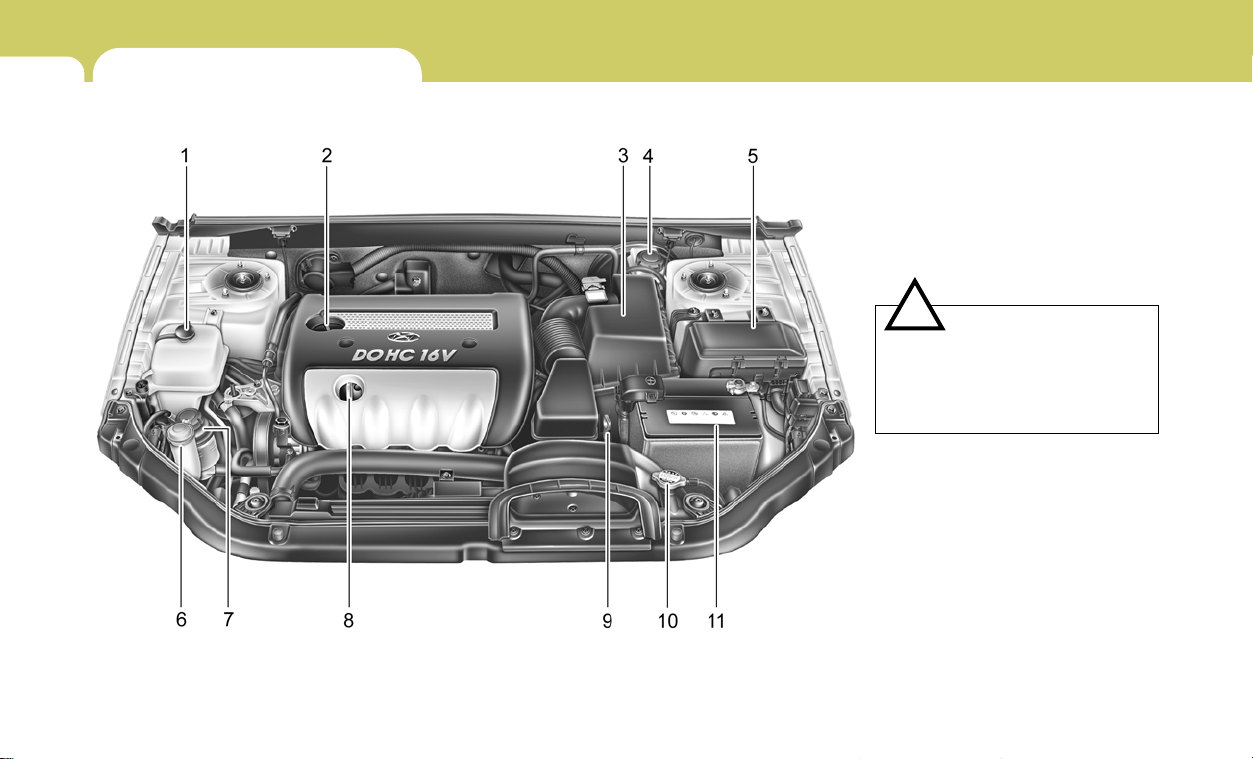
6
DO-IT-YOURSELF MAINTENANCE
2
G010B01NF-AAT
(2.4 DOHC)
ENGINE COMPARTMENT
G010B01NF
CAUTION:
When inspecting or servicing the
engine, you should handle tools
and other heavy objects carefully
so that the plastic cover of the
engine is not damaged.
!
1. Coolant reservoir cap
2. Engine oil filler cap
3. Air cleaner
4. Brake fluid reservoir
5. Fuse and relay box
6. Windshield washer fluid reservoir
7. Power steering fluid reservoir
8. Engine oil level dipstick
9. Automatic transaxle oil level
dipstick (If Installed)
10. Radiator cap
11. Battery
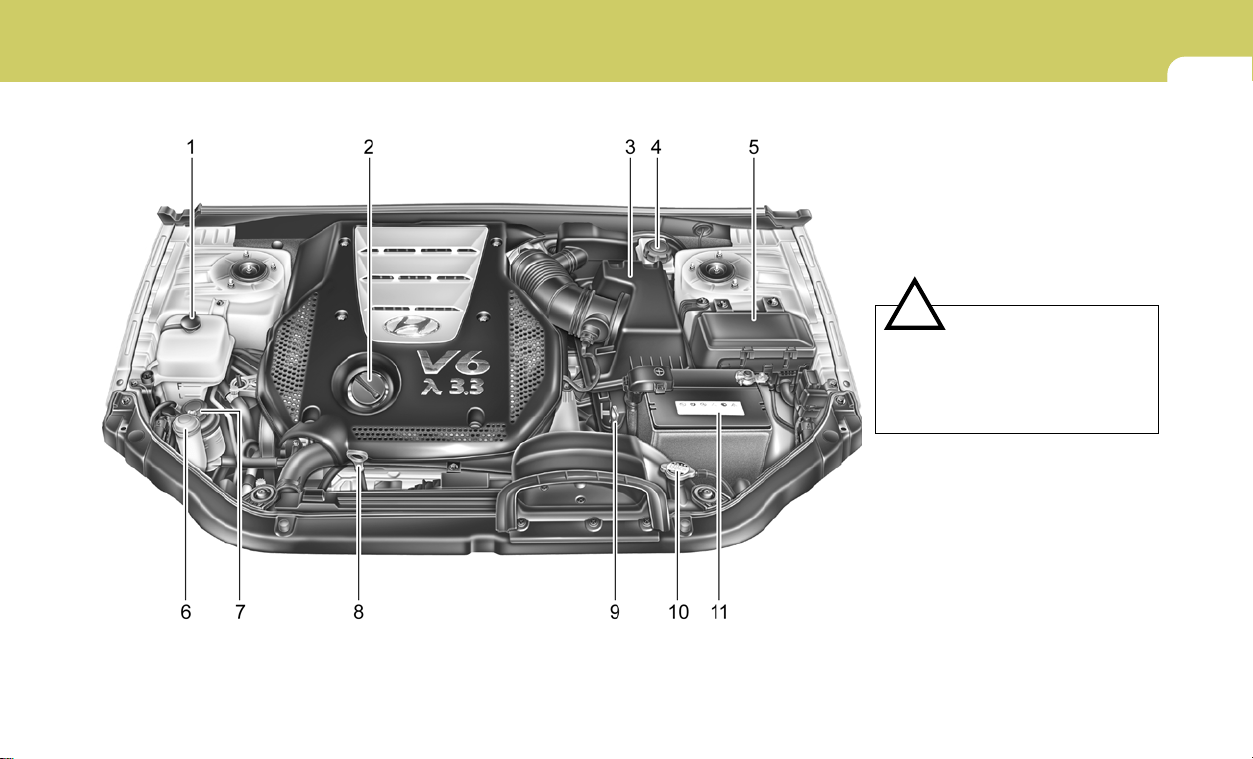
6
DO-IT-YOURSELF MAINTENANCE
3
G010A01NF-AAT
(3.3 V6)
G010A01NF
CAUTION:
When inspecting or servicing the
engine, you should handle tools
and other heavy objects carefully
so that the plastic cover of the
engine is not damaged.
!
1. Coolant reservoir cap
2. Engine oil filler cap
3. Air cleaner
4. Brake fluid reservoir
5. Fuse and relay box
6. Windshield washer fluid reservoir
7. Power steering fluid reservoir
8. Engine oil level dipstick
9. Automatic transaxle oil level dipstick
10. Radiator cap
11. Battery

6
DO-IT-YOURSELF MAINTENANCE
4
G020C01A-AAT
Vehicle Interior
The following should be checked each time
when the vehicle is driven:
o Lights operation
o Windshield wiper operation
o Horn operation
o Defroster, heating system operation (and air
conditioning, if installed)
o Steering operation and condition
o Mirror condition and operation
o Turn signal operation
o Accelerator pedal operation
o Brake operation, including parking brake
o Manual transaxle operation, including clutch
operation
o Automatic transaxle operation, including
"Park" mechanism operation
o Seat control condition and operation
o Seat belt condition and operation
o Sun visor operation
If you notice anything that does not operate
correctly or appears to be functioning correctly,
inspect it carefully and seek assistance from
your Hyundai dealer if service is needed.
G020B01A-AAT
Vehicle Exterior
The following should be checked monthly:
o Overall appearance and condition
o Wheel condition and wheel nut torque
o Exhaust system condition
o Light condition and operation
o Windshield glass condition
o Wiper blade condition
o Paint condition and body corrosion
o Fluid leaks
o Door and hood lock condition
o Tire pressure and condition
(including spare tire)
GENERAL CHECKS
G020A01NF-AAT
Engine Compartment
The following should be checked regularly:
o Engine oil level and condition
o Transaxle fluid level and condition
o Brake fluid level
o Engine coolant level
o Windshield washer fluid level
o Accessory drive belt condition
o Engine coolant hose condition
o Fluid leaks (on or below components)
o Power steering fluid level
o Battery condition
o Air filter condition
o Engine vibration
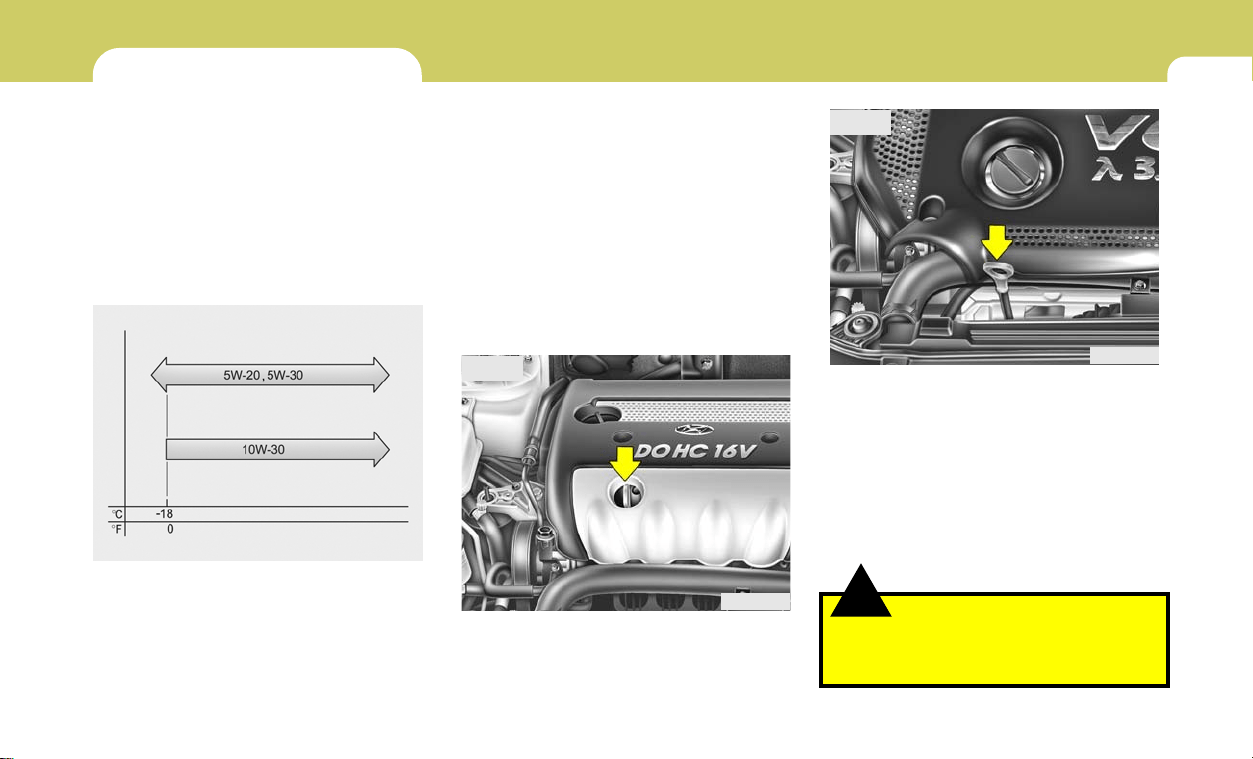
6
DO-IT-YOURSELF MAINTENANCE
5
G030C01JM-AAT
To Check the Oil Level
Before checking the oil, warm up the engine to
the normal operating temperature and be sure
your car is parked on level ground. Turn the
engine off.
Wait five minutes, then remove the dipstick,
wipe it off, fully reinsert the dipstick and withdraw
it again. Then note the highest level the oil has
reached on the dipstick. It should be between
the upper ("F") and lower ("L") range.
!
WARNING:
Be very careful not to touch the radiator
hose when checking the engine oil as it may
be hot enough to burn you.
CHECKING THE ENGINE OIL
G030B01O-AAT
Recommended Oil
G030C01NF
The engine oil quality should meet the following
classification.
API SJ, SL or ABOVE,
ILSAC GF-3 or ABOVE
G030B01JM-U
G030C02NF
(2.4L)
(3.3L)
NOTE:
o For good fuel economy, SAE 5W-20 (5W-
30), ILSAC GF-3 engine oil is preferred
regardless of regional option and en-
gine variation.
o If SAE 5W-20, ILSAC GF-3 engine oil is
not available, secondary recommended
engine oil for corresponding tempera-
ture range can be used.
G030A01A-AAT
Engine oil is essential to the performance and
service of the engine. It is suggested that you
check the oil level at least once a week in normal
use and more often if you are on a trip or driving
in severe conditions.
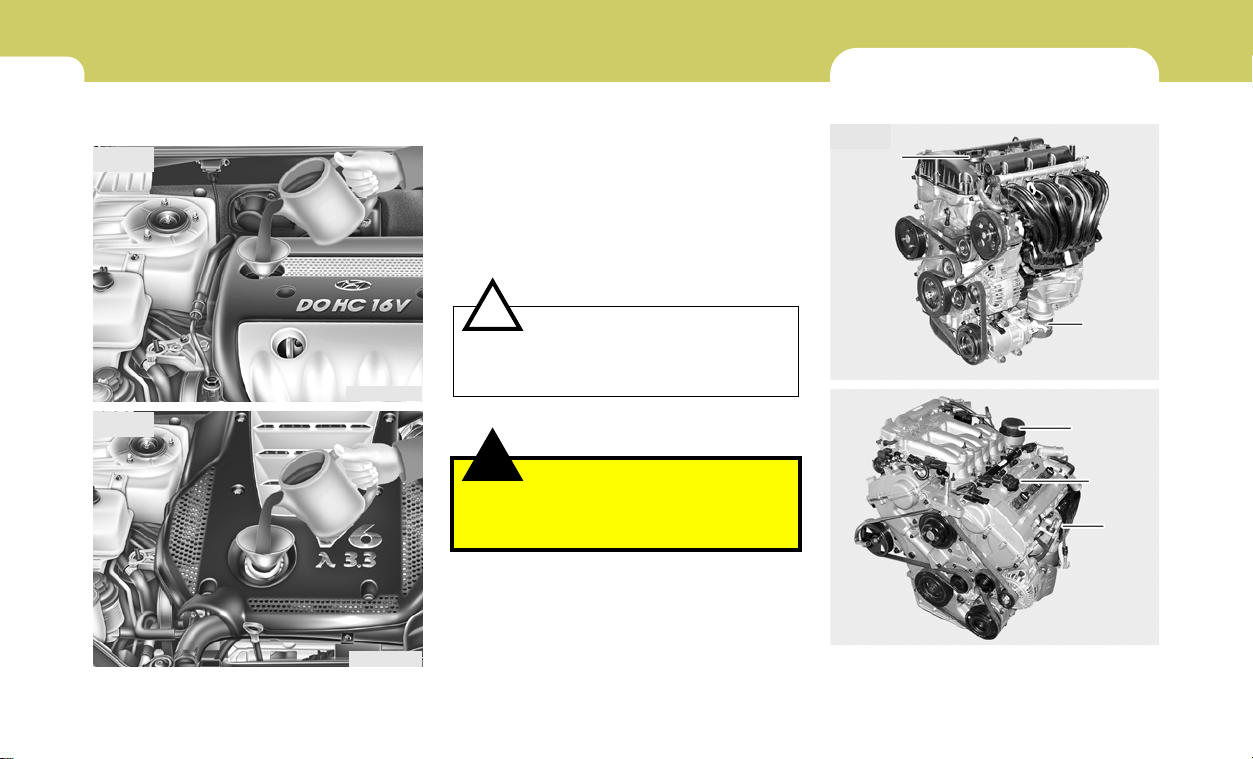
6
DO-IT-YOURSELF MAINTENANCE
6
!
!
G030D01O-AAT
Adding Oil
1. Remove the oil filler cap by turning it counter-
clockwise.
2. Add oil, then check the level again. Do not
overfill.
3. Replace the cap by turning it clockwise.
The distance between the "F" and "L" marks is
equal to about 1 quart of oil.
CAUTION:
Slowly pour the recommended oil into a
funnel. Do not overfill to avoid damage to
the engine.
WARNING:
Be very careful not to touch the radiator
hose when adding the engine oil as it may
be hot enough to burn you.
If the oil level is close to or below the "L" mark,
add oil until it reaches the "F" mark. To add oil:
G030D01NF
G030D02NF
(3.3L)
(2.4L)
CHANGING THE ENGINE OIL AND
FILTER
G040A01NF-AAT
HNF5005
(3.3L)
(2.4L)
G040A01NF
Oil filter
Oil filler
cap
Oil level
dipstick
Oil filler
cap
Oil filter
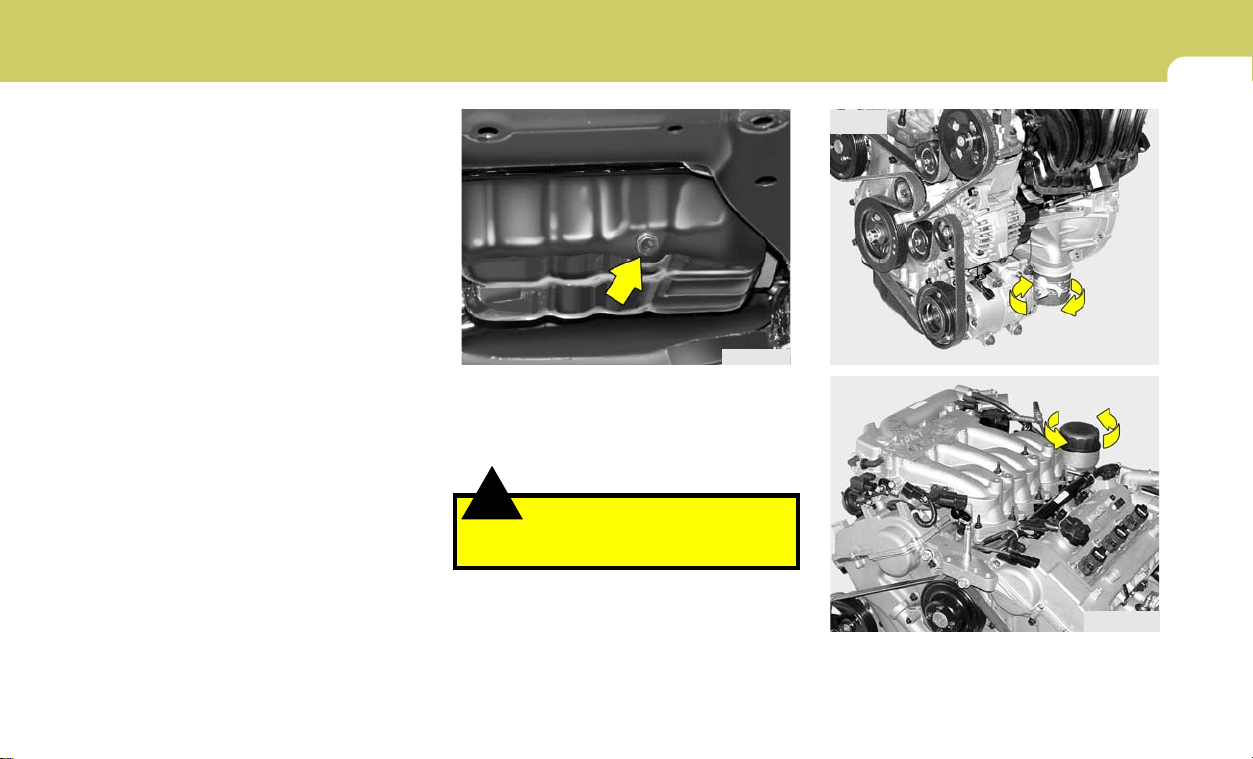
6
DO-IT-YOURSELF MAINTENANCE
7
!
3. Slide underneath the car and loosen the
drain plug by turning it counterclockwise with
a wrench of the proper size. Be sure that a
drain pan is in position to catch the oil as it
drains out, then remove the drain plug.
4. When the oil has stopped draining, replace
the drain plug using a new gasket and re-
tighten by turning it clockwise.
Oil pan drain plug tightening torque:
25.3 ~ 32.5 lb.ft (3.5 ~ 4.5 kgf.m)
HNF5006-1
(2.4L)
(3.3L)
The engine oil and filter should be changed at
those intervals specified in the maintenance
schedule in Section 5. If the car is being driven
in severe conditions, more frequent oil and filter
changes are required.
The procedure for changing the oil and filter is
as follows:
1. Park the car on level ground and set the
parking brake. Start the engine and let it
warm up until the needle on the coolant
temperature gauge moves above the lowest
mark. Turn the engine off and place the gear
selector lever in "P" (automatic) or reverse
gear (manual transaxle).
2. Open the hood and remove the engine oil
filler cap.
NOTE:
Loosen the oil filter cap by turning it coun-
terclockwise to drain well the oil in the oil
filter (3.3L only).
WARNING:
Be very careful when draining the engine oil
as it may be hot enough to burn you!
HNF5005-1
G040B01NF
6
DO-IT-YOURSELF MAINTENANCE
8
CHECKING AND CHANGING THE
ENGINE COOLANT
!
G050A01A-AAT
WARNING:
Do not remove the radiator cap when the
engine is hot. When the engine is hot, the
engine coolant is under pressure and may
erupt through the opening if the cap is
removed. You could be seriously burned if
you do not observe this precaution. Do not
remove the radiator cap until the radiator is
cool to the touch.
!
5. Remove the oil filter by turning it counter-
clockwise with a oil filter wrench of the proper
size. A certain amount of oil will come out
when you remove the filter. So be sure to
have your drain pan in place underneath it.
6. Install a new oil filter in accordance with the
instructions on the carton or on the filter itself.
Do not over-tighten.
Tightening torque:
8.7 ~ 11.6 lb.ft (1.2 ~ 1.6 kgf.m)
Be sure that the mounting surface on the
engine is clean and that the old gasket is
removed completely. Lubricate the new
gasket on the filter with clean engine oil
before installation.
7. Remove the engine oil level dipstick.
8. Refill the crankcase with the recommended
engine oil. Refer to the specification in chap-
ter 9 for engine oil capacity.
CAUTION:
Slowly pour the recommended oil into a
funnel. Do not overfill to avoid damage to
the engine.
NOTE:
Always dispose of used engine oil in an
environmentally acceptable manner. It is
suggested that it be placed in a sealed
container and taken to a service station for
reclamation. Do not pour the oil on the
ground or put it into the household trash.
PROPOSITION 65 WARNING:
Used engine oil may cause irritation or
cancer of the skin if left in contact with the
skin for prolonged periods of time. Used
engine oil contains chemicals that have
caused cancer in laboratory animals. Al-
ways protect your skin by washing your
hands thoroughly with soap and warm
water as soon as possible after handling
used oil.
!
9. Start the engine and check to be sure no oil
is leaking from the drain plug or oil filter.
10.Shut off the engine and recheck the oil level.
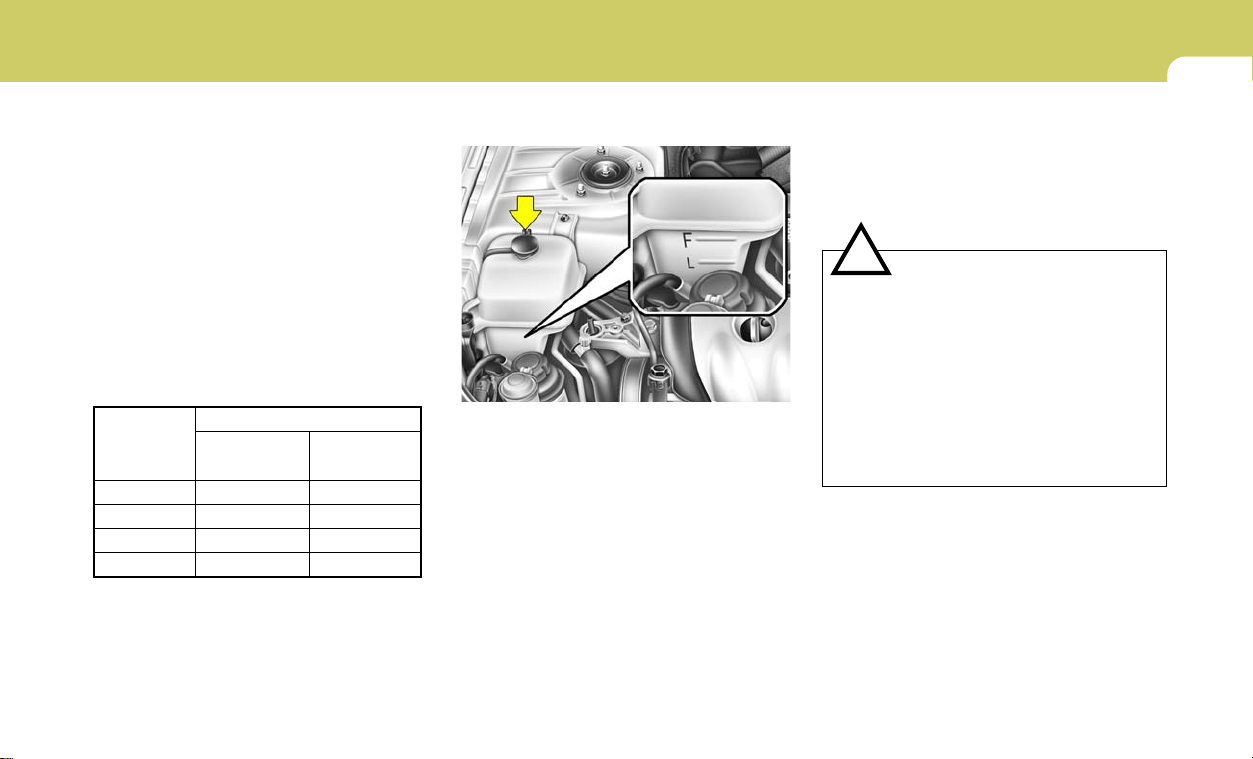
6
DO-IT-YOURSELF MAINTENANCE
9
G050B01A-AAT
Recommended Engine Coolant
Use a high quality ethylene-glycol coolant in a
50/50 mix with water. The engine coolant should
be compatible with aluminum engine parts.
Additional corrosion inhibitors or additives should
not be used. The cooling system must be
maintained with the correct concentration and
type of engine coolant to prevent freezing and
corrosion. Never allow the concentration of
antifreeze to exceed the 60% level or go below
the 35% level, or damage to the cooling system
may result. For proper concentration when
adding or replacing the engine coolant, refer to
the following table.
Ambient
temperature
°F (°C)
5 (-15)
-13 (-25)
-31 (-35)
-49 (-45)
65%
60%
50%
40%
35%
40%
50%
60%
Water
Antifreeze
solution
Engine Coolant concentration
G050C01NF-GAT
To Check the Coolant Level
The coolant level can be seen on the side of the
plastic coolant reservoir. The level of the cool-
ant should be between the "L" and "F" lines on
the reservoir when the engine is warm with it at
idle . If the level is below the "L" mark, add engine
coolant to bring it up to "F". If the level is low,
inspect for coolant leaks and recheck the fluid
level frequently. If the level drops again, visit
your Hyundai dealer for an inspection and
diagnosis of the reason.
G050C01NF
G050D01NF-GAT
To Change the Engine Coolant
The engine coolant should be changed at those
intervals specified in the vehicle maintenance
schedule in Section 5.
CAUTION:
o Engine coolant can damage the finish of
your car. If you spill engine coolant on
the car, wash it off thoroughly with clean
water.
o The engine in your vehicle has alumi-
num engine parts and must be protected
by an ethylene-glycol base coolant to
prevent corrosion and freezing.
Do not use hard water. Hard water can
cause engine damage from corrosion,
overheating or freezing.
!
1. Park the car on level ground, set the parking
brake and remove the radiator cap when
cool.
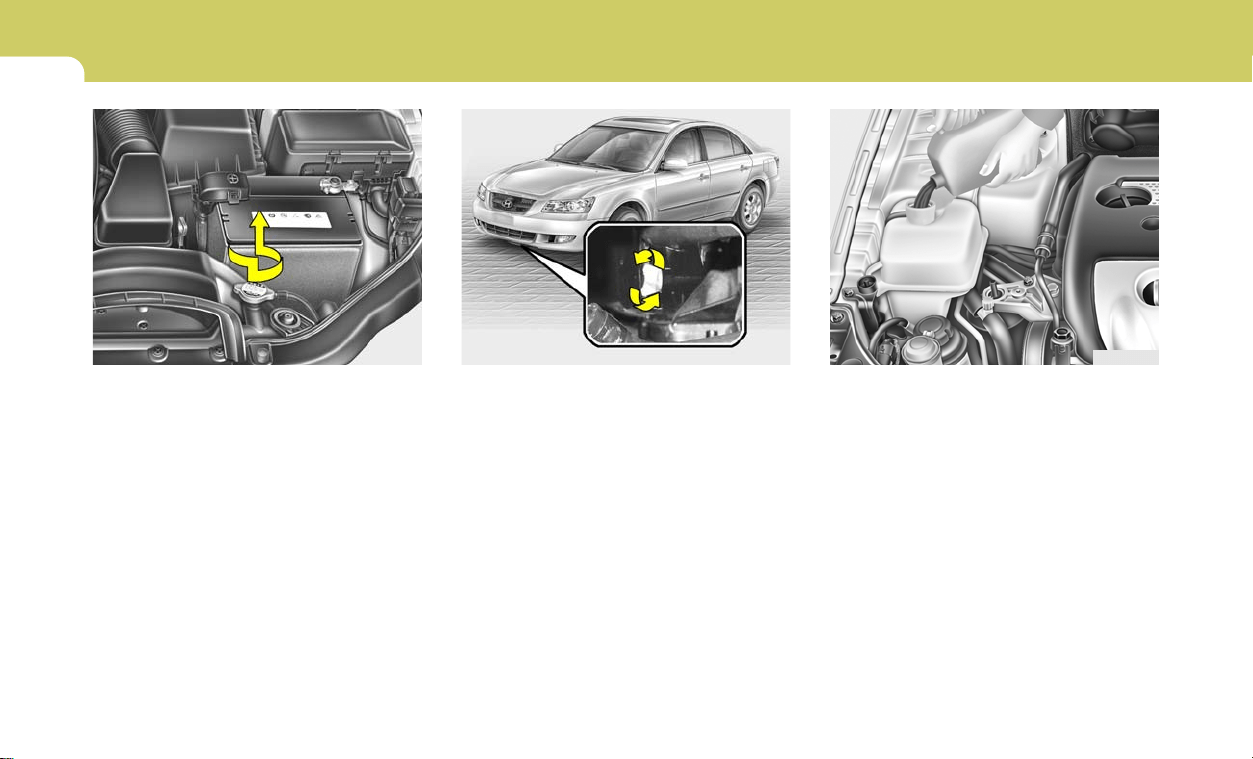
6
DO-IT-YOURSELF MAINTENANCE
10
3. Be sure your drain receptacle is in place.
Open the drain cock on the radiator. Allow all
the engine coolant to drain from the cooling
system, and then securely close the drain
cock.
4. Check Section 9 for the capacity of the
cooling system in your car. Then, following
the manufacturer's directions on the engine
coolant container, add the appropriate quan-
tity of coolant to the radiator.
5. Slowly fill the radiator with the proper coolant
mixture (see the "Recommended Engine
Coolant in previous page) until the fluid level
stays up in the radiator neck. And pump the
radiator hose in order to bleed the air.
HNF5008
2. Wrap a thick cloth around the radiator cap
and slowly turn the radiator cap counter-
clockwise without pressing down on it, until
it stops. This relieves any pressure remain-
ing in the cooling system. When you are sure
that all the pressure has been released,
remove the radiator cap by pushing down
and turning counterclockwise.
G050D02NF-A
G050D01NF
6. Run the engine at idle until the coolant circu-
lates. If the cooling fan operates and the
coolant starts to circulate, add the coolant to
the reservoir.
7. To bleed the air in the cooling system, repeat
procedure 6 until the cooling fan operates
3~5 times.
8. Replace the radiator cap and turn it until
tightly installed. And then, add coolant to the
reservoir until the level is between "L" and
"F".
9. Stop the engine and check the coolant level
when the engine is cool. The level of the
coolant should be the "L" and "F" lines on the
reservoir. If the level is below the "L" line,
repeat the procedure 4~8 until the level
between "L" and "F".
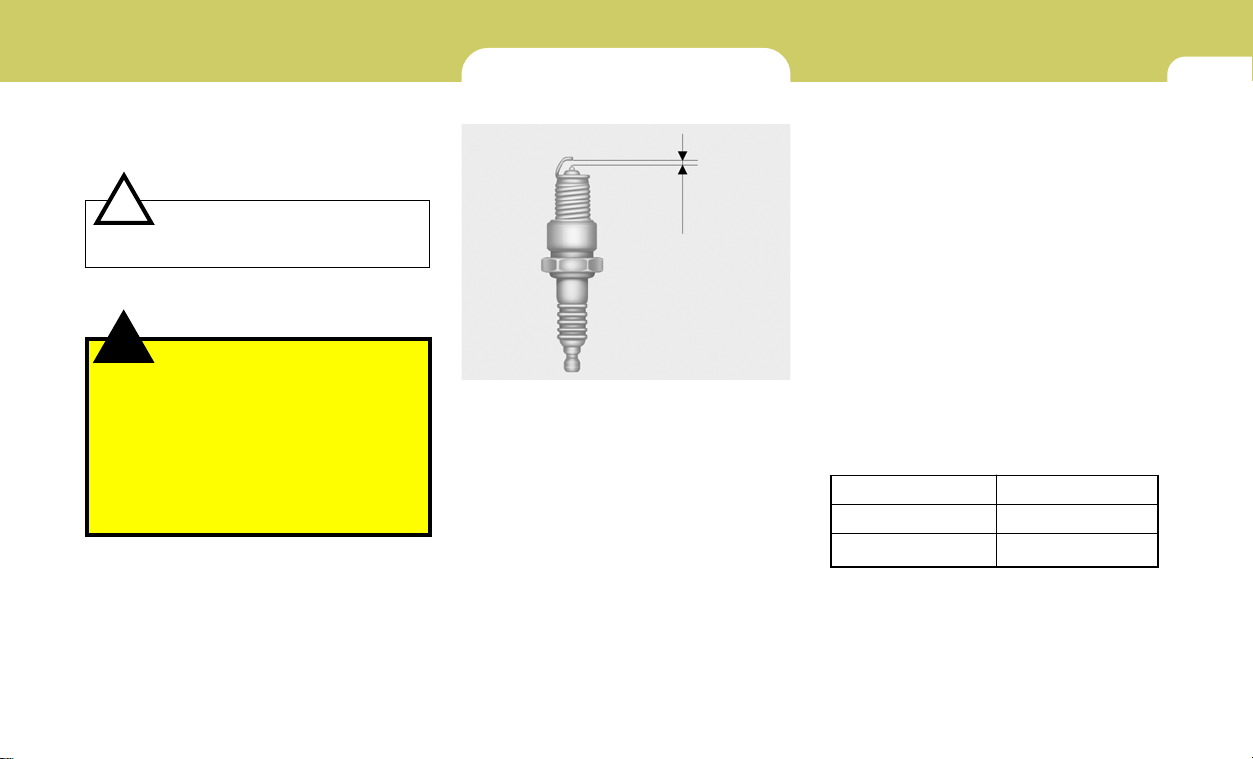
6
DO-IT-YOURSELF MAINTENANCE
11
!
!
10.Replace the reservoir cap and check to be
sure the drain cock and the radiator cap are
fully closed and not leaking.
CAUTION:
Recheck after a few days and add the cool-
ant if the level is below the "L" level.
WARNING:
The cooling fan is controlled by engine
coolant temperature and may sometimes
operate even when the engine is not run-
ning. Use extreme caution when working
near the blades of the coolant fan so that
you are not injured by a rotating fan blade.
As the engine coolant temperature de-
creases, the fan will automatically shut off.
This is a normal condition.
Type
SK16PR-A11
IFR5G-11
SPARK PLUGS
G060A01NF-AAT
G060A01L
Your engine was originally equipped with Iri-
dium-tipped spark plugs.
Iridium-tipped spark plugs will last longer than
conventional type spark plugs and can be
identified by blue lines on the ceramic shell.
NOTE:
Do not clean or regap Iridium-tipped spark
plugs.
G060B01NF-AAT
Replacing the Spark Plugs
The spark plugs should be changed at the
intervals specified in the vehicle maintenance
schedule in Section 5 or whenever engine
performance indicates they should be changed.
Symptoms that suggest poor spark plug perfor-
mance include engine misfiring under load, loss
of fuel economy, poor acceleration, etc. When
spark plugs are replaced, always use spark
plugs recommended by Hyundai. The use of
other spark plugs can result in loss of perfor-
mance, radio interference or engine damage.
NOTE:
When replacing the spark plugs, always use
the genuine parts recommended.
Recommended Spark Plugs:
0.039 ~ 0.043 in.
(1.0~1.1 mm)
Remark
2.4L
3.3L
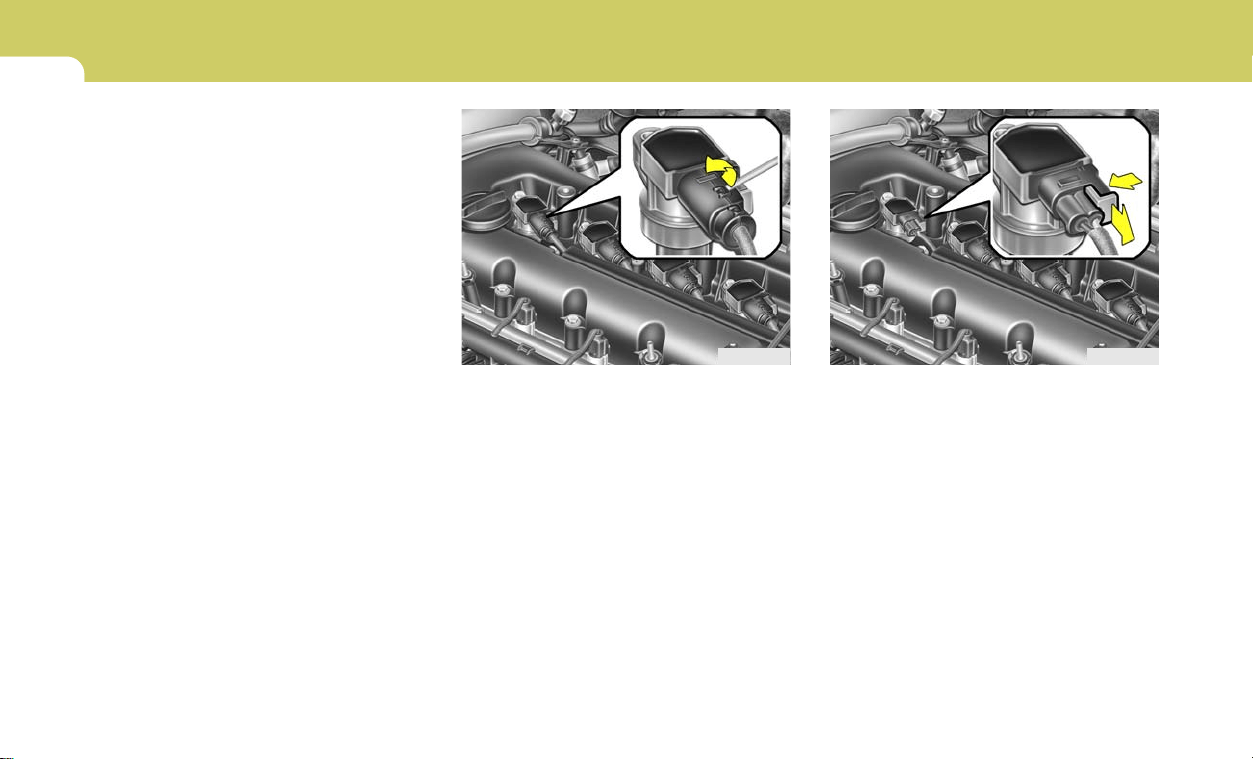
6
DO-IT-YOURSELF MAINTENANCE
12
G060C01NF
G060C02NF
3. Remove the cover of the ignition connector
with a flat-head screwdriver.
4. Pull the ignition connector key in the direction
of (1).
5. Press the position (2) of the ignition connec-
tor key and detach the ignition connector by
pulling it.
(1)
(2)
G060C01NF-GAT
Changing the Spark Plugs
You will find it easier to change spark plugs if the
engine is cold. Always change one spark plug
at a time. This helps avoid getting the wires
mixed up.
1. Remove the engine cover.
NOTE:
It is recommended that the spark plugs for
3.3L engines be changed by an authorized
Hyundai dealer.
2. Using a clean cloth, remove any dirt that has
accumulated around the base of the spark
plug so it cannot fall into the cylinder when the
spark plug is removed.
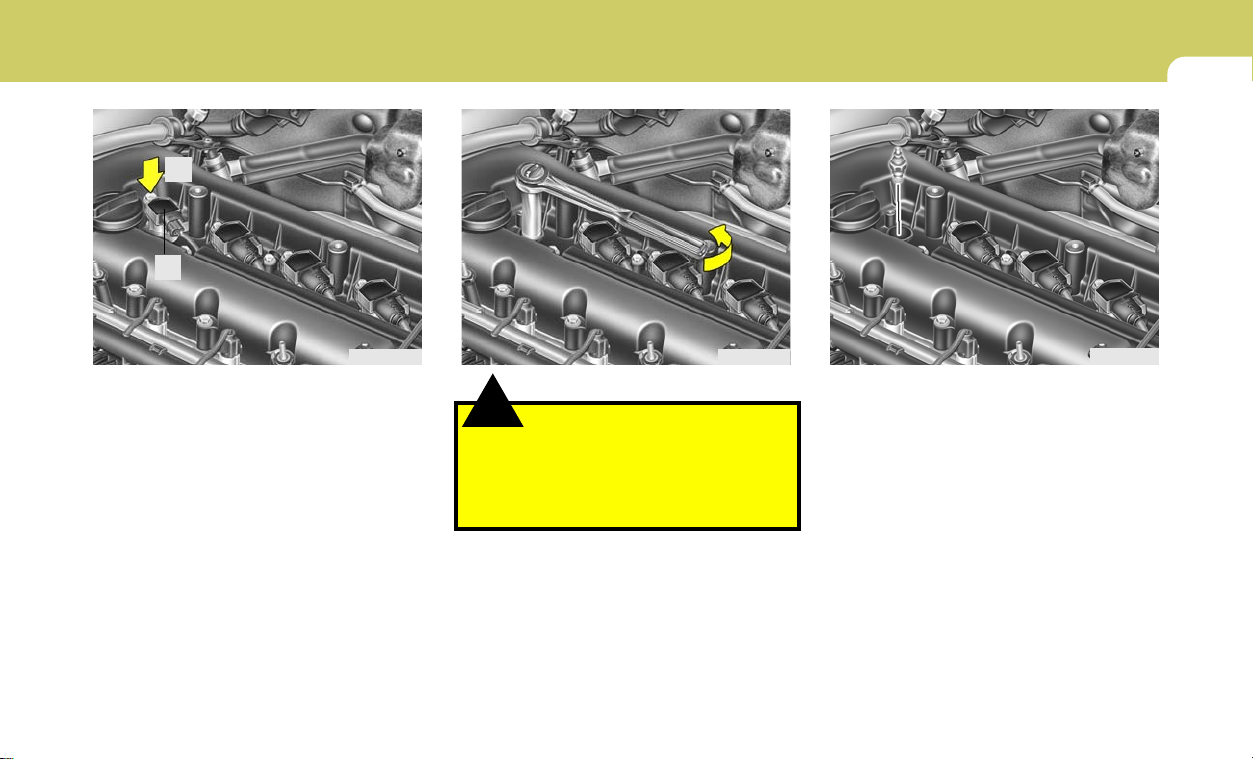
6
DO-IT-YOURSELF MAINTENANCE
13
!
WARNING:
It is recommended that the engine be cool
or cold when changing the spark plugs. If
the engine is hot, you could burn yourself
on the insulated connector, the spark plug
or the engine itself.
6. Remove the mounting bolt (3) of the ignition
coil with a socket wrench.
7. Pull straight up on the ignition coil (4).
G060C03NF
8. When preparing to remove the spark plug,
guide the socket down over the spark plug,
being careful not to damage the ceramic
insulator.
9. To remove the spark plug, turn the wrench
handle in a counterclockwise direction.
(3)
(4)
G060C06NF
G060C05NF
10. To install the new spark plug, guide the
socket down over the spark plug, being
careful not to damage the ceramic insulator.
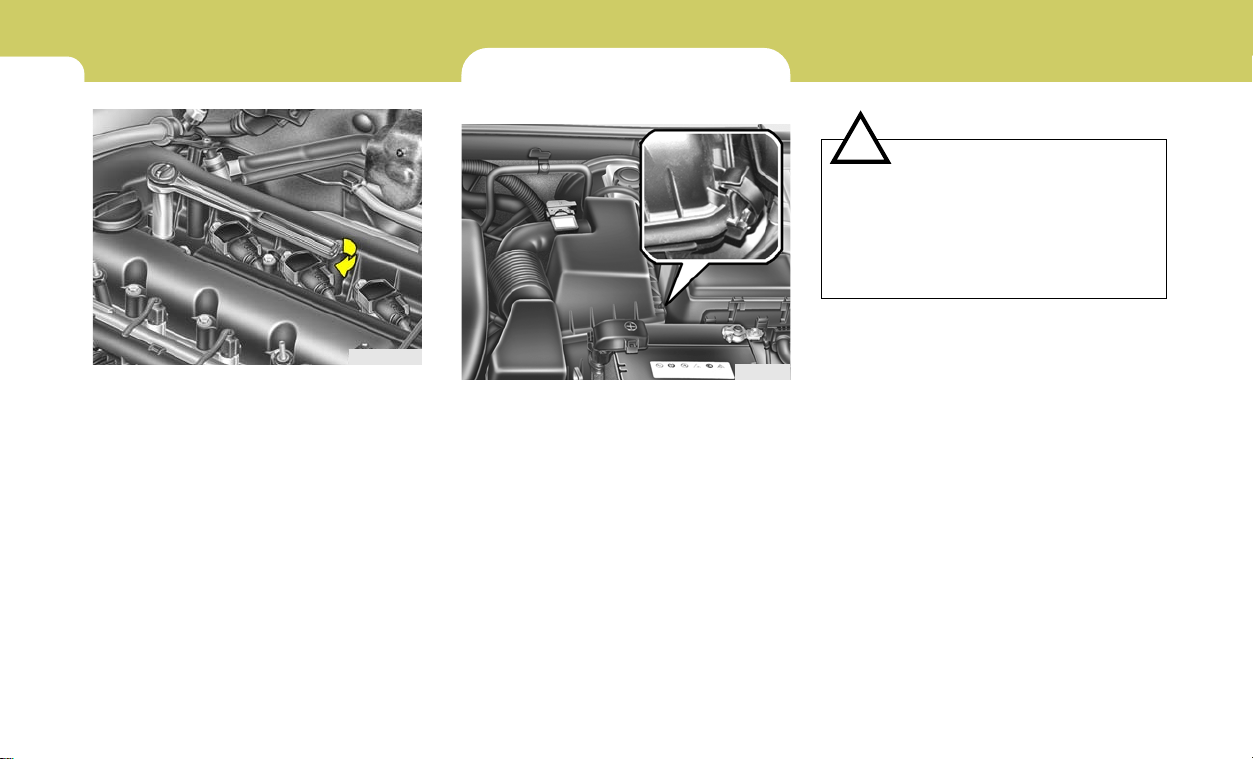
6
DO-IT-YOURSELF MAINTENANCE
14
G060C04NF
11. Installation is the reverse order of disas-
sembly.
NOTE:
Spark plugs should be tightened firmly.
(Tightening torque: 18.0 lb.ft (2.5 kgf.m))
Over-tightening can damage the threads in
the aluminum cylinder head. Also, leaving
them too loose can cause the spark plug to
get very hot and possibly result in damage
to the engine.
CAUTION:
o Operating your vehicle without using a
proper air cleaner filter in place can result
in excessive engine wear.
o When removing the air cleaner filter, be
careful that dust or dirt does not enter
the air intake. These may result in dam-
age to the air cleaner filter.
!
CHANGING THE AIR
CLEANER FILTER
G070A03Y-AAT
The replacement of the air cleaner filter is
performed in the following manner.
1. Unsnap the clips around the cover.
2. When this is done, the cover can be lifted off,
the old filter removed and the new filter put in
its place.
Genuine Hyundai replacement parts are rec-
ommended.
HNF5011
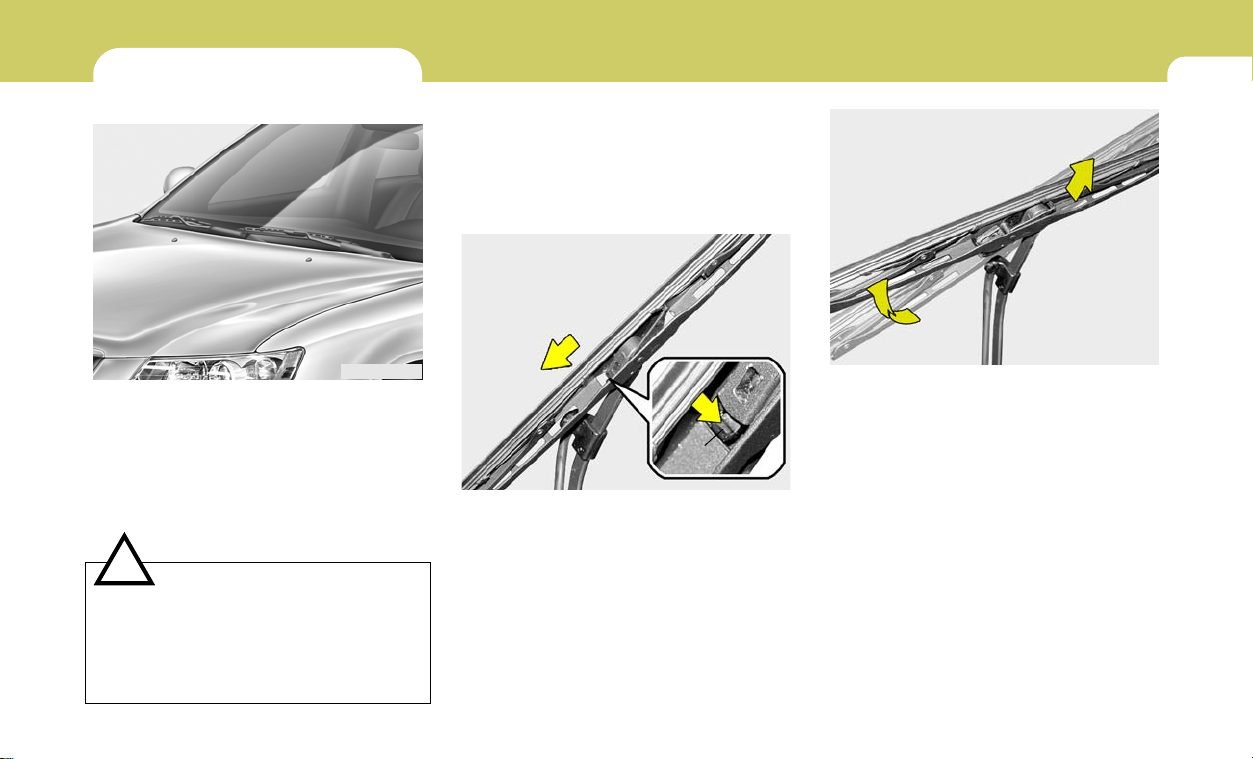
6
DO-IT-YOURSELF MAINTENANCE
15
HHR5048
(1)
WINDSHIELD WIPER BLADES
G080A02A-AAT
The wiper blades should be carefully inspected
from time to time and cleaned to remove accu-
mulations of road film or other debris. To clean
the wiper blades and arms, use a clean sponge
or cloth with a mild soap or detergent and water.
If the wipers continue to streak or smear the
glass, replace them with genuine Hyundai re-
placement parts or their equivalent.
!
CAUTION:
o Do not operate the wipers on dry glass.
This can result in more rapid wear of the
wiper blades and may scratch the glass.
o Keep the blade rubber out of contact
with petroleum products such as engine
oil, gasoline, etc.
G080B01HR-GAT
Replacing the Wiper Blades
To replace the wiper blades, raise the wiper to
the vertical position.
To remove the wiper blade
1. Push down the wiper blade with the locking
clip (1) pressed to detach it from the wiper
arm.
G080A01NF-A
2. Raise the wiper blade lightly and pull it up.
HHR5049
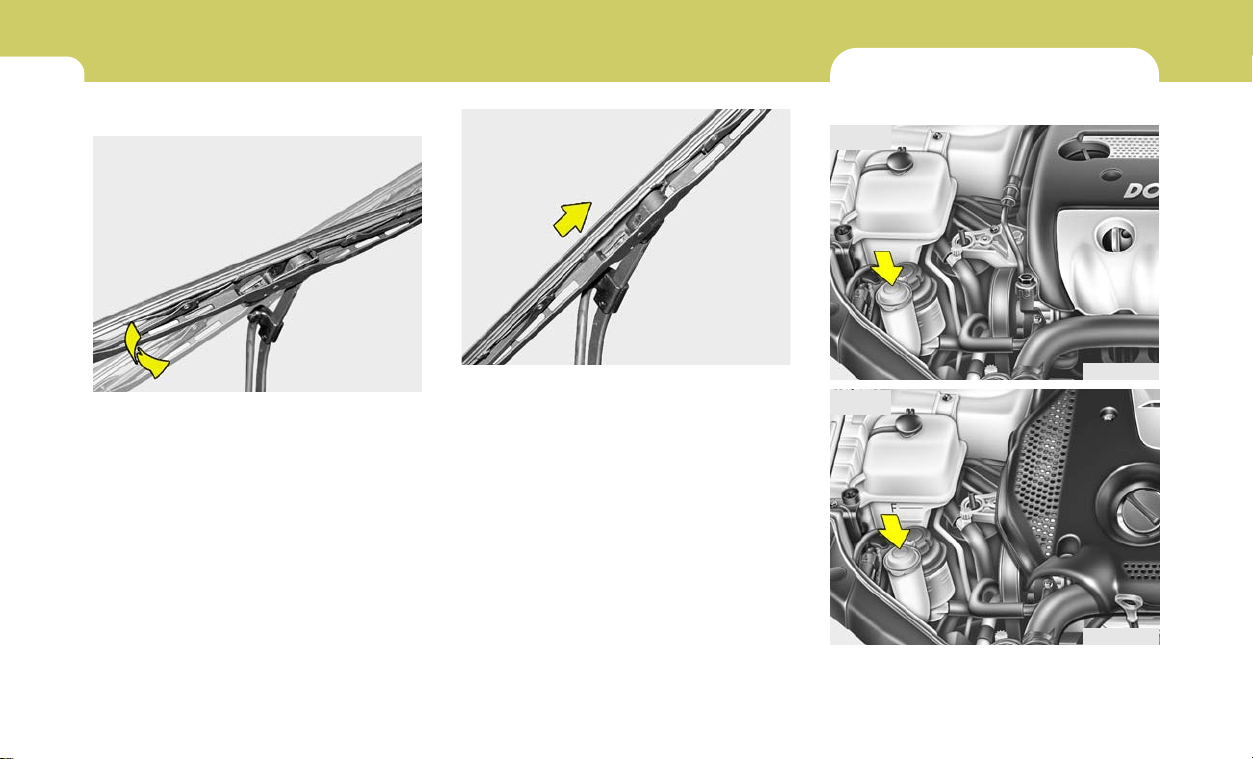
6
DO-IT-YOURSELF MAINTENANCE
16
HHR5051
HHR5050
FILLING THE WASHER
RESERVOIR
G090A02NF-AAT
G090A02NF
G090A01NF
(3.3L)
(2.4L)
To install the wiper blade
1. Put a new wiper blade onto the wiper arm and
lower the wiper blade at the level of the wiper
arm as shown in the drawing.
2. Pull up the wiper blade until you hear an
audible "click" to engage in the end of the
wiper arm.
NOTE:
Do not allow the wiper arm to fall against the
windshield.
The washer fluid reservoir supplies fluid to the
windshield washer system.
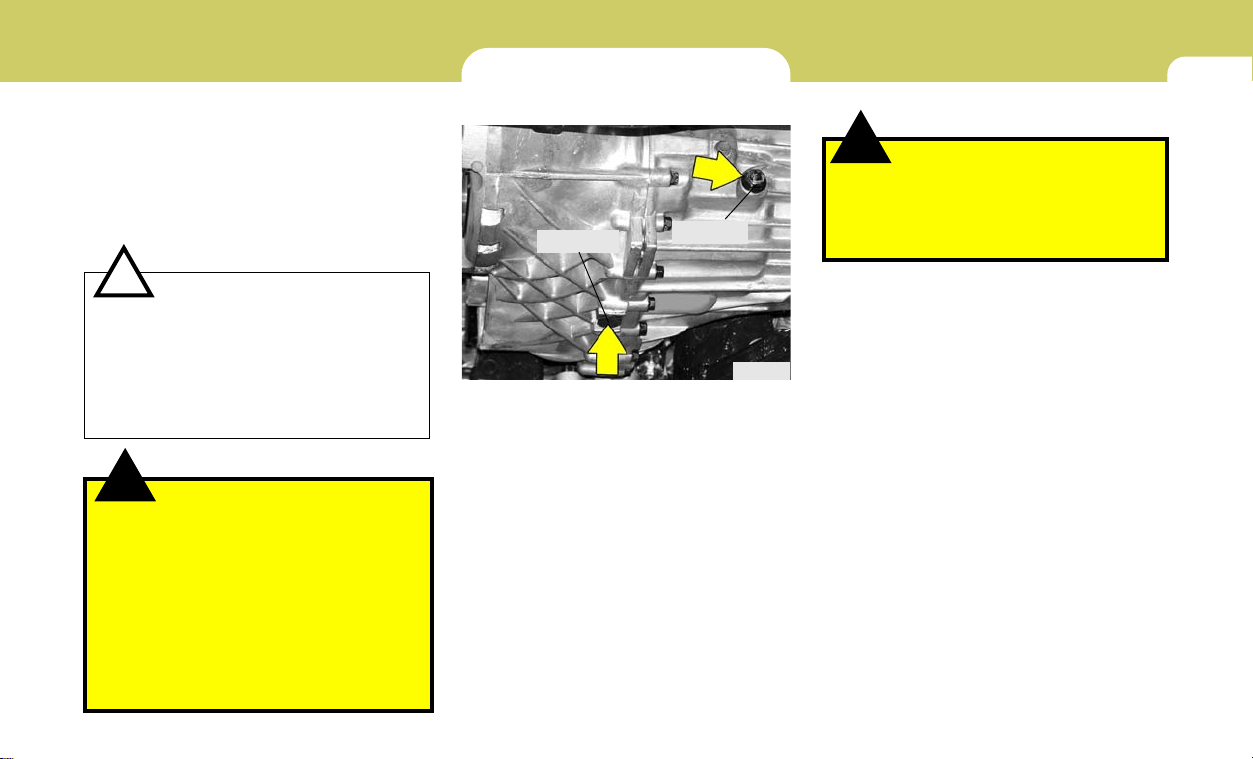
6
DO-IT-YOURSELF MAINTENANCE
17
CAUTION:
o Radiator antifreeze (engine coolant)
should not be used in the washer system
because it will damage the car's finish.
o The washer lever should not be pulled
and the washer should not be operated
if the washer reservoir is empty. This can
damage the washer fluid pump.
!
A good quality washer fluid should be used to fill
the washer reservoir. The fluid level should be
checked more frequently during bad weather or
whenever the washer system is in more fre-
quent use.
The capacity of the washer reservoir is 3.2 U.S.
quarts (4.0 liters).
!
WARNING:
It is always better to check the transaxle oil
level when the engine is cool or cold. If the
engine is hot, you should exercise great
caution to avoid burning yourself on hot
engine or exhaust parts.
CHECKING THE TRANSAXLE OIL
(MANUAL)
G100A01NF-AAT
HNF5010
Filler plug
Drain plug
Transaxle lubricant in the manual transaxle
should be checked at those intervals specified
in the vehicle maintenance schedule in Section
5.
Recommended Oil
Use only HYUNDAI GENUINE PARTS MTF
75W/85 (API GL-4) in the manual transaxle.
Manual Transaxle Oil Capacity
The oil capacity of the manual transaxle is 2.0
U.S. quarts (1.9 liters).
!
WARNING:
o Windshield washer fluid agents contain
some amounts of alcohol and can be
flammable under certain circumstances.
Do not allow sparks or flame to contact
the washer fluid or the washer fluid
reservoir. Damage to the vehicle or its
occupants could occur.
o Windshield washer fluid is poisonous to
humans and animals. Do not drink wind-
shield washer fluid. Serious injury or
death could occur.
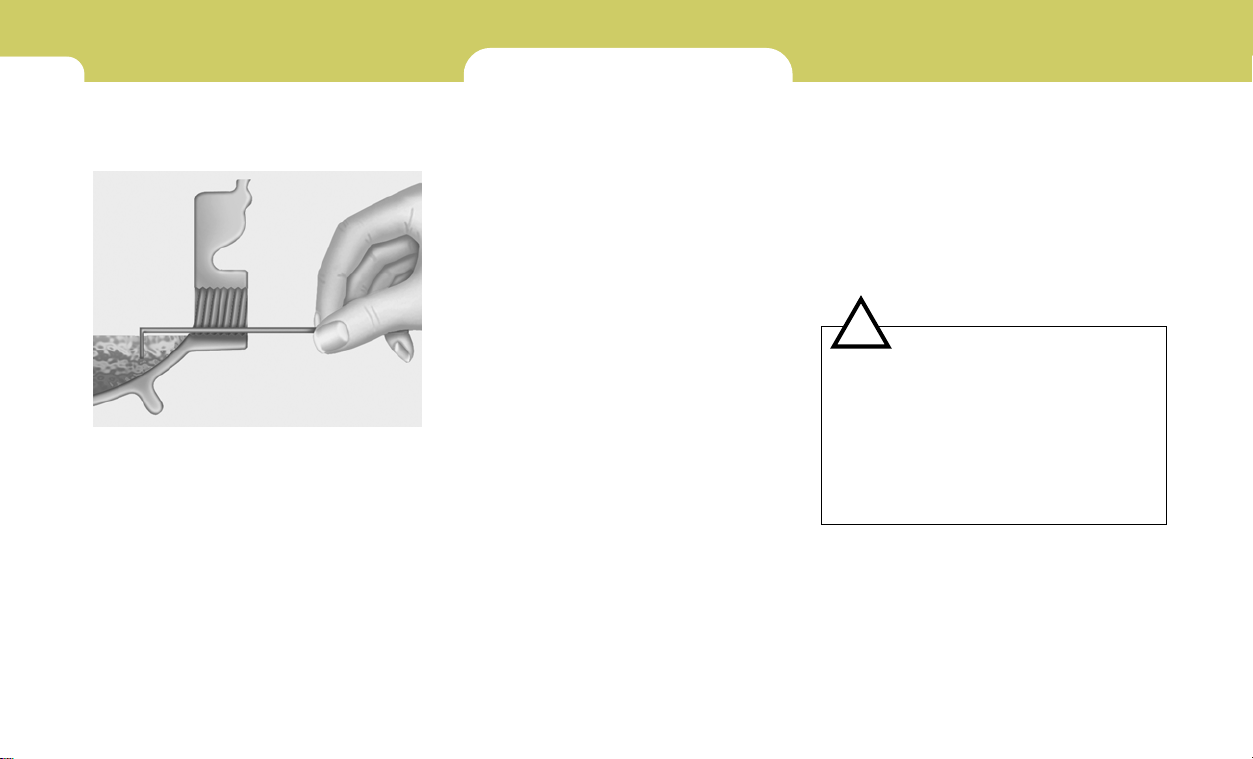
6
DO-IT-YOURSELF MAINTENANCE
18
CHECKING THE TRANSAXLE
FLUID (AUTOMATIC)
G110A01E-AAT
Transaxle fluid in the automatic transaxle should
be checked at those intervals specified in the
vehicle maintenance schedule in Section 5.
NOTE:
Automatic transaxle fluid is basically red in
color. As driving distance increases, the
fluid color turns darkish red gradually. It is
a normal condition and you should not
judge the need to replace based upon the
changing color.
You must replace the automatic transaxle
fluid in accordance with intervals specified
in the vehicle maintenance schedule in
section 5.
!
G110B05A-AAT
Recommended Fluid
Your Hyundai automatic transaxle is specially
designed to operate with HYUNDAI GENUINE
ATF SP III, DIAMOND ATF SP III, SK ATF SP
III or other brands meeting the SP III specifica-
tion approved by Hyundai Motor Co.. Damage
caused by a nonspecified fluid is not covered by
your new vehicle limited warranty.
CAUTION:
Use of aftermarket ATF additives may cause
damage to the automatic transaxle.
Only use HYUNDAI GENUINE ATF SP III,
DIAMOND ATF SP III, SK ATF SP III or other
brands meeting the SP III specification ap-
proved by Hyundai Motor Co.. If you are
having your vehicle serviced at a facility
other than a Hyundai dealer, verify that the
correct ATF is used for your vehicle.
G100B02A-AAT
To Check the Manual Transaxle
Fluid Level
G100B01L
Park the car on level ground with the engine off.
1. Using a wrench of the correct size, loosen
the oil filler plug by turning it counterclock-
wise and remove it with your fingers.
2. Use your finger to feel inside the hole. The oil
level should be at its bottom edge. If it is not,
check for leaks before adding oil. To refill the
transaxle or bring the oil level up, add oil
slowly until it reaches the proper level. Do not
overfill.
3. Replace the plug and washer, screw it in with
your fingers and then tighten securely with
the wrench.
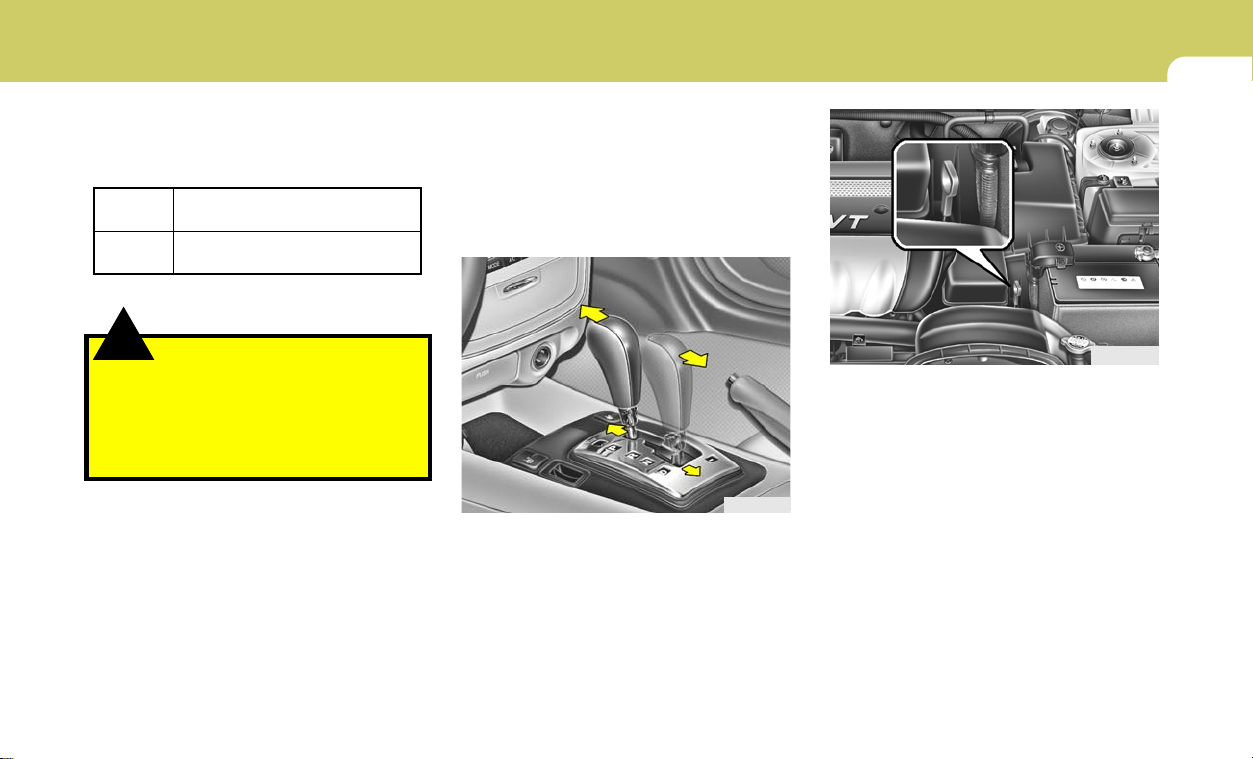
6
DO-IT-YOURSELF MAINTENANCE
19
2. Remove the transaxle dipstick, wipe it clean,
reinsert the dipstick as far as it will go, then
remove it again. Now check the fluid level on
the dipstick. It should be in the "HOT" range
on the dipstick.
G110D02O-AAT
To Check the Transaxle Fluid Level
Park the car on level ground with the parking
brake engaged. When the transaxle fluid level
is checked, the transaxle fluid should be at
normal operating temperature and the engine
idling.
While the engine is idling, apply the brakes and
move the gear selector lever from "P" to each
of its other positions — "R", "N", "D" — and then
return to "N" or "P". With the engine still idling:
1. Open the hood, being careful to keep hands,
long hair and clothing clear of any moving
parts.
!
G110C01NF-AAT
Transaxle Fluid Capacity
The fluid capacity of the automatic transaxle is:
WARNING:
The transaxle fluid level should be checked
when the engine is at normal operating
temperature. This means that the engine,
radiator, radiator hose, exhaust system etc.,
are very hot. Exercise great care not to burn
yourself during this procedure.
G110D01NF
C090F02NF
2.4L
3.3L
8.24 U.S. quarts (7.8 liters)
11.52 U.S. quarts (10.9 liters)
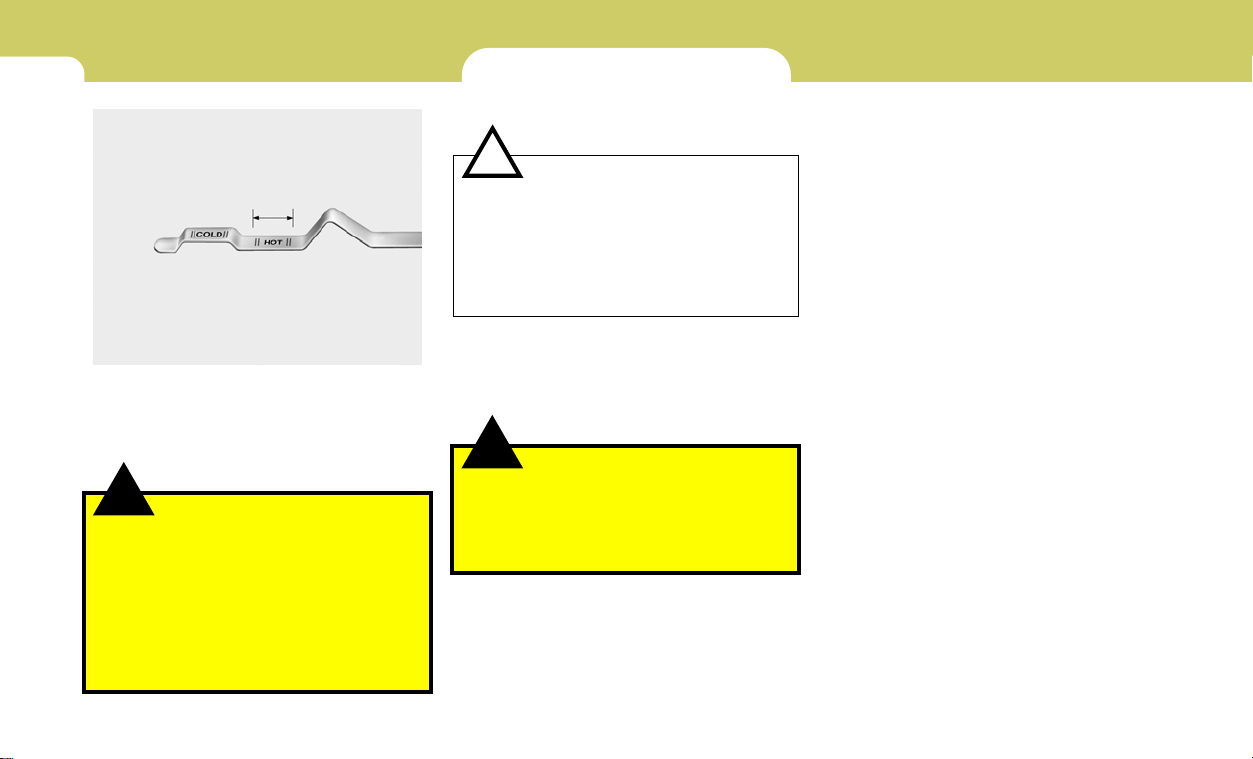
6
DO-IT-YOURSELF MAINTENANCE
20
G110D02NF
CHECKING THE BRAKES
!
G120B01A-AAT
Checking the Brake Fluid Level
WARNING:
Use caution when handling brake fluid. It
can damage your vision if it gets into your
eyes. It will also damage your vehicle's
paint if spilled on it and not removed imme-
diately.
!
WARNING:
The cooling fan is controlled by engine
coolant temperature and may sometimes
operate even when the engine is not run-
ning. Use extreme caution when working
near the blades of the cooling fan so that
you are not injured by a rotating fan blade.
As the engine coolant temperature de-
creases, the fan will automatically shut off.
This is a normal condition.
Fluid level should be within "HOT" range
G120A01A-AAT
CAUTION:
Because brakes are essential to the safe
operation of the car, it is suggested that
they be checked and inspected by your
Hyundai dealer. The brakes should be
checked and inspected for wear at those
intervals specified in the vehicle mainte-
nance schedule in Section 5.
!
3. If the transaxle fluid level is low, use a funnel
to add transaxle fluid through the dipstick
tube until the level reaches the "HOT" range.
Do not overfill.
G120D01A-AAT
To Check the Fluid Level
The fluid level in the brake fluid reservoir should
be checked periodically. The level should be
between the "MIN" and "MAX" marks on the side
of the reservoir. If the level is at or below the
"MIN" mark, carefully add fluid to bring it up to
"MAX". Do not overfill.
G120C02A-AAT
Recommended Brake Fluid
Use only hydraulic brake fluid conforming to
DOT 3 or DOT 4 specifications in your braking
system. Follow the instructions printed on the
container.
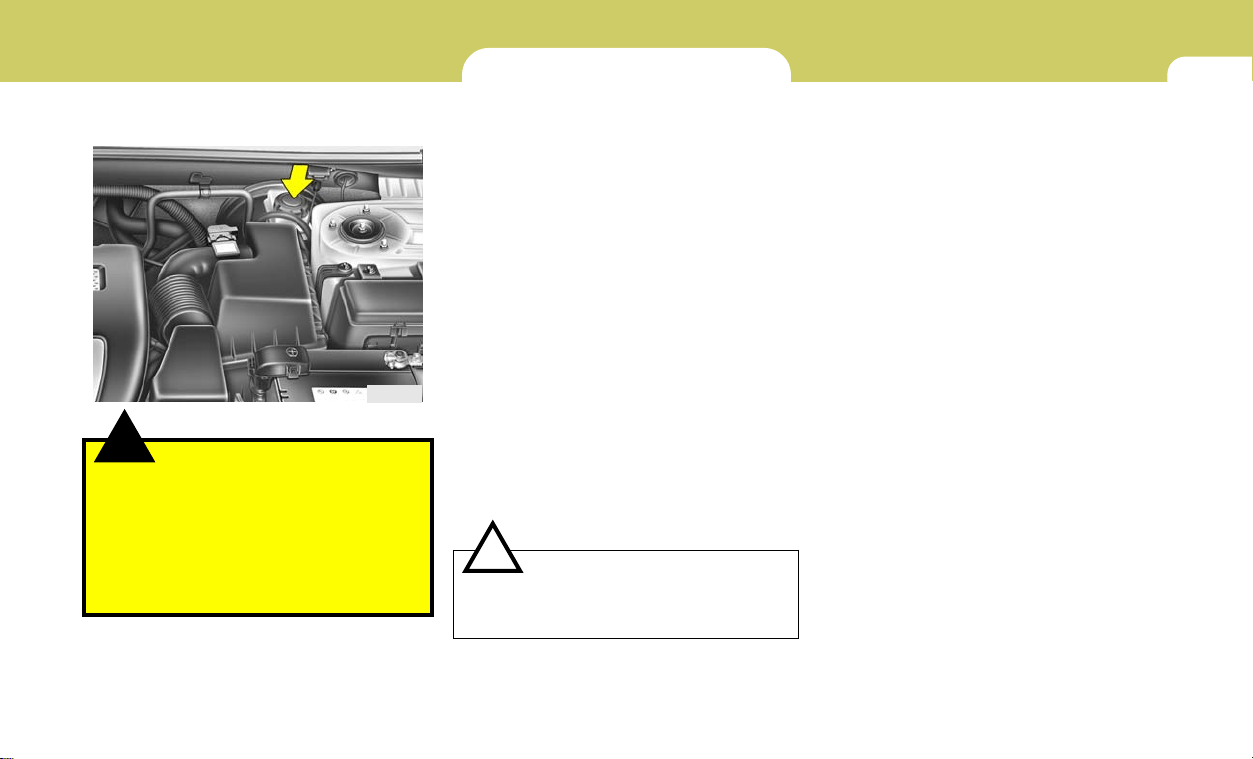
6
DO-IT-YOURSELF MAINTENANCE
21
G140C01A-AAT
Lubrication
To lubricate the compressor and the seals in the
system, the air conditioning should be run for at
least 10 minutes each week. This is particularly
important during cool weather when the air
conditioning system is not otherwise in use.
!
G120E02A-AAT
Adding Brake Fluid
WARNING:
Handle brake fluid carefully. It can damage
your vision if it gets into your eyes. Use only
DOT 3 or DOT 4 specification fluid from a
sealed container. Do not allow the fluid can
or reservoir to remain open any longer than
required. This will prevent entry of dirt and
moisture which can damage the brake sys-
tem and cause improper operation.
To add brake fluid, first wipe away any dirt then
unscrew the fluid reservoir cap. Slowly pour the
recommended fluid into the reservoir. Do not
overfill. Carefully replace the cap on the reser-
voir and tighten.
AIR CONDITIONING CARE
!
G140A01A-AAT
Keeping the Condenser Clean
The air conditioning condenser (and engine
radiator) should be checked periodically for
accumulation of dirt, dead insects, leaves, etc.
These can interfere with maximum cooling ef-
ficiency. When removing such accumulations,
brush or hose them away carefully to avoid
bending the cooling fans.
G140B01A-AAT
Checking the Air Conditioning Opera-
tion
1. Start the engine and let it run at a fast idle for
several minutes with the air conditioning set
at the maximum cold setting.
2. If the air coming out of the in-dash vents is
not cold, have the air conditioning system
inspected by your Hyundai dealer.
CAUTION:
Running the air conditioning system for
extended periods of time with a low refrig-
erant level may damage the compressor.
HNF5013
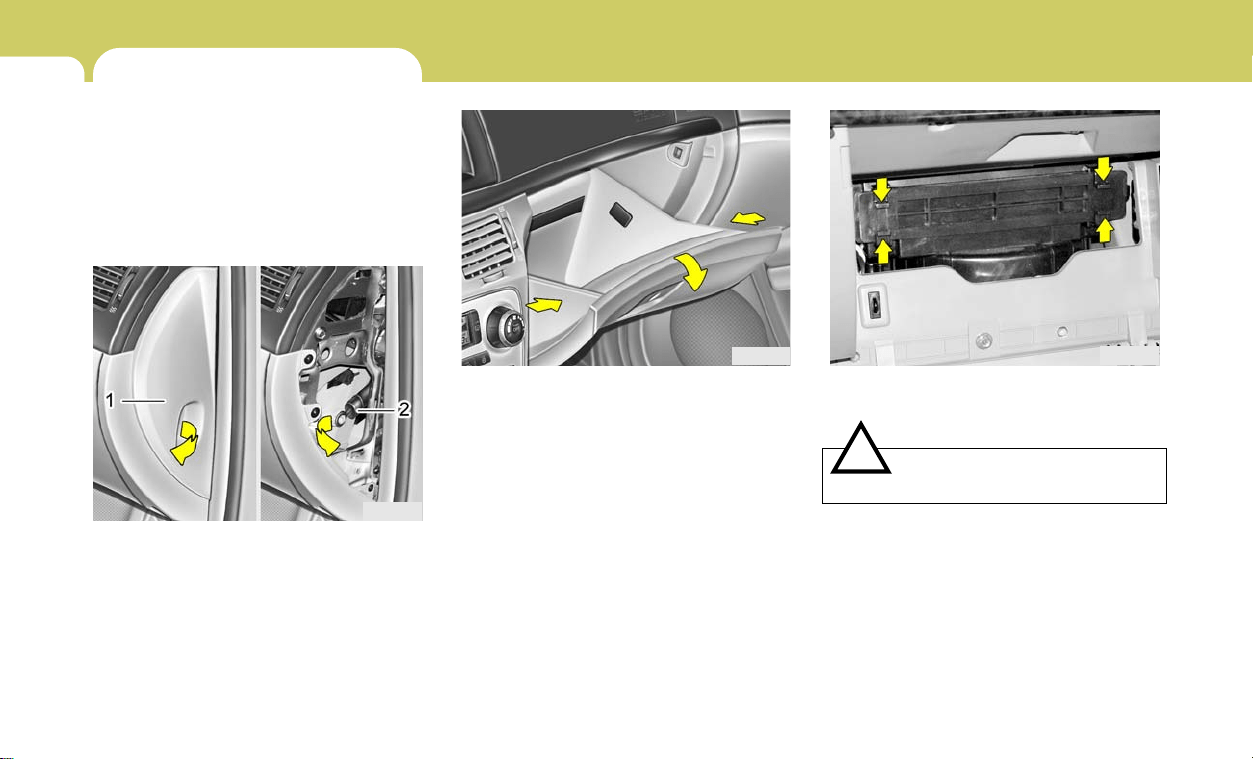
6
DO-IT-YOURSELF MAINTENANCE
22
3. Lower the glove box down completely by
pushing both sides of the glove box inward.
HNF2163
CHANGING THE AIR
CONDITIONER FILTER
B145A01NF-AAT
(For Evaporator and Blower Unit)
(If Installed)
The air conditioner filter is located in the right
side of the instrument panel.
It helps to decrease the amount of pollutants
entering the car.
1. Remove the cover (1) which is located to the
right side of the instrument panel by pulling
it.
2. Pull the glove box cylinder (2) to unlock the
glove box retainer.
HNF2163-1
4. Remove the air conditioner filter cover by
pressing both side clips.
HNF2164
CAUTION:
Be careful not to damage filter fixing clips.
!
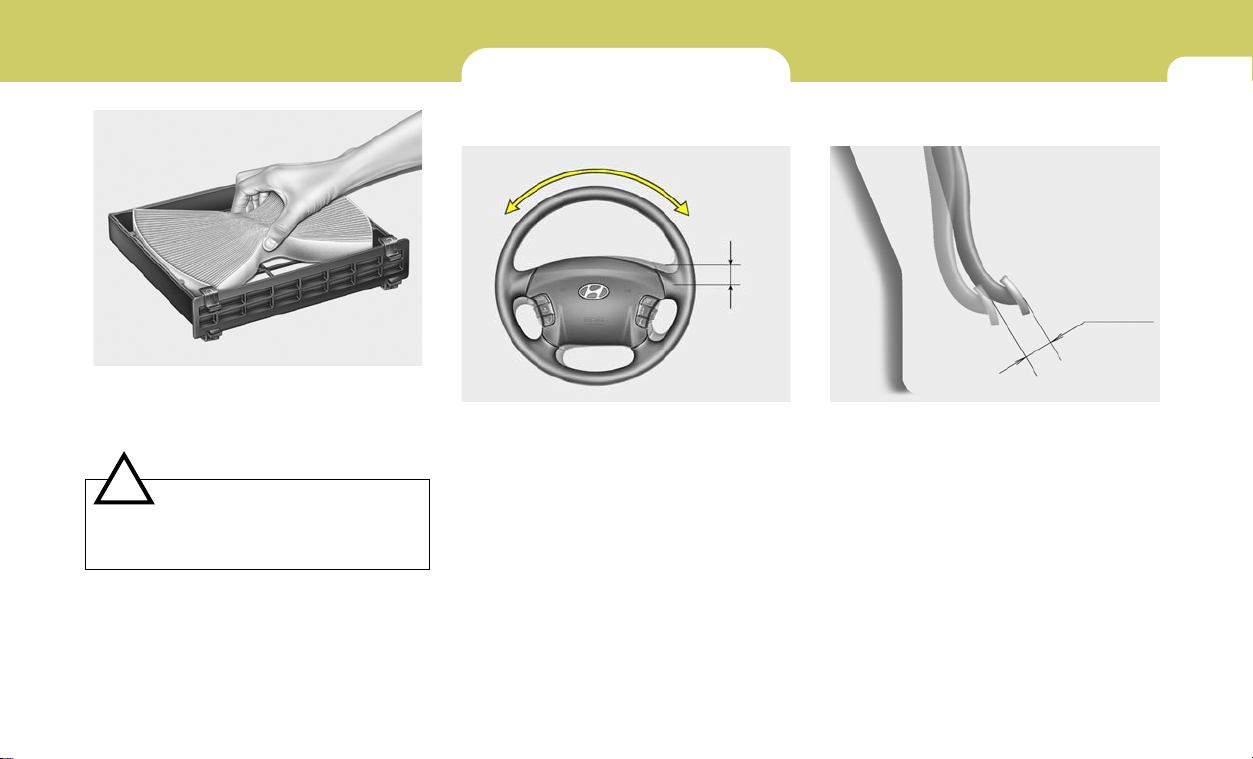
6
DO-IT-YOURSELF MAINTENANCE
23
1.18 in.
(30 mm)
CHECKING THE FREE-PLAY
G150A01A-AAT
STEERING WHEEL
To check the steering wheel free-play, stop the
car with the wheels pointed straight ahead and
gently move the steering wheel back and forth.
Use very light finger pressure and be sensitive
to changes in resistance that mark the limits of
the free-play. If the free-play is greater than
specified, have it inspected by your Hyundai
dealer and adjusted or repaired if necessary.
HNF2165
!
5. Replace the air conditioner filter by lifting it.
6. Installation is the reverse order of disassem-
bly.
CAUTION:
To prevent pollutants from entering the car,
be sure to properly install the air condi-
tioner filter.
HNF5018
G160A01A-GAT
CLUTCH PEDAL
With the engine off, press lightly on the clutch
pedal until you feel a change in resistance. This
is the clutch pedal free-play. The free-play
should be within the limits specified in the illus-
tration. If it is not, have it inspected by your
Hyundai dealer and adjusted or repaired if
necessary.
G160A01HR
0.24~0.51 in.
(6~13 mm)
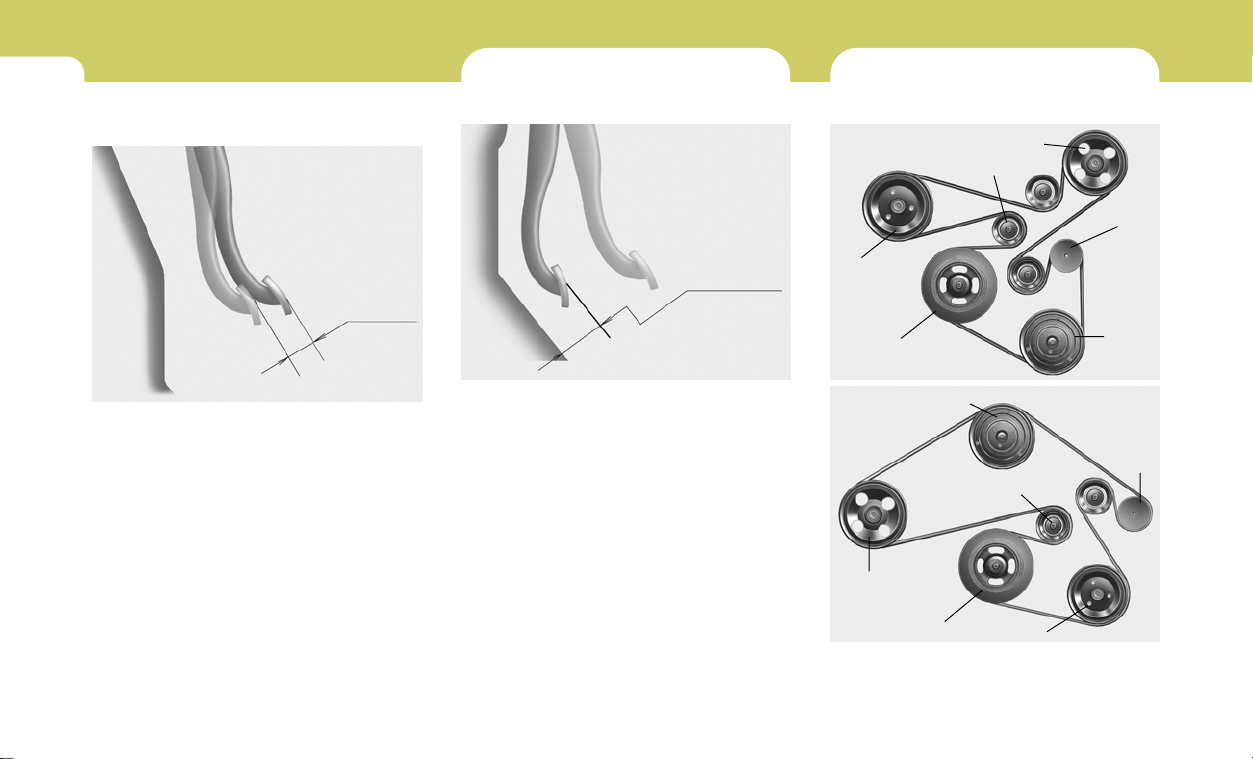
6
DO-IT-YOURSELF MAINTENANCE
24
G170A01A-AAT
BRAKE PEDAL
With the engine off, press down on the brake
pedal several times to reduce the vacuum in the
brake booster.
Then, using your hand, press down slowly on
the brake pedal until you feel a change in
resistance. This is the brake pedal free-play.
The free-play should be within the limits speci-
fied in the illustration above. If it is not, have it
inspected by your Hyundai dealer and adjusted
or repaired if necessary.
G160A01HR
0.12 ~ 0.31 in.
(3 ~ 8 mm)
CHECKING BRAKE PEDAL
CLEARANCE
G180A01A-AAT
You need a helper to check the brake pedal
clearance. With the engine running, have your
helper press down on the brake pedal several
times and then hold it down with a force of about
110 lbs (50 kg, 490 N). The brake pedal clear-
ance is the distance from the top surface of the
brake pedal to the asphalt sheeting under the
floor mat.
If the brake pedal clearance is not within the
limits specified in the illustration, have it in-
spected by your Hyundai dealer and adjusted
or repaired if necessary.
G180A01L
2.95 in.
(75 mm)
G190A02NF-GAT
CHECKING DRIVE BELTS
G140D01NF
(2.4L)
(3.3L)
G140D02NF
Power steering
COMP
Water
pump pully
Generator
Power steering
COMP
Water pump pully
Generator
Damper pulley
Damper pulley
Auto tensioner
Auto tensioner
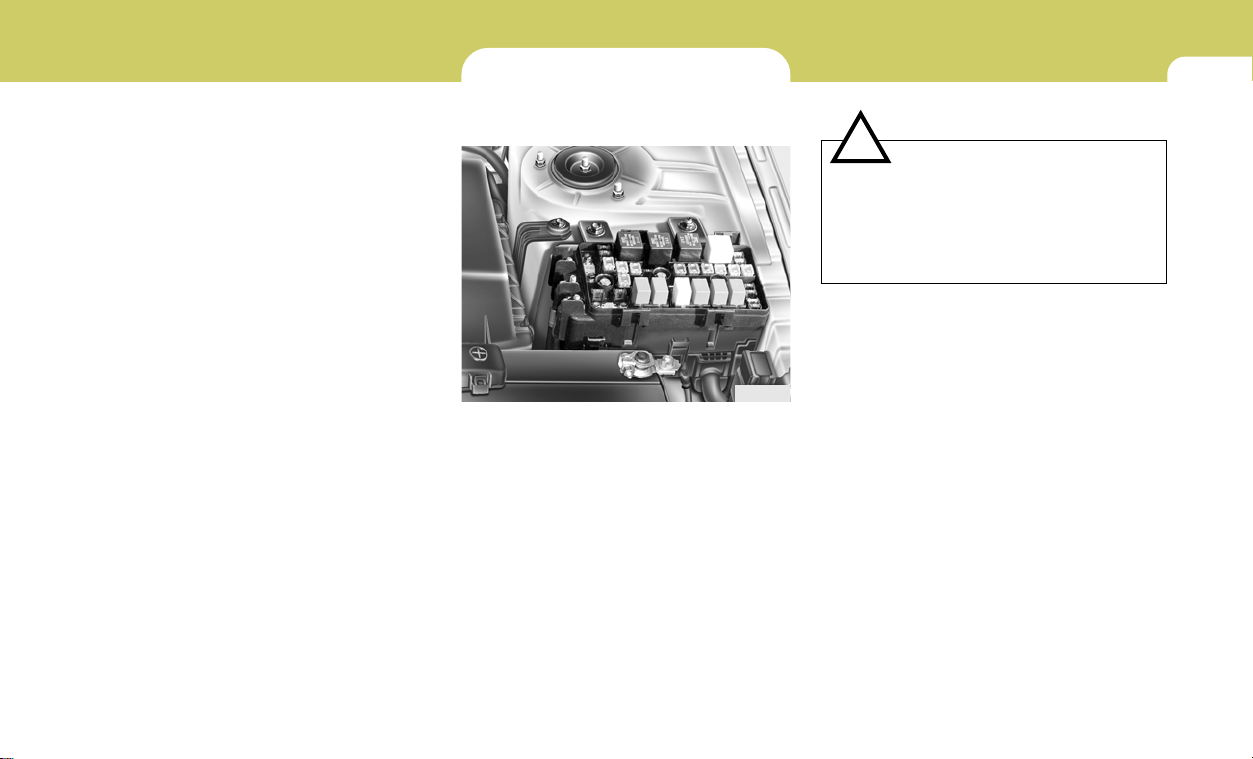
6
DO-IT-YOURSELF MAINTENANCE
25
Drive belts should be checked periodically for
proper tension. At the same time, belts should
be examined for cracks, wear, fraying or other
evidence of deterioration and replaced if neces-
sary.
When a new belt is replaced, the belt should be
located within the pulley of flat idler.
Belt routing should also be checked to be sure
there is no interference between the belts and
other parts of the engine.
NOTE:
Drive belt tension is adjusted automatically
by the auto tensioner.
CHECKING AND REPLACING
FUSES
G200A01A-AAT
Replacing a Fusible Link
A fusible link will melt if the electrical circuits from
the battery are ever overloaded, thus prevent-
ing damage to the entire wiring harness. (This
could be caused by a short in the system
drawing too much current.) If this ever happens,
have a Hyundai dealer determine the cause,
repair the system and replace the fusible link.
The fusible links are located in a relay box in the
engine compartment for easy inspection.
HNF4004
!
CAUTION:
When replacing a fusible link, never use
anything but a new fusible link with the
same or lower amperage rating. Never use
a piece of wire or a higher-rated fusible link.
This could result in serious damage and
create a fire hazard.
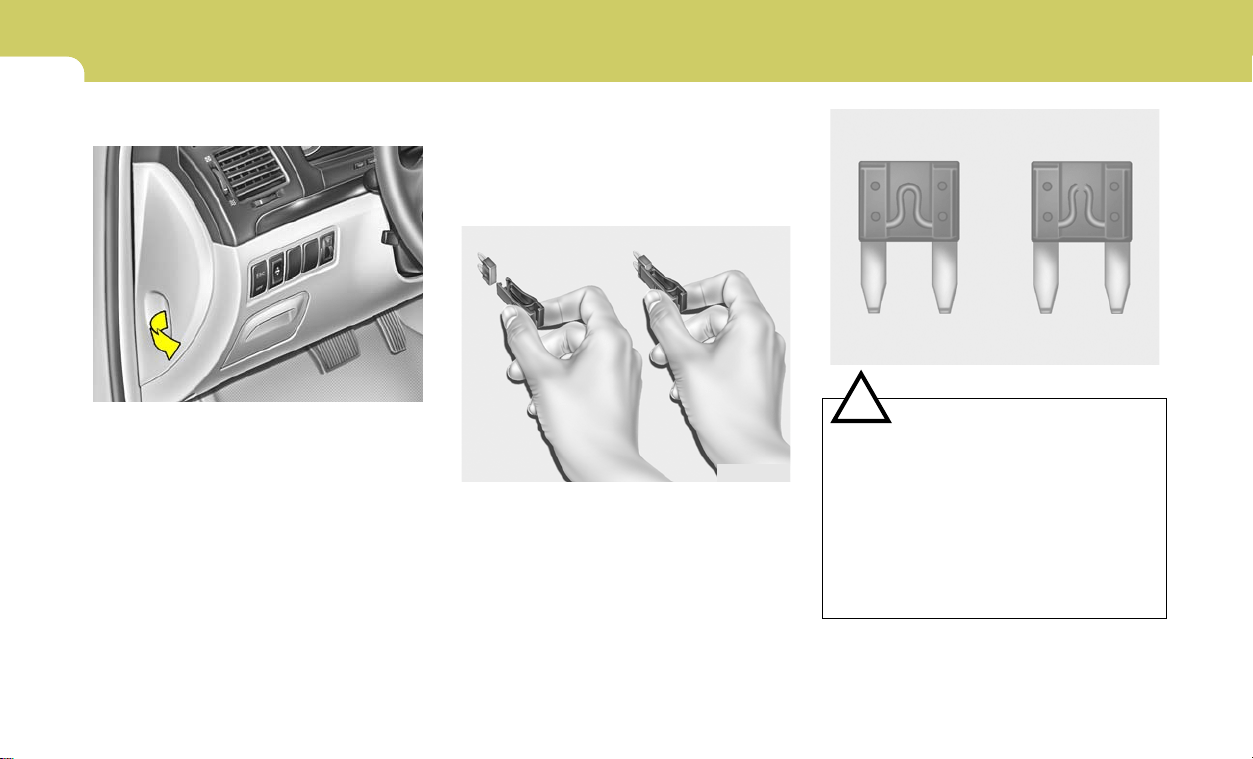
6
DO-IT-YOURSELF MAINTENANCE
26
2. Open the fuse box and examine each fuse.
Remove each fuse by pulling it toward you
(a small "fuse puller" tool is contained in the
relay and fuse box of the engine room to
simplify this operation).
3. Be sure to check all other fuses even if you
G200B02NF
find one that appears to have burned out.
4. Replace the blown fuse by pressing a new
fuse of the same rating into place. The fuse
should be a snug fit. If it is not, have the fuse
clip repaired or replaced by a Hyundai dealer.
If you do not have a spare fuse, you may be
able to borrow a fuse of the same or lower
rating from an accessory you can tempo-
rarily get along without (the radio or cigarette
lighter, for example). Always remember to
replace the borrowed fuse.
!
G200B02L
Good Burned out
CAUTION:
A burned-out fuse indicates that there is a
problem in the electrical circuit. If you re-
place a fuse and it blows as soon as the
accessory is turned on, the problem is
serious and should be referred to a Hyundai
dealer for diagnosis and repair. Never re-
place a fuse with anything except a fuse
with the same or a lower amperage rating.
A higher capacity fuse could cause damage
and create a fire hazard.
NOTE:
See page 6-39 for the fuse panel descrip-
tions.
G200B01NF-GAT
Replacing Accessory Fuse
G200B01NF-A
The fuse box for the lights and other electrical
accessories will be found on the left side of the
instrument panel. Inside the box you will find a
list showing the circuits protected by each fuse.
If any of your car's lights or other electrical
accessories stop working, a blown fuse could
be the reason. If the fuse has burned out, you
will see that the metal strip inside the fuse has
burned through. If you suspect a blown fuse,
follow this procedure:
1. Turn off the ignition and all other switches.
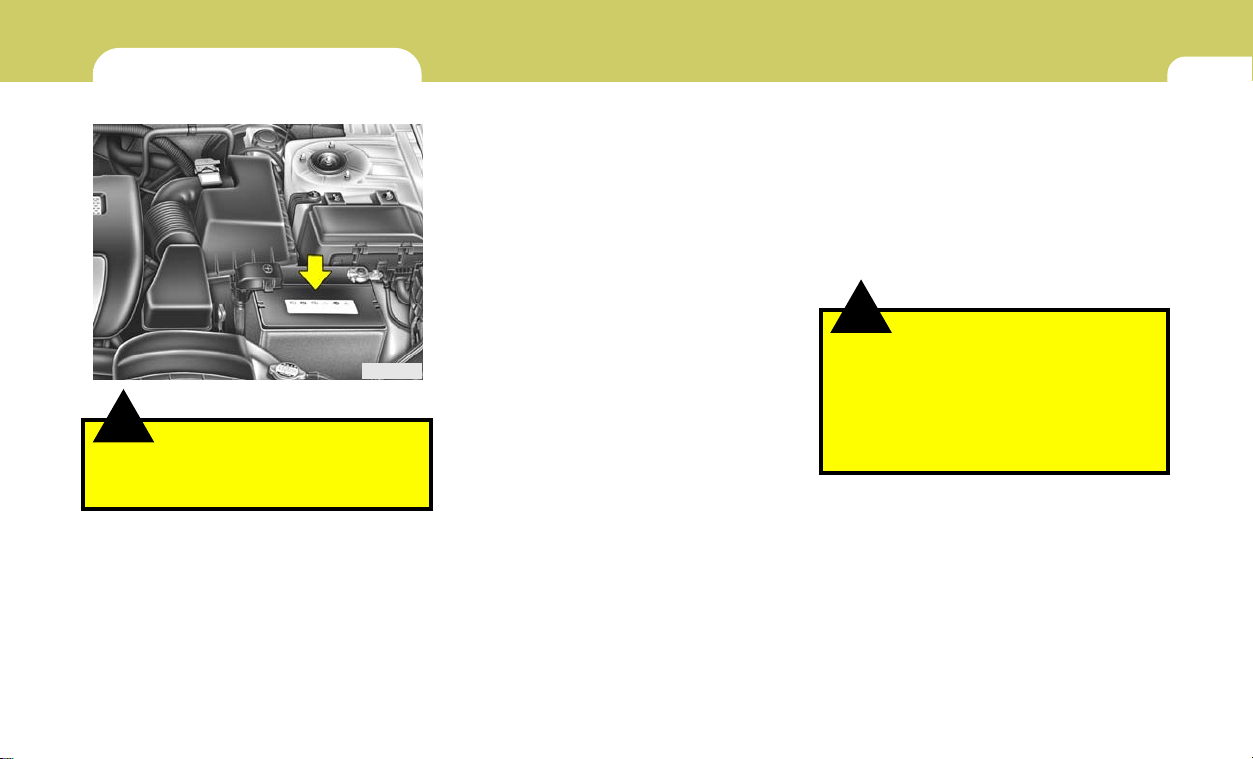
6
DO-IT-YOURSELF MAINTENANCE
27
CHECKING THE BATTERY
!
G210A01A-AAT
WARNING:
Batteries can be dangerous! When working
with batteries, carefully observe the follow-
ing precautions to avoid serious injuries.
The fluid in the battery contains a strong solution
of sulfuric acid, which is poisonous and highly
corrosive. Be careful not to spill it on yourself or
the car. If you do spill battery fluid on yourself,
immediately do the following:
HNF5017
o If battery fluid is on your skin, flush the
affected areas with water for at least 15
minutes and then seek medical assistance.
o If battery fluid is in your eyes, rinse out your
eyes with water and get medical assistance
as soon as possible. While you are being
driven to get medical assistance, continue to
rinse your eyes by using a sponge or soft
cloth saturated with water.
o If you swallow battery fluid, drink a large
quantity of water or milk followed by milk of
magnesia, eat a raw egg or drink vegetable
oil. Get medical assistance as soon as
possible.
While batteries are being charged (either by a
battery charger or by the vehicle's generator),
they produce explosive gases. Always ob-
serve these warnings to prevent injuries from
occurring:
o Charge batteries only in a well ventilated
area.
o Do not permit flames, sparks or smoking in
the area.
o Keep children away from the area.
!
G210B04A-AAT
Checking the Battery
Keep the battery clean. Any evidence of corro-
sion around the battery posts or terminals
should be removed using a solution of house-
hold baking soda and warm water. After the
battery terminals are dry, cover them with a light
coating of grease.
PROPOSITION 65 WARNING:
Battery posts, terminals, and related acces-
sories contain lead and lead compounds,
chemicals known to the state of California
to cause cancer and reproductive harm.
Batteries also contain other chemicals
known to the state of California to cause
cancer. Wash hands after handling.
6
DO-IT-YOURSELF MAINTENANCE
28
!!
WARNING:
Always read the following in-
structions carefully when han-
dling a battery.
Keep lighted cigarettes and all
other flames or sparks away from
the battery.
Hydrogen, which is a highly com-
bustible gas, is always present in
battery cells and may explode if
ignited.
Keep batteries out of the reach of
children because batteries con-
tain highly corrosive SULFURIC
ACID. Do not allow battery acid
to contact your skin, eyes, cloth-
ing or paint finish.
If any electrolyte gets into your
eyes, flush your eyes with clean
water for at least 15 minutes and
get immediate medical attention.
If possible, continue to apply
water with a sponge or cloth until
medical attention is received.
If electrolyte gets on your skin,
thoroughly wash the contacted
area.
If you feel a pain or a burning
sensation, get medical attention
immediately.
Wear eye protection when charg-
ing or working near a battery.
Always provide ventilation when
working in an enclosed space.
o When lifting a plastic-cased battery, ex-
cessive pressure on the case may cause
battery acid to leak, resulting in personal
injury. Lift with a battery carrier or with
your hands on opposite corners.
o Never attempt to charge the battery when
the battery cables are connected.
o The electrical ignition system works with
high voltage.
Never touch these components with the
engine running or the ignition switched
on.
WARNING:
CHECKING ELECTRIC COOLING
FANS
!
G220A01A-AAT
WARNING:
The cooling fan is controlled by engine
coolant temperature and may sometimes
operate even when the engine is not run-
ning. Use extreme caution when working
near the blades of the cooling fan, so that
you are not injured by a rotating fan blade.
As the engine coolant temperature de-
creases the fan will automatically shut off.
This is a normal condition.
G220B01NF-GAT
Checking Engine Cooling Fan
The engine cooling fan should come on auto-
matically if the engine coolant temperature is
high or whenever the air conditioning is in
operation.
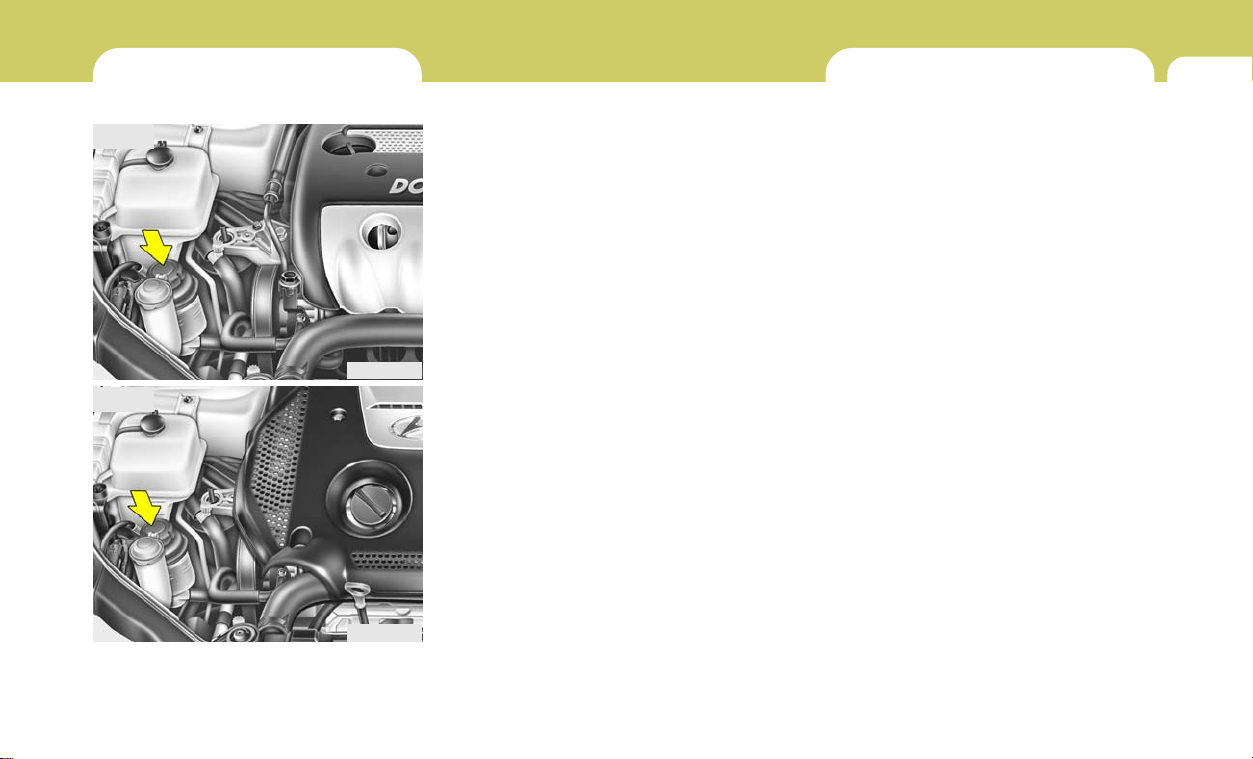
6
DO-IT-YOURSELF MAINTENANCE
29
FOR MORE INFORMATION ABOUT
YOUR HYUNDAI
G240A01A-AAT
POWER STEERING HOSES
It is suggested that you check the power steer-
ing hose connections for fluid leakage at those
intervals specified in the vehicle maintenance
schedule in Section 5.
The power steering hoses should be replaced
if there is severe surface cracking, pulling,
scuffing or worn spots. Deterioration of the hose
could cause premature failure.
POWER STEERING FLUID LEVEL
G230A03A-AAT
to make certain that the power steering fluid
level is between the "MAX" and "MIN" level
markings on the fluid reservoir.
NOTE:
Grinding noise from the power steering
pump may be heard immediately after the
engine is started in extremely cold condi-
tions (below - 4°F). If the noise stops during
warm up, there is no abnormal function in
the system. It is due to a power steering
fluid characteristic in extremely cold condi-
tions.
Recommended Fluid
Use PSF-3 type fluid
NOTE:
Do not start the engine when the power
steering oil reservoir is empty.
G230A01NF
G230A02NF
(2.4L)
(3.3L)
G250A01A-AAT
If you desire additional information about main-
taining and servicing your Hyundai, you may
purchase a factory Shop Manual at your Hyundai
dealer's parts department. This is the same
manual used by dealership technicians and
while it is highly technical it can be useful in
obtaining a better understanding of your car and
how it works.
The power steering fluid level should be checked
regularly. To check the power steering fluid
level, be sure the engine is "OFF", then check
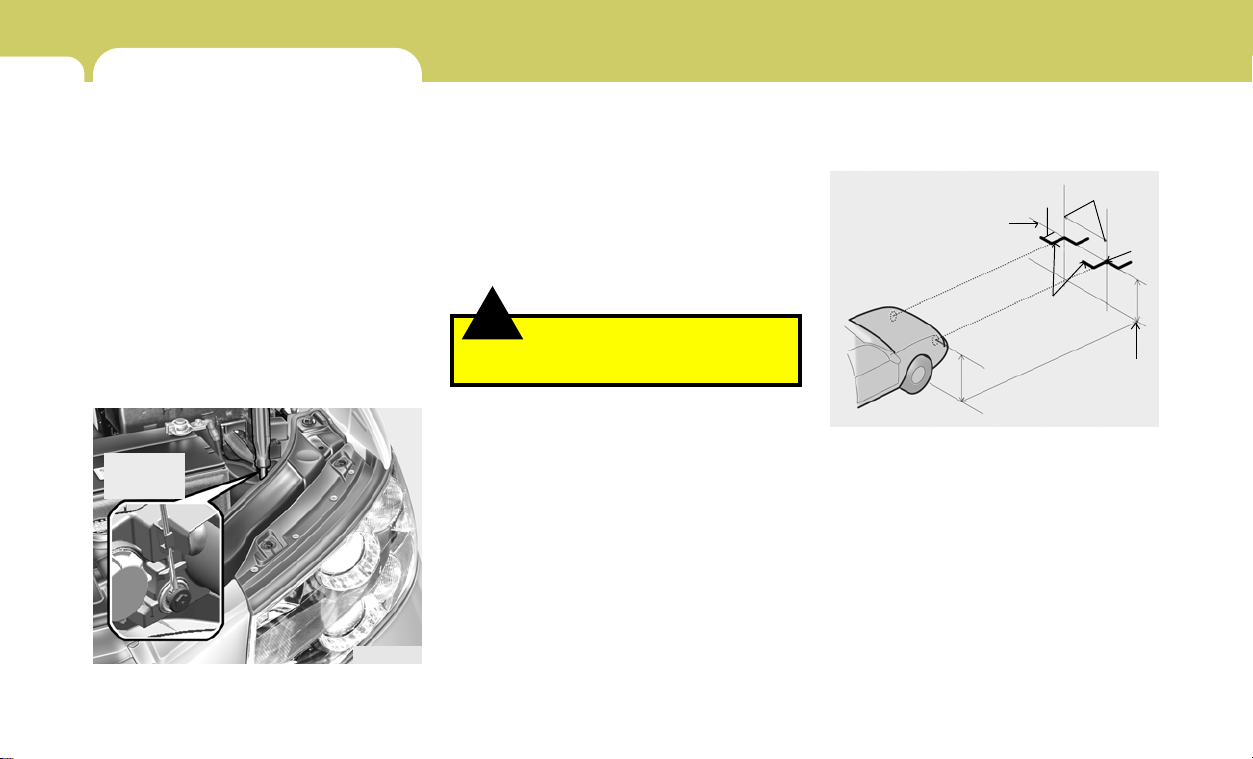
6
DO-IT-YOURSELF MAINTENANCE
30
HEADLIGHT AIMING ADJUSTMENT
G290A02O-AAT
Before performing aiming adjustment, make
sure of the following.
1. Keep all tires inflated to the correct pressure.
2. Place the vehicle on level ground and press
the front bumper & rear bumper down sev-
eral times.
Place vehicle at a distance of 118 in. (3m)
from the test wall.
3. See that the vehicle is unloaded (except for
full levels of coolant, engine oil and fuel, and
spare tire, jack, and tools). Have the driver
or equivalent weight placed in driver's seat.
4. Clean the headlight lenses and turn on the
headlights (Low beam).
5. Open the hood.
G290A01NF-A
Vertical
aiming
!
6. Draw a vertical line (through the center of
each headlight beam pattern) and a horizon-
tal line (through the center of each headlight
beam pattern) on the aiming screen.
And then, draw a parallel line at 0.8 in. (21
mm) under the horizontal line.
7. Adjust each cut-off line of the low beam to the
parallel line with a phillips screwdriver -
VERTICAL AIMING.
WARNING:
Horizontal aiming should be adjusted by
an authorized Hyundai dealer.
G290B01NF-AAT
Adjustment After Headlight Assembly
Replacement
G260B01GK
L
W
H
H
Cut-off line
Ground line
"P"
Horizontal line
Vertical line
0.8 in.(21 mm)
If the vehicle has had front body repair and the
headlight assembly has been replaced, the
headlight aiming should be checked using the
aiming screen as shown in the illustration. Turn
on the headlight switch (Low Beam Position).
1. Adjust headlights so that main axis of light is
parallel to the center line of the body and is
aligned with point "P" shown in the illustration.
2. Dotted lines in the illustration show the center
of the headlights.
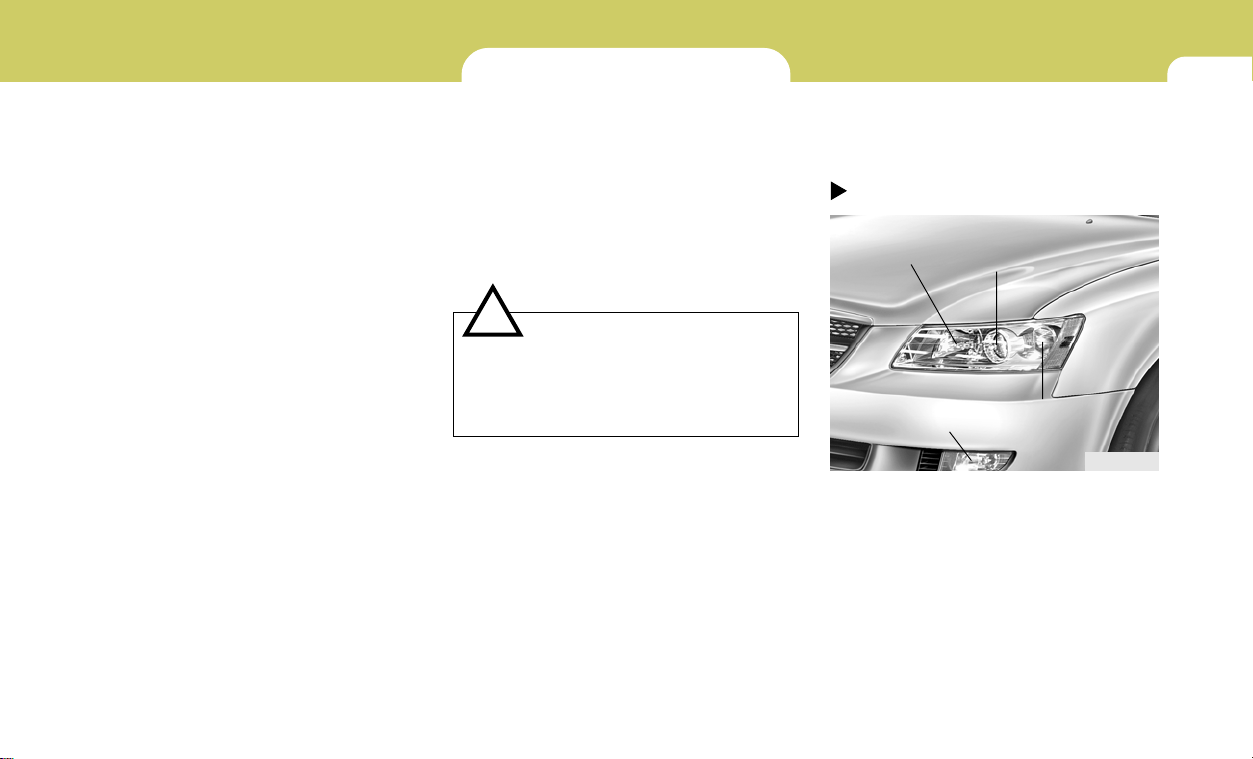
6
DO-IT-YOURSELF MAINTENANCE
31
SPECIFICATION:
"H"
Horizontal center line of headlights from ground
: 26.73 in. (679mm)
"W"
Distance between each headlight center :
51.41 in. (1,306mm)
"L"
Distance between the headlights and the wall
that the lights are tested against : 118.11 in.
(3,000 mm)
REPLACEMENT OF LIGHT BULBS
G260A01L-GAT
Before attempting to replace a light bulb, be sure
the switch is turned to the "OFF" position.
The next paragraph shows how to reach the
light bulbs so they may be changed. Be sure to
replace the burned-out bulb with one of the
same number and wattage rating.
See page 6-38 for the wattage descriptions.
!
CAUTION:
o Keep the lights out of contact with pe-
troleum products, such as oil, gasoline,
etc.
o Be sure to replace the LED type equipped
bulbs with an assembly.
Replacement instructions:
1. Allow the bulb to cool. Wear eye protection.
2. Open the engine hood.
3. Always grasp the bulb by its plastic base,
avoid touching the glass.
G270A01NF-AAT
HEADLIGHT, FRONT TURN SIGNAL
LIGHT AND FRONT FOG LIGHT
Headlight and Front Turn Signal Light
Headlight
(High beam)
Headlight
(Low beam)
Turn signal light
(Front position light)
G260A01NF-A
Front Fog Light
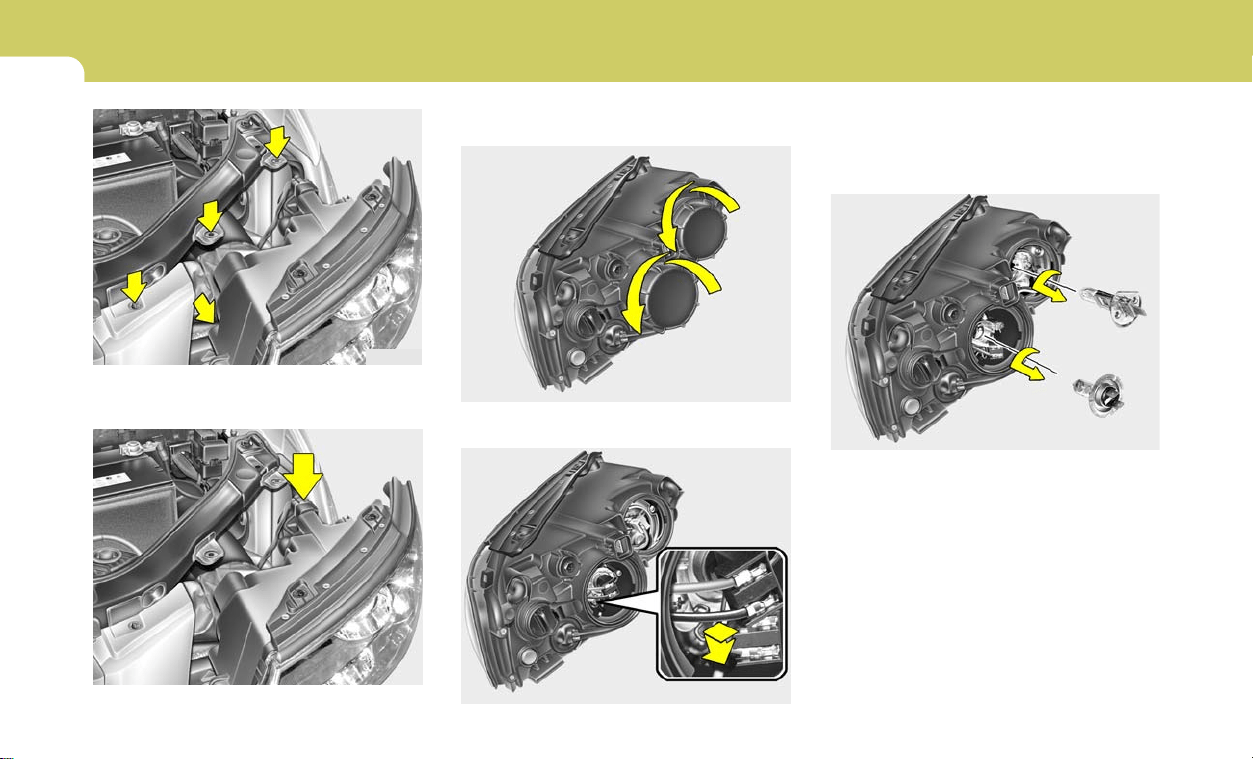
6
DO-IT-YOURSELF MAINTENANCE
32
HNF5027
9. Remove the protective cap from the re-
placement bulb and install the new bulb by
matching the plastic base with the headlight
hole. Reattach the bulb spring and recon-
nect the connector.
10. Use the protective cap and carton to
promptly dispose of the old bulb.
11. Check for proper headlight aim.
HNF5023
4. Using a socket wrench of the correct size,
remove the headlight assembly mounting
bolts.
HNF5024
5. Disconnect the power cord from the back of
the headlight.
HNF5025
6. Turn the plastic cover counterclockwise
and remove it.
HNF5026
7. Disconnect the connector from the bulb base in
the back of the headlight.
8. Push the bulb spring to remove the headlight
bulb.
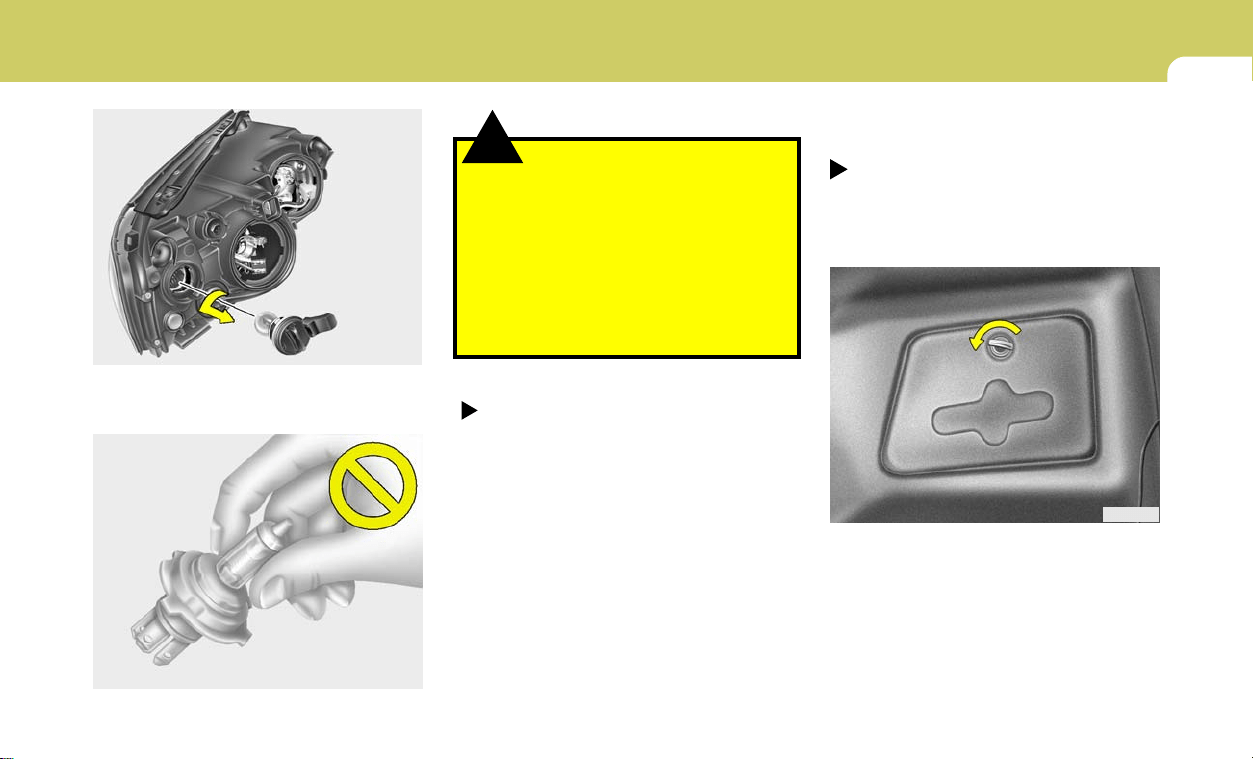
6
DO-IT-YOURSELF MAINTENANCE
33
12. To replace the front turn signal light bulb
(front position light), remove it from the bulb
holder and install the new bulb.
!
WARNING:
This halogen bulb contains gas under pres-
sure and if impacted could shatter, result-
ing in flying fragments. Always wear eye
protection when servicing the bulb. Protect
the bulb against abrasions or scratches
and against liquids when lighted. Turn the
bulb on only when installing in a headlight.
Replace the headlight if damaged or cracked.
Keep the bulb out of the reach of children
and dispose of the used bulb with care.
HNF5028
G270A03O
Front Fog Light
NOTE:
It is recommended that the front fog light
bulb should be replaced by an authorized
Hyundai dealer.
G270D01NF-AAT
REAR COMBINATION LIGHT
Stop/Tail Light, Rear Turn Signal Light,
Back-up Light and Rear Side Marker
Light
1. Open the trunk lid.
2. Remove the cover on the inside of the rear
luggage trim by turning the knob counter-
clockwise.
HNF5029
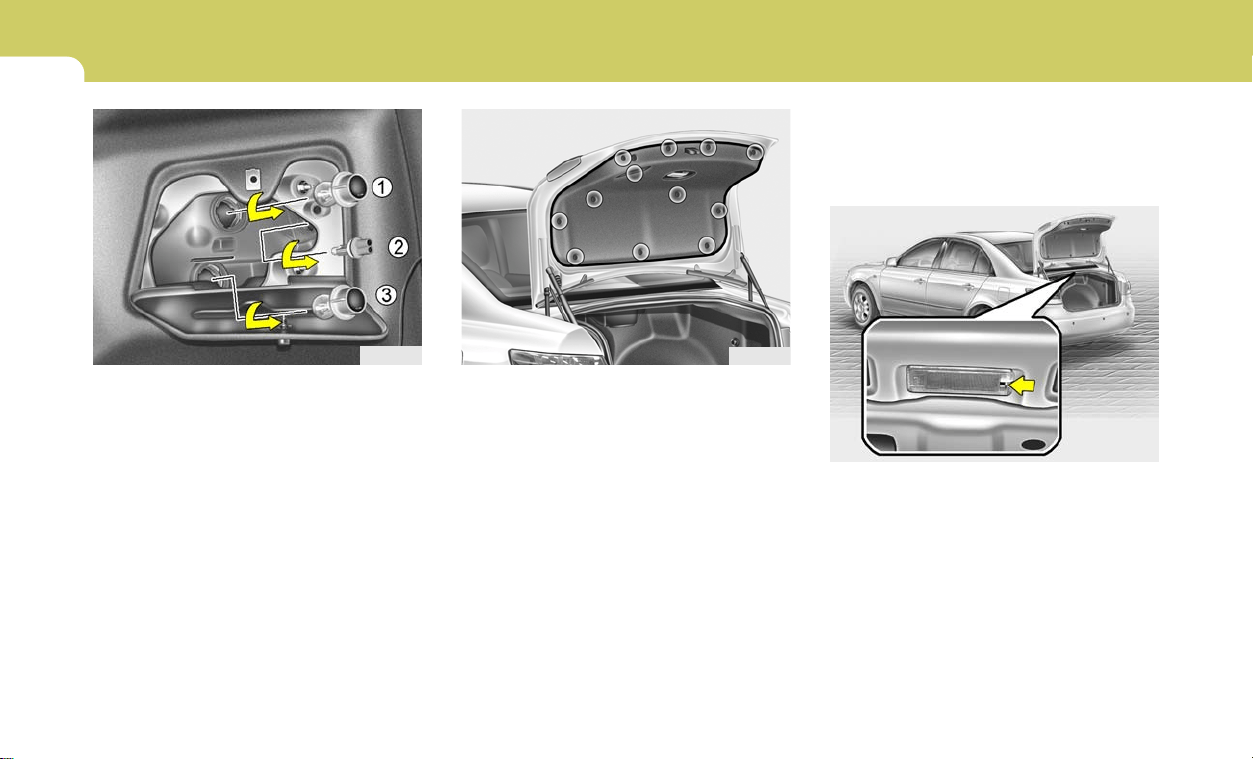
6
DO-IT-YOURSELF MAINTENANCE
34
3. To replace the rear combination light (stop/
tail light, rear side marker light and rear turn
signal light), remove it from the bulb holder
and install the new bulb.
(1) Stop/tail light
(2) Rear side marker light
(3) Rear turn signal light
HNF5030-A
HNF5042
4. Loosen the mounting screws of the trunk lid
trim with a phillips screwdriver and remove
the trunk lid trim.
5. To replace the rear combination light (back-
up light and stop/tail light), remove the socket
by turning it counterclockwise.
6. Install the new bulb.
G270C01L-AAT
LUGGAGE COMPARTMENT
LIGHT
1. Open the trunk lid.
2. Remove the luggage compartment light cover
on the rear package tray panel with a flat-
head screwdriver.
HNF5031
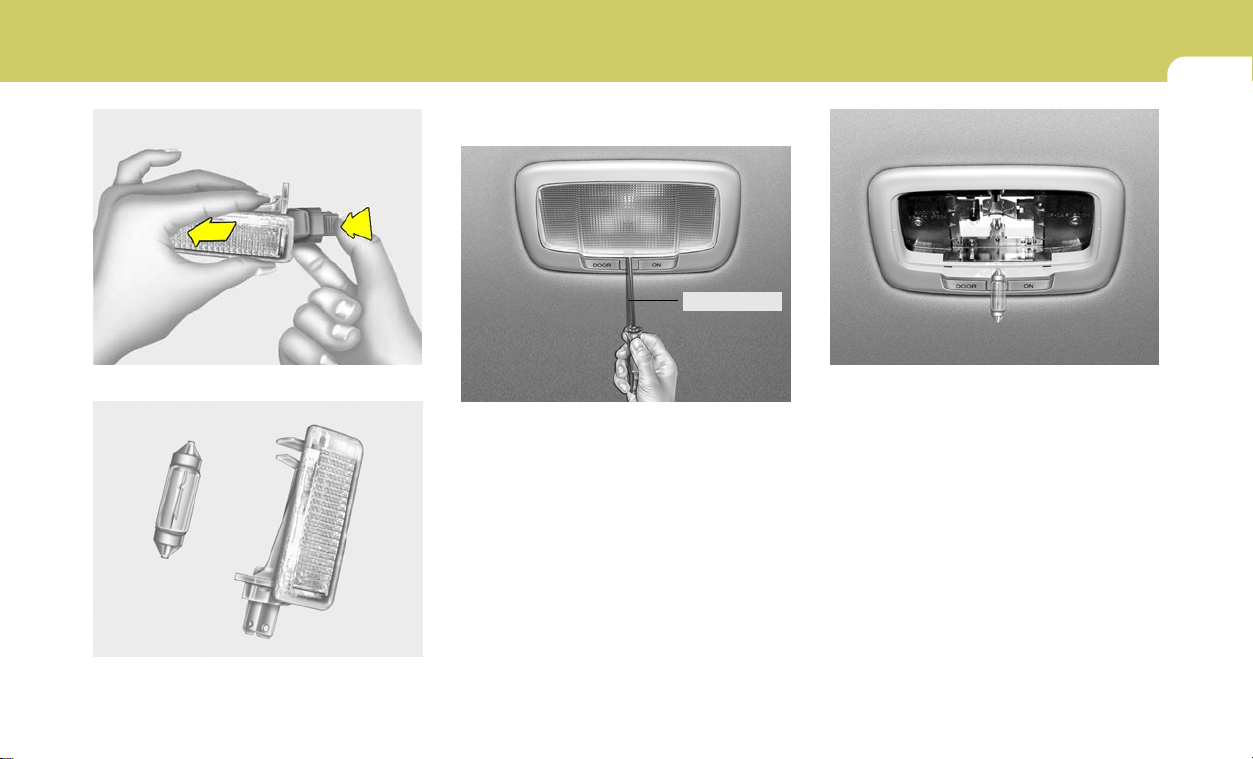
6
DO-IT-YOURSELF MAINTENANCE
35
HNF5032
3. Disconnect the power cord.
HTB284
4. Replace with a new bulb.
G270G01L-AAT
INTERIOR LIGHT
HNF5034
1. Remove the plastic cover with a flat-head
screwdriver.
HNF5035
Screwdriver
2. Replace with a new bulb.
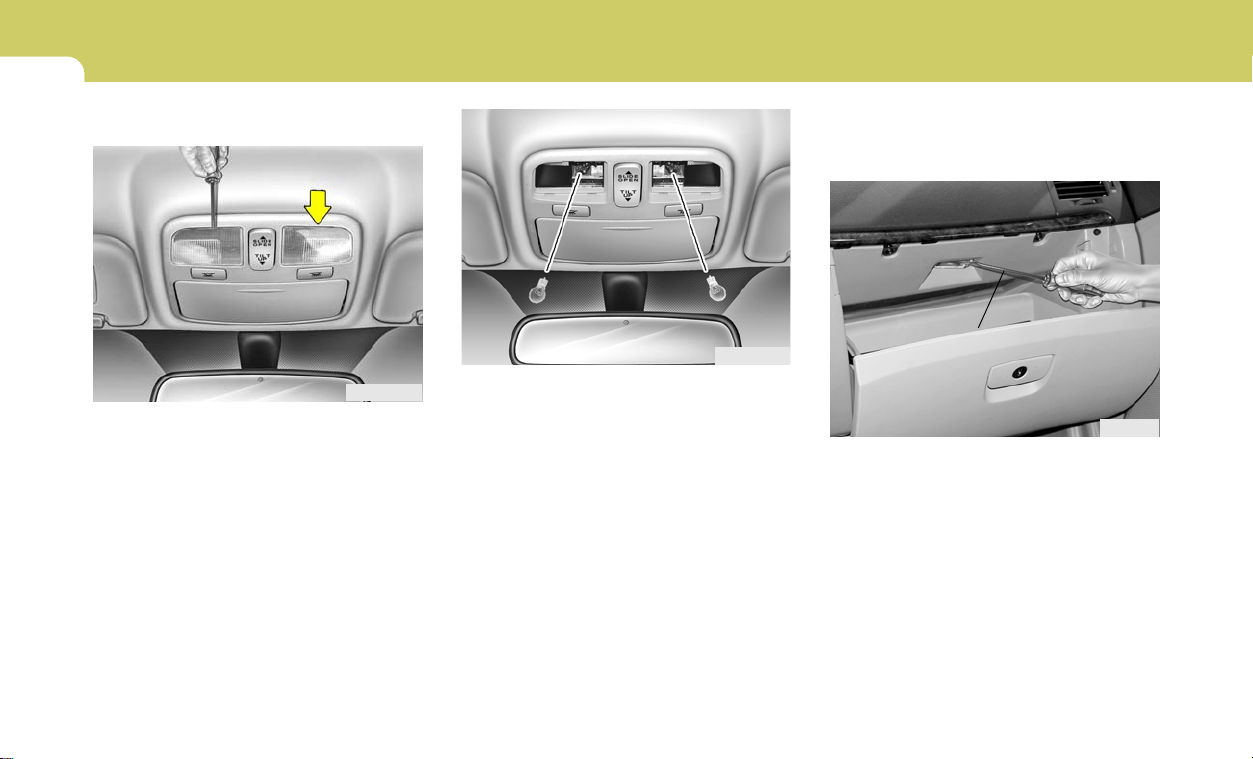
6
DO-IT-YOURSELF MAINTENANCE
36
G270K01L-AAT
GLOVE BOX ILLUMINATED LIGHT
1. Open the glove box.
2. Remove the glove box illuminated light cover
with a flat-head screwdriver.
HNF5036
Screwdriver
G270G01NF
G270G02NF
G270L01L-AAT
MAP LIGHT
1. Remove the plastic cover with a flat-head
screwdriver.
2. Replace with a new bulb.
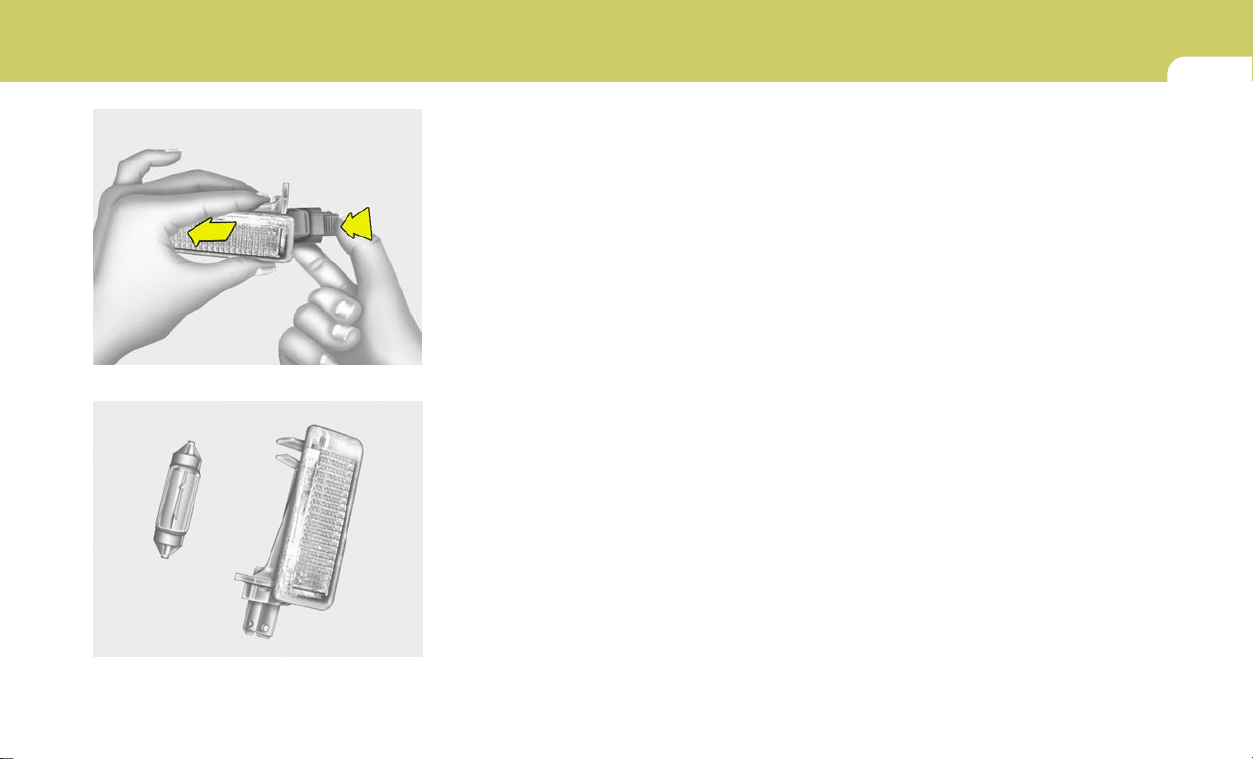
6
DO-IT-YOURSELF MAINTENANCE
37
3. Disconnect the power cord.
HJM5039
HTB284
4. Replace with a new bulb.
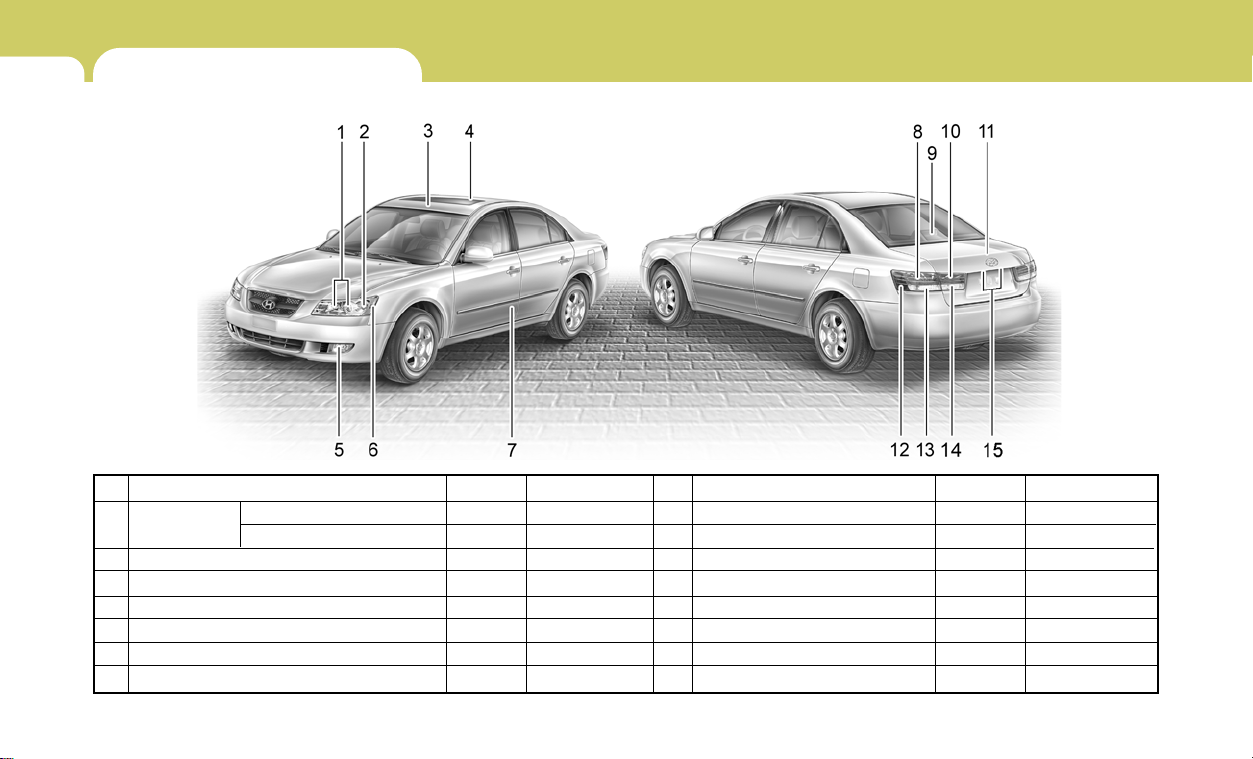
6
DO-IT-YOURSELF MAINTENANCE
38
Socket Type
BAY 15d
w2.1 x 9.5d
BAY 15d
sv6-7, 6
BAY 15d
BAY15s
w2.1 x 9.5d
w2.1 x 9.5d
No.
1
2
3
4
5
6
7
Socket Type
P x 26d
P14,5s
BAY15d
w2.1 x 9.5d
sv6-7,6
PGJ13
BAY15d
w2.1 x 4.6d
BULB WATTAGES
G280A01NF-AAT
G280A01NF-A
Part Name
Stop / Tail Light
High Mounted Rear Stop Light
Tail Light
Luggage Compartment Light
Rear Side Marker Light
Rear Turn Signal Light
Back-up Light
License Plate Light
Part Name
Headlight
Front Turn Signal Light/Front Position Light
Map Light
Interior Light
Front Fog Light
Front Side Marker Light
Front Door Edge Warning Light
No.
8
9
10
11
12
13
14
15
Wattage
55
55
28/8
10
10
27
8
8
Low beam
High beam
Wattage
28/8
16
28/8
5
5
27
16
5
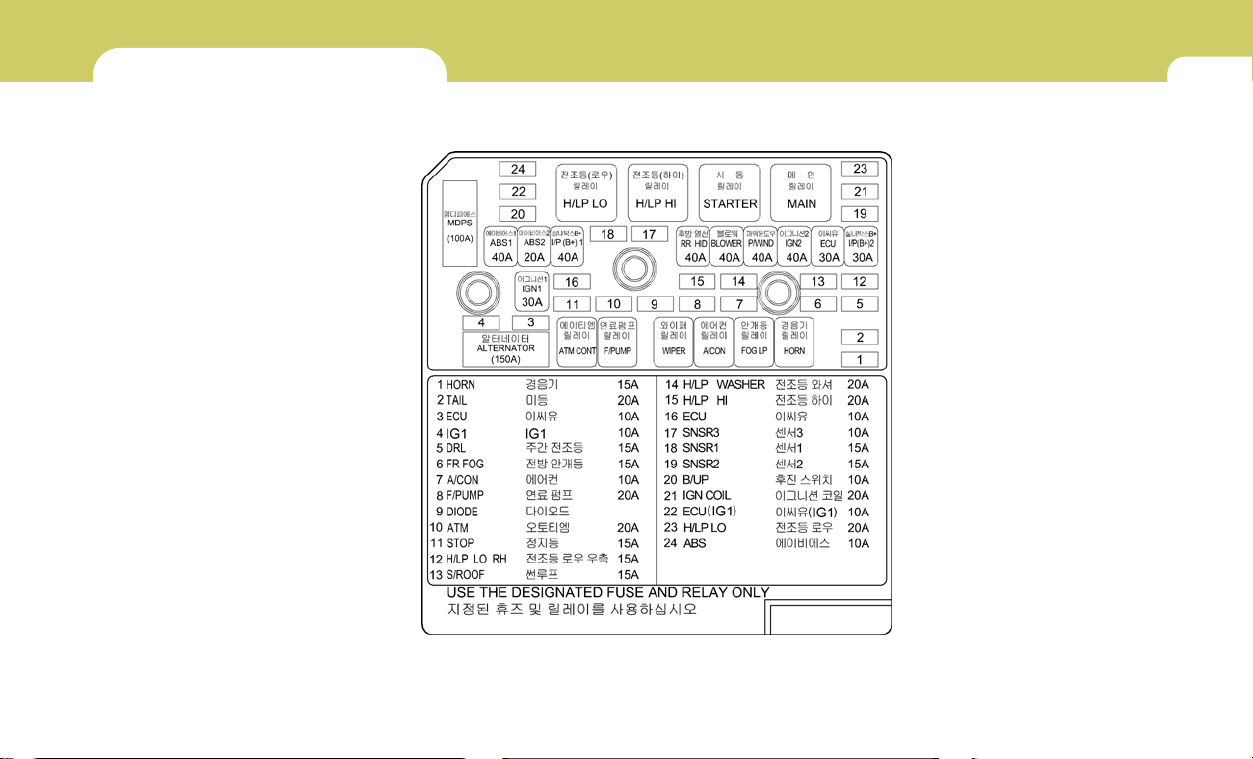
6
DO-IT-YOURSELF MAINTENANCE
39
FUSE PANEL DESCRIPTION
G200C01NF-AAT
Engine Compartment
NOTE:
Not all fuse panel descriptions in this manual may be applicable to your vehicle. It is accurate at the time of printing. When you inspect the
fuse box on your vehicle, refer to the fuse box label.
HNF4005

6
DO-IT-YOURSELF MAINTENANCE
40
1
2
3
4
5
6
7
8
9
10
11
12
13
14
15
16
17
18
19
20
21
22
23
24
HORN
TAIL
ECU
IG1
DRL
FR FOG
A/CON
F/PUMP
DIODE
ATM
STOP
H/LP LO RH
S/ROOF
H/LP WASHER
H/LP HI
ECU
SNSR.3
SNSR.1
SNSR.2
B/UP
IGN COIL
ECU (IG1)
H/LP LO
ABS
PROTECTED COMPONENTS
ABS/ESC control module, Multipurpose check connector
ABS/ESC control module, Multipurpose check connector
Fuse 23, 24, 30, 31, 32, 33, 34, 35
Defogger relay
Blower relay
Power window relay, Fuse 16
Start relay, Ignition switch (IG2, START)
Engine control unit relay
Power connector 1/2, Fuse 21,22
Ignition switch (ACC, IG1)
Fusible Iink (ABS. 1, ABS. 2, RR HTD, BLOWER)
(Spare)
Horn relay
Tail light relay
PCM
(Spare)
Siren relay, DRL control module
Front fog light relay
A/C relay
Fuel pump relay
(Spare)
ATM control relay
Stop light relay
(Spare)
Sunroof control module
Headlight washer motor
Headlight relay (High)
(Spare)
Oxygen sensor, Fuel pump relay
Mass air flow sensor, Crankshaft/Camshaft position sensor, Oil control valve, SMATRA
A/C relay, Cooling fan relay, Injectors
Back up light switch, Pulse generator, Vehicle speed sensor
Ignition coils, Condenser
PCM
Headlight relay (Low)
ABS/ESC control module, Multipurpose check connector
ABS.1
ABS.2
I/P B+1
RR HTD
BLOWER
P/WDW
IGN.2
ECU RLY
I/P B+2
IGN.1
ALT
MDPS
FUSE RATING
40A
20A
40A
40A
40A
40A
40A
30A
30A
30A
150A
100A
15A
20A
10A
10A
15A
15A
10A
20A
-
20A
15A
15A
15A
20A
20A
10A
10A
15A
15A
10A
20A
10A
20A
10A
DESCRIPTION
FUSIBLE
LINK
FUSE
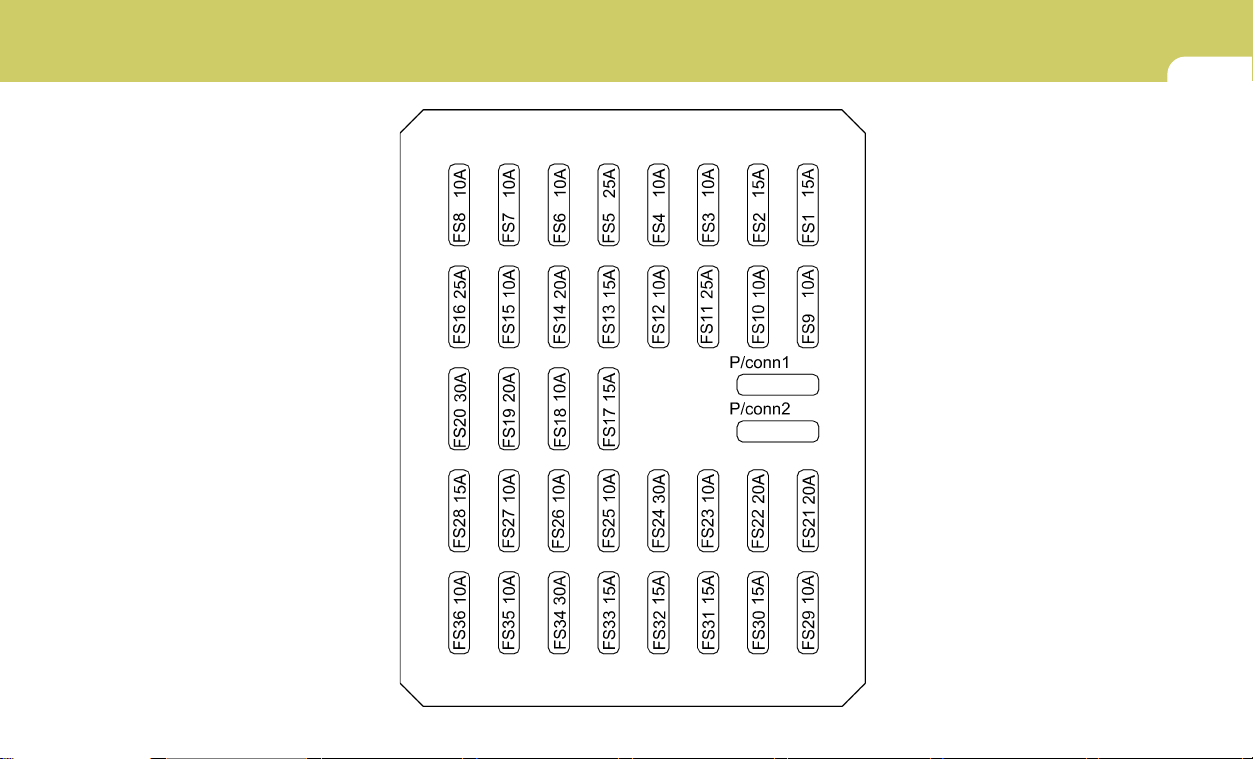
6
DO-IT-YOURSELF MAINTENANCE
41
G200E01NF-AAT
Inner Panel
HNF4003

6
DO-IT-YOURSELF MAINTENANCE
42
PROTECTED COMPONENTS
(Spare)
Seat warmer switch
BCM(Body Control Module), Sunroof control module, Electronic chrome mirror
ESC module, High blower relay, Humidity sensor
Cigarette lighter
(Spare)
Illumination lights, Right : License light, Rear combination light, Headlight, Glove box light
Front fog light relay, Left : License light, Rear combination light, Headlight
Headlight washer relay, Right headlight leveling actuator
DRL control module, Headlight relay, AQS and ambient sensor, Left headlight leveling actuator
Wiper and washer
A/C control module
SRS control module, Passenger's Airbag switch
Front accessory socket, Rear power outlet
Digital clock, Audio, A/T shift lock control module, Power outside mirror and mirror folding
Safety window module
(Spare)
A/T shift lock control module
Power window main switch, Left rear power window switch
Power window main switch, Right power window switch
FUSE RATING
15A
15A
10A
10A
25A
10A
10A
10A
10A
10A
25A
10A
15A
20A
10A
25A
15A
10A
20A
30A
FUSE
1
2
3
4
5
6
7
8
9
10
11
12
13
14
15
16
17
18
19
20
6
DO-IT-YOURSELF MAINTENANCE
43
PROTECTED COMPONENTS
Audio amp
Door lock/unlock relay
Hazard switch, Hazard relay
Power seat manual switch(RHD)
Instrument cluster
Hazard switch
BCM(Body Control Module), Instrument cluster, Yaw rate sensor, ESC switch
(Spare)
Burglar alarm relay
(Spare)
Rear fog light relay
Trunk lid relay, Fuel filler door and trunk lid switch
(Spare)
Power seat manual switch
Sport mode switch, Key solenoid
A/C control module, Outside mirror and mirror folding motor
Audio
BCM(Body Control Module), Digital clock, Instrument cluster, A/C control module, Courtesy lights
FUSE RATING
20A
20A
10A
30A
10A
10A
10A
15A
10A
15A
15A
15A
15A
30A
10A
10A
15A
15A
FUSE
21
22
23
24
25
26
27
28
29
30
31
32
33
34
35
36
POWER CONNECTOR. 1
POWER CONNECTOR. 2

7
Emission Control System ............................................. 7-2
Catalytic Converter ....................................................... 7-3
EMISSION CONTROL SYSTEMS
7

7
EMISSION CONTROL SYSTEMS
2
EMISSION CONTROL
SYSTEMS
H010B01A-AAT
1. Crankcase Emission Control System
The positive crankcase ventilation system is
employed to prevent air pollution caused by
blow-by gases being emitted from the crank-
case. This system supplies fresh filtered air to
the crankcase through the air intake hose.
Inside the crankcase, the fresh air mixes with
blow-by gases, which then pass through the
PCV valve into the induction system.
Canister
Fuel vapors generated inside the fuel tank are
absorbed and stored in the onboard canister.
When the engine is running, the fuel vapors
absorbed in the canister are drawn into the
surge tank through the purge control solenoid
valve.
Purge Control Solenoid Valve (PCSV)
The purge control solenoid valve is controlled
by the Engine Control Module (ECM); when the
engine coolant temperature is low during idling,
the PCSV closes so that evaporated fuel is not
taken into the engine. After the engine warms-
up during ordinary driving, the PCSV opens to
introduce evaporated fuel to the engine.
H010D01A-AAT
3. Exhaust Emission Control
System
The Exhaust Emission Control System is a
highly effective system which controls exhaust
emissions while maintaining good vehicle per-
formance.
H010A01NF-AAT
Your Hyundai is equipped with an emission
control system to meet all emission regulations.
There are three emission control systems which
are as follows.
(1) Crankcase emission control system
(2) Evaporative emission control system
(3) Exhaust emission control system
In order to assure the proper function of the
emission control systems, it is recommended
that you have your car inspected and main-
tained by an authorized Hyundai dealer in ac-
cordance with the maintenance schedule in this
manual.
Caution for the Inspection and Maintenance
Test (With Electronic Stability Control (ESC)
system)
o To prevent the vehicle from misfiring
during dynamometer testing, turn the
Electronic Stability Control (ESC) sys-
tem off by pressing the ESC switch.
o After dynamometer testing is completed,
turn the ESC system back on by pressing
the ESC switch again.
H010C01S-AAT
2. Evaporative Emission Control (Includ-
ing ORVR: Onboard Refueling Vapor
Recovery) System
The Evaporative Emission Control System is
designed to prevent fuel vapors from escaping
into the atmosphere.
(The ORVR system is designed to allow the
vapors from the fuel tank to be loaded into a
canister while refueling at the gas station, pre-
venting the escape of fuel vapors into the
atmosphere.)
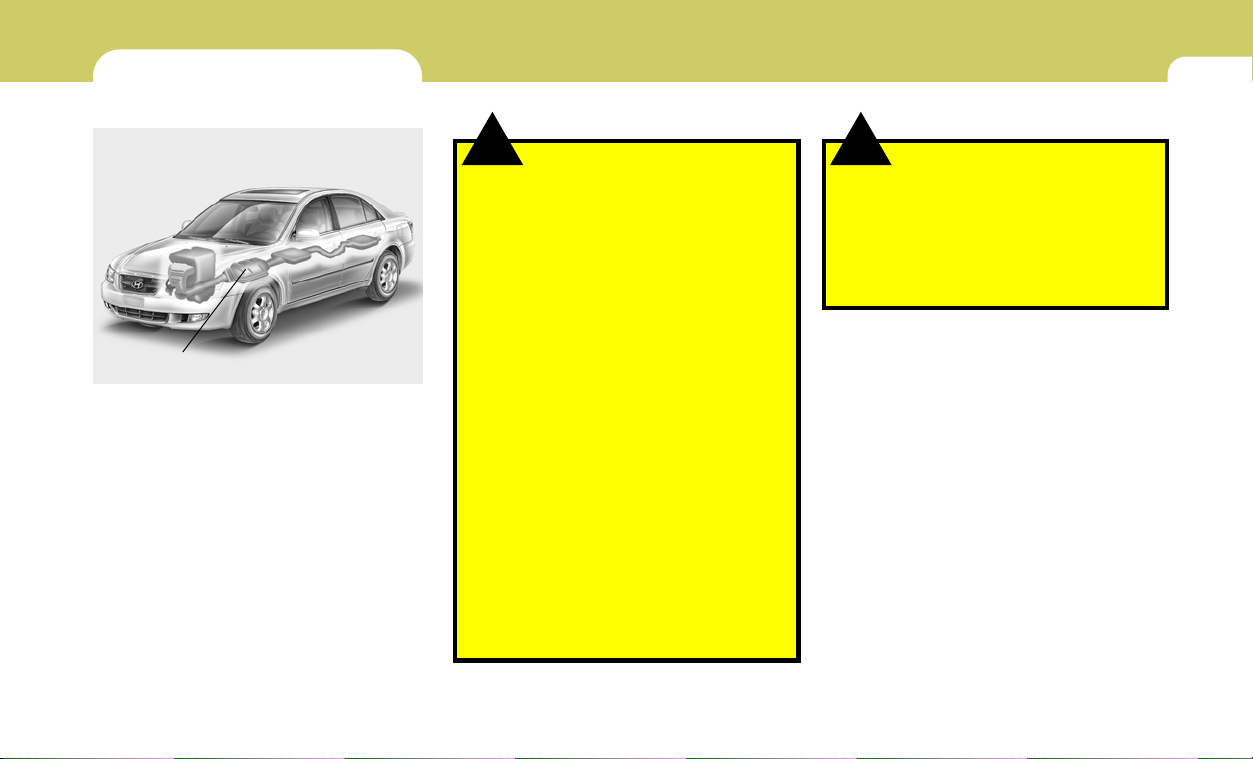
7
EMISSION CONTROL SYSTEMS
3
!!
CATALYTIC CONVERTER
H020A01A-AAT
All Hyundai vehicles are equipped with a mono-
lith type three-way catalytic converter to re-
duce the carbon monoxide, hydrocarbons and
nitrogen oxides contained in the exhaust gas.
Exhaust gases passing through the catalytic
converter cause it to operate at a very high
temperature. The introduction of large amounts
of unburned gasoline into the exhaust may
cause the catalytic converter to overheat and
create a fire hazard. This risk may be reduced
by observing the following:
Catalytic Converter
WARNING:
o Use unleaded fuel only.
o Maintain the engine in good operating
condition. Extremely high catalytic con-
verter temperatures can result from im-
proper operation of the electrical, igni-
tion or multiport electronic fuel injec-
tion.
o If your engine stalls, pings, knocks, or is
hard to start, have your Hyundai dealer
inspect and repair the problem as soon
as possible.
o Avoid driving with a very low fuel level.
Running out of gasoline may cause the
engine to misfire and result in damage to
the catalytic converter.
o Avoid idling the engine for periods
longer than 10 minutes.
o The vehicle should not be pushed or
pulled to get started. This may cause the
catalytic converter to overheat and cre-
ate a fire hazard.
o Do not touch the catalytic converter or
any other part of the exhaust system
while the catalytic converter is hot. Shut
off the engine, wait for at least one hour
before touching the catalytic converter
or any other part of the exhaust system.
H020A01NF
o Remember that your Hyundai dealer is
your best source of assistance.
o Do not stop your Hyundai over any com-
bustible material such as grass, paper,
leaves or rags. These materials might
contact the hot catalytic converter and a
fire might result.
WARNING:

Vehicle Identification Number (VIN) .............................. 8-2
Engine Number ............................................................. 8-2
Tire Information ............................................................. 8-2
Recommended Inflation Pressures ............................... 8-3
Checking Tire Inflation Pressure................................... 8-4
Tire Sidewall Labeling ................................................... 8-4
Tire Terminology and Definitions................................... 8-6
All Season Tires ............................................................ 8-8
Summer Tires ............................................................... 8-8
Snow Tires .................................................................... 8-8
Tire Chains.................................................................... 8-8
Tire Rotation.................................................................. 8-9
Tire Balancing ............................................................... 8-9
Tire Traction ................................................................ 8-10
When to Replace Tires ............................................... 8-10
Tire Maintenance ........................................................ 8-11
Spare Tire and Tools................................................... 8-11
Warranties for Your Hyundai Vehicle .......................... 8-12
Consumer Information................................................. 8-12
Reporting Safety Defects ............................................ 8-14
Binding Arbitration of Warranty Claims ....................... 8-15
8
8
CONSUMER INFORMATION, REPORTING
SAFETY DEFECTS & BINDING
ARBITRATION OF WARRANTY CLAIMS
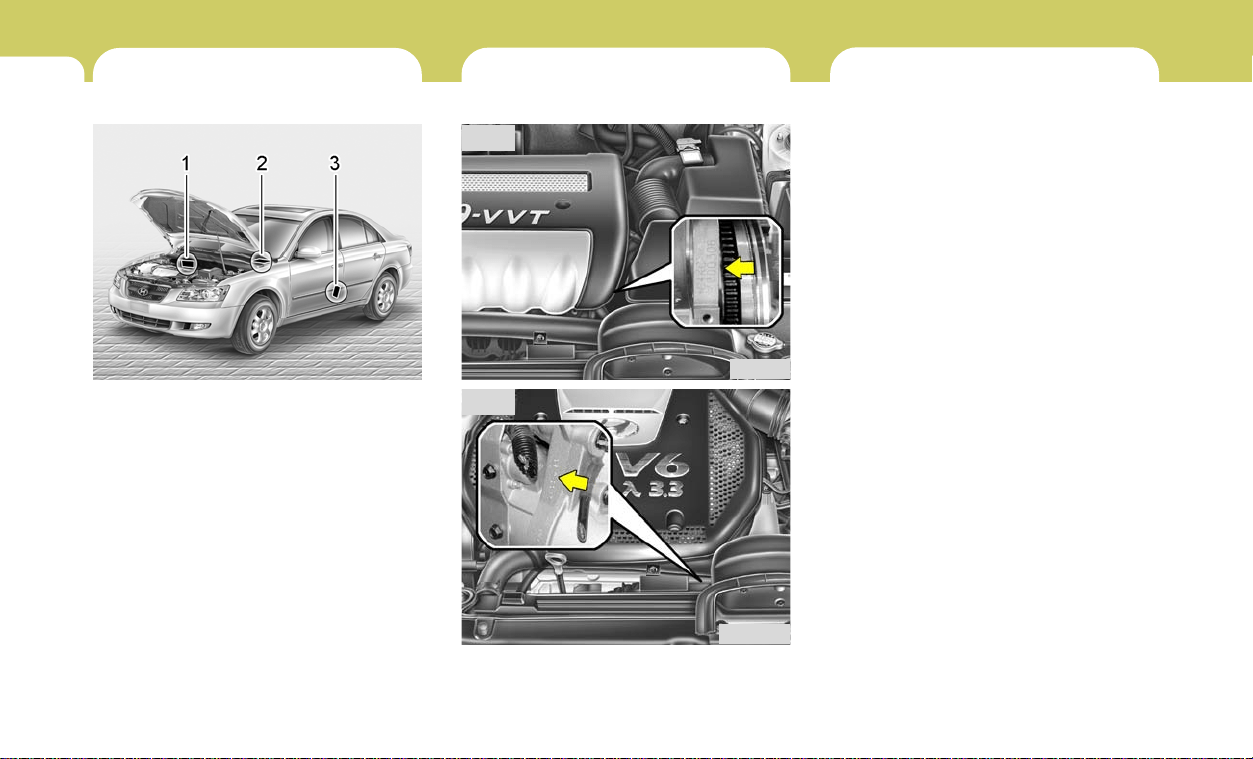
8
CONSUMER INFORMATION, REPORTING SAFETY DEFECTS & BINDING ARBITRATION OF WARRANTY CLAIMS
2
ENGINE NUMBER
VEHICLE IDENTIFICATION
NUMBER (VIN)
I010B01A-AATI010A01O-AAT
The vehicle identification number (VIN) is the
number used in registering your car and in all
legal matters pertaining to its ownership, etc. It
can be found in three different places on your
car:
1. On the bulkhead between the engine and
passenger compartments.
2. On the left top side of the instrument panel
where it can be seen by looking down through
the windshield.
3. On the lower side of the center pillar outer
panel.
The engine number is stamped on the engine
block as shown in the drawing.
TIRES
I020A02A-AAT
TIRE INFORMATION
The tires supplied on your new Hyundai
are chosen to provide the best perfor-
mance for normal driving.
If you ever have questions about your
tire warranty and where to obtain ser-
vice, see the tire manufacturer's book-
let included with your vehicle's Owner's
Manual Literature Kit.
I010A01NF-A
HNF6003
(2.4L)
(3.3L)
I010B01NF
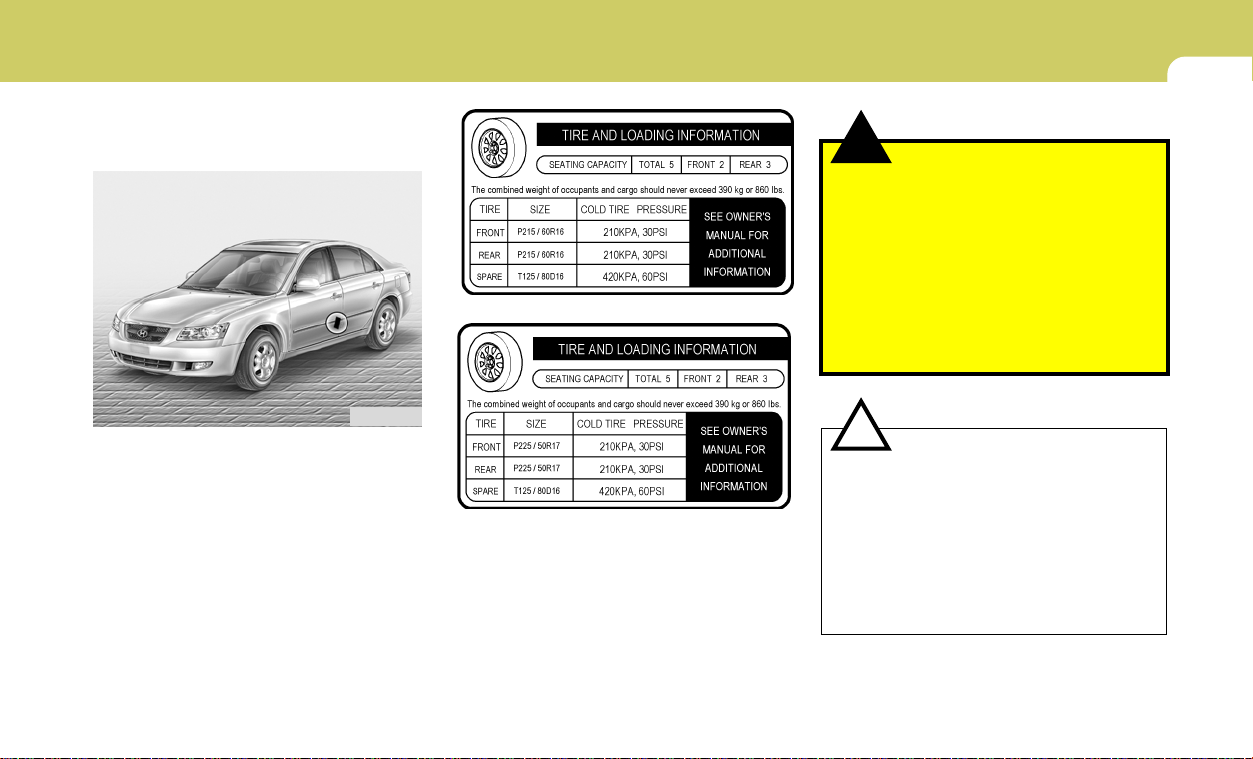
8
CONSUMER INFORMATION, REPORTING SAFETY DEFECTS & BINDING ARBITRATION OF WARRANTY CLAIMS
3
I030A01NF-AAT
RECOMMENDED INFLATION PRES-
SURES
Tire label located on the driver's side of
the center pillar outer panel gives the
cold tire pressures recommended for
your vehicle with the original tire size,
the number of people that can be in your
vehicle and vehicle capacity weight.
These pressures were chosen to pro-
vide the most satisfactory combination
of ride comfort, tire wear and stability
under normal conditions. Tire pressures
should be checked at least monthly.
Proper tire inflation pressures should
be maintained for these reasons:
!
CAUTION:
Always observe the following:
o Check pressures when the tires
are cold. (After the vehicle has
been parked for at least three hours
or hasn't been driven more than 1
mile (1.6 km) since starting up.)
!
WARNING:
o Lower-than-recommended tire
pressures cause uneven tread
wear, poor handling, poor fuel
economy or tire failure.
o Higher-than-recommended tire
pressures can cause poor han-
dling, uneven tread wear or tire
failure.
I030A01NF-A
I030A03NF-A
I030A04NF-A

8
CONSUMER INFORMATION, REPORTING SAFETY DEFECTS & BINDING ARBITRATION OF WARRANTY CLAIMS
4
Check the tire's inflation pressure when
the tires are cold. - "Cold" means your
vehicle has been sitting for at least
three hours or driven no more than 1
mile (1.6 km).
Remove the valve cap from the tire
valve stem. Press the tire gauge firmly
onto the valve to get a pressure mea-
surement. If the cold tire inflation pres-
sure matches the recommended pres-
sure on the tire and loading information
label, no further adjustment is neces-
sary. If the pressure is low, add air until
you reach the recommended amount.
If you overfill the tire, release air by
pushing on the metal stem in the center
of the tire valve. Recheck the tire pres-
sure with the tire gauge. Be sure to put
the valve caps back on the valve stems.
They help prevent leaks by keeping out
dirt and moisture.
o Check the pressure of your spare
tire each time you check the pres-
sure of other tires.
o Worn, old tires can cause acci-
dents. If your tread is badly worn,
or if your tires have been dam-
aged, replace them.
I035A01JM-AAT
CHECKING TIRE INFLATION PRES-
SURE
Check your tires once a month or more.
Also, check the tire pressure of the
spare tire.
How to Check
Use a good quality gauge to check tire
pressure. You cannot tell if your tires
are properly inflated simply by looking
at them. Radial tires may look properly
inflated even when they're underinflated.
Federal law requires tire manufacturers
to place standardized information on
the sidewall of all tires. This information
identifies and describes the fundamen-
tal characteristics of the tire and also
provides the tire identification number
(TIN) for safety standard certification.
The TIN can be used to identify the tire
in case of a recall.
I030B01NF-AAT
TIRE SIDEWALL LABELING
I030B04JM
1
2
3
4
5, 6
7
1

8
CONSUMER INFORMATION, REPORTING SAFETY DEFECTS & BINDING ARBITRATION OF WARRANTY CLAIMS
5
1. Manufacturer or Brand name
o Manufacturer or Brand name is
shown.
2. Tire size
(example: P215/60R16 94V)
o The "P" indicates the tire is de-
signed for passenger vehicles.
o Three-digit number (215): This num-
ber gives the width in millimeters
of the tire from sidewall edge to
sidewall edge.
o Two-digit number (60): This num-
ber, known as the aspect ratio,
gives the tire's ratio of height to
width.
o R: The "R" stands for radial.
o Two-digit number (16): This num-
ber is the wheel or rim diameter in
inches.
o Two digit number (94): This num-
ber is the tire's load index. It is a
measurement of how much weight
each tire can support.
o V: Speed Rating. The speed rating
denotes the speed at which a tire is
designed to be driven for extended
periods of time. The ratings range
from "A" to "Z" (98 to 186 MPH).
3. TIN (Tire Identification Number) for
new tire (example: DOT XX XX XXX
XXXX)
o DOT: Abbreviation for the "Depart-
ment of Transportation". The sym-
bol can be placed above, below or
to the left or right of the Tire Iden-
tification Number. It indicates the
tire is in compliance with the U.S.
Department of Transportation Mo-
tor Vehicle Safety Standards.
o 1st two-digit code: Manufacturer's
identification mark
o 2nd two-digit code: Tire size
o 3rd three-digit code: Tire type code
(Optional)
o 4th four-digit code: Date of Manu-
facture
o Four numbers represent the week
and year the tire was built. For
example, the numbers 3105 means
the 31st week of 2005.
4. Tire ply composition and material
The number of layers or plies of
rubbercoated fabric in the tire. Tire
manufacturers also must indicate
the materials in the tire, which in-
clude steel, nylon, polyester, and
others. The letter "R" means radial
ply construction; the letter "D" means
diagonal or bias ply construction;
and the letter "B" means belted-bias
ply construction.
5. Maximum permissible inflation
pressure
This number is the greatest amount
of air pressure that should be put in
the tire. Do not exceed the maximum
permissible inflation pressure. Refer
to the Tire and Loading Information
label for recommended inflation pres-
sure.

8
CONSUMER INFORMATION, REPORTING SAFETY DEFECTS & BINDING ARBITRATION OF WARRANTY CLAIMS
6
6. Maximum load rating
This number indicates the maximum
load in kilograms and pounds that
can be carried by the tire. When
replacing the tires on the vehicle,
always use a tire that has the same
load rating as the factory installed
tire.
7. Uniform Tire Quality Grading
(UTQG):
Tire manufacturers are required to
grade tires based on three perfor-
mance factors: treadwear, traction
and temperature resistance. For more
information, see Uniform Tire Qual-
ity Grading on page 8-13.
I030D01JM-AAT
TIRE TERMINOLOGY AND DEFINI-
TIONS
Air Pressure: The amount of air inside
the tire pressing outward on the tire. Air
pressure is expressed in pounds per
square inch (psi) or kilopascal (kPa).
Accessory Weight: This means the
combined weight of optional accesso-
ries. Some examples of optional ac-
cessories are, automatic transmission,
power seats, and air conditioning.
Aspect Ratio: The relationship of a
tire's height to its width.
Belt: A rubber coated layer of cords that
is located between the plies and the
tread. Cords may be made from steel or
other reinforcing materials.
Bead: The tire bead contains steel
wires wrapped by steel cords that hold
the tire onto the rim.
Bias Ply Tire: A pneumatic tire in which
the plies are laid at alternate angles
less than 90 degrees to the centerline of
the tread.
Cold Tire Pressure: The amount of air
pressure in a tire, measured in pounds
per square inch (psi) or kilopascals
(kPa) before a tire has built up heat from
driving.
Curb Weight: This means the weight of
a motor vehicle with standard and op-
tional equipment including the maxi-
mum capacity of fuel, oil and coolant,
but without passengers and cargo.
DOT Markings: A code molded into the
sidewall of a tire signifying that the tire
is in compliance with the U.S. Depart-
ment of Transportation motor vehicle
safety standards. The DOT code in-
cludes the Tire Identification Number
(TIN), an alphanumeric designator which
can also identify the tire manufacturer,
production plant, brand and date of
production.
GVWR: Gross Vehicle Weight Rating
GAWR FRT: Gross Axle Weight Rating
for the front Axle.
GAWR RR: Gross Axle Weight Rating
for the rear axle.

8
CONSUMER INFORMATION, REPORTING SAFETY DEFECTS & BINDING ARBITRATION OF WARRANTY CLAIMS
7
Intended Outboard Sidewall: The side
of an asymmetrical tire, that must al-
ways face outward when mounted on a
vehicle.
Kilopascal (kPa): The metric unit for
air pressure.
Load Index: An assigned number rang-
ing from 1 to 279 that corresponds to
the load carrying capacity of a tire.
Maximum Inflation Pressure: The
maximum air pressure to which a cold
tire may be inflated. The maximum air
pressure is molded onto the sidewall.
Maximum Load Rating: The load rat-
ing for a tire at the maximum permis-
sible inflation pressure for that tire.
Maximum Loaded Vehicle Weight:
The sum of curb weight; accessory
weight; vehicle capacity weight; and
production options weight.
Normal Occupant Weight: The num-
ber of occupants a vehicle is designed
to seat multiplied by 150 pounds (68
kg).
Occupant Distribution: Designated
seating positions.
Outward Facing Sidewall: The side of
an asymmetrical tire that has a particu-
lar side that faces outward when
mounted on a vehicle. The side of the
tire that contains a whitewall, bears
white lettering or bears manufacturer,
brand and or model name molding that
is higher or deeper than the same mold-
ings on the other sidewall of the tire.
Passenger (P-Metric) Tire: A tire used
on passenger cars and some light duty
trucks and multipurpose vehicles.
Recommended Inflation Pressure:
Vehicle manufacturer's recommended
tire inflation pressure as shown on the
tire placard.
Radial Ply tire: A pneumatic tire in
which the ply cords that extend to the
beads are laid at 90 degrees to the
centerline of the tread.
Rim: A metal support for a tire upon
which the tire beads are seated.
Sidewall: The portion of a tire between
the tread and the bead.
Speed Rating: An alphanumeric code
assigned to a tire indicating the maxi-
mum speed at which a tire can operate.
Traction: The friction between the tire
and the road surface. The amount of
grip provided.
Tread: The portion of a tire that comes
into contact with the road.
Treadwear Indicators: Narrow bands,
sometimes called "wear bars," that show
across the tread of a tire when only 2/32
inch of tread remains.
UTQGS: Uniform Tire Quality Grading
Standards, a tire information system
that provides consumers with ratings
for a tire's traction, temperature and
treadwear. Ratings are determined by
tire manufacturers using government
testing procedures. The ratings are
molded into the sidewall of the tire.

8
CONSUMER INFORMATION, REPORTING SAFETY DEFECTS & BINDING ARBITRATION OF WARRANTY CLAIMS
8
Vehicle Capacity Weight: The number
of designated seating positions multi-
plied by 150 lbs. (68 kg) plus the rated
cargo and luggage load.
Vehicle Maximum Load on the Tire:
Load on an individual tire due to curb
and accessory weight plus maximum
occupant and cargo weight.
Vehicle Normal Load on the Tire:
That load on an individual tire that is
determined by distributing to each axle
its share of the curb weight, accessory
weight, and normal occupant weight
and dividing by 2.
Vehicle Placard: A label permanently
attached to a vehicle showing the origi-
nal equipment tire size and recom-
mended inflation pressure.
all four wheels; otherwise, poor han-
dling may result.
Snow tires should carry 4 psi (28 kPa)
more air pressure than the pressure
recommended for the standard tires on
the tire label on the driver's side of the
center pillar , or up to the maximum
pressure shown on the tire sidewall,
whichever is less.
Do not drive faster than 75 mph (120
km/h) when your car is equipped with
snow tires.
I040B01JM-AAT
ALL SEASON TIRES
Hyundai specifies all season tires on
some models to provide good perfor-
mance for use all year round, including
snowy and icy road conditions. All sea-
I040C01JM-AAT
SUMMER TIRES
Hyundai specifies summer tires on some
models to provide superior performance
on dry roads. Summer tire performance
is substantially reduced in snow and
ice. Summer tires do not have the tire
traction rating M+S (Mud and Snow) on
the tire side wall. If you plan to operate
your vehicle in snowy or icy conditions,
Hyundai recommends the use of snow
tires or all season tires on all four wheels.
I050A03Y-AAT
TIRE CHAINS
Tire chains, if necessary, should be
installed on the front wheels. Be sure
that the chains are the proper size and
that they are installed in accordance
with the manufacturer's instructions.
To minimize tire and chain wear, do not
continue to use tire chains when they
are no longer needed.
son tires are identified by ALL SEASON
and/or M+S (Mud and Snow) on the tire
sidewall. Snow tires have better snow
traction than all season tires an may be
more appropriate in some areas.
I040A01O-AAT
SNOW TIRES
If you equip your car with snow tires,
they should be the same size and have
the same load capacity as the original
tires. Snow tires should be installed on
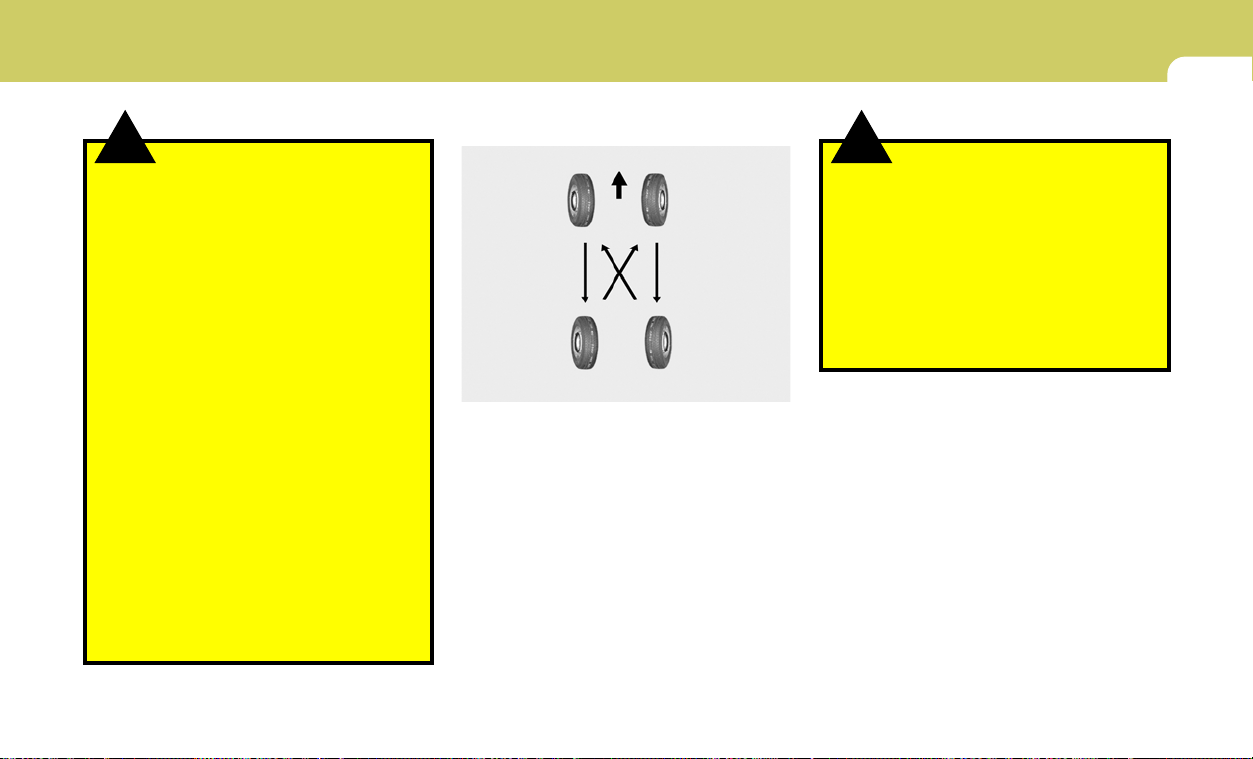
8
CONSUMER INFORMATION, REPORTING SAFETY DEFECTS & BINDING ARBITRATION OF WARRANTY CLAIMS
9
I070A01A-AAT
TIRE BALANCING
A tire that is out of balance may affect
handling and tire wear. The tires on your
Hyundai were balanced before the car
was delivered but may need balancing
again during the years you own the car.
Whenever a tire is dismounted for re-
pair, it should be rebalanced before
being reinstalled on the car.
!
I060A02A-AAT
TIRE ROTATION
Tires should be rotated every 7,500
miles (12,000 km). If you notice that
tires are wearing unevenly between ro-
tations, have the car checked by a
Hyundai dealer so the cause may be
corrected.
After rotating, adjust the tire pressures
and be sure to check the wheel nut
torque.
WARNING:
o Do not use the temporary spare
tire for tire rotation.
o Do not mix bias ply and radial ply
tires under any circumstances.
This may cause unusual handling
characteristics that could result in
death, serious injury, or property
damage.
I060A02NF
!
WARNING:
o When driving on roads covered
with snow or ice, drive at less than
20 mph (30 km/h).
o Use the SAE "S" class or wire &
plastic chains.
o If you have noise caused by chains
contacting the body, retighten the
chain to avoid contact with the
vehicle body.
o To prevent body damage, retighten
the chains after driving 0.3~0.6
miles.
o Don't use a tire chains to the ve-
hicle which aluminium wheels are
installed to keep the wheels. If it is
on unavoidable circumstances,
use a wire chains.
o Use wire chains less than 15mm to
prevent damage to the chain's con-
nection.
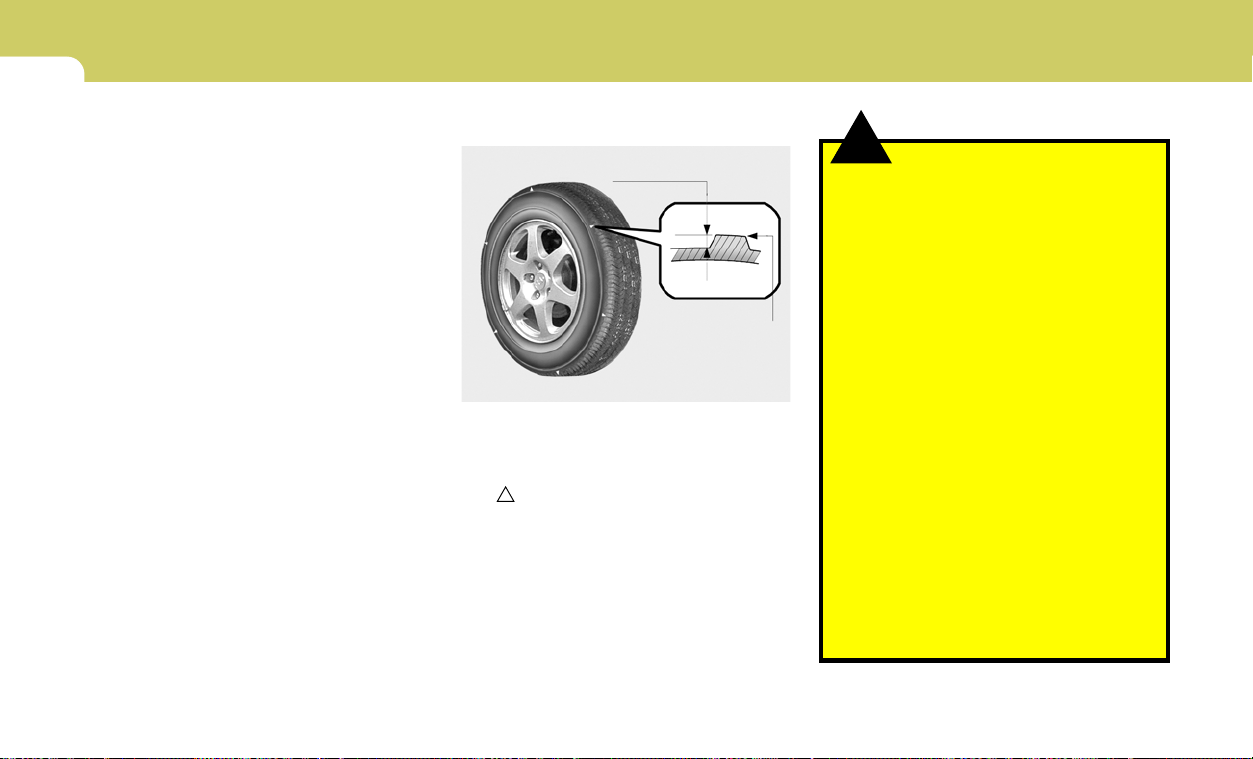
8
CONSUMER INFORMATION, REPORTING SAFETY DEFECTS & BINDING ARBITRATION OF WARRANTY CLAIMS
10
!
WARNING:
o Driving on worn-out tires is dan-
gerous! Worn-out tires can cause
loss of braking effectiveness,
steering control and traction. When
replacing tires, never mix radial
and bias ply tires on the same car.
If you replace radial tires with bias-
ply tires, they must be installed in
sets of four.
o Using tires and wheels of other
than the recommended sizes could
cause unusual handling charac-
teristics that could cause death,
serious injury, or property dam-
age.
o Wheels that do not meet Hyundai's
dimensional specifications may
fit poorly and result in damage to
the vehicle, including broken
wheel studs.
HNF5015
I090A02A-AAT
WHEN TO REPLACE TIRES
The original tires on your car have tread
wear indicators. The location of tread
wear indicators is shown by the "TWI"
or " " marks, etc. The tread wear
indicators appear when the tread depth
is 0.06 in. (1.6 mm). The tire should be
replaced when these appear as a solid
bar across two or more grooves of the
tread. Always replace your tires with
those of the recommended size. If you
change wheels, the new wheel's rim
width and offset must meet Hyundai
specification.
Tread wear
indicator
0.06 in. (1.6 mm)
I080A01A-AAT
TIRE TRACTION
Tire traction can be reduced if you drive
on worn tires, tires that are improperly
inflated or on slippery road surfaces.
Tires should be replaced when tread
wear indicators appear. To reduce the
possibility of losing control, slow down
whenever there is rain, snow or ice on
the road.
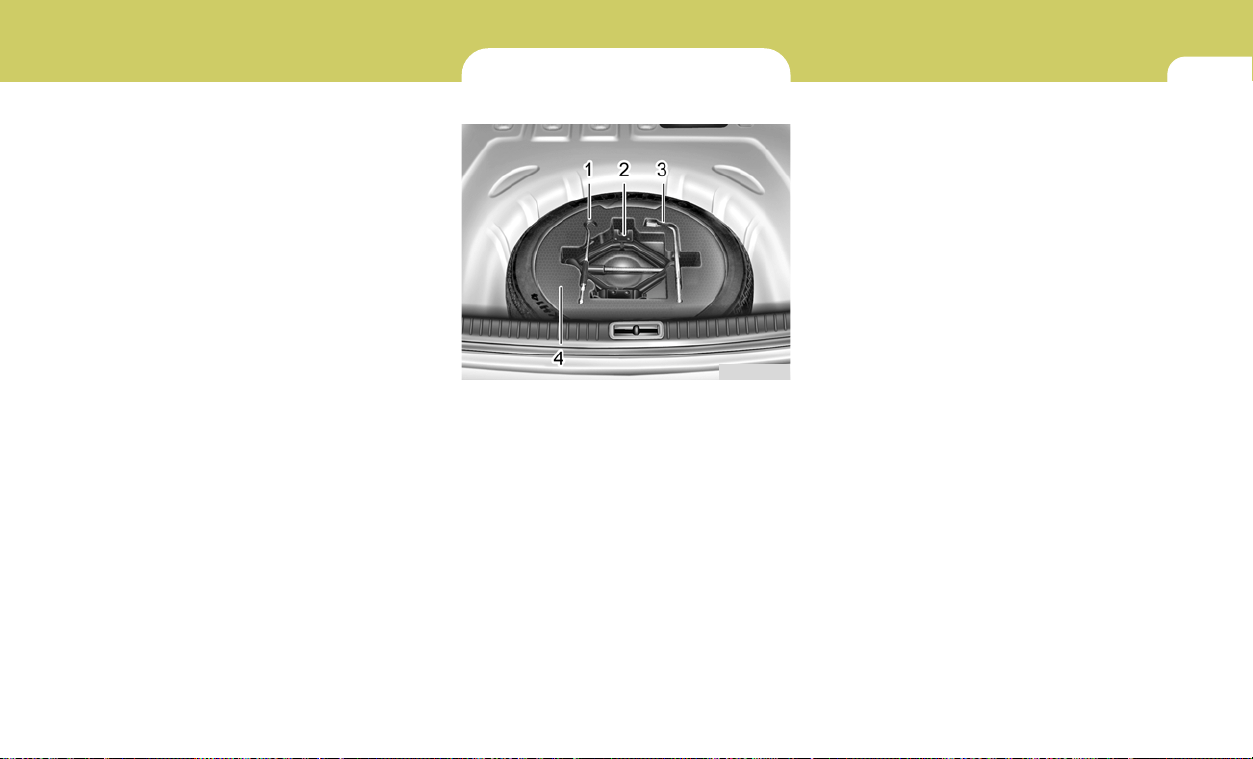
8
CONSUMER INFORMATION, REPORTING SAFETY DEFECTS & BINDING ARBITRATION OF WARRANTY CLAIMS
11
I090B01JM-AAT
TIRE MAINTENANCE
In addition to proper inflation, correct
wheel alignment helps to decrease tire
wear. If you find a tire is worn unevenly,
have your dealer check the wheel align-
ment.
When you have new tires installed,
make sure they are balanced. This will
increase vehicle ride comfort and tire
life. Additionally, a tire shoud always be
rebalanced if it is removed from the
wheel.
SPARE TIRE AND TOOLS
I100A01NF-AAT
Your Hyundai is delivered with the fol-
lowing:
Spare tire and wheel
Wrench bar (1)
Jack (2)
Wheel nut wrench (3)
Tool receptacle (4)
I100A01NF-A
I110A01A-AAT
SHOP MANUAL
A Hyundai Shop Manual is available from your
authorized Hyundai dealer. It's written for pro-
fessional technicians, but is simple enough for
most mechanically-inclined owners to under-
stand.

8
CONSUMER INFORMATION, REPORTING SAFETY DEFECTS & BINDING ARBITRATION OF WARRANTY CLAIMS
12
CONSUMER INFORMATION
I130A01A-AAT
This consumer information has been prepared
in accordance with regulations issued by the
National Highway Traffic Safety Administration
of the U.S. Department of Transportation. It
provides the purchasers and/or prospective
purchasers of Hyundai automobiles with infor-
mation on uniform tire quality grading. Your
Hyundai dealer will help answer any questions
you may have as you read this information.
WARRANTIES FOR YOUR HYUNDAI
VEHICLE
I120A02A-AAT
o New vehicle 60 Months/60,000 Miles Limited
Warranty.
o New vehicle 120 Months/100,000 Miles Lim-
ited Powertrain Warranty (Original owner
only).
o Anti-Perforation Limited Warranty
o Emission Defect Warranty - Federal Vehicle
o California Emission Control System War-
ranty (if applicable)
o Emission Performance Warranty Federal
vehicle
o Replacement Parts and Accessories Lim-
ited Warranty
NOTE:
Detailed warranty information is provided
in your Hyundai Owner's Handbook.
I130B04A-AAT
Tire Quality Grading
Department of Transportation quality
grades - All passenger vehicle tires
must conform to Federal Safety Stan-
dards in addition to these grades. These
quality grades are molded on the
sidewall.
Treadwear - The treadwear grade is a
comparative rating based on the wear
rate of the tire when tested under con-
trolled conditions on a specified gov-
ernment test course. For example, a
tire graded 150 would wear one and a
half (1 - 1/2) times as well on the
government course as a tire graded
100. The relative performance of tires
depends upon the actual conditions of
their use, however, and may depart
significantly from the norm due to varia-
tions in driving habits, service prac-
tices and differences in road character-
istics and climate.
8
CONSUMER INFORMATION, REPORTING SAFETY DEFECTS & BINDING ARBITRATION OF WARRANTY CLAIMS
13
Traction AA, A, B, C - The traction
grades, from highest to lowest, are AA,
A, B, and C. Those grades represent
the tire's ability to stop on wet pave-
ment as measured under controlled
conditions on specified government test
surfaces of asphalt and concrete. A tire
marked C may have poor traction per-
formance.
!
WARNING:
The traction grade assigned to this
tire is based on straight-ahead brak-
ing traction tests, and does not in-
clude acceleration, cornering, hy-
droplaning, or peak traction charac-
teristics.
Temperature A, B, C - The tempera-
ture grades are A (the highest), B, and
C, representing the tire's resistance to
the generation of heat and its ability to
dissipate heat when tested under con-
trolled conditions on a specified indoor
laboratory test wheel. Sustained high
temperature can cause the material of
the tire to degenerate and reduce tire
life, and excessive temperature can
lead to sudden tire failure. The grade C
corresponds to a level of performance
which all passenger car tires must meet
under the Federal Motor Vehicle Safety
Standard No. 109. Grades B and A
represent higher levels of performance
on the laboratory test wheel than the
minimum required by law.
!
WARNING:
The temperature grade for this tire is
established for a tire that is properly
inflated and not overloaded. Exces-
sive speed, underinflation, or exces-
sive loading, either separately or in
combination, can cause heat buildup
and possible tire failure.
Uniform Tire Quality Grading - Qual-
ity grades can be found on the tire
sidewall between the tread shoulder
and the maximum section width.
For example :
Treadwear 200 Traction AA Tempera-
ture A

8
CONSUMER INFORMATION, REPORTING SAFETY DEFECTS & BINDING ARBITRATION OF WARRANTY CLAIMS
14
REPORTING SAFETY DEFECTS
I130C01A-AAT
If you believe that your vehicle has a defect
which could cause a crash or could cause
injury or death, you should immediately
inform the National Highway Traffic Safety
Administration (NHTSA) in addition to
notifying HYUNDAI MOTOR AMERICA. If
NHTSA receives similar complaints, it may
open an investigation, and if it finds that a
safety defect exists in a group of vehicles,
it may order a recall and remedy cam-
paign. However, NHTSA cannot become
involved in individual problems between
you, your dealer, or HYUNDAI MOTOR
AMERICA.
To contact NHTSA, you may either call the
Auto Safety Hotline toll-free at 1-888-327-
4236 or write to: NHTSA, U.S. Department
of Transportation, Washington. D.C. 20590.
You can also obtain other information about
motor vehicle safety from the Hotline.
I130D03A-AAT
Hyundai motor vehicles are designed and manu-
factured to meet or exceed all applicable safety
standards.
For your safety, however, we strongly urge you
to read and follow all directions in this Owner's
Manual, particularly the information under the
headings "NOTE", "CAUTION" and "WARN-
ING".
If, after reading this manual, you have any
questions regarding the operation of your ve-
hicle, please contact your nearest Hyundai
Motor America Regional Office as listed below:
Eastern Region : Connecticut, Delaware,
Maine, Maryland, Massachusetts, New Hamp-
shire, New Jersey, New York, Pennsylvanina,
Rhode Island, Vermont, Virginia, West Virginia.
Eastern Region
1100 Cranbury South River Road
Jamesburg, NJ 08831
(800) 633-5151
Southern Region: Alabama, Arkansas, Florida,
Georgia, Louisiana, Mississippi, North Caro-
lina, South Carolina, Oklahoma, Tennessee,
Texas.
Southern Region
270 Riverside Parkway, Suite A
Austell, GA 30168
(800) 633-5151
Central Region: Illinois, Indiana, Missouri, lowa,
Kansas, Kentucky, Michigan, Minnesota, Ne-
braska, North Dakota, South Dakota, Ohio,
Wisconsin.
Central Region
1705 Sequoia Drive
Aurora, Illinois 60506
(800) 633-5151
Western Region: Alaska, Hawaii, Arizona, Cali-
fornia, Colorado, ldaho, Montana, Nevada, New
Mexico, Oregon, Texas, Utah, Washington,
Wyoming.
Western Region
10550 Talbert Avenue
P.O.Box 20850
Fountain Valley, California 92728-0850
(800) 633-5151

8
CONSUMER INFORMATION, REPORTING SAFETY DEFECTS & BINDING ARBITRATION OF WARRANTY CLAIMS
15
I140A01A-AAT
Any claim or dispute you may have
related to your vehicle's warranty or the
duties contemplated under the warranty,
including claims related to the refund or
partial refund of your vehicle's purchase
price (excluding personal injury or prod-
uct liability claims), shall be resolved
by binding arbitration. Binding arbitra-
tion shall be administered by and through
the National Arbitration Forum (NAF) or
the American Arbitration Association
(AAA), under the Code of Procedure of
the entity you select.
You will not be responsible for paying
filing and hearing fees above $275.00.
All other arbitration costs shall be borne
by Hyundai Motor America. You are not
responsible to pay any of the costs
Hyundai incurs.
This Binding Arbitration Agreement shall
not deprive you of any remedies avail-
able to you under applicable law. The
parties are waiving their right to seek
remedies in court, including the right to
a jury trial.
This Binding Arbitration Agreement shall
be governed by and interpreted under
the Federal Arbitration Act, 9 U.S.C.
sections 1-16. Judgment upon any award
may be entered in any court having
jurisdiction.
You may revoke this Arbitration Agree-
ment by (1) written notice or (2) elec-
tronic notice. Written notice must be
delivered (via certified mail) to Hyundai
Motor America, Attn: Consumer Af-
fairs, 10550 Talbert Avenue, P.O. Box
20849, Fountain Valley, CA 92728-0849.
Electronic notice must be submitted at
the following website address: http://
warranty-arbitration.hyundaiUSA.com.
Notice must be received within 90 days
after you purchase your vehicle.
BINDING ARBITRATION

9
Measurement ................................................................ 9-2
Engine ........................................................................... 9-3
Lubrication Chart ........................................................... 9-4
VEHICLE SPECIFICATIONS
9
9
VEHICLE SPECIFICATIONS
2
3.3L
130A (13.5V)
J010A02NF-AAT
MEASUREMENT
J060A01NF-AAT
FUEL SYSTEM
J020A01NF-AAT
POWER STEERING
J030A01NF-AAT
TIRE
Item
Battery
Alternator
J040A01NF-GAT
ELECTRICAL
2.4L
110A (13.5V)
in.(mm)
Fuel tank capacity
17.7us.gal (14.7 imp.gal, 67 liter)
ITEM
MF68AH
J050A01NF-AAT
BRAKE
Dual hydraulic with brake booster
Ventilated disc
Disc type
Cable operated on rear wheel
Type
Front brake type
Rear brake type
Parking brake
Type
Wheel free play
Rack stroke
Oil pump type
Rack and pinion
0 ~ 1.18 in. (0 ~ 30 mm)
5.90 in. (150 mm)
Vane type
2.4L/3.3L
189.9 (4800)
72.1 (1832)
58.0 (1475)
107.4 (2730)
61.6 (1565)
61.1 (1550)
Overall length
Overall width
Overall height
Wheel base
Wheel tread
Front
Rear
Standard
Option
Spare
P215/60R16
P225/50R17
T125/80D16 (Temporary)
9
VEHICLE SPECIFICATIONS
3
3.3L
6-Cyl., V-type DOHC
3.62 x 3.29 (92.0 x 83.8)
203.9 (3,342)
1 - 2 - 3 - 4 - 5 - 6
IFR5G-11
620 ± 100
BTDC 10° ± 5°
0.006 ~ 0.009 in. (0.17 ~ 0.23 mm)
0.01 ~ 0.012 in. (0.27 ~ 0.33 mm)
0.039 ~ 0.043 in. (1.0 - 1.1 mm)
2.4L
4-Cyl., In-line DOHC
3.46 x 3.81 (88 x 97)
143.9(2,359)
1 - 3 - 4 - 2
SK16PR-A11
650 ± 100
BTDC 8° ± 5°
ENGINE
J070A01NF-AAT
ITEMS
Engine Type
Bore x Stroke in.(mm)
Displacement cu.in.(cc)
Firing order
Valve clearance (cold engine) Intake
Exhaust
Spark plug
Spark plug gap
Idle speed (rpm)
Ignition timing (Base)
9
VEHICLE SPECIFICATIONS
4
Oil & Grease Standard
API SJ, SL
or ABOVE, SAE 5W-20, SAE 5W-30 (ALL TEMP. RANGE)
ILSAC GF-3 SAE 10W-30 (ABOVE 0°F(-18°C))
or ABOVE
HYUNDAI GENUINE PARTS MTF 75W/85 (API GL-4)
HYUNDAI GENUINE ATF SP III, DIAMOND ATF SP III, SK ATF SP III or other
brands meeting the SP III specification approved by Hyundai Motor Co..
Ethylene glycol base for aluminum radiator
PSF-3 TYPE FLUID
DOT 3 or DOT 4 Equivalent
LUBRICATION CHART
J080A02NF-AAT
Quantity (Us. qts)(Imp. qts, Liter)
Drain and refill (With oil filter);
2.4L : 4.54 (3.78, 4.3)
3.3L : 6.02 (5.02, 5.7)
2.0 (1.67, 1.9)
2.4L : 8.24 (6.86, 7.8)
3.3L : 11.52 (9.59, 10.9)
2.4L : 6.87 (5.72, 6.5)
2.4L : 6.66 (5.54, 6.3)
3.3L : 8.66 (7.21, 8.2)
0.95 (0.79, 0.9)
As required
Item
Engine Oil
Transaxle
Coolant
Power steering
Brake and clutch fluid
Manual Transaxle
Automatic Transaxle
Manual
Automatic

10
INDEX
10

10
INDEX
2
A
Accessory Box ................................................................................ 1-75
Advanced Supplemental Restraint (AIRBAG) System (SRS) ...... 1-36
Curtain airbag ............................................................................... 1-47
Driver's and passenger's front airbag ....................................... 1-37
Occupant classification system .................................................. 1-42
Side impact airbag ....................................................................... 1-45
Air Cleaner Filter .............................................................................. 6-14
Air Conditioning
Care .............................................................................................. 6-21
Filter .................................................................................. 1-112, 6-22
Operation .......................................................................... 1-103, 6-21
Switch ......................................................................................... 1-103
Antenna .......................................................................................... 1-130
Ashtray ............................................................................................. 1-68
Audio System
Audio remote control switch ....................................................... 1-95
Compact disc player operation (V480) .................................... 1-118
Compact disc player operation (V490) .................................... 1-125
Stereo radio operation (V480) .................................................. 1-115
Stereo radio operation (V490) .................................................. 1-122
Automatic Heating and Cooling Control System ......................... 1-106
Automatic-Dimming Mirror with Z-Nav™ Electronic Compass
Display and HomeLink
®
...........................................................................................................
1-79
B
Battery .............................................................................................. 6-27
Binding Arbitration ............................................................................ 8-15
Brake
Anti-lock brake system (ABS) .................................................... 2-12
Checking the brakes ................................................................... 6-20
Fluid .............................................................................................. 6-20
Pedal clearance ........................................................................... 6-24
Pedal free-play ............................................................................. 6-24
Practices ...................................................................................... 2-14
Breaking-In your New Hyundai ........................................................ 1-3
C
Care of Discs ................................................................................ 1-130
Catalytic Converter ............................................................................ 7-3
Center Console Compartment ........................................................ 1-76
Child Restraint System ................................................................... 1-28
Installing a child restraint system with
"Tether Anchorage" system ...................................................... 1-30
Securing a child restraint system with "ISOFIX" system ......... 1-31
Child-Protector Rear Door Lock ...................................................... 1-6
Cigarette Lighter .............................................................................. 1-67
Clock ................................................................................................ 1-66
Clutch
Pedal free-play ............................................................................. 6-23

10
INDEX
3
Combination Light
Auto Light ..................................................................................... 1-63
Headlight flasher .......................................................................... 1-63
Headlight switch ........................................................................... 1-62
High-beam switch ........................................................................ 1-62
Lane change signal ..................................................................... 1-62
Parking light auto off .................................................................... 1-62
Turn signal operation ................................................................... 1-61
Consumer Information ..................................................................... 8-12
Cooling Fans .................................................................................... 6-28
Corrosion protection
Cleaning the interior ....................................................................... 4-5
Protecting your Hyundai from corrosion ...................................... 4-2
Washing and waxing ..................................................................... 4-3
Cruise Control .................................................................................. 1-93
D
Day/night Inside Rearview Mirror ................................................... 1-78
Defrosting/Defogging ..................................................................... 1-105
Door
Central door locks ......................................................................... 1-6
Door locks ...................................................................................... 1-4
Front door warning light .............................................................. 1-92
Locking and unlocking front door with a key .............................. 1-5
Drink Holder ..................................................................................... 1-68
Driving
Economical driving ....................................................................... 2-15
Smooth cornering ......................................................................... 2-16
Winter driving ............................................................................... 2-16
E
Electronic Stability Control (ESC) System ..................................... 2-13
Emission Control System .................................................................. 7-2
Engine
Before starting the engine ............................................................. 2-3
Compartment (2.4 DOHC) ............................................................ 6-2
Compartment (3.3 V6) ................................................................... 6-3
Coolant ............................................................................................ 6-8
Coolant temperature gauge ........................................................ 1-56
If the engine overheats ................................................................. 3-4
Number ........................................................................................... 8-2
Oil .................................................................................................... 6-5
Starting ............................................................................................ 2-4
Engine Exhaust Can Be Dangerous! ............................................... 2-2
F
Fan Speed Control .............................................................. 1-97, 1-108
Fog Light
Front ............................................................................................. 1-64
Front Seats
Active headrests .......................................................................... 1-16
Adjustable front seats .................................................................. 1-14
Adjustable headrests ................................................................... 1-15
Adjusting seat forward and rearward ............................... 1-14, 1-17
Adjusting seatback angle .................................................. 1-14, 1-18
Power driver's seat ..................................................................... 1-17
Seat cushion height adjustment ....................................... 1-17, 1-18
Seat warmer ................................................................................. 1-19

10
INDEX
4
Fuel
Capacity.......................................................................................... 9-2
Gauge ........................................................................................... 1-55
Recommendations ......................................................................... 1-2
Fuel Filler Lid
Remote release ............................................................................ 1-87
Fuse Panel Description ................................................................... 6-39
Fuses ............................................................................................... 6-25
G
General Checks ................................................................................ 6-4
Glove Box ........................................................................................ 1-74
H
Hazard Warning System ................................................................. 1-65
Headlight
Aiming adjustment ........................................................................ 6-30
Replacement ................................................................................ 6-31
Switch ........................................................................................... 1-62
Heating and Cooling Control ........................................................... 1-96
Heating and Ventilation
Air flow control ................................................................ 1-98, 1-110
Air intake control switch ................................................ 1-101, 1-108
Bi-level heating ........................................................................... 1-102
Defrosting/Defogging ................................................................. 1-105
Fan speed control (Blower Control) ............................... 1-97, 1-108
Temperature control .................................................................... 1-97
High-Mounted Rear Stop Light ....................................................... 1-87
Hood Release .................................................................................. 1-89
Horn .................................................................................................. 1-92
I
Ignition Switch .................................................................................... 2-3
Instrument Cluster and Indicator Lights ......................................... 1-50
Instrument Panel Light Control (Rheostat) .................................... 1-67
Interior Light ..................................................................................... 1-73
Intermittent Wiper ............................................................................. 1-65
J
Jump Starting ..................................................................................... 3-3
K
Key ...................................................................................................... 1-3
If you lose your keys .................................................................. 3-13
Positions ......................................................................................... 2-3
L
Light Bulb Watages .......................................................................... 6-38
Light Bulbs Replacement ................................................................ 6-31
Lubrication Chart ............................................................................... 9-4

10
INDEX
5
M
Maintenance Intervals
Explanation of scheduled maintenance items .............................. 5-7
Maintenance under severe usage conditions .............................. 5-6
Scheduled maintenance ................................................................ 5-4
Service requirements .................................................................... 5-2
Mirrors
Day/night inside rearview ............................................................ 1-78
Homelink mirror ............................................................................ 1-79
Outside rearview .......................................................................... 1-77
Outside rearview mirror heater .................................................. 1-78
Multi Box ........................................................................................... 1-75
O
Odometer ......................................................................................... 1-57
Outside Rearview Mirror ................................................................. 1-77
P
Parking Brake .................................................................................. 1-85
Power Adjustable Pedals ................................................................ 2-11
Power Outlets .................................................................................. 1-67
Power Steering Fluid Level ............................................................. 6-29
R
Rear Seat
Armrest ......................................................................................... 1-92
Folding rear seatbacks ............................................................... 1-19
Rear seatback safety lock .......................................................... 1-20
Warning ......................................................................................... 1-20
Rear Window Defroster Switch ...................................................... 1-66
Reporting Safety Defects ................................................................ 8-14
S
Seat
Front ............................................................................................. 1-14
Rear .............................................................................................. 1-19
Seat Belts
3-Point system ............................................................................. 1-24
Adjusting your seat belt ............................................................... 1-25
Care of seat belts ........................................................................ 1-22
Pre-tensioner seat belt ................................................................ 1-33
Precautions .................................................................................. 1-21
Rear seat center 3-point system with combination
locking retractor ........................................................................ 1-26
Seatback Pocket ............................................................................. 1-70
Shopping Bag Holder ....................................................................... 1-69
Spark Plugs ...................................................................................... 6-11
Spectacle Case ............................................................................... 1-74
Speedometer .................................................................................... 1-57
Starting Procedure ............................................................................. 2-5

10
INDEX
6
Steering Wheel
Free-play ...................................................................................... 6-23
Tilt and telescopic type ............................................................... 1-91
Tilt type ......................................................................................... 1-91
Stereo Sound System ................................................................... 1-113
Sun Visor .......................................................................................... 1-90
Sunroof ............................................................................................. 1-70
T
Tachometer ...................................................................................... 1-56
Theft-Alarm System ........................................................................... 1-8
Tires
All season tires .............................................................................. 8-8
Balancing ........................................................................................ 8-9
Chains ............................................................................................. 8-8
Changing a flat tire ........................................................................ 3-6
Checking the inflation pressure .................................................... 8-4
If you have a flat tire ..................................................................... 3-6
Information ...................................................................................... 8-2
Maintenance ................................................................................. 8-11
Pressure ......................................................................................... 8-3
Replacement ................................................................................ 8-10
Rotation ........................................................................................... 8-9
Sidewall labeling ............................................................................. 8-4
Snow tires ...................................................................................... 8-8
Spare tire ........................................................................................ 3-5
Summer tires .................................................................................. 8-8
Terminology and definitions .......................................................... 8-6
Traction ......................................................................................... 8-10
Towing
A trailer (or vehicle) ..................................................................... 2-19
Emergency ................................................................................... 3-13
If your vehicle must be towed .................................................... 3-11
Transaxle
Automatic ........................................................................................ 2-8
Automatic transaxle fluid checking ............................................. 6-18
Manual ............................................................................................ 2-5
Manual transaxle oil checking .................................................... 6-17
Trip Computer .................................................................................. 1-58
Trip Odometer ................................................................................. 1-57
Trunk Lid .......................................................................................... 1-85
V
Vehicle Identification Number (VIN) ................................................. 8-2
Vehicle Load Limit ............................................................................ 2-22
Vehicle Specifications ........................................................................ 9-1
W
Warning and Indicator Lights .......................................................... 1-52
Warranties for Your Hyundai Vehicle ............................................. 8-12
Windows
Power ............................................................................................ 1-11
Windshield Wiper and Washer ........................................................ 1-64
Intermittent wiper operation ......................................................... 1-65
Mist wiper operation .................................................................... 1-65
Windshield washer operation ...................................................... 1-64
Windshield Wiper Blades ................................................................. 6-15

A000A01A-AAT
This Owner's Manual should be considered a part of the car and remain with it when it is sold for the use of the next owner.
OWNER'S I.D.
ORIGINAL OWNER
ADDRESS
CITY STATE ZIP CODE
DELIVERY DATE
(Date Sold to Original Retail Purchaser)
DEALER NAME DEALER NO.
ADDRESS
CITY STATE ZIP CODE
Seoul Korea
Printing: MAY. 04, 2005
Publication No.: A3KO-EU55C
Printed in Korea
SERVICE STATION INFORMATION
FUEL:
UNLEADED gasoline only
Pump Octane Rating of 87 (Research Octane Number 91) or higher.
FUEL TANK CAPACITY
US.gal (Imp.gal., liter) 17.7 (14.7, 67)
TIRE PRESSURE:
See the label on the driver's side of the center pillar outer panel.
OTHER TIRE INFORMATION:
See pages 8-2 through 8-13.
HOOD RELEASE:
Pull handle under left side of dash.
ENGINE OIL:
API grade SJ, SL or ABOVE / ILSAC grade GF-3 or ABOVE and fuel efficient
oil. Use SAE 5W-20, 5W-30 or 10W-30 if normal temperatures are above
0°F (-18°C). See page 6-5 or 9-4.
MANUAL TRANSAXLE:
HYUNDAI GENUINE PARTS MTF 75W/85 (API GL-4) Oil level should
be up to filler-bolt hole in housing beside differential.
AUTOMATIC TRANSAXLE:
Your Hyundai automatic transaxle is specially designed to operate with
HYUNDAI GENUINE ATF SP III, DIAMOND ATF SP III, SK ATF SP
III or other brands meeting the SP III specification approved by Hyundai Motor
Co.. Damage caused by a nonspecified fluid is not covered by your new vehicle
limited warranty.
QUICK INDEX
o Car will not start ....................................................................... 3-2
o Flat tire ..................................................................................... 3-6
o Warning light/chime comes on ...................................1-52 ~ 1-55
o Engine overheats ...................................................................... 3-4
o Towing of your vehicle ........................................................... 3-11
o Starting the engine ................................................................... 2-4
o Driving tips for first 1,200 miles (2,000 km) .......................... 1-3
o Scheduled maintenance ............................................................ 5-4
o Reporting safety defects ......................................................... 8-14
nfhma-11.p65 5/4/2005, 1:53 PM2