Operator’s Manual
www.mechmaxx.com
WARRANTY
SKU:150169


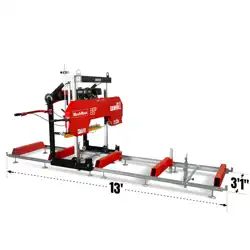
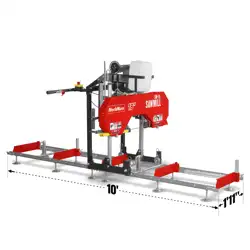
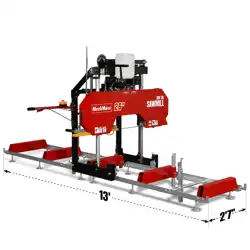
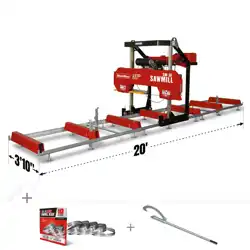
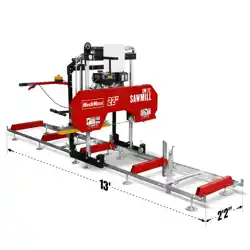
OVERALL DIMENSIONS
TABLE OF CONTENTS
TABLE OF CONTENTS
SPECIFICATIONS
SAFETY SIGNS
SAFETY
1
2
3
BELT TENSION
BLADE TRACKING
27
27
ADJUSTING THE RIGHT HAND SIDE
28
ADJUSTING THE LEFT HAND SIDE
29
MOVING THE BLADE FORWARD
30
BLADE GUIDE ADJUSTMENT
30
BLADE TENSION
31
CHANGING THE BLADE 33
REPLACING BELTS
33
WORK AREA
INTERNAL COMBUSTION ENGINE SAFETY
PERSONAL SAFETY
5
5
5
TOOL USE AND CARE
6
EQUIPMENT OPERATION
7
MAINTENANCE
7
TRACK
RAILS & CENTER BUNK
MID & END BUNKS
4
5
9
9
10
11
SQUARING THE TRACK AND SETTING THE WIDTH
FEET
LIMIT PLATE
11
12
13
LOG CLAMPS
LOG SUPPORTS
SAWMILL HEAD ASSEMBLY
13
14
15
STANDING THE SAWHEAD UPRIGHT
CROSS BEAM & HEAD STOPS
LIFTING SYSTEM AND WATER TANK
17
17
19
LOG SCALE
THROTTLE HANDLE
20
22
LIFT CABLE ROUTING
TRANSPARENT WATER PIPE
22
22
ELECTRIC WIRE CONNECT
ENGINE
25
26
ASSEMBLY
27
SAWMILL SET-UP PROCEDURES
33
SAWMILL MAINTENANCE
35
TROUBLESHOOTING
37
DIAGRAM-ENSEMBLE
38
DIAGRAM(A)-BAND WHEEL HOUSING
39
PARTS LIST(A)-BAND WHEEL HOUSING
41
DIAGRAM(B)-CARRIAGE
42
PARTS LIST(B)-CARRIAGE
44
DIAGRAM(C)
45
PARTS LIST(C)
1
www.mechmaxx.com
TABLE OF CONTENTS
SPECIFICATIONS
2
www.mechmaxx.com
SPECIFICATIONS
Engine
Engine Type
Engine Displacement
Start
Log Diameter
Max Live Edge Width
Standard Cutting Length
Max Board Thickness
Blade Engagement System
Cast Iron Bandwheel Diameter
Blade Wheel Engagement
Blade Guide
Blade Tension
Blade Size
Blade Pitch
Blade Lubrication
Lubricant Tank Size
Track Width
Track Length
Track Extension Length
Leveling Feet
Log Rests
Log Clamps
Track Bunks
4 Post Head Design
Finish
Sawmill Warranty
Engine Warranty
Package Method
DUCAR DH275
Single Cylinder, 4 Stroke, Air-Cooled, OHV
274 сс
Recoil
22 in
20 in
10 ft 7 in
6 in
Centrifugal Clutch
16.5 in
Belt Drive
By Roller
By Adjustable Lever
127 x 1.3 in
7/8 in
Water Lube - Manual Valve
2.6 gal
2 ft 2 in
13 ft
6 ft 5 in
12
2 Long and 2 Short Rests
2 x Quick Lock
1.6 x 3.9 in
Yes
Powder Coat Paint Galvanized Steel
2 Years
1 Year
Wood
Model SM-22
87 x 19 x 32 in
497/585.7 Ibs
Packing Size
Weight (N.W./G.W.)
3
www.mechmaxx.com
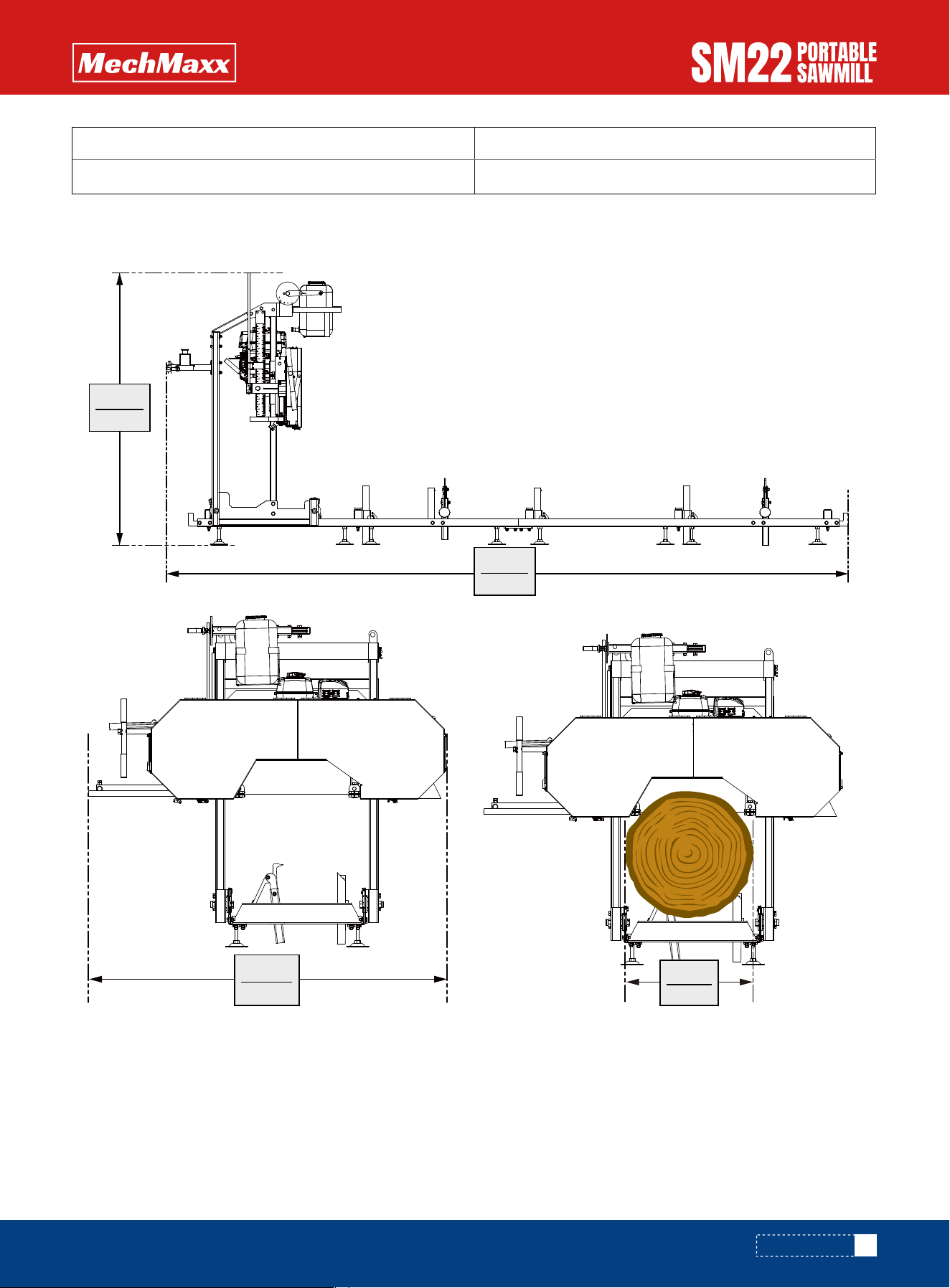
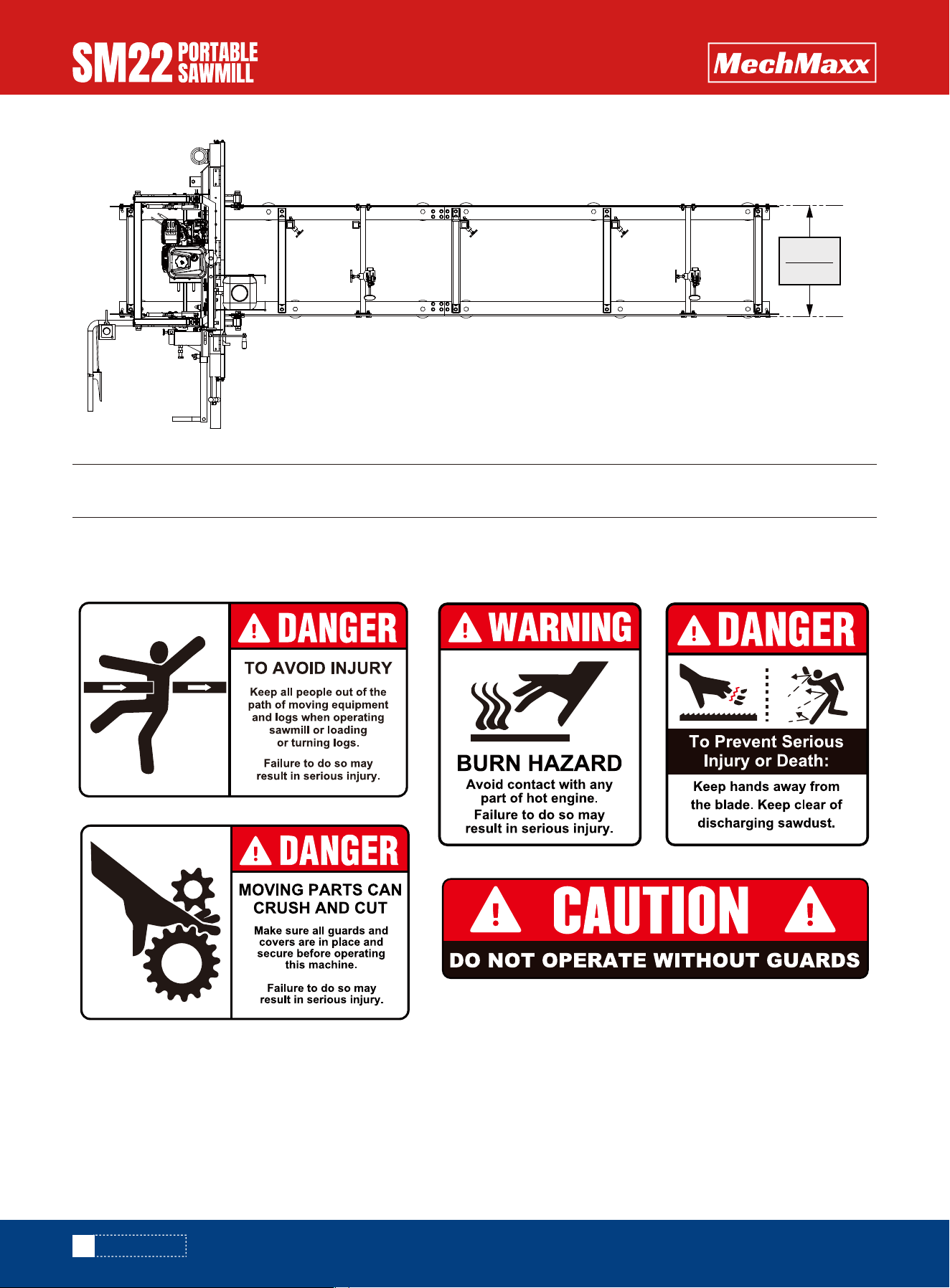
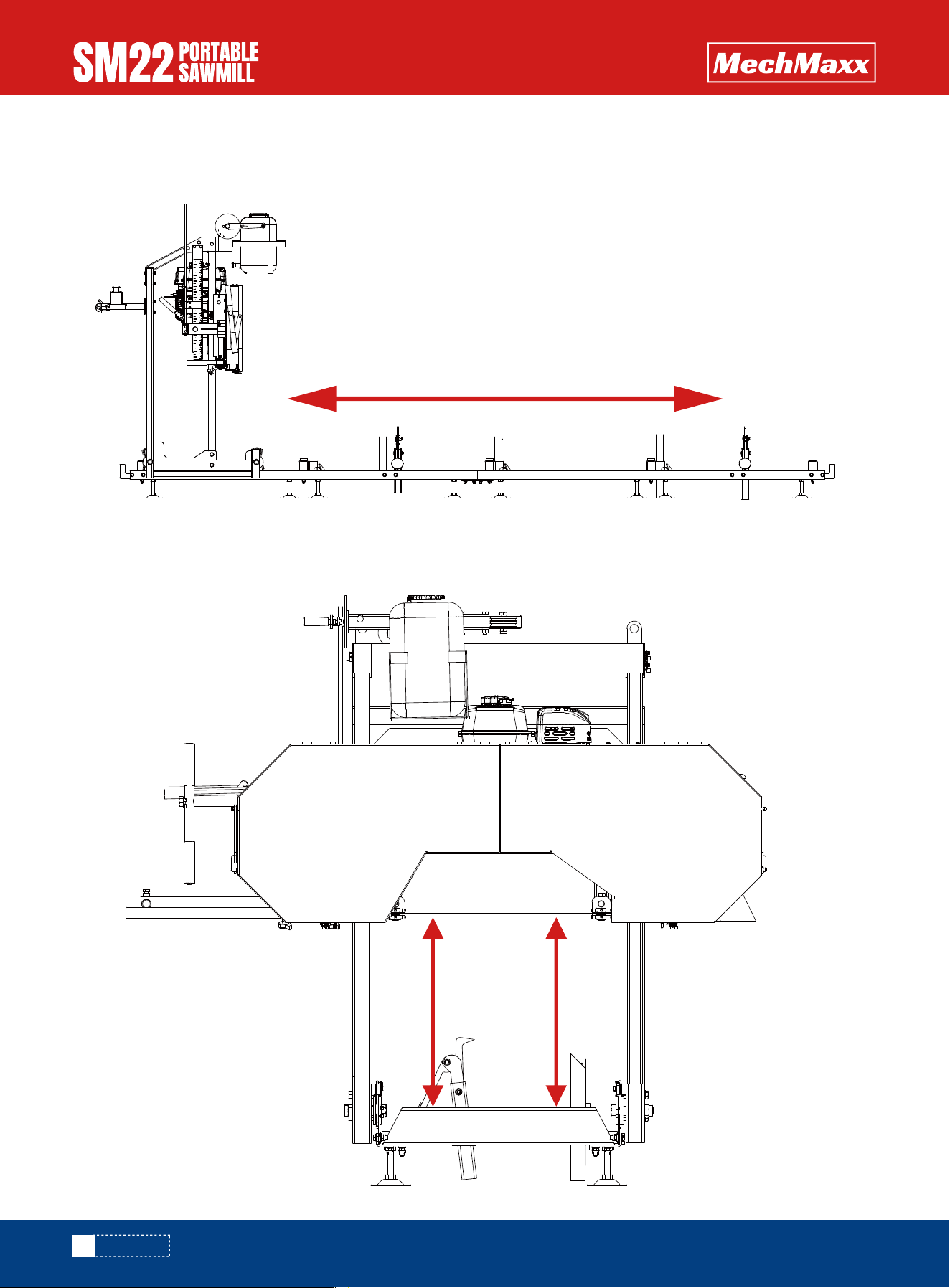
OVERALL DIMENSIONS
SPECIFICATIONS
1600mm
63”
1750mm
68.8”
4400mm
173.2”
559mm
22”
4
www.mechmaxx.com
SAFETY SIGNS
SAFETY SIGNS
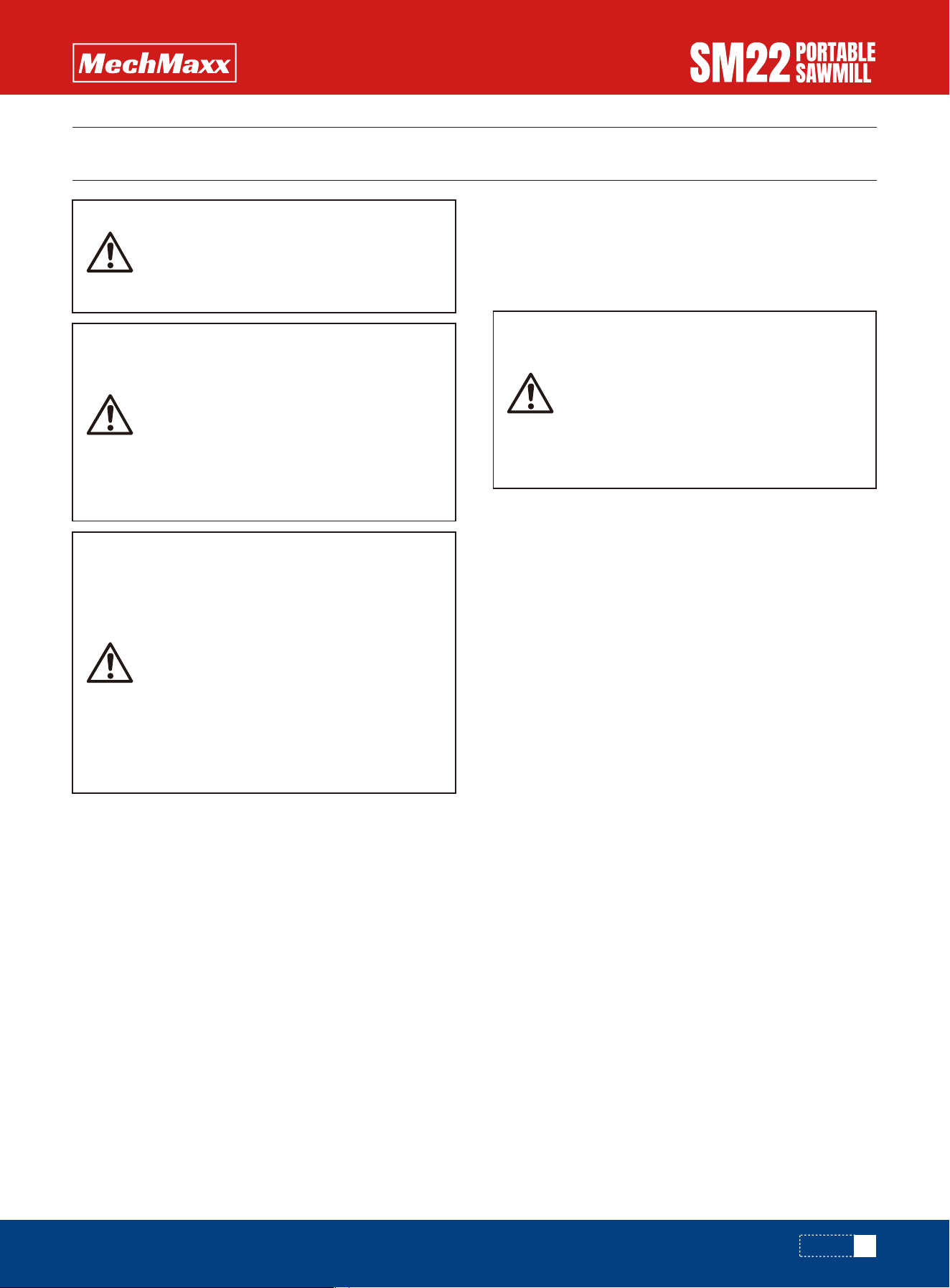
The rating plate on your machine may show symbols. These represent important information about the product or instruc-
tions on its use.
660mm
25.9”
5
www.mechmaxx.com
SAFETY
SAFETY
• Keep work area clean, free of clutter and well lit.
Cluttered and dark work areas can cause accidents.
• Do not use your sawmill where there is a risk of causing
a fire or an explosion; e.g. in the presence of flammable
liquids, gasses, or dust. Power tools create sparks
which may ignite the dust or fumes.
• Keep children and bystanders away while operating a
power tool. Distractions can cause you to lose control,
therefore, visitors should remain a safe distance from
the work area.
• Be aware of all power lines, electrical circuits, water
pipes and other mechanical hazards in your work area,
particularly hazards below the work surface that are
hidden from view from the operator’s view that may be
unintentionally contacted and cause personal harm or
property damage.
• DO NOT run the machine indoors or in an enclosed area
such as a deep trench unless adequate ventilation,
through such items as exhaust fans or hoses, is provid-
ed. Exhaust gas from the engine contains poisonous
carbon monoxide gas (CO); exposure to carbon monox-
ide can cause loss of consciousness and may lead to
death.
• DO NOT smoke while operating the machine.
• DO NOT smoke when refuelling the engine.
• DO NOT refuel a hot or running engine.
• DO NOT refuel the engine near an open flame.
• DO NOT spill fuel when refuelling the engine.
• DO NOT run the engine near an open flame.
• ALWAYS refill the fuel tank in a well-ventilated area.
• ALWAYS replace the fuel tank cap after refuelling.
• ALWAYS check the fuel lines and the fuel tank for leaks
and cracks before starting the engine. Do not run the
machine if fuel leaks are present or the fuel lines are
loose.
• ALWAYS avoid contact with hot fuel, oil, and exhaust
fumes.
• Stay alert, watch what you are doing and exercise good
judgment when operating a power tool. Do not use a
power tool when you are tired or under the influence of
drugs, alcohol, or medication. A moment of inattention
while operating power tools may result in serious
personal injury.
• Be alert of your surroundings. Using power tools in
confined work areas may put you dangerously close to
cutting tools and rotating parts.
Read and understand all instructions.
Failure to follow all instructions listed
below may result in electric shock, fire,
and/or serious injury.
The warnings, cautions, and instructions
discussed in this instruction manual
cannot cover all possible conditions or
situations that could occur. It must be
understood by the operator that common
sense and caution are factors which
cannot be built into this product but must
be supplied by the operator.
Internal combustion engines present
special hazards during operation and
fuelling. Read and follow the warning
instructions in the engine Owner’s Manual
and the safety guidelines below. Failure to
follow the warnings and safety standards
could result in severe injury or death.
Only operate the engine in a well ventilat-
ed area. Carbon Monoxide (CO) produced
by the engine during use can kill. Do not
use indoors, near windows, or in other
sheltered areas.
NOTE: All Federal and State laws and any
regulation having jurisdiction covering
the safety requirements for use of the
machine take precedence over the state-
ments in this manual. Users of this
machine must adhere to such regulations.
WORK AREA
INTERNAL COMBUSTION ENGINE SAFETY
PERSONAL SAFETY

6
www.mechmaxx.com
SAFETY
• Dress properly. Do not wear loose clothing, dangling
objects, or jewelry. Keep your hair, clothing, and gloves
away from moving parts. Loose clothes, jewelry, or long
hair can be caught in moving parts. Air vents often cover
moving parts and should be avoided.
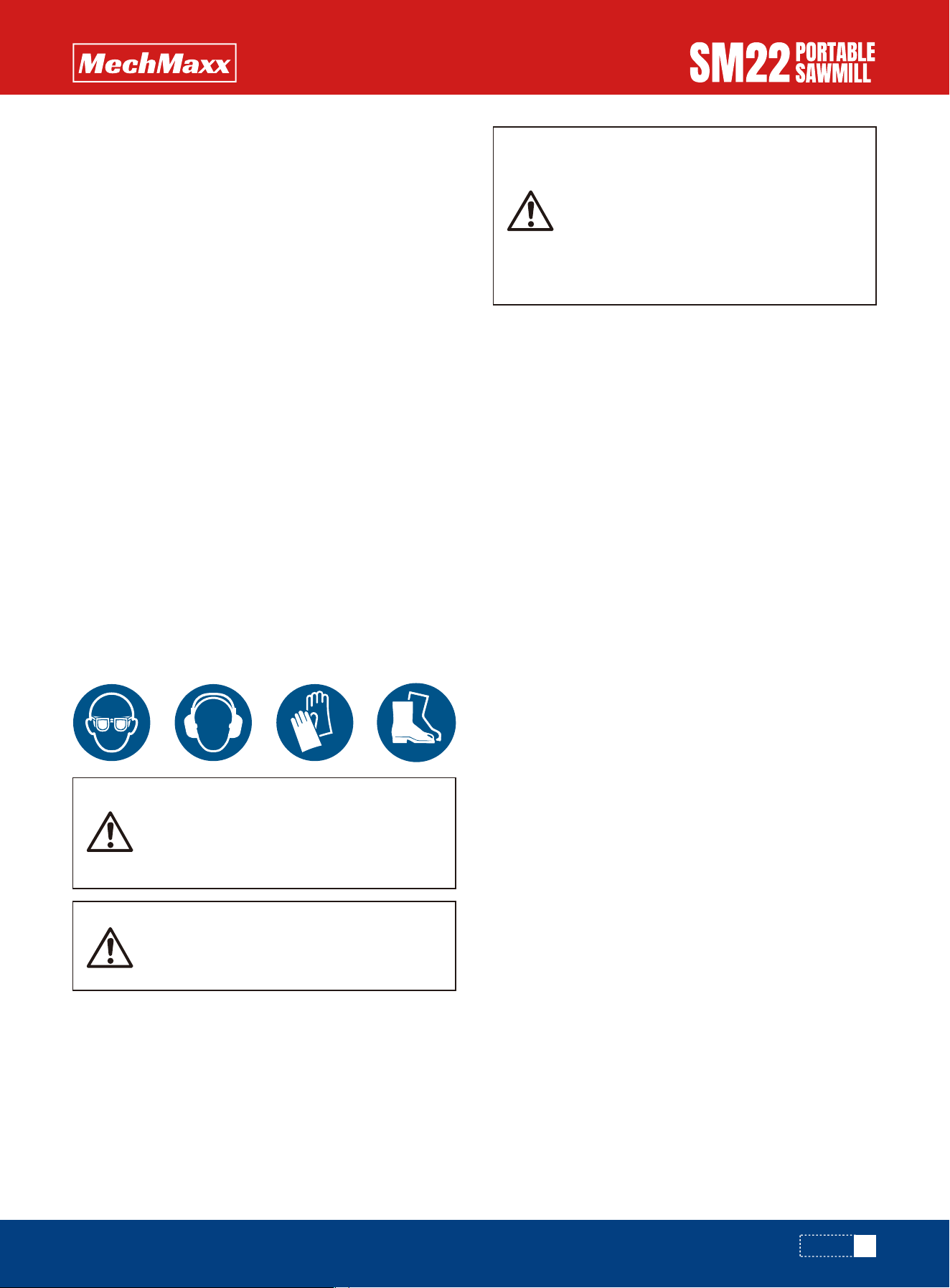
• Use safety apparel and equipment. Use safety goggles
or safety glasses with side shields which comply with
current national standards, or when needed, a face
shield. Use a dust mask in dusty work conditions. This
applies to all persons in the work area. Also use nonskid
safety shoes, hardhat, gloves, dust collection systems,
and hearing protection when appropriate.
• Do not overreach. Keep proper footing and balance at all
times.
• Remove adjusting keys or wrenches before connecting
to the power supply or turning on the tool. A wrench or
key that is left attached to a rotating part of the tool
may result in personal injury.
• Never make blade guide adjustments, remove or install
blades, or conduct any other maintenance or make any
other adjustments while the engine is running. Always
shut the engine off, remove the ignition key, and turn
the engine off before carrying out any of the aforemen-
tioned procedures. Consult your engine manual for safe
shutdown procedures to prevent accidental ignition.
• Always be sure the operator is familiar with proper
safety precautions and operation techniques before
using machine.
• Never touch the engine or muffler while the engine is on
or immediately after it has been turned off. These areas
get extremely hot and can cause burns.
• Always close the fuel valve on the engine when the
machine is not in use.
• Do not force the tool. Tools do a better and safer job
when used in the manner for which they are designed.
• Never use the sawmill with a malfunctioning switch or
throttle. Any power tool that cannot be controlled with
the switch is dangerous and must be repaired before
using.
• Turn off the engine and place the switch in the locked or
off position before servicing, adjusting, installing
accessories or attachments, or storing. Such preven-
tive safety measures reduce the risk of starting the
power tool accidentally.
• Secure logs with the log screw clamping device instead
of with your hand or another individual’s help. This
safety precaution allows for proper tool operation using
both hands.
• Storing sawmill. When the sawmill is not in use, store it
in a dry, secure place or keep well covered and out of
the reach of children. Inspect the sawmill for good
working condition prior to storage and before re-use.
• Maintain your sawmill. It is recommended that the
general condition of the sawmill be examined before it
is used. Keep your sawmill in good repair by adopting a
program of conscientious repair and maintenance in
accordance with the recommended procedures found in
this manual. If any abnormal vibrations or noise occurs,
turn the sawmill off immediately and have the problem
corrected before further use.
• Keep saw blades sharp and clean. Properly maintained
bandsaw blades are less likely to bind and are easier to
control.
• Cleaning and Lubrication. Use only soap and a damp
cloth to clean your sawmill. Many household cleaners
are harmful to plastic and rubber components on the
sawmill.
• Use only accessories that are recommended by the
manufacturer for your model. Accessories that may be
suitable for another sawmill may create a risk of injury
when used on the sawmill.
• Always operate machine with all safety devices and
guards in place and in working order. DO NOT modify or
make changes to safety devices. DO NOT operate
machine if any safety devices or guards are missing or
inoperative.
• Never leave sawmill running unattended.
• Coiled blades can spring apart with considerable force
and unpredictably in any direction. Always deal with
coiled blades, including those packaged in boxes, with
the utmost care.
• Never use the equipment to cut anything other than
lumber or for any purpose other than cutting lumber as
described in this manual.
TOOL USE AND CARE
7
www.mechmaxx.com
SAFETY
1. Wear heavy-duty work gloves, ANSI-approved goggles
behind a full face shield, steel-toed work boots, and a
dust mask.
2. Operate only with assistance.
3. Ensure guide blocks are tight and track is level.
4. Fill the lubrication tank with clean water and dish soap.
5. Start and operate the engine.
6. Cut branches off the lumber to be processed.
7. WARNING: To avoid death or serious injury, Do not cut
lumber with foreign objects in it such as nails, any metal
pieces, etc.
8. Place the lumber to be cut on the supports.
9. WARNING: The operator and any assistants must stay
clear of the front and back of the blade whenever the
engine is ON.
10. Move the saw head slowly along the track and against
the lumber to make the cut.
11. Trim off the rounded sides of the log.
12. When the log is squared-off, boards or posts can be
cut to custom specifications.
Proper and routine maintenance is critical to operator
safety, achieving good milling results and to prolonging
the life of your investment.
1. Band wheel Bearings — Should be inspected before
use to ensure they are not worn. Bearings are sealed and
do not need to be greased.
2. Blade Guide Bearings — Inspect before use for exces-
sive grooves or scoring in the bearing case. Replace if
necessary.
3. Blade Tension — Grease threads of tensioning “T”
handle when dry or as required. Use multi-purpose,
extreme-pressure grease.
4. Log Screws — Grease frequently.
5. Belts — Periodically check the condition and wear of
the drive and idler belt. Ensure that the blade does not
ride on the band-wheels.
6. Drive Belt — Periodically check the tension of the drive
belt. It should deflect by no more than 1/2".
7. Saw-Head Locking Cam Handles — Grease assembly
every 30 days or as required.
8. Saw-Head Vertical Posts — Spray posts before use
with a silicone spray lubricant such as 3- in-1 or
Jig-A-Loo.
9. Band-Wheel Guards — Routinely remove any build-up of
sawdust that may collect inside the bandwheel guards.
10. Lubrication Tank — Only fill with a water/dish soap
mixture (one to two caps) or in winter months, use wind-
shield washer fluid. Do not leave lubricant in tank if
temperatures fall below 0 degrees Celsius.
11. Blade Lubricant — Never use diesel fuel or kerosene
as blade lubricant. These substances lead to premature
wear of your belts and poor sawing performance. For
winter operations, replace the water lubricant with wind-
shield washer fluid.
To avoid death or serious injury, do not
cut lumber containing embedded foreign
objects such as nails, metal fragments,
etc.
The operator and any assistants must stay
clear of the front and back of the blade
whenever the engine is on.
Check the oil level before each use.
Change the engine oil if it is above the
maximum level. There is a risk of contam-
ination due to the short-cycle operations
common during milling where the oil may
not reach normal operating temperature
(212°F / 100°C).
EQUIPMENT OPERATION
MAINTENANCE
8
www.mechmaxx.com
SAFETY
12. Engine — Check the engine oil level before each use
and maintain the engine as per the instructions set out
by the engine manufacturer in the engine manual.
13. Sawhead Lifting Cables — Regularly before, during
and after operations, inspect the cables for any wear or
kinks. Ensure that the cables are in perfect condition. Oil
coiled part of cable often to prevent premature wear.
Replace with new cables as necessary.
Check the oil level before each use.
Change the engine oil if it is above the
maximum level. There is a risk of
contamination due to the short-cycle
operations common during milling where
the oil may not reach normal operating
temperature (212°F / 100°C).
ASSEMBLY
ASSEMBLY
During several of the assembly steps, more than one socket or wrench of the same size may be required to assemble the
hardware. A socket or box wrench in combination with an adjustable wrench can be utilized if multiple same size tools
are in limited supply.
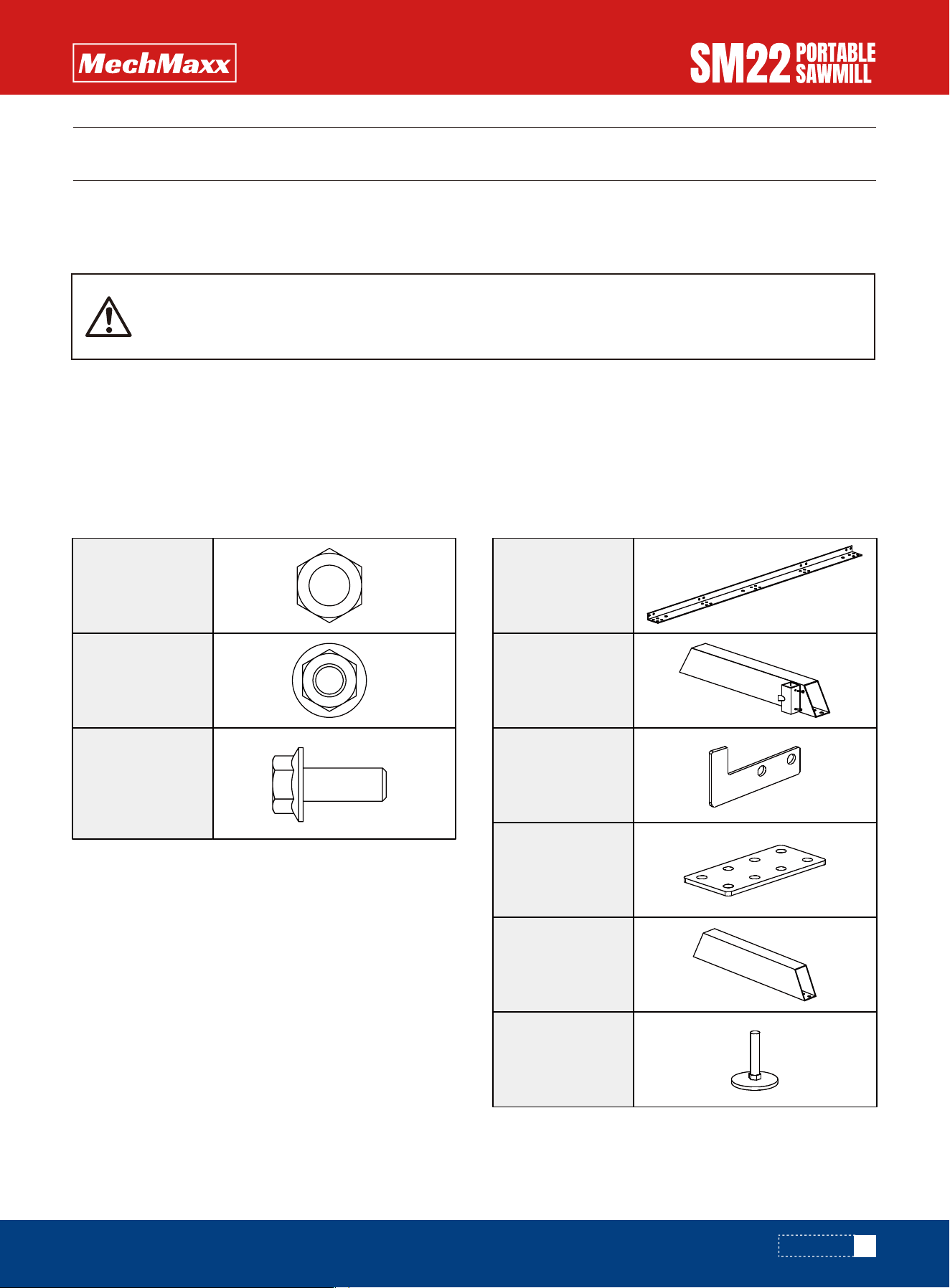
Assemble the track with the provided components and hardware listed in the table below. It is important to assemble and
level the track on a firm foundation before tightening all of the hardware and should ideally be 3.5 - 4 in [90 - 100 mm] off
the ground. This will allow for easy cleanup of sawdust and log support height adjustments.
When assembling the sawmill, do not torque bolts to standard hardware grade specifications. Snug
the hardware, then tighten a further ¼—½ turn. Tightening bolts to torque spec can crush metal
tubing, ruining the components.
Assemble one of the bunk assemblies over the joint between both pairs of track rails using the components and hardware
listed in the table below.
9
www.mechmaxx.com
Track Rail
4X
TRACK
Bunk
Assembly
3X
Limit Plate
4X
End Bunk
2X
Feet
12X
Reinforcement
Plate
2X
Hex Nut
M16
24X
Flanged Lock
Nut M10
48X
Flanged
Hex Bolt
M10 X 30 mm
48X
10
www.mechmaxx.com
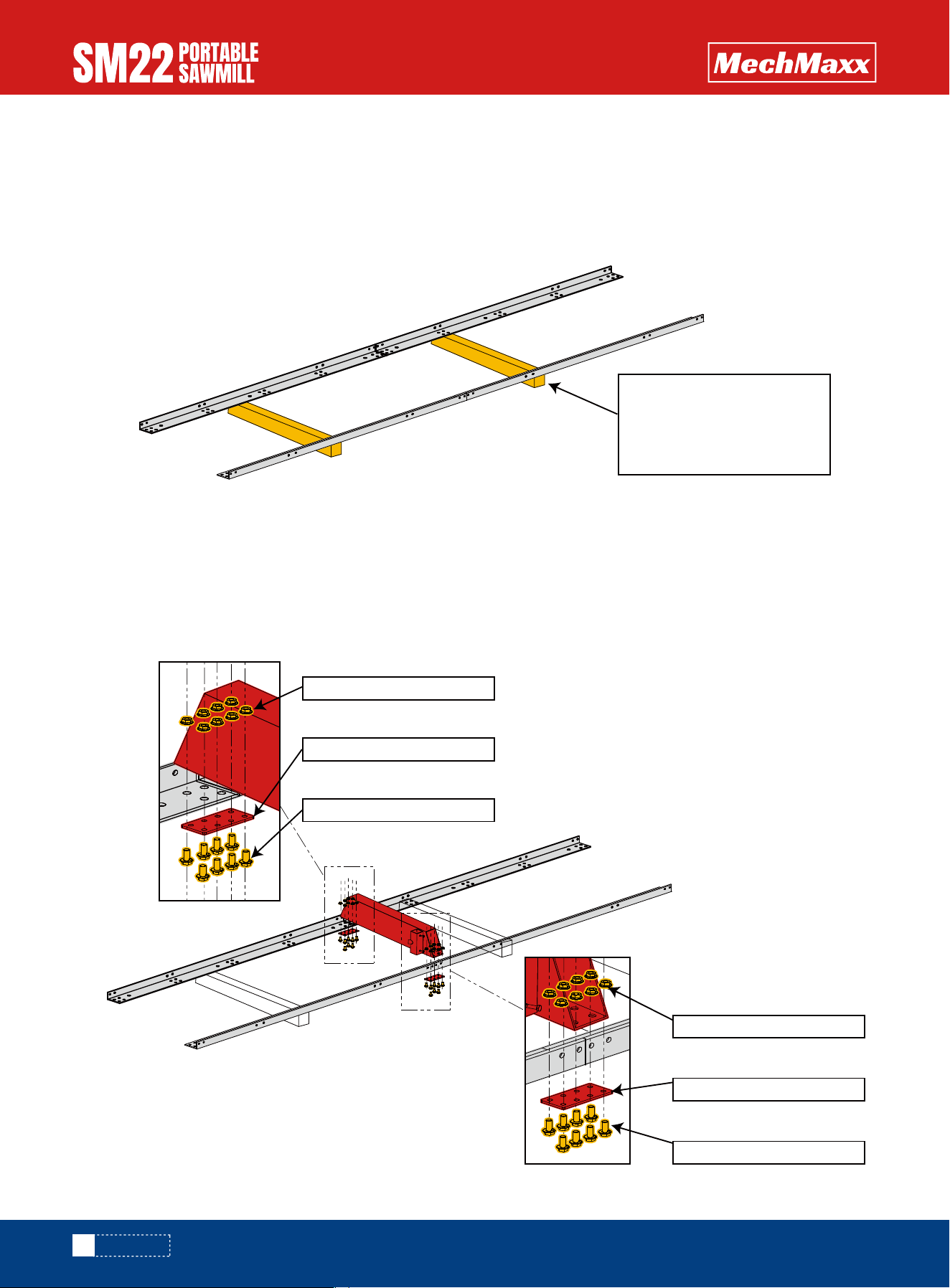
First, set the four (4) track rails on top of four pieces of lumber of equal height. It is ideal to keep the rails at least 4-6 in
[100-150 mm] off the ground for ease of assembly.
Next, place the bunk assembly over the rail joints. Position a reinforcement plate under the rails on both the left and right
sides. Use eight M10 X 30 mm flanged hex bolts and M10 flanged lock nuts per side.
Keep the outer faces of the rails 2 ft 2 in apart but do not fully tighten the hardware. Snug the bolts enough so that minor
adjustments to the track width can be made once all the bunks are assembled to the rails.
Build track up off the ground
on large timbers or blocks for
ease of assembly, preferably
4-6 in [100-150 mm] tall
ASSEMBLY
RAILS & CENTER BUNK
Reinforcement Plate
Flanged Hex Bolt M10 X 30 mm
Flanged Lock Nut M10
Reinforcement Plate
Flanged Hex Bolt M10 X 30 mm
Flanged Lock Nut M10
11
www.mechmaxx.com
MID & END BUNKS
SQUARING THE TRACK AND SETTING THE WIDTH
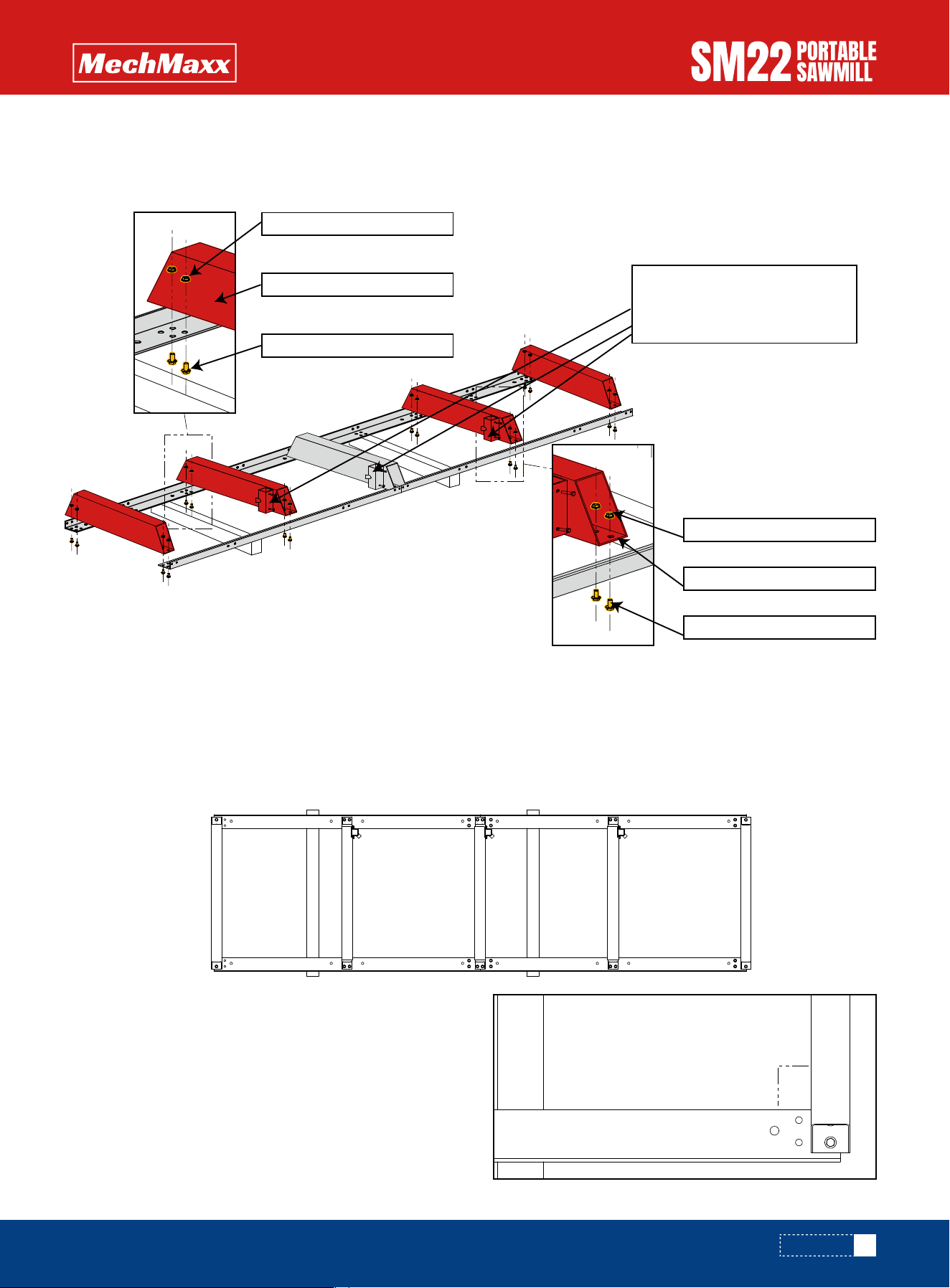
Use M10 X 30 mm flanged hex bolts and M10 flanged lock nuts at all end and mid bunk locations. Snug the hardware in
the same manner as the center bunk.
With the bunk hardware connections only snug-tight, the rails can be moved in or out as needed until the proper width is
achieved along the entire length of the track.
Once the width is correct and the rails are square, tighten
all M10 x 30 mm flange hex bolts and their nuts, working
from the center toward the end, as shown above with the
black arrow. Check the width and square of the track
again after tightening. Readjust if necessary.
Ensure the end bunks are square to the rails.
END BUNKS SQUARE TO RAILS
When the width is uniform along the full length of the track, check its square by measuring diagonally from one corner to
the diagonally opposite corner of the track frame.
Flanged Hex Bolt M10 X 30 mm
Flanged Lock Nut M10
Bunk Assembly
Flanged Hex Bolt M10 X 30 mm
Flanged Lock Nut M10
Bunk Assembly
Ensure bunks are oriented so
that the log support sleeves
are all on the same side
90°
ASSEMBLY
12
www.mechmaxx.com
FEET
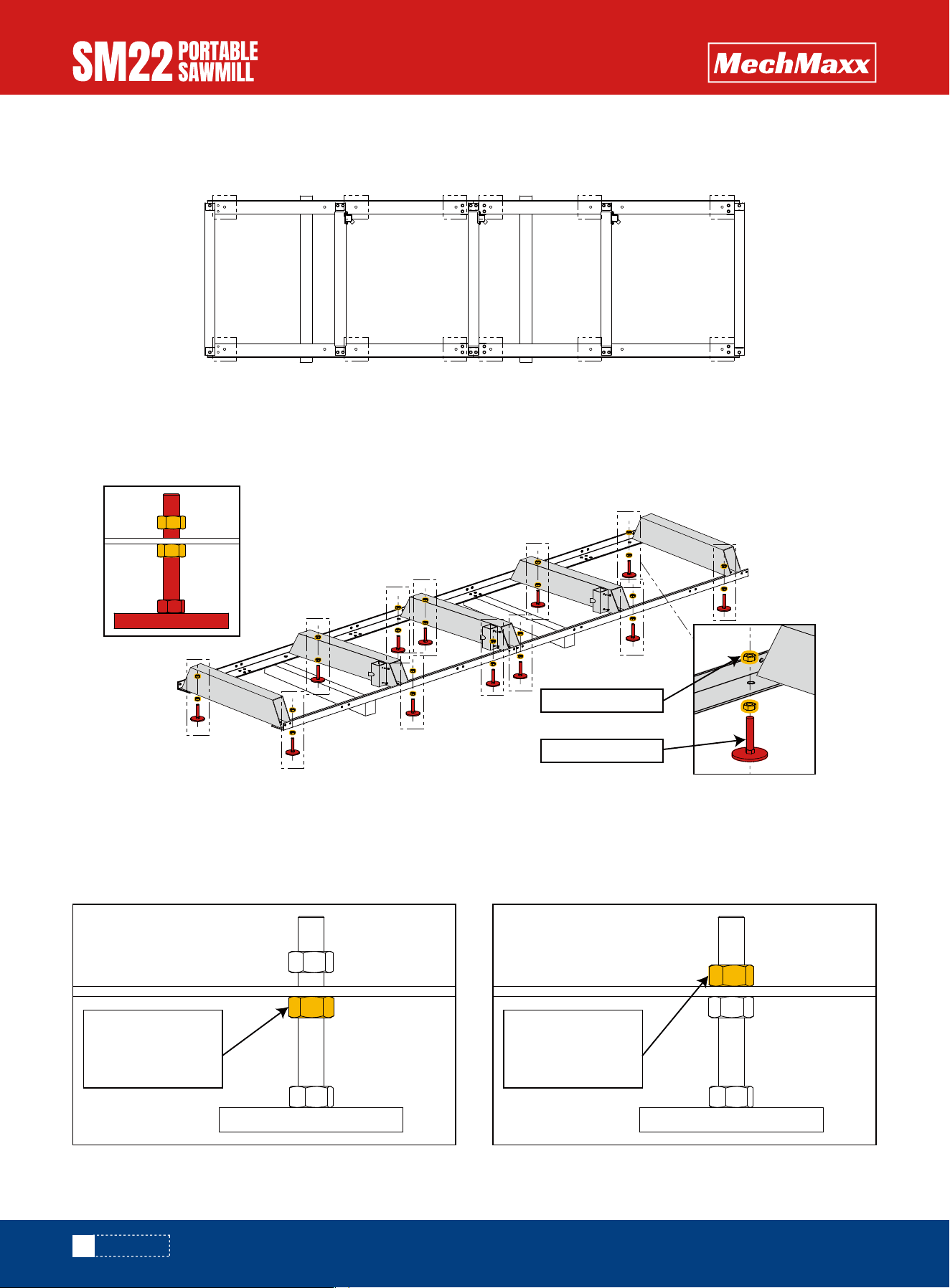
Attach the (12) leveling feet assemblies to the rails at the locations shown below.
Assemble the leveling feet up through the bottom of the guide rail and thread the M16 hex nut to each foot. Do not tighten
the nut. Leave it loose enough so that there is a noticeable gap between the nut and the track to allow the track to be
leveled in later steps.
With the feet loosely assembled to the rails, remove the timber/block supports so the full weight of the track is resting
on the lower nuts of the leveling feet.
Turn the lower nut on each foot to fine-tune the level. Once level, secure each foot to the rail by tightening the M16 top
nut.
Adjust the level of
each foot by turning
the middle nut
Secure each foot
by tightening the
top nut to the rail
Feet
Hex Nut M16
ASSEMBLY
13
www.mechmaxx.com
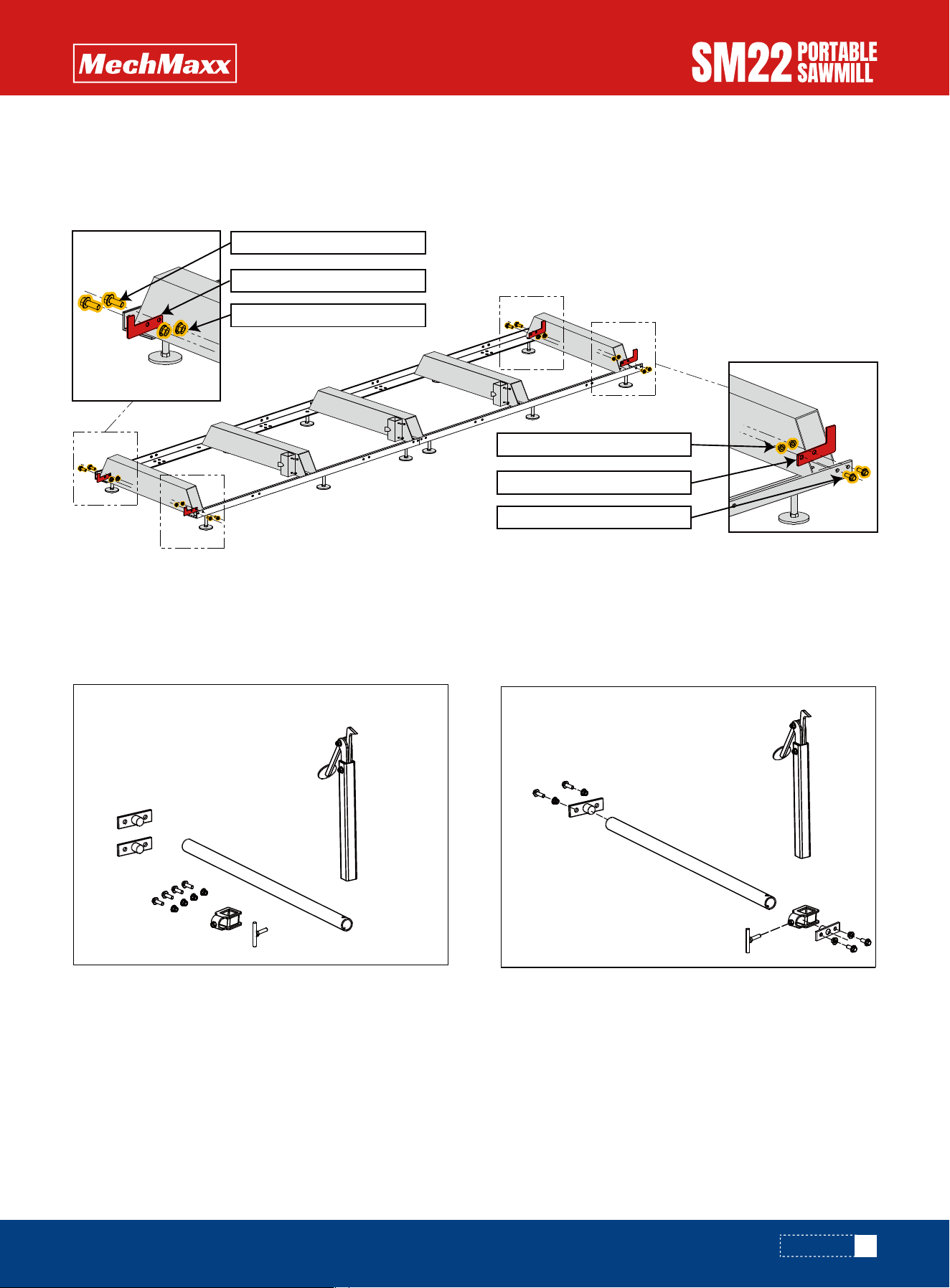
Use two (2) M10 X 30 mm flanged hex bolts and M10 flanged lock nuts to assemble each carriage stop to the inside of
the track rails.
Use two (2) M10 X 30 mm flanged hex bolts and M10 flanged lock nuts to assemble each carriage stop to the inside of
the track rails.
LIMIT PLATE
Assemble log clamps pieces as shown below and use waterproof grease on threaded handle and “T” handle.
Attach assembly to the track using the provided nuts and bolts and tighten. Attach log clamps assembly to track as
shown below with the 4 nuts and bolts provided. Note that there are various locations along the track where this assem-
bly can be bolted. Depending on how many track sections are being used, select a log clamp position that will secure the
log firmly against the log supports.
LOG CLAMPS
Limit Plate
Flanged Lock Nut M10
Flanged Hex Bolt M10 X 30 mm
Limit Plate
Flanged Lock Nut M10
Flanged Hex Bolt M10 X 30 mm
ASSEMBLY
14
www.mechmaxx.com
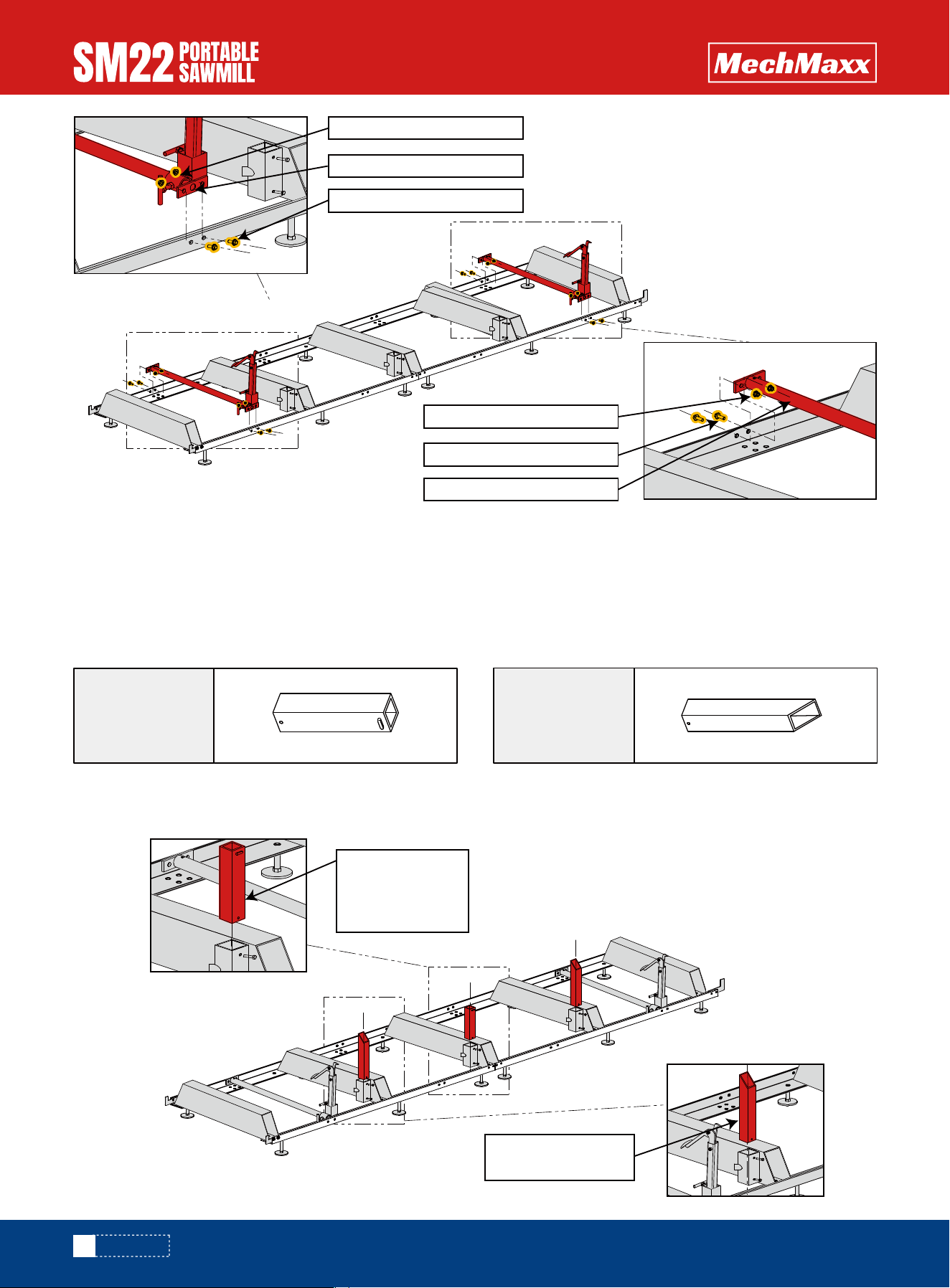
Ensure the log clamp tilts toward the log when clamping. If it tilts away from the log, remove the log clamp from the
receiver, loosen the T-bolt, reverse the receiver on the shaft by rotating it 180°, and retighten the T-bolt. Insert the log
clamp back into the receiver.
The log supports can be installed into any bunk with a sleeve by simply sliding them down through the top of the sleeve
and securing them with the T-bolt.
Assemble the log supports into the sleeves bolted to the log bunks using the components listed in the table below.
LOG SUPPORTS
Log Clamps
Flanged Lock Nut M10
Flanged Hex Bolt M10 X 30 mm
Log Clamps
Flanged Lock Nut M10
Flanged Hex Bolt M10 X 30 mm
2X
Vertical Long
Support
2X
Vertical Short
Support
Use the shorter key
stop log support for
milling smaller logs
and square cants
The longer supports
are ideal for larger logs
ASSEMBLY
15
www.mechmaxx.com
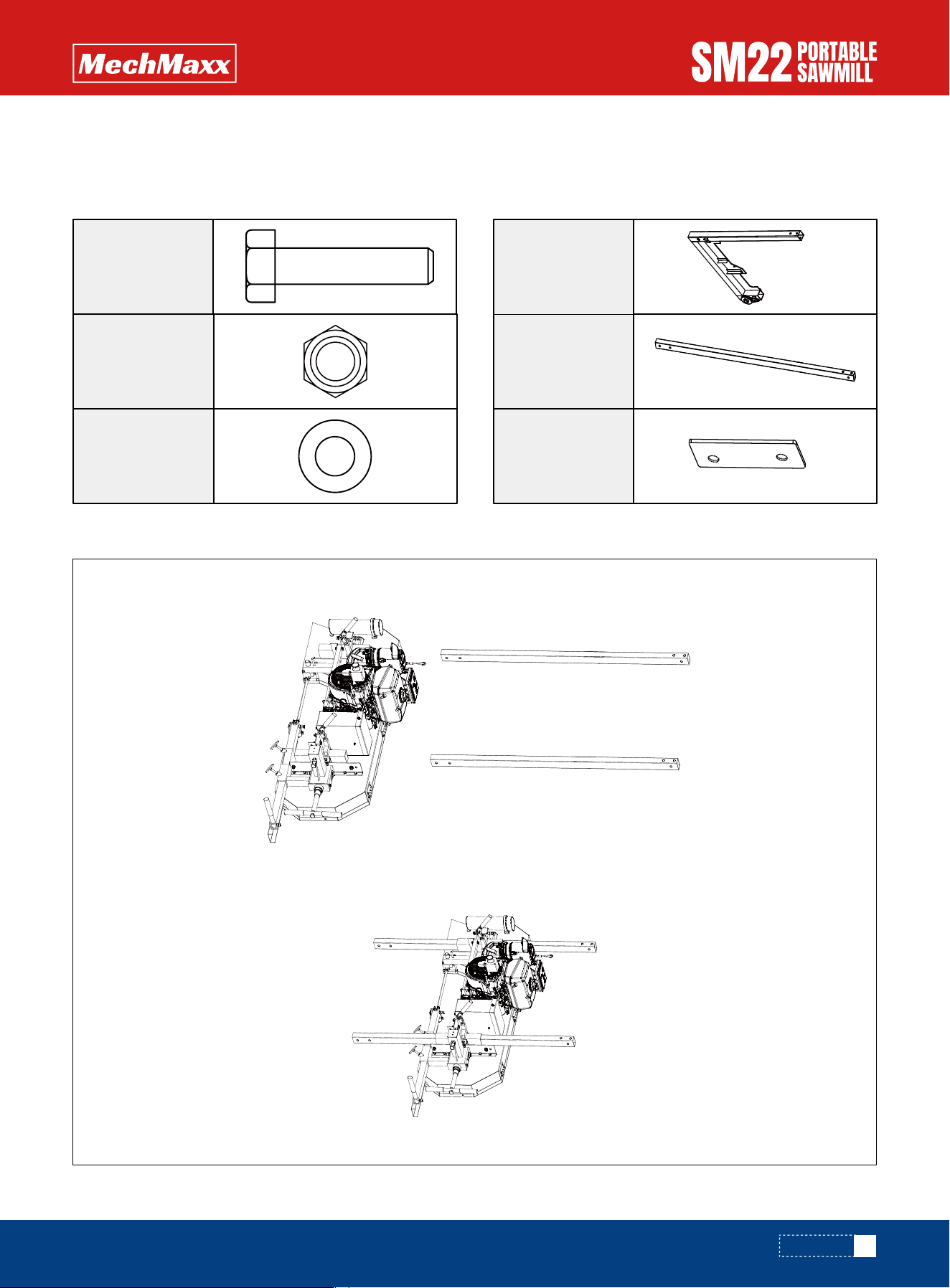
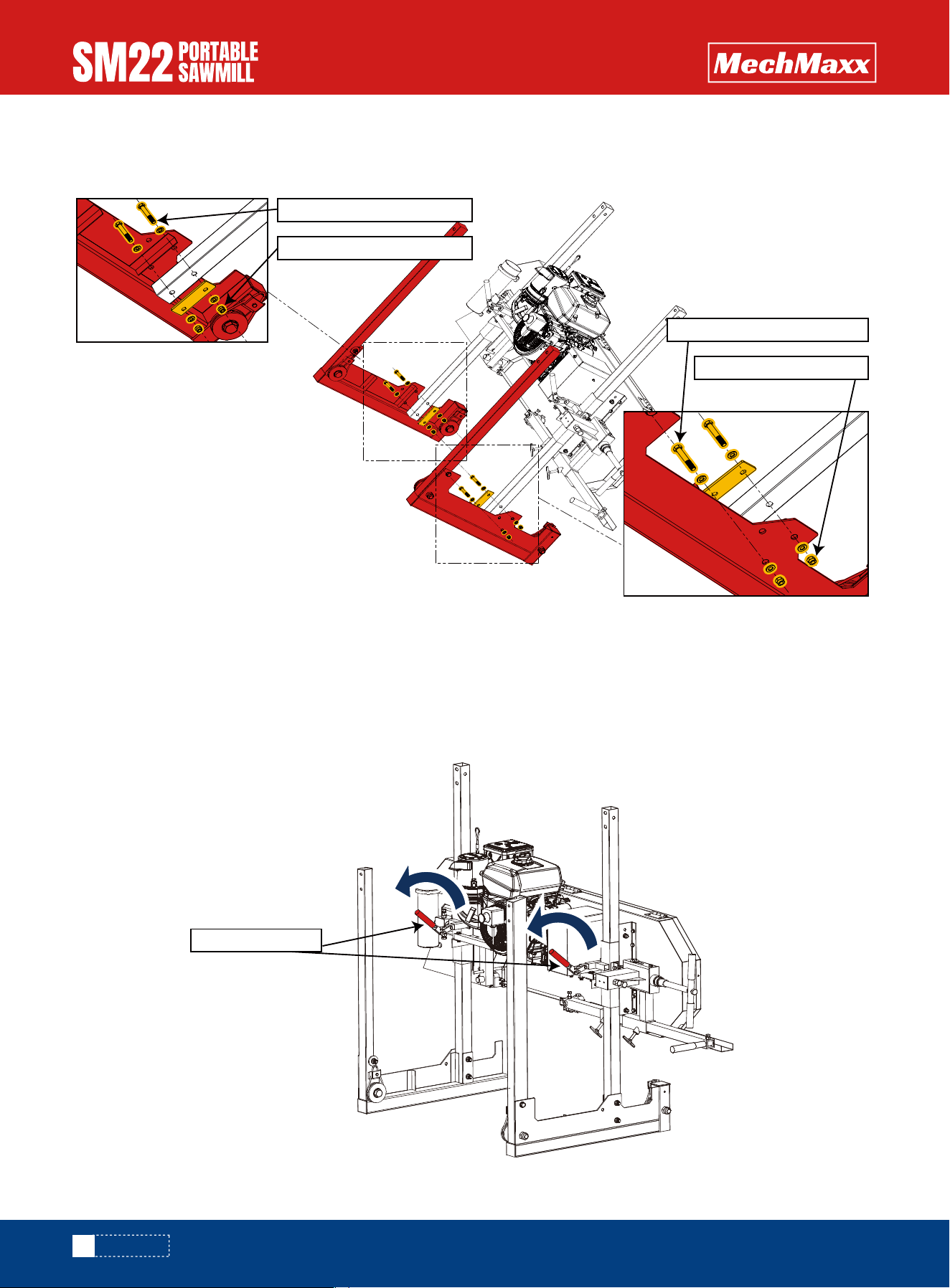
Then Insert vertical post assemblies into corresponding locations in head assembly.
ASSEMBLY
The sawmill head assembly is built in multiple steps. Follow the sub-sections below using the parts table at the top of
each sub-section to gather the necessary components for each step.
SAWMILL HEAD ASSEMBLY
Front Post
2X
Wheel
assembly
2X
Clamping
piece
2X
Hexagon
head bolt
M12x70
4X
Hexagon
self-locking
nut M12
4X
Flat washer
12
8X
16
www.mechmaxx.com
Lock the cam handles on both the square post to prevent the head from moving when it is stood up in the coming steps.
Ensure that when activating the cam handles, the clamps securely lock on the square vertical post.
ASSEMBLY
Quick Lock Handle
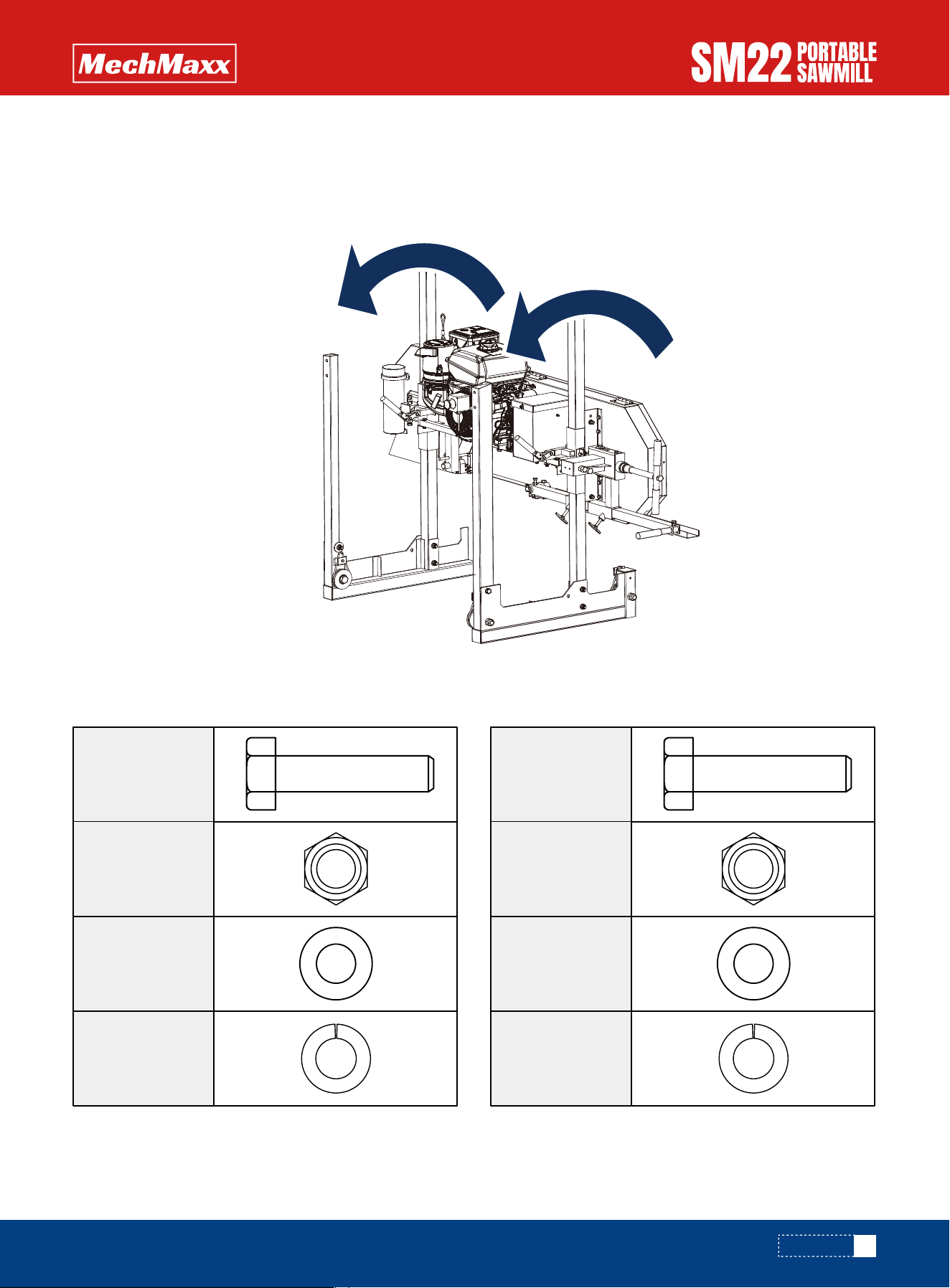
Assemble front vertical post to wheel assembly using the two bolts and back plate. Repeat same step for the other front
vertical post assembly.
Hexagon self-locking nut M12
Flanged Hex Bolt M12 X 70 mm
Hexagon self-locking nut M12
Flanged Hex Bolt M12 X 70 mm
17
www.mechmaxx.com
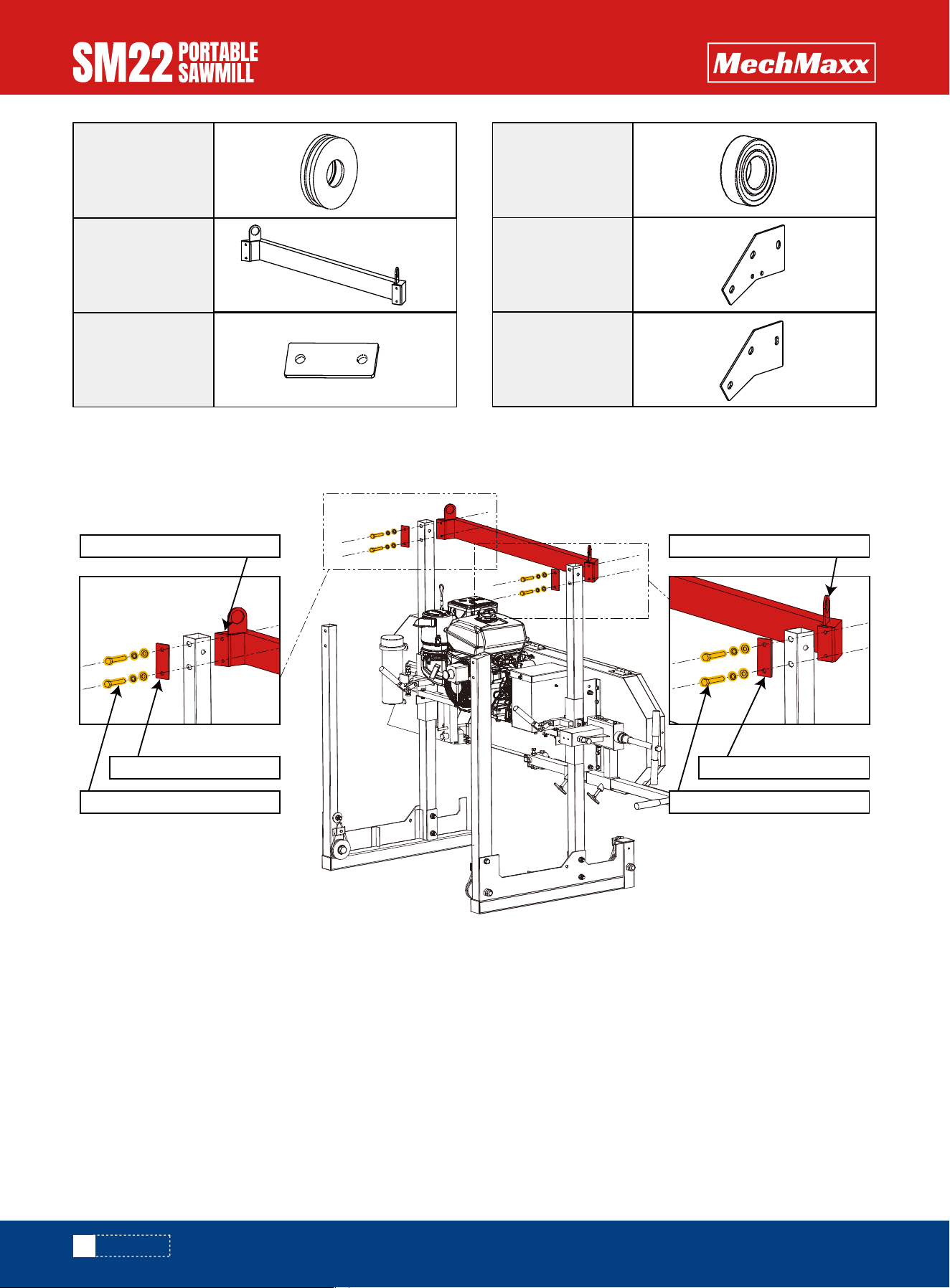
With the hardware listed below, assemble the cross beam to the carriage posts.
CROSS BEAM & HEAD STOPS
With the help of another person, stand the sawhead upright by rotating it around the rounded profiles at the front of the
carriage legs. Do not set the sawhead on the track until instructed to do so later in the assembly process.
STANDING THE SAWHEAD UPRIGHT
Hexagon
head bolt
M10X65
10X
ASSEMBLY
Hexagon
self-locking
nut M10
6X
Flat washer
10
16X
Spring washer
10
10X
Hexagon
head bolt
M8x60
4X
Hexagon
self-locking
nut M8
4X
Flat washer
8
8X
Spring washer
8
4X
18
www.mechmaxx.com
Clamping
plate
2X
Upper
crossbeam
1X
ASSEMBLY
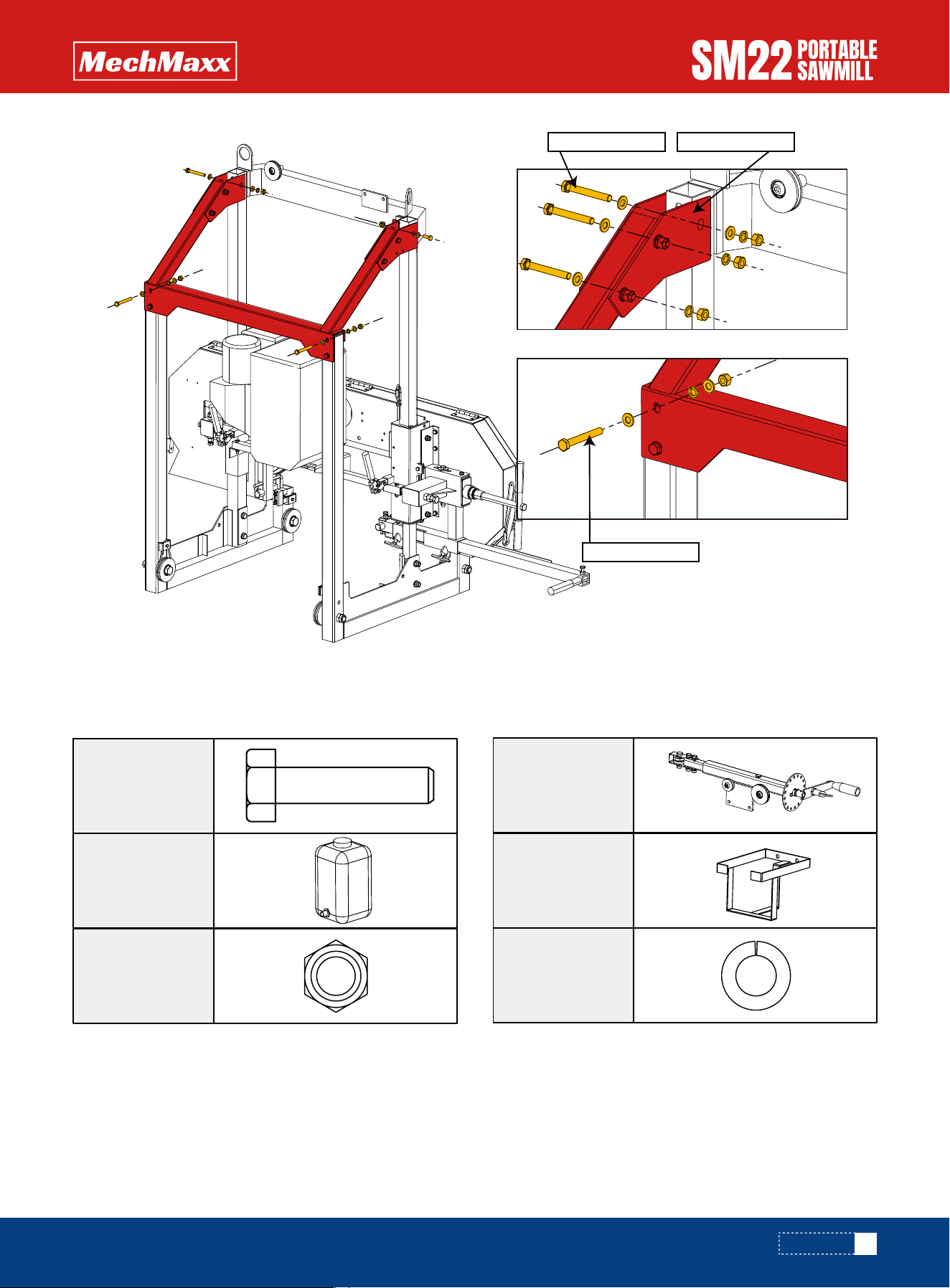
Slide the cross beam into the two square tube post. Bolt the top of the square tube post and the cross beam.
Install upper welding bracket, align the post holes with the corresponding black top cross support holes. Using a wrench
to hold the nut, tighten the bolt.
Flanged Hex Bolt M10X65 mm
Upper crossbeam
Connecting
plate
1X
Bottom wheel
2X
Bottom wheel
spacer
2X
Clamping plate
Upper crossbeam
Flanged Hex Bolt M10X65 mm
Clamping plate
Connecting
plate
3X
Install the connecting clamping plate, upper arch and steel cable roller. Using a wrench to hold the nut, tighten the bolt.
19
www.mechmaxx.com
LIFTING SYSTEM AND WATER TANK
ASSEMBLY
Use the hardware listed below.
Install the lifting system and cooling box bracket on the beam, using wrench to hold the nut, tighten the bolt. Then put
the water tank into the bracket.
1X
Bucket
Bucket frame
1X
Hexagon
head bolt
M10x75
2X
Hexagon nut
M10
4X
lifting system
1X
Spring washer
10
4X
Hex Bolt M8X60 mm
Hex Bolt M10X65 mm Connecting plate
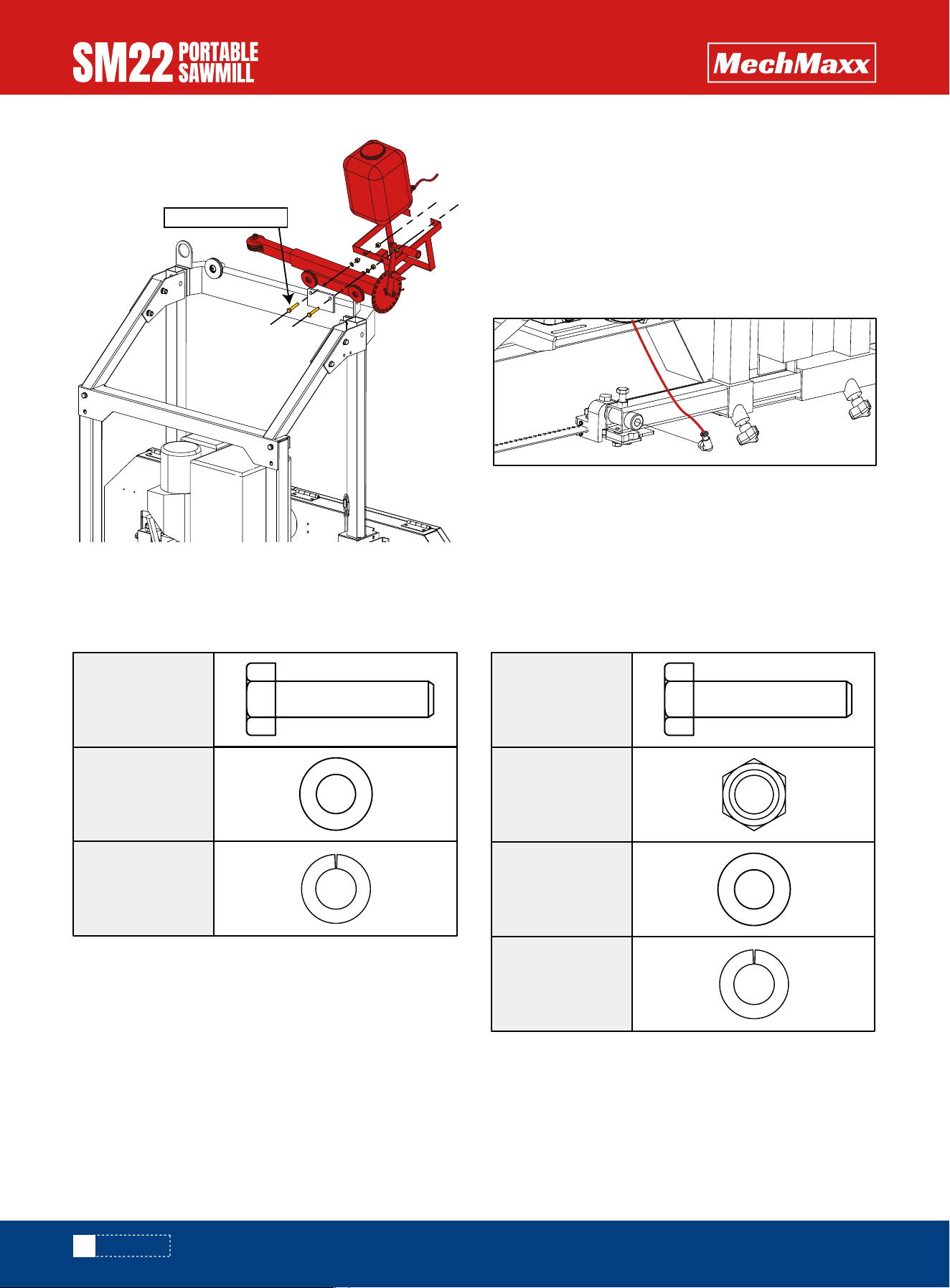
20
www.mechmaxx.com
ASSEMBLY
Flat washer
8
2X
LOG SCALE
Use the hardware listed below.
Place the measuring scale assembly, the assembly includes the ruler and height indicator.
a- Install the ruler, using wrench to hold the nut, tighten the bolt.
b- Install the square indicator rod to the sawmill using the two bolts and tighten. Slide the scale indicator over the square
rod and tighten.
Hexagon
head bolt
M8x14
2X
Hexagon
head bolt
M6x14
2X
Spring washer
8
2X
Flat washer
6
2X
Hexagon nut
M6
2X
Spring washer
6
2X
Hex Bolt M10X75 mm
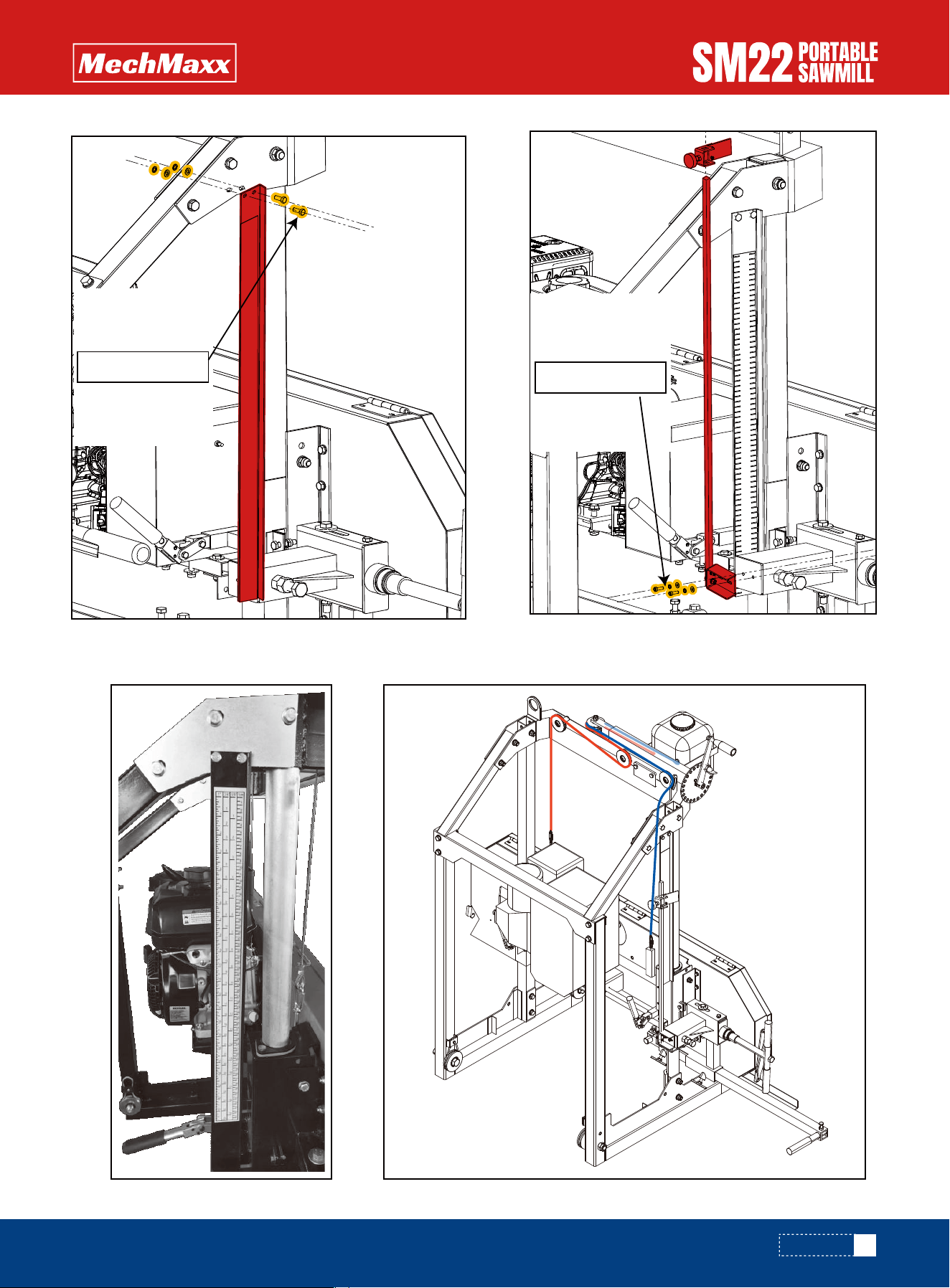
c-It is important to alternate tightening of the nuts (top then bottom) to ensure the black round clamp begins to
compress evenly on both the top and bottom until flanges meet at outer edge.
21
www.mechmaxx.com
ASSEMBLY
Hex Bolt M8X14 mm
Hex Bolt M6X14 mm
22
www.mechmaxx.com
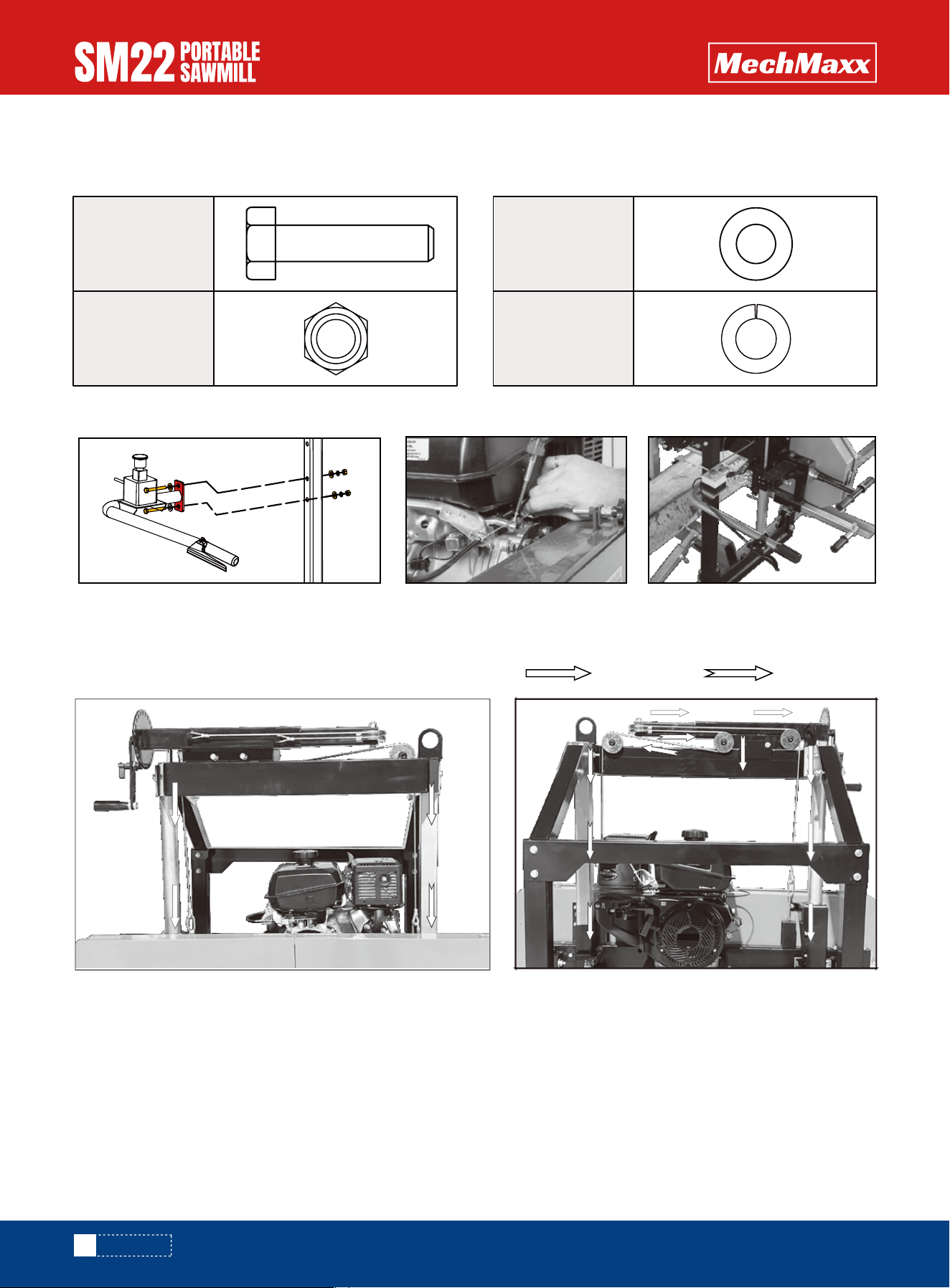
Assemble the throttle handle to the post using the hardware listed below.
Install throttle handle and emergency switch on square rod as shown.
The idler screw must be fully unscrewed; failure to do so may prevent the engine from reaching full RPMs.
THROTTLE HANDLE
Hexagon
head bolt
M10x60
2X
Hexagon nut
M10
2X
Flat washer
10
4X
Spring washer
10
2X
ASSEMBLY
Route the cables on both sides as shown in the image below.
Connect the water pipe. After the connection is completed, check to ensure that there is no water leakage at the joints.
down cable Long cable
LIFT CABLE ROUTING
TRANSPARENT WATER PIPE
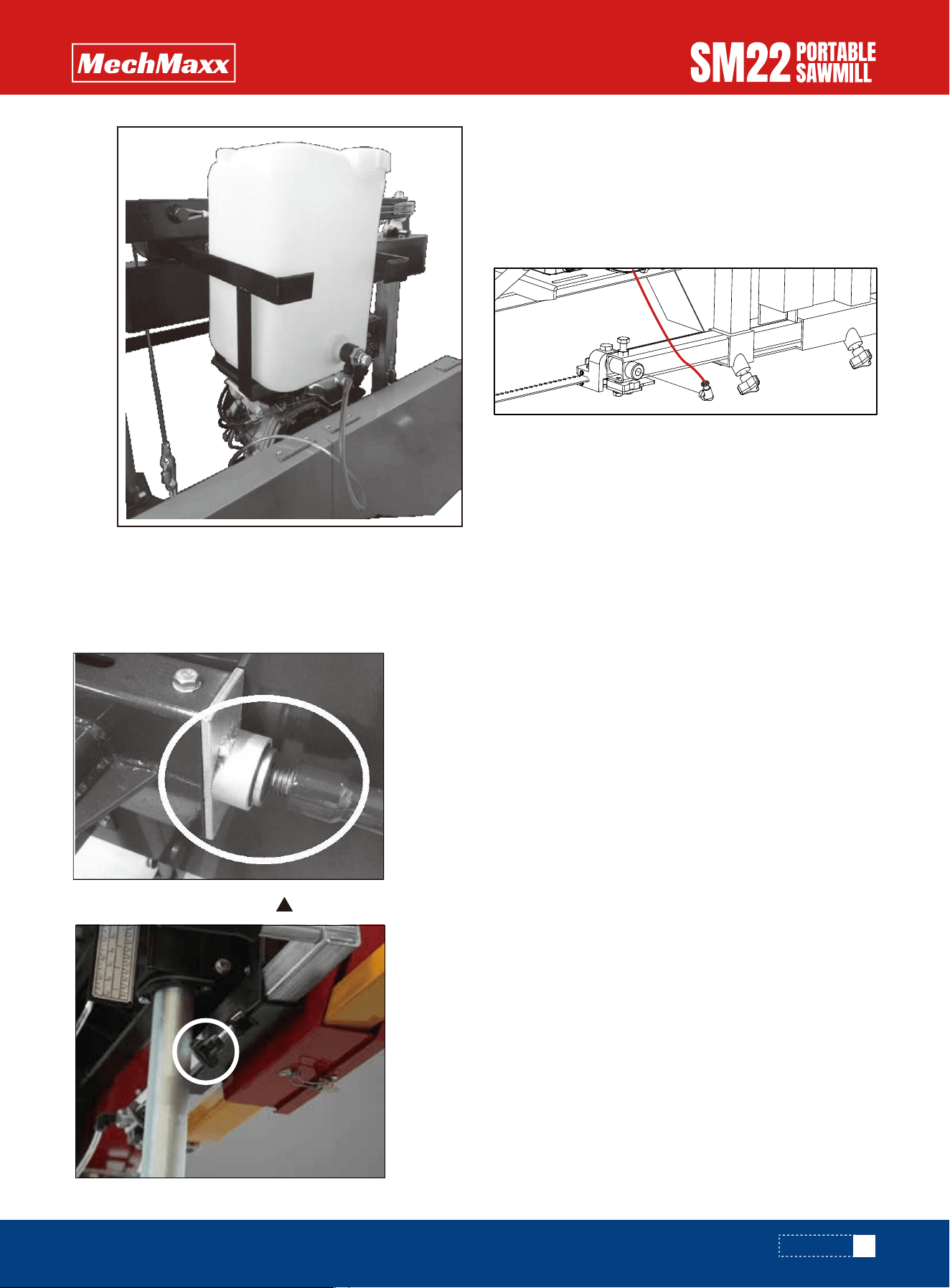
Please Note: We recommend adding some dish soap to the tank to help lubricate the wood—two to three capfuls.
23
www.mechmaxx.com
ASSEMBLY
Add waterproof grease to the threads of the blade tension “T” handle and to the washer face that it meets before use.
Proper blade tension is achieved when the blade deflects no more than a total of 1/8” to 1/4” up/down.
*Note – It is very important to take the tension off of the
blade by turning the “T” handle in the counter-clockwise
direction when the sawmill is not in use. Failure to do so
will result in flat spots on the rubber belts. These flat
spots will cause the mill to vibrate excessively during
next use.*
Add waterproof grease to all “ ” handle threads on the sawmill.
24
www.mechmaxx.com
ASSEMBLY
Push the saw head up and down the track system to ensure that the width of the track allows for the saw head to move
freely. If it binds, the guide rails will need to be set further or closer together to achieve a consistent width along the entire
track system. Once the desired width is achieved, all nuts and bolts can be tightened to the log bunks
Using a tape measure, take a measurement from the blade to the top of the log bunk on both the left and right side. The
distance should be equal on both sides. If it isn't, you will need to adjust the cable ends at the rear handle to either raise
or lower one side.
25
www.mechmaxx.com
ASSEMBLY
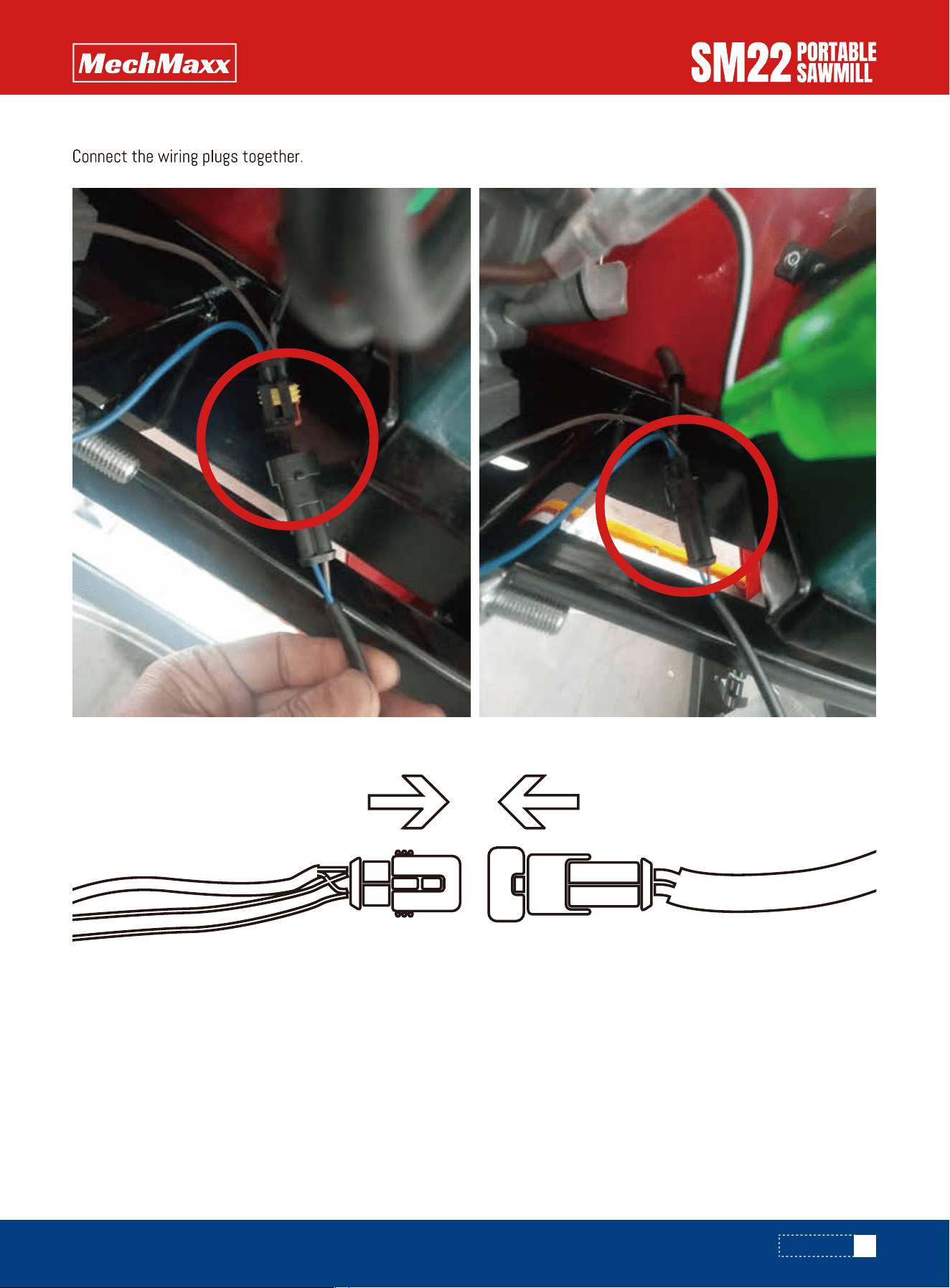
ELECTRIC WIRE CONNECT
26
www.mechmaxx.com
ASSEMBLY
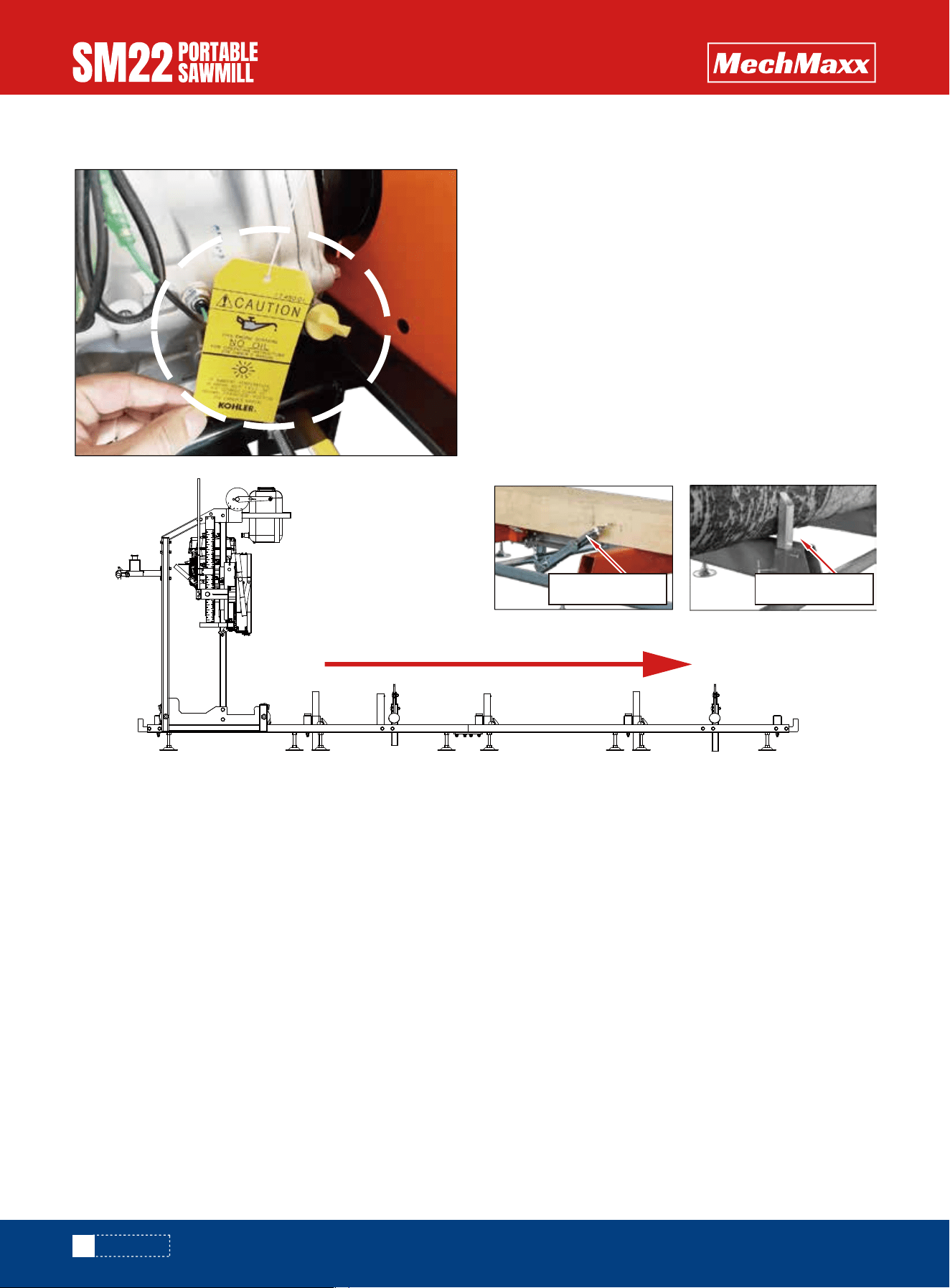
Refer to the engine manual before using your sawmill.
Please note that the engine does not contain any gasoline
or engine oil when it is shipped. Furthermore, the engine
is equipped with an oil alert system, meaning that if the
crankcase oil level is low or empty, the power is cut to
the spark plug and it will not start.
Always cut in the direction shown above. The log clamp should always be on the right side of the log and the log supports
should always be on the left. Failure to cut in this direction can cause the log to come loose and possibly even cause
damage or injury.
*Now that your sawmill is assembled, please run through the “SAWMILL SET-UPPROCEDURES” in the following section.
Failure to do so may result in poor sawing performance, damage or injury. See next page.*
ENGINE
Log Clamp Log Supports
27
www.mechmaxx.com
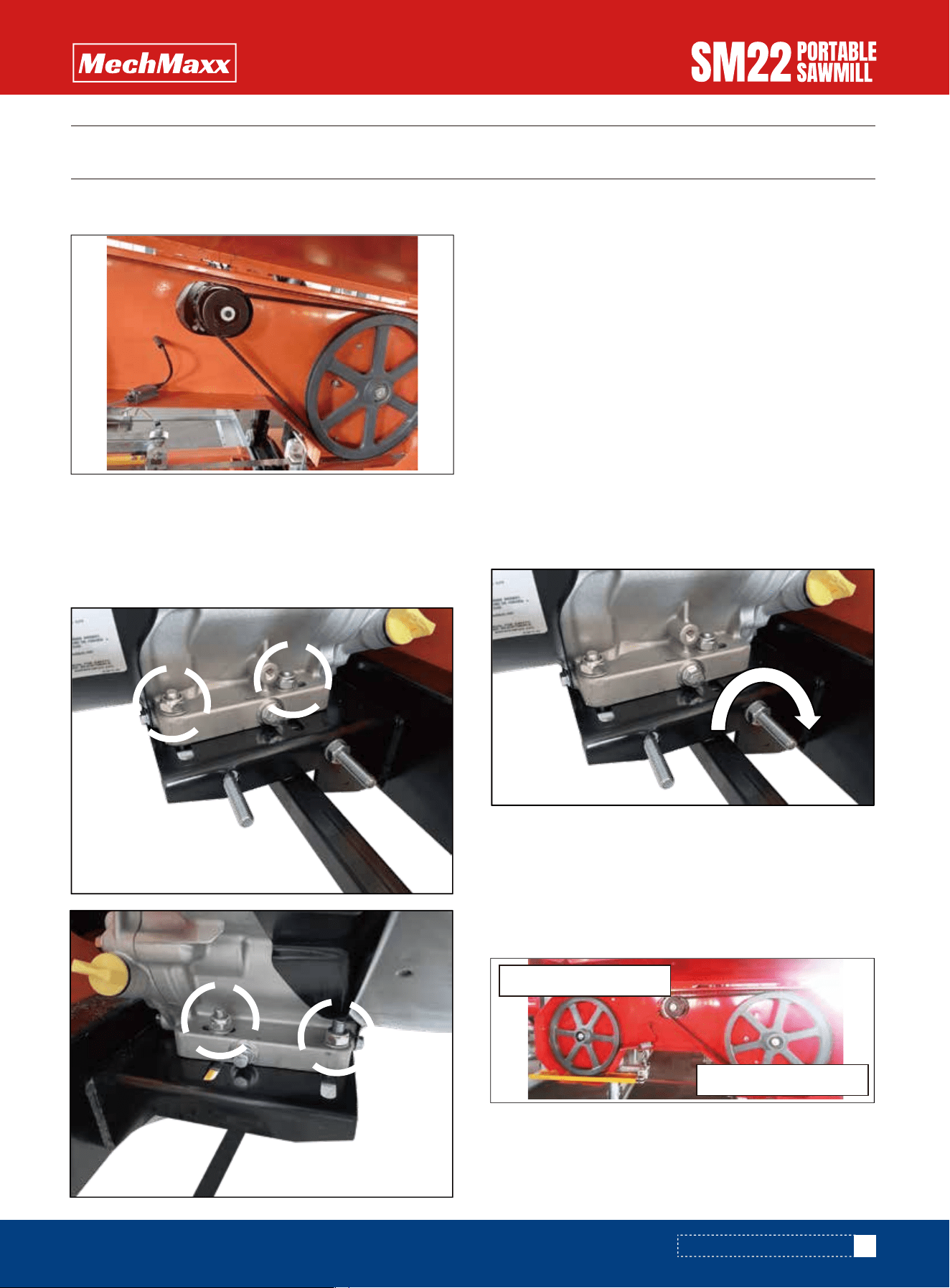
To check the belt tension, with your hand, firmly try to
deflect the belt up and down. There should be no more
than 1/4” of deflection in both directions (1/2” total). If
the belt deflects more than this, it will need to be tight-
ened as described below.
To tighten the drive belt, start by loosening the four bolts
that secure the engine to the engine mount using a
16mm wrench.
Now that the engine is free to slide on the engine mount-
ing plate, turn the 16mm nut on the horizontal stud in the
clockwise direction. This will pull the engine towards the
stud and apply more tension on the belt. Do this step
incrementally while checking the belt for proper deflec-
tion. It is also important to ensure that the engine
remains perpendicular to the drive belt. Over tightening
can cause the engine to twist on the mounting plate,
resulting in belt alignment issues and premature wear.
Once the desired belt tension is set, tighten the four
engine bolts. Alternatively, if the drive belt is too tight,
the 16mm nut on the horizontal stud can be turned count-
er-clockwise.
Never attempt the below with the engine running. As a
safety precaution, remove the spark plug cap. It is also
advised
to wear gloves and safety glasses when working
with the blade as it is extremely sharp.
BELT TENSION
BLADE TRACKING
SAWMILL SET-UP PROCEDURES
SAWMILL SET-UP PROCEDURES
Right Side of Sawmill
Left Side of Sawmill
28
www.mechmaxx.com
ADJUSTING THE RIGHT HAND SIDE
Saw Blade
Forward Direction
3/8”
Rearward Direction
Belt Pulley
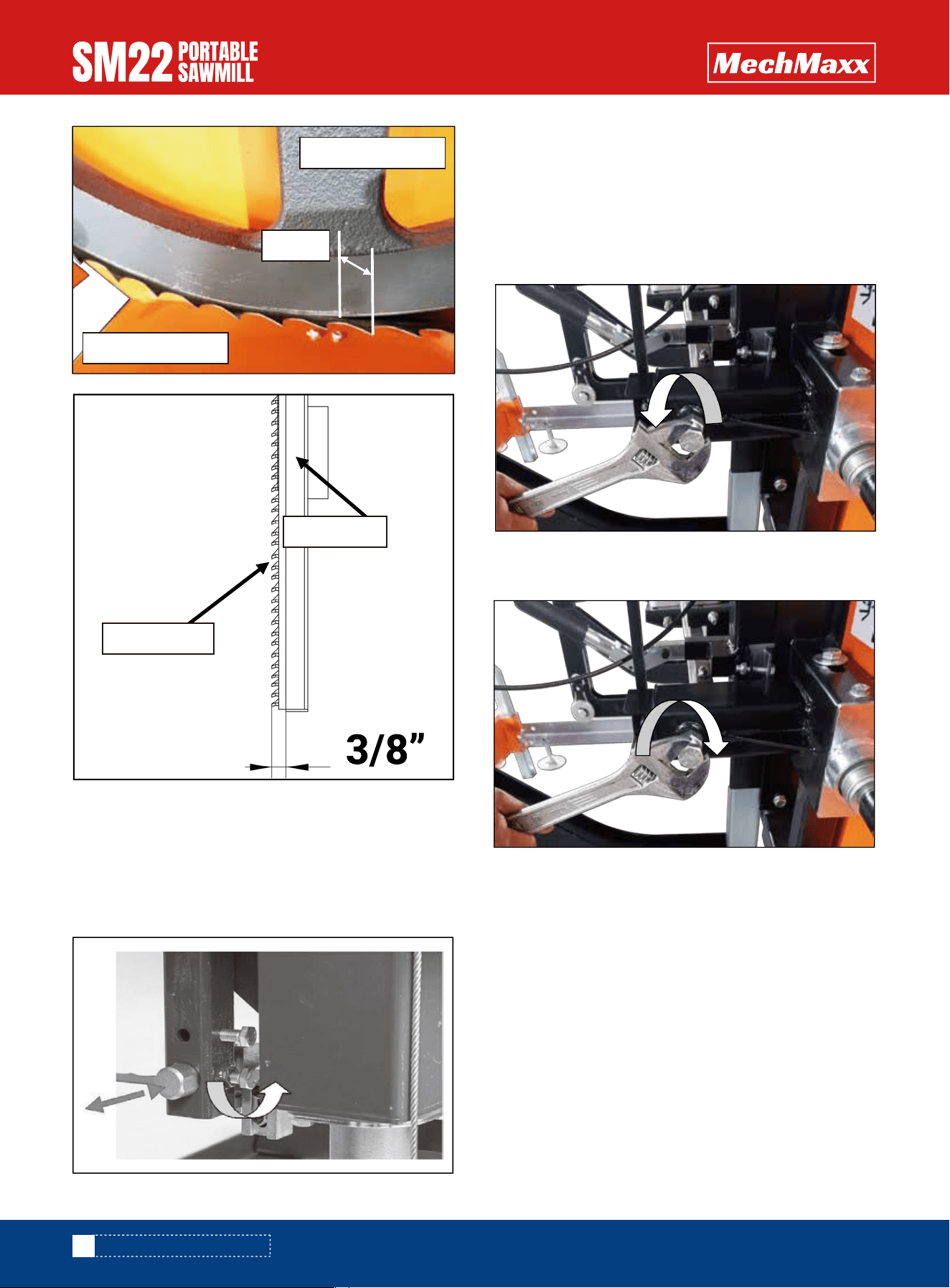
The distance from the blade teeth to the front face of the
bandwheel should be the same on both sides. An ideal
distance is 3/8 inch. Measure the distance from the tip of
the blade tooth to the front face of the bandwheel on both
sides. If an adjustment on either side is required, the
below steps will detail this procedure.
The alignment bolt can now be turned to change the angle
of the bandwheel and track the blade. To move the blade
more rearward on the bandwheel, this bolt will need to be
turned clockwise. Alternatively, turning the bolt in the
counter-clockwise direction would force the blade to run
more forward on the bandwheel. Turn the bolt a 1/2 turn
and re-tension the blade.
Loosen the blade guide assembly bolt with a socket. The
round shaft should now be free to slide rearward and out
of the way. Perform this step on both guide assemblies.
This will ensure that the guide bearings do not influence
tracking of the blade while adjusting.
Loosen the tracking alignment locking nut with an adjust-
able wrench.
SAWMILL SET-UP PROCEDURES
ADJUSTING THE LEFT HAND SIDE
29
www.mechmaxx.com
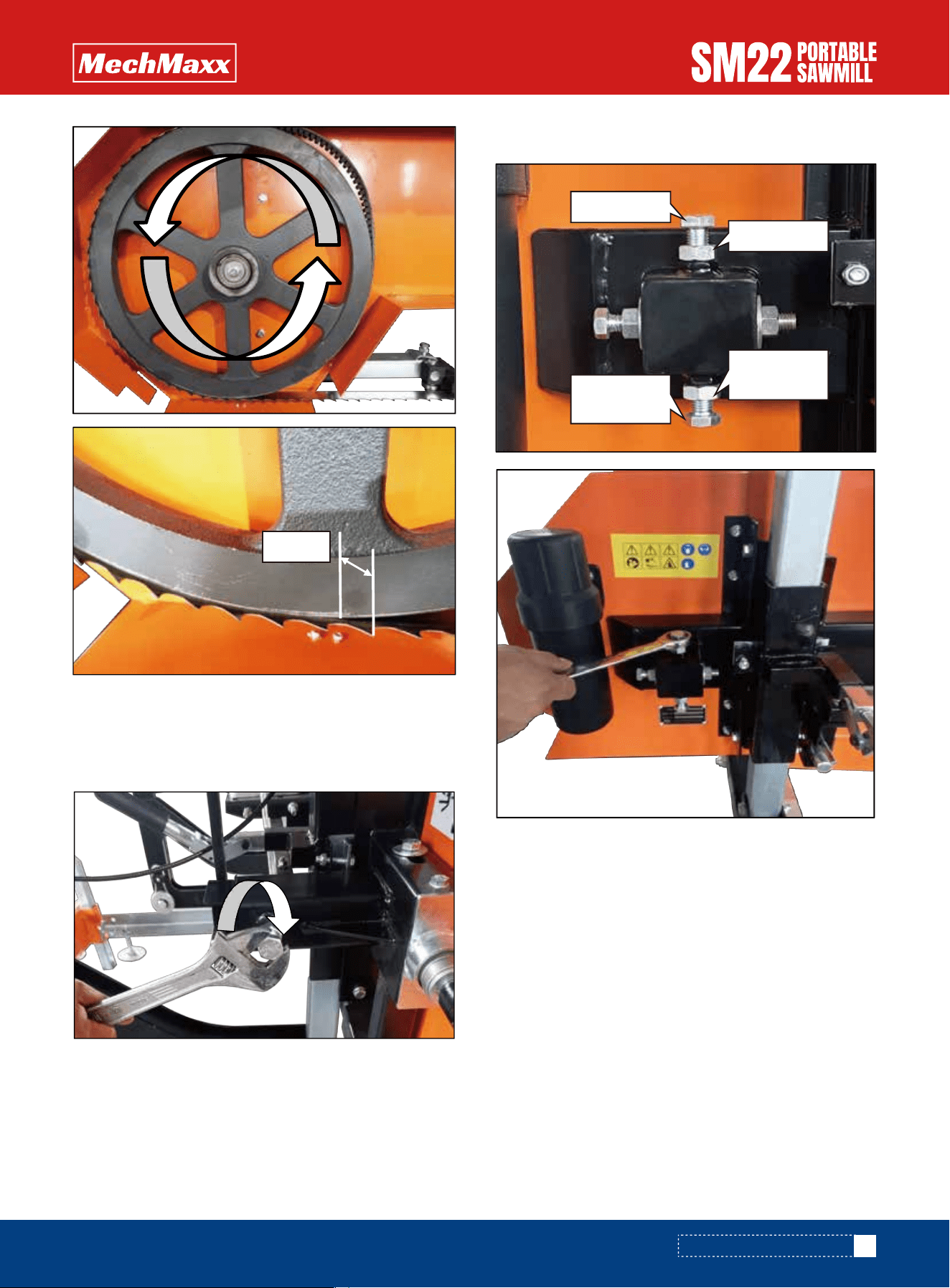
3/8”
Wearing gloves, spin the bandwheel with your hand and
observe how the blade has changed tracking. Measure the
distance again and repeat the above step to further
compensate if required. The ideal measurement is 3/8”.
To adjust the left side of the sawmill, again start by
taking the tension off of the blade by turning the “T”
handle one turn in the counter-clockwise direction. Using
a 16mm wrench, loosen the “vertical nut” a ½ turn. Do
the same on the “bottom vertical nut”. Next, loosen both
“vertical bolts” a ½ turn. This will take the clamping force
off of the bandwheel shaft caused by these two bolts and
allow it to move freely in the following steps.
Once satisfied with the measurement, tighten the locking
nut clockwise.
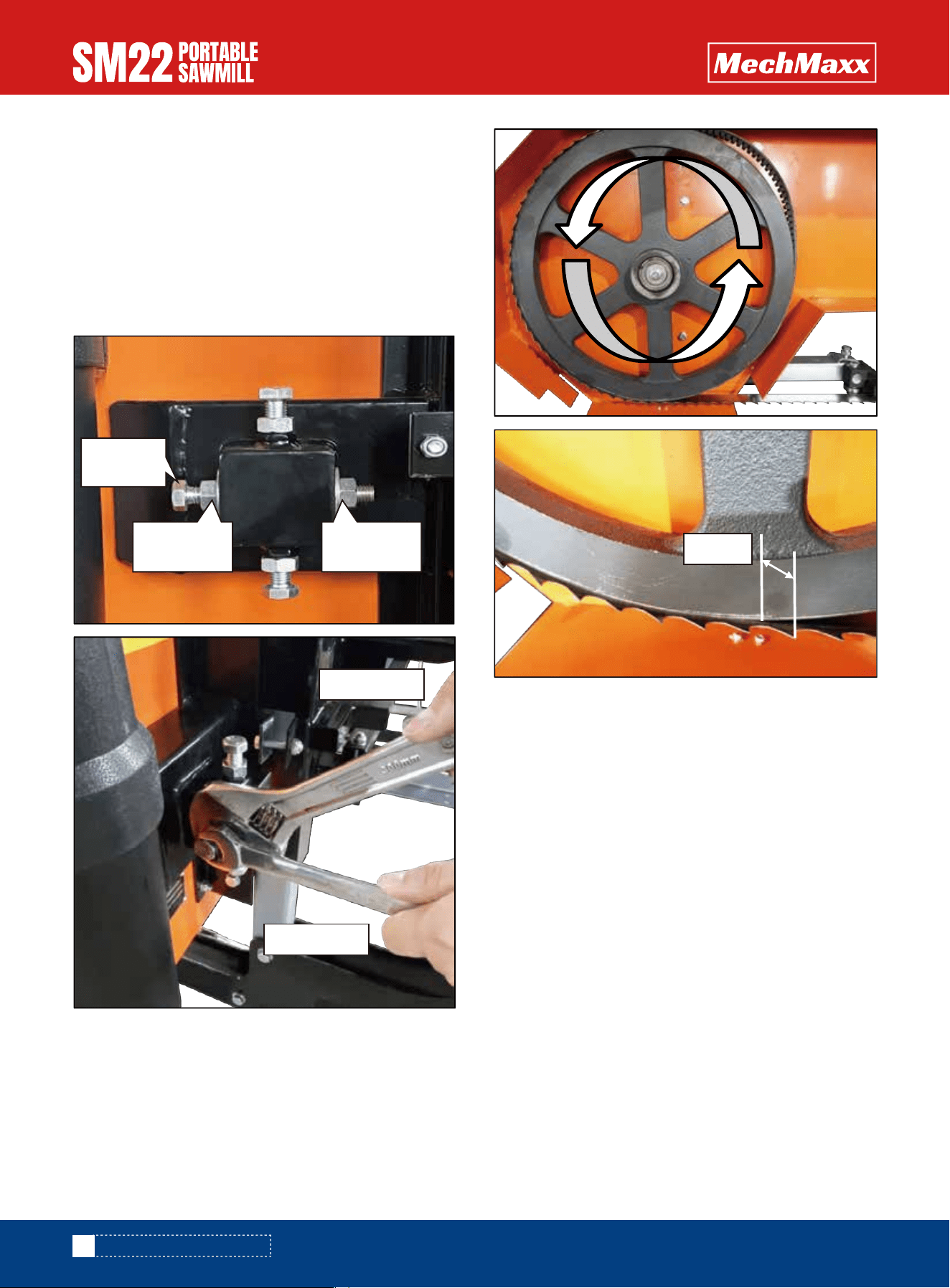
Vertical Bolt
Bottom
Vertical Bolt
Vertical Nut
Bottom
Vertical Nut
SAWMILL SET-UP PROCEDURES
MOVING THE BLADE FORWARD
BLADE GUIDE ADJUSTMENT
30
www.mechmaxx.com
Once the blade is tracking true, bring the blade guide
assemblies back up to the blade. Keep a paper width
distance between the blade guide bearing and the back of
the blade. More information on this set up can be found in
the next section – ”BLADE GUIDE ADJUSTMENT”
Re-tension the blade by turning the “T” handle a full turn
in the clockwise direction. Wearing gloves, spin the band-
wheel with your hand and observe how the blade has
changed tracking. Measure the distance again and repeat
the above step to further compensate if required. The
ideal measurement is 3/8”.
Never attempt the below with the engine running. As a
safety precaution, remove the spark plug cap. It is also
advised to confirm that the blade is tracking properly
before performing the below. Blade tracking is covered in
the previous page.
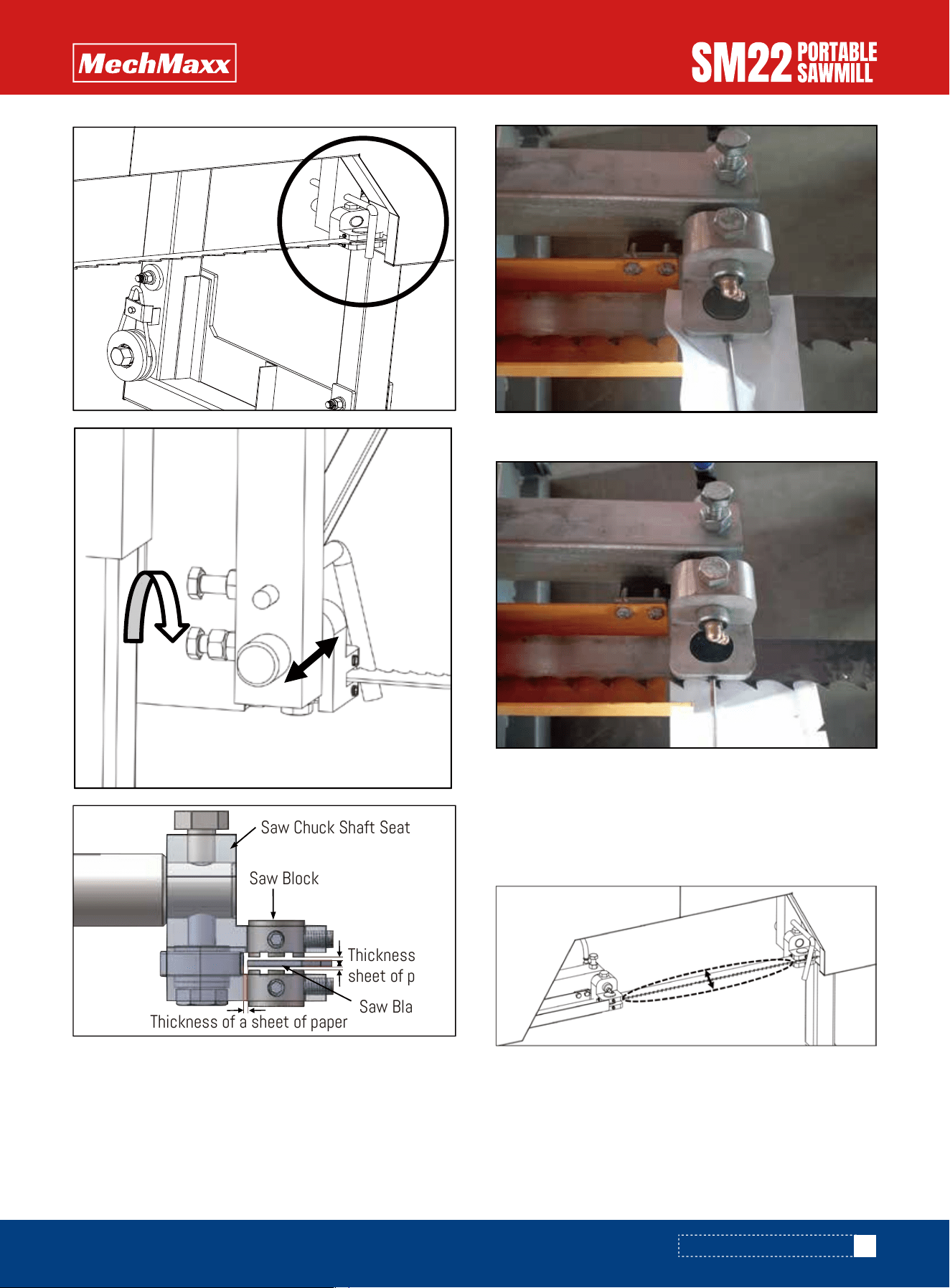
Using a 6mm allen key, loosen the blade guide blocks on
both the left and right sides. They should be free to slide
up and down.
Using a 16mm wrench, hold the “horizontal bolt” station-
ary with a wrench and turn the “horizontal outside nut”
counter - clockwise a ½ turn. Still holding the “horizontal
bolt” stationary, turn the “horizontal inside nut” clock-
wise a ½ turn. This step has now shifted the “horizontal
bolt” and bandwheel shaft, causing the blade to track
further forward. Tighten the vertical bolts, then nuts to
clamp the bandwheel shaft back into vertical position.
3/8”
Horizontal
Bolt
Horizontal
Outside Nut
Horizontal
Inside Nut
Right Hand
Left Hand
SAWMILL SET-UP PROCEDURES
BLADE TENSION
31
www.mechmaxx.com
Loosen the blade guide assembly bolt with a 16mm
socket. The round shaft should now be free to slide back
and forth. Position it so that there is a paper width gap
between the bearing and the back of the blade. Tighten
bolt against the flat on the shaft to secure assembly
back in position.
Adjust the gap above the saw blade.
Adjust the gap below the saw blade.
Using a piece of paper between the blade and blade guide
blocks, tighten the allen key bolts.
Proper blade tension is achieved when the blade deflects
no more than a total of 1/8” to 1/4” up/down when it is
firmly moved by hand at the center location of the blade
guide blocks. Turning the blade tension “T” handle in the
clockwise direction will add tension to blade.
Saw Chuck Shaft Seat
Saw Block
Thickness of a sheet of paper
Saw Blade
Thickness of a
sheet of paper
SAWMILL SET-UP PROCEDURES
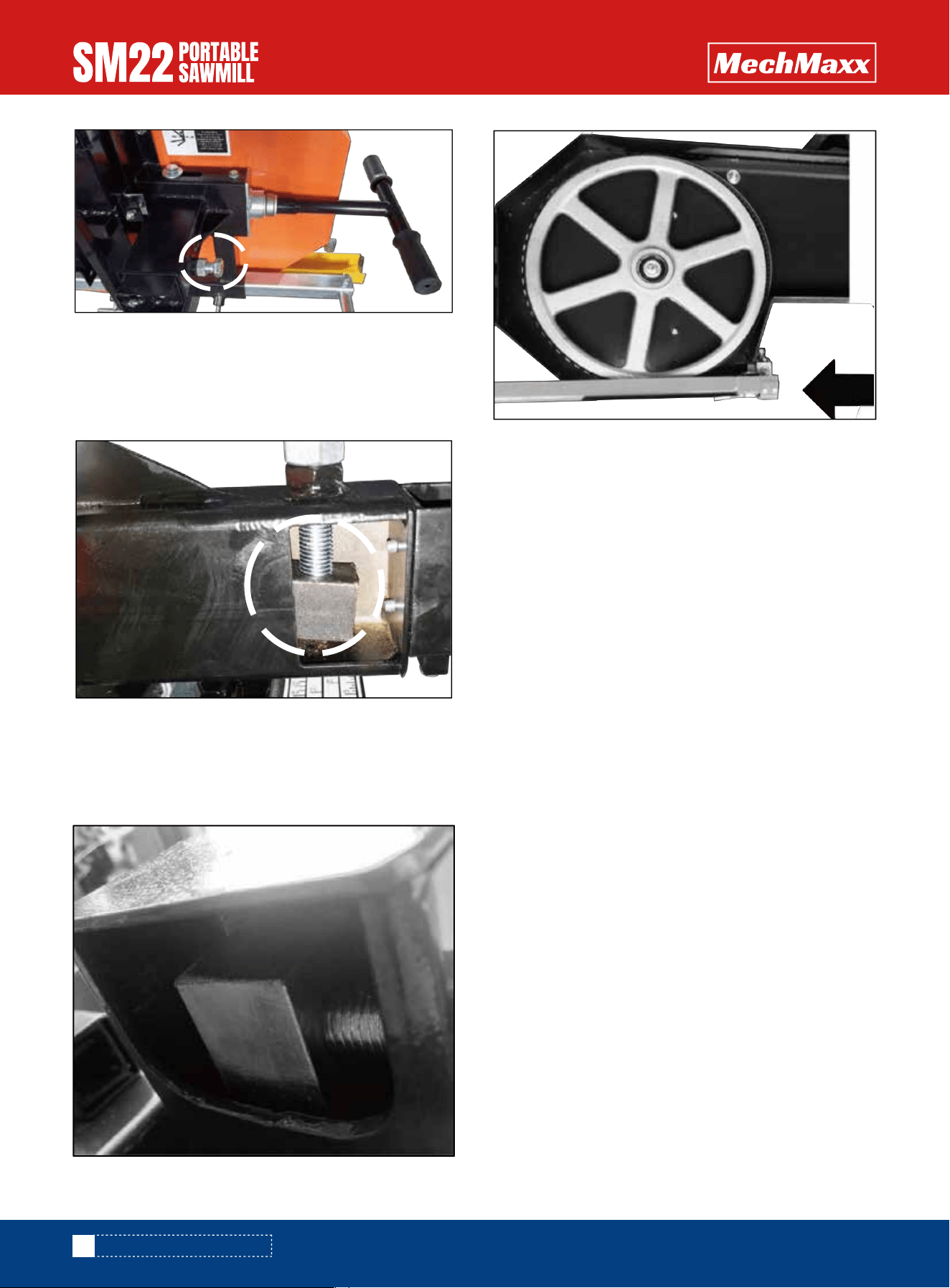
When tensioning the blade, make sure the tracking
adjustment bolt sitting behind the T handle (pictured) is
sitting back in its recess after you have finished and
before the mill is run. Failure to do this will result in the
blade being thrown and possibly broken.
Tracking adjustment bolt out of recess: If it looks like
this, DO NOT start the mill until it is resting back in its
recess.
Tracking adjustment bolt sitting in recess. It should look
like this before the mill is started back up.
32
www.mechmaxx.com
Ensure the blade support arm is locked into place after
tensioning the blade.
SAWMILL SET-UP PROCEDURES
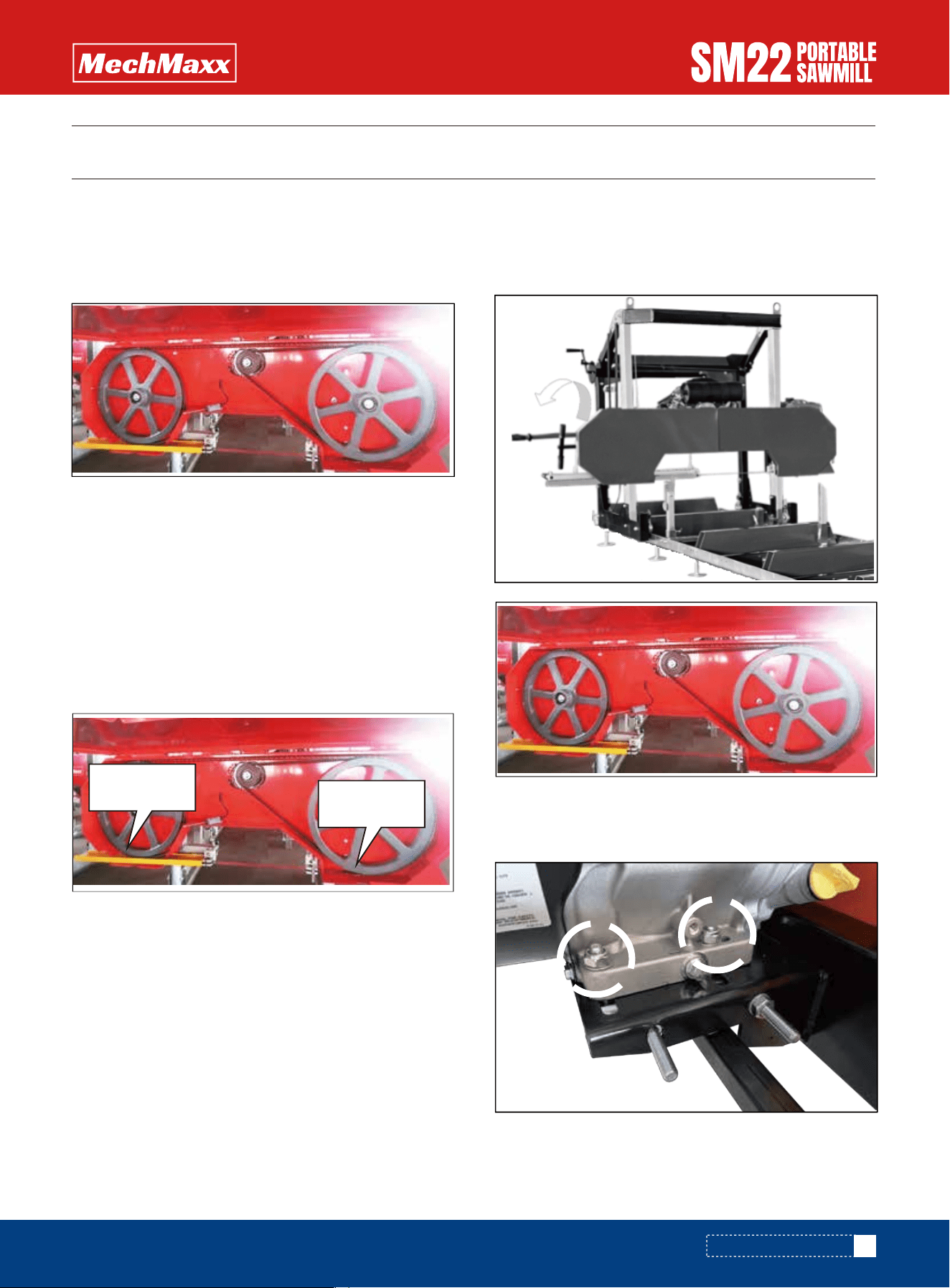
CHANGING THE BLADE
REPLACING BELTS
SAWMILL MAINTENANCE
33
www.mechmaxx.com
Never attempt the below with the engine running. As a
safety precaution, remove the spark plug cap. Gloves and
safety glasses must be worn when changing the blade.
There are two rubber "V” belts on the sawmill and they
should be replaced as a set. It is not advised to replace
individual belts separately. It is recommended to use a
B1778mm cogged belt for the drive side and a B1295mm
follower belt.
Remove the tension in the blade by turning the “T” handle
in the counter-clockwise direction and then open the
blade guard cover. The blade should now be loose and free
to pull straight out the front. The new blade can now be
installed, guards closed and proper blade tension set.
Remove the tension in the blade by turning the “T” handle
in the counter-clockwise direction and then open the
blade guard cover. The blade should now be loose and free
to pull straight out the front.
Never attempt the below with the engine running. As a
safety precaution, remove the spark plug cap. Gloves and
safety glasses must be worn when replacing the belts.
B1295mm
follower belt
B1778mm
cogged belt
SAWMILL MAINTENANCE
To change the drive side belt, loosen the four bolts that
secure the engine to the engine mount using a 16mm
wrench.
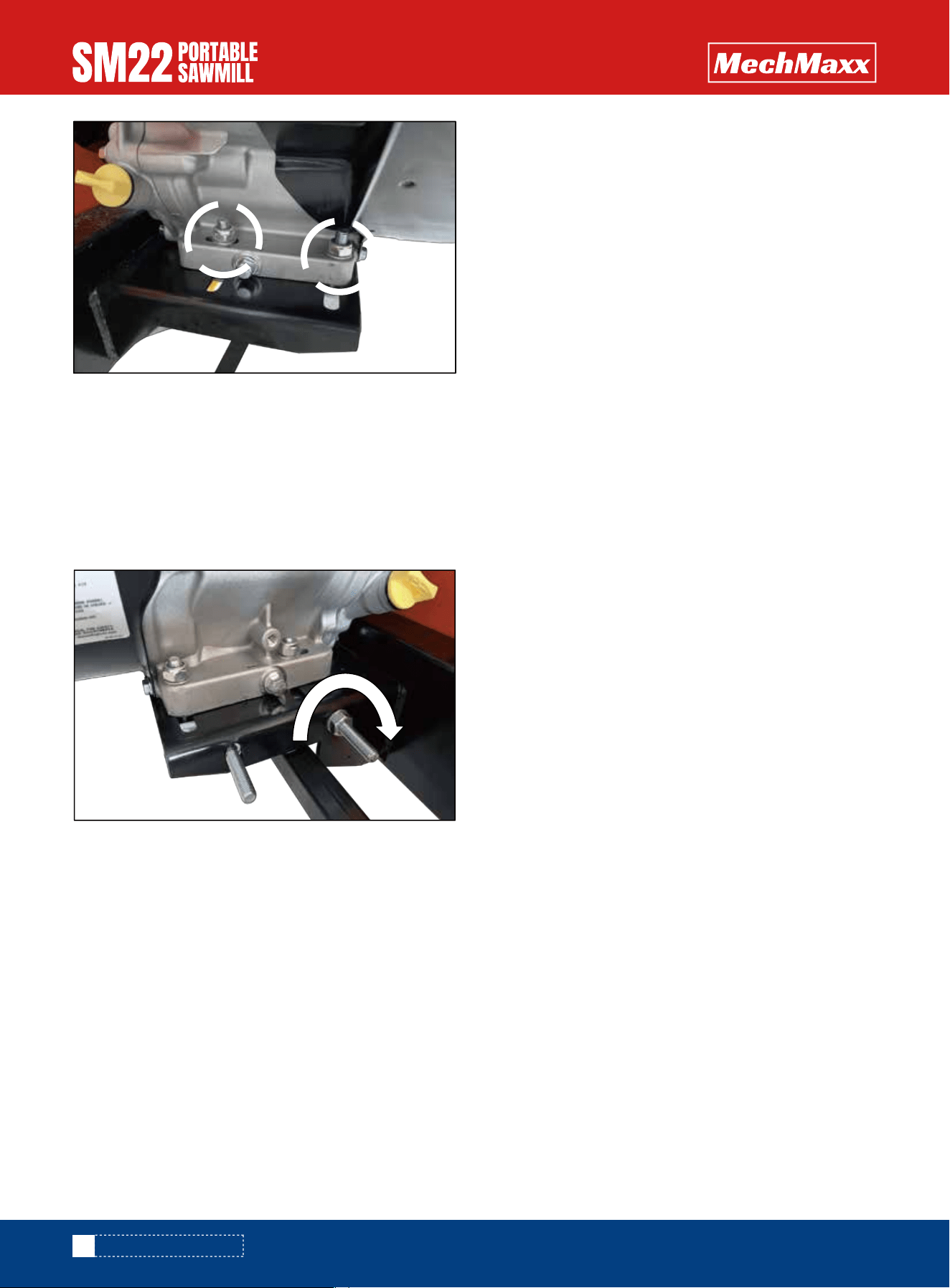
34
www.mechmaxx.com
The follower belt can now be changed by simply pulling it
off and installing the new one. The blade can now be
re-installed, guards closed and proper blade tension set.
*Note that blade tracking is likely to change and needs to
be adjusted when new belts are installed. Refer to
“BLADE TRACKING” for more information.*
Now that the engine is free to slide on the engine mount-
ing plate, turn the 16mm nut on the horizontal stud in the
counter-clockwise direction. This will allow the engine to
move and will also take the tension off of the belt. The old
belt can be removed and the new belt can be installed.
Tension the new belt and refer to the BELT TENSION
instructions described in the sawmill set up section of
the manual.
SAWMILL MAINTENANCE

TROUBLESHOOTING
35
www.mechmaxx.com
Problem/Issue
Producing wavy cuts.
Last board is tapered or
narrow in middle.
Blade comes off of
bandwheels.
Blades are breaking.
Blade is slowing down or
stopping when milling.
Mill is not cutting/cutting
very slowly
1. Inadequate blade tension.
2. Improper blade guide set up.
3. Improper blade tracking.
4. Sap build up on blade.
5. Dull blade.
6. Pushing mill too quickly.
1.Inadequate blade tension.
2.Improper blade guide set up.
3.Improper blade tracking.
4.Belts are worn.
5.Dull blade.
6.Pushing mill too quickly
1. Too many blade sharpening.
2. Inadequate blade tension.
3. Improper blade guide set up.
4. Improper blade tracking.
5. Pushing mill too quickly.
1. Inadequate blade tension.
2. Improper drive belt tension.
3. Pushing mill too quickly.
1. Dull blade.
2. Blade is on backwards.
1. Tracks are not level.
1. Tighten blade.
2. The gap between guide blocks and blade is incorrect.
3. Adjust blade tracking.
4. Install new blade. Always use blade lubricant.
5. Install new blade.
6. Slow feed rate down and push head slower
through log.
1. Tighten blade.
2. The gap between guide blocks and blade is incorrect.
3.Adjust blade tracking.
4. Install new belts.
5. Install new blade.
6. Slow feed rate down and push head slower
through log.
1. Replace blade.
2. Binding between guide blocks when blade is too
loose. Tighten blade.
3. The gap between guide blocks and blade is incorrect.
4. Adjust blade tracking.
5. Slow feed rate down and push head slower
through log.
1. Tighten blade.
2. Belts are worn or too loose. Replace.
3. Slow feed rate down and push head slower
through log.
1. Install new blade.
2. Remove blade and flip it inside out. The teeth
should be facing in the direction of the log
supports.
1. Tracks need to be checked with a level and
adjusted to be square. They also need to be set up
on firm, sturdy ground/base so deflection does not
occur from logs or sawmill head.
Blade dulls quickly. 1. Logs are not clean.
2. Foreign objects in log.
1. Logs may contain dirt/sand causing them to wear
prematurely.
2. Tree may contain nails, staples, old fencing etc.
Possible Causes Resolution Options
TROUBLESHOOTING

36
www.mechmaxx.com
Problem/Issue
Mill is vibrating excessively. 1. Log is not clamped securely.
2. Belts are deformed.
3. Bandwheel bearing issue.
4. Pushing mill too quickly.
5. Loose bolts.
1. Ensure log is clamped firmly resting on log
bunksand against log supports.
2. Belts may have flats in them from leaving
blade tension tight when not in use. Replace them.
3.Inspect and replace the bandwheel bearings if worn.
4. Slow feed rate down when milling.
5. Check all bolts to ensure they are tight.
Possible Causes Resolution Options
TROUBLESHOOTING
37
www.mechmaxx.com
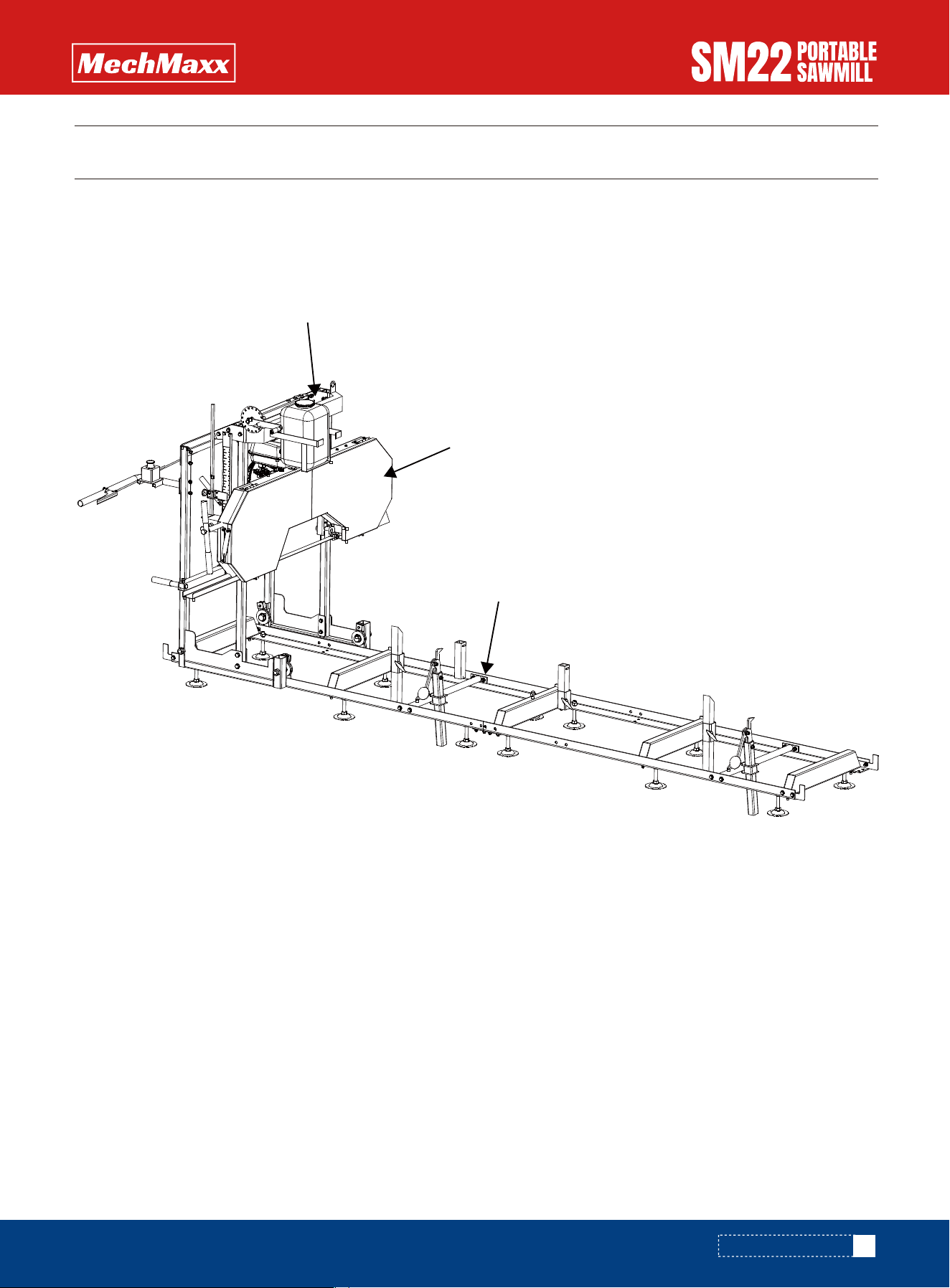
DIAGRAM-ENSEMBLE
DIAGRAM-ENSEMBLE
A
B
C
38
www.mechmaxx.com
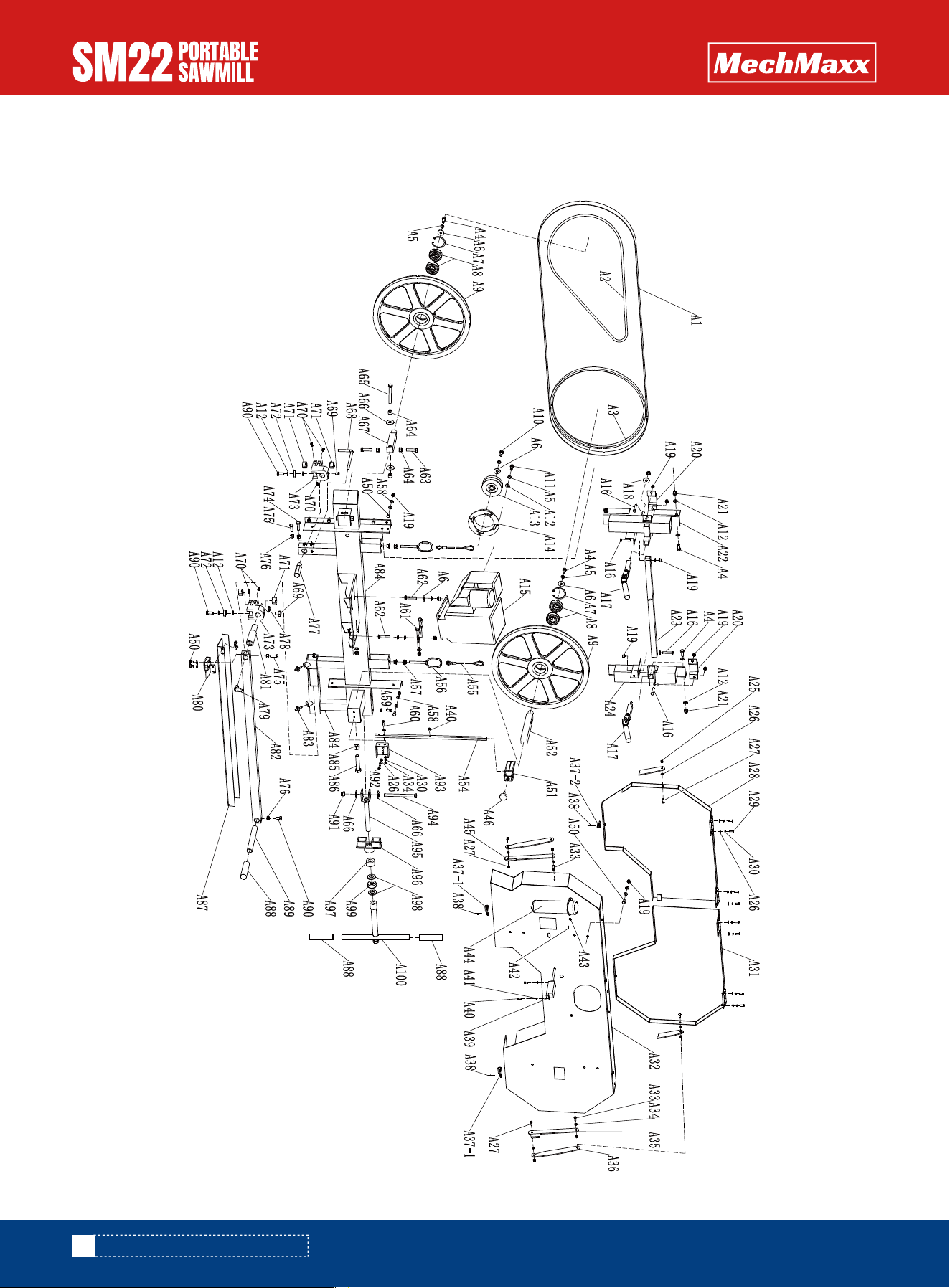
DIAGRAM(A)-BAND WHEEL HOUSING
DIAGRAM(A)-BAND WHEEL HOUSING
39
www.mechmaxx.com
PARTS LIST(A)-BAND WHEEL HOUSING
PARTS LIST(A)-BAND WHEEL HOUSING
REF DESCRIPTION QTY
A1
A2
A3
A4
A5
A6
A7
A8
A9
A10
A11
A12
A13
A14
A15
A16
A17
A18
A19
A20
A21
A22
A23
A24
A25
A26
A27
A28
A29
Saw Blades
Bi1778 belt
Bi1295 belt
Hexagon head bolt M10X25
Spring washer 10
Large side flat washer 10 (φ10*35*3.0)
Hole Circlip 62
Deep groove ball bearing 6305
XY20 Pulley
3/8X24X25
3/8X16X25
Flat washer 10
Clutch
Clutch cover welding
Engine
Hexagon head bolt M8X40
Quick lock
Large washer 10
Hexagon lock nut M8
locking plate
Hexagon lock nut M10
Right lifting locking welding
Pulling tube
Left lifting locking welding
Hexagon lock nut M6
Flat washer 6
Hexagon head bolt M6X16
Right cover door welding
Cross pan head screw M6X16
1
1
1
9
7
5
2
4
2
1
4
22
1
1
1
4
2
5
16
2
11
1
2
1
8
18
6
1
8
12
1
1
2
4
1
2
1
8
1
3
2
3
3
1
1
1
2
2
1
11
1
1
2
1
2
2
4
17
REF DESCRIPTION QTY
A30
A31
A32
A33
A34
A35
A36
A37
A38
A39
A40
A41
A42
A43
A44
A45
A46
A47
A48
A49
A50
A51
A52
A53
A54
A55
A56
A57
A58
Spring washer 6
Left cover door welding
Welding of shield body
Hexagon head bolt M6X20
Hexagonal nut M6
Side pull plate 3
Side pull plate 1
Buckle
Blind rivet 4X10
Limit switch YBLX
Cross recessed pan head screw M5X12
Spring washer 5
Blind rivets 4X16
Large flat pad 4
Instruction manual
Side pull plate 2
M8X40 flower handle
Cross recessed pan head screw M4X12
Flat washer 4
Scale plate
Hexagon head bolt M8X20
Scale seat
Passive saw wheel shaft
Hexagon nut M4
Height indicator rod
Lifting wire assembly
Lifting rings
Hexagon flange nut M10
Flat washer 8
1
2
1
4
2
4
1
4
1
1
2
12
4
2
2
1
2
5
1
1
1
1
1
1
2
1
1
1
1
3
1
1
1
2
1
1
1
1
1
2
1
1
40
www.mechmaxx.com
PARTS LIST(A)-BAND WHEEL HOUSING
REF DESCRIPTION QTY
A59
A60
A61
A62
A63
A64
A65
A66
A67
A68
A69
A70
A71
A72
A73
A74
A75
A76
A77
A78
A79
A80
A81
A82
A83
A84
A85
A86
A87
A88
A89
Hexagon head bolt M8X16
Hexagon head bolt M6X25
550 tension plate
Hexagon head bolt M10X50
Hexagon head bolt M12X45
Hexagonal nut M12
Hexagon head bolt full thread M12X100
Large washer 12 (φ12*35*3.0)
Active saw wheel shaft
Saw guard hook
Hexagon head bolt M10X12
Hexagon socket set screw M6X12
aluminum base saw block
Deep groove ball bearing 6200-2RS
Aluminum saw shaft seat
Hexagon bolt M10 x 35
Hexagon head bolt M10X30
Hexagon nut M10
Right saw clamp shaft for aluminum seat
M6 90 degree oil cup one piece
1/4 elbow external connection
Saw guard 1 welding
Left saw shaft
Guide square tube
Triangle handle M10X40X30
Beam welding
Hexagon nut M16
Hexagon head bolt M16X80
Saw guard 2
25 tube rubber handle
Push-pull handle
REF DESCRIPTION QTY
A90
A91
A92
A93
A94
A95
A96
A97
A98
A99
A100
Hexagon bolt M10 x 20
Hexagon lock nut M12
Hexagon socket head screw M6X14
550 scale seat
Hexagon bolt M12X130 half thread
Tie rod welding
Rectangular pipe plug
Cushion
Tension gasket (φ21*38*4.5)
Thrust ball bearings
Tighten welding
41
www.mechmaxx.com
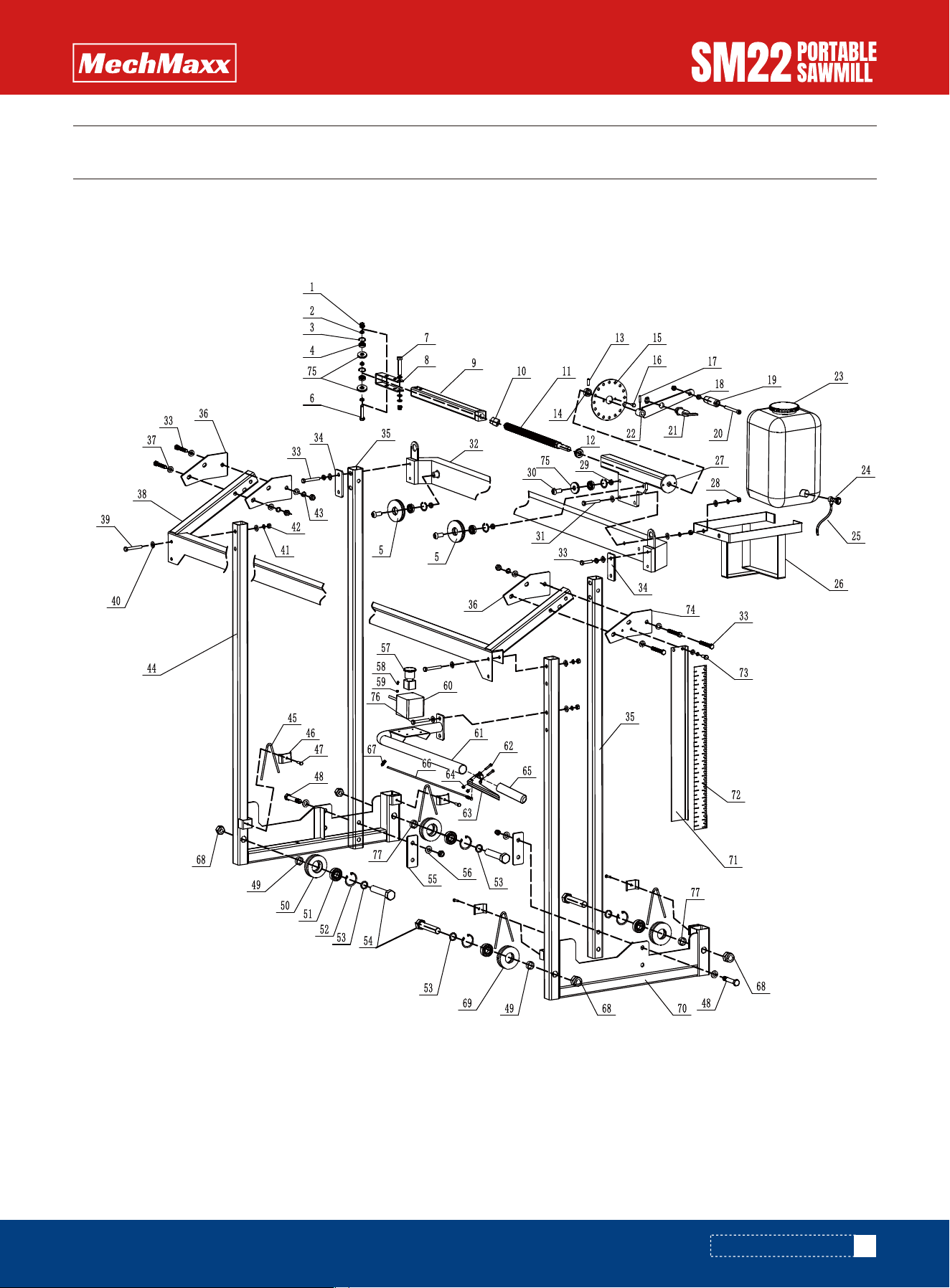
DIAGRAM(B)-CARRIAGE
DIAGRAM(B)-CARRIAGE
42
www.mechmaxx.com
PARTS LIST(B)-CARRIAGE
PARTS LIST(B)-CARRIAGE
REF DESCRIPTION QTY
B1
B2
B3
B4
B5
B6
B7
B8
B9
B10
B11
B12
B13
B14
B15
B16
B17
B18
B19
B20
B21
B22
B23
B24
B25
B26
B27
B28
B29
Hexagonal lock nut M12
Spacer 1
Elastic retaining ring for hole 28
Deep groove ball bearing 6001RS
Lifting wheel
Hexagonal bolt M12X50 half thread
Hexagonal bolt M10X55 half thread
Pulley frame
Telescopic tube 1 welding
Copper nut
Lifting screw
Thrust ball bearing 51102
Elastic cylindrical pin 6X24
Limiting sleeve
Dial
Hexagonal bolt M6X16
Elastic cylindrical pin 5X24
Hexagonal nut M12
13-hole handle
13-hole handle bolt shaft
Knob plunger assembly
Crank welding
Water tank
Quick connector CSL8-04
PU high-pressure air pipe 8*5 Transparent
Water bucket frame welding
Telescopic tube 2 welding
Hexagonal nut M10
GT26-28 spacer 2
Inner hexagonal round head bolt M12X25
Hexagonal head bolt M10X75 half thread
Upper crossbeam welding
Hexagonal head bolt M10X65 half thread
Lifting square tube upper pressure plate
Lifting square tube
Connecting plate 1
Flat washer 10
Upper connecting assembly
Hexagonal head bolt M8X60
Flat washer 8
Spring washer 8
Hexagonal nut M8
Spring washer 10
Right bottom wheel frame welding
Wire rope brush
Plywood 2
Hexagonal head bolt M6X20
Hexagonal head bolt M12X70 half thread
Bottom wheel spacer 2
Roller-1
Deep groove ball bearing 6004
Elastic retaining ring for hole 42
Bottom wheel spacer 1
Hexagonal head bolt M20X100 half thread
Lifting square tube lower pressure plate
Flat washer 12
Mushroom head emergency stop button
Cross slot pan head screw M4X12
5
3
5
5
2
1
2
1
1
1
1
1
1
1
1
2
1
2
1
1
1
1
1
1
1
1
1
14
2
2
2
1
10
2
2
3
26
1
4
12
6
8
20
1
4
4
4
4
2
2
4
4
4
4
2
8
1
4
REF DESCRIPTION QTY
B30
B31
B32
B33
B34
B35
B36
B37
B38
B39
B40
B41
B42
B43
B44
B45
B46
B47
B48
B49
B50
B51
B52
B53
B54
B55
B56
B57
B58
Flat washer 4
Button box CA-BX1 one hole
Push handle welding
Hexagon socket head screw M5X35
Throttle handle
Hexagon nut M5
Handle cover φ32
Throttle cable
Tension spring
Non-metallic insert hexagon lock nut M20
Roller-2
Left bottom wheel frame welding
Ruler seat
Height ruler
Hexagon head bolt M8X14
Connecting plate 2
Small lifting wheel
Hexagon bolt M10X60
Bottom wheel spacer 2
4
1
1
2
1
2
1
1
1
4
2
1
1
1
2
1
3
2
2
43
www.mechmaxx.com
PARTS LIST(B)-CARRIAGE
REF DESCRIPTION QTY
B59
B60
B61
B62
B63
B64
B65
B66
B67
B68
B69
B70
B71
B72
B73
B74
B75
B76
B77
44
www.mechmaxx.com
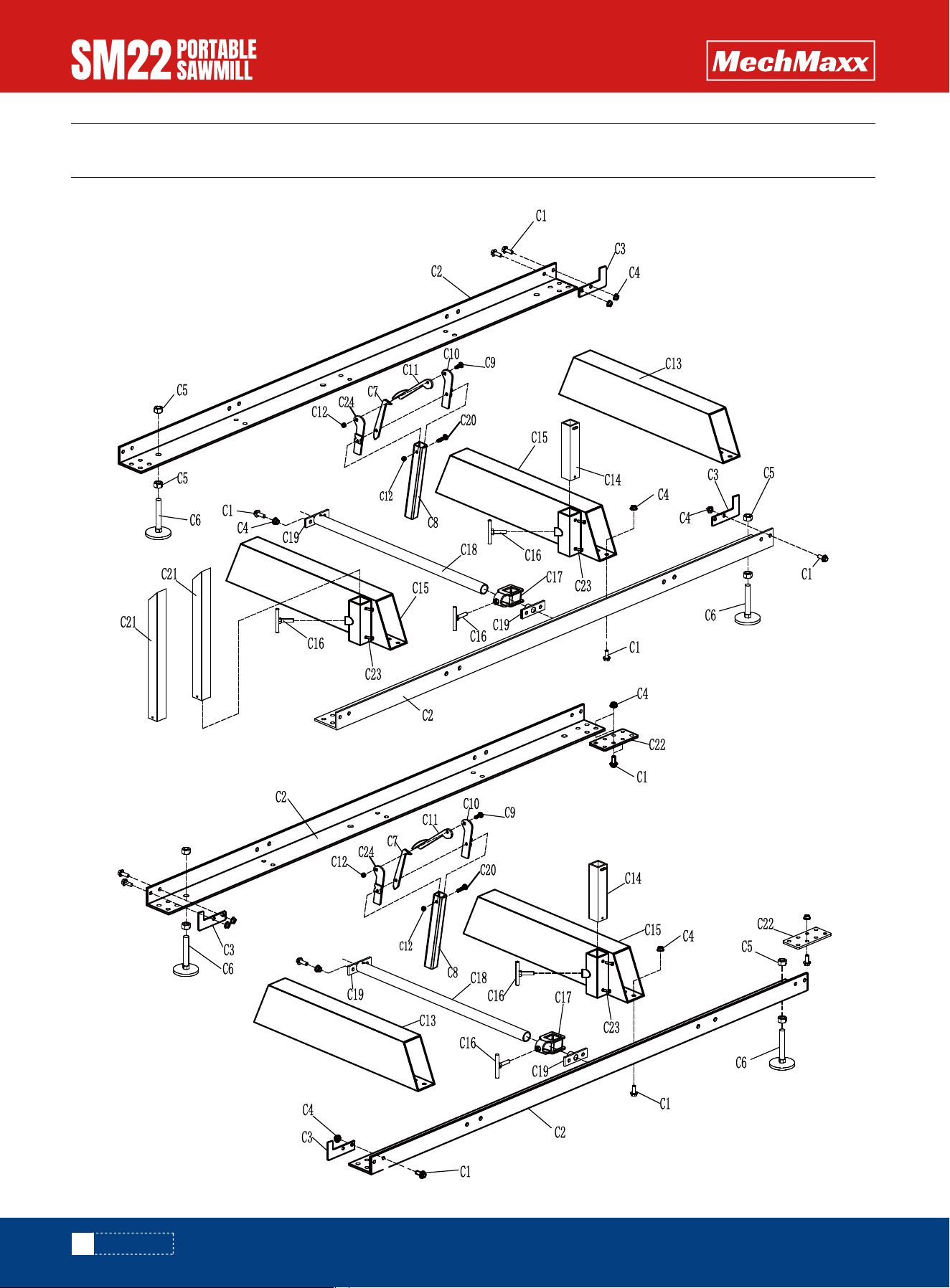
DIAGRAM(C)
DIAGRAM(C)
45
www.mechmaxx.com
PARTS LIST(C)
PARTS LIST(C)
REF DESCRIPTION QTY
C1
C2
C3
C4
C5
C6
C7
C8
C9
C10
C11
C12
C13
C14
C15
C16
C17
C18
C19
C20
C21
C22
C23
C24
C25
Hexagonal flange bolt
Guide rail
Limiting plate
Hexagonal flange self-locking nut
Hexagonal nut M16
Foot
Ejector hook
Ejector telescopic tube
Semi-circular head square neck bolt
Telescopic left plate welding
Eccentric clamping welding
Hexagonal locking nut
Two-hole guide rail crossbeam not welded
Ejector tube 2 welding
Two-hole guide rail crossbeam welding
Ejector screw
New ejector slide seat welding
Ejector slide tube
Slide seat welding
Semi-circular head square neck bolt
Ejector tube 1
Guide rail connecting plate
Hexagonal bolt
Telescopic right plate welding
Half round head square neck bolt M10X35
48
4
4
48
24
12
2
2
2
2
2
4
2
2
3
5
2
2
4
2
2
2
6
2
2