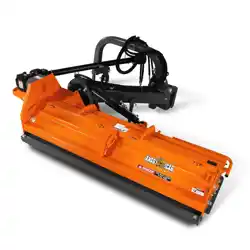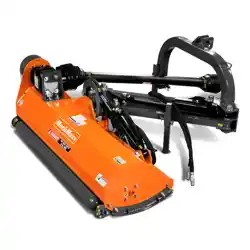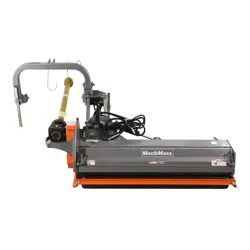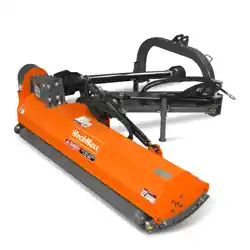
OPERATOR’S
MANUAL
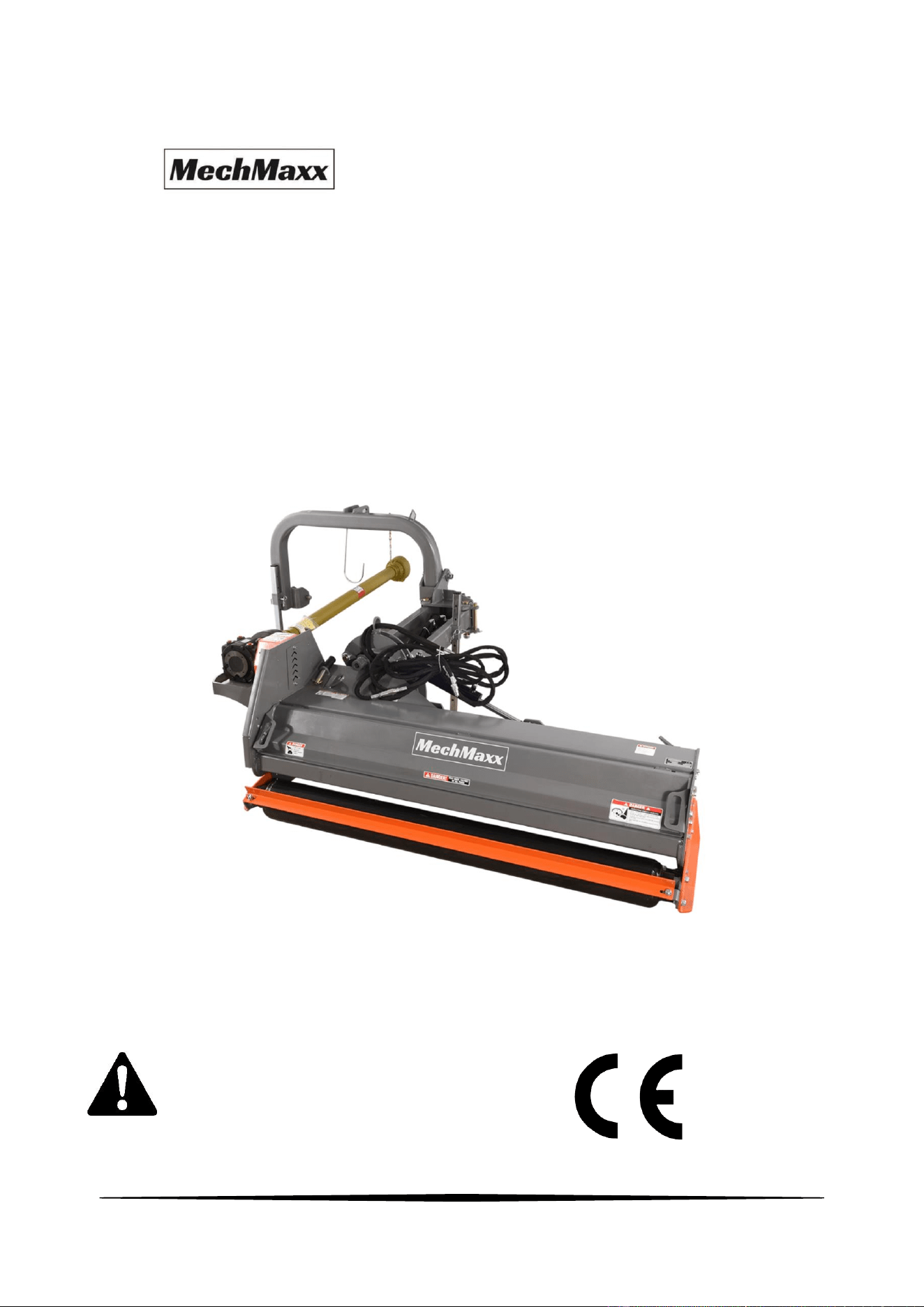
VERGE MOWER
Model: AGFK180/200
CAUTION: Read Manual Thoroughly Before
Operation

1
CONTENTS
CONTENTS …………………………………………………………………………1
PRODUCT SPECIFICATIONS……...……………………………………………2
SAFETY INSTRUCTIONS……………………………………………………..… 3
SAFETY TRAINING………………………...………...………………………..….5
ASSEMBLY INSTRUCTIONS……………………...…………………………...13
SIZING PTO SHAFT………………………………….……………………….….15
OPERATION INSTRUCTION…………………….……………………………..16
SERVICE AND MAINTENANCE………………….…………………………….18
PARTS LIST……………………………….………………………………………22

2
PRODUCT SPECIFICATIONS
Product Models
AGFK SERIES FLAIL MOWER MODELS
specifications
AGFK-180
AGFK-200
Apply to tractors
50-70hp
60-80hp
3-Point Linkage:
Cat. II
Cat. II
Working Width
1800mm
2000mm
PTO Speed
540r/min
540r/min
No. Hammer Blade
22
26

3
SAFETY INSTRUCTIONS
Before operating the Flail mower read the following safety instructions.
Failure to comply with these warnings may result in serious injury or
death.
READ AND FOLLOW THE READ AND FOLLOW THE ESPECIALLY IN THE SAFETY
SECTION. FAILURE TO DO SO CAN RESULT IN SERIOUS INJURY OR DEATH.
SIGNAL WORDS: The signal words DANGER, WARNING and CAUTION are used with the safety
messages in this manual and with each safety sign. They are defined as follows:
DANGER: Indicates an immediate hazardous situation that, if not avoided, could result in serious injury or
death. This signal word is to be limited to the most extreme situations typically for machine components that,
for functional purposes, cannot be guarded.
WARNING: Indicates a potentially hazardous situation that, if not avoided, could result in serious injury or
death, and includes hazards that are exposed when guards are removed. It may also be used to alert against
unsafe practices.
CAUTION: Indicates a potentially hazardous situation that, if not avoided, may result in minor or moderate
injury. It may also be used to alert against unsafe practice.
EQUIPMENT SAFETY GUIDELINES
Safety of the operator and bystanders is one of the main concerns in designing and
developing a mower. However, every year accidents occur which could have been
avoided by a few seconds of thought and a more careful approach to handling
equipment. You, the operator, can avoid many accidents by observing the following
precautions and insist those working with you, or for you, follow them.
In order to provide a better view, certain photographs or illustrations in this manual
may show an assembly with a safety shield removed. However, equipment should
never be operated in this condition. Keep all shields in place. If shield removal
becomes necessary for repairs, replace the shield prior to use.
Replace any safety sign that is not readable or missing. Location of such safety signs
are indicated in this manual.

4
SAFETY INSTRUCTIONS
Never use alcoholic beverages or drugs that can hinder alertness or coordination while
operating this equipment. Consult your doctor about operating this machine while
taking prescription medications.
Under no circumstances should children under the age of 18 be allowed to work
with this equipment. Do not allow persons to operate or assemble this unit until
they have read this manual and have developed a thorough understanding of the
safety precautions and how it works. Review the safety instructions with all users
annually.
This equipment is dangerous to children and persons unfamiliar with its operation. The
operator should be a responsible, properly trained and physically able person familiar
with farm machinery and trained in this equipment’s operations. If the elderly are
assisting with farm work, their physical limitations need to be recognized and
accommodated.
Use a tractor equipped with a Roll Over Protective System and seat belts. (ROPS)
Never exceed the limits of a piece of machinery. If its ability to do a job, or to do so
safely, is in question-DON’T TRY IT.
Do not modify the equipment in any way. Unauthorized modification could result in
serious injury or death and may impair the function and life of the equipment.
In addition to the design and the confirmation of this implement, including safety signs
and safety equipment, hazard control and accident prevention are dependent upon the
awareness, concern, prudence, and proper training of personnel involved in the
operation, transport, maintenance, and storage of the machine. Refer also to safety
messages and operation instruction in each of the appropriate sections of the tractor
and mower manuals. Pay close attention to the safety signs affixed to the tractor and
the mower.

5
SAFETY TRAINING
Safety is a primary concern in the design and manufacturing of our product.
Unfortunately, our efforts to provide safe equipment can be wiped out by a single
careless act of an operator or bystander.
In addition to the design and configuration of equipment, hazard control and accident
prevention are dependent upon the awareness, concern, prudence and proper training
of personnel involved in the operation, transport, maintenance and storage of this
equipment.
It has been said, “The best safety device is an informed, careful operator.” We ask
you to be that kind of operator. It is the operator’s responsibility to read and
understand all safety and operating instructions in the manual and to follow them.
Accidents can be avoided.
Working with unfamiliar equipment can lead to careless injuries. Read this manual,
and the manual for your tractor, before assembly or operating, to acquaint yourself
with the machines. If this machine is used by any person other than you, or is loaned
or rented, it is the Flail mower owner’s responsibility to make certain that the owner's
manual be available to the operator prior to operating:
1-Reads and understands the operator’s manuals.
2-Is instructed in safe and proper use.
Know your controls and how to stop the tractor, engine, and mower quickly in an
emergency. Read this manual and the one provided with your tractor.
Train all new personnel and review instructions frequently with existing workers. Be
certain only a properly trained and physically able person will operate the machinery. A
person who has not read and understood all operating and safety instructions is not
qualified to operate the machine. An untrained operator exposes himself and
bystanders to possible serious injury or death. If the elderly are assisting with farm
work, their physical limitations need to be recognized and accommodated.

6
SAFETY TRAINING
PREPARATION
Never operate the tractor and mower until you have read and completely understand
this manual, the Tractor Operator’s Manual, and each of the safety messages found
on the safety signs on the tractor and mower.
Personal protection equipment including hardhat, safety glasses, safety shoes, and
gloves are recommended during assembly, installation, operation, adjustment,
maintenance, repairing, removal, or moving the implement. Do not allow long hair,
loose fitting clothing, or jewelry to be around equipment.
PROLONGED EXPOSURE TO LOUD NOISE MAY CAUSE PERMANENT HEARING
LOSS! Tractors with or without mowers attached can often be noisy enough to cause
permanent, partial hearing loss. We recommend that you wear hearing protection on a
full-time basis if the noise in the operator’s position exceeds 80 db. Noise over 80 db
on a long-term basis can cause severe hearing loss. Noise over 90 db adjacent to the
opera-tor over a long-term basis may cause permanent, total hearing loss. NOTE:
Hearing loss from loud noise (from tractors, chain saws, radios, and other such
sources close to the ear) is cumulative over a lifetime without hope of natural recovery.
Operate the mower only with a tractor equipped with an approved Roll-Over-Protective
System (ROPS). Always wear your seat belt. Serious injury or even death could result
from falling off the tractor — particularly during a turnover when the operator could be
pinned under the ROPS or the tractor.
Clear area to be worked of stones, branches or other debris that might be thrown or
entangled in the mower, causing injury or damage.
Operate only in daylight or good artificial light.
Ensure mower is properly mounted, adjusted and in good operating condition.
Ensure that all safety shielding and safety signs are properly installed and in good
condition.

7
SAFETY TRAINING
STARTING AND STOPPING SAFETY
Check the tractor master shield over the PTO stub shaft. Make sure it is in good
condition and fastened securely to the tractor. Purchase a new shield if old shield is
damaged or missing.
All tractors that are not equipped with a “live” power takeoff (PTO) need to be
equipped with an over-running PTO clutch. These are available through most farm
equipment stores. NOTE: The addition of an over-running PTO clutch may change the
length of the PTO driveline required. Pay extra attention to the instructions on the PTO
Driveline Installation. Be sure that the driveline system guarding is adequate.
Mower operating power is supplied from the tractor PTO. Refer to your tractor manual
for PTO engagement and disengagement instructions. Know how to stop tractor and
mower quickly in case of an emergency.
When engaging PTO, the engine RPM should always be at idle speed. Once engaged
and ready to start working, raise PTO speed to 540-RPM and maintain throughout
working operation.
OPERATIONAL SAFETY
The use of this equipment is subject to certain hazards that cannot be protected
against by the mechanical means or product design. All operators of this equipment
must read and understand this entire manual, paying particular attention to safety and
operating instructions, prior to using. If there is something in this manual you do not
understand, ask your supervisor, or your dealer, to explain it to you.
Most accidents occur because of neglect or carelessness. Keep all helpers and
bystanders at least several hundred feet from an operating Flail mower. Only properly
trained people should operate this machine.
When machine is operated in populated areas where thrown objects could injure
persons or property, operation must be stopped when anyone comes within
several hundred feet.
The majority of the accidents involve entanglement on the driveline, injury of
bystanders by the objects thrown by the rotating tines, and operators

8
SAFETY TRAINING
being knocked off the tractor by low hanging limbs and then being run over by the
mower. Accidents are most likely to occur with machines that are loaned or rented to
someone who has not read the owner’s manual and is not familiar with a Flail mower.
The Flail mower is designed for use only on tractors with the power take-off (PTO)
turning at 540-RPM.
Install and secure all guards and shields before starting or operating. The mower tines,
driveline guards and tractor, shields should be used and maintained in good working
condition. They should be inspected carefully, at least daily, for missing or broken
chain links, shields, or guards. (Worn items must be replaced at once to reduce
possibility of injury.)
Disengage power takeoff (PTO) and place transmission in neutral before attempting to
start engine.
Many varied objects, such as wire, cable, rope, or chains, can become entangled in
the operating parts of the mower. These items could then swing outside the housing at
greater velocities than the tines. Such a situation is extremely hazardous. Inspect the
cutting area for such objects before working. Remove any like objects from the site.
Never allow the working tines to contact such items. Never assume an area is clear.
Always Check!
Always stop the tractor, disengage PTO, set brake, shut off the tractor engine, remove
the ignition key, lower implement to the ground and allow rotating pieces to come to a
complete stop before dismounting tractor. Never leave equipment unattended with the
tractor running.
Never place hands or feet under mower with tractor engine running or before you are
sure all motion has stopped. Stay clear of all moving parts.
Do not reach or place any part of your body under equipment until it is blocked
securely.
Do not allow riders on the Flail mower or tractor at anytime. There is no safe place for

9
SAFETY TRAINING
any riders.
Do not operate unless all personnel, livestock, and pets are several hundred feet away
to prevent injury by thrown objects.
Never operate tractor and Flail mower under trees with low hanging limbs. Operators
can be knocked off the tractor and then run over by the rotating tines.
The rotating parts of this machine have been designed and tested for rugged use.
However, they could fail upon impact with heavy, solid objects such as steel guardrails
and concrete abutment. Such impact could cause the broken objects to be thrown
outward at very high velocities. To reduce the possibility of property damage, serious
injury, or even death, never allow the working tines to contact such obstacles.
Stop Flail mower and tractor immediately upon striking an obstruction. Turn engine
off, remove key, inspect and repair any damage before resuming operation.
Stay alert for uneven terrain, holes, rocks, and roots and other hidden hazards. Keep
away from drop-offs and hazards that could cause roll over. Use extreme care and
maintain minimum ground speed when trans-porting or operating on hillsides, over
rough ground and when operating close to ditches or fences. Be careful and slow
down when turning sharp corners and changing direction on slopes. Do not start or
stop suddenly on slopes. Avoid operation on steep slopes. In extremely uneven
terrain, rear wheels weights, front tractor weight, and/or tire ballast should be used to
improve stability.
Pass Flail mower diagonally through sharp dips and avoid sharp drops to prevent
“hanging up” tractor and Flail mower. Practice will improve your skills in maneuvering
on rough terrain. Always cut down slopes, never across the face. Always check tractor
manual for proper use on slopes.
When using a unit, a minimum 20% of tractor and equipment weight must be on tractor
front wheels. Without this weight, tractor could tip over, causing personal injury or
death. The weight may be attained with a front-end loader, front wheel weights, ballast
in the tires or front tractor weights. When attaining a minimum 20% of tractor and
equipment weight on the front wheels, you must not exceed the ROPS weight

10
SAFETY TRAINING
certification. Weigh the tractor and equipment. Do not guess or estimate!
TRANSPORT SAFETY
Comply with state and local laws governing highway safety and movement of farm
machinery on public roads.
The use of flashing amber lights is acceptable in most localities. However, some
localities prohibit their use. Local laws should be checked for all lighting and marking
requirements.
At all times, when driving the tractor and equipment on the road or highway under 20
m.p.h. (32kph) use flashing amber warning lights and a slow moving vehicle (SMV)
identification emblem. Do not exceed 20 m.p.h. (32 kph). Reduce speed on rough
roads and surfaces.
Plan your route to avoid heavy traffic.
Always install transport locks, pins or brackets before transporting.
Do not drink and drive.
Be a safe and courteous driver. Always yield to oncoming traffic in all situations,
including narrow bridges, intersections, etc. Watch for traffic when operating near or
crossing roadways.
Turn curves or go up or down hills only at a low speed and at a gradual steering angle.
Make certain that a least 20% of the tractor’s weight is on the front wheels to maintain
safe steerage. Slow down on rough or uneven surface. Always check tractor manual
for proper use on slopes.
Use extreme care and maintain minimum ground and when operating close to ditches
or fences. Be careful when turning sharp corners.
Never allow riders on either tractor or mower.

11
SAFETY TRAINING
MAINTENANCE SAFETY
Good maintenance is your responsibility. Poor maintenance is an invitation to trouble.
Follow good shop practices.
Keep service area clean and dry
Be sure electrical outlets and tools are properly grounded
Use adequate light for the job at hand.
Make sure there is plenty ventilation. Never operate the engine of the towing vehicle in
a closed building. The exhaust fumes may cause asphyxiation.
Before working on this machine, disengage the PTO, shut off the engine, set the
brakes, and remove the ignition keys.
Be certain all moving parts on attachments have come to a complete stop before
attempting to perform maintenance.
Never work under equipment unless it is blocked securely.
Always use personal protection devices such as eye, hand and hearing protectors,
when performing any service or maintenance.
Frequently check mower tines. They should be sharp, free of nicks and cracks and
securely fastened.
Periodically tighten all bolts, nuts, and screws and check that all cotter pins are
properly installed to ensure unit is in safe condition.
When completing a maintenance or service function, make sure all safety shields and
devices are installed before placing unit in service.
After servicing, be sure all tools, parts and service equipment are removed from
mower.
Do not allow debris, grease or oil to build up on any deck or platform.
Where replacement parts are necessary for periodic maintenance and servicing,
genuine factory replacement parts must be used to restore your equipment to original

12
SAFETY TRAINING
specifications.
The manufacturer will not be responsible for injuries or damages caused by use of
unapproved parts and/or accessories.
A fire extinguisher and the first aid kit should be kept readily accessible while
performing maintenance on this equipment.
STORAGE SAFETY
Following operation, or when unhooking the mower, stop the tractor, set the brakes,
disengage the PTO, shut off the engine and remove the ignition keys.
Store the unit in an area away from human activity.
Do not park equipment where it can be exposed to direct contact to livestock for long
periods of time. Damage and livestock injury could result.
Make sure all parked machines are on a hard, level surface and engage all safety
devices.
13
ASSEMBLY INSTRUCTIONS
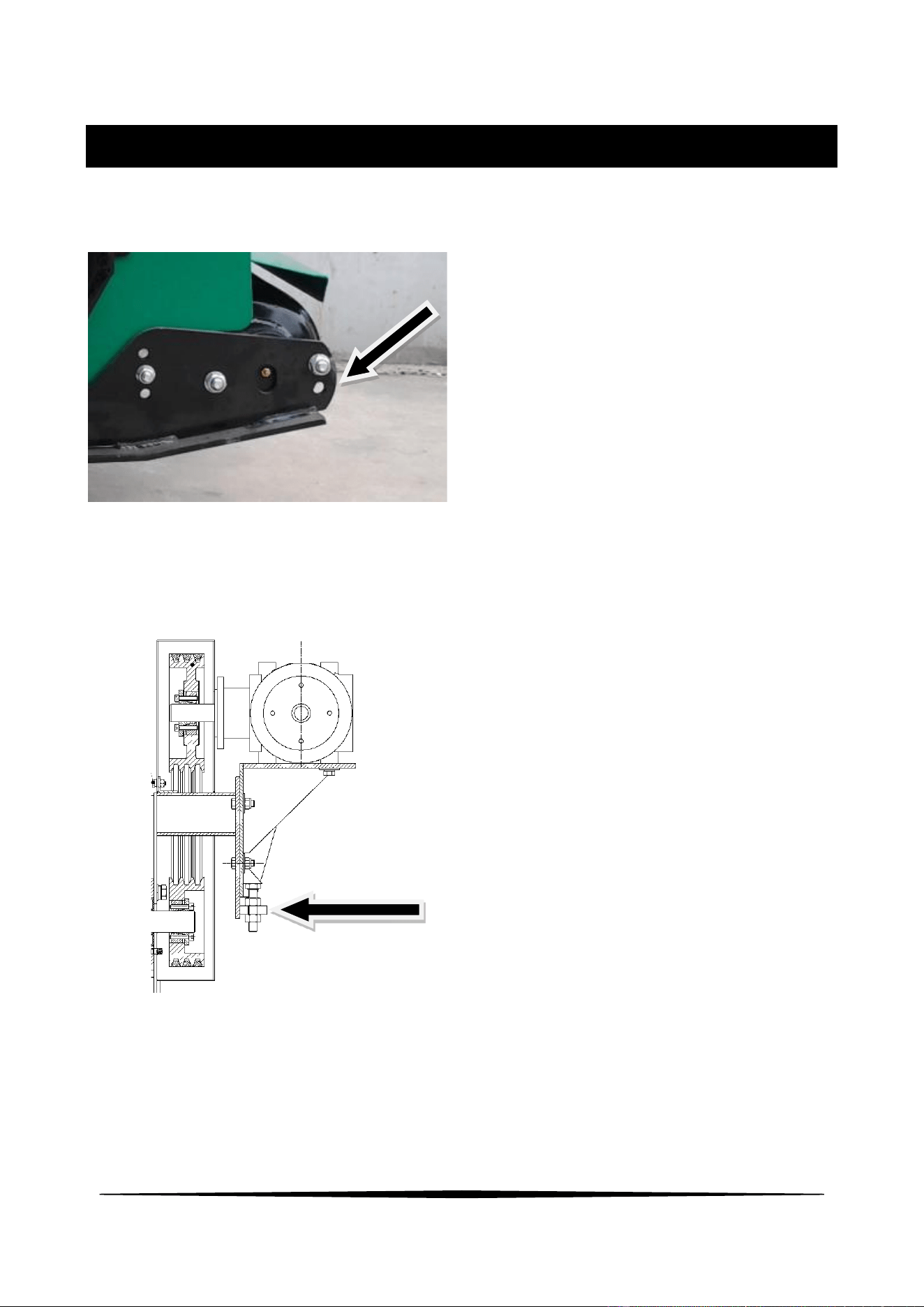
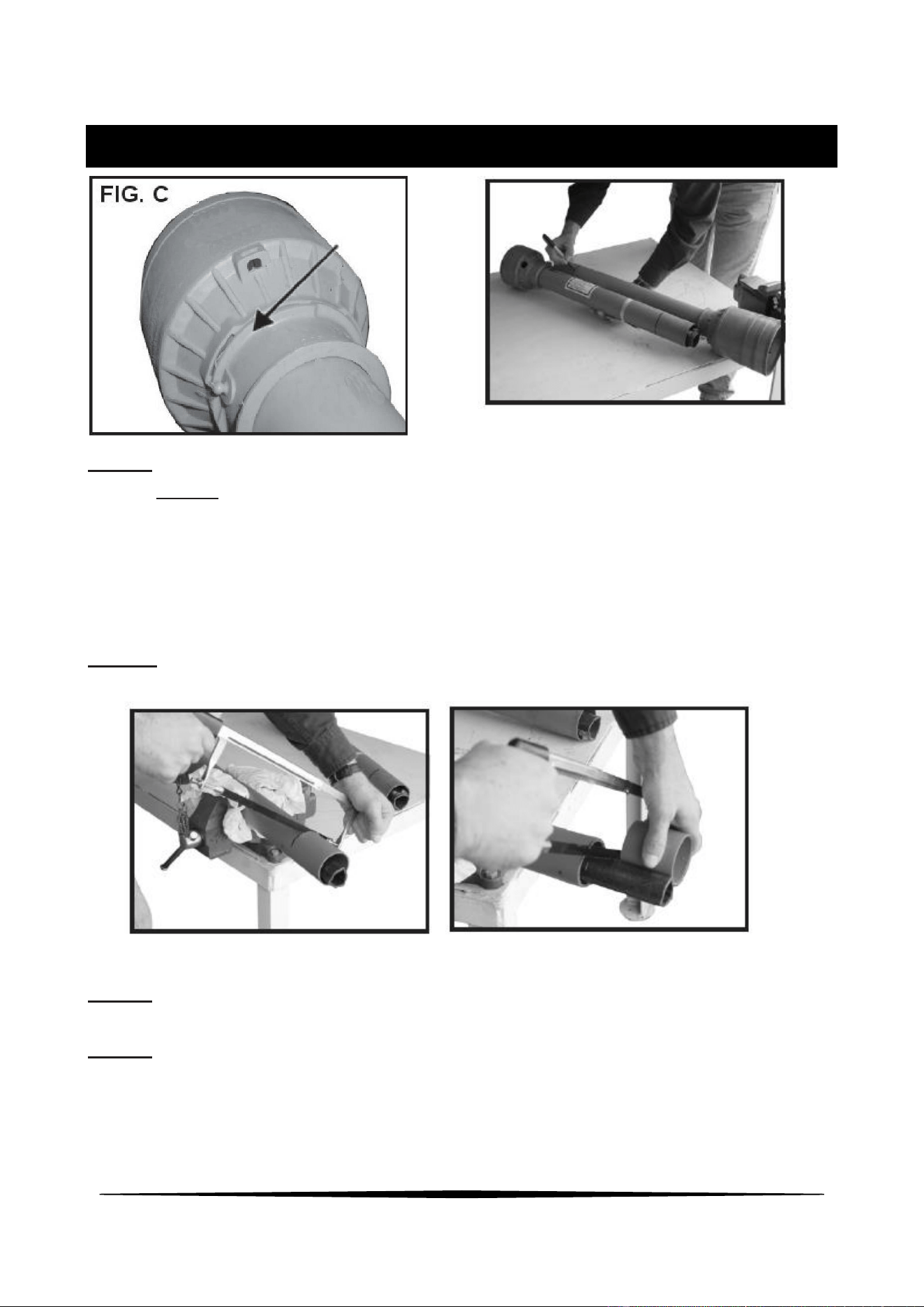
1. Adjust the height . In order to conduct the a precise work, the mower should be operated as the
suitable height. For saving power and reducing the wear of the machine, the cutting height
should be regulated correctly. Adjust the screw in figure to adjust the roller height.
Figure C
2. Regulating the Tension of Driving Belt by adjusting these screw.
14
ASSEMBLY INSTRUCTIONS
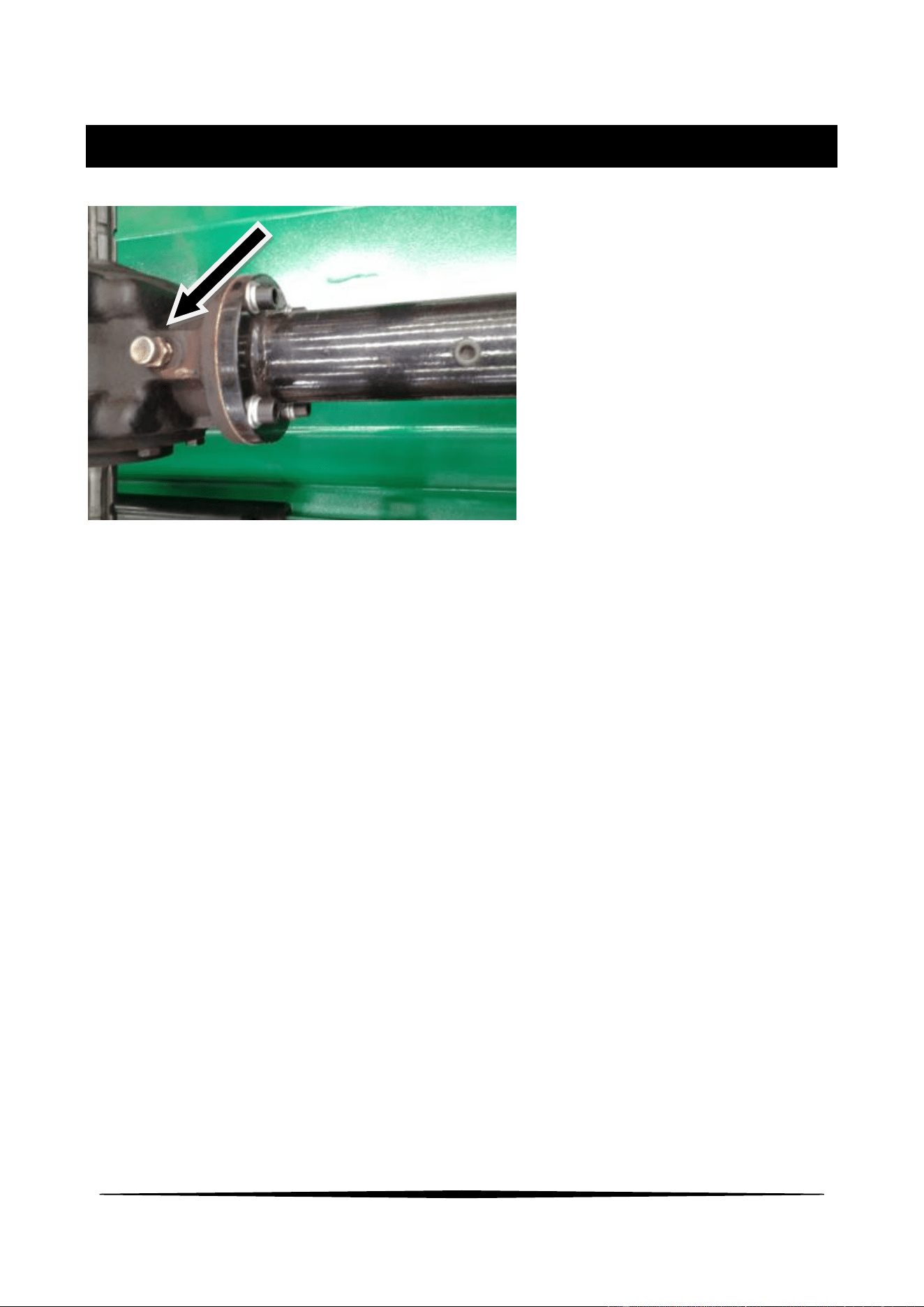
When you first to use it, you should grease nipple and fulfill oil into the gear box.
15
SIZING PTO SHFAT
STEP 1 Cutting the PTO shaft to length.
NOTE: Be sure to cut equal lengths of each PTO shaft section. Clamp end of PTO
shaft in a vice and cut off shield where marked. (Figure 1-A & 1-B)
Figure 1-A
STEP 2 Using cut section of the shield as a guide cut shaft off the same amount. (Figure 2)
STEP 3 Repeat steps 1 and 2 for other PTO shaft section.
STEP 4 Use a file to deburr PTO shafts. Clean up all chips, burrs and filings from both ends of
the PTO shaft.

16
OPERATING INSTRUCTIONS
WARNING: IF MOWER IS RAISED UP SO THAT PTO SHAFT IS AT AN
ANGLE SHARPER THAN 35 DEGREES PTO MUST BE STOPPED!
STEP 1 Before each use perform the maintenance described in maintenance section.
STEP 2 Read, understand, and follow the information on safety training, preparation, starting
and stopping safety, operational safety, transport safety warning sections of this manual.
STEP 3 With the Flail mower positioned on level ground, adjust the tractor lift arms so that when
lifted, the rotor bar remains parallel to the ground.
STEP 4 With the Flail mower attached to the tractor, raise and support the mower with suitable
blocks. Adjust the skids, located on the sides of the mower. The adjustment bolts for
both right and left sides should be positioned in the same adjustment hole. This allows
the mower to mow the same depth on each side.
Note: Never attempt to adjust the Flail mower while the tractor is running.
STEP 5 Raise the mower and remove the blocks. Lower the mower to the ground.
STEP 6 With the tractor at idle RPM and the mower lifted off of the ground, engage PTO and
slowly advance throttle to 540 PTO RPM. NOTE: Flail mower is designed to run at
540 PTO RPM only.
STEP 7 Select a low gear for the tractor and begin to move forward. Tractor ground speed is to
be controlled by gear selection only and not engine speed. As the tractor moves forward,
slowly lower the mower down. Allow the mower tines to gradually engage the ground.
NOTE: Do not allow the tractor engine or Flail mower to bog down or stall. This causes
undue wear and tear on the mower and tractor. If this continues to happen reduce
ground speed and raise working depth of Flail mower. Never attempt to re-move
objects from the rotor bar until the tractor has been shut down and the mower tines
have completely stopped.

17
OPERATING INSTRUCTIONS
Never travel at a fast ground speed while using the mower, this could damage it.
Never attempt to turn the tractor or travel in reverse with the PTO engaged and the
mower in the ground. Always raise the mower out of the ground when backing up or
attempting to turn. Failure to due so may cause damage to the mower.
STEP 8 After each use clean all debris from the mower tines. Replace any missing or illegible
safety decals. Inspect for any damaged or worn parts and replace before next use. Store
Flail mower in a dry environment.

18
SERVICE AND MAINTENANCE
3.1 Service
3.1.1 FLUIDS AND LUBRICANTS
1. Grease:
Use only a grade Type II tube grease.
2. Storing Lubricants:
Your machine can operate at top efficiency only if clean lubricants are used. Use clean containers to handle
all lubricants. Store them in an area protected from dust, moisture and other contaminants.
3.1.2 GREASING
1. Use a hand-held grease gun for all greasing.
2. Wipe grease nipple with a clean cloth before greasing, to avoid injecting dirt and grit.
3. Replace and repair broken nipples immediately.
4. If nipples will not take grease, remove and clean thoroughly. Also clean lubricant passageway. Replace
nipple if necessary.
3.2 Maintenance
The recommended period is based on normal operating conditions. Severe or unusual conditions may require
more frequent maintenance.
3.2.1 8 Hours or Daily Maintenance
1. Check all nuts and bolts in connection parts, replace if required.
Pump grease into each grease nipple three to five times.
Clean the implement; take away all debris and residue.4.
3.2.2 Season Maintenance
1. Check the machine as above for daily maintenance.
2. Check the bearings of blade spindles for wear and tear. If warn, disassemble, clean and replace them if it is
necessary, grease as required.
3. Check the drive belt if tighten.

19
SERVICE AND MAINTENANCE
3.2.3 Annual Maintenance
1. Thoroughly clean the flail mower of debris and residue.
2. Drain the gearbox and clean it thoroughly. Fill with new gear oil up to the dedicated oil level.
3. Check and clean blade axles. Check oil seals and replace if necessary.
4. Check all blades, replace them if they are warn out or damaged.
5. Repair the side skirts; return them to original technical condition. Replace damaged or broken protective
devices.
6. Remove the drive shaft from the machine. Pull the PTO shaft apart. Check and replace any.
components that are damaged or worn. Install the PTO shaft on the machine. The PTO shaft should
telescope easily and the guard turn freely on the shaft, grease if necessary.
8hrs/Daily
40hrs/Weekly
Annually
Lubricate PTO Shaft
Yes
Yes
Yes
Lubricate Caster Wheels
Yes
Yes
Yes
Lubricate Blade Spindle
Yes
Yes
Yes
Clean Machine
Yes
Lubricate and clean PTO Shaft Cover
Yes
3.2.4 PTO SHAFT MAINTENANCE
The PTO shaft is designed to telescope to allow for dimensional changes as the machine goes through its
operating range. A tubular guard encloses the driving components and is designed to remain stationary on a
turning shaft when required. The shaft should telescope easily and the guard turn freely on the shaft at all
times. Annual disassembly, cleaning and lubrication is recommended to insure that all components function
as intended. To maintain the shaft, follow this procedure:
1. Remove the shaft from the machine.
2. Pull shaft apart.
3. Use a screwdriver to pry the tabs out of the sleeves on each end. There are 3 tabs per guard.
4. Pull the shaft out of the plastic tubular guard.
5. Use a solvent to clean the male and female portions of the telescoping ends.
6. Apply a light coat of grease to each end.
7. Clean grooves on each end where the tabs are located. Clean each tab also.
8. Apply a light coat of grease to each groove.
9. Insert the shaft into its respective guard and align the slots with the groove.
10. Insert the tabs through the slots and seat in the groove.
11. Check that each guard turns freely on the shaft.

20
SERVICE AND MAINTENANCE
12. Assemble the shaft.
13. Check that the shaft telescopes easily.
14. Replace any components that are damaged or worn.
15. Install the shaft on the machine.
3.2.5 GEARBOX AND HYDRAULIC MAINTENANCE
Maintain the gearbox and hydraulic components by following this procedure:
Check if the belt is wear out, or replace a new belt.
Check if the tooth of gear is wear out, or replace a new gear.
Dirt, debris and salt has to be washed away immediately after using the mower in such circumstances.
3.3 STORAGE
After the season’s use, the machine should be thoroughly inspected and prepared for storage. Repair or
replace any worn or damaged components to prevent any unnecessary down time at the start of next season.
To insure a long, trouble free life, follow the procedure outlined below:
1. Thoroughly wash the machine using a pressure washer to remove all dirt, mud, debris and residue.
2. Inspect the blades and rotor for damage or entangled material. Repair or replace damaged parts. Remove
all entangled material.
3. Lubricate all grease nipples. Make sure that all grease cavities have been filled with grease to remove
any water residue from the inside.
4. Touch up all paint nicks and scratches to prevent rusting.
5. Move to storage area.
6. Select an area that is dry, level and free of debris.
7. Unhook from tractor.
8. If the machine cannot be placed inside, cover with a waterproof tarpaulin and tie securely in place.
Store the machine in an area away from human activity. Do not allow children to play on or around the stored
machine.

21
SERVICE AND MAINTENANCE
3.4 Trouble Shooting
The Flail mower is designed to work on unplowed and plowed field. It is a simple and reliable system that
requires minimal maintenance.
In the following section, we have listed many of the problems, causes and solutions to the problems that you
may encounter.
Problem
Possible Cause
Solution
PTO Shaft inclined too
much
Flail mower failed horizontal level
Adjust the horizontal level of the
Mower
One side sway chain of tractor is too short
Adjust the chain
PTO Shaft injured
Direction mistaken
Re-assemble correctly
Grease deficient
Rinse needle and pump grease
sufficiently
Angle of PTO Shaft is too big or is gripped
Limit the rising position and re-lock
the position
Flail mower fallen down the soil sharply
Fall the Mower down the soil
smoothly
Noise in gearbox
The clearance between the two helical
bevel gears is too large
Adjust this clearance
Bearing injured
Replace bearing
Tooth of gear broken
Replace gear
Trouble rotation of
cultivator shaft
Gear or bearing injured or gripped
Replace gear or bearing
There was no clearance between the two
helical bevel gears
Adjust the clearance of the helical
bevel gear pair
Out of shape of left side plane
Correct side plane
Cultivator shaft crooked or out of shape
Correct or replace cultivator shaft
Cultivator shaft twined with grass or hold
soil seriously
Clear away grass or soil
22
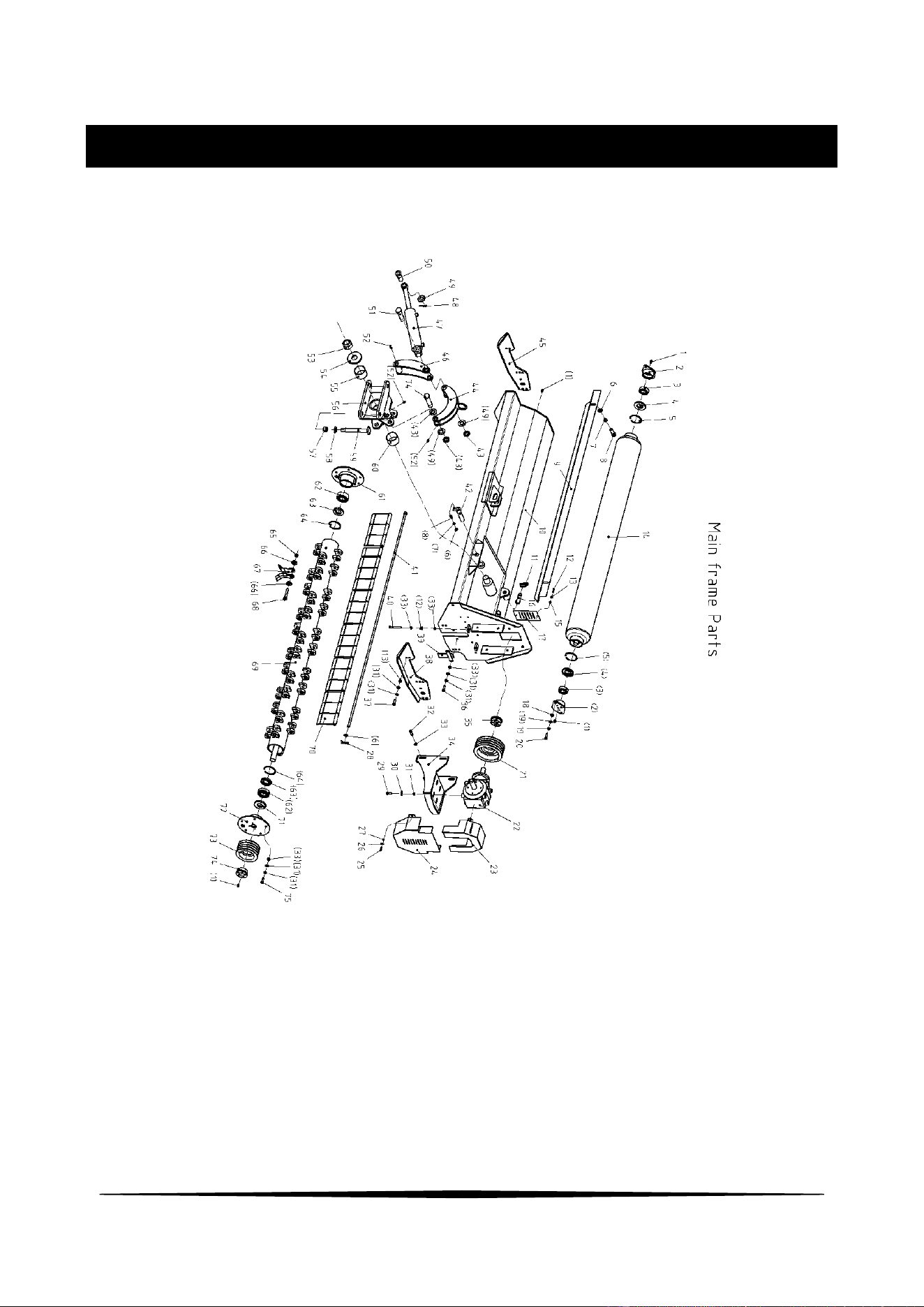
AGFK PARTS LIST
23
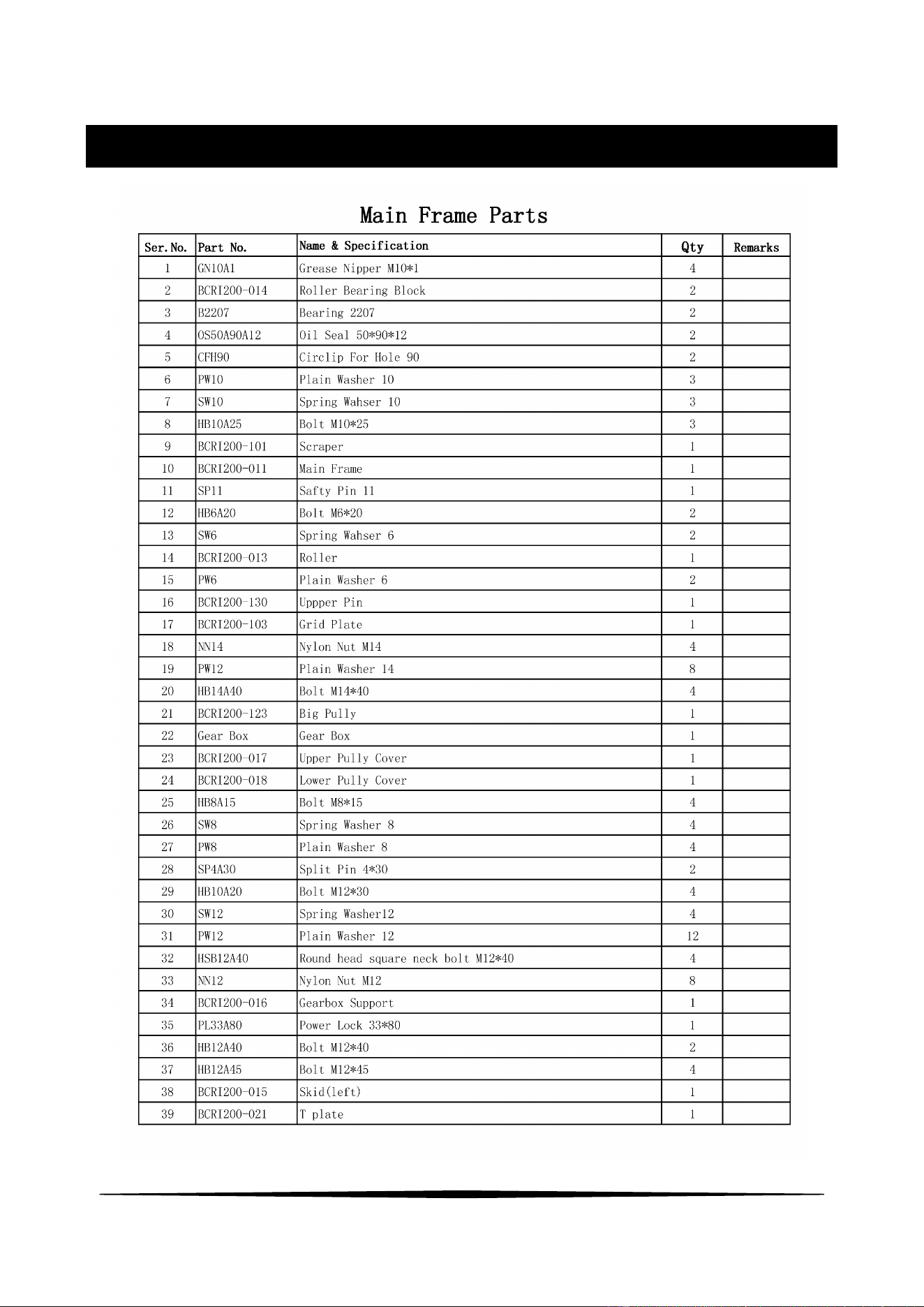
AGFK PARTS LIST
24
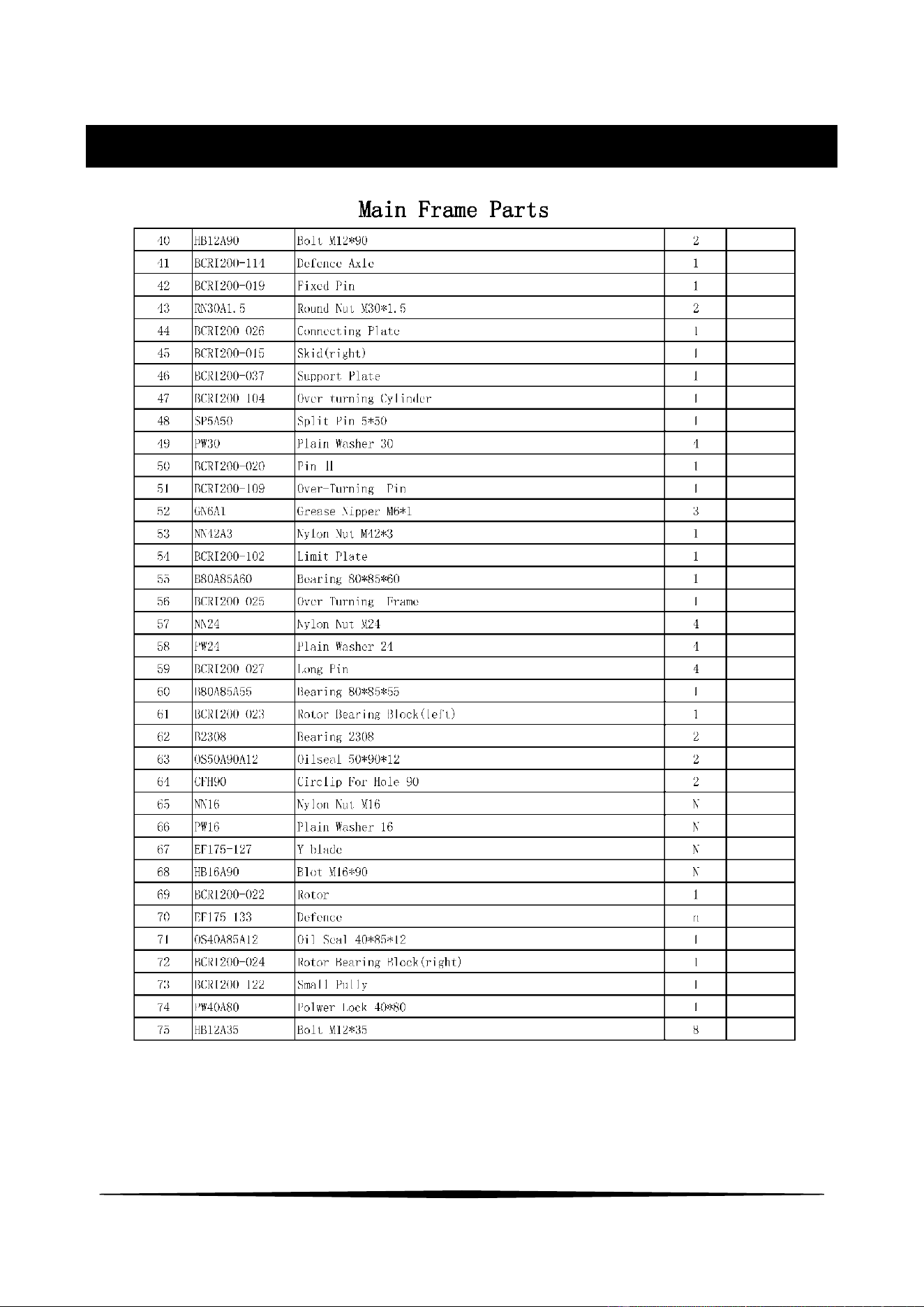
AGFK PARTS LIST
25
AGFK PARTS LIST
26
AGFK PARTS LIST
27
AGFK PARTS LIST
28
AGFK PARTS LIST
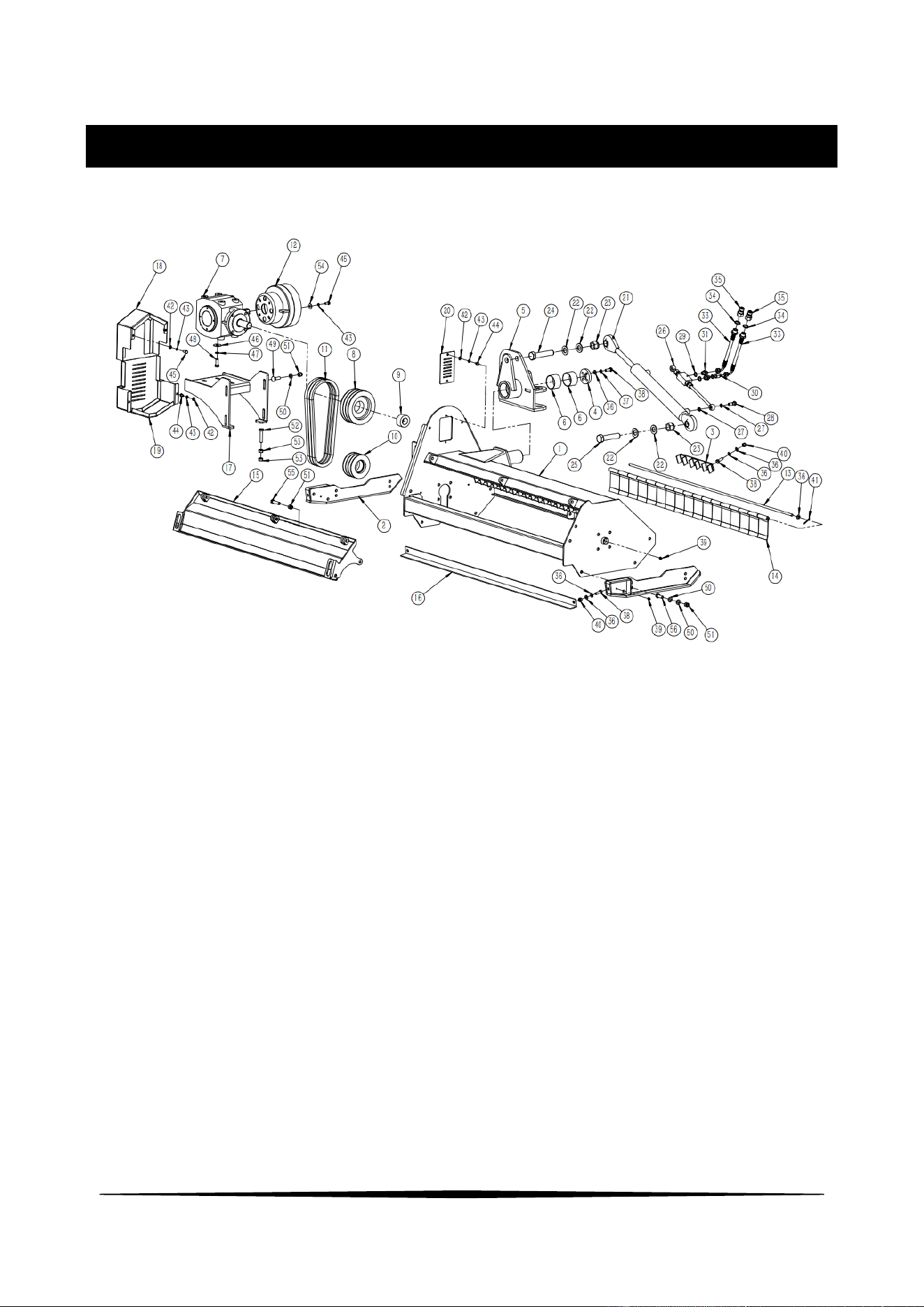
29
AGFK PARTS LIST
CR PARTS LIST
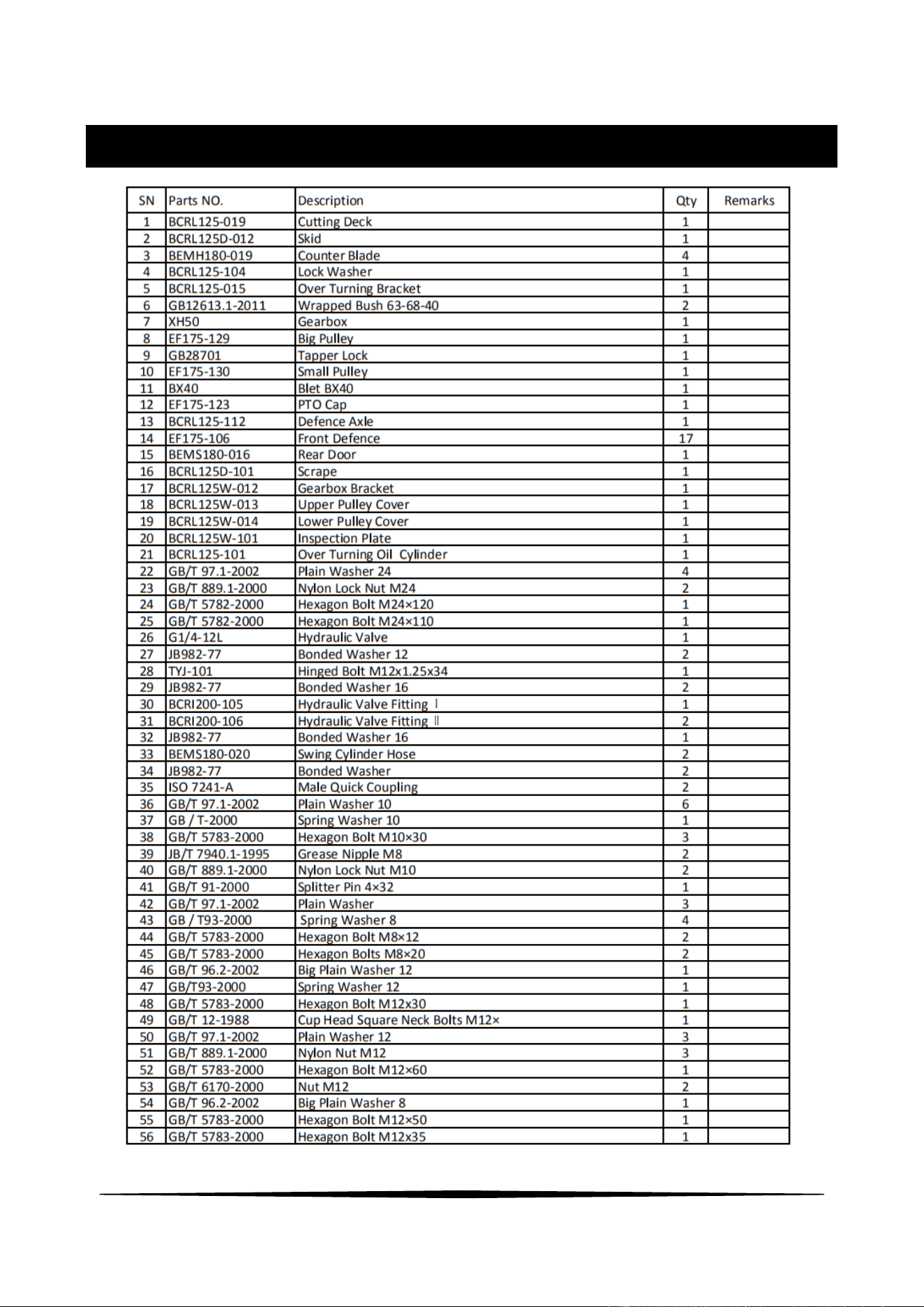
30
AGFK PARTS LIST
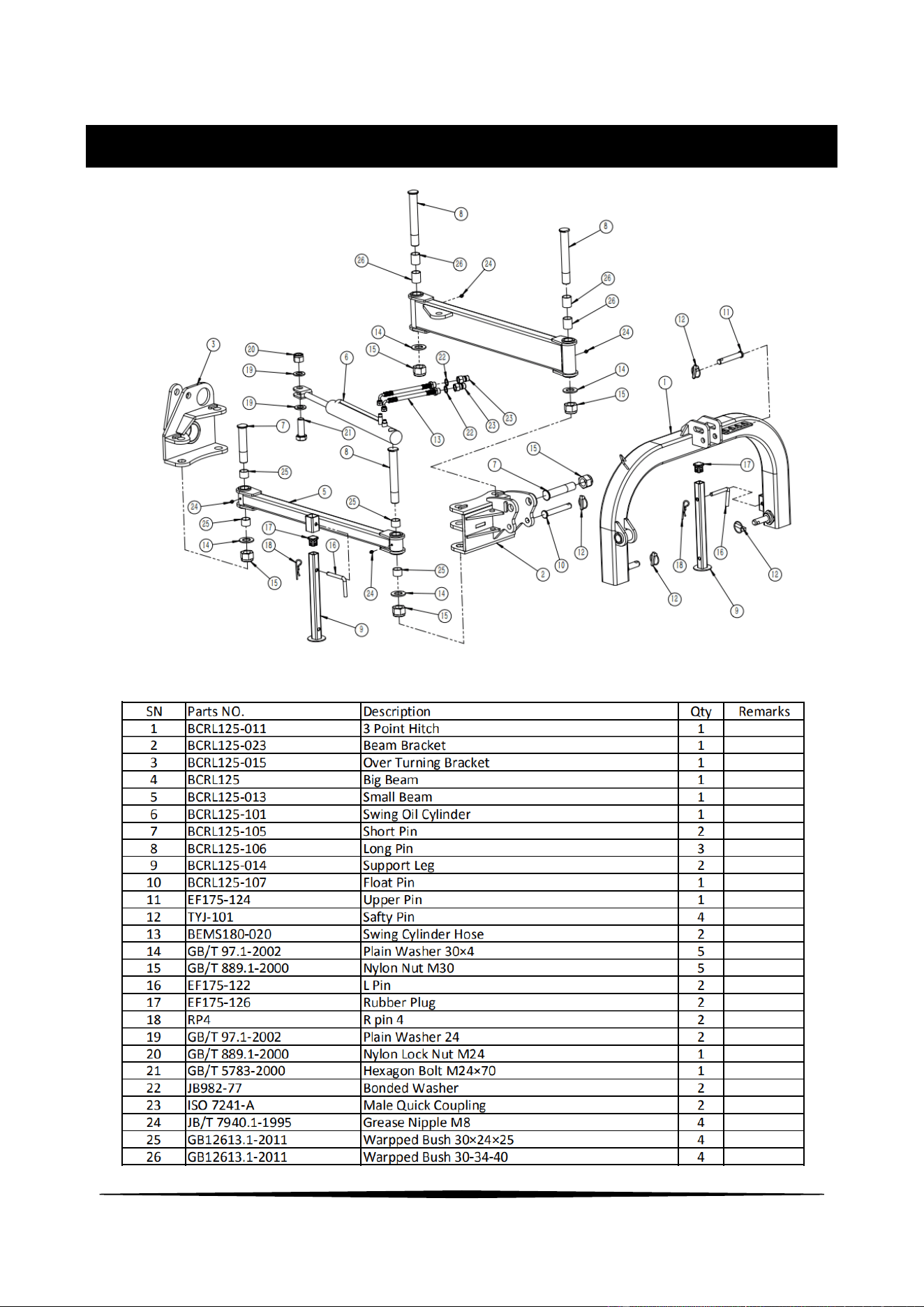
31
AGFK PARTS LIST
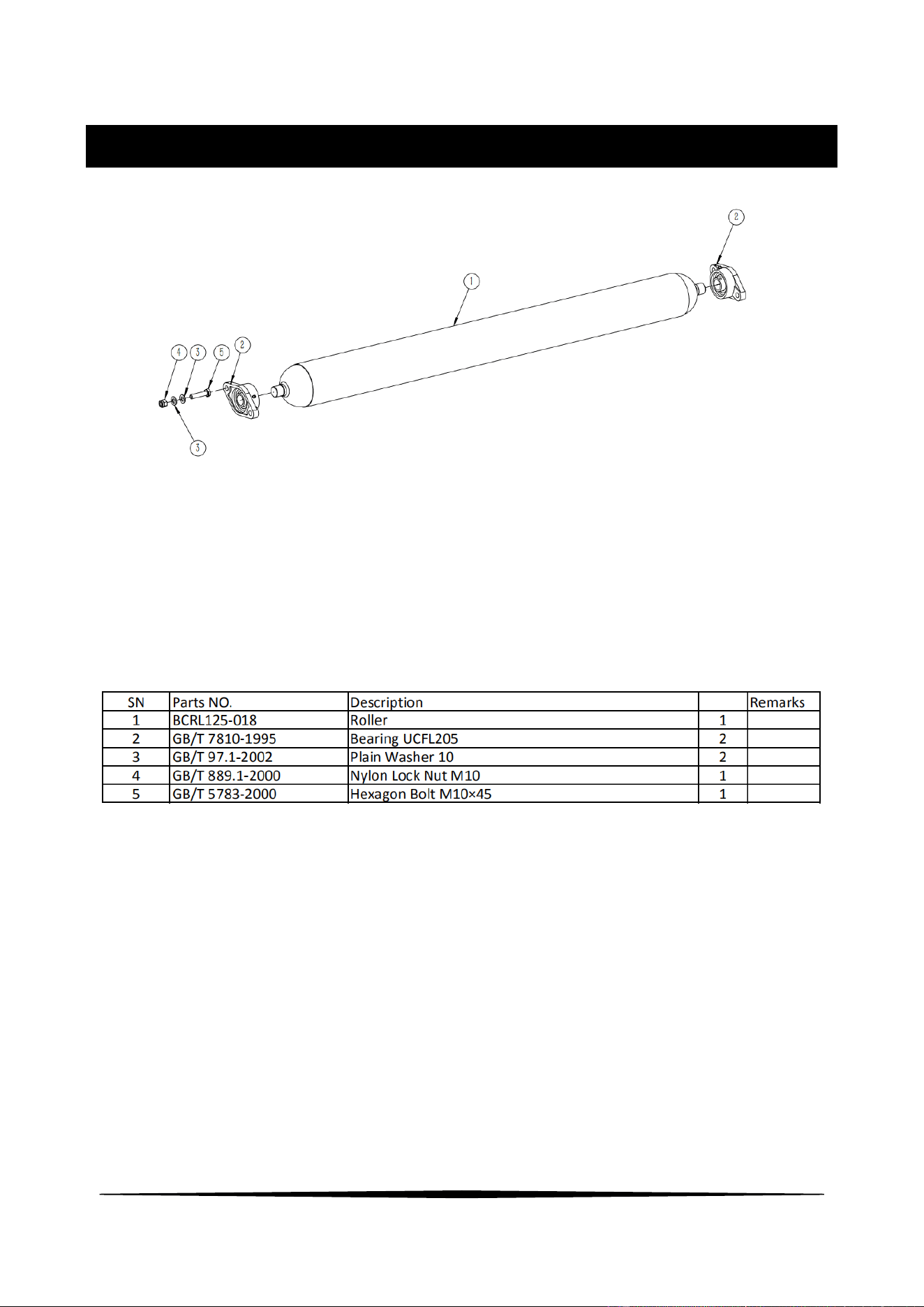
32
AGFK PARTS LIST
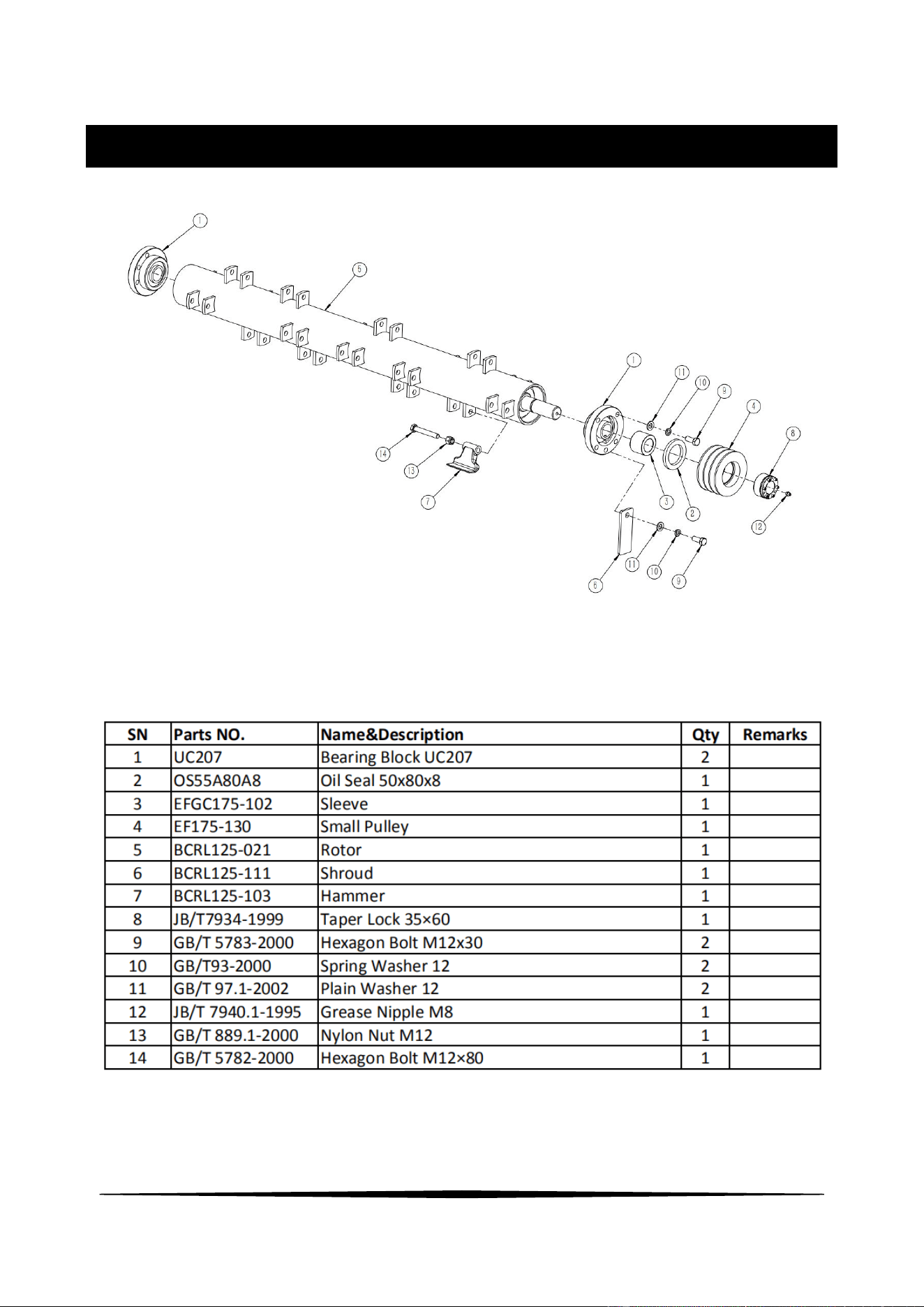
33
AGFK PARTS LIST