ピッコロ / フルート
取扱説明書
Piccolo/Flute
Owner’s Manual
Pikkoloöte/Queröte
Bedienungsanleitung
Piccolo/Flûte
Mode d’emploi
Flautín/Flauta
Manual de instrucciones
Español
Português
Français
Deutsch
English
日本語
中文
Русский
한국어
Piccolo/Flauta
Manual de instruções
短笛
/
长笛
使用手册
Пикколо/Флейта
Руководство пользователя
피콜로 / 플루트
사용설명서
EN ZHESDE RUPTFR KOJA

2
You are now the owner of a high quality musical instrument. ank you for choosing Yamaha. For
instructions on the proper assembly of the instrument, and how to keep the instrument in optimum
condition for as long as possible, we urge you to read this Owner’s Manual thoroughly.
Agora você é o proprietário de um instrumento musical de alta qualidade. Obrigado por escolher a marca Yamaha.
Aconselhamos que leia cuidadosamente todo o manual do proprietário para ver as instruções de montagem
adequada do instrumento, bem como manter em ótimas condições de uso pelo máximo de tempo possível.
Sie sind nun der stolze Besitzer eines hochwertigen Musikinstruments. Vielen Dank, dass Sie sich für ein Instrument der Marke
Yamaha entschiedenen haben. Um mit den Handgrien zum Zusammensetzen und Zerlegen des Instruments vertraut zu werden
und dieses über Jahre hinweg in optimalem Zustand halten zu können, raten wir Ihnen, diese Anleitung aufmerksam durchzulesen.
衷心感谢您选购雅马哈乐器。
为了保证您能够正确组装乐器 , 并尽可能长时间地将您的乐器保持在
最佳状态 , 我们建议您完整地阅读使用手册。
Vous êtes dès à présent le propriétaire d’un instrument de musique de haute qualité. Nous vous remercions d’avoir choisi Yamaha.
En ce qui concerne les instructions relatives à un assemblage adéquat de l’instrument et sur la façon de garder l’instrument dans des
conditions optimales aussi longtemps que possible, nous vous conseillons vivement de lire entièrement le présent Mode d’emploi.
Поздравляем вас с покупкой высококачественного музыкального инструмента. Благодарим
за выбор инструмента Yamaha. Убедительно просим вас внимательно ознакомиться с данным
руководством, содержащим указания по сборке инструмента и надлежащему уходу за ним.
Usted es ahora propietario de un instrumento musical de alta calidad. Le agradecemos su elección de un instrumento
Yamaha. Le aconsejamos que lea todo este manual de instrucciones para ver las instrucciones para el montaje correcto del
instrumento y para aprender a conservar el instrumento en óptimas condiciones durante tanto tiempo como sea posible.
야마하 악기를 구입해 주셔서 감사합니다 . 악기의 알맞은 조립 방법 및 보관을 위해 본 사
용설명서를 반드시 읽어주시기 바랍니다 .
このたびは、ヤマハピッコロ / フルートをお買い上げいただき、まことにありがとうございます。
楽器を正しく組み立て、性能を最大限に発揮させるため、また長く良い状態で楽器をお使いい
ただくために、この取扱説明書をよくお読みください。
piccolo_flute_9om_cover_b0_1204.indd 2 2021/01/07 13:10:34
3
Precautions
Please read before using
Disobeying the points indicated with this mark
may lead to injury.
Piccolo/Flute
Owner’s Manual
The precautions given below concern the proper and safe use of the instrument, and are to
protect you and others from any damage or injuries. Please follow and obey these precautions.
If children are using the instrument, a guardian should clearly explain these precautions to the child and make sure they
are fully understood and obeyed. After reading this manual, please keep it in a safe place for future reference.
■ About the Icons
Do not throw or swing the instrument when others
are close by.
The headjoint or other parts may fall off hitting other
people. Always treat the instrument gently.
Regarding brass instruments with a plate nish, the color of the nish may change over time. However,
changes in the nish do not affect the instrument’s performance. Discoloration in its early stages can easily
be removed with proper maintenance. (As discoloration progresses, however, it may be difcult to remove.)
* Please use the accessories that are specified for use with the particular type of finish found on the instrument. Also, metal
polishes remove a thin layer of the finish’s top coat which will make the finish thinner. Please be aware of this before using
polish.
Keep small parts out of the reach of infants.
Your children may accidentally swallow them.
Keep the oil, polish, etc., out of children’s mouths.
Keep the oil, polish, etc., out of children’s reach and only
do maintenance when children are not present.
Accessories
●
Cleaning rod
●
Polishing cloth
●
Gauze
●
Owner’s Manual (this booklet)
NOTICE
To avoid the possibility of damage to the product, follow the notices below.
*
Take care not to disgure the instrument. Placing the instrument where it is unstable may cause the instru-
ment to fall or drop resulting in disgurement. Take care as to where and how you place the instrument.
* Be aware of climatic conditions such as temperature, humidity, etc. Keep the instrument away from
heat sources such as heaters, etc. Also, do not use or store the instrument in any extreme conditions of
temperature or humidity. Doing so may result in damage to key balance, linkage, or pads, resulting in
problems during performance.
* Ointments or creams containing sulfur (for acne, etc.) coming in contact with the metal on the instru
-
ment can cause discoloration (the metal turns black or brown) of the silver or silver plate. To prevent this,
make sur
e that both hands and face are clean before playing.
This icon indicates points which should carefully be
observed and followed.
This icon indicates actions that are prohibited.
CAUTION
piccolo_flute_en_om_b0_1224.indd 3 2021/01/07 13:01:06
4
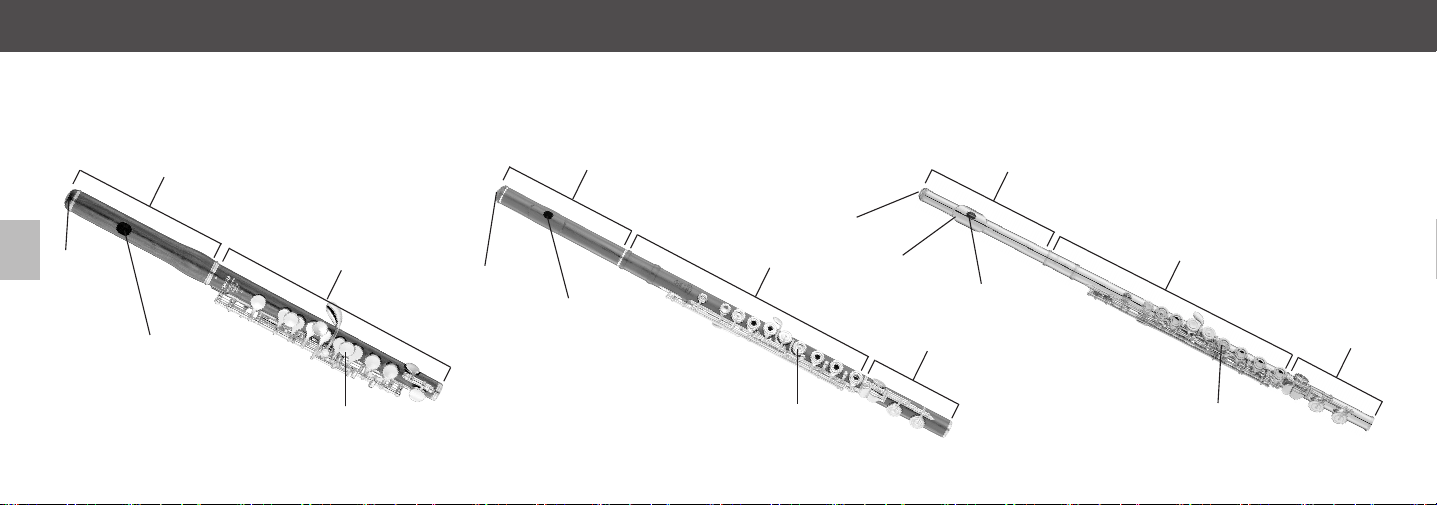
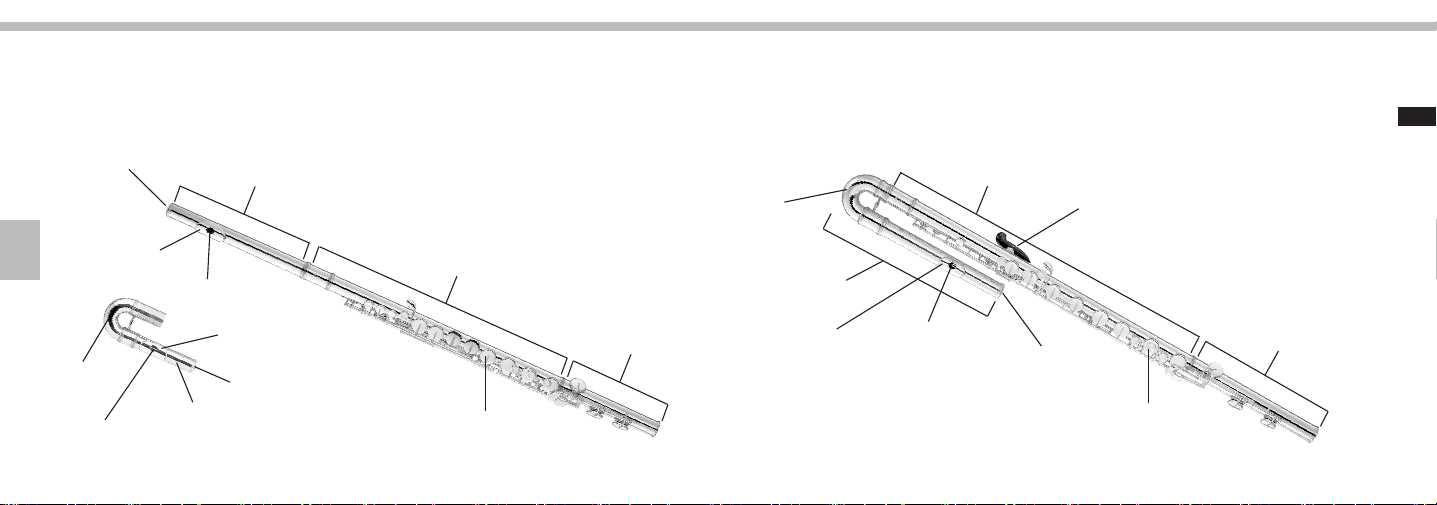
Nomenclature
■ Piccolo
■ Flute
Embouchure Hole
Embouchure Hole
Embouchure Hole
Headjoint
Crown
Body
Keys
Crown
Headjoint
Body
Keys
Footjoint
Crown
Headjoint
Body
Keys
Footjoint
Lip Plate
piccolo_flute_en_om_b0_1224.indd 4 2021/01/07 13:01:07
5
■ Alto Flute ■ Bass Flute
Crown
Headjoint
Embouchure Hole
Lip Plate
U-Joint
Lip Plate
Crown
Headjoint
Embouchure Hole
Body
Keys
Footjoint
U-Joint
Keys
Footjoint
Body
Hand rest
Crown
Lip Plate
Embouchure Hole
Headjoint
piccolo_flute_en_om_b0_1224.indd 5 2021/01/07 13:01:07
6
Before Playing the Instrument
■ Cautions regarding wooden instruments
Some ute and piccolo bodies are made of natural wood (Grenadilla) so sudden changes in tempera-
ture or humidity may result in cracking of the body or diculty when connecting the body sections
together. For this reason, take into careful consideration the place and manner in which the instru-
ment is used.
• During winter, wait until the entire instrument has adjusted to room temperature before playing.
• When the instrument is still new, do not play it for long periods of time. Play it for about 20 to 30
minutes a day for approximately 2 weeks.
• Both during and after performance, remove moisture and dirt from the instrument whenever
possible.
Before assembling the instrument, please observe the following points.
• When holding or assembling the instrument, do not apply any excessive force to the keys.
• Wipe away any dirt or foreign matter from the joints before assembling.
• If you experience diculty connecting the joints together, apply a thin coat of cork grease to the
cork and try again (for piccolo and bass utes only).
■ Cautions regarding the joints
Before assembling the instrument, always wipe o any dust or grime from the joint sections of all parts.
• Headjoint (Wipe to remove dust and grime from the outside of the headjoint and
inside of the body.)
• Footjoint (Wipe to remove dust and grime from the outside of the body and inside
of the footjoint.)
piccolo_flute_en_om_b0_1224.indd 6 2021/01/07 13:01:08
7
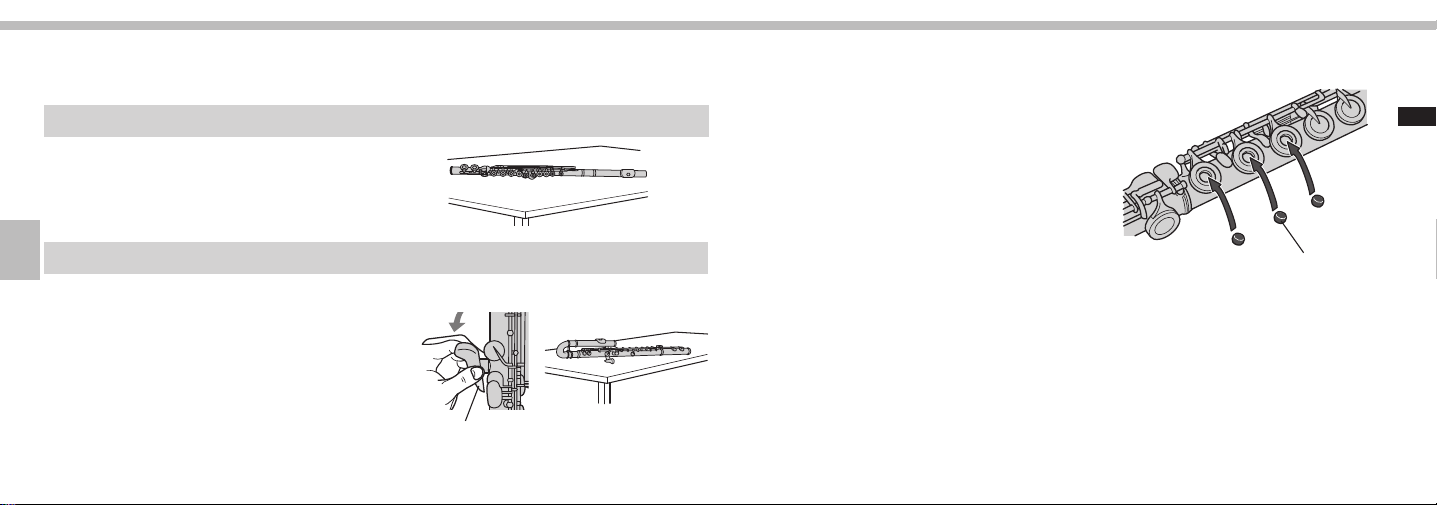
■ Using the ring key plugs
If your instrument has ring key plugs, be careful
not to lose them. Ring key plugs are useful when
you have trouble reaching a key with your ngers,
or when you cannot hold the key rmly enough.
■ When not holding the ute
Piccolo/Flute/Alto Flute
Place the instrument with the keys facing up
on a stable surface.
Bass Flute
1.
Turn the thicker end of the hand rest so it is at a
90° angle to the performer.
2.
Rest the instrument with its hand rest and
footjoint placed on a stable surface.
NOTE
* When resting the instrument on a at surface,
make sure the direction of the headjoint is ap-
propriate so that the instrument remains stable.
Hand rest
Ring key plug
piccolo_flute_en_om_b0_1224.indd 7 2021/01/07 13:01:08
8
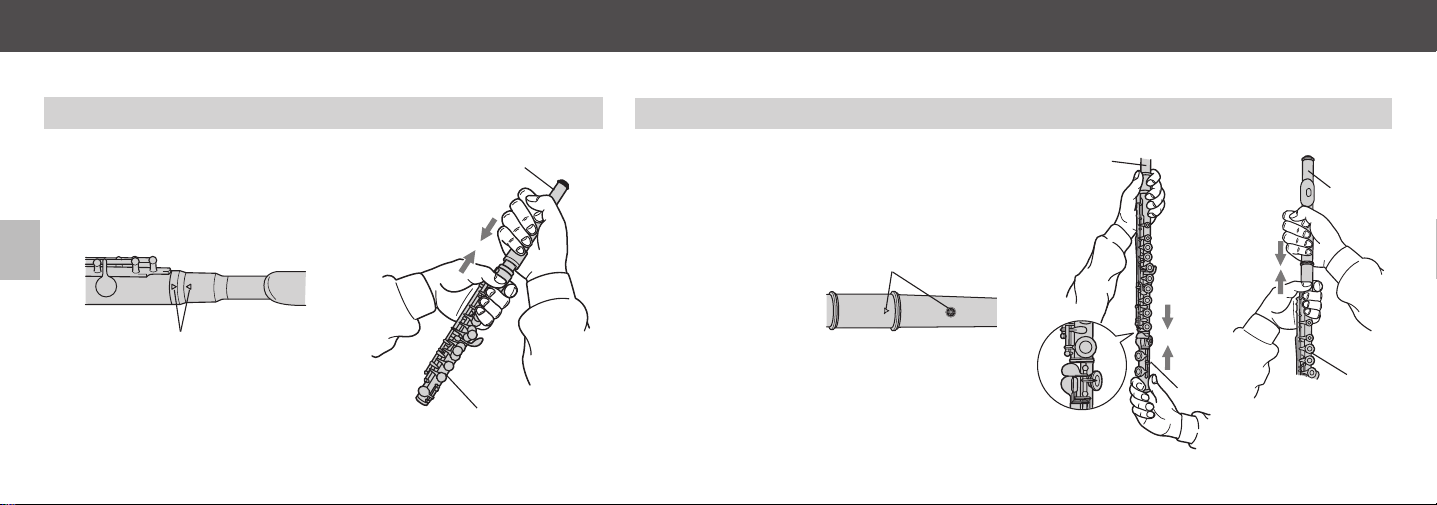
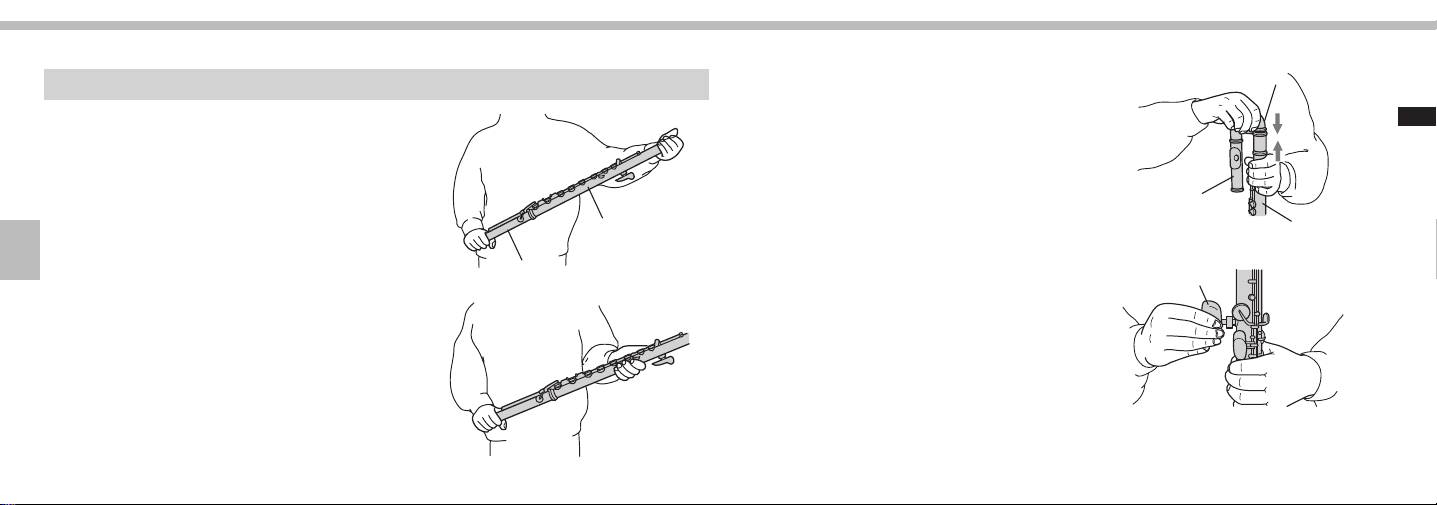
Flute
1.
Taking care not to press the keys,
attach the footjoint to the body.
2.
Taking care not to press the keys,
attach the headjoint to the body.
Headjoint
Body
■ Assembling the instrument
Piccolo
Headjoint
Body
Marks
Preparing to Play
Footjoint
Body
Marks
Taking care not to press the keys, connect the
headjoint to the body.
NOTE
* Use the markings on the headjoint and body
as a guide for aligning the two sections.
* If you experience diculty attaching the
joint sections, apply a thin coat of cork
grease to the cork and try again.
NOTE
* Use the markings on
the headjoint and body
as a guide for aligning
the two sections.
* Take care not grasp the lip plate on the headjoint, and do
not apply pressure to the keys on the body or footjoint.
* Use a cloth to wipe o any dirt or foreign matter from the
joint sections before assembling.
piccolo_flute_en_om_b0_1224.indd 8 2021/01/07 13:01:09
9
Body
Footjoint
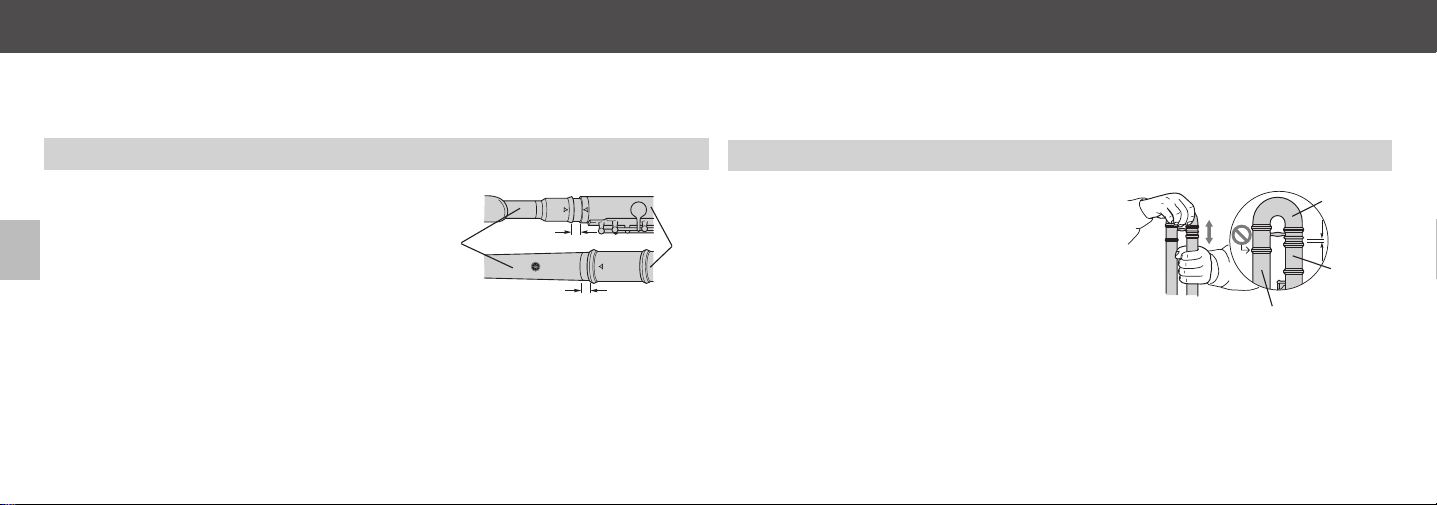
Flute
(Curved Headjoint models)
/Alto Flute/Bass Flute
1.
Use a cloth to wipe o any dirt or foreign mat-
ter from the joints before attaching.
2.
Taking care not to press to the keys, hold the
body at its uppermost point, and the footjoint
by its lowest point, and attach the footjoint to
the body.
If you experience diculty, hold the body in
the middle and try to attach it again.
NOTICE
* Take care not to apply unnecessary force to the
keys.
U-Joint
Body
Headjoint
Hand rest
3.
Attach the U-joint to the main body. Align the
U-joint so that it is positioned slightly to the
left of the keys when looking at the keys from
directly above. Next, rotate the headjoint and
adjust the position (angle) of the embouchure
hole so that it aligns with your mouth.
For the bass ute, the next step is to attach the
hand rest to the instrument at a comfortable
angle.
piccolo_flute_en_om_b0_1224.indd 9 2021/01/07 13:01:10
10
Tuning
Since changes in temperature and humidity can aect the instrument’s pitch, blow some air through the instrument to warm it up before tuning.
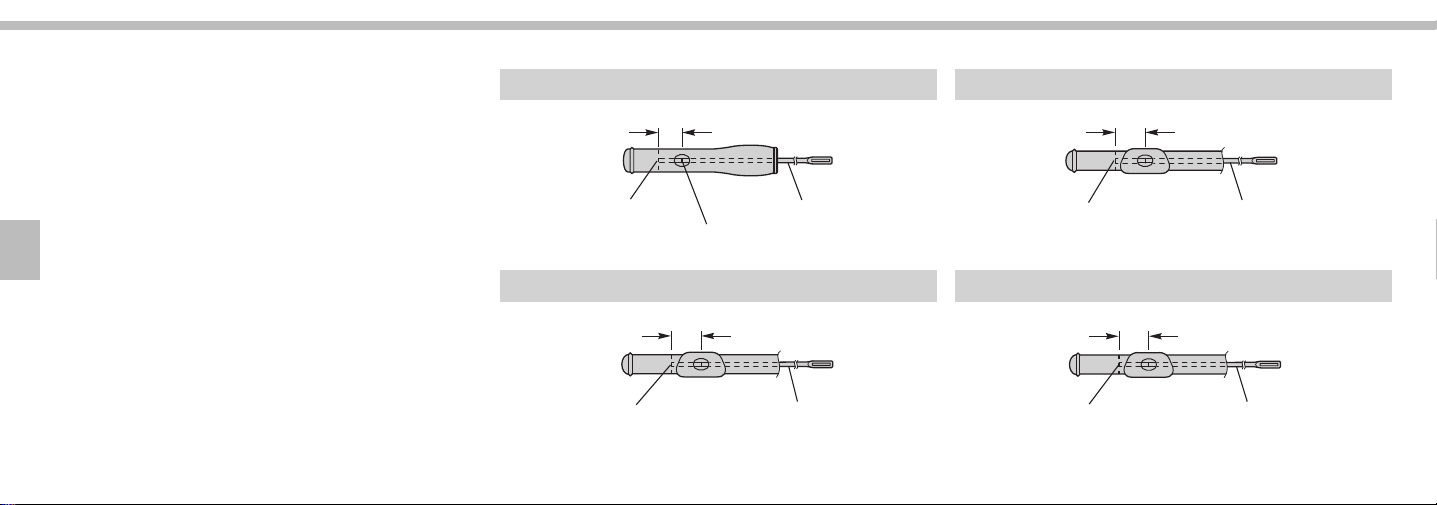
Piccolo/Flute
Tuning is accomplished by sliding the headjoint
slightly toward or away from the body.
* Pull out on the headjoint to lower the pitch
and push it in to raise the pitch.
Alto Flute/Bass Flute
On the alto and bass utes, tuning is accomplished
by sliding the U-joint slightly toward or away from
the body.
* Do not adjust the space between the headjoint and
U-joint. Doing so will degrade the pitch balance,
making it dicult to tune the instrument.
Body
U-joint
Headjoint
Headjoint
Body
piccolo_flute_en_om_b0_1224.indd 10 2021/01/07 13:01:10
11
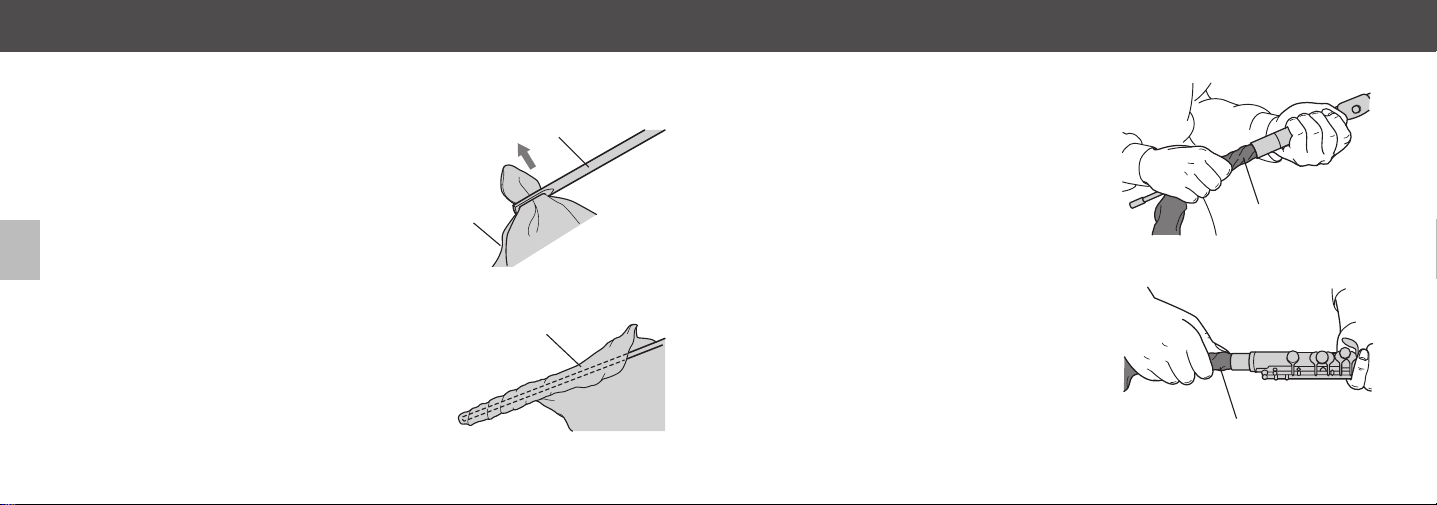
Check the tone reector position
As slippage in the tone reflector position can affect the
instrument’s intonation, its position should be checked pe-
riodically.
How to check the tone reector position
Using the supplied cleaning rod accessory, insert it into the
headjoint and make sure that the line on the cleaning rod is
centered in the embouchure hole.
NOTE
* When adjusting the tone reflector position Adjusting the
tone reflector’s position requires high skill and should be
done by your local dealer from whom you purchased the
instrument.
* If the head cap is loose, turn it until it is suciently tight.
Do not over-tighten the head cap, as it may cause the posi
-
tion of the reector to move.
Piccolo
Alto Flute
Flute
Bass Flute
Tone reector Cleaning rod
7.5mm
Tone reector Cleaning rod
26mm
Tone reector Cleaning rod
17mm
Tone reector Cleaning rod
40mm
Line on the cleaning rod
piccolo_flute_en_om_b0_1224.indd 11 2021/01/07 13:01:11
12
Maintenance
3.
Rotate the body in the same direction that the
gauze is wrapped and wipe away moisture from
the instrument’s bore. Wipe away moisture
from the joint sections as well.
* Take extra care removing moisture from
wooden instruments. Moisture left in the
bore can result in cracking.
Cleaning rod
Gauze
■ After playing the instrument
● Cleaning the body
1.
Insert the corner of a gauze through the hole
at the end of the cleaning rod.
2.
Wrap the gauze around the end of the clean-
ing rod, making sure no bare metal is exposed.
* Exposed metal can damage the interior of
the body.
Gauze
Gauze
Gauze
piccolo_flute_en_om_b0_1224.indd 12 2021/01/07 13:01:11
13
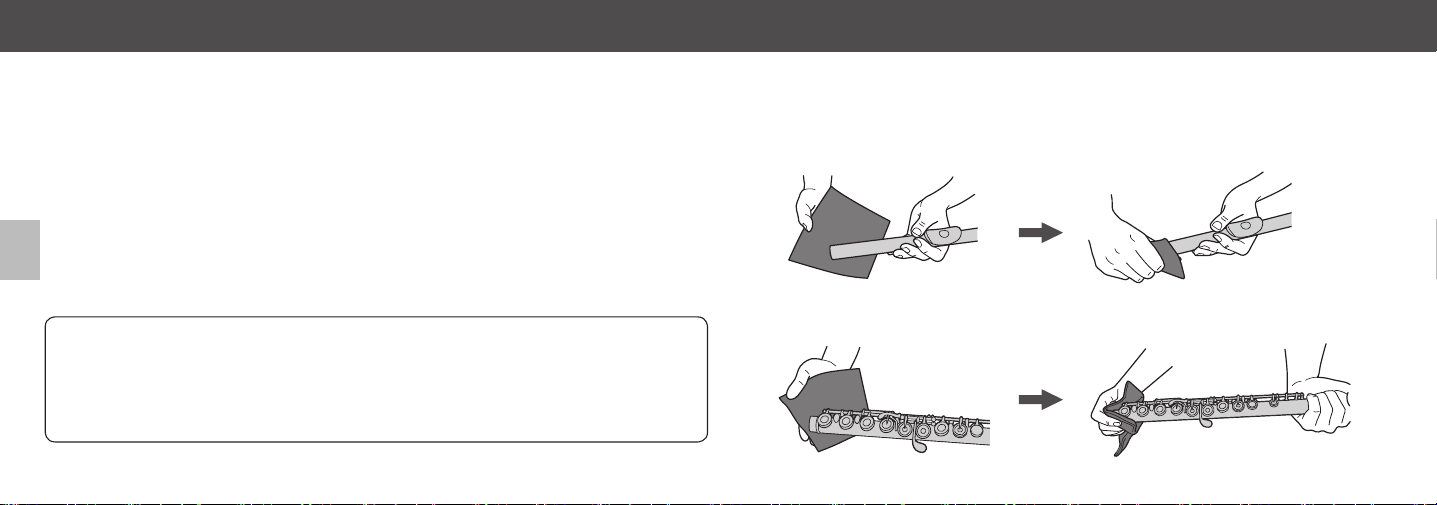
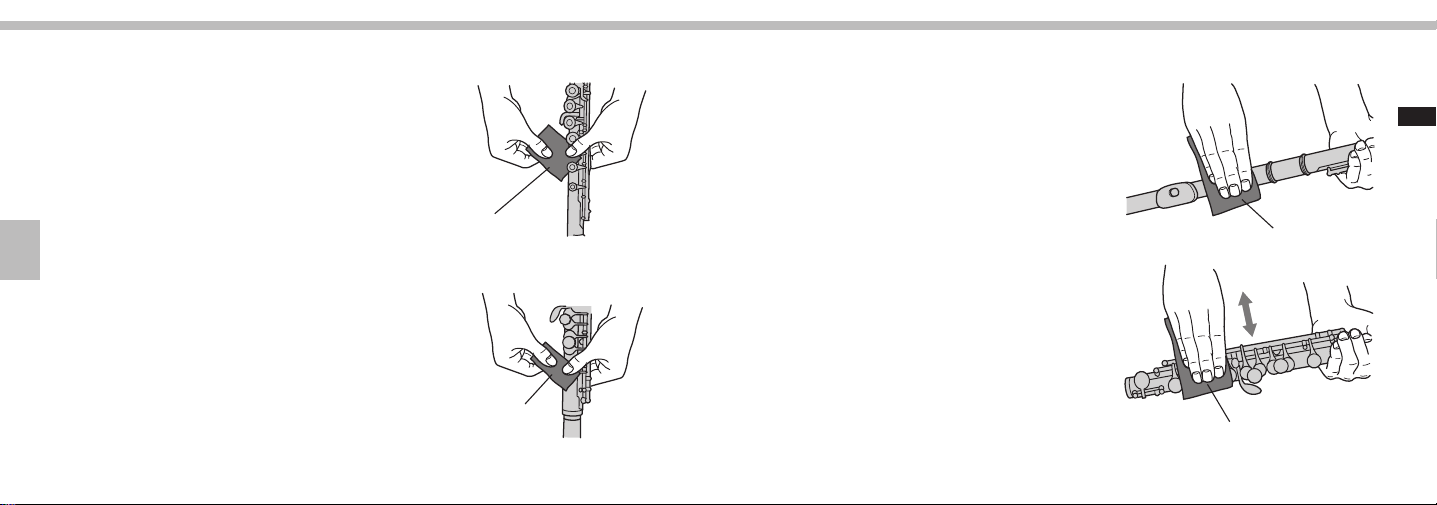
● Cleaning the exterior
Taking care not to apply pressure on the keys,
use a polishing cloth to wipe away ngerprints or
oil from the instrument’s exterior.
* When cleaning the keys, take care not to
damage the pads.
Cleaning paper
Powder paper
Polishing cloth
● Pad maintenance
1
.
While the pads are still wet, insert a piece of
cleaning paper between the pad and the tone
hole and completely remove moisture from
them.
2
.
If the pads are still sticky, use a piece of powder
paper to remove the stickiness.
Polishing cloth
piccolo_flute_en_om_b0_1224.indd 13 2021/01/07 13:01:12
14
■ Maintenance required every two to three months
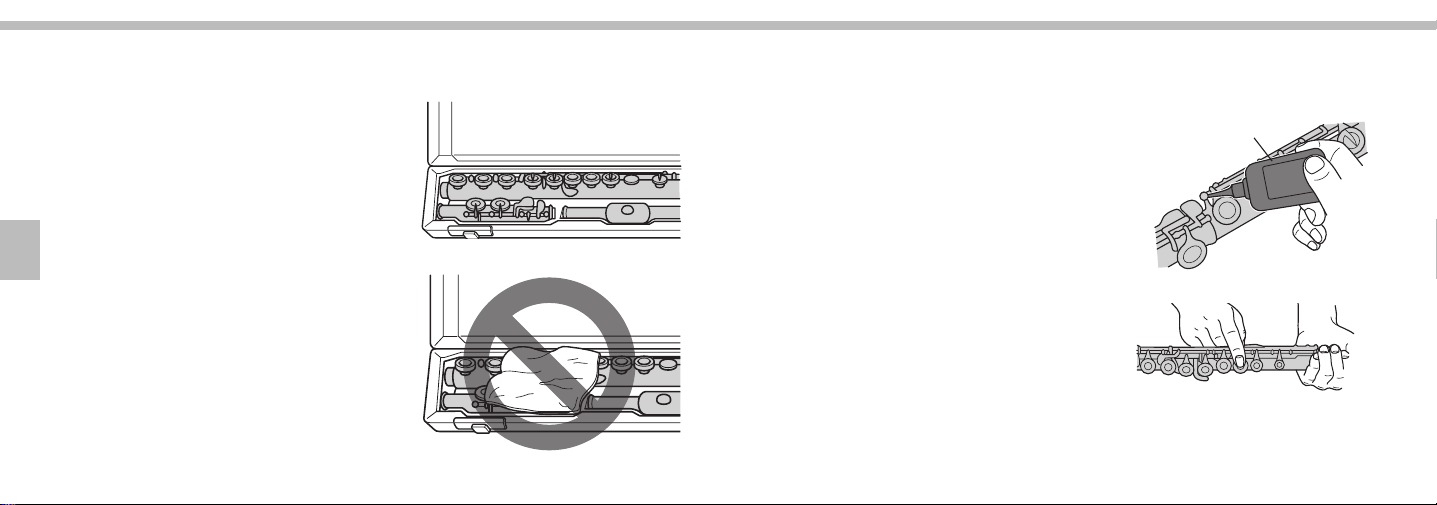
Key oil
1
.
Apply some key oil to the key mechanisms.
NOTE
* Do not apply too much key oil.
* If you are unsure of where to apply the key
oil, consult the store where you purchased it.
2
.
After applying oil, move the key several times
to spread the oil evenly.
3
.
Completely remove any oil that gets onto the
surface of the keys or instrument.
■ Putting the instrument in its case
When closing the case, make sure there are no
objects such as a gauze or cloth on top of the
instrument. Doing so may put unnecessary pressure
on the keys causing damage. Also, never leave a
damp cloth or gauze, etc., in the case.
First, wipe o moisture and dirt from the joints,
then place the headjoint into the case. Store the
headjoint, footjoint and the body in the case, in
that order. Fit it into the case snugly, without forc-
ing.
If you feel the keys are not moving well, use a
special key oil (sold separately.)
piccolo_flute_en_om_b0_1224.indd 14 2021/01/07 13:01:13

15
Troubleshooting
e tone is not clear, or the instrument plays out of tune.
•
e tone reector may be out of alignment.
•
e pads and tone holes may be out of alignment or the pads may be worn.
e keys are sti and function poorly.
•
e spring may be dislodged.
•
Excessive force applied to the keys may have bent them.
•
Too much or little oil may have been applied to the key mechanisms.
Attaching or removing the headjoint or footjoint is dicult.
•
ere may be dust or grime on the joint.
•
e body may have become deformed.
•
e headjoint may have been left attached to the body for a long period of time.
e keys produce noise when played.
•
Felts or corks may be deformed.
•
Excessive force applied to the keys may have bent them.
•
e key mechanisms may be worn.
•
Screws may have loosened.
If you notice any of the following problems, the instrument may not be working properly.
Please contact your local dealer for more information.
piccolo_flute_en_om_b0_1224.indd 15 2021/01/07 13:01:13
16
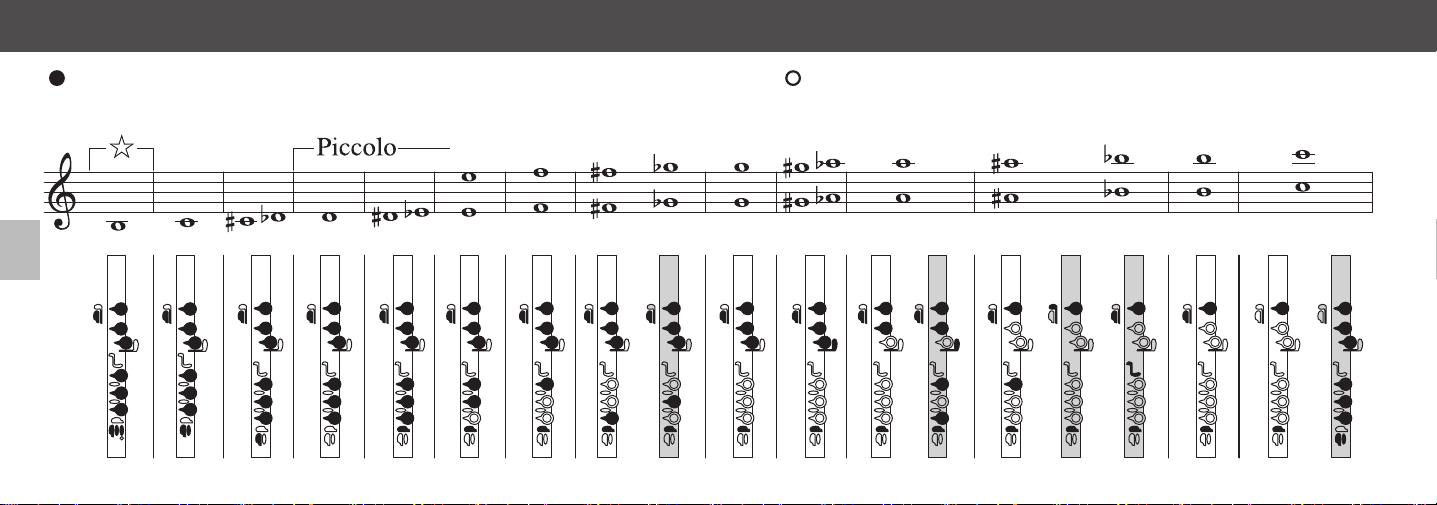
:
押さえる /
Close/Geschlossen/Fermé/Cerrado/Fechado/
按下
/
Закрыто
/
닫기
:
放す /
Open/Oen/Ouvert/Abierto/Aberto/
松开
/
Открыто
/
열기
☆
:
H 足部管 /
B Footjoint/H-Fuß/Patte de Si/Pata de Si/Pata de Si/
B 尾管
/
с коленом Си
/
B 풋조인트
フ ィン ガ リン グ チ ャ ート
/ Fingering Chart / Gritabelle / Tableau des doigtés / Gráco de digitado / Gráco de digitação /
指法表
/
Аппликатура
/
운지법
piccolo_flute_9om_fingerings_b0_0112.indd 16 2021/01/12 16:12:03
17
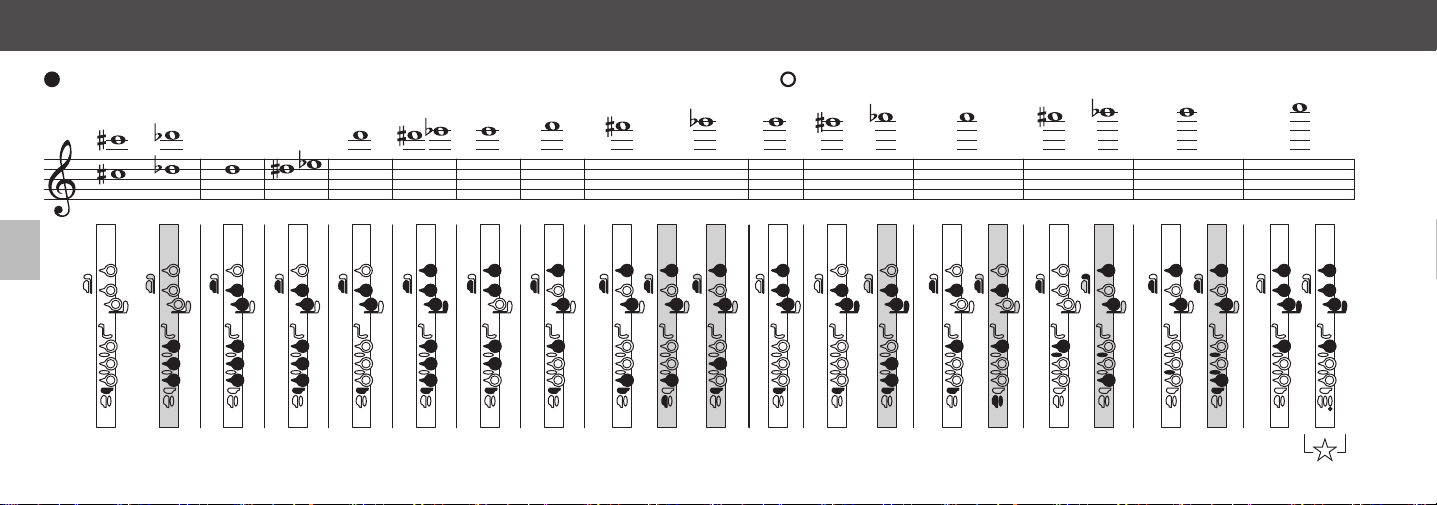
:
押さえる /
Close/Geschlossen/Fermé/Cerrado/Fechado/
按下
/
Закрыто
/
닫기
:
放す /
Open/Oen/Ouvert/Abierto/Aberto/
松开
/
Открыто
/
열기
フ ィン ガ リン グ チ ャ ート
/ Fingering Chart / Gritabelle / Tableau des doigtés / Gráco de digitado / Gráco de digitação /
指法表
/
Аппликатура
/
운지법
piccolo_flute_9om_fingerings_b0_0112.indd 17 2021/01/12 16:12:03

18
★
アミかけはかえ指です。
★
5 小節目以降の E-C#(Db) は オクターブ 同じ運 指で す。
★
アルトフルートの実音は、記載より 4 度下になります。
★
バスフルートの実音は、記載より 1 オクターブ下になります。
★
ピッコロの実音は、記載より1 オクターブ上になります。
★
Alternate ngerings are given with the shaded examples.
★
For E to C
#
, starting at the 5th measure, ngerings are the same for
an octave higher.
★
The pitch actually produced by the alto ute is a perfect 4th lower than marked.
★
The pitch actually produced by the bass ute is an octave lower than marked.
★
The pitch actually produced by the piccolo is an octave higher than marked.
★
Die schraferten Beispiele zeigen alternative Griffe.
★
Für E bis C
#
entsprechen die Griffe ab dem 5. Takt denen eine
Oktave höher.
★
Die tatsächlich von der Altöte erzeugte Tonhöhe liegt eine reine
Quarte unter der angegebenen.
★
Die tatsächlich von der Bassöte erzeugte Tonhöhe liegt eine
Oktave unter der angegebenen.
★
Die tatsächlich von der Pikkoloöte erzeugte Tonhöhe liegt eine
Oktave über der angegebenen.
フ ィン ガ リン グ チ ャ ート
/ Fingering Chart / Gritabelle / Tableau des doigtés / Gráco de digitado / Gráco de digitação /
指法表
/
Аппликатура
/
운지법
★
Des doigtés de rechange sont indiqués avec les exemples ombrées.
★
Pour mi à do
#
, en commençant à la cinquième mesure, le doigté est identique pour
une octave plus haut.
★
La hauteur du son actuellement produite par la ûte alto est un quatrième parfait
inférieur à celui indiqué.
★
La hauteur du son actuellement produite par la ûte basse est une octave inférieure
à celle indiquée.
★
La hauteur du son actuellement produite par le piccolo est une octave plus haut à celle indiquée.
★
En los ejemplos sombreados se dan digitados alternativos.
★
Para E a C
#
, empezando por el quinto compás, los digitados son los mismos que
para una octava más alta.
★
El tono realmente producido por la auta alta es una negra perfecta más baja que la marcada.
★
El tono realmente producido por la auta baja es una octava más baja que la marcada.
★
El tono realmente producido por el autín es una octava más alta que la marcada.
★
Os exemplos sombreados são digitações alternativas.
★
Para E a C
#
, com inicio no 5º compasso, as digitações são as mesmas para uma
oitava acima.
★
O som real produzido pela auta alto é exatamente uma 4ª abaixo do que está marcado.
★
O som real produzido pela auta baixo é exatamente uma oitava abaixo do que está marcado.
★
Som real produzido pelo Piccolo é uma oitava mais alta do que está marcado.
★
阴影部分表示也可用此指法。
★
第五小节以后 E~ C
#
高八度音度的指法与原位指法相同。
★
中音 长笛的实音 , 比记谱低 4 度。
★
低音 长笛的实音 , 比记谱低 8 度。
★
短笛的实音 , 比记谱高 8 度。
★
Дополнительная аппликатура обозначена затемненным цветом.
★
Начиная с 5 такта, от F до C
#
положения пальцев для октавы выше
аналогичны.
★
Звук, фактически издаваемый альтовой флейтой, на чистую кварту
ниже написанного.
★
Звук, фактически издаваемый басовой флейтой, на октаву ниже обо-
значенного.
★
Звук, фактически издаваемый пикколо на октаву выше обозначенного.
★
음영으로 표시된 예는 대체 운지법입니다 .
★
5 번째 소절에서 시작하는 E~ C# 의 경우 한 옥타브 위의 운지법
과 같습니다 .
★
알토 플루트가 내는 실제 음은 표시된 것보다 정확히 4 도 아래입니다.
★
베이스 플루트가 내는 실제 음은 표시된 것보다 1 옥타브 아래입니다 .
★
피콜로가 내는 실제 음은 표시된 것보다 1 옥타브 위입니다 .
piccolo_flute_9om_fingerings_b0_0112.indd 18 2021/01/12 16:12:03

Manual Development Group
© 2021 Yamaha Corporation
Published 01/2021
2021 年 1 月
发行
POMV-A0
VFA4330
〒430-8650 静岡県浜松市中区中沢町 10-1
piccolo_flute_9om_fingerings_b0_0112.indd 20 2021/01/12 16:12:04