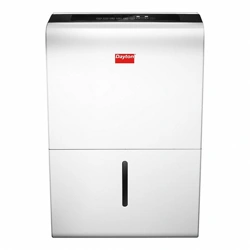
821P87A, 821P88A, 821P89A
MID 200 Version 1 10/2024
2024
13
14
INSTALLATION
1
2
8
10
11
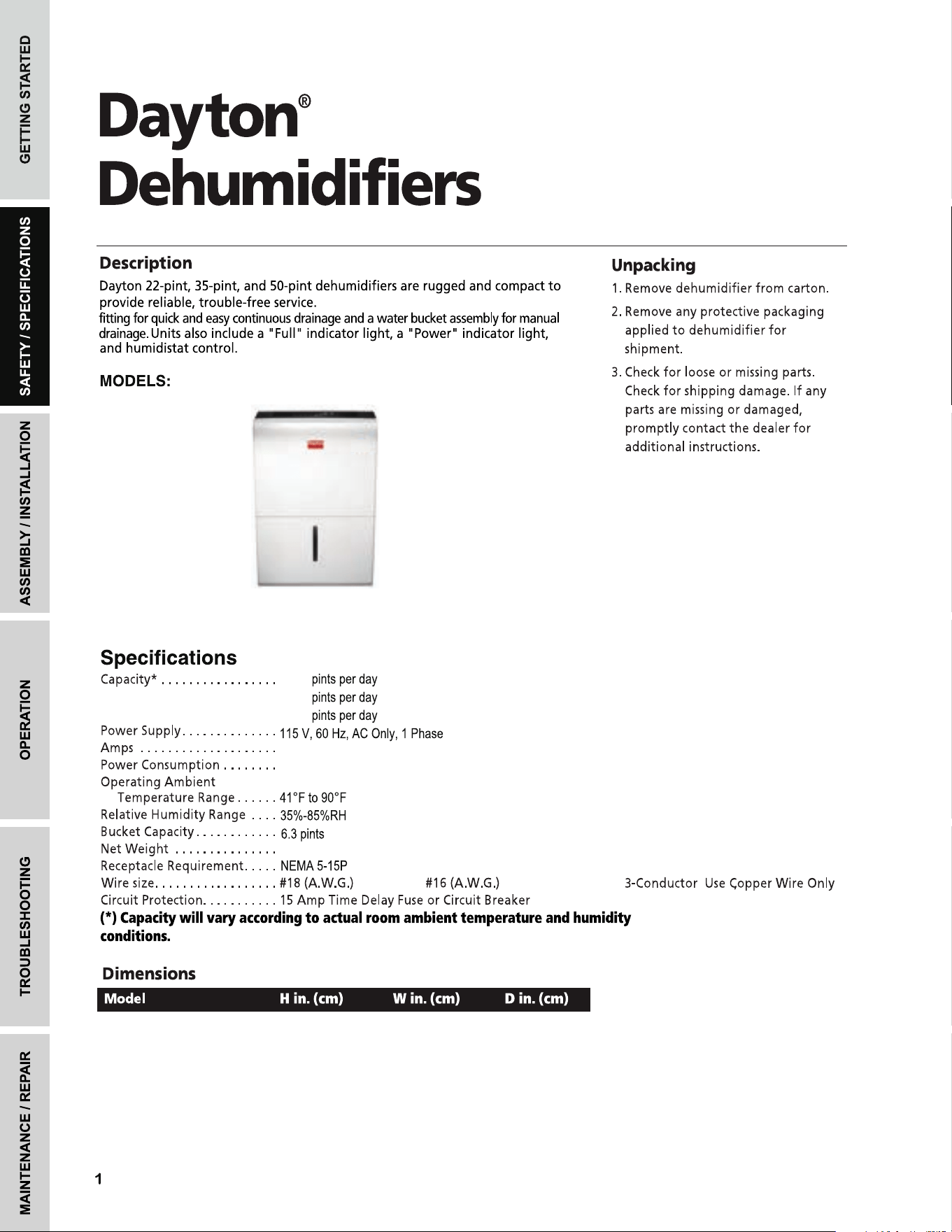
32.41Lbs
(821P87A),
40.56Lbs
(821P89A),
41.23Lbs
(821P88A)
3.9A
(821P87A),
6.5A
(821P89A),
8.5A
(821P88A)
400W
(821P87A),
710W
(821P89A),
880W
(821P88A)
(821P87A)
22.31
35.50
49.66
(821P87A, 821P89A, 821P88A)
(821P89A, 821P88A)
821P87A
821P89A, 821P88A
20.94 (53.2)
25.87 (65.7)
16.54 (42.0)
16.93 (43.0)
11.69 (29.7)
12.99 (33.0)
(821P87A, 821P89A, 821P88A)
(821P87A),
(821P87A), 12.7 pints
(821P89A, 821P88A)
(821P89A)
(821P88A)
821P87A, 821P88A, 821P89A
These units include a standard garden hose
821P87A, 821P88A, and 821P89A
821P87A, 821P88A, and 821P89A
There are no user-serviceable parts.
CAUTION:
Risk of fire
flammable materials
SAFETY
MANUAL
FOR R32 REFRIGERANT MODEL
IMPORTANT NOTE: Read this manual
carefully before installing or operating
your new dehumidifier. Make sure to save
this manual for future reference.
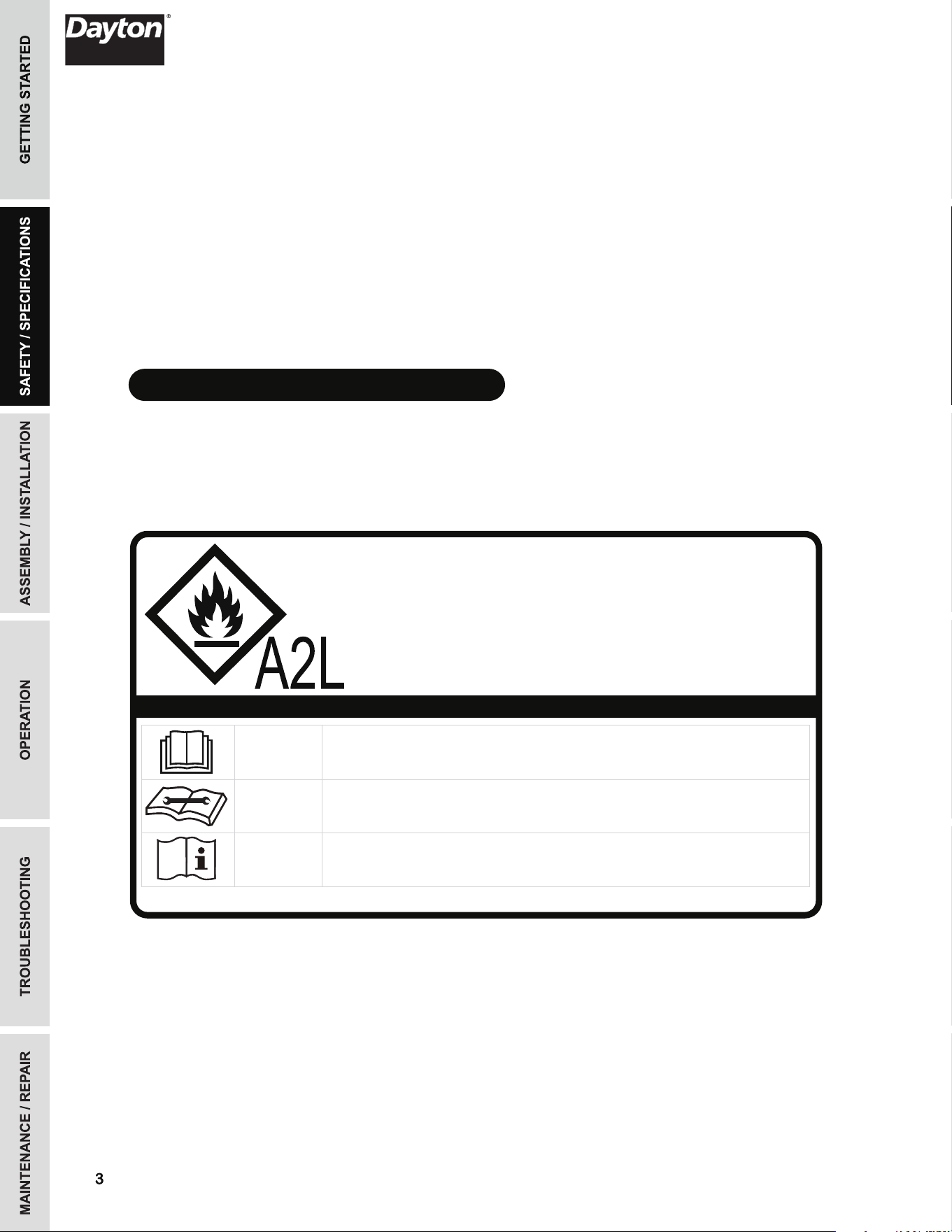
Explanation of symbols displayed on the unit
CAUTION
This symbol shows that the operation manual should be read carefully.
CAUTION
This symbol shows that a service personnel should be handling this equipment with
reference to the installation manual.
CAUTION
This symbol shows that information is available such as the operating manual or
installation manual.
North America Products
- Servicing shall only be performed as recommended by the equipment manufacturer. Maintenance and repair requiring the
assistance of other skilled personnel shall be carried out under the supervision of the person competent in the use of
flammable refrigerants.
- DO NOT modify the length of the power cord or use an extension cord to power the unit.
- DO NOT share a single outlet with other electrical appliances. Improper power supply can cause fire or electrical shock.
- Please follow the instruction carefully to handle, install, clear, service the dehumidifier to avoid any damage or hazard.
Flammable Refrigerant R32 is used within dehumidifier.
- When maintaining or disposing the dehumidifier, the refrigerant (R32) shall be recovered properly, shall not discharge to
air directly.
- Compliance with national gas regulations shall be observed.
- Keep ventilation openings clear of obstruction.
- The appliance shall be stored so as to prevent mechanical damage from occurring.
- A warning that the appliance shall be stored in a well-ventilated area where the room size corresponds to the room area as
specified for operation.
- Any person who is involved with working on or breaking into a refrigerant circuit should hold a current valid certificate from
an industry-accredited assessment authority, which authorizes their competence to handle refrigerants safely in accordance
with an industry recognized assessment specification. All training shall follow the ANNEX HH requirements of UL 60335-2-40
4th Edition.
Examples for such working procedures are:
• breaking into the refrigerating circuit;
• opening of sealed components;
• opening of ventilated enclosures.
- Ensure there is no open fire or device like switch which may generate spark/arcing shall be around dehumidifier to avoid causing
ignition of the flammable refrigerant used. Please follow the instruction carefully to store or maintain the dehumidifier to
prevent mechanical damage from occurring.
- Do not use means to accelerate the defrosting process or to clean, other than those recommended by the manufacturer.
- The appliance shall be stored in a room without continuously operating ignition sources (for example: open flames, an
operating gas appliance) and ignition source or (for example: an operating electric heater) close to the appliance.
- Do not pierce or burn.
- Be aware that the refrigerants may not contain an odor.
1. Transport of equipment containing flammable refrigerants
See transport regulations.
2. Marking of equipment using signs
See local regulations.
3. Disposal of equipment using flammable refrigerants
See national regulations.
4. Storage of equipment/appliances
The storage of the appliance should be in accordance with the applicable regulations or instructions, whichever is more stringent.
5. Storage of packed (unsold) equipment
Storage package protection should be constructed such that mechanical damage to the equipment inside the package will not
cause a leak of the refrigerant charge. The maximum number of pieces of equipment permitted to be stored together will be
determined by local regulations.
6.Information on servicing
1) Checks to the area
Prior to beginning work on systems containing flammable refrigerants, safety checks are necessary to ensure that the risk of
ignition is minimized. For repair to the refrigerating system, the following precautions shall be complied with prior to
conducting work on the system.
WARNING
2) Work procedure
Work shall be undertaken under a controlled procedure so as to minimize the risk of a flammable gas or vapor being present while
the work is being performed.
3) General work area
All maintenance staff and others working in the local area shall be instructed on the nature of work being carried out. Work in
confined spaces shall be avoided. The area around the workspace shall be sectioned off.
Ensure that the conditions within the area have been made safe by control of flammable material.
4) Checking for presence of refrigerant
The area shall be checked with an appropriate refrigerant detector prior to and during work, to ensure the technician is aware of
potentially flammable atmospheres. Ensure that the leak detection equipment being used is suitable for use with flammable
refrigerants, i.e. non-sparking, adequately sealed or intrinsically safe.
5) Presence of fire extinguisher If any hot work is to be conducted on the refrigeration equipment or any associated parts, appropriate
fire extinguishing equipment shall be available. Have a dry powder or CO2 fire extinguisher adjacent to the charging area.
6) No ignition sources
No person carrying out work in relation to a refrigerating system which involves exposing any pipe work that contains or has contained
flammable refrigerant shall use any sources of ignition in such a manner that it may lead to the risk of fire or explosion. All possible
ignition sources, including cigarette smoking, should be kept sufficiently far away from the site of installation, repairing, removing and
disposal, during which flammable refrigerant can possibly be released to the surrounding space. Prior to work taking place, the area
around the equipment is to be surveyed to make sure that there are no flammable hazards or ignition risks. No Smoking signs shall be
displayed.
7) Ventilated area
Ensure that the area is in the open or that it is adequately ventilated before breaking into the system or conducting any hot work.
A degree of ventilation shall continue during the period that the work is carried out.
The ventilation should safely disperse any released refrigerant and preferably expel it externally into the atmosphere.
8) Checks to the refrigerating equipment
Where electrical components are being changed, they shall be fit for the purpose and to the correct specification. At all times the
manufacturer's maintenance and service guidelines shall be followed. If in doubt consult the manufacturer's technical department for
assistance. The following checks shall be applied to installations using flammable refrigerants:
The actual refrigerant charge is in accordance with the product's nameplate label;
The ventilation machinery and outlets are operating adequately and are not obstructed; If an indirect refrigerating circuit is being used,
the secondary circuit shall be checked for the presence of refrigerant;
Marking to the equipment continues to be visible and legible. Markings and signs that are illegible shall be corrected;
Refrigerating pipe or components are installed in a position where they are unlikely to be exposed to any substance which may corrode
refrigerant containing components, unless the components are constructed of materials which are inherently resistant to being corroded
or are suitably protected against being so corroded.
9) Checks to electrical devices
Repair and maintenance to electrical components shall include initial safety checks and component inspection procedures. If a fault exists
that could compromise safety, then no electrical supply shall be connected to the circuit until it is satisfactorily dealt with. If the fault
cannot be corrected immediately but it is necessary to continue operation, an adequate temporary solution shall be used. This shall be
reported to the owner of the equipment so all parties are advised. Initial safety checks shall include:
That capacitors are discharged: this shall be done in a safe manner to avoid possibility of sparking; That there are no live electrical
components and wiring are exposed while charging, recovering or purging the system; That there is continuity of earth bonding.
7. Sealed electrical components shall be replaced
8. Intrinsically safe components must be replaced
9. Cabling
Check that cabling will not be subject to wear, corrosion, excessive pressure, vibration, sharp edges or any other adverse environmental
effects. The check shall also take into account the effects of aging or continual vibration from sources such as compressors or fans.
10. Detection of flammable refrigerants
Under no circumstances shall potential sources of ignition be used in the searching for or detection of refrigerant leaks. A halide torch
(or any other detector using a open flame) shall not be used.
11. Removal and evacuation
12. Charging procedures
The following leak detection methods are deemed acceptable for systems containing flammable refrigerants.
Electronic leak detectors shall be used to detect flammable refrigerants, but the sensitivity may not be adequate, or may need
re-calibration. (Detection equipment shall be calibrated in a refrigerant-free area).
Ensure that the detector is not a potential source of ignition and is suitable for the refrigerant used. Leak detection equipment shall be
set at a percentage of the LFL of the refrigerant and shall be calibrated to the refrigerant employed and the appropriate percentage of
gas (25 % maximum) is confirmed. Leak detection fluids are suitable for use with most refrigerants but the use of detergents containing
chlorine shall be avoided as the chlorine may react with the refrigerant and corrode the copper pipe-work.
If a leak is suspected, all open flames shall be removed/extinguished. If a leakage of refrigerant is found which requires brazing, all of
the refrigerant shall be recovered from the system, or isolated (by means of shut off valves) in a part of the system remote from the leak.
Removal of refrigerant shall be according to Removal and evacuation.
When breaking into the refrigerant circuit to make repairs – or for any other purpose–conventional procedures shall be used.
However, for flammable refrigerants it is important that best practice be followed, since flammability is a consideration. The following
procedure shall be adhered to:
a) safely remove refrigerant following local and national regulations;
b) purge the circuit with inert gas;
c) evacuate (optional for A2L);
d) purge with inert gas (optional for A2L);
e) open the circuit by cutting or brazing.
The refrigerant charge shall be recovered into the correct recovery cylinders if venting is not allowed by local and national codes. For
appliances containing flammable refrigerants, the system shall be purged with oxygen-free nitrogen to render the appliance safe for
flammable refrigerants. This process might need to be repeated several times. Compressed air or oxygen shall not be used for purging
refrigerant systems. For appliances containing flammable refrigerants, refrigerants purging shall be achieved by breaking the vacuum in
the system with oxygen-free nitrogen and continuing to fill until the working pressure is achieved, then venting to atmosphere, and
finally pulling down to a vacuum (optional for A2L). This process shall be repeated until no refrigerant is within the system (optional for
A2L). When the final oxygen-free nitrogen charge is used, the system shall be vented down to atmospheric pressure to enable work to
take place. Ensure that the outlet for the vacuum pump is not close to any potential ignition sources and that ventilation is available.
In addition to conventional charging procedures, the following requirements shall be followed. Ensure that contamination of different
refrigerants does not occur when using charging equipment. Hoses or lines shall be as short as possible to minimize the amount of
refrigerant contained in them. Cylinders shall be kept in an appropriate position according to the instructions. Ensure that the
refrigeration system is earthed prior to charging the system with refrigerant. Label the system when charging is complete (if not already).
Extreme care shall be taken not to overfill the refrigeration system. Prior to recharging the system it shall be pressure tested with OFN.
The system shall be leak tested on completion of charging but prior to commissioning.
A follow up leak test shall be carried out prior to leaving the site.
13. Decommissioning
Before carrying out this procedure, it is essential that the technician is completely familiar with the equipment and all its detail. It is
recommended good practice that all refrigerants are recovered safely. Prior to the task being carried out, an oil and refrigerant sample
shall be taken in case analysis is required prior to re-use of reclaimed refrigerant. It is essential that electrical power is available before
the task is commenced.
a) Become familiar with the equipment and its operation.
b) Isolate system electrically.
c) Before attempting the procedure ensure that: Mechanical handling equipment is available, if required, for handling refrigerant cylinders;
All personal protective equipment is available and being used correctly; The recovery process is supervised at all times by a competent person;
Recovery equipment and cylinders conform to the appropriate standards.
d) Pump down refrigerant system, if possible.
e) If a vacuum is not possible, make a manifold so that refrigerant can be removed from various parts of the system.
f) Make sure that cylinder is situated on the scales before recovery takes place.
g) Start the recovery machine and operate in accordance with instructions.
h) Do not overfill cylinders. (No more than 80 % volume liquid charge).
i) Do not exceed the maximum working pressure of the cylinder, even temporarily.
j) When the cylinders have been filled correctly and the process completed, make sure that the cylinders and the equipment are removed from site
promptly and all isolation valves on the equipment are closed off.
k) Recovered refrigerant shall not be charged into another refrigeration system unless it has been cleaned and checked.
Equipment shall be labelled stating that it has been de-commissioned and emptied of refrigerant. The label shall be dated and signed.
Ensure that there are labels on the equipment stating the equipment contains flammable refrigerant.
14. Labelling
When removing refrigerant from a system, either for servicing or decommissioning, it is recommended good practice that all refrigerants are
removed safely. When transferring refrigerant into cylinders, ensure that only appropriate refrigerant recovery cylinders are employed.
Ensure that the correct number of cylinders for holding the total system charge is available. All cylinders to be used are designated for the recovered
refrigerant and labelled for that refrigerant (i.e. special cylinders for the recovery of refrigerant). Cylinders shall be complete with pressure relief valve
and associated shut-off valves in good working order. Empty recovery cylinders are evacuated and, if possible, cooled before recovery occurs.
The recovery equipment shall be in good working order with a set of instructions concerning the equipment that is at hand and shall be suitable for
the recovery of flammable refrigerants.In addition, a set of calibrated weighing scales shall be available and in good working order. Hoses shall be
complete with leak-free disconnect couplings and in good condition. Before using the recovery machine, check that it is in satisfactory working
order, has been properly maintained and that any associated electrical components are sealed to prevent ignition in the event of a refrigerant release.
Consult manufacturer if in doubt. The recovered refrigerant shall be returned to the refrigerant supplier in the correct recovery cylinder, and the
relevant Waste Transfer Note arranged.
Do not mix refrigerants in recovery units and especially not in cylinders. If compressors or compressor oils are to be removed, ensure that they have
been evacuated to an acceptable level to make certain that flammable refrigerant does not remain within the lubricant. The evacuation process shall
be carried out prior to returning the compressor to the suppliers. Only electric heating to the compressor body shall be employed to accelerate this
process. When oil is drained from a system, it shall be carried out safely.
15. Recovery
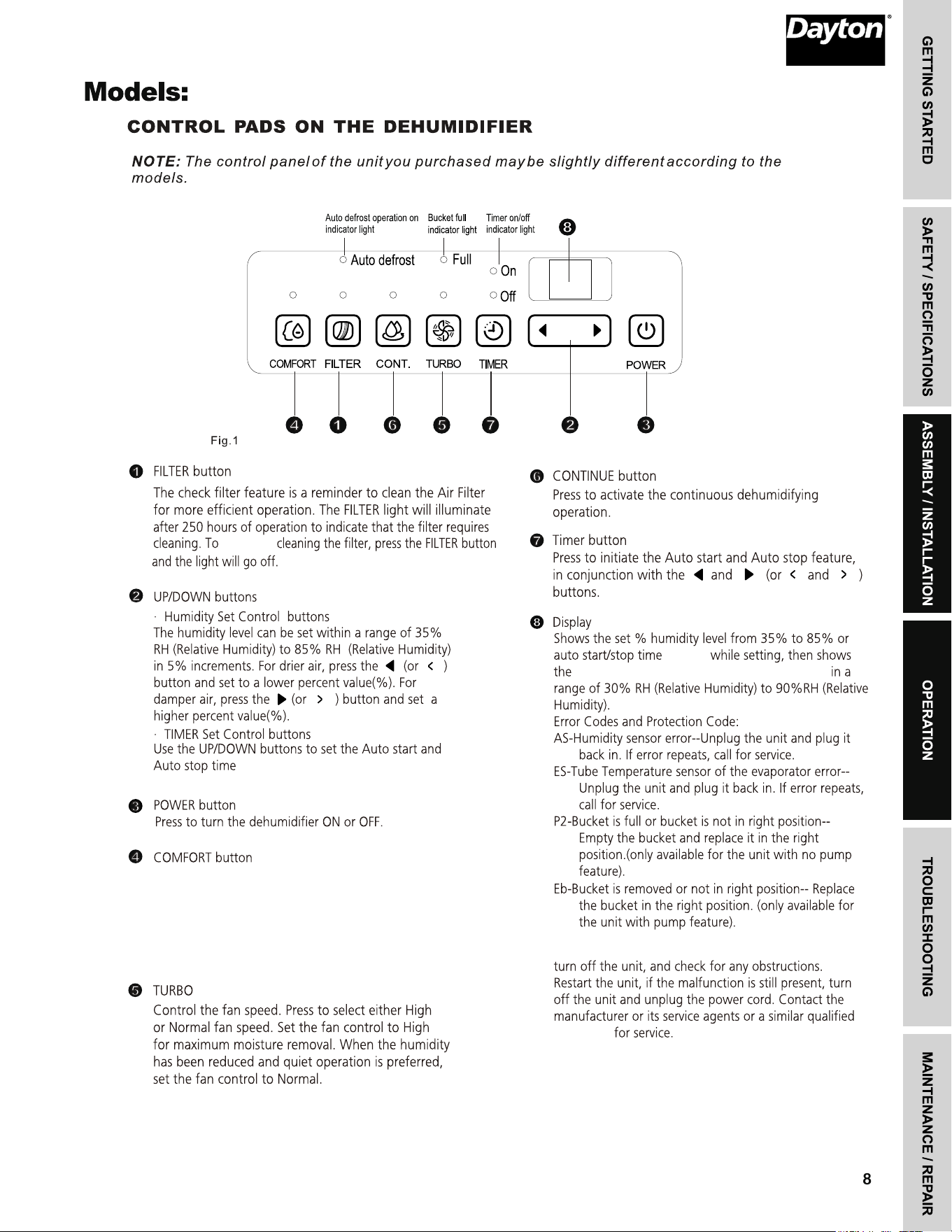
reset after
between 0.0 and 24 hours.
(0-24hr)
821P87A, 821P88A, and 821P89A
Button
Press to activate the "comfort" dehumidifying feature.
Note that the user cannot set the humidity level for this
function. The unit will automatically sense the humidity
in the room and adjust it accordingly to maintain
a comfortable environment. Pressing the UP/DOWN
buttons simultaneously will cancel this feature.
actual room % humidity level (± 5% accuracy)
technician
Note: Applies to all all the above codes except P2,
821P87A, 821P88A, and 821P89A
9
Glows when the bucket is ready to be emptied.
10
821P87A, 821P88A, and 821P89A
11
821P87A, 821P88A, and 821P89A
12
821P87A, 821P88A, and 821P89A
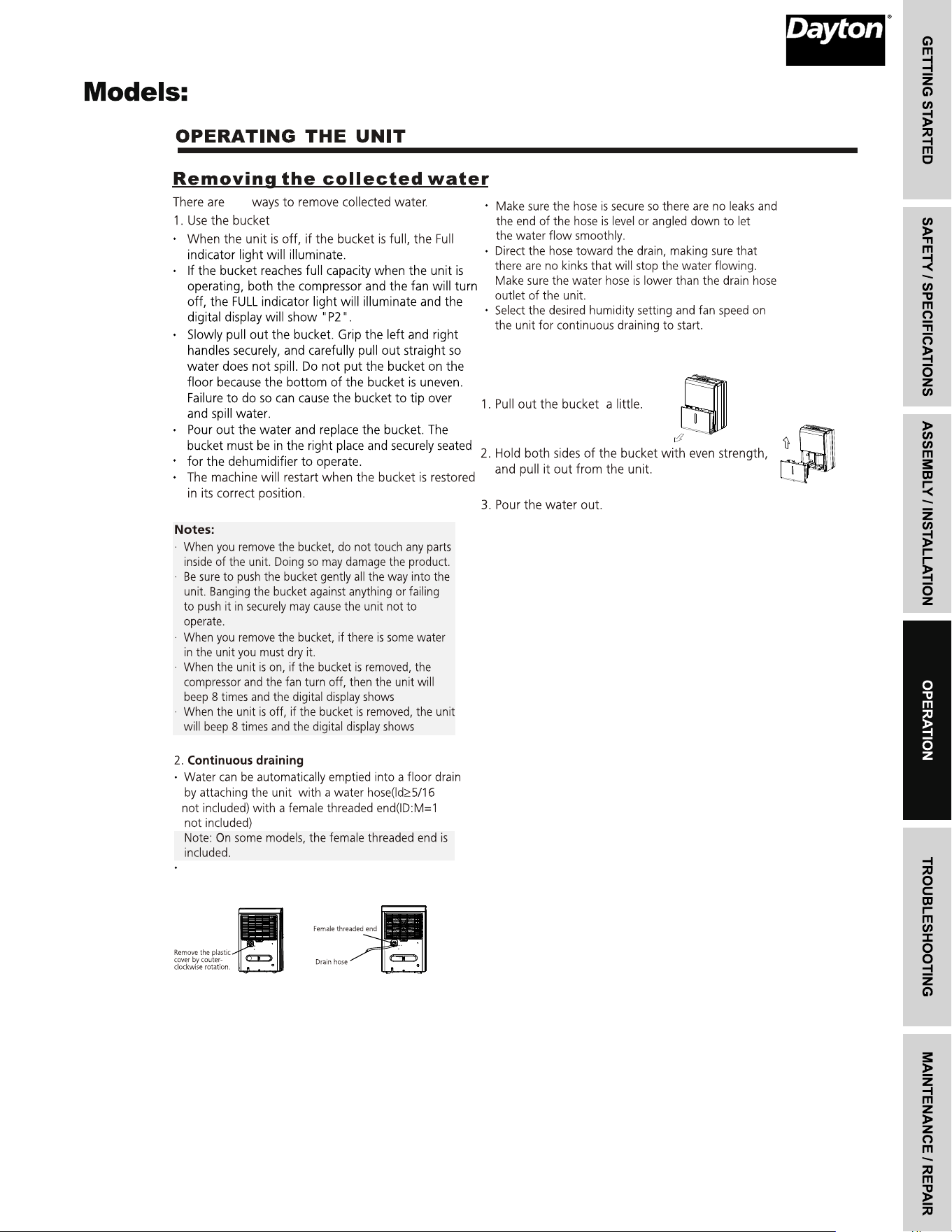
two
P2.
P2.
Remove the plastic cover from the drain outlet.
Attach a garden hose and direct it to a floor drain.
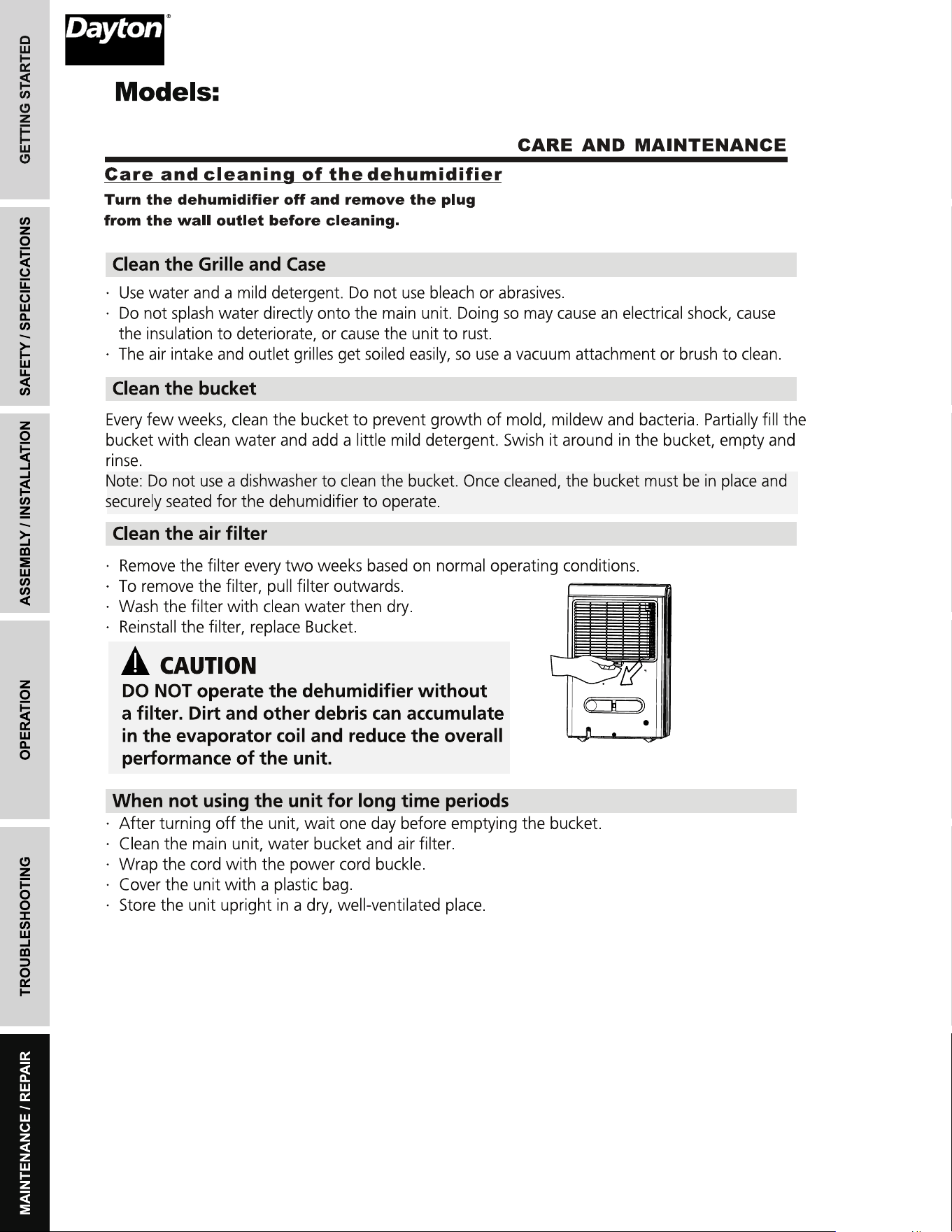
13
821P87A, 821P88A, and 821P89A
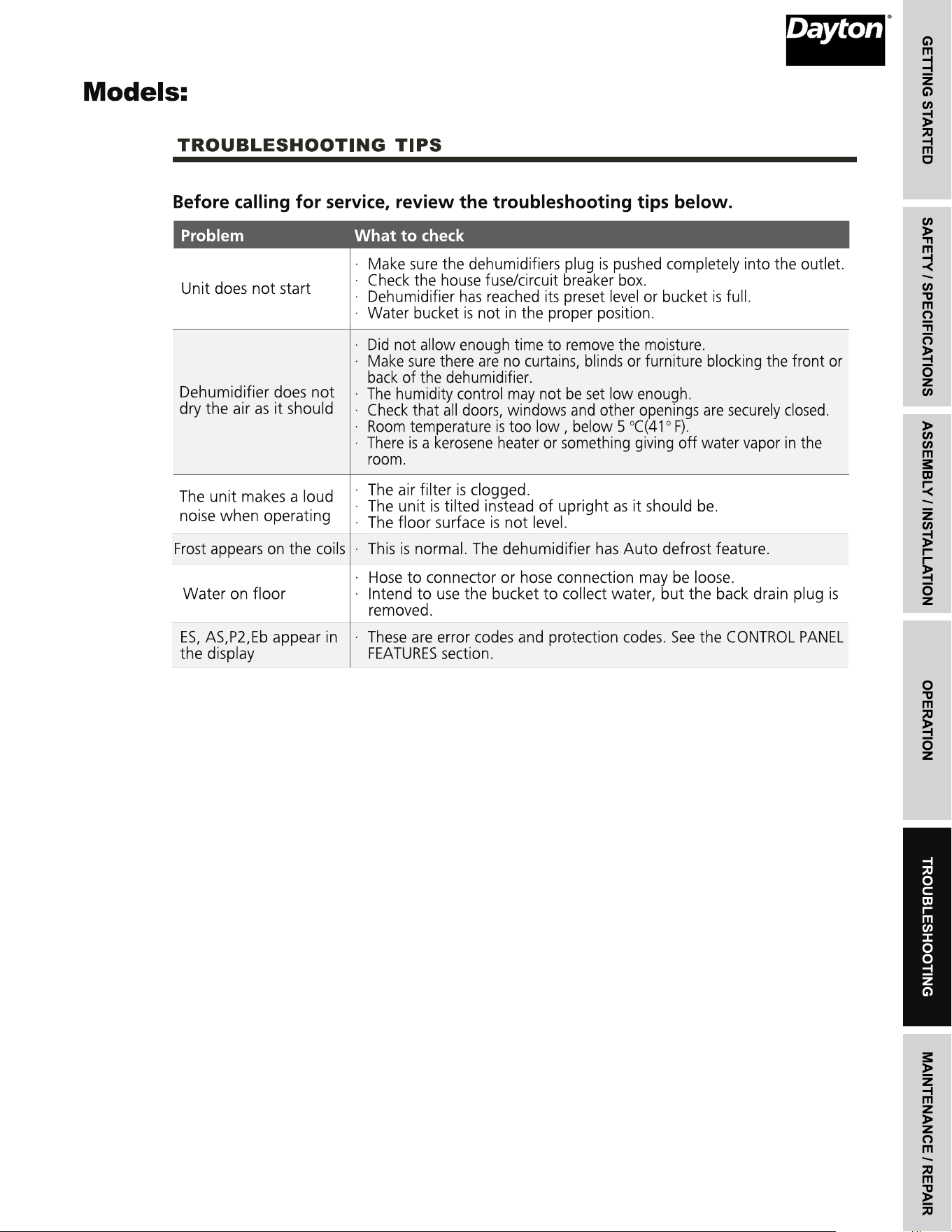
14
821P87A, 821P88A, and 821P89A
NOTES
821P87A, 821P88A, and 821P89A