Automatic searching:
Long press “TUN +/-” button for 2 seconds, the headphone can
automatically search for broadcast stations.
Volume adjustment:
During headset power on, press “VOL +” button to select up to
level 15 volume and press “VOL -” button to select down to 0
volume level.
MEM(Store station manually):
When favorite broadcast station is searched , press MEM button,
LCD display appear 1-10 storage position, continuously press
MEM button in 2 sec, position 1-10 selection will circulate
displayed on LCD, release finger and wait for 2 sec, LCD will
display the broadcast frequency you select (frequency flashing),
then press the MEM button within 2 sec , the station will store in
your selected storage position. If you do not press the MEM
button within 2 sec, the MEM action will give up.
Ml (be fixed frequency function):
Press “TUN +/-” button to search for target station frequency,
then press MEM button, frequency flashing, then press M 1
button within 2 sec to store the fixed station frequency.
M+(take a station):
Press M+ button, 1-10 station position will display on LCD,
continuously press selection button in 2 seconds, position (1-10)
selection will circulate displayed on LCD, release finger and
wait for 1 second, LCD will display the broadcast frequency
you select.
Technical Data
Receiving range: FM 50-108MHz
Stereo degree of separation: 45dB
SNR: 45dB
Frequency response: 200HZ- 20000HZ
Station selection: manual selection+ automatic selection
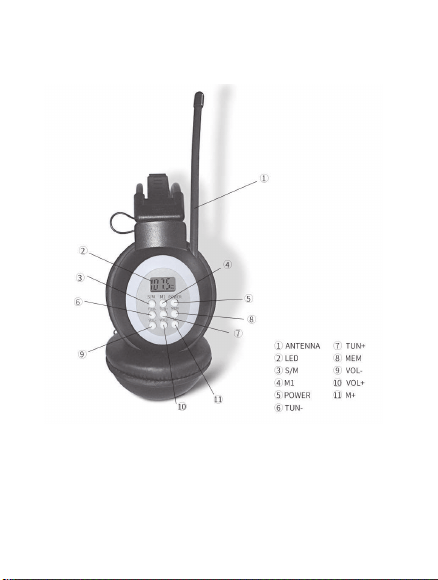
Appearance of the figure and function
Operation Method
1. Open battery door located at back side of headset
2. Insert 2xAA battery with correct +/- position and close the battery
door
3. Listening to broadcast:
Manual searching:
short press POWER button to enter broadcast, press “TUN +/-” to
adjust frequency manually
RETEKESS TR101 FM Receiver User Manual
WARNINGS
Local Government Regulations
When the radios are used as a consequence of employment, the Local
Government Regulations requires users to be fully aware of and able to
control their exposure to meet occupational requirements. Exposure
awareness can be facilitated by the use of a product label directing
users to specific user awareness information. Your Retekess radio has
a RF Exposure Product Label. Also, your user manual, or separate
safety booklet includes information and operating instructions required
to control your RF exposure and to satisfy compliance requirements.
Compliance with RF Exposure Standards (If appropriate,
Reference to the actual product’s Safety Marking)
Your Retekess radio is designed and tested to comply with a number of
national and International standards and guidelines (listed below) for
human exposure to radio frequency electro-magnetic energy.
FCC ID
The FCC ID means: This radio complies with the IEEE (FCC) and
ICNIRP exposure limits for occupational/controlled RF exposure
environments at operating duty factors of up to 50% talk-50% listen
and is approved for occupational use only.
This device complies with Part 15 of the FCC Rules. Operation is
subject to the following two conditions:
(1) This device may not cause harmful interference, and
(2) This device must accept any interference received, including
interference that may cause undesired operation.
Warning: Changes or modifications not expressly approved by the party
responsible for compliance could void the user's authority to
operate the equipment.
Before using this radio, read this guide which contains
important operating instructions for safe usage and RF
energy awareness and control for compliance with
applicable standards and regulations.
transmitting (during talking), not when it is receiving (listening) or in
standby mode.
Avoid Choking Hazard
Small Parts. Not for children under 3 years.
Protect your hearing
• Use the lowest volume necessary to do your job.
• Turn up the volume only if you are in noisy surroundings.
• Turn down the volume before adding headset or earpiece.
Turn off your radio power in the following conditions
• Turn off your radio before removing (installing) a battery or
accessory or when charging battery.
• Turn off your radio when you are in a potentially hazardous
environments: Near electrical blasting caps, in a blasting area,
in explosive atmospheres (inflammable gas, dust particles,
metallic powders, grain powders, etc.).
• Turn off your radio while taking on fuel or while parked at
gasoline service stations.
To avoid electromagnetic interference and/or compatibility
conflicts
• Turn off your radio in any facility where posted notices instruct
you to do so, hospitals or health care facilities (Pacemakers,
Hearing Aids and Other Medical Devices) may be using
equipment that is sensitive to external RF energy.
• Turn off your radio when on board an aircraft. Any use of a
radio must be in accordance with applicable regulations per
airline crew instructions.
Avoid Burns
Antennas
• Do not use any portable radio that has a damaged antenna.
If a damaged antenna comes into contact with the skin when
the radio is in use, a minor burn can result.
Batteries (If appropriate)
• When the conductive material such as jewelry, keys or chains
touch exposed terminals of the batteries, may complete an
electrical circuit (short circuit the battery) and become hot to
cause bodily injury such as burns. Exercise care in handling
any battery, particularly when placing it inside a pocket, purse
or other container with metal objects
Long transmission (If appropriate)
• When the transceiver is used for long transmissions, the
radiator and chassis will become hot.
Safety Operation
Forbid
• Do not use charger outdoors or in moist environments, use
only in dry locations/conditions.
• Do not disassemble the charger, that may result in risk of
electrical shock or fire.
• Do not operate the charger if it has been broken or damaged
in any way.
• Do not place a portable radio in the area over an air bag or
in the air bag deployment area. The radio may be propelled
with great force and cause serious injury to occupants of the
vehicle when the air bag inflates.
To reduce risk
• Pull by the plug rather than the cord when disconnecting the
charger.
• Unplug the charger from the AC outlet before attempting any
maintenance or cleaning.
• Contact Retekess for assistance regarding repairs and
service.
NOTE
This equipment has been tested and found to comply with the
limits for a Class B digital device, pursuant to Part 15 of the FCC
Rules. These limits are designed to provide reasonable protection
against harmful interference in a residential installation. This
equipment generates uses and can radiate radio frequency energy
and, if not installed and used in accordance with the instructions,
may cause harmful interference to radio communications.
However, there is no guarantee that interference will not occur in
a particular installation. If this equipment does cause harmful
interference to radio or television reception, which can be
determined by turning the equipment off and on, the user is
encouraged to try to correct the interference by one or more of
the following measures:
• Reorient or relocate the receiving antenna.
• Increase the separation between the equipment and receiver.
• Connect the equipment into an outlet on a circuit different from
that to which the receiver is connected.
• Consult the dealer or an experienced radio/TV technician for help.
The CE marking means: Hereby, Henan Eshow Electronic
Commerce Co.,Ltd. declares that the radio equipment type is in
compliance with the RED Directive 2014/53/EU and the ROHS
Directive 2011/65/EU and the WEEE Directive 2012/19/EU.
The full text of the EU declaration of conformity is available at the
following internet address: www.retekess.com
IC ID
This device complies with Industry Canada license-exempt RSS
standard(s). Operation is subject to the following two conditions:
(1) This device may not cause interference, and
(2) This device must accept any interference, including interference that
may cause undesired operation of the device.
In terms of measuring RF energy for compliance with these exposure
guidelines, your radio generates measurable RF energy only while it is
EU Importer
Name:Germany Retevis Technology GmbH
Address:Uetzenacker 29,38176 wendeburg

Automatic searching:
Long press “TUN +/-” button for 2 seconds, the headphone can
automatically search for broadcast stations.
Volume adjustment:
During headset power on, press “VOL +” button to select up to
level 15 volume and press “VOL -” button to select down to 0
volume level.
MEM(Store station manually):
When favorite broadcast station is searched , press MEM button,
LCD display appear 1-10 storage position, continuously press
MEM button in 2 sec, position 1-10 selection will circulate
displayed on LCD, release finger and wait for 2 sec, LCD will
display the broadcast frequency you select (frequency flashing),
then press the MEM button within 2 sec , the station will store in
your selected storage position. If you do not press the MEM
button within 2 sec, the MEM action will give up.
Ml (be fixed frequency function):
Press “TUN +/-” button to search for target station frequency,
then press MEM button, frequency flashing, then press M 1
button within 2 sec to store the fixed station frequency.
M+(take a station):
Press M+ button, 1-10 station position will display on LCD,
continuously press selection button in 2 seconds, position (1-10)
selection will circulate displayed on LCD, release finger and
wait for 1 second, LCD will display the broadcast frequency
you select.
Technical Data
Receiving range: FM 50-108MHz
Stereo degree of separation: 45dB
SNR: 45dB
Frequency response: 200HZ- 20000HZ
Station selection: manual selection+ automatic selection
Appearance of the figure and function
Operation Method
1. Open battery door located at back side of headset
2. Insert 2xAA battery with correct +/- position and close the battery
door
3. Listening to broadcast:
Manual searching:
short press POWER button to enter broadcast, press “TUN +/-” to
adjust frequency manually
RETEKESS TR101 FM Receiver User Manual
WARNINGS
Local Government Regulations
When the radios are used as a consequence of employment, the Local
Government Regulations requires users to be fully aware of and able to
control their exposure to meet occupational requirements. Exposure
awareness can be facilitated by the use of a product label directing
users to specific user awareness information. Your Retekess radio has
a RF Exposure Product Label. Also, your user manual, or separate
safety booklet includes information and operating instructions required
to control your RF exposure and to satisfy compliance requirements.
Compliance with RF Exposure Standards (If appropriate,
Reference to the actual product’s Safety Marking)
Your Retekess radio is designed and tested to comply with a number of
national and International standards and guidelines (listed below) for
human exposure to radio frequency electro-magnetic energy.
FCC ID
The FCC ID means: This radio complies with the IEEE (FCC) and
ICNIRP exposure limits for occupational/controlled RF exposure
environments at operating duty factors of up to 50% talk-50% listen
and is approved for occupational use only.
This device complies with Part 15 of the FCC Rules. Operation is
subject to the following two conditions:
(1) This device may not cause harmful interference, and
(2) This device must accept any interference received, including
interference that may cause undesired operation.
Warning: Changes or modifications not expressly approved by the party
responsible for compliance could void the user's authority to
operate the equipment.
Before using this radio, read this guide which contains
important operating instructions for safe usage and RF
energy awareness and control for compliance with
applicable standards and regulations.
transmitting (during talking), not when it is receiving (listening) or in
standby mode.
Avoid Choking Hazard
Small Parts. Not for children under 3 years.
Protect your hearing
• Use the lowest volume necessary to do your job.
• Turn up the volume only if you are in noisy surroundings.
• Turn down the volume before adding headset or earpiece.
Turn off your radio power in the following conditions
• Turn off your radio before removing (installing) a battery or
accessory or when charging battery.
• Turn off your radio when you are in a potentially hazardous
environments: Near electrical blasting caps, in a blasting area,
in explosive atmospheres (inflammable gas, dust particles,
metallic powders, grain powders, etc.).
• Turn off your radio while taking on fuel or while parked at
gasoline service stations.
To avoid electromagnetic interference and/or compatibility
conflicts
• Turn off your radio in any facility where posted notices instruct
you to do so, hospitals or health care facilities (Pacemakers,
Hearing Aids and Other Medical Devices) may be using
equipment that is sensitive to external RF energy.
• Turn off your radio when on board an aircraft. Any use of a
radio must be in accordance with applicable regulations per
airline crew instructions.
Avoid Burns
Antennas
• Do not use any portable radio that has a damaged antenna.
If a damaged antenna comes into contact with the skin when
the radio is in use, a minor burn can result.
Batteries (If appropriate)
• When the conductive material such as jewelry, keys or chains
touch exposed terminals of the batteries, may complete an
electrical circuit (short circuit the battery) and become hot to
cause bodily injury such as burns. Exercise care in handling
any battery, particularly when placing it inside a pocket, purse
or other container with metal objects
Long transmission (If appropriate)
• When the transceiver is used for long transmissions, the
radiator and chassis will become hot.
Safety Operation
Forbid
• Do not use charger outdoors or in moist environments, use
only in dry locations/conditions.
• Do not disassemble the charger, that may result in risk of
electrical shock or fire.
• Do not operate the charger if it has been broken or damaged
in any way.
• Do not place a portable radio in the area over an air bag or
in the air bag deployment area. The radio may be propelled
with great force and cause serious injury to occupants of the
vehicle when the air bag inflates.
To reduce risk
• Pull by the plug rather than the cord when disconnecting the
charger.
• Unplug the charger from the AC outlet before attempting any
maintenance or cleaning.
• Contact Retekess for assistance regarding repairs and
service.
NOTE
This equipment has been tested and found to comply with the
limits for a Class B digital device, pursuant to Part 15 of the FCC
Rules. These limits are designed to provide reasonable protection
against harmful interference in a residential installation. This
equipment generates uses and can radiate radio frequency energy
and, if not installed and used in accordance with the instructions,
may cause harmful interference to radio communications.
However, there is no guarantee that interference will not occur in
a particular installation. If this equipment does cause harmful
interference to radio or television reception, which can be
determined by turning the equipment off and on, the user is
encouraged to try to correct the interference by one or more of
the following measures:
• Reorient or relocate the receiving antenna.
• Increase the separation between the equipment and receiver.
• Connect the equipment into an outlet on a circuit different from
that to which the receiver is connected.
• Consult the dealer or an experienced radio/TV technician for help.
The CE marking means: Hereby, Henan Eshow Electronic
Commerce Co.,Ltd. declares that the radio equipment type is in
compliance with the RED Directive 2014/53/EU and the ROHS
Directive 2011/65/EU and the WEEE Directive 2012/19/EU.
The full text of the EU declaration of conformity is available at the
following internet address: www.retekess.com
IC ID
This device complies with Industry Canada license-exempt RSS
standard(s). Operation is subject to the following two conditions:
(1) This device may not cause interference, and
(2) This device must accept any interference, including interference that
may cause undesired operation of the device.
In terms of measuring RF energy for compliance with these exposure
guidelines, your radio generates measurable RF energy only while it is
EU Importer
Name:Germany Retevis Technology GmbH
Address:Uetzenacker 29,38176 wendeburg

Automatic searching:
Long press “TUN +/-” button for 2 seconds, the headphone can
automatically search for broadcast stations.
Volume adjustment:
During headset power on, press “VOL +” button to select up to
level 15 volume and press “VOL -” button to select down to 0
volume level.
MEM(Store station manually):
When favorite broadcast station is searched , press MEM button,
LCD display appear 1-10 storage position, continuously press
MEM button in 2 sec, position 1-10 selection will circulate
displayed on LCD, release finger and wait for 2 sec, LCD will
display the broadcast frequency you select (frequency flashing),
then press the MEM button within 2 sec , the station will store in
your selected storage position. If you do not press the MEM
button within 2 sec, the MEM action will give up.
Ml (be fixed frequency function):
Press “TUN +/-” button to search for target station frequency,
then press MEM button, frequency flashing, then press M 1
button within 2 sec to store the fixed station frequency.
M+(take a station):
Press M+ button, 1-10 station position will display on LCD,
continuously press selection button in 2 seconds, position (1-10)
selection will circulate displayed on LCD, release finger and
wait for 1 second, LCD will display the broadcast frequency
you select.
Technical Data
Receiving range: FM 50-108MHz
Stereo degree of separation: 45dB
SNR: 45dB
Frequency response: 200HZ- 20000HZ
Station selection: manual selection+ automatic selection
Appearance of the figure and function
Operation Method
1. Open battery door located at back side of headset
2. Insert 2xAA battery with correct +/- position and close the battery
door
3. Listening to broadcast:
Manual searching:
short press POWER button to enter broadcast, press “TUN +/-” to
adjust frequency manually
RETEKESS TR101 FM Receiver User Manual
WARNINGS
Local Government Regulations
When the radios are used as a consequence of employment, the Local
Government Regulations requires users to be fully aware of and able to
control their exposure to meet occupational requirements. Exposure
awareness can be facilitated by the use of a product label directing
users to specific user awareness information. Your Retekess radio has
a RF Exposure Product Label. Also, your user manual, or separate
safety booklet includes information and operating instructions required
to control your RF exposure and to satisfy compliance requirements.
Compliance with RF Exposure Standards (If appropriate,
Reference to the actual product’s Safety Marking)
Your Retekess radio is designed and tested to comply with a number of
national and International standards and guidelines (listed below) for
human exposure to radio frequency electro-magnetic energy.
FCC ID
The FCC ID means: This radio complies with the IEEE (FCC) and
ICNIRP exposure limits for occupational/controlled RF exposure
environments at operating duty factors of up to 50% talk-50% listen
and is approved for occupational use only.
This device complies with Part 15 of the FCC Rules. Operation is
subject to the following two conditions:
(1) This device may not cause harmful interference, and
(2) This device must accept any interference received, including
interference that may cause undesired operation.
Warning: Changes or modifications not expressly approved by the party
responsible for compliance could void the user's authority to
operate the equipment.
Before using this radio, read this guide which contains
important operating instructions for safe usage and RF
energy awareness and control for compliance with
applicable standards and regulations.
transmitting (during talking), not when it is receiving (listening) or in
standby mode.
Avoid Choking Hazard
Small Parts. Not for children under 3 years.
Protect your hearing
• Use the lowest volume necessary to do your job.
• Turn up the volume only if you are in noisy surroundings.
• Turn down the volume before adding headset or earpiece.
Turn off your radio power in the following conditions
• Turn off your radio before removing (installing) a battery or
accessory or when charging battery.
• Turn off your radio when you are in a potentially hazardous
environments: Near electrical blasting caps, in a blasting area,
in explosive atmospheres (inflammable gas, dust particles,
metallic powders, grain powders, etc.).
• Turn off your radio while taking on fuel or while parked at
gasoline service stations.
To avoid electromagnetic interference and/or compatibility
conflicts
• Turn off your radio in any facility where posted notices instruct
you to do so, hospitals or health care facilities (Pacemakers,
Hearing Aids and Other Medical Devices) may be using
equipment that is sensitive to external RF energy.
• Turn off your radio when on board an aircraft. Any use of a
radio must be in accordance with applicable regulations per
airline crew instructions.
Avoid Burns
Antennas
• Do not use any portable radio that has a damaged antenna.
If a damaged antenna comes into contact with the skin when
the radio is in use, a minor burn can result.
Batteries (If appropriate)
• When the conductive material such as jewelry, keys or chains
touch exposed terminals of the batteries, may complete an
electrical circuit (short circuit the battery) and become hot to
cause bodily injury such as burns. Exercise care in handling
any battery, particularly when placing it inside a pocket, purse
or other container with metal objects
Long transmission (If appropriate)
• When the transceiver is used for long transmissions, the
radiator and chassis will become hot.
Safety Operation
Forbid
• Do not use charger outdoors or in moist environments, use
only in dry locations/conditions.
• Do not disassemble the charger, that may result in risk of
electrical shock or fire.
• Do not operate the charger if it has been broken or damaged
in any way.
• Do not place a portable radio in the area over an air bag or
in the air bag deployment area. The radio may be propelled
with great force and cause serious injury to occupants of the
vehicle when the air bag inflates.
To reduce risk
• Pull by the plug rather than the cord when disconnecting the
charger.
• Unplug the charger from the AC outlet before attempting any
maintenance or cleaning.
• Contact Retekess for assistance regarding repairs and
service.
NOTE
This equipment has been tested and found to comply with the
limits for a Class B digital device, pursuant to Part 15 of the FCC
Rules. These limits are designed to provide reasonable protection
against harmful interference in a residential installation. This
equipment generates uses and can radiate radio frequency energy
and, if not installed and used in accordance with the instructions,
may cause harmful interference to radio communications.
However, there is no guarantee that interference will not occur in
a particular installation. If this equipment does cause harmful
interference to radio or television reception, which can be
determined by turning the equipment off and on, the user is
encouraged to try to correct the interference by one or more of
the following measures:
• Reorient or relocate the receiving antenna.
• Increase the separation between the equipment and receiver.
• Connect the equipment into an outlet on a circuit different from
that to which the receiver is connected.
• Consult the dealer or an experienced radio/TV technician for help.
The CE marking means: Hereby, Henan Eshow Electronic
Commerce Co.,Ltd. declares that the radio equipment type is in
compliance with the RED Directive 2014/53/EU and the ROHS
Directive 2011/65/EU and the WEEE Directive 2012/19/EU.
The full text of the EU declaration of conformity is available at the
following internet address: www.retekess.com
IC ID
This device complies with Industry Canada license-exempt RSS
standard(s). Operation is subject to the following two conditions:
(1) This device may not cause interference, and
(2) This device must accept any interference, including interference that
may cause undesired operation of the device.
In terms of measuring RF energy for compliance with these exposure
guidelines, your radio generates measurable RF energy only while it is
EU Importer
Name:Germany Retevis Technology GmbH
Address:Uetzenacker 29,38176 wendeburg
Automatic searching:
Long press “TUN +/-” button for 2 seconds, the headphone can
automatically search for broadcast stations.
Volume adjustment:
During headset power on, press “VOL +” button to select up to
level 15 volume and press “VOL -” button to select down to 0
volume level.
MEM(Store station manually):
When favorite broadcast station is searched , press MEM button,
LCD display appear 1-10 storage position, continuously press
MEM button in 2 sec, position 1-10 selection will circulate
displayed on LCD, release finger and wait for 2 sec, LCD will
display the broadcast frequency you select (frequency flashing),
then press the MEM button within 2 sec , the station will store in
your selected storage position. If you do not press the MEM
button within 2 sec, the MEM action will give up.
Ml (be fixed frequency function):
Press “TUN +/-” button to search for target station frequency,
then press MEM button, frequency flashing, then press M 1
button within 2 sec to store the fixed station frequency.
M+(take a station):
Press M+ button, 1-10 station position will display on LCD,
continuously press selection button in 2 seconds, position (1-10)
selection will circulate displayed on LCD, release finger and
wait for 1 second, LCD will display the broadcast frequency
you select.
Technical Data
Receiving range: FM 50-108MHz
Stereo degree of separation: 45dB
SNR: 45dB
Frequency response: 200HZ- 20000HZ
Station selection: manual selection+ automatic selection
Appearance of the figure and function
Operation Method
1. Open battery door located at back side of headset
2. Insert 2xAA battery with correct +/- position and close the battery
door
3. Listening to broadcast:
Manual searching:
short press POWER button to enter broadcast, press “TUN +/-” to
adjust frequency manually
RETEKESS TR101 FM Receiver User Manual
WARNINGS
Local Government Regulations
When the radios are used as a consequence of employment, the Local
Government Regulations requires users to be fully aware of and able to
control their exposure to meet occupational requirements. Exposure
awareness can be facilitated by the use of a product label directing
users to specific user awareness information. Your Retekess radio has
a RF Exposure Product Label. Also, your user manual, or separate
safety booklet includes information and operating instructions required
to control your RF exposure and to satisfy compliance requirements.
Compliance with RF Exposure Standards (If appropriate,
Reference to the actual product’s Safety Marking)
Your Retekess radio is designed and tested to comply with a number of
national and International standards and guidelines (listed below) for
human exposure to radio frequency electro-magnetic energy.
FCC ID
The FCC ID means: This radio complies with the IEEE (FCC) and
ICNIRP exposure limits for occupational/controlled RF exposure
environments at operating duty factors of up to 50% talk-50% listen
and is approved for occupational use only.
This device complies with Part 15 of the FCC Rules. Operation is
subject to the following two conditions:
(1) This device may not cause harmful interference, and
(2) This device must accept any interference received, including
interference that may cause undesired operation.
Warning: Changes or modifications not expressly approved by the party
responsible for compliance could void the user's authority to
operate the equipment.
Before using this radio, read this guide which contains
important operating instructions for safe usage and RF
energy awareness and control for compliance with
applicable standards and regulations.
transmitting (during talking), not when it is receiving (listening) or in
standby mode.
Avoid Choking Hazard
Small Parts. Not for children under 3 years.
Protect your hearing
• Use the lowest volume necessary to do your job.
• Turn up the volume only if you are in noisy surroundings.
• Turn down the volume before adding headset or earpiece.
Turn off your radio power in the following conditions
• Turn off your radio before removing (installing) a battery or
accessory or when charging battery.
• Turn off your radio when you are in a potentially hazardous
environments: Near electrical blasting caps, in a blasting area,
in explosive atmospheres (inflammable gas, dust particles,
metallic powders, grain powders, etc.).
• Turn off your radio while taking on fuel or while parked at
gasoline service stations.
To avoid electromagnetic interference and/or compatibility
conflicts
• Turn off your radio in any facility where posted notices instruct
you to do so, hospitals or health care facilities (Pacemakers,
Hearing Aids and Other Medical Devices) may be using
equipment that is sensitive to external RF energy.
• Turn off your radio when on board an aircraft. Any use of a
radio must be in accordance with applicable regulations per
airline crew instructions.
Avoid Burns
Antennas
• Do not use any portable radio that has a damaged antenna.
If a damaged antenna comes into contact with the skin when
the radio is in use, a minor burn can result.
Batteries (If appropriate)
• When the conductive material such as jewelry, keys or chains
touch exposed terminals of the batteries, may complete an
electrical circuit (short circuit the battery) and become hot to
cause bodily injury such as burns. Exercise care in handling
any battery, particularly when placing it inside a pocket, purse
or other container with metal objects
Long transmission (If appropriate)
• When the transceiver is used for long transmissions, the
radiator and chassis will become hot.
Safety Operation
Forbid
• Do not use charger outdoors or in moist environments, use
only in dry locations/conditions.
• Do not disassemble the charger, that may result in risk of
electrical shock or fire.
• Do not operate the charger if it has been broken or damaged
in any way.
• Do not place a portable radio in the area over an air bag or
in the air bag deployment area. The radio may be propelled
with great force and cause serious injury to occupants of the
vehicle when the air bag inflates.
To reduce risk
• Pull by the plug rather than the cord when disconnecting the
charger.
• Unplug the charger from the AC outlet before attempting any
maintenance or cleaning.
• Contact Retekess for assistance regarding repairs and
service.
NOTE
This equipment has been tested and found to comply with the
limits for a Class B digital device, pursuant to Part 15 of the FCC
Rules. These limits are designed to provide reasonable protection
against harmful interference in a residential installation. This
equipment generates uses and can radiate radio frequency energy
and, if not installed and used in accordance with the instructions,
may cause harmful interference to radio communications.
However, there is no guarantee that interference will not occur in
a particular installation. If this equipment does cause harmful
interference to radio or television reception, which can be
determined by turning the equipment off and on, the user is
encouraged to try to correct the interference by one or more of
the following measures:
• Reorient or relocate the receiving antenna.
• Increase the separation between the equipment and receiver.
• Connect the equipment into an outlet on a circuit different from
that to which the receiver is connected.
• Consult the dealer or an experienced radio/TV technician for help.
The CE marking means: Hereby, Henan Eshow Electronic
Commerce Co.,Ltd. declares that the radio equipment type is in
compliance with the RED Directive 2014/53/EU and the ROHS
Directive 2011/65/EU and the WEEE Directive 2012/19/EU.
The full text of the EU declaration of conformity is available at the
following internet address: www.retekess.com
IC ID
This device complies with Industry Canada license-exempt RSS
standard(s). Operation is subject to the following two conditions:
(1) This device may not cause interference, and
(2) This device must accept any interference, including interference that
may cause undesired operation of the device.
In terms of measuring RF energy for compliance with these exposure
guidelines, your radio generates measurable RF energy only while it is
EU Importer
Name:Germany Retevis Technology GmbH
Address:Uetzenacker 29,38176 wendeburg
Automatic searching:
Long press “TUN +/-” button for 2 seconds, the headphone can
automatically search for broadcast stations.
Volume adjustment:
During headset power on, press “VOL +” button to select up to
level 15 volume and press “VOL -” button to select down to 0
volume level.
MEM(Store station manually):
When favorite broadcast station is searched , press MEM button,
LCD display appear 1-10 storage position, continuously press
MEM button in 2 sec, position 1-10 selection will circulate
displayed on LCD, release finger and wait for 2 sec, LCD will
display the broadcast frequency you select (frequency flashing),
then press the MEM button within 2 sec , the station will store in
your selected storage position. If you do not press the MEM
button within 2 sec, the MEM action will give up.
Ml (be fixed frequency function):
Press “TUN +/-” button to search for target station frequency,
then press MEM button, frequency flashing, then press M 1
button within 2 sec to store the fixed station frequency.
M+(take a station):
Press M+ button, 1-10 station position will display on LCD,
continuously press selection button in 2 seconds, position (1-10)
selection will circulate displayed on LCD, release finger and
wait for 1 second, LCD will display the broadcast frequency
you select.
Technical Data
Receiving range: FM 50-108MHz
Stereo degree of separation: 45dB
SNR: 45dB
Frequency response: 200HZ- 20000HZ
Station selection: manual selection+ automatic selection
Appearance of the figure and function
Operation Method
1. Open battery door located at back side of headset
2. Insert 2xAA battery with correct +/- position and close the battery
door
3. Listening to broadcast:
Manual searching:
short press POWER button to enter broadcast, press “TUN +/-” to
adjust frequency manually
RETEKESS TR101 FM Receiver User Manual
WARNINGS
Local Government Regulations
When the radios are used as a consequence of employment, the Local
Government Regulations requires users to be fully aware of and able to
control their exposure to meet occupational requirements. Exposure
awareness can be facilitated by the use of a product label directing
users to specific user awareness information. Your Retekess radio has
a RF Exposure Product Label. Also, your user manual, or separate
safety booklet includes information and operating instructions required
to control your RF exposure and to satisfy compliance requirements.
Compliance with RF Exposure Standards (If appropriate,
Reference to the actual product’s Safety Marking)
Your Retekess radio is designed and tested to comply with a number of
national and International standards and guidelines (listed below) for
human exposure to radio frequency electro-magnetic energy.
FCC ID
The FCC ID means: This radio complies with the IEEE (FCC) and
ICNIRP exposure limits for occupational/controlled RF exposure
environments at operating duty factors of up to 50% talk-50% listen
and is approved for occupational use only.
This device complies with Part 15 of the FCC Rules. Operation is
subject to the following two conditions:
(1) This device may not cause harmful interference, and
(2) This device must accept any interference received, including
interference that may cause undesired operation.
Warning: Changes or modifications not expressly approved by the party
responsible for compliance could void the user's authority to
operate the equipment.
Before using this radio, read this guide which contains
important operating instructions for safe usage and RF
energy awareness and control for compliance with
applicable standards and regulations.
transmitting (during talking), not when it is receiving (listening) or in
standby mode.
Avoid Choking Hazard
Small Parts. Not for children under 3 years.
Protect your hearing
• Use the lowest volume necessary to do your job.
• Turn up the volume only if you are in noisy surroundings.
• Turn down the volume before adding headset or earpiece.
Turn off your radio power in the following conditions
• Turn off your radio before removing (installing) a battery or
accessory or when charging battery.
• Turn off your radio when you are in a potentially hazardous
environments: Near electrical blasting caps, in a blasting area,
in explosive atmospheres (inflammable gas, dust particles,
metallic powders, grain powders, etc.).
• Turn off your radio while taking on fuel or while parked at
gasoline service stations.
To avoid electromagnetic interference and/or compatibility
conflicts
• Turn off your radio in any facility where posted notices instruct
you to do so, hospitals or health care facilities (Pacemakers,
Hearing Aids and Other Medical Devices) may be using
equipment that is sensitive to external RF energy.
• Turn off your radio when on board an aircraft. Any use of a
radio must be in accordance with applicable regulations per
airline crew instructions.
Avoid Burns
Antennas
• Do not use any portable radio that has a damaged antenna.
If a damaged antenna comes into contact with the skin when
the radio is in use, a minor burn can result.
Batteries (If appropriate)
• When the conductive material such as jewelry, keys or chains
touch exposed terminals of the batteries, may complete an
electrical circuit (short circuit the battery) and become hot to
cause bodily injury such as burns. Exercise care in handling
any battery, particularly when placing it inside a pocket, purse
or other container with metal objects
Long transmission (If appropriate)
• When the transceiver is used for long transmissions, the
radiator and chassis will become hot.
Safety Operation
Forbid
• Do not use charger outdoors or in moist environments, use
only in dry locations/conditions.
• Do not disassemble the charger, that may result in risk of
electrical shock or fire.
• Do not operate the charger if it has been broken or damaged
in any way.
• Do not place a portable radio in the area over an air bag or
in the air bag deployment area. The radio may be propelled
with great force and cause serious injury to occupants of the
vehicle when the air bag inflates.
To reduce risk
• Pull by the plug rather than the cord when disconnecting the
charger.
• Unplug the charger from the AC outlet before attempting any
maintenance or cleaning.
• Contact Retekess for assistance regarding repairs and
service.
NOTE
This equipment has been tested and found to comply with the
limits for a Class B digital device, pursuant to Part 15 of the FCC
Rules. These limits are designed to provide reasonable protection
against harmful interference in a residential installation. This
equipment generates uses and can radiate radio frequency energy
and, if not installed and used in accordance with the instructions,
may cause harmful interference to radio communications.
However, there is no guarantee that interference will not occur in
a particular installation. If this equipment does cause harmful
interference to radio or television reception, which can be
determined by turning the equipment off and on, the user is
encouraged to try to correct the interference by one or more of
the following measures:
• Reorient or relocate the receiving antenna.
• Increase the separation between the equipment and receiver.
• Connect the equipment into an outlet on a circuit different from
that to which the receiver is connected.
• Consult the dealer or an experienced radio/TV technician for help.
The CE marking means: Hereby, Henan Eshow Electronic
Commerce Co.,Ltd. declares that the radio equipment type is in
compliance with the RED Directive 2014/53/EU and the ROHS
Directive 2011/65/EU and the WEEE Directive 2012/19/EU.
The full text of the EU declaration of conformity is available at the
following internet address: www.retekess.com
IC ID
This device complies with Industry Canada license-exempt RSS
standard(s). Operation is subject to the following two conditions:
(1) This device may not cause interference, and
(2) This device must accept any interference, including interference that
may cause undesired operation of the device.
In terms of measuring RF energy for compliance with these exposure
guidelines, your radio generates measurable RF energy only while it is
EU Importer
Name:Germany Retevis Technology GmbH
Address:Uetzenacker 29,38176 wendeburg
Automatic searching:
Long press “TUN +/-” button for 2 seconds, the headphone can
automatically search for broadcast stations.
Volume adjustment:
During headset power on, press “VOL +” button to select up to
level 15 volume and press “VOL -” button to select down to 0
volume level.
MEM(Store station manually):
When favorite broadcast station is searched , press MEM button,
LCD display appear 1-10 storage position, continuously press
MEM button in 2 sec, position 1-10 selection will circulate
displayed on LCD, release finger and wait for 2 sec, LCD will
display the broadcast frequency you select (frequency flashing),
then press the MEM button within 2 sec , the station will store in
your selected storage position. If you do not press the MEM
button within 2 sec, the MEM action will give up.
Ml (be fixed frequency function):
Press “TUN +/-” button to search for target station frequency,
then press MEM button, frequency flashing, then press M 1
button within 2 sec to store the fixed station frequency.
M+(take a station):
Press M+ button, 1-10 station position will display on LCD,
continuously press selection button in 2 seconds, position (1-10)
selection will circulate displayed on LCD, release finger and
wait for 1 second, LCD will display the broadcast frequency
you select.
Technical Data
Receiving range: FM 50-108MHz
Stereo degree of separation: 45dB
SNR: 45dB
Frequency response: 200HZ- 20000HZ
Station selection: manual selection+ automatic selection
Appearance of the figure and function
Operation Method
1. Open battery door located at back side of headset
2. Insert 2xAA battery with correct +/- position and close the battery
door
3. Listening to broadcast:
Manual searching:
short press POWER button to enter broadcast, press “TUN +/-” to
adjust frequency manually
RETEKESS TR101 FM Receiver User Manual
WARNINGS
Local Government Regulations
When the radios are used as a consequence of employment, the Local
Government Regulations requires users to be fully aware of and able to
control their exposure to meet occupational requirements. Exposure
awareness can be facilitated by the use of a product label directing
users to specific user awareness information. Your Retekess radio has
a RF Exposure Product Label. Also, your user manual, or separate
safety booklet includes information and operating instructions required
to control your RF exposure and to satisfy compliance requirements.
Compliance with RF Exposure Standards (If appropriate,
Reference to the actual product’s Safety Marking)
Your Retekess radio is designed and tested to comply with a number of
national and International standards and guidelines (listed below) for
human exposure to radio frequency electro-magnetic energy.
FCC ID
The FCC ID means: This radio complies with the IEEE (FCC) and
ICNIRP exposure limits for occupational/controlled RF exposure
environments at operating duty factors of up to 50% talk-50% listen
and is approved for occupational use only.
This device complies with Part 15 of the FCC Rules. Operation is
subject to the following two conditions:
(1) This device may not cause harmful interference, and
(2) This device must accept any interference received, including
interference that may cause undesired operation.
Warning: Changes or modifications not expressly approved by the party
responsible for compliance could void the user's authority to
operate the equipment.
Before using this radio, read this guide which contains
important operating instructions for safe usage and RF
energy awareness and control for compliance with
applicable standards and regulations.
transmitting (during talking), not when it is receiving (listening) or in
standby mode.
Avoid Choking Hazard
Small Parts. Not for children under 3 years.
Protect your hearing
• Use the lowest volume necessary to do your job.
• Turn up the volume only if you are in noisy surroundings.
• Turn down the volume before adding headset or earpiece.
Turn off your radio power in the following conditions
• Turn off your radio before removing (installing) a battery or
accessory or when charging battery.
• Turn off your radio when you are in a potentially hazardous
environments: Near electrical blasting caps, in a blasting area,
in explosive atmospheres (inflammable gas, dust particles,
metallic powders, grain powders, etc.).
• Turn off your radio while taking on fuel or while parked at
gasoline service stations.
To avoid electromagnetic interference and/or compatibility
conflicts
• Turn off your radio in any facility where posted notices instruct
you to do so, hospitals or health care facilities (Pacemakers,
Hearing Aids and Other Medical Devices) may be using
equipment that is sensitive to external RF energy.
• Turn off your radio when on board an aircraft. Any use of a
radio must be in accordance with applicable regulations per
airline crew instructions.
Avoid Burns
Antennas
• Do not use any portable radio that has a damaged antenna.
If a damaged antenna comes into contact with the skin when
the radio is in use, a minor burn can result.
Batteries (If appropriate)
• When the conductive material such as jewelry, keys or chains
touch exposed terminals of the batteries, may complete an
electrical circuit (short circuit the battery) and become hot to
cause bodily injury such as burns. Exercise care in handling
any battery, particularly when placing it inside a pocket, purse
or other container with metal objects
Long transmission (If appropriate)
• When the transceiver is used for long transmissions, the
radiator and chassis will become hot.
Safety Operation
Forbid
• Do not use charger outdoors or in moist environments, use
only in dry locations/conditions.
• Do not disassemble the charger, that may result in risk of
electrical shock or fire.
• Do not operate the charger if it has been broken or damaged
in any way.
• Do not place a portable radio in the area over an air bag or
in the air bag deployment area. The radio may be propelled
with great force and cause serious injury to occupants of the
vehicle when the air bag inflates.
To reduce risk
• Pull by the plug rather than the cord when disconnecting the
charger.
• Unplug the charger from the AC outlet before attempting any
maintenance or cleaning.
• Contact Retekess for assistance regarding repairs and
service.
NOTE
This equipment has been tested and found to comply with the
limits for a Class B digital device, pursuant to Part 15 of the FCC
Rules. These limits are designed to provide reasonable protection
against harmful interference in a residential installation. This
equipment generates uses and can radiate radio frequency energy
and, if not installed and used in accordance with the instructions,
may cause harmful interference to radio communications.
However, there is no guarantee that interference will not occur in
a particular installation. If this equipment does cause harmful
interference to radio or television reception, which can be
determined by turning the equipment off and on, the user is
encouraged to try to correct the interference by one or more of
the following measures:
• Reorient or relocate the receiving antenna.
• Increase the separation between the equipment and receiver.
• Connect the equipment into an outlet on a circuit different from
that to which the receiver is connected.
• Consult the dealer or an experienced radio/TV technician for help.
The CE marking means: Hereby, Henan Eshow Electronic
Commerce Co.,Ltd. declares that the radio equipment type is in
compliance with the RED Directive 2014/53/EU and the ROHS
Directive 2011/65/EU and the WEEE Directive 2012/19/EU.
The full text of the EU declaration of conformity is available at the
following internet address: www.retekess.com
IC ID
This device complies with Industry Canada license-exempt RSS
standard(s). Operation is subject to the following two conditions:
(1) This device may not cause interference, and
(2) This device must accept any interference, including interference that
may cause undesired operation of the device.
In terms of measuring RF energy for compliance with these exposure
guidelines, your radio generates measurable RF energy only while it is
EU Importer
Name:Germany Retevis Technology GmbH
Address:Uetzenacker 29,38176 wendeburg