ペダルティンパニ
/ PEDAL TIMPANI / PEDALPAUKE /
TIMBALES / TIMBAL DE PEDAL / TÍMPANO COM PEDAL /
ЛИТАВРА ПЕДАЛЬНАЯ /
踏板式定音鼓
/
페달 팀파니
TP-8300R
series /
TP-7300R
series
TP-6300R
series /
TP-4300R
series
取扱説明書
Owner’s Manual
Bedienungsanleitung
Mode d’emploi
Manual de instrucciones
Manual do Proprietário
Руководство пользователя
用户手册
사용설명서
日本語
EnglishРусский Français
한국어
Deutsch
中文
Español
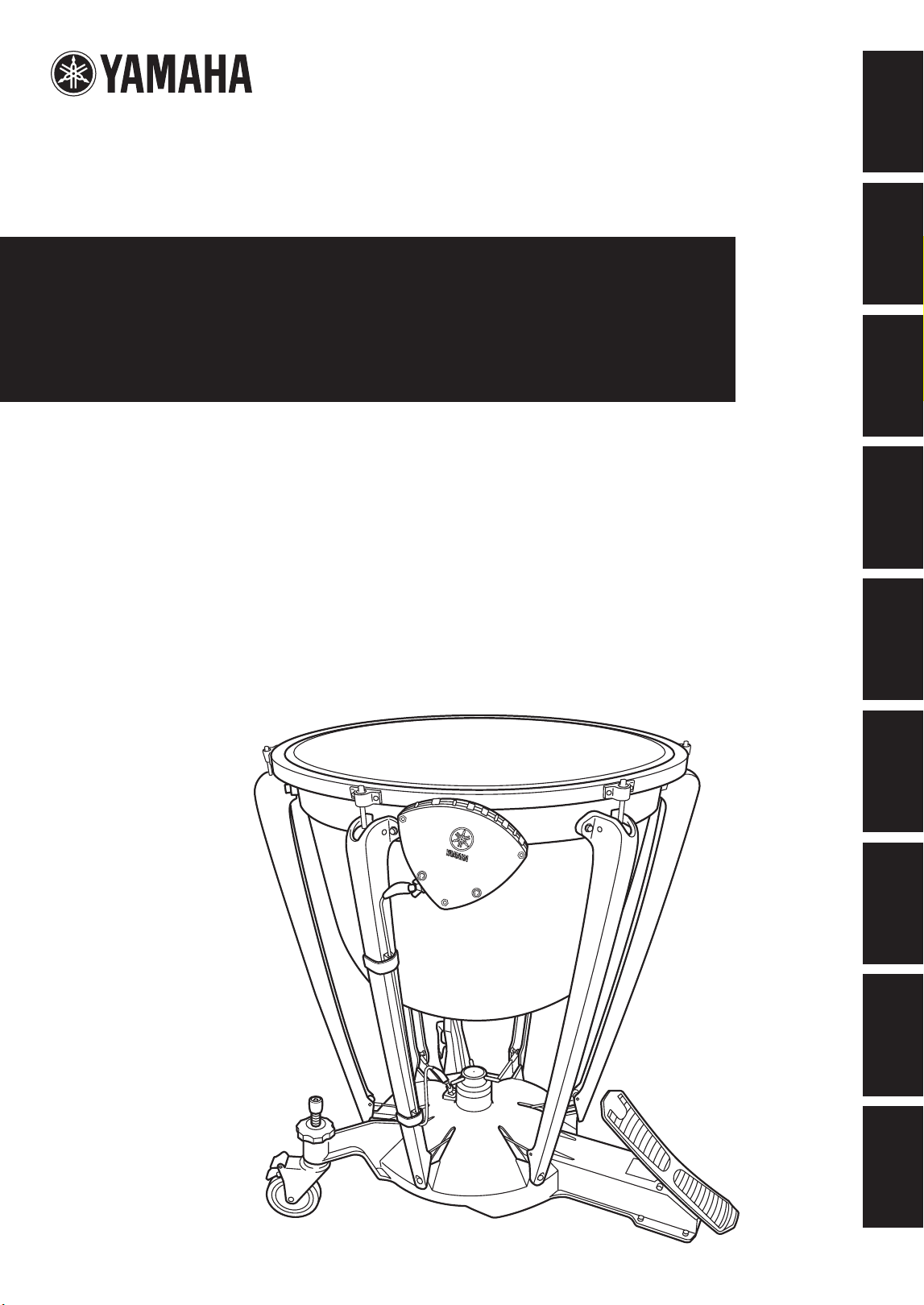
TP-7323R
Português
01_timpani_2015_J.indd 1 2015/11/20 9:11:44

English
PEDAL TIMPANI
TP-8300R
series /
TP-7300R
series
TP-6300R
series /
TP-4300R
series
Owner’s Manual
Thank you for purchasing Yamaha Timpani.
Please keep this manual in a safe and convenient place for future
reference.
Before using your timpani for the first time be sure to carefully
read the instructions on “Initial Preparation” pages 18 and 19.
Contents
PRECAUTIONS ............................................................14
Daily Maintenance ......................................................15
Nomenclature & Lubrication ......................................16
Setting Up the Timpani ............................................... 17
Initial Preparation .......................................................18
Adjusting the Pitch .................................................... 20
Tuning Indicator Adjustment .................................... 22
Pedal Adjustment....................................................... 23
Replacing the Head ................................................... 24
02_timpani_2015_E.indd 13 2015/11/20 9:11:57
14
PRECAUTIONS
PLEASE READ CAREFULLY BEFORE PROCEEDING
Please keep this manual in a safe and convenient place for future reference.
WARNING
Always follow the basic precautions listed below to avoid the possibility of serious injury or even death from
damages or other hazards. These precautions include, but are not limited to, the following:
Transporting/Setup
• Neverplacethetimpanionunstablesurfacessuchasan
unstableriserorslopedsurface.Thetimpanimaytipover
orfallresultingindamageorinjury.
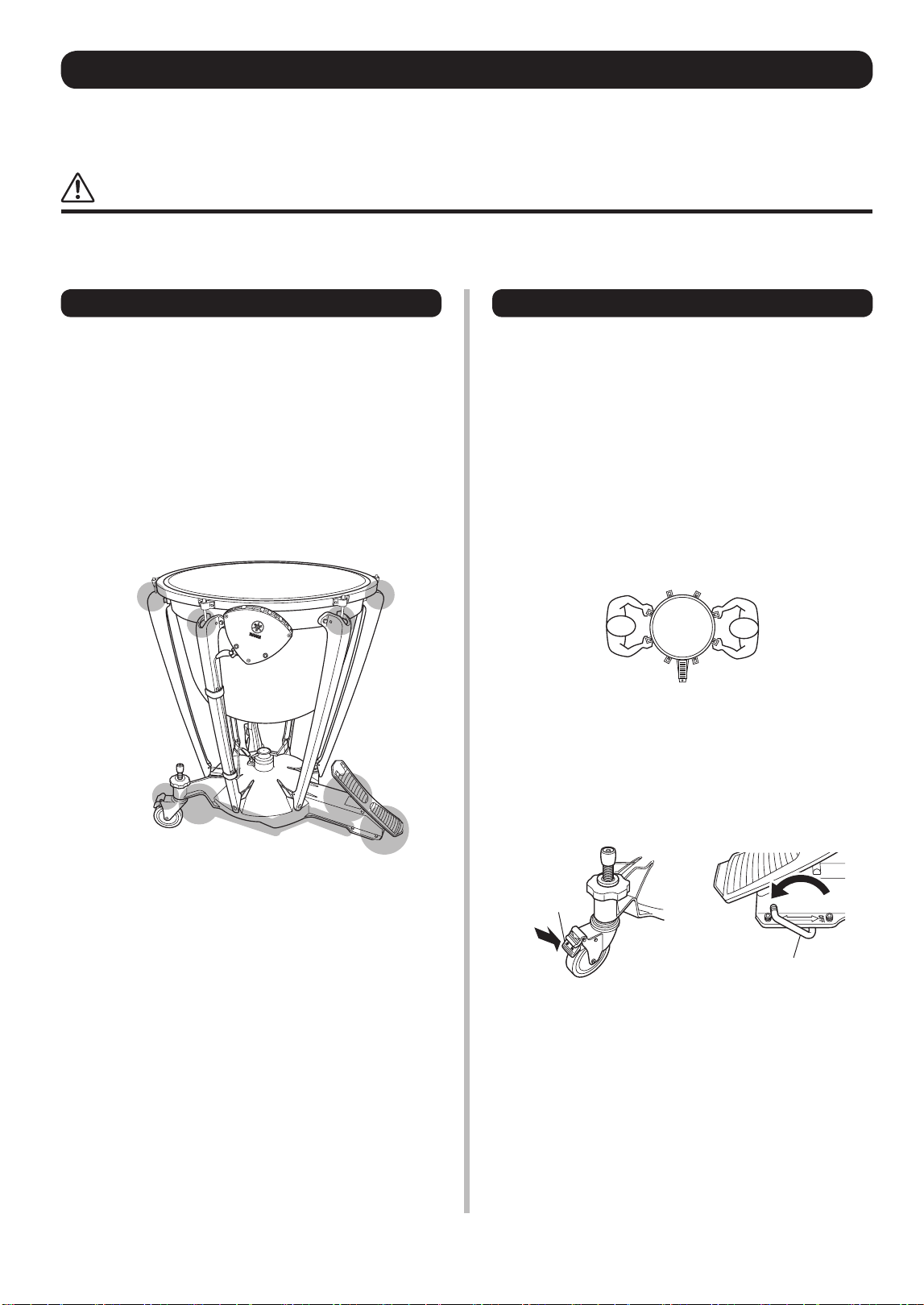
• Whenrollingthetimpanionitscasters,gripitbyitsframe
andmoveitonlyonsmooth,flatsurfaces.
1. Donotmoveonsloping,rough,orgravelsurfaces.
2. Donotrunwiththetimpani.Itmaybedifficulttostop
theinstrumentwhichcancauseinjuryordamage.
• Ifthetimpanimustbecarried,dosowithtwoormore
people,makesuretogripthetimpanibyitsframe.
• Exceptforwhenmovingtheinstrument,alwaysengage
thebrakesonbothmaincastersandtheauxiliarybrake
onthepedalcaster.Notengagingthebrakescanresultin
theinstrumentfallingoverormovingresultingininjury.
• Stopusingtheinstrumentimmediatelyifyounotice
anyabnormalityinthepedalcasterauxiliarybrake.The
instrumentcanmoveorfallovercausinginjury.
• Thepedalcasterandmaincastersareconsumableparts.
Ifyounoticeanyabnormalitiesstopusingtheinstrument
andreplacethecasterswithnewones.Theinstrument
canmoveorfallovercausinginjury.
Handling caution
• Neverleanonorclimbontheinstrument.Itmayoverturn
resultingindamageorinjury.
• Becarefularoundtheinstrument.Bumpingintoitmay
resultininjuryorcauseittooverturn.Keepsmallchildren
awayfromtheinstrument.
•Neverplaceyourfingersorfeetintothespaces
underneaththepedal,thebaseportionoftheinstrument,
orbetweenmovingpartssuchasthecasters.Serious
injurycanresultiffingersorfeetbecomepinched.
Brake
ON
Auxiliary Brake
Main caster Pedal caster
02_timpani_2015_E.indd 14 2015/11/20 9:11:58
15
CAUTION
Always follow the basic precautions listed below to avoid the possibility of physical injury to you or others, or
damage to the instrument or other property. These precautions include, but are not limited to, the following:
Handling caution
• Whenoperatingthepedal,donottouchthehoop,head,
tuningindicator,ortensionrods.Fingersmaybecome
caughtorpinchedresultingininjury.
PRECAUTIONS / Daily Maintenance
• Replacetornheadsassoonaspossible.Thetornedgeof
theheadissharpandcancuthandsorfingers.
• Donotputyourhandsinsideanyofthepartsofthe
timpani(insidethetuningindicator,base,frame,etc.)
• Donotusethemalletforanythingbesidesplayingthe
instrument.Donotallowchildrentostrikeotherswiththe
malletasitcancauseinjuryorbecomedamaged.
•Theinstrumentmaymoveforwardslightlywhenengaging
thepedalcasterauxiliarybrake.Pleasetakenoteofthe
maincasterfloorpositions.
•Donottunetheinstrumenttoapitchoutsideofits
availablerange.Doingsocandamagetheinstrument.
•Donotloosenthespringadjustmentboltmorethanthree
rotationswhenadjustingpedalbalance.Thetoeendof
thepedalmaysuddenlydrop.
Yamahacannotbeheldresponsiblefordamagecausedbyimproperuseormodificationstotheinstrument.
Daily Maintenance
• Afteryouhavefinishedplaying,fullylowertheheelsideofthepedaltuningthetimpanitoitslowest
note.Iftheinstrumentisnottobeusedforanextendedperiod,slightlyloosentheheadaswelltoex-
tend the life of the head.
• Alwaysplacethecoverontheinstrumentwhenstoringtoprotectitfromdust.Useasoftclothtoclean
theheadandusetheheadprotectortoprotecttheheadfromimpacts,etc.Regularlywipetheentire
instrumentwithaclothtokeeptheinstrumentingoodcondition.
• Thebowlhasthemostinfluenceontheinstrument’spitch,soneverdentorstrikeit.
• Neverholdontoanythingotherthantheframewhenmovingtheinstrument.Doingsowillcausethe
instrumenttogooutoftuneanddistorttheshapeofthehoop.
• Instrumentsshiftingandbumpingintoeachwhiletransportingthetimpanibytruckcancausethehead
orhooppositiontoshift.Toreducethechanceofpositionshifting,pressthetoeendofthepedaltoin-
crease tension on the head.
Please use Yamaha care products for daily maintenance.
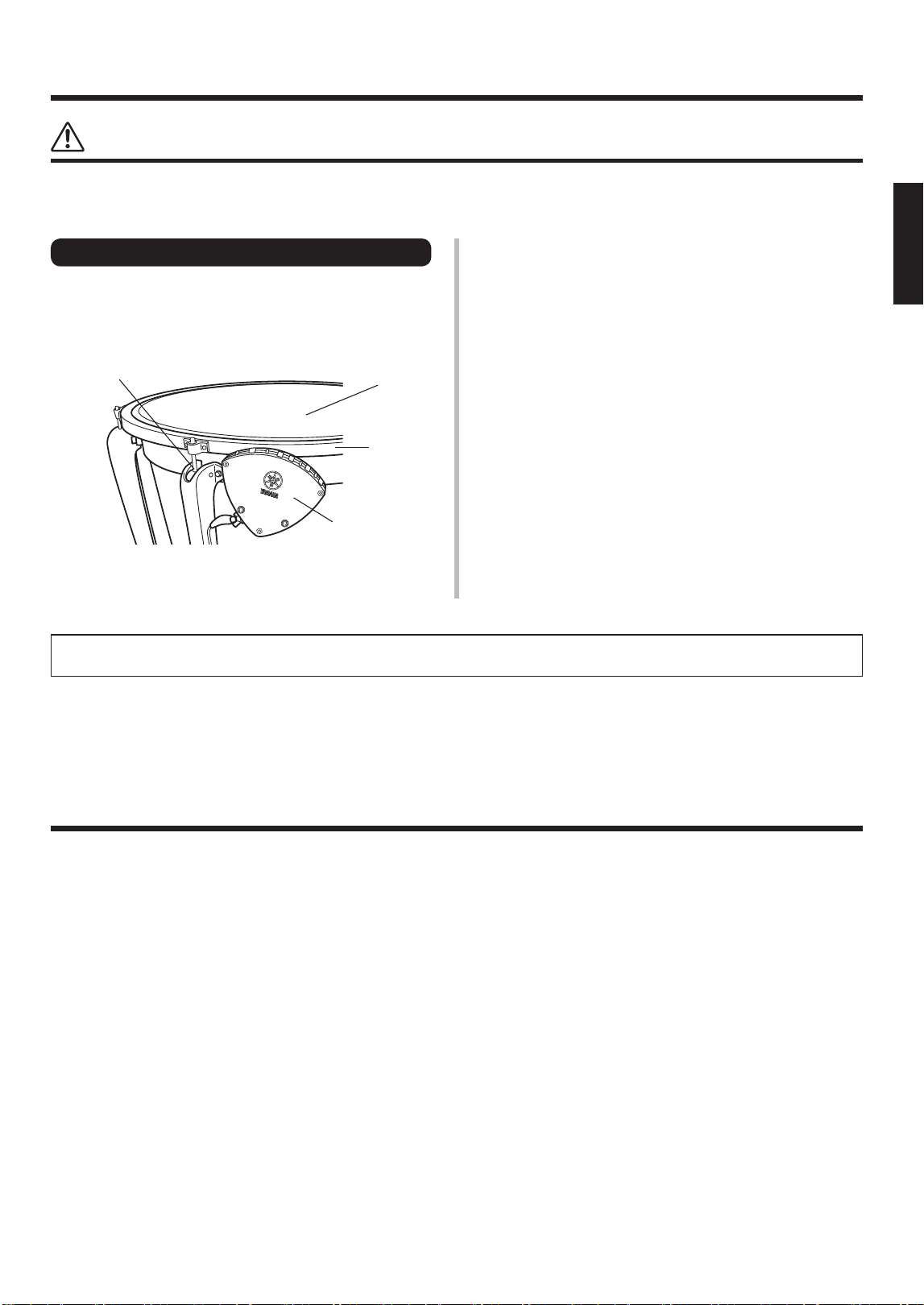
Hoop
TuningIndicator
TensionRod
Head
02_timpani_2015_E.indd 15 2015/11/20 9:11:58
16
Never place your fingers or feet into the
spaces underneath the pedal, the base por-
tion of the instrument, or between moving
parts such as the casters. Serious injury can
result if fingers or feet become pinched.
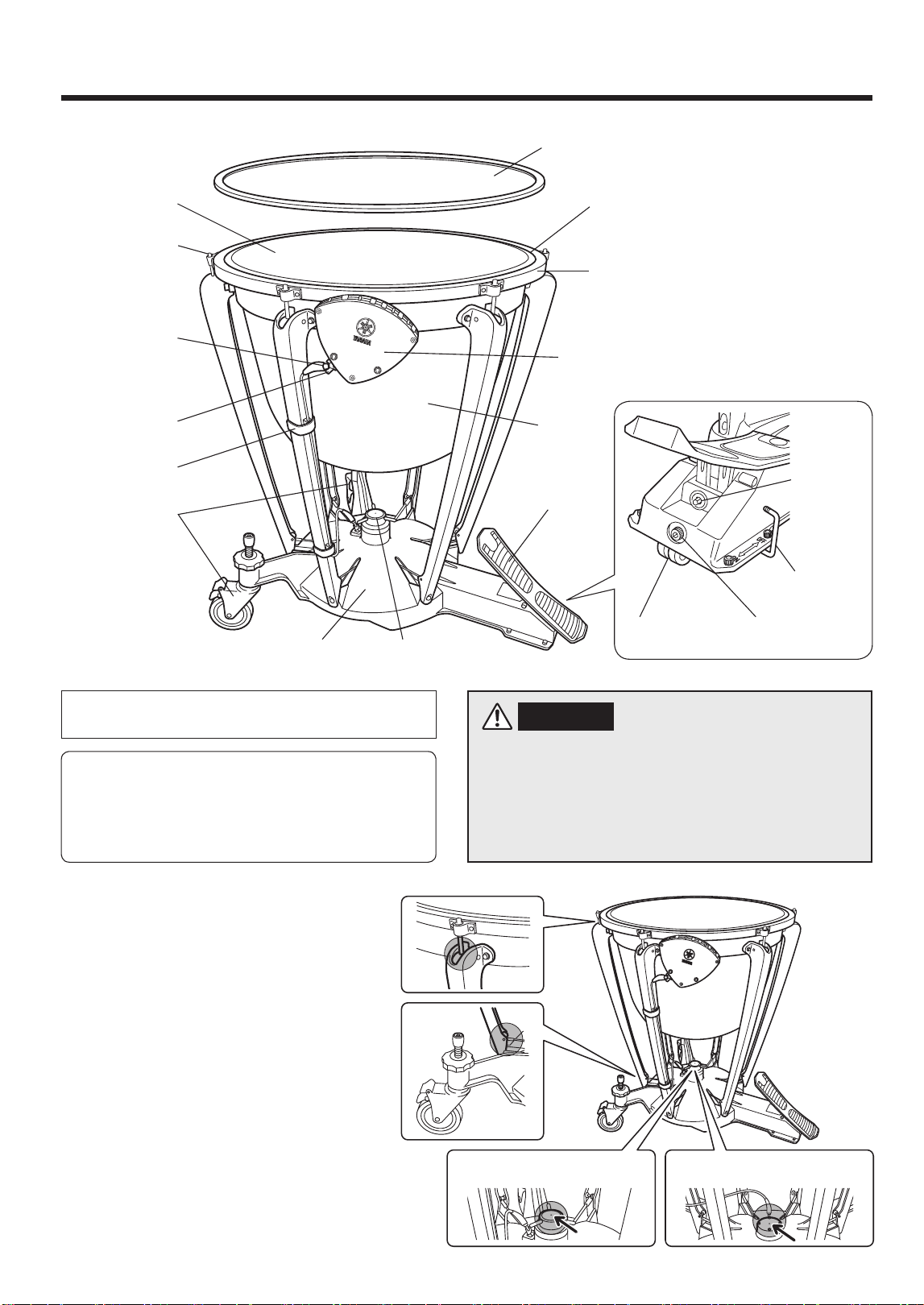
Nomenclature & Lubrication
n
Nomenclature
Supplied Accessories
•TimpaniTuningKey ......................................1
•AllenWrench ................................................1
•NoteNameMarker .......................................1
Caution
*TheTP-7300Rseriesisusedforallillustrationsinthis
manual.
n
Lubrication
Lubricatethemovingpartsindicated
inthediagram.Thisshouldbedoneat
leastonceayear,orasneeded.
* Spray type lubricant is recom-
mended.
* Do not touch the lubricated parts.
* Please use Yamaha care products
for daily maintenance.
TensionRod
Pointer Lock Nut
Head
Bowl
Pointer
AdjustmentKnob
TuningIndicator
Hoop
(Counter Hoop)
BearingEdge
Head Protector
MainCaster
Pedal
Base
PACAdjustmentKnob
Spring
Tension
Adjust-
ment Bolt
Pedal Caster PedalCasterHeight
Adjustment Bolt
Auxiliary
Brake
Cable Band
TP-8300R/7300R series TP-6300R/4300R series
02_timpani_2015_E.indd 16 2015/11/20 9:11:58
17
Caution
Setting Up the Timpani
n
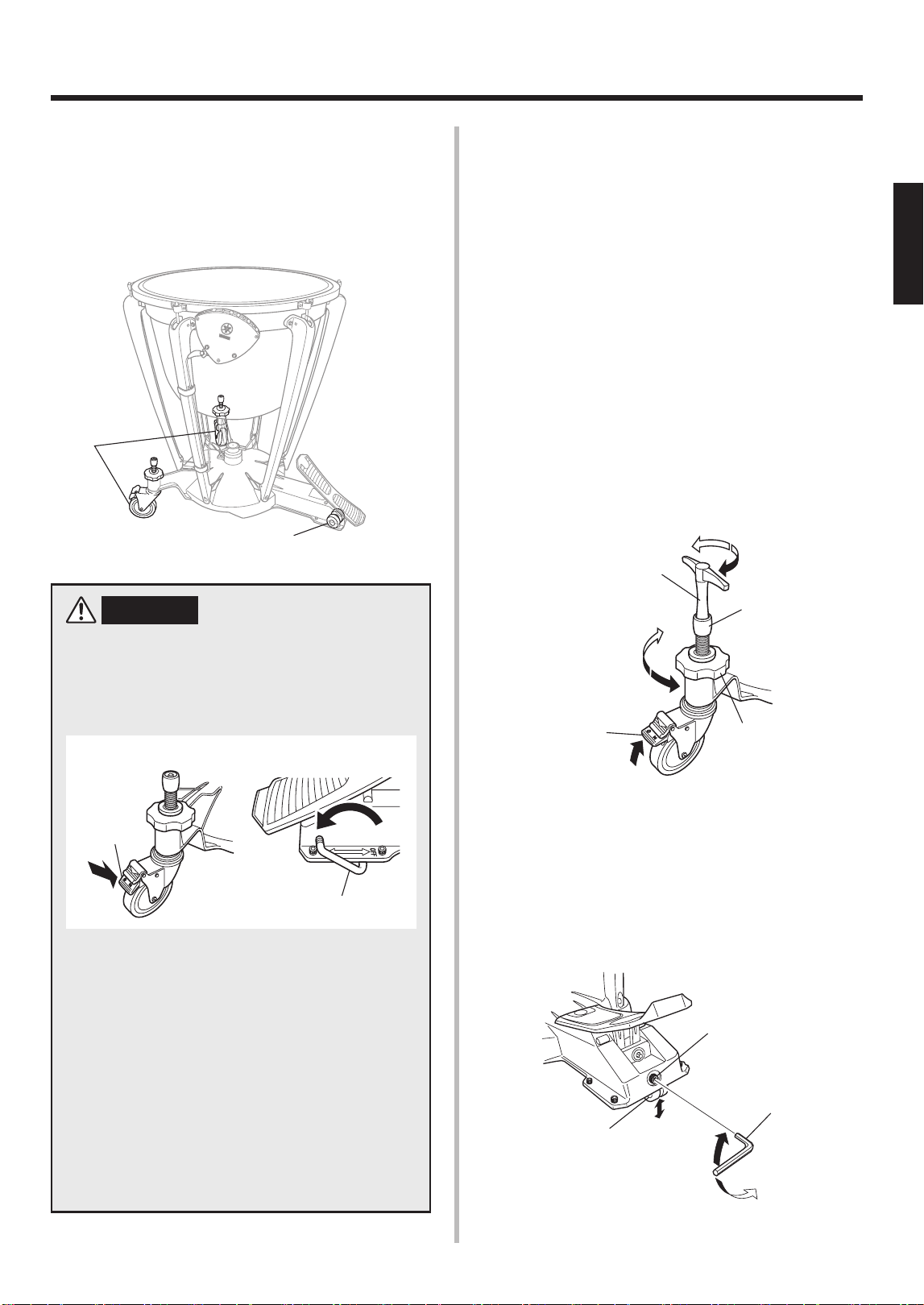
Using the Casters
Theinstrumentisequippedwiththreecasters.
q
Maincaster×2
w
Pedalcaster×1
n
Adjusting the Playing Angle
Allthreecasters offer independent height adjust-
mentlettingyouadjusttheheightandangleofthe
playingsurface.
[Main Caster]
1
Releasethemaincasterbrakes.
2
Turnthelocknutcounter-clockwise(left)to
release the lock nut on the top of the caster.
3
Turnthecasteraxlecapusingatimpanituning
keytoadjusttheheight.
Turncounter-clockwise(left)tolowerandclock-
wise(right)toraisetheheight.
4
Turnthelocknutclockwise(right)tolock.
Except for when moving the instrument,
always engage the brakes on both main
casters and the auxiliary brake on the
pedal caster.
q
w
Brake
ON
Auxiliary Brake
Main caster Pedal caster
Playing the instrument without the main and
auxiliary brakes engaged can result in the in-
strument moving about during the performance.
It can also be a source of noise. Adjusting the
pedal, tuning, and adjusting the PAC system
can also be very dangerous if done without the
brakes engaged. The instrument unexpectedly
moving or falling over can lead to injury.
Stop using the instrument immediately if you
notice any abnormality in the auxiliary brake.
Also, release the main and auxiliary brakes be-
fore moving the instrument.
Lock Nut
4
Lock
2
Unlock
Caster Axle Cap
Raise
3
Lower
TimpaniTuningKey
1
BrakeRelease
[Pedal Caster]
UsingthesuppliedAllenwrench,turnthepedal
casterheight adjustmentboltclockwise(right)to
raisethepedal,increasingitsdistancefromthe
floor,orcounter-clockwise(left)toloweritsheight.
Pedal Caster
AllenWrench
(supplied)
PedalCasterHeight
Adjustment Bolt
Raise
Lower
02_timpani_2015_E.indd 17 2015/11/20 9:11:59
18
YourYamahatimpaniareequippedwithaplasticheadcarefullymountedandadjustedatthe
factory.However,newheadstendtostretchduringshippingandstorage,soitmaybeneces-
sarytore-tunetheinstrumentbeforeusing.Beforeplayingthepedaltimpaniforthefirsttime
afterpurchase,pleasefollowtheprocedurebelowandmakesurethattheheadisproperly
adjusted.
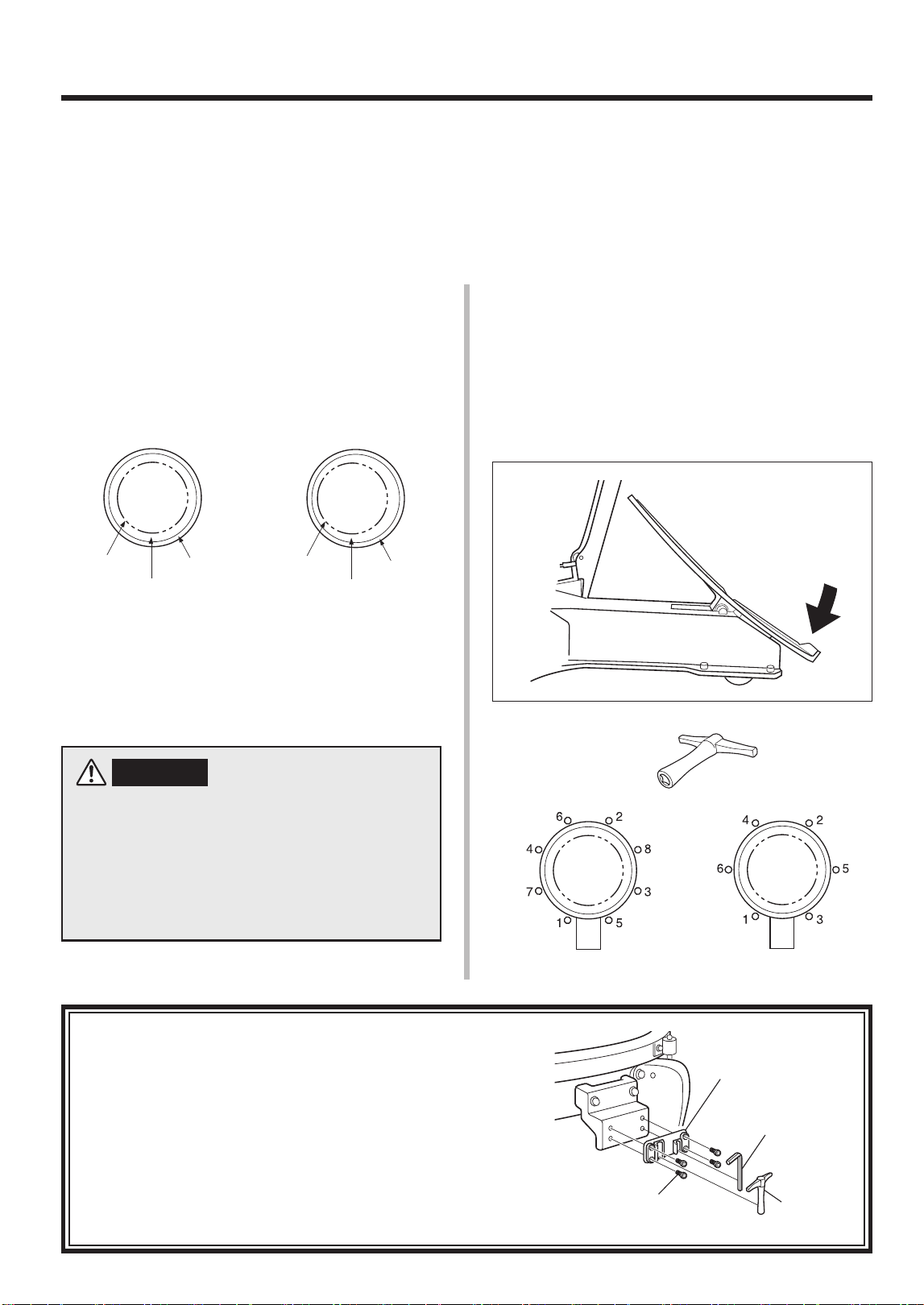
1
Theareabetweenthebearingedgeandthe
inner circle of the counter hoop is called the
collar.Pleasemakesurethatthewidthofthis
collarisuniform,asshownintheillustration
titled “Correct”.
20”,23”,24”
Ifcollarwidthisnotuniform,fullydepressthe
heelendofthepedal.Whileholdingthepedal
inthisposition,realigntheheadandhoopas
showninthe“Correct”illustration.
Initial Preparation
Correct Wrong
Collar
Bearing
edge
Collar
Bearing
edge
Counter Hoop
Counter Hoop
26”,27”,29”,32”
2
Fullydepresstheheelendofthepedal.While
holdingthepedalinthisposition,usethesup-
pliedtimpani tuning keytotightenthe tension
rodsonebyone¼ofaturn(90°)intheorder
shownintheillustrationbelow.
It is very important that all tension rods be
turned the same amount.
Never place your fingers or feet into the
spaces underneath the pedal, the base
portion of the instrument, or between
moving parts such as the casters. Serious
injury can result if fingers or feet become
pinched.
Caution
TimpaniTuningKey
Attaching the Key/Wrench Holder
Theattachmentplatelocatedonthesideofthetimpaniop-
positeofthetuningindicatorisforattachingthekey/wrench
holder,whichholdsthetimpanituningkeyandhexwrench.
Whenrelocatingthekey/wrenchholdertotheoppositeside
ofthetimpani,removethefourboltsusingthesuppliedhex
wrench,thenattachusingtheboltsasshowninthefigure
ontheright.
AllenWrench
Key/WrenchHolder
Timpani
TuningKey
Bolts
02_timpani_2015_E.indd 18 2015/11/20 9:12:00
19
Initial Preparation
3
Takeyourfootoffthepedal.
• Heelstillmovesup
g
Repeatsteps
2
through
3
.
• Heelstaysdown
g
Go to step
4
.
4
Put your foot on the pedal and fully depress it
in either direction (toe and heel).
• Toeandheelfeelequal
g
Go to step
5
.
• Heelfeelslighterthantoe(*)
g
Headistootightandshouldbeloosened.
Keepingtheheelofthepedaldepressed,
loosenthefirsttensionrodby1/2turnand
thenre-tightenitby1/4ofaturn.Perform
this operation for all other tension rods in
theordershowninstep
2
.
Repeatthisprocedureuntilproperhead
tensionisobtainedthengotostep
5
.
• Heelfeelsheavierthantoe
g
Headisnottightenough.Keepingthe
heelendofthepedaldepressed,tighten
eachofthetensionrodsanother1/8(45°)
turn in the same order as in step
3
.
Repeatthisprocedureuntilproperhead
tensionisobtainedthengotostep
5
.
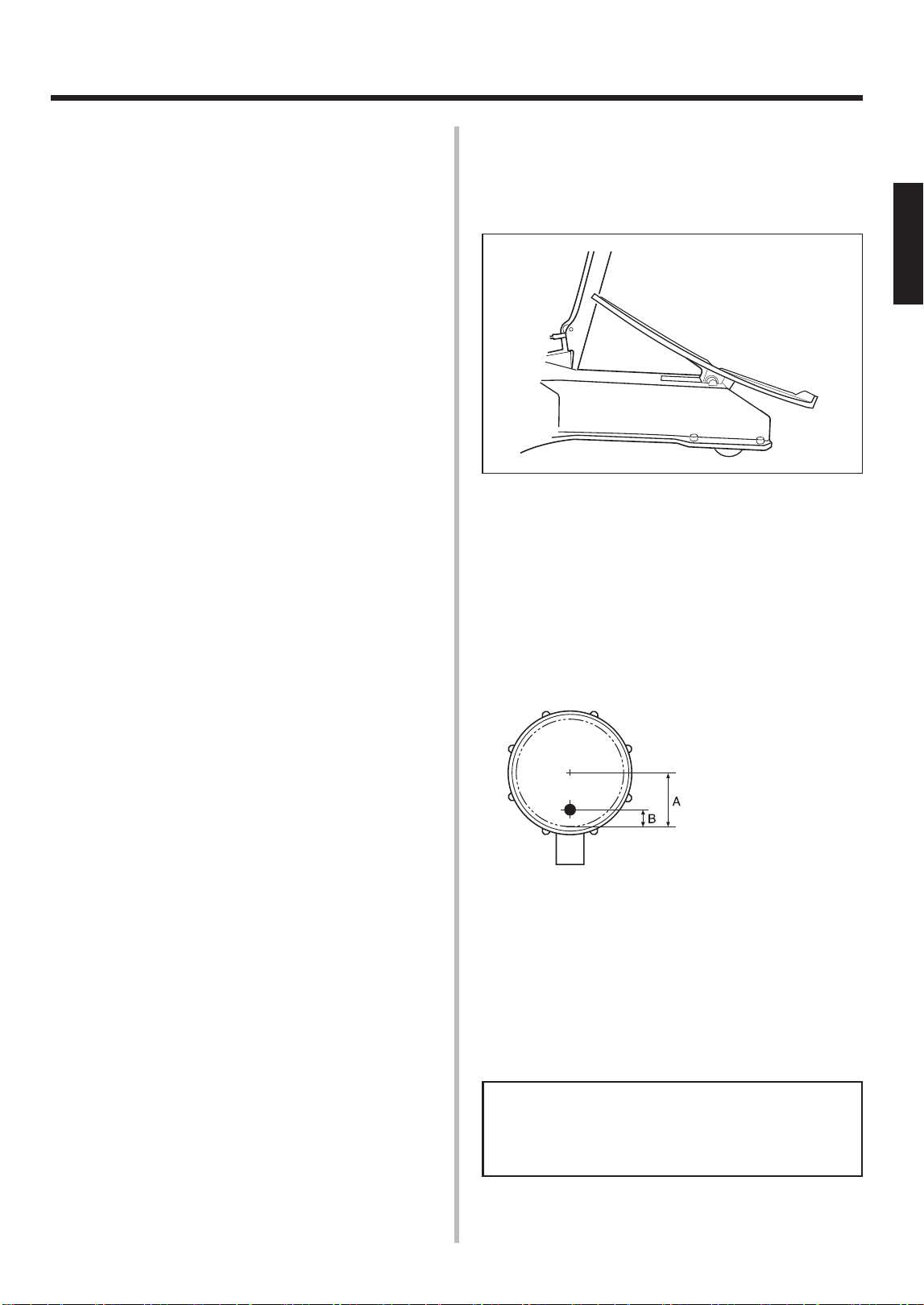
Asthetoeofthepedalispresseddown,the
pitch is raised.
Fordetailson precisetuningreferto“Adjusting
the Pitch”onthefollowingpage.
• Ifthepedalremainsinthesameposition
adjustment is complete. Go to step
6
.
• Ifthetoeofthepedalmovesdownward
g
Theheadistootight.Loosentheheadus-
ingtheproceduredescribedinstep
4
(*).
6
Taptheheadlightlywiththemallet.
Thestandardstrikingpointisshownbelow.
Thestandardstriking
point lies at distance B
fromthebearingedge,
whichcorrespondsap-
proximatelyto1/4to1/3
ofthedistancebetween
thebearingedgeand
the center of the head.
Strikingpoint
Pedal
As the head will stretch over time, read-
justment should be performed periodi-
cally(startingwithstep
4
).
5
Move thepedalintoanintermediateposition,
asshownbelow,andremoveyourfootfromthe
pedal. Confirm that the pedal stays in this posi-
tion and does not move.
02_timpani_2015_E.indd 19 2015/11/20 9:12:00
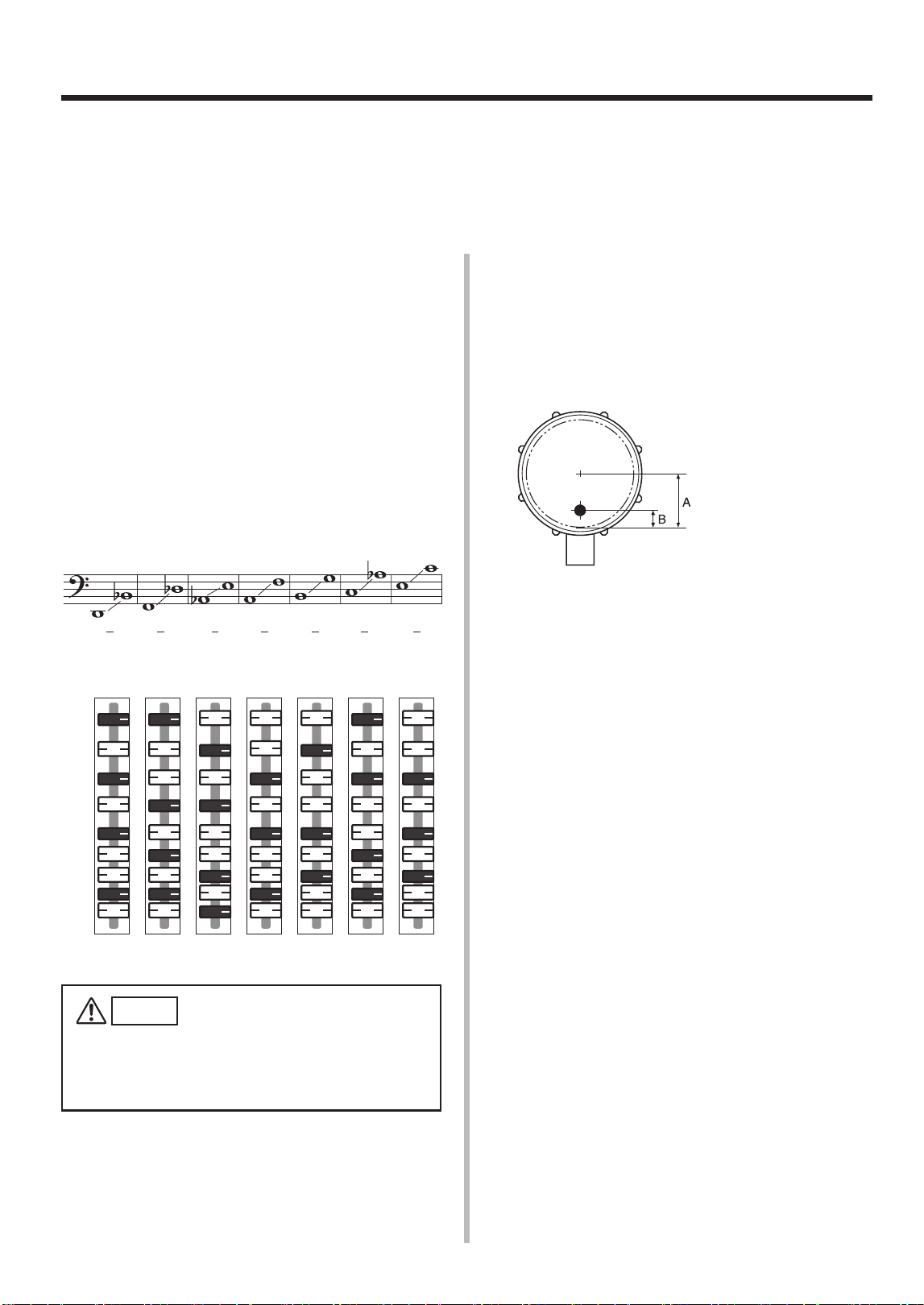
20
Beforeplaying thepedaltimpaniforthefirst timeafterpurchase, makesureyouproperly
adjusttheheadfollowingtheprocedureinthe“Initial Preparation”sectiononpages18-19.
n
Head Tuning
1
Tuningisadjustedonthelowestnoteofthe
timpani.Forthisreason,theheelofthepedal
muststayfullyloweredduringthetuningproce-
dure.Thepitchofthelowestnote(andthetonal
range)dependsonthesizeofyourtimpani.For
example,asshowninthechartbelow,thelow-
estsoundofa29”timpanishouldbetunedto
F.Whentuned properly,yourYamahatimpani
willplaythroughoutitsfulltonalrangewithbal-
anced tension in the pedal.
Thestandardstriking
point lies at distance B
fromthebearing edge,
whichcorresponds ap-
proximatelyto1/4to1/3
ofthedistancebetween
thebearingedgeand
the center of the head.
l
Usable Tonal Ranges for Yamaha Timpani
Strikingpoint
Pedal
Keep the heel of the pedal fully lowered during
thetuningprocedure(steps
2
through
7
below)
if not specified otherwise.
2
Strike the head and check the sound.
Thestandardstrikingpointisshownbelow.
Adjusting the Pitch
• Soundislowerthanthetuningnote
g
Go to step
3
.
• Soundishigherthanthetuningnote
g
Loosenthetensionrodsbyanequal
amountintheordershowninthefigureof
step
2
onpage18.
Whenlooseningthetensionrods,always
loosenthembytwicethedesiredamount,
andthenreturn(re-tighten)thembyhalf.
Whenthesoundlieswithin1semitone
belowthedesiredpitchafterloosening
thetensionrods(repeatedly,ifneces-
sary),proceedwithstep
3
.
Do not tune the timpani to a pitch outside
of its usable range. Doing so can damage
the instrument.
Note
32"
(81cm)
27"
(69cm)
24"
(61cm)
29"
(74cm)
26"
(66cm)
23"
(58cm)
20"
(51cm)
DBb FDb Ab EAFBGCAb
EC
B
A
G
F
C
F
D
C
B
A
E
C
A
G
F
E
B
G
F
E
D
A
F
E
D
C
G
E
D
C
B
A
F
D
C
G
E
B
32" 27" 24"29" 26" 23" 20"
02_timpani_2015_E.indd 20 2015/11/20 9:12:00

21
3
Lightlystriketheheadwiththemalletabout2
inches(5 cm)fromthebearingedgeateach
tensionrod. Checkwhich tensionrodhas the
highestsound.
• Pitchofthehighestsoundishigherthan
thetuningnote(*)
g
Loosenthecorrespondingtensionrodby
about1/16to1/8ofaturn.First loosen
theboltbytwicethedesiredamount,and
thenreturn(re-tighten)itbyhalf.After
looseningthetensionrod,repeatfromthe
beginningofstep
3
.
• Pitch of the highest sound is lowerthan
the tuning note
g
Go to step
4
.
4
Tighten the other bolts littlebylittle (byabout
1/16to1/8ofaturn)untilthesoundsatthe
correspondingstrikingpointsmatchthepitchof
thehighestsound.Pleasenotethattightening
onebolt alsoraisesthepitchofthe neighbor-
ingandoppositetensionrods.Thus,aftertight-
eningthetensionrodwiththelowestsound,
againcheckthepitchattheothertensionrods
beforetighteningthetensionrodwiththenext
lowestpitch.Whilealternatelytighteningthe
otherbolts,do nottouchthetensionrodwith
thehighestpitch(referencepitch).
5
Loosenallover-tightenedboltsaccordingto
the procedure described in step
3
(*).When
the pitch is approximately the same at each
bolt,repeatedlydepressthetoeandheelofthe
pedal several times.
6
Repeatsteps
3
through
5
until the pitch at
each bolt is exactly the same.
Adjusting the Pitch
7
Checkthesoundbystrikingtheheadasde-
scribed in step
2
.
• Soundislowerthanthetuningnote
g
Tunetheinstrumentbytighteningallten-
sionrodsbyanequalamount(max.1/16
of a turn).
• Soundishigherthanthetuningnote
g
Tunetheinstrumentbylooseningallten-
sionrodsbyanequalamount(max.1/16
ofaturn)accordingtotheprocedurede-
scribed in step
3
(*).
8
Operate the pedal as described in step
5
. If the
pitchdoesnotchange,theinstrumentistuned
properly.
(Ifthepitchchanges,repeatfromstep
7
.)
Theinstrumentisnowtunedtothelowestnote
ofitstonalrange.Depressthetoeofthepedal
tochangetoahighernote.
9
Aftertuning,perform“Tuning Indicator Ad-
justment” and then “Pedal Adjustment”.
02_timpani_2015_E.indd 21 2015/11/20 9:12:00
22
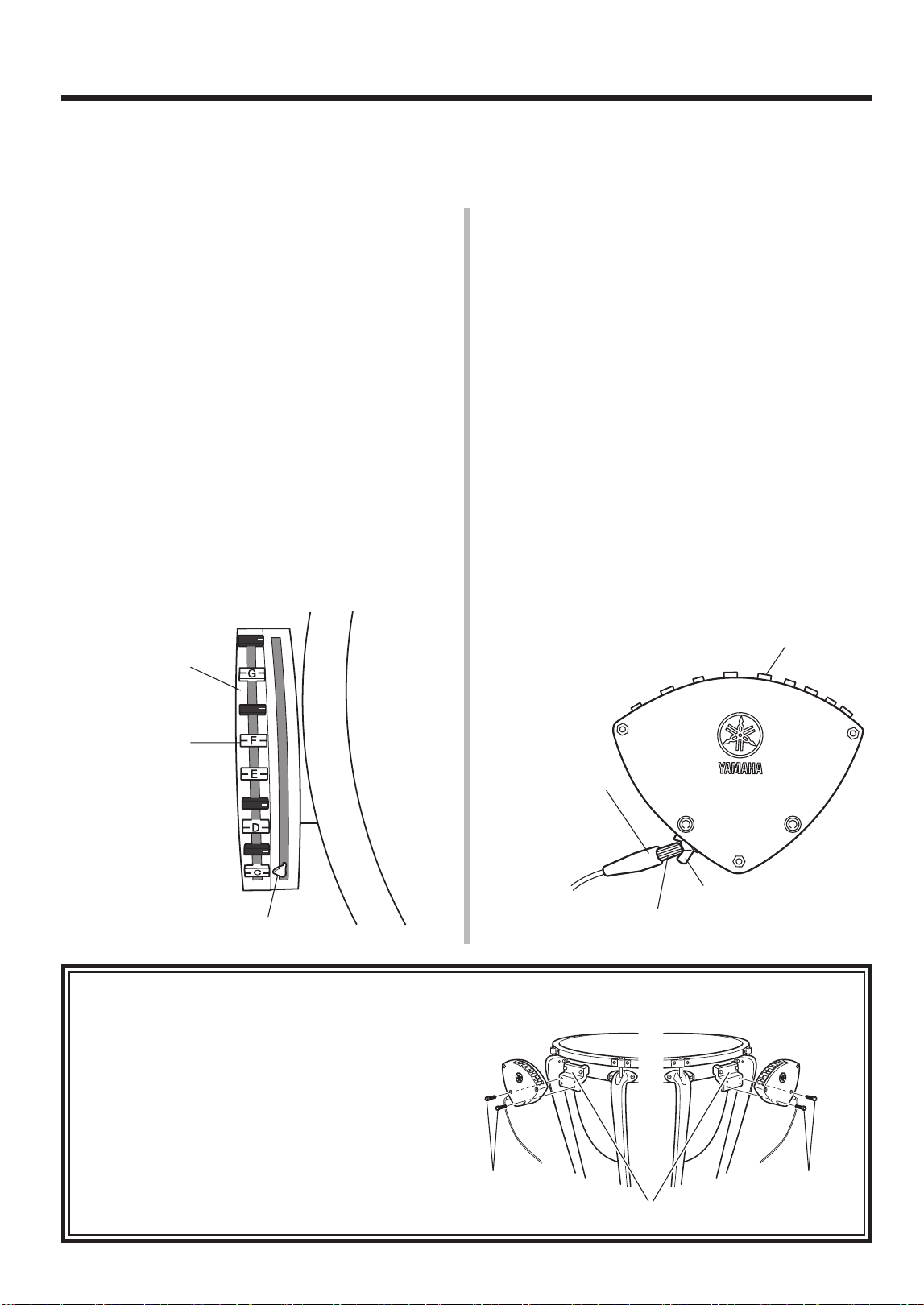
Thetuningindicatorshowswheretosetthepedalforeachnote.Aftertuningtheinstrument,
you must set each note on the indicator to its proper position.
1
Afteryouhavetuned yourtimpani tothe low-
estnoteofitstonalrange,makesurethatthe
pointeris locatedwithin1/16” –1/8”fromthe
pedal-side end of the indicator rail.
*
If not, refer to “Adjusting the Pointer Position”.
2
Slidethelowestnotenamemarkerontheindi-
cator(“C”inthecaseofa23”timpano*)tothe
positionwhereitscenterlinecoincideswiththe
pointer.
* “Usable Tonal Ranges for Yamaha Tim-
pani” on page 20.
3
Tunetheinstrumenttothenexthighestpitch
(note)bymovingthepedal,andthenslidethe
correspondingnotenamemarkerontherailto
therespectivepointerposition.Repeatforeach
remainingnote.
n
Adjusting the Pointer Position
First loosen the pointer lock nut and then turn the
adjusterasfollows:
• Pointer is located beyondthe lower rail end
when the heel of the pedal is lowered fully
(lowestnote).
g
Turntheadjustertotheleft(counterclockwise)
untilthepointerisalignedwiththelowestnote
of the indicator.
• Pointermovesbeyondtheupperrailend
before the toe of the pedal reaches the end of
its stroke, or pointer does not reach the lower
rail end when the heel of the pedal is lowered
fully(lowestsound).
g
Turntheadjustertotheright(clockwise)to
correctthepointerpositionasrequired.
Tuning Indicator Adjustment
IndicatorRail
Note Name
Marker
Pointer
*The“B”markercan
bereplacedwiththe
provided “H” marker
tomatchplaying
preferences.
NoteNameMarker
Adjuster
Pointer Lock Nut
Adjuster Cover
*Replacethe
cover after
adjusting.
Relocating the Tuning Indicator
Thetimpaniisshippedwithauniversalstyletun-
ingindicatoralreadyattachedhowever,thetuning
indicatorcanberelocatedforGermanstyletuning.
Usingthesuppliedhexwrench,removethetwo
boltsholdingthetuningindicatorinplaceas
shownin thediagram (right), then slide thebolts
throughtheholesonthetuningindicatorfromthe
opposite side.Ineitherposition,makesurethat
thenoteindicatorbridgeiseasilyviewable.
Tuning
Indicator Bolt
Tuning
Indicator Bolt
Universal Style
Attachment
German Style
Attachment
MountingBracket
02_timpani_2015_E.indd 22 2015/11/20 9:12:01
23
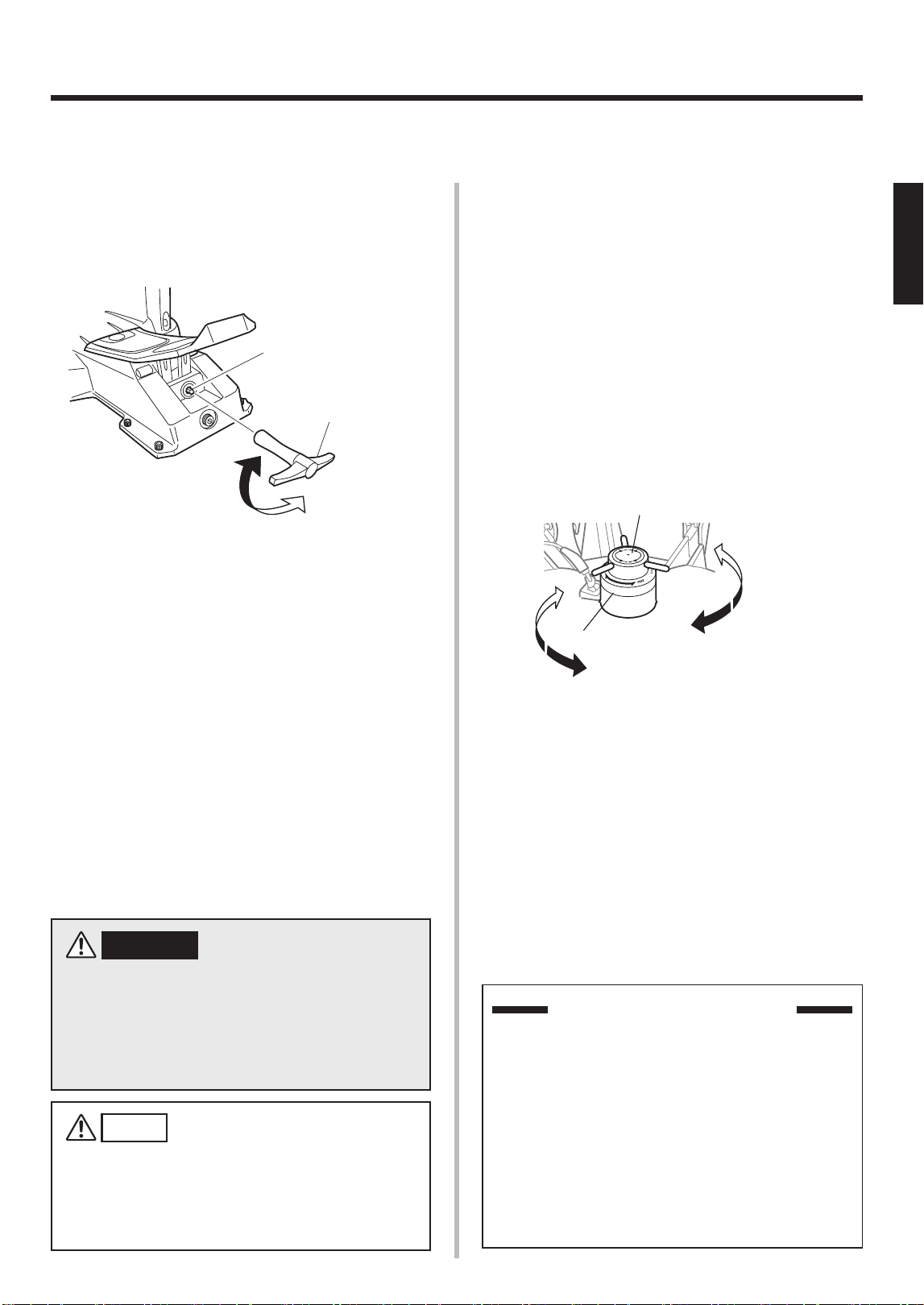
n
Pedal Balance Adjustment
Afterdepressingthetoeandheelofthepedal,turn
thespringtensionadjustmentboltasdescribed
below.
• Heelmovesupwhenreleasingthefootfrom
the pedal after depressing the heel, or the
heel feels heavier than the toe.
g
Turnthespringtensionadjustmentbolttothe
left(counterclockwise).
• Toe movesup when releasing the footfrom
the pedal after depressing the toe, or the toe
feels heavier than the heel.
g
Turnthespringtensionadjustmentbolttothe
right(clockwise).
Usethesuppliedtimpanituningkeytoturnthe
springtensionadjustmentbolt.Do not turntoo
manyfullrotationsatonce,andre-checkthead-
justmentevery 2 turnsbypressingthetoeand
heel of the pedal.
n
Pedal Adjustment Clutch
(TP-8300R/7300R series only)
Thepedalmechanismofthisinstrumentis
equippedwiththePAC(PedalAdjustmentClutch)
system.ThisYamahaoriginalmechanismletsyou
adjustpedaltorque(pedalweight)whilemaintain-
ingpedalbalance.
[PAC Adjustment]
1
TurnthelocknutlocatedbelowthePACadjust-
mentknobcounter-clockwise(left)torelease
the lock.
2
Togivethe pedal a heavierfeelturn the PAC
adjustmentknob clockwise.To return a heavy
settingtoalighterfeel,turnthePACadjust-
mentknobcounter-clockwise.
* Please make adjustments with one hand.
Never attempt turning the adjuster with
bothhands orwithtools (doingsowill
damagethePACsystem).
3
Aftercompletingadjustment,engagethe lock
byturningthelocknutclockwise.
PAC Handling Precautions
l
Even with the PAC system adjusted to its
heaviest setting, the pedal is not “locked”
in place so do not use a heavy setting to
prevent the pedal from jumping when re-
moving the head.
l
There is a limit to how far the PAC adjust-
ment knob can be turned clockwise. Do not
force the knob if it becomes difficult to turn.
Doing so may damage the mechanism.
Pedal Adjustment
MakesurethetimpaniisproperlytunedbeforemakingadjustmenttothespringorPAC.
SpringTension
Adjustment Bolt
TimpaniTuningKey
Never place your fingers or feet into the
spaces underneath the pedal, the base por-
tion of the instrument, or between moving
parts such as the casters. Serious injury can
result if fingers or feet become pinched.
Do not loosen the spring tension adjust-
ment bolt by more than 3 rotations at a
time, as the toe of the pedal tends to drop
abruptly after a specific point.
Caution
Note
PACAdjustmentKnob
PedalMovement
Heavier
Lock Nut
Returnaheavysetting
toalighterfeel
Lock release
Lock
02_timpani_2015_E.indd 23 2015/11/20 9:12:01
24
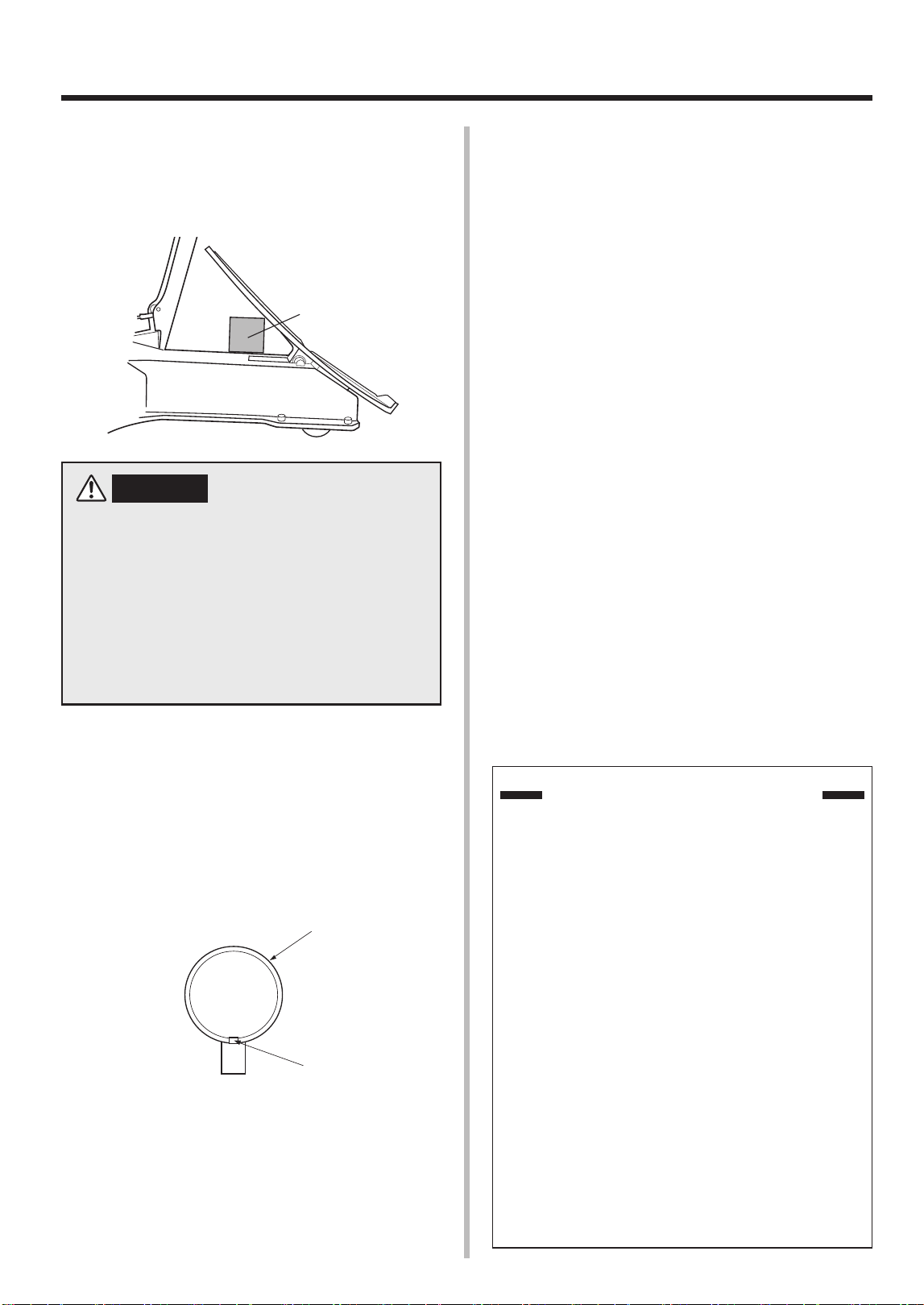
Pedal
1
Topreventthepedalfromsuddenly dropping
duetospringtension,holdtheheelendofthe
pedalallthewaydownandplaceablockof
woodbetweenthepedalandthebase.
2
Loosen the tension rods on opposite sides of
thetimpaniandremovethehead.Werecom-
mend that you mark the pedal side of the hoop
withapieceoftape,etc.sothatthehoopcan
be reattached to the same position.
* Avoid touching the tension rod threads,
as they are greased.
3
Removethehoopandheadtogether.
* Do not let the hoop come in contact with
the bearing edge, etc.
Hoop
Tape
4
Edgetapeisappliedtothebearingedge.The
tapeprovidesasmoothedge,whichisveryim-
portanttotheoperationofthetimpani.Topre-
vent damagetothetape,pleaseremove any
dust or dirt.
* If the tape is peeling or badly damaged,
it must be replaced with “Timpani Teflon
Tape”.
5
Placethenewheadwiththehooponthebowl.
WhenusingaYamahatimpanihead,make
sureitsYAMAHAlogoison thesideopposite
the pedal.
Thehoopmustbere-mountedinthesame
positionasmarkedwithapieceoftapeinstep
2
.Intheproperorder,tightenthetensionrods
alternately by hand until the head is tensioned
slightly.At this time,makesurethatthehead
andhooparecenteredonthebowl.
Tighteneachtensionrodanadditional1/4of
aturnusingthetimpanikey.Repeatatleast4
times.
6
Adjustthetimpaniasdescribedonpage18
“Initial Preparation”startingwithstep
2
. For
precisetuning,refertothesection“Adjusting
the Pitch”onpage20.
Interval for head replacement
When the head is slightly tensioned and
its surface looks wavy or shows dents, it is
time to replace the head with a new one.
The maximum head life normally is ap-
proximately 2 years and depends on the
frequencyandduration ofuse. However,
the head should always be replaced before
thesoundqualitydeterioratesdramatically.
If a head is left on and used more than two
years, the following problems may occur:
• Itmaybecomedifficulttotunethehead
to the proper pitch range.
• It maybecomedifficult to balancethe
pedal.
• The main unit mechanisms themselves
may become damaged.
Yamaha recommends replacing the head
every year.
Replacing the Head
BlockofWood,etc.
Never touch the pedal assembly when
looseningthe tension rods(when loos-
eningthe head).Also, never placeyour
fingers or feet in the space under the
pedal, around the base, or the moving
parts. Spring tension may cause the
pedal to suddenly move posing a great
danger.
Caution
02_timpani_2015_E.indd 24 2015/11/20 9:12:01

〒 430-8650 静岡県浜松市中区中沢町 10-1
ZT90260
版次 :
1511 R0 Printed in Japan
10_timpani_2015_back.indd 112 2015/11/27 13:10:17