

Table of Contents
Installation ...................................................................................................................................................5
Get started....................................................................................................................................................7
Find the device on the network.................................................................................................................7
Browser support ...............................................................................................................................7
Open the device's web interface................................................................................................................7
Create an administrator account...............................................................................................................7
Secure passwords....................................................................................................................................8
Make sure that no one has tampered with the device software ....................................................................8
Configure your device.....................................................................................................................................9
Adjust the image.....................................................................................................................................9
Benefit from IR light in low-light conditions by using night mode .........................................................9
Reduce noise in low-light conditions ..................................................................................................9
Handle scenes with strong backlight...................................................................................................9
Verify the pixel resolution..................................................................................................................9
Hide parts of the image with privacy masks.......................................................................................10
Show an image overlay ...................................................................................................................10
Show a text overlay ........................................................................................................................11
Show the pan or tilt position as a text overlay ...................................................................................11
Add street names and compass direction to the image........................................................................11
Adjust the camera view (PTZ)..................................................................................................................11
....................................................................................................................................................11
Create a recorded guard tour ...........................................................................................................11
View and record video ...........................................................................................................................12
Reduce bandwidth and storage ........................................................................................................12
Set up network storage ...................................................................................................................12
Record and watch video ..................................................................................................................12
Set up rules for events ...........................................................................................................................13
Trigger an action ............................................................................................................................13
Record video when the camera detects an object...............................................................................13
Direct the camera to a preset position when the camera detects motion ..............................................14
Zoom in on a specific area automatically with gatekeeper ..................................................................14
Record video when the camera detects impact ..................................................................................14
Set up autotracking...............................................................................................................................15
Pair the camera with a radar ..................................................................................................................15
Set up radar-video fusion autotracking....................................................................................................16
The web interface ........................................................................................................................................18
Status ..................................................................................................................................................18
Video ...................................................................................................................................................20
Installation ....................................................................................................................................23
Image............................................................................................................................................25
Stream ..........................................................................................................................................30
Overlays ........................................................................................................................................33
Privacy masks.................................................................................................................................35
Analytics ..............................................................................................................................................35
AXIS Object Analytics......................................................................................................................35
Autotracking..................................................................................................................................35
AXIS Image Health Analytics............................................................................................................37
Metadata visualization....................................................................................................................37
Metadata configuration ..................................................................................................................37
PTZ ......................................................................................................................................................38
Preset positions ..............................................................................................................................38
Guard tours....................................................................................................................................38
Limits............................................................................................................................................40
AXIS Q6325-LE PTZ Camera
2

Motion ..........................................................................................................................................41
OSDI zones ....................................................................................................................................41
Orientation aid...............................................................................................................................42
Gatekeeper ....................................................................................................................................42
Control queue ................................................................................................................................42
Recordings ...........................................................................................................................................43
Apps ....................................................................................................................................................44
System.................................................................................................................................................44
Time and location ...........................................................................................................................44
Network ........................................................................................................................................46
Security.........................................................................................................................................50
Accounts .......................................................................................................................................55
Events ...........................................................................................................................................57
MQTT ............................................................................................................................................61
Storage .........................................................................................................................................65
Stream profiles...............................................................................................................................67
ONVIF............................................................................................................................................68
Detectors.......................................................................................................................................71
Power settings ...............................................................................................................................71
Power meter ..................................................................................................................................71
Accessories ....................................................................................................................................71
Edge-to-edge.................................................................................................................................73
Logs ..............................................................................................................................................74
Plain config....................................................................................................................................75
Maintenance ........................................................................................................................................76
Maintenance..................................................................................................................................76
Troubleshoot ..................................................................................................................................77
Learn more..................................................................................................................................................78
Long-distance connections.....................................................................................................................78
Capture modes......................................................................................................................................78
Privacy masks .......................................................................................................................................79
Overlays ...............................................................................................................................................79
Pan, tilt, and zoom (PTZ) ........................................................................................................................80
Guard tours....................................................................................................................................80
Streaming and storage...........................................................................................................................80
Video compression formats..............................................................................................................80
How do Image, Stream, and Stream profile settings relate to each other?.............................................80
Bitrate control................................................................................................................................81
Analytics and apps ................................................................................................................................81
Autotracking..................................................................................................................................81
Metadata visualization....................................................................................................................82
Cybersecurity........................................................................................................................................82
TPM module...................................................................................................................................82
Edge-to-edge technology.......................................................................................................................82
Radar pairing .................................................................................................................................82
Specifications..............................................................................................................................................83
Product overview ..................................................................................................................................83
LED indicators.......................................................................................................................................83
SD card slot ..........................................................................................................................................83
Buttons................................................................................................................................................84
Control button ...............................................................................................................................84
Power button .................................................................................................................................84
Connectors ...........................................................................................................................................84
Network connector .........................................................................................................................84
Clean your device.........................................................................................................................................85
Troubleshooting...........................................................................................................................................86
AXIS Q6325-LE PTZ Camera
3

Reset to factory default settings .............................................................................................................86
AXIS OS options ....................................................................................................................................86
Check the current AXIS OS version ..........................................................................................................86
Upgrade AXIS OS...................................................................................................................................86
Technical problems and possible solutions ...............................................................................................87
Performance considerations ...................................................................................................................90
Contact support ....................................................................................................................................90
AXIS Q6325-LE PTZ Camera
4
5
Installation
To watch this video, go to the web version of this document.
The video shows an example of how to install an AXIS Q63 series PTZ camera with AXIS T91G61 Wall Mount.
The product used in the video is AXIS Q6315-LE PTZ Camera, but the steps are the same for AXIS Q6325-LE.
For instructions that cover all installation scenarios as well as safety information, see the installation guide:
AXIS Q6325-LE PTZ Camera

7
Get started
Find the device on the network
To find Axis devices on the network and assign them IP addresses in Windows®, use AXIS IP Utility or
AXIS Device Manager. Both applications are free and can be downloaded from axis.com/support.
For more information about how to find and assign IP addresses, go to How to assign an IP address and access
your device.
Browser support
You can use the device with the following browsers:
Chrome
TM
Edge
TM
Firefox
®
Safari
®
Windows
®
✓ ✓ * *
macOS
®
✓ ✓ * *
Linux
®
✓ ✓ * *
Other operating
systems
* * * *
✓: Recommended
*: Supported with limitations
Open the device's web interface
1. Open a browser and type the IP address or host name of the Axis device.
If you do not know the IP address, use AXIS IP Utility or AXIS Device Manager to find the device on the
network.
2. Type the username and password. If you access the device for the first time, you must create an
administrator account. See Create an administrator account, on page 7.
For descriptions of all the controls and options in the device’s web interface, see The web interface, on page 18.
Create an administrator account
The first time you log in to your device, you must create an administrator account.
1. Enter a username.
2. Enter a password. See Secure passwords, on page 8.
3. Re-enter the password.
4. Accept the license agreement.
5. Click Add account.
Important
The device has no default account. If you lose the password for your administrator account, you must reset
the device. See Reset to factory default settings, on page 86.
AXIS Q6325-LE PTZ Camera

8
Secure passwords
Important
Use HTTPS (which is enabled by default) to set your password or other sensitive configurations over the
network. HTTPS enables secure and encrypted network connections, thereby protecting sensitive data, such
as passwords.
The device password is the primary protection for your data and services. Axis devices do not impose a password
policy as they may be used in various types of installations.
To protect your data we strongly recommend that you:
• Use a password with at least 8 characters, preferably created by a password generator.
• Don’t expose the password.
• Change the password at a recurring interval, at least once a year.
Make sure that no one has tampered with the device software
To make sure that the device has its original AXIS OS, or to take full control of the device after a security attack:
1. Reset to factory default settings. See Reset to factory default settings, on page 86.
After the reset, secure boot guarantees the state of the device.
2. Configure and install the device.
AXIS Q6325-LE PTZ Camera

9
Configure your device
Adjust the image
This section includes instructions about configuring your device. If you want to learn more about how certain
features work, go to Learn more, on page 78.
Benefit from IR light in low-light conditions by using night mode
Your camera uses visible light to deliver color images during the day. But as the visible light diminishes, color
images become less bright and clear. If you switch to night mode when this happens, the camera uses both
visible and near-infrared light to deliver bright and detailed black-and-white images instead. You can set the
camera to switch to night mode automatically.
1. Go to Video > Image > Day-night mode, and make sure that the IR-cut filter is set to Auto.
2. To set at what light level you want the camera to switch to night mode, move the Threshold slider
toward Bright or Dark.
3. To use the built-in IR light when the camera is in night mode, turn on Allow illumination and
Synchronize illumination.
Note
If you set the switch to night mode to occur when it’s brighter, the image remains sharper as there is less
low-light noise. If you set the switch to occur when it’s darker, the image colors are maintained for longer,
but there is more image blur due to low-light noise.
Reduce noise in low-light conditions
To reduce noise in low-light conditions, you can adjust one or more of the following settings:
• Adjust the trade-off between noise and motion blur. Go to Video > Image > Exposure and move the
Blur-noise trade-off slider toward Low noise.
Note
A high max shutter value can result in motion blur.
• To slow down the shutter speed, set max shutter to the highest possible value.
• If there is an Aperture slider, move it towards Open.
Handle scenes with strong backlight
Dynamic range is the difference in light levels in an image. In some cases the difference between the darkest
and the brightest areas can be significant. The result is often an image where either the dark or the bright areas
are visible. Wide dynamic range (WDR) makes both dark and bright areas of the image visible.
1. Go to Video > Image > Wide dynamic range.
2. Use the Local contrast slider to adjust the amount of WDR.
3. Use the Tone mapping slider to adjust the amount of WDR.
4. If you still have problems, go to Exposure and adjust the Exposure zone to cover the area of interest.
Find out more about WDR and how to use it at axis.com/web-articles/wdr.
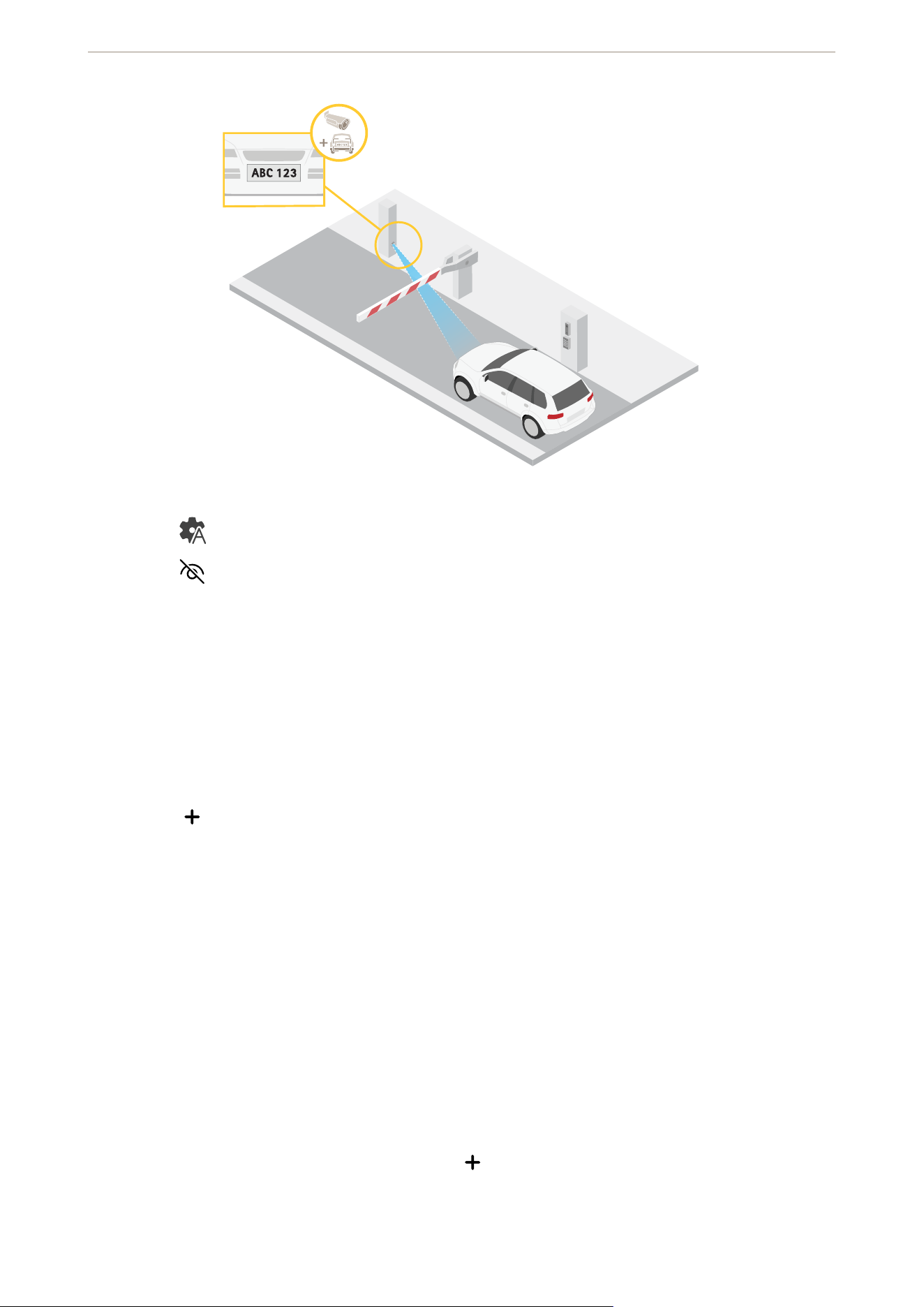
Verify the pixel resolution
To verify that a defined part of the image contains enough pixels to, for example, recognize license plates, you
can use the pixel counter.
AXIS Q6325-LE PTZ Camera
10
1. Go to Video > Image.
2. Click .
3. Click for Pixel counter.
4. In the camera’s live view, adjust the size and position of the rectangle around the area of interest, for
example where you expect license plates to appear.
5. You can see the number of pixels for each of the rectangle’s sides, and decide if the values are enough
for your needs.
Hide parts of the image with privacy masks
You can create one or several privacy masks to hide parts of the image.
1. Go to Video > Privacy masks.
2. Click .
3. Click the new mask and type a name.
4. Adjust the size and placement of the privacy mask according to your needs.
5. To change the color for all privacy masks, click Privacy masks and select a color.
See also Privacy masks, on page 79
Show an image overlay
You can add an image as an overlay in the video stream.
1. Go to Video > Overlays.
2. Click Manage images.
3. Upload or drag and drop an image.
4. Click Upload.
5. Select Image from the drop-down list and click .
ABC 123
AXIS Q6325-LE PTZ Camera

11
6. Select the image and a position. You can also drag the overlay image in the live view to change the
position.
Show a text overlay
You can add a text field as an overlay in the video stream. This is useful for example when you want to display
the date, time or a company name in the video stream.
1. Go to Video > Overlays.
2. Select Text and click .
3. Type the text you want to display, or select modifiers to show for example the current date.
4. Select a position. You can also click-and-drag the overlay in the live view to change the position.
Show the pan or tilt position as a text overlay
You can show the pan or tilt position as an overlay in the image.
1. Go to Video > Overlays and click .
2. In the text field, type #x to show the pan position.
Type #y to show the tilt position.
3. Choose appearance, text size, and alignment.
4. The current pan and tilt positions show up in the live view image and in the recording.
Add street names and compass direction to the image
Note
The preset positions and compass direction will be visible in the compass field in all video streams and
recordings.
To activate the compass:
1. Go to PTZ > Orientation aid.
2. Turn on Orientation aid.
3. Position the camera view at north with the crosshair. Click Set north.
To add a preset position to show in the compass field:
1. Go to PTZ > Preset positions.
2. Use the crosshair to position the view where you want to add a preset position.
3. Click Add preset position to create a new preset position.
Adjust the camera view (PTZ)
To learn more about different pan, tilt, and zoom settings, see Pan, tilt, and zoom (PTZ), on page 80.
1. Go to PTZ > Limits.
2. Set the limits as needed.
Create a recorded guard tour
1. Go to PTZ > Guard tours.
2. Click Guard tour.
3. Select Recorded and click Create.
AXIS Q6325-LE PTZ Camera

12
4. Enter a name for the guard tour and specify the pause length between each tour.
5. Click Start recording tour to start recording the pan/tilt/zoom movements.
6. When you’re satisfied, click Stop recording tour.
7. Click Done.
8. To schedule the guard tour, go to System > Events.
View and record video
This section includes instructions about configuring your device. To learn more about how streaming and
storage works, go to Streaming and storage, on page 80.
Reduce bandwidth and storage
Important
Reducing the bandwidth can lead to loss of detail in the image.
1. Go to Video > Stream.
2. Click in the live view.
3. Select Video format AV1 if your device supports it. Otherwise select H.264.
4. Go to Video > Stream > General and increase Compression.
5. Go to Video > Stream > Zipstream and do one or more of the following:
Note
The Zipstream settings are used for all video encodings except MJPEG.
– Select the Zipstream Strength that you want to use.
– Turn on Optimize for storage. This can only be used if the video management software supports
B-frames.
– Turn on Dynamic FPS.
– Turn on Dynamic GOP and set a high Upper limit GOP length value.
Note
Most web browsers don’t support H.265 decoding and because of this the device doesn’t support it in its web
interface. Instead you can use a video management system or application that supports H.265 decoding.
Set up network storage
To store recordings on the network, you need to set up your network storage.
1. Go to System > Storage.
2. Click Add network storage under Network storage.
3. Type the IP address of the host server.
4. Type the name of the shared location on the host server under Network share.
5. Type the username and password.
6. Select the SMB version or leave it on Auto.
7. Select Add share without testing if you experience temporary connection issues, or if the share is not
yet configured.
8. Click Add.
Record and watch video
Record video directly from the camera
AXIS Q6325-LE PTZ Camera
13
1. Go to Video > Stream.
2. To start a recording, click .
If you haven’t set up any storage, click and . For instructions on how to set up network
storage, see Set up network storage, on page 12
3. To stop recording, click again.
Watch video
1. Go to Recordings.
2. Click for your recording in the list.
Set up rules for events
You can create rules to make your device perform an action when certain events occur. A rule consists of
conditions and actions. The conditions can be used to trigger the actions. For example, the device can start a
recording or send an email when it detects motion, or show an overlay text while the device is recording.
To learn more, see Get started with rules for events.
Trigger an action
1. Go to System > Events and add a rule. The rule defines when the device will perform certain actions.
You can set up rules as scheduled, recurring, or manually triggered.
2. Enter a Name.
3. Select the Condition that must be met to trigger the action. If you specify more than one condition for
the rule, all of the conditions must be met to trigger the action.
4. Select which Action to perform when the conditions are met.
Note
• If you make changes to an active rule, the rule must be turned on again for the changes to take effect.
Record video when the camera detects an object
This example explains how to set up the camera to start recording to the SD card when the camera detects an
object. The recording will include five seconds before detection and one minute after detection ends.
Before you start:
• Make sure you have an SD card installed.
Make sure that AXIS Object Analytics is running:
1. Go to Apps > AXIS Object Analytics.
2. Start the application if it is not already running.
3. Make sure you have set up the application according to your needs.
Create a rule:
1. Go to System > Events and add a rule.
2. Type a name for the rule.
3. In the list of conditions, under Application, select Object Analytics.
4. In the list of actions, under Recordings, select Record video while the rule is active.
5. In the list of storage options, select SD_DISK.
6. Select a camera and a stream profile.
7. Set the prebuffer time to 5 seconds.
AXIS Q6325-LE PTZ Camera

14
8. Set the postbuffer time to 1 minute.
9. Click Save.
Direct the camera to a preset position when the camera detects motion
This example explains how to set up the camera to go to a preset position when it detects motion in the image.
Make sure that AXIS Object Analytics is running:
1. Go to Apps > AXIS Object Analytics.
2. Start the application if it is not already running.
3. Make sure you have set up the application according to your needs.
Add a preset position:
Go to PTZ and set where you want the camera to be directed by creating a preset position.
Create a rule:
1. Go to System > Events and add a rule.
2. Type a name for the rule.
3. In the list of conditions, under Application, select Object Analytics.
4. In the list of actions, select Go to preset position.
5. Select the preset position you want the camera to go to.
6. Click Save.
Zoom in on a specific area automatically with gatekeeper
This example explains how to use the gatekeeper functionality to make the camera zoom in automatically on
the license plate of a car that passes through a gate. When the car has passed, the camera zooms out to the
home position.
Create the preset positions:
1. Go to PTZ > Preset positions.
2. Create the home position that includes the entrance of the gate.
3. Create the zoomed-in preset position so that it covers the area in the image where you assume that the
license plate will appear.
Set up motion detection:
1. Go to Apps and start and open AXIS Object Analytics.
2. Create an object in area scenario for vehicles, with an include area that covers the entrance of the gate.
Create a rule:
1. Go to System > Events and add a rule.
2. Name the rule “Gatekeeper”.
3. In the list of conditions, under Application, select the Object Analytics scenario.
4. In the list of actions, under Preset positions, select Go to preset position.
5. Select a Video channel.
6. Select the Preset position.
7. To make the camera wait a while before it returns to the home position, set a time for Home timeout.
8. Click Save.
Record video when the camera detects impact
Shock detection allows the camera to detect tampering caused by vibrations or shock. Vibrations due to the
environment or to an object can trigger an action depending on the shock sensitivity range, which can be set
AXIS Q6325-LE PTZ Camera

15
from 0 to 100. In this scenario, someone is throwing rocks at the camera after hours and you would like to get a
video clip of the event.
Turn on shock detection:
1. Go to System > Detectors > Shock detection.
2. Turn on shock detection, and adjust the shock sensitivity.
Create a rule:
3. Go to System > Events > Rules and add a rule.
4. Type a name for the rule.
5. In the list of conditions, under Device status, select Shock detected.
6. Click + to add a second condition.
7. In the list of conditions, under Scheduled and recurring, select Schedule.
8. In the list of schedules, select After hours .
9. In the list of actions, under Recordings, select Record video while the rule is active.
10. Select where to save the recordings.
11. Select a Camera.
12. Set the prebuffer time to 5 seconds.
13. Set the postbuffer time to 50 seconds.
14. Click Save.
Set up autotracking
This example explains how to set up the camera to detect, zoom in on, and track moving objects in an area of
interest.
Before you start
• Make sure you have a preset position that covers the area of interest.
• In AXIS Object Analytics, create a scenario that uses the preset position.
1. Go to Analytics > Autotracking.
2. To create a tracking profile, click Create.
3. In AXIS Object Analytics scenario, select the scenario.
4. Optionally, update the Tracking profile name.
5. To enable the profile so it can be used, turn on Use profile.
6. Save the profile.
To start tracking objects using the profile, click and turn on Active.
To show bounding boxes around objects and at the same time make it possible to manually select objects to
track, turn on Object confirmation.
Note
It’s only possible to start manual tracking from Analytics > Autotracking.
Pair the camera with a radar
Radar pairing is a one-way setup where you pair a camera with a radar and use the camera to configure and
maintain both devices. The camera has an allocated channel for the radar stream, and after pairing the radar
stream will be automatically assigned to this channel.
Note
Make sure the paired devices run the same AXIS OS version.
AXIS Q6325-LE PTZ Camera

16
To learn more about edge-to-edge, see Edge-to-edge technology, on page 82.
Before you start:
• Make sure the camera and radar are directed towards the same area of interest.
• Make sure the camera and radar are synced to the same time source. To check the time sync status, go
to Installation > Time sync status in each device.
Pair the camera with the radar:
1. In the camera’s web interface, go to System > Edge-to-edge > Pairing.
2. Click Add.
3. In the list of pairing types, select Radar.
4. Enter the host name, username, and password for the radar.
5. Click Connect to pair the devices.
When the connection is established, the radar settings become available in the camera’s web interface.
Configure the radar:
1. In the camera’s web interface, go to Radar > Scenarios.
2. Configure the radar according to your needs.
For more information about how to configure your radar, see the user manual at help.axis.com.
Note
When you upgrade the AXIS OS version for the camera, make sure to also upgrade AXIS OS for the radar to
keep your system up-to-date. We recommend using a device management system like AXIS Device Manager.
Set up radar-video fusion autotracking
When you connect a radar to the camera, you can set up the camera to zoom in on and track moving objects
that are detected by the radar.
Important
Autotracking is best suited for areas where movement is uncommon.
You do all the settings from the camera’s web interface.
Before you start
• Mount the radar and the PTZ camera together according to instructions in the radar’s installation guide.
• Set the radar’s mounting height in Radar > Settings > General.
• Pair the camera with the radar, see Pair the camera with a radar, on page 15.
• Make sure you have a preset position in the camera that covers the area of interest.
Align the radar and the PTZ camera:
1. Go to Status > Camera and radar alignment and click Align devices.
2. Follow the step-by-step instructions.
If you later want to re-align the pan-offset, you can do it from here by clicking Realign devices.
Create a scenario:
3. In the camera’s web interface, go to Radar > Scenarios.
4. Select and update one of the default scenarios or create a new one.
For movement in area-scenarios, make sure the inclusion zone only covers the area where you want to
start tracking objects. A too large inclusion zone can result in many PTZ movements and alarms.
Set up autotracking:
5. Go to Analytics > Autotracking > Tracking profiles.
6. Click + Create.
7. Select the radar scenario you just created.
AXIS Q6325-LE PTZ Camera

17
8. Optionally, update the Tracking profile name.
9. In Tracking criteria, select what criteria must be fulfilled to continue tracking an object.
10. If you only want to track objects that both the radar and the camera has classified, turn on Object type
verification. Select the type of objects that must be classified by both the radar and the camera.
11. Set the tracking profile’s priority.
12. Click Save.
AXIS Q6325-LE PTZ Camera
18
The web interface
To reach the device’s web interface, type the device’s IP address in a web browser.
Note
Support for the features and settings described in this section varies between devices. This icon
indicates that the feature or setting is only available in some devices.
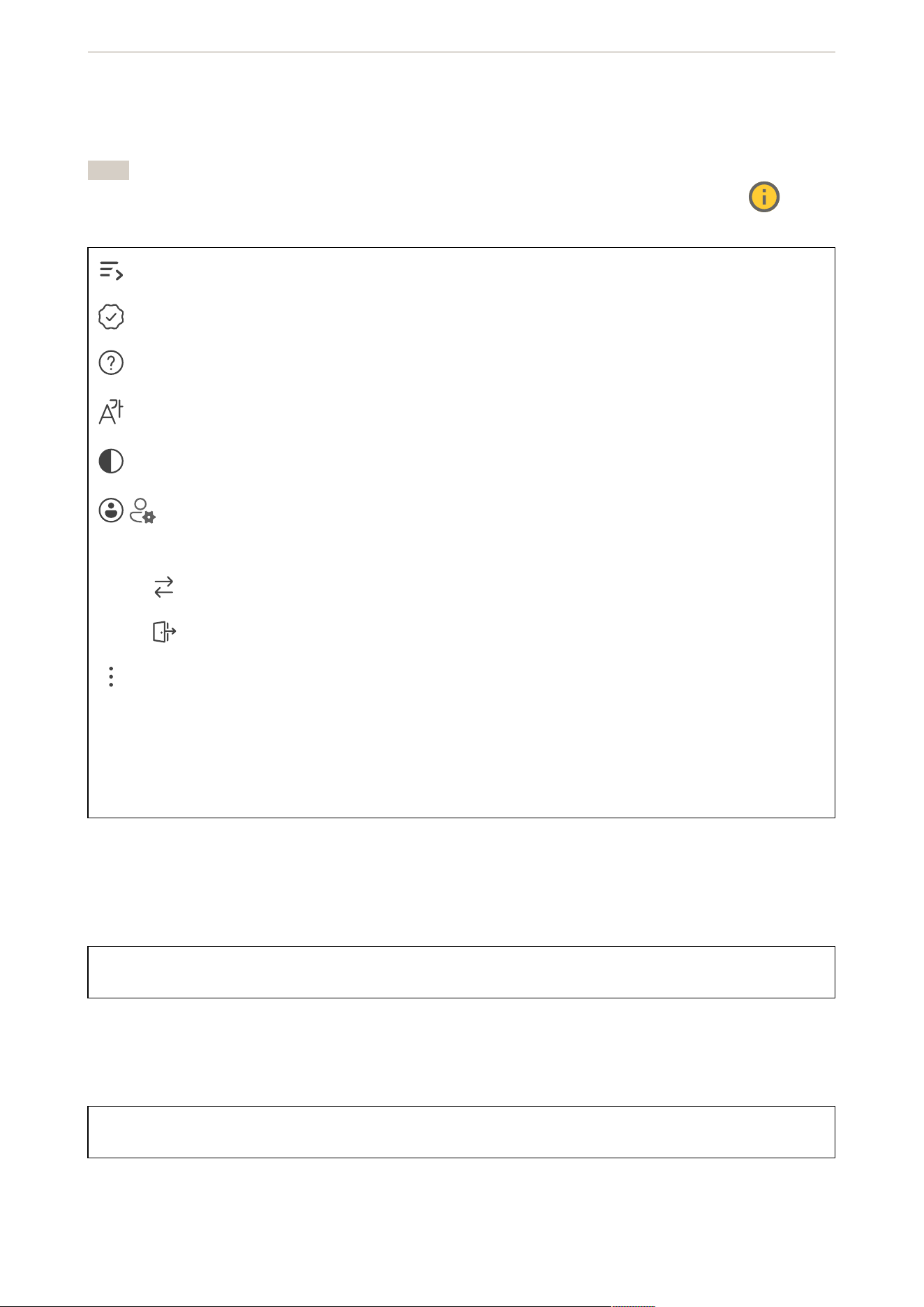
Show or hide the main menu.
Access the release notes.
Access the product help.
Change the language.
Set light theme or dark theme.
The user menu contains:
• Information about the user who is logged in.
• Change account : Log out from the current account and log in to a new account.
• Log out : Log out from the current account.
The context menu contains:
• Analytics data: Accept to share non-personal browser data.
• Feedback: Share any feedback to help us improve your user experience.
• Legal: View information about cookies and licenses.
• About: View device information, including AXIS OS version and serial number.
Status
Device info
Shows information about the device, including AXIS OS version and serial number.
Upgrade AXIS OS: Upgrade the software on your device. Takes you to the Maintenance page where you can
do the upgrade.
Time sync status
Shows NTP synchronization information, including if the device is in sync with an NTP server and the time
remaining until the next sync.
NTP settings: View and update the NTP settings. Takes you to the Time and location page where you can
change the NTP settings.
Security
AXIS Q6325-LE PTZ Camera
19
Shows what kind of access to the device that is active, what encryption protocols are in use, and if unsigned
apps are allowed. Recommendations to the settings are based on the AXIS OS Hardening Guide.
Hardening guide: Link to AXIS OS Hardening guide where you can learn more about cybersecurity on Axis
devices and best practices.
PTZ
Shows the PTZ status and the time of the last test.
Test: Start a test of the PTZ mechanics. During the test, there are no video streams available. When the test is
finished, the device restores to its home position.
Power status
Shows power status information, including current power, average power, and max power.
Power settings: View and update the power settings for the device. Takes you to the Power settings page
where you can change the power settings.
AXIS Image Health Analytics
Shows the status of the preinstalled application AXIS Image Health Analytics and if the application has detected
any issues.
Go to apps: Go to the Apps page where you can manage your installed applications.
Open application: Open AXIS Image Health Analytics in a new browser tab.
Ongoing recordings
Shows ongoing recordings and their designated storage space.
Recordings: View ongoing and filtered recordings and their source. For more information, see Recordings, on
page 43
Shows the storage space where the recording is saved.
Connected clients
Shows the number of connections and connected clients.
View details: View and update the list of connected clients. The list shows IP address, protocol, port, state,
and PID/process of each connection.
AXIS Q6325-LE PTZ Camera
20
Video
Click-and-drag to pan and tilt in the live view.
Zoom Use the slider to zoom in and out.
Focus Use this setting to set focus in the shown area. Depending on the device, different focus modes are
available.
• Auto: The camera automatically adjusts focus based on the entire image.
• Manual: Set the focus manually at a fixed distance.
• Area: The camera automatically adjusts focus for a selected area of the image.
• Spot: The camera automatically adjusts focus for the center of the image.
Brightness Use this setting to adjust the light intensity in the image, for example, to make objects easier to
see. Brightness is applied after image capture, and does not affect the information in the image. To get more
details in a dark area, it is sometimes better to try to increase gain or increase exposure time.
AXIS Q6325-LE PTZ Camera
21
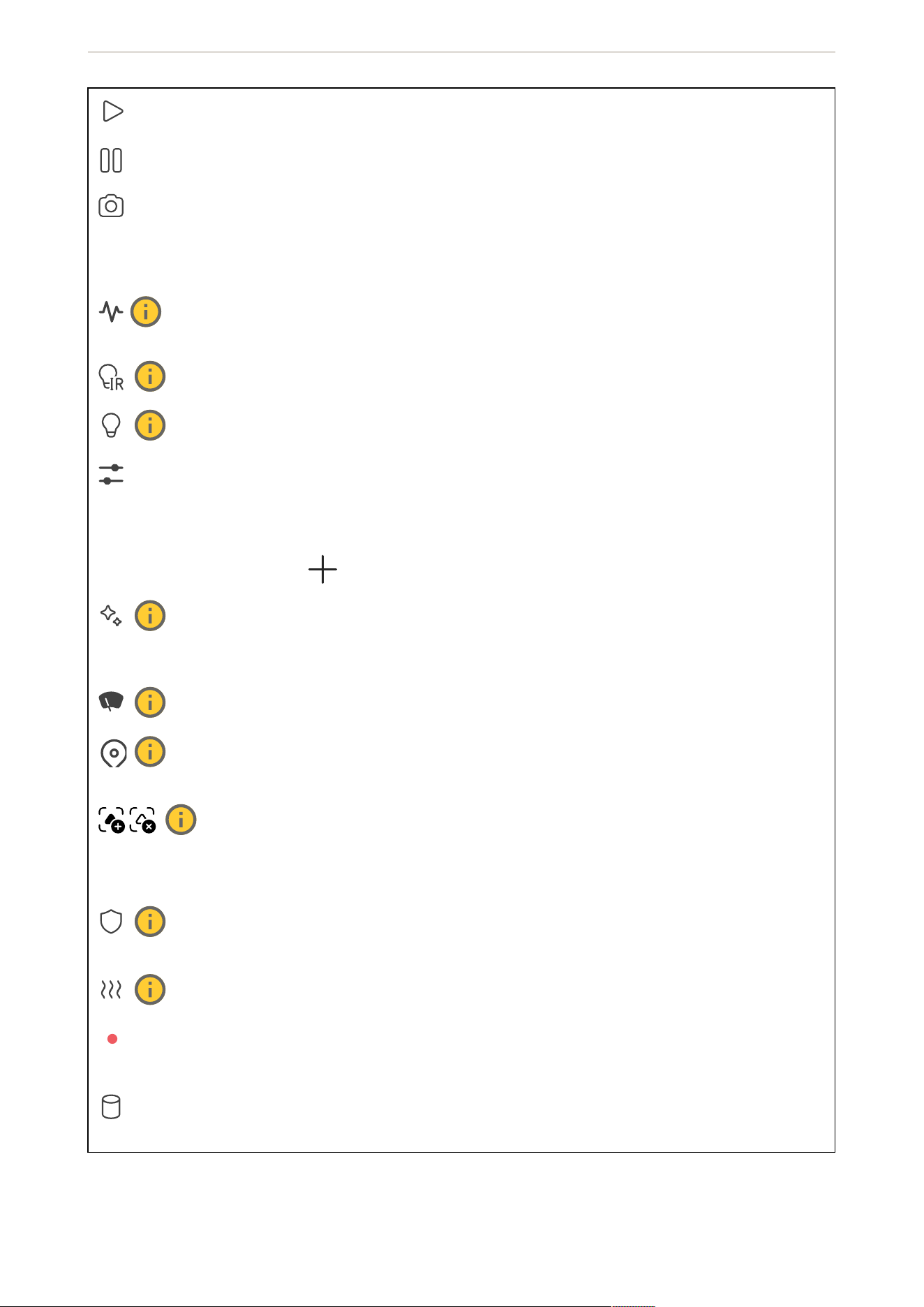
Click to play the live video stream.
Click to freeze the live video stream.
Click to take a snapshot of the live video stream. The file is saved in the ‘Downloads’ folder on your
computer. The image file name is [snapshot_YYYY_MM_DD_HH_MM_SS.jpg]. The size of the snapshot
depends on the compression that the specific web-browser engine where the snapshot is received applies,
therefore, the snapshot size may vary from the actual compression setting that is configured in the device.
Click to show I/O output ports. Use the switch to open or close the circuit of a port, for example, to
test external devices.
Click to manually turn on or turn off the IR illumination.
Click to manually turn on or turn off the white light.
Click to access onscreen controls. Enable groups of onscreen controls to make the settings in each group
available when users right-click the live stream in the video management software.
• Predefined controls: Lists the default onscreen controls.
• Custom controls: Click Add custom control to create customized onscreen controls.
Starts the washer. When the sequence starts, the camera moves to the configured position to
receive the wash spray. When the whole wash sequence is completed, the camera returns to its previous
position. This icon is only visible when the washer is connected and configured.
Starts the wiper.
Click and select a preset position to go to that preset position in the live view. Or, click Setup to
go to the preset position page.
Adds or removes a focus recall area. When you add a focus recall area, the camera saves the
focus settings at that specific pan/tilt range. When you have set a focus recall area and the camera enters
that area in the live view, the camera recalls the previously saved focus. It’s enough to cover half of the area
for the camera to recall the focus.
Click to select a guard tour, then click Start to play the guard tour. Or, click Setup to go to the
guard tours page.
Click to manually turn on the heater for a selected period of time.
Click to start a continuous recording of the live video stream. Click again to stop the recording. If a
recording is ongoing, it will resume automatically after a reboot.
Click to show the storage that is configured for the device. To configure the storage, you need to be
logged in as an administrator.
AXIS Q6325-LE PTZ Camera
22
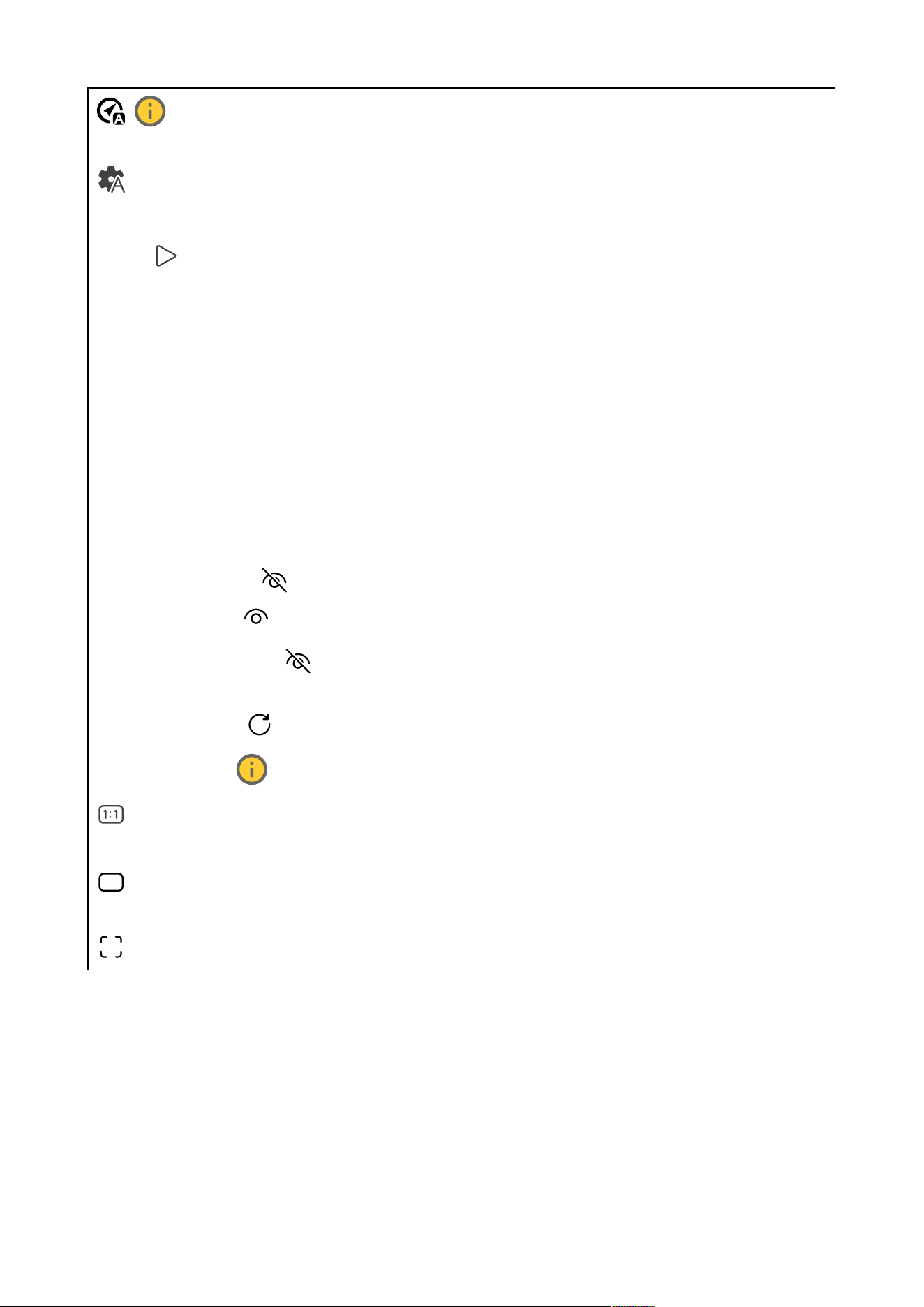
Click to access autotracking settings. More settings are available if you click the icon from
Analytics > Autotracking.
Click to access more settings:
• Video format: Select the encoding format to use in the live view.
• Autoplay: Turn on to autoplay a muted video stream whenever you open the device in a new
session.
• Client stream information: Turn on to show dynamic information about the video stream used by the
browser that shows the live video stream. The bitrate information differs from the information shown
in a text overlay, because of different information sources. The bitrate in the client stream
information is the bitrate of the last second, and it comes from the encoding driver of the device. The
bitrate in the overlay is the average bitrate of the last 5 seconds, and it comes from the browser. Both
values cover only the raw video stream and not the additional bandwidth generated when it’s
transported over the network through UDP/TCP/HTTP.
• Adaptive stream: Turn on to adapt the image resolution to the viewing client’s actual display
resolution, to improve the user experience and help prevent a possible overload of the client’s
hardware. The adaptive stream is only applied when you view the live video stream in the web
interface in a browser. When adaptive stream is turned on, the maximum frame rate is 30 fps. If you
take a snapshot while adaptive stream is turned on, it will use the image resolution selected by the
adaptive stream.
• Level grid: Click to show the level grid. The grid helps you decide if the image is horizontally
aligned. Click to hide it.
• Pixel counter: Click to show the pixel counter. Drag and resize the box to contain your area of
interest. You can also define the pixel size of the box in the Width and Height fields.
• Refresh: Click to refresh the still image in the live view.
• PTZ controls : Turn on to display PTZ controls in the live view.
Click to show the live view at full resolution. If the full resolution is larger than your screen size, use the
smaller image to navigate in the image.
Click to show the live video stream in expanded full screen. Click again to exit the expanded full screen
mode.
Click to show the live video stream in full screen. Press ESC to exit full screen mode.
AXIS Q6325-LE PTZ Camera
23
Installation
Capture mode : A capture mode is a preset configuration that defines how the camera captures images.
When you change the capture mode, it can affect many other settings, such as view areas and privacy masks.
Mounting position : The orientation of the image can change depending on how you mount the camera.
Power line frequency: To minimize image flicker, select the frequency your region uses. The American regions
usually use 60 Hz. The rest of the world mostly uses 50 Hz. If you're not sure of your region's power line
frequency, check with the local authorities.
Rotate: Select the preferred image orientation.
Spot focus: Use to set the focus to a fixed area in the center of the image.
Image correction
AXIS Q6325-LE PTZ Camera
24
Important
We recommend you not to use multiple image correction features at the same time, since it can lead to
performance issues.
Barrel distortion correction (BDC) : Turn on to get a straighter image if it suffers from barrel distortion.
Barrel distortion is a lens effect that makes the image appear curved and bent outwards. The condition is seen
more clearly when the image is zoomed out.
Crop : Use the slider to adjust the correction level. A lower level means that the image width is kept at
the expense of image height and resolution. A higher level means that image height and resolution are kept at
the expense of image width.
Remove distortion : Use the slider to adjust the correction level. Pucker means that the image width is
kept at the expense of image height and resolution. Bloat means that image height and resolution are kept at
the expense of image width.
Image stabilization : Turn on to get a smoother and steadier image with less blur. We recommend that
you use image stabilization in environments where the device is mounted in an exposed location and subject
to vibrations due to, for example, wind or passing traffic.
Focal length : Use the slider to adjust the focal length. A higher value leads to higher magnification and
a narrower angle of view, while a lower value leads to a lower magnification and a wider angle of view.
Stabilizer margin : Use the slider to adjust the size of the stabilizer margin, which determines the level
of vibration to stabilize. If the product is mounted in an environment with a lot of vibration, move the slider
towards Max. As a result, a smaller scene is captured. If the environment has less vibration, move the slider
towards Min.
Focus breathing correction : Turn on to keep the angle of view constant while you change the focus.
You might not be able to zoom in as much with this function activated.
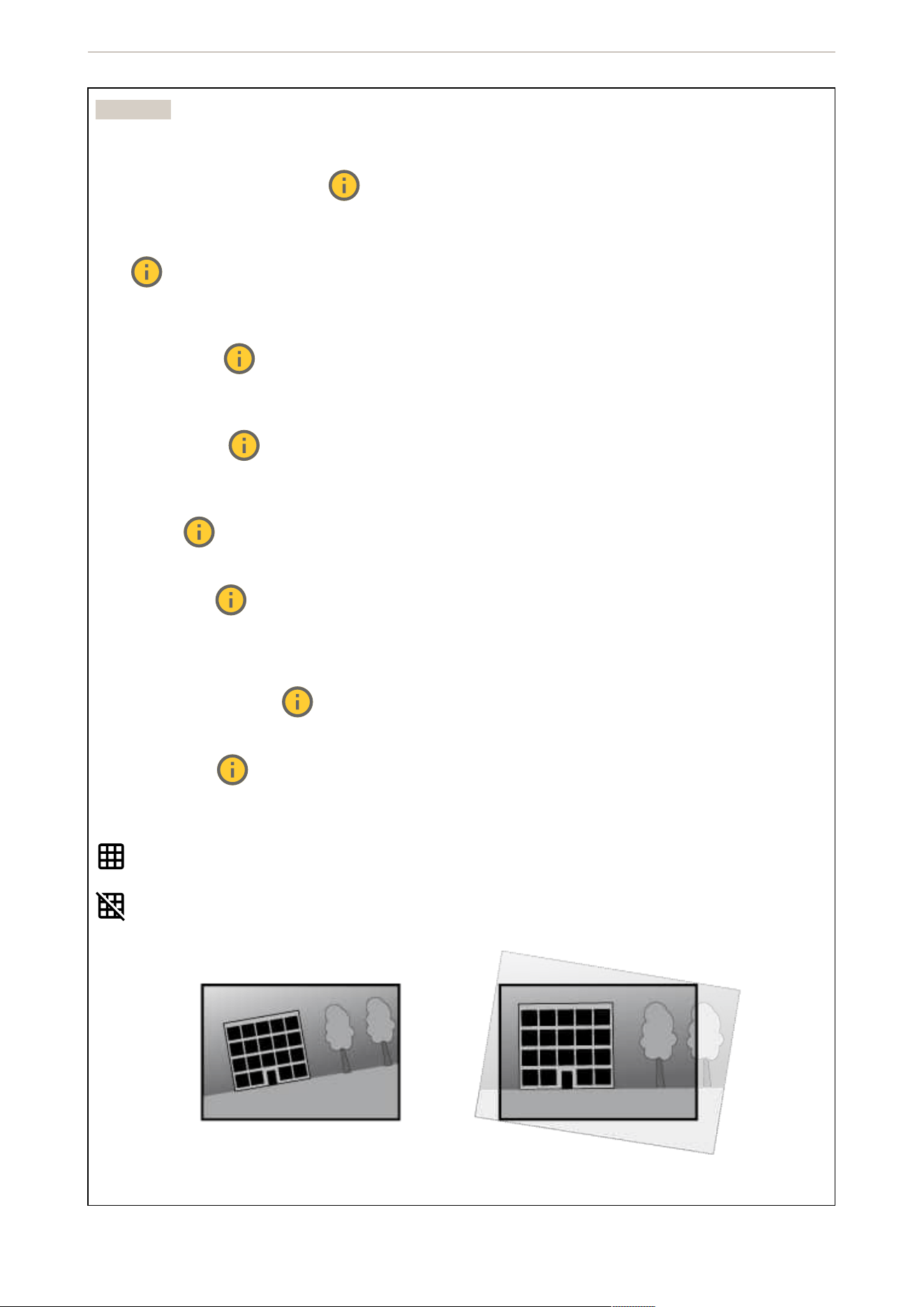
Straighten image : Turn on and use the slider to straighten the image horizontally by rotating and
cropping it digitally. The functionality is useful when it’s not possible to mount the camera exactly level.
Ideally, straighten the image during installation.
: Click to show a supporting grid in the image.
: Click to hide the grid.
The image before and after it has been straightened.
AXIS Q6325-LE PTZ Camera
25
Image
Appearance
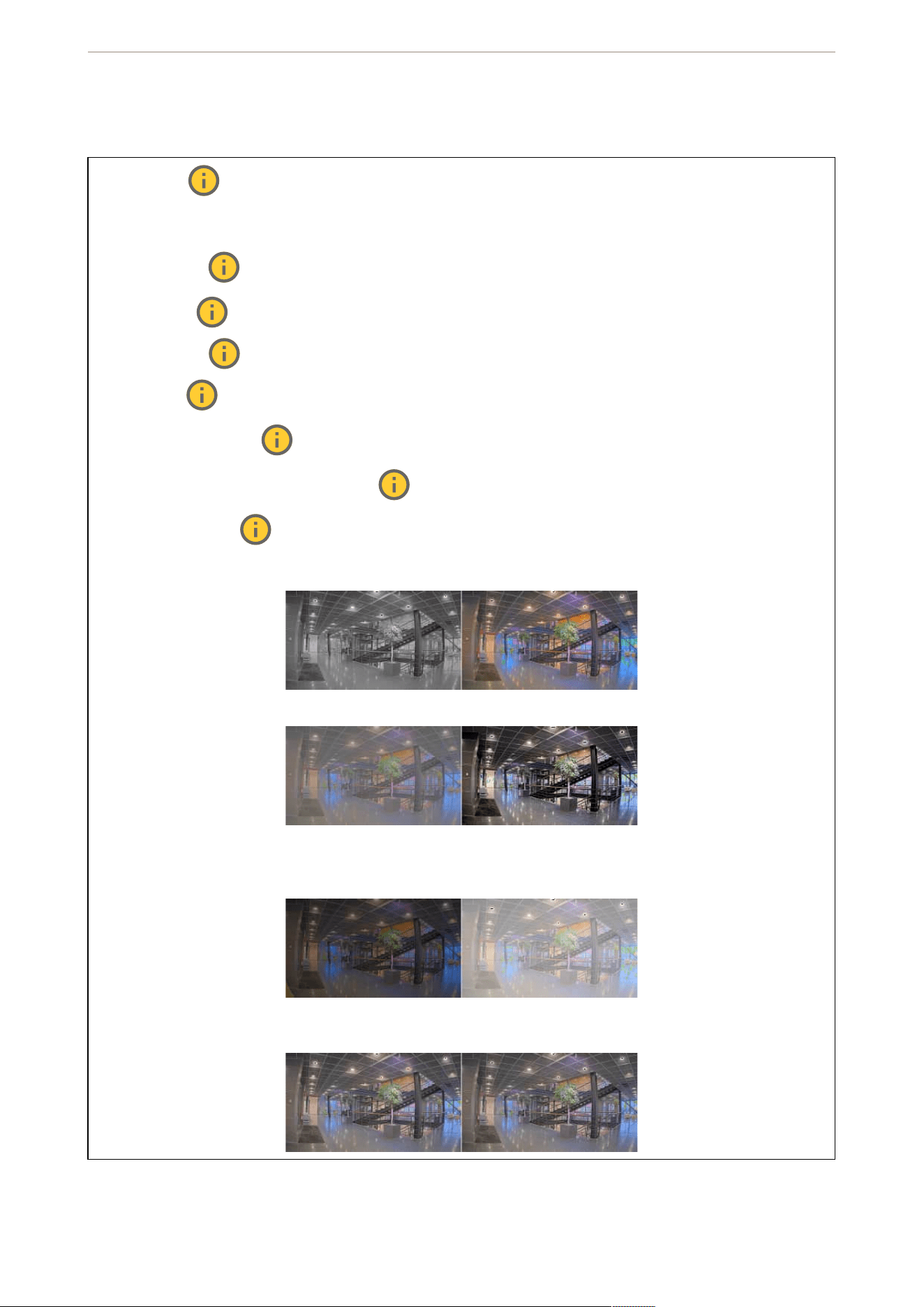
Scene profile : Select a scene profile that suits your surveillance scenario. A scene profile optimizes
image settings, including color level, brightness, sharpness, contrast, and local contrast, for a specific
environment or purpose.
• Forensic : Suitable for surveillance purposes.
• Indoor : Suitable for indoor environments.
• Outdoor : Suitable for outdoor environments.
• Vivid : Useful for demonstration purposes.
• Traffic overview : Suitable for vehicle traffic monitoring.
• Traffic overview (low bandwidth) : Suitable for vehicle traffic monitoring at low bandwidth.
• License plate : Suitable for capturing license plates.
Saturation: Use the slider to adjust the color intensity. You can, for example, get a grayscale image.
Contrast: Use the slider to adjust the difference between light and dark.
Brightness: Use the slider to adjust the light intensity. This can make objects easier to see. Brightness is
applied after image capture, and doesn’t affect the information in the image. To get more details from a dark
area, it’s usually better to increase gain or exposure time.
Sharpness: Use the slider to make objects in the image appear sharper by adjusting the edge contrast. If you
increase the sharpness, it may increase the bitrate and the amount of storage space needed as well.
Wide dynamic range
AXIS Q6325-LE PTZ Camera
26
WDR : Turn on to make both bright and dark areas of the image visible.
Local contrast : Use the slider to adjust the contrast of the image. A higher value makes the contrast
higher between dark and light areas.
Tone mapping : Use the slider to adjust the amount of tone mapping that is applied to the image. If the
value is set to zero, only the standard gamma correction is applied, while a higher value increases the visibility
of the darkest and brightest parts in the image.
White balance
When the camera detects the color temperature of the incoming light, it can adjust the image to make the
colors look more natural. If this is not sufficient, you can select a suitable light source from the list.
The automatic white balance setting reduces the risk of color flicker by adapting to changes gradually. If the
lighting changes, or when the camera is first started, it can take up to 30 seconds to adapt to the new light
source. If there is more than one type of light source in a scene, that is, they differ in color temperature, the
dominating light source acts as a reference for the automatic white balance algorithm. This behavior can be
overridden by choosing a fixed white balance setting that matches the light source you want to use as a
reference.
AXIS Q6325-LE PTZ Camera
27
Light environment:
• Automatic: Automatic identification and compensation for the light source color. This is the
recommended setting which can be used in most situations.
• Automatic – outdoors : Automatic identification and compensation for the light source color.
This is the recommended setting which can be used in most outdoor situations.
• Custom – indoors : Fixed color adjustment for a room with some artificial light other than
fluorescent lighting and good for a normal color temperature around 2800 K.
• Custom – outdoors : Fixed color adjustment for sunny weather conditions with a color
temperature around 5500 K.
• Fixed – fluorescent 1: Fixed color adjustment for fluorescent lighting with a color temperature
around 4000 K.
• Fixed – fluorescent 2: Fixed color adjustment for fluorescent lighting with a color temperature
around 3000 K.
• Fixed – indoors: Fixed color adjustment for a room with some artificial light other than fluorescent
lighting and good for a normal color temperature around 2800 K.
• Fixed – outdoors 1: Fixed color adjustment for sunny weather conditions with a color temperature
around 5500 K.
• Fixed – outdoors 2: Fixed color adjustment for cloudy weather condition with a color temperature
around 6500 K.
• Street light – mercury : Fixed color adjustment for ultraviolet emission in mercury vapor lights
common in street lighting.
• Street light – sodium : Fixed color adjustment that compensates for the yellow orange color of
sodium vapor lights common in street lighting.
• Hold current: Keep the current settings and do not compensate for light changes.
• Manual : Fix the white balance with the help of a white object. Drag the circle to an object that
you want the camera to interpret as white in the live view image. Use the Red balance and Blue
balance sliders to adjust the white balance manually.
Day-night mode
AXIS Q6325-LE PTZ Camera
28
IR-cut filter:
• Auto: Select to automatically turn on and off the IR-cut filter. When the camera is in day mode, the
IR-cut filter is turned on and blocks incoming infrared light, and when in night mode, the IR-cut filter
is turned off and the camera’s light sensitivity increases.
Note
• Some devices have IR-pass filters in night mode. The IR-pass filter increases IR-light sensitivity but
blocks visible light.
• On: Select to turn on the IR-cut filter. The image is in color, but with reduced light sensitivity.
• Off: Select to turn off the IR-cut filter. The image is in black and white for increased light sensitivity.
IR pass filter : Turn on to block visible light and only allow near infrared light to pass through. This
toggle button is only available when the IR-cut filter is set to Off.
Threshold: Use the slider to adjust the light threshold where the camera changes from day mode to night
mode.
• Move the slider towards Bright to decrease the threshold for the IR-cut filter. The camera changes to
night mode earlier.
• Move the slider towards Dark to increase the threshold for the IR-cut filter. The camera changes to
night mode later.
IR light
If your device doesn’t have built-in illumination, these controls are only available when you connect a
supported Axis illuminator.
Allow illumination: Turn on to let the camera use the built-in light in night mode.
Synchronize illumination: Turn on to automatically synchronize the illumination with the surrounding light.
The synchronization between day and night only works if the IR-cut filter is set to Auto or Off.
Automatic illumination angle : Turn on to use the automatic illumination angle. Turn off to set the
illumination angle manually.
Illumination angle : Use the slider to manually set the illumination angle, for example, if the angle needs
to be different from the camera’s angle of view. If the camera has a wide angle of view, you can set the
illumination angle to a narrower angle, which equals a greater tele position. This will result in dark corners in
the image.
IR wavelength : Select the desired wavelength for the IR light.
White light
Allow illumination : Turn on to let the camera use white light in night mode.
Synchronize illumination : Turn on to automatically synchronize the white light with the surrounding
light.
Exposure
Select an exposure mode to reduce rapidly changing irregular effects in the image, for example, flicker produced
by different types of light sources. We recommend you to use the automatic exposure mode, or the same
frequency as your power network.
AXIS Q6325-LE PTZ Camera
29
Exposure mode:
• Automatic: The camera adjusts the aperture, gain, and shutter automatically.
• Automatic aperture : The camera adjusts the aperture and gain automatically. The shutter is
fixed.
• Automatic shutter : The camera adjusts the shutter and gain automatically. The aperture is
fixed.
• Hold current: Locks the current exposure settings.
• Flicker-free : The camera adjusts the aperture and gain automatically, and uses only the
following shutter speeds: 1/50 s (50 Hz) and 1/60 s (60 Hz).
• Flicker-free 50 Hz : The camera adjusts the aperture and gain automatically, and uses the
shutter speed 1/50 s.
• Flicker-free 60 Hz : The camera adjusts the aperture and gain automatically, and uses the
shutter speed 1/60 s.
• Flicker-reduced : This is the same as flicker-free, but the camera might use shutter speeds faster
than 1/100 s (50 Hz) and 1/120 s (60 Hz) for brighter scenes.
• Flicker-reduced 50 Hz : This is the same as flicker-free, but the camera might use shutter speeds
faster than 1/100 s for brighter scenes.
• Flicker-reduced 60 Hz : This is the same as flicker-free, but the camera might use shutter speeds
faster than 1/120 s for brighter scenes.
• Manual : The aperture, gain, and shutter are fixed.
Exposure zone : Use exposure zones to optimize the exposure in a selected part of the scene, for
example, the area in front of an entrance door.
Note
The exposure zones are related to the original image (unrotated), and the names of the zones apply to the
original image. This means, for example, that if the video stream is rotated 90°, then the Upper zone
becomes the Right zone in the stream, and Left becomes Lower.
• Automatic: Suitable for most situations.
• Center: Uses a fixed area in the center of the image to calculate the exposure. The area has a fixed
size and position in the live view.
• Full : Uses the entire live view to calculate the exposure.
• Upper : Uses an area with a fixed size and position in the upper part of the image to calculate
the exposure.
• Lower : Uses an area with a fixed size and position in the lower part of the image to calculate
the exposure.
• Left : Uses an area with a fixed size and position in the left part of the image to calculate the
exposure.
AXIS Q6325-LE PTZ Camera
30
• Right : Uses an area with a fixed size and position in the right part of the image to calculate the
exposure.
• Spot: Uses an area with a fixed size and position in the live view to calculate the exposure.
• Custom: Uses an area in the live view to calculate the exposure. You can adjust the size and position
of the area.
Max shutter: Select the shutter speed to provide the best image. Low shutter speeds (longer exposure) might
cause motion blur when there is movement, and a too high shutter speed might affect the image quality. Max
shutter works with max gain to improve the image.
Max gain: Select the suitable max gain. If you increase the max gain, it improves the visible level of detail in
dark images, but also increases the noise level. More noise can also result in increased use of bandwidth and
storage. If you set the max gain to a high value, images can differ a lot if the light conditions are very
different from day to night. Max gain works with max shutter to improve the image.
Motion-adaptive exposure : Select to reduce motion blur in low-light conditions.
Blur-noise trade-off: Use the slider to adjust the priority between motion blur and noise. If you want to
prioritize low bandwidth and have less noise at the expense of details in moving objects, move the slider
towards Low noise. If you want to prioritize the preservation of details in moving objects at the expense of
noise and bandwidth, move the slider towards Low motion blur.
Note
You can change the exposure either by adjusting the exposure time or by adjusting the gain. If you
increase the exposure time, it results in more motion blur, and if you increase the gain, it results in more
noise. If you adjust the Blur-noise trade-off towards Low noise, the automatic exposure will prioritize
longer exposure times over increasing gain, and the opposite if you adjust the trade-off towards Low
motion blur. Both the gain and exposure time will eventually reach their maximum values in low-light
conditions, regardless of the priority set.
Lock aperture : Turn on to keep the aperture size set by the Aperture slider. Turn off to allow the camera
to automatically adjust the aperture size. You can, for example, lock the aperture for scenes with permanent
light conditions.
Aperture : Use the slider to adjust the aperture size, that is, how much light passes through the lens. To
allow more light to enter the sensor and thereby produce a brighter image in low-light conditions, move the
slider towards Open. An open aperture also reduces the depth of field, which means that objects close to or
far from the camera can appear unfocused. To allow more of the image to be in focus, move the slider
towards Closed.
Exposure level: Use the slider to adjust the image exposure.
Defog : Turn on to detect the effects of foggy weather and automatically remove them for a clearer
image.
Note
We recommend you not to turn on Defog in scenes with low contrast, large light level variations, or when
the autofocus is slightly off. This can affect the image quality, for example, by increasing the contrast.
Furthermore, too much light can negatively impact the image quality when defog is active.
Stream
General
AXIS Q6325-LE PTZ Camera

31
Resolution: Select the image resolution suitable for the surveillance scene. A higher resolution increases
bandwidth and storage.
Frame rate: To avoid bandwidth problems on the network or reduce storage size, you can limit the frame rate
to a fixed amount. If you leave the frame rate at zero, the frame rate is kept at the highest possible rate under
the current conditions. A higher frame rate requires more bandwidth and storage capacity.
P-frames: A P-frame is a predicted image that shows only the changes in the image from the previous frame.
Enter the desired number of P-frames. The higher the number, the less bandwidth is required. However, if
there is network congestion, there could be a noticeable deterioration in the video quality.
Compression: Use the slider to adjust the image compression. High compression results in a lower bitrate and
lower image quality. Low compression improves the image quality, but uses more bandwidth and storage
when you record.
Signed video : Turn on to add the signed video feature to the video. Signed video protects the video from
tampering by adding cryptographic signatures to the video.
Zipstream
Zipstream is a bitrate reduction technology, optimized for video surveillance, that reduces the average bitrate in
an H.264, H.265, or AV1 stream in real time. Axis Zipstream applies a high bitrate in scenes where there are
multiple regions of interest, for example, in scenes with moving objects. When the scene is more static,
Zipstream applies a lower bitrate, and thereby reduces the required storage. To learn more, see Reducing the bit
rate with Axis Zipstream
Select the bitrate reduction Strength:
• Off: No bitrate reduction.
• Low: No visible quality degradation in most scenes. This is the default option and it can be used in all
types of scenes to reduce the bitrate.
• Medium: Visible effects in some scenes through less noise and a slightly lower level of detail in
regions of lower interest, for example, where there’s no movement.
• High: Visible effects in some scenes through less noise and a lower level of detail in regions of lower
interest, for example, where there’s no movement. We recommend this level for cloud-connected
devices and devices that use local storage.
• Higher: Visible effects in some scenes through less noise and a lower level of detail in regions of lower
interest, for example, where there’s no movement.
• Extreme: Visible effects in most scenes. The bitrate is optimized for smallest possible storage.
Optimize for storage: Turn on to minimize the bitrate while maintaining quality. The optimization does not
apply to the stream shown in the web client. This can only be used if your VMS supports B-frames. Turning on
Optimize for storage also turns on Dynamic GOP.
Dynamic FPS (frames per second): Turn on to allow the bandwidth to vary based on the level of activity in the
scene. More activity requires more bandwidth.
• Lower limit: Enter a value to adjust the frame rate between minimal fps and the stream default fps
based on scene motion. We recommend you to use lower limit in scenes with very little motion, where
the fps could drop to 1 or lower.
Dynamic GOP (Group of Pictures): Turn on to dynamically adjust the interval between I-frames based on the
level of activity in the scene.
• Upper limit: Enter a maximum GOP length, that is, the maximum number of P-frames between two I-
frames. An I-frame is a self-contained image frame that is independent of other frames.
Bitrate control
AXIS Q6325-LE PTZ Camera
32
• Average: Select to automatically adjust the bitrate over a longer time period and provide the best
possible image quality based on the available storage.
– Click to calculate the target bitrate based on available storage, retention time, and
bitrate limit.
– Target bitrate: Enter desired target bitrate.
– Retention time: Enter the number of days to keep the recordings.
– Storage: Shows the estimated storage that can be used for the stream.
– Maximum bitrate: Turn on to set a bitrate limit.
– Bitrate limit: Enter a bitrate limit that is higher than the target bitrate.
• Maximum: Select to set a maximum instant bitrate of the stream based on your network bandwidth.
– Maximum: Enter the maximum bitrate.
• Variable: Select to allow the bitrate to vary based on the level of activity in the scene. More activity
requires more bandwidth. We recommend this option for most situations.
AXIS Q6325-LE PTZ Camera
33
Overlays
: Click to add an overlay. Select the type of overlay from the dropdown list:
• Text: Select to show a text that is integrated in the live view image and visible in all views, recordings
and snapshots. You can enter your own text, and you can also include pre-configured modifiers to
automatically show, for example, time, date, and frame rate.
– : Click to add the date modifier %F to show yyyy-mm-dd.
– : Click to add the time modifier %X to show hh:mm:ss (24-hour clock).
– Modifiers: Click to select any of the modifiers shown in the list to add them to the text box.
For example, %a shows the day of the week.
– Size: Select the desired font size.
– Appearance: Select the text color and background color, for example, white text on a black
background (default).
– : Select the position of the overlay in the image or click and drag the overlay to move it
around in the live view.
• Image: Select to show a static image superimposed over the video stream. You can use .bmp, .png, .
jpeg, or .svg files.
To upload an image, click Manage images. Before you upload an image, you can choose to:
– Scale with resolution: Select to automatically scale the overlay image to fit the video
resolution.
– Use transparency: Select and enter the RGB hexadecimal value for that color. Use the format
RRGGBB. Examples of hexadecimal values: FFFFFF for white, 000000 for black, FF0000 for red,
6633FF for blue, and 669900 for green. Only for .bmp images.
• Scene annotation : Select to show a text overlay in the video stream that stays in the same
position, even when the camera pans or tilts in another direction. You can choose to only show the
overlay within certain zoom levels.
– : Click to add the date modifier %F to show yyyy-mm-dd.
– : Click to add the time modifier %X to show hh:mm:ss (24-hour clock).
– Modifiers: Click to select any of the modifiers shown in the list to add them to the text box.
For example, %a shows the day of the week.
– Size: Select the desired font size.
– Appearance: Select the text color and background color, for example, white text on a black
background (default).
– : Select the position of the overlay in the image or click and drag the overlay to move it
around in the live view. The overlay is saved and remains in the pan and tilt coordinates of
this position.
– Annotation between zoom levels (%): Set the zoom levels which the overlay will be shown
within.
– Annotation symbol: Select a symbol that appears instead of the overlay when the camera is
not within the set zoom levels.
• Streaming indicator : Select to show an animation superimposed over the video stream. The
animation indicates that the video stream is live, even if the scene doesn’t contain any motion.
AXIS Q6325-LE PTZ Camera
34
– Appearance: Select the animation color and background color, for example, red animation on
a transparent background (default).
– Size: Select the desired font size.
– : Select the position of the overlay in the image or click and drag the overlay to move it
around in the live view.
• Widget: Linegraph : Show a graph chart that displays how a measured value changes over time.
– Title: Enter a title for the widget.
– Overlay modifier: Select an overlay modifier as data source. If you have created MQTT
overlays, they will be located at the end of the list.
– : Select the position of the overlay in the image or click and drag the overlay to move it
around in the live view.
– Size: Select the size of the overlay.
– Visible on all channels: Turn off to show only on your currently selected channel. Turn on to
show on all active channels.
– Update interval: Choose the time between data updates.
– Transparency: Set the transparency of the entire overlay.
– Background transparency: Set the transparency only of the background of the overlay.
– Points: Turn on to add a point to the graph line when data is updated.
– X axis
– Label: Enter the text label for the x axis.
– Time window: Enter how long time the data is visualized.
– Time unit: Enter a time unit for the x axis.
– Y axis
– Label: Enter the text label for the y axis.
– Dynamic scale: Turn on for the scale to automatically adapt to the data values. Turn
off to manually enter values for a fixed scale.
– Min alarm threshold and Max alarm threshold: These values will add horizontal
reference lines to the graph, making it easier to see when the data value becomes too
high or too low.
• Widget: Meter : Show a bar chart that displays the most recently measured data value.
– Title: Enter a title for the widget.
– Overlay modifier: Select an overlay modifier as data source. If you have created MQTT
overlays, they will be located at the end of the list.
– : Select the position of the overlay in the image or click and drag the overlay to move it
around in the live view.
– Size: Select the size of the overlay.
– Visible on all channels: Turn off to show only on your currently selected channel. Turn on to
show on all active channels.
– Update interval: Choose the time between data updates.
– Transparency: Set the transparency of the entire overlay.
– Background transparency: Set the transparency only of the background of the overlay.
– Points: Turn on to add a point to the graph line when data is updated.
AXIS Q6325-LE PTZ Camera
35
– Y axis
– Label: Enter the text label for the y axis.
– Dynamic scale: Turn on for the scale to automatically adapt to the data values. Turn
off to manually enter values for a fixed scale.
– Min alarm threshold and Max alarm threshold: These values will add horizontal
reference lines to the bar chart, making it easier to see when the data value becomes
too high or too low.
Privacy masks
: Click to create a new privacy mask.
Privacy masks x/32 or Privacy masks x/100: Click this title bar to change the color of all privacy masks, or to
delete all privacy masks permanently.
Cell size: If you choose the mosaic color, the privacy masks appear as pixilated patterns. Use the slider
to change the size of the pixels.
Mask x: Click an individual mask name/number to rename, disable, or permanently delete that mask.
Use zoom level: Turn on to make this privacy mask appear only when it reaches the zoom level at which it
was created. Zooming out in the image hides the mask again.
Analytics
AXIS Object Analytics
Start: Click to start AXIS Object Analytics. The application will run in the background, and you can create
rules for events based on the application’s current settings.
Open: Click to open AXIS Object Analytics. The application opens up in a new browser tab where you can
configure its settings.
Not installed: AXIS Object Analytics is not installed on this device. Upgrade AXIS OS to the latest version
to get the latest version of the application.
Autotracking
Settings
These settings apply to all tracking profiles. You can override some of the settings in each profile.
Active: Turn on to start tracking, automatically through enabled profiles, or manually by clicking objects in
the image.
Object confirmation: Turn on to show bounding boxes around objects that have been confirmed by the
camera. When turned on, you can also click an object to start tracking it.
Max tracking time: Set the maximum time the camera should track an object. Turn off to keep tracking an
object indefinitely.
Timeout: Set the time the camera should wait until it returns to its home position in case it loses the tracked
object.
AXIS Q6325-LE PTZ Camera

36
Settings when paired with a radar:
Active: Turn on to start tracking, automatically through enabled profiles, or manually by clicking objects in
the image.
Visual confirmation: Show overlays on confirmed objects.
• Video objects: Show bounding boxes around objects that have been confirmed by the camera.
• Radar objects: Show bounding boxes around objects that have been confirmed by the radar.
Multi-object behavior: Control the camera’s tracking behavior if several objects simultaneously fulfill the
tracking criteria of one profile, or if several profiles with the same priority are triggered simultaneously by
different objects.
• Select one object to track: Track only one object based on the set Selection condition:
– Earliest object: Track the object that fulfilled the tracking criteria first.
– Most recent object: Track the object that fulfilled the tracking criteria most recently.
– Object closest to camera: Track the object that is closest to the camera.
– Object furthest from camera: Track the object that is furthest away from the camera.
– Slowest object: Track the slowest-moving object.
– Fastest object: Track the fastest-moving object.
• Alternate between objects: Switch between the objects at a regular interval. Set the interval in Time
per object.
Use illumination only during autotracking: Turn on to save power by using IR light only when the radar
detects an object. When you turn this on, a rule with the same name is automatically created in Events >
Rules.
Tracking profiles
+ Create: Click to create a new tracking profile.
AXIS Object Analytics scenario: Select the scenario that you want to use to trigger autotracking to start. One
scenario can be used only for one tracking profile. In the scenario, detection must be restricted to one preset
position.
Tracking profile name: The profile name will be based on the scenario name, but you can update it if you
want to.
Timeout: Set the time the camera should wait until it returns to its home position in case it loses the tracked
object. This setting overrides the timeout in the Settings page.
Use profile: Turn on to enable the profile.
AXIS Q6325-LE PTZ Camera
37
Settings when paired with a radar:
+ Create: Click to create a new tracking profile.
Radar scenario: Select the scenario that you want to use to trigger autotracking to start. One scenario can be
used only for one tracking profile.
Tracking profile name: The profile name will be based on the scenario name, but you can update it if you
want to.
Tracking criteria: Select the criteria that needs to be fulfilled to track an object.
• Object detected by radar or camera: Track the object as long as either the radar or the camera
detects it, regardless of which detects it first.
• Object detected by radar: Track the object as long as the radar detects it, even if it exits the inclusion
area of the radar scenario.
• Object triggers radar scenario: Track the object as long as it moves inside the inclusion area of the
radar scenario and fulfills the scenario's triggering conditions. This option is only available for
movement in area-scenarios.
Object type verification: Turn on to track only objects that the camera also classifies.
Priority: Set the priority of the tracking profile. The priority is used when objects are detected in several
profiles at the same time.
AXIS Image Health Analytics
Start: Click to start AXIS Image Health Analytics. The application will run in the background, and you can
create rules for events based on the application’s current settings.
Open: Click to open AXIS Image Health Analytics. The application opens up in a new browser tab where you
can configure its settings.
Not installed: AXIS Image Health Analytics is not installed on this device. Upgrade AXIS OS to the latest
version to get the latest version of the application.
Metadata visualization
The camera detects moving objects and classes them according to object type. In the view, a classified object
has a colored bounding box around it along with its assigned id.
Id: A unique identification number for the identified object and the type. This number is shown in both the list
and the view.
Type: Classifies a moving object as Human, Face, Car, Bus, Truck, Bike, or License Plate. The color of the
bounding box depends on the type classification.
Confidence: The bar indicates the level of confidence in the classification of the object type.
Metadata configuration
RTSP metadata producers
View and manage the data channels that stream metadata and the channels they use.
Note
These settings are for the RTSP metadata stream that uses ONVIF XML. Changes made here don't affect the
Metadata visualization page.
AXIS Q6325-LE PTZ Camera
38
Producer: A data channel that uses Real-Time Streaming Protocol (RTSP) to send metadata.
Channel: The channel used to send metadata from a producer. Turn on to enable the metadata stream. Turn
off for compatibility or resource management reasons.
PTZ
Preset positions
A preset position is a specific pan, tilt, and zoom position stored in your camera’s memory. You can use preset
positions to quickly navigate between different fields of view. If your device supports guard tours, you can use
preset positions to create automated guard tours.
Preset positions
• Create preset position: Create a new preset position based on the current position of your
camera.
– Thumbnail: Turn on to add a thumbnail image for the preset position.
– Name: Enter a name for the preset position.
– Home position: Turn on to set this position as your camera’s default field of view. The home
position is marked with . Your camera will always have a home position.
Settings
• Return to home position when inactive: Turn on to make the camera return to its home position after
a specified period of inactivity.
• Use thumbnails: Turn on to automatically add a thumbnail to any new preset position you create.
The context menu contains:
• Create thumbnails : Create a thumbnail for all your preset positions.
• Refresh thumbnails: Replace the thumbnails for your preset positions with new and updated
thumbnails.
• Delete all preset positions: Remove all your preset positions. This will also create a new home
position automatically.
Guard tours
Guard tour: Create a guard tour.
• Preset position: Select to create a guard tour with preset positions.
• Recorded: Select to create a recorded guard tour.
Preset position
A guard tour with preset positions continuously streams footage from a selection of preset positions in a
random or fixed sequence. You can choose how long the camera should stay at each preset position before
moving on to the next. The guard tour will continue to run in an endless loop until you stop it, even when there
are no clients (web browsers) streaming the footage.
AXIS Q6325-LE PTZ Camera
39
Settings
• General settings
– Name: Enter a name for the guard tour.
– Play guard tour in random order: Turn on to make the camera move unpredictably between
the preset positions during the guard tour.
– Pause between runs: Enter your desired time interval between guard tours. You can enter any
interval from 0 minutes to 2 hours and 45 minutes.
• Step settings
– Duration: Choose how long you want the camera to stay at each preset position. The default
value is 10 seconds, and the maximum allowed value is 60 minutes.
– Move speed: Choose how quickly you want the camera to move to the next preset position.
The default value is 70, but you can select any value from 1–100.
Preset positions: To select multiple preset positions, press SHIFT while selecting the preset positions. Click
and drag the preset positions to the View order area.
View order: Displays the preset positions included in the guard tour.
• Import all preset positions: Add all preset positions in the order they were created, starting from the
oldest one.
• : Start the guard tour.
Recorded
A recorded tour replays a sequence of recorded pan/tilt/zoom movements, including their variable speeds and
lengths.
General settings
• Name: Enter a name for the guard tour.
• Pause between runs: Enter your desired time interval between guard tours. You can enter any interval
from 0 minutes to 2 hours and 45 minutes.
Recorded tour
• Start recording tour: Start recording the pan/tilt/zoom movements you want the guard tour to
replicate.
• Stop recording tour: Stop recording the pan/tilt/zoom movements you want the guard tour to
replicate.
• Re-record: Start a new recording of pan/tilt/zoom movements. This will overwrite your most recent
recording.
• Start the recorded tour.
• Pause the recorded tour.
• Stop the recorded tour.
AXIS Q6325-LE PTZ Camera
40
Limits
To narrow down the area under surveillance, you can limit the PTZ movements.
Save as Pan 0: Click to set the current position as zero-point for pan coordinates.
Pan-tilt limits: The camera uses the coordinates of the center of the image when you set pan-tilt limits.
• Left pan limit: Click to limit the camera’s pan movements to the left. Click again to remove the
limit.
• Right pan limit: Click to limit the camera’s pan movements to the right. Click again to remove
the limit.
• Top tilt limit: Click to limit the camera’s tilt movements to the top. Click again to remove the
limit.
• Bottom tilt limit: Click to limit the camera’s tilt movements to the bottom. Click again to remove
the limit.
Auto-flip : Enables the camera head to instantly reverse 360° and continue to pan beyond its
mechanical limit.
E-flip : Automatically corrects the camera view by flipping the image 180° when the camera tilts
beyond -90°.
Nadir-flip : Enables the camera to pan 180° when tilting beyond -90°, and then continue upwards.
Zoom limit: Select a value to limit the camera’s maximum zoom level. Optical or digital (e.g. 480x D) values
can be selected. When using a joystick, only digital zoom levels can be used to set the zoom limit.
Near focus limit: Select a value to prevent the camera from autofocusing on objects close to the camera. This
way, the camera can ignore objects such as overhead wires, streetlights, or other nearby objects. To make the
camera focus on the areas of interest, set the near focus limit to a value greater than the distance at which
the objects of no interest tend to appear.
AXIS Q6325-LE PTZ Camera
41
Motion
Proportional speed : Turn on to set the maximum proportional speed.
• Max proportional speed : Set a value between 1 and 1000 to limit the pan and tilt speed. Max
proportional speed is defined as a percentage, where the value 1000 equals 1000%.
This is useful when the joystick is pushed all the way out. For example, if the image is approximately
44 degrees wide when fully zoomed out and the max proportional speed is set to 100 (100%), the
maximum speed is about 44 degrees/second. If the image is then zoomed in from 44 to 10 degrees
wide, the maximum speed reaches about 10 degrees/second, which is probably too fast for easy
viewing. To limit the speed, set the max proportional speed to 50 (50%). This way, the maximum
speed only reaches 50% of the maximum for the currently selected zoom level. This means that when
the image is 44 degrees wide, the greatest possible speed is limited to about 22 degrees/second, and
when the view is zoomed in to 10 degrees the speed is limited to about 5 degrees/second.
Adjustable zoom speed: Turn on to use variable speeds when controlling the zoom with a joystick or a mouse
wheel. The zoom speed is automatically set through the command continuouszoommove in the VAPIX®
Application Programming Interface (API). Turn off to use the highest zoom speed which is the same speed for
moving to presets.
Freeze image on PTZ
• Off: Never freeze image.
• All movements: Freeze the image while the camera is moving. Once the camera reaches its new
position, the view from that position is shown.
• Preset positions: Freeze the image only when the camera moves between preset positions.
Pan-tilt speed: Select the speed of the camera’s pan and tilt movements.
OSDI zones
On-screen direction indicator (OSDI) gives information of the direction the camera is pointing at in the text
overlay. The camera uses the coordinates of the center of the image when you set the lower left and upper
right zone area.
Create OSDI zone: Click to create an OSDI zone.
• Name: Enter a name for the zone.
• Active: Turn on to display the zone in the live view.
• Zone limits
– : Navigate to your desired position, and click the icon to set the lower left point of the
zone. Click again to unset the lower left point.
– : Navigate to your desired position, and click the icon to set the upper right point of the
zone. Click again to unset the upper right point.
– Go to: Click to go to the lower left point or the upper right point of the zone.
The context menu contains:
• Create multiple zones: Click to create multiple zones. Enter a name for the zone, and specify the
coordinates for lower left and upper right of the zone.
– Add zone coordinates: Click to specify the parameters for another zone.
• Delete all zones: Click to delete all zones.
AXIS Q6325-LE PTZ Camera
42
Orientation aid
Orientation aid: Turn on to activate overlays of user-defined points of interest at the correct bearing and a
2D-compass synchronized to the cameras movements, including a field of view.
Direction
• Set north: Position the camera at north, and click Set north.
Preset positions: Select the preset positions used for orientation aid.
• To select an individual preset position, click the preset position.
• To select all preset positions, click .
Gatekeeper
A gatekeeper monitors an area such as an entrance gate. When motion is detected in the monitored area, the
gatekeeper steers the camera to a selected preset position. Using a zoomed-in preset position can make it
possible to, for example, read a license plate or identify a person. When motion is no longer detected, the
camera returns to its home position after a defined time.
Control queue
User control queue
• PTZ control queue: Turn on to place PTZ control requests in a queue. This displays the users status and
position in the queue. To use the PTZ controls in AXIS Camera Station, turn off this setting.
– Enter queue: Click to add your request for PTZ control to the queue.
– Release control: Click to release the PTZ control.
• The user groups are listed in a prioritized order with the highest priority on top. To change the priority
of a user group, click and drag the user group up or down.
For each user group:
– Timeout duration: Set the amount of time to wait before timeout. The default value is 1
minute, and allowed values are from 1 second to 60 minutes.
– Timeout type
– Timespan: Time out after reaching the set duration.
– Activity: Time out after reaching the set duration since the last activity.
– Infinity: Never to time out until a user with higher priority takes control.
– Use cookie: Select to allow the camera to recognize and separate users within the same user
group.
Settings
• Limit number of users in queue: Set the maximum number of users allowed in a queue. The default
number is 20, and allowed values are 1–100.
• Control queue poll time: Set how often to poll the camera to update the place of the users or user
groups in the queue. The default value is 20 seconds, and allowed values are from 5 seconds to 60
minutes.
AXIS Q6325-LE PTZ Camera
43
Recordings
Click to filter the recordings.
From: Show recordings done after a certain point in time.
To: Show recordings up until a certain point in time.
Source : Show recordings based on source. The source refers to the sensor.
Event: Show recordings based on events.
Storage: Show recordings based on storage type.
Ongoing recordings: Show all ongoing recordings on the device.
Start a recording on the device.
Choose which storage device to save to.
Stop a recording on the device.
Triggered recordings will end when manually stopped or when the device is shut down.
Continuous recordings will continue until manually stopped. Even if the device is shut down, the recording
will continue when the device starts up again.
Play the recording.
Stop playing the recording.
Show or hide information and options about the recording.
Set export range: If you only want to export part of the recording, enter a time span. Note that if you work in
a different time zone than the location of the device, the time span is based on the device’s time zone.
Encrypt: Select to set a password for exported recordings. It will not be possible to open the exported file
without the password.
Click to delete a recording.
Export: Export the whole or a part of the recording.
AXIS Q6325-LE PTZ Camera
44
Apps
Add app: Install a new app.
Find more apps: Find more apps to install. You will be taken to an overview page of Axis apps.
Allow unsigned apps : Turn on to allow installation of unsigned apps.
View the security updates in AXIS OS and ACAP apps.
Note
The device’s performance might be affected if you run several apps at the same time.
Use the switch next to the app name to start or stop the app.
Open: Access the app’s settings. The available settings depend on the application. Some applications don’t
have any settings.
The context menu can contain one or more of the following options:
• Open-source license: View information about open-source licenses used in the app.
• App log: View a log of the app events. The log is helpful when you contact support.
• Activate license with a key: If the app requires a license, you need to activate it. Use this option if
your device doesn’t have internet access.
If you don’t have a license key, go to axis.com/products/analytics. You need a license code and the
Axis product serial number to generate a license key.
• Activate license automatically: If the app requires a license, you need to activate it. Use this option if
your device has internet access. You need a license code to activate the license.
• Deactivate the license: Deactivate the license to replace it with another license, for example, when
you change from a trial license to a full license. If you deactivate the license, you also remove it from
the device.
• Settings: Configure the parameters.
• Delete: Delete the app permanently from the device. If you don’t deactivate the license first, it
remains active.
System
Time and location
Date and time
The time format depends on the web browser’s language settings.
Note
We recommend you synchronize the device’s date and time with an NTP server.
AXIS Q6325-LE PTZ Camera

45
Synchronization: Select an option for the device’s date and time synchronization.
• Automatic date and time (PTP): Synchronize using the precision time protocol.
• Automatic date and time (manual NTS KE servers): Synchronize with the secure NTP key
establishment servers connected to the DHCP server.
– Manual NTS KE servers: Enter the IP address of one or two NTP servers. When you use two
NTP servers, the device synchronizes and adapts its time based on input from both.
– Trusted NTS KE CA certificates: Select the trusted CA certificates to use for secure NTS KE
time synchronization, or leave at none.
– Max NTP poll time: Select the maximum amount of time the device should wait before it
polls the NTP server to get an updated time.
– Min NTP poll time: Select the minimum amount of time the device should wait before it polls
the NTP server to get an updated time.
• Automatic date and time (NTP servers using DHCP): Synchronize with the NTP servers connected to
the DHCP server.
– Fallback NTP servers: Enter the IP address of one or two fallback servers.
– Max NTP poll time: Select the maximum amount of time the device should wait before it
polls the NTP server to get an updated time.
– Min NTP poll time: Select the minimum amount of time the device should wait before it polls
the NTP server to get an updated time.
• Automatic date and time (manual NTP servers): Synchronize with NTP servers of your choice.
– Manual NTP servers: Enter the IP address of one or two NTP servers. When you use two NTP
servers, the device synchronizes and adapts its time based on input from both.
– Max NTP poll time: Select the maximum amount of time the device should wait before it
polls the NTP server to get an updated time.
– Min NTP poll time: Select the minimum amount of time the device should wait before it polls
the NTP server to get an updated time.
• Custom date and time: Manually set the date and time. Click Get from system to fetch the date and
time settings once from your computer or mobile device.
Time zone: Select which time zone to use. Time will automatically adjust to daylight saving time and standard
time.
• DHCP: Adopts the time zone of the DHCP server. The device must be connected to a DHCP server (v4
or v6) before you can select this option. If both versions are available, the device prefers IANA time
zones over POSIX, and DHCPv4 over DHCPv6.
– DHCPv4 uses Option 100 for POSIX time zones and Option 101 for IANA time zones.
– DHCPv6 uses Option 41 for POSIX and Option 42 for IANA.
• Manual: Select a time zone from the drop-down list.
Note
The system uses the date and time settings in all recordings, logs, and system settings.
Device location
Enter where the device is located. Your video management system can use this information to place the device
on a map.
AXIS Q6325-LE PTZ Camera
46
• Latitude: Positive values are north of the equator.
• Longitude: Positive values are east of the prime meridian.
• Heading: Enter the compass direction that the device is facing. 0 is due north.
• Label: Enter a descriptive name for your device.
• Save: Click to save your device location.
Regional settings
Sets the system of measurement to use in all system settings.
Metric (m, km/h): Select for distance measurement to be in meters and speed measurement to be in
kilometers per hour.
U.S. customary (ft, mph): Select for distance measurement to be in feet and speed measurement to be in
miles per hour.
Network
IPv4
Assign IPv4 automatically: Select IPv4 automatic IP (DHCP) to let the network assign your IP address, subnet
mask, and router automatically, without manual configuration. We recommend using automatic IP
assignment (DHCP) for most networks.
IP address: Enter a unique IP address for the device. Static IP addresses can be assigned at random within
isolated networks, provided that each address is unique. To avoid conflicts, we recommend you contact your
network administrator before you assign a static IP address.
Subnet mask: Enter the subnet mask to define what addresses are inside the local area network. Any address
outside the local area network goes through the router.
Router: Enter the IP address of the default router (gateway) used to connect devices that are attached to
different networks and network segments.
Fallback to static IP address if DHCP isn’t available: Select if you want to add a static IP address to use as
fallback if DHCP is unavailable and can’t assign an IP address automatically.
Note
If DHCP isn’t available and the device uses a static address fallback, the static address is configured with a
limited scope.
IPv6
Assign IPv6 automatically: Select to turn on IPv6 and to let the network router assign an IP address to the
device automatically.
Hostname
AXIS Q6325-LE PTZ Camera
47
Assign hostname automatically: Select to let the network router assign a hostname to the device
automatically.
Hostname: Enter the hostname manually to use as an alternative way of accessing the device. The server
report and system log use the hostname. Allowed characters are A–Z, a–z, 0–9 and -.
Enable dynamic DNS updates: Allow your device to automatically update its domain name server records
whenever its IP address changes.
Register DNS name: Enter a unique domain name that points to your device's IP address. Allowed characters
are A–Z, a–z, 0–9 and -.
TTL: Time to Live (TTL) sets how long a DNS record stays valid before it needs to be updated.
DNS servers
Assign DNS automatically: Select to let the DHCP server assign search domains and DNS server addresses to
the device automatically. We recommend automatic DNS (DHCP) for most networks.
Search domains: When you use a hostname that is not fully qualified, click Add search domain and enter a
domain in which to search for the hostname the device uses.
DNS servers: Click Add DNS server and enter the IP address of the DNS server. This provides the translation of
hostnames to IP addresses on your network.
Note
If DHCP is disabled, features that rely on automatic network configuration, such as hostname, DNS servers,
NTP, and others, may stop working.
HTTP and HTTPS
HTTPS is a protocol that provides encryption for page requests from users and for the pages returned by the web
server. The encrypted exchange of information is governed by the use of an HTTPS certificate, which guarantees
the authenticity of the server.
To use HTTPS on the device, you must install an HTTPS certificate. Go to System > Security to create and install
certificates.
Allow access through: Select if a user is allowed to connect to the device through the HTTP, HTTPS, or both
HTTP and HTTPS protocols.
Note
If you view encrypted web pages through HTTPS, you might experience a drop in performance, especially
when you request a page for the first time.
HTTP port: Enter the HTTP port to use. The device allows port 80 or any port in the range 1024-65535. If you
are logged in as an administrator, you can also enter any port in the range 1-1023. If you use a port in this
range, you get a warning.
HTTPS port: Enter the HTTPS port to use. The device allows port 443 or any port in the range 1024-65535. If
you are logged in as an administrator, you can also enter any port in the range 1-1023. If you use a port in
this range, you get a warning.
Certificate: Select a certificate to enable HTTPS for the device.
Network discovery protocols
AXIS Q6325-LE PTZ Camera
48
Bonjour
®
: Turn on to allow automatic discovery on the network.
Bonjour name: Enter a friendly name to be visible on the network. The default name is the device name and
MAC address.
UPnP
®
: Turn on to allow automatic discovery on the network.
UPnP name: Enter a friendly name to be visible on the network. The default name is the device name and
MAC address.
WS-Discovery: Turn on to allow automatic discovery on the network.
LLDP and CDP: Turn on to allow automatic discovery on the network. Turning LLDP and CDP off can impact
the PoE power negotiation. To resolve any issues with the PoE power negotiation, configure the PoE switch for
hardware PoE power negotiation only.
Global proxies
Http proxy: Specify a global proxy host or IP address according to the allowed format.
Https proxy: Specify a global proxy host or IP address according to the allowed format.
Allowed formats for http and https proxies:
• http(s)://host:port
• http(s)://user@host:port
• http(s)://user:pass@host:port
Note
Restart the device to apply the global proxy settings.
No proxy: Use No proxy to bypass global proxies. Enter one of the options in the list, or enter several
separated by a comma:
• Leave empty
• Specify an IP address
• Specify an IP address in CIDR format
• Specify a domain name, for example: www.<domain name>.com
• Specify all subdomains in a specific domain, for example .<domain name>.com
One-click cloud connection
One-click cloud connection (O3C) together with an O3C service provides easy and secure internet access to live
and recorded video from any location. For more information, see axis.com/end-to-end-solutions/hosted-services.
AXIS Q6325-LE PTZ Camera

49
Allow O3C:
• One-click: This is the default option. To connect to O3C, press the control button on the device.
Depending on the device model, either press and release or press and hold, until the status LED
flashes. Register the device with the O3C service within 24 hours to enable Always and stay
connected. If you don't register, the device will disconnect from O3C.
• Always: The device continuously attempts to connect to an O3C service over the internet. Once you
register the device, it stays connected. Use this option if the control button is out of reach.
• No: Disconnects the O3C service.
Proxy settings: If needed, enter the proxy settings to connect to the proxy server.
Host: Enter the proxy server’s address.
Port: Enter the port number used for access.
Login and Password: If needed, enter username and password for the proxy server.
Authentication method:
• Basic: This method is the most compatible authentication scheme for HTTP. It’s less secure than the
Digest method because it sends the username and password unencrypted to the server.
• Digest: This method is more secure because it always transfers the password encrypted across the
network.
• Auto: This option lets the device select the authentication method depending on the supported
methods. It prioritizes the Digest method over the Basic method.
Owner authentication key (OAK): Click Get key to fetch the owner authentication key. This is only possible if
the device is connected to the internet without a firewall or proxy.
SNMP
The Simple Network Management Protocol (SNMP) allows remote management of network devices.
AXIS Q6325-LE PTZ Camera

50
SNMP: Select the version of SNMP to use.
• v1 and v2c:
– Read community: Enter the community name that has read-only access to all supported
SNMP objects. The default value is public.
– Write community: Enter the community name that has read or write access to all supported
SNMP objects (except read-only objects). The default value is write.
– Activate traps: Turn on to activate trap reporting. The device uses traps to send messages for
important events or status changes to a management system. In the web interface, you can
set up traps for SNMP v1 and v2c. Traps are automatically turned off if you change to SNMP
v3 or turn off SNMP. If you use SNMP v3, you can set up traps through the SNMP v3
management application.
– Trap address: Enter the IP address or host name of the management server.
– Trap community: Enter the community to use when the device sends a trap message to the
management system.
– Traps:
– Cold start: Sends a trap message when the device starts.
– Link up: Sends a trap message when a link changes from down to up.
– Link down: Sends a trap message when a link changes from up to down.
– Authentication failed: Sends a trap message when an authentication attempt fails.
Note
All Axis Video MIB traps are enabled when you turn on SNMP v1 and v2c traps. For more information, see
AXIS OS Portal > SNMP.
• v3: SNMP v3 is a more secure version, which provides encryption and secure passwords. To use SNMP
v3, we recommend you to activate HTTPS, as the password is then sent through HTTPS. This also
prevents unauthorized parties’ access to unencrypted SNMP v1 and v2c traps. If you use SNMP v3,
you can set up traps through the SNMP v3 management application.
– Privacy: Select what encryption to use for protecting your SNMP data.
– Password for the account “initial”: Enter the SNMP password for the account named “initial”.
Although the password can be sent without activating HTTPS, we don’t recommend it. The
SNMP v3 password can only be set once, and preferably only when HTTPS is enabled. Once the
password is set, the password field is no longer displayed. To set the password again, you must
reset the device to factory default settings.
Security
Certificates
AXIS Q6325-LE PTZ Camera
51
Certificates are used to authenticate devices on a network. The device supports two types of certificates:
• Client/server certificates
A client/server certificate validates the device’s identity, and can be self-signed or issued by a
Certificate Authority (CA). A self-signed certificate offers limited protection and can be used before a
CA-issued certificate has been obtained.
• CA certificates
You can use a CA certificate to authenticate a peer certificate, for example to validate the identity of
an authentication server when the device connects to a network protected by IEEE 802.1X. The device
has several pre-installed CA certificates.
These formats are supported:
• Certificate formats: .PEM, .CER, and .PFX
• Private key formats: PKCS#1 and PKCS#12
Important
If you reset the device to factory default, all certificates are deleted. Any pre-installed CA certificates are
reinstalled.
Add certificate : Click to add a certificate. A step-by-step guide opens up.
• More : Show more fields to fill in or select.
• Secure keystore: Select to use Trusted Execution Environment (SoC TEE), Secure element or Trusted
Platform Module 2.0 to securely store the private key. For more information on which secure keystore
to select, go to help.axis.com/axis-os#cryptographic-support.
• Key type: Select the default or a different encryption algorithm from the drop-down list to protect
the certificate.
The context menu contains:
• Certificate information: View an installed certificate’s properties.
• Delete certificate: Delete the certificate.
• Create certificate signing request: Create a certificate signing request to send to a registration
authority to apply for a digital identity certificate.
Secure keystore :
• Trusted Execution Environment (SoC TEE): Select to use SoC TEE for secure keystore.
• Secure element (CC EAL6+, FIPS 140-3 Level 3) : Select to use secure element for secure keystore.
• Trusted Platform Module 2.0 (CC EAL4+, FIPS 140-2 Level 2) : Select to use TPM 2.0 for secure
keystore.
Network access control and encryption
AXIS Q6325-LE PTZ Camera

52
IEEE 802.1x
IEEE 802.1x is an IEEE standard for port-based network admission control providing secure authentication of
wired and wireless network devices. IEEE 802.1x is based on EAP (Extensible Authentication Protocol).
To access a network protected by IEEE 802.1x, network devices must authenticate themselves. The
authentication is performed by an authentication server, typically a RADIUS server (for example, FreeRADIUS
and Microsoft Internet Authentication Server).
IEEE 802.1AE MACsec
IEEE 802.1AE MACsec is an IEEE standard for media access control (MAC) security that defines connectionless
data confidentiality and integrity for media access independent protocols.
Certificates
When configured without a CA certificate, server certificate validation is disabled and the device tries to
authenticate itself regardless of what network it is connected to.
When using a certificate, in Axis' implementation, the device and the authentication server authenticate
themselves with digital certificates using EAP-TLS (Extensible Authentication Protocol - Transport Layer
Security).
To allow the device to access a network protected through certificates, you must install a signed client
certificate on the device.
Authentication method: Select an EAP type used for authentication.
Client certificate: Select a client certificate to use IEEE 802.1x. The authentication server uses the certificate
to validate the client’s identity.
CA certificates: Select CA certificates to validate the authentication server’s identity. When no certificate is
selected, the device tries to authenticate itself regardless of what network it is connected to.
EAP identity: Enter the user identity associated with the client certificate.
EAPOL version: Select the EAPOL version that is used in the network switch.
Use IEEE 802.1x: Select to use the IEEE 802.1x protocol.
These settings are only available if you use IEEE 802.1x PEAP-MSCHAPv2 as the authentication method:
• Password: Enter the password for your user identity.
• Peap version: Select the Peap version that is used in the network switch.
• Label: Select 1 to use client EAP encryption; select 2 to use client PEAP encryption. Select the Label
that the network switch uses when using Peap version 1.
These settings are only available if you use IEEE 802.1ae MACsec (Static CAK/Pre-Shared Key) as the
authentication method:
• Key agreement connectivity association key name: Enter the connectivity association name (CKN). It
must be 2 to 64 (divisible by 2) hexadecimal characters. The CKN must be manually configured in the
connectivity association and must match on both ends of the link to initially enable MACsec.
• Key agreement connectivity association key: Enter the connectivity association key (CAK). It should
be either 32 or 64 hexadecimal characters long. The CAK must be manually configured in the
connectivity association and must match on both ends of the link to initially enable MACsec.
Prevent brute-force attacks
AXIS Q6325-LE PTZ Camera
53
Blocking: Turn on to block brute-force attacks. A brute-force attack uses trial-and-error to guess login info or
encryption keys.
Blocking period: Enter the number of seconds to block a brute-force attack.
Blocking conditions: Enter the number of authentication failures allowed per second before the block starts.
You can set the number of failures allowed both on page level and device level.
Firewall
AXIS Q6325-LE PTZ Camera

54
Firewall: Turn on to activate the firewall.
Default Policy: Select how you want the firewall to handle connection requests not covered by rules.
• ACCEPT: Allows all connections to the device. This option is set by default.
• DROP: Blocks all connections to the device.
To make exceptions to the default policy, you can create rules that allows or blocks connections to the device
from specific addresses, protocols, and ports.
+ New rule: Click to create a rule.
Rule type:
• FILTER: Select to either allow or block connections from devices that match the criteria defined in the
rule.
– Policy: Select Accept or Drop for the firewall rule.
– IP range: Select to specify a range of addresses to allow or block. Use IPv4/IPv6 in Start and
End.
– IP address: Enter an address that you want to allow or block. Use IPv4/IPv6 or CIDR format.
– Protocol: Select a network protocol (TCP, UDP, or Both) to allow or block. If you select a
protocol, you must also specify a port.
– MAC: Enter the MAC address of a device that you want to allow or block.
– Port range: Select to specify the range of ports to allow or block. Add them in Start and End.
– Port: Enter a port number that you want to allow or block. Port numbers must be between 1
and 65535.
– Traffic type: Select a traffic type that you want to allow or block.
– UNICAST: Traffic from a single sender to a single recipient.
– BROADCAST: Traffic from a single sender to all devices on the network.
– MULTICAST: Traffic from one or more senders to one or more recipient.
• LIMIT: Select to accept connections from devices that match the criteria defined in the rule but apply
limits to reduce excessive traffic.
– IP range: Select to specify a range of addresses to allow or block. Use IPv4/IPv6 in Start and
End.
– IP address: Enter an address that you want to allow or block. Use IPv4/IPv6 or CIDR format.
– Protocol: Select a network protocol (TCP, UDP, or Both) to allow or block. If you select a
protocol, you must also specify a port.
– MAC: Enter the MAC address of a device that you want to allow or block.
– Port range: Select to specify the range of ports to allow or block. Add them in Start and End.
– Port: Enter a port number that you want to allow or block. Port numbers must be between 1
and 65535.
– Unit: Select the type of connections to allow or block.
– Period: Select the time period related to Amount.
– Amount: Set the maximum number of times a device is allowed to connect within the set
Period. The maximum amount is 65535.
– Burst: Enter the number of connections allowed to exceed the set Amount once during the
set Period. Once the number has been reached, only the set amount during the set period is
allowed.
– Traffic type: Select a traffic type that you want to allow or block.
– UNICAST: Traffic from a single sender to a single recipient.
– BROADCAST: Traffic from a single sender to all devices on the network.
AXIS Q6325-LE PTZ Camera
55
– MULTICAST: Traffic from one or more senders to one or more recipient.
Test rules: Click to test the rules that you have defined.
• Test time in seconds: Set a time limit for testing the rules.
• Roll back: Click to roll back the firewall to its previous state, before you have tested the rules.
• Apply rules: Click to activate the rules without testing. We don't recommend that you do this.
Custom signed AXIS OS certificate
To install test software or other custom software from Axis on the device, you need a custom signed AXIS OS
certificate. The certificate verifies that the software is approved by both the device owner and Axis. The
software can only run on a specific device which is identified by its unique serial number and chip ID. Only
Axis can create custom signed AXIS OS certificates, since Axis holds the key to sign them.
Install: Click to install the certificate. You need to install the certificate before you install the software.
The context menu contains:
• Delete certificate: Delete the certificate.
Accounts
Accounts
Add account: Click to add a new account. You can add up to 100 accounts.
Account: Enter a unique account name.
New password: Enter a password for the account. Passwords must be 1 to 64 characters long. Only ASCII
printable characters (code 32 to 126) are allowed in the password, for example, letters, numbers, punctuation,
and some symbols.
Repeat password: Enter the same password again.
Privileges:
• Administrator: Has full access to all settings. Administrators can also add, update, and remove other
accounts.
• Operator: Has access to all settings except:
– All System settings.
• Viewer: Has access to:
– Watch and take snapshots of a video stream.
– Watch and export recordings.
– Pan, tilt, and zoom; with PTZ account access.
The context menu contains:
Update account: Edit the account properties.
Delete account: Delete the account. You can’t delete the root account.
Anonymous access
AXIS Q6325-LE PTZ Camera
56
Allow anonymous viewing: Turn on to allow anyone access the device as a viewer without logging in with an
account.
Allow anonymous PTZ operating : Turn on to allow anonymous users to pan, tilt, and zoom the image.
SSH accounts
Add SSH account: Click to add a new SSH account.
• Enable SSH: Turn on to use SSH service.
Account: Enter a unique account name.
New password: Enter a password for the account. Passwords must be 1 to 64 characters long. Only ASCII
printable characters (code 32 to 126) are allowed in the password, for example, letters, numbers, punctuation,
and some symbols.
Repeat password: Enter the same password again.
Comment: Enter a comment (optional).
The context menu contains:
Update SSH account: Edit the account properties.
Delete SSH account: Delete the account. You can’t delete the root account.
Virtual host
Add virtual host: Click to add a new virtual host.
Enabled: Select to use this virtual host.
Server name: Enter the name of the server. Only use numbers 0-9, letters A-Z, and hyphen (-).
Port: Enter the port the server is connected to.
Type: Select the type of authentication to use. Select between Basic, Digest, Open ID, and Client Credential
Grant.
HTTPS: Select to use HTTPS.
The context menu contains:
• Update virtual host
• Delete virtual host
Client Credentials Grant Configuration
AXIS Q6325-LE PTZ Camera

57
Admin claim: Enter a value for the admin role.
Verification URI: Enter the web link for the API endpoint authentication.
Operator claim: Enter a value for the operator role.
Require claim: Enter the data that should be in the token.
Viewer claim: Enter the value for the viewer role.
Save: Click to save the values.
OpenID Configuration
Important
If you can't use OpenID to sign in, use the Digest or Basic credentials you used when you configured OpenID
to sign in.
Client ID: Enter the OpenID username.
Outgoing Proxy: Enter the proxy address for the OpenID connection to use a proxy server.
Admin claim: Enter a value for the admin role.
Provider URL: Enter the web link for the API endpoint authentication. Format should be https://[insert URL]/.
well-known/openid-configuration
Operator claim: Enter a value for the operator role.
Require claim: Enter the data that should be in the token.
Viewer claim: Enter the value for the viewer role.
Remote user: Enter a value to identify remote users. This assists to display the current user in the device’s web
interface.
Scopes: Optional scopes that could be part of the token.
Client secret: Enter the OpenID password
Save: Click to save the OpenID values.
Enable OpenID: Turn on to close current connection and allow device authentication from the provider URL.
Events
Rules
A rule defines the conditions that triggers the product to perform an action. The list shows all the currently
configured rules in the product.
Note
You can create up to 256 action rules.
AXIS Q6325-LE PTZ Camera
58
Add a rule: Create a rule.
Name: Enter a name for the rule.
Wait between actions: Enter the minimum time (hh:mm:ss) that must pass between rule activations. It is
useful if the rule is activated by, for example, day-night mode conditions, to avoid that small light changes
during sunrise and sunset activate the rule repeatedly.
Condition: Select a condition from the list. A condition must be met for the device to perform an action. If
multiple conditions are defined, all of them must be met to trigger the action. For information about specific
conditions, see Get started with rules for events.
Use this condition as a trigger: Select to make this first condition function only as a starting trigger. It means
that once the rule is activated, it remains active for as long as all the other conditions are met, no matter the
state of the first condition. If you don’t select this option, the rule will simply be active whenever all the
conditions are met.
Invert this condition: Select if you want the condition to be the opposite of your selection.
Add a condition: Click to add an additional condition.
Action: Select an action from the list and enter its required information. For information about specific
actions, see Get started with rules for events.
Recipients
You can set up your device to notify recipients about events or send files.
Note
If you set up your device to use FTP or SFTP, don’t change or remove the unique sequence number that’s
added to the file names. If you do that, only one image per event can be sent.
The list shows all the recipients currently configured in the product, along with information about their
configuration.
Note
You can create up to 20 recipients.
AXIS Q6325-LE PTZ Camera

59
Add a recipient: Click to add a recipient.
Name: Enter a name for the recipient.
Type: Select from the list:
• FTP
– Host: Enter the server's IP address or hostname. If you enter a hostname, make sure that a
DNS server is specified under System > Network > IPv4 and IPv6.
– Port: Enter the port number used by the FTP server. The default is 21.
– Folder: Enter the path to the directory where you want to store files. If this directory doesn’t
already exist on the FTP server, you will get an error message when uploading files.
– Username: Enter the username for the login.
– Password: Enter the password for the login.
– Use temporary file name: Select to upload files with temporary, automatically generated
filenames. The files get renamed to the desired names when the upload completes. If the
upload is aborted/interrupted, you don’t get any corrupt files. However, you probably still get
the temporary files. This way you know that all files that have the desired name are correct.
– Use passive FTP: Under normal circumstances, the product simply requests the target FTP
server to open the data connection. The device actively initiates both the FTP control and data
connections to the target server. This is normally needed if there is a firewall between the
device and the target FTP server.
• HTTP
– URL: Enter the network address to the HTTP server and the script that will handle the request.
For example, http://192.168.254.10/cgi-bin/notify.cgi.
– Username: Enter the username for the login.
– Password: Enter the password for the login.
– Proxy: Turn on and enter the required information if a proxy server must be passed to connect
to the HTTP server.
• HTTPS
– URL: Enter the network address to the HTTPS server and the script that will handle the
request. For example, https://192.168.254.10/cgi-bin/notify.cgi.
– Validate server certificate: Select to validate the certificate that was created by HTTPS server.
– Username: Enter the username for the login.
– Password: Enter the password for the login.
– Proxy: Turn on and enter the required information if a proxy server must be passed to connect
to the HTTPS server.
• Network storage
You can add network storage such as NAS (network-attached storage) and use it as a recipient to
store files. The files are stored in the Matroska (MKV) file format.
– Host: Enter the IP address or hostname for the network storage.
– Share: Enter the name of the share on the host.
– Folder: Enter the path to the directory where you want to store files.
– Username: Enter the username for the login.
– Password: Enter the password for the login.
AXIS Q6325-LE PTZ Camera

60
• SFTP
– Host: Enter the server's IP address or hostname. If you enter a hostname, make sure that a
DNS server is specified under System > Network > IPv4 and IPv6.
– Port: Enter the port number used by the SFTP server. The default is 22.
– Folder: Enter the path to the directory where you want to store files. If this directory doesn’t
already exist on the SFTP server, you will get an error message when uploading files.
– Username: Enter the username for the login.
– Password: Enter the password for the login.
– SSH host public key type (MD5): Enter the fingerprint of the remote host’s public key (a 32-
digit hexadecimal string). The SFTP client supports SFTP servers using SSH-2 with RSA, DSA,
ECDSA, and ED25519 host key types. RSA is the preferred method during negotiation,
followed by ECDSA, ED25519, and DSA. Make sure to enter the right MD5 host key that is
used by your SFTP server. While the Axis device supports both MD5 and SHA-256 hash keys,
we recommend using SHA-256 due to stronger security over MD5. For more information on
how to configure an SFTP server with an Axis device, go to the AXIS OS Portal.
– SSH host public key type (SHA256): Enter the fingerprint of the remote host’s public key (a
43-digit Base64 encoded string). The SFTP client supports SFTP servers using SSH-2 with RSA,
DSA, ECDSA, and ED25519 host key types. RSA is the preferred method during negotiation,
followed by ECDSA, ED25519, and DSA. Make sure to enter the right MD5 host key that is
used by your SFTP server. While the Axis device supports both MD5 and SHA-256 hash keys,
we recommend using SHA-256 due to stronger security over MD5. For more information on
how to configure an SFTP server with an Axis device, go to the AXIS OS Portal.
– Use temporary file name: Select to upload files with temporary, automatically generated
filenames. The files get renamed to the desired names when the upload completes. If the
upload is aborted or interrupted, you don’t get any corrupt files. However, you probably still
get the temporary files. This way, you know that all files that have the desired name are
correct.
• SIP or VMS :
SIP: Select to make a SIP call.
VMS: Select to make a VMS call.
– From SIP account: Select from the list.
– To SIP address: Enter the SIP address.
– Test: Click to test that your call settings works.
• Email
– Send email to: Enter the email address to send emails to. To enter multiple addresses, use
commas to separate them.
– Send email from: Enter the email address of the sending server.
– Username: Enter the username for the mail server. Leave this field empty if the mail server
does not require authentication.
– Password: Enter the password for the mail server. Leave this field empty if the mail server
does not require authentication.
– Email server (SMTP): Enter the name of the SMTP server, for example, smtp.gmail.com, smtp.
mail.yahoo.com.
– Port: Enter the port number for the SMTP server, using values in the range 0-65535. The
default value is 587.
– Encryption: To use encryption, select either SSL or TLS.
– Validate server certificate: If you use encryption, select to validate the identity of the device.
The certificate can be self-signed or issued by a Certificate Authority (CA).
AXIS Q6325-LE PTZ Camera
61
– POP authentication: Turn on to enter the name of the POP server, for example, pop.gmail.
com.
Note
Some email providers have security filters that prevent users from receiving or viewing large amount of
attachments, from receiving scheduled emails and similar. Check the email provider's security policy to
avoid your email account being locked or missing out on your expected emails.
• TCP
– Host: Enter the server's IP address or hostname. If you enter a hostname, make sure that a
DNS server is specified under System > Network > IPv4 and IPv6.
– Port: Enter the port number used to access the server.
Test: Click to test the setup.
The context menu contains:
View recipient: Click to view all the recipient details.
Copy recipient: Click to copy a recipient. When you copy, you can make changes to the new recipient.
Delete recipient: Click to delete the recipient permanently.
Schedules
Schedules and pulses can be used as conditions in rules. The list shows all the schedules and pulses currently
configured in the product, along with information about their configuration.
Add schedule: Click to create a schedule or pulse.
Manual triggers
You can use the manual trigger to manually trigger a rule. The manual trigger can, for example, be used to
validate actions during product installation and configuration.
MQTT
MQTT (Message Queuing Telemetry Transport) is a standard messaging protocol for the Internet of Things
(IoT). It was designed for simplified IoT integration and is used in a wide variety of industries to connect
remote devices with a small code footprint and minimal network bandwidth. The MQTT client in Axis device
software can simplify integration of data and events produced in the device to systems which are not video
management software (VMS).
Set up the device as an MQTT client. MQTT communication is based on two entities, the clients and the
broker. The clients can send and receive messages. The broker is responsible for routing messages between
clients.
You can learn more about MQTT in AXIS OS Knowledge base.
ALPN
ALPN is a TLS/SSL extension that allows for the selection of an application protocol during the handshake
phase of the connection between the client and server. This is used to enable MQTT traffic over the same port
that is used for other protocols, such as HTTP. In some cases, there might not be a dedicated port open for
MQTT communication. A solution in such cases is to use ALPN to negotiate the use of MQTT as the application
protocol on a standard port, allowed by the firewalls.
AXIS Q6325-LE PTZ Camera

62
MQTT client
AXIS Q6325-LE PTZ Camera

63
Connect: Turn on or off the MQTT client.
Status: Shows the current status of the MQTT client.
Broker
Host: Enter the hostname or IP address of the MQTT server.
Protocol: Select which protocol to use.
Port: Enter the port number.
• 1883 is the default value for MQTT over TCP
• 8883 is the default value for MQTT over SSL
• 80 is the default value for MQTT over WebSocket
• 443 is the default value for MQTT over WebSocket Secure
ALPN protocol: Enter the ALPN protocol name provided by your MQTT broker provider. This is only applicable
with MQTT over SSL and MQTT over WebSocket Secure.
Username: Enter the username that the client will use to access the server.
Password: Enter a password for the username.
Client ID: Enter a client ID. The client identifier is sent to the server when the client connects to it.
Clean session: Controls the behavior at connection and disconnection time. When selected, the state
information is discarded at connect and disconnect.
HTTP proxy: A URL with a maximum length of 255 bytes. You can leave the field empty if you don't want to
use an HTTP proxy.
HTTPS proxy: A URL with a maximum length of 255 bytes. You can leave the field empty if you don't want to
use an HTTPS proxy.
Keep alive interval: Enables the client to detect when the server is no longer available without having to wait
for the long TCP/IP timeout.
Timeout: The time interval in seconds to allow a connect to complete. Default value: 60
Device topic prefix: Used in the default values for the topic in the connect message and LWT message on the
MQTT client tab, and in the publication conditions on the MQTT publication tab.
Reconnect automatically: Specifies whether the client should reconnect automatically after a disconnect.
Connect message
Specifies if a message should be sent out when a connection is established.
Send message: Turn on to send messages.
Use default: Turn off to enter your own default message.
Topic: Enter the topic for the default message.
Payload: Enter the content for the default message.
Retain: Select to keep the state of client on this Topic
QoS: Change the QoS layer for the packet flow.
Last Will and Testament message
The Last Will Testament (LWT) lets a client provide a testament along with its credentials when connecting to
the broker. If the client disconnects ungracefully at some point later (maybe because his power source died), it
AXIS Q6325-LE PTZ Camera
64
can let the broker deliver a message to other clients. This LWT message has the same form as an ordinary
message and gets routed via the same mechanics.
Send message: Turn on to send messages.
Use default: Turn off to enter your own default message.
Topic: Enter the topic for the default message.
Payload: Enter the content for the default message.
Retain: Select to keep the state of client on this Topic
QoS: Change the QoS layer for the packet flow.
MQTT publication
Use default topic prefix: Select to use the default topic prefix, that is defined in the device topic prefix in the
MQTT client tab.
Include condition: Select to include the topic that describes the condition in the MQTT topic.
Include namespaces: Select to include ONVIF topic namespaces in the MQTT topic.
Include serial number: Select to include the device’s serial number in the MQTT payload.
Add condition: Click to add a condition.
Retain: Defines which MQTT messages are sent as retained.
• None: Send all messages as non-retained.
• Property: Send only stateful messages as retained.
• All: Send both stateful and stateless messages as retained.
QoS: Select the desired level for the MQTT publication.
MQTT subscriptions
Add subscription: Click to add a new MQTT subscription.
Subscription filter: Enter the MQTT topic that you want to subscribe to.
Use device topic prefix: Add the subscription filter as prefix to the MQTT topic.
Subscription type:
• Stateless: Select to convert MQTT messages into a stateless message.
• Stateful: Select to convert MQTT messages into a condition. The payload is used as the state.
QoS: Select the desired level for the MQTT subscription.
MQTT overlays
AXIS Q6325-LE PTZ Camera
65
Note
Connect to an MQTT broker before you add MQTT overlay modifiers.
Add overlay modifier: Click to add a new overlay modifier.
Topic filter: Add the MQTT topic that contains the data you want to show in the overlay.
Data field: Specify the key for the message payload that you want to show in the overlay, assuming the
message is in JSON format.
Modifier: Use the resulting modifier when you create the overlay.
• Modifiers that start with #XMP show all of the data received from the topic.
• Modifiers that start with #XMD show the data specified in the data field.
Storage
Network storage
AXIS Q6325-LE PTZ Camera

66
Network storage: Turn on to use network storage.
Add network storage: Click to add a network share where you can save recordings.
• Address: Enter the IP address or host name of the host server, typically a NAS (network-attached
storage). We recommend you to configure the host to use a fixed IP address (not DHCP since a
dynamic IP address can change) or that you use DNS. Windows SMB/CIFS names are not supported.
• Network share: Enter the name of the shared location on the host server. Several Axis devices can use
the same network share since each device gets its own folder.
• User: If the server requires a login, enter the username. To log in to a specific domain server, type
DOMAIN\username.
• Password: If the server requires a login, enter the password.
• SMB version: Select the SMB storage protocol version to connect to the NAS. If you select Auto, the
device tries to negotiate one of the secure versions SMB: 3.02, 3.0, or 2.1. Select 1.0 or 2.0 to connect
to older NAS that don’t support higher versions. You can read more about SMB support in Axis devices
here.
• Add share without testing: Select to add the network share even if an error is discovered during the
connection test. The error can be, for example, that you didn’t enter a password even though the
server requires one.
Remove network storage: Click to unmount, unbind, and remove the connection to the network share. This
removes all settings for the network share.
Unbind: Click to unbind and disconnect the network share.
Bind: Click to bind and connect the network share.
Unmount: Click to unmount the network share.
Mount: Click to mount the network share.
Write protect: Turn on to stop writing to the network share and protect recordings from being removed. You
can’t format a write-protected network share.
Retention time: Select how long to keep recordings, to limit the amount of old recordings, or to comply with
regulations regarding data storage. If the network storage becomes full, old recordings are removed before the
selected time period passes.
Tools
• Test connection: Test the connection to the network share.
• Format: Format the network share, for example, when you need to quickly erase all data. CIFS is the
available file system option.
Use tool: Click to activate the selected tool.
Onboard storage
AXIS Q6325-LE PTZ Camera

67
Important
Risk of data loss and corrupted recordings. Do not remove the SD card while the device is running.
Unmount the SD card before you remove it.
Unmount: Click to safely remove the SD card.
Write protect: Turn on to stop writing to the SD card and protect recordings from being removed. You can’t
format a write-protected SD card.
Autoformat: Turn on to automatically format a newly inserted SD card. It formats the file system into ext4.
Ignore: Turn on to stop storing recordings on the SD card. When you ignore the SD card, the device no longer
recognizes that the card exists. The setting is only available to administrators.
Retention time: Select how long to keep recordings to limit the amount of old recordings or comply with data
storage regulations. When the SD card is full, it deletes old recordings before their retention time has passed.
Tools
• Check: Check for errors on the SD card.
• Repair: Repair errors in the file system.
• Format: Format the SD card to change the file system and erase all data. You can only format the SD
card to the ext4 file system. You need a third-party ext4 driver or application to access the file system
from Windows®.
• Encrypt: Use this tool to format the SD card and enable encryption. This erases all data stored on the
SD card. Any new data you store on the SD card will be encrypted.
• Decrypt: Use this tool to format the SD card without encryption. This erases all data stored on the SD
card. Any new data you store on the SD card will not be encrypted.
• Change password: Change the password required to encrypt the SD card.
Use tool: Click to activate the selected tool.
Wear trigger: Set a value for the SD card wear level at which you want to trigger an action. The wear level
ranges from 0–200%. A new SD card that has never been used has a wear level of 0%. A wear level of 100%
indicates that the SD card is close to its expected lifetime. When the wear-level reaches 200%, there is a high
risk of the SD card malfunctioning. We recommend setting the wear trigger between 80–90%. This gives you
time to download any recordings as well as replace the SD card in time before it potentially wears out. The
wear trigger allows you to set up an event and get a notification when the wear level reaches your set value.
Stream profiles
A stream profile is a group of settings that affect the video stream. You can use stream profiles in different
situations, for example, when you create events and use rules to record.
AXIS Q6325-LE PTZ Camera
68
Add stream profile: Click to create a new stream profile.
Preview: A preview of the video stream with the stream profile settings you select. The preview updates when
you change the settings on the page. If your device has different view areas, you can change the view area in
the drop-down in the bottom left corner of the image.
Name: Add a name for your profile.
Description: Add a description of your profile.
Video codec: Select the video codec that should apply for the profile.
Resolution: See Stream, on page 30 for a description of this setting.
Frame rate: See Stream, on page 30 for a description of this setting.
Compression: See Stream, on page 30 for a description of this setting.
Zipstream : See Stream, on page 30 for a description of this setting.
Optimize for storage : See Stream, on page 30 for a description of this setting.
Dynamic FPS : See Stream, on page 30 for a description of this setting.
Dynamic GOP : See Stream, on page 30 for a description of this setting.
Mirror : See Stream, on page 30 for a description of this setting.
GOP length : See Stream, on page 30 for a description of this setting.
Bitrate control: See Stream, on page 30 for a description of this setting.
Include overlays : Select what type of overlays to include. See Overlays, on page 33 for information
about how to add overlays.
Include audio : See Stream, on page 30 for a description of this setting.
ONVIF
ONVIF accounts
ONVIF (Open Network Video Interface Forum) is a global interface standard that makes it easier for end-users,
integrators, consultants, and manufacturers to take advantage of the possibilities offered by network video
technology. ONVIF enables interoperability between different vendor products, increased flexibility, reduced cost
and future-proof systems.
When you create an ONVIF account, you automatically enable ONVIF communication. Use the account name
and password for all ONVIF communication with the device. For more information see the Axis Developer
Community at axis.com.
AXIS Q6325-LE PTZ Camera

69
Add accounts: Click to add a new ONVIF account.
Account: Enter a unique account name.
New password: Enter a password for the account. Passwords must be 1 to 64 characters long. Only ASCII
printable characters (code 32 to 126) are allowed in the password, for example, letters, numbers, punctuation,
and some symbols.
Repeat password: Enter the same password again.
Privileges:
• Administrator: Has full access to all settings. Administrators can also add, update, and remove other
accounts.
• Operator: Has access to all settings except:
– All System settings.
– Adding apps.
• Media account: Allows access to the video stream only.
The context menu contains:
Update account: Edit the account properties.
Delete account: Delete the account. You can’t delete the root account.
ONVIF media profiles
An ONVIF media profile consists of a set of configurations that you can use to change media stream settings.
You can create new profiles with your own set of configurations or use preconfigured profiles for a quick setup.
AXIS Q6325-LE PTZ Camera
70
Add media profile: Click to add a new ONVIF media profile.
Profile name: Add a name for the media profile.
Video source: Select the video source for your configuration.
• Select configuration: Select a user-defined configuration from the list. The configurations in the
drop-down list correspond to the device's video channels, including multiviews, view areas and virtual
channels.
Video encoder: Select the video encoding format for your configuration.
• Select configuration: Select a user-defined configuration from the list and adjust the encoding
settings. The configurations in the drop-down list act as identifiers/names of the video encoder
configuration. Select user 0 to 15 to apply your own settings, or select one of the default users if you
want to use predefined settings for a specific encoding format.
Note
Enable audio in the device to get the option to select an audio source and audio encoder configuration.
Audio source : Select the audio input source for your configuration.
• Select configuration: Select a user-defined configuration from the list and adjust the audio settings.
The configurations in the drop-down list correspond to the device's audio inputs. If the device has one
audio input, it's user0. If the device has several audio inputs, there will be additional users in the list.
Audio encoder : Select the audio encoding format for your configuration.
• Select configuration: Select a user-defined configuration from the list and adjust the audio encoding
settings. The configurations in the drop-down list act as identifiers/names of the audio encoder
configuration.
Audio decoder : Select the audio decoding format for your configuration.
• Select configuration: Select a user-defined configuration from the list and adjust the settings. The
configurations in the drop-down list act as identifiers/names of the configuration.
Audio output : Select the audio output format for your configuration.
• Select configuration: Select a user-defined configuration from the list and adjust the settings. The
configurations in the drop-down list act as identifiers/names of the configuration.
Metadata: Select the metadata to include in your configuration.
• Select configuration: Select a user-defined configuration from the list and adjust the metadata
settings. The configurations in the drop-down list act as identifiers/names of the metadata
configuration.
PTZ : Select the PTZ settings for your configuration.
• Select configuration: Select a user-defined configuration from the list and adjust the PTZ settings.
The configurations in the drop-down list correspond to the device's video channels with PTZ support.
Create: Click to save your settings and create the profile.
Cancel: Click to cancel the configuration and clear all settings.
profile_x: Click on the profile name to open and edit the preconfigured profile.
AXIS Q6325-LE PTZ Camera
71
Detectors
Shock detection
Shock detector: Turn on to generate an alarm if the device is hit by an object or if it is tampered with.
Sensitivity level: Move the slider to adjust the sensitivity level at which the device should generate an alarm.
A low value means that the device only generates an alarm if the hit is powerful. A high value means that the
device generates an alarm even with mild tampering.
Power settings
Power status
Shows power status information. Information varies depending on the product.
Power profiles
Select a power profile according to the temperature range that the device will be used in:
• Full power (default): Select when there’s a risk of colder temperatures and ice formation. This is when
heaters are used, and power consumption is high.
• Cold climate : Select when there’s a risk of colder temperatures and ice formation. Improved pan
heater performance, which activates after a device restart. Power consumption is high while the
heaters are in use.
• Low power: Select to reduce power consumption. The heater is turned off.
Power meter
Energy usage
Shows the current power usage, average power usage, maximum power usage, and power consumption over
time.
The context menu contains:
• Export: Click to export the chart data.
Accessories
PTZ
Select PTZ mode: Select a PTZ mode that suits your type of installation. See available modes below.
• Digital: Select this mode to use digital PTZ and view areas.
• Mechanical: Select this mode to connect to an external pan-tilt device.
– Driver: Select the driver for your connected pan-tilt device. The driver is required for the
connected device to function correctly.
– Device type: Select the type of device you’re connecting to from the drop-down list. The
device type is driver dependent.
– Device id: Type the id or address of the connected device. You can find the address in the
documentation of the device.
For more information about PTZ drivers, see .
AXIS Q6325-LE PTZ Camera
72
PTZ
Use PTZ drivers when you connect to external PTZ devices.
• Driver: Select the driver for your PTZ device. The driver is required for the connected device to
function correctly.
• Device type: Select the type of device you’re connecting to from the drop-down list. The device type is
driver dependent.
• Device id: Type the id, or address, of the connected PTZ device. You can find the address in the
documentation of the device.
For more information about PTZ drivers, see .
PTZ
Select PTZ mode: Select a PTZ mode that suits your type of installation. See available modes below.
• Optical zoom for installation: Select this mode to use optical zoom and focus during installation, and
to create view areas with or without digital PTZ.
• Optical zoom for monitoring: Select this mode to use optical zoom for monitoring activities. View
areas are not available in this mode.
I/O ports
Use digital input to connect external devices that can toggle between an open and closed circuit, for example,
PIR sensors, door or window contacts, and glass break detectors.
Use digital output to connect external devices such as relays and LEDs. You can activate connected devices
through the VAPIX® Application Programming Interface or the web interface.
Port
Name: Edit the text to rename the port.
Direction: indicates that the port is an input port. indicates that it’s an output port. If the port is
configurable, you can click the icons to change between input and output.
Normal state: Click for open circuit, and for closed circuit.
Current state: Shows the current state of the port. The input or output is activated when the current state is
different from the normal state. An input on the device has an open circuit when it’s disconnected or when
there is a voltage above 1 VDC.
Note
During restart, the output circuit is open. When the restart is complete, the circuit goes back to the normal
position. If you change any settings on this page, the output circuits go back to their normal positions
regardless of any active triggers.
Supervised : Turn on to make it possible to detect and trigger actions if someone tampers with the
connection to digital I/O devices. In addition to detecting if an input is open or closed, you can also detect if
someone has tampered with it (that is, cut or shorted). To supervise the connection requires additional
hardware (end-of-line resistors) in the external I/O loop.
USB configuration
AXIS Q6325-LE PTZ Camera
73
By default, the USB port is disabled and won’t respond to any connections. When enabled, your device can
connect to external USB devices, such as memory sticks, Axis control boards and other compatible accessories.
• To enable the USB port, toggle the switch and go to Maintenance and click Restart. Your device will
reboot to apply the changes.
Washer
Lock nozzle position: First, pan and tilt the camera until the nozzle is in the center of the image. Then, turn
on Lock nozzle position to save the camera position as the washer position. When you turn it on, the washer
button appears in the live view. Each time you click the washer button, the camera moves to the locked
position.
Pump time: Set the duration of the wash spray sequence in seconds.
Wiper time: Set the duration of the wiper sequence in seconds.
Pump connection: Select the washer pump pin that the washer is connected to. Go to System > Accessories
> I/O ports and check that the selected pin is configured as an output.
Edge-to-edge
Pairing
Pairing allows you to use a compatible Axis device as if it were part of the main device.
Add: Add a device to pair with.
Discover devices: Click to find devices on the network. When the network has been scanned a list of available
devices is shown.
Note
• The list shows all Axis devices that are found, not only devices that can be paired.
• An info icon is shown for devices that have already been paired. Hover over the icon to get
information about pairings that are already active.
• Make sure the paired devices run the same AXIS OS version.
Important
• It’s only possible to discover devices where Bonjour is enabled. To enable Bonjour for a device, open its
web interface and go to System > Network > Network discovery protocols.
• It’s only possible to discover devices with AXIS OS 11.4 or later.
Audio pairing allows you to pair with network speaker or microphone. Once paired, the network speaker acts as
an audio out device where you can play audio clips and transmit sound through the camera. The network
microphone will take up sounds from the surrounding area and make it available as an audio input device,
usable in media streams and recordings.
Important
For this feature to work with a video management software (VMS), you must first pair the camera with the
speaker or microphone, then add the camera to your VMS.
Set a 'Wait between actions (hh:mm:ss)' limit in the event rule when you use a network paired audio device
in an event rule with 'Audio detection' as condition and 'Play audio clip' as action. This will help you avoid a
looping detection if the capturing microphone picks up audio from the speaker.
AXIS Q6325-LE PTZ Camera
74
To pair a device from the list, click .
Select pairing type: Select from the drop-down list.
Speaker pairing: Select to pair a network speaker.
Microphone pairing : Select to pair a microphone.
Address: Enter host name or IP address to the network speaker.
Username: Enter username.
Password: Enter password for the user.
Close: Click to clear all fields.
Connect: Click to establish connection to the device to pair with.
Radar pairing allows you to pair a camera with a compatible Axis radar, and use the camera to configure both
devices.
To pair a device from the list, click .
Select pairing type: Select from the drop-down list.
Address: Enter the host name or IP address of the radar.
Username: Enter the username of the radar.
Password: Enter the password for the radar.
Close: Click to clear all fields.
Connect: Click to connect to the radar.
When connected, the radar settings will be available in the main menu. For more information about radar
settings, see the paired radar’s user manual.
Logs
Reports and logs
AXIS Q6325-LE PTZ Camera
75
Reports
• View the device server report: View information about the product status in a pop-up window. The
Access Log is automatically included in the Server Report.
• Download the device server report: It creates a .zip file that contains a complete server report text
file in UTF–8 format, as well as a snapshot of the current live view image. Always include the server
report .zip file when you contact support.
• Download the crash report: Download an archive with detailed information about the server's status.
The crash report contains information that is in the server report as well as detailed debug
information. This report might contain sensitive information such as network traces. It can take
several minutes to generate the report.
Logs
• View the system log: Click to show information about system events such as device startup, warnings,
and critical messages.
• View the access log: Click to show all failed attempts to access the device, for example, when a
wrong login password is used.
• View the audit log: Click to show information about user and system activities, for example,
successful or failed authentications and configurations.
Remote system log
Syslog is a standard for message logging. It allows separation of the software that generates messages, the
system that stores them, and the software that reports and analyzes them. Each message is labeled with a
facility code, which indicates the software type generating the message, and assigned a severity level.
Server: Click to add a new server.
Host: Enter the hostname or IP address of the server.
Format: Select which syslog message format to use.
• Axis
• RFC 3164
• RFC 5424
Protocol: Select the protocol to use:
• UDP (Default port is 514)
• TCP (Default port is 601)
• TLS (Default port is 6514)
Port: Edit the port number to use a different port.
Severity: Select which messages to send when triggered.
Type: Select the type of logs you want to send.
Test server setup: Send a test message to all servers before you save the settings.
CA certificate set: See the current settings or add a certificate.
Plain config
Plain config is for advanced users with experience of Axis device configuration. Most parameters can be set
and edited from this page.
AXIS Q6325-LE PTZ Camera

76
Maintenance
Maintenance
Restart: Restart the device. This does not affect any of the current settings. Running applications restart
automatically.
Restore: Return most settings to the factory default values. Afterwards you must reconfigure the device and
apps, reinstall any apps that didn’t come preinstalled, and recreate any events and presets.
Important
The only settings saved after restore are:
• Boot protocol (DHCP or static)
• Static IP address
• Default router
• Subnet mask
• 802.1X settings
• O3C settings
• DNS server IP address
Factory default: Return all settings to the factory default values. Afterwards you must reset the IP address to
make the device accessible.
Note
All Axis device software is digitally signed to ensure that you only install verified software on your device.
This further increases the overall minimum cybersecurity level of Axis devices. For more information, see
the white paper “Axis Edge Vault” at axis.com.
AXIS OS upgrade: Upgrade to a new AXIS OS version. New releases can contain improved functionality, bug
fixes, and completely new features. We recommend you to always use the latest AXIS OS release. To download
the latest release, go to axis.com/support.
When you upgrade, you can choose between three options:
• Standard upgrade: Upgrade to the new AXIS OS version.
• Factory default: Upgrade and return all settings to the factory default values. When you choose this
option, you can’t revert to the previous AXIS OS version after the upgrade.
• Automatic rollback: Upgrade and confirm the upgrade within the set time. If you don’t confirm, the
device reverts to the previous AXIS OS version.
AXIS OS rollback: Revert to the previously installed AXIS OS version.
AXIS Q6325-LE PTZ Camera
77
Troubleshoot
Reset PTR : Reset PTR if for some reason the Pan, Tilt, or Roll settings aren’t working as expected. The
PTR motors are always calibrated in a new camera. But calibration can be lost, for example, if the camera
loses power or if the motors are moved by hand. When you reset PTR, the camera is re-calibrated and returns
to its factory default position.
Calibration : Click Calibrate to recalibrate the pan, tilt, and roll motors to their default positions.
Ping: To check if the device can reach a specific address, enter the hostname or IP address of the host you
want to ping and click Start.
Port check: To verify connectivity from the device to a specific IP address and TCP/UDP port, enter the
hostname or IP address and port number you want to check and click Start.
Network trace
Important
A network trace file might contain sensitive information such as certificates or passwords.
A network trace file can help you troubleshoot problems by recording activity on the network.
Trace time: Select the duration of the trace in seconds or minutes and click Download.
AXIS Q6325-LE PTZ Camera

78
Learn more
Long-distance connections
This product supports fiber-optic cable installations through a media converter. Fiber-optic cable installations
offer a number of benefits such as:
• Long-distance connection
• High speed
• Long lifetime
• Large capacity of data transmission
• Electromagnetic interference immunity
Find out more about fiber-optic cable installations in the white paper “Long distance surveillance - Fiber-optic
communication in network video” at axis.com/learning/white-papers.
For information about how to install the media converter see the Installation Guide for this product.
Capture modes
A capture mode is a preset configuration that defines how the camera captures images.
• The capture mode setting can affect the maximum resolution and maximum frame rate available in the
device.
• The capture mode with a lower resolution than the maximum can reduce the field of view.
• The capture mode also affects the shutter speed, which in turn affects the light sensitivity. This is
because a capture mode with a high maximum frame rate has a reduced light sensitivity, and the other
way around.
• With some capture modes you can’t use WDR.
The lower resolution capture mode might be sampled from the original resolution, or it might be cropped out
from the original, in which case the field of view could also be affected.
AXIS Q6325-LE PTZ Camera
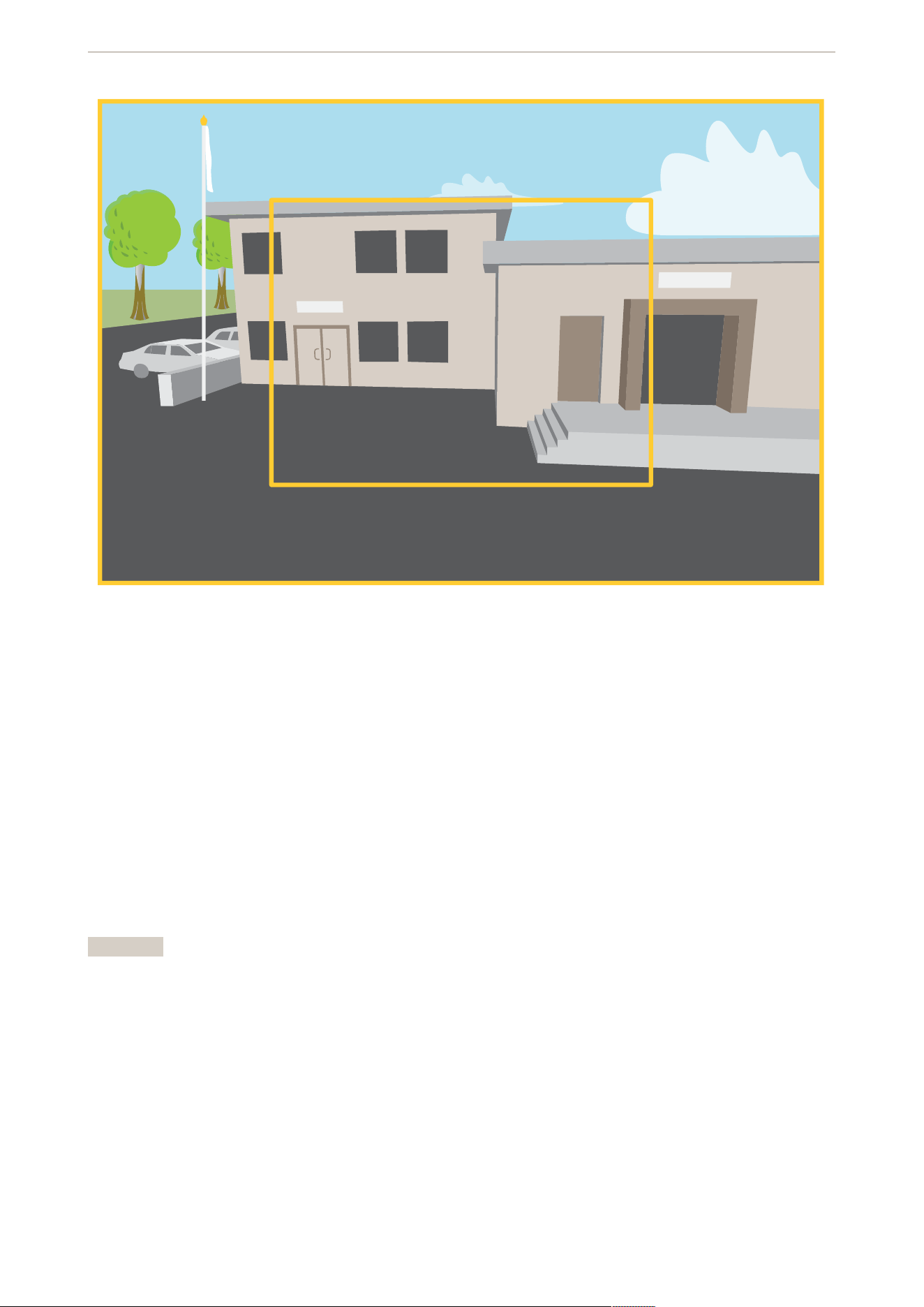
79
The image shows how the field of view and aspect ratio can change between two different capture modes.
What capture mode to choose depends on the requirements for the frame rate and resolution of the specific
surveillance setup. For specifications about available capture modes, see the product’s datasheet at axis.com.
Privacy masks
A privacy mask is a user-defined area that prevents users from viewing a part of the monitored area. In the
video stream, privacy masks appear as blocks of solid color.
A privacy mask is a user-defined area that covers a part of the monitored area. In the video stream, privacy
masks appear either as blocks of solid color or with a mosaic pattern.
The privacy mask is relative to the pan, tilt, and zoom coordinates, so regardless of where you point the camera,
the privacy mask covers the same place or object.
You’ll see the privacy mask on all snapshots, recorded video, and live streams.
You can use the VAPIX® application programming interface (API) to hide the privacy masks.
Important
If you use multiple privacy masks it may affect the product’s performance.
You can create several privacy masks. Each mask can have 3 to 10 anchor points.
Overlays
Overlays are superimposed over the video stream. They are used to provide extra information during recordings,
such as a timestamp, or during product installation and configuration. You can add either text or an image.
AXIS Q6325-LE PTZ Camera

80
Pan, tilt, and zoom (PTZ)
Guard tours
A guard tour displays the video stream from different preset positions either in a predetermined or random
order, and for configurable periods of time. Once started, a guard tour continues to run until stopped, even when
there are no clients (web browsers) viewing the images.
The guard tour function includes tour recording. This allows recording a custom tour using an input device, such
as a joystick, a mouse, or a keyboard, or through using the VAPIX® Application Programming Interface (API). A
recorded tour is a replay of a recorded sequence of pan/tilt/zoom movements, including their variable speeds
and lengths.
Streaming and storage
Video compression formats
Decide which compression method to use based on your viewing requirements, and on the properties of your
network. The available options are:
H.264 or MPEG-4 Part 10/AVC
Note
H.264 is a licensed technology. The Axis product includes one H.264 viewing client license. To install
additional unlicensed copies of the client is prohibited. To purchase additional licenses, contact your Axis
reseller.
H.264 can, without compromising image quality, reduce the size of a digital video file by more than 80%
compared to the Motion JPEG format and by as much as 50% compared to older MPEG formats. This means that
less network bandwidth and storage space are required for a video file. Or seen another way, higher video
quality can be achieved for a given bitrate.
H.265 or MPEG-H Part 2/HEVC
H.265 can, without compromising image quality, reduce the size of a digital video file by more than 25%
compared to H.264.
Note
• H.265 is licensed technology. The Axis product includes one H.265 viewing client license. Installing
additional unlicensed copies of the client is prohibited. To purchase additional licenses, contact your
Axis reseller.
• Most web browsers don’t support H.265 decoding and because of this the camera doesn’t support it in
its web interface. Instead you can use a video management system or application supporting H.265
decoding.
How do Image, Stream, and Stream profile settings relate to each other?
The Image tab contains camera settings that affect all video streams from the product. If you change something
in this tab, it immediately affects all video streams and recordings.
The Stream tab contains settings for video streams. You get these settings if you request a video stream from
the product and don’t specify for example resolution, or frame rate. When you change the settings in the Stream
tab, it doesn’t affect ongoing streams, but it will take effect when you start a new stream.
The Stream profiles settings override the settings from the Stream tab. If you request a stream with a specific
stream profile, the stream contains the settings of that profile. If you request a stream without specifying a
stream profile, or request a stream profile that doesn't exist in the product, the stream contains the settings
from the Stream tab.
AXIS Q6325-LE PTZ Camera
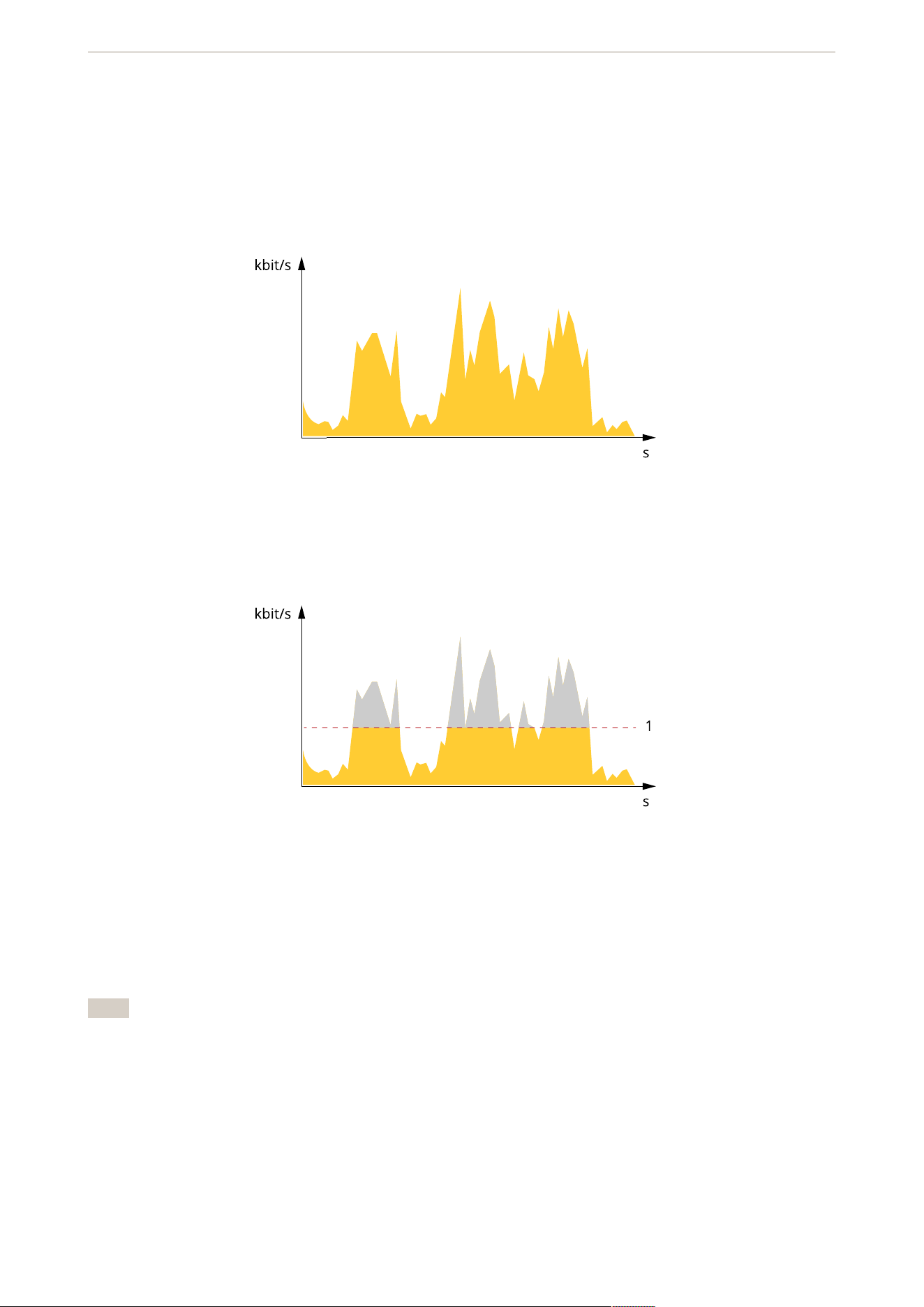
81
Bitrate control
Bitrate control helps you to manage the bandwidth consumption of your video stream.
Variable bitrate (VBR)
Variable bitrate allows the bandwidth consumption to vary depending on the level of activity in the scene. The
more activity, the more bandwidth you need. With variable bitrate you are guaranteed constant image quality,
but you need to make sure you have storage margins.
Maximum bitrate (MBR)
Maximum bitrate lets you set a target bitrate to handle bitrate limitations in your system. You might see a
decline in image quality or frame rate as the instantaneous bitrate is kept below the specified target bitrate. You
can choose to prioritize either image quality or frame rate. We recommend that you configure the target bitrate
to a higher value than the expected bitrate. This gives you a margin in case there is a high level of activity in the
scene.
1 Target bitrate
Analytics and apps
With analytics and apps you can get more out of your Axis device. AXIS Camera Application Platform (ACAP) is
an open platform that makes it possible for third parties to develop analytics and other apps for Axis devices.
Apps can be preinstalled on the device, available for download for free, or for a license fee.
To find the user manuals for Axis analytics and apps, go to help.axis.com.
Note
• Several apps can run at the same time but some apps might not be compatible with each other. Certain
combinations of apps might require too much processing power or memory resources when run in
parallel. Verify that the apps work together before deployment.
Autotracking
With autotracking, the camera automatically zooms in on and tracks moving objects, for example a vehicle or a
person. There are two variants of autotracking:
• PTZ only: the camera detects the objects, using AXIS Object Analytics.
AXIS Q6325-LE PTZ Camera

82
• PTZ and radar: the camera is paired with a radar which detects the objects. The camera confirms the
objects.
You can manually select an object to track, or connect to a scenario that triggers automatic tracking of moving
objects. The application is best suited for open areas with no obscuring objects and where movement is
uncommon. When the camera doesn't track an object, it returns to its connected preset position.
Tracking profiles make it possible to create multiple configurations. Different profiles can for example be
connected to different preset positions or radar scenarios. With the PTZ only variant, you can create up to 10
tracking profiles. With the PTZ and radar variant, you can create up to 20 profiles.
Important
• Autotracking is designed for areas with a limited amount of movement.
• If both autotracking and guard tour are enabled, autotracking takes priority over guard tour. Guard tour
resumes when autotracking stops.
Metadata visualization
Analytics metadata is available for moving objects in the scene. Supported object classes are visualized in the
video stream through a bounding box surrounding the object, along with information about the object type and
confidence level of the classification. To learn more about how to configure and consume analytics metadata,
see AXIS Scene Metadata integration guide.
Cybersecurity
For product-specific information about cybersecurity, see the product's datasheet at axis.com.
For in-depth information about cybersecurity in AXIS OS, read the AXIS OS Hardening guide.
TPM module
The TPM (Trusted Platform Module) is a component that provides cryptographic features to protect information
from unauthorized access. It is always activated and there are no settings you can change.
Edge-to-edge technology
Edge-to-edge is a technology that makes IP devices communicate directly with each other. It offers smart
pairing functionality between, for example, Axis cameras and Axis audio or radar products.
Note
Make sure the paired devices run the same AXIS OS version.
For more information, see the white paper “Edge-to-edge technology” at whitepapers.axis.com/edge-to-edge-
technology.
Radar pairing
With edge-to-edge radar pairing, you can connect your camera to a compatible Axis radar and benefit from
integrated radar features, such as speed detection.
Radar pairing is a one-way setup where you pair one camera with one radar and use the camera to configure
and maintain both devices. When paired, you can access the radar's settings and create rules for radar-specific
events directly in the camera's web interface. The camera will also identify itself to a VMS as a camera with
integrated radar functionality.
The camera has an allocated channel for the radar stream, and after pairing, the radar stream will be assigned
automatically to this channel.
Additionally, the radar metadata is available through the camera’s metadata producer channels after pairing. If
the camera in itself has one channel, the radar metadata is available through the second channel.
AXIS Q6325-LE PTZ Camera
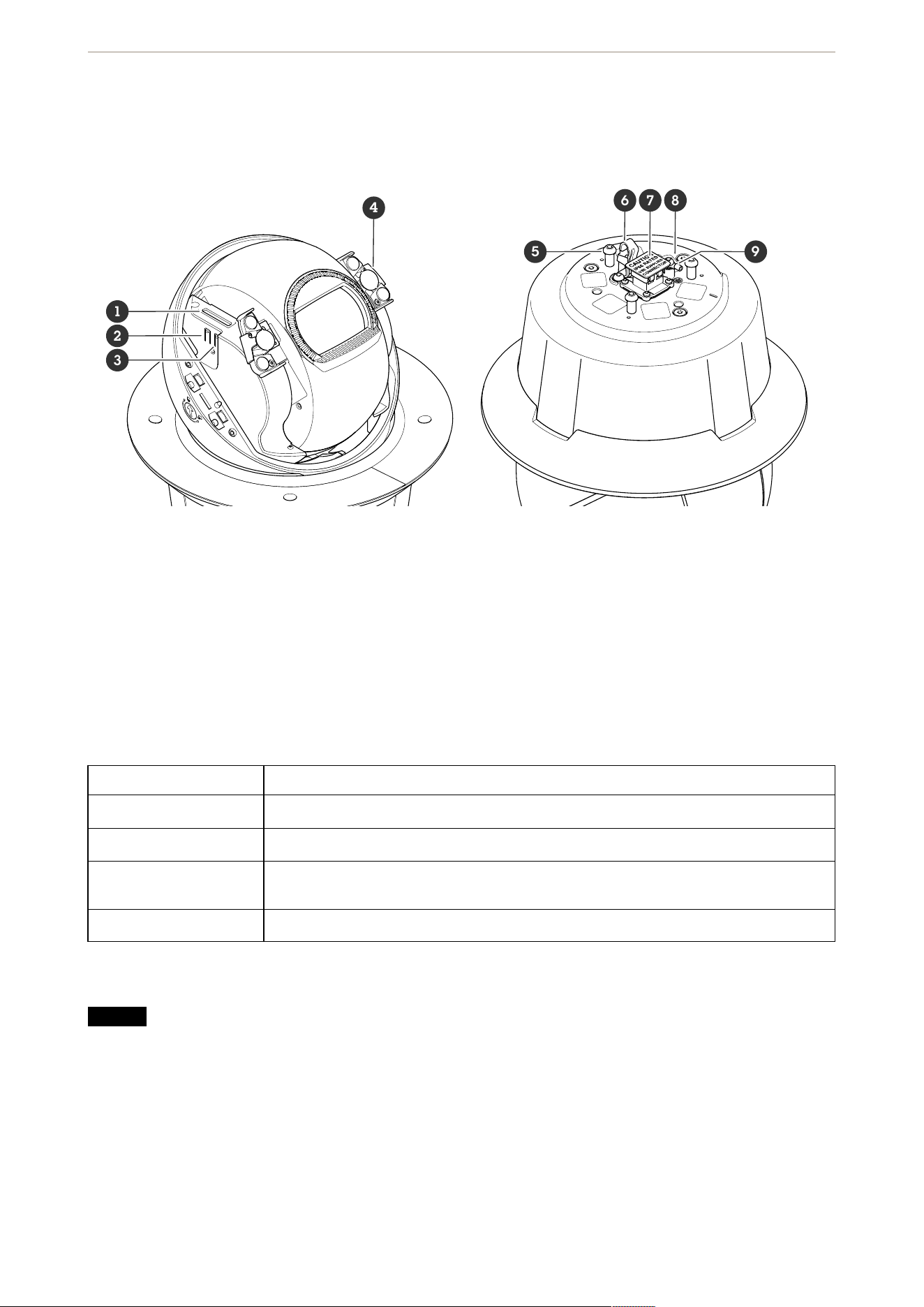
83
Specifications
Product overview
1 SD card slot
2 Power button
3 Control button
4 IR lens
5 Unit holder (3x)
6 Hook for safety wire
7 Network connector
8 Part number (P/N) and serial number (S/N)
9 Ground screw
LED indicators
Status LED Indication
Unlit Connection and normal operation.
Green Shows steady green for 10 seconds for normal operation after startup completed.
Amber Steady during startup. Flashes during device software upgrade or reset to factory
default.
Amber/Red Flashes amber/red if network connection is unavailable or lost.
SD card slot
NOTICE
• Risk of damage to SD card. Don’t use sharp tools, metal objects, or excessive force when inserting or
removing the SD card. Use your fingers to insert and remove the card.
• Risk of data loss and corrupted recordings. Unmount the SD card from the device’s web interface before
removing it. Don’t remove the SD card while the product is running.
This device supports SD/SDHC/SDXC cards.
For SD card recommendations, see axis.com.
1
2
3
4
5
6 7 8
9
AXIS Q6325-LE PTZ Camera

84
SD, SDHC, and SDXC Logos are trademarks of SD-3C LLC. SD, SDHC and SDXC are trademarks or
registered trademarks of SD-3C, LLC in the United States, other countries or both.
Buttons
Control button
The control button is used for:
• Resetting the product to factory default settings. See Reset to factory default settings, on page 86.
Power button
The power button is used with the control button to reset the camera to factory default settings. See page 86.
Connectors
Network connector
RJ45 Push-pull Connector (IP66) with High Power over Ethernet (High PoE).
NOTICE
To comply with the IP66-rated design of the camera and maintain the IP66 protection, the supplied RJ45
Push-pull Connector (IP66) shall be used. Alternatively, use the RJ45 IP66-rated cable with premounted
connector which is available from your Axis reseller. Do not remove the plastic network connector shield
from the camera.
AXIS Q6325-LE PTZ Camera

85
Clean your device
You can clean your device with lukewarm water and mild, nonabrasive soap.
NOTICE
• Harsh chemicals can damage the device. Don’t use chemicals such as window cleaner or acetone to
clean your device.
• Don’t spray detergent directly on the device. Instead, spray detergent on a nonabrasive cloth and use
that to clean the device.
• Avoid cleaning in direct sunlight or elevated temperatures, since this can cause stains.
1. Use a can of compressed air to remove dust and loose dirt from the device.
2. If necessary, clean the device with a soft microfiber cloth dampened with lukewarm water and mild,
nonabrasive soap.
3. To avoid stains, dry the device with a clean, nonabrasive cloth.
AXIS Q6325-LE PTZ Camera

86
Troubleshooting
Reset to factory default settings
WARNING
Possibly hazardous optical radiation is emitted from this product. It can be harmful to the eyes. Don’t
stare at the operating lamp.
Important
Reset to factory default should be used with caution. A reset to factory default resets all settings, including
the IP address, to the factory default values.
To reset the product to the factory default settings:
1. Press and hold the control button and the power button. See Product overview, on page 83.
2. Release the power button but continue to hold down the control button for 15–30 seconds until the
status LED indicator flashes amber.
3. Release the control button.
4. The process is now complete. The product has been reset to the factory default settings. If no DHCP
server is available on the network, the device IP address will default to one of the following:
– Devices with AXIS OS 12.0 and later: Obtained from the link-local address subnet (169.254.0.0/
16)
– Devices with AXIS OS 11.11 and earlier: 192.168.0.90/24
5. Using the installation and management software tools, assign an IP address, set the password and
access the video stream.
You can also reset parameters to factory default through the device’s web interface. Go to Maintenance >
Factory default and click Default.
AXIS OS options
Axis offers device software management according to either the active track or the long-term support (LTS)
tracks. Being on the active track means continuously getting access to all the latest product features, while the
LTS tracks provide a fixed platform with periodic releases focused mainly on bug fixes and security updates.
Using AXIS OS from the active track is recommended if you want to access the newest features, or if you use
Axis end-to-end system offerings. The LTS tracks are recommended if you use third-party integrations, which are
not continuously validated against the latest active track. With LTS, the products can maintain cybersecurity
without introducing any significant functional changes or affecting any existing integrations. For more detailed
information about Axis device software strategy, go to axis.com/support/device-software.
Check the current AXIS OS version
AXIS OS determines the functionality of our devices. When you troubleshoot a problem, we recommend that you
to start by checking the current AXIS OS version. The latest version might contain a correction that fixes your
particular problem.
To check the current AXIS OS version:
1. Go to the device’s web interface > Status.
2. Under Device info, see the AXIS OS version.
Upgrade AXIS OS
Important
• When you upgrade the device software, your preconfigured and customized settings are saved.
AXIS Q6325-LE PTZ Camera
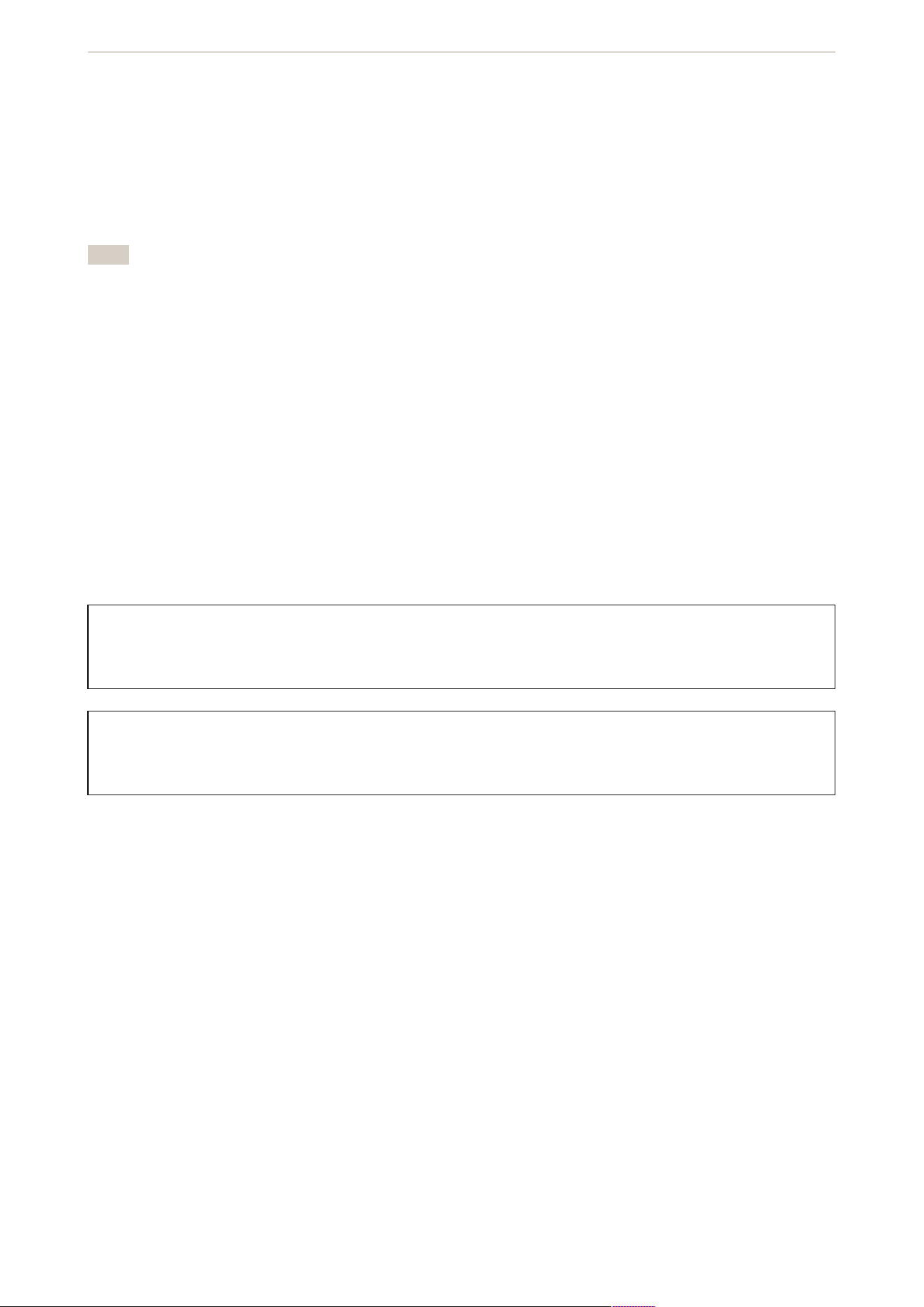
87
Axis Communications AB can't guarantee that the settings are saved, even if the features are available
in the new AXIS OS version.
• Starting from AXIS OS 12.6, you must install every LTS version between your device’s current version and
the target version. For example, if the currently installed device software version is AXIS OS 11.2, you
have to install the LTS version AXIS OS 11.11 before you can upgrade the device to AXIS OS 12.6. For
more information, see AXIS OS Portal: Upgrade path.
• Make sure the device remains connected to the power source throughout the upgrade process.
Note
• When you upgrade the device with the latest AXIS OS version in the active track, the product receives
the latest functionality available. Always read the upgrade instructions and release notes available with
each new release before you upgrade. To find the latest AXIS OS version and the release notes, go to
axis.com/support/device-software.
1. Download the AXIS OS file to your computer, available free of charge at axis.com/support/device-
software.
2. Log in to the device as an administrator.
3. Go to Maintenance > AXIS OS upgrade and click Upgrade.
When the upgrade has finished, the product restarts automatically.
You can use AXIS Device Manager to upgrade multiple devices at the same time. Find out more at axis.com/
products/axis-device-manager.
Technical problems and possible solutions
Problems upgrading AXIS OS
AXIS OS upgrade failed
If the upgrade fails, the device reloads the previous version. The most common reason is that the wrong AXIS
OS file has been uploaded. Check that the name of the AXIS OS file corresponds to your device and try again.
Problems after AXIS OS upgrade
If you experience problems after the upgrade, roll back to the previously installed version from the
Maintenance page.
Problems setting the IP address
AXIS Q6325-LE PTZ Camera
88
Can’t set the IP address
• If the IP address intended for the device and the IP address of the computer used to access the device
are located on different subnets, you can’t set the IP address. Contact your network administrator to
obtain an IP address.
• The IP address could be in use by another device. To check:
1. Disconnect the Axis device from the network.
2. In a Command/DOS window, type ping and the IP address of the device.
3. If you receive: Reply from <IP address>: bytes=32; time=10... this means
that the IP address might already be in use by another device on the network. Obtain a new IP
address from the network administrator and reinstall the device.
4. If you receive: Request timed out, this means that the IP address is available for use
with the Axis device. Check all cabling and reinstall the device.
• There could be a possible IP address conflict with another device on the same subnet. The static IP
address in the Axis device is used before the DHCP server sets a dynamic address. This means that if
the same default static IP address is also used by another device, there could be problems accessing
the device.
Problems accessing the device
Can’t log in when accessing the device from a browser
When HTTPS is enabled, make sure that you use the correct protocol (HTTP or HTTPS) when you try to log in.
You might need to manually type http or https in the browser’s address field.
If you’ve lost the password for the root account, you must reset the device to the factory default settings. For
instructions, see Reset to factory default settings, on page 86.
The IP address has been changed by DHCP
IP addresses obtained from a DHCP server are dynamic and could change. If the IP address has been changed,
use AXIS IP Utility or AXIS Device Manager to locate the device on the network. Identify the device using its
model or serial number, or by the DNS name (if the name has been configured).
If required, you can assign a static IP address manually. For instructions, go to axis.com/support.
Certificate error when using IEEE 802.1X
For authentication to work properly, the date and time settings in the Axis device must be synchronized with
an NTP server. Go to System > Date and time.
The browser isn’t supported
For a list of recommended browsers, see Browser support, on page 7.
Can’t access the device externally
To access the device externally, we recommend you to use one of the following applications for Windows
®
:
• AXIS Camera Station Edge: free of charge, ideal for small systems with basic surveillance needs.
• AXIS Camera Station Pro: 90-day trial version free of charge, ideal for small to mid-size systems.
For instructions and download, go to axis.com/vms.
AXIS Q6325-LE PTZ Camera
89
Problems with streaming
Multicast H.264 only accessible by local clients
Check if your router supports multicasting, or if you need to configure the router settings between the client
and the device. You might need to increase the TTL (Time To Live) value.
No multicast H.264 displayed in the client
Check with your network administrator that the multicast addresses used by the Axis device are valid for your
network.
Check with your network administrator to see if there is a firewall that prevents viewing.
Poor rendering of H.264 images
Ensure that your graphics card uses the latest driver. You can usually download the latest drivers from the
manufacturer’s website.
Color saturation is different in H.264 and Motion JPEG
Modify the settings for your graphics adapter. Check the adapter’s documentation for more information.
Lower frame rate than expected
• See Performance considerations, on page 90.
• Reduce the number of applications running on the client computer.
• Limit the number of simultaneous viewers.
• Check with the network administrator that there is enough bandwidth available.
• Lower the image resolution.
• Log in to the device’s web interface and set a capture mode that prioritizes frame rate. If you change
the capture mode to prioritize frame rate it might lower the maximum resolution, depending on the
device used and capture modes available.
• The maximum frames per second is dependent on the utility frequency (60/50 Hz) of the Axis device.
Can't select H.265 encoding in live view
Web browsers don’t support H.265 decoding. Use a video management system or application that supports
H.265 decoding.
Problems with MQTT
AXIS Q6325-LE PTZ Camera

90
Can’t connect over port 8883 with MQTT over SSL
The firewall blocks traffic that uses port 8883 since it’s regarded insecure.
In some cases the server/broker might not provide a specific port for MQTT communication. It might still be
possible to use MQTT over a port normally used for HTTP/HTTPS traffic.
• If the server/broker supports WebSocket/WebSocket Secure (WS/WSS), typically on port 443, use this
protocol instead. Check with the server/broker provider to see if WS/WSS is supported and which port
and basepath to use.
• If the server/broker supports ALPN, the use of MQTT can be negotiated over an open port, such as 443.
Check with your server/broker provider to see if ALPN is supported and which ALPN protocol and port
to use.
If you can’t find what you’re looking for here, try the troubleshooting section at axis.com/support.
Performance considerations
When you set up your system, it’s important to consider how different settings and situations affect
performance. Some factors affect bandwidth (bitrate), others affect frame rate, and some affect both.
The most important factors to consider:
• High image resolution or lower compression levels result in images containing more data which in turn
affects the bandwidth.
• Rotating the image in the GUI can increase the product's CPU load.
• Access by large numbers of Motion JPEG clients or unicast H.264/H.265/AV1 clients affects the
bandwidth.
• Simultaneous viewing of different streams (resolution, compression) by different clients affects both
frame rate and bandwidth.
Use identical streams wherever possible to maintain a high frame rate. Stream profiles can be used to
ensure that streams are identical.
• Accessing video streams with different codecs simultaneously affects both frame rate and bandwidth.
For optimal performance, use streams with the same codec.
• Heavy usage of event settings affects the product’s CPU load which in turn affects the frame rate.
• Using HTTPS may reduce frame rate, in particular if streaming Motion JPEG.
• Heavy network utilization due to poor infrastructure affects the bandwidth.
• Viewing on poorly performing client computers lowers perceived performance and affects frame rate.
• Running multiple AXIS Camera Application Platform (ACAP) applications simultaneously may affect the
frame rate and the general performance.
Contact support
If you need more help, go to axis.com/support.
AXIS Q6325-LE PTZ Camera

91

.
T10231754
2026-01 (M3.2)
© 2025 – 2026 Axis Communications AB