Operator’s Manual
www. mechmaxx.com
WARRANTY


TABLE OF CONTENTS
TABLE OF CONTENTS
SAFETY SIGNS
IMPORTANT SAFETY INFORMATION
1
2
BEFORE EVERY USE
EVERY WEEK
10
10
AFTER EVERY SEASON
10
CUTTING EDGE REMOVAL & REPLACEMENT
10
HYDRAULIC SYSTEM
10
BOLT TORQUE
10
ENGLISH TORQUE SPECIFICATIONS
11
METRIC TORQUE SPECIFICATIONS
11
SPECIFICATIONS & CAPACITIES
12
YOUR SAFETY
GENERAL SAFETY
EQUIPMENT SAFETY GUIDELINES
3
3
3
SAFETY TRAINING
4
SAFETY SIGNS
4
PREPARATION
4
MAINTENANCE SAFETY
5
HYDRAULIC SAFETY
5
TRANSPORT SAFETY
6
TO THE NEW OPERATOR OR OWNER
6
MACHINE COMPONENTS
7
HOOK-UP TORO MOUNT HITCH
7
UNHOOK TORO MOUNT HITCH
7
3
7
HYDRAULIC CONNECTIONS & MOUNTING
GRAPPLE ATTACHMENT TIPS
8
8
OPERATION
10
MAINTENANCE
13
PARTS DIAGRAM
12
SPECIFICATION
13
PARTS LIST
1
www. mechmaxx.com
TABLE OF CONTENTS
SAFETY SIGNS
2
www. mechmaxx.com
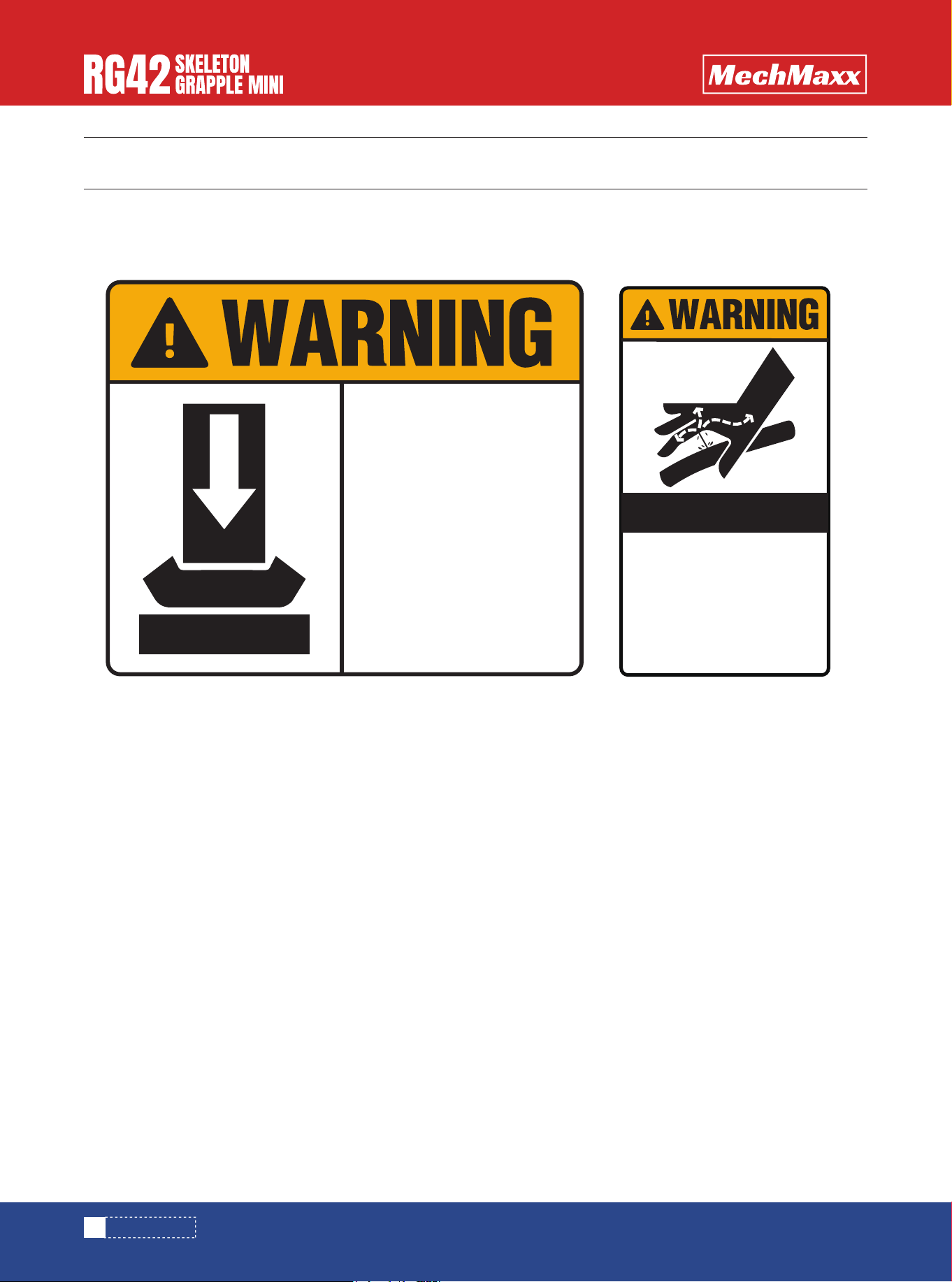
The rating plate on your machine may show symbols. These represent important information about the product or instruc-
tions on its use.
SAFETY SIGNS
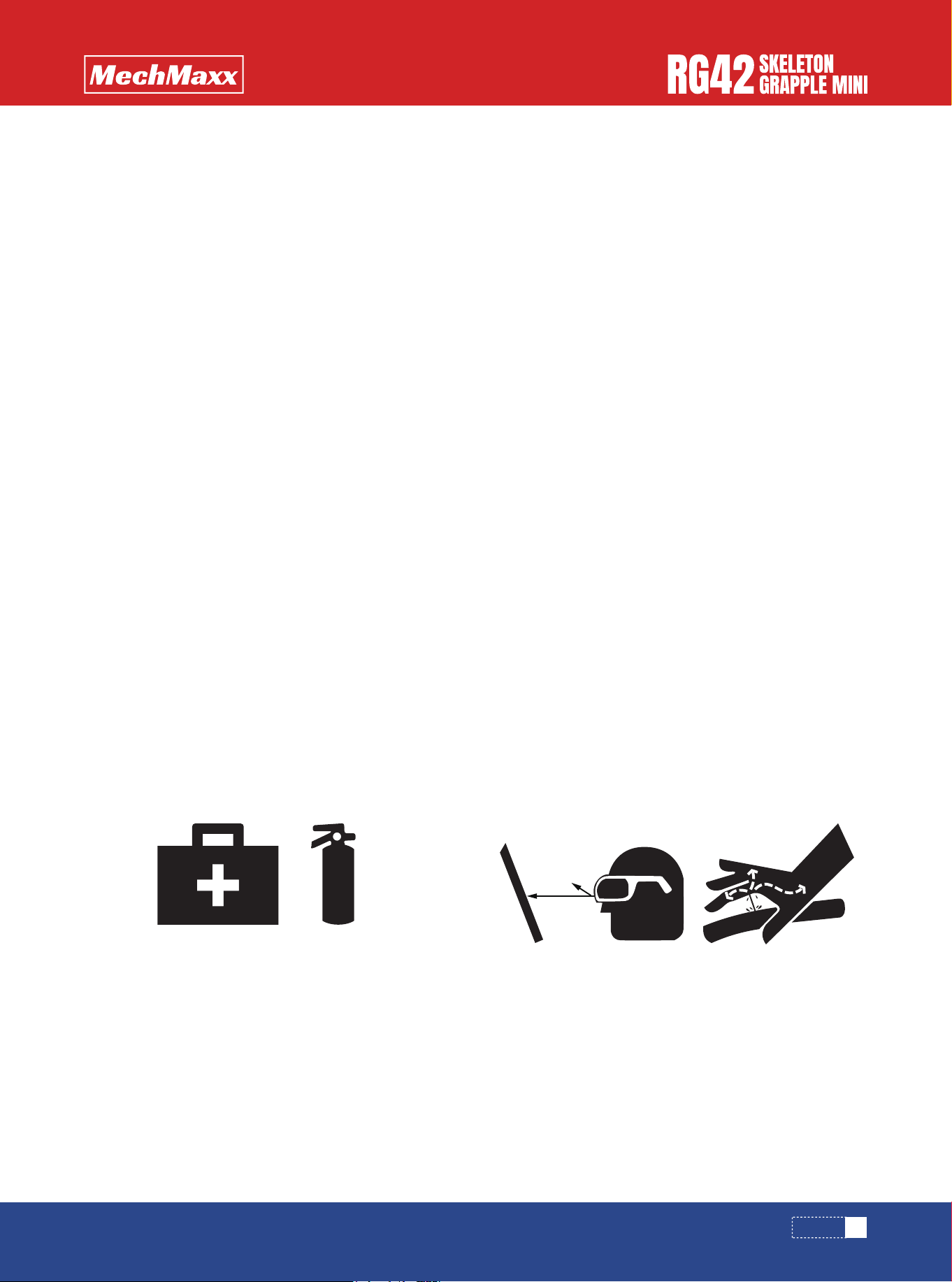
CRUSH
HAZARD
Stay clear of
this area during
operation
Relieve pressure before
disconnecting lines.Do
Not use hands to check
for leaks.Consult physi-
cian immediately
if skin penetration
occurs.
HIGH PRESSURE
FLUID HAZARD
3
www. mechmaxx.com
YOUR SAFETY
IMPORTANT SAFETY INFORMATION
SAFETY
YOU are responsible for the SAFE operation and mainte-
nance of your MECHMAXX Mini Skid Steer Skeleton
Grapple. YOU must ensure that you and anyone else who
is going to use, maintain or work around the Mini Skid
Steer Skeleton Grapple be familiar with the using and
maintenance procedures and related SAFETY information
contained in this manual. This manual will take you
step-by-step through your working day and alerts you to
all good safety practices that should be used while using
the Mini Skid Steer Skeleton Grapple. Remember, YOU are
the key to safety. Good safety practices not only protect
you but also the people around you. Make these practices
a working part of your safety program. Be certain that
EVERYONE using this equipment is familiar with the
recommended using and maintenance procedures and
follows all the safety precautions. Most accidents can be
prevented. Do not risk injury or death by ignoring good
safety practices.
1. Mini Skid Steer Skeleton Grapple owners must give
operating instructions to operators or employees before
allowing them to operate the machine, and at least annu-
ally thereafter.
2. The most important safety device on this equipment is
a SAFE operator. It is the operator’s responsibility to read
and understand ALL Safety and Operating instructions in
the manual and to follow these. Most accidents can be
avoided.
3. A person who has not read and understood all using and
safety instructions is not qualified to use the machine. An
untrained operator exposes himself and bystanders to
possible serious injury or death.
4. Do not modify the equipment in any way. Unauthorized
modification may impair the function and/or safety and
could affect the life of the equipment.
5. Think SAFETY! Work SAFELY!
1. Read and understand the Operator’s Manual and all
safety signs before using, maintaining, adjusting, or
cleaning the Mini Skid Steer Skeleton Grapple.
2. Have a first-aid kit available for use should the need
arise and know how to use it.
3. Have a fire extinguisher available for use should the
need arise and know how to use it.
6. Install and secure all guards before starting.
7. Wear suitable ear protection for prolonged exposure to
excessive noise.
8. Turn machine off, stop and disable engine, remove
ignition key and place in your pocket, set park brake and
wait for all moving parts to
stop before servicing, adjusting, repairing, or unplugging.
9. Clear the area of people, especially small children,
before using the unit.
10. Review safety related items annually with all person-
nel who will operating or maintaining the Mini Skid Steer
Skeleton Grapple.
1. Safety of the operator and bystanders is one of the
main concerns in designing and developing equipment.
However, every year many accidents occur which could
have been avoided by a few seconds of thought and a
more careful approach to handling equipment. You, the
operator, can avoid many accidents by observing the
following precautions in this section. To avoid personal
injury or death, study the following precautions and insist
those working with you, or for you to follow them.
2. In order to provide a better view, certain photographs or
illustrations in this manual may show an assembly with a
safety shield removed. However, equipment should never
be used in this condition. Keep all shields in place. If
shield removal becomes necessary for repairs, replace
the shield prior to use.
4. Do not allow riders.
5. Wear appropriate protective gear. This list includes but
is not limited to:
- A hard hat
- Protective shoes with slip resistant soles
- Heavy gloves
- Wet weather gear
- Hearing Protection
GENERAL SAFETY
EQUIPMENT SAFETY GUIDELINES

4
www. mechmaxx.com
SAFETY
3. Replace any safety sign or instruction sign that is not
readable or is missing. Location of such safety signs is
indicated in this manual.
4. Never use alcoholic beverages or drugs which can
hinder alertness or coordination while using this equip-
ment. Consult your doctor about using this machine while
taking prescription medications.
5. Under no circumstances should young children be
allowed to work with this equipment. Do not allow
persons to use or assemble this unit until they have read
this manual and have developed a thorough understanding
of the safety precautions and of how it works.
Review the safety instructions with all users annually.
6. This equipment is dangerous to children and persons
unfamiliar with its operation. The operator should be a
responsible, properly trained and physically able person
familiar with machinery and trained in this equipment's
operations. If the elderly are assisting with work, their
physical limitations need to be recognized and accommo-
dated.
7. Never exceed the limits of a piece of machinery.
8. If its ability to do a job, or to do so safely, is in question
- DON'T TRY IT.
9. Do not modify the equipment in any way. Unauthorized
modification may result in serious injury or death and may
impair the function and life of the equipment.
10. In addition to the design and configuration of this
implement, including Safety Signs and Safety Equipment,
hazard control and accident prevention are dependent
upon the awareness, concern, prudence, and proper train-
ing of personnel involved in the operation, transport,main-
tenance, and storage of the machine. Refer also to Safety
Messages and operation instruction in each of the appro-
priate sections of the Mini Skid Steer and machine manu-
als. Pay close attention to the Safety Signs affixed to the
Mini Skid Steer and the machine.
1. Safety is a primary concern in the design and manufac-
ture of our products. Unfortunately, our efforts to provide
safe equipment can be wiped out by a single careless act
of an operator or bystander.
2. In addition to the design and configuration of equip-
ment, hazard control and accident prevention are depen-
dent upon the awareness, concern, prudence, and proper
training of personnel involved in the operation, transport,
maintenance, and storage of this equipment.
3. It has been said, "The best safety feature is an
informed, careful operator." We ask you to be that kind of
an operator. It is the operator's responsibility to read and
understand ALL Safety and Using instructions in the
manual and to follow these. Accidents can be avoided.
4. If this machine is used by any person other than
yourself, or is loaned or rented, it is the machine owner's
responsibility to make certain that the operator, prior to
using:
a. Reads and understands the operator's manuals.
b. Is instructed in safe and proper use.
5. Know your controls and how to stop the Mini Skid Steer
tractor and machine quickly in an emergency. Read this
manual and the one provided with Mini Skid Steer tractor.
6. Train all new personnel and review instructions
frequently with existing workers. Be certain only a proper-
ly trained and physically able person will use the machin-
ery. A person who has not read and understood all using
and safety instructions is not qualified to use the
machine. An untrained operator exposes himself and
bystanders to possible serious injury or death. If the elder-
ly is assisting with the work, their physical limitations
need to be recognized and accommodated.
1. Always keep safety signs clean and legible.
2. Replace safety signs that are missing or have become
illegible.
3. Replaced parts that displayed a safety sign should also
display the current sign.
4. Safety signs have a part number in the lower righthand
corner. Use this part number when ordering replacement
parts.
5. Safety signs are available from your authorized Distrib-
utor or Dealer Parts Department or the factory.
1. Never use the machine until you have read and
completely understand this manual, the Mini Skid Steer-
tractor Operator's Manual and each of the Safety Messag-
es found on the safety signs on the Mini Skid Steer tractor
and machine.
2. Personal protection equipment including hard hat,
safety glasses, safety shoes, and gloves are recommend-
ed during assembly, installation, operation, adjustment,
maintaining, repairing, removal, cleaning, or moving the
unit. Do not allow long hair, loose fittingclothing or jewelry
to be around equipment.
SAFETY TRAINING
SAFETY SIGNS
PREPARATION
5
www. mechmaxx.com
SAFETY
3. PROLONGED EXPOSURE TO LOUD NOISE MAY CAUSE
PERMANENT HEARING LOSS!
a) Power equipment with or without equipment attached
can often be noisy enough to cause permanent, partial
hearing loss. We recommend that you wear hearing
protection on a full-time basis if the noise in the Opera-
tor's position exceeds 80db. Noise over 85db on a
long-term basis can cause severe hearing loss. Noise over
90db adjacent to the Operator over a long-term basis may
cause permanent, total hearing loss. NOTE: Hearing loss
from loud noise (from tractors, chain saws, radios, and
other such sources close to the ear) is cumulative over a
lifetime without hope of natural recovery.
4. Clear working area of stones, branches or hidden obsta-
cles that might be hooked or snagged, causing injury or
damage.
5. Use only in daylight or good artificial light.
6. Be sure machine is properly mounted, adjusted and in
good operating condition.
7. Ensure that all safety shielding, and safety signs are
properly installed and in good condition.
1. Good maintenance is your responsibility. Poor mainte-
nance is an invitation to trouble.
2. Follow good shop practices.
a) Keep service area clean and dry.
b) Be sure electrical outlets and tools are properly ground-
ed.
c) Use adequate light for the job at hand.
3. Make sure there is plenty of ventilation. Never operate
the engine of the towing vehicle in a closed building. The
exhaust fumes may cause asphyxiation.
4. Before working on this machine, shut off the engine,
set the brake, and turn fuel valve off.
5. Never work under equipment unless itis blocked
securely.
6. Always use personal protection devices such as eye,
hand and hearing protectors, when performing any service
or maintenance work. Use heavy or leather gloves when
handling blades.
7. Where replacement parts are necessary for periodic
maintenance and servicing, genuine factory replacement
parts must be used to restore your equipment to original
specifications. The manufacturer will not be responsible
for injuries or damages caused by use of unapproved parts
and/or accessories.
8. A fire extinguisher and first aid kit should be kept readi-
ly accessible while performing maintenance on this equip-
ment.
9. Periodically tighten all bolts, nuts and screws and
check that all electrical and fuel connections are properly
secured to ensure unit is in a safe condition.
10. When completing a maintenance or service function,
make sure all safety shields and devices are installed
before placing unit in service.
1. Make sure that all the components in the hydraulic
system are kept in good condition and are clean.
2. Before applying pressure to the system, make sure all
components are tight, and that lines, hoses and couplings
are not damaged.
3. Do not attempt any makeshift repairs to the hydraulic
lines, fittings, or hoses by using tapes, clamps or
cements. The hydraulic system operates under extremely
high pressure. Such repairs will fail suddenly and create a
hazardous and unsafe condition.
4. Wear proper hand and eye protection when searching
for a high-pressure hydraulic leak. Use a piece of wood or
cardboard as a backstop instead of hands to isolate and
identify a leak.
5. If injured by a concentrated high-pressure stream of
hydraulic fluid, seek medical attention immediately.
Serious infection or toxic reaction can develop from
hydraulic fluid piercing the skin surface.
6. Relieve pressure on hydraulic system before maintain-
ing or working on system.
MAINTENANCE SAFETY
HYDRAULIC SAFETY

6
www. mechmaxx.com
SAFETY
1. Comply with state and local laws governing safety and
transporting of machinery on public roads.
2. Check that all the lights, reflectors and other lighting
requirements are installed and in good working condition.
3. Do not exceed a safe travel speed. Slow down for rough
terrain and cornering.
4. Do not drink and drive.
5. Be a safe and courteous driver. Always yield to oncom-
ing traffic in all situations, including narrow bridges, inter-
sections, etc. Watch for traffic when operating near or
crossing roadways.
Follow all safety instructions exactly. Safety is every-
one's business. By following recommended procedures, a
safe working environment is provided for the operator,
bystanders, and the area around the worksite. Untrained
operators are not qualified to operate the machine.
Many features incorporated into this machine are the
result of suggestions made by customers like you. Read
this manual carefully to learn how to use the chipper
safely and how to set it to provide maximum field efficien-
cy. By following the using instructions in conjunction with
a good maintenance program, your Mini Skid Steer Skele-
ton Grapple will provide many years of trouble- free
service.
TRANSPORT SAFETY
TO THE NEW OPERATOR OR OWNER
7
www. mechmaxx.com
OPERATION
OPERATION
When attaching the Skeleton to a Mini Skid Steer, follow
this procedure:
1. Make sure that all bystanders, especially small children
are clear of the work area.
2. Make sure there is enough room and clearance to safely
drive up to the Skeleton.
3. Drive up to The Skeleton while aligning the mounting
components, and hook up into the mount.
MACHINE COMPONENTS
The Mini Steer Skid Bucket utilizes a Toro mount receiver
plate for easy connection and disconnection.
1. Check loader and bucket hitch plates before hooking-up
the bucket. Make sure all components are in good working
condition before putting them into service:
Check for and remove any debris in the loader and bucket
hitch plates.
Check for structural cracks in the hitch plates. Repair or
replace hitch plates as needed.
Check hitch components frequently. Repair or replace any
part that is excessively worn, bent, broken, or missing.
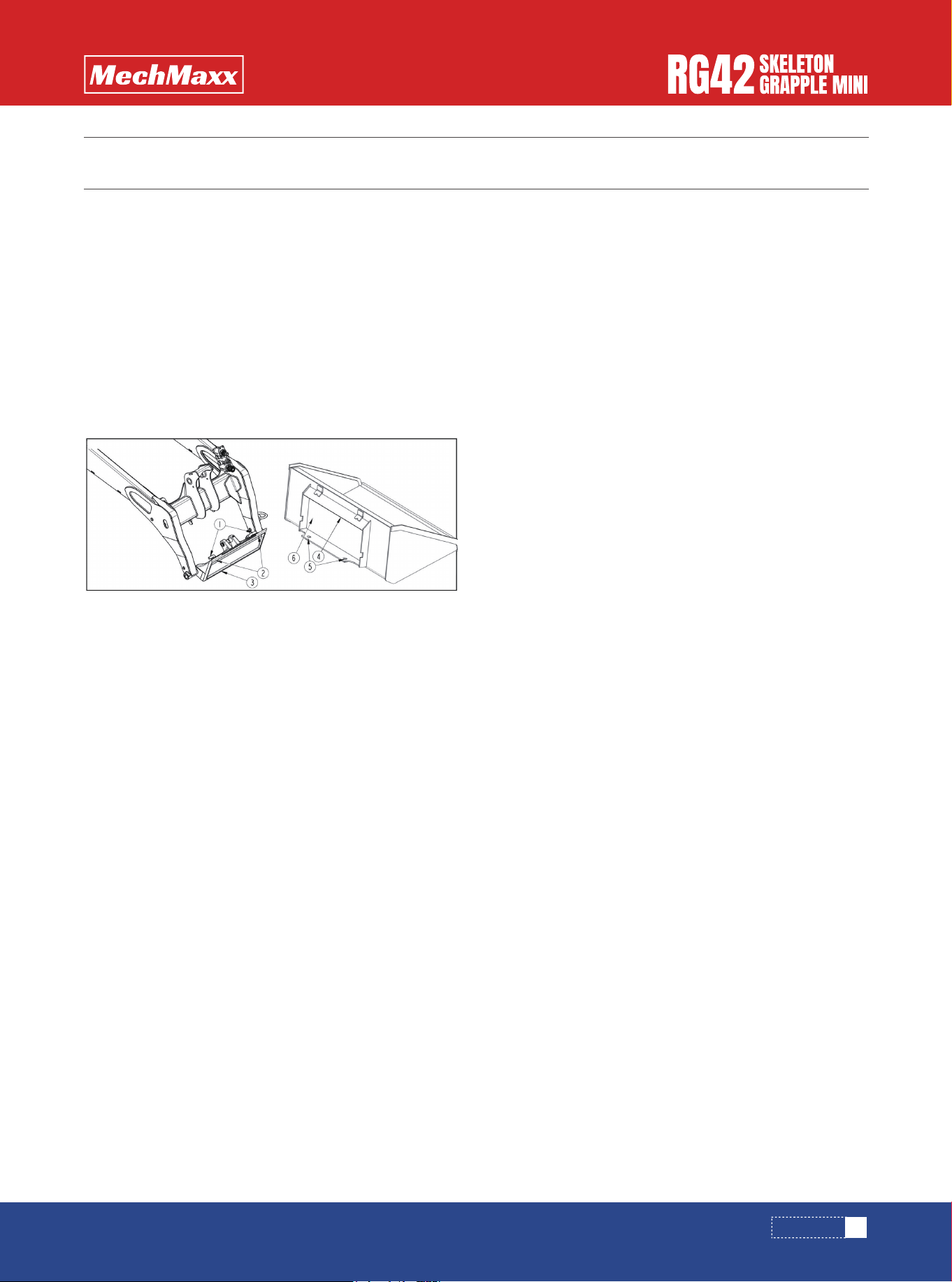
Lubricate lock pins (#1) at the prescribed interval in your
compact loader manual.
Check operation of lock pins (#1). Lock pins must move
freely and extend fully into the hitch plate bottom slots
(#5).
2. Raise lock pins (#1) by rotating the handles 180° until
they point out as shown.
3. Use anti-slip steps/surfaces and grab handles on the
compact loader when stepping on and off the unit.
4. Start compact loader.
5. Drive slowly to the bucket while making sure the
loader’s hitch plate top (#2) is parallel with the bucket’s
top angle bar (#4).
6. Tilt top of loader hitch plate (#2) slightly forward.
7. Place top of loader’s hitch plate (#2) under the buck-
et’s top angled bar (#4) and slowly raise loader hitch
plate (#3) up until the loader hitch plate is seated under
the top angle bar.
8. Tilt top of loader hitch plate (#2) back until the bucket
hitch plate (#6) makes full contact with the face of
loader hitch plate (#3) and the bucket’s hitch plate (#6)
is slightly off the ground.
9. Shut compact loader down before dismounting.
10. Lower lock pins (#1) by rotating the handles 180°un-
til they point in. If needed tap on lock pins to drive them
down and through bottom slots (#5).
11. Check hitch hook-up to verify it is locked properly.
a. Make sure top of loader hitch plate (#2) is fully seated
under the bucket’s top angle bar (#4).
b. Make sure bottom of loader hitch plate (#3) is seated
against bucket’s hitch plate (#6)
c. Make sure lock pins (#1) are fully inserted through
bottom slots (#5) and are fully down.
1. Park on a flat, level, solid surface.
2. Lower bucket until it is slightly above the surface and
angled so that the front of the bucket is slightly higher
than the back.
3. Without changing the height of the loader arms and
attachment, shut compact loader down. Unhook bucket
as follows:
a. Rotate the hitch latch pins (#1) to the unlocked
position by turning them so that the handles are pointing
outward. Make sure the hitch latch pins are pulled up all
the way to ensure a proper disconnect.
b. Return to compact loader and tilt top of hitch plate
(#3) slightly forward toward the bucket.
c. Slowly lower bucket until its top angle bar (#4) and
loader hitch (#3) have separated.
d. Back compact loader slowly away from the bucket
while making sure the Toro mount hitch does not interfere
with the bucket.
HOOK-UP TORO MOUNT HITCH
UNHOOK TORO MOUNT HITCH
8
www. mechmaxx.com
OPERATION
GRAPPLE ATTACHMENT TIPS
Engage the lock pins to secure The Skeleton to the loader.
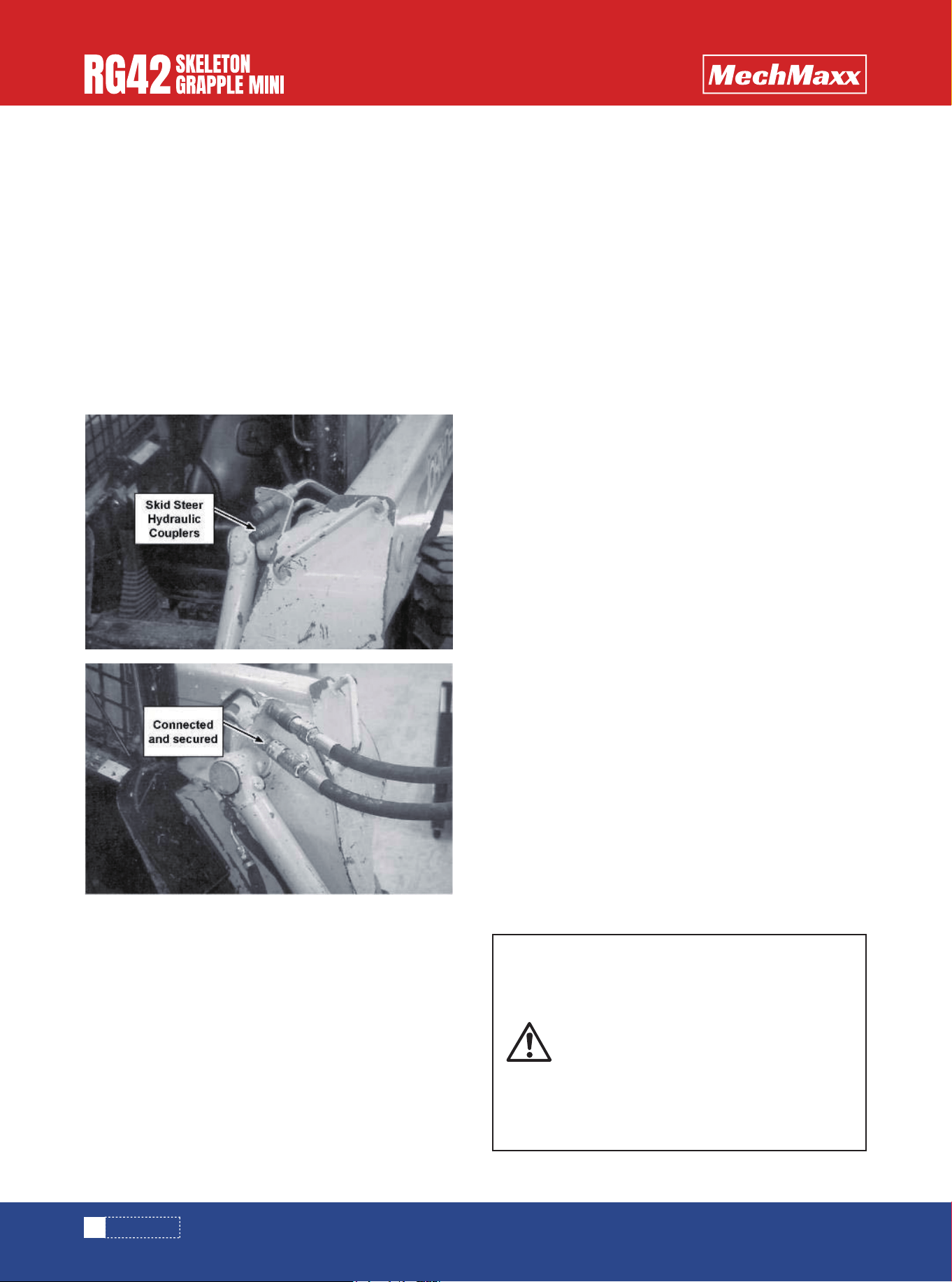
Connect the hydraulics:
Use a clean rag or paper towel to clean the dirt from the
couplers on the hose ends of the Mini Skid Steer.
Connect the hoses to the Mini Skid Steer couplers. Be
sure the couplers are securely seated.
Route and secure the hoses along the frame with clips,
tape or plastic ties to prevent binding and pinching. Be
sure to provide slack for tilting.
Raise The Skeleton.
Check that all hydraulic connections and locks are secure
before beginning work.
Reverse the above procedure when unhooking.
Place planks or boards under the frame for extra support
if required.
1. Never operate this attachment when bystanders are in
proximity of the work area that could result in Minor or
Serious Injury by contact with the machine, attachment
or flying debris.
2. Always inspect the work area before starting the job.
Locate and mark any utilities, steel posts, rocks or any
other objects that could be damaged or would damage the
blade during operation. Never assume the work area is
safe and never skip the inspection part before start of
operation.
3. Operate at a safe slow-paced speed that will allow you
to watch the area ahead and behind the attachment &
loader. Since about half of your duty cycle may be in
reverse, look behind you and/or utilize your mirrors when
backing up. Verify that your backup alarm is working
properly to warn others when you are in reverse, but never
think that the alarm replaces your responsibility to visual-
ly check what’s behind you.
4. Attachment control is the most important element to
getting a good, steady cut. Overloading the attachment
will only result in spinning the tracks or tires and will
make unwanted ruts. Overloading the attachment will
also necessitate raising the implement to off load some
of the resistance occurring by the material. When you
raise the attachment, you will create an unleveled surface
that will increase as the front of the prime mover drives
over the rise of the ground surface.
5. If you lift too heavy a load with your attachment, your
may raise the rear of your Mini Skid Steer, and further
reduce your tractive power available to move the load.
6. Before beginning your forward motion with the attach-
ment, stop the Mini Skid Steer and make any final adjust-
ments to the attachment in terms of height & tilt.
7. Center your load on the attachment. Estimate the load
center and pick it accordingly. If the load feels unbalanced
when you lift it, reposition your grab and retry the lift. An
unbalanced load could upset your Mini Skid Steer.
8. After loading your attachment and clamping the arms
over the load, roll the attachment back and retighten the
clamp arm pressure.
HYDRAULIC CONNECTIONS & MOUNTING
When rolling back the attachment, the
load will settle and require some addition-
al clamping pressure to secure the load.
When lifting a load of brush or trees, make
sure all ends are not tangled with standing
trees that could cause the center of gravi-
ty to be compromised, resulting in a
rollover that could cause Death or Serious
Injury.
9
www. mechmaxx.com
OPERATION
9. The grapple clamp should not be used for pushing or
pulling down trees or any type of structure. Its purpose is
to clamp the load so it can be moved to a different spot on
the job site.
10. To save some service work and down time, always pay
attention that tree branches or roots do not poke through
past the attachment arms and damage any hydraulic
parts or even enter the cab area.
11. Be careful that a branch or root doesn’t “whip” back at
the Mini Skid Steer. Wear safety glasses to prevent dirt
getting in your eyes.
12. Keep your distance from any type of utility, whether
underground or in the air.
13. Always clean the quick-disconnect couplers before
connecting them to the Mini Skid Steer. Utilize plastic or
metal caps to protect the ends when not being used. Tuck
the quick disconnect hoses somewhere in the attach-
ment where they will be out of the dirt and will not be
driven over.
14. With the operator in the seat of the loader, the seat
belt fastened, and the seat bar lowered (if so equipped),
start the engine.
15. Raise the attachment slightly off of the ground.
16. Activate the loader’s auxiliary hydraulics to open and
close the grapple in order to pick up and move debris/ob-
jects.
a. If the grappled object appears or becomes unstable or
unbalanced, lower the attachment to the ground and
repeat the grappling process until the object being lifted
remains stable the entire time it is being lifted and
moved.
b. To avoid injury or death, do not allow any person to be
directly under grapple or load at any time.
c. Carry load as low as possible to avoid serious injury or
death from tip over or falling load.
17. To back rake, fully open the grapple, tilt the loader
coupler forward until the grapple teeth contact the
ground, lower the boom to apply down pressure, and
slowly drive backward to rake material.
Use extreme caution when working around
low hanging electrical lines. Do not raise
the attachment in an area where there are
low electrical lines to prevent an accident
that could result in Death or Serious
Injury.
To avoid electric shock or electrocution,
disconnect electricity when demolishing
structures.
BEFORE EVERY USE
Check that all fasteners (nuts, bolts, pins, keepers) are in
their right place and are tight. Inspect and replace any
worn, torn or missing safety decals. Investigate the
location of any oil leaks and repair.
Lubricate all joints with lithium grease.
EVERY WEEK
Check the condition of the cutting edge and/or tooth
points. Order parts if the cutting edge or points are
becoming worn and replace as soon as possible.
AFTER EVERY SEASON
HYDRAULIC SYSTEM
BOLT TORQUE
Inspect the implement for any loose or worn parts that
may need to be replaced prior to the next season.
Visually inspect the cutting edge. Replace, if necessary.
Clean, sand & repaint any area that looks worn or
scratched to prevent further rusting. Use an equip-
ment-paint found at your local hardware store or building
center.
Replace any warning decals that have been lost or
damaged.
Store your implement in a shed or cover with a
water-proof tarp to protect it from the weather. Store in
an area not frequented by children.
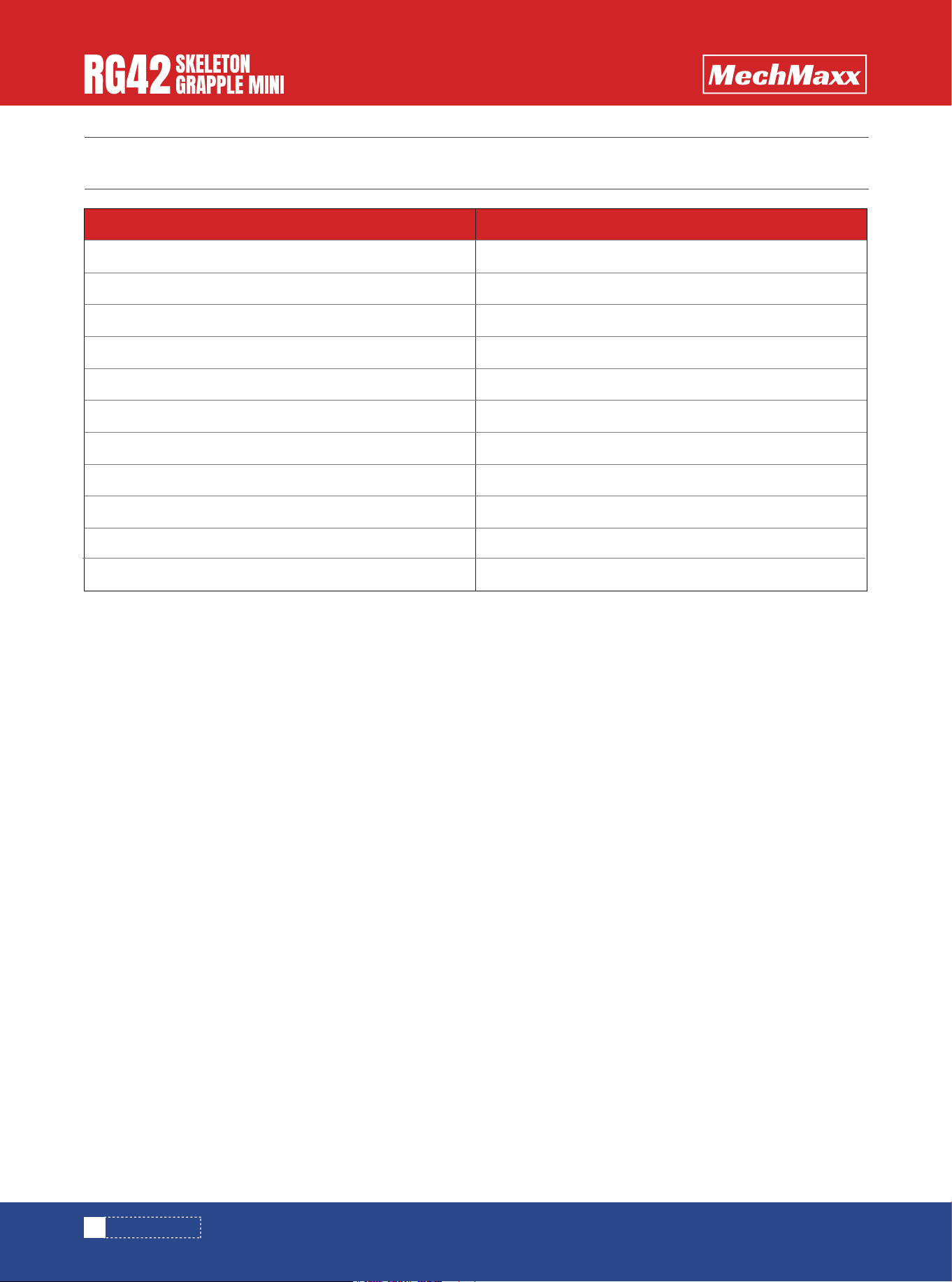
CHECKING BOLT TORQUE
The tables shown below give correct torque values for
various bolts and cap screws. Tighten all bolts to the
torques specified in chart unless otherwise noted. Check
tightness of bolts periodically, using bolt torque chart as
a guide. Replace hardware with the same strength bolt.
Torque figures indicated above are valid for non-greased
or non-oiled threads and heads unless otherwise speci-
fied. Therefore, do not grease or oil bolts or cap screws
unless otherwise specified in this manual. When using
locking elements, increase torque values by 5%.
* Torque value for bolts and cap screws are identified by
their head markings
CUTTING EDGE REMOVAL & REPLACEMENT
MAINTENANCE
MAINTENANCE
10
www. mechmaxx.com
To avoid an accident that could result in
Death or Serious Injury, never find your-
self in a position where any body part is
located under an unsupported blade or
frame when servicing this attachment.
Hazardous dust can be generated if paint-
ed surfaces are heated or welded and
could result in death or Serious Injury.
Remove paint before welding and always
make repairs in a well-ventilated area and
wear an approved respirator.
Cutting edges can be very heavy and could
cause Minor or Serious Injury if mishan-
dled. Always wear protective gloves and
footwear.
1. Weld-on cutting edge replacement is
not a task for most machinery operators
and should be referred to a welding shop
that possesses the proper equipment,
knowledge, and experience.
2. Replacement cutting edges are avail-
able from your dealer.
A small stream of oil from a pinhole leak
could penetrate your skin if contacted. To
avoid an accident that could result in
Death or Serious Injury, never use your
hand or other body parts in an attempt to
locate a hydraulic leak.
Always release the hydraulic system pres-
sure from the hydraulic circuits prior to
removing the attachment or any hydraulic
system service work.
11
www. mechmaxx.com
MAINTENANCE
Bolt
Diameter
SAE 2
SAE-2
A
SAE-5 SAE-8
N.m lb-ft N.m lb-ft N.m lb-ft
SAE 5 SAE 8
Bolt Torque
1/4"
5/16"
3/8"
7/16"
1/2"
9/16"
5/8"
3/4"
7/8"
1"
8
13
27
41
61
95
128
225
230
345
6
10
20
30
45
60
95
165
170
225
12
25
45
72
110
155
215
390
570
850
9
19
33
53
80
115
160
290
420
630
17
36
63
100
155
200
305
540
880
1320
12
27
45
75
115
165
220
400
650
970
ENGLISH TORQUE SPECIFICATIONS
Bolt
Diameter
8.8
N.m lb-ft N.m lb-ft
10.9
Bolt Torque
M3
M4
M5
M6
M8
M10
M12
M14
M16
M20
M24
M30
M36
0.5
3
6
10
25
50
90
140
225
435
750
1495
2600
0.4
2.2
4
7
18
37
66
103
166
321
553
1103
1917
1.8
4.5
9
15
35
70
125
200
310
610
1050
2100
3675
1.3
3.3
7
11
26
52
92
148
229
450
744
1550
2710
METRIC TORQUE SPECIFICATIONS
A
8.8 10.9
12
www. mechmaxx.com
SPECIFICATION
SPECIFICATION
Grappling Capacity
Arm Opening
Working Width
Grapple Width
Spacing Between Tines
Overall Size (LxWxH)
Hydraulic Pressure
Finish
Warranty
Packing
Size Weight (N.W./G.W.)
2000 lbs
24 in
42 in
32.5 in
6.5 in
42 in x 30 in x 25 in
3000 PSI
Powder Coating
1 Year
43 in x 29 in x 30 in
247/295 Ibs
Model RG42
13
www. mechmaxx.com
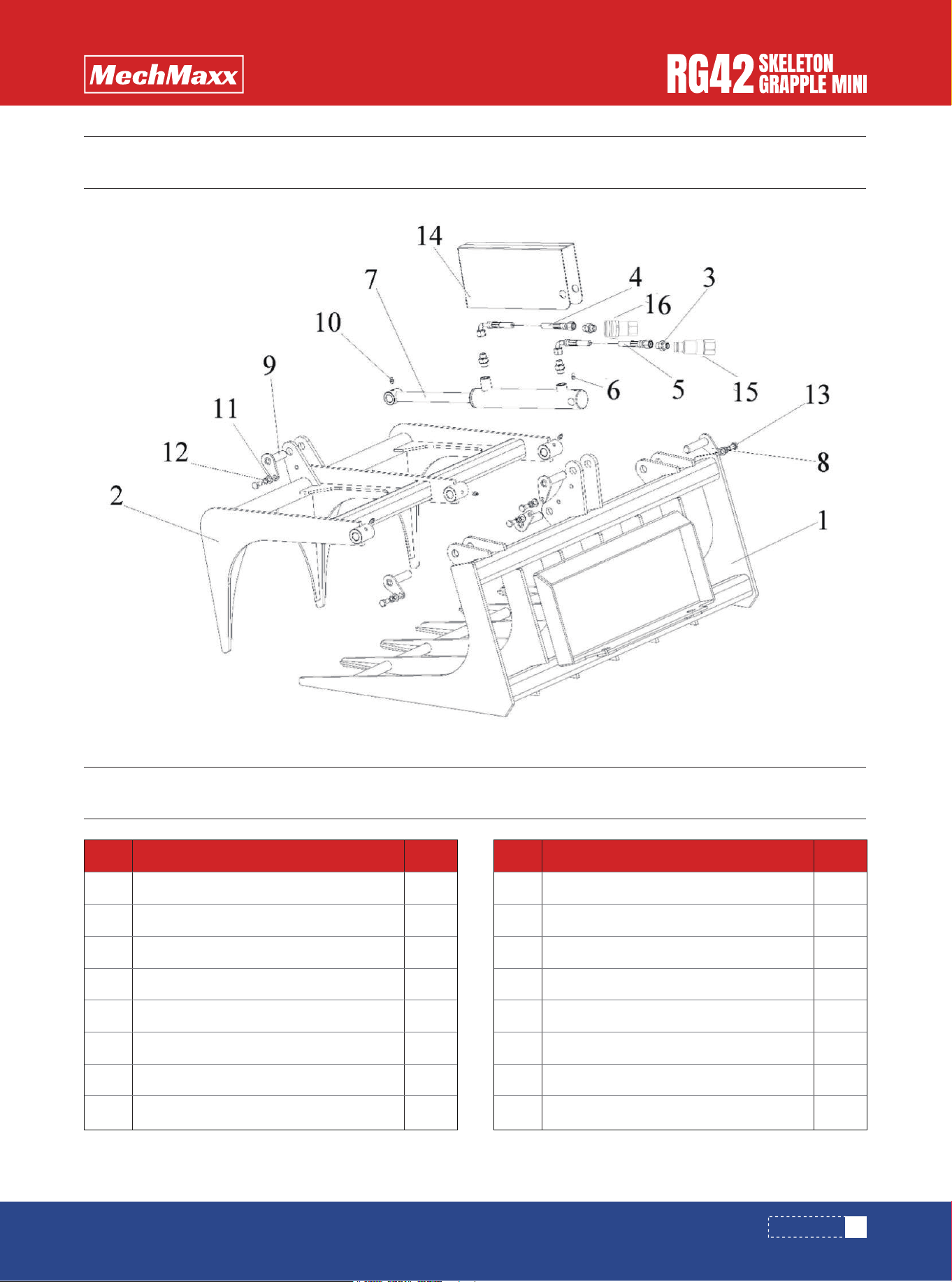
PARTS DIAGRAM
PARTS LIST
PARTS LIST
1
1
4
1
1
4
1
4
REF DESCRIPTION QTY
1
2
3
4
5
6
7
8
Frame Weldment
Grapple Arm
End Straight Joint Npt1/2-M16*1.5
M14*1.5 Length: 2050mm
M14*1.5 Length: 1800mm
Greaser M8, 90°
Cylinder, Grapple Arm
PIN ASSEMBLY 01
1
4
5
5
5
1
1
1
REF DESCRIPTION QTY
9
10
11
12
13
14
15
16
PIN ASSEMBLY 02
Greaser M8
Washer 10
Washer 10
Bolt M10×20
Cylinder cover
Flat Faced Couplers G1/2 Female
Flat Faced Couplers G1/2 Male