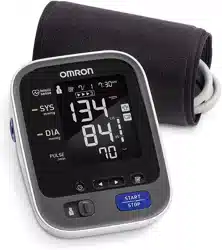
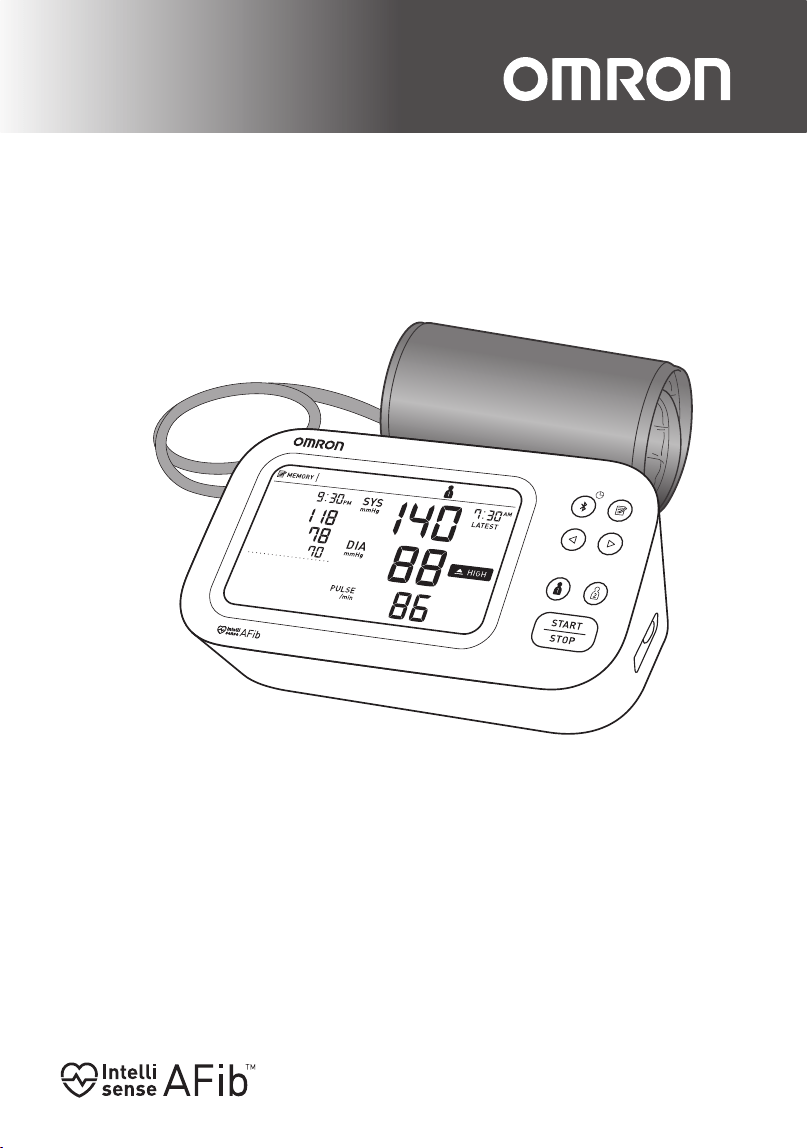
10 Series Upper Arm Blood Pressure Monitor
Model BP7465
Instruction Manual
3146827-7D

1
Table of Contents
Introduction .....................................................2
Safety Instructions .............................................2
Intended Use ....................................................... 2
Receiving and Inspection ............................... 3
Symbols Glossary ...............................................3
Important Safety Information ........................4
1. Know Your Monitor ....................................8
1.1 Contents/Product Includes ................. 8
1.2 Monitor and Arm Cuff ........................... 8
1.3 Display and Symbols ...........................10
1.4 Classification of BP
(Blood Pressure) ....................................15
2. Preparation ..............................................16
2.1 Installing Batteries ...............................16
2.2 Using the AC Adapter .........................17
2.3 Setting the Date and Time ................18
2.4 Setting the Interval of the
TruRead Mode .......................................20
2.5 Blood Pressure Measurement
Tips ............................................................21
2.6 Applying the Arm Cuff ........................22
2.7 Sitting Correctly ....................................24
3. Using Your Monitor without a Smart
Device .......................................................25
3.1 Taking a Measurement .......................25
3.2 Using the TruRead Mode ...................28
3.3 Using the Guest Mode ........................30
4. Using Your Monitor with a Smart
Device .......................................................32
4.1 Pairing Your Monitor with a Smart
Device .......................................................32
4.2 Taking a Measurement .......................34
4.3 Disabling Bluetooth .............................34
5. Using Memory Function ..........................36
5.1 Viewing the Readings Stored in
Memory ....................................................36
5.2 Viewing the Average Reading .........39
6. Other Settings ..........................................40
6.1 Deleting All Readings Stored in
Memory ....................................................40
6.2 Restoring Your Monitor to the
Default Settings ....................................41
7. Error Messages and Troubleshooting ....42
8. Maintenance ............................................ 47
8.1 Maintenance .......................................... 47
8.2 Storage .................................................... 47
8.3 Wiping the Monitor ............................. 47
8.4 Disposal ................................................... 47
9. FCC Statement ......................................... 48
10. Limited Warranty .................................... 49
11. Guidance and Manufacturer’s
Declaration .............................................. 51
12. What is Possible AFib? ............................ 52
13. Optional Accessories .............................. 56
14
. Specifications .......................................... 57

2
Introduction
Thank you for purchasing the OMRON BP7465 Upper Arm Blood Pressure
Monitor. This monitor can be used by multiple users. This blood pressure
monitor uses the oscillometric method of blood pressure measurement.
This means this monitor detects your blood movement through your
brachial artery and converts the movements into a digital reading.
Safety Instructions
This instruction manual provides you with important information about
the OMRON BP7465 Upper Arm Blood Pressure Monitor. To ensure the
safe and proper use of this monitor, READ and UNDERSTAND all of these
instructions. If you do not understand these instructions or have any
questions, contact 1-800-634-4350 before attempting to use this
monitor. For specific information about your own blood pressure,
consult with your physician.
Intended Use
The device is a digital monitor intended for use in measuring blood
pressure and pulse rate in adult patient population. The device detects
the appearance of irregular heartbeats during measurement and gives a
warning signal with readings.
The device includes the Atrial Fibrillation Detection Feature. The feature
an
aly
zes pulse pressure wave data captured during the user’s blood
pressure measurement to identify episodes of atrial fibrillation (AFib) and
provides a notification on the display screen to the user. This feature is
intended to be used for home screening for the possibility of AFib.
The Atrial Fibrillation Detection Feature is not intended to provide a
n
otification
on every episode of AFib and the absence of detection is not
intended to indicate the absence of atrial fibrillation. The feature is not
intended to replace traditional methods of diagnosis or treatment or to be
used in the management of patients with AFib.
The device is intended for over-the-counter (OTC) use in the home
en
vironment. The
device is intended for use in adults (22 years or older); it
has not
been tested for and is not intended for use in pregnant women or
people with implanted pacemakers or defibrillators.


4
Important Safety Information
Read the Important Safety Information in this instruction manual
before using this monitor.
Follow this instruction manual thoroughly for your safety.
Keep for future reference. For specific inf
ormation about
your own blood
pressure, CONSULT WITH YOUR PHYSICIAN.
Warning
Indicates a potentially hazardous situation which, if not avoided,
could result in death or serious injury.
Usage on Individuals
•
NOT intended for use
if you have an implanted defibrillator or pacemaker.
•
NOT intended for use
if you are pregnant.
•
NOT intended for use
if you are under 22 years of age.
•
NEVER
diagnose or treat yourself based on your readings.
ALWAYS consult with your
physician.
•
DO NOT
use this monitor on infants, toddlers, children or persons who cannot express
themselves.
•
DO NOT
use this monitor on an injured arm or an arm under medical treatment.
•
DO NOT
apply the arm cuff on your arm while on an intravenous drip or blood
transfusion.
•
Consult with your physician
before using this monitor if you have common arrhythmias
such as atrial or ventricular premature beats or atrial fibrillation; arterial sclerosis; poor
perfusion; diabetes or renal disease.
NOTE
that any of these conditions in addition to
patient motion, trembling, or shivering may affect the measurement reading.
• This product contains small parts that may cause a choking hazard if swallowed by
infants, toddlers and children.
• To help avoid strangulation, keep the air tube and AC adapter cable away from infants,
toddlers and children.
Use Environment
• This monitor is
not intended for use
in ambulatory environment.
•
DO NOT
use this monitor in areas containing high frequency (HF) surgical equipment,
magnetic resonance imaging (MRI) equipment, computerized tomography (CT) scanners.
This may result in incorrect operation of the monitor and/or cause an inaccurate reading.
•
DO NOT
use this monitor in oxygen rich environments or near flammable gas.
Device Output
•
DO NOT adjust medication
(including altering your use of any drug or treatment) based
on readings from this blood pressure monitor.
Take medication as prescribed by your
physician
. ONLY a physician is qualified to diagnose and treat high blood pressure and
heart related conditions.
• If you are experiencing any symptoms or concerns,
consult with your physician.
•
DO NOT
postpone/stop regular checkups or physician visits based on the results that you
are getting from this monitor.

Important Safety Information
5
• The possible AFib detection feature evaluates for a possibility of AFib ONLY. It will
NOT
detect other potentially life-threatening arrhythmias or diseases, such as a possibility of
other cardiac arrhythmias or heart attack.
• This monitor is
not intended for the diagnosis, treatment, or management of AFib.
Data Transmission
• After the pairing process is completed, this product always emits radio frequencies (RF) in
the 2.4 GHz band.
DO NOT
use this product in locations where RF is restricted, such as on
an aircraft or in hospitals. Disable the
Bluetooth®
feature in this monitor, or remove the
batteries and unplug the AC adapter when in RF restricted areas. For further information
on potential restrictions refer to documentation on the Bluetooth usage by the FCC.
AC Adapter Handling and Usage
•
DO NOT
use the AC adapter if this monitor or the AC adapter cable is damaged. If this
monitor or the cable is damaged, turn off the power and unplug the AC adapter
immediately.
• Plug the AC adapter into the appropriate voltage outlet.
DO NOT
use in a multi-outlet
plug.
• NEVER plug in or unplug the AC adapter from the electric outlet with wet hands.
•
DO NOT
disassemble or attempt to repair the AC adapter.
Battery Handling and Usage
• Keep the batteries out of the reach of infants, toddlers and children.
Caution
Indicates a potentially hazardous situation which, if not avoided,
may result in minor or moderate injury to the user or patient, or
cause damage to the equipment or other property.
Usage on Individuals
• Safety and effectiveness in patients with peripheral arterial disease (PAD) have not been
established.
• Stop using this monitor and consult with your physician if you experience skin irritation or
discomfort.
• Consult with your physician before using this monitor on an arm where intravascular
access or therapy, or an arterio-venous (A-V) shunt, is present because of temporary
interference to blood flow which could result in injury.
• Consult with your physician before using this monitor if you have had a mastectomy or
lymph node
clearance.
• Consult with your physician before using this monitor if you have severe blood flow
problems or blood disorders as cuff inflation can cause bruising.
•
DO NOT
take measurements more often than necessary because bruising, due to blood
flow interference, may occur.
• Avoid bathing, drinking alcohol or caffeine, smoking, exercising and eating for at least 30
mi
nutes before taking a measurement.

6
Important Safety Information
• Rest for at least 5 minutes before taking a measurement.
• Remove tight-fitting or thick clothing from your arm while taking a measurement.
• Remain still and
DO NOT
talk while taking a measurement.
•
ONLY
use the arm cuff on persons whose arm circumference is within the specified range
of the cuff.
Use Environment
• During measurement, make sure that no mobile device or any other electrical device that
emits electromagnetic fields is within 12 inches (30 cm) of this monitor. This may result in
incorrect
operation of the monitor and/or cause an inaccurate reading.
•
DO NOT
use in a location where there is moisture or a risk of water splashing this monitor.
This may damage this monitor.
•
DO NOT
use this monitor in a moving vehicle such as in a car or on an aircraft.
•
DO NOT
use this monitor in places with high or low humidity or high or low
temperatures. Refer to section 14.
•
DO NOT
use this monitor in high-use environments such as medical clinics or physician
offices.
•
DO NOT
use this monitor with other medical electrical (ME) equipment simultaneously.
This may result in incorrect operation of the devices and/or cause an inaccurate reading.
• Ensure that this monitor has acclimated to room temperature before taking a
measurement. Taking a measurement after an extreme temperature change could lead to
an inaccurate reading. It is recommended that you wait for approximately 2 hours for the
monitor to warm up or cool down when the monitor is used in an environment within the
temperature specified as operating conditions after it is stored either at the maximum or
at the minimum storage temperature. For additional information on operating and
storage/transport temperature, refer to section 14.
General Device Usage
•
ONLY
inflate the arm cuff when it is applied on your upper arm.
• Remove the arm cuff if it does not start deflating during a measurement.
•
DO NOT
use this monitor for any purpose other than measuring blood pressure and/or
detecting a possibility of AFib.
•
DO NOT
disassemble or attempt to repair this monitor or other components. This may
cause an inaccurate reading.
•
DO NOT
drop or subject this monitor to strong shocks or vibrations.
• During measurement, observe the arm to ensure
that the monitor is not causing
prolonged impairment to blood circulation.
•
DO NOT
use this monitor after the durable period has ended. Refer to section 14.
•
DO NOT
crease the arm cuff or the air tube excessively.
•
DO NOT
fold or kink the air tube while taking a measurement. This may cause an injury by
interrupting blood flow.
•
DO NOT
use if the monitor or any components are damaged.
• To unplug the air plug, pull on the plastic air plug at the base of the tube, not the tube
itself.

Important Safety Information
7
•
ONLY
use the AC adapter, arm cuff, batteries and accessories specified for this monitor.
Use of unsupported AC adapters, arm cuffs and batteries may damage and/or may be
hazardous to this monitor.
•
ONLY
use the approved arm cuff for this monitor. Use of other arm cuffs may result in
incorrect readings.
• Inflating to a higher pressure than necessary
may
result in bruising of the arm where the
cuff is applied.
NOTE:
refer to “If your systolic pressure is more than 210 mmHg” at the
end of section 3 of this instruction manual for additional information.
Data Transmission
•
DO NOT
replace the batteries or unplug the AC adapter while your readings are being
transferred to your smart device. This may result in incorrect operation of this monitor
and failure to transfer your blood pressure data.
AC Adapter Handling and Usage
• Fully insert the AC adapter into the outlet.
• When unplugging the AC adapter from the outlet, be sure to safely pull from the AC
adapter.
DO NOT
pull from the AC adapter cable.
• When handling the AC adapter cable:
DO NOT
damage it.
DO NOT
break it.
DO NOT
tamper with it.
DO NOT
forcibly bend or pull it.
DO NOT
twist it.
DO NOT
use it if it is gathered in a bundle.
DO NOT
pinch it.
DO NOT
place it under heavy objects.
• Wipe any dust off of the AC adapter.
• Unplug the AC adapter when not in use.
• Unplug the AC adapter before wiping this monitor.
Battery Handling and Usage
•
DO NOT
insert batteries with their polarities incorrectly aligned.
• ONLY use 4 “AA” alkaline or manganese batteries with this monitor.
DO NOT
use other
types of batteries.
DO NOT
use new and used batteries together.
DO NOT
use different
brands of batteries together.
• Remove the batteries if this monitor will not be used for a long period of time.
• If battery fluid should get in your eyes, immediately rinse with plenty of clean water.
Consult with
your physician immediately.
• If battery fluid should get on your skin, wash your skin immediately with plenty of clean,
lukewarm water. If irritation, injury or pain persists, consult with your physician.
•
DO NOT
use batteries after their expiration date.
• Periodically check the batteries to ensure they are in good working condition.
8
1. Know Your Monitor
1.1 Contents/Product Includes
Monitor, Easy-Wrap ComFit Cuff, AC adapter (HEM-ADPTW5), 4 “AA”
batteries, instruction manual, quick start guide
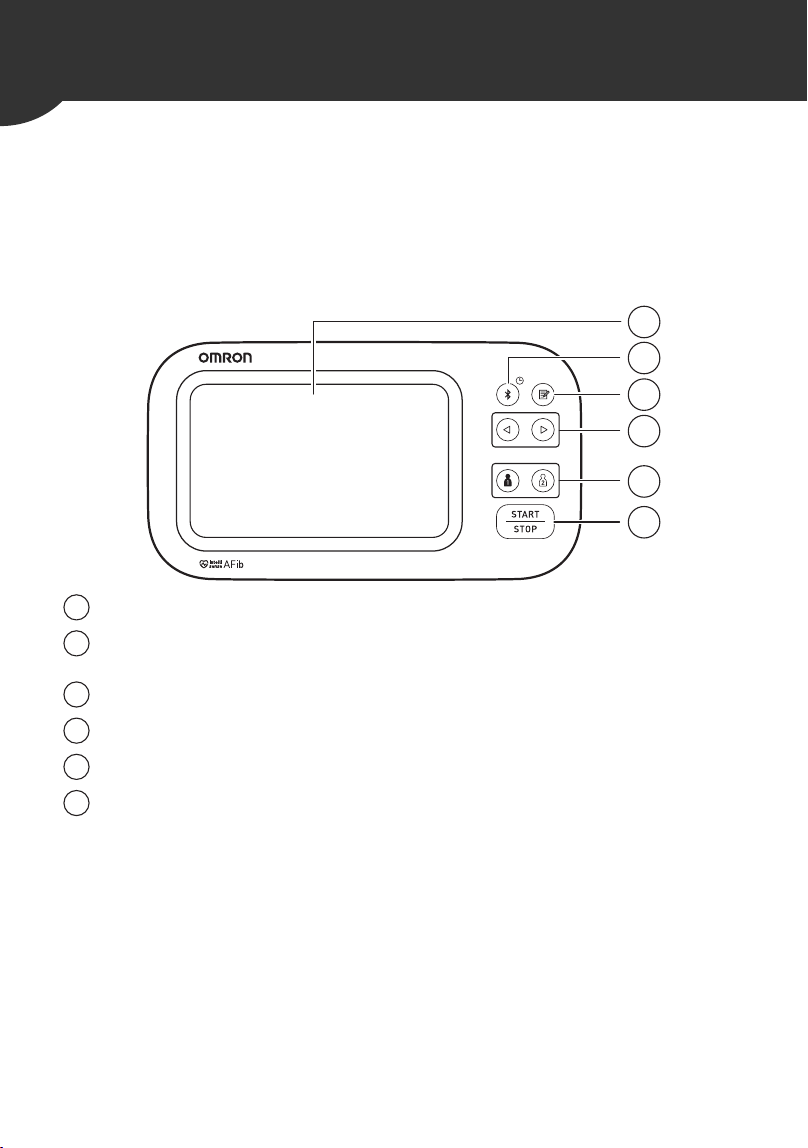
1.2 Monitor and Arm Cuff
Front of the monitor
Display
[Connection] button
(Date/Time)
[Memory] button
[Forward]/[Backward] buttons
[User ID 1]/[User ID 2] buttons
[START/STOP] button
f
a
d
c
b
e
a
b
c
d
e
f
1. Know Your Monitor
9
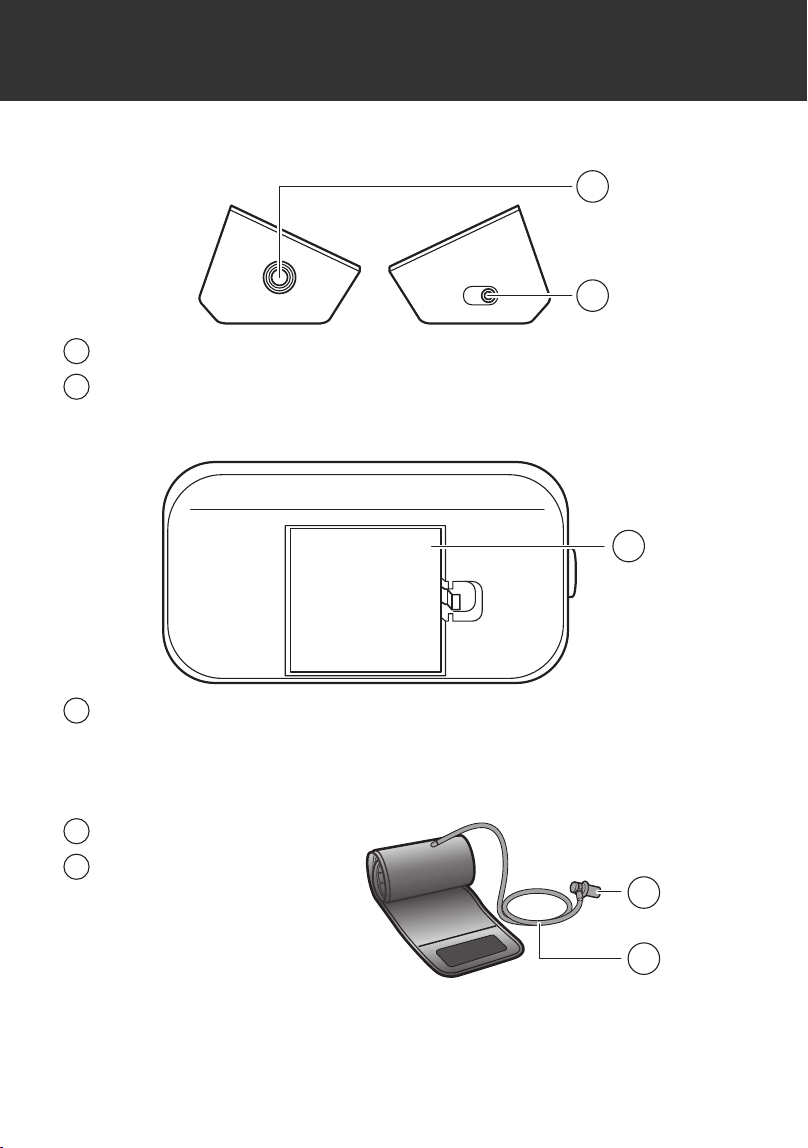
Left and right side of the monitor
Bottom of the monitor
Arm cuff
(Upper arm circumference: 9" - 17" (22 - 42 cm))
Air jack
AC adapter jack
Battery compartment
Air plug
Air tube
g
h
g
h
i
i
j
j
k
k
10
1. Know Your Monitor
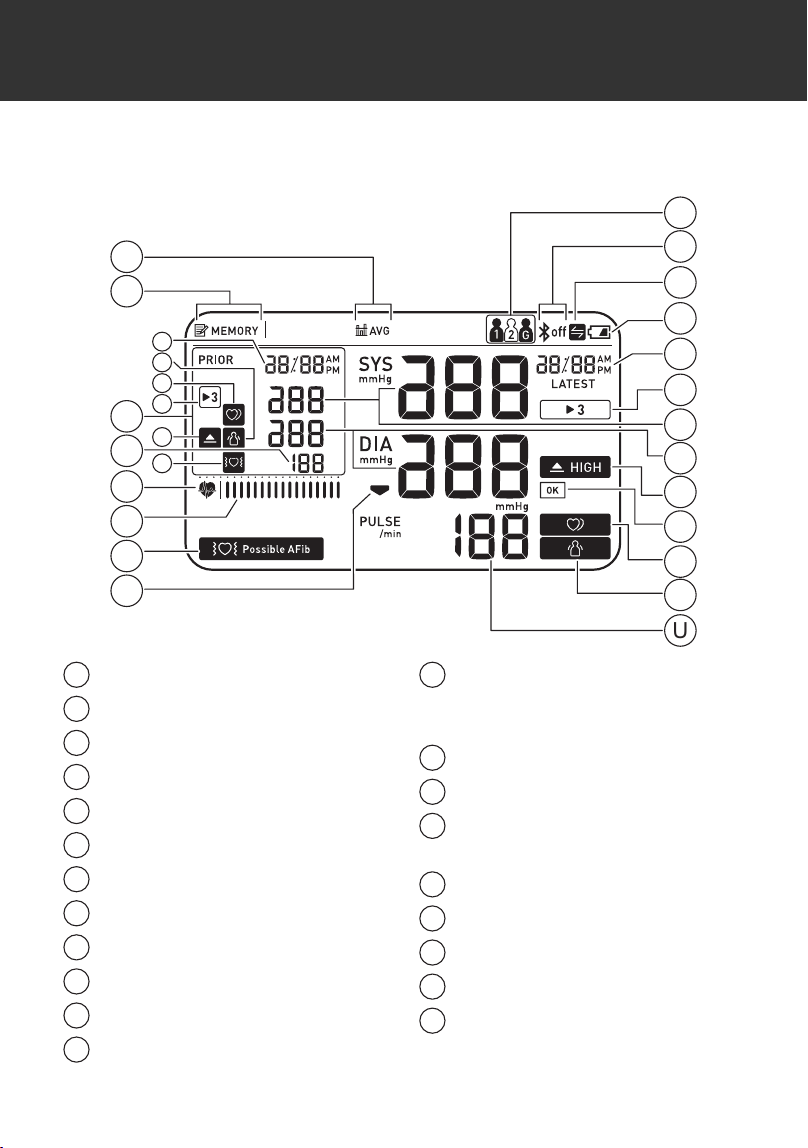
1.3 Display and Symbols
Average value symbol
Memory symbol
Comparison display
Pulse display / Memory number
Heartbeat symbol
Pulse level
Possible AFib detector symbol
Deflation symbol
User ID (1/2/Guest) symbol
Bluetooth ON / OFF symbol
Sync symbol
Low battery symbol /
Depleted battery symbol
Date / Time display /
Consecutive measurement
number f
or TruRead
TruRead symbol
Systolic blood pressure reading
Diastolic blood pressure
re
ading / AF
High symbol
OK symbol
Irregular heartbeat symbol
Movement error symbol
Pulse display / Interval counter
for TruRead
A
B
C
D
E
F
G
H
I
J
R
U
T
S
L
M
N
O
P
Q
K
T
S
N
Q
G
M
A
B
C
D
E
F
G
H
I
J
K
L
M
N
O
P
Q
R
S
T
U
1. Know Your Monitor
11
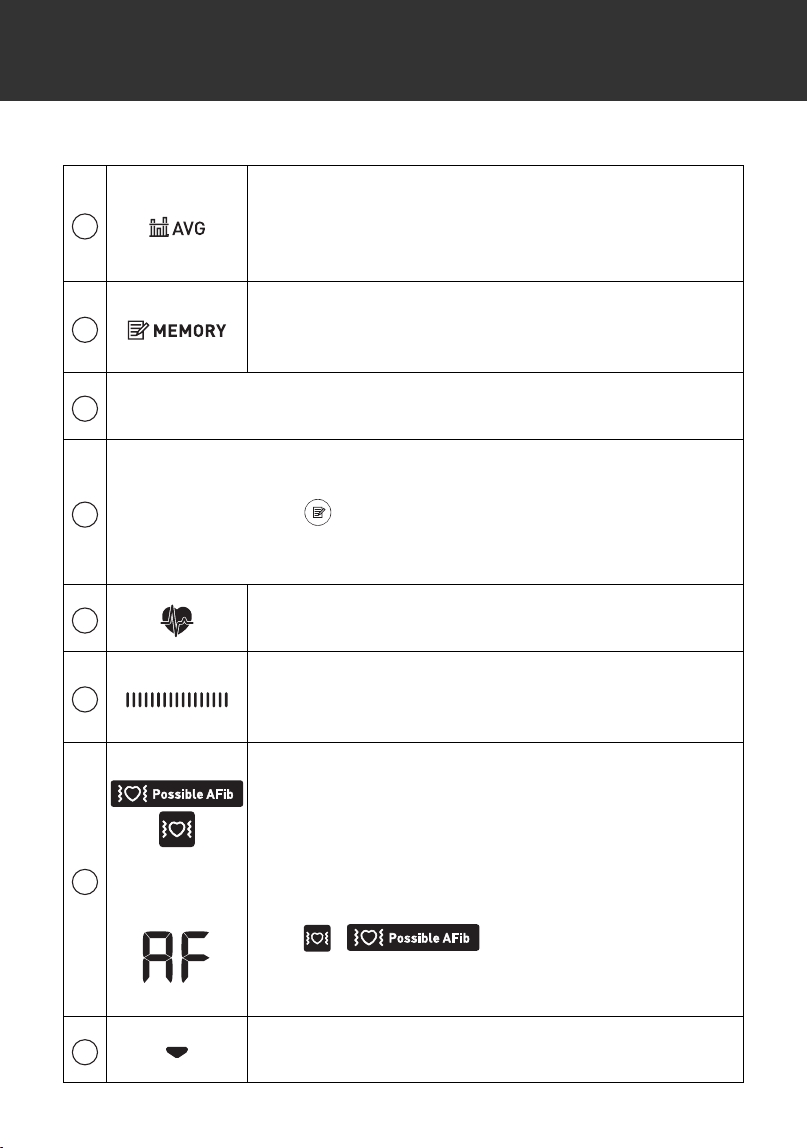
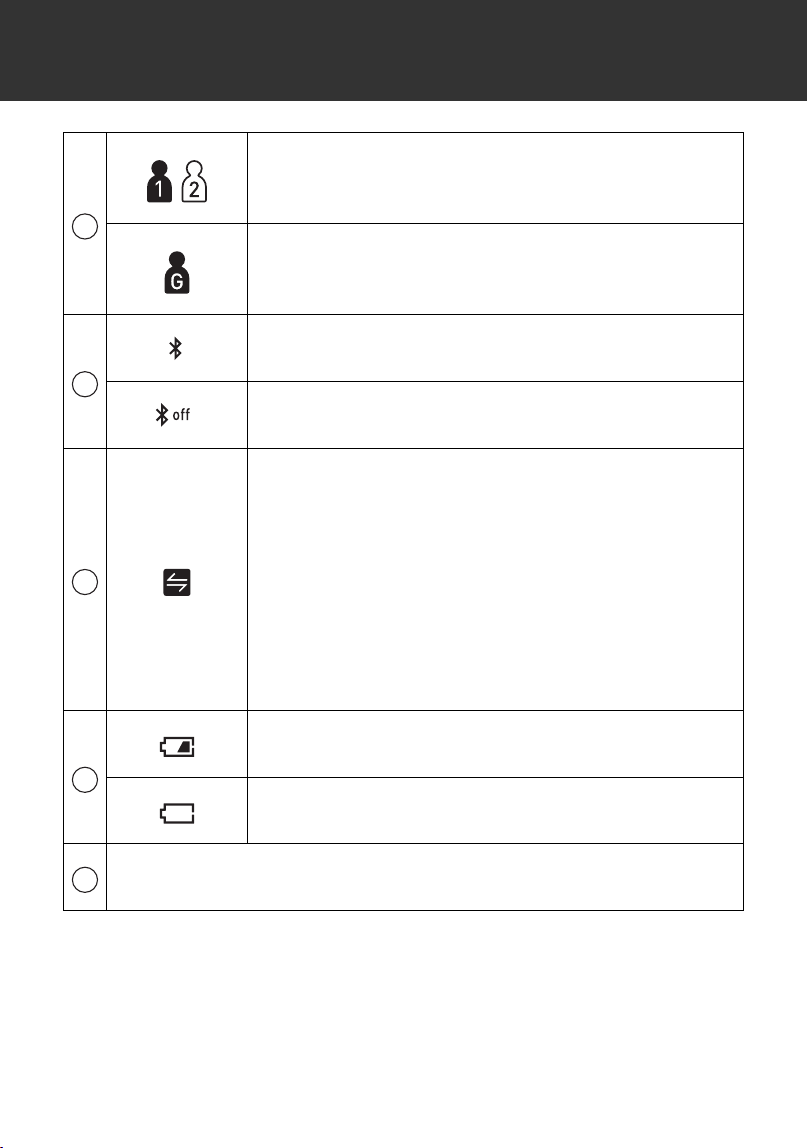
Average value symbol
Flashes when viewing the average of the latest 2 or 3
readings taken within the
most recent 10 minute
timeframe.
Memory symbol
Appears when viewing readings stored in the
memor
y.
Comparison display
Displa
ys past readings. Refer to section 5 for more information.
Pulse display / Memory number
• Pulse rate from the past reading appears.
• When pressing the button, the memory number appears for
approximately 2 seconds before the pulse rate appears on the
displa
y.
Heartbeat symbol
Fl
ashes while taking a measurement.
Pulse level
Moves along with the pulse strength detected while
deflating
.
flashes with
the display as
belo
w
Possible AF
ib detector symbol
Flashes when a possibility of AFib is detected.
Generally, blood pressure and pulse rate measured
during AF
ib cannot be reliable.
Therefore, the readings
are not displayed when a possibility of AFib is
detected.
Consult with your physician if your results include
the “ / ” symbol.
For more information regarding AFib, refer to
section 12.
Deflation symbol
Appears during cuff deflation.
A
B
C
D
E
F
G
H
12
1. Know Your Monitor
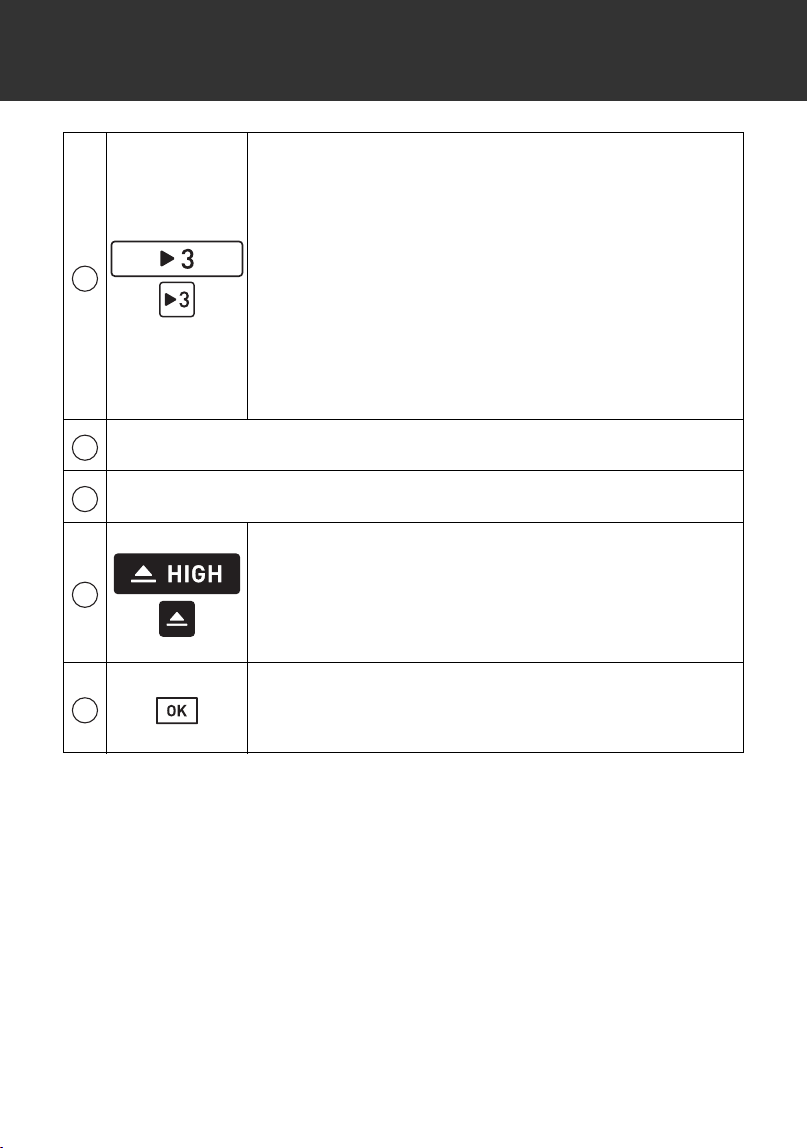
User ID (1 or 2) symbol
The user ID number appears when selecting the user
with the [User ID 1] or [User
ID 2] button.
User ID Guest symbol
The user ID “G” appears when your monitor is in the
guest mode. Refer to sub-sec
tion 3.3 for details.
Bluetooth ON symbol
Appears when your readings are being transferred.
Bluetooth OFF symbol
Appears when Bluetooth is disabled.
Sync symbol
• Flashes when the stored memory is almost full, or
the dat
e and time a
re not set.
• Appears when the stored memory is completely
fu
ll.
Once you
pair your monitor with your smart device,
tr
ansfer y
our readings immediately before the
monitor deletes the oldest reading. Up to 100
readings can be stored in the internal memory of
your monitor per user.
Low battery symbol
Flashes when batteries are low.
Depleted battery symbol
Appears when batteries are depleted.
Date / Time display /
Consecutive measurement number for TruRead
I
J
K
L
M
1. Know Your Monitor
13
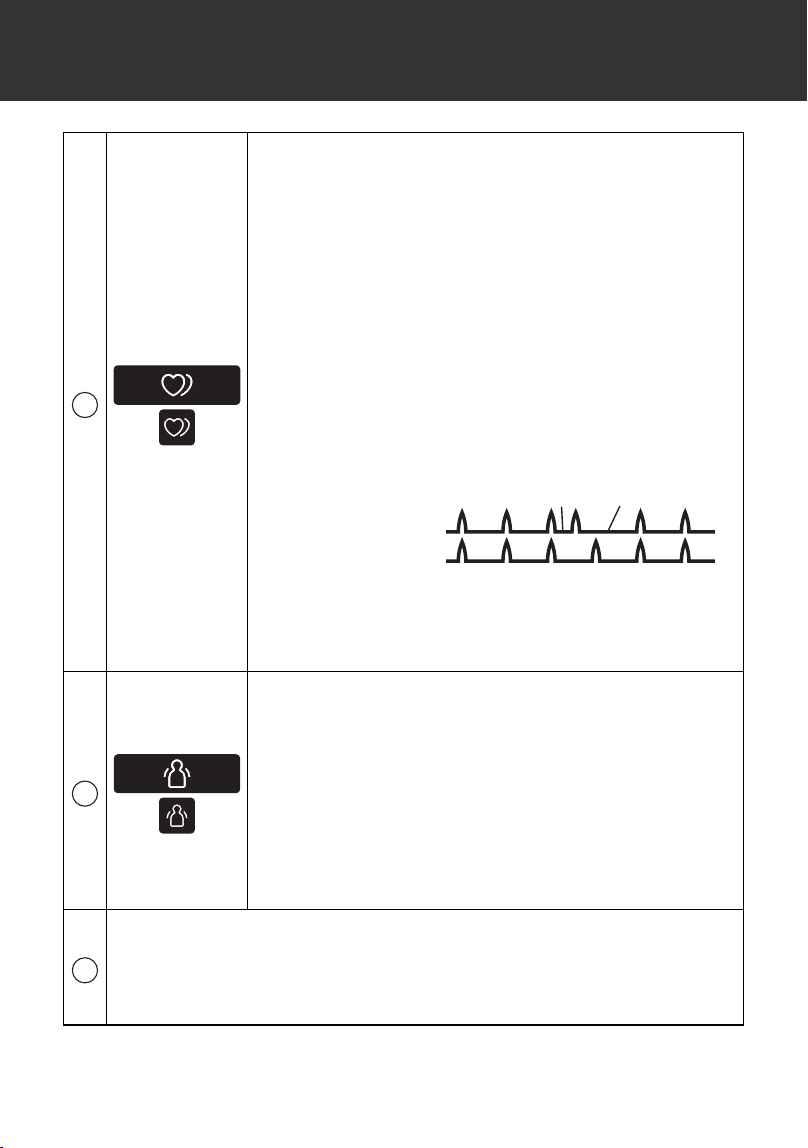
TruRead symbol
Appears when a measurement is taken if the TruRead
mode is enabled.
The T
ruRead mode automatically takes 3 consecutive
r
eadings at inte
rvals you can customize and displays
the average.
To set the interval of the
TruRead mode
, refer to
sub-section 2.4.
To use the TruRead mode, refer to sub-section 3.2.
To view your readings in TruRead measurement, refer
to sub-section 5.1.
Systolic blood pressure reading
Diastolic blood pressure reading / AF
High symbol
Appears if your systolic blood pressure is
≥ 130 mmHg or the diastolic blood pressure is
≥ 80 mmHg. Refer to sub-section 1.4 for more
information.
OK symbol
Flashes when your monitor is connected to your
smar
t device or re
adings are transferred successfully.
N
O
P
Q
R
14
1. Know Your Monitor
Irregular heartbeat symbol
• Appears when irregular rhythm is detected 2 or
more times during a
measurement.
• This symbol will not appear when viewing the
a
verage
readings (except for the TruRead mode).
• This symbol may be displayed when the monitor
det
ects arm
movements while taking a
measurement. Refer to section 7 for more
information.
An irregular heartbeat rhythm is defined as a rhythm
that is
25 % less or 25 % mor
e than the average
rhythm det
ected while your monitor is measuring
blood pressure.
If it continues to appear, it is recommended that
you consult wi
th, and follow the directions of
your physician.
Movement error symbol
Appears with your reading when your body is
mo
ving during a measurement.
If it appears, remove
the arm cuff and wait for about 1 minute. Then,
reapply the cuff, remain still and take another
measurement.
(This function is disabled when
a possibility of AFib
or
irregular heartbeat is detected during a
measurement.)
Pulse display / Interval counter for TruRead
• Pulse rate appears after the measurement.
• Counts the seconds for next TruRead during TruRead
measur
ement.
S
Short
Long
Irregular Heartbeat
Normal Heartbeat
T
U
1. Know Your Monitor
15
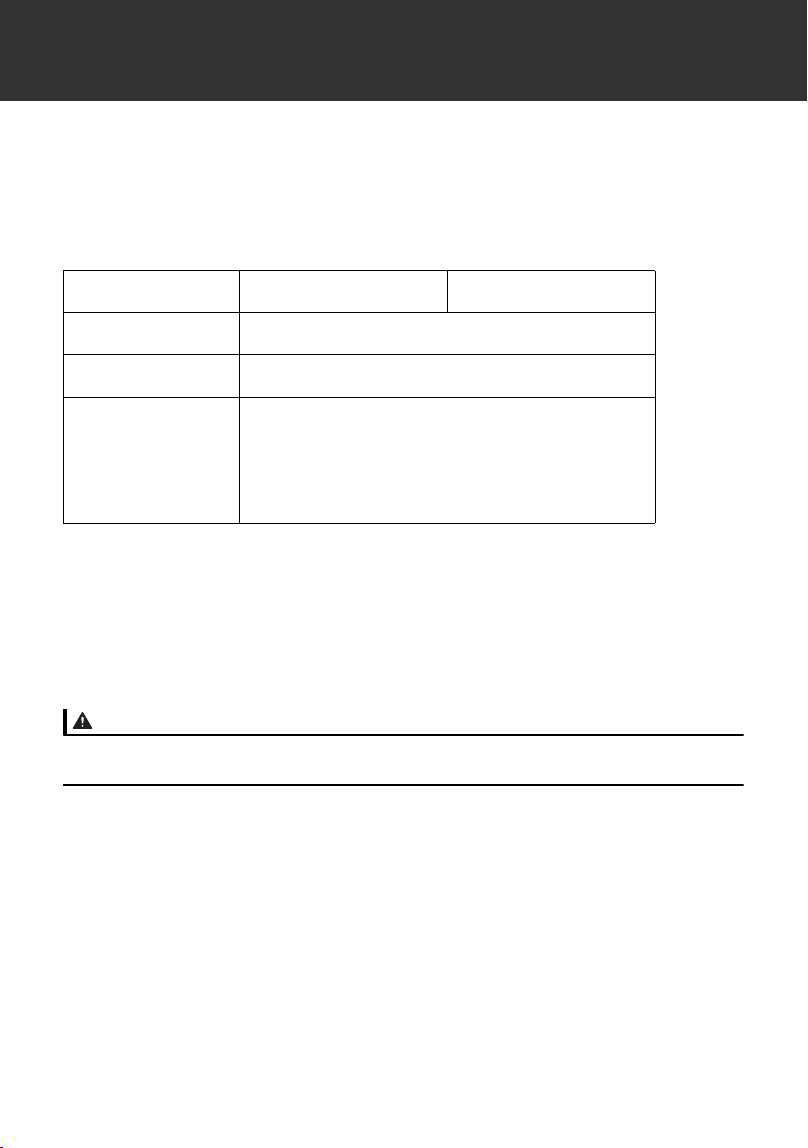
1.4 Classification of BP (Blood Pressure)
ACC/AHA 2017 Hypertension guidelines define categories of BP in adults
as below.
Categories of BP in Adults*
Warning
•
NEVER
diagnose or treat yourself based on your readings.
ALWAYS consult with your
physician.
BP Category Systolic BP Diastolic BP
Normal < 120 mmHg and < 80 mmHg
Elevated 120 - 129 mmHg and < 80 mmHg
Hypertension
Stage 1 130 - 139 mmHg or 80 - 89 mmHg
Stage 2 ≥ 140 mmHg or ≥ 90 mmHg
* Individuals with Systolic BP and Diast
olic BP in 2 categories should be
designated to the higher BP category.
BP indicates blood pressure (based on an average of ≥ 2 careful readings
obtained on ≥ 2 occasions).
Source: ACC/AHA 2017 High Blood Pressure Clinical Practice Guideline
< 120 mmHg and < 80 mmHg
120 - 129 mmHg and < 80 mmHg
130 - 139 mmHg or 80 - 89 mmHg
≥ 140 mmHg or ≥ 90 mmHg
16
2. Preparation
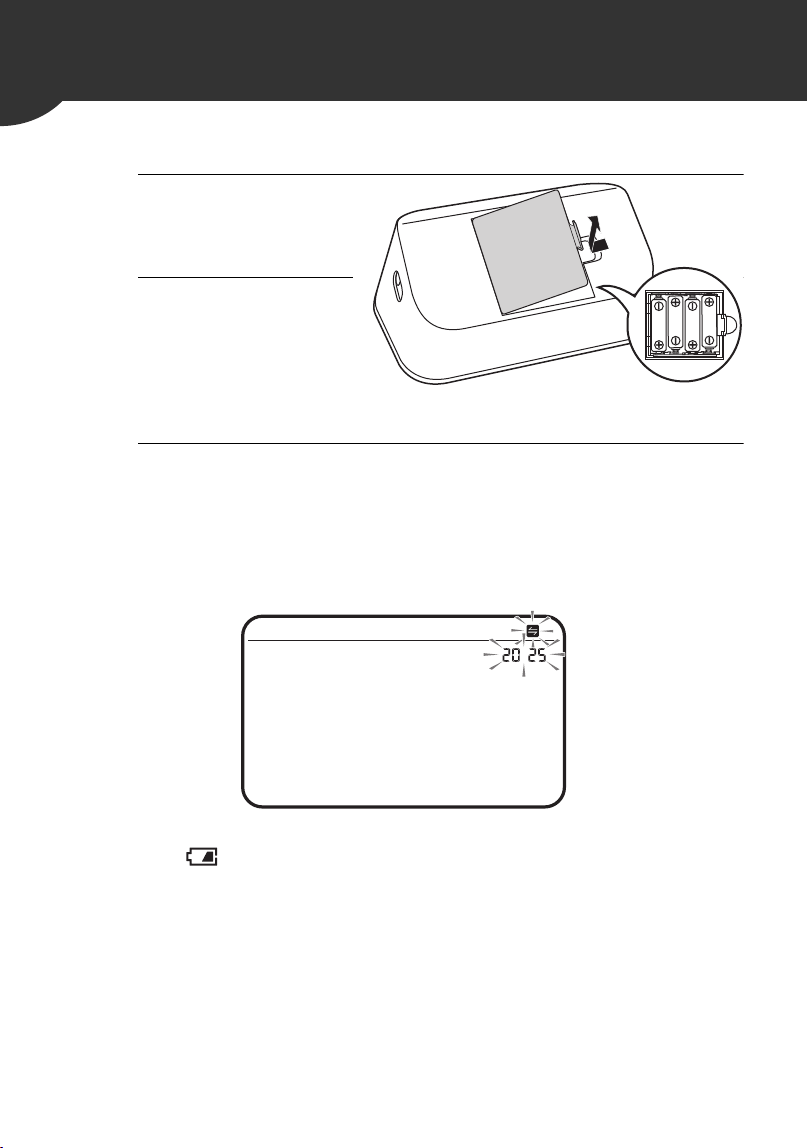
2.1 Installing Batteries
1. Remove the
battery cover.
2. Insert 4 “AA”
batteries as
indicated in the
battery
compartment.
3. Close the battery cover.
As soon as the batteries are correctly installed, the year flashes on
the display.
Refer to sub-section 2.3 to set the date and time manually, or refer
to sub-section 4.1 to pair your monitor with a smart device to set
the date and time automatically.
Note
• When the “ ” symbol flashes on the display, it is recommended that
you replace the batteries.
• To replace the batteries, turn your monit
or off and remov
e all batteries.
Then replace with 4 new batteries at the same time.
• Replacing the batteries will not delete pr
evious readings.
• T
he supplied batteries may have a shorter life span
than new batteries.
• Disposal of used batteries should be carried out in accord
ance with local
regulations.
2. Preparation
17
2.2 Using the AC Adapter
Note
• Make sure not to place your monitor in a location where it is difficult to
plug and unplug the AC adapter.
• It is recommended that you keep the batteries in your monitor at all
times, ev
en if you choose to use the AC adapter. If only the AC adapter is
used without keeping the batteries in your monitor, you may need to
reset the date and time each time you unplug and plug back the AC
adapter. The readings will not be deleted.
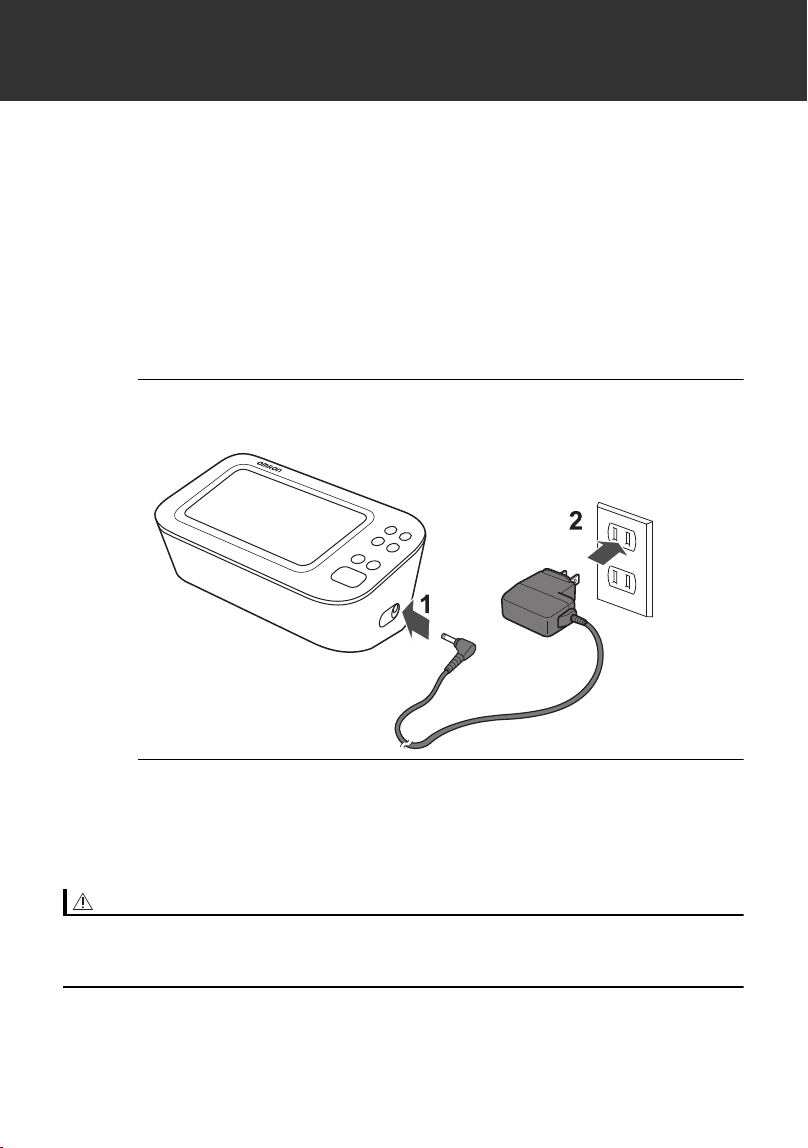
1. Insert the AC adapter plug into the AC adapter jack
on the right side of your monitor.
2. Plug the AC adapter into an electrical outlet.
To unplug the AC adapter, unplug the AC adapter from the
electrical outlet and then remove the AC adapter plug from the
monitor.
Caution
• ONLY use the AC adapter, arm cuff, batteries and accessories specified for this monitor.
Use of unsupported AC adapters, arm cuffs and batteries may damage and/or may be
hazardous to this monitor.
18
2. Preparation
2.3 Setting the Date and Time
Note
• Set your monitor to the correct date and time before taking a
measurement for the first time.
• The date and time will automatically be set when the monitor is paired
with the compatible OMRON app. Refer to sub-section 4.1.
• As soon as the batteries are correctly installed, the year flashes on the
displa
y of your monitor.
•
DO NOT PRESS THE [
START/STOP] BUTTON to set and confirm the
date and time.
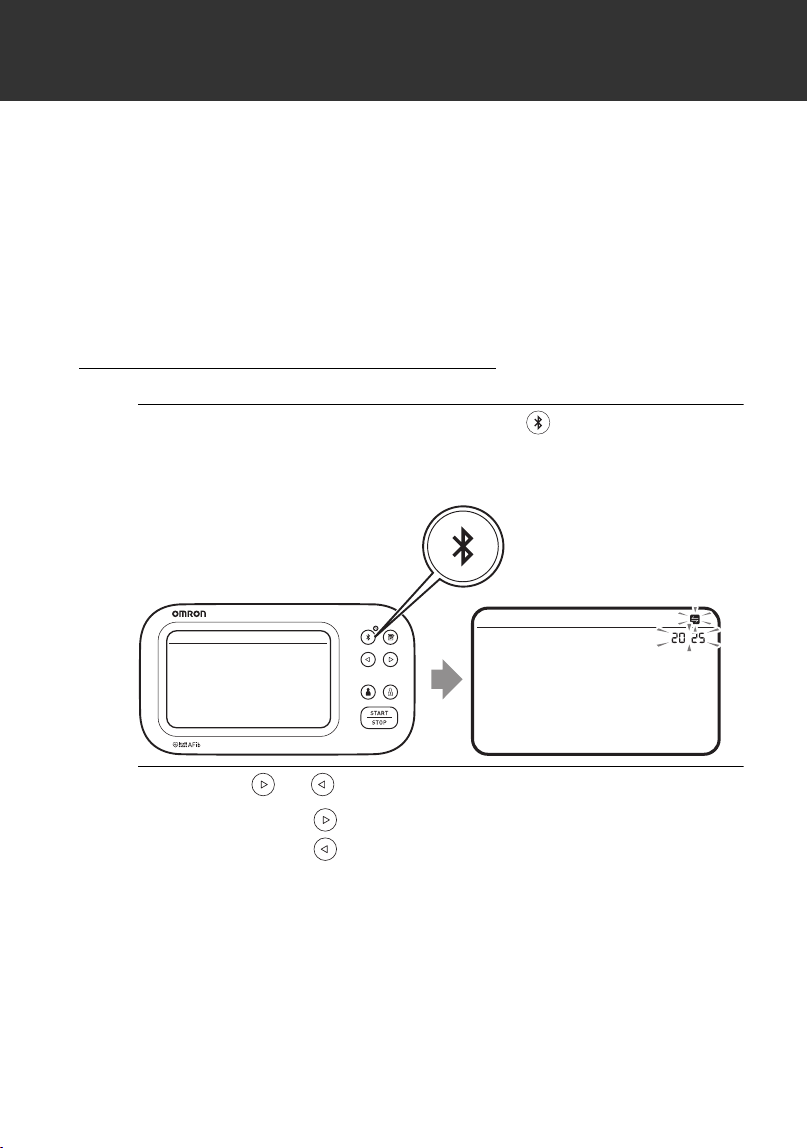
1. If nothing is displayed, press the button to
display the year.
If the year is already displayed, skip this step.
2. Press the or button to adjust the year.
Press and hold the button to quickly advance the years.
Press and hold the button to quickly go backwards through
the years.
2. Preparation
19
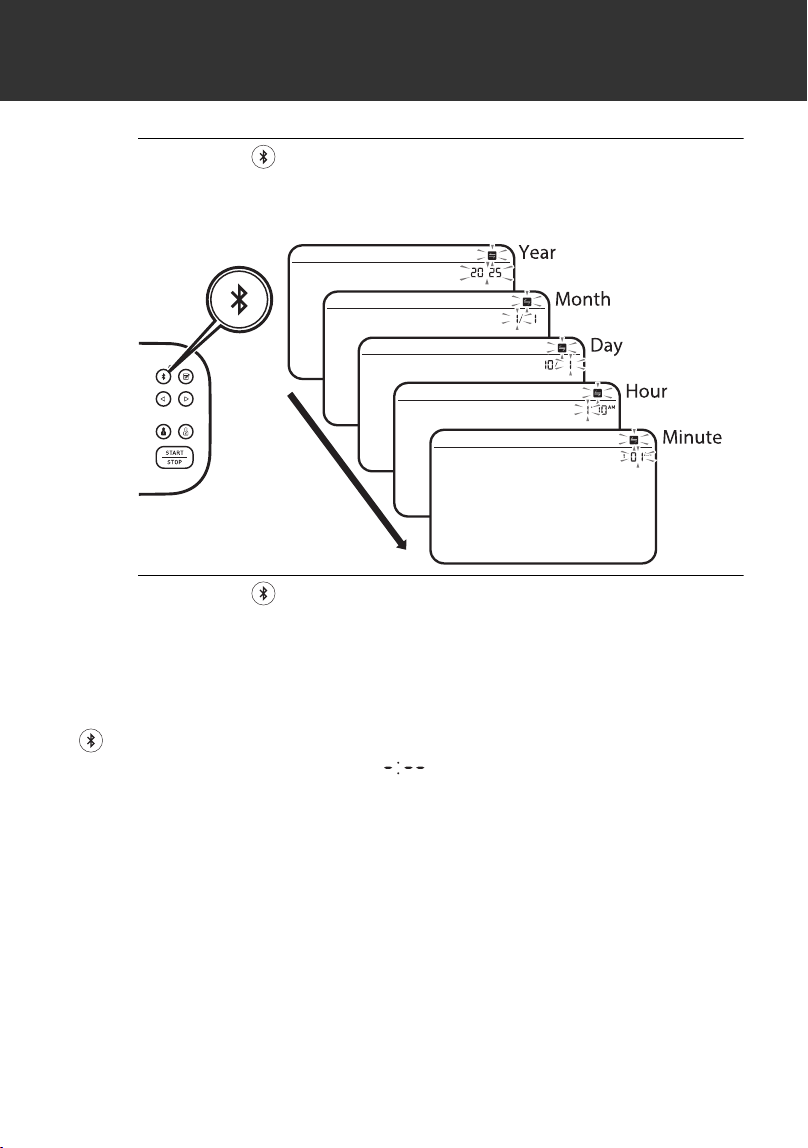
3. Press the button to confirm the year, then the
month will flash. Repeat the same steps to adjust
the month, day, hour, and minute.
4. Press the button to store the setting.
TruRead mode setting is displayed 3 seconds after the minutes
have been set in this sequence. Refer to sub-section 2.4.
Note
• If you need to reset the date and time, replace the batteries or press the
button, then set the date and time as shown in the above steps.
• If the date and time are not set, “ ” flashes during or after
measurement.
20
2. Preparation
2.4 Setting the Interval of the TruRead Mode
The TruRead mode takes 3 consecutive measurements. The monitor will
take a measurement 3 times, separated by a short interval between each
measurement.
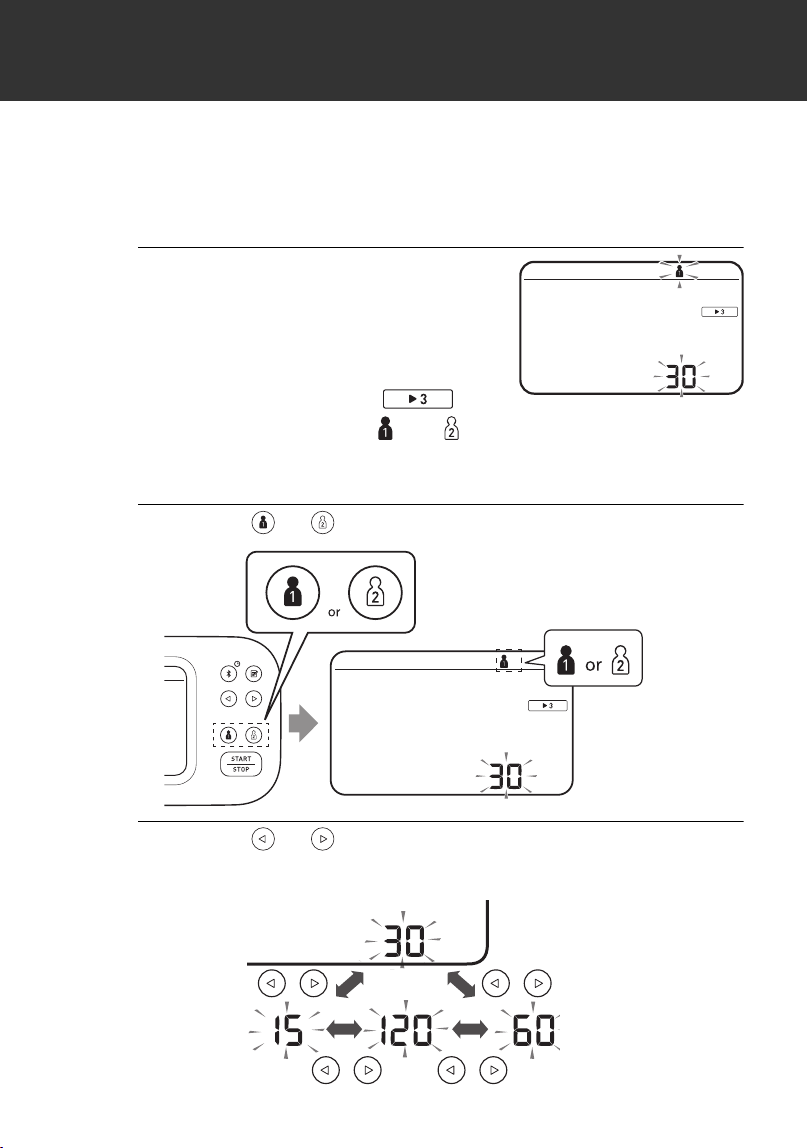
1. Set or bypass the date and
time settings.
Follow the steps in sub-section 2.3 and
set or bypass the date and time
settings.
After it is completed, the “ ”
symbol appears and the “ ” or “ ” symbol and the interval
setting flash on the display.
The interval setting is 30 seconds as default.
2. Press the or button to select your user ID.
3. Press the or button to change the interval.
It can be set 15, 30, 60, or 120 seconds.
2. Preparation
21
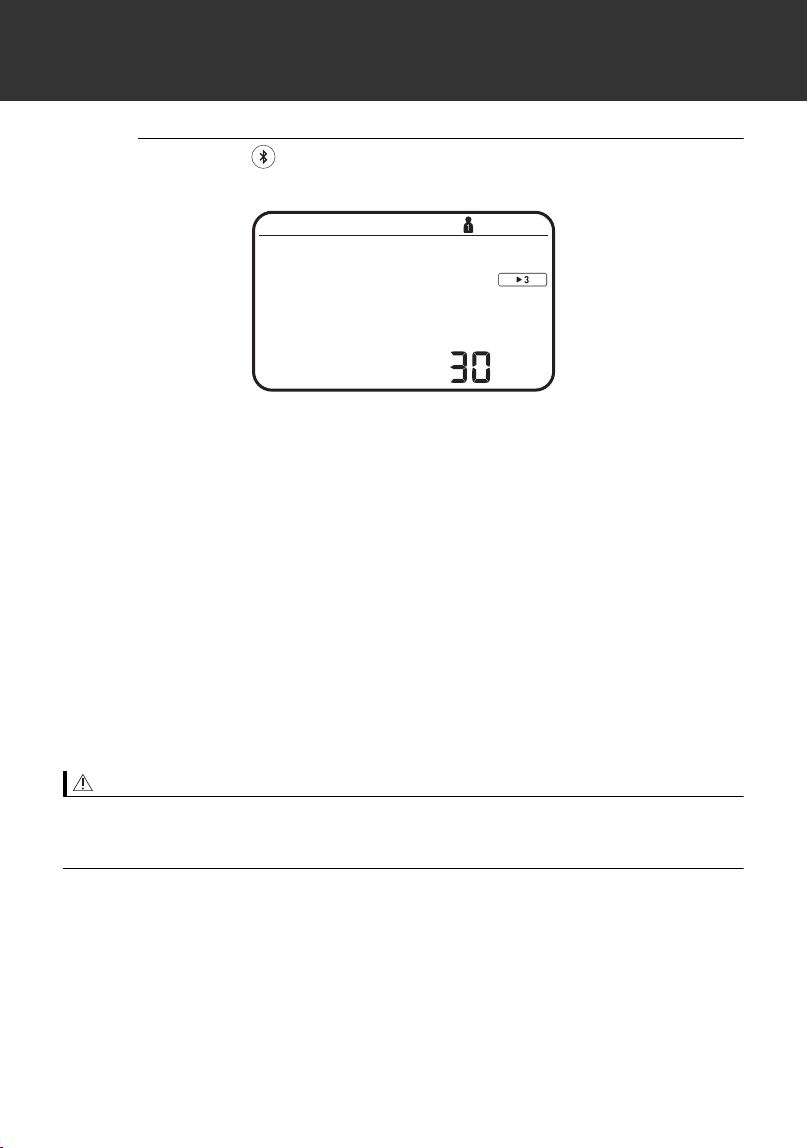
4. Press the button to confirm.
Your monitor will automatically turn off in a second.
To take a measurement in TruRead mode, refer to “Using the
TruRead Mode” in sub-section 3.2.
2.5 Blood Pressure Measurement Tips
To help ensure an accurate reading, follow these directions:
• Stress raises blood pressure. Avoid taking measurements during
stressful times.
• Measurements
should be taken in a quiet place.
• It is important to take measurements at the
same times each day.
Taking
measurements in the morning and in the evening is recommended.
• Remember to have a record of your blood pressure and pulse readings
fo
r your p
hysician. A single measurement does not provide an accurate
indication of your true blood pressure. You need to take and record
several readings over a period of time.
Caution
• Avoid bathing, drinking alcohol or caffeine, smoking, exercising and eating for at least
30 minutes before taking a measurement.
• Rest for at least 5 minutes before taking a measurement.
22
2. Preparation
2.6 Applying the Arm Cuff
Note
• The following steps are for applying the arm cuff to your left arm.
• To take a measurement on your right arm, follow the cuff and tube
placement instructions for use on your right arm mentioned under “To
take a measurement on your right arm” located at the end of this
sub-section.
• Blood pressure can differ between th
e right arm and the left arm, and
the measured blood pressure readings can be different. It is
recommended that you always use the same arm for measurement. If
the readings between both arms differ substantially, check with your
physician to determine which arm to use for your measurements.
Caution
• Remove tight-fitting or thick clothing from your arm while taking a measurement.
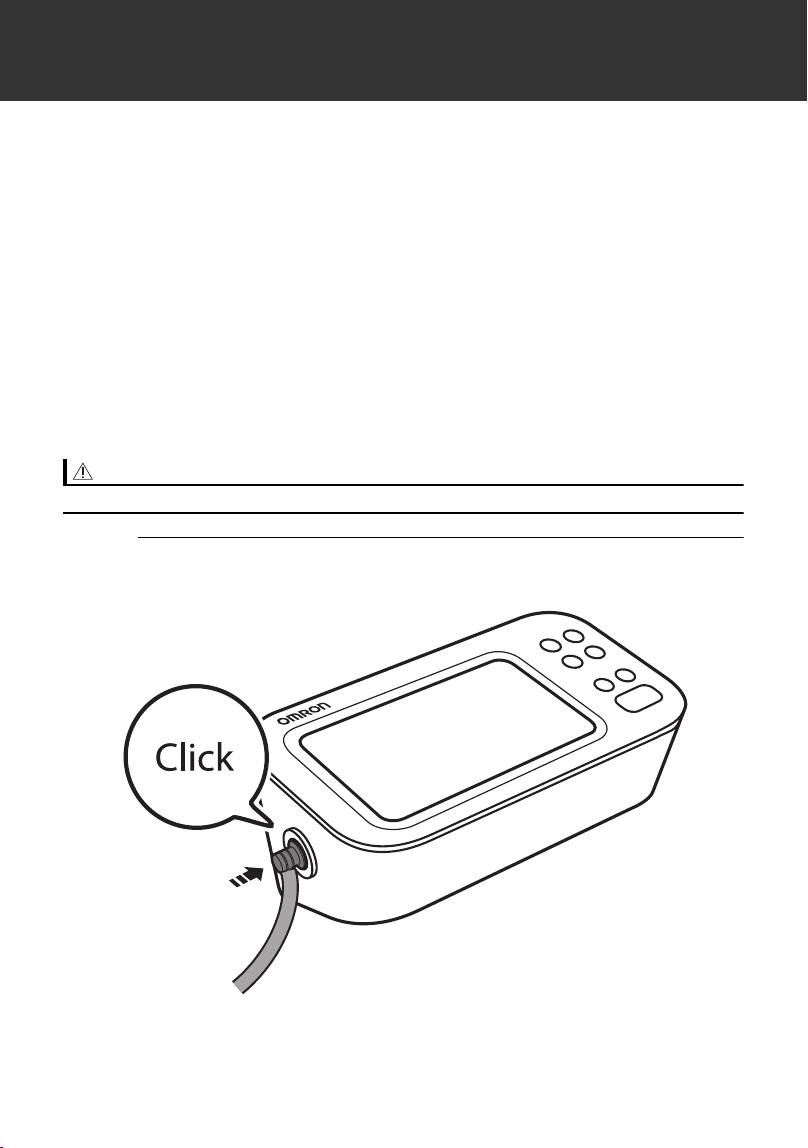
1. Plug the arm cuff into your monitor by inserting
the air plug into the air jack securely until it clicks.
2. Preparation
23
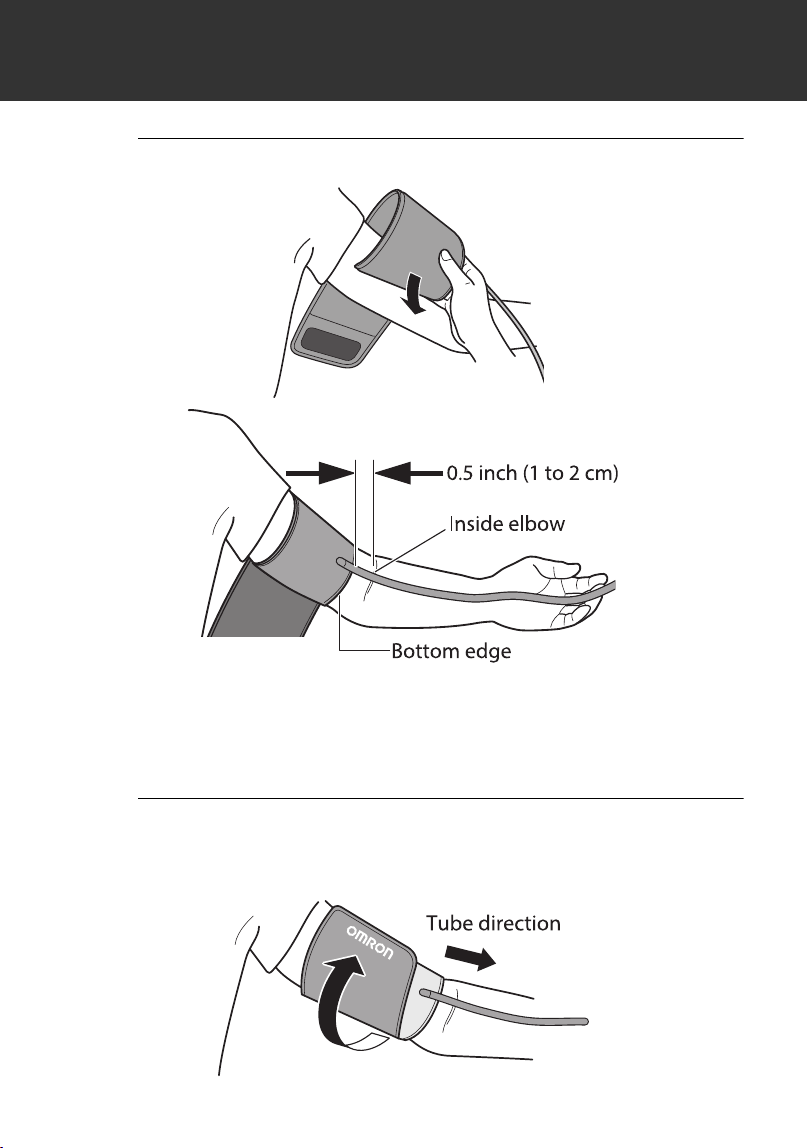
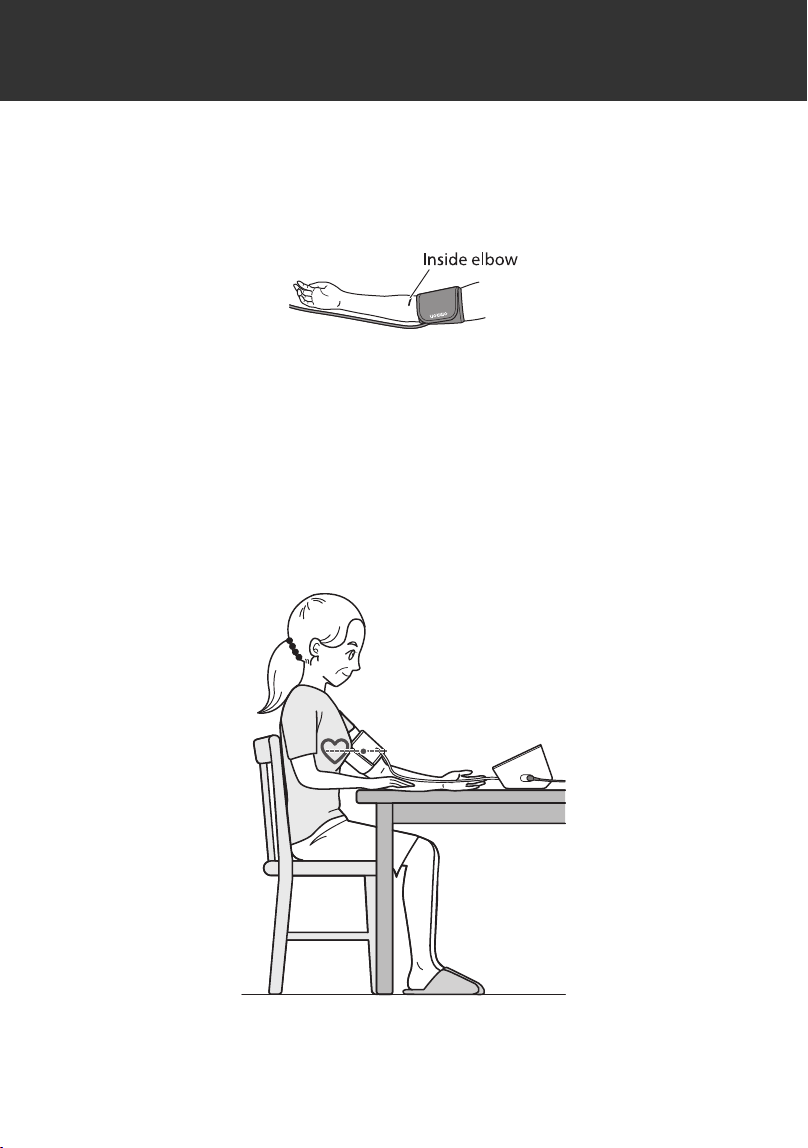
2. Apply the arm cuff to your left upper arm.
Note
• The bottom edge of the arm cuff should be 0.5 inch (1 to 2 cm)
above the inside elbow. The air tube is on the inside of your arm
(palm facing up) and aligned with your middle finger.
• Arm cuff circumference: 9" - 17" (22 - 42 cm)
3. Make sure that the air tube is positioned on the
inside of your arm and wrap the cuff securely, so it
cannot move around your arm.
24
2. Preparation
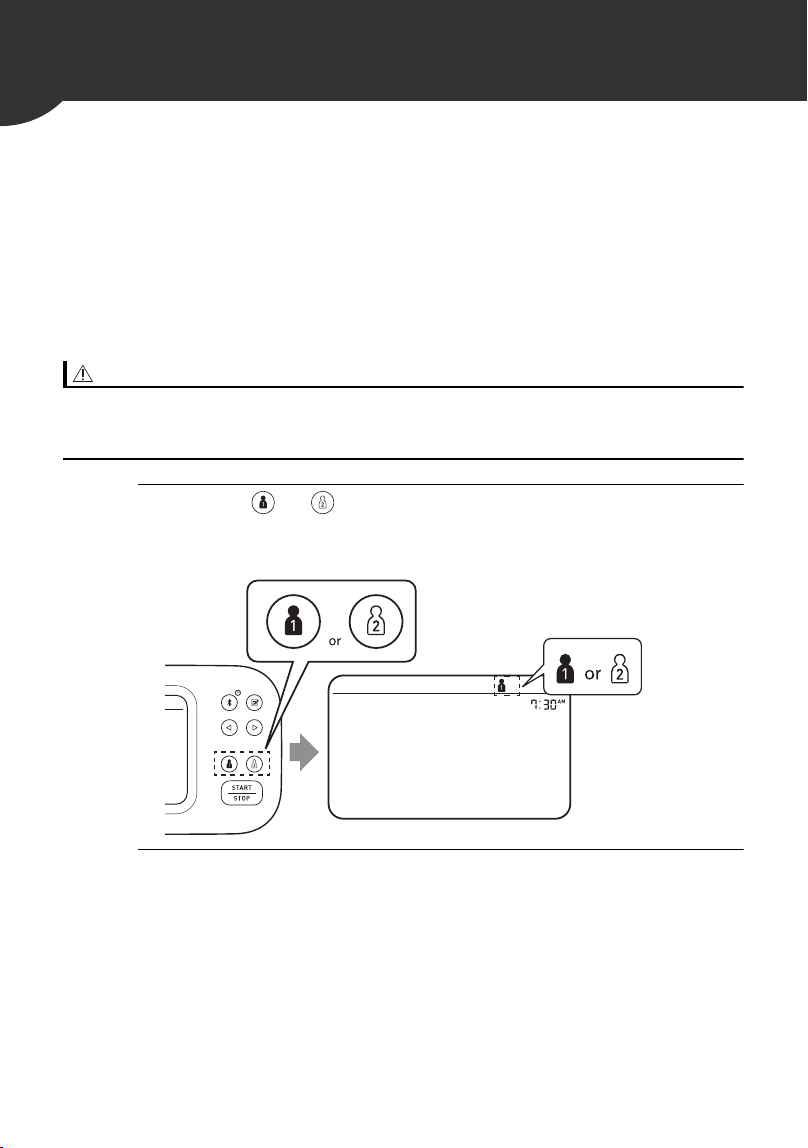
2.7 Sitting Correctly
To take a measurement, you need to be relaxed and comfortably seated in
a room with a comfortable temperature. Place your arm on the table.
• Sit in a comfortable chair with your back and arm supported.
• Keep your feet flat and your legs uncrossed.
• The arm cuff should be placed on your arm at the same level as your
hea
rt, with the arm resting comfortably on a table.
To take a measurement on your right arm
When you take a measurement on your right arm, the air tube should run
along the side of your elbow, along the bottom of your arm. Be careful
not to rest your arm on the air tube.
25
3.
Using Your Monitor without a Smart Device
3.1 Taking a Measurement
You can use your monitor without pairing to a smart device. To pair your
monitor with a smart device, refer to sub-section 4.1.
Your monitor is designed to take measurements and store the readings in
the memor
y for 2 people.
Note
• To stop the measurement, press the [START/STOP] button once to
deflate the arm cuff.
Caution
•
DO NOT
use this monitor with other medical electrical (ME) equipment simultaneously.
This may result in incorrect operation of the devices and/or cause an inaccurate reading.
• Remain still and
DO NOT
talk while taking a measurement.
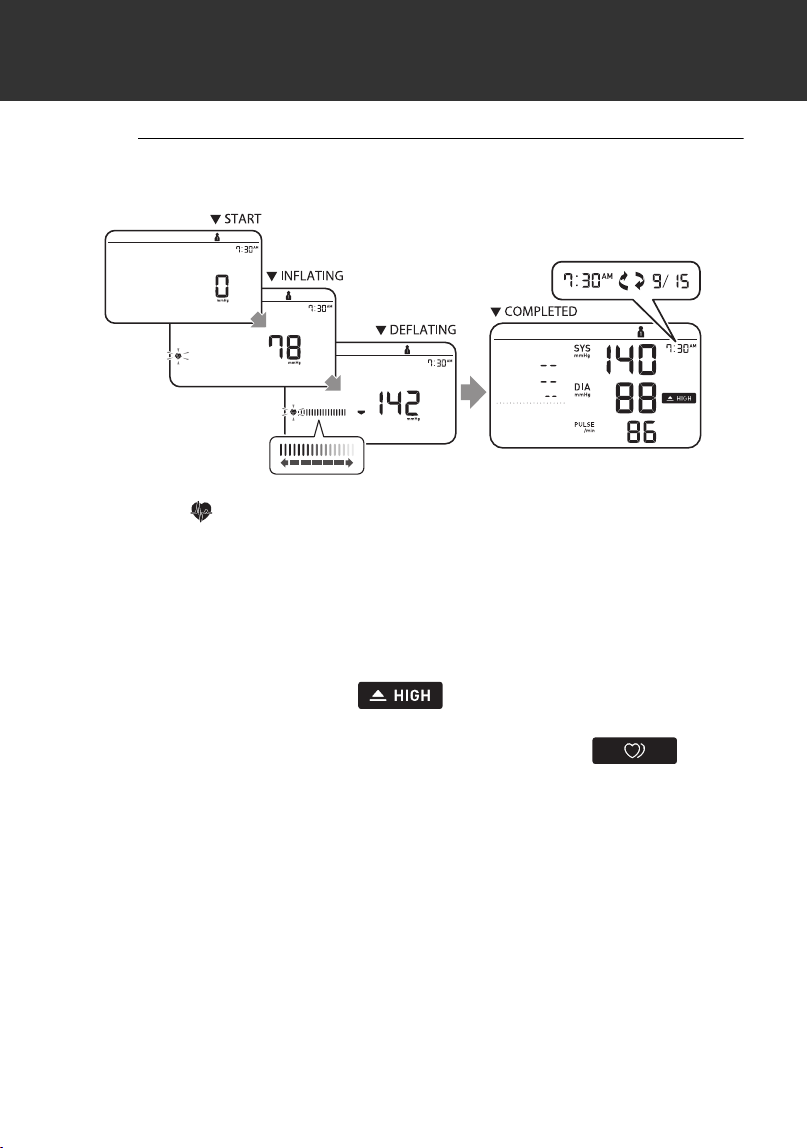
1. Press the or button to select your user ID.
All symbols except the battery symbol appear, then the selected
user ID appears on the display.
2. Press the [START/STOP] button.
The arm cuff starts to inflate automatically.
26
3. Using Your Monitor without a Smart Device
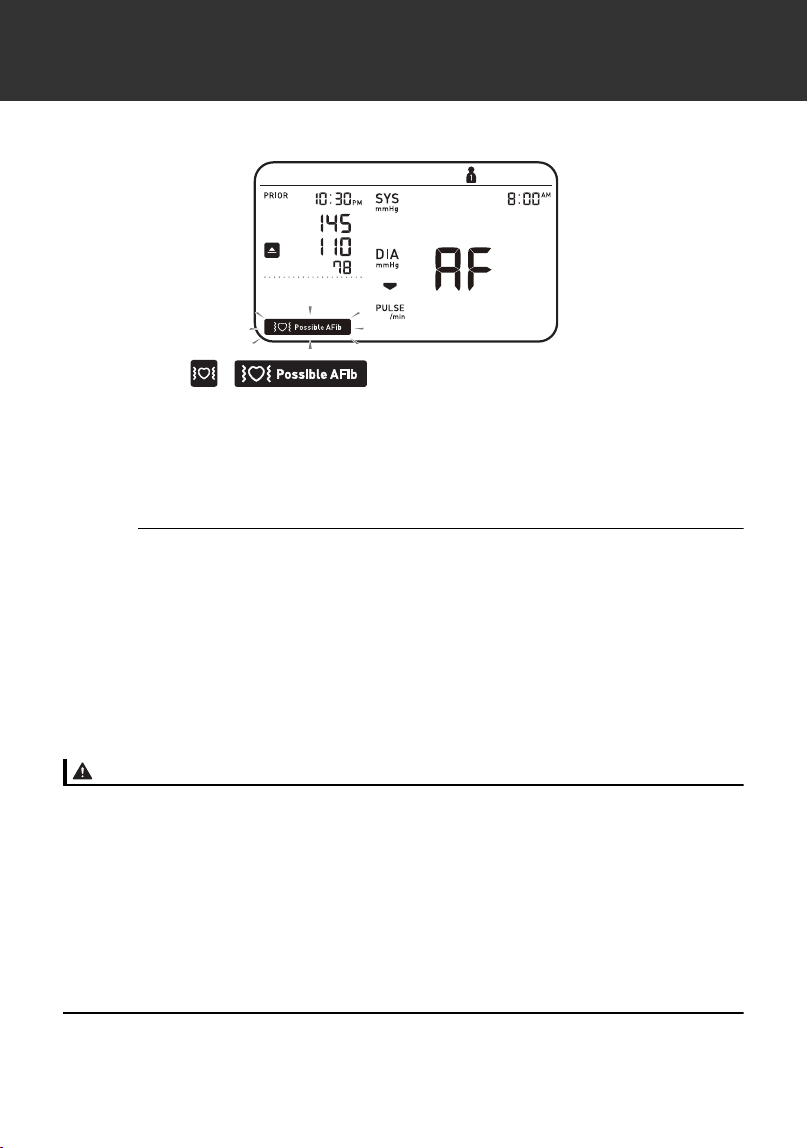
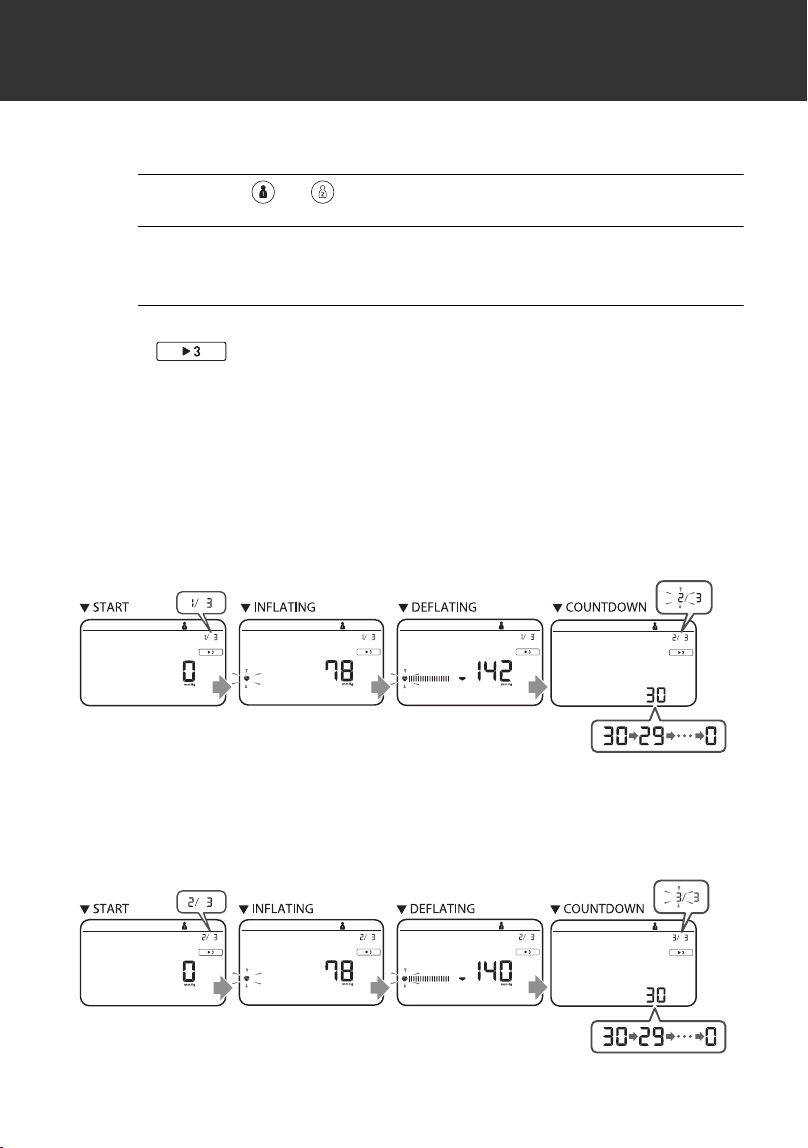
3. Remain still and do not talk until the entire
measurement process is complete.
The “ ” symbol flashes at every heartbeat.
The pulse level moves along with the pulse strength detected
while deflating.
When the measurement is complete, your blood pressure and
pulse
rate are displayed and the time/date appear alternately.
Note
• If either the systolic or the diastolic reading is high (refer to
sub-section 1.4), the “ ” symbol appears.
• If irregular rhythm is detected 2 or more times during a
measurement, the irregular heartbeat symbol “ ”
appears on the display.
3. Using Your Monitor without a Smart Device
27
If the monitor detects a possibility of AFib...
The “ / ” symbol flashes on the display.
Generally, blood pressure and pulse
rate me
asured during AFib
cannot be reliable. Therefore, the readings are not displayed
when a possibility of AFib is detected.
This is not a diagnosis. It is only a potential finding for AFib.
Y
ou should contac
t your physician to discuss the findings.
4. Press the [START/STOP] button to turn your
monitor off.
Note
• Your monitor automatically turns off after 2 minutes.
• Wait about 1 minute between measurements. The wait time
allows the arteries to return to their pre-measurement state. You
may need to increase the wait time depending on your
individual physiological characteristics.
Warning
• This monitor is
not intended for the diagnosis, treatment, or management of AFib.
•
DO NOT adjust medication
(including altering your use of any drug or treatment) based
on readings from this blood pressure monitor.
Take medication as prescribed by your
physician.
ONLY a physician is qualified to diagnose and treat high blood pressure and
heart related conditions.
•
NEVER
diagnose or treat yourself based on your readings.
ALWAYS consult with your
physician.
• If you are experiencing any symptoms or concerns,
consult with your physician.
•
DO NOT
postpone/stop regular checkups or physician visits based on the results that you
are getting from this monitor.
28
3. Using Your Monitor without a Smart Device
3.2 Using the TruRead Mode
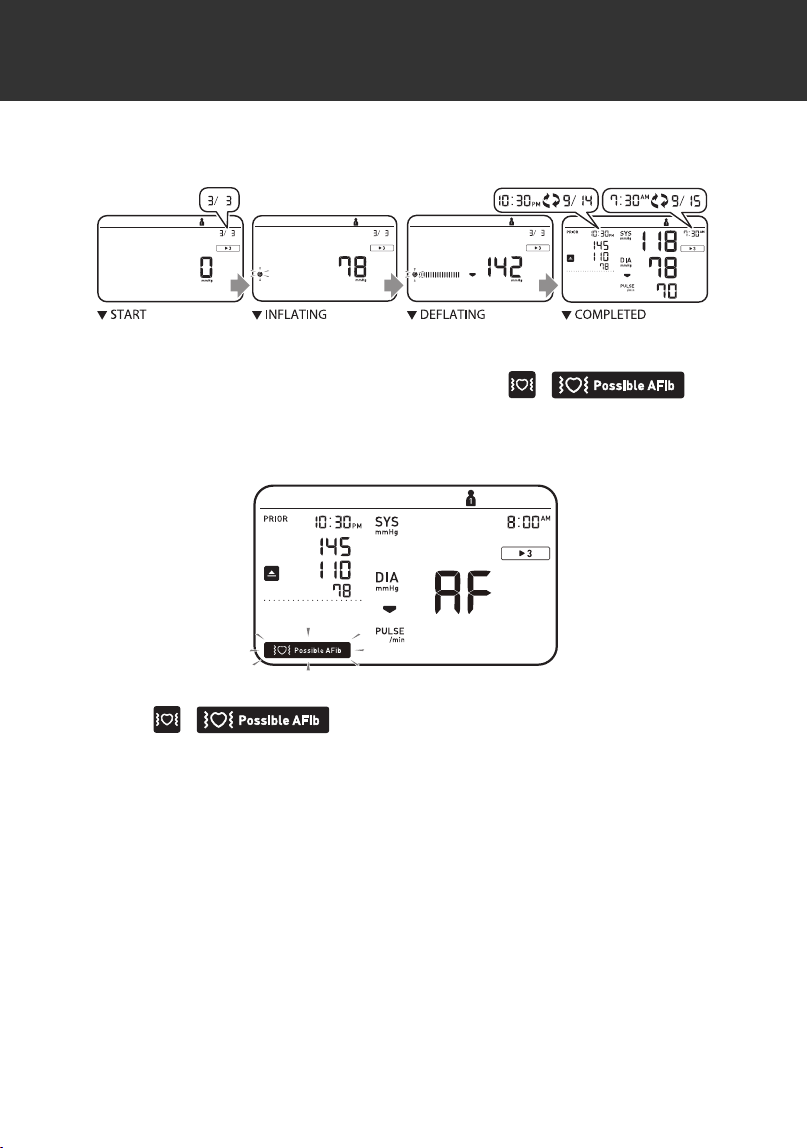
1. Press the or button to select your user ID.
2. Press and hold the [START/STOP] button for more
than 2 seconds.
3. Release the [START/STOP] button when the
“ ” symbol appears on the display.
The arm cuff starts to inflate automatically.
After the first measurement is complete, wait for the next
measurement to start.
The interval you selected during TruRead settings will appear on
the displa
y.
Note
• To change the interval of the measurements, refer to
sub-section 2.4.
After the second measurement is complete, wait for the next
measurement
to start.
The interval you selected during TruRead settings will appear on
the displa
y.
3. Using Your Monitor without a Smart Device
29
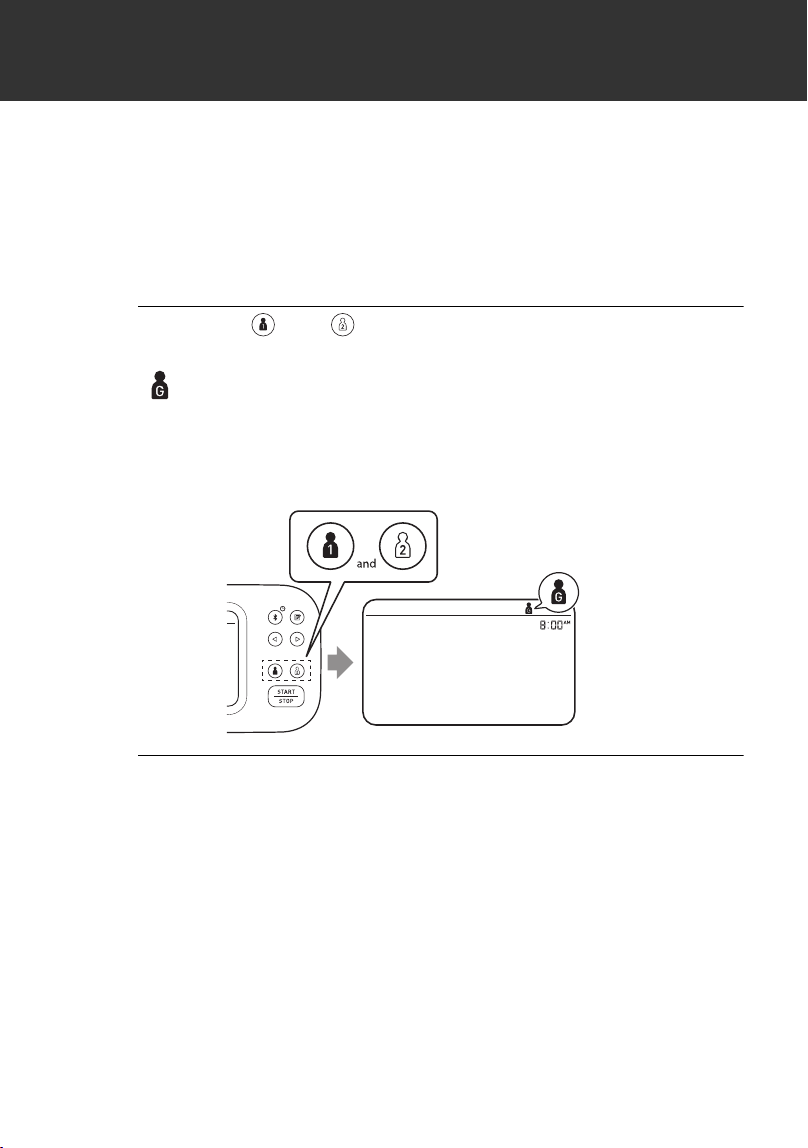
After the third measurement is complete, the average for the 3
measurements appears on the display.
If the monitor detects a possibility of AFib during a
measur
ement in TruRead mode, the “ / ”
symbol will flash and blood pressure and pulse rate readings
will not be displ
ayed. Generally, blood pressure and pulse rate
measured during AFib cannot be reliable.
Consult with your physician if your results include the
“ / ” symbol.
For more information regarding AFib, refer to section 12.
To view readings in TruRead measurement, refer to
sub-section 5.1.
30
3. Using Your Monitor without a Smart Device
3.3 Using the Guest Mode
Your monitor stores readings for 2 users in the memory. The guest mode
can be used to take a single measurement for another user.
Note
• No readings are stored in the memory, and the TruRead mode is not
available when the guest mode is selected.
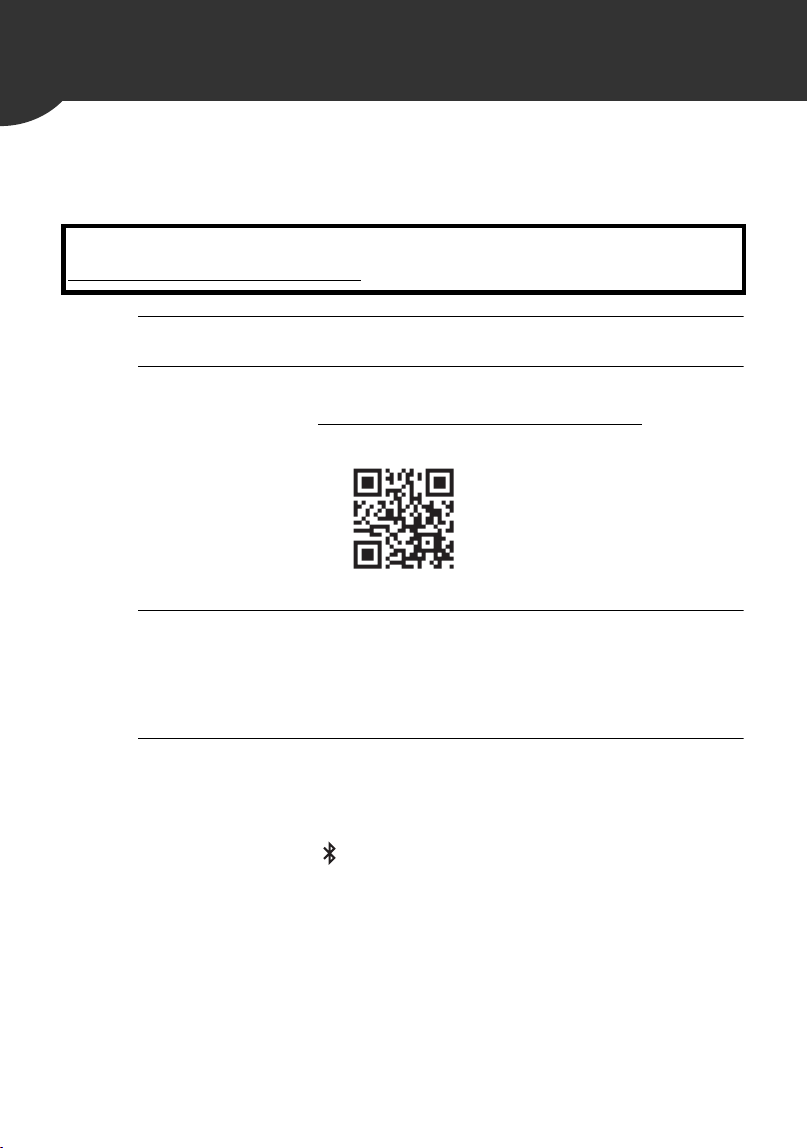
1. Press the and buttons at the same time.
All symbols except the battery symbol appear, then the user ID
“ ” symbol appears on the display.
Note
• Your monitor automatically turns off after 2 minutes if you do
not start taking a measurement. Move to the next step before it
happens.
2. Press the [START/STOP] button.
The measurement starts automatically following the same steps
as in sub-section 3.1 “Taking a Measurement”.

3. Using Your Monitor without a Smart Device
31
If your systolic pressure is more than 210 mmHg
If your systolic pressure is more than 210 mmHg, take a measurement
manually.
After the arm cuff starts to inflate, press and hold the [START/STOP] button
un
til th
e monitor inflates 30 to 40 mmHg higher than your expected
systolic pressure.
Note
• Do not inflate above 299 mmHg.
Caution
• Inflating to a higher pressure than necessary may result in bruising of the arm where the
cuff is applied.
32
4.
Using Your Monitor with a Smart Device
4.1 Pairing Your Monitor with a Smart Device
The date and time on your monitor will automatically be set when you
pair your monitor with your smart device.
1. Enable Bluetooth on your smart device.
2. Scan the code below with your smart device
camera or visit OmronHealthcare.com/app to find
the OMRON compatible app for this product.
Please be sure to use apps provided by Google Play or App Store.
3. Download and install the compatible OMRON app
onto your smart device.
If you already have the compatible OMRON app and have created
your account, open the app and add your new monitor.
4. Open the app and follow the pairing instructions
shown on your smart device.
Note
•If your monitor's “ ” symbol appears even though you cannot
connect to your smart device or the smart device of
a shared
user of your monitor, a cybersecurity event may have occurred.
In this case, please refer to sub-section 4.3 to disable the
Bluetooth feature and refer to sub-section 6.2 to restore your
monitor to the default settings.
Review the list of compatible smart devices at
OmronHealthcare.com/connect
4. Using Your Monitor with a Smart Device
33
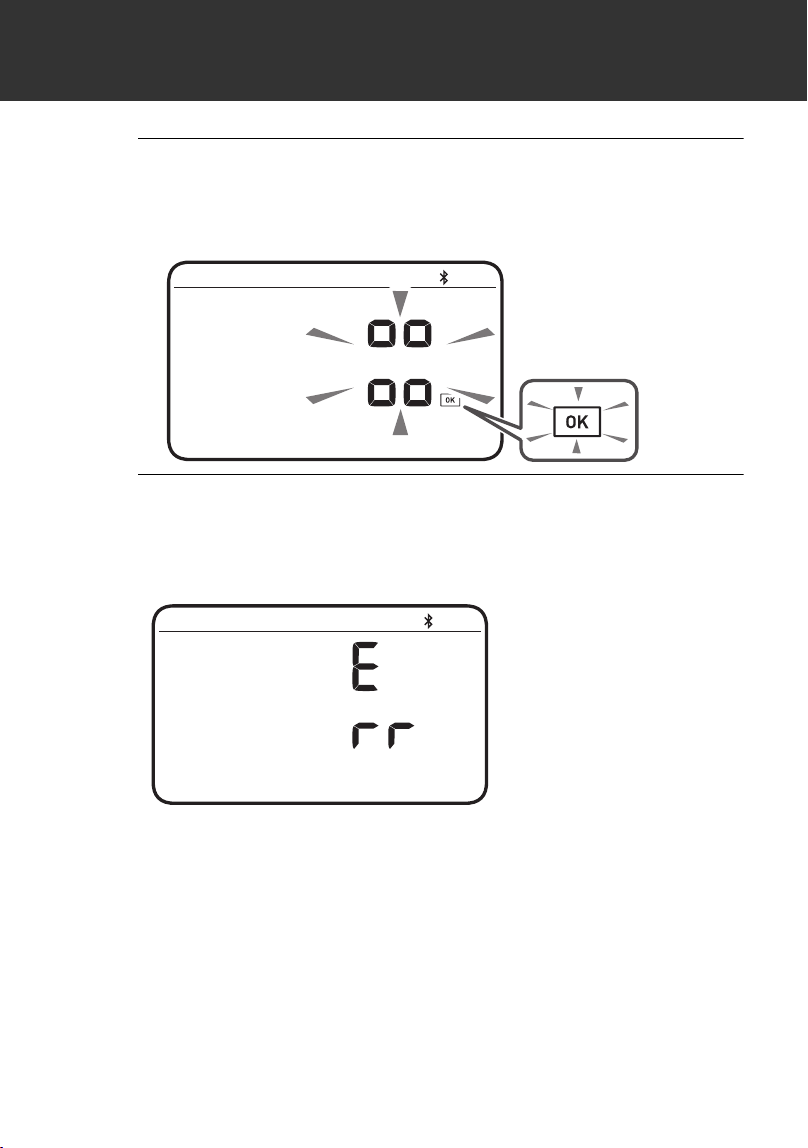
5. Confirm that your monitor is connected
successfully.
When your monitor is connected successfully to your smart
device, the OK symbol appears.
6. Press the [START/STOP] button to turn your
monitor off.
Note
• If the “Err” appears, follow the instructions in the app.
• Your monitor automatically turns off after 10 seconds.
• Be a
ware that OMRON will not be responsible for the loss of data
and/or informa
tion in the app.
• Only compatible OMRON apps should be used with this monitor
to help ensure
correct data transfer.
34
4. Using Your Monitor with a Smart Device
4.2 Taking a Measurement
Refer to sub-section 3.1 to start a measurement. Open the app on your
smart device and follow the instructions.
Caution
• During measurement, make sure that no mobile device or any other electrical device that
emits electromagnetic fields is within 12 inches (30 cm) of t
his monitor. This may result in
incorrect operation of the monitor and/or cause an inaccurate reading.
Note
•Make sure that your monitor is within 16 ft. (5 m) of your smart device.
• When Bluetooth is enabled, the readings will be transferred to your
smart device afte
r taking a measurement.
4.3 Disabling Bluetooth
Warning
• After the pairing process is completed, this product always emits radio frequencies (RF) in
the 2.4 GHz band.
DO NOT
use this product in locations where RF is restricted, such as on
an aircraft or in hospitals. Disable the Bluetooth feature in this monitor, or remove the
batteries and unplug the AC adapter when in RF restricted areas. For further information
on potential restrictions refer to documentation on the Bluetooth usage by the FCC.
Bluetooth is enabled as default.
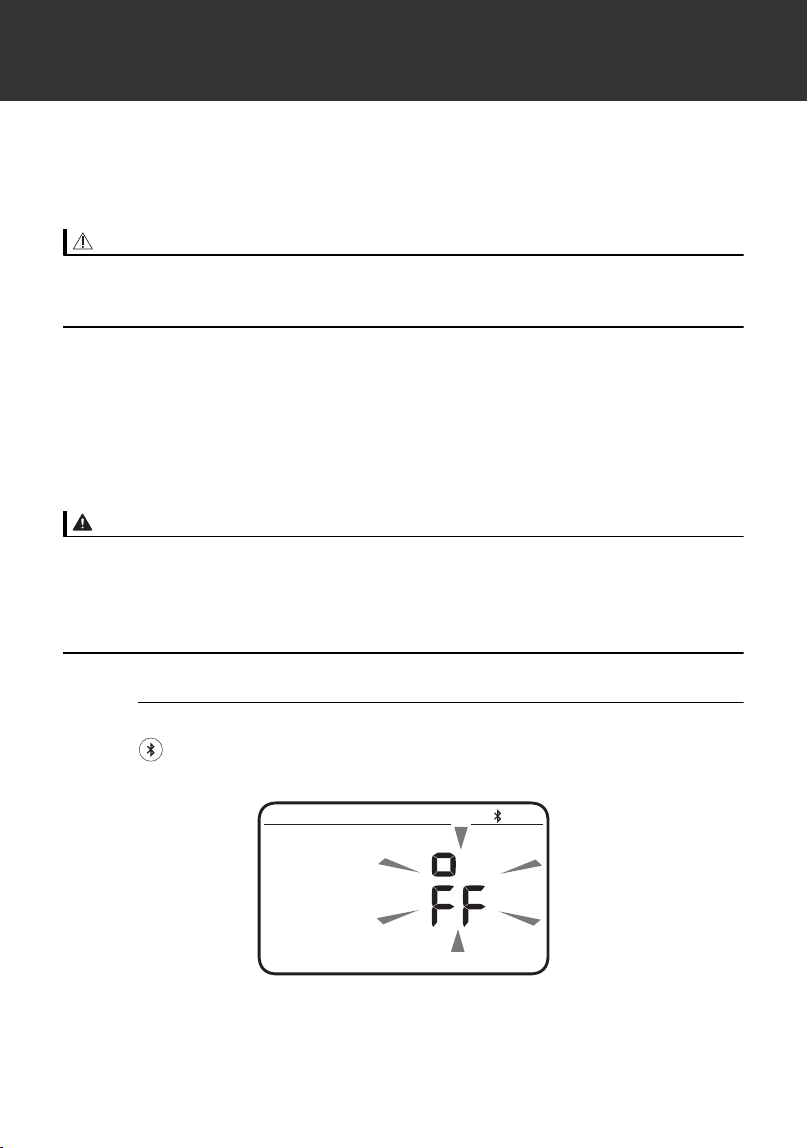
1. When your monitor is off, press and hold the
button for more than 10 seconds.
“oFF” flashes 3 times.
4. Using Your Monitor with a Smart Device
35
2. Press the [START/STOP] button to turn your
monitor off.
Note
• To enable Bluetooth, press and hold the button for more
than 2 seconds. “on” appears on the displa
y.
• Your monitor automatically turns off 10 seconds after the
completion
.
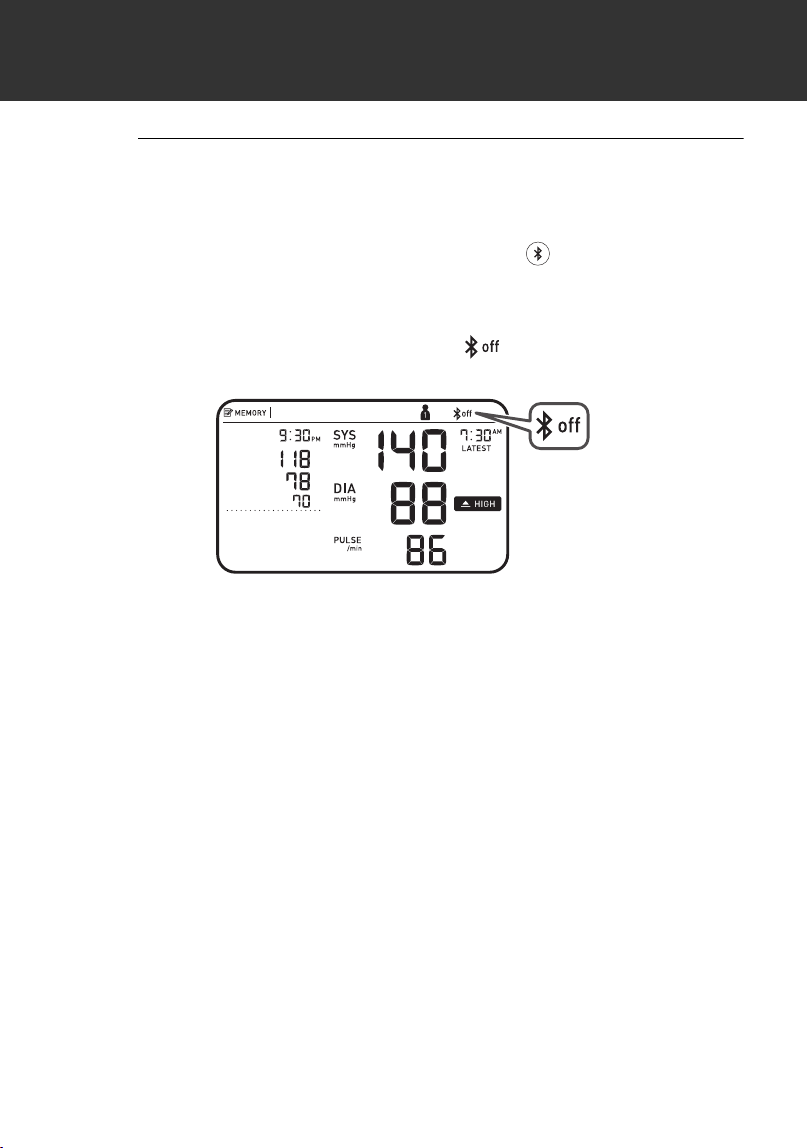
• When Bluetooth is disabled, the “ ” symbol appears and
your reading will not automatically be transferred to the app.
36
5. Using Memory Function
This monitor can store readings for up to 2 users, and automatically stores
up to 100 readings per user.
Note
• Make sure you remember which user ID stores your own readings.
5.1 Viewing the Readings Stored in Memory
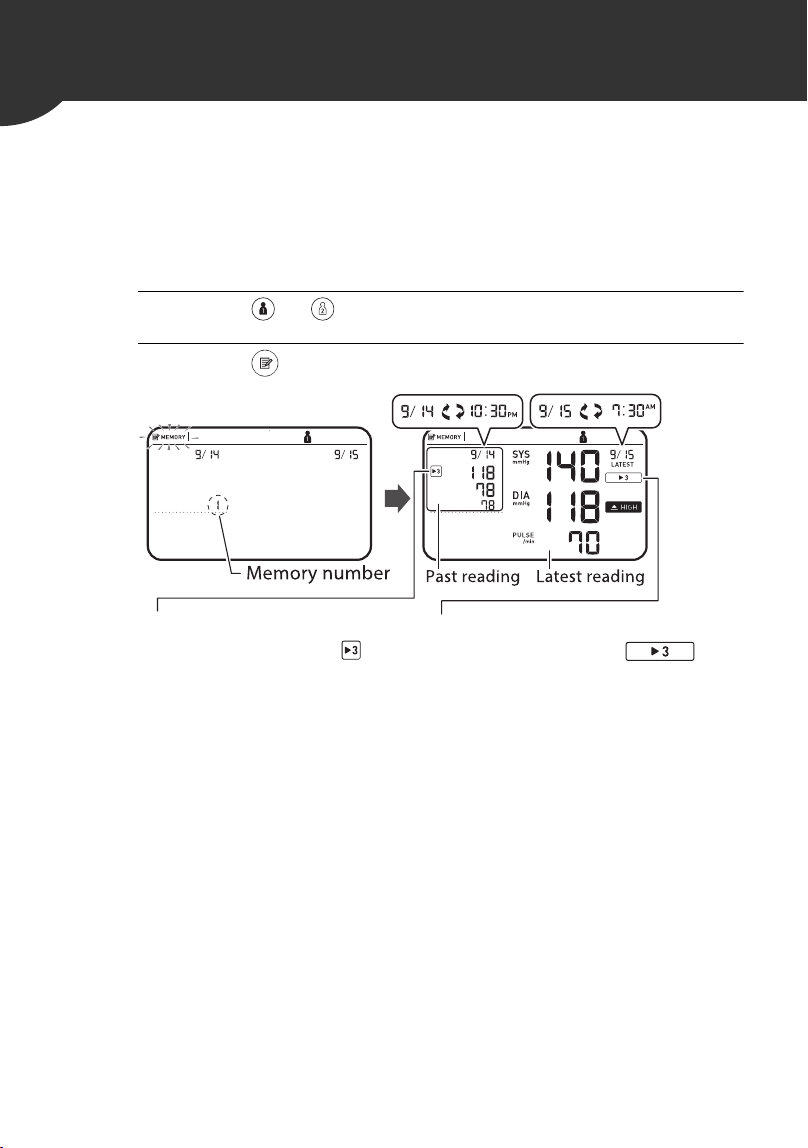
1. Press the or button to select your user ID.
2. Press the button once.
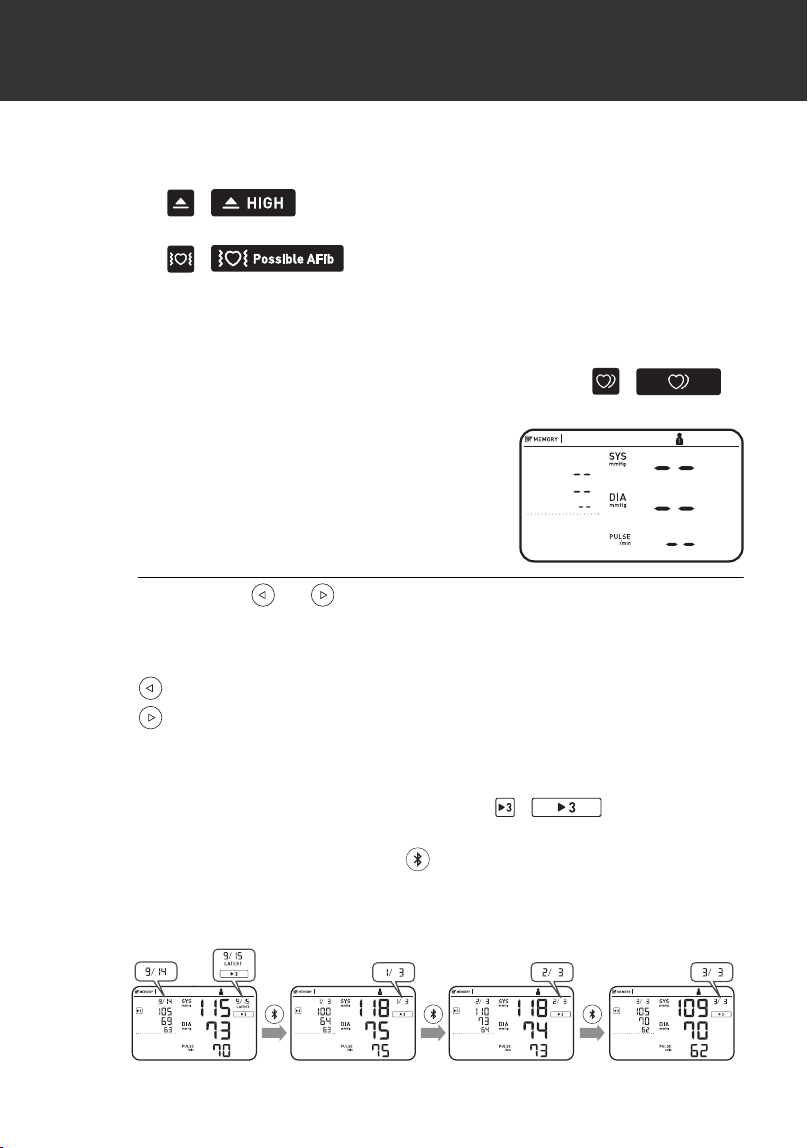
The memory number appears for 2 seconds before the pulse rate
is displayed. The most recent reading stored in the memory will
be numbered as “1”. After the memory number appears, the latest
reading will appear with a past reading. A past reading will appear
in the comparison display on the left.
If the latest reading was taken
in TruRead mode, the “
”
symbol appears. The reading
shown on the right is the
average of 3 measurements.
If the past reading was taken
in TruRead mode, the “
”
symbol appears. The reading
shown on the left is the
average of 3 measurements.
5. Using Memory Function
37
Note
• If the reading was high (refer to sub-section 1.4), the
“ / ” symbol appears.
• If a possibility of AFib was detected during a measur
ement, the
“ / ” symbol flashes on the display. Generally,
blood pr
essure and pulse rate measured during AFib cannot be
reliable. T
herefore, the readings are not displayed when a
possibility of AFib is detected.
• If irregular rhythm was detected 2 or more times during a
measurement, the irregular heartbea
t symbol “ / ”
will be displayed with your reading.
• If there are no readings stored in the
memory, the scre
en to the right is
displayed.
• If the memory is full, new readings will
replace th
e old readings, starting with
the oldest reading.
3. Press the or button repeatedly to scroll
through the previous readings stored in the
memory.
: To view the older readings
: To view the more recent readings
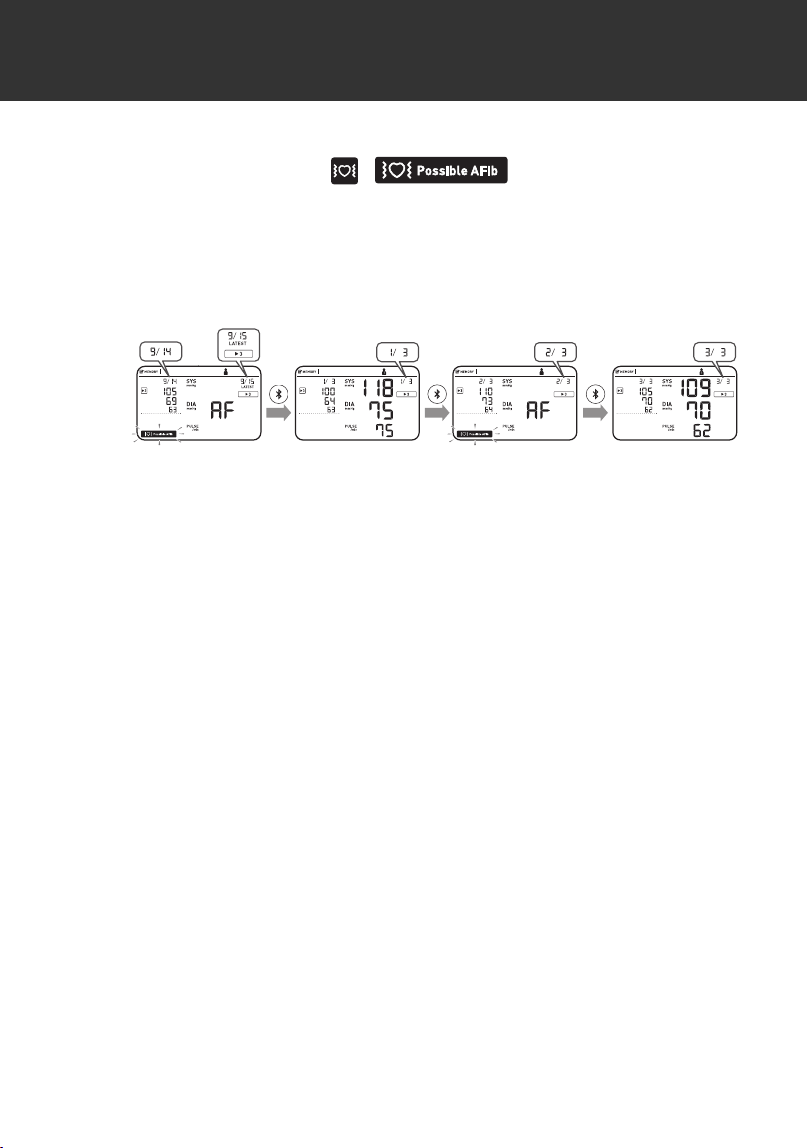
To view individual readings in TruRead measurement
The readings with the TruRead symbol ( / ) are the
averages for the consecutive 3 measurements. To view the
individual readings, press the button
while the TruRead
average is displayed. When TruRead readings are the past and the
latest readings,
the individual TruRead readings are displayed on
both the left and right sides.
38
5. Using Memory Function
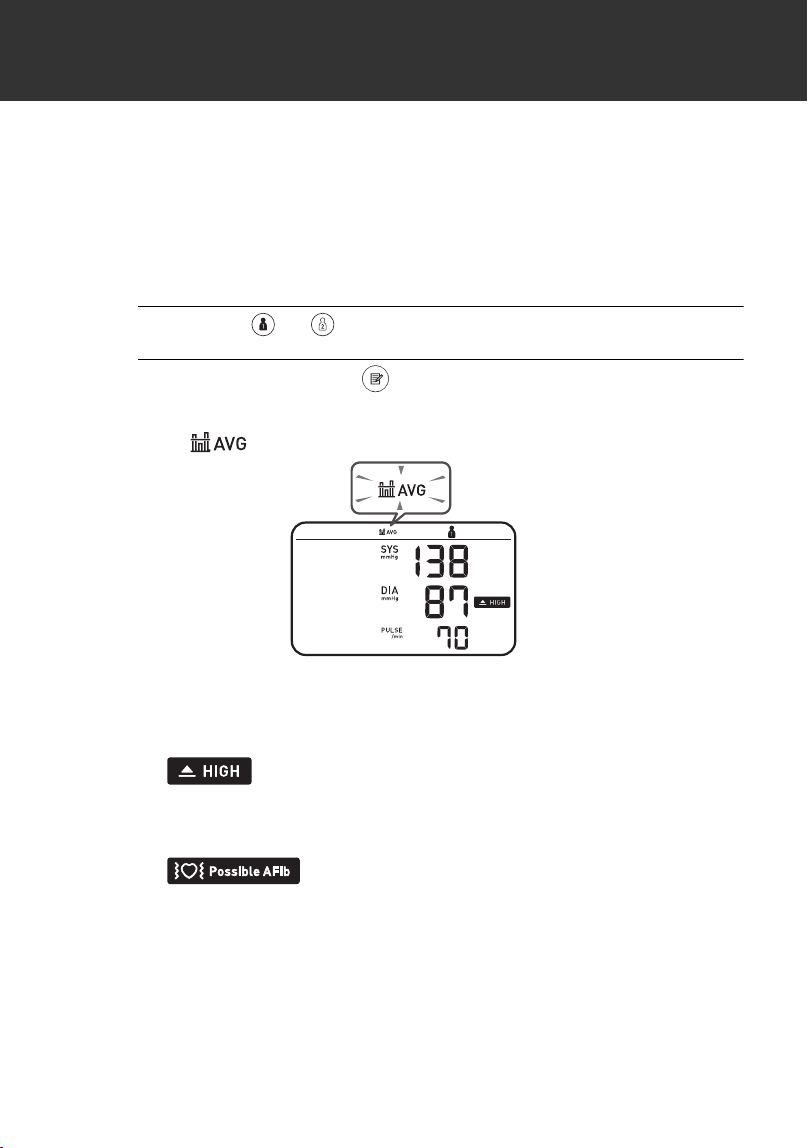
If a possibility of AFib was detected during a measurement in
TruRead mode, the “ / ” symbol flashes on the
average reading display. Generally, bloo
d pressure and pulse rate
measured during AFib cannot be reliable. Therefore, the readings
are not displayed when a possibility of AFib is detected.
It is recommended that you consult with, and f
ollow
the
directions of your physician.
5. Using Memory Function
39
5.2 Viewing the Average Reading
Your monitor can calculate an average reading based on the latest 2 or 3
readings taken within the most recent 10 minute timeframe.
Note
• Set your monitor to the correct date and time before taking a
measurement to view the average readings.
1. Press the or button to select your user ID.
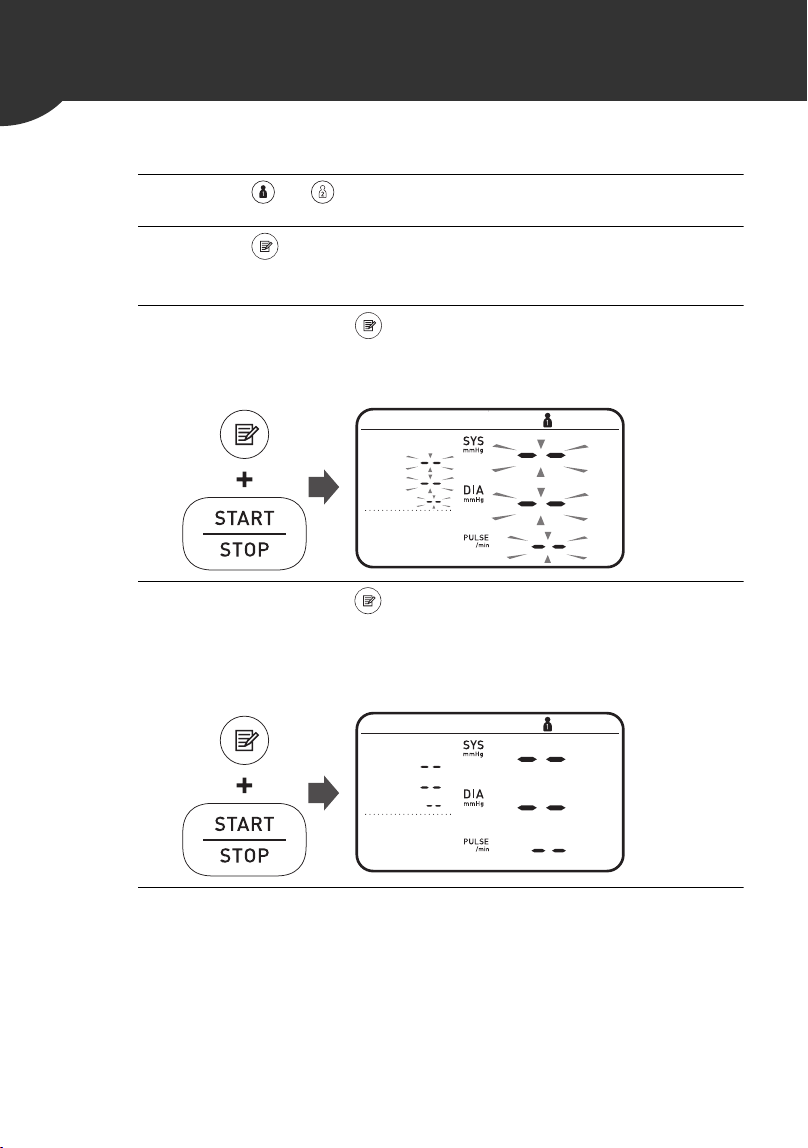
2. Press and hold the button for more than 3
seconds.
The “ ” symbol flashes, then the average reading appears.
Note
• If there are only 2 readings in the memory for that period, the
average will be based on these 2 readings.
• If the average reading is high (refer to sub-section 1.4), the
“ ” sy
mbol appears.
• The calculation of the average reading does not include
readings when a po
ssibility of AFib was detected. However, if a
possibility of AFib is detected in all the target readings, the
“ ” symbol will flash on the display. Generally,
blood pressur
e and pulse rate measured during AFib cannot be
reliable. T
herefore, the readings are not displayed when a
possibility of AFib was detected. It is recommended that you
consult with, and follow the directions of your physician.
40
6. Other Settings
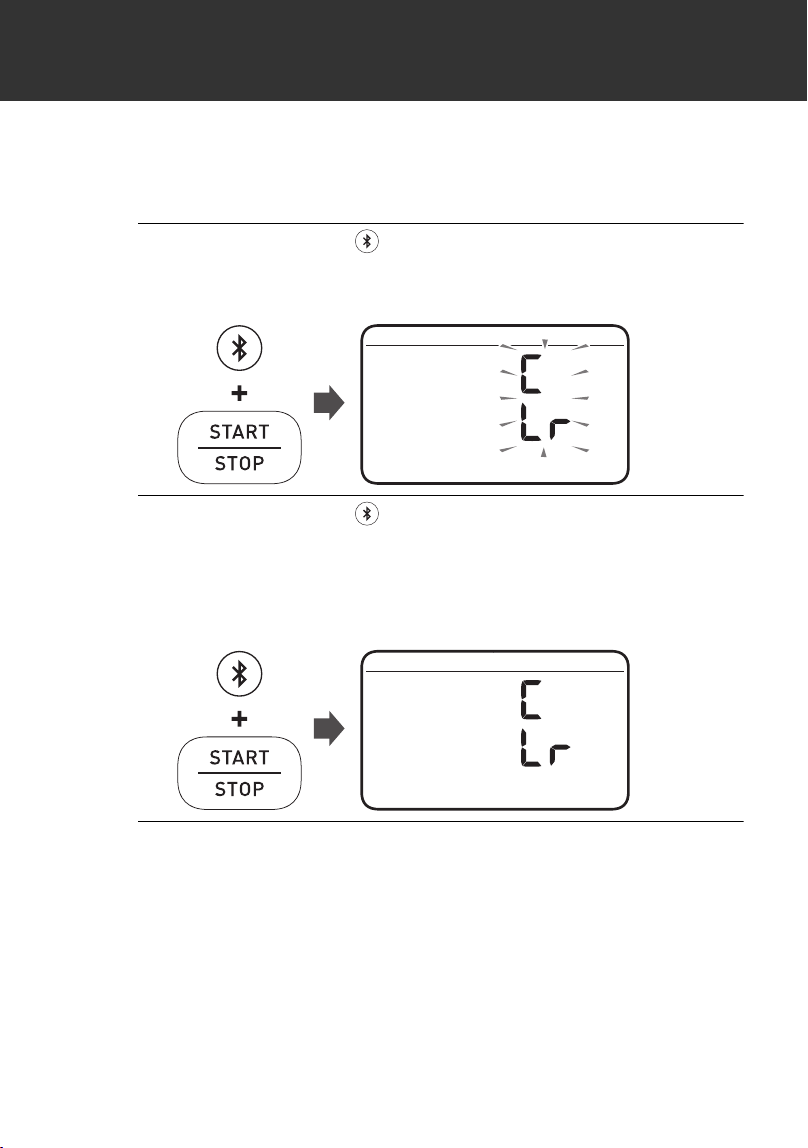
6.1 Deleting All Readings Stored in Memory
1. Press the or button to select your user ID.
2. Press the button.
After a memory number appears, the latest reading will appear.
3. While holding the button down, press and hold
the [START/STOP] button for more than 3 seconds.
The display as below flashes.
4. While holding the button down again, press and
hold the [START/STOP] button for more than 3
seconds.
The display stops flashing, then all readings are deleted.
5. Press the [START/STOP] button to turn your
monitor off.
Note
• All readings will be deleted. You cannot partially delete the
readings stored in the memory.
• Your monitor automatically turns off after 10 seconds.
6. Other Settings
41
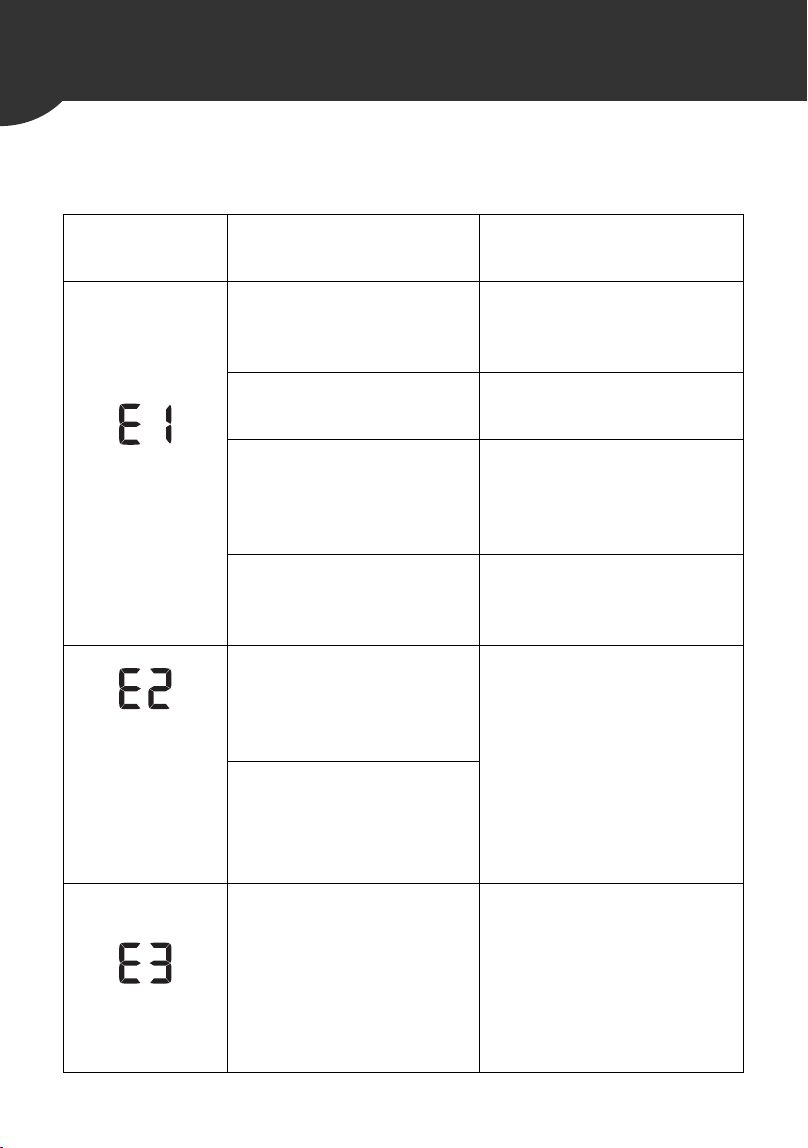
6.2 Restoring Your Monitor to the Default Settings
To delete all the information stored in your monitor, follow the
instructions below. Make sure that your monitor is turned off.
1. While holding the button down, press and hold
the [START/STOP] button for more than 3 seconds.
The display as below flashes.
2. While holding the button down again, press and
hold the [START/STOP] button for more than 3
seconds.
The display stops flashing, then your monitor is restored to the
default settings.
3. Press the [START/STOP] button to turn your
monitor off.
Note
• After the completion, the year flashes on the display. Refer to
sub-section 2.3 to set the
date and time manually, or refer to
sub-section 4.1 to pair your monitor with a smart device to set
the date and time automatically.
• Reverting to the default setting of your moni
tor does not delete
the information in the app.
42
7.
Error Messages and Troubleshooting
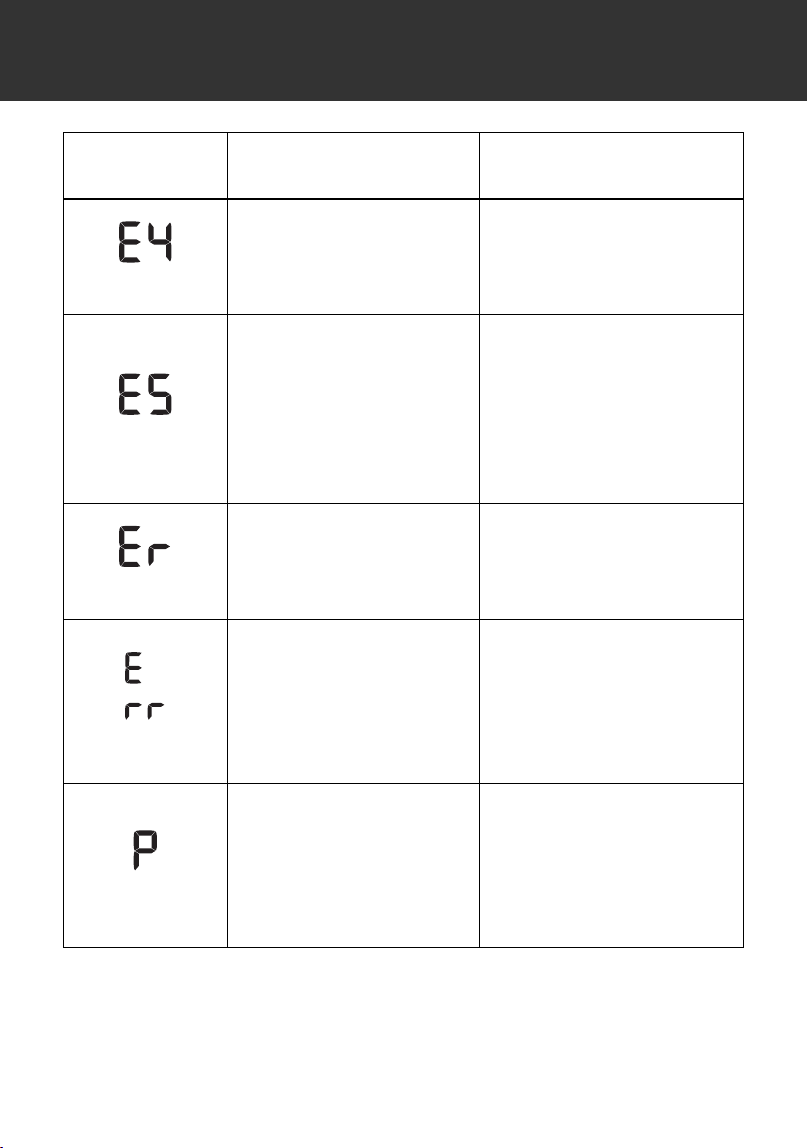
If any of the below problems occur during measurement, check to make
sure that no other electrical device is within 12 inches (30 cm) of the
monito
r. If the problem persists, refer to the table below.
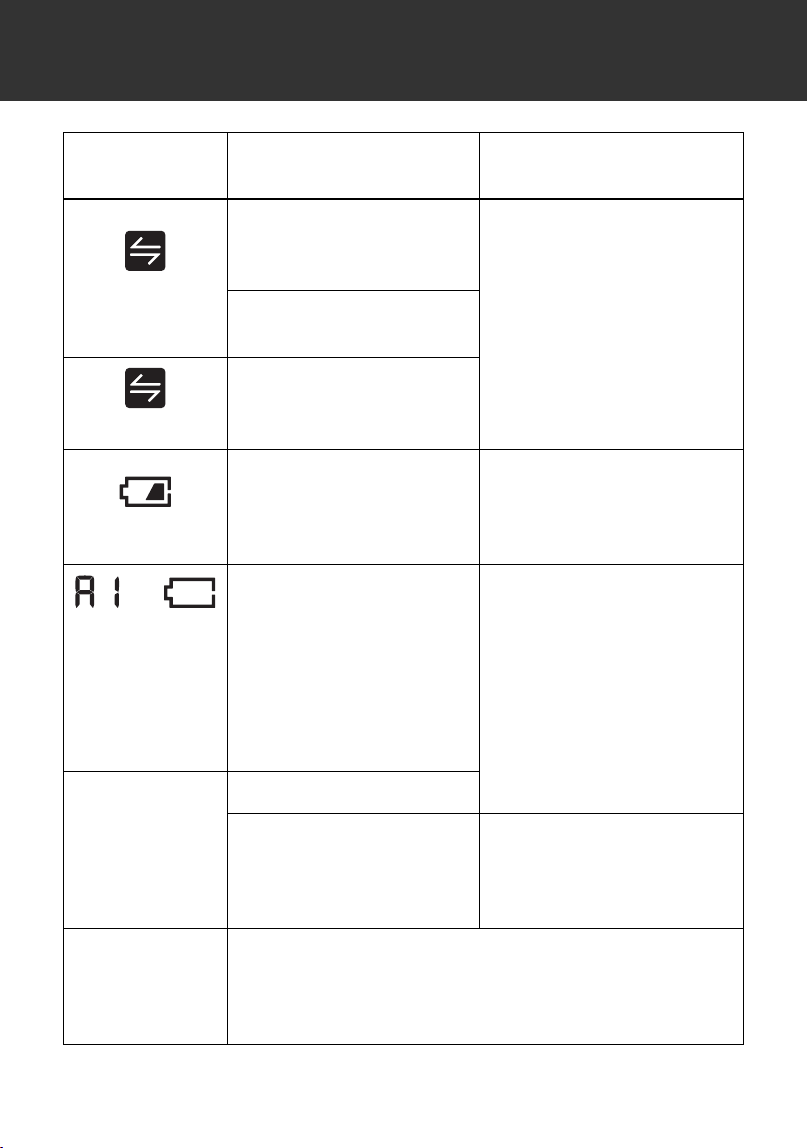
Display/
Problem
P
ossible Cause Solution
appears or the
arm cuff does
not inflate.
The [START/STOP] button
was pr
essed while the arm
cuff is not applied.
Press the [START/STOP]
button
again to turn the
monitor off.
Air plug is not completely
plugged into
the monitor.
Insert the air plug securely.
The arm cuff is not
applied correctly.
Apply the arm cuff
c
orrectly, then take another
measurement. Refer to
sub-section 2.6.
Air is leaking from the arm
cu
ff.
Replace the arm cuff with a
ne
w one. Refer to
section 13.
appears or a
measur
ement
cannot be
completed after
the arm cuff
inflates.
Moving or talking during
a measur
ement causes
the arm cuff to not inflate
sufficiently.
Remain still and do not talk
du
ring a measurement. If
“E2” appears repeatedly,
inflate the arm cuff
manually until the systolic
pressure is 30 to 40 mmHg
abo
ve your previous
readings. Refer to the end
of section 3.
The systolic pressure is
abo
ve 210 mmHg and a
measur
ement cannot be
taken.
appears
The arm cuff is inflated
ex
ceeding the maximum
allowable pressure.
Do not touch the arm cuff
and/
or bend the air tube
while taking a
measurement.
If inflating the arm cuff
ma
nually, refer to the end
of section 3.
appears or the
arm cuff does
not inflate.
appears or the
arm cuff does
not inflate.
es
t inflate.
appears or the
arm cuff do
no
appears or a
measur
ement
cannot be
completed after
the arm cuff
inflates.
Remain still and do not talk
ng a measurement. If
“E2” appears repeatedly,
inflate the arm cuff
manually until the systolic
pressure is 30 to 40
abo
e your previous
readings. Refer to the end
of section 3.
du
ri
mmHg
v
7. Error Messages and Troubleshooting
43
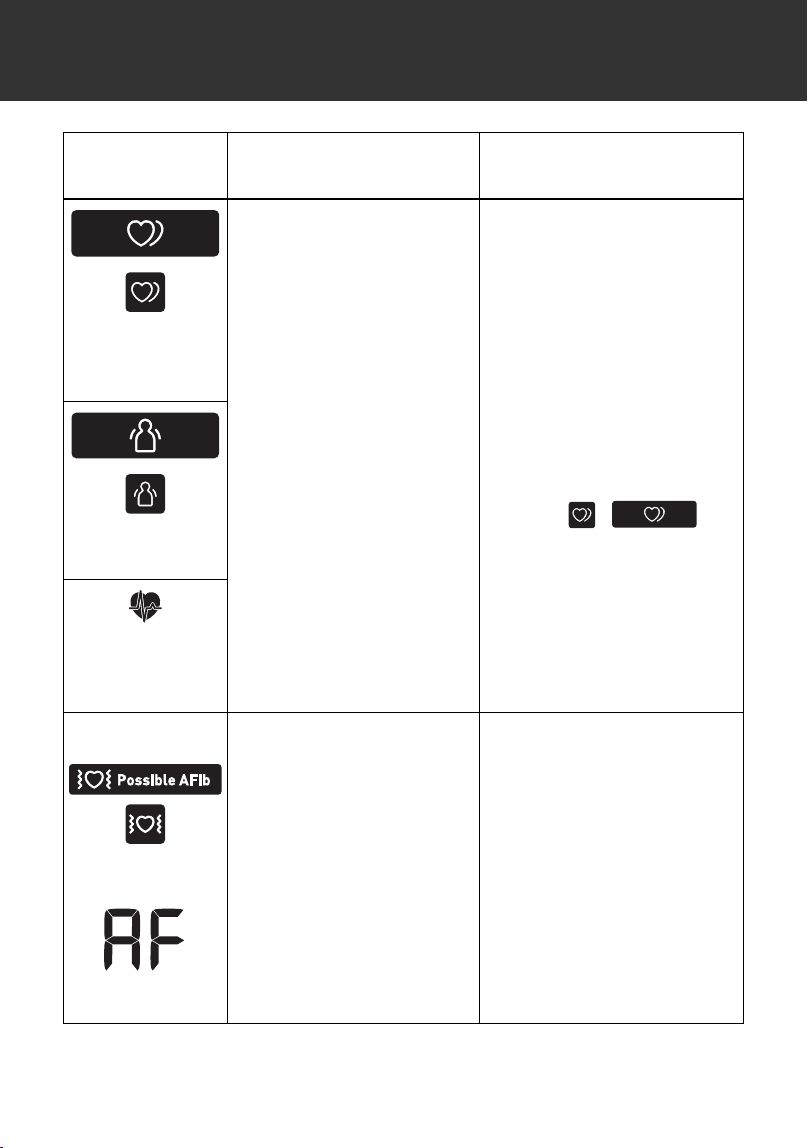
appears
Moving or talking during
a measurement results
in
vibrations that disrupt the
measurement.
Remain still and do not talk
du
ring a me
asurement.
appears
The pulse rate is not
detec
ted corr
ectly.
Apply the arm cuff
correctly,
then take another
measurement. Refer to
sub-section 2.6.
Remain still and sit
c
orrectly
during a
measurement.
appears
The monitor has
malf
unctioned.
Pre
ss the [START/STOP]
button again
. If “
Er” still
appears, contact customer
service. Refer to section 10.
appears
The monitor cannot
con
nect to
a smart device
or transmit data correctly.
Follow the instructions
shown in the app.
If the
“Err” still appears after
checking the app, contact
customer service. Refer to
section 10.
flashes
The monitor is waiting for
pairing with
the smart
device.
Ref
er to sub-section 4.1 for
pairing your monitor with
y
our smar
t device, or press
the [START/STOP] button to
cancel pairing and turn
your monitor off.
Display/
Pr
oblem
Possible Cause Solution
44
7. Error Messages and Troubleshooting
Irregular
heartbeat
symbol appears
The pulse rate is not
detec
ted correctly.
Apply the arm cuff
c
orrectly, then take another
measurement. Refer to
sub-section 2.6.
Remain still and sit
c
orrectly during a
measurement.
If the irregular heartbeat
symbol “ / ”
continues to appear, it is
r
ecommended that you
consult with your physician.
Movement error
symbo
l
appears
does not flash
during a
measur
ement
flashes with the
display as below
A possibility of AFib is
detected during a
measurement.
Generally, blood pressure
and pulse
rate measured
during AFib cannot be
reliable. Therefore, the
readings are not
displayed when a
possibility of AFib is
detected. It is
recommended that you
consult with, and follow
the directions of your
physician.
Display/
Pr
oblem
Possible Cause Solution
The pulse rate is not
detec
ted correctly.
The pulse rate is not
detec
ted correctly.
Apply the arm cuff
c
orrectly, then take another
measurement. Refer to
sub-section 2.6.
Remain still and sit
c
orrectly during a
measurement.
If the irregular heartbeat
symbol “ / ”
continues to appear, it is
r
ecommended that you
consult with your physician.
Apply the arm cuff
c
orrectly, then take another
measurement. Refer to
sub-section 2.6.
Remain still and sit
c
orrectly during a
measurement.
If the irregular heartbeat
symbol “ / ”
continues to appear, it is
r
ecommended that you
consult with your physician.
c
orrectly, then take another
2.6
c
orrectly during a
/ ”
r
ecommended that you
c
o
c
o
/ ”
r
e
Apply the arm cuff
c
o
measurement. Refer to
sub-section
Remain still and sit
c
o
measurement.
If the irregular heartbeat
symbol “ / ”
continues to appear, it is
r
ecommended that you
consult with your physician.
.
7. Error Messages and Troubleshooting
45
flashes
There are more than
80 readings in memory to
be tr
ansferred.
Pair or transfer your
re
adings to the app so you
can keep them in memory
in the app, and this symbol
disappears.
The date and time are not
set
.
app
ears
There are 100 readings in
memor
y to be transferred.
flashes
Batteries are low.
Replacing all 4 batteries
with
new ones is
recommended. Refer to
sub-section 2.1.
and
appears, or the
monit
o
r is
turned off
unexpectedly
during a
measurement.
Batteries are depleted.
Immediately replace all 4
batt
eries with new ones.
Refer to sub-section 2.1.
Nothing appears
o
n the display of
the monitor.
Batteries are depleted.
Battery polarities are not
pr
operly aligned.
Check the battery
insta
llation for proper
placement.
Refer to sub-section 2.1.
Readings appear
t
oo high or too
low.
Blood pressure varies constantly. Many factors
inc
luding stress, time of day, and/or how you apply the
arm cuff, may affect your blood pressure. Review
sub-sections 2.5 - 2.7 and section 3.
Display/
Pr
oblem
Possible Cause Solution
Immediately replace all 4
batt
eries with new ones.
Refer to sub-section 2.1.
Nothing appears
o
n the display of
the monitor.
Pair or transfer your
re
adings to the app so you
can keep them in memory
in the app, and this symbol
disappears.
Blood pressure varies constantly. Many factors
inc
luding stress, time of day, and/or how you apply the
arm cuff, may affect your blood pressure. Review
sub-sections 2.5 - 2.7 and section 3.
flashes
Pair or transfer your
re
adings to the app so you
can keep them in memory
in the app, and this symbol
disappears.
Pair or transfer your
re
adings to the app so you
can keep them in memory
in the app, and this symbol
disappears.

46
7. Error Messages and Troubleshooting
Any other
communication
issue occurs.
Follow the instructions shown in the smart device, or
visit the “Help”
section in the app for further help. If the
problem still persists, contact customer service. Refer
to section 10.
Any other
p
roblems occur.
Press the [START/STOP] button to turn the monitor off,
then press it again to take a measurement. If the
problem continues, remove all batteries and wait for 30
seconds. Then re-install the batteries.
If the problem still persists, contact customer service.
Ref
er to section 10.
Display/
Problem
Possible Cause Solution
Follow the instructions shown in the smart device, or
visit the “Help”
section in the app for further help. If the
problem still persists, contact customer service. Refer
to section 10.
Press the [START/STOP] button to turn the monitor off,
then press it again to take a measurement. If the
problem continues, remove all batteries and wait for 30
seconds. Then re-install the batteries.
If the problem still persists, contact customer service.
Ref
er to section 10.

47
8. Maintenance
8.1 Maintenance
To protect your monitor from damage, follow the directions below:
Caution
•
DO NOT
disassemble or attempt to repair this monitor or other components. This may
cause an inaccurate reading.
8.2 Storage
Store your monitor and other components in a clean, safe and dry
location.
When storing for a long period of time, remove the battery.
Note
• Do not bend or crease the air tube excessively.
Do not store your monitor and other components:
8.3 Wiping the Monitor
• Do not use any abrasive or volatile cleaners.
• Use a soft dry cloth or a soft cloth moistened with mild (neutral)
dete
rgent to wipe your monitor and arm cuff and then wipe them with a
dry cloth.
• Do not wash or immerse your monitor and arm cuff or other
compo
nents in wate
r.
• Do not use gasoline, thinners or similar solvents to wipe your monitor
an
d arm cu
ff or other components.
8.4 Disposal
Dispose of your monitor, other components and optional accessories
according to applicable local regulations. Unlawful disposal may cause
environmental pollution.
• Changes or modifications not approved by the manufacturer will void
th
e user
warranty.
• If your monitor and other components are wet.
• In locations exposed to extreme temperatures, humidity, direct
sun
light, dust
or corrosive vapors such as bleach.
• In locations exposed to vibrations or shocks.

48
9. FCC Statement
FCC CAUTION
Changes or modifications not expressly approved by the party
responsible for compliance could void the user's authority to operate the
equipment.
This device complies with part 15 of FC
C Rules. Operation is subject to the
following two conditions: (1) this device may not cause harmful
interference, and (2) this device must accept any interference received,
including interference that may cause undesired operation.
Note
• This equipment has been tested and found to comply with the limits for
a Class B digital device, pursuant to part 15 of the FCC Rules. These limits
are designed to provide reasonable protection against harmful
interference in a residential installation. This equipment generates, uses
and can radiate radio frequency energy and, if not installed and used in
accordance with the instructions, may cause harmful interference to
radio communications. However, there is no guarantee that interference
will not occur in a particular installation. If this equipment does cause
harmful interference to radio or television reception, which can be
determined by turning the equipment off and on, the user is
encouraged to try to correct the interference by one or more of the
following measures:
This transmitter must not be co-located or operated in conjunction with
any other antenna or transmitter.
This equipment complies with FCC radiation exposure limits set forth for
an uncontrolled environment and meets the FCC radio frequency (RF)
Exposure Guidelines. This equipment has very low levels of RF energy that
are deemed to comply without testing of specific absorption ratio (SAR).
• Reorient or relocate the receiving antenna.
• Increase the separation between
the equipment and receiver.
• Connect the equipment into an outlet on a circuit different from that
to which the receiver is connected.
• Consult the dealer or an experienced radio/TV technician for help.

49
10. Limited Warranty
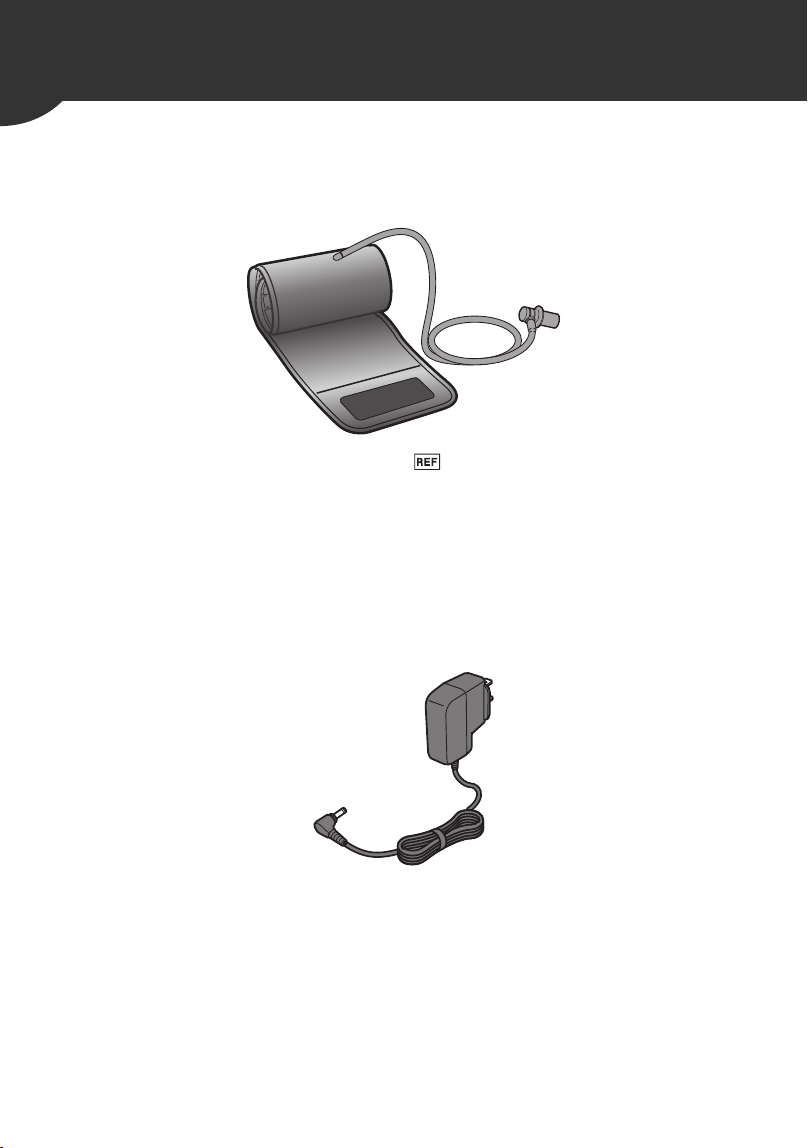
Your BP7465 Blood Pressure Monitor, excluding the arm cuff, AC adapter
and batteries, is warranted to be free from defects in materials and
workmanship appearing within 5 years from the date of purchase, when
used in accordance with the instructions provided with the monitor. The
arm cuff and AC adapter are warranted to be free from defects in materials
and workmanship appearing within 1 year from the date of purchase
when the monitor is used in accordance with the instructions provided
with the monitor. The above warranty extends only to the original retail
purchaser, and only to products purchased from an Omron authorized
seller who is subject to and follows Omron’s quality control standards,
unless otherwise prohibited by law.
We will, at our option, replace without charge any monitor, arm cuff or AC
a
dap
ter covered by the above warranty. Replacement is our only
responsibility and your only remedy under the above warranty.
To obtain warranty service contact Customer Service by calling
1-8
00-634-43
50 for the address of the inspection center and the return
shipping and handling fee that may apply.
Enclose the original printed receipt. I
nclude
a letter, with your name,
address, phone number, and description of the specific problem. Pack the
product carefully to prevent damage in transit. Because of possible loss in
transit, we recommend insuring the product with return receipt
requested.
THE FOREGOING IS THE SOLE WARRANTY PROVIDED BY OMRON IN
C
ONNECT
ION WITH THIS PRODUCT, AND OMRON HEREBY DISCLAIMS
ANY OTHER WARRANTIES, EXPRESS OR IMPLIED, INCLUDING IMPLIED
WARRANTIES OF MERCHANTABILITY, FITNESS FOR A PARTICULAR
PURPOSE AND NON-INFRINGEMENT. IMPLIED WARRANTIES AND
OTHER TERMS THAT MAY BE IMPOSED BY LAW, IF ANY, ARE LIMITED
IN DURATION TO THE PERIOD OF THE ABOVE EXPRESS WARRANTY.
OMRON SHALL NOT BE LIABLE FOR LOSS OF USE OR ANY OTHER
SPECIAL,
INCIDENTAL, CO
NSEQUENTIAL OR INDIRECT COSTS,
EXPENSES OR DAMAGES.
SOME STATES DO NOT ALLOW THE EXCLUSION OR LIMITATION OF
INCIDENT
AL OR CONSEQUENTIAL D
AMAGES, SO THE ABOVE
LIMITATION OR EXCLUSION MAY NOT APPLY TO YOU.
50
10. Limited Warranty
This warranty provides you with specific legal rights, and you may have
other rights that vary by jurisdiction. Because of special local
requirements, some of the above limitations and exclusions may not
apply to you.
FOR CUSTOMER SERVICE
Visit our web site at: OmronHealthcare.com
Call toll free: 1-800-634-4350
51
11.
Guidance and Manufacturer’s Declaration
OMRON Battery-operated / AC Adapter-operated Blood Pressure Monitor
Information for Accompanying Documents in the Scope of
IEC 60601-1:2005+A1:2012+A2:2020, IEC 60601-1-2:2014+A1:2020 and
IEC 60601-1-11:2015+A1:2020
Important information regarding Electromagnetic Compatibility
(EMC)
BP7465 conforms to IEC 60601-1:2005+A1:2012+A2:2020, IEC 60601-1-2:2014+A1:2020 and
IEC 60601-1-11:2015+A1:2020 Electromagnetic Compatibility (EMC) standard.
Further documentation in accordance with this EMC standard is available at
https://healthcare.omron.com/electro-magnetic-compatibility. Refer to the EMC information for
BP7465 on the website.
The Bluetooth® word mark and logos are registered trademarks owned
by Bluetooth SIG, Inc. and any use of such marks by OMRON
HEALTHCARE Co., Ltd. is under license.
Apple and the Apple logo are trademarks
of Apple Inc., r
egistered in the
U.S. and other countries and regions. App Store and App Store logo are
service marks of Apple Inc. Google Play and the Google Play logo are
trademarks of Google LLC.
Other trademarks and trade names are those of their respective owners.
External References:
Moody GB, Mark RG. The impact of the MIT-BIH Arrhythmia Database. IEEE Eng in Med and Biol 20(3):45-50 (May-June
2001). (PMID: 11446209)
Contains information from "MIT-BIH Arrhythmia Database" which is made available under the ODC Attribution License.
https://www.physionet.org/content/mitdb/1.0.0/
https://opendatacommons.org/licenses/by/1-0/
Moody GB, Mark RG. A new method for detecting atrial fibrillation using R-R intervals. Computers in Cardiology.
10:227-230 (1983).
Contains information from "MIT-BIH Atrial Fibrillation Database" which is made available under the ODC Attribution
License.
https://physionet.org/content/afdb/1.0.0/
https://opendatacommons.org/licenses/by/1-0/
Clifford GD, Liu C, Moody B, Li-wei HL, Silva I, Li Q, Johnson AE, Mark RG. AF classification from a short single lead ECG
recording: The PhysioNet/computing in cardiology challenge 2017.
In 2017 Computing in Cardiology (CinC) 2017 Sep 24 (pp. 1-4). IEEE.
https://doi.org/10.22489/CinC.2017.065-469
Contains information from "AF Classification from a Short Single Lead ECG Recording: The PhysioNet/Computing in
Cardiology Challenge 2017" which is made available under the ODC Attribution License.
https://physionet.org/content/challenge-2017/1.0.0/training/#files-panel
https://opendatacommons.org/licenses/by/1-0/
Goldberger, A., Amaral, L., Glass, L., Hausdorff, J., Ivanov, P. C., Mark, R., ... & Stanley, H. E. (2000). PhysioBank, PhysioToolkit,
and PhysioNet: Components of a new research resource for complex physiologic signals. Circulation [Online]. 101 (23), pp.
e215–e220.

52
12. What is Possible AFib?
What is Blood Pressure?
Blood pressure is a measure of the force of blood flowing against the walls
of the arteries. Arterial blood pressure is constantly changing during the
course of the heart’s cycle.
The highest pressure in the cycle is called the Systolic Blood Pressure; the
lo
west
is the Diastolic Blood Pressure. Both pressures, the Systolic and
Diastolic, are necessary to enable a physician to evaluate the status of a
patient’s blood pressure.
What is Arrhythmia?
Arrhythmia is a condition where the heartbeat rhythm is abnormal due to
flaws in the bio-electrical system that drives the heartbeat. Typical
symptoms are skipped heartbeats, premature contraction, an abnormally
rapid (tachycardia) or slow (bradycardia) pulse.
What is AFib?
Atrial fibrillation (AFib) is a serious heart condition that causes an irregular
and often rapid heartbeat. It's a type of arrhythmia, or abnormal
heartbeat, that occurs when the upper chambers of the heart, or atria,
beat irregularly and sometimes much faster than normal. This irregular
beating prevents the heart's upper and lower chambers from working
together properly, which can cause blood to pool in the atria and
potentially clot. AFib can lead to serious complications, including: Blood
clots, Stroke, Heart failure.
Some people with atrial fibrillation (
AFi
b) don't experience any symptoms,
a condition called asymptomatic or “silent” AFib. This means that people
with silent AFib may not have any warning signs of the condition.
Possible AFib Detection
The monitor will notify you of a possibility of AFib if your monitor
determines an irregularity from pulse to pulse intervals during a
measurement.
12. What is Possible AFib?
53
The possible AFib detection feature ONLY evaluates for a possibility of
AFib after taking a measurement. It does NOT continuously monitor your
heart and therefore cannot alert you if AFib happens at any other time.
This monitor cannot detect all forms of AFib. If the irregularity of the heart
rhythm is too small, it may not be detected. For example, if there is an
abnormality in the conduction between the atria and the ventricle, the
heart rhythm may be in sinus rhythm, in which case a possibility of AFib
cannot be detected by this monitor.
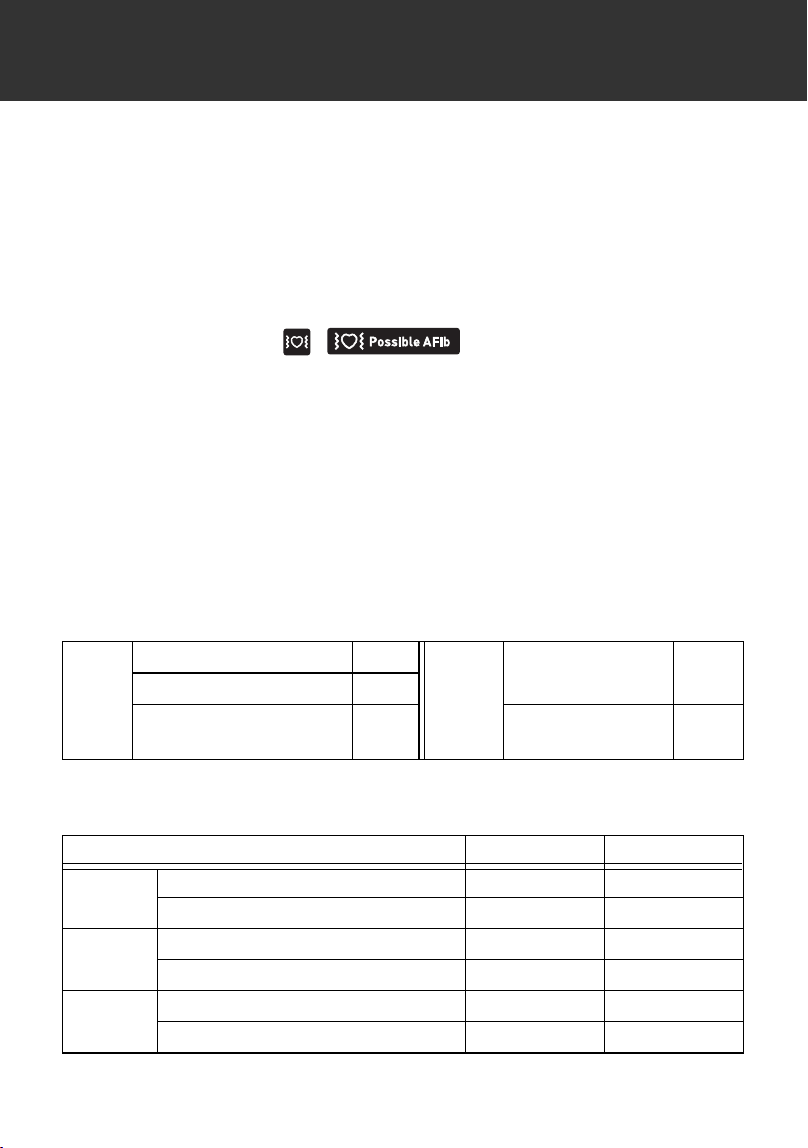
The state in which the “ / ” symbol is displayed can
influence your blood pressure measurements a
nd make it difficult to get
an accurate reading. If this occurs, it is recommended that you consult
with your physician. The AFib detection algorithm was validated through
a multi-center clinical study comparing against EKG recording between
AFib cohort and non-AFib cohort. Racial representation was designed in
the study, with 7.1 % minority in the AFib cohort. Representation of
certain races and ethnicities were limited in the clinical evaluation and the
sensitivity of the “Possible AFib” results cannot be confirmed as they could
not be adequately studied.
Race and Ethnicity ratio in the AFib cohort
Clinical study outcome of AFib detection performance
Race
White 92.9 %
Ethnicity
Non-Hispanic and
non-Latino
97.4 %
African American 5.2 %
Others (Asian, Pacific Islander,
American Indian)
1.9 % Hispanic or Latino 2.6 %
Subgroup Sensitivity (%) Specificity (%)
Age
22 - 64 years (N=176) 90.3 98.6
Over 65 years (N=383) 95.7 98.7
Gender
Female (N=282) 97.7 99.5
Male (N=277) 93.9 96.9
Race/
Ethnic
ity
Non-Caucasian (N=135) 96.3 99.1
Caucasian (N=424) 95.0 98.4
Age
Gender
Race/
Ethnic
ity
RaceRace Ethnicity
Subgroup
54
12. What is Possible AFib?
What is the difference between the possible AFib detection feature and
EKG?
The possible AFib detection feature uses pulse wave detection to detect a
possibility of AFib. EKG measures the electrical activity of the heart and
can be used by a physician to diagnose AFib.
If the “ / ” symbol does not flash, does it mean there is
no possibility of AFib?
Even if the “ / ” symbol does not flash, there might be
still a possibility of AFib.
If taking a measurement at a time when A
Fib
does not occur, possible AFib
might not be detectable. This monitor cannot detect all forms of AFib.
Warning
• The possible AFib detection feature evaluates for a possibility of AFib ONLY. It will
NOT
detect other potentially life-threatening arrhythmias or diseases, such as a possibility of
other cardiac arrhythmias or heart attack.
Should I consult with my physician if the “ / ” symbol
flashes?
It is recommended that you consult with your physician if the
“ / ” symbol flashes. This symbol may flash for other
reasons, such as other heart arrhythmias.
What should I do if the “ / ” symbol sometimes flashes?
AFib does not always have symptoms. It is recommended that you consult
with, and follow the directions of your physician.
I have been diagnosed with AFib by my physician, but the
“ / ” symbol does not flash.
AFib may not occur at the time of specific blood pressure measurements.
It is recommended that you consult with your physician regularly.

12. What is Possible AFib?
55
Is the blood pressure reading reliable when the “ / ”
symbol flashes or the irregular heartbeat symbol “ / ”
appears?
AFib or an irregular heartbeat can influence your blood pressure
measurements and make it difficult to get an accurate reading. Therefore,
the readings are not displayed when a possibility of AFib is detected.
The readings will be displayed if irregular heartbeats are detected, but
r
epeat
ed measurements may be required to overcome fluctuations.* The
monitor will indicate an error message (E5) if the influence of the irregular
heartbeat is too severe to give a measurement result. If this occurs
repeatedly, it is recommended that you consult with your physician.
* O’Brien E, et al.; J Hypertens. 2003; 21: 821-848.

57
14. Specifications
Model BP7465 HEM-7381T1-AZ
Display LCD digital display
Cuff pressure range 0 to 299 mmHg
Blood pressure
me
asurem
ent range
SYS: 60 to 260 mmHg
DIA: 40 to 215 mmHg
Pulse measurement
range
40
to 180 beats / min.
Accuracy
Pressure: ±3 mmHg
Pulse: ±5 % of display reading
Inflation Automatic by electric pump
Deflation Automatic pressure release valve
Measurement method Oscillometric method
Transmission method Bluetooth® L
ow Ener
gy
Wireless
communication
Fr
equency range: 2.4 GHz
(2400 - 2483.5 MHz)
Modulation: GFSK
Effective radiated power: < 20 dBm
Operation mode Continuous operation
IP classification
Monitor: IP21
AC adapter: IP21
Rating DC6 V 4.0 W
Power source
4 “AA” batteries 1.5 V or AC adapter (INPUT
A
C100 - 24
0 V 50 - 60 Hz 0.12 - 0.065 A)
Battery life
Approximately 500 measurements (using new
alkaline
batteries)
Durable period
(S
ervice life
)
Monitor: 5 years or the time when
reaching
30000 times of use.
Arm cuff: 5 years or the time when reaching
10
000 tim
es of use.
AC adapter: 5 years
Operating conditions
+50 °F to +104 °F (+10 °C to +40 °C) / 15 to 90 %
RH (n
on-condensing) / 800 to 1060 hPa
Storage / Transport
conditions
-4 °F t
o +140 °F (-20 °C to +60 °C) / 10 to 90 %
RH (non-condensing)

58
14. Specifications
Weight
Monitor: Approximately 15.9 oz. (450 g) not
including batteries
Ar
m cuff: Approximately 5.8 oz. (163 g)
Dimensions
Monitor: Approximately 7.5" (w) × 3.3" (h) × 4.6"
(l)
(191
mm × 85 mm × 117 mm)
Arm cuff: Approximately 5.7" × 20.9" (air tube:
2
9.5"
) (145 mm × 532 mm (air tube: 750 mm))
Cuff circumference
applicabl
e to the
monitor
9" to 17" (22 to 42 cm)
Memory Stores up to 100 readings per user
Contents
Monitor, Easy-Wrap ComFit Cuff, AC adapter
(HEM-ADPT
W5), 4 “AA” batteries, instruction
manual, quick start guide
Protection against
ele
ctric
shock
Internally powered ME eq
uipment
(when using
only batteries)
Class II ME equipment (when using AC adapter)
Applied part Type BF (arm cuff)

14. Specifications
59
Note
• These specifications are subject to change without notice.
• This monitor is clinically investigated acc
ording to the requirements of
ISO 81060-2:2013 and complies with ISO 81060-2:2013 and
ISO 81060-2:2018+A1:2020. In the clinical validation study, K5 was used
o
n 85 subjects
in general population for determination of diastolic
blood pressure. This has not been validated for the patients with AFib. If
a possibility of AFib was detected during a measurement, the
“ / ” symbol flashes on the display. Gener
ally, blood
pressure
and pulse rate measured during AFib cannot be reliable.
Therefore,
the readings are not displayed when a possibility of AFib is detected.
• This monitor has not been validated for use on pregnant patients.
• IP classification is degrees of protection provided by enclosures in
ac
corda
nce with IEC 60529. This monitor and AC adapter are protected
against solid
foreign objects of 0.5 inch (12.5 mm) diameter and greater
such as a finger, and are protected against vertically falling water drops
which may cause issues during a normal operation.
• Operation mode classification complies with IEC 60601-1.
• Please report to the manufacturer and the regulatory authority in which
y
ou ar
e established about any serious incident that has occurred in
relation to this device.
• This monitor does not support software updates by the customer. If a
c
ybersecurit
y event may have occurred, refer to sub-section 4.3 and
sub-section 6.2. If the problem persists, refer to section 10 to contact
customer service.
60
14. Specifications
Pictogram on the Product
About a wireless communication interference
The Bluetooth option in the product is used to connect to dedicated
app
s on mobile
devices to synchronize date/time data from mobile
device to the product, and to synchronize measurement data from the
product to mobile device. Further handling of the data on the mobile
device is up to the user's discretion. This product operates in an
unlicensed ISM band at 2.4 GHz where any third party can intercept the
r
adio waves
, willfully or accidentally, for any unknown purpose. In the
event this product is used near other wireless devices such as microwave
and wireless LAN, which operate on the same frequency band as this
product, there is a possibility that interference may occur. If interference
occurs, stop the operation of the other devices or relocate this product
away from other wireless devices before attempting to use it.
or
Types of marks used to indicate the correct positioning
of
the art
ery for the upper arm
Identifies the type of cuff that is compatible
with the
blood p
ressure monitor