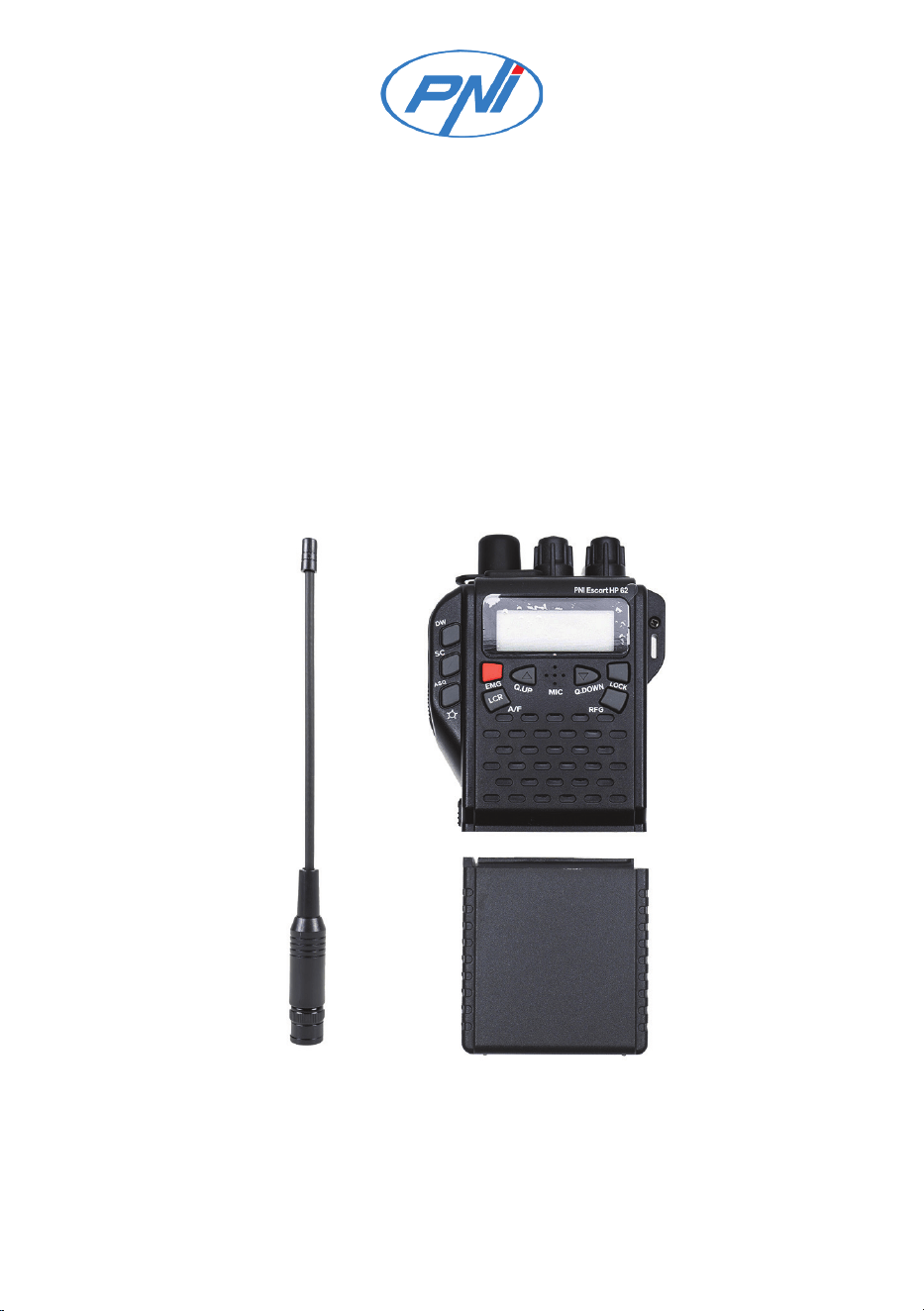
PNI Escort HP 62
Portable CB radio

EN
3
WARNINGS
Please read the following precautions to prevent re, personal injury or the radio destruction.
Do not attempt to adjust the radio while driving; is dangerous.
This radio is designed for power supply at 12V DC. Do not use a 24V battery to power the radio.
Do not place the station on an excessively dusty, damp or unstable surface.
Do not connect the antenna during transmission, risk of burning or electric shock.
Please keep distance from devices that cause interference (such as TV, generator, etc.)
People who use pacemakers are advised to keep distance from the antenna during transmission
and especially not to touch it.
Do not connect metal objects to the internal electrical side; danger of electric shock.
Avoid exposing the radio to temperatures below -26°C and above +80°C, the temperature on a
vehicle may sometimes exceed 80°C, which can cause irreparable damage to electric devices. Do not
expose the radio to sunlight.
Do not place anything on the radio, it will prevent it from cooling down.
Check to see if you have enough charged battery to avoid rapid discharge.
It is important to stop the radio before starting the engine, to avoid damage caused by high starting
voltage.
You must use a 2A 250V fuse type F. Under no circumstances use a higher value.
If an abnormal odor or smoke is detected as coming from the radio, switch o the appliance
immediately.
Do not transmit for a long time, the radio may warm up.
Keep the station away from children.
FCC CAUTION
Any Changes or modications not expressly approved by the party responsible for compliance could
void the user’s authority to operate the equipment.
This device complies with part 15 of the FCC Rules. Operation is subject to the following two conditions:
(1) This device may not cause harmful interference, and (2) this device must accept any interference
received, including interference that may cause undesired operation.
Note: This equipment has been tested and found to comply with the limits for a Class B digital device,
pursuant to part 15 of the FCC Rules. These limits are designed to provide reasonable protection
against harmful interference in a residential installation. This equipment generates, uses and can radiate
radio frequency energy and, if not installed and used in accordance with the instructions, may cause
harmful interference to radio communications. However, there is no guarantee that interference will not
occur in a particular installation. If this equipment does cause harmful interference to radio or television
reception, which can be determined by turning the equipment o and on, the user is encouraged to try
to correct the interference by one or more of the following measures:
—Reorient or relocate the receiving antenna.
—Increase the separation between the equipment and receiver.
—Connect the equipment into an outlet on a circuit dierent from that to which the receiver is connected.
—Consult the dealer or an experienced radio/TV technician for help.
IC CAUTION
This device complies with Industry Canada licence-exempt RSS standard(s). Operation is subject to the
following two conditions:
(1) this device may not cause interference, and
(2) this device must accept any interference, including interference that may cause undesired operation
of the device.

4
Le présent appareil est conforme aux CNR d’Industrie Canada applicables aux appareils radio exempts
de licence. L’exploitation est autorisée aux deux conditions suivantes :
(1) l’appareil nedoit pas produire de brouillage, et
(2) l’utilisateur de l’appareil doit accepter tout brouillage radioélectrique subi, même si le brouillage est
susceptible d’en compromettre le fonctionnement.
Radio apparatus containing digital circuitry which can function separately from the operation of
a transmitter or an associated transmitter, shall comply with ICES-003. In such cases, the labelling
requirements of the applicable RSS apply, rather than the labelling requirements in ICES-003. This
Class B digital apparatus complies with Canadian ICES-003.
Cet appareil numérique de la classe B est conforme à la norme NMB-003 du Canada.
RF RADIATION EXPOSURE STATEMENT
● This radio is designed for and classied as “General population/uncontrolled Use”
● DO NOT operate the radio without a proper antenna attached, as this may damage the radio and may
also cause you to exceed RF exposure limits. A proper antenna is the antenna supplied with this radio
by the manufacturer or an antenna specically authorized by the manufacturer for use with this radio.
● DO NOT transmit for more than 75% of total radio use time, more than 75% of the time can cause RF
exposure compliance requirements to be exceeded.
● This transmitter may operate with the antenna(s) documented in this ling in Push-to-Talk and
body-worn congurations. RF exposure compliance is limited to the specic belt-clip and accessory
congurations as documented in this ling and the separation distance between user and the device or
its antenna shall be at least 2.5 cm.
● The highest reported SAR values for body-worn, In Front of Mouth, Extremity are 0.14 W/Kg, 0.01 W/
Kg, 0.19 W/Kg.
● Cette radio est conçue pour et classée comme “Population générale/utilisation non contrôlée”
● Ne pas utiliser la radio sans une antenne appropriée attachée, car cela pourrait endommager la radio
et pourrait également vous faire dépasser les limites d’exposition RF. Une antenne appropriée est celle
fournie par le fabricant avec cette radio ou une antenne spéciquement autorisée par le fabricant pour
être utilisée avec cette radio.
● Ne transmettez pas plus de 75 % du temps total d’utilisation de la radio, car cela pourrait entraîner une
dépassée des exigences de conformité en matière d’exposition aux ondes radiofréquences.
● Cet émetteur peut fonctionner avec les antennes documentées dans ce dossier en conguration Push-
to-Talk et portée sur le corps. La conformité à l’exposition RF est limitée aux congurations spéciques
de clip de ceinture et d’accessoires documentées dans ce dossier, et la distance entre l’utilisateur et
l’appareil ou son antenne doit être d’au moins 2,5 cm.
● Les valeurs SAR les plus élevées signalées pour les dispositifs portés sur le corps, placés devant la
bouche et aux extrémités sont respectivement de 0,14 W/kg, 0,01 W/kg et 0,19 W/kg.
INTRODUCTION
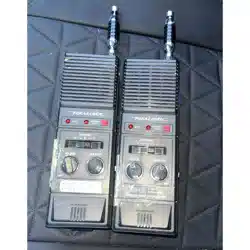
The PNI HP-62 is a small portable transceiver which guarantees great performance for many years of
use. What is unique to this innovative transceiver is the capability to select any of European CB bands
with an easy and quick procedure. The PNI HP-62 has built-in Channel Phase Loop synthesizer (PLL)
circuit and an automatic battery economy circuit.
Important Note!
Some countries may require you to own or purchase a CB license – please check with the
relative authorities in your country.
EN
5
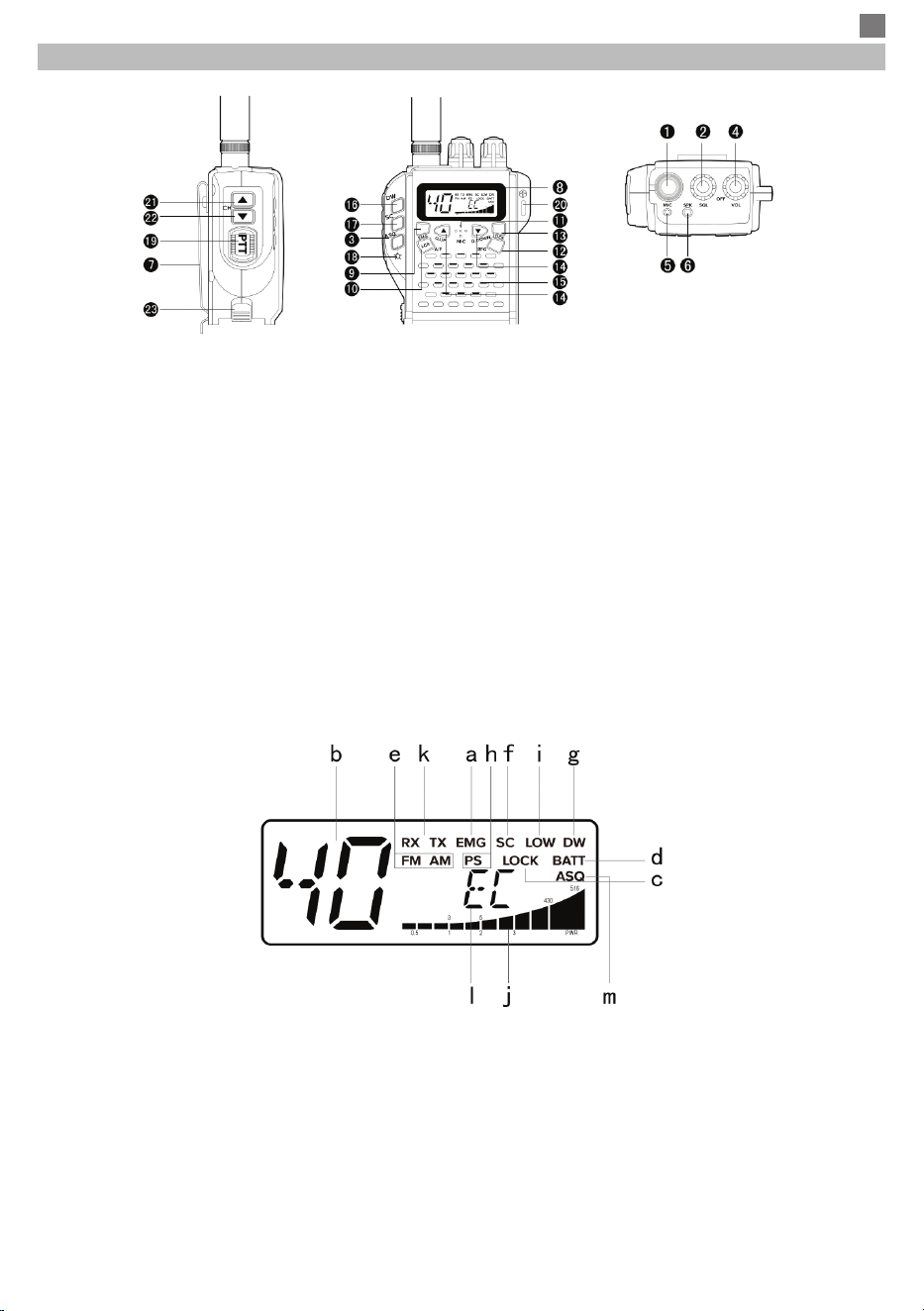
FUNCTION AND LOCATION OF THE CONTROLS
1. Antenna connection: x a compatible antenna (not included in the package). To get better
performance, you can use an external antenna that plugs into the included adapter.
2. Squelch Control: This function allows to reduce background noise of the station. By rotating the
button to the right, the function becomes active. By rotating the button to the left, the function becomes
inactive. The button should be set precisely to the position where the background noise disappears.
3. ASQ key: briey press this key to turn on the backlight of the screen. When the screen light is on,
press again to turn o the backlight. By long pressing this key, enter the ASQ mode. While you are in
ASQ mode, briey press this key to enter the ASQ level adjustment mode, the current level of Squelch
will blink. Use the Q.UP/Q DOWN keys to change the ASQ level (there are 5 levels available). Also in
ASQ mode, briey press the ASQ key twice to turn o or turn on the backlight of the screen.
4. ON/OFF and Volume Control key:
Rotate this knob to the right to turn on the radio. Turn slightly to the right to adjust the volume.
5. Microphone jack: Connect a headset with a microphone
6. External speaker jack: Connect a headset with a microphone
7. Belt clip
8. Multifunction backlighted display
This liquid crystal display has been projected to show the operative modality:
a. The EMG function is active
b. Selected channel number (1 to 40)
c. Lock: The key lock function is active
d. BATT: Low battery indicator
e. AM/FM mode
f. SC: The SCAN function is active
g. DW: DUAL WATCH function
h. PS: The Power Save function is active. If no key is pressed for 5 seconds, the radio enters the power
saving mode.

6
i. Low (Low Power) function is active
j. The received signal strength and the power of the transmitting signal
k. RX/TX: TX = transmit mode; RX=received mode
l. Frequency band selected
m. ASQ function available
n. Active setting of RF Gain level.
9. EMG key: briey press this key to enter emergency mode 9/19; the EMG icon will blink
10. A/F-LCR key: to select AM or FM mode; the modulation you are setting will be displayed on the
screen. If you select a frequency that operates only in the FM band, the A/F-LCR key will activate the
Last Channel Recall (LCR)
11. Microphone: During the broadcast, hold the microphone at a distance of 4 cm from the mouth and
speak using a normal tone of voice.
12. RFG Key: briey press this key, on the screen “R 00” will show up; “00” will ash. Press the Q.UP/Q
DONW keys to select one of the 9 levels (00, 06, 12 ... 54); press this button again to conrm and exit.
Note: We recommend to disable RFG function (or level 06 for louder areas).
13. Lock key: It allows you to lock the keyboard, thus avoiding accidental use of the keys.
14. Q.UP-Q.DOWN keys: To skip 10 channels up (Q.UP) or 10 channels down (Q.DOWN)
15. Loudspeaker
16. Dual Watch: This function allows the synchronization on two dierent channels at the same
time.Thanks to this function, you can monitor a second channel. When a signal on the second channel
is received, the conversation on the rst channel is automatically interrupted and the receiver switches
on the second channel. The monitoring starts again 4 seconds after the signal end.
TO activate this function, operate as follows:
- Select the desired channel through the channel selector
- Press the DW button
- Select the second channel
- Press the button DW again
- To cancel the function press again the DW button or the PTT button
17. SCAN key: you can automatically search for a busy channel
• Turn the squelch clockwise until the background noise is no longer heard.
• Press the “SCAN” button: the transceiver will scan automatically all the channels until a carrier is
being received.
• When it nds the carrier, it stops and starts again some seconds after the end of the communication
on the channel.
• When the radio is transmitting, the scan function is deactivated.
18. Key : when in the SQ mode short press this button, turn on the background ligh, short press this
button again, to turn o the ligh, long press this button will enter ASQ, in ASQ mode, short press the
button to turn on the background ligh and short press again will turn o the light.
19. Push to talk button (PTT): Its pressure activates the transmission. When it is released, the receiver
is activated.
20. Hole for wrist belt
21. Channel UP: To skip to the next channel. Keeping this button pressed, the “auto-repeat” function is
obtained.
22. Channel DOWN: To skip to the previous channel. Keeping his button pressed, the “auto-repeat”
function is obtained.
23. Contact for power adapter and external antenna. Pull the button up to remove the adapter.
EN
7
FREQUENCY BAND SELECTION
The frequency bands must be chosen according to the country you are in.
Procedure:
1. Switch o the unit.
2. Turn it on while pushing the “Q.UP” and “SC” buttons.
3. By pushing the CH ▲CH ▼ buttons, select the desired frequency band (see the chart here
below)
4. To x your selection press the “Q.UP” button.
Notes:
In the UK frequency band, you can directly select the CE band by pressing the AM/FM key for 2 seconds.
FREQUENCY BAND CHART
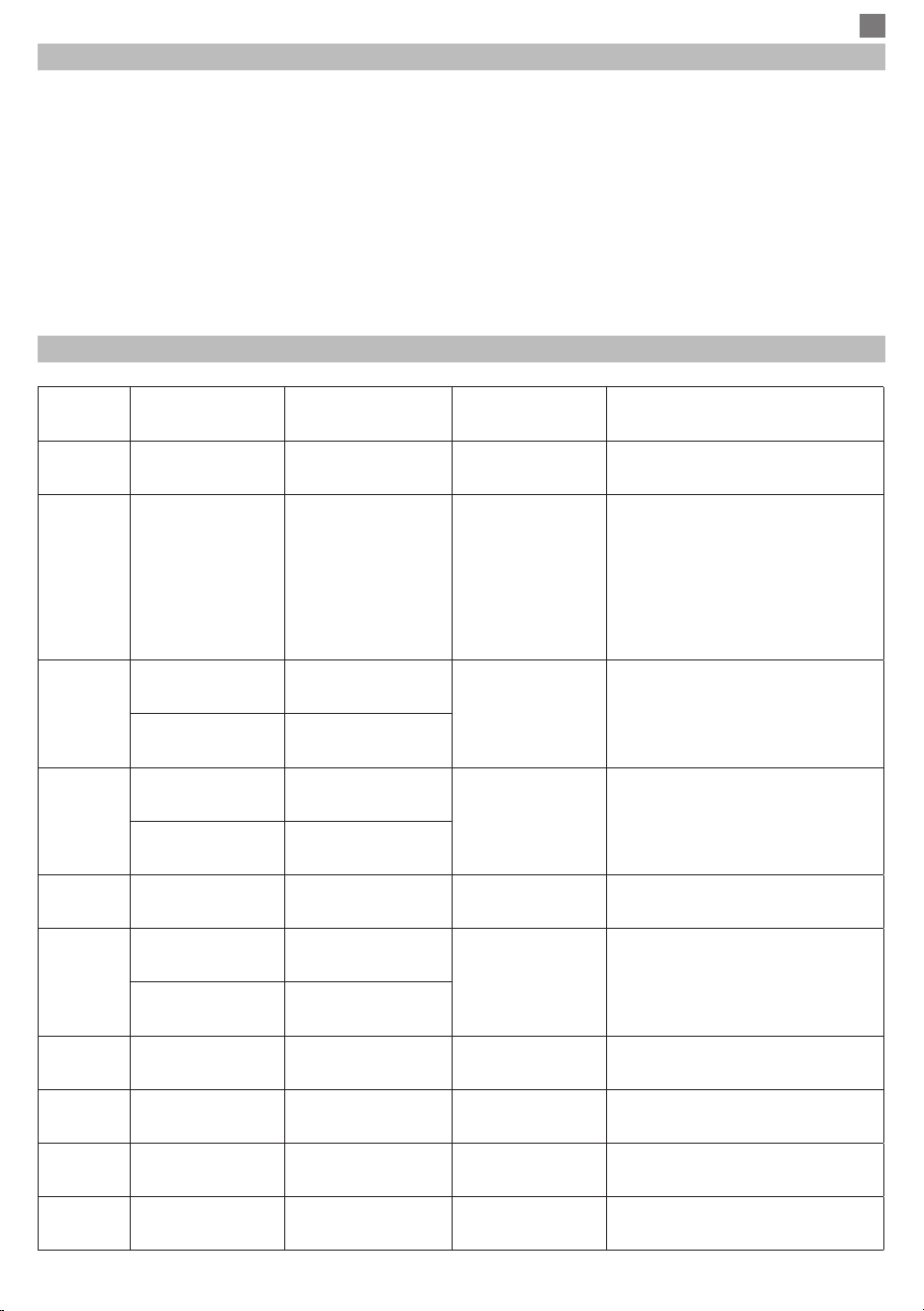
Norma
Frequency
(MHZ)
Channels Country EMG (9/19)
EC (CE) 26.965-27.405
40CH (4W)
FM only
RO, MT
CH09: 27.065MHz FM
CH19: 27.185MHz FM
EU 26.965-27.405
40CH (4W)
AM/FM
AT, BE, BG, CH,
CY, DK, EE, ES,
FI, FR, GR, HR,
HU, IE, IS, IT,
LT, LU, LV, NL,
NO, PT, RO,
SE, SI
CH09: 27.065MHz AM/FM
CH19: 27.185 AM/FM
d4
26.965-27.405
01CH-40CH (4W)
AM/FM
DE
CH09: 27.065MHz AM/FM
CH19: 27.185 AM/FM
26.565-26.955
41CH-80CH (4W)
FM only
d3
26.965-27.405
01CH-40CH (4W)
AM/FM
DE
CH09: 27.065MHz AM/FM
CH19: 27.185 AM/FM
26.565-26.955
41CH-80CH (4W)
FM only
d2 26.965-27.405
40CH (4W)
FM only
DE
CH09: 27.065MHz FM
CH19: 27.185 FM
d
26.965-27.405
01CH-40CH (4W)
FM only
DE
CH09: 27.065MHz FM
CH19: 27.185 FM
26.565-26.955
41CH-80CH (4W)
FM only
I2 26.965-26.955
34CH (4W)
AM/FM
IT
CH09: 27.065MHz FM
CH19: 27.185MHz FM
I 26.965-27.405
40CH (4W)
AM/FM
IT
CH09: 27.065MHz FM
CH19: 27.185MHz FM
In 26.965-27.275
27CH (4W)
AM/FM
IN
CH09: 27.065MHz FM
CH19: 27.185MHz FM
UK
27.60125-
27.99125
40CH (4W)
FM only
UK
CH09: 27.68125MHz FM
CH19: 27.78125MHz FM
8
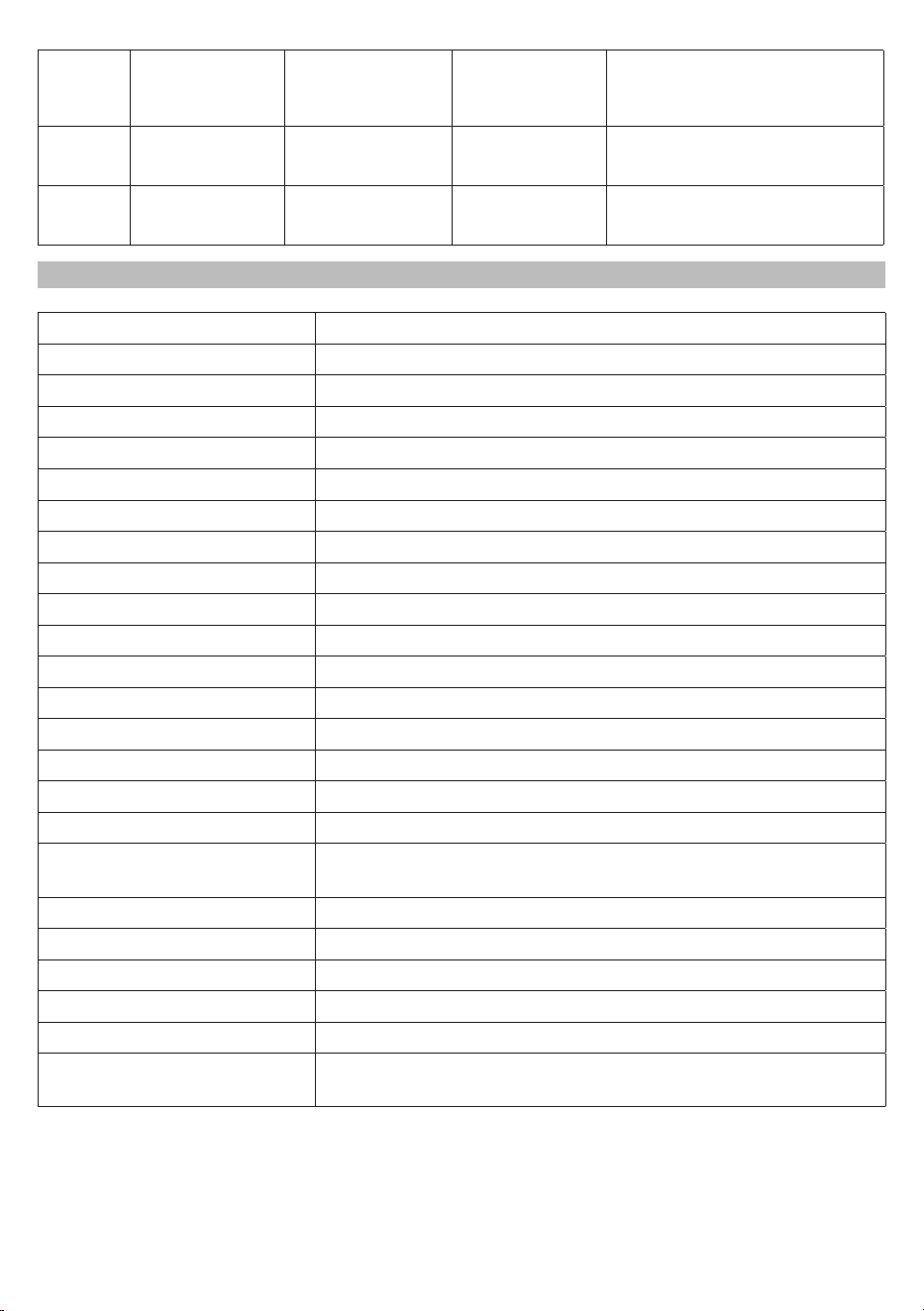
PL 26.960-27.400
-5KHZ
40CH (4W)
AM/FM
PL
CH09: 27.060MHz AM/FM
CH19: 27.180MHz AM/FM
F 26.965-27.405
40CH (4W)
AM/FM
FR
CH09: 27.065MHz FM
CH19: 27.185MHz FM
E 26.965-27.405
40CH (4W
AM/FM
ES
CH09: 27.065MHz FM
CH19: 27.185MHz FM
TECHNICAL SPECIFICATIONS
Channels 40FM (see the frequency band chart)
Frequency range 26.965~27.405MHz
Operation mode F3E (FM), A3E (AM)
Antenna impedance 50 Ohm
Loudspeaker 8 Ohm 0.5W
Supply voltage 7.2÷13.2 nom 12V
Dimensions 73 x 35 x 92 mm
Weight 424 gr
RECEIVER
Sensitivity at 10dB S/N 0.5uV (AM) 0.25uV (FM)
Selectivity > 60dB
Squelch range 0.25V-500uV
Audio output power 0.5W 8 ohm (10% distortion)
Distortion at 1000uV 3%
Audio frequency response 400-2400Hz
Intermediate frequency I°10.695MHz/II° 455KHz
Spurious response More than 60 dB
Current drain at standby
100mA when the power save mode is o
45mA when the power save mode is on
TRANSMITTER
RF Output Power duty cycle 10% 4W AM/FM
Frequency Tolerance 0.005%
Harmonic Suppression > 70dB
Current Drain 900mA
Modulation
AM 90% (±5%)
FM dev.2.0 KHz
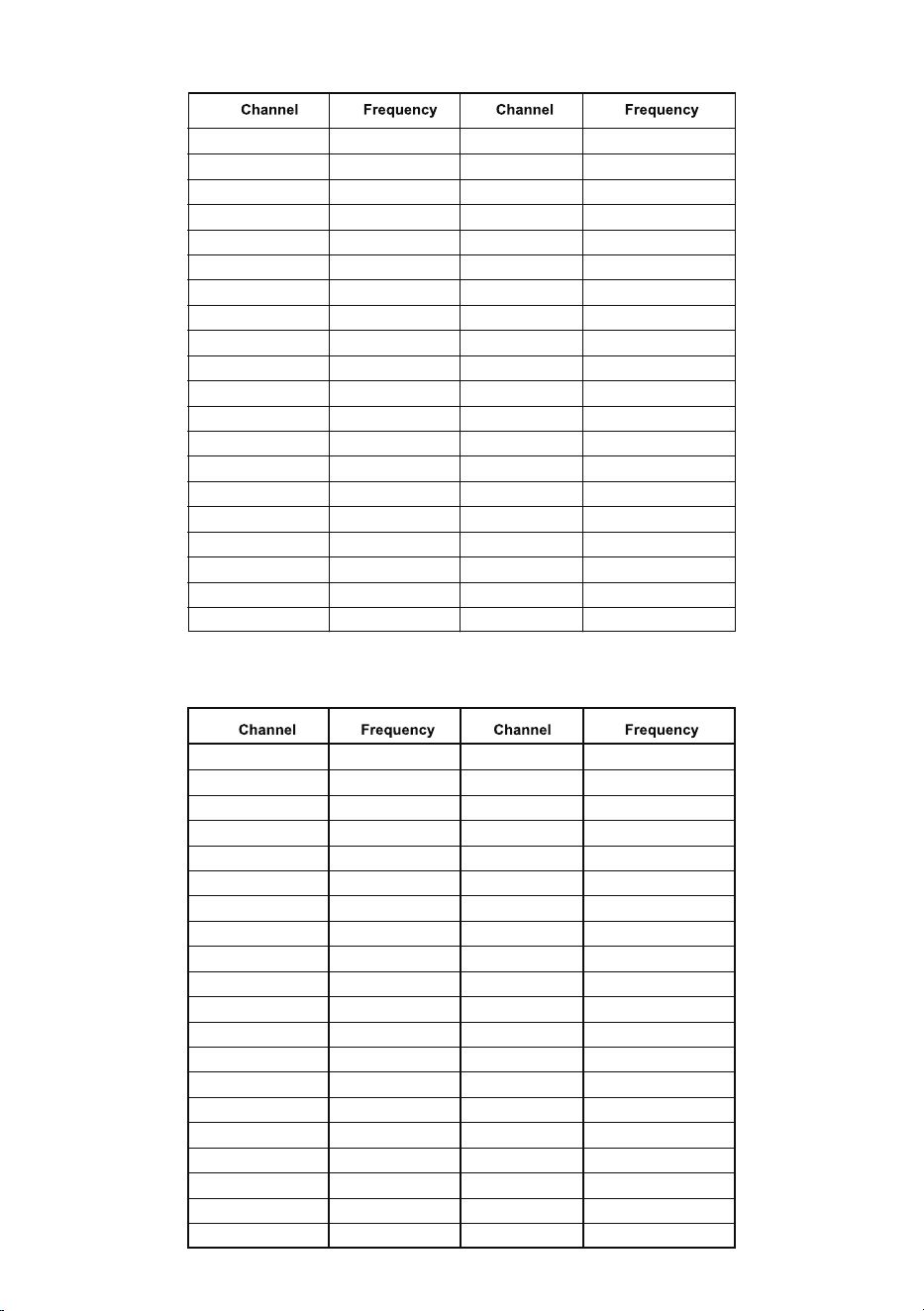
Frequency table for EC / EU (CEPT)
1 26,965 MHz 21 27,215 MHz
2 26,975 MHz 22 27,225 MHz
3 26,985 MHz 23 27,255 MHz
4 27,005 MHz 24 27,235 MHz
5 27,015 MHz 25 27,245 MHz
6 27,025 MHz 26 27,265 MHz
7 27,035 MHz 27 27,275 MHz
8 27,055 MHz 28 27,285 MHz
9 27,065 MHz 29 27,295 MHz
10 27,075 MHz 30 27,305 MHz
11 27,085 MHz 31 27,315 MHz
12 27,105 MHz 32 27,325 MHz
13 27,115 MHz 33 27,335 MHz
14 27,125 MHz 34 27,345 MHz
15 27,135 MHz 35 27,355 MHz
16 27,155 MHz 36 27,365 MHz
17 27,165 MHz 37 27,375 MHz
18 27,175 MHz 38 27,385 MHz
19 27,185 MHz 39 27,395 MHz
20 27,205 MHz 40 27,405 MHz
Frequency table d4, d3, d (DE)
1 26,965 MHz 21 27,215 MHz
2 26,975 MHz 22 27,225 MHz
3 26,985 MHz 23 27,255 MHz
4 27,005 MHz 24 27,235 MHz
5 27,015 MHz 25 27,245 MHz
6 27,025 MHz 26 27,265 MHz
7 27,035 MHz 27 27,275 MHz
8 27,055 MHz 28 27,285 MHz
9 27,065 MHz 29 27,295 MHz
10 27,075 MHz 30 27,305 MHz
11 27,085 MHz 31 27,315 MHz
12 27,105 MHz 32 27,325 MHz
13 27,115 MHz 33 27,335 MHz
14 27,125 MHz 34 27,345 MHz
15 27,135 MHz 35 27,355 MHz
16 27,155 MHz 36 27,365 MHz
17 27,165 MHz 37 27,375 MHz
18 27,175 MHz 38 27,385 MHz
19 27,185 MHz 39 27,395 MHz
20 27,205 MHz 40 27,405 MHz
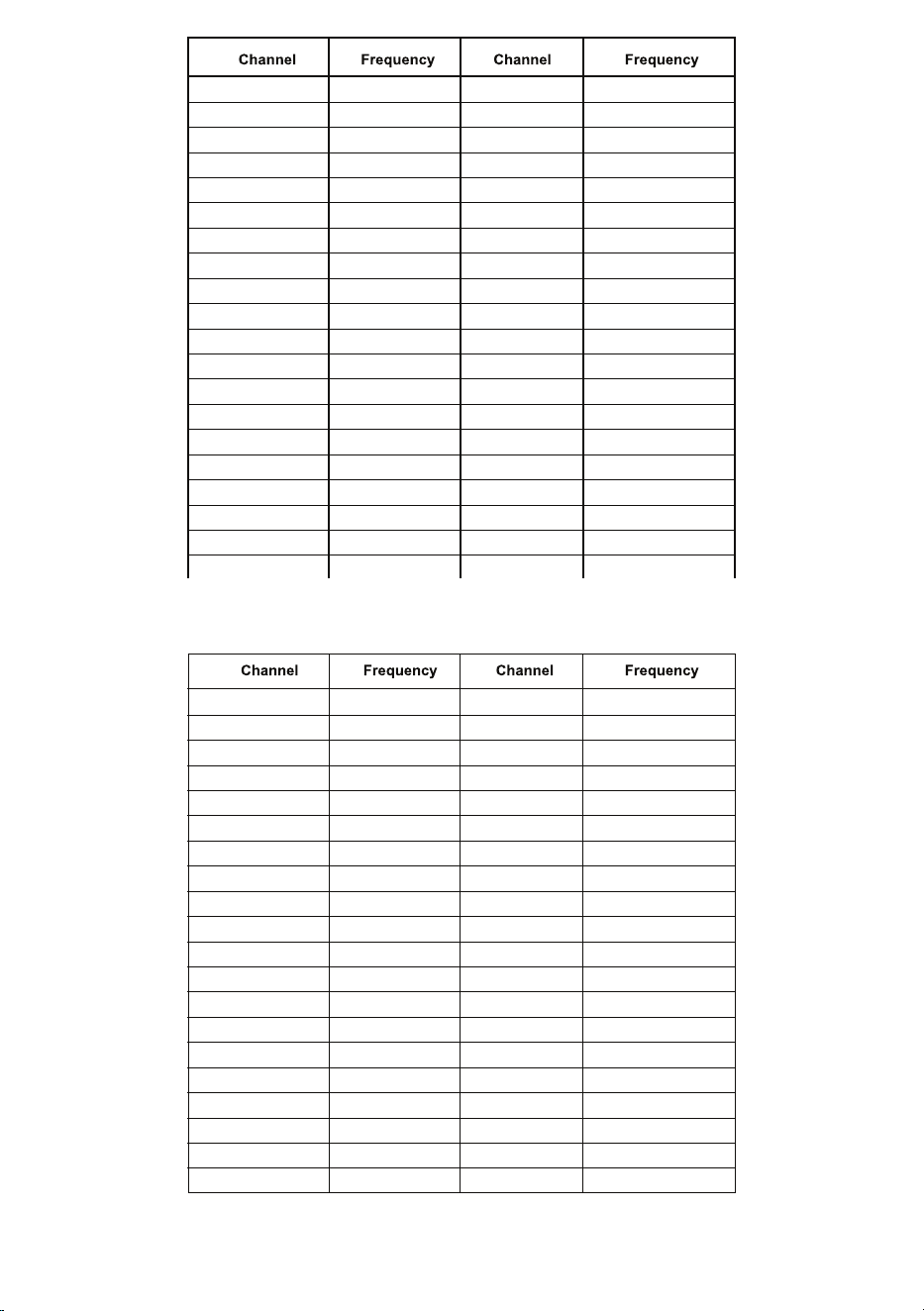
41 26,565 MHz 61 26,765 MHz
42 26,575 MHz 62 26,775 MHz
43 26,585 MHz 63 26,785 MHz
44 26,595 MHz 64 26,795 MHz
45 26,605 MHz 65 26,805 MHz
46 26,615 MHz 66 26,815 MHz
47 26,625 MHz 67 26,825 MHz
48 26,635 MHz 68 26,835 MHz
49 26,645 MHz 69 26,845 MHz
50 26,655 MHz 70 26,855 MHz
51 26,665 MHz 71 26,865 MHz
52 26,675 MHz 72 26,875 MHz
53 26,685 MHz 73 26,885 MHz
54 26,695 MHz 74 26,895 MHz
55 26,705 MHz 75 26,905 MHz
56 26,715 MHz 76 26,915 MHz
57 26,725 MHz 77 26,925 MHz
58 26,735 MHz 78 26,935 MHz
59 26,745 MHz 79 26,945 MHz
60 26,755 MHz 80 26,955 MHz
Frequency table for d2 (DE)
1 26,965 MHz 21 27,215 MHz
2 26,975 MHz 22 27,225 MHz
3 26,985 MHz 23 27,255 MHz
4 27,005 MHz 24 27,235 MHz
5 27,015 MHz 25 27,245 MHz
6 27,025 MHz 26 27,265 MHz
7 27,035 MHz 27 27,275 MHz
8 27,055 MHz 28 27,285 MHz
9 27,065 MHz 29 27,295 MHz
10 27,075 MHz 30 27,305 MHz
11 27,085 MHz 31 27,315 MHz
12 27,105 MHz 32 27,325 MHz
13 27,115 MHz 33 27,335 MHz
14 27,125 MHz 34 27,345 MHz
15 27,135 MHz 35 27,355 MHz
16 27,155 MHz 36 27,365 MHz
17 27,165 MHz 37 27,375 MHz
18 27,175 MHz 38 27,385 MHz
19 27,185 MHz 39 27,395 MHz
20 27,205 MHz 40 27,405 MHz
Frequency table I2 (IT)
1 26,965 MHz 21 27,215 MHz
2 26,975 MHz 22 27,225 MHz
3 26,985 MHz 23 27,255 MHz
4 27,005 MHz 24 27,245 MHz
5 27,015 MHz 25 27,265 MHz
6 27,025 MHz 26 26,875 MHz
7 27,035 MHz 27 26,885 MHz
8 27,055 MHz 28 26,895 MHz
9 27,065 MHz 29 26,905 MHz
10 27,075 MHz 30 26,915 MHz
11 27,085 MHz 31 26,925 MHz
12 27,105 MHz 32 26,935 MHz
13 27,115 MHz 33 26,945 MHz
14 27,125 MHz 34 26,955 MHz
15 27,135 MHz 35 26,855 MHz
16 27,155 MHz 36 26,865 MHz
17 27,165 MHz
18 27,175 MHz
19 27,185 MHz
20 27,205 MHz
Frequency table for I (IT)
1 26,965 MHz 21 27,215 MHz
2 26,975 MHz 22 27,225 MHz
3 26,985 MHz 23 27,255 MHz
4 27,005 MHz 24 27,235 MHz
5 27,015 MHz 25 27,245 MHz
6 27,025 MHz 26 27,265 MHz
7 27,035 MHz 27 27,275 MHz
8 27,055 MHz 28 27,285 MHz
9 27,065 MHz 29 27,295 MHz
10 27,075 MHz 30 27,305 MHz
11 27,085 MHz 31 27,315 MHz
12 27,105 MHz 32 27,325 MHz
13 27,115 MHz 33 27,335 MHz
14 27,125 MHz 34 27,345 MHz
15 27,135 MHz 35 27,355 MHz
16 27,155 MHz 36 27,365 MHz
17 27,165 MHz 37 27,375 MHz
18 27,175 MHz 38 27,385 MHz
19 27,185 MHz 39 27,395 MHz
20 27,205 MHz 40 27,405 MHz
Frequency table In
1 26,965 MHz 21 27,215 MHz
2 26,975 MHz 22 27,225 MHz
3 26,985 MHz 23 27,255 MHz
4 27,005 MHz 24 27,235 MHz
5 27,015 MHz 25 27,245 MHz
6 27,025 MHz 26 27,265 MHz
7 27,035 MHz 27 27,275 MHz
8 27,055 MHz
9 27,065 MHz
10 27,075 MHz
11 27,085 MHz
12 27,105 MHz
13 27,115 MHz
14 27,125 MHz
15 27,135 MHz
16 27,155 MHz
17 27,165 MHz
18 27,175 MHz
19 27,185 MHz
20 27,205 MHz
Frequency table UK
1 27,60125 MHz 21 27,80125 MHz
2 27,61125 MHz 22 27,81125 MHz
3 27,62125 MHz 23 27,82125 MHz
4 27,63125 MHz 24 27,83125 MHz
5 27,64125 MHz 25 27,84125 MHz
6 27,65125 MHz 26 27,85125 MHz
7 27,66125 MHz 27 27,86125 MHz
8 27,67125 MHz 28 27,87125 MHz
9 27,68125 MHz 29 27,88125 MHz
10 27,69125 MHz 30 27,89125 MHz
11 27,70125 MHz 31 27,90125 MHz
12 27,71125 MHz 32 27,91125 MHz
13 27,72125 MHz 33 27,92125 MHz
14 27,73125 MHz 34 27,93125 MHz
15 27,74125 MHz 35 27,94125 MHz
16 27,75125 MHz 36 27,95125 MHz
17 27,76125 MHz 37 27,96125 MHz
18 27,77125 MHz 38 27,97125 MHz
19 27,78125 MHz 39 27,98125 MHz
20 27,79125 MHz 40 27,99125 MHz
Frequency table PL
1 26,960 MHz 21 27,210 MHz
2 26,970 MHz 22 27,220 MHz
3 26,980 MHz 23 27,250 MHz
4 27,000 MHz 24 27,230 MHz
5 27,010 MHz 25 27,240 MHz
6 27,020 MHz 26 27,260 MHz
7 27,030 MHz 27 27,270 MHz
8 27,050 MHz 28 27,280 MHz
9 27,060 MHz 29 27,290 MHz
10 27,070 MHz 30 27,300 MHz
11 27,080 MHz 31 27,310 MHz
12 27,100 MHz 32 27,320 MHz
13 27,110 MHz 33 27,330 MHz
14 27,120 MHz 34 27,340 MHz
15 27,130 MHz 35 27,350 MHz
16 27,150 MHz 36 27,360 MHz
17 27,160 MHz 37 27,370 MHz
18 27,170 MHz 38 27,380 MHz
19 27,180 MHz 39 27,390 MHz
20 27,200 MHz 40 27,400 MHz
Frequency table for F (FR)
1 26,965 MHz 21 27,215 MHz
2 26,975 MHz 22 27,225 MHz
3 26,985 MHz 23 27,255 MHz
4 27,005 MHz 24 27,235 MHz
5 27,015 MHz 25 27,245 MHz
6 27,025 MHz 26 27,265 MHz
7 27,035 MHz 27 27,275 MHz
8 27,055 MHz 28 27,285 MHz
9 27,065 MHz 29 27,295 MHz
10 27,075 MHz 30 27,305 MHz
11 27,085 MHz 31 27,315 MHz
12 27,105 MHz 32 27,325 MHz
13 27,115 MHz 33 27,335 MHz
14 27,125 MHz 34 27,345 MHz
15 27,135 MHz 35 27,355 MHz
16 27,155 MHz 36 27,365 MHz
17 27,165 MHz 37 27,375 MHz
18 27,175 MHz 38 27,385 MHz
19 27,185 MHz 39 27,395 MHz
20 27,205 MHz 40 27,405 MHz
Frequency table for E (ES)
1 26,965 MHz 21 27,215 MHz
2 26,975 MHz 22 27,225 MHz
3 26,985 MHz 23 27,255 MHz
4 27,005 MHz 24 27,235 MHz
5 27,015 MHz 25 27,245 MHz
6 27,025 MHz 26 27,265 MHz
7 27,035 MHz 27 27,275 MHz
8 27,055 MHz 28 27,285 MHz
9 27,065 MHz 29 27,295 MHz
10 27,075 MHz 30 27,305 MHz
11 27,085 MHz 31 27,315 MHz
12 27,105 MHz 32 27,325 MHz
13 27,115 MHz 33 27,335 MHz
14 27,125 MHz 34 27,345 MHz
15 27,135 MHz 35 27,355 MHz
16 27,155 MHz 36 27,365 MHz
17 27,165 MHz 37 27,375 MHz
18 27,175 MHz 38 27,385 MHz
19 27,185 MHz 39 27,395 MHz
20 27,205 MHz 40 27,405 MHz
EN:
EU Simplied Declaration of Conformity
ONLINESHOP SRL declares that PNI Escort HP 62 portable CB radio complies with the Directive RED 2014/53/UE.
The full text of the EU declaration of conformity is available at the following Internet address:
https://www.mypni.eu/products/6344/download/certications