508473-01 Issue 2424 Page 1 of 22
This manual must be left with the homeowner for future reference.
Table of Contents
Shipping and Packing List ...........................................2
General ........................................................................2
Wiring diagram ............................................................3
Air Flow – Cooling Blower Speed ................................4
Electrical Connections .................................................6
Control Panel Relocation .............................................7
Nameplate Marking .....................................................8
Requirements ..............................................................8
Unit Dimensions – Upow – Inches (mm) ...................9
Checkout Procedures ................................................10
Operation ...................................................................10
Installation Clearances ..............................................11
Installation .................................................................11
Condensate Drain......................................................14
Duct System and Filters ............................................16
Brazing Refrigerant Lines ..........................................18
Sealing the Unit .........................................................18
Homeowner Maintenance..........................................19
Professional Maintenance .........................................19
Use of Air Handler During Construction.....................19
Repairing or Replacing Cabinet Insulation ................20
Decommissioning ......................................................20
Improper installation, adjustment, alteration, service
or maintenance can cause property damage, personal
injury or loss of life. Installation and service must be
performed by a licensed professional HVAC installer or
equivalent, service agency, or the gas supplier.
WARNING
(P) 508473-01
*P508473-01*
Allied Air Enterprises LLC
215 Metropolitan Drive
West Columbia, SC 29170
INSTALLATION INSTRUCTIONS
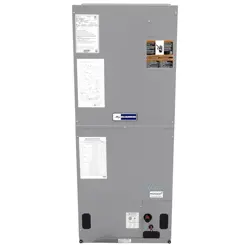
BAH7P
One-Piece PSC Air
Handler-R410A
If installing in an R454B application, R454B air handler
sensor kit (27J27), Refrigerant Detection System
Control (27A05) and R454B TXV (26Z70, 26Z71, or
26Z72) must be ordered.
If installing in an R454B application, use installation
instructions provided in R454B air handler sensor kit
(27J27).
For sensor maintenance recommendations, refer to the
instructions in kit 27J27.
IMPORTANT
Every working procedure that aects safety means shall
only be carried out by competent persons. This appliance
is not to be used by persons (including children) with
reduced physical, sensory or mental capabilities, or
lack of experience and knowledge, unless they have
been given supervision or instruction concerning use of
the appliance by a person responsible for their safety.
Children should be supervised to ensure they do not
play with the appliance.
IMPORTANT
508473-01Issue 2424Page 2 of 22
NOTE: This unit is a PARTIAL UNIT AIR CONDITIONER,
complying with PARTIAL UNIT requirements of this
Standard, and must only be connected to other units
that have been conrmed as complying to corresponding
PARTIAL UNIT requirements of this Standard, UL 60335-
2-40/CSA C22.2 No. 60335-2-40, or UL 1995/CSA C22.2
No 236.
NOTE: PARTIAL UNITS shall only be connected to an
appliance suitable for the same refrigerant.
Shipping and Packing List
Package 1 of 1 contains:
1 – Assembled air handler unit factory-equipped for upow
or horizontal air discharge application (includes upow
and horizontal drain pans and pre-installed air lter)
Check the air handler for shipping damage; if found,
immediately contact the last carrier. Check the unit rating
plate to conrm that delivered unit matches order.
General
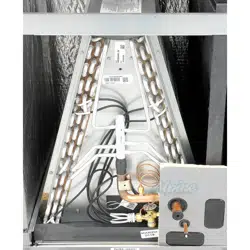
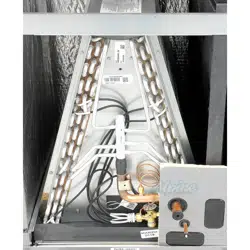
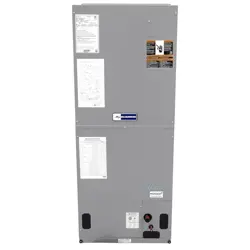
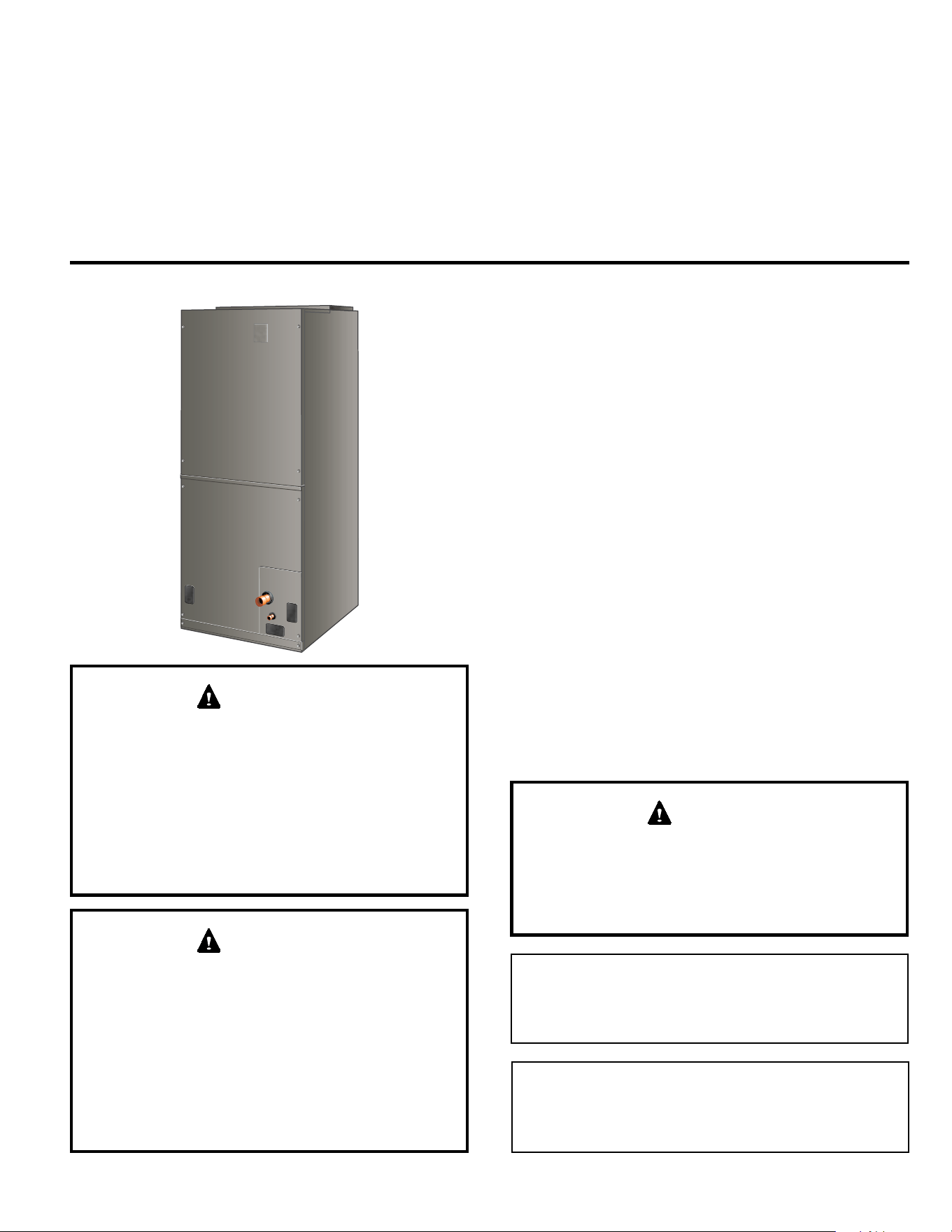
The BAH7P series air handler with aluminum coil is
designed for indoor installation only. As shipped, the unit
is ready for installation in either upow, horizontal left-
hand or
right-hand air discharge applications. Electric
heat, downflow air discharge kits, air filters and other
accessories are available and listed in the BAH7P
Product Specification for ordering.
This instruction is intended as a general guide and does
not supersede local or national codes in any way. Consult
authorities having jurisdiction before installation.
NOTE: Special procedures are required for cleaning the
aluminum coil in this unit. See Page 19 in this instruction
for information.
The Clean Air Act of 1990 bans the intentional venting
of refrigerant (CFCs, HCFCs and HFCs) as of July
1, 1992. Approved methods of recovery, recycling or
reclaiming must be followed. Fines and/or incarceration
may be levied for noncompliance.
IMPORTANT
Maximum altitude of application is 3200m above sea
level.
WARNING
508473-01 Issue 2424 Page 3 of 22
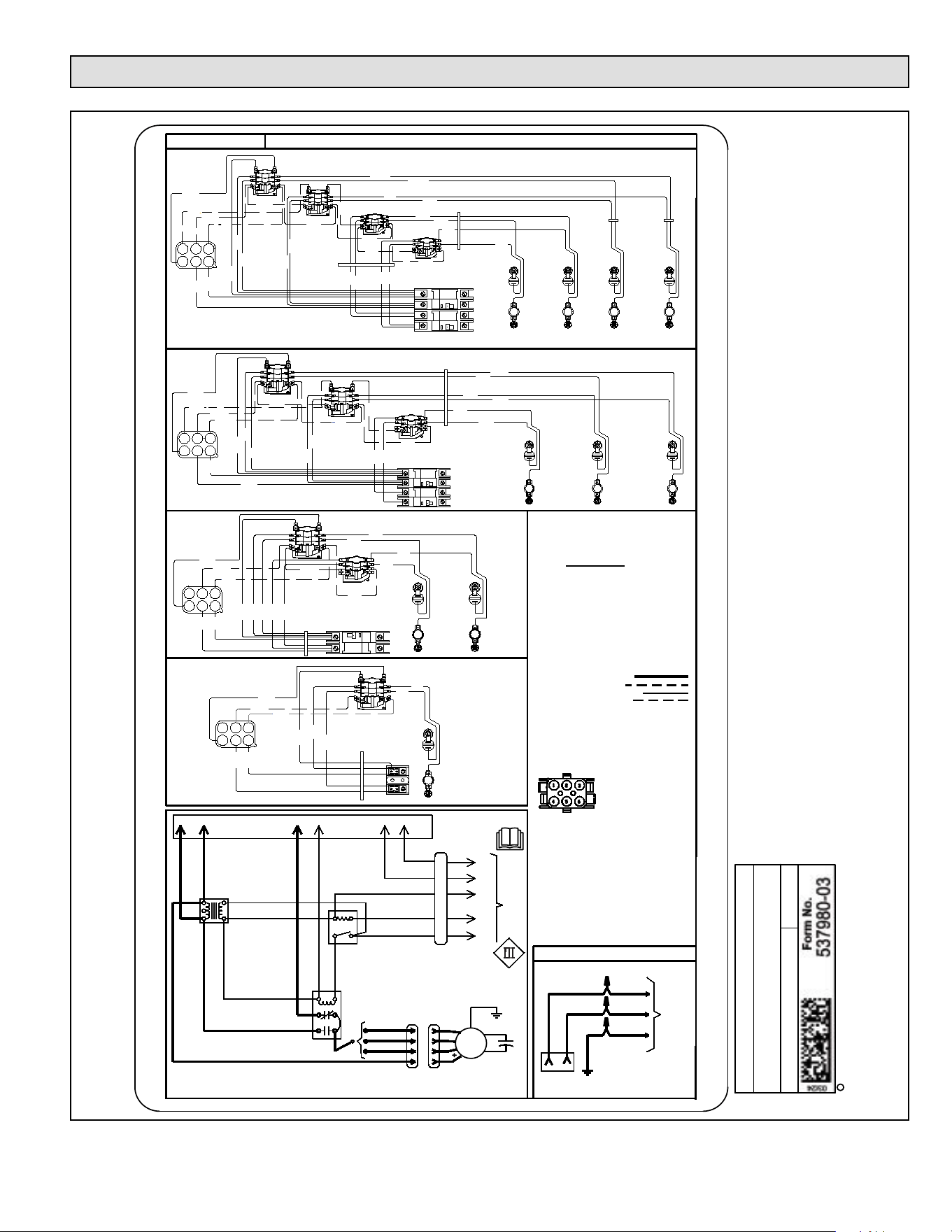
Wiring diagram
15 AMP
L1
L2 OR
NEUT.
WIRING DIAGRAM: NO HEAT
14 GRN
2
14 BLK
1
GND
14 YEL(240V)
14 WHT(120V)
6-PIN
PLUG
14 YEL(COM)
14 BLK(HI)
14 RED(LO)
2
YEL
1
CAP
MTR
BLK
RED
3
BRN/WHT
BRN
GND
C
24
HEATERS USED
LOCATION
PLUG PIN
CONTROL CIRCUIT WIRING TO BE
24 VOLT, N.E.C. CLASS 2
W2
BLU
WHT
GRN
RED
W1
C
18 BLU
18 WHT
G
R
18 GRN
18 RED
BLK
14 YEL L2
14 BLK L1
24V
COM
208V
18 BLU
240V
14 BLK
1
3
5
2
6
4
18 BLU
6
54
32
1
18 GRN
18 BLK
14 RED
18 BLU
18 RED
1
2
3
5
14 BLUE (MED)
BLUE
4
#
TRANSFORMER
BLOWER
REALY
TIME DELAY
ON
1-20
20-60
20-60
OFF
40-110
1-30
1-30
ON
30-90
30-90
OFF
1-30
1-30
# FACTORY SPEED SET TO MEDIUM (BLUE)
Supersedes
Litho U.S.A.
C
2011
PSC LABEL WIRING DIAGRAM
ELECTRIC HEAT
3
6
12
5 4
BLK
YEL
BLK
YEL
RED
YEL
BLK
HTR 1
RED
WHT
BLU
HTR 1
4KW & 5KW
OFF
ON
7.5KW & 10KW
BLK
BLK
YEL
YEL
RED
BLK
BLK
YEL
YEL
RED
WHT
BLU
BLU
WHT
3
6
12
5 4
HTR1
HTR2
YEL
BLK
L1
L2
WIRING DIAGRAM - ELECTRIC HEATPART NO. 537980-02
OFF
ON
OFF
ON
12.5KW & 15KW
L1
L2
L1
L2
BLK
YEL
BLK
YEL
BLU
BLK
YEL
BLK
BLK
YEL
YEL
RED
WHT
RED
WHT
BLU
3
6
12
5 4
BLK
BLK
YEL
BLK
BLU
YEL
BLK
OFF
ON
OFF
ON
BLK
BLK
YEL
YEL
BLK
BLK
20KW
3
6
12
5 4
BLK
RED
WHT
BLU
BLK
BLK
RED
WHT
BLU
YEL
YEL
BLK
YEL
YEL
YEL
BLU
BLK
BLU
BLK
BLK
YEL
YEL
BLK
SEQ
SEQ
SEQ
SEQ
SEQ
SEQ
SEQ
SEQ
SEQ
SEQ
PRI LS PRI LS
L1
L2
L1
L2
CB
CB
CB OR TB
CB OR TB
HTR 1
SEC L
HTR 2
SEC L
HTR 3
SEC L
HTR 4
SEC L
HTR 1
PRI LS
HTR 2
PRI LS
HTR 3
PRI LS
HTR 4
PRI LS
HTR 1
SEC L
HTR 2
SEC L
HTR 3
SEC L
HTR 1
PRI LS
HTR 2
PRI LS
HTR 2
PRI LS
HTR 2
PRI LS
HTR 3
PRI LS
4KW & 5 KW = HTR1
7.5 & 10 KW = HTR1 & HTR2
15 KW = HTR1,HTR2 & HTR3
20 KW = HTR1,HTR2,HTR3 & HTR4
TB = TERMINAL BLOCK
CB = CIRCUIT BREAKER
SEQ = SEQUENCER
GND = GROUND LUG
PRI LS= LIMIT SWITCH
SEC L= LIMIT SWITCH
HTR = HEATER ELEMENT
POWER (FACTORY WIRED)
POWER (FIELD WIRED)
CONTROL (FACTORY WIRED)
CONTROL (FIELD WIRED)
THREE POLE SEQUENCER
TIMING - SEC
THREE POLE SEQUENCER
TIMING - SEC
**TD = TIME DELAY (OPT.)
TR = TRANSFORMER
BR = BLOWER RELAY
MTR = BLOWER MOTOR
CAP = MOTOR CAPACITOR
GND = GROUND
CONNECTION
TO
THERMOSTAT
BY OTHERS
WIRE NUTS
BY
OTHERS
SUPPLY
VOLTAGE
HTR 2
SEC L
HTR 1
SEC L
Figure 1. Typical Wiring Diagram – BAH7P Air Handler with Electric Heat – PSC
508473-01Issue 2424Page 4 of 22
Air Flow – Cooling Blower Speed
The cooling blower speed is factory congured to provide
correct air ow for an outdoor unit that matches the cooling
capacity rating of the air handler.
If the outdoor unit is smaller than the maximum cooling
capacity rating for the air handler, the cooling blower speed
may need to be changed. Refer to blower performance
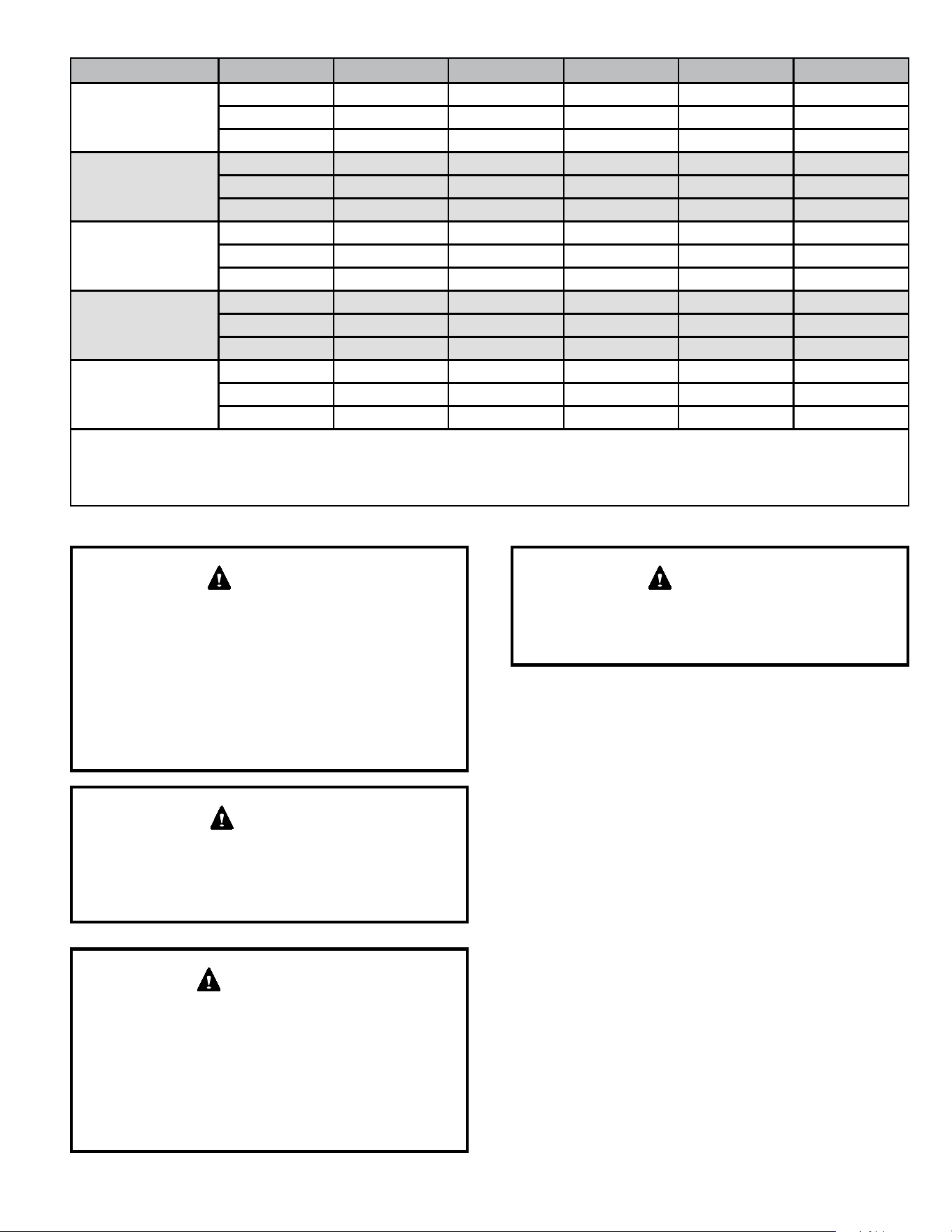
chart in Table 1.
Electric shock hazard! - Disconnect all power
supplies before servicing.
Replace all parts and panels before operating.
Failure to do so can result in death or electrical
shock.
WARNING
Change Blower Speed
1. Disconnect all power supplies.
2. Remove the air handler access panel.
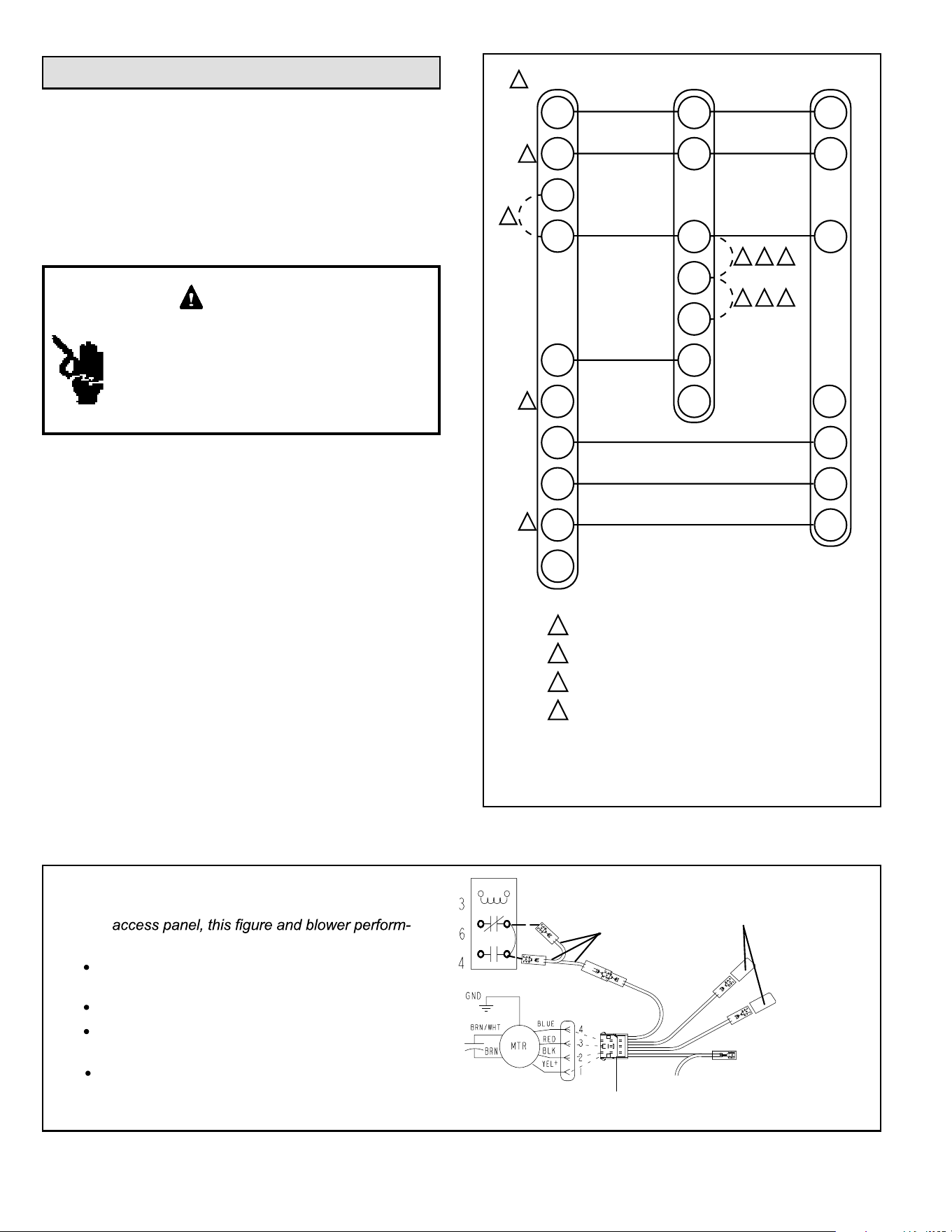
3. Locate pin number 2 on the blower relay. Two black
wires are connected to this terminal pin. One connects
to pin number 5 on the blower relay, one connects to
an in-line splice connecting to a blue wire.
4. Connect wiring. Select the required blower motor
speed. Connect red-LO or black-HI and plug it into the
4-pin blower relay harness connector.
NOTE: Reuse the factory-installed rubber wire cap on
the unused wires.
5. Replace all panels.
6. Reconnect power.
2
BLUE (MED)
RED (L0)
BLACK (HI)
YELLOW (COM)
5
BLOWER RELAY
BLOWER RELAY
PLASTIC CAPS
4-PIN
BLOWER CONNECTOR
HARNESS
NOTE - Refer to wiring diagram located on the
unit
ance (table 1).
All air data measured external to unit with 1
inch non-pleated air filter in place.
All factory settings are medium speed.
All data given while air handler is operating
with a dry DX evaporator coil.
All downflow applications run on high speed
when utilizing electric heat.
Figure 2. Changing Blower Speed
Figure 3. Thermostat Designations -
Non-Communicating
1
Refer to thermostat installation instructions
2
If applicable
3
Refer to indoor unit installation instructions
4
“L” is used for any accessories (e.g. diagnostic /
warning / alarm), used to activate thermostat
warning light
W / W1 / W2 / W3 are auxiliary heat
(supplemental to heat pump).
“E” is emergency heat (disables heat pump).
NOTES:
W3
W2
R
R
R
C
C
C
W1
W/
W1
W1
Auxiliary Heat
(Heat Pump)
G
G
Indoor Blower Only
O
O
Heat Pump
Y2
Y2
Thermostat Indoor Unit Outdoor Unit
E
L L
B
Y1
Compressor / 1st Stage
Y1
4
1
2
31
2
31
2
1
1
Not Used
L
Auxiliary Heat
(Heat Pump)
Compressor / 2nd Stage
508473-01 Issue 2424 Page 5 of 22
Air Handler Model Blower Speed .10" WC .20" WC .30" WC .40" WC .50" WC
-018
LOW 538 525 503 471 418
MED 688 670 639 603 548
HIGH 919 881 855 788 710
-024
LOW 677 673 657 629 592
MED 1011 979 942 803 742
HIGH 1106 1045 999 917 857
-030
LOW 871 870 853 812 769
MED 1078 1057 1024 987 936
HIGH 1311 1261 1214 1154 1086
-036
LOW 1020 972 956 909 806
MED 1276 1240 1191 1148 1086
HIGH 1559 1521 1446 1395 1327
-042
LOW 1300 1273 1250 1211 1155
MED 1527 1493 1452 1390 1345
HIGH 1816 1756 1693 1605 1528
Blower Performance (CFM vs. ESP in. w.c.)
• Cooling speeds should not be reduced below factory setting.
• All units with electric heat approved at 0.5” maximum and medium blower speed minimum.
• All downow applications run on high speed when utilizing electric heat.
Table 1. BAH7P Blower Performance (3-Speed PSC) – 240V (CFM @ ESP. – in. W. C.)
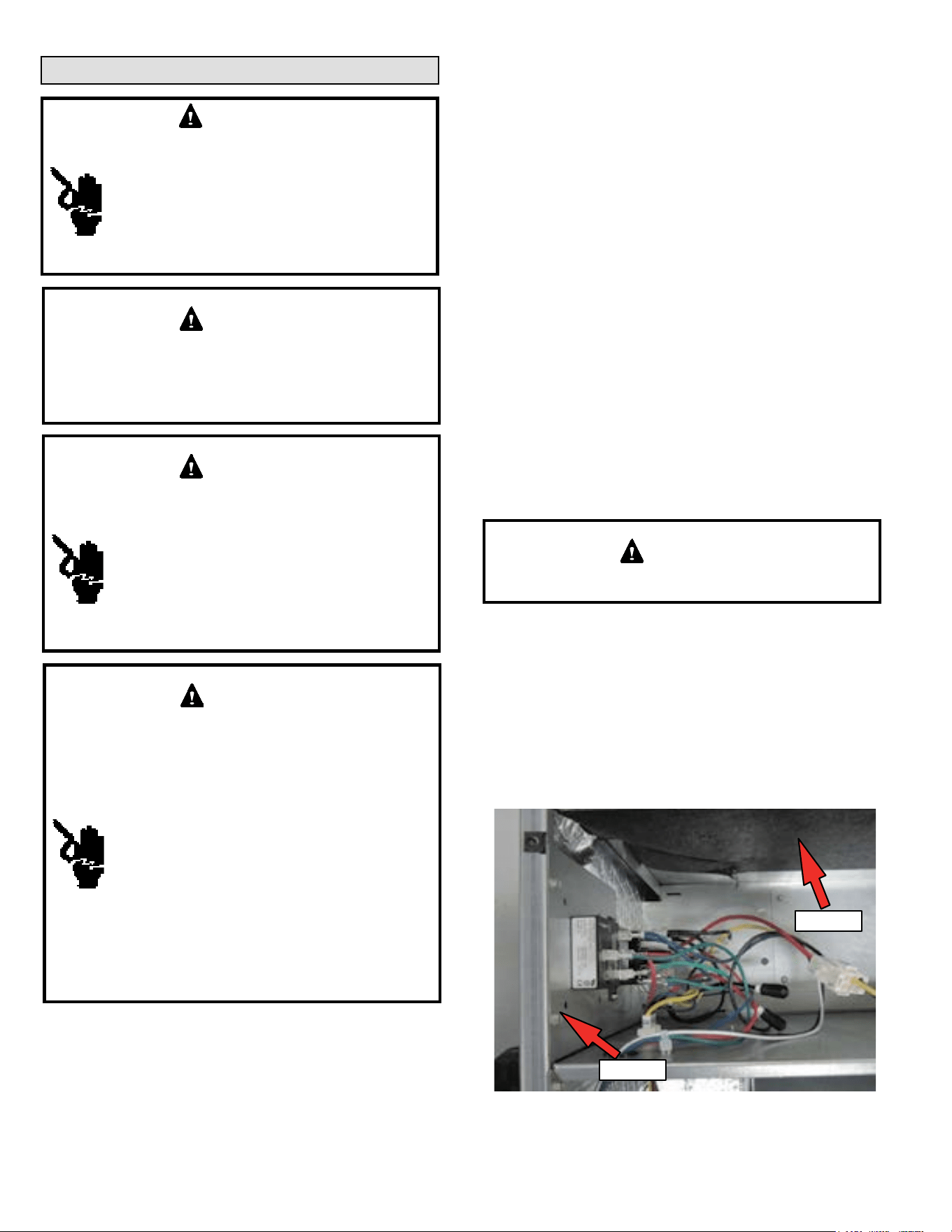
As with any mechanical equipment, contact with sharp
sheet metal edges can result in personal injury. Take
care while handling this equipment and wear gloves
and protective clothing.
CAUTION
Excessive Weight Hazard - Use two or more people
when moving and installing the unit. Failure to do so
can result in back or other type of injury.
WARNING
This unit is approved for installation clearance to
combustible material as stated on the unit rating
plate. Accessibility and service clearances must take
precedence over combustible material clearances.
The air handler must be installed so that free access is
allowed to the coil/lter compartment and blower/control
compartment.
IMPORTANT
To prevent serious injury or death : Lock-out / tag-out
before performing maintenance.
If system power is required (e.g.,smoke detector
maintrnance ), disable power to blower ,remove fan
belt where applicable, and ensure all controllers
and thermostats are set to the ‘‘ OFF “ position
before performing maintenance. Always keep hands
,hair,clothing,jewerly tools etc..away from moving.
WARNING
508473-01Issue 2424Page 6 of 22
Electrical Connections
Electric shock hazard! - Disconnect all power
supplies before servicing.
Replace all parts and panels before operating.
Failure to do so can result in death or electrical
shock.
WARNING
Electric Shock Hazard.
Can cause injury or death.
Foil-faced insulation has conductive
characteristics similar to metal. Be sure there
are no electrical connections within 1/2ʺ of the
insulation. If the foil-faced insulation comes in
contact with electrical voltage, the foil could
provide a path for current to pass through
to the outer metal cabinet. While the current
produced may not be enough to trip existing
electrical safety devices (e.g., fuses or circuit
breakers), the current can be enough to cause
an electrical shock hazard that could cause
personal injury or death.
WARNING
Electric Shock Hazard. Can cause injury or
death. Unit must be properly grounded in
accordance with national and local codes.
Line voltage is present at all components when
unit is not in operation on units with single-
pole contactors. Disconnect all remote electric
power supplies before opening access panel.
Unit may have multiple power supplies.
WARNING
Run 24V Class II wiring only through specied low
voltage opening. Run line voltage wiring only through
specied high voltage opening. Do not combine voltage
in one opening.
WARNING
• Electrical wiring, disconnect means and over-current
protection are to be supplied by the installer. Refer
to the air handler rating plate for maximum over-
current protection, minimum circuit ampacity, as well
as operating voltage. Select the proper supply circuit
conductors in accordance with tables 310-16 and 310-
17 in the National Electric Code, ANSI/NFPA No. 70 or
tables 1 through 4 in the Canadian Electric Code, Part
I, CSA Standard C22.1.
• The power supply must be sized and protected
according to the specications supplied on the product.
• This air handler is factory-congured for 240 volt,
single phase, 60 cycles. For 208-volt applications, see
“208 Volt Conversion” later in this section.
• Separate openings have been provided for 24V low
voltage and line voltage. Refer to the dimension
illustration of specic location.
• This unit is provided with holes for conduit. Use
provided caps to seal holes not used.
• Typical unit wiring (as well as wiring of optional eld-
installed electric heat) is given in Figure 3. Refer to the
instructions provided with the electric heat section for
proper installation.
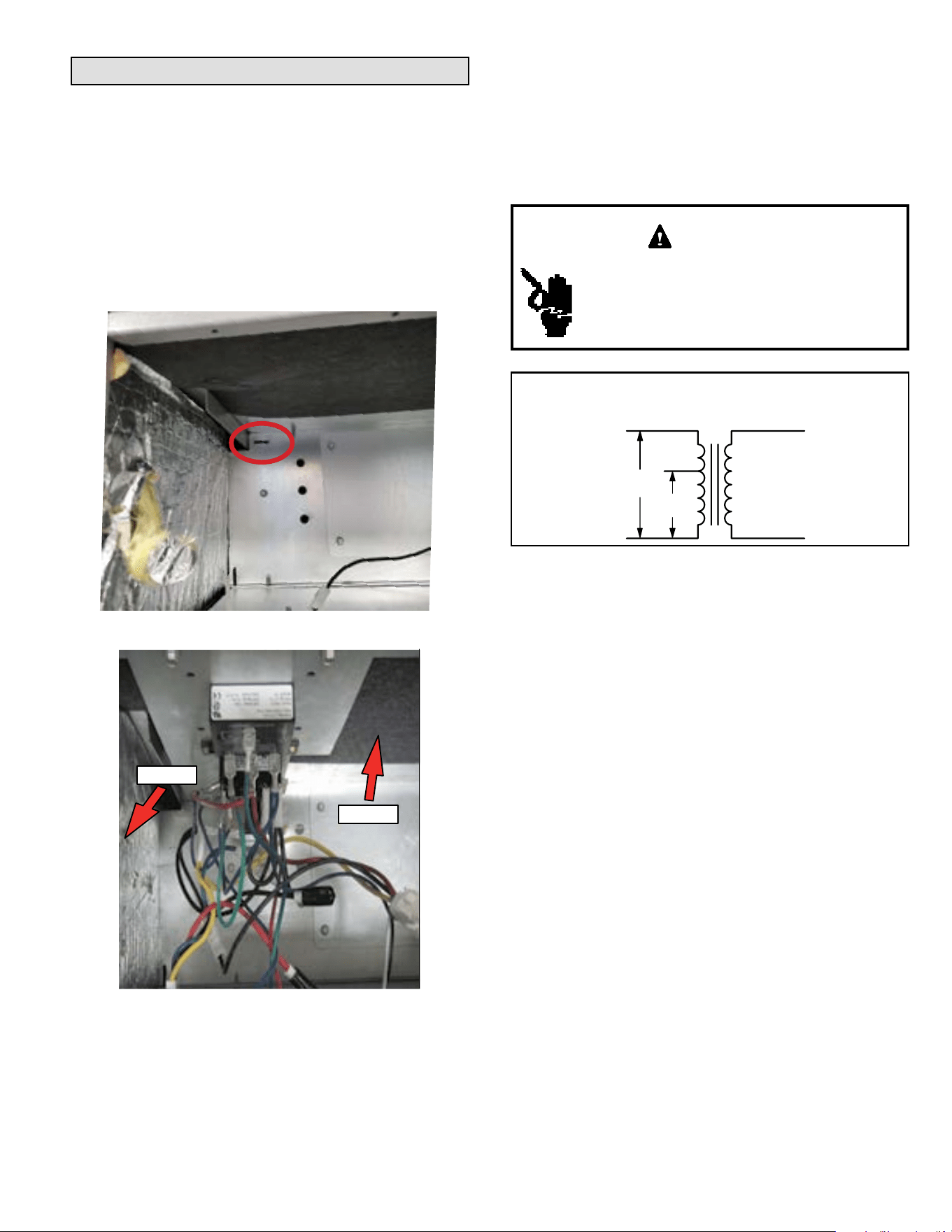
1. Disconnect all power supplies.
2. Remove the air handler access panel.
3. Route the eld supply wires to the air handler electrical
connection box.
4. Use UL-listed wire nuts to connect the eld supply
conductors to the unit black and yellow leads, and the
ground wire to ground terminal marked GND.
5. Replace the air handler access panel.
USE COPPER CONDUCTORS ONLY
WARNING
SIDE
TOP
Figure 4. Electrical Connections
(Upow Conguration)
• Wiring must conform to the current National Electric
Code, ANSI/NFPA No. 70, or Canadian Electric Code
Part I, CSA Standard C22.1, and local building codes.
Refer to following wiring diagrams. See unit nameplate
for minimum circuit ampacity and maximum over-
current protection size.
508473-01 Issue 2424 Page 7 of 22
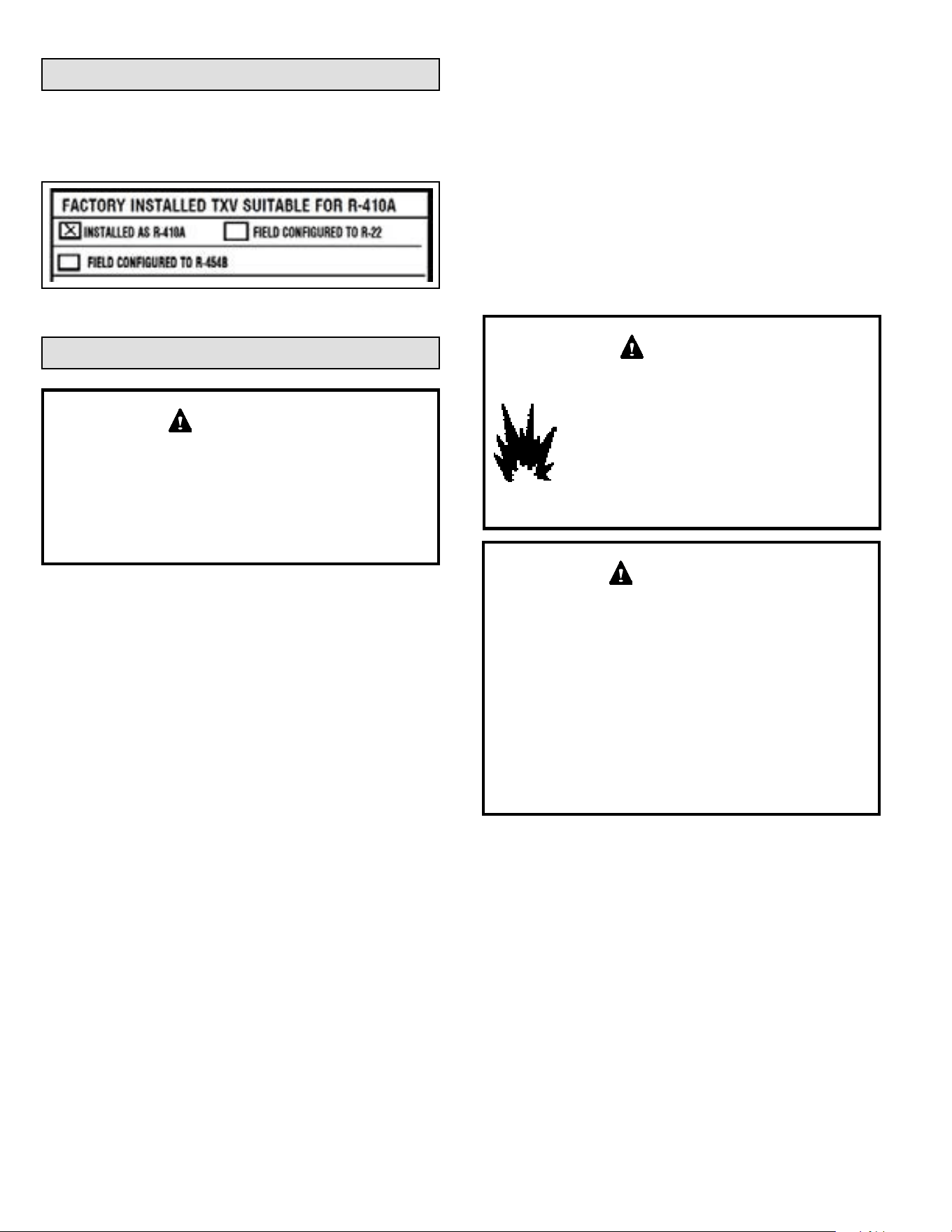
To avoid the possibility of moisture damage to the control in
some left-hand discharge congurations, the control panel
can be relocated to the end panel as shown in Figure 6.
1. Remove the two screws that secure the control panel
to the cabinet. Slide panel out.
2. Slide the control panel into the notch on the electric
heat mounting panel (Figure 5). Using the screws
removed in Step 1, secure the control panel to the end
panel.
Figure 5. Notch for Control Panel Relocation
Control Panel Relocation
TOP
SIDE
Figure 6. Control Panel Relocated to End Panel
(Horizontal-Left Conguration)
208 Volt Conversion
1. Disconnect all power supplies.
2. Remove the air handler access panel.
3. Using the wiring diagram located on the unit access
panel as a reference, move the 2 connected black
transformer leads from the 240 volt terminal on the
transformer to the 208 volt terminal on the transformer
Electrically ground air handler. Connect
ground wire to ground terminal marked “GND”.
Failure to do so can result in death or electrical
shock.
WARNING
208 / 240 VOLT TRANSFORMER
PRIMARY SECONDARY
240 Volts
208 Volts
Figure 7. Converting Unit from 240VAC to 208VAC
508473-01Issue 2424Page 8 of 22
Nameplate Marking
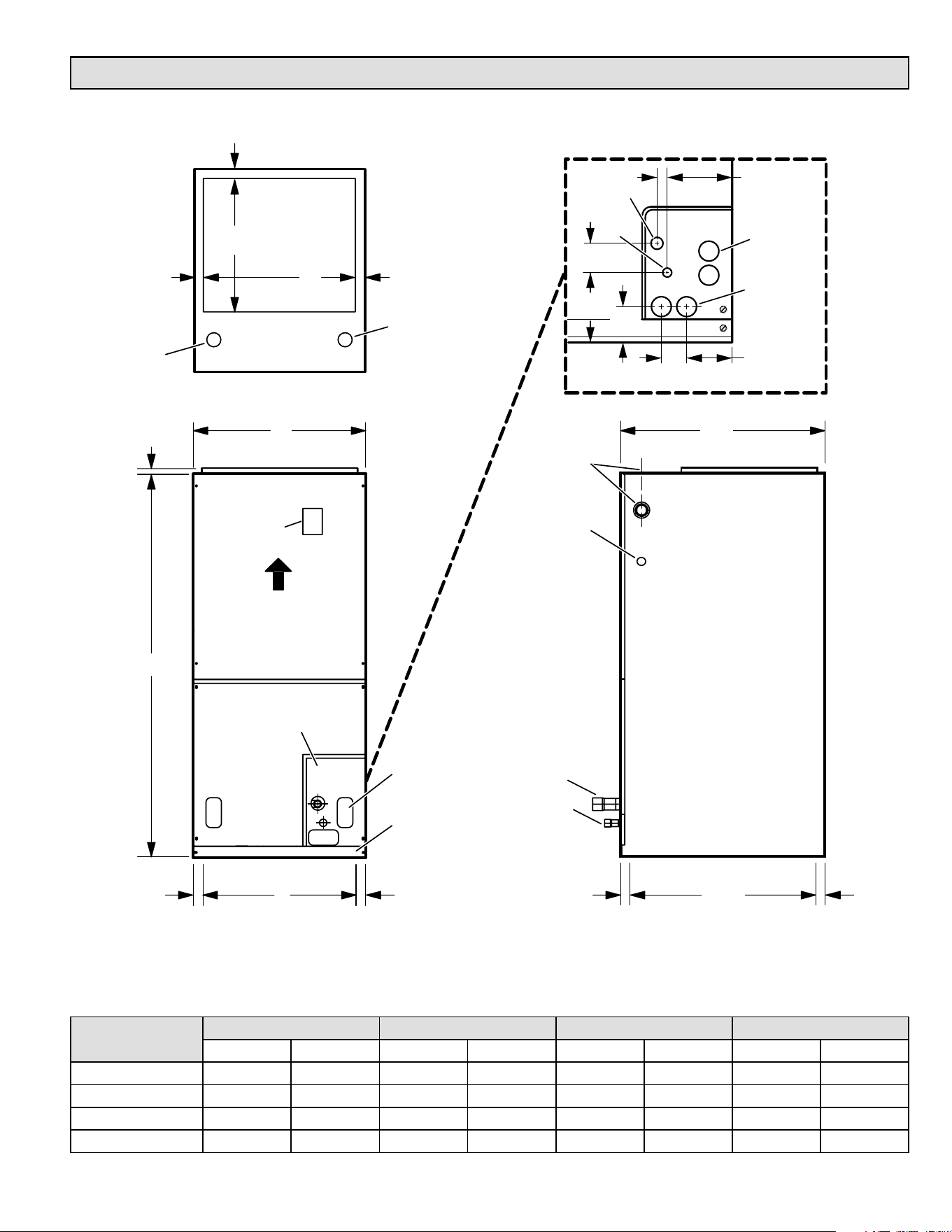
Prior to installing the front panel, mark the unit nameplate
to permanently identify the refrigerant conguration.
Nameplate example shown in Figure 9:
Figure 9. Nameplate Marking
Requirements
BAH7P units that include a factory-installed check/
expansion valve will provide optimal refrigerant control
and system performance with outdoor units of varying
capacities. These units must be installed as a part
of a matched system as outlined in the BAH7P
Product Specification.
IMPORTANT
These instructions are intended as a general guide.
Compliance with all local, state, or national codes
pertaining to this type of equipment should be determined
prior to installation. Read this instruction manual, as well
as the instructions supplied in separate equipment, before
starting the installation.
In addition to conforming to manufacturer’s installation
instructions and local municipal building codes, installation
of air handler units (with or without optional electric heat),
MUST conform with National Fire Protection Association
(NFPA) standards: “Standard for Installation of Air
Conditioning and Ventilation Systems” (NFPA No. 90A)
and “Standard for Installation of Residence Type Warm Air
Heating and Air Conditioning Systems” (NFPA No. 90B).
All models are designed for indoor installation only. The
installation of the air handler, eld wiring, duct system, etc.
must conform to the requirements of the National Electrical
Code, ANSI/NFPA No. 70 (latest edition) in the United
States, and any state laws, and local ordinances (including
plumbing or waste water codes).
Local authorities having jurisdiction should be consulted
before installation is made. Such applicable regulations
or requirements take precedence over the general
instructions in this manual.
Install the conditioned air plenum, ducts and air lters
(provided) in accordance with NFPA 90B Standard for
the Installation of Warm Air Heating and Air-Conditioning
Systems (latest edition).
The air handler is shipped from the factory completely
assembled. The unit is provided with anges for the
connection of the duct system.
Do not remove the cabinet knockouts until it has been
determined which knockouts will need to be removed for
the installation.
Select the air discharge position which best suits the site
conditions. Consider required clearances, space, routing
requirements for refrigerant line, condensate disposal,
lters, duct system, wiring, and accessibility for service.
Refer to the rating plate on the air handler for specic
information.
Danger of explosion. Keep ammable
materials and vapors, such as gasoline,
away from air handler. Place air handler so
that heating elements are at least 18 inches
(46 cm) above the oor for a garage
installation. Failure to follow these
instructions can result in death, explosion,
or re.
WARNING
• During cooling operation, excessive sweating may
occur if the air handler is installed in a warm and
humid space.
• If installed in an unconditioned space, sealant should
be applied around the electrical wires, refrigerant
tubing, and condensate lines where they enter the
cabinet.
• Electrical wires should be sealed on the inside where
they exit the conduit opening. Sealant is required to
prevent air leakage into, and condensate from forming
inside of, the air handler, the control box, and on the
electrical controls.
Excessive condensation may occur if the unit is installed
in a warm, humid place. When the unit is installed in an
unconditioned space, apply sealant around electrical
wires, refrigerant piping and condensate lines at the
point where they enter the cabinet.
Apply sealant on the inside of the cabinet at the
point where the electrical wires exit through the
conduit opening. This will also keep warm and moist
unconditioned air out of the air handler cabinet where
it will form condensate on the cooler control box and
electrical controls.
IMPORTANT
508473-01 Issue 2424 Page 9 of 22
A
B
FRONT VIEW SIDE VIEW
LINE VOLTAGE
INLETS
(Top and Right Side)
LOW VOLTAGE
INLETS
(Either Side)
SUCTION
LINE
LIQUID
LINE
FILTER
ACCESS
3/4
(19)
AIR FLOW
CIRCUIT
BREAKER
COVER
D
1-1/8
(29)
1/2
(13)
C
LINE VOLTAGE
INLETS
(Top and Left Side)
LOW VOLTAGE
INLETS
(Top and Right Side)
1 (25)
SUPPLY AIR
OPENING
TOP VIEW
OPENING
OPENING
1 (25)
1 (25)
1-1/8
(29)
1-1/8
(29)
20-3/8
(518)
22
(559)
14-1/2
(368)
DETAIL OF PIPING PLATE
LIQUID
LINE
CONDENSATE
DRAINS (2)
(Horizontal)
1-3/4
(44)
3/4 (19)
2-3/4
(70)
3-1/2
(89)
PIPING
PLATE
4-3/4
(121)
4-3/8
(111)
2-3/8
(60)
CONDENSATE
DRAINS (2)
(Upflow and
Downflow)
SUCTION
LINE
CONDENSATE DRAIN
PIPING PLATE (3)
(2-1/4 x 3-3/4)
Unit Dimensions – Upow – Inches (mm)
Dimensions
018 024 030 036 / 042
in. mm in. mm in. mm in. mm
A 43-1/2 1105 45-1/2 1156 47 1194 53-5/8 1362
B 18-1/2 470 18-1/2 470 18-1/2 470 21-1/2 546
C 16-1/2 419 16-1/2 419 16-1/2 419 19-1/2 495
D 16-1/4 413 16-1/4 413 16-1/4 413 19-1/4 489
NOTE: Unit is shipped congured for horizontal right-hand air discharge. Unit may be converted to horizontal left-hand air
discharge by repositioning horizontal drain pan. Dimensions remain the same in all congurations.
508473-01Issue 2424Page 10 of 22
Checkout Procedures
NOTE: Refer to outdoor unit installation instructions for
system start-up instructions and refrigerant charging
instructions.
Pre-Start-Up Checks
• Is the air handler properly and securely installed?
• If horizontally congured, is the unit sloped up to 5/8
inch toward drain lines?
• Will the unit be accessible for servicing?
• Has an auxiliary pan been provided under the unit
with separate drain for units installed above a nished
ceiling or in any installation where condensate overow
could cause damage?
• Have ALL unused drain pan ports been properly
plugged?
• Has the condensate line been properly sized, run,
trapped, pitched, and tested?
• Is the duct system correctly sized, run, sealed, and
insulated?
• Have all cabinet openings and wiring been sealed?
• Is the indoor coil factory-installed TXV or RFC properly
sized for the outdoor unit being used?
• Have all unused parts and packaging been disposed
of?
• Is the lter clean, in place, and of adequate size?
• Is the wiring neat, correct, and in accordance with the
wiring diagram?
• Is the unit properly grounded and protected (fused)?
• Is the thermostat correctly wired and in a good
location?
• Are all access panels in place and secure?
Check Blower Operation
1. Set thermostat to FAN ON. The indoor blower should
come on
Check Cooling Operation
1. Set thermostat to force a call for cooling (approximately
5ºF lower than the indoor ambient temperature).
2. The outdoor unit should come on immediately and the
indoor blower should start between 30 - 60 seconds
later.
3. Check the air ow from a register to conrm that the
system is moving cooled air.
4. Set the thermostat 5ºF higher than the indoor
temperature. The indoor blower and outdoor unit
should cycle o.
Check Electric Heat (If Used)
1. Set thermostat to call for auxiliary heat (approximately
5°F above ambient temperature). The indoor blower
and auxiliary heat should come on together. Allow a
minimum of 3 minutes for all sequencers to cycle on.
2. Set the thermostat so that it does not call for heat.
Allow up to 5 minutes for all sequencers to cycle o.
Operation
Time Delay Relay
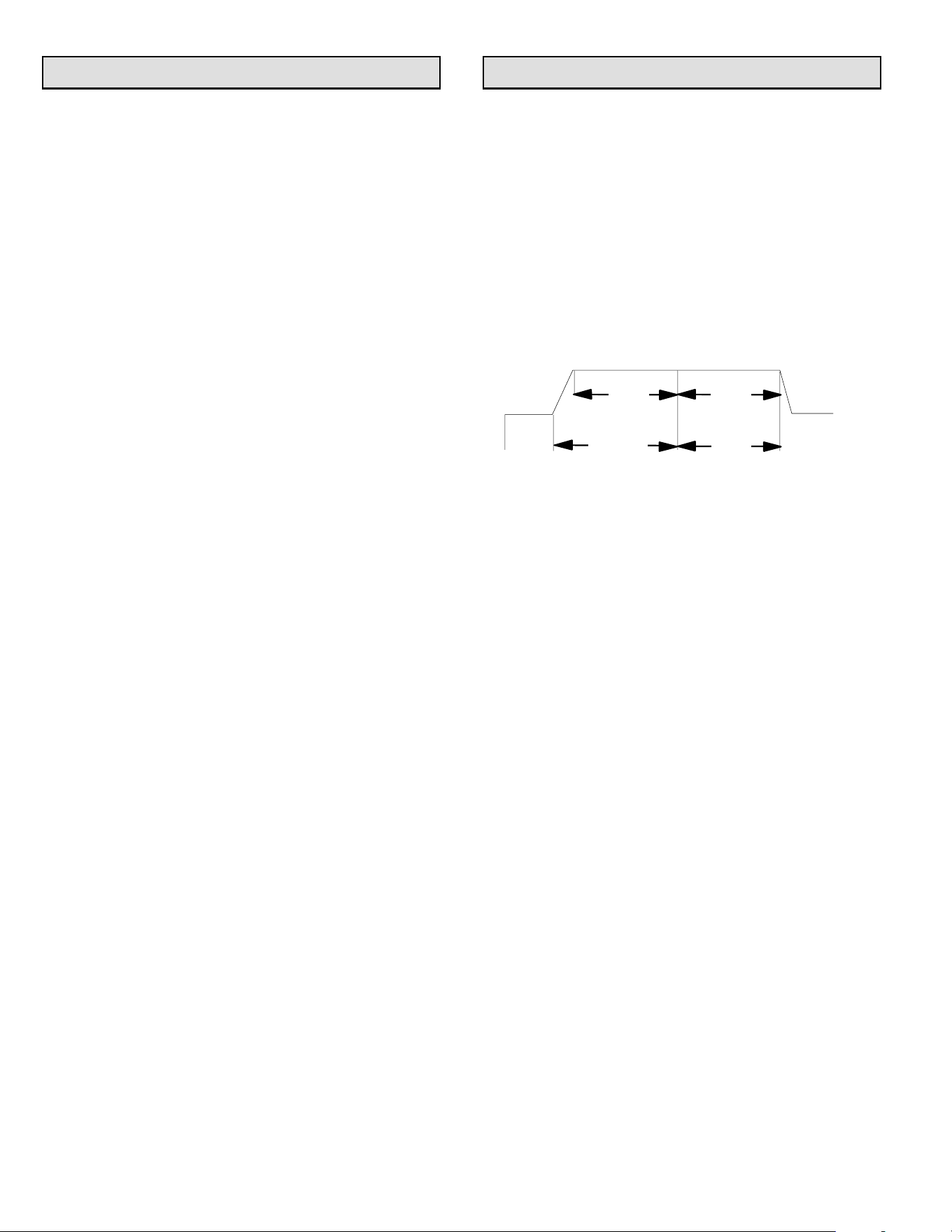
Blower time delay operation:
1. When cooling demand is initiated, there is a 1 second
motor-on delay.
2. After the motor-on delay expires, motor ramps up
to 100% and runs at 100% until cooling demand is
satised.
3. Once demand is met, motor runs at 100% for 45
seconds.
4. Motor ramps down to stop.
1
SECOND
DELAY
OFF
100%
CFM
100%
CFM
45
SECS
COOLING
DEMAND
1
2
34
Figure 10. Blower Time Delay
Cooling (Cooling Only or Heat Pump)
When the thermostat calls for cooling, 24 volts is put on
the blower time-delay relay coil and then the indoor blower
relay energizes. The normally open contacts close, causing
the indoor blower motor to operate. The circuit between R
and Y is completed, closing the circuit to the contactor in
the outdoor unit, starting the compressor and outdoor fan
motor.
On heat pumps, circuit R and O energizes the reversing
valve, switching the valve to the cooling position. (The
reversing valve remains energized as long as the
thermostat selector switch is in the COOL position.)
At the completion of the cooling demand the indoor blower
and outdoor unit should cycle o. Air handler should cycle
o 45 seconds after the outdoor unit shuts o.
Heating (Electric Heat Only)
When the thermostat calls for heat, the circuit between R
and W is completed, and the heat sequencer is energized.
A time delay follows before the heating elements and the
indoor blower motor come on. Units with a second heat
sequencer can be connected with the rst sequencer to W
on the thermostat sub-base, or they may also be connected
to a second stage on the sub-base.
Heating (Heat Pump)
When the thermostat calls for heating, 24 volts is applied
to the blower time-delay relay coil. Then, normally open
contacts close, causing the indoor blower motor to
operate. The circuit between R and Y is completed, closing
508473-01 Issue 2424 Page 11 of 22
the circuit to the contactor in the outdoor unit, starting the
compressor and outdoor fan motor.
If the room temperature continues to decrease, the circuit
between R and W1 is completed by the second-stage heat
room thermostat. Circuit R-W1 energizes a heat sequencer.
The completed circuit will energize supplemental electric
heat (if applicable). Units with a second heat sequencer
can be connected with the rst sequencer to W1 on the
thermostat. They may also be connected to a second
heating stage W2 on the thermostat sub-base.
Emergency Heat (Heating Heat Pump)
If the selector switch on the thermostat is set to the
emergency heat position, the heat pump will be locked out
of the heating circuit, and all heating will be electric heat (if
applicable). A jumper should be placed between W2 and E
on the thermostat sub-base so that the electric heat control
will transfer to the rst-stage heat on the thermostat. This
will allow the indoor blower to cycle on and o with the
electric heat when the fan switch is in the AUTO position.
Installation
Each unit consists of a blower assembly, refrigerant coil,
and controls in an insulated galvanized steel factory-
nished enclosure. Knockouts are provided for electrical
wiring entrance.
For ease in installation, it is best to make any necessary
coil conguration changes before setting air handler in
place.
Refrigerant Metering Device
BAH7P units are equipped with a factory-installed check/
expansion valve or an RFC device.
Upow Application
1. The air handler must be supported on the bottom only
and set on solid oor or eld-supplied support frame.
Securely attach the air handler to the oor or support
frame.
2. If installing a unit in an upow application, remove the
horizontal drain pan.
NOTE: The horizontal drain pan is not required in
upow air discharge installations; its removal provides
the best eciency and air ow.
3. Place the unit in the desired location and slope unit.
Connect return and supply air plenums as required
using sheet metal screws.
4. Install units that have no return air plenum on a stand
that is at least 14” from the oor. This will allow proper
air return.
Installation Clearances
Non-Ducted Return Closet Installation
The air handler can be installed in a closet with a false
bottom to form a return air plenum. It may also be installed
with a return air plenum under the air handler.
Louvers or return air grilles are eld-supplied. Local codes
may
limit application of systems without a ducted return to
single-story buildings.
When a BAH7P unit is installed in a closet with a louvered
return opening, the minimum open area for the louvers
will be:
• 320 square inches for -018 and -024 models;
• 360 square inches for -030 and -036 models;
• 450 square inches for -042 models
If the free area is not known, assume a 25% free area for
wood or a 75% free area for metal louvers or grilles. Using
the louver dimensions and the 25% or 75% assumption,
determine if the open area meets the minimum open area
listed above.
If a return air plenum is used, the return air grille should be
immediately in front of the opening in the plenum to allow
for the free ow of return air. When not installed in front of
the opening, there must be adequate clearance around the
air handler to allow for the free ow of return air.
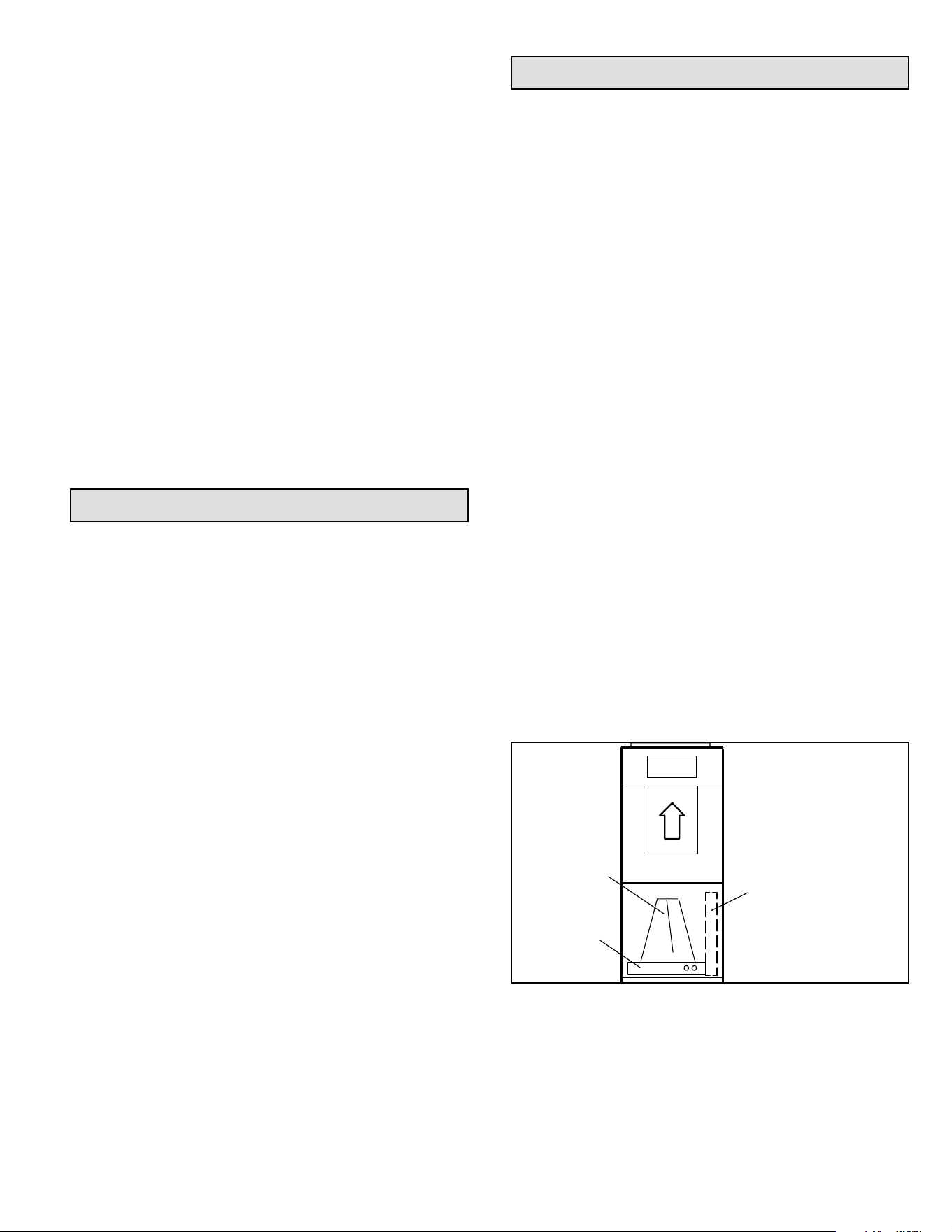
HORIZONTAL DRAIN PAN
(MUST BE REMOVED)
UP-FLOW /
DOWN-FLOW
DRAIN PAN
DRIP
SHIELD
Figure 8. Upow Conguration
508473-01Issue 2424Page 12 of 22
Horizontal Applications
When removing the coil, there is a possibility of danger
of equipment damage and personal injury. Be careful
when removing the coil assembly from a unit installed
in right- or left-hand applications. The coil may tip into
the drain pan once it is clear of the cabinet. Support the
coil when removing it.
IMPORTANT
NOTE: When the unit is installed in horizontal applications,
a secondary drain pan is recommended. Refer to local
codes.
NOTE: This unit may be installed in left-hand or right-hand
air discharge horizontal applications. Adequate support
must be provided to ensure cabinet integrity. Ensure that
there is adequate room to remove service and access
panels if installing in the horizontal position.
Right-Hand Discharge
1. Determine which plugs are required for drain line
connections.
2. With access door removed, remove drain line plugs to
install drain lines.
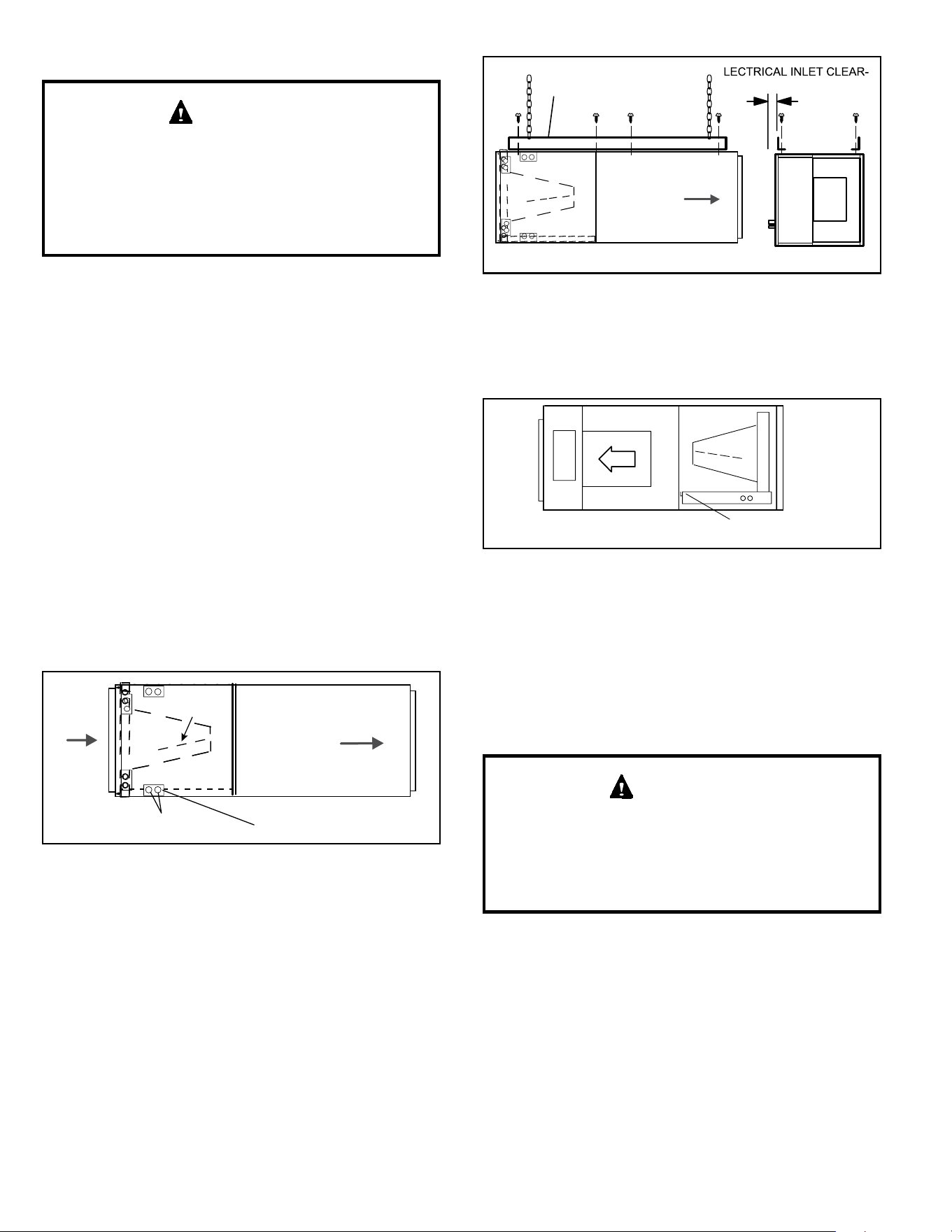
3. Set unit so that it is sloped toward the upow drain pan
end of the unit and level from front to back of unit (see
FRONT WEIV DNEWEIV
ANGLE IRON OR SHEET
METAL
E
ANCE 4 IN. (102 MM)
MAXIMUM 1/2"
LONG SCREW
AIR FLOW
Figure 12. Suspending Horizontal Unit
Left-Hand Air Discharge
For horizontal left-hand air discharge, the following eld
modications are required.
FRONT EDGE OF HORIZONTAL
DRAIN PAN
Figure 13 . Left-Hand Discharge Conguration
1. Remove access panels and the corrugated padding
between the blower and coil assembly. Discard the
corrugated padding.
2. Pull the coil assembly from unit. Pull o the horizontal
drain pan.
3. Remove the drain plugs from back drain holes on
horizontal drain pan and reinstall them on front holes.
After removal of drain pan plug(s), check drain hole(s)
to verify that drain opening is fully open and free of any
debris. Also check to make sure that no debris has
fallen into the drain pan during installation that may plug
up the drain opening.
IMPORTANT
4. Rotate drain pan 180º front-to-back and install it on the
opposite side of the coil.
Figure 15).
4. The horizontal conguration is shown in Figure 11.
Drains
AIR FLOW
PLUGS
RIGHT‐HAND DRAINS
Drip
Shield
Figure 11. Right-Hand Discharge Conguration
1. If the unit is suspended, the entire length of the cabinet
must be supported. If you use a chain or strap, use a
piece of angle iron or sheet metal attached to the unit
(either above or below) to support the length of the
cabinet. Use securing screws no longer than 1/2 inch
to avoid damaging the coil or lter. See Figure 12. Use
sheet metal screws to connect the return and supply
air plenums as required.
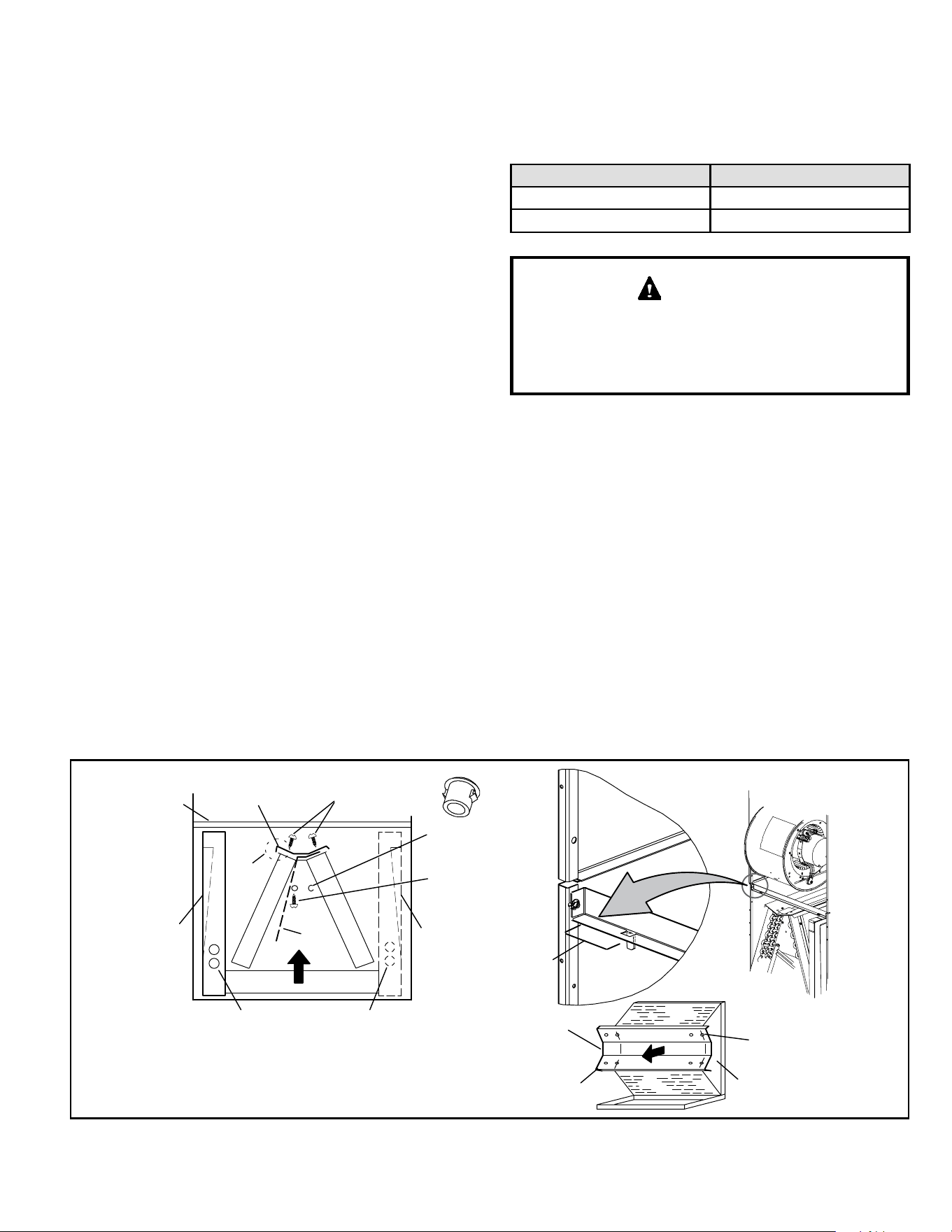
5. Remove screws from top cap. Remove drip shield
screw located in the center of the back coil end seal
as illustrated in Detail A in Figure 14.
6. Rotate drip shield 180° front-to-back.
508473-01 Issue 2424 Page 13 of 22
7. Remove plastic plug from left hole on coil front end
seal and reinstall plug in back hole. Reinstall drip
shield screw in front coil end seal. Drip shield should
drain downward into horizontal drain pan inside coil.
8. Rotate top cap 180º front-to-back and align with
unused screw holes. Holes must align with front and
back coil end plates (see Detail B in Figure 14). The
top cap has a 45º bend on one side and a 90º bend on
the other. The 90º bend must be on the same side
as the horizontal drain pan as illustrated in Detail A
in Figure 14.
NOTE: Be very careful when reinstalling the screws
into the coil end plate engaging holes. Misaligned
screws may damage the coil.
Figure 14. Field Modication for Left-Hand Discharge
90º
BEND
CABINET
SUPPORT
TOP CAP
SCREWS
DRAIN PAN
REINSTALLED
HERE
DRAIN PAN
SHIPPING
LOCATION
TOP CAP ROTATED TO
CORRECT POSITION
———— DRAIN PLUGS ————
REINSTALLED HERE REMOVED FROM HERE
BACK COIL
END SEAL
TOP CAP
90º
BEND
INSTALL DRAIN PAN
BETWEEN TAB AND
EXTERIOR INNER WALL.
DETAIL A
DETAIL B
DETAIL C
FRONT VIEW
3/16” PLASTIC
PLUG (REAR COIL
END SEAL)
ALIGN HOLES WITH
HOLES IN COIL END
PLATE. STARTING WITH
THE ROUND HOLES ON
THIS END.
DRIP SHIELD
SCREW (FRONT
COIL END SEAL)
DRIP
SHIELD
COIL SHOWN IN UPFLOW POSITION FOR EASY
CONVERSION (LEFT-HAND AIR DISCHARGE)
If electric heat section with circuit breakers (ECB45) is
installed in a BAH7P unit in a downflow application, the
circuit breakers must be rotated 180° to the UP
position. See ECB45 installation instructions for more
details.
IMPORTANT
Model Kit Number
018, 024, 030 Y9658
036, 042 Y9659
Table 2. Downow Conversion Kits
Downow Application
If downow application is required, separately order a
downow conversion kit and install per kit instructions.
See Table 2 for kit information. Also use metal or class I
supply and return air plenums.
9. From the upow position, ip cabinet 90º to the left
and set into place. Replace blower assembly. Secure
coil in place by bending down the tab on the cabinet
support rail as illustrated.
NOTE: Seal around the exiting drain pipe, liquid and
suction lines to prevent inltration of humid air.
10. Flip access door and replace it on the unit.
11. Set unit so that it is sloped 1/4ʺ toward the drain pan
end of the unit. Connect return and supply air plenums
as required using sheet metal screws.
12. If suspending the unit, it must be supported along the
entire length of the cabinet. If using chain or strap,
use a piece of angle iron or sheet metal attached to
the unit (either above or below) so that the full length
of the cabinet is supported. Use securing screws no
longer than 1/2ʺ to avoid damage to coil or lter, as
illustrated in Figure 12. Connect return and supply air
plenums as required using sheet metal screws
508473-01Issue 2424Page 14 of 22
Condensate Drain
On units of this type, where the blower “draws” rather
than “blows” air through the coil, traps must be installed
in the condensate drain lines (primary and auxiliary,
if used). Traps prevent the blower from drawing air
through the drain lines into the air supply.
IMPORTANT
A eld-fabricated secondary drain pan, with a drain
pipe to the outside of the building, is required in all
installations over a nished living space or in any area
that may be damaged by overow from the main drain
pan. In some localities, local codes may require a
secondary drain pan for any horizontal installation.
IMPORTANT
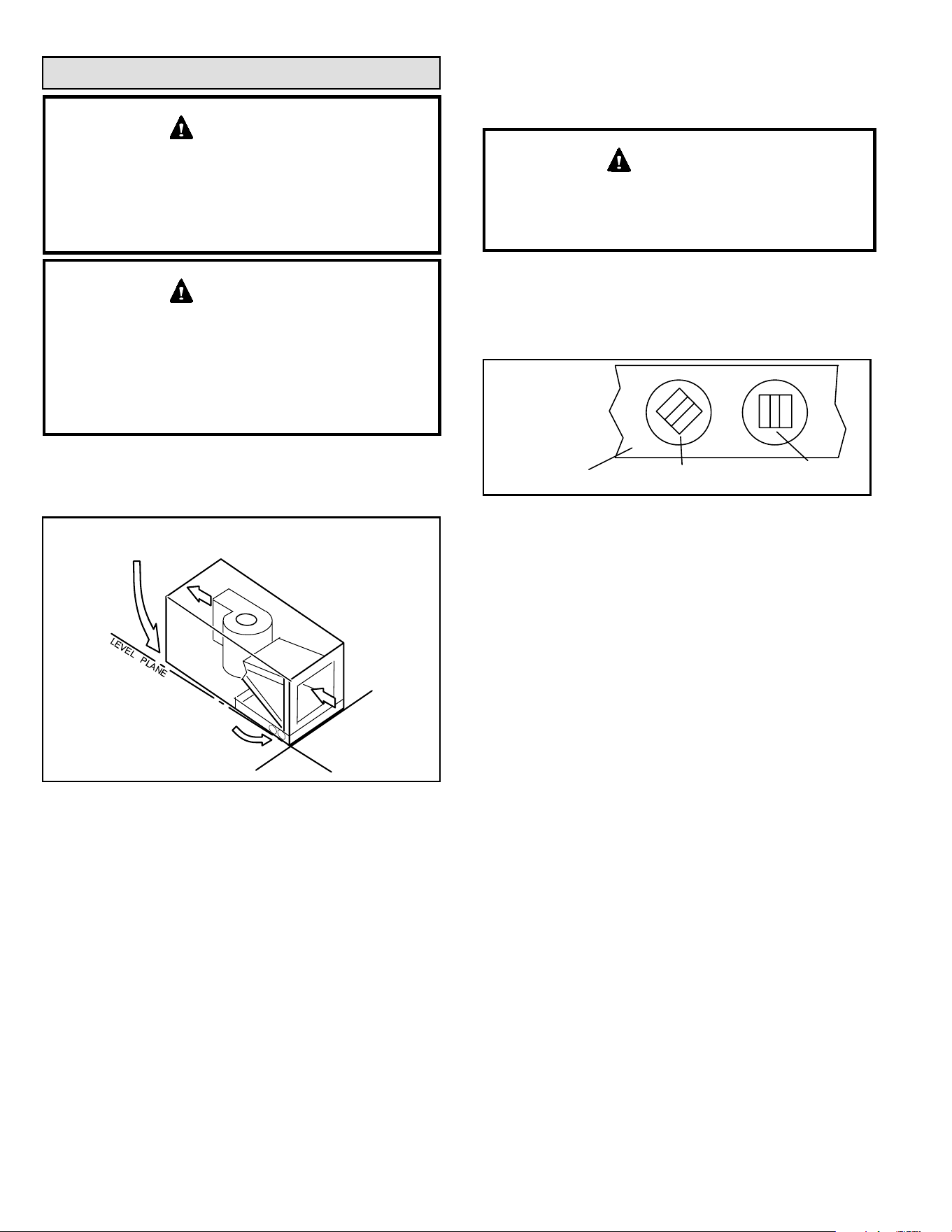
Sloping The Unit
Make sure the unit is sloped (similar to the slope shown
in Figure 15) so that the drain pan will empty completely
without water standing in the pan.
THIS CORNER SHOULD BE 5/8" (+/- 1/8") HIGHER
THAN DRAIN CORNER
DRAIN CORNER
LEVEL PLANE
Figure 15. Sloping the Unit for Proper Drainage
Install Condensate Drain
The air handler is provided with 3/4” NPT condensate
drain connections.
On some pans, the primary and secondary drain holes
have knockouts.
Conrm primary and secondary drains are open.
IMPORTANT
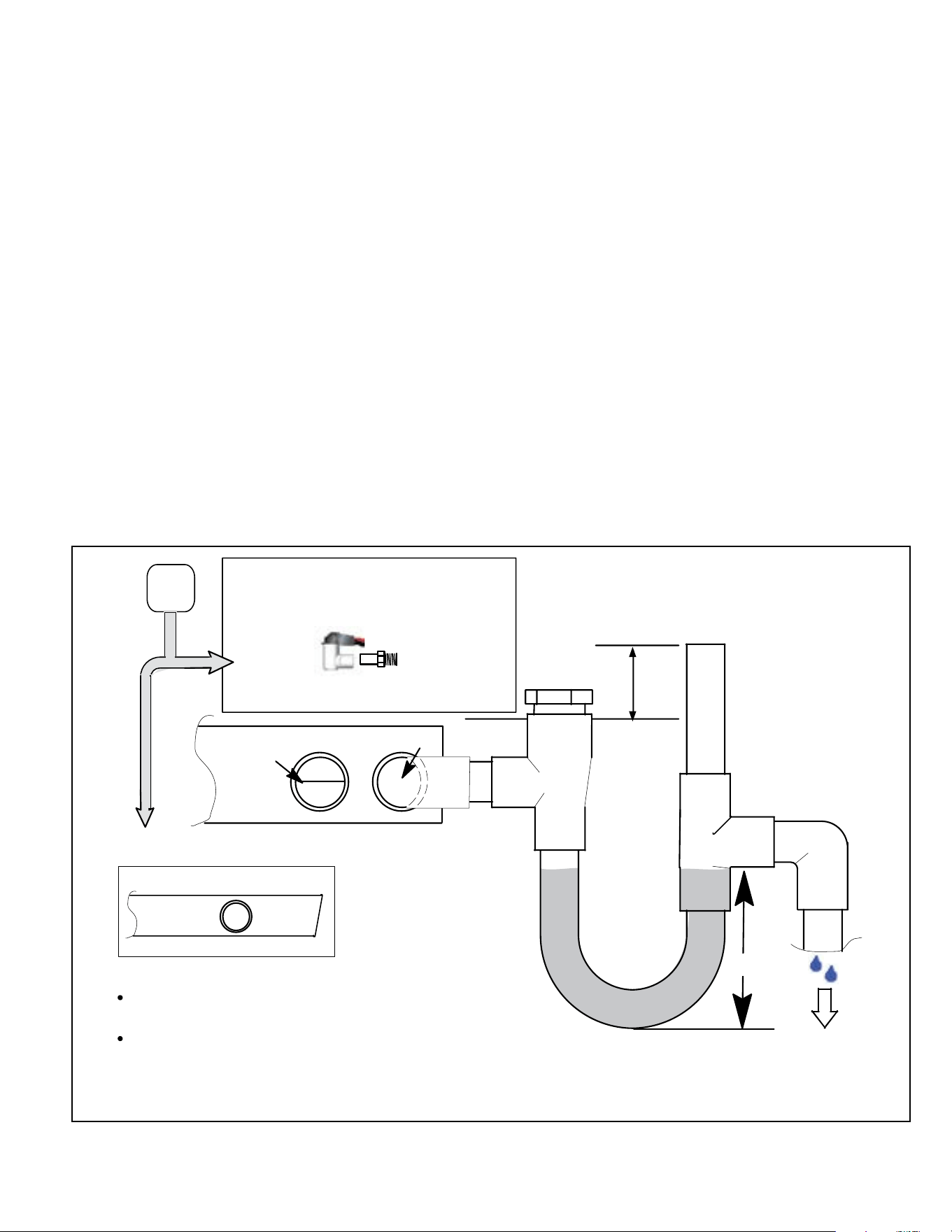
1. BAH7P units are equipped with a drain pan, which
includes green (main drain) and red (secondary drain)
plugs. Unscrew the plugs to remove them before
inserting condensate drain ttings.
DRAIN PAN
RED SECONDARY
DRAIN PLUG
UNSCREW PLUGS
AND CONNECT
PROPERLY SIZED
FIELD-PROVIDED
FITTINGS AND
DRAIN LINES.
GREEN MAIN
DRAIN PLUG
Figure 16. Drain Line Connections
2. Install properly sized, eld-provided connection ttings
and connect primary drain line to the main drain pan
connection.
NOTE: When installing drain line connection ttings
to the drain pan, hand tighten the tting and use a
thread sealant. Over-tightening the ttings can split
connections on the drain pan.
3. If the secondary drain line is to be used, remove the
plug or the knockout and route the drain line so that
water draining from the outlet will be easily noticed
by the homeowner. Refer to local codes for drain trap
requirements on the secondary drain line.
4. Check again to ensure drain ports and drain pan are
free of all debris.
5. Plug and check any unused drain pan openings for
tightness. Torque plugs to 30 in. lb. to prevent water
leaks or seepage from the drain pan.
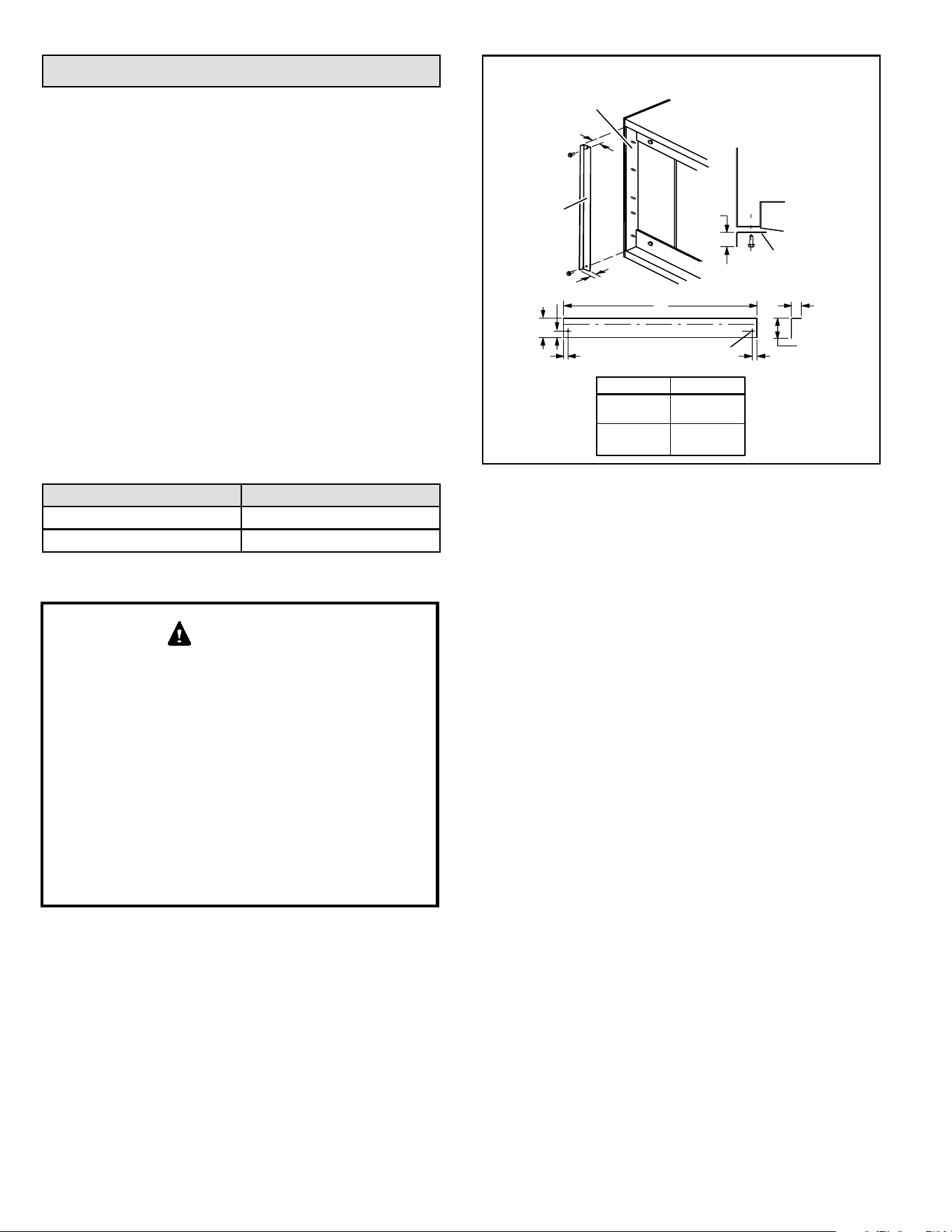
6. Install a 2” trap in the main (primary) drain lines as
close to the unit as practical (see Figure 17). Make
sure the top of the trap is below the connection to the
drain pan to allow complete drainage of the pan.
NOTE: Horizontal runs must have an anti-siphon air
vent (standpipe) installed ahead of the horizontal run.
See Figure 17. An extremely long horizontal run may
require an oversized drain line to eliminate air traps.
NOTE: Do not operate air handler without a trap in
the main (primary) drain. The condensate drain is on
the negative pressure side of the blower; therefore, air
being pulled through the condensate line will not allow
positive drainage without a proper trap.
508473-01 Issue 2424 Page 15 of 22
7. Route the drain line to the outside or to an appropriate
drain. Drain lines must be installed so they do not
block service access to the front of the air handler.
A 24” clearance is required for lter, coil, or blower
removal and service access.
NOTE: Check local codes before connecting the drain line
to an existing drainage system. Insulate the drain lines
where sweating could cause water damage.
Test Condensate Drain
Test the drain pan and drain line after installation:
1. Pour several quarts of water into drain pan. Use
enough water to ll both the drain trap and the line.
2. Check the installed drain pan. Drain pan must be
draining completely. Drain line ttings must not be
leaking. Water must be draining from the end of the
primary drain line.
3. Correct any leaks found.
ABOVE
FINISHED
SPACE?
OVERFLOW DRAIN LINE
ALWAYS RUN AN OVERFLOW DRAIN LINE. IF NOT POSSIBLE TO
ROUTE OVERFLOW DRAIN LINE, INSTALL LOW VOLTAGE
OVERFLOW SWITCH KIT. WIRE KIT TO SHUT DOWN
COMPRESSOR PER INSTRUCTIONS.
NO
YES
CLEAN OUT
VENT
PRESS IN
(DO NOT GLUE)
VENT MUST EXTEND
ABOVE HEIGHT OF
COIL DRAIN PAN BY
TWO INCHES (51MM)
1” X 3/4” X 3/4”
REDUCING
TEE WITH
PLUG
1
P-TRAP
49P66, J-TRAP #
91P90 OR ANY
PVC SCH 40 P- OR
J-TRAP 3/4”
OVERFLOW
DRAIN
AIR HANDLER DRAIN PAN
WHEN A COIL IS LOCATED ABOVE A FINISHED SPACE, A
3/4” (19.1MM) SECONDARY DRAIN LINE MUST BE:
CONNECTED TO SECONDARY DRAIN PAN
OR
CONNECTED TO THE OVERFLOW DRAIN OUTLET OF
THE AIR HANDLER DRAIN PAN.
TRAPS MUST BE DEEP ENOUGH TO OFFSET MAXIMUM STATIC
DIFFERENCES — GENERALLY, TWO INCHES (51MM).
DRAIN LINE SHOULD
SLOPE A MINIMUM OF
ONE INCH PER 10
FEET (25MM PER 3
METERS)
MAIN
DRAIN
TO APPROVED
DRAIN
FOR NEGATIVE PRESSURE COILS (BLOWER
AFTER COIL) TRAPS ARE REQUIRED ON ALL
DRAIN LINES CONNECTED TO COIL.
COMPACT OVERFLOW SWITCH WITH 3/4” FEMALE SLIP INLET
AND MALE ADAPTER, TWO PART DESIGN FOR USE WHERE
OBSTRUCTIONS PREVENT DIRECT THREADING
SECONDARY
DRAIN PAN
2”
(51MM)
TRAP DEPTH
1
P-TRAP 49P66 REQUIRES A LARGER INSTALLATION SPACE THAN THE J-TRAP 91P90.
NOTE — WHEN A AIR HANDLER IS LOCATED ABOVE A FINISHED SPACE THE
SECONDARY DRAIN PAN MUST HAVE A LARGER FOOTPRINT THAN THE AIR HANDLER.
Figure 17. Typical Main and Overow Drain
508473-01Issue 2424Page 16 of 22
Duct System and Filters
Duct System
The air handler is provided with anges for the connection
of the supply plenum.
Supply and return duct system must be adequately sized
to meet the system’s air requirements and static pressure
capabilities. The duct system should be insulated with
a minimum of 1” thick insulation with a vapor barrier in
conditioned areas or 2” minimum in unconditioned areas.
Supply plenum should be the same size as the anged
opening provided around the blower outlet and should
extend at least 3 ft. from the air handler before turning or
branching o plenum into duct runs. The plenum forms
an extension of the blower housing and minimizes air
expansion losses from the blower.
Filters
A lter is provided. Table 3 lists the lter size for each unit.
Model Filter Size – in.
-018, -024, -030 15" x 20" x 1"
-036, -042 18" x 20" x 1"
Table 3. Unit Air Filter Size Chart
BOTTOM OF
CABINET
DUCT
ADAPTER
1−1/2
(38)
”A”
BRAKE DOWN 90 DEGREES
1/4 (6) DIA.
2−HOLES
"A"
1−1/2(38)
3/4
(19)
3/4
(19)
1−1/2
(38)
3/4
(19)
1/2
(13)
3/4
(19)
DUCT
FLANGE
CABINET
DOOR FLANGE
UNIT SIZE
Cabinet and Duct Flange
-018, -024,
-030
-036, -042
18-3/8"
21-1/2"
Figure 18. Cabinet and Duct Flange
If a high eciency lter is being installed as part of
this system to ensure better indoor air quality, the lter
must be properly sized. High eciency lters have a
higher static pressure drop than standard eciency
glass/foam lters. If the pressure drop is too great,
system capacity and performance may be reduced.
The pressure drop may also cause the limit to trip
more frequently during the winter and the indoor coil
to freeze in the summer, resulting in an increase in the
number of service calls. Before using any lter with this
system, check the specications provided by the lter
manufacturer against the data given in the appropriate
Product Specications.
IMPORTANT
Installing Duct System
Connect supply air duct to the ange on top of the air
handler. If an isolation connector is used, it must be
nonammable.
Field-Fabricated Return Air Duct Flange for
Horizontal Applications
A return air duct system is recommended, but not factory-
provided. If the unit is installed in a conned space or
closet, run a full-size return connection to a location outside
the closet.
508473-01 Issue 2424 Page 17 of 22
A
B
NITROGEN
HIGH
LOW
C
D
E
G
H
PIPING
PLATE
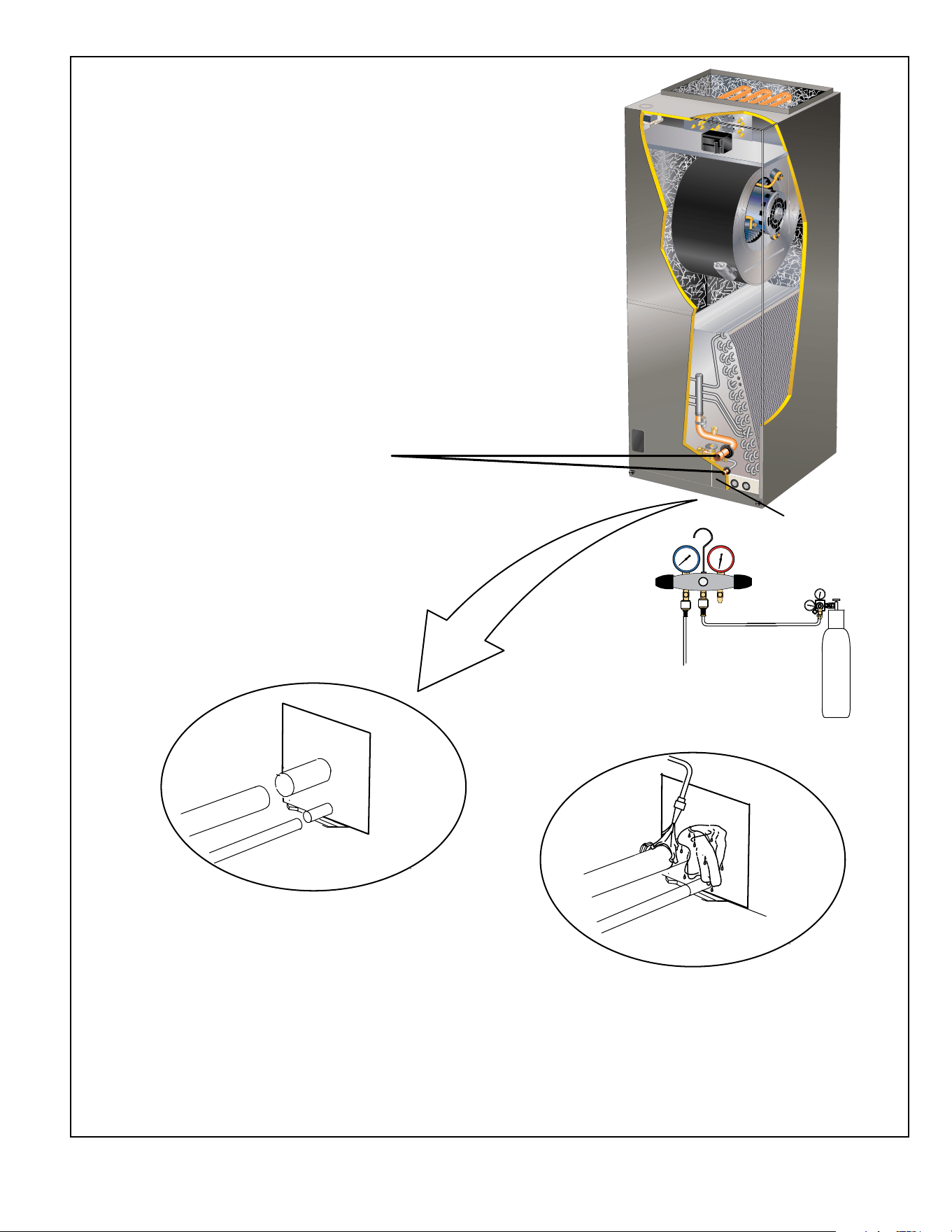
REMOVE ACCESS PANEL
ROUTE SUCTION AND LIQUID LINES FROM FITTINGS ON
INDOOR COIL TO FITTINGS ON OUTDOOR UNIT. RUN
LINES IN DIRECT PATH, AVOIDING UNNECESSARY TURNS
AND BENDS.
NOTE - MAKE SURE SUCTION LINE IS INSULATED OVER
ENTIRE EXPOSED LENGTH AND NEITHER SUCTION NOR
LIQUID LINES ARE IN DIRECT CONTACT WITH FLOORS,
WALLS, DUCT SYSTEM, FLOOR JOISTS, OR OTHER
PIPING.
NOTE - Use silver alloy brazing rods with five or six percent
minimum silver alloy for copper-to-copper brazing; 45 percent
alloy for copper-to-brass and copper-to-steel brazing. Do not use
soft solder.
NOTE - Refer to outdoor unit installation instructions for
refrigerant piping size requirements.
BRAZE CONNECTION. ALLOW PIPE TO COOL
TO ROOM TEMPERATURE BEFORE REMOVING
WET RAG FROM CTXV SENSING BULB AND
PIPING PANEL AREA.
REINSTALL RUBBER GROMMETS INTO THE
REFRIGERANT PIPING PANEL.
NOTE - MAKE SURE EXPANSION VALVE
CAPILLARY TUBE IS NOT TOUCHING METAL
EDGES OR COPPER TUBING.
REMOVE RUBBER PLUG FROM BOTH LIQUID AND
SUCTION LINES
NOTE - THESE UNITS USE NITROGEN OR DRY AIR AS A
HOLDING CHARGE. IF THERE IS NO PRESSURE WHEN
THE RUBBER PLUGS ARE REMOVED, CHECK THE COIL
FOR LEAKS BEFORE INSTALLING.
EITHER REMOVE OR PUSH PIPE WRAPPING BACK
THROUGH HOLE IN PIPING PLATE BEFORE LINE SET
CONNECTION AND BRAZING.
CONNECT PIPES
NOTE - REFRIGERANT LINE
SETS SHOULD BE ROUTED TO
ALLOW FILTER ACCESSIBILITY.
CONNECT GAUGES AND
START NITROGEN FLOW.
FLOW REGULATED NITROGEN (AT 1 TO 2 PSIG) THROUGH
THE REFRIGERATION GAUGE SET INTO THE VALVE STEM
PORT CONNECTION ON THE OUTDOOR UNIT LIQUID LINE
SERVICE VALVE AND OUT OF THE VALVE STEM PORT
CONNECTION ON THE SUCTION SERVICE VALVE.
PLACE A WET RAG AGAINST PIPING
PLATE AND AROUND THE SUCTION
LINE CONNECTION.
REPEAT PREVIOUS PROCEDURE FOR
LIQUID LINE.
PLEASE READ IMPORTANT ISSUES CONCERNING BRAZING
OPERATIONS IN THE BRAZING REFRIGERANT LINES SECTION
BEFORE PROCEEDING.
F
I
J
NOTE - Refer to instructions provided with outdoor unit
for leak testing, evacuating and charging procedures.
NOTE - Refrigerant system installations shall be
installed and tested per ASHRAE Standard 15.2,
Section 10.0 (latest edition).
Figure 17. Brazing Connections
508473-01Issue 2424Page 18 of 22
Brazing Refrigerant Lines
NOTE: For R454B refrigerant installations, do not braze
the line set to the evaporator coil until the outdoor unit
is installed. Refer to R454B Air Handler Conversion Kit
(27J27) instructions for installation details.
Refrigerant lines must be connected by a qualied
technician in accordance with established procedures.
Refrigerant lines must be clean, dry, refrigerant-grade
copper lines. Air handler coils should be installed
only with specied line sizes for approved system
combinations.
Handle the refrigerant lines gently during the installation
process. Sharp bends or kinks in the lines will cause a
restriction.
Do not remove the caps from the lines or system
connection points until connections are ready to be
completed.
IMPORTANT
Polyol ester (POE) oils used with HFC-410A refrigerant
absorb moisture very quickly. It is very important that the
refrigerant system be kept closed as much as possible.
DO NOT remove line set caps or service valve stub
caps until you are ready to make connections.
WARNING
Before brazing, ensure the system is fully
recovered of all refrigerant. Application of a
brazing torch to a pressurized system may
result in ignition of the refrigerant and oil
mixture. Check the high and low pressures
before applying heat.
WARNING
Refrigerant system installations shall be installed and tested
per ASHRAE Standard 15.2, Section 10.0 (latest edition).
Sealing the Unit
Seal the unit so that warm air is not allowed into the cabinet.
Warm air introduces moisture, which results in water blow-
o problems. This is especially important when the unit is
installed in an unconditioned area.
If installed in an unconditioned space, sealant should be
applied around the electrical wires, refrigerant tubing, and
condensate lines where they enter the cabinet.
1. Route the suction and liquid lines from the ttings on the
indoor coil to the ttings on the outdoor unit. Run the lines
in a direct path, avoiding unnecessary turns and bends .
2. Make sure that the suction line is in sulated over the
entire exposed length and that neither suction nor liquid
lines are in direct concact with oors joints are other nining.
Brazing alloys and ux contain materials which are
hazardous to your health.
Avoid breathing vapors or fumes from brazing
operations. Perform operations only in well-ventilated
areas.
Wear gloves and protective goggles or face shield to
protect against burns.
Wash hands with soap and water after handling brazing
alloys and ux.
CAUTION
Recommended line length is 50’ or less. If more than 50’
line set is required, contact Technical Services.
NOTE
There must be an airtight seal between the bottom of
the air handler and the return air plenum. Use berglass
sealing strips, caulking, or equivalent sealing method
between the plenum and the air handler cabinet to
ensure a tight seal. Return air must not be drawn from a
room where this air handler or any gas-fueled appliance
(i.e., water heater), or carbon monoxide-producing
device (i.e., wood replace) is installed.
WARNING
To prevent the build-up of high levels of
nitrogen when purging, it must be done in a
well-ventilated area. Purge low-pressure
nitrogen (1 to 2 psig, 6.9 to 13.8 kPa)
through the refrigerant piping during
brazing. This will help to prevent oxidation
and the introduction of moisture into the
system.
WARNING
Use duct tape and/ or Permagum to seal closed any
space around the holes where the drain lines exit the
cabinet. Warm air must not be allowed to enter through
any gaps or holes in the cabinet.
IMPORTANT
508473-01 Issue 2424 Page 19 of 22
• Inspect air lters at least once a month and replace or
clean as required. Dirty lters are the most common
cause of inadequate heating or cooling performance.
• Replace disposable lters. Cleanable lters can be
cleaned by soaking in mild detergent and rinsing with
cold water.
• Install new/clean lters with the arrows on the side
pointing in the direction of air ow. Do not replace a
cleanable (high velocity) lter with a disposable (low
velocity) lter unless return air system is properly
sized for it.
• If water should start coming from the secondary drain
line, a problem exists which should be investigated
and corrected. Contact a qualied service technician.
Professional Maintenance
Failure to follow instructions will cause damage to the
unit.
This unit is equipped with an aluminum coil. Aluminum
coils may be damaged by exposure to solutions with
a pH below 5 or above 9. The aluminum coil should
be cleaned using potable water at a moderate pressure
(less than 50psi). If the coil cannot be cleaned using
water alone, it is recommended to use a coil cleaner
with a pH in the range of 5 to 9. The coil must be rinsed
thoroughly after cleaning.
In coastal areas, the coil should be cleaned with potable
water several times per year to avoid corrosive buildup
(salt).
NOTICE
Units may be used for heating (heat pumps) or cooling of
buildings or structures under construction, if the following
conditions are met to ensure proper operation.
DO NOT USE THE UNIT FOR CONSTRUCTION HEAT
UNLESS ALL OF THE FOLLOWING CRITERIA ARE
MET:
• A room thermostat must control the air handler. The
use of xed jumpers is not allowed.
• Air lter must be installed in the system and must be
maintained during construction.
• Air lter must be replaced upon construction
completion.
• The air handler evaporator coil, supply fan assembly
and duct system must be thoroughly cleaned following
nal construction clean-up.
• All air handler operating conditions must be veried
according to these installation instructions.
• If refrigerant leak detection sensor kit (R454B
applications only) has been installed, ensure that
sensor opening is clear and free of debris. Follow
sensor maintenance recommendations as outlined in
sensor kit instruction.
EQUIPMENT MAY EXPERIENCE PREMATURE
COMPONENT FAILURE AS A RESULT OF FAILURE TO
FOLLOW THE ABOVE INSTALLATION INSTRUCTIONS.
FAILURE TO FOLLOW THE ABOVE INSTALLATION
INSTRUCTIONS VOIDS THE MANUFACTURER’S
EQUIPMENT LIMITED WARRANTY. ALLIED AIR
DISCLAIMS ALL LIABILITY IN CONNECTION WITH
INSTALLER’S FAILURE TO FOLLOW THE ABOVE
INSTALLATION INSTRUCTIONS.
NOTWITHSTANDING THE FOREGOING, INSTALLER IS
RESPONSIBLE FOR CONFIRMING THAT THE USE OF
CONSTRUCTION HEAT OR COOLING IS CONSISTENT
WITH THE POLICIES AND CODES OF ALL REGULATING
ENTITIES. ALL SUCH POLICIES AND CODES MUST BE
ADHERED TO.
Homeowner Maintenance
Do not operate system without a lter. A lter is required
to protect the coil, blower, and internal parts from
excessive dirt and dust. The lter is placed in the return
duct by the installer.
IMPORTANT
Use of Air Handler During Construction
508473-01Issue 2424Page 20 of 22
Repairing or Replacing Cabinet Insulation
DAMAGED INSULATION MUST BE REPAIRED OR
REPLACED before the unit is put back into operation.
Insulation loses its insulating value when wet, damaged,
separated or torn.
IMPORTANT
Matte- or foil-faced insulation is installed in indoor
equipment to provide a barrier between outside air
conditions (surrounding ambient temperature and humidity)
and the varying conditions inside the unit. If the insulation
barrier is damaged (wet, ripped, torn or separated from the
cabinet walls), the surrounding ambient air will aect the
inside surface temperature of the cabinet.
The temperature/humidity dierence between the inside
and outside of the cabinet can cause condensation on the
inside or outside of the cabinet which leads to sheet metal
corrosion and, subsequently, component failure.
Repairing Damaged Insulation
Areas of condensation on the cabinet surface are an
indication that the insulation is in need of repair.
If the insulation in need of repair is otherwise in good
condition, the insulation should be cut in an X pattern,
peeled open, glued with an appropriate all-purpose glue
and placed back against the cabinet surface, being careful
to not overly compress the insulation so the insulation can
retain its original thickness. If such repair is not possible,
replace the insulation. If using foil-faced insulation, any
cut, tear, or separations in the insulation surface must be
taped with a similar foil-faced tape.
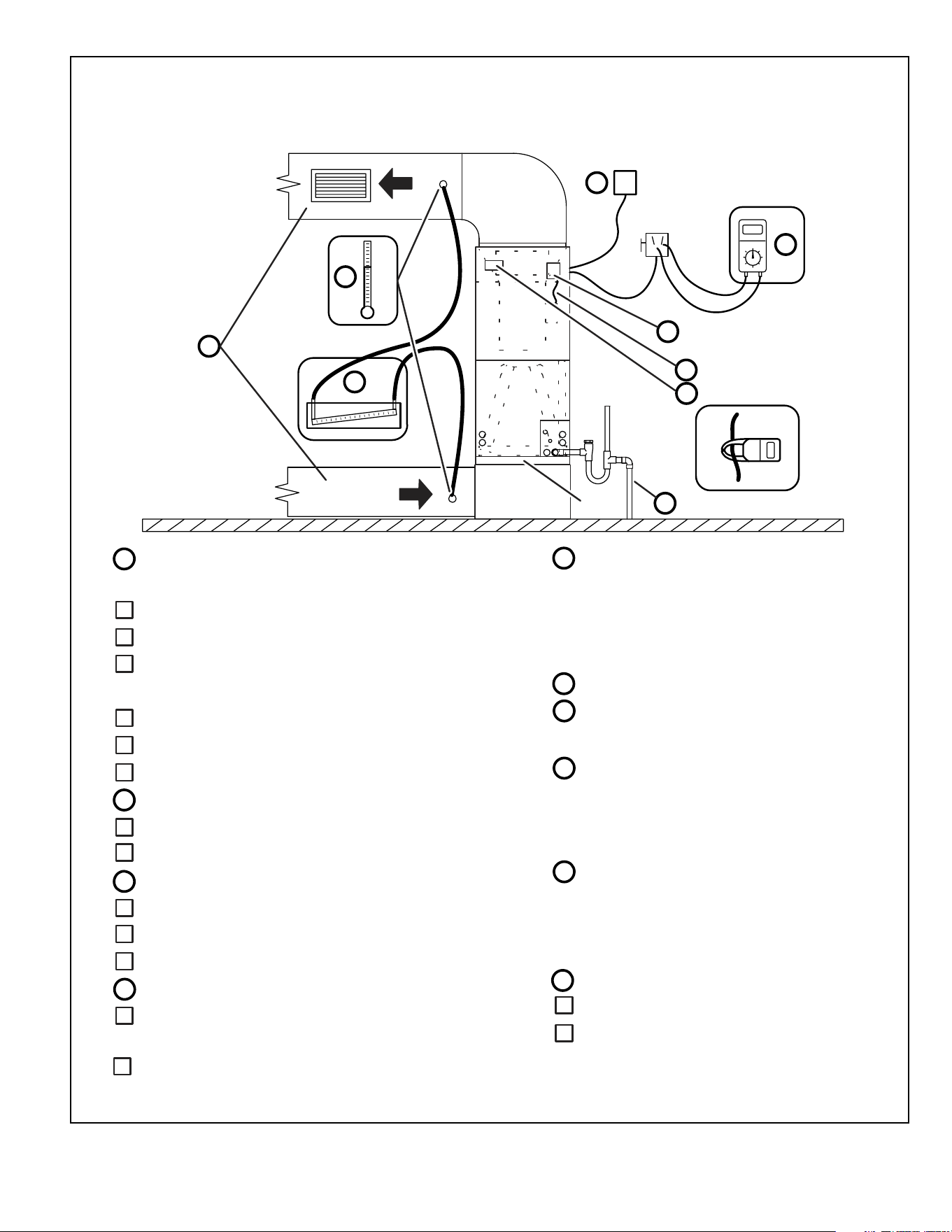
1. CUT INSULATION IN X PATTERN
2. APPLY GLUE
3. PRESS GLUED TABS AGAINST CABINET
GLUE - Make sure there is
full coverage of glue on the
metal or insulation so there
are no areas where air
pockets may form which
can lead to sweating.
Figure 20. Repairing Insulation
Decommissioning
Before carrying out this procedure, it is essential that the
technician is completely familiar with the equipment and
all its detail. It is recommended good practice that all
refrigerants are recovered safely.
Prior to the task being carried out, an oil and refrigerant
sample shall be taken in case analysis is required prior to
re-use of recovered refrigerant. It is essential that electrical
power is available before starting decommissioning.
1. Become familiar with the equipment and its operation.
2. Isolate system electrically.
3. Before attempting the procedure, ensure that:
• Mechanical handling equipment is available, if
required, for handling refrigerant cylinders;
• All personal protective equipment is available and
being used correctly;
• The recovery process is supervised at all times by
a competent person;
• Recovery equipment and cylinders conform to the
appropriate standards.
4. Pump down refrigerant system, if possible.
5. If a vacuum is not possible, make a manifold so that
refrigerant can be removed from various parts of the
system.
6. Make sure that cylinder is situated on the scales before
recovery takes place.
7. Start the recovery machine and operate in accordance
with instructions.
8. Do not overll cylinders (no more than 80% volume
liquid charge).
9. Do not exceed the maximum working pressure of the
cylinder, even temporarily.
10. When the cylinders have been lled correctly and the
process completed, make sure that the cylinders and
the equipment are removed from site promptly and all
isolation valves on the equipment are closed o.
11. Recovered refrigerant shall not be charged into
another REFRIGERATING SYSTEM unless it has
been cleaned and checked.
508473-01 Issue 2424 Page 21 of 22
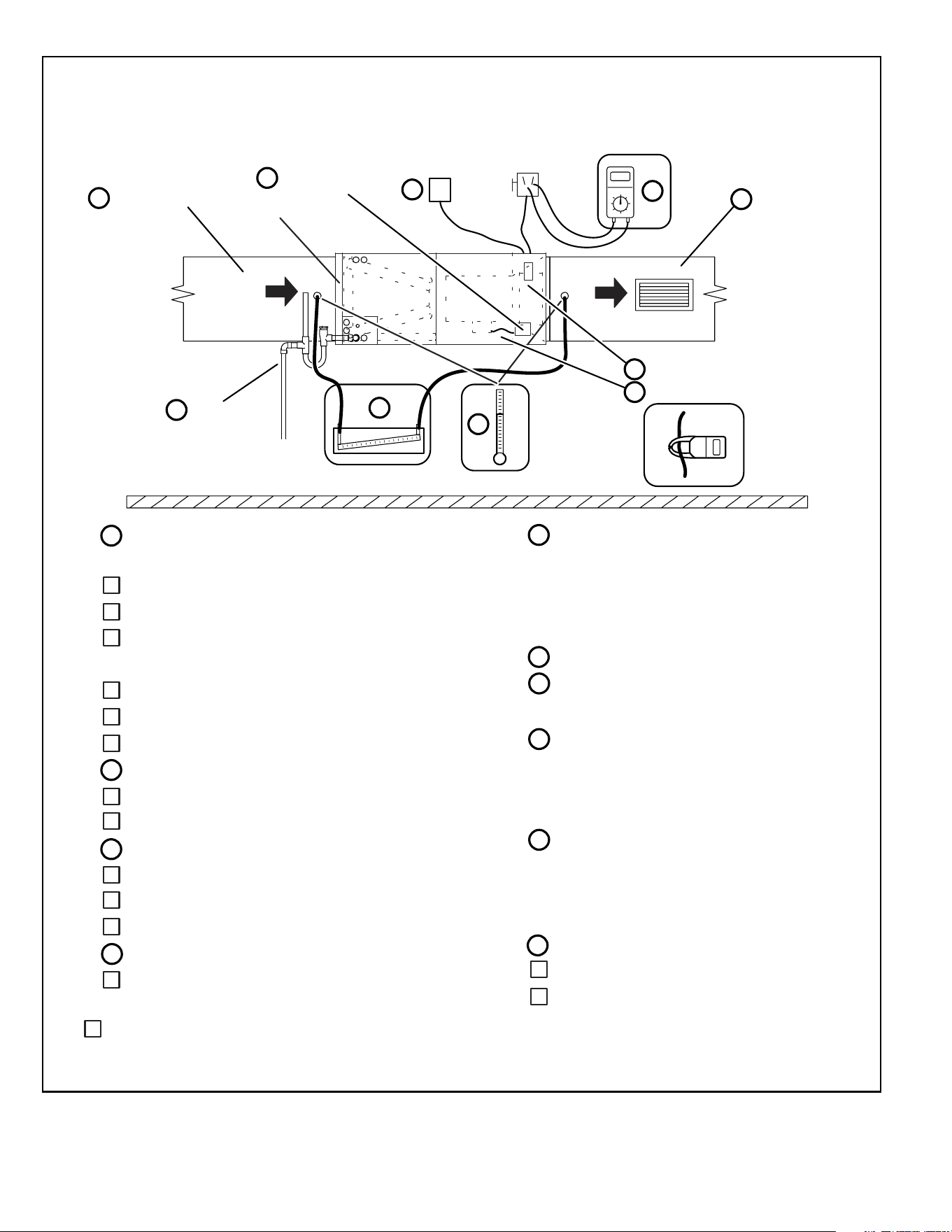
1
Duct
System
Filter
Integrated Control
Electric Heat Amps
Duct Static
5
Line Voltage
3
RETURN
AIR
SUPPLY
AIR
Temperature
8
Blower Motor Amps
6
7
Thermostat
9
2
4
Drain Line
Disconnect
Switch
ELECTRIC HEAT AMPS____________
8
8
7
5
DUCT SYSTEM
SUPPLY AIR DUCT
Sealed
Insulated (if necessary)
Registers Open and Unobstructed
RETURN AIR DUCT
Sealed
Filter Installed and Clean
Registers Open and Unobstructed
INTEGRATED CONTROL
Jumpers Configured Correctly (if applicable)
Appropriate Links in Place (if applicable)
VOLTAGE CHECK
Supply Voltage ___________
Electrial Connections Tight
1
2
3
DRAIN LINE
Leak Free
4
TOTAL EXTERNAL STATIC (dry coil)
Supply External Static ______ ______
TEMPERATURE DROP (Cooling Mode)
Return Duct Temperature ___________
THERMOSTAT
Adjusted and Programmed
Return External Static ______ ______
Total External Static = ______ ______
6
Supply Duct Temperature − ___________
Temperature Drop = ___________
TEMPERATURE RISE (Heating Mode)
Return Duct Temperature __________
Supply Duct Temperature − __________
Temperature Rise = __________
Operation Explained to Owner
9
Explained Operation of System to Homeowner
Technician’s Name:_______________________Date Start−Up & Performance Check Completed__________
Installing Contractor’s Name_______________________
Installing Contractor’s Phone_______________________
Job Address____________________________________
Installing Date_______________________________
Air Handler Model #__________________________
_
INDOOR BLOWER AMPS___________
INDOOR BLOWER CFM____________
Low Voltage _____________
dry coil wet coil
Figure 21. Start-Up and Performance Checklist (Upow Conguration)
508473-01Issue 2424Page 22 of 22
RETURN
AIR
SUPPLY
AIR
2
Duct Static
5
Line Voltage
3
4
Drain Line
ELECTRIC HEAT AMPS____________
8
8
7
5
Filter
Blower motor Amps
DUCT SYSTEM
SUPPLY AIR DUCT
Sealed
Insulated (if necessary)
Registers Open and Unobstructed
RETURN AIR DUCT
Sealed
Filter Installed and Clean
Registers Open and Unobstructed
INTEGRATED CONTROL
Jumpers Configured Correctly (if applicable)
Appropriate Links in Place (if applicable)
VOLTAGE CHECK
Supply Voltage ___________
Electrial Connections Tight
1
2
3
DRAIN LINE
Leak Free
4
TOTAL EXTERNAL STATIC (dry coil)
Supply External Static ______ ______
TEMPERATURE DROP (Cooling Mode)
Return Duct Temperature ___________
THERMOSTAT
Adjusted and Programmed
Return External Static ______ ______
Total External Static = ______ ______
6
6
Supply Duct Temperature − ___________
Temperature Drop = ___________
TEMPERATURE RISE (Heating Mode)
Return Duct Temperature __________
Supply Duct Temperature − __________
Temperature Rise = __________
Operation Explained to Owner
9
Electric Heat Amps
7
Explained Operation of System to Homeowner
Technician’s Name:_______________________Date Start−Up & Performance Check Completed__________
Installing Contractor’s Name_______________________
Installing Contractor’s Phone_______________________
Job Address____________________________________
Installing Date_______________________________
Air Handler Model #__________________________
_
Thermostat
9
1
1
8
INDOOR BLOWER AMPS___________
Temperature
Duct System
Duct System
Integrated
Control
Disconnect
Switch
INDOOR BLOWER CFM____________
Low Voltage _____________
dry coil wet coil
Figure 22. Start-Up and Performance Checklist (Horizontal Conguration)