VERSION A3
June 30, 2025
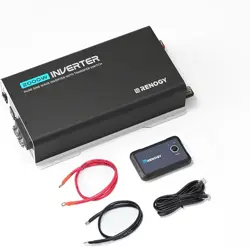
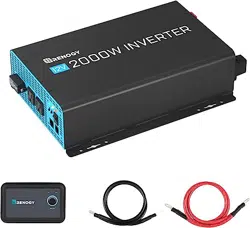
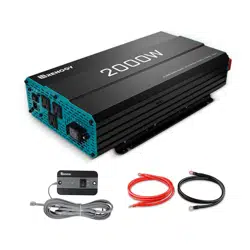
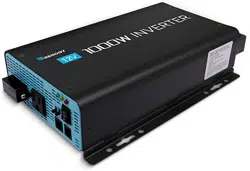
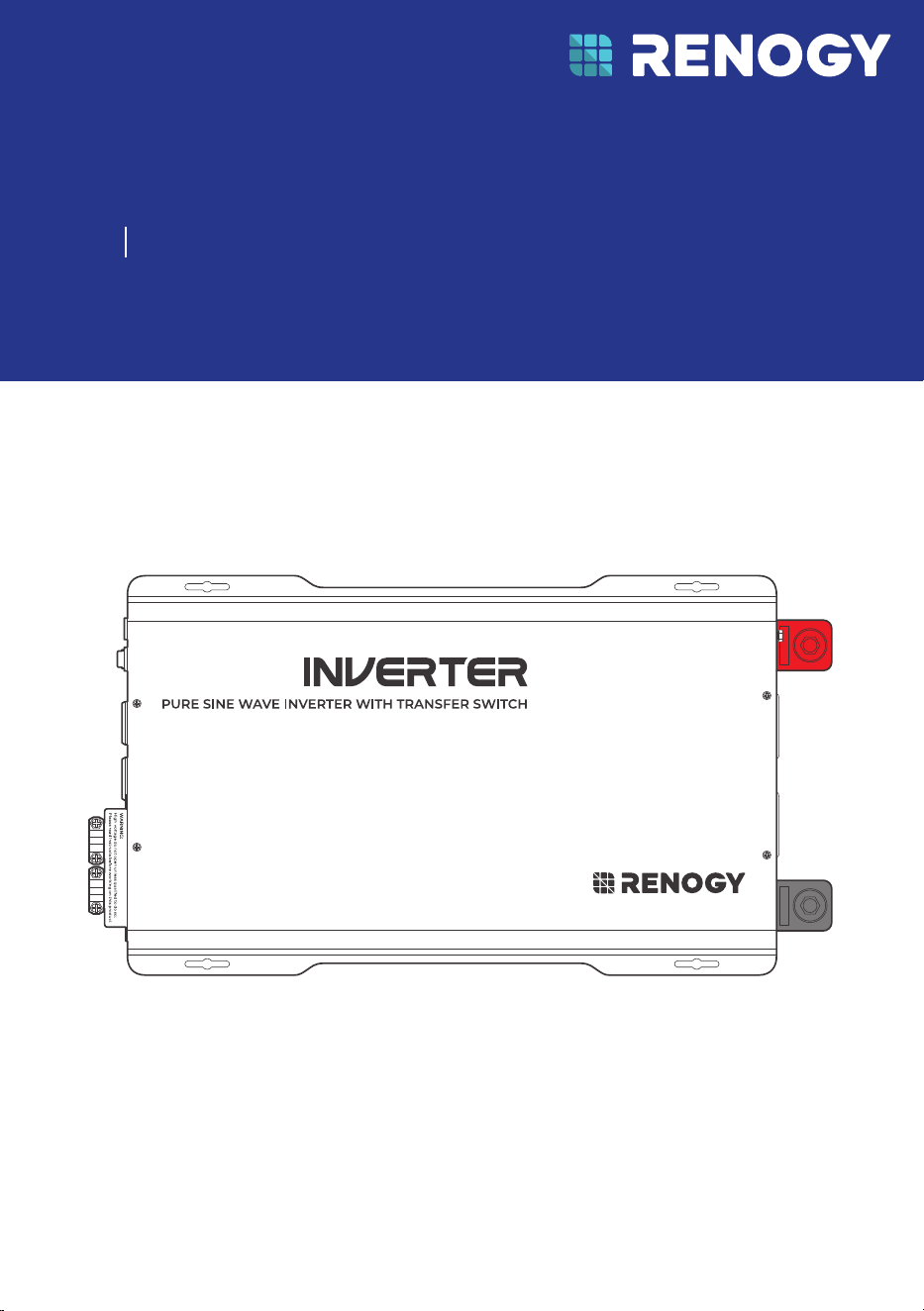
Pure Sine Wave Inverter with Transfer Switch
Renogy
12V 1000W/2000W/3000W
RIV1210PU-126/RIV1220PU-126/RIV1230PU-126
USER MANUAL
Before Getting Started
The user manual provides important operation and maintenance instructions for Renogy 12V
1000W/2000W/3000W Pure Sine Wave Inverter with Transfer Switch (hereinafter referred to as
inverter).
Read the user manual carefully before operation and save it for future reference. Failure to
observe the instructions or precautions in the user manual can result in electrical shock, serious
injury, or death, or can damage the inverter, potentially rendering it inoperable.
z
Renogy ensures the accuracy, sufficiency, and the applicability of information in the user
manual at the time of printing due to continual product improvements that may occur.
z
Renogy assumes no responsibility or liability for personal and property losses, whether
directly and indirectly, caused by the user’s failure to install and use the product in
compliance with the user manual.
z
Renogy is not responsible or liable for any failure, damage, or injury resulting from repair
attempts by unqualified personnel, improper installation, or inappropriate operation.
z
The illustrations in the user manual are for demonstration purposes only. Details may appear
slightly different depending on product revision and market region.
z
Renogy reserves the right to change the information in the user manual without notice. For
the latest user manual, visit renogy.com.
Disclaimer
Renogy 12V 1000W/2000W/3000W Pure Sine Wave Inverter with Transfer Switch User Manual ©
2025 Renogy. All rights reserved.
RENOGY
and
are registered trademarks of Renogy.
z
All information in the user manual is subject to copyright and other intellectual property
rights of Renogy and its licensors. The user manual may not be modified, reproduced, or
copied, in whole or in part, without the prior written permissions of Renogy and its licensors.
z
The registered trademarks in the user manual are the property of Renogy. The unauthorized
use of the trademarks is strictly prohibited.
Online Manual
User Manual

Symbols Used .................................................................................................................................... 1
Introduction ...................................................................................................................................... 1
Key Features ...................................................................................................................................... 1
SKU ..................................................................................................................................................... 1
What’s In the Box?.............................................................................................................................2
Required Tools & Accessories .........................................................................................................2
Get to Know Renogy 12V 1000W Pure Sine Wave Inverter ............................................................3
Get to Know Renogy 12V 2000W Pure Sine Wave Inverter ...........................................................4
Get to Know Renogy 12V 3000W Pure Sine Wave Inverter ........................................................... 5
Part Description ................................................................................................................................6
How to Properly Install Cable Clamps? .......................................................................................... 7
How to Wires the AC Input and High Output AC Terminals? .........................................................8
System Setup .................................................................................................................................... 9
System Wiring ............................................................................................................................................... 9
Inverter Wiring ............................................................................................................................................. 10
Size a Battery Bank .........................................................................................................................11
Step 1. Wear Insulating Gloves .......................................................................................................11
Step 2. Plan a Mounting Site .......................................................................................................... 12
Step 3. Grounding ........................................................................................................................... 13
Step 4. DC Wiring ............................................................................................................................. 13
Step 5. AC Output Wiring ................................................................................................................ 15
Recommended Ground-Fault Circuit Interrupter (GFCI) ................................................................... 15
AC Outlets .................................................................................................................................................... 15
High Output AC Terminals ........................................................................................................................ 15
Step 6. AC Input Wiring (Optional) ................................................................................................ 16
Power On/Off ................................................................................................................................... 17
N-G Bonding Relay .......................................................................................................................... 18
Monitor the Inverter ....................................................................................................................... 19
LED Overview & Troubleshooting .................................................................................................. 19
Pure Sine Wave ................................................................................................................................ 21
Specifications ................................................................................................................................. 21
General Safety Information ...........................................................................................................23
Renogy Support ..............................................................................................................................23
Table of Contents
— 1 —
Symbols Used
The following symbols are used throughout the user manual to highlight important information.
WARNING: Indicates a potentially dangerous condition which could result in injury or
death.
CAUTION: Indicates a critical procedure for safe and proper installation and operation.
NOTE: Indicates an important step or tip for optimal performance.
Introduction
Renogy 12V 1000W/2000W/3000W Pure Sine Wave Inverter with Transfer Switch is ideal for a
wide range of off-grid applications, including vans, semi-trucks, fifth wheels, cabins, and remote
locations that require reliable power sources. The inverter converts DC Power stored in batteries
into usable AC Power for appliances. Renogy’s advanced pure sine wave technology empowers
you to run a wide variety of AC appliances without the risk of damaging even your most sensitive
equipment.
Key Features
z
Powerful DC-AC Conversion
Continuous rated output power with a conversion efficiency greater than 92%, and up to 2x
surge for start-up loads.
z
Uninterrupted Power Supply (UPS)
Utilizing the built-in transfer switch, this inverter seamlessly switches to grid power,
bypassing the inverter when it’s available, thereby directly supplying the load with grid power.
z
Safe for Use
The inverter provides multiple protection mechanism such as overload, overtemperature,
overvoltage, short-circuit, and undervoltage protections as well as an integrated Ground Fault
Circuit Interrupter (GFCI).
z
Guaranteed Appliance Protection
Our pure sine wave technology ensures appliance longevity by delivering a clean sine wave
that’s comparable to or even better than grid power. Say goodbye to annoying buzzing sounds
and enjoy the smooth operation of all your devices.
z
Easy to Use
Offers a built-in 5V/2.1A USB port, AC Outlets, Hardwired AC Output Terminal Block, and a
Wired Remote Port.
z
Dependable Quality
The inverter is UL certified to 458, CSA 22.2 No. 107.1-01, and FCC Part 15 Class B standards,
ensuring reliability and safety for all users.
SKU
Renogy 12V 1000W Pure Sine Wave Inverter with Transfer Switch RIV1210PU-126
Renogy 12V 2000W Pure Sine Wave Inverter with Transfer Switch RIV1220PU-126
Renogy 12V 3000W Pure Sine Wave Inverter with Transfer Switch RIV1230PU-126
— 2 —
What’s In the Box?
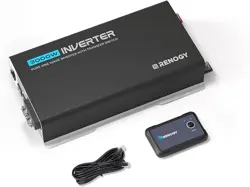
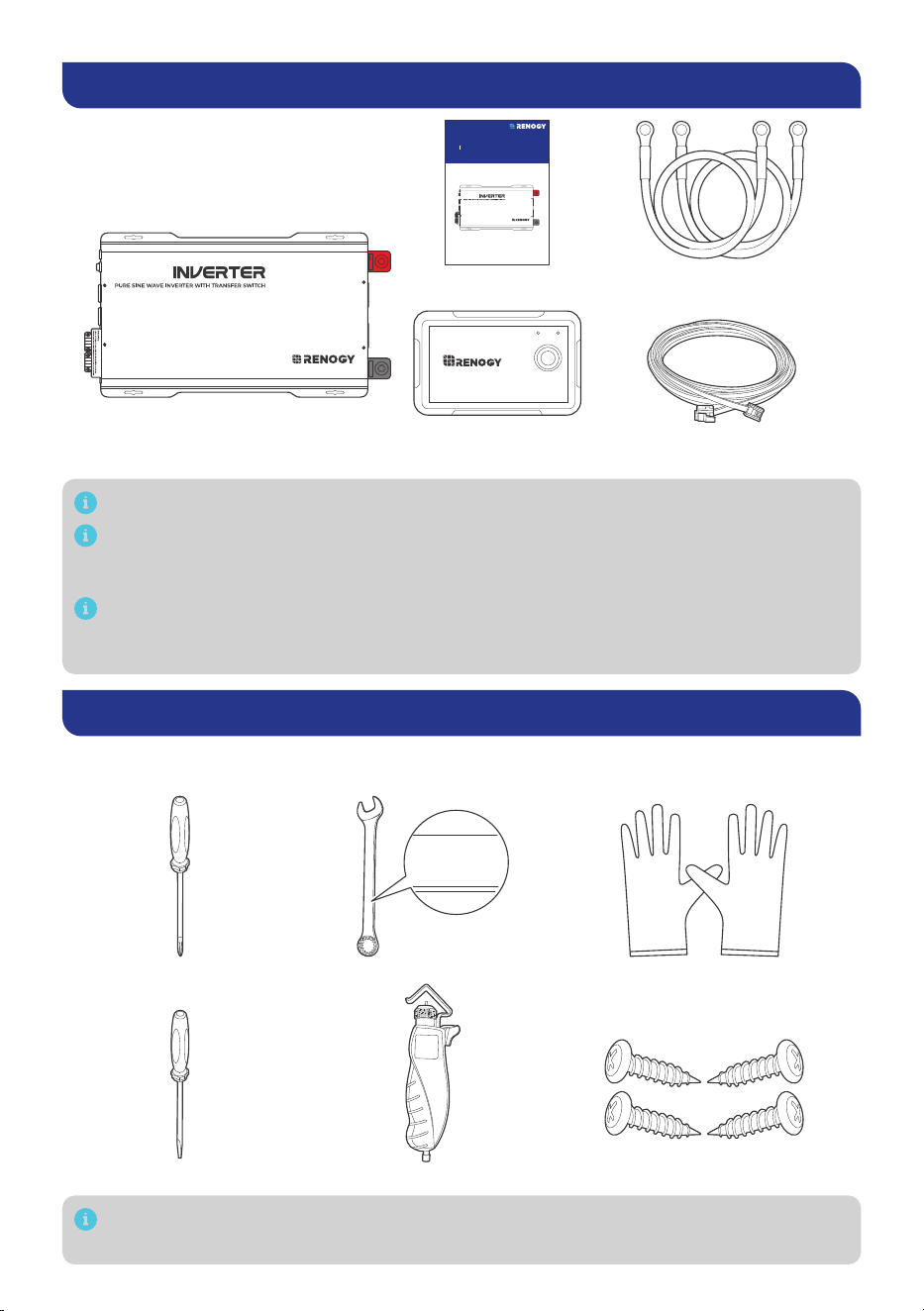
Renogy 12V 1000W/2000W/3000W
Pure Sine Wave Inverter
with Transfer Switch × 1
User Manual × 1 Cables (3ft) × 2
(only 1000W/2000W inverter)
RJ12 Ethernet Cable (5m) × 1
Wired Remote
Control × 1
ERRON
RMS-P2
VERSION A3
June 30, 2025
Pure Sine Wave Inverter with Transfer Switch
Renogy
12V 1000W/2000W/3000W
RIV1210PU-126/RIV1220PU-126/RIV1230PU-126
USER MANUAL
Make sure that all accessories are complete and free of any signs of damage.
The accessories and product manual listed are crucial for the installation, excluding
warranty information and any additional items. Please note that the package contents may
vary depending on the specific product model.
The 1000W inverter comes with 4 AWG Cables. The 2000W inverter comes with 1/0 AWG
Cables. The 3000W inverter does not include cables, so you will need to prepare them
yourself. We recommend using 3/8 in Lugs and 2/0 AWG Cables.
Required Tools & Accessories
Choose proper mounting screws specific to your installation site. This manual takes self-tapping
screws for wooden walls as an example.
Insulating GlovesWrench (9/16 in)
14 mm
14 mm
14 mm
Phillips Screwdriver (#1)
Slotted Screwdriver (1 mm) Wire stripper
Self-tapping Screws (ST4 or ST6) × 4
Prior to installing and configuring the inverter, prepare the recommended tools,
components, and accessories.
— 3 —
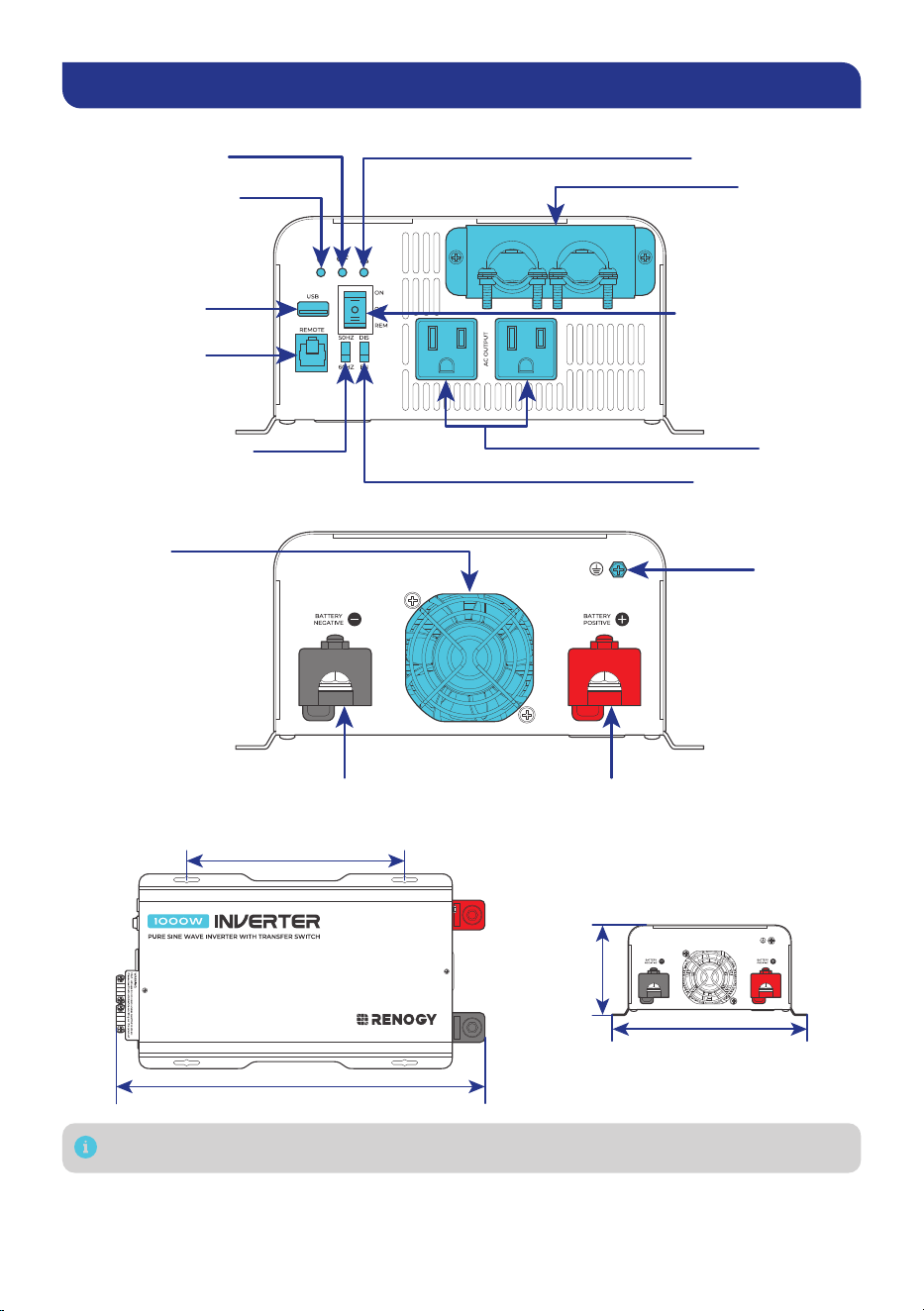
Get to Know Renogy 12V 1000W Pure Sine Wave Inverter
█
AC Side View
AC Output Frequency
USB Power Port
Power LED Indicator
GFCI LED Indicator
N-G Bonding Relay
AC Input and
High Output AC
Terminals
Fault LED Indicator
AC Outlets
Remote Control
Terminal
ON/OFF/REM Switch
█
DC Side View
Cooling Fan
Ground, M4
Negative (-) DC Input, M8 Positive (+) DC Input, M8
█
Dimensions
8.96 in (227.5 mm)
15.3 in (388.5 mm)
8.1 in (205.4 mm)
3.8 in
(95.3 mm)
Dimension tolerance: ±0.2 in (0.5 mm)
— 4 —
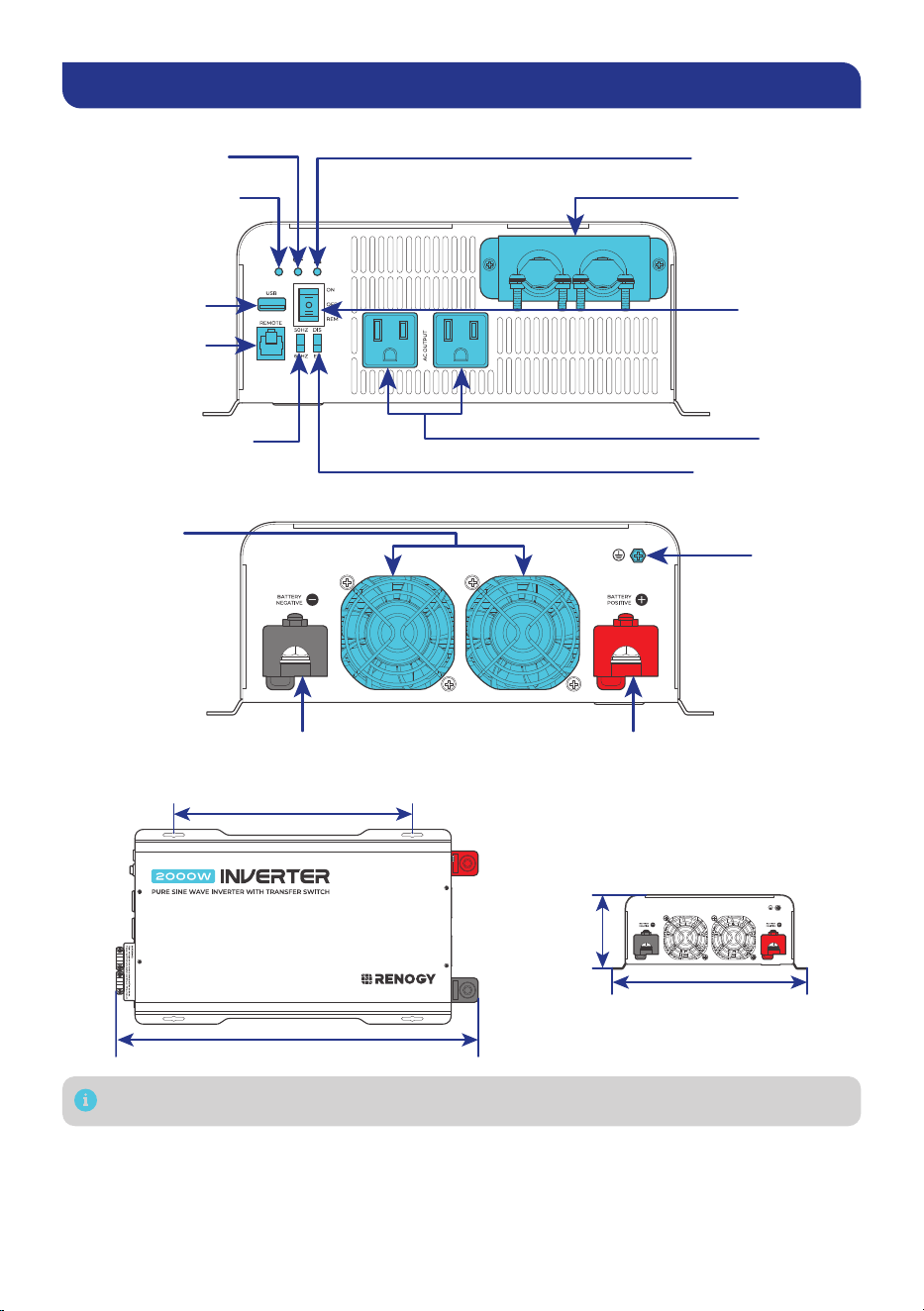
Get to Know Renogy 12V 2000W Pure Sine Wave Inverter
█
AC Side View
AC Output Frequency
USB Power Port
Power LED Indicator
GFCI LED Indicator
N-G Bonding Relay
AC Input and
High Output AC
Terminals
Fault LED Indicator
AC Outlets
Remote Control
Terminal
ON/OFF/REM
Switch
█
DC Side View
Cooling Fans
Ground, M4
Negative (-) DC Input, M8 Positive (+) DC Input, M8
█
Dimensions
12.1 in (307 mm)
18.3 in (468.3 mm)
9.9 in (250.4 mm)
3.8 in
(95.3 mm)
Dimension tolerance: ±0.2 in (0.5 mm)
— 5 —
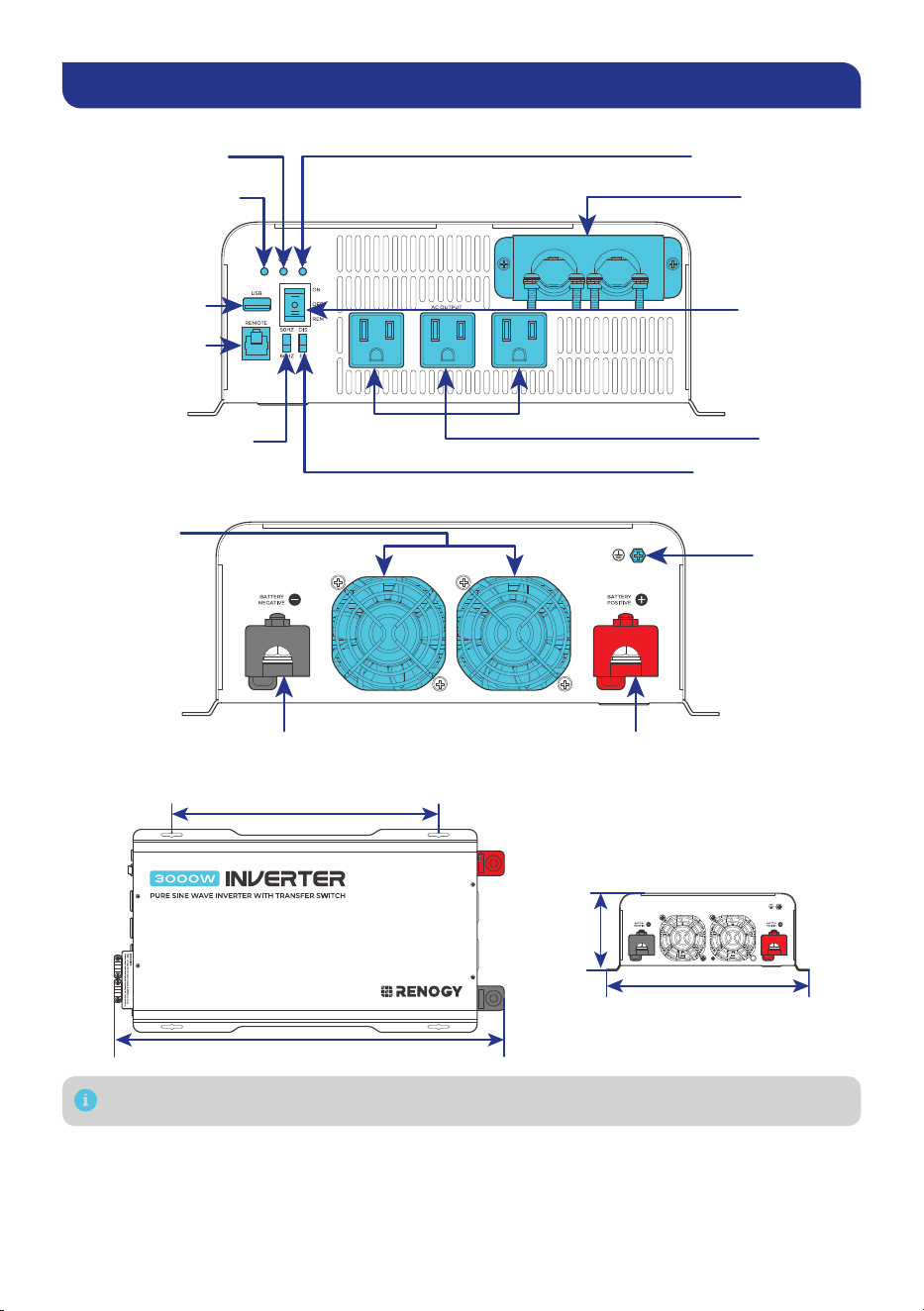
Get to Know Renogy 12V 3000W Pure Sine Wave Inverter
█
AC Side View
AC Output Frequency
USB Power Port
Power LED Indicator
GFCI LED Indicator
N-G Bonding Relay
AC Input and
High Output AC
Terminals
Fault LED Indicator
AC Outlets
Remote Control
Terminal
ON/OFF/REM
Switch
█
DC Side View
Cooling Fans
Ground, M4
Negative (-) DC Input, M8 Positive (+) DC Input, M8
█
Dimensions
12.8 in (327.5 mm)
19.2 in (488.8 mm)
10.4 in (263.4 mm)
3.8 in
(95.3 mm)
Dimension tolerance: ±0.2 in (0.5 mm)
— 6 —
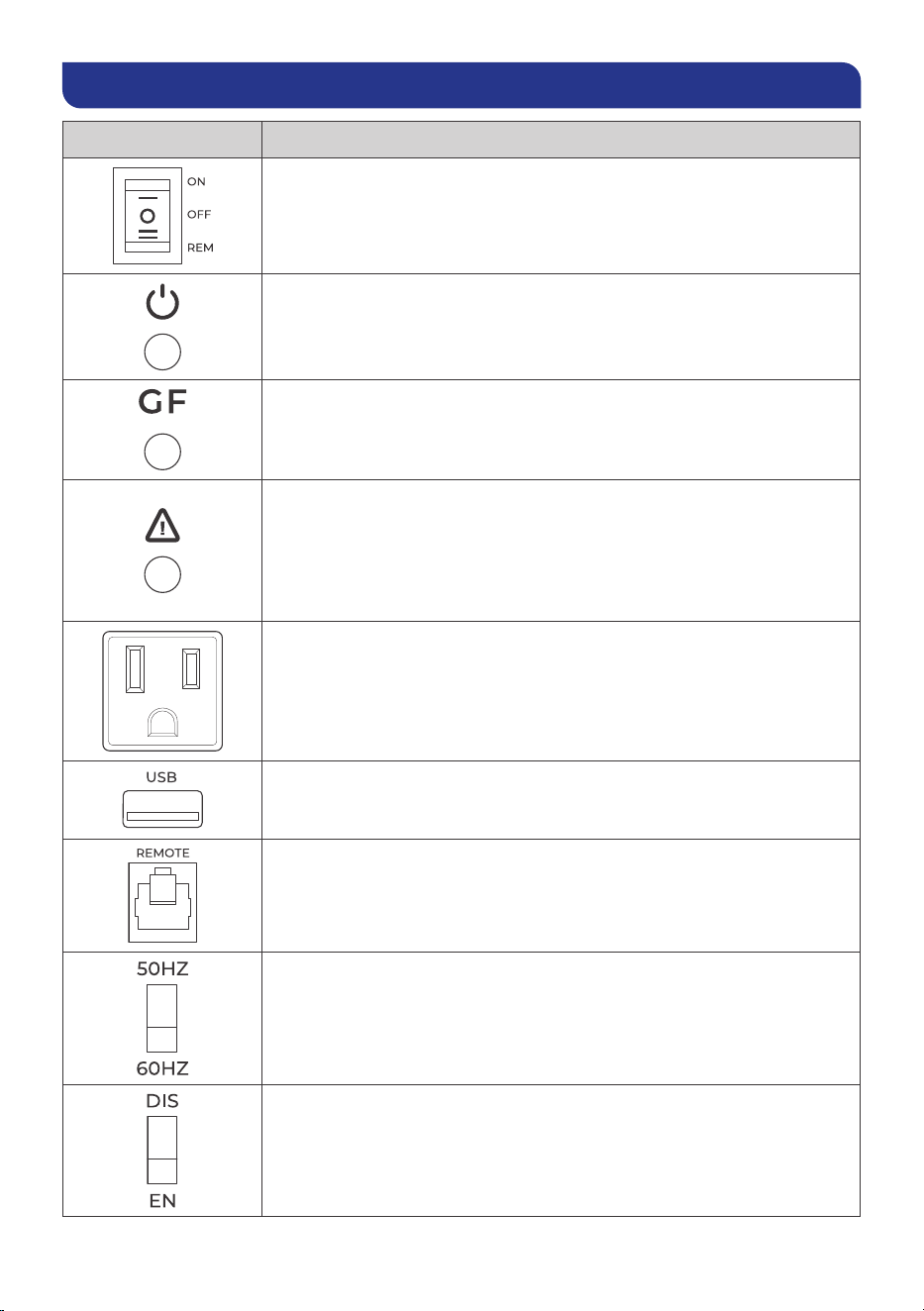
Part Description
Part Description
ON/OFF/REM Switch
Turns the inverter ON, OFF, or REMOTE.
Power LED Indicator
Indicates the operational status of the inverter.
GFCI LED Indicator
Indicates that the ground fault circuit has been interrupted. In such
case, restart the inverter.
Fault LED Indicator
Indicates that the inverter shuts down due to overheating, overload,
undervoltage, or overvoltage.
Solution: Immediately turn off all AC appliances. Allow the inverter to
cool before continuing. Make sure that the ventilation vents are not
blocked. Ensure all cables are of proper sizes and lengths.
AC Outlets
120V AC, 50/60 Hz.
z
Up to 10A x 2 for Renogy 12V 1000W Pure Sine Wave Inverter
z
Up to 16A x 2 for Renogy 12V 2000W Pure Sine Wave Inverter
z
Up to 16A x 3 for Renogy 12V 3000W Pure Sine Wave Inverter
USB Power Port
Supplies 5V/2.1A for charging tablets, smartphones, and other small
appliances.
Remote Control Terminal
Connects to the Wired Remote Control.
AC Output Frequency
Configure the AC output frequency of the inverter in accordance with
the frequency of the connected AC loads.
N-G Bonding Relay
The inverter is equipped with a Neutral to Ground (N-G) bonding relay
that ensures that either the neutral in or out contact of the RV is always
grounded.
You can manually enable or disable the N-G Bonding Relay as needed.
— 7 —
High Output AC Terminals
Distributed wiring with multiple AC outlets.
Remove the two screws on the protective cover to access the terminals.
Terminal layout (facing the front panel):
z
Left: Ground (G)
z
Middle: Live (L)
z
Right: Neutral (N)
AC Input Terminals
When the inverter is connected to a single-phase 120V power system
through the AC Input Terminals, after the inverter is powered on, the
grid power can directly supply power to the load through the bypass.
Remove the two screws on the protective cover to access the terminals.
Terminal layout (facing the front panel):
z
Left: Live (L)
z
Middle: Neutral (N)
z
Right: Ground (G)
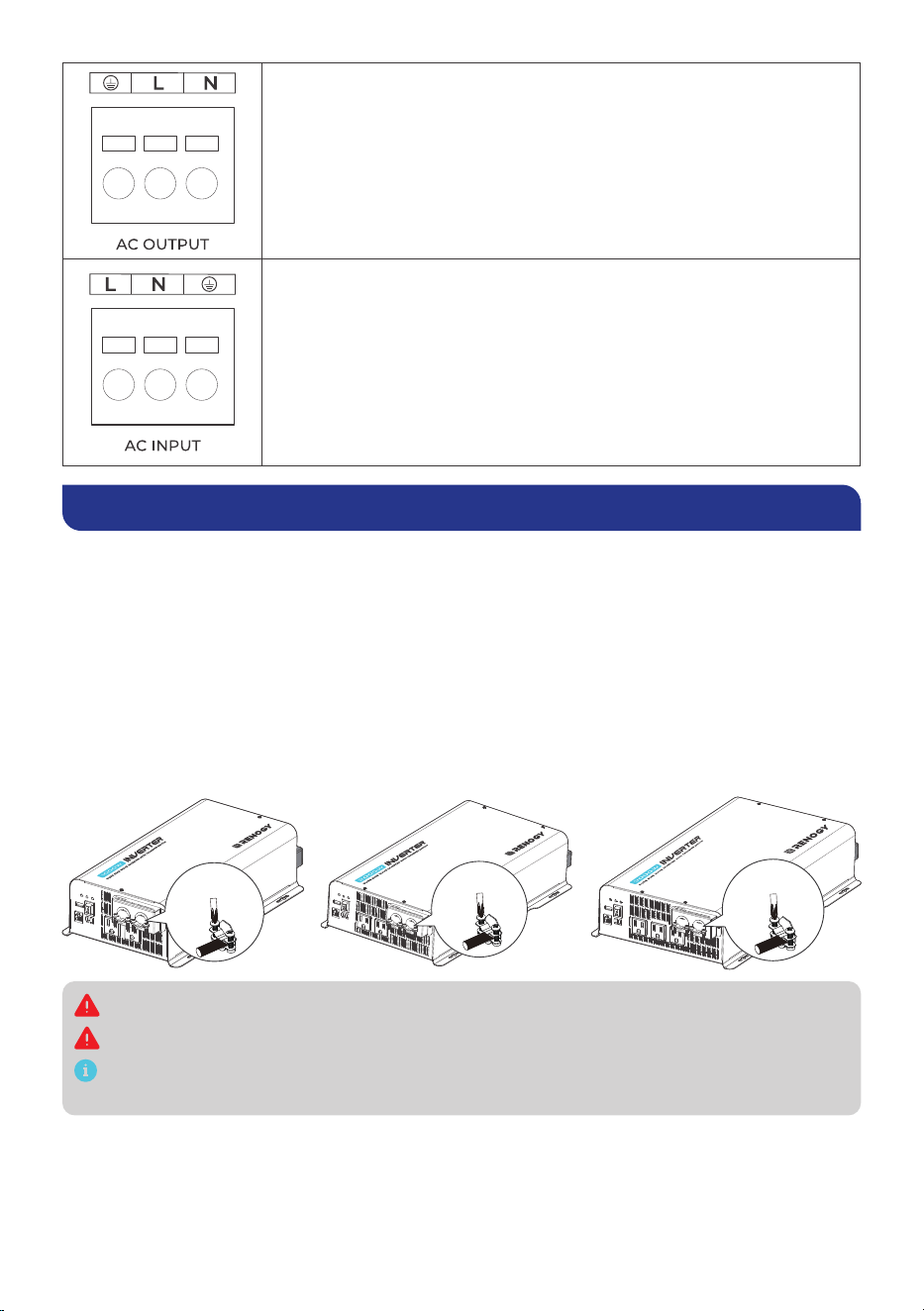
How to Properly Install Cable Clamps?
The AC Input Terminals and AC Output Terminals are equipped with cable clamps to ensure that
the wiring connections remain secure and do not come loose due to vibrations.
Step 1: Remove the two screws on the protective cover to access the terminals.
Step 2: Loosen the screws on a cable clamp with a Phillips Screwdriver.
Step 3: Lift the clamp, and run the cables through the clamp.
Step 4: Secure the clamp by fastening the screws.
Step 5: Install the protective cover and secure it using two screws.
You will need 1 x 3 prong (12 AWG recommended Black, White, Green) ac cables not provided with
this product. Measure the required length for your particular application. for ac output of the
inverter.SJT0 and SJT,SJ0 are recommended wire.
14.16in-lbs
(1.6N-m)
14.16in-lbs
(1.6N-m)
14.16in-lbs
(1.6N-m)
Do not use the bare wires if there is any visible damage.
Do not use SP-3, SPT-3 type wire.
The screw torque of a cable clamp is 14.16 in·lbs (1.6 N·m). Do not over tighten the screws to
prevent damage.
— 8 —
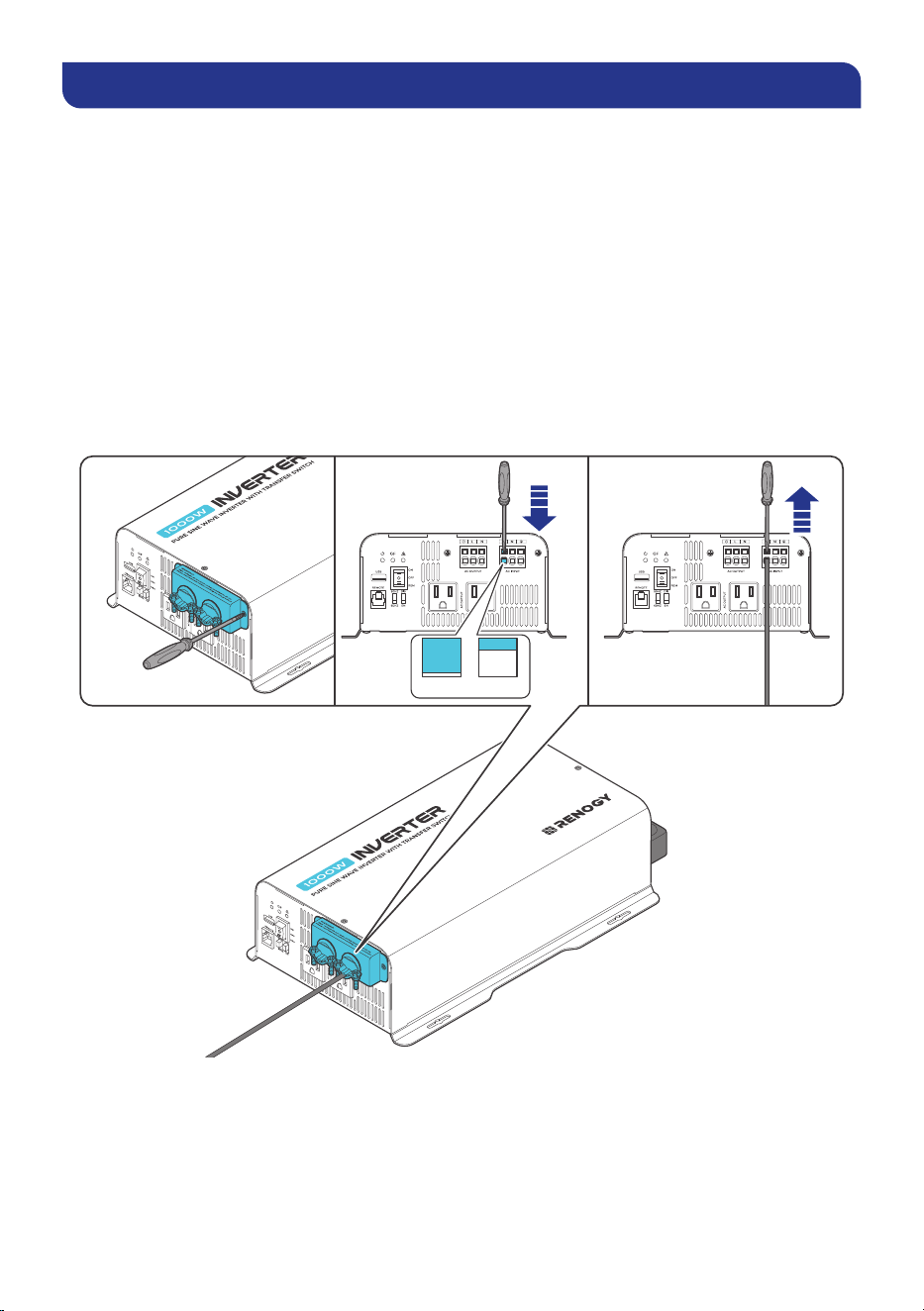
How to Wires the AC Input and High Output AC Terminals?
This manual uses the L terminal of the AC Input as an example; all terminal wiring methods are the
same.
1. Use a Phillips screwdriver (#1) to remove the protective cover from the AC Input and High
Output AC Terminals.
2. Pass the stripped end of the wire through the cable clamp. Use wire strippers to remove the
insulation from the stripped end of the wire.
3. Insert a slotted screwdriver (2 mm) into the locking wire hole above the terminal.
4. Ensure the lock is open.
5. Insert the wire into the terminal hole.
6. Remove the slotted screwdriver (2 mm), and the wire will be locked in place by the lock.
7. Reinstall the protective cover for the AC Input and High Output AC Terminals.
8. Tighten the cable clamp.
Close Open
— 9 —
System Setup
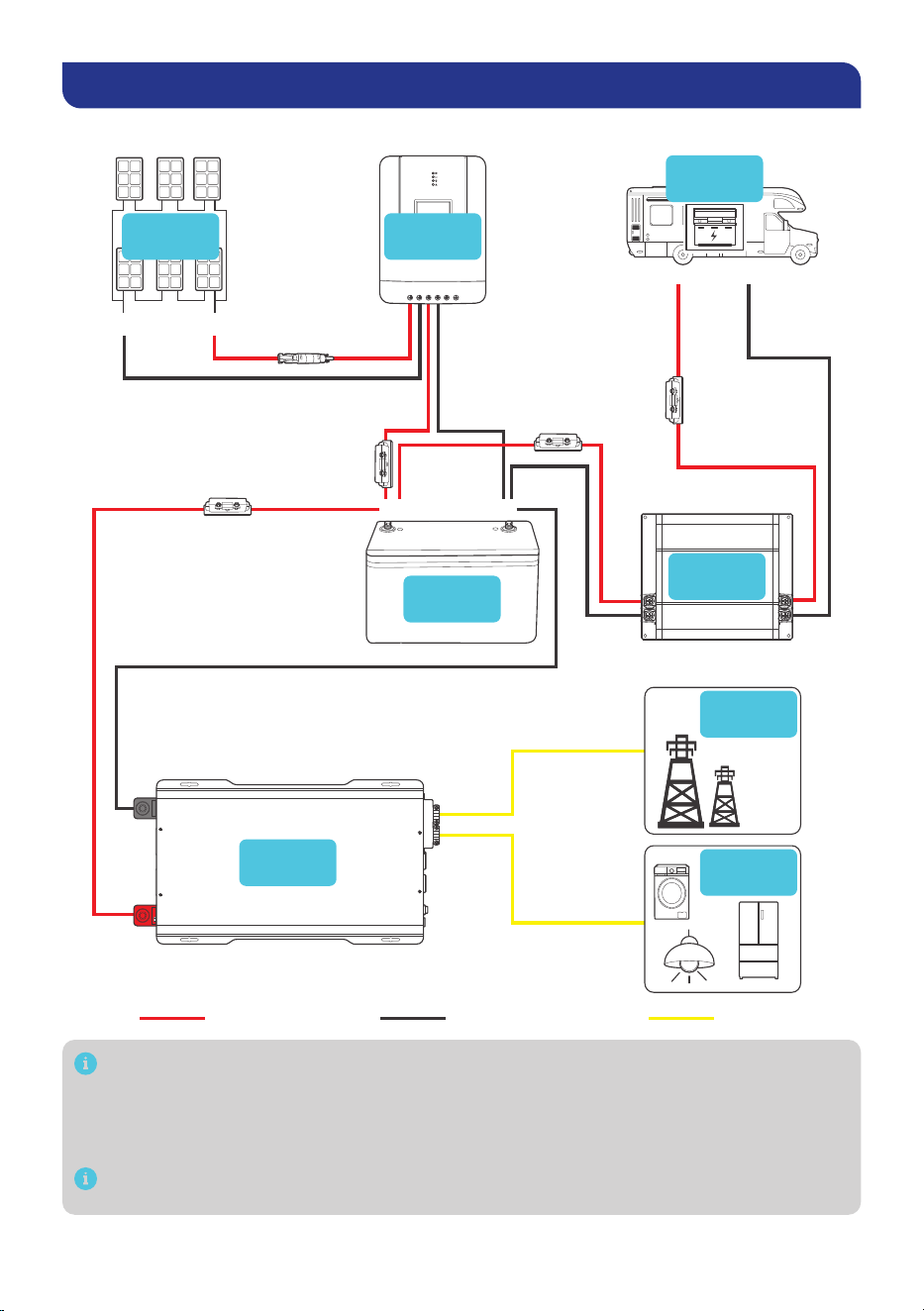
System Wiring
+
+
-
+
-
-
+ -
Battery
Fuse
Battery
Fuse
Battery
Fuse
Starter
Battery
Solar
Panel
Battery
Solar
Panel
Fuse
Battery
Fuse
Positive (DC) Negative (DC) AC
Charge
Controller
Battery
Charger
Grid
Power
AC
Loads
Inverter
The wiring diagram only shows the key components in a typical DC-coupled off-grid energy
storage system for the illustrative purpose. The wiring might be different depending on the
system configuration. Additional safety devices, including disconnect switches, emergency
stops, and rapid shutdown devices, might be required. Wire the system in accordance with
the regulations at the installation site.
The grid supplies the connected loads only. It does not charge the battery.
— 10 —
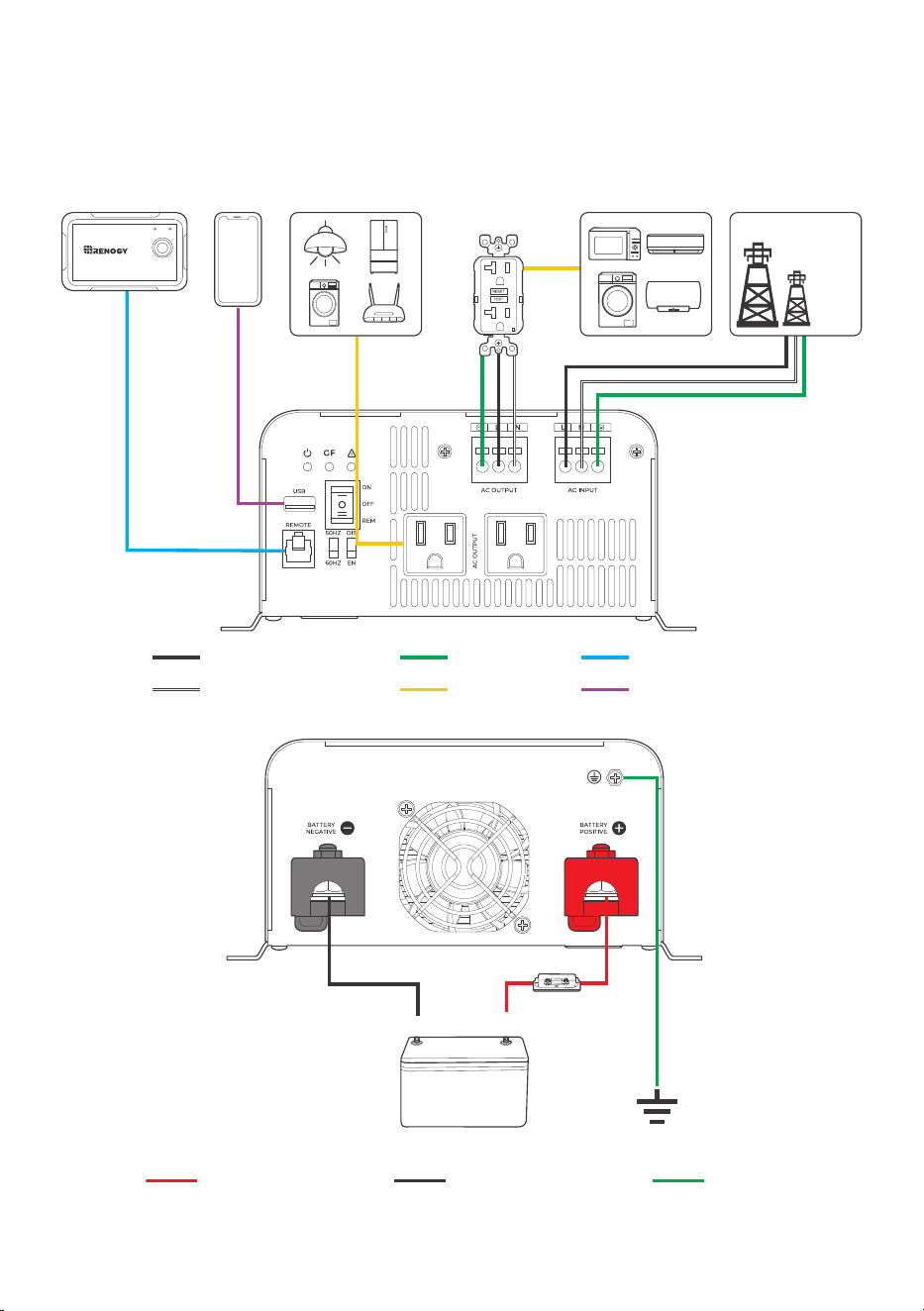
Inverter Wiring
The wiring diagram provided in this section is tailored for a 1000W inverter model. Similar wiring
rules apply to other models.
█
AC Side View
Live wire (AC)
AC Loads
Neutral wire (AC)
Ground
Wired Remote
Control
Remote control
USBAC
ON ERR
RMS-P2
AC Loads
Ground Fault
Circuit Interrupter
(GFCI)
Loads
(USB) Grid Power
Single-
phase
120V
█
DC Side View
Positive (DC) Negative (DC) Ground
12V Battery Ground
+-
Battery
Fuse
— 11 —
Size a Battery Bank
Battery types and capacity relate to the overall inverter performance. To size a proper battery
bank, you need to identify the loads that you will be utilizing, as well as an estimate duration
(hours/day) you will be using the load. The inverter is only compatible with 12V battery banks, and
oversizing should be considered due to efficiency losses.
1. Determine Your Watts (Amps x Volts)
Every electronic device will have a sticker or plate identifying the watts directly (W) or will
show you the voltage value (V) as well as amperage (A) which need to be multiplied to get
Watts. The formula is below:
Watts (W) = Volts (V) x Amps (A)
Example: Fan Watts = 120V * 0.4A = 48Watts
2. Estimate Load Run-Time in Watt-Hours (Wh)
Estimate how many hours per day you will be using the load and multiply this by your Watts
per load.
Example: Fan Watts x 12 hours = Watt-Hour (Wh)
48W x 12h = 576Wh
3. Determine Battery Capacity in Amp-Hour (Ah)
Divide your Load Run Watt-Hour result by the battery voltage.
Load Run-Time (Wh)/Battery Voltage (V) = Amp-Hour (Ah)
Use 12V, supported voltage of the inverter as a reference.
576Wh/12V = 48 Ah
4. Oversize the Battery
The calculated Amp-Hour value represents the minimum size battery capacity to run your
load for your intended time. Note that this assumes 100% use of a battery, which is not
recommended. Assuming 50% depth of discharge, you want to multiply this value by 2 and
you also want to multiply by 1.25 to account for some efficiency losses.
Formula:
48Ah x Oversize x Efficiency Losses = Recommended Amp-Hour
48 x 2 x 1.25 ≈ 115Ah
Therefore, a 115Ah battery bank, or close, will be able to support a 12-hour run time while
also prolonging battery life for the best system size possible.
Actual battery quantities vary by battery capacity and rates of discharge.
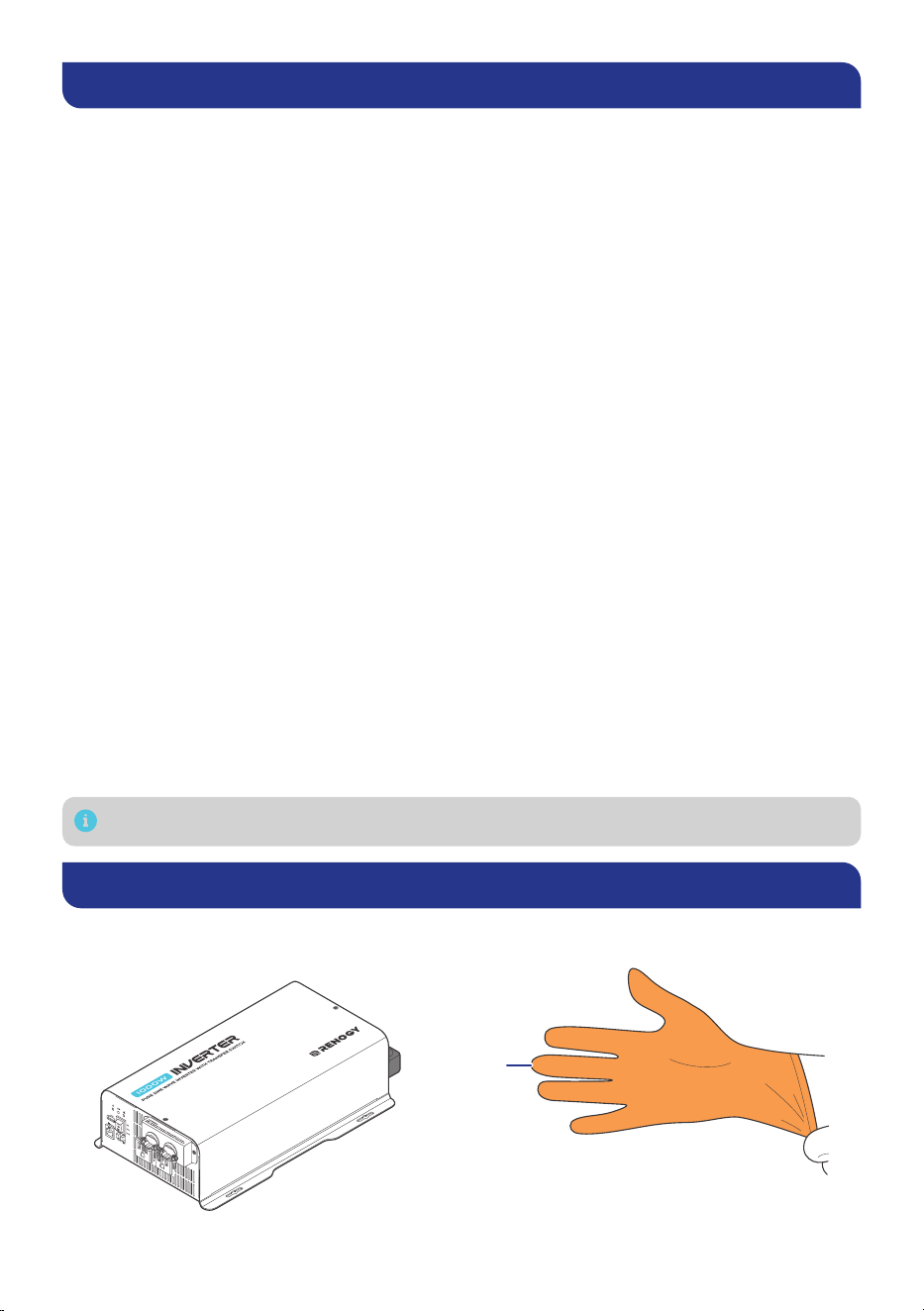
Step 1. Wear Insulating Gloves
This manual utilizes the 1000W Inverter as a reference for its illustrations. The wiring techniques
remain consistent across all inverter models, though there may be variations in terminal positions.
Insulating
Gloves
— 12 —
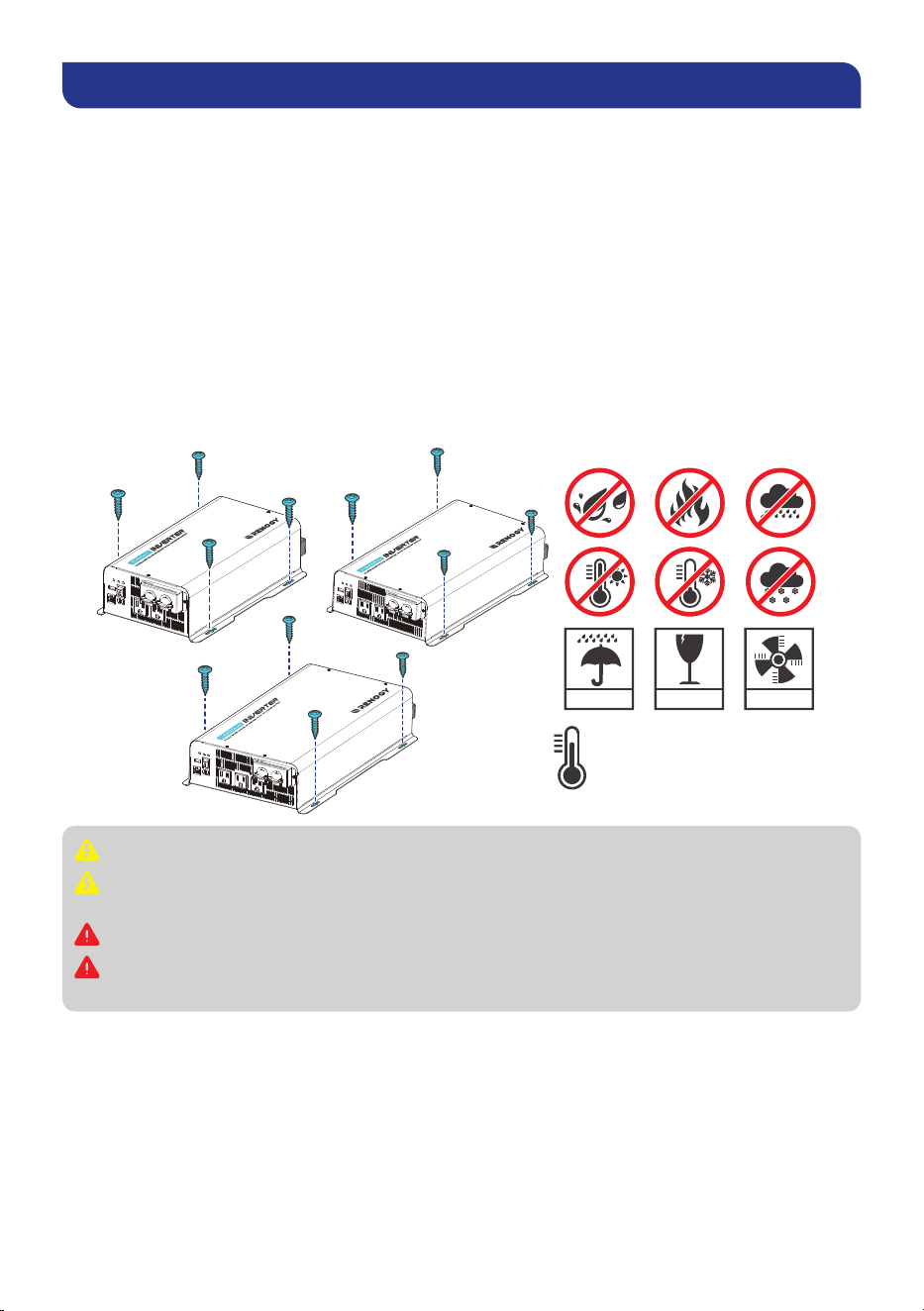
Step 2. Plan a Mounting Site
Follow the guidelines below:
z
Cool, dry, and well-ventilated area
The inverter must be installed in a site where the fans are not blocked or where they are not
hit directly by the sun. The site should be free of any kind of moisture with a clearance of at
least 10 inches around the inverter for adequate ventilation.
z
Protection against fire hazard
The inverter should be away from any flammable material, liquids, or any other combustible
material.
z
Close proximity to battery bank
Put the inverter close to batteries banks to prevent excessive voltage drop. Choose a proper
sized wire going from the battery bank to the inverter.
z
Secure mounting
The inverter should be stand-alone or mounted by using the outlying terminals with ST4 and
ST6 screws on the inverter.
KEEP DRY FRAGILE VENTILATION
-4°F to 113°F / -20°C to 45°C
Do not over-torque or overtighten the terminals. This could potentially damage the unit.
Refer to the technical specifications for maximum wire sizes on the controller and for the
maximum amperage going through wires.
Ensure the inverter is in the OFF position before connecting to anything.
Do not install the inverter in the same compartment as the battery bank because it could
serve as a potential fire hazard.
— 13 —
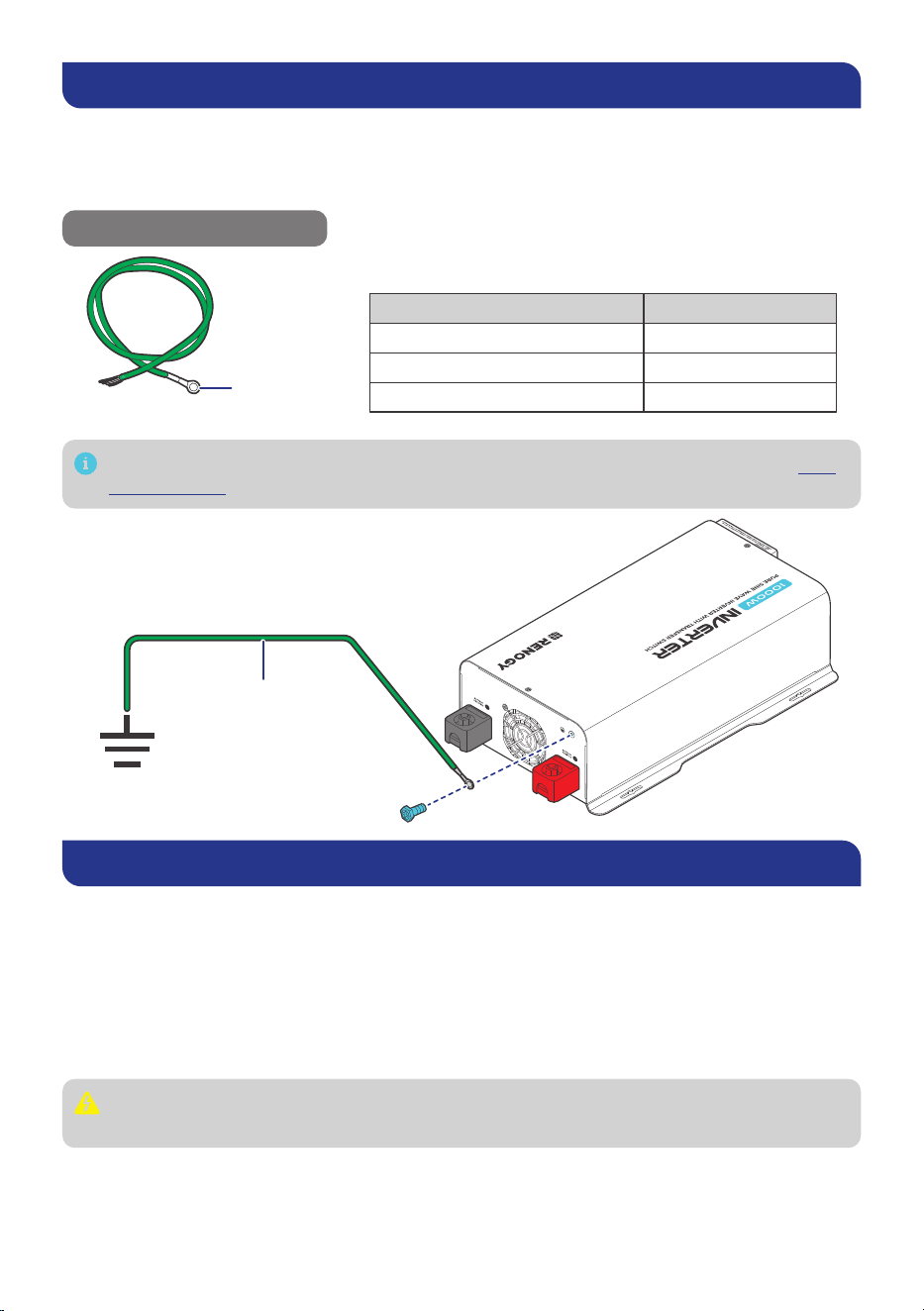
Step 3. Grounding
Grounding is highly recommended for both when using the inverter in a mobile application, such
as an RV, or in a building. If available, the chassis ground lug should be connected to a ground
point such as a vehicle chassis or boat grounding system. In fixed locations, connect the ground
lug to earth ground. The connections to ground must be tight and against bare metal.
Recommended Components
3/16 in (M4)
Grounding Cable
Recommended Size
14 AWG
Model
1000W Pure Sine Wave Inverter
12 AWG2000W Pure Sine Wave Inverter
10 AWG3000W Pure Sine Wave Inverter
When the GFCI fails to operate normally after grounding the inverter, please refer to “N-G
Bonding Relay” for details.
Grounding
Grounding Cable
Step 4. DC Wiring
The inverter is suitable for 12V battery bank systems ONLY. Not following the minimum DC
requirement will cause irreversible damage to the device.
The input terminals of the inverters are embedded with large capacitors. The input circuit
is completed once the terminals are connected to both positive and negative wires. This
commences drawing a heavy current momentarily. As a result, there may be a sparking occurring
even if the inverter is in the off position. To minimize sparking, it is recommended that you should
choose an appropriate sized wire feeding into the inverters and/or install an external fuse leading
into the inverter.
Be careful of the positive and negative poles. Reversing the poles might cause permanent
damage to the inverter and will void the warranty.
— 14 —
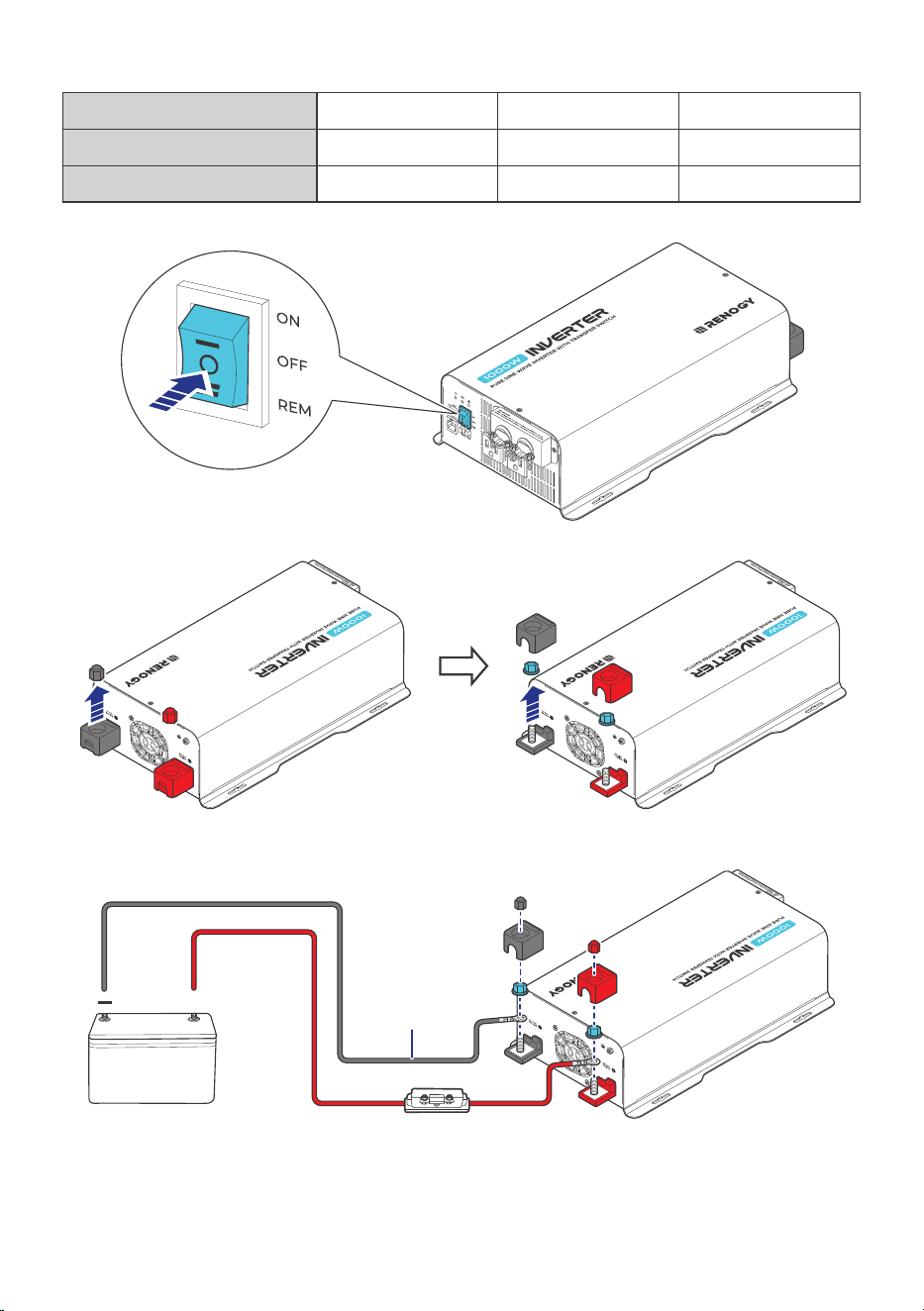
For your safety, it is recommended that you should use a battery fuse on the positive end.
Model RIV1210PU-126 RIV1220PU-126 RIV1230PU-126
Continuous Output Power 1000W 2000W 3000W
Battery Fuse 150A 250A 350A
Step 1: On the AC side, set the ON/OFF/REM Switch to the OFF position.
Step 2: On the DC side, remove the protection caps.
Step 3: Unscrew Positive and Negative DC Input Terminals, connect a battery bank to the
terminals, and tight the terminal screws. Torque: 14(±0.5) N·m
+
Battery Fuse
12V Battery
Cables (3ft)
— 15 —
Step 5. AC Output Wiring
Recommended Ground-Fault Circuit Interrupter (GFCI)
A ground-fault circuit interrupter, or GFCI, is a device that helps protect people from electric
shocks by de-energizing a circuit or portion of a circuit within an established period of time when
a current to ground exceeds some predetermined value that is less than that required to operate
the overcurrent device (circuit breaker or fuse) of the supply circuit. GFCIs are usually required in
wet or damp locations.
While the inverter is equipped with a GFCI, an external GFCI is strongly recommended to elevate
system safety.
The following table lists GFCIs that meet the specifications and will function properly when they
are connected to the AC Outlets of the inverter.
Tested GFCI Models
Manufacturer Model Number
Leviton GFNT2
Hubbell GFP1305
Hubbell GF15WLA
Risk of electrical shock. Use only ground-fault circuit interrupters [receptacle(s) or circuit
breaker(s)] compatible with your inverter.
GFCIs shall be installed in a recreational vehicle’s wiring system to protect all branch
circuits.
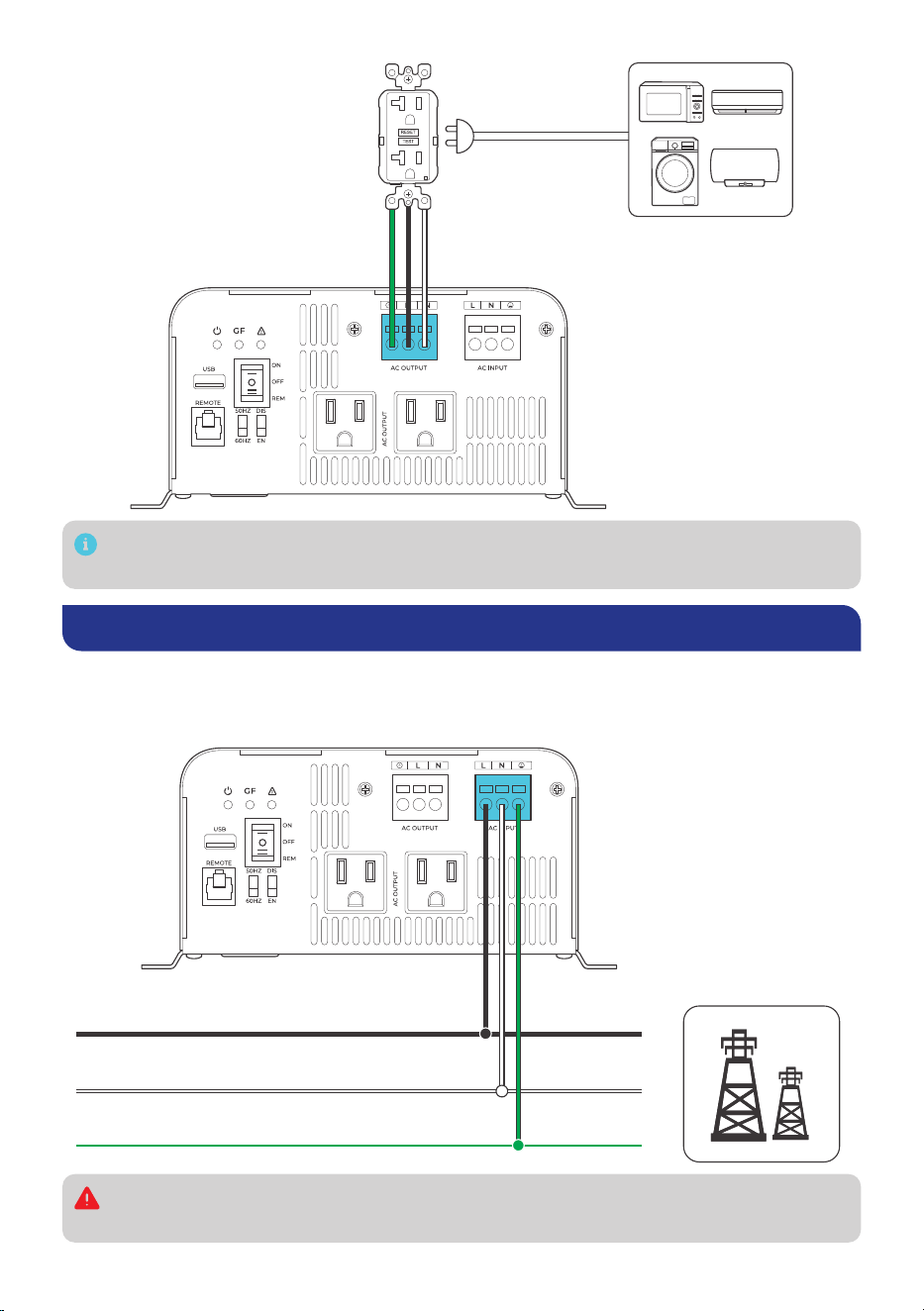
AC Outlets
You can plug your AC loads directly into the AC Outlets on the inverter’s AC side.
High Output AC Terminals
Additionally, you have the option to establish a permanent connection from the AC output by
linking it through the High Output AC Terminals to a GFCI, a load sub-panel, or supplementary AC
outlets that receive power from the inverter.
From left to right, the terminal block indicates: Ground (G), Live/Hot (L), and Neutral (N).
— 16 —
Ground Fault
Circuit Interrupter
(GFCI)
For details on how to connect loads and the inverter to the GFCI, read the user manual of
the specific GFCI.
Step 6. AC Input Wiring (Optional)
Utilizing the built-in transfer switch, this inverter seamlessly switches to grid power, bypassing
the inverter when it’s available, thereby directly supplying the load with grid power.
From left to right, the terminal block indicates: Live/Hot (L), Neutral (N), and Ground (G).
Grid Power
(Single-phase 120V)
L
N
PE
Risk of electric shock! Ensure the grid or the AC generator is turned off before connecting
them to the inverter.
— 17 —
Power On/Off
When the inverter turns on, it is normal to see the fans run for a second and hear a beep.
Avoid powering on the inverter with the load (electronic devices) already switched on. This
may trigger an overload since some electronic devices have an initial high power surge to
start.
When switching off the inverter, turn off the electronic devices first. Although the inverter
is off, the terminal capacitors will still have a charge, so the DC and AC terminals must be
disconnected if altering the circuitry.
After the inverter is powered on, the grid power from the AC input can provide electricity.
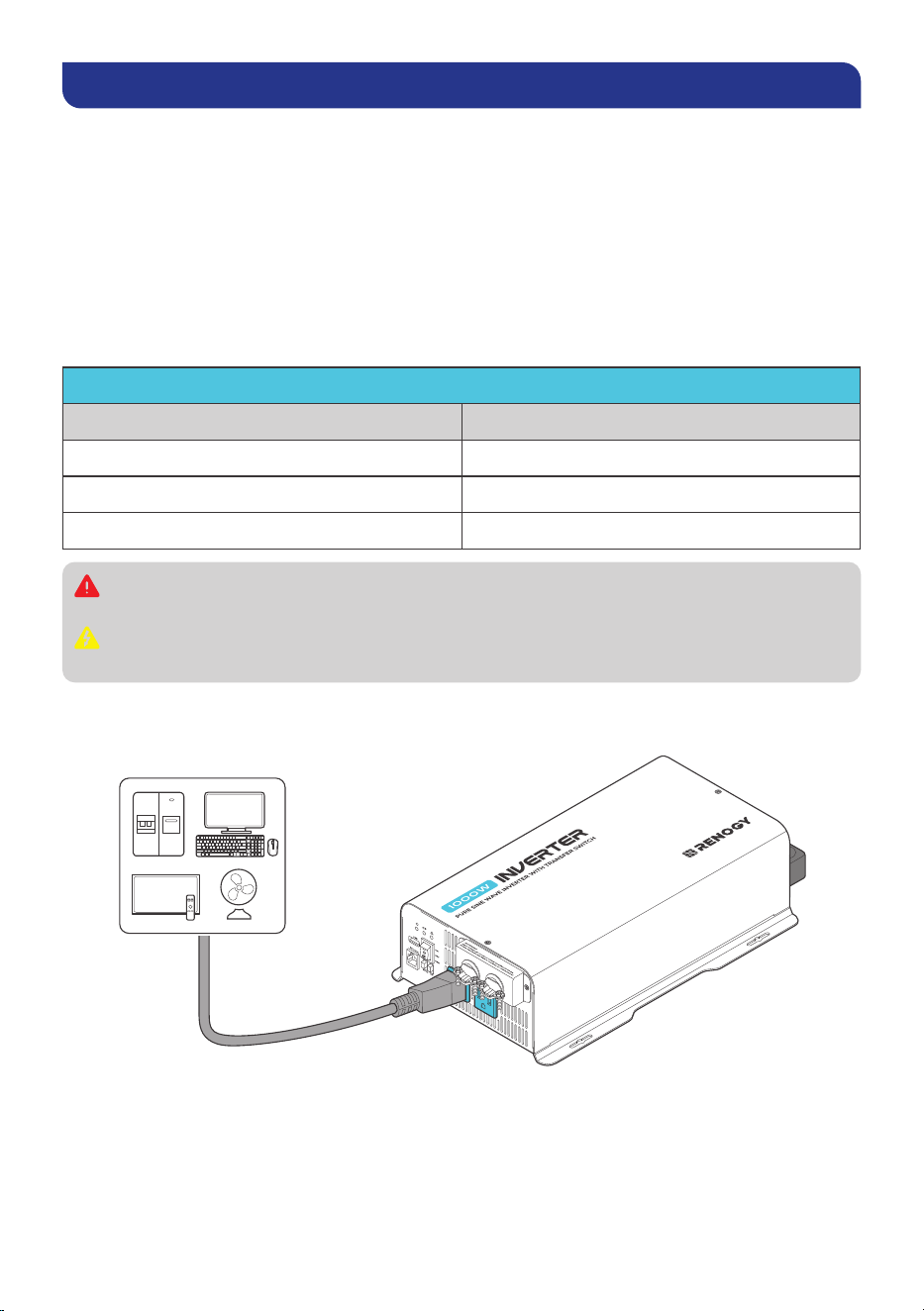
█
Operations on Inverter
After proper battery and AC load connections, you can operate the inverter.
1. On the AC side, rock the ON/OFF/REM Switch to the ON position.
2. The inverter is operating normally.
When finishing using the inverter, power off the AC loads first, and then rock the ON/OFF/REM
Switch to the OFF position.
█
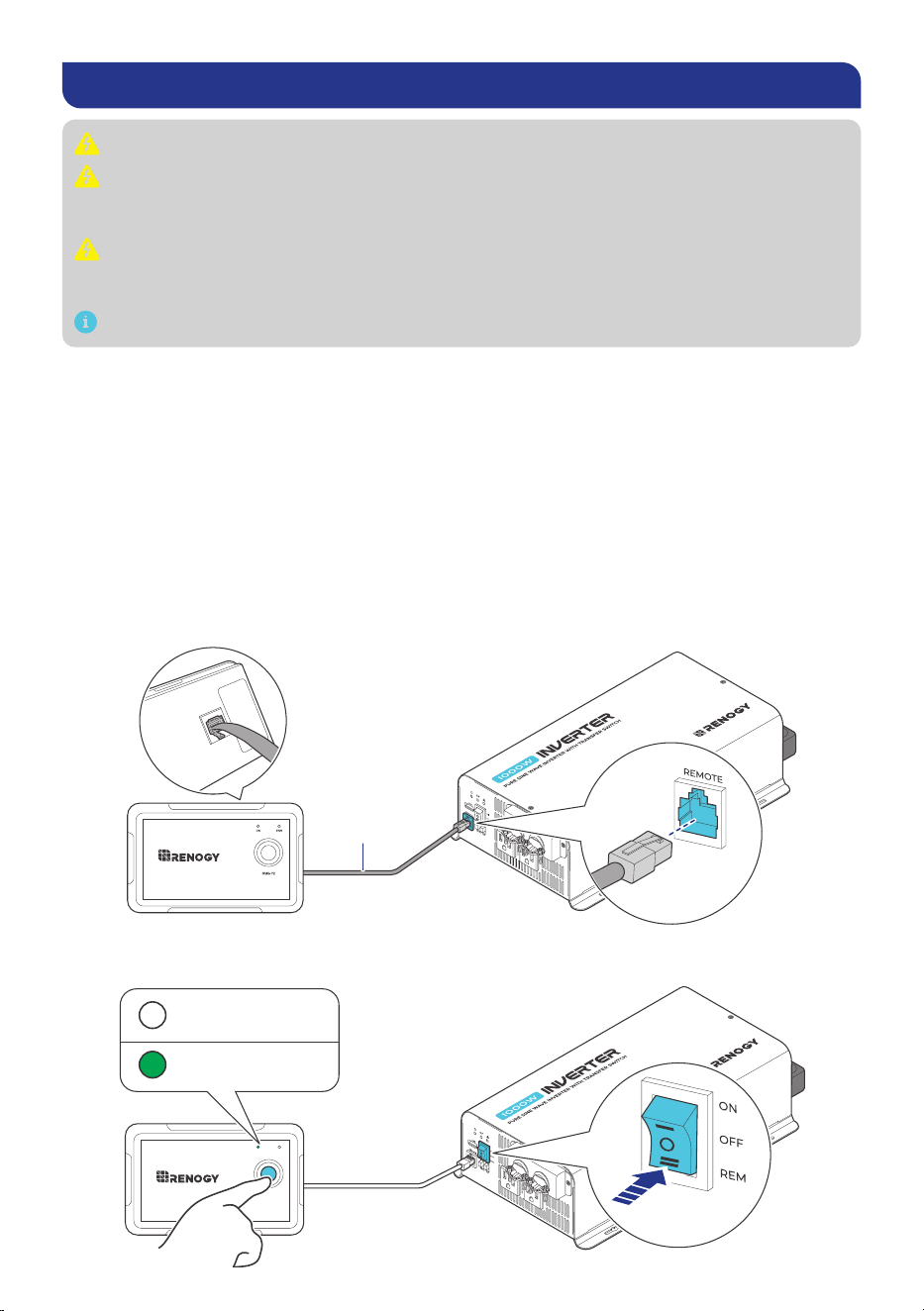
Wired Remote Control
The Wired Remote Control gives you the opportunity to power on/off the inverter from a distance
(approximately 16.4 ft / 5 m).
Note that the inverter ON/OFF/REM switch should be in the OFF or REM position.
Step 1: Connect the Wired Remote Control to the inverter via the Remote Control Connector.
RJ12
Ethernet
Cable
Step 2: Rock the ON/OFF/REM Switch to the OFF or REM position, and you can power on/off the
inverter via the Wired Remote Control.
ON ERR
RMS-P2
The inverter is o.
The inverter is on.
— 18 —
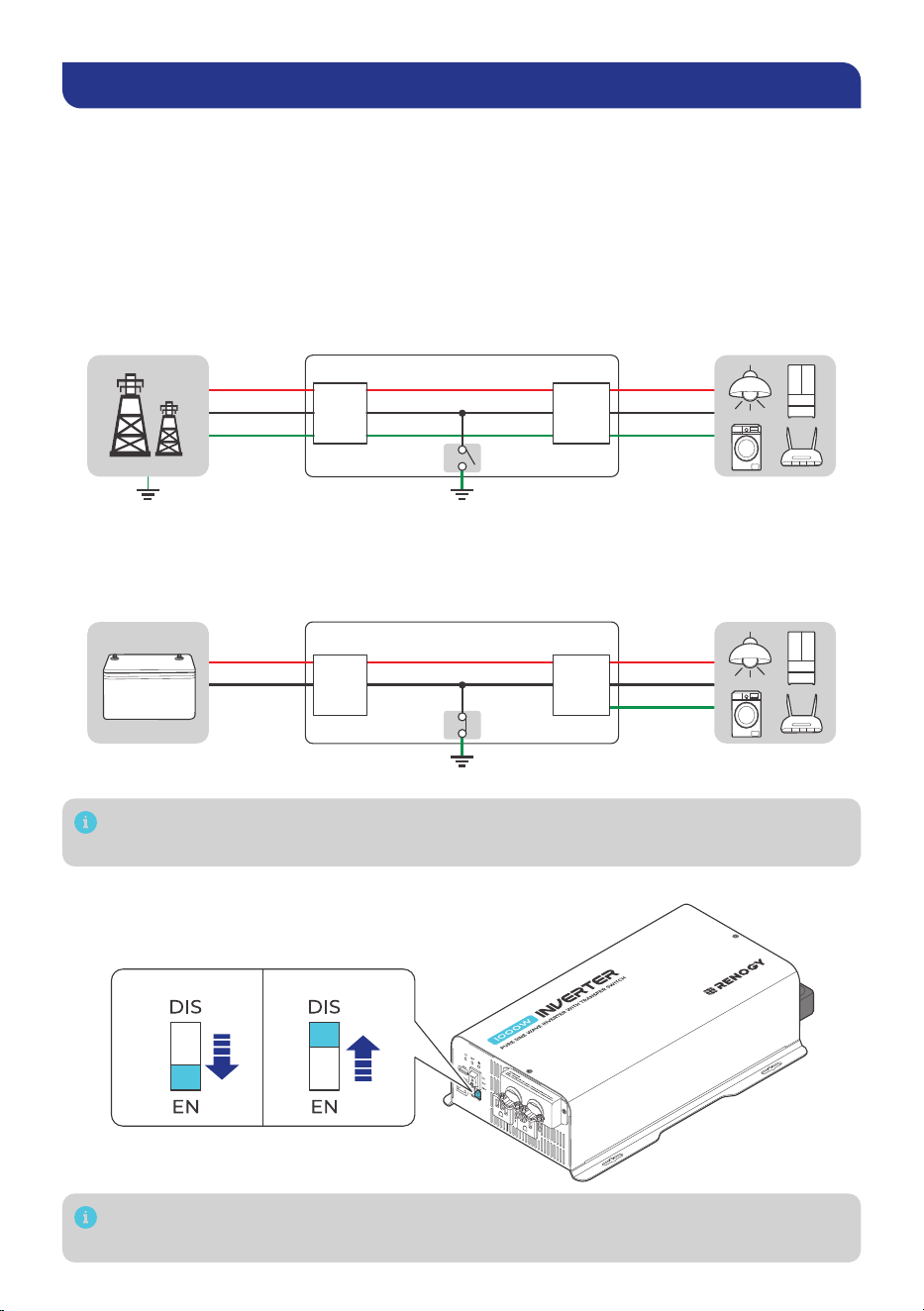
N-G Bonding Relay
The inverter is equipped with a Neutral to Ground (N-G) bonding relay that ensures that either the
neutral in or out contact of the RV is always grounded.
This helps prevent electrical shock caused by contact between the neutral contacts of the RV and
external AC power sources.
By default, the Neutral to Ground bonding relay is enabled when the inverter is shipped from the
factory.
z
When there is AC input current, the N-G bonding relay automatically opens the neutral-to-
ground connection as shown in the figure below, and the system connects to the grid ground
contact.
Inverter
GND
L
N
PE
L
N
PE
AC
input
AC
output
AC LoadsGrid Power
GND
N-G Bonding
z
When there is no AC input current, the N-G bonding relay automatically closes and connects
to the ground contact of the inverter. In this case, the inverter supplies loads with the
connected battery.
Inverter
Positive
Negative
L
N
PE
DC
AC
output
Battery AC Loads
GND
N-G Bonding
In scenarios where the N-G bonding relay is disabled, the N-G bonding relay connects to
the ground contact of the inverter only.
You have the option to manually enable or disable the N-G Bonding Relay.
Enabled Disable
The N-G bonding relay must be enabled when the battery supplies the connected loads
because the GFCI will be unavailable if the N-G bonding relay is disabled.
— 19 —
In scenarios when N-G bonding relay is disabled, the inverter must be grounded.
Monitor the Inverter
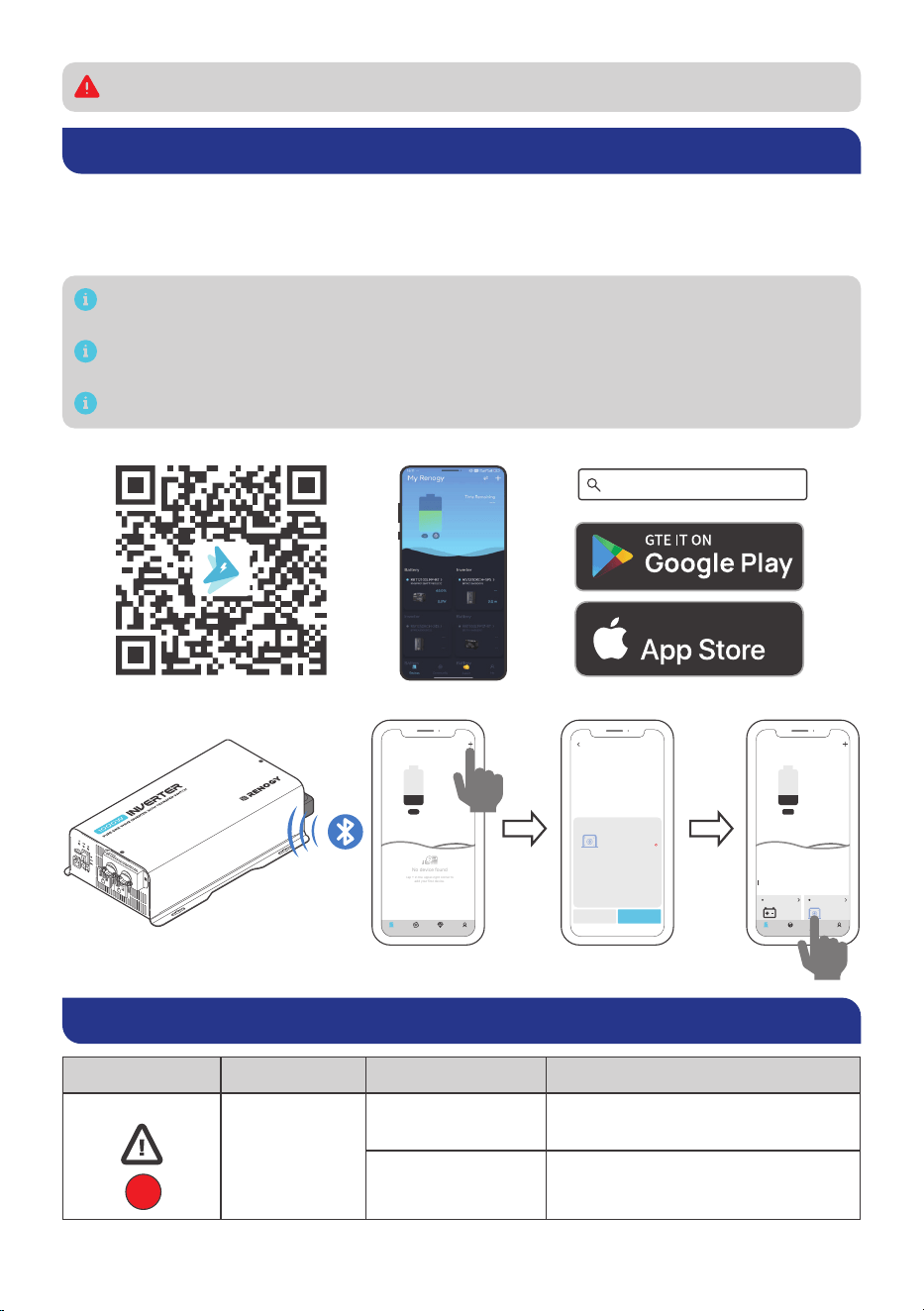
Depending on the specific application, the inverter can establish either short-range
communication connections with monitoring devices. These monitoring devices facilitate real-
time monitoring, programming, and complete system management, offering comprehensive
control and enhanced flexibility.
The version of the Renogy app might have been updated. Illustrations in the user manual
are for reference only. Follow the instructions based on the current app version.
Make sure that the inverter is properly installed and powered on before it is paired with the
Renogy app.
To ensure optimal system performance, keep the phone within 10 feet (3 m) of the inverter.
Download the Renogy app. Login to the app with your account.
Renogy App
Download on the
Connect the inverter to the Renogy app directly through the Bluetooth of your phone.
My Renogy
25%
A
Device
Device
Battery
RBT12400LFPL-...
Inverter
Scene Community Me
RIV1210PU-126
%
25
A
0 12.0 V
W
0
Cancel Confirm
RIV1210PU-126
Inverter
Found Devices
HUB Mode
Searching for device
Please make sure:
1. Bluetooth on this phone/tablet is
turned on.
2. The device is running properly.
3. The device's Bluetooth is turned on.
Identifying device...
No device found
Tap + in the upper-right corner to
add your first device.
---
My Renogy
Time remaining
--
CommunityDevice Select Me
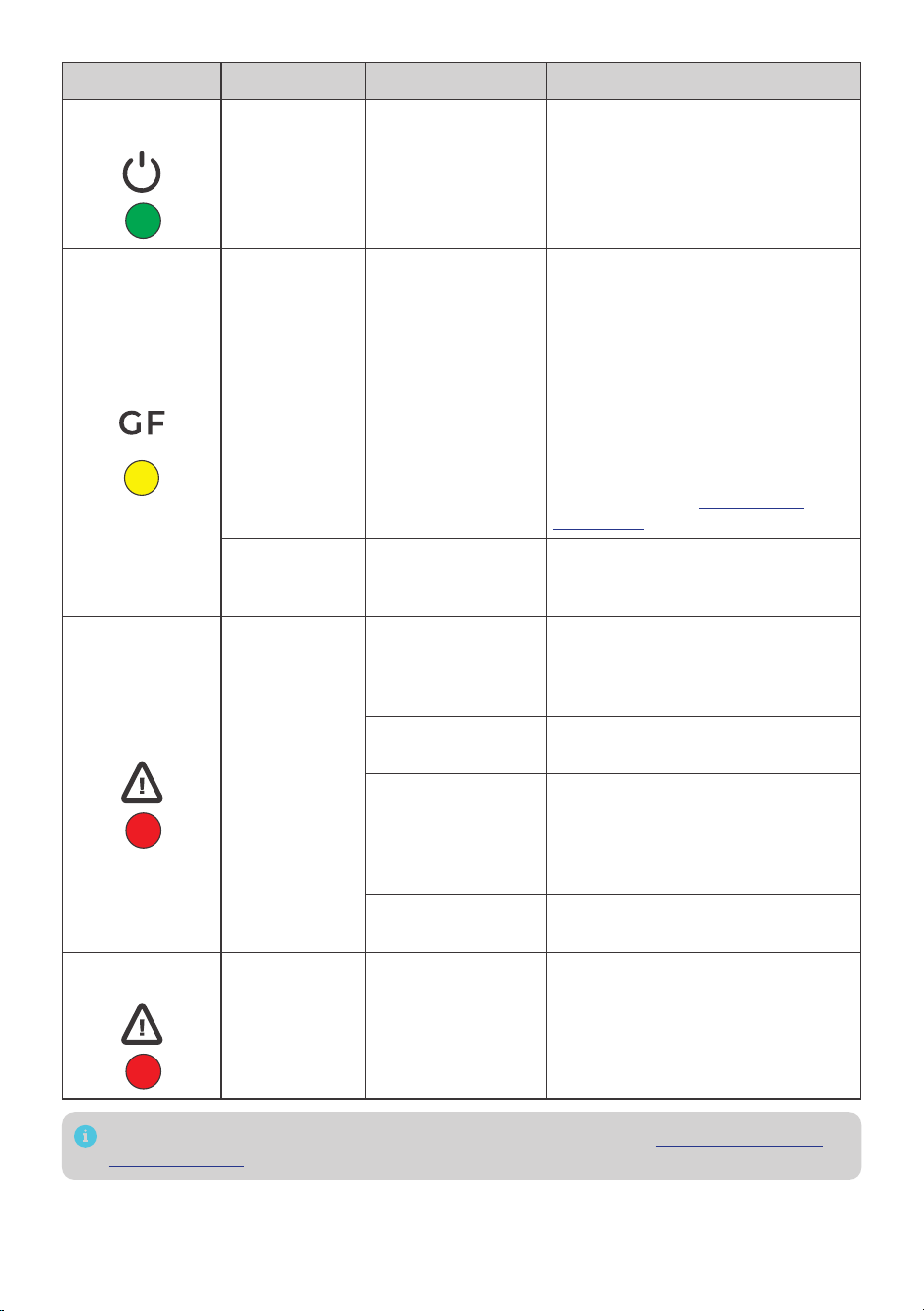
LED Overview & Troubleshooting
LED Status Alarm Protection & Alarm Inverter Status
LED in flicker red
Alarm beeps
Input voltage is
below 11V.
Keep input voltage above 11V.
Input voltage is
above 15.5V.
Keep input voltage below 15.5V.
— 20 —
LED Status Alarm Protection & Alarm Inverter Status
Power LED in
solid green
No sound
Recovery from
undervoltage
Normal output from the inverter.
GFCI LED in solid
yellow
Long steady
beeping sound
GFCI protection
1. No output from the inverter.
2. Disconnect all appliances, and use
the ON/OFF/REM switch to reset the
inverter. Attempt to connect various
appliances one at a time, observing
if the yellow LED on the inverter
remains illuminated.
If it stays off, this suggests a current
leakage issue with one of the
appliances.
If the LED remains on, kindly reach
out to Renogy via renogy.com/
contact-us for further assistance.
No sound and
the inverter is
off
GFCI tripped
Disconnect appliances, and use the
ON/OFF/REM switch to reset the
inverter.
Fault LED in solid
red
Long steady
beeping sound
Overtemperature
protection
1. No output from the inverter.
2. Allow the inverter to cool down.
3. Check for adequate ventilation.
4. Reduce the load on the inverter.
Undervoltage
shutdown
No output from the inverter. Keep
input voltage above 10.5V.
Short circuit
protection
No output from the inverter. After 5s,
the inverter automatically restarts.
After five times of failed restart, the
inverter needs to be restored by
manually turning it on.
Overvoltage
protection
No output from the inverter. Keep
input voltage below 16V.
Fault LED in solid
red
Long steady
beeping sound
Overload protection
Automated recovery after 20
seconds (manual restart required if
automated recovery fails).
For further assitance, contact Renogy technical support service at https://www.renogy.
com/contact-us.
— 21 —
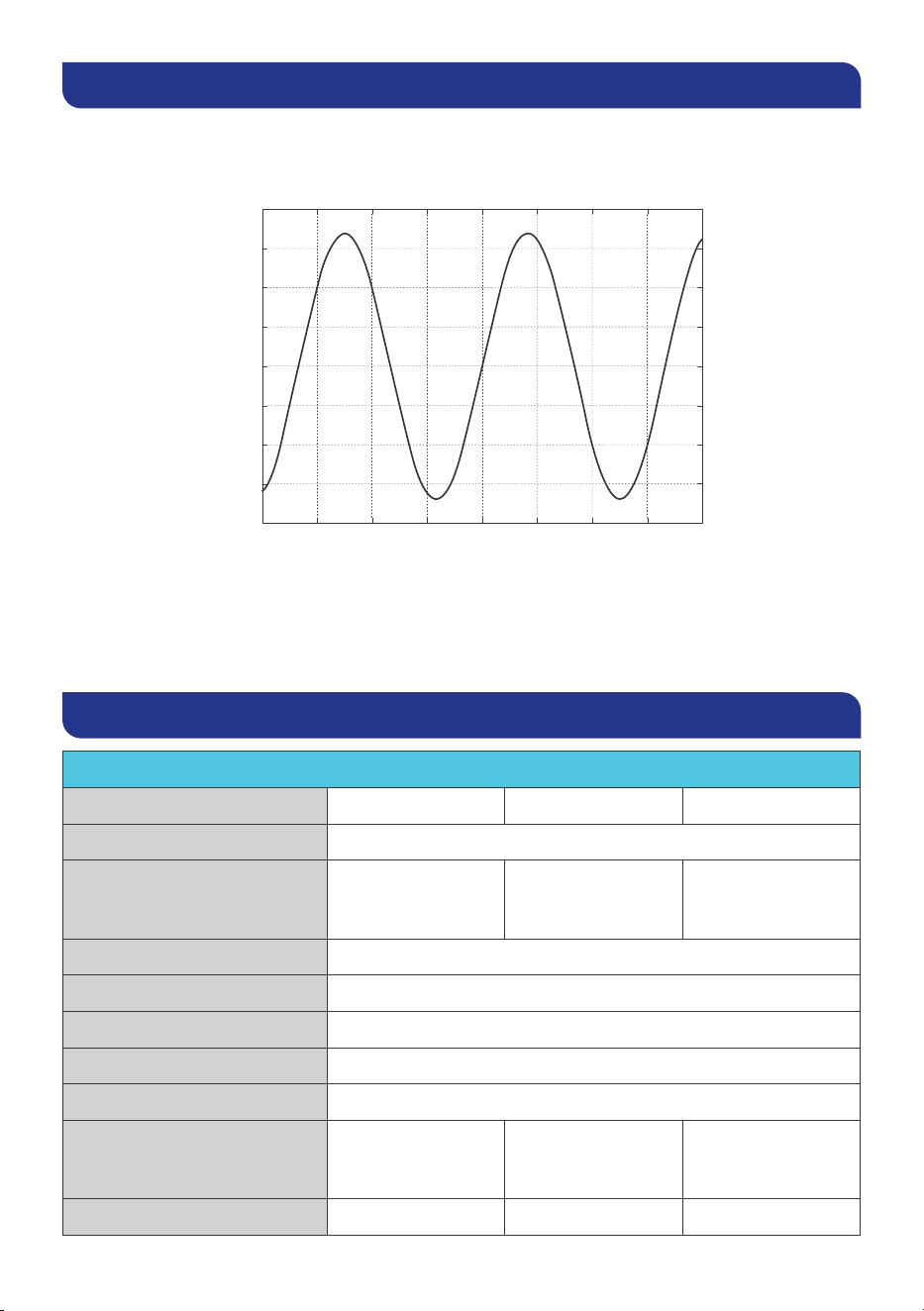
Pure Sine Wave
The inverter outputs a pure sine wave similar to the waveform of the grid power. In a pure sine
wave, the voltage rises and falls in a smooth fashion with very low harmonic distortion and cleaner
utility-like power.
200
150
100
50
0
-50
-100
-150
-200
-0.02 -0.015 -0.01 -0.005 0 0.005 0.01 0.015
0.02
Pure Sine Waveform
Time (Seconds)
Amplitude (Volts)
This technology allows the inverter to supply electronic devices that require a high quality
waveform with little harmonic distortion. In addition, the technology enables the inverter to be
more efficient than traditional ones, allowing you to use less energy to supply more devices.
The inverter can provide sufficient, stable power for tools, fans, lights, computers, and other
electronics without any interference.
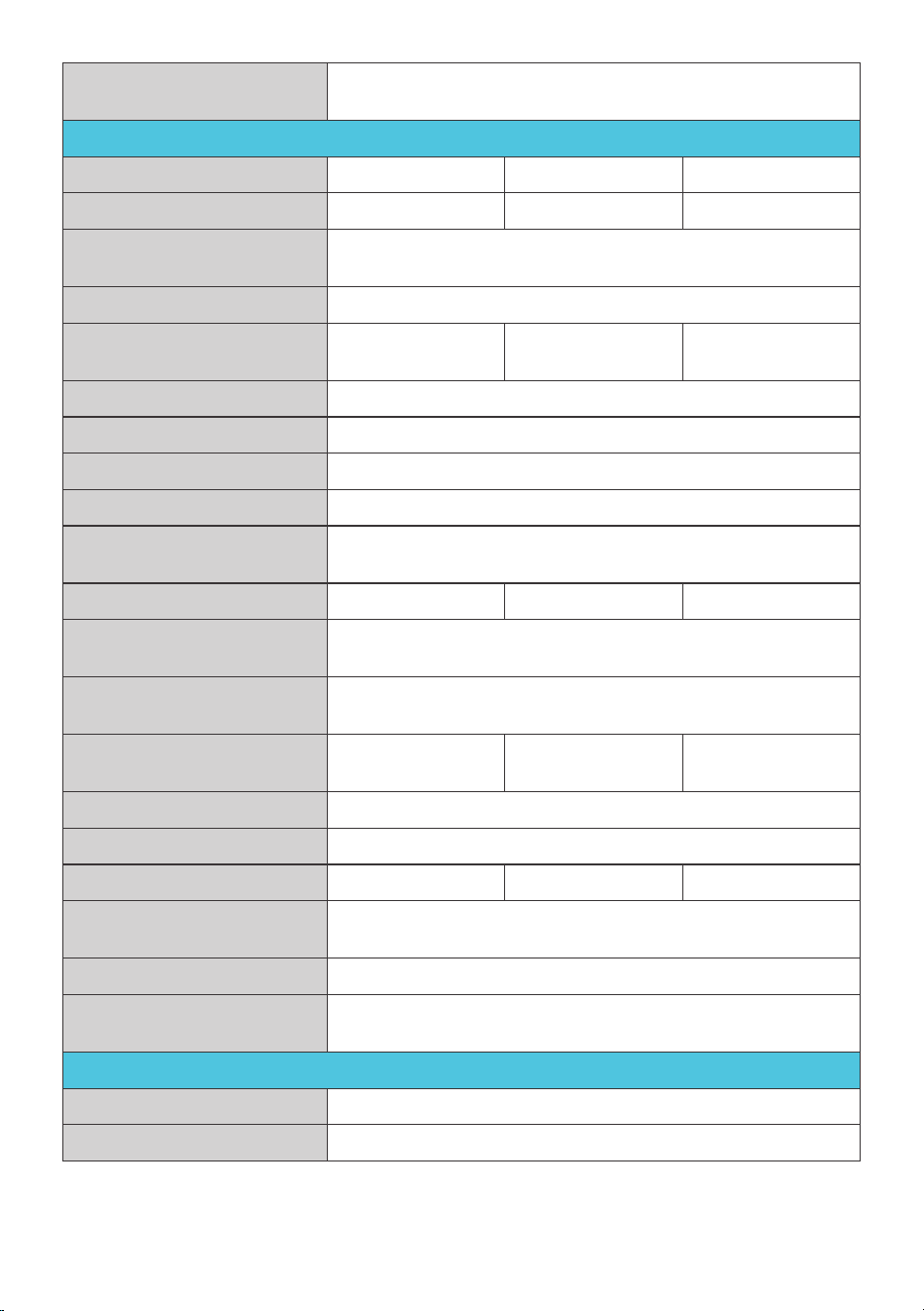
Specifications
General Data
Model RIV1210PU-126 RIV1220PU-126 RIV1230PU-126
Output Waveform Pure Sine Wave
AC Terminals
2 x AC sockets
1 x AC high-output
terminal block
2 x AC sockets
1 x AC high-output
terminal block
3 x AC sockets
1 x AC high-output
terminal block
DC Terminals M8 x 25 mm
Operating Temperature -4°F to 113°F / -20°C to 45°C
Storage Temperature -40°F to 158°F / -40°C to 70°C
Humidity Max 95%, non-condensing
Cooling Fans
Dimensions (L x W x H)
15.3 x 8.1 x 3.8 in /
388.5 x 205.4 x 95.3
mm
18.3 x 9.9 x 3.8 in /
468.3 x 250.4 x 95.3
mm
19.2 x 10.4 x 3.8 in /
488.8 x 263.4 x
95.3 mm
Weight 8.2 lb / 3.7 Kg 12.8 lb / 5.8 Kg 14.8 lb / 6.7 Kg
— 22 —
Regulatory and
Safety Specifications
UL certified to 458, CSA 22.2 No. 107.1-01,
and FCC Part 15 Class B
Electrical Data
Continuous Output Power 1000W 2000W 3000W
Continuous Output Current 8.3A AC 16.6A AC 25.0A AC
Total Harmonic Distortion
(THD)
< 3%
Power Factor 1
Surge Rating (after 2S the
overload protection)
2000W (@2s) 4000W (@2s) 6000W (@2s)
Output Voltage 120V AC (±3%)
Output Frequency 50Hz / 60Hz
Rated Battery Input Voltage 12V DC
Battery Input Voltage Range 11.0V to 15.5V DC
Rated AC Input Voltage
Range
90V to 140V AC
Transfer Switch Rating 10A 20A 30A
Transfer From AC Mains
Supply to Battery
20 ms
Transfer From Battery
Supply to AC Mains
20 ms
Maximum Continuous
Battery Input Current
105A 210A 310A
Inverter Efficiency 92%, MAX
Full Load Efficiency 87%
Power Consumption < 12W < 18W < 18W
Battery Overoltage
Shutdown
16.0V (±0.3V) DC
Battery Low Voltage Alarm 11.0V (±0.3V) DC
Battery Low Voltage
Shutdown
10.5V (±0.3V) DC
Wired Remote Data
Front Plate Dimensions 2.8 x 4.3 x 1.3 in / 70 x 110 x 31.8 mm
Wired Length 16.4 ft / 5 m

— 23 —
General Safety Information
█
WARNING
z
Have the inverter installed by a qualified technician in accordance with the local and national
electric codes (NEC).
z
There are no serviceable parts for this inverter. Do not disassemble or attempt to repair the
inverter.
z
Ensure all connections going into and from the inverter are tight. There may be sparks when
making connections; therefore, there should not be flammable materials or gases near the
installation site.
z
The inverters are suitable for 12V battery banks ONLY.
z
Always ensure the inverter is in OFF position and disconnect all AC and DC devices associated
with the inverter.
z
Never connect the AC output of the inverter directly to an Electrical Breaker Panel or Load
Center which is also fed from the utility power or generator.
z
Please confirm the polarity of the devices before connection. A reverse polarity contact can
cause injury and damage the device.
z
Be careful when touching bare terminals of capacitors as they may retain high lethal voltages
even after power is removed.
z
Do not let the positive (+) and negative (-) terminals of the battery touch each other. Use only
deep-cycle sealed lead-acid, flooded, gel, or lithium batteries.
z
Risk of explosion! Never install the inverter in a sealed enclosure with flooded batteries! Do not
install in a confined area where battery gases can accumulate.
z
Be careful when working with large lead acid batteries. Wear eye protection and have fresh
water available in case there is contact with the battery acid.
z
Overcharging and excessive gas precipitation may damage the battery plates and activate
material shedding on them. Too high of an equalizing charge or too long of one may cause
damage. Carefully review the requirements of the specific battery in use.
█
CAUTION
z
Install the inverter in a well-ventilated, cool, and dry environment. Make sure the fans of the
inverter and the ventilation holes are not blocked.
z
Do not expose the unit to rain, moisture, snow, or liquids of any type.
Renogy Support
To discuss inaccuracies or omissions in this quick guide or user manual, visit or contact us at:
renogy.com/support/downloads
contentservice@renogy.com
To explore more possibilities of solar systems, visit Renogy Learning Center at:
renogy.com/learning-center
For technical questions about your product in the U.S., contact the Renogy technical support
team through:
renogy.com/contact-us
1(909)2877111

— 24 —
For technical support outside the U.S., visit the local website below:
Canada ca.renogy.com China www.renogy.cn
Australia au.renogy.com Japan jp.renogy.com
Other Europe eu.renogy.com Germany de.renogy.com
United Kingdom
uk.renogy.com
FCC Statement
This device complies with Part 15 of the FCC Rules. Operation is subject to the following two
conditions:
(1) This device may not cause harmful interference.
(2) This device must accept any interference received, including interference that may cause
undesired operation.
Any Changes or modifications not expressly approved by the party responsible for compliance
could void the user’s authority to operate the equipment.
This equipment has been tested and found to comply with the limits for a Class B digital device,
pursuant to Part 15 of the FCC Rules. These limits are designed to provide reasonable protection
against harmful interference in a residential installation. This equipment generates, uses and can
radiate radio frequency energy and, if not installed and used in accordance with the instructions,
may cause harmful interference to radio communications. However, there is no guarantee that
interference will not occur in a particular installation. If this equipment does cause harmful
interference to radio or television reception, which can be determined by turning the equipment
off and on, the user is encouraged to try to correct the interference by one or more of the
following measures:
(1) Reorient or relocate the receiving antenna.
(2) Increase the separation between the equipment and receiver.
(3) Connect the equipment into an outlet on a circuit different from that to which the receiver is
connected.
(4) Consult the dealer or an experienced radio / TV technician for help.
FCC Radiation Exposure Statement
This equipment complies with FCC radiation exposure limits set forth for an uncontrolled
environment. This equipment should be installed and operated with minimum distance 20 cm
between the radiator & your body.
RENOGY.COM
Renogy aims to empower people around the world through education and distribution of
DIY-friendly renewable energy solutions.
Renogy Power Plus allows you to stay in the loop with upcoming solar energy innovations,
share your experiences with your solar energy journey, and connect with like-minded
people who are changing the world in the Renogy Power Plus community.
We intend to be a driving force for sustainable living and energy independence.
In support of this eort, our range of solar products makes it possible for you to minimize
your carbon footprint by reducing the need for grid power.
Renogy Empowered
Live Sustainably with Renogy
Did you know? In a given month, a 1 kW solar energy system will...
Save 170 pounds of coal from being burned
Save 300 pounds of CO2 from being released into the atmosphere
Save 105 gallons of water from being consumed
@Renogy Solar @Renogy@renogyocial
Renogy Power
PLUS
Renogy reserves the right to change the contents of this manual without notice.
FCC ID: 2ANPB-RIV12S0PU
RENOGY.COM
Renogy aims to empower people around the world through education and distribution of
DIY-friendly renewable energy solutions.
Renogy Power Plus allows you to stay in the loop with upcoming solar energy innovations,
share your experiences with your solar energy journey, and connect with like-minded
people who are changing the world in the Renogy Power Plus community.
We intend to be a driving force for sustainable living and energy independence.
In support of this eort, our range of solar products makes it possible for you to minimize
your carbon footprint by reducing the need for grid power.
Renogy Empowered
Live Sustainably with Renogy
Did you know? In a given month, a 1 kW solar energy system will...
Save 170 pounds of coal from being burned
Save 300 pounds of CO2 from being released into the atmosphere
Save 105 gallons of water from being consumed
@Renogy Solar @Renogy@renogyocial
Renogy Power
PLUS
Renogy reserves the right to change the contents of this manual without notice.
FCC ID: 2ANPB-RIV12S0PU