

ORIGINAL OPERATING INSTRUCTIONS
7.2V ELECTRIC ROTARY TOOL
W123022A
W123023A
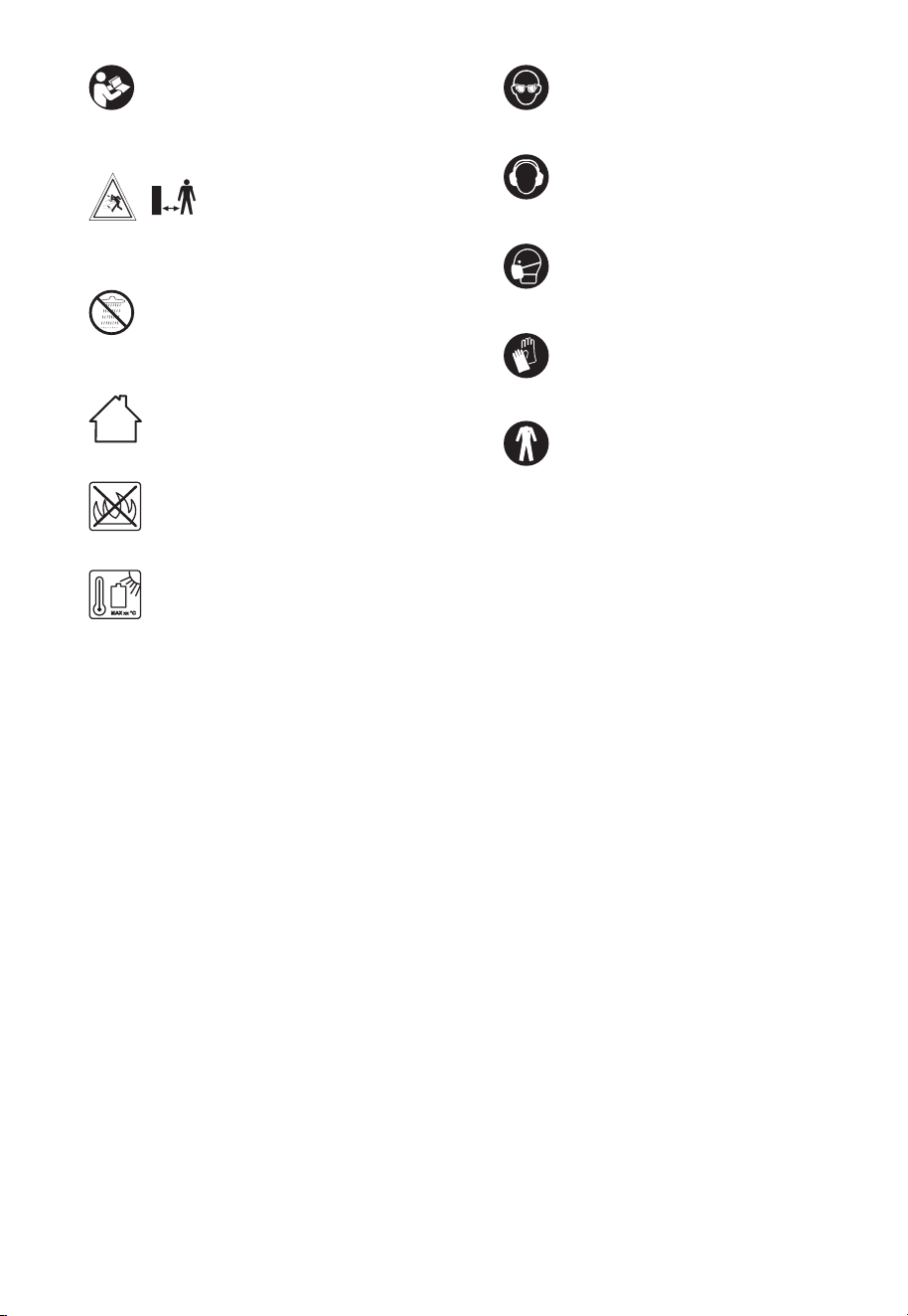
Danger! - Read the operating instructions to
reduce the risk of inquiry.
Keep all other persons away from the danger zone.
Protect the tool from the damp and never expose
it to rain.
Only recharge the battery pack indoors.
Do not burn the battery pack!
Do not expose the battery pack to sunlight or
increased temperatures!
Wear safety goggles.
Wear ear defenders.
Wear a breathing mask.
Wear protective gloves.
Wear close-fitting work clothes.
1

2
GENERAL POWER TOOL SAFETY WARNINGS
Danger!
When using the equipment, a few safety precautions
must be observed to avoid injuries and damage.
Please read the complete operating instructions and
safety regulations with due care. Keep this manual in a
safe place, so that the information is available at all
times. If you give the equipment to any other person,
hand over these operating instructions and safety
regulations as well. We cannot accept any liability for
damage or accidents which arise due to a failure to
follow these instructions and the safety instructions.
GENERAL POWER TOOL SAFETY WARINGS
Warning!
Read all safety warnings, instructions, illustrations and
specifications provided with this power tool. Failure to
follow all instructions listed below may result in electric
shock, fire and/or serious injury.
Save all warnings and instructions for future reference.
The term "power tool" in the warnings refers to your
mains-operated (corded) power tool or battery
operated (cordless) power tool.
1) Work area safety
Keep work area clean and well lit. Cluttered or dark
areas invite accidents.
Do not operate power tools in explosive
atmospheres, such as in the presence of flammable
liquids, gases or dust. Power tools create sparks
which may ignite the dust or fumes.
Keep children and bystanders away while operating
a power tool. Distractions can cause you to lose
control.
2) Electrical safety
Power tool plugs must match the outlet. Never
modify the plug in any way. Do not use any adapter
plugs with earthed (grounded) power tools.
Unmodified plugs and matching outlets will reduce
risk of electric shock.
Avoid body contact with earthed or grounded
surfaces, such as pipes, radiators, ranges and
refrigerators. There is an increased risk of electric
shock if your body is earthed or grounded.
Do not expose power tools to rain or wet conditions.
Water entering a power tool will increase the risk of
electric shock.
Do not abuse the cord. Never use the cord for
carrying, pulling or unplugging the power tool. Keep
cord away from heat, oil, sharp edges or moving
parts. Damaged or entangled cords increase the risk
of electric shock.
When operating a power tool outdoors, use an
extension cord suitable for outdoor use. Use of a
cord suitable for outdoor use reduces the risk of
electric shock.
If operating a power tool in a damp location is
unavoidable, use a residual current device (RCD)
protected supply. Use of an RCD reduces the risk
of electric shock.
3) Personal safety
Stay alert, watch what you are doing and use
common sense when operating a power tool. Do
not use a power tool while you are tired or under
the influence of drugs, alcohol or medication. A
moment of inattention while operating power tools
may result in serious personal injury.
Use personal protective equipment. Always wear
eye protection. Protective equipment such as a
dust mask, non-skid safety shoes, hard hat or
hearing protection used for appropriate conditions
will reduce personal injuries.
Prevent unintentional starting. Ensure the switch is
in the off-position before connecting to power
source and/or battery pack, picking up or carrying
the tool. Carrying power tools with your finger on
the switch or energising power tools that have the
switch on invites accidents.
Remove any adjusting key or wrench before turning
the power tool on. A wrench or a key left attached
to a rotating part of the power tool may result in
personal injury.
Do not overreach. Keep proper footing and balance
at all times. This enables better control of the
power tool in unexpected situations.
Dress properly. Do not wear loose clothing or
jewellery. Keep your hair and clothing away from
moving parts. Loose clothes, jewellery or long hair
can be caught in moving parts.
If devices are provided for the connection of dust
extraction and collection facilities, ensure these are
connected and properly used. Use of dust
collection can reduce dust-related hazards.
Do not let familiarity gained from frequent use of
tools allow you to become complacent and ignore
tool safety principles. A careless action can cause
severe injury within a fraction of a second.
4) Power tool use and care
Do not force the power tool. Use the correct power
tool for your application. The correct power tool
will do the job better and safer at the rate for which
it was designed.

GENERAL POWER TOOL SAFETY WARNINGS
3
Danger!
When using the equipment, a few safety precautions
must be observed to avoid injuries and damage.
Please read the complete operating instructions and
safety regulations with due care. Keep this manual in a
safe place, so that the information is available at all
times. If you give the equipment to any other person,
hand over these operating instructions and safety
regulations as well. We cannot accept any liability for
damage or accidents which arise due to a failure to
follow these instructions and the safety instructions.
GENERAL POWER TOOL SAFETY WARINGS
Warning!
Read all safety warnings, instructions, illustrations and
specifications provided with this power tool. Failure to
follow all instructions listed below may result in electric
shock, fire and/or serious injury.
Save all warnings and instructions for future reference.
The term "power tool" in the warnings refers to your
mains-operated (corded) power tool or battery
operated (cordless) power tool.
1) Work area safety
Keep work area clean and well lit. Cluttered or dark
areas invite accidents.
Do not operate power tools in explosive
atmospheres, such as in the presence of flammable
liquids, gases or dust. Power tools create sparks
which may ignite the dust or fumes.
Keep children and bystanders away while operating
a power tool. Distractions can cause you to lose
control.
2) Electrical safety
Power tool plugs must match the outlet. Never
modify the plug in any way. Do not use any adapter
plugs with earthed (grounded) power tools.
Unmodified plugs and matching outlets will reduce
risk of electric shock.
Avoid body contact with earthed or grounded
surfaces, such as pipes, radiators, ranges and
refrigerators. There is an increased risk of electric
shock if your body is earthed or grounded.
Do not expose power tools to rain or wet conditions.
Water entering a power tool will increase the risk of
electric shock.
Do not abuse the cord. Never use the cord for
carrying, pulling or unplugging the power tool. Keep
cord away from heat, oil, sharp edges or moving
parts. Damaged or entangled cords increase the risk
of electric shock.
When battery pack is not in use, keep it away from
other metal objects like paper clips, coins, keys,
nails, screws, or other small metal objects that can
make a connection from one terminal to another.
Shorting the battery terminals together may cause
burns or a fire.
Under abusive conditions, liquid may be ejected
from the battery; avoid contact. If contact
accidentally occurs, flush with water. If liquid
contacts eyes, additionally seek medical help.
Liquid ejected from the battery may cause irritation
or burns.
7) When to charge the battery
New batteries are shipped in a low charged condition
and should be fully charged before Use. The battery
pack can be recharged at any time during use,
provided the pack is not overheated. If the battery
pack starts to cut out due to low voltage, or previous
tasks undertaken can no longer be performed, it is
suggested to stop using the tool and recharge the
battery.
For storage, it is suggested to recharge the battery
between 50% and 75% charge, and charge the
device at least once in 3-6 months to preserve
battery lifespan.
SAFETY INSTRUCTIONS FOR ALL OPERATIONS
Safety Warnings Common for Grinding, Sanding, Wire
Brushing, Polishing, Carving or Abrasive Cutting-Off
Operations
This power tool is intended to function as a grinder,
sander, wire brush, polisher, carving or cut-off tool.
Read all safety warnings, instructions, illustrations
and specifications provided with this power tool.
Failure to follow all instructions listed below may
result in electric shock, fire and/ or serious injury.
Do not use accessories which are not specifically
designed and recommended by the tool manufac-
turer. Just because the accessory can be attached
to your power tool, it does not assure safe
operation.
The rated speed of the accessory must be at least
equal to the maximum speed marked on the power
tool. Accessories running faster than their rated
speed can break and fly apart.
The outside diameter and the thickness of your
accessory must be within the capacity rating of
your power tool. Incorrectly sized accessories
cannot be adequately guarded or controlled.
Do not use the power tool if the switch does not turn
it on and off. Any power tool that cannot be
controlled with the switch is dangerous and must be
repaired.
Disconnect the plug from the power source and/or
remove the battery pack, if detachable, from the
power tool before making any adjustments,
changing accessories, or storing power tools. Such
preventive safety measures reduce the risk of
starting the power tool accidentally.
Store idle power tools out of the reach of children
and do not allow persons unfamiliar with the power
tool or these instructions to operate the power tool.
Power tools are dangerous in the hands of untrained
users.
Maintain power tools and accessories. Check for
misalignment or binding of moving parts, breakage
of parts and any other condition that may affect the
power tool’s operation. If damaged, have the power
tool repaired before use. Many accidents are
caused by poorly maintained power tools.
Keep cutting tools sharp and clean. Properly
maintained cutting tools with sharp cutting edges
are less likely to bind and are easier to control.
Use the power tool, accessories and tool bits etc. in
accordance with these instructions, taking into
account the working conditions and the work to be
performed. Use of the power tool for operations
different from those intended could result in a
hazardous situation.
Keep handles and grasping surfaces dry, clean and
free from oil and grease. Slippery handles and
grasping surfaces do not allow for safe handling and
control of the tool in unexpected situations.
5) Service
Have your power tool serviced by a qualified repair
person using only identical replacement parts. This
will ensure that the safety of the power tool is
maintained.
6) Battery tool use and care
Ensure the switch is in the off position before
inserting battery pack. Inserting the battery pack
into power tools that have the switch on invites
accidents.
Recharge only with the charger specified by the
manufacturer. A charger that is suitable for one type
of battery pack may create a risk of fire when used
with another battery pack.
Use power tools only with specifically designated
battery packs. Use of any other battery packs may
create a risk of injury and fire.
When operating a power tool outdoors, use an
extension cord suitable for outdoor use. Use of a
cord suitable for outdoor use reduces the risk of
electric shock.
If operating a power tool in a damp location is
unavoidable, use a residual current device (RCD)
protected supply. Use of an RCD reduces the risk
of electric shock.
3) Personal safety
Stay alert, watch what you are doing and use
common sense when operating a power tool. Do
not use a power tool while you are tired or under
the influence of drugs, alcohol or medication. A
moment of inattention while operating power tools
may result in serious personal injury.
Use personal protective equipment. Always wear
eye protection. Protective equipment such as a
dust mask, non-skid safety shoes, hard hat or
hearing protection used for appropriate conditions
will reduce personal injuries.
Prevent unintentional starting. Ensure the switch is
in the off-position before connecting to power
source and/or battery pack, picking up or carrying
the tool. Carrying power tools with your finger on
the switch or energising power tools that have the
switch on invites accidents.
Remove any adjusting key or wrench before turning
the power tool on. A wrench or a key left attached
to a rotating part of the power tool may result in
personal injury.
Do not overreach. Keep proper footing and balance
at all times. This enables better control of the
power tool in unexpected situations.
Dress properly. Do not wear loose clothing or
jewellery. Keep your hair and clothing away from
moving parts. Loose clothes, jewellery or long hair
can be caught in moving parts.
If devices are provided for the connection of dust
extraction and collection facilities, ensure these are
connected and properly used. Use of dust
collection can reduce dust-related hazards.
Do not let familiarity gained from frequent use of
tools allow you to become complacent and ignore
tool safety principles. A careless action can cause
severe injury within a fraction of a second.
4) Power tool use and care
Do not force the power tool. Use the correct power
tool for your application. The correct power tool
will do the job better and safer at the rate for which
it was designed.

4
Danger!
When using the equipment, a few safety precautions
must be observed to avoid injuries and damage.
Please read the complete operating instructions and
safety regulations with due care. Keep this manual in a
safe place, so that the information is available at all
times. If you give the equipment to any other person,
hand over these operating instructions and safety
regulations as well. We cannot accept any liability for
damage or accidents which arise due to a failure to
follow these instructions and the safety instructions.
GENERAL POWER TOOL SAFETY WARINGS
Warning!
Read all safety warnings, instructions, illustrations and
specifications provided with this power tool. Failure to
follow all instructions listed below may result in electric
shock, fire and/or serious injury.
Save all warnings and instructions for future reference.
The term "power tool" in the warnings refers to your
mains-operated (corded) power tool or battery
operated (cordless) power tool.
1) Work area safety
Keep work area clean and well lit. Cluttered or dark
areas invite accidents.
Do not operate power tools in explosive
atmospheres, such as in the presence of flammable
liquids, gases or dust. Power tools create sparks
which may ignite the dust or fumes.
Keep children and bystanders away while operating
a power tool. Distractions can cause you to lose
control.
2) Electrical safety
Power tool plugs must match the outlet. Never
modify the plug in any way. Do not use any adapter
plugs with earthed (grounded) power tools.
Unmodified plugs and matching outlets will reduce
risk of electric shock.
Avoid body contact with earthed or grounded
surfaces, such as pipes, radiators, ranges and
refrigerators. There is an increased risk of electric
shock if your body is earthed or grounded.
Do not expose power tools to rain or wet conditions.
Water entering a power tool will increase the risk of
electric shock.
Do not abuse the cord. Never use the cord for
carrying, pulling or unplugging the power tool. Keep
cord away from heat, oil, sharp edges or moving
parts. Damaged or entangled cords increase the risk
of electric shock.
When operating a power tool outdoors, use an
extension cord suitable for outdoor use. Use of a
cord suitable for outdoor use reduces the risk of
electric shock.
If operating a power tool in a damp location is
unavoidable, use a residual current device (RCD)
protected supply. Use of an RCD reduces the risk
of electric shock.
3) Personal safety
Stay alert, watch what you are doing and use
common sense when operating a power tool. Do
not use a power tool while you are tired or under
the influence of drugs, alcohol or medication. A
moment of inattention while operating power tools
may result in serious personal injury.
Use personal protective equipment. Always wear
eye protection. Protective equipment such as a
dust mask, non-skid safety shoes, hard hat or
hearing protection used for appropriate conditions
will reduce personal injuries.
Prevent unintentional starting. Ensure the switch is
in the off-position before connecting to power
source and/or battery pack, picking up or carrying
the tool. Carrying power tools with your finger on
the switch or energising power tools that have the
switch on invites accidents.
Remove any adjusting key or wrench before turning
the power tool on. A wrench or a key left attached
to a rotating part of the power tool may result in
personal injury.
Do not overreach. Keep proper footing and balance
at all times. This enables better control of the
power tool in unexpected situations.
Dress properly. Do not wear loose clothing or
jewellery. Keep your hair and clothing away from
moving parts. Loose clothes, jewellery or long hair
can be caught in moving parts.
If devices are provided for the connection of dust
extraction and collection facilities, ensure these are
connected and properly used. Use of dust
collection can reduce dust-related hazards.
Do not let familiarity gained from frequent use of
tools allow you to become complacent and ignore
tool safety principles. A careless action can cause
severe injury within a fraction of a second.
4) Power tool use and care
Do not force the power tool. Use the correct power
tool for your application. The correct power tool
will do the job better and safer at the rate for which
it was designed.
The arbour size of wheels, sanding drums or any
other accessory must properly fit the spindle or
collet of the power tool. Accessories that do not
match the mounting hardware of the power tool will
run out of balance, vibrate excessively and may
cause loss of control.
Mandrel mounted wheels, sanding drums, cutters or
other accessories must be fully inserted into the
collet or chuck. If the mandrel is insufficiently held
and/or the overhang of the wheel is too long, the
mounted wheel may become loose and ejected at
high velocity.
Do not use a damaged accessory. Before each use
inspect the accessory such as abrasive wheels for
chips and cracks, sanding drum for cracks, tear or
excess wear, wire brush for loose or cracked wires.
If power tool or accessory is dropped, inspect for
damage or install an undamaged accessory. After
inspecting and installing an accessory, position
yourself and bystanders away from the plane of the
rotating accessory and run the power tool at
maximum no-load speed for one minute. Damaged
accessories will normally break apart during this
test time.
Wear personal protective equipment. Depending on
application, use face shield, safety goggles or
safety glasses. As appropriate, wear dust mask,
hearing protectors, gloves and workshop apron
capable of stopping small abrasive or workpiece
fragments. The eye protection must be capable of
stopping flying debris generated by various
operations. The dust mask or respirator must be
capable of filtrating particles generated by your
operation. Prolonged exposure to high intensity
noise may cause hearing loss.
Keep bystanders a safe distance away from work
area. Anyone entering the work area must wear
personal protective equipment. Fragments of
workpiece or of a broken accessory may fly away
and cause injury beyond immediate area of
operation.
Hold power tool by insulated gripping surfaces only,
when performing an operation where the cutting
accessory may contact hidden wiring. Cutting
accessory contacting a “live” wire may make
exposed metal parts of the power tool “live” and
shock the operator.
Always hold the tool firmly in your hand(s) during
the start-up. The reaction torque of the motor, as it
accelerates to full speed, can cause the tool to
twist.
Use clamps to support workpiece whenever
practical. Never hold a small workpiece in one hand
and the tool in the other hand while in use.
Clamping a small workpiece allows you to use both
hands to control the tool. Round material such as
dowel rods, pipes or tubing have a tendency to roll
while being cut, and may cause the bit to bind or
jump toward you.
Never lay the power tool down until the accessory
has come to a complete stop. The spinning wheel
may grab the surface and pull the power tool out of
your control.
After changing the bits or making any adjustments,
make sure the collet nut, chuck or any other
adjustment devices are securely tightened. Loose
adjustment devices can unexpectedly shift, causing
loss of control, loose rotating components will be
violently thrown.
Do not run the power tool while carrying it at your
side. Accidental contact with the spinning
accessory could snag your clothing, pulling the
accessory into your body.
Regularly clean the power tool’s air vents. The
motor’s fan will draw the dust inside the housing
and excessive accumulation of powdered metal
may cause electrical hazards.
Do not operate the power tool near flammable
materials. Sparks could ignite these materials.
Do not use accessories that require liquid coolants.
Using water or other liquid coolants may result in
electrocution or shock.Kickback and related
warnings
Kickback is a sudden reaction to a pinched or
snagged rotating wheel, backing pad, brush or any
other accessory. Pinching or snagging causes rapid
stalling of the rotating accessory which in turn
causes the uncontrolled power tool to be forced in
the direction opposite of the accessory’s rotation at
the point of the binding.
For example, if an abrasive wheel is snagged or
pinched by the workpiece, the edge of the wheel
that is entering into the pinch point can dig into the
surface of the material causing the wheel to climb
out or kick out. The wheel may either jump toward
or away from the operator, depending on direction
of the wheel’s movement at the point of pinching.
Abrasive wheels may also break under these
conditions. Kickback is the result of power tool
misuse and/or incorrect operating procedures or
conditions and can be avoided by taking proper
precautions as given below.
GENERAL POWER TOOL SAFETY WARNINGS

5
Danger!
When using the equipment, a few safety precautions
must be observed to avoid injuries and damage.
Please read the complete operating instructions and
safety regulations with due care. Keep this manual in a
safe place, so that the information is available at all
times. If you give the equipment to any other person,
hand over these operating instructions and safety
regulations as well. We cannot accept any liability for
damage or accidents which arise due to a failure to
follow these instructions and the safety instructions.
GENERAL POWER TOOL SAFETY WARINGS
Warning!
Read all safety warnings, instructions, illustrations and
specifications provided with this power tool. Failure to
follow all instructions listed below may result in electric
shock, fire and/or serious injury.
Save all warnings and instructions for future reference.
The term "power tool" in the warnings refers to your
mains-operated (corded) power tool or battery
operated (cordless) power tool.
1) Work area safety
Keep work area clean and well lit. Cluttered or dark
areas invite accidents.
Do not operate power tools in explosive
atmospheres, such as in the presence of flammable
liquids, gases or dust. Power tools create sparks
which may ignite the dust or fumes.
Keep children and bystanders away while operating
a power tool. Distractions can cause you to lose
control.
2) Electrical safety
Power tool plugs must match the outlet. Never
modify the plug in any way. Do not use any adapter
plugs with earthed (grounded) power tools.
Unmodified plugs and matching outlets will reduce
risk of electric shock.
Avoid body contact with earthed or grounded
surfaces, such as pipes, radiators, ranges and
refrigerators. There is an increased risk of electric
shock if your body is earthed or grounded.
Do not expose power tools to rain or wet conditions.
Water entering a power tool will increase the risk of
electric shock.
Do not abuse the cord. Never use the cord for
carrying, pulling or unplugging the power tool. Keep
cord away from heat, oil, sharp edges or moving
parts. Damaged or entangled cords increase the risk
of electric shock.
When operating a power tool outdoors, use an
extension cord suitable for outdoor use. Use of a
cord suitable for outdoor use reduces the risk of
electric shock.
If operating a power tool in a damp location is
unavoidable, use a residual current device (RCD)
protected supply. Use of an RCD reduces the risk
of electric shock.
3) Personal safety
Stay alert, watch what you are doing and use
common sense when operating a power tool. Do
not use a power tool while you are tired or under
the influence of drugs, alcohol or medication. A
moment of inattention while operating power tools
may result in serious personal injury.
Use personal protective equipment. Always wear
eye protection. Protective equipment such as a
dust mask, non-skid safety shoes, hard hat or
hearing protection used for appropriate conditions
will reduce personal injuries.
Prevent unintentional starting. Ensure the switch is
in the off-position before connecting to power
source and/or battery pack, picking up or carrying
the tool. Carrying power tools with your finger on
the switch or energising power tools that have the
switch on invites accidents.
Remove any adjusting key or wrench before turning
the power tool on. A wrench or a key left attached
to a rotating part of the power tool may result in
personal injury.
Do not overreach. Keep proper footing and balance
at all times. This enables better control of the
power tool in unexpected situations.
Dress properly. Do not wear loose clothing or
jewellery. Keep your hair and clothing away from
moving parts. Loose clothes, jewellery or long hair
can be caught in moving parts.
If devices are provided for the connection of dust
extraction and collection facilities, ensure these are
connected and properly used. Use of dust
collection can reduce dust-related hazards.
Do not let familiarity gained from frequent use of
tools allow you to become complacent and ignore
tool safety principles. A careless action can cause
severe injury within a fraction of a second.
4) Power tool use and care
Do not force the power tool. Use the correct power
tool for your application. The correct power tool
will do the job better and safer at the rate for which
it was designed.
Maintain a firm grip on the power tool and position
your body and arm to allow you to resist kickback
forces. The operator can control kickback forces, if
proper precautions are taken.
Use special care when working corners, sharp
edges, etc. Avoid bouncing and snagging the
accessory. Corners, sharp edges or bouncing have
a tendency to snag the rotating accessory and
cause loss of control or kickback.
Do not use a toothed saw blade. Such blades
create frequent kickback and loss of control over
the power tool.
Always feed the bit into the material in the same
direction as the cutting edge is exiting from the
material (which is the same direction as the chips
are thrown). Feeding the tool in the wrong direction
causes the cutting edge of the bit to climb out of
the work and pull the tool in the direction of this
feed.
When using rotary files, cut-off wheels, highspeed
cutters or tungsten carbide cutters, always have the
work securely clamped. These wheels will grab if
they become slightly canted in the groove, and can
kickback. When a cut-off wheel grabs, the wheel
itself usually breaks. When the rotary file,
high-speed cutter or tungsten carbide cutter grab, it
may jump from the groove and you could lose
control of the tool. Safety warnings specific for
Grinding and Abrasive Cutting-Off operations
Use only wheel types that are recommended for
your power tool and only for recommended
applications. For example: do not grind with the
side of a cut-off wheel. Abrasive cut-off wheels are
intended for peripheral grinding, side forces applied
to these wheels may cause them to shatter.
For threaded abrasive cones and plugs use only
undamaged wheel mandrels with an unrelieved
shoulder flange that are of correct size and length.
Proper mandrels will reduce the possibility of
breakage.
Do not “jam” the cut-off wheel or apply excessive
pressure. Do not attempt to make an excessive
depth of cut. Overstressing the wheel increases the
loading and susceptibility to twisting or binding of
the wheel in the cut and the possibility of kickback
or wheel breakage.
Do not position your hand in line with and behind
the rotating wheel. When the wheel, at the point of
operation, is moving away from your hand, the
possible kickback may propel the spinning wheel
and the power tool directly at you.
When wheel is pinched, snagged or when
interrupting a cut for any reason, switch off the
power tool and hold the power tool motionless until
the wheel comes to a complete stop. Never attempt
to remove the cut-off wheel from the cut while the
wheel is in motion otherwise kickback may occur.
Investigate and take corrective action to eliminate
the cause of wheel pinching or snagging.
Do not restart the cutting operation in the
workpiece. Let the wheel reach full speed and
carefully re-enter the cut. The wheel may bind, walk
up or kickback if the power tool is restarted in the
workpiece.
Support panels or any oversized workpiece to
minimize the risk of wheel pinching and kickback.
Large workpieces tend to sag under their own
weight. Supports must be placed under the
workpiece near the line of cut and near the edge of
the workpiece on both sides of the wheel.
Use extra caution when making a “pocket cut” into
existing walls or other blind areas. The protruding
wheel may cut gas or water pipes, electrical wiring
or objects that can cause kickback. Safety
warnings specific for wire brushing operations
Be aware that wire bristles are thrown by the brush
even during ordinary operation. Do not overstress
the wires by applying excessive load to the brush.
The wire bristles can easily penetrate light clothing
and/or skin.
Allow brushes to run at operating speed for at least
one minute before using them. During this time no
one is to stand in front or in line with the brush.
Loose bristles or wires will be discharged during the
run-in time.
Direct the discharge of the spinning wire brush
away from you. Small particles and tiny wire
fragments may be discharged at high velocity
during the use of these brushes and may become
imbedded in your skin.
GENERAL POWER TOOL SAFETY WARNINGS
6
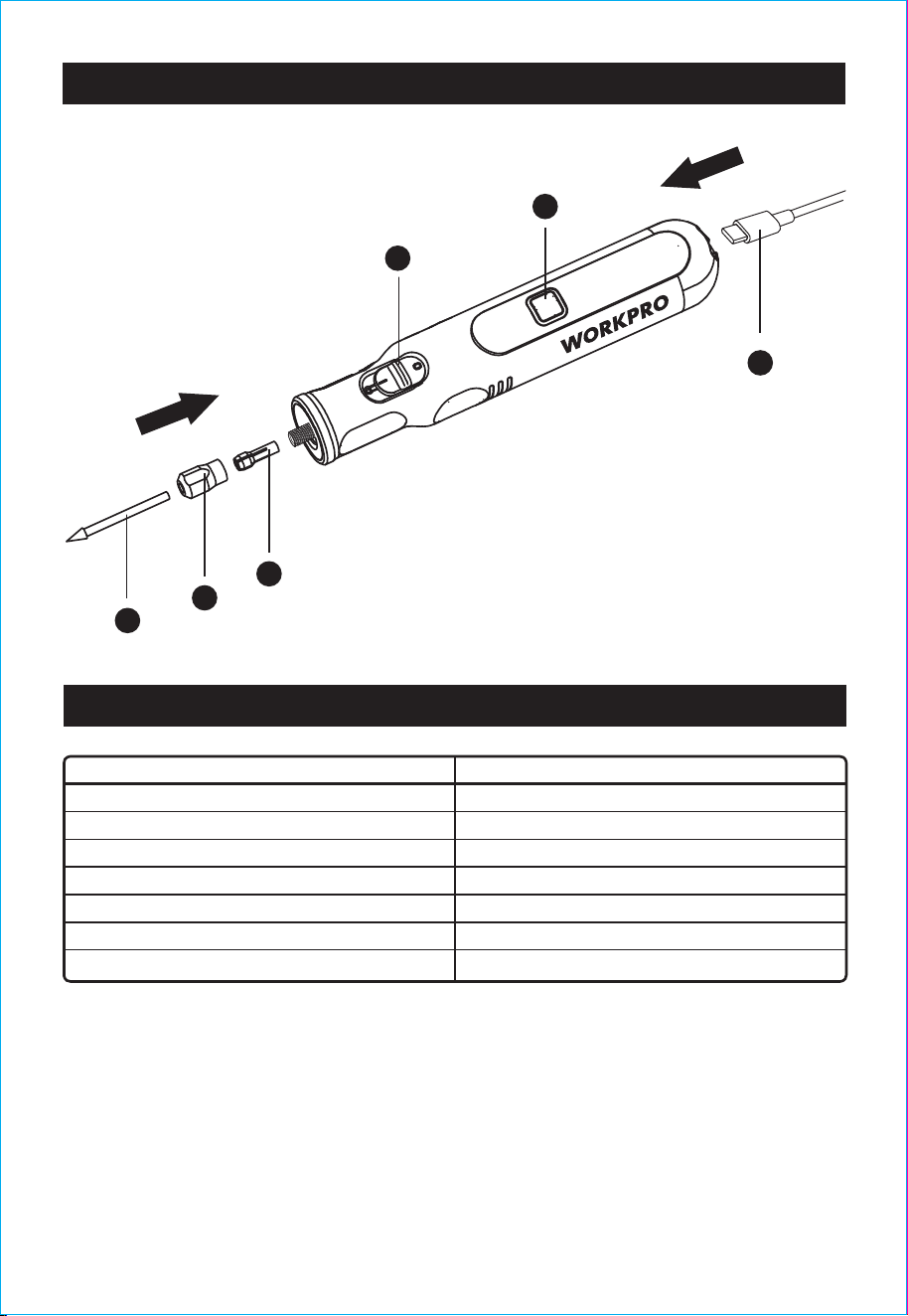
KNOW YOUR PRODUCT
1. Accessory
2. Collet nut
3. Collet
4. On/Off Switch
5. Speed control button
6. Type-C plug
TECHNICAL DATA
1
3
5
2
6
4
Battery rated voltage
Battery capacity
Charging voltage
Rated speed
Charging time
Collet size
Machine weight
Max. Capacity of accessories
Maximum 8.0V, nominal 7.2V
1100mAh
5V DC
5000-30000 min
-1
(6 gears)
1.5-2hr (according to power supply output current)
3/32'' (2.35mm) / 1/8'' (3.2mm)
227g
35mm
7
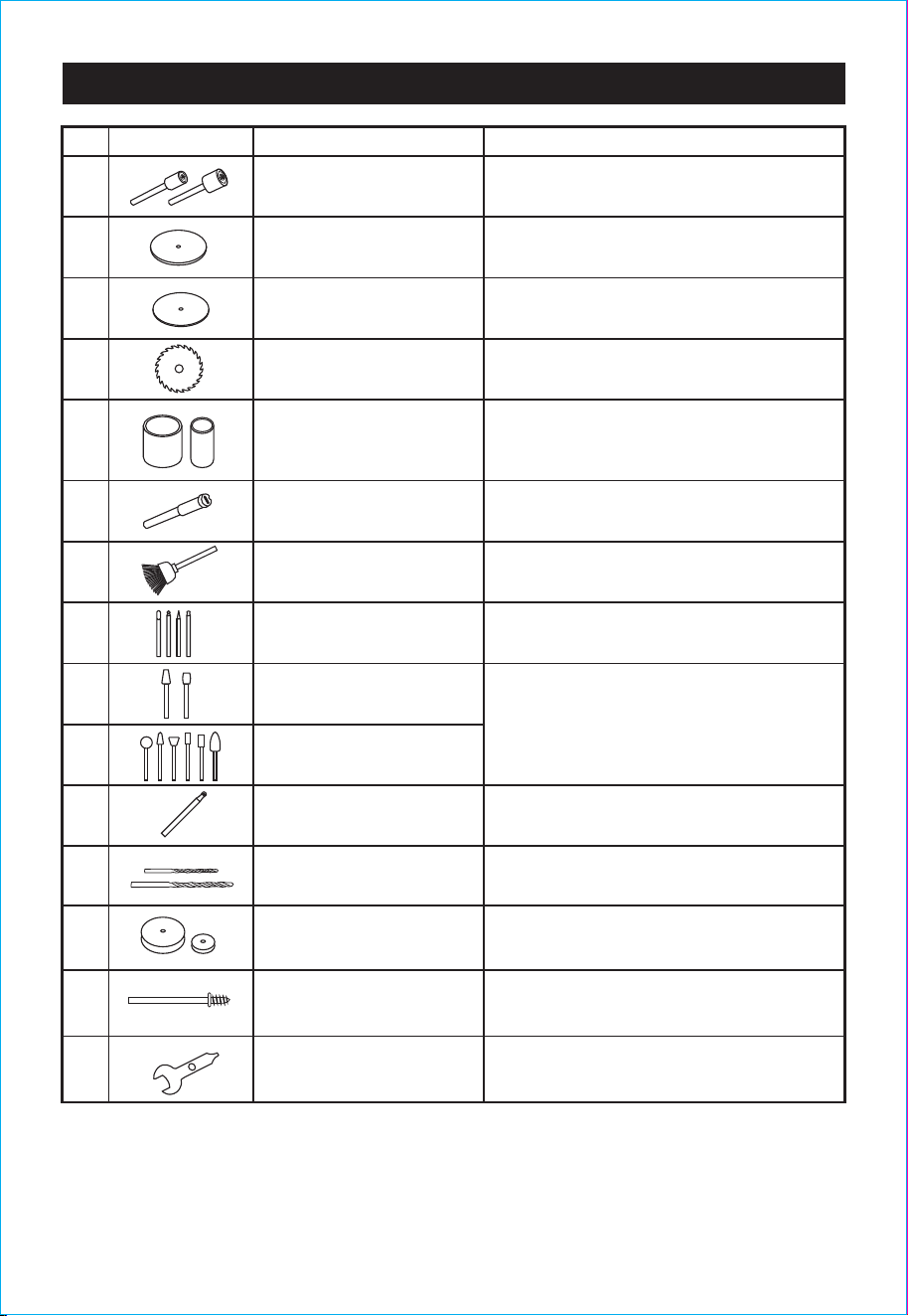
ACCESSORIES DESCRIPTION AND USE
No Picture Description Use
1.
2. Cutting disc
Use for cutting thin metal plate, rod.
The cut-off disc cuts only along its edge.
3. Sanding paper
4. Saw blade
5. Sanding roll
6. Cutting disc fixture
7. Wire brush
8.
Diamond bits (Ball metal
grinder bit and Cone head
grinding bit)
9. Rubber grinder with shank
11. Grinding wheel with shank
Sanding rubber To mount sanding band.
Rough-shaping and smoothing wood and
fibreglass; removing rust from metal surfaces.
Use for cutting wood, plastic, acrylic.
For rough-shaping and smoothing wood and
fibreglass; removing rust from metal surfaces;
shaping rubber surface. Sanding bands are
easily replaceable on drums.
To mount different accessories, like cut-off
wheels.
For metal surface cleaning, rust cleaning.
Wood, Zinc, Plastic, Nickel, Copper, Mild steel.
Use on metals, welded joints, rivets and rust.
Ideal for sharpening, de-burring, rust removal
and general purpose of most materials.
Slot milling on wood, plastic and metal surface.
12. 1/8" and 3/32" Drill bit
13. Wool felt wheel
Use for drilling wood, plastic, metal.
Use for polishing wood, plastic, metal,
jewelry and small parts.
14.
Screw Mandrel Use it with felt polishing wheel.
10. Grinder bit
15.
Wrench
Quicker accessory replacement by loosening
the collet with the wrench.
8
BEFORE PUTTING INTO OPERATION
The machine is designed for grinding and deburring
metal using corundum grinding tools, as well as for
working with sanding wheels.
1. RECHARGING BATTERIES
IMPORTANT NOTES FOR CHARGING THE BATTERY
The Li-ion battery is protected against deep discharg-
ing. When the battery is empty, the machine is
switched off by means of a protective circuit: The tool
holder no longer rotates.
To prevent damage to the battery, when charge runs
out, please charge the battery to reach full or no less
than half charge before storage.
If the tool will not be used for long periods of time,
charge the battery every 3-6 months.
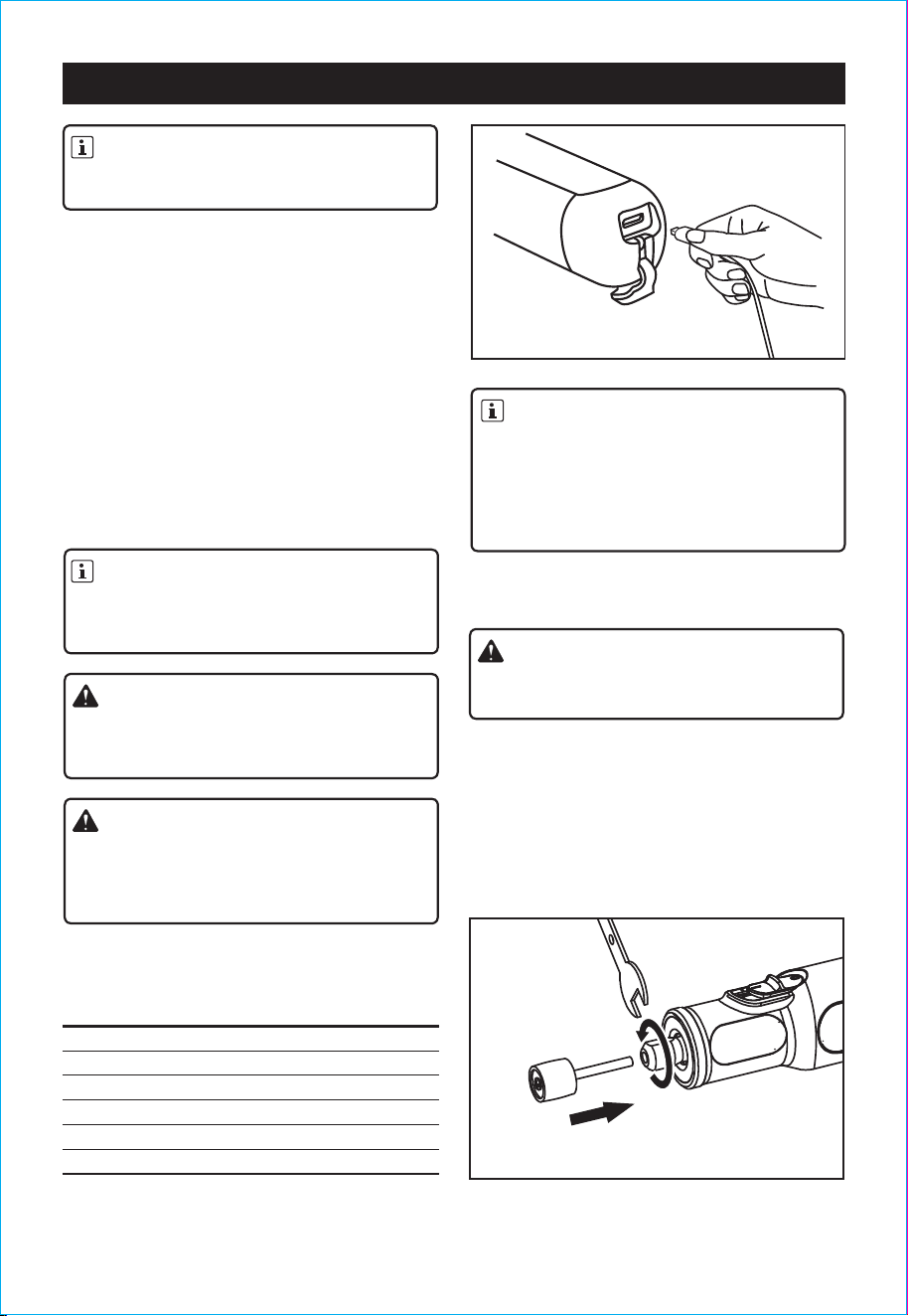
CHARGING (SEE FIG. 1)
Connect the power supply (DC5V 500mA to 2000mA),
Insert Type-C plug into the machine.
Power indicator will turn on.
LED Meaning
Do not charge a battery for a second time in close
succession. There is a danger of overcharging the
battery pack.
WARNING!
When battery charge runs out after continuously
use or exposure to direct sunlight or heat, allow
time for the battery to cool down before re-charging
to achieve the full charge.
WARNING!
Before using the tool, read the instruction book
carefully.
NOTE:
The mini grinder that has been unused for a while
or never been charged must be charged before
reuse or first use.
NOTE:
OPERATION
The battery pack may become a little warm during
the charging process. This is normal.
If the battery fails to charge, please check
Whether there is voltage at the socket outlet
Whether there is good contact at the charging
contacts of the charging unit.
NOTE:
FIG. 1
FIG. 2
Always turn off mini grinder before changing
accessories, changing collets, or servicing the tool.
WARNING!
2. ASSEMBLY
a. FITTING AN ACCESSORY
Turn the device off and ensure that the rotating part is
stopped!
1. Use the wrench to unscrew collet nut, pull the
part/bit out of the tool.
2. Insert the new part/bit through the center of the
collet nut into collet to the proper position (Fig. 2), and
then secure the collet to the tool.
3. Use the wrench to tighten collet nut.
STEP 1
STEP 2
4 lights continuous flash
1 light solid, 3 lights flash
2 lights solid, 2 lights flash
3 lights solid, 1 light flash
4 lights solid
0-25%
26-50%
51-75%
76-99%
Fully charged
Charger will automatically stop when charging is
completed and the red light will turn white.
9
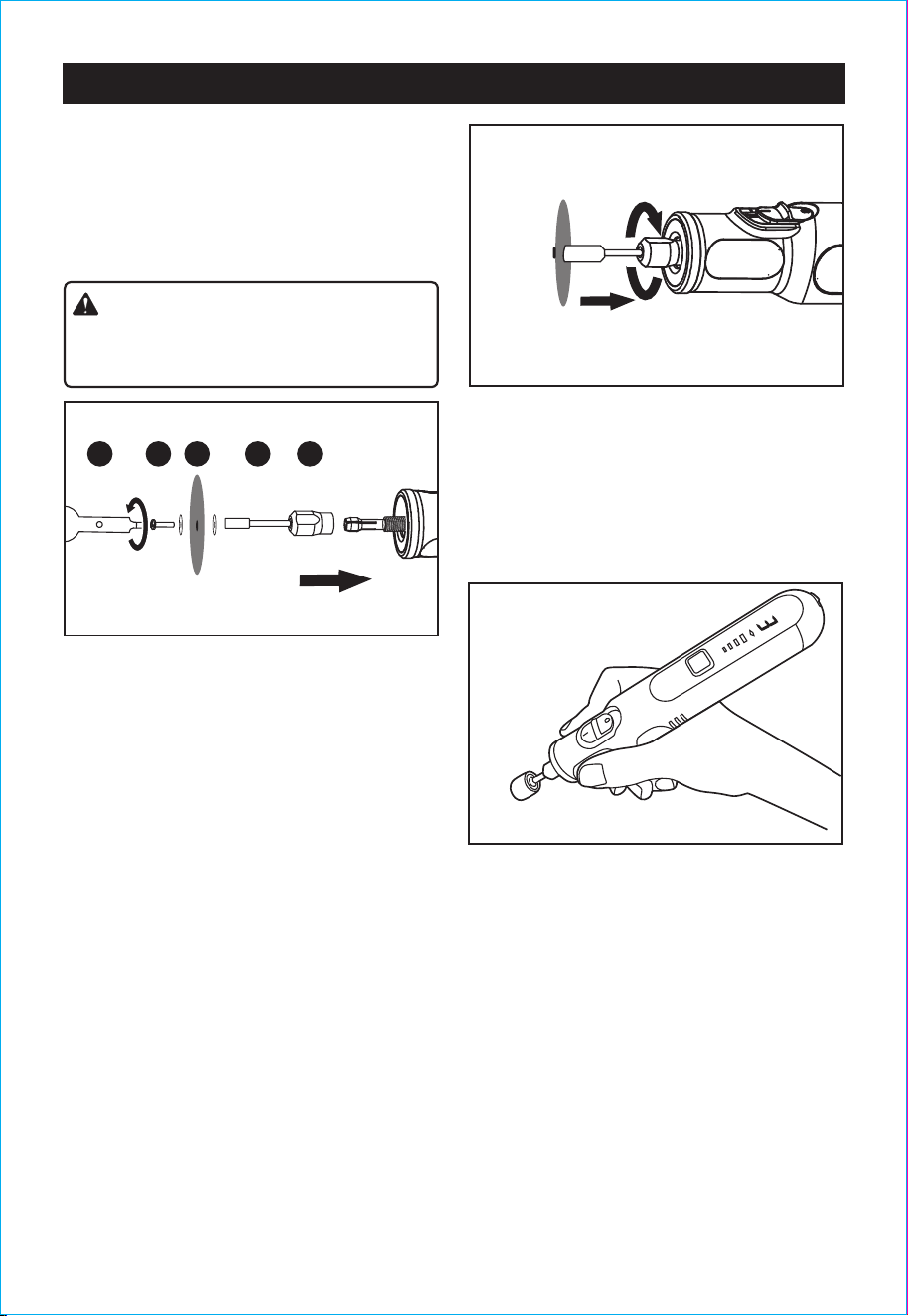
b. FITTING A CUTTING DISC, SANDING PAPER or
SAW BLADE (SEE FIG. 3, FIG. 4)
1. Remove the screw from the end of the mandrel with
the wrench.
2. Insert screw through wheel and screw into mandrel.
3. Tighten the cutting/sanding disc or saw blade onto
the mandrel with the wrench.
Do not over tighten, otherwise the wheel may crack.
Always hold the tool away from your face.
Accessories can be damaged during handling and
can fly apart as they come up to speed.
CAUTION!
OPERATION
FIG. 3
OPERATION
Turn on On/Off Switch to start the device and LEDs.
The device speed defaults to 3rd gear (six gears in
total). Short press the Speed control button after
switching on the device to cycle through the gears
from low to high. When the switch is turned off, the
device stops working immediately and sleeps after 10
seconds, and the LED light turns off.
FIG. 4
FIG. 5
STEP 2
STEP 1
1
32 4 5

9
CLEANING
Keep all safety devices, air vents and the motor housing free of dirt and dust as far as possible.
Wipe the equipment with a clean cloth or blow it with compressed air at low pressure.
We recommend that you clean the device immediately each time you have finished using it.
Clean the equipment regularly with a moist cloth and some soft soap.
Do not use cleaning agents or solvents; these could attack the plastic parts of the equipment. Ensure that no
water can seep into the device.
MAINTENANCE
There are no parts inside the equipment which require additional maintenance.
For storage, it is suggested to recharge the battery between 50% and 75% charge, and charge the device
at least once in 3-6 months to preserve battery lifespan.
CLEANING AND MAINTENANCE
ENVIRONMENTAL PROTECTION
The unit is supplied in packaging to prevent its being damaged in transit. This packaging is raw material
and can therefore be reused or can be returned to the raw material system.
The unit and its accessories are made of various types of material, such as metal and plastic. Defective
components must be disposed of as special waste. Ask your dealer or your local council.
Think of the environment when disposing of batteries. Contact your local authorities to find out where your
nearest disposal area is. Do not dispose of batteries with domestic refuse. Do not dispose of by burning,
risk of explosion.