W009157A
W009158A
Distributed by:
Hangzhou GreatStar Industrial Co., Ltd.
No.35 Jiuhuan Road, Jiubao Town,
Hangzhou 310019, China
www.greatstartools.com
Made in China
Model#: GS-CS02
ORIGINAL OPERATING INSTRUCTIONS
CORDLESS SCREWDRIVER
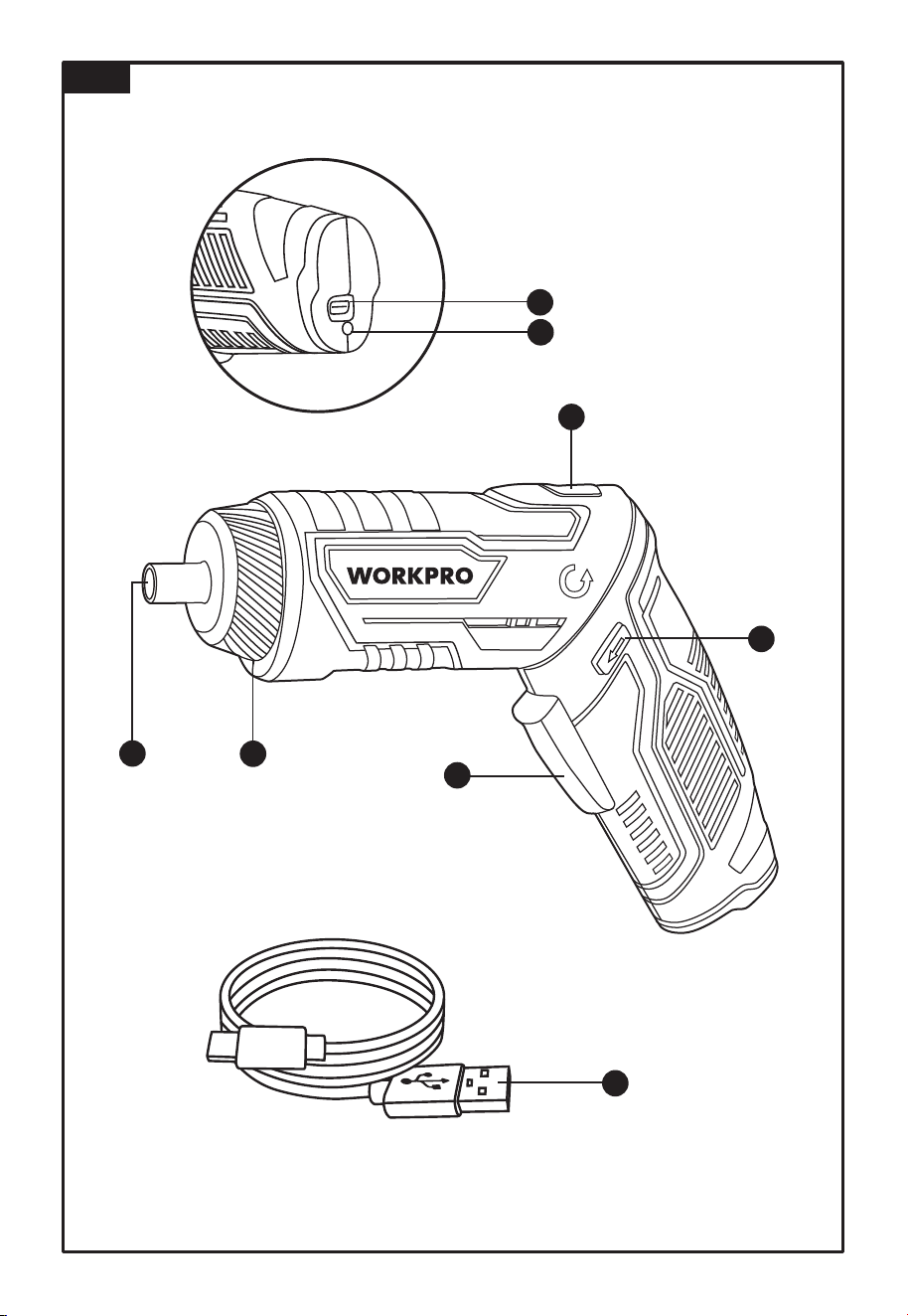
1
Fig. 1
1
5
4
3
2
6
7
8
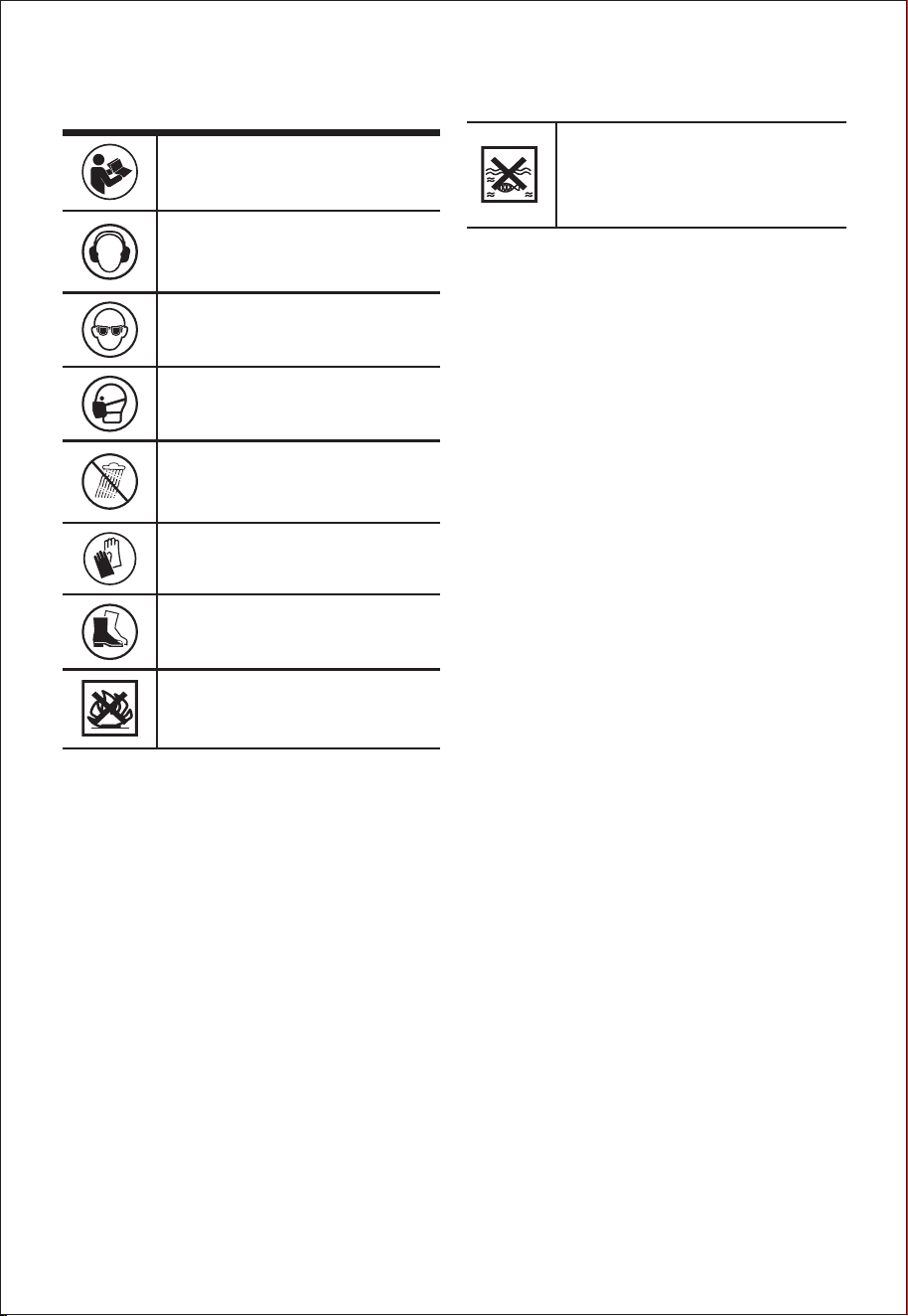
SYMBOLS
To reduce the risk of injury, user must
read instruction manual
Wear ear protection
Wear eye protection
Wear dust mask
Do not expose to rain
Wear protective gloves
Wear protective footwear
Do not burn
Batteries may enter water cycle if
disposed improperly, which can be
hazardous for ecosystem. Do not
dispose of waste batteries as unsorted
municipal waste.
2

3) Personal safety
Stay alert, watch what you are doing and use common
sense when operating a power tool. Do not use a power
tool while you are tired or under the influence of drugs,
alcohol or medication. A moment of inattention while
operating power tools may result in serious personal injury.
Use personal protective equipment. Always wear eye
protection. Protective equipment such as a dust mask,
non-skid safety shoes, hard hat or hearing protection used
for appropriate conditions will reduce personal injuries.
Prevent unintentional starting. Ensure the switch is in
the off-position before connecting to power source
and/or battery pack, picking up or carrying the tool.
Carrying power tools with your finger on the switch or
energising power tools that have the switch on invites
accidents.
Remove any adjusting key or wrench before turning the
power tool on. A wrench or a key left attached to a rotating
part of the power tool may result in personal injury.
Do not overreach. Keep proper footing and balance at all
times. This enables better control of the power tool in
unexpected situations.
Dress properly. Do not wear loose clothing or jewellery.
Keep your hair and clothing away from moving parts. Loose
clothes, jewellery or long hair can be caught in moving
parts.
If devices are provided for the connection of dust
extraction and collection facilities, ensure these are
connected and properly used. Use of dust collection can
reduce dust-related hazards.
Do not let familiarity gained from frequent use of tools
allow you to become complacent and ignore tool safety
principles. A careless action can cause severe injury within
a fraction of a second.
4) Power tool use and care
Do not force the power tool. Use the correct power tool for
your application. The correct power tool will do the job
better and safer at the rate for which it was designed.
Do not use the power tool if the switch does not turn it
on and off. Any power tool that cannot be controlled with
the switch is dangerous and must be repaired.
Disconnect the plug from the power source and/or remove
the battery pack, if detachable, from the power tool before
making any adjustments, changing accessories, or storing
power tools. Such preventive safety measures reduce the risk
of starting the power tool accidentall
y.
Store idle power tools out of the reach of children and
do not allow persons unfamiliar with the power tool or
these instructions to operate the power tool. Power
tools are dangerous in the hands of untrained users.
Maintain power tools and accessories. Check for
misalignment or binding of moving parts, breakage of
parts and any other condition that may affect the
power tool’s operation. If damaged, have the power tool
repaired before use. Many accidents are caused by poorly
maintained power tools.
Keep cutting tools sharp and clean. Properly maintained
Danger!
When using the equipment, a few safety precautions must be
observed to avoid injuries and damage. Please read the
complete operating instructions and safety regulations with
due care. Keep this manual in a safe place, so that the
information is available at all times. If you give the equipment
to any other person, hand over these operating instructions
and safety regulations as well. We cannot accept any liability
for damage or accidents which arise due to a failure to follow
these instructions and the safety instructions.
1. GENERAL POWER TOOL SAFETY
WARNING
WARNING!
Read and understand all instructions. Failure to follow the
warnings and instructions may result in electric shock, fire
and/or serious injury.
Save all warnings and instructions for future reference.
The term "power tool" in the warnings refers to your
mains-operated (corded) power tool or battery-operated
(cordless) power tool.
1) Work area safety
Keep work area clean and well lit. Cluttered or dark areas
invite accidents.
Do not operate power tools in explosive atmospheres,
such as in the presence of flammable liquids, gases or
dust. Power tools create sparks which may ignite the dust
or fumes.
Keep children and bystanders away while operating a
power tool. Distractions can cause you to lose control.
2) Electrical safety
Power tool plugs must match the outlet. Never modify
the plug in any way. Do not use any adapter plugs with
earthed (grounded) power tools. Unmodified plugs and
matching outlets will reduce risk of electric shock.
Avoid body contact with earthed or grounded surfaces,
such as pipes, radiators, ranges and refrigerators.There
is an increased risk of electric shock if your body is earthed
or grounded.
Do not expose power tools to rain or wet conditions.
Water entering a power tool will increase the risk of electric
shock.
Do not abuse the cord. Never use the cord for carrying,
pulling or unplugging the power tool. Keep cord away
from heat, oil, sharp edges or moving parts. Damaged or
entangled cords increase the risk of electric shock.
When operating a power tool outdoors, use an extension
cord suitable for outdoor use. Use of a cord suitable for
outdoor use reduces the risk of electric shock.
If operating a power tool in a damp location is
unavoidable, use a residual current device (RCD)
protected supply. Use of an RCD reduces the risk of electric
shock.
3

4
cutting tools with sharp cutting edges are less likely to bind
and are easier to control.
Use the power tool, accessories and tool bits etc. in
accordance with these instructions, taking into account the
working conditions and the work to be performed. Use of
the power tool for operations different from those intended
could result in a hazardous situation.
Keep handles and grasping surfaces dry, clean and free
from oil and grease. Slippery handles and grasping
surfaces do not allow for safe handling and control of the
tool in unexpected situations.
5) Service
Have your power tool serviced by a qualified repair person
using only identical replacement parts. This will ensure that
the safety of the power tool is maintained.
6) Battery tool use and care
a. Ensure the switch is in the off position before inserting
battery pack. Inserting the battery pack into power tools
that have the switch on invites accidents.
b. Recharge only with the charger specified by the
manufacturer. A charger that is suitable for one type of
battery pack may create a risk of fire when used with
another battery pack.
c. Use power tools only with specifically designated battery
packs. Use of any other battery packs may create a risk of
injury and fire.
d. When battery pack is not in use, keep it away from other
metal objects like paper clips, coins, keys, nails, screws, or
other small metal objects that can make a connection from
one terminal to another.
Shorting the battery terminals together may cause burns or
a fire.
e.Under abusive conditions, liquid may be ejected from the
battery; avoid contact. If contact accidentally occurs, flush
with water. If liquid contacts eyes, additionally seek
medical help. Liquid ejected from the battery may cause
irritation or burns.
ADDITIONAL SAFETY INSTRUCTIONS FOR BATTERY
CHARGING
Before charging, read the instructions.
Recharge only with USB power supply-5V DC.
Do not charge a leaking battery.
Do not use chargers for works other than those for which
they are specified.
The charging device must be protected from moisture.
Do not use the charging device in the open.
Do not short out the contacts of battery or power supply.
Do not open the unit and keep out of the reach of children.
Ensure that the connection between the battery charger
and battery is correctly positioned and is not obstructed by
foreign matter.
When charging batteries, ensure that the battery charger is
in a well-ventilated area and away from inflammable
materials. Batteries can get hot during charging. Do not
overcharge any batteries. Ensure that batteries and
chargers are not left unsupervised during charging.
Longer life and better performance can be obtained if the
battery is charged when the air temperature is between
18°C and 24°C. Do not charge the battery in air
temperatures below 4°C, or above 40°C. This is important
as it can prevent serious damage to the battery.
ADDITIONAL SAFETY INSTRUCTIONS RELATED TO BATTERY
SAFETY
Charge the tool only with 5V DC power supply, be sure to
charge strictly according to the instructions.
Do not charge the battery in a place where static electricity is
generated nor let the battery touch something that is statically
charged.
The battery can be stored at temperatures between 40°F(4°C)
and 104°F(40°C).
Never store or leave your lithium ion battery in temperatures
over that recommended otherwise fire may occur.
DO NOT store the Lithium Ion battery anywhere that the
temperature can easily reach higher temperatures than
recommended -this includes garden type sheds, and Vehicles
where the inside temperature can climb to dangerous levels in
the direct sunlight and on high temperature days. THINK
BEFORE LEAVING YOUR LITHIUM ION BATTERY PACK IN
STORAGE.
The battery can be charged or operated at temperatures
between 40°F(4°C) and 104°F(40°C). NEVER CHARGE YOU
LITHIUM ION BATTERY BELOW OR ABOVE TEMPERATURES
RECOMMENDED OTHERWISE FIRE OR SERIOUS DAMAGE TO
THE BATTERY PACK MAY OCCUR.
The most suitable temperatures to charge the battery pack are
between 68°F(20°C) -77°F(25°C).
Always allow the battery pack to cool down after charging, do
not place it in a hot environment such as a metal shed or open
trailer left in the sun.
Take care where the tool is stored. Do not store in areas of
corrosive fumes, or salt air or similar conditions. Try and store
the tool in the packaging supplied with the tool.
Do not dispose of the battery in a fire or put the battery into a
microwave oven, conventional oven, dryer, or high-pressure
container. Under these conditions, the battery may explode.
Never attempt to open the battery pack, puncture the battery
or subject the battery to strong physical shock.
If you detect leakage or a foul odour, it is especially important
to keep the battery away from fire. If battery liquid leaks onto
your skin or clothes, wash well with clean water immediately.
If liquid leaking from the battery gets into your eyes, do not
rub your eyes. Rinse your eyes well (for at least 10 minutes)
with clean water, and consult a doctor immediately.
Do not use a leaking battery.
Handle batteries with care to avoid shorting the battery with
conducting materials, such as nails, screws, metal watch
bands, rings, bracelets, and keys. The battery may overheat

Impairment of hearing.
Health hazards caused by breathing dust developed when
using your tool (example: working with wood, especially
oak, beech and MDF).
2. LAYOUT AND UNPACKING
2.1 Layout (Fig. 1)
1. 1/4'' Collet sleeve
2. Pivot locking button
3. Forward, Reverse rotation and lock control
4. ON/OFF switch
5. LED light
6. Socket for charge plug
7. Charger indicator
8. USB Type-C cable
2.2 Items supplied
Please check that the article is complete as specified in the
scope of delivery. If parts are missing, please contact our
online service center.
Open the packaging and take out the equipment with care.
Remove the packaging material and any packaging and/or
transportation braces (if available).
Check to see if all items are supplied.
Inspect the equipment and accessories for transport
damage.
If possible, please keep the packaging until the end of the
guarantee period
Danger!
The equipment and packaging material are not toys. Do
not let children play with plastic bags, foils or small
parts. There is a danger of swallowing or suffocating!
3. PROPER USE
The tool is intended for the fastening and loosening of
bolts,nuts and various threaded fasteners. This tool is not
intended for use as a regular drill.
5
and could burn you.
After the battery has reached the end of its useful life, we
recommend recycling the materials at your local municipal
council recycling centre. DO NOT attempt to replace the
battery cells in the battery pack, repair or modify any part of
the battery pack assembly.
WHEN TO CHARGE THE BATTERY
New batteries are shipped in a low charged condition and
should be fully charged before Use. The battery pack can be
recharged at any time during use, provided the pack is not
overheated.
If the battery pack starts to cut out due to low voltage, or
previous tasks undertaken can no longer be performed, it is
suggested to stop using the tool and recharge the battery.
For storage, it is suggested to recharge the battery between
50% and 75% charge, and charge the device at least once in
3-6 months to preserve battery lifespan.
ADDITIONAL POWER TOOL SAFETY WARNINGS
Warning! Additional safety warnings for screwdrivers:
Hold power tool by insulated gripping surfaces, when
performing an operation where the fastener may contact
hidden wiring. Fasteners contacting a "live" wire may
make exposed metal parts of the power tool "live" and
could give the operator an electric shock.
Use clamps or another practical way to secure and support
the workpiece to a stable platform. Holding the work by
hand or against your body leaves it unstable and may lead
to loss of control.
The intended use is described in this instruction manual.
The use of any accessory or attachment or performance of
any operation with this tool other than those recommended
in this instruction manual may present a risk of personal
injury and/or damage to property.
Safety of Others
Never allow children, persons with reduced physical,
sensory or mental capabilities or lack of experience and
knowledge or people unfamiliar with these instructions to
use the machine, local regulations may restrict the age of
the operator.
Never operate the machine while people, especially
children, or pets are nearby.
Residual Risks
Additional residual risks may arise when using the tool which
may not be included in the enclosed safety warnings. These
risks can arise from misuse, prolonged use etc.
Even with the application of the relevant safety regulations
and the implementation of safety devices, certain residual
risks can not be avoided. These include:
Injuries caused by touching any rotating/moving parts.
Injuries caused when changing any parts, blades or
accessories.
Injuries caused by prolonged use of a tool. When using any
tool for prolonged periods ensure you take regular breaks.
Battery capacity 1500mAh
Battery voltage
3.7V
Charging time 1.5-3.0 hours
No load speed 250 rpm
Maximum torque 4.5N.m
Charging voltage
5V DC
Tool chuck 6.35mm(1/4inch)
Weight 0.4kg(0.88lbs)
4.TECHNICAL DATA
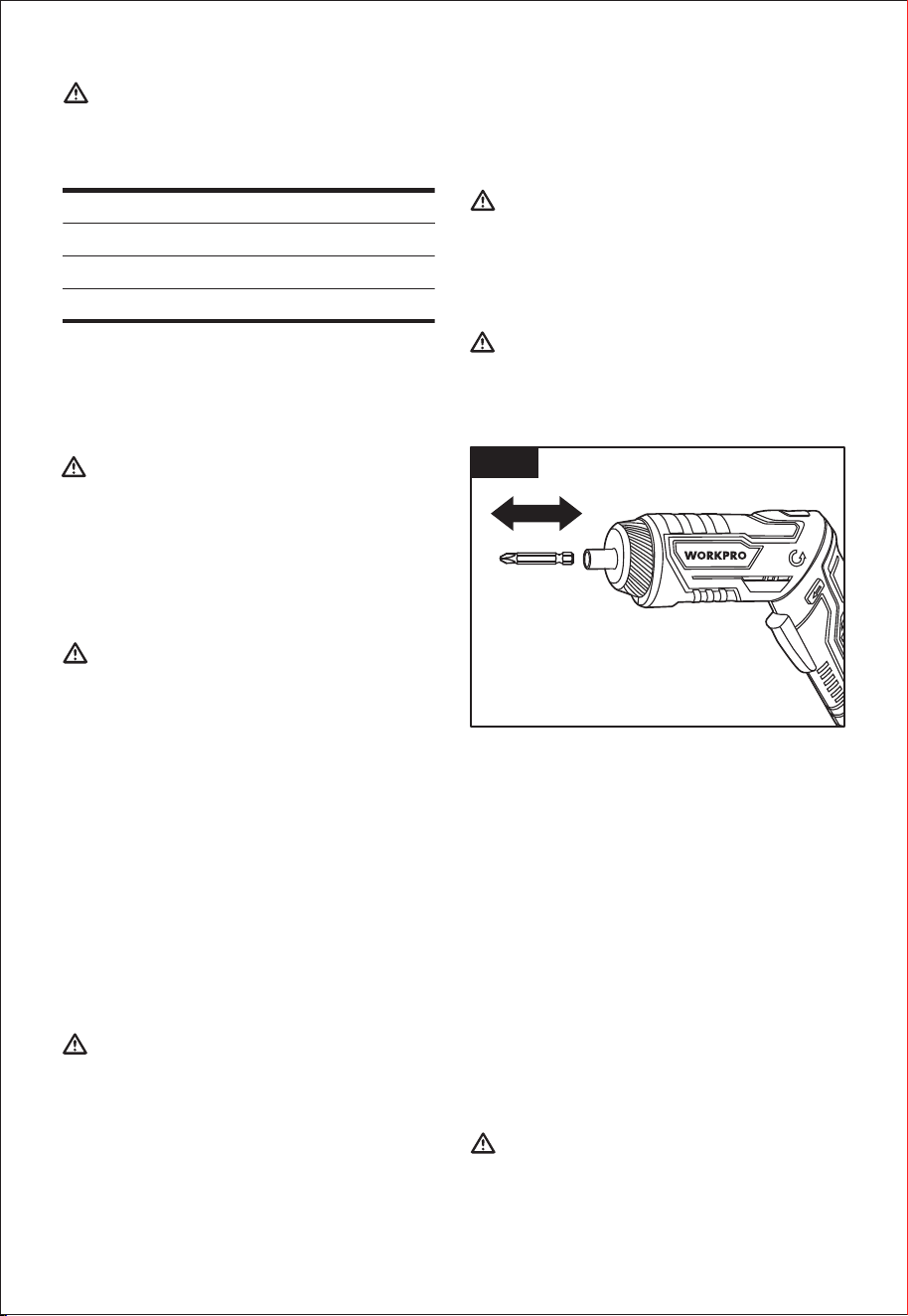
Fig. 2
Health damage caused by hand-arm vibrations if the
equipment is used over a prolonged period or is not properly
guided and maintained.
5. ASSEMBLY
WARNING: Do not use this product if it is not completely
assembled or if any parts appear to be missing or damaged.
Use of a product that is not properly and completely
assembled or with damaged or missing parts could result in
serious personal injury.
5.1 Installing and removing accessories (Fig. 2)
WARNING: Check that the accessories are correctly
attached. Incorrect or insecurely fastened accessories can
come loose during operation and cause a hazard.
Fully insert the desired bit into the collet sleeve.
Take the bit out of the the collet sleeve.
6. BEFORE STARTING THE EQUIPMENT
6.1 Charging the battery (Fig. 3)
Connect to power supply (DC 5V, 500mA to 2000mA), it can
be any mobile phone charger or USB port of the computer or
power bank (output 5V DC).
LED will illuminate red when charging.
The battery will take approximately 1.5-3 hours to charge,
according to power supply output current.
LED will illuminate green when fully charged.
For safety reasons it is not possible to work with the battery
while it is being charged.
To ensure that the battery pack provides long service, you
should take care to recharge it promptly.
You must recharge the battery pack when you notice that
the power of the cordless screwdriver drops. Never fully
discharge the battery pack. This will cause it to develop a
defect.
WARNING:
The switching devices installed on the tool by the manufactur-
er are not allowed to be removed or bypassed, e.g. by fitting a
Wear ear-muffs.
The impact of noise can cause damage to hearing. Total
vibration values (vector sum of three directions) determined in
accordance with EN 62841.
Vibration emission value a = 0.4 m/s² Uncertainty K = 1.5 m/s²
Warning!
The specified vibration value was established in accordance
with a standardized testing method. It may change according
to how the electric equipment is used and may exceed the
specified value in exceptional circumstances.
The specified vibration value can be used to compare the
equipment with other electric power tools.
The specified vibration value can be used for initial
assessment of a harmful effect.
Warning!
The vibration emission during actual use of the power tool
can differ from the declared total value depending on the
ways in which the tool is used.
It’s necessary to identify safety measures to protect the
operator that are based on an estimation of exposure in the
actual conditions of use (taking account of all parts of the
operating cycle such as the times when the tool is switched
off and when it is running idle in addition to the trigger
time).
Keep the noise emissions and vibrations to a minimum.
Only use appliances which are in perfect working order.
Service and clean the appliance regularly.
Adapt your working style to suit the appliance.
Do not overload the appliance.
Have the appliance serviced whenever necessary.
Switch the appliance off when it is not in use.
Wear protective gloves.
Caution!
Residual risks
Even if you use this electric power tool in accordance with
instructions, certain residual risks cannot be rules out. The
following hazards may arise in connection with the
equipment’s construction and layout:
Lung damage if no suitable protective dust mask is used.
Damage to hearing if no suitable ear protection is used.
6
LpA sound pressure level 61 dB(A)
KpA uncertainty 3 dB
L
WA sound power level 72 dB(A)
K
WA uncertainty 3 dB
Danger!
Sound and vibration
Sound and vibration values were measured in accordance with
EN 62841.
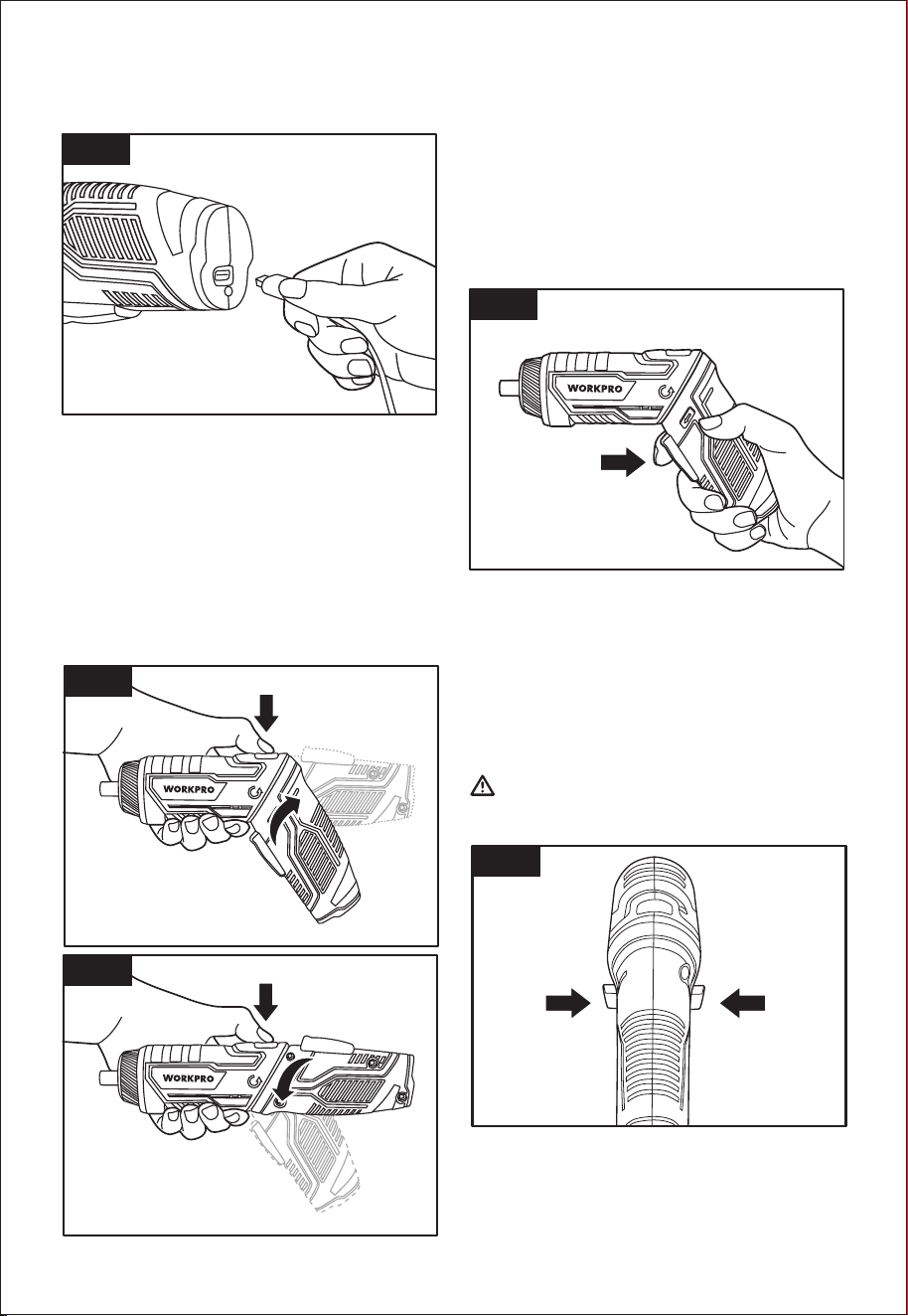
Fig. 3
7.2 Starting, Stopping and Controlling Speed(Fig.6)
These tools may be operated at any speed from 0 to full
speed.
a. To start the tool, press the ON/OFF switch. NOTE: An LED
light is turned on when the switch is pressed.
b. To vary the driving speed, increase or decrease pressure on
the switch. The further the switch is pressed, the greater
the speed.
c. To stop the tool, release the switch.
7.3 Forward, Reverse Rotation and Lock Control (Fig. 7)
Your tool is equipped with a forward, reverse rotation and lock
control located above the ON/OFF switch. It was designed for
changing rotation of the chuck and for locking the ON/OFF
switch in the center position to help prevent accidental start
and accidental battery discharge. For forward rotation, (with
chuck pointed away from you) move the lever to the far left.
For reverse rotation move the lever to the far right. To activate
switch lock move the lever to the center off position.
Caution: Do not change direction of rotation until the tool
comes to a complete stop. Shifting during rotation of the
chuck can cause damage to the tool.
switching button to the handle, as this may result in risk of
injury and the tool will no longer switch off automatically.
7. OPERATION
7.1 Stick/Pistol Position(Fig.4,5)
The screwdriver can be used as a stick screwdriver or a pistol
screwdriver. A pivot locking button is located on the top of the
screwdriver.
To place the screwdriver in stick position: Hold in normal
operating position, press pivot locking button down and twist
back housing fully clockwise.
To place the screwdriver in pistol position: Hold in normal
operating position, press pivot locking button down and twist
back housing fully counterclockwise.
7
Fig. 6
Fig. 7
Fig. 4
Fig. 5

8
8. CLEANING, MAINTENANCE
Danger!
Always remove the battery pack before making
adjustments to the equipment.
8.1 Cleaning
Keep all safety devices, air vents and the motor housing free
of dirt and dust as far as possible. Wipe the equipment with
a clean cloth or blow it with compressed air at low pressure.
We recommend that you clean the device immedi- ately
each time you have finished using it.
Clean the equipment regularly with a moist cloth and some
soft soap. Do not use cleaning agents or solvents; these
could attack the plastic parts of the equipment. Ensure that
no water can seep into the device. The ingress of water into
an electric tool increases the risk of an electric shock.
8.2 Maintenance
There are no parts inside the equipment which require
additional maintenance.
9. STORAGE
Store the equipment and accessories in a dark and dry place
at above freezing temperature. The ideal storage temperature
is between 5°C(41°F )and 30°C(86°F). Store the electric tool in
its original packaging.
For storage, it is suggested to recharge the battery between
50% and 75% charge, and charge the device at least once in
3-6 months to preserve battery lifespan.
10. DISPOSAL AND RECYCLING
The equipment is supplied in packaging to prevent it from
being damaged in transit. The raw materials in this packaging
can be reused or recycled. The equipment and its accessories
are made of various types of material, such as metal and
plastic. Never place defective equipment in your household
refuse. The equipment should be taken to a suitable collection
center for proper disposal. If you do not know the
whereabouts of such a collection point, you should ask in your
local council offces.
Environmental protection
This product has been marked with a symbol
relating to removing electric and electronic waste.
This means that this product shall not be discarded
with household waste but that it shall be returned to
a collection system. It will then be recycled or
dismantled in order to reduce the impact on the
environment. Electric and electronic equipment can
be hazardous for the environment and for human
health since they contain hazardous substances.
Disposal of an exhausted battery
pack
To preserve natural resources, please recycle or
dispose of the battery pack properly. This battery
pack contains Li-ion batteries. Consult your local
waste authority for information regarding available
recycling and/or disposal options. Discharge your
battery pack by operating your tool, then remove the
battery pack from the tool housing and cover the
battery pack connections with heavy-duty adhesive
tape to prevent short circuit and energy discharge.
Do not attempt to open or remove any of the
components.
Li-ion