Product function
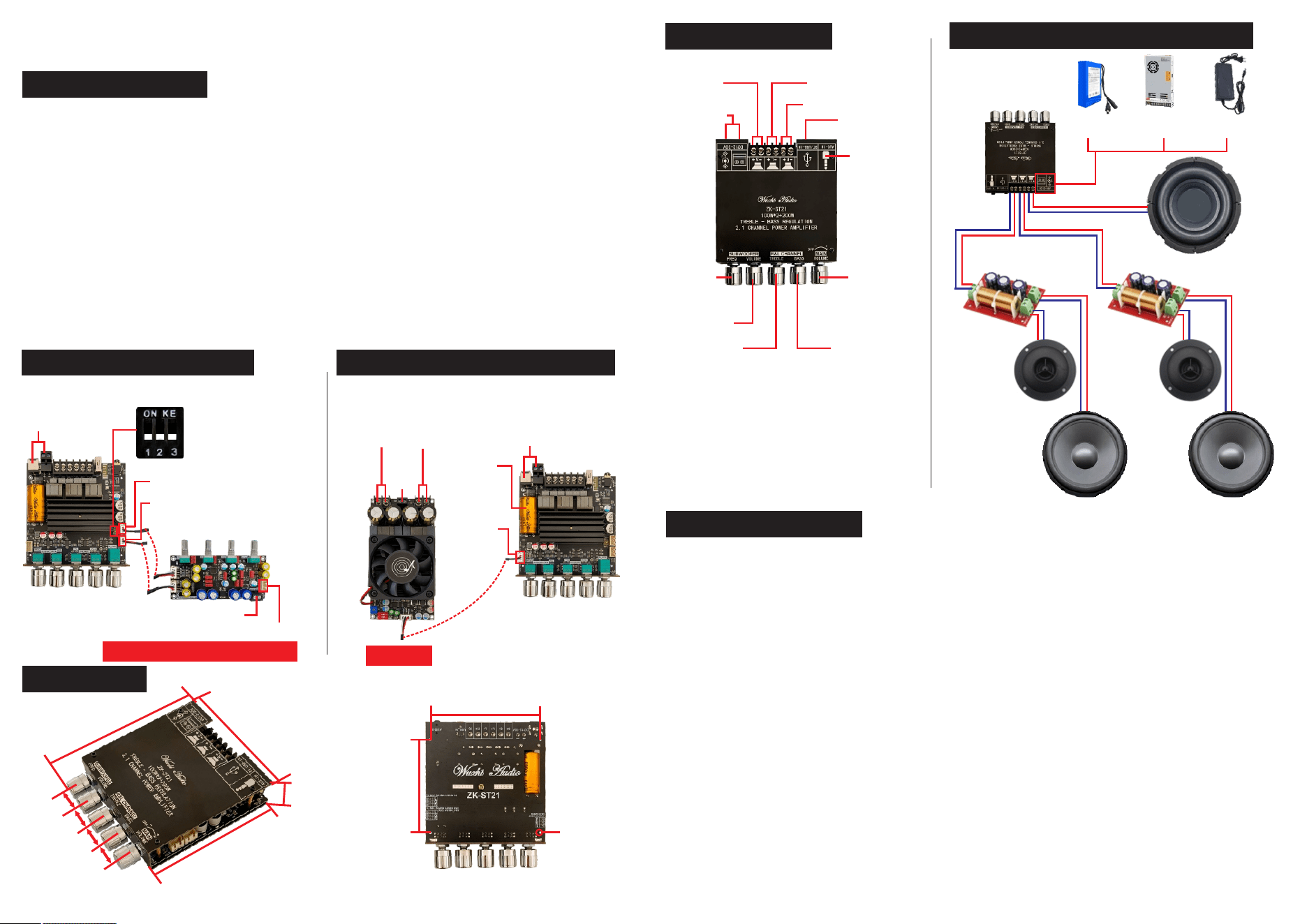
(20-200HZ)
Subwoofer expansion interface
Product size
12
1
m
m
1
00m
m
25mm
10
1
mm
1
8
mm
1
8
m
m
1
9
m
m
1
9m
m
92mm
77. 5mm
φ2.2mm
Connection method of speaker
Divider
Tweeter
Bass or full frequency
speaker
Subwoofer or passive subwoofer
To save costs,
low-frequency
or full frequency
speakers can
also be directly
connected to the
amplifier output,
while tweeters can
be connected in
series with 2.2μF
connect the capacitor
with the subwoofer.
12-24V
battery
Switch power
supply
Adapter
OR
OR
USB drive/
sound
card input
MIC extension interface
Adding the front stage plate ZK-AMP of the microphone
Add installation of pure rear stage power amplifier
boards ZK-1602 and 3002
Power supply
12-30VDC
Expansion
port 1
Power supply 8-26VDC
Connect the microphone socket board
(Connected to
microphone front stage
board reverb input)
(Connected to
microphone front stage
board reverb output)
MIC front stage boardZK-AMP
Connected to
subwoofer
speaker
Power
supply
18-50
VDC
Power supply
12-30VDC
Subwoofer
small signal
output
(Connected
to the input
port of the
pure rear
power
amplifier
board)
HiFi AMP
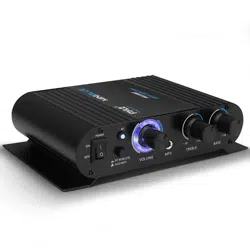
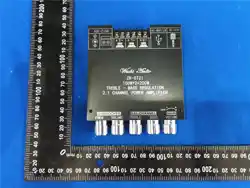
2.1 Channel BT Amplifier Board
Model:ZK-ST21
Product parameters
Product name: 2.1 channel BT amplifier board 100W+100W+200W
Product model: ZK-ST21
Adapted power supply: The working voltage range is 12-30VDC, and it is recommended to use a DC power supply with a
voltage of 24V-28V and a current of 10A or above.
Maximum power: Left or right channel—— 105W@30V , 4Ω; 55W@30V , 8Ω. Subwoofer—— 208W@30V 2Ω; 105W@30V , 4Ω.
In short, the higher the voltage, the smaller the resistance, and the greater the output power.
Adapted speakers: Left and right channels, supporting 3-8 ohms and speakers up to 100W; The subwoofer supports 2-8
ohms and speakers up to 200W.
BT chip: JieLi 5.1, transmission distance of 15 meters.
Input method: BT+AUX+USB drive+sound card.
Number of channels: 2.1, Left channel+right channel+subwoofer
Power amplifier chip: Two TI original TPA3221
Protection mechanism: Input undervoltage, input anti reverse connection, overheating, overcurrent, short circuit protection.
Product size: 121x100x25mm
Product weight: Integrated without shell net weight: 192g; With packaging: 228g;
Integrated with shell net weight: 261g; With packaging: 297g
External lead type net weight: 254g; With packaging: 310g
Same spacing as TB21 potentiometer
Question and answer
What kind of speaker does it come with? How much power is used? Recommend an amplifier?
In fact, this is the same question because the three of them are related. I believe that after learning the following knowledge, no matter what kind
of amplifier you make, you will calculate the compatibility relationship between the power supply, speaker, and amplifier yourself.
1. According to Ohm's law, power P=U * U/R, the higher the voltage, the smaller the horn resistance and the greater the power; So the final output
power is not only related to the power amplifier, but also to the power supply voltage and the resistance of the speaker. According to the formula, if
the power supply is 24V and the horn resistance is 4 ohms, then the peak power=24V * 24V/4 Ω=144W, and the effective value (rated power) of a
1kHz sine wave=24V * 0.707 * 24V * 0.707/4 Ω=72W; The peak power of an 8-ohm horn is 24V * 24V/8 Ω=72W, and the rated power is 24V * 0.707 *
24V * 0.707/8 Ω=36W; If the power supply is 12V and the 8 ohm horn is used, the peak power is 12V * 12V/8 Ω=18W, and the rated power is 12 *
0.707 * 12 * 0.707/8 Ω=9W. Our amplifier's nominal power is the rated power, and later on, it defaults to the rated power.
2.In order to leave sufficient power margin and avoid clipping distortion, it is better to have an amplifier power of 1.5-2.5 times the speaker power.
For example, if your single channel speaker is 100W, the corresponding amplifier board's single channel output power should be between 150W and
250W. Speakers can be connected in parallel or series. Two 8-ohm and 50W speakers connected in parallel are equivalent to a 100W4 ohm speaker.
It is recommended to choose an amplifier with a typical load impedance value that is the same as the final impedance value of your speaker
system. Our amplifiers generally support 4-8 ohm speakers, while a few high-power amplifiers support 2-8 ohm speakers. If the speaker resistance
is too small, the amplifier chip is prone to overcurrent power protection or burning.
3.The choice of power supply is also very important. Some customers use a 5V2A mobile phone charger or a 12V1A2A adapter to drive a
50W100W amplifier, but the voltage and power are obviously not enough. Ultimately, the voltage is pulled down, and the sound becomes distorted
and distorted when slightly louder, resulting in a cloudy sound or intermittent protection from the power supply causing sound lag. It doesn't matter
if the power supply is too high, but if the power supply is not sufficient, the problem mentioned above will occur. So what size of power should be
chosen? This issue involves two parameters: voltage and current. In theory, the power supply should be greater than the total power of the power
amplifier. For example, if TB21 is a 50W+50W+100W power amplifier, you should choose a 24V8A or higher power supply. But there is also a
situation where the speaker you choose is not that large. In order to facilitate power adaptation or reduce power costs, you can calculate the actual
power required. For example, the subwoofer speaker you choose is 4 ohms 50W, and two stereo speakers are 8 ohms 30W. If you choose a 12V
power supply, the maximum output rated power of the subwoofer is P=12 * 0.707 * 12 * 0.707/4 Ω=18W. Obviously, a 12V voltage cannot meet this
requirement. Try a 24V power supply again. The subwoofer output P=72W, the stereo output P=36W+36W, and the total power is 144W. Therefore, a
24V6A power supply is sufficient. Some customers say that I have a 24V20A power supply with a power of 480W, but it's better to have an 8-ohm
100W speaker. According to Ohm's law, a maximum power output of 36W can be achieved with a 24V and 8-ohm power supply. Obviously, the
speaker cannot be pushed. Although the speaker has sound, it is not full enough. According to the formula, the voltage needs to reach 40V or
above. Another thing to note is that the power supply of adapters on the market is falsely labeled, and 24V8A10A adapters may be protected for less
than 6A.
4.Many customers have a misconception: the higher the power of the amplifier board, the louder the speaker will definitely be. The answer is not
certain! I once encountered a customer who purchased a 3002T (300W+300W) amplifier and requested a return. They said that the amplifier had a
severe false label and the sound was not as loud as their 30W amplifier, and there was no 300W at all. His original amplifier gain was 36dB, the
speaker was 8 ohms and 30W, powered by 24V, and according to the formula, the maximum output power for a single channel was 36W; He uses
3002T, which is also powered by 24V, and the speaker uses 8 ohms and 150W. However, according to the formula, the maximum output is also 36W,
and the gain of 3002T itself is 32dB. Its original small amplifier volume was adjusted to 70%, achieving 100% volume of the large amplifier. This
issue is obviously not a false calibration of the power amplifier, but rather an incorrect one. Customers should choose a power supply with 48V6A or
higher to fully utilize its power. Can a 30W small power amplifier support 48V power supply and 300W output?
Bass or full frequency
speaker
Divider
Tweeter
Subwoofer
speaker
Power input
12-30VDC
(5.5-2.5DC
female base
or 2P wiring
terminal)
Subwoofer
frequency
Subwoofer
volume
Left and right
channel treble
Left and right
channel bass
Left speaker
Right speaker
LINE IN input
(3.5mm audio socket)
Main volume
with switch
(Rotate counterclockwise
to the end to turn off)
When using the expansion
interface, the dial switch
must be turned to the OFF
position (below)
Expansion
port 2
Connected to
subwoofer
speaker
Beware of
imitations
(Featuring the
WUZHI AUDIO
trademark)

FCC Warnning:
This equipment has been tested and found to comply with the limits for a Class B digital device,
pursuant to part 15 of the FCC Rules. These limits are designed to provide
reasonable
protection againstharmful interference in a residential installation. This equipment generates,
uses and can radiateradio
frequency
energy
and,
if
not
installed
and
used
in
accordance
with
the
instructions,
maycause
harmful
interference
to
radio
communications.
However,
there
is
no
guarantee
thatinterference
will
not
occur
in
a
particular
installation.
If
this
equipment
does
cause
harmfulinterference to radio or television reception, which can be
determined by turning the equipmentoff
and
on,
the
user
is
encouraged
to
try
to
correct
the
interference
by
one
or
more
of
thefollowing measures:
•
Reorient or relocate the receiving antenna.
•
Increase the separation between the equipment and receiver.
•
Connect the equipment into an outlet on a circuit different from that to which the receiver is
connected.
• Consult the dealer or an experienced radio/TV technician for help.
Caution:
Any
changes
or
modifications
to
this
device
not
explicitly
approved
by
manufacturer
could void your authority to operate this equipment.
This
device
complies
with
part
15
of
the
FCC
Rules.
Operation
is
subject
to
the
following
two
conditions:
(1)This
device
may
not
cause
harmful
interference,
and
(2)
this
device
must
accept
any
interference received, including interference that may cause undesired operation.
This
equipment
complies
with
FCC
radiation
exposure
limits
set
forth
for
an
uncontrolled
environment.
This
equipment
should
be
installed
and
operated
with
minimum
distance
20cm
between the radiator and your body.