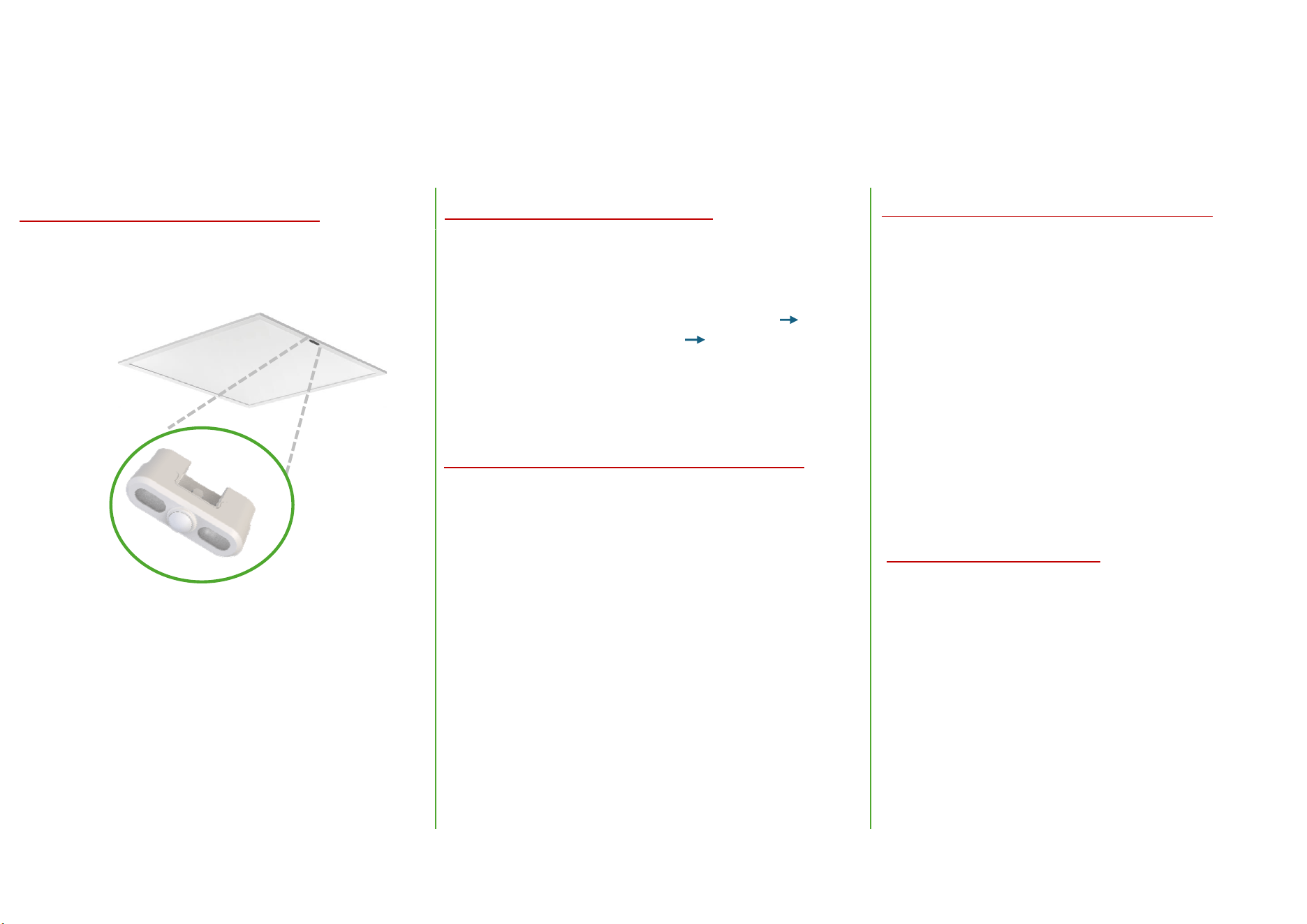
PLS-SSA Sensor Installation
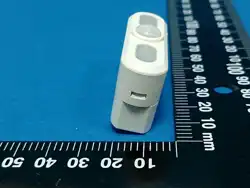
PLS-SSA Sensor is simple to install and
remove, featuring a push‑ to‑ lock,
push‑ to‑ release design for quick, easy
installation and removal.
1.
Push the cov
er located on the trim of the
luminaire to remove it.
2. Orient and push the sensor to lock it into
place.
3. Follow the same push motion to remove
the sensor
.
Out-of-the-Box Defaults
Create a Group Using IWP - IR
After PLS-SSA Sensor is inserted without
a group assignment, it will operate as a
standalone device per its defaults.
• Hold time 10-minutes (7.5 minutes 100%
t
o 10% and 2.5 minutes
10% to off)
• Daylighting is Off
• Security is Off
PLS-SSA Sensor“Push-to-Lock Sensor SensorSwitch Air”
Installation Instructions
When the sensor is placed inside the
luminaire and powe
red, assign the group
number using the IWP remote.
• From the main menu, navigate t
o “Programmer
Setting” and choose IR
• Return to main menu and choose “Write
Behaviors” and open “Group ID”
• Use the number pad to “Assign the same group
number to all the sensors that should operate
together.”
• A group will auto-form with the defaults shown
in the out-of-box. Limit 40 devices n a group .
Create a Group Using IWP - Bouetooth
Securing the Group
• From the main menu, navigate to “SSAIR
Commands”
• Scroll and access to Secure Option
• Use number pad to input a 6-digit PIN and
send the value to a group sensor.
• Allow 2 to 3 minutes for securing to complete.
• IMPORTANT - If a group is not secure, it
will secure itself after 48 hours. A power
cycle will be required to regain entry.
While the sensor is unpowered (but not
inserted) or still in its packaging, assign the
group number using the IWP remote.
PLS-SSA Sensor devices utilize Bluetooth® mesh
wireless communication. To connect using a
mobile device, enable Bluetooth®, open the
Clairity+ application, and follow the Sensor
Switch AIR setup instructions. Startup, security,
grouping, and lighting control functions may also
be performed using the IWP Infrared Wireless
Programmer."

Note: This equipment has been tested and found to comply with the limits for a Class B digital device, pursuant to part 15 of the FCC Rules. These limits are designed
to provide reasonable protection against harmful interference in a residential installation. This equipment generates, uses and can radiate radio frequency energy and,
if not installed and used in accordance with the instructions, may cause harmful interference to radio communications. However, there is no guarantee that
interference will not occur in a particular installation. If this equipment does cause
harmful interference to radio or television reception, which can be determined by turning the equipment off and on, the user is encouraged to try to correct the
interference by one or more of the following measures:
-Reorient or relocate the receiving antenna.
-Increase the separation between the equipment and receiver.
-Connect the equipment into an outlet on a circuit different from that to which the receiver is connected.
-Consult the dealer or an experienced radio/TV technician for help.
Any Changes expressly or modifications not approved by the party responsible for compliance could void the user's authority to operate the equipment.
FCC Radiation Exposure Statement:
This equipment complies with FCC radiation exposure limits set forth for an uncontrolled environment .
This transmitter must not be co-located or operating in conjunction with any other antenna or transmitter.
This equipment should be installed and operated with minimum distance 20cm between the radiator &you body.
This device complies with part 15 of the FCC Rules. Operation is subject to the following two conditions:
(1) This device may not cause harmful interference, and
(2) this device must accept any interference received, including interference that may cause undesired operation.
ISEDC RSS warning
This device contains licence-exempt transmitter(s)/receiver(s) that comply with Innovation, Science and Economic Development Canada’s licence-exempt RSS(s).
Operation is subject to the following two conditions:
(1) This device may not cause interference.
(2) This device must accept any interference, including interference that may cause undesired operation of the device.
Cet appareil contient un ou plusieurs émetteurs/récepteurs exempts de licence conformes aux normes RSS exemptes de licence d’Innovation, Sciences et
Développement économique Canada. Son fonctionnement est soumis aux deux conditions suivantes :
(1) Cet appareil ne doit pas causer d’interférences.
(2) Cet appareil doit accepter toute interférence, y compris les interférences pouvant entraîner un fonctionnement indésirable.
ISEDC Radiation Exposure Statement:
This equipment complies with ISEDC RF radiation exposure limits set forth for an uncontrolled environment. This transmitter must not be co-located or operating in
conjunction with any other antenna or transmitter. This equipment should be installed and operated with minimum distance 20cm between the radiator& your body.
IC exposition aux radiations:
Cet équipement est conforme aux limites d’exposition aux rayonnements RF de l’isedc établies pour un environnement non contrôlé.
Cet émetteur ne doit pas être co-localisés ou fonctionner en conjonction avec une autre antenne ou émetteur.
Cet équipement doit être installé et utiliséavec une distance minimale de 20cm entre leradiateur & votre corps.