en
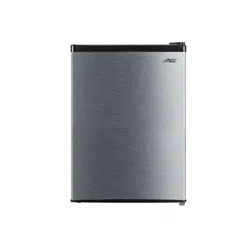
Compact
Refrigerator
Power supply: AC115V
Frequency: 60Hz
Capacity: 3.3cu.ft.
Warning:
Before using this product,
please read this manual carefully
and keep it for future reference.
The design and specifications
are subject to change without
prior notice for product
improvement. Consult with your
dealer or manufacturer for
d
version A - 02 - 2025
etails.
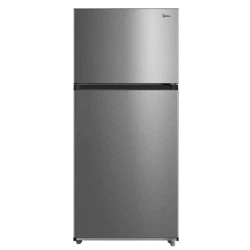
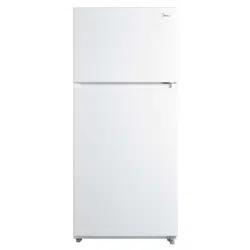
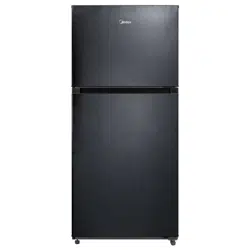
MODEL NUMBER MRM33S4AWWC
MRM33S4ASLC
MRM33B2ABB
www.midea.ca
Free 3 months
extension of the
original limited warranty
period!* Simply text a
picture of your proof of
purchase to:
1-844-224-1614
*The warranty extension is for the three months
immediately following
the completion of the product’s original warranty
period. Individuals do not need to register the
product in order to get all the rights and remedies
of registered owners under the original limited
warranty.

REFRIGERATOR SAFETY .................................................................3
OPERATION REQUIREMENTS .........................................................6
Location Requirements ..........................................................................6
Electrical Requirements .........................................................................7
PARTS AND FEATURES ...................................................................8
INSTALLATION ...................................................................................9
Unpack ..........................................................................................................9
Move to Final Location ...........................................................................9
Level Refrigerator ...................................................................................10
Reverse the Door Swing ......................................................................10
BEFORE USE .................................................................................... 12
Waiting Period ......................................................................................... 12
Cleaning ..................................................................................................... 12
REFRIGERATOR USE....................................................................... 13
General ....................................................................................................... 13
Controls ......................................................................................................14
REFRIGERATOR CARE .................................................................... 14
Cleaning .....................................................................................................14
Defrosting .................................................................................................. 15
Moving ........................................................................................................ 16
Storage ....................................................................................................... 16
TROUBLESHOOTING ...................................................................... 17
Dear user
Thank you for letting Midea help you "make yourself at home."
This manual is part of our commitment to your total satisfaction.
Please read this manual carefully before use and keep it in a
convenient place for future reference.
To help us serve you better, please consider registering your
product using our convenient Midea app MSmartlife, by visiting
http://www.midea.ca, or by texting a picture of your proof of
purchase to
1-844-224-1614.
By using the text option you will earn an additional 3 months
warranty extension immediately following the completion of the
product's original warranty.
3
Refrigerator
Safety
Operation
Requirements
Parts and
Features
Installation
Refrigerator
Use
Refrigerator
Care
Troubleshooting
Before
Use
REFRIGERATOR SAFETY
YOUR SAFETY AND THE SAFETY OF OTHERS ARE VERY
IMPORTANT
To prevent injury to the user or other people and property damage, the
instructions shown here must be followed. Incorrect operation due to
ignoring of instructions may cause harm or damage, including death.
The level of risk is shown by the following indications.
CAUTION
WARNINGWARNING
WARNING
This symbol indicates the possibility of dangerous voltage
constituting a risk of electrical shock is present that could
result in death or serious injury.
This symbol indicates the possibility of injury or damage to
property.
This symbol indicates the possibility of death or serious
injury.
IMPORTANT SAFETY INSTRUCTIONS
WARNING
GENERAL APPLIANCE SAFETY
•
Read all safety warnings, instructions, illustrations and specifications
provided with this appliance. Failure to follow all instructions listed
below may result in electric shock, fire and/or serious injury.
•
Save all warnings and instructions for future reference.
ELECTRICAL SAFETY
•
Plug into a grounded 3-prong outlet.
•
Do not remove ground plug.
•
Do not use an adapter.
•
Unplug the power cord by holding the plug, never by pulling the
cord.
•
DO NOT turn the appliance on or off by plugging or unplugging the
power cord.
•
DO NOT use an extension cord.
•
Unplug the refrigerator before cleaning or defrosting.
Grounding requirement
•
This refrigerator must be grounded. This refrigerator is equipped with
a grounding plug. The plug must be inserted into an outlet that is
properly installed and grounded.

4
Refrigerator
Safety
Operation
Requirements
Parts and
Features
Installation
Refrigerator
Use
Refrigerator
Care
Troubleshooting
Before
Use
•
Improper use of the grounding plug can result in a risk of electric
shock. Consult a qualified electrician or service person if the
grounding instructions are not completely understood or if doubt
exists as to whether the refrigerator is properly grounded.
LOCATION SAFETY
•
This refrigerator is intended to be used in household and similar
environments.
•
Install in accordance with the manufacturer’s instructions.
•
This refrigerator should not be recessed or built-in an enclosed
cabinet. It is designed for freestanding installation only.
WARNING - Keep ventilation openings, in the refrigerator, clear of
obstruction.
•
DO NOT install near any heat sources, such as radiators, heat
registers, stoves, other cooking appliances or in direct sunlight.
•
DO NOT store or use gasoline or any flammable liquids inside or in
the vicinity of this refrigerator.
•
Do not store explosive substances such as aerosol cans with a
flammable propellant in this appliance.
USE AND CARE SAFETY
•
Flammable refrigerant used. Follow handling instructions carefully.
Risk of fire or explosion due to puncture of refrigerant tubing.
•
Flammable refrigerant used. Do not use mechanical devices to
defrost freezer. Do not puncture refrigerant tubing.
•
In the event of a gas leak in the location where the refrigerator is
used, turn off the gas, open doors and windows and evacuate the
building. DO NOT unplug the refrigerator as this may cause a spark.
•
Do not use electrical appliances inside the food storage
compartment of the appliance, unless they are of the type
recommended by the manufacturer.
•
This appliance is not intended for use by persons (including children)
with reduced physical, sensory or mental capabilities, or lack of
experience and knowledge, unless they have been given supervision
or instruction concerning use of the appliance by a person
responsible for their safety.
•
Keep key away from children.
•
Children should be supervised to ensure that they DO NOT play with
the appliance.
•
DO NOT touch the interior of the freezer with wet hands. This could
result in frostbite.
•
Clean only with a damp cloth. Use nonflammable cleaner.
SERVICE SAFETY
•
Disconnect power before servicing.
•
Flammable refrigerant used. To be repaired only by trained service
personnel. Do NOT puncture refrigerant tubing.
5
Refrigerator
Safety
Operation
Requirements
Parts and
Features
Installation
Refrigerator
Use
Refrigerator
Care
Troubleshooting
Before
Use
•
Refer all servicing to qualified service personnel. Do not repair or
replace any part of this appliance unless specifically recommended
in this manual. Servicing is required when the appliance has been
damaged in any way, such as the power supply cord or plug is
damaged, liquid has been spilled or objects have fallen into the
appliance, the appliance has been exposed to rain or moisture, does
not operate normally, or has been dropped.
•
If the supply cord is damaged, it must be replaced by the
manufacturer, its service agent, or similarly qualified person, in order
to avoid a hazard.
•
If component part is damaged, it must be replaced by the
manufacturer, its service agent or similarly qualified persons in order
to avoid a hazard.
•
Replace all parts and panels before operating.
SAVE THESE INSTRUCTIONS
THIS APPLIANCE IS FOR HOUSEHOLD USE ONLY
State of California Proposition 65 Warnings:
WARNING: Cancer and Reproductive Harm
-www.P65Warnings.ca.gov.
PROPER DISPOSAL
WARNING
Suffocation Hazard
Before you throw away your old refrigerator:
•
Remove the door or lid so that children cannot hide or get trapped
inside your old appliance.
•
Leave any shelves in place so that children may not easily climb inside.
•
Failure to follow these instructions can result in death or brain
damage.
IMPORTANT: Flammable gas, refrigerant and foam. It is the consumer’s
responsibility to comply with Federal and Local regulations when
disposing of this product. Refrigerants must be evacuated by a licensed,
EPA certified refrigerant technician in accordance with established
procedures.
6
Refrigerator
Safety
Operation
Requirements
Parts and
Features
Installation
Refrigerator
Use
Refrigerator
Care
Troubleshooting
Before
Use
OPERATION REQUIREMENTS
LOCATION REQUIREMENTS
WARNING
Explosion and Fire Hazard
•
Keep flammable materials and vapors, such as gasoline, away from
appliance.
•
Failure to do so, can result in death, explosion or fire.
This refrigerator is designed to be freestanding only, and should not be
recessed or built-in.
•
Place your refrigerator on a floor that is level and strong enough to
support the refrigerator when it is fully loaded.
•
Place your refrigerator where there is access to the required electrical
connection. See “Electrical Requirements.”
•
Locate the refrigerator away from direct sunlight and sources of heat,
such as a stove, heater or radiator.
NOTES:
– Direct sunlight may affect the acrylic coating and heat sources may
increase electrical consumption.
– Extremely cold temperatures may also prevent the refrigerator from
performing properly.
•
Avoid locating the refrigerator in areas with high humidity.
•
Adequate air circulation is required for efficient operation. Maintain the
recommended clearance to ensure adequate air circulation.
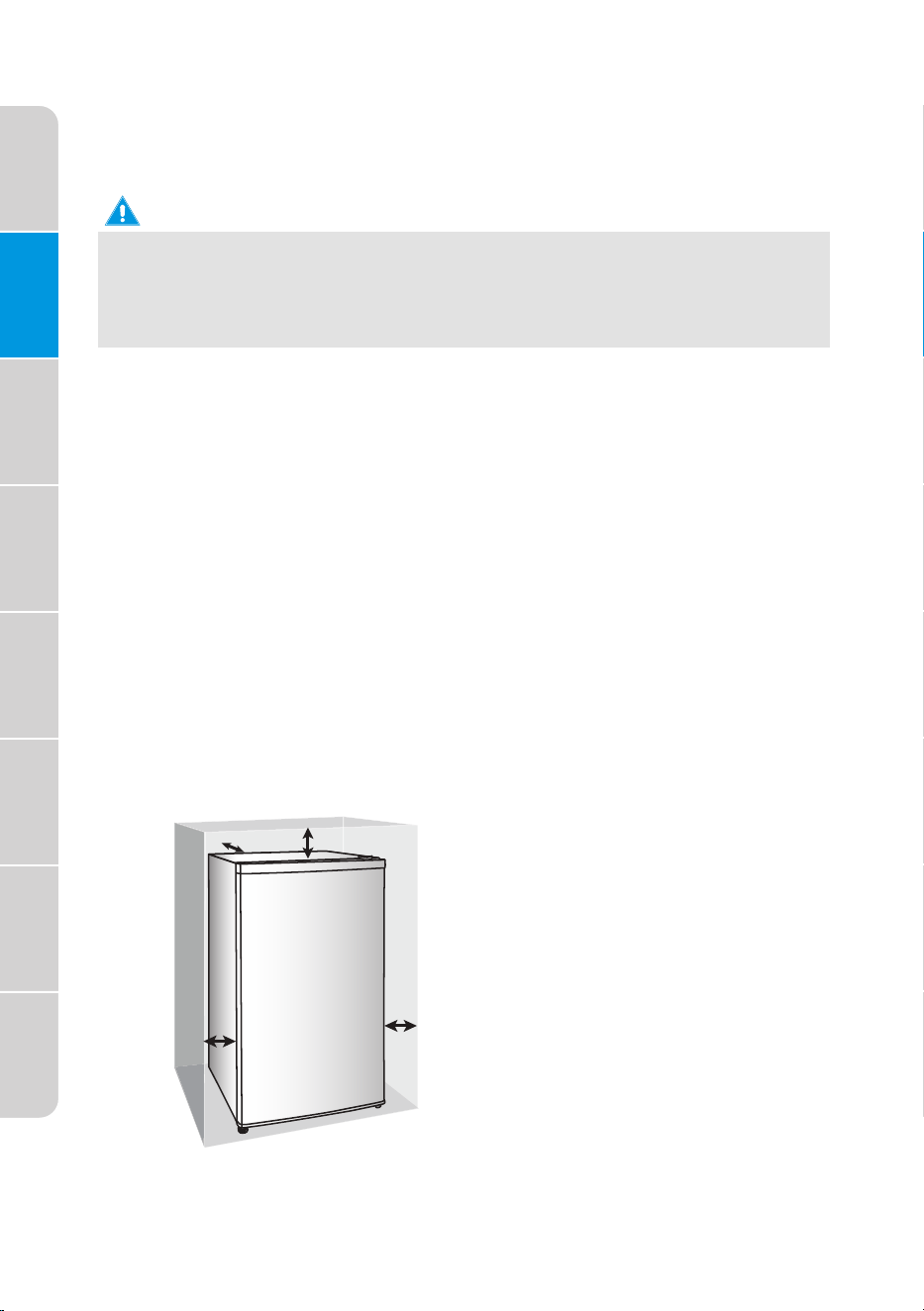
RECOMMENDED CLEARANCE
a
a
a
b
a 4" (10 cm) Clearance
at the back and
both sides of the
refrigerator
b 10СШИ " (30 cm)
Clearance at the top
NOTE: If you place the refrigerator next to a fixed wall, allow sufficient
space on the hinge-side for the door to swing open.
7
Refrigerator
Safety
Operation
Requirements
Parts and
Features
Installation
Refrigerator
Use
Refrigerator
Care
Troubleshooting
Before
Use
ELECTRICAL REQUIREMENTS
WARNING
Electrical Shock Hazard
•
Plug into a grounded 3-prong outlet.
•
Do not remove the ground prong from the power cord plug.
•
Do not use an adapter.
•
Do not use an extension cord.
•
Failure to do so can result in death, fire or electrical shock.
IMPORTANT: A 115 Volt, 60 Hz., AC only, 15-amp fused, grounded electrical
supply is required.
•
Use an electrical outlet that accepts the grounding prong.
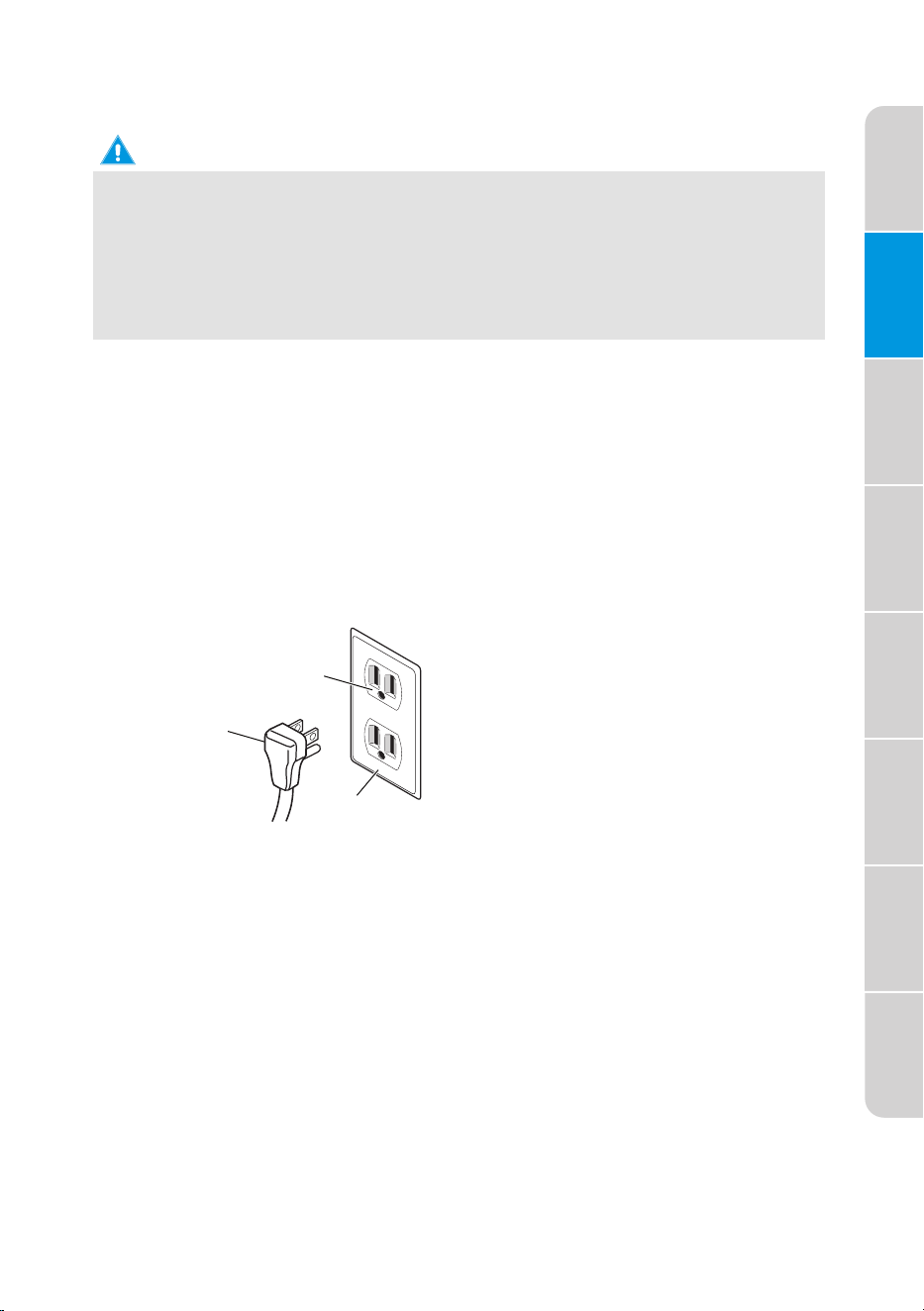
NOTE: The power cord is equipped with a 3-prong (grounding) plug
which mates with a standard 3-prong (grounding) electrical outlet.
•
We recommend that the refrigerator be plugged into an electrical
circuit serving ONLY this appliance.
•
Use an electrical outlet that cannot be turned off with a switch or pull-
chain.
•
DO NOT use an extension cord.
a
b
c
a 3-prong plug
b 3-prong receptacle
c Receptacle box cover
8
Refrigerator
Safety
Operation
Requirements
Parts and
Features
Installation
Refrigerator
Use
Refrigerator
Care
Troubleshooting
Before
Use
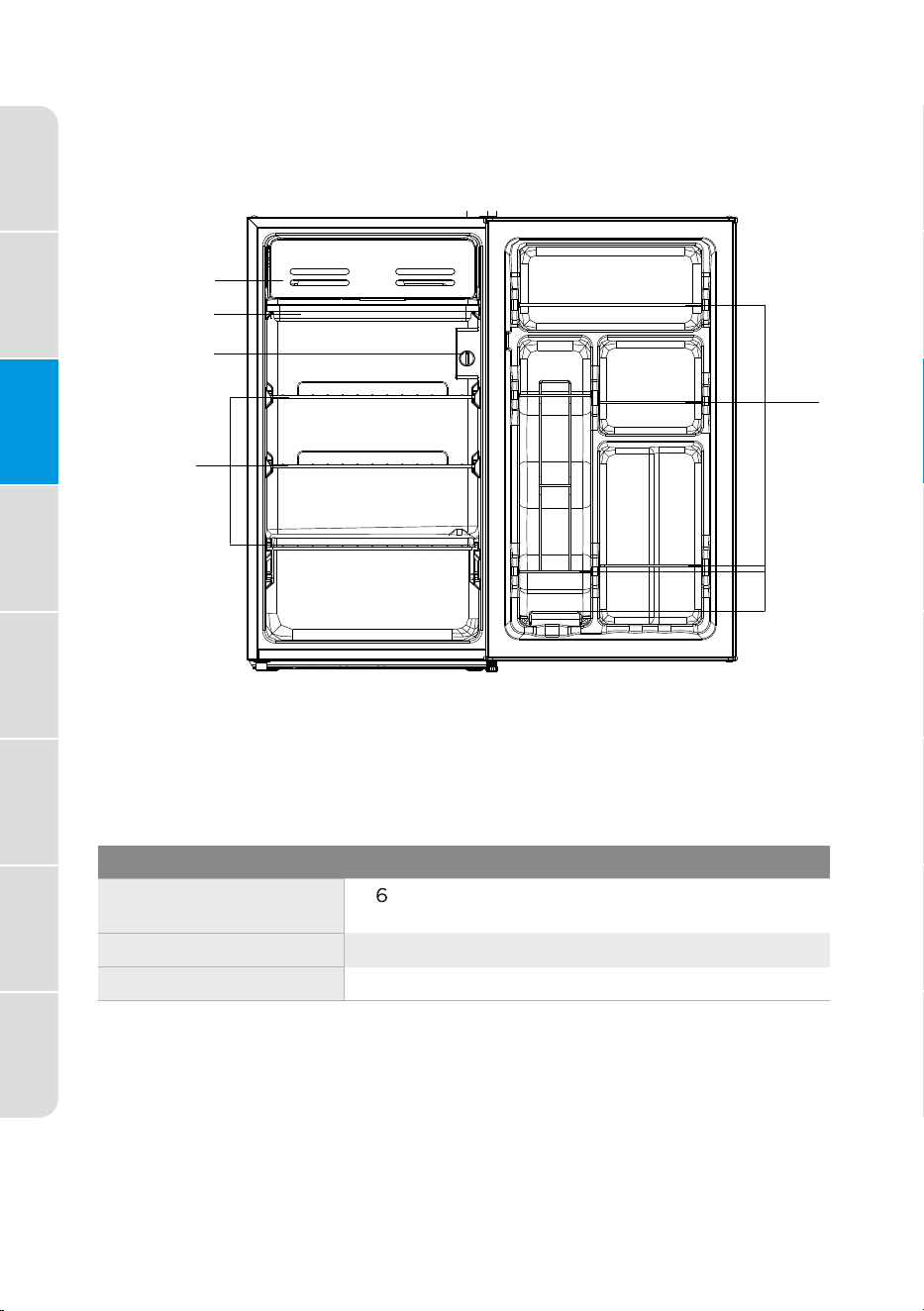
PARTS AND FEATURES
(The picture above is only for reference. The actual configuration will
depend on the physical product.)
SPECIFICATIONS
Dimension (WxDxH)
18.
" x 17.7" x 33.9"
(47.2 x 45.0 x 86.0 cm)
Power requirements
Power cord length
AC115 V /60 Hz
67" (170 cm)
Chiller Door
Drain Tray
Temperature
Control
Shelves
Storage
Rails
9
Refrigerator
Safety
Operation
Requirements
Parts and
Features
Installation
Refrigerator
Use
Refrigerator
Care
Troubleshooting
Before
Use
INSTALLATION
UNPACK
WARNING
Fire or Explosion Hazard
•
Do not puncture refrigerant tubing.
•
Follow handling instructions carefully.
•
Flammable refrigerant used.
•
Failure to do so can result in death, explosion or fire.
IMPORTANT: Remove ALL exterior and interior packing materials
including the foam packing between the exterior condenser and the
refrigerator cabinet.
MOVE TO FINAL LOCATION
WARNING
Fire or Explosion Hazard
•
Do not puncture refrigerant tubing.
•
Follow handling instructions carefully.
•
Flammable refrigerant used.
•
Failure to do so can result in death, explosion or fire.
IMPORTANT:
•
If the refrigerator has been in a horizontal position for any period of
time, wait 24 hours to allow the refrigerant to settle before plugging in
the refrigerator.
•
When moving the refrigerator, DO NOT tilt it beyond 45° from upright.
NOTE: Tilting the refrigerator more than 45° could damage the
compressor and the sealed system.
10
Refrigerator
Safety
Operation
Requirements
Parts and
Features
Installation
Refrigerator
Use
Refrigerator
Care
Troubleshooting
Before
Use
LEVEL REFRIGERATOR
IMPORTANT: Level the refrigerator for proper operation and to avoid
cooling, frost and moisture problems that can occur when the door does
not close properly.
1. Move the refrigerator to its final location. See “Move to Final Location.”
2. Place a carpenter's level on the top of the refrigerator cabinet.
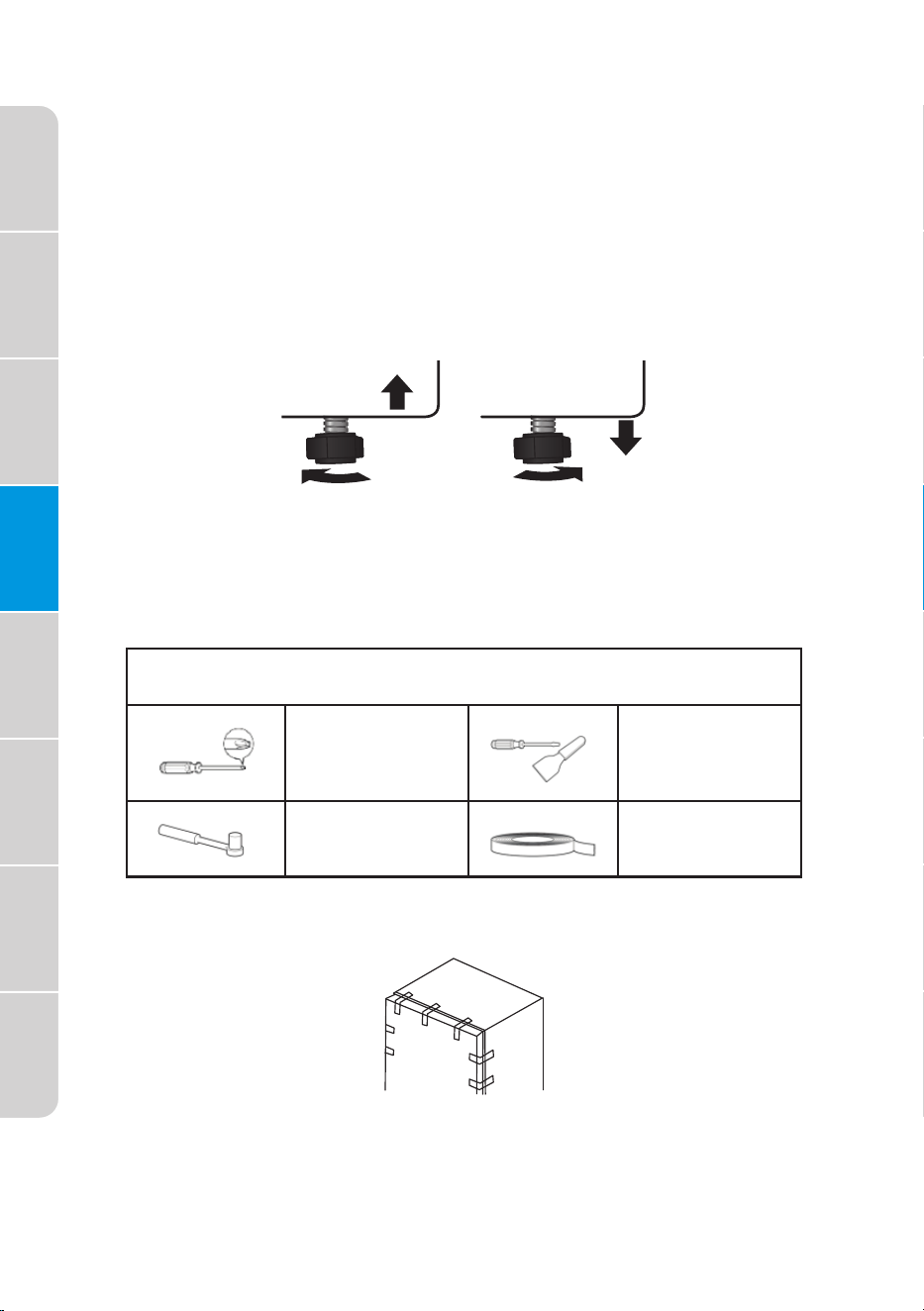
3. Adjust the two leveling feet, (one foot located at each of the two front
corners of the refrigerator cabinet) until the refrigerator is level.
NOTE: The leveling feet are easier to adjust if you have someone push
against the top front of the refrigerator to take some weight off the feet.
To Raise - Turn the leveling feet clockwise.
To Lower - Turn the leveling feet counterclockwise.
REVERSE THE DOOR SWING
List of tools to be provided by the user
Phillips-head
Screwdriver
Putty knife
Flat-head
Screwdriver
УШЕ К " socket and
ratchet
Masking tape
1. Unplug the refrigerator and remove all food from the door shelves.
Tape the door in place with masking tape.
11
Refrigerator
Safety
Operation
Requirements
Parts and
Features
Installation
Refrigerator
Use
Refrigerator
Care
Troubleshooting
Before
Use
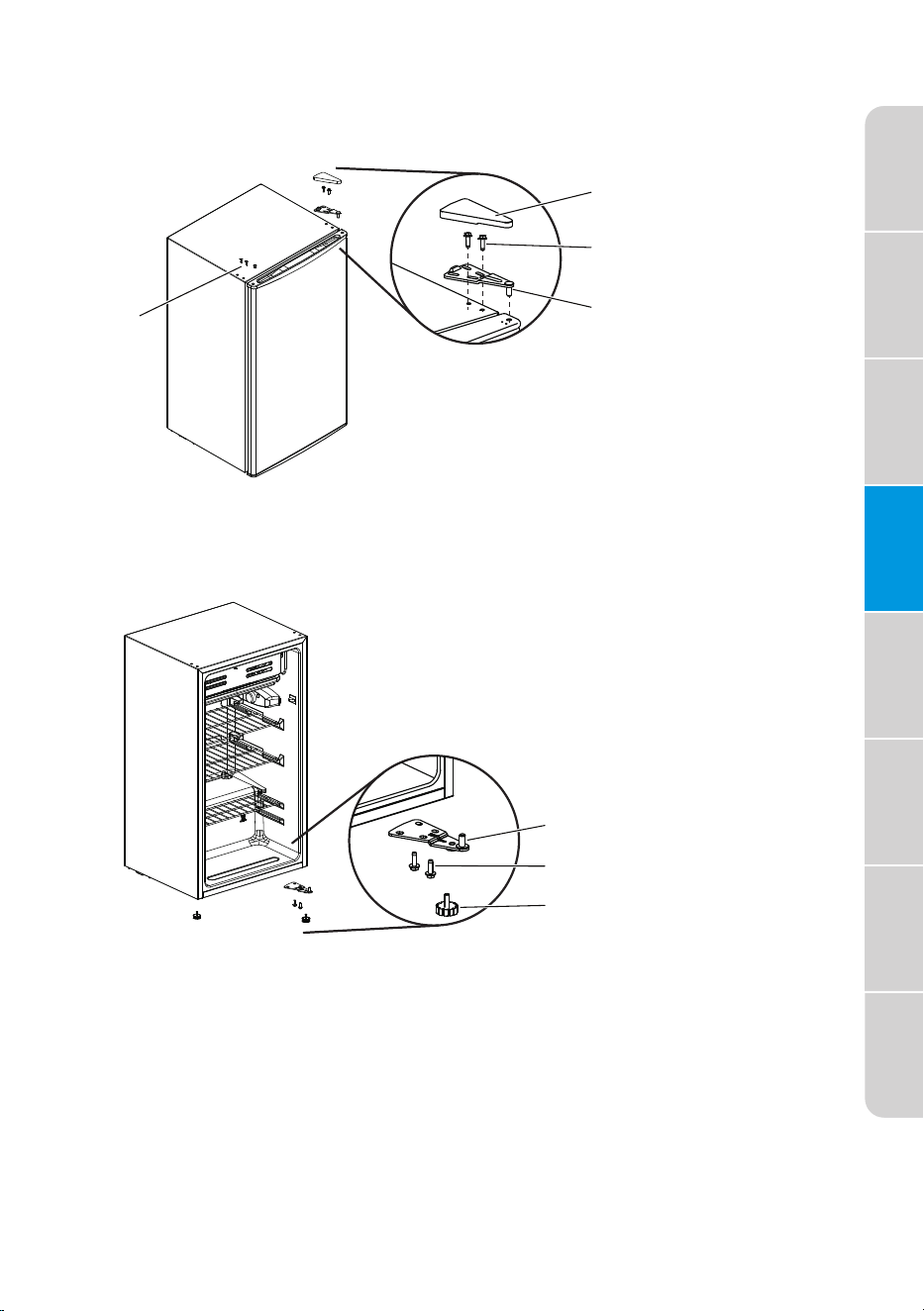
2. Remove the top right hinge cover. Unscrew the screws and remove
the top, right-hand side hinge. Keep the screws to reuse. Remove the
plastic screw hole covers from the top left side of the refrigerator.
a
c
b
d
a Hinge Cover
b Screws
c Top Hinge
d Hole Covers
3. Lift the door up and away from your refrigerator.
4. Unscrew the screws on the bottom right-hand side hinge and remove
the hinge and the leveling foot.
a
b
c
a Bottom Hinge
b Screws
c Leveling Foot
5. Unscrew the leveling foot from the bottom left side.
6. Install the bottom hinge onto the left side of the refrigerator.
7. Install the leveling foot on the right side of the refrigerator.
8. Carefully lift the refrigerator door and place it on the lower hinge.
12
Refrigerator
Safety
Operation
Requirements
Parts and
Features
Installation
Refrigerator
Use
Refrigerator
Care
Troubleshooting
Before
Use
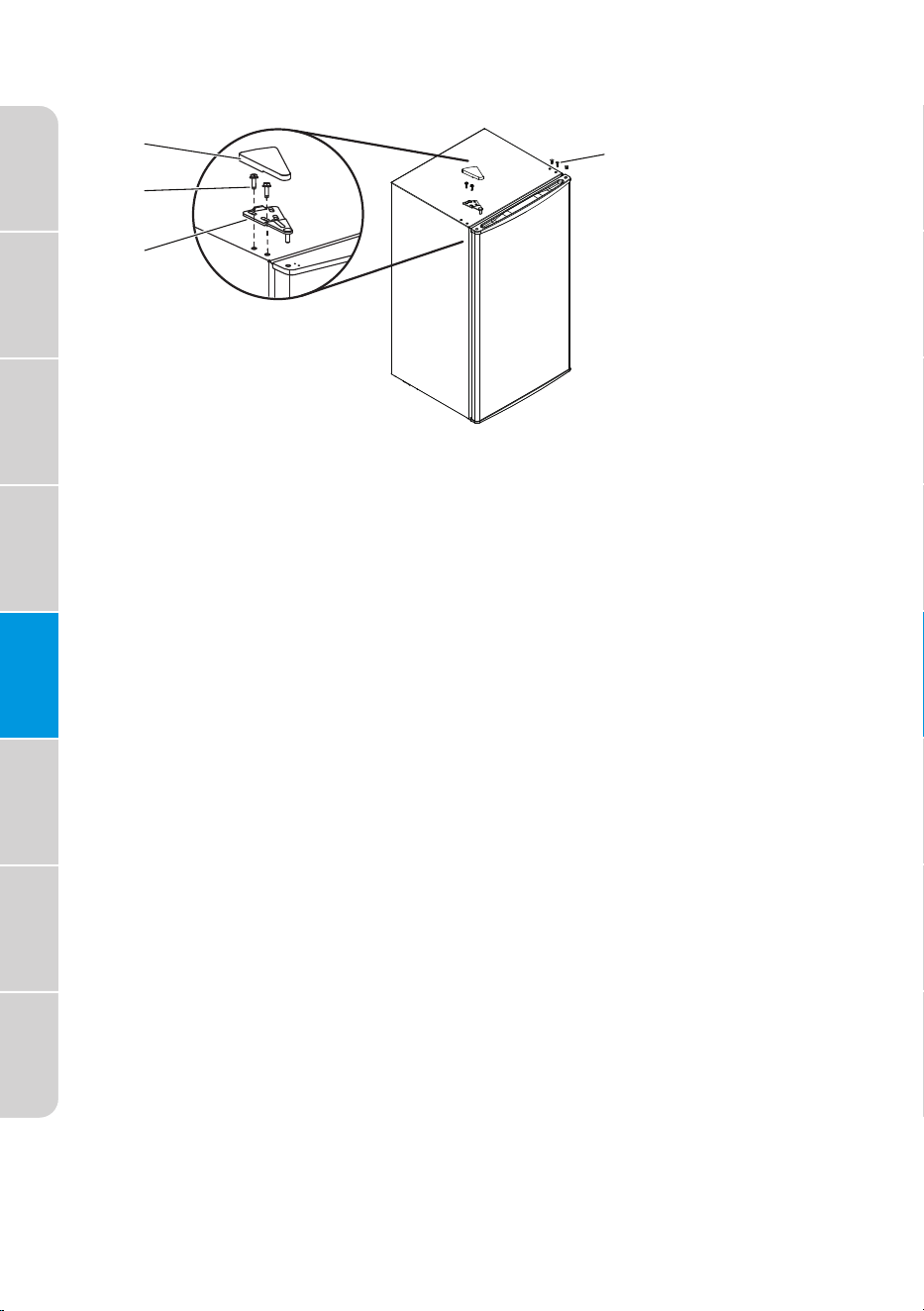
9. Install the top hinge on the right side of the refrigerator.
a
c
b
d
a
Hinge Cover
b Screws
c Top Hinge
d Hole Covers
10. Replace the hinge cover over the hinge. Place the plastic screw hole
covers on the right side of the refrigerator.
(The picture above is only for reference. The actual configuration will
depend on the physical product.)
BEFORE USE
WAITING PERIOD
•
Before plugging the refrigerator into a grounded 3-prong electrical
outlet, allow it to stand upright for approximately 2 hours.
NOTE: This reduces the possibility of a malfunction in the cooling
system from improper handling during transportation.
CLEANING
1. Wash the refrigerator interior using a soft cloth dampened with a
baking soda solution (2 tablespoons baking soda mixed with 1 quart of
warm water).
2. Using a soft cloth, thoroughly dry all surfaces.

13
Refrigerator
Safety
Operation
Requirements
Parts and
Features
Installation
Refrigerator
Use
Refrigerator
Care
Troubleshooting
Before
Use
REFRIGERATOR USE
GENERAL
•
The storage life of frozen foods varies and the recommended storage
time should not be exceeded.
•
Do NOT place beverage cans, bottles or other sealed containers of
liquid in the freezer. Freezing may cause the containers to crack and
leak, damaging the freezer.
WARNING
Electrical Shock Hazard
•
Plug into a grounded 3-prong outlet.
•
Do not remove the ground prong from the power cord plug.
•
Do not use an adapter.
•
Do not use an extension cord.
•
Failure to do so can result in death, fire or electrical shock.
1. Plug in your refrigerator. Wait for 30 minutes, and then open the
refrigerator door to determine if the refrigerator is working properly.
2. Place frozen food into the refrigerator as quickly as possible after
purchase. If there are instructions on the package, carefully follow
these instructions regarding storage times.
ENERGY SAVING TIPS
•
Allow hot foods to cool to room temperature before placing them in
the refrigerator. Foods that freeze too slowly may lose quality or spoil.
•
Overloading the refrigerator forces the compressor to run longer.
•
Wrap foods properly and wipe containers dry before placing them in
the refrigerator. This cuts down on frost build-up inside the refrigerator.
•
Do not line refrigerator storage shelves with aluminum foil, wax paper
or paper toweling. Liners interfere with cold air circulation, making the
refrigerator less efficient.
•
Organize and label food to reduce door openings and extended
searches. Remove as many items as needed at one time, and then
close the door as soon as possible.
•
Do NOT add a large amount of unfrozen food to the refrigerator at one
time. This will lower the cooling efficiency of the refrigerator.
14
Refrigerator
Safety
Operation
Requirements
Parts and
Features
Installation
Refrigerator
Use
Refrigerator
Care
Troubleshooting
Before
Use
CONTROLS
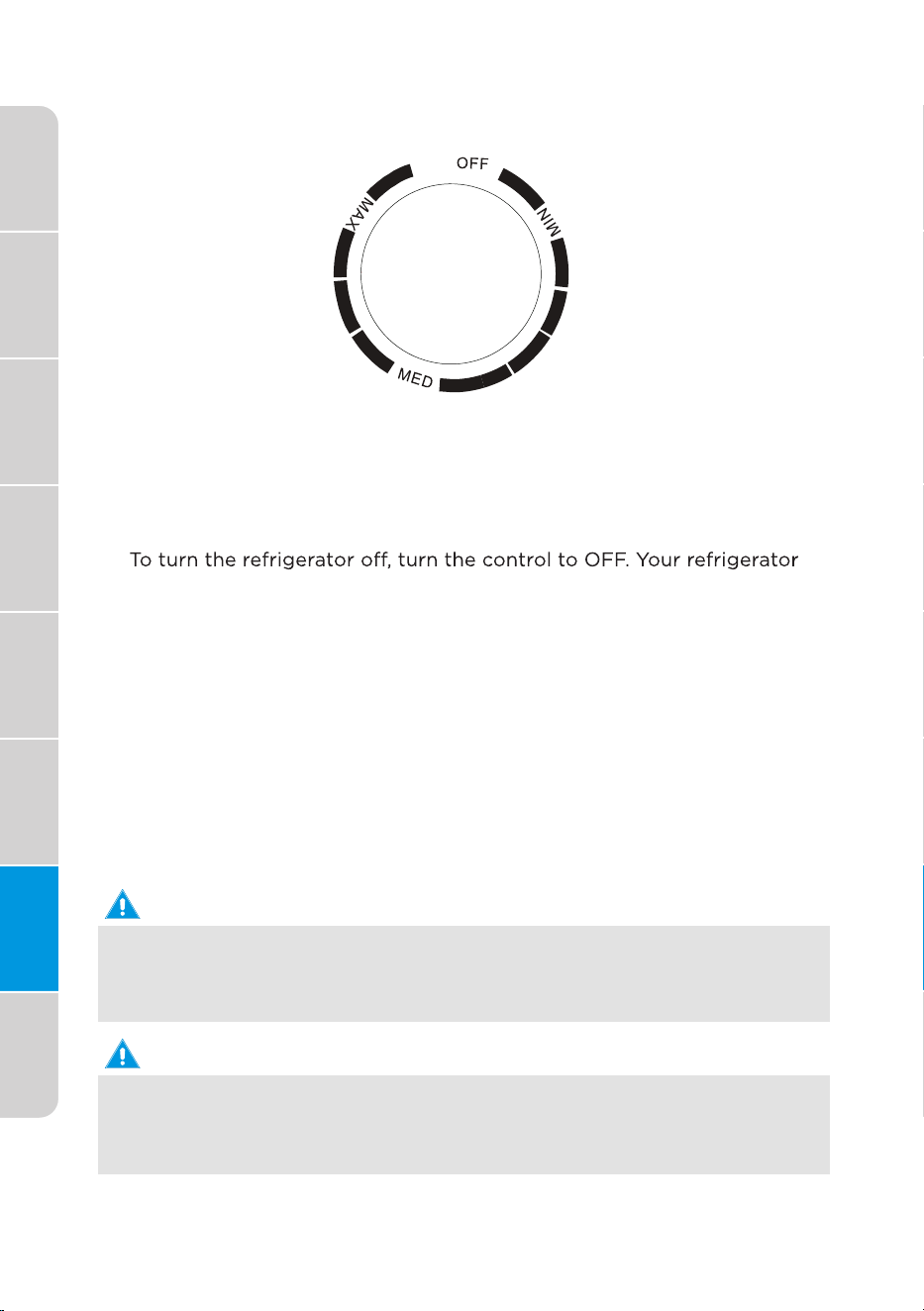
The controls are located inside your refrigerator. Turn the controls to
adjust the temperature of your refrigerator. Start with the controls at
the midpoint (MED) setting.
·
To make the refrigerator cooler, turn the knob toward MAX.
·
To make the refrigerator less cold, turn the control toward MIN.
·
will not cool when the control is set to OFF.
REFRIGERATOR CARE
Your refrigerator is designed for year-round use and requires minimal
cleaning and maintenance. To keep your refrigerator running efficiently
and odor free, we recommend that you clean the refrigerator regularly.
NOTE: To improve cooling, dust and clean behind the refrigerator
regularly.
CLEANING
WARNING
Electrical Shock Hazard
·
Unplug your appliance or disconnect power before cleaning.
·
Failure to do so can result in death, electric shock or personal injury.
WARNING
Explosion Hazard
·
Use nonflammable cleaner.
·
Failure to do so can result in death, explosion or fire.

15
Refrigerator
Safety
Operation
Requirements
Parts and
Features
Installation
Refrigerator
Use
Refrigerator
Care
Troubleshooting
Before
Use
IMPORTANT: To prevent damage to the finish, DO NOT use gasoline,
benzine, thinner or other solvents, and DO NOT use abrasive cleaners.
1. Unplug the refrigerator from the electrical outlet.
2. Remove all food.
3. Remove and wash the shelves with a mild detergent solution.
4. Wash the refrigerator interior using a soft cloth dampened with a
baking soda solution (2 tablespoons baking soda mixed with 1 quart of
warm water).
5. Clean the gasket around the door. Gently wipe the gasket using a soft
cloth dampened with a mild detergent solution.
NOTE: Gaskets must be kept clean and pliable to assure a proper seal.
6. Using a soft cloth, thoroughly dry all surfaces.
7. Plug in or reconnect power.
DEFROSTING
Defrost the refrigerator as needed when ice in the freezer compartment
becomes too thick.
1. Turn the refrigerator control to OFF. Unplug the refrigerator or
disconnect power.
2. Remove all food from the refrigerator and freezer compartments and
store in a cooler with ice, in another refrigerator or in a cool area.
3. Ensure that the drainpipe is clear. Use a soft cloth to clean the
refrigerator liner.
4. Place the drain tray under the evaporator to catch the water from the
melting ice. Empty the drain tray as necessary to prevent water from
overflowing.
5. Keep the refrigerator door open until the ice melts.
6. If desired, place a pan of hot water in the freezer to speed melting.
7. Use a plastic scraper to help remove ice and frost. Do not use an
ice pick, or other metal or sharp implement as this may damage the
refrigerator.
8. Once the ice has melted, dry the refrigerator with a soft cloth.
9. Plug in the refrigerator and turn the controls to the desired
temperature setting. When the refrigerator has cooled, return food to
the refrigerator and freezer compartments.

16
Refrigerator
Safety
Operation
Requirements
Parts and
Features
Installation
Refrigerator
Use
Refrigerator
Care
Troubleshooting
Before
Use
MOVING
IMPORTANT: When moving your refrigerator, DO NOT tilt it beyond 45°
from upright.
1. Unplug your refrigerator from the wall outlet.
2. Remove all food.
3. Securely tape down all loose items inside your refrigerator.
4. Tape the door shut.
STORAGE
IMPORTANT: Do not store refrigerator in a location that is accessible to
children.
1. Unplug your refrigerator from the electrical outlet.
2. Remove all food.
3. Clean the refrigerator.
4. Leave the door open slightly to avoid possible formation of
condensation, mold or odor.
17
Refrigerator
Safety
Operation
Requirements
Parts and
Features
Installation
Refrigerator
Use
Refrigerator
Care
Troubleshooting
Before
Use
TROUBLESHOOTING
IMPORTANT: DO NOT try to repair your refrigerator yourself. Doing so
invalidates the warranty.
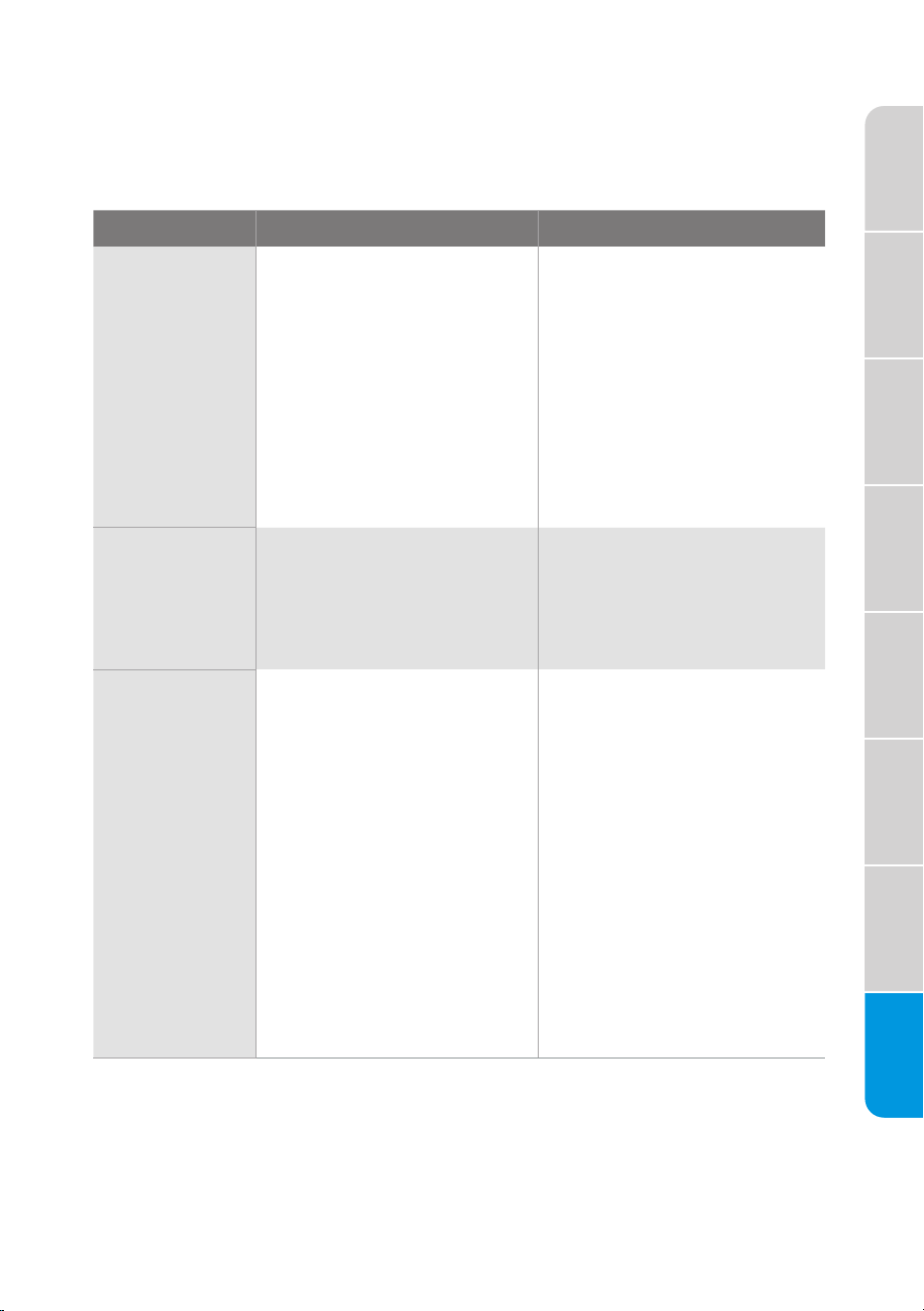
PROBLEM POSSIBLE CAUSE SOLUTION
The
refrigerator
does not
operate
The refrigerator is
unplugged.
Make sure that the
refrigerator power cord
is fully plugged into the
electrical outlet.
The fuse on the circuit
is blown or the circuit
breaker is tripped.
Check the house fuse /
circuit breaker box and
replace the fuse or reset
the circuit breaker.
Power failure. If a power failure occurs,
the refrigerator turns off.
Wait until the power is
restored.
The
refrigerator
door does
not close
completely
Food packages are
interfering with the door.
Move or remove some food
items.
The door gaskets are dirty. Clean the door gaskets.
The refrigerator may not
be level.
Level the refrigerator.
Food in the
refrigerator is
not cold
The door has been opened
too often or was not
closed properly.
Make sure that the door is
closed properly.
A large amount of food
was recently added.
Allow time for the recently
added food to cool, and
then check again.
The door is not closed
completely.
Check the door gasket
and food distribution, and
make sure that the door
closes completely.
The refrigerator has been
disconnected for a period
of time.
Allow 4 hours for the
refrigerator to cool
completely before adding
food.
The temperature control is
set too warm.
Set the temperature
control to a colder setting.
18
Refrigerator
Safety
Operation
Requirements
Parts and
Features
Installation
Refrigerator
Use
Refrigerator
Care
Troubleshooting
Before
Use
PROBLEM POSSIBLE CAUSE SOLUTION
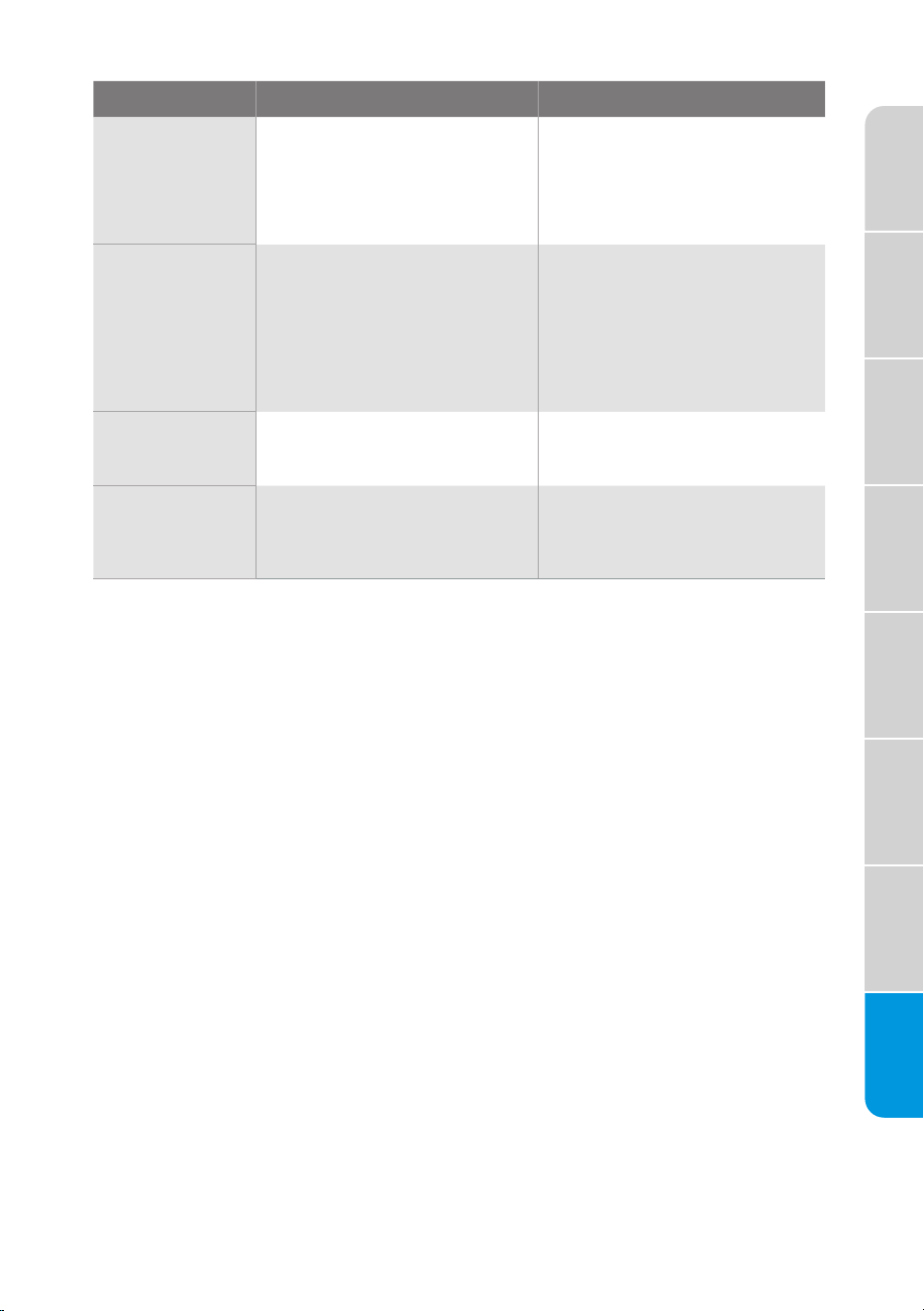
The
refrigerator
makes
unusual
noises or
vibrations
The refrigerator may not
be level.
Adjust the leveling feet
located on the front
corners of the refrigerator
until the refrigerator is
level.
The refrigerator cabinet is
touching a wall.
Move the refrigerator away
from the wall.
Metal parts undergo
expansion and contraction.
This is normal.
Refrigerant is circulating
throughout the system.
This is normal.
Moisture
is building
up in the
interior of the
refrigerator
The door has been
opened too often or was
not closed properly.
Make sure that the door is
closed properly.
The refrigerator is located
in a humid area.
Move the refrigerator to a
drier location.
The weather is hot and
humid.
This is normal.
The
compressor
turns on and
off frequently.
The room temperature is
hotter than normal.
This is normal.
A large amount of food
was recently added.
Allow time for the recently
added food to cool, and
then check again.
The door is not closed
completely or was opened
too often.
Check the door gasket and
food distribution to make
sure the door will close
completely.
The refrigerator has been
disconnected for a period
of time.
Allow 4 hours for the
refrigerator to cool
completely before adding
food.
The temperature control
was not set correctly.
Set the temperature
control to the correct
setting.
19
Refrigerator
Safety
Operation
Requirements
Parts and
Features
Installation
Refrigerator
Use
Refrigerator
Care
Troubleshooting
Before
Use
PROBLEM POSSIBLE CAUSE SOLUTION
Refrigerator
has an odor
Refrigerator needs
cleaning.
Clean the refrigerator. See,
“Cleaning.”
Improperly wrapped food
is giving off an odor.
Wrap food tightly or seal
before storing it in the
refrigerator.
The drain
tray has
overflowed
There is too much food in
the refrigerator causing
excessive defrosting.
Remove food from the
refrigerator. Empty the
drain tray more frequently.
The doors are not closing
properly allowing warm air
to enter the refrigerator.
Ensure the doors close
completely. See "The
refrigerator door does not
close completely"
The
compressor
housing is hot
The housing of the built-in
condenser is hot.
This is normal. Provide
adequate ventilation to aid
cooling.
There is
condensation
on the
exterior
The weather is hot and
humid.
This Is normal. Use a
soft cloth to wipe off the
excess moisture.

22