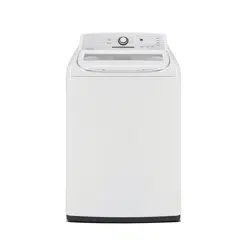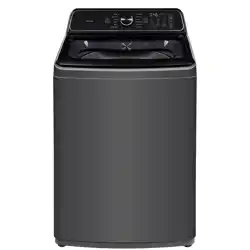
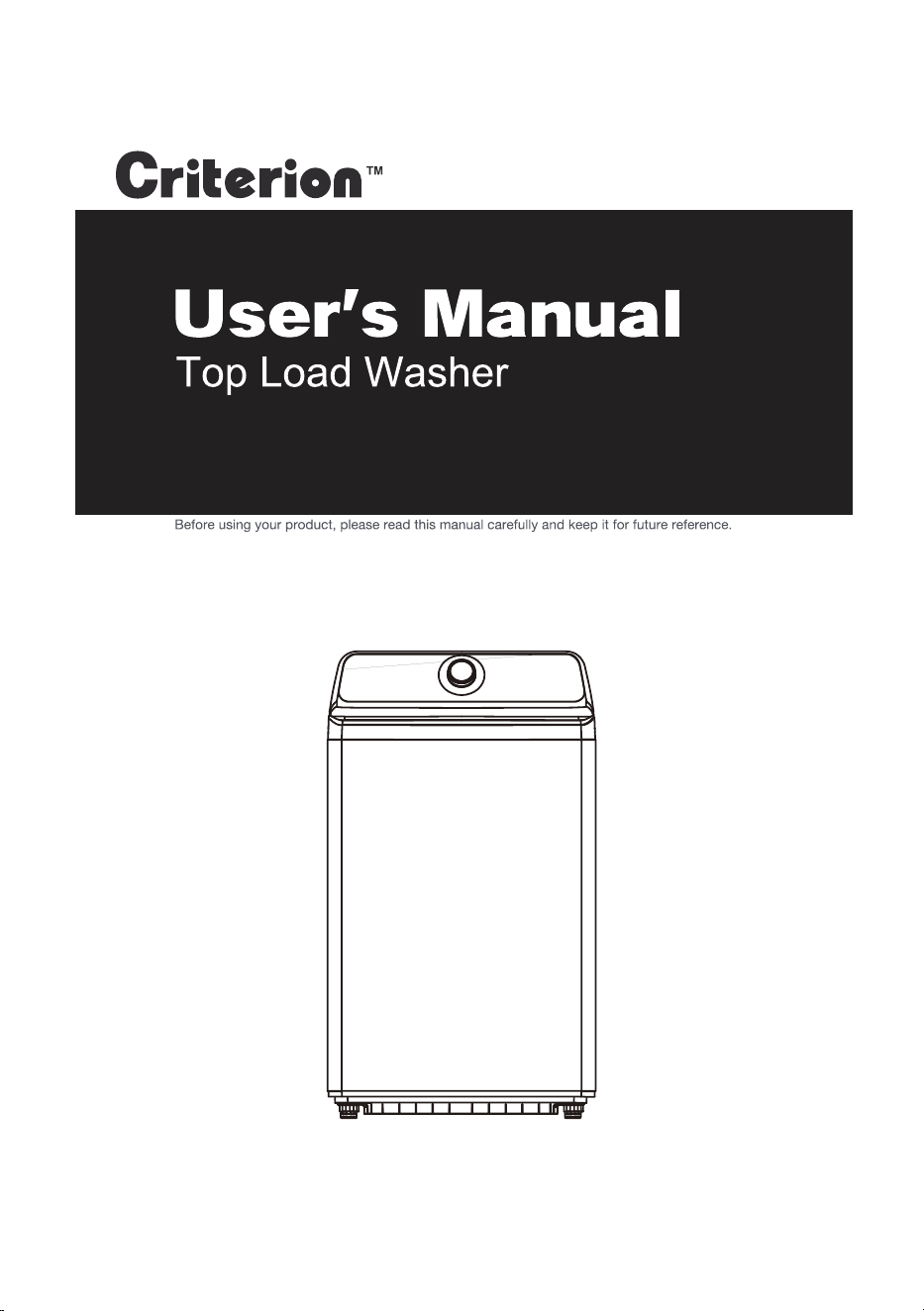
MODEL:CLTW44A2BG

SAFETY INSTRUCTIONS ...................................................................4
FEATURES ......................................................................................... 11
Package contents ......................................................................................11
Main components .....................................................................................12
OPERATION REQUIREMENTS ........................................................ 13
Electrical requirements ..........................................................................13
Water requirements ................................................................................14
Drainage requirements ..........................................................................14
INSTALLATION INSTRUCTIONS .................................................... 15
Unpacking your washer .........................................................................15
Choosing a location ................................................................................ 16
Tools you will need ................................................................................. 18
Connect the water hoses ..................................................................... 19
Connect the drain hose ......................................................................22
Level your washer ..................................................................................23
Power on .....................................................................................................24
Run a test cycle ....................................................................................... 25
WASHER USE ...................................................................................26
Control panel.............................................................................................26
Washing a load of laundry .................................................................. 28
Selecting a detergent ...........................................................................28
Loading the fabric softener compartment .....................................30
CAUTION
RISK OF ELECTRIC SHOCK
DO NOT OPEN
WASHER CARE ................................................................................32
Cleaning and maintenance ................................................................. 32
BEFORE YOU CALL FOR SERVICE ...............................................34
Troubleshooting tips ..............................................................................34
Error codes ............................................................................................... 37
WARRANTY ......................................................................................38
PRODUCT REGISTRATION ............................................................ 40
READ AND KEEP THESE INSTRUCTIONS FOR
FUTURE REFERENCE
This manual contains important information on the installation, use,
and care of your appliance. Please read this manual carefully before
installation and operation of this machine to prevent injury and
property damage.
Warnings and Important Safety Instructions in this manual DO NOT
cover all possible conditions and situations that may occur. It is your
responsibility to use common sense, caution and care when installing,
maintaining and operating your washer.
3
Safety
Instructions
Features
Operation
Requirements
Installation
Instructions
Washer Care
Troubleshooting
Washer Use
滚滚长江东逝水
Safety
Instructions
Features
Operation
Requirements
Installation
Instructions
Washer Care
TroubleshootingWasher Use
WARNING
This symbol indicates that there are important
operating and maintenance instructions in the literature
accompanying your washing machine.
CAUTION
This indicates that hazards or unsafe practices may cause
minor personal injury or property damage.
WARNING
This indicates that hazards or unsafe practices may cause
serious personal injury or death.
To reduce the risk of fire, explosion, electric shock or
personal injury when using your washing machine, you
SHOULD follow these basic safety precautions.
WARNING
State of California Proposition 65 Warnings.
The california Safe Drinking Water and Toxic Enforcement Act requires
the Governor of California to publish a list of substances known to the
State of california to cause cancer, birth defects or other reproductive
harm and requires businesses to warn of potential exposure to such
substances. This product contains a chemical known to the State of
California to cause cancer, birth defects or other reproductive harm.
This appliance can cause low-Ievel exposure to some of the substances
listed, including benzene, formaldehyde and carbon monoxide. Cancer
and Reproductive Harm - www.P65Warnings.ca.gov.
4
SAFETY INSTRUCTIONS
YOUR SAFETY AND THE SAFETY OF OTHERS ARE VERY
IMPORTANT
To prevent injury to the user or other people and property damage, the
instructions shown here must be followed. Incorrect operation due to
ignoring of instructions may cause harm or damage, including death.
The level of risk is shown by the following indications.
WARNING
Do not store or use gasoline or other f1ammable vapors and liquids in
the vicinity of this or any other appliance.
Safety
Instructions
Features
Operation
Requirements
Installation
Instructions
Washer Care
Troubleshooting
Washer Use
IMPORTANT SAFETY INSTRUCTIONS
5
WARNING
• Read all instructions before using the appliance.
• Use this appliance only for its intended purpose as described in this
Owner’s Manual.
• Before use, the appliance must be properly installed as described in
this manual.
• ALWAYS follow the fabric care instructions supplied by the garment
manufacturer.
• Do not wash articles that have been previously cleaned in, washed
in, soaked in, or spotted with gasoline, dry-cleaning solvents, other
ignite or explode.
• Do not allow children to play on or in the appliance. Close supervision
of children is necessary when the appliance is used near children.
• Before the appliance is removed from service or discarded, remove the
lid of the washing compartment.
• Do not reach into the appliance if the tub is moving.
• Do not install or store this appliance where it will be exposed to the
weather or freezing temperatures.
• Do not tamper with the controls.
• Do not repair or replace any part of the appliance or attempt
any servicing unless it is specifically recommended in the user
maintenance instructions or in published user repair instructions that
you understand.
• Hydrogen gas is explosive. If the hot water system has not been used
for two weeks or more, before using a washer, turn on all hot water
faucets and let the water flow from each for several minutes. This will
release any accumulated hydrogen gas. The gas is flammable, so do
not smoke or use an open flame during this time.
• Keep the area underneath and around your appliance free of
combustible materials (lint, paper, rags and so on), gasoline chemicals,
and other flammable vapors and liquids.
• Do not place items exposed to cooking oil in your washer. ltems
contaminated with cooking oil may contribute to a chemical reaction
that could cause a load to catch fire.
• This washer is not designed for maritime use or for mobile installations
such as in RVs aircraft and other mobile platforms.
•
be left for an extended period of time, such as during vacations.
• Packaging material can be dangerous for children. There is a risk of
• Always check the inside ofthe washer for foreign objects before
loading laundry. Keep the lid closed when not in use.

Safety
Instructions
Features
Operation
Requirements
Installation
Instructions
Washer Care
TroubleshootingWasher Use
• Plug the power cord into an AC 120V/60Hz wall socket rated at 15 amps
or higher. Use the socket for this washer only. Do not use an extension
cord.
- Sharing a wall socket with another appliance, using a power strip, or
extending the power cord may result in electric shock or fire.
- Do not use an electric transformer. lt may result in electric shock or fire.
- Make sure that the power voltage, frequency and current match the
product’s specifications. Failing to do so may result in electric shock or
fire.
•
Remove all foreign substances such as dust or water from the power
plug terminals and contact points using a dry cloth on a regular basis.
- Unplug the power plug and clean it with a dry cloth.
- Failing to do so may result in electric shock or fire.
•
Plug the power plug into the wall socket in the right direction so that
the cord runs towards the floor.
- If you plug the power plug into the socket in the opposite direction, the
electric wires within the cable may be damaged and this may result in
electric shock or fire.
•
Plug the power plug into the wall socket firmly. Do not use a damaged
power plug or loose wall socket, because this may result in electric
shock fire.
•
Do not pull or excessively bend the power cord. Do not twist or tie the
power cord.
•
Do not hook the power cord over a metal object. Place a heavy object
on the power cord, insert power cord between objects, or push the
power cord into the space behind the appliance, because this may result
in electric shock or fire.
•
Do not pull the power cord when unplugging the power plug.
- Unplug the power plug by holding the plug.
- Failing to do so may r
esult in electric shock or fire.
•
If the power plug or power cord is damaged, contact your nearest
service center.
•
Do not install on carpet. Install the washer on a level and solid floor that
can support its weight. Failure to do so may result in abnormal vibration,
noise or problems with the product.
•
The washer is heavy. Two or more people may be needed to install
and move the appliance. Failure to do so may result in bodily or other
injuries.
•
Store and install the washer where it will not be exposed to
temperatures below freezing or exposed to outdoor weather conditions.
Failure to do so may result in serious leak damage.
• Position the appliance so that the power plug is easily accessible. Failure
to do so may result in electric shock or fire due to an electrical short
circuit.
• Failure to follow all of the safety warnings in this guide may result in
property damage or injury to persons.
6
WARNING
Safety
Instructions
Features
Operation
Requirements
Installation
Instructions
Washer Care
TroubleshootingWasher Use
WARNING
7
Use and Maintenance warnings and Precaution
• If the appliance is flooded, cut the power immediately and contact
your nearest service center.
• If the appliance emits a strange noise, a burning smell or smoke,
unplug the power plug immediately and contact your nearest service
center. Failure to do so may result in electric shock or fire.
• In the event of a gas leak (such as propane or LP gas) ventilate the
- Do not use a ventilating fan.
- A spark may result in an explosion or fire.
• Do not force the washer lid open while the washer is operating
(hightemperature washing, drying or spinning).
- Water flowing out of the washer may cause burns or cause the floor
to be slippery. This may result in injury.
- Forcing the lid open can damage the product or cause injury.
• Make sure to remove the packaging (sponge, styrofoam) attached to
the bottom of the washer before using it.
• Do not insert your hand or a metal object under the washer. This may
result in injury.
• Do not attempt to operate this appliance if it is damaged,
malfunctioning, partially disassembled or has missing or broken parts,
including a damaged cord or plug. This may result in electric shock,
fire or death.
• Do not touch the power plug with wet hands. This may result in
electric shock.
•
washer is in operation. Plugging the power plug into the wall socket
again may cause a spark and result in electric shock or fire.
• Keep all packaging material well out of the reach of children, as
packaging materials can be dangerous to children. lf a child places a
• Do not let children or infirm persons use this washer unsupervised.
Failure to do so may result in electric shock, burns or injury.
• Do not attempt to repair, disassemble or modify the appliance yourself.
- Do not use any fuse (such as copper, steel wire etc.) other than the
standard fuse.
- If you need to repair or reinstall the appliance, contact your nearest
service center.
- Failure to do so may result in electric shock, fire, problems with the
product or injury.
• If any foreign substance such as water enters the appliance in any area
other than the tub, unplug the power plug and contact your nearest
service center. Failure to do so may result in electric shock or fire.
• If the water supply hose comes loose from the faucet and floods
the appliance, unplug the power plug. Failure to do so may result in
electric shock or fire.
Safety
Instructions
Features
Operation
Requirements
Installation
Instructions
Washer Care
TroubleshootingWasher Use

Safety
Instructions
Features
Operation
Requirements
Installation
Instructions
Washer Care
TroubleshootingWasher Use
9
• Do not stand on top of the appliance or place objects (such as laundry,
lighted candles, lighted cigarettes, dishes, chemicals, metal objects,
etc.) on the appliance. This may result in electric shock, fire, problems
with the product, or injury.
• Do not operate the appliance with wet hands. This may result in
electric shock.
• Do not spray volatile material such as insecticide onto the surface of
the appliance. As well as being harmful to humans, it may also result in
electric shock, fire or problems with the product.
• Do not place an object that generates an electromagnetic field near
the washer. This may result in injury due to a malfunction.
• Since the water drained during a high temperature wash or drying
cycle is hot, do not touch the water. This may result in burns or injury.
•
Do not wash, spin or dry water-proof seats, mats or clothing.
• Do not wash thick, hard mats even if the washer mark is on the care
label. This may result in injury or damage to the washer, walls, floor or
clothing due to abnormal vibrations.
• Do not operate the washer when the detergent dispenser is removed.
This may result in electric shock or injury due to water leakage.
•
Do not insert your hand into the detergent dispenser after opening it.
This may result in injury because your hand may be caught.
•
Do not place any non-Iaundry objects, such as shoes, food waste or
animals into the washer. This can cause abnormal vibrations that can
damage the washer, and in the case of pets, cause severe injury or
death.
•
Do not press the buttons using sharp objects such as pins, knifes, or
fingernails. This may result in electric shock or injury.
•
Do not wash laundry contaminated by oils, creams or lotions usually
found in skin-care shops or massage clinics. This may result in the
rubber seal becoming deformed and water leakage.
•
Make sure that the water inlet pipe is connected and the tap is opened
before w
ashing clothes.
• Do not leave metal objects (safety pins, hair pins, and so on) or bleach
in the tub for long periods of time. This may cause the tub to rust.
- If rust appears on the surface of the tub, apply a neutral cleansing
agent to the surface and use a sponge to clean it. Never use a metal
brush.
•
Do not use hot water from water cooling/heating devices. This may
result in problems with the washer.
•
Do not use natural hand-washing soap in the washer. lf it hardens
and accumulates inside the washer, it may cause problems with the
product, discoloration, rust or bad odors.
• If using a washing net with this machine (not provided), do not wash
laundry items such as bedding in the washing net. Doing so may result
in injury due to abnormal vibrations. Place only smaller items such as
lace socks and lingerie in the washing net.
• Do not use hardened powdered detergent. If it accumulates inside the
washer, it may result in water leakage.
• Do not wash throw rugs or doormats. Doing so may cause sand to
accumulate inside the washer, resulting in mechanical problems.

Grounding/Earthing
• This appliance must be properly grounded.
•
Do not ground the appliance to a gas pipe, plastic water pipe or
telephone line.
- Improper grounding may result in electric shock, fire, explosion or
problems with the product.
- Never plug the power cord into a socket that is not grounded correctly.
Make sure that the socket you use is grounded in correctly. Make sure
that the socket you use is grounded in accordance with local and
national codes.
WARNING
Safety
Instructions
Features
Operation
Requirements
Installation
Instructions
Washer Care
TroubleshootingWasher Use
Grounding/Earthing
• Do not install this appliance near a heater or inflammable material.
• Do not install this appliance in a humid, oily or dusty location, or in a
location exposed to direct sunlight or water (rain drops).
• Do not install this appliance in a location where gas may leak. Failure to
do so may result in electric shock or fire.
• If the washer is moved to a new location, have it checked and reinstalled
by a qualified service technician. Failure to follow this warning may
result in electric shock or fire.
• Do not pull power cord or drain outlet hose to move appliance to
desired location place.
WARNING
10
Safety
Instructions
Features
Operation
Requirements
Installation
Instructions
Washer Care
TroubleshootingWasher Use
NOTE:
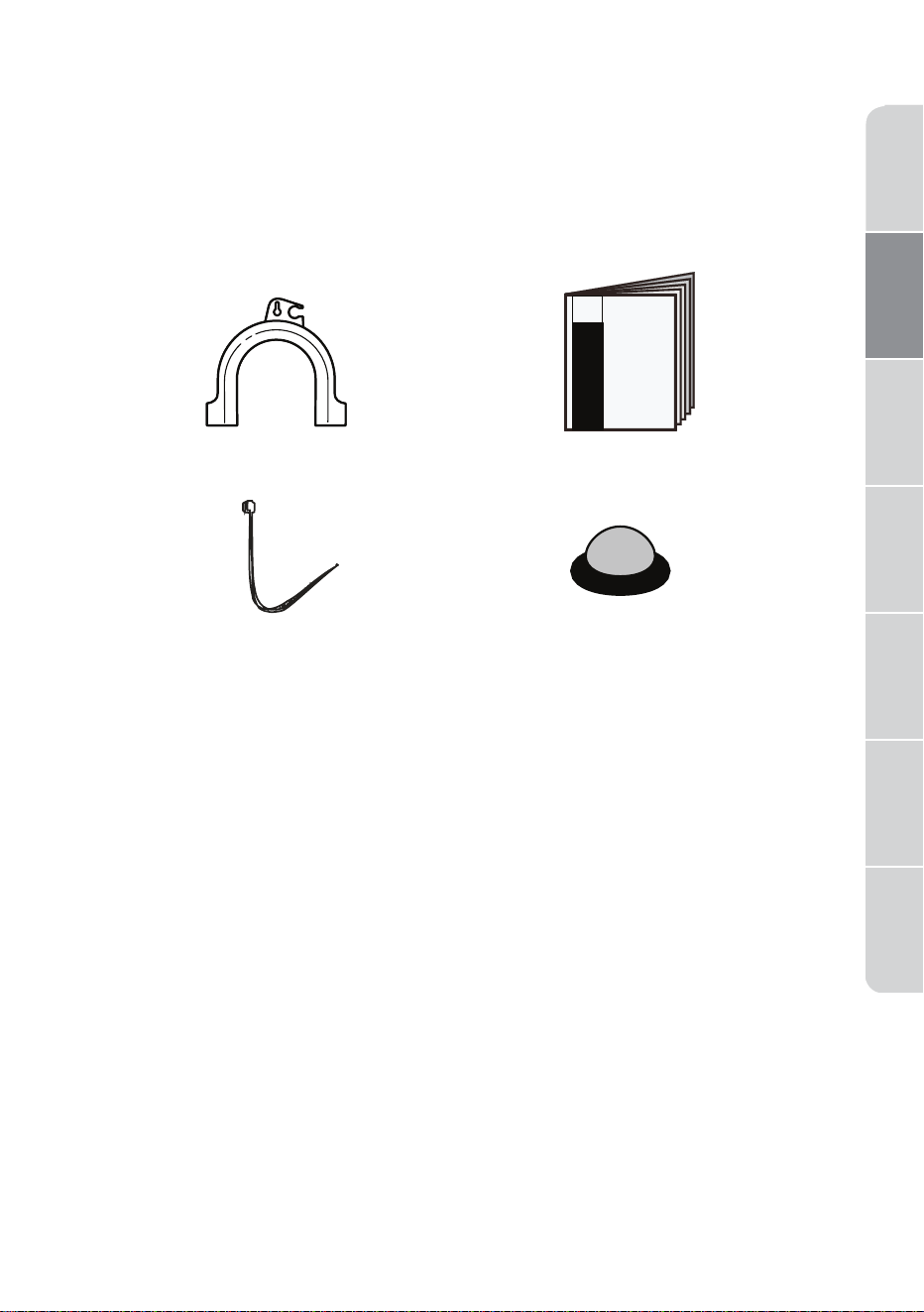
• Use the filters to replace the rubber washers in the water hoses
(faucet sides).
11
FEATURES
Package Contents
Make sure that the following items came with your washer
Drain Hose Guide
Filter (x2) Tie (x1)
Manual
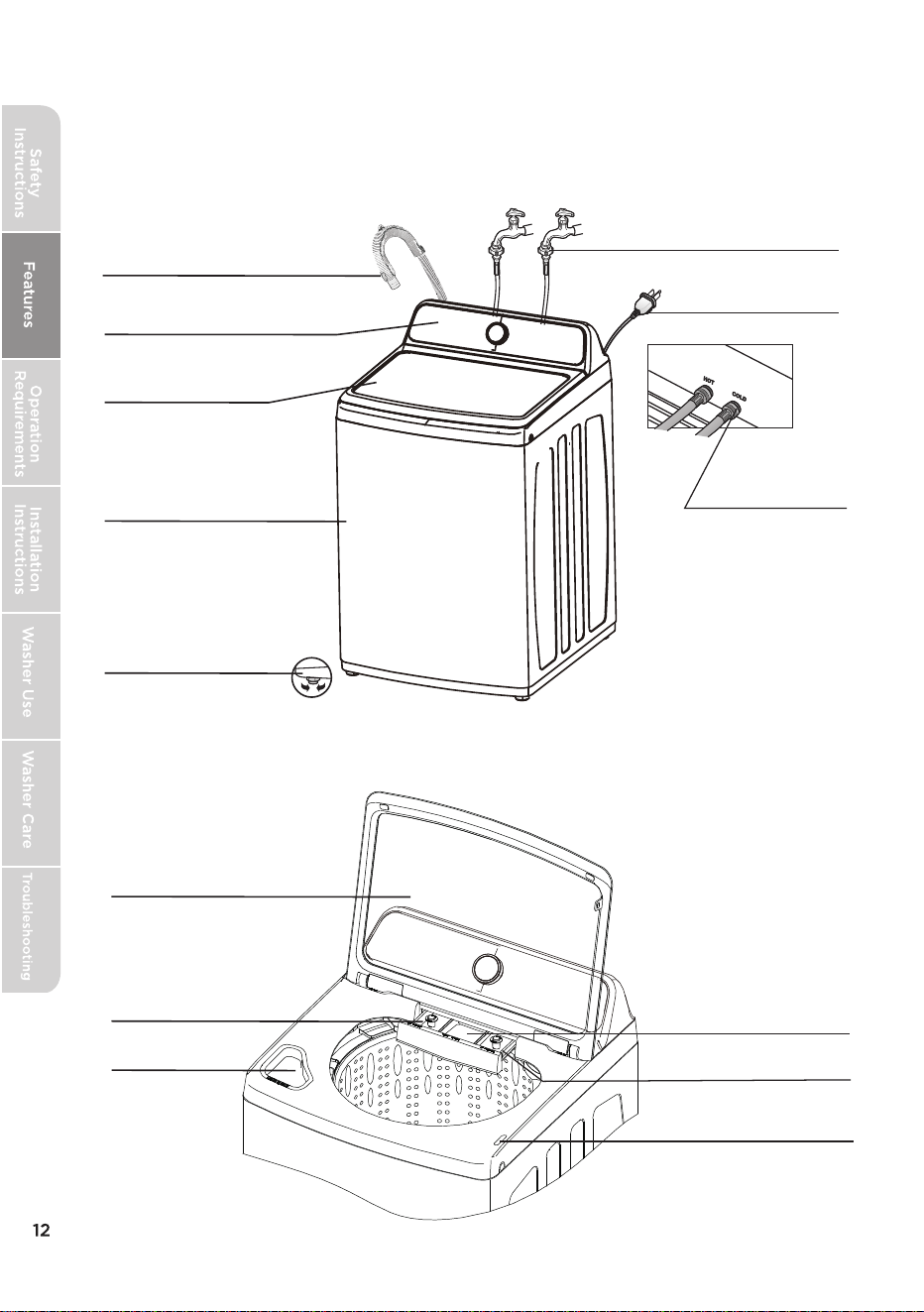
Look through window
Bleach
compartment
Detergent compartment
Powder
Softener compartment
Door locker
Main Components
Faucet and Water inlet hose
(Not supplied)
Power cord
water inlet valve
Drainage hose and holder
Control panel
Top lid
Cabinet
Adjustable leg
(Four legs )
Safety
Instructions
Features
Operation
Requirements
Installation
Instructions
Washer Care
TroubleshootingWasher Use
OPERATION REQUIREMENTS
Electrical requirements
WARNING
To reduce the risk of ire, electric shock, or injury to persons, read the
SAFETY INSTRUCTIONS before operating this appliance.
Use a 120 Volt, 60Hz, 15 amp fuse or circuit breaker. We recommend an
individual branch circuit that serves only your washer.
WARNING
Never use an extension cord.
Electrical grounding is required for your washer.
You must ground your washer. IN the event of a malfunction or
breakdown, grounding reduces the risk of electric shock by providing a
path of least resistance for the electric current.
Your washer is equipped with a power cord with a three-pronged
grounding plug for use in a correctly installed and grounded outlet.
The outlet must be correctly installed and grounded in accordance with
all local codes and ordinances.
WARNING
• You are responsible for providing adequate electrical services for
your washer.
• An incorrectly connected equipment-grounding conductor
can increase the risk of electrical shock. Check with a qualified
electrician or serviceman if you are not sure whether your washer is
grounded correctly.
• Do not modify the power cord plug that came with your washer.
lf the plug does not fit the outlet, have the correct type outlet
installed by a qualified electrician.
• To prevent unnecessary risk of fire, electrical shock or personal
injury, all wiring and grounding must be done in accordance with
the National Electrical Code ANSI/FNPA, No.70 Latest Revision and
local codes and ordinances.
• Never connect the ground wire to plastic plumbing lines, gas lines
or hot water pipes.
13
Safety
Instructions
Features
Operation
Requirements
Installation
Instructions
Washer Care
TroubleshootingWasher Use
Water requirements
To fill your washer in the correct amount of time, the water pressure
needs to be between 14 and 116 psi (100 to 800 kPa).
If the water pressure is less than 14 psi (100 kPa):
•
• The time it takes to fill your washer may be longer than the time
error. A time-limit is built into the controls to prevent flooding in
your home if a hose becomes loose.
•
Water inlet hoses must be purchased separately. You can buy inlet
hoses in various lengths up to 8 ft. (240 cm).
To avoid the possibility of water damage:
• Make sure that the water faucets are easily accessible.
•
• Periodically check to make sure that water is not leaking from the
water hose fittings.
Drainage requirements
The recommended height for the drain standpipe is 48 in. (122 cm).
The drain hose must be routed through the drain hose clip to the
standpipe.
The standpipe must be large enough to accept the outside diameter of
the drain hose.
14
Safety
Instructions
Features
Operation
Requirements
Installation
Instructions
Washer Care
TroubleshootingWasher Use
INSTALLATION INSTRUCTIONS
Unpacking your washer
WARNING
• Packing materials can be dangerous to children. Keep all packing
materials (plastic bags, polystyrene, and so on) well out of the
reach of children.
• Do not operate your washer on the foam base cushion. Doing
so will result in serious vibration, which could cause equipment
damage or result in physical injury.
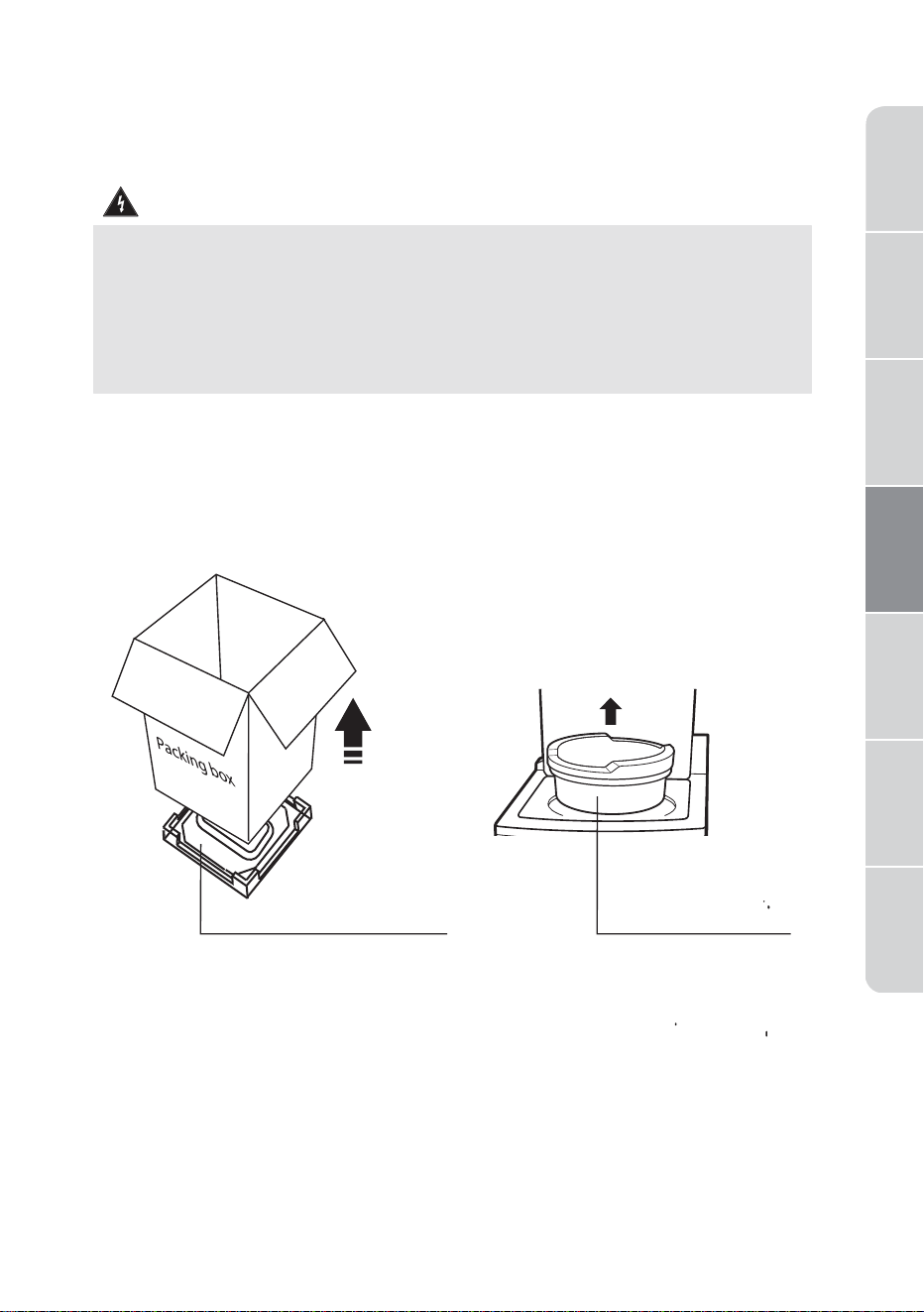
Remove the packing box and lift the washer up and away from the foam
base cushion. Open the lid of the washer to take out all accessories
including the protective foam.
15
Base foam cushion Protection foam
Safety
Instructions
Features
Operation
Requirements
Installation
Instructions
Washer Care
TroubleshootingWasher Use
14
16
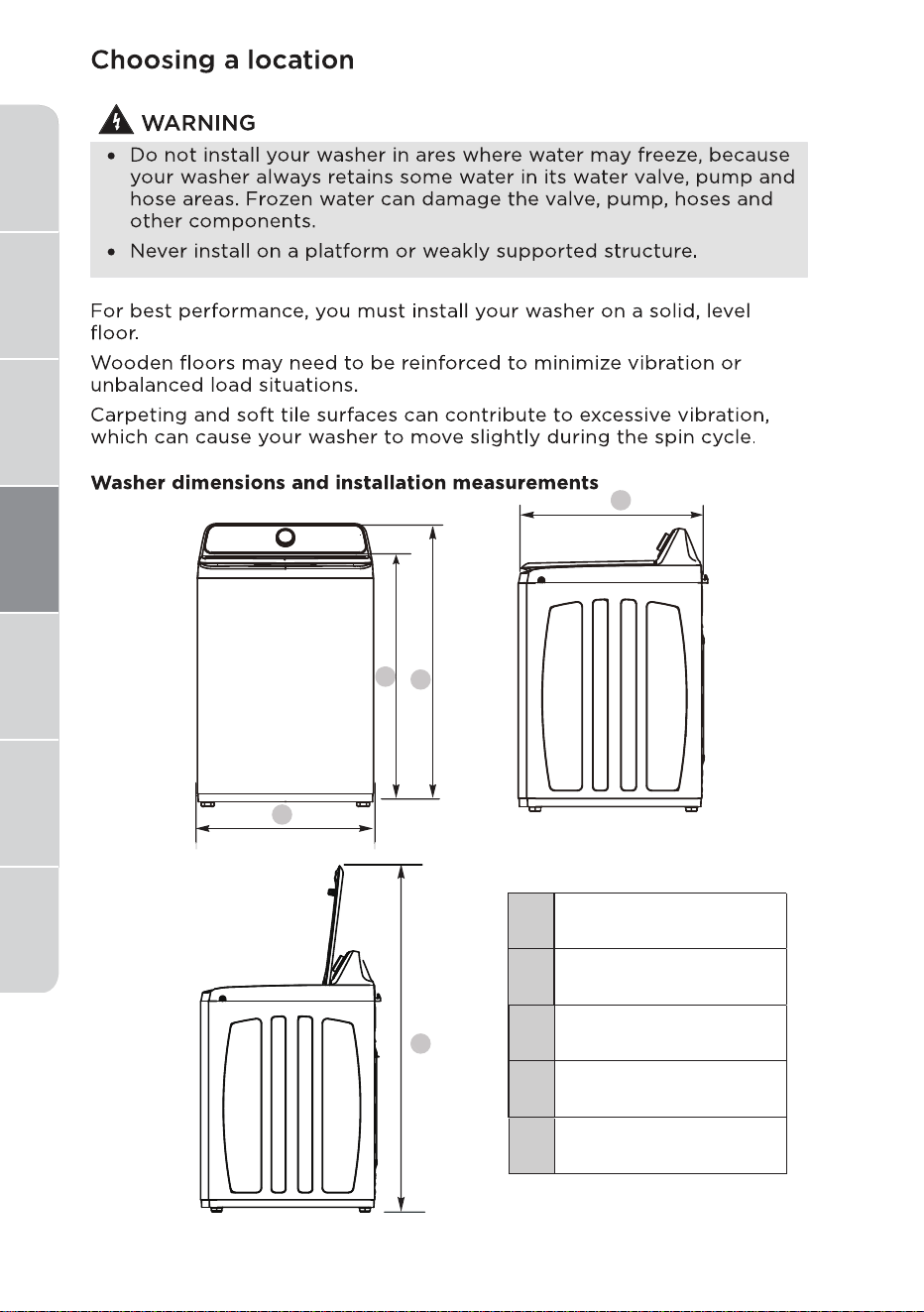
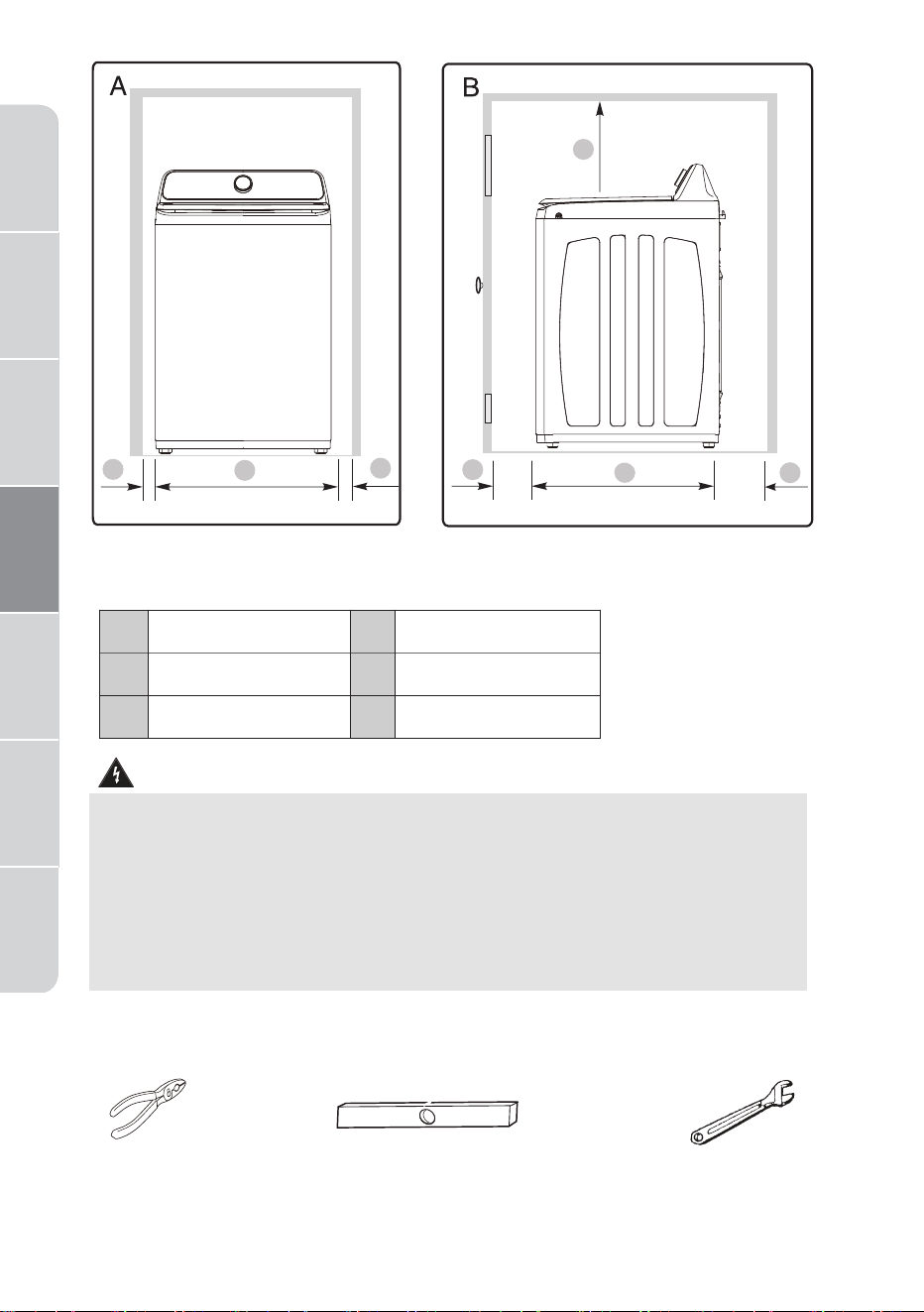
* Required spacing
A
36.6 in. (930mm)
43.3 in. (1100mm)
27.0 in. (686mm)
29.9 in. (760mm)
57.4 in. (1457mm)
B
C
D
E
A
B
C
D
E
Safety
Instructions
Features
Operation
Requirements
Installation
Instructions
Washer Care
TroubleshootingWasher Use
17
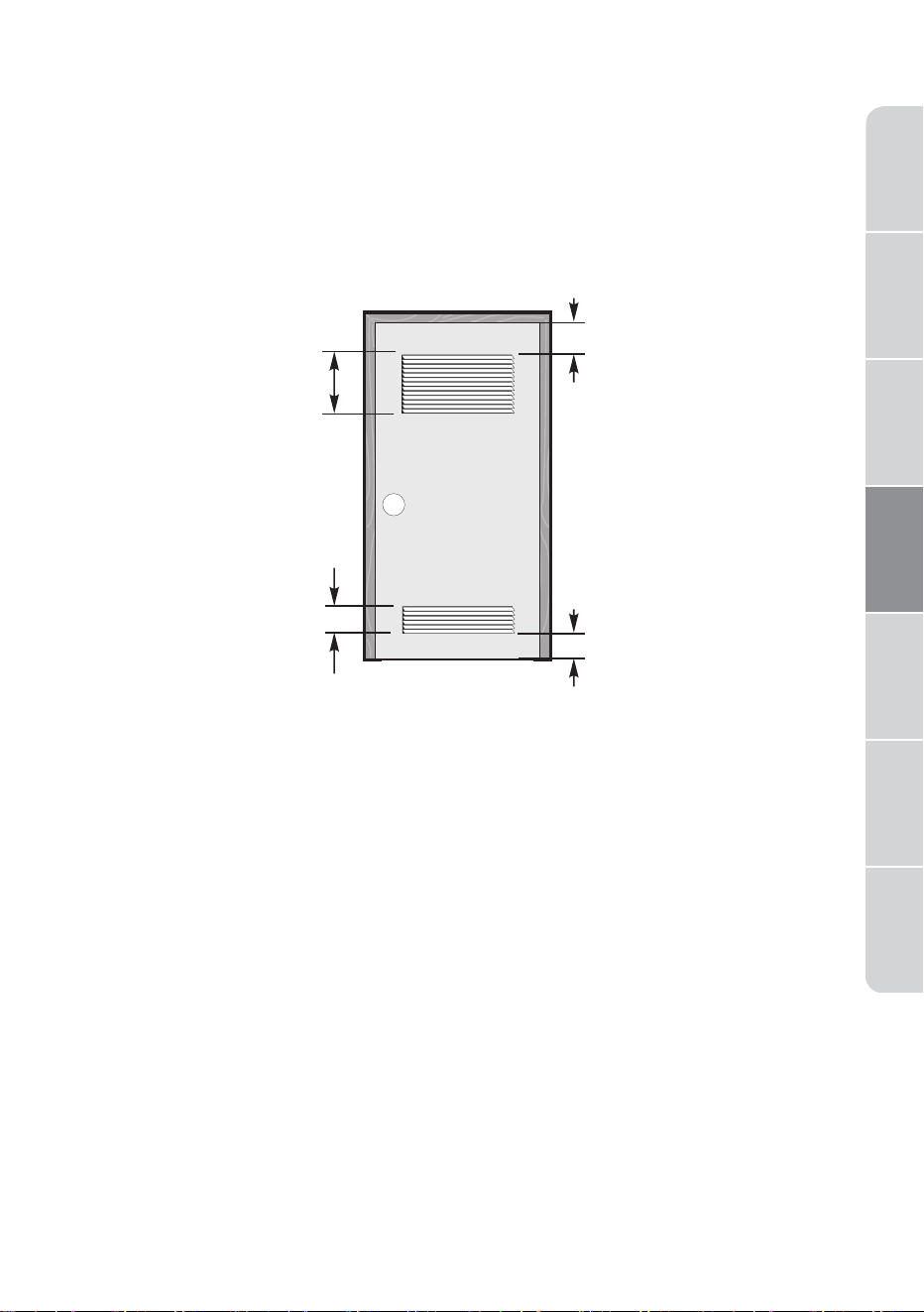
If you install your washer in an alcove or closet, the front of the closet
must have two unobstructed air openings for a combined minimum total
area of 72 sq.in. (465 sq.cm) with a minimum clearance of 3 in. (7.6 mm)
at the top and bottom. A slatted door with equivalent space clearance is
acceptable.
Installing in an alcove or closet
Minimum clearances between your washer and adjacent walls or other
surfaces are:
•
Either side: 1 in. (2.5 cm)
• Rear: 6 in. (15.2 cm)
• Closet Front: 2 in. (5.1 cm)
•
Top: 24 in. (61 cm)
•
Gap between the end of water valve and the wall: 6 in. (15.2 cm)
If you install your washer and dryer side-by-side in a closet, the closet
front must have an unobstructed air opening of at least 72 square
inches (465 square cm).
48 in.² *
( )310 cm²
24 in² . *
( )155 cm²
3 in.
( . )7 6 cm
3 in.
( . )7 6 cm
Safety
Instructions
Features
Operation
Requirements
Installation
Instructions
Washer Care
TroubleshootingWasher Use
A. Recessed area
B. Side view - closet or confined area
WARNING
•
Is a hard, level surface without carpeting or soft flooring that can
obstruct ventilation.
• Is away from direct sunlight.
•
Has adequate ventilation.
• Is not exposed to freezing temperatures (32 F or 0 C).
• Is away from heat sources such as oil or gas.
•
Has enough space so that the washer does not rest on its power
cord.
18
Tools you will need
Pliers Level Adjustable
wrench that
opens to 1”
(25 mm)
F
1 in. (25 mm) G 27 in. (686 mm)
H
2 in. (51 mm)
I
J
29.9 in. (760 mm)
6 in. (152 mm)
K
24 in. (610 mm)
.
.
F
F
G
H
I
J
K
Safety
Instructions
Features
Operation
Requirements
Installation
Instructions
Washer Care
TroubleshootingWasher Use
Connect the water hoses
NOTE: The water supply hoses are not supplied with your washer and
must be purchased separately.
Caution
• Use new water supply hoses. Using old hoses can result in leakage
or overflow that can damage your property.
• Do not connect multiple water supply hoses together to increase
the length of the hose. Hoses connected this way can leak and
cause electrical shock. If a hose is too short, replace the hose with a
longer, high-pressure hose.
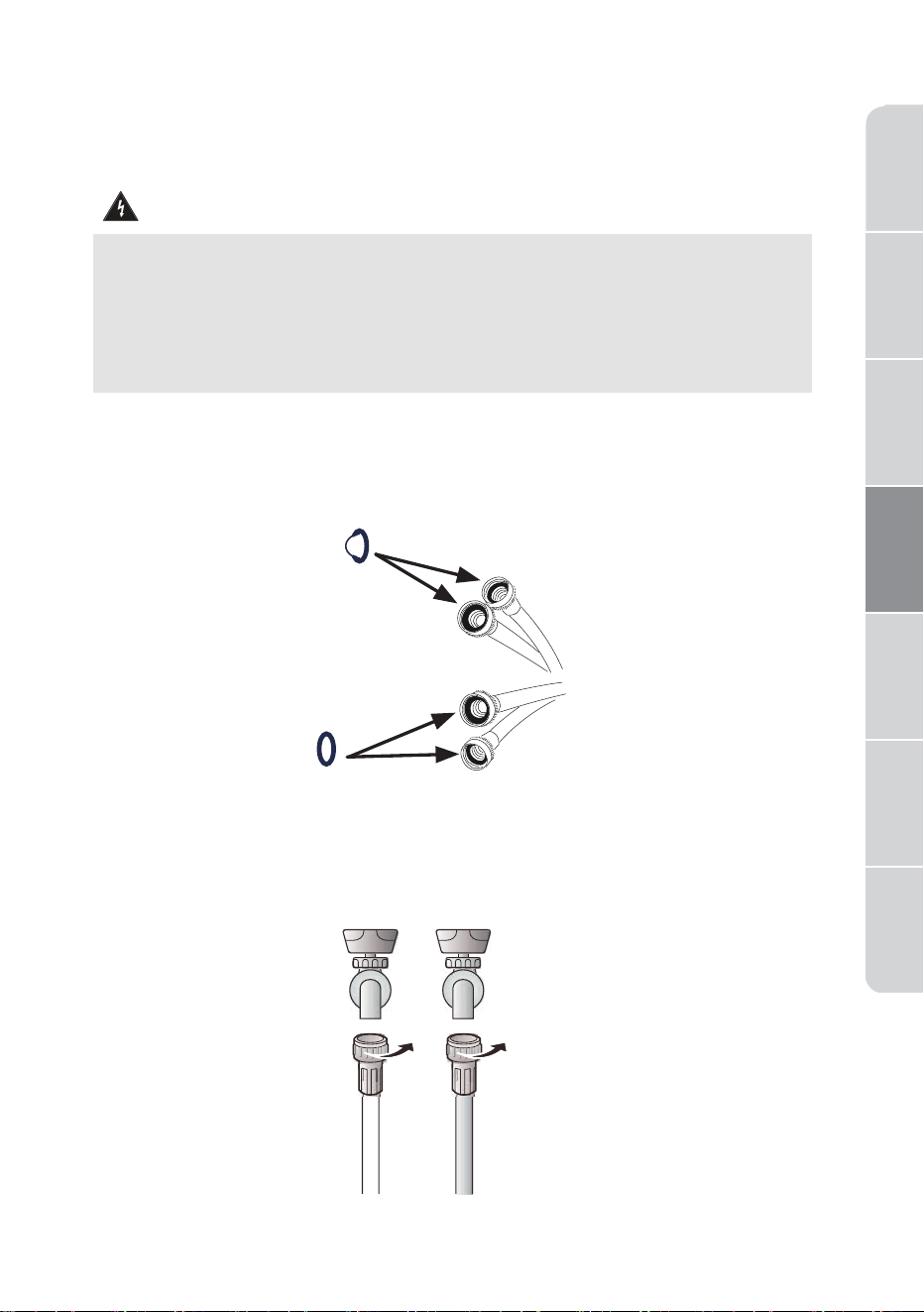
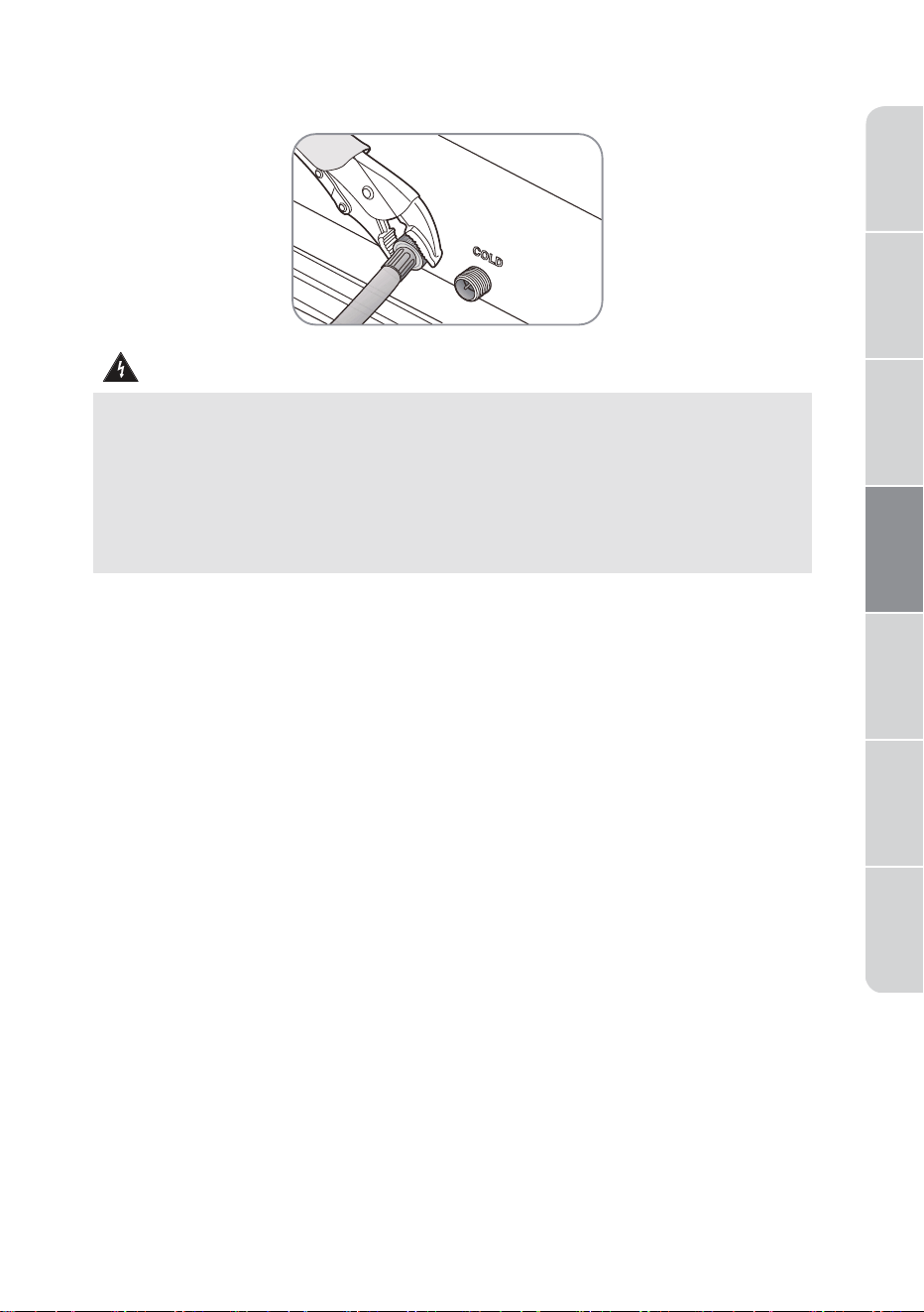
1. Make sure that there are rubber washers inside the fittings at both
ends of each new water hose. Remove the rubber washers in faucet
side and replace with filters. Installing the water supply hoses
without rubber washers can cause water leakage.
2. Tighten the hose and faucet fittings by hand until they are snug,
then tighten them an additional two-thirds of a turn with pliers or a
wrench. Pull the water supply hoses downwards to make sure that
they are connected securely.
19
Safety
Instructions
Features
Operation
Requirements
Installation
Instructions
Washer Care
TroubleshootingWasher Use
Caution
Do not overtighten the fittings or apply tape or sealant to the faucets
or water supply intake. This can damage the fittings.
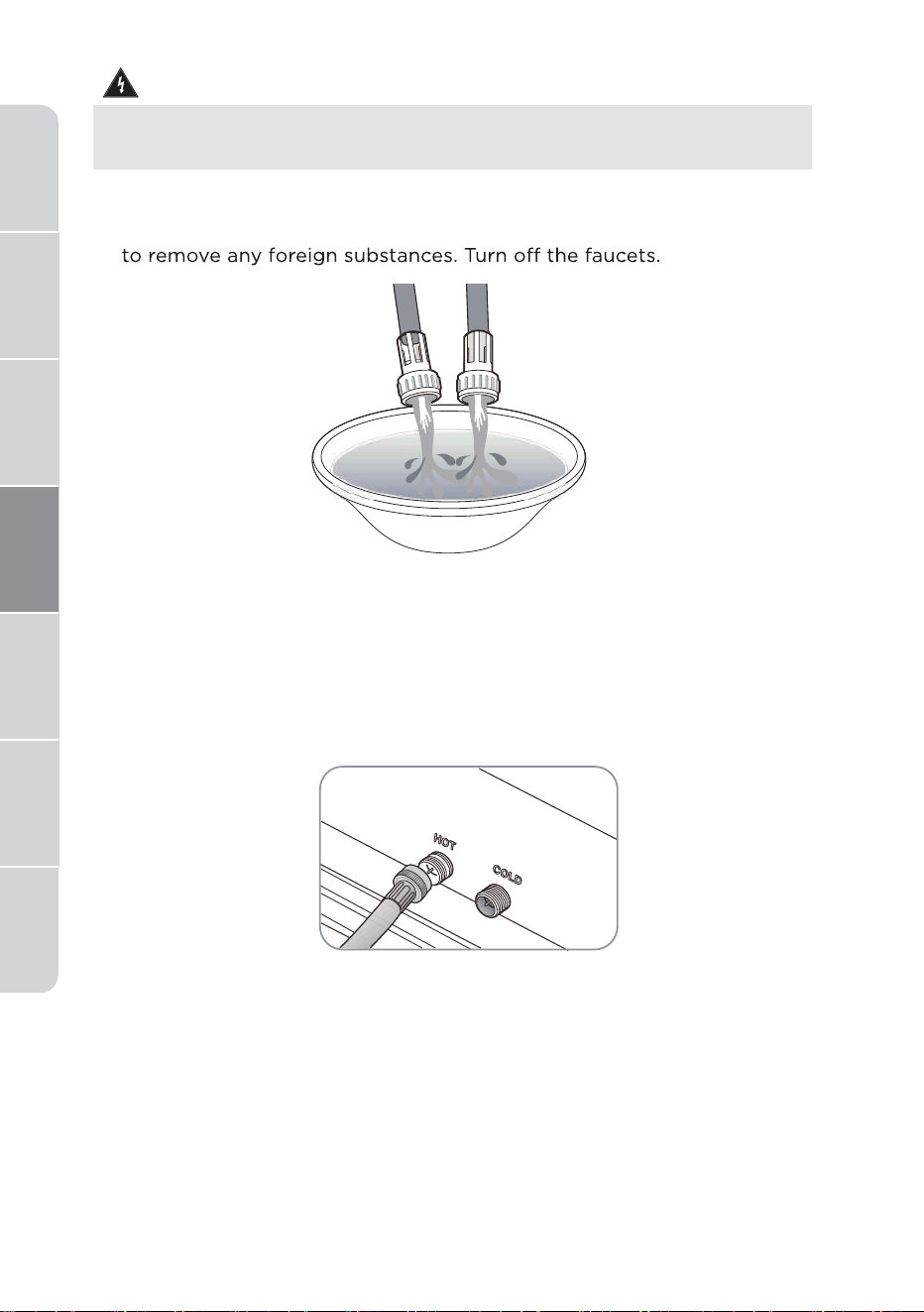
3. Place the unconnected ends of the hoses into a bucket and turn on
the faucets connected to the water supply hoses for 10 or 15 seconds
4. Connect the ends of the water supply hoses to the water supply
intake connections at the top of the washer. Make sure that the
rubber washers are in place. The water supply hose connected to the
hot faucet must be connected to the hot water supply intake and the
water hose connected to the cold faucet must be connected to the
cold water supply intake.
NOTE: If you do not want to use the hot water supply hose, insert a
water intake cap into the hot water supply intake hole. In this case you
must select the Tap Cold option for the water temperature.
NOTE: No intake cap is provided with your washer. It must be
purchased separately.
20
Safety
Instructions
Features
Operation
Requirements
Installation
Instructions
Washer Care
TroubleshootingWasher Use
5. Tighten the fittings by hand until they are snug, and then tighten
them an additional two-thirds of a turn with a pliers.
Caution
• Do not overtighten the fittings or apply tape or sealant to the
faucets or water supply intakes. This can damage the fittings.
• Make sure that the water supply hoses are not twisted or bent. A
bent or twisted hose can leak and cause an electric shock due to
the water leakage. To ensure the correct water usage, connect both
hot and cold water faucets. lf either or both are not connected, an
error code could occur.
6. Turn on the hot and cold water supplies and check all the water
supply intake connections and the faucets for water leaks.
21
Safety
Instructions
Features
Operation
Requirements
Installation
Instructions
Washer Care
TroubleshootingWasher Use
22
Caution
Make sure that the connection between the drain hose and the wash
basin, standpipe or laundry tub is not airtight.
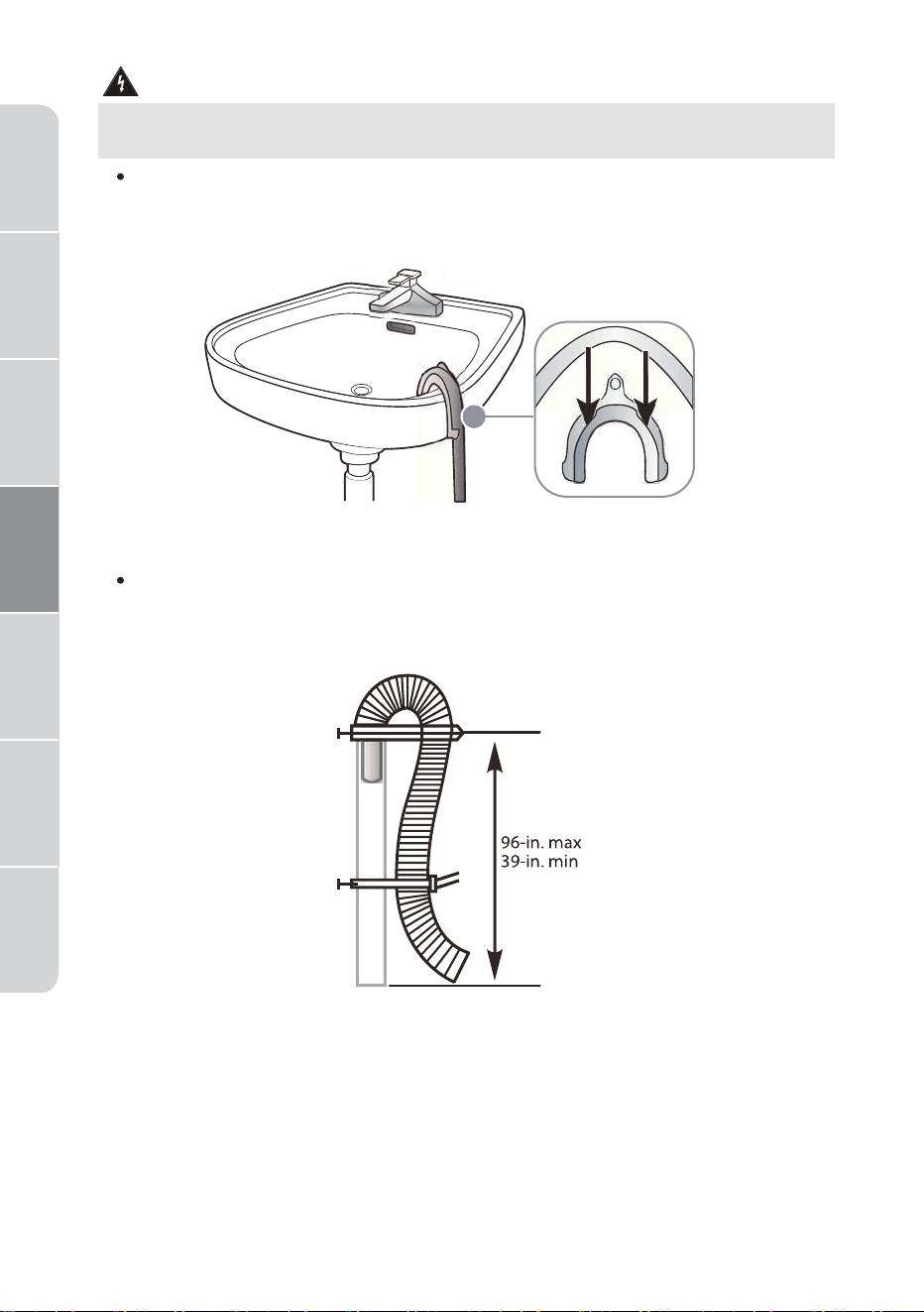
0ver the edge of wash basin - Secure the guide to the side of the
basin wall with a hook, tape it or tie it with a piece of cord to prevent
the drain hose from moving.
In a standpipe - The standpipe must be no shorter than39 in. (99 cm)
and no longer than 96 in. (244 cm).
Hose
retainer
Tie strap
Connect the drain hose
Safety
Instructions
Features
Operation
Requirements
Installation
Instructions
Washer Care
TroubleshootingWasher Use
23
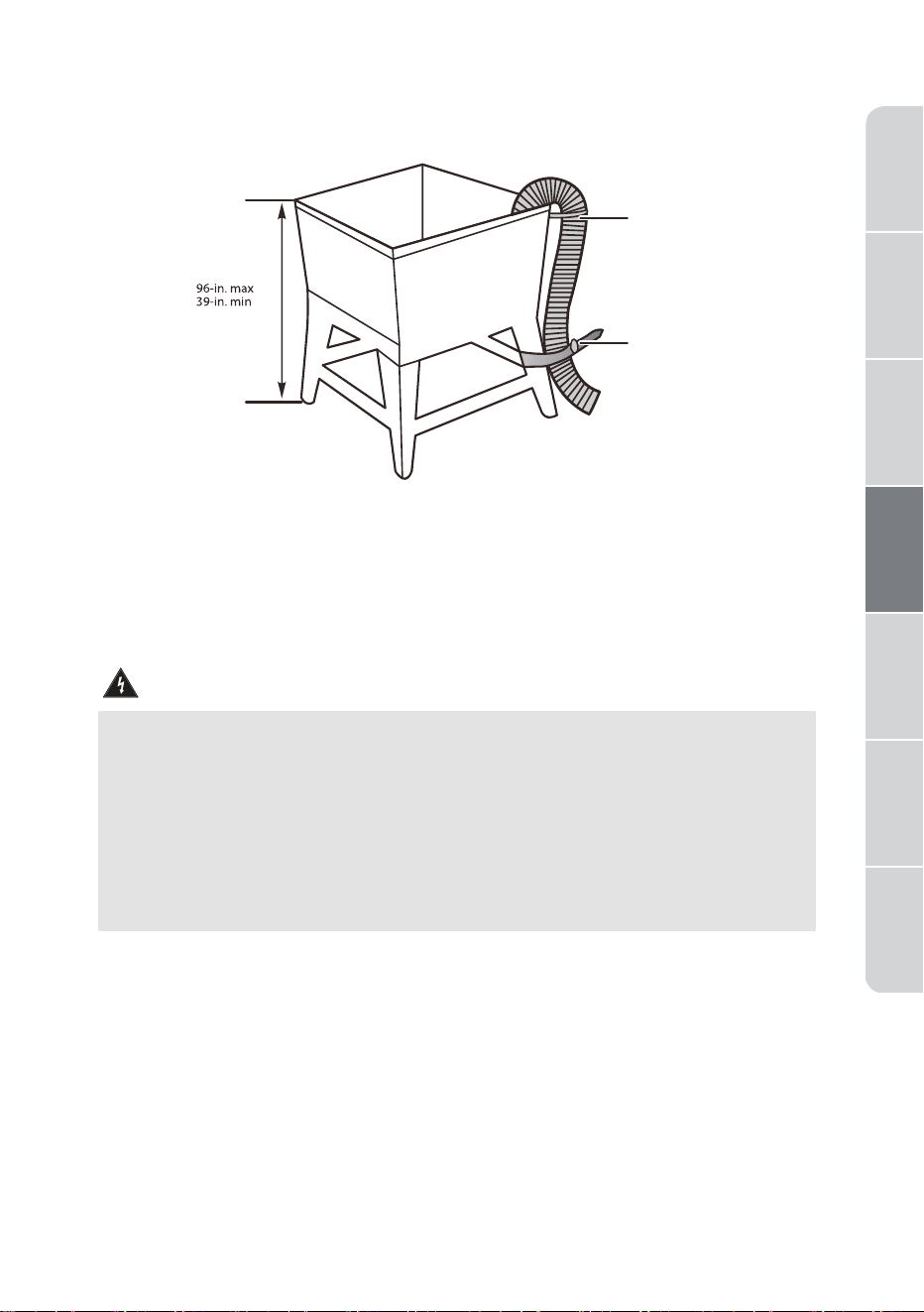
• In a laundry tub - The laundry tub must be no shorter than 39-in.
(99 cm) and no higher than 96-in (244 cm) maximum.
Level your washer
Caution
Do not use your washing machine without leveling. If your washer is
not level, it may:
• Vibrate excessively which can cause your washer to malfunction.
•
Make excessive noise.
•
Indicate error codes when the washer is running.
Extend the leveling feet only as much as is necessary. If the feet are
extended too much, your washer may vibrate.
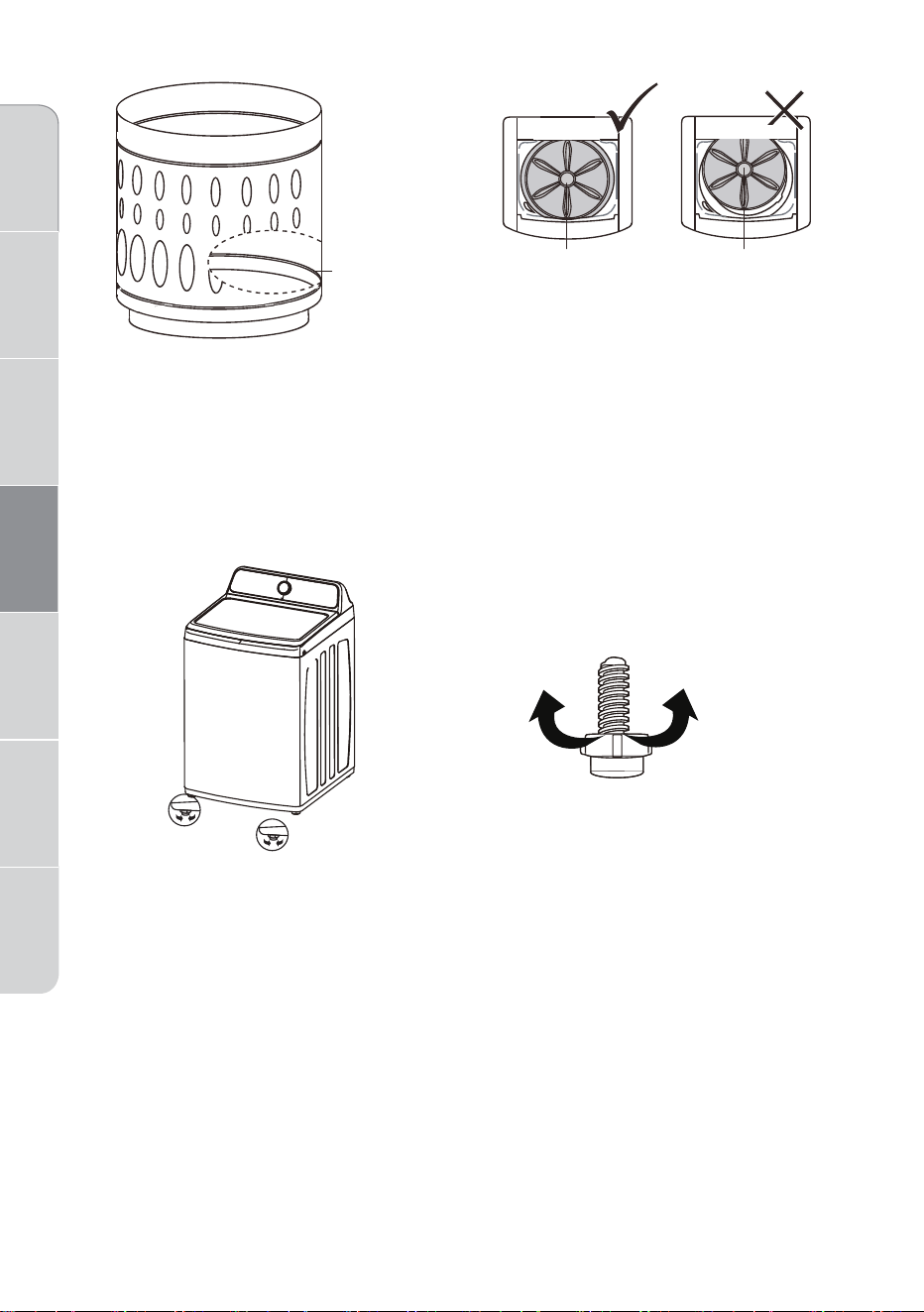
Determine if the washer is level by checking the position of the tub or
by using a level.
1. Slide the washer into position.
2. Open the lid of the washer, then pour water into the tub to the
leveling circle. If the washer is level, the water will touch the leveling
circle all the way around. If the washer is not level, the water will only
touch part of the leveling circle.
Tie strap
Hose retainer
Safety
Instructions
Features
Operation
Requirements
Installation
Instructions
Washer Care
TroubleshootingWasher Use
24
Leveling circle
Adjustable legs
Washer is level – the
water touches the
leveling circle all the
way around.
Washer not level -
the water does not
touch the leveling
circle all the way
around.
lockloosen
3. If your washer is not level, carefully tilt your washer just enough to
adjust the leveling feet on the bottom front of your washer. Extend the
feet only as much as is necessary. If the feet are extended too much,
your washer may vibrate.
Power on
Plug the power cord into a well-grounded, 3-prong, 120 Volt 60 Hz
approved electrical outlet, protected by a 15-amp fuse or comparable
circuit breaker. Your washer is grounded through the third prong of the
power cord.
Safety
Instructions
Features
Operation
Requirements
Installation
Instructions
Washer Care
TroubleshootingWasher Use
Run a test cycle
Run a test cycle to make sure that your washer is properly installed.
1. Load about 6 pounds (2.7 kg) of laundry into the tub.
2. Select the Cycles knob to turn on your washer.
3. Turn the cycle selector to select the QUICK WASH cycle.
4. Press the Start Pause button to start the test cycle. Your washer
should not rock or vibrate excessively when water fills the tub or
when washing or spinning. The washer should drain well during the
spin cycle.
Caution
If you detect any water leaks while the washer is filling or draining,
check the water connections. See Connect the water hoses on
page 19 or Connect the drain hose on page 22.
If the washer rocks and/or vibrates excessively, level it again. See
Level your washer on page 23.
25
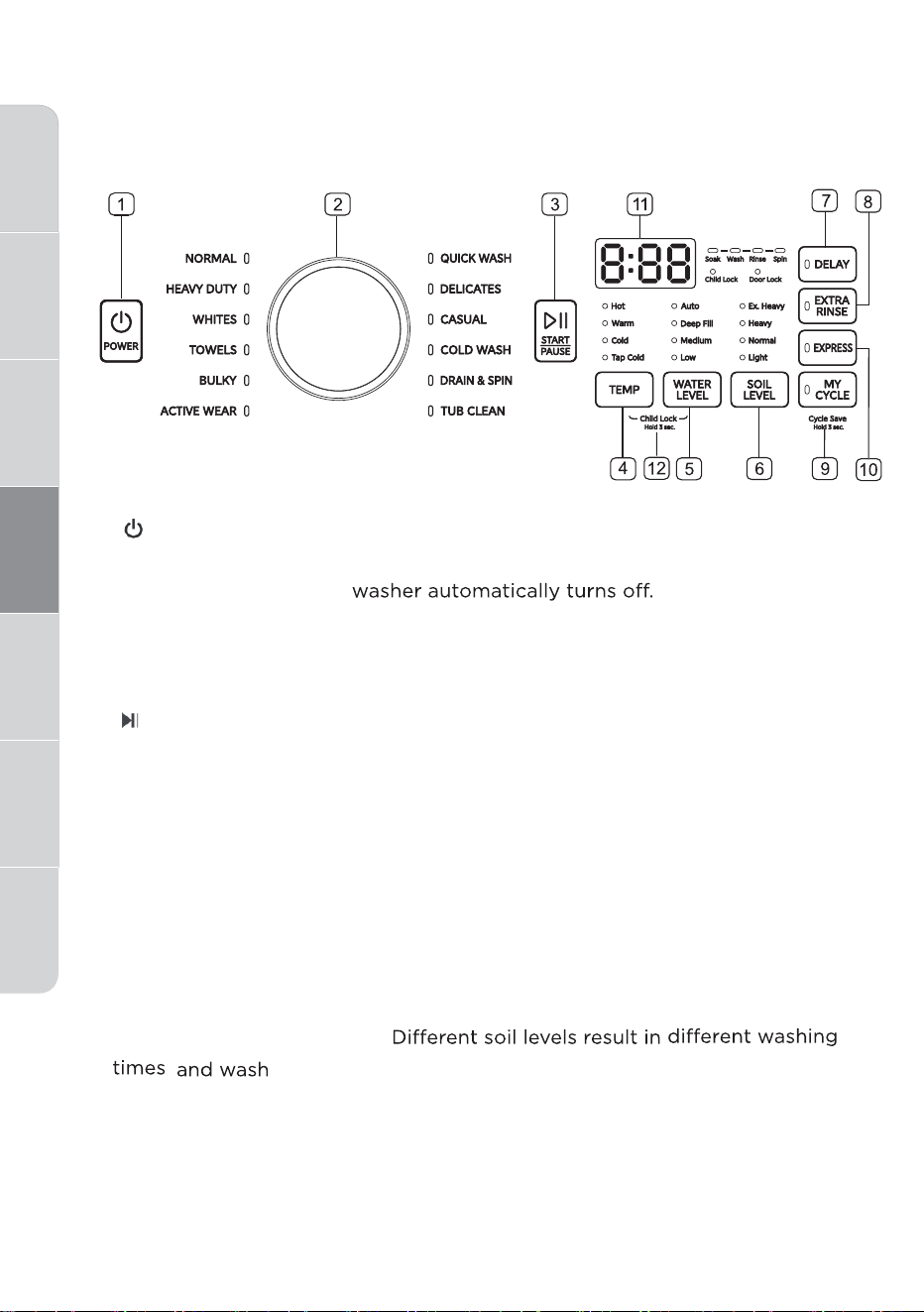
1 POWER
Press to turn on your washer.
Press leave your washer on and do
not press
within 10 minu
tes, your
3
/START PAUSE
Press once to start the wash cycle.
2 Wash Selector
Turn to select a wash cycle. The
cycle you select determines the
wash pattern
for the cycle. For
more information, see Program
function on Page 31.
4
Safety
Instructions
Features
Operation
Requirements
Installation
Instructions
Washer Care
Troubleshooting
Washer Use
WASHER USE
Control panel
Press again to pause the cycle. If you
pause the cycle, you can add or remove items,and WATER LEVELcould be
turn o,Press again to continue the process.
26
7
SOIL LEVEL
Press to select the soil level.
cycle setting. For more information,
see Program function on
Page 31.
TEMP.
Press to select the washing water
temperature. The rinse water
temperature
is always cold.
WATER LEVEL
Press to select the water level. washing times and wash cycle setting. For
more information,see Program function on Page 32.
5
6
DELAY
Press to select a time when you want the cycle to begin.
Hold delay button for 3 sec to turn on end of cycle signal.
11 Digital display
The initial display is the total time for the cycle you select.While your
washer is running, the display
shows the cycle process and time
remaining
in the c
ycle. Note: the
time shown is an estimate based
on normal ope
r
ating
conditions.
External factors (such as the load
size, room temperature,
incoming
water temperature, and water
pressure
e. If
you set a delay time for the start of the cycle, the display shows the
time when the cycle will start.
Safety
Instructions
Features
Operation
Requirements
Installation
Instructions
Washer Care
TroubleshootingWasher Use
27
Extra Rinse
Press to add an extra rinse to the wash cycle. Press again to cancel.
12 Child lock
Press and hold TEMP. and WATER LEVEL button together for 3 seconds to
activate
Press again for another 3 seconds to deactivate the
All selection except the “Power”
will be out of function.
MY CYCLE
Press and hold for 3 seconds to
remember your favorite washing cycle.
Press once to load your favorite cycle setting.
8
9
10 EXPRESS
Press to select the EXPRESS button.Shorten the running time of the program.
this function.
function.
Washing a load of laundry
WARNING
To reduce the risk of fire, electric shock, or injury to persons, read the
SAFETY INSTRUCTIONS before operating this appliance.
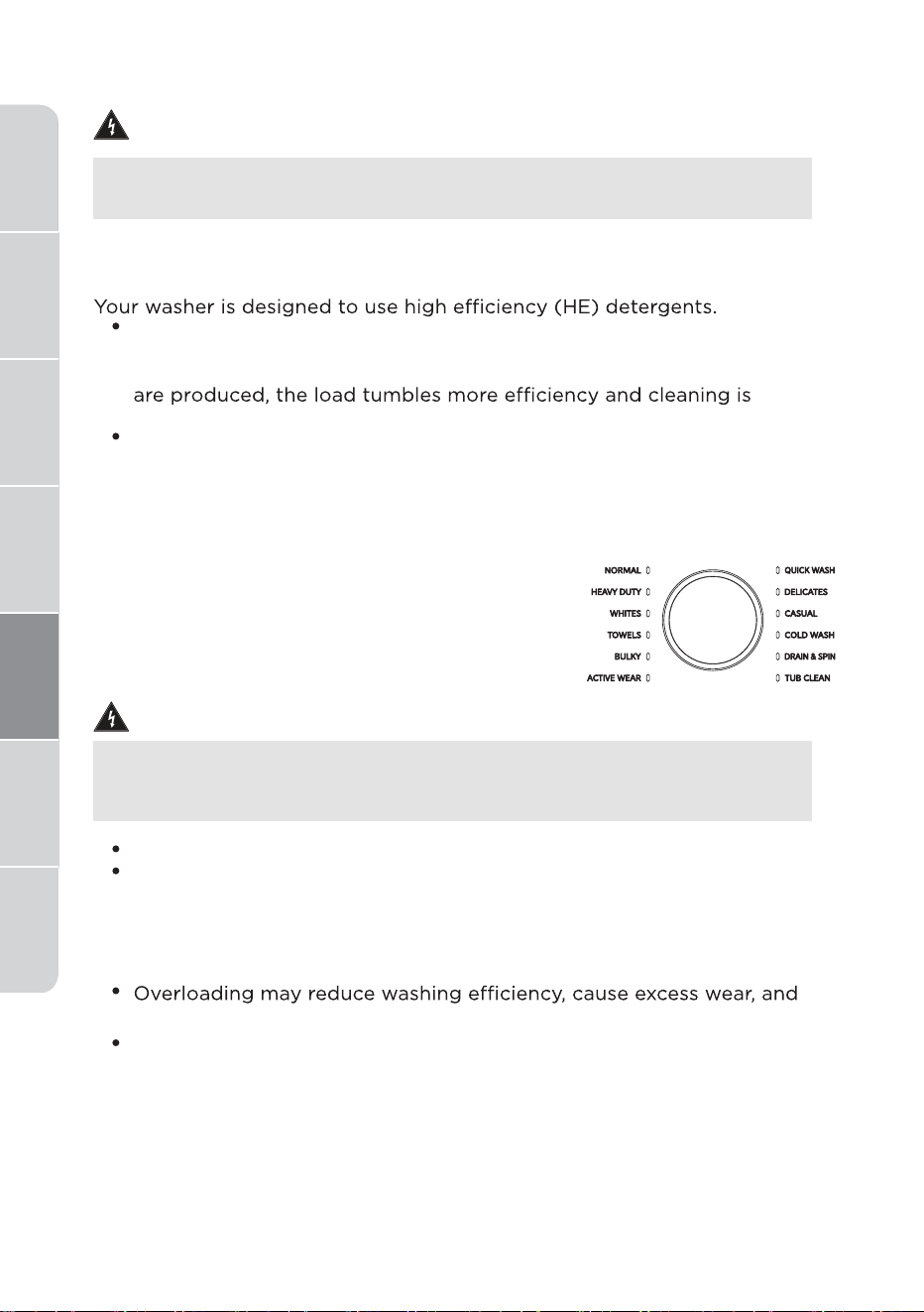
Selecting a detergent
For the best cleaning results, use an HE detergent. We recommend
that you do not use a regular detergent. HE detergents contain
suppressors that reduce or eliminate suds. When fewer suds
maximized.
Reducing the amount of detergent may reduce the quality of
cleaning. Make sure that you:
- Pre-treat stains.
- Sort carefully by color and soil level.
- Avoid overloading.
1. Turn on you washer
- Turn cycle selector to the desired cycle to
turn the washer on.
2. Load your washer
Caution
Before loading your laundry, make sure that you remove coins, keys,
and other hard objects and close zippers. These items may damage
clothes and the washer.
Sort laundry by fabric type, soil level, color, and load size.
Fill the tub with dry, unfolded clothes. Load the tub no more than
3/4 full.
NOTE:
possibly cause creasing or wrinkling of the load.
Wash delicate items such as bras, hosiery and other lingerie on the
Delicates cycle with similar lightweight items.
Safety
Instructions
Features
Operation
Requirements
Installation
Instructions
Washer Care
Troubleshooting
Washer Use
28
When washing big, bedding items (such as rugs or pillows) or a few
do not fill the tub completely, add a few towels to improve spin
performance.
Always use the BULKY cycle for bedding items.
When washing heavily soiled loads, do not overload your washer
to ensure good cleaning results.
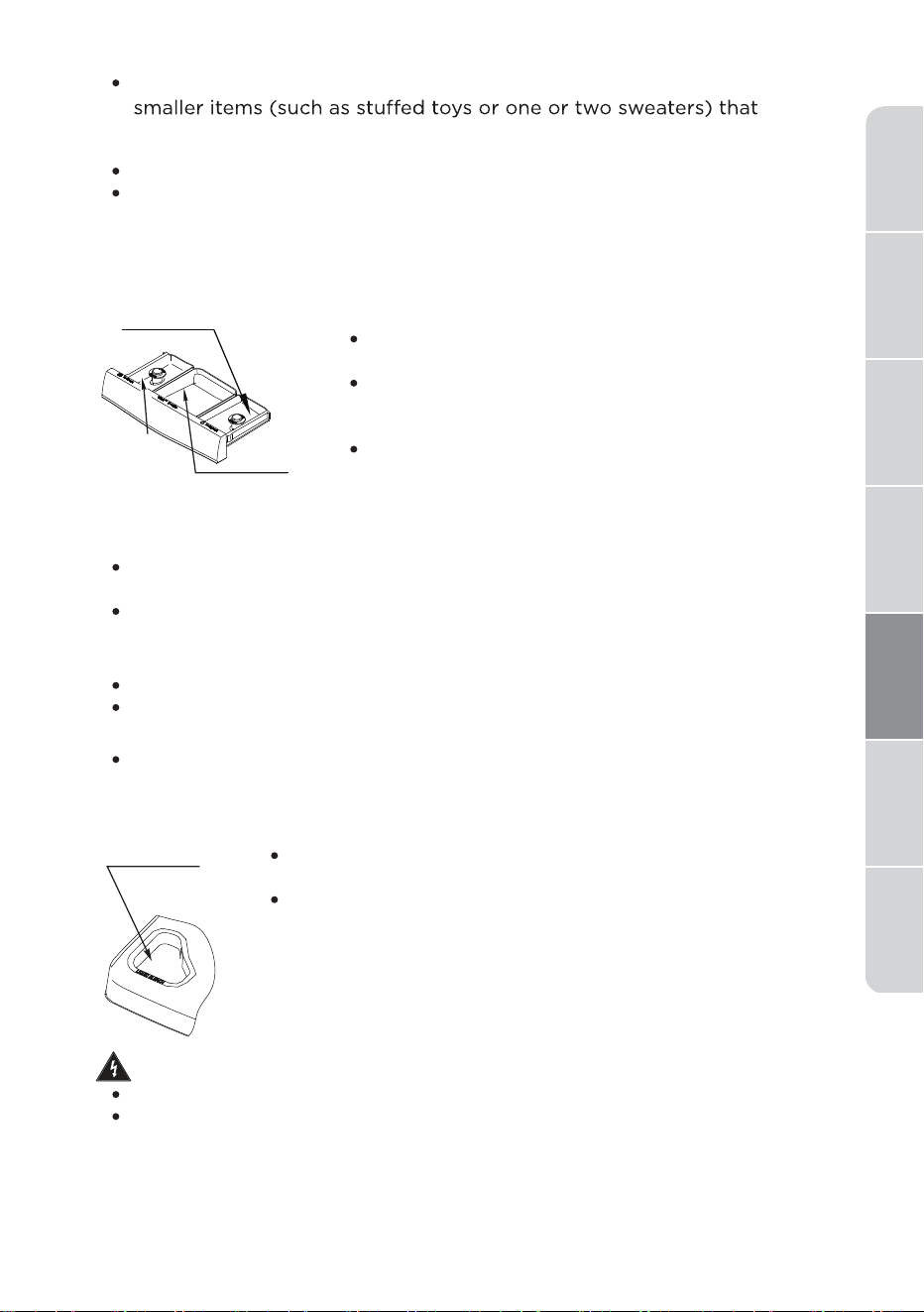
3. Add detergent and additives to the compartment
Loading the liquid or powder detergent
compartment
Loading liquid or powder detergent in the
compartment indicated.
Pour the recommended amount of laundry
detergent directly into the compartment
before starting your washer.
If you are using color-safe bleach, add
it with the detergent to the detergent
compartment.
NOTE:
When adding color-safe bleach with detergent, both laundry
products should be in the same form (liquid).
If no detergent compartment, you should add the detergent into
the tub.
Loading PODs in the washer
First load PODs directly the bottom of an empty basket
Then add clothes on top of the PODs
NOTE:
Loading PODs at the bottom of the basket will improve wash
performance and will enable detergent to dissolve more easily in
the wash.
Loading the bleach compartment (liquid bleach only)
Add chlorine bleach to the bleach compartment. Do
not over-fill the compartment.
There is no water inlet to the bleach dispenser, so
the bleach will directly load into the tub when you
pour it in.
Caution
Avoid splashing or over-filling the compartment.
Never pour undiluted liquid chlorine bleach directly onto the load
or into the tub. Doing so can damage fabrics, by weakening of the
fibers or stripping the color.
NOTE: Do not pour color-safe bleach into the bleach compartment.
Instead, add it to the detergent compartment.
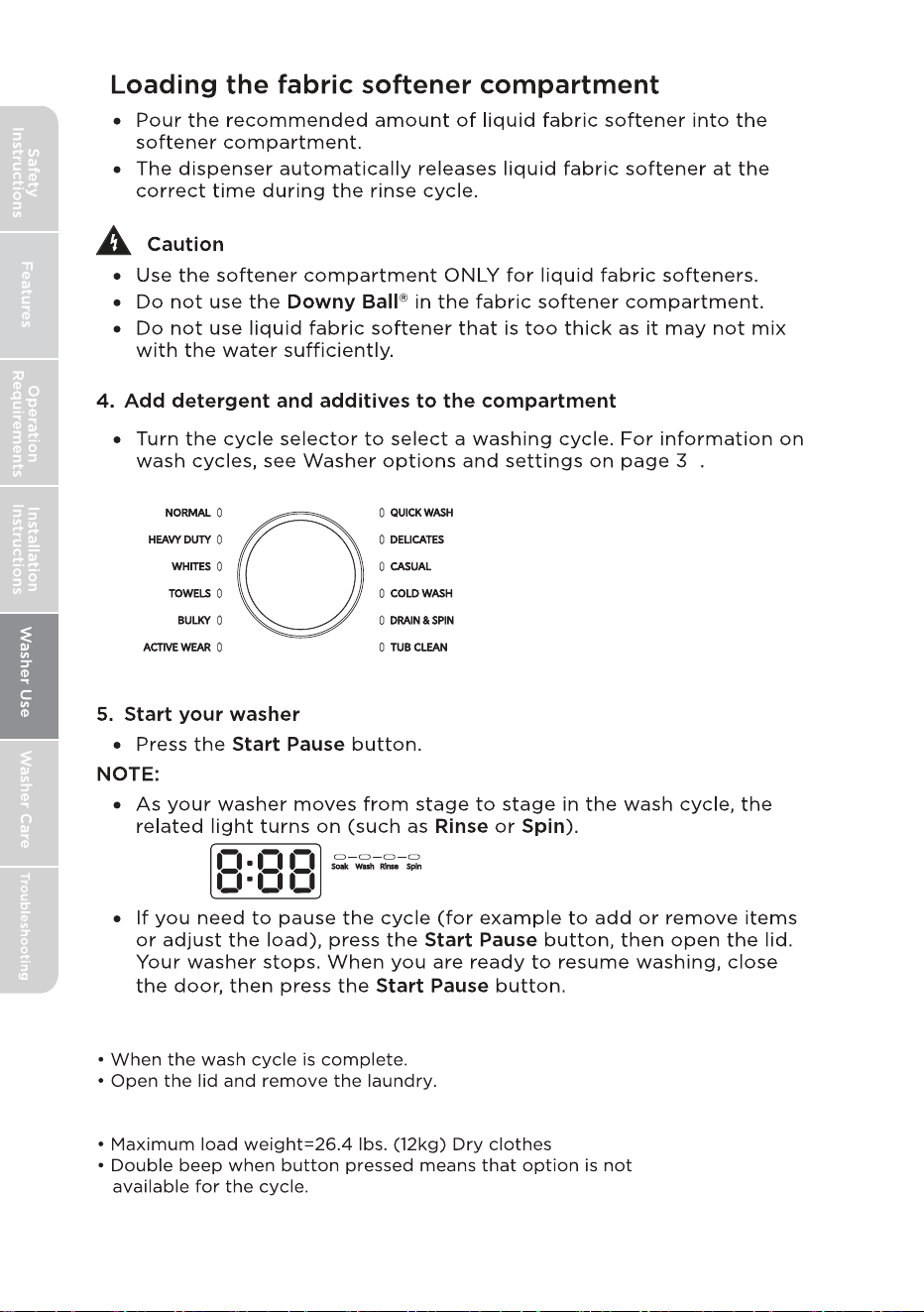
Liquid detergent
compartment
Powder
compartment
Bleach
compartment
Fabric
softner
compartment
Safety
Instructions
Features
Operation
Requirements
Installation
Instructions
Washer Care
TroubleshootingWasher Use
29
30
Washer options and settings
6. Remove your laundry
1
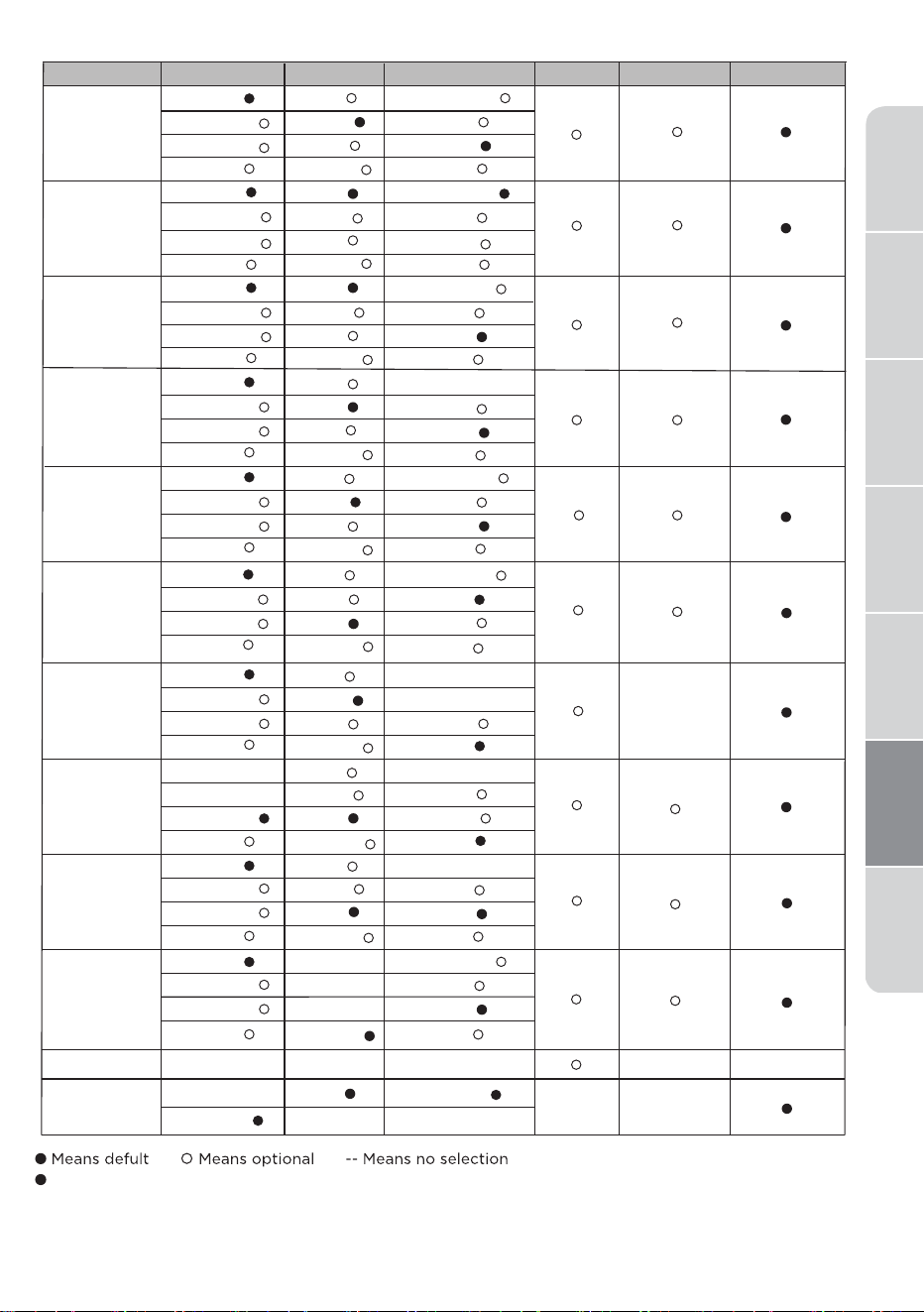
Options and settings table of MAV44C-A2812.
Cycle SOIL LEVEL
TEMP.
WATER LEVEL Fabirc Softener
DELAY
NORMAL
Light
Hot
Warm
Heavy
Cold
Tap Cold
TOWELS
Hot
Warm
Cold
Tap Cold
Hot
Warm
Cold
Tap Cold
WHITE
Hot
Warm
Cold
Tap Cold
Hot
Warm
Cold
Tap Cold
COLD WASH
ACTIVE WEAR
CASUAL
Tap Cold
DELICATES
HEAVY DUTY
When you turn to an option and there is beep sound, it means the function can not be
selected with this program.
Safety
Instructions
Features
Operation
Requirements
Installation
Instructions
Washer Care
TroubleshootingWasher Use
Normal
EXTRA RINSE
31
QUICK WASH
BULKY
Hot
Warm
Cold
Tap Cold
Hot
Warm
Cold
Tap Cold
Hot
Warm
Cold
Tap Cold
Light
Heavy
DRAIN&SPIN
TUB CLEAN
Low
Medium
Deep Fill
Auto
Low
Medium
Deep Fill
Auto
Low
Medium
Deep Fill
Auto
Low
Medium
Deep Fill
Auto
Low
Medium
Deep Fill
Auto
Low
Medium
Deep Fill
Auto
Low
Medium
Deep Fill
Auto
Low
Medium
Low
Medium
Deep Fill
Auto
Low
Medium
Deep Fill
Auto
Hot
Warm
Cold
Tap Cold
--
--
--
--
--
Hot
Deep Fill
--
--
Ex. Heavy
Ex. Heavy
Normal
Light
Heavy
Normal
Ex. Heavy
Light
Heavy
Normal
Light
Heavy
Normal
Ex. Heavy
Light
Heavy
Normal
Ex. Heavy
Light
Heavy
Normal
Light
Normal
Light
Heavy
Normal
Light
Heavy
Normal
Ex. Heavy
--
Ex. Heavy
--
--
--
--
--
--
--
--
--
-- --
--
--
WASHER CARE
Caution
to your washer and prevents the possibility of damage from escaping
water. Leave the lid open to let the inside of your washer dry out.
Cleaning and maintenance
Cleaning the exterior
Use a soft cloth to wipe up all detergent, bleach, or other spills as they
occur.
Cleaning the interior
Clean the interior of your washer periodically to remove any dirt,
soil, odor, mold, mildew, or bacterial residue that may remain in your
washer as a result of washing clothes.
Failure to follow these instructions may result in unpleasant
conditions, including odors or permanent stains in your washer or
on your laundry.
To remove hard water deposits, use a cleaner labeled "Washer safe".
Cleaning the control panel
Clean with a soft, damp cloth. Do not use abrasive powders or
cleaning pads.
Do not spray cleaners directly on the panel. The control panel finish
may be damaged by some laundry pre-treatment soil and stain
remover products. Apply such products away from your washer and
wipe up any spills or over-spray immediately.
Cleaning the detergent, bleach, or softener compartment
Clean with a soft, damp cloth. Do not use abrasive powders or
cleaning pads.
Do not spray cleaners directly on the panel. The control panel finish
may be damaged by some laundry pre-treatment soil and stain
remover products. Apply such products away from your washer and
wipe up any spills or over-spray immediately.
Cleaning the tub
The
TUB CLEAN
cycle is a self-cleaning cycle that removes the causes
of odors that may occur inside your washer without using a cleaning
agent. We suggest cleaning the tub about once a month.
Safety
Instructions
Features
Operation
Requirements
Installation
Instructions
Washer Care
TroubleshootingWasher Use
32
Caution
Never use the tub clean cycle when laundry is in your washer. This may
damage the laundry or your washer.
With the tub empty, add one cup of chlorine bleach to the bleach
dispenser.
Turn the control knob to power on.
Turn the cycle selector to TUB Clean With the tub empty, add one
cup of chlorine bleach to the bleach dispenser.
Press the Start Pause button.
Storing your washer
You can damage your washer if you do not remove water from hoses
and internal components before storage.
To prepare your washer for storage:
Select the QUICK Wash cycle and add bleach to the washer. Run
your washer through the cycle without a load.
Unplug your washer from the electrical outlet and leave your
washer lid open to let air circulate inside the tub.
Caution
If your washer has been stored in below-freezing temperatures, allow
time for any leftover water in your washer to dry out before use.
Safety
Instructions
Features
Operation
Requirements
Installation
Instructions
Washer Care
TroubleshootingWasher Use
33
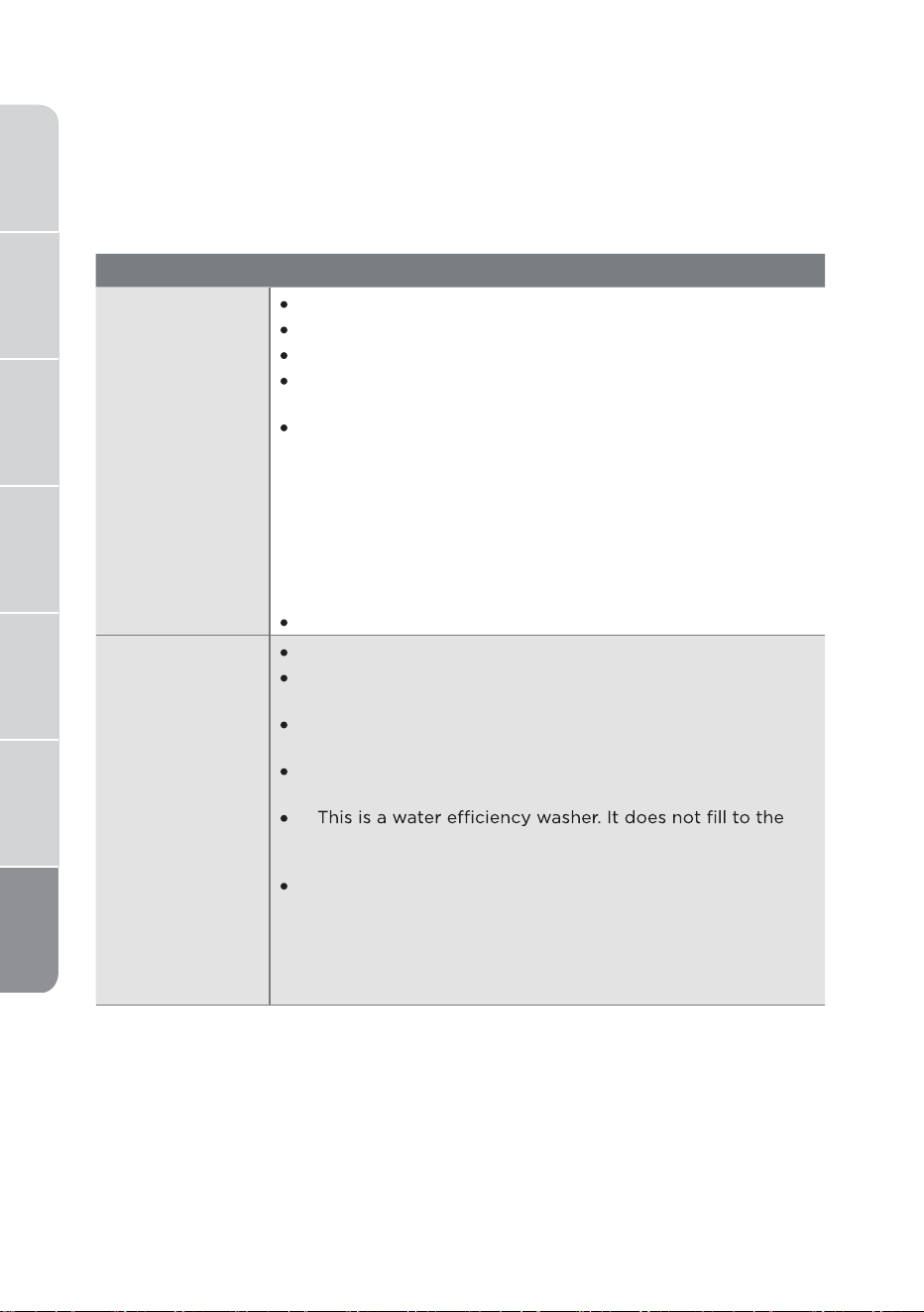
Problem Solution
Washer does
not start
Make sure that your washer is plugged in.
Make sure that the lid is closed.
Make sure that the water source faucets are open.
Make sure that you press the Start Pause button to start
your washer.
Before your washer starts to fill, it makes a series of
clicking noises to make sure that the lid is locked. The
washer doesn't drain after the lid locks. For automatic
cycles: Before filling, and after the lid locks, a load
sensing program starts. Washer will agitate clothing
without water to determine load type, water level, and
cycle time. Then it fills. This can take up to one minute.
Its normal. For non automatic cycles the washer fills after
the lid locks.
Check the fuse or reset the circuit breaker.
No water or not
enough water
Make sure that both faucets are fully turned on.
Make sure that the water pressure is in the range listed in
Water requirements on page 14.
Make sure that the water inlet hoses are not kinked.
Straighten if necessary.
Disconnect the hoses and clean the screens. The hose
filter screens may be clogged.
levels of a standard washer. Low water levels are normal.
It is normal for parts of clothing to stick out of the water.
For automatic cycles: Before filling, and after the lid
locks, a load sensing program starts. Washer will agitate
clothing without water to determine load type, water
level, and cycle time. Then it fills. This can take up to one
minute. Its normal. For non automatic cycles the washer
fills after the lid locks.
BEFORE YOU CALL FOR SERVICE...
Save time and money! Review the charts on the following pages first and you may
not need to call for service.
Safety
Instructions
Features
Operation
Requirements
Installation
Instructions
Washer Care
TroubleshootingWasher Use
Troubleshooting tips
34

Problem Solution
When washer
has excessive
vibration or
noise
•
Make sure that your washer is set on a level surface.
If the surface is not level, adjust your washer's feet to
level your washer.
•
Make sure that your washer is not touching any other
•
object.
•
Make sure that the laundry load is balanced.
•
During the spin process, if clothes are piled to one
side of the tub, your washer may stop because
of the imbalance. Your washer tries up to three
times to solve the problem automatically. If the
washer cannot solve the problem, try to manually
redistribute clothes inside the tub.
•
Check to make sure packaging pieces of base foam
cushion are not stuck under washer.
Washer stops
•
Make sure that the power outlet is a working outlet.
•
Check the fuse or reset the circuit breaker.
•
Close the lid, then press the Start Pause button to start
your washer. For your safety, your washer does not spin
unless the lid is closed.
•
Before your washer starts to fill, it makes a series of
clicking noises to make sure that the lid is locked. The
washer doesn't drain after the lid locks. For automatic
cycles: Before filling, and after the lid locks, a load sensing
program starts. Washer will agitate clothing without water
to determine load type, water level, and cycle time. Then
it fills. This can take up to one minute. Its normal. For non
automatic cycles the washer fills after the lid locks.
•
Sometimes your washer may pause between stages in the
cycle. Wait to see if your washer starts again.
•
Disconnect the inlet hoses and clean the screens
periodically. The hose filter screens may be clogged.
Lid is locked or
will not open
•
Press the Start Pause button to pause the washer.
You cannot open the lid if the washer is running.
•
After you pause the washer, it may take a few
seconds for the lid lock to release.
•
If the lid is locked when your washer is not running,
press the Power button to turn on your washer.
•
If power fails while your washer is running, when
power is restored, the lid unlocks. Your washer waits
three minutes then runs the rest of the cycle.
Safety
Instructions
Features
Operation
Requirements
Installation
Instructions
Washer Care
TroubleshootingWasher Use
35
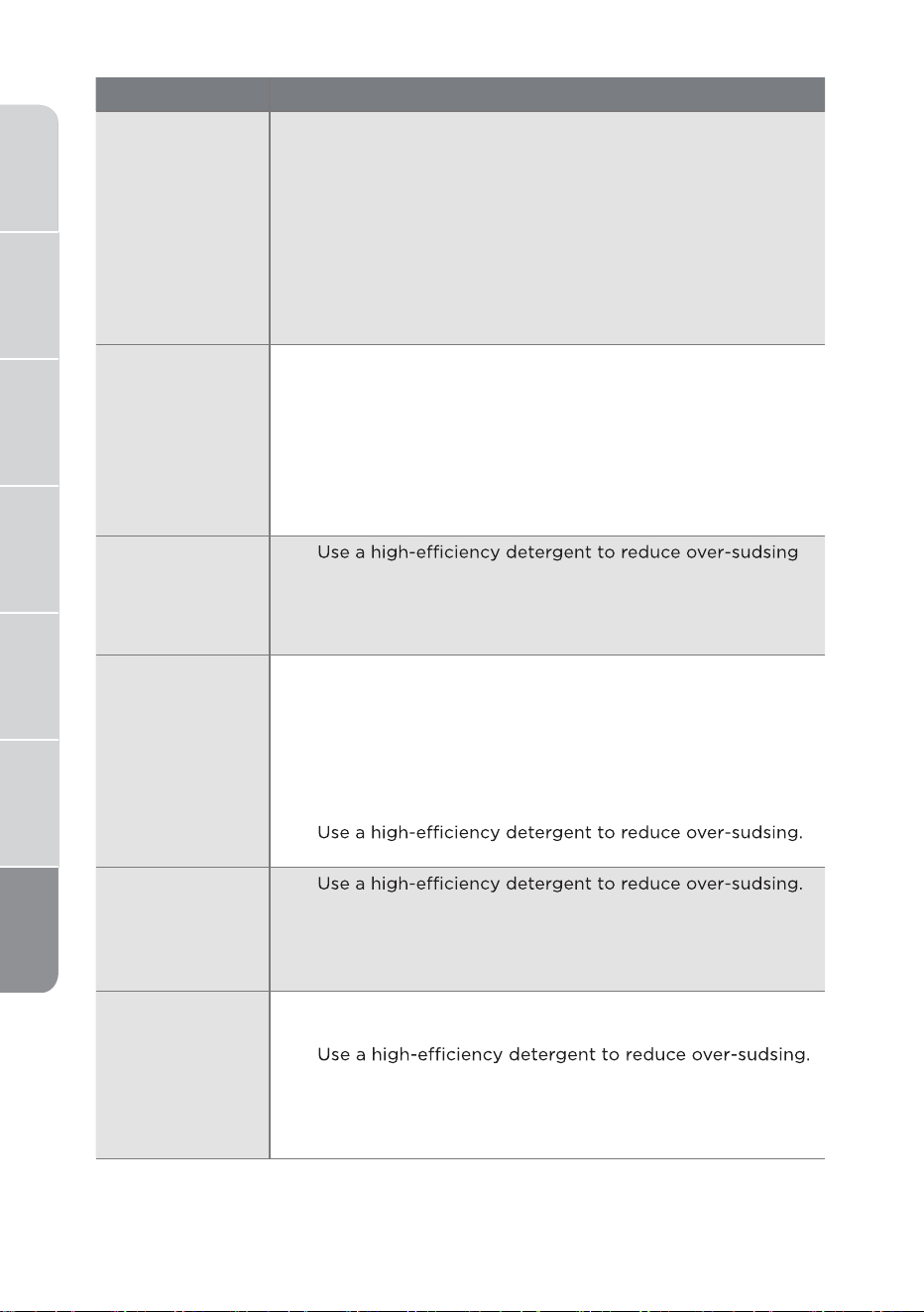
Problem Solution
Washer does not
drain or spin
•
Check the fuse or reset the circuit breaker.
•
Close the lid, then press the Start Pause button to start
your washer. For your safety, your washer does not spin
unless the lid is closed.
•
Make sure that the drain hose is not kinked. Straighten
as necessary. Make sure that the height of the drain hose
is within specified limits. See Drainage requirements on
page 14.
•
The pipes to your sewer system may be clogged.
Contact a plumber or qualified repair professional.
Washer does not
drain or spin
•
Make sure that you have selected the correct temp.
•
Make sure that the water source faucets are fully opened.
•
Make sure that the hoses are connected to the correct
faucet and water intake connections on your washer,
then flush the lines. See Connect the water hoses on
page 19.
•
Disconnect the hoses and clean the screens. The hose
filter screens may be clogged.
Load is too wet
at the end of the
cycle
•
See Selecting a detergent on page 28.
•
The load may be too small. Very small loads (one or
two items)may become unbalanced and not spin out
completely.
Water leaks
•
Make sure that all hose connections are tight. See
Connect the water hoses on page 19 and Connect the
drain hose on page 22.
•
Make sure that the end of the drain hose is correctly
inserted and secured to the drainage system. See
Connect the drain hose on page 22.
•
Avoid overloading.
•
See Selecting a detergent on page 28.
Oversuds
condition
•
See Selecting a detergent on page 28.
•
If you have"soft" water, reduce the amount of detergent.
•
For small or lightly soiled loads, reduce the amount of
detergent.
Prevent odor
•
Periodically run a Tub Clean cycle to clean the tub. See
Cleaning the tub on page 32.
•
Excessive suds collect in nooks and crannies and cause
odor. See Selecting a detergent on page 28.
•
Dry the interior of your washer after the total cycle has
finished.
Safety
Instructions
Features
Operation
Requirements
Installation
Instructions
Washer Care
TroubleshootingWasher Use
36
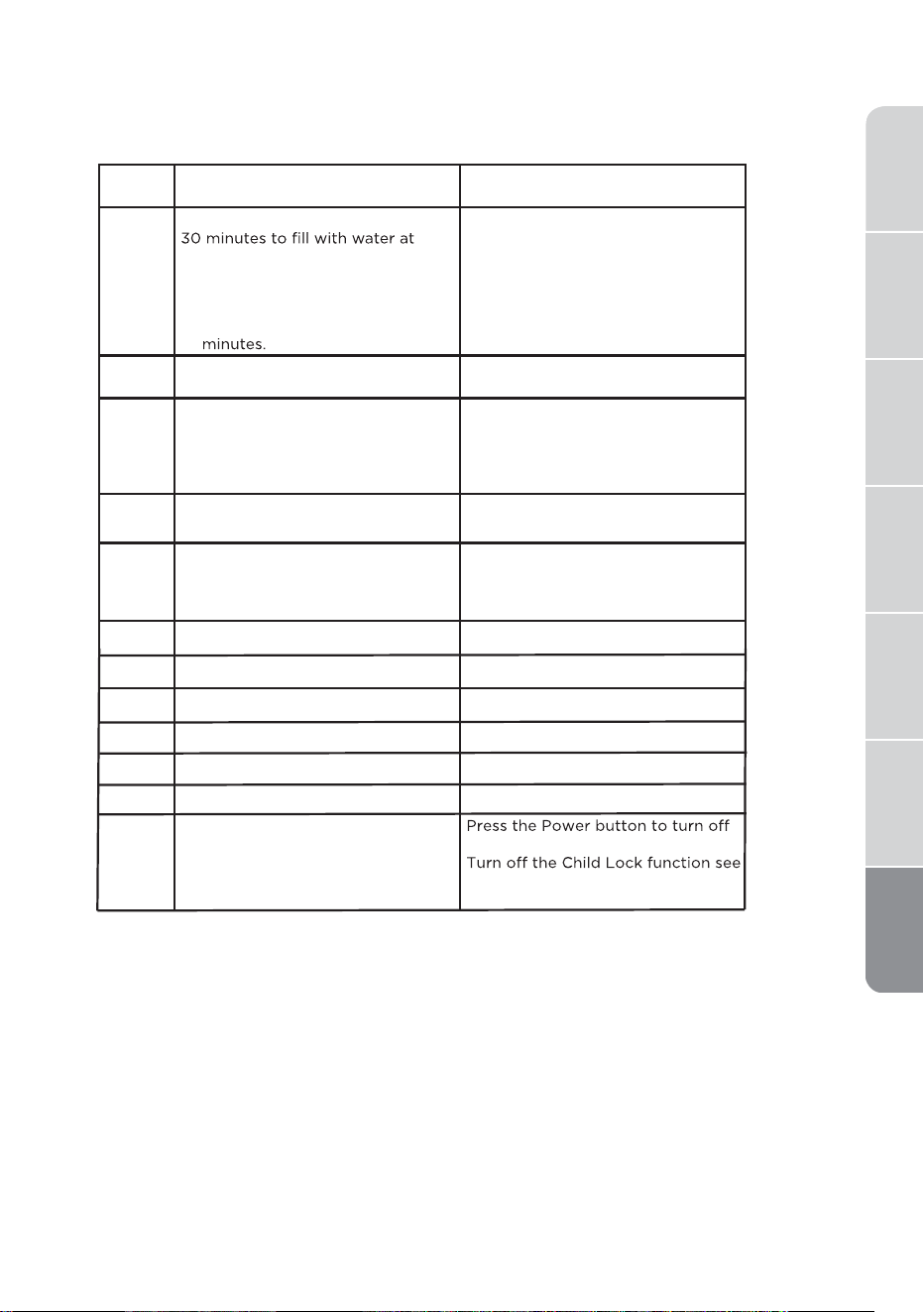
Error codes
Your washer is equipped with an automatic error-monitoring system to
detect and diagnose problems.
Error
Code
Possible Cause Solutions
E1
Your washer takes more than
low water level, 45 minutes at
medium water level, or 60 minutes
at high water level. After water
finishes entering your washer, the
water level has not changed in
Check if the lid is open. Check
Troubleshooting guide for, “No
water or not enough water” Check
for water leakage.
E2
The unit takes more than 10
minutes to drain.
Check Troubleshooting guide for
“Does not drain or spin”
E3 The lid is open.
Close the lid. See Installation
instructions to, "Level your washer".
The door lock or PCB may have
failed, try steps again. Call service
center.
E4
The unit is out of balance in spin
operation.
Relevel the load,if can not solve,
Contact Midea service center.
E5
Your washer is not level.
Impact switch failed.
Adjust the washer level refer to
installation instructions. If situation
continues, call service center. Call
service center.
F5 Load sensing failed.
F8
Fd
Door lock failed.
Safety
Instructions
Features
Operation
Requirements
Installation
Instructions
Washer Care
TroubleshootingWasher Use
37
E7
The Hall sensor failed.
Call service center.
5
F2
The EEPROM failed. Contact Midea service center.
Contact Midea service center.
Water level sensor failed. Contact Midea service center.
Contact Midea service center.
Contact Midea service center.
The PCB failed.C9
CL
The lid has been open for over 20
seconds with the Child Lock
function activated.
your washer.
setting the Child Lock on page 32.
Contact Midea Service center