Hui Zhou Gaoshengda Technology Co., LTD DT3LR1601
PAGE 1 OF 7
Version 1.0
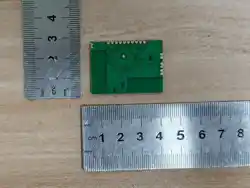
WIFI+BT Module
IEEE 802.11 a/b/g/n 1T/1R
Model Number: DT3LR1601
Product Descrition
The DT3LR1601 is a complete 2.4GHz/5GHz WIFI module. This module provides a high level of integration with
IEEE 802.11n MAC/ base band /radio and Bluetooth 5.4.The WLAN operation supports 20MHz,40MHz channels for
data rates up to 150Mbps. It fully complies with IEEE 802.11 a/b/g/n feature rich wireless connectivity at high
standards,delivers reliable,cost-effective, throughput from an extended distance.
Product Features
◆ Complies with IEEE 802.11b/g/n for 2.4GHz,IEEE 802.11a/n for 5GHz
◆ Bluetooth v5.4
◆ One transmit and One receive path(1T1R)
◆ Works with all existing network nfrastructure.
◆ Capable of up to 128-Bit WEP Encryption.
◆ Freedom to roam while staying connected.
◆ Operating Systems:Linux, Windows.
◆ Low power consumption.
◆ Easy to install and configure.
◆ USB interface.
◆ ROHS compliant
Product Specification
Model
DT3LR1601
Product Name
WIFI+BT Module
Standard
802.11 a/b/g/n
Interface
USB
Data Transfer Rate
Up to 150Mbps
Modulation Method
GFSK,π/4-DQPSK,8DPSK(bluetooth)
DQPSK,DBPSK,CCK(802.11b)
QPSK,BPSK,16QAM,64QAM with OFDM (802.11g)
QPSK,BPSK,16QAM,64QAM with OFDM (802.11n)
QPSK,BPSK,16QAM,64QAM with OFDM (802.11a)
Frequency Band
BLUETOOTH
2402~2480 MHz
WIFI
2.4G: 2412~2462 MHz
5G: 5150~5350MHz, 5470~5725MHz,5725~5850MHz
Operation Mode
Infrastructure
Security
WEP, TKIP, AES, WPA, WPA2
Operating Voltage
3.3V±10%
Current Consumption
<1000mA
Antenna Type
PCB
Operating
Temperature
-30 ~ 70°C ambient temperature
Storage Temperature
-40 ~ 85°C ambient temperature
Humidity
10 to 90 % maximum (non-condensing)

Hui Zhou Gaoshengda Technology Co., LTD DT3LR1601
PAGE 2 OF 7
Version 1.0
NOTICE:
◆please keep this product and accessories attached to the places which children can't touch;
◆do not splash water or other liquid onto this product, otherwise it may cause damage;
◆do not put this product near the heat source or direct sunlight, otherwise it may cause
deformation or malfunction;
◆please keep this product away from flammable or naked flame;
◆please do not repair this product by yourself. Only qualified personnel can be repaired.
FCC Statement
This equipment has been tested and found to comply with the limits for a Class B digital
device, pursuant to part 15 of the FCC rules. These limits are designed to provide reasonable
protection against harmful interference in a residential installation. This equipment
generates, uses and can radiate radio frequency energy and, if not installed and used in
accordance with the instructions, may cause harmful interference to radio communications.
However, there is no guarantee that interference will not occur in a particular installation.
If this equipment does cause harmful interference to radio or television reception, which
can be determined by turning the equipment off and on, the user is encouraged to try to
correct the interference by one or more of the following measures:
-Reorient or relocate the receiving antenna.
-Increase the separation between the equipment and receiver.
-Connect the equipment into an outlet on a circuit different from that to which the receiver
is connected.
-Consult the dealer or an experienced radio/TV technician for help.
This equipment complies with Part 15 of the FCC Rules. Operation is subject to the following
two conditions:
(1) This device may not cause harmful interference, and
(2) This device must accept any interference received, including interference that may cause
undesired operation.
Any changes or modifications not expressly approved by the party responsible for compliance
could void the user’s authority to operate the equipment.
2.2
This module has been assessed against the following FCC rule parts: CFR 47 FCC Part 15 C
(15.247, DTS and DSS) and CFR 47 FCC Part 15 E (NII). It is applicable to the modular
transmitter
2.3
This radio transmitter 2AC23-DT3L has been approved by Federal Communications Commission
to operate with the antenna types listed below, with the maximum permissible gain indicated.
Antenna types not included in this list that have a gain greater than the maximum gain
indicated for any type listed are strictly prohibited for use with this device.
The concrete contents to check are the following three points.
1) Maximum antenna gains are shown in item 2.7 below.
2) Should be installed so that the end user cannot modify the antenna
3) Feed line should be designed in 50ohm
Hui Zhou Gaoshengda Technology Co., LTD DT3LR1601
PAGE 3 OF 7
Version 1.0
Fine-tuning of return loss etc. can be performed using a matching network.
The antenna shall not be accessible for modification or change by the end user.
2.4
The module complies with FCC Part 15.247 / Part 15.407 and apply for Single module approval.
2.5
Trace antenna designs: applicable.
Any deviation(s) from the defined parameters of the antenna trace, as described by the
instructions, require that the host product manufacturer must notify the module grantee
that they wish to change the antenna trace design. In this case, a Class II permissive change
application is required to be filed by the grantee, or the host manufacturer can take
responsibility through the change in FCC ID (new application) procedure followed by a Class
II permissive change application.
The device must be professionally installed.
The intended use is generally not for the general public.
It is generally for industry/commercial use.
The connector is within the transmitter enclosure and can only be accessed by disassembly
of the transmitter that is not normally required.
The user has no access to the connector.
Installation must be controlled.
Installation requires special training.
2.6
This equipment complies with FCC radiation exposure limits set forth for an uncontrolled
environment. This equipment should be installed and operated with a minimum distance of
20cm between the radiator & your body. This transmitter must not be co-located or operating
in conjunction with any other antenna or transmitter.
2.7
The following antennas have been certified for use with this module.
Only antennas of the same type with equal or lower gain may also be used with this module.
Other types of antennas and/or higher gain antennas may require the additional authorization
for operation. The installer should use unique antenna connector and Antenna types not
included in this list that have a gain greater than the maximum gain indicated for any type
listed are strictly prohibited for use with this device. The manufacturer of module will
inform installer to meet with the FCC part 15.203 in the warning part.
Antenna Specification list below:
Antennas:
2.4G
5G
PCB antenna1 & 3.06 dBi
PCB antenna1 & 3.86 dBi
PCB antenna2 & 2.70 dBi
PCB antenna2 & 3.87 dBi
Hui Zhou Gaoshengda Technology Co., LTD DT3LR1601
PAGE 4 OF 7
Version 1.0
BT Antenna:
TYPE
GAIN
PCB antenna
2.57 dBi
The antenna is permanently attached, can’t be replaced.
2.8
Please notice that if the FCC identification number is not visible when the module is
installed inside another device, then the outside of the device into which the module is
installed must also display a label referring to the enclosed module. This exterior label
can use wording such as “Contains FCC ID: 2AC23-DT3L”; any similar wording that expresses
the same meaning may be used.
2.9
Testing of the host product with all the transmitters installed – referred to as the
composite investigation test- is recommended, to verify that the host product meets all
the applicable FCC rules. The radio spectrum is to be investigated with all the transmitters
in the final host product functioning to determine that no emissions exceed the highest
limit permitted for any one individual transmitter as required by Section 2.947(f). The
host manufacturer is responsible to ensure that when their product operates as intended
it does not have any emissions present that are out of compliance that were not present
when the transmitters were tested individually.
If the modular transmitter has been fully tested by the module grantee on the required number
of channels, modulation types, and modes, it should not be necessary for the host installer
to re-test all the available transmitter modes or settings. It is recommended that the host
product manufacturer, installing the modular transmitter, perform some investigative
measurements to confirm that the resulting composite system does not exceed the spurious
emissions limits or band edge limits (e.g., where a different antenna may be causing
additional emissions).
The testing should check for emissions that may occur due to the intermixing of emissions
with the other transmitters, digital circuitry, or due to physical properties of the host
product (enclosure). This investigation is especially important when integrating multiple
modular transmitters where the certification is based on testing each of them in a
stand-alone configuration.
2.10
Any company of the host device which install this modular should perform the test of radiated
& conducted emission and spurious emission etc. according to FCC Part 15C: 15.247 and 15.209
& 15.207, part 15 E 15.407,15B class B requirement, only if the test result comply with
FCC part 15C: 15.247 and 15.209 & 15.207, part 15 E 15.407,15B class B requirement. Then
the host can be sold legally.
The host product manufacturer is responsible for compliance to any other FCC rules that
apply to the host not covered by the modular transmitter grant of certification. If the
grantee markets their product as being Part 15 Subpart B compliant (when it also contains
unintentional-radiator digital circuity), then the grantee shall provide a notice stating
that the final host product still requires Part 15 Subpart B compliance testing with the

Hui Zhou Gaoshengda Technology Co., LTD DT3LR1601
PAGE 5 OF 7
Version 1.0
modular transmitter installed.
2.11
The host manufacturer is recommended to use FCC KDB 996369 D04 Module Integration Guide
recommending as "best practice" RF design engineering testing and evaluation in case
non-linear interactions generate additional non-compliant limits due to module placement
to host components or properties.
2.12
This module is stand-alone modular. If the end product will involve the Multiple
simultaneously transmitting condition or different operational conditions for a stand-alone
modular transmitter in a host, host manufacturer have to consult with module manufacturer
for the installation method in end system.
Canada Statement
This device complies with Industry Canada’s license-exempt RSSs. Operation is subject to
the following two conditions:
(1) This device may not cause interference; and
(2) This device must accept any interference, including interference that may cause
undesired operation of the device.
Le présent appareil est conforme aux CNR d’Industrie Canada applicables aux appareils radio
exempts de licence. L’exploitation est autorisée aux deux conditions suivantes :
(1) l’appareil ne doit pas produire de brouillage;
(2) l’utilisateur de l’appareil doit accepter tout brouillage radioélectrique subi, même
si le brouillage est susceptible d’en compromettre le fonctionnement.
Please notice that if the ISED certification number is not visible when the module is
installed inside another device, then the outside of the device into which the module is
installed must also display a label referring to the enclosed module. This exterior label
can use wording such as the following: “Contains IC: 12290A-DT3L” any similar wording
that expresses the same meaning may be used.
l'appareil hôte doit porter une étiquette donnant le numéro de certification du module
d'Industrie Canada, précédé des mots « Contient un module d'émission », du mot « IC:
12290A-DT3L » ou d'une formulation similaire exprimant le même sens, comme suit
The device meets the exemption from the routine evaluation limits in section 2.5 of RSS
102 and compliance with RSS-102 RF exposure, users can obtain Canadian information on RF
exposure and compliance.
Le dispositif rencontre l'exemption des limites courantes d'évaluation dans la section 2.5
de RSS 102 etla conformité à l'exposition de RSS-102 RF, utilisateurs peut obtenir
l'information canadienne surl'exposition et la conformité de rf.
This transmitter must not be co-located or operating in conjunction with any other antenna
or transmitter. This equipment should be installed and operated with a minimum distance
of 20 centimeters between the radiator and your body.

Hui Zhou Gaoshengda Technology Co., LTD DT3LR1601
PAGE 6 OF 7
Version 1.0
Cet émetteur ne doit pas être Co-placé ou ne fonctionnant en même temps qu'aucune autre
antenne ouémetteur. Cet équipement devrait être installé et actionné avec une distance
minimum de 20 centimètres entre le radiateur et votre corps.
the device for operation in the band 5150–5250 MHz is only for indoor use to reduce
the potential for harmful interference to co-channel mobile satellite systems;
les dispositifs fonctionnant dans la bande 5 150-5 250 MHz sont réservés uniquement pour
uneutilisation à l’intérieur afin de réduire les risques de brouillage préjudiciable
aux systèmes de satellites mobiles utilisant les mêmes canaux;
Notice to OEM integrator
Must use the device only in host devices that meet the FCC/ISED RF exposure category of
mobile, which means the device is installed and used at distances of at least 20cm from
persons.
This transmitter must not be co-located or operating in conjunction with any other antenna
or transmitter.
The end user manual shall include FCC Part 15 /ISED RSS GEN compliance statements related
to the transmitter as show in this manual(FCC/Canada statement).
Host manufacturer is responsible for compliance of the host system with module installed
with all other applicable requirements for the system such as Part 15 B, ICES 003.
Host manufacturer is strongly recommended to confirm compliance with FCC/ISED requirements
for the transmitter when the module is installed in the host.
The use condition limitations extend to professional users, then instructions must state
that this information also extends to the host manufacturer’s instruction manual.
Host manufacturer is strongly recommended to confirm compliance with FCC/ISED
requirements for the transmitter when the module is installed in the host.
Must have on the host device a label showing Contains FCC ID: 2AC23-DT3L or IC: 12290A-DT3L
Installer should put it in the manual:
The device for operation in the band 5150–5250 MHz is only for indoor use to reduce the
potential for harmful interference to co-channel mobile satellite systems.
l'hôte doit utiliser l'instrument uniquement dans des dispositifs qui répondent à la fcc
/ (catégorie d'exposition rf mobile, ce qui signifie le dispositif est installé et utilisé
à une distance d'au moins 20 cm de personnes.
le manuel de l'utilisateur final doit inclure la partie 15 / (fac rss gen déclarations de
conformité relatives à l'émetteur que de montrer dans ce manuel.
le fabricant est responsable de la conformité de l'hôte, le système d'accueil avec le module
installé avec toutes les autres exigences applicables du système comme la partie 15 b, ices
- 003.
accueillir le fabricant est fortement recommandé de confirmer la conformité avec les
exigences de la fcc / (émetteur lorsque le module est installé dans l'hôte.

Hui Zhou Gaoshengda Technology Co., LTD DT3LR1601
PAGE 7 OF 7
Version 1.0
le dispositif d'accueil doivent avoir une étiquette indiquant contient FCC ID: 2AC23-DT3L,
IC: 12290A-DT3L
Les personnes chargées de l'installation devraient figurer dans le manuel:
Les dispositifs fonctionnant dans la bande de 5 150 à 5 250 MHz sont réservés uniquement
pour une utilisation à l’intérieur afin de réduire les risques de brouillage préjudiciable
aux systèmes de satellites mobiles utilisant les mêmes canaux.
Doit avoir sur l'appareil hôte une étiquette indiquant Contient l'ID FCC 2AC23-DT3L ou IC :
12290A-DT3L L'ID FCC et l'ID IC ne doivent pas être placés sur l'hôte en même temps et seuls
les hôtes se rendant aux États-Unis peuvent utiliser l'ID FCC et seuls les hôtes se rendant
au Canada peuvent utiliser l'ID IC.