Product Installation
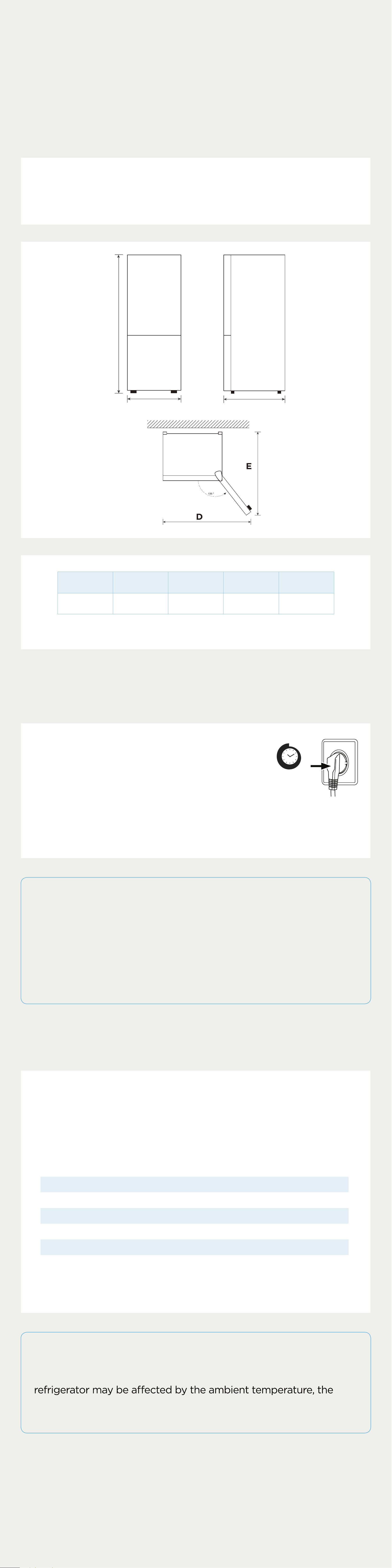
Space requirement diagram
Keep the air circulation free around the cabinet. When installing the
unit, ensure 10cm of free space at both sides, 10cm at the top of the
unit, and not more than 7.5cm at the rear of the unit.
B
A
C
A B C D E
595 2010 678 920 1150
Notice: All dimensions in mm
Connecting the appliance
After installing the product, please let it stay
for more than 2 hours before turning on the
power, otherwise it will lead to a decrease
in cooling capacity or a damage to the
product.
Allow the appliance to run empty for 24
hours so the compartment can cool to the
appropriate temperature.
2 h
• | CAUTION
The refrigerator should always be plugged into its own individual
electrical outlet which has a voltage rating that matches the rating
plate.
When positioning the appliance, ensure the supply cord is not
trapped or damaged.
Ambient Temperature
Depending on the climate class, this refrigerator is intended to
be used at an ambient temperature range as specified in the
following table.
The product may not operate properly at temperatures outside
of the specific range.
You can find the climate class on the product label.
Climate Class Ambient Temperature
SN +10 °C to +32 °C
N +16 °C to +32 °C
ST +16 °C to +38 °C
T +16 °C to +43 °C
If you have any doubts regarding installation, please turn
to the vendor, to our customer service or to the nearest
Authorised Service Centre.
• | Tips
The cooling performance and power consumption of the
door-opening frequency, and the location of the refrigerator. We
recommend adjusting the temperature settings as appropriate.

Maintenance Tips
CAUTION
•
Unplug the appliance before cleaning.
•
When cleaning, never use solvents, abrasive materials, hard
brushes, or metallic or sharp objects. Solvents are harmful to
human health and may damage plastic parts, while abrasive
cleaning materials and tools may scratch the surfaces.
•
Never apply oil or grease to the door seal, as this may cause it
to become porous over time.
•
Do not use steam-cleaning equipment. Steam may come into
contact with the appliance’s electrical components and cause
a short circuit.
•
Clean the exterior surfaces of the appliance with a slightly
damp cloth, and then dry them thoroughly. Make sure that no
water enters the interior of the appliance, for example through
the switch or control panel.
•
Wipe the door seal with clean water only, and dry it thoroughly
afterwards.
•
Removable parts, such as the glass plate, can be taken out for
cleaning.
To slow down the deterioration of plastic materials:
•
Clean with mild, pH-neutral detergents. Avoid abrasive
sponges, as they may cause micro-scratches.
Watch for the following signs:
•
Cracks, fissures, or blisters on the surface.
•
Significant yellowing, permanent discoloration, or loss of
transparency.
•
A sticky or tacky feel, or delamination of the material.
• | Notes:
Residual staining from foods such as lycopene or curcumin is not a sign
of material deterioration. Improper use or physical damage may increase
chemical migration. If visible damage occurs, the item is no longer
suitable for food contact.
Defrosting
Although this appliance defrosts automatically, a layer of frost may
form on the interior walls of the freezer compartment if the freezer
door is opened frequently or left open for too long. If the frost
becomes too thick, choose a time when food supplies are low and
proceed as follows:
•
Remove all food and accessory baskets, unplug the appliance
from the mains power supply, and leave the doors open. Ventilate
the room thoroughly to speed up the thawing process.
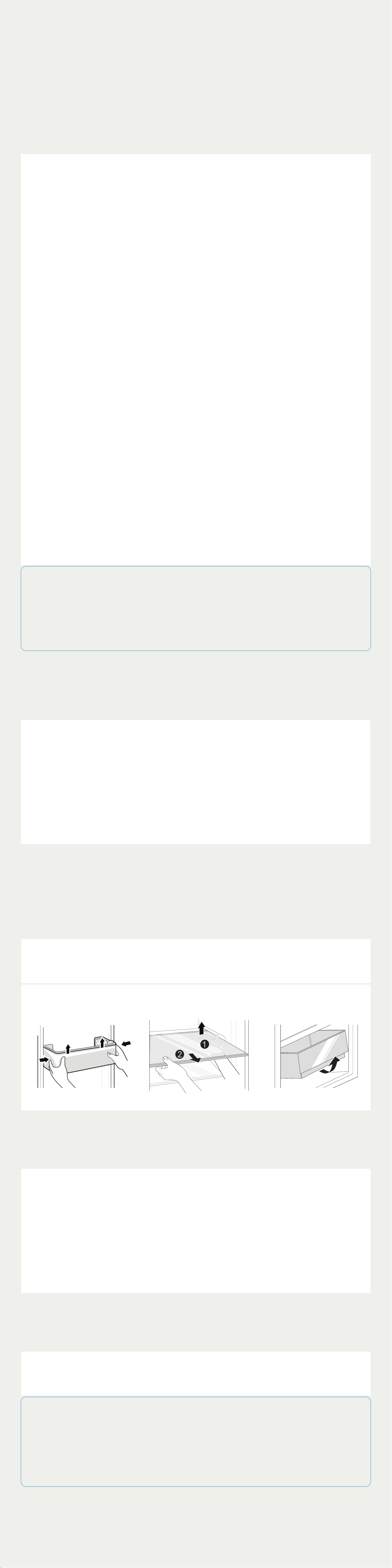
Removing the accessories
If you want to clean the fittings thoroughly, remove these from your
appliance.
a.
b.
c.
Moving the appliance
1.
Turn o the refrigerator and unplug it from the wall outlet.
2.
Remove all food.
3.
Securely tape down all loose items inside your refrigerator.
4.
Tape the doors shut.
Be sure the appliance stays in an upright position during
transportation.
Power failure
During a power failure, the temperature in the appliance rises. This
reduces the storage time and quality of the frozen food.
• | Notes:
Open the appliance as little as possible during a power failure and do not
place any additional food in the appliance.
Check the quality of the food immediately after a power failure. Dispose
of any frozen food that has defrosted and is warmer than 5 °C.