

Contents
Contents
1. Overview . . . . . . . . . . . . . . . . . . . . . . . . . . . . . . . . . . . . . . . . . . . . . . . . . . . . . . 2
1.1. Features . . . . . . . . . . . . . . . . . . . . . . . . . . . . . . . . . . . . . . . . . . . . . . . . . . . . . . . . . . . . 2
1.2. Scope of applications . . . . . . . . . . . . . . . . . . . . . . . . . . . . . . . . . . . . . . . . . . . . . . . 2
2. Module interfaces . . . . . . . . . . . . . . . . . . . . . . . . . . . . . . . . . . . . . . . . . . . . . 4
2.1. Dimensions and footprint . . . . . . . . . . . . . . . . . . . . . . . . . . . . . . . . . . . . . . . . . . 4
2.2. Pinout . . . . . . . . . . . . . . . . . . . . . . . . . . . . . . . . . . . . . . . . . . . . . . . . . . . . . . . . . . . . . . . 4
3. Electrical parameters . . . . . . . . . . . . . . . . . . . . . . . . . . . . . . . . . . . . . . . . . . 8
3.1. Absolute electrical parameters . . . . . . . . . . . . . . . . . . . . . . . . . . . . . . . . . . . . . 8
3.2. Operating conditions . . . . . . . . . . . . . . . . . . . . . . . . . . . . . . . . . . . . . . . . . . . . . . . 8
3.3. Radio frequency (RF) power . . . . . . . . . . . . . . . . . . . . . . . . . . . . . . . . . . . . . . . . 9
3.4. Power consumption in operating mode . . . . . . . . . . . . . . . . . . . . . . . . . . . 10
4. RF parameters . . . . . . . . . . . . . . . . . . . . . . . . . . . . . . . . . . . . . . . . . . . . . . . 13
4.1. Basic RF features . . . . . . . . . . . . . . . . . . . . . . . . . . . . . . . . . . . . . . . . . . . . . . . . . 13
4.2. Transmitter (TX) performance . . . . . . . . . . . . . . . . . . . . . . . . . . . . . . . . . . . . 13
5. Antenna information . . . . . . . . . . . . . . . . . . . . . . . . . . . . . . . . . . . . . . . . . 16
5.1. Antenna type . . . . . . . . . . . . . . . . . . . . . . . . . . . . . . . . . . . . . . . . . . . . . . . . . . . . . . 16
5.2. Antenna interference reduction . . . . . . . . . . . . . . . . . . . . . . . . . . . . . . . . . . . 16
6. Power-on and power-o sequence . . . . . . . . . . . . . . . . . . . . . . . . . . . 17
6.1. Power-on sequence . . . . . . . . . . . . . . . . . . . . . . . . . . . . . . . . . . . . . . . . . . . . . . . 17
6.2. Power-o sequence . . . . . . . . . . . . . . . . . . . . . . . . . . . . . . . . . . . . . . . . . . . . . . . 17
7. Footprint and production instructions . . . . . . . . . . . . . . . . . . . . . . . 19
7.1. Mechanical dimensions . . . . . . . . . . . . . . . . . . . . . . . . . . . . . . . . . . . . . . . . . . . 19
7.2. Recommended PCB footprint . . . . . . . . . . . . . . . . . . . . . . . . . . . . . . . . . . . . . 19
7.3. Production instructions . . . . . . . . . . . . . . . . . . . . . . . . . . . . . . . . . . . . . . . . . . . 22
7.4. Recommended oven temperature curve . . . . . . . . . . . . . . . . . . . . . . . . . 23
7.5. Storage conditions . . . . . . . . . . . . . . . . . . . . . . . . . . . . . . . . . . . . . . . . . . . . . . . . 25
8. MOQ and packaging information . . . . . . . . . . . . . . . . . . . . . . . . . . . . . 26
9. Appendix: Statement . . . . . . . . . . . . . . . . . . . . . . . . . . . . . . . . . . . . . . . . . 27
I

1Overview
WBR3-PRO is a Wi-Fi and Bluetooth low energy (LE) combo module developed by
Tuya Smart. It consists of a highly integrated RF chip, RTL8720CF-VU2, with built-
in Wi-Fi stacks and various library functions.
1 / 29

1Overview
1. Overview
WBR3-PRO combines a low-power KM4 microcontroller unit (MCU), WLAN MAC,
and 1T1R (1 transmitter/1 receiver) design. This module provides output
frequency up to 100 MHz, 384 KB embedded SRAM, 4 MB ash memory, and
congurable GPIOs that can function as digital peripherals for diverse
applications.
WBR3-PRO is a real-time operating system (RTOS), integrated with all Wi-Fi MAC
and TCP/IP libraries. All these resources can help you develop your own
embedded Wi-Fi products.
1.1. Features
• Built-in low-power KM4 MCU that also acts as an application processor.
• Clock rate of 100 MHz.
• Operating voltage range: 3V to 3.6V.
• Peripherals: 9 × GPIOs, 1 × UART, and 1 × Log_Tx.
• Wi-Fi and Bluetooth connectivity
• IEEE 802.11b/g/n20.
• Channels [email protected] GHz (CH1-11 for US/CA, and CH1-13 for EU/CN).
• Support security protocols, including WPA2 and WPA2 PSK (AES).
• Support Bluetooth LE 5.4.
• The maximum output power is +20 dBm for IEEE 802.11b transmission.
• Support Wi-Fi Easy Connect (EZ mode) pairing mode on Android and iOS
devices.
• Onboard PCB antenna.
• It has passed CE and FCC certications.
• Operating temperature range: −20°C to +85°C.
1.2. Scope of applications
• Smart building
• Smart home
• Smart socket
2 / 29

2.3Module interfaces
• Smart lighting
• Smart bus
• Industrial wireless control
• Baby monitor
• IP camera
3 / 29
2.3Module interfaces
2. Module interfaces
2.1. Dimensions and footprint
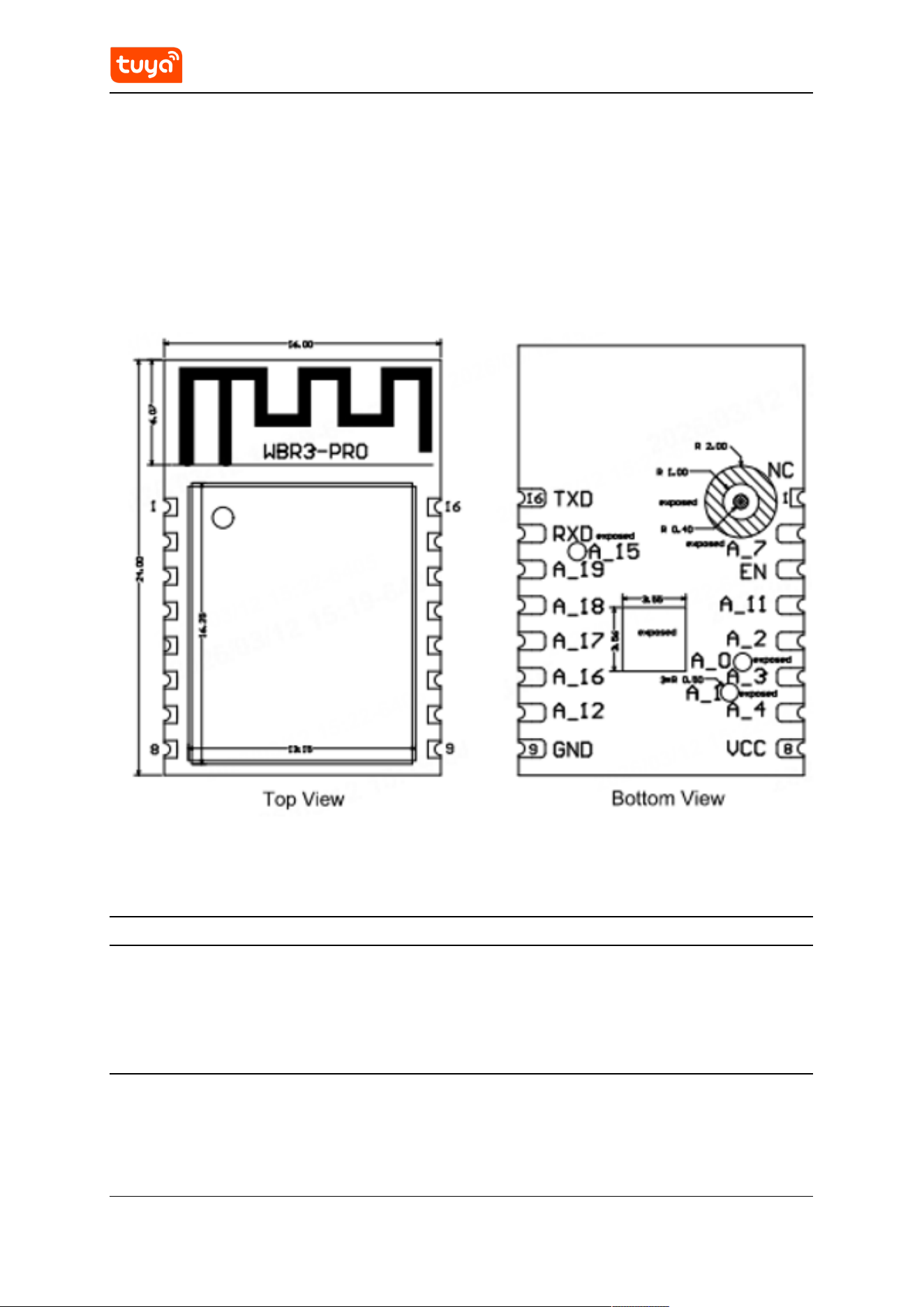
• WBR3-PRO has two rows of pins (2×8) with a 2 mm pin spacing.
• WBR3-PRO dimensions: 16 ± 0.35 mm (W) × 24 ± 0.35 mm (L) × 2.9 ± 0.15
mm (H). The gure below shows the dimensions of the WBR3-PRO module.
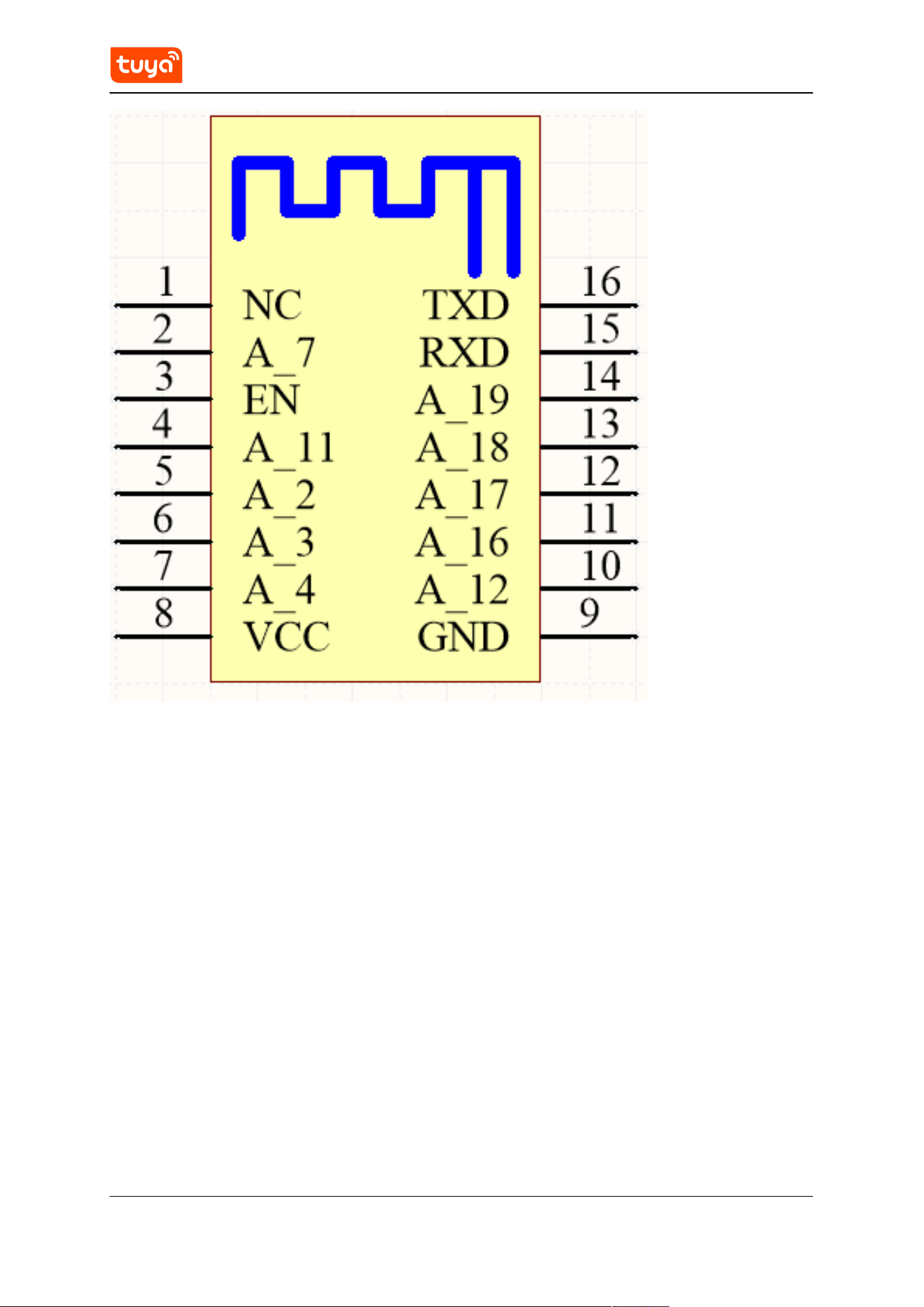
2.2. Pinout
Pin Symbol I/O type Feature
1 NC /
Not connected, in
order to be
compatible with
other modules.
4 / 29

3.3Electrical parameters
Pin Symbol I/O type Feature
2 A_7 I/O
GPIOA_7, which
supports hardware
PWM,
corresponding to
Pin 21 on the IC.
3 EN I/O
The enable pin
that is active high.
The module has
pulled up the high
level, and users
can control this
pin externally.
4 A_11 I/O
GPIOA_11, which
supports hardware
PWM,
corresponding to
Pin 25 on the IC.
5 A_2 I/O
GPIOA_2, which
supports hardware
PWM,
corresponding to
Pin 18 on the IC.
6 A_3 I/O
GPIOA_3, which
supports hardware
PWM,
corresponding to
Pin 19 on the IC.
7 A_4 I/O
GPIOA_4, which
supports hardware
PWM,
corresponding to
Pin 20 on the IC.
5 / 29

3.3Electrical parameters
Pin Symbol I/O type Feature
8 VCC P
Power supply pin
(3.3V).
9 GND P Ground pin.
10 A_12 I/O
GPIOA_12, which
supports hardware
PWM,
corresponding to
Pin 26 on the IC.
11 A_16 I/O
GPIOA_16, which
can be reused as
the
UART_Log_TXD pin
for log printing.
12 A_17 I/O
GPIOA_17, which
supports hardware
PWM,
corresponding to
Pin 38 on the IC.
13 A_18 I/O
GPIOA_18, which
supports hardware
PWM,
corresponding to
Pin 39 on the IC.
14 A_19 I/O
GPIOA_19, which
supports hardware
PWM,
corresponding to
Pin 40 on the IC.
6 / 29

3.3Electrical parameters
Pin Symbol I/O type Feature
15 RXD I/O
GPIOA_13, which
can be reused as
the UART0_RXD
pin for serial
communication.
16 TXD I/O
GPIOA_14, which
can be reused as
the UART0_TXD
pin for serial
communication.
P indicates the power pin, and I/O indicates the input and output pin.
7 / 29

3.3Electrical parameters
3. Electrical parameters
3.1. Absolute electrical parameters
Parameter Description
Minimum
value
Maximum
value
Unit
Ts
Storage
temperature
−40 105 °C
VDD
Supply
voltage
−0.3 3.6 V
Electrostatic
discharge
voltage
(human body
model)
TAMB-25°C - 2 kV
Electrostatic
discharge
voltage
(machine
model)
TAMB-25°C - 0.5 kV
3.2. Operating conditions
Parameter Description
Minimum
value
Typical
value
Maximum
value
Unit
Ta
Operating
temperature
−20 - 85 °C
VDD
Operating
voltage
3.0 - 3.6 V
VIL
I/O low-
level input
- - 0.8 V
VIH
I/O high-
level input
2.0 - - V
8 / 29

4.3RF parameters
Parameter Description
Minimum
value
Typical
value
Maximum
value
Unit
VOL
I/O low-
level
output
- - 0.4 V
VOH
I/O high-
level
output
2.4 - - V
Imax
I/O drive
current
- - 16 mA
Cpad
Input pin
capacitor
- 2 - pF
3.3. Radio frequency (RF) power
• Power consumption during continuous transmission (TX)
Symbol Mode Power
Average
value
Peak
(Typical)
value
Unit
IRF
802.11b,
11 Mbit/s
17 dBm 217 268 mA
IRF
802.11b,
11 Mbit/s
18 dBm 231 283 mA
IRF
802.11g,
54 Mbit/s
15 dBm 159 188 mA
IRF
802.11g,
54 Mbit/s
17.5 dBm 177 213 mA
IRF
802.11n,
BW20
MCS7
13 dBm 145 167 mA
IRF
802.11n,
BW20
MCS7
16.5 dBm 165 193 mA
• Power consumption during continuous reception (RX)
9 / 29

4.4RF parameters
Symbol Mode
Average
value
Peak
(Typical)
value
Unit
IRF
802.11b, 11
Mbit/s
63 65 mA
IRF
802.11g, 54
Mbit/s
65 67 mA
IRF
802.11n,
HT20 MCS7
65 67 mA
3.4. Power consumption in operating mode
Operating
mode
Status (Ta =
25°C)
Average
value
Peak
(Typical)
value
Unit
Pairing over
Bluetooth
The module is
in Wi-Fi Easy
Connect (EZ)
mode. The Wi-
Fi network
status
indicator
blinks quickly.
61 272 mA
Pairing over
AP
The module is
in AP mode.
The Wi-Fi
network
status
indicator
blinks slowly.
59 272 mA
10 / 29

4.5RF parameters
Operating
mode
Status (Ta =
25°C)
Average
value
Peak
(Typical)
value
Unit
Pairing over
EZ
The module is
in Wi-Fi Easy
Connect (EZ)
mode. The Wi-
Fi network
status
indicator
blinks quickly.
62 280 mA
Connected
and idle mode
The module is
connected to
the cloud. The
network
status
indicator is
steady on.
51 260 mA
Connected
and operating
mode
The module is
connected to
the cloud. The
network
status
indicator is
steady on.
59 268 mA
11 / 29

4.5RF parameters
Operating
mode
Status (Ta =
25°C)
Average
value
Peak
(Typical)
value
Unit
Weakly
connected
The
connection
between the
module and
the access
point is
intermittent.
The network
status
indicator is
steady on.
62 264 mA
Disconnected
The module is
disconnected
from the
cloud. The
network
status
indicator is
steady o.
57 268 mA
Module
disabled
The module’s
enable (EN)
pin is pulled
down.
1.5 1.6 mA
12 / 29

4.5RF parameters
4. RF parameters
4.1. Basic RF features
Parameter Description
Frequency range 2.400 to 2.4835 GHz
Wi-Fi standard IEEE 802.11b/g/n (channels 1 to 14)
Bluetooth standard Bluetooth LE 4.2
Data transmission rate
• IEEE 802.11b: 1, 2, 5.5, and 11 Mbit/
s
• IEEE 802.11g: 6, 9, 12, 18, 24, 36,
48, and 54 Mbit/s
• IEEE 802.11n: HT20 MCS0-7
Antenna type
PCB antenna with a peak gain of 2.54
dBi
4.2. Transmitter (TX) performance
• Continuous TX performance:
Parameter
Minimum
value
Typical value
Maximum
value
Unit
RF average
output power,
802.11b CCK
mode, 1 Mbit/
s
- 17.5 - dBm
RF average
output power,
802.11g
OFDM mode,
54 Mbit/s
- 14.5 - dBm
13 / 29

5.3Antenna information
Parameter
Minimum
value
Typical value
Maximum
value
Unit
RF average
output power,
802.11n
OFDM mode,
MCS7
- 13.5 - dBm
RF average
output power,
Bluetooth LE
4.2, 1 Mbit/s
- 6.5 - dBm
Frequency
error
−20 - 20 ppm
CCK 11 Mbit/s
mode, 17.5
dBm
- - −10 dB
OFDM 54
Mbit/s mode,
14.5 dBm
- - −29 dB
OFDM MCS7
mode, 13.5
dBm
- - −30 dB
• Receiver (RX) performance:
Parameter
Minimum
value
Typical value
Maximum
value
Unit
PER < 8%, RX
sensitivity,
802.11b CCK
mode, 1 Mbit/
s
- −97 - dBm
14 / 29

5.3Antenna information
Parameter
Minimum
value
Typical value
Maximum
value
Unit
PER < 10%,
RX sensitivity,
802.11g
OFDM mode,
54 Mbit/s
- −75 - dBm
PER < 10%,
RX sensitivity,
802.11n
OFDM mode,
MCS7
- −72 - dBm
PER < 10%,
RX sensitivity,
Bluetooth LE
4.2, 1 Mbit/s
- −93 - dBm
15 / 29

5.3Antenna information
5. Antenna information
5.1. Antenna type
This module has an onboard PCB antenna with a peak gain of 2.54 dBi.
5.2. Antenna interference reduction
When a PCB antenna is used on a Wi-Fi module, we recommend that the module
antenna is at least 15 mm away from other metal components. This can optimize
the Wi-Fi performance.
16 / 29
6.3Power-on and power-o sequence
6. Power-on and power-o sequence
6.1. Power-on sequence
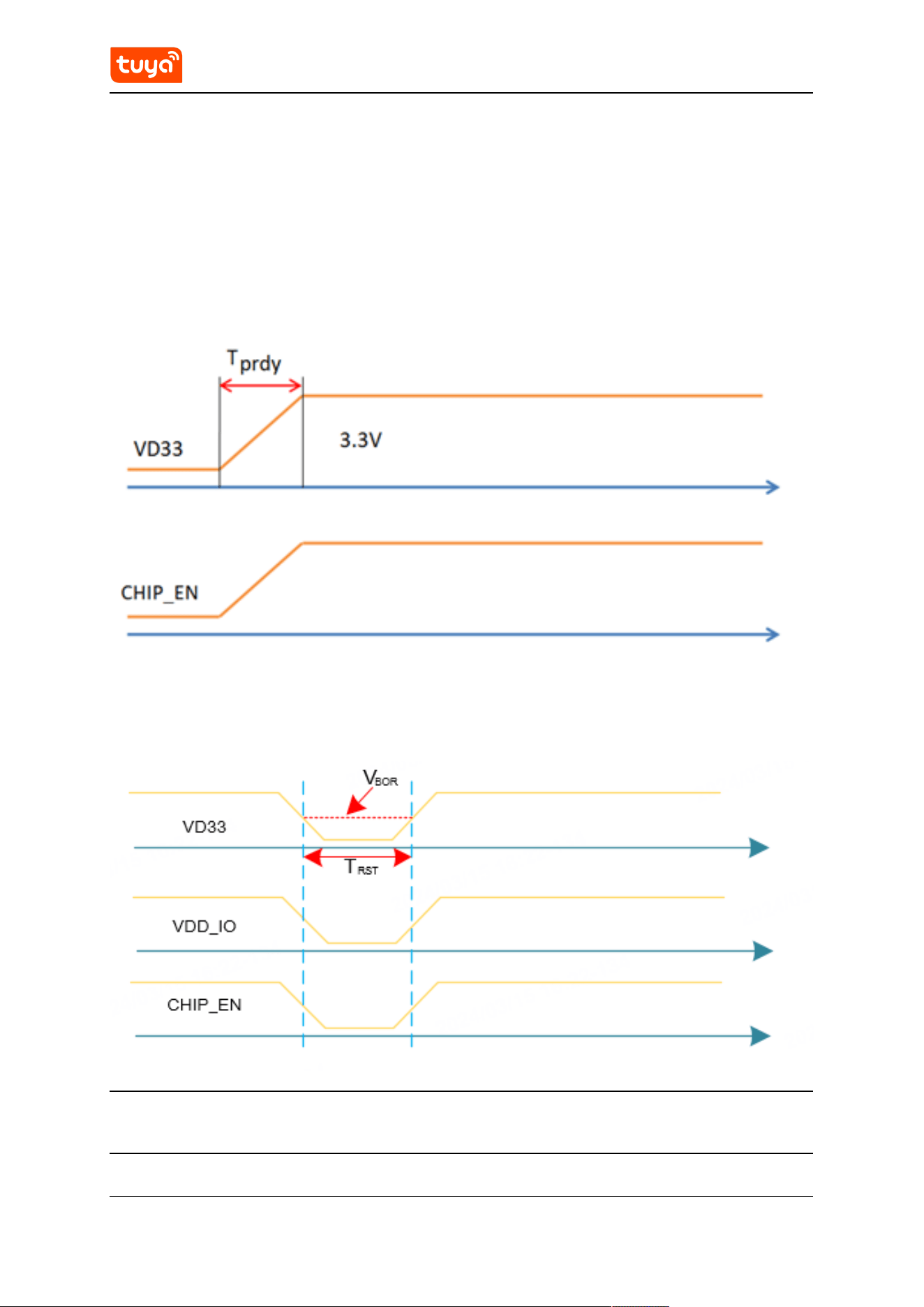
The RTL8720 chip has requirements for the power-on sequence. It is
recommended that the time for the voltage to rise from 0V to 3.3V should be
within 20ms.
6.2. Power-o sequence
Symbol Parameter
Minimum
value
Typical
value
Maximum
value
Unit
17 / 29

7.3Footprint and production
instructions
Symbol Parameter
Minimum
value
Typical
value
Maximum
value
Unit
TPRDY
3.3V ready
time
0.6 - 20 ms
CHIP_EN
CHIP_EN
ready time
0.6 - 20 ms
VBOR
BOR occurs
after the
3.3V pin is
lower than
this voltage
2 - - V
TRST
The
required
time that
3.3V is
lower than
VBOR
1 - - ms
18 / 29
7.3Footprint and production
instructions
7. Footprint and production instructions
7.1. Mechanical dimensions
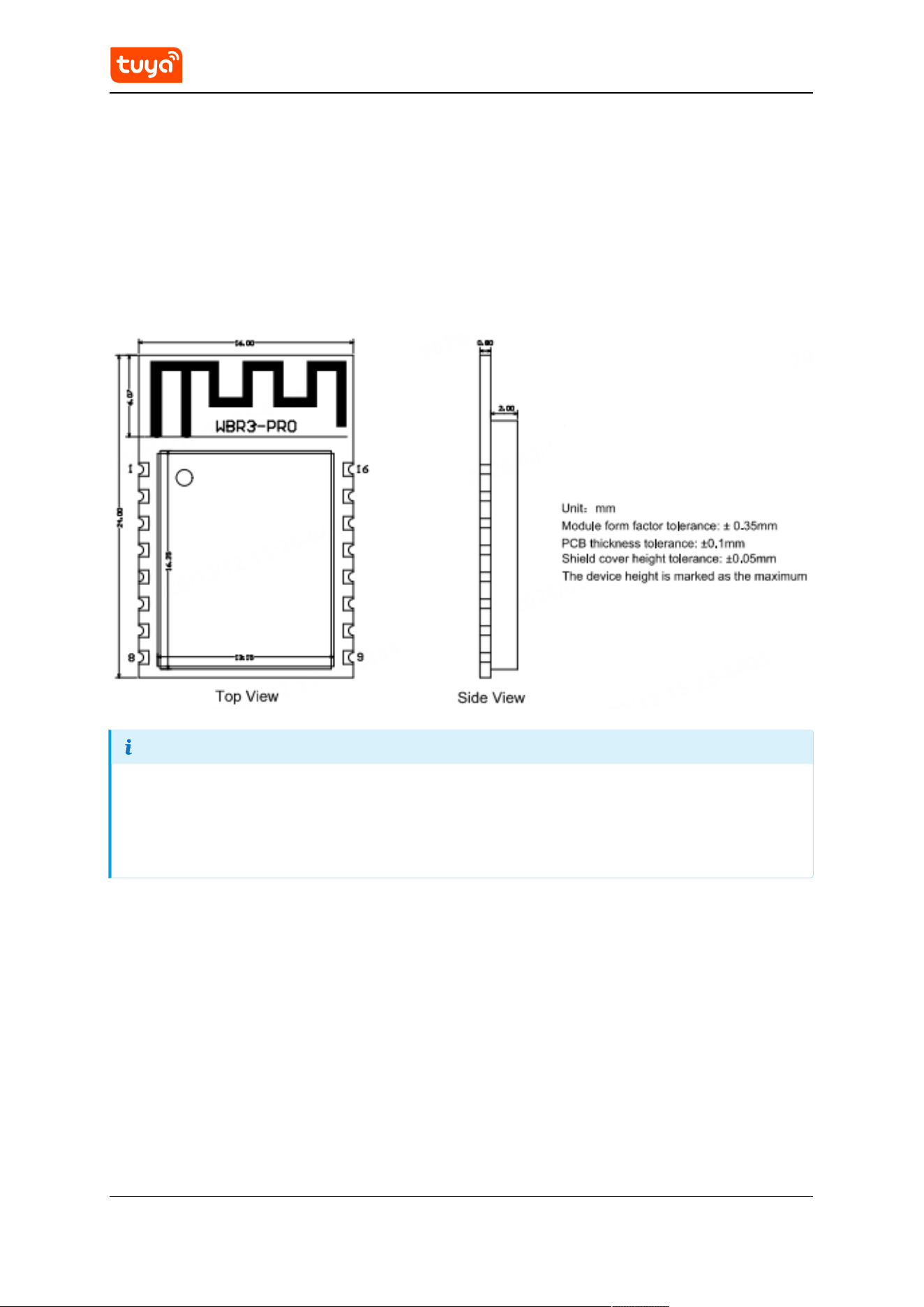
The WBR3-PRO module’s PCB dimensions are 16±0.35 mm (W) × 24±0.35 mm
(L) × 0.8±0.1 mm (H). The gure below shows the mechanical dimensions of
WBR3-PRO.
The default tolerance of the dimensions is ±0.35 mm. If you have special
requirements for key dimensions, specify them in the datasheet after
consultations.
7.2. Recommended PCB footprint
WBR3-PRO pinout
19 / 29
8.3MOQ and packaging information
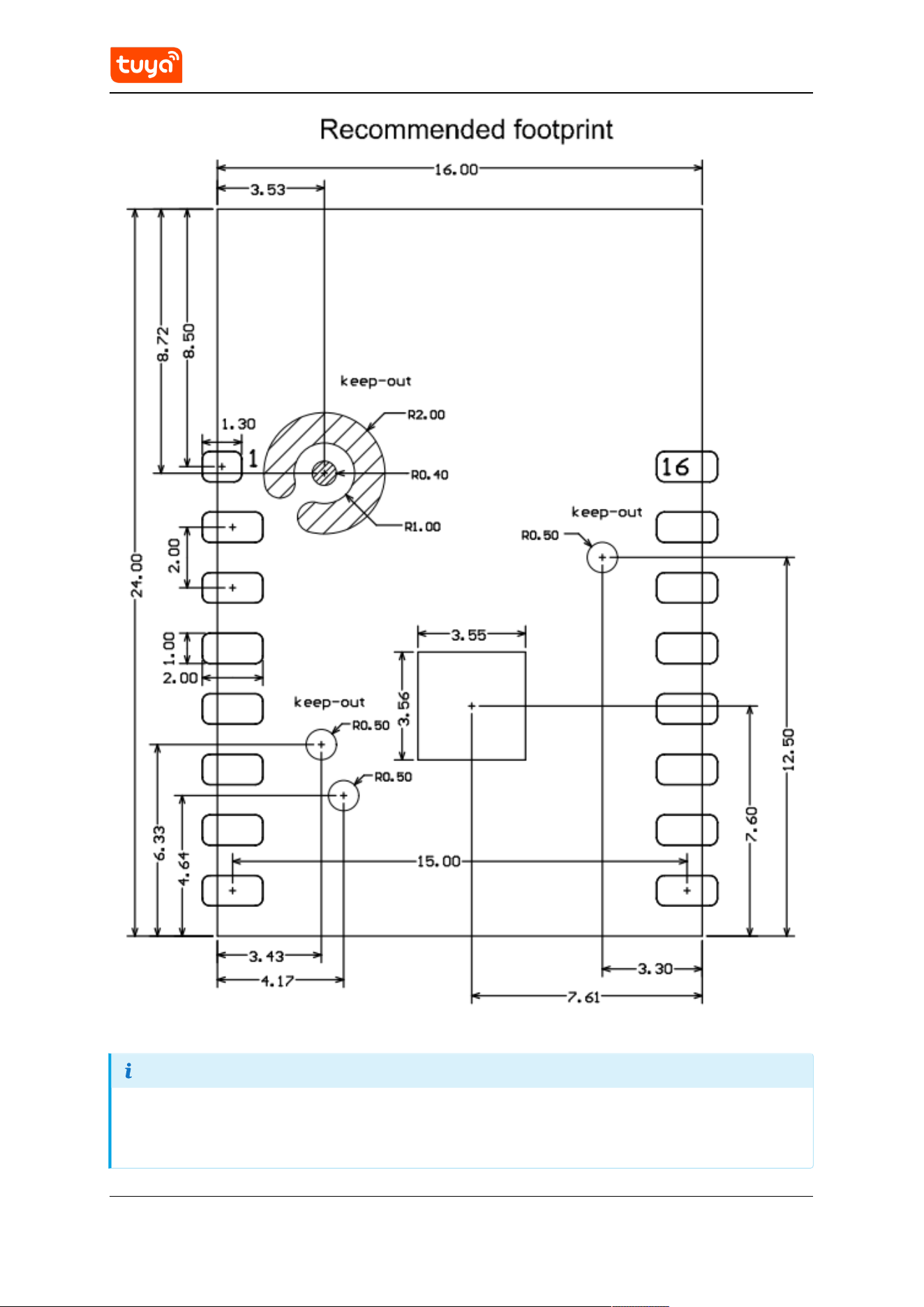
WBR3-PRO PCB footprint
20 / 29
8.3MOQ and packaging information
The area indicated as keep-out in the diagram above does not require tinning
and should not have any traces routed through it.
21 / 29
8.3MOQ and packaging information
7.3. Production instructions
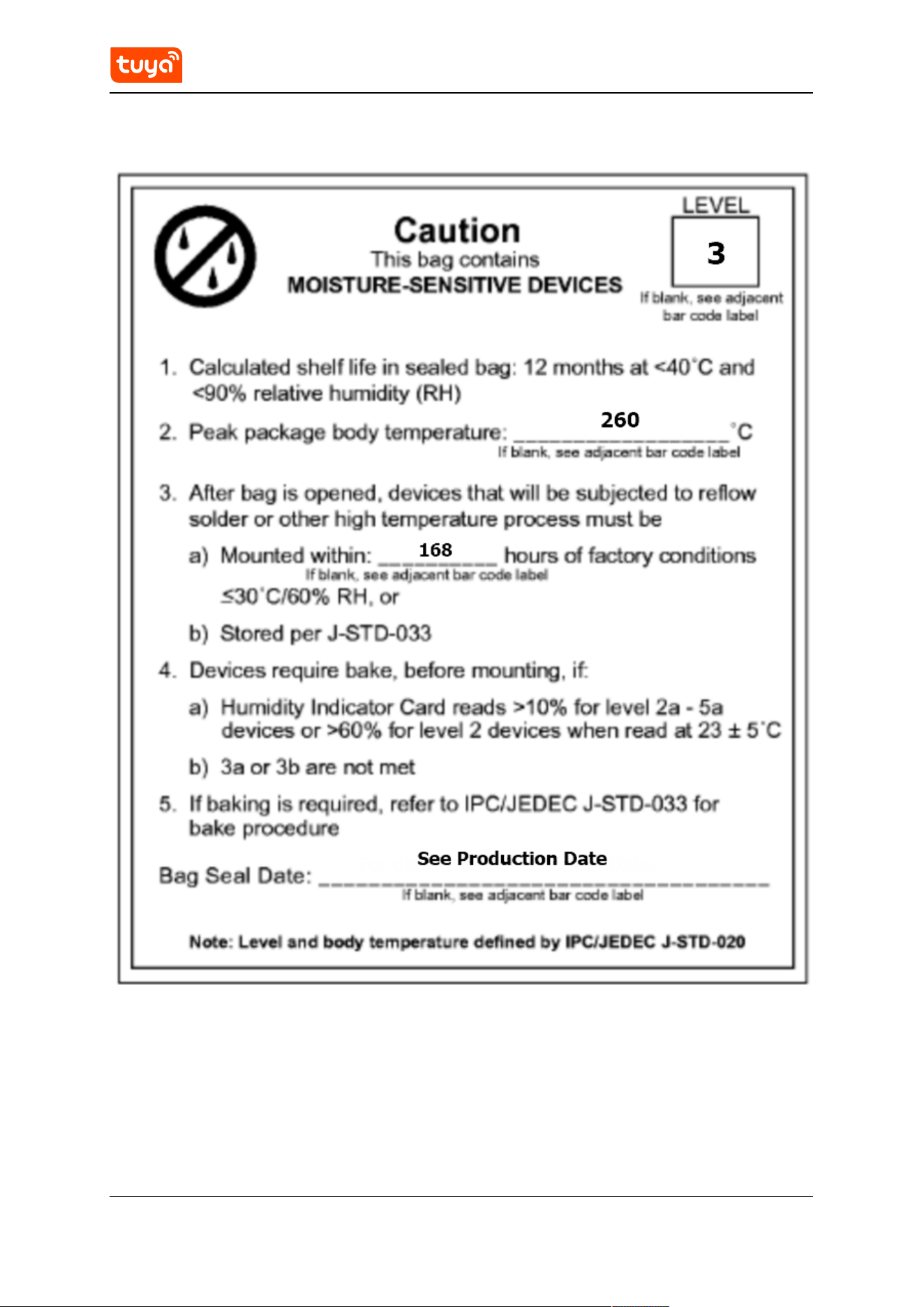
1. Package the module with the SMT if Tuya’s module is designed to be SMT-
packaged. After being unpacked, the module must be soldered within 24
hours. Otherwise, it needs to be put into a drying cupboard with a relative
humidity level no greater than 10%, or packaged in vacuum again. Then,
record the packing time and duration of exposure. The total exposure time
cannot exceed 168 hours.
• Instruments or devices required for the SMT process:
• Surface mount system
• SPI
• Reow soldering machine
• Thermal proler
• Automated optical inspection (AOI) device
• Instruments or devices required for the baking process:
• Cabinet oven
• Electrostatic discharge (ESD) protection and heat-resistant trays
• ESD protection and heat-resistant gloves
2. A delivered module must meet the following storage requirements:
• The moisture-proof bag must be placed in an environment where the
temperature is below 40°C and the relative humidity is lower than 90%.
• The shelf life of a dry-packaged product is 12 months from the date when the
product is packaged and sealed.
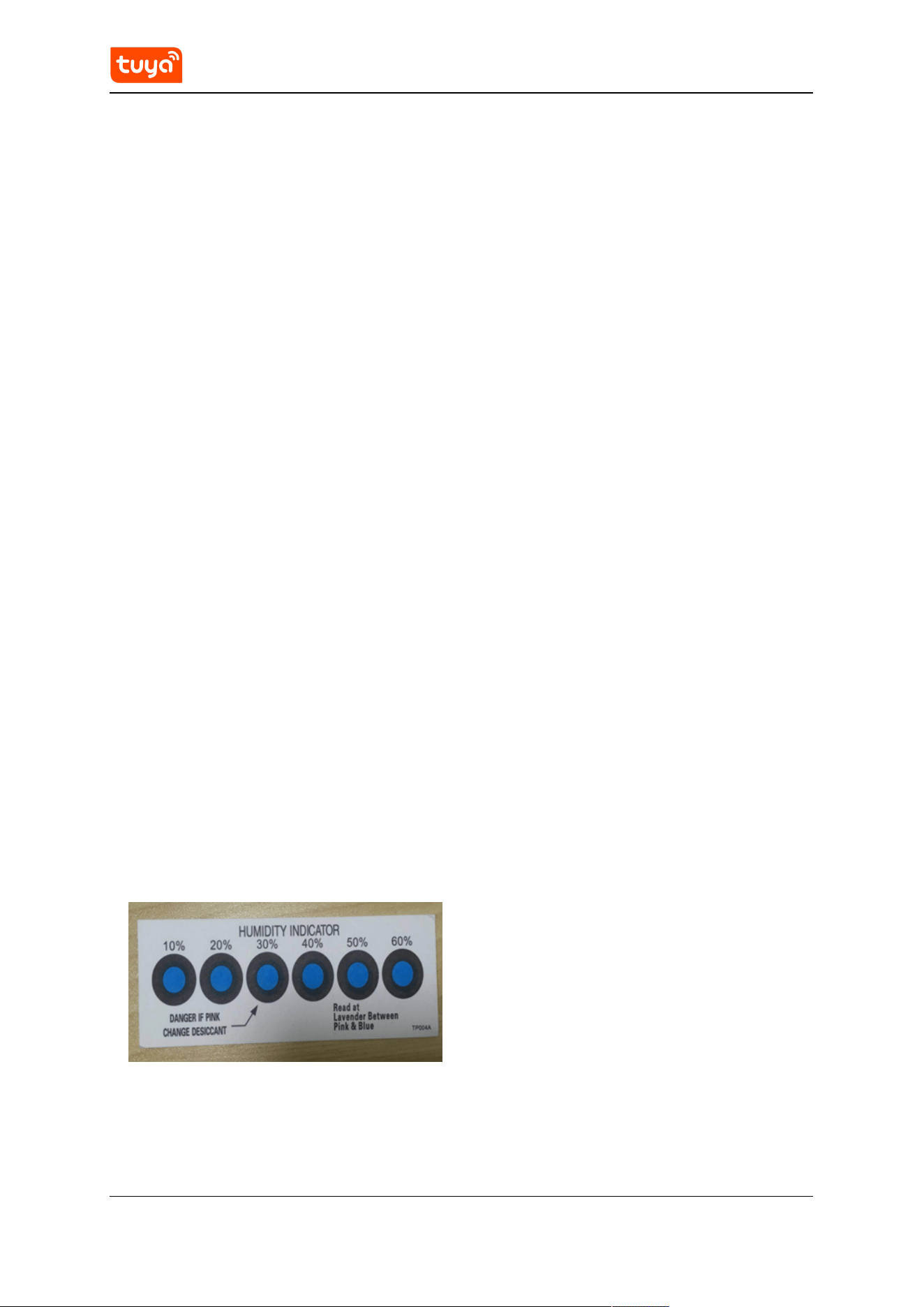
• A humidity indication card (HIC) is put in the sealed package.
3. The module needs to be baked in the following cases:
• The vacuum packaging bag is damaged before unpacking.
• After unpacking, no HIC is found in the packaging bag.
22 / 29

8.4MOQ and packaging information
• After unpacking, the HIC indicates a humidity level of 10% or higher. In this
case, the circle turns pink on the HIC.
• The total exposure time has lasted for over 168 hours since unpacking.
• More than 12 months have passed since the rst sealing of the bag.
4. The baking parameter settings are described below:
• Baking temperature: 40°C for reel packaging with relative humidity ≤ 5%. And
125°C for tray packaging with relative humidity ≤ 5% (use a heat-resistant
tray, rather than a plastic container).
• Baking time: 168 hours for reel packaging and 12 hours for tray packaging.
• Temperature for triggering an alert: 50°C for reel packaging and 135°C for tray
packaging.
• Production can begin after a module has cooled down to below 36°C under
natural conditions.
• If a module remains unused for over 168 hours after being baked, it needs to
be baked again.
• If a batch of modules is not baked after exposure for more than 168 hours, do
not use wave soldering to solder them. Because these modules are level-3
moisture-sensitive devices, they are very likely to get damp when exposed
beyond the allowable time. In this case, if they are soldered at high
temperatures, device failure or poor soldering performance might occur.
5. In the whole production process, take electrostatic discharge (ESD) protective
measures.
6. To guarantee the pass rate, we recommend that you use the SPI and AOI to
monitor the quality of solder paste printing and mounting.
7.4. Recommended oven temperature curve
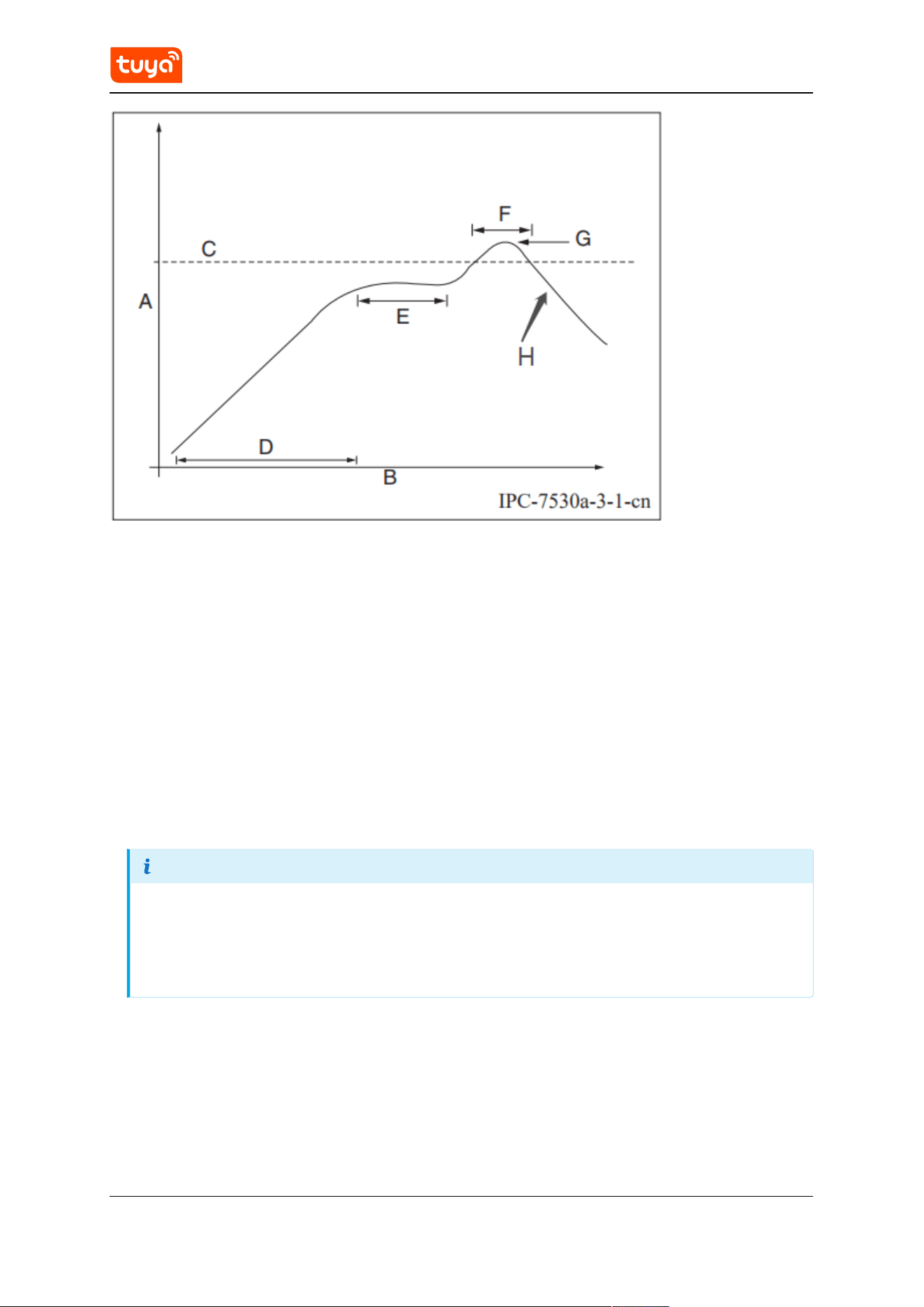
Set the temperature according to the following temperature curve of reow
soldering. The peak temperature is 245°C.
23 / 29
8.5MOQ and packaging information
• A: temperature axis
• B: time axis
• C: alloy liquidus temperature from 217°C to 220°C
• D: ramp-up slope from 1°C/s to 3°C/s
• E: keep a constant temperature from 150°C to 200°C for a time period from
60s to 120s
• F: keep a temperature above liquidus temperature for 50s to 70s
• G: peak temperature from 235°C to 245°C
•
H: ramp-down slope from 1°C/s to 4°C/s
The curve above is based on solder paste SAC305. For more information
about other solder pastes, see the recommended oven temperature curve
in the specied solder paste specications.
24 / 29
8.5MOQ and packaging information
7.5. Storage conditions
25 / 29

8.6MOQ and packaging information
8. MOQ and packaging information
Model MOQ (pcs)
Shipping
packaging
Modules per
reel
Reels per
carton
WBR3-PRO 3,600 Tape and reel 900 4
26 / 29

9Appendix: Statement
9. Appendix: Statement
FCC Caution: Any changes or modications not expressly approved by the party
responsible for compliance could void the user’s authority to operate this device.
This device complies with Part 15 of the FCC Rules. Operation is subject to the
following two conditions: (1) This device may not cause harmful interference, and
(2) this device must accept any interference received, including interference that
may cause undesired operation.
Note: This device has been tested and found to comply with the limits for a Class
B digital device, according to part 15 of the FCC Rules. These limits are designed
to provide reasonable protection against harmful interference in a residential
installation. This device generates, uses, and can radiate radio frequency energy
and, if not installed and used following the instructions, may cause harmful
interference to radio communications. However, there is no guarantee that
interference will not occur in a particular installation.
If this device does cause harmful interference to radio or television reception,
which can be determined by turning the device o and on, the user is
encouraged to try to correct the interference by one or more of the following
measures:
• Reorient or relocate the receiving antenna.
• Increase the separation between the device and receiver.
• Connect the device to an outlet on a circuit dierent from that to which the
receiver is connected.
• Consult the dealer or an experienced radio/TV technician for help.
Radiation Exposure Statement
This device complies with FCC radiation exposure limits set forth for an
uncontrolled rolled environment. This device should be installed and operated
with a minimum distance of 20cm between the radiator and your body.
Important Note
This radio module must not be installed to co-locate and operate simultaneously
with other radios in the host system except following FCC multi-transmitter
product procedures. Additional testing and device authorization may be required
to operate simultaneously with other radios.
27 / 29

The availability of some specic channels and/or operational frequency bands are
country dependent and are rmware programmed at the factory to match the
intended destination. The rmware setting is not accessible to the end-user.
The host product manufacturer is responsible for compliance with any other FCC
rules that apply to the host not covered by the modular transmitter grant of
certication. The nal host product still requires Part 15 Subpart B compliance
testing with the modular transmitter installed.
The end-user manual shall include all required regulatory information/warnings as
shown in this manual, including “This product must be installed and operated
with a minimum distance of 20 cm between the radiator and user body”.
This device has got an FCC ID: 2ANDL-WBR3PRO. The end product must be
labeled in a visible area with the following: “Contains Transmitter Module FCC ID:
2ANDL-WBR3PRO”.
This device is intended only for OEM integrators under the following conditions:
The antenna must be installed such that 20cm is maintained between the
antenna and users, and the transmitter module may not be co-located with any
other transmitter or antenna.
As long as the 2 conditions above are met, further transmitter tests will not be
required. However, the OEM integrator is still responsible for testing their end-
product for any additional compliance requirements required with this module
installed.
Declaration of Conformity European Notice
Hereby, Hangzhou Tuya Information Technology Co., Ltd declares that this module
product is in compliance with essential requirements and other relevant
provisions of Directive 2014/53/EU,2011/65/EU. A copy of the Declaration of
conformity can be found at https://www.tuya.com .
28 / 29

This product must not be disposed of as normal household waste, in accordance
with the EU directive for waste electrical and electronic equipment
(WEEE-2012/19/EU). Instead, it should be disposed of by returning it to the point
of sale, or to a municipal recycling collection point.
The device could be used with a separation distance of20cm from the human
body.
29 / 29