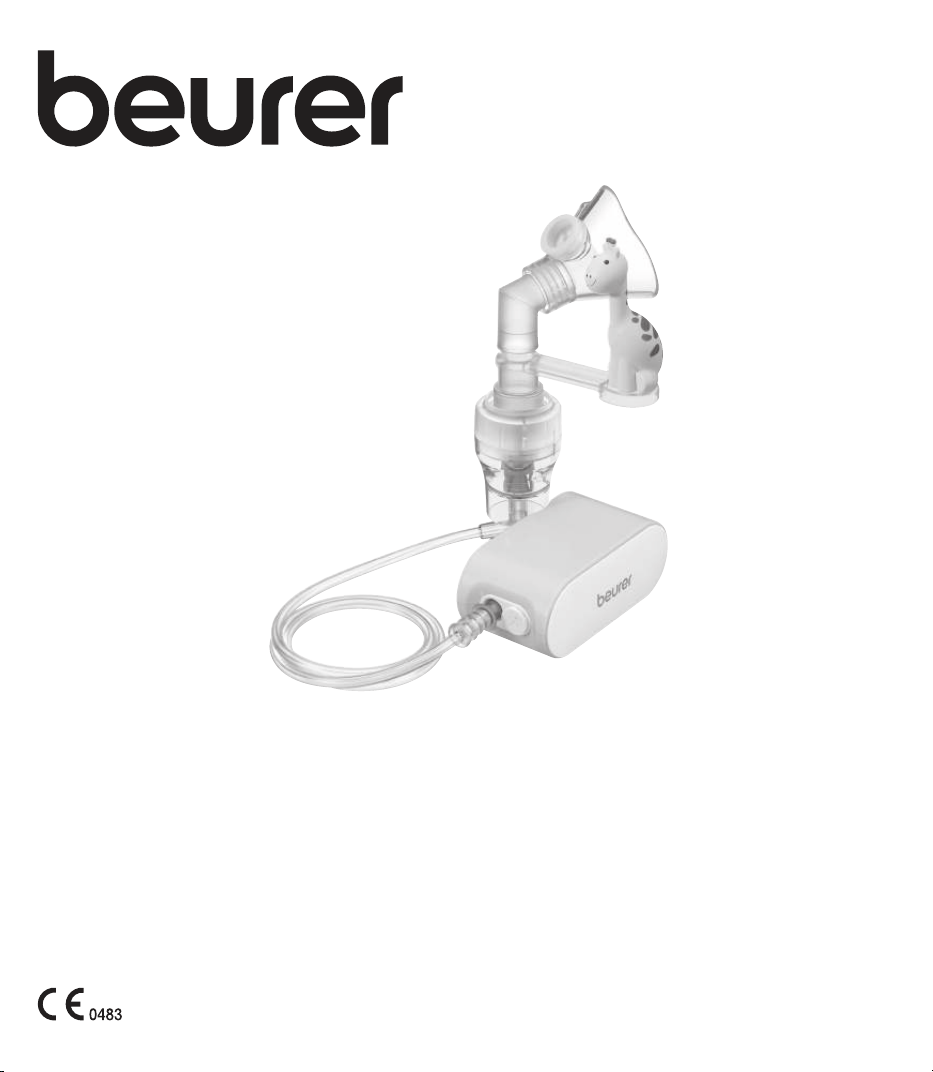
IH 58 Kids
EN Nebuliser
Instructions for use
2
Table of contents
Included in delivery
See Description of the device and accessories.
• Nebuliser
• Atomiser
• Removable “giraffe”
• Adapter
• Compressed air hose
• Mouthpiece
• Silicone baby mask
• Silicone children’s mask
• Angled fitting
•
Replacement filter
•
Micro USB cable
•
Mains adapter
•
Storage bag
•
These instructions for use
1. Getting to know your device
Dear customer,
Thank you for choosing a product from our range. Our
name stands for high-quality, thoroughly tested products
for applications in the areas of heat, weight, blood pres-
sure, body temperature, pulse, gentle therapy, massage
and air.
Please read these instructions for use carefully and keep
them for later use. Be sure to make them accessible to
other users and observe the information they contain.
With kind regards,
Your Beurer team
Application area
This nebuliser is an inhalation device for atomising liq-
uids and liquid medication (aerosols) and for the treat-
ment of the upper and lower airways.
By nebulising and inhaling the medication prescribed/
recommended by your doctor, you can prevent diseases
affecting the airways, or in the case that you contract
such an illness, you can alleviate symptoms and speed
up your recovery. Ask your doctor or pharmacist for fur-
ther information about the potential applications.
The device is suitable for domestic use. Inhaler medica-
tion should only be used following your doctor‘s instruc-
tions. Ensure you are calm and relaxed when inhaling
the medication and breathe slowly and deeply to ensure
that the medication reaches right down to the fine, lower
bronchi. Breathe out normally.
Once it has been properly prepared, the device can
be used again. Preparation involves replacing all the
accessories, including the atomiser and air filter, and
disinfecting the surface of the device using a standard
disinfectant. Please note that all accessories should be
replaced if the device is used by more than one person.
We recommend that you replace the atomiser and other
accessories after one year.
The device does not need to be calibrated.
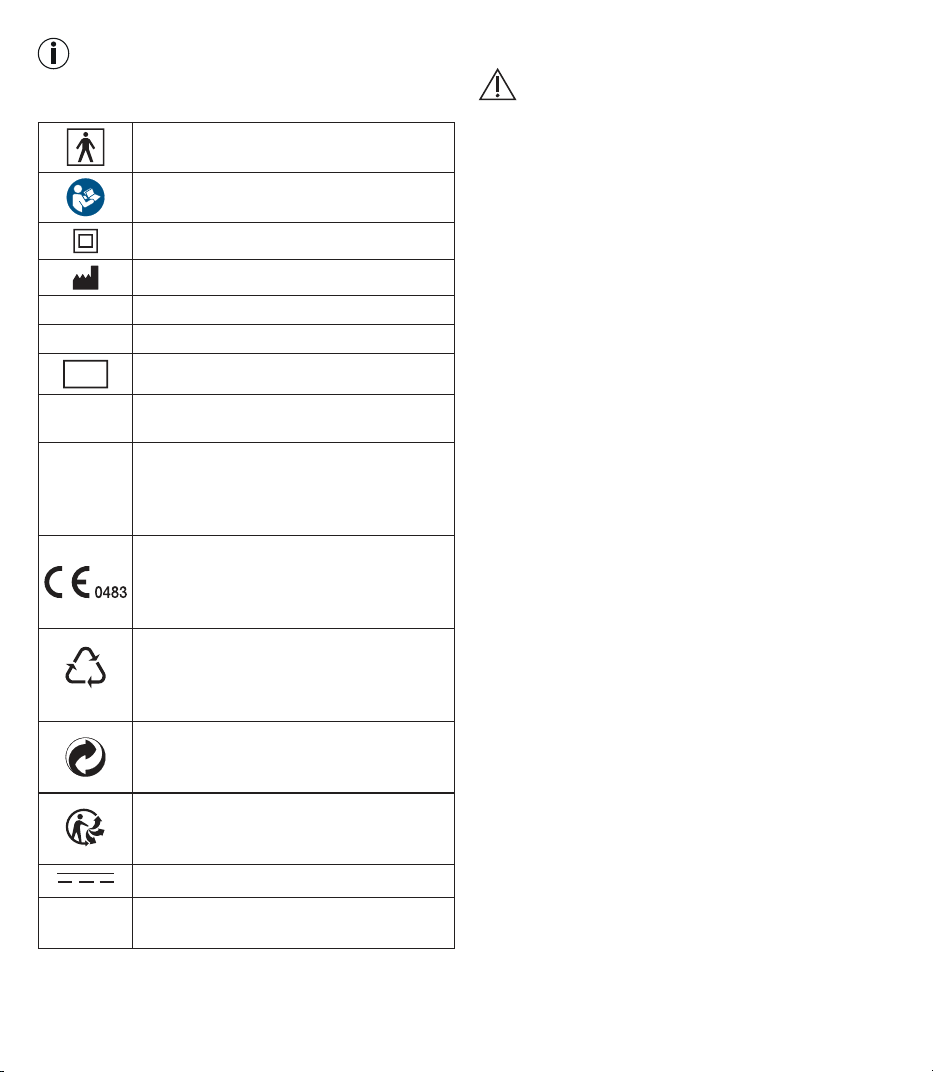
2. Signs and symbols
The following symbols appear in these instructions for
use.
Warning Warning instruction indicating a risk
of injury or damage to health.
Important Safety note indicating possible
damage to the device/accessory.
ENGLISH
1. Getting to know your device ................................... 2
2. Signs and symbols .................................................. 2
3. Warnings and safety notes ...................................... 3
4. Description of the device and accessories ............. 5
5. Initial use ................................................................. 6
6. Operation ................................................................ 7
7. Changing the filter ................................................... 8
8. Cleaning and disinfection ........................................ 8
9. Disposal ................................................................ 10
10. Troubleshooting ................................................... 11
11. Technical specifications ...................................... 12
12. Replacement parts and wearing parts ................ 12
13. Warranty/service .................................................. 15
3
Note Note on important information.
The following symbols are used on the packaging and on
the type plate for the device and accessories.
Application part, type BF
Observe the instructions for use
Protection class 2 device
M
anufacturer
I
On
O
Off
S
N
Serial number
30 ON /
30 OFF
30 minutes of operation, then 30 minutes
break before operating again.
IP 22
Protected against solid foreign objects
12.5 mm in diameter and larger, and
against drops of water when the housing
is angled up to 15°.
CE labelling
This product satisfies the requirements
of the applicable European and national
directives
B
A
Marking to identify the packaging ma-
terial. A = Material code, B = Material
number: 1-7 = Plastics, 20-22 = Paper
and cardboard
Separate the packaging elements and
dispose of them in accordance with local
regulations.
Separate the product and packaging ele-
ments and dispose of them in accordance
with local regulations.
Direct current
~
Alternating current
3. Warnings and safety notes
Warning
• Before use, ensure that there is no visible damage to
the device or accessories. If you have any doubts,
do not use the device and contact your retailer or the
specified Customer Service address.
• In the event of device faults, please see Chapter “10.
Troubleshooting”.
• The device is not a substitute for medical consultation
and treatment. Always consult your doctor immediate-
ly in the event of pain or illness.
• If you have health concerns of any kind, consult your
GP!
• Please note the general hygiene measures when using
the atomiser.
• You should always follow the instructions of your
doctor regarding the type of medication to use, the
dosage, and the frequency and duration of inhalation.
• Only use medication prescribed or recommended by
your doctor or pharmacist.
Please note:
For treatment, only use parts indicated by your doctor
according to the particular diagnosis.
• Check whether there are contraindications for use with
the usual systems for aerosol treatment on the medi-
cation instruction leaflet.
• If the device does not work properly, or you feel unwell
or experience pain, stop using it immediately.
• Keep the device away from your eyes when it is in use,
as the mist of medication could be harmful.
• Changes to the device are not permitted.
• Never use the device near flammable gases, oxygen
or nitrogen oxide.
• This device is not intended for use by children or peo-
ple with restricted physical, sensory (e.g. reduced sen-
sitivity to pain) or mental skills or a lack of experience
and/or lack of knowledge, unless they are supervised
by a person who is responsible for their safety or who
are instructed by such a person in how to use the
device.
• Check the leaflet of the medication for any contrain
-
dications for use with the usual systems for aerosol
treatment.

4
• The device must be switched off and the plug pulled
out before every cleaning and/or maintenance proce
-
dure.
• Keep packaging material away from children (risk of
suffocation).
• To avoid the risk of entanglement and strangulation,
store cables and air lines out of the reach of small
children.
• Do not use any additional parts that are not recom-
mended by the manufacturer.
• The device must only be connected to the mains volt-
age that is specified on the type plate.
• Never submerge the device in water or other liquids
and do not use it in the bathroom. Under no circum-
stances may liquid enter the device.
• Protect the device from heavy impacts.
• Never touch the micro USB cable with wet hands, as
you could get an electric shock.
• Do not pull the mains adapter out of the socket using
the micro USB cable.
• Do not crush or bend the micro USB cable, pull it over
sharp-edged objects or leave it dangling down, and
protect it from sources of heat.
• We recommend that the micro USB cable is complete-
ly unrolled to avoid dangerous overheating.
• If the micro USB cable or the mains adapter of this
device is damaged, it must be disposed of. Please
contact Customer Services or the retailer.
• If the device is opened, there is a risk of electric shock.
Disconnection from the power supply network is only
guaranteed if the adapter is unplugged and the micro
USB cable has no other power connection.
• Making modifications to the device or accessories is
not permitted.
• If the device has been dropped, exposed to high levels
of moisture or suffered any other damage, it must no
longer be used. If in doubt, contact Customer Services
or the retailer.
• The IH 58 Kids nebuliser may only be operated with
compatible Beurer atomisers and with the appropriate
Beurer accessories. The use of atomisers and acces-
sories made by other companies may result in less
efficient treatment and could damage the device.
•
Store the device and accessories out of the reach of
children and pets.
Important
•
Power cuts, sudden interferences or other unfavour-
able conditions could lead to the device becoming
inoperable. We therefore recommend that you obtain
a replacement device or medication (the latter should
be agreed with your doctor).
•
Should you require an adapter or extension lead, this
must meet the applicable safety requirements. The
power limit and the maximum output specified on the
adapter must not be exceeded.
•
Never store the device or the power cable near to
sources of heat.
•
Do not use the device in a room in which a spray has
previously been used. Air the room before carrying out
the treatment.
•
Never use the device if it is making an abnormal sound.
•
For hygiene reasons, it is essential that every user uses
their own accessories.
•
Always disconnect the mains adapter from the device
after use.
•
Store the device in a location protected against cli-
matic influences. The device must be stored in the
environmental conditions specified.
General notes
Important
• The device is only to be used:
– for use on people,
– for the purpose for which it was developed (aerosol
inhalation) and as specified in these instructions for
use.
• Any form of improper use can be dangerous.
•
In the event of an acute emergency, the provision of
first aid has top priority.
•
Apart from the medication, only use distilled water or
a saline solution. Other liquids may cause a fault in the
nebuliser or atomiser.
•
This device is not intended for commercial or clinical
use; it is designed exclusively for self-treatment in a
private home!
5
Prior to initial use
Important
•
Remove all packaging material before using the de-
vice.
•
Protect the device against dust, dirt and humidity and
never cover the device while it is in use.
•
Do not operate the device in a very dusty area.
•
Switch the device off immediately if it is faulty or not
working properly.
•
The manufacturer is not liable for damage resulting
from improper or incorrect use.
Repairs
Note
• Under no circumstances should you open or repair the
device yourself, as faultless functionality can no longer
be guaranteed thereafter. Failure to comply with this
instruction will void the warranty.
• The device is maintenance-free.
• For repairs, please contact Customer Services or an
authorised retailer.
4. Description of the device and
accessories
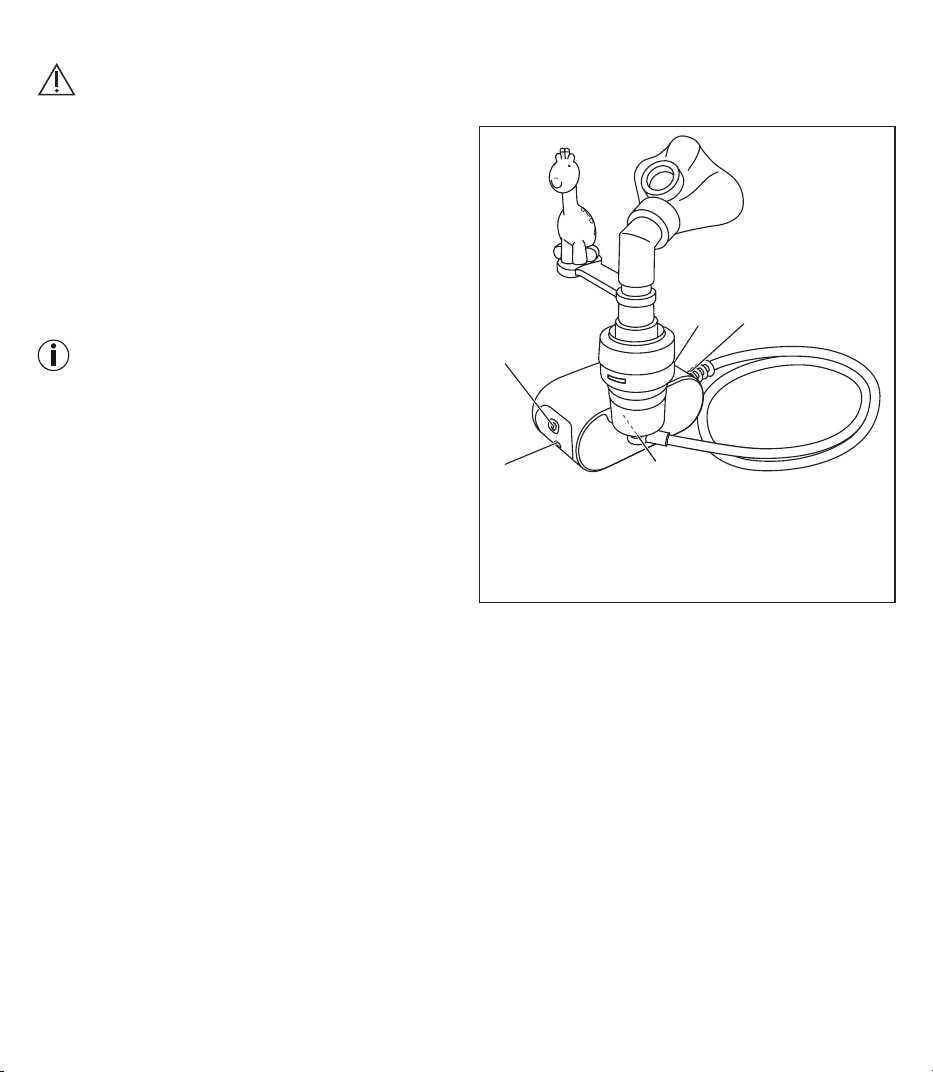
Overview of nebuliser
1
2 3
54
1 On/Off switch
2 Micro USB port
3 Holder for atomiser
4 Filter cap with filter
5 Hose connector
6
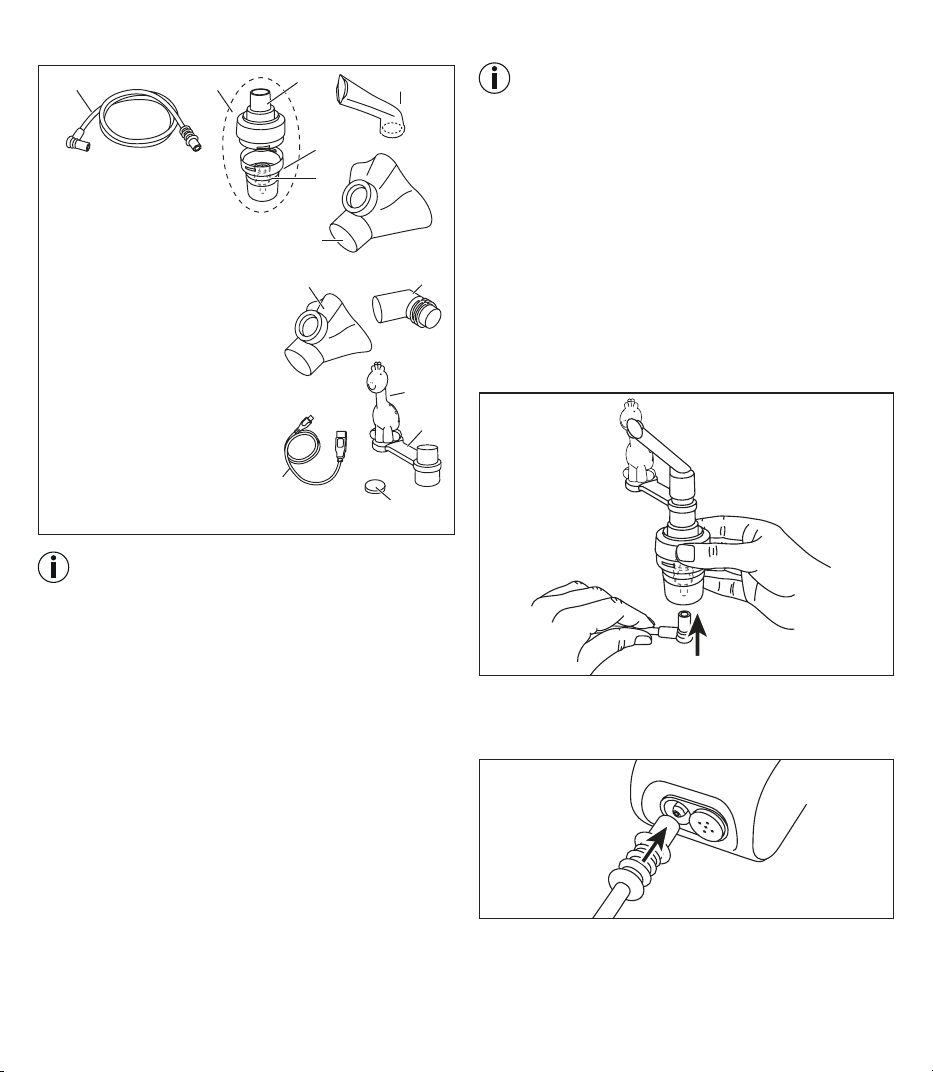
Overview of atomiser and accessories
6 Compressed air hose
7 Atomiser
8 Medication containers
9 Atomiser insert
10 Atomiser attachment
11 Mouthpiece
12 Silicone children’s mask
13 Silicone baby mask
14 Angled fitting
15 Removable „giraffe“
16 Adapter
17 Replacement filters
18 USB cable
Note
The IH 58 Kids can also be used by adults. Adults have
the option of using a separate accessory (includes
mouthpiece, nosepiece, adult mask, children’s mask,
atomiser, compressed air hose, filter) for your nebuliser.
This is not included in delivery of the IH 58 Kids [n/a].
Nevertheless, the appropriate use of the nosepiece, etc.
is described below. You can find an overview of all re-
placement items in section “12. Replacement parts and
wearing parts”.
5. Initial use
Setting up the device
Take the device out of the packaging.
Place the device on a flat surface.
Before using the device for the first time
Note
• Clean and disinfect the atomiser and accessories be-
fore using them for the first time. See “Cleaning and
disinfection”.
The adapter [16] with the removable “giraffe” [15] can
optionally be attached to the atomiser.
When attaching the atomiser, in combination with the
adapter [16] and removable “giraffe” [15], to the device,
ensure that the centre of gravity is over the device.
Otherwise, there is a risk of the device tipping. The
cover photo of these instructions for use serves as an
example.
• Connect the compressed air hose [6] to the bottom of
the medication container [8].
• Connect the other end of the compressed air hose
[6] to the nebuliser hose connection [5] by turning it
slightly.
6 7
8
9
12
1110
13
15
17
16
14
18
7
Switching on the nebuliser
To switch on the nebuliser, proceed as follows:
• Plug the micro USB cable included in delivery into the
micro USB port on the nebuliser. Plug the other end of
the micro USB cable into the USB port on the mains
adapter and insert the mains adapter into the socket.
• Press the ON/OFF button on the nebuliser. The ON/
OFF button illuminates blue. The nebuliser is now op-
erational.
6. Operation
Important
• For hygiene reasons, it is essential to clean the atom-
iser [7] and the accessories after each treatment and
to disinfect them after the last treatment of the day.
• The accessories may only be used by one person; use
by several people is not recommended.
• If the treatment involves inhaling several different
medications one after the other, please be aware that
the atomiser [7] must be rinsed under warm tap water
following every usage. See “Cleaning and disinfection”
on page 8.
•
Please observe the notes on changing the filter in
these instructions for use.
•
Check that hose connectors are firmly attached to the
nebuliser [5] and the atomiser [7] before each use of
the device.
•
Before use, check the device is working correctly by
briefly switching on the nebuliser (together with the
connected atomiser, but without medication). If air
comes out of the atomiser [7], the device is working.
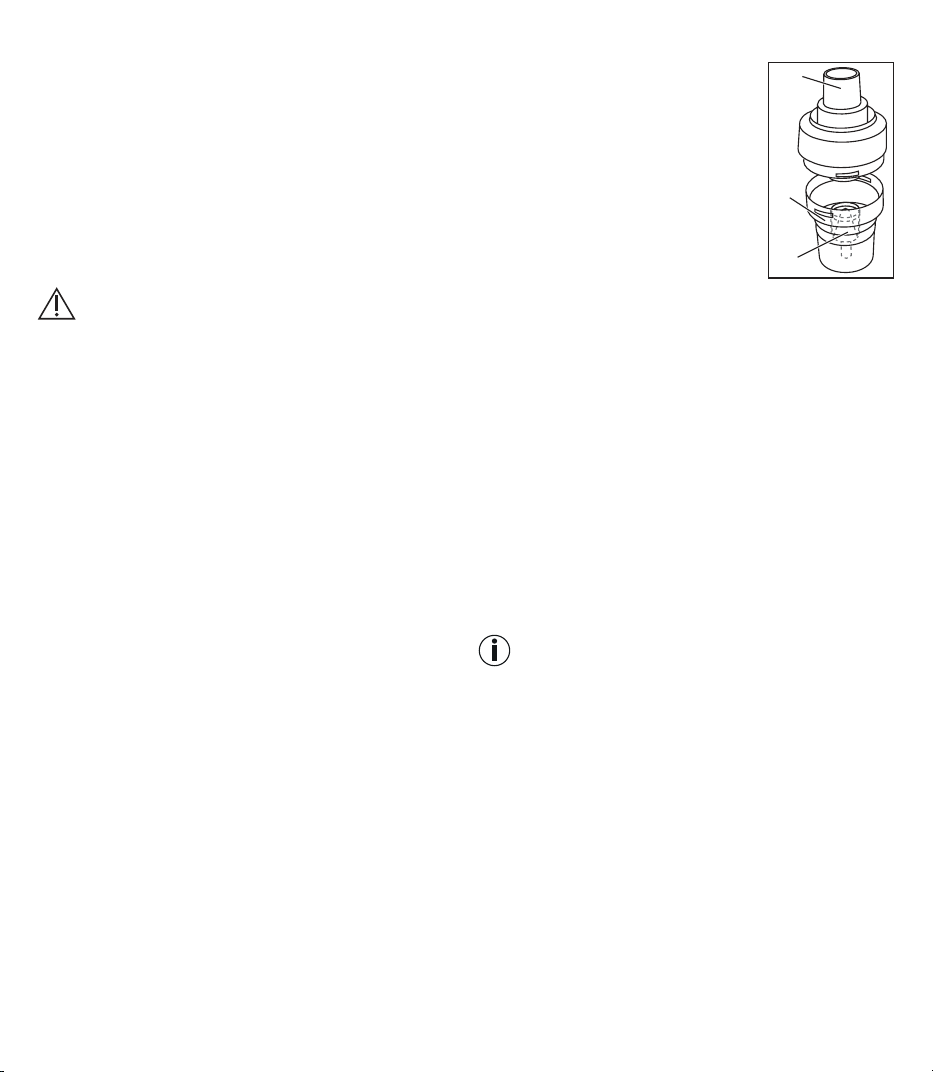
6.1 Inserting the atomiser insert
•
Open the atomiser [7] by twisting the top anticlock-
wise against the medication container [8]. Place the
atomiser insert [9] into the medication container [8].
•
Ensure that the cone for administering medication fits
well on the cone for the air duct inside the atomiser.
•
Ensure that the atomiser attachment [10] is attached
to the top of the atomiser.
6.2 Filling the atomiser
• Fill with an isotonic saline solution
or pour the medication directly into
the medication container [8]. Avoid
overfilling. The maximum recom-
mended filling quantity is 6ml.
• Use medication only as instructed
by your doctor and ask about the
appropriate inhalation period and
quantity for you.
•
If the prescribed quantity of medi-
cation is less than 2ml, top this up
to at least 2ml with isotonic saline solution. Dilution
is also necessary with viscous medications. Here too,
please observe the instructions of your doctor.
6.3 Closing the atomiser
•
Close the atomiser [7] by twisting the top clockwise
against the medication container [8]. Ensure that the
connection is correct.
6.4 Connecting accessories to the atomiser
• Attach the desired accessory to the atomiser [7]. The
mouthpiece [11] or nosepiece [n/a] can be attached
using the nebuliser attachment [10]. The children’s
mask [12] and baby mask [13] must be attached to
the atomiser using the angled fitting [14].
Note
The most effective form of nebulisation is by using the
mouthpiece. Nebulisation using a mask is only recom
-
mended if it is not possible to use a mouthpiece (e.g. for
children who are not yet able to inhale using a mouth-
piece).
When using a mask to inhale, take care to ensure the
mask fits well and the eyes are unobstructed.
• Before the treatment, pull the atomiser [7] upwards out
of the holder [3].
• Start the nebuliser using the On/Off switch [1].
•
Spray mist pouring out of the atomiser indicates that
the device is operating correctly.
8
10
9
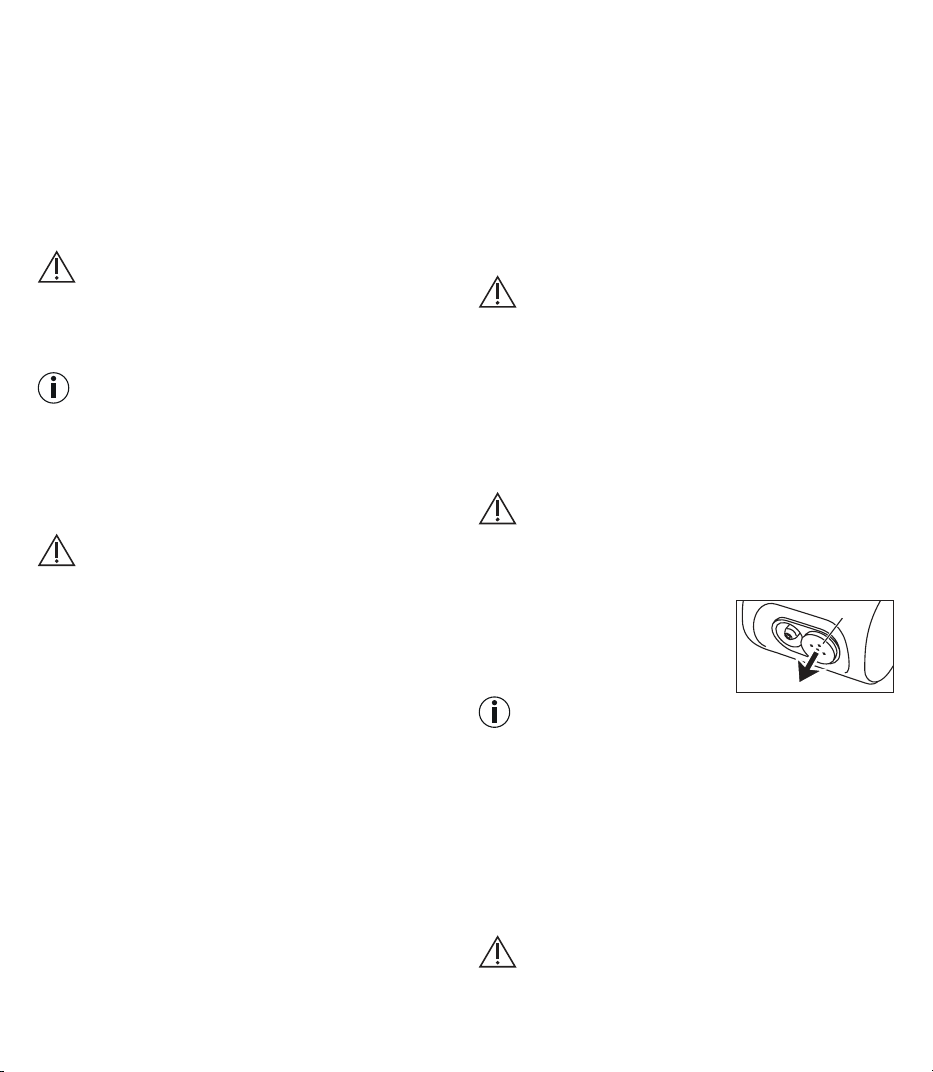
8
6.5 Treatment
•
Hold or place the baby or infant to be treated in the
most upright position possible. Do not use the device
when the baby or infant to be treated is lying down.
•
When inhaling, older children and adults should sit
upright and relaxed at a table and not in an armchair to
avoid compressing the airways and therefore impairing
the effectiveness of the treatment.
•
Breathe in the atomised medication deeply.
Important
The device is not suitable for continuous operation; after
30 minutes of operation it must be switched off for 30
minutes.
Note
During the treatment, hold the atomiser straight (vertical-
ly), otherwise the atomisation will not work and faultless
functionality is not guaranteed.
Depending on the battery charge status and accessory
used, the inhalation time stated may vary.
Important
Essential oils, cough syrups, gargling solutions and
drops to be used as a rub or in a steam bath are wholly
unsuitable for inhalation using a nebuliser. These addi
-
tives are often viscous and can impair the correct func-
tioning of the device and therefore the effectiveness of
the application in the long term. For individuals with a
hypersensitive bronchial system, medications contain-
ing essential oils may under certain conditions cause an
acute bronchospasm (a sudden cramp-like restriction
of the bronchi with shortness of breath). Consult your
doctor or pharmacist in relation to this matter.
6.6 Stopping inhalation
Once the mist is only coming out in an irregular flow or
if the sound changes when inhaling, you can stop the
treatment.
• Switch off the nebuliser after treatment using the On/
Off switch [1] and disconnect it from the mains.
•
Place the atomiser [7] back in its holder after the treat-
ment [3].
6.7 Cleaning
See “Cleaning and disinfection” on page 8.
7. Changing the filter
In normal operating conditions, the air filter must be re-
placed after approx. 100 operating hours or one year.
Please check the air filter regularly (after 10-12 nebu-
lisation procedures). Replace the used filter if it is very
dirty or clogged. If the filter has become damp, it must
also be exchanged for a new filter.
Important
• Do not attempt to clean the used filter and reuse it.
• Only use the manufacturer‘s original filter, otherwise
your nebuliser may become damaged and sufficiently
effective treatment cannot be guaranteed.
• Do not repair or maintain the air filter while it is in use.
• Never operate the device without a filter.
To replace the filter, proceed as follows:
Important
•
First switch the device off and disconnect it from the
mains.
•
Allow the device to cool down.
1. Pull off the filter cap [4]
towards the front.
Note
If the filter remains in the device after the cap has been
removed, take the filter out of the device, e.g. with twee-
zers or similar.
2. Re-insert the filter cap [4] with a new filter.
3. Ensure that it is securely in place.
8. Cleaning and disinfection
Atomiser and accessories
Warning
Adhere to the following hygiene instructions to avoid
health risks.
4
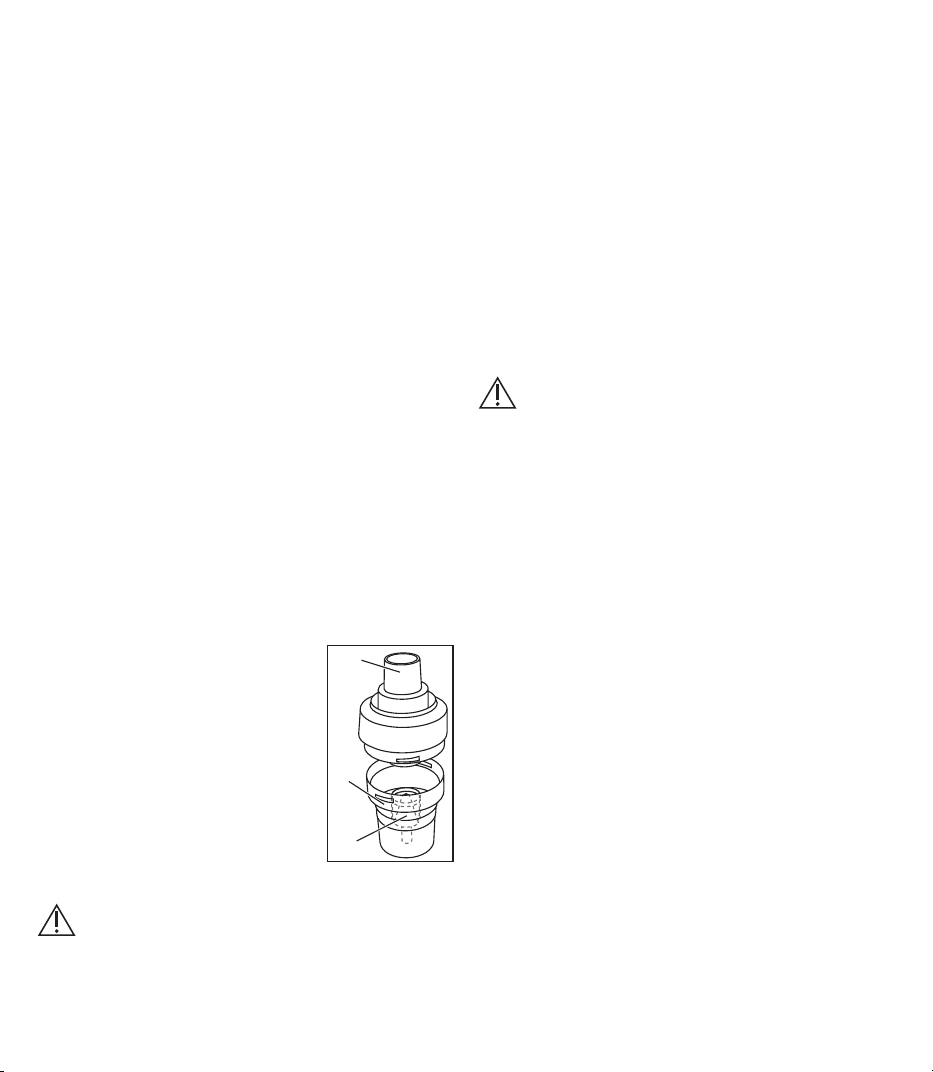
9
•
The atomiser [7] and accessories are designed for mul-
tiple use. Please note that different areas of application
involve different requirements in terms of cleaning and
hygienic preparation.
Notes:
•
Do not clean the atomiser or the accessories mechan-
ically using a brush or similar device, as this could
cause irreparable damage and it will mean that the
best treatment results can no longer be guaranteed.
•
Please consult your doctor about the additional re-
quirements in terms of the hygienic preparation re-
quired (hand care, handling of medication/inhalation
solutions) for high-risk groups (e.g. patients with cystic
fibrosis).
•
Ensure thorough drying after each cleaning or disin-
fection process. Residual moisture or wetness can
represent an increased risk of bacterial growth.
Preparation
• Immediately after each treatment, all parts of the atom-
iser [7] and the accessories used must be cleaned of
residual medication and contamination.
• Remove the mouthpiece [11], masks [12, 13] or the
nosepiece [n/a] from the atomiser.
• Disassemble the nosepiece [n/a] if you have used it
with the comfort attachment.
• Remove the masks [12, 13] from the angled fitting [14].
• Disassemble the atomiser [7] by
twisting the top anticlockwise
against the medication container
[8].
• Remove the atomiser insert [9]
from the medication container [8].
Remove the atomiser attachment
[10].
• Reassembly is carried out in
reverse order.
Cleaning
Important
The device must be switched off, disconnected from
the mains and allowed to cool down each time before
cleaning.
The atomiser and the accessories used such as the
mouthpiece, mask, etc. must be washed with hot but
not boiling water after each use. Dry the parts carefully
using a soft cloth. Put the parts together again when
they are completely dry and place them in a dry, sealed
container or disinfect them.
When cleaning, ensure that any residue is removed. Nev-
er use any substances for cleaning that could potentially
be toxic if they came into contact with the skin or mu-
cous membranes, or if they were swallowed or inhaled.
Use a soft, dry cloth and non-abrasive cleaning products
to clean the device.
Do not use any abrasive cleaning products and never
submerge the device in water.
Important
• Ensure that no water gets inside the device.
• Do not clean the device or accessories in the dish-
washer.
•
Do not touch the device with wet hands when it is
plugged in and do not allow water to spray on the
device. Only operate the device if it is completely dry.
•
If liquid penetrates the device this could cause damage
to the electrics or other nebuliser parts and lead to a
malfunction.
Condensation, hose care
Condensation may form in the hose depending on the
ambient conditions. It is essential to remove the moisture
to prevent bacterial growth and ensure proper treatment.
To do so, proceed as follows:
•
Remove the compressed air hose [6] from the atomiser
[7].
•
The hose must remain connected to the nebuliser [5].
•
Operate the nebuliser until the moisture is removed
by the air passing through.
•
In the event of heavy contamination, replace the hose.
Disinfection
Please carefully observe the points below when disin-
fecting your atomiser and accessories. We recommend
disinfecting the individual parts on a daily basis after the
last usage as a minimum measure.
8
10
9
10
(All you need for this is a little white vinegar and distilled
water.Ethanol 70 vol% can also be used (for 10 minutes)
to disinfect the PVC masks and the air tubes).
• First, clean the atomiser and accessories as described
in the “Cleaning” section.
• Place the disassembled atomiser [7], the mouthpiece
[11], the silicone masks [12, 13] and the disassembled
nosepiece [n/a] in boiling water for 5 minutes.
• For the remaining accessories, use a vinegar solution
consisting of ¼ vinegar and ¾ distilled water. Make
sure that the volume is sufficient to fully submerse
parts, such as the PVC masks [n/a] and hose [6], in
the solution. Accessories that can be boiled can also
be disinfected in this way.
• Leave the parts in the vinegar solution for 30 minutes.
•
Rinse the parts with water and dry them carefully with
a soft cloth.
Important
Do not boil or autoclave the compressed air hose or the
PVC masks [n/a].
• Put the parts together again when they are completely
dry and place them in a dry, sealed container.
Note
•
Please ensure that the parts are completely dried af-
ter cleaning, otherwise the risk of bacterial growth is
increased.
•
Use a cold disinfection solution in accordance with the
manufacturer’s instructions.
Drying
•
Place the individual parts on a clean, dry and absor-
bent surface and leave them to dry completely (at least
4 hours).
Durability of materials
•
As with any plastic parts, atomisers and their acces-
sories are affected by a certain amount of wear and
tear when used and hygienically prepared on a fre-
quent basis. Over time, this can lead to a change in
the aerosol, which can have a negative effect on the
efficiency of the treatment. We therefore recommend
that you replace the atomiser and other accessories
after a year.
•
The following point should be observed when selecting
the cleaning product or disinfectant: only use a mild
cleaning product or disinfectant in the concentration
and volume prescribed by the manufacturer.
Storage
• Do not store in damp conditions (such as in a bath-
room) and do not transport with any damp items.
• When storing and transporting, protect from prolonged
direct sunlight.
•
The accessories can be stowed securely in the ac-
cessory compartment. Store the device in a dry place,
ideally in the original packaging.
9. Disposal
For environmental reasons, do not dispose of the
device in the household waste.
Please dispose of the device in accordance with
EC Directive – WEEE (Waste Electrical and Elec-
tronic Equipment).
If you have any questions, please contact the local au
-
thorities responsible for waste disposal.
11
10. Troubleshooting
Problem/
question
Possible cause/remedy
The atomiser
produces no
or too little
aerosol.
1. Too much or too little medication
in the atomiser.
Minimum: 2ml,
Maximum: 6ml.
2.
Check nozzle for blockages.
Clean nozzle if necessary (e.g. by
rinsing out). Then start using the
atomiser again.
IMPORTANT: Carefully pierce the
fine holes from the underside of the
nozzle only.
3.
Atomiser not held vertically.
4. Unsuitable medication fluid added
for nebulisation (e.g. too viscous).
The medication fluid should be
prescribed by the doctor.
The output is
too low.
Kinked hose, clogged filter, too much
inhalation solution.
What medi
-
cations are
suitable for
inhaling?
Please consult your doctor in rela
-
tion to this matter.
As a rule, all medication that is
suitable and approved for device
inhalation can be inhaled.
There is inha
-
lation solution
residue in the
atomiser.
This is normal and is due to technical
reasons. Stop inhalation once the
atomiser starts to make a notably
different sound.
Problem/
question
Possible cause/remedy
What should
be taken into
account when
using the
device with
infants and
children?
1. On infants and children, the mask
should cover the mouth and nose
to ensure effective inhalation.
2. On children, the mask should also
cover both the nose and mouth.
It is not a good idea to carry out
nebulisation on someone who is
sleeping, as in this case not en
-
ough of the medication will reach
the lungs.
Note: Inhalation should only be car
-
ried out under the supervision of an
adult and with their assistance and
the child should not be left alone.
Why should
the atomiser
be replaced
regularly?
There are two reasons for this:
1. To ensure a therapeutically effec
-
tive particle spectrum, the nozzle
hole must not exceed a specific
diameter. Due to mechanical and
thermal stresses, the plastic is
subject to a certain degree of
wear. The atomiser insert [9] is
particularly sensitive. This can also
alter the composition of the aero
-
sol droplets, which directly affects
the effectiveness of the treatment.
2. Regularly changing the atomiser
is also recommended for hygiene
reasons.
Should each
person have
their own
atomiser?
Yes, this is absolutely essential for
hygiene reasons.
12
11. Technical specifications
Model
IH 58 Kids
Type
IH58
Dimensions
(W x H x D) 110 x 62 x 47 mm
Weight
176 g
Operating
pressure
(with medication container):
Approx. 0.25 to 0.50 bar
(without medication container):
Approx. 0.35 to 0.60 bar
Atomiser filling
volume
Min. 2ml
Max. 6ml
Medication flow
rate Approx. 0.25ml/min
Sound pressure Max. 45 dBA
(acc. to DIN EN 13544-1 section 26)
Mains connection Input: 100 – 240 V~; 50 – 60 Hz; 0.5 A
Output: 5 V
; 2 A
Expected service
life
400 h
Operating
conditions
Temperature: +10 °C to +40 °C
Relative humidity: 10% to 95%
Ambient pressure: 700 hPa to 1060 hPa
Storage and
transportation
conditions
Temperature: -20 °C to +60 °C
Relative humidity: 10% to 95%
Ambient pressure: 700 hPa to 1060 hPa
Aerosol
properties
1) Aerosol delivery: 0.15ml
2) Aerosol delivery rate: 0.03ml/min
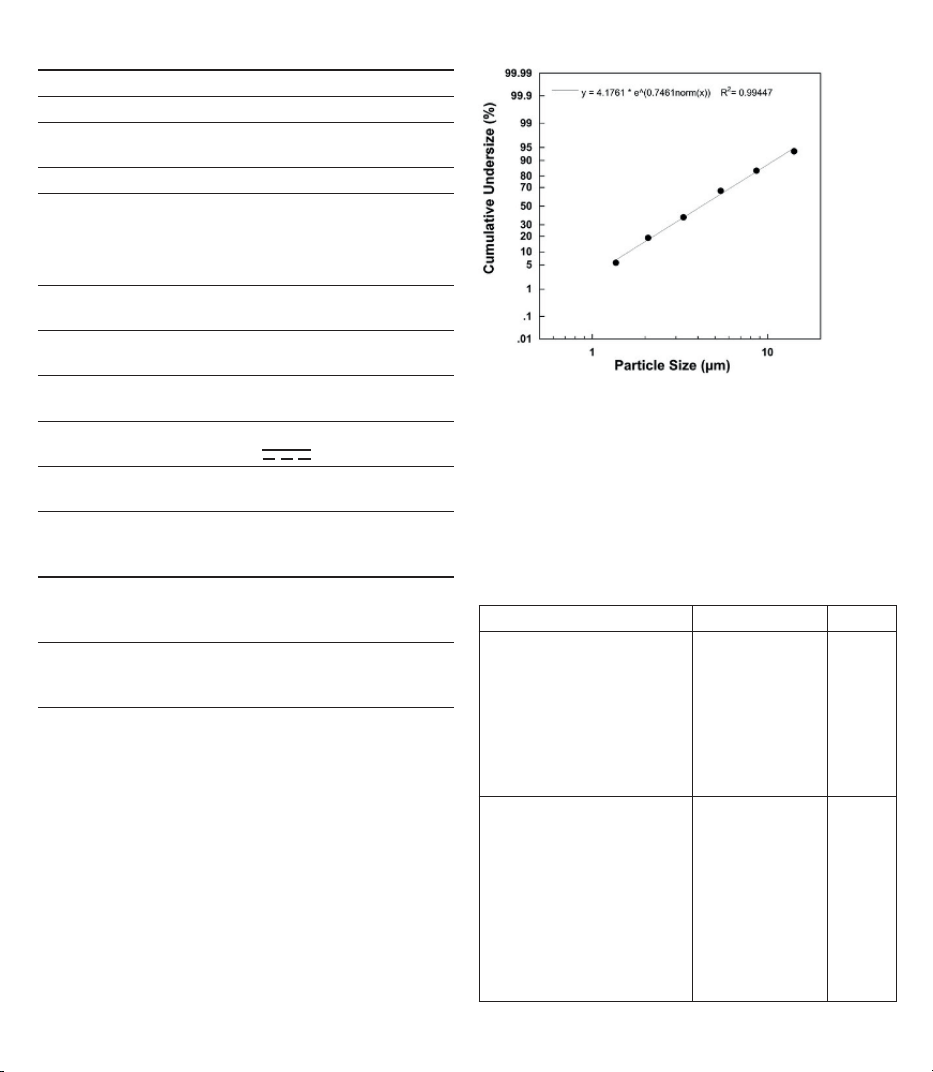
3) Particle size (MMAD): 4.12 µm
The serial number is located on the device or in the bat-
tery compartment.
Subject to technical changes.
Particle size diagram
Measurements were performed using a sodium fluoride
solution with a “Next Generation Impactor” (NGI).
The diagram may therefore not be applicable to sus-
pensions or highly viscous medications. You can obtain
more detailed information from the manufacturer of your
medication.
12. Replacement parts and wearing
parts
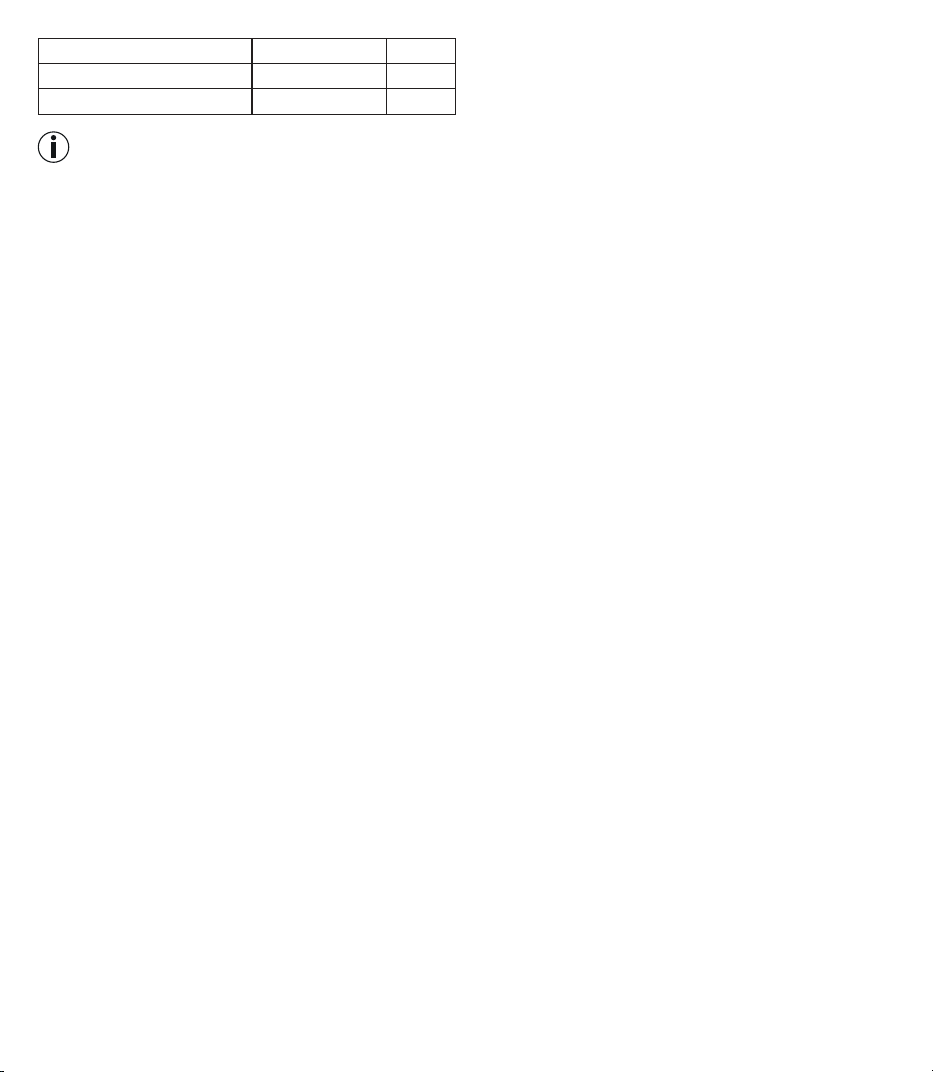
Designation Material REF
IH 58 Kids year pack
contains:
Mouthpiece
Silicone children’s mask
Silicone baby mask
Atomiser
Compressed air hose
Filter
PP
Silicone
Silicone
PP/PC
PVC
Polyester Cotton
602.18
Standard IH 58 year pack
includes:
Mouthpiece
Nosepiece with comfort
attachment
Adult mask
Children’s mask
Atomiser
Compressed air hose
Filter
PP
PP/silicone
PVC/aluminium
PVC/aluminium
PP/PC
PVC
Polyester Cotton
602.15
13
Designation Material REF
Baby mask
PVC 601.31
Removable „giraffe“ PP/ PVC
164.182
Note
If the device is not used according to the instructions
specified, perfect functionality cannot be guaranteed! We
reserve the right to make technical changes to improve
and develop the product. This device and its accesso
-
ries comply with the European standards EN60601-1
and EN60601-1-2 (Group 1, Class B, in compliance with
CISPR 11, IEC61000-3-2, IEC61000-3-3, IEC61000-4-2,
IEC61000-4-3, IEC61000-4-4, IEC61000-4-5, IEC61000-
4-6, IEC61000-4-7, IEC61000-4-8, IEC61000-4-11) and
are subject to special precautionary measures with re-
gard to electromagnetic compatibility. Please note that
portable and mobile HF communication systems may
interfere with this device. This device meets the require-
ments of European Directive 93/42/EEC for medical de-
vices, as well as those of the Medizinproduktegesetz
(German Medical Devices Act).
Notes on electromagnetic compatibility
IEC 60601-1-2:2014 ME EQUIPMENT and ME SYS-
TEMS identification, marking and documents for a
Class B product. The ME EQUIPMENT or ME SYS
-
TEM is suitable for home healthcare environments
and so on.
Warning
• Don’t near active HF surgical equipment and the
RF shielded room of an ME system for magne-
tic resonance imaging, where the intensity of EM
disturbances is high.
•
Use of this equipment adjacent to or stacked with
other equipment should be avoided because it
could result in improper operation. If such use is
necessary, this equipment and the other equip-
ment should be observed to verify that they are
operating normally.
•
Use of accessories, transducers and cables other
than those specified or provided by the manufac-
turer of this equipment could result in increased
electromagnetic emissions or decreased electro-
magnetic immunity of this equipment and result
in improper operation.
•
Portable RF communications equipment (inclu-
ding peripherals such as antenna cables and
external antennas) should be used no closer than
30 cm (12 inches) to any part of the equipment IH
60, including cables specified by the manufactu-
rer. Otherwise, degradation of the performance of
this equipment could result.
Technical description
1. All necessary instructions for maintaining BASIC
SAFETY with regard to electromagnetic disturban
-
ces for the excepted service life.
2.
Guidance and manufacturer’s declaration -elec-
tromagnetic emissions and Immunity
14
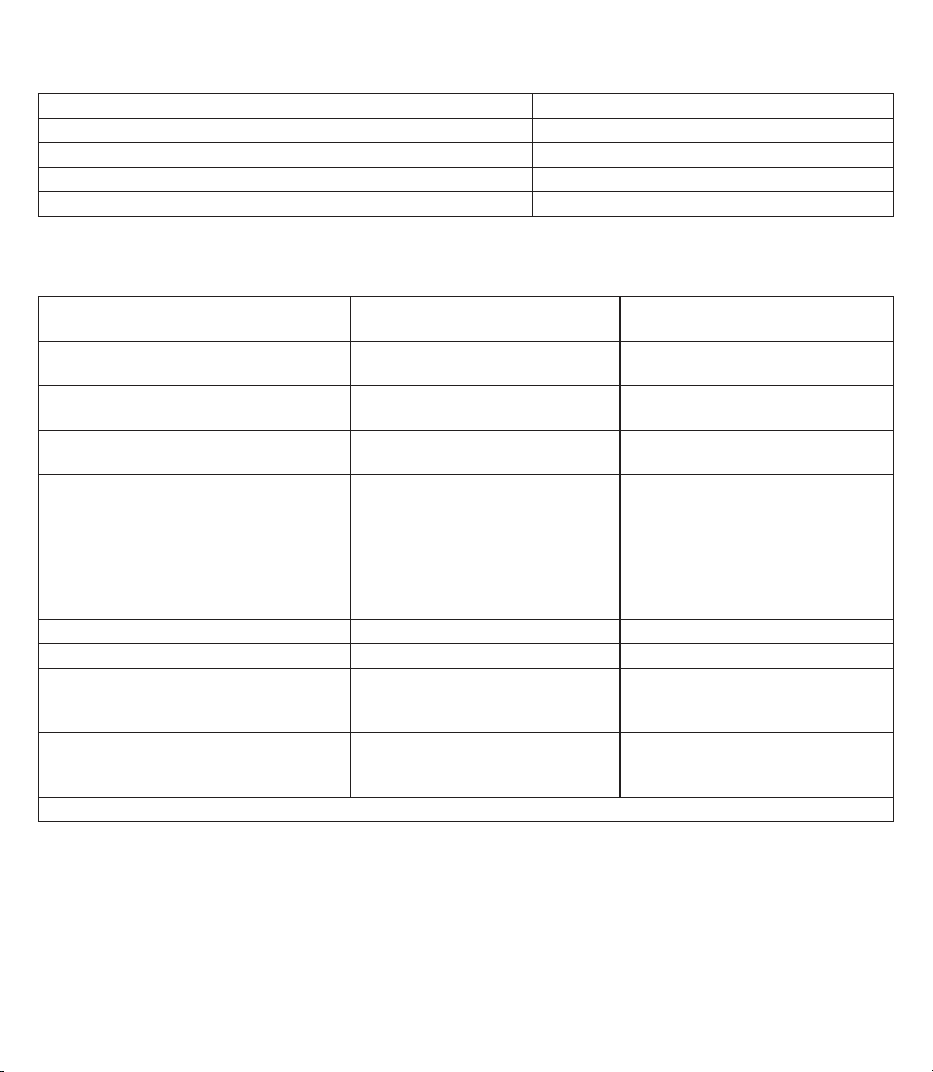
Table 1
Guidance and manufacturer’s declaration - electromagnetic emissions
Emissions test Compliance
RF emissions CISPR 11 Group 1
RF emissions CISPR 11 Class B
Harmonic emissions IEC 61000-3-2 Class A
Voltage fluctuations/ flicker emissions IEC 61000-3-3 Compliance
Table 2
Guidance and manufacturer’s declaration - electromagnetic emissions
Immunity Test IEC 60601-1-2
Test level
Compliance level
Electrostatic discharge (ESD)
IEC 61000-4-2
±8 kV contact
±2 kV, ±4 kV, ±8 kV, ±15 kV air
±8 kV contact
±2 kV, ±4 kV, ±8 kV, ±15 kV air
Electrical fast transient/burst
IEC 61000-4-4
Power supply lines: ±2 kV
100 kHz repetition frequency
Power supply lines: ±2 kV
Surge IEC 61000-4-5 line(s) to line(s): ±1 kV. line(s) to line(s): ±1 kV.
100 kHz repetition frequency
Voltage dips, short interruptions and voltage
variations on power supply input lines IEC
61000-4-11
0% 0.5 cycle
At 0º, 45 º, 90 º, 135 º, 180 º, 225 º,
270 º and 315 º
0% 1 cycle
And 70% 25/30 cycles
Single phase: at 0
0% 250 cycle
0% 0.5 cycle
At 0º, 45 º, 90 º, 135 º, 180 º, 225 º,
270 º and 315 º
0% 1 cycle
And 70% 25/30 cycles
Single phase: at 0
0% 250 cycle
Power frequency magnetic field 30 A/m 30 A/m
IEC 61000-4-8 50Hz/60Hz 50Hz/60Hz
Conduced RF IEC61000-4-6 150KHz to 80MHz: 3Vrms
6Vrms (in ISM and amateur radio
bands) 80% Am at 1kHz
150KHz to 80MHz: 3Vrms
6Vrms (in ISM and amateur radio
bands) 80% Am at 1kHz
Radiated RF IEC61000-4-3 10 V/m
80 MHz – 2,7 GHz
80 % AM at 1 kHz
10 V/m
80 MHz – 2,7 GHz
80 % AM at 1 kHz
NOTE UT is the a.c. mians voltage prior to application of the test level.
15
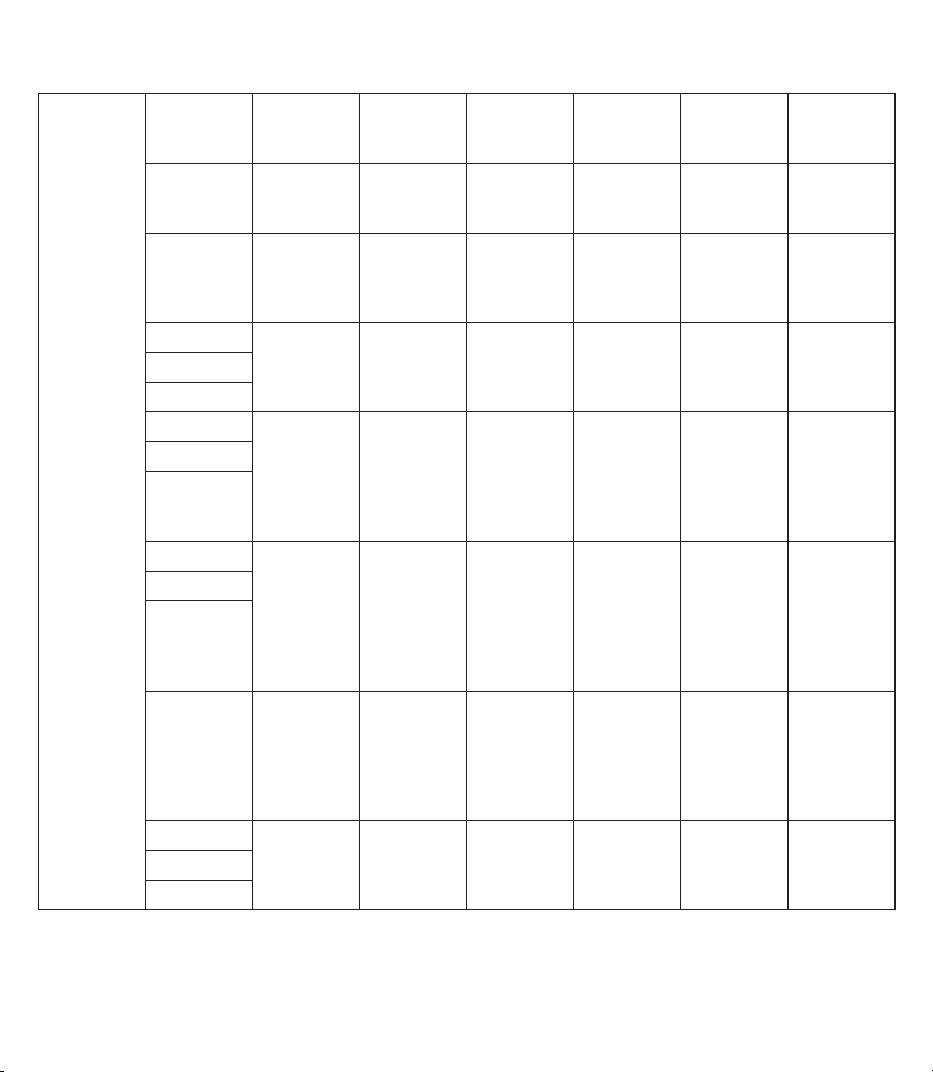
Table 3
Guidance and manufacturer’s declaration - electromagnetic emissions
Radiated RF
IEC61000-
4-3
(Test speci-
fications for
ENCLOSU-
RE PORT
IMMUNITY
to RF wirel-
ess com-
munications
equipment)
Test
Frequency
(MHz)
Band (MHz) Service Modulation Modulation
(W)
Distance
(m)
IMMUNITY
TEST LEVEL
(V/m)
385 380 –390 TETRA 400 Pulse
modulation
18 Hz
1.8 0.3 27
450 430–470 GMRS 460,
FRS 460
FM
± 5 kHz
deviation
1 kHz sine
2 0.3 28
710 704 – 787 LTE Band
13, 17
Pulse
modulation
217 Hz
0.2 0.3 9
745
780
810 800 – 960 GSM
800/900,
TETRA 800,
iDEN 820,
CDMA 850,
LTE Band 5
Pulse
modulation
18 Hz
2 0.3 28
870
930
1720 1700 –1990 GSM 1800;
CDMA 1900;
GSM 1900;
DECT;
LTE Band
1, 3,
4, 25; UMTS
Pulse
modulation
217 Hz
2 0.3 28
1845
1970
2450 2400 –2570 Bluetooth,
WLAN,
802.11
b/g/n,
RFID 2450,
LTE Band 7
Pulse
modulation
217 Hz
2 0.3 28
5240 5100 –5800 WLAN
802.11
a/n
Pulse
modulation
217 Hz
0.2 0.3 9
5500
5785
13. Warranty/service
Further information on the guarantee and guarantee conditions can be found in the guarantee leaflet sup-
plied.
16
602.17_IH58-Kids_2023-03-31_01_IM2_IMI_EN
Beurer GmbH • Söflinger Str. 218 • 89077 Ulm, Germany
www.beurer.com • www.beurer-healthguide.com
Subject to errors and changes