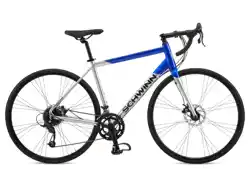

This manual contains important safety, performance and maintenance
information. Read the manual before taking your first ride on your
new bicycle, and keep the manual handy for future reference.
To register your bike visit
schwinnbikes.com/register
Owner’s Manual
Road Bike

Congratulaons
on your new bicycle. Proper assembly and operaon of
your bicycle is important for your safety and enjoyment. Our
customer service department is dedicated to your sasfacon
with Pacic Cycle and its products. If you have quesons or need
advice regarding assembly, parts, performance, or returns,
please contact the experts at Pacic Cycle. Enjoy the ride!
Toll free: 1-800-626-2811
Hours: Monday - Friday 8 AM- 5 PM Central Standard Time (CST)
You may also reach us at:
Web: www.pacic-cycle.com
Mail: 4902 Hammersley Rd.
Madison, WI 53711
Do not return this item to the store. Please call Pacic Cycle
customer service if you need assistance. You will need your
model number and date code located on the service scker near
the boom of the seat tube.
IMPORTANT:
This manual contains important safety, performance, and service
informaon. Read it before you take the rst ride on your new
bicycle, and keep it for reference.
Addional safety, performance, and service informaon for
specic components such as suspension or pedals on your bicycle,
or for accessories such as helmets or lights that you purchase, may
also be available. Make sure that your retailer has given you all the
manufacturers’ literature that was included with your bicycle or
accessories. In case of a conict between the instrucons in this
manual and informaon provided by a component manufacturer,
always follow the component manufacturer’s instrucons.
If you have any quesons or do not understand something, take
responsibility for your safety and contact a qualied bicycle
mechanic.
NOTE: This manual is not intended as a comprehensive use,
service, repair, or maintenance manual. Please consult a
qualied bicycle mechanic for all service, repairs, or
maintenance. Your retailer may also be able to refer you to
classes, clinics, or books on bicycle use, service, repair, or
maintenance.
OMSCRDEN-120823
❶ SAFETY . . . . . . . . . . . . . . . . . . . . . . . . . . . . . . . . . . . . . . . . . . . . . 1
GENERAL WARNING:. . . . . . . . . . . . . . . . . . . . . . . . . . . . . . . . . . . 1
A SPECIAL NOTE FOR PARENTS: . . . . . . . . . . . . . . . . . . . . . . . . . . 1
1: FIRST .............................................2
1.A: Bike Fit. . . . . . . . . . . . . . . . . . . . . . . . . . . . . . . . . . . . . . . 2
1.B: Safety First ...................................2
1.C: Mechanical Safety Check. . . . . . . . . . . . . . . . . . . . . . . . 3
1.D: First ride .....................................5
2: SAFETY ............................................6
2.A: The Basics. . . . . . . . . . . . . . . . . . . . . . . . . . . . . . . . . . . . 6
2.B: Riding Safety .................................7
2.C: O Road Safety ...............................8
2.D: Wet Weather Riding ...........................9
2.E: Night Riding ..................................9
2.F: Changing Components or Adding Accessories .....10
3: FIT ...............................................11
3.A: Standover Height. . . . . . . . . . . . . . . . . . . . . . . . . . . . . 11
3.B: Saddle Posion ..............................12
3.C: Handlebar Height and Angle ...................14
3.D: Brake Reach . . . . . . . . . . . . . . . . . . . . . . . . . . . . . . . . . 15
❷ PARTS IDENTIFICATION ..............................16
❸ ASSEMBLY .........................................18
1: Tools Required . . . . . . . . . . . . . . . . . . . . . . . . . . . . . . . . . . . . . 19
2: Geng Started ....................................19
3: Bike Parts .........................................20
4: Aach the Handlebar ...............................21
5: Aach the Front Wheel. . . . . . . . . . . . . . . . . . . . . . . . . . . . . . 23
5.A: Nued Front Wheel. . . . . . . . . . . . . . . . . . . . . . . . . . . 23
5.B: Quick-release Front Wheel .....................24
6: Aach the Seat ....................................26
7.A: Bolted Seat Clamp ............................26
7.B: Quick Release ................................27
7: Aach the pedals. . . . . . . . . . . . . . . . . . . . . . . . . . . . . . . . . . . 28
❹ TECH ..............................................29
1: Wheels ..........................................29
2: Seat Post Cam Acon Clamp. . . . . . . . . . . . . . . . . . . . . . . . . 36
2.A: Adjusng the Seat Post Cam Acon Mechanism ...36
3: Brakes ...........................................37
CONTENTS
3.A: Brake Controls and Features ...................38
3.B: How Brakes Work ...........................40
4: Derailleur ........................................41
4.A: Adjust the Rear Derailleur .....................41
4.B: Adjust the Front Derailleur. . . . . . . . . . . . . . . . . . . . . 42
4.C: Shiing Gears ...............................43
5: Tires and Tubes ...................................46
5.A: Tires. . . . . . . . . . . . . . . . . . . . . . . . . . . . . . . . . . . . . . .46
5.B: Tire Valves. . . . . . . . . . . . . . . . . . . . . . . . . . . . . . . . . . 48
❺ SERVICE ...........................................49
1: Service Intervals ...................................50
2: If Your Bicycle Sustains an Impact: ....................52
❻ APPENDIX ..........................................53
A: Intended Use of Y our Bicycle . . . . . . . . . . . . . . . . . . . . . . . . . 53
B1: The Lifespan of Your Bike and Its Components .........56
B2: Fague Is Not A Perfectly Predictable Science .........60
C: Fastener Torque Specicaons . . . . . . . . . . . . . . . . . . . . . . . 61
❼ WARRANTY ........................................62
Safety 1
1
SAFETY
1
GENERAL WARNING:
Like any sport, bicycling involves risk of injury and damage.
By choosing to ride a bicycle, you assume the responsibility for
that risk, so you need to know — and to pracce — the rules of
safe and responsible riding and of proper use and maintenance.
Proper use and maintenance of your bicycle reduces risk of injury.
This Manual contains many Warnings and Cauons concerning the
consequences of failure to maintain or inspect your bicycle and of
failure to follow safe cycling pracces.
• The combinaon of the
safety alert symbol and the word
WARNING indicates a potenally hazardous situaon which, if
not avoided, could result in serious injury or death.
• The combinaon of the
safety alert symbol and the word
CAUTION indicates a potenally hazardous situaon which, if
not avoided, may result in minor or moderate injury, or is an
alert against unsafe pracces.
• The word CAUTION used without the safety alert symbol
indicates a situaon which, if not avoided, could result in serious
damage to the bicycle or the voiding of your warranty.
Many of the Warnings and Cauons say, “You may lose control and
fall”. Because any fall can result in serious injury or even death, we
do not always repeat the warning of possible injury or death.
Because it is impossible to ancipate every situaon or condion
that can occur while riding, this Manual makes no representaon
about the safe use of the bicycle under all condions. There are
risks associated with the use of any bicycle which cannot be
predicted or avoided, and which are the sole responsibility of
the rider.
A SPECIAL NOTE FOR PARENTS:
As a parent or guardian, you are responsible for the acvies and
safety of your minor child, and that includes making sure that the
bicycle is properly ed to the child; that it is in good repair and
safe operang condion; that you and your child have learned and
understand the safe operaon of the bicycle; and that you and
your child have learned, understand and obey not only the
applicable local motor vehicle, bicycle and trac laws, but also the
common sense rules of safe and responsible bicycling. As a parent,
you should read this manual, as well as review its warnings and the
bicycle’s funcons and operang procedures with your child,
before leng your child ride the bicycle.
2
1 Safety
3. Are saddle and seat post securely clamped? A correctly
ghtened saddle will allow no saddle movement in any
direcon. See Secon 3.B.
4. Are the stem and handlebars at the right height for you? If not,
see Secon 3.C.
5. Can you comfortably operate the brakes? If not, you may be
able to adjust their angle and reach. See Secon 3.D.
6. Do you fully understand how to operate your new bicycle?
If not, before your rst ride, have your dealer explain any
funcons or features that you do not understand.
1.B: Safety First
1. Always wear an approved helmet when riding your bike, and
follow the helmet manufacturer’s instrucons for t, use and
care.
2. Do you have all the other required and recommended safety
equipment? See Secon 2. It’s your responsibility to familiarize
yourself with the laws of the areas where you ride, and to
comply with all applicable laws.
3. Do you know how to correctly secure your front and rear
wheels? Check Secon 4 to make sure. Riding with an
improperly secured wheel can cause the wheel to wobble or
disengage from the bicycle, and cause serious injury or death.
WARNING!
Make sure that your child always wears an approved bicycle
helmet when riding; but also make sure that your child
understands that a bicycle helmet is for bicycling only, and must
be removed when not riding.
A helmet must not be worn while playing, in play areas, on
playground equipment, while climbing trees, or at any me while
not riding a bicycle. Failure to follow this warning could result in
serious injury or death.
1: FIRST
NOTE: We strongly urge you to read this Manual in its enrety
before your rst ride. At the very least, read and make sure that
you understand each point in this secon, and refer to the cited
secons on any issue that you don’t completely understand. Please
note that not all bicycles have all of the features described in this
Manual. Ask your dealer to point out the features of your bicycle.
1.A: Bike Fit
1. Is your bike the right size? To check, see Secon 3.A. If your
bicycle is too large or too small for you, You may lose control
and fall. If your new bike is not the right size, ask your dealer to
exchange it before you ride it.
2. Is the saddle at the right height? To check, see Secon 3.B. If
you adjust your saddle height, follow the Minimum Inseron
instrucons in Secon 3.B.
Safety 1
3
1.C: Mechanical Safety Check
Rounely check the condion of your bicycle before every ride.
Nuts, bolts screws & other fasteners: Because manufacturers
use a wide variety of fastener sizes and shapes made in a
variety of materials, oen diering by model and component,
the correct ghtening force or torque cannot be generalized.
To make sure that the many fasteners on your bicycle are
correctly ghtened, refer to the Fastener Torque Specicaons
in Appendix E of this manual or to the torque specicaons in
the instrucons provided by the manufacturer of the
component in queson.
Correctly ghtening a fastener requires a calibrated torque
wrench. A professional bicycle mechanic with a torque wrench
should torque the fasteners on you bicycle. If you choose to
work on your own bicycle, you must use a torque wrench and
the correct ghtening torque specicaons from the bicycle or
component manufacturer or from your dealer. If you need to
make an adjustment at home or in the eld, we urge you to
exercise care, and to have the fasteners you worked on
checked by your dealer as soon as possible.
Note: there are some components that require special tools
and knowledge. In Secons 3 and 4 we discuss the items that
you may be able to adjust yourself. All other adjustments and
repairs should be done by a qualied bicycle mechanic
WARNING!
Correct ghtening force on fasteners – nuts, bolts, screws – on
your bicycle is important. Too lile force, and the fastener may
not hold securely. Too much force, and the fastener can strip
threads, stretch, deform or break. Either way, incorrect
ghtening force can result in component failure, which can
cause you to loose control and fall.
Make sure nothing is loose. Li the front wheel o the ground
by two or three inches, then let it bounce on the ground.
Anything sound, feel or look loose? Do a visual and tacle
inspecon of the whole bike. Any loose parts or accessories?
If so, secure them. If you’re not sure, ask someone with
experience to check.
Tires & Wheels: Make sure res are correctly inated. Check by
pung one hand on the saddle, one on the intersecon of the
handlebars and stem, then bouncing your weight on the bike
while looking at re deecon. Compare what you see with
how it looks when you know the res are correctly inated; and
adjust if necessary.
Tires in good shape? Spin each wheel slowly and look for cuts
in the tread and sidewall. Replace damaged res before riding
the bike.
Wheels true? Spin each wheel and check for brake clearance
and side-to-side wobble. If a wheel wobbles side to side even
slightly, or rubs against or hits the brake pads, take the bike to a
qualied bike shop to have the wheel trued.
4
1 Safety
Brakes: Check the brakes for proper operaon (see Secon
4.C). Squeeze the brake levers.
• Are the brake quick-releases closed? All control cables
seated and securely engaged?
• If you have rim brakes, do the brake pads contact the
wheel rim squarely and make full contact with the rim?
• Do the brakes begin to engage within an inch of brake
lever movement?
Can you apply full braking force at the levers without
having them touch the handlebar?
• If not, your brakes need adjustment. Do not ride the bike
unl the brakes are properly adjusted by a professional
bicycle mechanic.
Wheel retenon system: Make sure the front and rear wheels
are correctly secured. See Secon 4.
Seat post: If your seat post has an over-center cam acon
fastener for easy height adjustment, check that it is properly
adjusted and in the locked posion. See Secon 4.
Handlebar and saddle alignment: Make sure the saddle and
handlebar stem are parallel to the bike’s center line and
clamped ght enough so that you can’t twist them out of
alignment. See Secons 3.B and 3.C.
WARNING!
WARNING!
Wheels must be true for rim brakes to work eecvely.
Wheel truing is a skill that requires special tools and experience.
Do not aempt to true a wheel unless you have the knowledge,
experience and tools needed to do the job correctly.
Bicycle wheel rims are subject to wear. Contact customer
service regarding wheel rim wear. Some wheel rims have a rim
wear indicator on the side that disappears as the rim’s braking
surface wears. A rim who’s wear indicator has become very
shallow or is no longer visible has reached its maximum usable
life. Riding a wheel that is at the end of its usable life can result
in wheel failure, which can cause you to lose control and fall.
Wheel rims clean and undamaged? Make sure the rims are
clean and undamaged at the re bead and, if you have rim
brakes, along the braking surface. Check to make sure that any
rim wear indicator marking is not visible at any point on the
wheel rim.
Safety 1
5
WARNING!
Loose or damaged handlebar grips or extensions can cause you
to lose control and fall. Unplugged handlebars or extensions can
cut you and cause serious injury in an otherwise minor accident.
VERY IMPORTANT SAFETY NOTE: Please also read and become
thoroughly familiar with the important informaon on the
lifespan of your bicycle and its components in the Appendix.
1.D: First ride
When you buckle on your helmet and go for your rst
familiarizaon ride on your new bicycle, be sure to pick a
controlled environment, away from cars, other cyclists, obstacles
or other hazards. Ride to become familiar with the controls,
features and performance of your new bike.
Familiarize yourself with the braking acon of the bike (see Secon
4). Test the brakes at slow speed, pung your weight toward the
rear and gently applying the brakes, rear brake rst. Sudden or
excessive applicaon of the front brake could pitch you over the
Handlebar ends: Make sure the handlebar grips are secure
and in good condion, with no cuts, tears, or worn out areas.
If not, replace them. Make sure the handlebar ends and
extensions are plugged. If the handlebars have bar end
extensions, make sure they are clamped ght enough so you
can’t twist them.
handlebars. Applying brakes too hard can lock up a wheel, which
could cause you to lose control and fall. Skidding is an example of
what can happen when a wheel locks up.
If your bicycle has toeclips or clipless pedals, pracce geng in and
out of the pedals. See paragraph above and Secon 4.
If your bike has suspension, familiarize yourself with how the
suspension responds to brake applicaon and rider weight shis.
See paragraph B.6 above and Secon 4.
Pracce shiing the gears (see Secon 4). Remember to never
move the shier while pedaling backward, nor pedal backwards
immediately aer having moved the shier. This could jam the
chain and cause serious damage to the bicycle.
Check out the handling and response of the bike; and check the
comfort.
If you have any quesons, or if you feel anything about the bike is
not as it should be, contact customer service before you ride again.
6
1 Safety
Figure 1.1
You’re helmet should (Figure 1.1):
• U.S. Consumer Product Safety Commission (CPSC) cered
(look for the label on the helmet)
• Properly sized for you
• Properly ed to you
• Properly aached to your head
• Undamaged
2. Always do the Mechanical Safety Check (Secon 1.C) before
you get on a bike.
3. Be thoroughly familiar with the controls of your bicycle: brakes
(Secon 4.C.); pedals (Secon 4.E.); shiing (Secon 4.D.).
2: SAFETY
2.A: The Basics
WARNING!
The area in which you ride may require specic safety devices.
It is your responsibility to familiarize yourself with the laws of
the area where you ride and to comply with all applicable laws,
including properly equipping yourself and your bike as the law
requires.
Observe all local bicycle laws and regulaons. Observe
regulaons about bicycle lighng, licensing of bicycles, riding on
sidewalks, laws regulang bike path and trail use, helmet laws,
child carrier laws, special bicycle trac laws. It’s your
responsibility to know and obey the laws.
1. Always wear a cycling helmet that meets the latest cercaon
standards and is appropriate for the type of riding you do.
Always follow the helmet manufacturer’s instrucons for t,
use and care of your helmet. Most serious bicycle injuries
involve head injuries that might have been avoided if the rider
had worn an appropriate helmet.
WARNING!
Failure to wear a helmet when riding may result in serious injury
or death.

Safety 1
7
4. Be careful to keep body parts and other objects away from the
sharp teeth of chainrings, the moving chain, the turning pedals
and cranks, and the spinning wheels of your bicycle.
5. Always wear:
• Shoes that will stay on your feet and will grip the pedals.
Make sure that shoelaces cannot get into moving parts,
and never ride barefoot or in sandals.
• Bright, visible clothing that is not so loose that it can be
tangled in the bicycle or snagged by objects at the side of
the road or trail.
• Protecve eyewear, to protect against airborne dirt, dust
and bugs-nted when the sun is bright, clear when it’s not.
6. Ride at a speed appropriate for condions. Higher speed means
higher risk.
2.B: Riding Safety
1. Obey all Rules of the Road and all local trac laws.
2. You are sharing the road or the path with others — motorists,
pedestrians and other cyclists. Respect their rights.
3. Ride defensively. Always assume that others do not see you.
4. Look ahead, and be ready to avoid:
• Vehicles slowing or turning, entering the road or your lane
ahead of you, or coming up behind you.
• Parked car doors opening.
• Pedestrians stepping out.
• Children or pets playing near the road.
• Pot holes, sewer grang, railroad tracks, expansion joints,
road or sidewalk construcon, debris and other
obstrucons that could cause you to swerve into trac,
catch your wheel or cause you to have an accident.
• The many other hazards and distracons which can occur
on a bicycle ride.
5. Ride in designated bike lanes, on designated bike paths or as
close to the edge of the road as praccable, in the direcon of
trac ow or as directed by local governing laws.
6. Stop at stop signs and trac lights; slow down and look both
ways at street intersecons. Remember that a bicycle always
loses in a collision with a motor vehicle, so be prepared to yield
even if you have the right of way.
7. Use approved hand signals for turning and stopping.
8. Never ride with headphones. They mask trac sounds and
emergency vehicle sirens, distract you from concentrang on
what’s going on around you, and their wires can tangle in the
moving parts of the bicycle, causing you to lose control.
9. Never carry a passenger; and, before installing a child carrier or
trailer, check with the bicycle manufacturer to make sure the
bicycle is designed for it. If the bicycle is suitable for a child
carrier or trailer, make sure that the carrier or trailer is correctly
mounted and the child is secured and wearing an approved
helmet.

8
1 Safety
10. Never carry anything which obstructs your vision or your
complete control of the bicycle, or which could become
entangled in the moving parts of the bicycle.
11. Never hitch a ride by holding on to another vehicle.
12. Don’t do stunts, wheelies or jumps. If you intend to do stunts,
wheelies, jumps or go racing with your bike despite our advice
not to, read Secon 2.F, Downhill, Stunt or Compeon Biking,
now. Think carefully about your skills before deciding to take
the large risks that go with this kind of riding.
13. Don’t weave through trac or make any moves that may
surprise people with whom you are sharing the road.
14. Observe and yield the right of way.
15. Never ride your bicycle while under the inuence of alcohol or
drugs.
16. If possible, avoid riding in bad weather, when visibility is
obscured, at dawn, dusk or in the dark, or when extremely
red. Each of these condions increases the risk of accident.
2.C: O Road Safety
We recommend that children not ride on rough terrain unless they
are accompanied by an adult.
1. The variable condions and hazards of o-road riding require
close aenon and specic skills. Start slowly on easier terrain
and build up your skills. If your bike has suspension, the
increased speed you may develop also increases your risk of
losing control and falling. Get to know how to handle your bike
safely before trying increased speed or more dicult terrain.
2. Wear safety gear appropriate to the kind of riding you plan
to do.
3. Don’t ride alone in remote areas. Even when riding with others,
make sure that someone knows where you’re going and when
you expect to be back.
4. Always take along some kind of idencaon, so that people
know who you are in case of an accident; and take along some
cash for food, a cool drink or an emergency phone call.
5. Yield right of way to pedestrians and animals. Ride in a way that
does not frighten or endanger them, and give them enough
room so that their unexpected moves don’t endanger you.
6. Be prepared. If something goes wrong while you’re riding
o-road, help may not be close.
7. Before you aempt to jump, do stunt riding or race with your
bike, read and understand Secon 2.F.
O Road Respect
Obey the local laws regulang where and how you can ride
o-road, and respect private property. You may be sharing the trail
with others — hikers, trail runners, equestrians, and other cyclists.
Respect their rights. Stay on the designated trail. Don’t contribute
to erosion by riding in mud or with unnecessary sliding. Don’t
disturb the ecosystem by cung your own trail or shortcut through
vegetaon or streams. It is your responsibility to minimize your
Safety 1
9
WARNING!
Wet weather impairs tracon, braking and visibility, both for the
bicyclist and for other vehicles sharing the road. The risk of an
accident is dramacally increased in wet condions.
impact on the environment. Leave things as you found them; and
always take out everything you brought in.
2.D: Wet Weather Riding
Under wet condions, the stopping power of your brakes (as well
as the brakes of other vehicles sharing the road) is dramacally
reduced and your res don’t grip nearly as well. This makes it
harder to control speed and easier to lose control. To make sure
that you can slow down and stop safely in wet condions, ride
more slowly and apply your brakes earlier and more gradually than
you would under normal, dry condions. See also Secon 4.C.
2.E: Night Riding
Riding a bicycle at night is much more dangerous than riding
during the day. A bicyclist is very dicult for motorists and
pedestrians to see. Therefore, children should never ride at dawn,
at dusk or at night. Adults who chose to accept the greatly
increased risk of riding at dawn, at dusk or at night need to take
extra care both riding and choosing specialized equipment that
helps reduce that risk.
WARNING!
Reectors are not a substute for required lights. Riding at
dawn, at dusk, at night or at other mes of poor visibility without
an adequate bicycle lighng system and without reectors is
dangerous and may result in serious injury or death.
Bicycle reectors are designed to pick up and reect car lights and
street lights in a way that may help you to be seen and recognized
as a moving bicyclist.
CAUTION!
Check reectors and their mounng brackets regularly to make
sure that they are clean, straight, unbroken and securely
mounted. Have your dealer replace damaged reectors and
straighten or ghten any that are bent or loose.
The mounng brackets of front and rear reectors are oen
designed as brake straddle cable safety catches which prevent the
straddle cable from catching on the re tread if the cable jumps
out of its yoke or breaks.
10
1 Safety
If you choose to ride under condions of poor visibility, check
and be sure you comply with all local laws about night riding, and
take the following strongly recommended addional precauons:
• Purchase and install baery or generator powered head and tail
lights which meet all regulatory requirements for where you live
and provide adequate visibility.
• Wear light colored, reecve clothing and accessories, such as a
reecve vest, reecve arm and leg bands, reecve stripes on
your helmet, ashing lights aached to your body and/or your
bicycle ... any reecve device or light source that moves will
help you get the aenon of approaching motorists, pedestrians
and other trac.
WARNING!
Do not remove the front or rear reectors or reector brackets
from your bicycle. They are an integral part of the bicycle’s safety
system. Removing the reectors reduces your visibility to others
using the roadway.
Being struck by other vehicles may result in serious injury or
death.
The reector brackets may protect you from a brake straddle
cable catching on the re in the event of brake cable failure. If a
brake straddle cable catches on the re, it can cause the wheel
to stop suddenly, causing you to lose control and fall.
• Make sure your clothing or anything you may be carrying on the
bicycle does not obstruct a reector or light.
• Make sure that your bicycle is equipped with correctly
posioned and securely mounted reectors.
While riding at dawn, at dusk or at night:
• Ride slowly.
• Avoid dark areas and areas of heavy or fast-moving trac.
• Avoid road hazards.
• If possible, ride on familiar routes.
If riding in trac:
• Be predictable. Ride so that drivers can see you and predict
your movements.
• Be alert. Ride defensively and expect the unexpected.
• If you plan to ride in trac oen, contact customer service
about trac safety classes or a good book on bicycle trac
safety.
2.F: Changing Components or Adding Accessories
There are many components and accessories available to enhance
the comfort, performance and appearance of your bicycle.
However, if you change components or add accessories, you do so
at your own risk. The bicycle’s manufacturer may not have tested
that component or accessory for compability, reliability or safety
on your bicycle.
Safety 1
11
Before installing any component or accessory, including but not
limited to a dierent size re, a lighng system, a luggage rack, a
child seat, a trailer, etc., make sure that it is compable with your
bicycle by contacng customer service. Be sure to read,
understand and follow the instrucons that accompany the
products you purchase for your bicycle. See also Appendix B.
Failure to conrm compability, properly install, operate and
maintain any component or accessory can result in serious
injury or death.
Exposed springs on the saddle of any bicycle ed with a child
seat can cause serious injury to the child.
Changing the components on your bike with other than genuine
replacement parts may compromise the safety of your bicycle
and may void the warranty. Contact customer service before
changing the components on your bike.
WARNING!
3: FIT
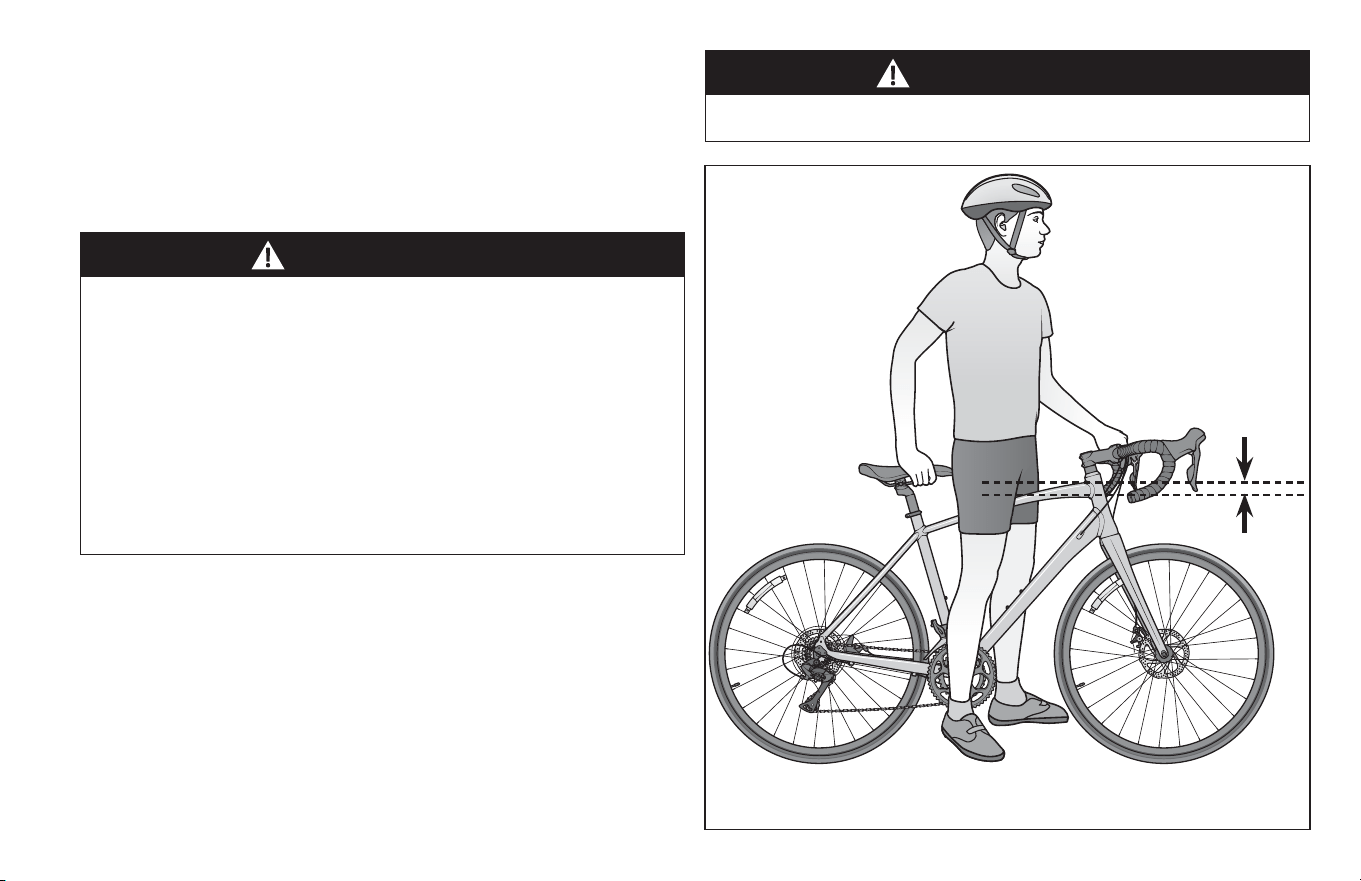
3.A: Standover height
1. A bike that you’ll ride on unpaved surfaces should give you a
minimum of three inches (7.5 cm) of standover height
clearance. And a bike that you’ll use o road should give you
four inches (10 cm) or more of clearance. Figure 1.2
WARNING!
If your bicycle does not t properly, you may lose control and fall.
Figure 1.2
Minimum
3 inch (7.5 cm)
clearance
12
1 Safety
3.B: Saddle posion
Correct saddle adjustment is an important factor in geng the
most performance and comfort from your bicycle. If the saddle
posion is not comfortable for you, see your dealer.
The saddle can be adjusted in three direcons: up and down,
front and back, and saddle angle.
Small changes in saddle posion can have a substanal eect on
performance and comfort. To nd your best saddle posion, make
only one adjustment at a me.
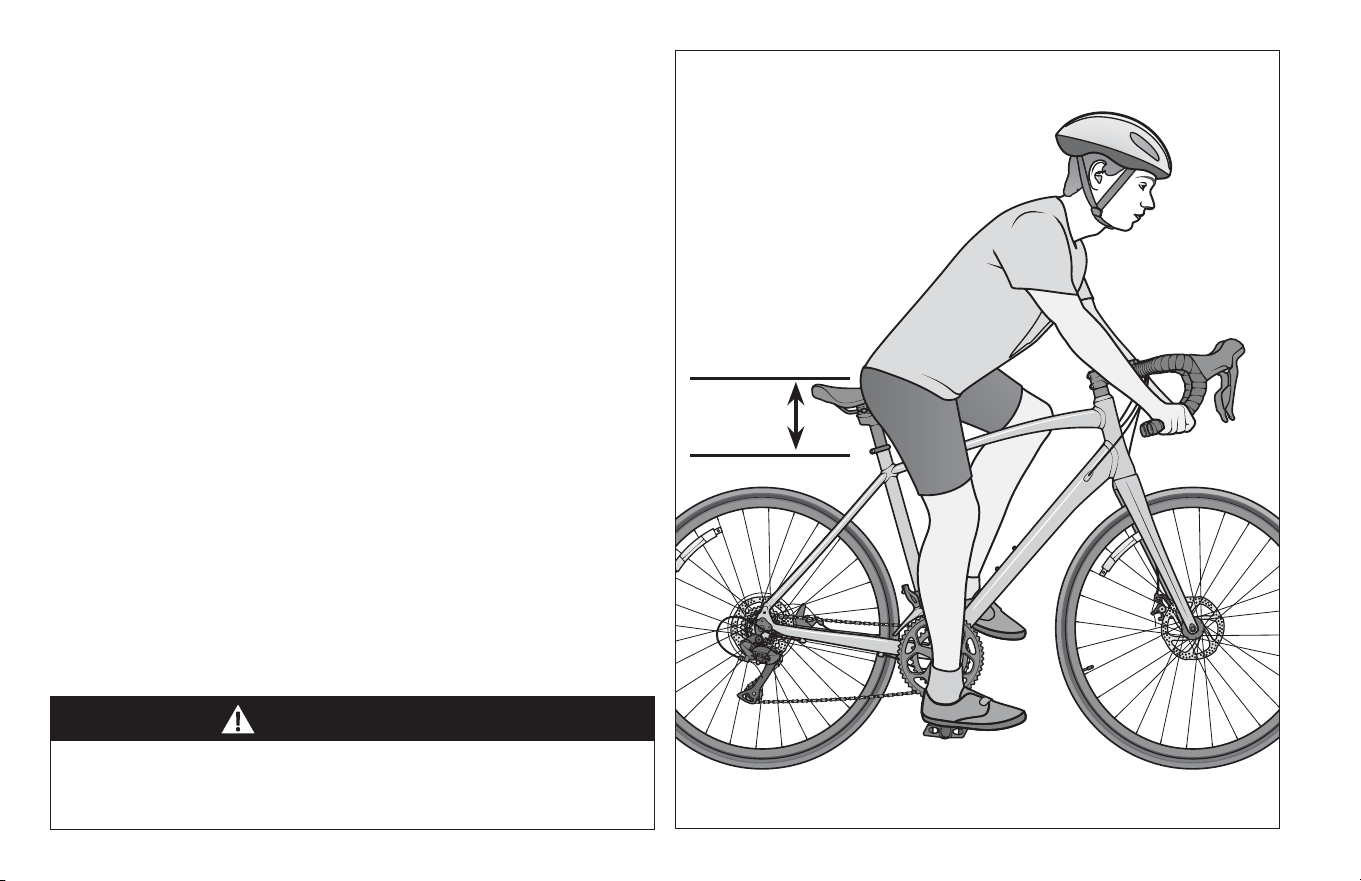
1. Up and down adjustment. To check for correct saddle height:
• sit on the saddle
• place one heel on a pedal
• rotate the crank unl the pedal with your heel on it is in
the down posion and the crank arm is parallel to the
seat tube.
If your leg is not completely straight, your saddle height needs
to be adjusted. If your hips must rock for the heel to reach the
pedal, the saddle is too high. If your leg is bent at the knee with
your heel on the pedal, the saddle is too low. Figure 1.3
If your seat post is not inserted in the seat tube properly, the
seat post, binder or even frame may break, which could cause
you to lose control and fall.
WARNING!
Figure 1.3
Adjust seat
height
Safety 1
13
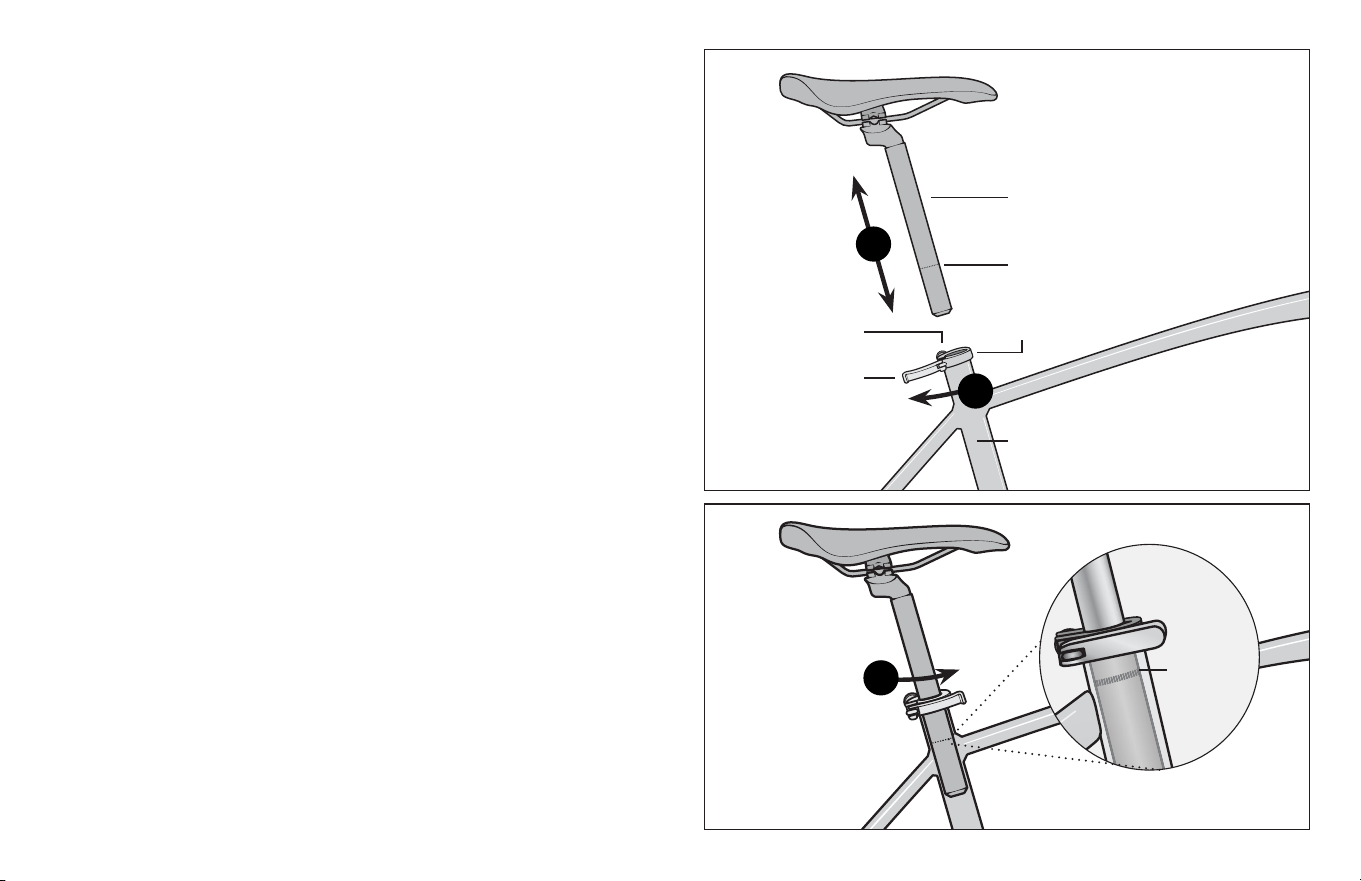
Ask your dealer to set the saddle for your opmal riding posion
and to show you how to make this adjustment. If you choose to
make your own saddle height adjustment: Figure 1.4
❶ loosen the seat post clamp
❷ raise or lower the seat post in the seat tube
❸ make sure the saddle is straight fore and a
❹ re-ghten the seat post clamp to the recommended torque
(see Appendix or the manufacturer’s instrucons).
Once the saddle is at the correct height, make sure that the seat
post does not project from the frame beyond its minimum
inseron mark. Figure 1.5
2. Front and back adjustment. The saddle can be adjusted
forward or back to help you get the opmal posion on the
bike. Ask your dealer to set the saddle for your opmal riding
posion and to show you how to make this adjustment. If you
choose to make your own front and back adjustment, make
sure that the clamp mechanism is clamping on the straight part
of the saddle rails and is not touching the curved part of the
rails, and that you are using the recommended torque on the
clamping fastener(s) (see Appendix C or the manufacturer’s
instrucons).
3. Saddle angle adjustment. Most people prefer a horizontal
saddle; but some riders like the saddle nose angled up or down
just a lile. Your dealer can adjust saddle angle or teach you
how to do it. If you choose to make your own saddle angle
adjustment and you have a single bolt saddle clamp on your
Figure 1.5
3
Minimum
inseron
marks
Figure 1.4
Quick-release
lever
Quick-release
seat clamp
Adjustment nut
2
Seat tube
Seat post
Minimum inseron
marks
1
14
1 Safety
WARNING!
When making saddle angle adjustments with a single bolt
saddle clamp, always check to make sure that the serraons on
the mang surfaces of the clamp are not worn. Worn serraons
on the clamp can allow the saddle to move, causing you to lose
control and fall.
Always ghten fasteners to the correct torque. Bolts that are
too ght can stretch and deform. Bolts that are too loose can
move and fague. Either mistake can lead to a sudden failure of
the bolt, causing you to lose control and fall.
Aer any saddle adjustment, be sure that the saddle adjusng
mechanism is properly seated and ghtened before riding.
A loose saddle clamp or seat post clamp can cause damage to
the seat post, or can cause you to lose control and fall. A
correctly ghtened saddle adjusng mechanism will allow no
saddle movement in any direcon. Periodically check to make
sure that the saddle adjusng mechanism is properly ghtened.
seat post, it is crical that you loosen the clamp bolt suciently
to allow any serraons on the mechanism to disengage before
changing the saddle’s angle, and then that the serraons fully
re-engage before you ghten the clamp bolt to the
recommended torque (see Appendix C or the manufacturer’s
instrucons).
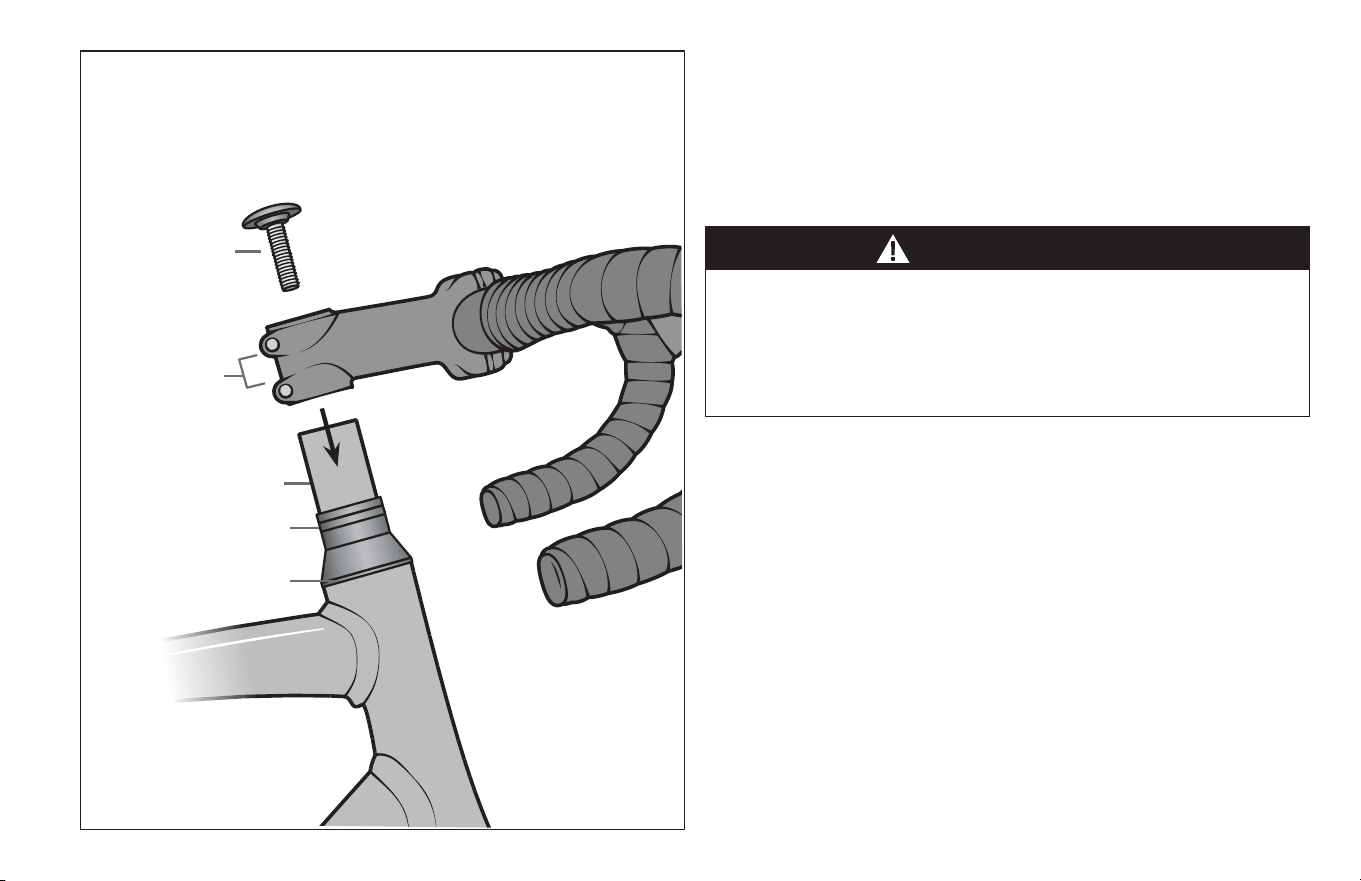
3.C: Handlebar Height and Angle
If your bike has a threadless stem your dealer may be able to
change handlebar height by moving height adjustment spacers
from below the stem to above the stem, or vice versa.
Otherwise, you’ll have to get a stem of dierent length or rise.
Contact customer service. Do not aempt to do this yourself, as it
requires special knowledge. Figure 1.4
WARNING!
Always ghten fasteners to the correct torque. Bolts that are too
ght can stretch and deform. Bolts that are too loose can move
and fague. Either mistake can lead to a sudden failure of the
bolt, causing you to lose control and fall.
WARNING!
An insuciently ghtened stem clamp bolt, handlebar clamp
bolt or bar end extension clamping bolt may compromise
steering acon, which could cause you to lose control and fall.
Place the front wheel of the bicycle between your legs and
aempt to twist the handlebar/stem assembly. If you can twist
the stem in relaon to the front wheel, turn the handlebars in
relaon to the stem, or turn the bar end extensions in relaon to
the handlebar, the bolts are insuciently ghtened.
Be aware that adding aerodynamic extensions to handlebars will
change the steering and braking response of the bicycle.
Safety 1
15
WARNING!
The shorter the brake lever reach, the more crical it is to have
correctly adjusted brakes, so that full braking power can be
applied within available brake lever travel. Brake lever travel
insucient to apply full braking power can result in loss of
control, which may result in serious injury or death.
3.D: Brake Reach
Many bikes have brake levers that can be adjusted for reach.
If you have small hands or nd it dicult to squeeze the brake
levers, your dealer can either adjust the reach or t shorter reach
brake levers.
Figure 1.4
Top cap
and bolt
Stem
pinch
bolts
Headset
Steerer tube
Spacers
16
2 Parts Idencaon
Road Bike
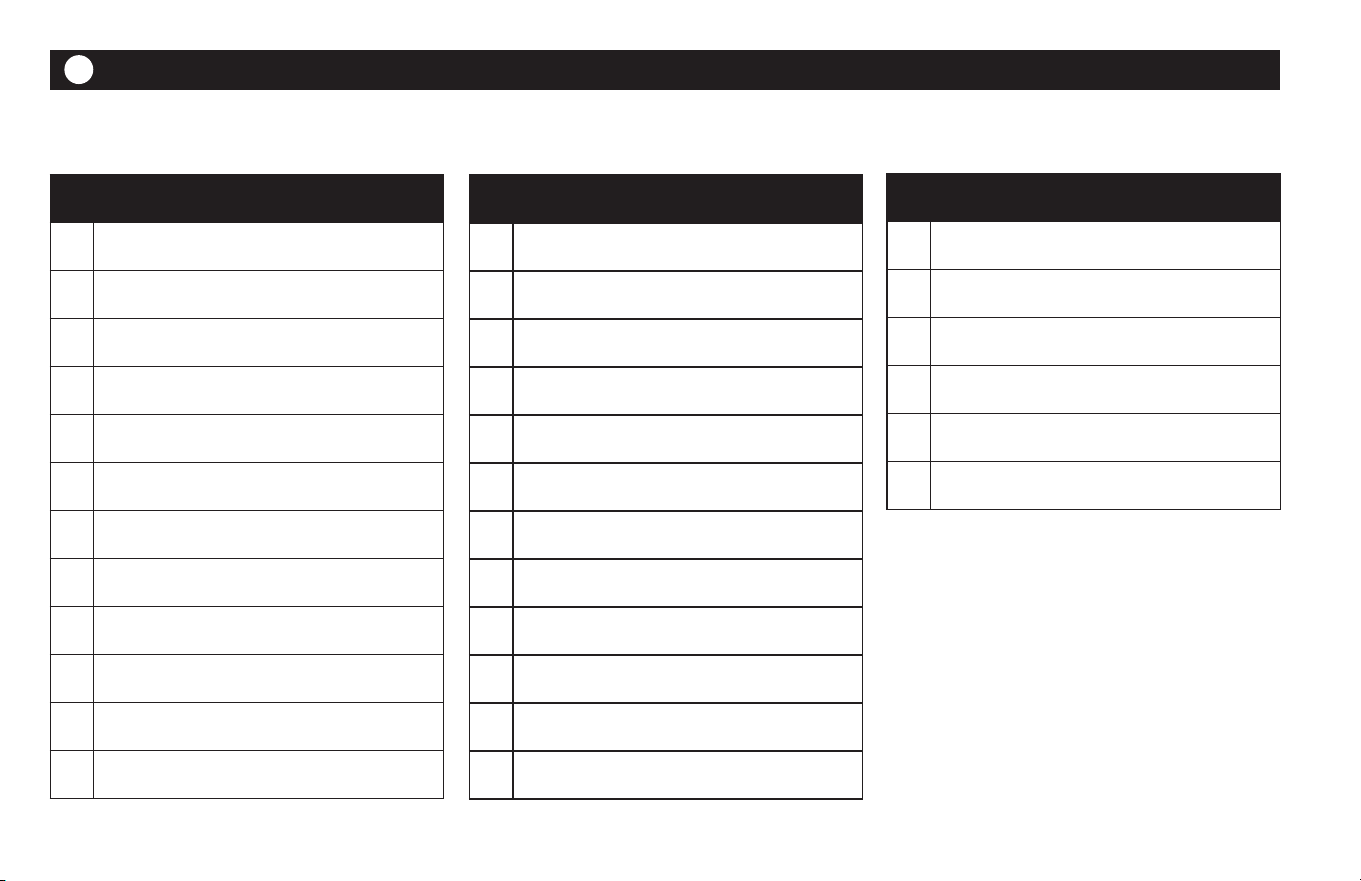
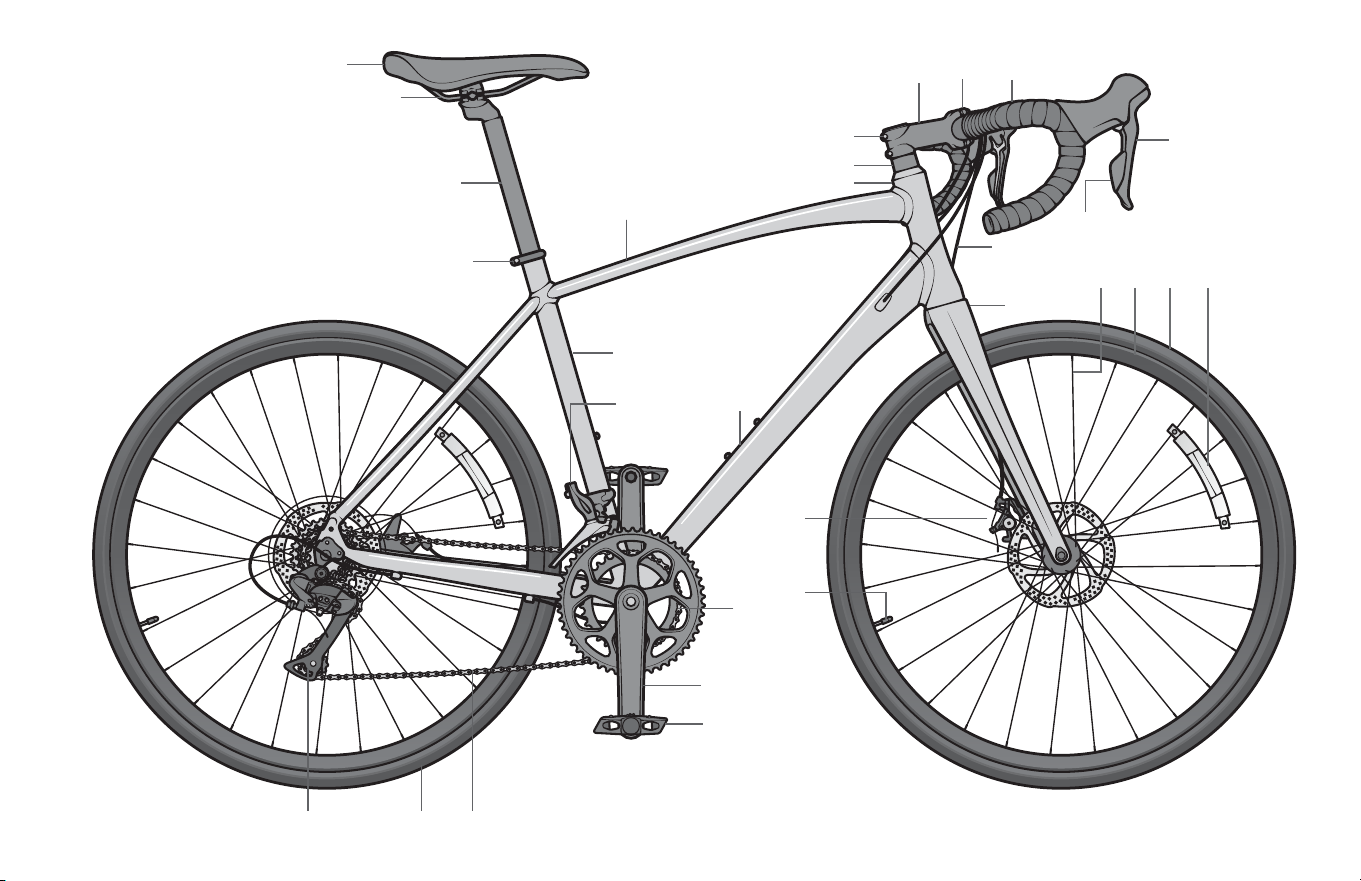
Get to know the parts of your bicycle. This will help with assembly, maintenance, and troubleshoong. Color, style and parts may vary.
Part name
13 Front re
14 Wheel reector
15 Pedal
16 Crank arm
17 Chain wheel
18 Air valve stem
19 Disc brake
20 Down tube
21 Front derailleur
22 Seat tube
23 Top tube
24 Seat
Part name
1 Handlebar stem
2 Handlebar clamp bolt
3 Handlebar
4 Hand brake
5 Shi lever
6 Brake and shi cables
7 Head tube
8 Headset
9 Stem clamp bolt
10 Front fork
11 Spoke
12 Wheel rim
Part name
25 Seat hardware
26 Seat post
27 Seat clamp
28 Rear derailleur
29 Rear wheel
30 Chain
PARTS IDENTIFICATION
2
Parts Idencaon 2
17
12 13 1411
19
18
25
28
27
26
21
22
15
16
17
20
23
3029
24
9
8
7
10
2 3
4
5
6
6
1
18
3 Assembly
ASSEMBLY
3
Your new bicycle was assembled and tuned in the factory and then
parally disassembled for shipping. You may have purchased the
bicycle already fully assembled and ready to ride, or in the shipping
carton in the parally disassembled form. The following
instrucons will enable you to prepare your bicycle for years of
enjoyable cycling.
For more details on inspecon, lubricaon, maintenance and
adjustment of any area please refer to the relevant secons in
this manual. If you have quesons about your ability to properly
assemble this unit, please consult a qualied bicyclist mechanic
before riding.
If you need replacement parts or have quesons pertaining to the
assembly of your bicycle, call the service line direct at:
1-800-626-2811. Monday - Friday 8:00 am to 5:00 pm Central
Standard Time (CST).
WARNING!
Improper assembly of this product may result in serious injury or
death. Always follow the instrucons in this manual and check
crical components (e.g. wheels, seat, pedals, brakes,
derailleurs, res) before each use.
We recommend that you consult a bicycle specialist if you have
doubts or concerns as to your experience or ability to properly
assemble, repair, or maintain your bicycle. If your bicycle was
obtained assembled, we recommend that you read these
instrucons and perform checks specied in this manual
before riding.
Assembly 3
19
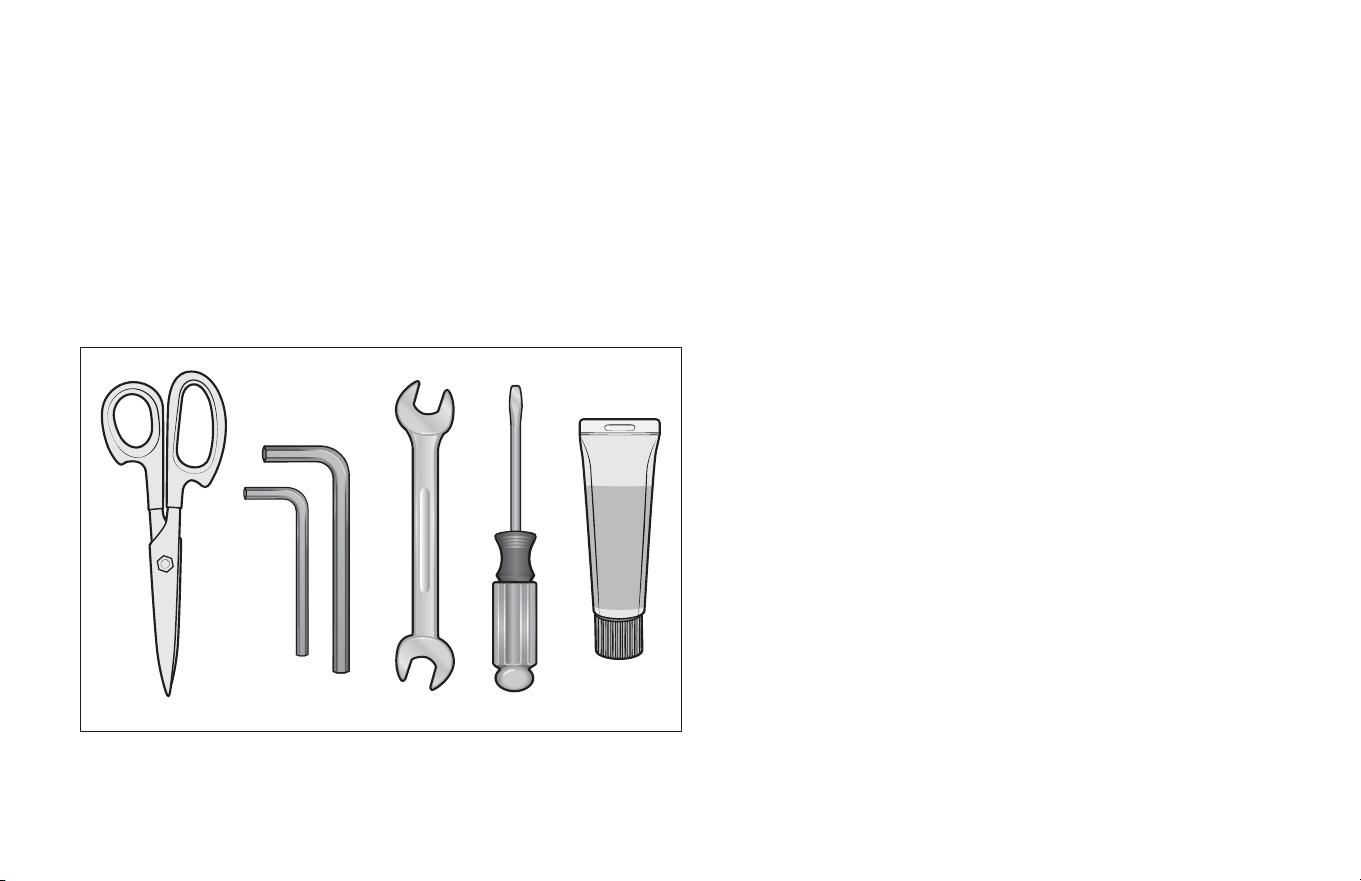
1: TOOLS REQUIRED
• Scissors
• 4 mm, 5 mm, 6 mm and 8 mm hex wrenches
• 15 mm open end wrench
• Phillips head screwdriver
• Grease (lithium-based recommended)
2: GETTING STARTED
❶ Open the carton from the top and remove the bicycle parts.
❷ Remove the straps and protecve packaging from the bicycle.
Important! Do not discard packing materials unl assembly is
complete to ensure that no required parts are accidentally
discarded.
❸ Inspect the bicycle and all accessories and parts for possible
shortages. It is recommended that the threads and all moving
parts in the parts package be lubricated with a lithium-based
grease prior to installaon.
Figure 3.1
20
3 Assembly
3: BIKE PARTS
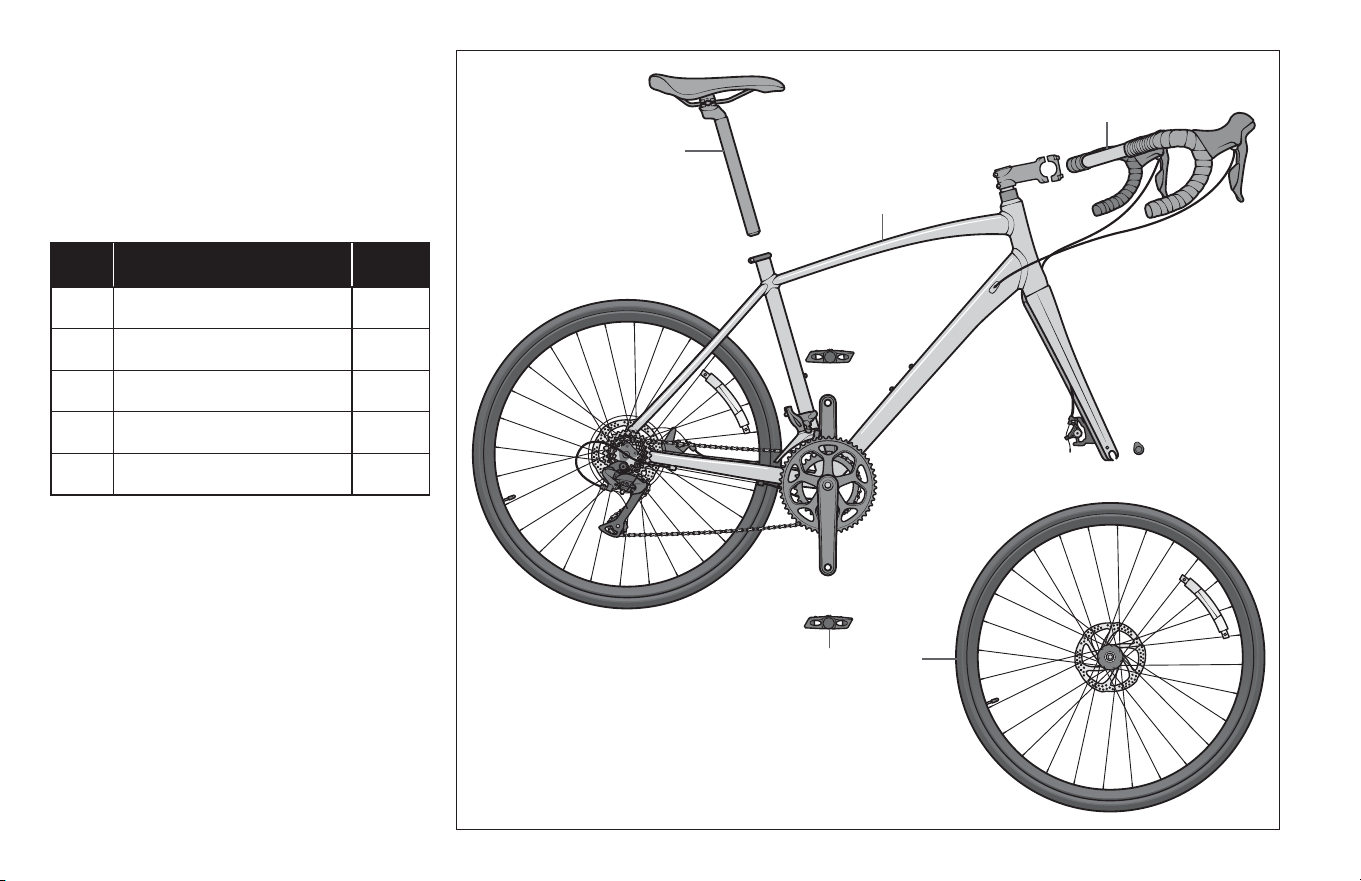
Note: The bicycle parts will vary
depending on your model. Ensure you
have all the following parts. Figure 3.2
No. Part name Qty.
1 Handlebar assembly 1
2 Front wheel 1
3 Pedal 2
4 Bike frame 1
5 Seat and seat post 1
Figure 3.2
❹
❺
❶
❷❸
Assembly 3
21
WARNING!
Failure to properly ghten handlebar components may result in
loss of control, serious injury or death. Always check the
handlebar cannot move and is secured to the frame before riding
the bicycle.
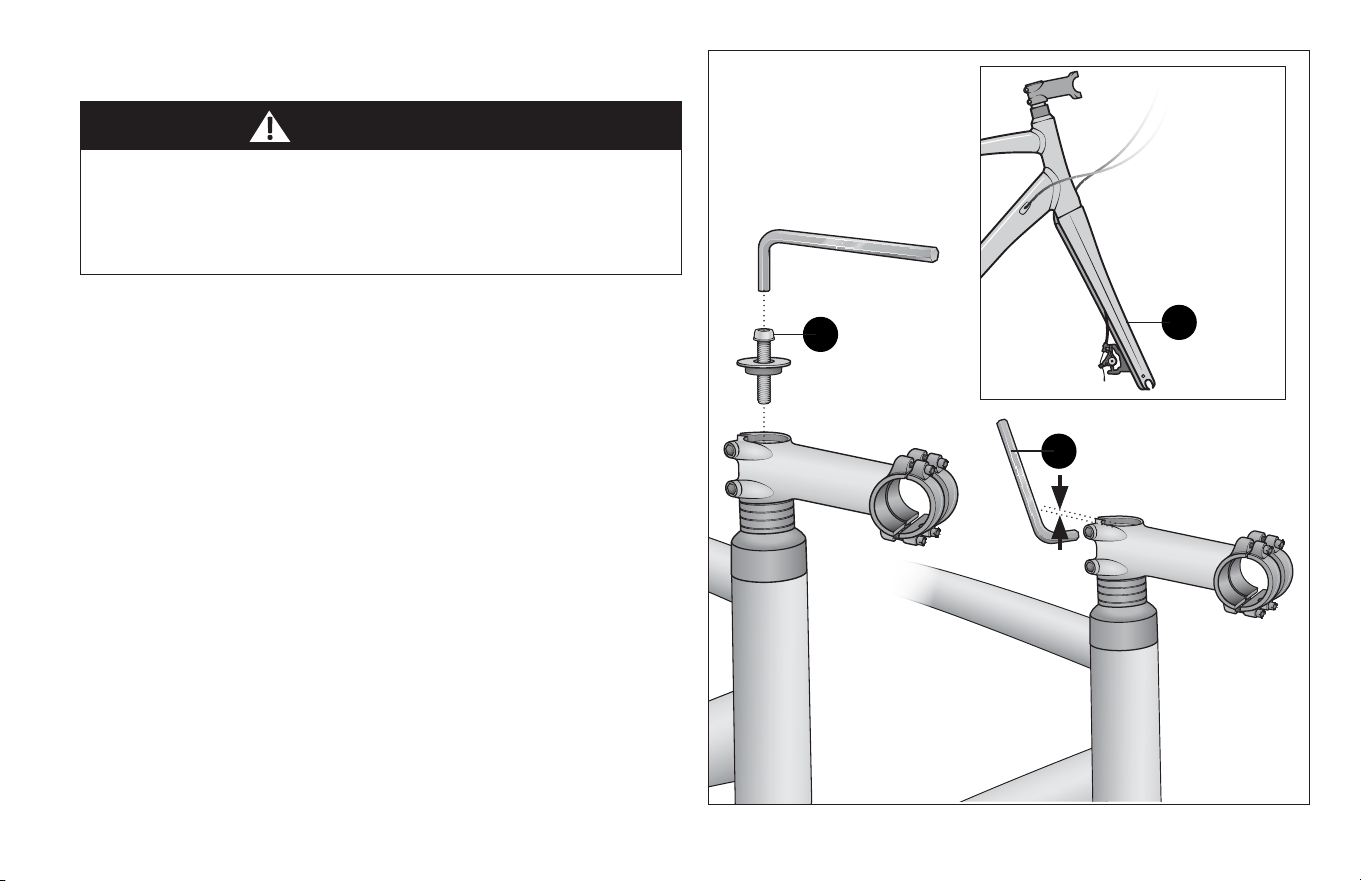
4: ATTACH THE HANDLEBAR
Parts: Handlebar, main frame
Tools: 4, 5, or 6 mm hex wrench, grease
❶ Turn the front fork to face forward. Figure 3.3
❷ Using an hex wrench loosen the top cap bolt on the steerer
tube and remove the top cap and bolt. Important Do not
remove the spacers. Figure 3.4
❸ While holding the fork assembly in place, use an hex wrench
and loosen the stem pinch bolts. Slide the stem down onto the
steerer tube.
❹ Place the top cap onto the top of the steerer tube. Insert and
ghten the top cap bolt unl it is snug. Do not ghten
completely at this me.
❺ There should be a 1/4" space from the top of the steerer tube
to the top of the stem opening. If you have more than 1/4"
space remove one or more of the headset spacers.
2
3
1
Figure 3.3
Figure 3.4
1/4" gap
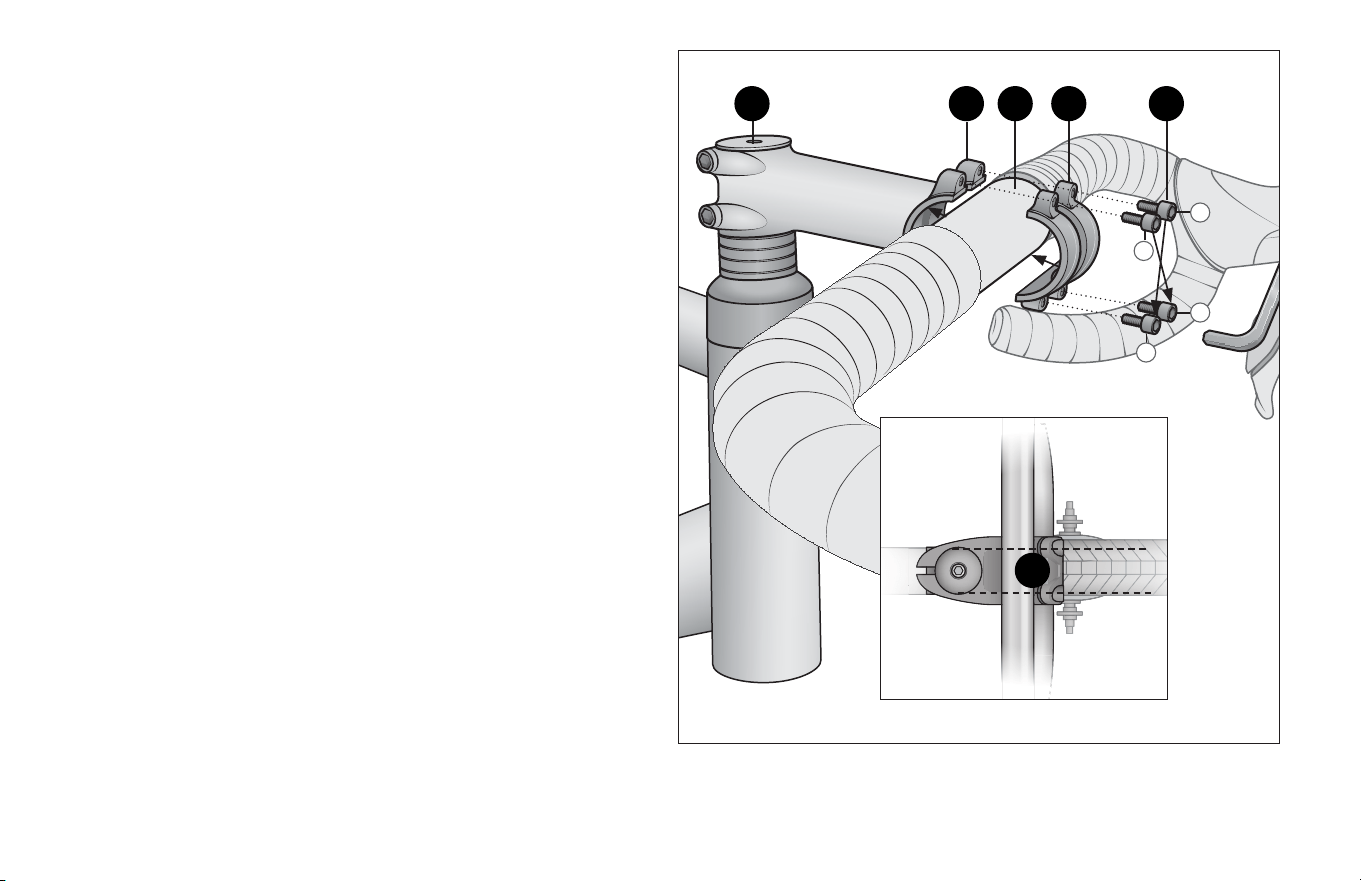
22
3 Assembly
8
❻ Loosen and remove the pinch bolts holding the face plate on
the front of the stem. Figure 3.5
❼ Apply a bit of grease to the threads of the bolts before
threading them back into the stem.
❽ Place the handlebar into the back place.
❾ Place the face plate over the handlebar.
❿ Begin threading the pinch bolts into the stem body. Tighten
the pinch bolts in a cross paern. Do not overghten the
bolts. As you ghten the bolts the gap between the face plate
and the stem body should be the same all around.
⓫ Look down the handlebar and stem and make sure the stem in
centered with the center of the re and fork.
⓬ Finish ghtening the pinch bolts and stem cap bolt.
6
1
8
9 10
11
12
3
2
4
Figure 3.5
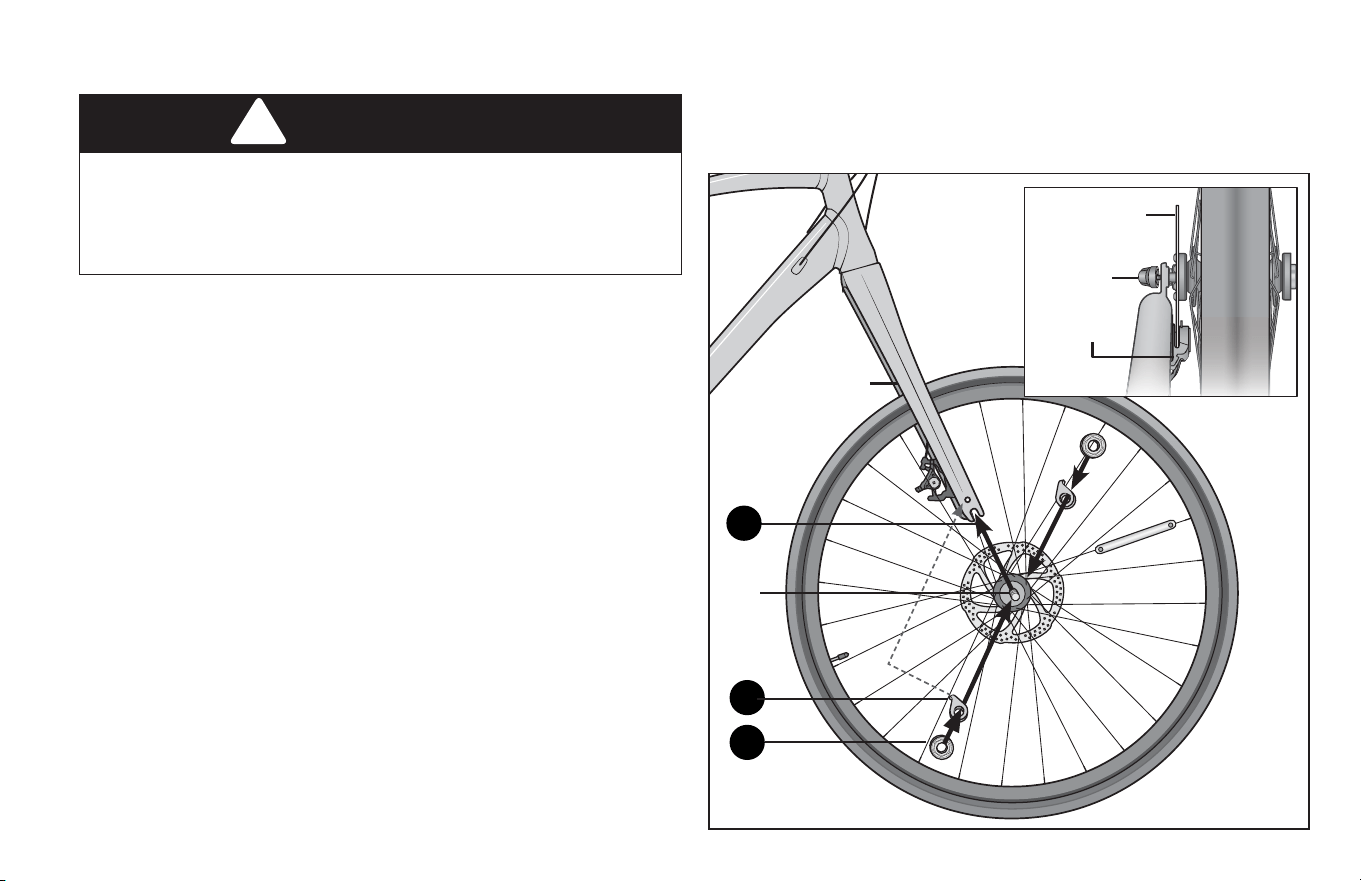
Assembly 3
23
5: ATTACH THE FRONT WHEEL
Disc rotor
Disc brake
caliper body
Axle
2
!
WARNING!
Failure to properly ghten the nuts holding the wheels onto the
tricycle may result in poor riding performance, the re falling o
and serious injury or death. Be sure the wheels are securely
aached to the frame before using the tricycle.
Parts: Front wheel, main frame assembly
Hardware: Large nuts (2)
Tools: 15 mm open and box end wrench, Adjustable Pliers
Note: Tire tread paerns have a direcon, compare your front
re and rear re of the bicycle so that both tread paerns face
the same direcon.
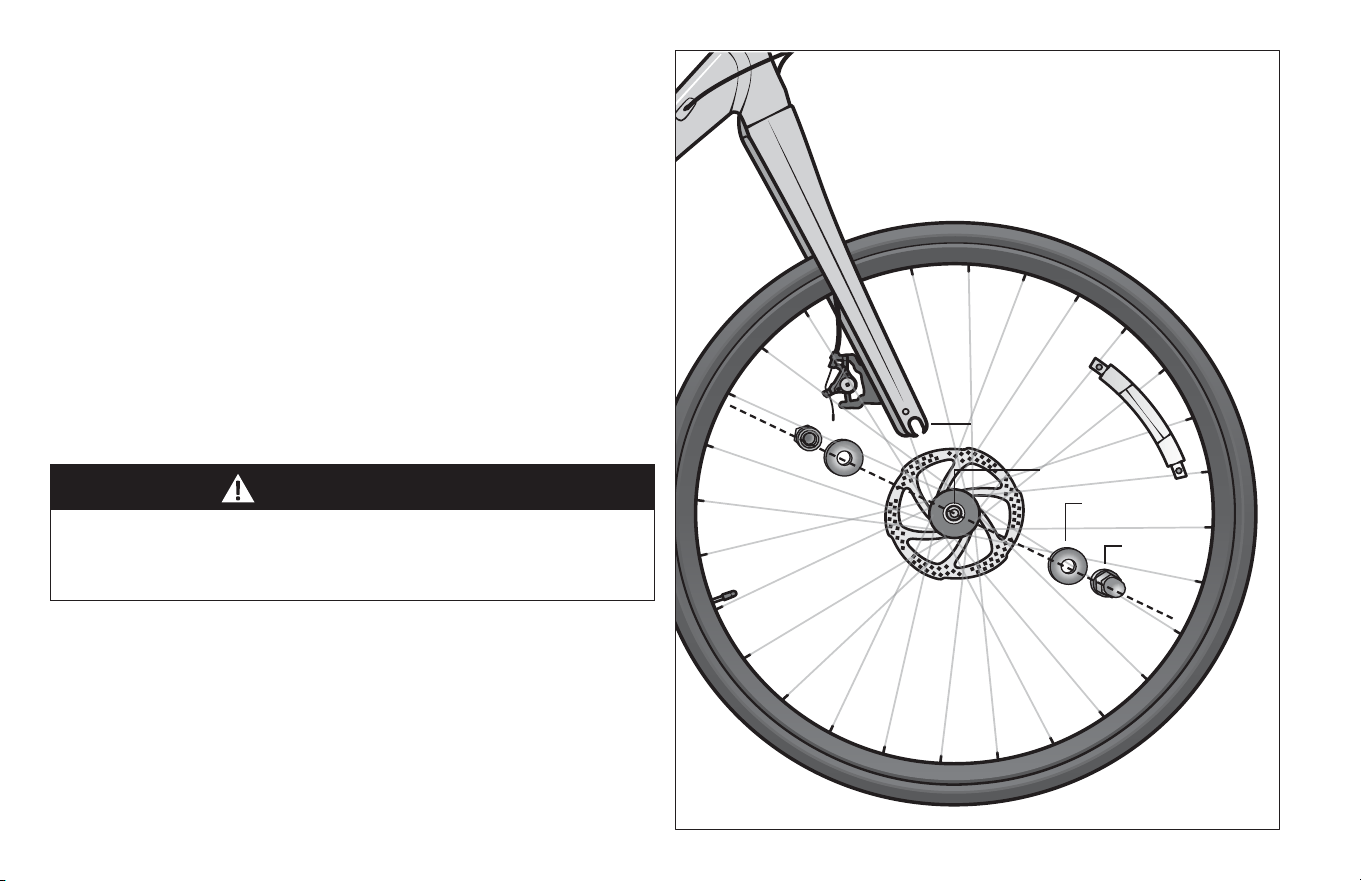
5.A: Nued Front Wheel
❶ Place the front wheel into the fork openings. Be sure both
sides of the axle rest on the fork and the wheel is centered.
Figure 3.6
❷ Insert the hook washer onto the axle with the hooked end
inserted into the small hole on the fork dropout.
❸ Place the nut on the axle and loosely ghten.
❹ Place the remaining hook washer and nut on the opposite
side and loosely ghten. Do not ghten the wheels nuts at
this me.
❺ Check that the wheel is centered, and inspect the wheel for
even rotaon.
❻ Now, ghten each nut unl both are rmly set, a minimum of
20 lbs (240 in-lb).
3
1
Fork dropout
Figure 3.6
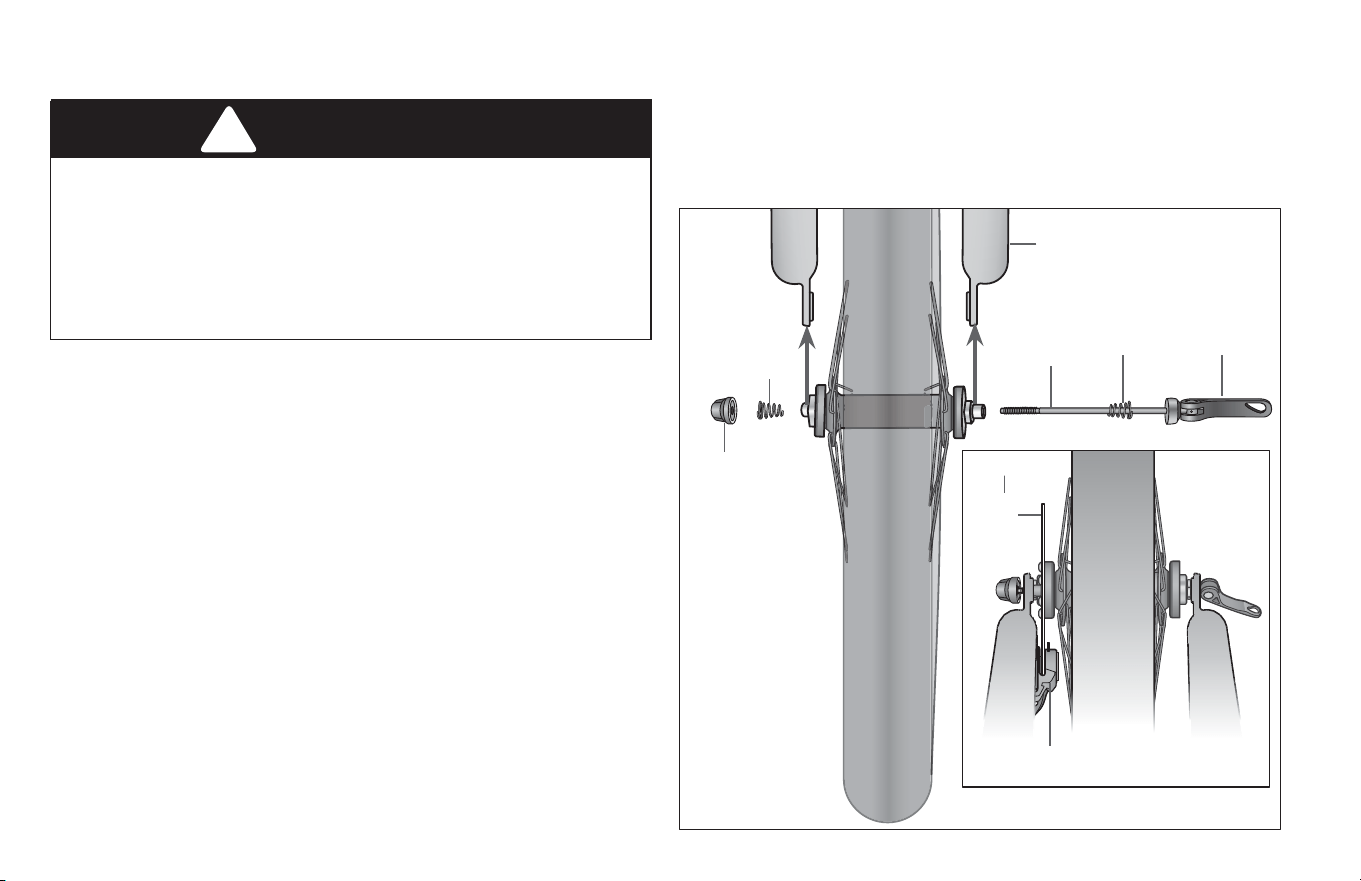
24
3 Assembly
5.B: Quick-release Front Wheel
!
WARNING!
All quick-release levers should be inspected before every ride to
be sure they are fully closed and secure. Failure to properly
close a quick-release lever can cause loss of control of the
bicycle resulng in injury or death.
Make sure the wheel is properly seated and the quick-release
lever is properly closed.
Skewer Inner
spring
Quick-release
lever
Front fork
Adjustment
nut
Outer
spring
Caliper body
Disc rotor
Note: Tire tread paerns have a direcon, compare your front re
and rear re of the bicycle so that both tread paerns face the
same direcon.
Parts: Front wheel, main frame assembly
Hardware: Skewer
Tools: 15 mm open and box end wrench, Adjustable Pliers
❶ Locate the skewer from the small parts carton of your bicycle.
Figure 3.7
❷ Unscrew the adjustment nut from the skewer, remove outer
spring and slide the skewer through the front wheel axle so the
quick-release lever is on the same side of the chain.
❸ Slide the outer spring over the end of the skewer. Note: The
smaller end of the spring should be in towards the wheel.
❹ Begin to thread the adjustment nut back onto the skewer, but
do not ghten too far. Allow enough play so you can place the
axle into the fork drop out.
❺ Slide the wheel into the fork dropout slots. Insert the disc
rotor into the center of the disc brake at the same me you
are inserng the wheel axle into the fork drop out. Figure 3.8
Important! Be sure the wheel is as centered as possible
between the fork legs.
Figure 3.7
Figure 3.8
❶
❷
❸
❺
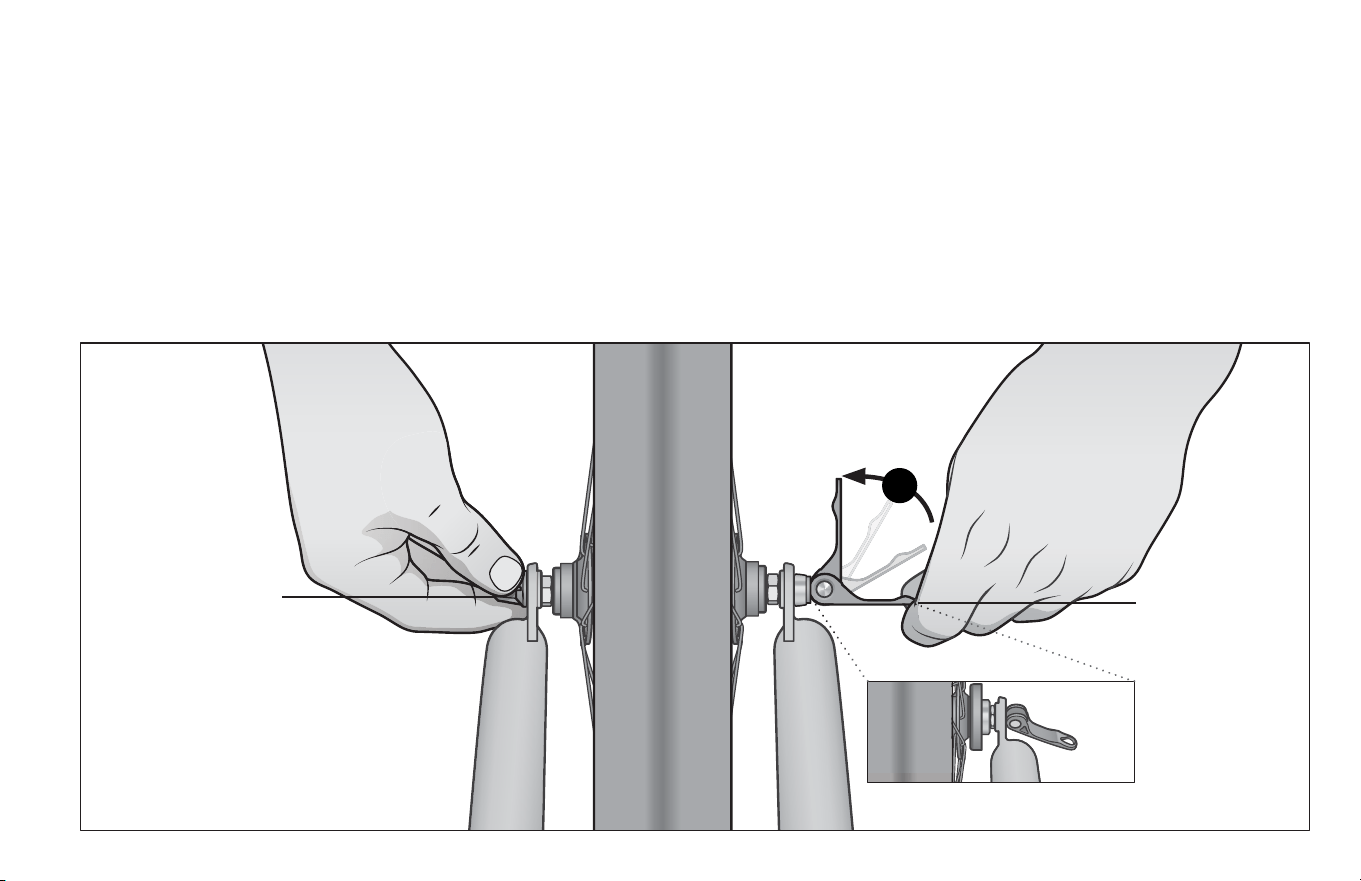
Assembly 3
25
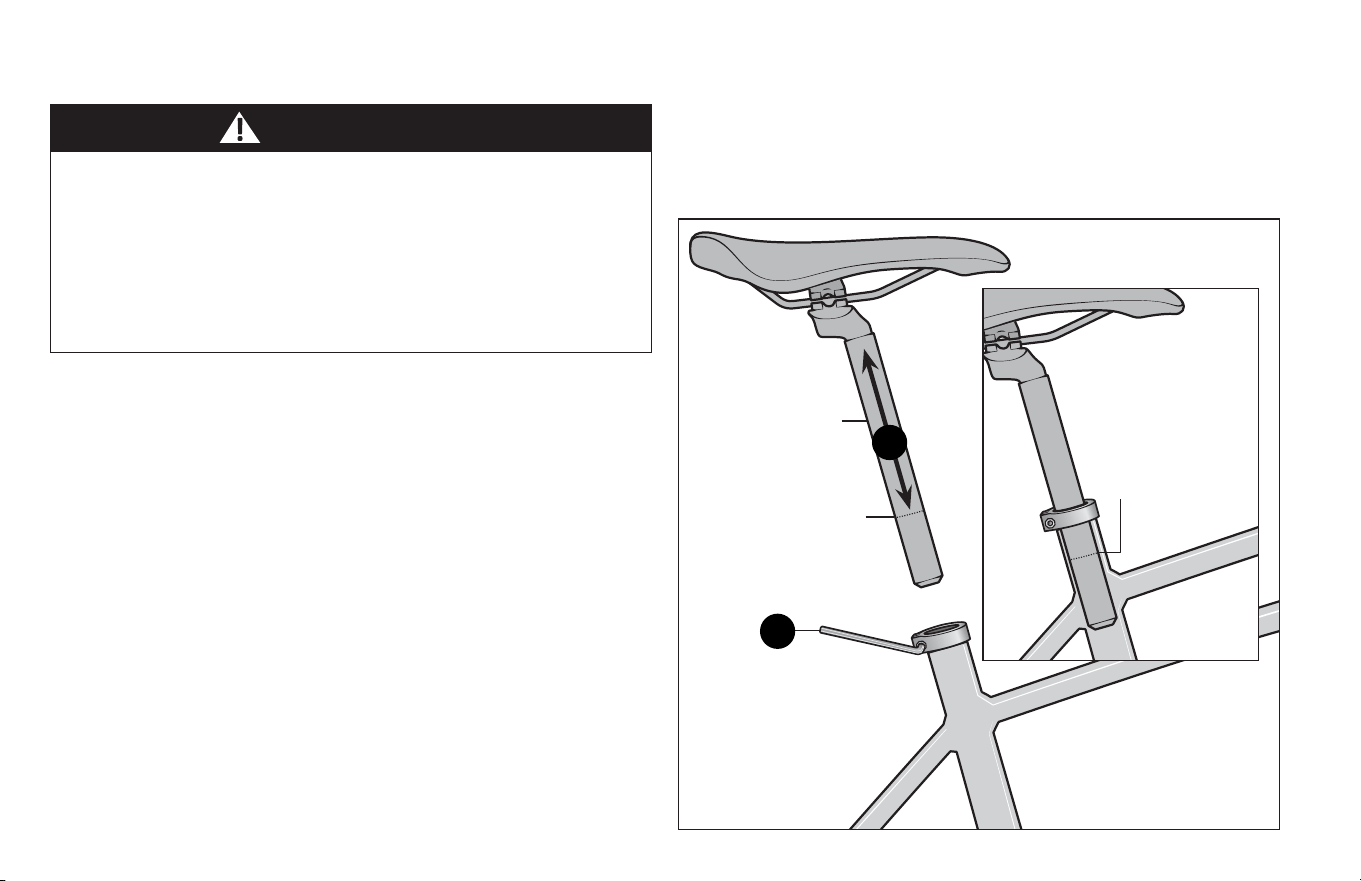
❼ Move the quick-release lever into the open posion. With one
hand on the quick-release lever and one hand on the
adjustment nut, start to hand ghten the adjustment nut unl
you start to feel some resistance against the fork. Figure 3.9
❽ Try to close the quick-release lever. If it closes easily, open it
up and ghten the adjustment nut further. If it is too dicult
to close, open the quick-release lever up and loosen the
adjustment nut a lile and try again. Do not aempt to ghten
by turning the quick-release lever. The quick-release lever is
for closing, the adjustment nut is for adjusng the tension.
Important! You should feel resistance when you close the
quick-release lever that should leave a temporary impression
on your ngers. Open and close the handle to ensure the
wheel is securely locked in place.
❾ Re-check that the handlebars are perpendicular to the front
wheel. Adjust if needed and ghten.
Quick-release
lever in closed
posion
Important!
Only ghten the
quick-release with the
adjustment nut.
Quick-release
lever in the
open posion
7
Figure 3.9
26
3 Assembly
6: ATTACH THE SEAT
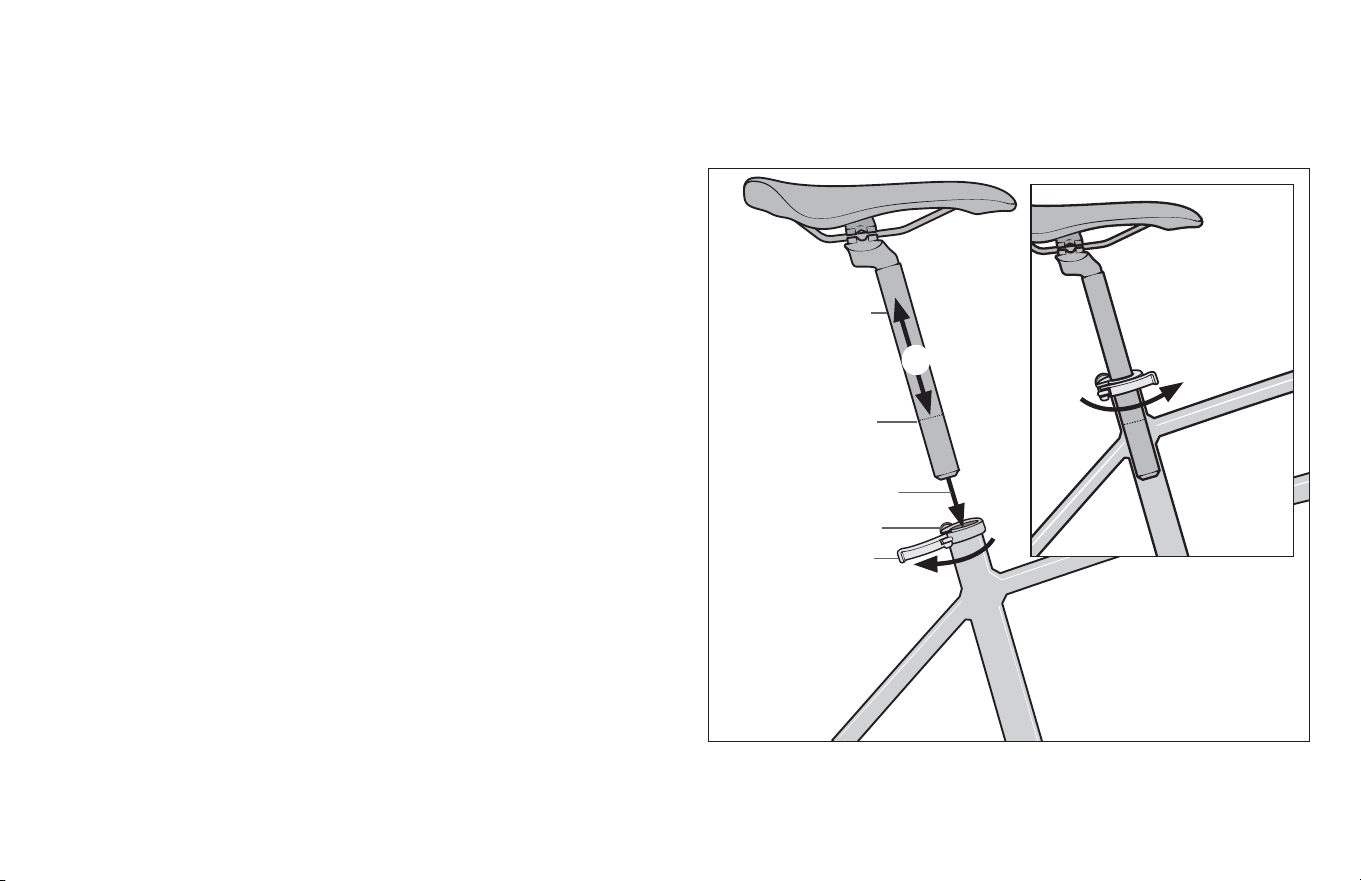
Improperly adjusted seat height could aect the rider’s ability
to reach the handlebar and pedals resulng in unexpected
movement, loss of control and serious injury or death. Follow
these guidelines when adjusng the seat height. Always ensure
the seat post minimum inseron marks are below the seat
clamp and cannot be seen. Ensure the seat clamp is locked and
the seat cannot move.
WARNING!
There are two kinds of seat clamps; bolted and quick-release, and
The seat assembly should be adjusted with the seat centered on
the rails and level. It is recommended to add some grease to all
threads and binders on a bicycle, especially on the outside of the
seat post. Otherwise it may corrode over me and not be able to
be adjusted again.
Parts: Seat assembly, main frame assembly
Tools: 4 or 5 mm hex wrench
6.A: Bolted Seat Clamp
❶ Using the appropriate size hex wrench, loosen the seat clamp
bolt and insert the seat post into the seat tube. Figure 3.10
❷ Adjust the seat height up or down unl the rider feels they
have control of the bicycle and is comfortable.
Important! Be sure the minimum inseron marks do not go
past the top of the seat clamp and are not visible. See Secon
1, Fig. 1.2: Seat Height and Handlebar Reach.
❸ Tighten the seat clamp bolt to lock the seat in place.
❹ Check the seat to be sure it does not move.
Figure 3.10
Seat post
Use a 5 mm hex
wrench to loosen and
ghten the seat clamp
2
1
Minimum inseron
marks
Minimum inseron
marks
Assembly 3
27
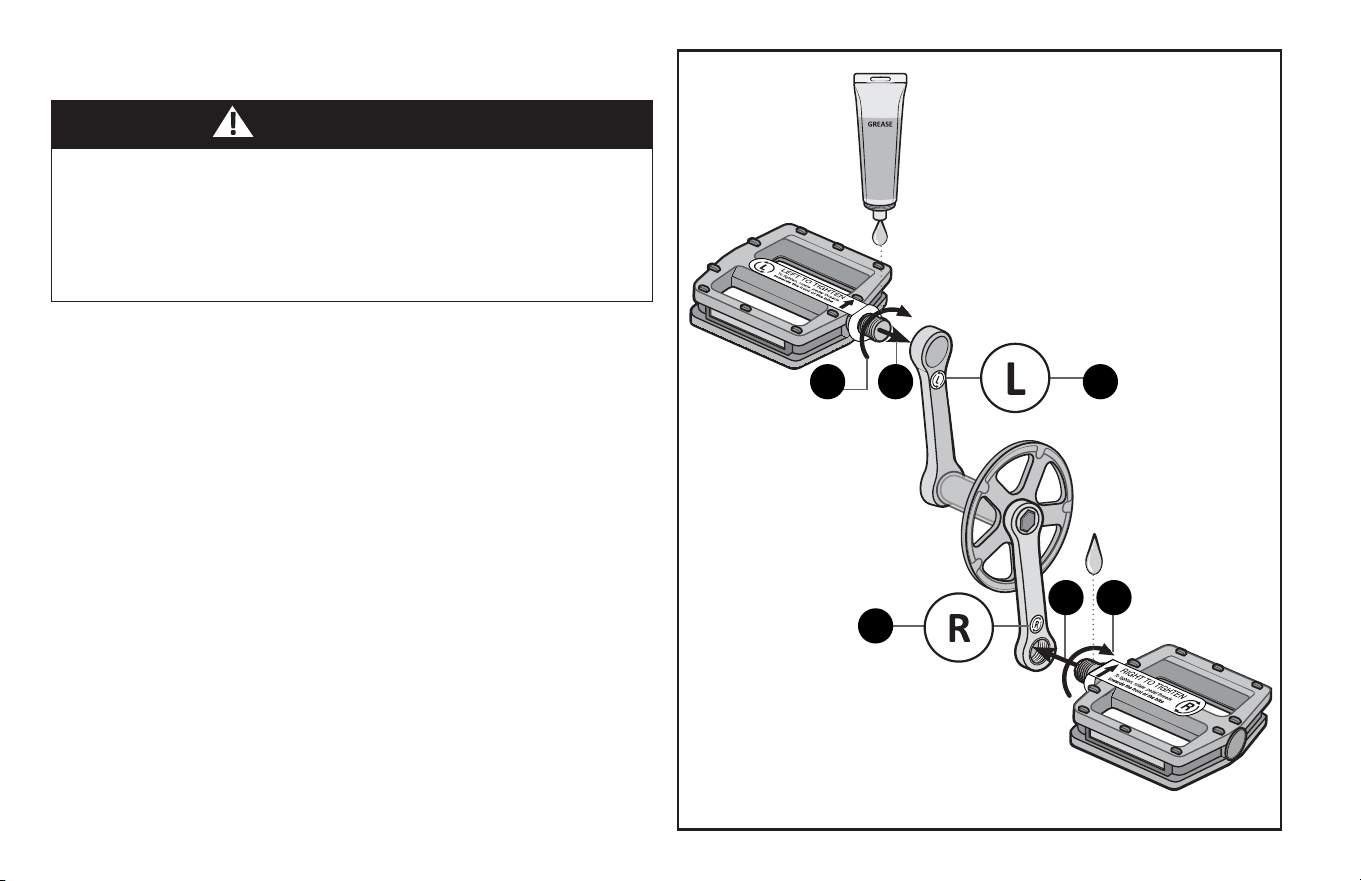
6.B: Quick Release
The seat assembly should be adjusted with the seat centered on
the rails and level. It is recommended to add some grease to all
threads and binders on a bicycle, especially on the outside of the
seat post. Otherwise it may corrode over me and not be able to
be adjusted again.
❶ Unlock the quick-release lever and insert the seat post into the
seat tube. Figure 3.11
❷ Adjust the seat height up or down unl the rider feels they
have control of the tricycle and are comfortable.
Important! Be sure the minimum inseron marks do not go
past the top of the seat clamp and are not visible. Figure 3.12
❸ Close the quick-release lever and lock the seat in place.
If there is not enough pressure to hold the seat in place open
the quick-release lever. With one hand on the quick-release
lever and one hand on the adjustment nut, start to hand
ghten the adjustment nut unl you start to feel some
resistance against the post clamp. Do not aempt to ghten
by turning the quick-release lever. The quick-release lever is
for closing, the adjustment nut is for adjusng the pressure.
❹ Try to close the quick-release lever. If it closes easily, open it
up and ghten the adjustment nut further. If it is too dicult
to close, open the quick-release lever up and loosen the
adjustment nut a lile and try again.
Important! You should feel resistance when you close the
quick-release lever that should leave a temporary impression
on your ngers. Open and close the handle to ensure the seat
is securely locked in place.
❷
Seat post
Adjustment nut
Quick-release lever
Minimum inseron
marks
❶
❸
Figure 3.12
Figure 3.11
28
3 Assembly
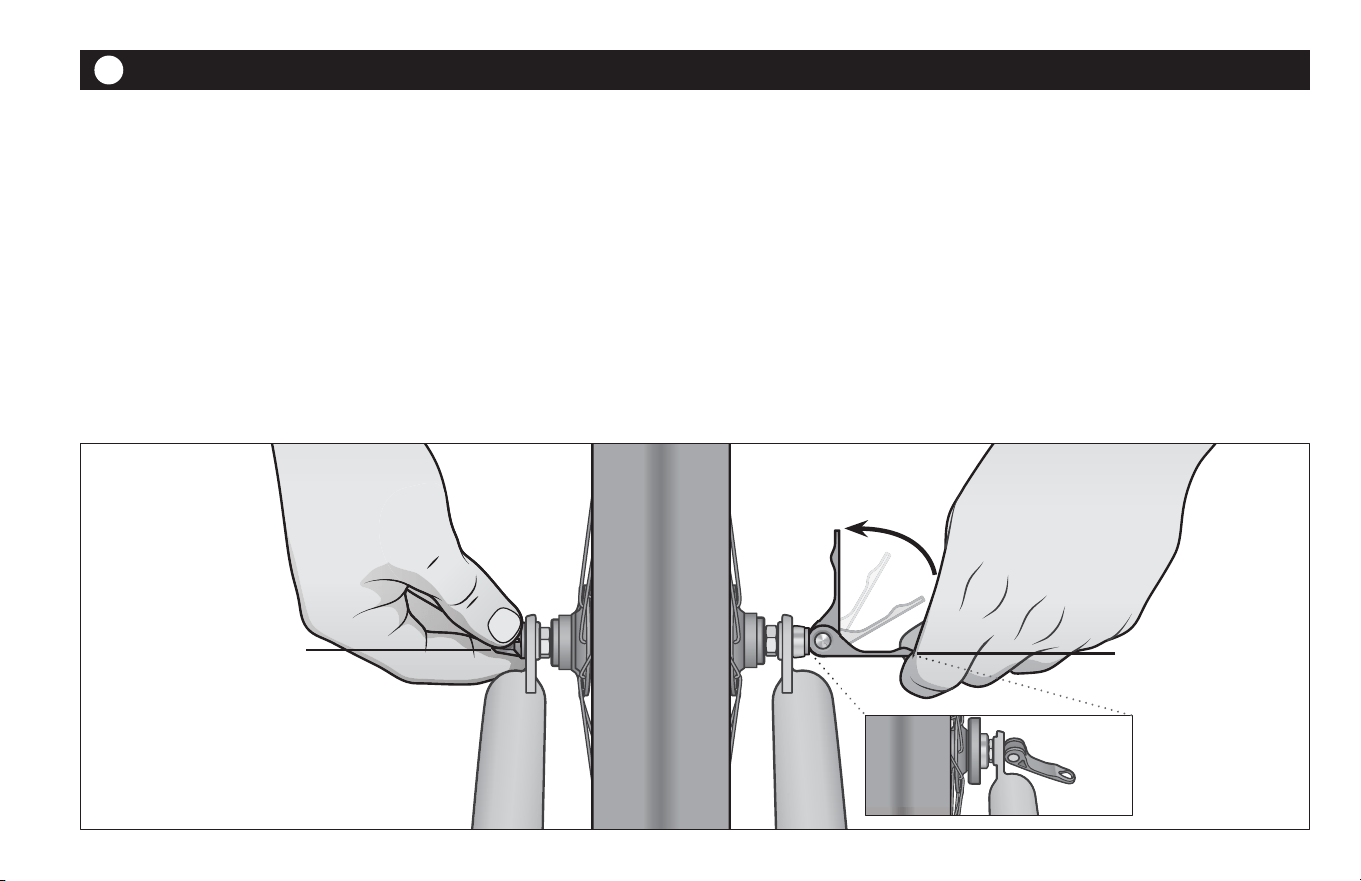
note: apply a small drop of grease to
both the le and right pedal threads.
7: ATTACH THE PEDALS
Aachment of an incorrect pedal into a crank arm can strip
pedal threads and cause irreparable damage. Visually match the
R and L sckers on the pedal and crank arm before aaching the
pedals. Before your rst ride, check to ensure the pedals are
aached correctly.
WARNING!
❶ Match the pedals to the correct crank arm.
• le pedal to the le crank arm
• right pedal to the right crank arm
❷ Start with one pedal and carefully hand threading the pedal
into the crank arm.
❸ Using a 15 mm wrench connue to ghten the pedal in the
direcon of the arrows (toward the front of the bike).
❹ Repeat steps 2 and 3 for the opposite pedal.
Figure 3.13
1
1
2 3
3 2
Tech 4
29
TECH
4
It’s important to your safety, performance and enjoyment to
understand how things work on your bicycle. We urge you to
contact customer service for how to do the things described in this
secon before you aempt them yourself. If you have even the
slightest doubt as to whether you understand something in this
secon of the manual, contact customer service. See also Appendix
A, B, C and D of this manual.
1: Wheels
Bicycle wheels are designed to be removable for easier
transportaon and for repair of a re puncture. In most cases, the
wheel axles are inserted into slots, called “dropouts” in the fork
and frame, but some mountain and road bikes use what is called a
“thru-axle” wheel mounng system.
If you have a mountain or road bike equipped with thru-axle front
or rear wheels, make sure that your dealer has given you the
manufacturer’s instrucons, and follow those when installing or
removing a thru-axle wheel. If you don’t know what a thru-axle is,
contact customer service.
If you do not have a bicycle with a thru-axle wheel mounng
system, it will have wheels secured in one of three ways:
Cam lever in
closed posion
Important! Only ghten
the quick-release with the
adjustment nut.
Cam lever in the
open posion
Figure 4.1
30
4 Tech
WARNING!
Riding with an improperly secured wheel can allow the wheel
to wobble or fall o the bicycle, which can cause serious injury
or death.
1. A hollow axle with a sha skewer running through it which has
an adjustable tension nut on one end and an over-center cam
on the other (cam acon system, Figure 4.1)
2. A hollow axle with a sha skewer running through it which has
a nut on one end and a ng for a hex key, lock lever or other
ghtening device on the other (through bolt, Figure 4.2)
3. Hex nuts or hex key bolts which are threaded on to or into the
hub axle (bolt-on wheel)
It is very important that you understand the type of wheel
securing method on your bicycle, that you know how to secure
the wheels correctly, and that you know how to apply the correct
clamping force that safely secures the wheel. Contact customer
service to instruct you in correct wheel removal and installaon,
and ask for any available manufacturer’s instrucons.
Therefore, it is essenal that you:
1. Understand and apply the correct technique for clamping your
wheel in place.
2. Each me, before you ride the bike, check that the wheel is
securely clamped.
The clamping acon of a correctly secured wheel must emboss
the surfaces of the dropouts.
Figure 4.2
Axle washer
Axle
Fork Dropout
Axle nut
Tech 4
31
WARNING!
1. Front Wheel Secondary Retenon Devices
Most bicycles have front forks that ulize a secondary wheel
retenon device to reduce the risk of the wheel disengaging
from the fork if the wheel is incorrectly secured. Secondary
retenon devices are not a substute for correctly securing
your front wheel.
Secondary retenon devices fall into two basic categories:
A. The clip-on type is a part that the manufacturer adds to
the front wheel hub or front fork.
B. The integral type is molded, cast or machined into the
outer faces of the front fork dropouts.
Contact customer service to explain the parcular secondary
retenon device on your bike.
Do not remove or disable the secondary retenon device. As its
name implies, it serves as a back-up for a crical adjustment. If
the wheel is not secured correctly, the secondary retenon
device can reduce the risk of the wheel disengaging from the
fork. Removing or disabling the secondary retenon device may
also void the warranty.
Secondary retenon devices are not a substute for correctly
securing your wheel. Failure to properly secure the wheel can
cause the wheel to wobble or disengage, which could cause you
to loose control and fall, resulng in serious injury or death.
2. Wheels with Cam Acon Systems
There are currently two types of over-center cam wheel
retenon mechanisms: the tradional over-center cam
(Figure 5.1) and the cam-and-cup system (Figure 4.1). Both use
an over-center cam acon to clamp the bike’s wheel in place.
Your bicycle may have a cam-and-cup front wheel retenon
system and a tradional rear wheel cam acon system.
A. Adjusng the tradional cam acon mechanism
(Figure 4.1)The wheel hub is clamped in place by the force
of the over-center cam pushing against one dropout and
pulling the tension adjusng nut, by way of the skewer,
against the other dropout. The amount of clamping force
is controlled by the tension adjusng nut. Turning the
tension adjusng nut clockwise while keeping the cam
lever from rotang increases clamping force; turning it
counterclockwise while keeping the cam lever from
rotang reduces clamping force. Less than half a turn of
the tension adjusng nut can make the dierence
between safe clamping force and unsafe clamping force.
WARNING!
The full force of the cam acon is needed to clamp the wheel
securely. Holding the nut with one hand and turning the lever
like a wing nut with the other hand unl everything is as ght as
you can get it will not clamp a cam acon wheel safely in the
dropouts. See also the rst WARNING in this Secon.
32
4 Tech
WARNING!
If your bike is equipped with a hub brake such as a rear coaster
brake, front or rear drum, band or roller brake; or if it has an
internal gear rear hub, do not aempt to remove the wheel. The
removal and re-installaon of most hub brakes and internal gear
hubs requires special knowledge. Incorrect removal or assembly
can result in brake or gear failure, which can cause you to lose
control and fall.
B. Adjusng the cam-and-cup mechanism (Figure 4.1)
The cam-and-cup system on your front wheel will have
been correctly adjusted for your bicycle by your dealer.
Ask your dealer to check the adjustment every six
months. Do not use a cam-and-cup front wheel on any
bicycle other than the one for which your dealer
adjusted it.
CAUTION!
If your bike has a disc brake, exercise care in touching the rotor
or caliper. Disc rotors have sharp edges, and both rotor and
caliper can get very hot during use.
3. Removing and Installing wheels
A. Removing a disc brake or rim brake Front Wheel
1. If your bike has rim brakes, disengage the brake’s
quick-release mechanism to increase the clearance
between the re and the brake pads.
2. If your bike has cam acon front wheel retenon,
move the cam lever from the locked or CLOSED
posion to the OPEN posion (Figure 4.1). If your
bike has through bolt or bolt-on front wheel
retenon, loosen the fastener(s) a few turns
counter-clockwise using an appropriate wrench,
lock key or the integral lever.
3. If your front fork has a clip-on type secondary
retenon device, disengage it. If your front fork
has an integral secondary retenon device, and a
tradional cam acon system (Figure 4.1) loosen
the tension adjusng nut enough to allow
removing the wheel from the dropouts. If your
front wheel uses a cam-and-cup system,
(Figure 4.1) squeeze the cup and cam lever
together while removing the wheel. No rotaon of
any part is necessary with the cam-and-cup
system.
You may need to tap the top of the wheel with
the palm of your hand to release the wheel from
the front fork.
Tech 4
33
CAUTION!
If your bike is equipped with a front disc brake, be careful not to
damage the disc, caliper or brake pads when re-inserng the
disc into the caliper. Never acvate a disc brake’s control lever
unless the disc is correctly inserted in the caliper. See also
Secon 4.C.
B. Installing a disc brake or rim brake Front Wheel
1. If your bike has cam acon front wheel retenon,
move the cam lever so that it curves away from
the wheel (Figure 4.1). This is the OPEN posion. If
your bike has through bolt or bolt-on front wheel
retenon, go to the next step.
2. With the steering fork facing forward, insert the
wheel between the fork blades so that the axle
seats rmly at the top of the fork dropouts. The
cam lever, if there is one, should be on rider’s le
side of the bicycle (Figure 4.1). If your bike has a
clip-on type secondary retenon device, engage it.
3. If you have a tradional cam acon mechanism:
holding the cam lever in the ADJUST posion with
your right hand, ghten the tension adjusng nut
with your le hand unl it is nger ght against
the fork dropout (Figure 4.1). If you have a
cam-and-cup system: the nut and cup (Figure 4.1)
will have snapped into the recessed area of the
fork dropouts and no adjustment should be required.
4. While pushing the wheel rmly to the top of the slots in the
fork dropouts, and at the same me centering the wheel rim in
the fork.
A. With a cam acon system, move the cam lever upwards
and swing it into the CLOSED posion (Figure 4.1). The
lever should now be parallel to the fork blade and curved
toward the wheel. To apply enough clamping force, you
should have to wrap your ngers around the fork blade
for leverage, and the lever should leave a clear imprint in
the palm of your hand.
B. With a through-bolt or bolt-on system, ghten the
fasteners to the torque specicaons in Appendix C or
the hub manufacturer’s instrucons.
NOTE: If, on a tradional cam acon system, the lever cannot be
pushed all the way to a posion parallel to the fork blade, return
the lever to the OPEN posion. Then turn the tension adjusng
nut counterclockwise one-quarter turn and try ghtening the
lever again.
5. With a through-bolt or bolt-on system, ghten the fasteners to
the torque specicaons in Appendix C or the hub
manufacturer’s instrucons.
34
4 Tech
WARNING!
Securely clamping the wheel with a cam acon retenon device
takes considerable force. If you can fully close the cam lever
without wrapping your ngers around the fork blade for
leverage, the lever does not leave a clear imprint in the palm of
your hand, and the serraons on the wheel fastener do not
emboss the surfaces of the dropouts, the tension is insucient.
Open the lever; turn the tension adjusng nut clockwise a
quarter turn; then try again. See also the rst WARNING in this
Secon.
6. If you disengaged the brake quick-release mechanism in 3. A. 1,
re-engage it to restore correct brake pad-to-rim clearance.
7. Spin the wheel to make sure that it is centered in the frame and
clears the brake pads; then squeeze the brake lever and make
sure that the brakes are operang correctly.
C. Removing a disc brake or rim brake Rear Wheel
1. If you have a mul-speed bike with a derailleur
gear system: shi the rear derailleur to high gear
(the smallest, outermost rear sprocket).
If you have an internal gear rear hub, consult your
dealer or the hub manufacturer’s instrucons
before aempng to remove the rear wheel.
If you have a single-speed bike with rim or disc
brake, go to step (4) below.
2. If your bike has rim brakes, disengage the brake’s
quick-release mechanism to increase the clearance
between the wheel rim and the brake pads
(see Secon 4.C).
3. On a derailleur gear system, pull the derailleur
body back with your right hand.
4. With a cam acon mechanism, move the quick-
release lever to the OPEN posion (g. 8b). With a
through bolt or bolt on mechanism, loosen the
fastener(s) with an appropriate wrench, lock lever
or integral lever; then push the wheel forward far
enough to be able to remove the chain from the
rear sprocket.
5. Li the rear wheel o the ground a few inches and
remove it from the rear dropouts.
D. Installing a disc brake or rim brake Rear Wheel
CAUTION!
If your bike is equipped with a rear disc brake, be careful not to
damage the disc, caliper or brake pads when re-inserng the
disc into the caliper. Never acvate a disc brake’s control lever
unless the disc is correctly inserted in the caliper.
1. With a cam acon system, move the cam lever to
the OPEN posion (see Figure 4.1). The lever
should be on the side of the wheel opposite the
derailleur and freewheel sprockets.
Tech 4
35
2. On a derailleur bike, make sure that the rear
derailleur is sll in its outermost, high gear,
posion; then pull the derailleur body back with
your right hand. Put the chain on top of the
smallest freewheel sprocket.
3. On single-speed, remove the chain from the front
sprocket, so that you have plenty of slack in the
chain. Put the chain on the rear wheel sprocket.
4. Then, insert the wheel into the frame dropouts
and pull it all the way in to the dropouts.
5. On a single speed or an internal gear hub, replace
the chain on the chainring; pull the wheel back in
the dropouts so that it is straight in the frame
and the chain has about 1/4 inches of up-and-
down play.
6. With a cam acon system, move the cam lever
upwards and swing it into the CLOSED posion
(g. 8 a & b). The lever should now be parallel to
the seat stay or chain stay and curved toward the
wheel. To apply enough clamping force, you
should have to wrap your ngers around the fork
blade for leverage, and the lever should leave a
clear imprint in the palm of your hand.
7. With a through-bolt or bolt-on system, ghten the
fasteners to the torque specicaons in Appendix
C or the hub manufacturer’s instrucons.
Note: If, on a tradional cam acon system, the
lever cannot be pushed all the way to a posion
parallel to the seat stay or chain stay, return the
lever to the OPEN posion. Then turn the tension
adjusng nut counterclockwise one-quarter turn
and try ghtening the lever again.
WARNING!
Securely clamping the wheel with a cam acon retenon device
takes considerable force. If you can fully close the cam lever
without wrapping your ngers around the seat stay or chain stay
for leverage, the lever does not leave a clear imprint in the palm
of your hand, and the serraons on the wheel fastener do not
emboss the surfaces of the dropouts, the tension is insucient.
Open the lever; turn the tension adjusng nut clockwise a
quarter turn; then try again. See also the rst WARNING in this
Secon.
8. If you disengaged the brake quick-release
mechanism in 3. c. (2) above, re-engage it to
restore correct brake pad-to-rim clearance.
9. Spin the wheel to make sure that it is centered in
the frame and clears the brake pads; then squeeze
the brake lever and make sure that the brakes are
operang correctly.
36
4 Tech
WARNING!
WARNING!
Riding with an improperly ghtened seat post can allow the
saddle to turn or move and cause you to lose control and fall.
The full force of the cam acon is needed to clamp the seat post
securely. Holding the nut with one hand and turning the lever
like a wing nut with the other hand unl everything is as ght as
you can get it will not clamp the seat post safely.
If you can fully close the cam lever without wrapping your
ngers around the seat post or a frame tube for leverage, and
the lever does not leave a clear imprint in the palm of your
hand, the tension is insucient. Open the lever; turn the tension
adjusng nut clockwise a quarter turn; then try again.
2: Seat Post Cam Acon Clamp
Some bikes are equipped with a cam acon seat post binder.
The seat post cam acon binder works exactly like the tradional
wheel cam acon fastener. While a cam acon binder looks like a
long bolt with a lever on one end and a nut on the other, the binder
uses an over-center cam acon to rmly clamp the seat post (see
Figure 4.1).
Therefore:
1. Contact customer service if you are having trouble clamping
the seat post.
2. Understand and apply the correct technique for clamping your
seat post.
3. Before you ride the bike, rst check that the seat post is
securely clamped.
2.A: Adjusng the Seat Post Cam Acon Mechanism
The acon of the cam squeezes the seat collar around the seat post
to hold the seat post securely in place. The amount of clamping
force is controlled by the tension adjusng nut. Turning the tension
adjusng nut clockwise while keeping the cam lever from rotang
increases clamping force; turning it counterclockwise while keeping
the cam lever from rotang reduces clamping force. Less than half
a turn of the tension adjusng nut can make the dierence between
safe and unsafe clamping force.
Tech 4
37
3: Brakes
There are three general types of bicycle brakes: rim brakes, which
operate by squeezing the wheel rim between two brake pads; disc
brakes, which operate by squeezing a hub-mounted disc between
WARNING!
two brake pads; and internal hub brakes. All three can be operated
by way of a handlebar mounted lever. On some models of bicycle,
the internal hub brake is operated by pedaling backwards.
1. Riding with improperly adjusted brakes, worn brake pads, or
wheels on which the rim wear mark is visible is dangerous and
can result in serious injury or death.
2. Applying brakes too hard or too suddenly can lock up a wheel,
which could cause you to lose control and fall. Sudden or
excessive applicaon of the front brake may pitch the rider
over the handlebars, which may result in serious injury or
death.
3. Some bicycle brakes, such as disc brakes (Figure 4.4 and 4.5),
are extremely powerful. Take extra care in becoming familiar
with these brakes and exercise parcular care when using
them.
4. Some bicycle brakes are equipped with a brake force
modulator, a small, cylindrical device through which the brake
control cable runs and which is designed to provide a more
progressive applicaon of braking force. A modulator makes
the inial brake lever force more gentle, progressively
increasing force unl full force is achieved. If your bike is
equipped with a brake force modulator, take extra care in
becoming familiar with its performance characteriscs. Some
brake force modulators are adjustable. If you don’t like the
feel of your brakes, ask your dealer about adjusng the brake
force modulaon.
5. Disc brakes can get extremely hot with extended use. Be
careful not to touch a disc brake unl it has had plenty of me
to cool.
6. See the brake manufacturer’s instrucons for operaon and
care of your brakes, and for when brake pads must be
replaced. If you do not have the manufacturer’s instrucons,
see your dealer or contact the brake manufacturer.
7. If replacing worn or damaged parts, use only manufacturer-
approved genuine replacement parts.
38
4 Tech
3.A: Brake Controls and Features
It’s very important to your safety that you learn and remember
which brake lever controls which brake on your bike. Tradionally,
in the U.S. the right brake lever controls the rear brake and the le
brake lever controls the front brake.
To check how your bike’s brakes are set up, squeeze one brake
lever and look to see which brake, front or rear, engages. Now do
the same with the other brake lever.
Make sure that your hands can reach and squeeze the brake levers
comfortably. If your hands are too small to operate the levers
comfortably, consult your dealer before riding the bike. The lever
reach may be adjustable; or you may need a dierent brake lever
design.
Most rim brakes have some form of quick-release mechanism to
allow the brake pads to clear the re when a wheel is removed or
reinstalled. When the brake quick release is in the open posion,
the brakes are inoperave. Ask your dealer to make sure that you
understand the way the brake quick release works on your bike
(see Figure 4.3) and check each me to make sure both brakes
work correctly before you get on the bike.
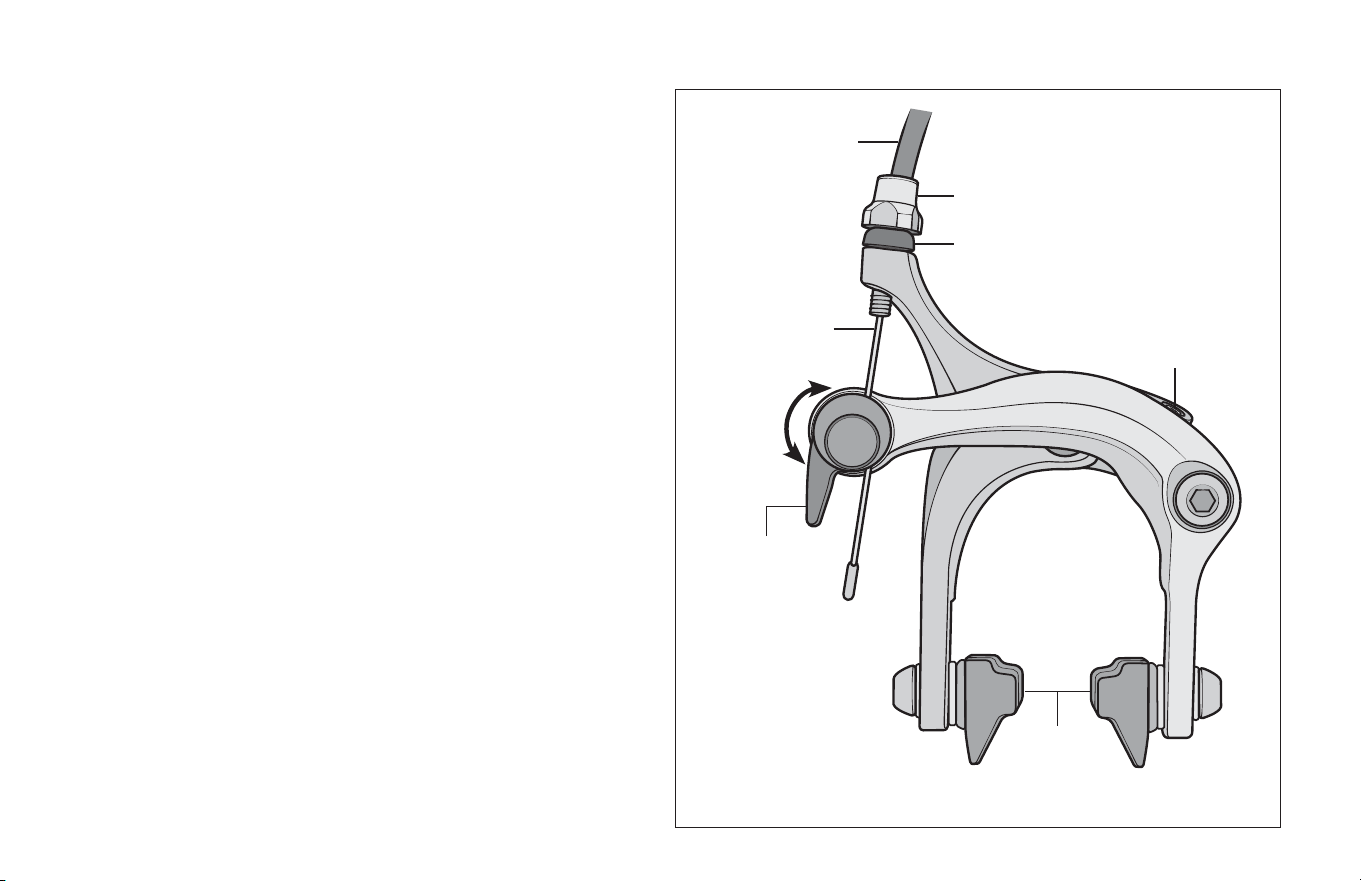
Example of Side-pull Caliper Brakes
Figure 4.3
Brake pads
Cable adjustment barrel
Centering
adjustment bolt
Quick release
lever
Lock nut
Closed
Open
Brake cable
Brake cable wire
Tech 4
39
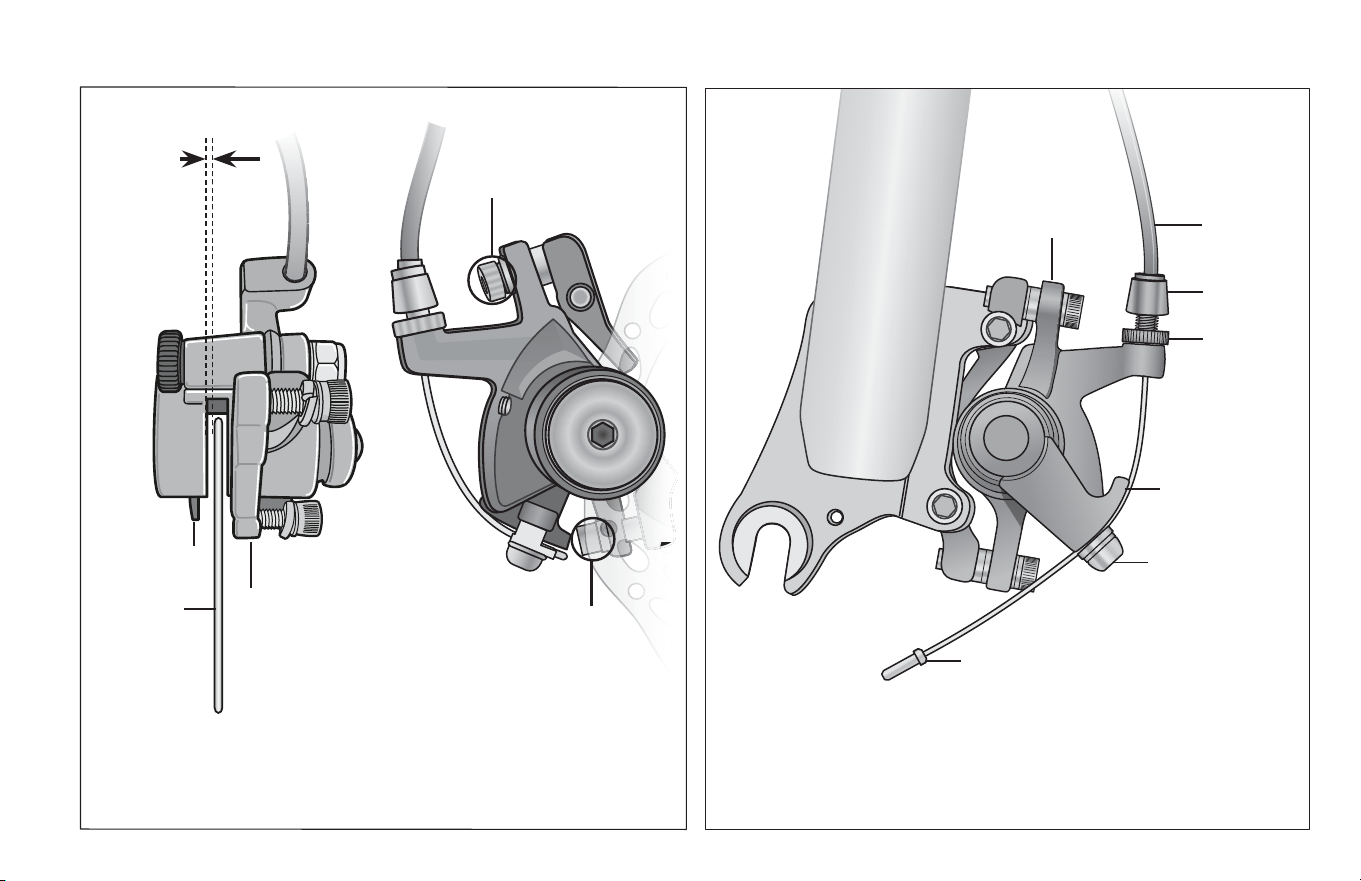
Example of Disc Brakes Example of Brake Cable Connected to Brake Arm
Figure 4.4 Figure 4.5
Centering
adjustment screws
1/32 inch
clearance
on each
side of disc
rotor
Disc rotor
Adjust caliper
body so disc
rotor is centered
Centering
adjustment screws
Caliper body
Brake cable wire
Brake arm
Cable anchor bolt
Jam nut
Adjustment
barrel
Brake cable
Brake pad

40
4 Tech
3.B: How Brakes Work
The braking acon of a bicycle is a funcon of the fricon
between the braking surfaces. To make sure that you have
maximum fricon available, keep your wheel rims and brake
pads or the disc rotor and caliper clean and free of dirt,
lubricants, waxes or polishes.
Brakes are designed to control your speed, not just to stop the
bike. Maximum braking force for each wheel occurs at the point
just before the wheel “locks up” (stops rotang) and starts to
skid. Once the re skids, you actually lose most of your
stopping force and all direconal control. You need to pracce
slowing and stopping smoothly without locking up a wheel. The
technique is called progressive brake modulaon. Instead of
jerking the brake lever to the posion where you think you’ll
generate appropriate braking force, squeeze the lever,
progressively increasing the braking force. If you feel the wheel
begin to lock up, release pressure just a lile to keep the wheel
rotang just short of lockup. It’s important to develop a feel for
the amount of brake lever pressure required for each wheel at
dierent speeds and on dierent surfaces. To beer
understand this, experiment a lile by walking your bike and
applying dierent amounts of pressure to each brake lever,
unl the wheel locks.
When you apply one or both brakes, the bike begins to slow,
but your body wants to connue at the speed at which it was
going. This causes a transfer of weight to the front wheel (or,
under heavy braking, around the front wheel hub, which could
send you ying over the handlebars).
A wheel with more weight on it will accept greater brake pressure
before lockup; a wheel with less weight will lock up with less brake
pressure.
So, as you apply brakes and your weight is transferred forward, you
need to shi your body toward the rear of the bike, to transfer
weight back on to the rear wheel; and at the same me, you need
to both decrease rear braking and increase front braking force.
This is even more important on descents, because descents shi
weight forward.
Two keys to eecve speed control and safe stopping are
controlling wheel lockup and weight transfer. This weight transfer
is even more pronounced if your bike has a front suspension fork.
Front suspension “dips/compresses/dives” under braking,
increasing the weight transfer (see also Secon 4.F). Pracce
braking and weight transfer techniques where there is no trac or
other hazards and distracons.
Everything changes when you ride on loose surfaces or in wet
weather. It will take longer to stop on loose surfaces or in wet
weather. Tire adhesion is reduced, so the wheels have less
cornering and braking tracon and can lock up with less brake
force. Moisture or dirt on the brake pads reduces their ability to
grip. The way to maintain control on loose or wet surfaces is to go
more slowly.
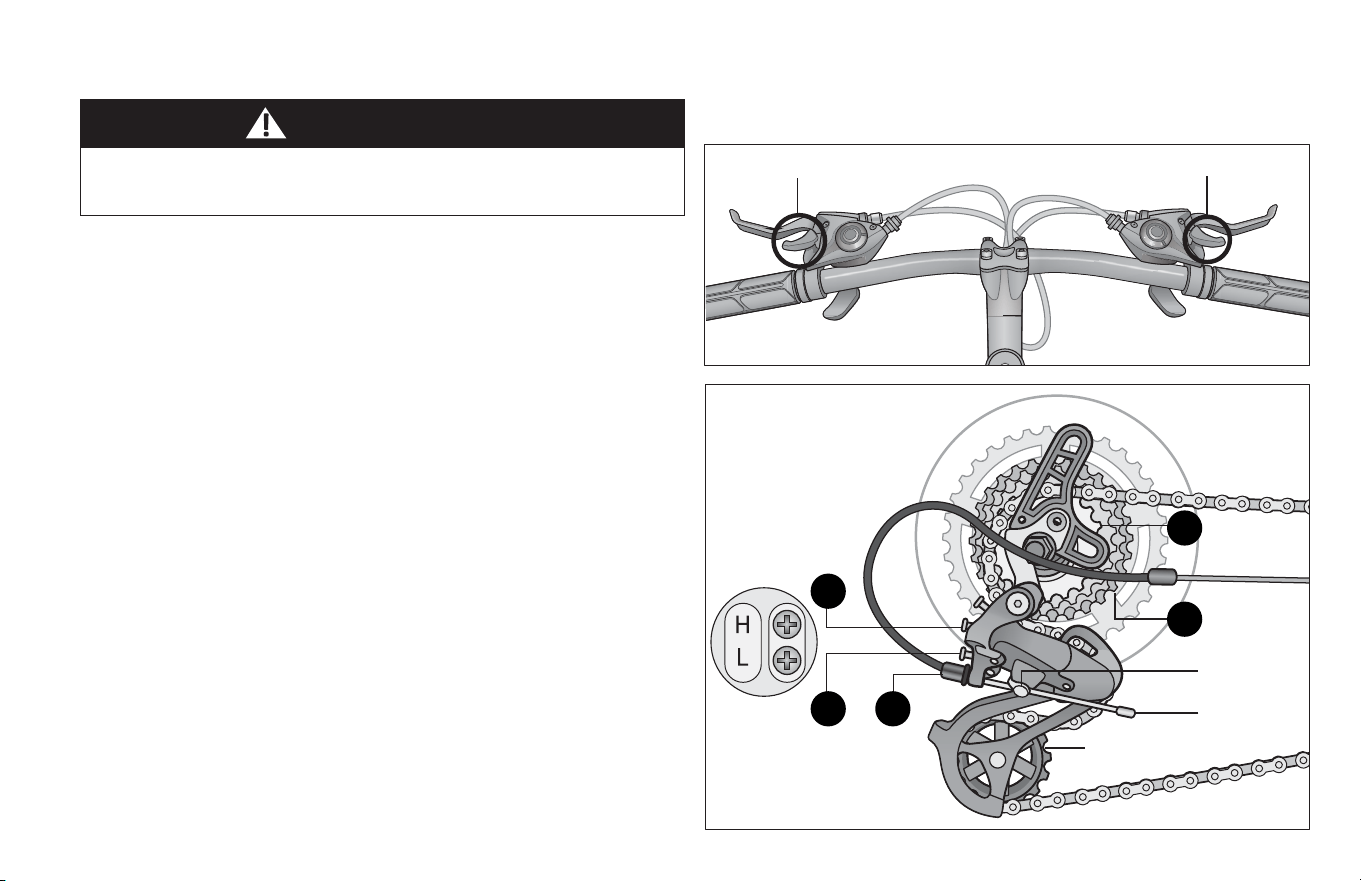
Tech 4
41
3
2
8
6
3
WARNING!
4: Derailleur
Ensure all bolts are secured ghtly and the chain does not fall o
in either direcon.
Although the front and rear derailleur is inially adjusted at the
factory, you will need to inspect and re-adjust both before riding
the bicycle.
4.A: Adjust the Rear Derailleur
❶ Begin by shiing the rear shier to largest number indicated
and place the chain on the smallest sprocket.
❷ Adjust the high limit screw so the guide pulley and the smallest
sprocket are lined up vercally. Figure 4.7
❸ Shi through the gears, making sure each gear achieved is done
quietly and without hesitaon. If necessary, use the barrel
adjuster to ne-tune each gear by turning it the direcon you
want the chain to go. For example, turning clockwise will loosen
the cable tension and move the chain away from the wheel,
while turning counter-clockwise will ghten cable tension and
direct the chain towards the wheel.
❹ Shi the rear shier to gear one and place the chain on the
largest cog.
❺ Adjust the low limit screw in quarter turn increments unl the
guide pulley and the largest cog are aligned vercally.
❻ Again, shi through each gear several mes, checking that each
gear is achieved smoothly. It may take several aempts before
the rear derailleur and cable is adjusted properly.
Rear shierFront shier
Anchor bolt
Low limit
screw
High limit
screw
Cable
Smallest
sprocket
Largest
sprocket
Barrel
adjuster
Guide pulley
2
1
36
5
Figure 4.6
Figure 4.7
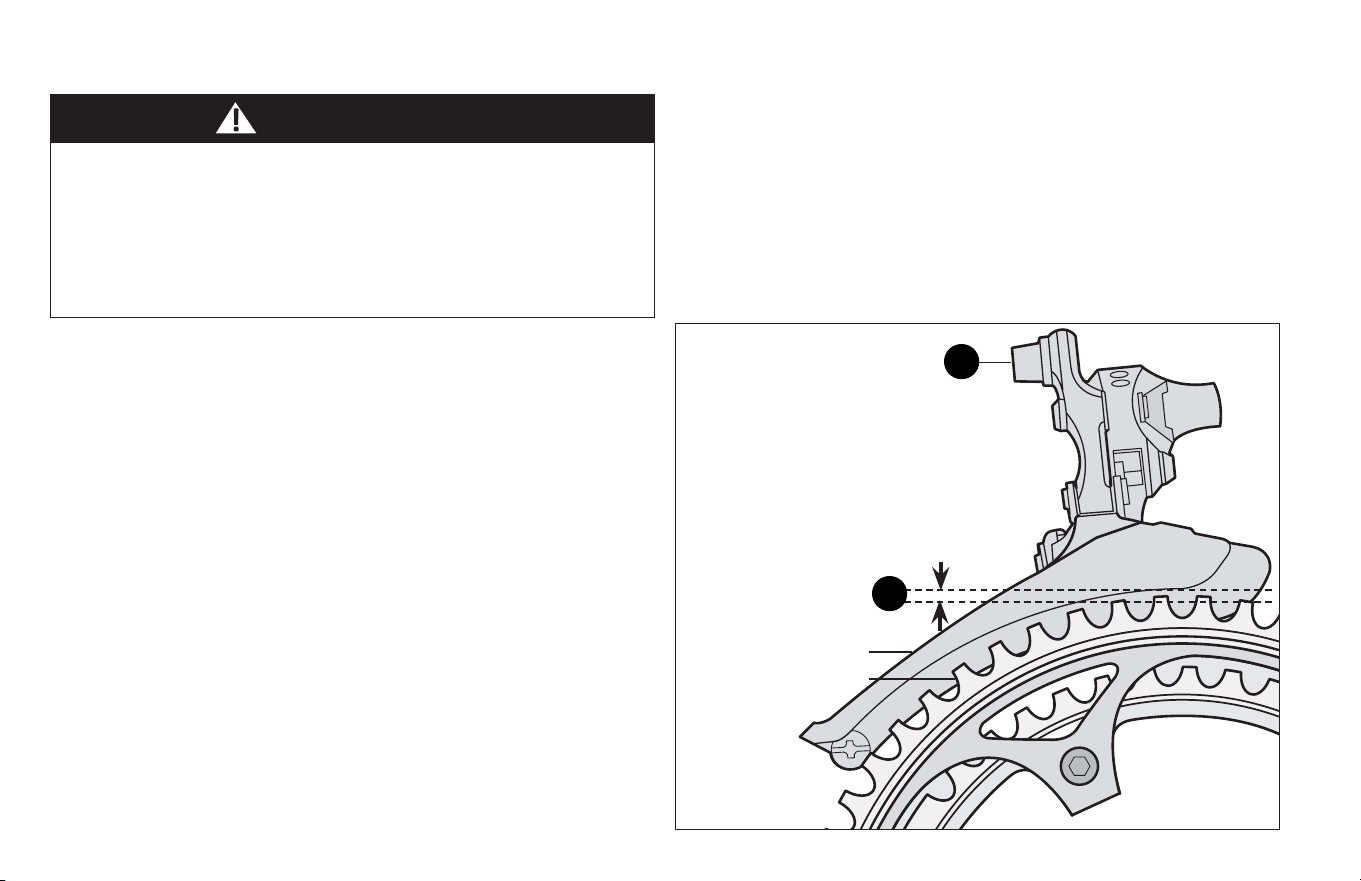
42
4 Tech
WARNING!
4.B: Adjust the Front Derailleur
❶ Shi both shiers to the smallest number indicated and place
the chain on the corresponding cog and chainwheel.
❷ Disconnect the front derailleur cable from the cable anchor
bolt. Figure 4.8
❸ Check the posion of the front derailleur; it should be parallel
with the outer chainwheel and clear the largest chainwheel by
1-3 mm when fully engaged.
❹ With the chain on the smallest chainwheel in front and the
largest cog in back, adjust the low limit screw so the chain is
centered in the front derailleur cage.
❺ Reconnect the cable, pull any slack out and ghten the cable
anchor bolt securely.
❻ Shi the front shier to the largest chainwheel. If the chain
does not go onto the largest chainwheel, turn the high limit
screw in 1/4 turn increments counter-clockwise unl the chain
engages the largest chainwheel.
Do not ride a bicycle that is not shiing properly. Overlooking
proper adjustments may cause irreparable damage to the bicycle
and/or bodily injury. Never move the shier while pedaling
standing up, or under heavy load, nor pedal backwards aer
having moved the shier. This could jam the chain and cause
serious damage to the bicycle and/or rider.
If the chain falls o the largest chainwheel and into the pedals,
you will need to turn the high limit screw in 1/4 turn increments
clockwise unl the chain no longer falls o.
❼ Shi through every gear, using the barrel adjusters to ne-tune
each transion. The barrel adjuster for the front derailleur may
be located on the front shier or in-line with the cable housing.
Clockwise will loosen the cable tension and direct the chain
closer to the frame while counter-clockwise will ghten the
cable tension and direct the chain away from the frame.
Cable anchor bolt
1-3 mm clearance
between chain wheel
and chain guide
Chain guide
Chain wheel
2
3
Figure 4.8
Tech 4
43
4.C: Shiing Gears
Your mul-speed bicycle will have a derailleur drivetrain (see 1.
below), an internal gear hub drivetrain (see 2. below) or, in some
special cases, a combinaon of the two.
1. How a derailleur drivetrain works
If your bicycle has a derailleur drivetrain, the gear-changing
mechanism will have:
• a rear cassee or freewheel sprocket cluster
• a rear derailleur
• usually a front derailleur
• one or two shiers
• one, two or three front sprockets called chainrings
• a drive chain
A. Shiing Gears
There are several dierent types and styles of shiing
controls (see Figure 4.9 - 4.10). Ask your dealer to explain
the type of shiing controls that are on your bike, and to
show you how they work.
CAUTION!
Never move the shier while pedaling backward, nor pedal
backwards immediately aer having moved the shier. This
could jam the chain and cause serious damage to the bicycle.
The vocabulary of shiing can be prey confusing. A
downshi is a shi to a “lower” or “slower” gear, one that
is easier to pedal. An upshi is a shi to a “higher” or
“faster”, harder to pedal gear. What’s confusing is that
what’s happening at the front derailleur is the opposite of
what’s happening at the rear derailleur (for details, read
the instrucons on Shiing the Rear Derailleur and
Shiing the Front Derailleur below). For example, you can
select a gear which will make pedaling easier on a hill
(make a downshi) in one of two ways: shi the chain
down the gear “steps” to a smaller gear at the front, or up
the gear “steps” to a larger gear at the rear. So, at the rear
gear cluster, what is called a downshi looks like an
upshi. The way to keep things straight is to remember
that shiing the chain in towards the centerline of the
bike is for accelerang and climbing and is called a
downshi. Moving the chain out or away from the
centerline of the bike is for speed and is called an upshi.
Whether upshiing or downshiing, the bicycle derailleur
system design requires that the drive chain be moving
forward and be under at least some tension.
A derailleur will shi only if you are pedaling forward.
44
4 Tech
WARNING!
B. Shiing the Rear Derailleur
The rear derailleur is controlled by the right shier.
The funcon of the rear derailleur is to move the drive
chain from one gear sprocket to another. The smaller
sprockets on the gear cluster produce higher gear raos.
Pedaling in the higher gears requires greater pedaling
eort, but takes you a greater distance with each
revoluon of the pedal cranks. The larger sprockets
produce lower gear raos. Using them requires less
pedaling eort, but takes you a shorter distance with
each pedal crank revoluon. Moving the chain from a
smaller sprocket of the gear cluster to a larger sprocket
results in a downshi. Moving the chain from a larger
sprocket to a smaller sprocket results in an upshi. In
order for the derailleur to move the chain from one
sprocket to another, the rider must be pedaling forward.
C. Shiing the Front Derailleur:
The front derailleur, which is controlled by the le shier,
shis the chain between the larger and smaller chainrings.
Shiing the chain onto a smaller chainring makes pedaling
easier (a downshi). Shiing to a larger chainring makes
pedaling harder (an upshi).
D. Which gear should I be in?
The combinaon of largest rear and smallest front gears
(Figure 4.11) is for the steepest hills. The smallest rear
and largest front combinaon is for the greatest speed.
It is not necessary to shi gears in sequence. Instead, nd
the “starng gear” which is right for your level of ability
— a gear which is hard enough for quick acceleraon but
easy enough to let you start from a stop without wobbling
— and experiment with upshiing and downshiing to
get a feel for the dierent gear combinaons. At rst,
pracce shiing where there are no obstacles, hazards or
other trac, unl you’ve built up your condence. Learn
not to use either the “smallest to smallest” or “largest to
largest” gear combinaons because they may cause
unacceptable stress on the drive train. Learn to ancipate
the need to shi, and shi to a lower gear before the hill
gets too steep. If you have dicules with shiing, the
problem could be mechanical adjustment. See your dealer
for help.
E. What if it won’t shi gears?
If moving the shi control one click repeatedly fails to
result in a smooth shi to the next gear chances are that
the mechanism is out of adjustment. Take the bike to your
dealer to have it adjusted.
Never shi a derailleur onto the largest or the smallest sprocket
if the derailleur is not shiing smoothly. The derailleur may be
out of adjustment and the chain could jam, causing you to lose
control and fall.
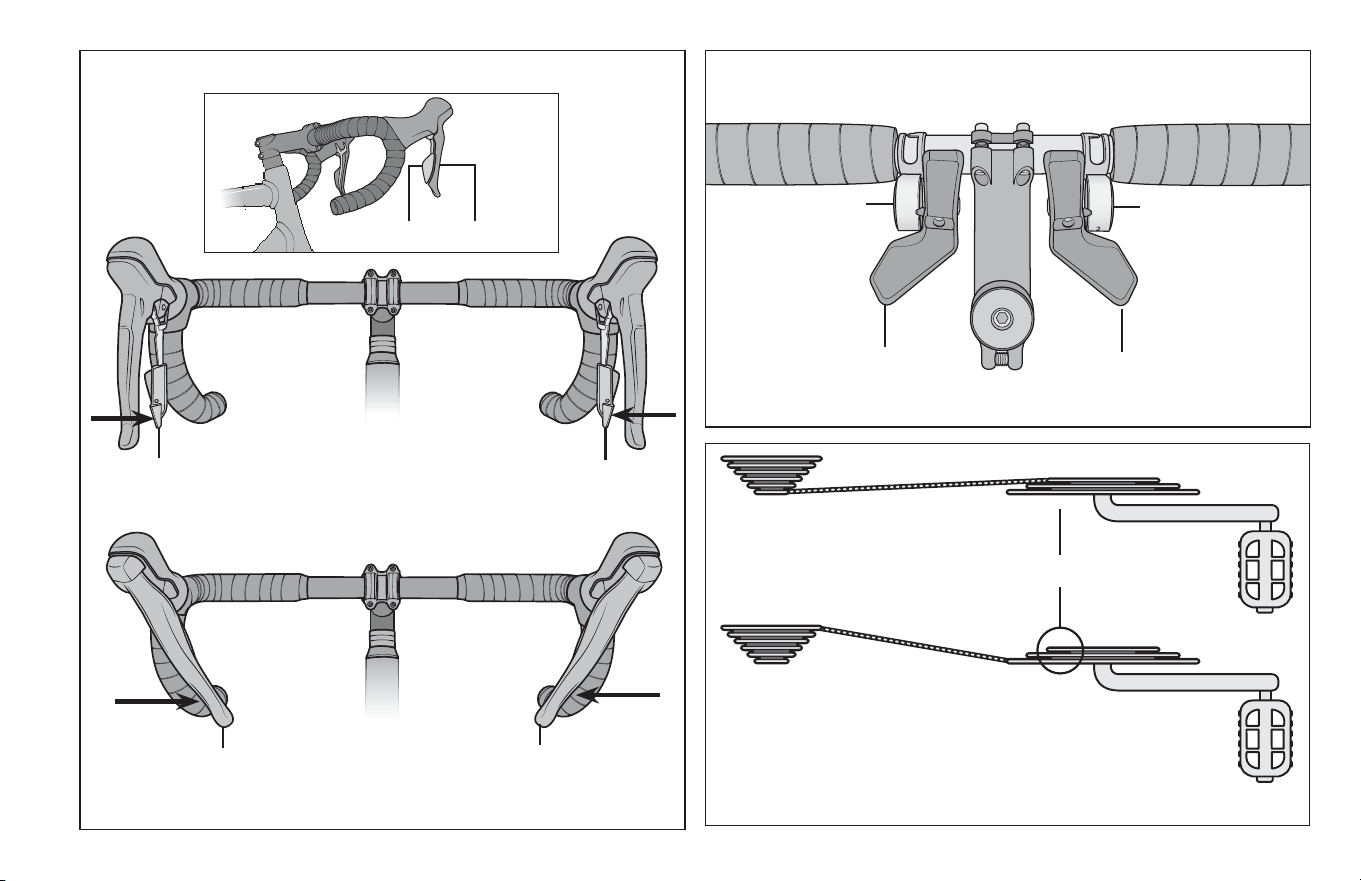
Tech 4
45
7
6
5
4
3
L
H
Thumb Road bike shier
Integrated Road bike shier
Avoid these extreme angles of the chain
Three chain rings
Le shier controls
the front derailleur
Right shier controls
the rear derailleur
Push up for a
higher gear
Push down for a
lower gear
Figure 4.10
Push up for
lower gear and
down for
higher gear
Brake lever
Shi lever
Push in to shi through the rear
from large to small chain rings.
Push brake lever in to shi
from small to large chain rings
Push brake lever in to
shi to large chain rings
Push in to shi through the front
derailleur or small chain ring.
Figure 4.9
Figure 4.11
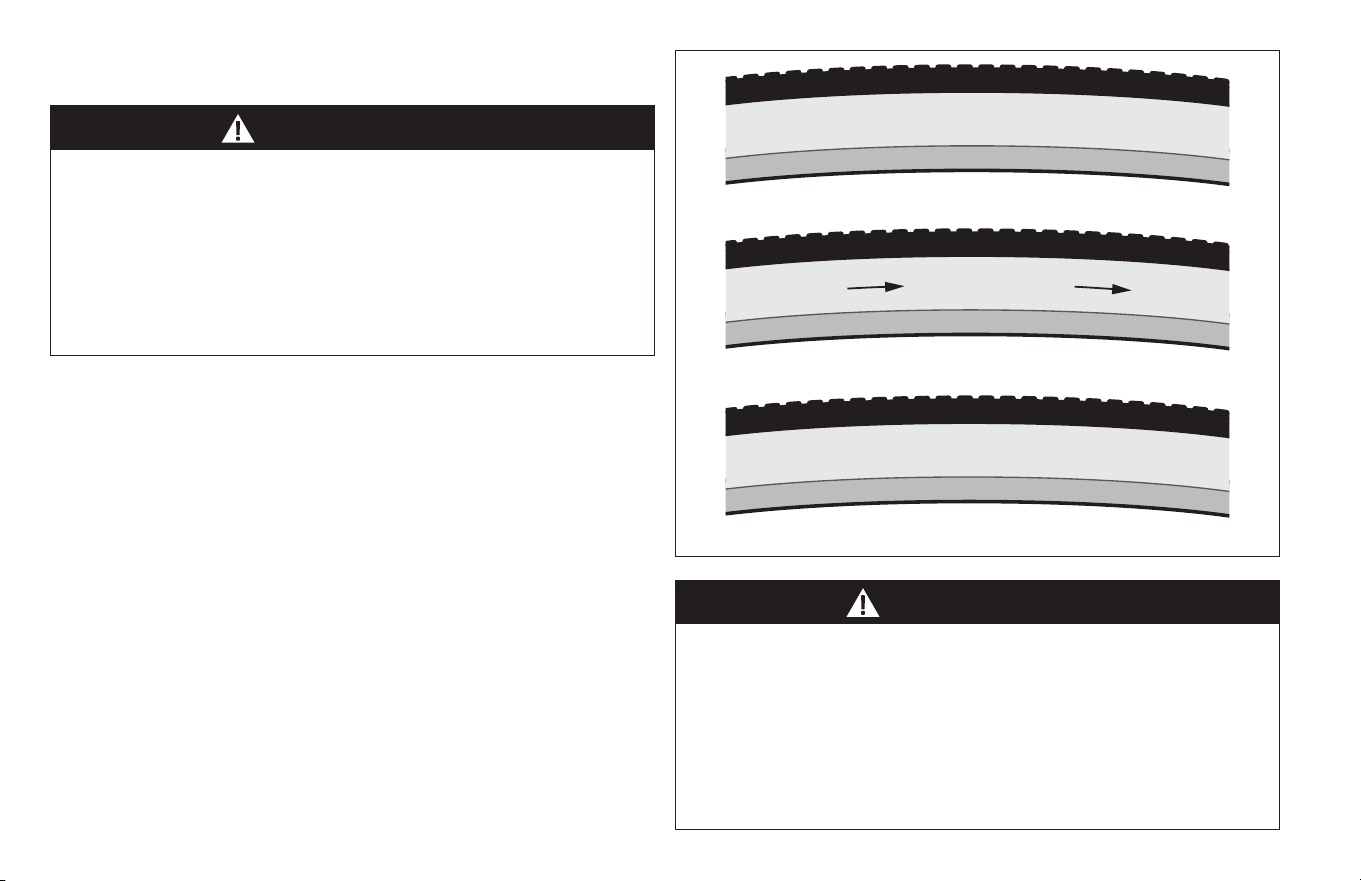
46
4 Tech
WARNING!
5.A: Tires
Bicycle res are available in many designs and specicaons,
ranging from general-purpose designs to res designed to perform
best under very specic weather or terrain condions. If, once
you’ve gained experience with your new bike, you feel that a
dierent re might beer suit your riding needs, customer service
can help you select the most appropriate design.
The size, pressure rang, and on some high-performance res the
specic recommended use, are marked on the sidewall of the re
(Figure 4.12). The part of this informaon which is most important
to you is Tire Pressure. But some wheel rim manufacturers also
specify maximum re pressure with a label on the rim.
The best and safest way to inate a bicycle re to the correct
pressure is with a bicycle pump that has a built-in pressure gauge.
WARNING!
3
0
-
8
0
P
S
I
(
2
.
5
-
5
.
5
B
A
R
)
5
7
-
5
5
9
(
2
6
x
2
.
1
2
5
)
R
O
T
A
T
I
N
G
D
I
R
E
C
T
I
O
N
5: Tires and Tubes
Some bicycles intended for compeon are ed with res that
are glued on to specially made rims. These are called “sew-up”
or “tubular” res. Properly mounng these res requires
specialized knowledge and skills. Ask your dealer to teach you
how to mount tubulars before you aempt it on your own. An
incorrectly installed tubular re can come o the rim, causing
you to lose control and fall.
Never inate a re beyond the maximum pressure marked on
the re’s sidewall or the wheel rim. If the maximum pressure
rang for the wheel rim is lower than the maximum pressure
shown on the re, always use the lower rang. Exceeding the
recommended maximum pressure may blow the re o the rim
or damage the wheel rim, which could cause damage to the bike
and injury to the rider and bystanders.
Figure 4.12
Tech 4
47
WARNING!
There is a safety risk in using gas staon air hoses or other air
compressors. They are not made for bicycle res. They move a
large volume of air very rapidly, and will raise the pressure in
your re very rapidly, which could cause the tube to explode.
Tire pressure is given either as maximum pressure or as a pressure
range. How a re performs under dierent terrain or weather
condions depends largely on re pressure. Inang the re to
near its maximum recommended pressure gives the lowest rolling
resistance; but also produces the harshest ride. High pressures
work best on smooth, dry pavement.
Very low pressures, at the boom of the recommended pressure
range, give the best performance on smooth, slick terrain such as
hard-packed clay, and on deep, loose surfaces such as deep, dry
sand.
Tire pressure that is too low for your weight and the riding
condions can cause a puncture of the tube by allowing the re to
deform suciently to pinch the inner tube between the rim and
the riding surface. This may also result in rim damage.
CAUTION!
Pencil type automove re gauges can be inaccurate and should
not be relied upon for consistent, accurate pressure readings.
Instead, use a high quality dial or digital gauge.
Ask your dealer to recommend the best re pressure for the kind
of riding you will most oen do, and have the dealer inate your
res to that pressure. Then, check inaon as described in Secon
1.C so you’ll know how correctly inated res should look and feel
when you don’t have access to a gauge. Some res may need to be
brought up to pressure every week or two, so it is important to
check your re pressures before every ride.
Some special high-performance res have unidireconal treads:
their tread paern is designed to work beer in one direcon than
in the other. The sidewall marking of a unidireconal re will have
an arrow showing the correct rotaon direcon. If your bike has
unidireconal res, be sure that they are mounted to rotate in the
correct direcon.
5.B: Tire Valves
There are primarily two kinds of bicycle re valves: The Schrader
Valve and the Presta Valve. The bicycle pump you use must have
the ng appropriate to the valve stems on your bicycle.
The Schrader valve (Figure 4.13) is like the valve on a car re. To
inate a Schrader valve re, remove the valve cap and clamp the
pump ng onto the end of the valve stem. To let air out of a
Schrader valve, depress the pin in the end of the valve stem with
the end of a key or other appropriate object.
The Presta valve (Figure 4.14) has a narrower diameter and is only
found on bicycle res. To inate a Presta valve re using a Presta
headed bicycle pump, remove the valve cap; unscrew
(counterclockwise) the valve stem lock nut; and push down on the
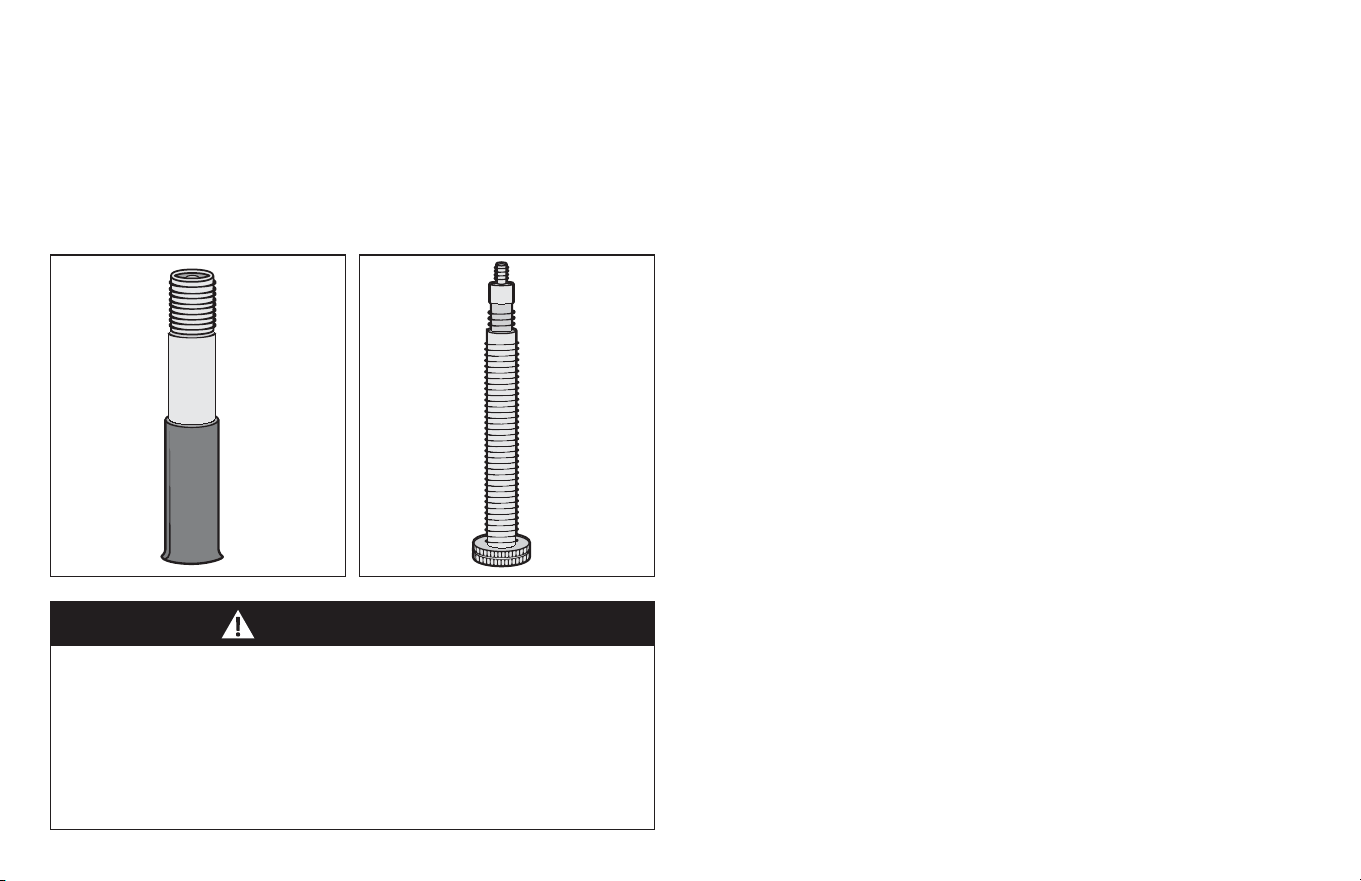
48
4 Tech
WARNING!
valve stem to free it up. Then push the pump head on to the valve
head, and inate. To inate a Presta valve with a Schrader pump
ng, you’ll need a Presta adapter (available at your bike shop)
which screws on to the valve stem once you’ve freed up the valve.
The adapter ts into the Schrader pump ng. Close the valve
aer inaon. To let air out of a Presta valve, open up the valve
stem lock nut and depress the valve stem.
We highly recommend that you carry a spare inner tube when
you ride your bike, unless the bike is ed with tubeless res.
Patching a tube is an emergency repair. If you do not apply the
patch correctly or apply several patches, the tube can fail,
resulng in possible tube failure, which could cause you to lose
control and fall. Replace a patched tube as soon as possible
Figure 4.14Figure 4.13
Service 5
49
Service
5
WARNING!
Technological advances have made bicycles and bicycle
components more complex, and the pace of innovaon is
increasing. It is impossible for this manual to provide all the
informaon required to properly repair and/or maintain your
bicycle. In order to help minimize the chances of an accident and
possible injury, it is crical that you have any repair or
maintenance that is not specically described in this manual
performed by your dealer. Equally important is that your
individual maintenance requirements will be determined by
everything from your riding style to geographic locaon. Contact
customer service for help in determining your maintenance
requirements.
Many bicycle service and repair tasks require special knowledge
and tools. Do not begin any adjustments or service on your
bicycle unl you have learned from your dealer how to properly
complete them. Improper adjustment or service may result in
damage to the bicycle or in an accident which can cause serious
injury or death.
If you want to learn to do major service and repair work on
your bike:
1. Contact customer service for copies of the manufacturer’s
installaon and service instrucons for the components on
your bike, or contact the component manufacturer.
2. Contact customer service to recommend a book on bicycle
repair.
3. Contact customer service about the availability of bicycle repair
courses in your area.
We recommend that you contact customer service for guidance on
what spare parts, such as res, inner tubes, light bulbs, baeries,
Patch Kit, lubricants etc. it would be appropriate for you to have
once you have learned how to replace such parts when they
require replacement.

50
5 Service
1: Service Intervals
Some service and maintenance can and should be performed by
the owner, and require no special tools or knowledge beyond what
is presented in this manual.
The following are examples of the type of service you should
perform yourself. All other service, maintenance and repair should
be performed in a properly equipped facility by a qualied bicycle
mechanic using the correct tools and procedures specied by the
manufacturer.
1. Break-in Period: Your bike will last longer and work beer if
you break it in before riding it hard. Control cables and wheel
spokes may stretch or “seat” when a new bike is rst used and
may require readjustment by your dealer. Your Mechanical
Safety Check (Secon 1.C) will help you idenfy some things
that need readjustment. But even if everything seems ne to
you, it’s best to take your bike back to the dealer for a checkup.
Dealers typically suggest you bring the bike in for a 30-day
checkup. Another way to judge when it’s me for the rst
checkup is to bring the bike in aer three to ve hours of hard
o-road use, or about 10 to 15 hours of on-road or more casual
o-road use. But if you think something is wrong with the bike,
take it to your dealer before riding it again.
2. Before every ride: Mechanical Safety Check (Secon 1.C)
3. Aer every long or hard ride; if the bike has been exposed to
water or grit; or at least every 100 miles: Clean the bike and
lightly lubricate the chain’s rollers with a good quality bicycle
chain lubricant. Wipe o excess lubricant with a lint-free cloth.
Lubricaon is a funcon of climate. Talk to your dealer about
the best lubricants and the recommended lubricaon
frequency for your area.
4. Aer every long or hard ride or aer every 10 to 20 hours
of riding:
• Squeeze the front brake and rock the bike forward and
back. Everything feel solid? If you feel a clunk with each
forward or backward movement of the bike, you probably
have a loose headset. Have your dealer check it.
• Li the front wheel o the ground and swing it from side
to side. Feel smooth? If you feel any binding or roughness
in the steering, you may have a ght headset. Have your
dealer check it.
• Grab one pedal and rock it toward and away from
the centerline of the bike; then do the same with the
other pedal. Anything feel loose? If so, have your dealer
check it.
• Take a look at the brake pads. Are they worn or not hing
the wheel rim squarely? Time to have the dealer adjust or
replace them.
Service 5
51
• Carefully check the control cables and cable housings. Any
rust? Kinks? Fraying? If so, have your dealer replace them.
• Squeeze each adjoining pair of spokes on either side of
each wheel between your thumb and index nger. Do
they all feel about the same? If any feel loose, have your
dealer check the wheel for tension and trueness.
• Check the res for excess wear, cuts or bruises. Have your
dealer replace them if necessary.
• Check the wheel rims for excess wear, dings, dents and
scratches. Consult your dealer if you see any rim damage.
• Check to make sure that all parts and accessories are sll
secure, and ghten any that are not.
• Check the frame, parcularly in the area around all tube
joints; the handlebars; the stem; and the seatpost for any
deep scratches, cracks or discoloraon. These are signs of
stress-caused fague and indicate that a part is at the end
of its useful life and needs to be replaced. See also 6
Appendix.
5. Disc brakes require a dierent set of inspecon steps. Check for
these issues before every ride:
• Pads rubbing on rotors.
• Worn out pads (which can lead to over-extended pistons).
• Pistons that are stuck and/or won’t retract fully.
• Disc rotors that are bent and need straightening. Contact
customer relaons.
• Hydraulic brakes that feel “sponge-y” and/or levers that
can be depressed all the way to the grips w/o generang
adequate stopping power (due to trapped air and/or leaks).
WARNING!
Like any mechanical device, a bicycle and its components are
subject to wear and stress. Dierent materials and mechanisms
wear or fague from stress at dierent rates and have dierent
life cycles. If a component’s life cycle is exceeded, the
component can suddenly and catastrophically fail, causing
serious injury or death to the rider
Scratches, cracks, fraying and discoloraon are signs of stress-
caused fague and indicate that a part is at the end of its useful
life and needs to be replaced. While the materials and
workmanship of your bicycle or of individual components may
be covered by a warranty for a specied period of me by the
manufacturer, this is no guarantee that the product will last the
term of the warranty. Product life is oen related to the kind of
riding you do and to the treatment to which you submit the
bicycle. The bicycle’s warranty is not meant to suggest that the
bicycle cannot be broken or will last forever. It only means that
the bicycle is covered subject to the terms of the warranty.
Please be sure to read Appendix D, Intended Use of your bicycle
and Appendix A, The lifespan of your bike and its components.
52
5 Service
WARNING!
6. As required: If either brake lever fails the Mechanical Safety
Check (Secon 1.C), don’t ride the bike. Have your dealer check
the brakes. If the chain won’t shi smoothly and quietly from
gear to gear, the derailleur is out of adjustment. Contact
customer service.
7. Every 25 (hard o-road) to 50 (on-road) hours of riding: Take
your bike to your dealer for a complete checkup.
2:
If Your Bicycle Sustains an Impact:
First, check yourself for injuries, and take care of them as best you
can. Seek medical help if necessary.
Next, check your bike for damage.
Aer any crash, take your bike to a repair facility for a thorough
check. Carbon composite components, including fames, wheels,
handlebars, stems, cranksets, brakes, etc. which have sustained an
impact must not be ridden unl they have been disassembled and
thoroughly inspected by a qualied mechanic.
See Appendix B, The Lifespan of Your Bike and Its Components.
A crash or other impact can put extraordinary stress on bicycle
components, causing them to fague prematurely. Components
suering from stress fague can fail suddenly and
catastrophically, causing loss of control, serious injury or death.
6 Appendix
53
Appendix
Intended Use of Your Bicycle
A
WARNING!
Understand your bike and its intended use. Choosing the wrong
bicycle for your purpose can be hazardous. Using your bike the
wrong way is dangerous.
No one type of bicycle is suited for all purposes. Your retailer can
help you pick the “right tool for the job” and help you understand
its limitaons. There are many types of bicycles and many
variaons within each type. There are many types of mountain,
road, racing, hybrid, touring, cyclo-cross and tandem bicycles.
There are also bicycles that mix features. For example, there are
road/racing bikes with triple cranks. These bikes have the low
gearing of a touring bike, the quick handling of a racing bike, but
are not well suited for carrying heavy loads on a tour. For that
purpose you want a touring bike.
Within each of type of bicycle, one can opmize for certain
purposes. Visit your bicycle shop and nd someone with experse
in the area that interests you. Do your own homework. Seemingly
small changes such as the choice of res can improve or diminish
the performance of a bicycle for a certain purpose.
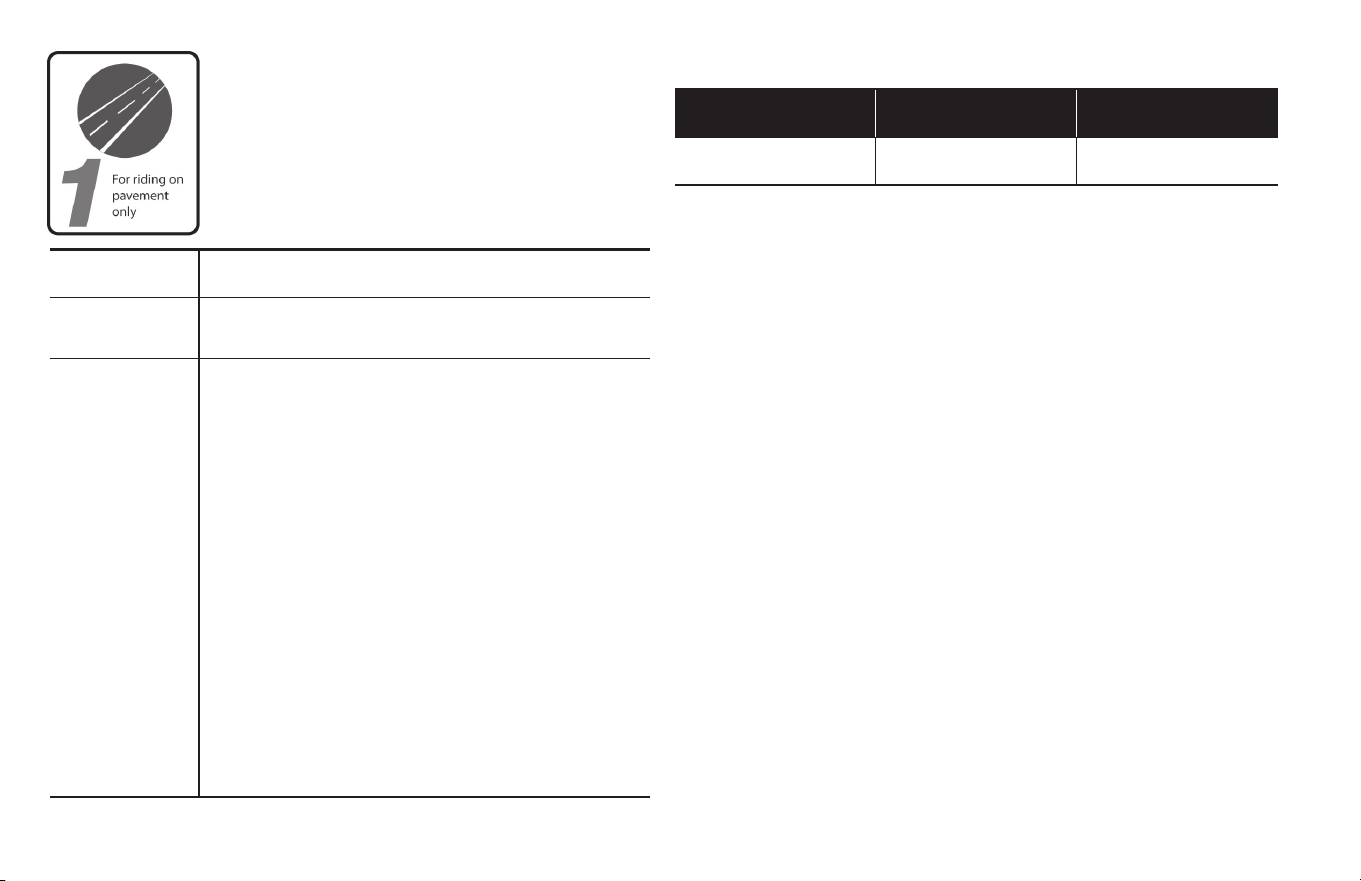
54
6 Appendix
AA.1 High-Performance Road
Condion 1
Bikes designed for riding on a paved surface
Intended To be ridden on paved roads only
Not intended For o-road, cyclo-cross, or touring with racks
or panniers.
Trade o Material use is opmized to deliver both light
weight and specic performance. You must
understand that (1) these types of bikes are
intended to give an aggressive racer or
compeve cyclist a performance advantage
over a relavely short product life, (2) a less
aggressive rider will enjoy longer frame life, (3)
you are choosing light weight (shorter frame
life) over more frame weight and a longer frame
life, (4) you are choosing light weight over more
dent resistant or rugged frames that weigh
more. All frames that are very light need
frequent inspecon. These frames are likely to
be damaged or broken in a crash. They are not
designed to take abuse or be a rugged
workhorse. See also Appendix B.
RIDER lbs/kg LUGGAGE* lbs/kg TOTAL lbs/kg
275 / 125 10 / 4.5 285 / 129
* Seat Bag /Handlebar Bag Only
Maximum Weight Limit
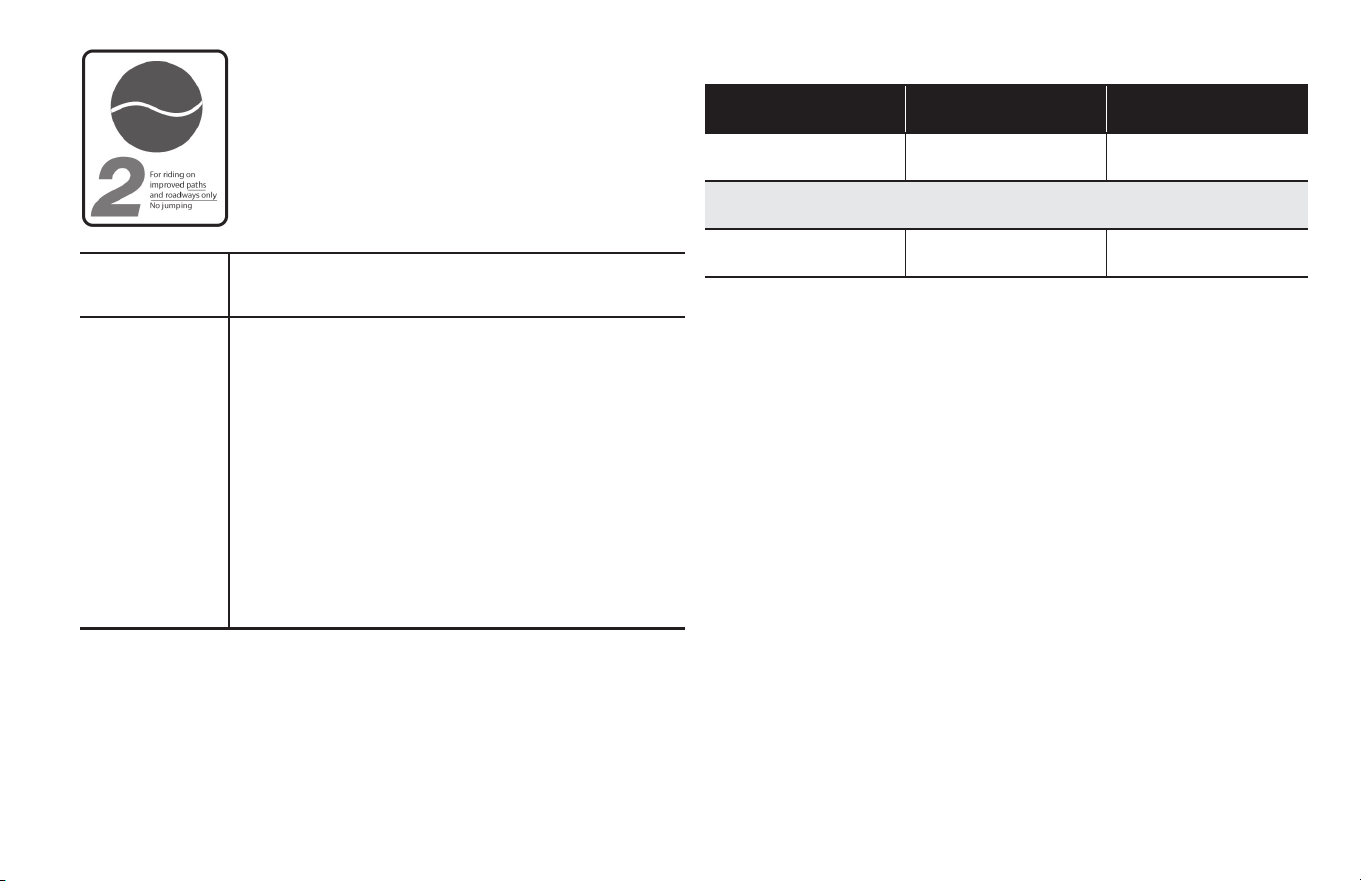
6 Appendix
55
AA.2 General Purpose Riding
Condion 2
Bikes designed for riding Condion 1, plus
smooth gravel roads and improved trails with
moderate grades where the res do not lose
ground contact.
Intended For paved roads, gravel or dirt roads that are in
good condion, and bike paths.
Not intended For o-road or mountain bike use, or for any
kind of jumping. Some of these bikes have
suspension features, but these features are
designed to add comfort, not o-road capability.
Some come with relavely wide res that are
well suited to gravel or dirt paths. Some come
with relavely narrow res that are best suited
to faster riding on pavement. If you ride on
gravel or dirt paths, carry heavier loads or want
more re durability talk to your dealer about
wider res.
RIDER lbs/kg LUGGAGE* lbs/kg TOTAL lbs/kg
300 / 136 30 / 14 330 / 150
for Touring or Trekking
300 / 136 55 / 25 355 / 161
Maximum Weight Limit
56
6 Appendix
Appendix
AB.1: The Lifespan of Your Bike and Its Components
B
AB.1.1: Nothing Lasts Forever, Including Your Bike.
When the useful life of your bike or its components is over,
connued use is hazardous.
Every bicycle and its component parts have a nite, limited useful
life. The length of that life will vary with the construcon and
materials used in the frame and components, the maintenance and
care the frame and components receive over their life, and the
type and amount of use to which the frame and components are
subjected. Use in compeve events, trick riding, ramp riding,
jumping, aggressive riding, riding on severe terrain, riding in severe
climates, riding with heavy loads, commercial acvies, and other
types of non-standard use can dramacally shorten the life of the
frame and components. Any one or a combinaon of these
condions may result in an unpredictable failure.
All aspects of use being idencal, lightweight bicycles and their
components will usually have a shorter life than heavier bicycles
and their components. In selecng a lightweight bicycle or
components you are making a tradeo, favoring the higher
performance that comes with lighter weight over longevity. So, If
you choose lightweight, high performance equipment, be sure to
have it inspected frequently.
You should have your bicycle and its components checked
periodically by a qualied bicycle mechanic for indicators of stress
and/or potenal failure, including cracks, deformaon, corrosion,
paint peeling, dents, and any other indicators of potenal
problems, inappropriate use, or abuse. These are important safety
checks and very important to help prevent accidents, bodily injury
to the rider, and shortened product life.
AB.1.2: Perspecve
Today’s high-performance bicycles require frequent and careful
inspecon and service. In this Appendix we try to explain some
underlying material science basics and how they relate to your
bicycle. We discuss some of the trade-os made in designing your
bicycle and what you can expect from your bicycle; and we provide
important, basic guidelines on how to maintain and inspect it. We
cannot teach you everything you need to know to properly inspect
and service your bicycle; and that is why we repeatedly urge you to
take your bicycle to a qualied bicycle mechanic for professional
care and aenon.
6 Appendix
57
WARNING!
Frequent inspecon of your bike is important to your safety.
Follow the Mechanical Safety Check in Secon A.1.3 of this
Manual before every ride.
Periodic, more detailed inspecon of your bicycle is important.
How oen this more detailed inspecon is needed depends
upon you.
You, the rider/owner, have control and knowledge of how oen
you use your bike, how hard you use it, and where you use it.
Because your retailer cannot track your use, you must take
responsibility for periodically bringing your bike to a qualied
bicycle mechanic for inspecon and service. The mechanic will
help you decide what frequency of inspecon and service is
appropriate for how and where you use your bike.
For your safety, understanding, and communicaon with your
mechanic, we urge you to read this Appendix in its enrety. The
materials used to make your bike determine how and how
frequently to inspect.
Ignoring this WARNING can lead to frame, fork, or other
component failure, which can result in serious injury or death.
1. Understanding metals
Steel is the tradional material for building bicycle frames. It
has good characteriscs, but in high-performance bicycles,
steel has been largely replaced by aluminum and some
tanium. The main factor driving this change is interest in
lighter bicycles by cycling enthusiasts.
Properes of Metals
Please understand that there is no simple statement that can
be made that characterizes the use of dierent metals for
bicycles. What is true is how the metal chosen is applied is
much more important than the material alone. One must look
at the way the bike is designed, tested, manufactured, and
supported, along with the characteriscs of the metal rather
than seeking a simplisc answer.
Metals vary widely in their resistance to corrosion. Steel must
be protected or rust will aack it. Aluminum and Titanium
quickly develop an oxide lm that protects the metal from
further corrosion. Both are therefore quite resistant to
corrosion. Aluminum is not perfectly corrosion resistant, and
parcular care must be used where it contacts other metals
and galvanic corrosion can occur.
Metals are comparavely ducle. Ducle means bending,
buckling, and stretching before breaking. Generally speaking, of
the common bicycle frame building materials steel is the most
ducle, tanium less ducle, followed by aluminum.

58
6 Appendix
Metals vary in density. Density is weight per unit of material.
Steel weighs 7.8 grams/cm3 (grams per cubic cenmeter),
tanium 4.5 grams/cm3, aluminum 2.75 grams/cm3. Contrast
these numbers with carbon ber composite at 1.45 grams/cm3.
Metals are subject to fague. With enough cycles of use, at
high enough loads, metals will eventually develop cracks that
lead to failure. It is very important that you read the basics of
metal fague below.
Let’s say you hit a curb, ditch, rock, car, another cyclist, or other
object. At any speed above a fast walk, your body will connue
to move forward, momentum carrying you over the front of the
bike. You cannot and will not stay on the bike, and what
happens to the frame, fork, and other components is irrelevant
to what happens to your body.
What should you expect from your metal frame? It depends on
many complex factors, which is why we tell you that
crashworthiness cannot be a design criteria. With that
important note, we can tell you that if the impact is hard
enough, the fork or frame may be bent or buckled. On a steel
bike, the steel fork may be severely bent and the frame
undamaged. Aluminum is less ducle than steel, but you can
expect the fork and frame to be bent or buckled. Hit harder and
the top tube may be broken in tension and the down tube
buckled. Hit harder and the top tube may be broken, the down
tube buckled and broken, leaving the head tube and fork
separated from the main triangle.
When a metal bike crashes, you will usually see some evidence
of this duclity in bent, buckled, or folded metal.
It is now common for the main frame to be made of metal and
the fork of carbon ber. See Secon AB.1.3, “Understanding
composites” below. The relave duclity of metals and the lack
of duclity of carbon ber means that in a crash scenario you
can expect some bending or bucking in the metal but none in
the carbon. Below some load the carbon fork may be intact
even though the frame is damaged. Above some load the
carbon fork will be completely broken.
2. The basics of metal fague
Common sense tells us that nothing that is used lasts forever.
The more you use something, and the harder you use it, and
the worse the condions you use it in, the shorter its life.
Fague is the term used to describe accumulated damage to a
part caused by repeated loading. To cause fague damage, the
load the part receives must be great enough. A crude, oen-
used example is bending a paper clip back and forth (repeated
loading) unl it breaks. This simple denion will help you
understand that fague has nothing to do with me or age. A
bicycle in a garage does not fague. Fague happens only
through use.
So what kind of “damage” are we talking about? On a
microscopic level, a crack forms in a highly stressed area. As the
load is repeatedly applied, the crack grows. At some point the
crack becomes visible to the naked eye. Eventually it becomes
6 Appendix
59
so large that the part is too weak to carry the load that it could
carry without the crack. At that point there can be a complete
and immediate failure of the part.
One can design a part that is so strong that fague life is nearly
innite. This requires a lot of material and a lot of weight. Any
structure that must be light and strong will have a nite fague
• ONCE A CRACKS STARTS IT CAN GROW AND GROW FAST. Think
about the crack as forming a pathway to failure. This means that any
crack is potenally dangerous and will only become more dangerous.
SIMPLE RULE 1:
If you nd crack, replace the part.
• CORROSION SPEEDS DAMAGE. Cracks grow more quickly when they
are in a corrosive environment. Think about the corrosive soluon as
further weakening and extending the crack.
SIMPLE RULE 2:
Clean your bike, lubricate your bike, protect your bike from
salt, remove any salt as soon as you can.
• SIGNIFICANT SCRATCHES, GOUGES, DENTS, OR SCORING CREATE
STARTING POINTS FOR CRACKS. Think about the cut surface as a focal
point for stress (in fact engineers call such areas “stress risers,” areas
where the stress is increased). Perhaps you have seen glass cut? Recall
how the glass was scored and then broke on the scored line.
SIMPLE RULE 4:
Do not scratch, gouge, or score any surface. If you do, pay
frequent aenon to this area or replace the part.
• SOME CRACKS (parcularly larger ones) MAY MAKE CREAKING
NOISE AS YOU RIDE. Think about such a noise as a serious warning
signal. Note that a well-maintained bicycle will be very quiet and free
of creaks and squeaks.
SIMPLE RULE 5:
Invesgate and nd the source of any noise. It may not a be
a crack, but whatever is causing the noise should be xed
promptly.
life. Aircra, race cars, and motorcycles all have parts with
nite fague lives. If you wanted a bicycle with an innite
fague life, it would weigh far more than any bicycle sold today.
So we all make a tradeo: the wonderful, lightweight
performance we want requires that we inspect the structure.
AB.1.3: What To Look For
60
6 Appendix
2.A: Factors that Shorten Product Life:
Hard, harsh riding style
“Hits”, crashes, jumps, other “shots” to the bike
High mileage
Higher body weight
Stronger, more t, more aggressive rider
Corrosive environment (wet, salt air, winter road salt,
accumulated sweat)
Presence of abrasive mud, dirt, sand, soil in riding environment
2.B: Factors that Lengthen Product Life:
Smooth, uid riding style
No “hits”, crashes, jumps, other “shots” to the bike
Low mileage
Lower body weight
Less aggressive rider
Non-corrosive environment (dry, salt-free air)
Clean riding environment
2: Fague Is Not A Perfectly
Predictable Science
Fague is not a perfectly predictable science, but here are some
general factors to help you and your dealer determine how oen
your bicycle should be inspected. The more you t the “shorten
product life” prole, the more frequent your need to inspect. The
more you t the “lengthen product life” prole, the less frequent
your need to inspect.
WARNING!
Do not ride a bicycle or component with any crack, bulge or
dent, even a small one. Riding a cracked frame, fork or
component could lead to complete failure, with risk of serious
injury or death.
6 Appendix
61
Appendix
C
Fastener Torque Specicaons
Correct ghtening torque of threaded fasteners is very important
to your safety. Always ghten fasteners to the correct torque. In
case of a conict between the instrucons in this manual and
informaon provided by a component manufacturer, consult with
a qualied bicycle mechanic or the manufacturer’s customer
service representave for claricaon. Bolts that are too ght can
stretch and deform. Bolts that are too loose can move and fague.
Either mistake can lead to a sudden failure of the bolt.
Always use a correctly calibrated torque wrench to ghten crical
fasteners on your bike. Carefully follow the torque wrench
manufacturer’s instrucons on the correct way to set and use the
torque wrench for accurate results.
Fastener torque ranges. Consult component manufacturer for specic torque value if not printed on component.
Component N·m in-lb
Cassee / Freewheel sprocket lockring
30-40 250-350
Threadless stem pinch bolts
6 53
Stem faceplate bolts
6 53
Seat post binder bolt
5-6 44-53
Seat clamp (Pin post type)
34 300
Pedal into crank
40-50 350-440
Crank bolt
30-40 250-350
Boom bracket
≥30 250
Component N·m in-lb
Shi lever
3-4.5 26-40
Derailleur mounng bolt
8-15 70-130
Derailleur cable pinch bolt
5-8 44-70
Front derailleur clamp
6 53
Brake levers
3-4.5 26-40
Brake caliper mount to frame / fork
6-9 53-80
Brake cable pinch bolt
4.5-8 40-70
D i s c b r a ke r o t o r b o l ts
4-6 35-53
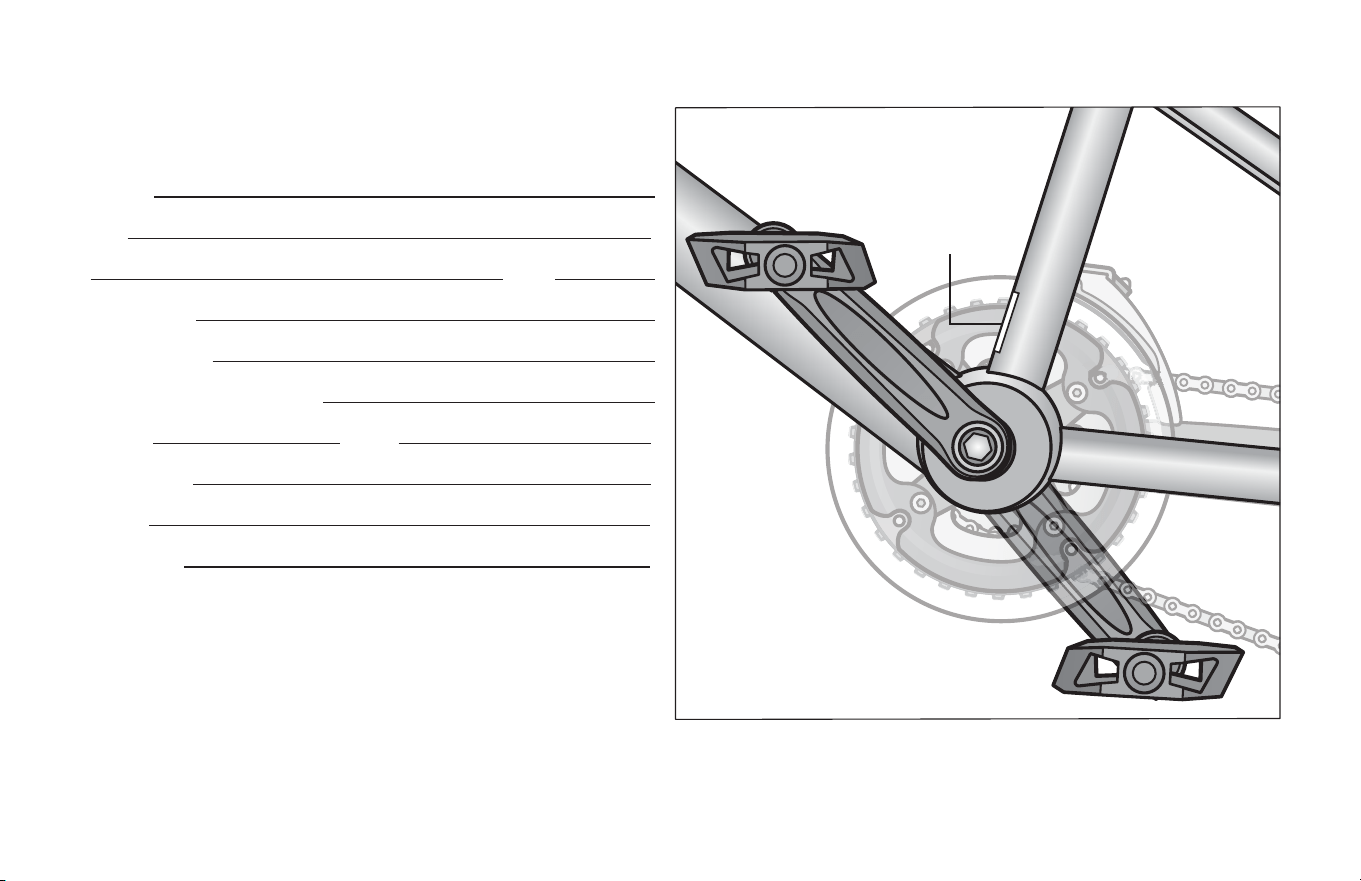
64
7 Warranty
Serial number is
located on the
boom of the
seat tube
PURCHASE RECORD
Fill in immediately and retain as a record of your purchase.
Please retain your sales receipt for any possible warranty claims.
Your Name:
Address:
City: State:
Date Purchased:
Place of Purchase:
Model and Brand Informaon:
Wheel Size: Color:
Model Number:
Date Code:
Serial Number:

US 1-800-626-2811
Canada 1-877-758-4741
schwinnbikes.com
OMSCRD
WARNING: This product can expose you to chemicals including lead and lead
compounds, which is known to the State of California to cause cancer, birth defects
and other reproductive harm. For more information go to www.P65Warnings.ca.gov
© 2023 PACIFIC CYCLE, INC. SCHWINN
®
is a registered trademark of Pacic Cycle, Inc.
Limited
Lifetime
Warranty
For as long as you own the bike.
Some restrictions apply.
Details at schwinnbikes.com