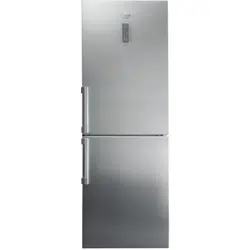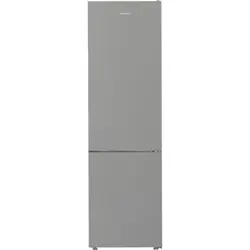
Refrigerator
User Manual
Frigorifero
Manuale Utente
HP1K 25402 XP7E
11 5943 0213/ EN/ IT/ AA/ 07.03.25 10:04
7282340507
EN
IT
EN / 2
Please read this manual first!
Dear Customer
Thank you for choosing this product.
We would like you to achieve the optimal efficiency from this high quality product which
has been manufactured with state of the art technology. To do this, carefully read this
manual and any other documentation provided before using the product.
Heed all information and warnings in the user manual. This way, you will protect yourself
and your product against the dangers that may occur. Keep the user manual. Include this
manual with the product if you hand it over to someone else.
The following symbols are used in the user manual and on the product:
Read the user manual.
Hazard that may result in death or injury.
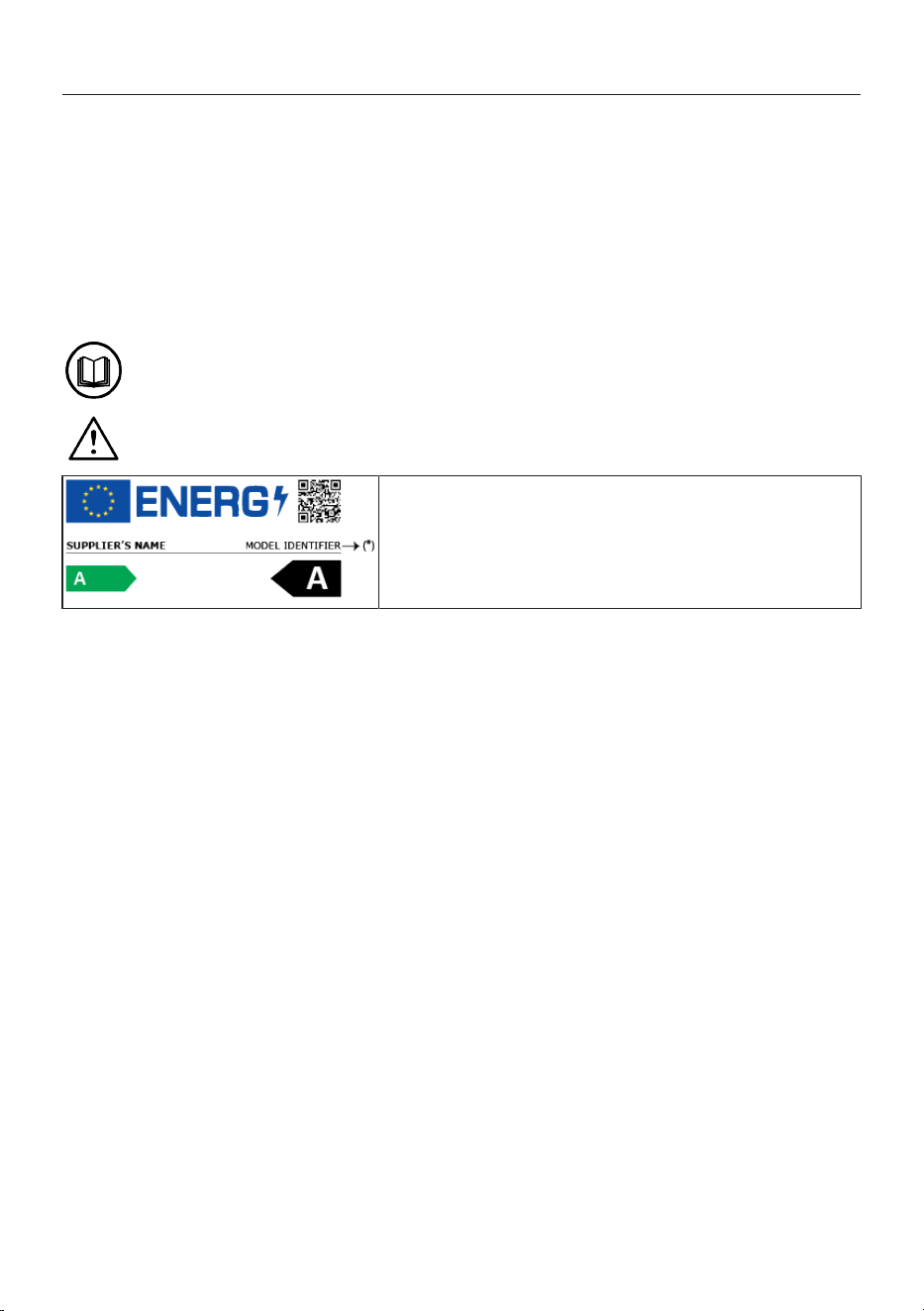
The model information as stored in the product data base can be
reached by entering following website and searching for your model
identifier (*) found on energy label.
https://eprel.ec.europa.eu/
EN / 3
Table of Contents
1 Safety Instructions......................... 4
1.1 Important Safety Symbols ............ 4
1.2 Intention of Use ............................. 4
1.3 Safety of Children, Vulnerable
Persons and Pets ..........................
5
1.4 Electrical Safety............................. 5
1.5 Handling Safety ............................. 6
1.6 Installation Safety.......................... 6
1.7 Operational Safety......................... 9
1.8 Food Storage Safety...................... 12
1.9 Maintenance and Cleaning Safety 13
1.10 Lighting .......................................... 13
1.11 Disposal of the Old Product.......... 13
2 Environmental Instructions ............ 14
2.1 Compliance with the WEEE Dir-
ective and Disposing of the
Waste Product...............................
14
3 Your Refrigerator ........................... 15
4 Installation..................................... 15
4.1 Right Place For Installation........... 15
4.2 Attaching the Plastic Wedges ...... 16
4.3 Adjusting the Legs......................... 16
4.4 Hot Surface Warning..................... 16
5 Operating the Product.................... 16
6 Preparation.................................... 16
6.1 What To Do For Energy Saving..... 16
6.2 First Use......................................... 17
6.3 Climate Class and Definitions ...... 17
7 Use of Your Appliance.................... 18
7.1 Control Panel of the Product ........ 18
7.1.1 High Temperature Alarm........... 19
7.2 Storing Food in the Cooler Com-
partment.........................................
19
7.3 Crisper............................................ 24
7.4 Dairy Products Cold Storage Area 24
7.5 Reversing the Door Opening Side. 24
7.6 Door Open Alert ............................. 24
7.7 Foldable Wine Rack....................... 25
7.8 Replacing the Illumination Lamp.. 25
8 Maintenance and Cleaning ............. 25
9 Troubleshooting............................. 26
EN
IT
EN / 4
1 Safety Instructions
• This section includes the
safety instructions necessary
to prevent the risk of personal
injury or material damage.
• Our company shall not be held
responsible for damages that
may occur if these instructions
are not observed.
• Always have installation and
repair operations performed by
manufacturer, authorized ser-
vice or a person who will be
described by importer com-
pany.
• Use original spare parts and
accessories only.
• Do not repair or replace any
component of the product un-
less it is clearly specified in the
user manual.
• Do not perform any modifica-
tions on the product.
1.1 Important Safety
Symbols
Risk of electric shock!
Read the user manual.
Danger that may result in
burns due to contact with hot
surfaces.
Combustible material, warn-
ing against fire hazard.
Risk of injury due to contact
with sharp surfaces!
Risk of UV-C radiation
1.2 Intention of Use
• This product is not suitable for
commercial use and should
not be used for a purpose
other than its intended use.
• This product is intended for
operating interiors, such as
households or similar.
For example;
In the staff kitchens of the
stores, offices and other work-
ing environments,
In farm houses,
In the units of hotels, motels or
other resting facilities that are
used by the customers,
In hostels, or similar environ-
ments,
In catering services and similar
non-retail applications.
• This product shall not be used
in open or enclosed external
environments such as vessels,
camper vans, balconies or ter-
races. Exposing the product to
rain, snow, sunlight and wind
may cause risk of fire.
EN
IT
EN / 5
1.3 Safety of Children,
Vulnerable Persons
and Pets
• This product may be used by
children aged 8 years and
older and persons with under-
developed physical, sensory or
mental capabilities or lack of
experience and knowledge if
they are being supervised or
have been given instruction
concerning use of the appli-
ance in a safe way and the
hazards involved.
• Children between 3 and 8
years are allowed to put and
take out food into/from the
cooler product.
• Children and pets must not
play with, climb on, or get in-
side the product.
• Children and pets must be kept
away from the cabin area
(compressor) where electrical
parts are located.
• Cleaning and user mainten-
ance must not be performed
by children unless there is
someone overseeing them.
• Keep the packaging materials
away from children. Risk of in-
jury and suffocation.
• If there is a lock available on
the product’s door, keep the
key out of children's reach.
1.4 Electrical Safety
• The product shall not be
plugged into the outlet during
installation, maintenance,
cleaning, repair, and transport-
ation operations.
• If the power cable is damaged,
it must be replaced by the per-
son sent by the manufacturer,
authorized service provider or
the importer to prevent any po-
tential danger.
• Do not tuck the power cable
under the product or to the
rear of the product. Do not put
heavy items on the power
cable. The power cable should
not be bent, crushed, and
come into contact with any
heat source.
• Use an original cable only. Do
not use cut or damaged
cables.
• Do not use an extension cord,
multi-plug or adaptor to oper-
ate your product.
• Portable multi-plugs or port-
able power supplies may over-
heat and cause fire. Thus, do
not have a multi-plug, portable
power sources behind or in the
vicinity of the product.
EN
IT
EN / 6
• Before plugging the product
into the power source, please
remove the power cable from
the condenser hook (if avail-
able) during the installation.
• The user should not be able to
reach the electrical parts after
installation.
• Do not plug the product’s
power cord in a loose or dam-
aged power outlet. These
types of connections may
overheat and cause fire.
• The plug shall be easily ac-
cessible. If this is not possible,
a mechanism that meets the
electrical legislation and that
disconnects all terminals from
the mains (fuse, switch, main
switch, etc.) shall be available
on the electrical installation.
• The product must not be oper-
ated with an external switching
device such as a timer, or a re-
mote controlled system.
• Do not use the product when
your feet are bare or your body
is wet.
• Do not touch the plug with wet
hands.
• When unplugging the appli-
ance, don’t hold the power
cable, but the plug.
• Make sure that the plug is not
wet, dirty or dusty.
• Do not ever connect your
product to power saving
devices. These systems are
harmful for the product.
1.5 Handling Safety
• Make sure to unplug the appli-
ance before carrying the
product.
• This product is heavy, do not
handle it by yourself. Injuries
may occur if the product falls
on you. Do not bump into
places or drop the product
while transporting it.
• Always close the doors and do
not hold the product by its
doors while transporting it.
• Be careful not to damage the
cooling system and the pipes
while handling the product. Do
not operate the product if the
pipes are damaged, and con-
tact an authorized service.
1.6 Installation Safety
• To prepare the product for use,
see the information in the user
and installation manual and
make sure the electric and wa-
ter utilities are as required. If
not, call a qualified electrician
and plumber to arrange the
utilities as necessary.
• Failure to do so may result in
electric shock, fire, problems
with the product, or injury.
EN
IT

EN / 7
• Before starting the installation,
switch off the fuse to de-ener-
gise the power line to which
the product is connected.
• The product should be in-
stalled by two or more people.
Use protective gloves while re-
moving the product from the
packaging and installation.
• This product is designed for
use at a maximum altitude of
2000 metres above sea level.
• Keep children away from in-
stallation area.
• Check for any damage on the
product before installing it. Do
not have the product installed
if it is damaged.
• Always use personal protective
equipment (gloves, etc.) during
product installation, mainten-
ance and repair. Risk of injury.
• Do not install or leave the
product in places where it may
be exposed to external ambi-
ent temperatures.
• Place the product on a clean,
level and hard surface and bal-
ance it with the adjustable legs
(by rotating the front feet to
the right or left). Otherwise, the
refrigerator may tip over and
cause injuries.
• Proceed with care to prevent
causing any damage to the
floors (tiling etc.) while moving
the product. Install the product
on a floor, or provide sufficient
support depending on the size,
weight and the use-case of the
product. Ensure that the
product is not near a heat
source, and all four feet are
stable and leaning against the
floor. Install the product as ne-
cessary, and ensure that it is
horizontal, using a bubble
level. To ensure the complete
efficiency of the refrigerant cir-
cuit, wait for at least two hours
before operating the product.
• The product shall be installed
in a dry and ventilated environ-
ment. Do not keep carpets,
rugs or similar covers under
the product. This may cause
risk of fire as a result of inad-
equate ventilation!
• Do not block or cover ventila-
tion holes. Otherwise, power
consumption increases and
your product may be damaged.
• Leave sufficient space by the
sides and above to ensure ad-
equate ventilation. The gap
between the back panel and
the wall behind the product
must be a minimum of 50mm
in order to prevent hot sur-
faces. Reducing this distance
may increase the energy con-
sumption of product.
EN
IT

EN / 8
• When placing the product,
make sure that the supply
cable is not damaged or
pinched.
• The product must not be con-
nected to supply systems and
power sources which may
cause sudden voltage changes
(i.e. a portable solar-energy
power source). Otherwise,
damage to your product may
occur as a result of the abrupt
voltage fluctuations!
• The more refrigerant a refriger-
ator contains, the bigger its in-
stallation room shall be. In very
small rooms, a flammable gas-
air mixture may occur in case
of a gas leak in the cooling
system. At least 1 m³ of
volume is required for each 8
grams of refrigerant. The
amount of the refrigerant avail-
able in your product is spe-
cified in the Type Label.
• The product must never be
placed in such a way that
power cables, the metal hose
of the gas stove, metal gas or
water pipes come into contact
with the product's rear wall (or
the condenser).
• The installation place of the
product must not be exposed
to direct sunlight and it shall
not be in the vicinity of a heat
source such as stoves, radiat-
ors, etc. If you cannot prevent
installation of the product in
the vicinity of a heat source,
use a suitable insulation plate
and make sure the minimum
distance to the heat source is
as specified below:
– At least 30 cm away from
heat sources such as stoves,
ovens, heating units and
heaters, etc.,
– And at least 5 cm away from
electrical ovens.
• Your product has the protec-
tion class of I.
• Plug the product in a grounded
socket that conforms with the
Voltage, Current and Fre-
quency values specified in the
type label. The socket must
have a 10A – 16A fuse. Our
firm will not assume respons-
ibility for any damages due to
usage without earthing and
without power connection in
compliance with local and na-
tional regulations.
• The product’s power cable
must be unplugged during in-
stallation. Otherwise, risk of
electric shock and injury may
occur!
• Do not plug the product to
loose, broken, dirty, greasy
sockets or sockets that have
come out of their seats or
sockets with a risk of water
EN
IT
EN / 9
contact. These types of con-
nections may overheat and
cause fire..
• Place the power cable and
hoses (if any) of the product
so that they shall not cause a
risk of tripping over.
• Penetration of humidity and li-
quid to live parts or to the
power cord may cause short
circuit. Thus, do not use the
product in humid environ-
ments or in areas where water
may splash (e.g. garage, laun-
dry room, etc.) If the refriger-
ator is wet by water, unplug it
and contact an authorized ser-
vice.
• Do not ever connect your refri-
gerator to power saving
devices. These systems are
harmful for the product.
• There is a risk of contact with
electrical parts when removing
the electronic board cover and
the compressor rear cover (if
fitted). Do not remove the elec-
tronic board cover and the
compressor rear cover (if fit-
ted). There is a risk of electro-
cution!
1.7 Operational Safety
• Do not ever use chemical
solvents on the product. These
materials contain an explosion
risk.
• In case of a failure of the
product, unplug it (or de-ener-
gise the fuse to which it is con-
nected), and do not operate
until it is repaired by the au-
thorized service. There is a risk
of electric shock!
• Do not place flames (lighted
candle, cigarette, etc.) or heat
sources (iron, hob, oven, etc.)
on or near the product. Do not
place flammable/explosive
materials near the product...
• Do not get on the product. Risk
of falling and injury!
• Do not cause damage to the
pipes of the cooling system us-
ing sharp and piercing tools.
The refrigerant that sprays out
in case of puncturing the gas
pipes, pipe extensions or upper
surface coatings may cause ir-
ritation of skin and injury to the
eyes.
• Do not intervene in or damage
the coolant circuit Risk of ex-
plosion.
• Do not place and operate elec-
trical appliances inside the re-
frigerator/freezer unless it is
advised by the manufacturer.
• Do not use any procedures
other than those recommen-
ded by the manufacturer to
speed up defrosting.
EN
IT

EN / 10
• Take due care not to jam any
parts of your hands or your
body to the moving parts in-
side the product. Be careful to
prevent jamming of your fin-
gers between the refrigerator
and its door. Be careful while
opening or closing the door if
there are children around.
• Do not put ice cream, ice
cubes or frozen food to your
mouth as soon as you take
them out of the freezer. Risk of
frostbite!
• Do not touch the inner walls,
metal parts of the freezer or
food kept inside the freezer
with wet hands. Risk of frost-
bite!
• Do not place soda cans or
cans and bottles that contain
fluids that may be frozen to the
freezer compartment. Cans or
bottles may explode. Risk of
injury and material damage!
• Do not use or place materials
sensitive against temperature
such as flammable sprays,
flammable objects, dry ice or
other chemical agents in the
vicinity of the refrigerator. Risk
of fire and explosion!
• Do not store explosive materi-
als such as aerosol cans with
flammable materials inside the
product.
• Do not place cans containing
fluids over the product an open
state. Splashing of water on an
electrical part may cause an
electric shock or a fire.
• Due to risk of breaking, do not
store glass containers with li-
quid inside in the freezer com-
partment.
• This product is not intended
for storage and cooling of
medicines, blood plasma,
laboratory preparations or sim-
ilar materials and products
that are subject to the Medical
Products Directive.
• If the product is used against
its intended purpose, it may
cause damage to or deteriora-
tion of the products stored in-
side.
• If your refrigerator is equipped
with blue light, do not look at
this light with optical devices.
Do not stare directly at UV LED
light for a long time. Ultraviolet
rays may cause eye strain.
• Do not fill the product with
more contents than its capa-
city. Do not use any proced-
ures other than those recom-
mended by the manufacturer
to speed up defrosting. Injuries
or damages may occur if the
contents of the refrigerator fall
when the door is opened. Sim-
EN
IT

EN / 11
ilar problems may also occur
when an object is placed over
the product.
• Ensure that you have removed
any ice or water that may have
fallen to the floor to prevent in-
juries.
• Change the locations of the
racks/bottle racks on the door
of your refrigerator only when
the racks are empty. Danger of
injury!
• Do not place objects that may
fall/tip over on the product.
These objects may fall while
opening or closing the door
and cause injuries and/or ma-
terial damages.
• Do not hit or exert excessive
pressure on glass surfaces.
Broken glass may cause injur-
ies and/or material damages.
• For products designed to use
an air filter inside an access-
ible fan cover, the filter must
always be in position when the
refrigerator is in function.
• Do not block out the fan (if
available) with food.
• Damaged gaskets should be
replaced as soon as possible.
• Your product may have special
compartments (Fresh Food
Compartment, Zero Degrees
Compartment etc.) Unless oth-
erwise stated in the relevant
manual of the product, these
compartments can be re-
moved, and the product can be
used with the same perform-
ance.
• The cooling system in your
product contains R600a refri-
gerant. The refrigerant type
used in the product is spe-
cified in the type label. This
gas is flammable. Therefore,
be careful not to damage the
cooling system and the pipes
while operating the product. In
case of damage to the pipes;
1. Do not touch the product or
the power cable.
2. Keep the product away from
potential sources of fire that
may cause the product to
catch fire.
3. Ventilate the area where the
product is placed. Do not use
a fan.
4. Contact Authorized Service.
Before disposing of old products
that shall not be used any more:
1. Unplug the power cord from
the mains socket.
2. Cut the power cable and re-
move it from the appliance
together with the plug.
3. Do not remove the racks and
drawers from the product to
prevent children from getting
inside the appliance.
4. Remove the doors.
EN
IT
EN / 12
5. Store the product so that it
shall not be tipped over.
6. Do not allow children to play
with the scrapped product.
7. If the product is damaged
and you observe gas leak,
please stay away from the
gas. Gas may cause frostbite
if it contacts your skin.
• Do not dispose of the product
by throwing it into fire. Risk of
explosion.
• If there is a lock available on
the product’s door, keep the
key out of children's reach.
1.8 Food Storage
Safety
Please pay attention to the fol-
lowing warnings to avoid food
spoilage:
• Leaving the doors open for a
long time may cause the tem-
perature inside the product to
rise.
• Regularly clean the accessible
drainage systems in contact
with food.
• Clean the water tanks that
have not been used for 48
hours and mains-fed water
systems that have not been
used for more than 5 days.
• Store raw meat and fish
products in appropriate com-
partments within the product.
Thus, it does not drip on or
come into contact with other
foods.
• Two-star freezer compart-
ments are used for storing pre-
filled foods, making and stor-
ing ice and ice cream.
• One, two and three-star com-
partments are not appropriate
for freezing fresh food.
• If the cooling product has been
left empty for a long time, turn
off the product, defrost, clean,
and dry the product in order to
protect the housing of the
product.
• After the foods are placed,
check if the compartment
hatches, and especially the
freezer door, are properly
closed.
• Use the refrigerator compart-
ment for storing fresh foods,
and the freezer compartment
for storing frozen goods, freez-
ing fresh foods and preparing
ice cubes.
• Do not store foods without
properly sealing them in the re-
frigerator and the freezer com-
partments, to prevent direct
contact with the inner sur-
faces.
EN
IT
EN / 13
1.9 Maintenance and
Cleaning Safety
• Unplug the refrigerator or de-
energise the fuse before clean-
ing it or starting to perform
maintenance.
• Do not pull by the door or door
handle if you are going to
move the product for cleaning
purposes. The door may cause
injuries if the handle is pulled
too hard.
• Do not place hands, feet or
metal objects under or behind
your product. Jamming may
occur or any sharp edge may
cause personal injuries.
• Do not wash the inside or out-
side of the product with a pres-
sure washer, steam, spray wa-
ter or pouring water. Risk of
electric shock and fire.
• When cleaning the product, do
not use sharp and abrasive
tools or household cleaning
agents, detergent, gas, gasol-
ine, thinner, alcohol, varnish,
and similar substances. Use
only cleaning and maintenance
agents that are not harmful for
food inside the product.
• Do not use paper towels, kit-
chen sponges or other hard
cleaning materials.
• Do not ever use steam or
steamed cleaning materials for
cleaning the product and thaw-
ing the ice inside it. Steam con-
tacts the live areas in your re-
frigerator and causes short cir-
cuit or electric shock.
• Do not use any mechanical
tools or any other tools than
the recommendations of the
manufacturer to speed up the
thawing operation.
• Take care to keep water away
from the ventilation holes,
electronic circuits or lighting of
the product. Otherwise, risk of
fire or electric shock may oc-
cur.
• Use a clean, dry cloth to wipe
the dust or foreign material on
the tips of the plugs. Do not
use a wet or damp piece of
cloth to clean the plug. Other-
wise, risk of fire or electric
shock may occur.
1.10 Lighting
Contact an authorized service
when you shall replace the LED /
bulb using for lighting.
1.11 Disposal of the Old
Product
When disposing of your old
product follow the instructions
below:
• To prevent children from acci-
dentally locking themselves
into the product, if there is
door lock, disable it.
EN
IT
EN / 14
• Splash of coolant is harmful to
the eyes. Do not damage any
part of the cooling system
while disposing of the product.
• It may be fatal if the com-
pressor oil is swallowed or if it
penetrates the respiratory
tract.
• Cooling system of your
product includes R600a gas as
specified in the type label. This
gas is flammable. Do not dis-
pose of the product by throw-
ing it into fire. Risk of explo-
sion!
• C -Pentane is used as a blow-
ing agent in insulation foam
and it is a flammable sub-
stance. Do not dispose of the
product by throwing it into fire.
2 Environmental Instructions
2.1 Compliance with the WEEE Dir-
ective and Disposing of the
Waste Product
This product complies with EU
WEEE Directive (2012/19/EU).
This product bears a classifica-
tion symbol for waste electrical
and electronic equipment
(WEEE).
This symbol indicates that this product
shall not be disposed with other household
wastes at the end of its service life. Used
device must be returned to offical collec-
tion point for recycling of electrical and
electronic devices. To find these collection
systems please contact to your local au-
thorities or retailer where the product was
puchased. Each household performs im-
portant role in recovering and recycling of
old appliance. Appropriate disposal of used
appliance helps prevent potential negative
consequences for the environment and hu-
man health.
Compliance with RoHS Directive
The product you have purchased complies
with EU RoHS Directive (2011/65/EU). It
does not contain harmful and prohibited
materials specified in the Directive.
Package information
Packaging materials of the product
are manufactured from recyclable
materials in accordance with our
National Environment Regulations.
Do not dispose of the packaging
materials together with the do-
mestic or other wastes. Take them
to the packaging material collection
points designated by the local au-
thorities.
Conformity with standards and
test information / Declaration of EC
conformity
Development, manufacture and
sales stages of this product con-
form to the safety rules in all relev-
ant guidelines of the European
Community. 2014/35/EU, 2014/30/
EU, 93/68/EC, IEC 60436/DIN
44990, EN 50242
EN
IT
EN / 15
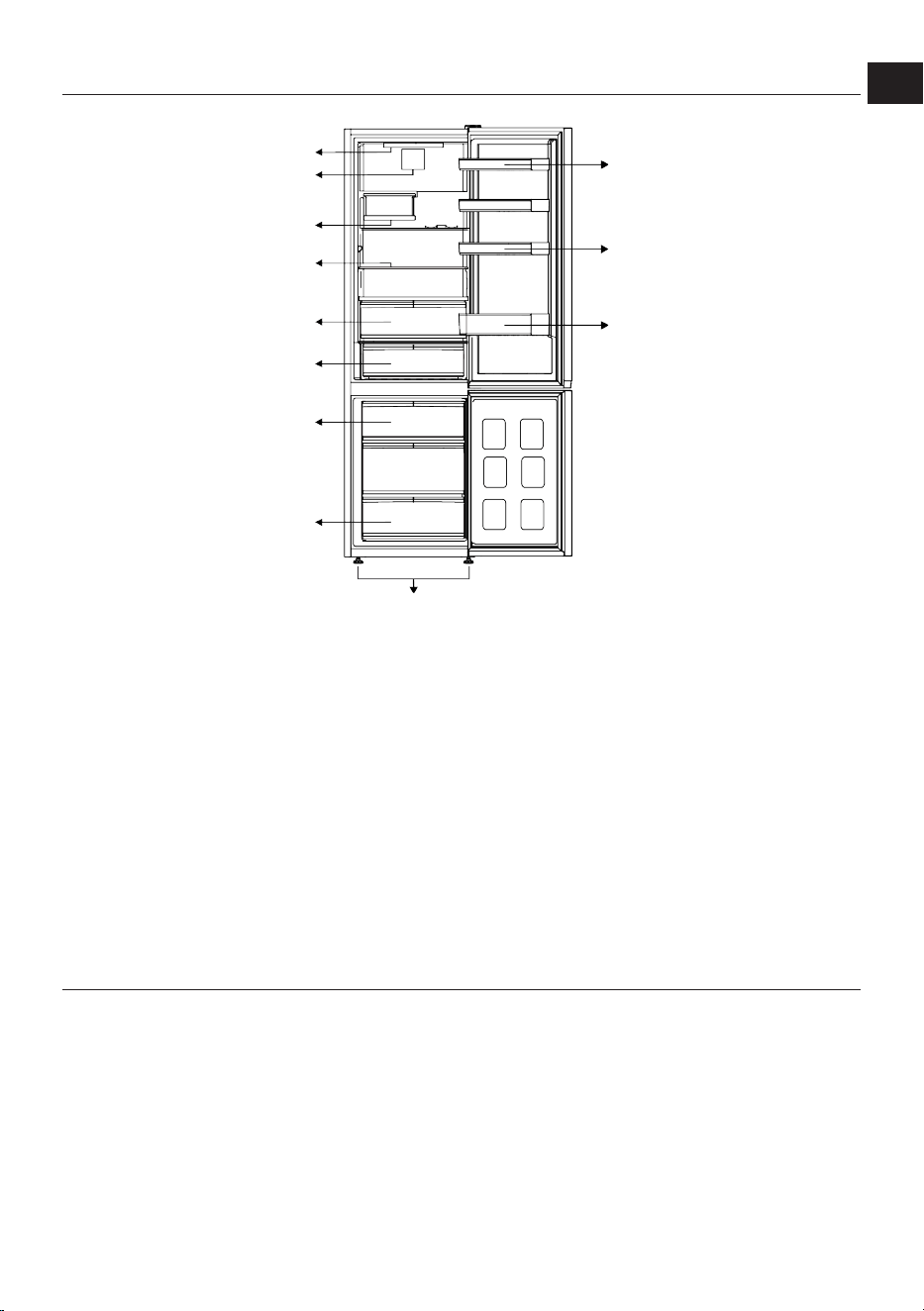
3 Your Refrigerator
1
2
3
4
5
6
7
8
9
10
11
12
1 * Adjustable Door Shelves 2 * Egg Holders
3 * Bottle Shelf 4 * Adjustable Front Legs
5 * Freezer Compartment 6 * Ice Container
7 * Cold Storage Drawer 8 * Cold Storage Drawer
9 * Adjustable Shelves 10 * Foldable Wine Bin
11 * Fan 12 * Illumination Lamp
*Optional: Figures in this user manual are
schematic and may not exactly match your
product. If your product does not comprise
the relevant parts, the information pertains
to other models.
4 Installation
Read the “Safety Instructions” first!
4.1 Right Place For Installation
Contact the Authorized Service for the
product's installation. To prepare the
product for installation, see the information
in the user manual and make sure the elec-
tric and water utilities are as required. If
not, call an electrician and plumber to ar-
range the utilities as necessary.
• Place the product on a flat surface to
avoid vibration
• Place the product at least 30 cm away
from the heater, stove and similar
sources of heat and at least 5 cm away
from electric ovens.
• When placing two coolers in adjacent po-
sition, leave at least 4 cm distance
between the two units.
EN
IT
EN / 16
• Keep the product out of direct sunlight
and in a dry place.
• Your product requires adequate air circu-
lation to function efficiently. If you place
the product in an alcove, remember to
leave at least 5 cm clearance between
the product and the ceiling, rear wall and
the side walls.
• Check if the rear wall clearance protec-
tion component is present at its location
(if provided with the product).
• If the component is not available, or if it
is lost or fallen, position the product so
that at least 5 cm clearance shall be left
between the rear surface of the product
and the wall of the room. The clearance
at the rear is important for efficient oper-
ation of the product.
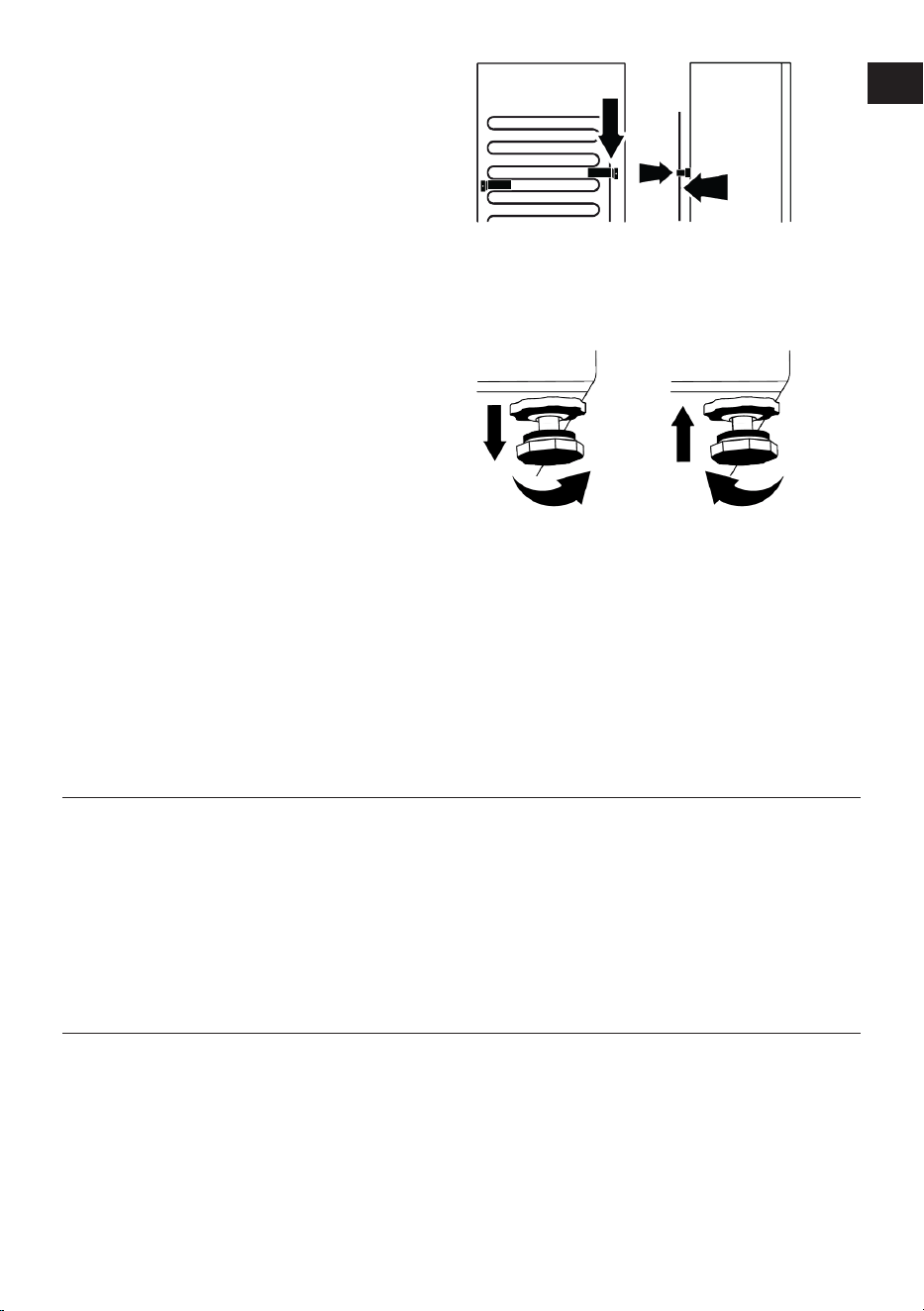
4.2 Attaching the Plastic Wedges
The condenser of the refrigerator is located
at the rear. To minimize power consump-
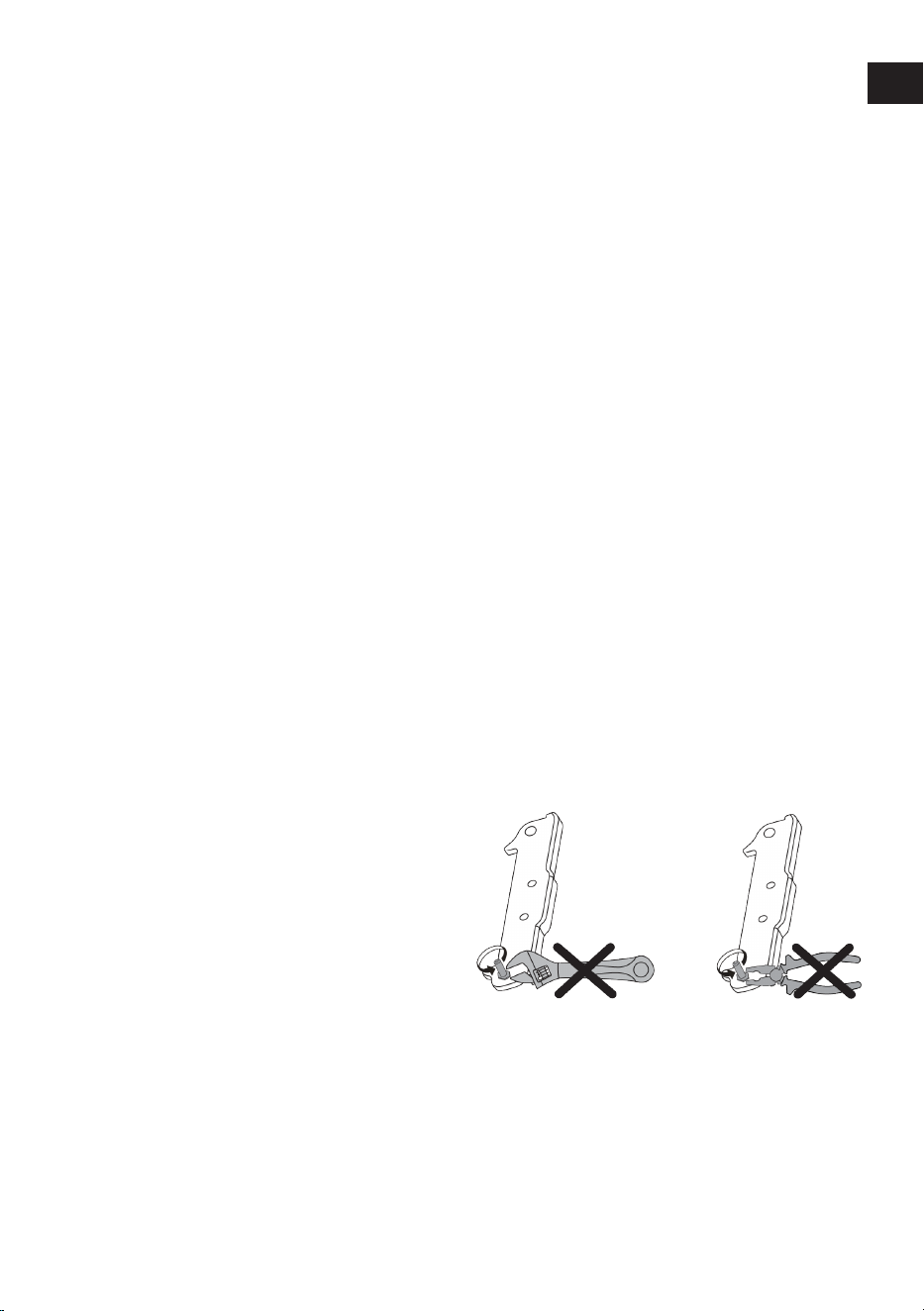
tion and increase energy efficiency the top
and bottom of the condenser must be
pulled back and secured as shown in the
picture. When the condenser is pulled back-
wards, the brackets lock and the con-
denser's position is secured.
4.3 Adjusting the Legs
If the product is not in balanced position,
adjust the front adjustable legs by rotating
them to right or left.
4.4 Hot Surface Warning
The side walls of your product are equipped
with cooler pipes to enhance the cooling
system. High pressure fluid may flow
through these surfaces, and cause hot sur-
faces on the side walls. This is normal and
it does not require servicing.
5 Operating the Product
Read the “Safety Instructions” first!
• The product shall be used for storing
food only.
• Turn off the water valve if you will be
away from home (e.g. at vacation) and
you will not be using the Icematic or the
water dispenser for a long period of time.
Otherwise, water leaks may occur.
Unplugging the Product
• Remove the food to prevent odours,
• Wait for the ice to melt, clean the interior
and let it dry, leave the doors open to
avoid damaging the inner body plastics.
6 Preparation
Read the “Safety Instructions” first!
6.1 What To Do For Energy Saving
• This refrigerating appliance is not inten-
ded to be used as a built in appliance.
• When loading the food, leave enough
space inside the refrigerator to allow suf-
ficient air circulation for cooling.
• Since hot and humid air will not directly
penetrate into your product when the
doors are not opened, your product will
optimize itself in conditions sufficient to
protect your food. Under these circum-
stances, functions and components such
as compressor, fan, heater, defrost, light-
EN
IT
EN / 17
ing, display and so on will operate ac-
cording to the needs by consuming min-
imum energy.
• In case that multiple options are present,
glass shelves must be placed so that the
air outlets at the rear wall are not blocked
and preferably, in a way that air outlets
remain below the glass shelf. This com-
bination may help improving air distribu-
tion and energy efficiency.
• Using the below drawer when storing is
strongly recommended.
• For optimum performance, Quick Freez-
ing can be used (if available), 24 hours
prior to placing fresh foods in the freezer.
• In most cases, 24 hours is enough for the
Quick Freezing function after fresh foods
are placed in the freezer. After some
time, Quick Freezing function will deactiv-
ate automatically.
• When freezing a small amount of food,
Quick Freezing function can be deactiv-
ated after some time to ensure energy
saving.
• Depending on the product’s features; de-
frosting frozen foods in the cooler com-
partment will ensure energy saving and
preserve food quality.
• In order to load the maximum quantity of
food into the freezer compartment of
your refrigerator, the upper drawers
should be taken out and the food should
be placed onto the wire/glass shelves.
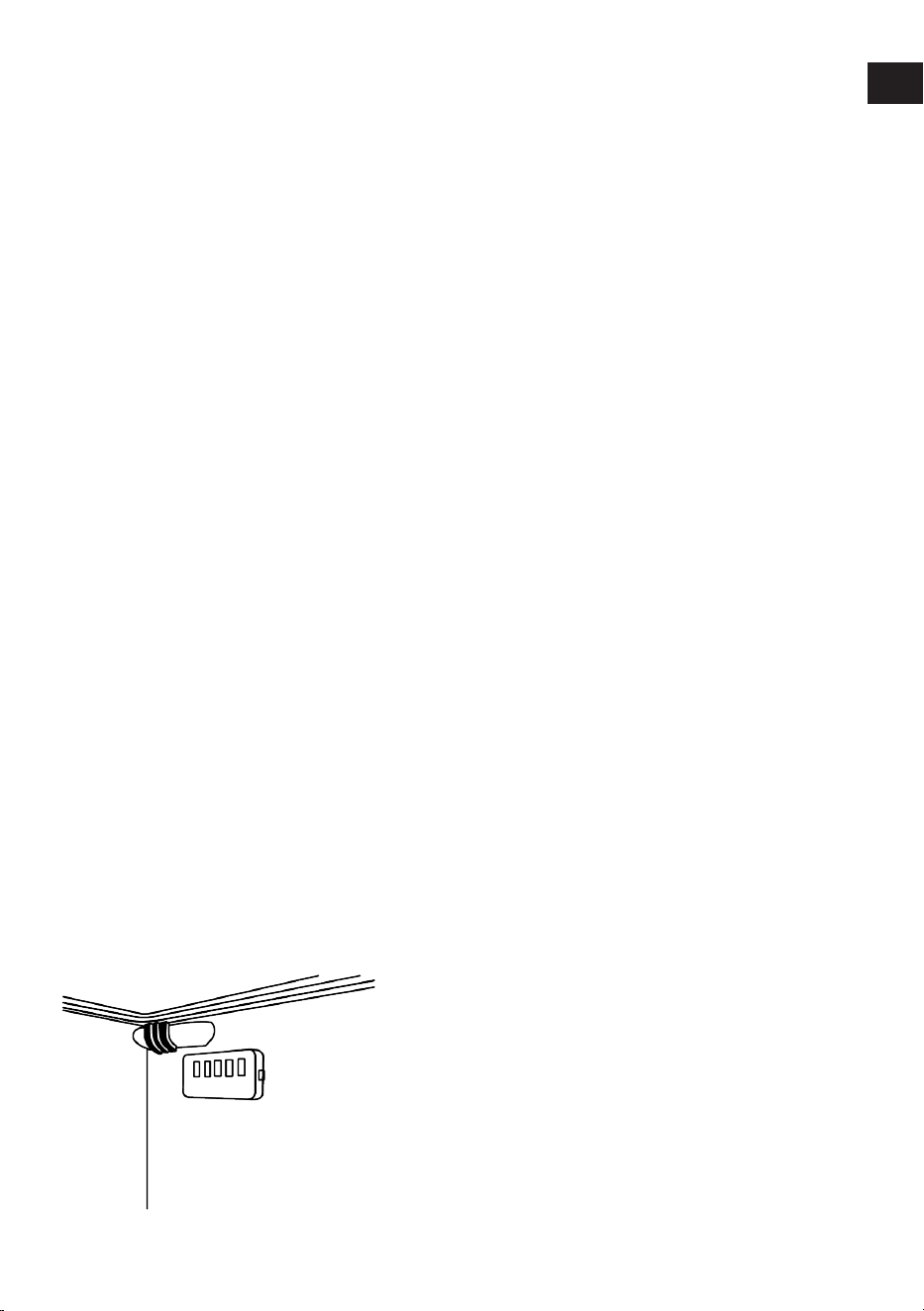
• Place the food as shown below, keeping
a distance from the cooler compartment
temperature sensor. If they are in contact
with the sensor, energy consumption of
the appliance might increase.
• Food shall be stored using the drawers in
the cooler compartment in order to en-
sure energy saving and protect food in
better conditions.
• Food packages shall not be in direct con-
tact with the temperature sensor located
in the freezer compartment.
6.2 First Use
Before using your product make sure the
necessary preparations are made in line
with the instructions in "Safety Instructions"
and "Installation" sections.
• Wait for at least 2 hours before operating
the product, to ensure the complete effi-
ciency of refrigeration.
• Keep the product running without placing
any food inside for 6 hours and the
product door should be kept as closed as
possible.
• The temperature change caused by open-
ing and closing of the door while using
the product may normally lead to con-
densation on door/body shelves and
glassware placed in the product.
• A sound will be heard when the com-
pressor is engaged. It is normal for the
product to make noise even if the com-
pressor is not running, as fluid and gas
may be compressed in the cooling sys-
tem.
• It is normal for the front edges of the
product to be warm. These areas are de-
signed to warm up in order to prevent
condensation
• For some models, indicator panel turns
off automatically 1 minute after the door
closes. It will be reactivated when the
door is opened or any button is pressed.
6.3 Climate Class and Definitions
Please refer to the Climate Class on the rat-
ing plate of your device. One of the follow-
ing information is applicable to your device
according to the Climate Class.
EN
IT
EN / 18
• SN: Long Term Temperate Climate: This
cooling device is designed for use at am-
bient temperatures between 10 °C and 32
°C.
• N: Temperate Climate: This cooling
device is designed for use at ambient
temperatures between 16°C and 32 °C.
• ST: Subtropical Climate: This cooling
device is designed for use at ambient
temperatures between 16°C and 38°C.
• T: Tropical Climate: This cooling device
is designed for use at ambient temperat-
ures between 16°C and 43°C.
7 Use of Your Appliance
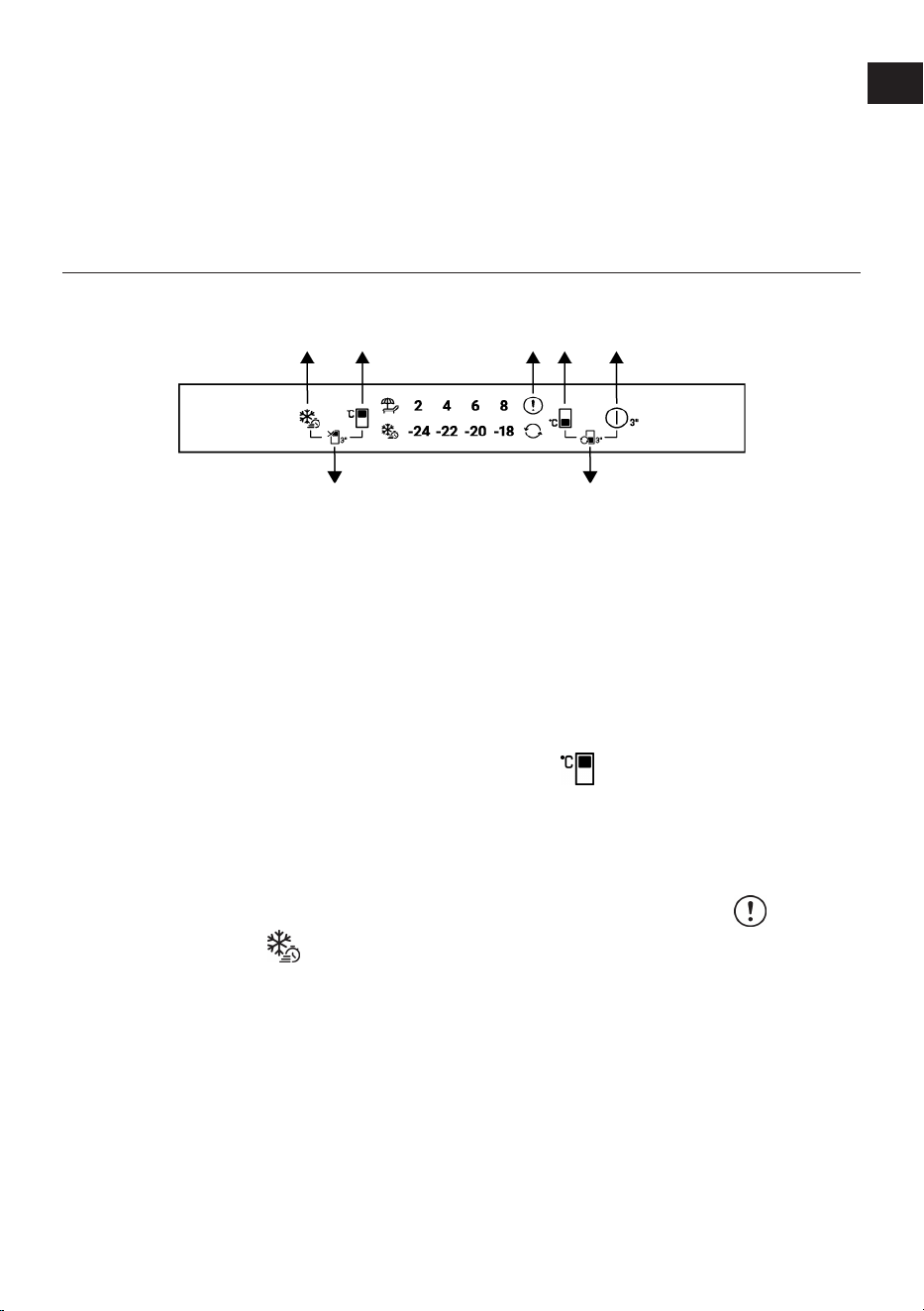
7.1 Control Panel of the Product
1 2
3
4 5
67
1 Quick Freezing Key 2 Cooler Compartment Temperature
Setting Key
3 Error Status Indicator 4 Freezer Compartment Temperature
Setting Key
5 Product Switch Off Button 6 * Compartment Conversion Key
7 * Cooler Compartment Off (Vacation)
Function Key
Read the “Safety Instructions” first!
Auditory and visual functions on the indic-
ator panel will assist you when using the
product.
*Optional: Shown functions are optional,
there may be differences of shape and loc-
ation in functions found on your appliance’s
indicator panel.
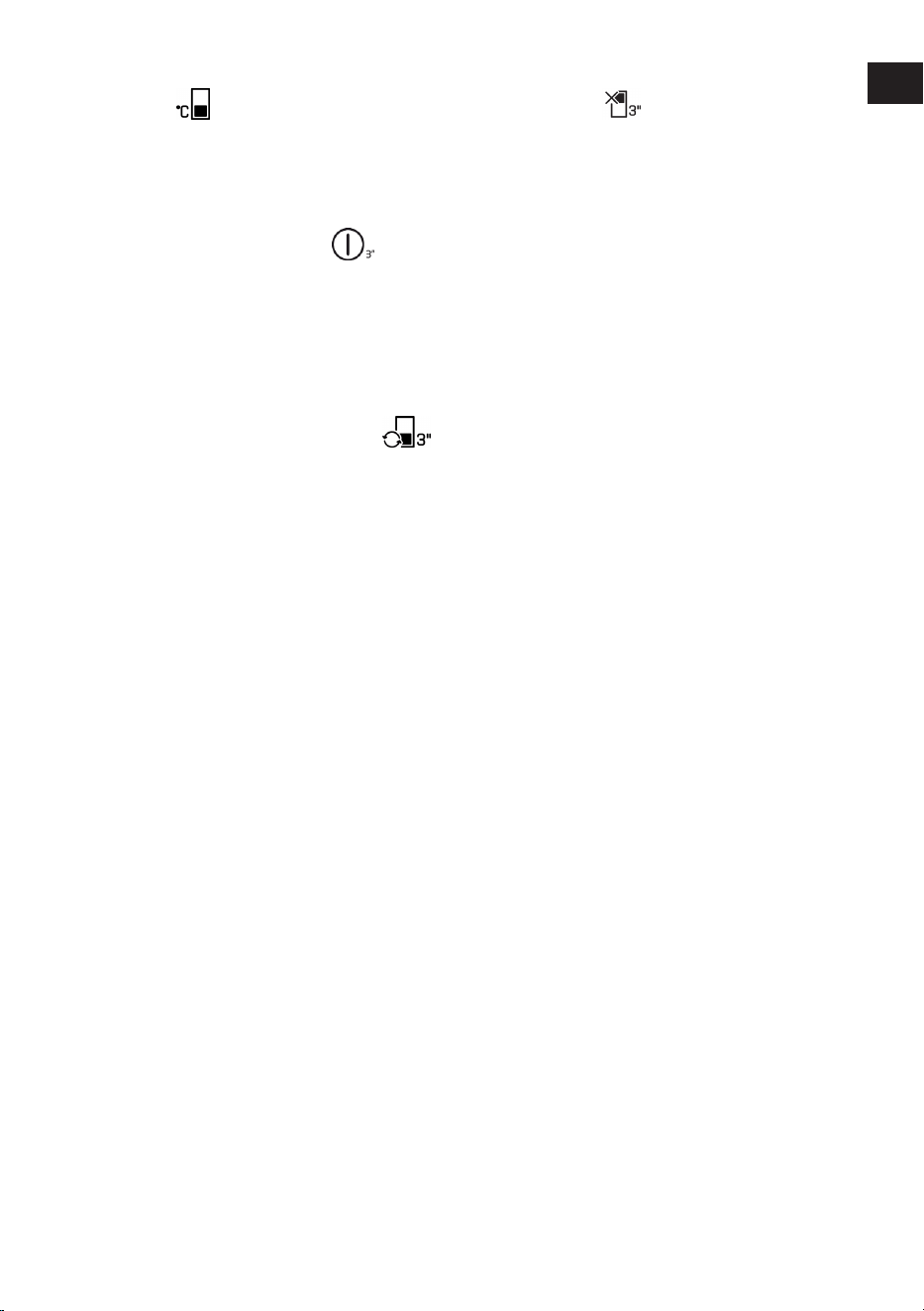
1.Quick Freezing Key
When the quick freezing key is pressed the
quick freezing symbol shall be illuminated
and the quick freezing function shall be ac-
tivated. The freezer compartment temper-
ature is set to -27 °C. Press the key again to
cancel the function. The quick freezing
function shall be automatically cancelled
after a while. To freeze a large amount of
fresh food, press the quick freezing key be-
fore placing the food in the freezer com-
partment.
2.Cooler Compartment Temperature Set-
ting Key
Allows setting of temperature for cooler
compartment. Pressing the key will enable
the cooler compartment temperature
Can be set to 8.6,4.2 °C.
3.Error Condition Indicator
This indicator is enabled when the refriger-
ator is not cooling sufficiently or when a
sensor error occurs. The temperature indic-
ators of the freezer and the refrigerator
flash in certain combinations. This informs
the service about the error that has oc-
curred. Exclamation mark may be displayed
when you load warm food to the freezer
compartment or keep the door open for a
long period of time. This is not a fault, this
warning will be removed when the food is
cooled down or when any key is pressed.
EN
IT
EN / 19
4.Freezer Compartment Temperature
Setting Key
Temperature setting is made for freezer
compartment. The freezer compartment
temperature can be set to -18,-20,-22,-24 °C
by pressing the button.
5.Product Switch Off Button
When this button is pressed for 3 seconds,
the device switches to the off state. In this
state, the refrigerator does not perform
cooling; when the button is pressed again
for 3 seconds, the refrigerator starts its nor-
mal operation.
* 6.Compartment Conversion Key
By pressing the compartment conversion
button for 3 seconds, the freezer compart-
ment can be set as a refrigerator compart-
ment, closed compartment or freezer com-
partment.
When operating as a freezer, the selected
temperature value of the freezer compart-
ment is lit and the conversion symbol is off.
When operating as a refrigerator compart-
ment, all lights for the temperature values
of the freezer compartment are switched
off and the conversion symbol is lit. The
compartment operates as cooler.
When the freezer compartment is switched
off, all lights for the temperature values of
the freezer compartment are switched off
and the conversion symbol is off. For this
selection, no food is stored in the freezer
compartment.
* 7.Cooler Compartment Off (Vacation)
Function Key
Press the key for 3 seconds to activate the
vacation function. Vacation mode is activ-
ated and the vacation symbol is illumin-
ated. All icons on the cooler compartment
temperature indicator turn off and the
cooler compartment does not perform act-
ive cooling. When this function is activated,
you are advised against storing food in the
refrigerating compartment. The other com-
partments continue to cool according to
their set temperature. Press the key for 3
seconds again to cancel this function.
7.1.1 High Temperature Alarm
The refrigerator's display blinks '- -' set val-
ues and sounds an alarm if the freezer
compartment is too warm. This might oc-
cur if the freezer's temperature rises due to
a power failure. The highest temperature in
the freezer compartment is displayed until
any button is pressed. "If the display has an
electronic screen, the maximum actual
temperature reached is displayed." If not,
only '- -' blinks, and sounds are activated.
To deactivate the alarm, press any display
button.
.
The temperature can be set between 1-8°C
for the chiller compartment and between
-24 and -15°C for the freezer compart-
ment. Adjustable temperature values may
vary provided that they are within these
ranges according to product specifica-
tions.
7.2 Storing Food in the Cooler Compartment
Storing Food in the Cooler Compart-
ment
• Compartment temperatures rise promin-
ently if compartment door is opened and
closed frequently and kept open for a
long time, this can reduce the life span of
the food and cause the food to spoil.
• In order not to cause odour and taste
changes, the food should be stored in the
closed containers.
• To achieve a better and homogeneous
cooling, place the food separately in a
way that cold air can wander through
them.
EN
IT
EN / 20
• Provide air flow by leaving a space
between the food and internal wall. If you
lean the food against the rear wall, the
food may freeze.
• Bring cooked hot meals to the room tem-
perature before placing them in the refri-
gerator. Then, you can place the tepid
meal in the lower shelves of your refriger-
ator. Place warm foods away from per-
ishable foods.
• Especially pay attention not to mix the
foods sold as frozen with the fresh
foods.
• Defrost your frozen food in the fresh food
compartment. Thereby, you can cool
fresh food compartment by using frozen
food and save energy.
• Storing unripe tropical fruits (mango,
melon varieties, papaya, banana, pine-
apple) in the refrigerator may speed up
the ripening process. This is not recom-
mended because it will cause shorter
storage time.
• You should store onions, garlics, gingers
and other root vegetables in dark and
cold room conditions, not in the refriger-
ator.
• If you notice that a food has spoiled in
the refrigerator, throw away that food and
clean the accessories which have come
into contact with it.
• In order to cool the meals like soups and
stews, which are cooked in the large
pots, quickly, you can put them in the re-
frigerator by separating them into their
own shallow containers.
• Place unpackaged food away from eggs.
• Keep the fruits and vegetables separately
and store each variety together (for ex-
ample; apples with apples, carrots with
carrots).
• Take green vegetables out of the plastic
bag and place them in the refrigerator
after wrapping them in a paper towel or
drying cloth. If you wash this type of food
before placing them in the refrigerator, re-
member to dry them.
• You can both create a damp environment
and provide an air flow by keeping fruits
and vegetables, which are prone to dry-
ing, in the perforated or unsealed plastic
bags.
• Except the cases where extreme circum-
stances are available in the environment,
if your product (on the recommended set
values table) is set to the specified set
values, the food keep their freshness for
a longer time both in the fresh product
compartment and freezer compartment.
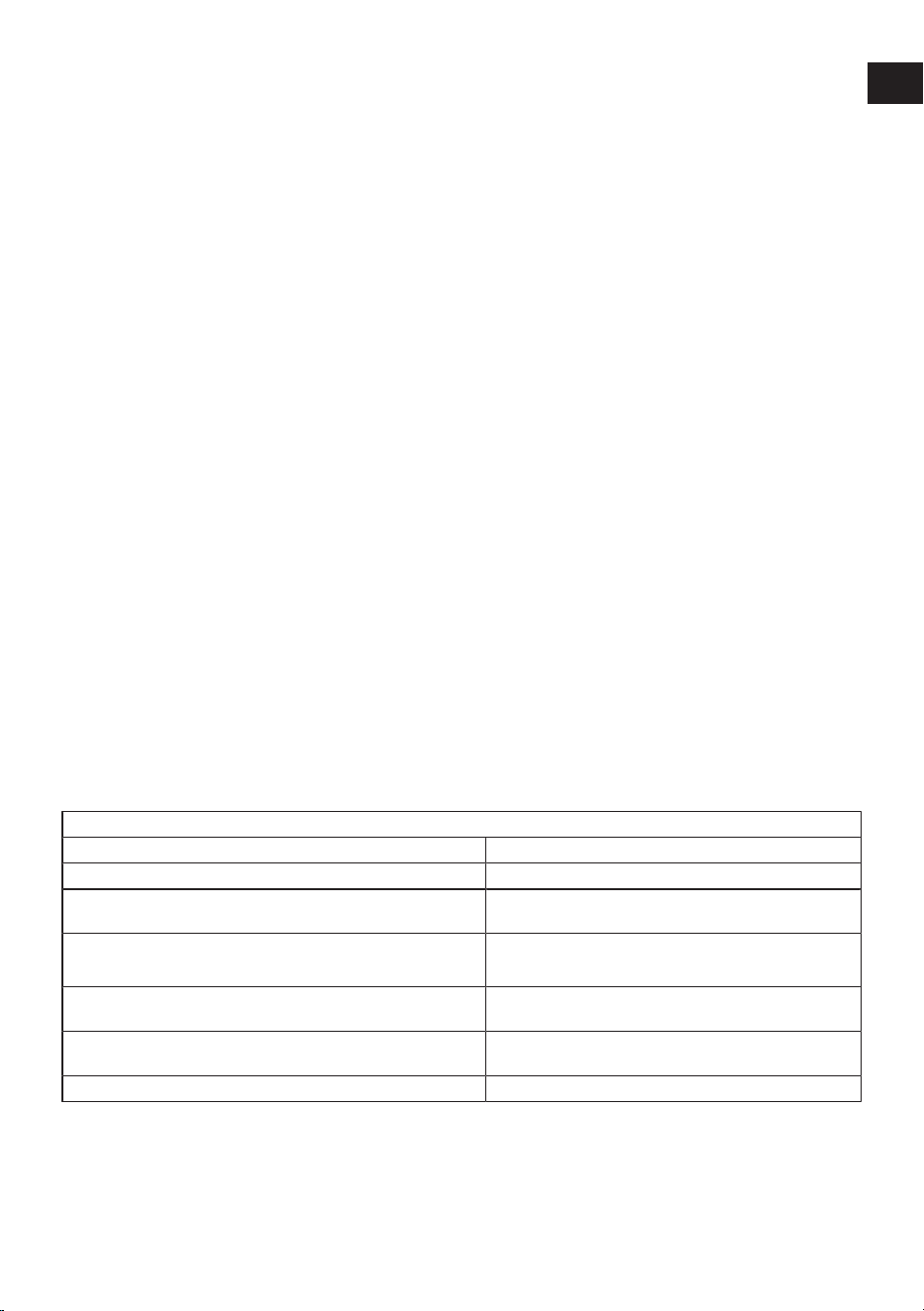
Store Foods In The Different Places According To Their Properties:
Food Location
Egg Door Shelf
Dairy products (butter, cheese)
If available, zero degree (for breakfast food) compart-
ment
Fruits, vegetables and greenery
Fruit-vegetable compartment, crisper or
EverFresh+ compartment (if available)
Fresh meat, poultry, fish, sausage etc. Cooked foods
If available, zero degree (for breakfast food) compart-
ment
Ready to serve foods, packaged products, canned foods and
pickles
Top shelves or door shelf
Beverages, bottles, spices and snacks Door Shelf
Storing Food In The Freezer Compartment
• You can activate Quick Freezing function
4-6 hours before freezing function and
perform a faster cooling.
• Bring hot meals to the room temperature
before placing them in the freezer com-
partment.
EN
IT

EN / 21
• Foods to be frozen must be divided into
portions according to a size to be con-
sumed, and frozen in separate packages.
• It is recommended to pack the foods be-
fore placing them in the freezer.
• In order to prevent expiration of storage
time, write the freezing date, time and
name of the product on the package ac-
cording to the storage times of different
foods.
• Consume the foods you have defrosted
quickly. Defrosted foods cannot be
frozen again unless they are cooked. It is
not safe to consume the refrozen fresh
foods without cooking after they are de-
frosted.
• As you freeze fresh foods, do not bring
them in contact with already frozen
foods. Otherwise, frozen foods will be de-
frosted.
Storing The Foods, Which Are Sold Frozen
• When storing food, follow the time peri-
ods specified in these instructions.
• In order to protect the quality of the food,
keep the time interval between purchas-
ing transaction and storing as short as
possible.
• Buy frozen food which are stored at –18
°C or lower temperatures.
• Avoid buying foods whose packages are
covered with ice etc. This means that the
product could be partially defrosted and
refrozen. Temperature impacts the qual-
ity of the food.
• Store food for manufacturer's recom-
mended time. Remove only the food as
much as you need from the freezer.
• Except the cases where extreme circum-
stances are available in the environment,
if your product (on the recommended set
values table) is set to the specified set
values, the food keep their freshness for
a longer time both in the fresh product
compartment and freezer compartment.
• If fresh food compartment is set to a
lower temperature, fresh fruits and veget-
ables may be partially frozen.
• The two-star compartments are suitable
for pre-frozen food. Ice cream and ice
cubes can be stored.
• Freeze food only in 4-star compartment.
EN
IT
EN / 22
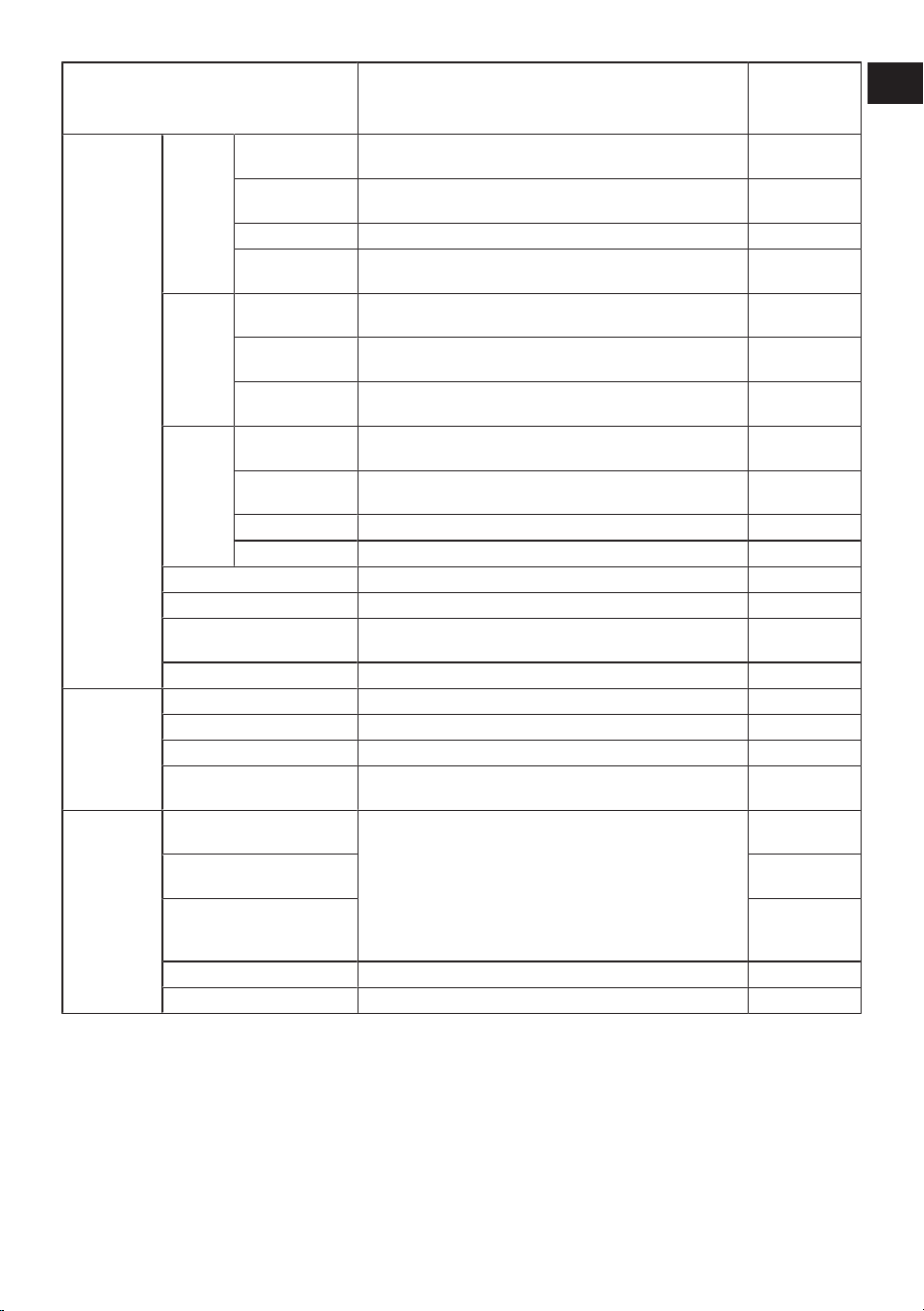
Meat and Fish Preparation
Longest stor-
age time
(month)
Meat
Products
Veal
Steak
By cutting them 2 cm thick and placing foil between
them or wrapping tightly with stretch
6-8
Roast
By packing the pieces of meat in a refrigerator bag or
wrapping them tightly with stretch
6-8
Cubes In small pieces 6-8
Schnitzel, chops
By placing foil between cut slices or wrapping individu-
ally with stretch
6-8
Mutton
Chops
By placing foil between meat pieces or wrapping indi-
vidually with stretch
4-8
Roast
By packing the pieces of meat in a refrigerator bag or
wrapping them tightly with stretch
4-8
Cubes
By packing the shredded meats in a refrigerator bag or
wrapping them tightly with stretch
4-8
Beef
Roast
By packing the pieces of meat in a refrigerator bag or
wrapping them tightly with stretch
8-12
Steak
By cutting them 2 cm thick and placing foil between
them or wrapping tightly with stretch
8-12
Cubes In small pieces 8-12
Boiled meat By packaging in small pieces in a refrigerator bag 8-12
Mince Without seasoning, in flat bags 1-3
Offal (piece) In pieces 1-3
Fermented sausage -
Salami
It should be packaged even if it has casing. 1-3
Ham By placing foil between cut slices 2-3
Poultry and
hunting an-
imals
Chicken and Turkey By wrapping in foil 4-6
Goose By wrapping in foil (portions should not exceed 2.5 kg) 4-6
Duck By wrapping in foil (portions should not exceed 2.5 kg) 4-6
Deer, Rabbit, Roe Deer
By wrapping in foil (portions should not exceed 2.5 kg,
and their bones should be separated)
6-8
Fish and sea-
food
Freshwater fish (Trout,
Carp, Crane, Catfish)
After thoroughly cleaning the inside and scales, it
should be washed and dried, and the tail and head parts
should be cut when necessary.
2
Lean fish (Sea bass, Tur-
bot, Sole)
4-6
Fatty fish (Bonito, Mack-
erel, Bluefish, Red Mullet,
Anchovy)
2-4
Shellfish Cleaned and in bags 4-6
Caviar In its packaging, in an aluminium or plastic container 2-3
"The storage times specified in the table
are based on the storage temperature of
-18°C. "
EN
IT
EN / 23
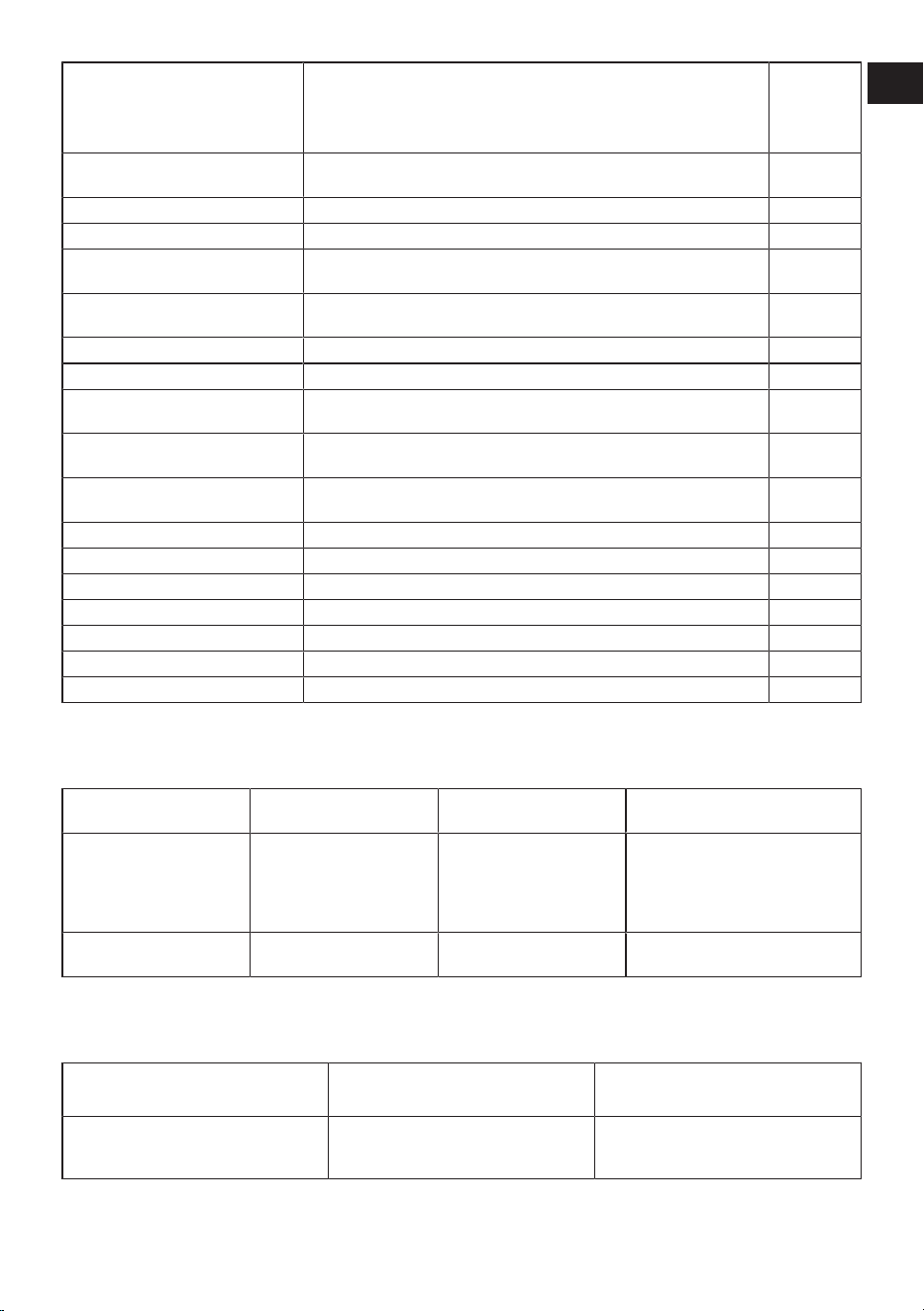
Fruits and Vegetables Preparation
Longest
storage
time
(month)
String bean and Pole bean
By shock boiling for 3 minutes after washing and cutting into small
pieces
10-13
Green pea By shock boiling for 2 minutes after shelling and washing 10-12
Cabbage By shock boiling for 1-2 minute(s) after cleaning 6-8
Carrot
By shock boiling for 3-4 minutes after cleaning and cutting into
slices
12
Pepper
By boiling for 2-3 minutes after cutting the stem, dividing into two
and separating the seeds
8-10
Spinach By shock boiling for 2 minutes after washing and cleaning 6-9
Leek By shock boiling for 5 minutes after chopping 6-8
Cauliflower
By shock boiling in a little lemon water for 3-5 minutes after separ-
ating the leaves, cutting the core into pieces
10-12
Eggplant
By shock boiling for 4 minutes after washing and cutting into 2cm
pieces
10-12
Squash
By shock boiling for 2-3 minutes after washing and cutting into
2cm pieces
8-10
Mushroom By lightly sauteing in oil and squeezing lemon on it 2-3
Corn By cleaning and packing in cob or granular 12
Apple and Pear By shock boiling for 2-3 minutes after peeling and slicing 8-10
Apricot and Peach Divide in half and extract the seeds 4-6
Strawberry and Raspberry By washing and shelling 8-12
Baked fruit By adding 10% sugar in the container 12
Plum, Cherry, Sour Cherry By washing and shelling the stalks 8-12
"The storage times specified in the table
are based on the storage temperature of
-18°C. "
Dairy Products Preparation Longest Storage Time
(Month)
Storage Conditions
Cheese (except feta
cheese)
By placing foil thereb-
etween, in slices
6-8
It can be left in its original pack-
aging for short term storage. For
long-term storage it should also
be wrapped in aluminium or
plastic foil.
Butter, margarine In its own packaging 6
In its own packaging or in plastic
containers
"The storage times specified in the table
are based on the storage temperature of
-18°C. "
"The amount of fresh food that can be
frozen for a certain period of time is spe-
cified on the type label.”
Freezer Compartment
Setting
Cooler Compartment
Setting
Remarks
-22°C 2°C
This is the default, recommended set-
ting. This setting is recommended if
ambient temperature is below 30°C.
EN
IT
EN / 24
Freezer Details
As per the IEC 62552 standards, the freezer
must have the capacity to freeze 4,5 kg of
food items at -18°C or lower temperatures
at 25°C room temperature in 24 hours for
each 100 litres of freezer compartment
volume.
Food products can only be preserved for
extended periods at or below temperature
of -18 °C.
You can keep the foods fresh for months
(in freezer at or below temperatures of -18
°C).
The food products to be frozen must not
contact the already-frozen food inside to
avoid partial defrosting.
Boil the vegetables and filter the water to
extend the frozen storage time. Place the
food in air-tight packages after filtering and
place in the freezer. Bananas, tomatoes,
lettuce, celery, boiled eggs, potatoes and
similar food items should not be frozen. In
case these foods are frozen, only nutri-
tional values and eating qualities will be
negatively affected. A rotting that would
threaten human health is not in question.
Placing The Food
Freezer compartment shelves:Different
frozen foods like meat, fish, ice cream, ve-
getables etc.
Cooler compartment shelves:Food items
inside pots, capped plate and capped
cases, eggs (in closed case)
Cooler compartment door shelves:Small
and packaged food or beverages
Crisper:Vegetables and fruits
Fresh food compartment:Delicatessen
(breakfast food, meat products to be con-
sumed in short time)
7.3 Crisper
The refrigerator's crisper is designed to
keep vegetables fresh by preserving their
humidity. For this purpose, the overall cold
air circulation is intensified in the crisper.
Keep fruits and vegetables in this compart-
ment. Keep the green-leaved vegetables
and fruits separately to prolong their life.
7.4 Dairy Products Cold Storage
Area
Cold Air Storage Compartment
This compartment provides lower temper-
ature inside the refrigerator. Use this bin to
store delicatessen (salami, sausages, dairy
products and etc. ) that requires lower stor-
age temperature or meat, chicken or fish
products for immediate consumption. Do
not store fruits and vegetables inside this
bin.
Cold Storage Drawer
The Cold Storage Drawer can reach lower
temperatures in the cooler compartment.
Use this drawer for delicatessen products
(salami, sausage, etc.) and dairy products
that require colder storage conditions, or
for meat, chicken or fish to be consumed
quickly. It is not suitable to store fruits and
vegetables in this drawer.
7.5 Reversing the Door Opening
Side
The door opening side of your refrigerator
can be reversed according to the place you
put it. For the products that include elec-
tronical display when you need this, you
should definitely call the nearest Author-
ized Service.
7.6 Door Open Alert
The door open alert system of your refriger-
ator may differ depending on the model.
Version 1;
If the door of the product remains open for
a certain time (between 60 s and 120 s), an
audio warning signal sounds; depending on
the product model, a visual warning signal
(light flash) can also be displayed. If you
EN
IT
EN / 25
close the door of the device or press a but-
ton on the screen of the device, if any, the
warning sound will stop.
Version 2;
If the door of the device remains open for a
certain period of time (between 60 s and
120 s), the door open alert is sounded. The
door open alert is sounded gradually. First,
an audible warning starts to sound. After 4
minutes, if the door is still not closed, a
visual warning (lighting flash) is activated.
The door open alert will be delayed for a
certain period of time (between 60 s and
120 s) when any key on the product screen,
if any, is pressed. Then the process will
start again. When the device door is closed,
the door open alert will be cancelled.
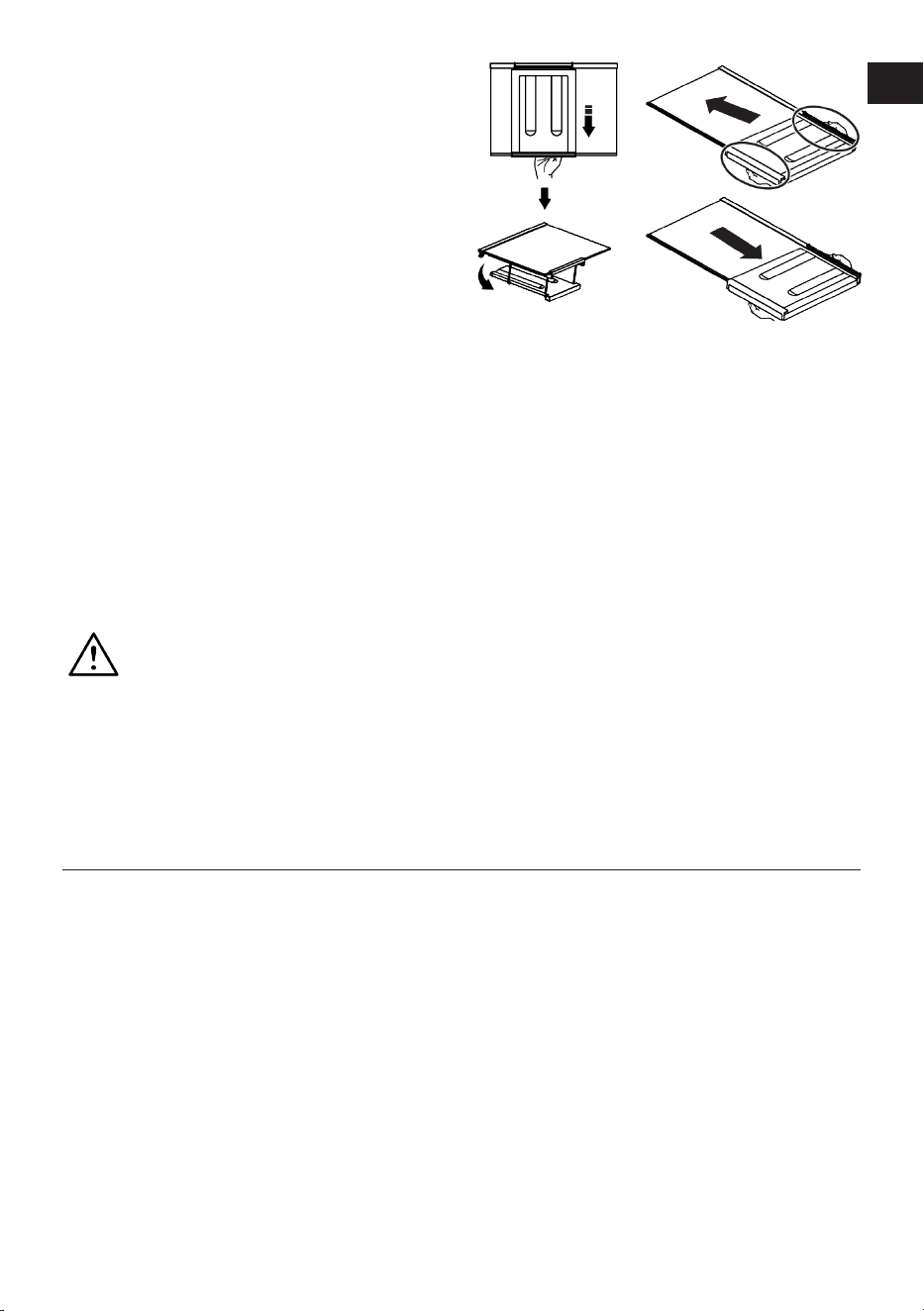
7.7 Foldable Wine Rack
It allows the user to store wine bottles if ne-
cessary. To use the rack section, grasp the
plastic part and gently pull it down. You can
now use the foldable wine rack.
It is recommended to store a max-
imum of 2 wine bottles on the fold-
able wine rack.
To group the wine rack, first remove the
glass shelf from the refrigerator. Place it on
the glass shelf by pushing the plastic part
through the front and back grooves as
shown in the picture. The product will be
ready to use with the foldable wine rack.
To remove the foldable wine rack, first re-
move the glass shelf from the refrigerator.
Then grab the plastic part and pull it in any
direction. You can now use the product
without a foldable wine rack when needed.
7.8 Replacing the Illumination Lamp
Call the Authorized Service when the Bulb/
LED used for lighting in your refrigerator
will be replaced.
Lamp(s) used in this appliance cannot be
used for house lighting. Intended use of
this lamp is to help the user place food into
the refrigerator / freezer safely and com-
fortably.
8 Maintenance and Cleaning
Read the “Safety Instructions” first!
Before cleaning your product, unplug it or
de-energize the fuse to which it is connec-
ted.
Do not place your hands, feet or metal ob-
jects under the refrigerator or between the
refrigerator and the floor for whatsoever
reason. Jamming may occur or any sharp
edge may cause personal injuries.
• Do not use sharp or abrasive tools to
clean the product. Do not use materials
such as household cleaning agents,
soap, detergents, gas, gasoline, thinner,
alcohol, wax, etc.
• The dust shall be removed from the vent-
ilation grill on the rear of the product at
least once a year (without opening the
cover). Clean the product with a dry cloth.
• Take care to keep water away from the
lamp's cover and other electrical parts.
• Clean the door with a damp cloth. Re-
move all contents to remove the door
and body racks. Remove the door racks
by lifting them upwards. Clean and dry
the shelves, then attach back in place by
sliding from above.
EN
IT
EN / 26
• Do not use chlorinated water or cleaning
products on the exterior surface and
chrome coated parts of the product.
Chlorine will cause rust on such metallic
surfaces.
• Do not use sharp and abrasive tools,
soap, house cleaning materials, deter-
gents, gas, gasoline, varnish and similar
substances to prevent deformation of
and removal of prints on the plastic part.
Use warm water and a soft cloth for
cleaning, and then dry it.
• On the products without a No-Frost fea-
ture, water droplets and icing up to a
thickness of a finger may occur on the
rear wall of the cooler compartment. Do
not clean, and never apply oils or similar
materials.
• Use only a mildly dampened micro-fibre
cloth to clean the external surface of the
product. Sponges and other types of
cleaning clothes may cause scratches.
• To clean all removable components dur-
ing the cleaning of the interior surface of
the product, wash these components
with a mild solution consisting of soap,
water and carbonate. Wash and dry thor-
oughly. Prevent contact of water with illu-
mination components and the control
panel.
• Do not use vinegar, rubbing alcohol or
other alcohol based cleaning agents on
any interior surface.
Stainless Steel External Surfaces
Use a non-abrasive stainless steel cleaning
agent and apply it with a soft lint-free cloth.
To polish, gently wipe the surface with a mi-
cro-fibre cloth dampened with water and
use dry polishing chamois. Always follow
the veins of the stainless steel.
Preventing Odours
The product is manufactured free of any
odorous materials. However, inappropri-
ately storing food and improper cleaning of
internal surfaces may lead to odours.
• To avoid this, clean the inside with car-
bonated water every 15 days.
• Keep the foods in sealed holders, as mi-
cro-organisms arising from foods kept in
unsealed containers will cause bad
odour.
• Do not keep expired and spoilt foods in
the refrigerator.
Protecting Plastic Surfaces
Oil spilled on plastic surfaces may damage
the surface and must be cleaned immedi-
ately with warm water.
9 Troubleshooting
Read the “Safety Instructions” first!
Check this list before contacting the ser-
vice. Doing so will save you time and
money. This list includes frequent com-
plaints that are not related to faulty work-
manship or materials. Certain features
mentioned herein may not apply to your
product.
If the problem persists after following the
instructions in this section, contact your
vendor or an Authorized Service. Do not try
to repair the product.
The refrigerator is not working.
• The power plug is not fully settled. >>>
Plug it in to settle completely into the
socket.
• The fuse connected to the socket power-
ing the product or the main fuse is blown.
>>> Check the fuse.
Condensation on the side wall of the
cooler compartment (MULTI ZONE,
COOL CONTROL and FLEXI ZONE).
• The door is opened too frequently. >>>
Take care not to open the product's door
too frequently.
• The environment is too humid. >>> Do
not install the product in humid environ-
ments.
• Foods containing liquids are kept in un-
sealed holders. >>> Keep the foods con-
taining liquids in sealed holders.
EN
IT

EN / 27
• The product's door is left open. >>> Do
not keep the product's door open for long
periods.
• The thermostat is set to a very cool tem-
perature. >>> Set the thermostat to an ap-
propriate temperature.
Compressor is not working.
• In case of sudden power failure or pulling
the power plug off and putting back on,
the gas pressure in the product's cooling
system is not balanced, which triggers
the compressor thermic safeguard. The
product will restart after approximately 6
minutes. If the product does not restart
after this period, contact the service.
• Defrosting is active. >>> This is normal
for a fully-automatic defrosting product.
The defrosting is carried out periodically.
• The product is not plugged in. >>> Make
sure the power cord is plugged in.
• The temperature setting is incorrect. >>>
Select the appropriate temperature set-
ting.
• The power is out. >>> The product will
continue to operate normally once the
power is restored.
The refrigerator's operating noise is in-
creasing while in use.
• The product's operating performance
may vary depending on the ambient tem-
perature variations. This is normal and
not a malfunction.
The refrigerator runs too often or for too
long.
• The new product may be larger than the
previous one. Larger products will run for
longer periods.
• The room temperature may be high. >>>
The product will normally run for long
periods in higher room temperature.
• The product may have been recently
plugged in or a new food item is placed
inside. >>> The product will take longer to
reach the set temperature when recently
plugged in or a new food item is placed
inside. This is normal.
• Large quantities of hot food may have
been recently placed into the product.
>>> Do not place hot food into the
product.
• The doors were opened frequently or
kept open for long periods. >>> The warm
air moving inside will cause the product
to run longer. Do not open the doors too
frequently.
• The freezer or cooler door may be ajar.
>>> Check that the doors are fully closed.
• The product may be set to a temperature
that is too low. >>> Set the temperature
to a higher degree and wait for the
product to reach the adjusted temperat-
ure.
• The cooler or freezer door washer may
be dirty, worn out, broken or not properly
settled. >>> Clean or replace the gasket.
Damaged / torn door washer will cause
the product to run for longer periods to
preserve the current temperature.
The freezer temperature is very low, but
the cooler temperature is adequate.
• The freezer compartment temperature is
set to a very low degree. >>> Set the
freezer compartment temperature to a
higher degree and check again.
The cooler temperature is very low, but
the freezer temperature is adequate.
• The cooler compartment temperature is
set to a very low degree. >>> Set the
cooler compartment temperature to a
higher degree and check again.
The food items kept in cooler compart-
ment drawers are frozen.
• The cooler compartment temperature is
set to a very low degree. >>> Set the
cooler compartment temperature to a
higher degree and check again.
The temperature in the cooler or the
freezer is too high.
• The cooler compartment temperature is
set to a very high degree. >>> Temperat-
ure setting of the cooler compartment
has an effect on the temperature in the
freezer compartment. Wait until the tem-
EN
IT

EN / 28
perature of relevant parts reach the suffi-
cient level by changing the temperature
of cooler or freezer compartments.
• The doors were opened frequently or
kept open for long periods. >>> Do not
open the doors too frequently.
• The door may be ajar. >>> Fully close the
door.
• The product may have been recently
plugged in or a new food item is placed
inside. >>> This is normal. The product
will take longer to reach the set temperat-
ure when recently plugged in or a new
food item is placed inside.
• Large quantities of hot food may have
been recently placed into the product.
>>> Do not place hot food into the
product.
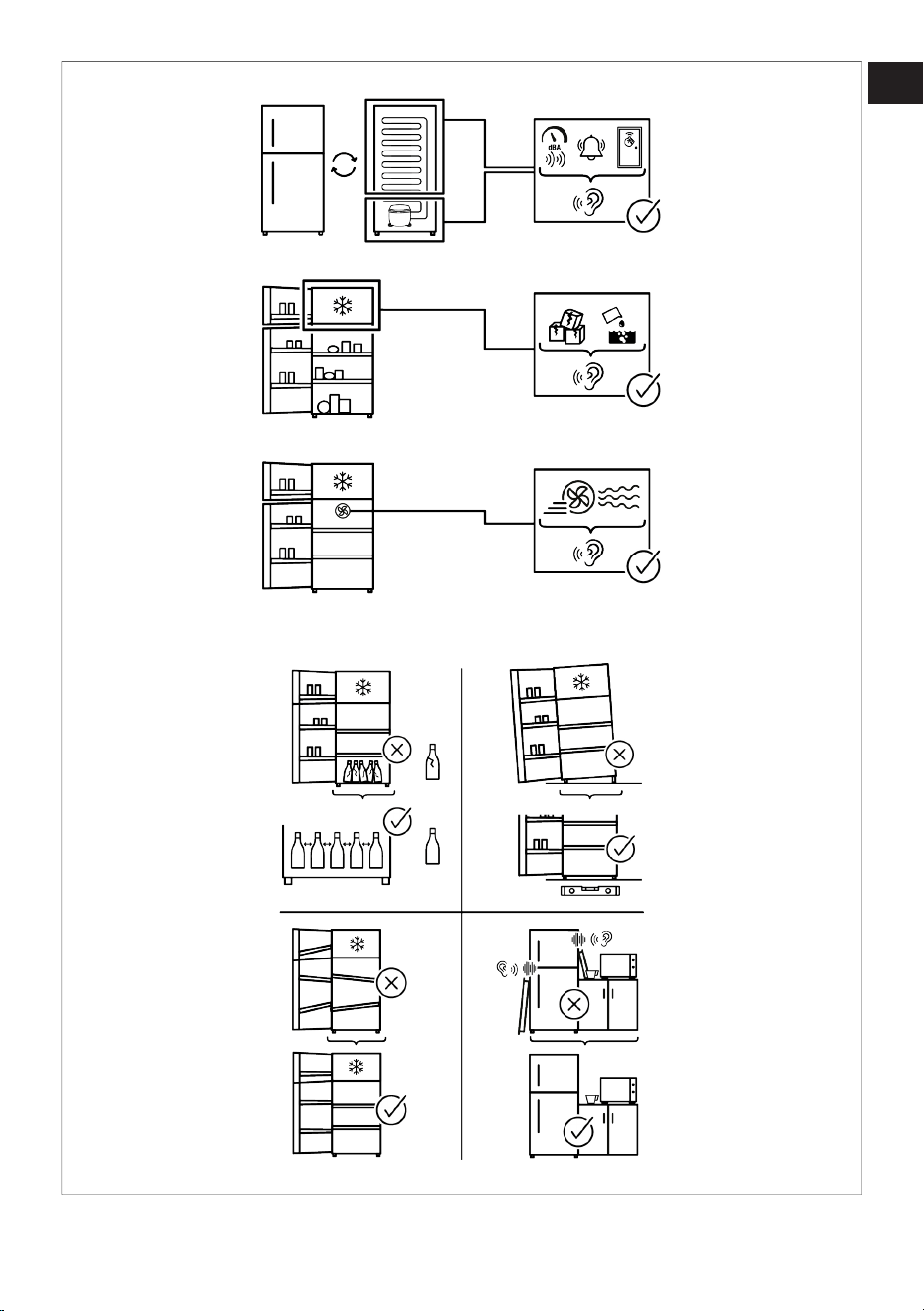
Shaking or noise.
• The surface is not flat or durable >>> If
the product is shaking when moved
slowly, adjust the stands to balance the
product. Also make sure the ground is
sufficiently durable to bear the product.
• Any items placed on the product may
cause noise. >>> Remove any items
placed on the product.
• The product is making noise of liquid
flowing, spraying etc.
• The product's operating principles in-
volve liquid and gas flows. >>> This is
normal and not a malfunction.
There is sound of wind blowing coming
from the product.
• The product uses a fan for the cooling
process. This is normal and not a mal-
function.
There is condensation on the product's
internal walls.
• Hot or humid weather will increase icing
and condensation. This is normal and not
a malfunction.
• The doors were opened frequently or
kept open for long periods. >>> Do not
open the doors too frequently; if open,
close the door.
• The door may be ajar. >>> Fully close the
door.
There is condensation on the product's
exterior or between the doors.
• The ambient weather may be humid, this
is quite normal in humid weather. >>>
The condensation will dissipate when the
humidity is reduced.
The interior smells bad.
• The product is not cleaned regularly. >>>
Clean the interior regularly using sponge,
warm water and carbonated water.
• Certain holders and packaging materials
may cause odour. >>> Use holders and
packaging materials without free of
odour.
• The foods were placed in unsealed hold-
ers. >>> Keep the foods in sealed hold-
ers. Micro-organisms may spread out of
unsealed food items and cause bad
odour.
• Remove any expired or spoilt foods from
the product.
The door is not closing.
• Food packages may be blocking the
door. >>> Relocate any items blocking
the doors.
• The product is not standing in full upright
position on the ground. >>> Adjust the
stands to balance the product.
• The surface is not flat or durable >>>
Make sure the surface is flat and suffi-
ciently durable to bear the product.
The crisper is jammed.
• The food items may be in contact with
the upper section of the drawer. >>> Re-
organize the food items in the drawer.
Temperature on the product surface.
• High temperature may be observed
between two doors, on the side panels
and on the rear grill area while your
product is operated. This is normal and it
does not require servicing.
Fan continues to operate when the door
is opened.
• Fan may continue to operate when the
freezer door is open.
EN
IT

EN / 29
If the problem persists after following the
instructions in this section, contact your
vendor or an Authorized Service. Do not try
to repair the product. This is normal.
EN
IT
EN / 30
EN
IT
EN / 31
Packaging sorting information
Please scan the QR code which places on
the outer packaging of the product to find
all the information relating to the packaging
and how to manage the packaging waste.
DISCLAIMER
Some (simple) failures can be adequately
handled by the end-user without any safety
issue or unsafe use arising, provided that
they are carried out within the limits and in
accordance with the following instructions
(see the “Self-Repair” section).
Therefore, unless otherwise authorized in
the “Self-Repair” section below, repairs
shall be addressed to registered profes-
sional repairers in order to avoid safety is-
sues. A registered Professional repairer is a
professional repairer that has been granted
access to the instructions and spare parts
list of this product by the manufacturer ac-
cording to the methods described in legis-
lative acts pursuant to Directive 2009/125/
EC.
However, only the service agent (i.e.au-
thorized professional repairers) that you
can reach through the phone number given
in the user manual/warranty card or
through your authorized dealer may
provide service under the guarantee terms.
Therefore, please be advised that repairs
by professional repairers (who are not au-
thorized by) Hotpoint shall void the guar-
antee.
Self-Repair
Self-repair can be done by the end-user
with regard exclusively to the following
spare parts:door handles,door hinges, trays,
baskets and door gaskets (an updated list
is also available parts-selfser-
vice.europeanappliances.com as of 1st
March 2021).
Moreover, to ensure product safety and to
prevent risk of serious injury, the mentioned
self-repair shall be done following the in-
structions in the user manual for selfrepair
or which are available in parts-selfser-
vice.europeanappliances.com . For your
safety, unplug the product before attempt-
ing any self-repair.
Repair and repair attempts by end-users for
parts not included in such list and/or not
following the instructions in the user manu-
als for self-repair or which are available in
parts-selfservice.europeanappliances.com,
might give raise to safety issues not attrib-
utable to Hotpoint, and will void the war-
ranty of the product.
Therefore, it is highly recommended that
end-users refrain from the attempt to carry
out repairs falling outside the mentioned
list of spare parts, contacting in such cases
authorized professional repairers or re-
gistered professional repairers. On the con-
trary, such attempts by end-users may
cause safety issues and damage the
product and subsequently cause fire, flood,
electrocution and serious personal injury to
occur.
By way of example, but not limited to,the
following repairs must be addressed to au-
thorized professional repairers or re-
gistered professional repairers:compressor,
cooling circuit, main board,inverter board,
display board, etc.
The manufacturer/seller cannot be held li-
able in any case where end-users do not
comply with the above.
The spare part availability of the refriger-
ator that you purchased is 10 years.During
this period, original spare parts will be avail-
able to operate the refrigerator properly
The minimum duration of guarantee of the
refrigerator that you purchased is 24
months.
This product is equipped with a lighting
source of the "G" energy class.
The lighting source in this product shall
only be replaced by Professional repairer.
EN
IT
IT / 36
Cortesemente leggi prima questo manuale!
Gentile Cliente,
Ti ringraziamo per aver scelto questo prodotto .
Vorremmo che il prodotto, che è stato realizzato con la tecnologia più avanzata, ti possa
offrire l’efficienza ottimale. Per questo, prima di utilizzare il prodotto leggere attentamente
questo manuale e qualsiasi altra documentazione fornita.
Presta particolare attenzione alle informazioni e alle avvertenze contenute nel manuale
utente. In questo modo proteggerai te stesso e il tuo prodotto da possibili pericoli. Conser-
va il manuale utente. Se si dovesse trasferire il prodotto a qualcun altro, non dimenticare di
includere questo manuale.
Nel manuale d’uso e sul prodotto sono utilizzati i seguenti simboli:
Leggi il manuale utente.
Pericolo che potrebbe causare morte o lesioni.
Le informazioni sul modello memorizzate nella banca dati del prodot-
to possono essere ottenute entrando nel seguente sito web e cercan-
do il proprio identificatore di modello (*) che si trova sull'etichetta
energetica.
https://eprel.ec.europa.eu/
IT / 37
Indice
1 Istruzioni di sicurezza .................... 38
1.1 Simboli importanti per la sicurez-
za....................................................
38
1.2 Uso previsto................................... 38
1.3 Sicurezza dei bambini, dei disabili
e degli animali domestici..............
39
1.4 Sicurezza elettrica......................... 39
1.5 Manipolazione in sicurezza .......... 40
1.6 Installazione in sicurezza.............. 41
1.7 Funzionamento in sicurezza......... 44
1.8 Sicurezza nella conservazione
degli alimenti .................................
47
1.9 Manutenzione e pulizia in sicu-
rezza...............................................
48
1.10 Illuminazione ................................. 48
1.11 Smaltimento del vecchio prodot-
to.....................................................
49
2 Istruzioni relative all’ambiente ....... 49
2.1 Conformità con la direttiva WEEE
e con la normativa sullo smalti-
mento dei prodotti di scarico. ......
49
3 Il vostro frigorifero......................... 50
4 Installazione .................................. 51
4.1 Luogo idoneo per l'installazione... 51
4.2 Fissaggio dei cunei in plastica ..... 51
4.3 Regolazione delle gambe.............. 51
4.4 Avvertenza: superficie calda......... 51
5 Funzionamento del prodotto .......... 51
6 Preparazione ................................. 52
6.1 Cosa fare per risparmiare energia 52
6.2 Primo utilizzo................................. 53
6.3 Classe climatica e definizioni....... 53
7 Uso dell'apparecchio ...................... 54
7.1 Pannello di controllo del prodotto 54
7.1.1 Allarme temperatura elevata..... 55
7.2 Conservare il cibo nello scompar-
to frigorifero...................................
55
7.3 Cassetto frutta e verdura.............. 60
7.4 Area di conservazione a freddo
dei prodotti lattiero-caseari ..........
60
7.5 Inversione del lato di apertura
della porta......................................
61
7.6 Avviso di sportello aperto ............. 61
7.7 Ripiano porta-vino pieghevole....... 61
7.8 Sostituzione della lampada........... 61
8 Manutenzione e pulizia .................. 62
9 Guida alla risoluzione dei problemi 63
EN
IT
IT / 38
1 Istruzioni di sicurezza
• Questa sezione include le istru-
zioni sulla sicurezza necessa-
rie per evitare il rischio di lesio-
ni personali e danni materiali.
• La nostra azienda non è da ri-
tenersi responsabile per i dan-
ni causati dall’inosservanza
delle presenti istruzioni.
• Fare sempre eseguire le opera-
zioni di installazione e ripara-
zione dal produttore, dall’assi-
stenza autorizzata o da una
persona che verrà descritta
dalla società importatrice.
• Servirsi unicamente di pezzi di
ricambio e accessori originali.
• Non riparare o sostituire alcun
componente del prodotto a
meno che ciò non venga chia-
ramente specificato nel ma-
nuale utente.
• Non eseguire modifiche sul
prodotto.
1.1 Simboli importanti
per la sicurezza
Rischio di scossa elettrica!
Leggi il manuale utente.
Pericolo che può portare ad
ustioni a causa del contatto con
superfici calde.
Materiale combustibile, av-
vertenza sul rischio di incendio.
Rischio di lesioni a causa del
contatto con superficie affilate!
Rischio di radiazioni UV-C
1.2 Uso previsto
• Questo prodotto non è adatto
all'uso commerciale e non do-
vrebbe essere usato per scopi
diversi da quelli previsti.
• Questo prodotto è destinato ad
ambienti d’uso interni, come le
abitazioni o i luoghi simili.
Ad esempio:
Nelle cucine del personale di ne-
gozi, uffici e altri ambienti di la-
voro,
Nelle cascine,
Nelle unità di alberghi, motel o
altre strutture di riposo utilizzate
dai clienti,
In ostelli o ambienti simili,
Nei servizi di catering e similari,
purché in scenari non retail.
• Questo prodotto non deve es-
sere utilizzato in ambienti
esterni aperti o chiusi, come
navi, camper, balconi o terraz-
ze. L'esposizione del prodotto
a pioggia, neve, luce solare e
vento potrebbe causare rischi
di incendio.
EN
IT
IT / 39
1.3 Sicurezza dei bam-
bini, dei disabili e de-
gli animali domestici
• Questo prodotto può essere
utilizzato da bambini dagli 8
anni in su e da persone con ca-
pacità fisiche, sensoriali o
mentali insufficienti o prive di
esperienza e conoscenza pur-
ché supervisionati o abbiano ri-
cevuto istruzioni sull'uso
dell'apparecchio in modo sicu-
ro e sui relativi pericoli connes-
si.
• I bambini tra i 3 e gli 8 anni so-
no autorizzati a mettere ed
estrarre cibo da/nel prodotto
raffreddato.
• I bambini e gli animali domesti-
ci non devono giocare, salire o
entrare nel prodotto.
• I bambini e gli animali domesti-
ci devono essere tenuti lontani
dalla zona cabina (compresso-
re) dove sono ubicate le parti
elettriche.
• Gli interventi di pulizia e manu-
tenzione non devono essere
eseguiti dai bambini a meno
che sotto la supervisione di
una persona adulta.
• Tenere i materiali di imballag-
gio lontano dalla portata dei
bambini. Pericolo di lesioni e
soffocamento.
• Se la porta del prodotto dispo-
ne di serratura, tenere la chiave
fuori dalla portata dei bambini.
1.4 Sicurezza elettrica
• Durante le operazioni di instal-
lazione, manutenzione, pulizia,
riparazione e trasporto, il pro-
dotto non deve essere collega-
to alla presa di corrente.
• Se il cavo di alimentazione è
danneggiato, deve essere so-
stituito da una persona inviata
dal produttore, dal fornitore di
servizi autorizzato o dall'impor-
tatore per prevenire ogni po-
tenziale pericolo.
• Non infilare il cavo di alimenta-
zione sotto il prodotto o sul re-
tro del prodotto. Non appog-
giare oggetti pesanti sul cavo
di alimentazione. Il cavo di ali-
mentazione non deve essere
piegato, schiacciato e non de-
ve venire a contatto con alcuna
fonte di calore.
• Utilizzare solo un cavo origina-
le. Non utilizzare cavi tagliati o
danneggiati.
• Non utilizzare prolunghe, multi-
ple o adattatori per azionare il
prodotto.
• Le multi prese portatili o gli ali-
mentatori portatili potrebbero
surriscaldarsi e causare incen-
di. Pertanto, non disporre una
EN
IT
IT / 40
presa multipla, fonti di alimen-
tazioni portatili dietro o nelle
vicinanze del prodotto.
• Prima di collegare il prodotto
alla fonte di alimentazione, ri-
muovere il cavo di alimentazio-
ne dal gancio del condensato-
re (se disponibile) durante l'in-
stallazione.
• L'utente non deve poter rag-
giungere le parti elettriche do-
po l'installazione.
• Non inserire il cavo di alimen-
tazione del prodotto in una pre-
sa di corrente allentata o dan-
neggiata. Questi tipi di collega-
menti potrebbero causare sur-
riscaldamento e incendi.
• La spina deve essere facilmen-
te accessibile. Se ciò non è
possibile, sull'impianto elettri-
co deve essere disponibile un
meccanismo che soddisfi la
regolamentazione in materia di
elettricità e che scolleghi tutti i
terminali dalla rete elettrica
(fusibile, interruttore, interrutto-
re principale, ecc.).
• Il prodotto non deve essere uti-
lizzato con un dispositivo di
commutazione esterno come
un timer o un sistema teleco-
mandato.
• Non utilizzare il prodotto quan-
do i piedi sono nudi o il corpo è
bagnato.
• Non toccare la spina con le
mani bagnate.
• Quando si scollega l'apparec-
chio, non farlo per il cavo di ali-
mentazione, ma dalla spina.
• Assicurarsi che la spia non sia
bagnata, sporca o impolverata.
• Non collegare mai il prodotto a
dispositivi di risparmio energe-
tico. Questi sistemi sono dan-
nosi per il prodotto.
1.5 Manipolazione in
sicurezza
• Prima di trasportare il prodot-
to, assicurarsi di scollegare
l'apparecchio.
• Il prodotto è pesante, non ma-
neggiarlo da soli. La caduta del
prodotto potrebbe provocare
lesioni. Non urtare o far cadere
il prodotto durante il trasporto.
• Chiudere sempre le porte e
non tenere il prodotto dalle
porte durante il trasporto.
• Fare attenzione a non danneg-
giare il sistema di raffredda-
mento e le tubazioni durante la
manipolazione del prodotto.
Non azionare il prodotto se i
tubi sono danneggiati e contat-
tare il servizio di assistenza
autorizzato.
EN
IT
IT / 41
1.6 Installazione in si-
curezza
• Per preparare il prodotto
all'uso, consultare le informa-
zioni contenute nel manuale
d’uso e installazione e accer-
tarsi che le utenze elettriche e
idriche siano conformi a quan-
to necessario. In caso contra-
rio, chiamare un elettricista
qualificato e un idraulico per
sistemare le utenze come ne-
cessario.
• Il non rispetto di tali istruzioni
potrebbe aumentare il rischio
di scosse elettriche, incendi,
danni al prodotto o lesioni.
• Prima di iniziare l’installazione,
spegnere il fusibile per togliere
tensione alla linea elettrica a
cui è collegato il prodotto.
• Il prodotto deve essere instal-
lato da due o più persone. Uti-
lizzare guanti protettivi quando
si rimuovere il prodotto dalla
confezione e durante l’installa-
zione.
• Questo prodotto è progettato
per l'uso in aree ad un massi-
mo di 2000 metri sul livello del
mare.
• Tenere i bambini lontani
dall’area di installazione.
• Controllare che non vi siano
danni al prodotto prima di in-
stallarlo. Non far installare il
prodotto se è danneggiato.
• Utilizzare sempre i dispositivi
di protezione individuale
(guanti, ecc.) durante l'installa-
zione, la manutenzione e la ri-
parazione del prodotto. Rischio
di lesioni.
• Non installare o lasciare il pro-
dotto in luoghi in cui può esse-
re esposto a temperature am-
biente esterne.
• Posizionare il prodotto su una
superficie pulita, piana e dura e
bilanciarlo con le gambe rego-
labili (ruotando i piedini ante-
riori a destra o a sinistra). In
caso contrario, il frigorifero po-
trebbe ribaltarsi e causare le-
sioni.
• Procedere con cautela per evi-
tare di danneggiare i pavimenti
(piastrelle, ecc.) durante lo
spostamento del prodotto. In-
stallare il prodotto su un pavi-
mento o fornire un supporto
sufficiente a seconda delle di-
mensioni, del peso e del caso
d'uso del prodotto. Assicurarsi
che il prodotto non sia vicino a
una fonte di calore e che tutti e
quattro i piedini siano stabili e
appoggiati al pavimento. In-
stallare il prodotto come ne-
cessario e assicurarsi che sia
orizzontale, utilizzando una li-
vella a bolla. Per garantire la
completa efficienza del circui-
EN
IT

IT / 42
to refrigerante, attendere alme-
no due ore prima di azionare il
prodotto.
• Il prodotto deve essere instal-
lato in un ambiente asciutto e
ventilato. Non tenere tappeti,
moquette, o coperture simili
sotto il prodotto. In caso con-
trario, la ventilazione inadegua-
ta potrebbe determinare un ri-
schio di incendio!
• Non bloccare o coprire i fori di
ventilazione. In caso contrario,
il consumo di energia aumenta
e il prodotto potrebbe danneg-
giarsi.
• Lasciare spazio sufficiente ai
lati e sopra per garantire una
ventilazione adeguata. Lo spa-
zio tra il pannello posteriore e
la parete dietro il prodotto de-
ve essere di almeno 50 mm
per evitare la formazione di su-
perfici calde. Una riduzione di
questo spazio aumenterà il
consumo energetico del pro-
dotto.
• Quando si posiziona il prodot-
to, assicurarsi che il cavo di ali-
mentazione non sia danneg-
giato o schiacciato.
• Il prodotto non deve essere
collegato a sistemi di alimen-
tazione e fonti di alimentazio-
ne che potrebbero causare
sbalzi di tensione (ad esempio
una fonte di energia solare por-
tatile). In caso contrario, il pro-
dotto potrebbe subire danni a
causa delle brusche fluttuazio-
ni di tensione!
• Più refrigerante contiene un fri-
gorifero, più grande sarà lo
spazio necessario per la sua
installazione. In locali molto
piccoli, in caso di perdita di
gas nel sistema di raffredda-
mento potrebbe verificarsi una
miscela gas-aria infiammabile.
Per ogni 8 grammi di refrige-
rante è necessario almeno 1
m³ di volume. La quantità di re-
frigerante disponibile nel pro-
dotto è specificata nella tar-
ghetta di identificazione.
• Il prodotto non deve mai esse-
re posizionato in modo tale
che i cavi di alimentazione, il
tubo metallico del fornello a
gas, i tubi metallici del gas o
dell'acqua entrino in contatto
con la parete posteriore del
prodotto (o con il condensato-
re).
• Il luogo di installazione del pro-
dotto non dovrà essere espo-
sto alla luce diretta del sole e
non dovrà essere nelle vicinan-
ze di una fonte di calore come
stufe, radiatori, ecc. Se non è
possibile evitare l'installazione
del prodotto in prossimità di
una fonte di calore, utilizzare
una piastra isolante adeguata
EN
IT

IT / 43
e assicurarsi che la distanza
minima dalla fonte di calore
sia quella specificata di segui-
to:
– Almeno 30 cm di distanza
da fonti di calore come stu-
fe, forni, radiatori, riscaldato-
ri, ecc,
– Almeno 5 cm di distanza dai
forni elettrici.
• Il prodotto ha la classe di pro-
tezione I.
• Inserire il prodotto in una presa
con messa a terra conforme ai
valori di tensione, corrente e
frequenza specificati nella tar-
ghetta d’identificazione. La
presa deve avere un fusibile da
10A - 16A. La nostra azienda
non si assumerà alcuna re-
sponsabilità per gli eventuali
danni dovuti ad un uso senza
previa messa a terra e con col-
legamento elettrico non con-
forme alle normative locali e
nazionali.
• Durante l’installazione, il cavo
di alimentazione del prodotto
deve essere scollegato. In ca-
so contrario sussiste il perico-
lo di scosse elettriche e lesio-
ni!
• Non collegare il prodotto a pre-
se allentate, rotte, sporche o
piene di grasso, che fuoriesco-
no dalla mascherina o prese a
contatto con l'acqua. Questi ti-
pi di collegamenti potrebbero
surriscaldarsi e causare incen-
di.
• Collocare il cavo di alimenta-
zione e i tubi flessibili (se di-
sponibili) del prodotto in modo
che non comportino il rischio
di inciampare.
• La penetrazione dell'umidità e
liquidi nelle parti sotto tensio-
ne o nel cavo di alimentazione
potrebbe causare un cortocir-
cuito. Pertanto, non utilizzare il
prodotto in ambienti umidi o in
zone in cui l'acqua possa
schizzare (ad esempio garage,
lavanderia, ecc.) Se il frigorife-
ro viene bagnato dall'acqua,
staccare la spina e contattare
il servizio di assistenza auto-
rizzato.
• Non collegare mai il frigorifero
a dispositivi di risparmio ener-
getico. Questi sistemi sono
dannosi per il prodotto.
• La rimozione del coperchio
della scheda elettronica e del
coperchio posteriore del com-
pressore (se presente) com-
porta il rischio di contatto con
parti elettriche. Non rimuovere
il coperchio della scheda elet-
tronica e il coperchio posterio-
re del compressore (se presen-
te). Sussiste il rischio di elet-
trocuzione!
EN
IT
IT / 44
1.7 Funzionamento in
sicurezza
• Non utilizzare mai solventi chi-
mici sul prodotto. Questi mate-
riali comportano un rischio di
esplosione.
• In caso di guasto del prodotto,
scollegarlo (o togliere tensione
al fusibile a cui è collegato) e
non utilizzarlo finché non viene
riparato dall’assistenza auto-
rizzata. In caso contrario, vi è il
rischio di scossa elettrica!
• Non posizionare fiamme (can-
dele accese, sigarette, ecc.) o
fonti di calore (ferro da stiro,
piano cottura, forno, ecc.) so-
pra o vicino al prodotto. Non
posizionare materiali infiam-
mabili/esplosivi vicino al pro-
dotto...
• Non salire sul prodotto. Perico-
lo di caduta e lesioni!
• Non danneggiare i tubi dell'im-
pianto di raffreddamento con
attrezzi affilati e perforanti. Il
refrigerante spruzzato fuori in
caso di foratura dei tubi del
gas, prolunghe o rivestimenti
superficiali potrebbe causare
irritazione della pelle e lesioni
agli occhi.
• Non intervenire o danneggiare
il circuito del liquido di raffred-
damento. Rischio di esplosio-
ne.
• Non collocare e mettere in fun-
zione apparecchi elettrici all'in-
terno dei frigoriferi/congelato-
re, a meno che non sia stato
consigliato dal produttore.
• Non utilizzare procedure diver-
se da quelle consigliate dal
produttore per accelerare lo
sbrinamento.
• Prestare la dovuta attenzione a
non schiacciare alcuna parte
delle mani o del corpo contro
le parti mobili all'interno del
prodotto. Fare attenzione a
non incastrare le dita tra il fri-
gorifero e la sua porta. Presta-
re attenzione durante l'apertu-
ra o la chiusura della porta in
presenza di bambini.
• Non mettere in bocca gelati,
cubetti di ghiaccio o cibi surge-
lati non appena tolti dal conge-
latore. Pericolo di congelamen-
to!
• Non toccare con le mani ba-
gnate le pareti interne, le parti
metalliche del congelatore o
gli alimenti conservati al suo
interno. Pericolo di congela-
mento!
• Non collocare nello scomparto
congelatore lattine o bottiglie
contenenti liquidi che possono
congelarsi. Lattine o bottiglie
possono esplodere. Pericolo di
lesioni e danni materiali!
EN
IT

IT / 45
• Non utilizzare o collocare ma-
teriali sensibili alla temperatu-
ra come spray infiammabili,
oggetti infiammabili, ghiaccio
secco o altri agenti chimici nel-
le vicinanze del frigorifero. Pe-
ricolo di incendio ed esplosio-
ne!
• Non conservare materiali
esplosivi come bombolette
spray assieme a materiali in-
fiammabili all'interno del pro-
dotto.
• Non collocare lattine aperte
contenenti liquidi sopra il pro-
dotto. Gli spruzzi d'acqua su
una parte elettrica potrebbero
causare scosse elettriche o in-
cendi.
• A causa del rischio di rottura,
non conservare contenitori di
vetro con liquidi all'interno nel
vano congelatore.
• Questo prodotto non è destina-
to allo stoccaggio e al raffred-
damento di medicinali, plasma
sanguigno, preparati o mate-
riali di laboratorio e prodotti si-
mili, soggetti a direttive sui
prodotti medici.
• Se il prodotto viene utilizzato
in modo non conforme alla sua
destinazione, può causare dan-
ni o deterioramento dei prodot-
ti conservati al suo interno.
• Se il frigorifero è dotato di luce
blu, non guardare questa luce
con dispositivi ottici. Non guar-
dare direttamente la luce UV
LED per lungo tempo. I raggi
ultravioletti possono causare
affaticamento visivo.
• Non riempire il prodotto più di
quanto consentito dalla sua
capacità. Non utilizzare proce-
dure diverse da quelle consi-
gliate dal produttore per acce-
lerare lo sbrinamento. Potreb-
bero verificarsi lesioni o danni
se il contenuto del frigorifero
cade quando lo sportello è
aperto. Problemi simili potreb-
bero verificarsi anche quando
un oggetto viene posto sopra il
prodotto.
• Assicurarsi di aver rimosso il
ghiaccio o l'acqua che potreb-
be essere caduta a terra per
evitare lesioni.
• Cambiare la posizione dei ri-
piani/porta bottiglie sulla porta
del frigorifero solo quando i ri-
piani sono vuoti. Pericolo di le-
sioni fisiche!
• Non appoggiare oggetti che
potrebbero cadere/ribaltarsi
sul prodotto. Questi oggetti po-
trebbero cadere durante l'aper-
tura o la chiusura della porta e
causare lesioni e/o danni ma-
teriali.
EN
IT

IT / 46
• Non urtare e non esercitare
una pressione eccessiva sulle
superfici di vetro. La rottura
del vetro potrebbe causare le-
sioni e/o danni materiali.
• Per i prodotti progettati per uti-
lizzare un filtro dell'aria all'in-
terno di una copertura della
ventola accessibile, il filtro de-
ve essere sempre in posizione
quando il frigorifero è in fun-
zione.
• Non bloccare la ventola (se di-
sponibile) con il cibo.
• Le guarnizioni danneggiate de-
vono essere sostituite il prima
possibile.
• Il prodotto potrebbe avere
scomparti speciali (scomparto
per alimenti freschi, scomparto
per temperature zero ecc.) Sal-
vo diversa indicazione nel ma-
nuale pertinente del prodotto,
questi scomparti possono es-
sere rimossi e il prodotto utiliz-
zato con le stesse prestazioni.
• Il sistema di raffreddamento
del prodotto contiene refrige-
rante R600a. Il tipo di refrige-
rante utilizzato nel prodotto è
specificato nella targhetta
d’identificazione. Questo gas è
infiammabile. Pertanto, fare at-
tenzione a non danneggiare il
sistema di raffreddamento e le
tubazioni durante il funziona-
mento del prodotto. In caso di
danni alle tubazioni:
1. Non toccare il prodotto o il
cavo di alimentazione.
2. Tenere il prodotto lontano da
potenziali fonti di calore che
potrebbero causare il surri-
scaldamento e l’incendio del
prodotto.
3. Assicurare la ventilazione
dell'area in cui è collocato il
prodotto. Non utilizzare un
ventilatore.
4. Contattare il servizio di assi-
stenza autorizzato.
Prima di smaltire i vecchi pro-
dotti che non devono più essere
utilizzati:
1. Scollegare il cavo di alimen-
tazione dalla presa di corren-
te.
2. Tagliare il cavo di alimenta-
zione e rimuoverlo dall'appa-
recchio insieme alla spina.
3. Per evitare che i bambini en-
trino nell'apparecchio non ri-
muovere i ripiani e i cassetti
dal prodotto.
4. Rimuovere le porte.
5. Conservare il prodotto in mo-
do da non ribaltarlo.
6. Non permettere ai bambini di
giocare con il prodotto anche
se vecchio e non più utilizza-
to.
EN
IT
IT / 47
7. Se il prodotto è danneggiato
e si osservano perdite di gas,
stare lontani dal gas. Il gas
potrebbe causare congela-
mento se entra in contatto
con la pelle.
• Non smaltire il prodotto get-
tandolo nel fuoco. Pericolo di
esplosione.
• Se la porta del prodotto dispo-
ne di serratura, tenere la chiave
fuori dalla portata dei bambini.
1.8 Sicurezza nella
conservazione degli
alimenti
Per evitare il deterioramento de-
gli alimenti, si prega di prestare
attenzione alle seguenti avver-
tenze:
• Lasciare gli sportelli aperti per
molto tempo potrebbe fare au-
mentare la temperatura all'in-
terno del prodotto.
• Pulire regolarmente i sistemi di
drenaggio accessibili a contat-
to con gli alimenti.
• Pulire i serbatoi d'acqua che
non sono stati usati per 48 ore
e i sistemi d'acqua alimentati
dalla rete che non sono stati
usati per più di 5 giorni.
• Conservare i prodotti crudi di
carne e pesce in scomparti ap-
propriati all'interno del prodot-
to. In tal modo, non sgocciole-
ranno e non entreranno in con-
tatto con altri alimenti.
• Gli scomparti del congelatore
a due stelle sono utilizzati per
conservare gli alimenti precot-
ti, fare e conservare il ghiaccio
e i gelati.
• Gli scomparti a una, due e tre
stelle non sono appropriati per
congelare alimenti freschi.
• Se il congelatore è stato la-
sciato vuoto per molto tempo,
spegnerlo, sbrinare, pulire e
asciugare il prodotto per pro-
teggere il suo alloggiamento.
• Dopo aver sistemato gli ali-
menti, controllare che gli spor-
telli degli scomparti, e in parti-
colare lo sportello del congela-
tore, siano chiusi correttamen-
te.
• Utilizzare lo scomparto frigori-
fero per conservare alimenti
freschi e quello congelatore
per conservare prodotti conge-
lati, congelare alimenti freschi
e preparare cubetti di ghiaccio.
• Non conservare alimenti senza
sigillarli correttamente negli
scomparti frigorifero e conge-
latore, per evitare il contatto di-
retto con le superfici interne.
EN
IT
IT / 48
1.9 Manutenzione e pu-
lizia in sicurezza
• Scollegare il frigorifero o to-
gliere tensione al fusibile pri-
ma di pulirlo o iniziare ad ese-
guire la manutenzione.
• Non tirare dalla porta o dalla
maniglia della porta se si inten-
de spostare il prodotto per pu-
lirlo. La porta può causare le-
sioni se la maniglia viene tirata
con troppa forza.
• Non posizionare mani, piedi o
oggetti metallici sotto o dietro
il prodotto. Si potrebbero verifi-
care inceppamenti o i bordi ta-
glienti potrebbero causare le-
sioni personali.
• Non lavare l'interno o l'esterno
del prodotto con un'idropulitri-
ce, vapore, getti d'acqua o getti
d'acqua. Pericolo di scosse
elettriche e incendi.
• Quando si pulisce il prodotto,
non usare strumenti taglienti e
abrasivi o detergenti domesti-
ci, detersivi, gas, benzina, di-
luente, alcol, vernice e sostan-
ze simili. Utilizzare solo deter-
genti e agenti per la pulizia che
non siano dannosi per gli ali-
menti contenuti nel prodotto.
• Non utilizzare tovaglioli di car-
ta, spugne da cucina o altri
materiali per la pulizia duri.
• Non utilizzare mai detergenti a
vapore o materiali per la pulizia
a vapore per pulire il prodotto e
scongelare il ghiaccio al suo
interno. Il vapore che entra in
contatto con le parti sotto ten-
sione del frigorifero provoca
cortocircuiti o scosse elettri-
che.
• Per accelerare le operazioni di
scongelamento, non utilizzare
attrezzi meccanici o altri uten-
sili diversi da quelli raccoman-
dati dal produttore.
• Tenere l'acqua lontana dai fori
per la ventilazione, dai circuiti
elettronici o dal sistema di illu-
minazione del prodotto. In ca-
so contrario, vi è il rischio di in-
cendio o scossa elettrica.
• Utilizzare un panno pulito e
asciutto per rimuovere la pol-
vere o un qualsiasi materiale
estraneo sulle spine. Non uti-
lizzare un panno umido o ba-
gnato per pulire la spina. In ca-
so contrario, vi è il rischio di in-
cendio o scossa elettrica.
1.10 Illuminazione
Contattare un servizio di assi-
stenza autorizzato quando si de-
ve sostituire il LED/lampadina
utilizzato per l'illuminazione.
EN
IT
IT / 49
1.11 Smaltimento del
vecchio prodotto
Quando smaltisci il tuo vecchio
prodotto segui le istruzioni ripor-
tate di seguito:
• Per evitare che i bambini si
blocchino accidentalmente nel
prodotto, nel caso in cui sia
presente la serratura della por-
ta, disattivarla.
• Gli schizzi di fluido refrigerante
sono pericolosi per gli occhi
Non danneggiare alcuna parte
dell’impianto di raffreddamen-
to durante lo smaltimento del
prodotto.
• Potrebbe essere fatale se l’olio
del compressore venisse inge-
rito o se penetrasse nel tratto
respiratorio.
• L’impianto di raffreddamento
del prodotto include il gas
R600 come specificato nell’eti-
chetta informativa. Questo gas
è infiammabile. Non smaltire il
prodotto gettandolo nel fuoco.
Rischio di esplosione!
• Il C-pentano è utilizzato come
agente espandente nella schiu-
ma isolante ed è una sostanza
infiammabile. Non smaltire il
prodotto gettandolo nel fuoco.
2 Istruzioni relative all’ambiente
2.1 Conformità con la direttiva
WEEE e con la normativa sullo
smaltimento dei prodotti di sca-
rico.
Questo prodotto è conforme al-
la direttiva WEEE dell'UE
(2012/19/EU). Questo prodotto
porta un simbolo di classifica-
zione per la strumentazione
elettrica ed elettronica di scar-
to (WEEE).
Questo simbolo indica che questo prodotto
alla fine della sua vita utile non deve essere
smaltito con altri rifiuti domestici. Il dispo-
sitivo usato deve essere restituito al punto
di raccolta ufficiale per il riciclaggio dei di-
spositivi elettrici ed elettronici. Per trovare
questi sistemi di raccolta si prega di contat-
tare le autorità locali o il rivenditore presso
il quale è stato acquistato il prodotto. Ogni
famiglia svolge un ruolo importante nel re-
cupero e nel riciclaggio di vecchie apparec-
chiature. Un adeguato smaltimento dell'ap-
parecchiatura usata aiuta a prevenire po-
tenziali conseguenze negative per l'ambien-
te e la salute umana.
Conformità con la direttiva RoHS
Il prodotto acquistato è conforme con la Di-
rettiva UE RoHS (2011/65/EU). Non contie-
ne materiali dannosi e proibiti e indicati nel-
la Direttiva.
Informazioni sull'imballaggio
I materiali che compongono l'imbal-
laggio del prodotto sono realizzati a
partire da materiali riciclabili in con-
formità con le nostre Normative
Ambientali Nazionali. Non smaltire i
materiali dell'imballaggio congiun-
tamente ai rifiuti domestici o ad al-
tri rifiuti. Portarli presso i punti di
raccolta imballaggi indicati dalle
autorità locali.
EN
IT
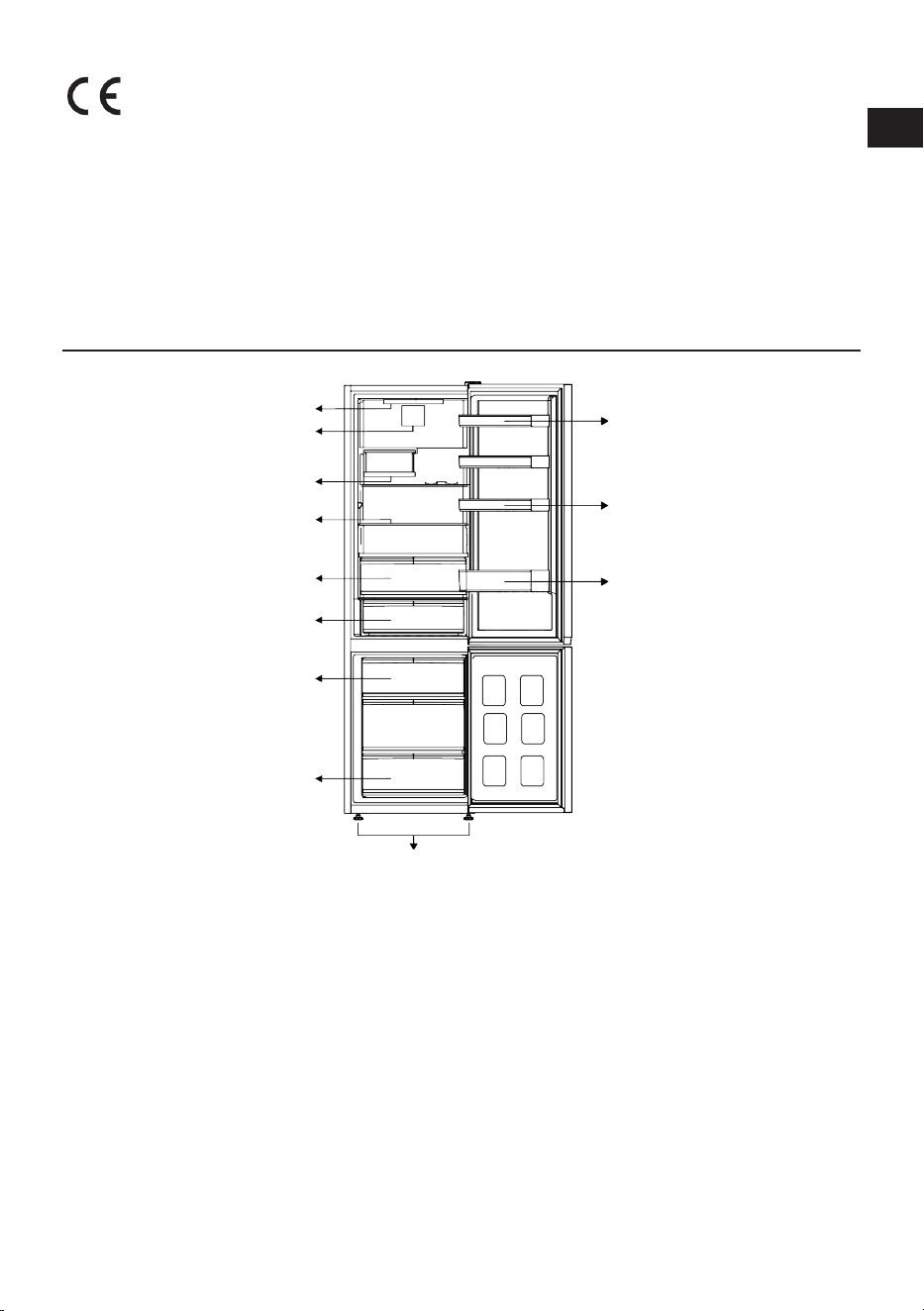
IT / 50
Conformità alle norme e infor-
mazioni sui test / Dichiarazione di
conformità CE
Le fasi di sviluppo, produzione e
vendita di questo prodotto sono
conformi alle norme di sicurezza di
tutte le linee guida pertinenti della
Comunità Europea. 2014/35/UE,
2014/30/UE, 93/68/CE, IEC 60436/
DIN 44990, EN 50242
3 Il vostro frigorifero
1
2
3
4
5
6
7
8
9
10
11
12
1 * Ripiani porta regolabili 2 * Porta uova
3 * Ripiano per bottiglie 4 * Gambe anteriori regolabili
5 * Scomparto congelatore 6 * Contenitore del ghiaccio
7 * Cassetto per la conservazione a
freddo
8 * Cassetto per la conservazione a
freddo
9 * Ripiani regolabili 10 * Cestello porta-vino pieghevole
11 * Ventola 12 * Lampada di illuminazione
*Opzionale: Le figure contenute in questo
manuale d’uso sono schematiche, e potreb-
bero non corrispondere esattamente al pro-
dotto. Qualora il prodotto non contenga le
parti descritte, l'informazione riguarda altri
modelli.
EN
IT
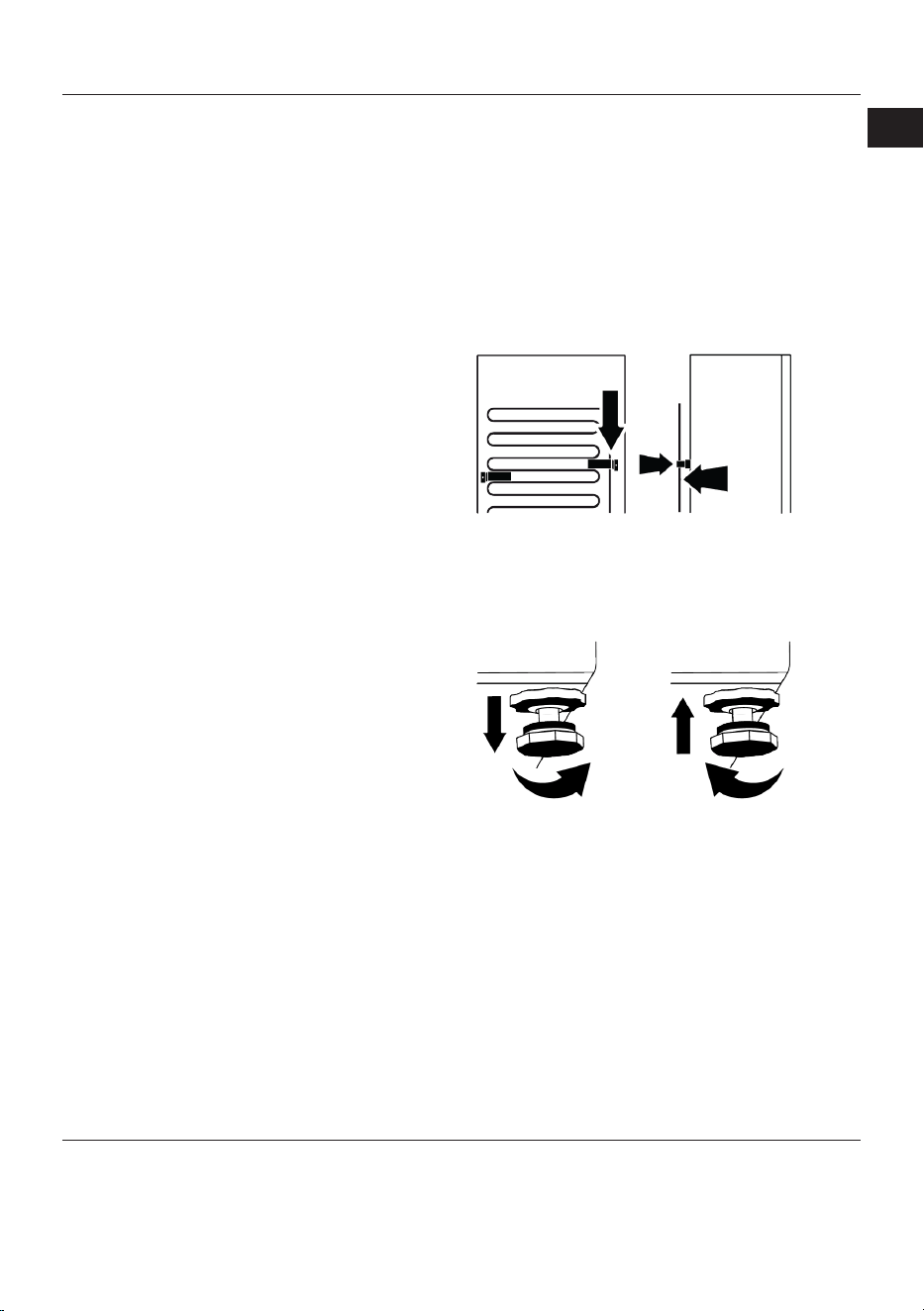
IT / 51
4 Installazione
Leggere prima la sezione "Istruzioni di sicu-
rezza"!
4.1 Luogo idoneo per l'installazione
Rivolgersi al Servizio Autorizzato per l'in-
stallazione del prodotto. Per preparare il
prodotto all'installazione, consultare le in-
formazioni contenute nel manuale utente e
accertarsi che le utenze elettriche e idriche
siano conformi a quanto necessario. In ca-
so contrario, chiamare un elettricista e un
idraulico per sistemare le utenze come ne-
cessario.
• Per evitare vibrazioni, posizionare il pro-
dotto su una superficie piana
• Collocare il prodotto ad almeno 30 cm
dal termosifone, dalla stufa e da altre
fonti di calore e ad almeno 5 cm da even-
tuali forni elettrici.
• Quando vengono posizionati due frigori-
feri l'uno a fianco dell'altro, lasciare una
distanza di almeno 4 cm fra le due unità.
• Conservare il prodotto al riparo dalla luce
solare diretta e in un luogo asciutto.
• Il prodotto necessita di adeguata ventila-
zione per un funzionamento efficiente.
Se il prodotto viene collocato all’interno
di una nicchia, lasciare almeno 5 cm di
spazio tra il prodotto, il soffitto, i muri la-
terali e il muro retrostante.
• Controllare se il componente di protezio-
ne della parete posteriore è presente e
nel suo alloggio (se fornito con il prodot-
to).
• Se il componente non è disponibile, o se
è stato smarrito o è caduto, posizionare il
prodotto in modo tale da lasciare almeno
5 cm di spazio libero tra il retro del pro-
dotto e le pareti del locale. Lo spazio libe-
ro nella parte posteriore è importante per
il funzionamento efficiente del prodotto.
4.2 Fissaggio dei cunei in plastica
Il condensatore del frigorifero si trova sul
retro. Per ridurre il consumo di corrente ed
aumentare l’efficienza energetica, la parte
superiore ed inferiore del condensatore de-
vono essere spinte indietro e fissate come
mostrato nell'immagine. Quando il conden-
satore viene tirato all'indietro, le staffe si
bloccano e il condensatore è correttamente
fissato in posizione.
4.3 Regolazione delle gambe
Qualora il prodotto non fosse in equilibrio,
regolare le gambe anteriori regolabili, ruo-
tandole verso destra o verso sinistra.
4.4 Avvertenza: superficie calda
Le pareti laterali del prodotto sono dotate
di tubi di raffreddamento per migliorare il
sistema generale di raffreddamento. L’ele-
vata pressione del fluido potrebbe fluire at-
traverso queste superfici, causando il ri-
scaldamento eccessivo delle superfici sulle
pareti laterali. Ciò è normale e non richiede
interventi di manutenzione.
5 Funzionamento del prodotto
Leggere prima la sezione "Istruzioni di sicu-
rezza"!
• Il prodotto dovrebbe essere usato unica-
mente per la conservazione di alimenti.
• Spegnere la valvola dell'acqua se si è lon-
tani da casa (ad esempio in vacanza) e si
prevede di non utilizzare la macchinetta
per il ghiaccio o l’erogatore d'acqua per
EN
IT
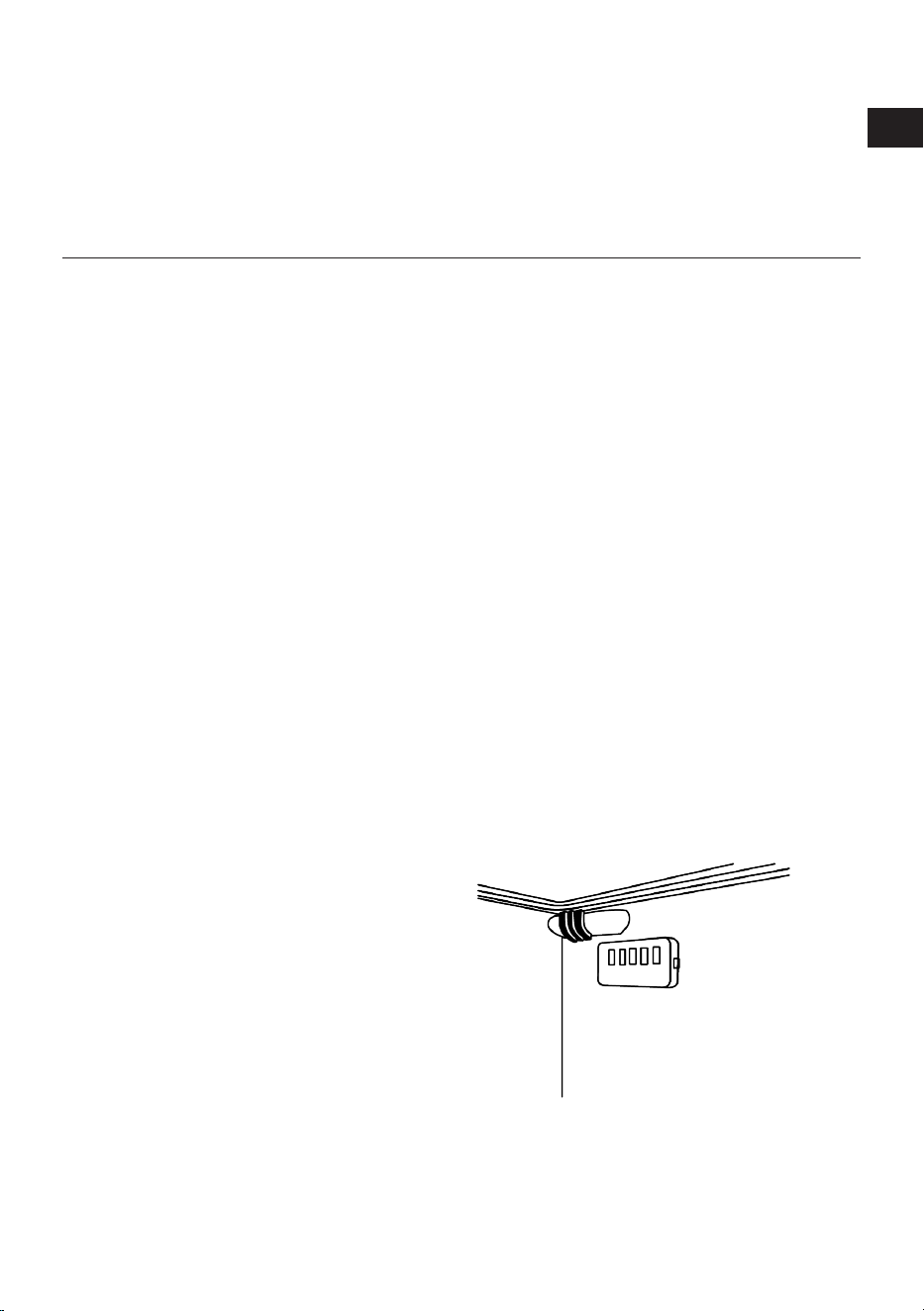
IT / 52
un lungo periodo di tempo. In caso con-
trario, potrebbero verificarsi perdite d'ac-
qua.
Scollegare il prodotto
• Rimuovere gli alimenti per evitare cattivi
odori.
• Aspettare che il ghiaccio si sciolga, pulire
l'interno e lasciarlo asciugare, lasciare le
porte aperte per evitare di danneggiare le
plastiche interne del corpo dell'apparec-
chio.
6 Preparazione
Leggere prima la sezione "Istruzioni di sicu-
rezza"!
6.1 Cosa fare per risparmiare ener-
gia
• Questo apparecchio refrigerante non è
destinato ad essere utilizzato come ap-
parecchio da incasso.
• Quando si caricano gli alimenti, lasciare
uno spazio sufficiente all'interno del fri-
gorifero per consentire una circolazione
d'aria sufficiente per il raffreddamento.
• L'aria calda e umida, non penetrando di-
rettamente nel prodotto quando le porte
non sono aperte, permetterà al prodotto
di ottimizzare la funzione di protezione
degli alimenti. In queste circostanze, fun-
zioni e componenti come il compressore,
la ventola, il riscaldatore, lo sbrinamento,
l'illuminazione, il display e così via funzio-
neranno in base alle esigenze di consu-
mo minimo di energia.
• Nel caso in cui siano presenti più opzioni,
i ripiani in vetro devono essere posiziona-
ti in modo da non bloccare le uscite d'aria
sulla parete posteriore e, preferibilmente,
in modo che le uscite d'aria rimangano al
di sotto del ripiano in vetro. Questa com-
binazione potrebbe aiutare a migliorare la
distribuzione dell'aria e l'efficienza ener-
getica.
• Per la conservazione, si raccomanda vi-
vamente di utilizzare il cassetto sotto-
stante.
• Per prestazioni ottimali, è possibile utiliz-
zare la funzione Congelamento rapido
(se disponibile) 24 ore prima di riporre gli
alimenti freschi nel congelatore.
• Nella maggior parte dei casi, 24 ore sono
sufficienti per la funzione di Congelamen-
to rapido dopo aver inserito gli alimenti
freschi nel congelatore. Dopo un po' di
tempo, la funzione Congelamento rapido
si disattiva automaticamente.
• Quando si congela una piccola quantità
di cibo, la funzione di congelamento rapi-
do può essere disattivata dopo un po' di
tempo per garantire il risparmio energeti-
co.
• A seconda delle caratteristiche del pro-
dotto, lo scongelamento degli alimenti
surgelati nello scomparto raffreddatore
garantirà un risparmio energetico preser-
vando al tempo stesso la qualità degli ali-
menti.
• Per poter caricare la massima quantità di
cibo nello scomparto freezer del frigorife-
ro, i cassetti superiori devono essere
estratti e il cibo deve essere collocato sui
ripiani metallici/in vetro.
• Posizionare gli alimenti come illustrato di
seguito, mantenendo una certa distanza
dal sensore di temperatura dello scom-
parto refrigerante. Il loro contatto con il
sensore potrebbe aumentare, infatti, il
consumo energetico dell'apparecchio.
• Per garantire il risparmio energetico e te-
nere sempre gli alimenti nelle condizioni
migliori, gli alimenti devono essere con-
servati utilizzando i cassetti dello scom-
parto raffreddatore.
EN
IT

IT / 53
• Le confezioni di alimenti non dovranno
essere a diretto contatto con il sensore di
calore situato nello scomparto freezer.
6.2 Primo utilizzo
Prima di utilizzare il prodotto, accertarsi
che siano stati effettuati i preparativi ne-
cessari in linea con le istruzioni riportate
nelle sezioni “Istruzioni di sicurezza” e “In-
stallazione”.
• Attendere almeno 2 ore prima di mettere
in funzione il prodotto, per garantire la
completa efficienza della refrigerazione.
• Mantenere il prodotto in funzione senza
inserire alcun alimento all'interno per 6
ore; lo sportello del prodotto dovrà esse-
re tenuto quanto più possibile chiuso.
• La variazione di temperatura causata
dall'apertura e dalla chiusura della porta
durante l'uso del prodotto potrebbe por-
tare a normale formazione di condensa
sul cibo posto sui ripiani della porta/del
vano frigo e sui contenitori di vetro posti
nel prodotto.
• Si sentirà un suono quando viene attivato
il compressore. È normale che il prodotto
faccia rumore anche se il compressore
non è in funzione, poiché il fluido e il gas
potrebbero essere compressi nel sistema
di raffreddamento.
• È normale che i bordi anteriori del prodot-
to siano caldi. Queste aree sono proget-
tate per riscaldarsi al fine di evitare la for-
mazione di condensa.
• Per alcuni modelli, il pannello indicatore
si spegne automaticamente 1 minuto do-
po la chiusura della porta. Si riattiva
quando la porta è aperta o si preme un
qualsiasi pulsante.
6.3 Classe climatica e definizioni
Si prega di fare riferimento alla classe cli-
matica indicata sulla targhetta del disposi-
tivo. Una delle seguenti informazioni è ap-
plicabile al proprio dispositivo secondo la
classe climatica.
• SN: Clima temperato a lungo termine:
Questo dispositivo di raffreddamento è
progettato per l'uso a temperature am-
biente tra 10 °C e 32 °C.
• N: Clima temperato: Questo dispositivo
di raffreddamento è progettato per l'uso
a temperature ambiente tra 16°C e 32 °C.
• ST: Clima subtropicale: Questo dispositi-
vo di raffreddamento è progettato per
l'uso a temperature ambiente tra 16°C e
38°C.
• T: Clima tropicale: Questo dispositivo di
raffreddamento è progettato per l'uso a
temperature ambiente tra 16°C e 43°C.
EN
IT
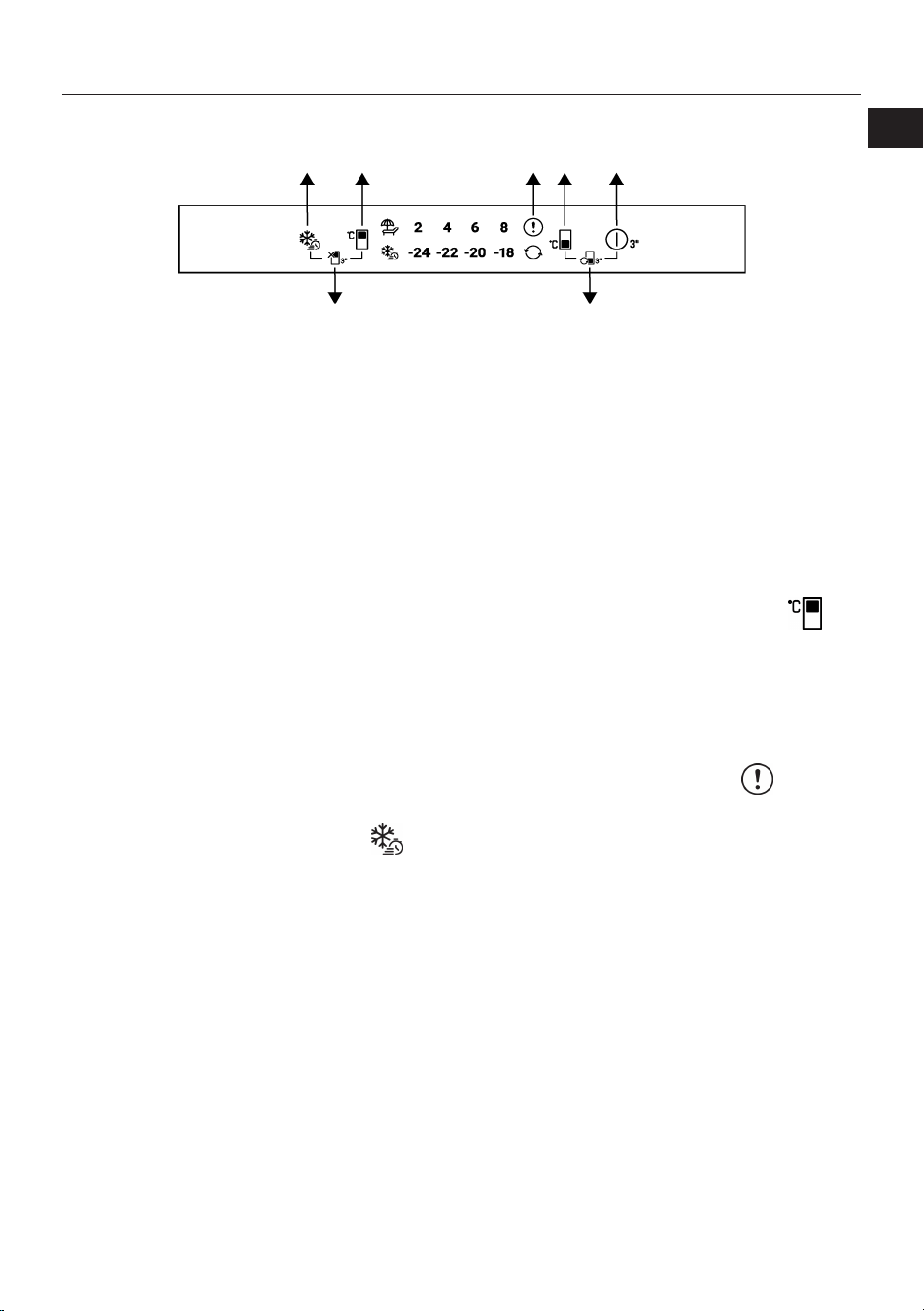
IT / 54
7 Uso dell'apparecchio
7.1 Pannello di controllo del prodotto
1 2
3
4 5
67
1 Tasto di congelamento rapido 2 Tasto di impostazione della tempera-
tura dello scomparto raffreddatore
3 Spia dello stato di errore 4 Tasto di impostazione della tempera-
tura dello scomparto Congelatore
5 Pulsante per lo spegnimento del pro-
dotto
6 * Tasto di conversione dello scom-
parto
7 * Tasto funzione dello scomparto raf-
freddatore Off (Vacanza)
Leggere prima la sezione "Istruzioni di sicu-
rezza"!
Le funzioni audio e video sul pannello indi-
catore assisteranno l’utente nell’utilizzo del
prodotto.
*Opzionale: Le funzioni mostrate sono op-
zionali, ci potrebbero essere differenze di
forma e posizione nelle funzioni che si tro-
vano sul pannello indicatore dell'elettrodo-
mestico.
1. Tasto di congelamento rapido
Quando si preme il tasto di congelamento
rapido, il simbolo del congelamento rapido
() si illumina e si attiva la funzione di con-
gelamento rapido. La temperatura dello
scomparto Congelatore è impostata a -27
°C. Premere nuovamente il tasto per annul-
lare la funzione. La funzione di congela-
mento rapido sarà automaticamente annul-
lata dopo poco. Per congelare grandi quan-
titativi di alimenti freschi, premere il tasto di
congelamento rapido prima di collocare gli
alimenti all'interno dello scomparto conge-
latore.
2.Tasto di impostazione della temperatu-
ra dello scomparto raffreddatore
Per lo scomparto raffreddatore è disponibi-
le l’impostazione della temperatura. Pre-
mendo il tasto si abiliterà la temperatura
dello scomparto raffreddatore
Può essere impostato su 8.6,4.2 °C.
3. Spia condizione di errore
Questo indicatore si attiva quando il frigori-
fero non si raffredda a sufficienza o quan-
do si verifica un errore del sensore. Gli indi-
catori di temperatura del congelatore e del
frigorifero lampeggiano in determinate
combinazioni. Questo informa il personale
addetto alla manutenzione circa l'errore
che si è verificato. Quando si caricano ali-
menti caldi nello scomparto freezer o si tie-
ne aperta la porta per un lungo periodo di
tempo potrebbe visualizzarsi un punto
esclamativo. Non si tratta di un guasto,
questa avvertenza sarà rimossa quando il
cibo viene raffreddato o quando viene pre-
muto un tasto qualsiasi.
EN
IT
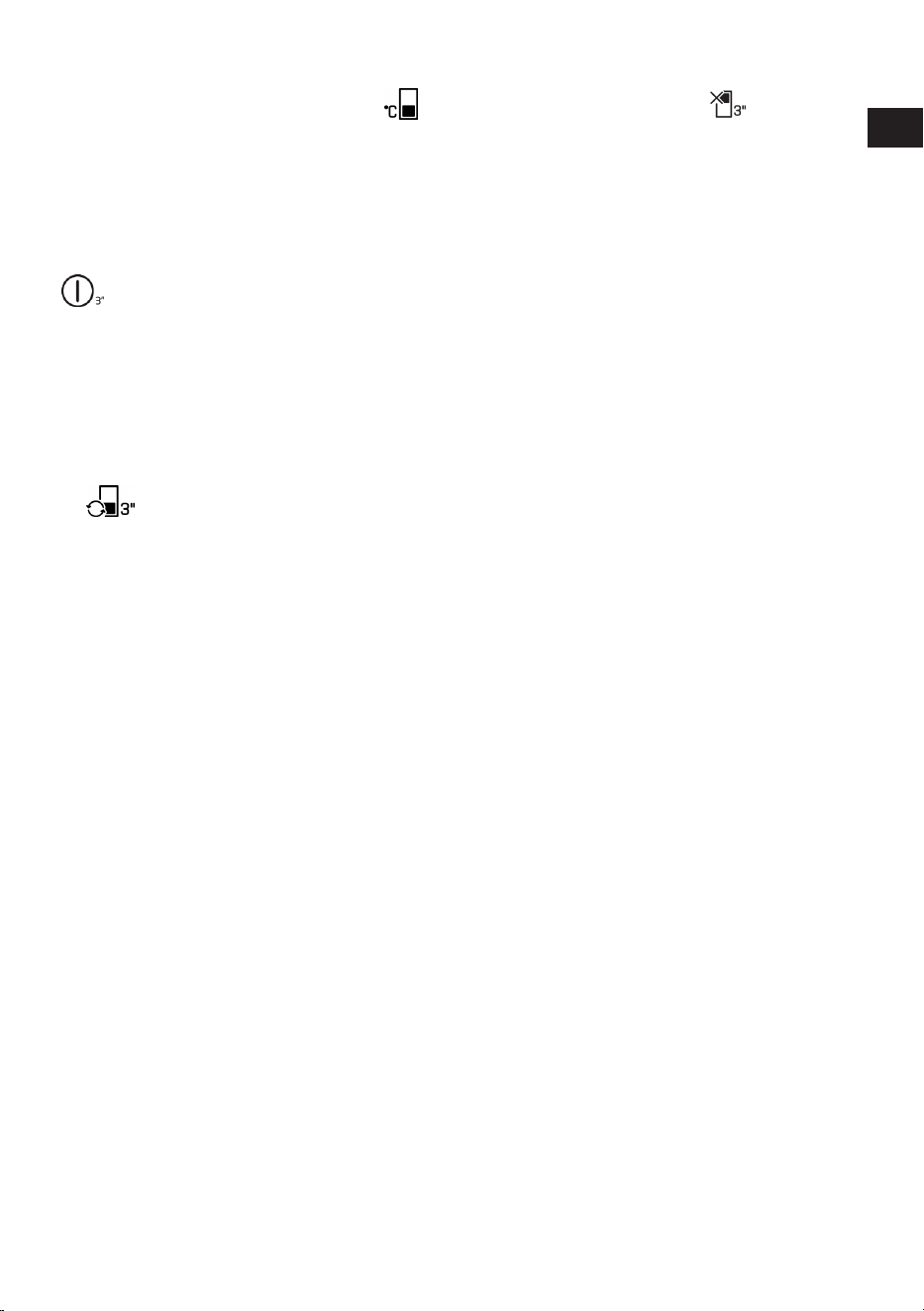
IT / 55
4. Tasto di impostazione della tempera-
tura dello scomparto Congelatore
L'impostazione della temperatura è dispo-
nibile per lo scomparto del congelatore. La
temperatura dello scomparto congelatore
può essere impostata a -18,-20,-22,-24 °C
premendo il pulsante.
5.Pulsante di spegnimento del prodotto
Quando questo pulsante viene premuto per
3 secondi, il dispositivo passa allo stato
spento. In questo stato il frigorifero non
esegue il raffreddamento; premendo nuo-
vamente il tasto per 3 secondi il frigorifero
riprende il suo normale funzionamento.
* 6.Tasto di conversione dello scompar-
to
Premendo per 3 secondi il pulsante di con-
versione dello scomparto, il vano congela-
tore può essere impostato come scompar-
to frigorifero, scomparto chiuso o congela-
tore.
Nel funzionamento come congelatore, il va-
lore di temperatura selezionato del vano
congelatore è acceso e il simbolo di con-
versione è spento.
Nel funzionamento come vano frigorifero
tutte le spie dei valori di temperatura del va-
no congelatore sono spente e il simbolo di
conversione è acceso. Lo scomparto fun-
ziona come raffreddatore.
Quando il vano congelatore è spento, tutte
le spie dei valori di temperatura del vano
congelatore sono spente e il simbolo di
conversione è spento. Per questa selezione
non viene conservato cibo nello scomparto
del congelatore.
* 7.Tasto funzione dello scomparto raf-
freddatore Off (Vacanza)
Per attivare la funzione vacanza premere il
tasto per 3 secondi. Viene attivata la moda-
lità vacanza e il simbolo della vacanza si il-
lumina. Tutte le icone sull'indicatore della
temperatura dello scomparto raffreddato-
re/frigorifero si spengono e lo scomparto
non esegue il raffreddamento attivo. Quan-
do questa funzione è attiva, si sconsiglia di
conservare alimenti nel vano frigorifero. Gli
altri scomparti continuano a raffreddarsi in
base alla temperatura impostata. Per an-
nullare questa funzione, premere di nuovo il
tasto per 3 secondi.
7.1.1 Allarme temperatura elevata
Sul display del frigorifero lampeggiano i va-
lori impostati '- -' e suona un allarme se il
vano congelatore è troppo caldo. Ciò po-
trebbe verificarsi se la temperatura del con-
gelatore aumenta a causa di un'interruzio-
ne di corrente. La temperatura più alta nel
vano congelatore viene visualizzata finché
non sarà premuto un qualsiasi pulsante.
"Se il display è dotato di schermo elettroni-
co, viene visualizzata la temperatura massi-
ma effettiva raggiunta." In caso contrario,
lampeggia solo "- -" e vengono attivati i suo-
ni. Per disattivare l'allarme, premere un pul-
sante qualsiasi del display.
.
La temperatura può essere impostata tra
1-8°C per il vano frigorifero e tra -24 e
-15°C per il vano congelatore. I valori di
temperatura regolabili possono variare a
condizione che siano compresi in questi
intervalli in base alle specifiche del prodot-
to.
7.2 Conservare il cibo nello scomparto frigorifero
Conservare il cibo nello scomparto fri-
gorifero
• Le temperature dello scomparto aumen-
tano notevolmente se la porta dello
scomparto viene aperta e chiusa frequen-
temente e tenuta aperta per molto tem-
po; questo può ridurre la durata degli ali-
menti e causare il loro precoce deteriora-
mento.
• Per non causare cambiamenti di odore e
sapore, gli alimenti dovrebbero essere
conservati in contenitori chiusi.
EN
IT
IT / 56
• Per ottenere un raffreddamento migliore
e omogeneo, disporre gli alimenti separa-
tamente in modo che l'aria fredda possa
attraversarli.
• Garantire il flusso d'aria lasciando uno
spazio tra gli alimenti e la parete interna.
Se gli alimenti vengono appoggiati sulla
parete posteriore potrebbero congelarsi.
• Portare i pasti caldi cotti a temperatura
ambiente prima di metterli in frigorifero.
Quindi, mettere il pasto tiepido nei ripiani
inferiori del frigorifero. Posizionare i cibi
caldi lontano da quelli deperibili.
• In particolare, prestare attenzione a non
mescolare gli alimenti venduti come sur-
gelati con quelli freschi.
• Scongelare gli alimenti congelati nello
scomparto degli alimenti freschi. In que-
sto modo, è possibile raffreddare lo
scomparto degli alimenti freschi utiliz-
zando gli alimenti congelati così da ri-
sparmiare energia.
• Conservare la frutta tropicale acerba
(mango, varietà di melone, papaya, bana-
na, ananas) nel frigorifero potrebbe acce-
lerare il processo di maturazione. Questo
non è consigliabile, perché causa una ri-
duzione dei tempi di conservazione.
• Cipolle, aglio, zenzero e altri ortaggi a ra-
dice dovrebbero essere conservati in
condizioni di buio e freddo, non in frigori-
fero.
• Se si nota che un alimento si è deperito
nel frigorifero, buttare via quell’alimento e
pulire gli accessori che sono entrati in
contatto con esso.
• Per raffreddare rapidamente zuppe e stu-
fati, che sono cucinati in grandi pentole, è
possibile metterli in frigorifero distribuen-
doli in contenitori poco profondi
• Posizionare gli alimenti non confezionati
lontano dalle uova.
• Conservare la frutta e la verdura separa-
tamente e raggruppandola secondo la va-
rietà (per esempio: mele con mele, carote
con carote).
• Togliere le verdure verdi dal sacchetto di
plastica e metterle in frigorifero dopo
averle avvolte in un tovagliolo di carta o
in un panno asciutto. Se prima di metterli
in frigorifero questi alimenti sono stati la-
vati, ricordarsi di asciugarli.
• Per creare un ambiente umido e fornire
un flusso d'aria a frutta e verdura, che so-
no inclini a seccarsi, conservarle nei sac-
chetti di plastica perforati o non sigillati.
• Tranne i casi in cui vi siano delle circo-
stanze ambientali estreme, se il prodotto
(sulla tabella dei valori nominali racco-
mandati) è impostato sui valori nominali
specificati, gli alimenti manterranno la lo-
ro freschezza più a lungo sia nello scom-
parto prodotti freschi che nello scompar-
to congelatore.
Conservare gli alimenti in luoghi diversi a seconda delle loro proprietà:
Alimenti Ubicazione
Uova Ripiano porta
Prodotti caseari (burro, formaggio)
Se disponibile, scomparto a zero gradi (per il cibo del-
la colazione)
Frutta, vegetali e verdura a foglia verde
Scomparto per frutta e verdura, crisper o
Scomparto EverFresh+ (se disponibile)
Carne fresca, pollame, pesce, salsicce, ecc. Cibi cotti
Se disponibile, scomparto a zero gradi (per il cibo del-
la colazione)
Cibi pronti da servire, prodotti confezionati, cibi in scatola e
sottaceti
Ripiani superiori o ripiano della porta
Bevande, bottiglie, spezie e snack Ripiano porta
EN
IT

IT / 57
Conservare il cibo nello scomparto conge-
latore (freezer)
• È possibile attivare la funzione di conge-
lamento rapido 4-6 ore prima della fun-
zione di congelamento ed eseguire così
un raffreddamento più rapido.
• Prima di metterli nello scomparto conge-
latore, portare i pasti caldi a temperatura
ambiente.
• Gli alimenti da congelare vanno suddivisi
in porzioni a seconda della dimensione
da consumare e vanno congelati in pac-
chetti separati.
• Consigliamo di confezionare gli alimenti
prima di riporli all'interno del congelatore.
• Al fine di evitarne la scadenza, annotare
la data, l’ora di congelamento e il nome
dell'alimento sulla confezione, in base ai
periodi di conservazione dei diversi pro-
dotti alimentari.
• Consumare rapidamente gli alimenti che
sono stati scongelati. Gli alimenti scon-
gelati non possono essere ricongelati, a
meno che siano cotti. Non è sicuro con-
sumare i cibi freschi ricongelati senza
cottura dopo che sono stati scongelati.
• Quando vengono congelati alimenti fre-
schi, evitare che gli stessi entrino in con-
tatto con alimenti già congelati. Altrimen-
ti, i cibi congelati si scongeleranno.
Conservare gli alimenti che sono venduti
congelati
• Quando si conservano gli alimenti, atte-
nersi ai tempi indicati nelle presenti istru-
zioni.
• Per proteggere la qualità degli alimenti,
mantenere l'intervallo di tempo tra l'ac-
quisto e la conservazione il più breve
possibile.
• Acquistare gli alimenti congelati che so-
no conservati a -18°C o a temperature in-
feriori.
• Evitare di acquistare alimenti le cui con-
fezioni sono coperte di ghiaccio ecc.
Questo significa che il prodotto potrebbe
essere stato parzialmente scongelato e
ricongelato. La temperatura influisce sul-
la qualità degli alimenti.
• Conservare gli alimenti per il periodo di
tempo consigliato dal produttore. Toglie-
re dal congelatore solo il cibo di cui si ha
bisogno.
• Tranne i casi in cui vi siano delle circo-
stanze ambientali estreme, se il prodotto
(sulla tabella dei valori nominali racco-
mandati) è impostato sui valori nominali
specificati, gli alimenti manterranno la lo-
ro freschezza più a lungo sia nello scom-
parto prodotti freschi che nello scompar-
to congelatore.
• Se lo scomparto degli alimenti freschi è
impostato su una temperatura più bassa,
la frutta e la verdura fresche potrebbero
subire il parziale congelamento.
• Gli scomparti a due stelle sono adatti per
gli alimenti pre-congelati. Al loro interno
sarà possibile conservare gelato e cubet-
ti di ghiaccio.
• Congelare gli alimenti solo nello scom-
parto a 4 stelle.
EN
IT
IT / 58
Carne e pesce Preparazione
Tempo di con-
servazione più
lungo
(mese)
Prodotti di
carne
Vitello
Bistecca
Tagliandoli con uno spessore di 2 cm e ponendo tra di
loro della pellicola o avvolgendoli strettamente con un
elastico
6-8
Arrosto
Confezionando i pezzi di carne in un sacchetto da frigo-
rifero oppure avvolgendoli strettamente con un elastico
6-8
Cubetti A pezzettini 6-8
Cotolette, bra-
ciole
Mettendo della pellicola tra le fette tagliate o avvolgen-
do singolarmente con un elastico
6-8
Carne di
montone
Braciole
Mettendo della pellicola tra i pezzi di carne o avvolgen-
do singolarmente con un elastico
4-8
Arrosto
Confezionando i pezzi di carne in un sacchetto da frigo-
rifero oppure avvolgendoli strettamente con un elastico
4-8
Cubetti
Confezionando la carne sminuzzata in un sacchetto da
frigorifero oppure avvolgendoli strettamente con un ela-
stico
4-8
Manzo
Arrosto
Confezionando i pezzi di carne in un sacchetto da frigo-
rifero oppure avvolgendoli strettamente con un elastico
8-12
Bistecca
Tagliandoli con uno spessore di 2 cm e ponendo tra di
loro della pellicola o avvolgendoli strettamente con un
elastico
8-12
Cubetti A pezzettini 8-12
Carne bollita
Confezionando i pezzettini in un sacchettino da frigori-
fero
8-12
Macinato Senza condimento, in sacchettini piatti 1-3
Frattaglie (pezzi) A pezzi 1-3
Salsiccia fermentata - Sala-
me
Deve essere confezionato anche se ha il budello. 1-3
Prosciutto Mettendo della pellicola tra le fettine tagliate 2-3
Pollame e
animali da
caccia
Pollo e tacchino Avvolgendo con pellicola 4-6
Oca
Avvolgendo con pellicola (le porzioni non dovrebbero
superare i 2,5 kg)
4-6
Anatra
Avvolgendo con pellicola (le porzioni non dovrebbero
superare i 2,5 kg)
4-6
Cervo, coniglio, capriolo
Avvolgendo con pellicola (le porzioni non dovrebbero
superare i 2,5 kg, e le ossa dovrebbero essere conserva-
te separatamente)
6-8
Pesce e frutti
di mare
Pesce d'acqua dolce (Tro-
ta, Carpa, Gru, Pesce gatto)
Dopo aver pulito in modo accurato l'interno e le squa-
me, deve essere lavato e asciugato, e le parti della coda
e della testa vanno tagliate all’occorrenza.
2
Pesce magro (Branzino,
Rombo, Sogliola)
4-6
Pesce grasso (Bonito,
Sgombro, Pesce azzurro,
Triglia, Acciuga)
2-4
Crostacei Puliti e in sacchetti 4-6
Caviale
Nella sua confezione, in un contenitore di alluminio o di
plastica
2-3
EN
IT
IT / 59
"I tempi di conservazione indicati nella ta-
bella si basano sulla temperatura di conser-
vazione di -18°C. "
Frutta e verdura Preparazione
Tempo di
conserva-
zione più
lungo
(mese)
Fagiolini e fagioli di Spagna Sbollentare per 3 minuti dopo il lavaggio e il taglio in piccoli pezzi 10-13
Piselli verdi Bollire per 2 minuti dopo averli sgranati e lavati 10-12
Cavoli Bollire per 1-2 minuti dopo averli puliti 6-8
Carote Sbollentare per 3-4 minuti dopo la pulizia e il taglio a fette 12
Peperoni
Bollire per 2-3 secondi dopo aver tagliato lo stelo, suddividere in
due e togliere i semi
8-10
Spinaci Sbollentare per 2 minuti dopo il lavaggio e la pulizia 6-9
Porri Sbollentare per 5 minuti dopo il taglio a pezzi 6-8
Cavolfiore
Sbollentare in un po' di acqua e limone per 3-5 minuti dopo aver se-
parato le foglie, tagliando il torsolo a pezzi
10-12
Melanzana
Sbollentare per 4 minuti dopo il lavaggio e il taglio a pezzettini da
2cm
10-12
Belleville di zucca
Dopo averli lavati e tagliati a pezzi di 2 cm, sbollentare per 2-3 mi-
nuti.
8-10
Funghi Saltare delicatamente in olio e spruzzare del limone 2-3
Mais Pulire o confezionare come pannocchia o in forma granulare 12
Mele e pere Sbollentare per 2-3 minuti dopo averle sbucciate e tagliate a fette 8-10
Albicocca e pesca Dividere a metà ed estrarre i semi 4-6
Fragola e lampone Per lavare e sgusciare 8-12
Frutta al forno Aggiungere il 10% di zucchero al contenitore 12
Prugne, ciliegie, amarene Per lavare e sgusciare i gambi 8-12
"I tempi di conservazione indicati nella ta-
bella si basano sulla temperatura di conser-
vazione di -18°C. "
Prodotti lattiero-caseari Preparazione Tempo di conservazione
più lungo (mese)
Condizioni di conservazione
Formaggio (eccetto la fe-
ta)
Mettendo della pellicola
tra le fettine tagliate
6-8
Può essere lasciato nel suo im-
ballaggio originale per la conser-
vazione a breve termine. Per la
conservazione a lungo termine
dovrebbe anche essere avvolto
in un foglio di alluminio o di pla-
stica.
Burro, margarina Nella propria confezione 6
Nella propria confezione o in
contenitori di plastica
"I tempi di conservazione indicati nella ta-
bella si basano sulla temperatura di conser-
vazione di -18°C. "
"La quantità di alimenti freschi che è possi-
bile congelare per un certo periodo di tem-
po è indicata sull'etichetta del tipo".
EN
IT
IT / 60
Scomparto congelatore
Impostazione
Scomparto raffreddatore
Impostazione
Consigli
-22°C 2°C
Questa è l'impostazione predefinita
consigliata. Questa impostazione è
raccomandata se la temperatura am-
biente è inferiore a 30°C.
Dettagli per il congelatore
Conformemente agli standard IEC 62552, il
congelatore deve avere la capacità di con-
gelare 4,5 kg di alimenti a -18°C o a tempe-
rature inferiori a 25°C in 24 ore per ogni 100
litri di volume dello scomparto congelatore.
Gli alimenti possono essere conservati solo
per lunghi periodi di tempo a temperature
uguali o inferiori a -18°.
Sarà possibile conservare gli alimenti fre-
schi per mesi (all'interno del congelatore a
temperature uguali o inferiori a -18°).
Per evitare uno scongelamento parziale, gli
alimenti da congelare non devono entrare
in contatto con gli altri alimenti già congela-
ti all'interno del congelatore.
Bollire le verdure e filtrare l'acqua per
estendere il tempo di conservazione del
congelato. Collocare gli alimenti in sacchet-
ti ermetici, dopo aver eseguito il filtraggio e
il posizionamento all'interno del congelato-
re. Banane, pomodori, lattuga, sedano, uova
bollite, patate e altri alimenti simili non do-
vrebbero essere congelati. Nel caso in cui
questi alimenti si congelino, solo i valori nu-
trizionali e le qualità alimentari ne risenti-
ranno negativamente. Non si tratta di una
minaccia per la salute umana.
Posizionamento degli alimenti
Ripiani dello scomparto congelatore: diver-
si alimenti congelati come carne, pesce, ge-
lato, verdure ecc.
Ripiani dello scomparto refrigerante: ali-
menti all'interno di vasi, piatti e contenitori
chiusi, uova (in contenitori chiusi)
Ripiani dello sportello dello scomparto re-
frigerante: alimenti o bevande di piccole di-
mensioni e confezionati
Crisper: Verdure e frutta
Scomparto alimenti freschi: Delicatessen
(alimenti per la prima colazione, prodotti a
base di carne da consumare in poco tem-
po)
7.3 Cassetto frutta e verdura
Il cassetto frutta e verdura del frigorifero è
stato pensato per tenere fresche le verdure
preservando al tempo stesso il loro grado
di umidità. A tal fine, all’interno del casset-
to, la circolazione complessiva dell'aria
fredda è più intensa. Consigliamo di tenere
frutta e verdura all'interno di questo scom-
parto. Tenere le verdure con foglie verdi e i
frutti in luoghi separati, al fine di prolungar-
ne la durata.
7.4 Area di conservazione a freddo
dei prodotti lattiero-caseari
Scomparto per la conservazione ad aria
fredda
Questo scomparto fornisce una temperatu-
ra più bassa all'interno del frigorifero. Utiliz-
zare questo cestello per conservare i pro-
dotti di gastronomia (salumi, salsicce, latti-
cini, ecc.) che richiedono una temperatura
di conservazione più bassa oppure carne,
pollo o pesce per il consumo immediato.
Non conservare frutta e verdura all'interno
di questo contenitore.
Cassetto per la conservazione a freddo
Nello scomparto frigorifero, il cassetto per
la conservazione a freddo può raggiungere
temperature più basse. Utilizzare questo
cassetto per prodotti di rosticceria (salumi,
salsicce, ecc.) e latticini che richiedono
condizioni di conservazione più fredde, o
per carne, pollo o pesce da consumare rapi-
damente. Non conservare frutta e verdura
in questo cassetto.
EN
IT
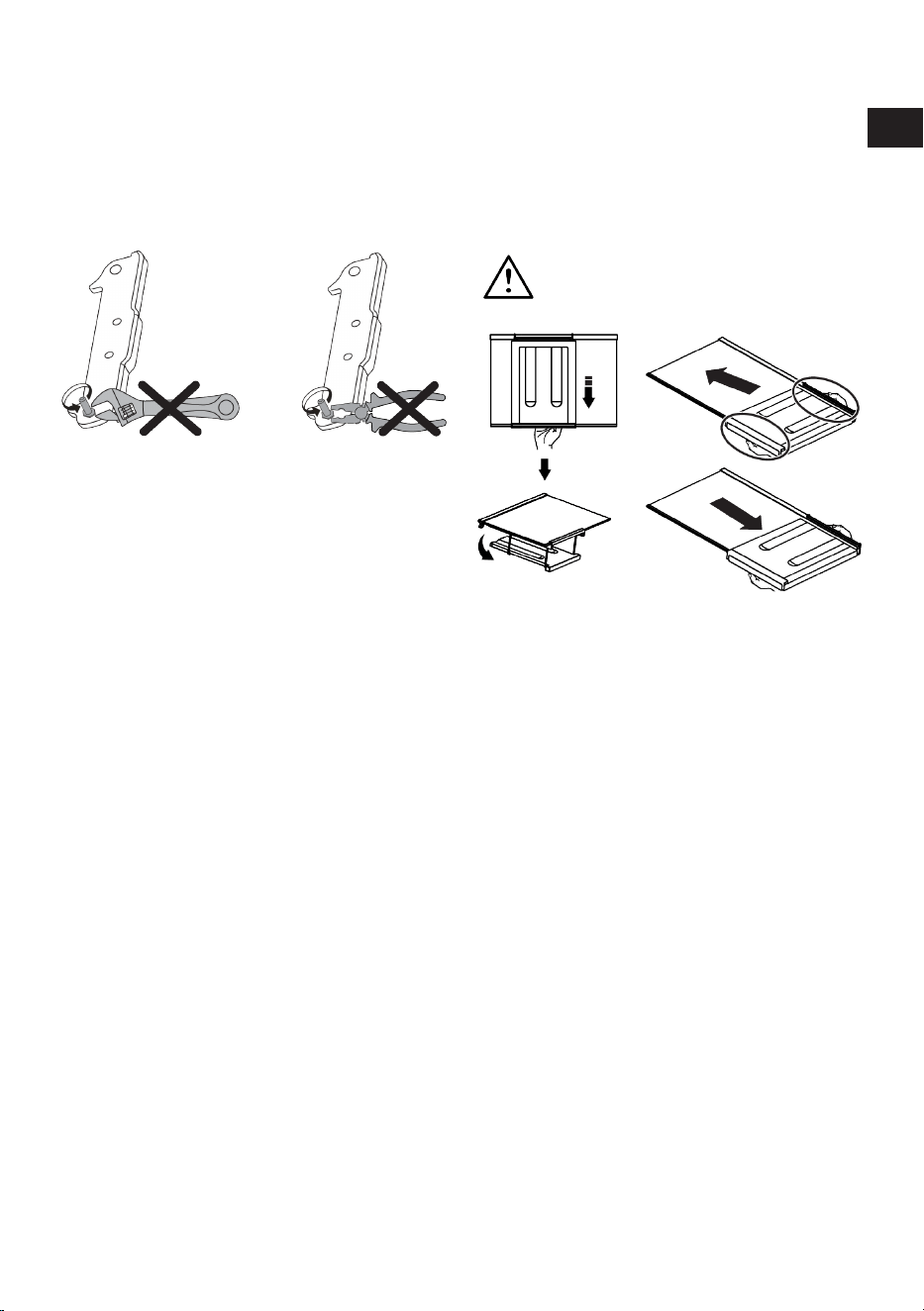
IT / 61
7.5 Inversione del lato di apertura
della porta
Il lato di apertura della porta del frigorifero
può essere invertito secondo il posto in cui
lo si sistema. Nel caso sia necessario inver-
tire il lato di apertura della porta, chiamare
il servizio assistenza autorizzato più vicino.
7.6 Avviso di sportello aperto
Il sistema di avviso di sportello aperto del
frigorifero può differire a seconda del mo-
dello.
Versione 1;
Se lo sportello del prodotto rimane aperto
per un determinato periodo di tempo (tra
60 e 120 secondi), viene emesso un segna-
le acustico di avviso; a seconda del model-
lo di prodotto, può essere visualizzato an-
che un segnale di avvertimento visivo (luce
lampeggiante). Se si chiude lo sportello del
dispositivo o se si preme un pulsante sullo
schermo del dispositivo, se presente, l’avvi-
so sonoro si arresterà.
Versione 2;
Se lo sportello del dispositivo resta aperto
per un determinato periodo di tempo (tra
60 e 120 secondi) viene emesso l'avviso
porta aperta. L'avviso di porta aperta viene
emesso gradualmente. Prima un avviso
udibile inizia a suonare. Dopo 4 minuti, se
lo sportello non è ancora stato chiuso, si at-
tiva un avviso visivo (luce lampeggiante).
L'avviso di sportello aperto verrà ritardato
per un certo periodo di tempo (tra 60 s e
120 s) quando si preme un qualsiasi tasto
sullo schermo del prodotto, se presente.
Quindi il processo ricomincerà. Quando lo
sportello del dispositivo è chiuso, l'avviso di
sportello aperto verrà annullato.
7.7 Ripiano porta-vino pieghevole
Permette all'utente di conservare le botti-
glie di vino se necessario. Per utilizzare la
sezione del ripiano, afferrare la parte in pla-
stica e tirarla delicatamente verso il basso.
Ora è possibile usare il porta-vino pieghevo-
le.
Si consiglia di riporre al massimo 2
bottiglie di vino sul ripiano porta-vi-
no pieghevole.
Per raggruppare il ripiano porta-vino, rimuo-
vere anzitutto il ripiano in vetro dal frigorife-
ro. Posizionarlo sul ripiano in vetro spingen-
do la parte di plastica attraverso le scanala-
ture anteriori e posteriori come mostrato
nella foto. Il prodotto sarà pronto all'uso
con il porta-vino pieghevole.
Per togliere il ripiano porta-vino pieghevole,
rimuovere anzitutto il ripiano in vetro dal fri-
gorifero. Quindi, tenere la parte in plastica e
tirarla in una qualsiasi direzione. Ora è pos-
sibile utilizzare il prodotto anche senza il
porta-vino pieghevole.
7.8 Sostituzione della lampada
Quando la lampadina/LED usata per l'illumi-
nazione del frigorifero deve essere sostitui-
ta, chiamare il servizio assistenza autoriz-
zato.
La lampada o le lampade utilizzate in que-
sta apparecchiatura non possono essere
utilizzate per l'illuminazione della casa.
L'uso previsto di questa lampada è quello
di aiutare l'utente a mettere il cibo nel frigo-
rifero/congelatore in modo sicuro e confor-
tevole.
EN
IT
IT / 62
8 Manutenzione e pulizia
Leggere prima la sezione "Istruzioni di sicu-
rezza"!
Prima di pulire il prodotto, scollegarlo o to-
gliere tensione al fusibile a cui è collegato.
Non posizionare per nessun motivo le ma-
ni, i piedi o oggetti metallici sotto il frigori-
fero o tra il frigorifero e il pavimento. Si po-
trebbero verificare inceppamenti o i bordi
taglienti potrebbero causare lesioni perso-
nali.
• Non utilizzare utensili affilati o abrasivi
per pulire il prodotto. Non usare materiali
come detergenti domestici, sapone, de-
tersivi, gas, benzina, diluenti, alcool, cera,
ecc.
• La polvere deve essere rimossa dalla gri-
glia di ventilazione sul retro del prodotto
almeno una volta all'anno (senza aprire il
coperchio). Pulire il prodotto servendosi
di un panno asciutto.
• Fare attenzione a tenere l'acqua lontana
dalla copertura delle lampade e dalle al-
tre componenti elettriche.
• Pulire la porta servendosi di un panno
umido. Per rimuovere la porta e i vari ri-
piani, rimuovere prima tutto il contenuto.
Rimuovere i ripiani della porta sollevan-
doli verso l'alto. Pulire e asciugare i ripia-
ni, poi fissare nuovamente in posizione
facendo scorrere da sopra.
• Non usare acqua con cloro o prodotti de-
tergenti sulla superficie esterna e sulle
componenti rivestite in cromo. Il cloro
provoca ruggine su queste superfici me-
talliche.
• Non utilizzare strumenti affilati e abrasivi,
sapone, materiali per la pulizia della casa,
detersivi, gas, benzina, vernici e sostanze
simili per evitare deformazioni e rimozio-
ne di impronte sulla parte in plastica. Per
pulire, usare acqua tiepida e un panno
morbido, quindi asciugare.
• Sui prodotti senza la funzione No-Frost,
potrebbero formarsi goccioline d'acqua e
ghiaccio fino allo spessore di un dito sul-
la parete posteriore dello scomparto con-
gelatore. Non pulirla; non applicare mai
olio o sostanze simili.
• Per pulire la superficie esterna del pro-
dotto utilizzare un panno in micro-fibra
leggermente inumidito. Spugne e altri tipi
di panni per la pulizia potrebbero graffia-
re la superficie.
• Per pulire tutti i componenti rimovibili du-
rante la pulizia della superficie interna del
prodotto, lavare questi componenti con
una soluzione delicata composta da sa-
pone, acqua e carbonato. Risciacquare e
asciugare completamente. Evitare il con-
tatto dell'acqua con i componenti dell'illu-
minazione e con il pannello di controllo.
• Non utilizzare aceto, alcool o altri deter-
genti a base di alcool su nessuna delle
superfici interne.
Superfici esterne in acciaio inossidabile
Utilizzare un detergente non abrasivo per
acciaio inossidabile e applicarlo con un
panno morbido privo di pelucchi. Per luci-
dare, strofinare delicatamente la superficie
con un panno in micro-fibra inumidito con
acqua e utilizzare una pelle di camoscio per
lucidare a secco. Seguire sempre le venatu-
re in acciaio inossidabile.
Prevenzione dei cattivi odori
Il prodotto è stato realizzato con materiali
che non emettono cattivi odori. Tuttavia,
una conservazione inappropriata degli ali-
menti e una pulizia inadeguata delle super-
fici interne possono causare la formazione
di odori.
• A tal fine consigliamo di pulire l'interno
con acqua gassata ogni 15 giorni.
• Conservare gli alimenti in contenitori si-
gillati, poiché i microrganismi derivanti da
alimenti tenuti in contenitori non sigillati
causano cattivi odori.
• Non conservare alimenti scaduti e marci
all'interno del frigorifero.
Protezione delle superfici in plastica
L'olio rovesciato sulle superfici in plastica
potrebbe danneggiare la superficie, e deve
essere pulito immediatamente servendosi
di acqua tiepida.
EN
IT
IT / 63
9 Guida alla risoluzione dei problemi
Leggere prima la sezione "Istruzioni di sicu-
rezza"!
Controllare questo elenco prima di contat-
tare il servizio clienti. Questa operazione vi
consentirà di risparmiare soldi. Questo
elenco contiene le lamentele più frequenti
che non riguardano problemi a livello di ma-
nodopera o materiali. Alcune funzioni qui
indicate potrebbero non essere valide per il
prodotto in questione.
Se il problema persiste dopo aver seguito le
istruzioni di questa sezione, contattare il
fornitore o un Servizio di Assistenza auto-
rizzato. Evitare in ogni caso di riparare il
prodotto.
Il frigorifero non funziona.
• La presa di corrente non è stata inserita
correttamente. >>> Spingerla fino a inse-
rirla completamente nella presa.
• Il fusibile collegato alla presa che alimen-
ta il prodotto, oppure il fusibile principale,
è bruciato. >>> Controllare il fusibile.
Condensa sulla parete laterale dello
scomparto raffreddatore (MULTI ZONE,
COOL, CONTROL e FLEXI ZONE).
• La porta viene aperta troppo spesso. >>>
Fare attenzione a non aprire troppo fre-
quentemente la porta del prodotto.
• L'ambiente è troppo umido. >>> Non in-
stallare il prodotto in ambienti umidi.
• Gli alimenti contenenti liquidi sono con-
servati in contenitori non sigillati. >>> Te-
nere gli alimenti contenenti liquidi in con-
tenitori sigillati.
• La porta del prodotto viene lasciata aper-
ta. >>> Non tenere aperte a lungo le porte
del frigorifero.
• Il termostato è impostato su una tempe-
ratura molto fredda. >>> Impostare il ter-
mostato su una temperatura adeguata.
Il compressore non funziona.
• In caso di improvviso black out, o nel ca-
so in cui la spina venga tolta e poi reinse-
rita, la pressione del gas nel sistema di
raffreddamento del prodotto non è equili-
brata, il che fa scattare la protezione ter-
mica del compressore. Il prodotto si riav-
vierà dopo circa 6 minuti. Qualora il pro-
dotto non si riavvii dopo questo periodo,
contattare l'assistenza.
• La modalità di scongelamento è attiva.
>>> Si tratta di una condizione normale
per un frigorifero con funzione di sbrina-
mento completamente automatica. Lo
sbrinamento avviene a intervalli periodici.
• Il prodotto non è collegato. >>> Verificare
che il cavo di alimentazione sia collega-
to.
• L'impostazione della temperatura è sba-
gliata. >>> Selezionare l'impostazione di
temperatura adeguata.
• Non c'è corrente. >>> Il prodotto conti-
nuerà a funzionare normalmente quando
verrà ripristinata la corrente elettrica.
Il rumore di funzionamento del frigorife-
ro aumenta col passare del tempo.
• Le prestazioni del prodotto potrebbero
variare a seconda delle variazioni della
temperatura ambiente. Ciò è normale e
non è un'anomalia di funzionamento.
Il frigorifero funziona troppo spesso o
troppo a lungo.
• Il nuovo prodotto potrebbe essere più
grande di quello precedente. I prodotti
più grandi funzioneranno più a lungo.
• La temperatura della stanza potrebbe es-
sere alta. >>> Il prodotto funzionerà nor-
malmente per lunghi periodi di tempo
con temperature ambiente superiori.
• Il prodotto potrebbe essere stato di re-
cente collegato alla corrente, oppure al
suo interno potrebbero essere stati re-
centemente aggiunti vari alimenti. >>> Al
prodotto servirà più tempo per raggiunge-
re la temperatura impostata, se collegato
di recente, oppure nel caso in cui siano
stati collocati nuovi alimenti al suo inter-
no. Ciò è normale.
• Forse di recente sono state introdotte nel
frigorifero grandi quantità di alimenti cal-
di. >>> Non mettere alimenti caldi diretta-
mente dentro al frigorifero.
EN
IT

IT / 64
• Le porte sono state aperte frequentemen-
te o tenute aperte a lungo. >>> L'aria cal-
da che si muove all'interno provocherà un
funzionamento più prolungato. Non apri-
re le porte con troppa frequenza.
• Le porte del congelatore o del raffredda-
tore potrebbero essere socchiuse. >>>
Controllare che le porte siano totalmente
chiuse.
• Il prodotto potrebbe essere impostato su
una temperatura troppo bassa. >>> Impo-
stare la temperatura su un livello più alto
e attendere che il prodotto raggiunga la
temperatura desiderata.
• La rondella della porta del raffreddatore o
del congelatore potrebbe essere sporca,
usurata, rotta o non correttamente confi-
gurata. >>> Pulire o sostituire la guarni-
zione. Le rondelle consumate e usurate
faranno funzionare il prodotto più a lungo
per conservare la temperatura attuale.
La temperatura del congelatore è molto
bassa, ma la temperatura del raffredda-
tore è corretta.
• La temperatura dello scomparto congela-
tore è impostata su un livello molto bas-
so. >>> Impostare la temperatura dello
scomparto congelatore su un livello più
alto, quindi eseguire un controllo.
La temperatura del raffreddatore è molto
bassa, ma la temperatura del congelato-
re è corretta.
• Impostare la temperatura dello scompar-
to raffreddatore su un livello più alto,
quindi eseguire un controllo. >>> Impo-
stare la temperatura dello scomparto raf-
freddatore su un livello più alto, quindi
eseguire un nuovo controllo.
Gli alimenti conservati nei cassetti dello
scomparto raffreddatore sono congelati.
• Impostare la temperatura dello scompar-
to raffreddatore su un livello più alto,
quindi eseguire un controllo. >>> Impo-
stare la temperatura dello scomparto raf-
freddatore su un livello più alto, quindi
eseguire un nuovo controllo.
La temperatura nello scomparto raffred-
datore e congelatore è troppo alta.
• La temperatura dello scomparto raffred-
datore è impostata su un livello molto al-
to. >>> L'impostazione della temperatura
dello scomparto raffreddatore ha un ef-
fetto sulla temperatura dello scomparto
congelatore. Attendere che la temperatu-
ra delle parti interessate raggiunga il livel-
lo sufficiente modificando la temperatura
degli scomparti del raffreddatore o del
congelatore.
• Le porte sono state aperte frequentemen-
te o tenute aperte a lungo. >>> Non aprire
le porte con troppa frequenza.
• La porta potrebbe essere socchiusa. >>>
Chiudere completamente la porta.
• Il prodotto potrebbe essere stato di re-
cente collegato alla corrente, oppure al
suo interno potrebbero essere stati re-
centemente aggiunti vari alimenti. >>>
Non si tratta di un'anomalia. Al prodotto
servirà più tempo per raggiungere la tem-
peratura impostata, se collegato di recen-
te, oppure nel caso in cui siano stati col-
locati nuovi alimenti al suo interno.
• Forse di recente sono state introdotte nel
frigorifero grandi quantità di alimenti cal-
di. >>> Non mettere alimenti caldi diretta-
mente dentro al frigorifero.
Vibrazioni o rumore.
• >>> Se il prodotto vibra quando viene
spostato lentamente, regolare i supporti
per equilibrarlo. Verificare inoltre che la
superficie di appoggio sia sufficiente-
mente resistente per supportarne il peso.
• Gli eventuali oggetti collocati sul prodot-
to potrebbero causare rumori. >>> Toglie-
re gli eventuali elementi collocati sul pro-
dotto.
• Il prodotto emette rumori, come ad esem-
pio liquido che scorre, spruzzo, eccetera
• I principi operativi del prodotto prevedo-
no flussi di liquido e di gas. >>> Ciò è nor-
male e non è un'anomalia di funziona-
mento.
EN
IT

IT / 65
C'è un rumore, simile a un soffio, che
proviene dal prodotto.
• Il prodotto si serve di una ventola per il
processo di raffreddamento. Ciò è nor-
male e non è un'anomalia di funziona-
mento.
Si è formata condensa sulle pareti inter-
ne del prodotto.
• Le temperature calde o umide aumente-
ranno la formazione di ghiaccio e la con-
densa. Ciò è normale e non è un'anoma-
lia di funzionamento.
• Le porte sono state aperte frequentemen-
te o tenute aperte a lungo. >>> Non aprire
le porte con troppa frequenza; se la porta
è aperta, chiuderla.
• La porta potrebbe essere socchiusa. >>>
Chiudere completamente la porta.
Si è formata condensa sulla superficie
esterna del prodotto o fra le porte.
• Le condizioni ambientali potrebbero es-
sere umide, e ciò è normale. >>> La con-
densa si dissiperà alla riduzione dell'umi-
dità.
L'interno emette cattivi odori.
• Il prodotto non è stato pulito regolarmen-
te. >>> Pulire la superficie interna a inter-
valli regolari servendosi di spugna, acqua
tiepida, e acqua gassata.
• Alcuni supporti e materiali da confeziona-
mento potrebbero causare cattivi odori.
>>> Servirsi di supporti confezionamento
che non emettano cattivi odori.
• Gli alimenti sono stati collocati in suppor-
ti non sigillati. >>> Tenere gli alimenti in
contenitori sigillati. I microrganismi pos-
sono diffondersi dagli alimenti non sigil-
lati e causare cattivi odori.
• Rimuovere gli eventuali alimenti scaduti o
rovinati dal prodotto.
La porta non si chiude correttamente.
• Le confezioni degli alimenti potrebbero
bloccare la porta. >>> Trovare una nuova
posizione per gli alimenti che bloccano le
porte.
• Il prodotto non è in posizione verticale,
appoggiato per terra. >>> Regolare i sup-
porti per l'equilibrio del prodotto.
• La superficie non è piatta o resistente
>>> Assicurarsi che la superficie sia piat-
ta e sufficientemente resistente per so-
stenere il prodotto.
Il cassetto frutta e verdura è inceppato.
• Gli alimenti potrebbero entrare in contat-
to con la sezione superiore del cassetto.
>>> Ri-organizzare gli alimenti nel casset-
to.
Temperatura sulla superficie del prodot-
to.
• Mentre il prodotto è in funzione, potreb-
bero generarsi temperature elevate tra le
due porte, sui pannelli laterali e sulla gri-
glia posteriore. Ciò è normale e non ri-
chiede interventi di manutenzione.
La ventola continua a funzionare quan-
do la porta è aperta.
• La ventola potrebbe continuare a funzio-
nare quando la porta del congelatore è
aperta.
Se il problema persiste dopo aver seguito le
istruzioni di questa sezione, contattare il
fornitore o un Servizio di Assistenza auto-
rizzato. Evitare in ogni caso di riparare il
prodotto. Ciò è normale.
EN
IT
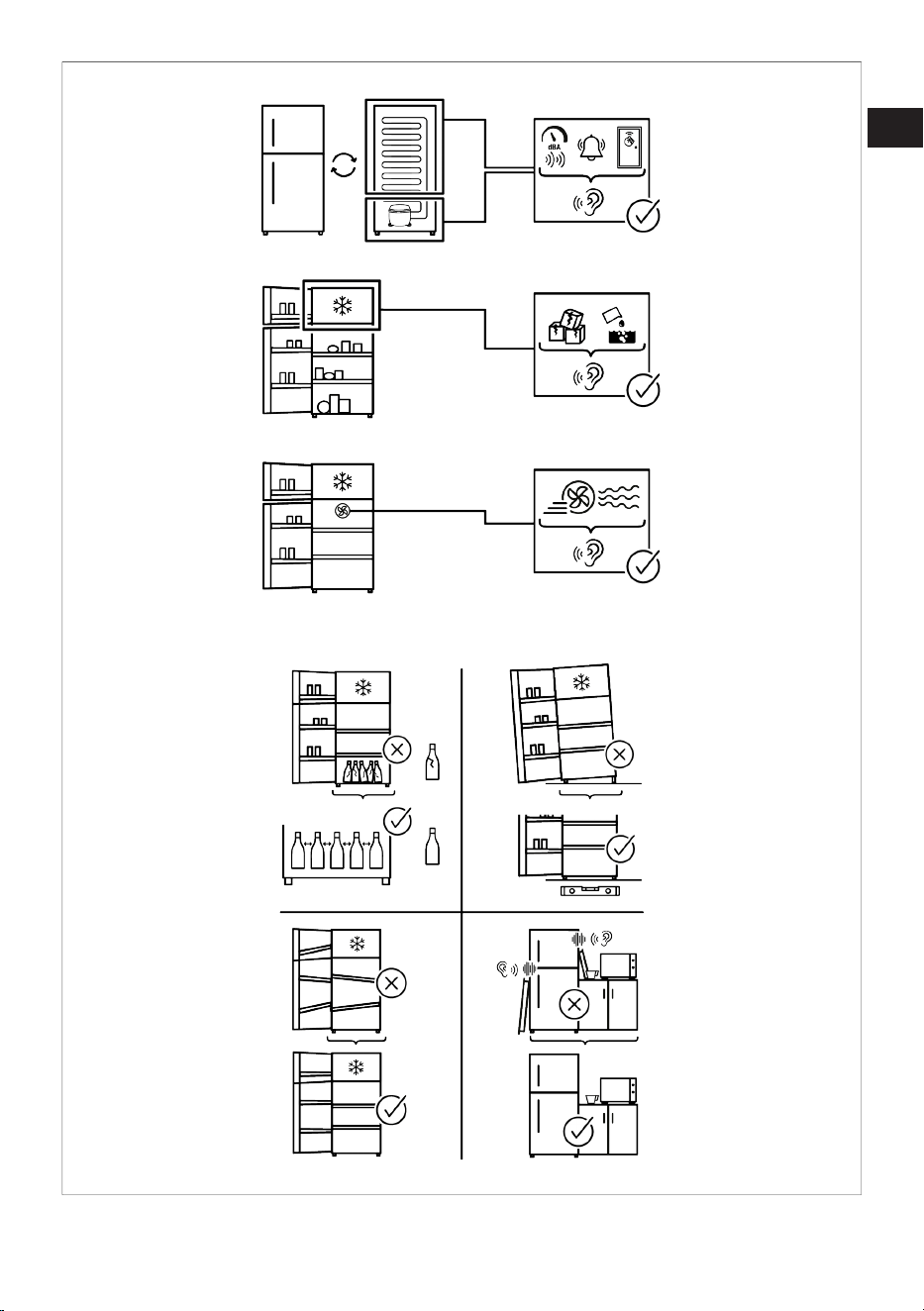
IT / 66
EN
IT
IT / 67
Informazioni sulla classificazione
dell’imballaggi
Scansiona il Qrcode che si trova sull’imbal-
lo del prodotto per trovare tutte le informa-
zioni relative all’imballo e come gestirne il
suo corretto smaltimento.
ESONERO DA RESPONSABILITA’
Alcuni guasti (semplici) possono essere ge-
stiti adeguatamente dall'utente finale senza
che si verifichino problemi di sicurezza o di
utilizzo non sicuro, a condizione che venga-
no eseguiti entro i limiti e in conformità alle
seguenti istruzioni (vedere la sezione "Auto-
riparazione").
Pertanto, se non diversamente autorizzato
nella sezione sotto "Autoriparazione", per
evitare problemi di sicurezza, le riparazioni
dovranno essere eseguite da riparatori pro-
fessionisti registrati. Un riparatore profes-
sionale registrato è un riparatore professio-
nale a cui il produttore ha concesso l'acces-
so alle istruzioni e all'elenco delle parti di ri-
cambio di questo prodotto secondo i meto-
di descritti negli atti legislativi ai sensi della
direttiva 2009/125/CE.
Solo gli agenti di assistenza (cioè i ripara-
tori professionali autorizzati) raggiungibili
tramite il numero di telefono indicato nel
manuale d'uso/scheda di garanzia o trami-
te il rivenditore autorizzato possono, tutta-
via, fornire assistenza in base ai termini
della garanzia. Pertanto, si ricorda che le
riparazioni effettuate da riparatori profes-
sionisti (non autorizzati da) Hotpoint an-
nulleranno la garanzia.
Autoriparazione
L’utente finale può eseguire l’autoriparazio-
ne dei seguenti pezzi di ricambio:maniglie,
cerniere, vassoi, cestini e guarnizioni degli
sportelli (è disponibile una lista aggiornata
anche su parts-selfservice.europeanap-
pliances.com partire dal 1° marzo 2021).
Inoltre, per garantire la sicurezza del pro-
dotto e prevenire il rischio di gravi lesioni,
l'autoriparazione menzionata deve essere
eseguita seguendo le istruzioni contenute
nel manuale d'uso per l'autoriparazione o
disponibili su parts-selfservice.europeanap-
pliances.com . Per la sicurezza dell’utente,
prima di tentare qualsiasi riparazione, stac-
care la spina del prodotto.
I tentativi di riparazione da parte degli uten-
ti finali per parti non incluse in tale elenco
e/o non seguendo le istruzioni contenute
nei manuali d'uso per l'autoriparazione o di-
sponibili su parts-selfservice.europeanap-
pliances.com, potrebbero causare problemi
di sicurezza non imputabili a Hotpoint e in-
valideranno la garanzia del prodotto.
Pertanto, si raccomanda vivamente agli
utenti finali di astenersi dal tentare di effet-
tuare riparazioni che non rientrano nell'elen-
co dei pezzi di ricambio indicati, rivolgendo-
si in questi casi a riparatori professionali
autorizzati o registrati. Al contrario, tali ten-
tativi di riparazione da parte degli utenti fi-
nali potrebbero comportare problemi di si-
curezza, danneggiare il prodotto e causare
successivamente incendi, inondazioni, elet-
trocuzione e gravi lesioni personali.
A titolo esemplificativo, ma non esaustivo,
le seguenti riparazioni devono essere affi-
date a riparatori professionisti autorizzati o
registrati: compressore, circuito di raffred-
damento, scheda principale, scheda inver-
ter, scheda display, ecc.
Il produttore/venditore non può essere rite-
nuto responsabile in caso di mancata os-
servanza di quanto sopra da parte degli
utenti finali.
La disponibilità dei pezzi di ricambio del fri-
gorifero acquistato è di 10 anni. Durante
questo periodo, i pezzi di ricambio originali
saranno disponibili per il corretto funziona-
mento del frigorifero
La durata minima della garanzia del frigori-
fero acquistato è di 24 mesi.
Questo prodotto è dotato di una sorgente
luminosa di classe energetica “G”.
EN
IT

IT / 68
La sorgente luminosa in questo prodotto
deve essere sostituita solo da un riparatore
professionista.
EN
IT