
Page 2

Page 3
CONTENTS
Page/s
1. SAFETY & SAFETY LABELS 3 - 12
2. GENERAL USAGE INFORMATION 13 - 14
3. MAIN PARTS 14 - 20
4. COMPONENT LOCATIONS 21 - 22
5. INSTALLATION 23 - 33
6. OPERATION 34 - 42
7. MAINTENANCE 42 - 46
8. WIRING DIAGRAM 47 - 48
9. USEFUL FORMULAE 49
10. ELECTRICAL INSTALLATIONS WITH
OPTIONAL EQUIPMENT 50 - 58
11. REMOTE CONTROL 59 - 61
12. DECLARATIONS of CONFORMITY 62
13. CONTACT DEATILS 62
14. MANUAL UPDATES 62
15. WARRANTY 62
Page 4
1. SAFETY & SAFETY LABELS.
1.1. General safety notes.
1.1.1. The operator of the machine is responsible for, and has a duty of care in
making sure that the machine is operated safely and in accordance with the
instructions in this user manual. Keep the manual safe and pass it on if the
machine is to be loaned/sold to another user.
1.1.2. Please note the following safety points.
1.1.2.1. The machine should never be left it in a condition which would allow
an untrained or unauthorised person/s to operate this machine.
1.1.2.1.1. All due care and diligence should be taken by the operator for
the safety of and with regard to those around whilst using the
machine.
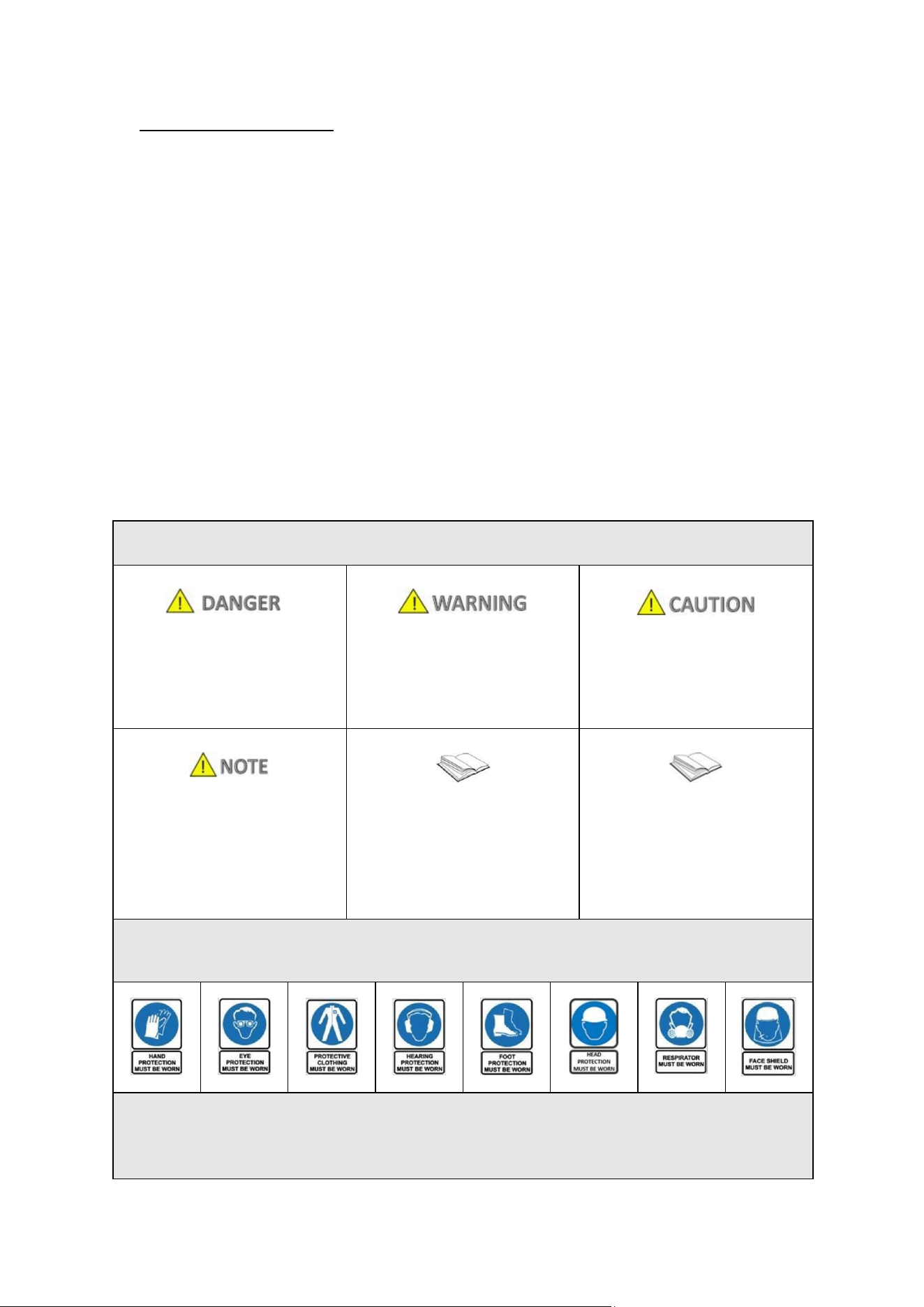
1.1.2.1.2. Some or all of the following - warning signs, symbols and/or
PPE pictograms may appear throughout this manual. You MUST
adhere to their warning/s. Failure to do so may result in personal
injury to yourself or those around you.
The FOLLOWING safety notes will help avoid or reduce risk of injury or death.
Indicates a hazard, which, if
not avoided, could result in
serious injury or death.
Indicates a hazard, which, if
not avoided, could result in
serious injury.
Indicates a hazard which, if
not avoided, might result in
minor or moderate injury.
Indicates a situation that
could easily result in
equipment damage.
READ & Keep the manual
safe and pass it on if the
machine is to be loaned/
sold to another user.
You MUST fully read the
instructions to make sure
you use and operate
machine safely
Appropiate Personal Protective Equipment (PPE)
MUST be worn at all times when machine is in use or being repaired.
ALWAYS keep the working area clear of non-essential people to include
but not limited to children, the elderly and vunerable persons.
NEVER ALLOW an untrained person to use this machine.

Page 5
Headaches, dizziness, nausea, breathlessness,
collapsing or loss of consciousness.
Home, garage, tent, camper van, mobile home,
caravan or boat.
1.2. Carbon monoxide.
1.2.1. Carbon monoxide is a colourless and odourless gas. Inhaling this gas can
cause death as well as serious long term health problems such as brain damage.
1.2.2. The symptoms of carbon monoxide poisoning can include but are not limited
to the following;
1.2.2.1. Carbon monoxide poisoning symptoms are similar to flu, food
poisoning, viral infections and simply tiredness. It is quite common for
people to mistake this very dangerous poisoning for something else.
1.2.2.2. To avoid carbon monoxide poisoning DO NOT use Petrol/Diesel-
powered equipment inside any of the following;
This list is not exhaustive and if you are in any doubt contact your dealer.
1.2.3. If you think you have or someone around you has been affected by carbon
monoxide poisoning;
1.2.3.1. Get them fresh air immediately, by leaving the affected area or by
opening doors and windows. If safe and practical to do so make sure that
the machine is turned off. DO NOT enter a room you suspect of having
carbon monoxide present – instead call the emergency services.
1.2.3.2. Contact a doctor immediately or go to hospital - let them know that
you suspect carbon monoxide poisoning.
1.2.4. DO NOT use in an enclosed area or a moving vehicle.
1.1. General fuel safety.
ALL FUELS ARE FLAMMABLE

Page 6
1.1.1. Fire hazard - keep fuel away from all sources of ignition for example heaters,
lamps, sparks from grinding or welding.
1.1.2. DO NOT carry out hot work on tanks that have contained fuel it is extremely
dangerous
1.1.3. ALWAYS keep work area clean and tidy.
1.1.4. ALWAYS clean up all spills promptly using correct methods i.e. absorbent
granules and a lidded bin.
1.1.5. ALWAYS Dispose of waste fuels correctly.
1.2. Fuelling/De-fuelling.
ALL FUELS ARE FLAMMABLE
1.2.1. ALWAYS fuel and defuel in a well-ventilated area outside of buildings.
1.2.2. ALWAYS wear correct, suitable and fit for purpose Personal Protective
Equipment (PPE), suggested items are but not limited to safety gloves and
overalls.
1.2.3. When fuelling/de-fuelling ALWAYS avoid inhaling fumes
1.2.4. When de-fuelling ALWAYS use a propriety fuel retriever.
1.2.5. ALWAYS carry fuel in the correct and clearly marked container.
1.3. Electrical safety.
1.3.1. Electricity can kill - NEVER work on LIVE/ENERGISED equipment.
1.3.2. Prior to carrying out any maintenance work you MUST Identify electrical
isolation methods and isolate all electrical supplies,

Page 7
1.3.3. Prior to use and with all electrical supplies isolated You MUST check all
electrical cables, plugs and connections for the following;
1.3.3.1. Cables are intact and have no signs of damage, to include but not
limited to bare wires, chaffing, cuts and loose wiring.
1.3.3.2. If there are any signs of damage, the damaged item MUST be taken
out of service until the damage has been repaired by an electrically
competent person.
1.3.3.3. All trailing cables should be routed so as not to cause any kind of trip
hazard.
1.3.3.4. NEVER work on or near electricity with wet hands, wet clothing, and
wet gloves.
1.4. Batteries.
1.4.1. Batteries are risk if they become damage by the possible leaking of electrolyte.
This electrolyte is an acidic and can cause serious burn injuries. Care should be
taken when working on or near them. NOTE the electrolyte may be in liquid or
gel form.
1.4.2. Should you come into contact with electrolyte you should;
1.4.2.1. Remove all clothing contaminated with electrolyte. If you cannot
remove then saturate in water.
1.4.2.2. Get medical assistance as soon as possible. You must advise the
medical staff of the type acid.
1.4.2.2.1. Lead/acid battery = dilute sulphuric acid
1.4.2.2.2. Nickel/cadmium = potassium hydroxide alkali electrolyte.
1.4.2.3. Use fresh running water to wash off excess electrolyte, continue this
until medical assistance arrives. Make sure that you do not wash the
electrolyte to another part of the face or body.
1.4.2.4. If electrolyte comes into contact with Eyes the electrolyte needs to be
immediately washed away with large amounts of water. Make sure that
you do not wash the electrolyte to another part of the face or body.
1.4.3. Gasses from charging batteries are highly flammable and great care should
be taken to charge in well ventilated areas.
1.4.4. There is an explosion risk if the battery terminals are short circuited, when
connecting/dis-connecting ALWAYS exercise great care so that the terminals or
battery leads are NOT allowed to touch. ALAWYS use suitable insulated tools.

Page 8
1.5. Noise.
1.5.1. The operating noise of the machine can damage your hearing. Wear hearing
protection such as earplugs or ear defenders to protect your hearing. Long-
term and regular users are advised to have hearing checked regularly. Be
especially vigilant and cautious when wearing hearing protection because your
ability to hear alarm warnings will be reduced.
1.5.2. Noise emissions for this equipment is unavoidable. Carry out noisy work at
approved times and for certain periods. Limit the working time to a minimum.
For your personal protection and protection of people working nearby it is also
advisable for them to wear hearing protection.
1.5.3. See CERTIFICATE of CONFORMITY section for Outdoor Noise declaration of
conformity.
1.6. Safety.
1.6.1. Before operating and maintaining this generator set. Please read this manual
and make sure you understand this operation and maintenance manual and
other documents which are attached to the engine.
1.6.2. Correct installation of the generator set is the precondition of normal
operation. Only genuine Hyundai spare parts should be used. Failure to do so
will invalidate your warranty.
1.6.3. A properly maintained machine will ensure good running conditions and
improve life expectancy of the generator sets.
1.6.4. The generator set must only be operated by the persons who have received
training on its operation. Only authorised and trained persons should carry out
maintenance and repairs to this machine.
1.6.5. Operators and maintainers should make sure they are familiar with all safety,
preventive actions and operational maintenance procedures.
1.6.6. The generator sets can only be started under safe conditions. Please do not
start the generator sets when any abnormal conditions been found this will
help to avoid accidents.
1.6.7. Shut down the machine before cleaning, maintaining and repairing the
generator set. Remove the negative battery connection and prevent it
from accidentally connecting to any other part/s of the machine. Place a
warning label/sign to say machine is being worked on, this will help in
avoiding accidents.
1.6.8. The exhaust air discharged from engine is harmful to people’s health.
1.6.9. All of the generator sets installed indoors must have a correctly installed
exhaust system to vent all such gasses to the outside of the building.
1.6.10. Whilst the generator set running, the exhaust pipe and silencer will become
very HOT. Therefore when a generator set is installed, these parts need to be
covered with fire retardant insulation materials and be kept far away from
inflammable materials. This needs to be maintained at all times.
1.6.11. Please make sure good that ventilation has been planned and installed to
vent exhaust gasses effectively from the generators location.

Page 9
1.6.12. DO NOT place flammable materials and fuels near the engine.
1.6.13. DO NOT smoke, or allow any naked flames or sparks in the vicinity of
charging batteries. Whilst batteries are charging they can vent highly explosive
hydrogen and oxygen gasses.
1.6.14. Suitable fire extinguishers should be fitted in the vicinity of a generator
installation and all users and maintainers should be trained in their use.
1.6.15. Where the fan protection cover or other protection covers have been
removed DO NOT run the generator set. If the generator set has to be started
YOU MUST make sure that you keep your fingers, hands, arms, long hair,
jewellery and loose clothing away from fan belt, pulley and other moving parts.
1.6.16. When working in the generator set installation room, YOU MUST wear
appropriate personal protective clothing.
1.6.17. When the generator set is running DO NOT try to open the radiator cap. The
coolant will be under pressure and extremely hot. If this is done you place
yourself at serious risk of injury from scalding and burns.
1.6.18. Before filling with anti‐freeze YOU MUST allow the generator and radiator to
fully cool down.
1.6.19. DO NOT swallow or let your skin come into contact with the harmful
materials such as fuel, anti‐freeze, lubricant and electrolyte.
1.6.20. If you swallow any of these liquids seek urgent medical advice. In most cases
YOU MUST NOT induce vomiting.
1.6.21. If you come into contact with any of these kinds of liquids, YOU MUST use
plenty of clean water to rinse off the affected area. YOU MUST make sure that
you wash away from the affected area but avoid spreading to non-affected
parts.
1.6.22. YOU MUST avoid working in high noise level environment it will cause harm
to your hearing. If you have to work in the vicinity of a running generator set
YOU MUST wear correct hearing protection.
1.6.23. Whenever the generator set needs to be connected to output power, the
cabling must conform to the conditions, specification and standard related to
power distribution.
1.6.24. When the installation of generator set is involved in any welding. DO NOT
connect to the ground circuit or make grounding through generator set or
engine.
1.6.25. This will avoid the current being generated from welding operation damaging
the electronics within the control panel, bearings and bearing bush etc. inside
of the generator set.
1.6.26. YOU MUST make sure the generator set is suitably bonded to earth.
1.7. Safety Labels.
1.7.1. Warning signs and symbols.
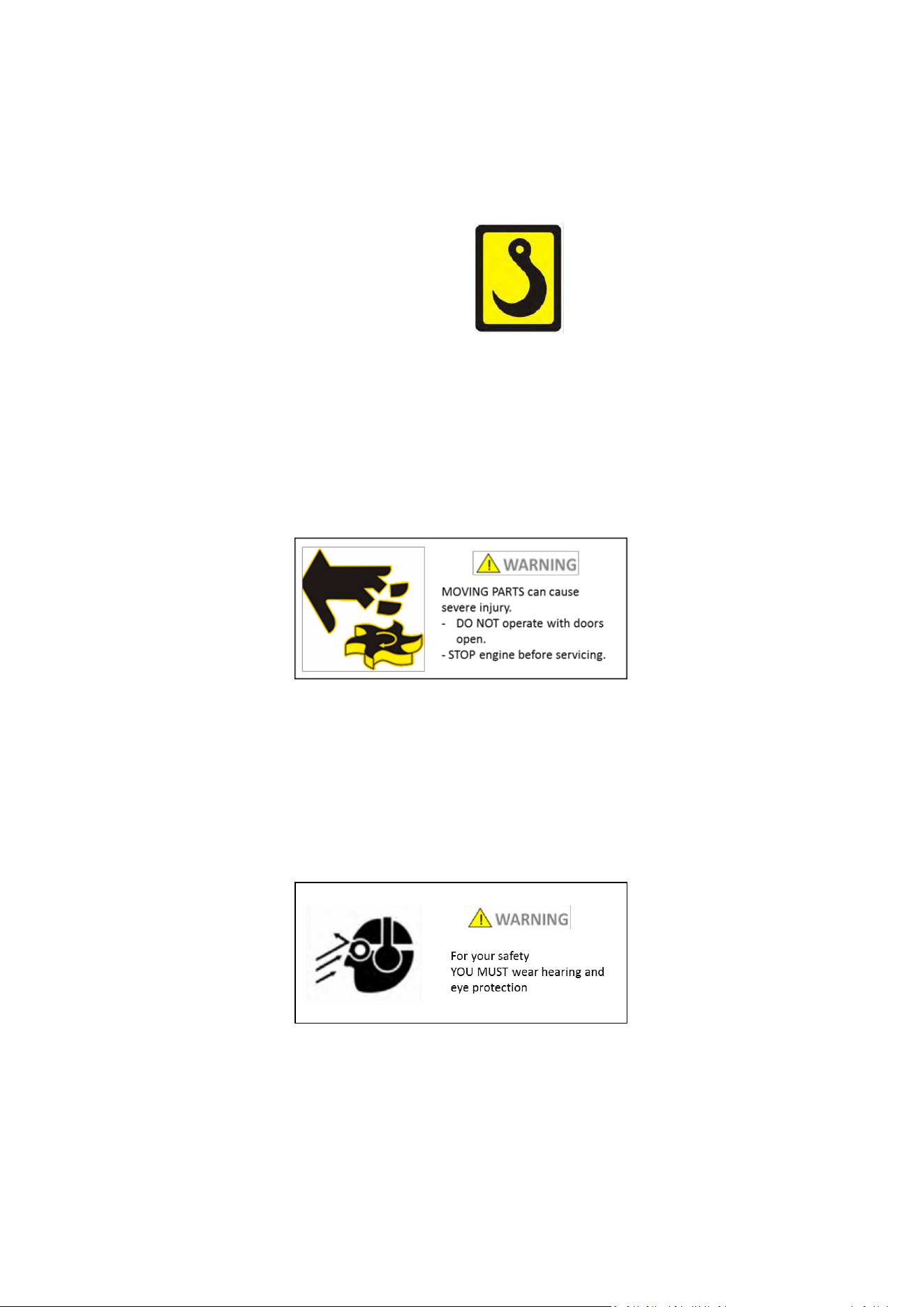
1.7.1.1. Transport Warning.
1.7.1.1.1. Never lift the generating set by attaching to the engine or
alternator lifting lugs, instead use the lifting points on the base frame
Page 10
or canopy. Make sure that the lifting rigging is in date for use and that
the supporting structure is in good condition and has a capacity
suitable for the load.
1.7.1.1.2. Keep all personnel away from the generating set when it is
suspended. DO NOT allow anyone to walk under a suspended machine.
1.7.1.2. Mechanical Warning.
1.7.1.2.1. DO NOT attempt to operate the generating set with the safety
guards removed.
1.7.1.2.2. While the generating set is running do not attempt to reach
under or around the guards to do maintenance or for any other
reason.
1.7.1.2.3. Keep hands, arms, long hair, loose clothing and jewellery away
from pulleys, belts and all other moving parts.
1.7.1.2.4. Safeguard Warning.
1.7.1.2.4.1. Generating sets that are not equipped with sound
attenuating enclosures can produce noise levels in excess of 105
dB (A). Prolonged exposure to noise levels above 85 dB (A) is
hazardous to hearing.
1.7.1.2.4.2. Wear protective clothing including hearing protection,
gloves and hat when working around the generating set.
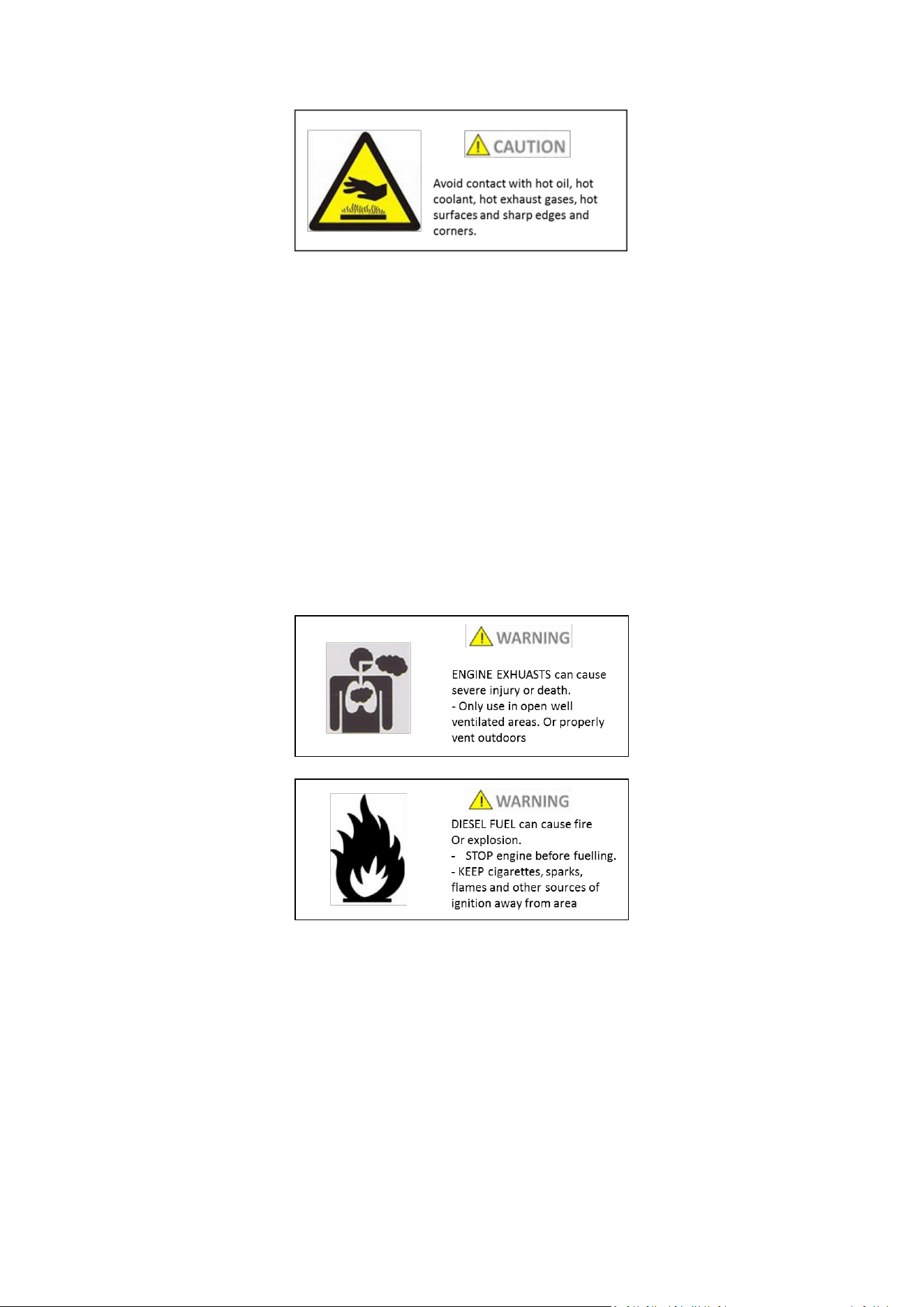
1.7.1.3. Access doors - Hot surfaces.
1.7.1.3.1. If equipped keep access doors on enclosures closed and locked
when not required to be open.
1.7.1.3.2. Avoid contact with hot oil, hot coolant, hot exhaust gases, hot
surfaces and sharp edges and corners.
Page 11
1.7.1.4. Gas & Fume Warnings.
1.7.1.4.1. Ensure that the generating set room is properly ventilated.
1.7.1.4.2. Keep the room, the floor and the generating set clean. When
spills of fuel, oil, battery electrolyte or coolant occur, they should be
cleaned up immediately.
1.7.1.4.3. NEVER store flammable liquids near the engine.
1.7.1.4.4. Do not smoke or allow sparks, flames or other sources of
ignition around fuel or batteries. Fuel vapours are explosive.
Hydrogen gas generated by charging batteries is also explosive.
1.7.1.4.5. NEVER store flammable liquids near the engine.
1.7.1.4.6. DO NOT smoke or allow sparks, flames or other sources of
ignition around fuel or batteries.
1.7.1.4.7. Fuel vapours are explosive. Oxygen and Hydrogen gases
generated by charging batteries are explosive.
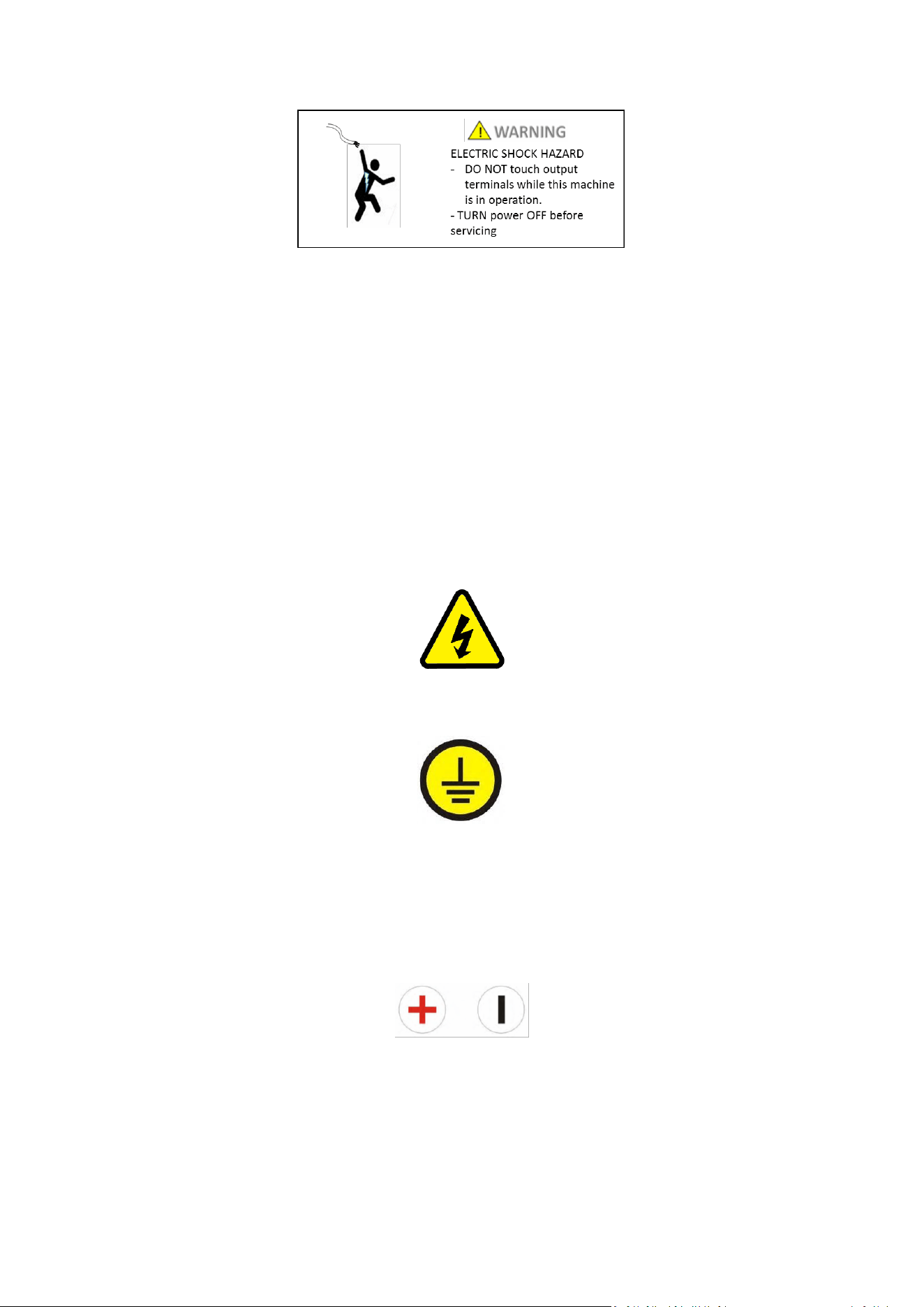
1.7.2. Electrical Warning.
1.7.2.1. DO NOT touch electrically energized parts of the generating set
and/or interconnecting cables or conductors with any part of the body or
with any non-insulated conductive object.
Page 12
1.7.3. Terminal box covers.
1.7.3.1. Replace the generating set terminal box cover as soon as connection
or disconnection of the load cables is complete.
1.7.3.2. DO NOT operate the generating set without the cover securely in
place.
1.7.3.3. Connect the generating set only to loads and/or electrical systems
that are compatible with its electrical characteristics and that are within
its rated capacity.
1.7.3.4. Keep all electrical equipment clean and dry. Replace any wiring where
the insulation is cracked, cut, abraded or otherwise degraded. Replace
terminals that are worn, dis-coloured or corroded.
1.7.3.5. Keep terminals clean and tight.
1.7.4. Earthing (Grounding).
1.7.4.1. You MUST make sure that the generator set is correctly connected to
earth.
1.7.5. Connecting/disconnecting loads.
1.7.5.1. Prior to attempting to connect or disconnect loads The generator set
should be shut down, and the battery negative (‐) terminal disconnected.
1.7.5.2. NEVER attempt to connect or disconnect load connections while
standing in water or on wet or soggy ground.
Positive Negative

Page 13
2. GENERAL USAGE INFORMATION
2.1. For - Continuous service.
2.1.1. The generator set can used as main power supply to generate electricity for
several purposes, e.g. lighting, heating etc.
2.2. For - Standby service.
2.2.1. The generator set can used as standby power supply to provide continuous
electric power for variable loads.
2.2.2. The generator set is suitable for the areas where you must provide a
continuous power supply, such as hospitals, industrial facilities, airports etc.
2.3. For - Emergency service
2.3.1. The generator set can used as auxiliary power supply to solve energy
interruptions that may cause serious problems to people, physical and /or
financial damage or to face consumption peaks.
2.3.2. The generator can be setup to start quickly to provide electric power for
loads when the mains supply fails, and switch to stop after the mains supply
becomes normal. Generally the generator set can continue to run for several
hours.
2.4. Under loading of Diesel Generators.
2.4.1. What is under loading?
2.4.1.1. The running of any diesel engine with no load or very light loads. In
the industry this is also known as “wet-stacking”.
2.4.1.2. This can be due to facility or site managers not wanting to risk
interrupting daily business by transferring the true load to the generator,
or data centres wanting to protect their UPS battery warranty.
2.4.1.3. It could also be due to a generator being over specified when
purchased, or a company that has downsized their electrical
requirements.
2.4.2. Why is under loading a problem?
2.4.2.1. A diesel engine needs to operate under substantial load, to reach its
optimum operating temperature. If it fails to reach this temperature then
a percentage of the fuel will be unburnt and a build-up of soot can occur.
2.4.2.2. Within the engine, soot can cause internal glazing of the cylinder
bores, sticking of the piston rings, reducing compression and the injectors
are likely to have a build-up of carbon causing more unburnt fuel to pass
through the combustion chamber into the exhaust.
2.4.2.3. The first sign of this problem is heavy smoke from the exhaust,
eventually, the unburnt fuel will condense in the exhaust and mix with the

Page 14
soot, to create a thick dark liquid that looks like engine oil. This liquid will
seep from the exhaust, and will appear to be an oil leak. This liquid can
build up in the exhaust silencer and there is the risk of it igniting from the
increased heat of the exhaust fumes, if the generator is subsequently put
under full load.
2.4.2.4. If a generator continues to be operated with no load or very light load
there is a possibility that permanent engine damage can occur.
2.4.3. How to avoid under loading.
2.4.3.1. When specifying a new generator, ensure that the unit is adequate for
the requirement, without being too large.
2.4.3.2. If the machine is future proofed with additional capacity, or the
existing installation is over capacity, a load bank testing programme must
be implemented.
2.4.3.3. The load bank should be used to create an artificial demand for
between 75% and 100% of prime load and this, in most circumstances, will
burn off carbon deposits, prolonging the life of the generator.
2.4.3.4. Typically the generator should be run at 75% of prime power for 2
hours in every 100 hours use.
2.4.4. If you need any further clarification concerning generator under loading or
misuse please call our technical sales team.
3. MAIN PARTS
3.1. Diesel Engine.
3.1.1. According to the different output power of each of our generator sets, we
combine it with the best model of diesel engine to give the range of output
power.
3.1.2. HYUNDAI Power chooses the diesel engines with first class performance and
high reliability.
3.1.3. HYUNDAI Power also pay special attention to the technical advantage of
engines in all aspects with a view to reduce exhaust gas emission, decrease fuel
consumption rate and good noise level control.
3.2. Alternators.
3.2.1. Our alternators are single bearing self‐excitation brushless alternators and
have the following features;
3.2.1.1. Four polar brushless self‐excitation, single bearing with insulation
class H and protection level is IP22.
3.2.1.2. Stators are wound to 2/3 pitch, which effectively eliminates/curbs triple
waveform deformation of output voltage.
3.2.1.3. When in parallel with the mains or other generator sets, this type of
winding can effectively avoid excessive neutral currents and reduces
inductive heat.

Page 15
3.2.1.4. Before being assembled, the rotors need to pass dynamic balance
testing. The improved damper reduces voltage deviation and heat under
unstable load.
3.2.1.5. The exciter rotor output is fed to the main rotor through a three
phase full wave bridge rectifier, the rectifier is protected by a surge
suppressor against surges caused by short circuit or out‐of‐phase
paralleling.
3.2.1.6. The Automatic voltage regulator has the feature of automatic load
curtailment which is used to protect the engine, and make it possible to
add full load to the alternator at one time. Steady state voltage adjusting
rate can reach ±1% (under certain requirements, steady state voltage
adjusting rate can meet ±0.5%). If PMG system is chosen, the motor will
have high starting capacity and the ability of interference rejection for the
deformed voltage waveform fed by the main stator generated by non‐
linear load(such as silicon control DC electric motor, UPS etc.).
3.2.1.7. Telephone influence factor TIF<50, telephone harmonic wave factor
THF<2%,the brushless style and high quality AVR ensures low
interference with Radio.
3.2.2. Cooling system.
3.2.2.1. The engine is water cooled.
3.2.2.2. The water cooled system comprises of a radiator, a pusher fan and
thermostat. The alternator has its own internal fan to cool the alternator
components.
3.2.3. Electrical system.
3.2.3.1. The engine electrical system is 12 volt or 24 volts DC, negative
ground/earth.
3.2.3.2. This system includes;
3.2.3.2.1.
3.2.3.2.2.
3.2.3.2.3.
3.2.4. Coupling.
An electric engine starter motor.
A battery and a battery charging alternator.
For the 12 volt DC electrical system one battery is supplied.
For 24 volt DC electrical system two lead-acid batteries are
supplied.
3.2.4.1. Engine and alternator are firmly joined by a coupling cone that
guarantees proper co-axial alignment.
3.2.4.2. Single‐support machines use a special flexible disk in place of a
flexible coupling.
3.2.5. Fuel tank and base frame.
3.2.5.1. The engine and alternator are coupled together and mounted on a
heavy duty steel base frame.
3.2.5.2. This base frame includes a fuel tank with capacity of approximately 8
hours operation under variable loads.
Page 16
3.2.5.3. The tank is complete with filling cap and fuel level gauge and is
connected by flexible joints to the intake piping and to the overflow pipe
containing fuel from the injector drain.
3.2.5.4. The large capacity fuel tank is separate from generator set.
3.2.6. Control panel.
3.2.6.1. All models of HYUNDAI Power generator sets use a high grade control
panel.
3.2.6.2. The core of control panel is an imported digital diesel engine control
module, which has more complex functions such as additional monitoring,
user interface module, remote communication and protection etc.
3.2.6.3. HYUNDAI Power generator set control panel is a steel plate structure,
which ensures security and reliability, and the surface of it has been
treated with static powder painting. Which allows for easy cleaning.
3.2.6.4. Fitted with locks to provide protection against unauthorised use and
has been designed for easy maintenance.
3.2.7. Optional fittings for Canopied sets.
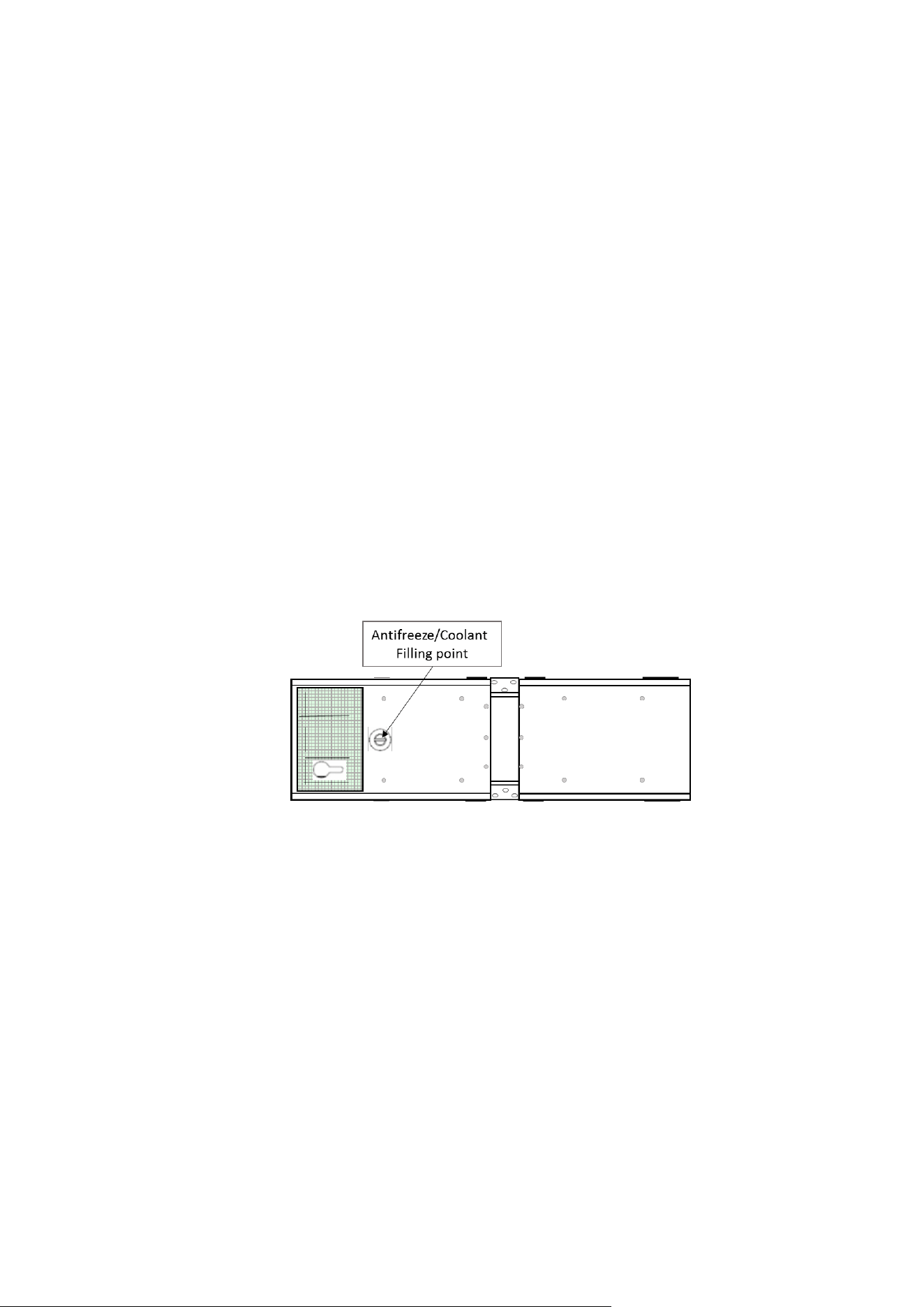
3.2.7.1. External antifreeze and coolant filler cap.
3.2.7.1.1. Our generator sets are fitted with external antifreeze/coolant
filling point.
3.2.7.1.2. When antifreeze has to be added, all the user has to do is
open the antifreeze/coolant filling cap on the roof of canopy and the
radiator’s pressure valve cap to directly add antifreeze/coolant to the
filler point and easily watch the anti‐freeze/coolant level.
3.2.7.2. Oil Change.
3.2.7.2.1. This range of generator sets have been fitted with an oil
change valve which connects directly to the outside of the canopy.
3.2.7.2.2. To empty oil place a receptacle to collect the old oil then open
the oil discharge valve (see image on following page.

Page 17
3.2.7.3. Improved design for ease of transportation.
3.2.7.3.1. Our canopied generator sets have been designed for ease of
hoisting and transportation.
3.2.7.3.2. Standard canopy sets are fitted with a fork lift holes on the base
frame.
3.2.9. Other components.
3.2.9.1. The generator sets have other main components as listed but not
limited too;
3.2.9.1.1. Starter motor.
3.2.9.1.2. Battery – Battery Cables.
3.2.9.1.3. Silencer – Corrugated pipe.
3.2.9.1.4. Exhaust elbow.
3.2.9.1.5. Anti-Vibration mounts.
Page 18
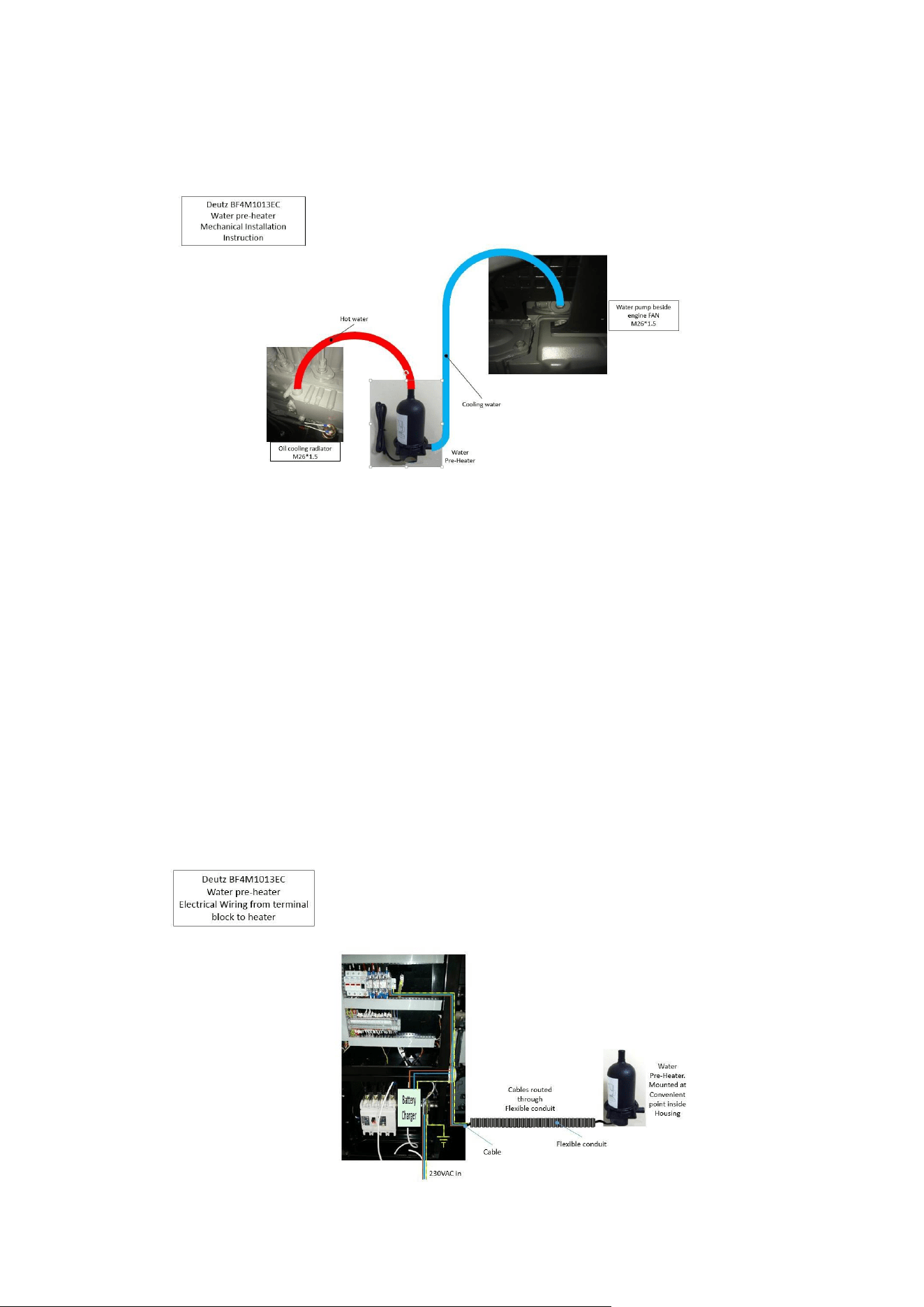
3.3 DEUTZ BF4M1013EC water pre-heater mechanical installation instruction schematic
layout. (Optional installation).
3.3.1 On this machine take the cool water from the water pump and connect it to the
water pre-heater. From the pre-water heater take the heated water to the oil cooling radiator.
3.4 DEUTZ BF4M1013EC water pre-heater electrical wiring. (Optional installation).
3.4.1 The water pre-heater is fed from an external 230 VAC and should be supplied by
a suitable RCD 13 Amp outlet and in accordance with BS7671:2008 Requirements for
Electrical Installations.
3.4.2 This connection is made to three din mounted terminal blocks. These terminal
blocks are fitted by Genpower and are located at a suitable point within the control
panel.
3.4.3 The live of this supply is fed to the Water pre-heater and the Battery charger via a
normally closed contact of the Fuel Solenoid relay. N.B. Fuel solenoid contact is
normally closed when engine is not running.
3.4.4 This allows the pre-water heater/battery charger to function whilst machine is
not running thereby keeping engine warm and batteries fully charged.
3.4.5 The wiring to the pump is to be fed via flexible conduit to the pump which is to be
mounted at a suitable point.
Page 19
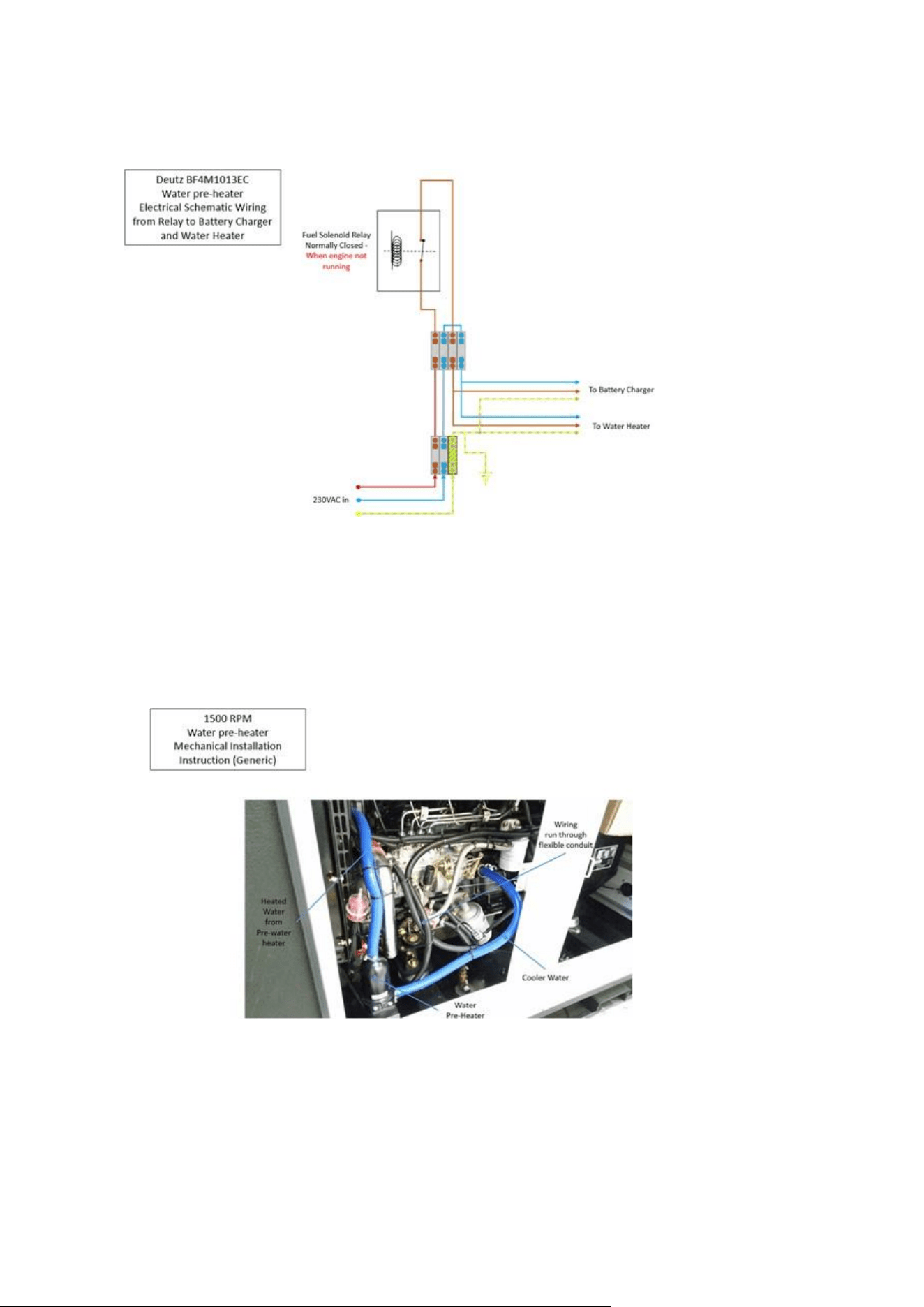
3.5 DEUTZ BF4M1013EC water pre-heater electrical schematic wiring from relay to battery charger
and water heater. (Optional installation).
3.5.1 This schematic wiring shows the typical wiring.
3.5.2 Use a minimum of 1.5 mm2 wiring throughout.
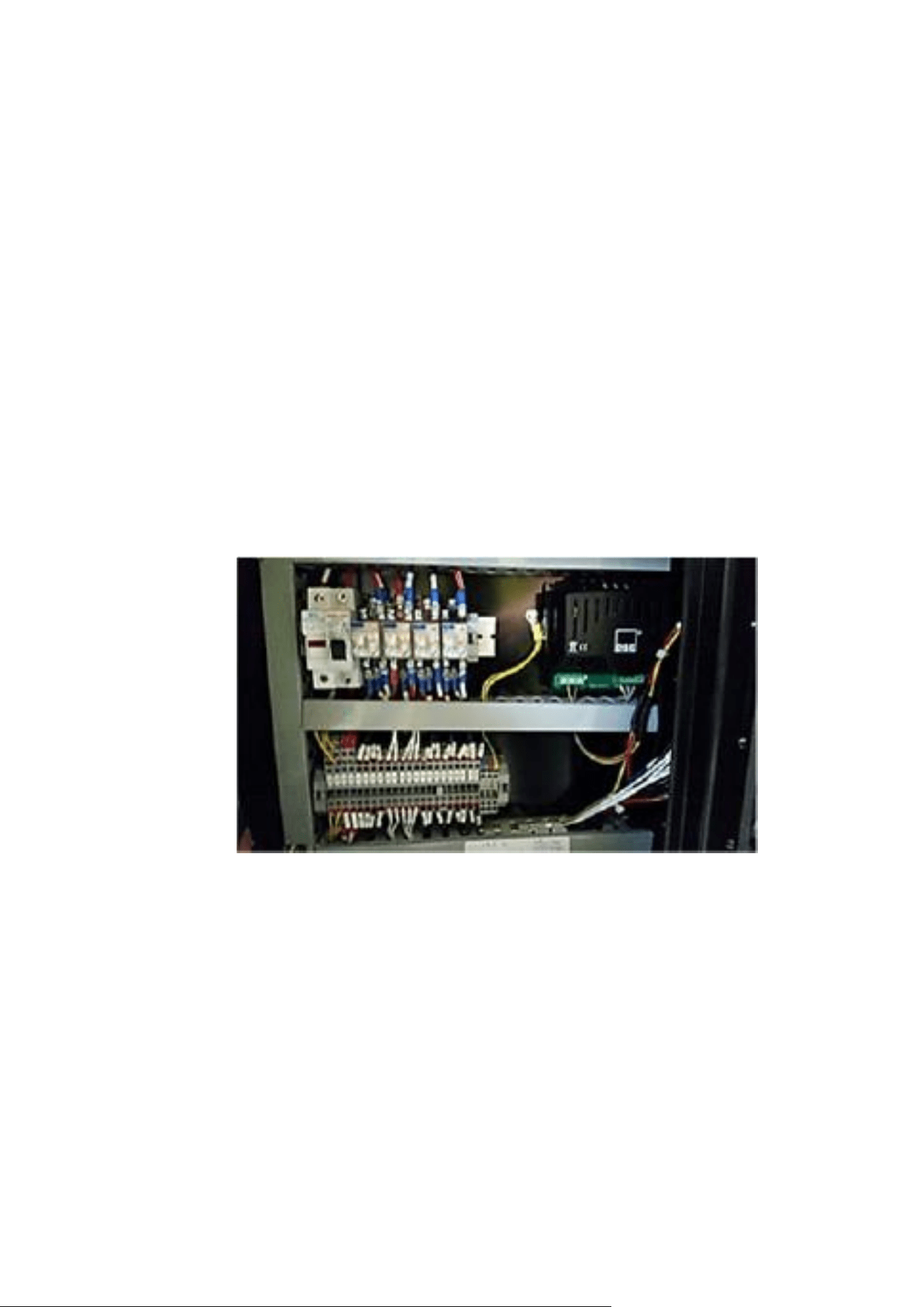
3.6 1500 RPM water pre-heater mechanical installation instruction (generic). (Optional installation).
3.6.1 On all 1500 rpm machines take the cool water from engine block drain as shown and
connect it to the water pre-heater. From the pre-water heater take the heated water to the
water pump inlet plug.
Page 20
3.7 1500 RPM machines water pre-heater electrical wiring from terminal block to heater
(generic). (Optional installation).
3.7.1 The water pre-heater is fed from an external 230 VAC and should be supplied by a
suitable RCD 13 Amp outlet and in accordance with BS7671:2008 Requirements for
Electrical Installations.
3.7.2 This connection is made to three din mounted terminal blocks. These terminal
blocks are fitted by Genpower and are located at a suitable point within the control
panel.
3.7.3 The live of this supply is fed to the Water pre-heater and the Battery charger via a
normally closed contact of the Fuel Solenoid relay. N.B. Fuel solenoid contact is normally
closed when engine is not running.
3.7.4 This allows the pre-water heater/battery charger to function whilst machine is not
running thereby keeping engine warm and batteries fully charged.
3.7.5 The wiring to the pump is to be fed via flexible conduit to the pump which is to be
mounted at a suitable point.
1500 RPM machines
Water pre-heater.
Electrical wiring from terminal block to heater (Generic)
Page 21
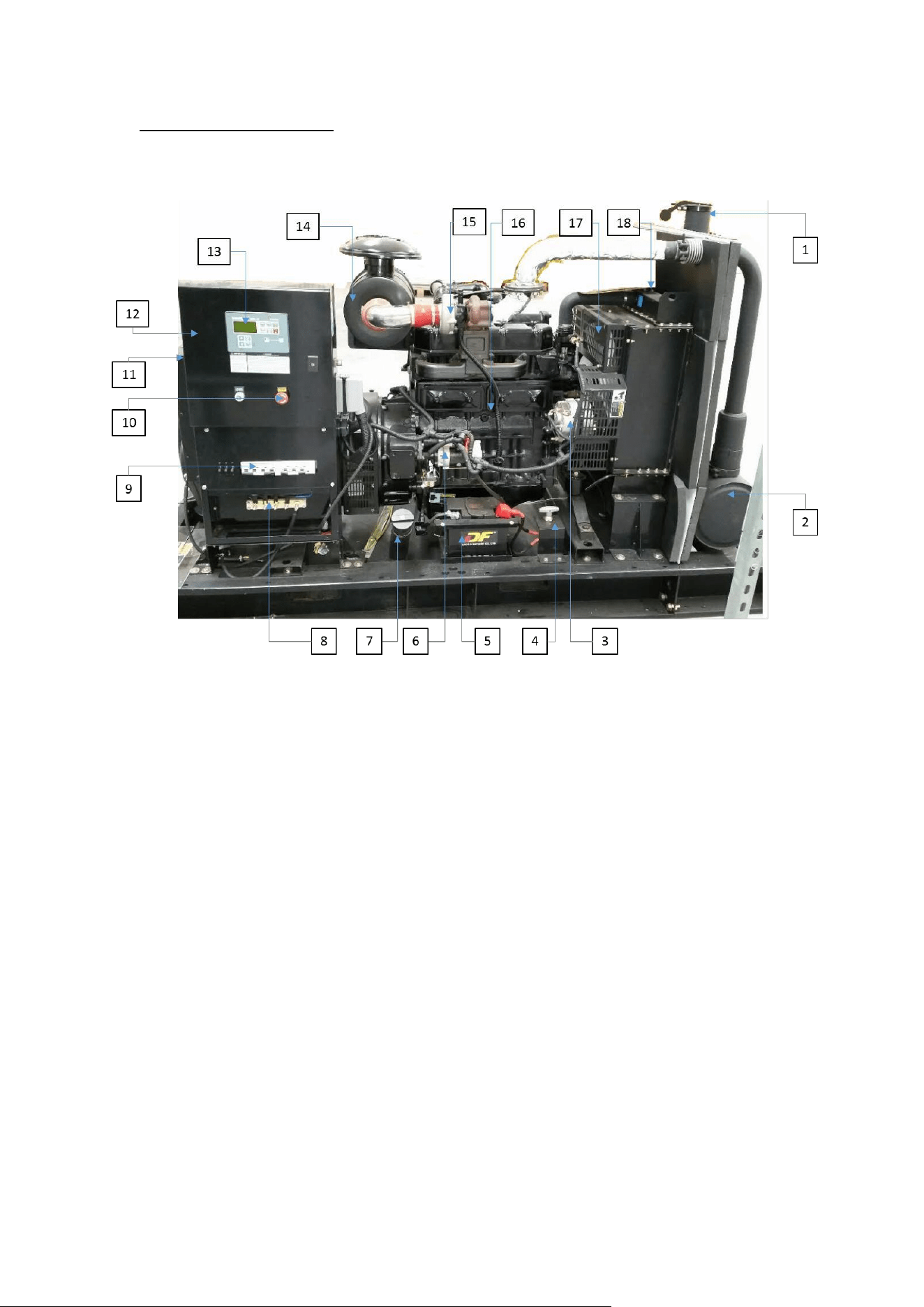
4. COMPONENT LOCATIONS
4.1. Viewed from control panel – canopy removed.
1 – Exhaust
2 – Silencer
3 – Engine alternator
4 – Battery isolator
5 – Battery
6 – Starter motor
7 – Fuel filler cap
8 – Generator output
9 – Main MCB’s
10 – Emergency stop button
11 – Main alternator
12 – Control panel
13 – MRS 10 panel
14 – Air filter
15 – Turbo fan
16 – Engine
17 – Cooling fan
18 – Radiator filler cap
Page 22
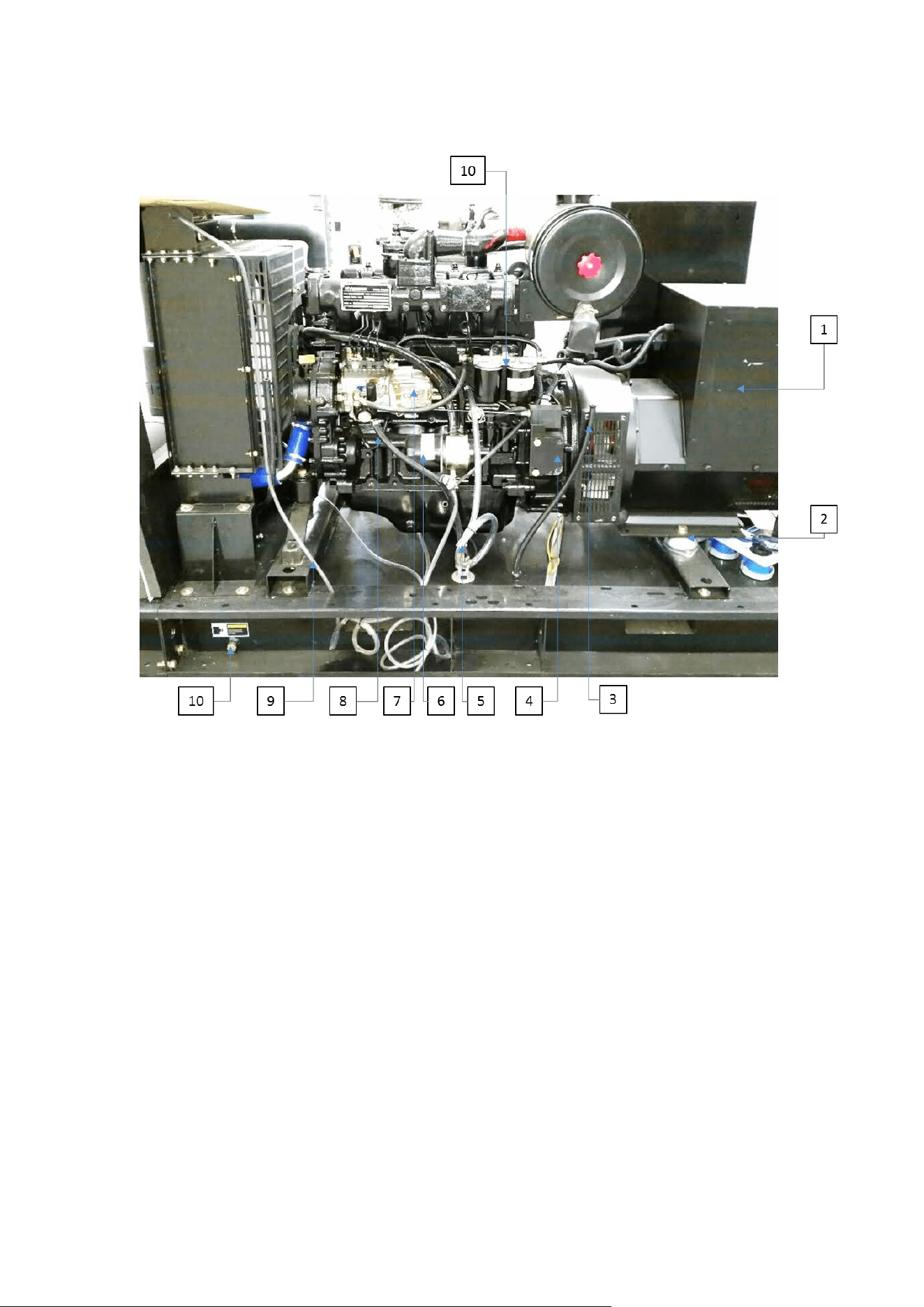
4.2. Viewed from reverse of control panel – canopy removed.
1 – Alternator
2 – Resilient mount
3 – Fuel tank breather pipe
4 – Electronic governor
5 – Engine coolant drain
6 – Oil filter
7 – Mechanical governor
8 – Fuel pick-up pipe
9 – Radiator drain pipe
10 – Fuel tank drain plug
11 – Fuel filters

Page 23
5. INSTALLATION
5.1. General outline.
5.1.1. Correct installation of generator set is the precondition which allows for
the normal working status of the generator set.
5.1.2. The room set aside for the generator set shall be designed specifically to
meet the expected functions and maintenance operations, and at the same
time the design of generator set working room shall conform to all local
building and any other applicable regulations.
5.2. Transportation.
5.2.1. During shipment, the generator must be protected against vibration, secured
tightly to the transport vehicle. This will protect against components being
shaken loose.
5.2.2. During shipment of the generator set, nothing should be placed above the
generator set as this will avoid damage caused by such weights.
5.2.3. When loading or unloading the generator set a forklift or hoisting device shall
be used to avoid the generator set become tilted or falling to the ground, which
may cause damage.
5.2.4. Lifting holes have been designed on the common base frame of our
generator sets. Some of the specifically designed generator sets have been
fitted with lifting holes on the roof and forklift openings on the base frame etc.
5.2.5. Users can transport the generator set according to the guidance specified on
the specific labels found on the generator set.
5.2.6. Please DO NOT use the lifting lugs on the engine or on the alternator to hoist
the whole generator set.
5.3. Design for the foundation.
5.3.1. The foundation which will be used to install and fix the diesel generator set is
very important, it must conform to the following requirements:
5.3.1.1. Have enough hardness and stability, so that to avoid deformation,
which will affect the stability of the diesel engine and alternator and other
accessory parts.
5.3.1.2. To support the weight of the whole generator set and to absorb the
dynamic impact caused by unbalanced force and vibration during engine’s
running period.
5.3.1.3. Generator set’s foundation is not allowed to connect to other
architecture’s foundation.
5.3.1.4. The width and depth of foundation shall meet the whole
requirements.
5.3.1.5. Make sure the foundation is smooth and level.
5.3.1.6. If possible, waste discharge sink can be used so that the waste oil can
be discharged in a timely manner.
5.3.1.7. A dedicated cable channel for generator power output cable.
5.3.1.8. A normal concrete foundation is reliable, simple and preferable.
5.3.1.9. When pouring the concrete foundation, please make sure the surface
of concrete is smooth and flat.
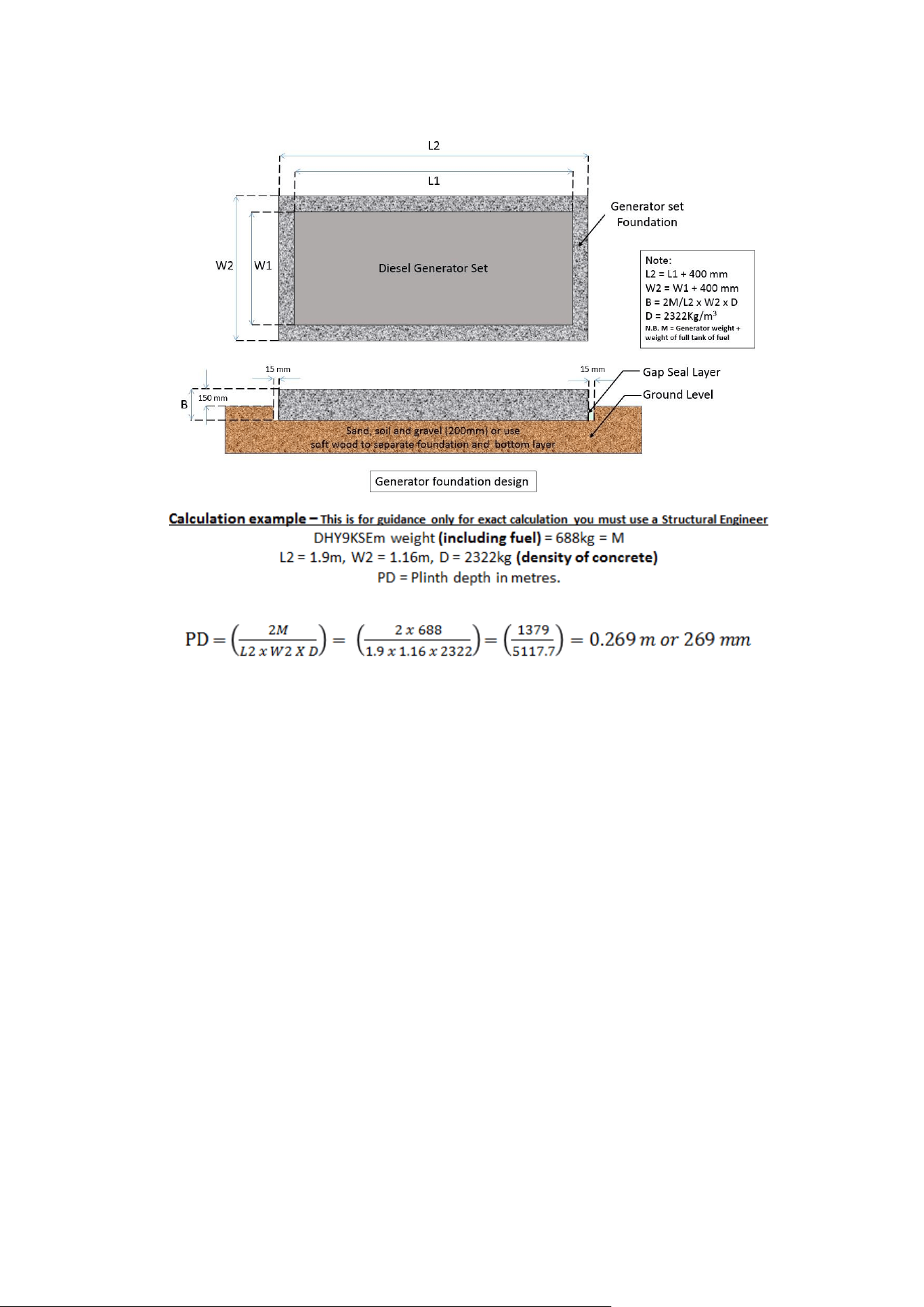
Page 24
5.3.1.10. For the foundation design see illustration below.
5.4. Design for Generator Set Working Room.
5.4.1. The complete installation of generator set shall be designed to conform to all
applicable building and any other applicable regulations, so that it also meets
the demands of operation and planned maintenance.
5.4.2. You must make sure that diesel engine generator set working room is
rainproof and windproof.
5.4.3. You must make sure that diesel engine generator set working room has
adequate ventilation and suitable exhaust system, at the same time use pipes
to exhaust the hot air generated from the radiator and prevent the hot air from
returning.
5.4.4. You must make sure that you reduce harmful emission to environment.
5.4.5. The silencer and exhaust pipe shall be supported by the roof, the support
method shall allow the exhaust pipe to expand.
5.4.6. It is not permitted to install the exhaust system directly on the generator set.
5.4.7. Enough space shall be reserved for the diesel generator set for convenience
of cooling, operation and maintenance etc.
5.4.8. The generator space shall remain free of all materials not required for
generator. The free space around and above the generator will be 1.5 metres
and 2 metres above.
5.4.9. The generator set room must have a suitable, available fire extinguisher
which must which must conform to the specified standard.
5.4.10. Emergency lighting facilities shall be installed in the generator set working
room for the convenience of operation and maintenance.
Page 25
5.4.11. No combustible and explosive materials are allowed to be placed in the
generator set room.
5.5. Installation of the Generator Set.
Canopied generator sets are weather-proof but not water-proofed. Ideally
they should be housed in a structure which must be suitable to protect the
generator set from the worst of the weather. The structure must have
adequate ventilation, and a correctly installed exhaust system and at least
1.5 metre clearance around the generator set to allow for maintenance and
servicing purposes.
5.5.1. Decide on the position of generator set
5.5.2. Use the section 5.3. Design for the foundation to correctly for correct
foundation installation.
N.B. This is for guidance only for exact calculation you must use a Structural Engineer.
5.5.3. Use expansion bolts to tightly fix the generator set to the concrete
foundation through the installation holes on the base frame.
5.5.4. Vibration reduction units have been installed on our generator sets.
5.6. Ventilation.
5.6.1. When a generator set has been installed in its final location, provision must
be made to discharge the hot air to outside and allow cold air to enter from the
outside, and avoid the hot air returning into the room.
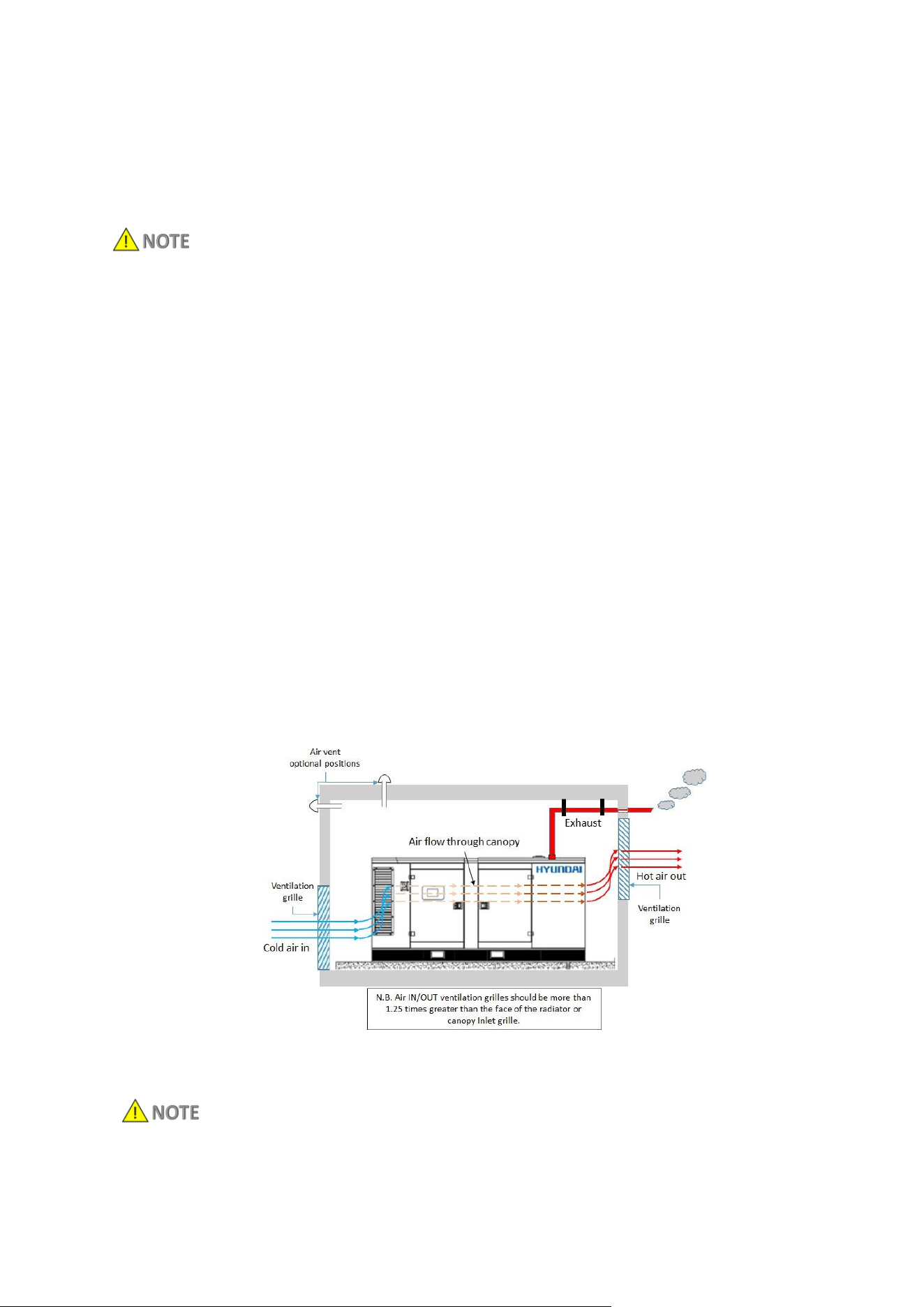
5.6.2. The diagram below shows example of ventilation air flow. The purpose of this
arrangement is to get cold air from the lowest point as much as possible, and
allow heat/hot air from the engine and generator to be vented and cold air
drawn in.
5.7. Exhaust.
When more than one generator set is installed, you must make sure each
machine has separate exhaust.
Serious damage will occur if rain or condensed water is allowed to enter the
exhaust system. One water discharge opening shall be installed in the long
exhaust pipe and positioned close to the generator set.

Page 26
If the end of the exhaust pipe is above the height of the building
then lightning protection will be required and bonded to the ground.
5.7.1. Our standard configuration diesel generator sets can be provided with
accessories such as heavy duty silencer, soft corrugated pipe and elbow etc. 5.7.2.
Users can design the exhaust system of generator set working room by
themselves.
5.7.3. When designing and installing the exhaust system, please consider the
following aspects:
5.7.3.1. Ensure the total exhaust back pressure no higher than the maximum
allowed value specified by the engine (usually generator set’s maximum
exhaust back pressure is no more than 5Kpa).
5.7.3.2. Fix the exhaust system to make sure the exhaust manifold and turbo‐
charger are not subject to the vertical pressure and side stress.
5.7.3.3. Allow for hot shrinkage and cold expansion.
5.7.3.4. Allow enough space for generator set vibration.
5.7.3.5. Reduce exhaust noise level.
5.7.3.6. Overload of exhaust backpressure will cause following adverse effect:
5.7.3.6.1. Loss of output power.
5.7.3.6.2. Reduced fuel efficiency.
5.7.3.6.3. A rise in exhaust gas temperature.
5.7.4. In the exhaust system, soft corrugated pipe shall be used to connect the
exhaust pipe with the turbocharger, this pipe has three functions as follows:
5.7.4.1. Separate the diesel engine with vibration and the weight of exhaust
pipe.
5.7.4.2. Compensate the heat expansion of exhaust pipe.
5.7.4.3. If the diesel generator set is installed on the anti‐vibration base frame,
the corrugated pipe will compensate for side-ways movement whilst
engine is starting or stopping.
5.7.5. Noise reduction
5.7.5.1. When diesel generator set is running, normally it will generate noise
level of equal to or below 96dB. Note the larger the load, the higher the
noise level.
5.7.5.2. In order to meet the noise level standards established by the local
environment regulations and to prevent the noise pollution, which will
affect people’s normal life. It is then very important to further reduce
the noise level of diesel generator by having it inside a suitable room.
5.7.5.3. When planning noise reduction you must fully consider the bottom
limit of air inlet/outlet volume needed by engine’s normal running and the
maximum allowed value for exhaust backpressure etc. Otherwise, the
noise reduction method can seriously affect generator set’s output power,
it will make generator the set’ s temperature rise, and cause frequent
malfunction of the generator set, and can even shorten the generators life
expectancy.

Page 27
5.8. Cooling system.
You should NOT allow the radiator to become blocked with debris, it will
greatly affect radiator’s cooling capacity. It is therefore necessary to flush and
clean the radiator at regular intervals.
5.8.1. Our standard configured diesel generator sets are fitted with closed cycling
water chilling units with fan and radiator installed.
5.8.2. Closed water chilling engine drive the cooling pump to generate coolant
circulation, which keeps the anti‐freeze in a continuous flow through the
cylinder body which in turn will reduce heat.
5.8.3. The engine’s cooling pump, radiator (or heat exchanger) forms a closed loop,
pressure cycling and cooling system.
5.8.4. The most common cooling system is the cooling fan mounted directly in
front of the radiator, which is driven by the engine This can be replaced by a heat
exchanger, remote radiator or remote cooling tower etc.
5.8.5. If the installation position of the remote cooling fan is higher, then a
transmission radiator is needed to prevent damage to the heat exchanger
which can be caused by internal pressure being too high.
5.9. Coolant.
5.9.1. Cooling system must use a coolant which can protect the engine from
contamination and freezing.
5.9.2. Coolant must be a mixture of pure water and anti‐freeze or pure water and
anti‐rust fluid.
5.9.3. In this mixture, the water PH value shall be between 6
~
8, which usually
suggest to use distilled water.
5.9.4. The specific mixing ratio shall be according to local weather, and that of the
coolant recommended by the engine supplier, and reference to the operation
(preparation) manual of the coolant. Mix the liquids in separate containers
evenly and then add the mixture into the radiator, make sure that the anti‐
freeze will not freeze under low temperature.
5.9.5. In the areas where there is no possibility of freezing, the coolant can be a
mixture of water and anti‐rust, according to the anti‐rust which recommended
by the engine supplier and refer to its operation manual, mix the liquids in a
separate container evenly and then add the mixture into the radiator.
5.9.6. The first time anti-rust is added, you should keep the generator running until
it gets hot enough to achieve the best anti-corrosion affects.
5.9.7. Engine coolant has three functions;
5.9.7.1. Provide enough heat transmission.
5.9.7.2. Prevent all metal and sealing materials within the cooling system from
corrosion.
5.9.7.3. Provide sufficient anti‐freeze capacity.

Page 28
5.10. Changing Coolant.
Only use approved anti-freeze and mixed to the correct ratio.
Using poor quality products can shorten the life of the engine and
may cause early degradation of hose and seals. This will damage be
outside of the warranty. Coolant should be 33% of the total volume of
cooling liquid.
5.10.1. The effectiveness of anti‐freeze and anti-rust will decrease over time and will
need to be changed periodically.
5.10.2. YOU MUST change it regularly and should be changed in every two years or
2000 hours.
5.10.3. The anti‐rust mixture should be changed at least once every year. And if a
coolant filter is installed it should be changed in every 6 months (please refer to
the engine operation manual for the specific intervals of the changes required).
5.10.4. When it is time to change the coolant, make sure the generator set has been
shut down and the engine has been allowed to fully cool down, then open the
radiator cap then open the radiator drain valve.
5.10.5. If the generator set is fitted with a coolant filter, it should be changed at the
same time.
5.11. Cleaning of the cooling system.
If the cooling system is cleaned periodically, you need only to rinse with small
amount of additives or clean water.
The air discharge valve in the engine body shall be located in the top point of
the water path or near the thermostat, water temperature sensor, or you can
loosen the water temperature sensor and re‐tighten it when you see coolant
run out of it so that it shows all air has been discharged.
5.11.1. When it is time to change the coolant, the radiator and cooling system will
require cleaning, the suggested cleaning procedures are as follows:
5.11.1.1. Empty the cooling system.
5.11.1.2. Use clean water to rinse cooling system.
5.11.1.3. Mix 15% to 20% of condensed coolant to the cooling system, then run
the generator set for once or twice (depending on amount of
contamination) then discharge the coolant.
5.11.1.4. Once empty the cooling system can be re-filled with the normal
mixture to rinse.
5.11.1.5. If contamination still exists, then repeat the cleaning procedure until
all contamination is cleared from the system.
5.11.1.6. Before adding coolant to the coolant system, please make sure the
radiator‘s discharge valve and the engine’s discharge valve are tightly
closed.
5.11.1.7. Add the coolant to the system to avoid air lock being formed in the
system.
5.11.1.8. Air shall be discharged through the adding hole or the discharge valve
in the engine body.

Page 29
5.11.1.9. If a cooling system pre-heater is fitted, the control valve for the
heater should be opened. To make sure the system is fully vented when
adding the coolant.
5.11.1.10. After the system has been fully cleaned and rinsed, add fresh coolant
which has been mixed according to specified proportions, 33% antifreeze.
Fill to 50mm from the top of the filling point. Run the engine and pre-
heater (if fitted) recheck level and top up as required.
5.12. Oil Lubrication system.
It is important to use quality lubricant oil with proper viscosity and which
conform to the engine’s specification.
We recommend that a high quality multi grade SAE 15W40 high service
engine oil in diesel engine is used.
Periodically change the lubrication oil and oil filter so that the generator set
maintains normal working.
Any malfunctions caused by wrong type of lubricating oil with low quality or
long time periods between oil and oil filter change will be outside the scope
of warranty.
5.12.1. Lubrication system is comprised of oil pan, oil pump, strainer, oil pipe, oil
cooling unit, oil filter unit, and all the moving parts of the engine
5.12.2. The main purpose of the lubrication system is to provide sustained tempered
oil film between all moving parts to reduce friction and wear, and to draw heat
away from those moving parts.
5.12.3. Coat mechanical parts to improve sealing effect and prevention of rust on
surfaces.
5.12.4. Check the maintenance schedule to determine the oil change periods.
5.12.5. The first oil change is normally done within 100 hours from when the
generator set first started.
5.13. Fuel System.
5.13.1. The fuel oil specification for a specific engine can be found by referring to the
manufacturers’ data sheets.
5.13.2. The generator set requires fresh diesel fuel without air and water and with
proper pressure, of which all kinds of parameters such as sulphur content etc.
shall meet national standards, and end use temperature grade to meet the
requirement of customer’s working environment.
5.13.3. Generally generator set’s fuel system includes two parts, that is, engine’s fuel
system and an external fuel system.
5.13.4. We are only responsible for the engines fuel system which includes fuel tank
and connecting fuel pipes etc.
5.14. Fuel Tank.
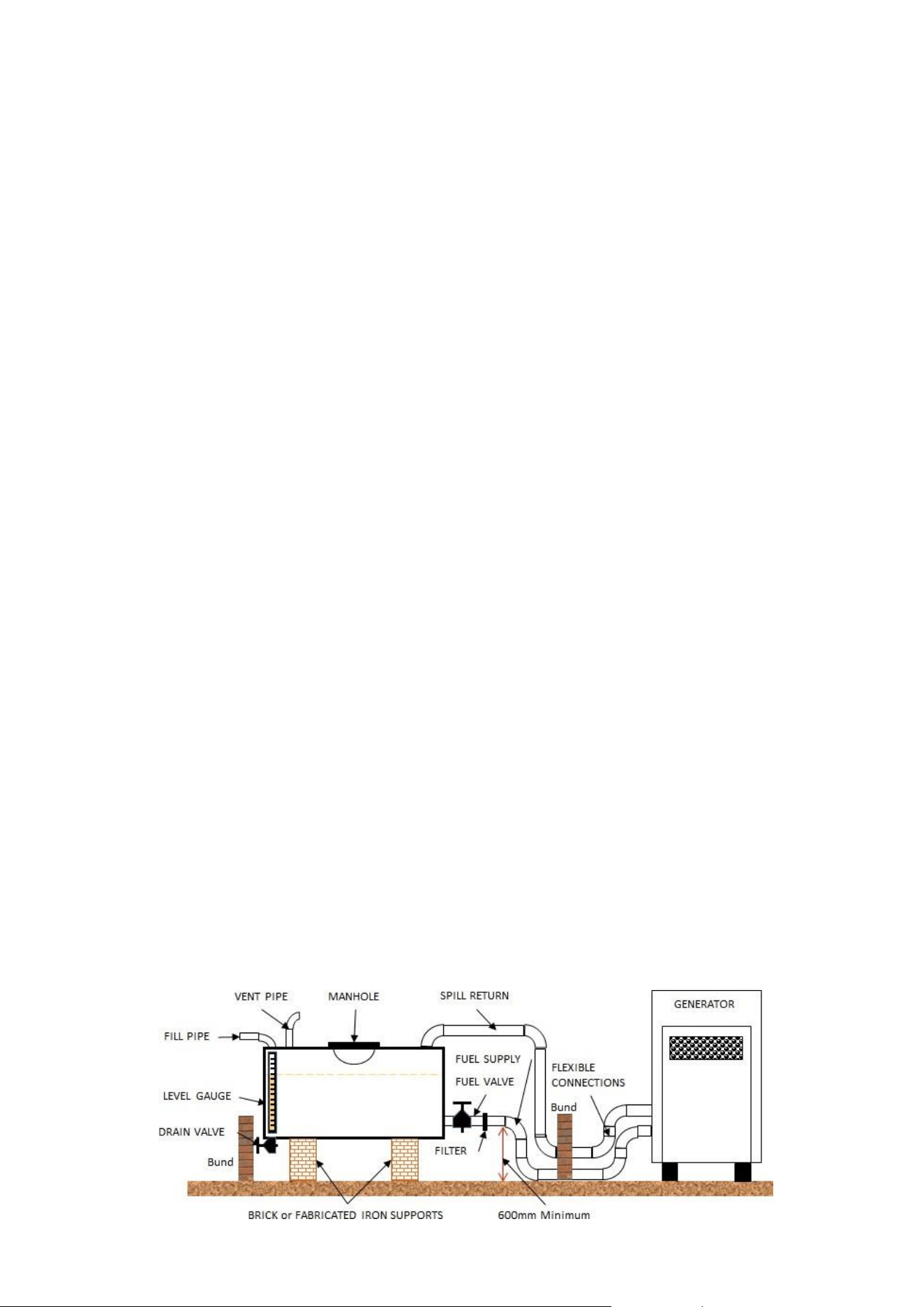
5.14.1. Our generator sets have a base frame type of fuel tank.
5.14.2. The fuel tank comes complete with fuel pipes and fuel level indicator.
5.14.3. The fuel supply system does not require the customer to make any additions.
Page 30
5.14.4. Customers only need to add fuel to the base frame.
5.14.5. Users who intend to self-manufacture the fuel tank should use stainless steel
or steel plate to make the backup tank, It should not be internally painted or
galvanised.
5.14.6. In addition, the configuration of fuel tank assembly shall be as follows;
5.14.6.1. Air ventilation pipe above fuel tank surface.
5.14.6.2. Manhole on the top surface of fuel tank.
5.14.6.3. Fuel level indicator.
5.14.6.4. A discharge valve at the bottom of fuel tank.
5.14.6.5. Earthing cables between fuel adding hole and fuel tank.
5.14.6.6. Separate panel with holes between fuel supply area and fuel return
area, so that to reduce heat exchange.
5.14.6.7. The end of fuel supply pipe shall be 50mm above the bottom of base
frame to avoid deposits and water at the bottom of fuel tank being sucked
into fuel supply pipe.
5.14.6.8. The fuel level shall be higher than the fuel injector, to avoid fuel
return from fuel injector, which can cause starting issues.
5.15. Installation of the Fuel tank.
5.15.1. The position of the fuel tank should ensure the maximum suction fuel head is
no less than 2 meters.
5.15.2. Suction fuel head of the fuel transfer pump shall be calculated from the
bottom of the fuel tank.
5.15.3. The position of the fuel tank shall ensure maximum return fuel head no less
than 1.5 meters.
5.15.4. Return fuel head shall be calculated from the top of the base frame.
5.15.5. The arrangement of the fuel pipe shall avoid the fuel being affected from the
heat elimination from generator set too much.
5.15.6. The maximum temperature of the fuel before fuel pump shall be lower than
60 degree Celsius.
5.15.7. There should be no fuel leaks in fuel inlet and fuel return pipe.
5.15.8. Flexible hoses need to be used to connect generator set with fuel transfer
pipe, to prevent the effects of vibration.
5.15.9. When engine’s fuel inlet pipe is above 6 meters and below 10 meters, the
inside diameter of the fuel inlet pipe must be at least 20% bigger than that of
the hose installed in this engine. The fuel return pipe must be connected to the
top of fuel tank. Do not connect directly to fuel inlet pipe.
5.15.9.1.1. Typical Layout – DO NOT use for design purposes.

Page 31
5.16. Fuel SYSTEM.
When adding fuel to the fuel tank, you must make sure the generator
set has been stopped. You will need to prime the diesel pump before
attempting to start the machine.
Allow the fuel to settle before the generator set is re-started. This will
avoid any debris/foreign materials getting sucked into the diesel fuel
supply hose, which will cause blockages in the fuel filter and failure to
supply engine with sufficient fuel, which in turn will decrease the
output power.
Any malfunction caused by bad quality of fuel is not in the scope of
the warranty.
5.16.1. The content of the diesel fuel plays a very critical role in diesel engine’s
performance, life expectancy and the content of discharged material.
5.16.2. In order to achieve the rated power, fuel economy and specified emission
standard, only use the fuel which is referred to in international standard or
national standard.
5.16.3. The parameters of diesel fuel include low temperature feature, sulphur
content, specific gravity, water content and foreign material content shall be
the first priority when user need to choose the quality of the fuel.
5.16.4. Poor quality fuel will directly affect diesel generator set’s start, lubrication,
output power, discharge, and fuel filter change cycle etc.
5.16.5. Specific requirement for fuel please refer to engine operation manual which
attached with the generator set.
5.17. Control system.
5.17.1. Our diesel generator sets come with a control panel.
5.17.2. All of the control panels have digital meter at the core of control system.
5.17.3. Digital control panel;
5.17.3.1. The generator set can be controlled locally, and can also be
started or stopped by remote control (controlled by an external signal
line) users are required to correctly connect the signal line to this control
panel. See the connection details in the control panel operation manual.
5.17.4. Automatic transfer panel (optional);
5.17.4.1. The automatic transfer switch is used for transferring the load
between generator set and mains, for details refer to control panel
operation manual.
5.18. Battery.
You must make sure that the connections for both positive and
negative poles is correct. Incorrect connections will cause
malfunction. It will cause damage to the charging alternator
When generator set is running, battery cables are not to be
disconnected.

Page 32
5.18.1. The generator set standard configuration provides a maintenance free
starting battery.
5.18.2. You only need to connect the cables for the battery.
5.18.3. Our diesel generator sets’ battery cables have been connected to the engines
before shipment.
5.18.4. Maintaining the charge of the starting battery will determine how well the
diesel engine generator set can start in a specified period.
5.18.5. The battery is continuously charged whilst the engine is running.
generator.
5.19. Electrical connections.
All electrical connections should be in compliance with BS7671
Requirements for Electrical Installations, and other local regulations.
5.19.1. Only fully qualified and experienced electrical technicians should carry out
electrical installation, service and repair work.
5.19.2. Cabling.
5.19.2.1. Due to movement of generating sets on their vibration mounts, all of
the electrical connection to the set should be made with flexible cable.
5.19.2.2. The cable must be suitable for the output voltage, current and of the
generating set.
5.19.2.3. In determining the size, allowances should be made for ambient
temperature, method of installation, proximity of other cables, volt drop,
etc.
5.19.2.3.1. Cable volt drop.
5.19.2.3.1.1. Volt drop is defined as the amount of voltage loss that
occurs through all or part of a circuit due to impedance.
5.19.2.3.1.2. The distance between the generator and the load
should be given careful consideration to keep the volt drop
to a minimum.
5.19.2.3.1.3. The voltage drop across a cable can be found by
checking in BS7671 Requirements for Electrical Installations.
5.19.2.4. Before powering up the generating set you MUST carefully check all
connections for correct polarity, phasing, earthing and tightness.
5.19.2.5. Current carrying capacity of the cables can be found in BS7671
Requirements for Electrical Installations.
5.19.3. Ground/Earthing Requirements.
5.19.3.1. The frame of the generating set must be connected to a ground/earth
electrode/spike.
5.19.3.2. Since the set is mounted on vibration isolators, the ground/earth
connection must be flexible to avoid possible breakage due to vibration.
5.19.3.3. Ground/earth connection cables or straps should have at least full
load current carrying capacity and meet the current with BS7671
Requirements for Electrical Installations, and all other applicable local
regulations.

Page 33
5.19.4. Testing of ground/earthing arrangements.
Before inserting an earth electrode it is IMPORTANT that you check
what is below the surface i.e. buried pipes, cables etc. YOU SHOULD
NOT ASSUME that by just pushing earth electrode into the earth it will
give a safe, suitable and sufficient earthing point.
It should be tested in accordance with BS7671 Requirements for
Electrical Installations 612.7 Earth electrode resistance, “Where the
earthing system incorporates an earth electrode as part of the
installation, the electrode resistance to Earth shall be measured”.
5.19.4.1. Earth electrode method.
5.19.4.1.1. To carry out this test refer to BS7671:2008 On-Site guide.
5.19.4.2. Earth fault loop impedance testing method.
5.19.4.2.1. To carry out this test refer to BS7671:2008 On-Site guide.
N.B. The expected reading for both methods in a TT system should be <200Ω.
5.19.5. Insulation resistance testing. All of our 1500RPM machines are fully tested during PDI.
5.19.5.1. Before starting the generating set after installation, test the insulation
resistance of the windings.
5.19.5.2. The Automatic Voltage Regulator (AVR) should be disconnected and
the rotating diodes either shorted out with temporary links or
disconnected.
5.19.5.3. Any control wiring must also be disconnected.
5.19.5.4. A 500 V megger or similar instrument should be used.
5.19.5.5. Disconnect any earthing conductor connected between neutral and
earth and megger an output terminal to earth.
5.19.5.6. The insulation resistance should be > 1MΩ to earth.
5.19.5.7. Should the insulation resistance be less <1MΩ winding must be dried
out.
5.20. Power distribution system.
All of our diesel engine generator sets must connect generator sets
and base frames to the ground, please refer to the ground label for
connection point.
5.20.1. Our diesel engine generator set use three phase five line system for power
distribution. The Neutral and Earth linked.
5.20.2. That is, three phase live wires, one neutral line and one ground line.
5.20.3. Users can choose three phase four lines for power distribution.

Page 34
6. OPERATION.
To maximise the life expectancy of the generator set the user must
maintain and operate the generator set in accordance with all
instructions.
6.1. Inspection before use.
6.1.1. Once installation is completed, our diesel engine generator set can be put
into use. Each time before starting the generator set, following items shall be
checked without fail;
6.1.1.1. Check that there is no dirt, dust or debris on the surface of generator
set or engine. Check that the ambient temperature is within operational
limits.
6.1.1.2. Check that the air inlet and ventilation path in the generator set
working room is clear of any obstructions.
6.1.1.3. Check fuel tank has sufficient fuel for expected duration of use.
6.1.1.4. Check the coolant and anti‐freeze level is normal.
6.1.1.5. Check that the air filter/s are in good condition.
6.1.1.6. Check that the fuel filter/s are in good condition.
6.1.1.7. Check If the lubricant level is within the specified range. Check that
6.1.1.8. the fuel valve is open and that the fuel pump has been primed.
6.1.1.9. Check battery cables are correct polarity and are secure.
6.1.1.10. Check the load is safe to be connected.
6.1.1.11. When the generator set directly connected to the load, you MUST
make sure that the circuit breaker/s are OFF before starting.
6.2. Pre-heater (Option).
6.2.1. For generator sets which have a pre‐heater system installed the operator
needs to decide if pre‐heating is required before starting the generator set
according to environment temperature.
6.2.2. The installed control panel can signal the engine to start the pre‐heater if
pre‐heating is required.
6.3. Connecting to power.
6.3.1. Make sure that the circuit breakers on the control panel are ON,
watch the panel until the background light turn on. This means the control panel
has been connected to the power. At the same time make sure the fuel pipes are
open, and the speed governor or the control unit in the electronic fuel injection
generator set is working condition.
Page 35
6.4. Starting.
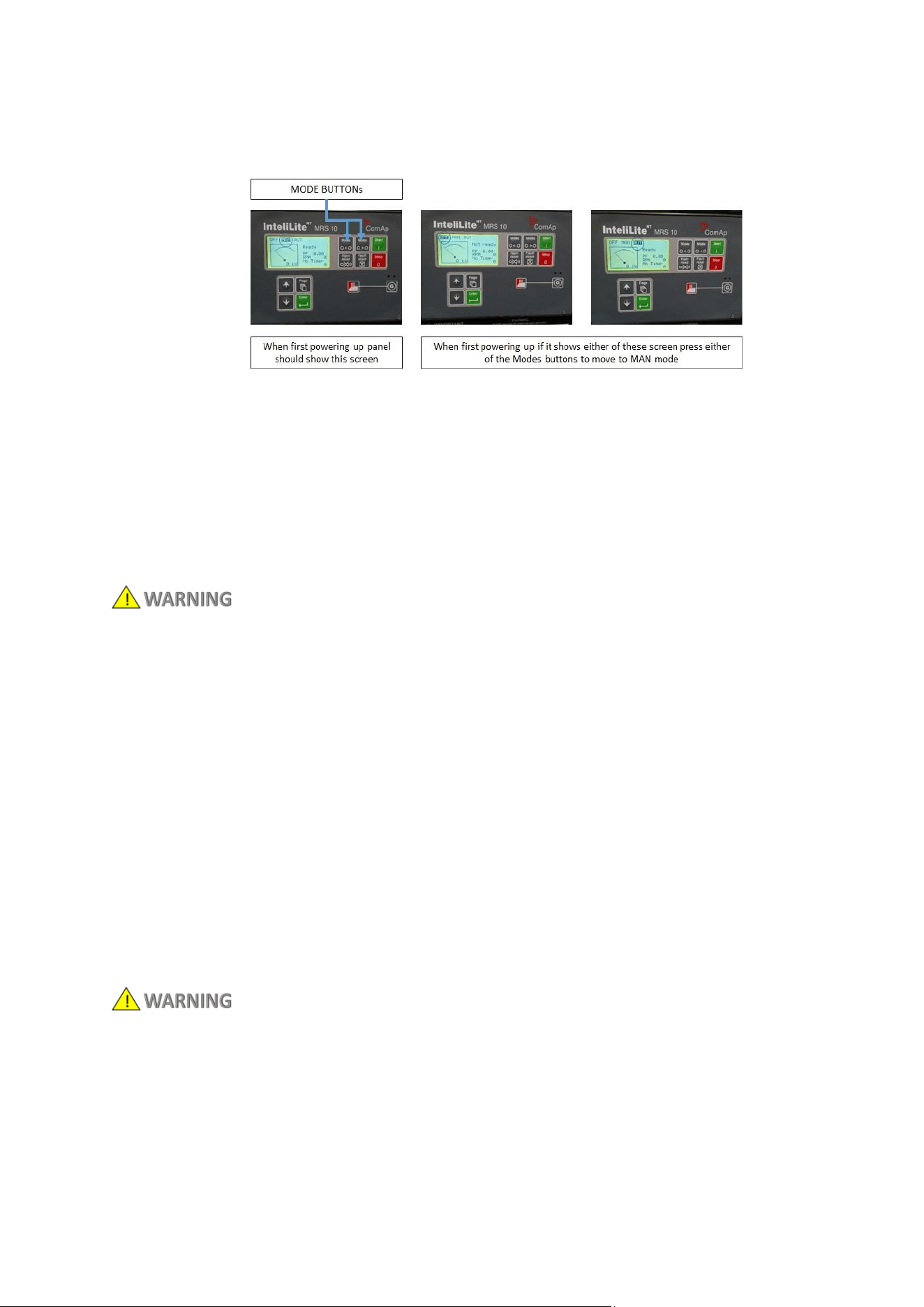
6.4.1. Turn the key switch to ON position the panel will illuminate. Make sure the
control panel is in MAN mode then control panel press the ‘start’ button after
a couple of seconds the machine will commence its start up routine.
6.5. Remote starting.
6.5.1. For the control panels which are installed with remote self‐start (or
communication) instrument, the generator set pre‐heating, start‐up period and
starting times have are controlled by the program. Programme parameters can
be set and modified by user, but it is strongly advised that before changing any
parameter, assistance is sought from our after sales team.
6.6. Running.
Any starting method not done via the control panel will invalidate the
warranty.
6.6.1. When the generator set begins to run at full speed, and the output
voltage and frequency becomes normal and stable, operators can put the
generator set into normal running condition and apply loads.
6.6.2. During the generator set’s running period, the operator/s MUST check at
regular intervals for the following;
6.6.2.1. is the generator set is running normally,
6.6.2.2. is the control panel instrument is indicating the right position,
6.6.2.3. does the control panel have any pre‐warning indication,
6.6.2.4. the fuel level in the base frame.
6.7. Emergency stop.
6.7.1. In case the generator set was found to have any severe malfunction or power
distribution malfunction. You MUST operate the emergency stop button on the
control panel. This will immediately shut down the generator set.
DO NOT operate the emergency stop button under normal conditions.
6.8. Normal stopping procedure.
6.8.1. Before stopping the generator set under normal operating conditions, first
disconnect all loads from the generator by turning off all load, then turn off
all of the circuit breakers.
6.8.2. Press the stop button - Once only. Once the stop button has been pressed
the machine will carry out a controlled shutdown process.

Page 36
6.8.4. Some generator sets are fitted with a stop solenoid, it is therefore
not possible to stop the generator set by turning off the key switch on
the control panel.
If the key switch is turned off and turned back on the machine will
come to a stop. This stopping is caused by a fault and NOT to be used
as the stopping method
6.9. Checks after running.
6.9.1. After the generator set stop running, it will be necessary to carry on following
checks;
6.9.1.1. Check if the generator set for
6.9.1.1.1. Oil lubricant leaks,
6.9.1.1.2. Fuel leaks,
6.9.1.1.3. Coolant (anti‐freeze) leaks.
6.9.1.2. Shut down fuel valve
6.9.1.3. When necessary shut down air inlet and air exhaust vents in the
generator set’s working room area.
6.9.2. Turn off the power key switch on the control panel, remove the key and keep
it in a safe place and in good condition.
6.9.3. When the generator set need to be shut down for a long time or is under
maintenance, please dis‐connect the start battery’s negative cable, and fully
discharge the fuel and anti‐freeze liquid when necessary.
6.9.4. For the self‐start (remote start) generator sets, some of the above items are
not applicable.
6.9.5. After the self‐start (remote start) generator set stops, please keep it in the
same status as that of pre-start (ready to start), so that it be can started at any
time under emergency cases.
6.10. Run record.
6.10.1. The user shall record each running operation.
6.10.2. The run record has various forms.
6.10.2.1. The basic content shall cover:
6.10.2.1.1. Time run for current period,
6.10.2.1.2. Accumulated running time for this generator set,
6.10.2.1.3. Value of engine’s;
6.10.2.1.3.1. Oil pressure gauge.
6.10.2.1.3.2. Temperature meter.
6.10.2.1.3.3. Output voltage.
6.10.2.1.3.4. Frequency.
6.10.2.1.3.5. Maximum power(current) etc.
6.10.2.1.3.6. The running conditions/situation.
6.10.2.1.3.7. Any malfunction warning or generator set shut downs.
6.10.3. Only when the correct and complete record for running (maintenance) have
been kept can the user can get correct and proper after sales (warranty)
service.

Page 37
6.11. Warnings for mis-use.
DO NOT allow the generator set to run with overload for long periods,
otherwise malfunction will occur, this will decrease the generator set’s
life expectancy.
It is forbidden to remove or change any of the generator set
components when it is running.
Any coolant which is going to be added needs to be of the same
specification as that of the original cooling system. When opening the
radiator cover. You MUST pay attention to the possible coolant high
temperature to avoid the steam burns to the user or bystanders.
When emptying high temperature lubricant oil, you MUST avoid being
burnt.
The fuel being used shall be conform to national standard, otherwise
it will cause malfunction of the engine’s fuel pump or fuel injector.
For engines fitted with a turbo‐charger, it is advisable NOT to add
50% or above instant load to the generator set. Otherwise this will
cause the generator set to stall.
For electrically large consumption equipment, it is suggested that the
users need to use methods such as voltage decrease and frequency
change etc. to control the start, to reduce huge impact on the
generator set when starting such loads.
It is suggested that backup generators or generator sets which haven’t
been run for a long time shall be run up to working temperature at
least once a month. This of generator set need to be continuously run
with full load for 4 hours at least one time per year.
Page 38
For generator sets which are connected in parallel and controlled by
manually by operators must make sure they are running
synchronously (same frequency, same phase‐sequence, same phase,
and same voltage) before switching on. All loads MUST be switched
off before trying to stop the parallel generator groups. During the
parallel generator group running, you MUST remain alert to individual
generators stopping so as to avoid the parallel generator group
stopping.
6.12. Control system operation.
6.12.1. Generator control panel operation
6.12.1.1. Our generator set standard supply two different control module: one
is single generator with remote start function, the other is single
generator with Automatic Mains Failure panels (ATS).
6.12.2. Start‐up generator
6.12.2.1. Turn OFF all loads and switch OFF all circuit breakers.
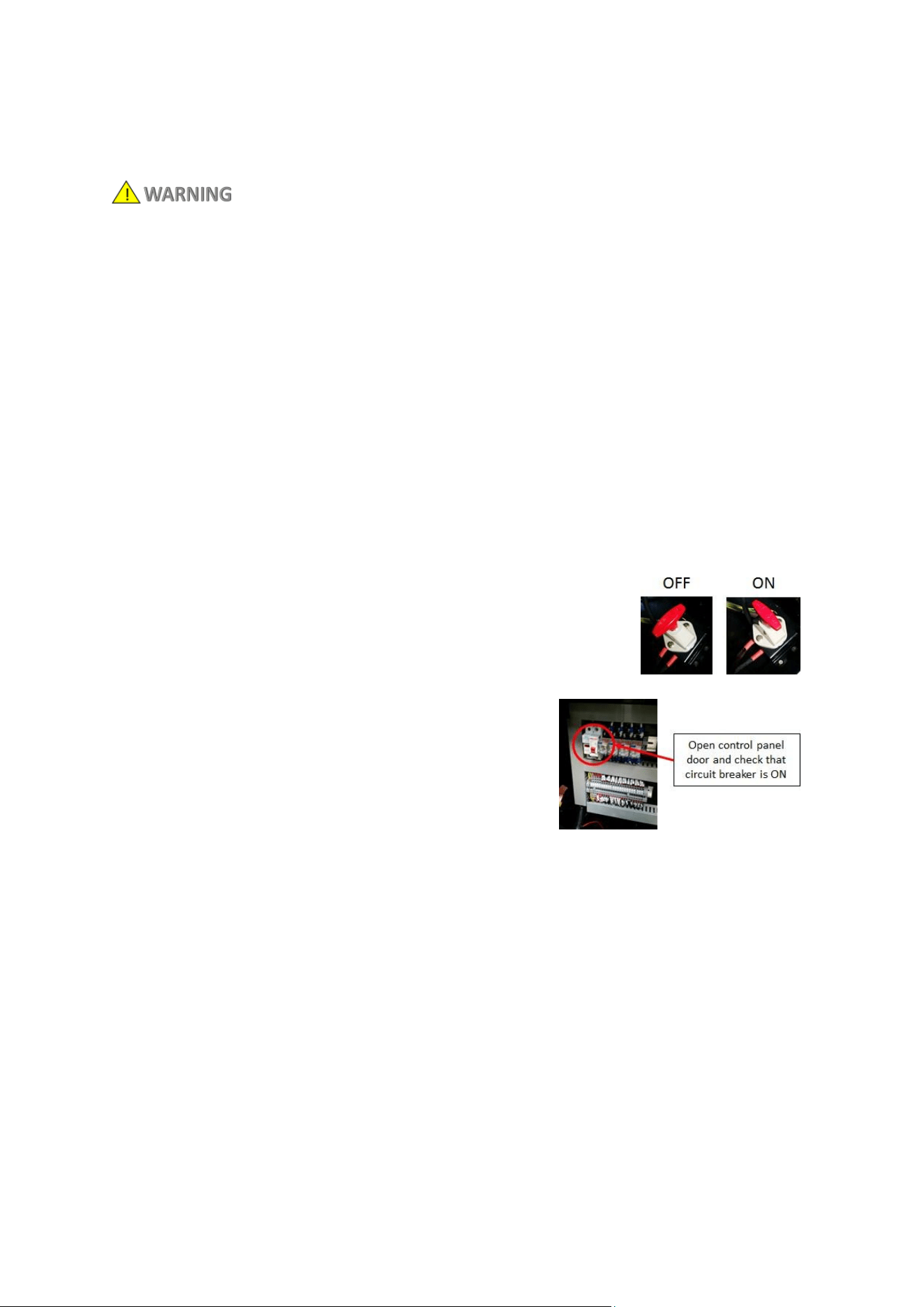
6.12.2.2. Turn the Generator set Main Circuit Breaker and other circuit
breakers to the “OFF” position.
6.12.2.3. Turn the battery isolator ON.
6.12.2.4. Make sure that the control
panel power circuit breaker is
turned ON.
6.12.2.5. Press the start button on the front of the control panel.
6.12.2.6. If generator set is fitted with pre‐heater (air intake or water pre‐heater).
The Pre‐heat engine will illuminate on module LCD. Preheating time varies
by coolant temperature. Usually water pre‐heater completes in about 60
seconds, air intake pre‐heater completes 10 seconds. After preheating the
LCD puts out and the engine begins to start. It will attempt to start again
about 5 seconds later if the engine fails to start.
6.12.2.7. After the engine starts successfully, allow the engine to warm up for
about 5 minutes. If the engine does not fire during the pre‐set number of
attempts to start (start attempts number: 3 times), the Alarm LCD would
flash. If you need to restart, wait at least 30 seconds before the retry.
6.12.2.8. Check the reading of voltage & frequency meter.
6.12.2.9. Once the generator set is running at the correct voltage, frequency and at
operating temperature the main circuit breaker can be switched “ON”.
6.12.2.10. Starting with heaviest loads first then lighter loads turn "ON" each load
circuit breaker.
Page 39
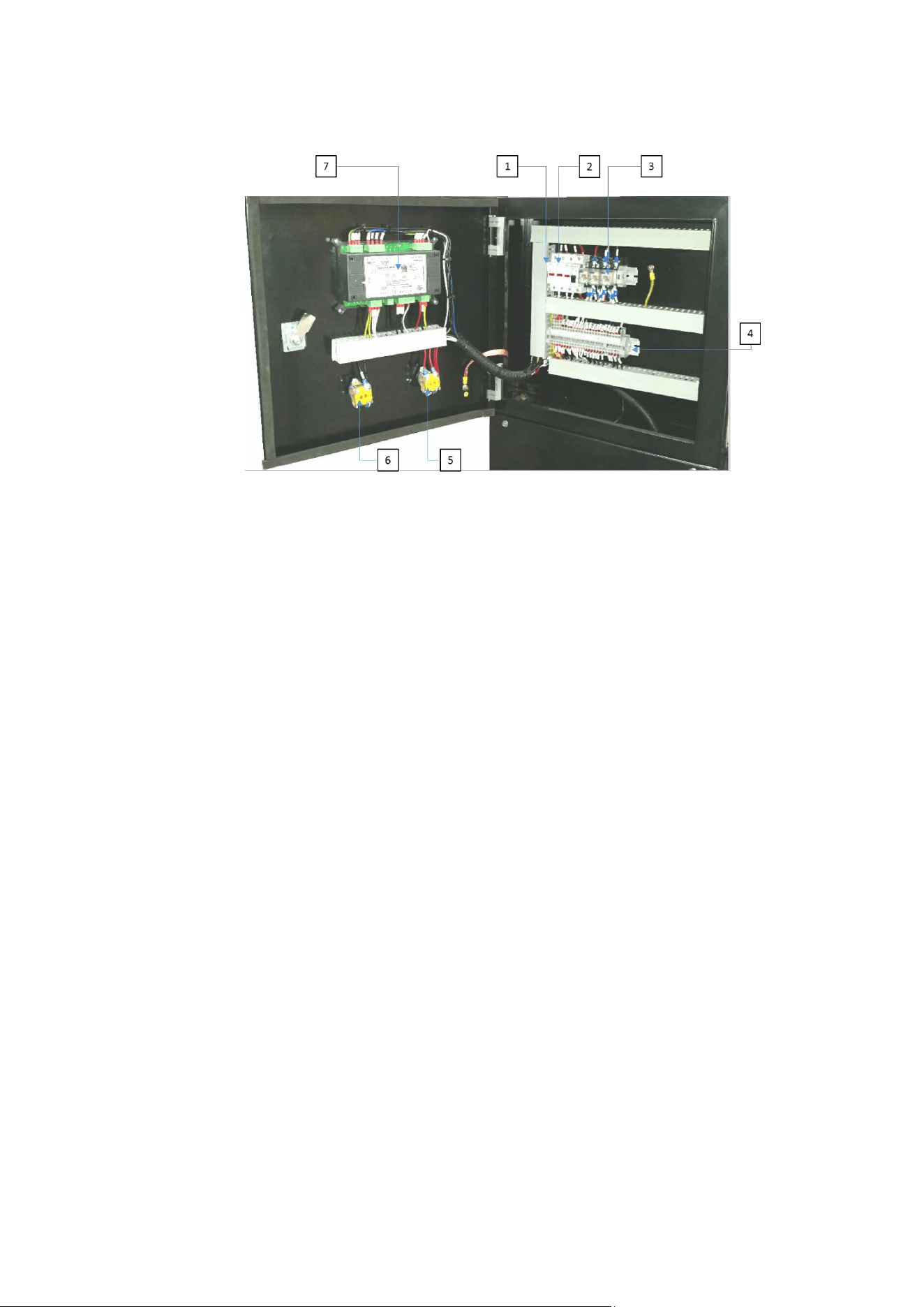
6.12.3. Control panel.
1 – Fuses
2 – Panel circuit breaker
3 – Control relays
4 – Connection terminals
5 – Main key switch (rear)
6 – Emergency stop (rear)
7 – MRS10 control
6.12.4. Generating set control system
6.12.4.1. To control and monitor the generating set, an electronic control
system has been used. The MRS10 control system is fitted. The Control
panel provides a means of starting and stopping the generating set,
monitoring its operation and output and automatically shutting down
the set in the event of critical conditions arising such as low oil pressure
or high engine temperature.
6.12.4.2. This module is mainly used for auto/manual start-up protective
stop and manual/auto switchover the generator set power and mains
power. It can also remote control/measure/monitor generator set
through a computer. The MRS10 panel has an LCD screen to display
the set parameters of the generator set, and has Off/Manual/Auto/
Measurement modes.
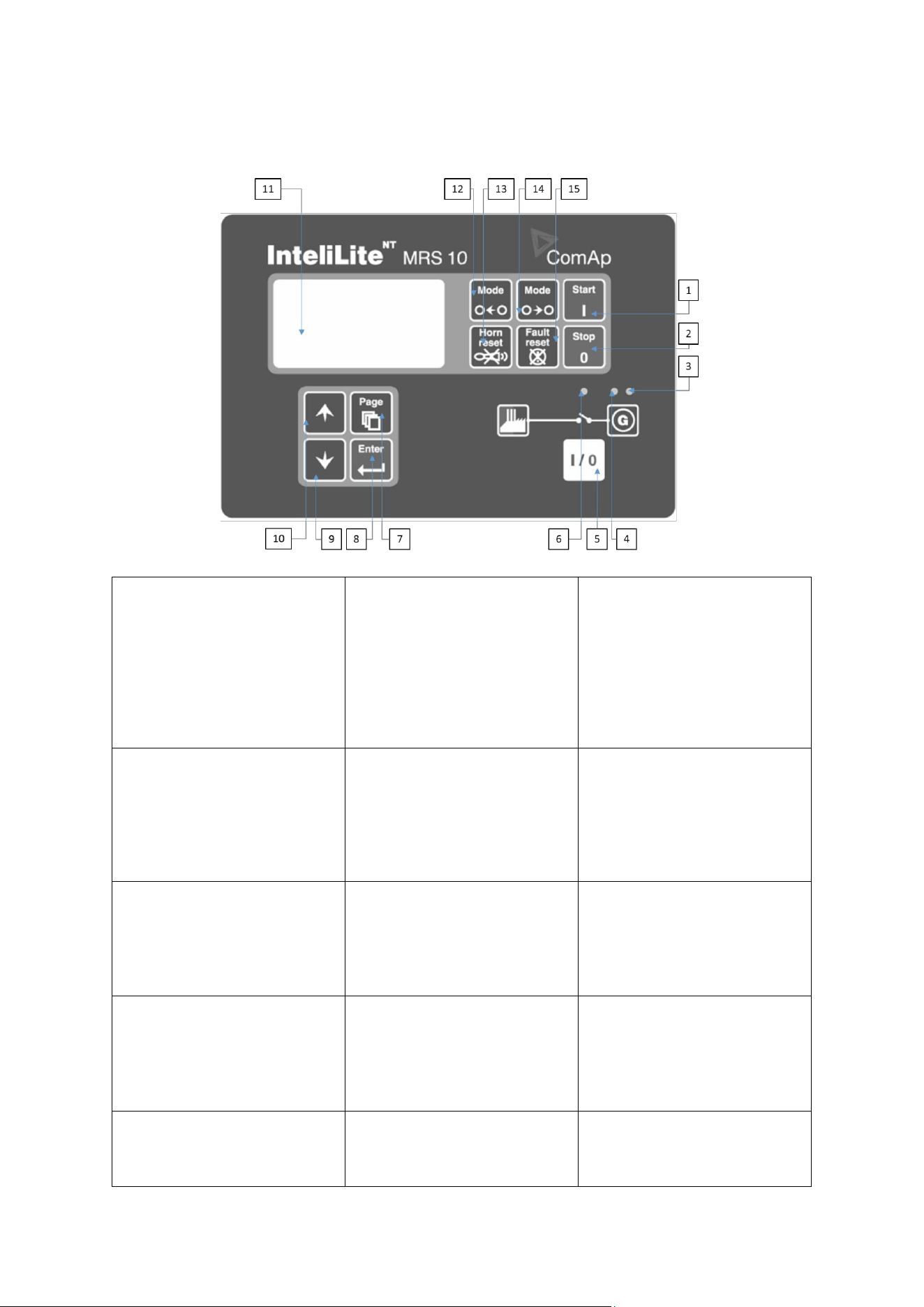
Page 40
6.12.5. MRS10 Control panel push buttons functions and LED indications.
1 – Start-up
Starts the engine.
2 – Stop
Stops the engine.
3 – Generator set failure
Generator set failure: Red LED
starts flashing when generator set
failure occur. After fault reset
button is pressed, goes to steady
light (if an alarm is still active) or
is off (if no alarm is active)
4 – Generator set voltage present
Green LED is on, if gen voltage is
present and within limits
5 – Generator set power on/off.
Manual turn on/off the generator
set power switch
6 – Connect generator set power
present.
Green LED light, generator set
output switch is on, otherwise the
green LED flashes.
7 – Page
Cyclic selection of the display
mode (measurement
adjustment).
8 – Enter
Confirm the set point value.
9 – DOWN
Select the set point, select the
screen or decrease set value
point.
10 – UP
Select the set point, select the
screen or increase set value point.
11 – Display
Displays functions/information.
12 – Generator set voltage
present
Green LED is on, if
gen voltage is present and within
limits.
13 – Horn reset
Deactivates the horn.
14 – Mode right
Change the generator
set mode left-handed. (OFF‐
MAN‐AUTO‐MEASUREMENT)
15 – Reset
Clear failure and alarm

Page 41
6.12.6. Checking parameter.
6.12.6.1. Press page push button several times to select MEASUREMENT menu
6.12.6.2. Use UP/DOWN pushbutton to check the detail.
6.12.7. Operation & application.
6.12.7.1. When the power supply LED is lit it means the controller is active, the
user can then select operation type (OFF/MAN/AUTO/MEASUREMENT).
6.12.7.2. OFF mode.
6.12.7.2.1. Start; Stop; Mains power on/off; Generator set power on/off
are inactive in this mode.
6.12.7.3. MAN mode.
6.12.7.3.1. Press the start push button to start engine
6.12.7.3.2. When the output voltage is in the set range.
6.12.7.3.2.1. Press mains power on/off pushbutton to turn on the
switch.
6.12.7.3.2.2. Press mains power on/off pushbutton, the switch will
be turned on, otherwise there will be output voltage.
6.12.7.3.3. Press generator set power on/off pushbutton to turn on the
switch.
6.12.7.3.4. Press mains power on/off pushbutton, the switch will be
turned on, otherwise there will be no output voltage.
6.12.7.3.5. Press and hold the stop push button until engine comes to a
complete stop.
6.12.7.4. AUTO Mode.
6.12.7.4.1. When mains power is confirmed.
6.12.7.4.1.1. The controller turns on the mains power switch.
6.12.7.4.1.2. The controller starts the engine after emergency
starting‐up delay.
6.12.7.4.1.3. If the mains power comes back during the start‐up
period, the controller will turn off the mains power switch and
stop engine after switch delay.
6.12.7.4.2. When the engine speed is higher than the lowest set value in
maximum delay, the controller will turn on the generator set
power switch, otherwise the controller will go into alarm and stop engine.
6.12.7.4.3. Once the mains power is restored.
6.12.7.4.3.1. The controller will turn on the generator set power
switch after the mains power comeback delay.
6.12.7.4.3.2. The controller will turn on the mains power switch
after the generator set power delay has expired.
6.12.7.4.3.3. Cool‐down and stop the engine.

Page 42
6.12.7.5. Alarm condition.
6.12.7.5.1. The user can view the alarm list in the last display of the
MEASUREMENT menu, Select MEASUREMENT menu by pressing UP
button, you will see all active alarm number/s in the upper left
section of LCD display. All active alarm/s are shaded and not
confirmed.
6.12.7.5.2. Pressing the reset button will confirm all alarms, all inactive
alarms will be cancelled. If a new alarm occurs, this active alarm
will be displayed on the LCD display and is in an active state shown
on main measurement screen.
6.13. Automatic Transfer Switch (ATS).
6.13.1. If the generator set is to be used for self‐start standby power, and the
customer requires a fully automatic transfer between mains power and
generator set power. To maintain all loads present the customers generator set
will require the installation of an ATS panel.
6.13.2. See ATS section 10.
7. MAINTENANCE
7.1. General outline.
7.1.1. In order to obtain maximum operation safety and life expectancy of the
generator sets, periodic maintenance is very important. You MUST strictly
observe the terms on generator set’s maintenance which will maintain the
generator set’s performance and reduce its damage to environment.
7.1.2. You MUST correctly identify and strictly observe the labels (drawings, words
and warnings etc.) on the diesel generator set and in manuals these can be of
great help in correct maintenance and safe operations.
7.1.3. Maintenance of the generator set MUST only be carried out when it has been
stopped and the cable which connects to the negative pole of the battery has
been dis‐connected. This will make sure that the generator set will cannot
be started by accident.
7.2. 1500rpm diesel generator engine maintenance program.
7.2.1. Initial commissioning to include (engine only - excludes electrical
connections), estimated time: 2 hours. Parts required: oil and coolant
as required.
7.2.1.1. Check and fill engine with oil.
7.2.1.2. Check and fill diesel pump to correct oil level. Check and fill coolant
system.
7.2.1.3.
Add sufficient diesel - minimum required amount shall be no less than 75 %
for
the first fill and thereafter 25%.
7.2.1.4. Load test at rated load if possible (this is done before dispatch so may not be
required). Test ATS if required.
7.2.1.5. Check all outputs, voltages, frequency, 12 volt charging, ATS charging
etc. Check and adjust 12 volt alternator belts.

Page 43
7.2.1.6. Check wiring loom and hoses for correct alignment. Check battery
condition.
7.2.1.7. Check coolant mixture and level. (33% anti-freeze)
7.2.1.8. Check for fluid leaks.
7.2.1.9. Check control panel functions and demonstrate to customer if
required. General all round inspection.
7.2.2. Every 250 hours or 6 months (whichever is sooner), estimated time: 3 hours,
parts - oil filters, diesel filters, air filter.
7.2.2.1. As above 6.2.1. plus:
7.2.2.2. Full service to include engine oil change.
7.2.2.3. Fuel pump oil change.
7.2.2.4. All engine oil filters, diesel filters and air filter changed.
7.2.2.5. Load test at rated load if possible and run for 2 hours at 50%+ load.
General all round inspection - advice any potential issues.
7.2.3. Every 1000 hours, estimated time: 4 hours, parts - oil filters, diesel filters, air
filter.
7.2.3.1. As above 6.2.1./6.2.2. plus,
7.2.3.2. Adjust valve clearances.
7.2.4. Every 2 years or 2000 hours.
7.2.4.1. Replace coolant mixture. Replace fan belts.
7.2.4.2. Check and replace any rubber hoses if required.
7.2.4.3. If the generator is being run under a very light load for most of the
time, it may require load testing on a more frequent basis. IMPORTANT
see section 2.4. Under loading of Diesel Generators.
7.3. Alternator.
7.3.1. Periodically clean the inside and outside of the alternator, the frequency of
cleaning depends on the generator set’s ambient environment.
7.3.2. When the cleaning becomes necessary, following procedures can be
followed;
7.3.2.1. Isolate the battery to prevent accidental starting, remove all other
sources of power.
7.3.2.2. Wipe off the dirt, contaminant, oil stain, water or any other liquid
from the surface.
7.3.2.3. Remove any dust, dirt and debris form the ventilation mesh grille.
7.3.2.4. Remove any dust, dirt and debris from the coils and connections.
Dust, dirt and debris can cause the coils to overheat or damage the
insulation.
7.3.2.5. All dust, dirt and debris contamination needs to be collected by dust
collector. DO NOT use air blowers or high pressure water spray to clean
the alternator. The use of liquids inside the alternator will increase the
humidity inside the alternator and will decrease the insulation resistance.
If there is excessive humidity inside the alternator it must be correctly
dried to raise the insulation resistance to an acceptable limit. Ideally the

Page 44
insulation resistance would be infinity, however a resistance value of
greater than 2 MΩ would be acceptable anything lower would require
further investigation.
7.4. Control panel.
7.4.1. Daily maintenance for the control panel should be carried out to make sure
that the external surface is clear of any dust, dirt or debris. Make sure that
all of the indicators are clear and easy to read, and that the operation
buttons give a reliable flexible.
7.4.2. When the generator set is running, vibration will cause parts to become
loose, you must periodically check the instruments of the control panel and
parts and cable’s connections are secure.
7.4.3. It is NOT recommend that the user attempts to repair the control panel. It is
advised that if the control panel fails to function correctly you contact your
dealer.
7.5. Battery.
7.5.1. The generator set is fitted with a sealed lead acid battery/ies.
7.5.2. Batteries which have been stored for a long time should be properly charged
before being used.
7.5.3. Batteries with low voltage will not be able to start the generator correctly.
7.5.4. In extreme cold conditions the battery will not be able to deliver its full
potential. If you need to start the generator in cold weather it is advisable to
remove the battery and move to a warm area and allow the battery to warm up
naturally to ambient temperature ideally above 10°C.

GENERATOR
START/STOP TIME
TIME
GENERATOR SET RUNNING RECORD.
ACCUMULATED
RUNNING TIME
OIL PRESSURE
ENGINE
PARAMETER
TEMPERATURE
VOLTAGE
GENERATOR
PARAMETER
CURRENT
FREQUENCY
POWER
MALFUNCTION
OPERATOR
REMARK
7.6. Generator set running recor
d.
Page 45

Page 46
7.7. Maintenance record.
Maintenance record.
Maintenance time :-
Serial Number :-
Generator set model :-
Engine model :-
Alternator model :-
Generator set serial
number :-
Engine serial number :-
Alternator serial number :-
Accumulated running hours :-
Maintenance cycle :-
Reason/s for maintenance :-
Periodic maintenance :-
Breakdown :-
Inspection and repair :-
Inspection and adjustment :-
Change of parts :-
Clean and maintenance :-
Other :-
Conclusion notes :-
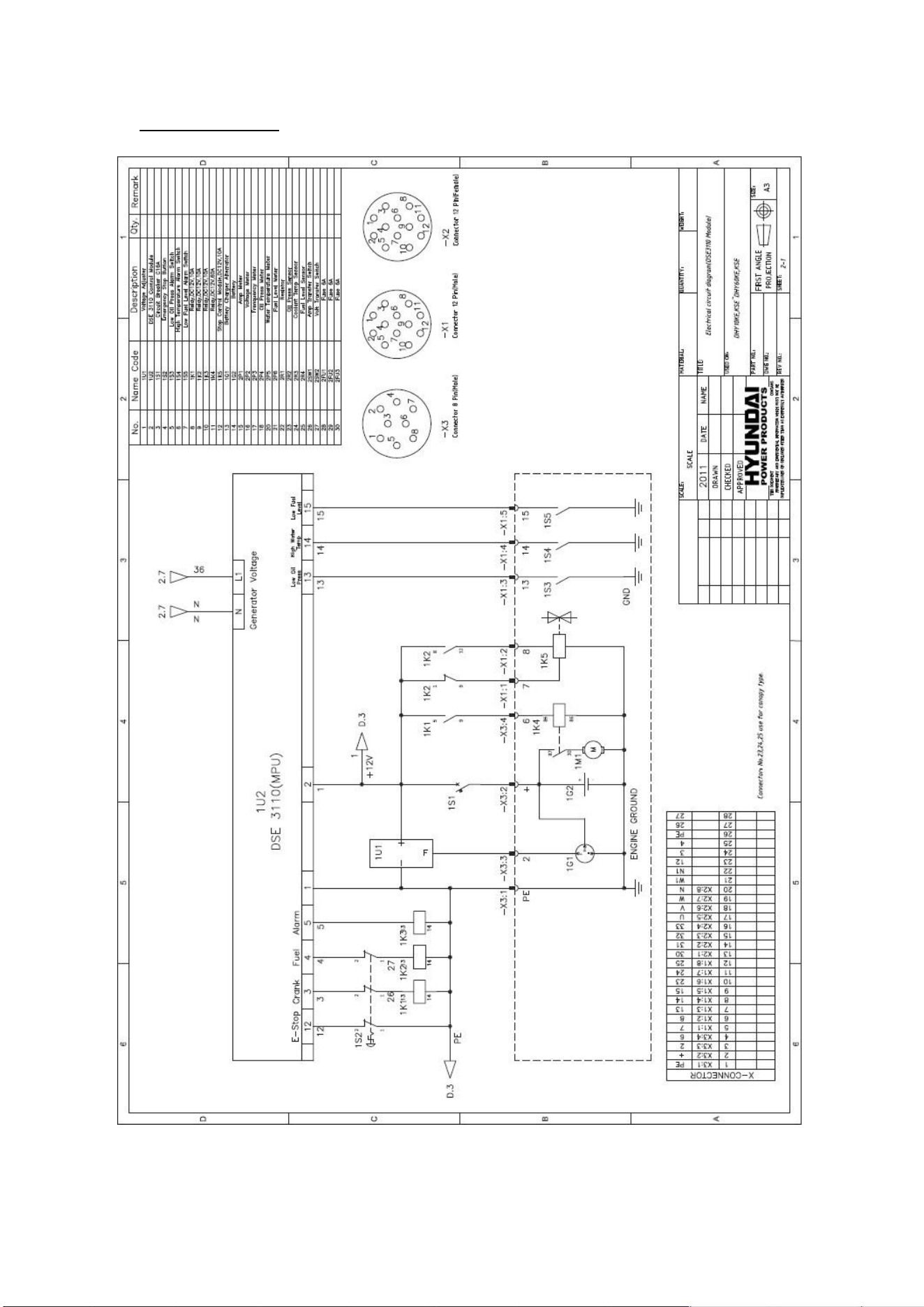
Page 47
8. WIRING DIAGRAM
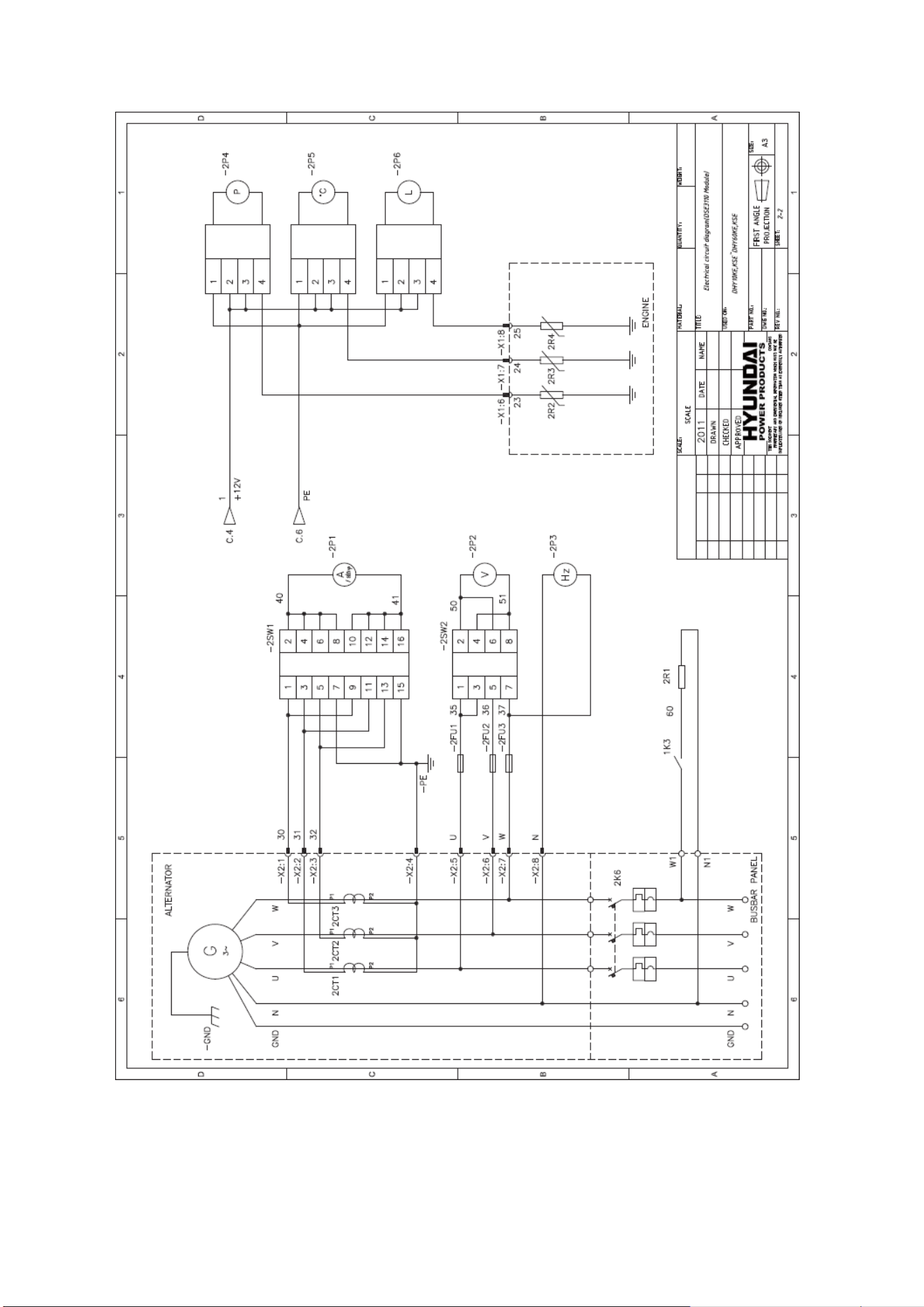
Page 48
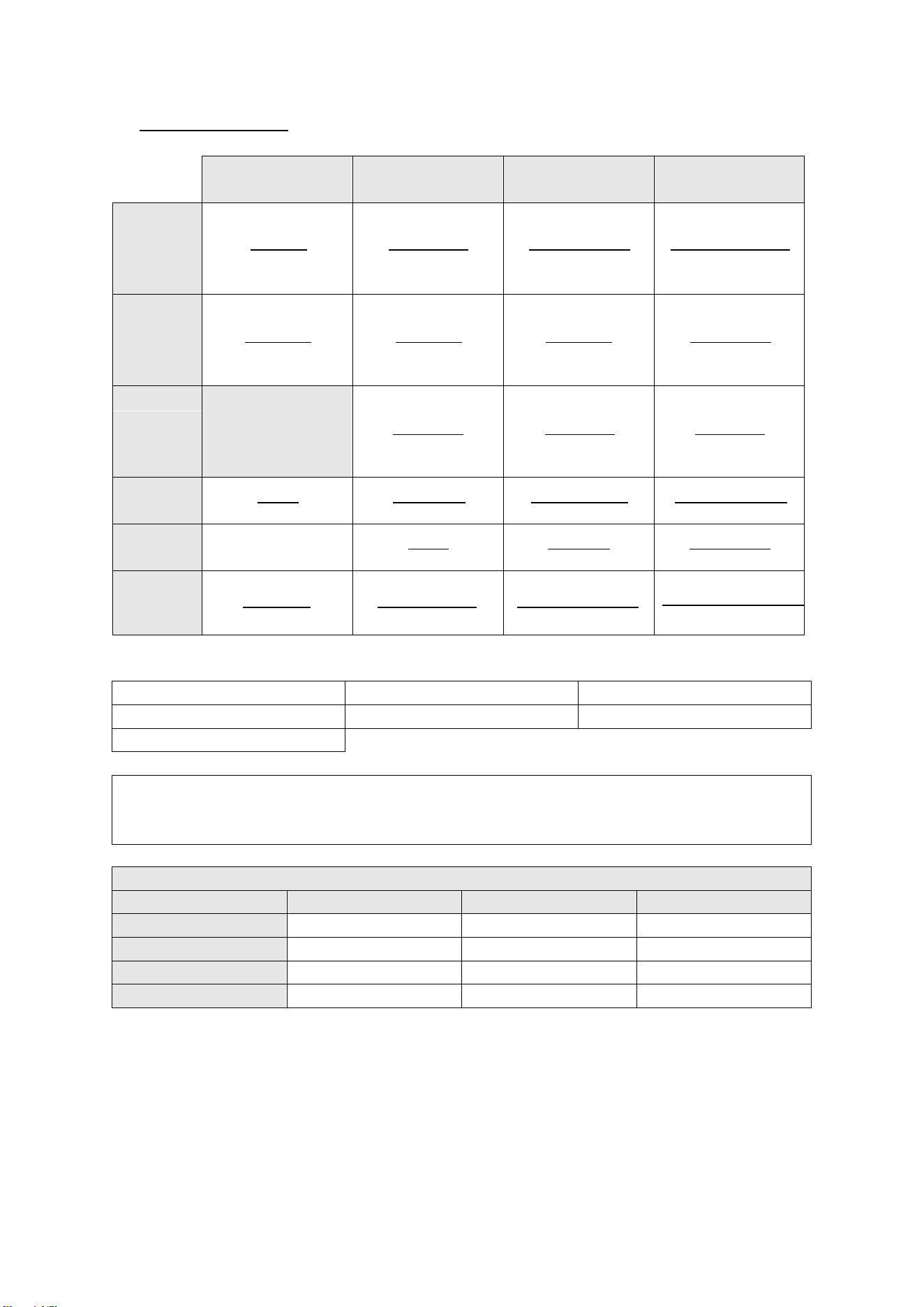
Page 49
9. USEFUL FORMULAE
Direct current
Single phase
2-wire
Two phase
4-wire
Three phase
4-wire
To find
amps
𝐻𝑃 𝑥 746
𝐻𝑃 𝑥 746
𝐻𝑃 𝑥 746
𝐻𝑃 𝑥 746
when 𝐻𝑃
𝐸 𝑥 𝐸𝑓𝑓
𝐸 𝑥 𝐸𝑓𝑓 𝑥 𝑃𝐹
2 𝑥 𝐸 𝑥 𝐸𝑓𝑓 𝑥 𝑃𝐹
1.73 𝑥 𝐸 𝑥 𝐸𝑓𝑓 𝑥 𝑃𝐹
is known
To find
amps
𝑘𝑊 𝑥 1000
𝑘𝑊 𝑥 1000
𝑘𝑊 𝑥 1000
𝑘𝑊 𝑥 1000
when 𝑘𝑊
𝐸
𝐸 𝑥 𝑃𝐹
2 𝑥 𝐸 𝑥 𝑃𝐹
1.73 𝑥 𝐸 𝑥 𝑃𝐹
is known
Amps
when
𝑘𝑉𝐴 𝑥 1000
𝑘𝑉𝐴 𝑥 1000
𝑘𝑉𝐴 𝑥 1000
𝑘𝑉𝐴 is
𝐸
2 𝑥 𝐸
1.73 𝑥 𝐸
known
Kilowatts
(
𝐼 𝑥 𝐸
)
(
𝐼 𝑥 𝐸 𝑥 𝑃𝐹
)
(
𝐼 𝑥 2 𝑥 𝐸 𝑥 𝑃𝐹
)
(
𝐼 𝑥 1.73 𝑥 𝐸 𝑥 𝑃𝐹
)
- 𝑘𝑊
1000
1000
1000
1000
𝑘𝑉𝐴
(𝐼 𝑥 𝐸)
(𝐼 𝑥 𝐸 𝑥 2)
(𝐼 𝑥 𝐸 𝑥 1.73)
1000
1000
1000
Horse
Power -
𝐻𝑃
𝐼 𝑥 𝐸 𝑥 𝐸𝑓𝑓
746
𝐼 𝑥 𝐸 𝑥 𝐸𝑓𝑓 𝑥 𝑃𝐹
746
𝐼 𝑥 𝐸 𝑥 2 𝑥 𝐸𝑓𝑓 𝑥 𝑃𝐹
746
𝐼 𝑥 𝐸 𝑥 1.73 𝑥 𝐸𝑓𝑓 𝑥 𝑃𝐹
746
𝐼 = AMPS
𝐸 = LINE VOLTAGE
𝐸𝑓𝑓 = EFFICIENCY
𝑘𝑊 = KILOWATTS
𝑃𝐹 = POWER FACTOR
𝑘𝑉𝐴 = KILOVOLT AMPS
𝐻𝑃 = HORSEPOWER
WEIGHTS OF LIQUIDS
Liquid type
Lb/Imperial gallon
Kg per litre
Specific gravity
Water
10.00
1.00
1.000
Lube oil
9.00
0.90
0.916
Diesel fuel
8.50
0.85
0.855
Kerosene
8.00
0.80
0.800
NOTE :- Efficiency varies between 86% (for 25kVA) to 93% (for 1000 kVA). Generally the
larger the alternator, the greater its efficiency. The power factor for normal purposes
should be taken about 0.80.

Page 50
10. ELECTRICAL INSTALLATIONS WITH OPTIONAL ATS EQUIPMENT
An Automatic Transfer Switch (ATS) is an electrical device that can automatically switch a load
between two sources. Some transfer switches are manual (MTS), in these installations the
operator manually transfers the load to a different source by means of a switch, while others are
automatic and switch to an alternative source of power when they sense one of the power
sources has been lost. Typically the when the mains supply fails the standby power source
(generator) is brought on-line and supplies your electrical system. Once the mains is restored the
ATS wil transfer the load back to the mains and will do a timed shutdown of the generator.
10.1. All electrical installations should be carried out by a competent person as described in, and in
accordance with;
10.1.1. BS7671:2008 – Requirements for Electrical Installations
.
10.1.1.2. BS7671:2008 - On-Site Guide, incorporating Amendment No 1.
10.1.3. If in any doubt contact an Approved Electrician.
10.1.4. All drawings contained in this document are supplied for guidance only.
10.2. EARTHING ARRANGEMENTS
10.2.1. All of our single and three phase generators are supplied with a connected Neutral/Earth link.
10.2.2. Should the neutral/earth link be removed for any reason it, it is very important to note that with
a floating earth generator the combination of equipment to be supplied shall not exceed the following;
10.2.2.1. Only one item of Class 1 equipment – i.e. not double insulated
10.2.2.2. One or more of Class 2 equipment – i.e. double insulated, as shown on symbol .
10.2.2.3. Or a combination of - Only one item of Class 1 equipment and one or more of Class 2
equipment.
10.2.3. Earthing cable should be sized in accordance with BS7671 – Requirements for
Electrical
Installations, incorporating the latest Amendments. You MUST always
check for latest
version of regulations.
10.2.4. Earth electrodes should be tested in accordance with earth
electrode test Figure 10.3.5.2 in
BS7671:2008 - On-Site Guide, incorporating Amendment No 1.
You MUST always check for
latest
version of regulations.
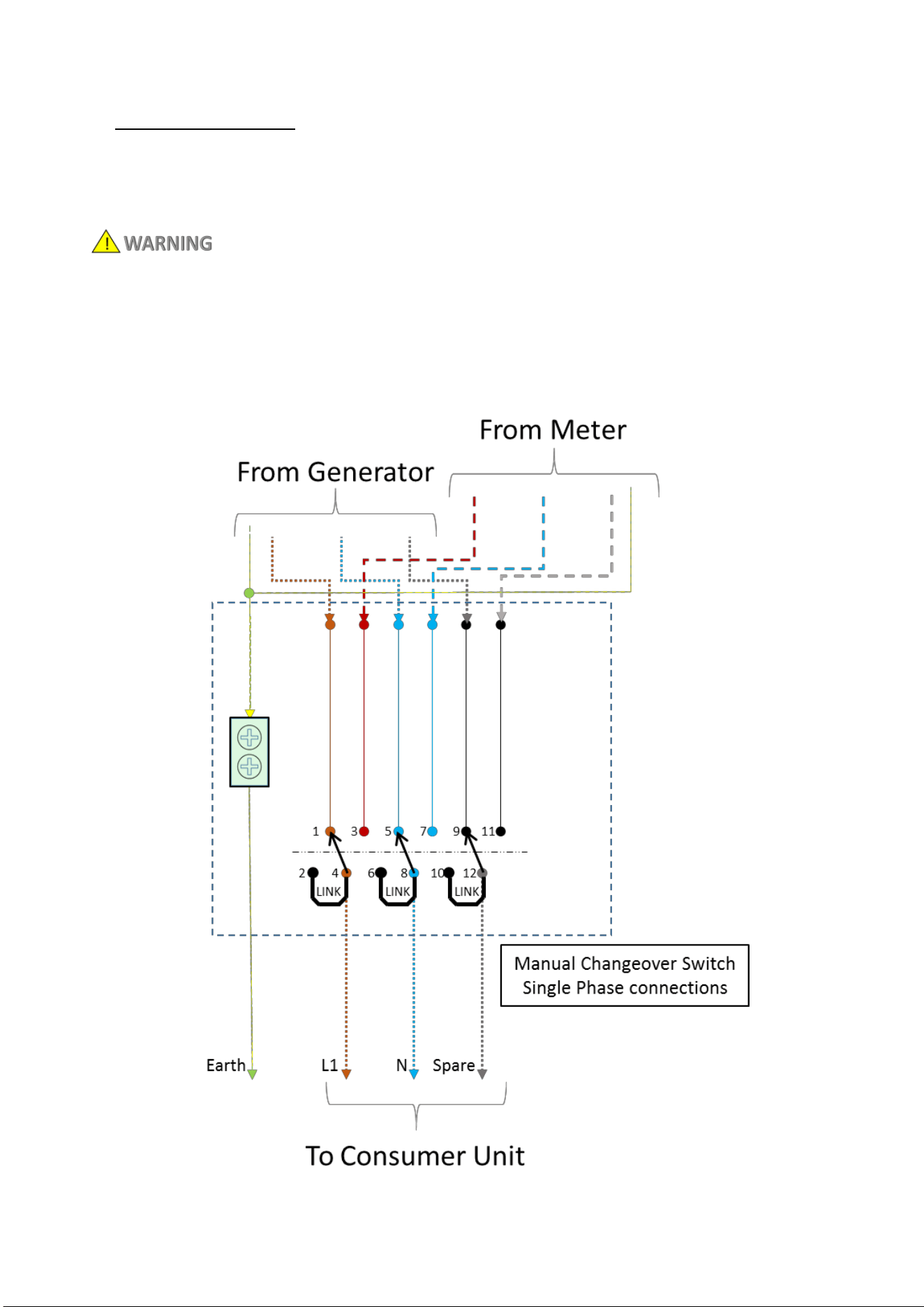
Page 51
10.3. MANUAL CHANGEOVER
10.3.1. The next section covers the Manual Changeover connections for connecting the generator to a
property with a normal mains connection supplied by the Electricity Distributor.
UNDER NO circumstances should a stand-by generator be allowed
to feed the National Grid.
UNDER NO circumstances should the installation be allowed to back
feed into a property. The practice is extremely DANGEROUS and
can result is serious injury.
10.3.2. Single phase Manual changeover switching. (Suppliers - Combined Neutral/Earth).
10.3.2.1. Wiring schematic. (Suppliers - Combined Neutral/Earth).
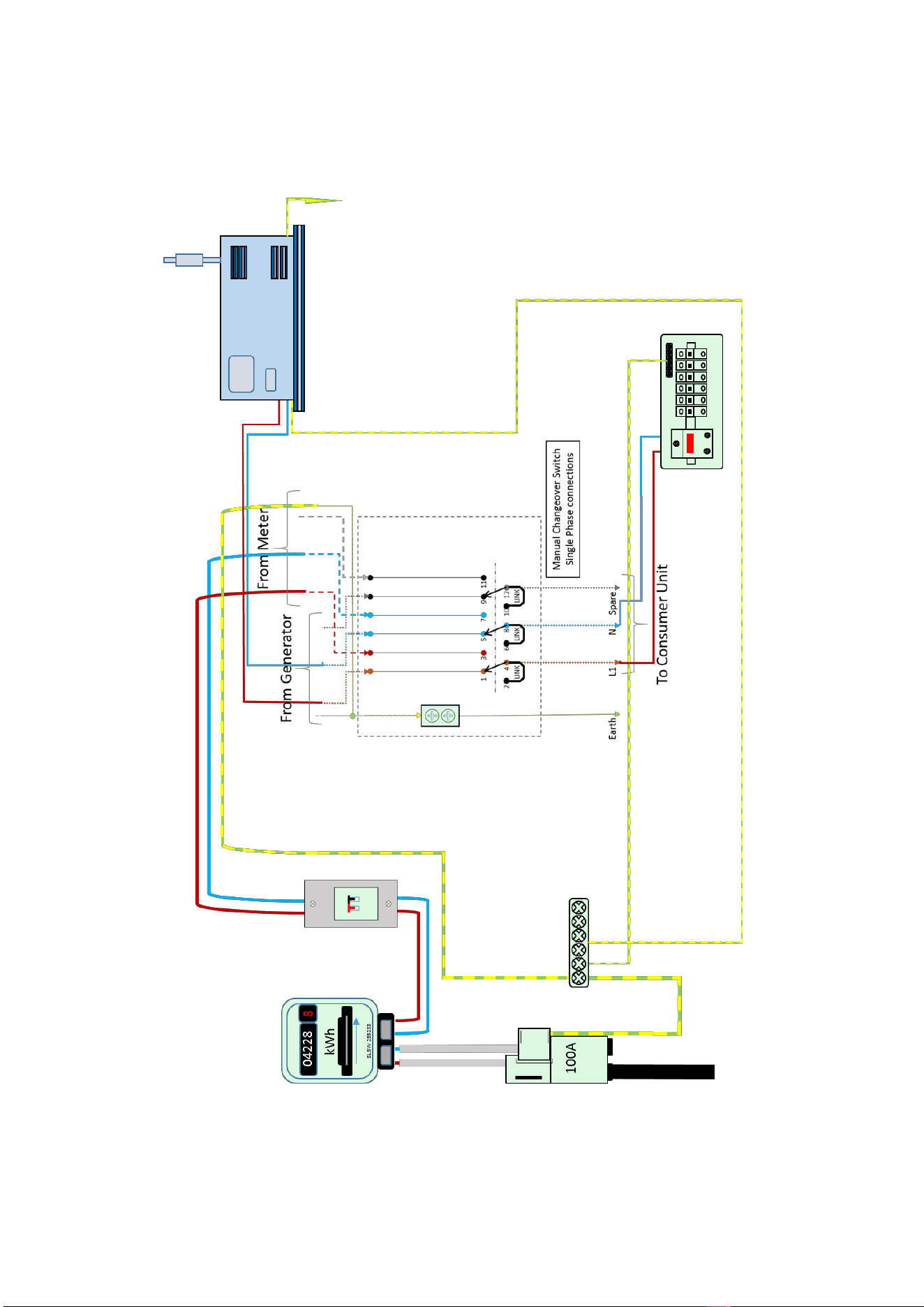
Page 52
10.3.2.1.1. Single phase interconnection.
10.3.2.1.1.1.
Interconnection wiring schematic. (Suppliers - Combined Neutral/Earth).
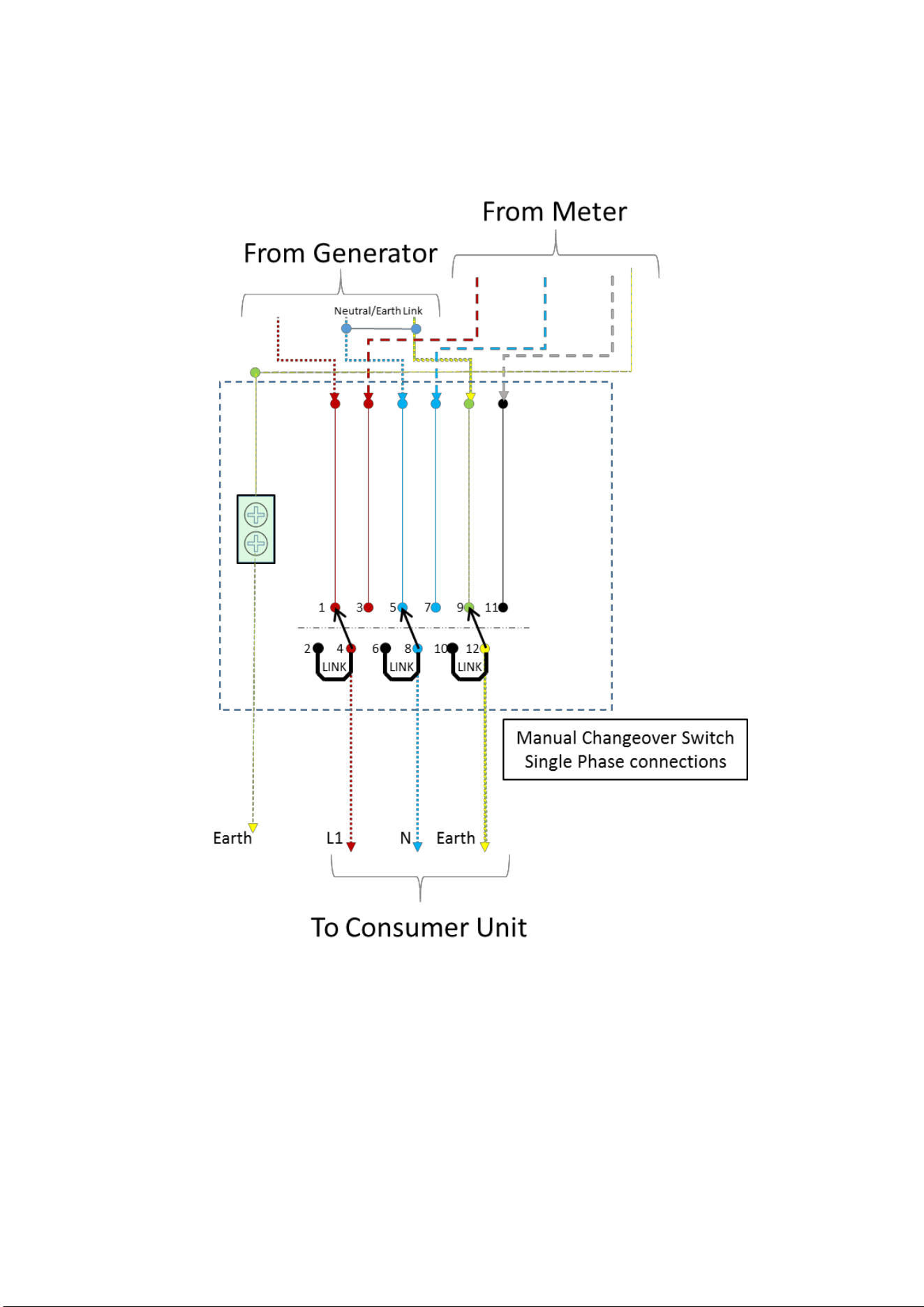
Page 53
10.3.1.1.2. Single phase Wiring schematic. (Generator - Neutral/Earth fitted).
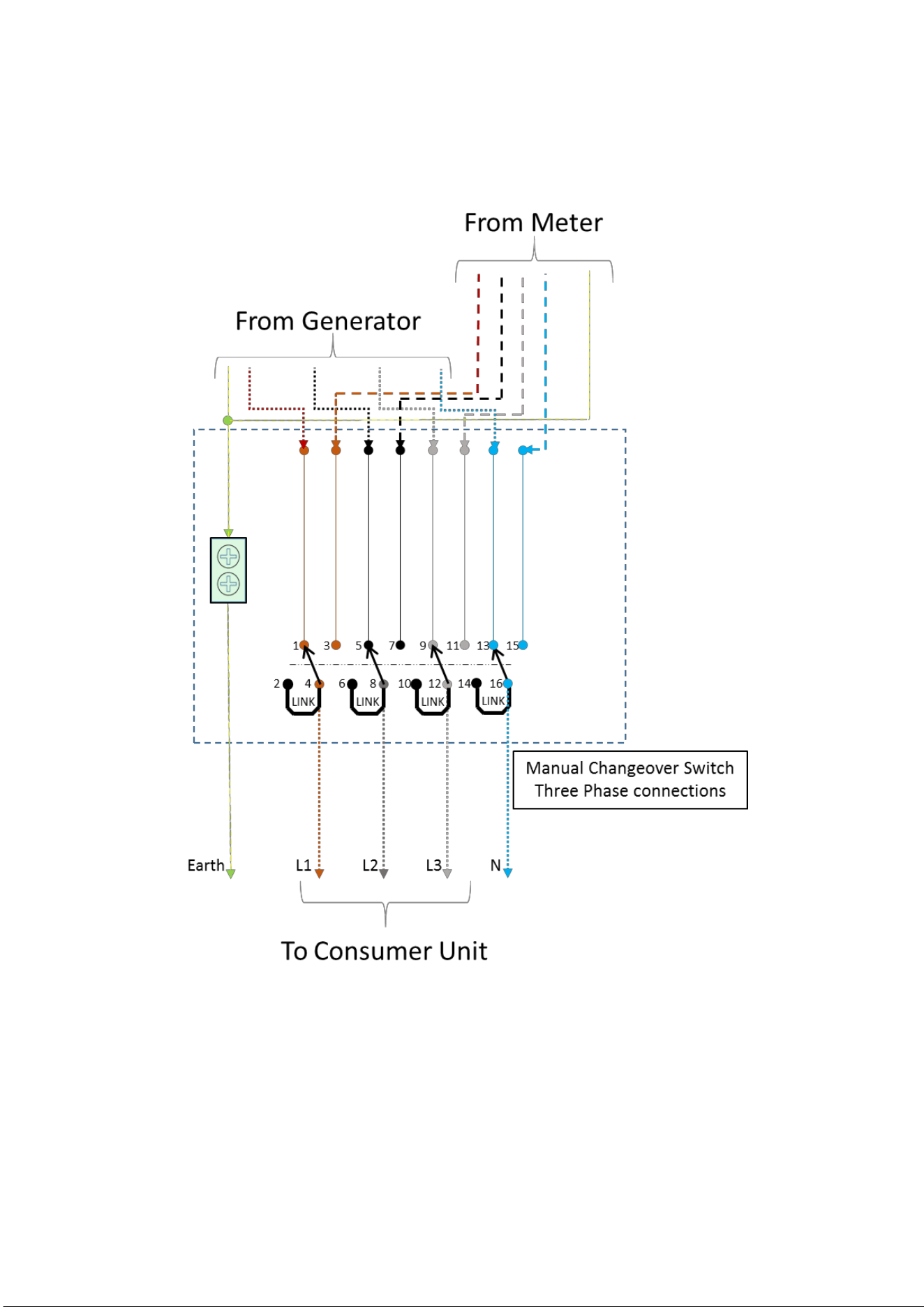
Page 54
10.4.3. Three phase Manual changeover.
10.4.3.1. Wiring schematic.
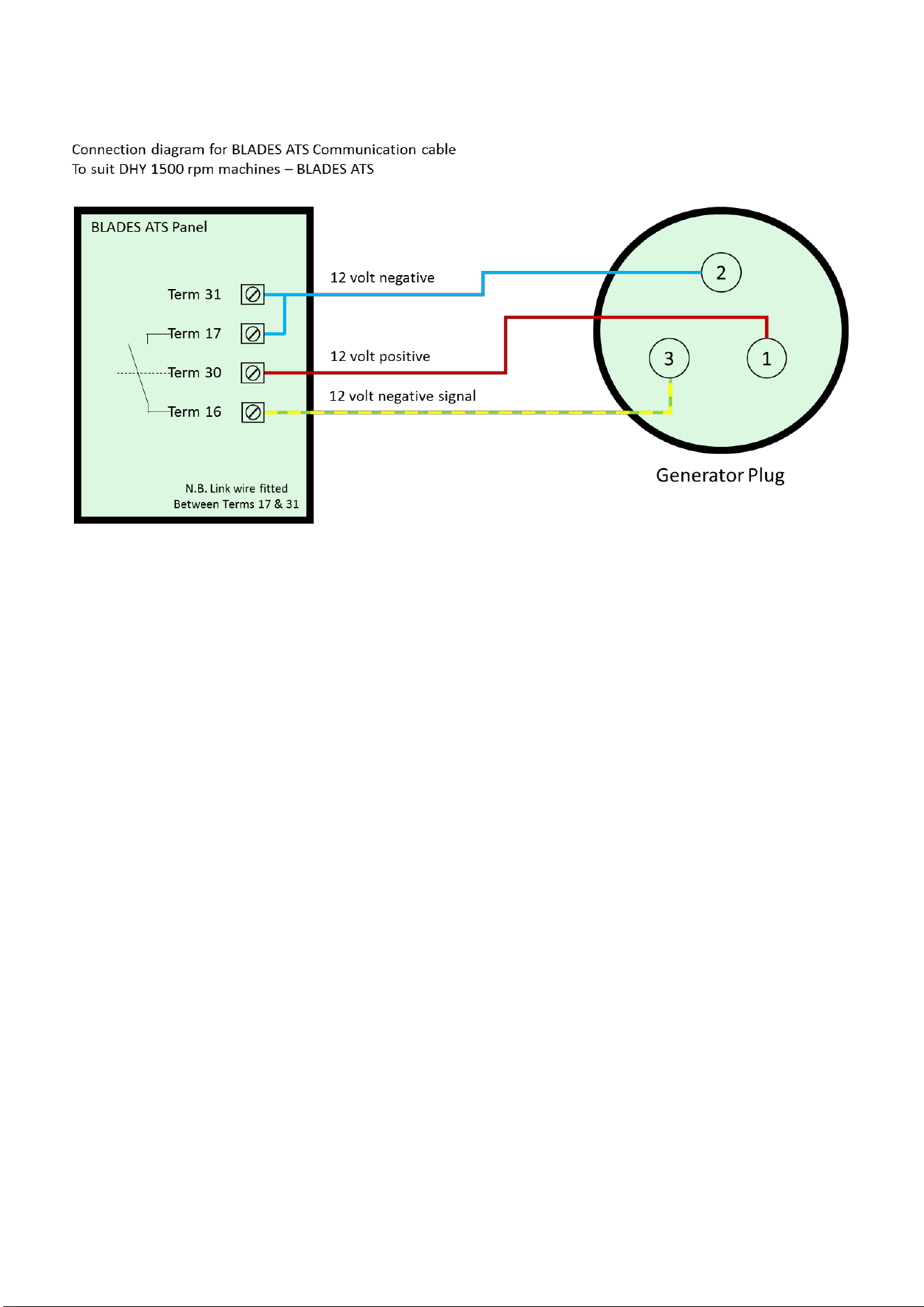
Page 55
10.4.1.3. 1500 rpm machines – BLADES ATS. N.B. Cable colours are for indication purposes only.
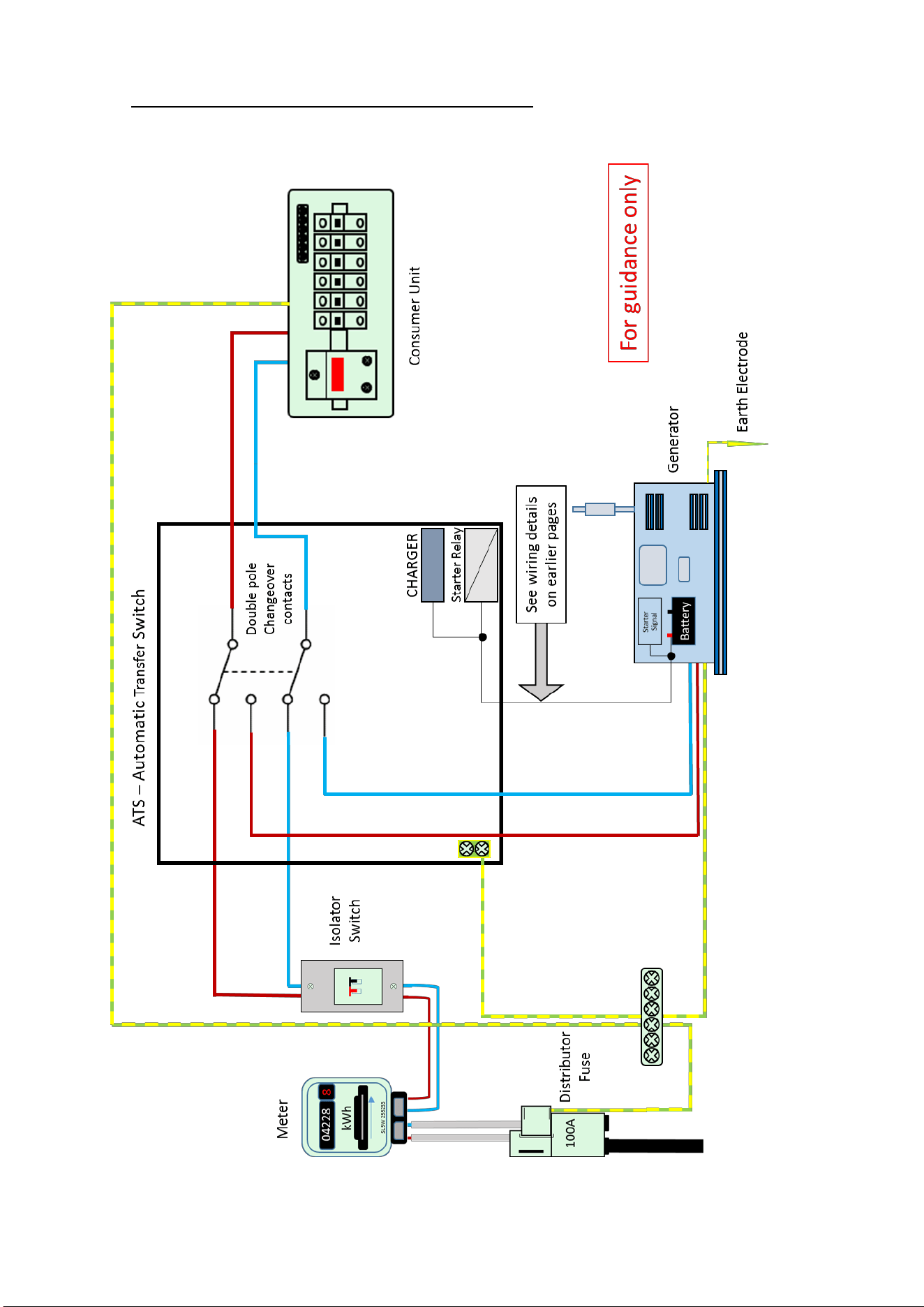
Page 56
10.5. OVERALL SCHEMATIC – SINGLE PHASE INSTALLATION
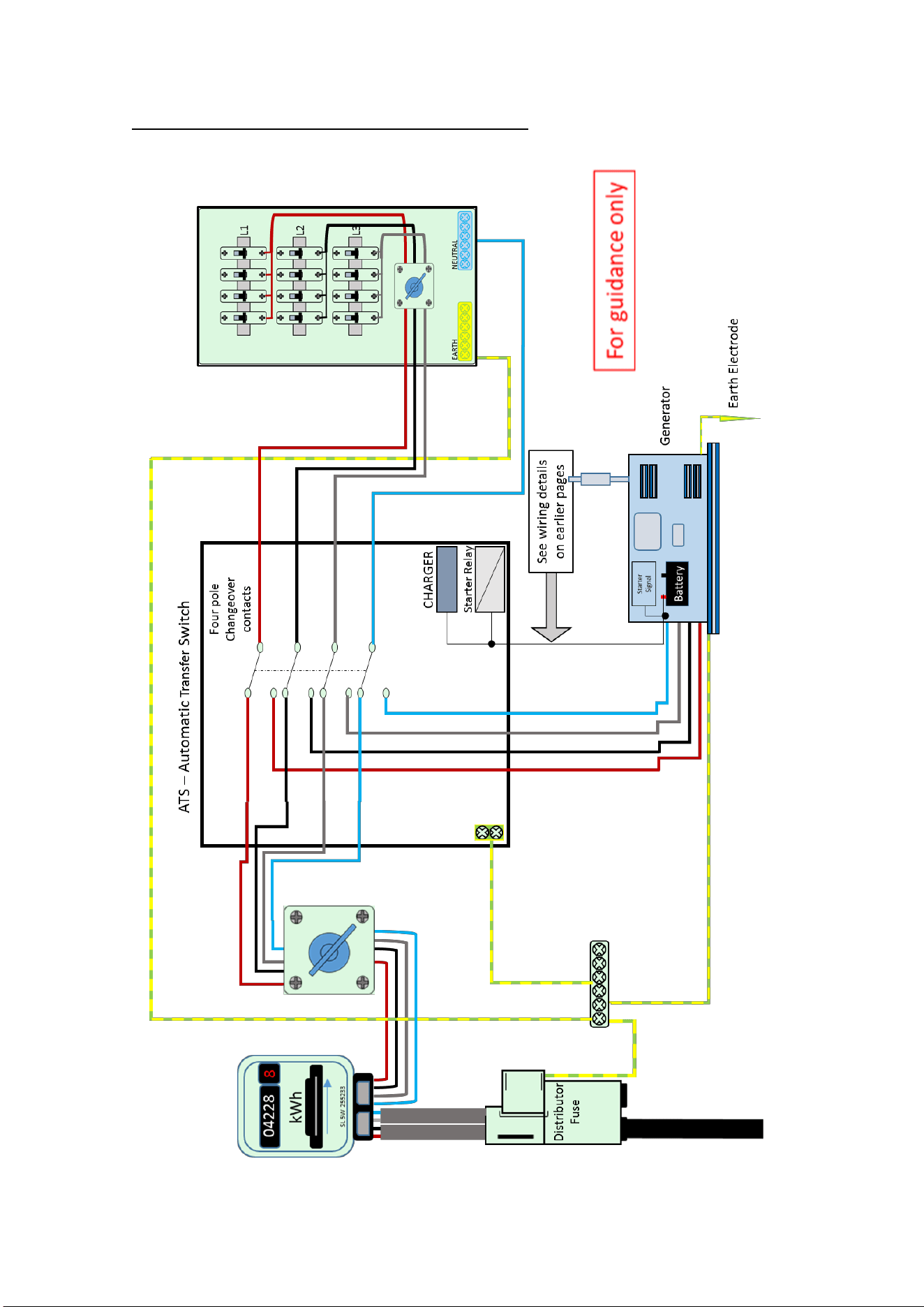
Page 57
10.6. OVERALL SCHEMATIC – THREE PHASE INSTALLATION
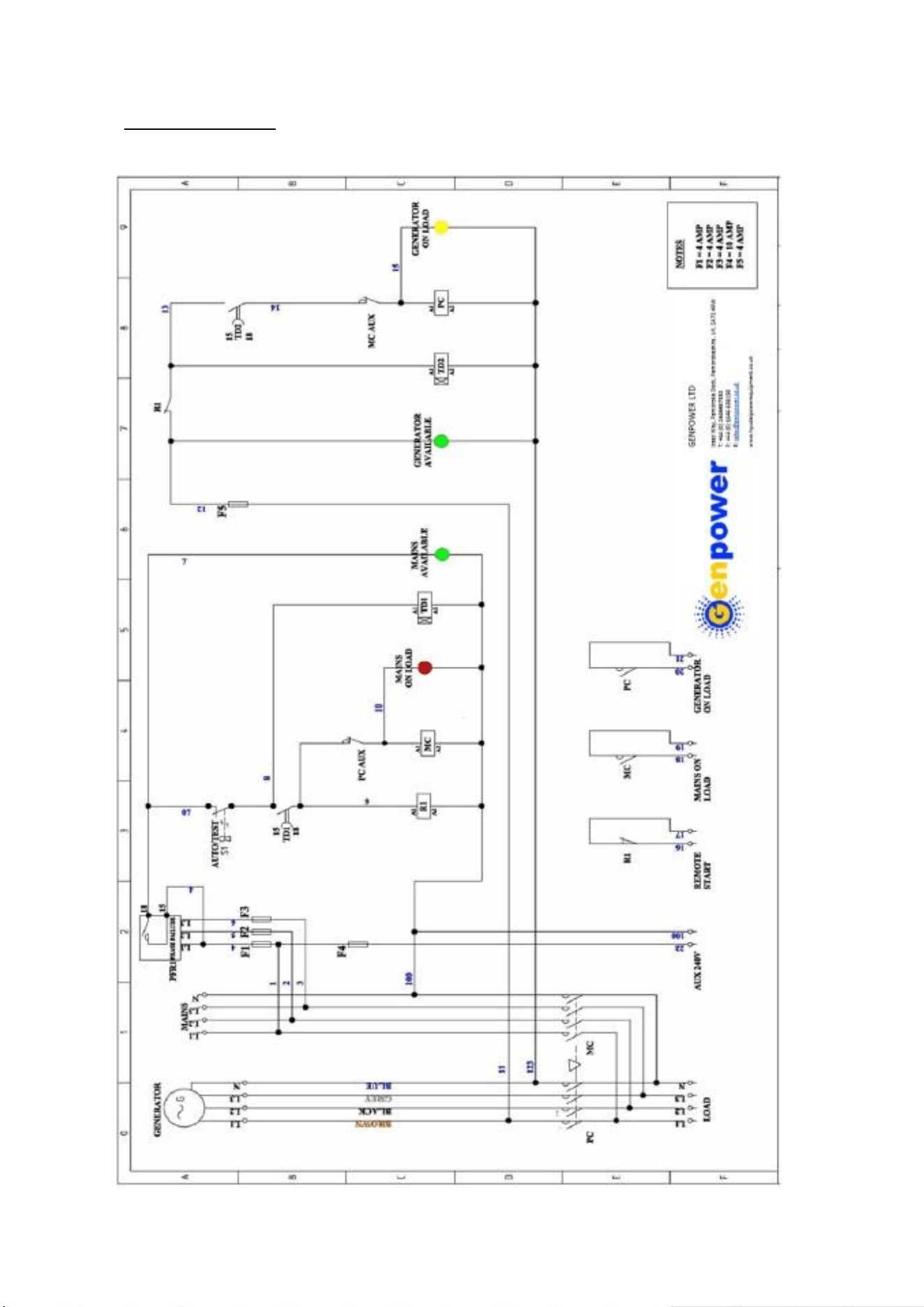
Page 58
10.7. BLADES SCHEMATIC
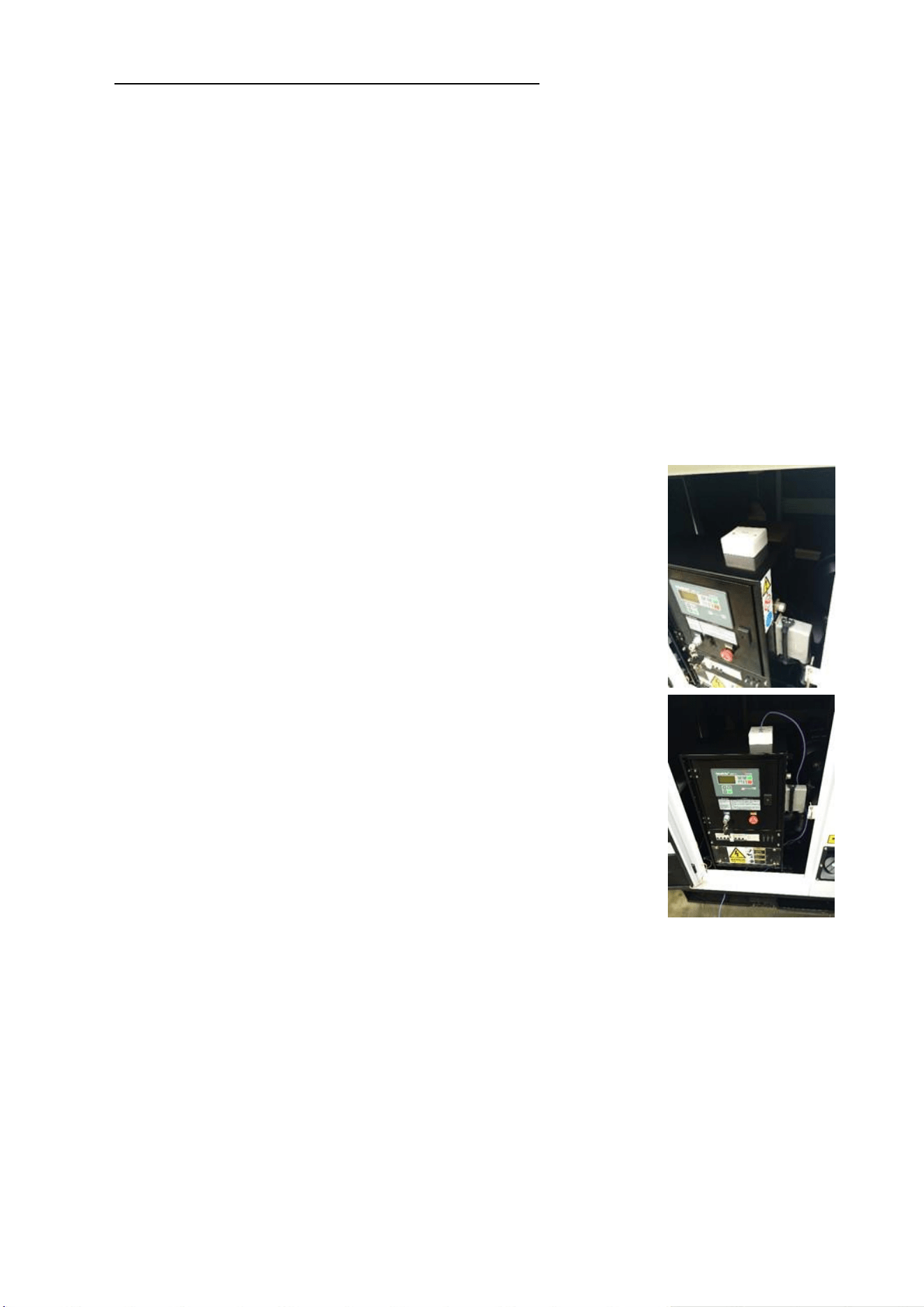
Page 59
11. REMOTE CONTROL (Can only be GSM/GPRS or Ethernet)
11.1. GSM/GPRS remote control - optional.
11.1.1. Our 1500RPM range of generators can be remotely controlled by the use of
Global System for Mobile Communications (GSM) & General Packet Radio Services
(GPRS) technology.
11.1.2. The generator will be fitted with all of the GSM equipment including GSM
antenna/GPRS sim prior to delivery. Once you take delivery you will be given LOGIN
details to http://websupervisor.comap.cz/
11.1.3. Once you LOGIN via your PC/Smart phone/Tablet you will be able to do the
following tasks;
11.1.3.1. Check the generator status.
11.1.3.2. Carry out remote START/STOP.
11.1.3.3. Monitor hours run, fuel, load, temperature, oil pressure etc.
11.1.4. The system can be set up to automatically send SMS text messages or email
alerts for all alarms/events.
11.2. Ethernet remote control - optional.
11.2.1 1. Open maintenance door where control panel
is located to find Ethernet port (Note: Due to
machines varying in size, actual location may
differ from image).
11.2.1.2. Insert Ethernet cable, (Cat5e or higher is
recommended), into faceplate and run cable
down and out the holes in the base of the
unit. We advise you to cable tie it to
appropriate locations. You would also need
to ensure the cable has relevant protection
from weather conditions once out of the unit.
11.2.1.3. Wire the cable into your property and plug into the back of your
router. The light on the Ethernet cable should start flashing.
(Providing the control panel is switched on at the generator)
11.2.1.4. Go back to the generator. Turn the key so the control panel turns on
(If not already) and change setting to ‘AUTO’ by pressing the ‘Mode’
button.
11.2.1.5. Go into the ‘Comms Settings’ and change/ensure ‘DHCP’ is enabled.
Also take note of the Controller Address’. Then, restart control panel.
11.2.1.6. Go back into ‘Comms settings’ and ensure/change ‘Airgate’ setting to
enabled, and restart control panel.
11.2.1.7. Upon restarting, while on the start screen, scroll using the up arrows
until you are viewing a screen which reads ‘Airgate ID: xxxxxxxxxx’.
Take note of this Airgate ID.
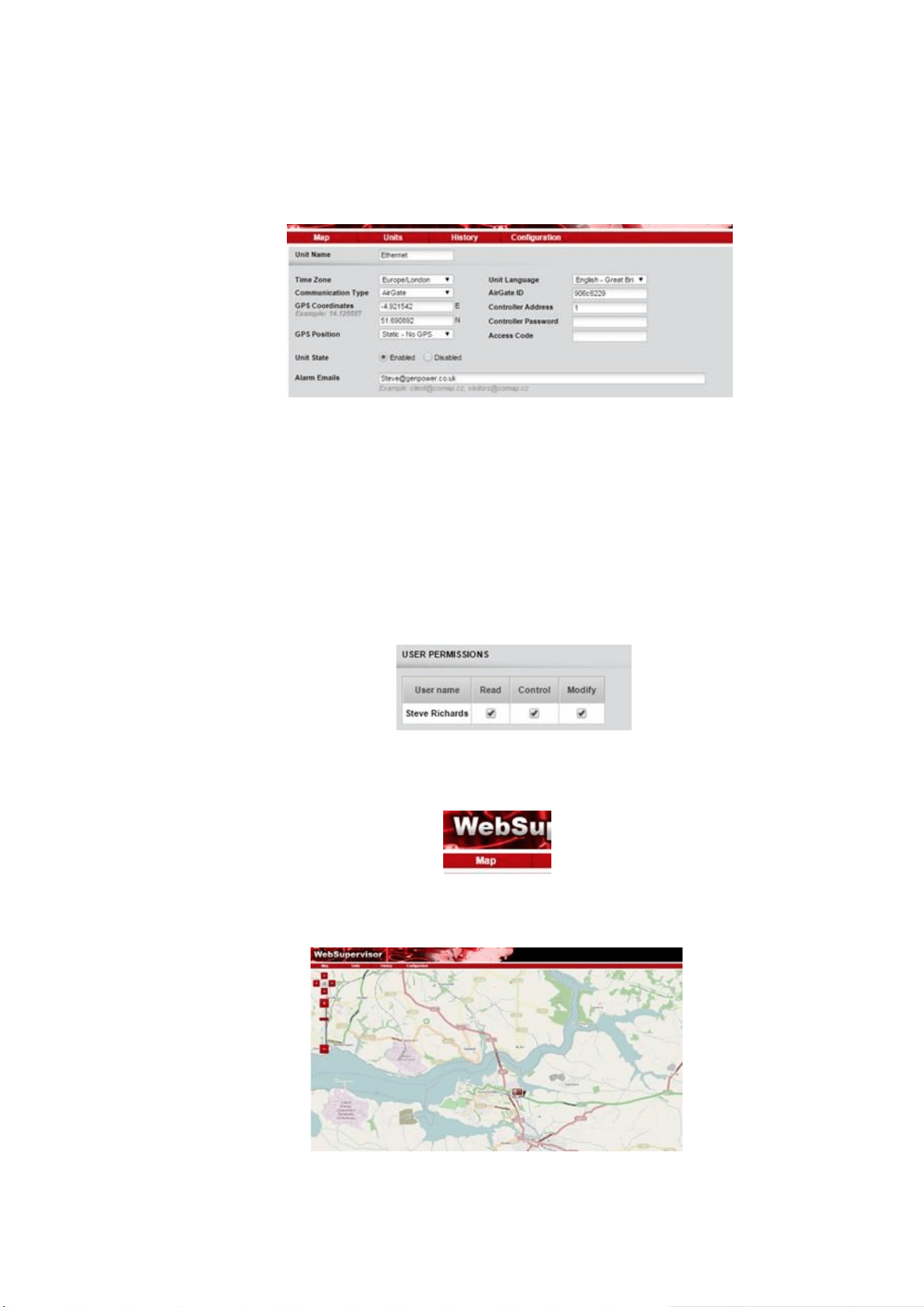
Page 60
11.2.1.8. Leave generator on Auto mode and return to your property.
11.2.1.9. Using a PC/Laptop go to http://websupervisor.comap.cz/
11.2.1.10. You must create a log in for Web Supervisor (WSV).
11.2.1.11. Once you receive this log in, log into WSV and click on ‘Add new
genset’
11.2.1.12. You will then be viewing the unit configuration page as shown;
11.2.1.13. Enter a name for your unit, select time zone, input GPS coordinates
(If required), and ensure you have ‘Static – No GPS’ selected.
11.2.1.14. Change language if required.
11.2.1.15. Enter the ‘Airgate ID’ & ‘Controller Address’ as noted previously
from the generator.
11.2.1.16. The Controller’s default settings are ‘Controller Address = 1‘,
‘Controller Password = 0’, ‘Access Code = 0’
11.2.1.17. Enter an email address for email alerts regarding faults/alarms to be
sent to.
11.2.1.18. Scroll down and tick the three boxes regarding user permissions;
11.2.1.19. Click on ‘Save’ at the bottom of the screen.
11.2.1.20. To view Generator, click on the ‘Map’ link at the top of WSV
program.
11.2.1.21. To view the in-depth, real time information for the unit, click on the
icon displayed on the map;

Page 61
11.2.1.22. You should then be faced with information as follows;
11.2.1.23. Within this screen you can not only monitor the generator, but also
start/stop and clear fault codes.
11.2.1.24. If you want to add another user to view this machine,
they must request a log in for Web Supervisor with ComAp, then,
within your log in, go to ‘Units’, click on the lock symbol on the unit
you want to share and at the bottom of the page you will find ‘Add
foreign user’.
11.2.1.25. For troubleshooting advice, contact Hyundai Power Equipment on;
+44 (0) 1646 687880.

Page 62
12. DECLARATIONS of CONFORMITY
12.1.
Diesel generators
10.1.1. 2000/14/EC –
10.1.2. 2004/108/EC –
10.1.3. 2006/42/EC –
10.1.4. 2006/95/EC –
Outdoor Noise Directive
Electromagnetic Compatibility Directive
Machinery Directive
Low Voltage Directive
13. CONTACT DETAILS
13.1.
POSTAL ADDRESS Genpower Ltd, Issac Way,
London Road, Pembroke Dock,
Pembrokeshire, SA72 4RW. UK.
13.2.
TELEPHONE +44 (0) 1646 687880
13.3.
FAX +44 (0) 1646 686198
13.4.
TECHNICAL E-MAIL [email protected]
13.5.
WEBSITE www.hyundaipowerequipment.co.uk
14. MANUAL UPDATES
14.1.
Our manuals are constantly being reviewed and updated. However if should
you find an error, omission or something you find unclear please contact your
dealer for assistance.
14.2.
Our latest manuals are also placed online.
15. WARRANTY
To register your product for the manufacturer’s warranty, please visit:
https://hyundaipowerequipment.co.uk/warranty

Page 63