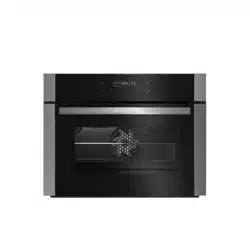
Built-in Oven
User Manual
ROKW8370B
385444314/ EN/ R.AA/ 16/02/2024 11:18
7729486403
EN / 2
Welcome!
Dear Customer,
Thank you for choosing the Blomberg product. We want your product, manufactured with
high quality and technology, to offer you the best efficiency. Therefore, carefully read this
manual and any other documentation provided before using the product.
Keep in mind all the information and warnings stated in the user’s manual. This way, you
will protect yourself and your product against the dangers that may occur.
Keep the user’s manual. If you give the product to someone else, give the manual with it.
The warranty conditions, usage and troubleshooting methods for your product are
provided in this manual.
The symbols and their descriptions in the user’s manual:
Hazard that may result in death or injury.
Important information or useful usage tips.
Read the user’s manual.
Hot surface warning.
NOTICE
Hazard that may result in material damage to the product or its environment.

EN / 3
Table of Contents
1 Safety Instructions........................ 4
1.1 Intended Use.................................. 4
1.2 Child, Vulnerable Person and Pet
Safety .............................................
5
1.3 Electrical Safety............................. 6
1.4 Microwave Safety.......................... 7
1.5 Transportation Safety ................... 11
1.6 Installation Safety.......................... 12
1.7 Safety of Use ................................. 12
1.8 Temperature Warnings ................. 13
1.9 Accessory Use............................... 14
1.10 Cooking Safety .............................. 14
1.11 Maintenance and Cleaning Safety 15
2 Environmental Instructions.......... 16
2.1 Waste Directive.............................. 16
2.1.1 Compliance with the WEEE Dir-
ective and Disposing of the
Waste Product ...........................
16
2.2 Package Information..................... 16
2.3 Recommendations for Energy
Saving.............................................
16
3 Your product ................................. 17
3.1 Product Introduction ..................... 17
3.2 Product Control Panel Introduc-
tion and Usage...............................
17
3.2.1 Control Panel.............................. 18
3.2.2 Introduction of the oven control
panel ...........................................
18
3.3 Oven operating functions.............. 19
3.4 Product Accessories..................... 21
3.5 Use of Product Accessories ......... 22
3.6 Technical Specifications............... 24
4 First Use......................................... 25
4.1 First Timer Setting......................... 25
4.2 Initial Cleaning ............................... 25
5 Using the Oven.............................. 26
5.1 General Information on Using the
Oven ...............................................
26
5.2 Operation of the Oven Control
Unit .................................................
26
5.3 Settings .......................................... 33
6 General Information About Bak-
ing...................................................
36
6.1 General Warnings About Baking
in the Microwave Oven ..................
36
6.2 General Warnings About Baking
in the Oven......................................
41
6.2.1 Pastries and oven food.............. 42
6.2.2 Meat, Fish and Poultry ............... 44
6.2.3 Grill .............................................. 44
6.2.4 Test foods................................... 45
6.2.5 Microwave .................................. 46
7 Maintenance and Cleaning........... 48
7.1 General Cleaning Information ....... 48
7.2 Cleaning Accessories.................... 49
7.3 Cleaning the Control Panel............ 49
7.4 Cleaning the inside of the oven
(cooking area)................................
49
7.5 Cleaning the Oven Lamp ............... 50
8 Troubleshooting ............................ 51
EN / 4
1 Safety Instructions
• This section includes the
safety instructions necessary
to prevent the risk of personal
injury or material damage.
• If the product is handed over
to someone else for personal
use or second-hand use pur-
poses, the user’s manual,
product labels and other relev-
ant documents and parts
should also be given.
• Our company shall not be held
responsible for damages that
may occur if these instructions
are not observed.
• Failure to follow these instruc-
tions shall void any warranty.
• Always have the installation
and repair works made by the
manufacturer, the authorised
service or a person that the im-
porter company shall desig-
nate.
• Use original spare parts and
accessories only.
• Do not repair or replace any
component of the product un-
less it is clearly specified in the
user’s manual.
• Do not make technical modific-
ations on the product.
1.1 Intended Use
• This product is designed to be
used at home. It is not suitable
for commercial use.
• Do not use the product in gar-
dens, balconies or other out-
doors. This product is intended
to be used in households and
in the staff kitchens of shops,
offices and other working en-
vironments.
• This product is intended to be
used in household and similar
applications such as:
– staff kitchen areas in shops,
offices and other working
environments;
– farm houses;
– for clients in hotels, motels
and other residential type en-
vironments;
– for bed and breakfast type
environments.
• The product should only be
used for preparing food and
beverages. Do not use the
oven for drying any living be-
ings.
• This appliance is not intended
for use at mobile homes, recre-
ational vehicles and similar
places.

EN / 5
• CAUTION: This product
should be used for cooking
purposes only. It should not be
used for different purposes,
such as heating the room.
• The oven can be used to de-
frost, bake, fry and grill food.
• This product should not be
used for plate heating, drying
by hanging towels or clothes
on the handle.
1.2 Child, Vulnerable
Person and Pet Safety
• This product can be used by
children 8 years of age and
older, and people who are un-
derdeveloped in physical, sens-
ory or mental skills, or who
have lack of experience and
knowledge, as long as they are
supervised or trained about the
safe use and hazards of the
product.
• Children should not play with
the product. Cleaning and user
maintenance should not be
performed by children unless
there is someone overseeing
them.
• This product should not be
used by people with limited
physical, sensory or mental ca-
pacity (including children), un-
less they are kept under super-
vision or receive the necessary
instructions.
• Children should be supervised
to ensure that they do not play
with the product.
• Electrical products are danger-
ous for children and pets. Chil-
dren and pets must not play
with, climb on, or enter the
product.
• Do not put objects that chil-
dren may reach on the
product.
• CAUTION: During use, the ac-
cessible surfaces of the
product are hot. Keep children
away from the product.
• Keep the packaging materials
out of the reach of children.
There is a hazard of injury and
suffocation.
• When the door is open, do not
put any heavy objects on it or
allow children to sit on it. You
may cause the oven to tip over
or damage the door hinges.
• Before discarding worn out
and useless products:
1. Unplug the power plug and
remove it from the socket.
2. Cut off the power cable and
disconnect it with the plug
from the product.
3. Take precautions to prevent
children from entering the
product.
4. Do not allow children to play
with product when it is in idle
mode.

EN / 6
1.3 Electrical Safety
• Plug the product into a groun-
ded outlet protected by a fuse
that matches the current rat-
ings indicated on the type la-
bel. Have the grounding install-
ation made by a qualified elec-
trician. Do not use the product
without grounding in accord-
ance with local / national regu-
lations.
• The plug or the electrical con-
nection of the appliance shall
be in an easily accessible
place. If this is not possible,
there should be a mechanism
(fuse, switch, key switch, etc.)
on the electrical installation to
which the product is connec-
ted, in compliance with the
electrical regulations and sep-
arating all poles from the net-
work.
• Unplug the product or switch
off the fuse before repair,
maintenance and cleaning.
• Plug the product into an outlet
that meets the voltage and fre-
quency values specified on the
type label.
• (If your product does not have
a mains cable) only use the
connecting cable described in
the "Technical specifications"
section.
• Do not jam the power cable un-
der and behind the product. Do
not put a heavy object on the
power cable. The power cable
should not be bent, crushed,
and come into contact with
any heat source.
• Make sure that the power
cable is not jammed while put-
ting the product to its place
after assembly or cleaning.
• The rear surface of the oven
gets hot when it is in use. The
power cables must not touch
the rear surface of the product.
Otherwise it might get dam-
aged.
• Do not jam the electric cables
into the oven door and do not
pass them over hot surfaces.
Otherwise, cable insulation
may melt and cause fire as a
result of short circuit.
• Use original cable only. Do not
use cut or damaged cables.
• Do not use an extension cord
or multi-plug to operate your
product.
• Contact the authorized service
centre or importer to use the
approved adapter in cases
where the use of a converter
adapter (for plug type) is ne-
cessary.

EN / 7
• Contact the importer or the au-
thorized service centre if the
length of the power line is in-
adequate.
• Portable power sources or
multiple plugs may overheat
and catch fire. Keep multiple
plugs and portable power
sources away from the
product.
• If the power cable is damaged,
it must be replaced by the
manufacturer, an authorized
service or a person to be spe-
cified by the importer company
in order to prevent possible
dangers.
• CAUTION: Before replacing
the oven lamp, be sure to dis-
connect the product from the
mains supply to avoid the risk
of electric shock. Unplug the
product or turn off the fuse
from the fuse box.
If your product has a power
cable and plug:
• Never put the product plug into
a broken, loose, or out-of-
socket plug. Make sure the
plug is fully inserted into the
socket. Otherwise the connec-
tions may overheat and cause
a fire.
• Avoid inserting the device into
plugs that are greasy, unclean,
or potentially exposed to water
(such as those near a worktop
where water may escape). Oth-
erwise there is a risk of short
circuit and electrocution.
• Never touch the plug with wet
hands!
• Pull the plug out of the socket
using the plug's body rather
than the cord itself.
1.4 Microwave Safety
• This appliances is intended to
be used in household and sim-
ilar applications such as:
– staff kitchen areas in shops,
offices and other working
environments;
– farm houses;
– for clients in hotels, motels
and other residential type en-
vironments;
– for bed and breakfast type
environments.
• Only allow children to use the
oven without supervision when
adequate instructions have
been given so that the child is
able to use the microwave
oven in a safe way and under-
stands the hazards of im-
proper use.
• When the appliance is oper-
ated in the combination mode,
children should only use the
oven under adult supervision
due to the temperature gener-
ated.

EN / 8
• The exposed parts of the
product will become hot while
and after the product is in use.
• Check the oven for any dam-
age, such as misaligned or
bent door, damaged door seals
and sealing surface, broken or
loose door hinges and latches
and dents inside the cavity or
on the door. If there is any
damage, do not operate the
oven and contact by the Au-
thorised Service Agent.
• If the door or door seals are
damaged, the oven must not
be operated until it has been
repaired by a competent per-
son or Authorised Service
Agent.
• Before operating your oven en-
sure that the door has been
closed properly. A safety
mechanism in the door lock
prevents your appliance from
operating when the door is
open, halting the cooking oper-
ation if you open the door. You
should not interfere with the
door locking system or at-
tempt to override this system.
If the door locking system is
overridden, risk of exposure to
microwaves arises if the appli-
ance is operated with an open
door.
• Do not place any kind of object
between the front of the oven
and the door. You should not
operate your oven if objects
such as paper towels or nap-
kins prevent it from being
closed properly.
• Radio Interference: Place the
oven no less than 2 metres
from TVs, radios, wireless mo-
dems, access points and aeri-
als. Otherwise it may cause in-
terference.
• Do not cook your meals with
the cooking time and mi-
crowave power set excessively
high. Excessive cooking may
desiccate, burn or ignite some
parts of the meal.
• Never use aluminum folio or
aluminum utensils for mi-
crowave cooking.
• Do not use metal objects
closer than 3 cm to the oven
door while cooking with mi-
crowave.
• Do not place corrosive chemic-
als or materials containing cor-
rosive vapor into the oven.
When there is interference, it
may be reduced or eliminated
by taking the following meas-
ures:
• Clean door and sealing surface
of the oven.
• Reorient the receiving antenna
of radio or television.

EN / 9
• Relocate the microwave oven
with respect to the receiver.
• Move the microwave oven
away from the receiver.
• Plug the microwave oven into
a different outlet so that mi-
crowave oven and receiver are
on different branch circuits.
• Place the oven away from
other heating appliances and
avoid using it in damp or
steamy environments.
• It is hazardous for anyone
other than a competent person
or the Authorised Service
Agent to carry out any service
or repair operation that in-
volves the removal of a cover
which gives protection against
exposure to microwave en-
ergy.
• This product is a Group 2
Class B ISM equipment. The
definition of Group 2 which
contains all ISM (Industrial,
Scientific and Medical) equip-
ment in which radio-frequency
energy is intentionally gener-
ated and/or used in the form
of electromagnetic radiation
for the treatment of material,
and spark erosion equipment.
For Class B equipment is
equipment suitable for use in
domestic environments and in
establishments directly con-
nected to a low voltage power
supply network which supplies
buildings used for domestic
purpose.
• The microwave oven is inten-
ded for heating food and
beverages. Drying of food or
clothing and heating or warm-
ing pads, slippers, sponges,
damp cloth and similar may
lead to risk of injury, ignition or
fire.
• Your oven has not been de-
signed for drying any living be-
ings.
• Do not operate your oven when
it is empty. This may damage
the oven. Should you wish to
test the oven, place a glass of
water inside. The water will ab-
sorb the microwave energy
and the oven will suffer no
damage.
• Only use utensils that are suit-
able for use in microwave
ovens.
• Do not use earthenware con-
tainers for microwave cooking.
Moisture in the earthenware
may expand and cause crack-
ing of your container.
To reduce the risk of fire in
the oven cavity:
• When heating food in plastic or
paper containers, keep an eye
on the oven due to the possib-
ility of ignition. If smoke is ob-
served, switch off or unplug

EN / 10
the appliance and keep the
door closed in order to stifle
any flames.
• Remove wire twist-ties from
paper or plastic bags before
placing bag in oven.
• Do not use the cavity for stor-
age purposes . Do not leave
paper products, cooking
utensils or food in the cavity
when not in use.
• If you use materials like paper,
wood or plastic for cooking in
your microwave, do not leave
the oven unattended. Paper,
wood and similar materials
may ignite, while plastic mater-
ials may melt. Do not use con-
tainers made of materials for
fan oven, grilling and mixed
cooking operations.
• The contents of feeding
bottles and baby food jars
shall be stirred or shaken and
the temperature checked be-
fore consumption, in order to
avoid burns.
• Liquids and other foods must
not be heated in sealed con-
tainers since they are liable to
explode.
• Microwave heating of bever-
ages can result in delayed
eruptive boiling, therefore care
must be taken when handling
the container.
• Eggs in shell and hard-boiled
eggs should not be heated in
the microwave, as they may
explode even after being
heated in the microwave.
• Do not use your oven to heat
carbonated drinks or foods
stored in airtight containers
like tin cans. This will cause
pressure to build up inside the
oven that may result in dam-
age or explosion when the
door is opened.
• Do not use your microwave
oven for cooking or reheating
unwhisked eggs, whether
shelled or not. Ensure that you
pierce the skins of potatoes,
apples, chestnut or similar
fruits and vegetables before
cooking.
• Do not use porcelain contain-
ing metal (silver, gold, etc.). En-
sure that you remove all metal
twist-ties from food packages.
Pieces of metal inside the
oven can cause arcing that
may result in serious damage.
• Do not use your oven with oil
yo fry food as you will not be
able to adjust the temperature
of the oil.
• Do not use the microwave to
warm cooking oil or drinks
with high alcohol volume only.

EN / 11
• Do not place the oven where
heat, moisture, or high humid-
ity are generated, or near flam-
mable materials.
• Do not use the interior of your
oven for storage purposes.
• Should the contents of the
oven catch fire or should you
notice any smoke, keep the
oven door closed. Switch off
the oven and remove the plug
from the socket, or else re-
move or switch off the fuses
for your home.
• Do not lean on the oven door
when it is open, or let children
tinker it. This will warp the
oven door and prevent it from
closing properly.
• Put a metal teaspoon or glass
rod in the container when heat-
ing up liquids. This will prevent
delay of boiling of the liquid,
thus prevent sudden overflow-
ing when the container is
moved.
• Do not use the oven, if:
– The door is not closed prop-
erly;
– The door hinges are dam-
aged;
– The contact surfaces
between the door and the
front side of the oven are
damaged;
– The door window is dam-
aged;
– An electrical arch occurs
within the oven although
there are no metal object in
the cooking segment.
• It is very important not to se-
lect long durations or ex-
tremely high power levels
while cooking a small amount
of food in order to avoid over-
heating or burning the meal.
For example, a slice of bread
may burn after 3 minutes if a
very high power level is selec-
ted.
• Do not use the oven for frying
as it is not possible to control
the temperature of oil heated
in microwave.
• Contact surfaces of the door
(front side of the inner seg-
ment and inner side of the
doors), must be kept clean to
ensure proper operation of the
oven.
1.5 Transportation
Safety
• Disconnect the product from
the mains before transporting
the product.
• The product is heavy, carry the
product with at least two
people.
EN / 12
• Do not use the door and / or
handle to transport or move
the product.
• Do not place items on the ap-
pliance. Carry the appliance
vertically.
• When you need to transport
the product, wrap it with
bubble wrap packaging mater-
ial or thick cardboard and tape
it tightly. Secure the moving
parts of the product firmly to
prevent damage.
• Before the product is installed,
check the product for any dam-
age after transport. Contact
the importer or the authorized
service centre if damaged.
1.6 Installation Safety
• Before beginning the installa-
tion, de-energize the power line
to which the product will be
connected by turning off the
fuse.
• Always wear protective gloves
during transport and installa-
tion. Otherwise there is a risk
of injury from sharp edges!
• Before the product is installed,
check the product for any dam-
age. Do not have it installed if
the product is damaged.
• Avoid using any heat-insulating
materials to cover the interior
of the furniture that will be in-
stalled.
• Direct sunlight and heat
sources, such as electric or
gas heaters, must not be
present in the area where the
product is installed.
• Keep the surroundings of all
ventilation ducts of the
product open.
• To avoid overheating, product
installation should not be car-
ried out behind decorative cov-
ers.
• In cases where a gas hose/
pipe or plastic water pipe is
situated behind the designated
installation area for the
product, it is imperative to
guarantee that there is no con-
tact between the product and
these utility lines. Otherwise
the hose/pipe may be crushed.
• If there is a socket behind the
place where the product will be
installed, it must be ensured
that the product does not
come into contact with the
socket nor with the plug
plugged into the socket.
1.7 Safety of Use
• Ensure that the appliance is
switched off after every use.
• If you will not use the product
for a long time, unplug it or
turn off the power from the
fuse box.

EN / 13
• Don't use the product if it
breaks down or gets damaged
while being used. Disconnect
the product from the electri-
city. Contact the importer or
the authorized service centre.
• Do not use the product if the
front door glass is removed or
cracked. Otherwise there is a
risk of injury and environ-
mental damage.
• Do not step on the appliance
for any reason.
• Never use the product when
your judgement or coordina-
tion is impaired by the use of
alcohol and/or drugs.
• Flammable objects must not
be kept in and around the
cooking area. Otherwise, these
may lead to fire.
• The oven handle is not a towel
dryer. When using the product,
do not hang towels, gloves or
similar textiles on the handle.
• The hinges of the product door
move when opening and clos-
ing the door and might jam.
When opening / closing the
door, do not hold the part with
the hinges.
• Do not use the oven, if:
– The door is not closed prop-
erly;
– The door hinges are dam-
aged;
– The contact surfaces
between the door and the
front side of the oven are
damaged;
– The door window is dam-
aged;
– An electrical arch occurs
within the oven although
there are no metal object in
the cooking segment.
1.8 Temperature Warn-
ings
• CAUTION: When the product
is in use, the product and its
accessible parts will be hot.
Care should be taken to avoid
touching the product and heat-
ing elements. Children under 8
years of age should be kept
away from the product unless
constantly supervised.
• Do not place flammable / ex-
plosive materials near the
product, as the surfaces will be
hot while it is operating.
• Keep your distance when
opening the oven door during
or at the end of cooking. The
steam may burn your hand,
face and/or eyes.
• During operation the product is
hot. Care should be taken to
avoid touching hot parts, in-
side of the oven and heating
elements.
EN / 14
• Always wear heat-resistant
oven gloves when handling the
product.
1.9 Accessory Use
• It is important that the wire
grill and tray are placed prop-
erly on the wire shelves. For
detailed information, refer to
the section "Usage of ac-
cessories".
• Close the oven door after
pushing the accessories com-
pletely into the cooking space,
otherwise they may hit the
door glass and damage it.
1.10 Cooking Safety
• Be careful when using alco-
holic drinks in your dishes. Al-
cohol evaporates at high tem-
peratures and may cause fire
since it can ignite when it
comes into contact with hot
surfaces.
• Food residues in the cooking
area., such as oil, can ignite.
Clean these residues before
cooking.
• Food Poisoning Hazard: Do not
let food sit in oven for more
than 1 hour before or after
cooking. Otherwise it may
cause food poisoning or dis-
eases.
• Do not heat closed tins and
glass jars in the oven. The
pressure that would build-up in
the tin/jar may cause it to
burst.
• Do not place baking trays,
dishes or aluminium foil dir-
ectly onto the bottom of the
oven. The accumulated heat
might damage the bottom of
the oven.
Be mindful of the following pre-
cautions when using greasy
parchment paper or similar ma-
terials:
• Place the greaseproof paper in
a cookware or on the oven ac-
cessory (tray, wire grill, etc.)
with food and place it in the
preheated oven.
• To prevent the risk of touching
the oven heating elements and
obstructing the flow of hot air,
remove any excess parts of
greaseproof paper that hang
from accessories or contain-
ers. Do not use greaseproof
paper at oven temperatures
higher than the maximum us-
age temperature specified by
the manufacturer. Never place
greaseproof paper on the oven
base.
• Do not place it on top of ac-
cessories during preheating.

EN / 15
• Always press down with a
plate or similar object to pre-
vent the material from flying
around due to the air circula-
tion inside the oven.
• Only cover the necessary sur-
face inside the tray.
• After each use, the tray should
be cleaned, and any
greaseproof paper or similar
materials used in the tray
should be replaced. Otherwise,
liquids dripping onto the tray
can cause smoking or even ig-
nite flames.
• An air flow is generated when
the product lid is opened.
Greaseproof paper can come
into contact with heating ele-
ments and ignite.
• When using a grilling rack for
frying, a tray should be placed
on the lower rack. Otherwise,
the food oil and other compon-
ents that drip onto the oven
bottom can create heavy
smoke and lead to flames.
• Close the oven door during
grilling. Hot surfaces may
cause burns!
• Food not suitable for grilling
carries a fire hazard. Grill only
food that is suitable for heavy
grill fire. Do not place the food
too far in the back of the grill.
This is the hottest area and
fatty foods may catch fire.
1.11 Maintenance and
Cleaning Safety
• Wait for the product to cool be-
fore cleaning the product. Hot
surfaces may cause burns!
• Never wash the product by
spraying or pouring water on it!
There is the risk of electric
shock!
• Do not use steam cleaners to
clean the product as this may
cause an electric shock.
• Do not use harsh abrasive
cleaners, metal scrapers, wire
wool or bleach materials to
clean the oven front door
glass. These materials can
cause glass surfaces to be
scratched and broken.
EN / 16
2 Environmental Instructions
2.1 Waste Directive
2.1.1 Compliance with the WEEE Dir-
ective and Disposing of the
Waste Product
This product complies with EU WEEE Dir-
ective (2012/19/EU). This product bears a
classification symbol for waste electrical
and electronic equipment (WEEE).
This product has been manu-
factured with high quality parts
and materials which can be re-
used and are suitable for recyc-
ling. Therefore, do not dispose
of the waste product with nor-
mal domestic and other wastes at the end
of its service life. Take it to a collection
point for the recycling of electrical and elec-
tronic equipment. You can ask your local
administration about these collection
points. Disposing of the appliance properly
helps prevent negative consequences for
the environment and human health.
Compliance with RoHS Directive:
The product you have purchased complies
with EU RoHS Directive (2011/65/EU). It
does not contain harmful and prohibited
materials specified in the Directive.
2.2 Package Information
Packaging materials of the product are
manufactured from recyclable materials in
accordance with our National Environment
Regulations. Do not dispose of the pack-
aging waste with the household or other
wastes, take it to the packaging material
collection points designated by the local
authorities.
2.3 Recommendations for Energy
Saving
According to EU 66/2014, information on
energy efficiency can be found on the
product receipt supplied with the product.
The following suggestions will help you use
your product in an ecological and energy-ef-
ficient way:
• Defrost frozen food before baking.
• In the oven, use dark or enamelled con-
tainers that transmit heat better.
• If specified in the recipe or user’s manual,
always preheat. Do not open the oven
door frequently during baking.
• Turn off the product 5 to 10 minutes be-
fore the end time of baking in prolonged
bakings. You can save up to 20% electri-
city by using residual heat.
• Try to cook more than one dish at a time
in the oven. You may cook at the same
time by placing two cookers on the wire
rack. In addition, if you cook your meals
one after the other, it will save energy be-
cause the oven will not lose its heat.
• Do not open the oven door when baking
in the “Eco fan heating” operating func-
tion. If the door is not opened, the in-
ternal temperature is optimized to save
energy in the “Eco fan heating” operating
function, and this temperature may differ
from what is shown on the display.
EN / 17
3 Your product
3.1 Product Introduction
1
2
3
4
5
6
7
8
9
10
**
*
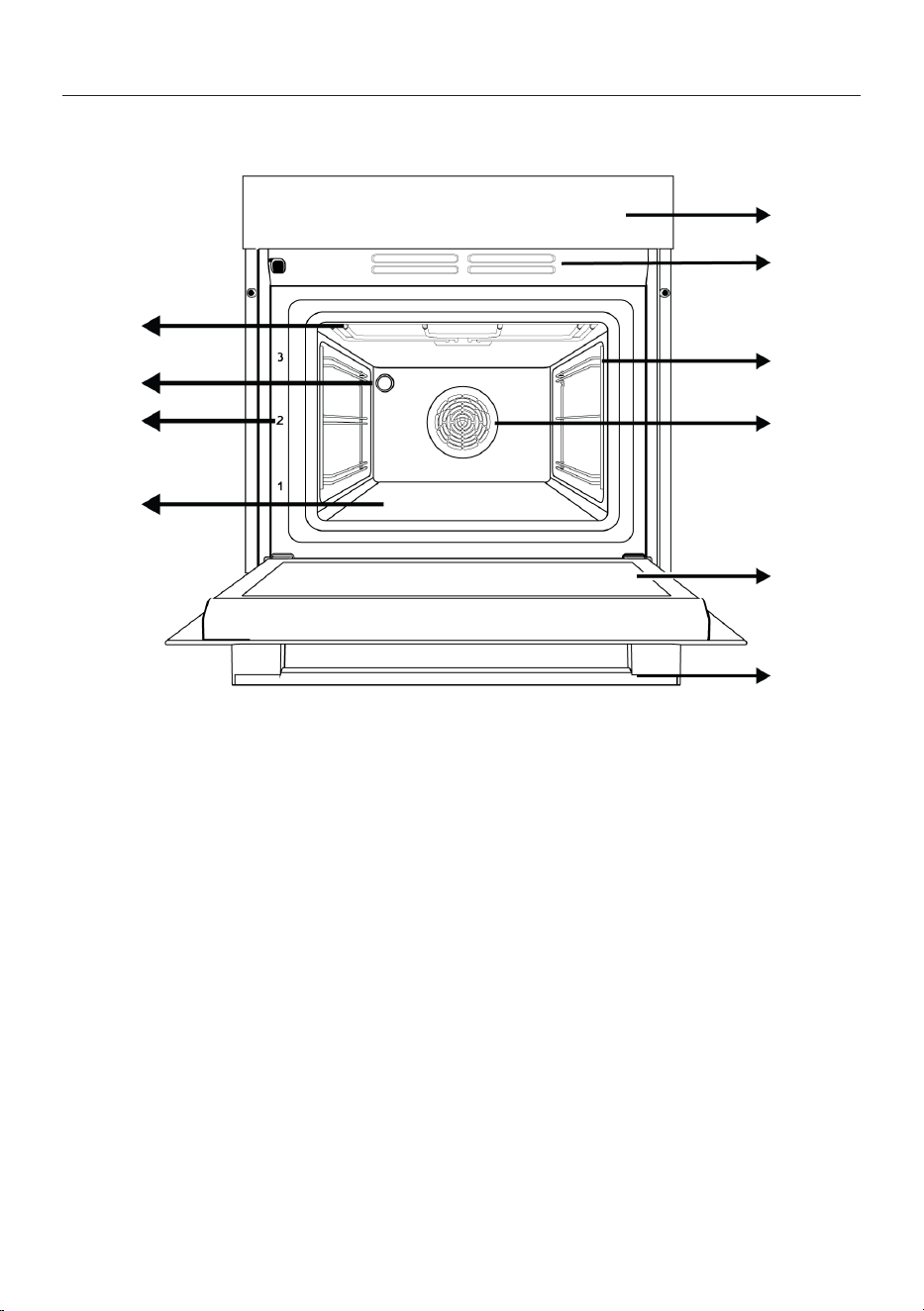
1 Control panel 2 Ventilation holes
3 Wire shelves 4 Fan motor (behind the steel plate)
5 Door 6 Handle
7 Lower heater (under the steel plate) 8 Shelf positions
9 Lamp 10 Upper heater
* Varies depending on the model. Your
product may not be equipped with a lamp,
or the type and location of the lamp may dif-
fer from the illustration.
** Varies depending on the model. Your
product may not be equipped with a wire
rack. In the image, a product with wire rack
is shown as an example.
3.2 Product Control Panel Introduc-
tion and Usage
In this section, you can find the overview
and basic uses of the product's control
panel. There may be differences in images
and some features depending on the type
of product.
EN / 18
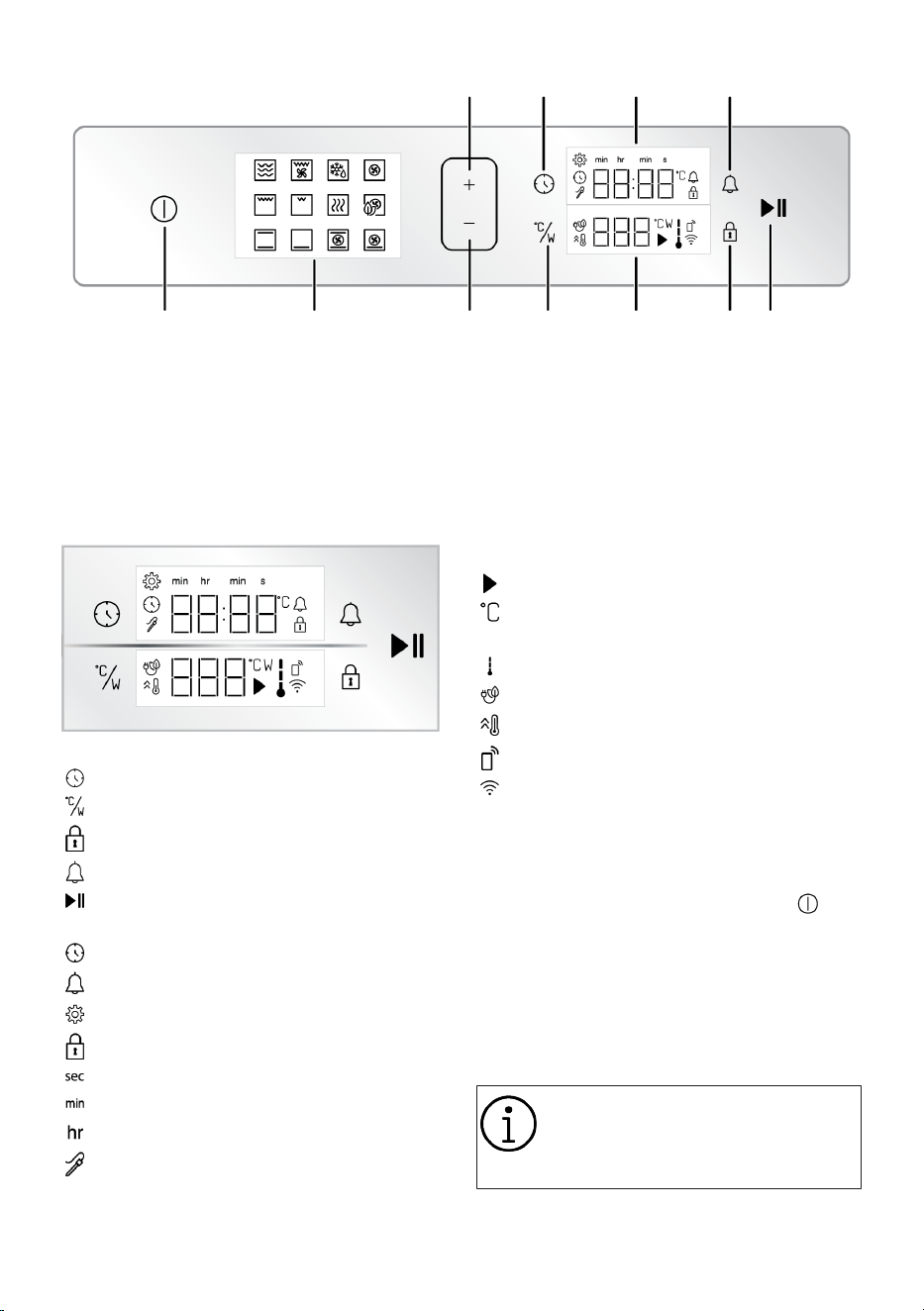
3.2.1 Control Panel
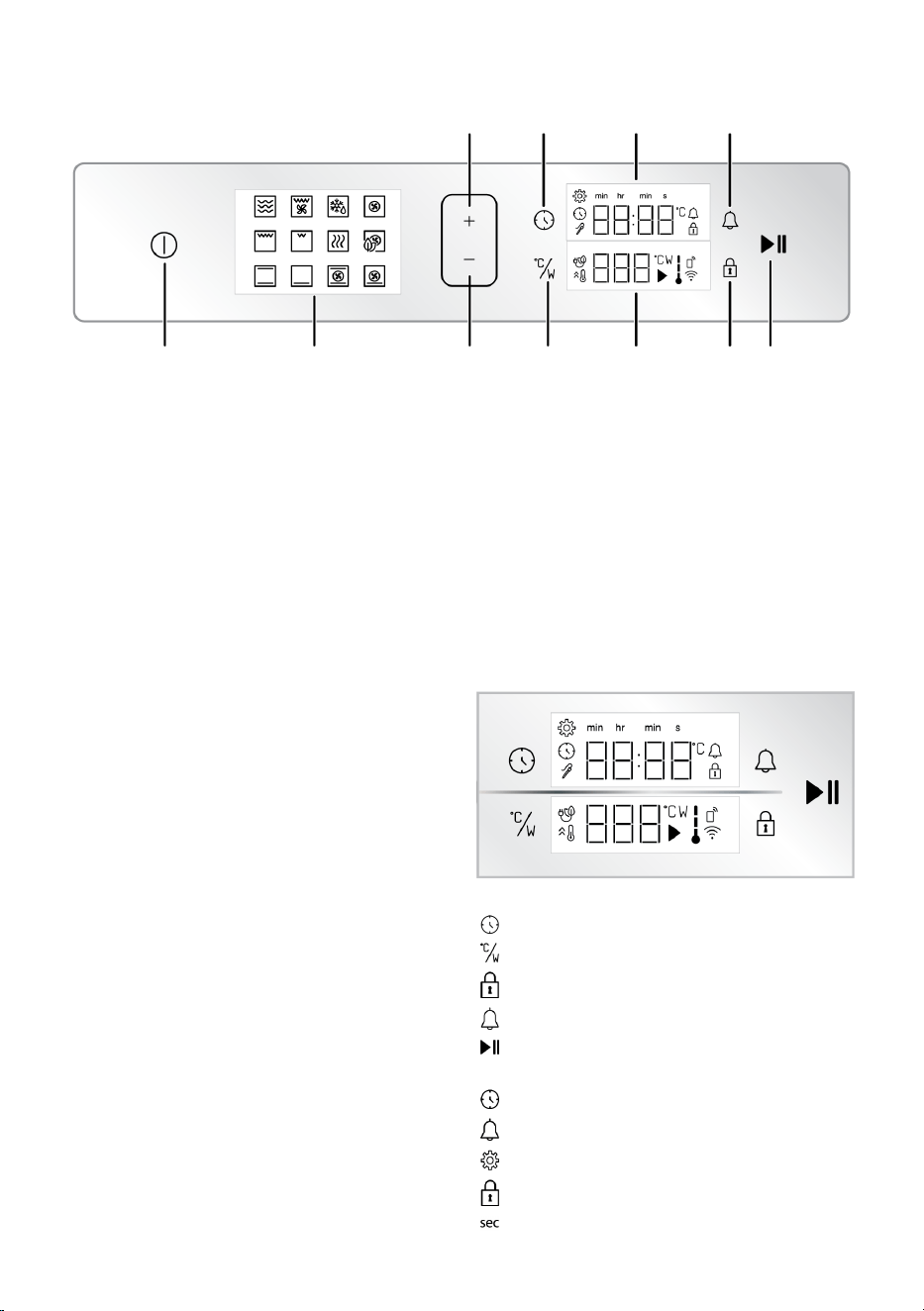
1 2 3 4 5 6 7
891011
1 On/off key 2 Function display
3 Decrease key 4 Temperature/Power key
5 Temperature indicator area 6 Key lock key
7 Baking start/stop key 8 Alarm key
9 Timer/duration indicator area 10 Time and settings key
11 Increase key
If there are knob(s) controlling your
product, in some models this/these knob(s)
may be so that they come out when pushed
(buried knobs). For settings to be made
with these knobs, first push the relevant
knob in and pull out the knob. After making
your adjustment, push it in again and re-
place the knob.
3.2.2 Introduction of the oven control
panel
Oven inner temperature indicator
You can understand the oven inner temper-
ature from the inner temperature symbol on
the display. When the cooking starts, the
symbol is seen on the display and when the
oven inner temperature reaches the set
temperature, each level of the symbol illu-
minates.
Function display
Working functions of your oven are located
at the function display on your oven. Each
function is activated by touching it. All
functions located on the display are schem-
atic, they may not be present in your appli-
ance. Functions of your product are de-
scribed in the section titled “Oven operating
functions”.
Indicator areas:
Keys :
: Time and settings key
: Temperature/Power key
: Key lock key
: Alarm key
: Baking start/stop key
Timer/duration indicator area :
: Baking time/time of day symbol
: Alarm symbol
: Settings symbol
: Key lock symbol
: Seconds symbol
EN / 19
: Minutes symbol
: Timer symbol
: Meat probe symbol *
* It varies depending on the product model. It may
not be available on your product.
Temperature indicator area :
: Baking symbol
: Temperature symbol
: Microwave power symbol
: In-oven temperature symbol
: Symbol of baking with eco fan
: Quick heating (booster) symbol
: Remove control symbol *
: Wifi symbol *
* : It varies depending on the product model. It may
not be available on your product.
3.3 Oven operating functions
On the function table, the operating func-
tions you can use in your oven and the
highest and lowest temperatures that can
be set for these functions are shown. The
order of the operating modes shown here
may differ from the arrangement on your
product.
Operating functions of your oven work in 3
different principles which are only mi-
crowave function, only oven function, and
combined mode.
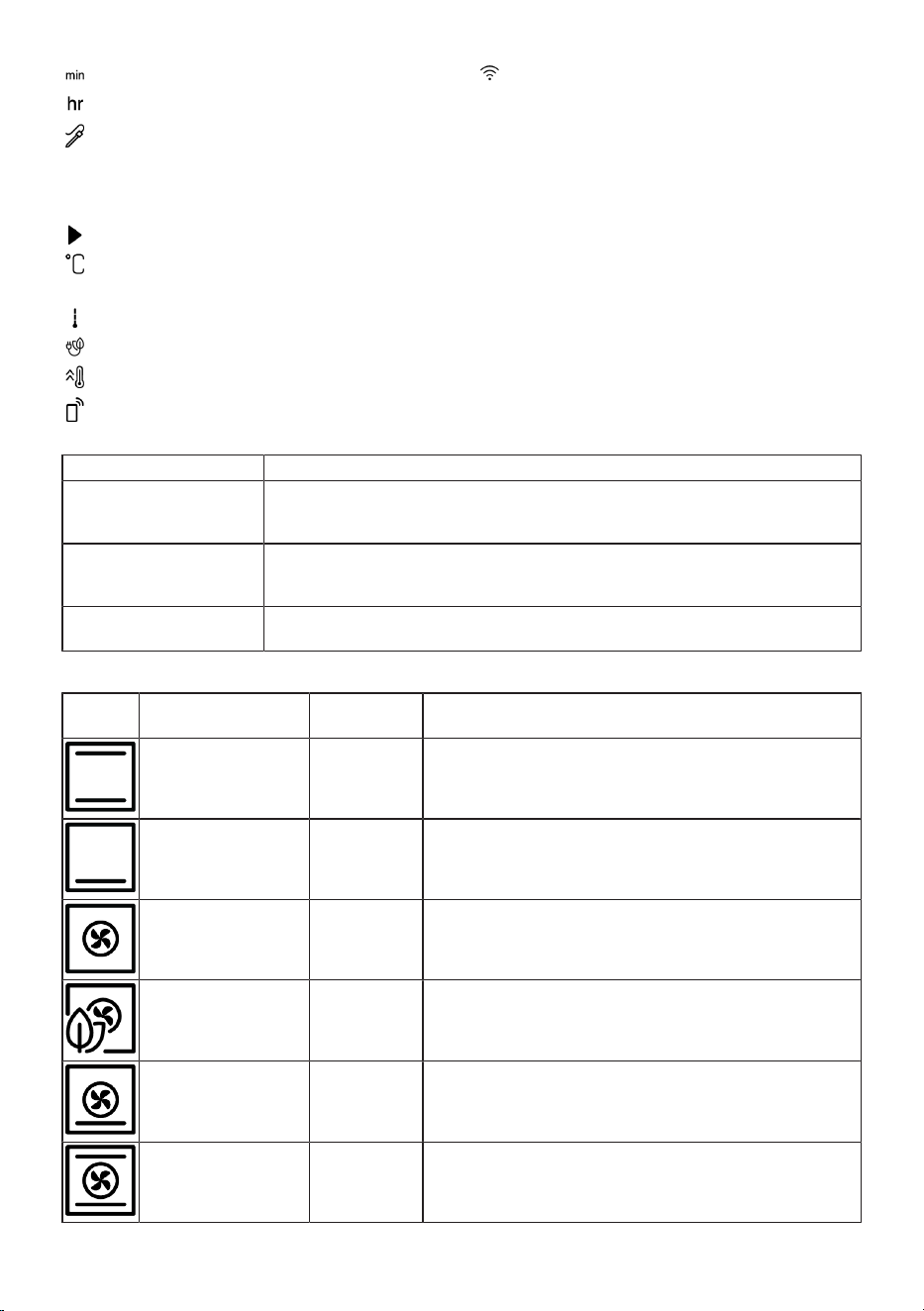
Operation Mode Specifications
Microwave
By operating in only microwave mode, the oven directly heats the inside of the meal.
You may use the microwave for heating pre-cooked meals and drinks, defrosting and
cooking. A meal would cook at the microwave mode but it would not be roasted.
Oven function
By operating only the oven heaters, it cooks the meal by heating. You may use the
oven for all your cookings and defrostings. In the oven function, the meal both cooks
and roasts.
Combined mode
In the combined mode, both the oven heaters and the microwave operates at the
same time. The meal cooks and roasts faster in the combined mode.
Oven functions
Function
symbol
Function description
Temperature
range (°C)
Description and use
Top and bottom heat-
ing
40-280
Food is heated from above and below at the same time. Suit-
able for cakes, pastries or cakes and stews in baking moulds.
Cooking is done with a single tray.
Bottom heating 40-220
Only lower heating is on. It is suitable for foods that need
browning on the bottom.
Fan Heating 40-280
The hot air heated by the fan heater is distributed equally and
rapidly throughout the oven with the fan. It is suitable for multi-
tray cooking at different shelf levels.
Eco fan heating 160-220
In order to save energy, you can use this function instead of us-
ing “Fan Heating” in the range of 160-220°C. But; cooking time
will be slightly longer. The use of this function is explained at
the section titled “Operation of oven control unit”.
Pizza function 40-280
The lower heater and fan heating work. It is suitable for cook-
ing pizza.
"3D" function 40-280
Upper heating, lower heating and fan heating functions oper-
ate. Each side of the product to be cooked is cooked equally
and quickly. Cooking is done with a single tray.
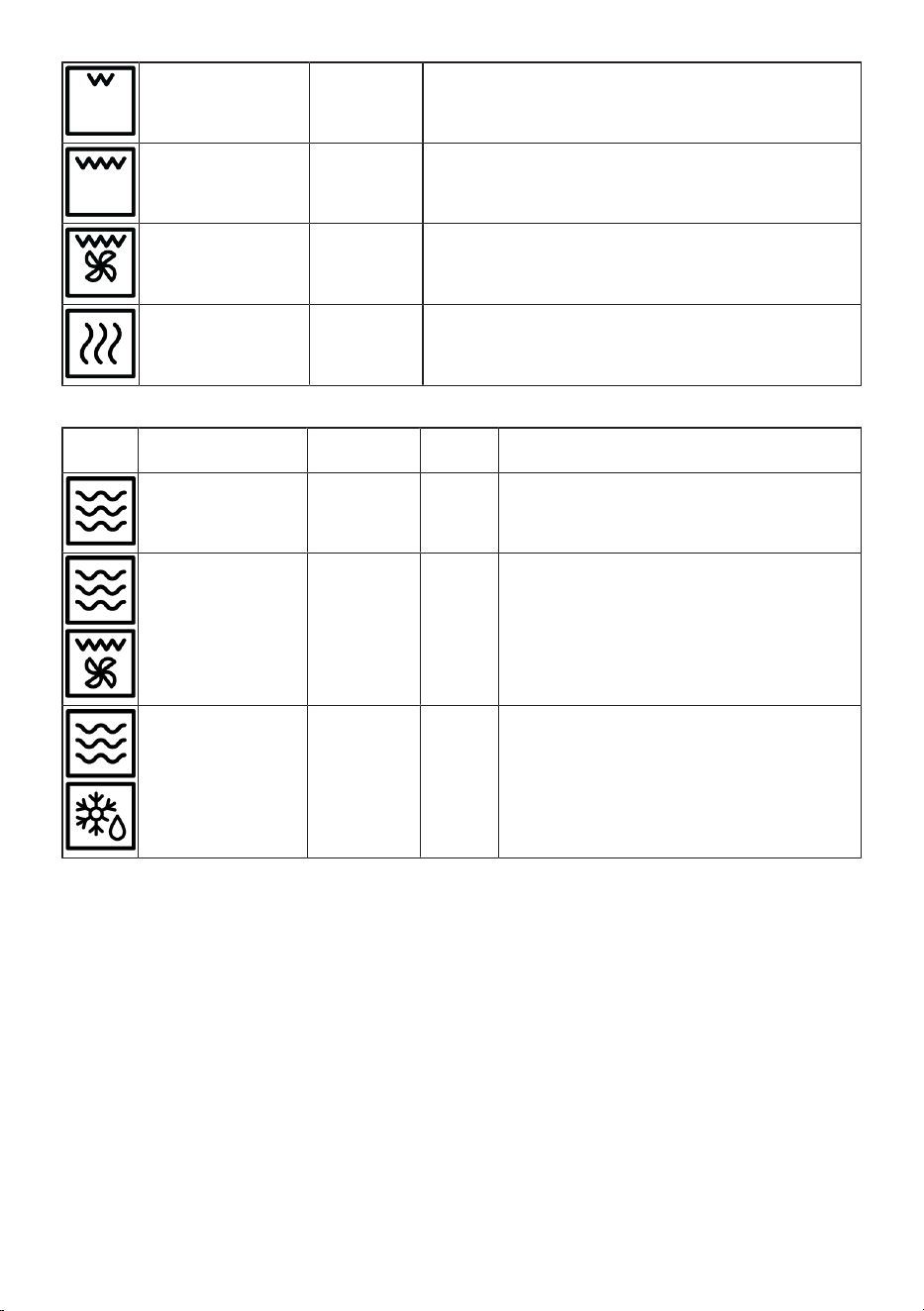
EN / 20
Low grill 40-280
The small grill on the oven ceiling works. It is suitable for
grilling smaller amounts.
Full grill 40-280
The large grill on the oven ceiling works. It is suitable for
grilling in large amounts.
Fan assisted full grill 40-280
The hot air heated by the large grill is quickly distributed into
the oven with the fan. It is suitable for grilling in large amounts.
Keep warm 40-100
It is used to keep the food at a temperature ready for service
for a long time.
Microwave and combined modes
Function
symbol
Function description
Temperature
range (°C)
Power
range (W)
Description and use
Microwave -
100 200
300 600
800
Only works at microwave. It may be used to heat
premade meals and drinks, and cooking meals.
Meals cook without roasting.
Microwave + Fan as-
sisted full grill
40-280
100 200
300 600
The hot air heated by the large grill and the mi-
crowave is quickly distributed into the oven with the
fan. It is suitable for grilling in large amounts.
Microwave + Defrost -
100 200
300 600
The microwave and only the fan (on the back wall)
operates. It is suitable for melting frozen grained
foods in room temperature and cooling the cooked
meals.
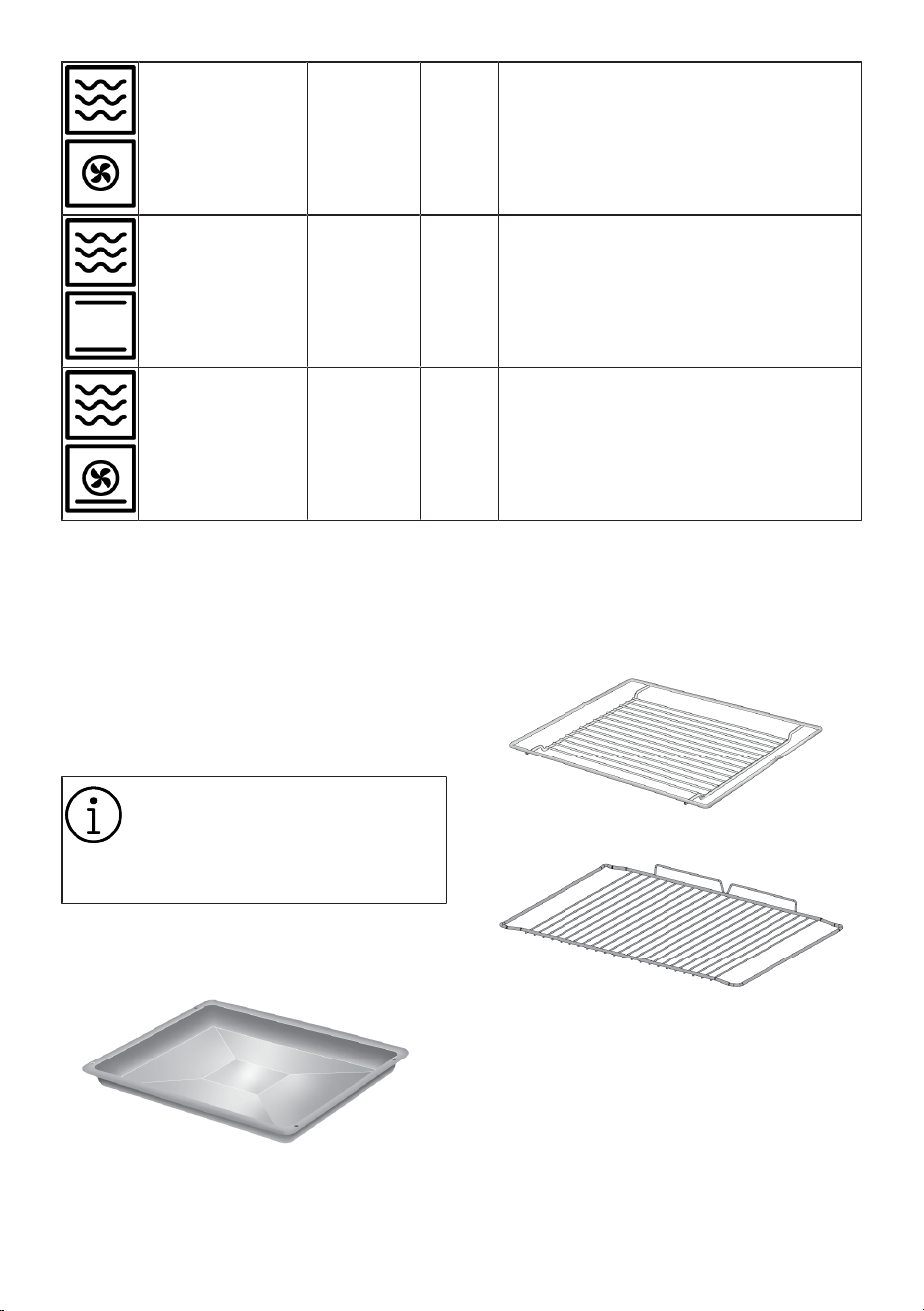
EN / 21
Microwave + Fan Heat-
ing
40-280
100 200
300 600
The back heater of the oven operates with the mi-
crowave. The hot air heated by the rear heater is
distributed equally and rapidly throughout the oven
with the fan. You may cook the meal quickly while
also roasting it.
Microwave + Top and
bottom heating
40-280
100 200
300 600
Food is heated with the microwave from above and
below at the same time. Suitable for cakes, pastries
or cakes and stews in baking moulds. Cooking is
done with a single tray.
Microwave + Pizza
function
40-280
100 200
300 600
The lower heater and fan heating work together
with the microwave. It is suitable for cooking pizza.
3.4 Product Accessories
There are various accessories in your
product. In this section, the description of
the accessories and the descriptions of the
correct usage are available. Depending on
the product model, the supplied accessory
varies. All accessories described in the
user’s manual may not be available in your
product.
The trays inside your appliance
may be deformed with the effect of
the heat. This has no effect on the
functionality. Deformation disap-
pears when the tray is cooled.
Standard tray
It is used for pastries, frozen foods and fry-
ing large pieces.
Wire grill
It is used for frying or placing the food to be
baked, fried and stewed on the desired
shelf.
On models with wire shelves :
On models without wire shelves :
Wire grill in tray
By placing it in the tray (if provided), it is en-
sured that the oils flowing while grilling are
collected in the tray and thus the contamin-
ation of the oven is prevented.
Wire grill in tray is not suitable for use in
deep tray.
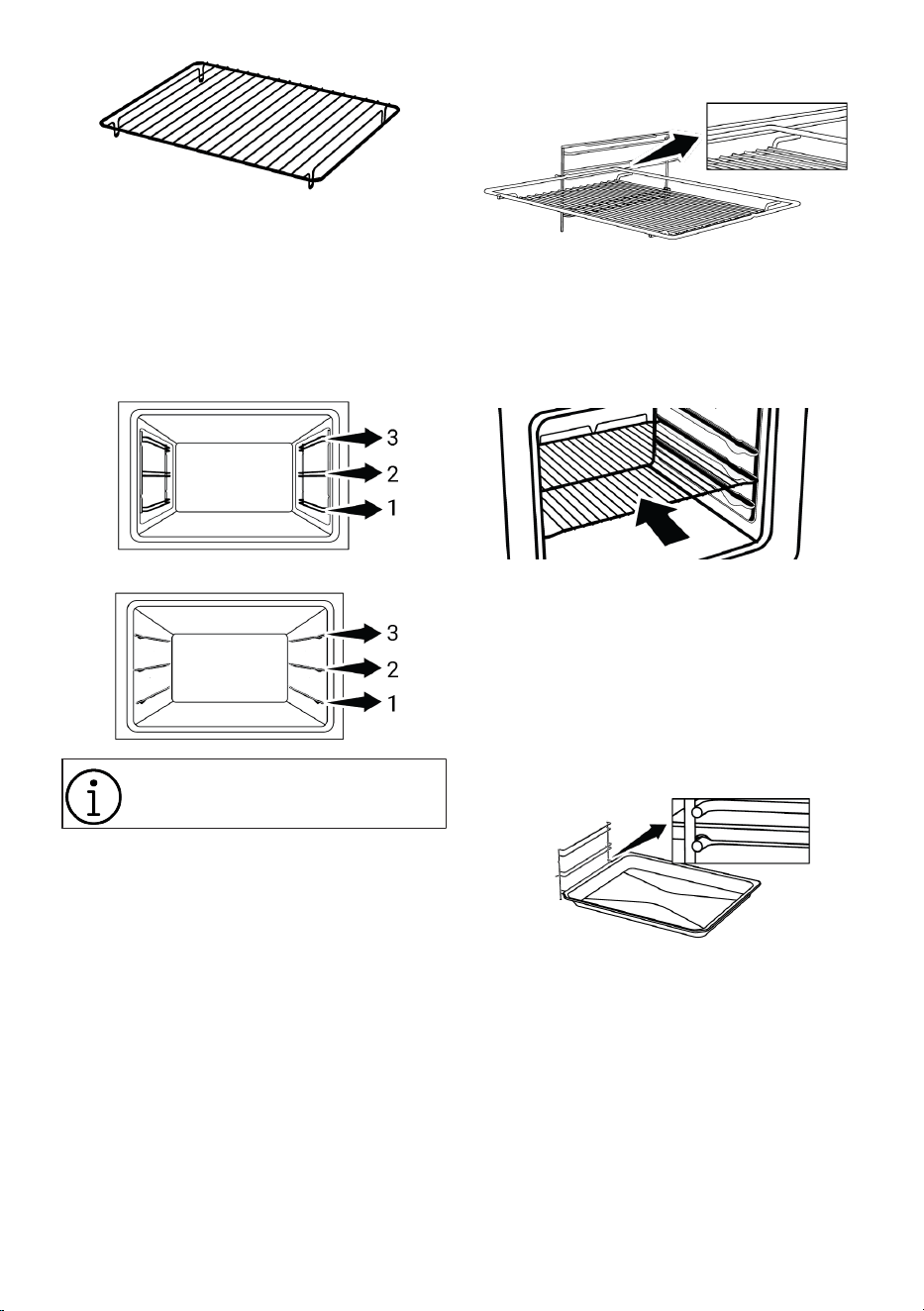
EN / 22
3.5 Use of Product Accessories
Cooking shelves
There are 3 levels of shelf position in the
cooking area. You can also see the order of
the shelves in the numbers on the front
frame of the oven.
On models with wire shelves :
On models without wire shelves :
“0 shelf spot” is the oven floor. Do
not use it other than for microwave.
Placing the wire grill on the cooking
shelves
It is crucial to place the wire grill on the
wire side shelves properly. While placing
the wire grill on the desired shelf, the open
section must be on the front. For better
cooking, the wire grill must be secured on
the wire shelf’s stopping point. It must not
pass over the stopping point to contact
with the rear wall of the oven.
On models with wire shelves :
On models without wire shelves :
It is crucial to place the wire grill on the
side shelves properly. The wire grill has one
direction when placing it on the shelf. While
placing the wire grill on the desired shelf,
the open section must be on the front.
Placing the tray on the cooking shelves
It is also crucial to place the trays on the
wire side shelves properly. While placing
the tray on the desired shelf, its side de-
signed for holding must be on the front. For
better cooking, the tray must be secured on
the stopping socket on the wire shelf. It
must not pass over the stopping socket to
contact with the rear wall of the oven.
Stopping function of the wire grill
There is a stopping function to prevent the
wire grill from tipping out of the wire shelf.
With this function, you can easily and safely
take out your food. While removing the wire
grill, you can pull it forward until it reaches
the stopping point. You must pass over this
point to remove it completely.
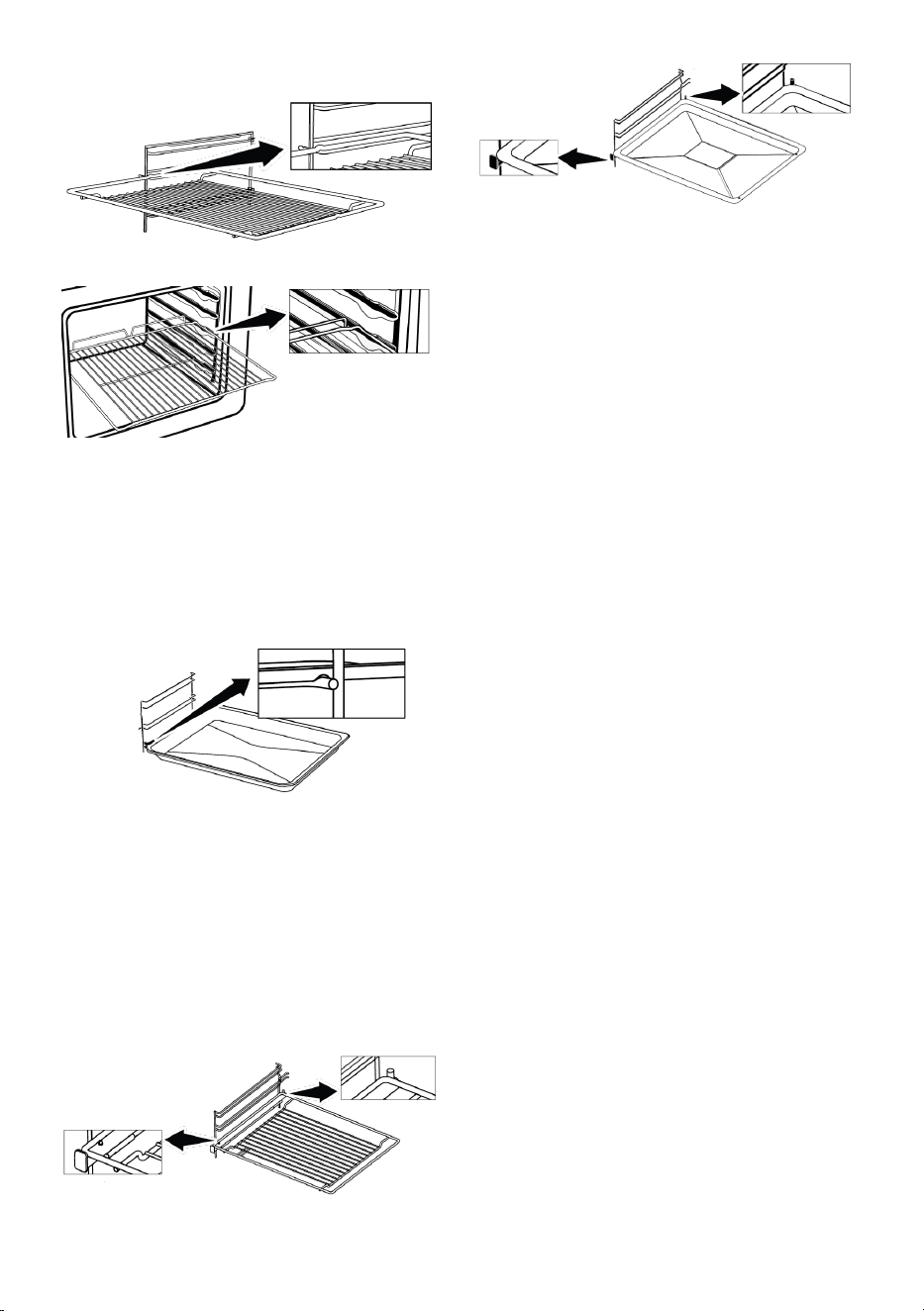
EN / 23
On models with wire shelves :
On models without wire shelves :
Tray stopping function
There is also a stopping function to prevent
the tray from tipping out of the wire shelf.
While removing the tray, release it from the
rear stopping socket and pull it towards
yourself until it reaches the front side. You
must pass over this stopping socket to re-
move it completely.
Proper placement of the wire grill and tray
on the telescopic rails-On models with
wire shelves and telescopic models
Thanks to telescopic rails, trays or the wire
grill can be easily installed and removed.
When using trays and wire grills with the
telescopic rail, care should be taken that
the pins on the front and back of the tele-
scopic rails, rest against the edges of the
grill and the tray (shown in the figure).
EN / 24
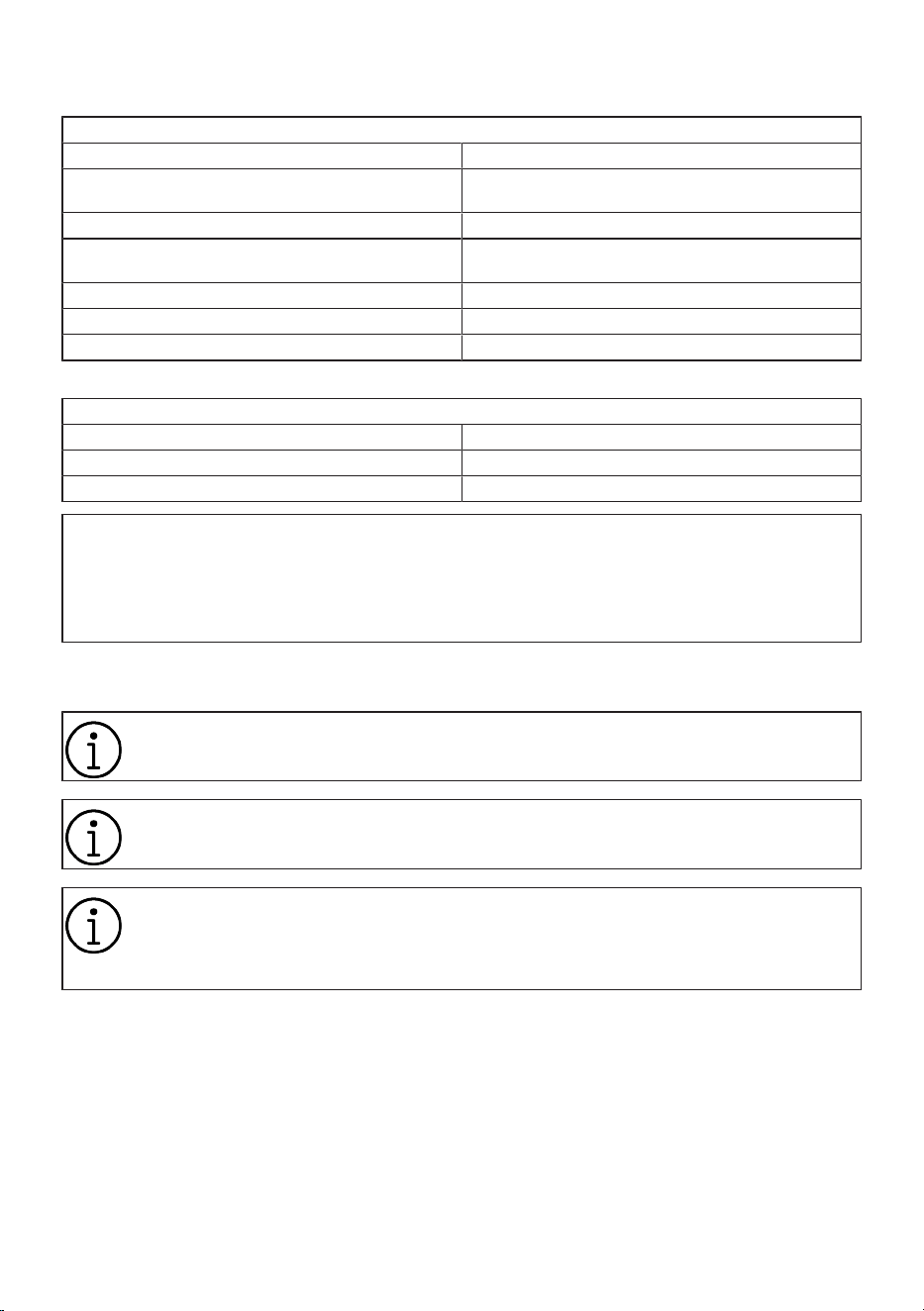
3.6 Technical Specifications
General specifications
Product external dimensions (height/width/depth) (mm) 455 /594 /567
Oven installation dimensions (height / width / depth)
(mm)
450-460 /560 /min. 550
Voltage/Frequency 220-240 V ~; 50 Hz
Cable type and section used/suitable for use in the
product
min. H05VV-FG 3 x 1,5 mm2
Total power consumption (kW) 2,7
Fuse (min.) 13 A
Oven type Multifunction oven
Microwave features
Net volume 48 lt
Microwave power max. 800 W
Microwave frequency 2465 MHz
Basics: Information on the energy label of home type electrical ovens is given in accordance with the EN 60350-1 /
IEC 60350-1 standard. The values are determined in Top and bottom heating or (if present) Fan assisted bottom/top
heating functions with the standard load.
Energy efficiency class is determined in accordance with the following prioritization depending on whether the relev-
ant functions exist on the product or not. 1-Eco fan heating , 2-Fan Heating , 3-Fan assisted low grill , 4-Top and bot-
tom heating.
Technical specifications may be changed without prior notice to improve the qual-
ity of the product.
Figures in this manual are schematic and may not exactly match your product.
Values stated on the product labels or in the documentation accompanying it are
obtained in laboratory conditions in accordance with relevant standards. Depend-
ing on operational and environmental conditions of the product, these values may
vary.
See also
2 Technical Specifications [}]
EN / 25
4 First Use
Before you start using your product, it is re-
commended to do the following stated in
the following sections respectively.
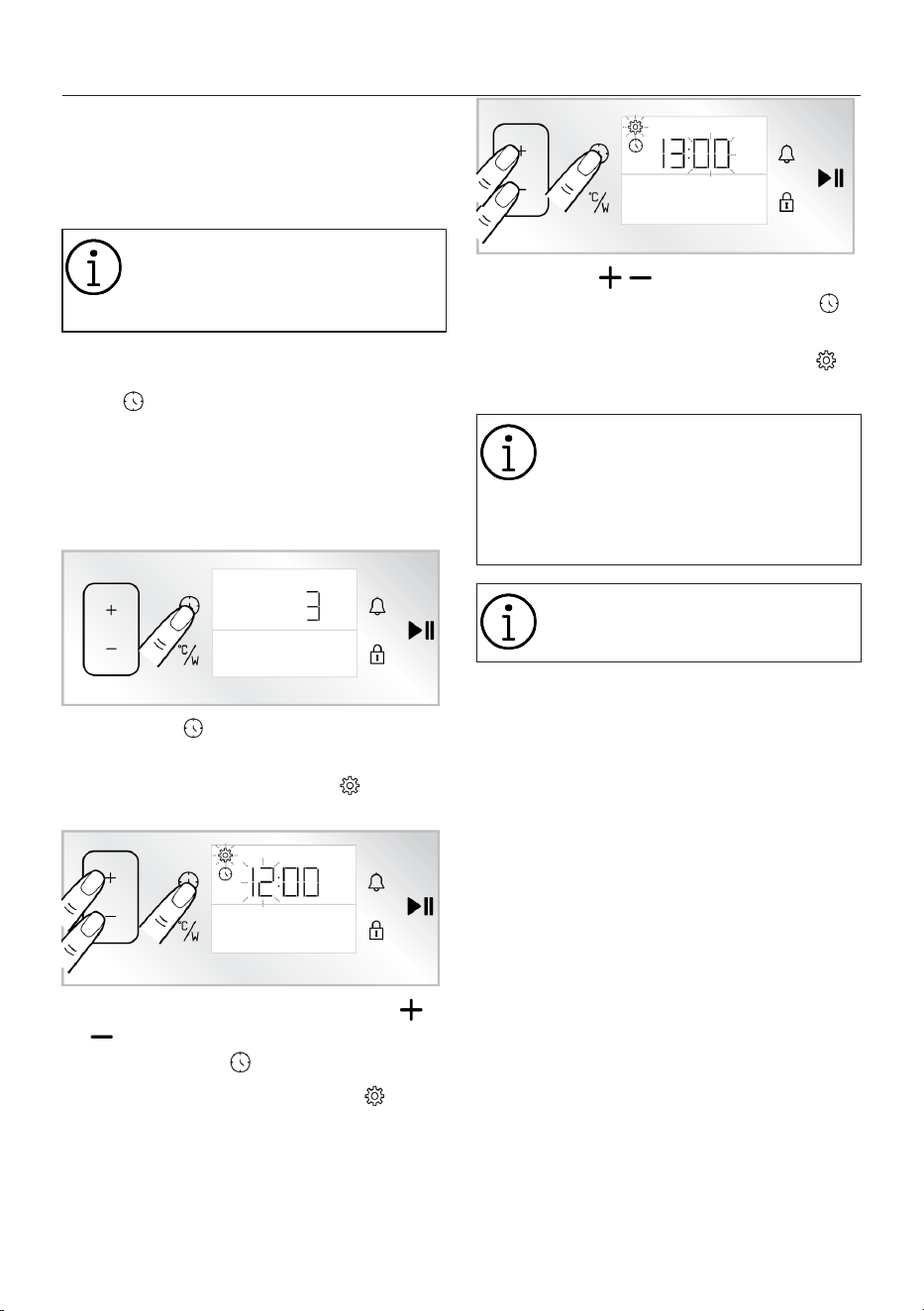
4.1 First Timer Setting
Always set the time of day before
using your oven. If you do not set it,
you cannot cook in some oven
models.
1. With the oven turned off (while the time
of day appears on the display), touch
the key for about 3 seconds to activ-
ate the settings menu.
ð A countdown of 3-2-1 appears on
the display. When the countdown
is over, the settings menu is activ-
ated.
2. Touch the key once to activate the
timer field.
ð The timer field and the symbol
flash on the timer/duration display.
3. Set the time of day by touching the /
keys and activate the minutes field
by touching the key once.
ð The minutes field and the sym-
bol flash on the timer/duration dis-
play.
4. Touch the / keys to set the minute.
Confirm the setting by touching the
key once.
ð The time of day is set and the
symbol illuminates continuously.
If the first timer setting is not per-
formed, the time of day starts from
the time set at the production pro-
cess. You can change the time of
day setting later as described in the
“Settings” section.
In the event of a long power outage,
the time of day setting is cancelled.
It should be set again.
4.2 Initial Cleaning
1. Remove all packaging materials.
2. Remove all accessories from the oven
provided with the product.
3. Operate the product for 30 minutes and
then, turn it off. This way, residues and
layers that may have remained in the
oven during production are burned and
cleaned.
4. When operating the product, select the
highest temperature and the operating
function that all the heaters in your
product operate. See “Oven operating
functions [}19]”. You can learn how to
operate the oven in the following sec-
tion.
5. Wait for the oven to cool.
6. Wipe the surfaces of the product with a
wet cloth or sponge and dry with a cloth.

EN / 26
Before using the accessories:
Clean the accessories you remove from the
oven with detergent water and a soft clean-
ing sponge.
NOTICE: Some detergents or cleaning
agents may cause damage to the surface.
Do not use abrasive detergents, cleaning
powders, cleaning creams or sharp objects
during cleaning.
NOTICE: During the first use, smoke and
odour may come up for several hours. This
is normal and you just need good ventila-
tion to remove it. Avoid directly inhaling the
smoke and odours that form.
5 Using the Oven
5.1 General Information on Using the
Oven
Cooling fan ( It varies depending on the
product model. It may not be available
on your product. )
Your product has a cooling fan. The cooling
fan is activated automatically when neces-
sary and cools both the front of the product
and the furniture. It is automatically deac-
tivated when the cooling process is fin-
ished. Hot air comes out over the oven
door. Do not cover these ventilation open-
ings with anything. Otherwise, the oven
may overheat. The cooling fan continues to
operate during oven operation or after the
oven is turned off (approximately 20-30
minutes). If you cook by programming the
oven timer, at the end of the baking time,
the cooling fan turns off with all functions.
The cooling fan running time cannot be de-
termined by the user. It turns on and off
automatically. This is not an error.
Oven lighting
The oven lighting is turned on when the
oven starts baking. In some models, the
lighting is on during baking, while in some
models it turns off after a certain time.
5.2 Operation of the Oven Control Unit
General warnings for the oven control unit
• The maximum time that can be set for
the baking process is 5:59 hours. In keep-
ing warm function, this time is 23:59
hours. In case of a power outage, the pre-
set baking and baking duration are can-
celled.
• While making any adjustments, the relev-
ant symbols flash on the display. It is ne-
cessary to save the settings made, either
by touching the relevant key in the de-
scription or by waiting for a short time.
• If baking time is set when baking starts,
the remaining time is shown on the dis-
play.
• If the quick preheat setting is active on
the control unit the symbol appears on
the display when you start baking and the
oven reaches the temperature you set for
baking quickly. For quick preheat setting,
see the “Settings” section.
EN / 27
1 2 3 4 5 6 7
891011
1 On/off key 2 Function display
3 Decrease key 4 Temperature/Power key
5 Temperature indicator area 6 Key lock key
7 Baking start/stop key 8 Alarm key
9 Timer/duration indicator area 10 Time and settings key
11 Increase key
Keys :
: Time and settings key
: Temperature/Power key
: Key lock key
: Alarm key
: Baking start/stop key
Timer/duration indicator area :
: Baking time/time of day symbol
: Alarm symbol
: Settings symbol
: Key lock symbol
: Seconds symbol
: Minutes symbol
: Timer symbol
: Meat probe symbol *
* It varies depending on the product model. It may
not be available on your product.
Temperature indicator area :
: Baking symbol
: Temperature symbol
: Microwave power symbol
: In-oven temperature symbol
: Symbol of baking with eco fan
: Quick heating (booster) symbol
: Remove control symbol *
: Wifi symbol *
* : It varies depending on the product model. It may
not be available on your product.
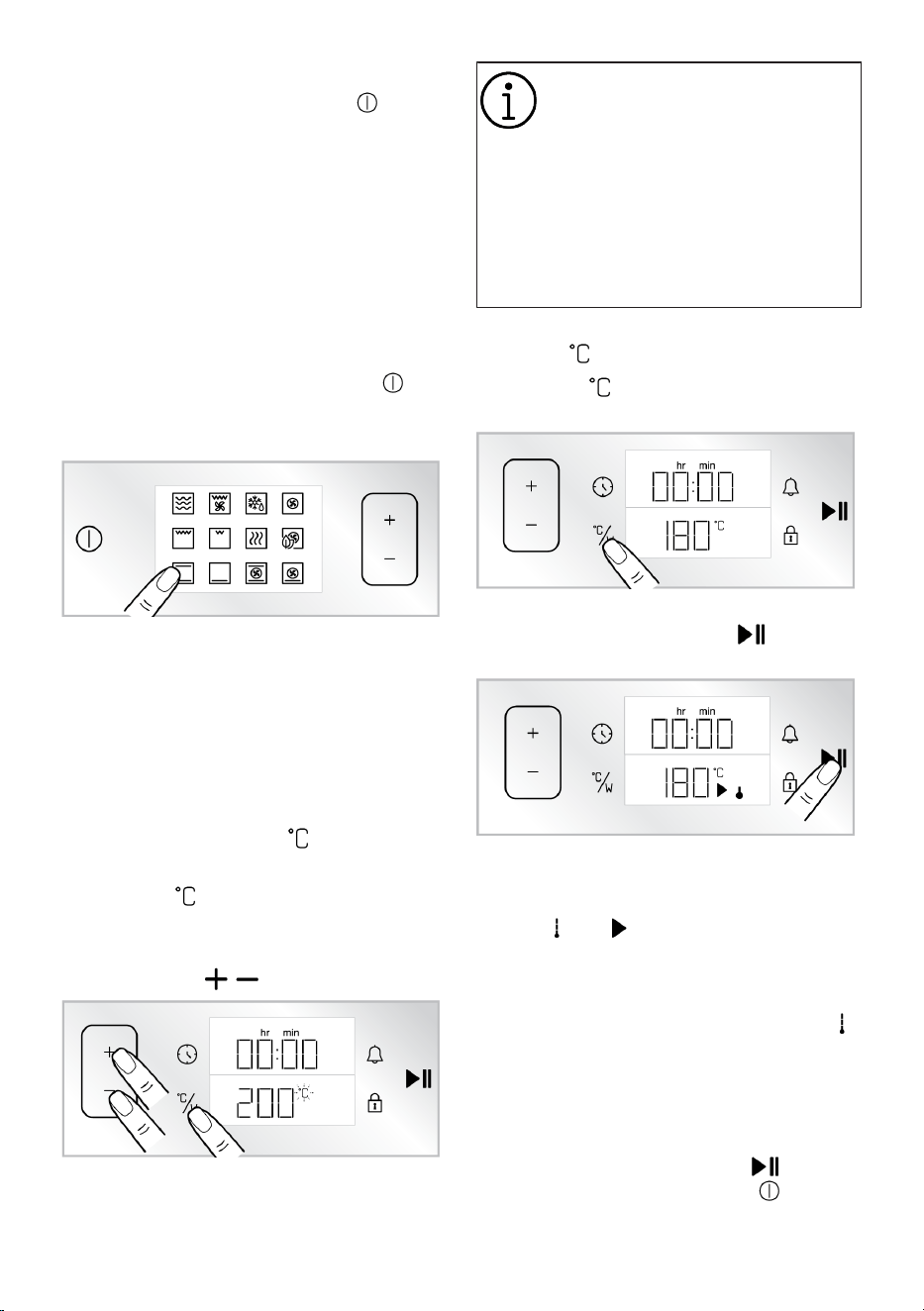
Turning on the oven
1. Turn the oven on by touching the key.
ð After the oven is turned on, the first op-
erating function is shown on the dis-
play. The operating function, temperat-
ure, baking time and alarm can be ad-
justed when the display is in this
status.
If no setting is made on this dis-
play, the oven turns off in approxim-
ately 5 minutes and the time of day
is shown on the display.
EN / 28
Turning off the oven
Turn off the oven by touching the key.
The time of day is shown on the display.
Manual baking by selecting temperature
and oven operating function
You can cook by making a manual control
(at your own control) without setting the
baking time by selecting the temperature
and operating function specific to your
food. As an example, the “Top and bottom
heating” function and 180 °C settings are
shown in the pictures.
1. Turn the oven on by touching the key.
2. Touch the operation function you want
to activate on the function display.
3. If the function you want to activate is
not among the operating functions that
appear first on the function display, you
can activate the operating functions in
the lower row by touching "Extra func-
tion activation”
4. The pre-set temperature for the operat-
ing function you selected appears on
the display. Touch the key to change
this temperature.
ð The symbol flashes on the tem-
perature display.
5. Set your desired baking temperature by
touching the / keys.
If you change the operating func-
tion after you change the pre-set
temperature of the operating func-
tion, the last temperature set is
shown on the display. However, if
the selected temperature is not
between the temperature range of
the selected operating function, the
highest temperature for that operat-
ing function is displayed.
6. Confirm the set temperature by touch-
ing the key.
ð The symbol lights up continu-
ously on the temperature display.
7. After setting up operating function and
the temperature touch the key to
start baking.
ð Your oven will start operating immedi-
ately at the selected function and tem-
perature. On the temperature display,
the and symbols are shown. Bak-
ing time starts counting up on the dis-
play. As the temperature inside the
oven reaches the set temperature,
each stage of the oven temperature
symbol will light up. The oven does not
switch off automatically since manual
baking is done without setting the bak-
ing time. You have to control baking
and turn it off yourself. When the bak-
ing is completed touch the key to
end the baking or touch the key to
turn off the oven completely.
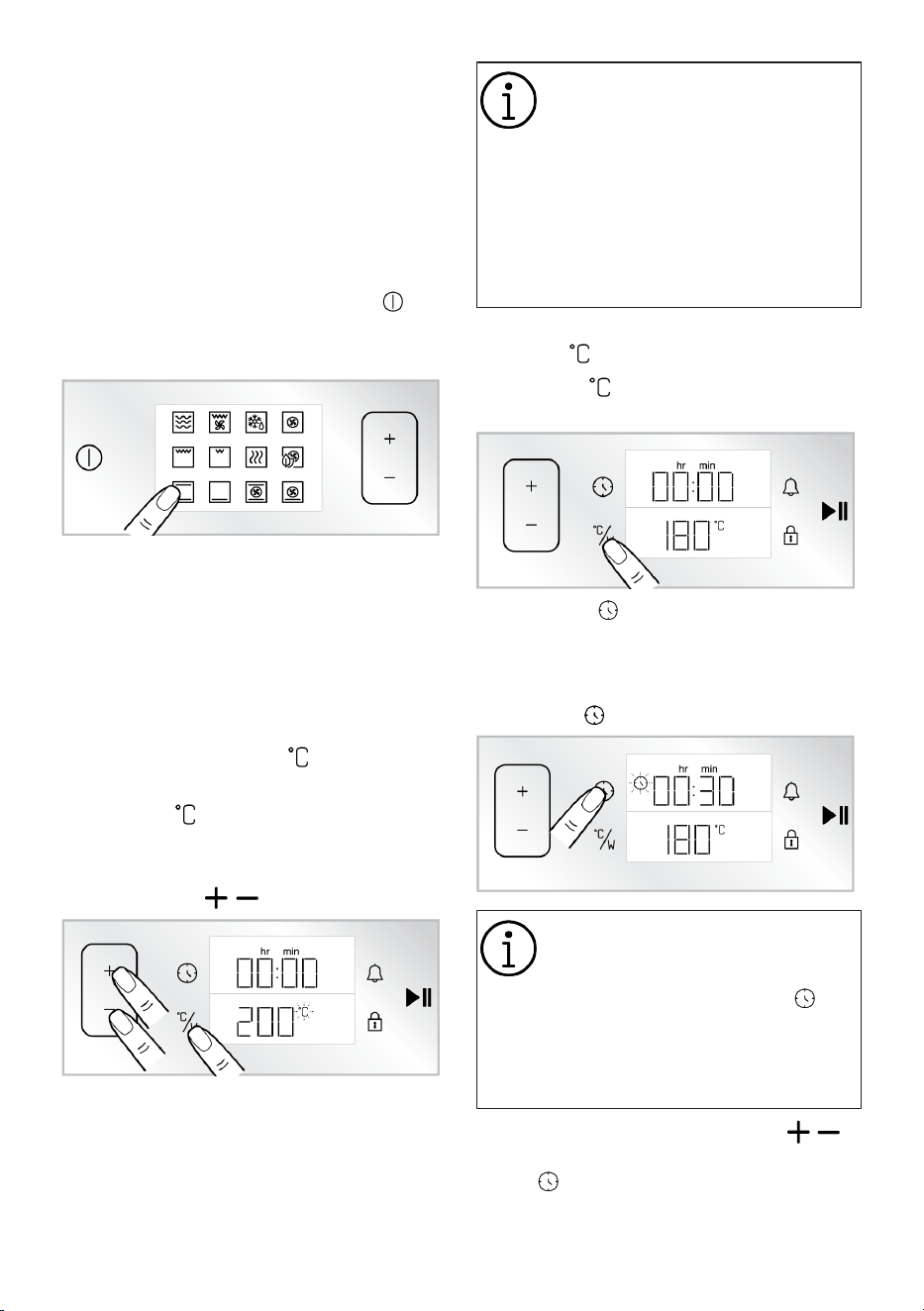
EN / 29
Baking by setting the baking time;
You can have the oven turn off automatic-
ally at the end of the time by selecting the
temperature and operating function spe-
cific to your food and setting the baking
time on the timer. As an example, the “Top
and bottom heating" function, 180 °C and
45 minutes baking time settings are shown
in the pictures.
1. Turn the oven on by touching the key.
2. Touch the operation function you want
to activate on the function display.
3. If the function you want to activate is
not among the operating functions that
appear first on the function display, you
can activate the operating functions in
the lower row by touching "Extra func-
tion activation”
4. The pre-set temperature for the operat-
ing function you selected appears on
the display. Touch the key to change
this temperature.
ð The symbol flashes on the tem-
perature display.
5. Set your desired baking temperature by
touching the / keys.
If you change the operating func-
tion after you change the pre-set
temperature of the operating func-
tion, the last temperature set is
shown on the display. However, if
the selected temperature is not
between the temperature range of
the selected operating function, the
highest temperature for that operat-
ing function is displayed.
6. Confirm the set temperature by touch-
ing the key.
ð The symbol lights up continu-
ously on the temperature display.
7. Touch the key once for the baking
time.
ð The set 30 minutes value appears
on the timer/duration display and
the symbol flashes.
To adjust the baking time quickly,
you can activate the baking time as
30 minutes by pushing the oven
control knob or touching the key
after the operation function and
temperature are set, and you can
change the time by turning the oven
control knob to the right/left.
8. Set the baking time by touching /
keys. Confirm the setting by touching
the key.
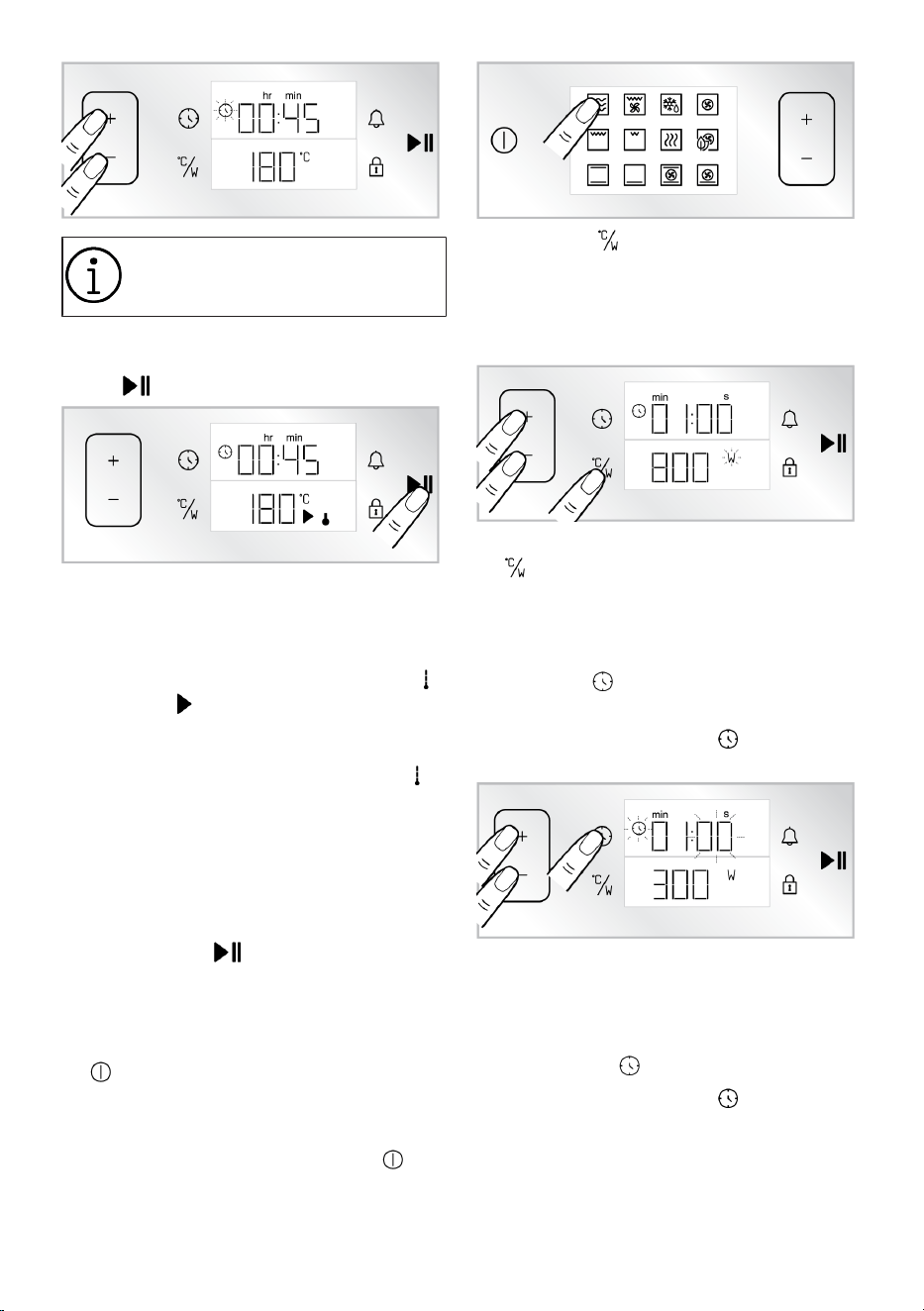
EN / 30
The baking time increases by 1
minute in the first 15 minutes and
by 5 minutes after 15 minutes.
9. After setting up operating function, the
temperature and the baking time, touch
the key to start baking.
ð Your oven starts operating immedi-
ately at the selected function and
temperature and the baking time
countdown appears on the display.
On the temperature display, the
and symbols are shown. As the
temperature inside the oven
reaches the set temperature, each
stage of the oven temperature
symbol will light up. When the bak-
ing time is completed, “End” text
appears on the temperature dis-
play, the timer gives an audible
warning and baking stops.
10.The warning sounds for one minute. If
you touch the key while the audible
warning is given and the “End” text is
displayed on the temperature display,
the oven continues operating indefin-
itely. Turn off the oven by touching the
key. If any key is touched except for
these, the audible warning stops.
Using the microwave mode
1. Turn the oven on by touching the key.
2. Touch the “Microwave” operation func-
tion on the function display.
3. Touch the key to change the mi-
crowave power level. Adjust the desired
microwave power by turning the oven
control knob to the right/left.
ð The symbol flashes on the display.
4. Confirm the set power by touching the
key.
ð The symbol appears permanently
on the display.
5. Push the oven control knob once or
touch the key once for the baking
time.
ð On the display, the symbol and
the second field flash.
6. Adjust the baking time in seconds by
turning the oven control knob to the
right/left.
7. Confirm the baking time’s second by
touching the key.
ð On the display, the symbol and
the minute field flash.
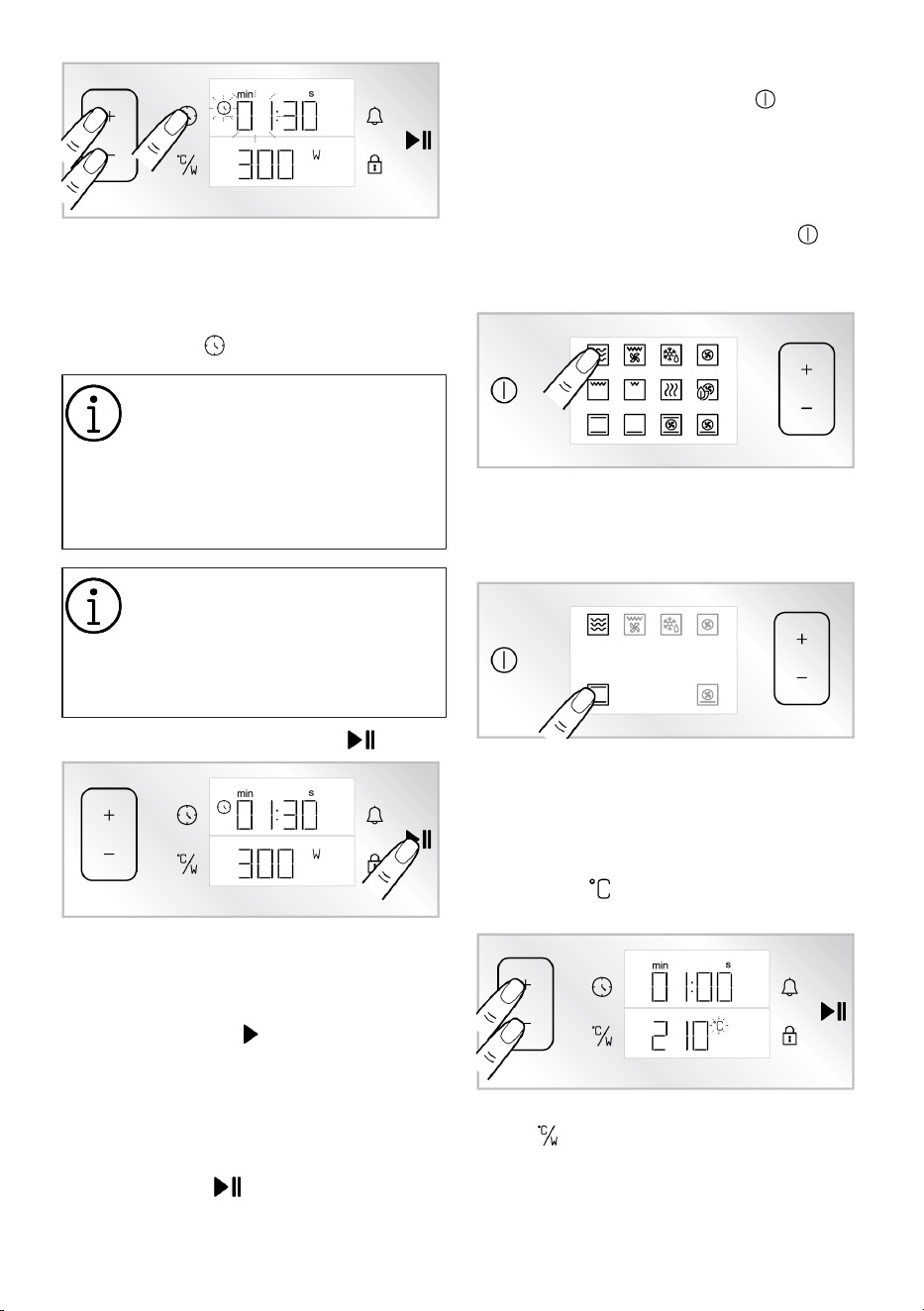
EN / 31
8. Adjust the baking time in minutes by
turning the oven control knob to the
right/left.
9. Confirm the baking time’s minutes by
touching the key.
The maximum microwave power is
limited to 600W when the selected
baking time in microwave mode ex-
ceeds 12 minutes. The microwave
power is automatically set to 600W
when the selected baking times ex-
ceed 12 minutes.
The baking time intervals are de-
termined automatically based on
the microwave power you set and
cannot be changed. The 800 W/ 1
minute and 30 second settings are
shown as examples in the pictures.
10.To start the baking touch the key.
ð Your oven will start operating im-
mediately in microwave function
and power. The adjusted baking
time starts to count down. On the
display, the and symbols are
shown. When the baking time is
completed, “End” text appears on
the display, audible warning is
given and baking stops.
11.The warning sounds for one minute. If
you touch the key while the audible
warning is given and the “End” text is
shown on the display, the oven contin-
ues operating for one more minute. Turn
off the oven by touching the key. If
any key is touched except for these, the
audible warning stops.
Using the Combi mode (Oven and mi-
crowave together)
1. Turn the oven on by touching the key.
2. Touch the “Microwave” operation func-
tion on the function display.
3. Touch on the combi function you want
to cook with the microwave function.
Both will activate. (e.g. Microwave + Top
and bottom heating)
4. The pre-set temperature for the operat-
ing function you selected appears on
the display. Turn the oven control knob
to the right/left to change this temperat-
ure.
ð The symbol flashes on the dis-
play.
5. Confirm the temperature by touching
the key.
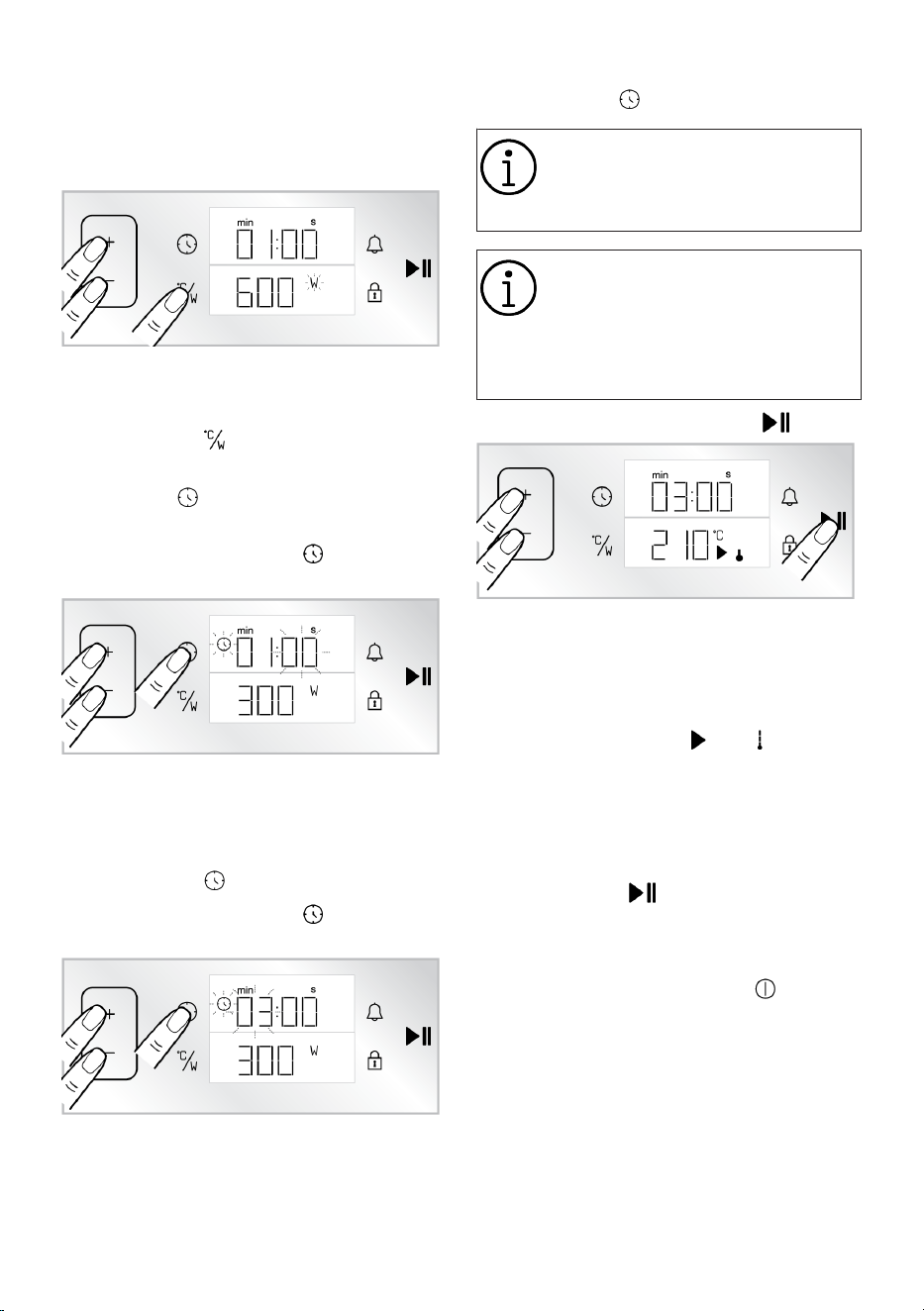
EN / 32
ð The microwave power level is ac-
tivated and the pre-defined mi-
crowave power appears on the dis-
play. The symbol flashes on the
display.
6. To change the microwave power level,
turn the oven control knob to the right /
left and confirm the power setting by
touching the key.
7. Push the oven control knob once or
touch the key once for the baking
time.
ð On the display, the symbol and
the second field flash.
8. Adjust the baking time in seconds by
turning the oven control knob to the
right/left.
9. Confirm the baking time’s second by
touching the key.
ð On the display, the symbol and
the minute field flash.
10.Adjust the baking time in minutes by
turning the oven control knob to the
right/left.
11.Confirm the baking time’s minutes by
touching the key.
When baking in combi modes, the
maximum microwave power is lim-
ited to 600W and is not dependent
on the selected baking time.
The baking time intervals are de-
termined automatically based on
the microwave power you set and
cannot be changed. The 300 W/ 3
minute setting is shown as ex-
amples in the pictures.
12.To start the baking touch the key.
ð Your oven will start operating im-
mediately at the selected combi
function, temperature and mi-
crowave power. The adjusted bak-
ing time starts to count down. On
the display, the and symbols
are shown. When the baking time
is completed, “End” text appears
on the display, audible warning is
given and baking stops.
13.The warning sounds for one minute. If
you touch the key while the audible
warning is given and the “End” text is
shown on the display, the oven contin-
ues operating for one more minute. Turn
off the oven by touching the key. If
any key is touched except for these, the
audible warning stops.
EN / 33
5.3 Settings
The 3-2-1 countdown is shown on
the display in the menus or settings
that should be activated by press-
ing for a long period. When the
count down expires, the relevant
menu or setting is activated.
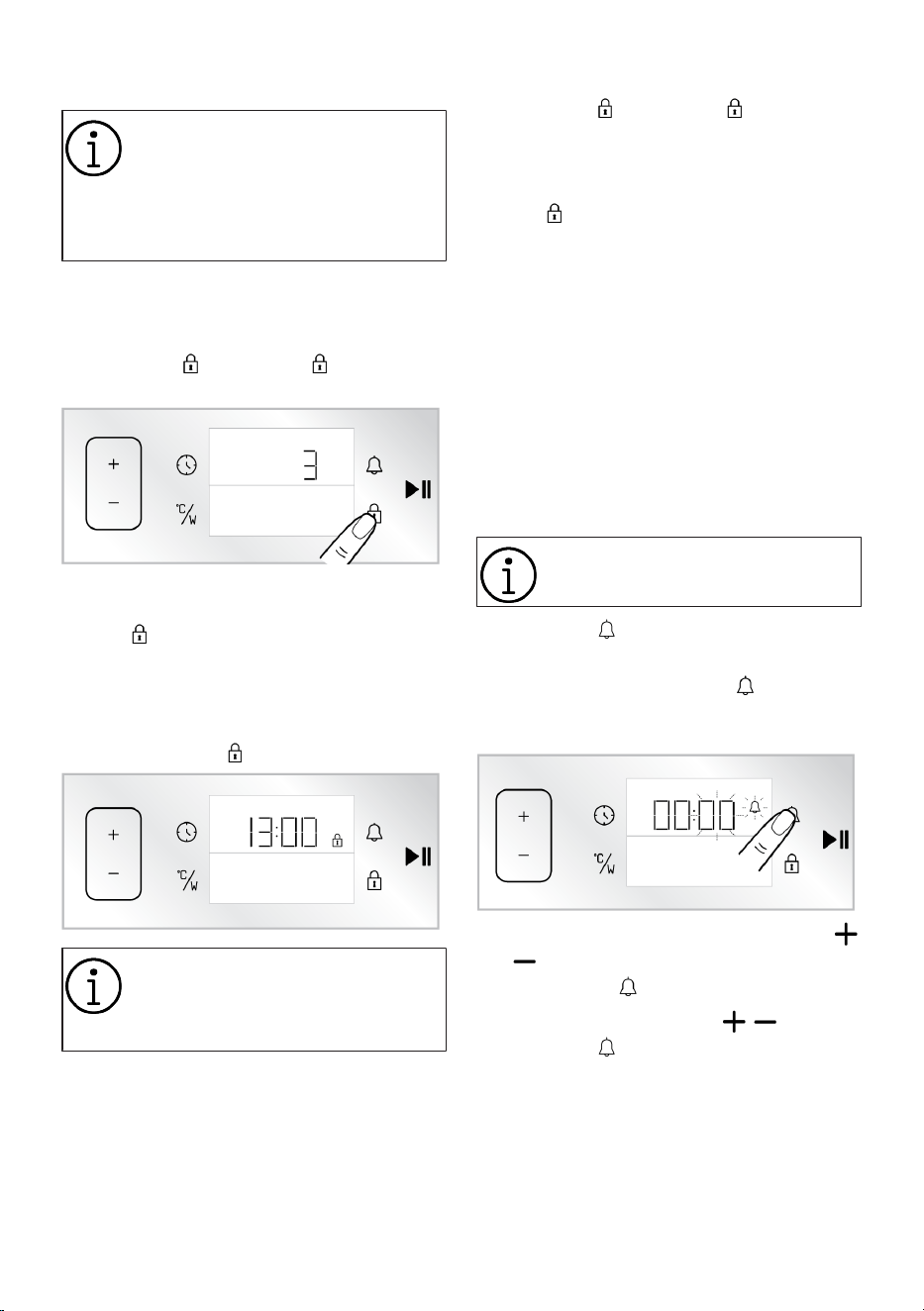
Activating the key lock
By using the key lock feature, you can safe-
guard the interference of the control unit.
1. Touch the key until the symbol ap-
pears on the timer/duration display.
ð A countdown of 3-2-1 appears on the
display. When the countdown is over,
the symbol appears on the timer/dur-
ation display and the key lock is activ-
ated. After the key lock is set, if any key
is touched or the oven control knob is
pushed, the timer sounds an audible
signal and the symbol flashes.
While the key lock is activated, the
keys of the control unit cannot be
used. The key lock will not be can-
celled in case of power failure.
Deactivating the key lock
1. Touch the key until the symbol ap-
pears on the timer/duration display.
ð A countdown of 3-2-1 appears on the
display. When the countdown is over,
the symbol disappears on the timer/
duration display and the key lock is de-
activated.
Setting the alarm
You can also use the control unit of the
product for any warning or reminder other
than baking. The alarm clock has no effect
on the oven operating functions. It is used
for warning purposes. For example, you can
use the alarm clock when you want to turn
the food in the oven at a certain time. As
soon as the time you set has expired, the
timer gives you an audible warning.
The maximum alarm time may be
23 hours 59 minutes.
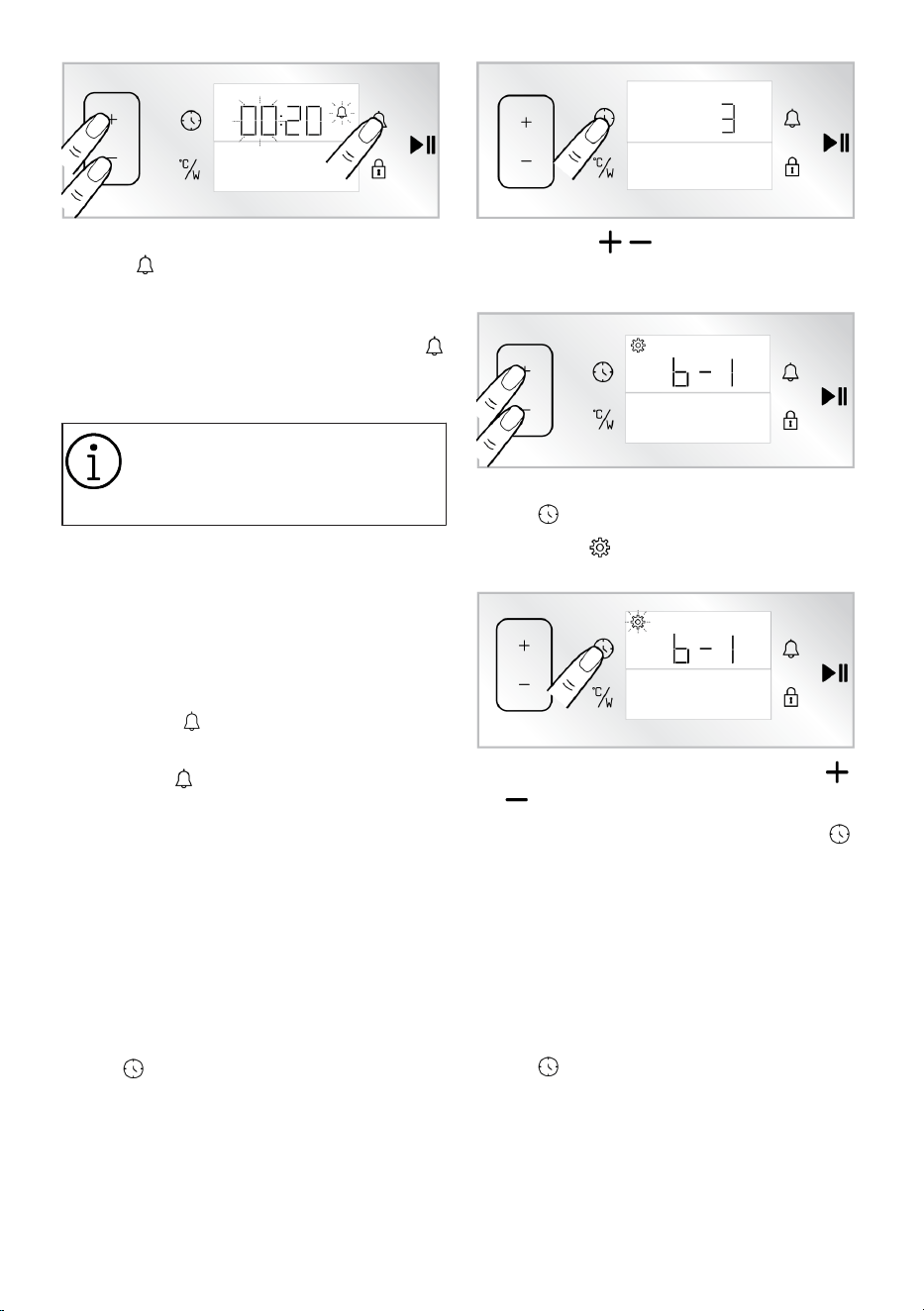
1. Touch the key once to set the alarm
period.
ð The minute field and symbol
start to flash on the timer/duration
display.
2. First, set the minutes by touching the
/ keys and activate the timer field by
touching the key once.
3. Set the time by touching / keys.
Touch the key again to confirm the
setting.
EN / 34
ð On the timer/duration display, the
symbol lights up continuously
and the alarm time starts to count
down on the display.
4. After the alarm time is completed, the
symbol starts flashing and gives you an
audible warning.
If the alarm time and baking time
are set at the same time, the
shorter time is shown on the timer/
duration display.
Turning off the alarm
1. At the end of the alarm period, the warn-
ing sounds for one minute. Touch any
key to stop the audible warning.
ð The audible warning is stopped.
If you want to cancel the alarm;
1. Touch the key once to reset the alarm
period.
ð The symbol starts to flash on
the timer/duration display.
2. Turn the oven control knob to the right/
left until the alarm time reaches
“00:00”.
Setting the volume
You may set the volume of your control
unit. Your oven should be turned off to per-
form this setting.
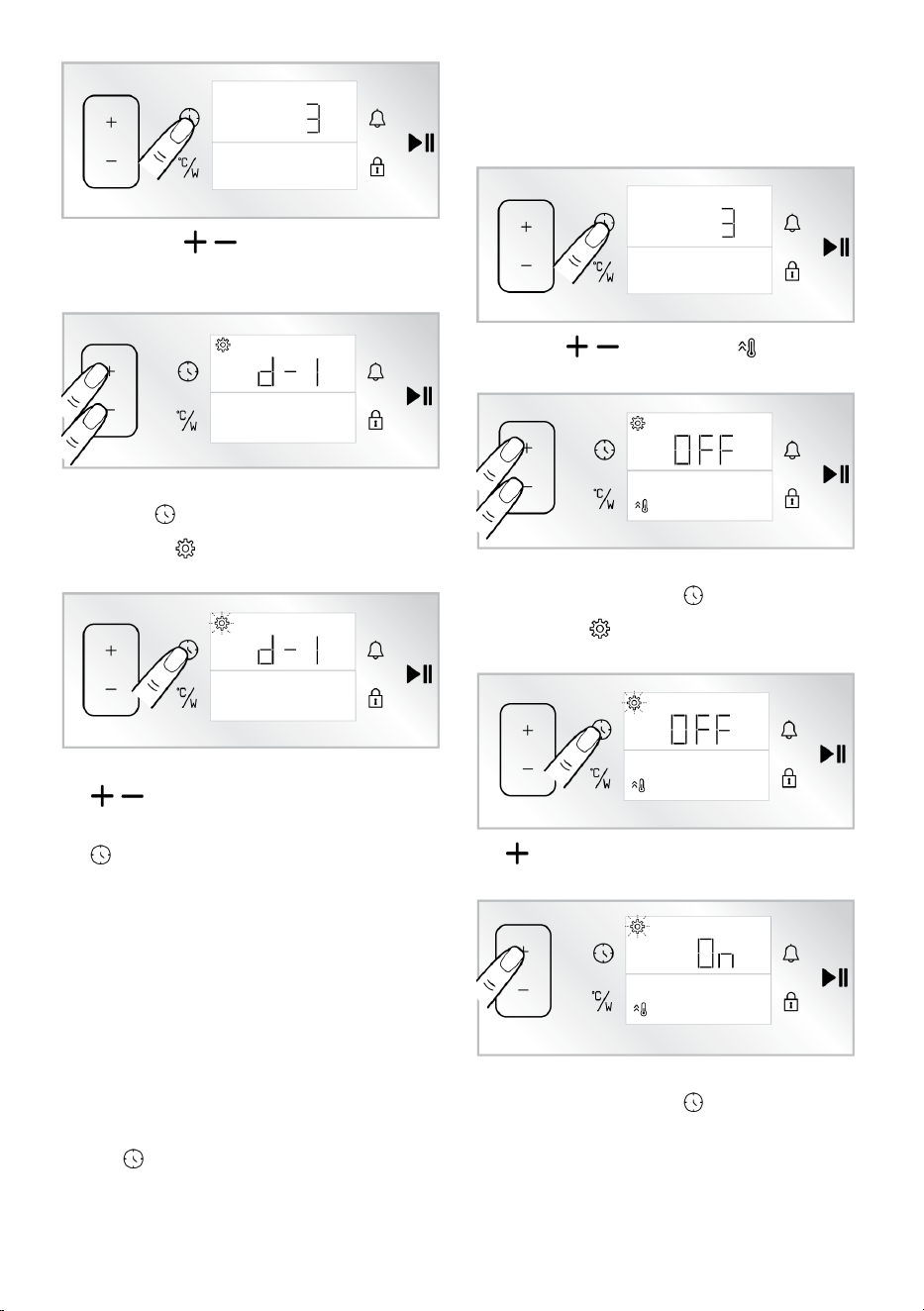
1. With the oven turned off (while the time
of day appears on the display), touch
the key for about 3 seconds to activ-
ate the settings menu.
ð A countdown of 3-2-1 appears on
the display. When the countdown
is over, the settings menu is activ-
ated.
2. Touch the / keys until the “b-1” or
“b-2” appears on the timer/duration dis-
play.
3. Activate the volume setting by touching
the key again.
ð The symbol flashes on the
timer/duration display.
4. Set the desired tone by touching the /
keys.
5. Confirm the set tone by touching the
key again or pushing the oven control
knob once.
Setting the display brightness
You may set the brightness of the control
unit display. Your oven should be turned off
to perform this setting.
1. With the oven turned off (while the time
of day appears on the display), touch
the key for about 3 seconds to activ-
ate the settings menu.
ð A countdown of 3-2-1 appears on
the display. When the countdown
is over, the settings menu is activ-
ated.
EN / 35
2. Touch the / keys until the “d-1”,
“d-2” or “d-3” appears on the timer/
duration display.
3. Activate the brightness setting by touch-
ing the key again.
ð The symbol flashes on the
timer/duration display.
4. Set the desired period by touching the
/ keys.
5. Confirm the brightness by touching the
key again or pushing the oven control
knob once.
Setting the quick preheating (Booster)
function
You may operate the baking on your
product automatically with quick preheat-
ing function. For this purpose, you should
activate the quick preheat setting. Your
oven should be turned off to perform this
setting.
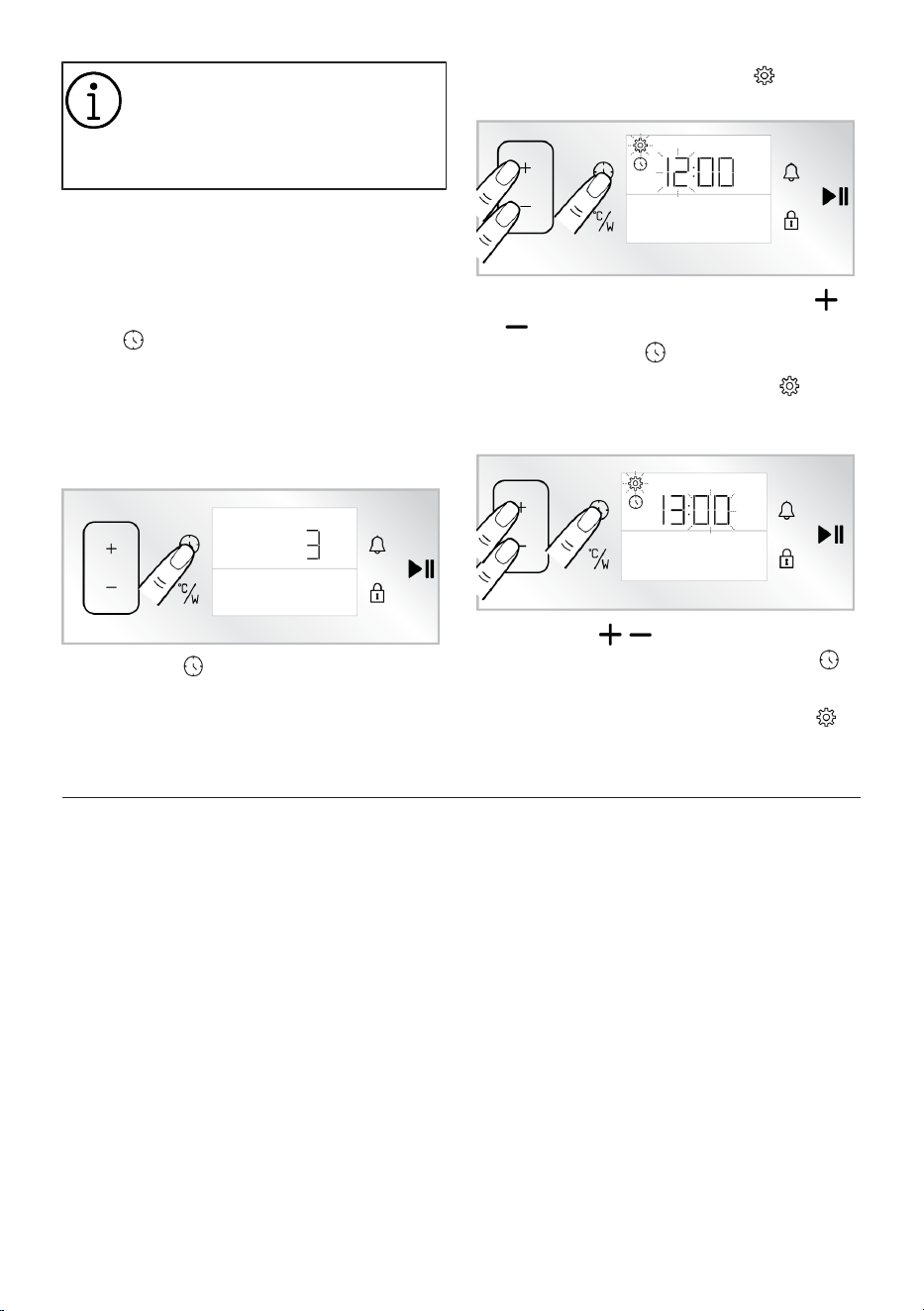
1. With the oven turned off (while the time
of day appears on the display), touch
the key for about 3 seconds to activ-
ate the settings menu.
ð A countdown of 3-2-1 appears on
the display. When the countdown
is over, the settings menu is activ-
ated.
2. Touch / buttons until symbol
and “OFF” appear on the display.
3. Activate the quick preheat (booster) set-
ting by touching the key.
ð The symbol flashes on the
timer/duration display.
4. By touching key “OFF” setting to
“ON” on the display.
5. Confirm the quick preheat (booster) set-
ting by touching the key again.
EN / 36
You may turn off the quick preheat
setting with the same procedure.
By turning the setting “OFF” you
may cancel the quick preheat set-
ting.
Changing the time of day
To change the time of day that you have
previously set,
1. With the oven turned off (while the time
of day appears on the display), touch
the key for about 3 seconds to activ-
ate the settings menu.
ð A countdown of 3-2-1 appears on
the display. When the countdown
is over, the settings menu is activ-
ated.
2. Touch the key once to activate the
timer field.
ð The timer field and the symbol
flash on the timer/duration display.
3. Set the time of day by touching the /
keys and activate the minutes field
by touching the key once.
ð The minutes field and the sym-
bol flash on the timer/duration dis-
play.
4. Touch the / keys to set the minute.
Confirm the setting by touching the
key once.
ð The time of day is set and the
symbol illuminates continuously.
6 General Information About Baking
You can find tips on preparing and cooking
your food in this section.
Plus, this section describes some of the
foods tested as producers and the most
appropriate settings for these foods. Ap-
propriate oven settings and accessories for
these foods are also indicated.
6.1 General Warnings About Baking in
the Microwave Oven
To prevent overflow when heating water
and other liquids in the microwave oven:
• Do not use closed or narrow lidded con-
tainers.
• Do not over heat.
• Before putting the container into the mi-
crowave, stir it with a spoon and open the
lid, then in the middle of heating stir it
again. Do not leave the spoon inside
while the oven is operational.
• While heating liquids such as soup and
sauce, these liquids may bubble and
overflow unexpectedly before boiling.
While heating such liquids, do not leave
its side.
• While heating baby food or drink inside a
baby bottle, before giving it to the baby,
shake it and control its temperature. Re-
move the lid and the mouthpiece before
heating.
EN / 37
• Remove the food from the plastic pack-
age before cooking or defrosting it. In
certain exceptional cases, you may need
to cover the food with a special nylon
stretch film.
• Unless you use specially designed bags
for microwave ovens, do not use your ap-
pliance for popcorn.
• Chocolate candies and baked goods with
low liquid content should be heated care-
fully.
• Eggs in shell and hard-boiled eggs should
not be heated in the microwave, as they
may explode even after being heated in
the microwave.
Advantages of microwave
• In traditional ovens, the heat spread into
the device through electrical elements
and gas hobs penetrate the food from
outside in. Because of that lots of energy
was wasted to heat up the inside air,
oven components and the food contain-
ers.
• In microwave oven, the heat is created
through the food itself and the heat wave
moves inside out. There is no heat loss at
the inner walls of the oven or the contain-
ers (if they are the right material for mi-
crowave use), in other words only the
food gets heated.
• Microwave ovens seriously decrease the
cooking time. Microwave cooking re-
quires about half to one-third of the time
required in normal ovens. This depends
on the density, heat and quantity of the
content to be cooked.
• You may cook the food in its own juice
without adding too much or no season-
ing, and preserve its natural taste.
• Microwave ovens waste less energy. The
energy is only used at cooking. Energy
does not go to waste in a microwave.
• You do not need to worry about the meat
being defrosted or not. Microwave ovens
defrost frozen foods in little time, hence
you may start cooking immediately. This
reduces the risk of bacterial growth.
• Due to the shorter cooking time, it pre-
serves the nutritional values of the food.
• It offers easier cleaning than conven-
tional ovens.
In theory the microwave
• Microwave is a sort of energy that is sim-
ilar to radio and television waves. The
magnetron tube inside your microwave
oven creates microwave energy. Mi-
crowave energy spreads in all directions
inside the oven and is reflected from the
side walls, penetrating the food evenly.
Microwaves cause the molecules in the
food to vibrate rapidly. This vibration cre-
ates the heat that cooks the food.
• Microwaves do not pass through the
metal walls of your oven. Microwaves
can pass through materials such as
ceramics, glass or paper.
Why does food get hot?
• Most foods contain water, and water mo-
lecules vibrate when exposed to mi-
crowaves. The friction between the mo-
lecules creates the heat that warms the
food, defrosts the frozen goods, cooks or
keeps the warmth. Because of the rising
heat inside the food
• Food can be cooked with little to no oil at
all;
• Defrosting, heating or cooking is a lot
faster in a microwave than it is in tradi-
tional ovens;
• The vitamins, minerals and nutrients are
kept inside the food;
• The natural colour and flavour of the food
does not change.
Suitable containers for microwave ovens
Microwaves can pass through porcelain,
glass, cardboard or plastic, but not metals.
Therefore, metal containers or containers
with metal parts cannot be used in a mi-
crowave oven.
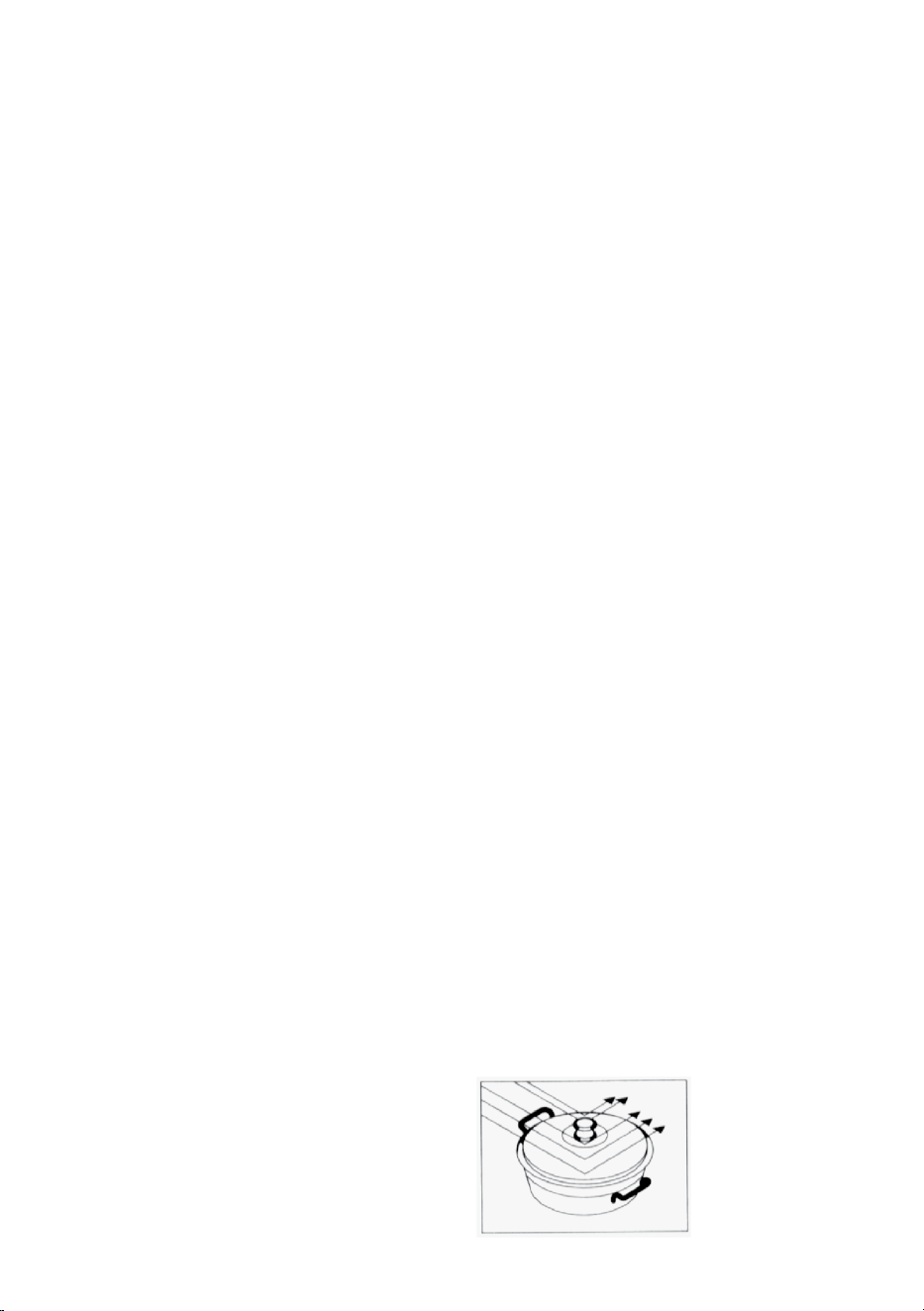
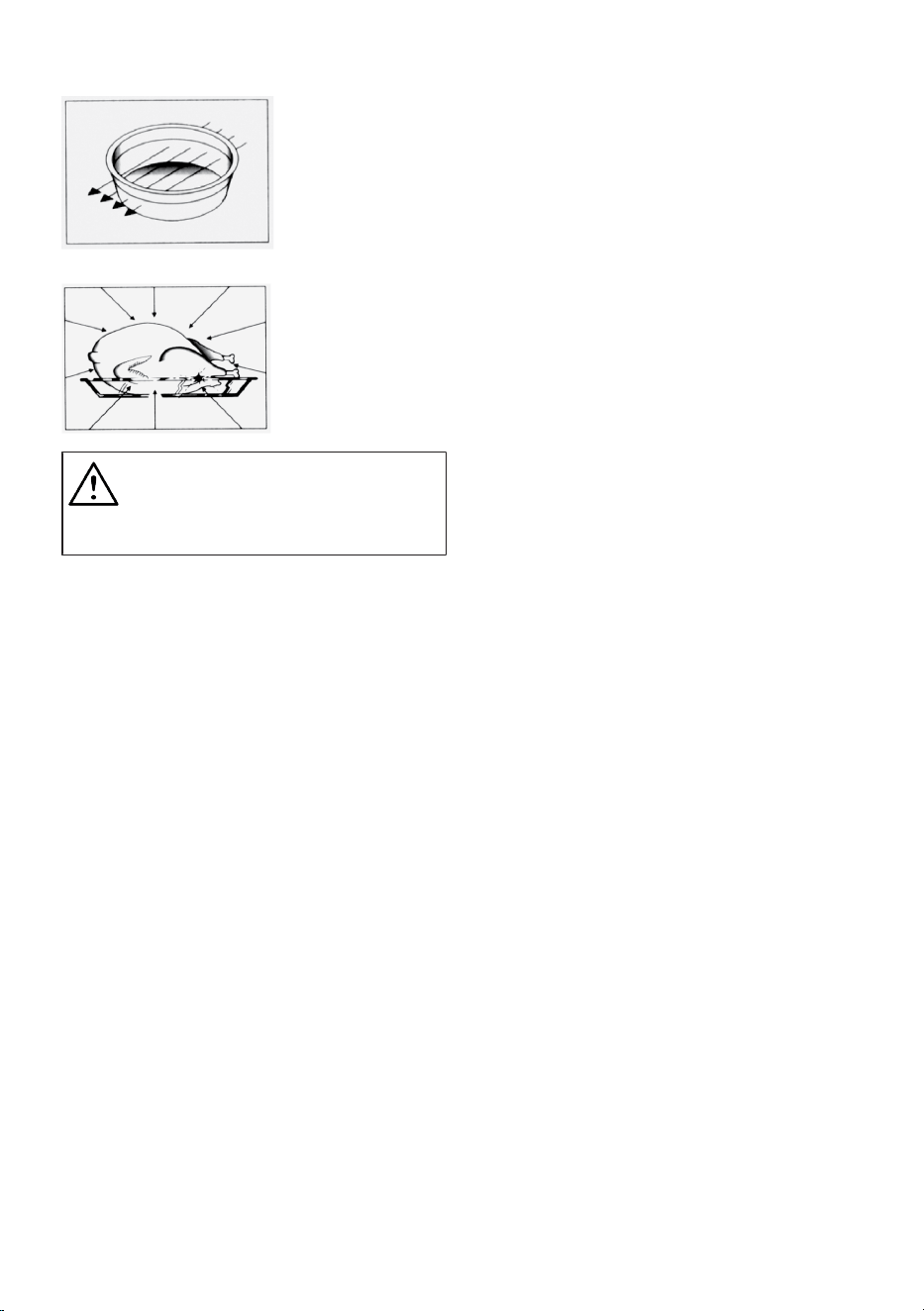
Microwaves are reflected from metal...
EN / 38
...but go through glass or porcelain...
...and are absorbed by foods.
Fire risk!
Never put your metal or metal
coated containers into the mi-
crowave oven.
• Microwaves cannot penetrate metal. Mi-
crowaves will reflect off any metal ob-
jects in the oven causing dangerous elec-
tric arcing. Most heatproof non-metallic
containers are suitable for use in a mi-
crowave oven. But some containers may
include inappropriate material for use in
a microwave oven. To determine if a con-
tainer is suitable for a microwave, you
may use the following test:
• Place the empty container you want to
test and another container filled with wa-
ter inside the oven.
• Run the oven at high power for one
minute. If the water is warm and the con-
tainer you are testing is cold, then the
container is suitable for the microwave.
• On the other hand, if the water is cold and
the container next to it gets hot, then mi-
crowaves have been absorbed by the
container and this container is not suit-
able for microwave use.
Glass containers
• Do not use thin glass or lead crystal con-
tainers. Heatproof containers are suitable
for microwave ovens. But do not use fra-
gile glass containers like water and wine
glasses, materials of which can be
broken when heated, in the microwave
oven.
Plastic containers
• Do not hold containers and dishes made
of plastic or melamine in the microwave
for too long; that goes for the plastic
bags used to hold frozen food as well.
The reason behind that is, the heat of a
hot meal will eventually melt and deform
the material. Use these types of material
in the microwave for just a limited
amount of time.
Cooking bags
• Cooking bags can be used in the mi-
crowave oven as long as they are de-
signed for cooking. Do not forget to
pierce the bags to allow the steam inside
to escape. Do not use regular plastic
bags for cooking as they will melt and
open.
Paper
• Do not use any type of paper for pro-
longed cooking. This will cause the paper
to burst into flames. Paper plates are
only good for oily or dry food that re-
quires small amount of time to cook.
• Do not use recycled paper. These papers
may have molecules that may cause
arches.
Wooden and wicker containers
• Large wooden containers should not be
used, as the microwave causes the wood
structure to dry out and become brittle.
Porcelain containers
• Generally, containers made of these
types of material are good to use inside
microwave ovens, but you need to test it
to be sure.
Metal containers
• Metal containers reflect microwaves
away from food. So do not use them.
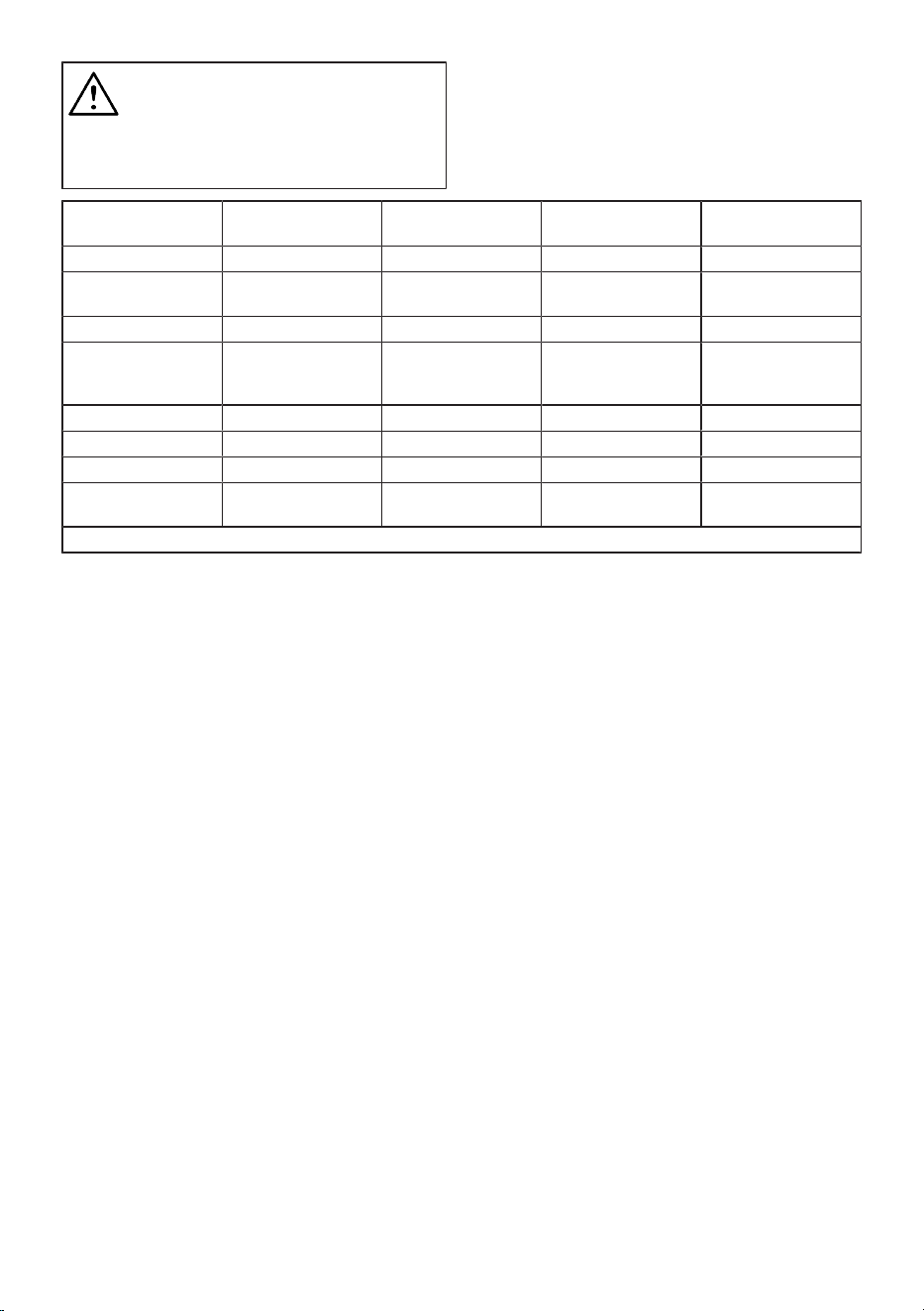
EN / 39
Certain cookware with high iron
and lead content is not suitable for
use in microwave ovens. Be sure to
check if your containers are mi-
crowave-safe.
Cooking vessel
Microwave Low grill Top and bottom
heating
Combined modes
Heatproof Glass Yes Yes Yes Yes
Heat Transmitting
Glass
No No No No
Heatproof Ceramic Yes Yes Yes Yes
Plastic Plate that can
be Used in a Mi-
crowave
Yes No No No
Kitchen Paper Yes No No No
Metal Tray No Yes Yes Yes*
Metal Grill No Yes Yes No
Aluminium Foil & Foil
Container
No Yes Yes No
* Only use the metal tray given with the oven.
Placement of the food
• You will have the optimum outcome if
you spread the food equally on the con-
tainer. This method can be applied in
many ways with satisfactory results.
• You can cook large quantities of similar
items (e.g. potatoes) together. They will
cook better if you place them in evenly
spaced circles in the oven. Be careful not
to overlap the pieces.
• When cooking dishes of different shapes
and thicknesses, place the thicker parts
in the middle of the tray, as microwaves
will have a stronger effect on the outer
layers of these food. Therefore you will
have them cook faster.
• Place fish and other uneven food with the
tail on the edge of the tray.
• You can stack thinly cut pieces of meat
on top of each other. Thicker items such
as sausages and pieces of meat should
be placed side by side.
• Warm the broth and sauces in a different
plate. Narrow and deep plates are better
for this job than wide and shallow plates.
When heating broth, sauce or soup, the
containers should not be more than two-
thirds full.
• If you are cooking the whole fish, poke
holes to it so that the skin does not burst.
• When using stretch film, bags or baking
paper, poke holes or leave an opening to
allow steam to escape.
• Small pieces of food will cook faster than
large pieces, equal pieces will cook faster
than uneven ones. For best results, cut
your food into equal sized portions.
Food height
• Very thick foods (usually roasts) will
cook faster on the bottom. That means
you may have to turn them several times.
• Thick or dense parts can be placed in a
higher position so that the microwaves
can also affect the lower and middle part
of the piece.
Cooking tips
Factors effecting the microwave time:
• Microwave time depends on a few
factors. The heat of the ingredients used
in the recipe can significantly affect the
cooking time required. Therefore, a cake
made with ice-cold butter, milk, and eggs
will take longer to bake than a cake made
from room-temperature ingredients.

EN / 40
• Especially some recipes for bread, cake
and cream sauces, recommend removing
it from the oven before it is fully cooked.
Such dishes kept closed outside the
oven, will allow the food to continue to
cook as the heat travels from the outside
of it to the inside.
• If you keep the pieces in the oven until
they are fully cooked, there is a risk of
burning the outer layer. You will get the
hang of which meals to be left to cook
and which to be taken out and waited as
time goes by.
• Do not leave the side of the pieces while
they are cooking. The light of the mi-
crowave oven will automatically switch
on while operational, and let you see the
state of the pieces cooked.
Defrosting:
• Defrosting time may differ depending on
the size of the package. Shallow, rectan-
gular packages defrost faster than deep
containers.
• Pick apart the pieces that start melting.
This way they will melt easier.
• As the amount of food you cooked in-
crease, the time needed will do too.
Twice as large a meal will roughly take
twice the time. If a potato takes four
minutes to cook, two potatoes will take
seven minutes or so. However much food
you put inside the oven, the amount of
microwave created will stay the same.
That is, the more food you put in it, the
longer it will take to cook.
Liquid content
• As microwaves are sensitive against li-
quids, liquid content will effect the cook-
ing time. Meals with natural liquid in-
gredients (eg. vegetables, fish and
poultry) will cook faster and easier. It is
recommended to add water when cook-
ing dry foods such as rice and legumes.
• It should be noted that the microwave re-
moves moisture, so before cooking drier
items such as certain vegetables, you
should soak them with a little water or
wrap them so that they retain their mois-
ture.
• When cooking foods that contain very
little water (like defrosting bread, popping
popcorn), evaporation happens very
quickly. In this case, the oven works as if
it is empty and the food may burn. In
such a case, the oven and the container
may be damaged. Therefore, only set it to
the required cooking time, and keep a
close eye on the oven during the cooking
process.
Steam
• Moisture in food can sometimes cause
steam to form inside the oven while it is
operating. This is normal.
Sugar
• Follow the recommendations in the mi-
crowave recipe book when making
dishes with a very high sugar content,
such as puddings and pies. If you exceed
the recommended cooking time, it may
cause the food to burn or damage the
oven.
Food density
• Lighter, porous foods like bread and cake
will cook faster than heavier, dense foods
like roasts and stews. Be careful when
heating porous items without hard, dry
surfaces in the microwave.
Bone and fat content
• Bones transmit the heat and fat cooks
faster than the meat. When cooking
pieces of meat that contain bone and fat,
make sure they are spread equally and
are not over cooked.
Color of the dish
• Meat or poultry that has been cooked for
fifteen minutes or longer will darken
slightly with its own fat. To prepare a
quickly-cooked meal with an appetizing
and toasty look, you can coat it with bar-
becue or soy sauce. If you use a small
amount of this sauce, it will not affect the
taste of the food itself.
Reducing the internal pressure of food
• Most food are covered with skin. As they
cook, pressure builds up inside them and
this can cause them to burst. To prevent

EN / 41
this, the skin must be punctured with a
fork or knife. You should apply this pro-
cess on potatoes, chicken livers, mus-
sels, egg yolks, sausages, and certain
types of fruit and vegetables.
Turning and stirring of pieces while
cooking
• Stirring is important while cooking with
microwave. While cooking in a regular
manner, food are stirred so that they do
not mash together. While cooking in a mi-
crowave on the other hand, the food are
stirred to ensure that the heat spreads it
equally. As the outer layer will heat faster
than the inside, always stir from the out-
side in.
• Large, long pieces such as roasts and
whole poultry should be turned over to
ensure even top and bottom cooking.
Thus you may also need to turn cut meat
and chicken over.
• Turning and stirring the pieces while
cooking is important to ensure they are
cooked evenly throughout.
Different cooking times
• Initially, always try the minimum cooking
time and control if the meal is ready or
not. The cooking times given in this
manual are close estimates. Cooking
times may vary depending on the size
and type of food and container.
Waiting time
• Let the food sit for a while after taking it
out of the oven. When defrosting, cook-
ing and reheating, letting the pieces sit
for a while will always give better results.
This is because the heat being evenly dis-
tributed over the food.
• In the microwave oven, food will continue
to cook even after the oven is turned off.
The waiting time will increase the tem-
perature of the food between 3°C and
8°C. This process is carried out not by
the microwave oven, but by the heat in
the food. The waiting time varies accord-
ing to the type of food. Sometimes this
time can be as short as taking the food
out of the oven and putting it on the
table. Or it may take up to ten minutes for
large pieces.
• Remove the food from the plastic pack-
age before cooking or defrosting it. In
certain exceptional cases, you may need
to cover the food with a special nylon
stretch film.
• It is especially recommended that some
dishes such as meat, chicken, bread,
cakes and cream sauce be taken out of
the oven before they are fully cooked and
left to wait until they are fully cooked.
6.2 General Warnings About Baking in
the Oven
• While opening the oven door during or
after baking, hot-burning steam may
emerge. The steam may burn your hand,
face and/or eyes. When opening the oven
door, stay away.
• Intense steam generated during baking
may form condensed water drops on the
interior and exterior of the oven and on
the upper parts of the furniture due to the
temperature difference. This is a normal
and physical occurrence.
• The cooking temperature and time values
given for foods may vary depending on
the recipe and amount. For this reason,
these values are given as ranges.
• Always remove unused accessories from
the oven before you start cooking. Ac-
cessories that will remain in the oven
may prevent your food from being
cooked at the correct values.
• For foods that you will cook according to
your own recipe, you can reference sim-
ilar foods given in the cooking tables.
• Using the supplied accessories ensures
you get the best cooking performance.
Always observe the warnings and inform-
ation provided by the manufacturer for
the external cookware you will use.
• Cut the greaseproof paper you will use in
your cooking in suitable sizes to the con-
tainer you will cook. Greaseproof papers
that are overflowing from the container
can create a risk of burns and affect the

EN / 42
quality of your baking. Use the
greaseproof paper you will use in the
temperature range specified.
• For good baking performance, place your
food on the recommended correct shelf.
Do not change the shelf position during
baking.
6.2.1 Pastries and oven food
General Information
• We recommend using the accessories of
the product for a good cooking perform-
ance. If you will use an external cook-
ware, prefer dark, non-sticking and heat
resistant ware.
• If preheating is recommended in the
cooking table, be sure to put your food in
the oven after preheating.
• If you will cook by using cookware on the
wire grill, place it in the middle of the wire
grill, not near the back wall.
• All materials used in making pastry
should be fresh and at room temperat-
ure.
• The cooking status of the foods may vary
depending on the amount of food and the
size of the cookware.
• Metal, ceramic and glass moulds extend
the cooking time and the bottom sur-
faces of pastry foods do not brown
evenly.
• If you are using baking paper, a small
browning can be observed on the bottom
surface of the food. In this situation, you
may have to extend your cooking period
by approximately 10 minutes.
• The values specified in the cooking
tables are determined as a result of the
tests carried out in our laboratories. Val-
ues suitable for you may differ from
these values.
• Place your food on the appropriate shelf
recommended in the cooking table. Refer
to the bottom shelf of the oven as shelf
1.
Tips for baking cakes
• If the cake is too dry, increase the tem-
perature by 10°C and shorten the baking
time.
• If the cake is moist, use a small amount
of liquid or reduce the temperature by
10°C.
• If the top of the cake is burnt, put it on
the lower shelf, lower the temperature
and increase the baking time.
• If the inside of the cake is cooked well,
but outside is sticky, use less liquid, de-
crease the temperature and increase the
cooking time.
Hints for pastry
• If the pastry is too dry, increase the tem-
perature by 10 °C and shorten the cook-
ing time. Wet the dough sheets with a
sauce consisting of milk, oil, egg and
yoghurt mixture.
• If the pastry is getting cooked slowly,
make sure that the thickness of the
pastry you have prepared does not over-
flow the tray.
• If the pastry is browned on the surface
but the bottom is not cooked, make sure
that the amount of sauce you will use for
the pastry is not too much at the bottom
of the pastry. For an even browning, try to
spread the sauce evenly between the
dough sheets and the pastry.
• Bake your pastry in the position and tem-
perature appropriate to the cooking table.
If the bottom is still not browned enough,
place it on a bottom shelf for the next
cooking.
Cooking table for pastries and oven foods
Food Accessory to be
used
Operating func-
tion
Shelf position Temperature (°C) Baking time
(min) (approx.)
Cake on the tray Standard tray *
Top and bottom
heating
2 180 20 … 30
Small cakes Standard tray *
Top and bottom
heating
2 150 25 … 35
Small cakes Standard tray * Fan Heating 1 150 … 160 35 … 50
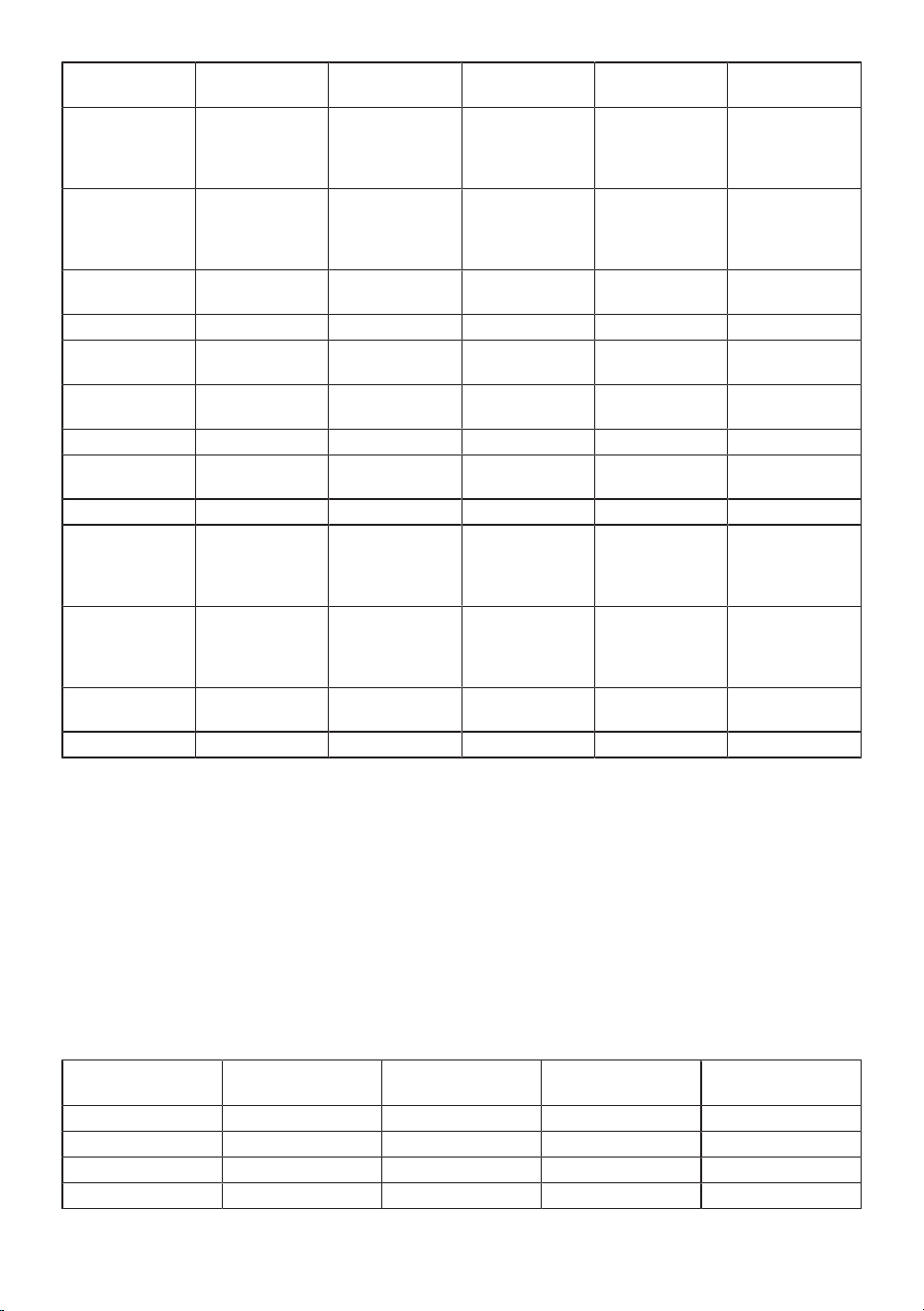
EN / 43
Food Accessory to be
used
Operating func-
tion
Shelf position Temperature (°C) Baking time
(min) (approx.)
Sponge cake
Round springform
pan, 26 cm in dia-
meter on wire grill
**
Top and bottom
heating
2 160 30 … 40
Sponge cake
Round springform
pan, 26 cm in dia-
meter on wire grill
**
Fan Heating 1 160 35 … 45
Cookie Pastry tray *
Top and bottom
heating
2 170 25 … 35
Cookie Pastry tray * Fan Heating 1 170 30 … 40
Pastry Standard tray *
Top and bottom
heating
2 180 35 … 45
Bun Standard tray *
Top and bottom
heating
2 200 20 … 30
Bun Standard tray * Fan Heating 1 180 20 … 30
Whole bread Standard tray *
Top and bottom
heating
2 200 30 … 40
Whole bread Standard tray * Fan Heating 1 200 30 … 40
Lasagne
Glass / metal
rectangular con-
tainer on wire grill
**
Top and bottom
heating
1 or 2 200 30 … 40
Apple pie
Round black
metal mould, 20
cm in diameter on
wire grill **
Top and bottom
heating
2 180 50 … 60
Pizza Standard tray *
Top and bottom
heating
2 200 … 220 10 … 20
Pizza Standard tray * Pizza function 2 200 … 220 10 … 15
Preheating is recommended for all food.
*These accessories may not be included with your product.
**These accessories are not included with your product. They are commercially available accessories.
Cooking table with operating function
“Eco fan heating”
• Do not change the temperature setting
after starting cooking in the operating
function “Eco fan heating”.
• Do not open the oven door when cooking
in the “Eco fan heating” operating func-
tion. If the door does not open, the in-
ternal temperature is optimized to save
energy, and this temperature may differ
from what is shown on the display.
• Do not preheat in the “Eco fan heating”
operating function.
Food Accessory to be
used
Shelf position Temperature (°C) Baking time (min)
(approx.)
Small cakes Standard tray * 1 160 25 … 35
Cookie Standard tray * 1 180 25 … 35
Pastry Standard tray * 1 200 45 … 55
Bun Standard tray * 1 200 35 … 45
* These accessories may not be included with your product.
EN / 44
6.2.2 Meat, Fish and Poultry
The key points on grilling
• Seasoning it with lemon juice and pepper
before cooking whole chicken, turkey and
large pieces of meat will increase cook-
ing performance.
• It takes 15 to 30 minutes more to cook
boned meat than fillet by frying.
• You should calculate about 4 to 5
minutes of cooking time per centimetre
of the meat thickness.
• After the cooking time is expired, keep
the meat in the oven for approximately
10 minutes. The juice of the meat is bet-
ter distributed to the fried meat and does
not come out when the meat is cut.
• Fish should be placed on the medium or
low level shelf in a heat resistant plate.
• Cook the recommended dishes in the
cooking table with a single tray.
Cooking table for meat, fish and poultry
Food Accessory to be
used
Operating func-
tion
Shelf position Temperature (°C) Baking time
(min) (approx.)
Steak (whole) /
Roast (1 kg)
Standard tray * "3D" function 1
15 mins. 250/
max, after 180 …
190
60 … 80
Lamb's shank
(1,5-2 kg)
Standard tray * "3D" function 1 170 85 … 110
Fried chicken
(1,8-2 kg)
Wire grill *
Place one tray on
a lower shelf
"3D" function 1
15 mins. 250/
max, after 190
70 … 90
Turkey (5.5 kg) Standard tray * "3D" function 1
25 mins. 250/
max, after 180 …
190
150 … 210
Fish
Wire grill *
Place one tray on
a lower shelf
"3D" function 1 200 20 … 30
Preheating is recommended for all food.
*These accessories may not be included with your product.
**These accessories are not included with your product. They are commercially available accessories.
6.2.3 Grill
Red meat, fish and poultry meat quickly
turns brown when grilled, holds a beautiful
crust and does not dry out. Fillet meats,
skewer meats, sausages as well as juicy
vegetables (tomatoes, onions, etc.) are par-
ticularly suitable for grilling.
General warnings
• Food not suitable for grilling carries a fire
hazard. Grill only food that is suitable for
heavy grill fire. Also, do not place the
food too far in the back of the grill. This
is the hottest area and fatty foods may
catch fire.
• When the preheating time is 5 minutes in
the grill mode, skip the preheating, do not
wait for the entire preheating time to
pass.
• Close the oven door during grilling.
Never grill with the oven door open.
Hot surfaces may cause burns!
The key points of the grill
• Prepare foods of similar thickness and
weight as much as possible for the grill.
• Place the pieces to be grilled on the wire
grill or wire grill tray by distributing them
without exceeding the dimensions of the
heater.
EN / 45
• Depending on the thickness of the pieces
to be grilled, the cooking times given in
the table may vary.
• Slide the wire grill or the wire grill tray to
the desired level in the oven. If you are
cooking on the wire grill, slide the oven
tray to the lower shelf to collect the oils.
The oven tray you will slide should be
sized to cover the entire grill area. This
tray may not be supplied with the
product. Put some water into the oven
tray for easy cleaning.
Grill table
Food Accessory to be
used
Shelf position Temperature (°C) Baking time (min)
(approx.)
Fish Wire grill 2 250 20 … 25
Chicken pieces Wire grill 2 250 25 … 35
Meatball (veal) - 12
amount
Wire grill 2 250 20 … 30
Lamb chop Wire grill 2 250 20 … 25
Steak - (meat cubes) Wire grill 2 250 25 … 30
Veal chop Wire grill 2 250 25 … 30
Vegetable gratin Wire grill 2 220 20 … 30
Toast bread Wire grill 2 250 3 … 5
It is recommended to preheat for 5 minutes for all grilled food.
Turn pieces of food after 1/2 of the total grilling time.
6.2.4 Test foods
• Foods in this cooking table are prepared
according to the EN 60350-1 standard to
facilitate testing of the product for con-
trol institutes.
Cooking table for test meals
Food Accessory to be
used
Operating func-
tion
Shelf position Temperature (°C) Baking time
(min) (approx.)
Shortbread (sweet
cookie)
Standard tray *
Top and bottom
heating
2 140 20 … 30
Shortbread (sweet
cookie)
Standard tray * Fan Heating 2 140 15 .. 25
Small cakes Standard tray *
Top and bottom
heating
2 150 25 … 35
Small cakes Standard tray * Fan Heating 1 150 … 160 35 … 50
Sponge cake
Round springform
pan, 26 cm in dia-
meter on wire grill
**
Top and bottom
heating
2 160 30 … 40
Sponge cake
Round springform
pan, 26 cm in dia-
meter on wire grill
**
Fan Heating 1 160 35 … 45
Apple pie
Round black
metal mould, 20
cm in diameter on
wire grill **
Top and bottom
heating
2 180 50 … 60
EN / 46
Preheating is recommended for all food.
*These accessories may not be included with your product.
**These accessories are not included with your product. They are commercially available accessories.
Grill
Food Accessory to be
used
Shelf position Temperature (°C) Baking time (min)
(approx.)
Meatball (veal) - 12
amount
Wire grill 2 250 20 … 30
Toast bread Wire grill 2 250 3 … 5
It is recommended to preheat for 5 minutes for all grilled food.
Turn pieces of food after 1/2 of the total grilling time.
6.2.5 Microwave
• “0 shelf spot” is the oven floor. Do not
use it other than for microwave.
• It is recommended to perform microwave
cooking in “Shelf position 0”. For uses
other than "Shelf position 0", see cooking.
• Preheating should be done with oven op-
erating modes.
Cooking table for microwave and combi modes
Food Operating
function
Weight (g) Shelf posi-
tion
Accessory
to be used
Temperat-
ure (°C)
Microwave
power (W)
Baking time
(min) (ap-
prox.)
Chicken
drumstick
Microwave +
Fan Heating
1000 1
Standard tray
*
210 600 25 … 30
Whole
chicken
Microwave +
Fan Heating
1500 1
Standard tray
*
15 mins.
230 / after
600 32 … 38
Frozen pizza
Microwave +
Pizza func-
tion
450 1
Standard tray
*
230 200 10 … 15
Turkey leg
(bone-in
meat)
Microwave +
Fan assisted
full grill
1000 1
Standard tray
*
230 300 28 … 32
Turkey leg
(bone-in
meat)
Microwave +
Fan Heating
1000 1
Standard tray
*
180 600 25 … 30
Potato gratin
Microwave +
Fan Heating
1250 1
Round
springform
pan with a
diameter of
20 cm on a
standard
tray*
180 600 25 … 30
Dalyan meat-
balls
Microwave +
Fan Heating
1800 1
Standard tray
*
5 mins. 230 /
after 170
300 18 … 23
Whole fish
Microwave +
Fan assisted
full grill
1000 1
Standard tray
*
250 600 8 … 14
Breaded fish
fingers
Microwave +
Fan Heating
600 1
Standard tray
*
230 300 10 … 15
Sauce meat-
balls with
potatoes
Microwave +
Fan Heating
1500 1
Standard tray
*
210 200 32 … 40
EN / 47
Food Operating
function
Weight (g) Shelf posi-
tion
Accessory
to be used
Temperat-
ure (°C)
Microwave
power (W)
Baking time
(min) (ap-
prox.)
Ready-to-
serve food
(chick peas
with meat)
Microwave 400 1
Standard tray
*
- 600 3 … 5
Rice dish Microwave 400 1
Standard tray
*
- 600 3 … 5
Fresh corn
(80 g , 17 g
oil , 3 g salt )
Microwave 80 0
Borate glass
lid over the
glass tray **
- 800 8 … 11
Ready-to-
cook packed
corn
Microwave 100 2 Glass Tray ** - 800 4 … 7
Preheating is recommended for all food.
*These accessories may not be included with your product.
**These accessories are not included with your product. They are commercially available accessories.
Microwave + Defrost - Table
Food Weight
(g)
Shelf po-
sition
Accessory
to be used
Microwave
power (W)
Thawing time
(min) (approx.)
Waiting time
(min.)
Suggestion
Whole red
meat
250 1
Standard tray
*
200 8 … 10 10
Turn over after
half the time
500 1
Standard tray
*
200 12 … 16 10
Turn over after
half the time
Ground meat
100 1
Standard tray
*
100 7 … 11 10 -
250 1
Standard tray
*
200 5 … 10 10 -
500 1
Standard tray
*
200 8 … 10 10
Turn over after
half the time
Whole
chicken
1500 1
Standard tray
*
200 25 … 30 10
Turn over after
half the time
Chicken leg 750 1
Standard tray
*
300 6 … 10 10 -
Chicken
drumstick
500 1
Standard tray
*
300 6 … 10 10 -
1000 1
Standard tray
*
600 6 … 10 10 -
Fish
250 1
Standard tray
*
200 7 .. 12 5
Turn over after
half the time
500 1
Standard tray
*
200 10 … 15 5
Turn over after
half the time
Sausage 300 1
Standard tray
*
200 5 … 10 5 -
* These accessories may not be included with your product.

EN / 48
7 Maintenance and Cleaning
7.1 General Cleaning Information
General warnings
• Wait for the product to cool before clean-
ing the product. Hot surfaces may cause
burns!
• Do not apply the detergents directly on
the hot surfaces. This may cause per-
manent stains.
• The product should be thoroughly
cleaned and dried after each operation.
Thus, food residues shall be easily
cleaned and these residues shall be pre-
vented from burning when the product is
used again later. Thus, the service life of
the appliance extends and frequently
faced problems are decreased.
• Do not use steam cleaning products for
cleaning.
• Some detergents or cleaning agents
cause damage to the surface. Unsuitable
cleaning agents are: bleach, cleaning
products containing ammonia, acid or
chloride, steam cleaning products, de-
scaling agents, stain and rust removers,
abrasive cleaning products (cream clean-
ers, scouring powder, scouring cream,
abrasive and scratching scrubber, wire,
sponges, cleaning cloths containing dirt
and detergent residues).
• No special cleaning material is needed in
the cleaning made after each use. Clean
the appliance using dishwashing deter-
gent, warm water and a soft cloth or
sponge and dry it with a dry cloth.
• Be sure to completely wipe off any re-
maining liquid after cleaning and immedi-
ately clean any food splashing around
during cooking.
• Do not wash any component of your ap-
pliance in a dishwasher unless otherwise
stated in the user’s manual.
Inox - stainless surfaces
• Do not use acid or chlorine-containing
cleaning agents to clean stainless-inox
surfaces and handles.
• Stainless-inox surface may change col-
our in time. This is normal. After each op-
eration, clean with a detergent suitable
for the stainless or inox surface.
• Clean with a soft soapy cloth and liquid
(non-scratching) detergent suitable for
inox surfaces, taking care to wipe in one
direction.
• Remove lime, oil, starch, milk and protein
stains on the glass and inox surfaces im-
mediately without waiting. Stains may
rust under long periods of time.
• Cleaners sprayed/applied to the surface
should be cleaned immediately. Abrasive
cleaners left on the surface cause the
surface to turn white.
Enamelled surfaces
• The oven must cool down before clean-
ing the cooking area. Cleaning on hot sur-
faces shall create both fire hazard and
damage the enamel surface.
• After each use, clean the enamel sur-
faces using dishwashing detergent,
warm water and a soft cloth or sponge
and dry them with a dry cloth.
• For difficult stains, an oven and grill
cleaner recommended on the website of
your product brand and a non-scratching
scouring pad can be used. Do not use an
external oven cleaner.
Catalytic surfaces
• The side walls in the cooking area can
only be covered with enamel or catalytic
walls. It varies by model.
• The catalytic walls have a light matte and
porous surface. The catalytic walls of the
oven should not be cleaned.
• Catalytic surfaces absorb oil thanks to its
porous structure and start to shine when
the surface is saturated with oil, in this
case it is recommended to replace the
parts.

EN / 49
Glass surfaces
• When cleaning glass surfaces, do not use
hard metal scrapers and abrasive clean-
ing materials. They can damage the
glass surface.
• Clean the appliance using dishwashing
detergent, warm water and a microfiber
cloth specific for glass surfaces and dry
it with a dry microfiber cloth.
• If there is residual detergent after clean-
ing, wipe it with cold water and dry with a
clean and dry microfiber cloth. Residual
detergent may damage the glass surface
next time.
• Under no circumstances should the
dried-up residue on the glass surface be
cleaned off with serrated knives, wire
wool or similar scratching tools.
• You can remove the calcium stains (yel-
low stains) on the glass surface with the
commercially available descaling agent,
with a descaling agent such as vinegar or
lemon juice.
• If the surface is heavily soiled, apply the
cleaning agent on the stain with a sponge
and wait a long time for it to work prop-
erly. Then clean the glass surface with a
wet cloth.
• Discolorations and stains on the glass
surface are normal and not defects.
Plastic parts and painted surfaces
• Clean plastic parts and painted surfaces
using dishwashing detergent, warm wa-
ter and a soft cloth or sponge and dry
them with a dry cloth.
• Do not use hard metal scrapers and ab-
rasive cleaners. They may damage the
surfaces.
• Ensure that the joints of the components
of the product are not left damp and with
detergent. Otherwise, corrosion may oc-
cur on these joints.
7.2 Cleaning Accessories
Do not put the product accessories in a
dishwasher unless otherwise stated in the
user’s manual.
7.3 Cleaning the Control Panel
• When cleaning the panels with knob-con-
trol, wipe the panel and knobs with a
damp soft cloth and dry with a dry cloth.
Do not remove the knobs and gaskets un-
derneath to clean the panel. The control
panel and knobs may be damaged.
• While cleaning the inox panels with knob
control, do not use inox cleaning agents
around the knob. The indicators around
the knob can be erased.
• Clean the touch control panels with a
damp soft cloth and dry with a dry cloth.
If your product has a key lock feature, set
the key lock before performing control
panel cleaning. Otherwise, incorrect de-
tection may occur on the keys.
7.4 Cleaning the inside of the oven
(cooking area)
Follow the cleaning steps described in the
"General Cleaning Information" section ac-
cording to the surface types in your oven.
Cleaning the side walls of the oven
The side walls in the cooking area can only
be covered with enamel or catalytic walls. It
varies by model. If there is a catalytic wall,
refer to the “Catalytic surfaces” section for
information.
If your product is a wire shelf model, re-
move the wire shelves before cleaning the
side walls. Then complete the cleaning as
described in the "General Cleaning Informa-
tion" section according to the side wall sur-
face type.
To remove the side wire shelves:
1. Hold the side wire shelf at the bottom.
Pull it down and free it from the bottom
slots.
2. Pull the side wire shelf in the opposite
direction of the side wall.
3. Completely remove the side wire shelf
by pulling it up.
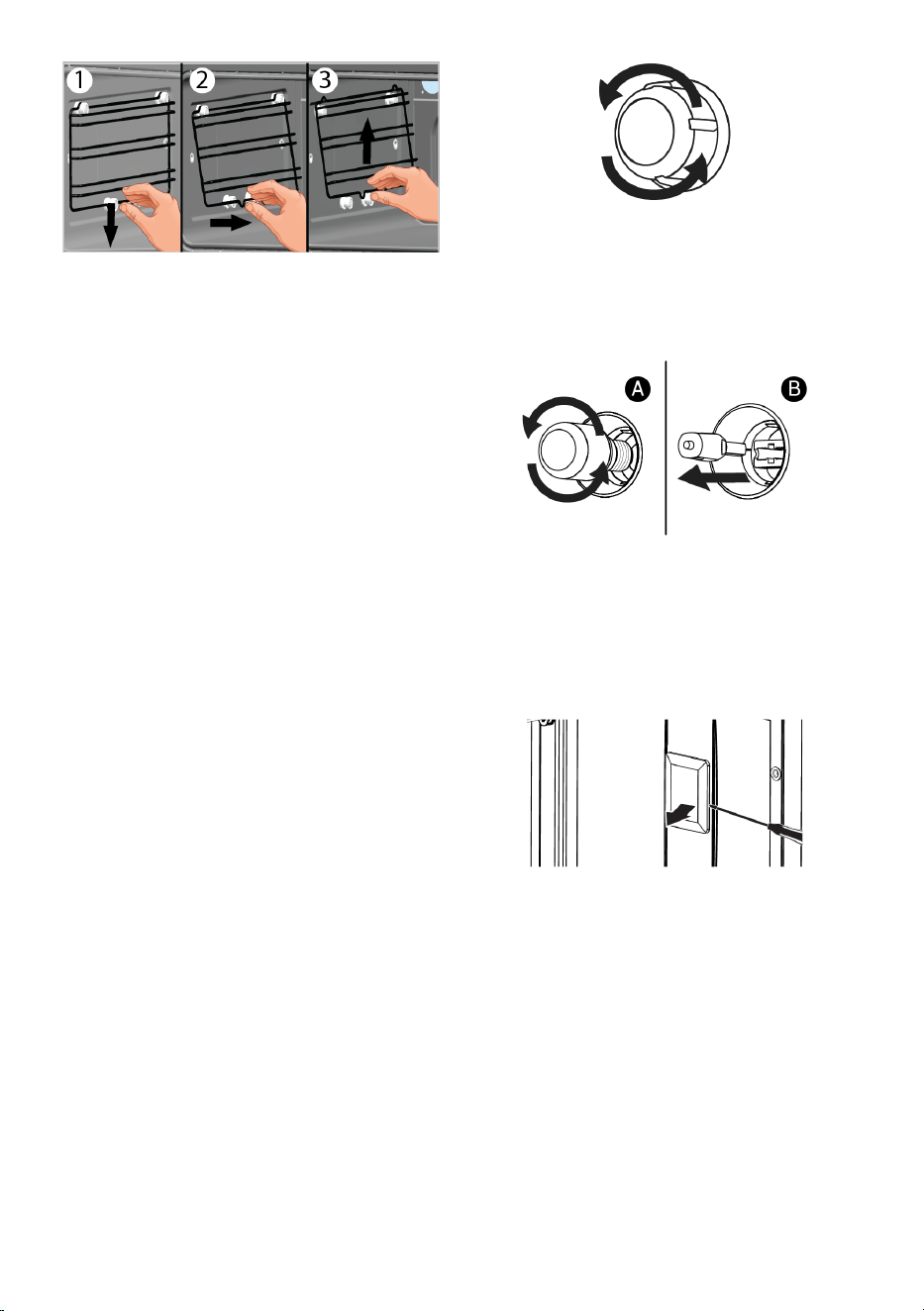
EN / 50
7.5 Cleaning the Oven Lamp
In the event that the glass door of the oven
lamp in the cooking area becomes dirty;
clean using dishwashing detergent, warm
water and a soft cloth or sponge and dry
with a dry cloth. In case of oven lamp fail-
ure, you can replace the oven lamp by fol-
lowing the sections that follow.
Replacing the oven lamp
General Warnings
• To avoid the risk of electric shock before
replacing the oven lamp, disconnect the
product and wait for the oven to cool. Hot
surfaces may cause burns!
• This oven is powered by an incandescent
lamp with less than 40 W, less than 60
mm in height, less than 30 mm in dia-
meter, or a halogen lamp with G9 sockets
with less than 60 W power. Lamps are
suitable for operation at temperatures
above 300 °C. Oven lamps are available
from Authorised Services or licensed
technicians. This product contains a G
energy class lamp.
• The position of the lamp may differ from
that is shown in the figure.
• The lamp used in this product is not suit-
able for use in the lighting of home
rooms. The purpose of this lamp is to
help the user see food products.
• The lamps used in this product must
withstand extreme physical conditions
such as temperatures above 50 °C.
If your oven has a round lamp,
1. Disconnect the product from the electri-
city.
2. Remove the glass cover by turning it
counter clockwise.
3. If your oven lamp is type (A) shown in
the figure below, rotate the oven lamp
as shown in the figure and replace it
with a new one. If it is type (B) model,
pull it out as shown in the figure and re-
place it with a new one.
4. Refit the glass cover.
If your oven has a square lamp,
1. Disconnect the product from the electri-
city.
2. Remove the wire shelves according to
the description.
3. Lift the lamp's protective glass cover
with a screwdriver. Remove the screw
first, if there is a screw on the square
lamp in your product.
4. If your oven lamp is type (A) shown in
the figure below, rotate the oven lamp
as shown in the figure and replace it
with a new one. If it is type (B) model,
pull it out as shown in the figure and re-
place it with a new one.
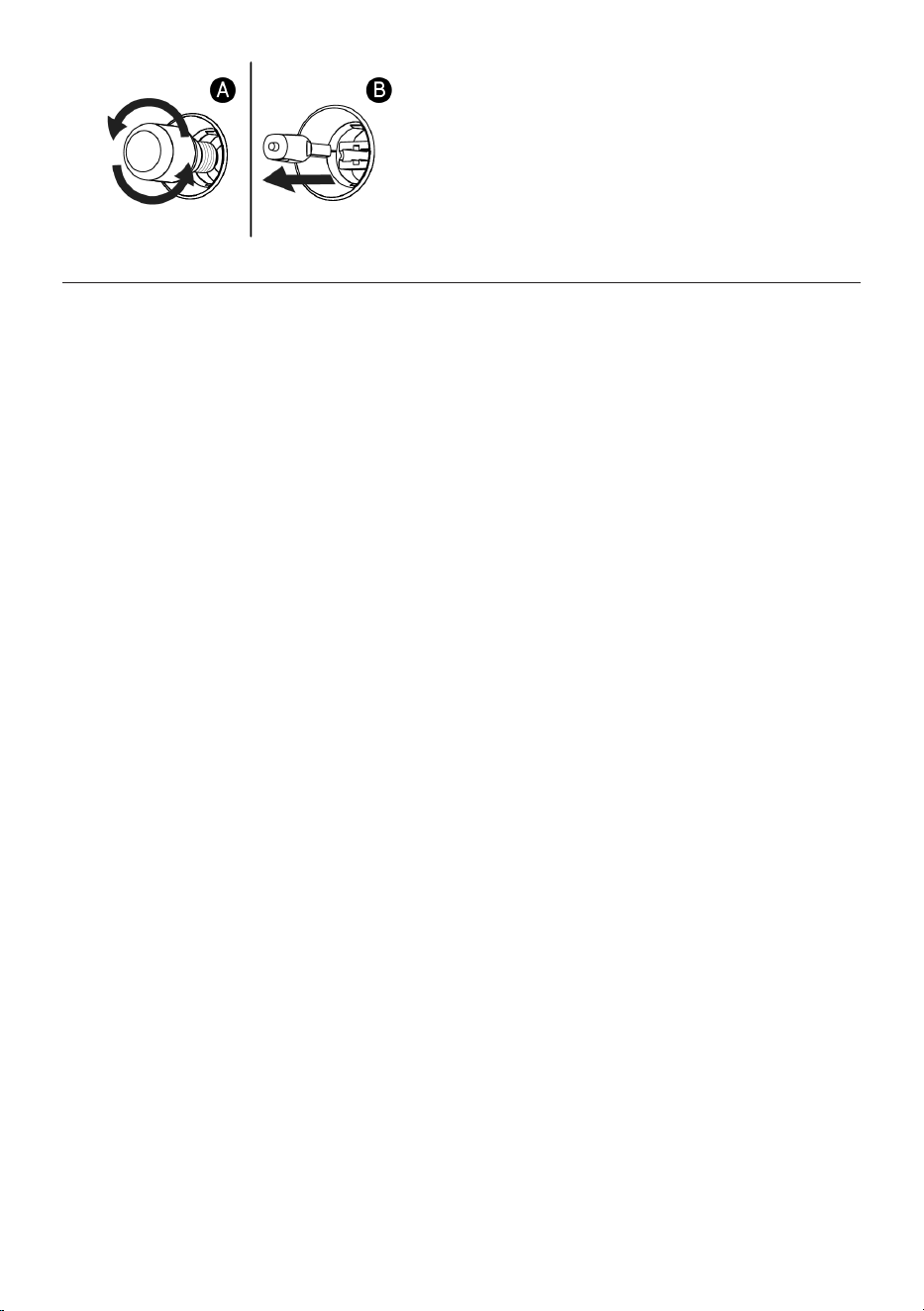
EN / 51
5. Refit the glass cover and wire shelves.
8 Troubleshooting
If the problem persists after following the
instructions in this section, contact your
vendor or an Authorized Service. Never try
to repair your product yourself.
Steam is emanated while the oven is work-
ing.
• It is normal to see vapour during opera-
tion. >>> This is not an error.
Water droplets appear while cooking
• The steam generated during cooking
condenses when it comes into contact
with cold surfaces outside the product
and may form water droplets. >>> This is
not an error.
Metal sounds are heard while the product
is warming and cooling.
• Metal parts may expand and make
sounds when heated. >>> This is not an
error.
The product does not work.
• Fuse may be faulty or blown. >>> Check
the fuses in the fuse box. Change them if
necessary or reactivate them.
• The appliance may not be plugged to the
(grounded) outlet. >>> Check if the appli-
ance is plugged in to the outlet.
• (If there is timer on your appliance) Keys
on the control panel do not work. >>> If
your product has a key lock, the key lock
may be enabled, disable the key lock.
Oven light is not on.
• Oven lamp may be faulty. >>> Replace
oven's lamp.
• No electricity. >>> Ensure the mains is
operational and check the fuses in the
fuse box. Change the fuses if necessary
or reactivate them.
Oven is not heating.
• The oven may not be set to a specific
cooking function and/or temperature.
>>> Set the oven to a specific cooking
function and/or temperature.
• For the models with timer, the time is not
set. >>> Set the time.
• No electricity. >>> Ensure the mains is
operational and check the fuses in the
fuse box. Change the fuses if necessary
or reactivate them.
• The oven door may be open. >>> Make
sure the oven door is closed. If the oven
door remains open for more than 5
minutes, the time setting made for cook-
ing is cancelled and heaters do not work.
(For models with timer) The timer display
flashes or the timer symbol is left open.
• There has been a power outage before.
>>> Set the time / Turn off the product
function knobs and again switch it to the
desired position.
The microwave does not work.
• It was not properly plugged in. >>> Plug
the cord.
• There might be an object between the
door and the oven. >>> Remove the ob-
ject and completely shut the lid.
The microwave makes strange noises
whist operating.
• There is some electrical arch inside,
caused by a metal object in the oven. >>>
Remove the metal object from the oven.
• The hardware of the oven is touching the
wall. >>> Cut its touch with the oven wall.
• There is a loose fork, knife or a cooking
tool in the oven. >>> Remove the fork,
knife or a cooking tool from the oven.

EN / 52
The meal does not heat up, or it is too
slow.
• The correct operation time and/or power
level is not chosen. >>> Choose the right
cooking power and time for the type of
meal you are heating.
• The quantity of food may be too much or
it may be too cold. >>> Set additional
cooking time. Constantly check for the
meal not to burn.
• There is a loose fork, knife or a cooking
tool in the oven. >>> Remove the fork,
knife or a cooking tool from the oven.
The meal is too hot, dry or burnt.
• The correct operation time and/or power
level is not chosen. >>> Check if you have
chosen the right cooking power and time
for the type of meal you are heating. Call
the authorized service if your appliance is
damaged.
Some sounds come from the oven once the
cooking time is over.
• Cooling fan might be working. >>> This is
not an error. The cooling fan continues
operating after the oven shuts down.
When the temperature is low enough, the
fan shuts down automatically.
After cooking starts symbol flashes on
the display and there is an audible warn-
ing.
• The oven door may be open. >>> Make
sure the oven door is completely closed.
Contact the authorized service if the fault
continues.
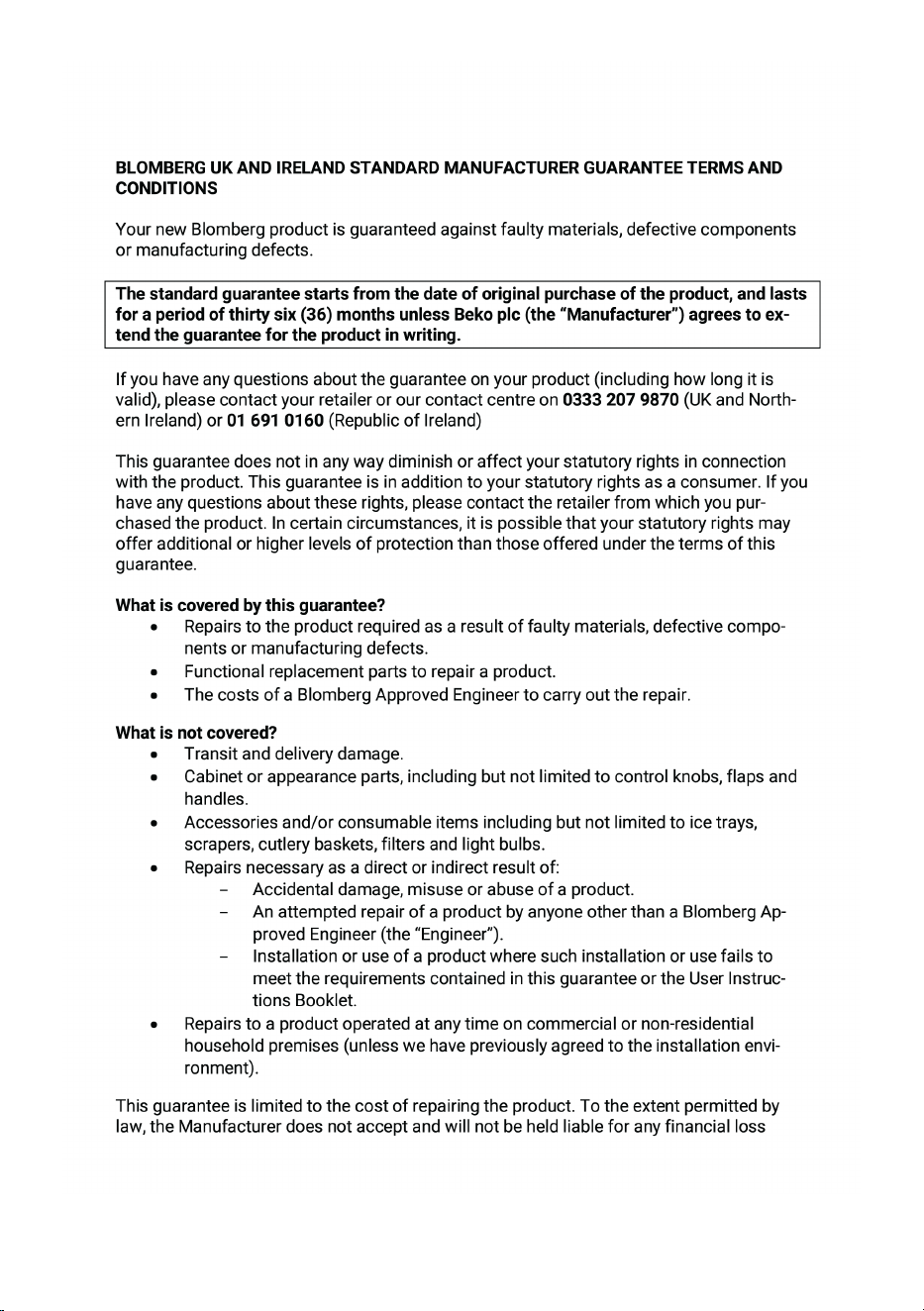
EN / 53
EN / 54
EN / 55
EN / 56
EN / 57
EN / 58
EN / 59