•
•
•
•
GR-RB221WE-PMA(57)
⩕ᝣڷ
⩕ᝣڷ

1
.
........................................................................................1
1.1 ............................................................................................................................................ 1
1.2
..................................................................................................... 4
1.3
.......................................................................................................... 4
1.4
.................................................................................................................... 5
1.5
............................................................................................................... 6
1.6 ......................................................................................................................... 7
1.7
......................................................................................................................... 7
2
.
.................................................................................8
2.1 ............................................................................................................................................ 8
2.2
....................................................................................................................................... 9
2.3 ............................................................................................................................10
2.4
..........................................................................................................................................11
2.5 ..................................................................................................................11
3. ...........................................................................12
3.1 ................................................................................................................................12
3.2 ......................................................................................................................13
4
.
.......................................................................14
4.1 .......................................................................................................................14
4.2 ................................................................................................................................17
4.3
..........................................................................................................................................17
4.4
................................................................................................................................17
5
.
......................................................................................18
6
.
...............................................................................19
如何調節溫度
如何拆卸
能源相關警告
LED燈更換
節約能源小貼士
1
1.
1.1
•
1.
2.
•
•
•
•
•
•
•
•
•
䖢Ⴕ
㿸⚔䶔ٿ〒喐ⷧԊЃԾᰰ⣖䰨கȡ
㿸ࠬҬ⩕ᐣ䪤㌇ᝃᣒౝ⮱喌䰆䜊喍䖖䙺கȡ
2
•
•
•
•
•
-
-
•
•
• IEC
• EN 8
•
•
•
•
3
•
-
-
- 48 5
1
-
-
2
- 3
- 4
-
• 1 2 3 4
•
• LED
• (F)
4
1.2 Ⴖڕ䂓こ㮌А㶕ᘼ㓖
⺮㾹
ₑ㾹㶕⺮⮱θ䴲ȡ
䖢Ⴕᠴ㘪ᰰᄻ㜡⩏৮᤺ซᝃ㔲࢞ࣷҬ⩕㔲ϧ䏘Ⴖڕȡ
ᓲ䴵䖢Ⴕθ䴲こ㮌
ₑこ㮌㶕ᓲ䴵䖢Ⴕ⮱θ䴲
ᰶₑこ㮌⮱㵹◧ᓲ䴵ᵩᠶ⚔㺮Ⅿ᧺҉ത㵹喟ݴ㘪
ᰰᄻ㜡⩏৮᤺ซᝃ㔲࢞ࣷҬ⩕㔲ϧ䏘Ⴖڕȡ
∕ᘼこ㮌
ₑこ㮌㶕䰭∕ᘼ⮱θ䴲ȡ
ᰶₑこ㮌⮱㵹◧䰭㺮➦ݒ∕ᘼȡຯߍВ䭟ヱ喐㘪
ᄻ㜡䑂Ꮣᝃ㔲Ꮣ⮱פრ喐ᝃ䕍⩏৮᤺ȡ
᱙㿗ᬻᰥ࠲㽞็䛺㺮⮱Ⴖڕ䇴㼷喐㿸ࠆᓲ䖢Ⴕᰶ⮱Ⴖڕ䇴㼷ȡ
1.3 ⩕䰨ᰶ䬉⮱䂓θ䴲
• ᠁䮑䰗⮱䰨⎽䵚᭯喐ܴࠬ៶វ䰨⎽㌇ȡࠆᓲ㋷ᤎ䵚喐
ᓋᏔⰡᣒ᠁ܧȡ
• ◧Ԋ䯉ႶڕҬ⩕喐Ш҂᭯Ն㿸㺮᤺ซ䰨⎽㌇喐⪣䰨⎽㌇ܧ
⤫ⵡ᤺ᝃ䵚ܧ⤫⸕᤺᭯喐ܴࠬҬ⩕ȡ
• │᭯㿸ࠬ㼥ᦥ䰨⎽䵚喐В䭟㼥䰨ȡ
• 㿸Ҭ⩕ᄵ⩕䰨⎽Ꮤ喐㾟Ꮤᛶ㜴ڣЃ䰨கڞ⩕ȡ䰨⎽㌇
䵚ᛶԊᠮ㜴Ꮤ➏ధᣒ㼥喐ݴ㘪ᄻ㜡▘▪ȡ
5
Gas
•
•
•
•
•
1.4
•
•
•
•
6
•
•
•
1.5
Flammable
Highly
corrosive
Explosive
•
•
•
•
Drugs
Biological
products
Blood
Beer
7
1.6
•
•
•
•
•
•
1.7
•
•
能源相關警告
8
2.
2.1
•
45
•
•
•
• 30
10
7.5
10cm
30cm
7.5cm
9
2.2
1.
2.
3.
a.
b.
c.
10
2.3
LED
1.
2.
3.
4.
-&%⛵ᰡᤈ
11
2.4
•
• 2 3
4
•
2.5
•
•
•
•
•
716mm
479mm
120°
582mm
953mm
節約能源小貼士
12
3.
3.1
•
3
5
•
•
•
•
•
•
㒛➖᳣
⨣᳣
⏾ࠂ⯿
㸪Ⱁ
⣨⦰
᨞᳣
ᆉ
ࠆᓲ∕ᘼ
13
3.2ຯ҂㿬ロ⏘Ꮣ
ۤ㫼ბ
ۤۺბ
ᑞ ᑤ
ۤ㫼ბ⏘Ꮣ㿬ロ䝂
ౕۙ႐হ႐ぶۤࢨ䋠᭯喐㿸䕟㵹⏘Ꮣ㿬ロȡ
䕇ⴒ
ᬒ፥Ҭ⩕喐㿸ᄴڣ㽚㒛ౕĄ喌ᑤহᑞ⮱䫀喍ąѺ㒛Ҭ⩕ȡₑใ喐ຯ䰭ߍᑤ㸪
ۤ喐㿸㿬㜠Ąᑤą֡ȡ⪣⏘Ꮣ䕻ѻ᭯喐㿸㿬㜠Ąᑞą֡ȡ
䪤᭯䫀ᄴۤۺბ⮱⏘Ꮣ㿬ロ㽚ჇౕĄᑤąѺ㒛喐ᰰᄻ㜡ۤ㫼ბ⮱ۤࢨ᩵䂷
ᑞ喐㿸ౕ๖ᄴڣ㿬ఋ㜠ĄąѺ㒛ȡ
ౕۤࢨ䋠᭯喐㿸ࠆᓲ䕟㵹⏘Ꮣ㿬ロȡ൷ᝃۤۺ丌৮ᰰ㲺ࡃȡ
䕇䕻᧺҉ۤۺბ⏘Ꮣ㿬ロ䝂喐Вᩦ䂷≮ۤۺბহۤ㫼ბ⮱䷕䛼喌ۤ⅐喍
⮱℁Ҹȡᄴۤۺბ⮱⏘Ꮣ㿬ロ㽚Ⴧ◧Ąᑤą᭯喐䕟ڒۤۺბ⮱䷕䛼ᰰߍ喟
㽚Ⴧ◧Ąᑞą᭯喐䕟ڒۤ㫼ბ⮱䷕䛼ᰰ⍈ᄾȡ
ۤۺბ⏘Ꮣ㿬ロ䝂
ᑞ ᑤ
ۙ႐ぶۤۺბۤࢨ᩵䐰ᑞ᭯
⏘仕
ক⏘Ꮣ䐰ѻ᭯喌ĎВ喍喐ࢠҬᄴۤۺბ㽚㒛
◧Ąᑤą喐ۤࢨ᩵Ό㘪䋠
ᄴۤ㫼ბ㽚◧Ąᑤą
᪡倁⮱㸪ۤ㘪߈ᑤ喐ۤۺბΌᰰ䂷ۤȡ
႐ぶۤ㫼ბ㸪ۤ᩵䐰ᑞ᭯
ক⏘Ꮣ䐰倅᭯喐ࢠҬᄴۤ㫼ბ㽚Ⴧ◧Ąᑤą喐
ۤࢨ᩵Ϻ㘪䋠
ᄴۤۺბ㽚◧ĄąᝃĄᑞą
ۤۺბۤ⅐㷘䔮ڒۤ㫼ბ喐Ҭۤ㫼ბ䂷ۤȡ
14
4.
4.1
•
•
•
•
•
•
•
•
•
•
•
Gas
Detergent
Bananaoil
Alcohol
4.2 ຯ҂៳ࢥ
喌Ⴖ㸊᭜៳ࢥₒ侌⮱ࣺ᧺҉喍
喌喍ᆑ᳣ᆑ᳣
ៀѼݺ〜䊤喐♣ᒹⰡᣒ៶ܧȡ
㿸ࠆᓲ⩕䰆᧺҉喐В䖬ٺ䋹㥪䕍᤺ซᝃפȡ
15
喌喍㒛➖᳣⨣᳣
䑂䑂ౝᓋϑᰬጓᣕࣨ៳ࢥȡ
喌Ⴖ㸊䐰◧➏ధȡ喍
喌喍⏾ࠂ⯿ٟ➖ღக
喞ᄴۤۺბ䪭៶䪸喐ܧݣⰑᒹ喐ںᄴ⏾ࠂ⯿
ܧȡ
喞ក䪸ۤ㫼ბ䪭喐ᄴٟ➖ღகܧȡ
4.3
•
16
4.4
•
•
•
45
°
17
5.
•
18
6.
... ...
SN +10
°
C
+32
°C
N +16
°C
+32
°C
ST +16
°C
+38
°C
T +16
°C
+43
°C

ࠆ⛞㌇喞
㺼ᵩᰶ㘪䂷ᰡ喐ᖂ㵹䕇ⴒȡ
᱙㿗ᬻᰥ⮱ృᵵ◧ᘼృ喐ᄓ䯈䙺Уࣷ㉽ỸВ⩏৮◧⏃ȡ
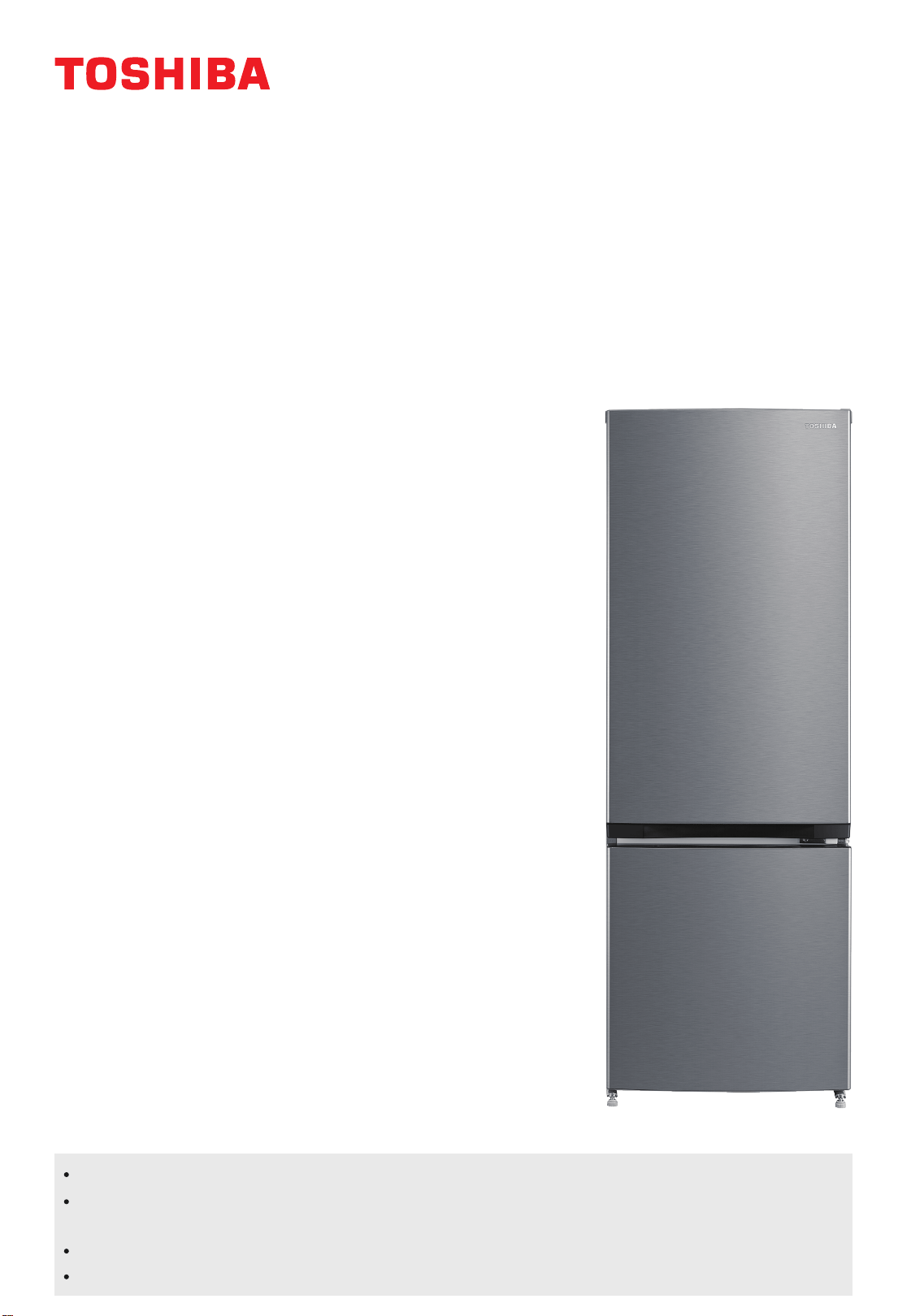
GR-RB221WE-PMA(57)
Thank you very much for purchasing this Toshiba product.
Read this Owner’s Manual and become completely familiar with the product before
use in order to use this product safely and correctly.
Keep this Owner’s Manual in a handy place for future reference.
Make sure that you received your warranty.
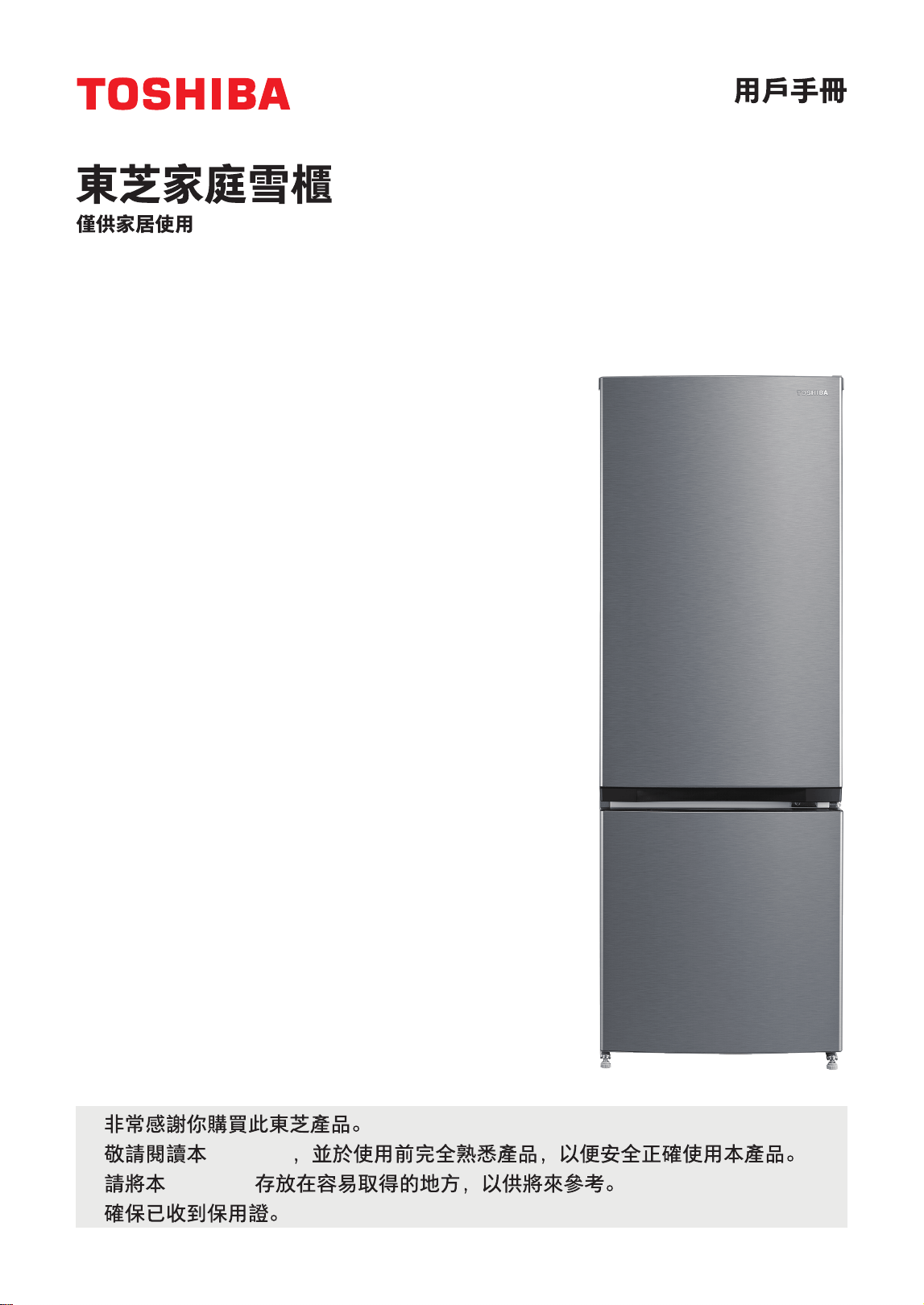
REFRIGERATOR FREEZER
For Home Use Only
Owner’s Manual

CONTENTS
1. Safety warnings
.............................................................................................................. 1
1.1 Warning ..................................................................................................................................... 1
1.2 Meaning of safety warning symbols .............................................................................. 4
1.3 Electricity related warnings ............................................................................................... 4
1.4 Warnings for using ................................................................................................................ 5
1.5 Warnings for placement ...................................................................................................... 6
1.6 Warnings for energy ............................................................................................................. 7
1.7 Warnings for disposal ........................................................................................................... 7
14................................................................................................................... gninaelc llarevO 1.4
4.2 How to disassemble ...........................................................................................................14
15.......................................................................................................................
....... gnitsorfeD 3.4
16.................................................................................................................. noitarepo fo tuO 4.4
8..................................................... rotaregirfer eht fo esu reporP.2
8............................................................................................................................. tnemecalP 1.2
9 ...........
.............................................................................................................. teef gnileveL 2.2
01...................................................................................................Changing the LED Light3.2
2.5 Energy saving tips ...............................................................................................................11
2.4 Starting ...................................................................................................................................11
3. Structure and functions .............................................................12
3.1 Key components .................................................................................................................12
3.2 How to adjust the temperature
.....................................................................................13
4. Maintenance and care of the refrigerator ................................14
17........................................................................ gnitoohs elbuorT.5
6. Disposal of your appliance ........................................................18
1
READ SAFETY PRECAUTIONS BEFORE INSTALLATION
To prevent injury to the user or other people and property damage, the
following instructions must be followed. Incorrect operation due to
ignoring of instructions may cause harm or damage.
WARNING: Risk of fire/disaster and explosion
The refrigerant of the appliance is flammable, please be care not to damage
the cooling pipes during installation and transportation.
If gas leakage happens, please contact the distributor or local service agent,
and the following precautions should be always taken:
1. Open the windows for ensuring good ventilation.
2. No fire around and please do not use other electric appliance.
This appliance is intended to be used in household and similar applications
such as staff kitchen areas in shops, offices and other working environments;
farm houses and by clients in hotels, motels and other residential type
environments; bed and breakfast type environments; catering and similar
non-retail applications.
Children should be supervised to ensure that they do not play with the
appliance.
WARNING: Risk of fire disaster and electric shock
The power cord should be replaced when it has been damaged; please
contact the distributor or local service agent for replacement.
Please unplug the power plug from socket when clean the appliance or
leave the appliance nonuse for a long time.
Do not use extension cord or ungrounded (two prong) adapters.
WARNING: Keep ventilation openings, in the appliance enclosure or in the
built-in structure, clear of obstruction.
WARNING: Do not use mechanical devices or other means to accelera
te the
defrosting process, other than those recommended by the manufacturer.
WARNING: Do not damage the refrigerant circuit.
WARNING: Do not use electrical appliances inside the food storage
compartments of the appliance, unless they are of the type recommended
by the manufacturer.
Warning: risk of fire / flammable materials
2
WARNING: Please abandon the refrigerator according to local regulators for it
use flammable blowing gas and refrigerant.
WARNING: When positioning the appliance, ensure the supply cord is not
trapped or damaged.
WARNING: Do not locate multiple portable socket-outlets or portable power
supplies at the rear of the appliance.
WARNING: Please fill with potable water only. Please do not fill hot water or
liquids other than potable water such as juices.
DANGER: Risk of child entrapment. Before you throw away your old
refrigerator or freezer:
-Take of the doors.
-Leave the shelves in place so that children may not easily climb inside.
The refrigerator must be disconnected from the source of electrical supply
before attempting the installation of accessory.
Refrigerant and cyclopentane foaming material used for the refrigerator are
flammable. Therefore, when the refrigerator is scraped, it shall be kept away
from any fire source and be recovered by a special recovering company with
corresponding qualification other than be disposed by combustion, so as to
prevent damage to the environment or any other harm.
For IEC standard: This appliance is not intended for use by persons(including
children) with reduced physical, sensory or mental capabilities, or lack of
experience and knowledge, unless they have been given supervision or
instruction concerning use of the appliance by a person responsible for their
safety.
For EN standard: This appliance can be used by children aged from 8 years
and above and persons with reduce physical sensory or mental capabilities
or lack of experience and knowledge if they have been given supervision or
instruction concerning use of the appliance in a safe way and understand the
hazards involved. Children shall not play with the appliance. Cleaning and
user maintenance shall not be made by children without supervision.
Please do not use the appliance on traffic means(such as ship and so on).
If noise, odor and smoking happens, please unplug the power plug
immediately, and contact the distributor or local service agent.
Please do not put your hands under or behind the appliance to prevent from
being hurt.
Please leave the packing materials and other parts out of the reach of
children to prevent from risk of suffocation.
3
To avoid contamination of food, please respect the following instructions:
- Opening the door for long periods can cause a significant increase of the
temperature in the compartments of the appliance.
- Clean regularly surfaces that can come in contact with food and accessible
drainage systems.
- Clean water tanks if they have not been used for 48 h; flush the water system
connected to a water supply if water has not been drawn for 5 days. ( note 1 )
- Store raw meat and fish in suitable containers in the refrigerator, so that it is
not in contact with or drip onto other food.
- Two-star frozen-food compartments are suitable for storing pre-frozen food,
storing or making ice-cream and making ice cubes. ( note 2 )
- One-, two- and three star compartments are not suitable for the freezing of
fresh food. (note 3)
- For appliances without a 4-star compartment: this refrigerating appliance is
not suitable for freezing foodstuffs. (note 4)
- If the refrigerating appliance is left empty for long periods, switch off,
defrost, clean, dry, and leave the door open to prevent mould developing
within the appliance.
Note 1,2,3,4 : Please confirm whether it is applicable according to your
product compartment type.
For a freestanding appliance: this refrigerating appliance is not intended to be
used as a built-in appliance.
An
y replacement or maintenance of the LED lamps is intended to be made by
the manufacturer, its service agent or similar qualified person.
This product contains a light source of energy efficiency class (F ).
4
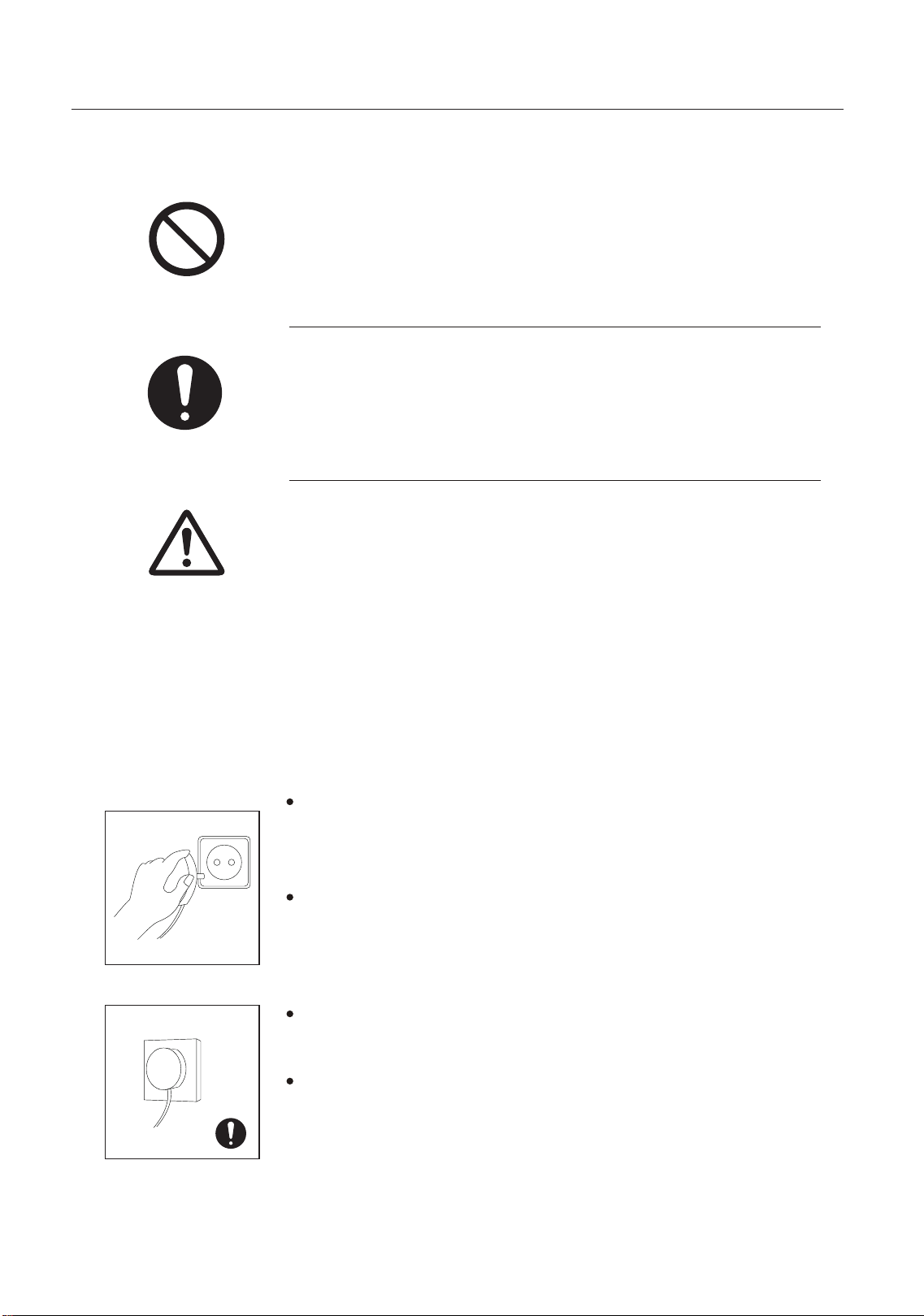
1.2 Meaning of safety warning symbols
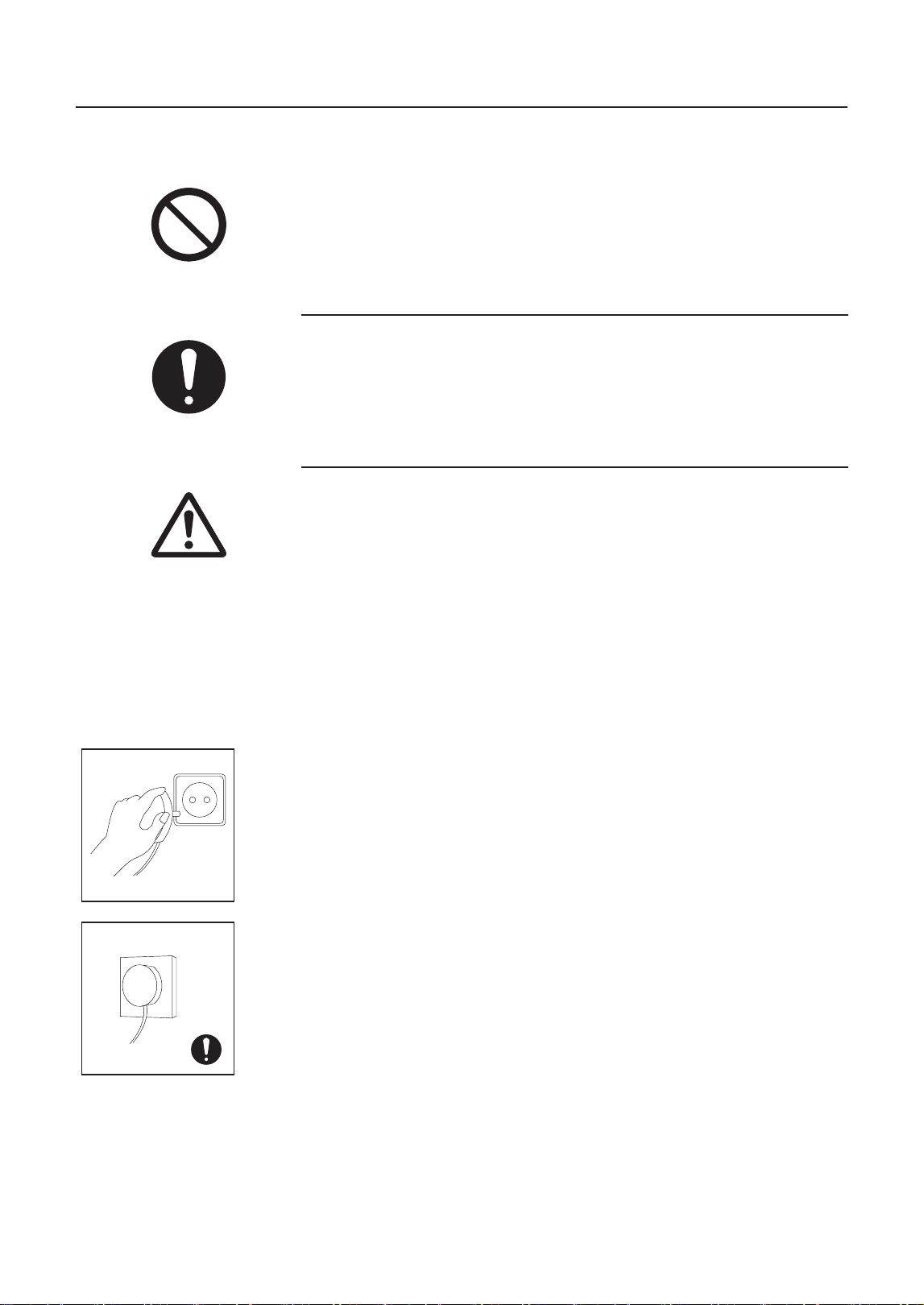
This is a prohibition symbol.
This is a mandatory symbol.
This is a cautioning symbol.
This manual contains lots of important safety information which shall
be observed by the users.
Any incompliance with instructions marked with
this symbol may result in damage to the product
or endanger the personal safety of the user.
It is required to operate in strict observance of
instructions marked with this symbol; or otherwise
damage to the product or personal injury may be
caused.
Instructions marked with this symbol require special
caution. Insufficient caution may result in slight or
moderate injury, or damage to the product.
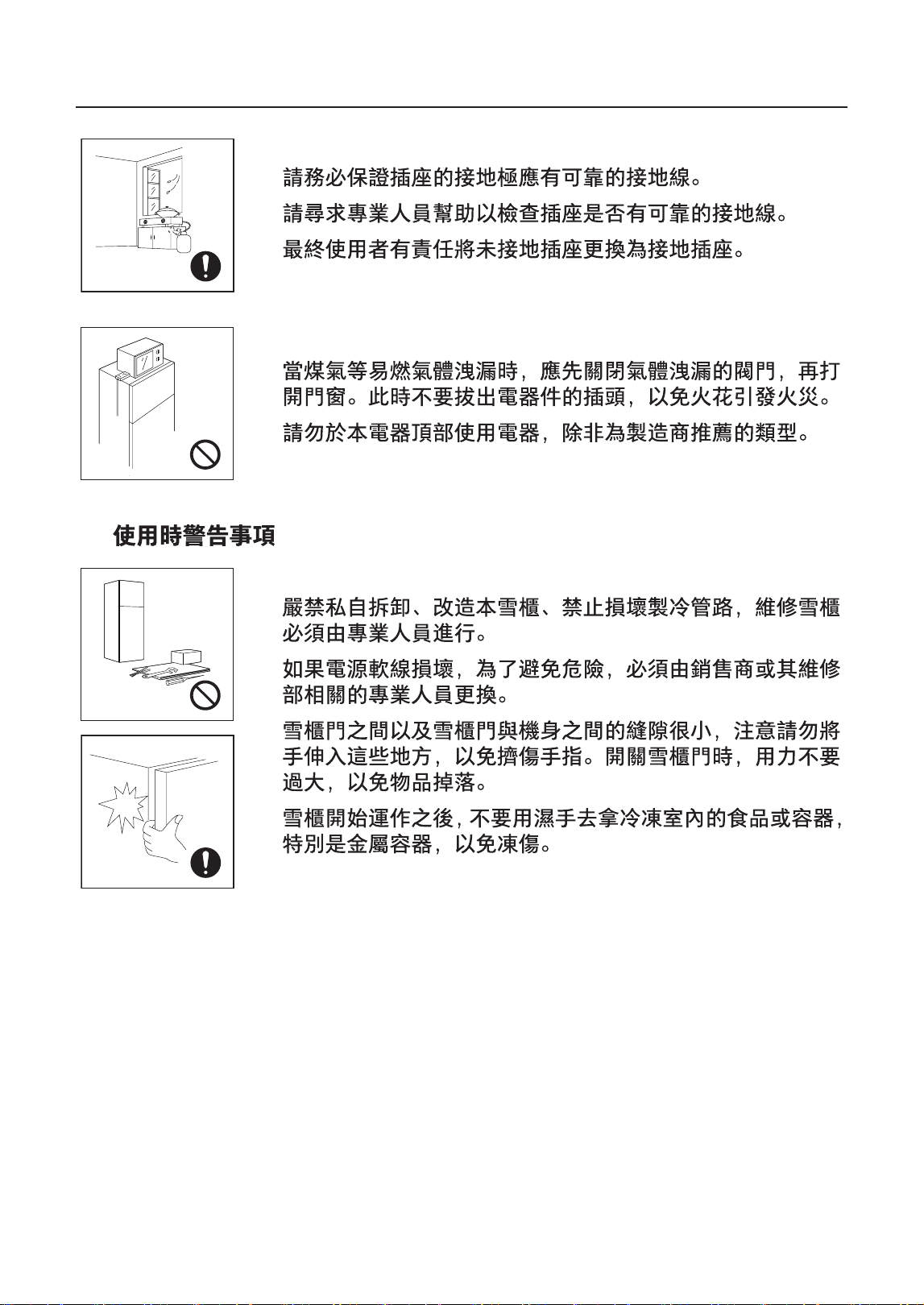
Do not pull the power cord when pulling the
power plug of the refrigerator. Please firmly grasp
the plug and pull out it from the socket directly.
To ensure safe use, do not damage the power
cord or use the power cord when it is damaged or
worn.
Please do not touch the power plug with wet
hand to prevent from electric shock.
Please use a dedicated power socket and the
power socket shall not be shared with other
electrical appliances. The power plug should
be firmly contacted with the socket or else
fires might be caused.
Mandatory
Prohibition symbol
Cautioning symbol
1.3 Electricity related warnings
symbol
5
Gas
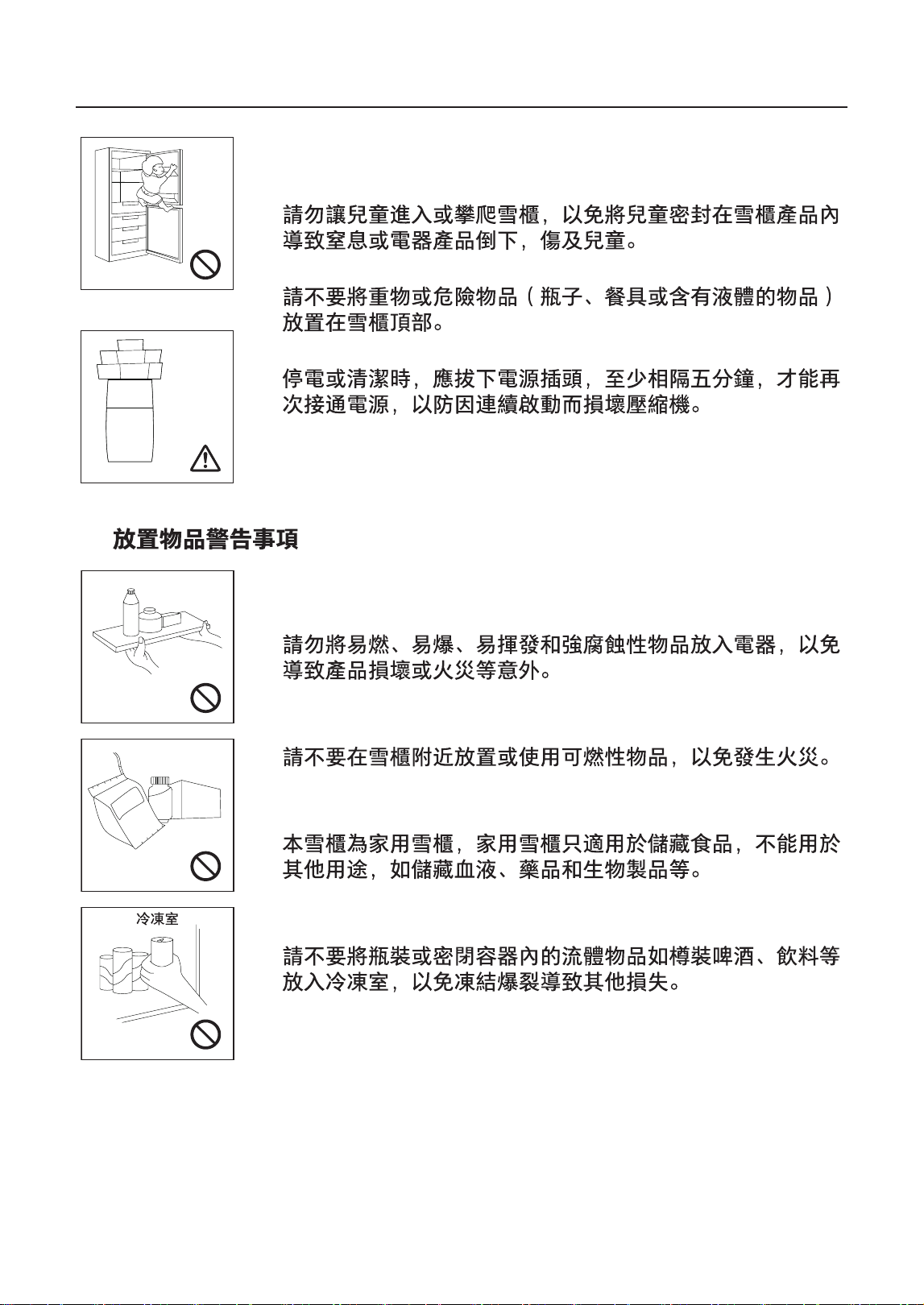
Please ensure that the grounding electrode of the
power socket is equipped with a reliable grounding
line.
Please ask for help from persons with professional
qualification to examine whether the socket is with
reliable grounding line or not.
It is the end-consumers' responsibility to change
the ungrounded socket into grounded socket.
Please turn off the valve of the leaking gas and
then open the doors and windows in case of
leakage of gas and other flammable gases. Do not
unplug the refrigerator and other electrical
appliances considering that spark may cause a fire.
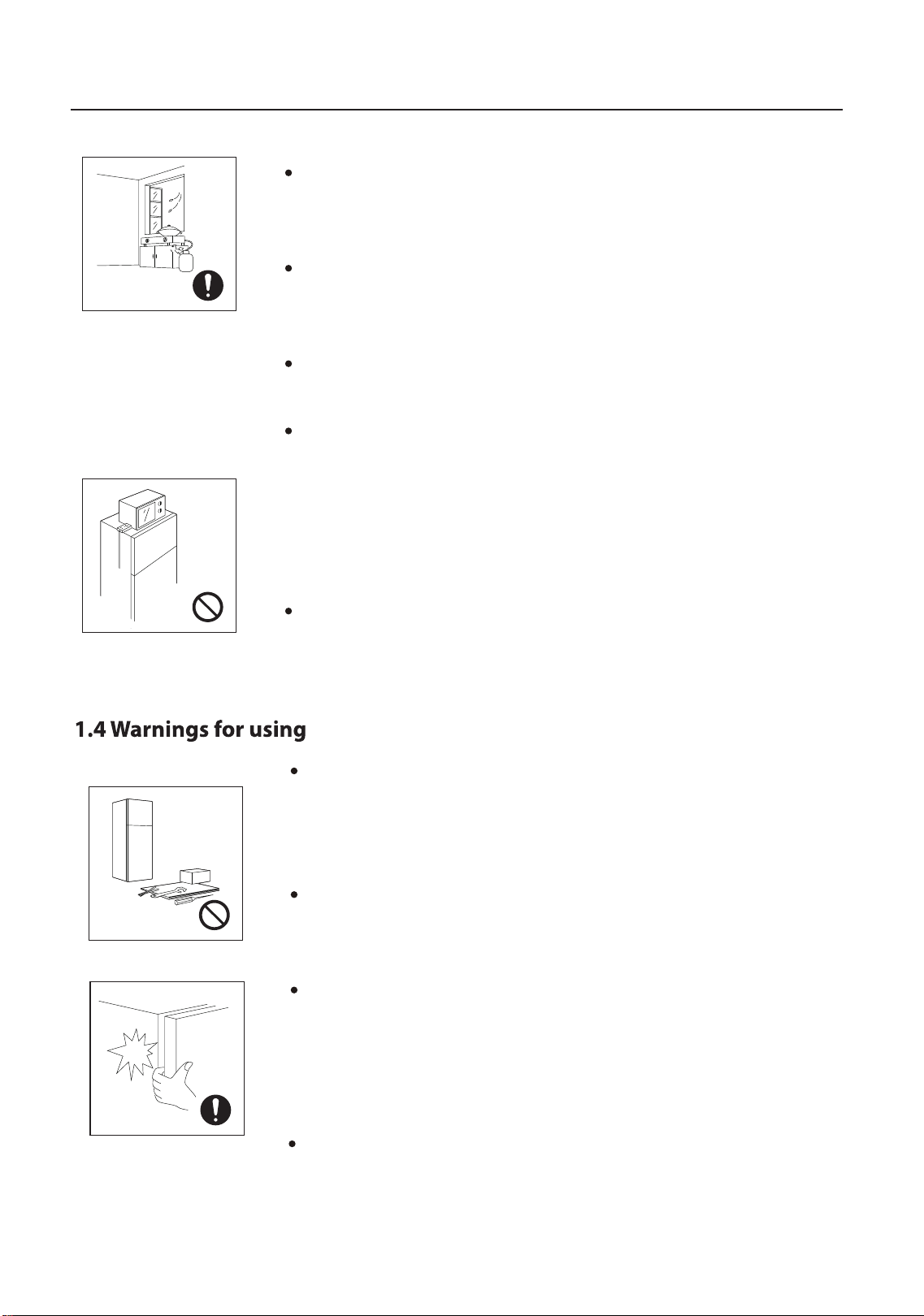
Do not use electrical appliances on the top of the
appliance, unless they are of the type recommended
by the manufacturer.
Do not arbitrarily disassemble or reconstruct the
refrigerator, nor damage the refrigerant circuit;
maintenance of the appliance must be conducted
by a specialist.
Damaged power cord must be replaced by the
manufacturer, its maintenance department or
related professionals in order to avoid danger.
The gaps between refrigerator doors and between
doors and refrigerator body are small, be noted not
to put your hand in these areas to prevent from
squeezing the finger. Please be gentle when close
the refrigerator door to avoid falling articles.
Do not pick foods or containers with wet hands in
the freezing chamber when the refrigerator is
running, especially metal containers in order to
avoid frostbite.
Please pull out the power plug when the electricity
fails or clean the appliance, and connecting it to
power supply after at least 5 minutes, which
prevents damage to the compressor by continuous
startup.
Drugs
Biological
products
Blood
Flammable
Highly
corrosive
Explosive
Beer
Freezing chamber
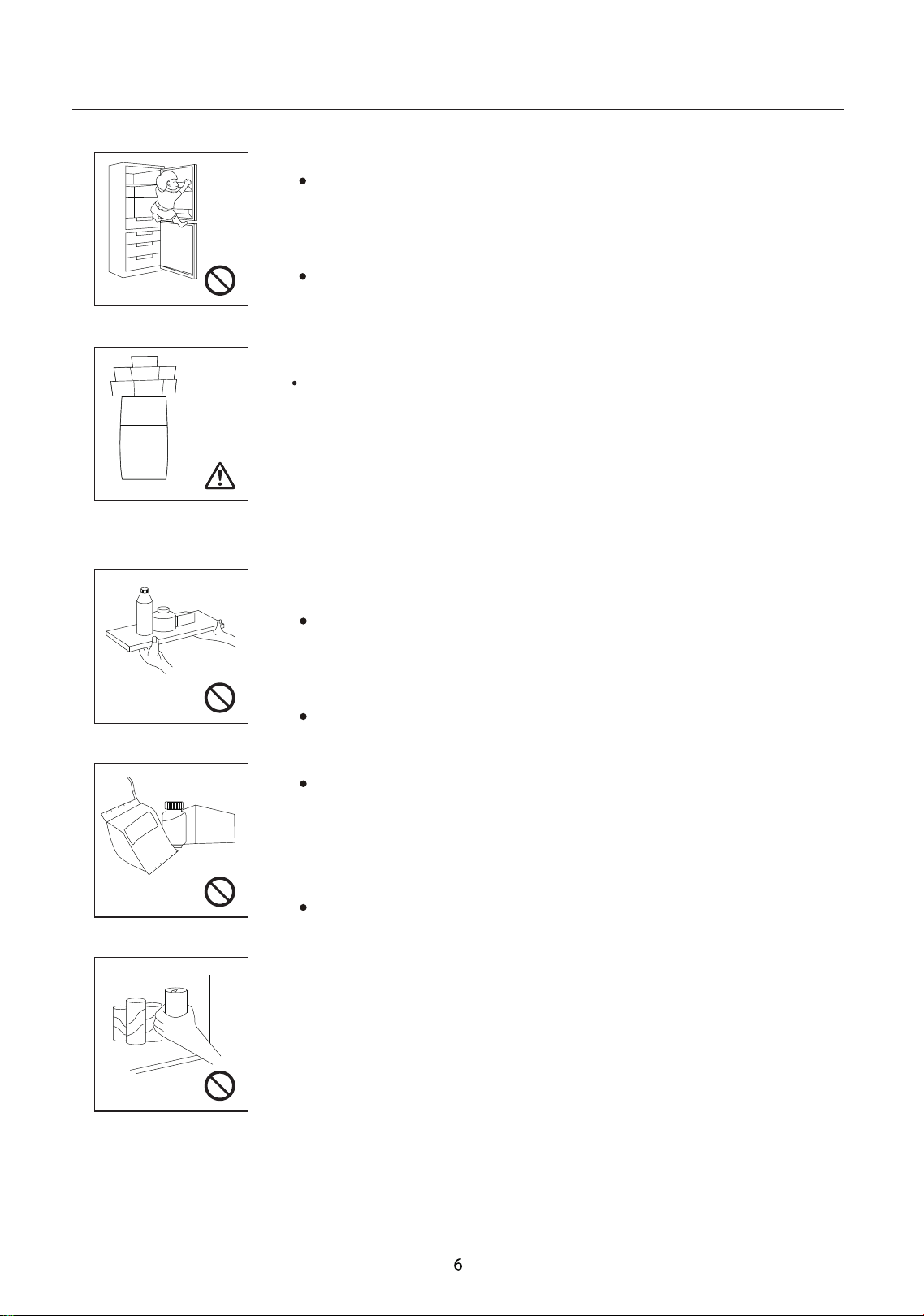
Do not allow any child to get into or climb the
refrigerator; otherwise suffocation or falling injury
of the child may be caused.
Please do not put heavy or dangerous objects on
top of the appliance (bottles, tableware, or
something containing liquid)
Do not put flammable, explosive, volatile and
highly corrosive items in the refrigerator to
prevent damages to the product or fire accidents.
Do not place flammable items near the
refrigerator to avoid fires.
The refrigerator is intended for household use,
such as storage of foods; it shall not be used for
other purposes, such as storage of blood, drugs
or biological products, etc.
Do not store beer, beverage or other fluid
contained in bottles or enclosed containers in the
freezing chamber of the refrigerator ; or otherwise
the bottles or enclosed containers may crack due
to freezing to cause damages.
1.5 Warnings for placement
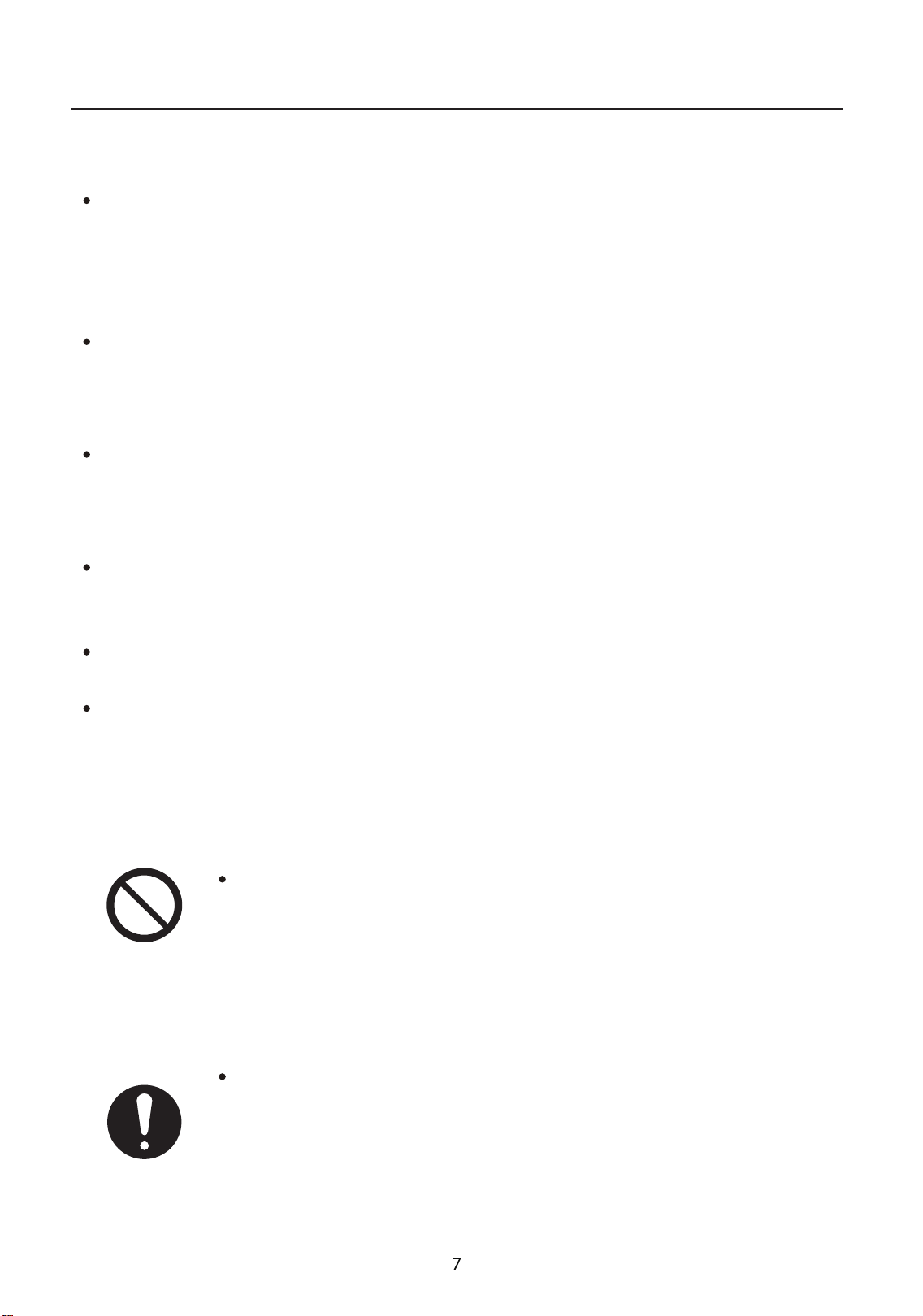
Refrigerating appliances might not operate consistently (possibility of
defrosting of contents or temperature becoming too warm in the frozen
food compartment) when sited for an extended period of time below
the cold end of the range of temperatures for which the refrigerating
appliance is designed.
The fact that effervescent drinks should not be stored in food freezer
compartments or cabinets or in low-temperature compartments or
cabinets, and that some products such as water ices should not be
consumed too cold;
The need to not exceed the storage time(s) recommended by the food
manufacturers for any kind of food and particularly for commercially
quick-frozen food in food-freezer and frozen-food storage
compartments or cabinets;
The precautions necessary to prevent an undue rise in the temperature
of the frozen food while defrosting the refrigerating appliance, such as
wrapping the frozen food in several layers of newspaper.
The fact that a rise in temperature of the frozen food during manual
defrosting, maintenance or cleaning could shorten the storage life.
The necessity that, for doors or lids fitted with locks and keys, the keys
be kept out of the reach of children and not in the vicinity of the
refrigerating appliance, in order to prevent children from being locked
inside.
Refrigerant and cyclopentane foaming material used for
the refrigerator are flammable. Therefore, when the
refrigerator is scrapped, it shall be kept away from any
fire source and be recovered by a special recovering
company with corresponding qualification other than
be disposed by combustion, so as to prevent damage
to the environment or any other harm.
When the refrigerator is scrapped, disassemble the
doors, and remove gasket of door and shelves; put the
doors and shelves in a proper place, so as to prevent
trapping of any child.
1.6 Warnings for energy
1.7 Warnings for disposal
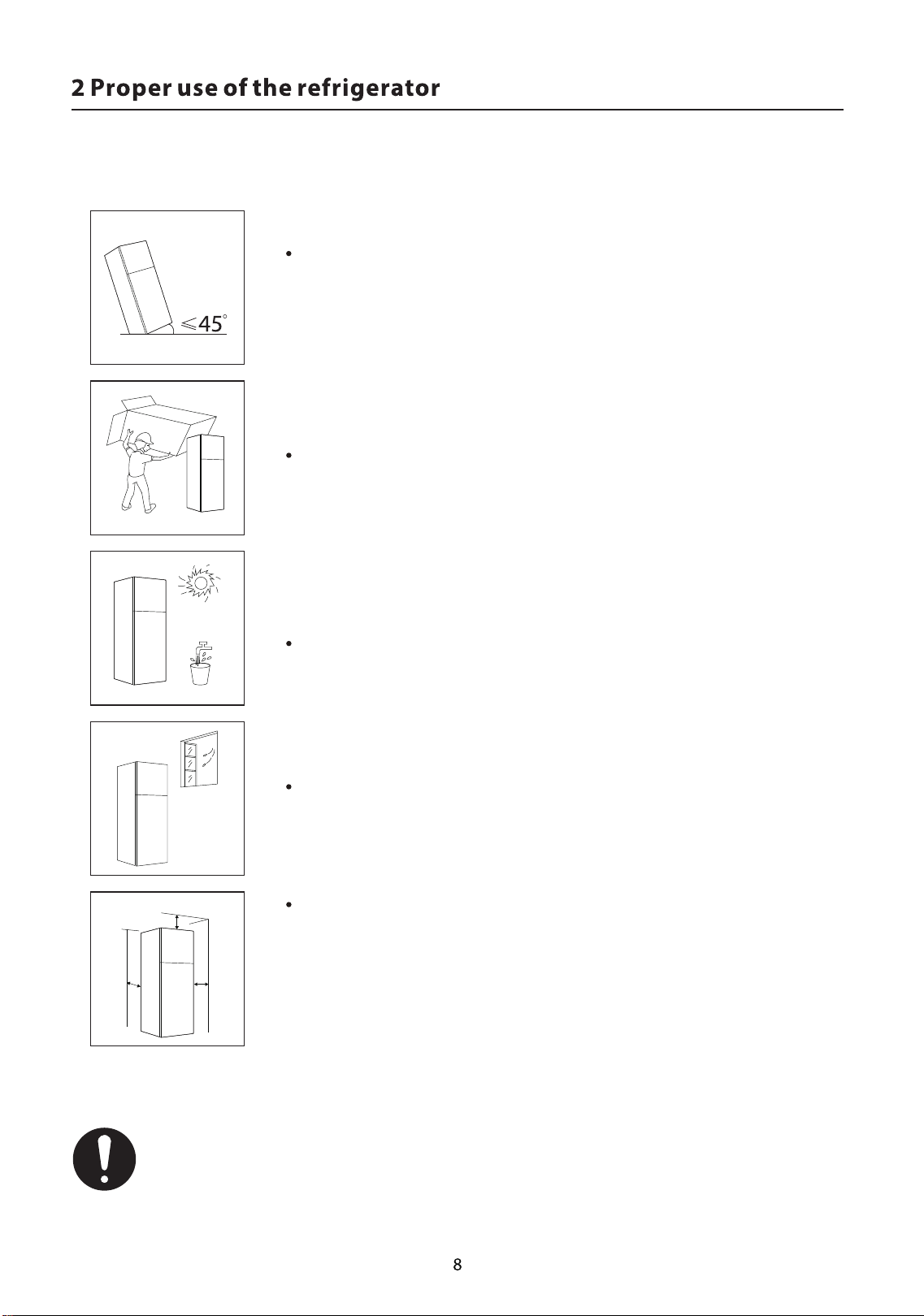
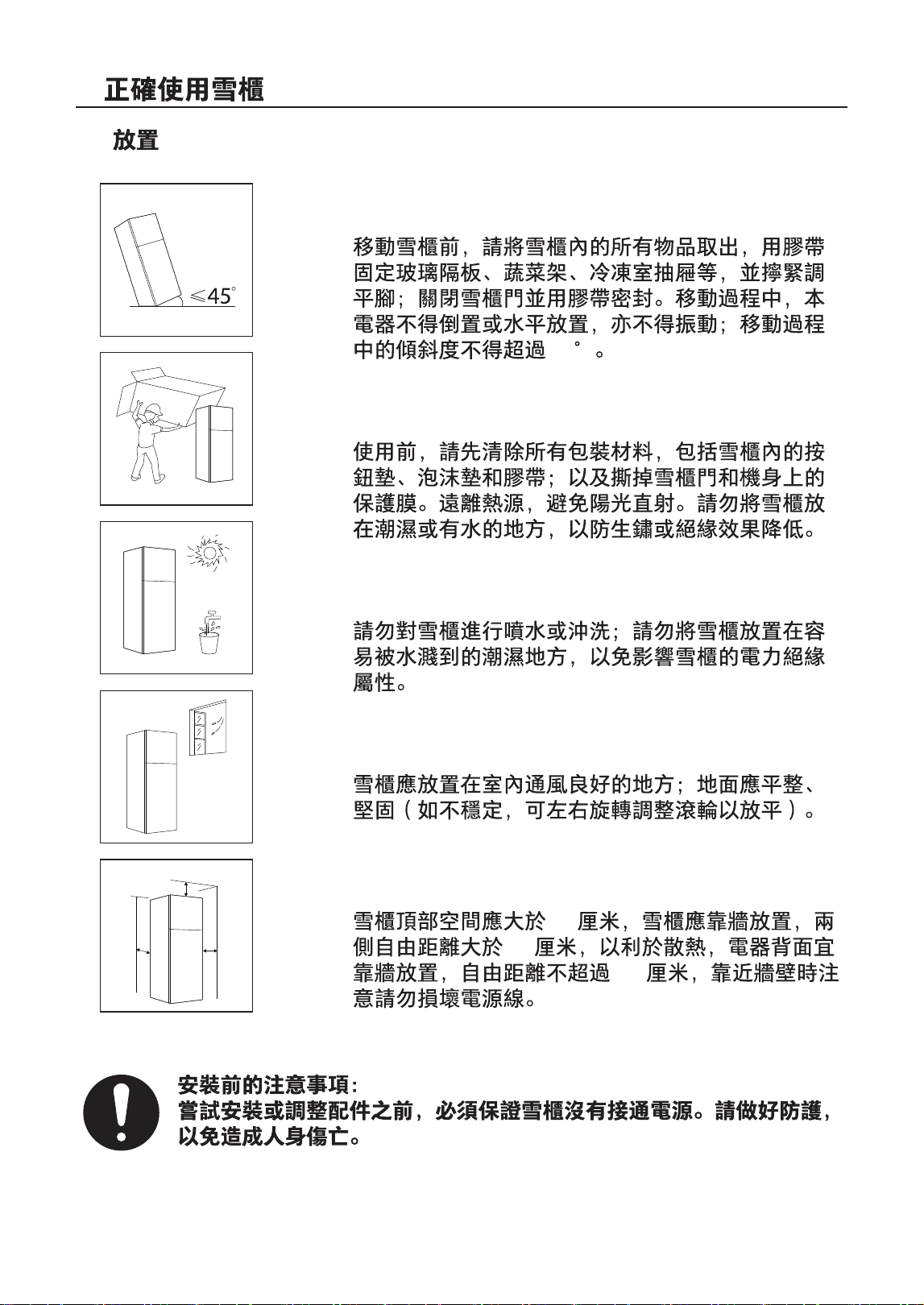
Before the refrigerator is moved, take all objects inside out, fix
the glass partitions, vegetable holder, freezing chamber
drawers and etc. with tape, and tighten the leveling feet; close
the doors and seal them with tape. During moving, the
appliance shall not be laid upside down or horizontally, or be
vibrated; the inclination during movement shall be no more
than 45°.
Before use, remove all packing materials, including button
cushions, foam pads and tapes inside of the refrigerator; tear
off the protective film on the doors and the refrigerator body.
Keep away from heat and avoid direct sunlight. Do not place
the freezer in moist or watery places to prevent rust or
reduction of insulating effect.
Do not spray or wash the refrigerator; do not put the
refrigerator in moist places easy to be splashed with water so
as not to affect the electrical insulation properties of the
refrigerator.
The refrigerator is placed in a well-ventilated indoor place; the
ground shall be flat, and sturdy (rotate left or right to adjust the
wheel for leveling if unstable).
The top space of the refrigerator shall be greater than 30cm, the
refrigerator should be placed against a wall with a free distance
more than 10cm on the both side to facilitate heat dissipation,
and the back of appliances is intended to be placed against a wall
with a free distance not exceeding 7.5 cm, be careful not to damage
the power cord when close to the wall.
2.1 Placement
Precautions before installation:
Before installation or adjusting of accessories, it shall be ensured
that the refrigerator is disconnected from power. Precautions shall
be taken to prevent fall of the handle from causing any personal
injury.
10cm
30cm
7.5cm
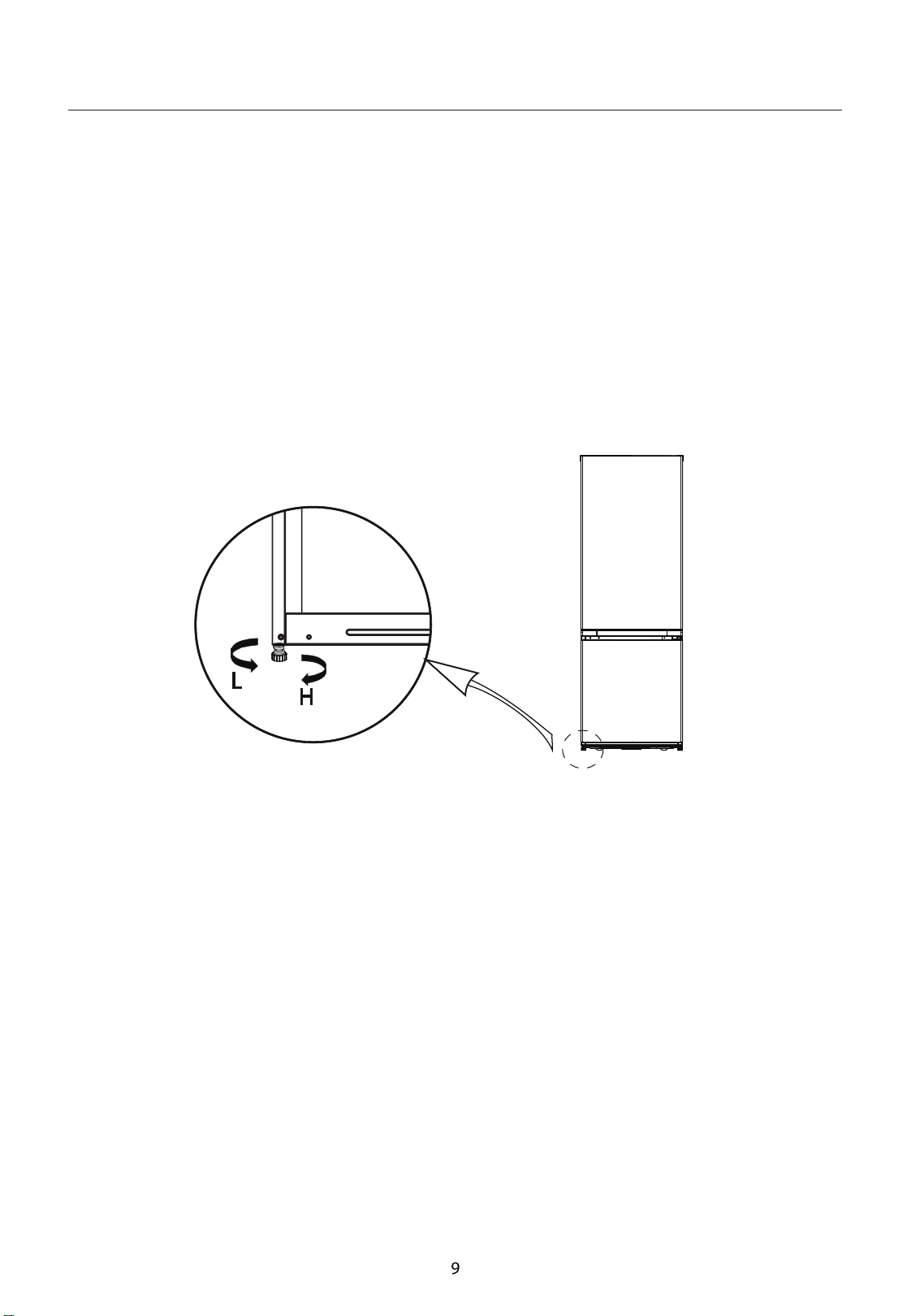
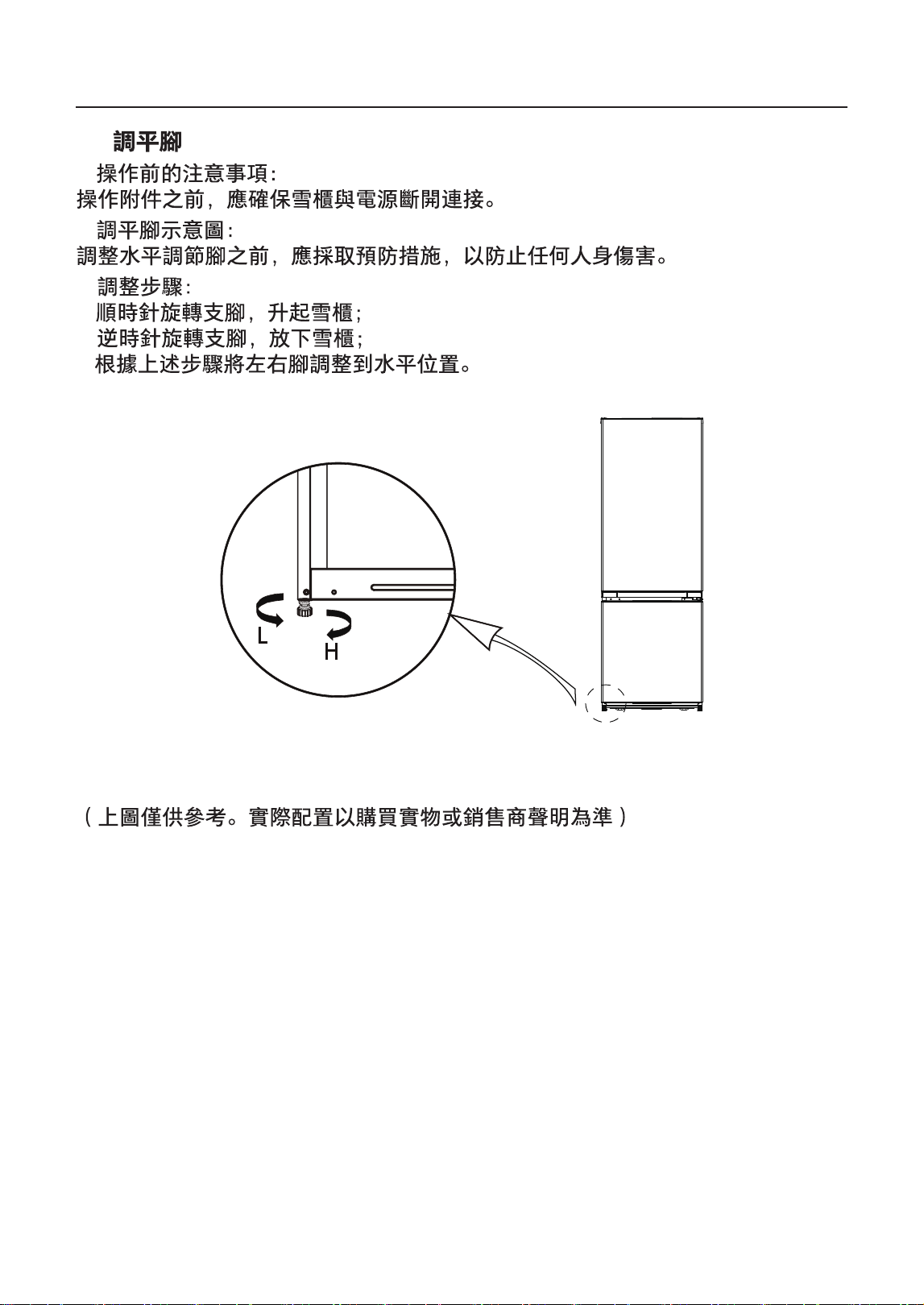
2 2 Leveling feet.
1. Precautions before operation:
Before operation of accessories, it shall be ensured that the refrigerator is disconnected from
power.
Before adjusting the leveling feet, precautions shall be taken to prevent any personal injury.
2. Schematic diagram of the levelling feet:
3. Adjusting procedures:
a. Turn the feet clockwise to raise the refrigerator;
b. Turn the feet counterclockwise to lower the refrigerator;
c. Adjust the right and left feet based on the procedures above to a horizontal level.
product or statement by the distributor)
(The picture above is only for reference. The actual configuration will depend on the physical
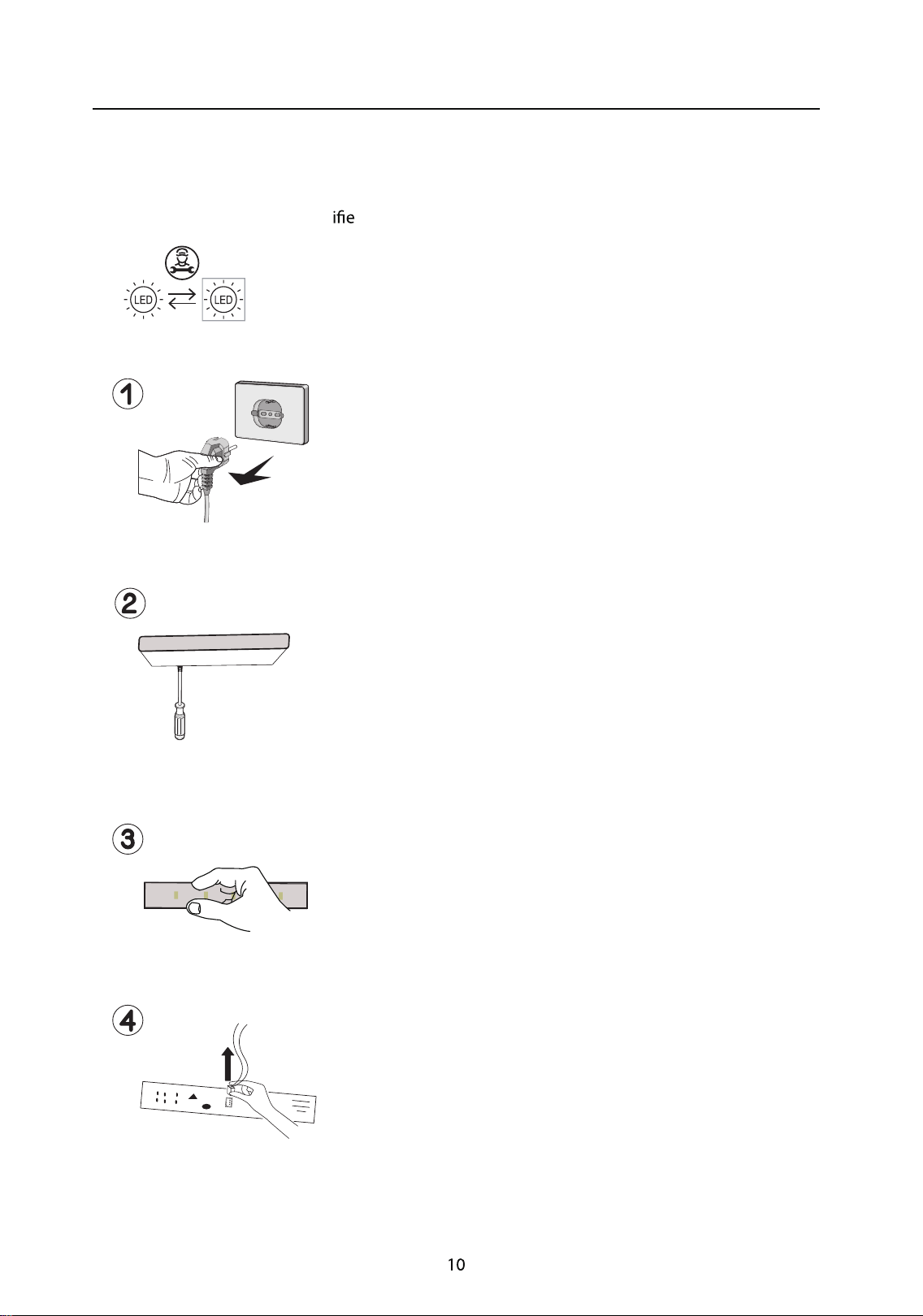
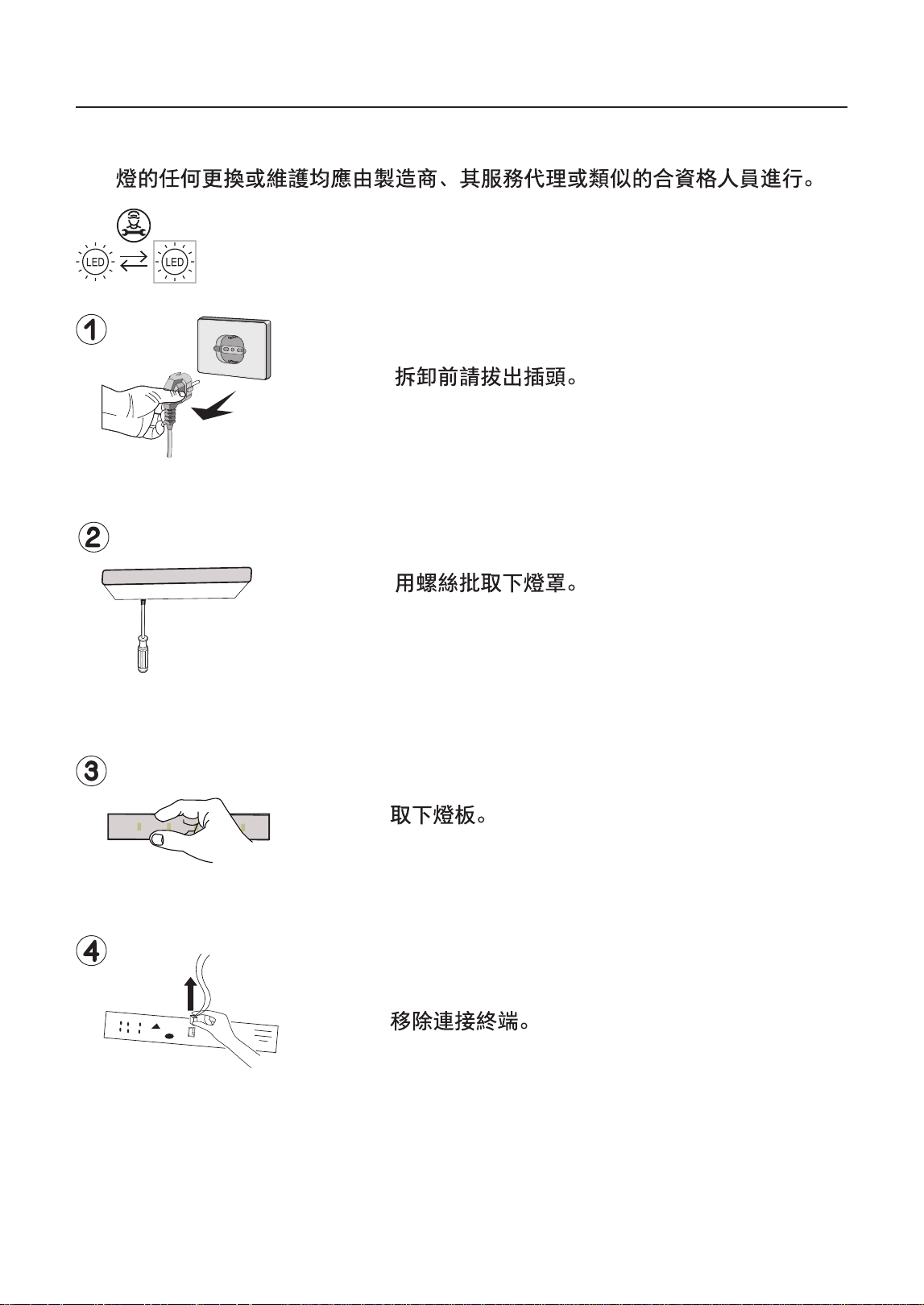
2.3 Changing the LED Light
Any replacement or maintenance of the LED lamps is intended to be made by the manufacturer,
its service agent or similar qual d person.
1. Please take out the plug before removal.
2. Remove the lampshade with a screwdriver.
3. Take down the lamp panel.
4. Remove the connection terminal.
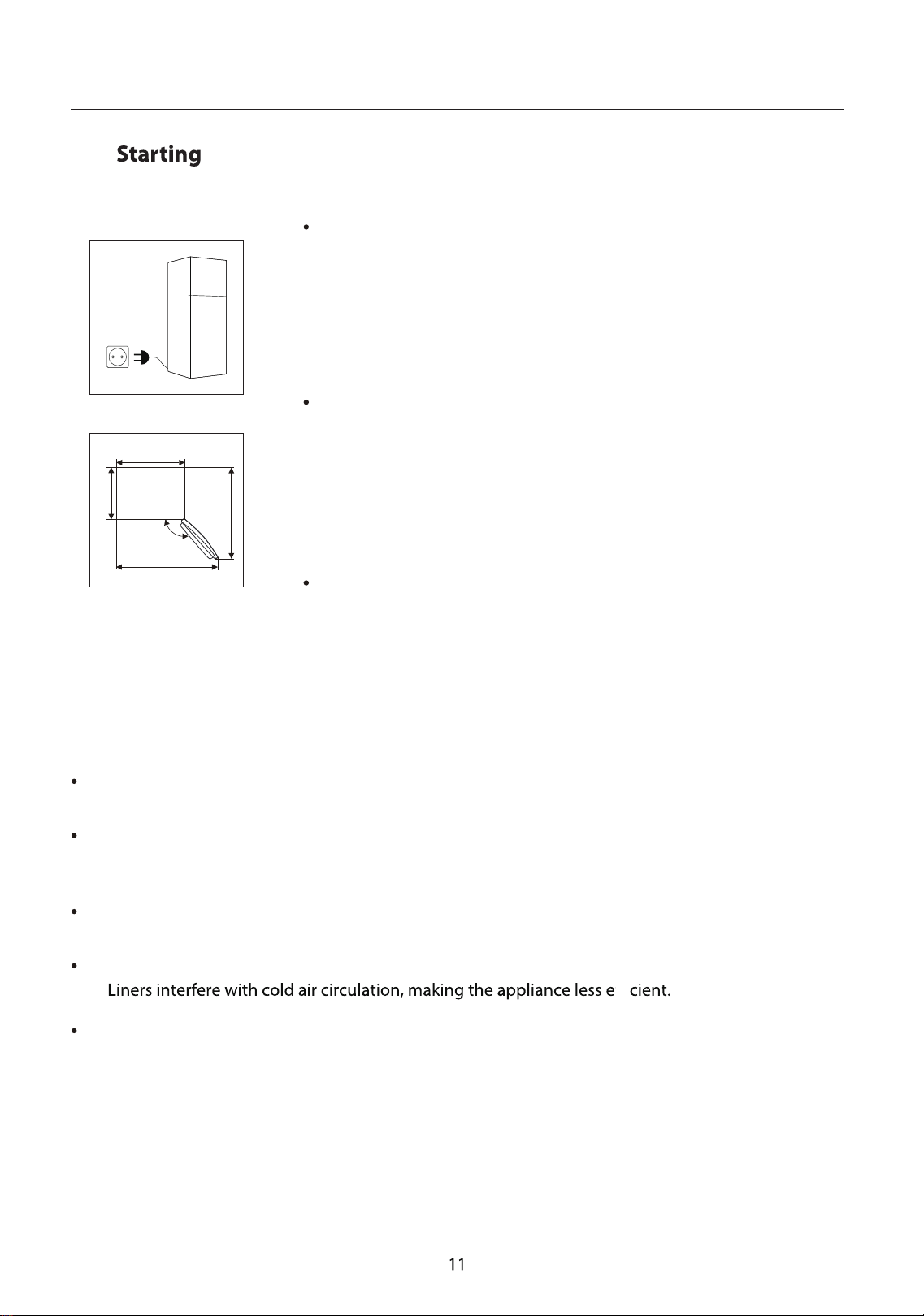
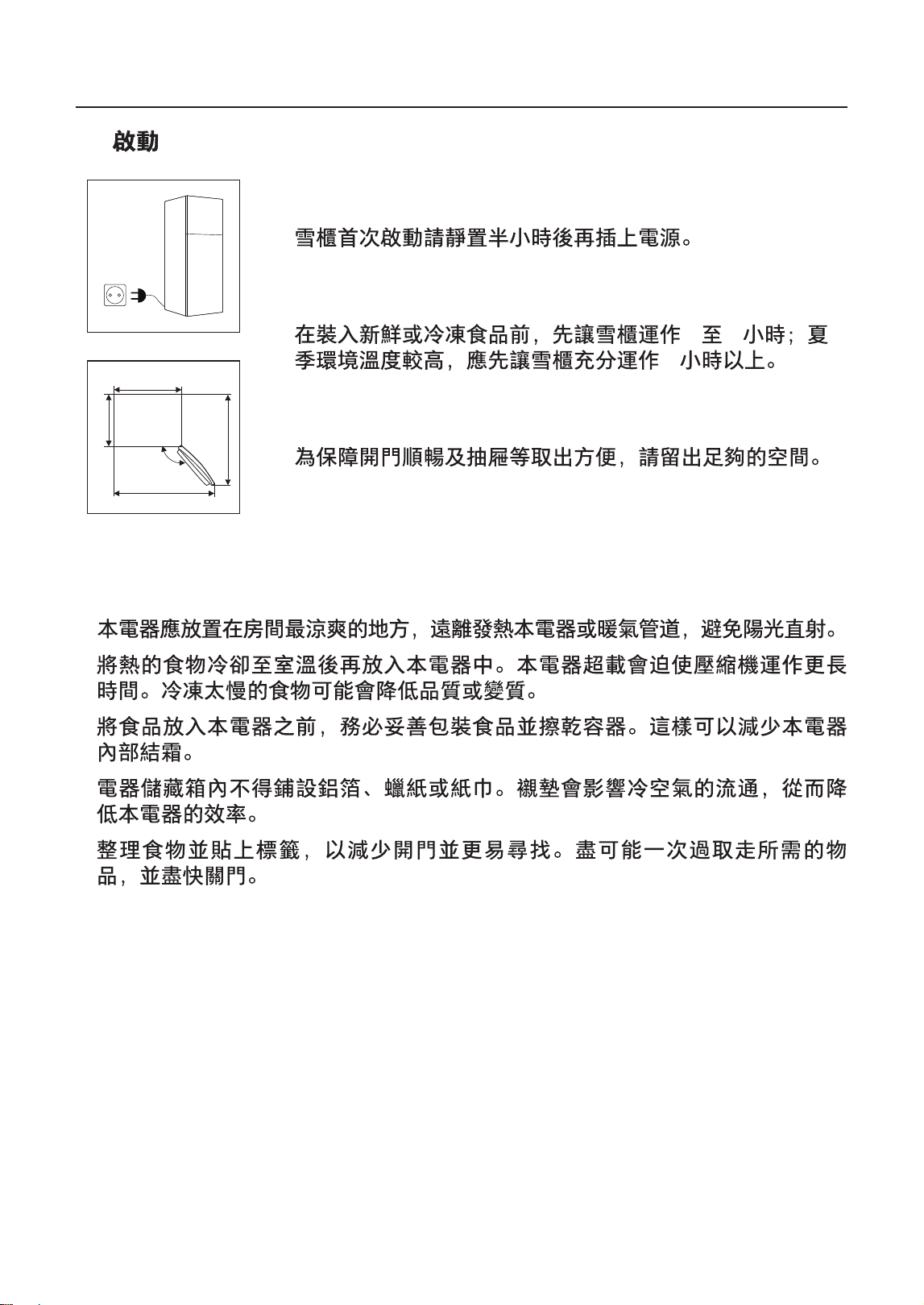
Before putting any fresh or frozen foods, the refrigerator shall have
run for 2-3 hours, or for above 4 hours in summer when the ambient
temperature is high.
Before initial start, keep the refrigerator still for half an hour before
connecting it to power supply.
Spare enough space for convenient opening of the doors and
drawers or statement by the distributor.
The appliance should be located in the coolest area of the room, away from heat producing
appliances or heating ducts, and out of the direct sunlight.
Let hot foods cool to room temperature before placing in the appliance. Overloading the
appliance forces the compressor to run longer. Foods that freeze too slowly may lose quality,
or spoil.
Be sure to wrap foods properly, and wipe containers dry before placing them in the appliance.
This cuts down on frost build-up inside the appliance.
Appliance storage bin should not be lined with aluminum foil, wax paper, or paper toweling.
Organize and label food to reduce door openings and extended searches. Remove as many
ffi
items as needed at one time, and close the door as soon as possible.
2.5Energy saving tips
2.4
716mm
479mm
120°
582mm
953mm
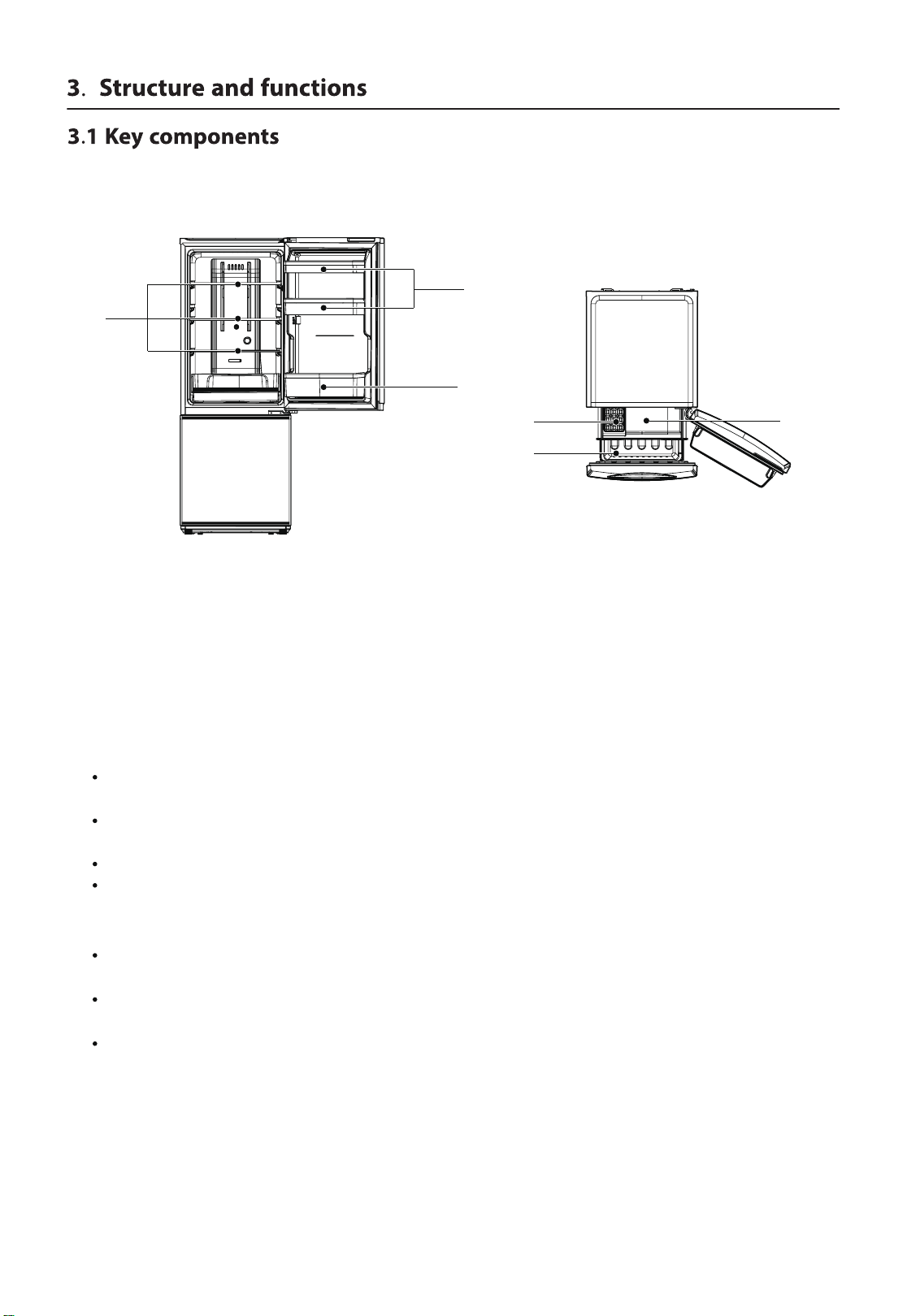
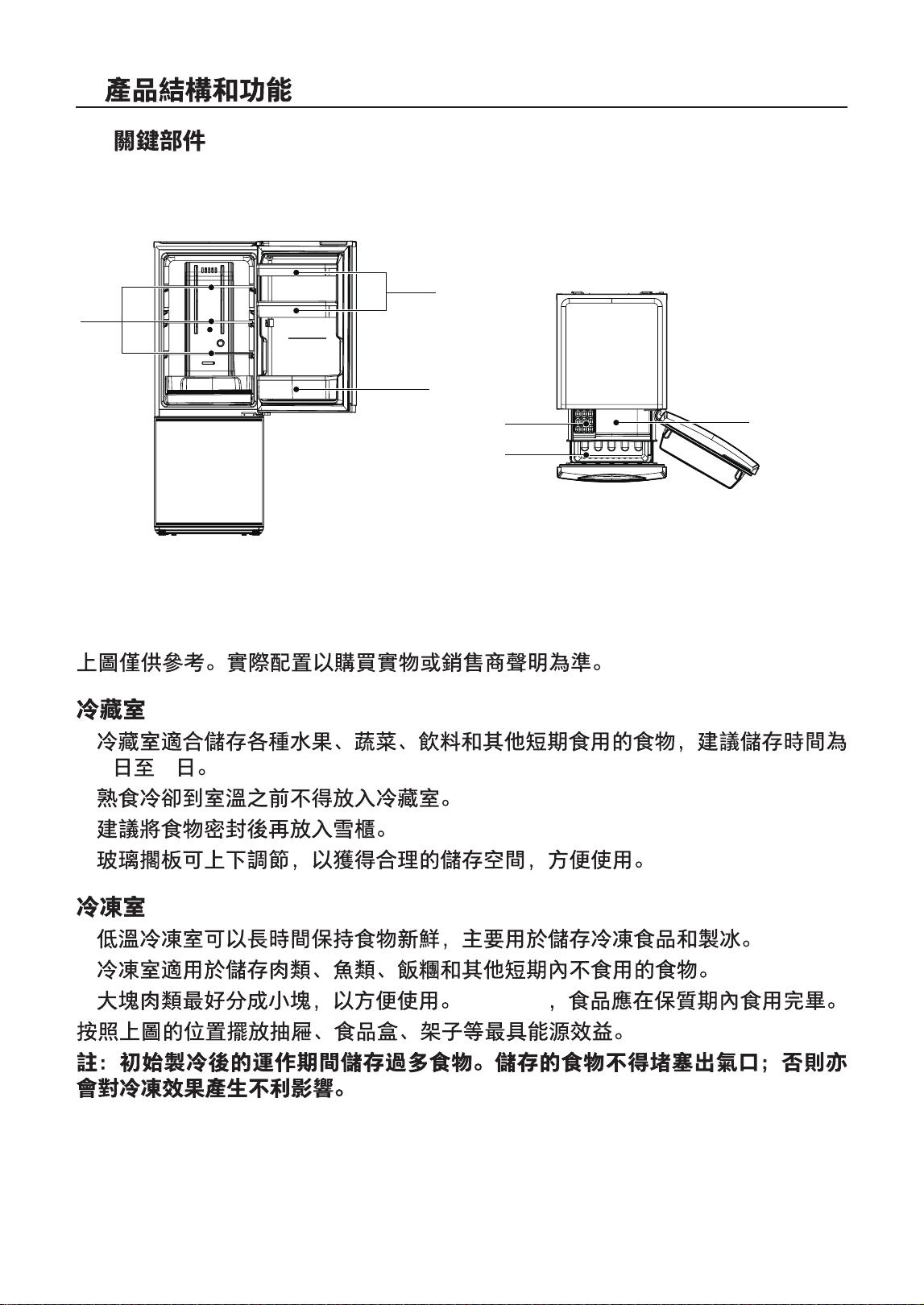
12
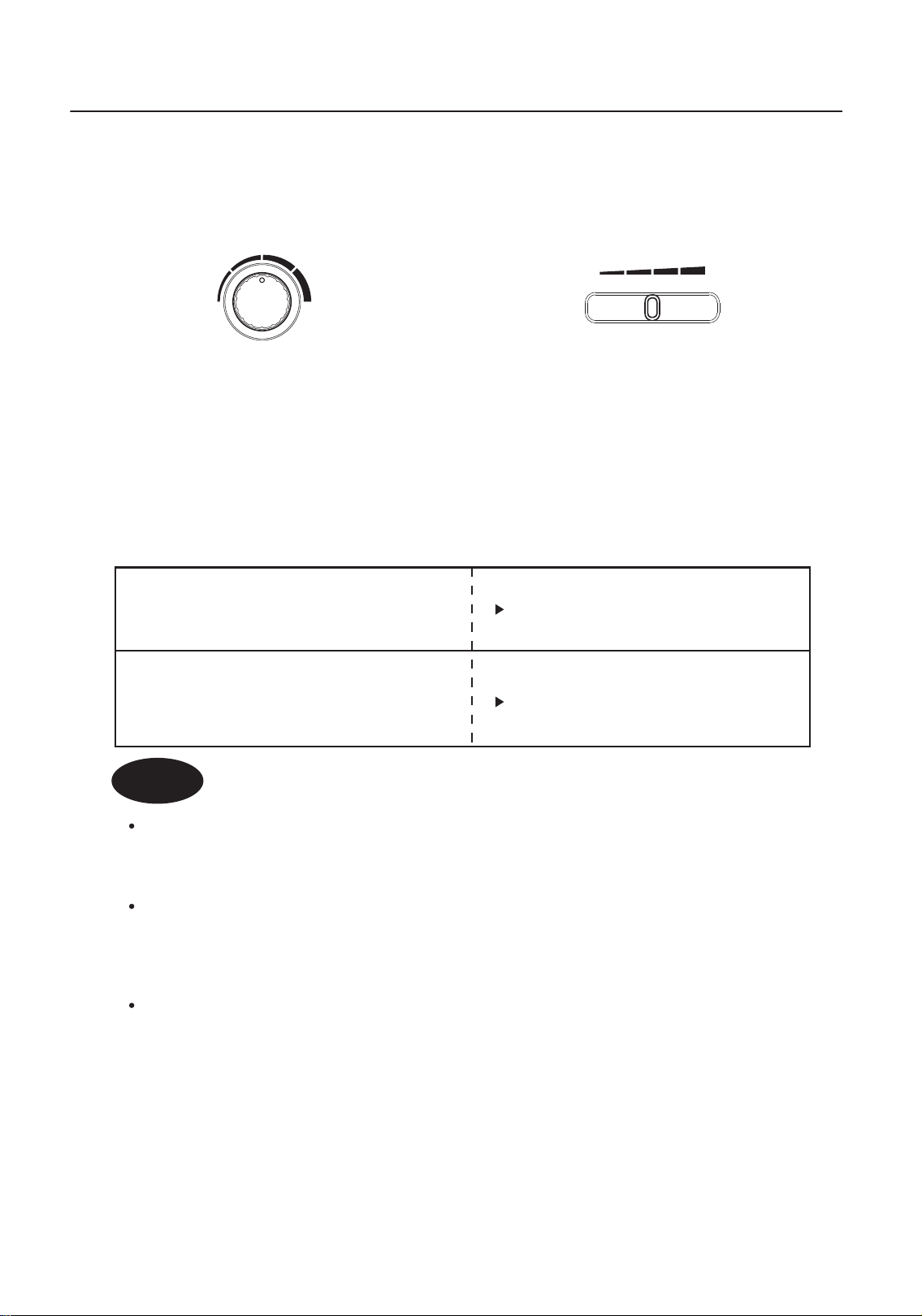
The above pictures are for reference only. The actual configuration is subject to the
purchased item or the declaration from the dealer.
The Refrigerating chamber is suitable for storage of a variety of fruits, vegetables, beverages and
other food consumed in the short term, suggested storage time 3days to 5 days.
Cooking foods shall not be put in the refrigerating chamber until cooled to room
temperature.
Foods are recommended to be sealed up before putting into the refrigerator.
The glass shelves can be adjusted up or down for a reasonable amount of storage space and easy
use.
The low temperature freezing chamber may keep food fresh for a long time and it is mainly used
to store frozen foods and making ice.
consumed in short term.
The freezing chamber is suitable for storage of meat, fish, rice balls and other foods not to be
Chunks of meat are preferably to be divided into small pieces for easy access. Please be noted food
shall be consumed within the shelf time.
energy efficient.
Drawers, food boxes, shelves, etc. placed according to the position in the picture above are the most
Refrigerating chamber
Freezing chamber
Note: Storage of too much food during operation after the initial
refrigerator. Foods stored shall not block the air outlet; or otherwise the
freezing effect will also be adversely affected.
Shelf (upper)
Glass
shelf
Bottle rack
Ice tray
Drawer
Sliding box
13
Please adjust the temperature during winter or summer if cooling is inadequate.
Notications
Setting the temperature of the freezing compartment to the "Strong" position for a
long time will weaken the cooling effect of the refrigeration compartment. Please set
it back to the "Medium" position in summer.
When the cooling effect of freezing compartment is
weak in winter When the ambient temperature is low
(below 10°C), the cooling effect may be insufficient even
if the freezing compartment is set to "strong".
When the refrigeration effect of the refrigeration
compartment is weak in summer When the ambient
temperature is high, the cooling effect may still be
insufficient even if the refrigeration compartment is
set to "strong"
Set the refrigeration compartment to "strong".
Set the freezing compartment to "Medium" or
"Weak"
The overall refrigerating capacity is increased,
and the freezing compartment will become cold.
Freezing compartment Cold air is sent into the
refrigeration compartment to cool it.
Warm
Tips
Refrigeration compartment
Freezing compartment
Weak
Weak
Strong
Strong
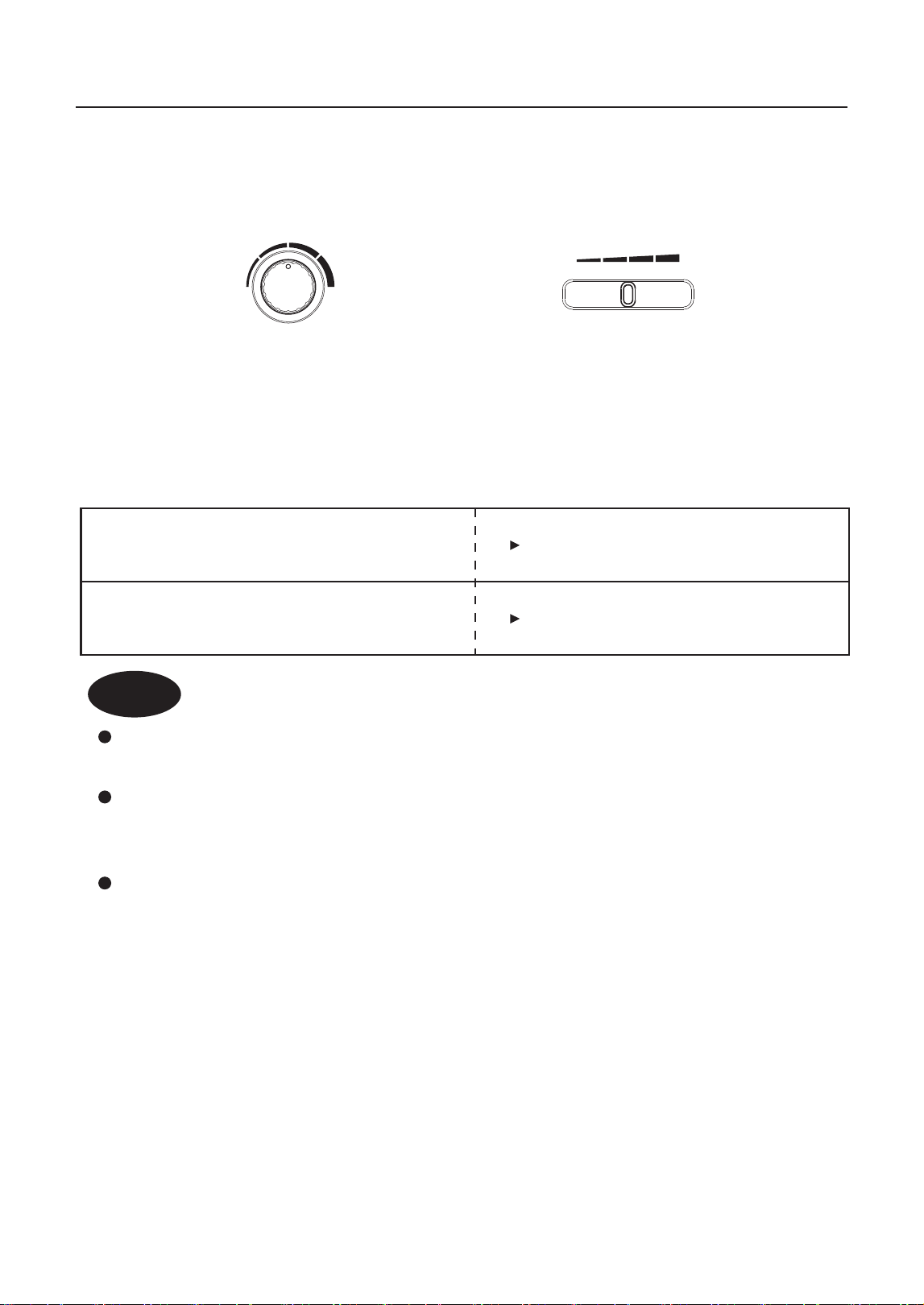
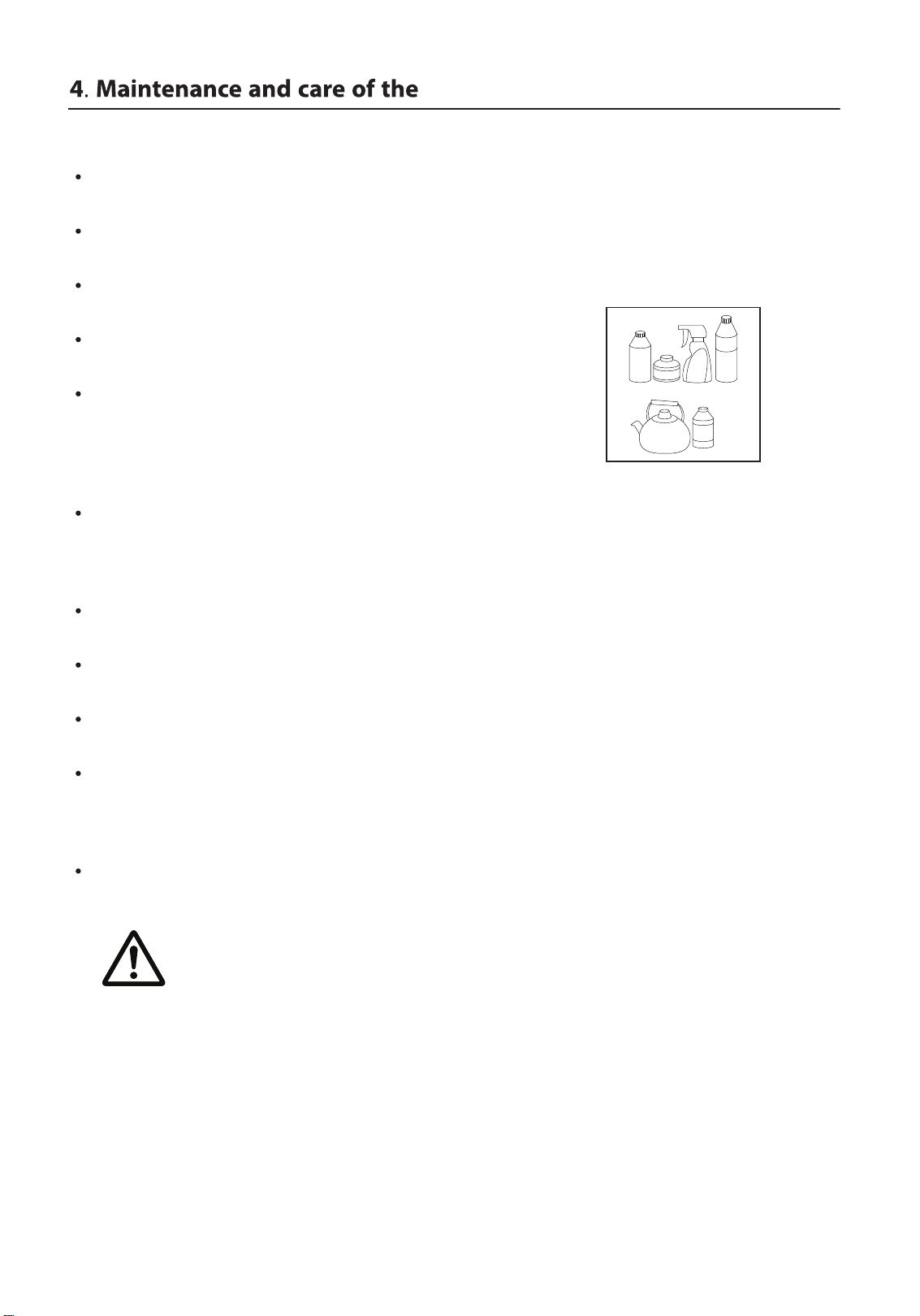
3.2 How to adjust the temperature
Thermostat knob for refrigeration
compartment
Please set it to the "medium (between strong and weak)" position under normal circumstances.
In addition, to increase the cooling effect, switch to the "strong" setting. When the temperature
is too low, adjust it to the "weak" setting.
Freezing compartment thermostat
knob
Be sure to adjust the temperature in case of insufficient cooling. Ice or frozen food will
thaw.
By adjusting the freezing compartment thermostat knob, you can change the ratio of
air volume (cold air) flowing to the freezing and refrigeration compartments. When the
freezing temperature is set to "strong", more air will flow into the freezing compartment;
when it is set to "weak", less air will flow into the refrigeration compartment.
refrigerator
14
Gas
Detergent
Bananaoil
Alcohol
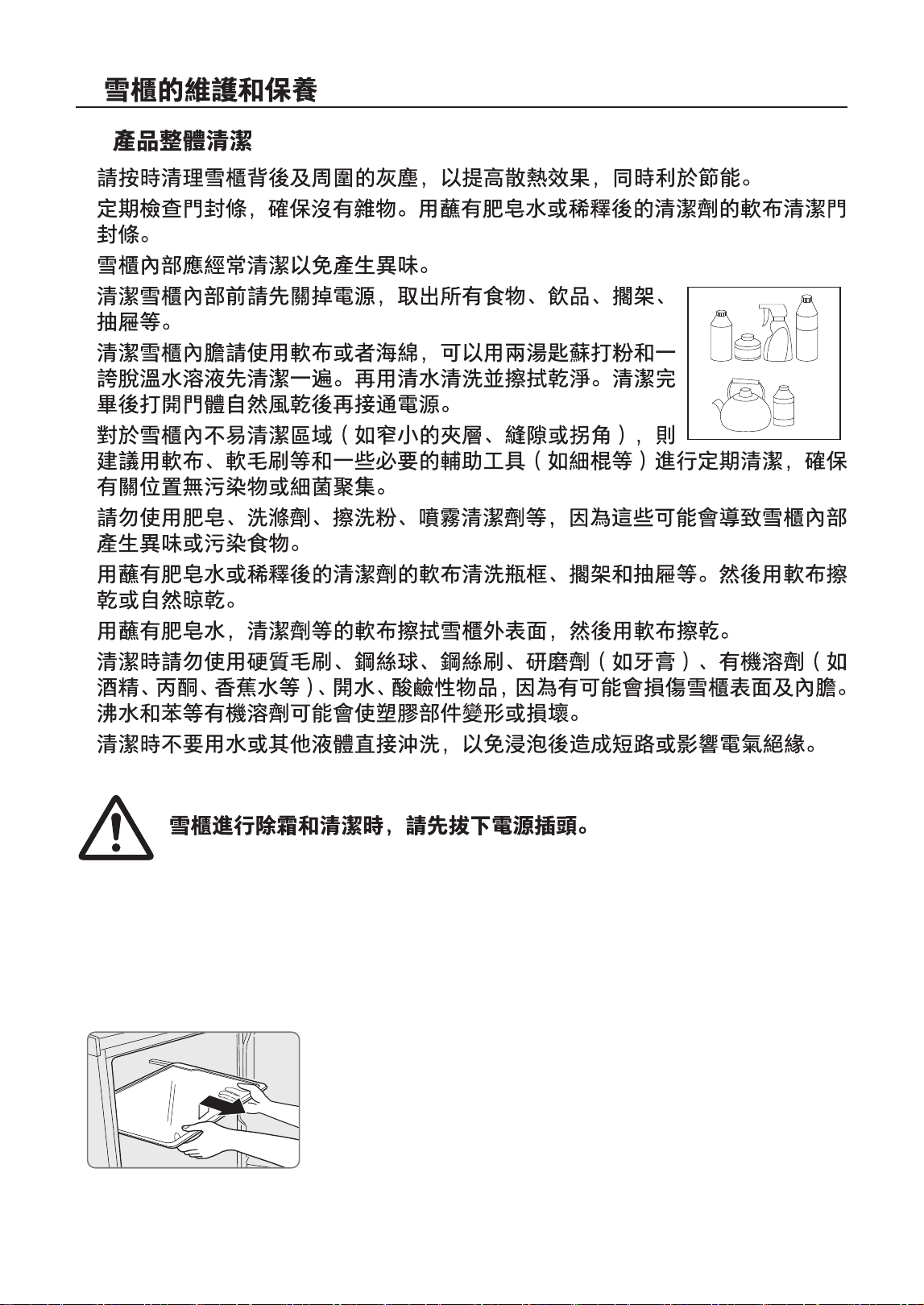
Dusts behind the refrigerator and on the ground shall be timely cleaned to improve the
cooling effect and energy saving.
Check the door gasket regularly to make sure there are no debris. Clean the door gasket with
a soft cloth dampened with soapy water or diluted detergent.
The interior of the refrigerator should be cleaned regularly to
avoid odor.
Please turn off the power before cleaning interior, remove all
foods, drinks, shelves, drawers, etc.
Use a soft cloth or sponge to clean the inside of the
refrigerator, with two tablespoons of baking soda and a quart
of warm water. Then rinse with water and wipe clean. After
cleaning, open the door and let it dry naturally before turning
on the power.
For areas that are difficult to clean in the refrigerator (such as
narrow sandwiches, gaps or corners), it is recommended to wipe them regularly with a soft
rag, soft brush, etc. and when necessary, combined with some auxiliary tools (such as thin
sticks) to ensure no contaminants or bacterial accumulation in these areas.
Do not use soap, detergent, scrub powder, spray cleaner, etc. as these may cause odors in
the interior of the refrigerator or contaminated food.
Clean the bottle frame, shelves and drawers with a soft cloth dampened with soapy water or
diluted detergent. Dry with a soft cloth or dry naturally.
Wipe the outer surface of the refrigerator with a soft cloth dampened with soapy water,
detergent, etc., and then wipe dry.
Do not use hard brushes, clean steel balls, wire brushes, abrasives (such as toothpastes),
organic solvents (such as alcohol, acetone, banana oil, etc.), boiling water, acid or alkaline
items, which may damage the fridge surface and interior. Boiling water and organic solvents
such as benzene may deform or damage plastic parts.
Do not rinse directly with water or other liquids during cleaning to avoid short circuits or
affect electrical Insulation after immersion.
4.1 Overall cleaning
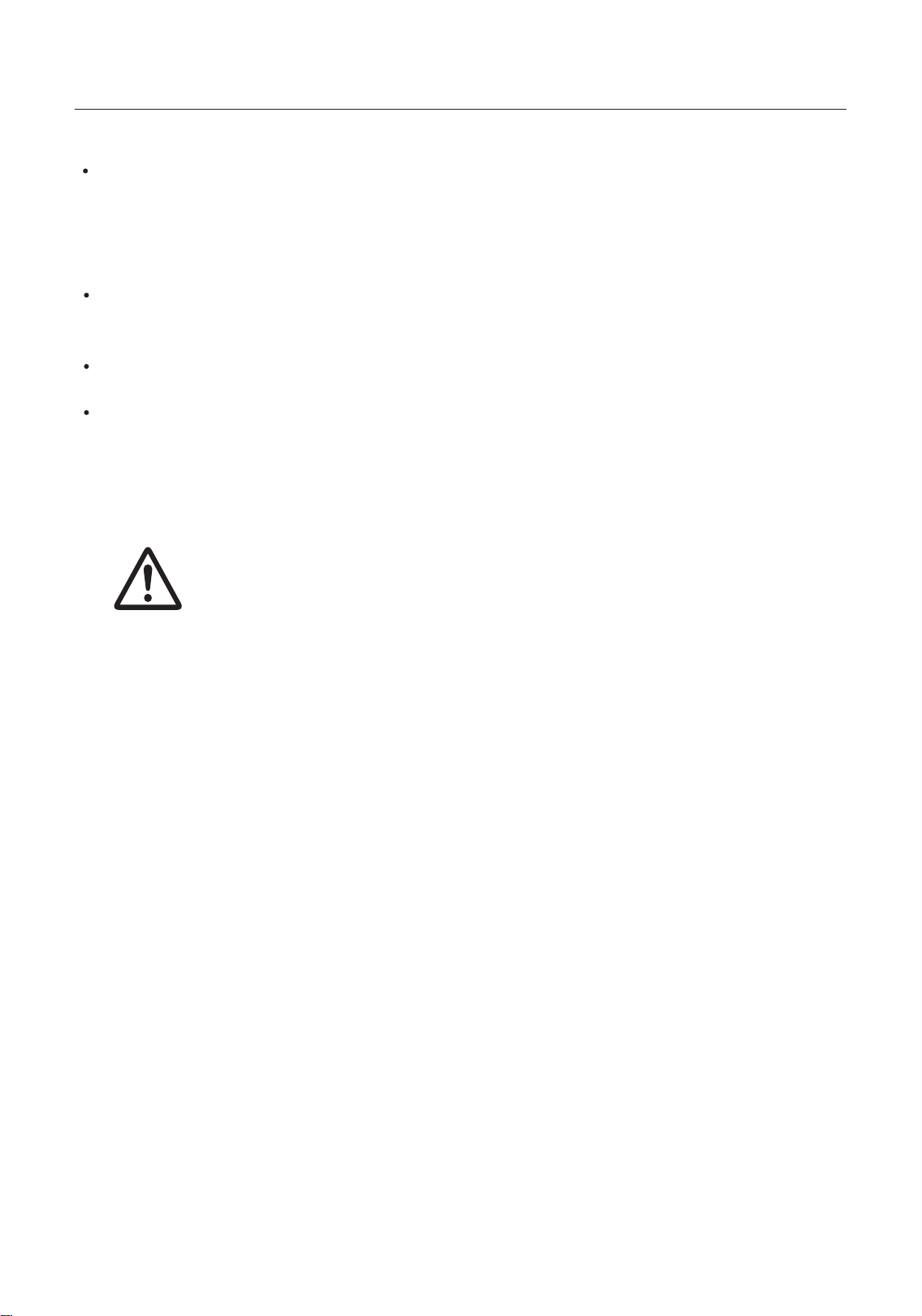
Please unplug the refrigerator for defrost and cleaning.
15
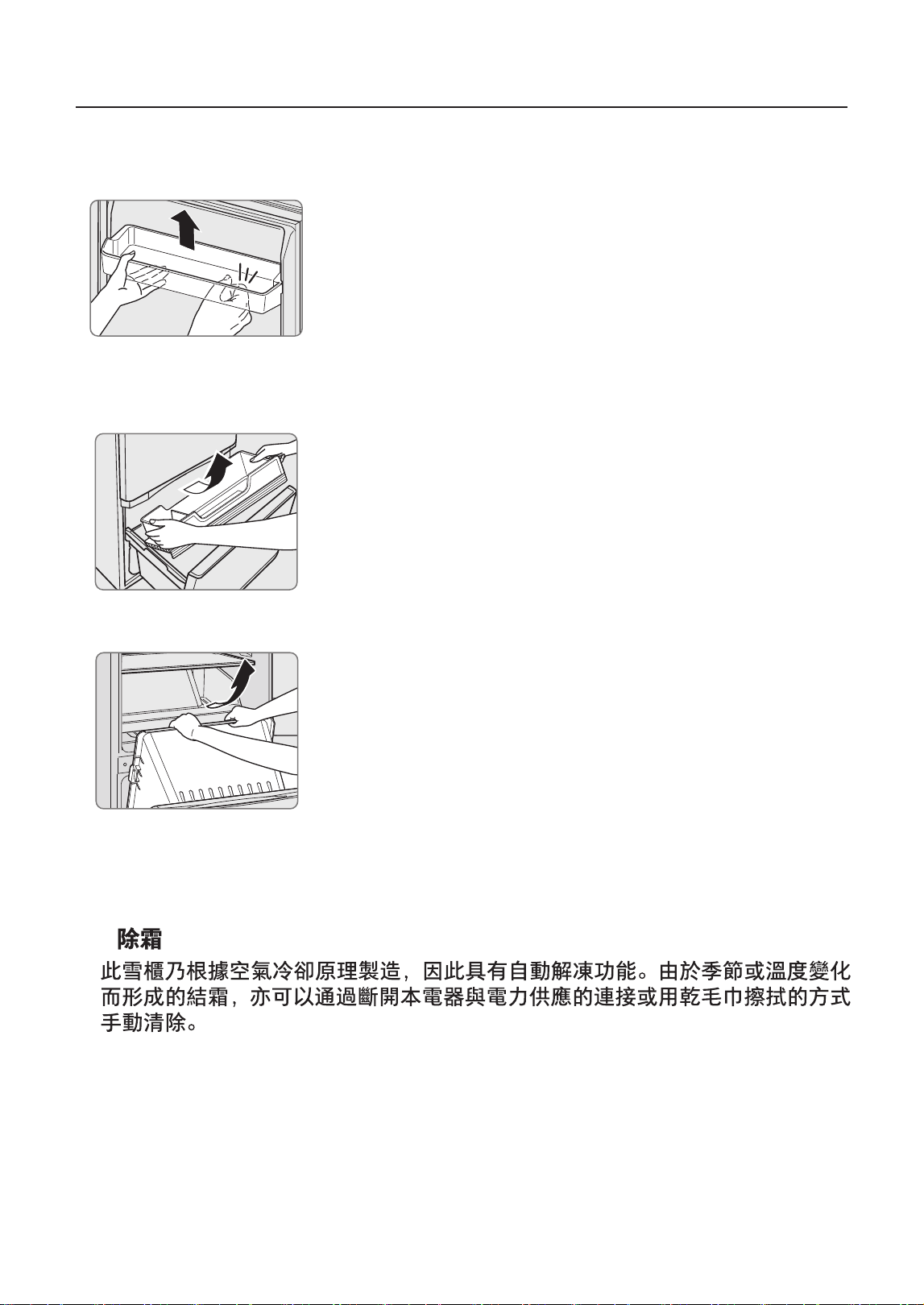
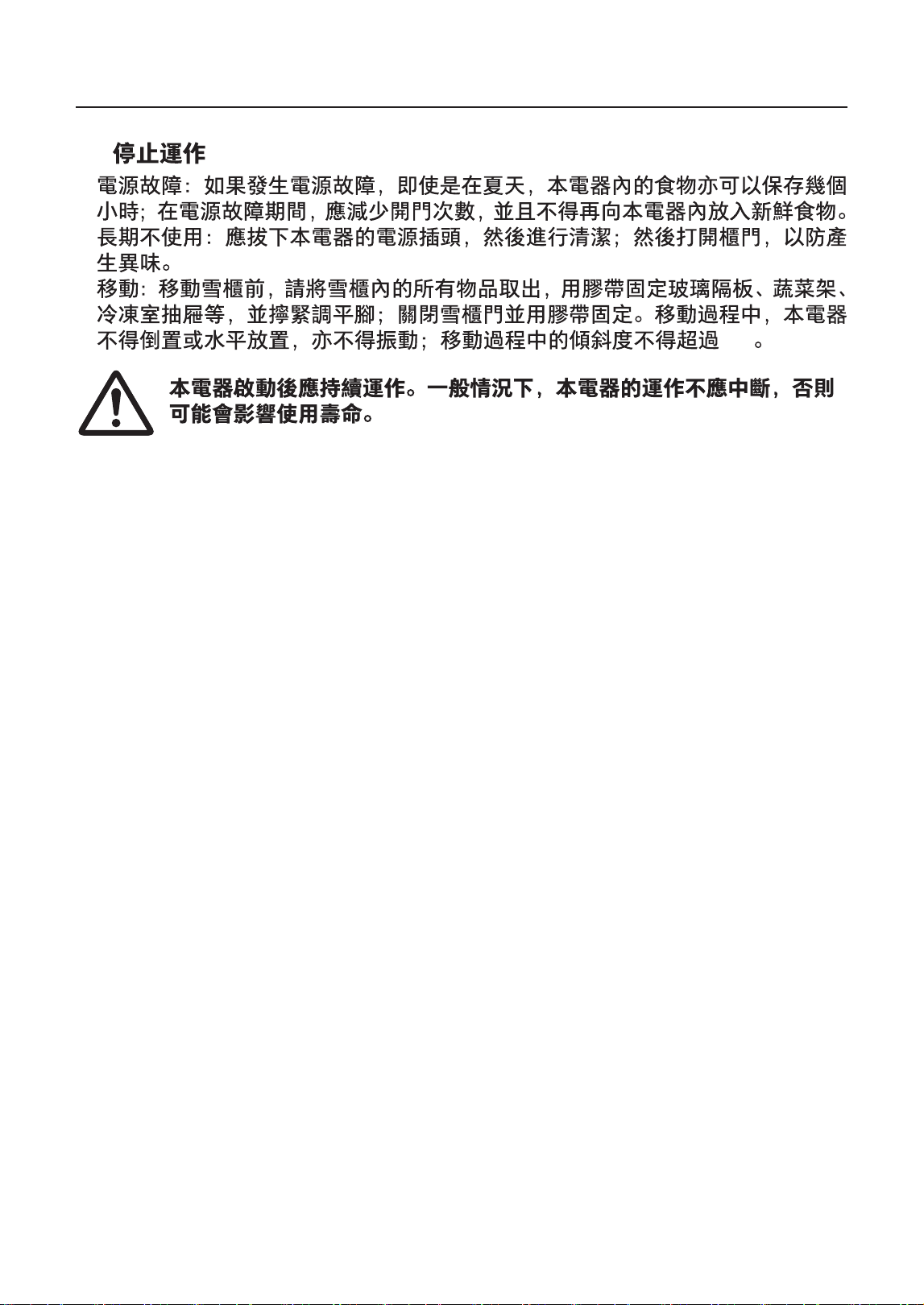
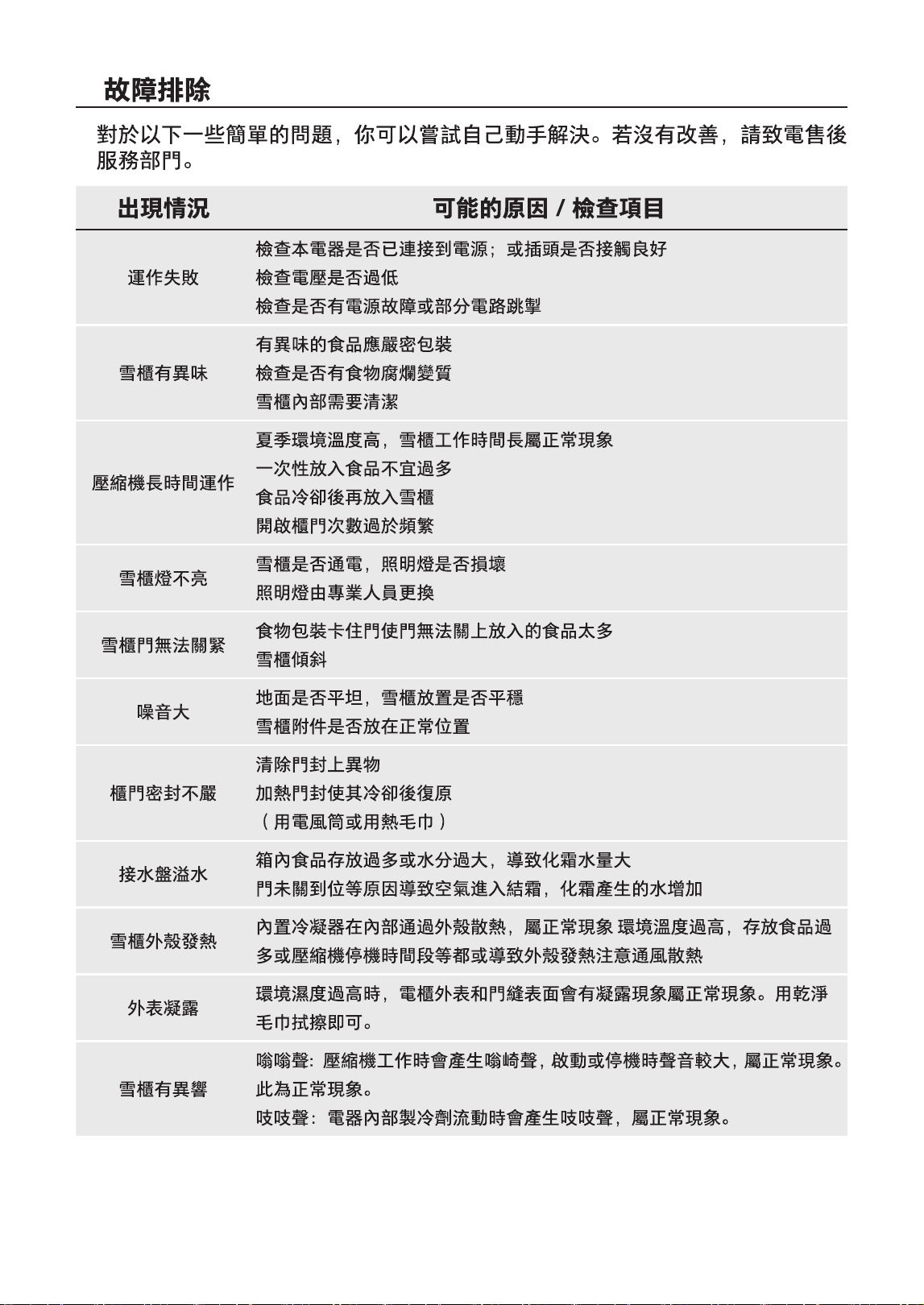
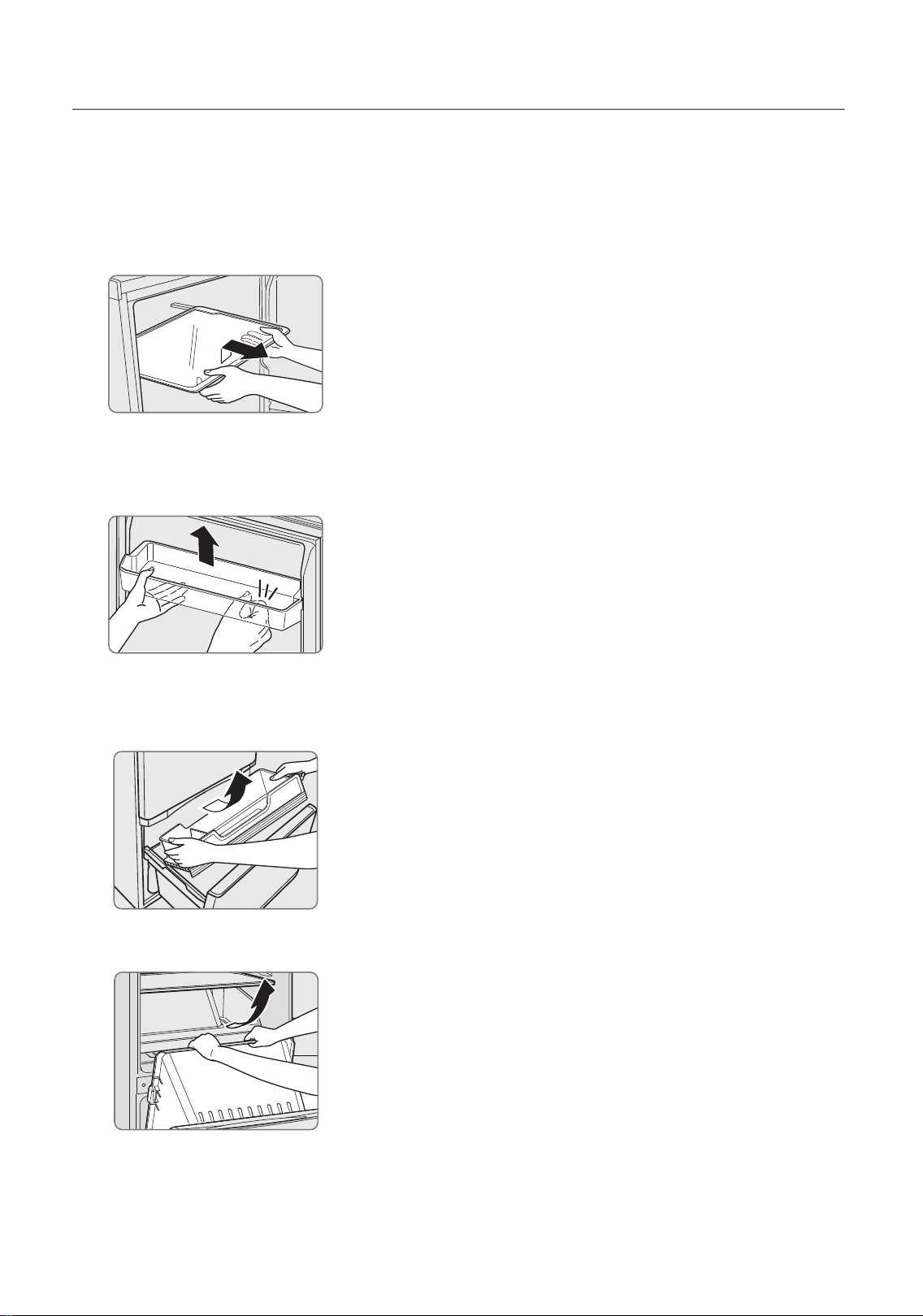
4.2 How to disassemble
(1) Upper shelf Lower shelf
(2) Shelf and bottle rack
(3) Sliding Box/Storage Container
(The installation process is the opposite of the removal process.)
Grasp the front end and lift it up, then pull it out directly.
Always operate with both hands to avoid damage or injury
caused by falling.
Gently push it from below alternately to the left and right for
removal. The installation is relatively firm.
1: Open the freezing compartment door, take out the ice tray,
and then take out the sliding box obliquely upward.
2: Open the refrigeration compartment door and take out the
storage container obliquely upwards.
16
4.3 Defrosting
4.4 Out of operation
The refrigerator is made based on the air-cooling principle and thus has automatic defrosting
function. Frost formed due to change of season or temperature may also be manually removed by
disconnection of the appliance from power supply or by wiping with a dry towel.
Power failure: In case of power failure, even if it is in summer, foods inside the appliance can be
kept for several hours; during the power failure, the times of door opening shall be reduced, and
no more fresh food shall be put into the appliance.
Long-time nonuse: The appliance shall be unplugged and then cleaned; then the doors are left
open to prevent odor.
vegetable holder, freezing chamber drawers and etc. with tape, and tighten the leveling feet; close
the doors and fix them with tape. During moving, the appliance shall not be laid upside down or
Moving: Before the refrigerator is moved, take all objects inside out, fix the glass partitions,
horizontally, or be vibrated; the inclination during movement shall be no more than 45°.
The appliance shall run continuously once it is started.
Generally, the operation of the appliance shall not be
interrupted; otherwise the service life may be impaired.
17
5. Trouble shooting
You may try to solve the following simple problems by yourself. If them cannot be solved,
please contact the after-sales department.
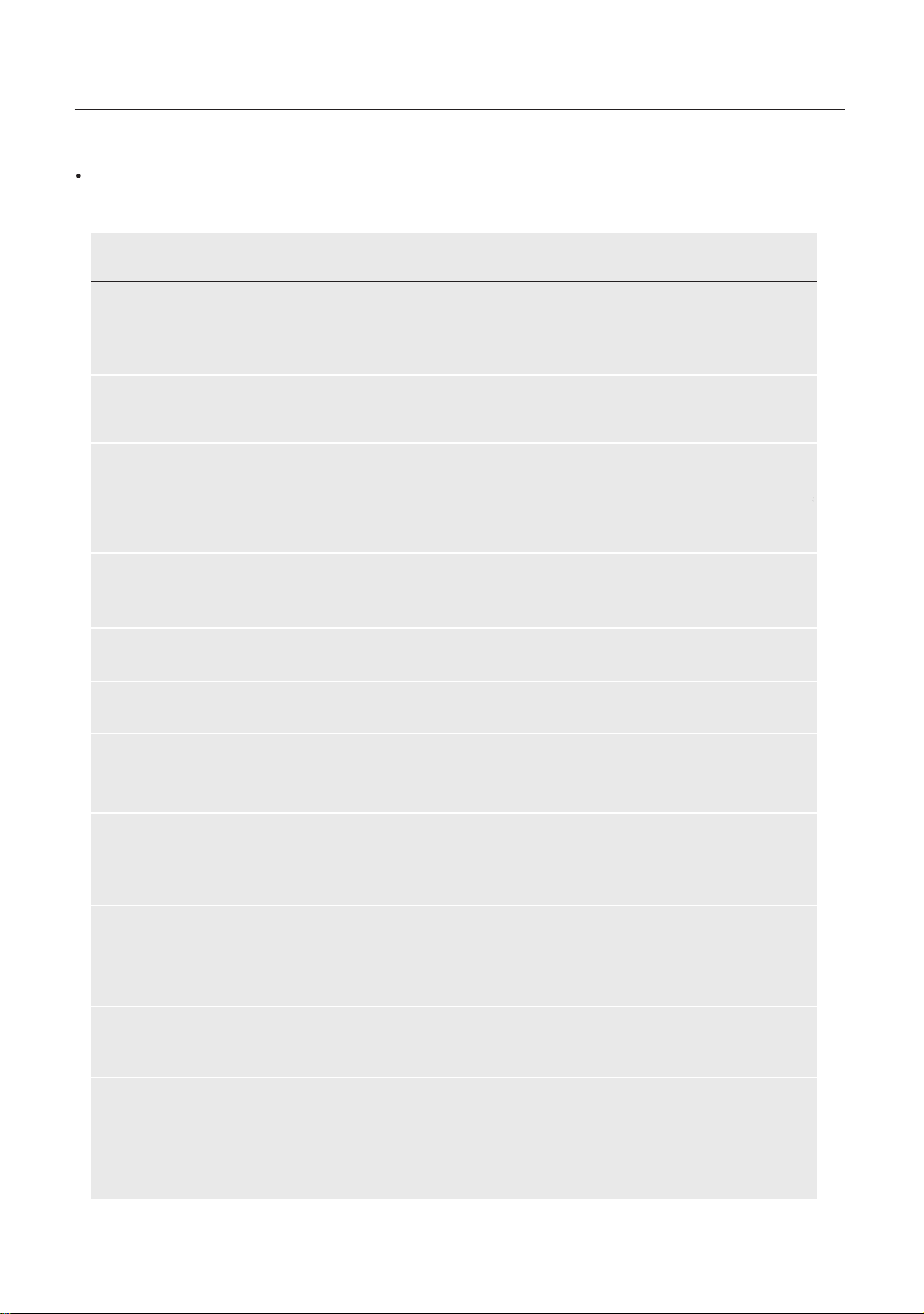
Occurrence
Failed operation
Odor
Light fails to get lit
Loud noise
Water pan overflows
Hot housing
Surface condensation
Abnormal noise
Buzz: The compressor may produce buzzes during operation, and the
buzzes are loud particularly upon start or stop. This is normal.
Creak: Refrigerant flowing inside of the appliance may produce creak,
which is normal
Condensation on the exterior surface and door seals of the refrigerator
is normal when the ambient humidity is too high. Just wipe the condensate
with a clean towel
Heat dissipation of the built-in condenser via the housing, which is normal
When housing becomes hot due to high ambient temperature,
storage of too much food or shutdown of the compressor is shut down,
provide sound ventilation to facilitate heat dissipation
There is too much food in the chamber or food stored contains
too much water,resulting in heavy defrosting
The doors are not closed properly, resulting in frosting due to entry
of air and increased water due to defrosting
Remove foreign matters on the door seal
Heat the door seal and then cool it for restoration
(or blow it with an electrical drier or use a hot towel for heating)
Door seal fails to
be tight
Check whether the floor is level and whether the refrigerator is placed stably
Check whether accessories are placed at proper locations
The door is stuck by food packages Too much food is placed
The refrigerator is tilted
Doors cannot be
properly closed
Check whether the refrigerator is connected to power supply and
whether the illuminating light is damaged
Have the light replaced by a specialist
Long-time operation
of the compressor
Odorous foods shall be tightly wrapped
Check whether there is any rotten food
Clean the inside of the refrigerator
Long operation of the refrigerator is normal in summer
when the ambient temperature is high
It is not suggestible having too much food in the appliance at the
same time
The doors are opened too frequently
Check whether the appliance is connected to power or
whether the plug is in well contact
Check whether the voltage is too low
Check whether there is a power failure or partial circuits have tripped
Possible cause/inspection items
Food shall get cool before being put into the appliance
18
Climate category Ambient temperature (from...to...)
SN +10°C to +32°C
N +16°C to +32°C
ST +16°C to +38°C
T +16°C to +43°C
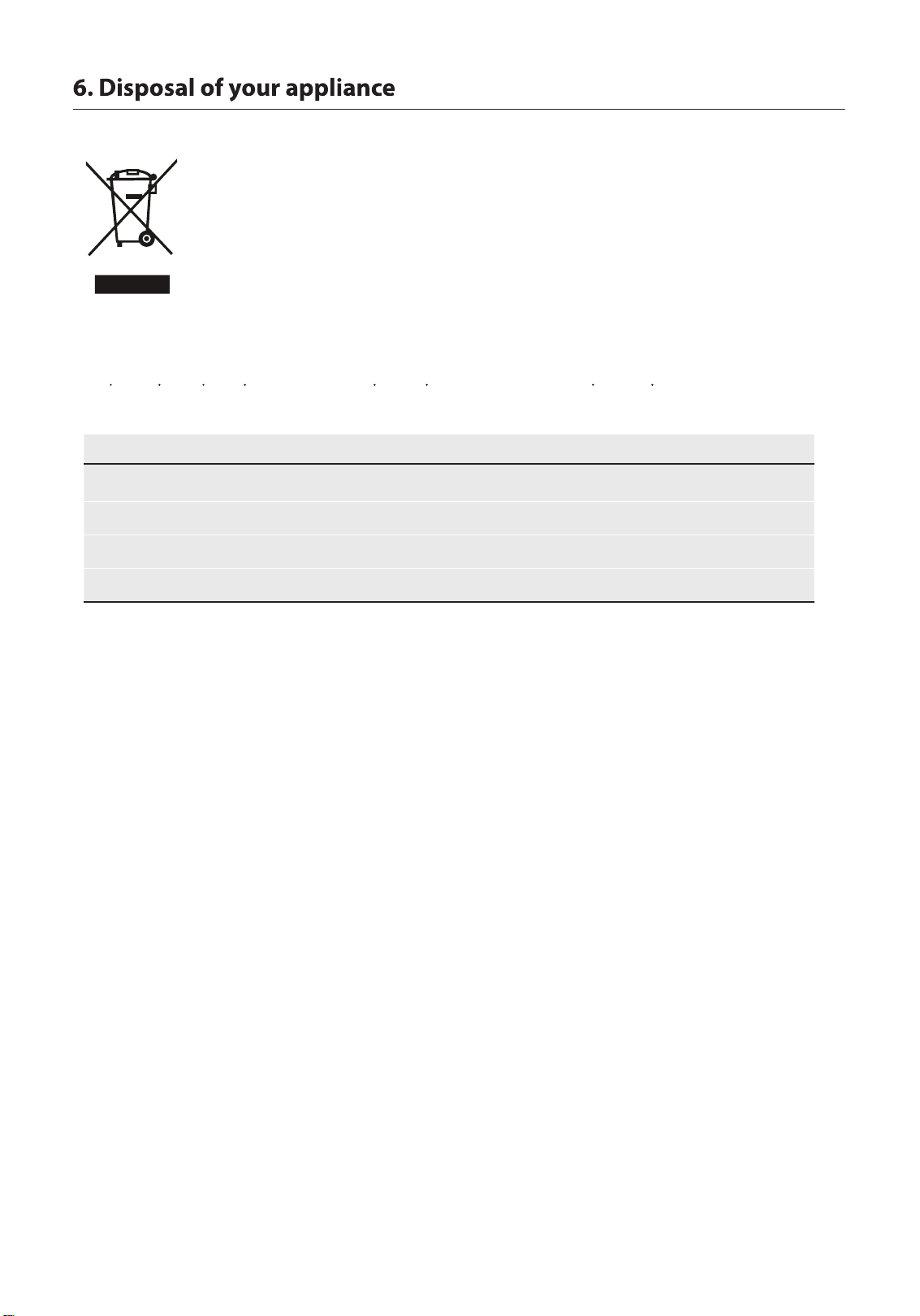
Correct Disposal of this product:
This marking indicates that this product should not be disposed with other
household wastes throughout the EU. To prevent possible harm to the environment
or human health from uncontrolled waste disposal, recycle it responsibly to promote
the sustainable reuse of material resources. To return your used device, please use
the return and collection systems or contact the retailer where the product was
purchased. They can take this product for environmental safe recycling.
AMBIENT TEMPERATURE
the rating plate.
This appliance is designed to operate in ambient temperature specified by its category marked on

Service hotline: 2635 9222
Specifications are subject to change without prior notice.
The patterns on this manual are all diagrams, and the parts
and structures take the actual product as the standard.