IQH3/IQH4 Series
RFID Read/Write Devices
for IDENTControl,
13.56 MHz, ISO 15693
Manual

With regard to the supply of products, the current issue of the following document is applicable:
The General Terms of Delivery for Products and Services of the Electrical Industry, published
by the Central Association of the Electrical Industry (Zentralverband Elektrotechnik und Elek-
troindustrie (ZVEI) e.V.) in its most recent version as well as the supplementary clause:
"Expanded reservation of proprietorship"
Worldwide
Pepperl+Fuchs Group
Lilienthalstr. 200
68307 Mannheim
Germany
Phone: +49 621 776 - 0
E-mail: info@de.pepperl-fuchs.com
North American Headquarters
Pepperl+Fuchs Inc.
8093 Darrow Road
Twinsburg, Ohio 44087
+1 330 425-3555
United States of America
E-mail: [email protected].com
Asia Headquarters
Pepperl+Fuchs Pte. Ltd.
P+F Building
18 Ayer Rajah Crescent
Singapore 139942
Phone: +65 6779-9091
E-mail: [email protected]
https://www.pepperl-fuchs.com

IQH3/IQH4 Series
Contents
2026-05
3
1 Introduction................................................................................................................ 5
1.1 Content of this Document............................................................................. 5
1.2 Target Group, Personnel ............................................................................... 5
1.3 Intended Use .................................................................................................. 5
1.4 Symbols Used ................................................................................................ 6
1.5 Definitions ...................................................................................................... 7
1.6 Terms and Abbreviations .............................................................................. 8
2 Cybersecurity............................................................................................................. 9
3 Certificates and Approvals ..................................................................................... 10
3.1 General .........................................................................................................10
3.2 CE Marking ...................................................................................................10
3.3 FCC Compliance Statement........................................................................ 10
3.4 IC Compliance Statement ........................................................................... 11
3.5 UL Information ............................................................................................. 11
4 Product Description ................................................................................................ 13
4.1 Product Description .................................................................................... 13
4.2 Dimensions...................................................................................................16
4.3 Indicators......................................................................................................18
4.4 Electrical Connection .................................................................................. 18
4.5 Accessories.................................................................................................. 19
4.5.1 IDENTControl ................................................................................................................... 19
4.5.2 RFID Tags......................................................................................................................... 19
4.5.3 Connection Cable............................................................................................................. 19
5 Installation................................................................................................................ 20
5.1 Storage and Transportation ........................................................................ 20
5.2 Unpacking .................................................................................................... 20
5.3 Mounting.......................................................................................................20
5.4 Minimum Distances ..................................................................................... 21
5.5 Main and Secondary Fields ........................................................................ 22
5.6 Ambient Temperature Range ...................................................................... 26

IQH3/IQH4 Series
Contents
2026-05
4
6 Commissioning and Operation...............................................................................27
6.1 Operation via the Communication Interface .............................................27
6.2 13.56 MHz ISO15693 Tags ...........................................................................28
6.3 Sensing Range .............................................................................................29
6.4 Multiple Tags in Sensing Range .................................................................29
6.5 Command Overview ....................................................................................30
6.6 Read/Write Commands................................................................................32
6.7 Configuration Commands...........................................................................94
6.7.1 Parameter Overview ......................................................................................................... 97
6.7.2 Parameters ....................................................................................................................... 99
6.7.3 Parameter Examples....................................................................................................... 109
7 Appendix.................................................................................................................118
7.1 Error and Status Messages ......................................................................118
7.2 ASCII Table..................................................................................................119
IQH3/IQH4 Series
Introduction
2026-05
5
1 Introduction
1.1 Content of this Document
This document contains information that you need in order to use your product throughout the
applicable stages of the product life cycle. These can include the following:
• Product identification
• Delivery, transport, and storage
• Mounting and installation
• Commissioning and operation
• Maintenance and repair
• Troubleshooting
• Dismounting
• Disposal
The documentation consists of the following parts:
• Present document
• Datasheet
Additionally, the following parts may belong to the documentation, if applicable:
• EU-type examination certificate
• EU declaration of conformity
• Attestation of conformity
• Certificates
• Control drawings
• Instruction manual
• Functional safety manual
• Cybersecurity documentation
• Other documents
1.2 Target Group, Personnel
Responsibility for planning, assembly, commissioning, operation, maintenance, and dismount-
ing lies with the plant operator.
Only appropriately trained and qualified personnel may carry out mounting, installation, com-
missioning, operation, maintenance, and dismounting of the product. The personnel must have
read and understood the instruction manual and the further documentation.
Prior to using the product make yourself familiar with it. Read the document carefully.
1.3 Intended Use
Always operate the device as described in these instructions. Only in this way, the safe function
of the device and the connected systems is guaranteed.
The protection of operating personnel and plant is only given if the device is used in accor-
dance with its intended use.
Note
For full information on the product, refer to the further documentation on the Internet at
www.pepperl-fuchs.com.
Note
For specific device information such as the year of construction, scan the QR code
on the device. As an alternative, enter the serial number in the serial number search
at www.pepperl-fuchs.com/device-information.
2026-05
6
IQH3/IQH4 Series
Introduction
1.4 Symbols Used
This document contains symbols for the identification of warning messages and of informative
messages.
Warning Messages
You will find warning messages, whenever dangers may arise from your actions. It is mandatory
that you observe these warning messages for your personal safety and in order to avoid prop-
erty damage.
Depending on the risk level, the warning messages are displayed in descending order as fol-
lows:
Informative Symbols
Action
This symbol indicates a paragraph with instructions. You are prompted to perform an action or
a sequence of actions.
Danger!
This symbol indicates an imminent danger.
Non-observance will result in personal injury or death.
Warning!
This symbol indicates a possible fault or danger.
Non-observance may cause personal injury or serious property damage.
Caution!
This symbol indicates a possible fault.
Non-observance could interrupt the device and any connected systems and plants, or result in
their complete failure.
Note
This symbol brings important information to your attention.
Tip
This symbol brings an useful tip to your attention.
Example
This symbol provides an example of the issue described.
IQH3/IQH4 Series
Introduction
2026-05
7
1.5 Definitions
The data representation format varies in the following documentation. The following formats are
used:
ASCII
Example: "A"; "B"; "1"; "2"
An ASCII character corresponds to one byte. 2
8
= 256 different characters can be represented.
Binary
Example: 1001
bin
Binary numbers are indicated by the suffix
bin
.
DECIMAL
Example: 1234
Decimal numbers are shown without any additional notation.
HEX
Example: 16#41; 16#42; 16#31; 16#32
The hexadecimal representation of a byte consists of two digits (e.g., 16#41). The left portion is
the high-order nibble (16#4x). The right portion is the low-order nibble (16#x1). The value
range extends from 16#00 to 16#FF.
Note
In the TIA Portal from Siemens, hexadecimal numbers are displayed as follows:
Example:
16#00 (equivalent to 0x00)

2026-05
8
IQH3/IQH4 Series
Introduction
1.6 Terms and Abbreviations
Terms
Abbreviations
Tag Mobile data carrier containing user data and a unique number
Fixed code Unique and unalterable number of a tag
IDENTControI RFID evaluation unit from Pepperl+Fuchs; interface to the higher-level con-
troller; controls communication of the connected read/write devices
IQC Pepperl+Fuchs-specific designation of tags with 13.56 MHz
ISO/IEC 15693 Standard for data transmission for a 13.56 MHz RFID system
Tag Read/write tag; tag
AFI Identifier for the application family; represents the application type that is
replaced by the tag; enables only the relevant ones to be addressed from a
variety of tags
DSFI Identifier for the data format; indicates how the data is structured in the tag
memory
AFI Application Family Identifier
FCC Federal Communications Commission
HF High Frequency
IC Industry Canada
ISO International Standardisation Organisation
RFID Radio Frequency Identification
RSSI Received Signal Strength Indicator
PLC Programmable Logic Controller
UID Unique Item Identifier
DSFID Data Storage Format Identifier

IQH3/IQH4 Series
Cybersecurity
2026-05
9
2 Cybersecurity
The device is secure developed according to IEC 62443-4-1 for the application area
defined here.
To ensure cybersecure operation and to protect the device, implement the following measures.
Security Context
The RFID read/write device is intended for operation on an IDENTControl RFID evaluation unit
from Pepperl+Fuchs.
The Communication is realized via a proprietary, unencrypted, serial protocol.
No physical protection against unauthorized access is required.
Maintenance and Management
Check the website regularly for security advisories publications: https://www.pepperl-
fuchs.com/cybersecurity.
Report incidents to the manufacturer.
Decommissioning
Reset the device to factory setting.
The device stores certain operating data permanently.
2026-05
10
IQH3/IQH4 Series
Certificates and Approvals
3 Certificates and Approvals
3.1 General
This manual applies to several types and variants of the device. The applicable approvals can
be found in the relevant data sheet for your device. Further approvals are available on request.
3.2 CE Marking
This product was developed and manufactured in line with the applicable European standards
and directives.
3.3 FCC Compliance Statement
This device complies with Part 15 of the FCC Rules. Operation is subject to the following two
conditions:
1. This device may not cause harmful interference, and
2. This device must accept any interference received, including interference that may cause
undesired operation.
Attention:
Changes or modifications not expressly approved by the party responsible for compliance
could void the user's authority to operate the equipment.
To comply with FCC Part 15 rules in the United States, the system must be professionally
installed to ensure compliance with the Part 15 certification. It is the responsibility of the opera-
tor and professional installer to ensure that only certified systems are deployed in the United
States. The use of the system in any other combination (such as co-located antennas transmit-
ting the same information) is expressly forbidden.
To comply with FCC RF exposure compliance requirements, the antennas used for this trans-
mitter must be installed to provide a minimum separation distance from all persons as specified
in the table below and must not be co-located or operated in conjunction with any other
antenna or transmitter.
Note
A Declaration of Conformity can be requested from the manufacturer or downloaded from
www.pepperl-fuchs.com.
Note
This equipment has been tested and found to comply with the limits for a Class A digital device,
pursuant to Part 15 of the FCC Rules. These limits are designed to provide reasonable
protection against harmful interference when the equipment is operated in a commercial
environment. This equipment generates, uses, and can radiate radio frequency energy and, if
not installed and used in accordance with the instruction manual, may cause harmful
interference to radio communications. Operation of this equipment in a residential area is likely
to cause harmful interference, in which case the user will be required to correct the interference
at their own expense.
Type/Design Minimum separation distance
IQH3-*-V1 20 cm
IQH4-*-V1 20 cm
IQH3/IQH4 Series
Certificates and Approvals
2026-05
11
3.4 IC Compliance Statement
This device contains license-exempt transmitter(s)/receiver(s) that comply with Innovation, Sci-
ence and Economic Development Canada’s license-exempt RSS(s). Operation is subject to
the following two conditions:
1. This device may not cause interference.
2. This device must accept any interference, including interference that may cause unde-
sired operation of the device.
L’émetteur/récepteur exempt de licence contenu dans le présent appareil est conforme aux
CNR d’Innovation, Sciences et Développement économique Canada applicables aux appar-
eils radio exempts de licence. L'exploitation est autorisée aux deux conditions suivantes:
1. L'appareil ne doit pas produire de brouillage.
2. L'appareil doit accepter tout brouillage radioélectrique subi, même si le brouillage est sus-
ceptible d'en compromettre le fonctionnement.
To comply with IC RF exposure compliance requirements, the antennas used for this transmit-
ter must be installed to provide a minimum separation distance from all persons as specified in
the table below and must not be co-located or operated in conjunction with any other antenna
or transmitter.
3.5 UL Information
IQH3 Series
This device is for indoor use only.
This device may be operated at altitudes of up to 5000 m.
The ambient temperature range is -20 °C ... +70 °C for operation with non-transmission peri-
ods, or -25 °C … +55 °C for continuous transmission mode. The pollution degree is 2.
The maximum relative humidity is 80 % at temperatures up to 31 °C, decreasing linearly to 50
% relative humidity at 40 °C.
Nominal power supply voltage is 24 V
DC
, voltage range is 20 V … 30 V
DC
. The supply must be
an LEC (Limited Energy Circuit), LPS (Limited Power Source), or Class 2. Overvoltage
Category II applies. This is ensured when a Pepperl+Fuchs IDENTControl control interface is
used.
Degree of protection (IP67) is not included in the UL approval. The degree of protection is
tested by Pepperl+Fuchs SE.
The enclosure type is 1.
The products are intended for use in or with industrial machinery applications as defined in the
Electrical Standard for Industrial Machinery, NFPA 79.
External circuits intended to be connected to this unit must be galvanically isolated from the
mains supply or hazardous live voltages by reinforced or double insulation and must meet the
limits of Clauses 6.3 and 9.4 of UL 61010-1.
Type/Design Minimum separation distance
IQH3-*-V1 20 cm
IQH4-*-V1 20 cm
Caution!
Connection cable specifications
The maximum permissible temperature of the connection cable must be at least +70 °C. The
minimum diameter of the connection cable must be 22 AWG or 0.34 mm
2
.

2026-05
12
IQH3/IQH4 Series
Certificates and Approvals
IQH4 Series
The ambient temperature range is -25 °C ... +70 °C for operation with non-transmission peri-
ods.
Nominal power supply voltage is 24 V
DC
, voltage range is 18 V … 30 V
DC
. The supply must be
CLASS 2.
Degree of protection (IP67) is not included in the UL approval. The degree of protection is
tested by Pepperl+Fuchs SE.
Caution!
Connection cable specifications
The device must be connected exclusively using any R/C cord (type CYJV/7 or CYJV2/8) with
appropriate ratings.
IQH3/IQH4 Series
Product Description
2026-05
13
4 Product Description
4.1 Product Description
Functions
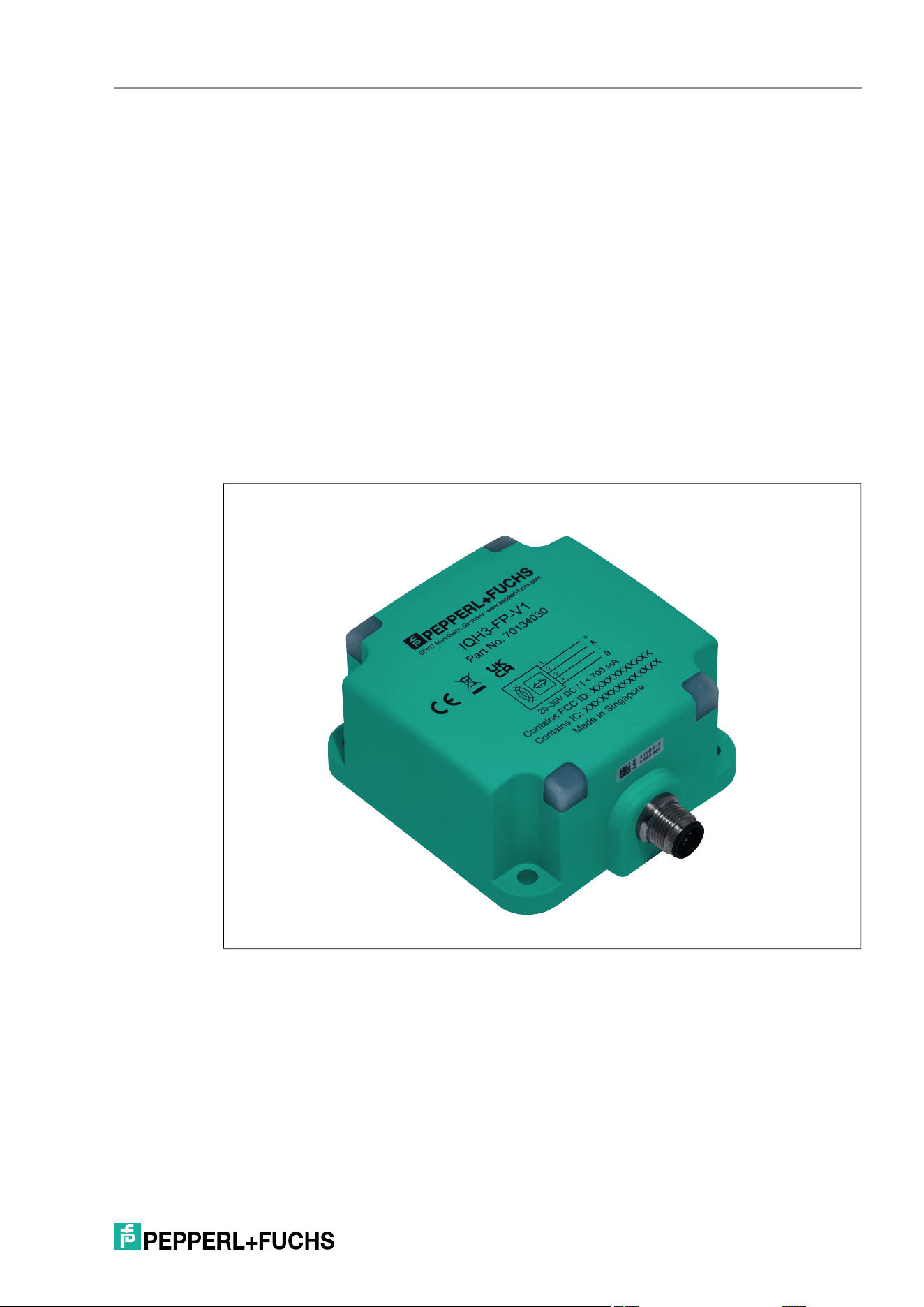
The IQH3/IQH4 series read/write devices are designed for reading and writing passive tags in
the frequency range of 13.56 MHz. Tags complying with the ISO 15693 standard are sup-
ported. The read/write devices are connected to an IDENTControl evaluation unit using an inte-
grated M12 plug.
Use and Application
The IQH3 series read/write device has an extended sensing range of up to 30 cm and is there-
fore especially suitable for applications in which tags must be reliably identified at greater dis-
tance or at higher passing speed.
IQH4 series read/write devices are available in different housing designs and have a sensing
range of up to 25 cm, depending on the design. This makes them suitable for applications with
limited installation space, for example.
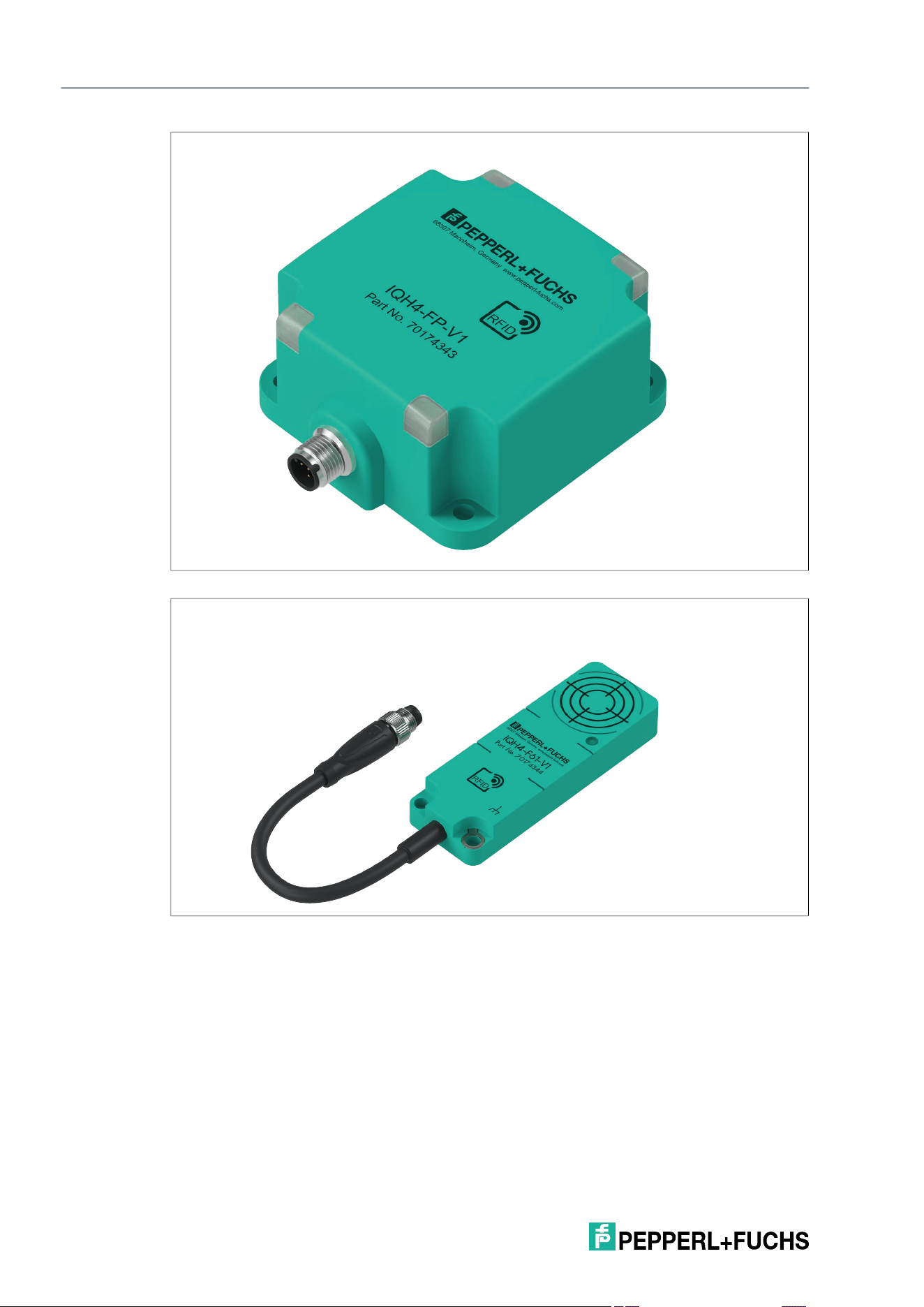
Figure 4.1 IQH3-FP-V1
2026-05
14
IQH3/IQH4 Series
Product Description
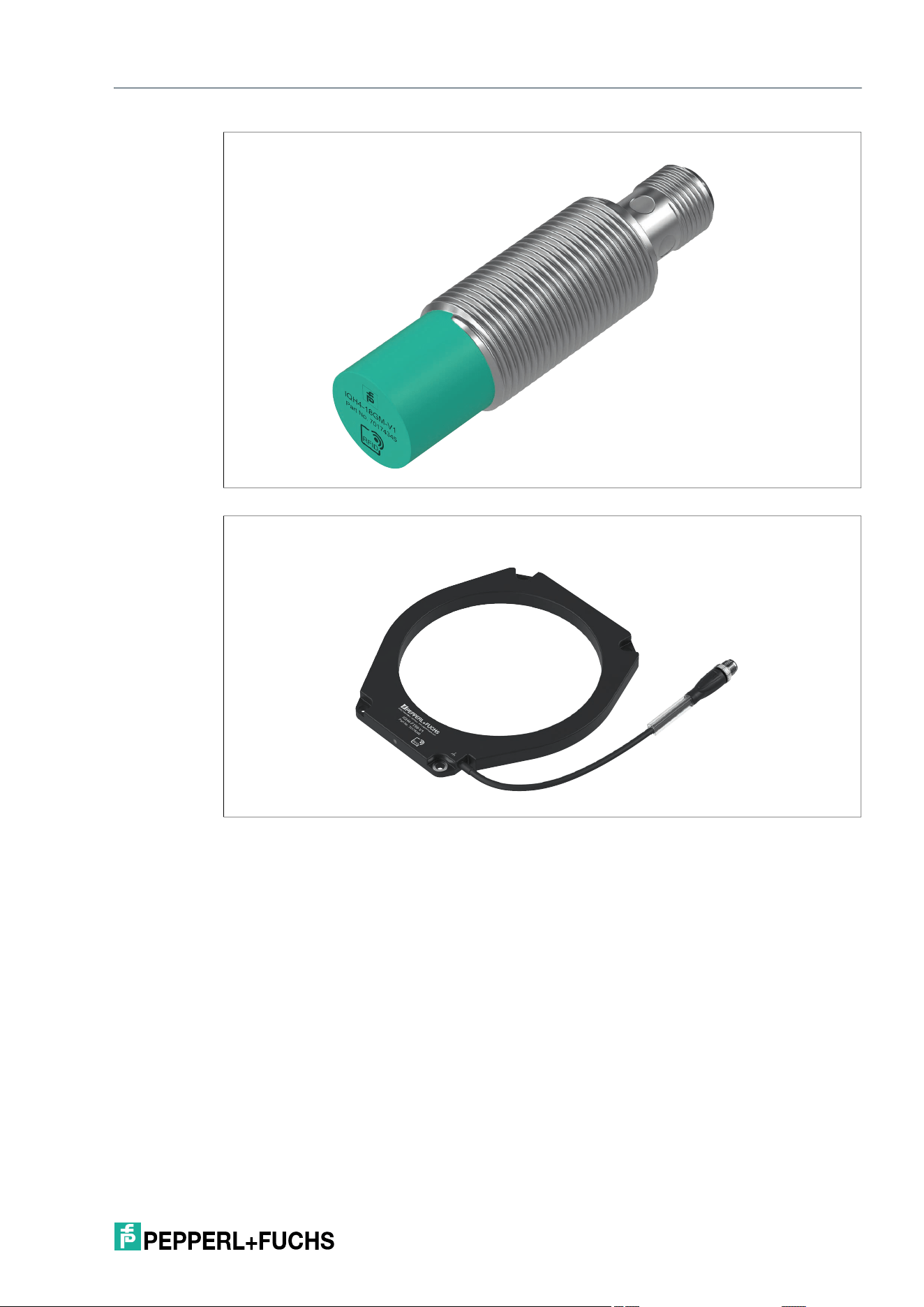
Figure 4.2 IQH4-FP-V1
Figure 4.3 IQH4-F61-V1
IQH3/IQH4 Series
Product Description
2026-05
15
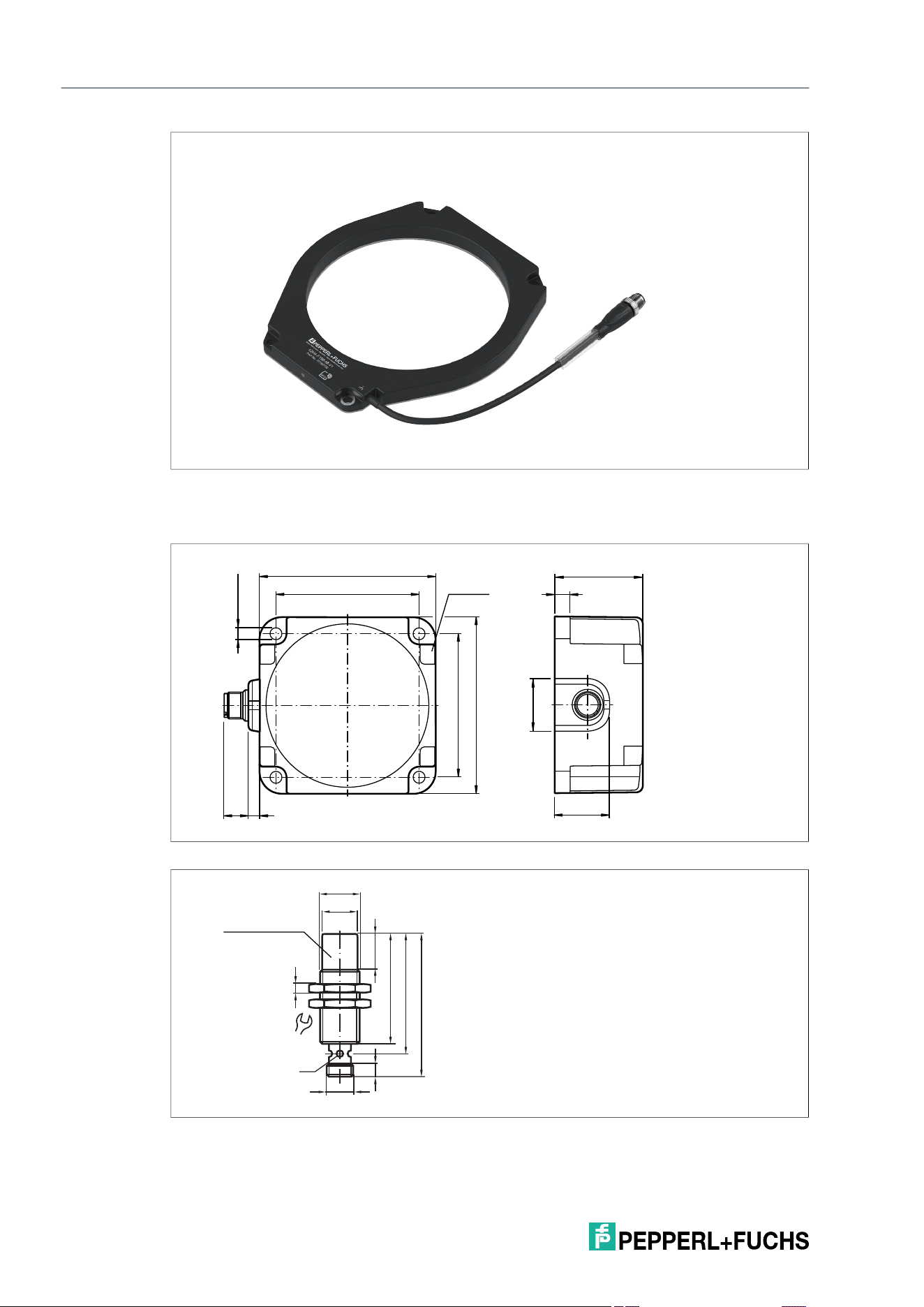
Figure 4.4 IQH4-18GM-V1
Figure 4.5 IQH4-F198-V1
2026-05
16
IQH3/IQH4 Series
Product Description
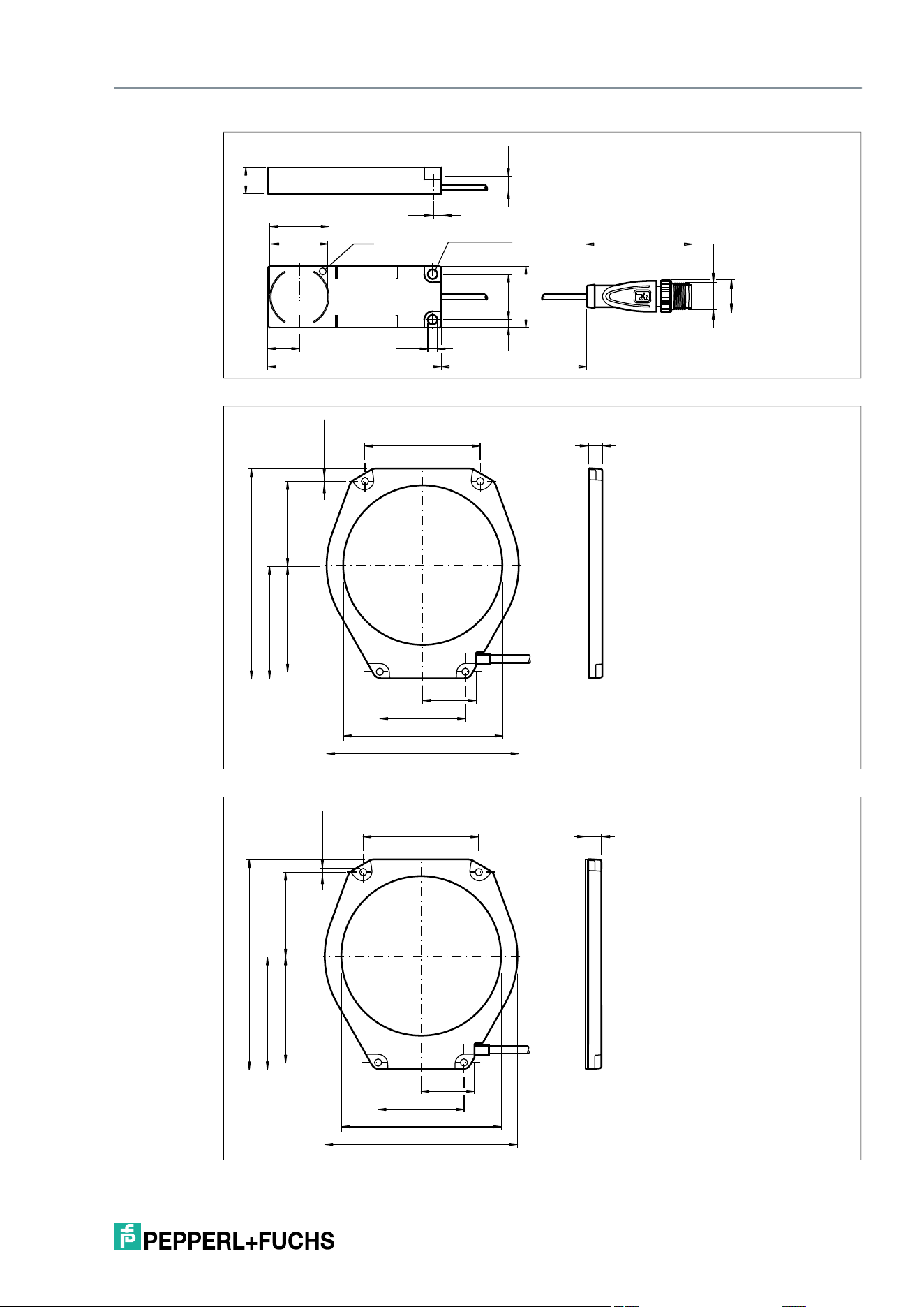
Figure 4.6 IQH4-F198-M-V1
4.2 Dimensions
Figure 4.7 IQH3-FP-V1 / IQH4-FP-V1
Figure 4.8 IQH4-18GM-V1
65
LED (4x)
80
65
80
7
40
23.76
ø 5.4 (4x)
24.93
12 5
Metallfreie Zone
50
55
66
4
M18 x 1
16
M12 x 1
24
6
LED
16.4
IQH3/IQH4 Series
Product Description
2026-05
17
Figure 4.9 IQH4-F61-V1
Figure 4.10 IQH4-F198-V1
Figure 4.11 IQH4-F198-M-V1
Erdanschluss
L
M12 x 1
48.2
ø 27
ø 26 LED
14
28
12
6.55
20.83.6
80
ø 4.4
3.6
14.8
105
78
ø 145
175
ø 6.6 (4x)
48.5
96.5
76.5
102.5
190.5
12
105
78
ø 145
175
ø 6.6 (4x)
48.5
96.5
76.5
102.5
190.5
14
2026-05
18
IQH3/IQH4 Series
Product Description
4.3 Indicators
IQH3 Series LEDs
The IQH3-FP-V1 RFID read/write device has four LEDs for indicating the operating state. The
various indicators denote:
IQH4 Series LEDs
The IQH4-18GM-V1, IQH4-F61-V1, IQH4-F198-V1, and IQH4-F198-M-V1 RFID read/write
devices have a dual LED for indicating the operating state. The IQH4-FP-V1 read/write device
has four LEDs, with two identical LEDs arranged diagonally on the device. The various indica-
tors denote:
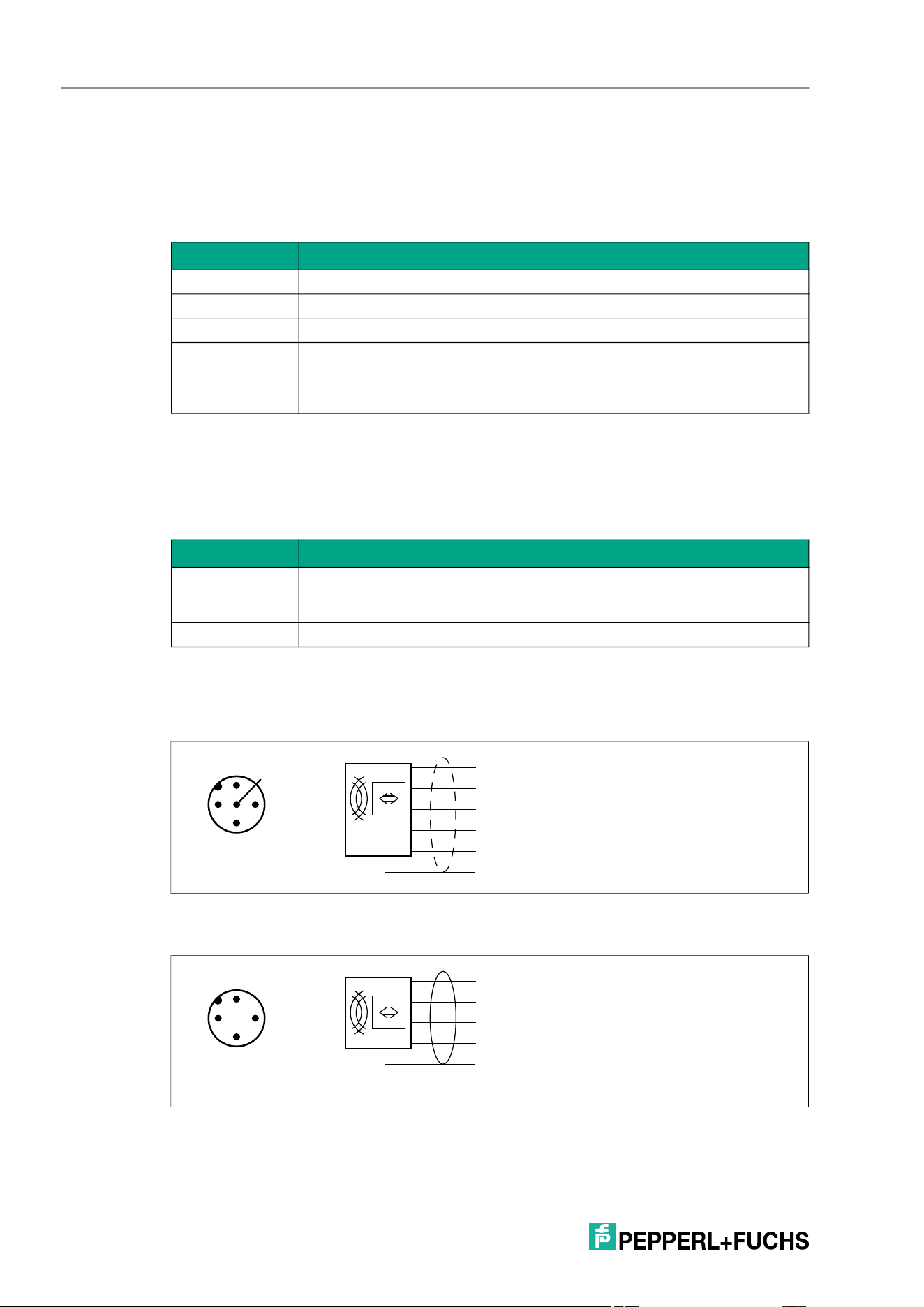
4.4 Electrical Connection
IQH3 Series
Figure 4.12
IQH4 Series
Figure 4.13
The read/write devices are connected to an IDENTControl evaluation unit via an M12 x 1 con-
nector.
LED Description
Green On: Device is ready for operation
Blue On: Write/read attempt is being performed
Yellow On: Write/read attempt was successful
Red On: Interference from external signals in the usage spectrum, detection
range may be limited
Slow flashing (1 Hz): Metal interference
Fast flashing (10 Hz): Excess temperature
LED Description
Green On: Device is ready for operation
Fast flashing (10 Hz): Write/read attempt is being performed
Slow flashing (1 Hz): Status message
Orange On: Write/read attempt was successful
Shield
do not connect
+
A
-
B
1
2
3
4
5
1
42
3
5
Shield
+
A
-
B
1
2
3
4
1
42
3

IQH3/IQH4 Series
Product Description
2026-05
19
4.5 Accessories
4.5.1 IDENTControl
The read/write devices are connected to Pepperl+Fuchs IDENTControl evaluation units. A
selection of available IDENTControl evaluation units can be found online at www.pepperl-
fuchs.com on the product page for the respective read/write device.
4.5.2 RFID Tags
The read/write devices can access any RFID tag that is compliant with the ISO15693 standard.
A selection of available RFID tags from Pepperl+Fuchs can be found online at www.pepperl-
fuchs.com on the product page for the respective read/write device.
4.5.3 Connection Cable
Compatible shielded connection cables are available for connecting the read/write devices. A
selection of available connection cables from Pepperl+Fuchs can be found online at www.pep-
perl-fuchs.com on the product page for the respective read/write device.
2026-05
20
IQH3/IQH4 Series
Installation
5 Installation
5.1 Storage and Transportation
Keep the original packaging. Always store and transport the device in the original packaging.
Store the device in a clean and dry environment. The permitted ambient conditions must be
considered, see datasheet.
5.2 Unpacking
Check the product for damage while unpacking. In the event of damage to the product, inform
the post office or parcel service and notify the supplier.
Check the package contents against your purchase order and the shipping documents for:
• Delivery quantity
• Device type and version in accordance with the type label
• Any accessories ordered
Retain the original packaging in case you have to store or ship the device again at a later date.
Should you have any questions, please contact Pepperl+Fuchs.
5.3 Mounting
To attach IQH3-FP-V1, IQH4-FP-V1, IQH4-F198-V1, and IQH4-F198-M-V1 read/write devices,
use four screws (diameter 4 mm).
Use two screws (diameter 4 mm) to attach the IQH4-F61-V1 read/write device.
To attach the read/write devices, use suitable flat washers and mounting materials suitable for
the type of mounting surface.
The tightening torque of the screws depends on the type of mounting. We recommend using a
tightening torque of 1.8 Nm.
Use a maximum tightening torque of 2.4 Nm to prevent damage to the plastic housing.
Use suitable mounting materials, such as nuts or mounting aids, to secure the IQH4-18GM-V1
read/write device.
Note
The read/write devices are intended for wall mounting or mounting on brackets in indoor
spaces. Mount the devices on a flat surface.
Attach the devices using only the existing mounting holes in the housing.
Caution!
Hot surfaces
Risk of burns when handling the read/write devices! Allow the devices to cool for at least half an
hour after they have been switched off before touching them.
Note
Do not route the connection cable of the read/write device and the IDENTControl evaluation
unit into the raceway area of the tag. Maintain a distance of at least 10 cm.
If the distance is too small, then in rare cases the tag may be incorrectly detected by inductive
couplings on the connection cable.
IQH3/IQH4 Series
Installation
2026-05
21
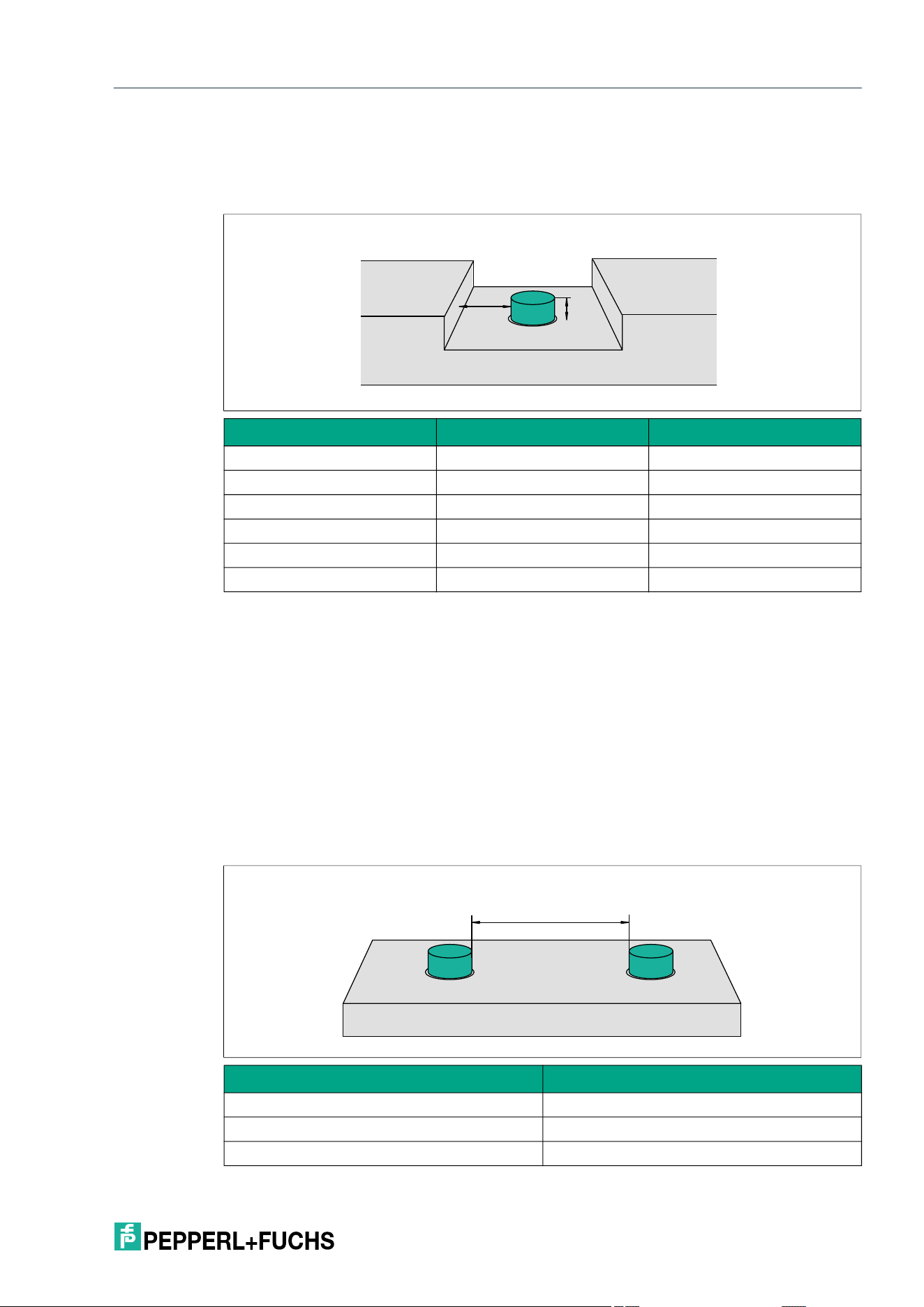
5.4 Minimum Distances
For flush-mounting in metal surfaces, a lateral minimum distance X to metal must be observed.
For flush-mounting in metal, a protrusion Y above the mounting surface must be observed.
During simultaneous operation of several read/write devices, only one device may ever com-
municate with a tag at any given time. When arranging the read/write devices, make sure that
the sensing ranges do not overlap. You can increase or decrease the sensing range by chang-
ing the transmitter radiated power accordingly. Determine the sensing range of each device at
the mounting location.
If you want to transmit with just one read/write device, use the multiplex mode of the IDENT-
Control evaluation unit. Multiplex mode allows chronologically exclusive access to tags, and
prevents mutual interference from read/write devices. For a precise description, see the man-
ual for your evaluation unit.
When mounting several RFID read/write devices next to each other, a minimum distance Z
must be observed. This distance prevents the read/write devices from interfering with each
other.
When mounting multiple read/write devices, keep to the following minimum distances:
Read/write device X Y
IQH4-18GM-V1 XX XX
IQH4-F61-V1 XX XX
IQH4-FP-V1 XX XX
IQH4-F198-V1 XX XX
IQH4-F198-M-V1 XX XX
IQH3-FP-V1 XX XX
Read/write device Z
IQH4-18GM-V1 XX
IQH4-F61-V1 XX
IQH4-FP-V1 XX
X
Y
Z
2026-05
22
IQH3/IQH4 Series
Installation
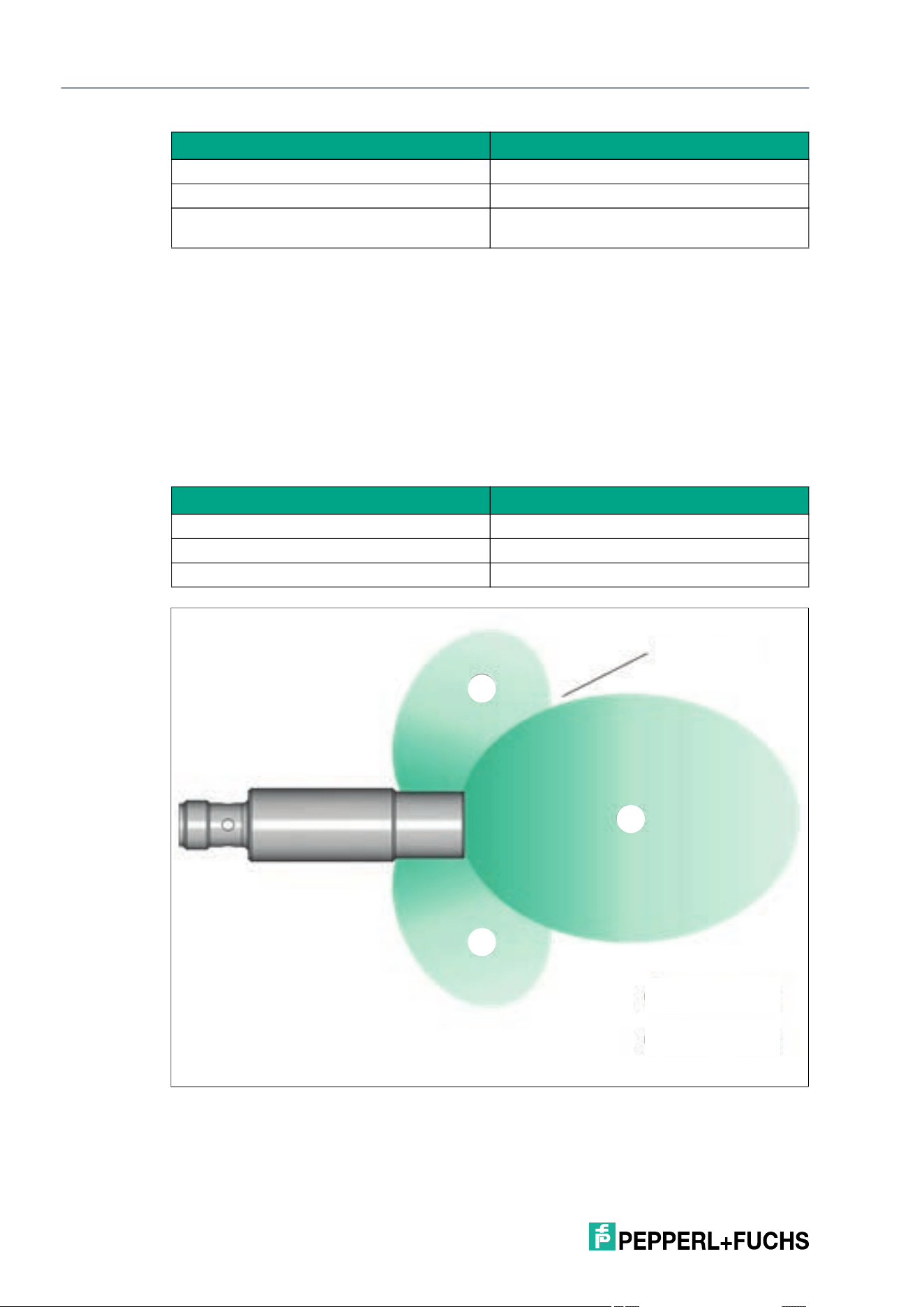
5.5 Main and Secondary Fields
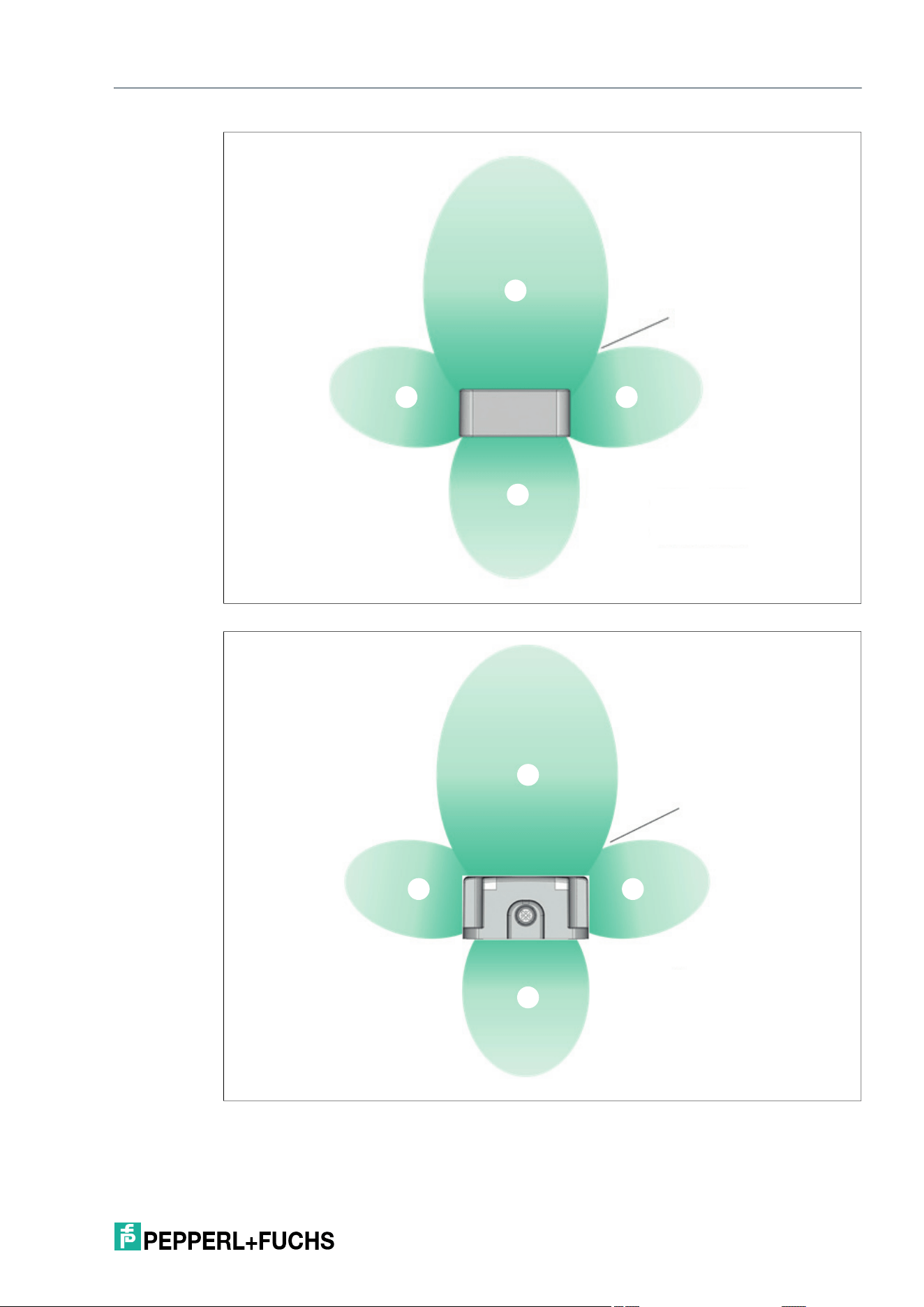
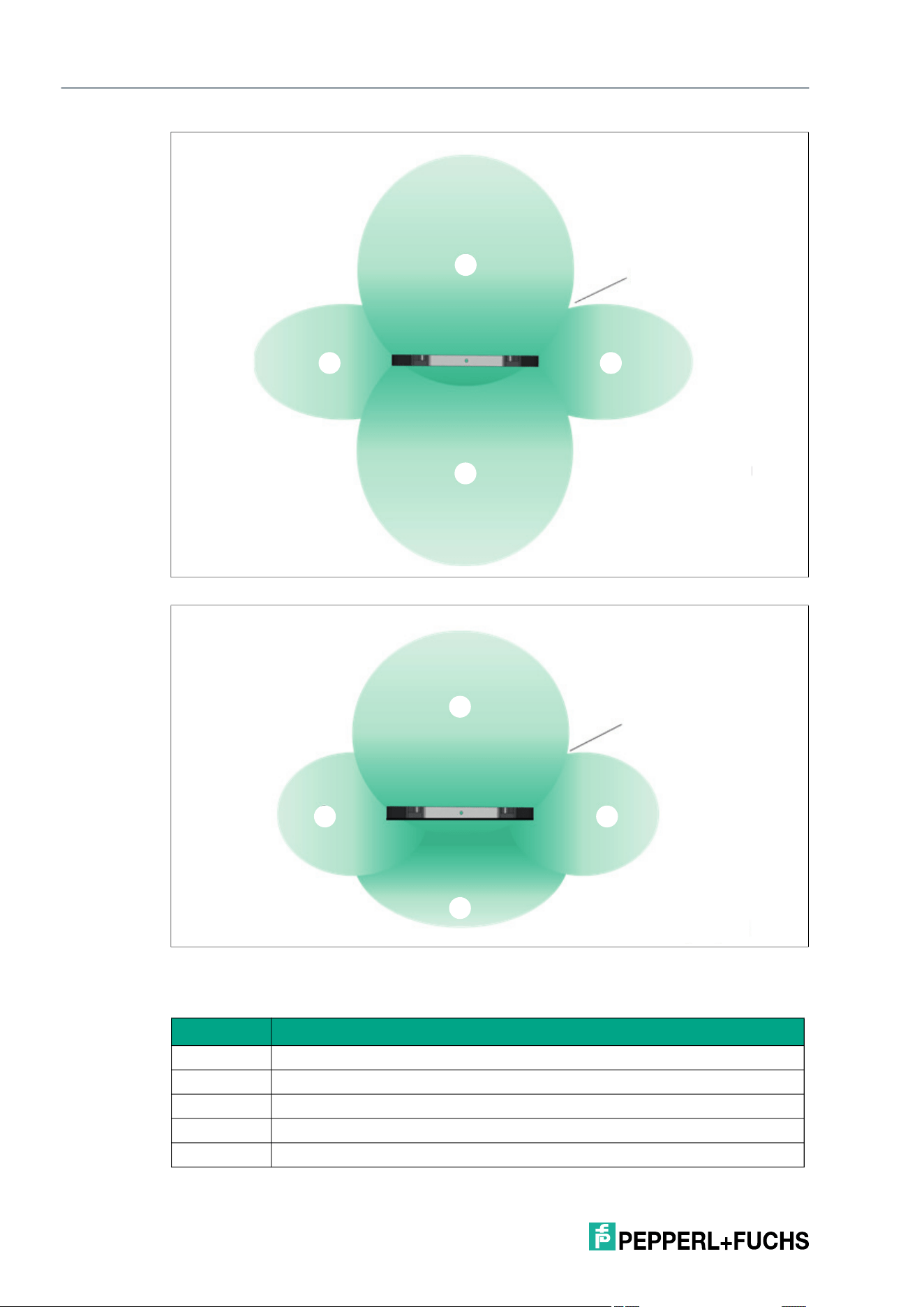
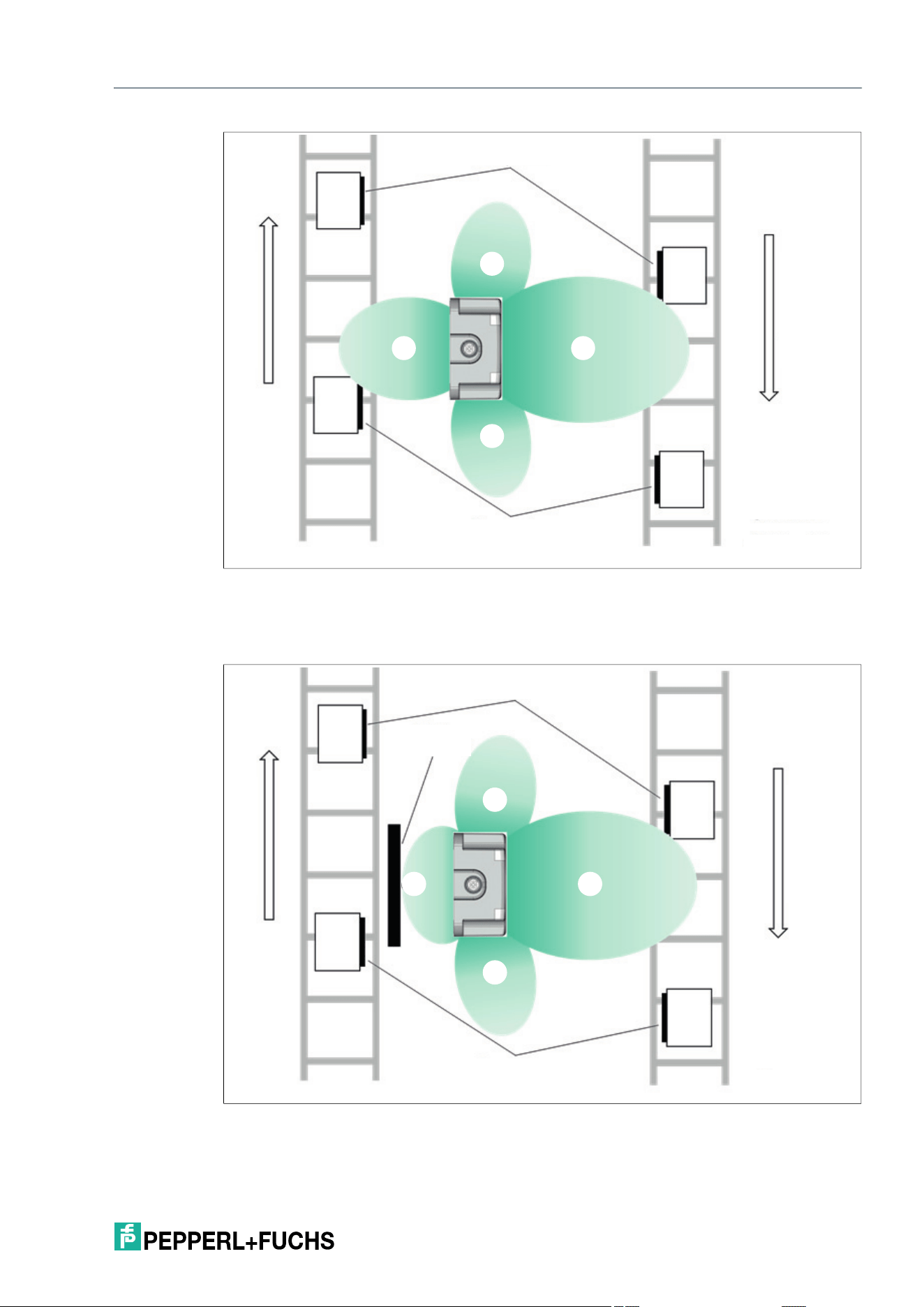
The RFID read/write devices have a main field and secondary fields. However, the secondary
fields should only be used for configuration in exceptional cases, as the writing/reading dis-
tances are very limited. Precise details of the geometries of the secondary fields cannot be pro-
vided, as the values depend heavily on the operating distance and the application.
In dynamic operation, it must be taken into account that the presence of the tag may be tempo-
rarily lost when the transition from the main field to the secondary field is made across gaps
between the fields.
A schematic depiction of the typical main and secondary fields of the three device versions is
shown below.
Figure 5.1 Schematic depiction of the main and secondary fields with IQH4-18GM-V1
IQH4-F198-V1 XX
IQH4-F198-M-V1 XX
IQH3-FP-V1 Multiplex on: 100 mm,
multiplex off: 750 mm
Read/write device Z
Legend Designation
1 Main field
2 Secondary field
3 Gap between fields
3
2
2
1
IQH3/IQH4 Series
Installation
2026-05
23
Figure 5.2 Schematic depiction of the main and secondary fields with IQH4-F61-V1
Figure 5.3 Schematic depiction of the main and secondary fields with IQH4-FP-V1
2
2
2
1
3
1
2
2
2
3
2026-05
24
IQH3/IQH4 Series
Installation
Figure 5.4 Schematic depiction of the main and secondary fields with IQH4-F198-V1
Figure 5.5 Schematic depiction of the main and secondary fields with IQH4-F198-M-V1
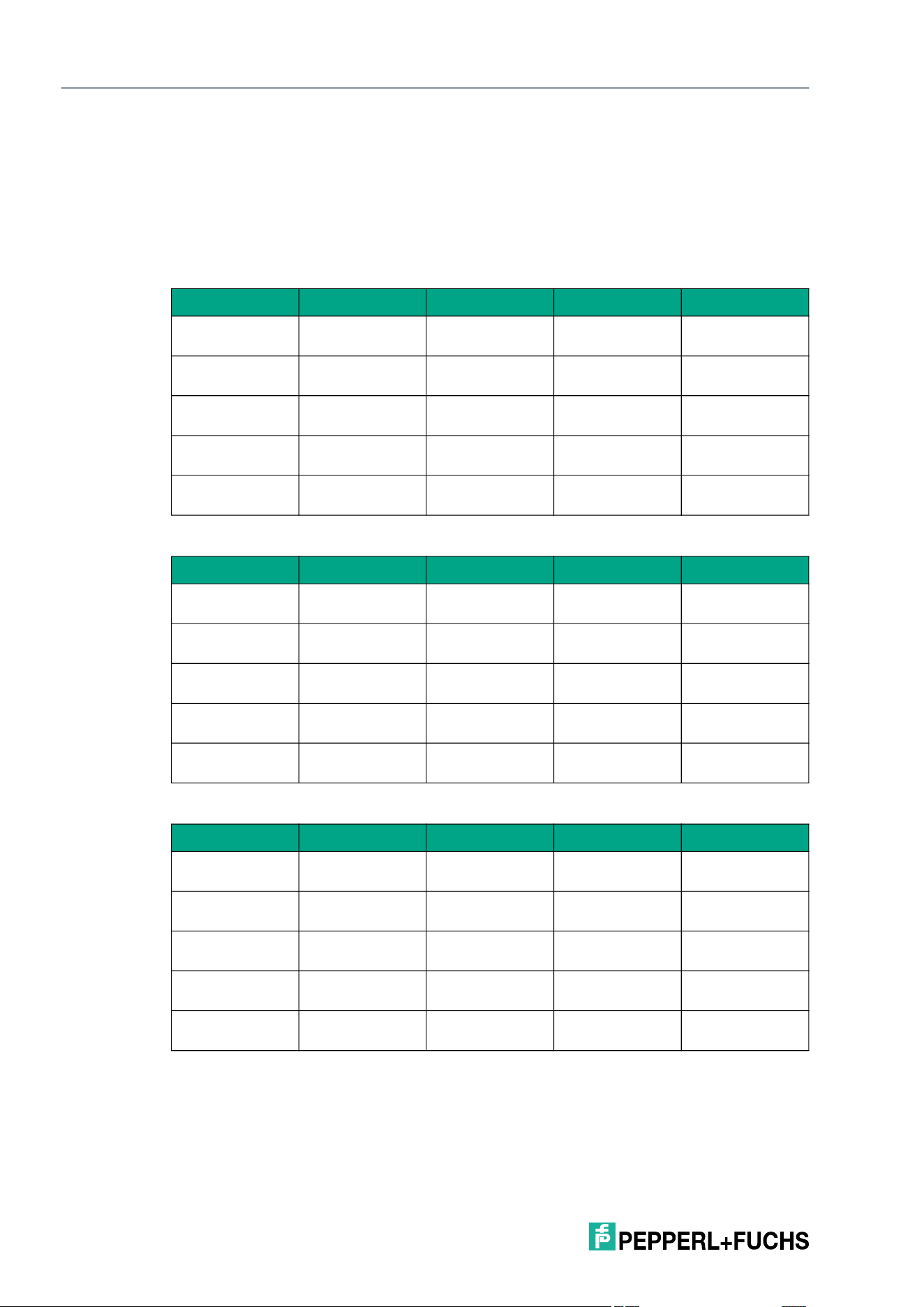
If no shielding measures have been taken, the RFID read/write device can also detect tags via
one of the secondary fields.
Legend Designation
1 Main field
2 Secondary field
3 Conveying direction
4 Tag
5 Metal shielding
1
2
2
2
3
3
2
1
2
2
IQH3/IQH4 Series
Installation
2026-05
25
Figure 5.6 Schematic depiction of secondary fields without shielding
Metal shielding is required to prevent unwanted detection of tags via the secondary field.
Typical main and secondary fields are shown below, but with metal shielding. The metal shield-
ing prevents tags from being detected via the secondary field of the RFID read/write device.
Figure 5.7 Schematic depiction of secondary fields with shielding
2
3
3
4
4
2
2
1
2
2
2
1
3
3
4
4
5
2026-05
26
IQH3/IQH4 Series
Installation
5.6 Ambient Temperature Range
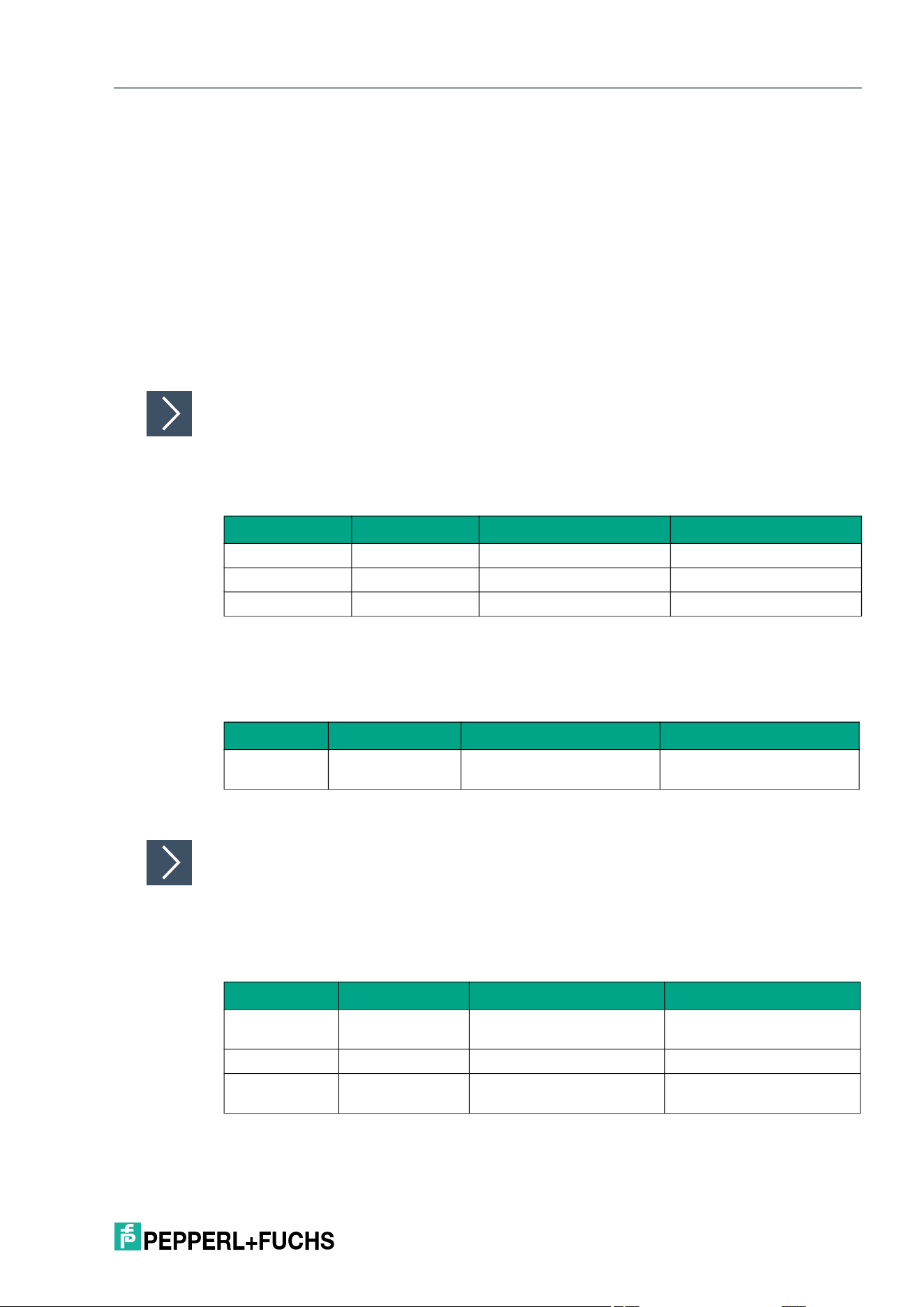
The ambient temperature at which the devices can be operated depends on various factors,
such as the operating mode or the selected transmitter radiated power.
By adjusting the operating mode or the transmitter radiated power (PT parameter), the devices
can operate permanently at higher ambient temperatures, as the inherent heating of the
devices is reduced.
Operation with Pauses in Transmission
Continuous Transmission Mode
Continuous Transmission Mode, with Forced Convection
PT 1 2 3 4
IQH3-FP-V1 -25 °C- 70 °C
(-13 °F- 158 °F)
-25 °C- 70 °C
(-13 °F- 158 °F)
-25 °C- 70 °C
(-13 °F- 158 °F)
-25 °C- 70 °C
(-13 °F- 158 °F)
IQH4-18GM-V1 -25 °C- 70 °C
(-13 °F- 158 °F)
-25 °C- 70 °C
(-13 °F- 158 °F)
-25 °C- 70 °C
(-13 °F- 158 °F)
-25 °C- 70 °C
(-13 °F- 158 °F)
IQH4-F61-V1 -25 °C- 70 °C
(-13 °F- 158 °F)
-25 °C- 70 °C
(-13 °F- 158 °F)
-25 °C- 70 °C
(-13 °F- 158 °F)
-25 °C- 70 °C
(-13 °F- 158 °F)
IQH4-FP-V1 -25 °C- 70 °C
(-13 °F- 158 °F)
-25 °C- 70 °C
(-13 °F- 158 °F)
-25 °C- 70 °C
(-13 °F- 158 °F)
-25 °C- 70 °C
(-13 °F- 158 °F)
IQH4-F198-[M]-
V1
-25 °C- 70 °C
(-13 °F- 158 °F)
-25 °C- 70 °C
(-13 °F- 158 °F)
-25 °C- 70 °C
(-13 °F- 158 °F)
-25 °C- 70 °C
(-13 °F- 158 °F)
PT 1 2 3 4
IQH3-FP-V1 -25 °C- 70 °C
(-13 °F- 158 °F)
-25 °C- 70 °C
(-13 °F- 158 °F)
-25 °C- 65 °C
(-13 °F- 149 °F)
-25 °C- 55 °C
(-13 °F- 131 °F)
IQH4-18GM-V1 -25 °C- 60 °C
(-13 °F- 140 °F)
-25 °C- 60 °C
(-13 °F- 140 °F)
-25 °C- 50 °C
(-13 °F- 122 °F)
-25 °C- 50 °C
(-13 °F- 122 °F)
IQH4-F61-V1 -25 °C- 70 °C
(-13 °F- 158 °F)
-25 °C- 70 °C
(-13 °F- 158 °F)
-25 °C- 65 °C
(-13 °F- 149 °F)
-25 °C- 65 °C
(-13 °F- 149 °F)
IQH4-FP-V1 -25 °C- 70 °C
(-13 °F- 158 °F)
-25 °C- 70 °C
(-13 °F- 158 °F)
-25 °C- 70 °C
(-13 °F- 158 °F)
-25 °C- 70 °C
(-13 °F- 158 °F)
IQH4-F198-[M]-
V1
-25 °C- 70 °C
(-13 °F- 158 °F)
-25 °C- 70 °C
(-13 °F- 158 °F)
-25 °C- 65 °C
(-13 °F- 149 °F)
-25 °C- 65 °C
(-13 ... 149 °F)
PT 1 2 3 4
IQH3-FP-V1 -25 °C- 70 °C
(-13 °F- 158 °F)
-25 °C- 70 °C
(-13 °F- 158 °F)
-25 °C- 70 °C
(-13 °F- 158 °F)
-25 °C- 70 °C
(-13 °F- 158 °F)
IQH4-18GM-V1 -25 °C- 70 °C
(-13 °F- 158 °F)
-25 °C- 70 °C
(-13 °F- 158 °F)
-25 °C- 65 °C
(-13 °F- 149 °F)
-25 °C- 65 °C
(-13 °F- 149 °F)
IQH4-F61-V1 -25 °C- 70 °C
(-13 °F- 158 °F)
-25 °C- 70 °C
(-13 °F- 158 °F)
-25 °C- 70 °C
(-13 °F- 158 °F)
-25 °C- 70 °C
(-13 °F- 158 °F)
IQH4-FP-V1 -25 °C- 70 °C
(-13 °F- 158 °F)
-25 °C- 70 °C
(-13 °F- 158 °F)
-25 °C- 70 °C
(-13 °F- 158 °F)
-25 °C- 70 °C
(-13 °F- 158 °F)
IQH4-F198-[M]-
V1
-25 °C- 70 °C
(-13 °F- 158 °F)
-25 °C- 70 °C
(-13 °F- 158 °F)
-25 °C- 70 °C
(-13 °F- 158 °F)
-25 °C- 70 °C
(-13 °F- 158 °F)
IQH3/IQH4 Series
Commissioning and Operation
2026-05
27
6 Commissioning and Operation
6.1 Operation via the Communication Interface
This section shows you how to operate the RFID read/write device using an IDENTControl
evaluation unit with serial interface. The examples include the syntax for coding the commands
and parameters via the RS-232, Ethernet TCP/IP and PROFIBUS/PROFINET interfaces. Fur-
ther details about these codes and the factory settings for your IDENTControl evaluation unit
can be found in the corresponding manual.
Example:
In the examples below, the RFID read/write device is connected to channel 1 of the evaluation
unit.
Reading Tags
Single Read Fixcode
Send the Single Read Fixcode command to the RFID read/write device.
Move a tag into the sensing range of the RFID read/write device. When the tag has been
detected and the UID has been read out, the orange LED on the RFID read/write device lights
up. The UID is displayed in the terminal program.
Parameterizing the RFID Read/Write Device
Requesting and Setting the Transmitter Radiated Power
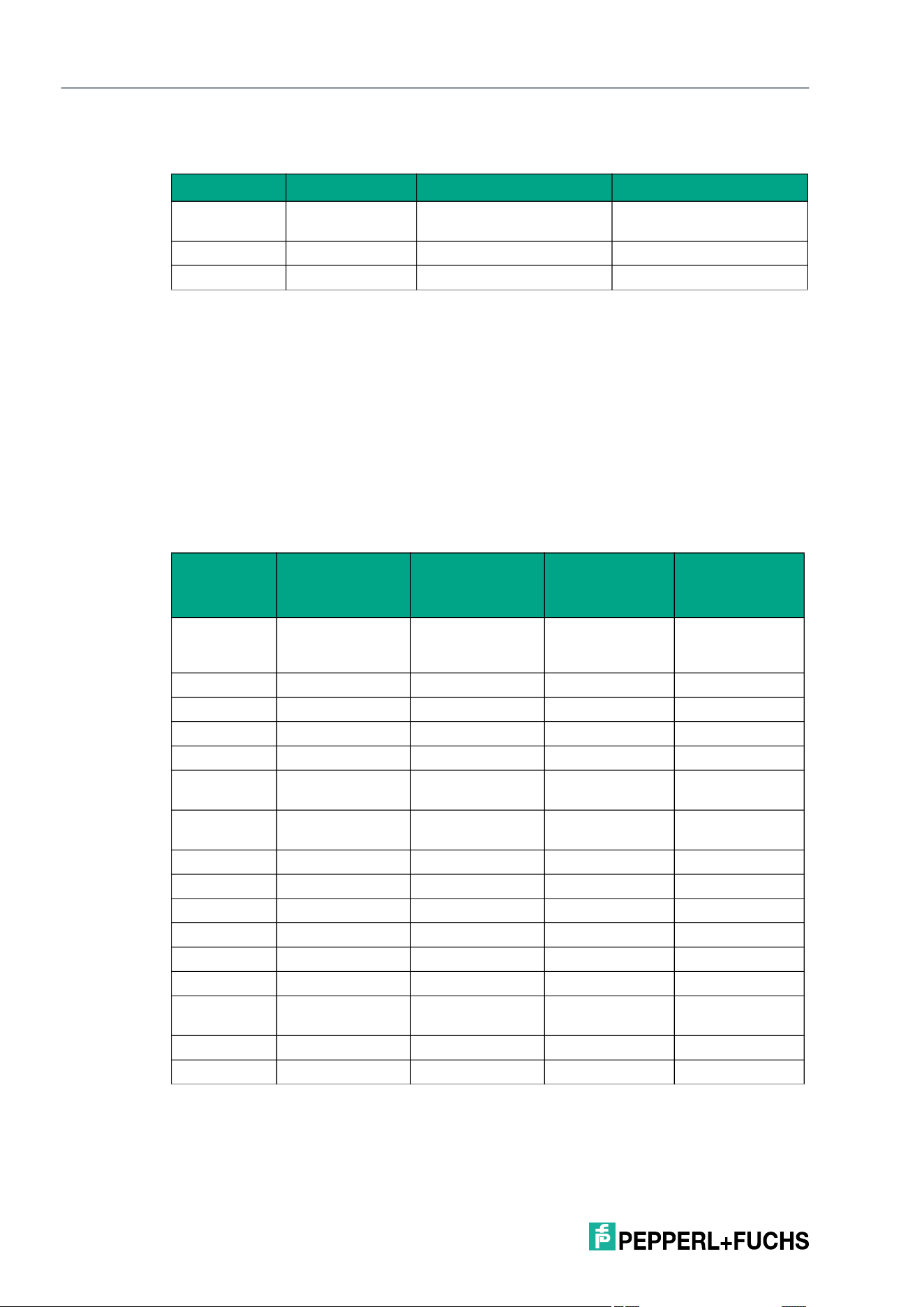
Read the transmitter radiated power of the RFID read/write device using the Read Parameter
PT command:
The transmitter radiated power of the RFID read/write device is set to Power mode.
Serial Ethernet PROFIBUS/PROFINET
Command: SF1 .00.04.1D.02 .1D.02
Confirmation: - .00.06.1D.02.FF.0E .1D.02.FF.0E
Response: .35.31 .00.06.1D.02.05.0F .1D.02.05.0F
Table 6.1 Single Read Fixcode, no tag in the sensing range
Serial Ethernet PROFIBUS/PROFINET
Response: .30.31.E0.08.01.4
8.82.ED.9B.AC
.00.0E.1D.02.00.10.E0.08.0
1.48.82.ED.9B.AC
.1D.02.00.10.E0.08.01.48.8
2.ED.9B.AC
Table 6.2 Single Read Fixcode, tag is entering the sensing range
Serial Ethernet PROFIBUS/PROFINET
Command: RP1QPT.00.00 .00.0A.BE.02.00.51.50.54.
00.00
.BE.03.00.51.50.54.00.00
Confirmation: - .00.06.BE.02.FF.33 .BE.02.FF.33
Response: .30.31.00.04 .00.0A.BE.02.00.34.00.02.
00.04
.BE.02.00.34.00.02.00.04
Table 6.3 Read Parameter, Power mode
2026-05
28
IQH3/IQH4 Series
Commissioning and Operation
Change the transmitter radiated power of the RFID read/write device to Eco mode using the
Write Parameter PT command:
6.2 13.56 MHz ISO15693 Tags
The tags of an RFID system with 13.56 MHz offer significantly quicker access to the data than a
comparable RFID system based on a working frequency of 125 kHz. The 13.56 MHz system is
standardized through ISO15693. A great variety of tags from different manufacturers using dif-
ferent RFID chips is supported.
Parameterization of the associated tag type is recommended to set the RFID read/write device
to the tag being used. On delivery of the RFID read/write device, tag type 20 is preset. This set-
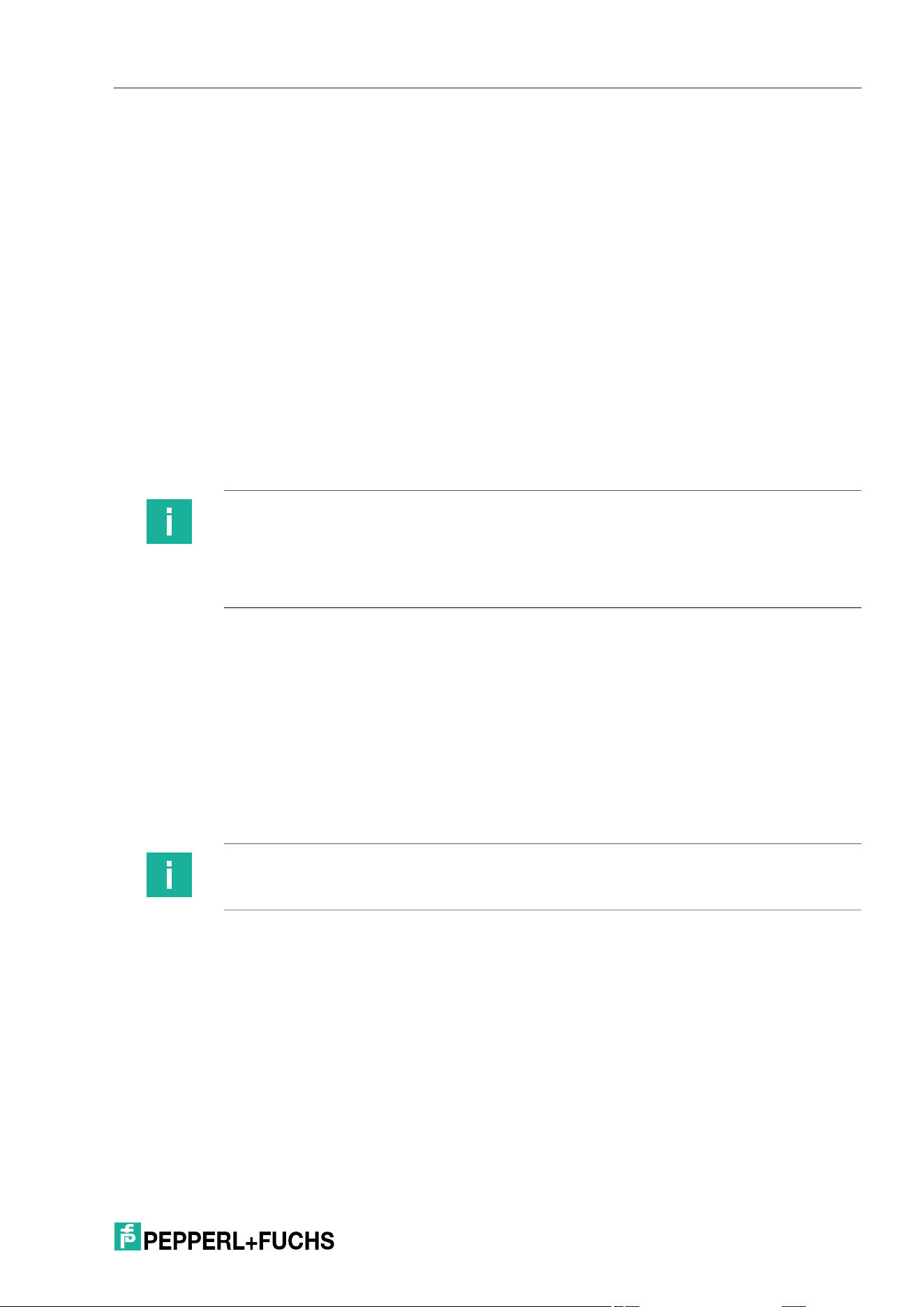
ting guarantees access to the read-only code of ISO15693-compliant tags. The following table
shows the tag types specified and recommended for the RFID read/write device.
13.56 MHz/ISO 15693 Tag Types
Serial Ethernet PROFIBUS/PROFINET
Command: WP1QPT.00.02.0
0.02
.00.0C.BF.02.00.51.50.54.0
0.02.00.02
.BF.02.00.51.50.54.04.00.0
2.00.02
Confirmation: - .00.06.BF.02.FF.35 .BF.02.FF.35
Response: .30.31 .00.06.BF.02.00.36 .BF.02.00.36
Table 6.4 Write Parameter, Eco mode
Pepperl
+Fuchs
designation Chip type Manufacturer
Size of
read/write
memory [byte]
Size of memory
block [byte]
IQC20 All tags in accor-
dance with
ISO15693
- Depending on tag Depending on tag
IQC21 I-Code SLI(X) NXP 112 4
IQC22 Tag-it HF-I Plus Texas Instruments 256 4
IQC23 my-D SRF55V02P Infineon 224 4
IQC24 my-D SRF55V10P Infineon 992 4
IQC27 EM4135 EM Microelec-
tronic
288 8
IQC31 Tag-it HFI stan-
dard
Texas Instruments 32 4
IQC32 Tag-it HFI pro Texas Instruments 32 4
IQC33 FRAM MB89R118 Fujitsu 2000 8
IQC34 FRAM MB89R119 Fujitsu 232 4
IQC35 I-Code SLI-S NXP 160 4
IQC36 I-Code SLI-L NXP 32 4
IQC37 FRAM MB89R112 Fujitsu 8192 32
IQC38 EM4233 EM Microelec-
tronic
208 4
IQC50 I-Code SLIX2 NXP 316 4
IQC51 I-Code 3 NXP 300 4
Table 6.5 13.56 MHz tag types in accordance with ISO 15693
IQH3/IQH4 Series
Commissioning and Operation
2026-05
29
All ISO15693-compliant tags have a unique 8-byte read-only code. The read-only code is
determined by the chip manufacturer. The user can only read it and it cannot be changed. In
addition, the tags have a memory for user data. This can be written with application-specific
data and read. The size of the memory for user data differs according to the tag type.
The memory is divided into blocks with a length of 4 bytes. There are also exceptions with a
block length of 8 bytes or 32 bytes.
The read and write commands use the "Number of bytes" and "Start address" parameters. This
defines how many bytes are accessed in the memory of the user data and from which memory
address this starts. If the tag type used, for example, has a block length of 4 bytes, the values of
the "Number of bytes" and "Start address" parameters must be a multiple of 4. In the case of a
block length of 8 or 32 bytes, they are multiples of 8 or 32.
6.3 Sensing Range
IQH3 Series
The read/write device is classified with a sensing range of up to 30 cm. The range of the device
depends on the tags to be identified and may therefore vary. You can increase or decrease the
sensing range by changing the transmitter radiated power accordingly.
IQH4 Series
The read/write devices are classified with a sensing range of up to 30 cm. The detection range
of the devices varies depending on the design and is dependent on the tags to be identified.
You can increase or decrease the sensing range by changing the transmitter radiated power
(PT parameter).
6.4 Multiple Tags in Sensing Range
Each read or write command can access one, several, or all tags in the sensing range. To
respond to specific tags in the sensing range, you can set a filter to the tag UIDs via the TI
parameter. See "Tag ID Filter (TI)" on page 107.
Note
To comply with the limit value of the magnetic field strength of max. 10 A/m in accordance with
ISO 15693-1, a minimum distance of 50 mm must be maintained between the tag and the
read/write device at a transmitter radiated power PT > 1. Otherwise, there is a risk that a tag will
be damaged in the near range. Reduce the transmitter radiated power of the read/write device
to PT = 1 to meet the limit value at small minimum distances.
Note
For applications in the multi-frame protocol, always use tags of the same tag type.
2026-05
30
IQH3/IQH4 Series
Commissioning and Operation
6.5 Command Overview
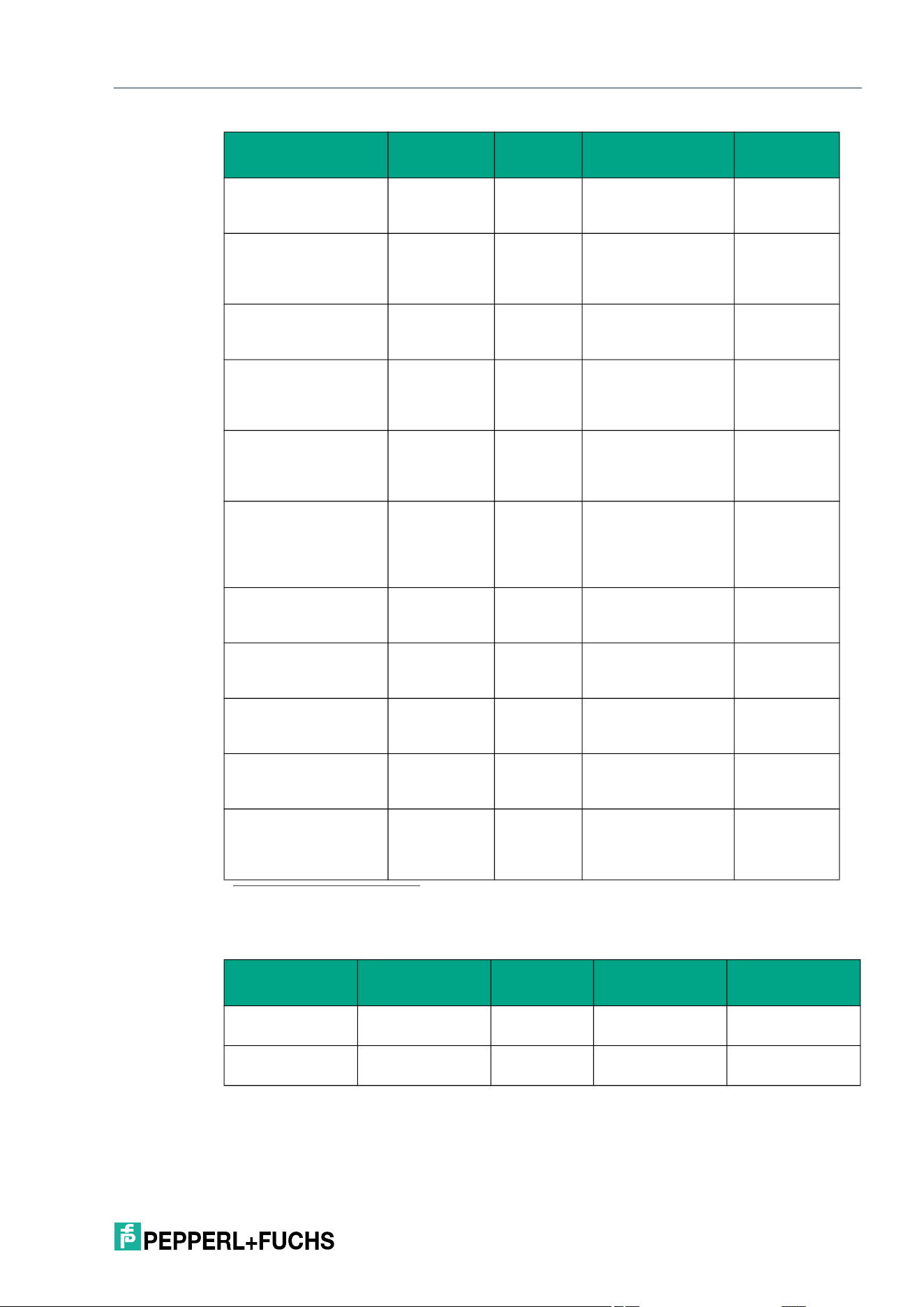
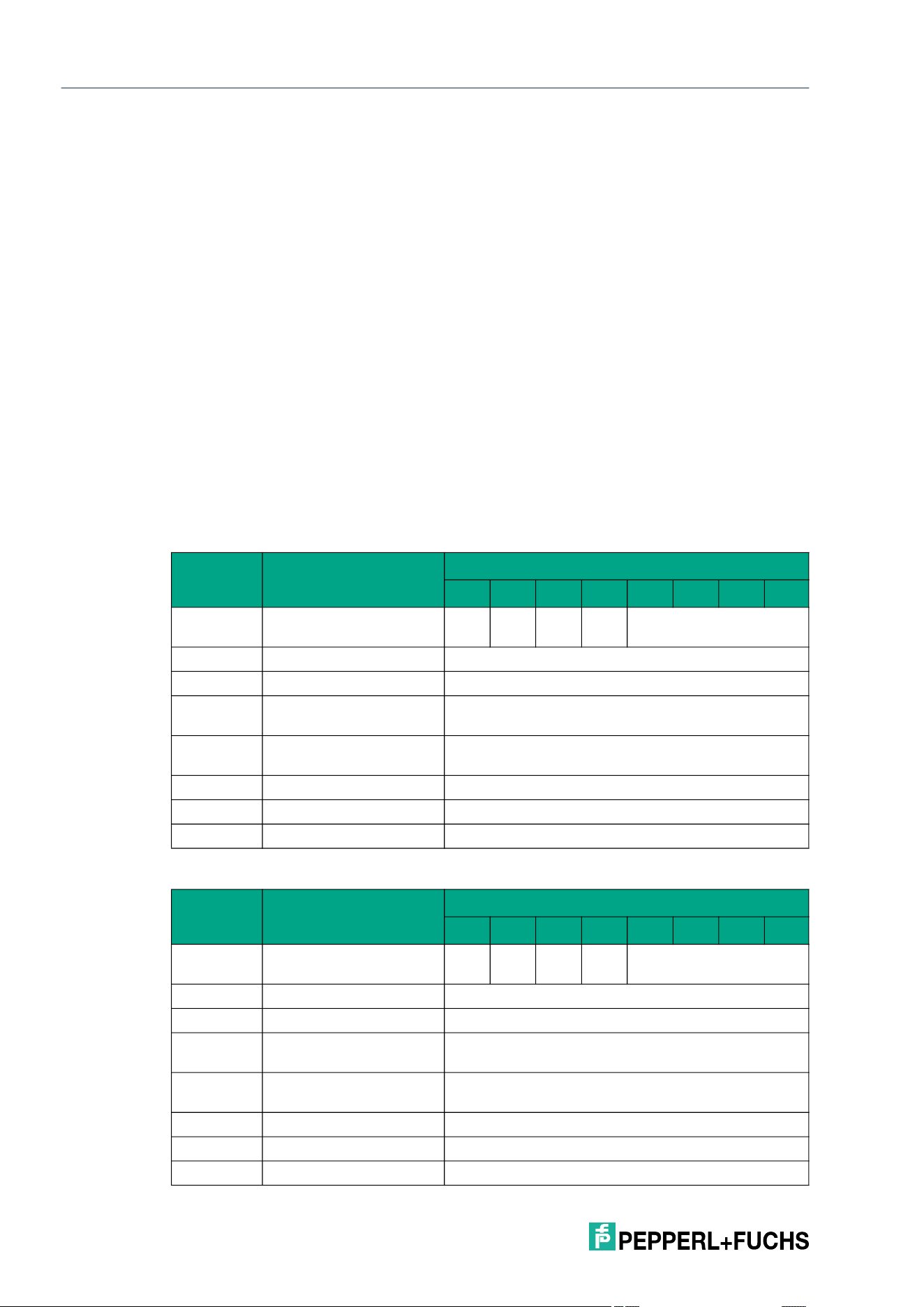
The commands in the list are described in detail on the following pages.
Below, the command syntax for IQH3/IQH4 series read/write devices is used in conjunction
with an IC-KP2-xHB40-2V1D IDENTControl evaluation unit.
Read/Write Commands
Command name
Command
abbreviation
Command
code
Command
description System
Single Read Fixcode SF 16#01 Single read access to
the Fixcode (UID)
IQH3, IQH4
Enhanced Read Fix-
code
EF 16#1D Continuous read
access to the Fix-
code (UID)
IQH3, IQH4
Single Read 4-Byte
Blocks
SR 16#10 Single read access to
the user memory
IQH3, IQH4
Enhanced Read 4-
Byte Blocks
ER 16#19 Continuous read
access to the user
memory
IQH3, IQH4
Single Write 4-Byte
Blocks
SW 16#40 Single write access
to the user memory
IQH3, IQH4
Enhanced Write 4-Byte
Blocks
EW 16#1A Continuous write
access to the user
memory
IQH3, IQH4
Single Write 4-Byte
Blocks with Lock
SL 16#47 Single write access
to the user memory
with write protection
IQH3, IQH4
Enhanced Write 4-Byte
Blocks with Lock
EL 16#48 Continuous write
access to the user
memory with write
protection
IQH3, IQH4
Single Read Configu-
ration
SG 16#61 Single read access to
the configuration
area
IQH3, IQH4
Enhanced Read Con-
figuration
EG 16#68 Continuous read
access to the config-
uration area
IQH3, IQH4
Single Write Configura-
tion
SC 16#12 Single write access
to AFI/DSFID in the
configuration area
IQH3, IQH4
Enhanced Write Con-
figuration
EC 16#66 Continuous write
access to AFI/DSFID
in the configuration
area
IQH3, IQH4
Fill Transponder S# 16#AA Write access to the
user memory with fill
characters
IQH3, IQH4
Selective Single Read
Fixcode
XSF 16#E8 Single read access to
the fixed code (UID)
of a selected tag
IQH3
1
, IQH4
Selective Enhanced
Read Fixcode
XEF 16#E9 Continuous read
access to the fixed
code (UID) of a
selected tag
IQH3
1<Default
¬¹ Font>
, IQH4
IQH3/IQH4 Series
Commissioning and Operation
2026-05
31
Configuration Commands
Selective Single Read
4-Byte Blocks
XSR 16#E0 Single read access to
the user memory of a
selected tag
IQH3
1<Default
¬¹ Font>
, IQH4
Selective Enhanced
Read 4-Byte Blocks
XER 16#D9 Continuous read
access to the user
memory of a selected
tag
IQH3
1<Default
¬¹ Font>
, IQH4
Selective Single Write
4-Byte Blocks
XSW 16#E3 Single write access
to the user memory
of a selected tag
IQH3
1<Default
¬¹ Font>
, IQH4
Selective Enhanced
Write 4-Byte Blocks
XEW 16#DC Continuous write
access to the user
memory of a selected
tag
IQH3
1<Default
¬¹ Font>
, IQH4
Selective Single Write
4-Byte Blocks with
Lock
XSL 16#E4 Single write access
to the user memory
with write protection
of a selected tag
IQH3
1<Default
¬¹ Font>
, IQH4
Selective Enhanced
Write 4-Byte Blocks
with Lock
XEL 16#E5 Continuous write
access to the user
memory with write
protection of a
selected tag
IQH3
1<Default
¬¹ Font>
, IQH4
Selective Single Read
Configuration
XSG 16#DD Single read access to
AFI/DSFID of a
selected tag
IQH3
1<Default
¬¹ Font>
, IQH4
Selective Enhanced
Read Configuration
XEG 16#D6 Continuous read
access to AFI/DSFID
of a selected tag
IQH3
1<Default
¬¹ Font>
, IQH4
Selective Single Write
Configuration
XSC 16#E1 Single write access
to AFI/DSFID of a
selected tag
IQH3
1<Default
¬¹ Font>
, IQH4
Selective Enhanced
Write Configuration
XEC 16#DA Continuous write
access to AFI/DSFID
of a selected tag
IQH3
1<Default
¬¹ Font>
, IQH4
Selective Fill Tag XS# 16#E7 Write access to the
user memory with fill
characters of a
selected tag
IQH3, IQH4
1.from SW Rev. 26
Command name
Command
abbreviation
Command
code
Command
description
System
Read Parameter RP 16#BE Read device
parameters
IQH3, IQH4
Write Parameter WP 16#BF Write device
parameters
IQH3, IQH4
Command name
Command
abbreviation
Command
code
Command
description System
2026-05
32
IQH3/IQH4 Series
Commissioning and Operation
6.6 Read/Write Commands
When writing the following commands and responses, the IF parameter of the read/write
device is set to 16#01, so that the Information Frame Mode is activated. This means that, for
each tag read, a further telegram with the status value 16#0B is transmitted that contains the
RSSI value for the signal strength of the tag response.
In addition, the parameter QV (Reply Frame Mode) is set to 16#4D, so that the multi-frame pro-
tocol is enabled. In the multi-frame protocol, each tag that responded is output. The response
also contains the UID of the tag and additional length information for the UID. The response
ends with an end telegram with the status 16#0F, containing the number of tags that have
responded.
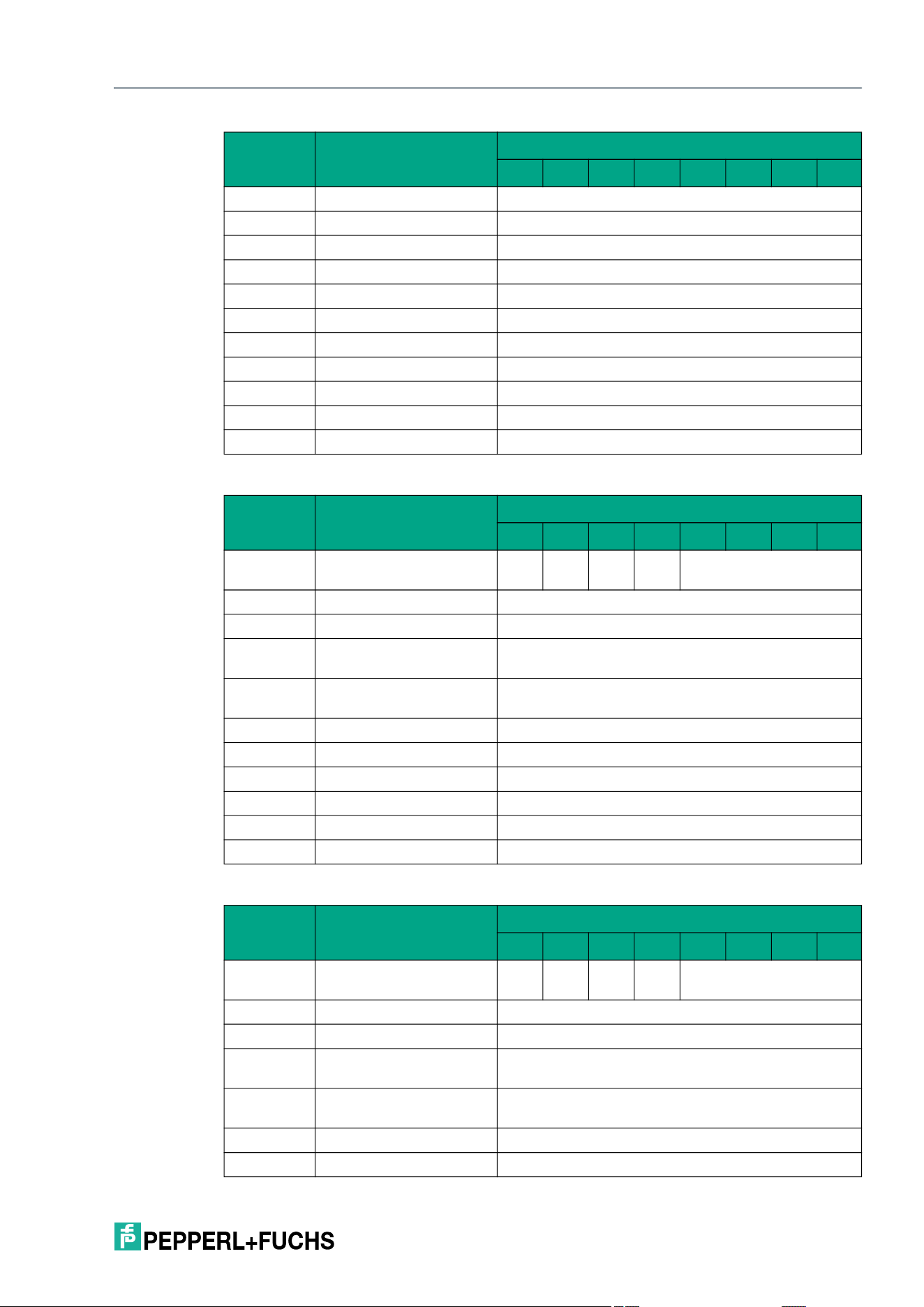
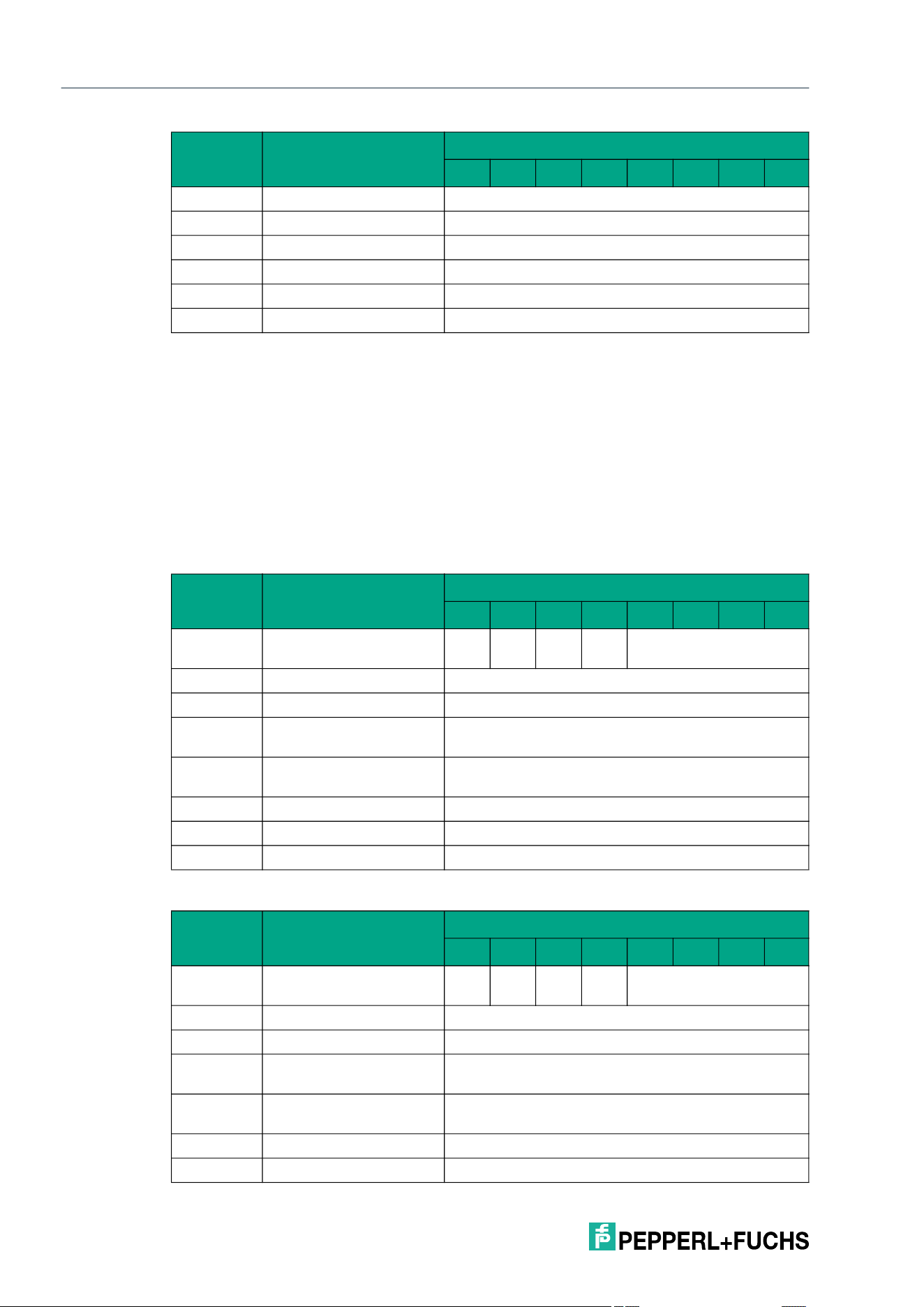
Single Read Fixcode (SF)
The SF command has the command code 16#01 and performs a single read operation on the
UID of a tag within the detection zone.
The information is transmitted for each tag read in a separate data telegram with the status
value 16#00. In addition, for each tag read, a further telegram with the status value 16#0B is
transmitted that contains the RSSI value for the signal strength of the tag response.
The end of the command execution is indicated by an end telegram. The end telegram has the
status value 16#0F and contains the number of tags identified during execution of the com-
mand.
Command Telegram
Response Telegram 1 – Status 16#00 (Multi-Frame Protocol)
Byte Content
Bit number
7 6 5 4 3 2 1 0
Byte 0 Control Byte / Frame
Length
D
S
U
M
U
D
0 16#0
Byte 1 Frame Length 16#06
Byte 2 Fragmentation Counter 16#00
Byte 3 Telegram Length (High
Byte)
16#00
Byte 4 Telegram Length (Low
Byte)
16#03
Byte 5 Command 16#01
… Command parameter 16#00
Byte 255 Command parameter 16#00
Byte Content
Bit number
7 6 5 4 3 2 1 0
Byte 0 Control Byte / Frame
Length
D
S
U
M
U
D
0 16#0
Byte 1 Frame Length 16#11
Byte 2 Fragmentation Counter 16#00
Byte 3 Telegram Length (High
Byte)
16#00
Byte 4 Telegram Length (Low
Byte)
16#0E
Byte 5 Command 16#01
Byte 6 Status 16#00
Byte 7 Data 16#00 <Length UID in Byte (High Byte)>
IQH3/IQH4 Series
Commissioning and Operation
2026-05
33
Response Telegram 2 – Status 16#0B (Information Frame Mode)
Response Telegram 3 – Status 16#0F (Multi-Frame Protocol)
Byte 8 Data 16#08 <Length UID in Byte (Low Byte)>
Byte 9 Data <UID Byte 1>
Byte 10 Data <UID Byte 2>
Byte 11 Data <UID Byte 3>
Byte 12 Data <UID Byte 4>
Byte 13 Data <UID Byte 5>
Byte 14 Data <UID Byte 6>
Byte 15 Data <UID Byte 7>
Byte 16 Data <UID Byte 8>
… Data 16#00
Byte 255 Data 16#00
Byte Content
Bit number
7 6 5 4 3 2 1 0
Byte 0 Control Byte / Frame
Length
D
S
U
M
U
D
0 16#0
Byte 1 Frame Length 16#09
Byte 2 Fragmentation Counter 16#00
Byte 3 Telegram Length (High
Byte)
16#00
Byte 4 Telegram Length (Low
Byte)
16#06
Byte 5 Command 16#01
Byte 6 Status 16#0B
Byte 7 Data 16#01 <Info Type>
Byte 8 Data <RSSI>
… Data 16#00
Byte 255 Data 16#00
Byte Content
Bit number
7 6 5 4 3 2 1 0
Byte 0 Control Byte / Frame
Length
D
S
U
M
U
D
0 16#0
Byte 1 Frame Length 16#0B
Byte 2 Fragmentation Counter 16#00
Byte 3 Telegram Length (High
Byte)
16#00
Byte 4 Telegram Length (Low
Byte)
16#08
Byte 5 Command 16#01
Byte 6 Status 16#0F
Byte Content
Bit number
7 6 5 4 3 2 1 0
2026-05
34
IQH3/IQH4 Series
Commissioning and Operation
Enhanced Buffered Read Fixcode (EF)
The EF command has the command code 16#1D and performs a continuous read operation
on the UID of a tag within the detection zone.
The information is transmitted for each tag read in a separate data telegram with the status
value 16#00. In addition, for each tag read, a further telegram with the status value 16#0B is
transmitted that contains the RSSI value for the signal strength of the tag response.
A tag leaving the detection zone is indicated by a telegram containing the UID of the tag. This
telegram has the status value 16#05.
A Quit command stops the command execution.
Command Telegram
Response Telegram 1 – Status 16#00 (Multi-Frame Protocol)
Byte 7 Data <Number of Tags Byte 1>
Byte 8 Data <Number of Tags Byte 2>
Byte 9 Data <Number of Tags Byte 3>
Byte 10 Data <Number of Tags Byte 4>
… Data 16#00
Byte 255 Data 16#00
Byte Content
Bit number
7 6 5 4 3 2 1 0
Byte 0 Control Byte / Frame
Length
D
S
U
M
U
D
0 16#0
Byte 1 Frame Length 16#06
Byte 2 Fragmentation Counter 16#00
Byte 3 Telegram Length (High
Byte)
16#00
Byte 4 Telegram Length (Low
Byte)
16#03
Byte 5 Command 16#1D
… Command parameter 16#00
Byte 255 Command parameter 16#00
Byte Content
Bit number
7 6 5 4 3 2 1 0
Byte 0 Control Byte / Frame
Length
D
S
U
M
U
D
0 16#0
Byte 1 Frame Length 16#11
Byte 2 Fragmentation Counter 16#00
Byte 3 Telegram Length (High
Byte)
16#00
Byte 4 Telegram Length (Low
Byte)
16#0E
Byte 5 Command 16#1D
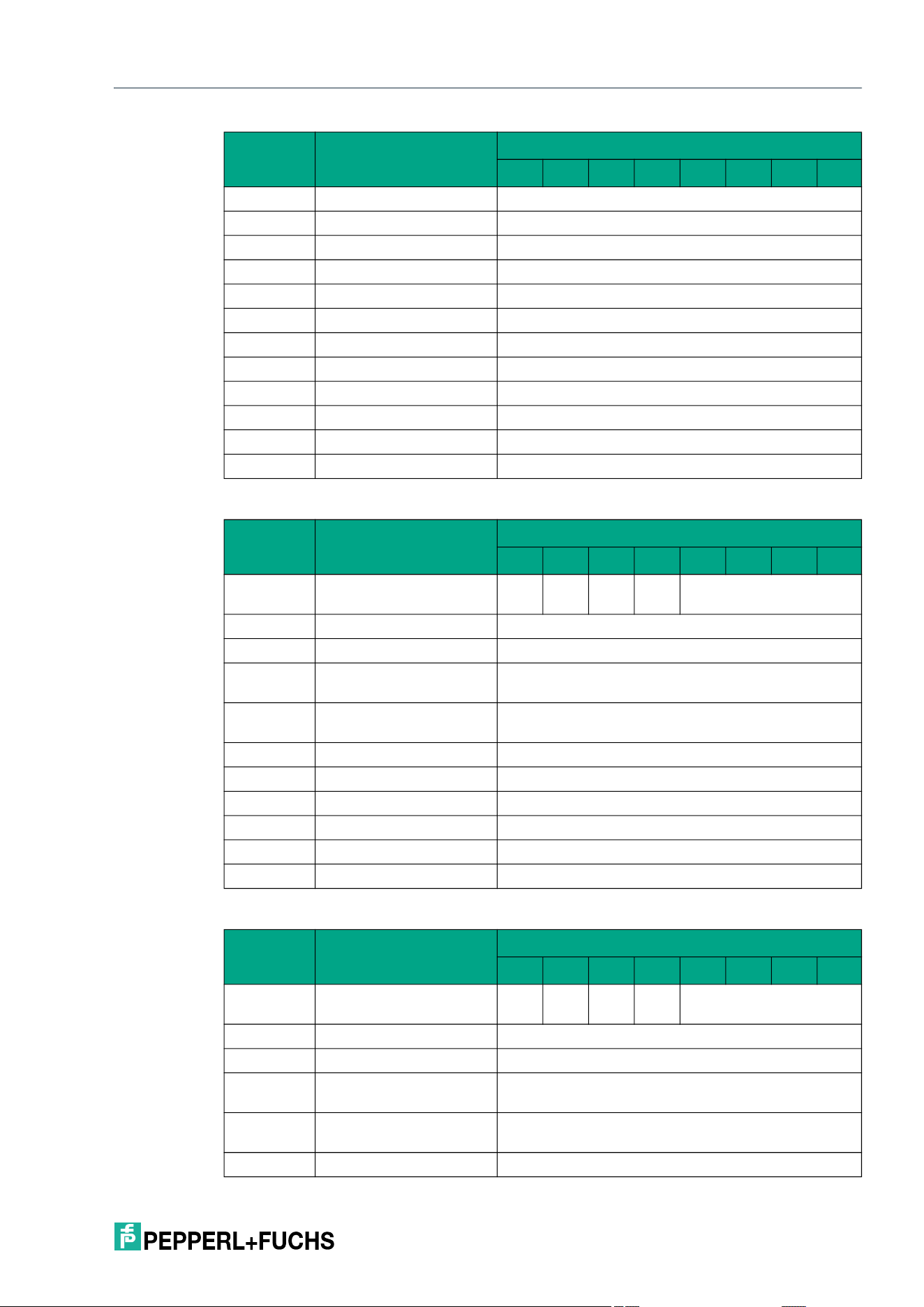
Byte 6 Status 16#00
Byte Content
Bit number
7 6 5 4 3 2 1 0
IQH3/IQH4 Series
Commissioning and Operation
2026-05
35
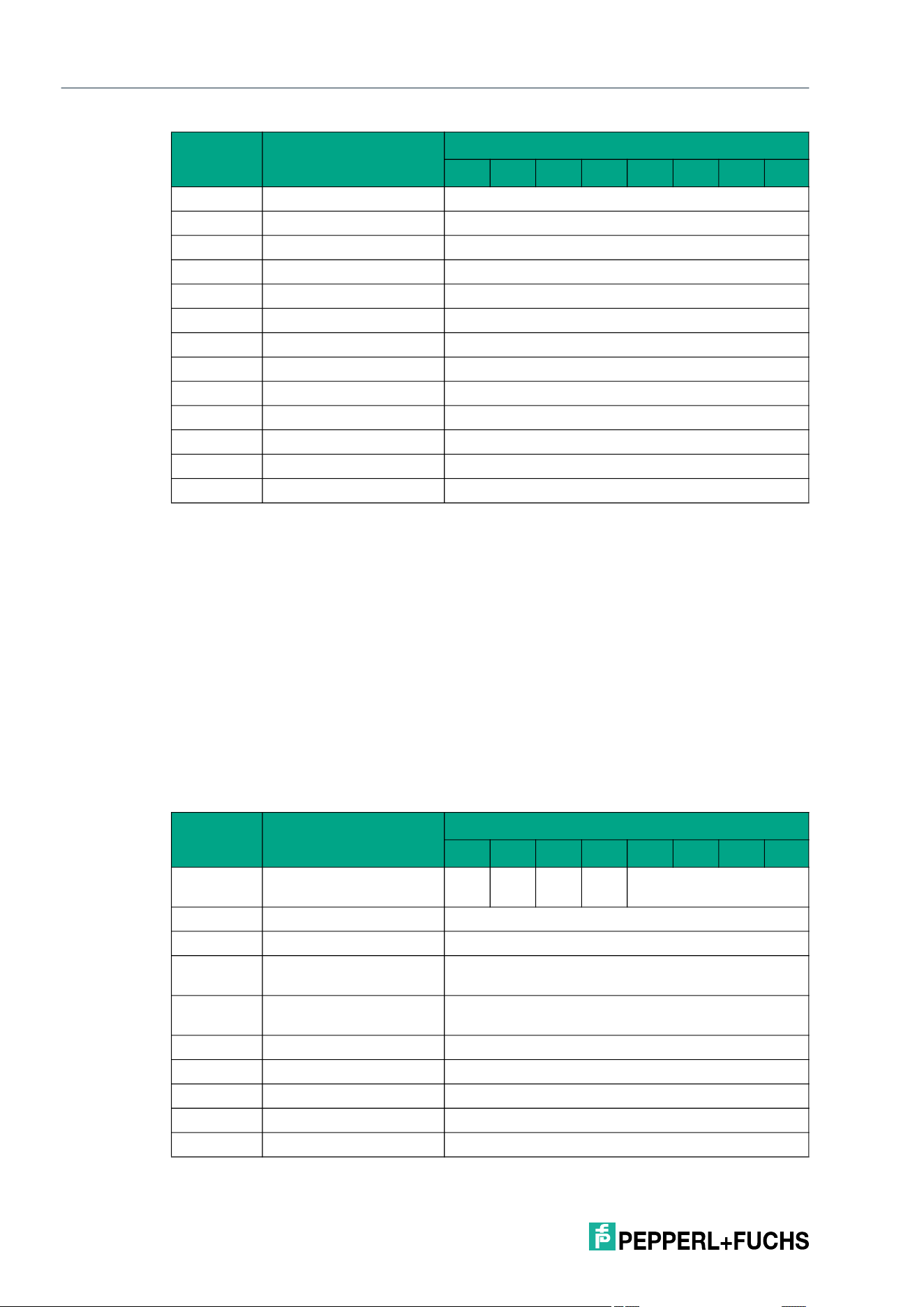
Response Telegram 2 – Status 16#0B (Information Frame Mode)
Response Telegram 3 – Status 16#05 (Multi-Frame Protocol)
Byte 7 Data 16#00 <Length UID in Byte (High Byte)>
Byte 8 Data 16#08 <Length UID in Byte (Low Byte)>
Byte 9 Data <UID Byte 1>
Byte 10 Data <UID Byte 2>
Byte 11 Data <UID Byte 3>
Byte 12 Data <UID Byte 4>
Byte 13 Data <UID Byte 5>
Byte 14 Data <UID Byte 6>
Byte 15 Data <UID Byte 7>
Byte 16 Data <UID Byte 8>
… Data 16#00
Byte 255 Data 16#00
Byte Content
Bit number
7 6 5 4 3 2 1 0
Byte 0 Control Byte / Frame
Length
D
S
U
M
U
D
0 16#0
Byte 1 Frame Length 16#09
Byte 2 Fragmentation Counter 16#00
Byte 3 Telegram Length (High
Byte)
16#00
Byte 4 Telegram Length (Low
Byte)
16#06
Byte 5 Command 16#1D
Byte 6 Status 16#0B
Byte 7 Data 16#01 <Info Type>
Byte 8 Data <RSSI>
… Data 16#00
Byte 255 Data 16#00
Byte Content
Bit number
7 6 5 4 3 2 1 0
Byte 0 Control Byte / Frame
Length
D
S
U
M
U
D
0 16#0
Byte 1 Frame Length 16#11
Byte 2 Fragmentation Counter 16#00
Byte 3 Telegram Length (High
Byte)
16#00
Byte 4 Telegram Length (Low
Byte)
16#0E
Byte 5 Command 16#1D
Byte Content
Bit number
7 6 5 4 3 2 1 0
2026-05
36
IQH3/IQH4 Series
Commissioning and Operation
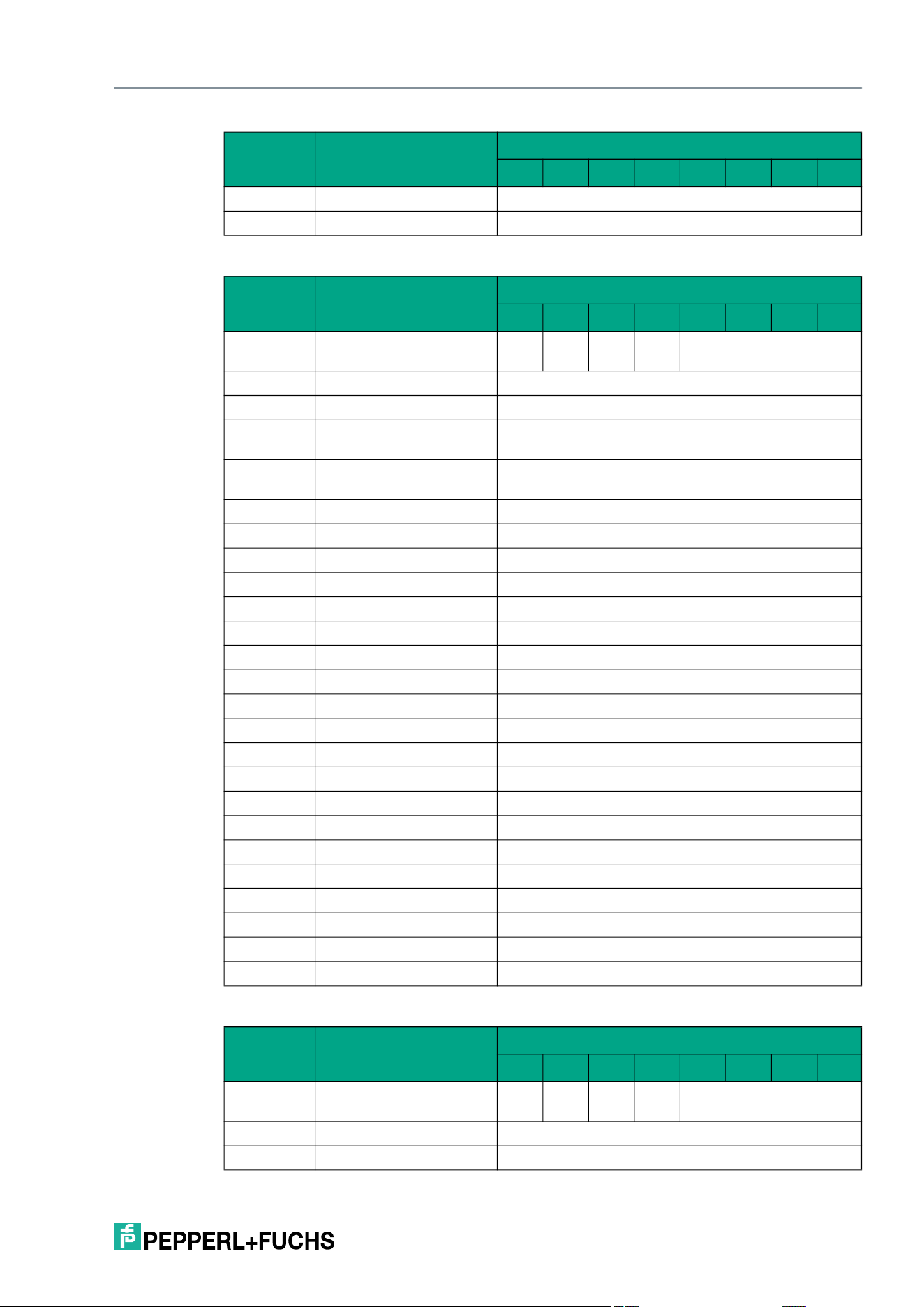
Single Read 4-Byte Blocks (SR)
The SR command has the command code 16#10 and performs a single read access to the
user data area of a tag within the sensing range.
The <Start Address> parameter specifies the start address within the user data area. The value
of <Start Address> is based on bytes. Only multiples of the memory block size can be parame-
terized. <Number of Bytes> defines the number of bytes to be read. The number of bytes must
be a multiple of the memory block size.
The information is transmitted for each tag read in a separate data telegram with the status
value 16#00. In addition, for each tag read, a further telegram with the status value 16#0B is
sent that contains the RSSI value for the signal strength of the tag response.
The end of the command execution is indicated by an end telegram. The end telegram has the
status value 16#0F and contains the number of tags that were identified during execution of the
command.
Command Telegram
Byte 6 Status 16#05
Byte 7 Data 16#00 <Length UID in Byte (High Byte)>
Byte 8 Data 16#08 <Length UID in Byte (Low Byte)>
Byte 9 Data <UID Byte 1>
Byte 10 Data <UID Byte 2>
Byte 11 Data <UID Byte 3>
Byte 12 Data <UID Byte 4>
Byte 13 Data <UID Byte 5>
Byte 14 Data <UID Byte 6>
Byte 15 Data <UID Byte 7>
Byte 16 Data <UID Byte 8>
… Data 16#00
Byte 255 Data 16#00
Byte Content
Bit number
7 6 5 4 3 2 1 0
Byte 0 Control Byte / Frame
Length
D
S
U
M
U
D
0 16#0
Byte 1 Frame Length 16#0A
Byte 2 Fragmentation Counter 16#00
Byte 3 Telegram Length (High
Byte)
16#00
Byte 4 Telegram Length (Low
Byte)
16#07
Byte 5 Command 16#10
Byte 6 Command parameter <Start Address (High Byte)>
Byte 7 Command parameter <Start Address (Low Byte)>
Byte 8 Command parameter <Number of Bytes (High Byte)>
Byte 9 Command parameter <Number of Bytes (Low Byte)>
Byte Content
Bit number
7 6 5 4 3 2 1 0
IQH3/IQH4 Series
Commissioning and Operation
2026-05
37
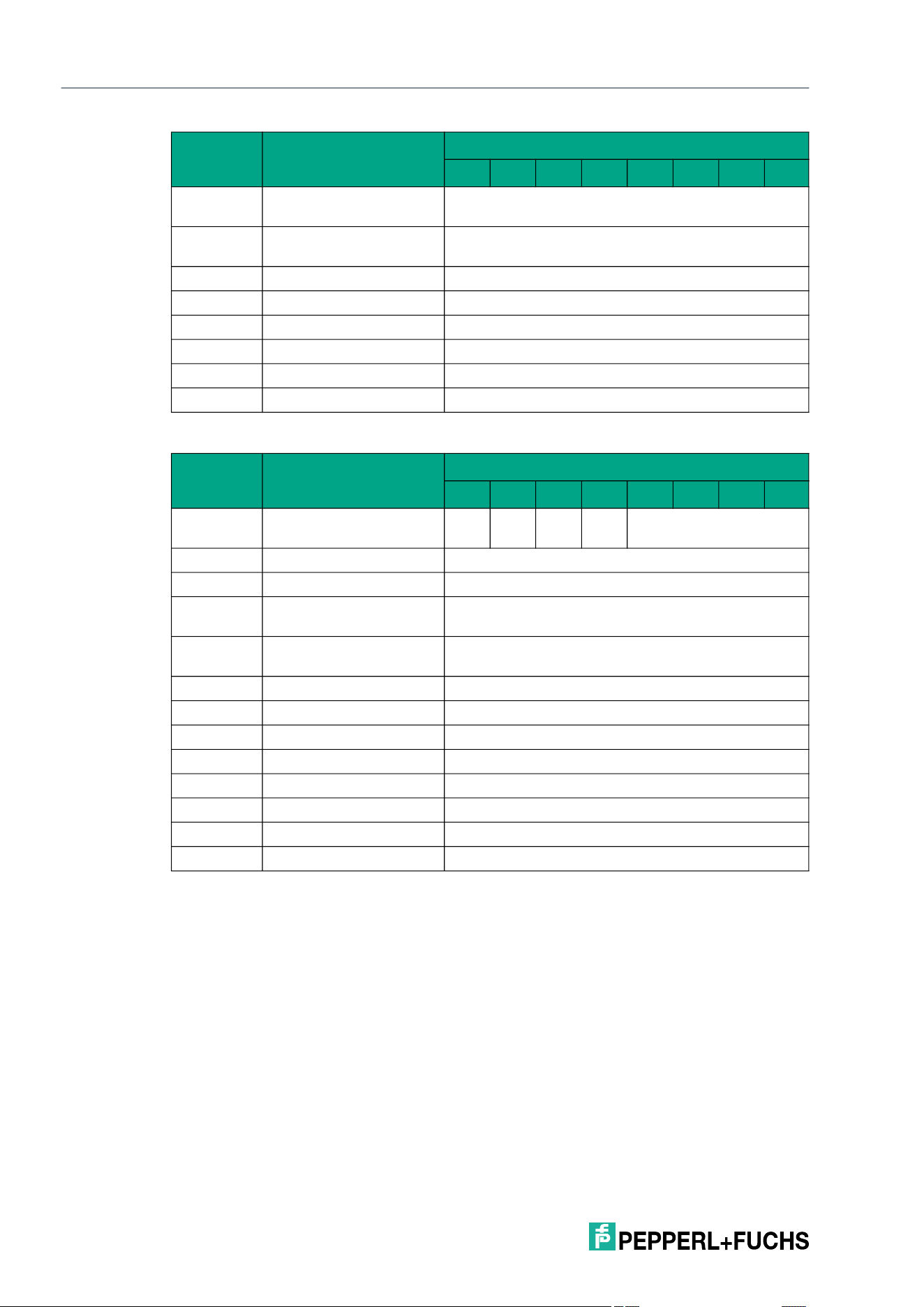
Response Telegram 1 – Status 16#00 (Multi-Frame Protocol)
Response Telegram 2 – Status 16#0B (Information Frame Mode)
… Command parameter 16#00
Byte 255 Command parameter 16#00
Byte Content
Bit number
7 6 5 4 3 2 1 0
Byte 0 Control Byte / Frame
Length
D
S
U
M
U
D
0 16#0
Byte 1 Frame Length 16#17
Byte 2 Fragmentation Counter 16#00
Byte 3 Telegram Length (High
Byte)
16#00
Byte 4 Telegram Length (Low
Byte)
16#14
Byte 5 Command 16#10
Byte 6 Status 16#00
Byte 7 Data 16#00 <Length UID in Byte (High Byte)>
Byte 8 Data 16#08 <Length UID in Byte (Low Byte)>
Byte 9 Data <UID Byte 1>
Byte 10 Data <UID Byte 2>
Byte 11 Data <UID Byte 3>
Byte 12 Data <UID Byte 4>
Byte 13 Data <UID Byte 5>
Byte 14 Data <UID Byte 6>
Byte 15 Data <UID Byte 7>
Byte 16 Data <UID Byte 8>
Byte 17 Data 16#00
Byte 18 Data 16#04
Byte 19 Data <User Data Byte 1>
Byte 20 Data <User Data Byte 2>
Byte 21 Data <User Data Byte 3>
Byte 22 Data <User Data Byte 4>
... Data 16#00
Byte 255 Data 16#00
Byte Content
Bit number
7 6 5 4 3 2 1 0
Byte 0 Control Byte / Frame
Length
D
S
U
M
U
D
0 16#0
Byte 1 Frame Length 16#09
Byte 2 Fragmentation Counter 16#00
Byte Content
Bit number
7 6 5 4 3 2 1 0
2026-05
38
IQH3/IQH4 Series
Commissioning and Operation
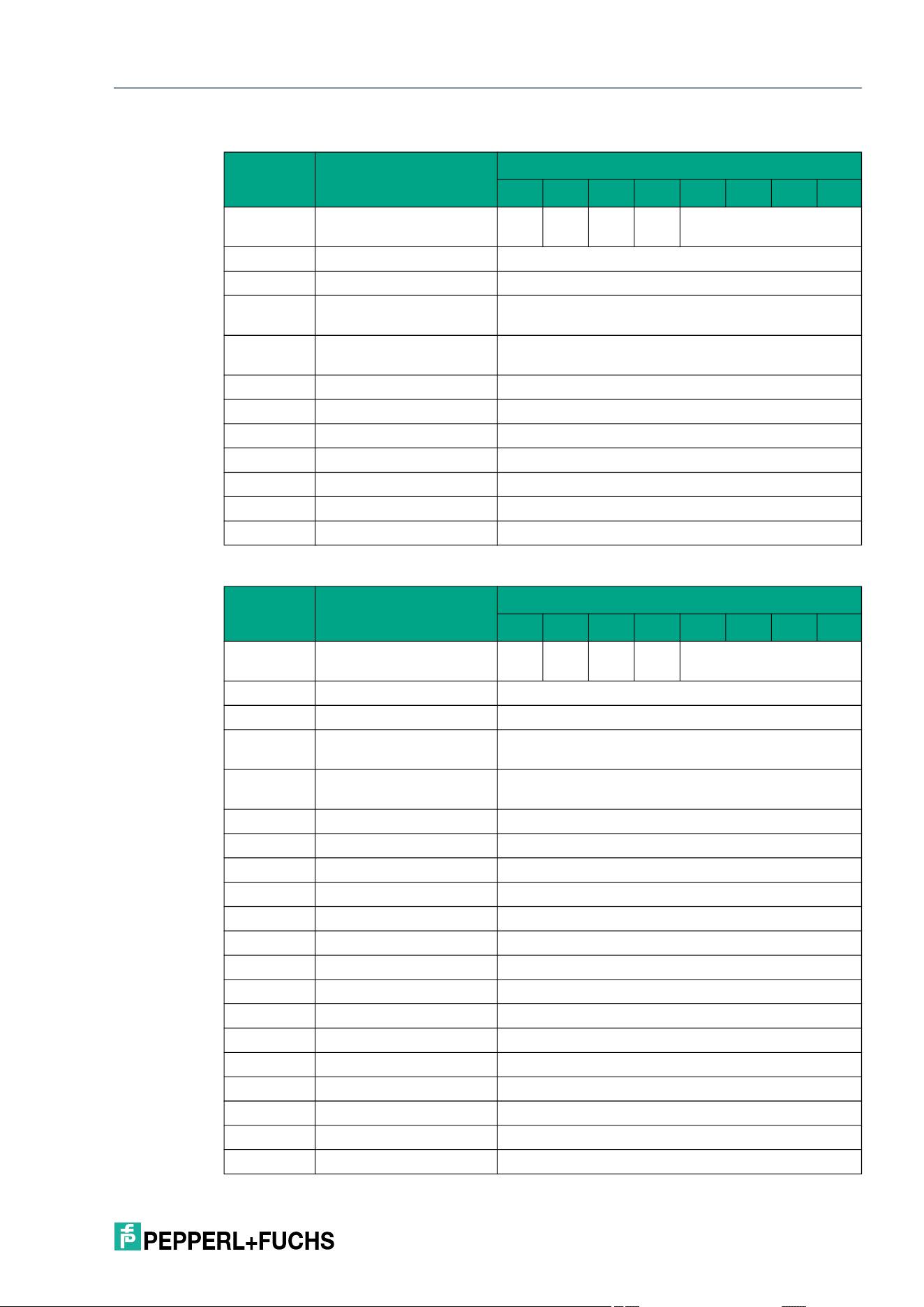
Response Telegram 3 – Status 16#0F (Multi-Frame Protocol)
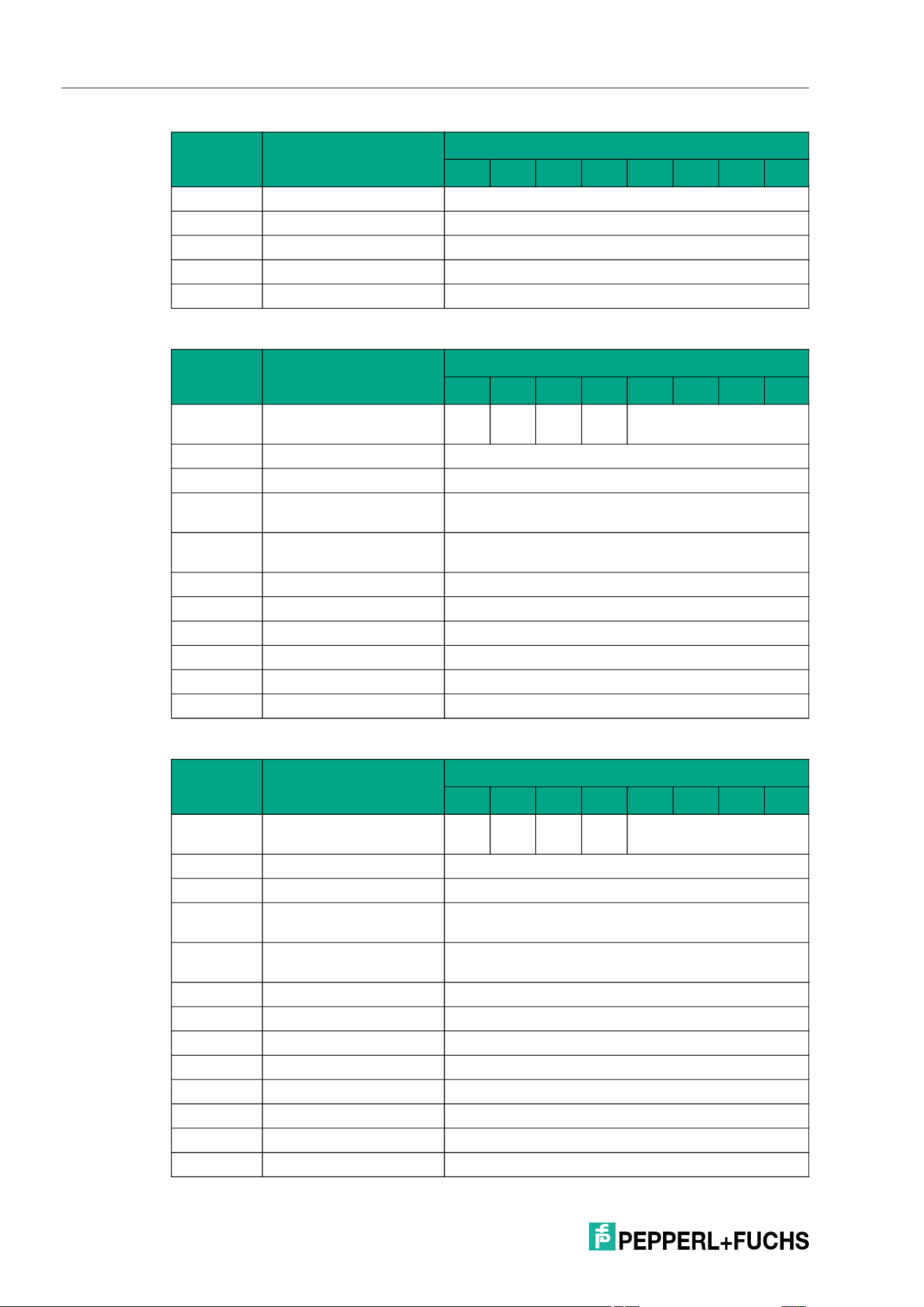
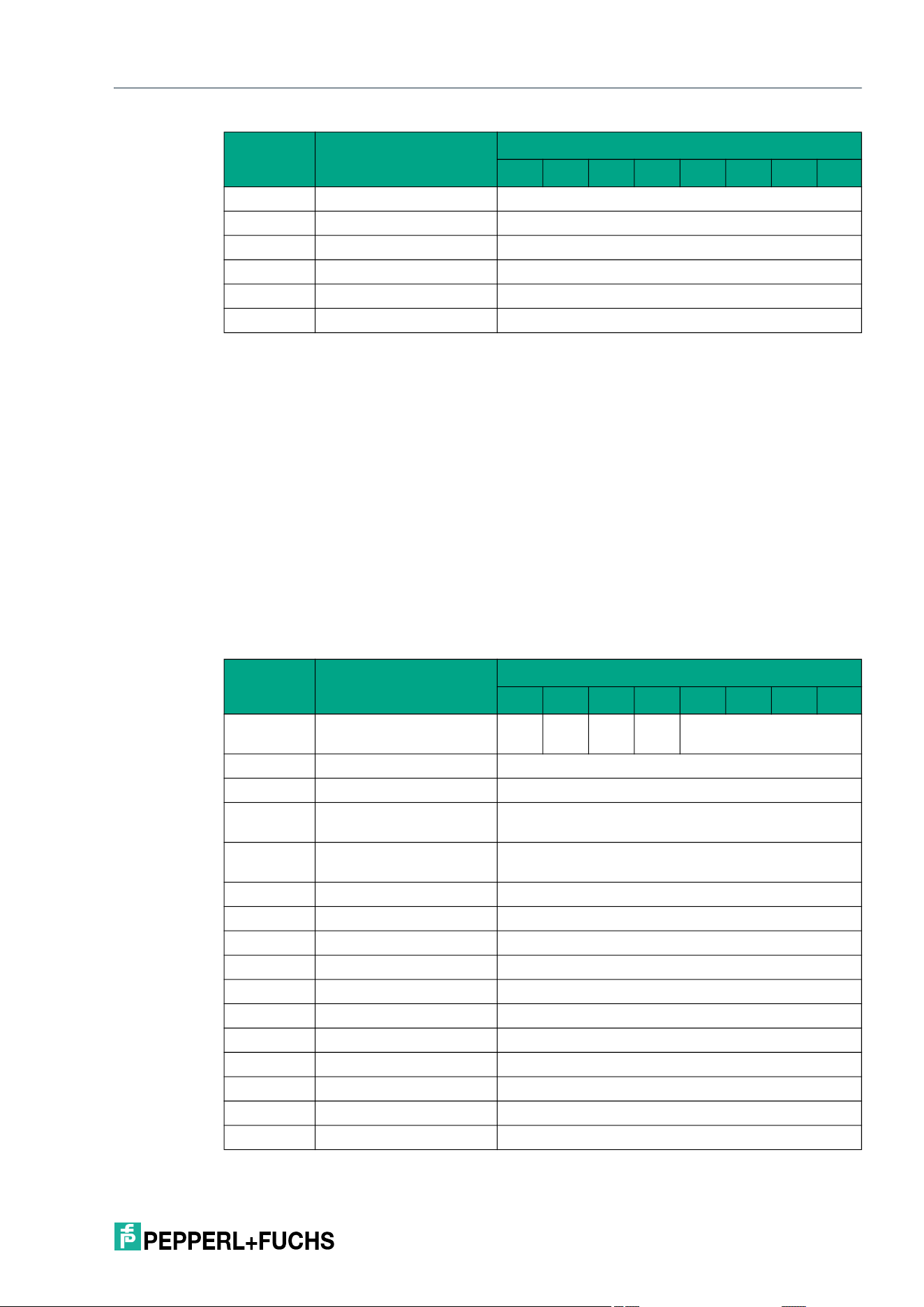
Enhanced Read 4-Byte Blocks (ER)
The ER command has the command code 16#19 and performs a continuous read access to
the user data area of a tag within the detection zone.
The <Start Address> parameter specifies the start address within the user data area. The value
of <Start Address> is based on bytes. Only multiples of the memory block size can be parame-
terized. <Number of Bytes> defines the number of bytes to be read. The number of bytes must
be a multiple of the memory block size.
The information is transmitted for each tag read in a separate data telegram with the status
value 16#00. In addition, for each tag read, a further telegram with the status value 16#0B is
transmitted, which contains information on the signal strength of the tag response (RSSI value).
A tag leaving the detection zone is indicated by a telegram containing the UID of the tag. This
telegram has the status value 16#05.
A Quit command stops the command execution.
Byte 3 Telegram Length (High
Byte)
16#00
Byte 4 Telegram Length (Low
Byte)
16#06
Byte 5 Command 16#10
Byte 6 Status 16#0B
Byte 7 Data 16#01 <Info Type>
Byte 8 Data <RSSI>
… Data 16#00
Byte 255 Data 16#00
Byte Content
Bit number
7 6 5 4 3 2 1 0
Byte 0 Control Byte / Frame
Length
D
S
U
M
U
D
0 16#0
Byte 1 Frame Length 16#0B
Byte 2 Fragmentation Counter 16#00
Byte 3 Telegram Length (High
Byte)
16#00
Byte 4 Telegram Length (Low
Byte)
16#08
Byte 5 Command 16#10
Byte 6 Status 16#0F
Byte 7 Data <Number of Tags Byte 1>
Byte 8 Data <Number of Tags Byte 2>
Byte 9 Data <Number of Tags Byte 3>
Byte 10 Data <Number of Tags Byte 4>
… Data 16#00
Byte 255 Data 16#00
Byte Content
Bit number
7 6 5 4 3 2 1 0
IQH3/IQH4 Series
Commissioning and Operation
2026-05
39
Command Telegram
Response Telegram 1 – Status 16#00 (Multi-Frame Protocol)
Byte Content
Bit number
7 6 5 4 3 2 1 0
Byte 0 Control Byte / Frame
Length
D
S
U
M
U
D
0 16#0
Byte 1 Frame Length 16#0A
Byte 2 Fragmentation Counter 16#00
Byte 3 Telegram Length (High
Byte)
16#00
Byte 4 Telegram Length (Low
Byte)
16#07
Byte 5 Command 16#19
Byte 6 Command parameter <Start Address (High Byte)>
Byte 7 Command parameter <Start Address (Low Byte)>
Byte 8 Command parameter <Number of Bytes (High Byte)>
Byte 9 Command parameter <Number of Bytes (Low Byte)>
… Command parameter 16#00
Byte 255 Command parameter 16#00
Byte Content
Bit number
7 6 5 4 3 2 1 0
Byte 0 Control Byte / Frame
Length
D
S
U
M
U
D
0 16#0
Byte 1 Frame Length 16#17
Byte 2 Fragmentation Counter 16#00
Byte 3 Telegram Length (High
Byte)
16#00
Byte 4 Telegram Length (Low
Byte)
16#14
Byte 5 Command 16#19
Byte 6 Status 16#00
Byte 7 Data 16#00 <Length UID in Byte (High Byte)>
Byte 8 Data 16#08 <Length UID in Byte (Low Byte)>
Byte 9 Data <UID Byte 1>
Byte 10 Data <UID Byte 2>
Byte 11 Data <UID Byte 3>
Byte 12 Data <UID Byte 4>
Byte 13 Data <UID Byte 5>
Byte 14 Data <UID Byte 6>
Byte 15 Data <UID Byte 7>
Byte 16 Data <UID Byte 8>
Byte 17 Data 16#00
Byte 18 Data 16#04
Byte 19 User Data <User Data Byte 1>
2026-05
40
IQH3/IQH4 Series
Commissioning and Operation
Response Telegram 2 – Status 16#0B (Information Frame Mode)
Response Telegram 3 – Status 16#05 (Multi-Frame Protocol)
Byte 20 User Data <User Data Byte 2>
Byte 21 User Data <User Data Byte 3>
Byte 22 User Data <User Data Byte 4>
… Data 16#00
Byte 255 Data 16#00
Byte Content
Bit number
7 6 5 4 3 2 1 0
Byte 0 Control Byte / Frame
Length
D
S
U
M
U
D
0 16#0
Byte 1 Frame Length 16#09
Byte 2 Fragmentation Counter 16#00
Byte 3 Telegram Length (High
Byte)
16#00
Byte 4 Telegram Length (Low
Byte)
16#06
Byte 5 Command 16#19
Byte 6 Status 16#0B
Byte 7 Data 16#01 <Info Type>
Byte 8 Data <RSSI>
… Data 16#00
Byte 255 Data 16#00
Byte Content
Bit number
7 6 5 4 3 2 1 0
Byte 0 Control Byte / Frame
Length
D
S
U
M
U
D
0 16#0
Byte 1 Frame Length 16#11
Byte 2 Fragmentation Counter 16#00
Byte 3 Telegram Length (High
Byte)
16#00
Byte 4 Telegram Length (Low
Byte)
16#0E
Byte 5 Command 16#19
Byte 6 Status 16#05
Byte 7 Data 16#00 <Length UID in Byte (High Byte)>
Byte 8 Data 16#08 <Length UID in Byte (Low Byte)>
Byte 9 Data <UID Byte 1>
Byte 10 Data <UID Byte 2>
Byte 11 Data <UID Byte 3>
Byte 12 Data <UID Byte 4>
Byte Content
Bit number
7 6 5 4 3 2 1 0
IQH3/IQH4 Series
Commissioning and Operation
2026-05
41
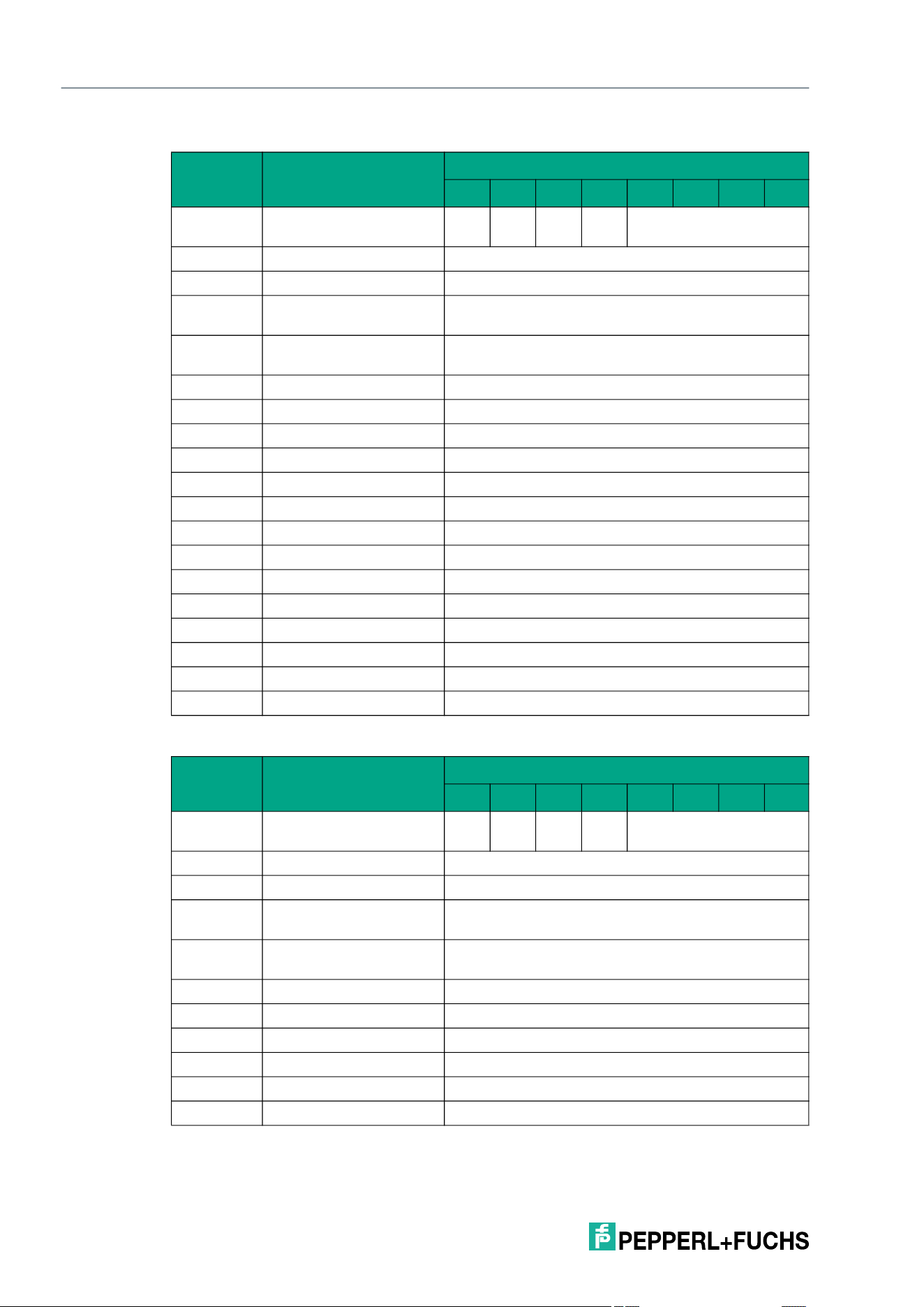
Single Write 4-Byte Blocks (SW)
The SW command has the command code 16#40 and performs a single write operation to the
user data area of a tag within the sensing range.
The <Start Address> parameter specifies the start address within the user data area. The value
of <Start Address> is based on bytes. Only multiples of the memory block size can be parame-
terized. <Number of Bytes> defines the number of bytes to be written. The number of bytes
must be a multiple of the memory block size.
A separate data telegram with the status value 16#00 indicates a successful write operation for
each tag written. The data telegram contains the UID of the tag to which the user data area was
written. In addition, for each tag written, a further telegram with the status value 16#0B is trans-
mitted, which contains information on the signal strength of the tag response (RSSI value).
The end of the command execution is indicated by an end telegram. The end telegram has the
status value 16#0F and contains the number of tags that were written during execution of the
command.
Command Telegram (4 Byte User Data)
Byte 13 Data <UID Byte 5>
Byte 14 Data <UID Byte 6>
Byte 15 Data <UID Byte 7>
Byte 16 Data <UID Byte 8>
... Data 16#00
Byte 255 Data 16#00
Byte Content
Bit number
7 6 5 4 3 2 1 0
Byte 0 Control Byte / Frame
Length
D
S
U
M
U
D
0 16#0
Byte 1 Frame Length 16#0E
Byte 2 Fragmentation Counter 16#00
Byte 3 Telegram Length (High
Byte)
16#00
Byte 4 Telegram Length (Low
Byte)
16#0B
Byte 5 Command 16#40
Byte 6 Command parameter 16#00 <Start Address (High Byte)>
Byte 7 Command parameter 16#00 <Start Address (Low Byte)>
Byte 8 Command parameter 16#00 <Number of Bytes (High Byte)>
Byte 9 Command parameter 16#04 <Number of Bytes (Low Byte)>
Byte 10 Command parameter <Data Byte 1>
Byte 11 Command parameter <Data Byte 2>
Byte 12 Command parameter <Data Byte 3>
Byte 13 Command parameter <Data Byte 4>
… Command parameter 16#00
Byte 255 Command parameter 16#00
Byte Content
Bit number
7 6 5 4 3 2 1 0
2026-05
42
IQH3/IQH4 Series
Commissioning and Operation
Response Telegram 1 – Status 16#00 (Multi-Frame Protocol)
Response Telegram 2 – Status 16#0B (Information Frame Mode)
Byte Content
Bit number
7 6 5 4 3 2 1 0
Byte 0 Control Byte / Frame
Length
D
S
U
M
U
D
0 16#0
Byte 1 Frame Length 16#11
Byte 2 Fragmentation Counter 16#00
Byte 3 Telegram Length (High
Byte)
16#00
Byte 4 Telegram Length (Low
Byte)
16#0E
Byte 5 Command 16#40
Byte 6 Status 16#00
Byte 7 Data 16#00 <Length UID in Byte (High Byte)>
Byte 8 Data 16#08 <Length UID in Byte (Low Byte)>
Byte 9 Data <UID Byte 1>
Byte 10 Data <UID Byte 2>
Byte 11 Data <UID Byte 3>
Byte 12 Data <UID Byte 4>
Byte 13 Data <UID Byte 5>
Byte 14 Data <UID Byte 6>
Byte 15 Data <UID Byte 7>
Byte 16 Data <UID Byte 8>
… Data 16#00
Byte 255 Data 16#00
Byte Content
Bit number
7 6 5 4 3 2 1 0
Byte 0 Control Byte / Frame
Length
D
S
U
M
U
D
0 16#0
Byte 1 Frame Length 16#09
Byte 2 Fragmentation Counter 16#00
Byte 3 Telegram Length (High
Byte)
16#00
Byte 4 Telegram Length (Low
Byte)
16#06
Byte 5 Command 16#40
Byte 6 Status 16#0B
Byte 7 Data 16#01 <Info Type>
Byte 8 Data <RSSI>
… Data 16#00
Byte 255 Data 16#00
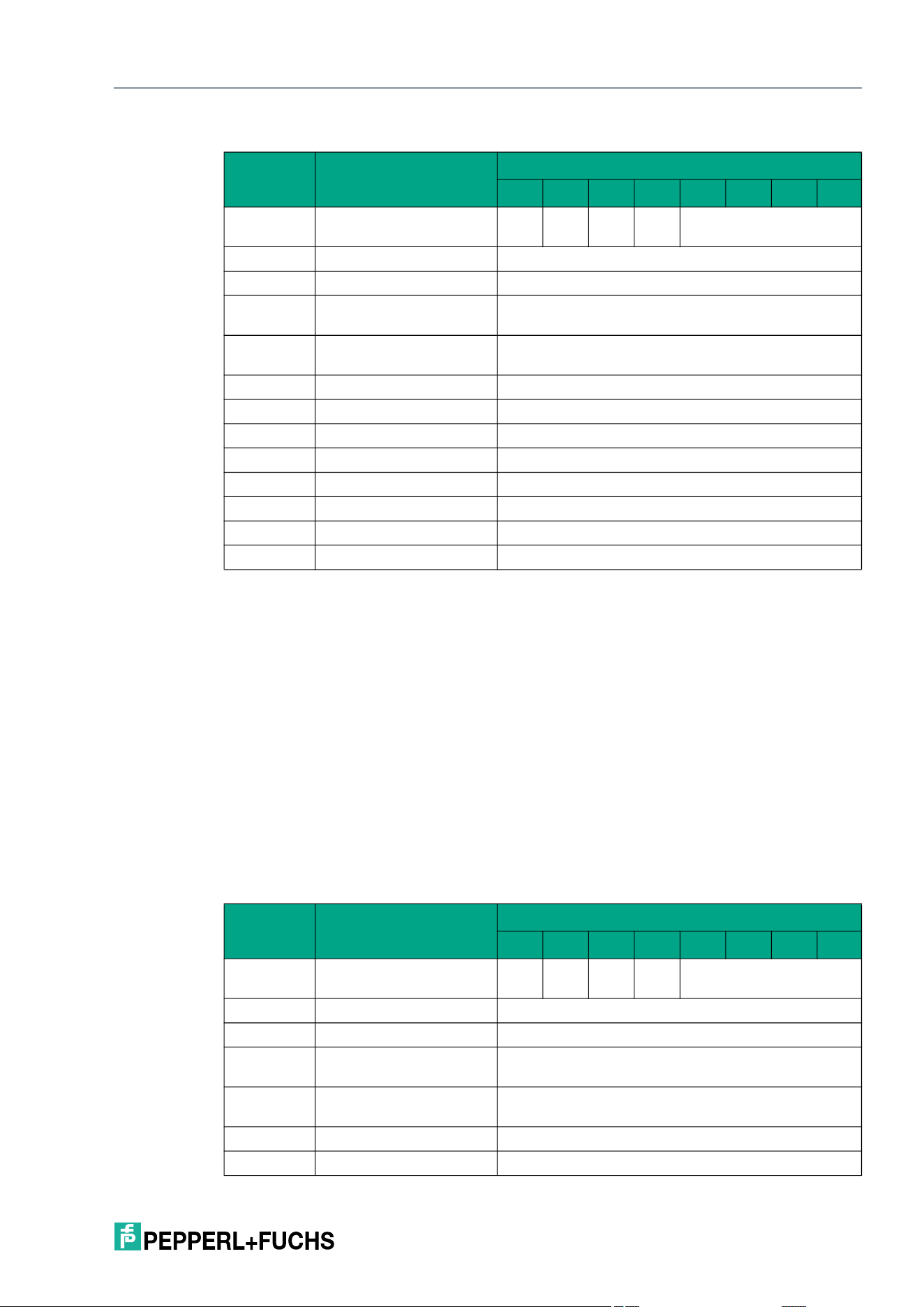
IQH3/IQH4 Series
Commissioning and Operation
2026-05
43
Response Telegram 3 – Status 16#0F (Multi-Frame Protocol)
Enhanced Write 4-Byte Blocks (EW)
The EW command has the command code 16#1A and performs a continuous write operation
to the user data area of a tag within the sensing range.
The <Start Address> parameter specifies the start address within the user data area. The value
of <Start Address> is based on bytes. Only multiples of the memory block size can be parame-
terized. <Number of Bytes> defines the number of bytes to be written. The number of bytes
must be a multiple of the memory block size.
A separate data telegram with the status value 16#00 indicates a successful write operation for
each tag written. The data telegram contains the UID of the tags to which the user data area
was written. In addition, for each tag written, a further telegram with the status value 16#0B is
transmitted, which contains information on the signal strength of the tag response (RSSI value).
A tag leaving the detection zone is indicated by a telegram containing the UID of the tag. This
telegram has the status value 16#05.
A Quit command stops the command execution.
Command Telegram (4 Byte User Data)
Byte Content
Bit number
7 6 5 4 3 2 1 0
Byte 0 Control Byte / Frame
Length
D
S
U
M
U
D
0 16#0
Byte 1 Frame Length 16#0B
Byte 2 Fragmentation Counter 16#00
Byte 3 Telegram Length (High
Byte)
16#00
Byte 4 Telegram Length (Low
Byte)
16#08
Byte 5 Command 16#40
Byte 6 Status 16#0F
Byte 7 Data <Number of Tags Byte 1>
Byte 8 Data <Number of Tags Byte 2>
Byte 9 Data <Number of Tags Byte 3>
Byte 10 Data <Number of Tags Byte 4>
… Data 16#00
Byte 255 Data 16#00
Byte Content
Bit number
7 6 5 4 3 2 1 0
Byte 0 Control Byte / Frame
Length
D
S
U
M
U
D
0 16#0
Byte 1 Frame Length 16#0E
Byte 2 Fragmentation Counter 16#00
Byte 3 Telegram Length (High
Byte)
16#00
Byte 4 Telegram Length (Low
Byte)
16#0B
Byte 5 Command 16#1A
Byte 6 Command parameter 16#00 <Start Address (High Byte)>
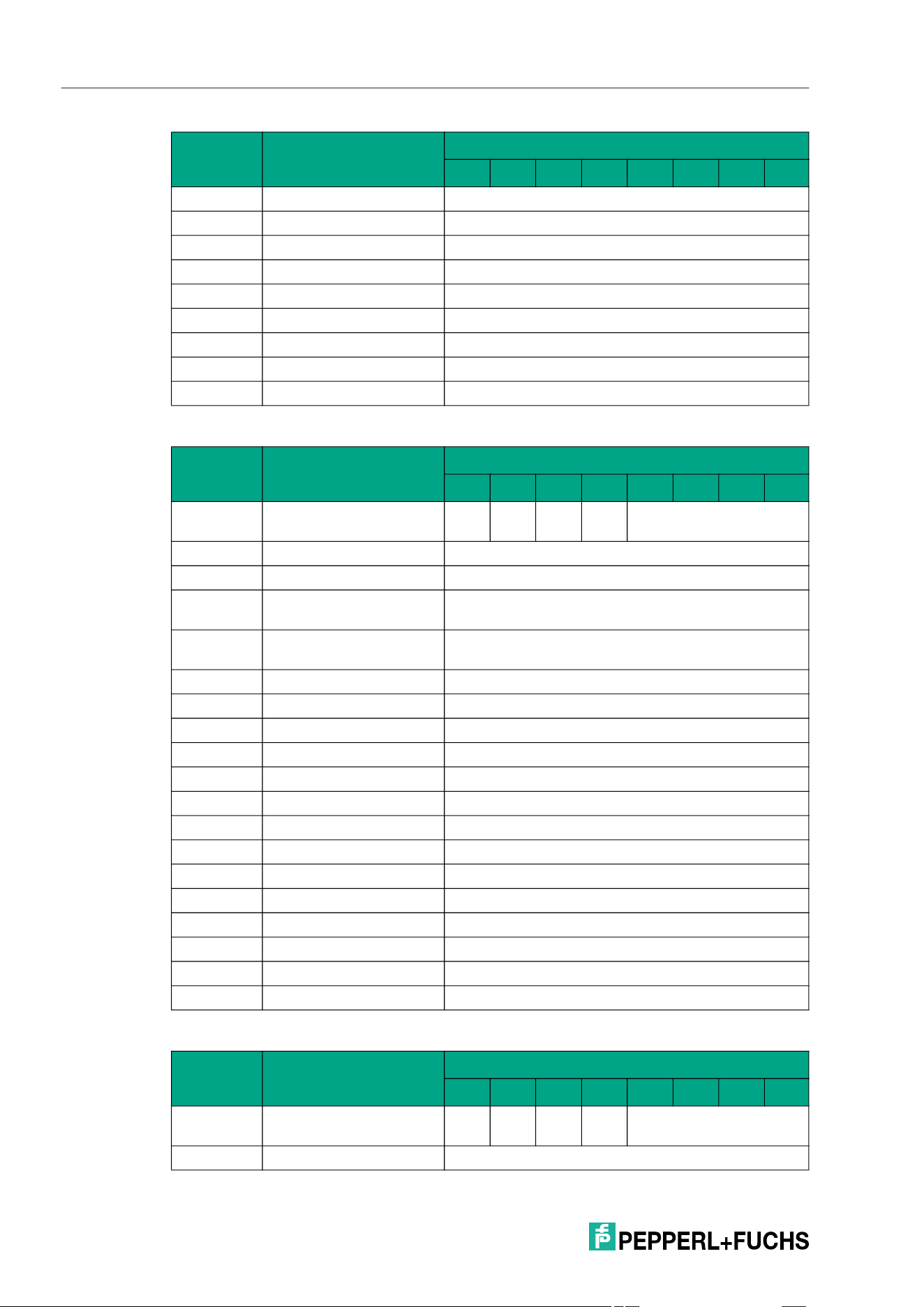
2026-05
44
IQH3/IQH4 Series
Commissioning and Operation
Response Telegram 1 – Status 16#00 (Multi-Frame Protocol)
Response Telegram 2 – Status 16#0B (Information Frame Mode)
Byte 7 Command parameter 16#00 <Start Address (Low Byte)>
Byte 8 Command parameter 16#00 <Number of Bytes (High Byte)>
Byte 9 Command parameter 16#04 <Number of Bytes (Low Byte)>
Byte 10 Command parameter <Data Byte 1>
Byte 11 Command parameter <Data Byte 2>
Byte 12 Command parameter <Data Byte 3>
Byte 13 Command parameter <Data Byte 4>
… Command parameter 16#00
Byte 255 Command parameter 16#00
Byte Content
Bit number
7 6 5 4 3 2 1 0
Byte 0 Control Byte / Frame
Length
D
S
U
M
U
D
0 16#0
Byte 1 Frame Length 16#11
Byte 2 Fragmentation Counter 16#00
Byte 3 Telegram Length (High
Byte)
16#00
Byte 4 Telegram Length (Low
Byte)
16#0E
Byte 5 Command 16#1A
Byte 6 Status 16#00
Byte 7 Data 16#00 <Length UID in Byte (High Byte)>
Byte 8 Data 16#08 <Length UID in Byte (Low Byte)>
Byte 9 Data <UID Byte 1>
Byte 10 Data <UID Byte 2>
Byte 11 Data <UID Byte 3>
Byte 12 Data <UID Byte 4>
Byte 13 Data <UID Byte 5>
Byte 14 Data <UID Byte 6>
Byte 15 Data <UID Byte 7>
Byte 16 Data <UID Byte 8>
… Data 16#00
Byte 255 Data 16#00
Byte Content
Bit number
7 6 5 4 3 2 1 0
Byte 0 Control Byte / Frame
Length
D
S
U
M
U
D
0 16#0
Byte 1 Frame Length 16#09
Byte Content
Bit number
7 6 5 4 3 2 1 0
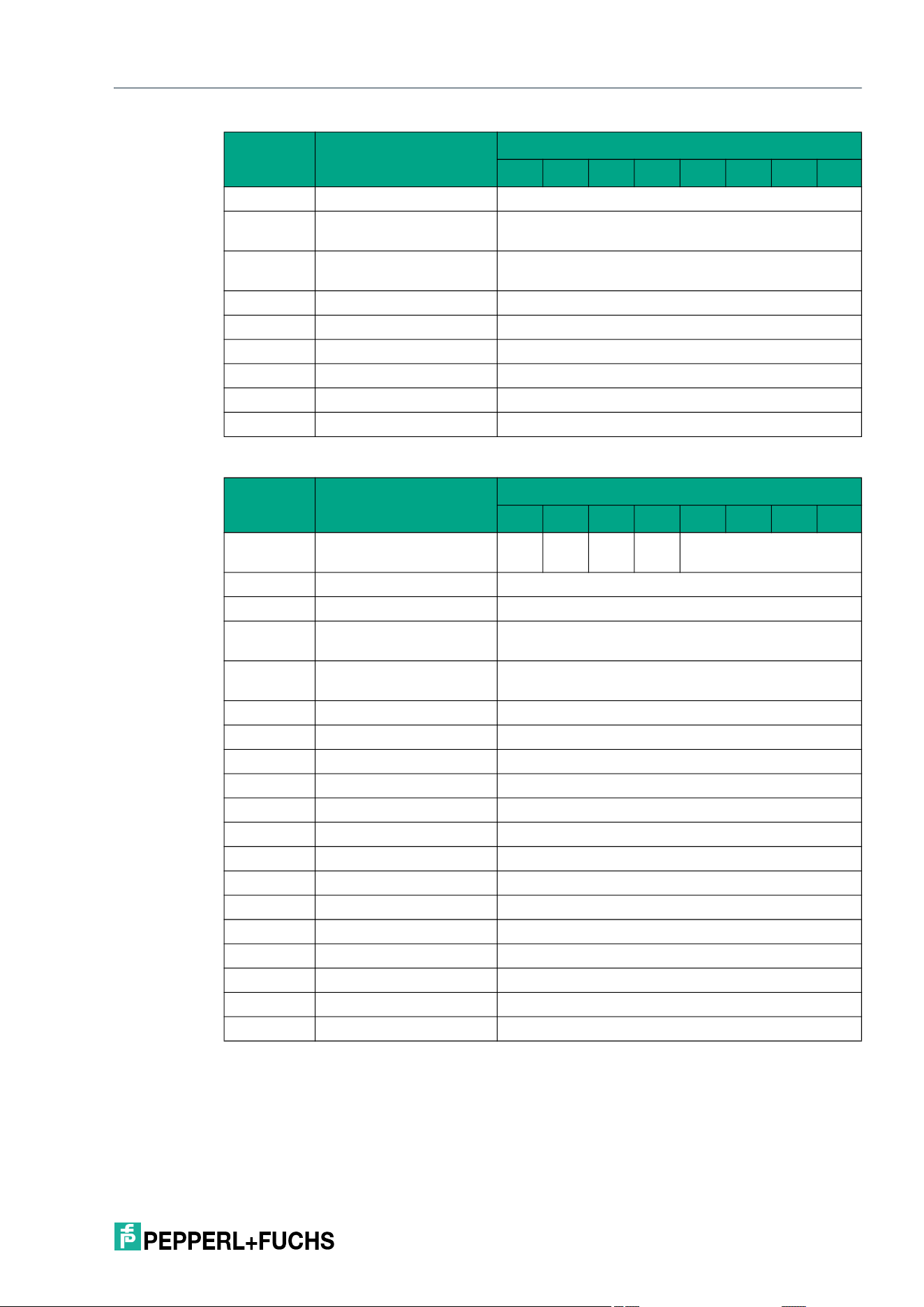
IQH3/IQH4 Series
Commissioning and Operation
2026-05
45
Response Telegram 3 – Status 16#05 (Multi-Frame Protocol)
Byte 2 Fragmentation Counter 16#00
Byte 3 Telegram Length (High
Byte)
16#00
Byte 4 Telegram Length (Low
Byte)
16#06
Byte 5 Command 16#1A
Byte 6 Status 16#0B
Byte 7 Data 16#01 <Info Type>
Byte 8 Data <RSSI>
… Data 16#00
Byte 255 Data 16#00
Byte Content
Bit number
7 6 5 4 3 2 1 0
Byte 0 Control Byte / Frame
Length
D
S
U
M
U
D
0 16#0
Byte 1 Frame Length 16#11
Byte 2 Fragmentation Counter 16#00
Byte 3 Telegram Length (High
Byte)
16#00
Byte 4 Telegram Length (Low
Byte)
16#0E
Byte 5 Command 16#1A
Byte 6 Status 16#05
Byte 7 Data 16#00 <Length UID in Byte (High Byte)>
Byte 8 Data 16#08 <Length UID in Byte (Low Byte)>
Byte 9 Data <UID Byte 1>
Byte 10 Data <UID Byte 2>
Byte 11 Data <UID Byte 3>
Byte 12 Data <UID Byte 4>
Byte 13 Data <UID Byte 5>
Byte 14 Data <UID Byte 6>
Byte 15 Data <UID Byte 7>
Byte 16 Data <UID Byte 8>
… Data 16#00
Byte 255 Data 16#00
Byte Content
Bit number
7 6 5 4 3 2 1 0
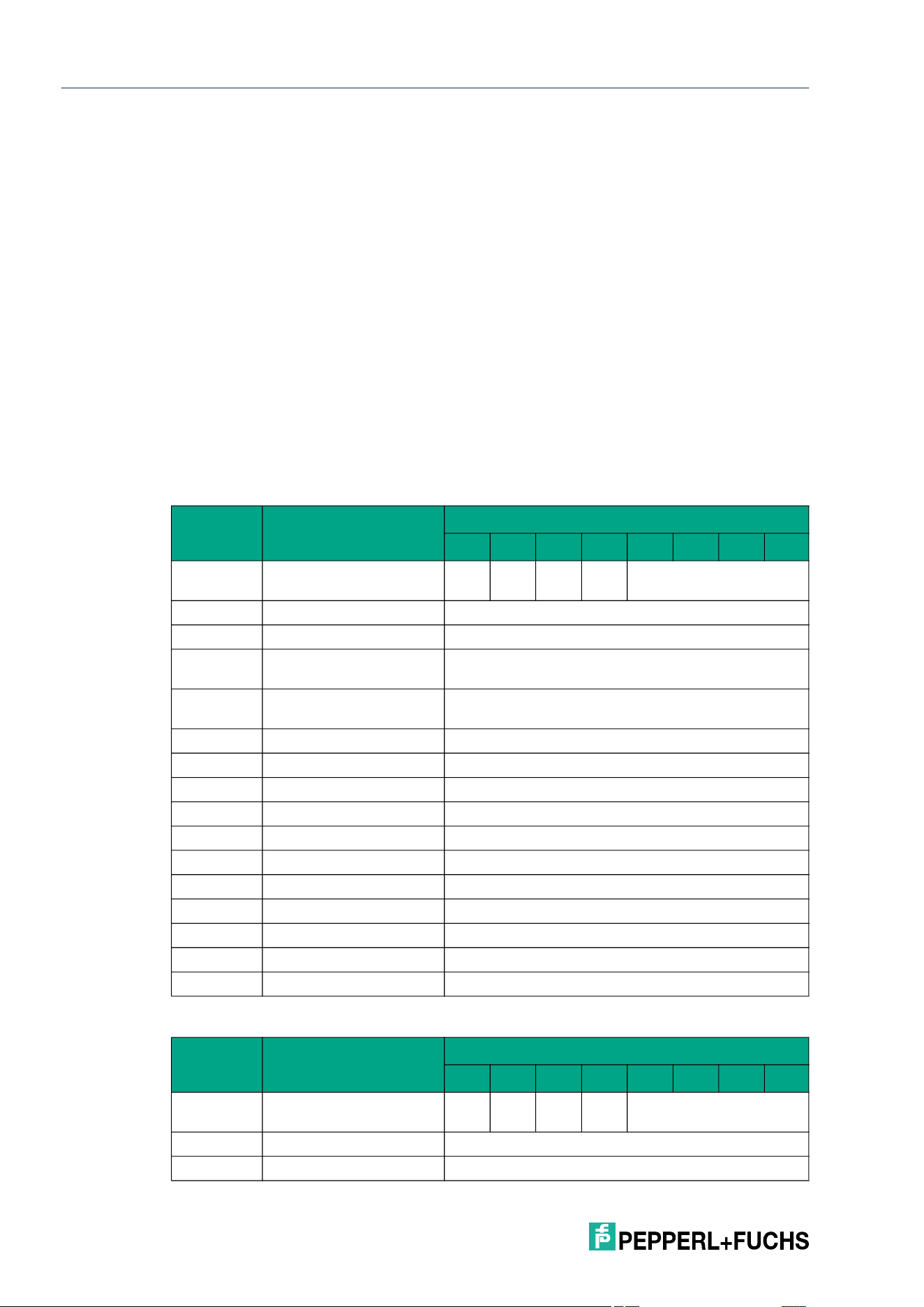
2026-05
46
IQH3/IQH4 Series
Commissioning and Operation
Single Write 4-Byte Blocks with Lock (SL)
The SL command has the command code 16#47 and performs a single write operation to the
user data area of a tag within the detection zone. The data is write-protected at the end of the
write process, provided the tag offers this function. This applies to tag types 21, 22, 24, 33, 50,
and 51. The write protection is permanent and cannot be undone. Write protection is only acti-
vated for memory blocks involved in the writing process. Data can continue to be written to all
other memory blocks.
The <Start Address> parameter specifies the start address within the user data area. The value
of <Start Address> is based on bytes. Only multiples of the memory block size can be parame-
terized. <Number of Bytes> defines the number of bytes to be written. The number of bytes
must also be a multiple of the memory block size.
A separate data telegram with the status value 16#00 indicates a successful write operation for
each tag written. The data telegram contains the UID of the tag to which the user data area was
written. In addition, for each tag written, a further telegram with the status value 16#0B is trans-
mitted, which contains information on the signal strength of the tag response (RSSI value).
The end of the command execution is indicated by an end telegram. The end telegram has the
status value 16#0F and contains the number of tags that were written during execution of the
command.
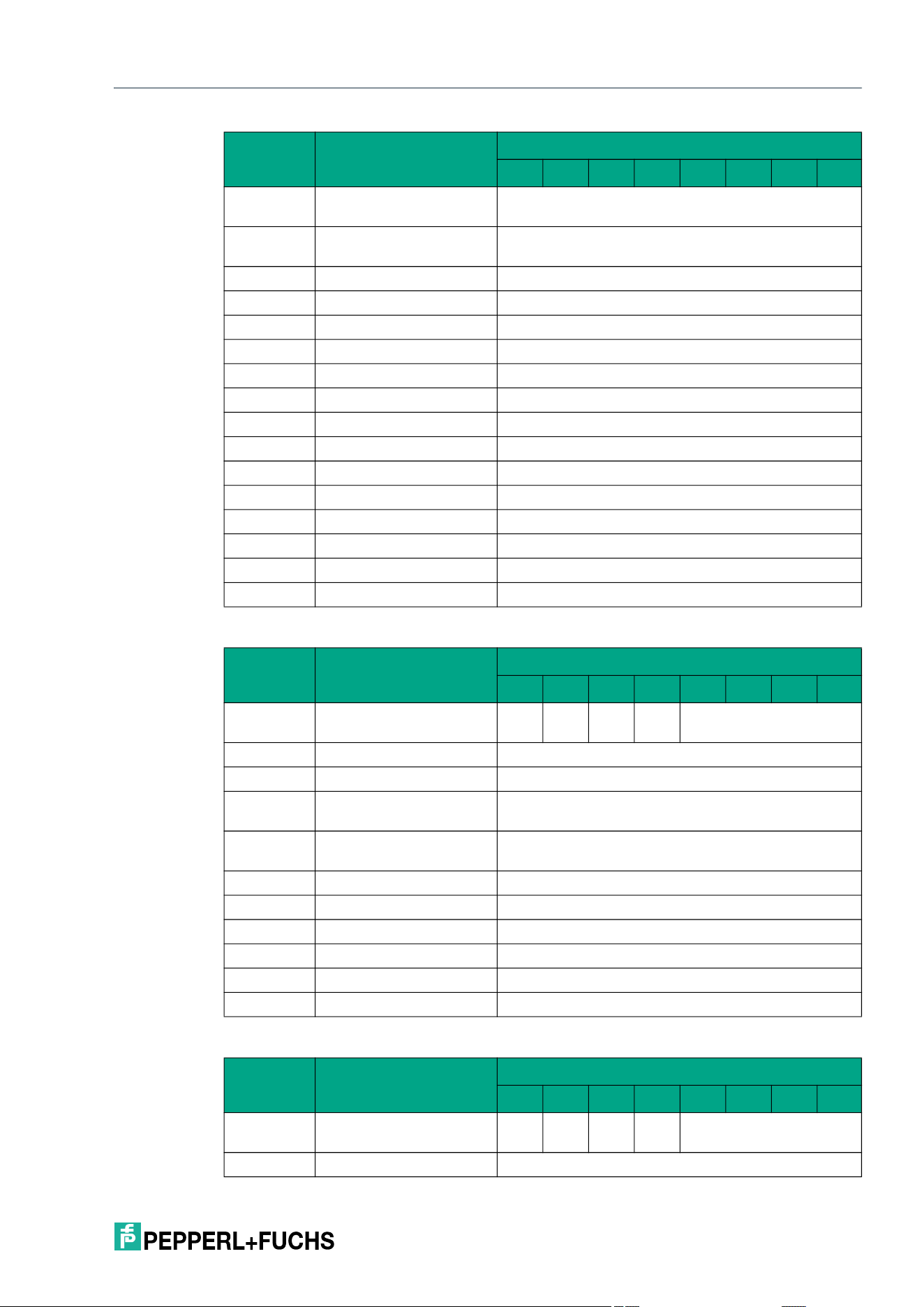
Command Telegram (4 Byte User Data)
Response Telegram 1 – Status 16#00 (Multi-Frame Protocol)
Byte Content
Bit number
7 6 5 4 3 2 1 0
Byte 0 Control Byte / Frame
Length
D
S
U
M
U
D
0 16#0
Byte 1 Frame Length 16#0E
Byte 2 Fragmentation Counter 16#00
Byte 3 Telegram Length (High
Byte)
16#00
Byte 4 Telegram Length (Low
Byte)
16#0B
Byte 5 Command 16#47
Byte 6 Command parameter 16#00 <Start Address (High Byte)>
Byte 7 Command parameter 16#00 <Start Address (Low Byte)>
Byte 8 Command parameter 16#00 <Number of Bytes (High Byte)>
Byte 9 Command parameter 16#04 <Number of Bytes (Low Byte)>
Byte 10 Command parameter <Data Byte 1>
Byte 11 Command parameter <Data Byte 2>
Byte 12 Command parameter <Data Byte 3>
Byte 13 Command parameter <Data Byte 4>
… Command parameter 16#00
Byte 255 Command parameter 16#00
Byte Content
Bit number
7 6 5 4 3 2 1 0
Byte 0 Control Byte / Frame
Length
D
S
U
M
U
D
0 16#0
Byte 1 Frame Length 16#11
Byte 2 Fragmentation Counter 16#00
IQH3/IQH4 Series
Commissioning and Operation
2026-05
47
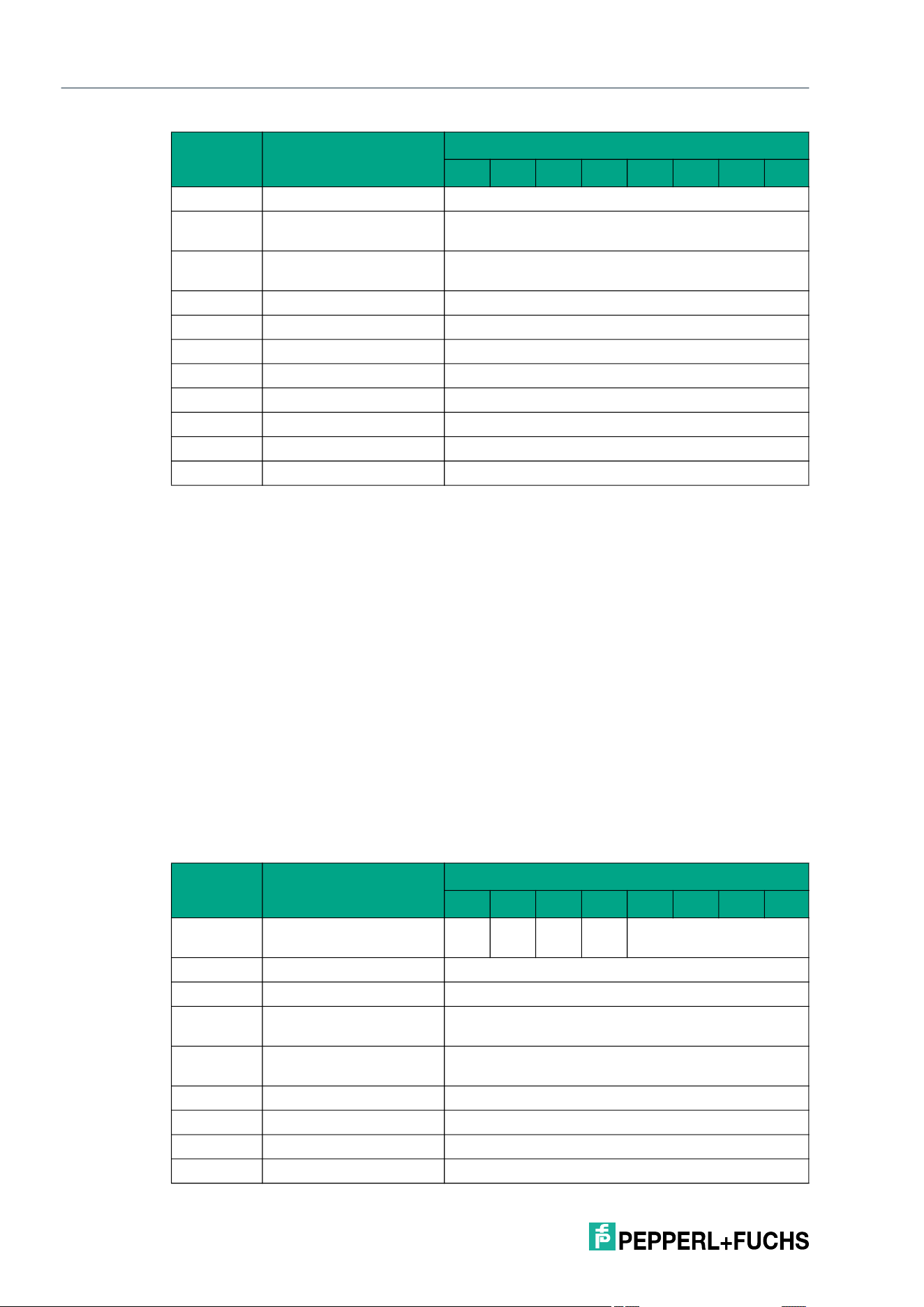
Response Telegram 2 – Status 16#0B (Information Frame Mode)
Response Telegram 3 – Status 16#0F (Multi-Frame Protocol)
Byte 3 Telegram Length (High
Byte)
16#00
Byte 4 Telegram Length (Low
Byte)
16#0E
Byte 5 Command 16#47
Byte 6 Status 16#00
Byte 7 Data 16#00 <Length UID in Byte (High Byte)>
Byte 8 Data 16#08 <Length UID in Byte (Low Byte)>
Byte 9 Data <UID Byte 1>
Byte 10 Data <UID Byte 2>
Byte 11 Data <UID Byte 3>
Byte 12 Data <UID Byte 4>
Byte 13 Data <UID Byte 5>
Byte 14 Data <UID Byte 6>
Byte 15 Data <UID Byte 7>
Byte 16 Data <UID Byte 8>
… Data 16#00
Byte 255 Data 16#00
Byte Content
Bit number
7 6 5 4 3 2 1 0
Byte 0 Control Byte / Frame
Length
D
S
U
M
U
D
0 16#0
Byte 1 Frame Length 16#09
Byte 2 Fragmentation Counter 16#00
Byte 3 Telegram Length (High
Byte)
16#00
Byte 4 Telegram Length (Low
Byte)
16#06
Byte 5 Command 16#47
Byte 6 Status 16#0B
Byte 7 Data 16#01 <Info Type>
Byte 8 Data <RSSI>
… Data 16#00
Byte 255 Data 16#00
Byte Content
Bit number
7 6 5 4 3 2 1 0
Byte 0 Control Byte / Frame
Length
D
S
U
M
U
D
0 16#0
Byte 1 Frame Length 16#0B
Byte Content
Bit number
7 6 5 4 3 2 1 0
2026-05
48
IQH3/IQH4 Series
Commissioning and Operation
Enhanced Write 4-Byte Blocks with Lock (EL)
The EL command has the command code 16#48 and performs a continuous write operation to
the user data area of a tag within the detection zone. The data is write-protected at the end of
the write process, provided the tag offers this function. This applies to tag types 21, 22, 24, 33,
50, and 51. The write protection is permanent and cannot be undone. Write protection is only
activated for memory blocks involved in the writing process. Data can continue to be written to
all other memory blocks.
The <Start Address> parameter specifies the start address within the user data area. The value
of <Start Address> is based on bytes. Only multiples of the memory block size can be parame-
terized. <Number of Bytes> defines the number of bytes to be written. The number of bytes
must also be a multiple of the memory block size.
A separate data telegram with the status value 16#00 indicates a successful write operation for
each tag written. The data telegram contains the UID of the tags to which the user data area
was written. In addition, for each tag written, a further telegram with the status value 16#0B is
transmitted, which contains information on the signal strength of the tag response (RSSI value).
A tag leaving the detection zone is indicated by a telegram containing the fixed code of the tag.
This telegram has the status value 16#05. A Quit command stops the command execution.
Command Telegram (4 Byte User Data)
Byte 2 Fragmentation Counter 16#00
Byte 3 Telegram Length (High
Byte)
16#00
Byte 4 Telegram Length (Low
Byte)
16#08
Byte 5 Command 16#47
Byte 6 Status 16#0F
Byte 7 Data <Number of Tags Byte 1>
Byte 8 Data <Number of Tags Byte 2>
Byte 9 Data <Number of Tags Byte 3>
Byte 10 Data <Number of Tags Byte 4>
… Data 16#00
Byte 255 Data 16#00
Byte Content
Bit number
7 6 5 4 3 2 1 0
Byte 0 Control Byte / Frame
Length
D
S
U
M
U
D
0 16#0
Byte 1 Frame Length 16#0E
Byte 2 Fragmentation Counter 16#00
Byte 3 Telegram Length (High
Byte)
16#00
Byte 4 Telegram Length (Low
Byte)
16#0B
Byte 5 Command 16#48
Byte 6 Command parameter 16#00 <Start Address (High Byte)>
Byte 7 Command parameter 16#00 <Start Address (Low Byte)>
Byte 8 Command parameter 16#00 <Number of Bytes (High Byte)>
Byte Content
Bit number
7 6 5 4 3 2 1 0
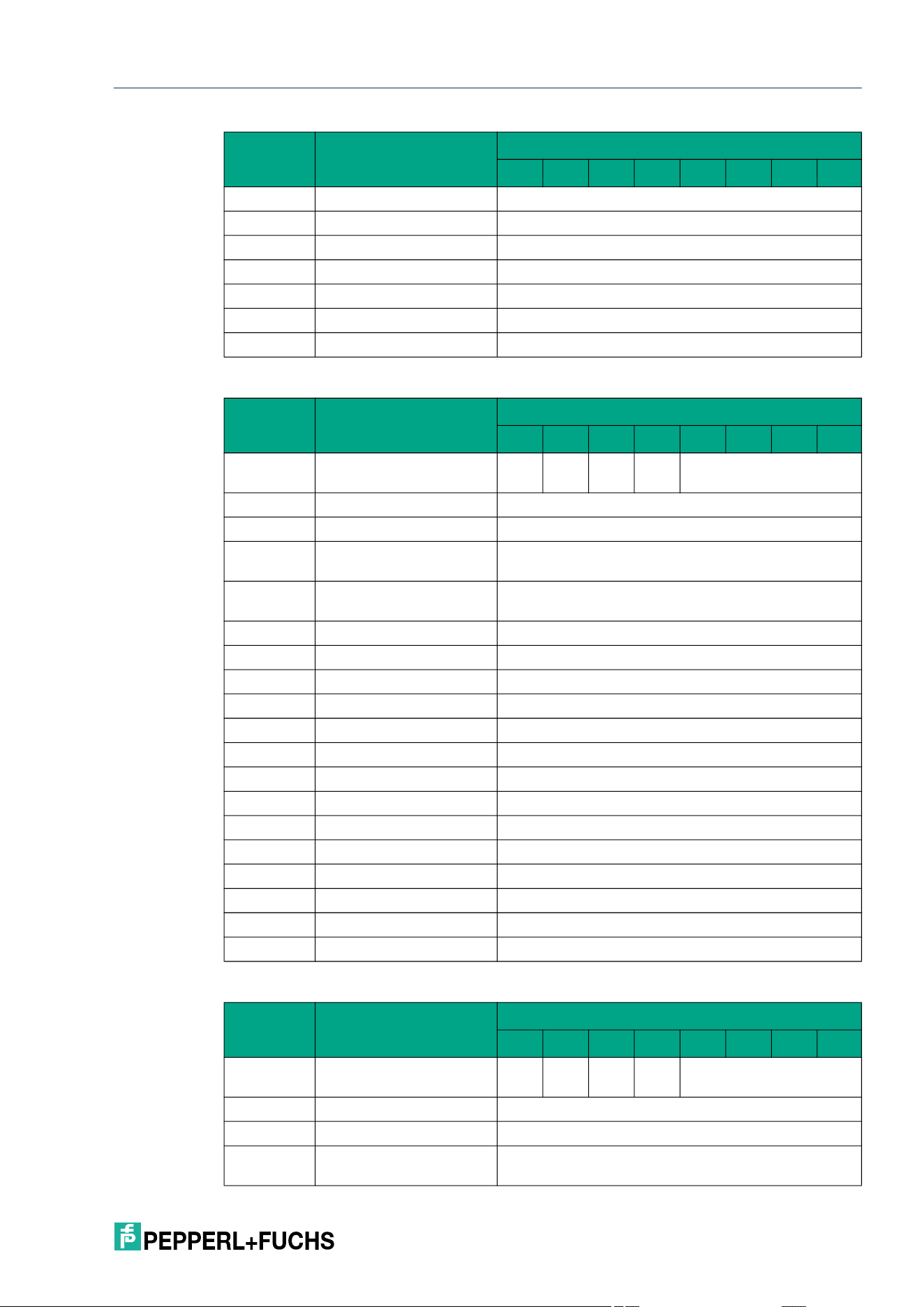
IQH3/IQH4 Series
Commissioning and Operation
2026-05
49
Response Telegram 1 – Status 16#00 (Multi-Frame Protocol)
Response Telegram 2 – Status 16#0B (Information Frame Mode)
Byte 9 Command parameter 16#04 <Number of Bytes (Low Byte)>
Byte 10 Command parameter <Data Byte 1>
Byte 11 Command parameter <Data Byte 2>
Byte 12 Command parameter <Data Byte 3>
Byte 13 Command parameter <Data Byte 4>
… Command parameter 16#00
Byte 255 Command parameter 16#00
Byte Content
Bit number
7 6 5 4 3 2 1 0
Byte 0 Control Byte / Frame
Length
D
S
U
M
U
D
0 16#0
Byte 1 Frame Length 16#11
Byte 2 Fragmentation Counter 16#00
Byte 3 Telegram Length (High
Byte)
16#00
Byte 4 Telegram Length (Low
Byte)
16#0E
Byte 5 Command 16#48
Byte 6 Status 16#00
Byte 7 Data 16#00 <Length UID in Byte (High Byte)>
Byte 8 Data 16#08 <Length UID in Byte (Low Byte)>
Byte 9 Data <UID Byte 1>
Byte 10 Data <UID Byte 2>
Byte 11 Data <UID Byte 3>
Byte 12 Data <UID Byte 4>
Byte 13 Data <UID Byte 5>
Byte 14 Data <UID Byte 6>
Byte 15 Data <UID Byte 7>
Byte 16 Data <UID Byte 8>
… Data 16#00
Byte 255 Data 16#00
Byte Content
Bit number
7 6 5 4 3 2 1 0
Byte 0 Control Byte / Frame
Length
D
S
U
M
U
D
0 16#0
Byte 1 Frame Length 16#09
Byte 2 Fragmentation Counter 16#00
Byte 3 Telegram Length (High
Byte)
16#00
Byte Content
Bit number
7 6 5 4 3 2 1 0
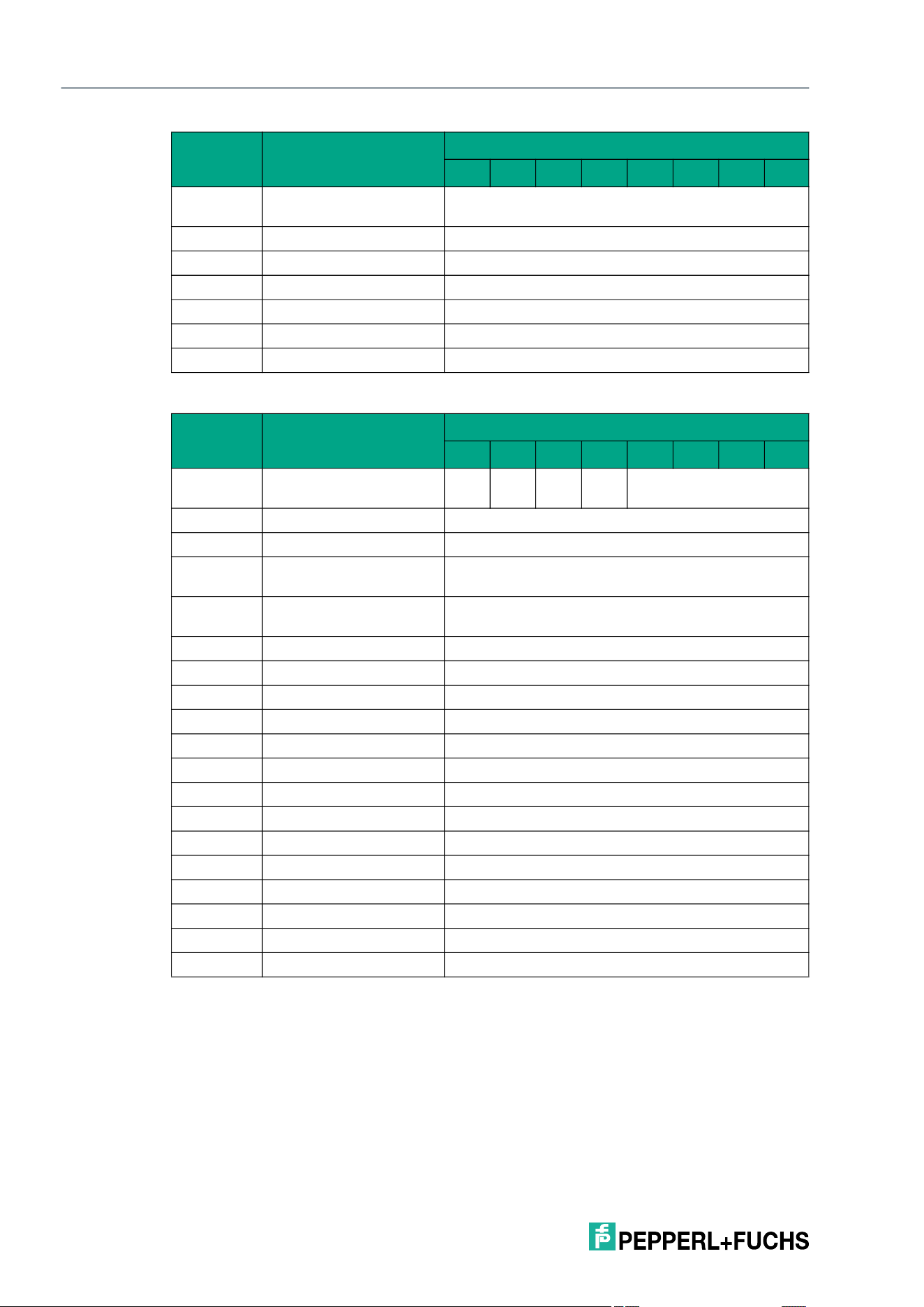
2026-05
50
IQH3/IQH4 Series
Commissioning and Operation
Response Telegram 3 – Status 16#05 (Multi-Frame Protocol)
Single Get Configuration (SG)
The SG command has the command code 16#61 and performs a single read operation on the
configuration area of a tag within the detection zone. This can be used, for example, to read the
AFI or DSFID of the tag.
The <Config Address> parameter defines access to the configuration area and has the value
16#00 or 16#30.
The information is transmitted for each tag read in a separate data telegram with the status
value 16#00. In addition, for each tag read, a further telegram with the status value 16#0B is
sent that contains the RSSI value for the signal strength of the tag response.
Byte 4 Telegram Length (Low
Byte)
16#06
Byte 5 Command 16#48
Byte 6 Status 16#0B
Byte 7 Data 16#01 <Info Type>
Byte 8 Data <RSSI>
… Data 16#00
Byte 255 Data 16#00
Byte Content
Bit number
7 6 5 4 3 2 1 0
Byte 0 Control Byte / Frame
Length
D
S
U
M
U
D
0 16#0
Byte 1 Frame Length 16#11
Byte 2 Fragmentation Counter 16#00
Byte 3 Telegram Length (High
Byte)
16#00
Byte 4 Telegram Length (Low
Byte)
16#0E
Byte 5 Command 16#48
Byte 6 Status 16#05
Byte 7 Data 16#00 <Length UID in Byte (High Byte)>
Byte 8 Data 16#08 <Length UID in Byte (Low Byte)>
Byte 9 Data <UID Byte 1>
Byte 10 Data <UID Byte 2>
Byte 11 Data <UID Byte 3>
Byte 12 Data <UID Byte 4>
Byte 13 Data <UID Byte 5>
Byte 14 Data <UID Byte 6>
Byte 15 Data <UID Byte 7>
Byte 16 Data <UID Byte 8>
… Data 16#00
Byte 255 Data 16#00
Byte Content
Bit number
7 6 5 4 3 2 1 0
IQH3/IQH4 Series
Commissioning and Operation
2026-05
51
The end of the command execution is indicated by an end telegram. The end telegram has the
status value 16#0F and contains the number of tags that were identified during execution of the
command.
Command Telegram
Response Telegram 1 – Status 16#00 (Multi-Frame Protocol)
Byte Content
Bit number
7 6 5 4 3 2 1 0
Byte 0 Control Byte / Frame
Length
D
S
U
M
U
D
0 16#0
Byte 1 Frame Length 16#07
Byte 2 Fragmentation Counter 16#00
Byte 3 Telegram Length (High
Byte)
16#00
Byte 4 Telegram Length (Low
Byte)
16#04
Byte 5 Command 16#61
Byte 6 Command parameter 16#00 <Config Address>
Byte ... Command parameter 16#00
Byte 255 Command parameter 16#00
Byte Content
Bit number
7 6 5 4 3 2 1 0
Byte 0 Control Byte / Frame
Length
D
S
U
M
U
D
0 16#0
Byte 1 Frame Length 16#21
Byte 2 Fragmentation Counter 16#00
Byte 3 Telegram Length (High
Byte)
16#00
Byte 4 Telegram Length (Low
Byte)
16#1E
Byte 5 Command 16#61
Byte 6 Status 16#00
Byte 7 Data 16#00 <Length UID in Byte (High Byte)>
Byte 8 Data 16#08 <Length UID in Byte (Low Byte)>
Byte 9 Data <UID Byte 1>
Byte 10 Data <UID Byte 2>
Byte 11 Data <UID Byte 3>
Byte 12 Data <UID Byte 4>
Byte 13 Data <UID Byte 5>
Byte 14 Data <UID Byte 6>
Byte 15 Data <UID Byte 7>
Byte 16 Data <UID Byte 8>
Byte 17 Data 16#00
Byte 18 Data 16#0E
Byte 19 Data <Info Flags>
Byte 20 Data <UID Byte 8>
2026-05
52
IQH3/IQH4 Series
Commissioning and Operation
Response Telegram 2 – Status 16#0B (Information Frame Mode)
Response Telegram 3 – Status 16#0F (Multi-Frame Protocol)
Byte 21 Data <UID Byte 7>
Byte 22 Data <UID Byte 6>
Byte 23 Data <UID Byte 5>
Byte 24 Data <UID Byte 4>
Byte 25 Data <UID Byte 3>
Byte 26 Data <UID Byte 2>
Byte 27 Data <UID Byte 1>
Byte 28 Data <DSFID>
Byte 29 Data <AFI>
Byte 30 Data <VICC Memory Size (Number of Blocks -1)>
Byte 31 Data <VICC Memory Size (Block Size -1)>
Byte 32 Data <IC Reference>
… Data 16#00
Byte 255 Data 16#00
Byte Content
Bit number
7 6 5 4 3 2 1 0
Byte 0 Control Byte / Frame
Length
D
S
U
M
U
D
0 16#0
Byte 1 Frame Length 16#09
Byte 2 Fragmentation Counter 16#00
Byte 3 Telegram Length (High
Byte)
16#00
Byte 4 Telegram Length (Low
Byte)
16#06
Byte 5 Command 16#61
Byte 6 Status 16#0B
Byte 7 Data 16#01 <Info Type>
Byte 8 Data <RSSI>
… Data 16#00
Byte 255 Data 16#00
Byte Content
Bit number
7 6 5 4 3 2 1 0
Byte 0 Control Byte / Frame
Length
D
S
U
M
U
D
0 16#0
Byte 1 Frame Length 16#0B
Byte 2 Fragmentation Counter 16#00
Byte 3 Telegram Length (High
Byte)
16#00
Byte Content
Bit number
7 6 5 4 3 2 1 0
IQH3/IQH4 Series
Commissioning and Operation
2026-05
53
Enhanced Get Configuration (EG)
The EG command has the command code 16#68 and performs a continuous read operation
on the configuration area of a tag within the detection zone. This can be used, for example, to
read the AFI or DSFID of the tag.
The <Config Address> parameter defines access to the configuration area and has the value
16#00 or 16#30.
The information is transmitted for each tag read in a separate data telegram with the status
value 16#00. In addition, for each tag read, a further telegram with the status value 16#0B is
transmitted, which contains information on the signal strength of the tag response (RSSI value).
A tag leaving the detection zone is indicated by a telegram containing the UID of the tag. This
telegram has the status value 16#05.
A Quit command stops the command execution.
Command Telegram
Byte 4 Telegram Length (Low
Byte)
16#08
Byte 5 Command 16#61
Byte 6 Status 16#0F
Byte 7 Data <Number of Tags Byte 1>
Byte 8 Data <Number of Tags Byte 2>
Byte 9 Data <Number of Tags Byte 3>
Byte 10 Data <Number of Tags Byte 4>
… Data 16#00
Byte 255 Data 16#00
Byte Content
Bit number
7 6 5 4 3 2 1 0
Byte 0 Control Byte / Frame
Length
D
S
U
M
U
D
0 16#0
Byte 1 Frame Length 16#07
Byte 2 Fragmentation Counter 16#00
Byte 3 Telegram Length (High
Byte)
16#00
Byte 4 Telegram Length (Low
Byte)
16#04
Byte 5 Command 16#68
Byte 6 Command parameter 16#00 <Config Address>
Byte ... Command parameter 16#00
Byte 255 Command parameter 16#00
Byte Content
Bit number
7 6 5 4 3 2 1 0
2026-05
54
IQH3/IQH4 Series
Commissioning and Operation
Response Telegram 1 – Status 16#00 (Multi-Frame Protocol)
Byte Content
Bit number
7 6 5 4 3 2 1 0
Byte 0 Control Byte / Frame
Length
D
S
U
M
U
D
0 16#0
Byte 1 Frame Length 16#21
Byte 2 Fragmentation Counter 16#00
Byte 3 Telegram Length (High
Byte)
16#00
Byte 4 Telegram Length (Low
Byte)
16#1E
Byte 5 Command 16#68
Byte 6 Status 16#00
Byte 7 Data 16#00 <Length UID in Byte (High Byte)>
Byte 8 Data 16#08 <Length UID in Byte (Low Byte)>
Byte 9 Data <UID Byte 1>
Byte 10 Data <UID Byte 2>
Byte 11 Data <UID Byte 3>
Byte 12 Data <UID Byte 4>
Byte 13 Data <UID Byte 5>
Byte 14 Data <UID Byte 6>
Byte 15 Data <UID Byte 7>
Byte 16 Data <UID Byte 8>
Byte 17 Data 16#00
Byte 18 Data 16#0E
Byte 19 Data <Info Flags>
Byte 20 Data <UID Byte 8>
Byte 21 Data <UID Byte 7>
Byte 22 Data <UID Byte 6>
Byte 23 Data <UID Byte 5>
Byte 24 Data <UID Byte 4>
Byte 25 Data <UID Byte 3>
Byte 26 Data <UID Byte 2>
Byte 27 Data <UID Byte 1>
Byte 28 Data <DSFID>
Byte 29 Data <AFI>
Byte 30 Data <VICC Memory Size (Number of Blocks -1)>
Byte 31 Data <VICC Memory Size (Block Size -1)>
Byte 32 Data <IC Reference>
… Data 16#00
Byte 255 Data 16#00
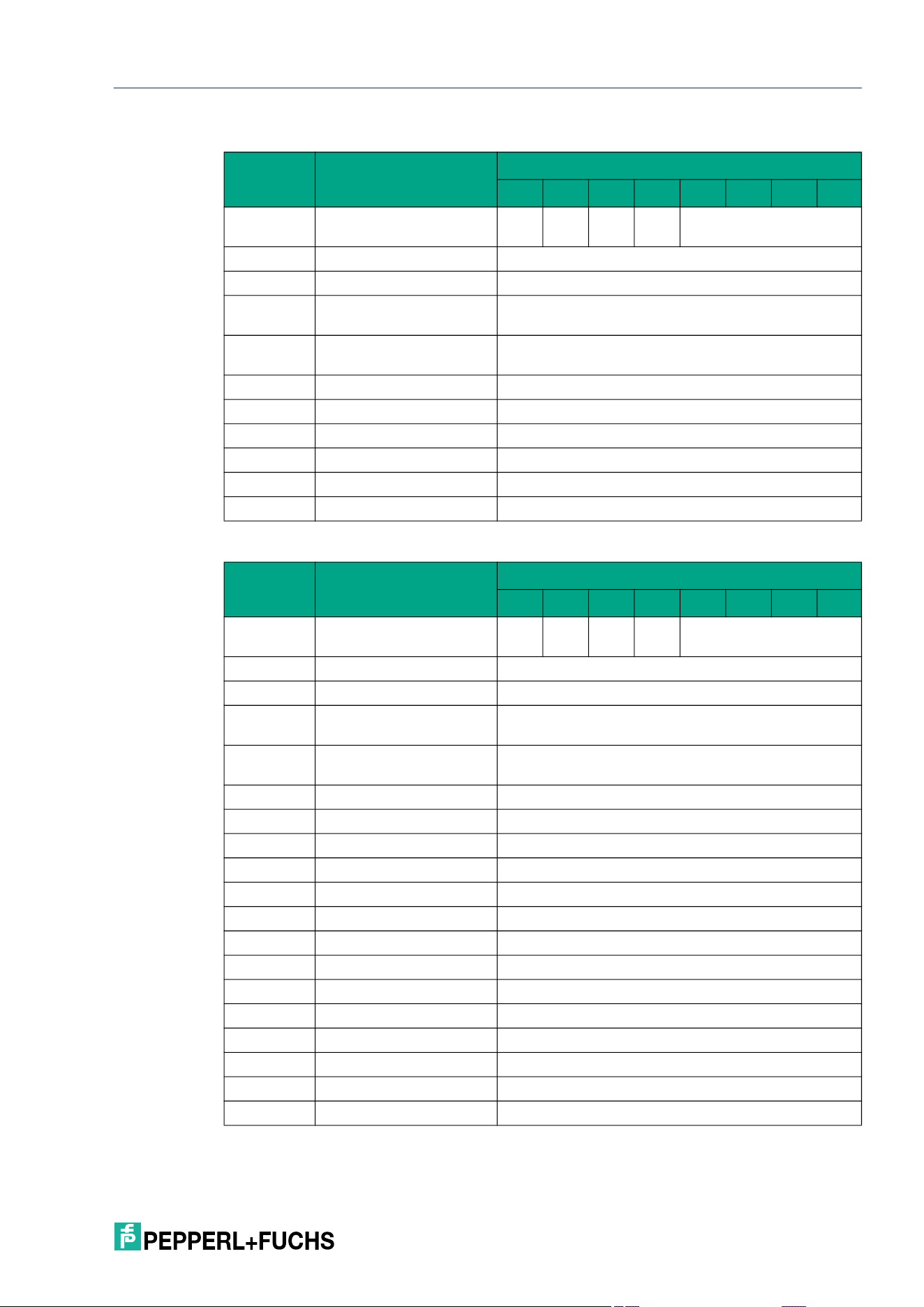
IQH3/IQH4 Series
Commissioning and Operation
2026-05
55
Response Telegram 2 – Status 16#0B (Information Frame Mode)
Response Telegram 3 – Status 16#05 (Multi-Frame Protocol)
Byte Content
Bit number
7 6 5 4 3 2 1 0
Byte 0 Control Byte / Frame
Length
D
S
U
M
U
D
0 16#0
Byte 1 Frame Length 16#09
Byte 2 Fragmentation Counter 16#00
Byte 3 Telegram Length (High
Byte)
16#00
Byte 4 Telegram Length (Low
Byte)
16#06
Byte 5 Command 16#68
Byte 6 Status 16#0B
Byte 7 Data 16#01 <Info Type>
Byte 8 Data <RSSI>
… Data 16#00
Byte 255 Data 16#00
Byte Content
Bit number
7 6 5 4 3 2 1 0
Byte 0 Control Byte / Frame
Length
D
S
U
M
U
D
0 16#0
Byte 1 Frame Length 16#11
Byte 2 Fragmentation Counter 16#00
Byte 3 Telegram Length (High
Byte)
16#00
Byte 4 Telegram Length (Low
Byte)
16#0E
Byte 5 Command 16#68
Byte 6 Status 16#05
Byte 7 Data 16#00 <Length UID in Byte (High Byte)>
Byte 8 Data 16#08 <Length UID in Byte (Low Byte)>
Byte 9 Data <UID Byte 1>
Byte 10 Data <UID Byte 2>
Byte 11 Data <UID Byte 3>
Byte 12 Data <UID Byte 4>
Byte 13 Data <UID Byte 5>
Byte 14 Data <UID Byte 6>
Byte 15 Data <UID Byte 7>
Byte 16 Data <UID Byte 8>
… Data 16#00
Byte 255 Data 16#00
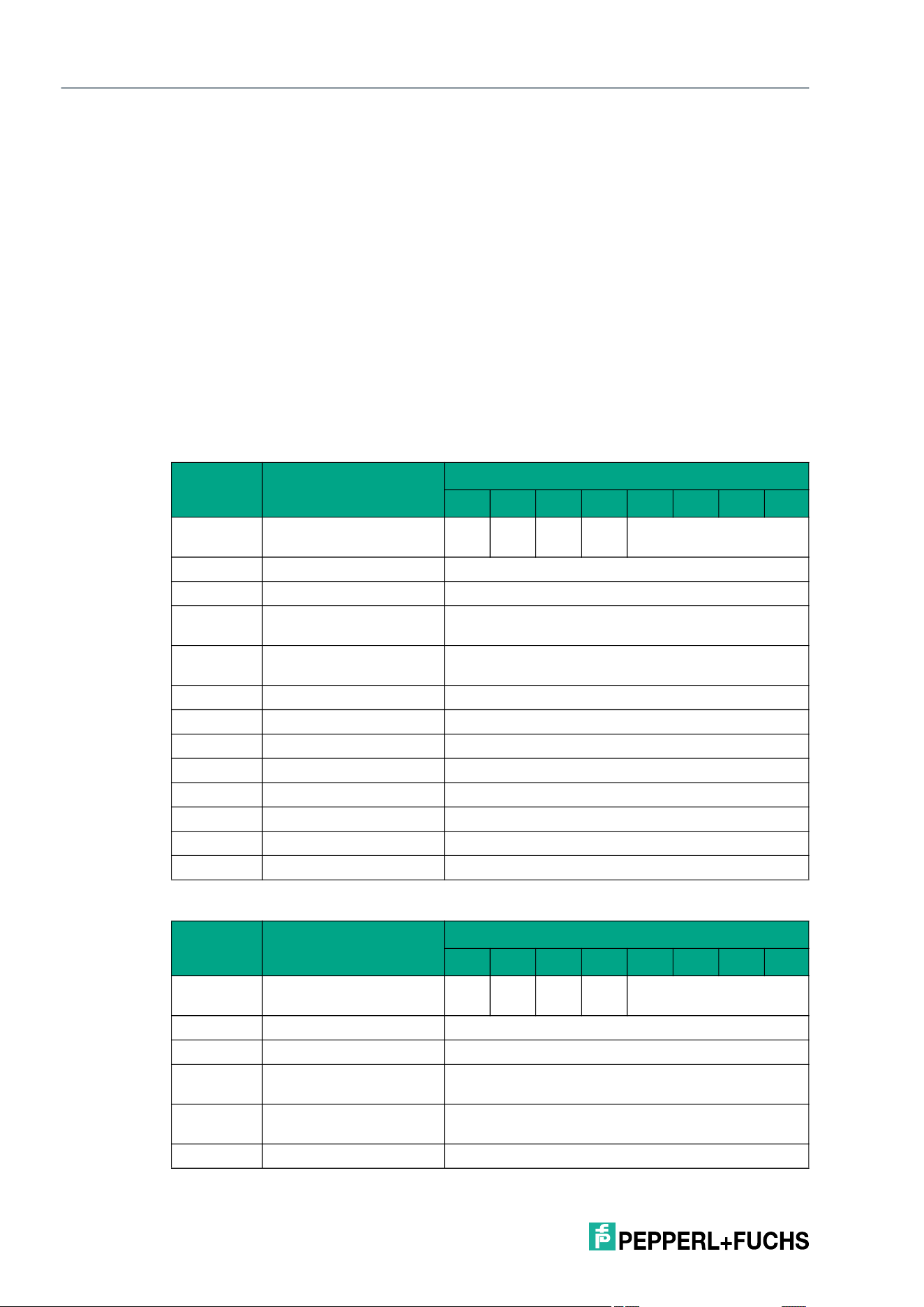
2026-05
56
IQH3/IQH4 Series
Commissioning and Operation
Single Set Configuration (SC)
The SC command has the command code 16#12 and performs a single write operation to the
AFI or DSFID in the configuration area of a tag within the detection zone.
The <Config Address> parameter specifies whether the AFI (16#00 or 16#30) or the DSFID
(16#01 or 16#31) should be written. The <Lock> parameter specifies whether the AFI or DSFID
should be written without (16#00 or 16#30) or with write protection (16#01 or 16#31).
If the AFI or DSFID is already write-protected, a rewrite or write-protect operation has a
response with status 5.
A separate data telegram with the status value 16#00 indicates a successful write operation for
each tag written. The data telegram contains the UID of the tag to which the configuration area
was written. In addition, for each tag written, a further telegram with the status value 16#0B is
transmitted, which contains information on the signal strength of the tag response (RSSI value).
The end of the command execution is indicated by an end telegram. The end telegram has the
status value 16#0F and contains the number of tags that were written during execution of the
command.
Command Telegram
Response Telegram 1 – Status 16#00 (Multi-Frame Protocol)
Byte Content
Bit number
7 6 5 4 3 2 1 0
Byte 0 Control Byte / Frame
Length
D
S
U
M
U
D
0 16#0
Byte 1 Frame Length 16#0B
Byte 2 Fragmentation Counter 16#00
Byte 3 Telegram Length (High
Byte)
16#00
Byte 4 Telegram Length (Low
Byte)
16#08
Byte 5 Command 16#12
Byte 6 Command parameter 16#00 <Config Address>
Byte 7 Command parameter <Lock>
Byte 8 Command parameter <DSFID / AFI>
Byte 9 Command parameter 16#00 (always)
Byte 10 Command parameter 16#00 (always)
… Command parameter 16#00
Byte 255 Command parameter 16#00
Byte Content
Bit number
7 6 5 4 3 2 1 0
Byte 0 Control Byte / Frame
Length
D
S
U
M
U
D
0 16#0
Byte 1 Frame Length 16#11
Byte 2 Fragmentation Counter 16#00
Byte 3 Telegram Length (High
Byte)
16#00
Byte 4 Telegram Length (Low
Byte)
16#0E
Byte 5 Command 16#12
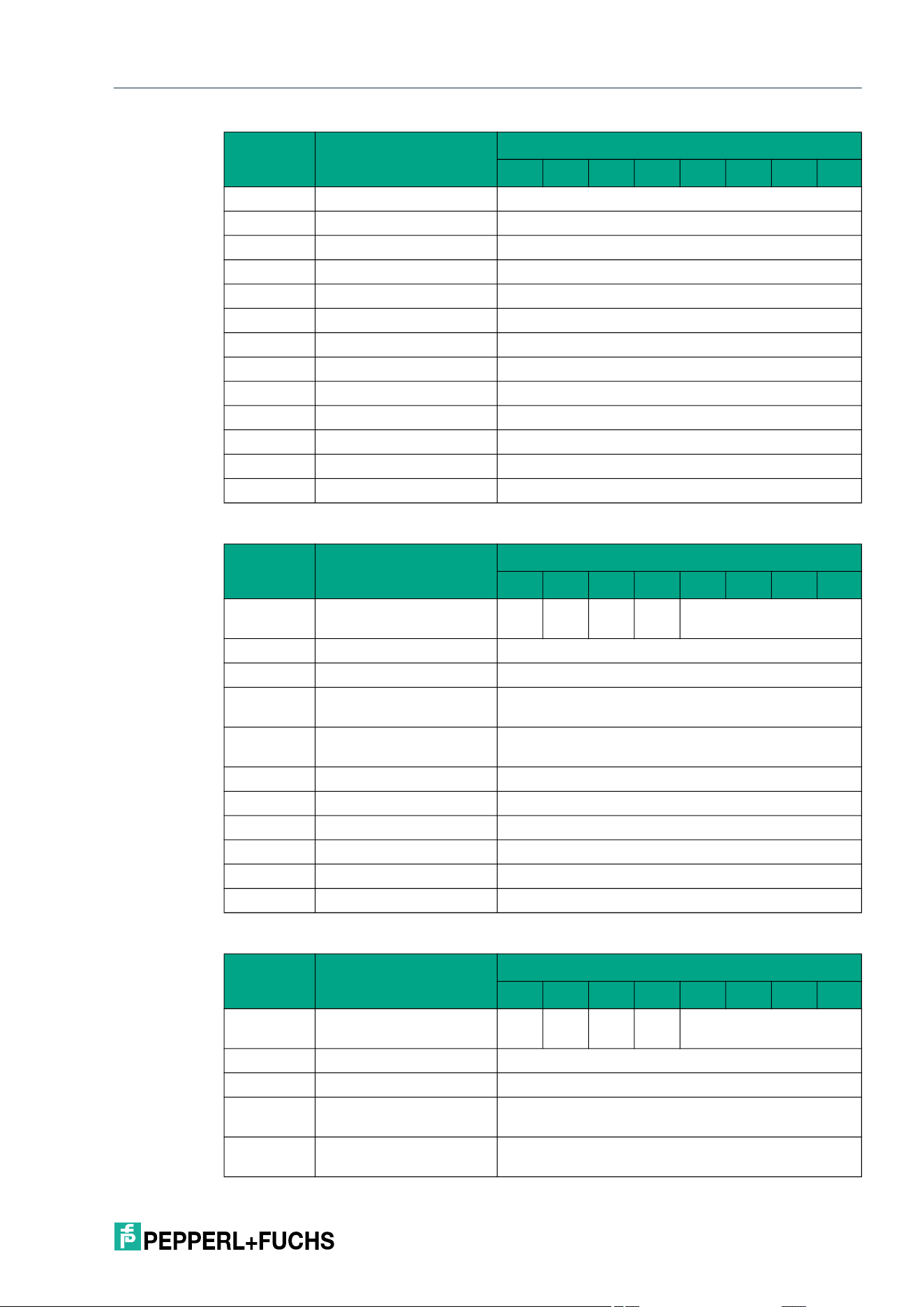
IQH3/IQH4 Series
Commissioning and Operation
2026-05
57
Response Telegram 2 – Status 16#0B (Information Frame Mode)
Response Telegram 3 – Status 16#0F (Multi-Frame Protocol)
Byte 6 Status 16#00
Byte 7 Data 16#00 <Length UID in Byte (High Byte)>
Byte 8 Data 16#08 <Length UID in Byte (Low Byte)>
Byte 9 Data <UID Byte 1>
Byte 10 Data <UID Byte 2>
Byte 11 Data <UID Byte 3>
Byte 12 Data <UID Byte 4>
Byte 13 Data <UID Byte 5>
Byte 14 Data <UID Byte 6>
Byte 15 Data <UID Byte 7>
Byte 16 Data <UID Byte 8>
… Data 16#00
Byte 255 Data 16#00
Byte Content
Bit number
7 6 5 4 3 2 1 0
Byte 0 Control Byte / Frame
Length
D
S
U
M
U
D
0 16#0
Byte 1 Frame Length 16#09
Byte 2 Fragmentation Counter 16#00
Byte 3 Telegram Length (High
Byte)
16#00
Byte 4 Telegram Length (Low
Byte)
16#06
Byte 5 Command 16#12
Byte 6 Status 16#0B
Byte 7 Data 16#01 <Info Type>
Byte 8 Data <RSSI>
… Data 16#00
Byte 255 Data 16#00
Byte Content
Bit number
7 6 5 4 3 2 1 0
Byte 0 Control Byte / Frame
Length
D
S
U
M
U
D
0 16#0
Byte 1 Frame Length 16#0B
Byte 2 Fragmentation Counter 16#00
Byte 3 Telegram Length (High
Byte)
16#00
Byte 4 Telegram Length (Low
Byte)
16#08
Byte Content
Bit number
7 6 5 4 3 2 1 0
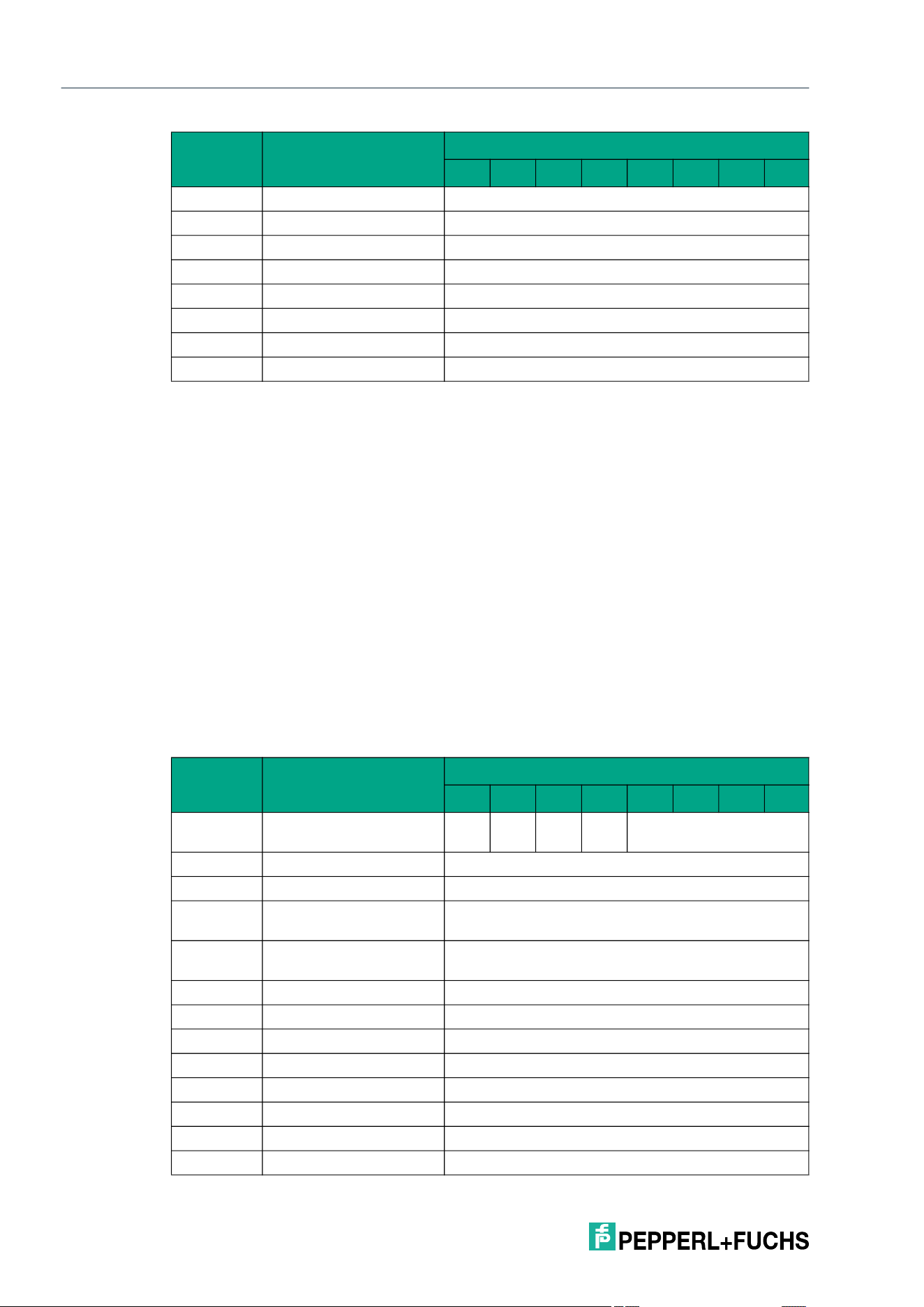
2026-05
58
IQH3/IQH4 Series
Commissioning and Operation
Enhanced Set Configuration (EC)
The EC command has the command code 16#66 and performs a continuous write operation to
the AFI or DSFID in the configuration area of a tag within the detection zone.
The <Config Address> parameter specifies whether the AFI (16#00 or 16#30) or the DSFID
(16#01 or 16#31) should be written. The <Lock> parameter specifies whether the AFI or DSFID
should be written without (16#00 or 16#30) or with write protection (16#01 or 16#31). The
read/write device continuously attempts to write the AFI or DSFID to the configuration area.
If the AFI or DSFID is already write-protected, a rewrite or write-protect operation has a
response with status 5.
A separate data telegram with the status value 16#00 indicates a successful write operation for
each tag written. The data telegram contains the UID of the tag to which the configuration area
was written. In addition, for each tag written, a further telegram with the status value 16#0B is
transmitted, which contains information on the signal strength of the tag response (RSSI value).
A tag leaving the detection zone is indicated by a telegram containing the UID of the tag. This
telegram has the status value 16#05.
A Quit command stops the command execution.
Command Telegram
Byte 5 Command 16#12
Byte 6 Status 16#0F
Byte 7 Data <Number of Tags Byte 1>
Byte 8 Data <Number of Tags Byte 2>
Byte 9 Data <Number of Tags Byte 3>
Byte 10 Data <Number of Tags Byte 4>
… Data 16#00
Byte 255 Data 16#00
Byte Content
Bit number
7 6 5 4 3 2 1 0
Byte 0 Control Byte / Frame
Length
D
S
U
M
U
D
0 16#0
Byte 1 Frame Length 16#0B
Byte 2 Fragmentation Counter 16#00
Byte 3 Telegram Length (High
Byte)
16#00
Byte 4 Telegram Length (Low
Byte)
16#08
Byte 5 Command 16#66
Byte 6 Command parameter 16#00 <Config Address>
Byte 7 Command parameter <Lock>
Byte 8 Command parameter <DSFID / AFI>
Byte 9 Command parameter 16#00 (always)
Byte 10 Command parameter 16#00 (always)
… Command parameter 16#00
Byte 255 Command parameter 16#00
Byte Content
Bit number
7 6 5 4 3 2 1 0
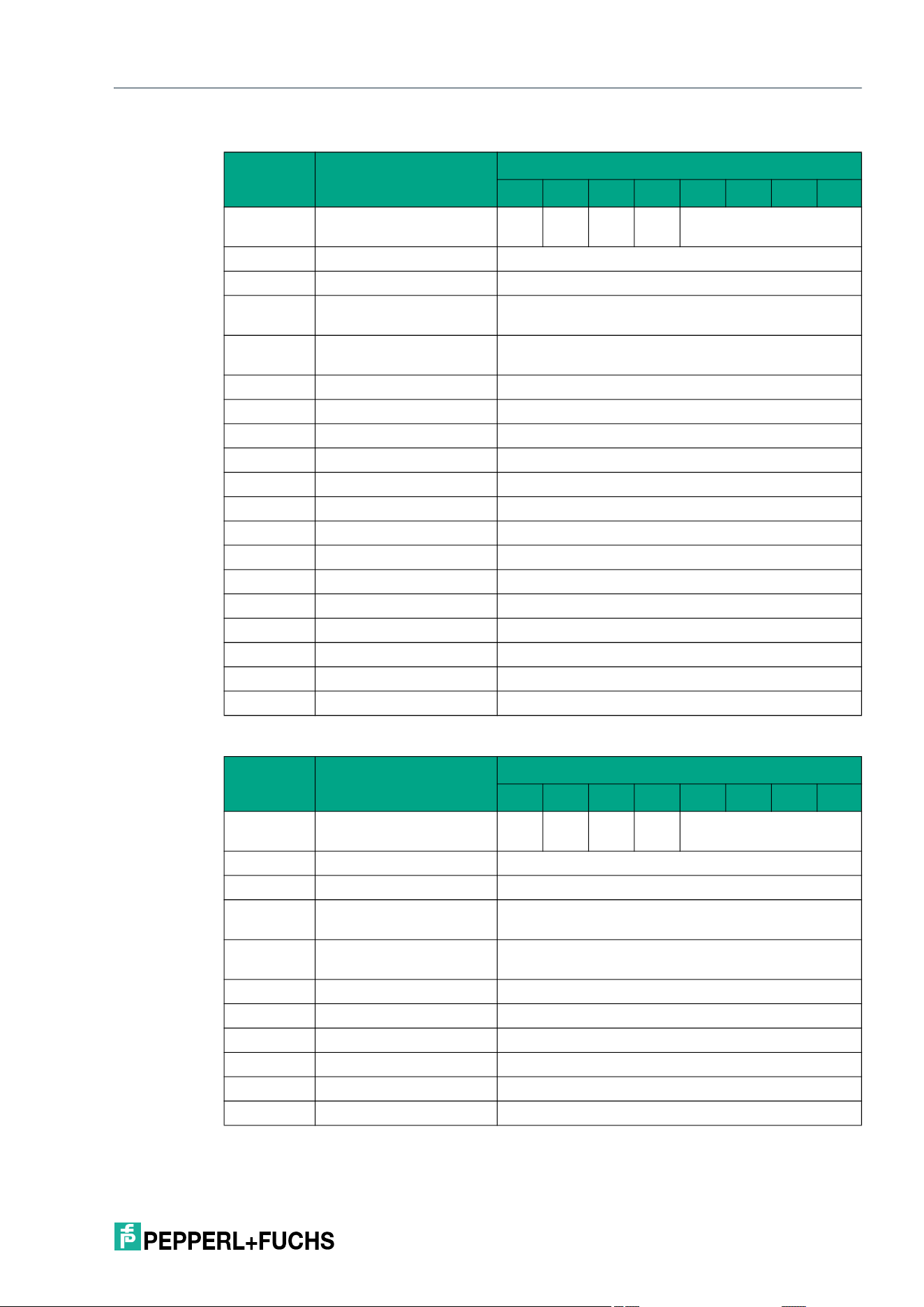
IQH3/IQH4 Series
Commissioning and Operation
2026-05
59
Response Telegram 1 – Status 16#00 (Multi-Frame Protocol)
Response Telegram 2 – Status 16#0B (Information Frame Mode)
Byte Content
Bit number
7 6 5 4 3 2 1 0
Byte 0 Control Byte / Frame
Length
D
S
U
M
U
D
0 16#0
Byte 1 Frame Length 16#11
Byte 2 Fragmentation Counter 16#00
Byte 3 Telegram Length (High
Byte)
16#00
Byte 4 Telegram Length (Low
Byte)
16#0E
Byte 5 Command 16#66
Byte 6 Status 16#00
Byte 7 Data 16#00 <Length UID in Byte (High Byte)>
Byte 8 Data 16#08 <Length UID in Byte (Low Byte)>
Byte 9 Data <UID Byte 1>
Byte 10 Data <UID Byte 2>
Byte 11 Data <UID Byte 3>
Byte 12 Data <UID Byte 4>
Byte 13 Data <UID Byte 5>
Byte 14 Data <UID Byte 6>
Byte 15 Data <UID Byte 7>
Byte 16 Data <UID Byte 8>
… Data 16#00
Byte 255 Data 16#00
Byte Content
Bit number
7 6 5 4 3 2 1 0
Byte 0 Control Byte / Frame
Length
D
S
U
M
U
D
0 16#0
Byte 1 Frame Length 16#09
Byte 2 Fragmentation Counter 16#00
Byte 3 Telegram Length (High
Byte)
16#00
Byte 4 Telegram Length (Low
Byte)
16#06
Byte 5 Command 16#66
Byte 6 Status 16#0B
Byte 7 Data 16#01 <Info Type>
Byte 8 Data <RSSI>
… Data 16#00
Byte 255 Data 16#00
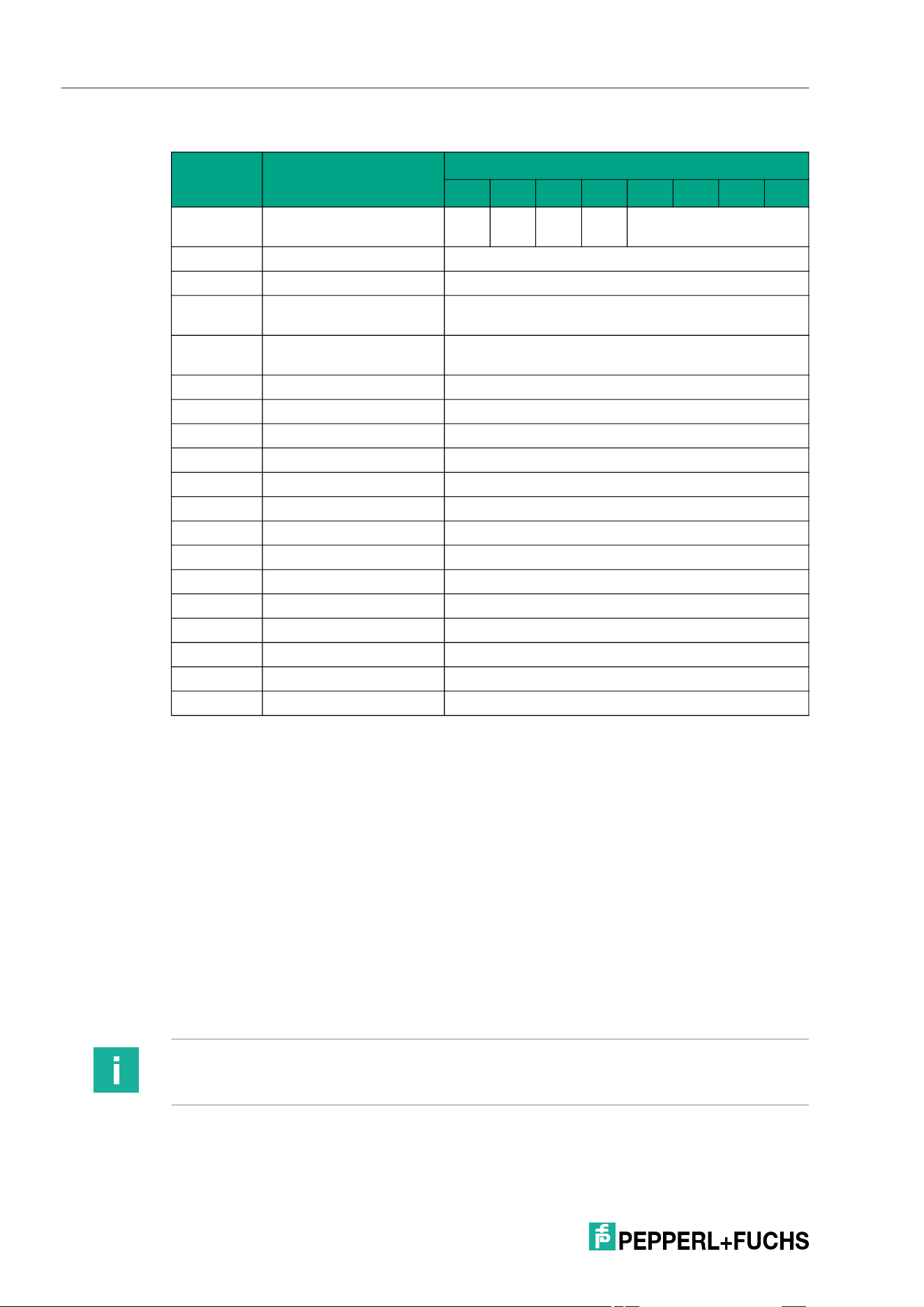
2026-05
60
IQH3/IQH4 Series
Commissioning and Operation
Response Telegram 3 – Status 16#05 (Multi-Frame Protocol)
Fill Tag (S#)
The S# command has the command code 16#AA and performs a single write operation to the
user data area of a tag within the detection zone.
The <Start Address> parameter specifies the start address within the user data area. The value
of <Start Address> is based on bytes. Only multiples of the memory block size can be parame-
terized. <Number of Bytes> defines the number of bytes to be written. The number of bytes
must also be a multiple of the memory block size. The <Fill Sign> parameter specifies the fill
character to be written.
A separate data telegram with the status value 16#00 indicates a successful write operation for
each tag written. The data telegram contains the UID of the tag to which the user data area was
written. In addition, for each tag written, a further telegram with the status value 16#0B is trans-
mitted, which contains information on the signal strength of the tag response (RSSI value).
The end of the command execution is indicated by an end telegram. The end telegram has the
status value 16#0F and contains the number of tags that were written during execution of the
command.
Byte Content
Bit number
7 6 5 4 3 2 1 0
Byte 0 Control Byte / Frame
Length
D
S
U
M
U
D
0 16#0
Byte 1 Frame Length 16#11
Byte 2 Fragmentation Counter 16#00
Byte 3 Telegram Length (High
Byte)
16#00
Byte 4 Telegram Length (Low
Byte)
16#0E
Byte 5 Command 16#66
Byte 6 Status 16#05
Byte 7 Data 16#00 <Length UID in Byte (High Byte)>
Byte 8 Data 16#08 <Length UID in Byte (Low Byte)>
Byte 9 Data <UID Byte 1>
Byte 10 Data <UID Byte 2>
Byte 11 Data <UID Byte 3>
Byte 12 Data <UID Byte 4>
Byte 13 Data <UID Byte 5>
Byte 14 Data <UID Byte 6>
Byte 15 Data <UID Byte 7>
Byte 16 Data <UID Byte 8>
… Data 16#00
Byte 255 Data 16#00
Note
If <Number of Bytes> is set to 16#0000, the tag is filled from <Start Address> to the end of the
tag.
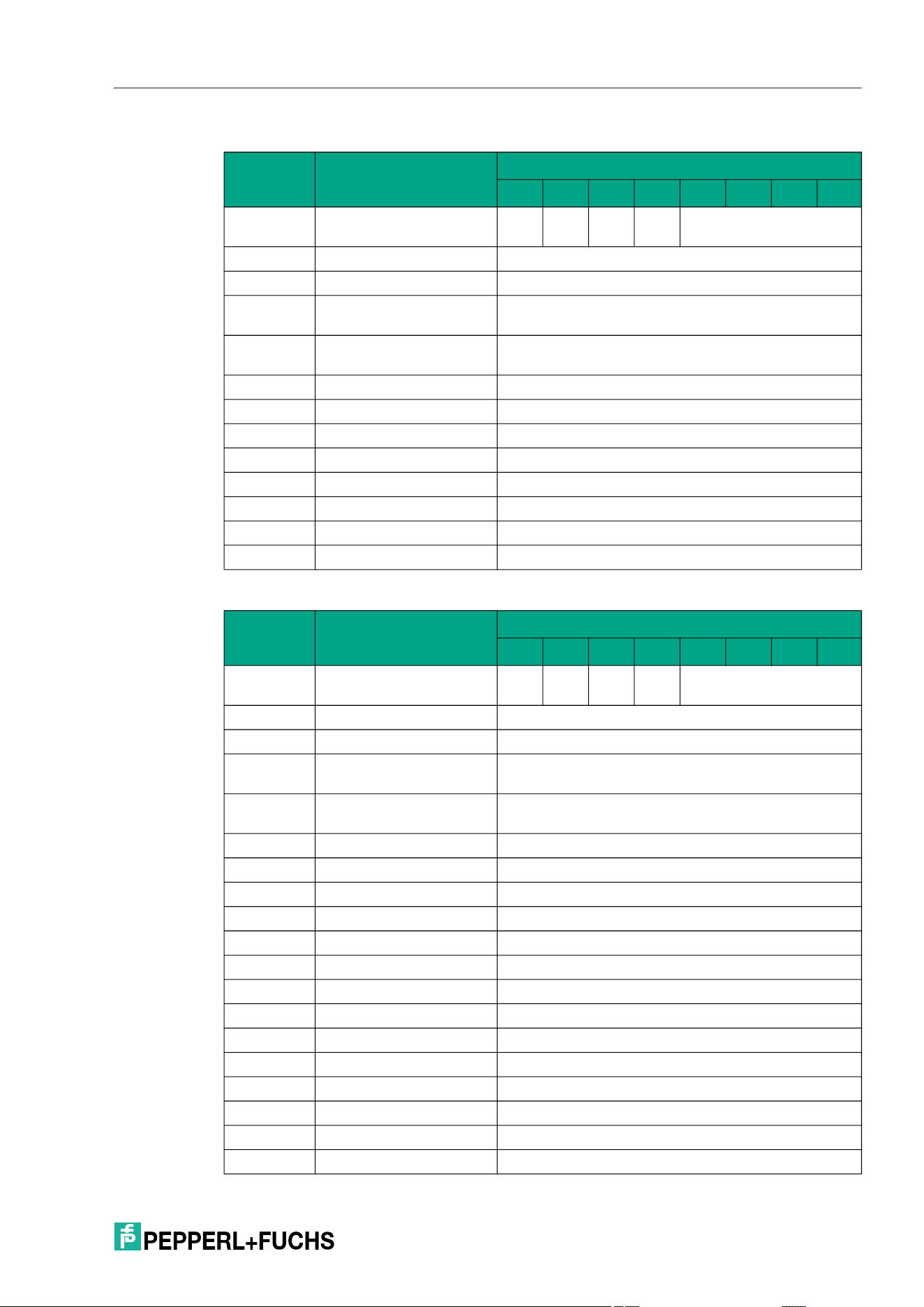
IQH3/IQH4 Series
Commissioning and Operation
2026-05
61
Command Telegram
Response Telegram 1 – Status 16#00 (Multi-Frame Protocol)
Byte Content
Bit number
7 6 5 4 3 2 1 0
Byte 0 Control Byte / Frame
Length
D
S
U
M
U
D
0 16#0
Byte 1 Frame Length 16#0B
Byte 2 Fragmentation Counter 16#00
Byte 3 Telegram Length (High
Byte)
16#00
Byte 4 Telegram Length (Low
Byte)
16#08
Byte 5 Command 16#AA
Byte 6 Command parameter 16#00 <Start Address (High Byte)>
Byte 7 Command parameter 16#00 <Start Address (Low Byte)>
Byte 8 Command parameter 16#00 <Number of Bytes (High Byte)>
Byte 9 Command parameter 16#04 <Number of Bytes (Low Byte)>
Byte 10 Command parameter <Fill Sign>
… Command parameter 16#00
Byte 255 Command parameter 16#00
Byte Content
Bit number
7 6 5 4 3 2 1 0
Byte 0 Control Byte / Frame
Length
D
S
U
M
U
D
0 16#0
Byte 1 Frame Length 16#11
Byte 2 Fragmentation Counter 16#00
Byte 3 Telegram Length (High
Byte)
16#00
Byte 4 Telegram Length (Low
Byte)
16#0E
Byte 5 Command 16#AA
Byte 6 Status 16#00
Byte 7 Data 16#00 <Length UID in Byte (High Byte)>
Byte 8 Data 16#08 <Length UID in Byte (Low Byte)>
Byte 9 Data <UID Byte 1>
Byte 10 Data <UID Byte 2>
Byte 11 Data <UID Byte 3>
Byte 12 Data <UID Byte 4>
Byte 13 Data <UID Byte 5>
Byte 14 Data <UID Byte 6>
Byte 15 Data <UID Byte 7>
Byte 16 Data <UID Byte 8>
… Data 16#00
Byte 255 Data 16#00
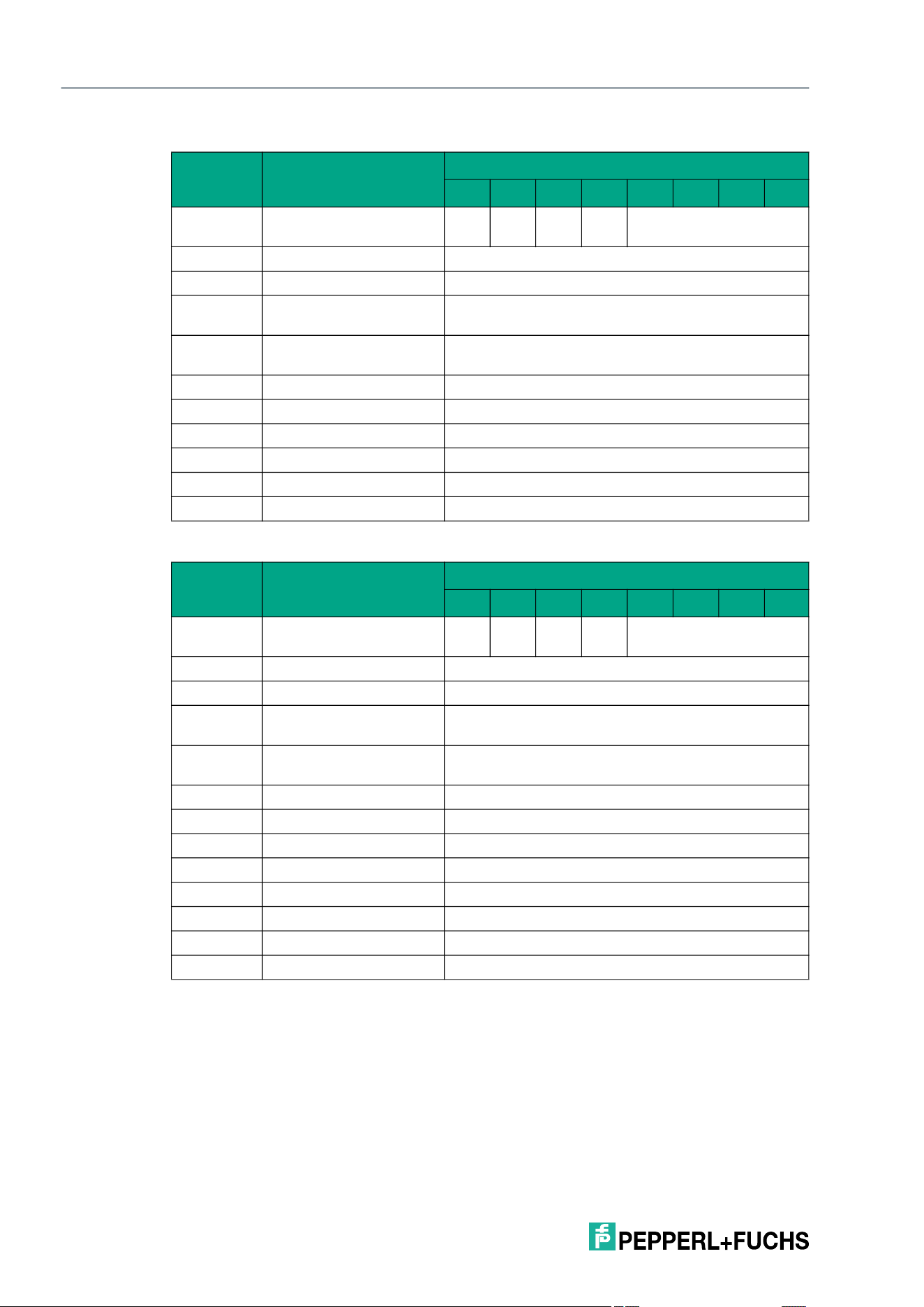
2026-05
62
IQH3/IQH4 Series
Commissioning and Operation
Response Telegram 2 – Status 16#0B (Information Frame Mode)
Response Telegram 3 – Status 16#0F (Multi-Frame Protocol)
Selective Single Read Fixcode (XSF)
The XSF command has the command code 16#E8. In principle, the command works exactly
like the SF command (16#01), but is only executed for one selected tag.
The parameters <UID Mask Byte 1> to <UID Mask Byte 8> are used to specify the UID of the
selected tag. <Length UID Mask in Bit> specifies the length of the UID in bits.
Byte Content
Bit number
7 6 5 4 3 2 1 0
Byte 0 Control Byte / Frame
Length
D
S
U
M
U
D
0 16#0
Byte 1 Frame Length 16#09
Byte 2 Fragmentation Counter 16#00
Byte 3 Telegram Length (High
Byte)
16#00
Byte 4 Telegram Length (Low
Byte)
16#06
Byte 5 Command 16#AA
Byte 6 Status 16#0B
Byte 7 Data 16#01 <Info Type>
Byte 8 Data <RSSI>
… Data 16#00
Byte 255 Data 16#00
Byte Content
Bit number
7 6 5 4 3 2 1 0
Byte 0 Control Byte / Frame
Length
D
S
U
M
U
D
0 16#0
Byte 1 Frame Length 16#0B
Byte 2 Fragmentation Counter 16#00
Byte 3 Telegram Length (High
Byte)
16#00
Byte 4 Telegram Length (Low
Byte)
16#08
Byte 5 Command 16#AA
Byte 6 Status 16#0F
Byte 7 Data <Number of Tags Byte 1>
Byte 8 Data <Number of Tags Byte 2>
Byte 9 Data <Number of Tags Byte 3>
Byte 10 Data <Number of Tags Byte 4>
… Data 16#00
Byte 255 Data 16#00
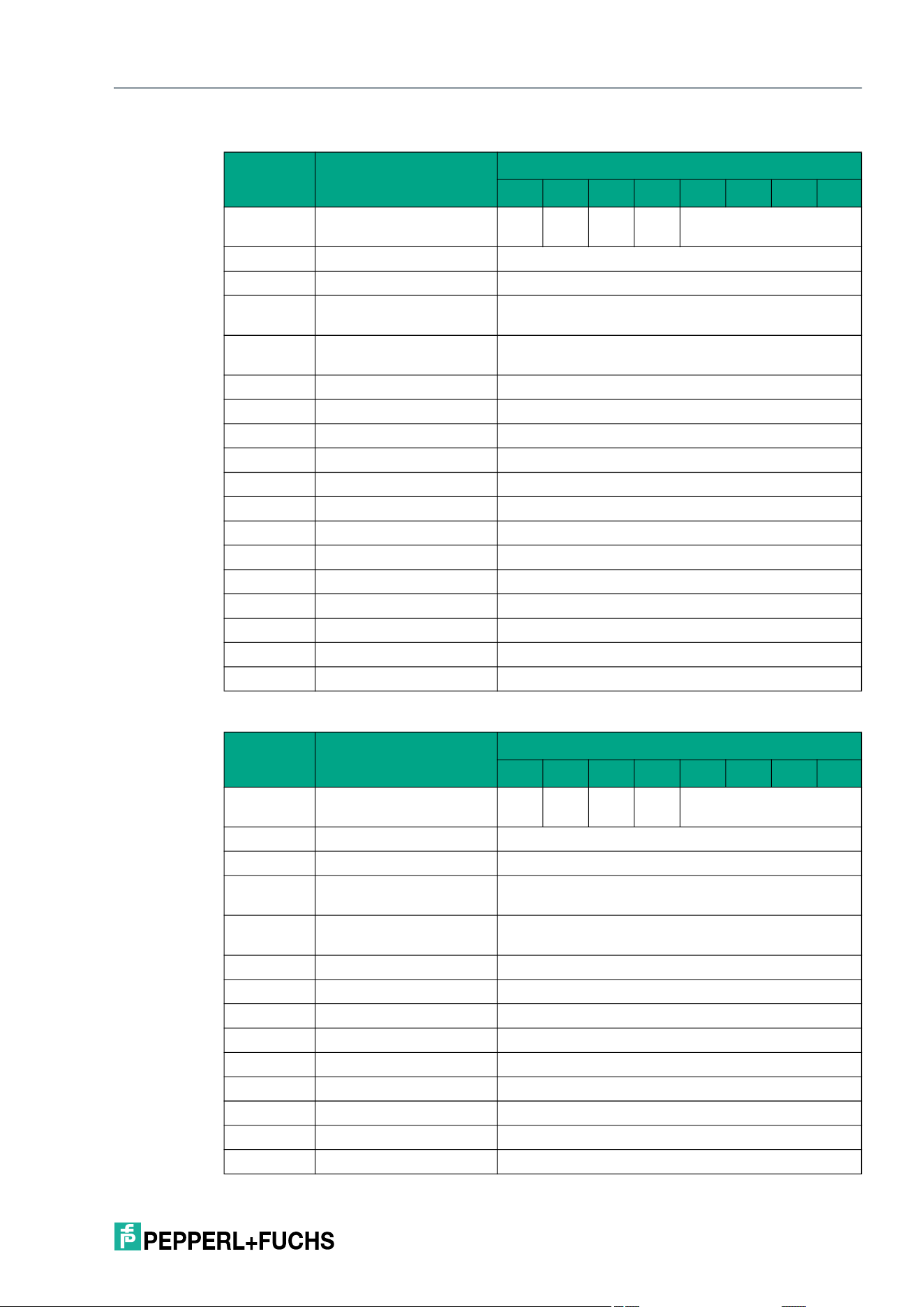
IQH3/IQH4 Series
Commissioning and Operation
2026-05
63
Command Telegram (8 Byte UID Mask)
Response Telegram 1 – Status 16#00 (Multi-Frame Protocol)
Byte Content
Bit number
7 6 5 4 3 2 1 0
Byte 0 Control Byte / Frame
Length
D
S
U
M
U
D
0 16#0
Byte 1 Frame Length 16#10
Byte 2 Fragmentation Counter 16#00
Byte 3 Telegram Length (High
Byte)
16#00
Byte 4 Telegram Length (Low
Byte)
16#0D
Byte 5 Command 16#E8
Byte 6 Command parameter 16#00 <Length UID Mask in Bit (High Byte)>
Byte 7 Command parameter 16#40 <Length UID Mask in Bit (Low Byte)>
Byte 8 Command parameter <UID Mask Byte 1>
Byte 9 Command parameter <UID Mask Byte 2>
Byte 10 Command parameter <UID Mask Byte 3>
Byte 11 Command parameter <UID Mask Byte 4>
Byte 12 Command parameter <UID Mask Byte 5>
Byte 13 Command parameter <UID Mask Byte 6>
Byte 14 Command parameter <UID Mask Byte 7>
Byte 15 Command parameter <UID Mask Byte 8>
… Command parameter 16#00
Byte 255 Command parameter 16#00
Byte Content
Bit number
7 6 5 4 3 2 1 0
Byte 0 Control Byte / Frame
Length
D
S
U
M
U
D
0 16#0
Byte 1 Frame Length 16#11
Byte 2 Fragmentation Counter 16#00
Byte 3 Telegram Length (High
Byte)
16#00
Byte 4 Telegram Length (Low
Byte)
16#0E
Byte 5 Command 16#E8
Byte 6 Status 16#00
Byte 7 Data 16#00 <Length UID in Byte (High Byte)>
Byte 8 Data 16#08 <Length UID in Byte (Low Byte)>
Byte 9 Data <UID Byte 1>
Byte 10 Data <UID Byte 2>
Byte 11 Data <UID Byte 3>
Byte 12 Data <UID Byte 4>
Byte 13 Data <UID Byte 5>
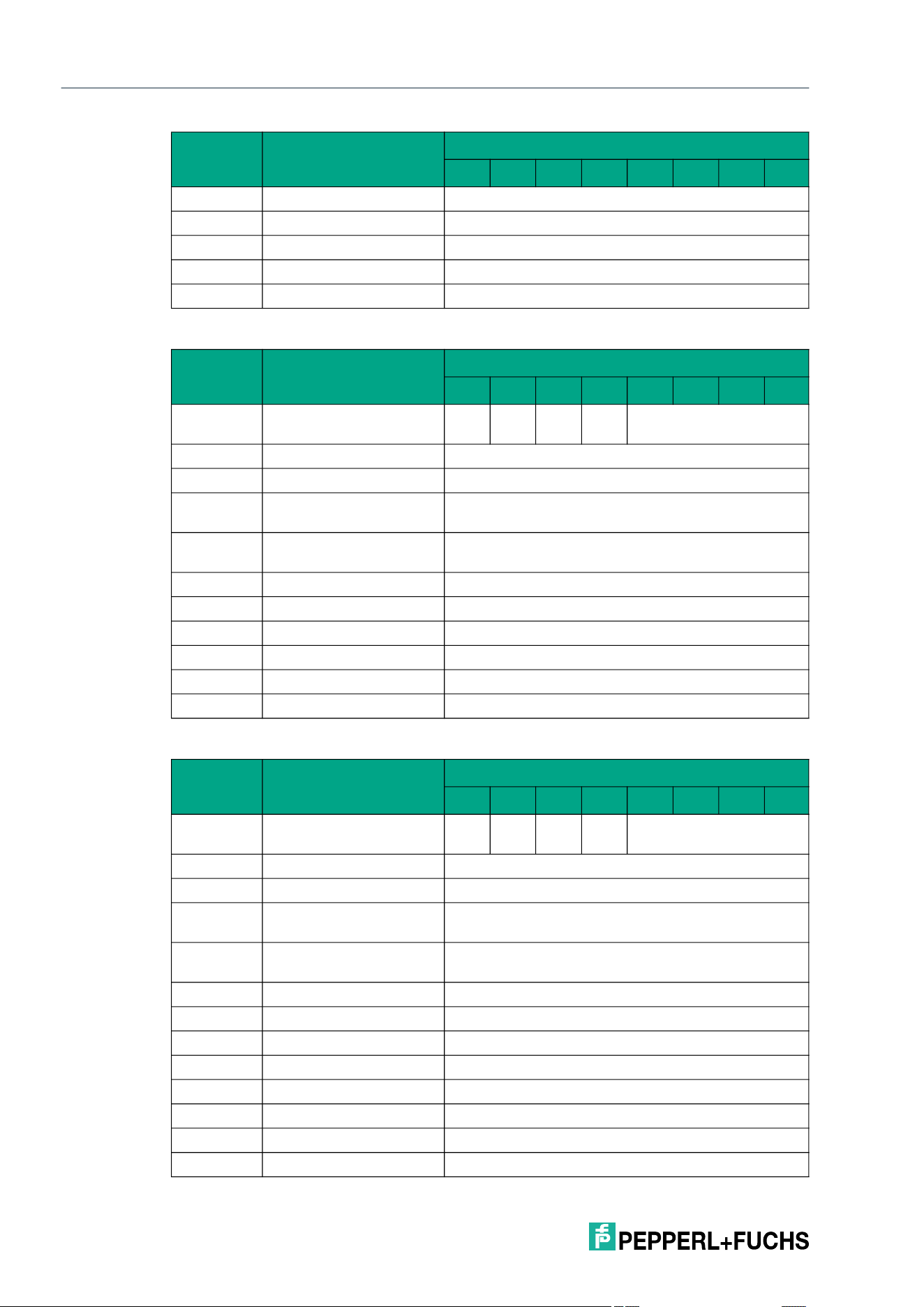
2026-05
64
IQH3/IQH4 Series
Commissioning and Operation
Response Telegram 2 – Status 16#0B (Information Frame Mode)
Response Telegram 3 – Status 16#0F (Multi-Frame Protocol)
Byte 14 Data <UID Byte 6>
Byte 15 Data <UID Byte 7>
Byte 16 Data <UID Byte 8>
… Data 16#00
Byte 255 Data 16#00
Byte Content
Bit number
7 6 5 4 3 2 1 0
Byte 0 Control Byte / Frame
Length
D
S
U
M
U
D
0 16#0
Byte 1 Frame Length 16#09
Byte 2 Fragmentation Counter 16#00
Byte 3 Telegram Length (High
Byte)
16#00
Byte 4 Telegram Length (Low
Byte)
16#06
Byte 5 Command 16#E8
Byte 6 Status 16#0B
Byte 7 Data 16#01 <Info Type>
Byte 8 Data <RSSI>
… Data 16#00
Byte 255 Data 16#00
Byte Content
Bit number
7 6 5 4 3 2 1 0
Byte 0 Control Byte / Frame
Length
D
S
U
M
U
D
0 16#0
Byte 1 Frame Length 16#0B
Byte 2 Fragmentation Counter 16#00
Byte 3 Telegram Length (High
Byte)
16#00
Byte 4 Telegram Length (Low
Byte)
16#08
Byte 5 Command 16#E8
Byte 6 Status 16#0F
Byte 7 Data <Number of Tags Byte 1>
Byte 8 Data <Number of Tags Byte 2>
Byte 9 Data <Number of Tags Byte 3>
Byte 10 Data <Number of Tags Byte 4>
… Data 16#00
Byte 255 Data 16#00
Byte Content
Bit number
7 6 5 4 3 2 1 0
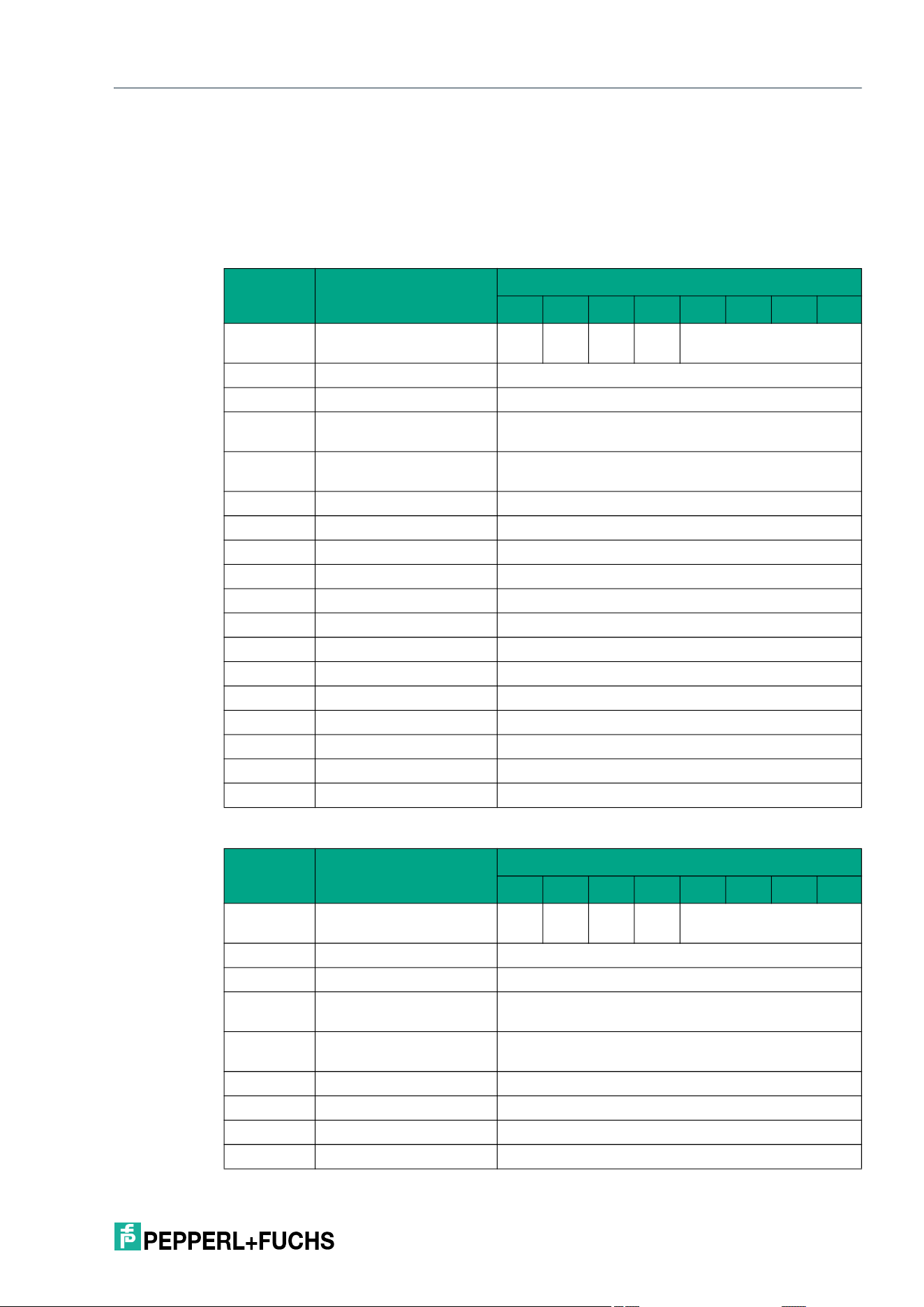
IQH3/IQH4 Series
Commissioning and Operation
2026-05
65
Selective Enhanced Read Fixcode (XEF)
The XEF command has the command code 16#E9. In principle, the command works exactly
like the EF command (16#1D), but is only executed for one selected tag.
The parameters <UID Mask Byte 1> to <UID Mask Byte 8> are used to specify the UID of the
selected tag. <Length UID Mask in Bit> specifies the length of the UID in bits.
Command Telegram (8 Byte UID Mask)
Response Telegram 1 – Status 16#00 (Multi-Frame Protocol)
Byte Content
Bit number
7 6 5 4 3 2 1 0
Byte 0 Control Byte / Frame
Length
D
S
U
M
U
D
0 16#0
Byte 1 Frame Length 16#10
Byte 2 Fragmentation Counter 16#00
Byte 3 Telegram Length (High
Byte)
16#00
Byte 4 Telegram Length (Low
Byte)
16#0D
Byte 5 Command 16#E9
Byte 6 Command parameter 16#00 <Length UID Mask in Bit (High Byte)>
Byte 7 Command parameter 16#40 <Length UID Mask in Bit (Low Byte)>
Byte 8 Command parameter <UID Mask Byte 1>
Byte 9 Command parameter <UID Mask Byte 2>
Byte 10 Command parameter <UID Mask Byte 3>
Byte 11 Command parameter <UID Mask Byte 4>
Byte 12 Command parameter <UID Mask Byte 5>
Byte 13 Command parameter <UID Mask Byte 6>
Byte 14 Command parameter <UID Mask Byte 7>
Byte 15 Command parameter <UID Mask Byte 8>
… Command parameter 16#00
Byte 255 Command parameter 16#00
Byte Content
Bit number
7 6 5 4 3 2 1 0
Byte 0 Control Byte / Frame
Length
D
S
U
M
U
D
0 16#0
Byte 1 Frame Length 16#11
Byte 2 Fragmentation Counter 16#00
Byte 3 Telegram Length (High
Byte)
16#00
Byte 4 Telegram Length (Low
Byte)
16#0E
Byte 5 Command 16#E9
Byte 6 Status 16#00
Byte 7 Data 16#00 <Length UID in Byte (High Byte)>
Byte 8 Data 16#08 <Length UID in Byte (Low Byte)>
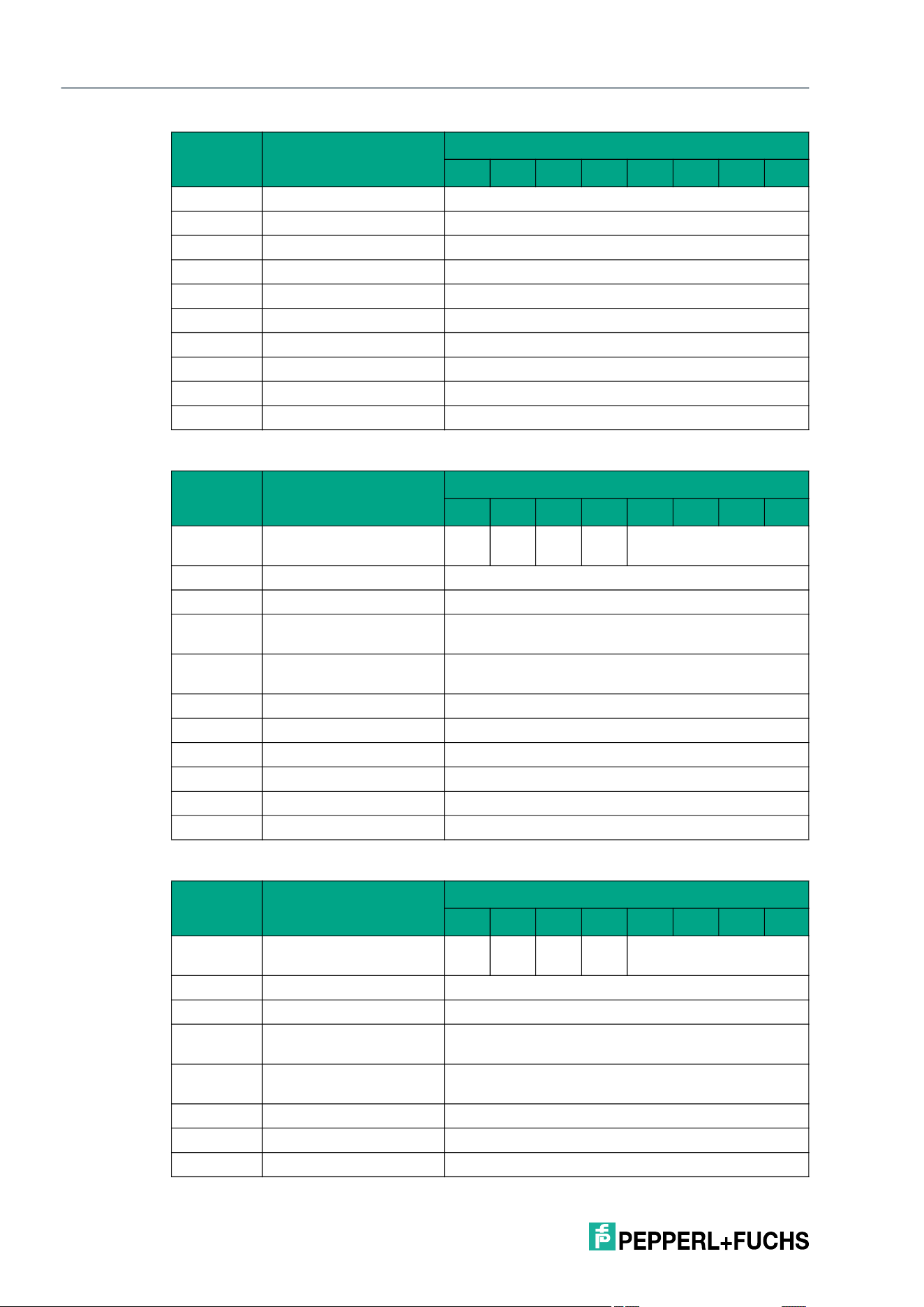
2026-05
66
IQH3/IQH4 Series
Commissioning and Operation
Response Telegram 2 – Status 16#0B (Information Frame Mode)
Response Telegram 3 – Status 16#05 (Multi-Frame Protocol)
Byte 9 Data <UID Byte 1>
Byte 10 Data <UID Byte 2>
Byte 11 Data <UID Byte 3>
Byte 12 Data <UID Byte 4>
Byte 13 Data <UID Byte 5>
Byte 14 Data <UID Byte 6>
Byte 15 Data <UID Byte 7>
Byte 16 Data <UID Byte 8>
… Data 16#00
Byte 255 Data 16#00
Byte Content
Bit number
7 6 5 4 3 2 1 0
Byte 0 Control Byte / Frame
Length
D
S
U
M
U
D
0 16#0
Byte 1 Frame Length 16#09
Byte 2 Fragmentation Counter 16#00
Byte 3 Telegram Length (High
Byte)
16#00
Byte 4 Telegram Length (Low
Byte)
16#06
Byte 5 Command 16#E9
Byte 6 Status 16#0B
Byte 7 Data 16#01 <Info Type>
Byte 8 Data <RSSI>
… Data 16#00
Byte 255 Data 16#00
Byte Content
Bit number
7 6 5 4 3 2 1 0
Byte 0 Control Byte / Frame
Length
D
S
U
M
U
D
0 16#0
Byte 1 Frame Length 16#11
Byte 2 Fragmentation Counter 16#00
Byte 3 Telegram Length (High
Byte)
16#00
Byte 4 Telegram Length (Low
Byte)
16#0E
Byte 5 Command 16#E9
Byte 6 Status 16#05
Byte 7 Data 16#00 <Length UID in Byte (High Byte)>
Byte Content
Bit number
7 6 5 4 3 2 1 0
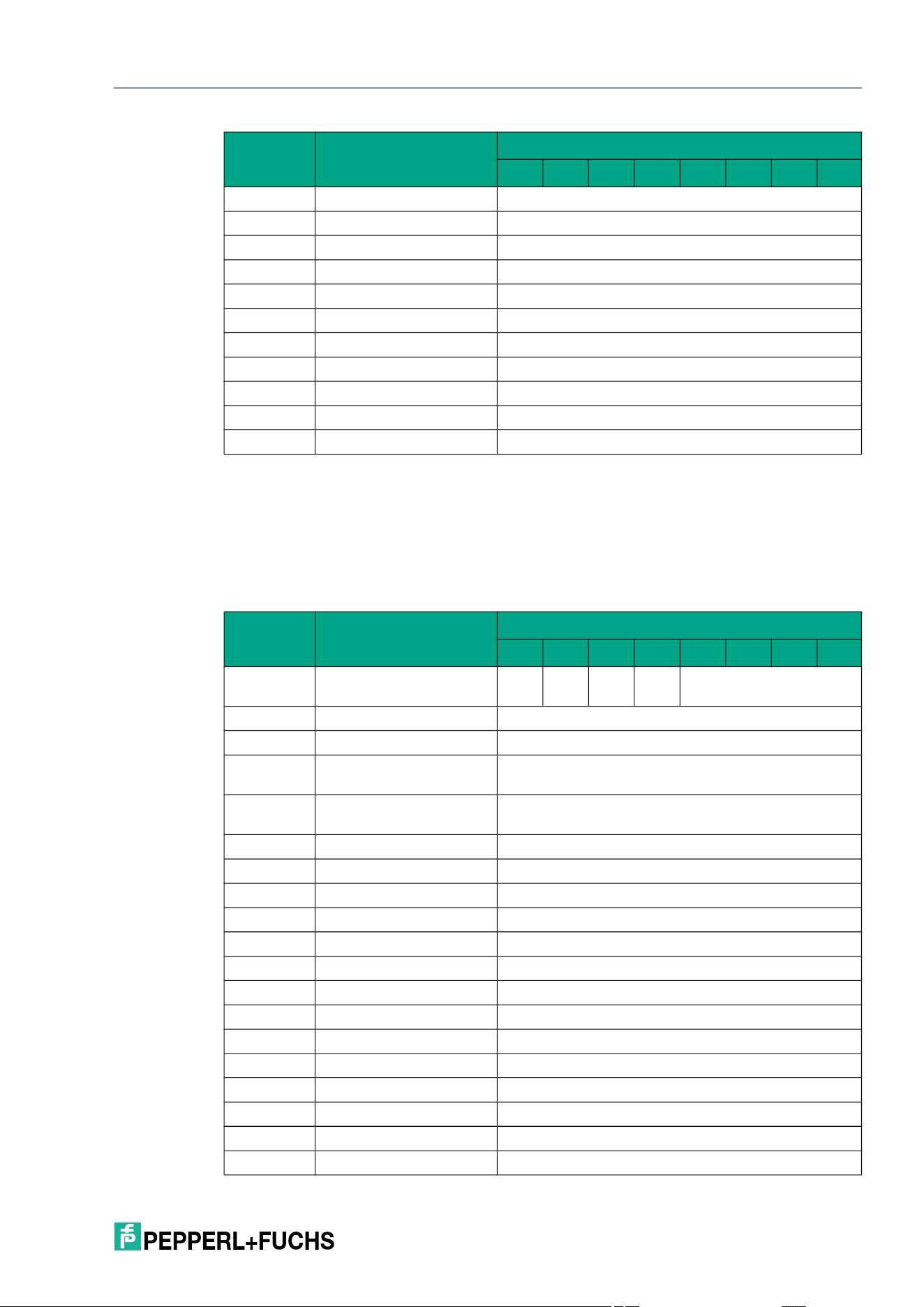
IQH3/IQH4 Series
Commissioning and Operation
2026-05
67
Selective Single Read 4-Byte Blocks (XSR)
The XSR command has the command code 16#E0. In principle, the command works exactly
like the SR command (16#10), but is only executed for one selected tag.
The parameters <UID Mask Byte 1> to <UID Mask Byte 8> are used to specify the UID of the
selected tag. <Length UID Mask in Bit> specifies the length of the UID in bits.
Command Telegram (8 Byte UID Mask, 4 Byte User Data)
Byte 8 Data 16#08 <Length UID in Byte (Low Byte)>
Byte 9 Data <UID Byte 1>
Byte 10 Data <UID Byte 2>
Byte 11 Data <UID Byte 3>
Byte 12 Data <UID Byte 4>
Byte 13 Data <UID Byte 5>
Byte 14 Data <UID Byte 6>
Byte 15 Data <UID Byte 7>
Byte 16 Data <UID Byte 8>
… Data 16#00
Byte 255 Data 16#00
Byte Content
Bit number
7 6 5 4 3 2 1 0
Byte 0 Control Byte / Frame
Length
D
S
U
M
U
D
0 16#0
Byte 1 Frame Length 16#14
Byte 2 Fragmentation Counter 16#00
Byte 3 Telegram Length (High
Byte)
16#00
Byte 4 Telegram Length (Low
Byte)
16#11
Byte 5 Command 16#E0
Byte 6 Command parameter 16#00 <Length UID Mask in Bit (High Byte)>
Byte 7 Command parameter 16#40 <Length UID Mask in Bit (Low Byte)>
Byte 8 Command parameter <UID Mask Byte 1>
Byte 9 Command parameter <UID Mask Byte 2>
Byte 10 Command parameter <UID Mask Byte 3>
Byte 11 Command parameter <UID Mask Byte 4>
Byte 12 Command parameter <UID Mask Byte 5>
Byte 13 Command parameter <UID Mask Byte 6>
Byte 14 Command parameter <UID Mask Byte 7>
Byte 15 Command parameter <UID Mask Byte 8>
Byte 16 Command parameter <Start Address (High Byte)>
Byte 17 Command parameter <Start Address (Low Byte)>
Byte 18 Command parameter <Number of Bytes (High Byte)>
Byte Content
Bit number
7 6 5 4 3 2 1 0
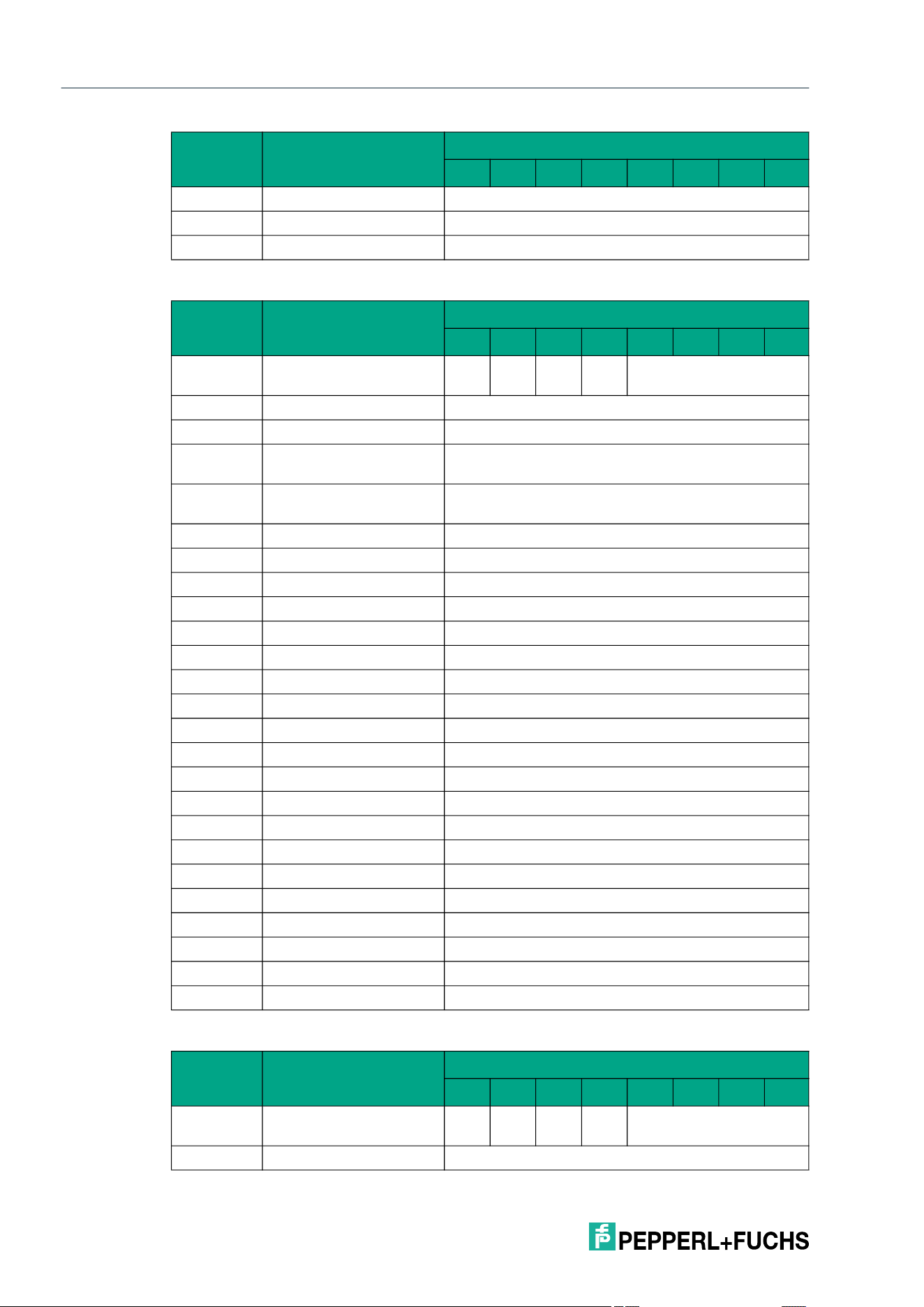
2026-05
68
IQH3/IQH4 Series
Commissioning and Operation
Response Telegram 1 – Status 16#00 (Multi-Frame Protocol)
Response Telegram 2 – Status 16#0B (Information Frame Mode)
Byte 19 Command parameter <Number of Bytes (Low Byte)>
… Command parameter 16#00
Byte 255 Command parameter 16#00
Byte Content
Bit number
7 6 5 4 3 2 1 0
Byte 0 Control Byte / Frame
Length
D
S
U
M
U
D
0 16#0
Byte 1 Frame Length 16#17
Byte 2 Fragmentation Counter 16#00
Byte 3 Telegram Length (High
Byte)
16#00
Byte 4 Telegram Length (Low
Byte)
16#14
Byte 5 Command 16#E0
Byte 6 Status 16#00
Byte 7 Data 16#00 <Length UID in Byte (High Byte)>
Byte 8 Data 16#08 <Length UID in Byte (Low Byte)>
Byte 9 Data <UID Byte 1>
Byte 10 Data <UID Byte 2>
Byte 11 Data <UID Byte 3>
Byte 12 Data <UID Byte 4>
Byte 13 Data <UID Byte 5>
Byte 14 Data <UID Byte 6>
Byte 15 Data <UID Byte 7>
Byte 16 Data <UID Byte 8>
Byte 17 Data 16#00
Byte 18 Data 16#04
Byte 19 Data <User Data Byte 1>
Byte 20 Data <User Data Byte 2>
Byte 21 Data <User Data Byte 3>
Byte 22 Data <User Data Byte 4>
… Data 16#00
Byte 255 Data 16#00
Byte Content
Bit number
7 6 5 4 3 2 1 0
Byte 0 Control Byte / Frame
Length
D
S
U
M
U
D
0 16#0
Byte 1 Frame Length 16#09
Byte Content
Bit number
7 6 5 4 3 2 1 0
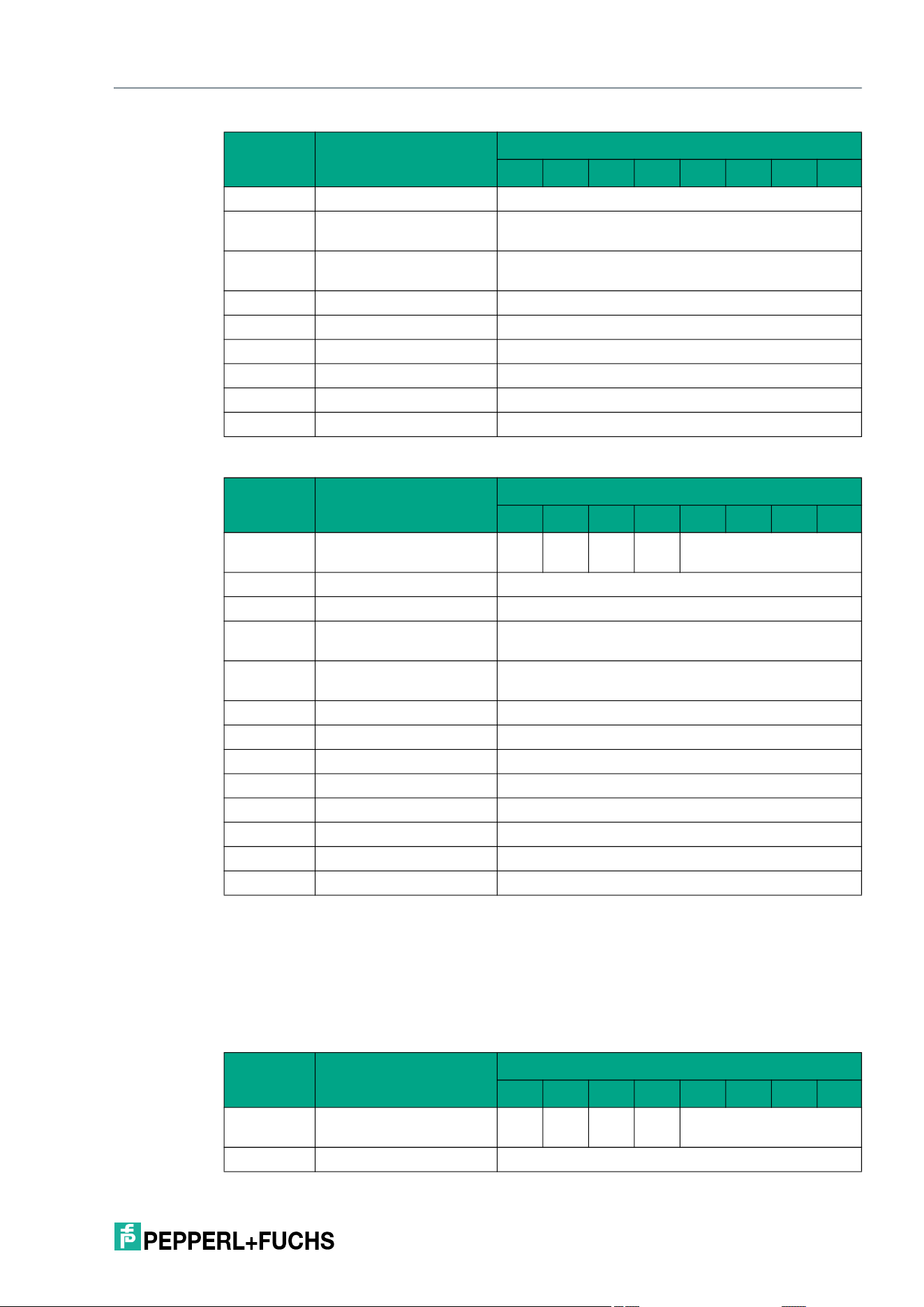
IQH3/IQH4 Series
Commissioning and Operation
2026-05
69
Response Telegram 3 – Status 16#0F (Multi-Frame Protocol)
Selective Enhanced Read 4-Byte Blocks (XER)
The XER command has the command code 16#D9. In principle, the command works exactly
like the ER command (16#19), but is only executed for one selected tag.
The parameters <UID Mask Byte 1> to <UID Mask Byte 8> are used to specify the UID of the
selected tag. <Length UID Mask in Bit> specifies the length of the UID in bits.
Command Telegram (8 Byte UID Mask, 4 Byte User Data)
Byte 2 Fragmentation Counter 16#00
Byte 3 Telegram Length (High
Byte)
16#00
Byte 4 Telegram Length (Low
Byte)
16#06
Byte 5 Command 16#E0
Byte 6 Status 16#0B
Byte 7 Data 16#01 <Info Type>
Byte 8 Data <RSSI>
… Data 16#00
Byte 255 Data 16#00
Byte Content
Bit number
7 6 5 4 3 2 1 0
Byte 0 Control Byte / Frame
Length
D
S
U
M
U
D
0 16#0
Byte 1 Frame Length 16#0B
Byte 2 Fragmentation Counter 16#00
Byte 3 Telegram Length (High
Byte)
16#00
Byte 4 Telegram Length (Low
Byte)
16#08
Byte 5 Command 16#E0
Byte 6 Status 16#0F
Byte 7 Data <Number of Tags Byte 1>
Byte 8 Data <Number of Tags Byte 2>
Byte 9 Data <Number of Tags Byte 3>
Byte 10 Data <Number of Tags Byte 4>
… Data 16#00
Byte 255 Data 16#00
Byte Content
Bit number
7 6 5 4 3 2 1 0
Byte 0 Control Byte / Frame
Length
D
S
U
M
U
D
0 16#0
Byte 1 Frame Length 16#14
Byte Content
Bit number
7 6 5 4 3 2 1 0
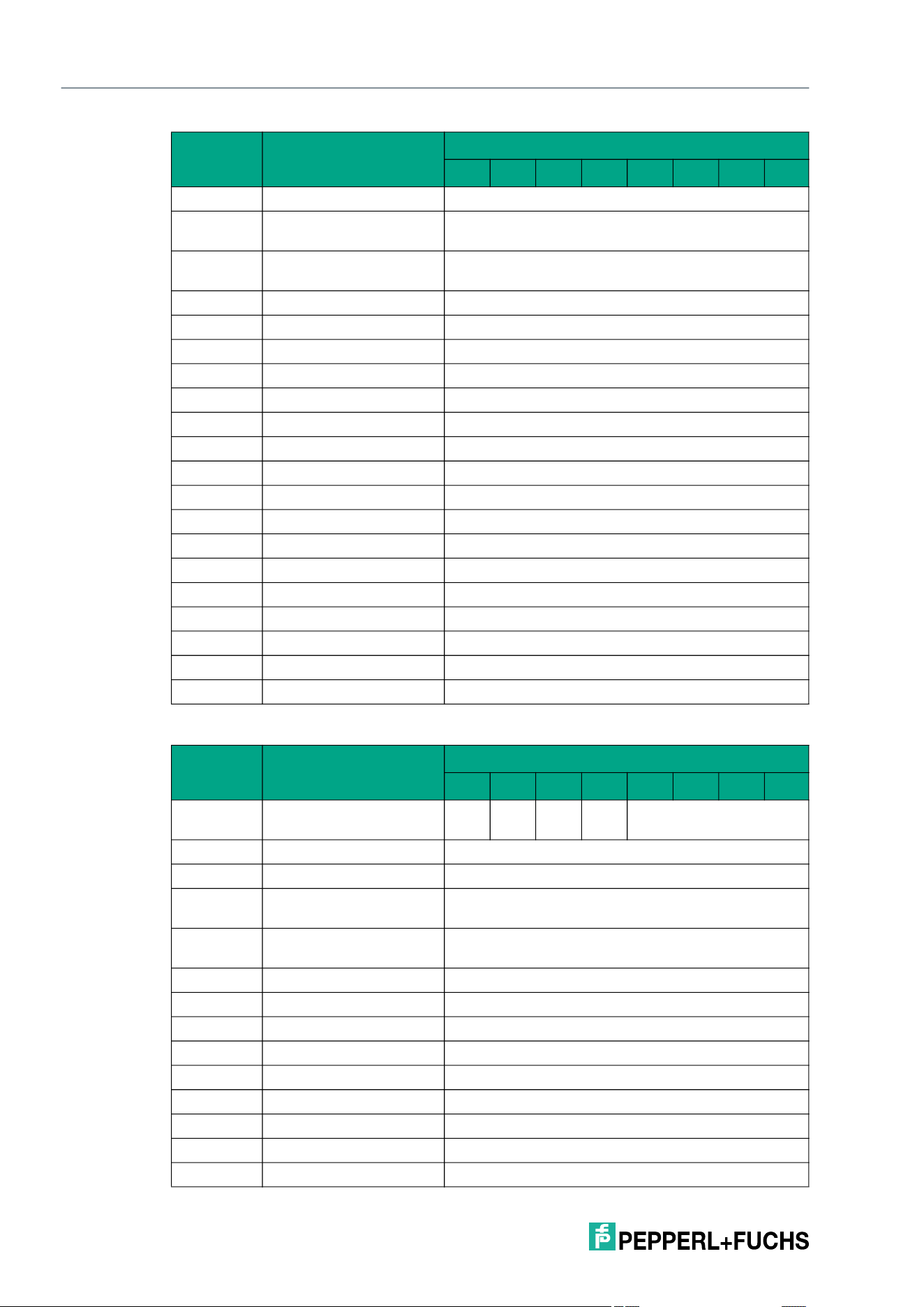
2026-05
70
IQH3/IQH4 Series
Commissioning and Operation
Response Telegram 1 – Status 16#00 (Multi-Frame Protocol)
Byte 2 Fragmentation Counter 16#00
Byte 3 Telegram Length (High
Byte)
16#00
Byte 4 Telegram Length (Low
Byte)
16#11
Byte 5 Command 16#D9
Byte 6 Command parameter 16#00 <Length UID Mask in Bit (High Byte)>
Byte 7 Command parameter 16#40 <Length UID Mask in Bit (Low Byte)>
Byte 8 Command parameter <UID Mask Byte 1>
Byte 9 Command parameter <UID Mask Byte 2>
Byte 10 Command parameter <UID Mask Byte 3>
Byte 11 Command parameter <UID Mask Byte 4>
Byte 12 Command parameter <UID Mask Byte 5>
Byte 13 Command parameter <UID Mask Byte 6>
Byte 14 Command parameter <UID Mask Byte 7>
Byte 15 Command parameter <UID Mask Byte 8>
Byte 16 Command parameter <Start Address (High Byte)>
Byte 17 Command parameter <Start Address (Low Byte)>
Byte 18 Command parameter <Number of Bytes (High Byte)>
Byte 19 Command parameter <Number of Bytes (Low Byte)>
… Command parameter 16#00
Byte 255 Command parameter 16#00
Byte Content
Bit number
7 6 5 4 3 2 1 0
Byte 0 Control Byte / Frame
Length
D
S
U
M
U
D
0 16#0
Byte 1 Frame Length 16#17
Byte 2 Fragmentation Counter 16#00
Byte 3 Telegram Length (High
Byte)
16#00
Byte 4 Telegram Length (Low
Byte)
16#14
Byte 5 Command 16#D9
Byte 6 Status 16#00
Byte 7 Data 16#00 <Length UID in Byte (High Byte)>
Byte 8 Data 16#08 <Length UID in Byte (Low Byte)>
Byte 9 Data <UID Byte 1>
Byte 10 Data <UID Byte 2>
Byte 11 Data <UID Byte 3>
Byte 12 Data <UID Byte 4>
Byte 13 Data <UID Byte 5>
Byte Content
Bit number
7 6 5 4 3 2 1 0
IQH3/IQH4 Series
Commissioning and Operation
2026-05
71
Response Telegram 2 – Status 16#0B (Information Frame Mode)
Response Telegram 3 – Status 16#05 (Multi-Frame Protocol)
Byte 14 Data <UID Byte 6>
Byte 15 Data <UID Byte 7>
Byte 16 Data <UID Byte 8>
Byte 17 Data 16#00
Byte 18 Data 16#04
Byte 19 Data <User Data Byte 1>
Byte 20 Data <User Data Byte 2>
Byte 21 Data <User Data Byte 3>
Byte 22 Data <User Data Byte 4>
… Data 16#00
Byte 255 Data 16#00
Byte Content
Bit number
7 6 5 4 3 2 1 0
Byte 0 Control Byte / Frame
Length
D
S
U
M
U
D
0 16#0
Byte 1 Frame Length 16#09
Byte 2 Fragmentation Counter 16#00
Byte 3 Telegram Length (High
Byte)
16#00
Byte 4 Telegram Length (Low
Byte)
16#06
Byte 5 Command 16#D9
Byte 6 Status 16#0B
Byte 7 Data 16#01 <Info Type>
Byte 8 Data <RSSI>
… Data 16#00
Byte 255 Data 16#00
Byte Content
Bit number
7 6 5 4 3 2 1 0
Byte 0 Control Byte / Frame
Length
D
S
U
M
U
D
0 16#0
Byte 1 Frame Length 16#11
Byte 2 Fragmentation Counter 16#00
Byte 3 Telegram Length (High
Byte)
16#00
Byte 4 Telegram Length (Low
Byte)
16#0E
Byte 5 Command 16#D9
Byte 6 Status 16#05
Byte Content
Bit number
7 6 5 4 3 2 1 0
2026-05
72
IQH3/IQH4 Series
Commissioning and Operation
Selective Single Write 4-Byte Blocks (XSW)
The XSW command has the command code 16#E3. In principle, the command works exactly
like the SW command (16#40), but is only executed for one selected tag.
The parameters <UID Mask Byte 1> to <UID Mask Byte 8> are used to specify the UID of the
selected tag. <Length UID Mask in Bit> specifies the length of the UID in bits.
Command Telegram (8 Byte UID Mask, 4 Byte User Data)
Byte 7 Data 16#00 <Length UID in Byte (High Byte)>
Byte 8 Data 16#08 <Length UID in Byte (Low Byte)>
Byte 9 Data <UID Byte 1>
Byte 10 Data <UID Byte 2>
Byte 11 Data <UID Byte 3>
Byte 12 Data <UID Byte 4>
Byte 13 Data <UID Byte 5>
Byte 14 Data <UID Byte 6>
Byte 15 Data <UID Byte 7>
Byte 16 Data <UID Byte 8>
… Data 16#00
Byte 255 Data 16#00
Byte Content
Bit number
7 6 5 4 3 2 1 0
Byte 0 Control Byte / Frame
Length
D
S
U
M
U
D
0 16#0
Byte 1 Frame Length 16#18
Byte 2 Fragmentation Counter 16#00
Byte 3 Telegram Length (High
Byte)
16#00
Byte 4 Telegram Length (Low
Byte)
16#15
Byte 5 Command 16#E3
Byte 6 Command parameter 16#00 <Length UID Mask in Bit (High Byte)>
Byte 7 Command parameter 16#40 <Length UID Mask in Bit (Low Byte)>
Byte 8 Command parameter <UID Mask Byte 1>
Byte 9 Command parameter <UID Mask Byte 2>
Byte 10 Command parameter <UID Mask Byte 3>
Byte 11 Command parameter <UID Mask Byte 4>
Byte 12 Command parameter <UID Mask Byte 5>
Byte 13 Command parameter <UID Mask Byte 6>
Byte 14 Command parameter <UID Mask Byte 7>
Byte 15 Command parameter <UID Mask Byte 8>
Byte 16 Command parameter 16#00 <Start Address (High Byte)>
Byte 17 Command parameter 16#00 <Start Address (Low Byte)>
Byte Content
Bit number
7 6 5 4 3 2 1 0
IQH3/IQH4 Series
Commissioning and Operation
2026-05
73
Response Telegram 1 – Status 16#00 (Multi-Frame Protocol)
Response Telegram 2 – Status 16#0B (Information Frame Mode)
Byte 18 Command parameter 16#00 <Number of Bytes (High Byte)>
Byte 19 Command parameter 16#04 <Number of Bytes (Low Byte)>
Byte 20 Command parameter <Data Byte 1>
Byte 21 Command parameter <Data Byte 2>
Byte 22 Command parameter <Data Byte 3>
Byte 23 Command parameter <Data Byte 4>
… Command parameter 16#00
Byte 255 Command parameter 16#00
Byte Content
Bit number
7 6 5 4 3 2 1 0
Byte 0 Control Byte / Frame
Length
D
S
U
M
U
D
0 16#0
Byte 1 Frame Length 16#11
Byte 2 Fragmentation Counter 16#00
Byte 3 Telegram Length (High
Byte)
16#00
Byte 4 Telegram Length (Low
Byte)
16#0E
Byte 5 Command 16#E3
Byte 6 Status 16#00
Byte 7 Data 16#00 <Length UID in Byte (High Byte)>
Byte 8 Data 16#08 <Length UID in Byte (Low Byte)>
Byte 9 Data <UID Byte 1>
Byte 10 Data <UID Byte 2>
Byte 11 Data <UID Byte 3>
Byte 12 Data <UID Byte 4>
Byte 13 Data <UID Byte 5>
Byte 14 Data <UID Byte 6>
Byte 15 Data <UID Byte 7>
Byte 16 Data <UID Byte 8>
… Data 16#00
Byte 255 Data 16#00
Byte Content
Bit number
7 6 5 4 3 2 1 0
Byte 0 Control Byte / Frame
Length
D
S
U
M
U
D
0 16#0
Byte 1 Frame Length 16#09
Byte 2 Fragmentation Counter 16#00
Byte Content
Bit number
7 6 5 4 3 2 1 0
2026-05
74
IQH3/IQH4 Series
Commissioning and Operation
Response Telegram 3 – Status 16#0F (Multi-Frame Protocol)
Selective Enhanced Write 4-Byte Blocks (XEW)
The XEW command has the command code 16#DC. In principle, the command works exactly
like the EW command (16#1A), but is only executed for one selected tag.
The parameters <UID Mask Byte 1> to <UID Mask Byte 8> are used to specify the UID of the
selected tag. <Length UID Mask in Bit> specifies the length of the UID in bits.
Command Telegram (8 Byte UID Mask, 4 Byte User Data)
Byte 3 Telegram Length (High
Byte)
16#00
Byte 4 Telegram Length (Low
Byte)
16#06
Byte 5 Command 16#E3
Byte 6 Status 16#0B
Byte 7 Data 16#01 <Info Type>
Byte 8 Data <RSSI>
… Data 16#00
Byte 255 Data 16#00
Byte Content
Bit number
7 6 5 4 3 2 1 0
Byte 0 Control Byte / Frame
Length
D
S
U
M
U
D
0 16#0
Byte 1 Frame Length 16#0B
Byte 2 Fragmentation Counter 16#00
Byte 3 Telegram Length (High
Byte)
16#00
Byte 4 Telegram Length (Low
Byte)
16#08
Byte 5 Command 16#E3
Byte 6 Status 16#0F
Byte 7 Data <Number of Tags Byte 1>
Byte 8 Data <Number of Tags Byte 2>
Byte 9 Data <Number of Tags Byte 3>
Byte 10 Data <Number of Tags Byte 4>
… Data 16#00
Byte 255 Data 16#00
Byte Content
Bit number
7 6 5 4 3 2 1 0
Byte 0 Control Byte / Frame
Length
D
S
U
M
U
D
0 16#0
Byte 1 Frame Length 16#18
Byte 2 Fragmentation Counter 16#00
Byte Content
Bit number
7 6 5 4 3 2 1 0
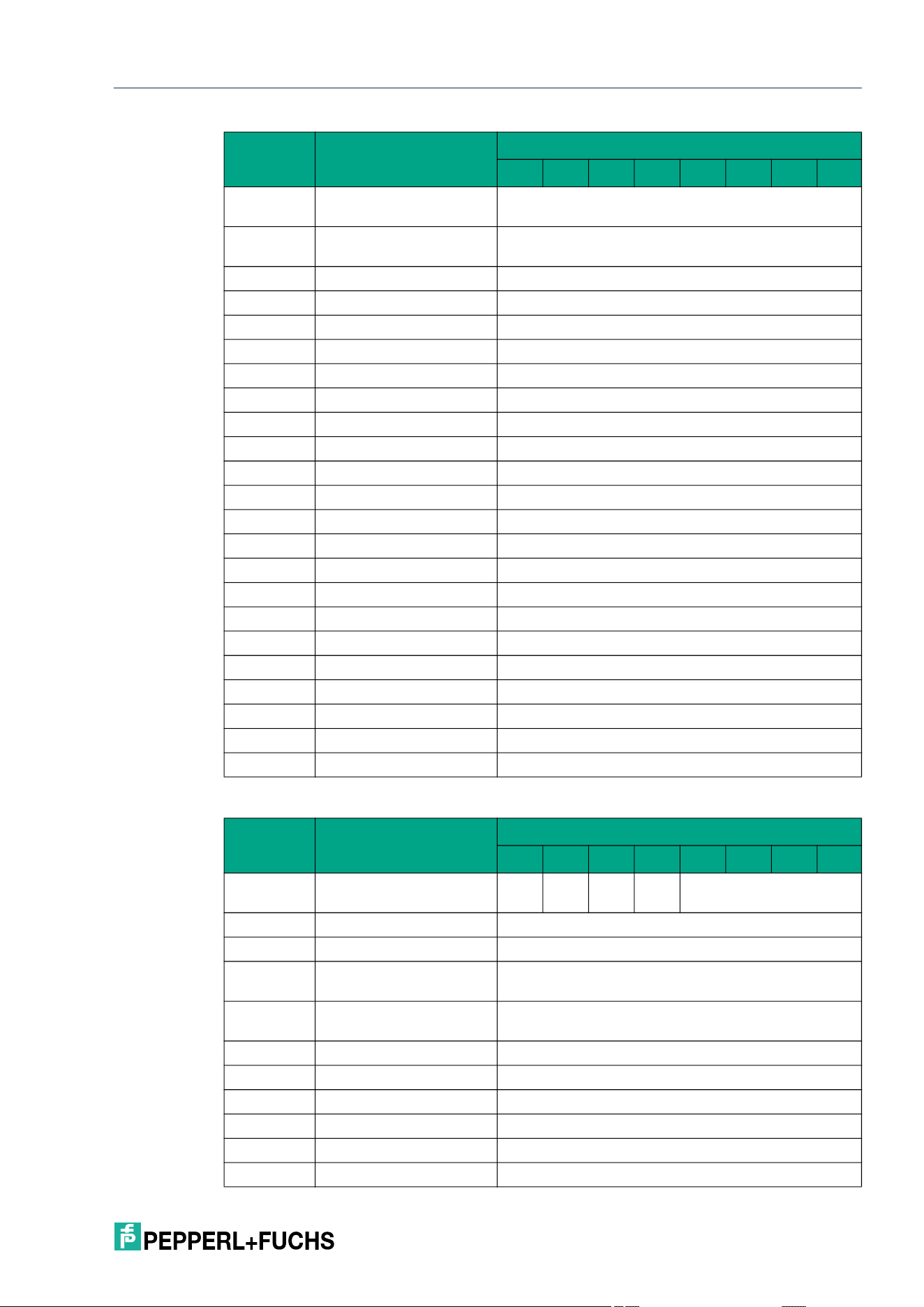
IQH3/IQH4 Series
Commissioning and Operation
2026-05
75
Response Telegram 1 – Status 16#00 (Multi-Frame Protocol)
Byte 3 Telegram Length (High
Byte)
16#00
Byte 4 Telegram Length (Low
Byte)
16#15
Byte 5 Command 16#DC
Byte 6 Command parameter 16#00 <Length UID Mask in Bit (High Byte)>
Byte 7 Command parameter 16#40 <Length UID Mask in Bit (Low Byte)>
Byte 8 Command parameter <UID Mask Byte 1>
Byte 9 Command parameter <UID Mask Byte 2>
Byte 10 Command parameter <UID Mask Byte 3>
Byte 11 Command parameter <UID Mask Byte 4>
Byte 12 Command parameter <UID Mask Byte 5>
Byte 13 Command parameter <UID Mask Byte 6>
Byte 14 Command parameter <UID Mask Byte 7>
Byte 15 Command parameter <UID Mask Byte 8>
Byte 16 Command parameter 16#00 <Start Address (High Byte)>
Byte 17 Command parameter 16#00 <Start Address (Low Byte)>
Byte 18 Command parameter 16#00 <Number of Bytes (High Byte)>
Byte 19 Command parameter 16#04 <Number of Bytes (Low Byte)>
Byte 20 Command parameter <Data Byte 1>
Byte 21 Command parameter <Data Byte 2>
Byte 22 Command parameter <Data Byte 3>
Byte 23 Command parameter <Data Byte 4>
… Command parameter 16#00
Byte 255 Command parameter 16#00
Byte Content
Bit number
7 6 5 4 3 2 1 0
Byte 0 Control Byte / Frame
Length
D
S
U
M
U
D
0 16#0
Byte 1 Frame Length 16#11
Byte 2 Fragmentation Counter 16#00
Byte 3 Telegram Length (High
Byte)
16#00
Byte 4 Telegram Length (Low
Byte)
16#0E
Byte 5 Command 16#DC
Byte 6 Status 16#00
Byte 7 Data 16#00 <Length UID in Byte (High Byte)>
Byte 8 Data 16#08 <Length UID in Byte (Low Byte)>
Byte 9 Data <UID Byte 1>
Byte 10 Data <UID Byte 2>
Byte Content
Bit number
7 6 5 4 3 2 1 0
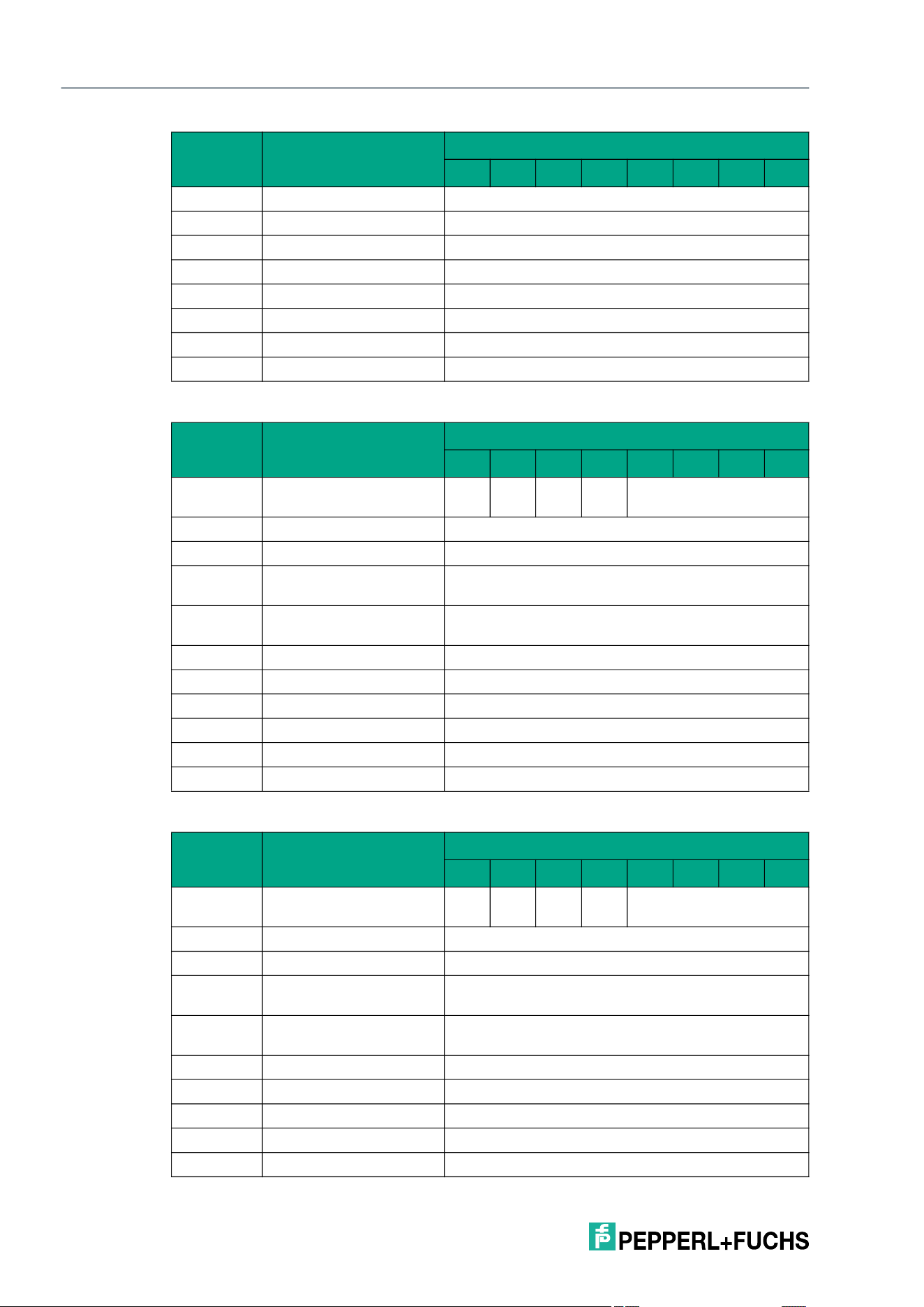
2026-05
76
IQH3/IQH4 Series
Commissioning and Operation
Response Telegram 2 – Status 16#0B (Information Frame Mode)
Response Telegram 3 – Status 16#05 (Multi-Frame Protocol)
Byte 11 Data <UID Byte 3>
Byte 12 Data <UID Byte 4>
Byte 13 Data <UID Byte 5>
Byte 14 Data <UID Byte 6>
Byte 15 Data <UID Byte 7>
Byte 16 Data <UID Byte 8>
… Data 16#00
Byte 255 Data 16#00
Byte Content
Bit number
7 6 5 4 3 2 1 0
Byte 0 Control Byte / Frame
Length
D
S
U
M
U
D
0 16#0
Byte 1 Frame Length 16#09
Byte 2 Fragmentation Counter 16#00
Byte 3 Telegram Length (High
Byte)
16#00
Byte 4 Telegram Length (Low
Byte)
16#06
Byte 5 Command 16#DC
Byte 6 Status 16#0B
Byte 7 Data 16#01 <Info Type>
Byte 8 Data <RSSI>
… Data 16#00
Byte 255 Data 16#00
Byte Content
Bit number
7 6 5 4 3 2 1 0
Byte 0 Control Byte / Frame
Length
D
S
U
M
U
D
0 16#0
Byte 1 Frame Length 16#11
Byte 2 Fragmentation Counter 16#00
Byte 3 Telegram Length (High
Byte)
16#00
Byte 4 Telegram Length (Low
Byte)
16#0E
Byte 5 Command 16#DC
Byte 6 Status 16#05
Byte 7 Data 16#00 <Length UID in Byte (High Byte)>
Byte 8 Data 16#08 <Length UID in Byte (Low Byte)>
Byte 9 Data <UID Byte 1>
Byte Content
Bit number
7 6 5 4 3 2 1 0
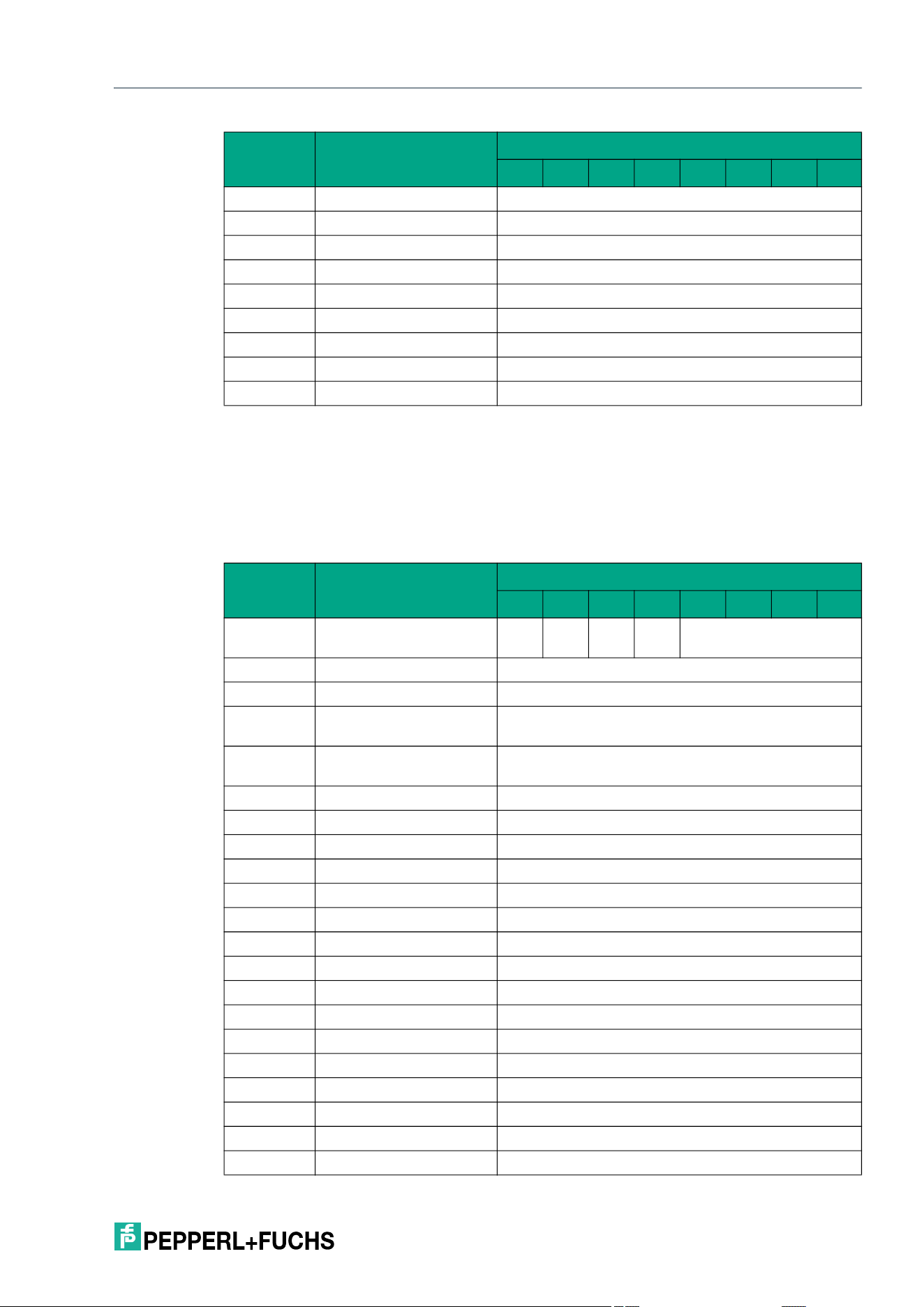
IQH3/IQH4 Series
Commissioning and Operation
2026-05
77
Selective Single Write 4-Byte Blocks with Lock (XSL)
The XSL command has the command code 16#E4. In principle, the command works exactly
like the SL command (16#47), but is only executed for one selected tag.
The parameters <UID Mask Byte 1> to <UID Mask Byte 8> are used to specify the UID of the
selected tag. <Length UID Mask in Bit> specifies the length of the UID in bits.
Command Telegram (8 Byte UID Mask, 4 Byte User Data)
Byte 10 Data <UID Byte 2>
Byte 11 Data <UID Byte 3>
Byte 12 Data <UID Byte 4>
Byte 13 Data <UID Byte 5>
Byte 14 Data <UID Byte 6>
Byte 15 Data <UID Byte 7>
Byte 16 Data <UID Byte 8>
… Data 16#00
Byte 255 Data 16#00
Byte Content
Bit number
7 6 5 4 3 2 1 0
Byte 0 Control Byte / Frame
Length
D
S
U
M
U
D
0 16#0
Byte 1 Frame Length 16#18
Byte 2 Fragmentation Counter 16#00
Byte 3 Telegram Length (High
Byte)
16#00
Byte 4 Telegram Length (Low
Byte)
16#15
Byte 5 Command 16#E4
Byte 6 Command parameter 16#00 <Length UID Mask in Bit (High Byte)>
Byte 7 Command parameter 16#40 <Length UID Mask in Bit (Low Byte)>
Byte 8 Command parameter <UID Mask Byte 1>
Byte 9 Command parameter <UID Mask Byte 2>
Byte 10 Command parameter <UID Mask Byte 3>
Byte 11 Command parameter <UID Mask Byte 4>
Byte 12 Command parameter <UID Mask Byte 5>
Byte 13 Command parameter <UID Mask Byte 6>
Byte 14 Command parameter <UID Mask Byte 7>
Byte 15 Command parameter <UID Mask Byte 8>
Byte 16 Command parameter 16#00 <Start Address (High Byte)>
Byte 17 Command parameter 16#00 <Start Address (Low Byte)>
Byte 18 Command parameter 16#00 <Number of Bytes (High Byte)>
Byte 19 Command parameter 16#04 <Number of Bytes (Low Byte)>
Byte 20 Command parameter <Data Byte 1>
Byte Content
Bit number
7 6 5 4 3 2 1 0
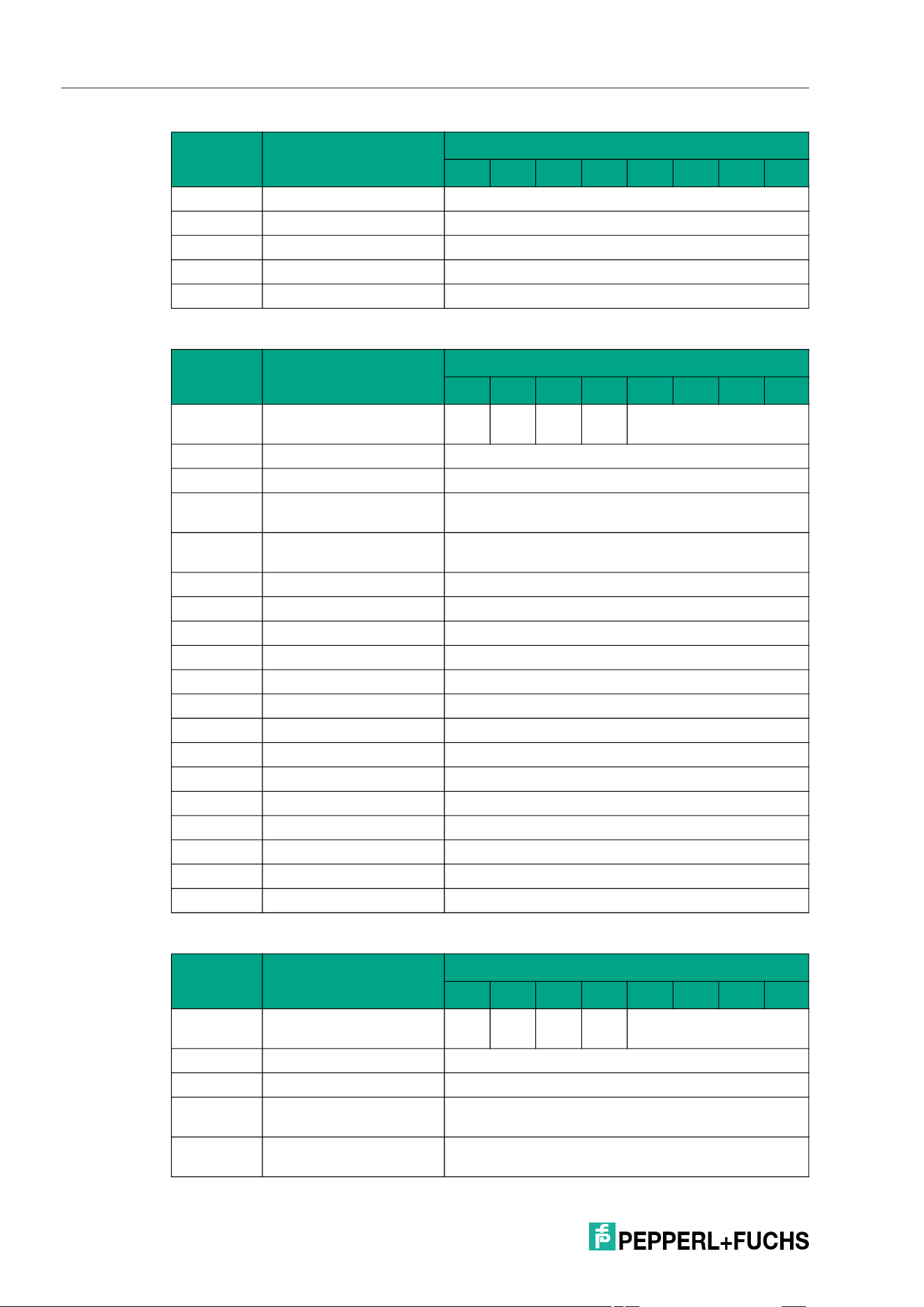
2026-05
78
IQH3/IQH4 Series
Commissioning and Operation
Response Telegram 1 – Status 16#00 (Multi-Frame Protocol)
Response Telegram 2 – Status 16#0B (Information Frame Mode)
Byte 21 Command parameter <Data Byte 2>
Byte 22 Command parameter <Data Byte 3>
Byte 23 Command parameter <Data Byte 4>
… Command parameter 16#00
Byte 255 Command parameter 16#00
Byte Content
Bit number
7 6 5 4 3 2 1 0
Byte 0 Control Byte / Frame
Length
D
S
U
M
U
D
0 16#0
Byte 1 Frame Length 16#11
Byte 2 Fragmentation Counter 16#00
Byte 3 Telegram Length (High
Byte)
16#00
Byte 4 Telegram Length (Low
Byte)
16#0E
Byte 5 Command 16#E4
Byte 6 Status 16#00
Byte 7 Data 16#00 <Length UID in Byte (High Byte)>
Byte 8 Data 16#08 <Length UID in Byte (Low Byte)>
Byte 9 Data <UID Byte 1>
Byte 10 Data <UID Byte 2>
Byte 11 Data <UID Byte 3>
Byte 12 Data <UID Byte 4>
Byte 13 Data <UID Byte 5>
Byte 14 Data <UID Byte 6>
Byte 15 Data <UID Byte 7>
Byte 16 Data <UID Byte 8>
… Data 16#00
Byte 255 Data 16#00
Byte Content
Bit number
7 6 5 4 3 2 1 0
Byte 0 Control Byte / Frame
Length
D
S
U
M
U
D
0 16#0
Byte 1 Frame Length 16#09
Byte 2 Fragmentation Counter 16#00
Byte 3 Telegram Length (High
Byte)
16#00
Byte 4 Telegram Length (Low
Byte)
16#06
Byte Content
Bit number
7 6 5 4 3 2 1 0
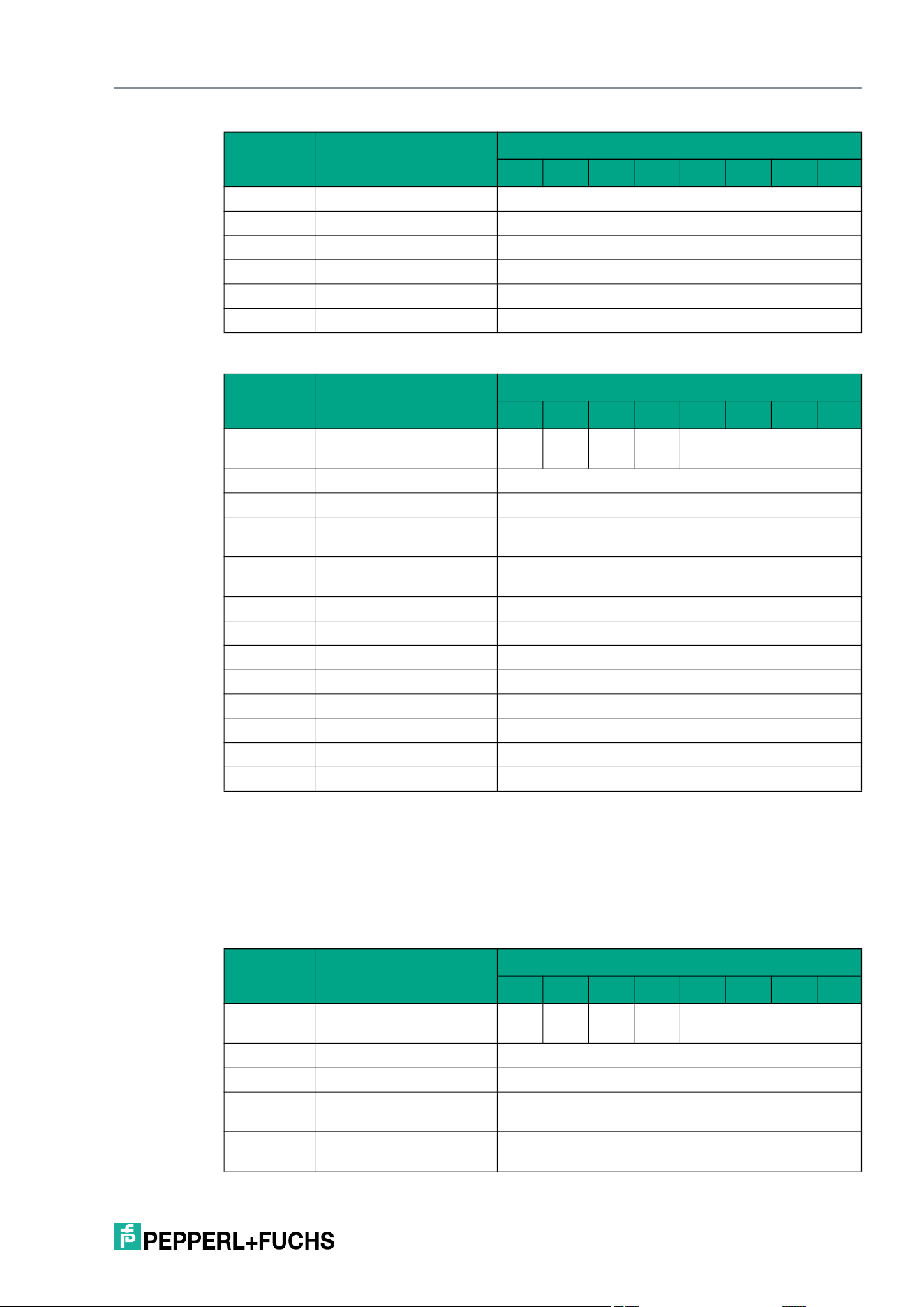
IQH3/IQH4 Series
Commissioning and Operation
2026-05
79
Response Telegram 3 – Status 16#0F (Multi-Frame Protocol)
Selective Enhanced Write 4-Byte Blocks with Lock (XEL)
The XEL command has the command code 16#E5. In principle, the command works exactly
like the SL command (16#48), but is only executed for one selected tag.
The parameters <UID Mask Byte 1> to <UID Mask Byte 8> are used to specify the UID of the
selected tag. <Length UID Mask in Bit> specifies the length of the UID in bits.
Command Telegram (8 Byte UID Mask, 4 Byte User Data)
Byte 5 Command 16#E4
Byte 6 Status 16#0B
Byte 7 Data 16#01 <Info Type>
Byte 8 Data <RSSI>
… Data 16#00
Byte 255 Data 16#00
Byte Content
Bit number
7 6 5 4 3 2 1 0
Byte 0 Control Byte / Frame
Length
D
S
U
M
U
D
0 16#0
Byte 1 Frame Length 16#0B
Byte 2 Fragmentation Counter 16#00
Byte 3 Telegram Length (High
Byte)
16#00
Byte 4 Telegram Length (Low
Byte)
16#08
Byte 5 Command 16#E4
Byte 6 Status 16#0F
Byte 7 Data <Number of Tags Byte 1>
Byte 8 Data <Number of Tags Byte 2>
Byte 9 Data <Number of Tags Byte 3>
Byte 10 Data <Number of Tags Byte 4>
… Data 16#00
Byte 255 Data 16#00
Byte Content
Bit number
7 6 5 4 3 2 1 0
Byte 0 Control Byte / Frame
Length
D
S
U
M
U
D
0 16#0
Byte 1 Frame Length 16#18
Byte 2 Fragmentation Counter 16#00
Byte 3 Telegram Length (High
Byte)
16#00
Byte 4 Telegram Length (Low
Byte)
16#15
Byte Content
Bit number
7 6 5 4 3 2 1 0
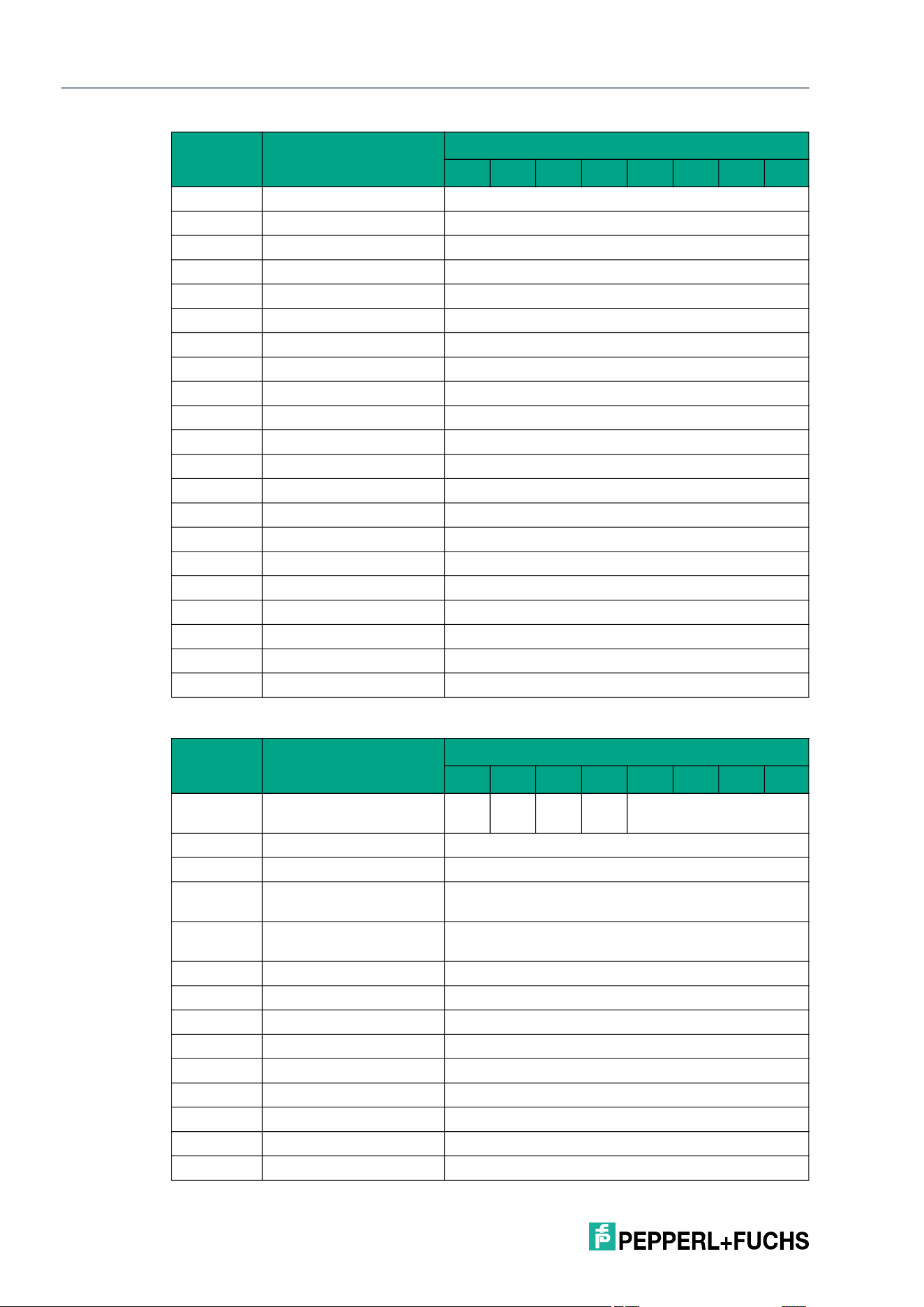
2026-05
80
IQH3/IQH4 Series
Commissioning and Operation
Response Telegram 1 – Status 16#00 (Multi-Frame Protocol)
Byte 5 Command 16#E5
Byte 6 Command parameter 16#00 <Length UID Mask in Bit (High Byte)>
Byte 7 Command parameter 16#40 <Length UID Mask in Bit (Low Byte)>
Byte 8 Command parameter <UID Mask Byte 1>
Byte 9 Command parameter <UID Mask Byte 2>
Byte 10 Command parameter <UID Mask Byte 3>
Byte 11 Command parameter <UID Mask Byte 4>
Byte 12 Command parameter <UID Mask Byte 5>
Byte 13 Command parameter <UID Mask Byte 6>
Byte 14 Command parameter <UID Mask Byte 7>
Byte 15 Command parameter <UID Mask Byte 8>
Byte 16 Command parameter 16#00 <Start Address (High Byte)>
Byte 17 Command parameter 16#00 <Start Address (Low Byte)>
Byte 18 Command parameter 16#00 <Number of Bytes (High Byte)>
Byte 19 Command parameter 16#04 <Number of Bytes (Low Byte)>
Byte 20 Command parameter <Data Byte 1>
Byte 21 Command parameter <Data Byte 2>
Byte 22 Command parameter <Data Byte 3>
Byte 23 Command parameter <Data Byte 4>
… Command parameter 16#00
Byte 255 Command parameter 16#00
Byte Content
Bit number
7 6 5 4 3 2 1 0
Byte 0 Control Byte / Frame
Length
D
S
U
M
U
D
0 16#0
Byte 1 Frame Length 16#11
Byte 2 Fragmentation Counter 16#00
Byte 3 Telegram Length (High
Byte)
16#00
Byte 4 Telegram Length (Low
Byte)
16#0E
Byte 5 Command 16#E5
Byte 6 Status 16#00
Byte 7 Data 16#00 <Length UID in Byte (High Byte)>
Byte 8 Data 16#08 <Length UID in Byte (Low Byte)>
Byte 9 Data <UID Byte 1>
Byte 10 Data <UID Byte 2>
Byte 11 Data <UID Byte 3>
Byte 12 Data <UID Byte 4>
Byte 13 Data <UID Byte 5>
Byte Content
Bit number
7 6 5 4 3 2 1 0
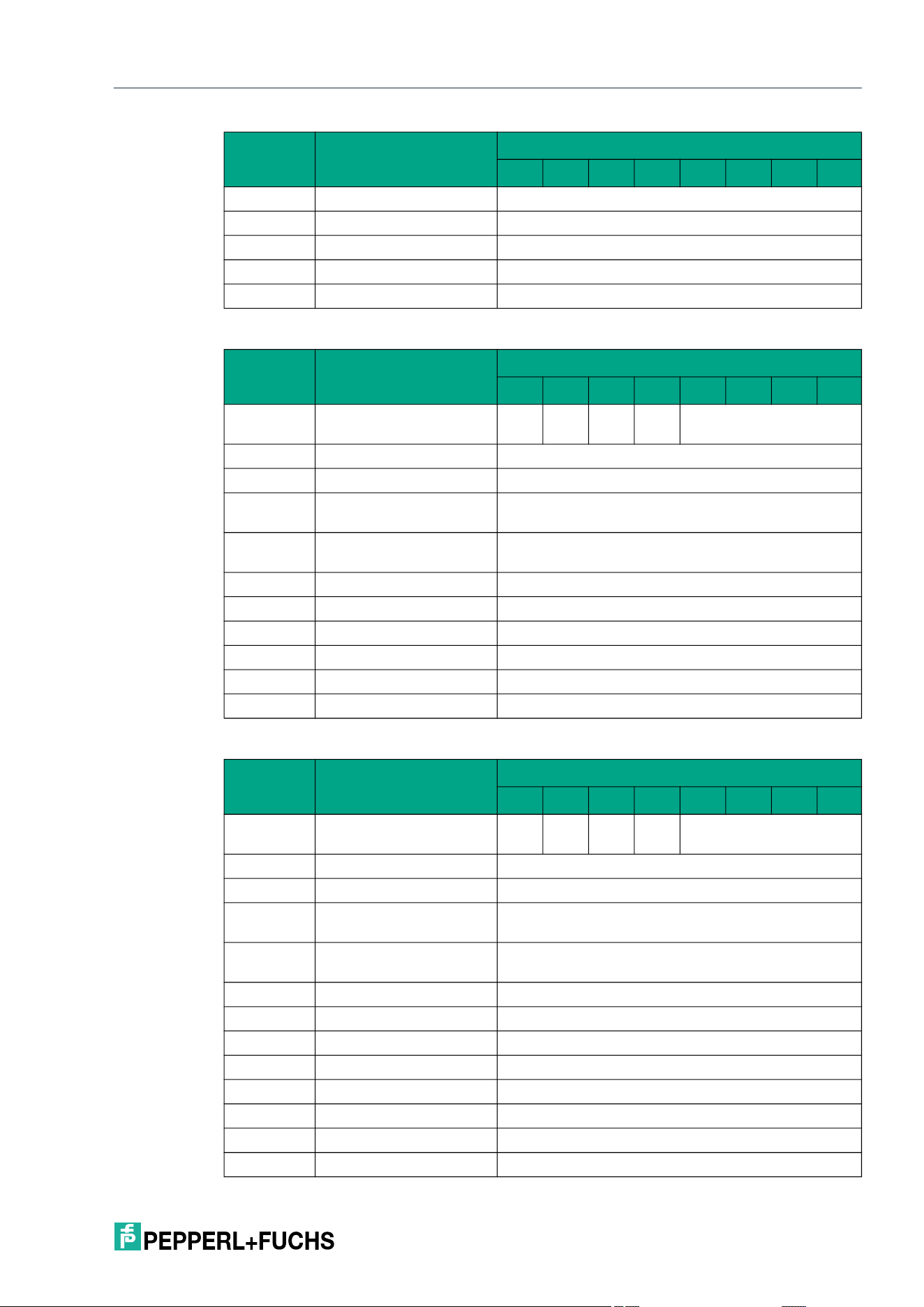
IQH3/IQH4 Series
Commissioning and Operation
2026-05
81
Response Telegram 2 – Status 16#0B (Information Frame Mode)
Response Telegram 3 – Status 16#05 (Multi-Frame Protocol)
Byte 14 Data <UID Byte 6>
Byte 15 Data <UID Byte 7>
Byte 16 Data <UID Byte 8>
… Data 16#00
Byte 255 Data 16#00
Byte Content
Bit number
7 6 5 4 3 2 1 0
Byte 0 Control Byte / Frame
Length
D
S
U
M
U
D
0 16#0
Byte 1 Frame Length 16#09
Byte 2 Fragmentation Counter 16#00
Byte 3 Telegram Length (High
Byte)
16#00
Byte 4 Telegram Length (Low
Byte)
16#06
Byte 5 Command 16#E5
Byte 6 Status 16#0B
Byte 7 Data 16#01 <Info Type>
Byte 8 Data <RSSI>
… Data 16#00
Byte 255 Data 16#00
Byte Content
Bit number
7 6 5 4 3 2 1 0
Byte 0 Control Byte / Frame
Length
D
S
U
M
U
D
0 16#0
Byte 1 Frame Length 16#11
Byte 2 Fragmentation Counter 16#00
Byte 3 Telegram Length (High
Byte)
16#00
Byte 4 Telegram Length (Low
Byte)
16#0E
Byte 5 Command 16#E5
Byte 6 Status 16#05
Byte 7 Data 16#00 <Length UID in Byte (High Byte)>
Byte 8 Data 16#08 <Length UID in Byte (Low Byte)>
Byte 9 Data <UID Byte 1>
Byte 10 Data <UID Byte 2>
Byte 11 Data <UID Byte 3>
Byte 12 Data <UID Byte 4>
Byte Content
Bit number
7 6 5 4 3 2 1 0
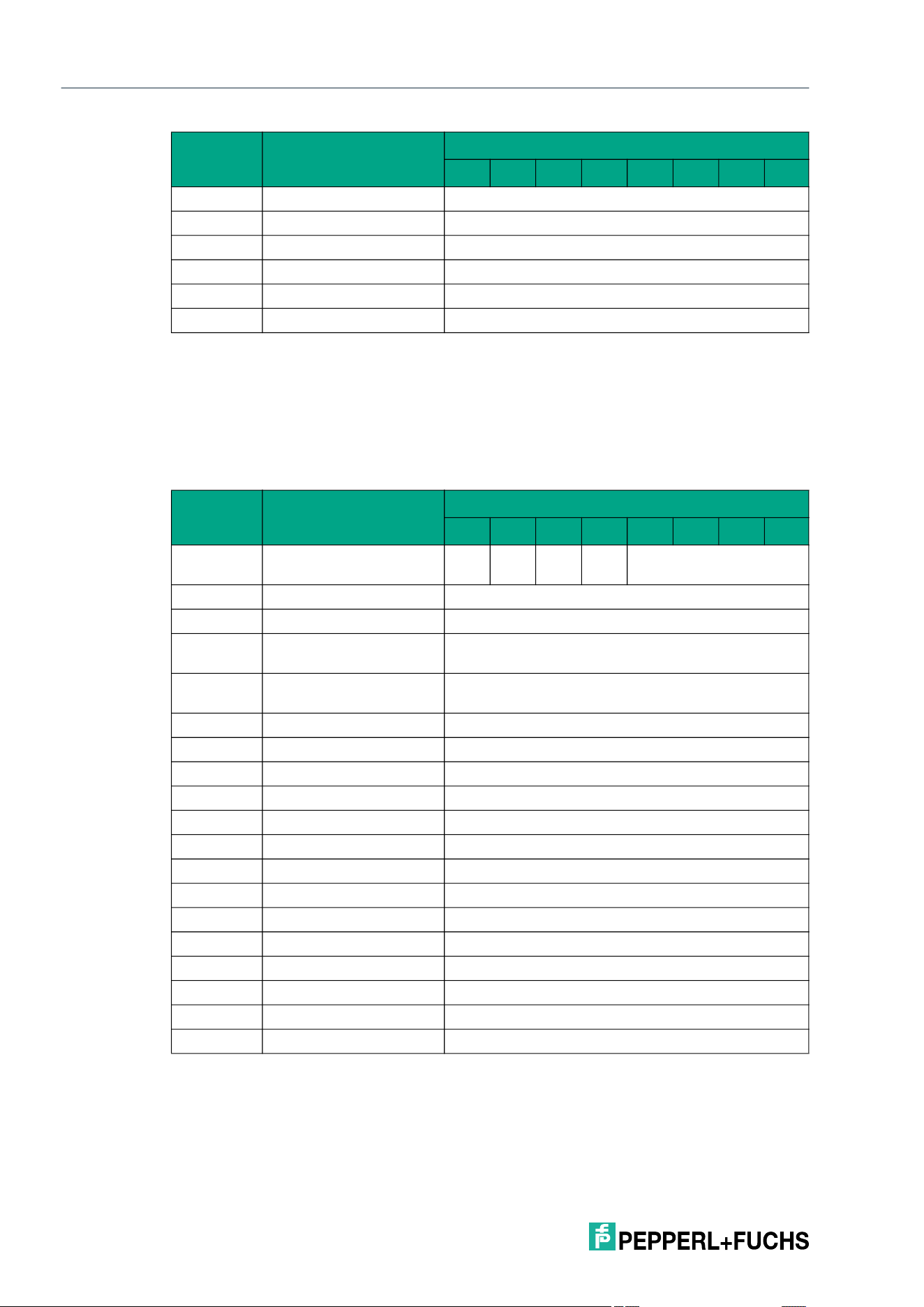
2026-05
82
IQH3/IQH4 Series
Commissioning and Operation
Selective Single Get Configuration (XSG)
The XSG command has the command code 16#DD. In principle, the command works exactly
like the SG command (16#61), but is only executed for one selected tag.
The parameters <UID Mask Byte 1> to <UID Mask Byte 8> are used to specify the UID of the
selected tag. <Length UID Mask in Bit> specifies the length of the UID in bits.
Command Telegram (8 Byte UID Mask)
Byte 13 Data <UID Byte 5>
Byte 14 Data <UID Byte 6>
Byte 15 Data <UID Byte 7>
Byte 16 Data <UID Byte 8>
… Data 16#00
Byte 255 Data 16#00
Byte Content
Bit number
7 6 5 4 3 2 1 0
Byte 0 Control Byte / Frame
Length
D
S
U
M
U
D
0 16#0
Byte 1 Frame Length 16#11
Byte 2 Fragmentation Counter 16#00
Byte 3 Telegram Length (High
Byte)
16#00
Byte 4 Telegram Length (Low
Byte)
16#0E
Byte 5 Command 16#DD
Byte 6 Command parameter 16#00 <Length UID Mask in Bit (High Byte)>
Byte 7 Command parameter 16#40 <Length UID Mask in Bit (Low Byte)>
Byte 8 Command parameter <UID Mask Byte 1>
Byte 9 Command parameter <UID Mask Byte 2>
Byte 10 Command parameter <UID Mask Byte 3>
Byte 11 Command parameter <UID Mask Byte 4>
Byte 12 Command parameter <UID Mask Byte 5>
Byte 13 Command parameter <UID Mask Byte 6>
Byte 14 Command parameter <UID Mask Byte 7>
Byte 15 Command parameter <UID Mask Byte 8>
Byte 16 Command parameter 16#00 <Config Address>
… Command parameter 16#00
Byte 255 Command parameter 16#00
Byte Content
Bit number
7 6 5 4 3 2 1 0
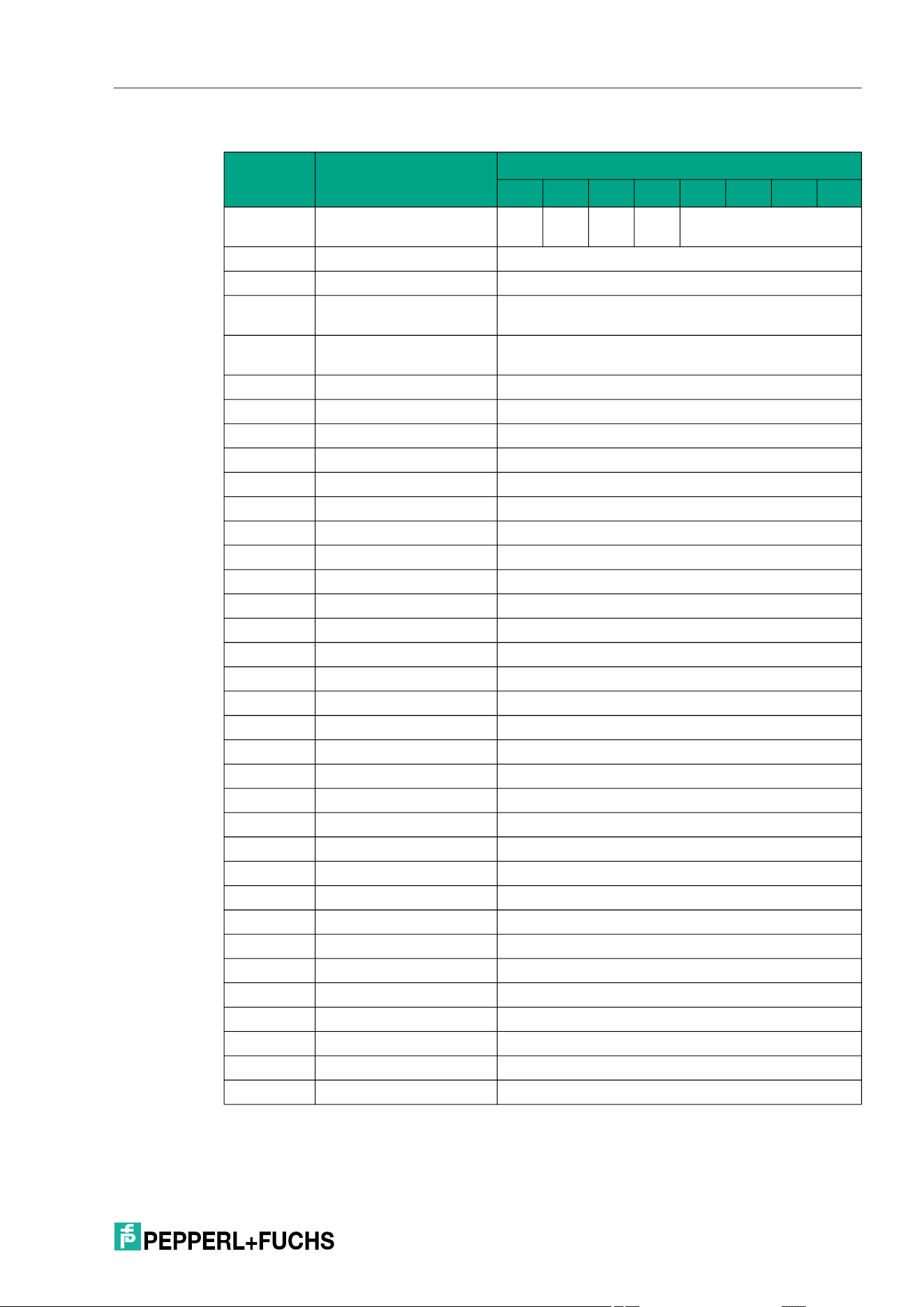
IQH3/IQH4 Series
Commissioning and Operation
2026-05
83
Response Telegram 1 – Status 16#00 (Multi-Frame Protocol)
Byte Content
Bit number
7 6 5 4 3 2 1 0
Byte 0 Control Byte / Frame
Length
D
S
U
M
U
D
0 16#0
Byte 1 Frame Length 16#21
Byte 2 Fragmentation Counter 16#00
Byte 3 Telegram Length (High
Byte)
16#00
Byte 4 Telegram Length (Low
Byte)
16#1E
Byte 5 Command 16#DD
Byte 6 Status 16#00
Byte 7 Data 16#00 <Length UID in Byte (High Byte)>
Byte 8 Data 16#08 <Length UID in Byte (Low Byte)>
Byte 9 Data <UID Byte 1>
Byte 10 Data <UID Byte 2>
Byte 11 Data <UID Byte 3>
Byte 12 Data <UID Byte 4>
Byte 13 Data <UID Byte 5>
Byte 14 Data <UID Byte 6>
Byte 15 Data <UID Byte 7>
Byte 16 Data <UID Byte 8>
Byte 17 Data 16#00
Byte 18 Data 16#0E
Byte 19 Data <Info Flags>
Byte 20 Data <UID Byte 8>
Byte 21 Data <UID Byte 7>
Byte 22 Data <UID Byte 6>
Byte 23 Data <UID Byte 5>
Byte 24 Data <UID Byte 4>
Byte 25 Data <UID Byte 3>
Byte 26 Data <UID Byte 2>
Byte 27 Data <UID Byte 1>
Byte 28 Data <DSFID>
Byte 29 Data <AFI>
Byte 30 Data <VICC Memory Size (Number of Blocks -1)>
Byte 31 Data <VICC Memory Size (Block Size -1)>
Byte 32 Data <IC Reference>
… Data 16#00
Byte 255 Data 16#00
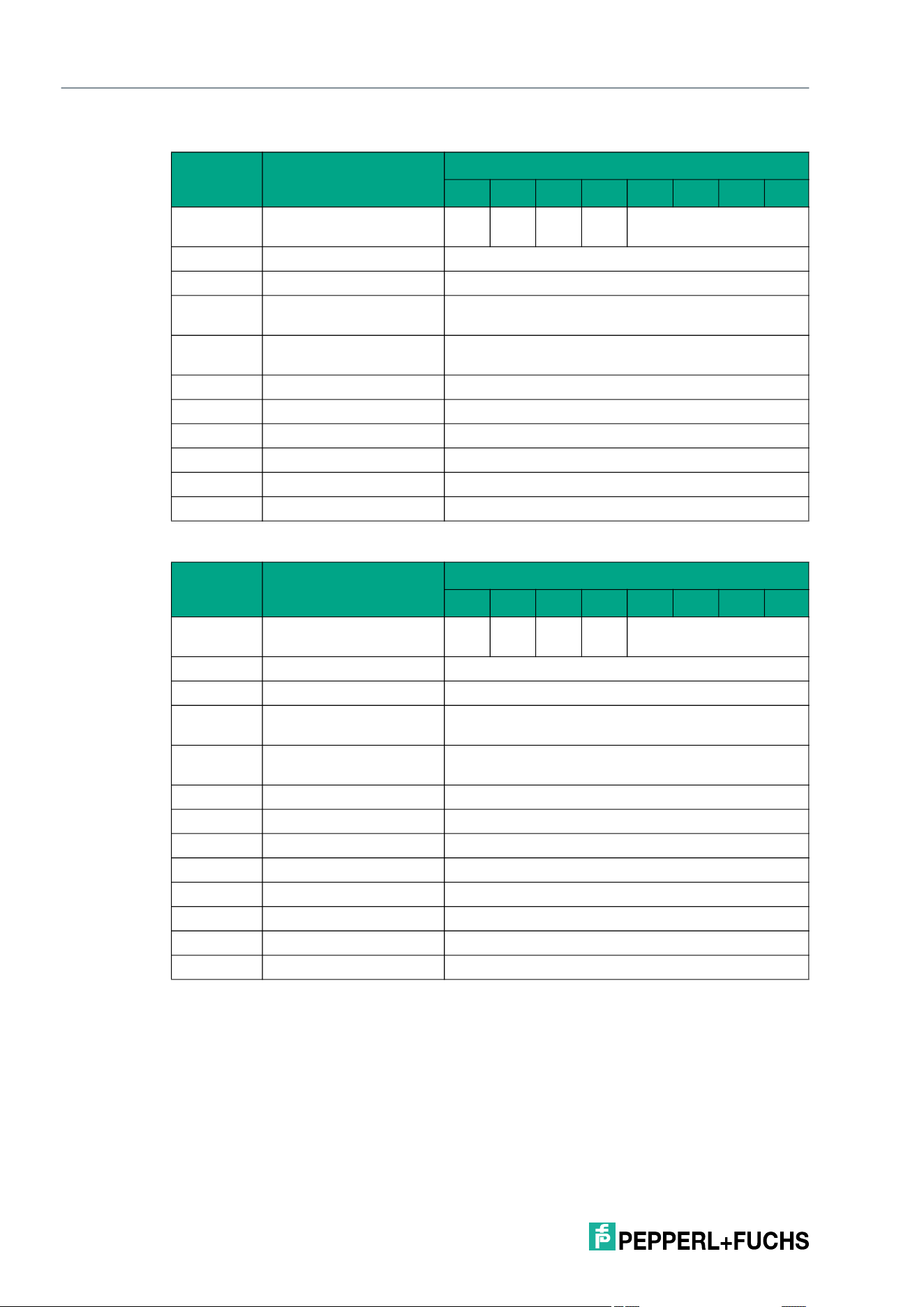
2026-05
84
IQH3/IQH4 Series
Commissioning and Operation
Response Telegram 2 – Status 16#0B (Information Frame Mode)
Response Telegram 3 – Status 16#0F (Multi-Frame Protocol)
Selective Enhanced Get Configuration (XEG)
The XEG command has the command code 16#D6. In principle, the command works exactly
like the EG command (16#68), but is only executed for one selected tag.
The parameters <UID Mask Byte 1> to <UID Mask Byte 8> are used to specify the UID of the
selected tag. <Length UID Mask in Bit> specifies the length of the UID in bits.
Byte Content
Bit number
7 6 5 4 3 2 1 0
Byte 0 Control Byte / Frame
Length
D
S
U
M
U
D
0 16#0
Byte 1 Frame Length 16#09
Byte 2 Fragmentation Counter 16#00
Byte 3 Telegram Length (High
Byte)
16#00
Byte 4 Telegram Length (Low
Byte)
16#06
Byte 5 Command 16#DD
Byte 6 Status 16#0B
Byte 7 Data 16#01 <Info Type>
Byte 8 Data <RSSI>
… Data 16#00
Byte 255 Data 16#00
Byte Content
Bit number
7 6 5 4 3 2 1 0
Byte 0 Control Byte / Frame
Length
D
S
U
M
U
D
0 16#0
Byte 1 Frame Length 16#0B
Byte 2 Fragmentation Counter 16#00
Byte 3 Telegram Length (High
Byte)
16#00
Byte 4 Telegram Length (Low
Byte)
16#08
Byte 5 Command 16#DD
Byte 6 Status 16#0F
Byte 7 Data <Number of Tags Byte 1>
Byte 8 Data <Number of Tags Byte 2>
Byte 9 Data <Number of Tags Byte 3>
Byte 10 Data <Number of Tags Byte 4>
… Data 16#00
Byte 255 Data 16#00
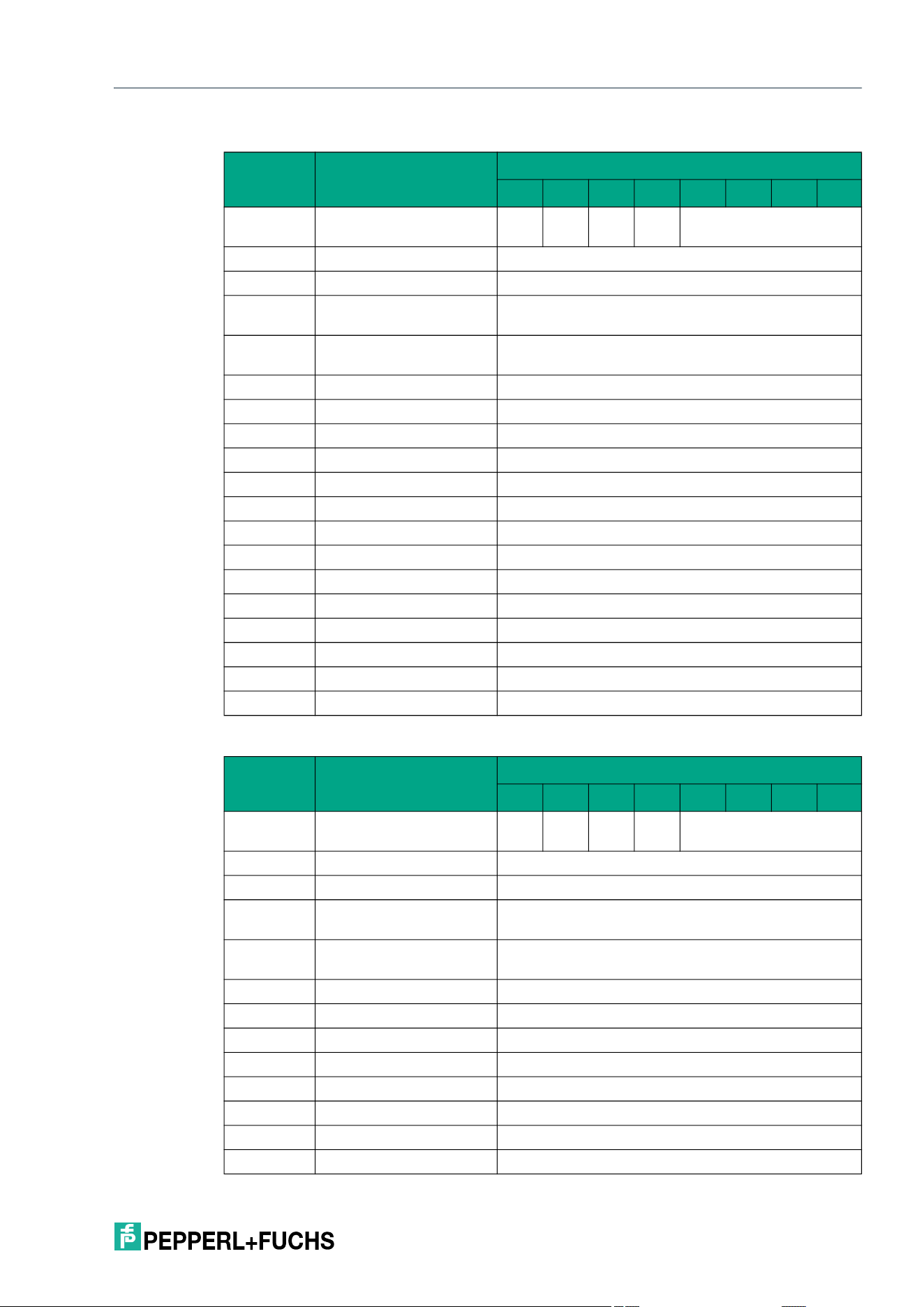
IQH3/IQH4 Series
Commissioning and Operation
2026-05
85
Command Telegram (8 Byte UID Mask)
Response Telegram 1 – Status 16#00 (Multi-Frame Protocol)
Byte Content
Bit number
7 6 5 4 3 2 1 0
Byte 0 Control Byte / Frame
Length
D
S
U
M
U
D
0 16#0
Byte 1 Frame Length 16#11
Byte 2 Fragmentation Counter 16#00
Byte 3 Telegram Length (High
Byte)
16#00
Byte 4 Telegram Length (Low
Byte)
16#0E
Byte 5 Command 16#D6
Byte 6 Command parameter 16#00 <Length UID Mask in Bit (High Byte)>
Byte 7 Command parameter 16#40 <Length UID Mask in Bit (Low Byte)>
Byte 8 Command parameter <UID Mask Byte 1>
Byte 9 Command parameter <UID Mask Byte 2>
Byte 10 Command parameter <UID Mask Byte 3>
Byte 11 Command parameter <UID Mask Byte 4>
Byte 12 Command parameter <UID Mask Byte 5>
Byte 13 Command parameter <UID Mask Byte 6>
Byte 14 Command parameter <UID Mask Byte 7>
Byte 15 Command parameter <UID Mask Byte 8>
Byte 16 Command parameter 16#00 <Config Address>
… Command parameter 16#00
Byte 255 Command parameter 16#00
Byte Content
Bit number
7 6 5 4 3 2 1 0
Byte 0 Control Byte / Frame
Length
D
S
U
M
U
D
0 16#0
Byte 1 Frame Length 16#21
Byte 2 Fragmentation Counter 16#00
Byte 3 Telegram Length (High
Byte)
16#00
Byte 4 Telegram Length (Low
Byte)
16#1E
Byte 5 Command 16#D6
Byte 6 Status 16#00
Byte 7 Data 16#00 <Length UID in Byte (High Byte)>
Byte 8 Data 16#08 <Length UID in Byte (Low Byte)>
Byte 9 Data <UID Byte 1>
Byte 10 Data <UID Byte 2>
Byte 11 Data <UID Byte 3>
Byte 12 Data <UID Byte 4>
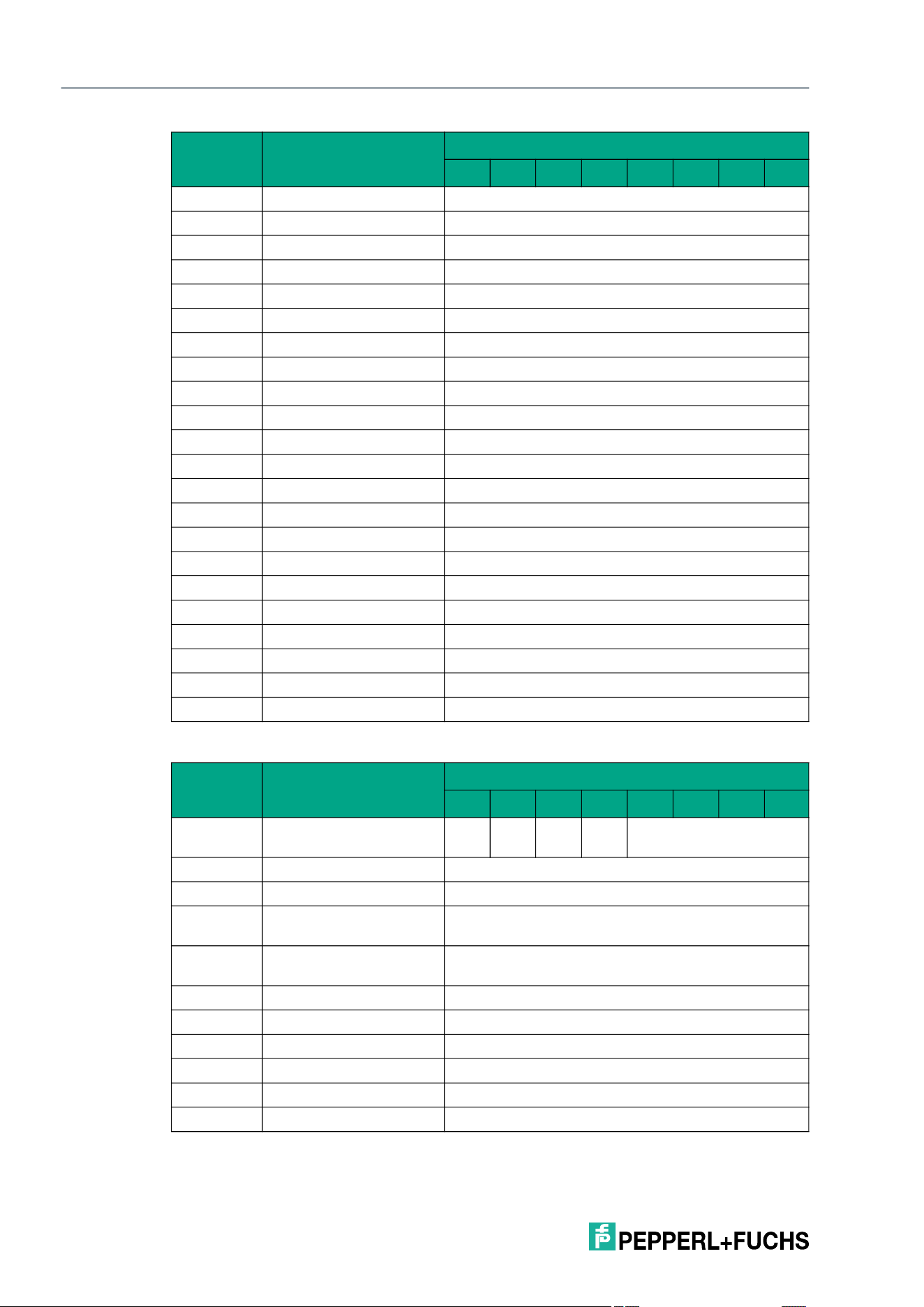
2026-05
86
IQH3/IQH4 Series
Commissioning and Operation
Response Telegram 2 – Status 16#0B (Information Frame Mode)
Byte 13 Data <UID Byte 5>
Byte 14 Data <UID Byte 6>
Byte 15 Data <UID Byte 7>
Byte 16 Data <UID Byte 8>
Byte 17 Data 16#00
Byte 18 Data 16#0E
Byte 19 Data <Info Flags>
Byte 20 Data <UID Byte 8>
Byte 21 Data <UID Byte 7>
Byte 22 Data <UID Byte 6>
Byte 23 Data <UID Byte 5>
Byte 24 Data <UID Byte 4>
Byte 25 Data <UID Byte 3>
Byte 26 Data <UID Byte 2>
Byte 27 Data <UID Byte 1>
Byte 28 Data <DSFID>
Byte 29 Data <AFI>
Byte 30 Data <VICC Memory Size (Number of Blocks -1)>
Byte 31 Data <VICC Memory Size (Block Size -1)>
Byte 32 Data <IC Reference>
… Data 16#00
Byte 255 Data 16#00
Byte Content
Bit number
7 6 5 4 3 2 1 0
Byte 0 Control Byte / Frame
Length
D
S
U
M
U
D
0 16#0
Byte 1 Frame Length 16#09
Byte 2 Fragmentation Counter 16#00
Byte 3 Telegram Length (High
Byte)
16#00
Byte 4 Telegram Length (Low
Byte)
16#06
Byte 5 Command 16#D6
Byte 6 Status 16#0B
Byte 7 Data 16#01 <Info Type>
Byte 8 Data <RSSI>
… Data 16#00
Byte 255 Data 16#00
Byte Content
Bit number
7 6 5 4 3 2 1 0
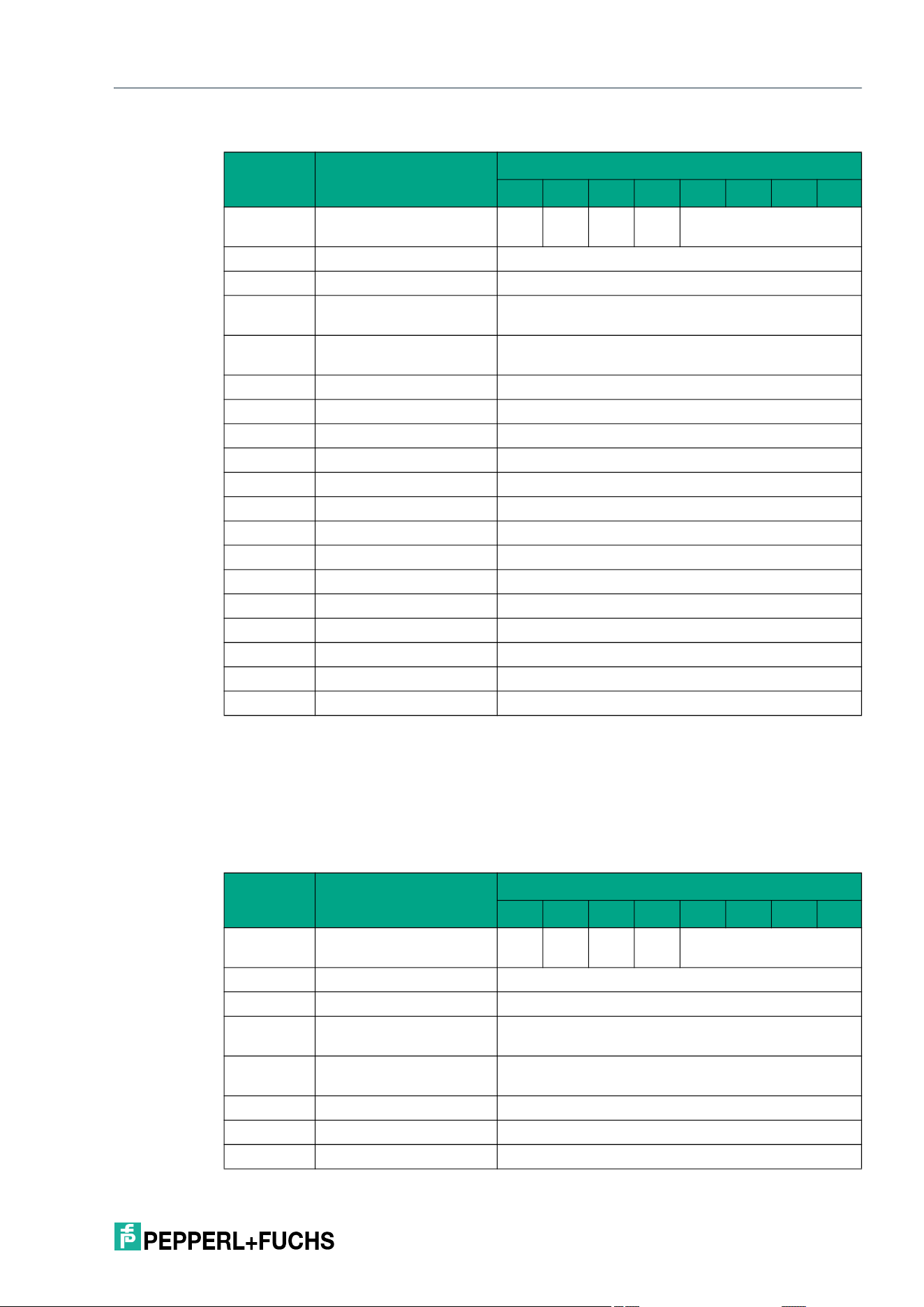
IQH3/IQH4 Series
Commissioning and Operation
2026-05
87
Response Telegram 3 – Status 16#05 (Multi-Frame Protocol)
Selective Single Set Configuration (XSC)
The XSC command has the command code 16#E1. In principle, the command works exactly
like the SC command (16#12), but is only executed for one selected tag.
The parameters <UID Mask Byte 1> to <UID Mask Byte 8> are used to specify the UID of the
selected tag. <Length UID Mask in Bit> specifies the length of the UID in bits.
Command Telegram (8 Byte UID Mask)
Byte Content
Bit number
7 6 5 4 3 2 1 0
Byte 0 Control Byte / Frame
Length
D
S
U
M
U
D
0 16#0
Byte 1 Frame Length 16#11
Byte 2 Fragmentation Counter 16#00
Byte 3 Telegram Length (High
Byte)
16#00
Byte 4 Telegram Length (Low
Byte)
16#0E
Byte 5 Command 16#D6
Byte 6 Status 16#05
Byte 7 Data 16#00 <Length UID in Byte (High Byte)>
Byte 8 Data 16#08 <Length UID in Byte (Low Byte)>
Byte 9 Data <UID Byte 1>
Byte 10 Data <UID Byte 2>
Byte 11 Data <UID Byte 3>
Byte 12 Data <UID Byte 4>
Byte 13 Data <UID Byte 5>
Byte 14 Data <UID Byte 6>
Byte 15 Data <UID Byte 7>
Byte 16 Data <UID Byte 8>
… Data 16#00
Byte 255 Data 16#00
Byte Content
Bit number
7 6 5 4 3 2 1 0
Byte 0 Control Byte / Frame
Length
D
S
U
M
U
D
0 16#0
Byte 1 Frame Length 16#15
Byte 2 Fragmentation Counter 16#00
Byte 3 Telegram Length (High
Byte)
16#00
Byte 4 Telegram Length (Low
Byte)
16#12
Byte 5 Command 16#E1
Byte 6 Command parameter 16#00 <Length UID Mask in Bit (High Byte)>
Byte 7 Command parameter 16#40 <Length UID Mask in Bit (Low Byte)>
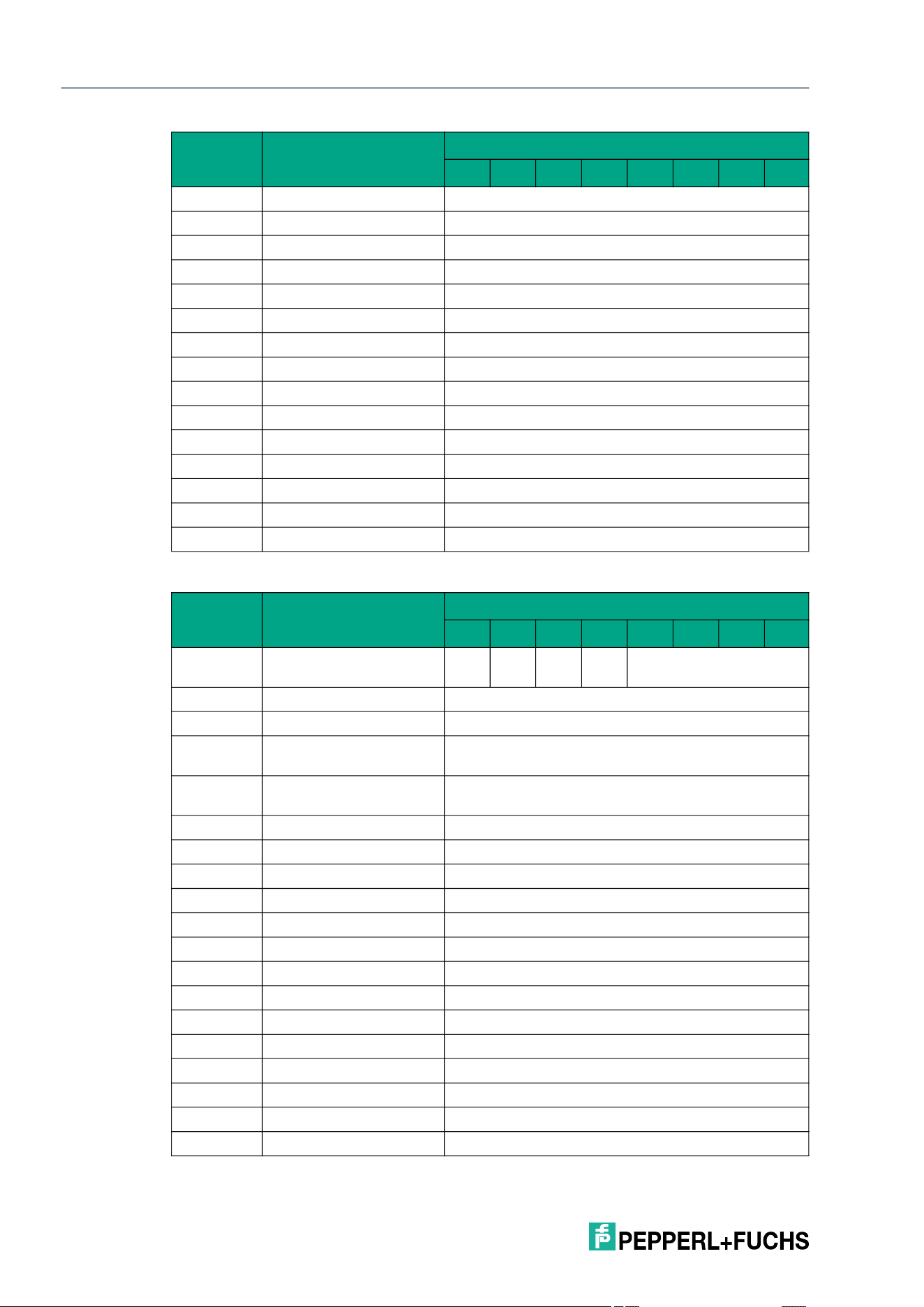
2026-05
88
IQH3/IQH4 Series
Commissioning and Operation
Response Telegram 1 – Status 16#00 (Multi-Frame Protocol)
Byte 8 Command parameter <UID Mask Byte 1>
Byte 9 Command parameter <UID Mask Byte 2>
Byte 10 Command parameter <UID Mask Byte 3>
Byte 11 Command parameter <UID Mask Byte 4>
Byte 12 Command parameter <UID Mask Byte 5>
Byte 13 Command parameter <UID Mask Byte 6>
Byte 14 Command parameter <UID Mask Byte 7>
Byte 15 Command parameter <UID Mask Byte 8>
Byte 16 Command parameter 16#00 <Config Address>
Byte 17 Command parameter <Lock>
Byte 18 Command parameter <DSFID / AFI>
Byte 19 Command parameter 16#00 (always)
Byte 20 Command parameter 16#00 (always)
… Command parameter 16#00
Byte 255 Command parameter 16#00
Byte Content
Bit number
7 6 5 4 3 2 1 0
Byte 0 Control Byte / Frame
Length
D
S
U
M
U
D
0 16#0
Byte 1 Frame Length 16#11
Byte 2 Fragmentation Counter 16#00
Byte 3 Telegram Length (High
Byte)
16#00
Byte 4 Telegram Length (Low
Byte)
16#0E
Byte 5 Command 16#E1
Byte 6 Status 16#00
Byte 7 Data 16#00 <Length UID in Byte (High Byte)>
Byte 8 Data 16#08 <Length UID in Byte (Low Byte)>
Byte 9 Data <UID Byte 1>
Byte 10 Data <UID Byte 2>
Byte 11 Data <UID Byte 3>
Byte 12 Data <UID Byte 4>
Byte 13 Data <UID Byte 5>
Byte 14 Data <UID Byte 6>
Byte 15 Data <UID Byte 7>
Byte 16 Data <UID Byte 8>
… Data 16#00
Byte 255 Data 16#00
Byte Content
Bit number
7 6 5 4 3 2 1 0
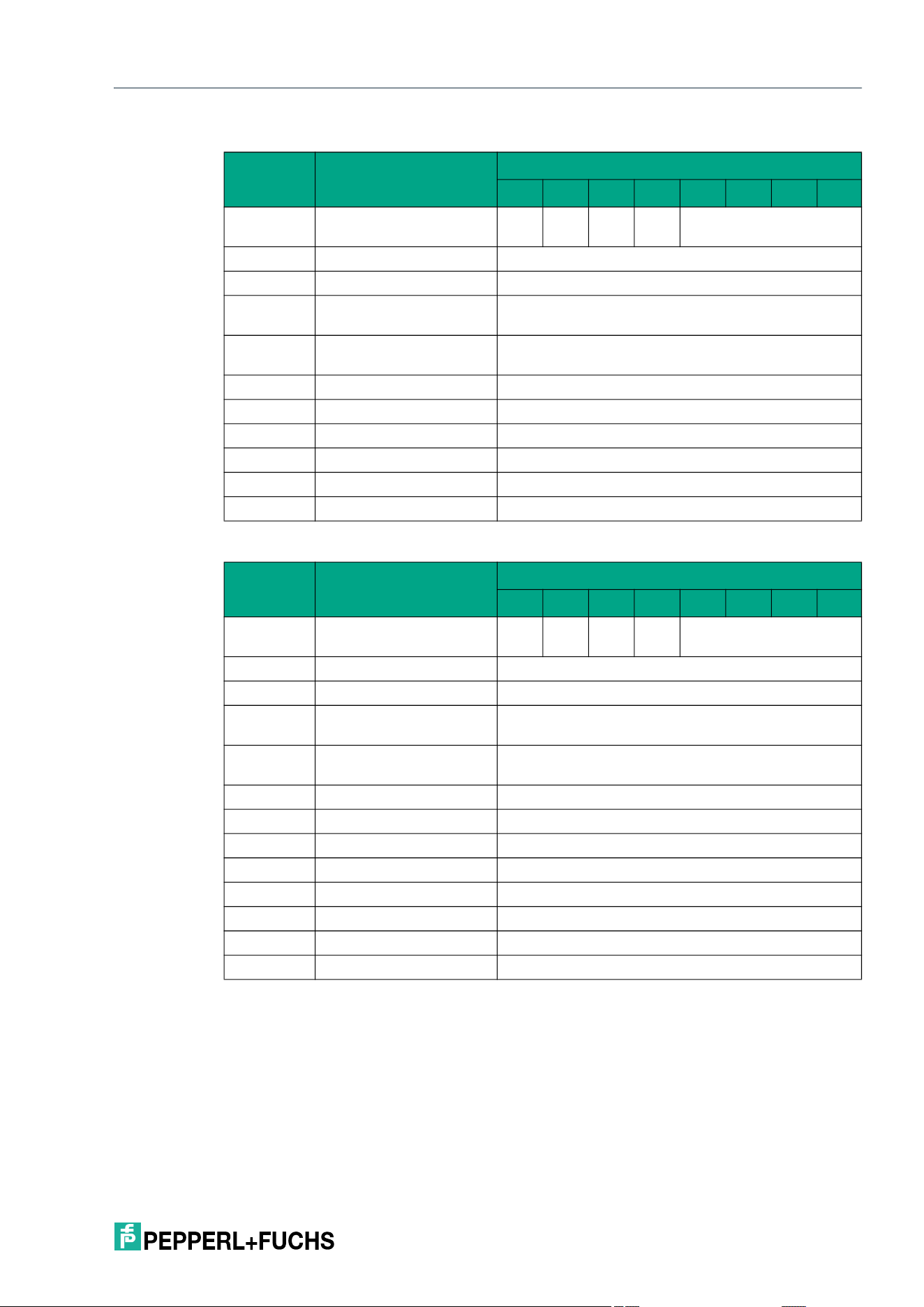
IQH3/IQH4 Series
Commissioning and Operation
2026-05
89
Response Telegram 2 – Status 16#0B (Information Frame Mode)
Response Telegram 3 – Status 16#0F (Multi-Frame Protocol)
Selective Enhanced Set Configuration (XEC)
The XEC command has the command code 16#DA. In principle, the command works exactly
like the EC command (16#66), but is only executed for one selected tag.
The parameters <UID Mask Byte 1> to <UID Mask Byte 8> are used to specify the UID of the
selected tag. <Length UID Mask in Bit> specifies the length of the UID in bits.
Byte Content
Bit number
7 6 5 4 3 2 1 0
Byte 0 Control Byte / Frame
Length
D
S
U
M
U
D
0 16#0
Byte 1 Frame Length 16#09
Byte 2 Fragmentation Counter 16#00
Byte 3 Telegram Length (High
Byte)
16#00
Byte 4 Telegram Length (Low
Byte)
16#06
Byte 5 Command 16#E1
Byte 6 Status 16#0B
Byte 7 Data 16#01 <Info Type>
Byte 8 Data <RSSI>
… Data 16#00
Byte 255 Data 16#00
Byte Content
Bit number
7 6 5 4 3 2 1 0
Byte 0 Control Byte / Frame
Length
D
S
U
M
U
D
0 16#0
Byte 1 Frame Length 16#0B
Byte 2 Fragmentation Counter 16#00
Byte 3 Telegram Length (High
Byte)
16#00
Byte 4 Telegram Length (Low
Byte)
16#08
Byte 5 Command 16#E1
Byte 6 Status 16#0F
Byte 7 Data <Number of Tags Byte 1>
Byte 8 Data <Number of Tags Byte 2>
Byte 9 Data <Number of Tags Byte 3>
Byte 10 Data <Number of Tags Byte 4>
… Data 16#00
Byte 255 Data 16#00
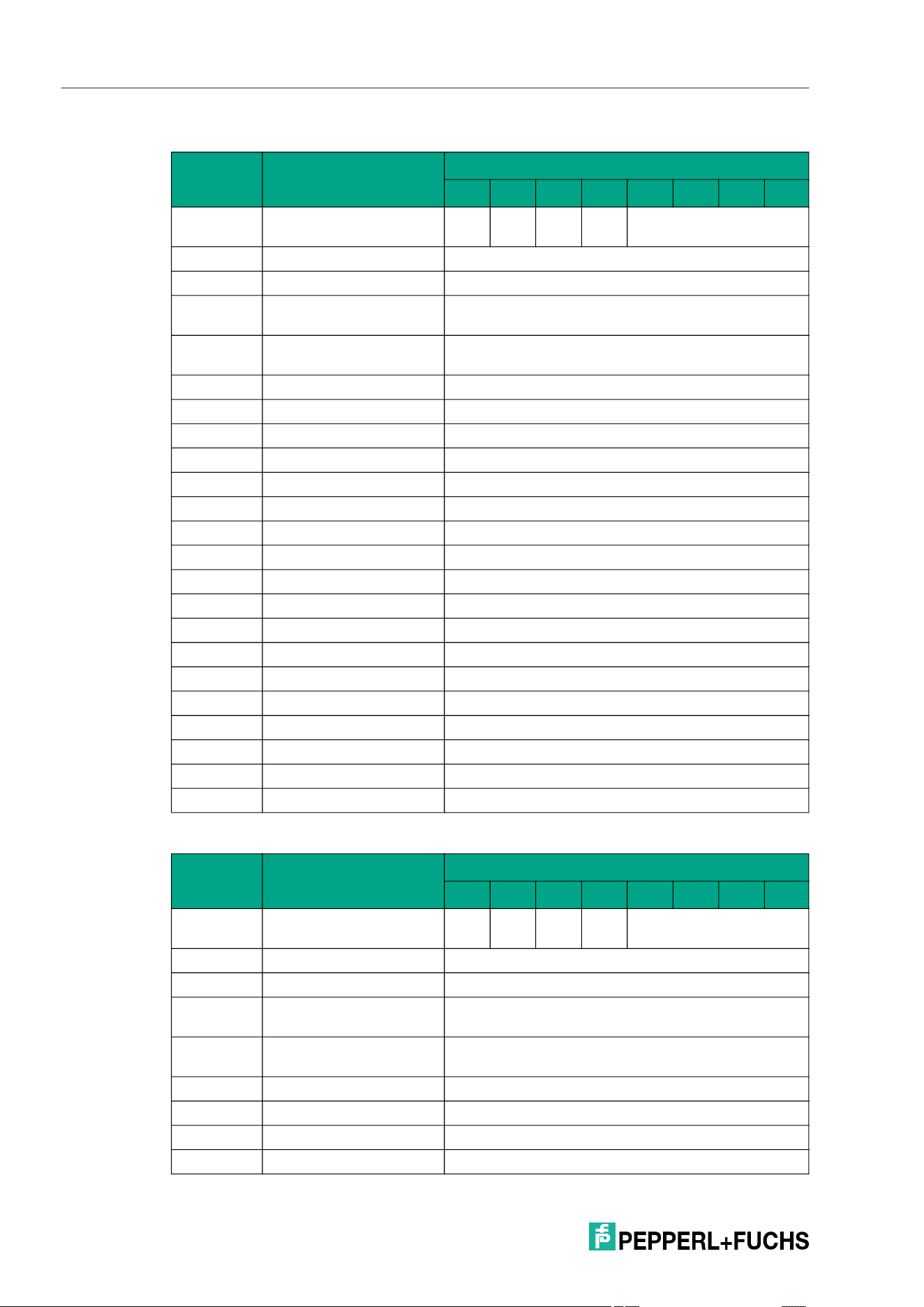
2026-05
90
IQH3/IQH4 Series
Commissioning and Operation
Command Telegram (8 Byte UID Mask)
Response Telegram 1 – Status 16#00 (Multi-Frame Protocol)
Byte Content
Bit number
7 6 5 4 3 2 1 0
Byte 0 Control Byte / Frame
Length
D
S
U
M
U
D
0 16#0
Byte 1 Frame Length 16#15
Byte 2 Fragmentation Counter 16#00
Byte 3 Telegram Length (High
Byte)
16#00
Byte 4 Telegram Length (Low
Byte)
16#12
Byte 5 Command 16#DA
Byte 6 Command parameter 16#00 <Length UID Mask in Bit (High Byte)>
Byte 7 Command parameter 16#40 <Length UID Mask in Bit (Low Byte)>
Byte 8 Command parameter <UID Mask Byte 1>
Byte 9 Command parameter <UID Mask Byte 2>
Byte 10 Command parameter <UID Mask Byte 3>
Byte 11 Command parameter <UID Mask Byte 4>
Byte 12 Command parameter <UID Mask Byte 5>
Byte 13 Command parameter <UID Mask Byte 6>
Byte 14 Command parameter <UID Mask Byte 7>
Byte 15 Command parameter <UID Mask Byte 8>
Byte 16 Command parameter 16#00 <Config Address>
Byte 17 Command parameter <Lock>
Byte 18 Command parameter <DSFID / AFI>
Byte 19 Command parameter 16#00 (always)
Byte 20 Command parameter 16#00 (always)
… Command parameter 16#00
Byte 255 Command parameter 16#00
Byte Content
Bit number
7 6 5 4 3 2 1 0
Byte 0 Control Byte / Frame
Length
D
S
U
M
U
D
0 16#0
Byte 1 Frame Length 16#11
Byte 2 Fragmentation Counter 16#00
Byte 3 Telegram Length (High
Byte)
16#00
Byte 4 Telegram Length (Low
Byte)
16#0E
Byte 5 Command 16#DA
Byte 6 Status 16#00
Byte 7 Data 16#00 <Length UID in Byte (High Byte)>
Byte 8 Data 16#08 <Length UID in Byte (Low Byte)>
IQH3/IQH4 Series
Commissioning and Operation
2026-05
91
Response Telegram 2 – Status 16#0B (Information Frame Mode)
Response Telegram 3 – Status 16#05 (Multi-Frame Protocol)
Byte 9 Data <UID Byte 1>
Byte 10 Data <UID Byte 2>
Byte 11 Data <UID Byte 3>
Byte 12 Data <UID Byte 4>
Byte 13 Data <UID Byte 5>
Byte 14 Data <UID Byte 6>
Byte 15 Data <UID Byte 7>
Byte 16 Data <UID Byte 8>
… Data 16#00
Byte 255 Data 16#00
Byte Content
Bit number
7 6 5 4 3 2 1 0
Byte 0 Control Byte / Frame
Length
D
S
U
M
U
D
0 16#0
Byte 1 Frame Length 16#09
Byte 2 Fragmentation Counter 16#00
Byte 3 Telegram Length (High
Byte)
16#00
Byte 4 Telegram Length (Low
Byte)
16#06
Byte 5 Command 16#DA
Byte 6 Status 16#0B
Byte 7 Data 16#01 <Info Type>
Byte 8 Data <RSSI>
… Data 16#00
Byte 255 Data 16#00
Byte Content
Bit number
7 6 5 4 3 2 1 0
Byte 0 Control Byte / Frame
Length
D
S
U
M
U
D
0 16#0
Byte 1 Frame Length 16#11
Byte 2 Fragmentation Counter 16#00
Byte 3 Telegram Length (High
Byte)
16#00
Byte 4 Telegram Length (Low
Byte)
16#0E
Byte 5 Command 16#DA
Byte 6 Status 16#05
Byte 7 Data 16#00 <Length UID in Byte (High Byte)>
Byte Content
Bit number
7 6 5 4 3 2 1 0
2026-05
92
IQH3/IQH4 Series
Commissioning and Operation
Selective Fill Tag (XS#)
The XS# command has the command code 16#E7. In principle, the command works exactly
like the S# command (16#AA), but is only executed for one selected tag.
The parameters <UID Mask Byte 1> to <UID Mask Byte 8> are used to specify the UID of the
selected tag. <Length UID Mask in Bit> specifies the length of the UID in bits.
Command Telegram (8 Byte UID Mask)
Byte 8 Data 16#08 <Length UID in Byte (Low Byte)>
Byte 9 Data <UID Byte 1>
Byte 10 Data <UID Byte 2>
Byte 11 Data <UID Byte 3>
Byte 12 Data <UID Byte 4>
Byte 13 Data <UID Byte 5>
Byte 14 Data <UID Byte 6>
Byte 15 Data <UID Byte 7>
Byte 16 Data <UID Byte 8>
… Data 16#00
Byte 255 Data 16#00
Byte Content
Bit number
7 6 5 4 3 2 1 0
Byte 0 Control Byte / Frame
Length
D
S
U
M
U
D
0 16#0
Byte 1 Frame Length 16#15
Byte 2 Fragmentation Counter 16#00
Byte 3 Telegram Length (High
Byte)
16#00
Byte 4 Telegram Length (Low
Byte)
16#12
Byte 5 Command 16#E7
Byte 6 Command parameter 16#00 <Length UID Mask in Bit (High Byte)>
Byte 7 Command parameter 16#40 <Length UID Mask in Bit (Low Byte)>
Byte 8 Command parameter <UID Mask Byte 1>
Byte 9 Command parameter <UID Mask Byte 2>
Byte 10 Command parameter <UID Mask Byte 3>
Byte 11 Command parameter <UID Mask Byte 4>
Byte 12 Command parameter <UID Mask Byte 5>
Byte 13 Command parameter <UID Mask Byte 6>
Byte 14 Command parameter <UID Mask Byte 7>
Byte 15 Command parameter <UID Mask Byte 8>
Byte 16 Command parameter 16#00 <Start Address (High Byte)>
Byte 17 Command parameter 16#00 <Start Address (Low Byte)>
Byte 18 Command parameter 16#00 <Number of Bytes (High Byte)>
Byte Content
Bit number
7 6 5 4 3 2 1 0
IQH3/IQH4 Series
Commissioning and Operation
2026-05
93
Response Telegram 1 – Status 16#00 (Multi-Frame Protocol)
Response Telegram 2 – Status 16#0B (Information Frame Mode)
Byte 19 Command parameter 16#04 <Number of Bytes (Low Byte)>
Byte 20 Command parameter <FillSign>
… Command parameter 16#00
Byte 255 Command parameter 16#00
Byte Content
Bit number
7 6 5 4 3 2 1 0
Byte 0 Control Byte / Frame
Length
D
S
U
M
U
D
0 16#0
Byte 1 Frame Length 16#11
Byte 2 Fragmentation Counter 16#00
Byte 3 Telegram Length (High
Byte)
16#00
Byte 4 Telegram Length (Low
Byte)
16#0E
Byte 5 Command 16#E7
Byte 6 Status 16#00
Byte 7 Data 16#00 <Length UID in Byte (High Byte)>
Byte 8 Data 16#08 <Length UID in Byte (Low Byte)>
Byte 9 Data <UID Byte 1>
Byte 10 Data <UID Byte 2>
Byte 11 Data <UID Byte 3>
Byte 12 Data <UID Byte 4>
Byte 13 Data <UID Byte 5>
Byte 14 Data <UID Byte 6>
Byte 15 Data <UID Byte 7>
Byte 16 Data <UID Byte 8>
… Data 16#00
Byte 255 Data 16#00
Byte Content
Bit number
7 6 5 4 3 2 1 0
Byte 0 Control Byte / Frame
Length
D
S
U
M
U
D
0 16#0
Byte 1 Frame Length 16#09
Byte 2 Fragmentation Counter 16#00
Byte 3 Telegram Length (High
Byte)
16#00
Byte 4 Telegram Length (Low
Byte)
16#06
Byte 5 Command 16#E7
Byte Content
Bit number
7 6 5 4 3 2 1 0
2026-05
94
IQH3/IQH4 Series
Commissioning and Operation
Response Telegram 3 – Status 16#0F (Multi-Frame Protocol)
6.7 Configuration Commands
The "Read Parameter" and "Write Parameter" configuration commands can be used to read or
change the parameters of the device.
A system code is required to access the HF parameters on the device. This distinguishes
between other systems in which parameters can also be changed. For IQH3/IQH4 series
devices, the system code is "Q" (16#51).
Read Parameter (RP)
The "Read Parameter" (RP) command has the command code 16#BE and reads out a device
parameter. The response to the configuration command is a status message from the
read/write device and the corresponding data.
Command Telegram
Byte 6 Status 16#0B
Byte 7 Data 16#01 <Info Type>
Byte 8 Data <RSSI>
… Data 16#00
Byte 255 Data 16#00
Byte Content
Bit number
7 6 5 4 3 2 1 0
Byte 0 Control Byte / Frame
Length
D
S
U
M
U
D
0 16#0
Byte 1 Frame Length 16#0B
Byte 2 Fragmentation Counter 16#00
Byte 3 Telegram Length (High
Byte)
16#00
Byte 4 Telegram Length (Low
Byte)
16#08
Byte 5 Command 16#E7
Byte 6 Status 16#0F
Byte 7 Data <Number of Tags Byte 1>
Byte 8 Data <Number of Tags Byte 2>
Byte 9 Data <Number of Tags Byte 3>
Byte 10 Data <Number of Tags Byte 4>
… Data 16#00
Byte 255 Data 16#00
Byte Content
Bit number
7 6 5 4 3 2 1 0
Byte Content
Bit number
7 6 5 4 3 2 1 0
Byte 0 Control Byte / Frame
Length
D
S
U
M
U
D
0 <FrameLength>
Byte 1 Frame Length <FrameLength>
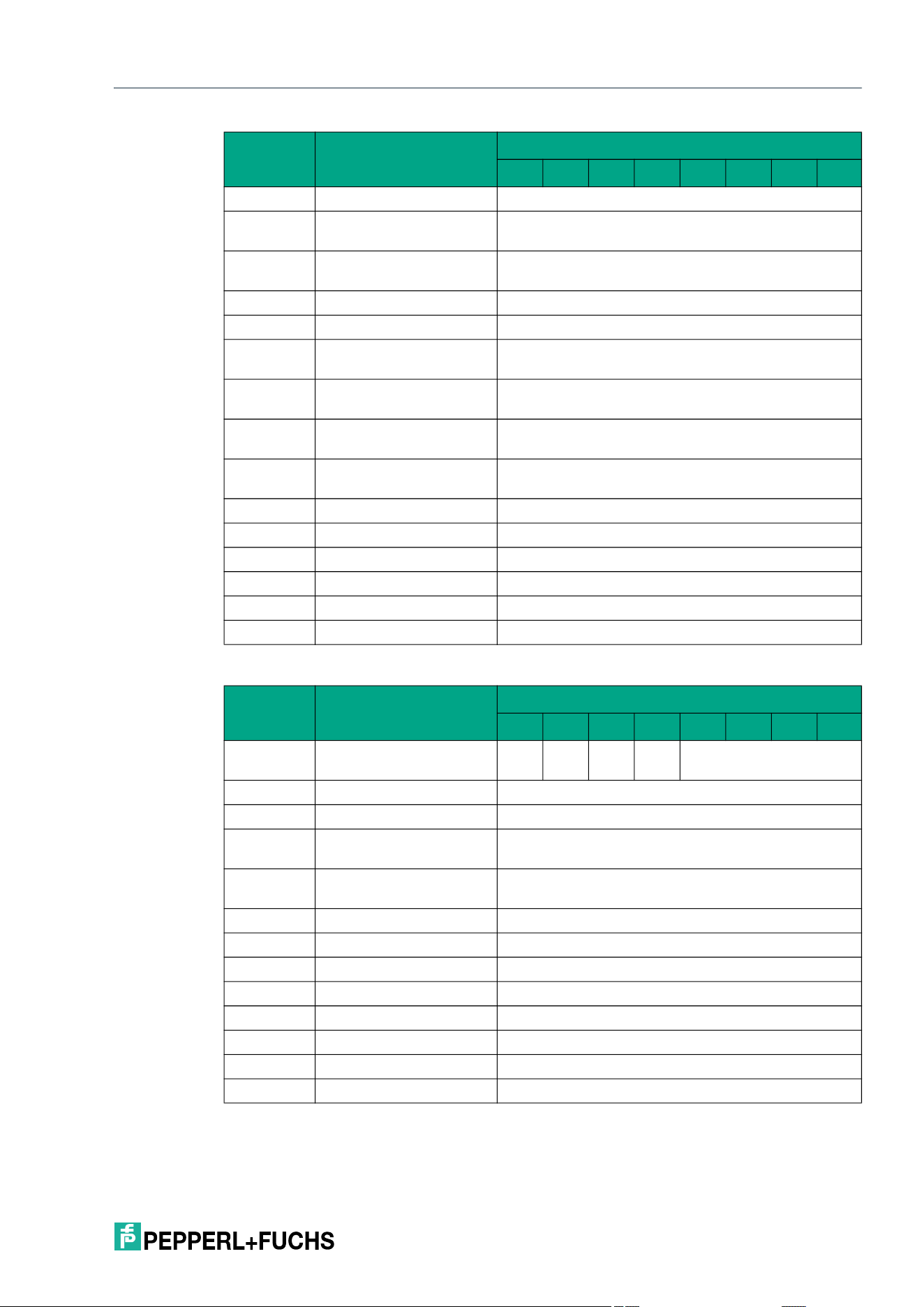
IQH3/IQH4 Series
Commissioning and Operation
2026-05
95
Response Telegram
Byte 2 Fragmentation Counter 16#00
Byte 3 Telegram Length (High
Byte)
<Telegram Length (High Byte)>
Byte 4 Telegram Length (Low
Byte)
<Telegram Length (Low Byte)>
Byte 5 Command 16#BE
Byte 6 System code <System Code> 16#51 "Q"
Byte 7 Parameter Name (High
Byte)
<Parameter Name (High Byte)>
Byte 8 Parameter Name (Low
Byte)
<Parameter Name (Low Byte)>
Byte 9 Length Parameter (High
Byte)
<Parameter Length (High Byte)>
Byte 10 Length Parameter (Low
Byte)
<Parameter Length (Low Byte)>
Byte 11 Command parameter <Parameter Data Byte 1>
Byte 12 Command parameter <Parameter Data Byte 2>
… Command parameter …
… Command parameter <Parameter Data Byte X>
… Not relevant 16#00
Byte 255 Not relevant 16#00
Byte Content
Bit number
7 6 5 4 3 2 1 0
Byte 0 Control Byte / Frame
Length
D
S
U
M
U
D
0 <Frame Length>
Byte 1 Frame Length <Frame Length>
Byte 2 Fragmentation Counter <Fragmentation Counter>
Byte 3 Telegram Length (High
Byte)
<Telegram Length (High Byte)>
Byte 4 Telegram Length (Low
Byte)
<Telegram Length (Low Byte)>
Byte 5 Command 16#BE
Byte 6 Status <Status>
Byte 7 Data <Parameter Data Byte 1>
Byte 8 Data <Parameter Data Byte 2>
… Data …
… Data <Parameter Data Byte X>
… Not relevant 16#00
Byte 255 Not relevant 16#00
Byte Content
Bit number
7 6 5 4 3 2 1 0
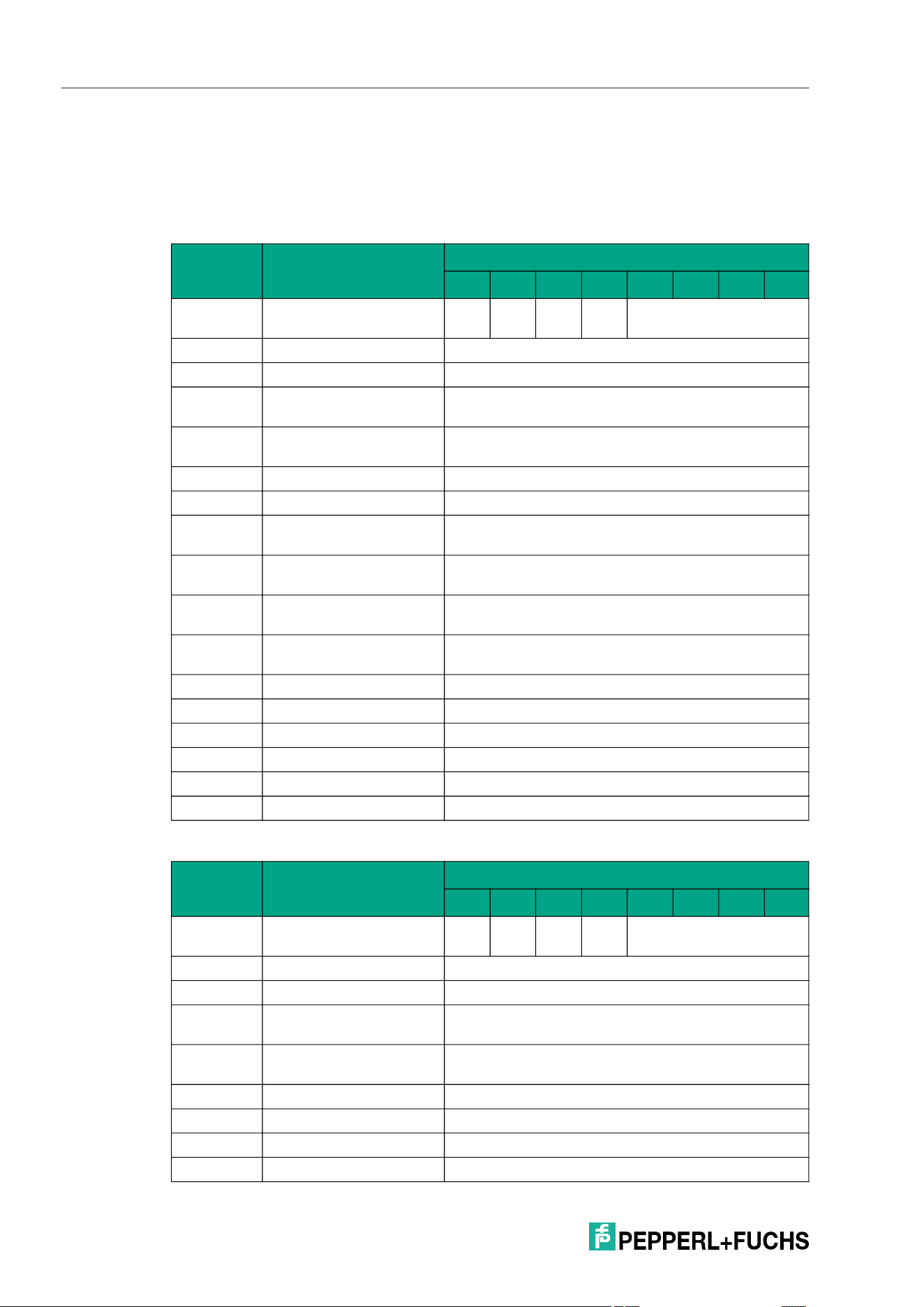
2026-05
96
IQH3/IQH4 Series
Commissioning and Operation
Write Parameter (WP)
The "Write Parameter" (WP) command has the command code 16#BF. The command can be
used to change device parameters. The response to the configuration command is a status
message from the read/write device.
Command Telegram
Response Telegram
Byte Content
Bit number
7 6 5 4 3 2 1 0
Byte 0 Control Byte / Frame
Length
D
S
U
M
U
D
0 <FrameLength>
Byte 1 Frame Length <FrameLength>
Byte 2 Fragmentation Counter 16#00
Byte 3 Telegram Length (High
Byte)
<Telegram Length (High Byte)>
Byte 4 Telegram Length (Low
Byte)
<Telegram Length (Low Byte)>
Byte 5 Command 16#BF
Byte 6 System code <System Code> 16#51 "Q"
Byte 7 Parameter Name (High
Byte)
<Parameter Name (High Byte)>
Byte 8 Parameter Name (Low
Byte)
<Parameter Name (Low Byte)>
Byte 9 Length Parameter (High
Byte)
<Parameter Length (High Byte)>
Byte 10 Length Parameter (Low
Byte)
<Parameter Length (Low Byte)>
Byte 11 Command parameter <Parameter Data Byte 1>
Byte 12 Command parameter <Parameter Data Byte 2>
… Command parameter …
… Command parameter <Parameter Data Byte X>
… Not relevant 16#00
Byte 255 Not relevant 16#00
Byte Content
Bit number
7 6 5 4 3 2 1 0
Byte 0 Control Byte / Frame
Length
D
S
U
M
U
D
0 <Frame Length>
Byte 1 Frame Length 16#07
Byte 2 Fragmentation Counter 16#00
Byte 3 Telegram Length (High
Byte)
16#00
Byte 4 Telegram Length (Low
Byte)
16#04
Byte 5 Command 16#BF
Byte 6 Status 16#00
… Not relevant 16#00
Byte 255 Not relevant 16#00
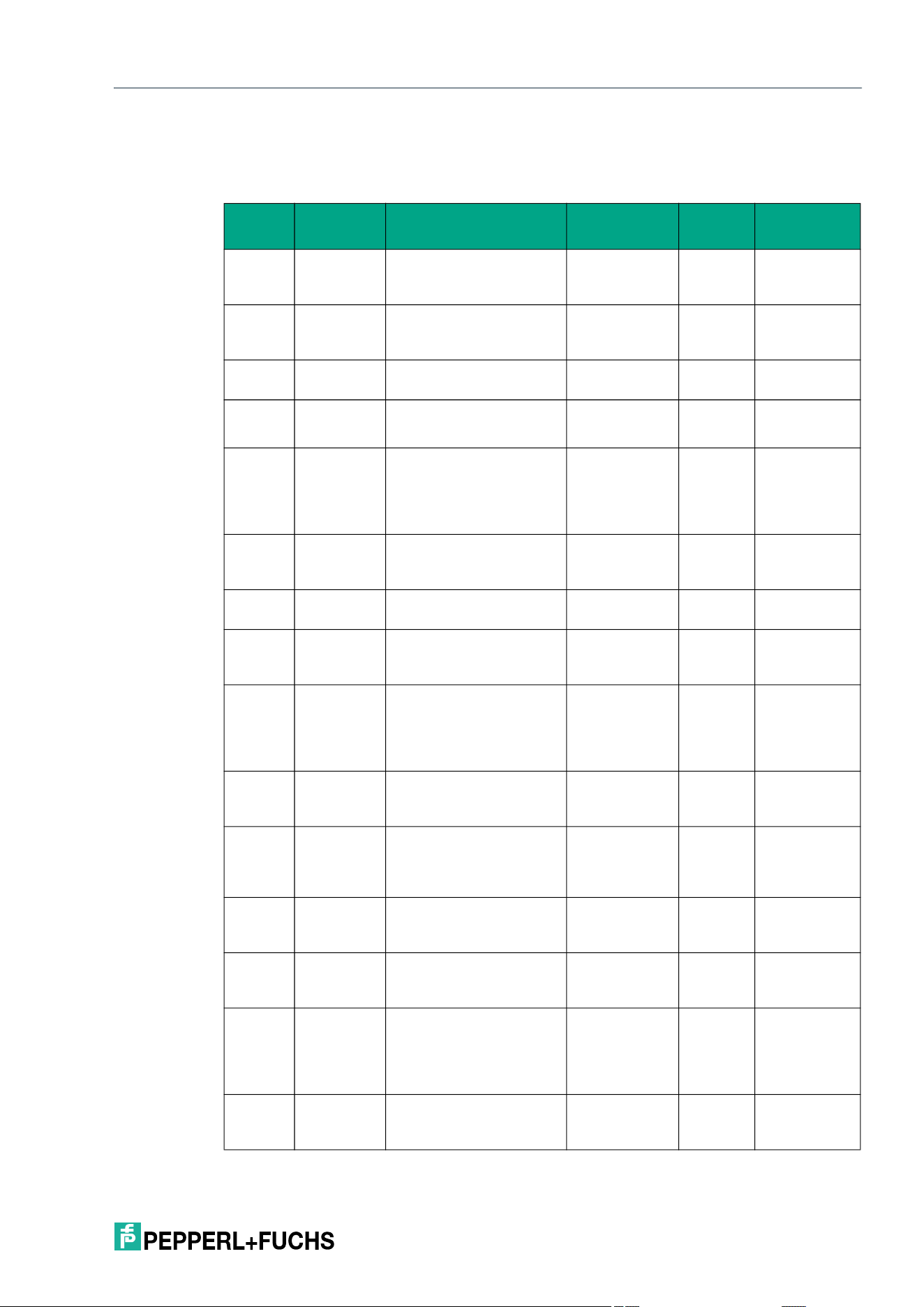
IQH3/IQH4 Series
Commissioning and Operation
2026-05
97
6.7.1 Parameter Overview
The following parameters can be read or written using the Read Parameter RP and Write
Parameter WP configuration commands:
Abbrevi-
ation
Command
code Parameter description Read/write
Default
value System
AF 16#4146 AFI
Filters by AFI for tag
access
Read + write 16#00 IQH3, IQH4
BB 16#4242 Back to Box
Resets all parameters to
factory settings
Write -
IQH3
1
, IQH4
CT 16#4654 Tag Type (Service)
Sets the tag type
Read + write 16#14 IQH3, IQH4
DA 16#4441 Device Address
Device address setting
Read + write 16#FF
IQH3
1<Default
¬¹ Font>
, IQH4
DD 16#4444 Diagnosis Data (Service)
Reads out the combined
diagnostic data for
parameters OH, ST, TE
and VO
Read - IQH3, IQH4
DN 16#444E Device Serial Number
Reads the serial number
of the device
Read -
IQH3
1<Default
¬¹ Font>
, IQH4
DR 16#4452 Data Rate
Transmission rate setting
Read + write 16#00 IQH3, IQH4
DS 16#4453 Data Swap
Rotates data blocks in
blocks
Read + write 16#01
IQH3
1<Default
¬¹ Font>
, IQH4
E5 16#4535 Tag Lost Smoothing
Sets the number of
unsuccessful attempts to
access a tag before a Sta-
tus 5 message is issued
Read + write 16#05 IQH3, IQH4
ED 16#4544 Standalone End Delim-
iter (Service)
Selects the end delimiter
Read + write 16#xx
IQH3
1<Default
¬¹ Font>
, IQH4
FR 16#4652 Sequence Mode (Ser-
vice)
Sets the behavior for
write access
Read + write 16#01 IQH3, IQH4
IF 16#4946 Information Frame Mode
Outputs additional infor-
mation about tag access
Read + write 16#00 IQH3, IQH4
LM 16#4C4D LED Masking
Sets the operating status
display via LEDs
Read + write 16#0000
IQH3
1<Default
¬¹ Font>
, IQH4
MF 16#4D46 Reflected Power (Ser-
vice)
Measures the reflected
transmitter radiated
power
Read - IQH3, IQH4
ND 16#4E44 Noise Detection Level
Sets the noise display
threshold via LED
Read + write 16#32
IQH3
1<Default
¬¹ Font>
, IQH4
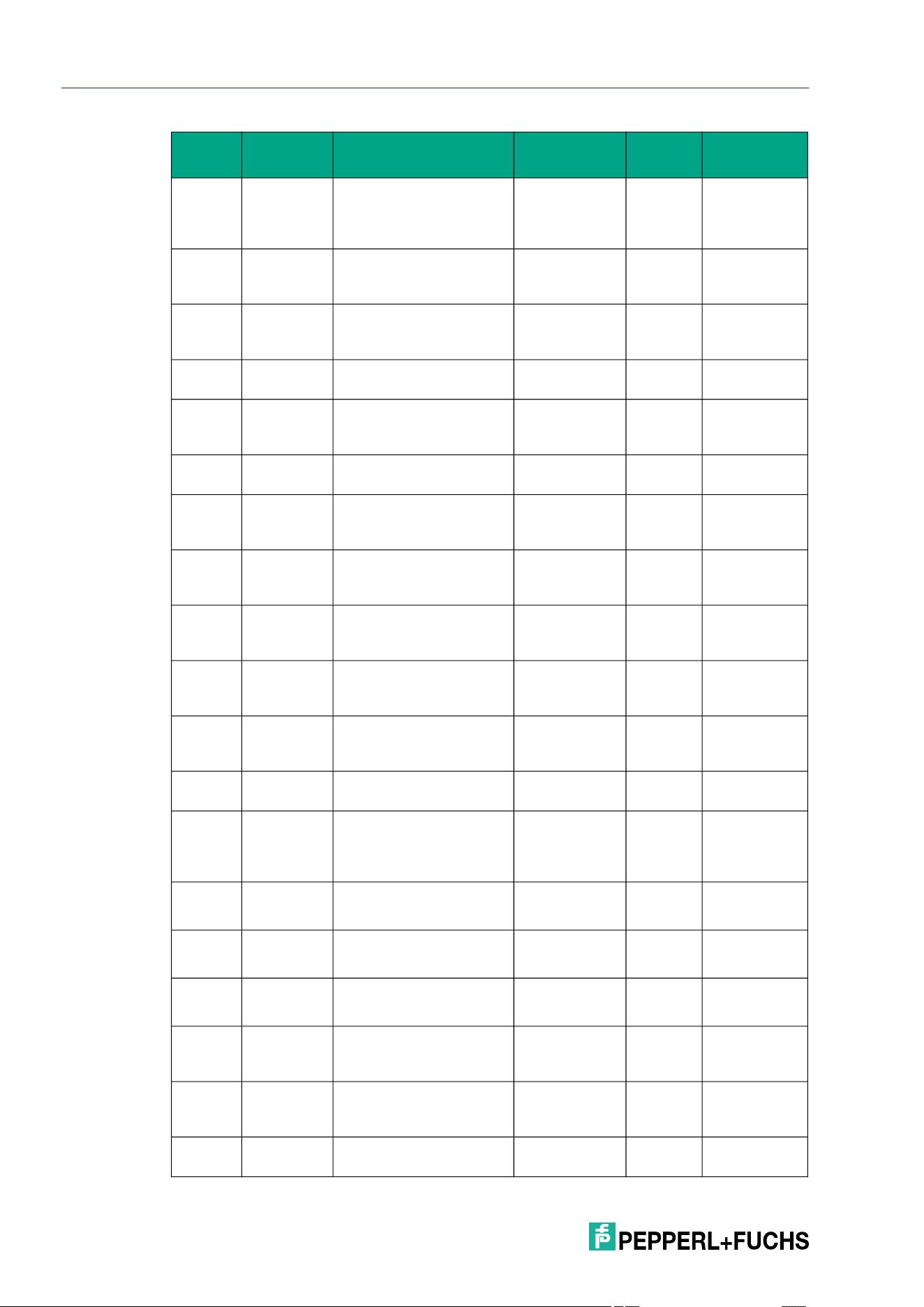
2026-05
98
IQH3/IQH4 Series
Commissioning and Operation
NT 16#4E54 Number of Tags to Find
Sets the cancellation cri-
terion for read/write com-
mands
Read + write 16#FF IQH3, IQH4
OH 16#4F48 Operating Hours
Reads the operating
hours counter
Read - IQH3, IQH4
PT 16#5054 Transmission Power
Sets the transmitter radi-
ated power of the device
Read + write 16#0004/
16#0001
IQH3, IQH4
QV 16#5156 Reply Frame Mode
Sets the protocol mode
Read + write 16#53 IQH3, IQH4
QW 16#5157 Q-Value
Sets the time slots for
accessing tags
Read + write 16#00 IQH3, IQH4
RC 16#5243 Region Code (Service)
Reads the country code
Read 16#01 IQH3, IQH4
RD 16#5244 Reset to Default
Resets some parameters
to factory settings
Write - IQH3, IQH4
RL 16#524C RSSI Lower Limit
Sets the lower RSSI
threshold
Read + write 16#00
IQH3
1<Default
¬¹ Font>
, IQH4
RU 16#5255 RSSI Upper Limit
Sets the upper RSSI
threshold
Read + write 16#64
IQH3
1<Default
¬¹ Font>
, IQH4
RV 16#5256 GIT Revision (Service)
Reads the software revi-
sion number
Read - IQH3, IQH4
SN 16#534E Serial Number (Service)
Reads the serial number
of the microcontroller
Read - IQH3, IQH4
ST 16#5354 Frontend State
Reads the frontend status
Read 16#00 IQH3, IQH4
T2 16#5432 Application Tag
Sets the application tag
Read + write Your auto-
mation,
our pas-
sion.
IQH3
1<Default
¬¹ Font>
, IQH4
T3 16#5433 Function Tag
Sets the function tag
Read + write ***
IQH3
1<Default
¬¹ Font>
, IQH4
T4 16#5434 Location Tag
Sets the location tag
Read + write ***
IQH3
1<Default
¬¹ Font>
, IQH4
T5 16#5435 Installation Tag
Sets the installation tag
Read + write ***
IQH3
1<Default
¬¹ Font>
, IQH4
TA 16#5441 Tries Allowed
Sets the number of
access attempts for tags
Read + write 16#02 IQH3, IQH4
TE 16#5445 Temperature
Reads the device tem-
perature
Read - IQH3, IQH4
TI 16#5449 Tag ID Filter
Sets the filter on the UID
Read + write - IQH3, IQH4
Abbrevi-
ation
Command
code Parameter description Read/write
Default
value System
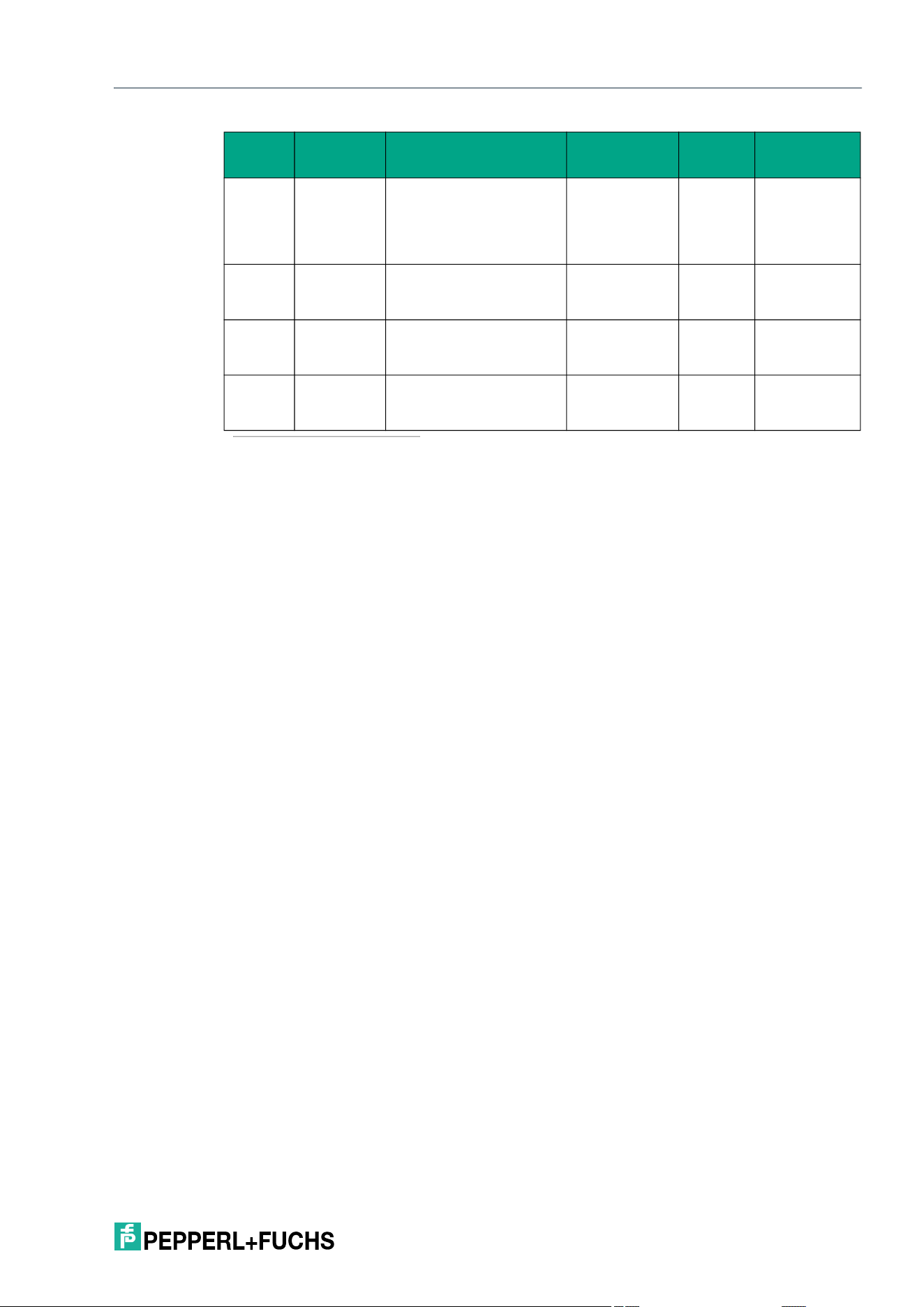
IQH3/IQH4 Series
Commissioning and Operation
2026-05
99
The parameters are saved in the read/write device as nonvolatile.
6.7.2 Parameters
AFI (AF)
The AF parameter can be used to filter tags by AFI. Read/write commands are executed on
tags with an AFI that matches the value of the filter.
Back to Box (BB)
The BB parameter can be used to reset all RFID read/write device settings to their factory set-
ting.
Tag Type (CT)
This parameter sets the tag type with which the RFID read/write device communicates.
For supported tag types, see chapter 6.2.
With the tag type "20", mixed operation of different tag types is possible.
TO 16#544F Overtemperature Han-
dling
Sets the device behavior
in the event of excess
temperature
Read + write 16#00 IQH3, IQH4
UB 16#5542 Host Uart Baudrate (Ser-
vice)
Sets the baud rate
Read + write 16#00009
600
IQH3
1<Default
¬¹ Font>
, IQH4
UT 16#5554 Host Uart Timeout (Ser-
vice)
Sets the timeout
Read + write 16#0064
IQH3
1<Default
¬¹ Font>
, IQH4
VO 16#564F Voltages
Reads internal voltage
and current values
Read - IQH3, IQH4
1.from SW Rev. 26
Abbrevi-
ation
Command
code Parameter description Read/write
Default
value System
Parameter abbre-
viation:
AF (16#4146)
Parameter length: 1 byte
Default: 16#00 = all tags respond
Value range: 16#00 ... 16#FF (0
dec
... 255
dec
)
Parameter abbre-
viation:
BB (16#4242)
Factory setting: See chapter 6.7.1
Parameter abbre-
viation:
CT (16#4654)
Parameter length: 1 byte
Default: 16#14 (20
dec
)
Value range: 16#00 ... 16#27, 16#32, 16#33 (20
dec
... 39
dec
, 50
dec
, 51
dec
)

2026-05
100
IQH3/IQH4 Series
Commissioning and Operation
Device Address (DA)
The DA parameter can be used to set the device address of the RFID read/write device.
P+F Serial Number (DN)
The DN parameter can be used to read the serial number of the RFID read/write device.
Data Rate (DR)
This parameter sets the data transmission rate between read/write device and tag.
The "fast read mode" is supported only by tag types IQC21, IQC33, IQC37, IQC50 and IQC51
with a memory size of two blocks or more.
Data Swap (DS)
The DS parameter can be used to set the orientation of the data in a block of the user memory.
For a tag with a block size of 4 bytes, the data can be oriented as follows, for example.
Note
You can also set the tag type using the CT system command. This command is described in
your IDENTControl evaluation unit manual. We recommend using the CT system command
because the tag type is stored in the IDENTControl evaluation unit and sent to the RFID
read/write device at startup.
Parameter abbre-
viation:
DA (16#4441)
Parameter length: 1 byte
Default: 16#FF
Value range: 16#00 … 16#FF
Parameter abbre-
viation:
DN (16#444E)
Parameter length: 14 bytes
Parameter abbre-
viation:
DR (16#4452)
Parameter length: 1 byte
Default: 16#00
Value range: 16#00 = normal = 26 kBit/s
16#01 = fast read mode = 53 kBit/s
1
1.ISO/IEC 15693-2 X2
Parameter abbre-
viation:
DS (16#4453)
Parameter length: 1 byte
Default: 16#01
Value range: 16#00 = no byte-by-byte exchange of data in the user memory
16#01 = byte-by-byte exchange of blocks in the user memory (compatible
with IQT1)
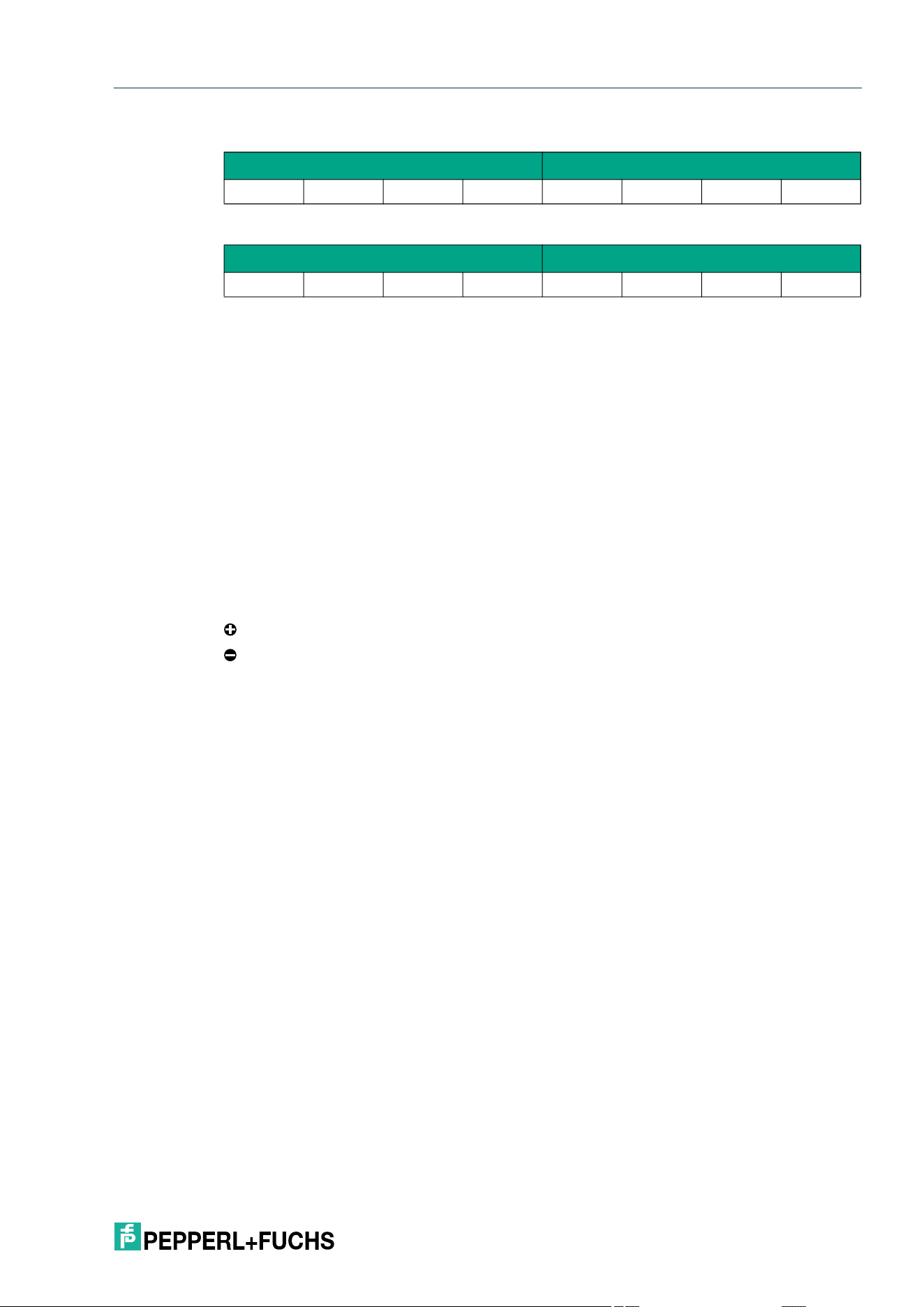
IQH3/IQH4 Series
Commissioning and Operation
2026-05
101
Normal orientation, DS = 16#00
Reverse orientation, DS = 16#01
Tag Lost Smoothing (E5)
The E5 parameter sets the number of unsuccessful write/read attempts when executing an
Enhanced command before the device outputs the telegram with the status value 5. Via the
telegram with the status 5, the device indicates that a tag has left the sensing range or could no
longer be identified. This parameter is only used when performing Enhanced commands.
When executing Single commands, the parameter has no significance.
Status 0 and status A do not depend on this parameter, and are output immediately.
Effects with reduced number of unsuccessful read/write attempts:
Faster response time in Enhanced mode.
Multiple status 5 messages in the event of unstable tag reading.
Information Frame Mode (IF)
The IF parameter allows you to output the RSSI value of the reading as additional information if
the reading was successful and the multi-frame protocol is activated; see "Reply Frame Mode
(QV)" on page 103.
Data block 0 Data block 1
Byte 0 Byte 1 Byte 2 Byte 3 Byte 0 Byte 1 Byte 2 Byte 2
Data block 0 Data block 1
Byte 3 Byte 2 Byte 1 Byte 0 Byte 3 Byte 2 Byte 1 Byte 0
Parameter abbre-
viation:
E5 (16#4535)
Parameter length: 1 byte
Default: 16#05 = five unsuccessful read/write attempts
Value range: 16#00 ... 16#0A unsuccessful read/write attempts
Parameter abbre-
viation:
IF (16#4946)
Parameter length: 1 byte
Default: 16#00
Value range: 16#00 = Information Frame Mode deactivated
16#01 = Information Frame Mode activated
2026-05
102
IQH3/IQH4 Series
Commissioning and Operation
LED Masking (LM)
The LM parameter can be used to set which operating status is to be displayed via the LEDs of
the RFID read/write device.
Noise Detection Level (ND)
The ND parameter defines the threshold (0–100%) from which the status message LED is acti-
vated due to a reduction in the read/write range (e.g. due to detuning).
For example, if the value is set to 50dec, the LED lights up as soon as the reading/writing dis-
tance of the device falls by 50 % from the optimum value.
Number of Tags to Find (NT)
The NT parameter specifies the number of tags that the RFID read/write device searches for
within the sensing range. Each command is repeated according to the Number of Attempts
(TA); see "Tries Allowed (TA)" on page 107.
If the number of tags found during the repeat operations reaches or exceeds the specified NT
value, all further read attempts are canceled. The command is canceled and the data is output.
Parameter abbre-
viation:
LM (16#4C4D)
Parameter length: 2 bytes
Default: 16#0000
Value range
1
:
1.Binary combinations are possible
16#0000 = all operating statuses are output via LED
16#0001 = operating status "Interference from external signals in the usage
spectrum" is suppressed
16#0002 = operating status "Detuning due to surrounding metal" is sup-
pressed
16#0004 = operating status "Excess temperature warning" is suppressed
Note
The operating statuses "Excess temperature error" (ST = 16#0008) and
"Undervoltage/overvoltage error" (ST = 16#0010) cannot be suppressed.
The operating status of the RFID read/write device can still be read out at any time via the ST
parameter.
Parameter abbre-
viation:
ND (16#4E44)
Parameter length: 1 byte
Default: 16#32 (50
dec
)
Value range: 16#00 … 16#64 (0
dec
... 100
dec
)
Note
If the number of tags is set to 255 (= .FF), the function is deactivated. This parameter applies to
Single commands and does not impact Enhanced commands.
Parameter abbre-
viation:
NT (16#4E54)
Parameter length: 1 byte
Default: 16#FF
Value range: 16#00 ... 16#14
16#FF = off

IQH3/IQH4 Series
Commissioning and Operation
2026-05
103
Operating Hours (OH)
You can use the OH parameter to output for how long the write/read device is in operation or for
how long a write/read command is executed.
Transmission Power (PT)
The PT parameter can be used to set the transmitter radiated power of the RFID read/write
device. The transmitter radiated power affects the detection range of a tag's detection zone. As
the transmitter radiated power increases, the detection range for read and write access to a tag
is increased. A transmitter radiated power level of PT1 is preset in the factory setting. It is possi-
ble to use up to four power levels (PT1 … PT4) in the device. This enables a ramp to be gener-
ated for a continuous increase in the transmitter radiated power. When used in conjunction with
a "Single Read" or "Single Write" command and the definition of the cancellation criterion (NT
parameter), the read or write operation is canceled as soon as the set number of tags is
detected. Setting multiple transmitter radiated power levels increases the execution time of a
read or write operation. This is due to the inventory runs that are executed for each power level.
The NT cancellation criterion can be set to reduce the execution time.
Reply Frame Mode (QV)
The QV parameter specifies the output protocol as a single-frame protocol or a multi-frame pro-
tocol.
The single-frame protocol complies with the P+F standard for LF systems IPH and HF systems
IQH1. If there is more than one tag in the sensing range, status A is output as a warning.
In the multi-frame protocol, each tag that responded is output. An output is issued which begins
with status F, contains the number of responses, and stops the command.
Parameter abbre-
viation:
OH(16#4F48)
Parameter length: 8 bytes (byte 1–4: RFID read/write device operating time in hours; byte
5–8: read/write commands operating time in hours)
Parameter abbre-
viation:
PT (16#5054)
Parameter length: 2 bytes
Default: IQH3 – 16#0004
IQH4 – 16#0001
Value range: 16#0001 (Min)
16#0002 (Eco)
16#0003 (Normal)
16#0004 (Maximum)
Parameter abbre-
viation:
QV(16#5156)
Parameter length: 1 byte
Default: 16#53
Value range: 16#53 = single-frame protocol
16#4D = multi-frame protocol
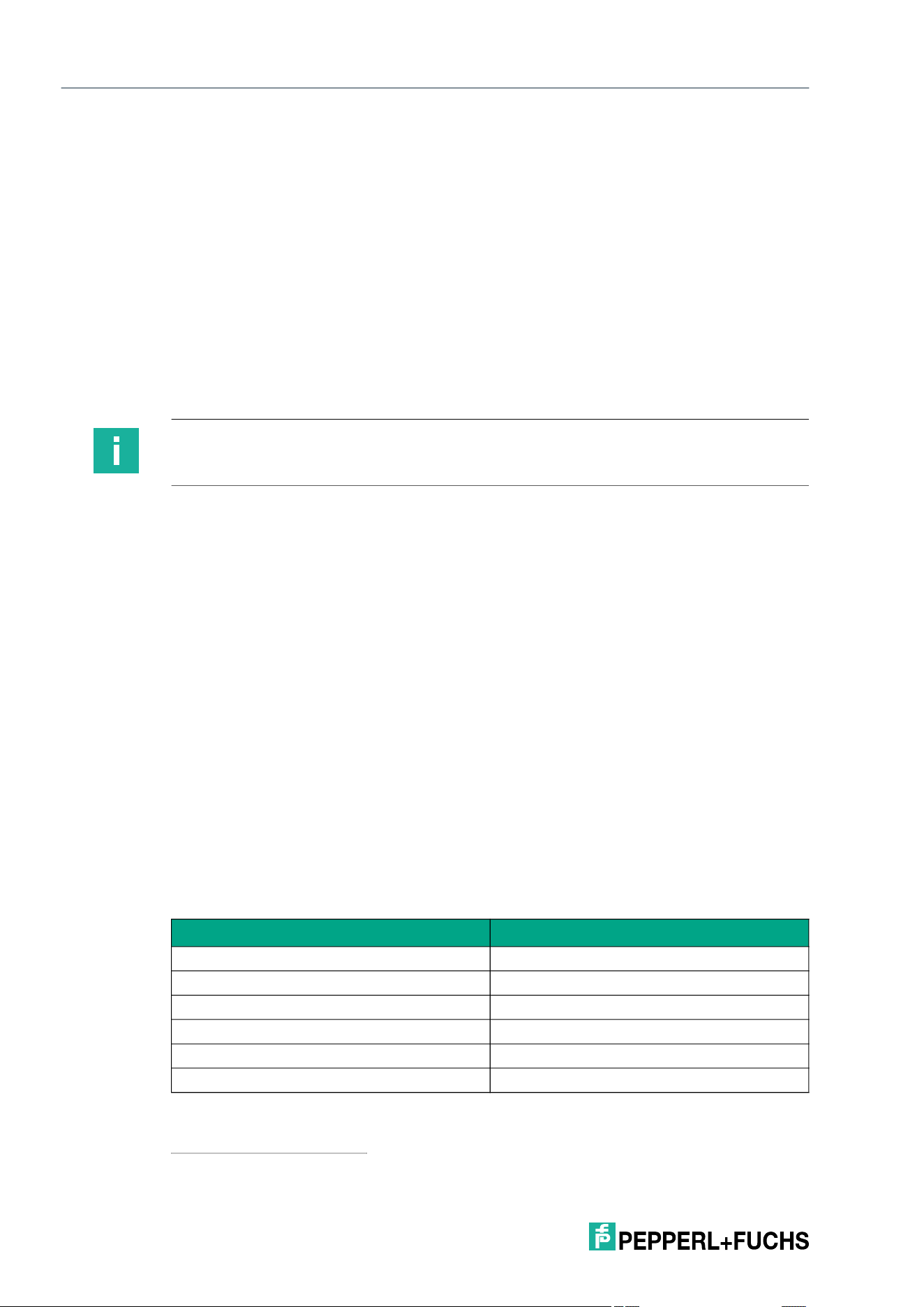
2026-05
104
IQH3/IQH4 Series
Commissioning and Operation
Q-Value (QW)
The QW parameter defines the number of tags expected in the sensing range. This setting
affects the time slot when communicating with a tag to avoid collisions due to simultaneous
communication between multiple tags.
Reset to Default (RD)
The RD parameter is used to reset all RFID read/write device settings to their factory setting.
The following parameters are excluded: Device Address (DA), Info Frame Mode (IF)
1
, Reply
Frame Mode (QV)
1<Default ¬¹ Font>
, UART Baud Rate (UB), UART Timeout (UT), Application
Specific Tag (T2), Function Tag (T3), Location Tag (T3), and Installation Tag (T4).
The BB parameter can be used to reset all settings.
Factory setting: see chapter 6.7.1.
RSSI Lower Limit (RL)
The RL parameter can be used to set the lower RSSI threshold. As soon as the RSSI value of a
read tag falls below the set threshold, it is no longer output.
Parameter abbre-
viation:
QW (16#5157)
Parameter length: 1 byte
Default: 16#00
Value range: 16#00 = one tag
16#01 = two tags
16#02 = multiple tags (approx. 4)
16#03 = many tags (approx. 8)
16#04 = very many tags (approx. 16)
Note
The execution time for tag access is reduced by reducing the Q value. The Q value influences
the execution time of write/read commands.
1.IQH3 from SW Rev. 26
Parameter abbreviation: RD (16#5244)
Parameter abbreviation: RL (16#524C)
Parameter length: 1 byte
Default: 16#00
Value range: 16#00 … 16#64 (0
dec
... 100
dec
)
Legend Designation
1 Zone A
2 RSSI threshold
3 Zone B
4 Zone C
5 Tag
6 Reading/writing distance
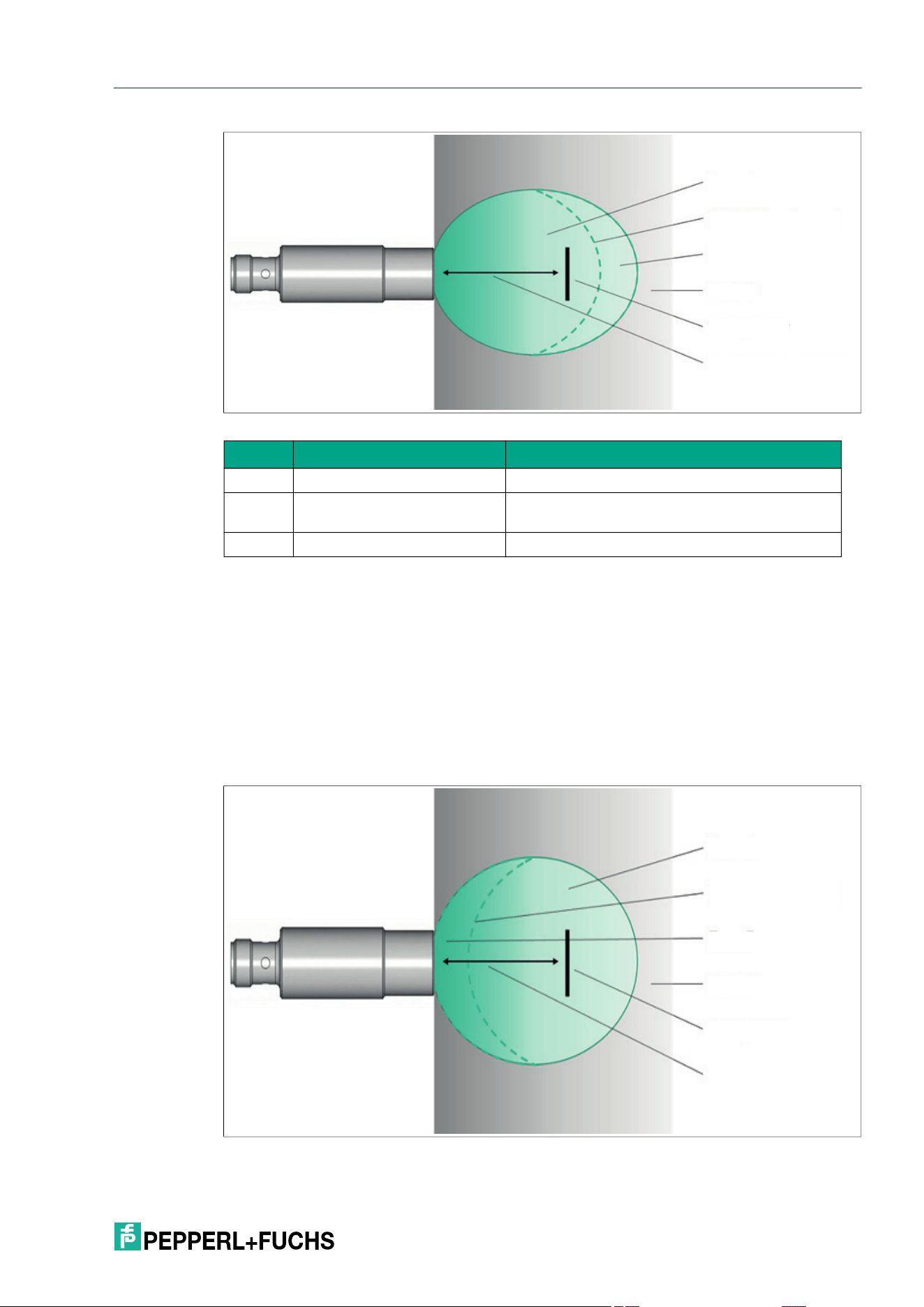
IQH3/IQH4 Series
Commissioning and Operation
2026-05
105
Figure 6.1 Schematic depiction of the reading range of the IQH4-18GM-V1, in relation to RSSI
RSSI Upper Limit (RU)
The RL parameter can be used to set the upper RSSI threshold. As soon as the RSSI value of
a read tag exceeds the set threshold, it is no longer output.
Figure 6.2 Schematic depiction of the reading range of the IQH4-18GM-V1, in relation to RSSI
Zone RSSI Note
A RSSI tag RSSI threshold The tag is within the sensing range and is output.
B RSSI tag < RSSI threshold The tag is within the maximum sensing range but
is not output.
C - The tag is outside the sensing range.
Parameter abbre-
viation:
RU (16#5255)
Parameter length: 1 byte
Default: 16#64
Value range: 16#00 … 16#64 (0
dec
... 100
dec
)
1
2
3
4
5
6
1
2
3
4
5
6
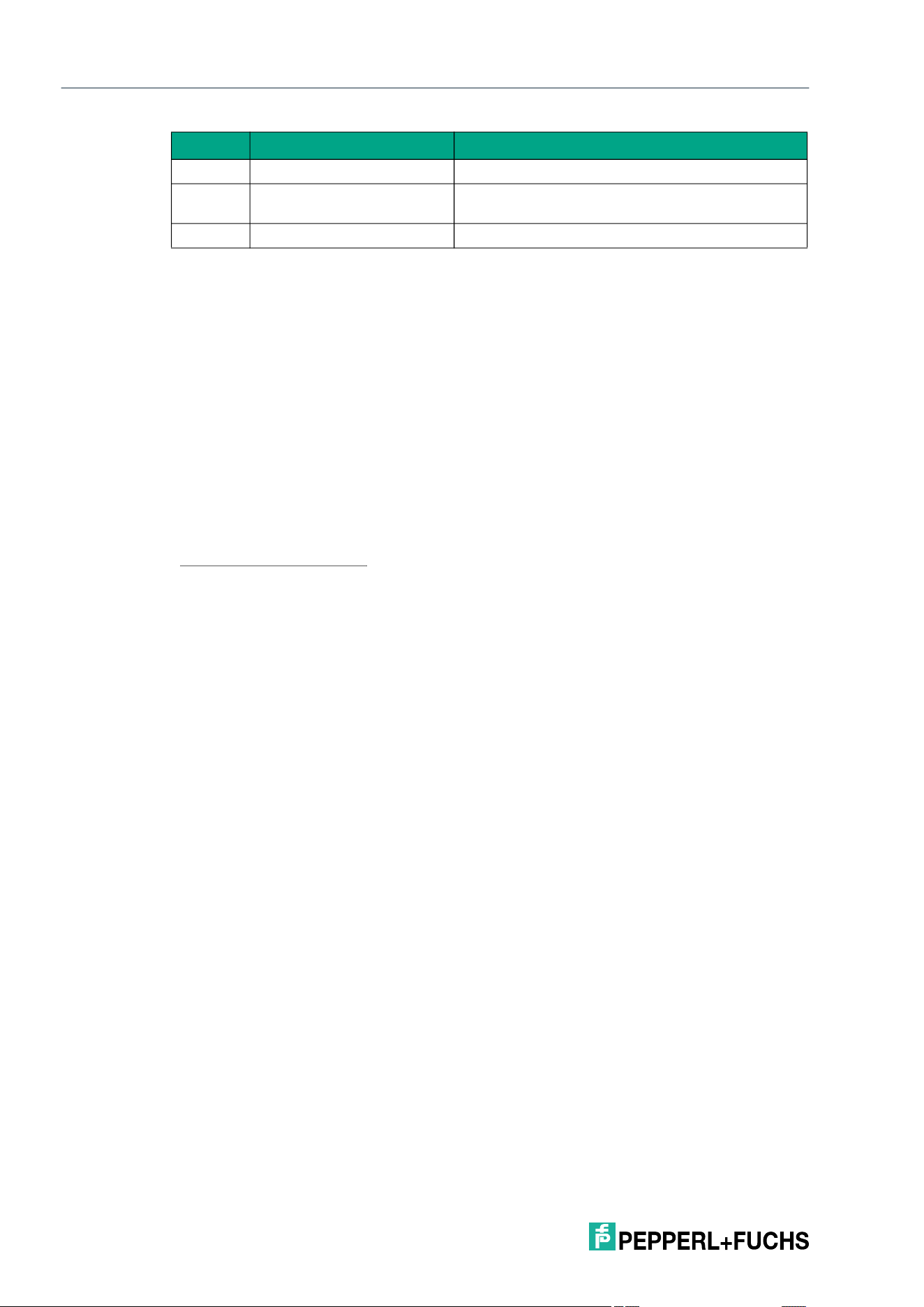
2026-05
106
IQH3/IQH4 Series
Commissioning and Operation
Frontend State (ST)
The ST parameter can be used to check the operating status of the RFID read/write device.
Application Specific Tag (T2)
The T2 parameter can be used to mark the device with an application tag in order to store
application-specific information on the device.
Function Tag (T3)
The T3 parameter can be used to mark the device with a function tag in order to store function-
specific information on the device.
Location Tag (T4)
The T4 parameter can be used to mark the device with a location tag to store location-specific
information on the device.
Zone RSSI Note
A RSSI tag RSSI threshold The tag is within the sensing range and is output.
B RSSI tag > RSSI threshold The tag is within the sensing range but is not out-
put.
C - The tag is outside the sensing range.
Parameter abbre-
viation:
ST (16#5354)
Parameter length: 2 bytes (byte 1: Current status; byte 2: Stored status since last read-out)
Default: 16#00
Value range
1
:
1.Binary combinations are possible
16#00 = no interference
16#01= interference from external signals in the usage spectrum, detection
range may be limited.
16#02 = detuning due to surrounding metal
16#04 = excess temperature warning, internal device temperature 80 °C ...
85 °C
16#08 = excess temperature error, internal device temperature > 85 °C
16#10 = undervoltage/overvoltage error, voltage < 17.5 V DC or > 30.5 V
DC
Parameter abbre-
viation:
T2 (16#5432)
Parameter length: Max. 32 bytes
Default: Your automation, our passion.
Parameter abbre-
viation:
T3 (16#5433)
Parameter length: Max. 32 bytes
Default: ***
Parameter abbre-
viation:
T4 (16#5434)
Parameter length: Max. 32 bytes
Default: ***
IQH3/IQH4 Series
Commissioning and Operation
2026-05
107
Installation Tag (T5)
The T5 parameter can be used to mark the device with an installation tag in order to save instal-
lation-specific information (e.g. date or details of initial commissioning) on the device.
Tries Allowed (TA)
The Tries Allowed (TA) parameter sets the number of access attempts during execution of a
read/write operation on a tag.
Effects of increased number of read/write attempts:
More reliable reading and writing
Longer execution time of a command
Temperature (TE)
The TE parameter allows you to read the internal temperature of the RFID read/write device.
Tag ID Filter (TI)
You can use the TI parameter to filter tags using the UID. Read/write commands are executed
on tags with a UID that matches the filter. You can set the filter to the entire UID or to the leading
bytes.
Parameter abbre-
viation:
T5 (16#5435)
Parameter length: Max. 32 bytes
Default: ***
Parameter abbre-
viation:
TA (16#5441)
Parameter length 1 byte
Default: 16#02
Value range: 16#01 … 16#0A
Note
To limit the increase in execution time caused by increasing tries allowed, it is recommended to
parameterize the NT cancellation criterion. This will stop the command execution as soon as
the set number of tags has been identified.
Parameter abbre-
viation:
TE (16#5445)
Parameter length: IQH3 –? 2 bytes (byte 1: Temperature on the power amplifier; byte 2: Tem-
perature on the microcontroller)
IQH4 –? 1 byte (temperature on the microcontroller)
Parameter abbre-
viation:
TI (16#5449)
Parameter length: 0 ... 8 bytes
2026-05
108
IQH3/IQH4 Series
Commissioning and Operation
Overtemperature Handling (TO)
The TO parameter defines the behavior of the RFID read/write device in the event of excess
temperature. The parameter can be used to protect the device in the event of excess tempera-
ture.
Voltages (VO)
The VO parameter can be used to read out the input voltage and other internal voltage and cur-
rent values.
Parameter abbre-
viation
TO (16#544F)
Parameter length: 1 byte
Default: 16#00
Value range: 16#00 = Switch off
16#01 = Reduce Power
16#02 = Reduce Duty Cycle
Value Meaning Description
0 Switch off The RFID read/write device switches off when the internal device
temperature is above 85 °C.
The device will switch back on when the internal temperature falls
below 80 °C.
1 Reduce Power The RFID read/write device gradually reduces the transmitter radi-
ated power when the internal device temperature is between 80 °C
and 85 °C. A reduced transmitter radiated power reduces inherent
heating.
The RFID read/write device switches off when the internal device
temperature is above 85 °C.
2 Reduce Duty
Cycle
The RFID read/write device pauses for approx. 0.5 seconds after a
complete pass if the internal device temperature is between 80 °C
and 85 °C. This reduces inherent heating. The length of the pause
varies with the internal temperature and the duration of the exe-
cuted read/write command
The RFID read/write device switches off when the internal device
temperature is above 85 °C.
Caution!
The RFID read/write device cannot identify tags during a pause.
It may be possible that data is not read if tags move quickly through the sensing range.
Parameter abbre-
viation:
VO (16#564F)
Parameter length: 14 bytes
IQH3/IQH4 Series
Commissioning and Operation
2026-05
109
6.7.3 Parameter Examples
Read Parameter
Command Telegram
Byte Content
AF
parame-
ter
example
CT
parame-
ter
example
DN
parame-
ter
example
DR
parame-
ter
example
DS
parame-
ter
example
E5
parame-
ter
example
IF
parame-
ter
example
LM
parame-
ter
example
ND
parame-
ter
example
NT
parame-
ter
example
OH
parame-
ter
example
PT
parame-
ter
example
QV
param-
eter
exam-
ple
0 Control
Byte /
Frame
Length
16#x0 16#x0 16#x0 16#x0 16#x0 16#x0 16#x0 16#x0 16#x0 16#x0 16#x0 16#x0 16#x0
1 Frame
Length
16#0B 16#0B 16#0B 16#0B 16#0B 16#0B 16#0B 16#0B 16#0B 16#0B 16#0B 16#0B 16#0B
2 Frag-
menta-
tion
Counter
16#00 16#00 16#00 16#00 16#00 16#00 16#00 16#00 16#00 16#00 16#00 16#00 16#00
3 Tele-
gram
Length
(High
Byte)
16#00 16#00 16#00 16#00 16#00 16#00 16#00 16#00 16#00 16#00 16#00 16#00 16#00
4 Tele-
gram
Length
(Low
Byte)
16#08 16#08 16#08 16#08 16#08 16#08 16#08 16#08 16#08 16#08 16#08 16#08 16#08
5 Com-
mand
16#BE 16#BE 16#BE 16#BE 16#BE 16#BE 16#BE 16#BE 16#BE 16#BE 16#BE 16#BE 16#BE
6 System
code
16#51
"Q"
16#51
"Q"
16#51
"Q"
16#51
"Q"
16#51
"Q"
16#51
"Q"
16#51
"Q"
16#51
"Q"
16#51
"Q"
16#51
"Q"
16#51
"Q"
16#51
"Q"
16#51
"Q"
7 Parame-
ter Name
(High
Byte)
16#41
"A"
16#43
"C"
16#44
"D"
16#44
"D"
16#44
"D"
16#45
"E"
16#49 "I" 16#4C
"L"
16#4E
"N"
16#4E
"N"
16#4F
"O"
16#50
"P"
16#51
"Q"
8 Parame-
ter Name
(Low
Byte)
16#46
"F"
16#54
"T"
16#4E
"N"
16#52
"R"
16#53
"S"
16#35
"5"
16#46
"F"
16#4D
"M"
16#44
"D"
16#54
"T"
16#48
"H"
16#54
"T"
16#56
"V"
9 Length
Parame-
ter (High
Byte)
16#00 16#00 16#00 16#00 16#00 16#00 16#00 16#00 16#00 16#00 16#00 16#00 16#00
10 Length
Parame-
ter (Low
Byte)
16#00 16#00 16#00 16#00 16#00 16#00 16#00 16#00 16#00 16#00 16#00 16#00 16#00
11 Com-
mand
parame-
ter
12 Com-
mand
parame-
ter
13 Com-
mand
parame-
ter
...
255 Com-
mand
parame-
ter
2026-05
110
IQH3/IQH4 Series
Commissioning and Operation
Response Telegram – Status 16#00
Byte Content
QW
parame-
ter
example
RL
parame-
ter
example
RU
parame-
ter
example
ST
parame-
ter
example
T2
parame-
ter
example
T3
parame-
ter
example
T4
parame-
ter
example
T5
parame-
ter
example
TA
parame-
ter
example
TE
parame-
ter
example
TI
parame-
ter
example
TO
parame-
ter
example
VO
param-
eter
exam-
ple
0 Control
Byte /
Frame
Length
16#x0 16#x0 16#x0 16#x0 16#x0 16#x0 16#x0 16#x0 16#x0 16#x0 16#x0 16#x0 16#x0
1 Frame
Length
16#0B 16#0B 16#0B 16#0B 16#0B 16#0B 16#0B 16#0B 16#0B 16#0B 16#0B 16#0B 16#0B
2 Frag-
menta-
tion
Counter
16#00 16#00 16#00 16#00 16#00 16#00 16#00 16#00 16#00 16#00 16#00 16#00 16#00
3 Tele-
gram
Length
(High
Byte)
16#00 16#00 16#00 16#00 16#00 16#00 16#00 16#00 16#00 16#00 16#00 16#00 16#00
4 Tele-
gram
Length
(Low
Byte)
16#08 16#08 16#08 16#08 16#08 16#08 16#08 16#08 16#08 16#08 16#08 16#08 16#08
5 Com-
mand
16#BE 16#BE 16#BE 16#BE 16#BE 16#BE 16#BE 16#BE 16#BE 16#BE 16#BE 16#BE 16#BE
6 System
code
16#51
"Q"
16#51
"Q"
16#51
"Q"
16#51
"Q"
16#51
"Q"
16#51
"Q"
16#51
"Q"
16#51
"Q"
16#51
"Q"
16#51
"Q"
16#51
"Q"
16#51
"Q"
16#51
"Q"
7 Parame-
ter Name
(High
Byte)
16#51
"Q"
16#52
"R"
16#52
"R"
16#53
"S"
16#54
"T"
16#54
"T"
16#54
"T"
16#54
"T"
16#54
"T"
16#54
"T"
16#54
"T"
16#54
"T"
16#56
"V"
8 Parame-
ter Name
(Low
Byte)
16#57
"W"
16#4C
"L"
16#55
"U"
16#54
"T"
16#32
"2"
16#33
"3"
16#34
"4"
16#35
"5"
16#41
"A"
16#45
"E"
16#49 "I" 16#4F
"O"
16#4F
"O"
9 Length
Parame-
ter (High
Byte)
16#00 16#00 16#00 16#00 16#00 16#00 16#00 16#00 16#00 16#00 16#00 16#00 16#00
10 Length
Parame-
ter (Low
Byte)
16#00 16#00 16#00 16#00 16#00 16#00 16#00 16#00 16#00 16#00 16#00 16#00 16#00
11 Com-
mand
parame-
ter
12 Com-
mand
parame-
ter
13 Com-
mand
parame-
ter
...
255 Com-
mand
parame-
ter
Byte Content
AF
parame-
ter
example
CT
parame-
ter
example
DN
parame-
ter
example
DR
parame-
ter
example
DS
parame-
ter
example
E5
parame-
ter
example
IF
parame-
ter
example
LM
parame-
ter
example
ND
parame-
ter
example
NT
parame-
ter
example
OH
parame-
ter
example
PT
parame-
ter
example
QV
param-
eter
exam-
ple
0 Control
Byte /
Frame
Length
16#00 16#x0 16#00 16#00 16#00 16#00 16#00 16#00 16#00 16#x0 16#00 16#x0 16#x0
1 Frame
Length
16#08 16#08 16#15 16#08 16#08 16#08 16#08 16#09 16#08 16#08 16#0F 16#09 16#08
IQH3/IQH4 Series
Commissioning and Operation
2026-05
111
2 Frag-
menta-
tion
Counter
16#00 16#00 16#00 16#00 16#00 16#00 16#00 16#00 16#00 16#00 16#00 16#00 16#00
3 Tele-
gram
Length
(High
Byte)
16#00 16#00 16#00 16#00 16#00 16#00 16#00 16#00 16#00 16#00 16#00 16#00 16#00
4 Tele-
gram
Length
(Low
Byte)
16#05 16#05 16#12 16#05 16#05 16#05 16#05 16#06 16#05 16#05 16#0C 16#06 16#05
5 Com-
mand
16#BE 16#BE 16#BE 16#BE 16#BE 16#BE 16#BE 16#BE 16#BE 16#BE 16#BE 16#BE 16#BE
6 Status 16#00 16#00 16#00 16#00 16#00 16#00 16#00 16#00 16#00 16#00 16#00 16#00 16#00
7 Data 16#00 16#14 16#34 16#00 16#01 16#05 16#01 16#00 16#32 16#FF 16#00 16#00 16#4C
8 Data 16#30 16#03 16#00 16#04
9 Data 16#30 16#00
10 Data 16#30 16#11
11 Data 16#30 16#00
12 Data 16#31 16#00
13 Data 16#38 16#00
14 Data 16#30 16#03
15 Data 16#36
16 Data 16#38
17 Data 16#34
18 Data 16#34
19 Data 16#37
20 Data 16#30
21 Data
22 Data
23 Data
24 Data
25 Data
26 Data
27 Data
28 Data
29 Data
30 Data
31 Data
32 Data
33 Data
34 Data
35 Data
...
255 Data
Byte Content
AF
parame-
ter
example
CT
parame-
ter
example
DN
parame-
ter
example
DR
parame-
ter
example
DS
parame-
ter
example
E5
parame-
ter
example
IF
parame-
ter
example
LM
parame-
ter
example
ND
parame-
ter
example
NT
parame-
ter
example
OH
parame-
ter
example
PT
parame-
ter
example
QV
param-
eter
exam-
ple
2026-05
112
IQH3/IQH4 Series
Commissioning and Operation
Byte Content
QW
parame-
ter
example
RL
parame-
ter
example
RU
parame-
ter
example
ST
parame-
ter
example
T2
parame-
ter
example
T3
parame-
ter
example
T4
parame-
ter
example
T5
parame-
ter
example
TA
parame-
ter
example
TE
parame-
ter
example
TI
parame-
ter
example
TO
parame-
ter
example
VO
param-
eter
exam-
ple
0 Control
Byte /
Frame
Length
16#x0 16#x0 # 16#00 16#00 16#00 16#00 16#00 16#x0 16#x0 16#x0 16#x0 16#00
1 Frame
Length
16#08 16#08 16#08 16#09 16#24 16#0a 16#0a 16#0a 16#08 16#08 16#0B 16#08 16#15
2 Frag-
menta-
tion
Counter
16#00 16#00 16#00 16#00 16#00 16#00 16#00 16#00 16#00 16#00 16#00 16#00 16#00
3 Tele-
gram
Length
(High
Byte)
16#00 16#00 16#00 16#00 16#00 16#00 16#00 16#00 16#00 16#00 16#00 16#00 16#00
4 Tele-
gram
Length
(Low
Byte)
16#05 16#05 16#05 16#06 16#21 16#07 16#07 16#07 16#05 16#05 16#08 16#05 16#12
5 Com-
mand
16#BE 16#BE 16#BE 16#BE 16#BE 16#BE 16#BE 16#BE 16#BE 16#BE 16#BE 16#BE 16#BE
6 Status 16#00 16#00 16#00 16#00 16#00 16#00 16#00 16#00 16#00 16#00 16#00 16#00 16#00
7 Data 16#00 16#00 16#50 16#00 16#59 16#2a 16#2a 16#2a 16#02 16#20 16#E0 16#02 16#5D
8 Data 16#00 16#6f 16#2a 16#2a 16#2a 16#08 16#15
9 Data 16#75 16#2a 16#2a 16#2a 16#01 16#14
10 Data 16#72 16#48 16#71
11 Data 16#20 16#0C
12 Data 16#61 16#DF
13 Data 16#75 16#85
14 Data 16#74 16#E8
15 Data 16#6f 16#0C
16 Data 16#6d 16#B9
17 Data 16#61 16#00
18 Data 16#74 16#00
19 Data 16#69 16#02
20 Data 16#6f 16#96
21 Data 16#6e
22 Data 16#2c
23 Data 16#20
24 Data 16#6f
25 Data 16#75
26 Data 16#72
27 Data 16#20
28 Data 16#70
29 Data 16#61
30 Data 16#73
31 Data 16#73
32 Data 16#69
33 Data 16#6f
34 Data 16#6e
35 Data 16#2e
...
255 Data
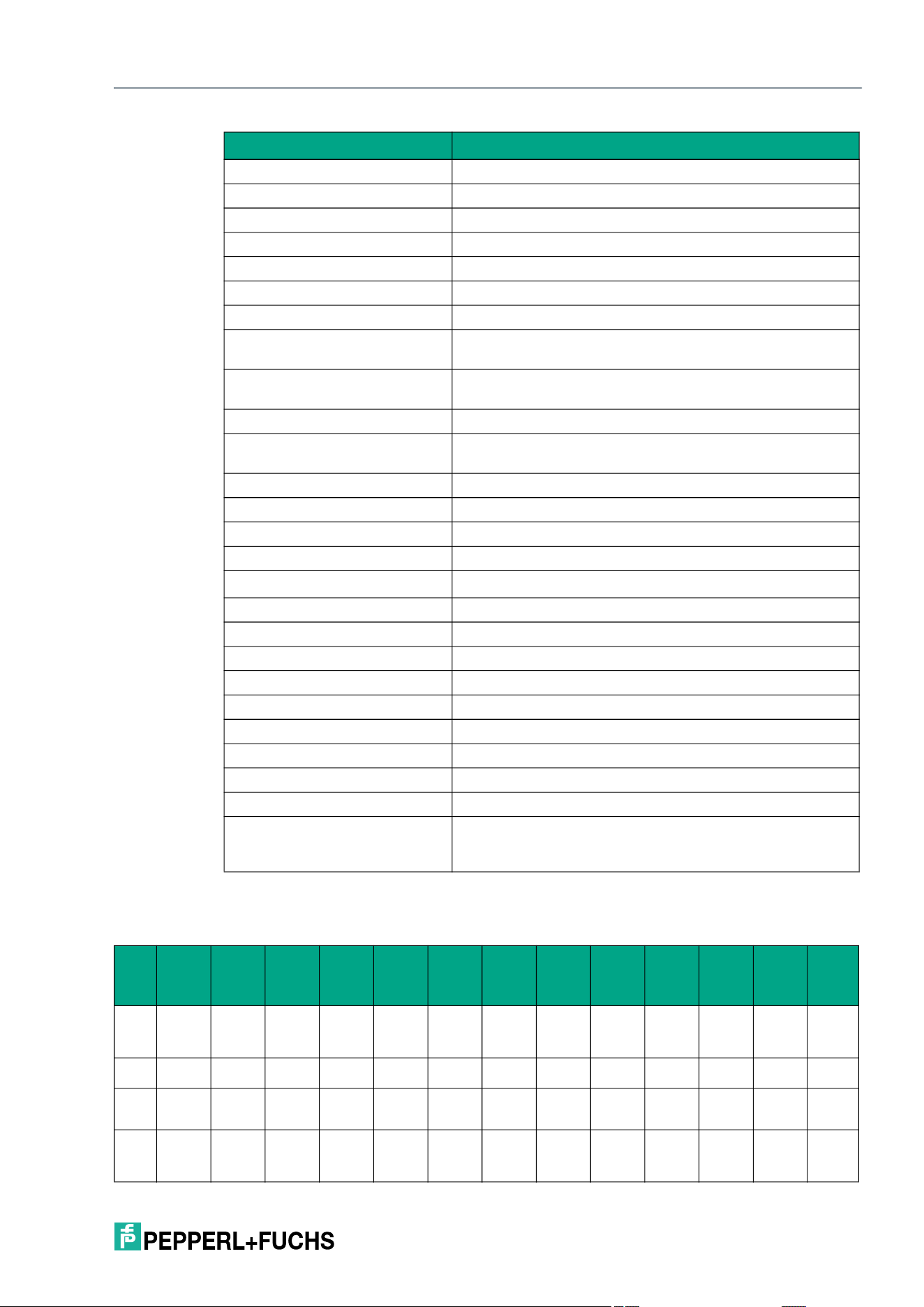
IQH3/IQH4 Series
Commissioning and Operation
2026-05
113
Write Parameter
Command Telegram
Example
AF parameter example (16#00 = all tags respond)
CT parameter example (16#14 = tag type 20)
DN parameter example (Serial number 40000180684470)
DR parameter example (16#00 = normal = 26 kBit/s)
DS parameter example (16#01 = byte-by-byte exchange of blocks)
E5 parameter example (16#05 = 5 unsuccessful read/write attempts)
IF parameter example (16#01 = Information Frame Mode activated)
LM parameter example (16#0003 = "Interference from external signals" and
"Detuning due to surrounding metal" are suppressed)
ND parameter example (16#32 = status display from 50% detection range reduc-
tion)
NT parameter example (16#FF = Off)
OH parameter example (16#0000001100000003 = 17 hours operating time & 3
hours of active read/write commands)
PT parameter example (16#04 = Maximum)
QV parameter example (16#4D = multi-frame protocol)
QW parameter example (16#00 = one tag)
RL parameter example (16#00 = lower RSSI threshold of 0)
RU parameter example (16#50 = upper RSSI threshold of 80
dec
)
ST parameter example (16#0000 = no interference)
T2 parameter example (Your Automation, Our Passion.)
T3 parameter example (***)
T4 parameter example (***)
T5 parameter example (***)
TA parameter example (16#02 = 2 access attempts)
TE parameter example (IQH4: 16#20 = 32° on microcontroller)
TI parameter example (Filter by UID starting with 16#E0080148)
TO parameter example (16#02 = Duty Cycle)
VO parameter example (16#5D15 = 23829 mV input voltage;
16#14710CDF85E80CB900000296 = other internal volt-
age and current values)
Byte Content
AF
parame-
ter
example
BB
parame-
ter
example
CT
parame-
ter
example
DR
parame-
ter
example
DS
parame-
ter
example
E5
parame-
ter
example
IF
parame-
ter
example
LM
parame-
ter
example
ND
parame-
ter
example
NT
parame-
ter
example
PT
parame-
ter
example
QV
parame-
ter
example
0 Control
Byte /
Frame
Length
16#x0 16#x0 16#x0 16#x0 16#x0 16#x0 16#x0 16#x0 16#x0 16#x0 16#x0 16#x0
1 Frame
Length
16#0C 16#0B 16#0C 16#0C 16#0C 16#0C 16#0C 16#0D 16#0C 16#0C 16#0D 16#0C
2 Fragmen-
tation
Counter
16#00 16#00 16#00 16#00 16#00 16#00 16#00 16#00 16#00 16#00 16#00 16#00
3 Telegram
Length
(High
Byte)
16#00 16#00 16#00 16#00 16#00 16#00 16#00 16#00 16#00 16#00 16#00 16#00
2026-05
114
IQH3/IQH4 Series
Commissioning and Operation
4 Telegram
Length
(Low
Byte)
16#09 16#08 16#09 16#09 16#09 16#09 16#09 16#0A 16#09 16#09 16#0A 16#09
5 Com-
mand
16#BF 16#BF 16#BF 16#BF 16#BF 16#BF 16#BF 16#BF 16#BF 16#BF 16#BF 16#BF
6 System
code
16#51
"Q"
16#51
"Q"
16#51
"Q"
16#51
"Q"
16#51
"Q"
16#51
"Q"
16#51
"Q"
16#51
"Q"
16#51
"Q"
16#51
"Q"
16#51
"Q"
16#51
"Q"
7 Parame-
ter Name
(High
Byte)
16#41 "A" 16#42 "B" 16#43
"C"
16#44
"D"
16#44
"D"
16#45 "E" 16#49 "I" 16#4C
"L"
16#4E
"N"
16#4E
"N"
16#50 "P" 16#51
"Q"
8 Parame-
ter Name
(Low
Byte)
16#46 "F" 16#42 "B" 16#54 "T" 16#52
"R"
16#53 "S" 16#35 "5" 16#46 "F" 16#4D
"M"
16#44
"D"
16#54 "T" 16#54 "T" 16#56
"V"
9 Length
Parame-
ter (High
Byte)
16#00 16#00 16#00 16#00 16#00 16#00 16#00 16#00 16#00 16#00 16#00 16#00
10 Length
Parame-
ter (Low
Byte)
16#01 16#00 16#01 16#01 16#01 16#01 16#01 16#02 16#01 16#01 16#02 16#01
11 Com-
mand
parame-
ter
16#39 16#15 16#01 16#00 16#05 16#01 16#00 16#32 16#FF 16#00 16#4C
12 Com-
mand
parame-
ter
16#01 16#01
13 Com-
mand
parame-
ter
14 Com-
mand
parame-
ter
15 Com-
mand
parame-
ter
16 Com-
mand
parame-
ter
17 Com-
mand
parame-
ter
18 Com-
mand
parame-
ter
19 Com-
mand
parame-
ter
20 Com-
mand
parame-
ter
21 Com-
mand
parame-
ter
22 Com-
mand
parame-
ter
Byte Content
AF
parame-
ter
example
BB
parame-
ter
example
CT
parame-
ter
example
DR
parame-
ter
example
DS
parame-
ter
example
E5
parame-
ter
example
IF
parame-
ter
example
LM
parame-
ter
example
ND
parame-
ter
example
NT
parame-
ter
example
PT
parame-
ter
example
QV
parame-
ter
example
IQH3/IQH4 Series
Commissioning and Operation
2026-05
115
...
255 Com-
mand
parame-
ter
Byte Content
AF
parame-
ter
example
BB
parame-
ter
example
CT
parame-
ter
example
DR
parame-
ter
example
DS
parame-
ter
example
E5
parame-
ter
example
IF
parame-
ter
example
LM
parame-
ter
example
ND
parame-
ter
example
NT
parame-
ter
example
PT
parame-
ter
example
QV
parame-
ter
example
Byte Content
QW
parame-
ter exam-
ple
RD
parame-
ter exam-
ple
RL
parame-
ter exam-
ple
RU
parame-
ter exam-
ple
T2 param-
eter
example
T3 param-
eter
example
T4 param-
eter
example
T5 param-
eter
example
TA
parame-
ter exam-
ple
TI param-
eter
example
TO
parame-
ter exam-
ple
0 Control
Byte /
Frame
Length
16#x0 16#x0 16#x0 16#x0 16#x0 16#x0 16#x0 16#x0 16#x0 16#x0 16#x0
1 Frame
Length
16#0C 16#0B 16#0C 16#0C 16#16 16#13 16#13 16#14 16#0C 16#0F 16#0C
2 Fragmen-
tation
Counter
16#00 16#00 16#00 16#00 16#00 16#00 16#00 16#00 16#00 16#00 16#00
3 Telegram
Length
(High
Byte)
16#00 16#00 16#00 16#00 16#00 16#00 16#00 16#00 16#00 16#00 16#00
4 Telegram
Length
(Low Byte)
16#09 16#08 16#09 16#09 16#13 16#10 16#10 16#11 16#09 16#0C 16#09
5 Command 16#BF 16#BF 16#BF 16#BF 16#BF 16#BF 16#BF 16#BF 16#BF 16#BF 16#BF
6 System
code
16#51 "Q" 16#51 "Q" 16#51 "Q" 16#51 "Q" 16#51 "Q" 16#51 "Q" 16#51 "Q" 16#51 "Q" 16#51 "Q" 16#51 "Q" 16#51 "Q"
7 Parameter
Name
(High
Byte)
16#51 "Q" 16#52 "R" 16#52 "R" 16#52 "R" 16#54 "T" 16#54 "T" 16#54 "T" 16#54 "T" 16#54 "T" 16#54 "T" 16#54 "T"
8 Parameter
Name
(Low Byte)
16#57 "W" 16#44 "D" 16#55 "L" 16#4C "U" 16#32 "2" 16#33 "3" 16#34 "4" 16#35 "5" 16#41 "A" 16#49 "I" 16#4F
"O"
9 Length
Parameter
(High
Byte)
16#00 16#00 16#00 16#00 16#00 16#00 16#00 16#00 16#00 16#00 16#00
10 Length
Parameter
(Low Byte)
16#01 16#00 16#01 16#01 16#0B 16#08 16#08 16#09 16#01 16#04 16#01
11 Com-
mand
parameter
16#04 16#14 16#50 16#41 16#46 16#4C 16#49 16#02 16#E0 16#02
12 Com-
mand
parameter
16#70 16#75 16#6F 16#6E 16#08
13 Com-
mand
parameter
16#70 16#6E 16#63 16#73 16#01
14 Com-
mand
parameter
16#6C 16#63 16#61 16#74 16#48
15 Com-
mand
parameter
16#69 16#74 16#74 16#61
16 Com-
mand
parameter
16#63 16#69 16#69 16#6C
17 Com-
mand
parameter
16#61 16#6F 16#6F 16#6C
18 Com-
mand
parameter
16#74 16#6E 16#6E 16#61
19 Com-
mand
parameter
16#69 16#74
2026-05
116
IQH3/IQH4 Series
Commissioning and Operation
20 Com-
mand
parameter
16#6F 16#69
21 Com-
mand
parameter
16#6E 16#6F
22 Com-
mand
parameter
16#6E
...
255 Com-
mand
parameter
Byte Content
QW
parame-
ter exam-
ple
RD
parame-
ter exam-
ple
RL
parame-
ter exam-
ple
RU
parame-
ter exam-
ple
T2 param-
eter
example
T3 param-
eter
example
T4 param-
eter
example
T5 param-
eter
example
TA
parame-
ter exam-
ple
TI param-
eter
example
TO
parame-
ter exam-
ple
Example
AF parameter example (16#39 = 57
dec
)
BB parameter example
CT parameter example (16#15 = tag type 21)
DR parameter example (16#01 = fast read mode)
DS parameter example (16#00 = no data exchange)
E5 parameter example (16#05 = 5 attempts until Status 5)
IF parameter example (16#01 = Information Frame Mode activated)
LM parameter example (16#0001 = operating status "Interference
from external signals in the usage spectrum"
is suppressed)
ND parameter example (16#32 = threshold 50%)
NT parameter example (16#FF = "Off")
PT parameter example (16#0001 = "Min")
QV parameter example (16#4D = multi-frame protocol)
QW parameter example (16#04 = "very many tags")
RD parameter example
RL parameter example (16#14 = lower RSSI threshold 20
dec
)
RU parameter example (16#50 = upper RSSI threshold 80
dec
)
T2 parameter example ("Application")
T3 parameter example ("Function")
T4 parameter example ("Location")
T5 parameter example ("Installation")
TA parameter example (16#02 = 2 attempts)
TI parameter example (16#E0080148 = UID starting with
.E0.08.01.48
TO parameter example (16#02 = "Reduce Duty Cycle")
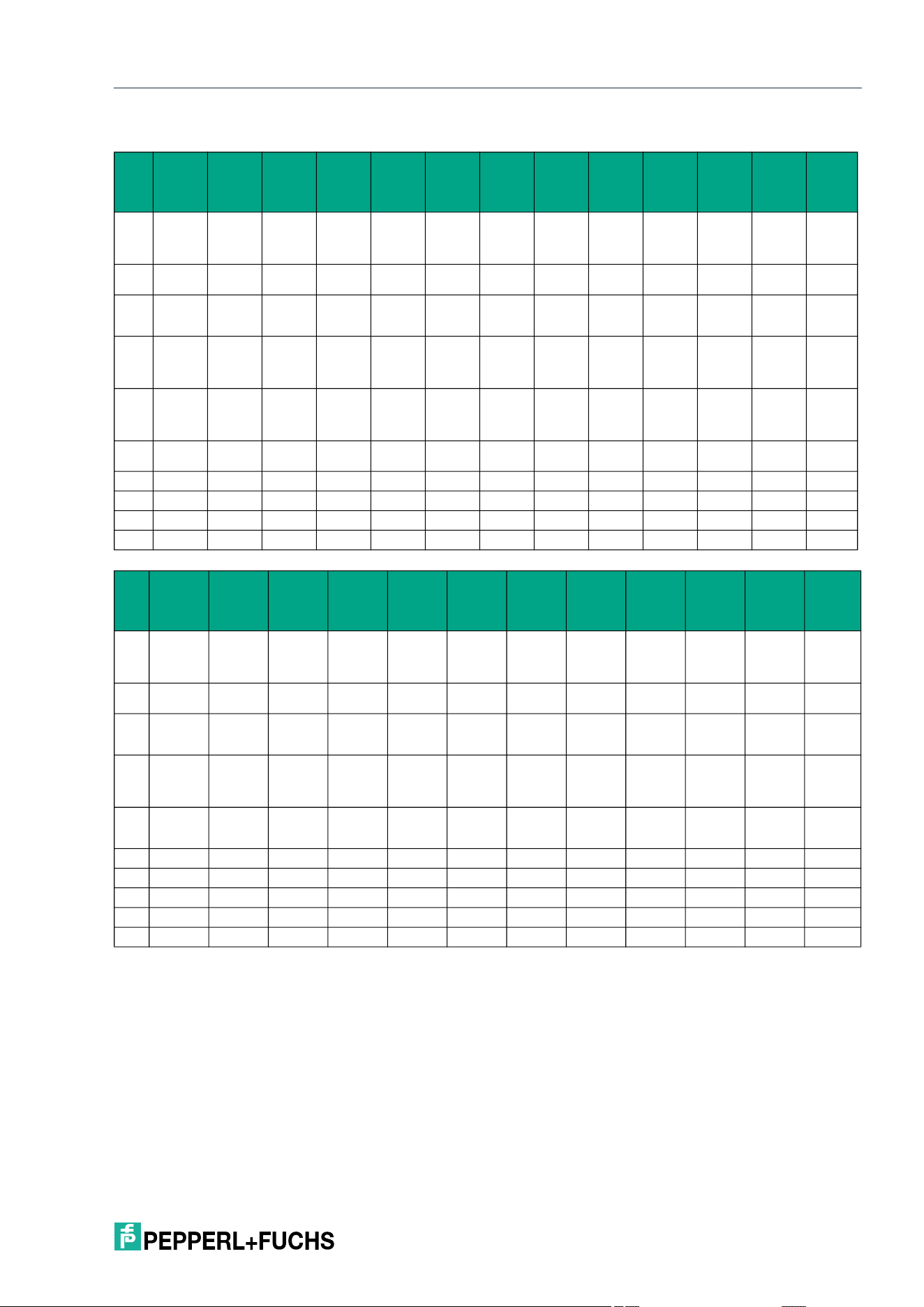
IQH3/IQH4 Series
Commissioning and Operation
2026-05
117
Response Telegram – Status 16#00
Byte Content
AF
parame-
ter exam-
ple
BB
parame-
ter exam-
ple
CT
parame-
ter exam-
ple
DR
parame-
ter exam-
ple
DS
parame-
ter exam-
ple
E5
parame-
ter exam-
ple
IF
parame-
ter exam-
ple
LM
parame-
ter exam-
ple
ND
parame-
ter exam-
ple
NT
parame-
ter exam-
ple
PT
parame-
ter exam-
ple
QV
parame-
ter
example
0 Control
Byte /
Frame
Length
16#00 16#00 16#00 16#00 16#00 16#00 16#00 16#00 16#00 16#00 16#00 16#00
1 Frame
Length
16#07 16#07 16#07 16#07 16#07 16#07 16#07 16#07 16#07 16#07 16#07 16#07
2 Fragmen-
tation
Counter
16#00 16#00 16#00 16#00 16#00 16#00 16#00 16#00 16#00 16#00 16#00 16#00
3 Telegram
Length
(High
Byte)
16#00 16#00 16#00 16#00 16#00 16#00 16#00 16#00 16#00 16#00 16#00 16#00
4 Telegram
Length
(Low
Byte)
16#04 16#04 16#04 16#04 16#04 16#04 16#04 16#04 16#04 16#04 16#04 16#04
5 Com-
mand
16#BF 16#BF 16#BF 16#BF 16#BF 16#BF 16#BF 16#BF 16#BF 16#BF 16#BF 16#BF
6 Status 16#00 16#00 16#00 16#00 16#00 16#00 16#00 16#00 16#00 16#00 16#00 16#00
7 Data
...
255 Data
Byte Content
QW
parame-
ter exam-
ple
RD
parame-
ter exam-
ple
RL
parame-
ter exam-
ple
RU
parame-
ter exam-
ple
T2 param-
eter
example
T3 param-
eter
example
T4 param-
eter
example
T5 param-
eter
example
TA param-
eter
example
TI param-
eter
example
TO
parame-
ter exam-
ple
0 Control
Byte /
Frame
Length
16#00 16#00 16#00 16#00 16#00 16#00 16#00 16#00 16#00 16#00 16#00
1 Frame
Length
16#07 16#07 16#07 16#07 16#07 16#07 16#07 16#07 16#07 16#07 16#07
2 Fragmen-
tation
Counter
16#00 16#00 16#00 16#00 16#00 16#00 16#00 16#00 16#00 16#00 16#00
3 Telegram
Length
(High
Byte)
16#00 16#00 16#00 16#00 16#00 16#00 16#00 16#00 16#00 16#00 16#00
4 Telegram
Length
(Low Byte)
16#04 16#04 16#04 16#04 16#04 16#04 16#04 16#04 16#04 16#04 16#04
5 Command 16#BF 16#BF 16#BF 16#BF 16#BF 16#BF 16#BF 16#BF 16#BF 16#BF 16#BF
6 Status 16#00 16#00 16#00 16#00 16#00 16#00 16#00 16#00 16#00 16#00 16#00
7 Data
...
255 Data
2026-05
118
IQH3/IQH4 Series
Appendix
7 Appendix
7.1 Error and Status Messages
Status/error Description
0 The command has been executed without error
1 Excess temperature
2 Switch-on message, reset has been executed
3 Reserved
4 The command is incorrect or incomplete.
The parameter is not in the valid area.
5 No tag in the sensing range.
6 Hardware error, e.g., error during self-test or read/write device defective
7 Internal device fault.
8 Reserved
9 The programmed tag type is not compatible with the read/write device
A Single-frame protocol: multiple tags in the sensing range
Multi-frame protocol: multiple tags in the sensing range with the same UID
B Output of additional information
C Reserved
D Reserved
E Internal memory overflow; execute reset
F End of an output in the multi-frame protocol
IQH3/IQH4 Series
Appendix
2026-05
119
7.2 ASCII Table
hex dec ASCII hex dec ASCII hex dec ASCII hex dec ASCII
00 0 NUL 20 32 Space 40 64 @ 60 96 '
01 1 SOH 21 33 ! 41 65 A 61 97 a
02 2 STX 22 34 " 42 66 B 62 98 b
03 3 ETX 23 35 # 43 67 C 63 99 c
04 4 EOT 24 36 $ 44 68 D 64 100 d
05 5 ENQ 25 37 % 45 69 E 65 101 e
06 6 ACK 26 38 & 46 70 F 66 102 f
07 7 BEL 27 39 ' 47 71 G 67 103 g
08 8 BS 28 40 ( 48 72 H 68 104 h
09 9 HT 29 41 ) 49 73 I 69 105 I
0A 10 LF 2A 42 * 4A 74 J 6A 106 j
0B 11 VT 2B 43 + 4B 75 K 6B 107 k
0C 12 FF 2C 44 , 4C 76 L 6C 108 l
0D 13 CR 2D 45 - 4D 77 M 6D 109 m
0E 14 SO 2E 46 . 4E 78 N 6E 110 n
0F 15 SI 2F 47 / 4F 79 O 6F 111 o
10 16 DLE 30 48 0 50 80 P 70 112 p
11 17 DC1 31 49 1 51 81 Q 71 113 q
12 18 DC2 32 50 2 52 82 R 72 114 r
13 19 DC3 33 51 3 53 83 S 73 115 s
14 20 DC4 34 52 4 54 84 T 74 116 t
15 21 NAK 35 53 5 55 85 U 75 117 u
16 22 SYN 36 54 6 56 86 V 76 118 v
17 23 ETB 37 55 7 57 87 W 77 119 w
18 24 CAN 38 56 8 58 88 X 78 120 x
19 25 EM 39 57 9 59 89 Y 79 121 y
1A 26 SUB 3A 58 : 5A 90 Z 7A 122 z
1B 27 ESC 3B 59 ; 5B 91 [ 7B 123 {
1C 28 FS 3C 60 < 5C 92 \ 7C 124 |
1D 29 GS 3D 61 = 5D 93 ] 7D 125 }
1E 30 RS 3E 62 > 5E 94 ^ 7E 126 ~
1F 31 US 3F 63 ? 5F 95 _ 7F 127 DEL

www.pepperl-fuchs.com
Industrial Sensors
Industrial Communication and Interfaces
Enterprise Mobility
Products and Solutions for Hazardous Areas
Pepperl+Fuchs Quality
Download our latest policy here:
www.pepperl-fuchs.com/quality
© Pepperl+Fuchs · Subject to modifications
/ DOCT-9976

