© 2025 Johnson Controls. All rights reserved.
PowerSeries Neo 5
Introduction
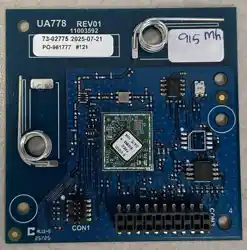
The PGPDCx is a Wireless Alarm Transceiver module that adds wireless capability to the PowerSeries Neo 5 alarm controller models
HS2128R, HS2064R, HS2032R or HS2016R. The module is enabled with two-way communication with frequency hopping to increase
reliability.
Installing the PGPDCx
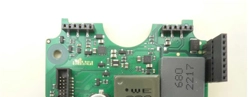
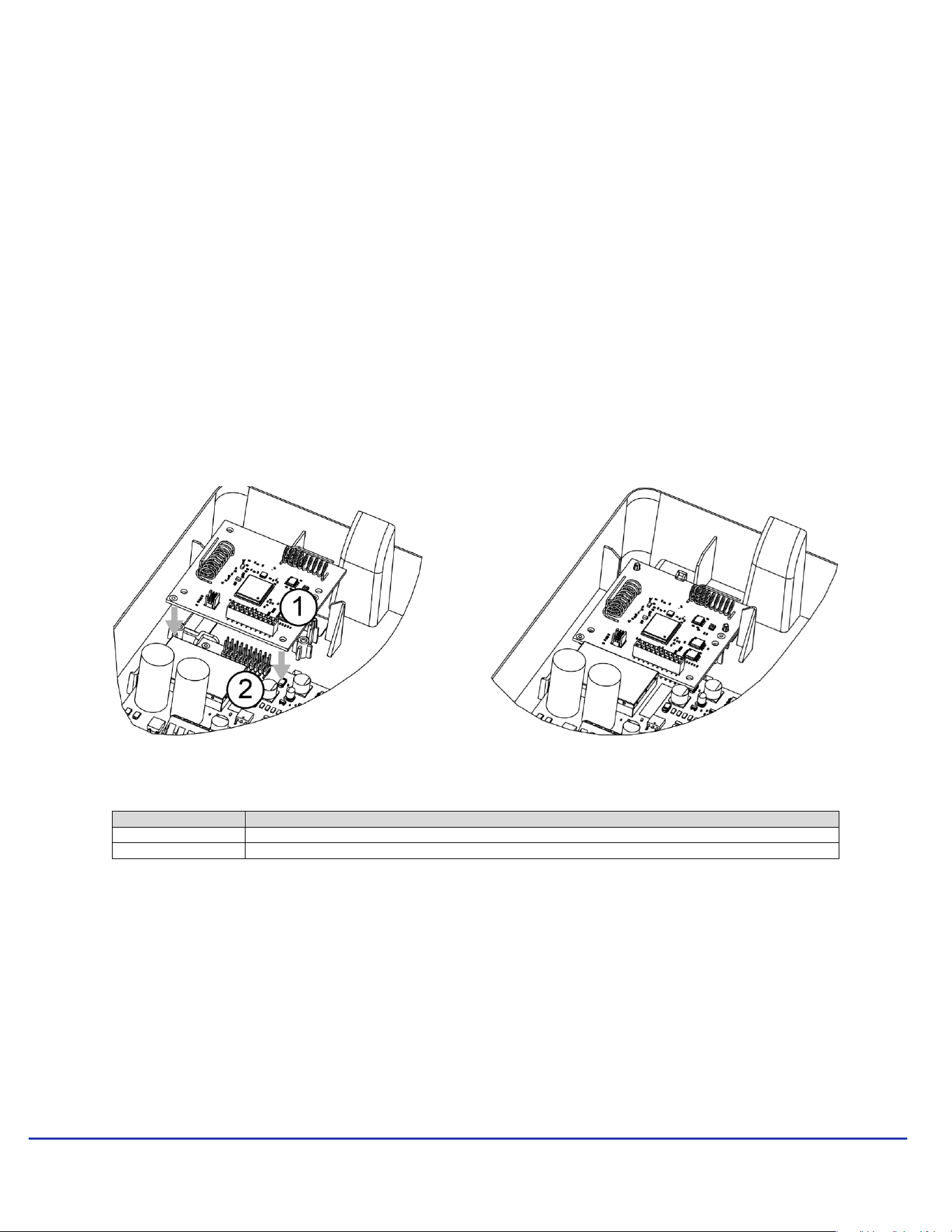
This procedure involves connecting the pin header on the HS2xxxR PCB with the corresponding Power G connector header on the
PGPDCx PCB. To install the PGPDCx complete the following steps.
Note: Before installing the PGPDCx, ensure the PGPDCx PCB is facing upward.
1. Ensure the PGPDCx PCB is facing upward.
2. Align the PowerG connector header (Con 3) on the back of PGPDCx PCB with the pin header on the HS2xxxR PCB (Con 3) as shown.
3. Firmly press down on the PGPDCx PCB to ensure a good connection to the HS2xxxR pin header.
Figure 1: Installing the PGPDCx
Table 1:
Callout
Description
1
PGPDCx PowerG Connector
2
HS2xxxR PowerG Pin Header
Programming the PGPDCx
Refer to the PGPHost manual for programming and compatible PowerG initiating devices.
© 2025 Johnson Controls. All rights reserved.
PGPDCx specifications
Table 2: Specifications
Item
Description
Frequency bands
912.75 to 919.106 MHz, 868.4 to 869.85
MHz or 433.22 to 434.64
MHz
MCU clock frequency
32.8
k
Hz
RF transceiver frequency
48
MHz
Communication protocol
Power G
Power/Current draw
55
mA
Operating temperature
0 ºC (32 °F) to 49 ºC (120 °F)
Relative humidity
Up to 93% non
-
condensing
Dimensions
(L
×
W) 66
mm
×
66
mm
Antenna type
Helical, soldered to the PCB, two used (one vertical and one horizontal)
Antenna 0 gain
0.8
dBi
Antenna 1 gain
2.89
dBi
Note: The x next to the model name refers to the operating frequency, 4 refers to 433 MHz, 8 refers to 868 MHz and 9 refers to 915 MHz
PGPDC9 FCC ISED Compliance and RF Exposure Statements
Refer to the PGPHost manual for programming and compatible PowerG initiating devices.
FCC-ISED Canada Compliance Statement
CAN ICES-3 (B) / NMB-3 (B)
IMPORTANT: Changes or modifications not expressly approved by Tyco Security Products Canada Ltd. could void the user’s authority to
operate the equipment.
CAUTION! This equipment complies with radiation exposure limits set forth for uncontrolled environment. The antenna(s) used for these
transmitters must be installed to provide a separation distance of at least 20 cm from all persons and must not be collocated or
operating in conjunction with any other antenna or transmitter.
This device complies with Part 15 of the FCC Rules. Operation is subject to the following two conditions: (1) this device may not cause
harmful interference, and (2) this device must accept any interference received, including interference that may cause undesired
operation.
This equipment has been tested and found to comply with the limits for a Class B digital device, pursuant to part 15 of the FCC Rules.
These limits are designed to provide reasonable protection against harmful interference in a residential installation. This equipment
generates, uses and can radiate radio frequency energy and, if not installed and used in accordance with the instructions, may cause
harmful interference to radio communications. However, there is no guarantee that interference will not occur in a particular installation.
If this equipment does cause harmful interference to radio or television reception, which can be determined by turning the equipment o
and on, the user is encouraged to try to correct the interference by one or more of the following measures:
Reorient or relocate the receiving antenna.
Increase the separation between the equipment and receiver.
Connect the equipment into an outlet on a circuit dierent from that to which the receiver is connected.
Consult the dealer or an experienced radio/TV technician for help.
Déclaration d'exposition aux radiations:
Cet équipement est conforme aux limites d'exposition aux rayonnements ISED Canada établies pour un environnement non contrôlé.
Cet équipement doit être installé et utilisé avec un minimum de 20 cm de distance entre la source de rayonnement et votre corps.
Le présent appareil est conforme aux CNR d'Industrie Canada applicables aux appareils radio exempts de licence.
L'exploitation est autorisée aux deux conditions suivantes:
1. l'appareil ne doit pas produire de brouillage, et
2. l'utlisateur de l'appareil doit accepter tout brouillage radioélectrique subi, même si le brouillage est susceptible d'en compromettre le
fonctionnement.
Cet appareil et son antenne ne doivent pas être situés ou fonctionner en conjonction avec une autre antenne ou un autre émetteur,
exception faites des radios intégrées qui ont été testées.

© 2025 Johnson Controls. All rights reserved.
Integration Instructions
Integration instructions for host device manufacturers can be found below and are compliant with the KDB 996369 D03
List of applicable FCC rules
This Limited Modular Approval device complies with FCC 15.247 rule and RSS-247 requirements. The host device manufacturer is
responsible for compliance with any other FCC/ISED rules that apply to the host not covered by the modular transmitter certification.
Specific operational use conditions
This module cannot be tested stand alone. This Module is intended to be only used in devices designed and sold by Tyco Safety Products
Canada.
Limited module procedures
This Limited Modular Approval transmitter does not have a RF shield over the transmitter portion, and the transmitter is not tested in
stand-alone configuration. This Module is approved for use in hosts HS218R, HS2064R, HS2032R or HS2016R. In case, where the module
will be integrated in other non-identical hosts in the future, Tyco Safety Products Canada will expand the LMA to include the new hosts
after an appropriate assessment to the FCC/ISED rules through a Class II permissive change.
Trace antenna designs
Not applicable
RF exposure considerations
The module is only authorized for mobile RF exposure use conditions for uncontrolled environment. The antenna used for this transmitter
must be installed to provide a separation distance of at least 20 cm from all persons. Using this module for portable use conditions will
require additional assessment through a Class II permissive change or a change in FCC ID and/or Multiple Listing through a new
application.
Le module est autorisé uniquement pour des conditions d’utilisation en exposition RF de type mobile dans un environnement non
contrôlé. L’antenne utilisée avec cet émetteur doit être installée de manière à maintenir une distance de séparation minimale de 20 cm
par rapport à toute personne. L’utilisation de ce module dans des conditions d’exposition de type portable nécessitera une évaluation
supplémentaire dans le cadre d’une modification permissive de classe II ou une modification de l’identifiant FCC et/ou une
homologation multiple par le biais d’une nouvelle demande.
Antennas
The PGPDC9 module uses PCB assembly, the antennas are integrated on the PCB and non-detachable. TX Antenna 0 gain is 0.8 dBi, and
Tx Antenna 1 gain is 2.89 dBi.

© 2025 Johnson Controls. All rights reserved.
Label and compliance information
The PGPDC9 module uses PCB, and the PCB is labeled with its own FCC ID and IC number. The host product must be labeled with the
following:
“Contains FCC ID: F5325PGPDC9” and “Contains IC: 160A-PGPDC9”
If the identification of the radio module is not visible when installed in the host product, the host product shall provide either a physical
label or e-label stating: “Contains FCC ID: F5325PGPDC9” and “Contains IC: 160A-PGPDC9”
Figure 2: Enclosure label placement

© 2025 Johnson Controls. All rights reserved.
The following statements must be described on the user manual of the host device:
FCC Part 15.19(a) [interference compliance statement], unless the following statement is already provided on the device label:
“This device complies with part 15 of the FCC Rules. Operation is subject to the following two conditions: (1) This device may not cause
harmful interference, and (2) this device must accept any interference received, including interference that may cause undesired
operation.”
Le présent appareil est conforme aux CNR d'Industrie Canada applicables aux appareils radio exempts de licence.
L'exploitation est autorisée aux deux conditions suivantes:
1. l'appareil ne doit pas produire de brouillage, et
2. l'utlisateur de l'appareil doit accepter tout brouillage radioélectrique subi, même si le brouillage est susceptible d'en compromettre le
fonctionnement.
Cet appareil et son antenne ne doivent pas être situés ou fonctionner en conjonction avec une autre antenne ou un autre émetteur,
exception faites des radios intégrées qui ont été testées.
FCC Part 15 Clause 15.21 [ Do not Modify warning]:
“Changes or modifications not expressly approved by the party responsible for compliance (Tyco Security Products Canada Ltd.) could
void the user's authority to operate the equipment”.
Information on test modes and additional testing requirements
This module is intended for internal use with the specific platform HS218R, HS2064R, HS2032R or HS2016R. The integrator is
responsible for compliance with all applicable rules that apply to the product. A Class II permissive change is required if the module is
integrated in dierent hosts. The Class II permissive change Test Plan is following:
1. Radiated power (EIRP) must be tested per ANSI C63.10-2020 and comply with FCC Part 15.247(b), RSS-247 (6.2.2)
requirements. After the module is installed into the host device, the fundamental Emission power (EIRP) and Output power
calculated from the field strength results must not exceed the module granted power. The Radiated Power (EIRP) must be
tested for Low and High Channel.
2. Transmitter Spurious Emissions must be tested per ANSI C63.10-2020 and comply with FCC Part 15.247 (d), 15.209, RSS-247
(6.6) and RSS-Gen (8.9). The Spurious Emissions must be tested for Low and High Channel.
3. If connected to public AC Mains network, an assessment of conducted emissions should be performed as per FCC part
15.207 and ICES-003.
4. RF Exposure should be re-examined if the use case condition has been changed to ensure the RF Exposure compliance, KDB
447498 D04 and other appropriate FCC/ISED RF Exposure procedure should be consulted and considerations of C2PC
procedure if required per FCC/ISED policy.
Additional testing, Part 15 Subpart B disclaimer
The module transmitter is only FCC authorized for the specific rule parts listed on the grant, and the host product manufacturer is
responsible for compliance to another FCC rules that apply to the host not covered by the modular transmitter grant of certification.
The Final host product still requires Part 15 Subpart B compliance testing with the modular transmitter installed.
EMI Considerations
Host manufacturers are recommended to follow KDB 996369 D04 as a best practice for evaluating composite systems (host product and
modular transmitter).