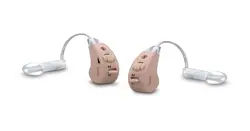
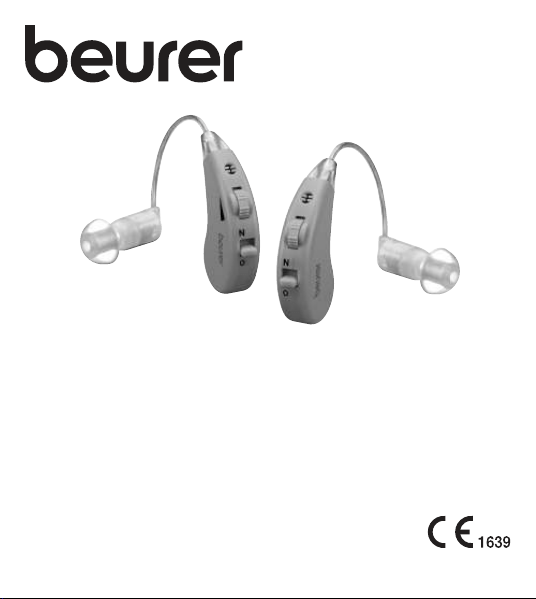
DE Hörhilfen
Gebrauchsanweisung .......................... 4
EN Hearing amplifiers
Instructions for use ............................. 24
FR Aides auditives
Mode d’emploi ................................... 43
ES Audífonos
Instrucciones de uso .......................... 64
HA 55 Pair
DE Klappen Sie vor dem Lesen der Gebrauchsanweisung die Seite 3
aus.
EN Unfold page 3 before reading the instructions for use.
FR Dépliez la page 3 avant de lire le mode d’emploi.
ES Despliegue la página 3 antes de leer las instrucciones de uso.
1
3
6
4
11
2
5
10
9
8
A
B
1 2
7

4
DEUTSCH
Lesen Sie diese Gebrauchsanweisung
sorgfältig durch, bewahren Sie sie für den
späteren Gebrauch auf, machen Sie sie
anderen Benutzern zugänglich und beachten
Sie die Hinweise.
1. Lieferumfang ................................................................... 5
2. Zeichenerklärung ............................................................. 5
3. Warn- und Sicherheitshinweise ....................................... 8
4. Bestimmungsgemäßer Gebrauch.................................. 13
5. Gerätebeschreibung ...................................................... 14
6. Inbetriebnahme ............................................................ 15
7. Reinigung und Pflege .................................................... 17
8. Zubehör und Ersatzteile ............................................... 18
9. Was tun bei Problemen? ............................................... 19
10. Entsorgung .................................................................. 22
11. Technische Angaben ................................................... 23
12. Garantie und Service ................................................... 23
Inhaltsverzeichnis
5
1. LIEFERUMFANG
Überprüfen Sie den Lieferumfang auf äußere Unversehrtheit der Karton-
verpackung und auf die Vollständigkeit des Inhalts. Vor dem Gebrauch ist
sicherzustellen, dass die Geräte und Zubehör keine sichtbaren Schäden
aufweisen und jegliches Verpackungsmaterial entfernt wird. Benutzen Sie
es im Zweifelsfall nicht und wenden Sie sich an Ihren Händler oder an die
angegebene Kundendienstadresse.
2 x Hörhilfen HA 55
6 x Ohrstöpsel (in unterschiedlichen Größen und Arten)
1 x Reinigungsbürste
1 x Trocknungskapsel
1 x Aufbewahrungsbox
1 x Gebrauchsanweisung
2. ZEICHENERKLÄRUNG
Auf dem Gerät, in der Gebrauchsanweisung, auf der Verpackung und auf
dem Typschild des Geräts werden folgende Symbole verwendet:
WARNUNG
Warnhinweis auf Verletzungsgefahren oder
Gefahren für Ihre Gesundheit.
ACHTUNG
Sicherheitshinweis auf mögliche Schäden am
Gerät.
Hinweis
Hinweis auf wichtige Informationen.
6
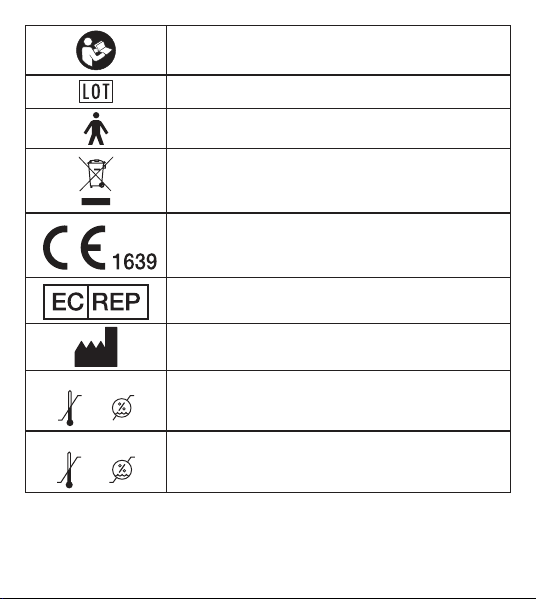
Gebrauchsanweisung beachten.
Chargenbezeichnung
Anwendungsteil Typ B
Entsorgung gemäß Elektro- und Elektronik-Altge-
räte EG-Richtlinie – WEEE (Waste Electrical and
Electronic Equipment)
CE-Kennzeichnung
Dieses Produkt erfüllt die Anforderungen der gel-
tenden europäischen und nationalen Richtlinien.
Bevollmächtigter EU-Repräsentant für Hersteller
von Medizinprodukten
Hersteller
Storage/Transport
Zulässige Lagerungs- und Transporttemperatur
und -luftfeuchtigkeit
Operating
Zulässige Betriebstemperatur und -luftfeuchtig-
keit
7
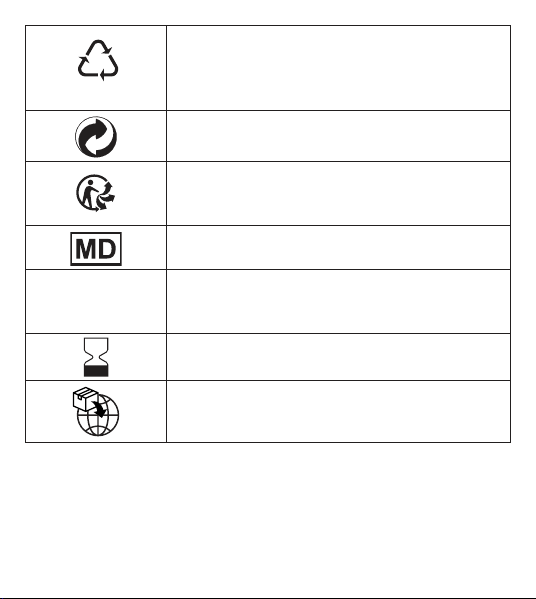
B
A
Kennzeichnung zur Identifikation des Verpa-
ckungsmaterials.
A = Materialabkürzung, B = Materialnummer:
1-7 = Kunststoe, 20-22 = Papier und Pappe
Verpackungskomponenten trennen und entspre-
chend der kommunalen Vorschriften entsorgen.
Produkt und Verpackungskomponenten trennen
und entsprechend der kommunalen Vorschriften
entsorgen.
Medizinprodukt
IP 41
Gerät geschützt gegen feste Fremdkörper ≥ ; 1
mm Durchmesser und größer und gegen senk-
rechtes Tropfwasser
Verwendbar bis
Importeur Symbol

8
3. WARN- UND SICHERHEITSHINWEISE
WARNUNG
• Lassen Sie ihr Gehör unbedingt von einem Arzt oder einem qualifi-
ziertem Hörakustiker untersuchen, bevor Sie die Hörhilfen verwen-
den. Die Einstellung der Hörhilfen sollte ausschließlich von einem
geschulten Experten vorgenommen werden, etwa einem HNO-Arzt,
einem Audiologen oder einem qualifiziertem Mitarbeiter im Hörge-
rätehandel.
• Konsultieren Sie im Falle eines bestehenden oder vergangenen Oh-
renleidens Ihren Arzt, bevor Sie die Hörhilfen verwenden.
• Der Einsatz bei von Entzündungen oder Infektionen des Ohres be-
troenen Patienten ist NICHT zulässig.
• Benutzen Sie die Hörhilfen NICHT, wenn Sie eine Mittelohrentzün-
dung haben oder an einer Gehörgangsentzündung leiden.
• Wenn Sie beim Tragen der Hörhilfen Schmerzen oder Unwohlsein
verspüren, beenden Sie die Anwendung und kontaktieren Sie Ihren
Arzt.
• Wenn sich beim Tragen der Hörhilfen Ihr Ohr entzündet, Hautreizun-
gen entstehen oder sich vermehrt Cerumen (Ohrenschmalz) bildet,
beenden Sie die Anwendung und kontaktieren Sie Ihren Arzt.
• Stellen Sie die Verwendung der Hörhilfen ein und suchen Sie einen
Arzt auf bei:

9
- Ausschlag oder Ekzemen an Hautstellen, die mit den Hörhilfen in
Berührung kommen. (Die Hörhilfen werden aus hautschonendem
Material gefertigt. In seltenen Fällen kann es dennoch zu allergi-
schen Reaktionen kommen, die sich möglicherweise in Form von
Ekzemen äußern.)
- Die Verwendung der Hörhilfen verursacht Ausfluss aus dem Ohr
bzw. macht Behandlung des Ohres erforderlich.
- Das Hörvermögen lässt unvermittelt deutlich nach.
• Wenn Teile der Hörhilfe im Ohr stecken bleiben, suchen Sie umge-
hend einen Arzt auf. Versuchen Sie nicht selbst die Teile herauszu-
holen.
• Stellen Sie die Lautstärke zunächst niedrig ein und erhöhen diese
schrittweise, wenn Sie sich an die Hörhilfen gewöhnt haben.
• Stellen Sie die Lautstärketaste NICHT zu hoch ein, da dies über ei-
nen längeren Zeitraum hinweg das Hörvermögen zusätzlich schädi-
gen kann.
• Verleihen Sie Ihre Hörhilfen NICHT an andere Personen und verwen-
den Sie auch keine fremden Hörhilfen. Es drohen Gehörschäden und
Infektionen.
• Geben Sie ihre Hörhilfen NICHT zur Verwendung an andere Personen
weiter. Die Verwendung einer für eine andere Person hergestellten
Hörhilfe kann Gehörschäden verursachen.
• Die Hörhilfen sind NICHT für den Einsatz bei Kindern unter 12 Jahren
geeignet.

10
• Die Diagnose von Gehörproblemen ist bei Kindern besonders
schwierig. Kinder sollten nur nach einer eingehenden Untersuchung
bei einem HNO-Arzt eine Hörhilfe erhalten.
• Halten Sie die Hörhilfen, das Zubehör und die Akkus von Kindern
fern, es besteht Verletzungs- und Verschluckungsgefahr.
• Dieses Gerät ist NICHT dafür bestimmt, durch Personen (einschließ-
lich Kinder) mit eingeschränkten physischen, sensorischen oder
geistigen Fähigkeiten oder mangels Erfahrung und/oder mangels
Wissen benutzt zu werden, es sei denn, sie werden durch eine für
Ihre Sicherheit zuständige Person beaufsichtigt oder erhielten von ihr
Anweisungen, wie das Gerät zu benutzen ist. Kinder sollten beauf-
sichtigt werden, damit sie nicht mit dem Gerät spielen.
• Verwenden Sie die Hörhilfen NICHT in explosionsgefährdeten und
gefährlichen Umgebungen.
• Verwenden Sie die Geräte NICHT in sauerstoreichen Umgebungen
und über einen längeren Zeitraum hinweg.
• Wenden Sie sich in folgenden Fällen an den Hersteller:
- wenn Sie Hilfe bei der Einrichtung, Verwendung oder Pflege der
Hörhilfen benötigen oder
- wenn sich die Geräte im Betrieb unerwartet verhalten oder bei
sonstigen Vorfällen.
• Benutzen Sie eine beschädigte Hörhilfe im Zweifelsfall NICHT und
wenden Sie sich an Ihren Händler oder an die angegebene Kunden-
dienstadresse.
• Schalten Sie die Geräte sofort aus, wenn sie defekt sind oder Be-
triebsstörungen vorliegen.

11
• Versuchen Sie in keinem Fall die Hörhilfen selbstständig zu önen
und/oder zu reparieren. Lassen Sie Reparaturen nur vom Kunden-
dienst oder autorisierten Händlern durchführen. Bei Nichtbeachtung
erlischt die Garantie.
Hinweise zum Umgang mit Akkus:
• Wenn Flüssigkeit aus einer Akkuzelle mit Haut oder Augen in Kontakt
kommt, die betroene Stelle mit Wasser auswaschen und ärztliche
Hilfe aufsuchen.
•
Verschluckungsgefahr! Kleinkinder könnten Akkus verschlu-
cken und daran ersticken. Daher Akkus für Kleinkinder unerreichbar
aufbewahren!
• Wenn ein Akku ausgelaufen ist, Schutzhandschuhe anziehen und
das Gerät entsorgen.
• Schützen Sie Akkus vor übermäßiger Wärme.
• Explosionsgefahr! Keine Akkus ins Feuer werfen.
• Bei längerer Nichtbenutzung des Geräts die Akkus vom Gerät tren-
nen.
• Keine Akkus zerlegen, önen oder zerkleinern.
• Nur in der Gebrauchsanweisung aufgeführte Ladegeräte verwenden.
• Akkus müssen vor dem Gebrauch korrekt geladen werden. Die Hin-
weise des Herstellers bzw. die Angaben in dieser Gebrauchsanwei-
sung für das korrekte Laden sind stets einzuhalten.
• Laden Sie den Akku vor der ersten Inbetriebnahme vollständig auf
(siehe Kapitel 6).

12
• Um eine möglichst lange Akku-Lebensdauer zu erreichen, laden Sie
den Akku mindestens 4 Mal im Jahr vollständig auf.
ACHTUNG
• Tragen Sie die Hörhilfen NICHT in der Nähe von starken elektromag-
netischen Feldern oder Röntgenstrahlen.
• Tragen Sie die Hörhilfen NICHT beim Baden, Duschen oder Schwim-
men.
• Schützen Sie die Geräte vor Stößen, Feuchtigkeit, Schmutz, starken
Temperaturschwankungen, direkter Sonneneinstrahlung und hoher
Luftfeuchtigkeit.
• In geschlossenen Fahrzeugen können im Sommer sehr hohe Tempe-
raturen entstehen. Lassen Sie daher Ihre Hörhilfen nie im Auto liegen.
• Setzen Sie die Geräte keinen Erschütterungen aus bzw. lassen Sie
sie NICHT fallen.
• Wenn die Hörhilfen ins Wasser fallen, trocknen Sie sie mit einem Tuch
ab und lassen Sie sie anschließend von Ihrem Händler überprüfen.
• Versuchen Sie nie, die Hörhilfen in einer Mikrowelle, einem Wäsche-
trockner oder mithilfe eines Haartrockners zu trocknen. Die Hörhilfen
können anderfalls beschädigt werden.
• Verwenden Sie die Hörhilfen NICHT zusammen mit einem Mobiltele-
fon. (Die Funkwellen von Mobiltelefonen können Störgeräusche oder
eine Lautstärkedämpfung verursachen.)
• Tragen Sie die Hörhilfen NICHT während Sie Kosmetika auftragen
(z.B. Schminke, Haarspray, Parfüm oder Sonnencreme).

13
• Tragen Sie die Hörhilfen NICHT während Kurzwellentherapien oder
medizinischen Behandlungen, bei denen starke Radiofrequenz- oder
Magnetfelder auftreten können.
• Bedienen Sie die Tasten sorgfältig. Drücken Sie NICHT zu fest.
• Führen Sie keine spitzen Gegenstände in die Mikrofonönung ein, da
das Mikrofon dadurch beschädigt werden kann.
• Berühren Sie den Magneten der Hörhilfe NICHT, da das Gerät da-
durch beschädigt werden kann.
• Berühren Sie NICHT das Geräteinnere. Dort befinden sich viele emp-
findliche Teile, die präzise eingestellt wurden. Stechen Sie auf keinen
Fall mit einer Nadel oder einem ähnlichen Gegenstand in das Innere
der Hörhilfe.
• Warten Sie die Hörhilfen in regelmäßigen Abständen. Stellen Sie si-
cher, dass sich keine Fremdkörper zwischen Ohrstöpsel und Laut-
sprecher befinden, es könnte zu Tonbeeinträchtigungen kommen.
4. BESTIMMUNGSGEMÄSSER GEBRAUCH
Verwenden Sie die Hörhilfen ausschließlich zur Unterstützung des Hör-
vermögens bei Menschen. Die Geräte sind nur für den in der Gebrauchs-
anweisung beschriebenen Zweck vorgesehen. Der Hersteller kann nicht
für Schäden haftbar gemacht werden, die durch unsachgemäßen oder
leichtsinnigen Gebrauch entstehen.
14
5. GERÄTEBESCHREIBUNG
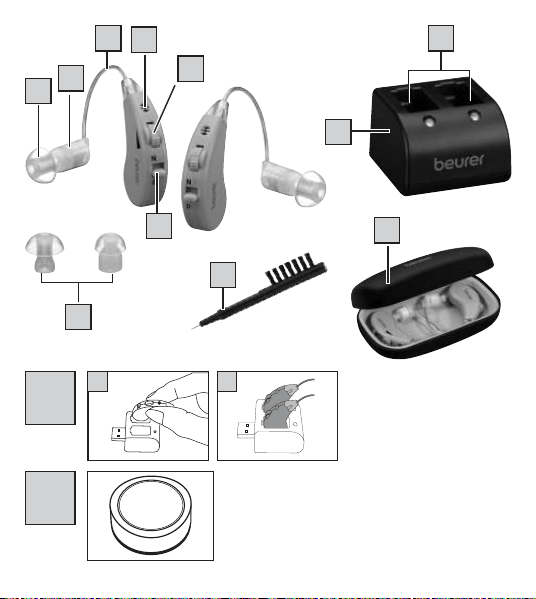
Die zugehörigen Zeichnungen sind auf Seite 3 abgebildet.
1
Ohrstöpsel
2
Ohrstöpsel in
unterschiedlichen Größen
3
Mikrofon
4
Lautstärkenregulierung
5
Netzschalter (N=Ein, O=Aus)
6
Lautsprecher
7
Verbindung
8
Ladestation
9
Lade-Steckplätze
10
Reinigungsbürste
11
Aufbewahrungsbox
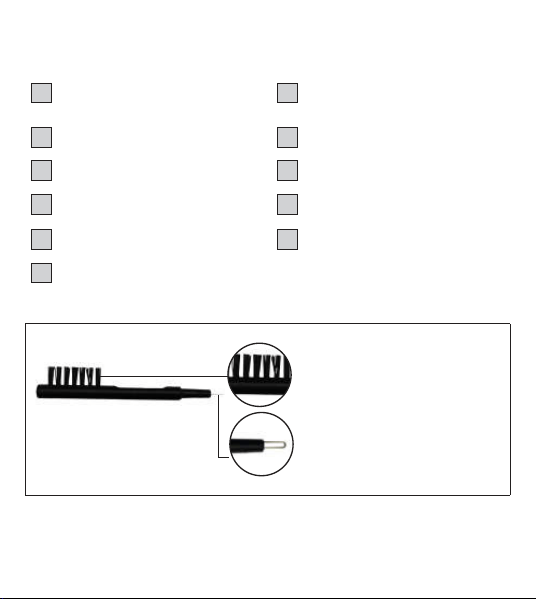
Reinigungsbürste
Bürste
Zur Reinigung der
Hörhilfen
Schlaufe
Zum Entfernen von Oh-
renschmalz im Ohrstöpsel
15
6. INBETRIEBNAHME
Nehmen Sie die Hörhilfen aus der Verpackung und überprüfen Sie, ob
die Geräte und sämtliches Zubehör enthalten und nicht beschädigt sind.
Wahl der richtigen Ohrstöpsel
Wählen Sie einen Ohrstöpsel
1
in passender Größe und stecken Sie ihn
auf den Lautsprecher
6
.
1.
Der Ohrstöpsel
1
sollte locker und angenehm in Ihrem Ohr sitzen.
Probieren Sie verschiedene Ohrstöpsel aus
2
, bis Sie die für Sie an-
genehmsten gefunden haben.
2. Wenn das Gerät ein Pfeifgeräusch abgibt, stellen Sie sicher, dass der
Ohrstöpsel
1
richtig in Ihrem Ohr sitzt. Verwenden Sie ggf. einen an-
deren Ohrstöpsel
2
. Ist die Lautstärke selbst bei höherer Lautstärke-
einstellung
4
zu niedrig, muss der Akku möglicherweise aufgeladen
werden. Anweisungen zum Aufladen finden Sie unten.
Verwendung der Hörhilfen
1.
Drehen Sie die Lautstärkenregulierung
4
auf die niedrigste Einstellung.
2.
Setzen Sie das Gerät auf Ihr Ohr und führen Sie den Ohrstöpsel
1
in den Gehörgang ein, bis er eng anliegt. Drücken Sie ihn nicht mit
Gewalt in Ihr Ohr.
3.
Schieben Sie den Netzschalter
5
in die Position „N“ (Ein) und dre-
hen Sie die Lautstärkenregulierung
4
auf eine geeignete Lautstär-
keeinstellung.

16
Aufladen
1. Stellen Sie sicher, dass das Gerät ausgeschaltet ist, und setzen Sie es
dann in einen der Steckplätze der Ladestation
8
, so dass es einrastet.
Hinweis: Achten Sie bitte darauf, dass Sie das Gerät korrekt in die
Ladestation
8
einsetzen, damit es richtig laden kann. Die Ladesta-
tion ist mit Lade-Steckplätzen ausgestattet, mit deren Hilfe Sie das
Gerät in korrekter Position einsetzen können. Lassen Sie das Gerät
in einen dieser Lade-Steckplätze
9
einrasten
A1
, so dass der AN/
AUS-Schalter
5
in der Önung sitzt
A2
. Sie können eine oder
beide Hörhilfen gleichzeitig aufladen.
2.
Schließen Sie die Ladestation
8
an einen USB-Adapter an, um sie
über eine Steckdose zu verwenden, oder stecken Sie die Ladestation
ohne USB-Adapter direkt in einen USB-Anschluss.
3.
Während des Ladevorgangs leuchtet die rote Lade-LED. Wenn der La-
devorgang abgeschlossen ist, leuchtet die Lade-LED grün; ein vollstän-
diger Ladevorgang dauert in der Regel etwa sieben Stunden.
4.
Wenn der Ladevorgang abgeschlossen ist, trennen Sie die Ladestation
vom Netz und nehmen Sie die Hörhilfe(n) aus der Station.
Trocknungskapsel einlegen
B
Im Lieferumfang ist eine Trocknungskapsel enthalten. Durch das Tragen
der Hörhilfen hinter dem Ohr, kommen die Hörhilfen mit der Haut und
somit z.B. auch mit Schweiß in Berührung. Zur Pflege der Geräte sollten
diese daher nach jeder Anwendung getrocknet werden.
17
Entnehmen Sie die Trocknungskapsel aus der Verpackung und legen Sie
diese mit der Unterseite nach oben in die Aufbewahrungsbox
11
.
Die Kapsel enthält einen Farbindikator. Mit abnehmender Trocknungsleis-
tung ändert sich die Farbe von leuchtend orange zu weiß. Ist die Kapsel
weißlich, so hat sie keine Trocknungsleistung mehr und muss ausge-
tauscht werden.
Wo Sie eine neue Trocknungskapsel erhalten, erfahren Sie im Kapitel
„Zubehör- und Ersatzteile“.
Hinweis: Für eine ideale Trocknungsleistung schließen Sie den Deckel
der Aufbewahrungsbox
11
, nachdem Sie die Hörhilfen hinein gelegt ha-
ben.
7. REINIGUNG UND PFLEGE
ACHTUNG
• Halten Sie die Hörhilfe stets sauber.
• Gehen Sie mit den Produkten stets pfleglich um und vermeiden Sie,
dass der Ohrstöpsel
1
oder das Mikrofon
3
von Fremdkörpern
verschlossen wird. Dies beeinträchtigt die Funktion der Schallver-
stärkung.
• Reinigen Sie die Hörhilfen und die Ohrstöpsel
1
nach jeder An-
wendung mit einem sauberen, trockenen Tuch. Bei stärkerer Ver-
schmutzung können Sie das Tuch auch mit einer leichten Seifen-
lauge befeuchten. Benutzen Sie niemals scheuernde, ätzende oder
lösungsmittelhaltige Reiniger.
18
• Halten Sie die Hörhilfe auf keinen Fall unter Wasser, da sonst Flüssig-
keit eindringen kann d die Hörhilfe beschädigt wird.
• Zum Entfernen von im Ohrstöpsel
1
festsitzendem Ohrenschmalz
eignet sich die beiliegende Reinigungsbürste
10
(s. Gerätebeschrei-
bung).
• Lassen Sie die Hörhilfe nach der Reinigung vollständig trocknen. Be-
wahren Sie die Hörhilfen an einem sicheren, trockenen und sauberen
Ort in der dazugehörigen Aufbewahrungsbox
11
mit der Trocknungs-
kapsel auf.
• Die Trocknungskapsel muss ersetzt werden, wenn sich die Farbe des
Granulats von orange zu weiß ändert (Wo Sie eine neue Trocknungs-
kapsel erhalten, erfahren Sie im Kapitel „ Zubehör und Ersatzteile“).
8. ZUBEHÖR UND ERSATZTEILE
Sie können die Zubehör- und Ersatzteile über die jeweilige Serviceadres-
se unter der angegeben Materialnummer erwerben.
Bezeichnung Artikel- bzw. Bestellnummer
Trocknungskapseln
HA 55/60/80/85 8 St.
641.15
Ohrstöpsel, HA 55 6 St. 164.381
19
9. WAS TUN BEI PROBLEMEN?
Problem Mögliche Ursache Lösung
Kein Ton Gerät ist nicht einge-
schaltet
Netzschalter auf Ein
stellen
Akku ist leer Akku aufladen
Mikrofon verschmutzt/
verstopft
Mikrofon reinigen
Gerät ist beschädigt Wenden Sie sich an den
Kundendienst
Niedrige
Lautstärke
Lautstärke zu niedrig
eingestellt
Drehen Sie die
Lautstärken regulierung,
um die Lautstärke zu
erhöhen
Akku ist leer Akku aufladen
Ohrstöpsel verschmutzt/
verstopft
Ohrstöpsel reinigen
Mikrofon verschmutzt/
verstopft
Mikrofon reinigen
20
Problem Mögliche Ursache Lösung
Lautstärken-
regulierung
ist sehr laut
eingestellt
Der Ohrstöpsel der Hör-
hilfe sitzt nicht richtig im
Ohr, so dass die Hörhilfe
unter Umständen nicht
richtig funktioniert oder
ein unangenehmes
Pfeifgeräusch (akusti-
sches Feedback) ertönt.
Schalten Sie die Hörhilfe
aus und stecken Sie sie
in das Ohr. Stellen Sie
sicher, dass die Hörhilfe
korrekt eingesetzt ist.
Sollte der Ohrstöpsel
nicht richtig in das Ohr
passen, versuchen Sie
es mit einer anderen
Größe. Verwenden Sie
möglichst einen Ohr-
stöpsel, der richtig sitzt.
Im Zweifelsfall wenden
Sie sich bitte an den
Kundendienst.

21
Problem Mögliche Ursache Lösung
Das Gerät
erzeugt
laute Pfeif-
geräusche
(akustisches
Feedback)
Der Ohrstöpsel der Hör-
hilfe sitzt nicht richtig im
Ohr, sodass es zu einer
Rückkopplung zwischen
dem Lautsprecher und
den Mikrofonen kom-
men kann.
Positionieren Sie den
Ohrstöpsel etwas tiefer
im Ohr, oder wählen Sie
eine größere Variante.
Prüfen Sie ob sich
Haare, Teile der
Ohrmuschel oder ein
Brillenbügel über der
Mikrofonönung des
Gerätes befinden. Dies
begünstigt unangeneh-
me Pfeifgeräusche.
Die Hörhilfen
werden nicht
geladen
Die Hörhilfe sitzt nicht
richtig in der Ladesta-
tion
Schalten Sie die Hörhilfe
aus bevor Sie diese
laden
Die Hörhilfe wurde vor
dem Laden nicht ausge-
schalten
Überprüfen Sie den kor-
rekten Sitz der Hörhilfe
in der Ladestation
22
10. ENTSORGUNG
Allgemeine Entsorgung
Im Interesse des Umweltschutzes darf das Gerät am Ende seiner
Lebensdauer nicht mit dem Hausmüll entfernt werden. Die Ent-
sorgung kann über entsprechende Sammelstellen in Ihrem Land
erfolgen. Entsorgen Sie das Gerät gemäß der Elektro- und Elektronik-Alt-
geräte EG-Richtlinie – WEEE (Waste Electrical and Electronic Equipment).
Bei Rückfragen wenden Sie sich an die für die Entsorgung zuständige
kommunale Behörde.
Akku Entsorgung
• Die verbrauchten, vollkommen entladenen Akkus müssen Sie über
speziell gekennzeichnete Sammelbehälter, Sondermüllannahmestel-
len oder über den Elektrohändler entsorgen. Sie sind gesetzlich dazu
verpflichtet, die Akkus zu entsorgen:
• Diese Zeichen finden Sie auf schadstohaltigen Akkus:
Pb = Batterie enthält Blei,
Cd = Batterie enthält Cadmium,
Hg = Batterie enthält Quecksilber.
23
11. TECHNISCHE ANGABEN GEMÄSS
IEC 60118-7:2005
Typ HA 55
Max. Schalldruckpegel (OSPL90) ≤ 128 ± 3 dB
Klangverstärkung ≤ 50 ± 3 dB
Frequenzbereich 500 – 3200 Hz
Gesamte Oberwellenverzerrung ≤ 10%
Stromversorgung ≤ 10 mA
Ladezeit 7 – 10 Stunden
Betriebsdauer 16 Stunden
Abmessungen 40 × 13 × 10 mm
Gewicht 4,3 g
Betriebstemperaturbereich 0 – 40 °C,
Relative Luftfeuchtigkeit: ≤ 90%
Transport-/
Lagertemperaturbereich
-10 – 55 °C,
Relative Luftfeuchtigkeit: ≤ 90%
Änderungen der technischen Angaben ohne Benachrichtigung sind
aus Aktualisierungsgründen vorbehalten.
12. GARANTIE UND SERVICE
Nähere Informationen zur Garantie und den Garantiebedingungen
finden Sie im mitgelieferten Garantie-Faltblatt.
Irrtum und Änderungen vorbehalten
24
ENGLISH
Read these instructions for use carefully and
keep them for later use, be sure to make them
accessible to other users and observe the in
-
formation they contain.
1. Included in delivery ....................................................... 25
2. Signs and symbols ........................................................ 25
3. Warnings and safety notes ............................................ 27
4. Intended use .................................................................. 32
5. Device description ......................................................... 33
6. Initial use ...................................................................... 34
7. Cleaning and maintenance ............................................ 36
8. Accessories and replacement parts ............................. 37
9. What if there are problems? .......................................... 38
10. Disposal ....................................................................... 40
11. Technical specifications .............................................. 41
12. Warranty / service ......................................................... 42
Table of contents
25
1. INCLUDED IN DELIVERY
Check that the exterior of the cardboard delivery packaging is intact and
make sure that all contents are present. Before use, ensure that there is
no visible damage to the devices or accessories and that all packaging
material has been removed. If you have any doubts, do not use the device
and contact your retailer or the specified Customer Service address.
2 x HA 55 Hearing amplifiers
6 x earplugs (in dierent sizes and designs)
1 x cleaning brush
1 x drying capsule
1 x storage box
1 x instructions for use
2. SIGNS AND SYMBOLS
The following symbols are used on the device, in these instructions for
use, on the packaging and on the type plate for the device:
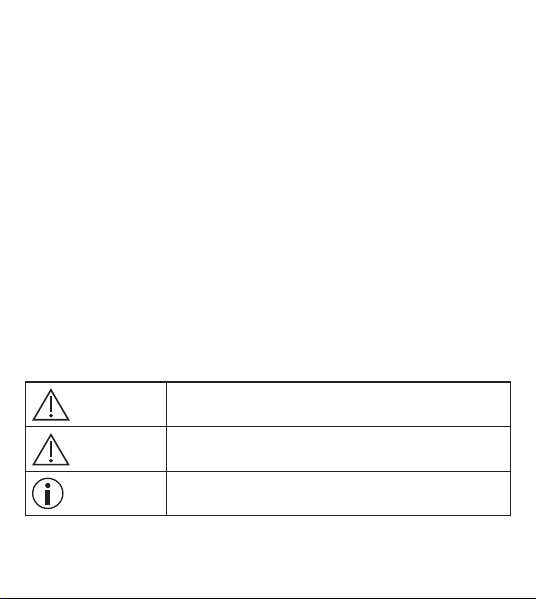
WARNING
Warning notice indicating a risk of injury or dama-
ge to health.
IMPORTANT
Safety note indicating possible damage to the
device.
Note
Note on important information.
26
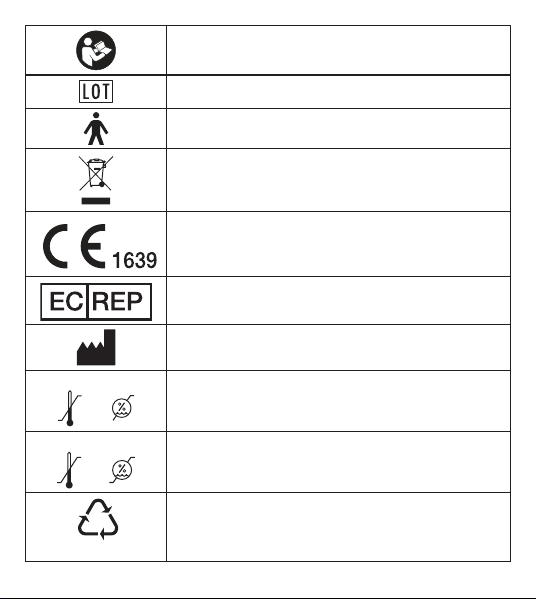
Observe the instructions for use.
Batch code
Application part type B
Disposal in accordance with the Waste Electrical
and Electronic Equipment EC Directive – WEEE
CE labelling
This product satisfies the requirements of the ap-
plicable European and national directives.
European Authorised Representative for manu-
facturers of medical devices
Manufacturer
Storage/Transport
Permissible storage and transport temperature
and humidity
Operating
Permissible operating temperature and humidity
B
A
Marking to identify the packaging material.
A = Material code, B = Material number:
1-7 = Plastics, 20-22 = Paper and cardboard
27
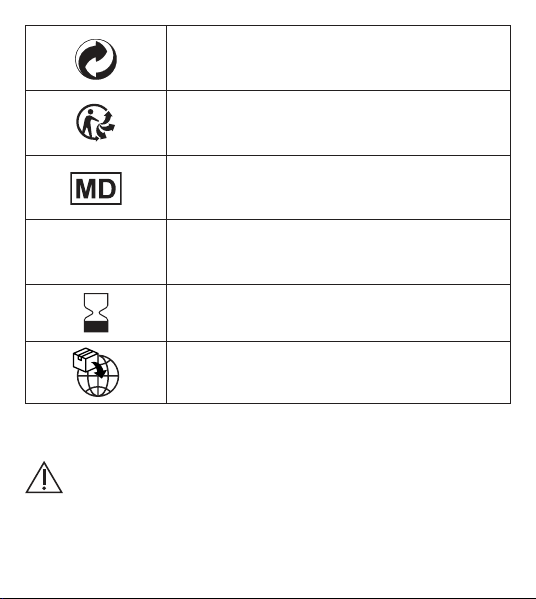
Separate the packaging elements and dispose of
them in accordance with local regulations.
Separate the product and packaging elements
and dispose of them in accordance with local
regulations.
Medical device
IP 41
Device protected against solid foreign objects ≥ 1
mm in diameter and greater, and against vertically
falling drops of water
Use by
Importer symbol
3. WARNINGS AND SAFETY NOTES
WARNING
• You must have your hearing checked by a doctor or qualified hearing
care professional before using the hearing amplifiers. The settings of

28
the hearing amplifiers should only be adjusted by a trained expert,
for example an ENT specialist, an audiologist or a qualified hearing
amplifier retailer.
• In the event of an existing or previous ear problem, you should con-
sult your doctor before using the hearing amplifiers.
• Use for patients suering from an ear inflammation or infection is
NOT permissible.
• Do NOT use the hearing amplifiers if you are suering from an inflam-
mation of the middle ear or ear canal.
• If you feel unwell or experience pain when wearing the hearing ampli-
fiers, stop using them immediately and contact your doctor.
• If your ear becomes inflamed or your skin irritated or you experience
an increased accumulation of earwax when wearing the hearing am-
plifiers, stop using them immediately and contact your doctor.
• Stop using the hearing amplifiers and seek medical attention if the
following occurs:
- Rash or eczema on areas of skin that come into contact with the
hearing amplifiers. (The hearing amplifiers are made from a materi-
al that is kind to the skin. In rare cases, however, allergic reactions
may occur that appear in the form of eczema.)
- Use of the hearing amplifiers results in discharge from the ear and/
or necessitates ear treatment.
- Sudden, significant decrease in hearing ability.
• If parts of the hearing amplifier become stuck in the ear, seek medical
attention immediately. Do not attempt to remove the parts yourself.

29
• At first, set the volume to a low setting and increase it gradually once
you have become accustomed to the hearing amplifiers.
• Do NOT set the volume button too high, as this may cause further
damage to your hearing over an extended period of time.
• Do NOT lend your hearing amplifiers to others or use the hearing am-
plifiers of others, as there is a risk of hearing damage and infection.
• Do NOT pass on your hearing amplifiers for use by other persons.
The use of a hearing amplifier that was designed for someone else
may cause hearing damage.
• The hearing amplifiers are NOT suitable for use by children under 12
years of age.
• It is particularly dicult to diagnose hearing problems in children.
Children should only be provided with a hearing amplifier following a
thorough examination by an ENT specialist.
• Keep the hearing amplifiers, the accessories and the batteries away
from children, as there is a risk of injury and choking.
• This device is NOT intended for use by people (including children)
with restricted physical, sensory or mental skills or a lack of expe-
rience and/or a lack of knowledge, unless they are supervised by a
person who has responsibility for their safety or they receive instruc-
tions from this person on how to use the device. Supervise children
around the device to ensure they do not play with it.
• Do NOT use the hearing amplifiers in potentially explosive and ha-
zardous environments.
• Do NOT use the devices in oxygen-rich environments and over an
extended period of time.

30
• Please contact the manufacturer in the event of the following:
- if you require assistance in the set-up, use or maintenance of the
hearing amplifiers; or
- if the devices behave unexpectedly during operation or otherwise.
• If you have any doubts, do NOT use a damaged hearing amplifier;
contact your retailer or the specified Customer Services address.
• Switch the devices o immediately if they are faulty or not working
properly.
• Do not attempt to open and/or repair the hearing amplifiers yourself.
Repairs may only be carried out by Customer Services or authorised
retailers. Failure to comply will invalidate the warranty.
Notes on handling batteries:
• If your skin or eyes come into contact with fluid from a battery cell,
flush out the aected areas with water and seek medical assistance.
•
Choking hazard! Small children may swallow and choke on bat-
teries. Therefore, store batteries out of the reach of small children.
• If a battery leaks, put on protective gloves and dispose of the device.
• Protect batteries from excessive heat.
•
Risk of explosion! Never throw batteries into a fire.
• Remove the batteries from the device if you do not intend to use the
device for an extended period of time.
• Do not disassemble, split or crush the batteries.
• Only use chargers specified in the instructions for use.
31
• Batteries must be charged correctly prior to use. The instructions
from the manufacturer and the specifications in these instructions for
use regarding correct charging must be observed at all times.
• Fully charge the battery prior to initial use (see section 6).
• In order to achieve the longest battery service life possible, fully char-
ge the battery at least 4 times a year.
IMPORTANT
• Do NOT wear the hearing amplifiers in the vicinity of strong electro-
magnetic fields or X-rays.
• Do NOT wear the hearing amplifiers while bathing, showering or
swimming.
• Protect the devices from impacts, humidity, dirt, marked temperature
fluctuations, direct sunlight and high levels of air humidity.
• High temperatures may develop in closed vehicles during summer.
You should therefore never leave your hearing amplifiers inside a ve-
hicle.
• Do NOT drop the devices or subject them to any shocks.
• If the hearing amplifiers fall into water, dry them with a cloth and then
have them inspected by your retailer.
• Never attempt to dry the hearing amplifiers in a microwave, a tum-
ble dryer or with a hair dryer. The hearing amplifiers may otherwise
become damaged.
• Do NOT use the hearing amplifiers together with a mobile phone.
(The radio waves of the mobile phone may cause background noise
or a loss of volume.)

32
• Do NOT wear the hearing amplifiers while applying cosmetics (e.g.
make-up, hairspray, perfume or sun cream).
• Do NOT wear the hearing amplifiers while undergoing shortwave
therapy or medical treatments that involve strong radio frequency
or magnetic fields.
• Take care when operating the buttons. Do NOT press too firmly.
• Do not insert any sharp objects into the microphone opening as this
may damage the microphone.
• Do NOT touch the magnets of the hearing amplifier as this may da-
mage the device.
• Do NOT touch the inside of the device. There are many sensitive
components that have been precisely configured. Under no circum-
stances should you poke at the inside of the hearing amplifier with a
needle or similar object.
• Service your hearing amplifiers at regular intervals. Make sure there
are no foreign objects in between the earplug and speaker, as this
could impair the sound.
4. INTENDED USE
The hearing amplifiers are only to be used to help people to hear better.
The devices are only intended for the purpose described in these inst-
ructions for use. The manufacturer is not liable for damage resulting from
improper or careless use.
33
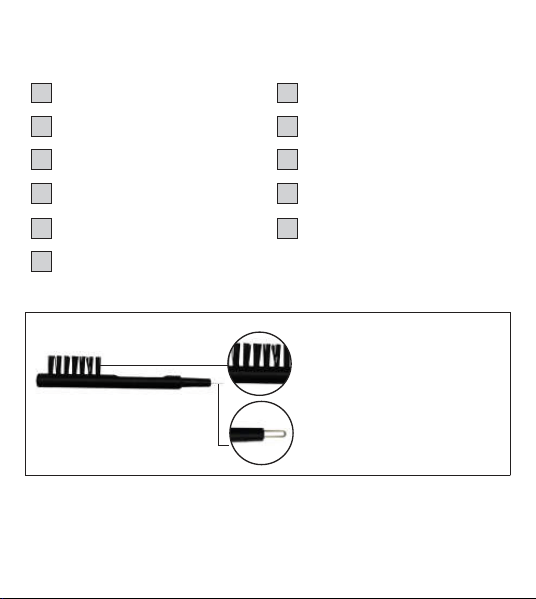
5. DEVICE DESCRIPTION
The associated drawings are shown on page 3.
1
Earplugs
2
Earplugs in dierent sizes
3
Microphone
4
Volume control
5
Power switch (N=On, O=O)
6
Speaker
7
Connection
8
Charger
9
Charging slots
10
Cleaning brush
11
Storage box
Cleaning brush
Brush
For cleaning the hearing
amplifiers
Loop
For removing earwax in
the earplug

34
6. INITIAL USE
Remove the hearing amplifiers from the packaging and check that the
devices and all accessories are included and not damaged.
Choosing the right earplugs
Choose an appropriately sized earplug
1
and position it on the speaker
6
.
1.
The earplug
1
should sit loosely and comfortably in your ear. Try
dierent earplugs
2
until you find the ones that are most comfor-
table for you.
2. If the device makes a whistling sound, make sure that the earplug
1
is sitting correctly in your ear. If necessary, use a dierent earplug
2
.
If the volume is too low even at a higher volume setting, the battery
may need to be charged. See below for charging instructions.
Using the hearing amplifiers
1. Turn the volume control
4
to the lowest setting.
2. Place the device on your ear and insert the earplug
1
into the ear ca-
nal until it fits snugly. Do not force it into your ear.
3.
Slide the power switch
5
to the “N” (On) position and turn the volume
control to a suitable volume setting.
Charging:
1. Make sure that the device is switched o and then insert it into one of
the charger slots
9
so that it clicks into place.

35
Note: Please ensure that you insert the device correctly into the char-
ger
8
so that it can be charged correctly. The charger
8
is equip-
ped with charging slots that enable you to insert the device in the
correct position. Allow the device to click into place in one of these
charging slots
9
A1
so that the power switch
5
sits in the opening
A2
. You can charge one or both hearing amplifiers at the same time.
2.
Connect the charger
8
to a USB adapter to use it via a socket, or plug
the charger directly into a USB port without a USB adapter.
3.
The red charging LED lights up during the charging process. When
charging is complete, the charging LED lights up green; a full charge
usually takes about seven hours.
4.
When charging is complete, disconnect the charger
8
from the mains
and remove the hearing amplifier(s) from the charger
8
.
Inserting the drying capsule
B
A drying capsule is included in delivery. Wearing the hearing amplifiers
behind your ear means they come into contact with your skin, and there-
fore also with sweat, for example. As a result, you should dry the devices
after each application to care for them properly.
Remove the drying capsule from the packaging and place it in the storage
box
11
with the bottom side up.
The capsule has a colour indicator. As the drying capacity decreases
over time, the colour changes from bright orange to white. If the capsule
is a whitish colour, it no longer has any drying capacity and has to be
exchanged
36
To find out where to obtain a new drying capsule, see section “Accesso-
ries and replacement parts”.
Note: To ensure the best possible drying performance, close the lid of the
storage box after placing the hearing amplifiers inside.
7. CLEANING AND MAINTENANCE
IMPORTANT
• Always keep the hearing amplifier clean.
• Always treat the products with care and prevent the earplug
1
and
microphone
3
from becoming blocked with foreign matter. This im-
pairs the function of the sound amplification.
• Clean the hearing amplifiers and earplugs
1
with a clean, dry cloth
after each use. If they are very dirty, you can also moisten the cloth
with a mild soapy solution. Never use abrasive, corrosive or solvent-
based cleaning products.
• Under no circumstances should you hold the hearing amplifier un-
der water, as this can cause liquid to enter and damage the hearing
amplifier.
• The supplied cleaning brush
10
is suitable for removing earwax stuck
in the earplug
1
(see device description).
• Allow the hearing amplifier to dry fully after cleaning. Store the hea-
ring amplifiers in a safe, dry and clean place in the relevant storage
box
11
with the drying capsule.
37
• The drying capsule has to be replaced if the colour of the granula-
te changes from orange to white (you can find out where to obtain
a new drying capsule in section “9. Accessories and replacement
parts”).
8. ACCESSORIES AND REPLACEMENT
PARTS
Accessories and replacement parts are available from the corresponding
listed service address under the stated material number.
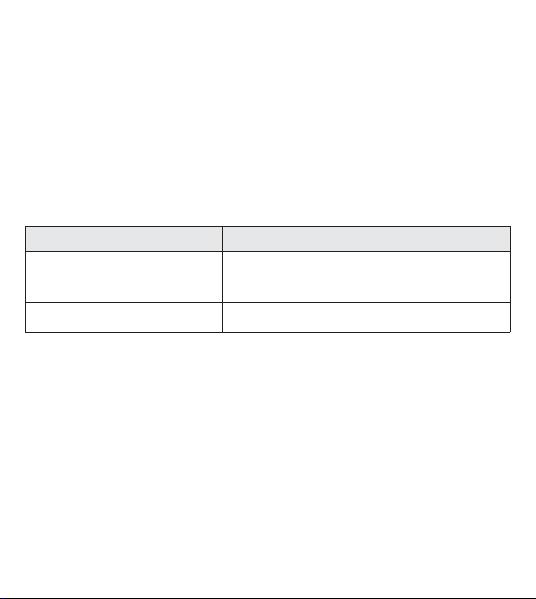
Designation Item number and/or order number
Drying capsules,
HA 55/60/80/85 8 pcs.
641.15
Earplugs, HA 55 6 pcs. 164.381
38
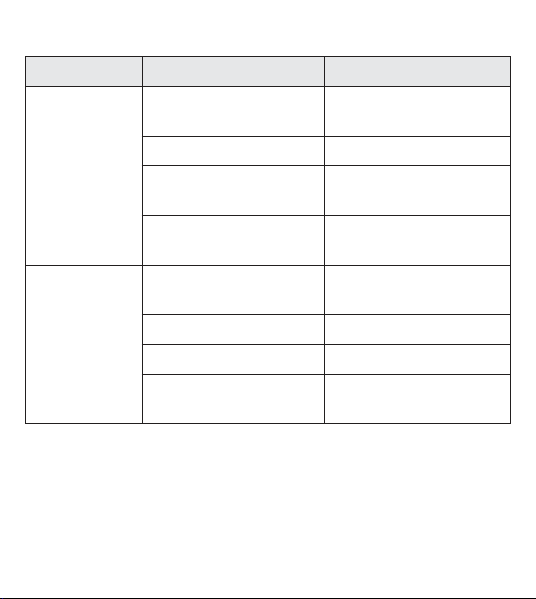
9. WHAT IF THERE ARE PROBLEMS?
Problem Possible cause Solution
No tone Device is not switched
on
Turn the power switch
to “On”
Battery is empty Charge the battery
Microphone is dirty/
clogged
Clean the microphone
The device is damaged Contact Customer
Services
Low volume Volume is set too low Turn the volume control
to increase the volume
Battery is empty Charge the battery
Earplug is dirty/clogged Clean the earplug
Microphone is dirty/
clogged
Clean the microphone
39
Problem Possible cause Solution
Volume con-
trol is set very
high
The hearing amplifier’s
earplug is not posi-
tioned correctly in
the ear, meaning the
hearing amplifier may
not function correctly or
an unpleasant whistling
sound (acoustic feed-
back) may be heard.
Switch o the hearing
amplifier and insert it
into your ear. Make sure
that the hearing amplifier
is inserted correctly.
If the earplug does not
fit correctly in your ear,
try a dierent size. If
possible, use an earplug
that fits correctly. If you
have any doubts, please
contact Customer
Services.
40
Problem Possible cause Solution
The device
makes loud
whistling noi-
ses (acoustic
feedback)
The hearing amplifier’s
earplug is not positi-
oned correctly in the
ear, which can cause
feedback between the
speaker and the micro-
phones.
Position the earplug
slightly deeper in the ear
or use a larger size.
Check whether there is
any hair, part of the outer
ear or a glasses arm
above the device’s mi-
crophone opening. This
can lead to unpleasant
whistling noises.
The hearing
amplifiers are
not charging
The hearing amplifier is
not seated correctly in
the charger
Switch o the hearing
amplifier before charging
it
The hearing amplifier
was not switched o
before charging
Check that the hearing
amplifier is positioned
correctly in the charger
10. DISPOSAL
General disposal
For environmental reasons, do not dispose of the device in the
household waste at the end of its useful life. Dispose of the de-
vice at a suitable local collection or recycling point in your count-
41
ry. Dispose of the device in accordance with EC Directive – WEEE (Waste
Electrical and Electronic Equipment). If you have any questions, please
contact the local authorities responsible for waste disposal.
Battery disposal
• The empty, completely flat batteries must be disposed of using spe-
cially designated collection boxes, recycling points or electronics
retailers. You are legally required to dispose of the batteries:
• The codes below are printed on batteries containing harmful
substances:
Pb = Battery contains lead
Cd = Battery contains cadmium
Hg = Battery contains mercury
11. TECHNICAL SPECIFICATIONS IN
ACCORDANCE WITH IEC 60118-7:2005
Type HA 55
Max. sound pressure level (OSPL90) ≤ 128 ±3 dB
Sound amplification ≤ 50 ±3 dB
Frequency range 500 – 3200 Hz
Overall harmonic distortion ≤ 10%
Power supply ≤ 10 mA
Charging time 7 – 10 hours
42
Operation period 16 hours
Dimensions 40 × 13 × 10 mm
Weight 4.3 g
Operating temperature range 0 – 40°C,
relative humidity: ≤ 90%
Transport/storage temperature range -10 – 55°C,
relative humidity: ≤ 90%
Technical information is subject to change without notification to allow
for updates.
12. WARRANTY / SERVICE
Further information on the guarantee and guarantee conditions can
be found in the guarantee leaflet supplied.
Subject to errors and changes

43
FRANÇAIS
Lisez attentivement ce mode d’emploi,
conservez-le pour un usage ultérieur, met
-
tez-le à disposition des autres utilisateurs et
suivez les consignes qui y figurent.
1. Contenu ......................................................................... 44
2. Symboles utilisés ........................................................... 44
3. Consignes d’avertissement et de mise en garde .......... 47
4. Utilisation conforme aux recommandations .................. 52
5. Description de l’appareil ................................................ 53
6. Mise en service ............................................................. 54
7. Nettoyage et entretien ................................................... 56
8. Accessoires et pièces de rechange .............................. 57
9. Que faire en cas de problèmes? .................................. 58
10. Élimination ................................................................... 61
11. Caractéristiques techniques ........................................ 62
12. Garantie / Maintenance ................................................ 63
Table des matières
44
1. CONTENU
Vérifiez si l’emballage carton extérieur du kit est intact et si tous les élé-
ments sont inclus. Avant l’utilisation, assurez-vous que l’appareil et les
accessoires ne présentent aucun dommage visible et que la totalité de
l’emballage a bien été retirée. En cas de doute, ne l’utilisez pas et adres-
sez-vous à votre revendeur ou au service client indiqué.
2aides auditives HA55
6 embouts auriculaires (de taille et de style diérents)
1brosse de nettoyage
1capsule déshydratante
1boîte de rangement
1mode d’emploi
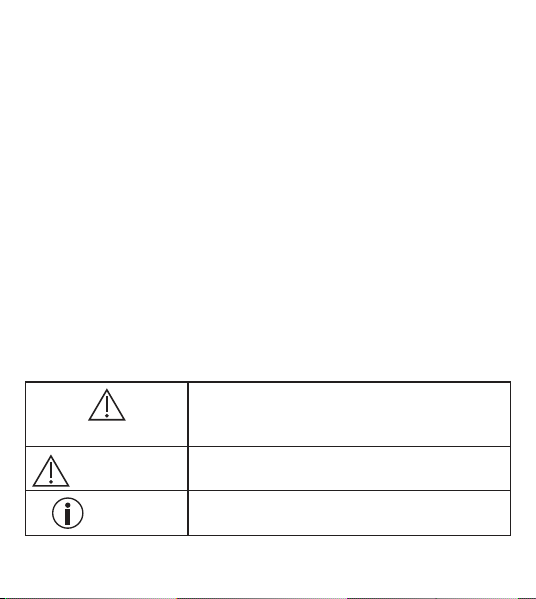
2. SYMBOLES UTILISÉS
Les symboles suivants sont utilisés sur le mode d’emploi, sur l’emballage
et sur la plaque signalétique de l’appareil:
AVERTISSEMENT
Ce symbole vous avertit des risques de bles-
sures ou des dangers pour votre santé.
ATTENTION
Ce symbole vous avertit des éventuels dom-
mages au niveau de l’appareil.
Remarque
Ce symbole indique des informations impor-
tantes.
45
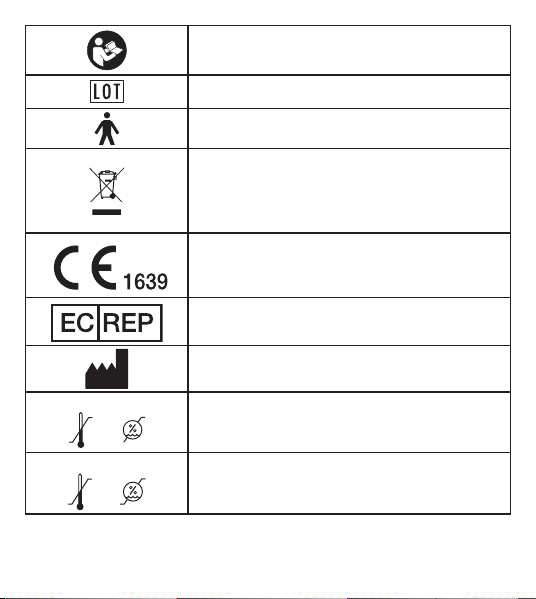
Respecter les consignes du mode d’emploi.
Code de lot
Appareil de type B
Élimination conformément à la directive
européenne WEEE (Waste Electrical and
Electronic Equipment) relative aux déchets
d’équipements électriques et électroniques
Signe CE
Ce produit répond aux exigences des directi-
ves européennes et nationales en vigueur.
Représentant UE agréé pour les fabricants de
dispositifs médicaux
Fabricant
Storage/Transport
Température et taux d’humidité de stockage
et de transport admissibles
Operating
Température et taux d’humidité d’utilisation
admissibles
46
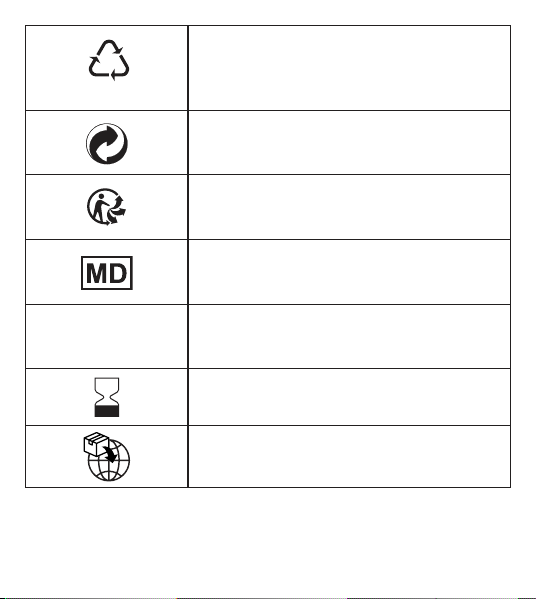
B
A
Étiquette d’identification du matériau
d’emballage. A = Abréviation de matériau,
B = Référence de matériau:
1 – 7 = plastique, 20 – 22 = papier et carton
Séparer les composants d’emballage et les
éliminer conformément aux prescriptions
communales.
Séparer le produit et les composants
d’emballage et les éliminer conformément aux
prescriptions communales.
Dispositif médical
IP 41
Appareil protégé contre les corps solides,
diamètre 1mm ou plus, et contre les gouttes
verticales
Utilisable jusqu’à
Symbole de l’importateur

47
3. CONSIGNES D’AVERTISSEMENT ET DE
MISE EN GARDE
AVERTISSEMENT
• Faites impérativement tester votre audition par un médecin ou un au-
dioprothésiste qualifié avant d’utiliser les aides auditives. Le réglage
des aides auditives doit impérativement être eectué par un expert
qualifié, comme un ORL, un audioprothésiste ou un employé qualifié
d’un centre auditif.
• Consultez votre médecin avant d’utiliser les aides auditives si vous
sourez actuellement ou si vous avez souert de douleurs aux ore-
illes.
• N’utilisez PAS les aides auditives si vous sourez d’une inflammation
ou d’une infection des oreilles.
• N’utilisez PAS les aides auditives si vous sourez d’une otite mo-
yenne ou d’une inflammation du conduit auditif.
• Si vous ressentez une douleur ou une gêne lors du port des aides
auditives, cessez de les utiliser et contactez votre médecin.
• Si vous remarquez une inflammation de l’oreille, une irritation cuta-
née ou un excès de cérumen (cire de l’oreille) lors du port des aides
auditives, cessez de les utiliser et contactez votre médecin.
• Cessez l’utilisation des aides auditives et consultez un médecin si:

48
- une éruption cutanée ou de l’eczéma apparaît sur les zones de
la peau en contact avec les aides auditives. (Les aides auditives
sont conçues dans un matériau agréable pour la peau. Dans de
rares cas, ce matériau peut entraîner des réactions allergiques, qui
peuvent se manifester sous la forme d’eczéma.)
- l’utilisation des aides auditives provoque un écoulement dans
l’oreille ou rend le traitement de l’oreille nécessaire.
- les capacités auditives diminuent considérablement et soudaine-
ment.
• Si une partie de l’aide auditive reste coincée dans l’oreille, consultez
immédiatement un médecin. N’essayez pas de l’extraire vous-même.
• Réglez d’abord le volume à un niveau faible, puis augmentez-le pro-
gressivement lorsque vous vous habituez aux aides auditives.
• Ne réglez PAS le volume à un niveau trop élevé, car cela peut, à long
terme, endommager encore plus l’audition.
• Ne prêtez PAS vos aides auditives à une autre personne et n’utilisez
pas non plus les aides auditives de quelqu’un d’autre. Vous vous
exposeriez à un risque de dommages et d’infections auditives.
• Ne laissez PAS d’autres personnes utiliser vos aides auditives.
L’utilisation d’aides auditives conçues pour une autre personne peut
entraîner une perte auditive.
• Les aides auditives ne sont PAS conçues pour être utilisés par des
enfants de moins de 12 ans.
• Le diagnostic des problèmes d’audition est particulièrement compli-
qué chez les enfants. Les enfants ne doivent utiliser une aide auditive
qu’après un examen approfondi eectué par un ORL.

49
• Conservez les aides auditives, les accessoires et les batteries hors de
portée des enfants afin d’éviter tout risque de blessure et d’ingestion.
• Cet appareil n’est PAS conçu pour être utilisé par une personne (y
compris les enfants) dont les capacités physiques, sensorielles ou
intellectuelles sont limitées, ou n’ayant pas l’expérience et/ou les
connaissances nécessaires. Le cas échéant, cette personne doit,
pour sa sécurité, être surveillée par une personne compétente ou
doit recevoir de cette dernière des recommandations sur la manière
d’utiliser l’appareil. Surveillez les enfants afin de les empêcher de
jouer avec l’appareil.
• N’utilisez PAS les aides auditives dans des environnements explosifs
et dangereux.
• N’utilisez PAS les appareils dans des environnements enrichis en
oxygène et pendant une longue durée.
• Dans les cas suivants, contacter le fabricant:
- si vous avez besoin d’aide pour la mise en place, l’utilisation ou
l’entretien des aides auditives; ou
- si, pendant son fonctionnement, les appareils se comportent de
façon inattendue ou si vous remarquez divers incidents.
• En cas de doute, n’utilisez PAS une aide auditive endommagée et
adressez-vous à votre revendeur ou au service client indiqué.
• Éteignez immédiatement les appareils s’ils sont défectueux ou pré-
sentent des défauts de fonctionnement.
• N’essayez en aucun cas d’ouvrir vous-même les aides auditives et/
ou de les réparer. Seul le service client ou un opérateur autorisé peut

50
procéder à une réparation. Le non-respect de cette consigne annu-
lerait la garantie.
Remarques relatives aux batteries:
• Si du liquide de la cellule de batterie entre en contact avec la peau
ou les yeux, rincez la zone touchée avec de l’eau et consultez un
médecin.
•
Risque d’ingestion! Les enfants en bas âge pourraient avaler
des batteries et s’étouer. Veuillez donc conserver les batteries hors
de portée des enfants en bas âge.
• Si une batterie a fui, enfilez des gants de protection et nettoyez
l’appareil.
• Protégez les batteries d’une chaleur excessive.
• Risque d’explosion! Ne jetez pas les batteries au feu.
• En cas de non-utilisation prolongée de l’appareil, retirez les batteries
de l’appareil.
• Ne démontez, n’ouvrez ou ne cassez pas les batteries.
• N’utilisez que le chargeur indiqué dans le mode d’emploi.
• Les batteries doivent être chargées correctement avant utilisation.
Pour charger l’appareil, respecter toujours les instructions du fabri-
cant ou les informations contenues dans ce mode d’emploi.
• Avant la première utilisation, chargez complètement la batterie (voir
chapitre6).
• Rechargez la batterie complètement au moins 4fois par an pour att-
eindre une durée de vie maximale de la batterie.

51
ATTENTION
• Ne portez PAS les aides auditives à proximité de champs électroma-
gnétiques puissants ou de rayons X.
• Ne portez PAS les aides auditives dans le bain, sous la douche ou
à la piscine.
• Protégez les appareils contre les chocs, l’humidité, les saletés, les
fortes variations de température, l’ensoleillement direct et l’humidité
de l’air élevée.
• L’été, dans une voiture fermée, la température peut devenir très éle-
vée. Ne laissez jamais les aides auditives dans votre voiture.
• Évitez de secouer ou de faire tomber les appareils.
• Si les aides auditives tombent dans l’eau, séchez-les à l’aide d’un
chion et faites-les ensuite vérifier par votre revendeur.
• N’utilisez pas de micro-ondes, de sèche-linge, ni de sèche-cheveux
pour faire sécher vos aides auditives. Cela pourrait endommager les
aides auditives.
• N’utilisez PAS les aides auditives avec un téléphone mobile. (Les on-
des radio émises par les téléphones mobiles peuvent provoquer des
interférences ou une atténuation du volume.)
• Ne portez PAS les aides auditives lorsque vous appliquez des produ-
its cosmétiques (par exemple, maquillage, laque, parfum ou crème
solaire).

52
• Ne portez PAS les aides auditives lors de thérapies par ondes courtes
ou lors de traitements médicaux pouvant faire intervenir des champs
correspondant aux fréquences radio ou magnétiques puissants.
• Manipulez les touches avec précaution. N’appuyez PAS dessus trop
fermement.
• N’insérez pas d’objets pointus dans les ouvertures du microphone,
cela pourrait l’endommager.
• Ne touchez PAS l’aimant des aides auditives, cela pourrait endom-
mager l’appareil.
• Ne touchez PAS à l’intérieur de l’appareil. Il contient de nombreu-
ses pièces sensibles qui ont été ajustées avec précision. Ne piquez
en aucun cas une aiguille ou un objet similaire à l’intérieur de l’aide
auditive.
• Entretenez régulièrement vos aides auditives. Assurez-vous
qu’aucun corps étranger ne se trouve entre l’embout auriculaire et le
haut-parleur, cela risquerait de créer des nuisances sonores.
4. UTILISATION CONFORME AUX RE-
COMMANDATIONS
N’utilisez les aides auditives que pour renforcer les capacités auditives
de personnes malentendantes. Les appareils sont conçus uniquement
pour l’utilisation décrite dans ce mode d’emploi. Le fabricant ne peut être
tenu responsable des dommages causés par une utilisation inappropriée
ou non conforme.
53
5. DESCRIPTION DE L’APPAREIL
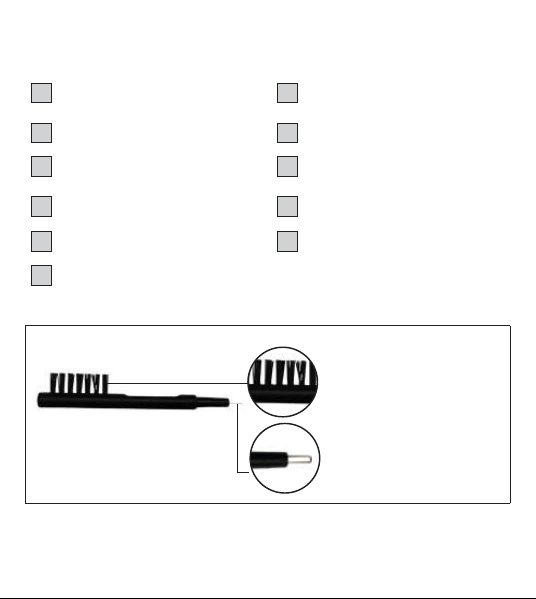
Les schémas correspondants sont illustrés à la page 3.
1
Embout auriculaire
2
3embouts auriculaires de
tailles diérentes
3
Microphone
4
Réglage du niveau sonore
5
Commutateur principal
(N=Marche, O=Arrêt)
6
Haut-parleur
7
Connexion
8
Station de charge
9
Emplacements de charge
10
Brosse de nettoyage
11
Boîte de rangement
Brosse de nettoyage
Brosse
Pour le nettoyage des
aides auditives
Boucle
pour le retrait du cé-
rumen dans l’embout
auriculaire

54
6. MISE EN SERVICE
Sortez les aides auditives de leur emballage et vérifiez que les appareils
et tous les accessoires sont inclus et ne sont pas endommagés.
Choix de l’embout auriculaire
Choisissez un embout auriculaire
1
de taille appropriée et placez-le sur
le haut-parleur.
1. L’embout auriculaire
1
ne doit pas être serré et doit reposer confor-
tablement dans votre oreille. Essayez plusieurs embouts jusqu’à ce
que vous trouviez celui qui vous convient le mieux
2
.
2.
Si l’appareil émet un siement, assurez-vous que l’embout auriculaire
1
est correctement placé dans votre oreille. Utilisez un autre embout
auriculaire si nécessaire
2
. Si le volume est trop faible même avec un
volume plus élevé, il peut s’avérer nécessaire de recharger la batterie.
Voir les instructions de chargement ci-dessous.
Utilisation des aides auditives
1. Tournez la commande de volume jusqu’à la position la plus basse.
2.
Placez l’appareil sur votre oreille et insérez l’embout auriculaire
1
dans
le conduit auditif jusqu’à ce qu’il soit bien ajusté. N’essayez pas de
forcer pour que l’appareil rentre dans l’oreille.
3.
Placez le commutateur d’alimentation en position «N» (Marche)
4
et
réglez le volume à un niveau approprié..

55
Recharger:
1. Assurez-vous que l’appareil est éteint, puis placez-le dans l’une des
prises de la station de charge
8
pour qu’il se verrouille.
Remarque: Veillez à placer correctement l’appareil dans la station
de charge
8
afin de pouvoir le charger correctement. La station de
charge
8
est équipée de prises de chargement qui vous permettent
d’utiliser l’appareil dans la bonne position. Insérez l’appareil dans
l’un de ces emplacements de chargement
9
A1
de manière à ce
que le commutateur principal
5
se trouve dans l’ouverture
A2
.
Vous pouvez charger l’une des aides auditives ou les deux en même
temps.
2. Connectez la station de charge
8
à un adaptateur USB pour l’utiliser
sur une prise électrique murale ou branchez la station
8
de charge
directement sur un port USB sans adaptateur USB.
3.
La LED de chargement rouge est allumée pendant le chargement.
Lorsque la charge est terminée, la LED de charge s’allume en vert; une
charge complète dure généralement sept heures environ.
4.
Lorsque le chargement est terminé, débranchez la station
8
de charge
du secteur et retirez l’aide auditive de la station.
Mettre en place la capsule déshydratante
B
L’appareil est fourni avec une capsule déshydratante. En portant les
aides auditives derrière l’oreille, elles entrent en contact avec la peau
et donc aussi avec la transpiration, par exemple. Pour entretenir les ap-
pareils, il est donc nécessaire de les faire sécher après chaque utilisation.
56
Retirez la capsule déshydratante de son emballage et placez-la dans la
boîte de rangement
11
, face inférieure vers le haut.
La capsule contient un indicateur coloré. Lorsque la puissance de sécha-
ge diminue, la couleur, initialement orange, devient blanche. Si la capsule
est blanche, sa puissance de séchage est épuisée et doit être remplacée.
Pour savoir où se procurer une nouvelle capsule déshydratante, voir le
chapitre «Accessoires et pièces de rechange ».
Remarque: Pour un séchage optimal, fermez le couvercle de la boîte de
rangement
11
après y avoir placé les aides auditives.
7. NETTOYAGE ET ENTRETIEN
ATTENTION
• Gardez toujours l’aide auditive propre.
• Manipulez toujours les appareils avec précaution et évitez qu’un
corps étranger ne bouche l’embout auriculaire
1
et le microphone
3
. Ceci perturbe la fonction d’amplification du son.
• Après chaque utilisation, nettoyez les aides auditives et l’embout au-
riculaire
1
à l’aide d’un chion propre et sec. En cas de salissures
plus importantes, vous pouvez également humidifier légèrement le
chion avec de la lessive. N’utilisez pas de produit abrasif, corrosif
ou contenant des solvants.
• Ne passez jamais l’aide auditive sous l’eau; l’eau pourrait s’infiltrer à
l’intérieur de l’aide auditive et l’endommager.
• La brosse de nettoyage
10
fournie est idéale pour retirer le cérumen
coincé dans l’embout auriculaire
1
(cf. description de l’appareil).
57
• Après le nettoyage, laissez sécher complètement l’aide auditive.
Conservez les aides auditives dans un endroit sûr, sec et propre,
dans leur boîte de rangement
11
avec la capsule déshydratante.
• La capsule déshydratante doit être remplacée lorsque les granulés,
initialement orange, deviennent blancs (pour savoir où se procurer
une nouvelle capsule déshydratante, voir le chapitre «Accessoires
et pièces de rechange»).
8. ACCESSOIRES ET PIÈCES DE
RECHANGE
Les accessoires et pièces de rechange sont disponibles à l’adresse du
service après-vente concerné, sous la référence donnée.
Désignation Numéro d’article ou référence
Cartouches déshydratantes
HA55/60/80/85 8pces
641.15
Embout auriculaire, HA 55 6 pcs. 164.381
58
9. QUE FAIRE EN CAS DE PROBLÈMES?
Problème Cause possible Solution
Aucune son-
nerie
L’appareil n’est pas
allumé
Mettre le commutateur
principal sur ON
La batterie est vide Charger la batterie
Microphone sale/
bouché
Nettoyer le microphone
L’appareil est endom-
magé
Adressez-vous au ser-
vice client
Volume sono-
re faible
Volume sonore trop
faible
Tournez la commande
de réglage du volume
pour augmenter le
volume
La batterie est vide Charger la batterie
Embout auriculaire sale/
bouché
Nettoyer l’embout
auriculaire
Microphone sale/
bouché
Nettoyer le microphone

59
Problème Cause possible Solution
Le réglage du
volume est
très fort
L’embout auriculaire
de l’aide auditive n’est
pas correctement
placé dans l’oreille, ce
qui peut entraîner un
dysfonctionnement de
l’aide auditive ou un
siement désagréable
(eet Larsen).
Éteignez l’aide auditive
et insérez-la dans
l’oreille. Assurez-vous
que l’aide auditive est
correctement insérée.
Si l’embout auriculaire
ne rentre pas correc-
tement dans l’oreille,
essayez une autre taille.
Utilisez si possible un
embout auriculaire
qui s’adapte correcte-
ment. En cas de doute,
adressez-vous au ser-
vice client.

60
Problème Cause possible Solution
L’appareil
émet des si-
lements forts
(eet Larsen)
L’embout auriculaire
de l’aide auditive n’est
pas correctement
placé dans l’oreille,
ce qui peut provoquer
une réaction entre le
haut-parleur et les
microphones.
Positionnez l’embout
auriculaire un peu plus
profondément dans
l’oreille ou choisissez un
embout plus grand.
Vérifiez si l’ouverture du
microphone de l’appareil
n’est pas gênée par des
cheveux, des parties du
pavillon de l’oreille ou
une branche de lunettes.
Cela provoque des sie-
ments désagréables.
Les aides au-
ditives ne sont
pas chargées
L’aide auditive n’est pas
correctement placée
dans la station de
charge
Éteignez l’aide auditive
avant de la charger
L’aide auditive n’a pas
été éteinte avant le
chargement
Vérifiez que l’aide au-
ditive est correctement
positionnée dans la
station de charge.
61
10. ÉLIMINATION
Élimination générale
Dans l’intérêt de la protection de l’environnement, l’appareil ne
doit pas être jeté avec les ordures ménagères à la fin de sa du-
rée de service. L’élimination doit se faire par le biais des points
de collecte compétents dans votre pays. Éliminez l’appareil
conformément à la directive européenne – WEEE (Waste Electrical and
Electronic Equipment) relative aux appareils électriques et électroniques
usagés. Pour toute question, adressez-vous aux collectivités locales res-
ponsables de l’élimination et du recyclage de ces produits.
Élimination des batteries
• Les batteries usagées et complètement déchargées doivent être
mises au rebut dans des conteneurs spéciaux ou aux points de
collecte réservés à cet usage ou bien déposées chez un revendeur
d’appareils électriques. L’élimination des batteries est une obligati-
on légale qui vous incombe:
• Ces pictogrammes se trouvent sur les batteries à substances
nocives:
Pb = pile contenant du plomb,
Cd = pile contenant du cadmium,
Hg = pile contenant du mercure.

62
11. CARACTÉRISTIQUES TECHNIQUES
CONFORMES À LA NORME IEC
60118-7:2005
Type HA55
Pression acoustique max. (OSPL90) ≤ 128 ±3dB
Amplification sonore ≤ 50 ±3dB
Plage de fréquences 500 – 3200Hz
Distorsion harmonique totale ≤ 10%
Alimentation électrique ≤ 10mA
Durée de charge 7 à 10heures
Durée de fonctionnement 16heures
Dimensions 40 × 13 × 10mm
Poids 4,3g
Plage de température de fonction-
nement
0 – 40°C,
humidité relative: ≤ 90%
Plage de température de transport/
stockage
-10 – 55°C,
humidité relative: ≤ 90%
Sous réserve de modifications des caractéristiques techniques sans avis
préalable à des fins d’actualisation.

63
12. GARANTIE / MAINTENANCE
Pour plus d’informations sur la garantie et les conditions de garantie,
consultez la fiche de garantie fournie.
Sous réserve d’erreurs et de modifications

64
ESPAÑOL
Lea atentamente estas instrucciones de uso,
consérvelas para su futura utilización, pónga
-
las a disposición de otros usuarios y respete
las indicaciones.
1. Artículos suministrados ................................................. 65
2. Explicación de los símbolos .......................................... 65
3. Indicaciones de advertencia y de seguridad ................. 68
4. Uso correcto .................................................................. 73
5. Descripción del aparato ................................................ 73
6. Puesta en funcionamiento ............................................ 74
7. Limpieza y cuidado ....................................................... 76
8. Accesorios y piezas de repuesto ................................. 77
9. Resolución de problemas .............................................. 78
10. Eliminación .................................................................. 81
11. Datos técnicos ............................................................. 82
12. Garantía / Asistencia .................................................... 83
Índice
65
1. ARTÍCULOS SUMINISTRADOS
Compruebe que el embalaje de los artículos suministrados esté intacto
y que su contenido esté completo. Antes de utilizar los aparatos deberá
asegurarse de que ni estos ni los accesorios presentan daños visibles
y de que se retira el material de embalaje correspondiente. En caso de
duda, no los use y póngase en contacto con su distribuidor o con la
dirección del servicio de atención al cliente indicada.
2 audífonos HA 55
6 almohadillas (de diferentes tamaños y tipos)
1 cepillo de limpieza
1 cápsula secante
1 estuche para guardarlo
1 instrucciones de uso
2. EXPLICACIÓN DE LOS SÍMBOLOS
En el aparato, en las instrucciones de uso, en el embalaje y en la placa de
características del aparato se utilizan los siguientes símbolos:
ADVERTENCIA
Indicación de advertencia sobre riesgos de
lesiones o peligros para la salud.
ATENCIÓN
Indicación de seguridad sobre posibles da-
ños en el aparato.
Nota
Indicación de información importante.
66
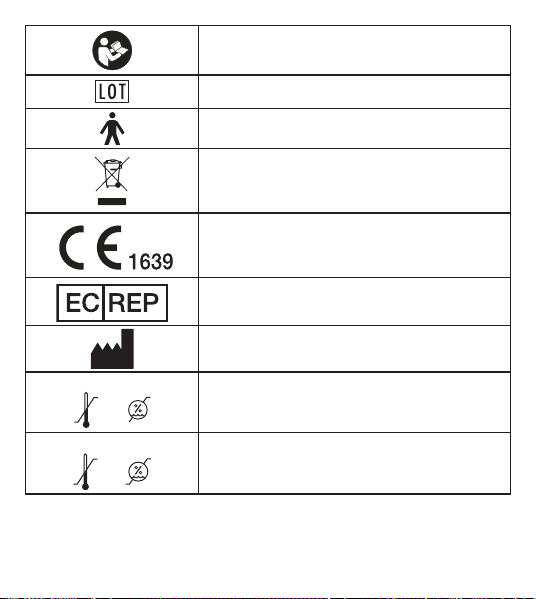
Respetar las instrucciones de uso.
Código de lote
Pieza de aplicación tipo B
Eliminación según la Directiva europea sobre
residuos de aparatos eléctricos y electróni-
cos (RAEE)
Marcado CE
Este producto cumple los requisitos de las
directivas europeas y nacionales vigentes.
Representante autorizado de la UE para fab-
ricantes de productos sanitarios
Fabricante
Storage/Transport
Temperatura y humedad de almacenamiento
y transporte admisibles
Operating
Temperatura y humedad de funcionamiento
admisibles
67
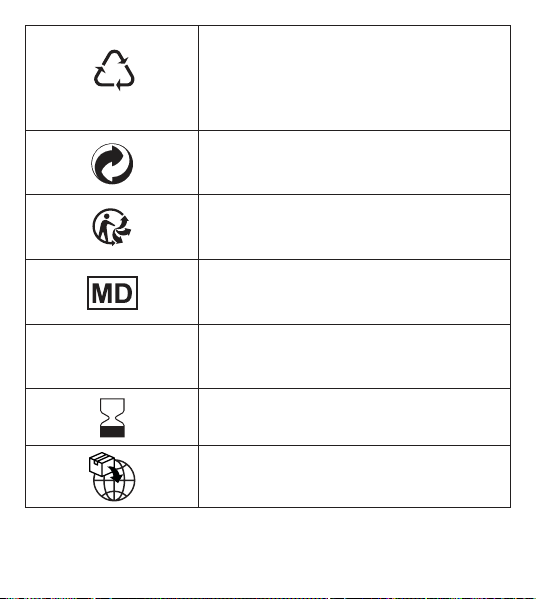
B
A
Etiquetado para identificar el material de
embalaje.
A = abreviatura del material, B = número
de material: 1-7 = plásticos, 20-22 = papel
y cartón
Separe los componentes del envase y
elimínelos conforme a las disposiciones
municipales.
Separe el producto y los componentes del
envase y elimínelos conforme a las disposi-
ciones municipales.
Producto sanitario
IP 41
Aparato con protección contra cuerpos ext-
raños sólidos con un diámetro ≥1mm y con-
tra goteo vertical de agua
Se puede utilizar hasta
Símbolo del importador

68
3. INDICACIONES DE ADVERTENCIA Y DE
SEGURIDAD
ADVERTENCIA
• Antes de utilizar los audífonos, acuda a un médico o a un especialis-
ta en audiología para que revisen su audición. El ajuste de los audí-
fonos debe ser realizado exclusivamente por un experto, ya sea un
otorrinolaringólogo, un audiólogo o un empleado cualificado de un
establecimiento especializado en estos aparatos.
• Si padece alguna dolencia en el oído o la ha padecido en el pasado,
consulte a su médico antes de utilizar los audífonos.
• NO está permitido su uso en pacientes que sufren inflamaciones o
infecciones de oído.
• NO utilice los audífonos si padece una otitis media o sufre una infla-
mación del conducto auditivo.
• Si siente dolor o malestar cuando lleva los audífonos, deje de usarlos
y consulte a su médico.
• Si se le inflama el oído, se le irrita la piel o aumenta el cerumen cu-
ando lleva los audífonos, deje de usarlos y consulte a su médico.
• Deje de utilizar los audífonos y consulte a un médico en los sigui-
entes casos:

69
- Sarpullido o eccemas en zonas de la piel en contacto con los au-
dífonos. (Los audífonos están fabricados con un material que no
irrita la piel. Sin embargo, en raras ocasiones pueden producirse
reacciones alérgicas que se manifestarán posiblemente en forma
de eccemas).
- El uso de los audífonos hace que secrete el oído o hace necesario
el tratamiento del mismo.
- La capacidad auditiva disminuye considerablemente de forma re-
pentina.
• Si se quedan piezas del audífono en el oído, acuda inmediatamente a
un médico. No intente extraer las piezas usted mismo.
• Ajuste el volumen primero en un nivel bajo y auméntelo progresiva-
mente cuando se haya acostumbrado a los audífonos.
• NO ajuste el botón del volumen demasiado alto, ya que esto puede
dañar a largo plazo la capacidad auditiva.
• NO preste sus audífonos a otras personas ni utilice los de otras per-
sonas. Existe riesgo de sufrir pérdida auditiva y de contraer infec-
ciones.
• NO dé sus audífonos a otras personas para que los utilicen. La uti-
lización de un audífono fabricado para otra persona puede causar
daños auditivos.
• Los audífonos NO se deben utilizar en niños menores de 12 años.
• Los problemas auditivos son especialmente difíciles de diagnosticar
en niños. Solo un otorrinolaringólogo debería prescribir un audífono
a un niño tras someterlo a un examen exhaustivo.

70
• Mantenga los audífonos, los accesorios y las baterías lejos del al-
cance de los niños; existe peligro de lesiones y de atragantamiento.
• Este aparato NO debe ser utilizado por personas (niños incluidos)
con facultades físicas, sensoriales o mentales limitadas, o con poca
experiencia o conocimientos, a no ser que las vigile una persona re-
sponsable de su seguridad o que esta persona les indique cómo ha-
cerlo. Se debe vigilar a los niños para que no jueguen con el aparato.
• NO utilice los audífonos en entornos explosivos ni peligrosos.
• NO utilice los aparatos en entornos ricos en oxígeno ni durante un
periodo de tiempo prolongado.
• Póngase en contacto con el fabricante en los siguientes casos:
- si necesita ayuda para configurar, utilizar o limpiar los audífonos; o
- si los aparatos tienen un comportamiento inesperado durante su
funcionamiento o si ocurre cualquier otro incidente.
• En caso de duda, NO utilice un audífono dañado y diríjase a su dis-
tribuidor o a la dirección del servicio de atención al cliente indicada.
• Apague los aparatos de inmediato si presentan defectos o se produ-
cen fallos de funcionamiento.
• No intente bajo ninguna circunstancia abrir y/o reparar los audífonos.
Las reparaciones solo deberán realizarlas el servicio de atención al
cliente o distribuidores autorizados. El incumplimiento de esta dispo-
sición anula la garantía.
71
Indicaciones para la manipulación de baterías:
• En caso de que el líquido de una batería entre en contacto con la
piel o los ojos, lave la zona afectada con agua y busque asistencia
médica.
•
¡Peligro de atragantamiento! Los niños pequeños podrían tra-
garse las baterías y asfixiarse. ¡Guarde las baterías fuera del alcance
de los niños!
• Si se derrama el líquido de una batería, póngase guantes protectores
y elimine el aparato.
• Proteja las baterías de un calor excesivo.
• ¡Peligro de explosión! No arroje baterías al fuego.
• Si no va a utilizar el aparato durante un periodo de tiempo prolonga-
do, retire las baterías.
• No despiece, abra ni triture las baterías.
• Utilice solo los cargadores indicados en las instrucciones de uso.
• Las baterías deben estar correctamente cargadas antes de su uso.
Para una carga correcta, deben cumplirse en todo momento las indi-
caciones del fabricante o las de estas instrucciones de uso.
• Cargue completamente la batería antes de la primera puesta en fun-
cionamiento (véase el capítulo 6).
• Cargue completamente la batería al menos 4 veces al año para pro-
longar su vida útil el mayor tiempo posible.
ATENCIÓN
• NO utilice los audífonos cuando se encuentre cerca de campos elec-
tromagnéticos intensos o rayos X.

72
• NO utilice los audífonos mientras se bañe, nade o se duche.
• Proteja los aparatos de impactos, humedad, suciedad, grandes os-
cilaciones térmicas, exposición directa a los rayos del sol y alta hu-
medad ambiental.
• En vehículos cerrados la temperatura puede llegar a ser muy alta en
verano. Por tanto, no deje nunca los audífonos en el coche.
• NO sacuda los aparatos NI los deje caer.
• Si se caen al agua, séquelos con un paño y llévelos a su distribuidor
para que los examine.
• No intente nunca secar los audífonos en un microondas o una seca-
dora o con un secador de pelo. Si lo hace, pueden resultar dañados.
• NO utilice los audífonos junto con un teléfono móvil. (Las ondas ra-
dioeléctricas de los teléfonos móviles pueden causar interferencias
o atenuar el volumen).
• NO utilice los audífonos junto con productos cosméticos (p.ej., ma-
quillaje, laca, perfume o crema solar).
• NO utilice los audífonos mientras se someta a terapias de ondas cor-
tas o a tratamientos médicos en los que pueden formarse intensos
campos magnéticos o de radiofrecuencia.
• Manipule con cuidado los botones. NO los apriete demasiado.
• No introduzca ningún objeto puntiagudo en la abertura del micrófo-
no, ya que hacerlo puede dañarlo.
• NO toque el imán del audífono, ya que hacerlo puede dañar el apa-
rato.
• NO toque el interior del aparato. En él se encuentran muchas piezas
sensibles ajustadas con precisión. No clave en ningún caso agujas u
objetos similares en el interior del audífono.
73
• Someta los audífonos a revisiones periódicas. Asegúrese de que no
haya ningún cuerpo extraño entre la almohadilla y el altavoz, ya que
esto podría afectar a la calidad del sonido.
4. USO CORRECTO
Utilice los audífonos únicamente para mejorar la capacidad auditiva de
personas. Los aparatos se han diseñado únicamente para el fin descrito
en estas instrucciones de uso. El fabricante no se responsabiliza de los
daños derivados de un uso inadecuado o irresponsable.
5. DESCRIPCIÓN DEL APARATO
Los esquemas correspondientes se muestran en la página 3.
1
Almohadilla
2
Almohadillas de diferentes
tamaños
3
Micrófono
4
Regulación del volumen
5
Interruptor de alimentación
(N=encendido, O=apagado)
6
Altavoz
7
Conexión
8
Estación de carga
9
Ranuras de carga
10
Cepillo de limpieza
11
Estuche para guardarlo
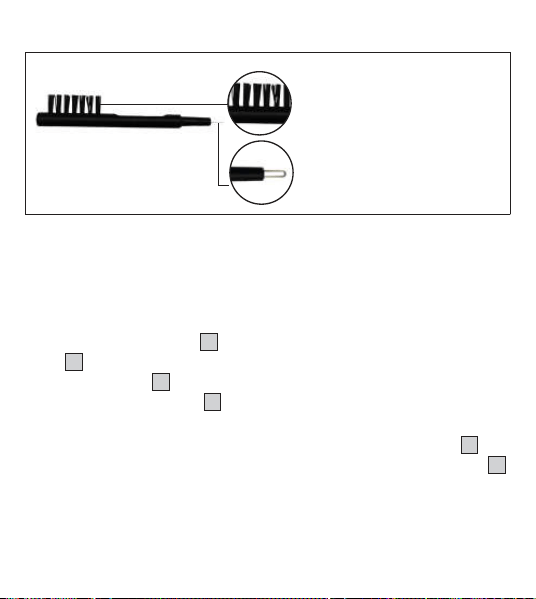
74
Cepillo de limpieza
Cepillo
Para limpiar los audífonos
Lazo
Para eliminar el cerumen
de la almohadilla
6. PUESTA EN FUNCIONAMIENTO
Saque los audífonos del embalaje y asegúrese de que tanto estos como
todos los accesorios estén incluidos y de que no presentan daños.
Elección de la almohadilla adecuada
Seleccione la almohadilla
1
del tamaño adecuado y colóquela en el al-
tavoz
6
.
1. La almohadilla
1
deberá quedar suelta y cómoda en el oído. Pruebe
distintas almohadillas
2
hasta que encuentre la que le resulte más
cómoda.
2. Si el aparato emite un pitido, asegúrese de que la almohadilla
1
esté
bien colocada en el oído. Si es necesario, utilice otra almohadilla
2
.
Si el volumen es demasiado bajo incluso cuando el volumen está alto,
es posible que sea necesario cargar la batería. Consulte las instruc-
ciones de carga siguientes.

75
Uso de los audífonos
1. Gire el control del volumen al mínimo.
2.
Coloque el aparato en el oído e introduzca la almohadilla
1
en el
canal auditivo hasta que quede bien ajustada. No la fuerce para int-
roducirla en el oído.
3. Coloque el interruptor de alimentación
5
en la posición «N» y ajuste
el volumen a un nivel adecuado
4
.
Carga:
1.
Asegúrese de que el aparato esté apagado y, a continuación, insértelo
en una de las ranuras de la estación de carga
8
hasta que se encaje.
Nota: Asegúrese de colocarlo correctamente en la estación de carga
8
para poder cargarlo correctamente. La estación de carga
8
está
equipada con ranuras de carga
9
que le permiten colocar el aparato
en la posición correcta. Encaje el aparato en una de estas ranuras de
carga
9
A1
de forma que el interruptor de alimentación
5
quede
situado en la abertura
A2
.
Puede cargar uno o ambos audífonos a la vez.
2. Conecte la estación de carga
8
a un adaptador USB para su uso en
una toma de corriente o enchufe la estación de carga
8
directamente
a una toma USB sin adaptador USB.
3.
Durante la carga, el LED de carga se ilumina en color rojo. Una vez
finalizada la carga, el LED de carga se ilumina en color verde. Normal-
mente, una carga completa dura unas 7 horas.
4.
Una vez concluido el proceso de carga, desconecte la estación de
carga
8
de la red y retire los audífonos de la estación.
76
Colocación de la cápsula secante
B
Entre los productos suministrados se incluye una cápsula secante. Al
llevarlos colocados detrás de la oreja, los audífonos entran en contacto
con la piel y, por ejemplo, también con el sudor. Por lo tanto, para cuidar
los aparatos se recomienda secarlos después de cada uso.
Retire el embalaje de la cápsula secante e introdúzcala en el estuche para
guardarla
11
con la cara inferior hacia arriba.
La cápsula contiene un indicador de color. A medida que la capacidad
de secado disminuye, el color cambia de naranja intenso a blanco. Cu-
ando la cápsula presenta un color blanquecino, ya no tiene capacidad de
secado y deberá sustituirse.
Encontrará información sobre dónde adquirir una nueva cápsula secante
en el capítulo “Accesorios y piezas de repuesto”.
Nota: Para obtener un resultado de secado óptimo, cierre la tapa del
estuche para guardarlo
11
después de haber introducido los audífonos.
7. LIMPIEZA Y CUIDADO
ATENCIÓN
• Mantenga el audífono siempre limpio.
• Maneje siempre los productos con cuidado e impida que la almo-
hadilla
1
o el micrófono
4
se taponen con cuerpos extraños. Esto
afecta a la función de amplificación del sonido.
• Limpie los audífonos y las almohadillas
1
con un paño limpio y seco
cada vez que los use. Si hay mucha suciedad, puede humedecer
77
el paño también con agua ligeramente jabonosa. No utilice nunca
productos de limpieza abrasivos, corrosivos o que contengan disol-
ventes.
• No sumerja nunca el audífono en agua, ya que podría penetrar en
él y dañarlo.
• El cepillo adjunto sirve para eliminar cerumen adherido a la almo-
hadilla
1
(v. la descripción de los aparatos).
• Después de limpiar el audífono, deje que se seque completamente.
Guárdelos en un lugar seguro, seco y limpio dentro del estuche cor-
respondiente
11
con la cápsula secante.
• La cápsula secante debe sustituirse si el color del granulado cambia
de naranja a blanco (encontrará información sobre dónde adquirir
una nueva cápsula secante en el capítulo “Accesorios y piezas de
repuesto”).
8. ACCESORIOS Y PIEZAS DE REPUESTO
Puede adquirir los accesorios y las piezas de repuesto en la dirección
del servicio técnico correspondiente indicando el número de referencia.
Denominación Número de artículo o de pedido
Cápsulas secantes
HA 55/60/80/85 8 ud.
641.15
Almohadilla, HA 55 6 pcs. 164.381
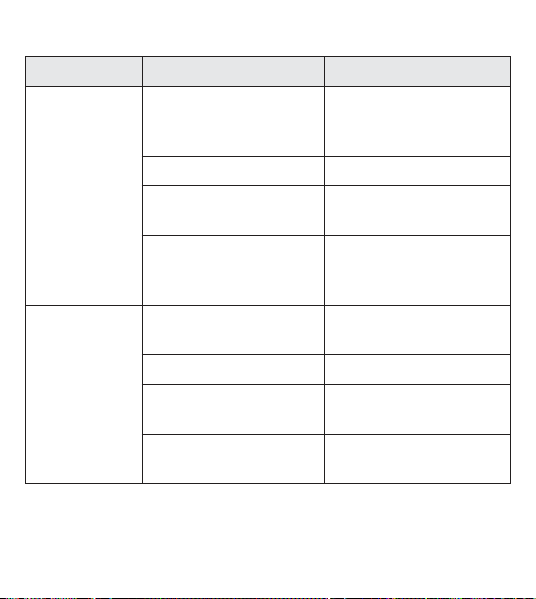
78
9. RESOLUCIÓN DE PROBLEMAS
Problema Posible causa Solución
Sin sonido. El aparato no está
encendido.
Coloque el interruptor de
encendido en la posición
de encendido.
La batería está gastada. Cargue la batería.
Micrófono sucio/obs-
truido.
Limpie el micrófono.
El aparato está dañado. Póngase en contacto
con el servicio de aten-
ción al cliente.
Volumen bajo. Se ha bajado demasia-
do el volumen.
Gire el control de volu-
men para subirlo.
La batería está gastada. Cargue la batería.
Almohadilla sucia/obs-
truida.
Limpie la almohadilla.
Micrófono sucio/obs-
truido.
Limpie el micrófono.

79
Problema Posible causa Solución
Se ha subido
demasiado el
micrófono.
La almohadilla del
audífono no está bien
colocado en el oído, por
lo que es posible que no
funcione correctamente
o que suene un silbido
desagradable (retroali-
mentación acústica).
Apague el audífono e
introdúzcalo en el oído.
Asegúrese de que el
audífono esté colocado
correctamente.
Si la almohadilla no
encaja bien en el oído,
inténtelo con otro tama-
ño. Utilice, en la medida
de lo posible, una al-
mohadilla que encaje
correctamente. En caso
de duda, póngase en
contacto con el servicio
de atención al cliente.

80
Problema Posible causa Solución
El aparato
emite un
silbido fuerte
(retroa-
limentación
acústica).
La almohadilla del
audífono no está bien
colocada en el oído, por
lo que puede producirse
una retroalimentación
entre el altavoz y los
micrófonos.
Introduzca un poco más
la almohadilla en el oído
o elija una versión más
grande.
Compruebe si hay pelo,
parte del pabellón de la
oreja o una patilla de las
gafas encima de la aber-
tura del micrófono del
aparato. Eso favorece
los silbidos desagra-
dables.
Los audífonos
no se están
cargando.
Los audífonos no están
bien colocados en la
estación de carga.
Apague el audífono
antes de cargarlo.
No se ha apagado
el audífono antes de
cargarlo.
Compruebe que el audí-
fono esté correctamente
colocado en la estación
de carga.
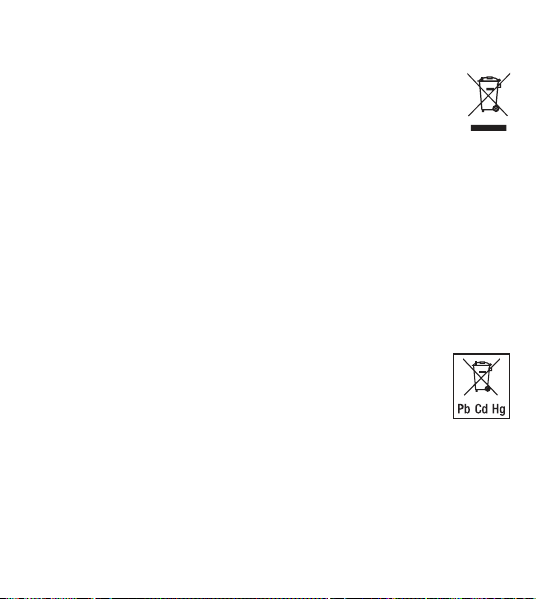
81
10. ELIMINACIÓN
Eliminación general
Para proteger el medio ambiente, el aparato no se debe desechar
al final de su vida útil junto con la basura doméstica. Se puede
de sechar en los puntos de recogida adecuados disponibles en
su zona. Deseche el aparato según la Directiva europea sobre residuos
de aparatos eléctricos y electrónicos (RAEE). Para más información, pón-
gase en contacto con la autoridad municipal competente en materia de
eliminación de residuos.
Eliminación de baterías
• Las baterías usadas, completamente descargadas, deben elimi-
narse a través de contenedores de recogida señalados de forma
especial, los puntos de recogida de residuos especiales o a través
de los distribuidores de equipos electrónicos. Los usuarios están
obligados por ley a eliminar las baterías correctamente.
• Estos símbolos se encuentran en baterías que contienen
sustancias tóxicas:
Pb: la pila contiene plomo,
Cd: la pila contiene cadmio,
Hg: la pila contiene mercurio.

82
11. DATOS TÉCNICOS SEGÚN IEC 60118-
7:2005
Tipo HA 55
Máx. nivel de presión acústica
(OSPL90)
≤128 ±3 dB
Amplificación de sonido ≤50 ±3 dB
Rango de frecuencias 500–3200 Hz
Distorsión armónica total ≤10%
Alimentación ≤10 mA
Tiempo de carga 7–10 horas
Tiempo de funcionamiento 16 horas
Dimensiones 40 × 13 × 10 mm
Peso 4,3 g
Rango de temperatura de funci-
onamiento
0–40 °C,
humedad relativa del aire: ≤90%
Intervalo de temperatura de
transporte/almacenamiento
-10–55 °C,
humedad relativa del aire: ≤90%
Reservado el derecho a realizar modificaciones de los datos técnicos sin
previo aviso por razones de actualización.

83
12. GARANTÍA / ASISTENCIA
Encontrará más información sobre la garantía y sus condiciones en el
folleto de garantía suministrado.
Salvo errores y modificaciones
84
641.32_HA55 Pair_med_2022-05-30_04_IM1a_BEU
Distributed by: Beurer GmbH
•
Söflinger Str. 218
89077 Ulm (Germany)
•
www.beurer.com
www.beurer-gesundheitsratgeber.com
www.beurer-healthguide.com
EC REP
Shanghai International Holding Corporation GmbH (Europe)
Eiestrasse 80, 20537 Hamburg, Deutschland
Huizhou Jinghao Medical Technology Co., Ltd
FL6, Huicheng Industry Bld, Zhongkai Hightech Zone,
Huizhou, 516000, Guangdong, China
Beurer UK Ltd., Suite 16, Stonecross Place
Yew Tree Way, WA3 2SH Golborne
United Kingdom