
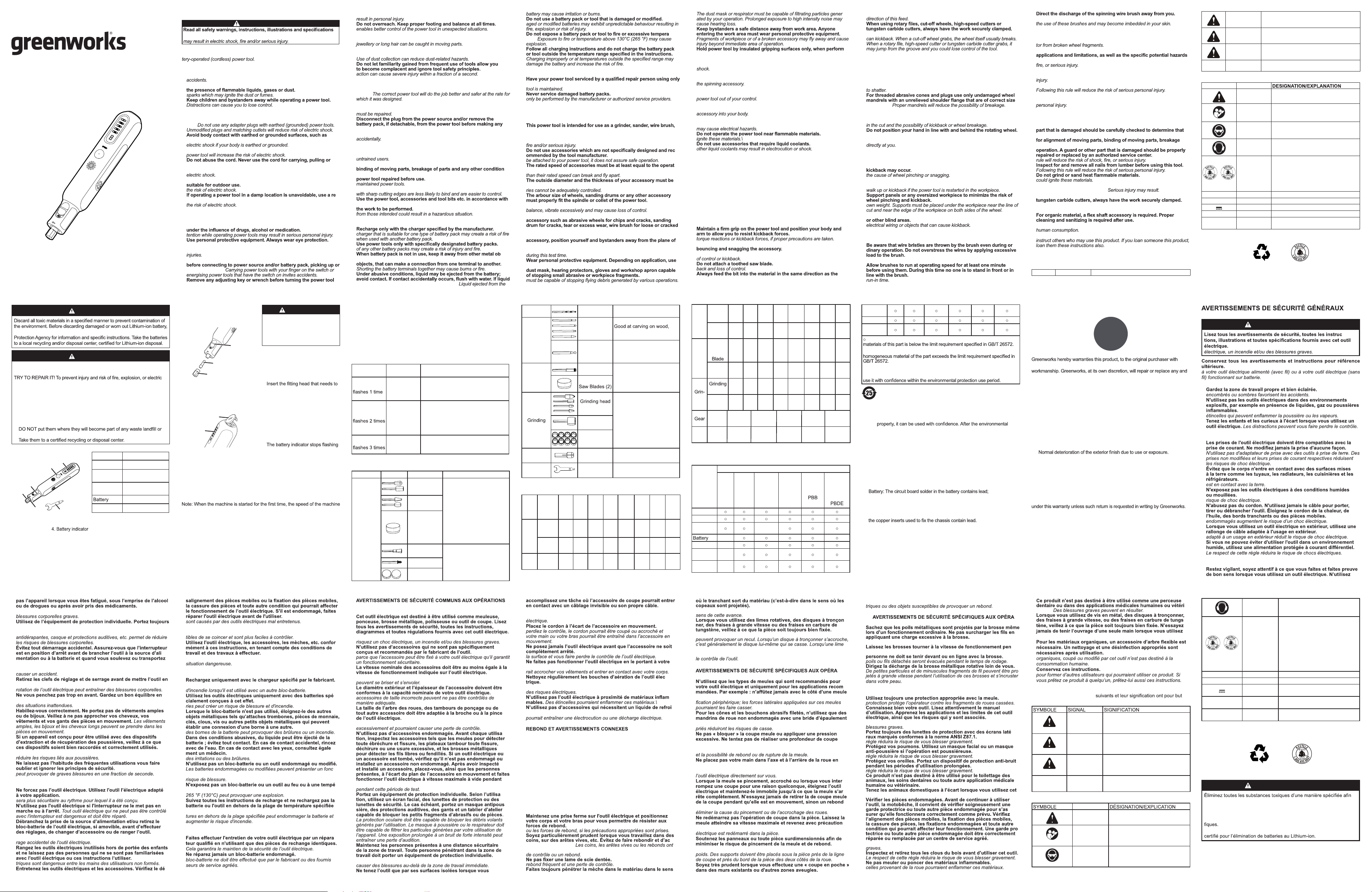
GENERAL POWER TOOL SAFETY WARNINGS
provided with this power tool. Failure to follow all instructions listed below
Save all warnings and instructions for future reference. The term “power
tool” in the warnings refers to your mainsoperated (corded) power tool or bat-
1) WORK AREA SAFETY
• Keep work area clean and well lit. Cluttered or dark areas invite
• Do not operate power tools in explosive atmospheres, such as in
Power tools create
•
2) ELECTRICAL SAFETY
• Power tool plugs must match the outlet. Never modify the plug in any
way.
•
pipes, radiators, ranges and refrigerators. There is an increased risk of
• Do not expose power tools to rain or wet conditions. Water entering a
•
unplugging the power tool. Keep cord away from heat, oil, sharp
edges or moving parts. Damaged or entangled cords increase the risk of
• When operating a power tool outdoors, use an extension cord
Use of a cord suitable for outdoor use reduces
• -
sidual current device (RCD) protected supply. Use of an RCD reduces
3) PERSONAL SAFETY
• Stay alert, watch what you are doing and use common sense when
operating a power tool. Do not use a power tool while you are tired or
A moment of inat-
•
Protective equipment such as a dust mask, non-skid safety shoes, hard hat
, or hearing protection used for appropriate conditions will reduce personal
• Prevent unintentional starting. Ensure the switch is in the off-position
carrying the tool.
•
DANGER Indicates an imminently hazardous situation,
which, if not avoided, will result in death or
serious injury.
WARNING Indicates a potentially hazardous situation,
which, if not avoided, could result in death or
serious injury.
CAUTION Indicates a potentially hazardous situation,
which, if not avoided, may result in minor or
moderate injury.
CAUTION (Without Safety Alert Symbol) Indicates a
situation that may result in property damage.
SYMBOLS ON THE PRODUCT
SYMBOL NAME
Safety Alert
Indicates a potential personal injury
hazard.
Read The
Operator’s
Manual
To reduce the risk of injury, user must
read and understand operator’s manual
before using this product.
Eye Protection
Always wear eye protection with side
shields marked to comply with ANSI
Z87.1.
Wear eye
protection
Wear ear protection when operating this
equipment.
Recycle
Symbols
This product uses nickel-cadmium (Ni-Cd)
and lithium-ion (Li-ion) batteries. Local,
state or federal laws may prohibit disposal
of batteries in ordinary trash. Consult
your local waste authority for information
regarding available recycling and/or
disposal options.
V Volts Voltage
min Minutes Time
Direct Current Type or a characteristic of current
n Rated Speed Rotational speed
.../min Per Minute
Revolutions, strokes, surface speed,
orbits etc., per minute
ENVIRONMENTALLY SAFE BATTERY DISPOSAL
The toxic and corrosive materials below are in the batteries used in this
machine: Lithium-ion, a toxic material.
AKG302
2 - EN
9 - EN 10 - EN 11 - EN 12 - EN 13 - EN 14 - EN 15 - EN 2 - FR
3 - EN 4 - EN 5 - EN 6 - EN 7 - EN 8 - EN
ROTARY TOOL
OUTIL ROTATIF
HERRAMIENTA ROTATIVA
OPERATOR MANUAL
MANUEL DE L’UTILISATEUR
MANUAL DEL OPERARIO
EN
FR
ES
www.greenworkstools.com
WARNINGS
on. A wrench or a key left attached to a rotating part of the power tool may
• This
• Dress properly. Do not wear loose clothing or jewellery. Keep your
hair, clothing and gloves away from moving parts. Loose clothes,
• If devices are provided for the connection of dust extraction and
collection facilities, ensure these are connected and properly used.
•
A careless
4) POWER TOOL USE AND CARE
• Do not force the power tool. Use the correct power tool for your appli-
cation.
• Do not use the power tool if the switch does not turn it on and off.
Any power tool that cannot be controlled with the switch is dangerous and
•
adjustments, changing accessories, or storing power tools . Such
preventive safety measures reduce the risk of starting the power tool
• Store idle power tools out of the reach of children and do not allow
persons unfamiliar with the power tool or these instructions to
operate the power tool. Power tools are dangerous in the hands of
• Maintain power tools and accessories. Check for misalignment or
that may affect the power tool’s operation. If damaged, have the
Many accidents are caused by poorly
• Keep cutting tools sharp and clean. Properly maintained cutting tools
•
these instructions, taking into account the working conditions and
Use of the power tool for operations different
5) BATTERY TOOL USE AND CARE
• A
• Use
• -
jects, like paper clips, coins, keys, nails, screws or other small metal
•
contacts eyes, additionally seek medical help.
• Dam-
• -
ture.
•
6) SERVICE
•
identical replacement parts. This will ensure that the safety of the power
• Service of battery packs should
7) SAFETY WARNINGS COMMON FOR GRINDING, SANDING, WIRE
BRUSHING, POLISHING, CARVING OR ABRASIVE CUTTING-OFF
OPERATIONS
•
polisher or cut-off tool. Read all safety warnings, instructions,
diagrams and regulations provided with this power tool. Failure to
understand all of the instructions listed below will result in electric shock,
• -
Just because the accessory can
• -
ing speed setting marked on the power tool. Accessories running faster
•
within the capacity rating of your power tool. Incorrectly sized accesso-
•
Accessories
that do not match the mounting hardware of the power tool will run out of
• Do not use a damaged accessory. Before each use inspect the
wires. If power tool or accessory is dropped, inspect for damage or
install an undamaged accessory. After inspecting and installing an
the rotating accessory and run the power tool at maximum no-load
speed for one minute. Damaged accessories will normally break apart
•
face shield, safety goggles or safety glasses. As appropriate, wear
The eye protection
-
•
• -
ing an operation where the cutting accessory may contact hidden
wiring. Cutting accessory contacting a “live” wire may make exposed
metal parts of the power tool “live” and could give the operator an electric
• Position the cord clear of the spinning accessory. If you lose control,
the cord may be cut or snagged and your hand or arm may be pulled into
• Never lay the power tool down until the accessory has come to a
complete stop. The spinning accessory may grab the surface and pull the
• Do not run the power tool while carrying it at your side. Accidental
contact with the spinning accessory could snag your clothing, pulling the
• Regularly clean the power tool’s air vents. The motor’s fan will draw the
dust inside the housing and excessive accumulation of powdered metal
• Sparks could
• Using water or
8) KICKBACK AND RELATED WARNINGS
Kickback is a sudden reaction to a pinched or snagged rotating wheel, sand-
ing band, brush or any other accessory. Pinching or snagging causes rapid
stalling of the rotating accessory which in turn causes the uncontrolled power
tool to be forced in the direction opposite of the accessory’s rotation.
For example, if an abrasive wheel is snagged or pinched by the workpiece,
the edge of the wheel that is entering into the pinch point can dig into the
surface of the material causing the wheel to climb out or kick out. The wheel
may either jump toward or away from the operator, depending on direction
of the wheel’s movement at the point of pinching. Abrasive wheels may also
break under these conditions.
Kickback is the result of power tool mis
use and/or incorrect operating pro-
cedures or conditions and can be avoided by taking proper precautions as
given below.
•
The operator can control
• Use special care when working corners, sharp edges, etc. Avoid
Corners, sharp edges or
bouncing have a tendency to snag the rotating accessory and cause loss
• Such blades create frequent kick-
•
cutting edge is exiting from the material (which is the same direction
as the chips are thrown). Feeding the tool in the wrong direction causes
the cutting edge of the bit to climb out of the work and pull the tool in the
•
These wheels will grab if they become slightly canted in the groove, and
9) SAFETY WARNINGS SPECIFIC FOR GRINDING AND ABRASIVE
CUTTING-OFF OPERATIONS:
• Use only wheel types that are recommended for your power tool
and only for recommended applications. For example: do not grind
with the side of a cut-off wheel. Abrasive cut-off wheels are intended for
peripheral grinding, side forces applied to these wheels may cause them
•
and length.
• Do not “jam” a cut-off wheel or apply excessive pressure. Do not
attempt to make an excessive depth of cut. Overstressing the wheel
increases the loading and susceptibility to twisting or snagging of the wheel
•
When the wheel, at the point of operation, is moving away from your hand,
the possible kickback may propel the spinning wheel and the power tool
• When wheel is pinched, snagged or when interrupting a cut for any
reason, switch off the power tool and hold the power tool motionless
until the wheel comes to a complete stop. Never attempt to remove
the cut-off wheel from the cut while the wheel is in motion otherwise
Investigate and take corrective action to eliminate
• Do not restart the cutting operation in the workpiece. Let the wheel
reach full speed and carefully re-enter the cut. The wheel may bind,
•
Large workpieces tend to sag under their
• Use extra caution when making a “pocket cut” into existing walls
The protruding wheel may cut gas or water pipes,
11) SAFETY WARNINGS SPECIFIC FOR WIRE BRUSHING OPERA-
TIONS:
• -
The wire bristles can easily penetrate light clothing and/
or skin.
•
Loose bristles or wires will be discharged during the
• Small
particles and tiny wire fragments may be discharged at high velocity during
12) ADDITIONAL SAFETY RULES
• Always use proper guard with grinding wheel. A guard protects opera-
• Know your power tool. Read operator’s manual carefully. Learn its
related to this tool. Following this rule will reduce the risk of electric shock,
• Always wear eye protection with side shields marked to comply with
ANSI Z87.1. Following this rule will reduce the risk of serious personal
• Protect your lungs. Wear a face or dust mask if the operation is dusty.
• Protect your hearing. Wear hearing protection during extended
periods of operation. Following this rule will reduce the risk of serious
• This product is not intended for use with pet grooming, dental work,
or any human or veterinarian medical applications.
• Keep pets away while operating this tool.
• Check damaged parts. Before further use of the tool, a guard or other
it will operate properly and perform its intended function. Check
of parts, mounting, and any other conditions that may affect its
Following this
•
• Sparks from the wheel
• This product is not intended for use as a dental drill or in human or
veterinary medical applications.
• When using steel screws, cut-off wheels, high speed cutters, or
Never attempt to hold the work with one hand while using any of
these accessories.
•
Any material including
organic material cut or altered by this tool is not intended nor suitable for
• Save these instructions.
Refer to them frequently and use them to
SYMBOLS
The following signal words and meanings are intended to explain the levels of
risk associated with this product.
SYMBOL SIGNAL MEANING
Working
head
Chuck
Other
parts
:
Indicates that the content of this hazardous substance in all homogeneous
×
:
Indicates that the content of the hazardous substance in at least one
Due to the production process and technology and other reasons, some of
the components listed above in the product exceed the limit requirements, but
they are all exempted from the EU's control of hazardous substances. Please
This product contains certain harmful substances, and its
environmental protection use period is 25 years. During the
environmental protection use period from the production date, the
toxic, harmful substances or elements in the product will not leak or
mutate, and the use of this product will not harm the environment. If
it causes serious pollution or bad damage to the user's personal and
protection use period is exceeded, it should enter the recycling
system. "Environmentally friendly use period" is not a safe use
period, especially different from the limited use period based on
electrical performance safety, electromagnetic safety and other
factors. The "Environmentally Friendly Use Period" is also not a
product warranty period.
instruction:
4. Switch: contacts contain cadmium;
5. Charging cable: lead is contained in the copper alloy of the pins of the plug
power cable;
6.
7. Circuit board: lead in solder;
8. Motor: lead in the copper brush holder of the brushed motor and lead in the
oil bearing;
9. Copper inserts: The copper inserts in the junction block contain lead and
OVERVIEW
1. Collet nut
2.ON/OFF button
3. Speed control
button
5. Wrench 6. LED lights
TECHNICAL DATA
Voltage 8 V DC
Charge input 5 V
,
2 A
Speed
Settings
5000-30000 r/min
Collet
Capacities
3/32"/1/8"(2.4 mm
/3.2 mm)
lithium-ion battery
Charger Type-C
2
3
4
5
6
1
INSTALL THE ACCESSO-
RIES
WARNING!
Do not replace or use accessories
not recommended by the manufac-
turer.
Always make sure the machine is
turned off before installing accesso-
ries.
1. Push the on/off button (2) to the
OFF position.
2. Use a wrench (5) to unscrew the
collet nut (1).
3. Insert a suitable collet (7) and screw
back the collet nut.
4.
be installed.
5. Tighten the collet nut.
CHARGING
Note: When the power is displayed
below 25% and the red indicator is
on, the battery must be charged.
1. Open the back cover of the ma-
chine (8).
2. Plug in the charging cable connec-
tor.
3. Insert the charger plug into a power
outlet. The battery indicator (4)
lights up and shows the charging
status.
4.
and the battery is fully charged.
5. Unplug the connector from the
machine and unplug the charger
from the outlet.
1
7
2
4
8
OPERATION
START THE MACHINE
1. Push the ON/OFF button (2) to the ON position, the LED light will light up.
2. Press the speed control button (3) to adjust the speed of the machine.
is in the 3rd gear. Each time it is pressed, the speed will increase by one gear
until the 6th gear. On time again, go back to gear 1, and so on.
STOP THE MACHINE
1. Push the ON/OFF button to the OFF position, the LED light will turn off
after 10 s.
Note: If the machine is started within 10 s, the gear speed will remain un-
changed; after 10 s, the gear speed will return to the 3rd gear.
MAINTENANCE
• Disconnect the power tool from the power source (ie, unplug from the
power source, remove disabled devices or removable batteries) before
performing maintenance or cleaning work.
• Do not use strong solvents or cleaning agents on plastic housings or parts.
• Clean the machine with a dry cloth. Do not use water.
• Please store the machine in a cool and dry place.
• When not in use, keep the machine out of the reach of children.
TROUBLESHOOTING
Problem
Possible
cause
Solution
Red light
Low power
1. Charge the machine.
2. Please check whether the operating
conditions meet the requirements of the
manual.
Red light Overcurrent/
short circuit
1. The machine is blocked, please check
whether the operating conditions meet
the requirements of the manual;
2. Restart the machine;
3. If the fault is still not resolved, please
send it for repair.
Red light Temperature
protection
Cool down the machine to room
temperature of 25°C and stop for at
least 90 minutes at room temperature.
ACCESSORIES
Function Image Name/Qty Application
Cleaning/
polishing
Wool Polishing
Wheels (2)
Suitable for polishing
on wood, plastic, steel,
aluminum, brass, shells, jade,
ceramics, etc.
Rubber
grinding
head
(2)
Frosted
Sandpaper
Sheets (10)
/ Cutting
Sandpaper
Sheets (10)
Wire brush (1)
Ideal for cleaning on wood,
plastic, steel, aluminium,
brass, shells, jade, ceramics
and more.
Felt rod core
(1)
Felt (2)
Drilling Drill (1)
Suitable for drilling in wood,
plastic, etc.
Carving
Diamond
grinding needle
(4)
plastic and other materials.
Milling cutter
(1)
Suitable for detailed engraving
operations on wood, plastic,
steel, aluminum, brass, shells,
jade, ceramics, glass, etc.
Cutting
Cutting blade
core (1)
Suitable for cutting operations
on steel, aluminum, brass,
wood, etc.
Stainless Steel
(4)
Suitable for grinding
operations on plastics, steel,
aluminum, brass, shells, jade,
ceramics, etc.
Sand ring core
(1)
Sand Rings (8)
Chuck
accessories
Chuck (1) Install other accessories.
Wrench
Wrench
(
1
)
lock the chuck.
ACCESSORY GEAR SETTING
Func-
-tion
Name
Cork
wood
Hard
wood
Plas-
-tic
Steel
Alum-
-inum,
brass,
etc
Shells,
stone
cera-
-mics
glass
Clea-
-ing/
polis-
-hing
Steel
wire
brush
1-4 1-4 1-4 1-4 1-4 1-4 1-4 1-4
Felt/core 3-6 3-6 3-6 3-6 3-6 3-6 3-6 3-6
Drill-
-ing
Drill 4-6 4-6 4-6 / / / / /
Carv-
-ing
Diamond
grinding
needle
3-6 3-6 3-6 3-6 3-6 3-6 3-6 3-6
Milling
cutter
3-6 3-6 3-6 / / / / /
Cutt-
-ing
Stainless
Steel
Saw
/ / / / 4-6 4-6 4-6 4-6
Sand-
-paper
/ / / 4-6 4-6 / / /
-ding
head
/ / 4-6 4-6 4-6 4-6 4-6 /
Sand
ring
2-6 2-6 2-6 2-6 2-6 2-6 2-6 /
Speed
DECLARATION OF HAZARDOUS SUBSTANCES IN
PRODUCTS
Part name
Harmful materials
Lead
(
Pb
)
Mercury
(
Hg
)
Cadmium
(
Dd
)
Hexa-
-valent
chro-
-mium
(
Cr(VI)
)
Polybro-
-minated
biphenyls
( )
Polybro-
-minated
diphenyl
ethers
(
)
Shell
Switch
Charging
Cable
×
×
Motor ×
Circuit
board
×
Copper
inserts
×
1
5000±10%
RPM
10000±10%
RPM
15000±10%
RPM
20000±10%
RPM
25000±10%
RPM
30000±10%
RPM
2 3 4 5 6
LIMITED WARRANTY
proof of purchase, for a period of 3 years against defects in materials, parts or
all parts found to be defective, through normal use, free of charge to the cus-
tomer. This warranty is valid only for units which have been used for personal
use that have not been purchased or rented for industrial/commercial use, and
that have been maintained in accordance with the instructions in the owners’
manual supplied with the product when new.
ITEMS NOT COVERED BY WARRANTY:
1. Any part that has become inoperative due to misuse, commercial use,
abuse, neglect, accident, improper maintenance, or alteration; or
2. The unit, if it has not been operated and/or maintained in accordance with
the owner’s manual; or
3. Normal wear;
4. Routine maintenance items such as lubricants, blade sharpening;
5.
HELPLINE:
Warranty service is available by calling our toll-free helpline at 1-855-470-2181.
TRANSPORTATION CHARGES:
Transportation charges for the movement of any power equipment unit or
attachment are the responsibility of the purchaser. It is the purchaser’s respon-
sibility to pay transportation charges for any part submitted for replacement
Greenworks Tools
P.O. Box 1238
Mooresville, NC 28115
WARNING!
contact your local waste disposal agency, or the local Environmental
WARNING!
If the battery pack cracks or breaks, with or without leaks, do not recharge
it and do not use. Discard it and replace with a new battery pack. DO NOT
shock, and to avoid damage to the environment:
• Cover the terminals of the battery with heavy-duty adhesive tape.
• DO NOT try to remove or destroy any of the battery pack components.
• DO NOT try to open the battery pack.
• If a leak develops, the released electrolytes are corrosive and toxic. DO
NOT get the solution in the eyes or on skin, and do not swallow it.
• DO NOT put these batteries in your regular household trash.
• DO NOT incinerate.
•
municipal solid waste stream.
•
CONCERNANT LES OUTILS ÉLECTRIQUES
AVERTISSEMENT!
-
Le non-respect de ces instructions peut entraîner un choc
Le terme « outil électrique » dans les avertissements se réfère
1) SÉCURITÉ DE LA ZONE DE TRAVAIL
• Les endroits
•
La mise en marche des outils électriques crée des
•
2) SÉCURITÉ ÉLECTRIQUE
•
•
Il y a un risque accru de choc électrique si votre corps
•
L'eau qui pénètre dans un outil électrique augmente le
•
Les cordons
•
Utiliser un câble
•
3) SÉCURITÉ PERSONNELLE
•
saillie peut couper des conduites de gaz ou d'eau, des câbles élec-
11) -
TIONS DE BROSSAGE MÉTALLIQUE :
•
Les poils métalliques
peuvent facilement pénétrer dans les vêtements légers et/ou la peau.
• -
dant au moins une minute avant de les utiliser. Pendant ce temps,
Les
•
-
12) RÈGLES DE SÉCURITÉ SUPPLÉMENTAIRES
• Une
•
Suivre cette
consigne réduira le risque de décharge électrique, d’incendie ou de
• -
Le respect de cette
•
Le respect de cette
•
Le respect de cette
•
•
outil.
•
-
-
Suivre cette
consigne réduira le risque de décharge, d’incendie ou de blessures
•
• Des étin-
Un moment
d’inattention lors de l’utilisation d’un outil électrique peut provoquer des
•
des lunettes de protection. L’utilisation d’équipement de protection
adapté aux conditions, masque antipoussière, chaussures de sécurité
•
-
l’outil. Transporter un outil électrique avec un doigt sur l’interrupteur
ou brancher un outil dont l’interrupteur est en position de marche peut
•
marche. Une clef de réglage ou de serrage restée sur une pièce en
•
tout temps. Ceci permet un meilleur contrôle de l'outil électrique dans
•
•
L’utilisation de dispositifs de récupération des poussières permet de
•
Une action négligente
4) UTILISATION ET ENTRETIEN DES OUTILS ÉLECTRIQUES
•
L'outil électrique approprié fera mieux le travail et
•
•
De
telles mesures de sécurité préventives réduisent le risque d'un démar-
•
Les outils élec-
• -
De nombreux accidents
• Garder les outils de coupe propres et tranchants. Les outils de
coupe bien entretenus avec des bords tranchants sont moins suscep-
• -
L'utilisation de l'outil motorisé pour
des opérations différentes de celles prévues pourrait entraîner une
5) UTILISATION ET ENTRETIEN DE L’OUTIL À BATTERIE
•
Un chargeur adapté à un type de bloc-batterie peut créer un risque
• -
L'utilisation de tous autres bloc-batte-
•
Le court-circuitage
•
-
Le liquide s'échappant des batteries peut causer
•
-
tionnement imprévisible et provoquer un incendie, une explosion ou un
• -
rature excessive. L'exposition au feu ou une température supérieure à
•
dans ces instructions. Un rechargement incorrect ou à des tempéra-
6) SERVICE
•
-
• L'entretien d’un
-
7)
DE MEULAGE, PONÇAGE, BROSSAGE MÉTALLIQUE, POLISSAGE,
SCULPTURE OU TRONÇONNAGE ABRASIF
•
Si vous ne comprenez pas toutes les instructions ci-dessous, vous
•
Ce n’est pas
•
Les ac-
cessoires fonctionnant à une vitesse supérieure à leur vitesse nominale
•
Les
•
Les accessoires ne correspondent pas à la quin-
caillerie de montage de l’outil électrique seront déséquilibrés, vibreront
• -
une minute. Les accessoires endommagés se brisent normalement
• -
-
•
Des
fragments de pièces ou d’accessoires cassés peuvent s’envoler et
•
Les
accessoires de coupe en contact avec un câble sous tension peuvent
exposer des parties métalliques de l’outil et entraîner une décharge
•
Si vous
•
L’accessoire en mouvement pourrait accrocher
•
ceinture. Un contact accidentel avec l’accessoire en mouvement pour-
• -
Le ventilateur du moteur aspire la poussière à l’intérieur du boî-
tier et une accumulation excessive de poudre de métal peut provoquer
• -
• -
dissement. L’utilisation d’eau ou d’autres liquides de refroidissement
8)
Le rebond est une réaction soudaine à une roue rotative, une bande
abrasive, une brosse ou tout autre accessoire pincé ou accroché. Le
pincement ou l’accrochage provoque le blocage immédiat de l’accessoire
en rotation, ce qui entraîne à son tour le déplacement forcé de l’outil
électrique non contrôlé dans le sens opposé à la rotation.
Par exemple, si une meule abrasive est accrochée ou pincée par la pièce
à travailler, le bord de la meule qui entre dans le point où se produit le
pincement peut s’enfoncer dans la surface du matériau, de façon que
la meule en sorte en grimpant ou en s’éjectant. La meule peut sauter
vers l’opérateur ou s’éloigner de lui, selon la direction du mouvement de
la meule. Les meules abrasives peuvent également se briser dans ces
conditions.
Le rebond est le résultat d’une mauvaise utilisation de l’outil électrique et/
ou de procédures ou de conditions d’utilisation incorrectes et peut être
évité en prenant les précautions appropriées comme indiqué ci-dessous.
•
L'opérateur peut contrôler les réactions de couple
•
-
crocher l’accessoire.
tendance à accrocher l'accessoire en rotation et à provoquer une perte
• De telles lames créent un
•
L’avance de l’outil dans le mauvais sens fait
que le bord de coupe de la mèche sort de l’ouvrage et tire l’outil dans le
• -
Ces
roues s’accrochent si elles sont légèrement inclinées dans la rainure et
rotative, une fraise à grande vitesse ou une fraise en carbure de tungs-
tène s’accroche, elle peut sauter de la rainure et vous risquez de perdre
9) -
TIONS DE MEULAGE ET DE TRONÇONNAGE ABRASIF :
•
-
de coupe. Les meules de coupe abrasives sont destinées à la recti-
•
sans relief, de taille et de longueur correctes. Des mandrins appro-
•
excessive. Une pression excessive sur la meule augmente la charge et
la susceptibilité de torsion ou d’accrochage de la meule dans la coupe
•
rotation. Lorsque la roue, au point de fonctionnement, s’éloigne de
votre main, le rebond éventuel peut propulser la roue en rotation et
• -
-
peut se produire. Recherchez et prenez des mesures correctives pour
•
dans la coupe. La roue peut se bloquer, remonter ou rebondir si l'outil
•
Les
pièces de grande taille ont tendance à s'affaisser sous leur propre
•
La roue en
•
-
naires.
•
-
l’un de ces accessoires.
•
Tout matériau, y compris les matériaux
• Consultez-les fréquemment et utilisez-les
SYMBOLES
Les termes de mise en garde
d’expliquer les niveaux de risques associés à l’utilisation de ce produit.
DANGER
Indique une situation dangereuse
imminente qui, si elle n’est pas évitée,
peut entraîner la mort ou des blessures
graves.
AVERTIS-
SEMENT
Indique une situation potentiellement
dangereuse qui, si elle n’est pas évitée,
peut entraîner la mort ou des blessures
graves.
MISE EN
GARDE
Indique une situation potentiellement
dangereuse qui, si elle n'est pas évitée,
pourrait causer des blessures mineures
ou modérées.
MISE EN
GARDE
(Sans symbole d’alerte de sécurité)
indique une situation pouvant entraîner
des dommages matériels.
SYMBOLES FIGURANT SUR LA MACHINE
NOM
Alerte de
sécurité
Indique un risque potentiel de
blessure corporelle.
Lisez le manuel
d’utilisation
Pour réduire les risques de
blessures, l'utilisateur doit lire et
comprendre le manuel d'opérateur
avant d'utiliser ce produit.
Protection des
yeux
Portez toujours des lunettes de
protection avec des écrans latéraux
marqués conformes à la norme
ANSI Z87.1.
Portez des
protections
oculaires
Portez un casque anti-bruit pendant
l’utilisation de cet équipement.
Symboles de
recyclage
Ce produit utilise des batteries
au nickel-cadmium (Ni-Cd) et au
lithium-ion (Li-ion). Les lois locales,
nationales ou fédérales, peuvent
interdire l'élimination des batteries
dans les poubelles ordinaires.
Consultez les autorités locales
responsables des déchets pour
obtenir des informations sur les
possibilités de recyclage et/ou
d'élimination.
V Volt Voltage
min Minutes Heure
Courant
continu
Type ou caractéristique du courant
n
Vitesse
nominale
Vitesse de rotation
.../min Par minute
Tours, coups, vitesse périphérique,
orbites, etc., par minute
ÉLIMINATION DES BATTERIES SANS RISQUE
POUR L’ENVIRONNEMENT
Les matières toxiques et corrosives ci-dessous se trouvent dans les batte-
ries utilisées dans cette machine : Lithium-ion, une substance toxique.
AVERTISSEMENT!
de prévenir la contamination de l’environnement. Avant de jeter une
batterie au Lithium-ion endommagée ou usée, contactez votre agence
locale d’élimination des déchets ou l’agence locale de protection de
l’environnement pour obtenir des informations et des instructions spéci-
Apportez les batteries à un centre local de recyclage ou d’élimination
3 - FR 4 - FR 5 - FR 6 - FR 7 - FR 8 - FR 9 - FR 10 - FR
YEAR
ANS
AÑOS
LIMITED WARRANTY
GARANTIE LIMITÉE
GARANTÍ A
LIMITADA
3
×
:
Indique que la teneur de la substance dangereuse dans au moins
un des matériaux homogènes de cette partie dépasse la limite requise
VSpFL¿pHGDQVODQRUPH*%7
En raison du processus et de la technologie de production et d’autres
raisons, certains des composants énumérés ci-dessus dans le produit
dépassent les exigences limites, mais ils sont tous exemptés du contrôle
de l’UE sur les substances dangereuses. Veuillez l’utiliser en toute
FRQ¿DQFHGDQVOHFDGUHGHODSpULRGHG¶XWLOLVDWLRQSRXUODSURWHFWLRQGH
l’environnement.
Ce produit contient certaines substances nocives, et sa période
d’utilisation pour la protection de l’environnement est de 25 ans.
Pendant la période d’utilisation de protection de l’environnement
à partir de la date de production, les substances ou éléments
toxiques et nocifs du produit ne fuiront pas et ne muteront pas,
et l’utilisation de ce produit ne nuira pas à l’environnement. S’il
provoque une pollution grave ou des dommages importants aux
personnes et aux biens de l’utilisateur, il ne peut pas être utilisé
HQWRXWHFRQ¿DQFH$SUqVDYRLUGpSDVVpODSpULRGHG¶XWLOLVDWLRQ
pour la protection de l’environnement, il doit entrer dans le
système de recyclage. La « période d’utilisation respectueuse
de l’environnement » n’est pas une période d’utilisation sûre,
particulièrement différente de la période d’utilisation limitée
basée sur la sécurité des performances électriques, la sécurité
électromagnétique et d’autres facteurs. La « période d’utilisation
respectueuse de l’environnement » n’est pas non plus une période
de garantie du produit.
instruction :
1. Interrupteur : les contacts contiennent du cadmium ;
2. Câble de charge : le plomb est contenu dans l’alliage de cuivre des
broches du câble d’alimentation de la prise ;
3. %DWWHULH/DVRXGXUHGXFLUFXLWLPSULPpGDQVODEDWWHULHFRQWLHQWGX
plomb ;
4. Carte de circuit imprimé : plomb dans la soudure ;
5. Moteur : plomb dans le porte-balais en cuivre du moteur à balais et
plomb dans le palier à huile ;
6. Inserts en cuivre : Les inserts en cuivre du bloc de jonction
FRQWLHQQHQWGXSORPEHWOHVLQVHUWVHQFXLYUHXWLOLVpVSRXU¿[HUOH
châssis contiennent du plomb.
GARANTIE LIMITÉE
*UHHQZRUNVJDUDQWLWSDUODSUpVHQWHFHSURGXLWjO¶DFKHWHXURULJLQDO
avec preuve d’achat, pour une période de 3 ans contre tout défaut de
PDWpULDX[GHSLqFHVRXGHPDLQG¶°XYUH*UHHQZRUNVjVDSURSUHGLV-
crétion, réparera ou remplacera toutes les pièces défectueuses, dans des
conditions normales d'utilisation, sans frais pour le client. Cette garantie
Q¶HVWYDODEOHTXHSRXUOHVDSSDUHLOVTXLRQWpWpXWLOLVpVjGHV¿QVSHUVRQ-
QHOOHVTXLQ¶RQWSDVpWpDFKHWpVjGHV¿QVLQGXVWULHOOHVRXFRPPHUFLDOHV
et qui ont été entretenus conformément aux instructions du manuel du
propriétaire fourni avec le produit neuf.
ARTICLES NON COUVERTS PAR LA GARANTIE :
1. Toute pièce qui est devenue inopérante en raison d'une mauvaise
utilisation, d'une utilisation commerciale, d'un abus, d'une négligence,
GXQDFFLGHQWGXQHQWUHWLHQLQDSSURSULpRXGXQHPRGL¿FDWLRQRX
2. L’appareil, s’il n’a pas été utilisé et/ou entretenu conformément au
manuel du propriétaire’ ou
3. Usure normale;
4. $UWLFOHVGHQWUHWLHQFRXUDQWWHOVTXHOXEUL¿DQWVDIIWDJHGHVODPHV
5. 'pWpULRUDWLRQQRUPDOHGX¿QLH[WpULHXUGXHjOXWLOLVDWLRQRXjOH[SR-
sition.
ASSISTANCE TÉLÉPHONIQUE :
Le service de garantie est accessible en appelant notre ligne d’assistance
téléphonique sans frais au 1-855-470-2181.
FRAIS DE TRANSPORT :
Les frais de transport pour le déplacement de tout équipement motorisé
ou accessoire sont à la charge de l'acheteur. Il incombe à l’acheteur de
payer les frais de transport pour toute pièce retournée pour remplacement
en vertu de la présente garantie, à moins qu’un tel retour soit demandé
SDUpFULWSDU*UHHQZRUNV
Greenworks Tools
P.O. Box 1238
Mooresville, NC 28115
%UR
yage
Tête de
meulage
/ / 4-6 4-6 4-6 4-6 4-6 /
Anneau
de
ponçage
2-6 2-6 2-6 2-6 2-6 2-6 2-6 /
Engr-
enage
Vite-
sse
DÉCLARATION DES SUBSTANCES DANGEREUSES
CONTENUES DANS LES PRODUITS
Nom de la
pièce
Matériaux nocifs
Plomb
(
Pb
)
Mercure
(
Hg
)
Cadmium
(
Dd
)
Chrome
hexa-
valent
(
Cr(VI)
)
%LSK
ényle
poly-
bromé
(
3%%
)
Poly-
bromo-
diphén-
yléthers
(
3%'(
)
Coquilles ż ż ż ż ż ż
Interr-
upteur
ż ż ż ż ż ż
Câble de
charg-
ement
ż ż
×
ż ż ż
%DWWHULH × ż ż ż ż ż
Moteur × ż ż ż ż ż
Carte de
circuit
imprimé
× ż ż ż ż ż
Inserts en
cuivre
× ż ż ż ż ż
Tête de
travail
ż ż ż ż ż ż
Mandrin ż ż ż ż ż ż
Autres
parties
ż ż ż ż ż ż
ż
:
Indique que la teneur de la substance dangereuse dans tous les
matériaux homogènes de cette pièce est inférieure à la limite requise
VSpFL¿pHGDQVODQRUPH*%7
APERÇU
1. Écrou de la
pince de serrage
%RXWRQ2Q2II
(Marche/Arrêt)
%RXWRQGH
commande de
vitesse
4. Indicateur de
batterie
5. Clé 6. Lumière DEL
DONNÉES TECHNIQUES
Voltage 8 V CC
Entrée de
charge
5 V
,
2 A
Paramètres
de vitesse
5000 à 30000 tr/min
Capacités
des pinces
de serrage
3/32 po / 1/8 po
(2,4 mm/3,2 mm)
%DWWHULH
batteries au lithium-
ion
Chargeur Type C
2
3
4
5
6
1
INSTALLEZ LES ACCES-
SOIRES
AVERTISSEMENT!
Ne pas remplacer ou utiliser des
accessoires non recommandés par
le fabricant.
Assurez-vous toujours que la ma-
chine est éteinte avant d’installer
des accessoires.
1. Poussez le bouton marche/arrêt
(2) sur la position OFF.
2. Utilisez une clé (5) pour dévisser
l’écrou du collet (1).
3. Insérez une pince de serrage
appropriée (7) et revissez l’écrou
de la pince de serrage.
4. Insérez la tête du raccord qui doit
être installé.
5. Serrez l’écrou de la pince de
serrage.
CHARGE
Remarque : Lorsque la puissance
DI¿FKpHHVWLQIpULHXUHjHW
que le voyant rouge est allumé, la
batterie doit être chargée.
1. Ouvrez le couvercle arrière de la
machine (8).
2. %UDQFKH]OHFRQQHFWHXUGXFkEOH
de charge.
3. ,QVpUH]OD¿FKHGXFKDUJHXUGDQV
une prise de courant. Le voyant
de la batterie (4) s’allume et
indique l’état de charge.
4. Le voyant de la batterie cesse de
clignoter et la batterie est entière-
ment chargée.
5. Débranchez le connecteur de la
machine et débranchez le char-
geur de la prise.
1
7
2
4
8
OPÉRATION
DÉMARRER LA MACHINE
1. Poussez le bouton ON/OFF (2) sur la position ON, le voyant D.E.L.
s’allume.
2. Appuyez sur le bouton de contrôle de la vitesse (3) pour régler la
vitesse de la machine.
Remarque : Lorsque la machine est démarrée pour la première fois, la
vitesse de la machine est en 3e vitesse. Chaque fois que vous appuyez
sur cette touche, la vitesse augmente d’un rapport jusqu’à la 6e vitesse.
En cas de nouveau temps, revenez à la vitesse 1, et ainsi de suite.
ARRÊTER LA MACHINE
1. Poussez le bouton ON/OFF sur la position OFF, la lumière D.E.L. s’éteint
après 10 s.
Remarque : Si la machine est démarrée dans les 10 s, le rapport de
vitesse restera inchangé ; après 10 s, le rapport de vitesse reviendra à la
3e vitesse.
MAINTENANCE
• Débranchez l’outil électrique de la source d’alimentation (c’est-à-
dire débranchez-le de la source d’alimentation, retirez les dispositifs
désactivés ou les batteries amovibles) avant d’effectuer des travaux
d’entretien ou de nettoyage.
• N’utilisez pas de solvants ou de produits de nettoyage puissants sur les
boîtiers ou les pièces en plastique.
• Nettoyez la machine avec un chiffon sec. N'utilisez pas de l'eau.
• Veuillez stocker la machine dans un endroit frais et sec.
• Lorsqu’elle n’est pas utilisée, gardez la machine hors de portée des
enfants.
DÉPANNAGE
Problème
Cause
possible
Solution
Lumière rouge
clignotant
1 fois
Faible
puissance
2. Charge la machine.
3. 9HXLOOH]YpUL¿HUVLOHVFRQGLWLRQVG¶XWL-
lisation sont conformes aux exigences
du manuel.
Lumière rouge
clignotant
2 fois
Surintensité/
court-circuit
1. La machine est bloquée, veuillez vé-
UL¿HUVLOHVFRQGLWLRQVGHIRQFWLRQQH-
ment sont conformes aux exigences
du manuel ;
2. Redémarrez la machine ;
3. Si le problème n’est toujours pas ré-
solu, veuillez l’envoyer en réparation.
Lumière rouge
clignotant
3 fois
Protection de
la température
Refroidissez la machine à la
température ambiante de 25 °C et
arrêtez-la pendant au moins 90 minutes
à température ambiante.
ACCESSOIRES
Fonction Image Nom/Qté Application
Nettoyage/
polissage
Roues de
polissage en
laine (2)
Convient pour le polissage du
bois, du plastique, de l’acier,
de l’aluminium, du laiton, des
coquillages, du jade, de la
céramique, etc.
Tête de
meulage en
caoutchouc
(2)
Feuilles de
papier de
verre dépoli
(10) / Feuilles
de papier
de verre de
coupe (10)
%URVVHGH¿O
(1)
Idéal pour nettoyer le bois, le
plastique, l’acier, l’aluminium,
le laiton, les coquillages, le
jade, la céramique, etc.
Noyau de tige
en feutre (1)
Feutres (2)
Perçage
Perceuse (1)
Convient pour le perçage dans
le bois, le plastique, etc.
Sculpture
Aiguille de
meulage
diamantée (4)
%RQQHDSWLWXGHjVFXOSWHUVXU
le bois, le plastique et d’autres
matériaux.
Fraise (1)
Convient aux opérations
de gravure détaillées sur
le bois, le plastique, l’acier,
l’aluminium, le laiton, les
coquillages, le jade, la
céramique, le verre, etc.
Coupe
Noyau de la
lame de coupe
(1)
Convient aux opérations de
coupe sur l’acier, l’aluminium,
le laiton, le bois, etc.
Lames de
scie en acier
inoxydable (2)
%UR\DJH
Tête de
meulage (4)
Convient pour les opérations
de meulage sur les plastiques,
l’acier, l’aluminium, le laiton,
les coquillages, le jade, les
céramiques, etc.
Noyau de
l’anneau de
sable (1)
Anneau de
ponçage (8)
Accessoires
pour
mandrins
Chuck (1)
Installez les autres
accessoires.
Clé
Clé
(
1
)
verrouiller le mandrin.
POUR LE RÉGLAGE DE L’EN D’EN D’ACCESSOIRE
Fon-
ction
Nom
%RLV
de
liège
%RLV
dur
Plas-
tique
Aci-
er
Alum-
inium,
laiton,
etc
Des
coqu-
illes,
pierre
cera-
miques
verre
Netto-
yage/
polis-
sage
%URVVH
méta-
llique en
acier
1-4 1-4 1-4 1-4 1-4 1-4 1-4 1-4
Feutre/
cœur
3-6 3-6 3-6 3-6 3-6 3-6 3-6 3-6
Per-
çage
Perc-
euse
4-6 4-6 4-6 / / / / /
Scul-
pture
Aiguille
de meu-
lage
diam-
antée
3-6 3-6 3-6 3-6 3-6 3-6 3-6 3-6
Fraise 3-6 3-6 3-6 / / / / /
Cou
-pe
Lame
de scie
en acier
inoxy-
dable
/ / / / 4-6 4-6 4-6 4-6
Papier
de verre
/ / / 4-6 4-6 / / /
1
5000
±10 %
TR/MIN
10000
±10 %
TR/MIN
15000
±10 %
TR/MIN
20000
±10 %
TR/MIN
25000
±10 %
TR/MIN
30000
±10 %
TR/MIN
2 3 4 5 6
AVERTISSEMENT!
Si la batterie se fend ou se brise, avec ou sans fuites, ne la rechargez
pas et ne l’utilisez pas. Jetez-la et remplacez-la par une nouvelle batte-
rie. N’ESSAYEZ PAS DE LA RÉPARER ! Pour prévenir les blessures et
les risques d’incendie, d’explosion ou de décharge électrique, et pour
éviter tout dommage à l’environnement :
• Couvrez les bornes de la batterie avec du ruban adhésif résistant.
• NE PAS essayer d’enlever ou de détruire les composants de la
batterie.
• NE PAS essayer d’ouvrir ou de réparer la batterie.
• En cas de fuite, les électrolytes rejetés sont corrosifs et toxiques. NE
PAS laisser entrer la solution dans les yeux ou en contact avec la
peau et ne l’avalez pas.
• NE PAS jeter vos batteries usagées dans votre poubelle à ordures
ménagères.
• NE PAS incinérer les batteries.
• NE PAS les mettre dans un endroit où ils feront partie d’un site d’en-
IRXLVVHPHQWGHGpFKHWVRXG¶XQÀX[GHGpFKHWVVROLGHVPXQLFLSDX[
• (PPHQH]OHVGDQVXQFHQWUHGHUHF\FODJHRXG¶pOLPLQDWLRQFHUWL¿p
ADVERTENCIAS GENERALES DE SEGURIDAD
PARA HERRAMIENTAS ELÉCTRICAS
ADVERTENCIAS
Lea todas las advertencias de seguridad, instrucciones, ilustracio-
QHV\HVSHFL¿FDFLRQHVTXHVHSURSRUFLRQDQFRQHVWDKHUUDPLHQWD
HOpFWULFD El incumplimiento de las instrucciones indicadas a continua-
FLyQSXHGHSURYRFDUGHVFDUJDVHOpFWULFDVLQFHQGLRVROHVLRQHVJUDYHV
Guarde todas las advertencias e instrucciones para su consulta pos-
terior. El término “herramienta eléctrica” empleado en las advertencias se
UH¿HUHDVXKHUUDPLHQWDHOpFWULFDFRQIXQFLRQDPLHQWRGHUHGFRQFDEOHR
KHUUDPLHQWDHOpFWULFDFRQIXQFLRQDPLHQWRDEDWHUtDLQDOiPEULFD
1) SEGURIDAD DE LA ZONA DE TRABAJO
• 0DQWHQJDOLPSLD\ELHQLOXPLQDGDOD]RQDGHWUDEDMRLas zonas
GHVRUGHQDGDVXRVFXUDVIRPHQWDQORVDFFLGHQWHV
• 1RXWLOLFHKHUUDPLHQWDVHOpFWULFDVHQDWPyVIHUDVH[SORVLYDVFRPR
HQODSUHVHQFLDGHOtTXLGRVJDVHVRSROYRTXHSXHGDQLQÀDPDUVH
Las herramientas eléctricas generan chispas que pueden encender el
SROYRRORVJDVHV
• Mantenga alejados a los niños y los transeúntes mientras utilice
XQDKHUUDPLHQWDHOpFWULFD Las distracciones pueden hacer que pierda
HOFRQWURO
2) SEGURIDAD ELÉCTRICA
• /RVHQFKXIHVGHODVKHUUDPLHQWDVHOpFWULFDVGHEHQFRUUHVSRQGHU
FRQODWRPDGHFRUULHQWH1XQFDPRGL¿TXHHOHQFKXIHHQPRGR
alguno. No utilice enchufes adaptadores con herramientas eléctricas
FRQHFWDGDVDWLHUUD/DXWLOL]DFLyQGHHQFKXIHVQRPRGL¿FDGRV\GH
WRPDVGHFRUULHQWHDGHFXDGDVUHGXFLUiHOULHVJRGHGHVFDUJDHOpFWULFD
• (YLWHHOFRQWDFWRGHOFXHUSRFRQVXSHU¿FLHVFRQHFWDGDVDWLHUUD
FRPRWXEHUtDVUDGLDGRUHVHVWXIDV\UHIULJHUDGRUHV Existe un
riesgo aumentado de descarga eléctrica si su cuerpo está conectado
DWLHUUD
• 1RH[SRQJDODVKHUUDPLHQWDVHOpFWULFDVDODOOXYLDRDFRQGLFLRQHV
de humedad. Si penetra agua en una herramienta eléctrica, aumentará
HOULHVJRGHGHVFDUJDHOpFWULFD
• 1RDEXVHGHOFDEOH1XQFDXWLOLFHHOFDEOHSDUDWUDQVSRUWDUWLUDUR
GHVHQFKXIDUODKHUUDPLHQWDHOpFWULFD0DQWHQJDHOFDEOHDOHMDGR
GHOFDORUHODFHLWHORVERUGHVD¿ODGRVRODVSLH]DVPyYLOHVLos
FDEOHVGDxDGRVRHQUHGDGRVDXPHQWDQHOULHVJRGHGHVFDUJDHOpFWULFD
• &XDQGRXWLOLFHXQDKHUUDPLHQWDHOpFWULFDHQH[WHULRUHVXVHXQ
FDEOHDODUJDGRUDGHFXDGRSDUDXVRHQH[WHULRULa utilización de
un cable adecuado para uso en exterior reduce el riesgo de descarga
HOpFWULFD
• 6LQRHVLQHYLWDEOHHOXVRGHXQDKHUUDPLHQWDHOpFWULFDHQXQOXJDU
húmedo, utilice un suministro protegido por un dispositivo de
corriente residual (RCD). La utilización de un RCD reduce el riesgo
GHGHVFDUJDHOpFWULFD
3) SEGURIDAD PERSONAL
• 0DQWpQJDVHDOHUWDREVHUYHORTXHHVWiKDFLHQGR\HPSOHHHO
VHQWLGRFRP~QFXDQGRXWLOLFHXQDKHUUDPLHQWDHOpFWULFD1RXWLOLFH
XQDKHUUDPLHQWDHOpFWULFDPLHQWUDVHVWpFDQVDGRREDMRODLQÀXHQ-
cia de drogas, alcohol o medicamentos. Un momento de inatención
durante el uso de herramientas eléctricas puede provocar lesiones
SHUVRQDOHVJUDYHV
• 8WLOLFHHTXLSRVGHSURWHFFLyQSHUVRQDO/OHYHVLHPSUHSURWHFFLyQ
ocular. Si se utilizan equipos de protección como máscaras antipolvo,
zapatos de seguridad antideslizantes, cascos o protecciones auditivas
HQODVFRQGLFLRQHVDGHFXDGDVVHUHGXFLUiQODVOHVLRQHVSHUVRQDOHV
• (YLWHHODUUDQTXHDFFLGHQWDO$VHJ~UHVHGHTXHHOLQWHUUXSWRUHVWp
HQODSRVLFLyQGHDSDJDGRDQWHVGHFRQHFWDUDODIXHQWHGHDOL-
PHQWDFLyQRDODEDWHUtD\DOFRJHURWUDQVSRUWDUODKHUUDPLHQWDEl
transporte de herramientas eléctricas con el dedo en el interruptor o la
conexión de herramientas eléctricas que tienen el interruptor activado
IRPHQWDORVDFFLGHQWHV
• 5HWLUHFXDOTXLHUOODYHGHDMXVWHDQWHVGHHQFHQGHUODKHUUDPLHQWD
HOpFWULFD8QDOODYHTXHVHTXHGH¿MDGDDXQDSLH]DJLUDWRULDGHOD
KHUUDPLHQWDHOpFWULFDSXHGHSURYRFDUOHVLRQHVSHUVRQDOHV
• No se estire. Mantenga en todo momento una postura adecuada y
HOHTXLOLEULR(VWRSHUPLWHXQPHMRUFRQWUROGHODKHUUDPLHQWDHOpFWULFD
HQVLWXDFLRQHVLQHVSHUDGDV
• Lleve indumentaria adecuada. No lleve ropa o joyas sueltas. Man-
WHQJDHOFDEHOORODURSD\ORVJXDQWHVOHMRVGHODVSLH]DVPyYLOHV
/DURSDVXHOWDODVMR\DVRHOFDEHOORODUJRSXHGHQTXHGDUDWUDSDGRVHQ
ODVSLH]DVPyYLOHV
• 6LVHXWLOL]DQGLVSRVLWLYRVSDUDODFRQH[LyQGHVLVWHPDVGHH[WUDF-
FLyQ\UHFRJLGDGHSROYRDVHJ~UHVHGHTXHHVWpQFRQHFWDGRV\
se utilicen correctamente. La utilización de sistemas de recogida de
SROYRSXHGHUHGXFLUORVULHVJRVUHODFLRQDGRVFRQHOSROYR
• 1RSHUPLWDTXHODIDPLOLDULGDGDGTXLULGDFRQHOXVRIUHFXHQWHGH
ODVKHUUDPLHQWDVOHSHUPLWDVHUFRQ¿DGRHLJQRUDUORVSULQFLSLRV
de seguridad de las herramientas. Una acción descuidada puede
SURYRFDUOHVLRQHVJUDYHVHQXQDIUDFFLyQGHVHJXQGR
4) UTILIZACIÓN Y CUIDADO DE HERRAMIENTAS ELÉCTRICAS
• 1RIXHUFHODKHUUDPLHQWDHOpFWULFD8WLOLFHODKHUUDPLHQWDHOpFWULFD
FRUUHFWDSDUDVXDSOLFDFLyQLa herramienta eléctrica correcta hará
HOWUDEDMRPHMRU\FRQPD\RUVHJXULGDGDODYHORFLGDGSDUDODTXHVH
GLVHxy
• 1RXWLOLFHODKHUUDPLHQWDHOpFWULFDVLHOLQWHUUXSWRUQRODHQFLHQGH
y la apaga. Cualquier herramienta eléctrica que no pueda controlarse
FRQHOLQWHUUXSWRUHVSHOLJURVD\GHEHUHSDUDUVH
• 'HVFRQHFWHHOHQFKXIHGHODIXHQWHGHDOLPHQWDFLyQRUHWLUHOD
EDWHUtDVLHVH[WUDtEOHGHODKHUUDPLHQWDHOpFWULFDDQWHVGHUHDOL]DU
DMXVWHVFDPELDUDFFHVRULRVRDOPDFHQDUKHUUDPLHQWDVHOpFWULFDV
Estas medidas de seguridad preventivas reducen el riesgo de que la
KHUUDPLHQWDHOpFWULFDVHDUUDQTXHDFFLGHQWDOPHQWH
• $OPDFHQHODVKHUUDPLHQWDVHOpFWULFDVLQDFWLYDVIXHUDGHODOFDQFH
GHORVQLxRV\QRSHUPLWDTXHSHUVRQDVTXHQRHVWpQIDPLOLDUL-
]DGDVFRQODKHUUDPLHQWDHOpFWULFDRHVWDVLQVWUXFFLRQHVSXHGDQ
XWLOL]DUODLas herramientas eléctricas son peligrosas en manos de
XVXDULRVLQH[SHUWRV
• 0DQWHQJDODVKHUUDPLHQWDVHOpFWULFDV\ORVDFFHVRULRV&RPSUXH-
EHVLKD\GHVDOLQHDFLyQRXQLyQGHODVSLH]DVPyYLOHVURWXUDGH
SLH]DV\FXDOTXLHURWUDFRQGLFLyQTXHSXHGDDIHFWDUDOIXQFLRQD-
PLHQWRGHODKHUUDPLHQWDHOpFWULFD6LKDVXIULGRGDxRVOOHYHDUH-
SDUDUODKHUUDPLHQWDHOpFWULFDDQWHVGHOXVRNumerosos accidentes
VHGHEHQDKHUUDPLHQWDVHOpFWULFDVPDOPDQWHQLGDV
• 0DQWHQJDOLPSLDV\D¿ODGDVODVKHUUDPLHQWDVGHFRUWHLas herra-
PLHQWDVGHFRUWHPDQWHQLGDVFRUUHFWDPHQWHFRQ¿ORVFRUWDQWHVWLHQHQ
PHQRVSUREDELOLGDGHVGHDWDVFDUVH\VRQPiVIiFLOHVGHFRQWURODU
• 8WLOLFHODKHUUDPLHQWDHOpFWULFDORVDFFHVRULRVODVEURFDVHWF
de acuerdo con estas instrucciones, teniendo en cuenta las con-
GLFLRQHVGHWUDEDMR\HOWUDEDMRDUHDOL]DUEl uso de la herramienta
eléctrica para operaciones distintas de las previstas podría dar lugar a
XQDVLWXDFLyQSHOLJURVD
5) UTILIZACIÓN Y CUIDADO DE HERRAMIENTAS A BATERÍA
• 5HFDUJXHVRORFRQHOFDUJDGRUHVSHFL¿FDGRSRUHOIDEULFDQWH
Un cargador adecuado para un tipo de batería crear a un riesgo de
LQFHQGLRFXDQGRVHXWLOL]DFRQRWURWLSRGHEDWHUtD
• 8WLOLFHODVKHUUDPLHQWDVHOpFWULFDV~QLFDPHQWHFRQODVEDWHUtDV
GHVLJQDGDVHVSHFt¿FDPHQWHEl uso de cualquier otra batería puede
GDUOXJDUDXQULHVJRGHOHVLRQHVHLQFHQGLR
• &XDQGRODEDWHUtDQRHVWpHQXVRPDQWpQJDODDOHMDGDGHRWURV
REMHWRVPHWiOLFRVFRPRFOLSVPRQHGDVOODYHVFODYRVWRUQLOORVX
RWURVREMHWRVPHWiOLFRVSHTXHxRVTXHSXHGDQKDFHUXQDFRQH[LyQ
entre los terminales. El cortocircuito de los terminales de la batería
SXHGHSURYRFDUTXHPDGXUDVRLQFHQGLRV
• %DMRFRQGLFLRQHVDEXVLYDVHVSRVLEOHTXHVDOJDOtTXLGRGHOD
EDWHUtDHYLWHHOFRQWDFWR(QFDVRGHXQFRQWDFWRDFFLGHQWDOODYDU
FRQDEXQGDQWHDJXD6LHOOtTXLGRHQWUDHQFRQWDFWRFRQORVRMRV
EXVTXHWDPELpQDWHQFLyQPpGLFDEl líquido de la batería puede
SURYRFDULUULWDFLyQRTXHPDGXUDV
• 1RXWLOLFHXQDEDWHUtDRXQDKHUUDPLHQWDTXHKD\DVXIULGRGDxRVR
PRGL¿FDFLRQHV/DVEDWHUtDVGDxDGDVRPRGL¿FDGDVSXHGHQH[KLELU
un comportamiento impredecible que puede dar lugar a un incendio,
XQDH[SORVLyQRXQULHVJRGHOHVLRQHV
• 1RH[SRQJDXQDEDWHUtDRXQDKHUUDPLHQWDDOIXHJRQLDWHPSHUD-
tura excesiva. La exposición al fuego o a una temperatura superior a
)&SXHGHSURYRFDUXQDH[SORVLyQ
• 6LJDWRGDVODVLQVWUXFFLRQHVGHFDUJD\QRFDUJXHODEDWHUtDROD
KHUUDPLHQWDIXHUDGHOLQWHUYDORGHWHPSHUDWXUDHVSHFL¿FDGRHQODV
instrucciones. La carga incorrecta o a temperaturas fuera del intervalo
HVSHFL¿FDGRSXHGHGDxDUODEDWHUtD\DXPHQWDUHOULHVJRGHLQFHQGLR
6) SERVICIO
• 6ROLFLWHDXQWpFQLFRGHUHSDUDFLyQFXDOL¿FDGRTXHUHDOLFHODVWD-
UHDVGHVHUYLFLRGHVXKHUUDPLHQWDHOpFWULFDXWLOL]DQGR~QLFDPHQWH
SLH]DVGHUHSXHVWRLGpQWLFDV Esto garantizará el mantenimiento de la
VHJXULGDGGHODKHUUDPLHQWDHOpFWULFD
• 1XQFDUHSDUHODVEDWHUtDVGDxDGDVLa reparación de las baterías
únicamente debe ser realizada por el fabricante o los proveedores de
VHUYLFLRWpFQLFRDXWRUL]DGRV
7) ADVERTENCIAS DE SEGURIDAD COMUNES PARA LAS OPE-
RACIONES DE AMOLADO, LIJADO, CEPILLADO CON ALAMBRE,
PULIDO, TALLADO O CORTE ABRASIVO
• (VWDKHUUDPLHQWDHOpFWULFDVHKDGLVHxDGRSDUDXWLOL]DUVHFRPR
DPRODGRUDOLMDGRUDFHSLOORGHDODPEUHSXOLGRUDRKHUUDPLHQWDGH
corte. Lea todas las advertencias de seguridad, instrucciones, dia-
JUDPDV\UHJODPHQWRVTXHVHSURSRUFLRQDQFRQHVWDKHUUDPLHQWD
HOpFWULFDEn caso de no entenderse las instrucciones indicadas a
continuación, pueden producirse descargas eléctricas, incendios o
OHVLRQHVJUDYHV
• 1RXWLOLFHDFFHVRULRVTXHQRHVWpQHVSHFt¿FDPHQWHGLVHxDGRV\
UHFRPHQGDGRVSRUHOIDEULFDQWHGHODKHUUDPLHQWDEl hecho de que
XQDFFHVRULRSXHGD¿MDUVHHQVXKHUUDPLHQWDHOpFWULFDQRJDUDQWL]DXQ
IXQFLRQDPLHQWRVHJXUR
• /DYHORFLGDGQRPLQDOGHORVDFFHVRULRVGHEHVHUDOPHQRVLJXDO
al ajuste de velocidad funcionamiento marcada en la herramienta
HOpFWULFDLos accesorios que funcionan a mayor velocidad que su
YHORFLGDGQRPLQDOSXHGHQURPSHUVH\VDOLUGHVSHGLGRV
• (OGLiPHWURH[WHULRU\HOJURVRUGHODFFHVRULRGHEHQHVWDUGHQWUR
GHODFDSDFLGDGQRPLQDOGHODKHUUDPLHQWDHOpFWULFD Los accesorios
GHWDPDxRLQFRUUHFWRQRVHSXHGHQFRQWURODUDGHFXDGDPHQWH
• (OWDPDxRGHHMHGHORVGLVFRVORVURGLOORVGHOLMDGRRFXDOTXLHU
RWURDFFHVRULRGHEHHQFDMDUFRUUHFWDPHQWHHQHOHMHRHOSRUWD-
KHUUDPLHQWDVGHODKHUUDPLHQWDHOpFWULFDLos accesorios que no
FRLQFLGDQFRQORVHOHPHQWRVGHPRQWDMHGHODKHUUDPLHQWDHOpFWULFD
perderán el equilibrio, vibrarán excesivamente y pueden provocar la
SpUGLGDGHFRQWURO
• No utilice un accesorio dañado. Antes de cada uso, inspeccione
HODFFHVRULRFRPRORVGLVFRVDEUDVLYRVSDUDGHWHFWDUDVWLOODV
y grietas, el rodillo de lijado para detectar grietas, desgarros o
GHVJDVWHH[FHVLYRRHOFHSLOORGHDODPEUHSDUDYHUVLKD\DODPEUHV
VXHOWRVRDJULHWDGRV6LODKHUUDPLHQWDHOpFWULFDRHODFFHVRULRVH
cae, inspeccione si hay daños o instale un accesorio no dañado.
'HVSXpVGHLQVSHFFLRQDUHLQVWDODUXQDFFHVRULRVLW~HVHXVWHG
mismo y a los transeúntes lejos del plano del accesorio giratorio y
KDJDIXQFLRQDUODKHUUDPLHQWDHOpFWULFDDODPi[LPDYHORFLGDGVLQ
carga durante un minuto. Los accesorios dañados normalmente se
URPSHUiQGXUDQWHHVWHWLHPSRGHSUXHED
• /OHYHHTXLSRVGHSURWHFFLyQSHUVRQDO(QIXQFLyQGHODDSOLFDFLyQ
utilice un protector facial, gafas o anteojos de seguridad. Según
FRUUHVSRQGDOOHYHXQDPiVFDUDDQWLSROYRSURWHFWRUHVDXGLWLYRV
JXDQWHV\XQGHODQWDOGHWDOOHUFDSD]GHGHWHQHUORVSHTXHxRV
IUDJPHQWRVDEUDVLYRVRGHODVSLH]DVGHWUDEDMR La protección
ocular debe ser capaz de detener los residuos proyectados generados
SRUODVGLYHUVDVRSHUDFLRQHV/DPiVFDUDDQWLSROYRRHOUHVSLUDGRU
GHEHVHUFDSD]GH¿OWUDUODVSDUWtFXODVJHQHUDGDVSRUVXRSHUDFLyQ
La exposición prolongada al ruido de alta intensidad puede provocar
SpUGLGDGHDXGLFLyQ
• 0DQWHQJDDORVWUDQVH~QWHVDXQDGLVWDQFLDVHJXUDGHOD]RQDGH
WUDEDMR&XDOTXLHUSHUVRQDTXHDFFHGDDOD]RQDGHWUDEDMRGHEH
OOHYDUHTXLSRVGHSURWHFFLyQSHUVRQDOLos fragmentos de la pieza
GHWUDEDMRRGHXQDFFHVRULRURWRSXHGHQVDOLUSUR\HFWDGRV\SURYRFDU
OHVLRQHVPiVDOOiGHOiUHDLQPHGLDWDGRQGHVHUHDOL]DODRSHUDFLyQ
• 6XMHWHODKHUUDPLHQWDHOpFWULFD~QLFDPHQWHSRUODVVXSHU¿FLHV
GHDJDUUHDLVODGDVDQWHVGHUHDOL]DUXQDRSHUDFLyQHQTXHHO
DFFHVRULRGHFRUWHSXHGDHQWUDUHQFRQWDFWRFRQFDEOHDGRRFXOWR
Si el accesorio de corte entra en contacto con un cable “con corriente”,
esto puede hacer que las piezas metálicas expuestas de la herramienta
eléctrica “tengan corriente” y podrían producir una descarga eléctrica
DORSHUDULR
• &RORTXHHOFDEOHDOHMDGRGHODFFHVRULRJLUDWRULR Si pierde el control,
el cable puede cortarse o engancharse y su mano o brazo puede ser
DUUDVWUDGRKDFLDHODFFHVRULRJLUDWRULR
• 1XQFDGHMHODKHUUDPLHQWDHOpFWULFDHQHOVXHORKDVWDTXHHODFFH-
sorio se haya detenido por completo. El accesorio giratorio puede
TXHGDUSLOODGRHQODVXSHU¿FLH\SURYRFDUODSpUGLGDGHFRQWUROGHOD
KHUUDPLHQWDHOpFWULFD
• 1RKDJDIXQFLRQDUODKHUUDPLHQWDHOpFWULFDPLHQWUDVODWUDQVSRUWD
a su lado. El contacto accidental con el accesorio giratorio podría
HQJDQFKDUVXURSDDUUDVWUDQGRHODFFHVRULRKDFLDVXFXHUSR
• /LPSLHSHULyGLFDPHQWHODVUDQXUDVGHDLUHGHODKHUUDPLHQWD
HOpFWULFDEl ventilador del motor arrastrará el polvo al interior de la
carcasa y la acumulación excesiva de metal en polvo puede provocar
ULHVJRVHOpFWULFRV
• 1RXWLOLFHODKHUUDPLHQWDHOpFWULFDFHUFDGHPDWHULDOHVLQÀDPDEOHV
/DVFKLVSDVSXHGHQLQÀDPDUHVWRVPDWHULDOHV?
• 1RXWLOLFHDFFHVRULRVTXHUHTXLHUDQUHIULJHUDQWHVOtTXLGRVLa
utilización de agua u otros refrigerantes líquidos puede provocar
HOHFWURFXFLyQRGHVFDUJD
8) RETROCESO Y ADVERTENCIAS RELACIONADAS
El retroceso es una reacción brusca al enganche o al pellizco de un disco
giratorio, banda de lijado, cepillo o cualquier otro accesorio. En caso de
pellizco o enganche, se produce un atasco rápido del accesorio giratorio,
lo que a su vez hace que la herramienta eléctrica descontrolada sea
forzada en la dirección opuesta a la rotación del accesorio.
Por ejemplo, si un disco abrasivo se engancha o resulta pellizcado por
la pieza de trabajo, el borde del disco que entra en el punto de pellizco
SXHGHSHQHWUDUHQODVXSHU¿FLHGHOPDWHULDOKDFLHQGRTXHHOGLVFRVDOWH
o retroceda. El disco puede saltar hacia el operario o alejarse de él, en
función de la dirección del movimiento del disco en el punto de pellizco.
Los discos abrasivos también pueden romperse en estas condiciones.
El retroceso es el resultado de un uso incorrecto de la herramienta eléctri-
ca o de procedimientos o condiciones de funcionamiento incorrectos y
puede evitarse tomando las precauciones adecuadas que se indican a
continuación.
• 0DQWHQJDXQDJDUUH¿UPHGHODKHUUDPLHQWDHOpFWULFD\FRORTXHHO
FXHUSR\HOEUD]RSDUDTXHSXHGDQUHVLVWLUODVIXHU]DVGHUHWURFH-
so. El operario puede controlar las reacciones de torsión o las fuerzas
GHUHWURFHVRVLVHWRPDQODVSUHFDXFLRQHVDGHFXDGDV
• 7HQJDHVSHFLDOFXLGDGRFXDQGRWUDEDMHHQHVTXLQDVERUGHV
D¿ODGRVHWF(YLWHKDFHUUHERWDU\HQJDQFKDUHODFFHVRULR Las
HVTXLQDVORVERUGHVD¿ODGRVRORVUHERWHVWLHQGHQDHQJDQFKDUHO
DFFHVRULRJLUDWRULR\DSURGXFLUSpUGLGDGHFRQWURORUHWURFHVR
• No instale una hoja de sierra dentada. Tales cuchillas generan un
UHWURFHVRIUHFXHQWHDVtFRPRODSpUGLGDGHFRQWURO
• ,QWURGX]FDVLHPSUHODEURFDHQHOPDWHULDOHQODPLVPDGLUHFFLyQ
HQODTXHHO¿ORGHFRUWHVDOHGHOPDWHULDOTXHHVODPLVPDGLUHF-
FLyQHQODTXHVHODQ]DQODVYLUXWDVSi introduce la herramienta en
ODGLUHFFLyQHUUyQHDHO¿ORGHFRUWHGHODEURFDVDOWDUiGHODSLH]DGH
WUDEDMR\HPSXMDUiODKHUUDPLHQWDHQHVDGLUHFFLyQGHDYDQFH
• Cuando utilice limas rotativas, discos de corte, fresas de alta
YHORFLGDGRIUHVDVGHFDUEXURGHWXQJVWHQRWHQJDVLHPSUHELHQ
VXMHWDODSLH]DGHWUDEDMREstos discos quedarán pillados si se incli-
QDQOLJHUDPHQWHHQODUDQXUD\SXHGHQSURYRFDUUHWURFHVR&XDQGRXQ
GLVFRGHFRUWHTXHGDSLOODGRHOSURSLRGLVFRVXHOHURPSHUVH&XDQGR
una lima rotativa, una fresa de alta velocidad o una fresa de carburo de
tungsteno quedan pilladas, pueden saltar de la ranura y usted podría
SHUGHUHOFRQWUROGHODKHUUDPLHQWD
9) ADVERTENCIAS DE SEGURIDAD ESPECÍFICAS PARA LAS OPE-
RACIONES DE AMOLADO Y CORTE ABRASIVO:
• Utilice solo los tipos de discos recomendados para su herramienta
HOpFWULFD\~QLFDPHQWHSDUDODVDSOLFDFLRQHVUHFRPHQGDGDV3RU
ejemplo: no amole con el lateral de un disco de corte. Los discos de
corte abrasivos se han diseñado para el amolado periférico, las fuerzas
ODWHUDOHVDSOLFDGDVDHVWRVGLVFRVSXHGHQKDFHUTXHVHURPSDQ
• 3DUDORVFRQRV\WDSRQHVDEUDVLYRVURVFDGRVXWLOLFH~QLFDPHQWH
PDQGULOHVGHGLVFRVVLQGDxRVFRQXQDEULGDGHERUGHVLQUHOLHYH
del tamaño y la longitud correctos. Los mandriles adecuados reduci-
UiQODSRVLELOLGDGGHURWXUD
• 1R³DWDVTXH´XQGLVFRGHFRUWHQLDSOLTXHXQDSUHVLyQH[FHVLYD
1RLQWHQWHUHDOL]DUXQDSURIXQGLGDGGHFRUWHH[FHVLYD La sobre-
carga del disco aumenta la carga y la susceptibilidad a la torsión o al
enganche del disco en el corte y la posibilidad de retroceso o rotura
GHOGLVFR
• 1RDOLQHHODPDQRFRQHOGLVFRJLUDWRULRQLODFRORTXHGHWUiVGH
este. &XDQGRHOGLVFRHQHOSXQWRGHIXQFLRQDPLHQWRVHDOHMDGHVX
mano, el posible retroceso puede impulsar el disco giratorio y la herra-
PLHQWDHOpFWULFDGLUHFWDPHQWHKDFLDXVWHG
• &XDQGRHOGLVFRVHHQJDQFKHRTXHGHSHOOL]FDGRRFXDQGRVH
LQWHUUXPSDXQFRUWHSRUFXDOTXLHUPRWLYRDSDJXHODKHUUDPLHQWD
HOpFWULFD\PDQWpQJDODLQPyYLOKDVWDTXHHOGLVFRVHGHWHQJDSRU
FRPSOHWR1XQFDLQWHQWHUHWLUDUHOGLVFRGHOFRUWHPLHQWUDVHVWpHQ
PRYLPLHQWR\DTXHSRGUtDSURGXFLUVHUHWURFHVR Investigue y tome
medidas correctivas para eliminar la causa del pellizco o enganche del
GLVFR
• 1RUHLQLFLHODRSHUDFLyQGHFRUWHHQODSLH]DGHWUDEDMR'HMHTXH
HOGLVFRDOFDQFHVXYHORFLGDGPi[LPD\YXHOYDDHQWUDUHQHOFRUWH
con cuidado. El disco puede atascarse, saltar o retroceder si la herra-
PLHQWDHOpFWULFDVHYXHOYHDSRQHUHQPDUFKDHQODSLH]DGHWUDEDMR
• $SR\HORVSDQHOHVRFXDOTXLHUSLH]DGHWUDEDMRGHJUDQWDPDxR
SDUDPLQLPL]DUHOULHVJRGHSHOOL]FR\UHWURFHVRGHOGLVFRLas pie-
]DVGHWUDEDMRJUDQGHVWLHQGHQDFRPEDUVHSRUVXSURSLRSHVR'HEHQ
FRORFDUVHVRSRUWHVGHEDMRGHODSLH]DGHWUDEDMRFHUFDGHODOtQHDGH
FRUWH\FHUFDGHOERUGHGHODSLH]DGHWUDEDMRDDPERVODGRVGHOGLVFR
• Tenga especial cuidado cuando realice un “corte de cavidades”
HQSDUHGHVH[LVWHQWHVXRWUDV]RQDVFLHJDVEl disco que sobresale
SXHGHFRUWDUWXEHUtDVGHJDVRGHDJXDFDEOHDGRHOpFWULFRXREMHWRV
TXHSXHGHQSURYRFDUXQUHWURFHVR
11) ADVERTENCIAS DE SEGURIDAD ESPECÍFICAS PARA LAS
OPERACIONES DE CEPILLADO CON ALAMBRE:
• 7HQJDHQFXHQWDTXHHOFHSLOORSXHGHODQ]DUFHUGDVGHDODPEUH
LQFOXVRGXUDQWHHOIXQFLRQDPLHQWRQRUPDO1RVREUHFDUJXHORV
DODPEUHVDSOLFDQGRXQDFDUJDH[FHVLYDDOFHSLOORLas cerdas de
alambre pueden penetrar fácilmente la ropa ligera o la piel.
• 'HMHTXHORVFHSLOORVIXQFLRQHQDYHORFLGDGGHWUDEDMRGXUDQWHDO
PHQRVXQPLQXWRDQWHVGHXWLOL]DUORV'XUDQWHHVWHWLHPSRQDGLH
GHEHVLWXDUVHGHODQWHRHQOtQHDFRQHOFHSLOORLas cerdas o los
DODPEUHVVXHOWRVVHGHVFDUJDUiQGXUDQWHHVWHWLHPSRGHURGDMH
• 'LULMDODGHVFDUJDGHOFHSLOORGHDODPEUHJLUDWRULROHMRVGHXVWHG
Durante el uso de estos cepillos, pueden descargarse a gran velocidad
pequeñas partículas y minúsculos fragmentos de alambre que pueden
LQFUXVWDUVHHQODSLHO
12) NORMAS DE SEGURIDAD ADICIONALES
• 8WLOLFHVLHPSUHXQDSURWHFFLyQDGHFXDGDFRQHOGLVFRGHDPRODGR
8QDSURWHFFLyQSURWHJHDORSHUDULRGHORVIUDJPHQWRVURWRVGHOGLVFR
• 'HEHFRQRFHUVXKHUUDPLHQWDHOpFWULFD/HDGHWHQLGDPHQWHHO
manual del operario. Aprenda sus aplicaciones y limitaciones, así
FRPRORVULHJRVSRWHQFLDOHVHVSHFt¿FRVUHODFLRQDGRVFRQHVWDKH-
rramienta. Si sigue esta regla reducirá el riesgo de descarga eléctrica,
LQFHQGLRROHVLRQHVJUDYHV
• /OHYHVLHPSUHSURWHFFLyQRFXODUFRQSURWHFWRUHVODWHUDOHVPDUFD-
dos para cumplir la ANSI Z87.1. Si sigue esta regla, reducirá el riesgo
GHOHVLRQHVSHUVRQDOHVJUDYHV
• 3URWHMDVXVSXOPRQHV/OHYHXQDPiVFDUDIDFLDORDQWLSROYRVLVH
levanta polvo durante el funcionamiento. Si sigue esta regla, reduci-
UiHOULHVJRGHOHVLRQHVSHUVRQDOHVJUDYHV
• 3URWHMDVXVRtGRV/OHYHSURWHFFLyQDXGLWLYDGXUDQWHSHULRGRVSUR-
longados de funcionamiento. Si sigue esta regla, reducirá el riesgo
GHOHVLRQHVSHUVRQDOHVJUDYHV
• Este producto no se ha diseñado para su uso en el cuidado de
DQLPDOHVGRPpVWLFRVWUDEDMRVGHQWDOHVRFXDOTXLHURWUDDSOLFDFLyQ
PpGLFDKXPDQDRYHWHULQDULD
• 0DQWHQJDDOHMDGRVDORVDQLPDOHVGRPpVWLFRVPLHQWUDVXWLOL]DHVWD
herramienta.
• &RPSUXHEHODVSLH]DVGDxDGDV$QWHVGHVHJXLUXWLOL]DQGROD
KHUUDPLHQWDXQDSURWHFFLyQXRWUDSLH]DGDxDGDGHEHFRPSUREDU-
VHGHWHQLGDPHQWHSDUDGHWHUPLQDUVLIXQFLRQDUiFRUUHFWDPHQWH
\FXPSOLUiVXIXQFLyQSUHYLVWD&RPSUXHEHODDOLQHDFLyQGHODV
SLH]DVPyYLOHVODXQLyQGHODVSLH]DVPyYLOHVODURWXUDGHSLH]DV
HOPRQWDMH\FXDOTXLHURWUDFRQGLFLyQTXHSXHGDDIHFWDUDVX
IXQFLRQDPLHQWR8QDSURWHFFLyQXRWUDSLH]DTXHHVWpGDxDGDGHEH
VHUUHSDUDGDRVXVWLWXLGDGHELGDPHQWHSRUXQFHQWURGHVHUYLFLR
DXWRUL]DGRSi sigue esta regla reducirá el riesgo de descarga, incendio
ROHVLRQHVJUDYHV
• ,QVSHFFLRQH\UHWLUHWRGRVORVFODYRVGHODPDGHUDDQWHVGHXWLOL]DU
esta herramienta. Si sigue esta regla, reducirá el riesgo de lesiones
SHUVRQDOHVJUDYHV
• 1RDPROHQLOLMHPDWHULDOHVLQÀDPDEOHVLas chispas del disco
SRGUtDQLQÀDPDUHVWRVPDWHULDOHV
• Este producto no se ha diseñado para su uso como taladro dental
RHQRWUDVDSOLFDFLRQHVPpGLFDVKXPDQDVRYHWHULQDULDVPueden
SURGXFLUVHOHVLRQHVJUDYHV
• Cuando utilice tornillos de acero, discos de corte, fresas de
DOWDYHORFLGDGRIUHVDVGHFDUEXURGHWXQJVWHQRWHQJDVLHPSUH
ELHQVXMHWDODSLH]DGHWUDEDMR1XQFDLQWHQWHVXMHWDUODSLH]DGH
WUDEDMRFRQXQDVRODPDQRPLHQWUDVXWLOL]DFXDOTXLHUDGHHVWRV
accesorios.
• 3DUDHOPDWHULDORUJiQLFRHVQHFHVDULRXQDFFHVRULRGHHMHÀH[L-
EOH(VQHFHVDULROLPSLDU\GHVLQIHFWDUDGHFXDGDPHQWHGHVSXpV
del uso. Los materiales, incluido el material orgánico, cortados o
alterados por esta herramienta no están destinado ni son adecuados
SDUDHOFRQVXPRKXPDQR
• Conserve estas instrucciones. Consúltelas con frecuencia y utilícelas
SDUDLQVWUXLUDRWUDVSHUVRQDVTXHSXHGDQXWLOL]DUHVWHSURGXFWR6L
presta este producto a otra persona, también debe prestarle estas
LQVWUXFFLRQHV
SÍMBOLOS
Las siguientes indicaciones\ORVVLJQL¿FDGRVH[SOLFDQORVQLYHOHVGH
riesgo asociados a este producto.
SÍMBOLO INDICACIÓN SIGNIFICADO
PELIGRO
Indica una situación de peligro inminente
que, de no evitarse, provocará lesiones
graves o incluso la muerte.
ADVERTENCIA
Indica una situación de peligro potencial
que, de no evitarse, podría provocar
lesiones graves o incluso la muerte.
PRECAUCIÓN
Indica una situación de peligro potencial
que, de no evitarse, puede provocar
lesiones leves o moderadas.
PRECAUCIÓN
(Sin símbolo de alerta sobre seguridad)
Indica una situación que puede provocar
daños materiales.
SÍMBOLOS EN EL PRODUCTO
SÍMBOLO NOMBRE '(6,*1$&,Ï1(;3/,&$&,Ï1
Alerta de
seguridad
Indica un riesgo potencial de lesiones
personales.
Lea el
manual del
operario
Para reducir el riesgo de lesiones, el
usuario debe leer y entender el manual del
operario antes de utilizar este producto.
Protección
ocular
Lleve siempre protección ocular con pro-
tectores laterales marcados para cumplir
la ANSI Z87.1.
Lleve
protección
ocular
Lleve protección auditiva cuando utilice
este equipo.
Símbolos
de
reciclaje
Este producto utiliza baterías de níquel-
cadmio (Ni-Cd) y de iones de litio (Li-ion).
Las leyes locales, estatales o federales
pueden prohibir la eliminación de las
baterías en la basura ordinaria. Consulte
a las autoridades locales en materia de
residuos para obtener información sobre
las opciones de reciclaje o eliminación
disponibles.
V Voltios Tensión
min Minutos Tiempo
Corriente
continua
Tipo o una característica de corriente
n
Velocidad
nominal
Velocidad rotativa
.../min Por minuto
Revoluciones, carreras, velocidad de
VXSHU¿FLHyUELWDVHWFSRUPLQXWR
ELIMINACIÓN DE BATERÍA SEGURA PARA EL
MEDIO AMBIENTE
/RVPDWHULDOHVWy[LFRV\FRUURVLYRVTXH¿JXUDQDFRQWLQXDFLyQVH
encuentran en las baterías utilizadas en esta máquina: Ion de litio, un
material tóxico.
ADVERTENCIAS!
'HVHFKHWRGRVORVPDWHULDOHVWy[LFRVGHXQDPDQHUDHVSHFL¿FDGDSDUD
evitar la contaminación del medio ambiente. Antes de desechar una ba-
tería de iones de litio dañada o agotada, contacte con la agencia local
de eliminación de residuos o con la agencia de protección medioam-
ELHQWDOORFDOSDUDREWHQHULQIRUPDFLyQHLQVWUXFFLRQHVHVSHFt¿FDV
/OHYHODVEDWHUtDVDXQFHQWURGHUHFLFODMHRHOLPLQDFLyQORFDOFHUWL¿FD-
do para la eliminación de los iones de litio.
ADVERTENCIAS!
Si la batería se agrieta o se rompe, con o sin fugas, no la recargue ni la
utilice. Deséchela y sustitúyala por una batería nueva. ¡NO INTENTE
REPARARLA! Para evitar lesiones y riesgos de incendio, explosión o
descarga eléctrica, y para evitar daños al medio ambiente:
• Cubra los terminales de la batería con cinta adhesiva resistente.
• NO intente retirar o destruir ninguno de los componentes de la
batería.
• NO intente abrir la batería.
• Si se produce una fuga, los electrolitos liberados son corrosivos y
tóxicos. NO deje que la solución entre en contacto con los ojos o la
piel, y no la ingiera.
• NO deseche estas baterías con la basura doméstica normal.
• NO incinere.
• NO lleve las baterías a lugares donde formarán parte de vertederos
GHUHVLGXRVRÀXMRVGHUHVLGXRVVyOLGRVXUEDQRV
• /OpYHODVDXQFHQWURGHUHFLFODMHRHOLPLQDFLyQFHUWL¿FDGR
PERSPECTIVA
GENERAL
1. Tuerca del portabrocas %RWyQGHHQFHQGLGRDSDJDGR
%RWyQGHFRQWUROGHYHORFLGDG 4. Indicador de batería
5. Llave 6. Luces LED
INSTALACIÓN DE LOS ACCESORIOS
ADVERTENCIAS!
No sustituya ni utilice accesorios que no sean los recomendados por el
fabricante.
Asegúrese siempre de que la máquina esté apagada antes de instalar
los accesorios.
1. Empuje el botón de encendido/apagado (2) a la posición de apagado.
2. Utilice una llave (5) para desenroscar la tuerca del portaherramientas (1).
3. Inserte un portaherramientas adecuado (7) y vuelva a enroscar la
tuerca del portaherramientas.
4. Inserte el cabezal adecuado que debe instalarse.
5. Apriete la tuerca del portaherramientas.
CARGA
Nota: Cuando la capacidad se muestre por debajo del 25% y el indicador
rojo esté encendido, la batería debe cargarse.
1. Abra la cubierta posterior de la máquina (8).
2. Enchufe el conector del cable de carga.
3. Inserte el enchufe del cargador en una toma de corriente. El indicador
de batería (4) se ilumina y muestra el estado de carga.
4. El indicador de la batería deja de parpadear y la batería está cargada
por completo.
5. Desconecte el conector de la máquina y desenchufe el cargador de la
toma.
FUNCIONAMIENTO
PUESTA EN MARCHA DE LA MÁQUINA
1. Empuje el botón de encendido/apagado (2) a la posición de encendido,
el piloto LED se encenderá.
2. Pulse el botón de control de velocidad (3) para ajustar la velocidad de
la máquina.
Nota: Cuando la máquina se pone en marcha por primera vez, la velo-
cidad de la máquina está en la 3ª marcha. Cada vez que se pulse, la
velocidad aumentará una marcha hasta la 6ª. Cuando se vuelve a pulsar,
vuelve a la 1ª marcha, y así sucesivamente.
DETENCIÓN DE LA MÁQUINA
1. Empuje el botón de encendido/apagado a la posición de apagado, el
piloto LED se apagará tras 10 s.
Nota: Si la máquina se pone en marcha antes de 10 s, la velocidad de
la marcha permanecerá inalterada; después de 10 s, la velocidad de la
marcha volverá a la 3ª marcha.
MANTENIMIENTO
• Desconecte la herramienta eléctrica de la fuente de alimentación (es
decir, desenchufe de la fuente de alimentación, retire los dispositivos
de desactivación o las baterías extraíbles) antes de realizar trabajos de
mantenimiento o limpieza.
• No utilice disolventes o detergentes fuertes en las carcasas o las
piezas de plástico.
• Limpie la máquina con un paño seco. No utilice agua.
• Almacene la máquina en un lugar fresco y seco.
• Cuando no esté en uso, mantenga la máquina fuera del alcance de
los niños.
SOLUCIÓN DE PROBLEMAS
3UREOHPD 3RVLEOHFDXVD 6ROXFLyQ
El piloto rojo
parpadea 1
vez
Capacidad baja
1. Cargue la máquina.
2. Compruebe si las condiciones de
funcionamiento cumplen los requisitos
del manual.
El piloto rojo
parpadea 2
veces
Sobrecorriente/
cortocircuito
1. La máquina está bloqueada, comprue-
be si las condiciones de funcionamien-
to cumplen los requisitos del manual;
2. Vuelva a poner en marcha la máquina;
3. Si el fallo no se ha solucionado, envíe-
la a reparar.
El piloto rojo
parpadea 3
veces
Protección de
temperatura
Enfríe la máquina hasta una temperatura
ambiente de 25°C y déjela durante
al menos 90 minutos a temperatura
ambiente.
ACCESORIOS
Función Imagen Nombre/Cant. Aplicación
Limpieza/
pulido
Discos de pulido de
lana (2)
Adecuados para pulir en
madera, plástico, acero,
aluminio, latón, conchas,
jade, cerámica, etc.
Cabezal de amolado
de goma (2)
Hojas de papel de
lija esmerilado (10)
/ Hojas de papel de
lija de corte (10)
Cepillo de alambre
(1)
Idóneo para limpiar en
madera, plástico, acero,
aluminio, latón, conchas,
jade, cerámica y más.
Núcleo de varilla de
¿HOWUR
Fieltro (2)
Perforación
%URFD
Adecuada para taladrar
en madera, plástico, etc.
Tallado
Aguja de amolado
de diamante (4)
Adecuada para tallar en
madera, plástico y otros
materiales.
Fresa (1)
Adecuada para
operaciones de grabado
detallado en madera,
plástico, acero, aluminio,
latón, conchas, jade,
cerámica, vidrio, etc.
Corte
Núcleo de cuchilla
de corte (1)
Adecuado para
operaciones de corte en
acero, aluminio, latón,
madera, etc.
Cuchillas de sierra
de acero inoxidable
(2)
Amolado
Cabezal de amolado
(4)
Adecuado para
operaciones de amolado
en plásticos, acero,
aluminio, latón, conchas,
jade, cerámica, etc.
Núcleo del anillo de
lijado (1)
Anillos de lijado (8)
Accesorios
del
portaherr-
amientas
Portaherramientas
(1)
Instalar otros
accesorios.
Llave
Llave
(
1
)
bloquear el portaher-
ramientas.
AJUSTE DE VELOCIDAD DE LOS ACCESORIOS
Fun-
ción
Nombre
Mad-
era de
cor-
cho
Mad-
era
dura
Plá-
stico
Acero
Alu-
minio,
latón,
etc.
Con-
chas,
piedra
cerá-
-mica
vidrio
Limp-
ieza/
pulido
Cepillo
de
alambre
de acero
1-4 1-4 1-4 1-4 1-4 1-4 1-4 1-4
Fieltro/
núcleo
3-6 3-6 3-6 3-6 3-6 3-6 3-6 3-6
Perfor-
ación
Perfor-
ación
4-6 4-6 4-6 / / / / /
Tallado
Aguja de
grabado
de dia-
mante
3-6 3-6 3-6 3-6 3-6 3-6 3-6 3-6
Fresa 3-6 3-6 3-6 / / / / /
Corte
Cuchilla
de sierra
de acero
inoxid-
able
/ / / / 4-6 4-6 4-6 4-6
Papel de
lija
/ / / 4-6 4-6 / / /
Amo-
lado
Cabezal
de
amolado
/ / 4-6 4-6 4-6 4-6 4-6 /
Anillo de
lijado
2-6 2-6 2-6 2-6 2-6 2-6 2-6 /
Engr-
anaje
Velo-
cidad
DECLARACIÓN DE SUSTANCIAS PELIGROSAS EN
LOS PRODUCTOS
Nombre de
la pieza
Materiales peligrosos
Plomo
(
Pb
)
Mer-
curio
(
Hg
)
Cadmio
(
Dd
)
Cromo
hex-
avalente
(
Cr(VI)
)
%LIHQLORV
polibro-
minados
(
3%%
)
Éteres de
bifenilo
polibro-
minado
(
3%'(
)
Cubierta ż ż ż ż ż ż
Interruptor ż ż ż ż ż ż
Cable de
carga
ż ż
×
ż ż ż
%DWHUtD × ż ż ż ż ż
Motor × ż ż ż ż ż
Placa de
circuitos
× ż ż ż ż ż
Insertos de
cobre
× ż ż ż ż ż
Cabezal de
trabajo
ż ż ż ż ż ż
Por-
tabrocas
ż ż ż ż ż ż
Otras
piezas
ż ż ż ż ż ż
ż
:
Indica que el contenido de la sustancia peligrosa en todos los
materiales homogéneos de esta pieza está por debajo del requisito de
OtPLWHHVSHFL¿FDGRHQOD*%7
×
:
Indica que el contenido de la sustancia peligrosa en al menos uno de
los materiales homogéneos de esta pieza supera el requisito de límite
HVSHFL¿FDGRHQOD*%7
Debido al proceso y la tecnología de producción y otros motivos, algunos
de los componentes enumerados anteriormente en el producto superan
los requisitos de límites, pero todos ellos están exentos del control de
VXVWDQFLDVSHOLJURVDVGHOD8(8WLOtFHORFRQFRQ¿DQ]DGHQWURGHOSHULRGR
de uso de protección ambiental.
Este producto contiene ciertas sustancias nocivas, y su periodo
de uso de protección ambiental es de 25 años. Durante el periodo
de uso de protección ambiental desde la fecha de producción, las
sustancias o elementos tóxicos y nocivos del producto no tendrán
¿OWUDFLRQHVQLPXWDUiQ\HOXVRGHHVWHSURGXFWRQRGDxDUiHO
medio ambiente. En caso de que se produzca una contaminación
grave o daños graves materiales y personales al usuario, no se
SXHGHXWLOL]DUFRQFRQ¿DQ]D8QDYH]VXSHUDGRHOSHULRGRGHXVR
de protección ambiental, el producto debe entrar en el sistema de
reciclaje. El "periodo de uso respetuoso con el medio ambiente" no
es un periodo de uso seguro, especialmente diferente del periodo
de uso limitado basado en la seguridad del rendimiento eléctrico,
la seguridad electromagnética y otros factores. El "periodo de uso
respetuoso con el medio ambiente" tampoco es un periodo de
garantía del producto.
instrucción:
4. Interruptor: los contactos contienen cadmio;
5. Cable de carga: hay contenido de plomo en la aleación de cobre de
las patillas del cable de alimentación del enchufe;
6. %DWHUtDODVROGDGXUDGHOFLUFXLWRLPSUHVRGHODEDWHUtDFRQWLHQHSORPR
7. Placa de circuitos: plomo en la soldadura;
8. Motor: plomo en el portaescobillas de cobre del motor con escobillas y
plomo en el rodamiento de aceite;
9. Insertos de cobre: los insertos de cobre del bloque de conexiones
FRQWLHQHQSORPR\ORVLQVHUWRVGHFREUHXWLOL]DGRVSDUD¿MDUHOFKDVLV
contienen plomo.
GARANTÍA LIMITADA
3RUODSUHVHQWH*UHHQZRUNVJDUDQWL]DHVWHSURGXFWRDOFRPSUDGRU
original con el comprobante de compra, durante un periodo de 3 años
frente a defectos en materiales, piezas o mano de obra. A su entera
GLVFUHFLyQ*UHHQZRUNVUHSDUDUiRVXVWLWXLUiFXDOTXLHUD\WRGDVODVSLH]DV
que resulten ser defectuosas, con un uso normal, sin coste alguno para el
cliente. Esta garantía es válida únicamente para unidades que se hayan
utilizado para uso personal que no han sido compradas o alquiladas
para uso industrial/comercial y cuyo mantenimiento se ha realizado de
acuerdo con las instrucciones del manual del propietario suministrado
con el producto nuevo.
ARTÍCULOS NO CUBIERTOS POR LA GARANTÍA:
1. Cualquier pieza que no funcione debido a mal uso, uso comercial,
abuso, negligencia, accidente, mantenimiento inadecuado o altera-
ción; o
2. La unidad, si no ha sido utilizada o mantenida de acuerdo con el
manual del propietario; o
3. Desgaste normal;
5HY%
11 - FR 12 - FR 13 - FR 14 - FR 15 - FR 16 - FR 17 - FR 18 - FR
2 - ES 3 - ES 4 - ES 5 - ES 6 - ES 7 - ES 8 - ES 9 - ES
10 - ES 11 - ES 12 - ES 13 - ES 14 - ES 15 - ES 16 - ES
DATOS TÉCNICOS
Tensión 8 V CC
Entrada de carga 5 V
,
2 A
Ajustes de velocidad 5000-30000 r/min
Capacidades del
portaherramientas
3/32"/1/8"(2,4 mm
/ 3,2 mm)
%DWHUtD batería litio-ion
Cargador Tipo C
4. $UWtFXORVGHPDQWHQLPLHQWRGHUXWLQDWDOHVFRPROXEULFDQWHVD¿ODGR
de cuchillas;
5. Deterioro normal del acabado exterior debido al uso o la exposición.
LÍNEA DE ASISTENCIA TELEFÓNICA:
Puede contactar con el servicio de garantía llamando a nuestra línea de
asistencia telefónica gratuita en el número 1-855-470-2181.
COSTES DE TRANSPORTE:
Los costes de transporte por el desplazamiento de cualquier unidad o
accesorio de equipos eléctricos son responsabilidad del comprador. Es
responsabilidad del comprador pagar los costes de transporte de cual-
quier pieza enviada para su sustitución bajo esta garantía, a menos que
GLFKDGHYROXFLyQVHDVROLFLWDGDSRUHVFULWRSRU*UHHQZRUNV
Greenworks Tools
P.O. Box 1238
Mooresville, NC 28115
1
5000±10%
RPM
10000±10%
RPM
15000±10%
RPM
20000±10%
RPM
25000±10%
RPM
30000±10%
RPM
2 3 4 5 6
2
3
4
5
6
1
4
8
1
7
2
YEAR
ANS
AÑOS
LIMITED WARRANTY
GARANTIE LIMITÉE
GARANTÍ A
LIMITADA
3
YEAR
ANS
AÑOS
LIMITED WARRANTY
GARANTIE LIMITÉE
GARANTÍ A
LIMITADA
3