
www.greenworkstools.com
SD306
EN OPERATOR MANUAL
ES MANUAL DEL OPERADOR
DUAL POSITION SCREWDRIVER
DESTORNILLADOR DE DOBLE PO SICIÓN
FR
MANUEL D’OPÉRATEUR
TOURNEVIS DOUBLE POSITION


1 Introduction............................ 4
1.1 Product description......................... 4
1.2 Intended use................................... 4
1.3 Product overview............................ 4
1.4 Symbols on the product.................. 4
1.5 California Proposition 65.................4
2 Safety...................................... 4
2.1 Safety definitions............................ 4
2.2 General power tool safety
warnings..........................................4
3 Assembly................................7
3.1 Install the bit....................................7
3.2 Remove the bit................................7
4 Operation................................ 7
4.1 Before you use the product.............7
4.2 Start the product............................. 8
4.3 LED light......................................... 8
4.4 Forward / reverse switch ................8
4.5 Torque selection..............................8
4.6 Stop the product............................. 9
4.7 In-line / pivot position...................... 9
5 Maintenance........................... 9
5.1 Clean the product........................... 9
6 Transportation, storage
and disposal........................... 9
6.1 Transportation.................................9
6.2 Storage........................................... 9
6.3 Disposal of the product................. 10
7 Technical data...................... 10
8 Limited warranty.................. 10
8.1 Items not covered by warranty......10
8.2 Helpline.........................................10
8.3 Shipping........................................10
3
English
EN
1 INTRODUCTION
1.1 PRODUCT DESCRIPTION
This product is a battery-powered screwdriver with an
electric motor.
We have a policy of continuous product development
and therefore reserve the right to modify the design
and the appearance of the products without prior
notice.
1.2 INTENDED USE
This product is designed to
• drive long deck screws when you assemble a deck,
• drive carriage bolts into deck posts,
• drive screws into block walls and concrete,
• drive screws into metal studs.
The light of this product is intended to illuminate the
product’s direct area of working operation and is not
suitable for household room illumination.
Always use accessories that are approved by the
manufacturer with this product.
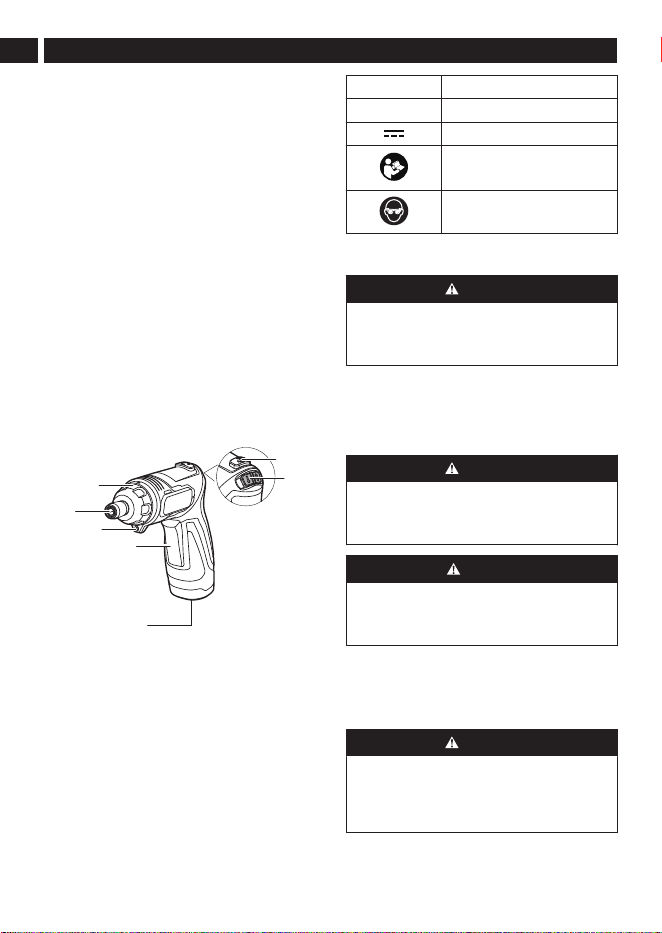
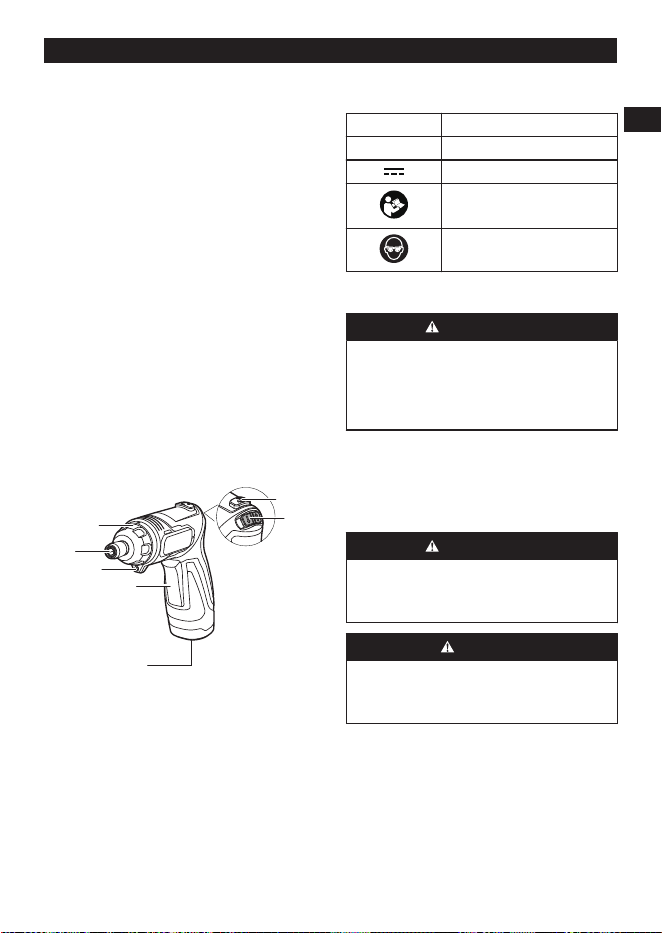
1.3 PRODUCT OVERVIEW
5
2
1
3
4
6
7
1
Clutch
2
1/4" Hex collet
3
LED Light
4
Trigger
5
USB-C charging port
6
Forward / reverse switch
7
Pivot locking button
1.4 SYMBOLS ON THE PRODUCT
Some of the following symbols may be used on this
tool. Please study them and learn their meaning.
Proper interpretation of these symbols will allow you
to operate the tool better and safer.
Symbol Explanation
V Voltage
Direct current
Read all safety warnings and all
instructions.
Wear eye protection
1.5 CALIFORNIA PROPOSITION 65
WARNING
THIS PRODUCT CONTAINS OR EMITS A
CHEMICAL KNOWN TO THE STATE OF
CALIFORNIA TO CAUSE CANCER OR BIRTH
DEFECTS OR OTHER REPRODUCTIVE HARM.
2 SAFETY
2.1 SAFETY DEFINITIONS
Warnings, cautions, and notes are used to point out
especially important parts of the manual.
WARNING
THERE IS A RISK OF INJURY OR DEATH
FOR THE OPERATOR OR BYSTANDERS IF THE
INSTRUCTIONS IN THE MANUAL ARE NOT
OBEYED.
CAUTION
THERE IS A RISK OF DAMAGE TO THE
PRODUCT, OTHER MATERIALS, AND THE
ADJACENT AREA, IF THE INSTRUCTIONS IN
THE MANUAL ARE NOT OBEYED.
Note: Used to give more information that is necessary
in a given situation.
2.2 GENERAL POWER TOOL SAFETY
WARNINGS
WARNING
Read all safety warnings, instructions,
illustrations and specifications provided with
this power tool. Failure to follow all instructions
listed below may result in electric shock, fire and/or
serious injury.
Save all warnings and instructions for future
reference.
4
English
EN

The term "power tool" in the warnings refers to
your mains-operated (corded) power tool or battery-
operated (cordless) power tool.
2.2.1 WORK AREA SAFETY
• Keep work area clean and well lit. Cluttered or
dark areas invite accidents.
• Do not operate power tools in explosive
atmospheres, such as in the presence of
flammable liquids, gases or dust. Power tools
create sparks which may ignite the dust or fumes.
• Keep children and bystanders away while
operating a power tool. Distractions can cause you
to lose control.
2.2.2 ELECTRICAL SAFETY
• Power tool plugs must match the outlet. Never
modify the plug in any way. Do not use any
adapter plugs with earthed (grounded) power
tools. Unmodified plugs and matching outlets will
reduce risk of electric shock.
• Avoid body contact with earthed or grounded
surfaces, such as pipes, radiators, ranges and
refrigerators. There is an increased risk of electric
shock if your body is earthed or grounded.
• Do not expose power tools to rain or wet
conditions. Water entering a power tool will
increase the risk of electric shock.
• Do not abuse the cord. Never use the cord for
carrying, pulling or unplugging the power tool.
Keep cord away from heat, oil, sharp edges
and moving parts. Damaged or entangled cords
increase the risk of electric shock.
• When operating a power tool outdoors, use an
extension cord suitable for outdoor use. Use of
a cord suitable for outdoor use reduces the risk of
electric shock.
• If operating a power tool in a damp location
is unavoidable, use a RESIDUAL CURRENT
DEVICE (RCD) protected supply. Use of an RCD
reduces the risk of electric shock.
2.2.3 PERSONAL SAFETY
• Stay alert, watch what you are doing and use
common sense when operating a power tool. Do
not use a power tool while you are tired or under
the influence of drugs, alcohol or medication. A
lapse of attention while operating power tools may
result in serious personal injury.
• Use personal protection. Always wear eye
protection. Protective products such as dust
mask, non-skid safety shoes, hard hat or hearing
protection used appropriately will reduce personal
injuries.
• Prevent unintentional starting. Ensure the
switch is in the off position before connecting
to power source and/or battery pack and when
picking up or carrying the tool. Carrying power
tools with your finger on the switch or energizing
power tools that have the switch on invites
accidents.
• Remove any adjusting key or wrench before
turning the power tool on. A wrench or a key left
attached to a rotating part of the power tool may
result in personal injury.
• Do not over-reach. Keep proper footing and
balance at all times. This enables better control of
the power tool in unexpected situations.
• Dress properly. Do not wear loose clothing or
jewelry. Keep your hair, clothing and gloves
away from moving parts. Loose clothes, jewelry
or long hair can be caught in moving parts.
• If devices are provided for the connection of
dust extraction and collection facilities, ensure
these are connected and properly used. Use of
dust collection can reduce dust related hazards.
• Do not let familiarity gained from frequent use
of tools allow you to become complacent and
ignore tool safety principles. A careless action
can cause severe injury within a fraction of a
second.
2.2.4 POWER TOOL USE AND CARE
• Do not force the power tool. Use the correct
power tool for your application. The correct
power tool will do the job better and safer at the
rate for which it was designed.
• Do not use the power tool if the switch does not
turn it on and off. Any power tool that cannot be
controlled with the switch is dangerous and must be
repaired.
• Disconnect the plug from the power source
and/or the battery pack from the power tool
before making any adjustments, changing
accessories, or storing power tools. Such
preventive safety measures reduce the risk of
starting the power tool accidentally.
• Store idle power tools out of the reach of
children and do not allow persons unfamiliar
with the power tool or these instructions to
operate the power tool. Power tools are dangerous
in the hands of untrained users.
• Maintain power tools and accessories. Check
for misalignment or binding of moving parts,
breakage of parts and any other condition
that may affect the power tool’s operation.
If damaged, have the power tool repaired
before use. Many accidents are caused by poorly
maintained power tools.
• Keep cutting tools sharp and clean. Properly
maintained cutting tools with sharp cutting edges
are less likely to bind and are easier to control.
• Use the power tool, accessories and tool bits
etc. in accordance with these instructions,
5
English
EN

taking into account the working conditions and
the work to be performed. Use of the power tool
for operations different from those intended could
result in a hazardous situation.
• Keep handles and grasping surfaces dry, clean
and free from oil and grease. Slippery handles
and grasping surfaces do not allow for safe handling
and control of the tool in unexpected situations.
2.2.5 BATTERY TOOL USE AND CARE
• Recharge only with the charger specified by the
manufacturer. A charger that is suitable for one
type of battery pack may create a risk of fire when
used with another battery pack.
• Use power tools only with specifically
designated battery packs. Use of any other battery
packs may create a risk of injury and fire.
• When battery pack is not in use, keep it away
from other metal objects like paper clips, coins,
keys, nails, screws, or other small metal objects
that can make a connection from one terminal
to another. Shorting the battery terminals together
may cause burns or fire.
• Under abusive conditions, liquid may be ejected
from the battery; avoid contact. If contact
accidentally occurs, flush with plenty of soap
and water. If liquid contacts eyes, immediately
seek medical help. Liquid ejected from the battery
may cause irritation or burns.
• Do not use a battery pack or tool that is
damaged or modified. Damaged or modified
batteries may exhibit unpredictable behaviour
resulting in fire, explosion or risk of injury.
• Do not expose a battery pack or tool to fire
or excessive temperature. Exposure to fire or
temperature above 130 °C may cause explosion.
• Follow all charging instructions and do not
charge the battery pack or tool outside the
temperature range specified in the instructions.
Charging improperly or at temperatures outside
the specified range may damage the battery and
increase the risk of fire.
2.2.6 SERVICE
• Have your power tool serviced by a qualified
repair person using only identical replacement
parts. This will ensure that the safety of the power
tool is maintained.
• Never service damaged battery packs. Service
of battery packs should only be performed by the
manufacturer or authorized service providers.
2.2.7 SPECIFIC SAFETY RULES
• Hold the power tool by insulated gripping
surfaces, when performing an operation where
the fastener may contact hidden wiring.
Fasteners contacting a ″live″ wire may make
exposed metal parts of the power tool ″live″ and
could give the operator an electric shock.
• Know your power tool. Read operator manual
carefully. Learn its applications and limitations, as
well as the specific potential hazards related to this
power tool. Obey this instruction will reduce shock,
fire or serious injury.
• Always wear safety glasses with side shields
marked to comply with ANSI Z87.1. Obey this
instruction will reduce the risk of serious injury.
• Protect your lungs. Wear a face or dust mask
if the operation is dusty. Obey this instruction will
reduce the risk of serious injury.
• Protect your hearing. Wear hearing protection
during extended periods of operation. Obey this
instruction will reduce the risk of serious injury.
• Battery tools do not have to be plugged into
an electrical outlet; thus, they are always
in operating condition. Be aware of possible
hazards when not using your battery tool or
when changing accessories. Obey this instruction
will reduce the risk of electric shock , fire, or serious
injury,
• Do not place battery tools or their batteries near
fire or heat. This will reduce the risk of explosion
and possible injury.
• Do not crush, drop or damage battery pack. Do
not use a battery pack or charger that has been
dropped or received a sharp blow. A damaged
battery is subject to explosion. Properly dispose of a
dropped or damaged battery immediately.
• Batteries can explode in the presence of a
source of ignition, such as a pilot light. To
reduce the risk of serious injury, never use
any cordless product in the presence of open
flame. An exploded battery can propel debris and
chemicals. If exposed, flush with water immediately.
• Do not charge battery tool in a damp or wet
location. Obey this instruction will reduce the risk
of electric shock.
• For best results, your battery tool should be
charged in a location where the temperature is
more than 50°F but less than 100°F. To reduce
the risk of serious injury, do not store outside or in
vehicles.
• Under extreme usage or temperature conditions,
battery leakage may occur. If liquid comes in
contact with your sink, wash immediately with soap
and water. If liquid gets into your eyes, flush them
with clean water for at least 10 minutes, then seek
immediate medical attention. Obey this instruction
will reduce the risk of serious injury.
• Keep these instructions. Refer to them
frequently and use them to instruct others who
may use this tool. If you borrow someone this
tool, loan them these instructions also to prevent
incorrect use of the machine and possible injury.
6
English
EN
3 ASSEMBLY
This section describes how to assemble and adjust the
product.
WARNING
CAREFULLY READ AND UNDERSTAND THE
SAFETY CHAPTER AND THE ASSEMBLY
INSTRUCTIONS BEFORE YOU ASSEMBLE THE
PRODUCT.
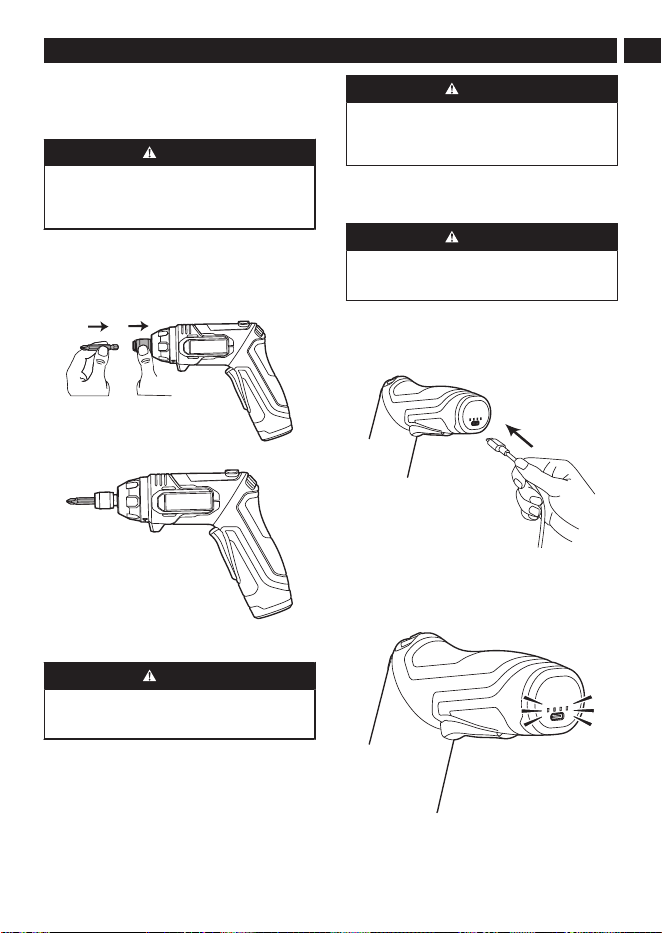
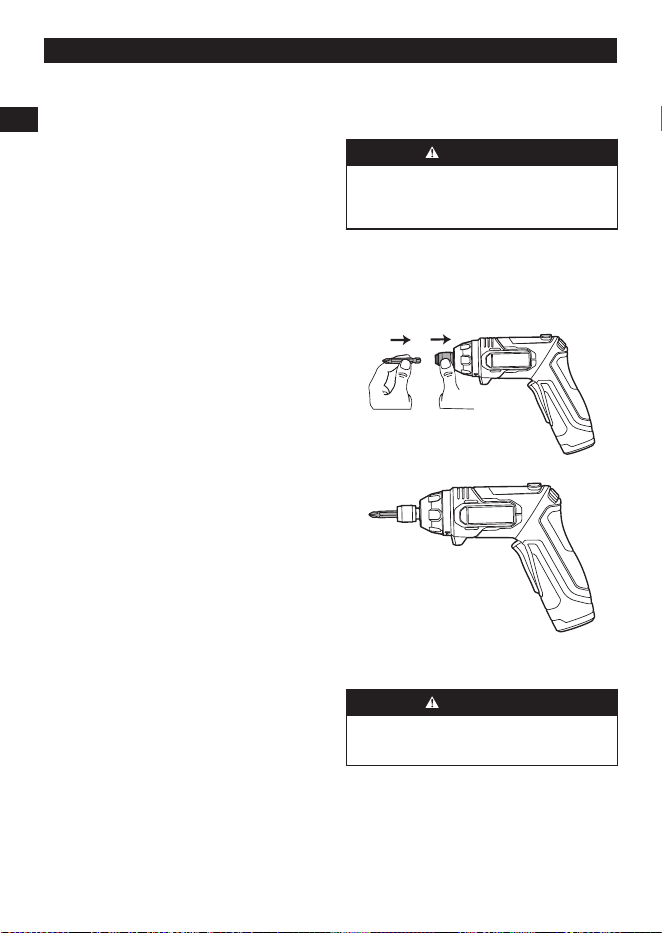
3.1 INSTALL THE BIT
1. Push forward / reverse switch in "neutral" position
to lock the trigger.
2. Pull the collet backward and hold in position.
12
3. Put the bit into the collet.
Note: Use only impact quality bits with a locking
groove.
WARNING
MAKE SURE THAT YOU ATTACH THE BIT
TIGHT IN THE COLLET BEFORE YOU USE THE
PRODUCT.
3.2 REMOVE THE BIT
1. Push forward / reverse switch in "neutral" position
to lock the trigger.
2. Pull the collet backward and hold in position.
3. Pull the bit straight out of the collet.
4 OPERATION
This section describes how to operate the product.
WARNING
CAREFULLY READ AND UNDERSTAND
THE SAFETY CHAPTER AND OPERATION
INSTRUCTIONS BEFORE YOU OPERATE THE
PRODUCT.
4.1 BEFORE YOU USE THE PRODUCT
4.1.1 CHARGE THE BATTERY
WARNING
USE ONLY Greenworks-APPROVED CHARGERS
TO CHARGE THE BATTERY THROUGH THE
USB-C CHARGING PORT.
Note
:
The battery must be charged prior to the first
start-up.
1. Connect the USB-C end of the power cable to the
USB-C port on the tool.
2. Connect the USB-A end of the power cable to a
device that has a USB-C output port of 5V.
3. The LED display shows the battery charging
status. When all green lights are illuminated,
charging is complete.
Note
:
The Li-Ion battery can be charged at any time
without affecting the lifetime of the product. Interrupting
the charging process will not damage the battery.
7
English
EN
WARNING
DO NOT ALLOW THE BATTERY TO DEEP
DISCHARGE.
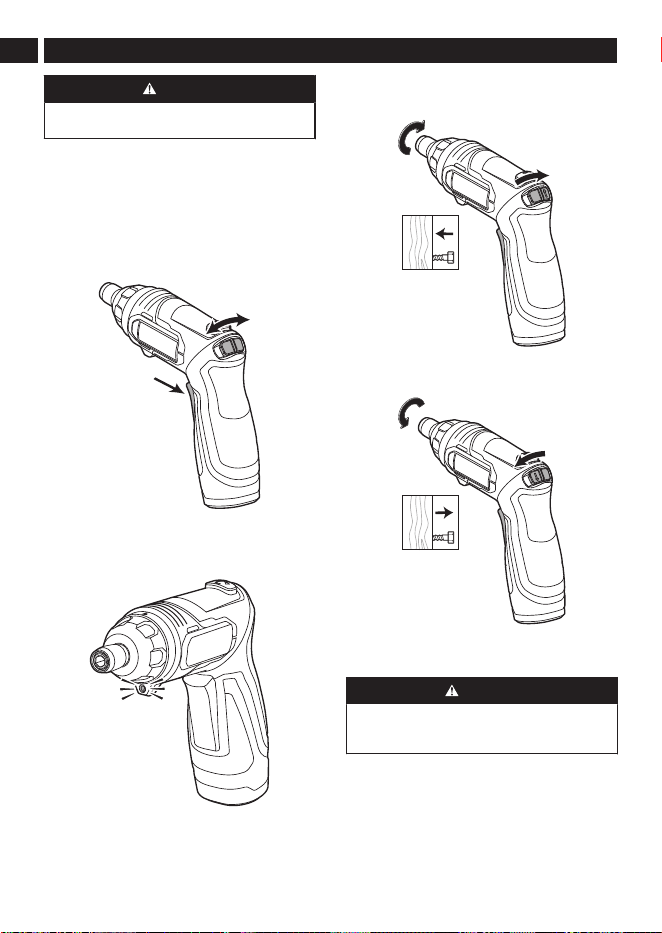
4.2 START THE PRODUCT
Note: The product can not work until the forward /
reverse switch is pushed fully to the left or right. Do
not operate the product at low speeds for extended
periods of time.
1. Put the forward / reverse switch in desired
position for operation.
2. Pull the trigger to turn the product ON.
1
2
4.3 LED LIGHT
The LED light illuminates when the trigger is pulled. It
provides extra light for increased visibility.
4.4 FORWARD / REVERSE SWITCH
The product has a forward / reverse switch to change
rotation direction.
1. When the switch is on the right side
(arrow forward), the drive direciton is forward
(tightening).
2. When the switch is on the left side (arrow
backward), the drive direction is reversed
(loosening).
3. Put the switch in the "neutral" position to help
decrease the possibility of accidental starting
when not operating.
WARNING
ALLOW THE COLLET TO COME TO A
COMPLETE STOP BEFORE CHANGING THE
DIRECTION OF ROTATION.
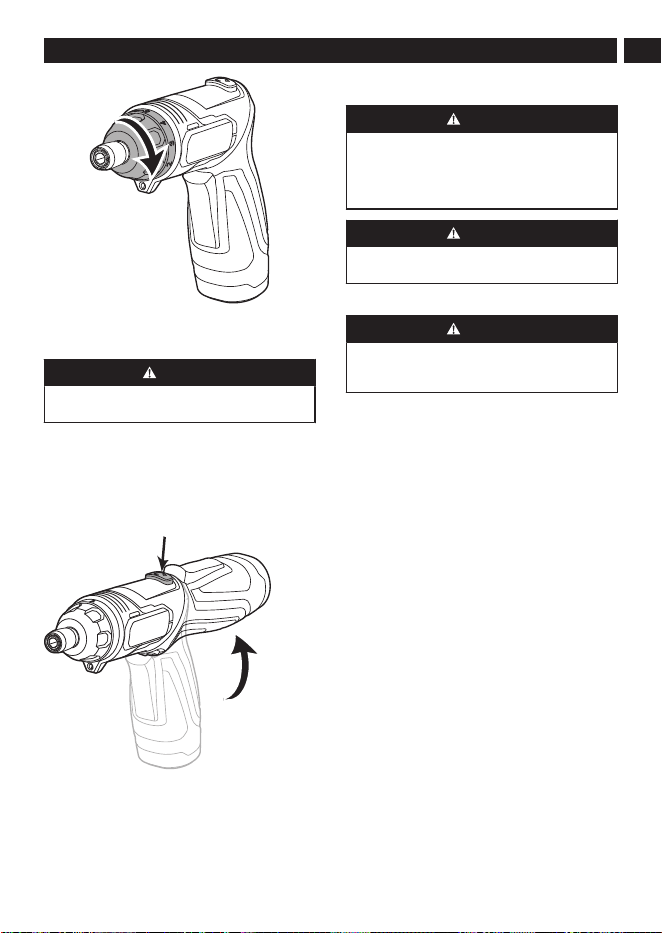
4.5 TORQUE SELECTION
Rotate the clutch to adjust the torque. The number
upward indicates the torque level.
8
English
EN
4.6 STOP THE PRODUCT
1. Release the trigger to turn the product OFF.
WARNING
RELEASE THE TRIGGER AND ALLOW THE
PRODUCT TO COME TO A COMPLETE STOP.
4.7 IN-LINE / PIVOT POSITION
The product can be used in the in-line or pivot positon.
A pivot locking button is located on the top of the
product.
Press the pivot locking button and twist the front
housing fully to the right or left.
1
2
5 MAINTENANCE
CAUTION
Make sure to prevent contact with brake fluids,
gasoline, and other petroleum-based materials.
These chemicals have the potential to cause
damage and render the plastic components
unserviceable.
CAUTION
Do not use strong solvents or detergents on the
plastic housing or components.
5.1 CLEAN THE PRODUCT
CAUTION
The product must always remain dry to minimize the
risk of electrical shocks. Avoid exposure to humid
conditions.
• Clear any debris out of the air vent with a vacuum
cleaner.
• Avoid spraying solvents directly onto the air vent or
submerging it in solvents.
• Clean the housing and the plastic components with
a moist and soft cloth.
6 TRANSPORTATION, STORAGE AND
DISPOSAL
6.1 TRANSPORTATION
• Any removable (electronic) parts, such as the
charger and battery, should always be removed
from the product before transport.
• Avoid transporting the product in bad weather
conditions when possible.
• Properly cover any exposed electronic parts during
transport when transport in bad weather conditions
cannot be avoided.
• High speeds combined with wind and rain could
cause moisture to be pressured into the electronic
parts, which can lead to temporary malfunctions or
permanent defects.
• If a malfunction occurs after transport in such
conditions, allow all parts to dry by air when the
destination is reached.
6.2 STORAGE
If the product is left unused for an extended period,
proper storage maintenance is required.
• Store the product locked up to prevent unauthorized
use or damage.
• Store the product in a dry, well-ventilated area.
9
English
EN
• Store the product out of the reach of children.
6.3 DISPOSAL OF THE PRODUCT
Symbols on the product or the package of the product
mean that the attachment is not domestic waste.
Recycle it at a recycling station for electrical and
electronic equipment. This helps to prevent damage
to the environment and persons.
Get in touch with your local authorities, domestic waste
service, or your dealer for more information about how
to recycle your product.
7 TECHNICAL DATA
Voltage 8 V d.c.
No Load Speed 0-280 min
Torque Max. 70 In-lbs / 8 N.m
Torque Setting 5+1
Recommended Charger
Model
AC65WAD
Recommended Charger
Input
100-240V AC 50/60Hz
Recommended Charger
Output
5V
Drive 1/4" Hex
The recommended ambient temperature range:
Item Temperature
Product storage temper-
ature range
32°F (0°C) - 113°F
(45°C)
Product operation tem-
perature range
32°F (0°C) - 113°F
(45°C)
Battery charging temper-
ature range
39°F (4°C) - 104°F
(40°C)
Charger operation tem-
perature range
39°F (4°C) - 104°F
(40°C)
Battery storage tempera-
ture range
32°F (0°C) - 113°F
(45°C)
Battery discharging tem-
perature range
32°F (0°C) - 113°F
(45°C)
8 LIMITED WARRANTY
Greenworks products and batteries are protected
against all defects in materials, parts, or workmanship
under normal use for a period of 3 years from the
shipping date or in-store purchase date.
At its own discretion, Greenworks can opt to repair,
replace, substitute with a comparable item, or issue a
refund for products that are determined to be defective
through normal use or that have been damaged during
shipment. Proof of purchase and product registration
is required. Replacement of products or parts subject
to normal wear and tear is the responsibility of the
customer.
This warranty is valid only for units which have been
maintained in accordance with the instructions found
in the operator manual supplied with the product; and
for units which have been registered in one of the
following ways:
Online: www.greenworkstools.com
Phone – 1-888-909-6757
If Greenworks accepts a return under warranty, you
can return the defective or damaged product only
after you call our Customer Care team and receive a
Return Authorization from Greenworks. You will also
receive a refund for your original shipping charges,
and Greenworks will arrange and pay for your return
shipping charges. To request a Return Authorization,
please contact us at 1-888-909-6757.
8.1 ITEMS NOT COVERED BY WARRANTY
• Any part that has become inoperative due to
misuse, commercial use, abuse, neglect, accident,
improper maintenance, or alteration.
• The unit, if it has not been operated and/or
maintained in accordance with the operator manual.
• Normal wear, except as noted below:
• Routine maintenance items such as lubricants.
• Normal deterioration of the exterior finish due to
use or exposure.
• Any part/product, that has become inoperable
due to use with any non-Greenworks-branded
parts or batteries/chargers.
8.2 HELPLINE
Warranty service is available by calling our toll-free
helpline at: 1-888-909-6757.
8.3 SHIPPING
Transportation charges for the movement of any power
equipment unit or attachment are the responsibility of
the purchaser. It is the purchaser’s responsibility to
pay transportation charges for any part submitted for
replacement under this warranty unless such return is
requested in writing by Greenworks.
8.3.1 ADDRESS
USA address:
Greenworks North America, LLC
P.O. Box 1238, Mooresville, NC 28115, USA
10
English
EN
-1

Canada address:
Greenworks Tools Canada, Inc.
67 Toll Rd., Holland Landing, ON L9N 1H2
Mexico address:
TECNOLOGIA CAMPO Y JARDIN S.A. DE C.V.
ADMINISTRADORES No. 5336 A, COL. ARCOS DE
GUADALUPE, ZAPOPAN, JALISCO, C.P. 45037
11
English
EN

1 Introduction.......................... 13
1.1 Description du produit...................13
1.2 Utilisation prévue.......................... 13
1.3 Présentation du produit.................13
1.4 Symboles sur le produit................ 13
1.5 California Proposition 65...............13
2 Sécurité.................................13
2.1 Définitions de sécurité.................. 13
2.2 Avertissements généraux de
sécurité des outils électriques.......14
3 Assemblage..........................16
3.1 Installez l’embout.......................... 16
3.2 Retirez l'embout............................ 16
4 Fonctionnement................... 17
4.1 Avant d’utiliser le produit...............17
4.2 Démarrer le produit.......................17
4.3 Voyant LED...................................17
4.4 Interrupteur avant / arrière ........... 18
4.5 Sélection du couple...................... 18
4.6 Arrêt du produit............................. 18
4.7 Position en ligne / pivotante..........19
5 Entretien............................... 19
5.1 Nettoyage du produit.................... 19
6 Transport, entreposage
et mise au rebut................... 19
6.1 Transport.......................................19
6.2 Entreposage................................. 19
6.3 Mise au rebut du produit............... 19
7 Données techniques............20
8 Garantie limitée....................20
8.1 Articles non couverts par la
garantie.........................................20
8.2 Ligne d’assistance téléphonique...20
8.3 Expédition..................................... 20
12
Français
FR
1 INTRODUCTION
1.1 DESCRIPTION DU PRODUIT
Ce produit est un tournevis à pile doté d'un moteur
électrique.
Nous avons une politique de développement continu
des produits et nous nous réservons donc le droit de
modifier la conception et l'apparence des produits sans
préavis.
1.2 UTILISATION PRÉVUE
Ce produit est conçu pour
• visser des vis à bois longues lors de l'assemblage
d'une terrasse,
• visser des boulons à tête bombée dans les poteaux
de terrasse,
• visser des vis dans des murs en parpaings et en
béton,
• visser des vis dans des montants métalliques.
La lumière de ce produit est destinée à éclairer la
zone de travail directe du produit et ne convient pas
à l'éclairage des pièces de la maison.
Utilisez toujours des accessoires approuvés par le
fabricant avec ce produit.
1.3 PRÉSENTATION DU PRODUIT
5
2
1
3
4
6
7
1
Embrayage
2
Mandrin hexagonale 1/4 po
3
Éclairage LED
4
Gâchette
5
Port de charge USB-C
6
Interrupteur avant / arrière
7
Bouton de verrouillage du pivot
1.4 SYMBOLES SUR LE PRODUIT
Certains des symboles suivants peuvent être utilisés
sur cet outil. Veuillez les étudier et apprendre
leur signification. Une interprétation correcte de ces
symboles vous permettra d'utiliser l'outil de manière
plus efficace et plus sûre.
Symbole Explication
V Tension
Courant continu
Lisez toutes les consignes de sé-
curité et toutes les instructions.
Portez des lunettes de protection.
1.5 CALIFORNIA PROPOSITION 65
AVERTISSEMENT
CE PRODUIT CONTIENT OU ÉMET UN
PRODUIT CHIMIQUE CONNU DANS L'ÉTAT
DE CALIFORNIE COMME ÉTANT UNE
CAUSE DE CANCER, DE MALFORMATIONS
CONGÉNITALES OU D'AUTRES PROBLÈMES DE
REPRODUCTION.
2 SÉCURITÉ
2.1 DÉFINITIONS DE SÉCURITÉ
Les avertissements, précautions et notes mettent
l'accent sur des parties spécialement importantes du
manuel.
AVERTISSEMENT
L’OPÉRATEUR OU LES BADAUDS SONT
EXPOSÉS À UN RISQUE DE BLESSURES,
PARFOIS MORTELLES, SI LES INSTRUCTIONS
DU MANUEL NE SONT PAS RESPECTÉES.
ATTENTION
IL Y A UN RISQUE DE DOMMAGES AU
PRODUIT, AUX AUTRES MATÉRIAUX ET À LA
ZONE ADJACENTE SI LES INSTRUCTIONS DU
MANUEL NE SONT PAS RESPECTÉES.
Remarque : Pour un complément d’information
nécessaire dans une situation donnée.
13
Français
FR

2.2 AVERTISSEMENTS GÉNÉRAUX DE
SÉCURITÉ DES OUTILS ÉLECTRIQUES
AVERTISSEMENT
Lisez tous les avertissements de sécurité et
toutes les instructions. Le non-respect de ces
avertissements et de ces instructions peut entraîner
un choc électrique, un incendie et/ou des blessures
graves.
Conservez tous les avertissements et instructions
pour référence ultérieure.
Le terme « outil électrique » dans les avertissements
fait référence à votre outil électrique (sans fil)
fonctionnant sur batterie.
2.2.1 SÉCURITÉ DE LA ZONE DE TRAVAIL
• Gardez la zone de travail propre et bien éclairée.
Les endroits encombrés ou sombres favorisent les
accidents.
• N'utilisez pas les outils électriques dans
des environnements explosifs, par exemple
en présence de liquides, gaz ou poussières
inflammables. La mise en marche des outils
électriques crée des étincelles qui peuvent
enflammer la poussière ou les vapeurs.
• Tenez les enfants et les curieux à l'écart lorsque
vous utilisez un outil électrique. Les distractions
peuvent vous faire perdre le contrôle.
2.2.2 SÉCURITÉ ÉLECTRIQUE
• Les prises de l'outil électrique doivent être
compatibles avec la prise de courant. Ne
modifiez jamais la prise d'aucune façon.
N'utilisez pas d'adaptateur de prise avec des
outils à prise de terre. Des prises non modifiées
et leurs prises de courant respectives réduisent les
risques de choc électrique.
• Évitez que le corps n'entre en contact avec des
surfaces mises à la terre comme les tuyaux, les
radiateurs, les cuisinières et les réfrigérateurs. Il
y a un risque accru de choc électrique si votre corps
est en contact avec la terre.
• N'exposez pas les outils électriques à des
conditions humides ou mouillées. L'eau qui
pénètre dans un outil électrique augmente le risque
de choc électrique.
• N'abusez pas du cordon. N'utilisez jamais le
câble pour porter, tirer ou débrancher l'outil.
Éloignez le cordon de la chaleur, de l'huile, des
bords tranchants et des pièces mobiles. Les
cordons endommagés augmentent le risque d’un
choc électrique.
• Lorsque vous utilisez un outil électrique en
extérieur, utilisez une rallonge de câble adaptée
à l'usage en extérieur. Utiliser un câble adapté
à un usage en extérieur réduit le risque de choc
électrique.
• Si vous ne pouvez éviter d'utiliser l'outil dans un
environnement humide, utilisez une alimentation
protégée à courant différentiel. Le respect de
cette règle réduira le risque de chocs électriques.
2.2.3 PERSONAL SAFETY
• Stay alert, watch what you are doing and use
common sense when operating a power tool. Do
not use a power tool while you are tired or under
the influence of drugs, alcohol or medication. A
lapse of attention while operating power tools may
result in serious personal injury.
• Use personal protection. Always wear eye
protection. Protective products such as dust
mask, non-skid safety shoes, hard hat or hearing
protection used appropriately will reduce personal
injuries.
• Prevent unintentional starting. Ensure the
switch is in the off position before connecting
to power source and/or battery pack and when
picking up or carrying the tool. Carrying power
tools with your finger on the switch or energizing
power tools that have the switch on invites
accidents.
• Remove any adjusting key or wrench before
turning the power tool on. A wrench or a key left
attached to a rotating part of the power tool may
result in personal injury.
• Do not over-reach. Keep proper footing and
balance at all times. This enables better control of
the power tool in unexpected situations.
• Dress properly. Do not wear loose clothing or
jewelry. Keep your hair, clothing and gloves
away from moving parts. Loose clothes, jewelry
or long hair can be caught in moving parts.
• If devices are provided for the connection of
dust extraction and collection facilities, ensure
these are connected and properly used. Use of
dust collection can reduce dust related hazards.
• Do not let familiarity gained from frequent use
of tools allow you to become complacent and
ignore tool safety principles. A careless action
can cause severe injury within a fraction of a
second.
2.2.4 UTILISATION ET ENTRETIEN DES OUTILS
ÉLECTRIQUES
• Ne forcez pas l’outil électrique. Utilisez l'outil
l’électrique adapté à votre application. L'outil
électrique approprié fera mieux le travail et sera plus
sécuritaire au rythme pour lequel il a été conçu.
• N’utilisez pas l'outil électrique si l'interrupteur
ne le met pas en marche ou à l'arrêt. Tout
outil électrique qui ne peut pas être contrôlé avec
l'interrupteur est dangereux et doit être réparé.
14
Français
FR

• Débranchez la prise de la source d’alimentation
et/ou de la batterie avant d'effectuer des
réglages, de changer des accessoires ou de
ranger l'outil électrique. De telles mesures
de sécurité préventives réduisent le risque d'un
démarrage accidentel de l'outil électrique.
• Rangez les outils électriques inutilisés hors
de portée des enfants et ne laissez pas des
personnes qui ne se sont pas familiarisées avec
l'outil électrique ou ces instructions l’utiliser.
Les outils électriques sont dangereux entre les
mains des utilisateurs non formés.
• Entretenez les outils électriques et les
accessoires. Vérifiez le désalignement des
pièces mobiles ou la fixation des pièces
mobiles, la cassure des pièces et toute autre
condition qui pourrait affecter le fonctionnement
de l’outil électrique. S'il est endommagé, faites
réparer l'outil électrique avant de l'utiliser. De
nombreux accidents sont causés par des outils
électriques mal entretenus.
• Garder les outils de coupe propres et
tranchants. Les outils de coupe bien entretenus
avec des bords tranchants sont moins susceptibles
de se coincer et sont plus faciles à contrôler.
• Utilisez l'outil électrique, les accessoires, les
mèches, etc. conformément à ces instructions,
en tenant compte des conditions de travail
et des travaux à effectuer. L'utilisation de
l'outil motorisé pour des opérations différentes
de celles prévues pourrait entraîner une situation
dangereuse.
• Veillez à ce que les poignées restent propres,
sèches et exemptes d’huile et de graisse.
Les poignées et surfaces de prise glissantes ne
permettent pas de manipuler et de contrôler l'outil
dans des situations inattendues.
2.2.5 UTILISATION ET ENTRETIEN DE L’OUTIL
SUR BATTERIE
• Rechargez uniquement avec le chargeur spécifié
par le fabricant. Un chargeur adapté à un type de
batterie peut créer un risque d'incendie lorsqu'il est
utilisé avec une autre batterie.
• Utilisez les outils électriques uniquement avec
des batteries spécialement conçues à cet effet.
L'utilisation de toutes autres batteries peut créer un
risque de blessure et d'incendie.
• Lorsque la batterie n'est pas utilisée, éloignez-la
des autres objets métalliques tels qu’attaches
trombones, pièces de monnaie, clés, clous, vis
ou autres petits objets métalliques qui peuvent
établir une connexion d'une borne à une autre.
Le court-circuitage des bornes de la batterie peut
provoquer des brûlures ou un incendie.
• Dans des conditions abusives, du liquide peut
être éjecté de la batterie ; évitez tout contact. En
cas de contact accidentel, rincez abondamment
avec du savon et de l’eau. En cas de contact du
liquide avec les yeux, consultez immédiatement
un médecin. Le liquide s'échappant des batteries
peut causer des irritations ou des brûlures.
• N'utilisez pas une batterie ou un outil
endommagé ou modifié. Les batteries
endommagées ou modifiées peuvent présenter
un fonctionnement imprévisible et provoquer un
incendie, une explosion ou un risque de blessure.
• N'exposez pas un bloc-batterie ou un outil au
feu ou à une température excessive. L'exposition
au feu ou une température supérieure à 130 °C peut
provoquer une explosion.
• Suivez toutes les instructions de recharge et ne
rechargez pas la batterie ou l'outil en dehors
de la plage de température spécifiée dans ces
instructions. Un rechargement incorrect ou à des
températures en dehors de la plage spécifiée peut
endommager la batterie et augmenter le risque
d'incendie.
2.2.6 SERVICE
• Faites effectuer l'entretien de votre outil
électrique par un réparateur qualifié en
n'utilisant que des pièces de rechange
identiques. Cela garantira le maintien de la sécurité
de l’outil électrique.
• Ne réparez jamais une batterie endommagée.
L'entretien d’une batterie ne doit être effectué que
par le fabricant ou des fournisseurs de service
agréés.
2.2.7 RÈGLES DE SÉCURITÉ SPÉCIFIQUES
• Maintenez l’outil électrique par ses surfaces
isolées lorsque vous accomplissez une tâche
où la fixation pourrait entrer en contact avec
un câblage invisible. Les fixations en contact
avec un câble « sous tension » peuvent rendre les
parties métalliques exposées de l'outil électrique
« sous tension » et risquent de provoquer un choc
électrique à l'opérateur.
• Apprenez comment utiliser votre outil électrique.
Lisez attentivement le manuel d'utilisation.
Apprenez ses applications et ses limites, ainsi que
les dangers potentiels spécifiques liés à cet outil
électrique. Le respect de ces instructions permet
d'éviter les chocs électriques, les incendies et les
blessures graves.
• Portez toujours des lunettes de sécurité avec
des protections latérales marquées comme étant
conformes à la norme ANSI Z87.1. Le respect
de ces instructions réduira le risque de blessures
graves.
• Protégez vos poumons. Portez un masque facial
ou un masque anti-poussière si l'opération
est poussiéreuse. Le respect de ces instructions
réduira le risque de blessures graves.
15
Français
FR
• Protégez votre ouïe. Portez une protection
auditive pendant les périodes d'utilisation
prolongées. Le respect de ces instructions réduira
le risque de blessures graves.
• Les outils alimentés par batterie n'ont
pas besoin d'être branchés sur une prise
électrique ; ils sont donc toujours en état de
fonctionnement. Soyez conscient des dangers
possibles lorsque vous n'utilisez pas votre
outil à batterie ou lorsque vous changez
d'accessoire. Le respect de ces instructions réduira
le risque de choc électrique, d'incendie ou de
blessure grave,
• Ne placez pas d’outils à batterie ou leurs
batteries à proximité d’un feu ou d’une source
de chaleur. Cela réduira le risque d’explosion et de
blessures éventuelles.
• N'écrasez pas, ne faites pas tomber et
n'endommagez pas la batterie. N'utilisez pas une
batterie ou un chargeur qui est tombé ou a reçu
un coup violent. Une batterie endommagée est
susceptible d'exploser. Mettez immédiatement au
rebut de manière appropriée une batterie tombée ou
endommagée.
• Les batteries peuvent exploser en présence
d'une source d'allumage, telle qu'une veilleuse.
Pour réduire le risque de blessures graves,
n'utilisez jamais un produit sans fil en présence
d'une flamme nue. Une batterie qui explose peut
projeter des débris et des produits chimiques. En
cas d'exposition, rincez immédiatement à l'eau.
• Ne chargez pas la batterie dans un endroit
humide ou mouillé. Le respect de ces instructions
réduira le risque d’électrocution.
• Pour de meilleurs résultats, votre outil à
batterie doit être chargé dans un endroit où
la température est supérieure à 50 °F mais
inférieure à 100 °F. Pour réduire le risque de
blessures graves, ne stockez pas l’outil à l’extérieur
ou dans un véhicule.
• Dans des conditions d’utilisation ou de
température extrêmes, une fuite de la batterie
peut se produire. Si un liquide entre en contact
avec votre évier, lavez-le immédiatement avec du
savon et de l'eau. Si un liquide entre dans vos yeux,
rincez-les avec de l'eau propre pendant au moins 10
minutes, puis consultez immédiatement un médecin.
Le respect de ces instructions réduira le risque de
blessures graves.
• Conservez ces instructions. Consultez-les
fréquemment et utilisez-les pour instruire
d'autres personnes susceptibles d'utiliser cet
outil. Si vous prêtez cet outil à quelqu'un, donnez-
lui également ces instructions afin d'éviter toute
utilisation incorrecte de la machine et tout risque de
blessure.
3 ASSEMBLAGE
Cette section décrit la méthode d’assemblage et de
réglage du produit.
AVERTISSEMENT
VOUS DEVEZ AVOIR LU ATTENTIVEMENT
ET COMPRIS LE CHAPITRE SÉCURITÉ ET
LES INSTRUCTIONS D’ASSEMBLAGE AVANT
D’ASSEMBLER LE PRODUIT.
3.1 INSTALLEZ L’EMBOUT
1. Poussez l'interrupteur avant / arrière en position
« neutre » pour verrouiller la gâchette.
2. Tirez le mandrin vers l'arrière et maintenez-la en
position.
12
3. Insérez l'embout dans le mandrin.
Remarque : Utilisez uniquement des embouts à
percussion de qualité dotés d'une rainure de
verrouillage.
AVERTISSEMENT
ASSUREZ-VOUS QUE L'EMBOUT EST BIEN FIXÉ
DANS LE MANDRIN AVANT D'UTILISER LE
PRODUIT.
3.2 RETIREZ L'EMBOUT
1. Poussez l'interrupteur avant / arrière en position
« neutre » pour verrouiller la gâchette.
2. Tirez le mandrin vers l'arrière et maintenez-la en
position.
3. Retirez l'embout en le tirant tout droit hors du
mandrin.
16
Français
FR
4 FONCTIONNEMENT
Cette section décrit le mode d’emploi du produit.
AVERTISSEMENT
VOUS DEVEZ AVOIR LU ATTENTIVEMENT
ET COMPRIS LE CHAPITRE SÉCURITÉ ET
LES INSTRUCTIONS D’UTILISATION AVANT
D’UTILISER LE PRODUIT.
4.1 AVANT D’UTILISER LE PRODUIT
4.1.1 CHARGEZ LA BATTERIE.
AVERTISSEMENT
UTILISEZ UNIQUEMENT GreenworksDES
CHARGEURS HOMOLOGUÉS POUR CHARGER
LA BATTERIE VIA LE PORT DE CHARGE USB-C.
Remarque :La batterie doit être chargée avant la
première mise en service.
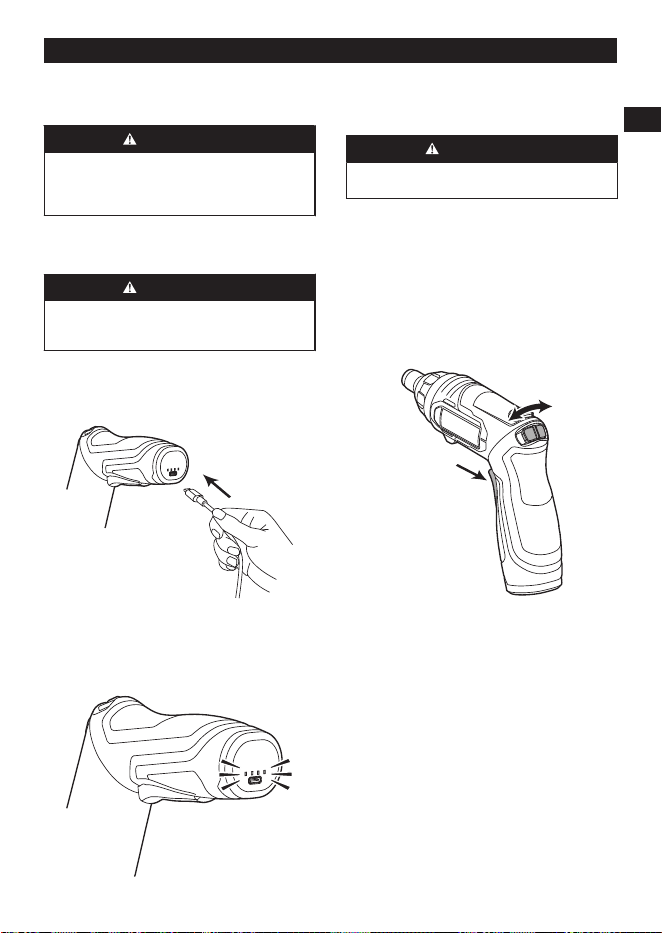
1. Connectez l'extrémité USB-C du câble
d'alimentation au port USB-C de l'outil.
2. Connectez l'extrémité USB-A du câble
d'alimentation à un appareil doté d'un port de
sortie USB-C5V.
3. L'écran LED indique l'état de charge de la
batterie. Lorsque tous les voyants verts sont
allumés, la charge est terminée.
Remarque :La batterie Li-Ion peut être rechargée à
tout moment sans affecter la durée de vie du produit.
L'interruption du processus de charge n'endommagera
pas la batterie.
AVERTISSEMENT
NE LAISSEZ PAS LA BATTERIE SE DÉCHARGER
COMPLÈTEMENT.
4.2 DÉMARRER LE PRODUIT
Remarque :Le produit ne peut pas fonctionner tant
que le commutateur avant / arrière n'est pas poussé
complètement vers la gauche ou vers la droite.
N'utilisez pas le produit à basse vitesse pendant de
longues périodes.
1. Placez le commutateur avant / arrière dans la
position souhaitée pour le fonctionnement.
2. Tirez sur la gâchette pour mettre le produit en
marche.
1
2
4.3 VOYANT LED
Le voyant LED s'allume lorsque vous appuyez sur la
gâchette. Il fournit un éclairage supplémentaire pour
une meilleure visibilité.
17
Français
FR
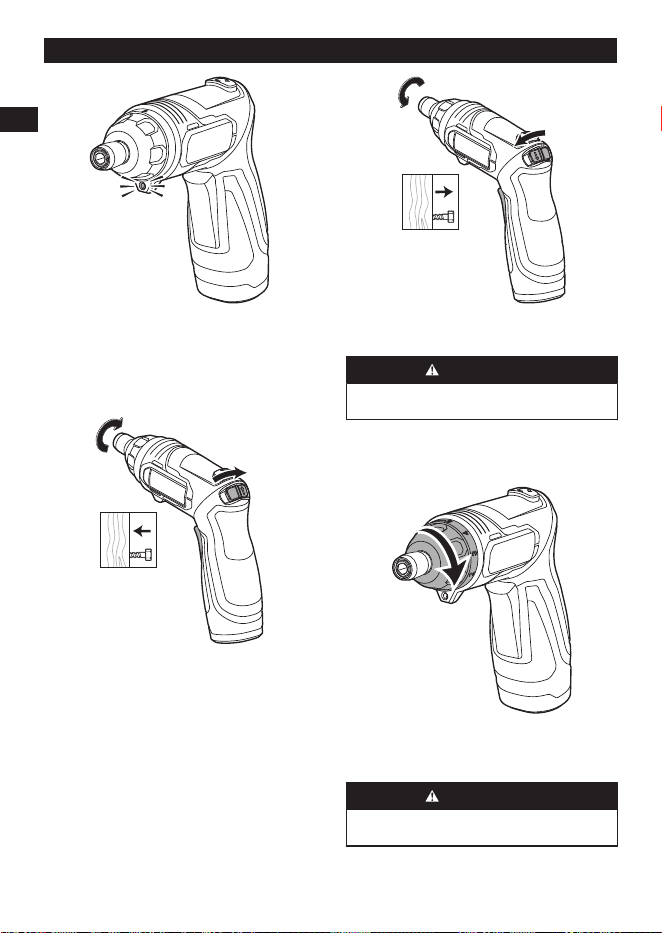
4.4 INTERRUPTEUR AVANT / ARRIÈRE
Le produit dispose d'un interrupteur avant / arrière
pour changer le sens de rotation.
1. Lorsque l’interrupteur est sur le côté droit (flèche
vers l'avant), le sens d'entraînement est vers
l'avant (serrage).
2. Lorsque l’interrupteur est sur le côté gauche
(flèche vers l’arrière), le sens d'entraînement est
inversé (desserrage).
3. Placez l’interrupteur en position « neutre » afin de
réduire le risque de démarrage accidentel lorsque
vous n'utilisez pas l'appareil.
AVERTISSEMENT
ATTENDEZ L'ARRÊT COMPLET DU MANDRIN
AVANT DE CHANGER LE SENS DE ROTATION.
4.5 SÉLECTION DU COUPLE
Tournez l'embrayage pour régler le couple. Le chiffre
vers le haut indique le niveau de couple.
4.6 ARRÊT DU PRODUIT
1. Relâchez la gâchette pour mettre le produit en
marche.
AVERTISSEMENT
RELÂCHEZ LA GÂCHETTE ET LAISSEZ LE
PRODUIT S'ARRÊTER COMPLÈTEMENT.
18
Français
FR
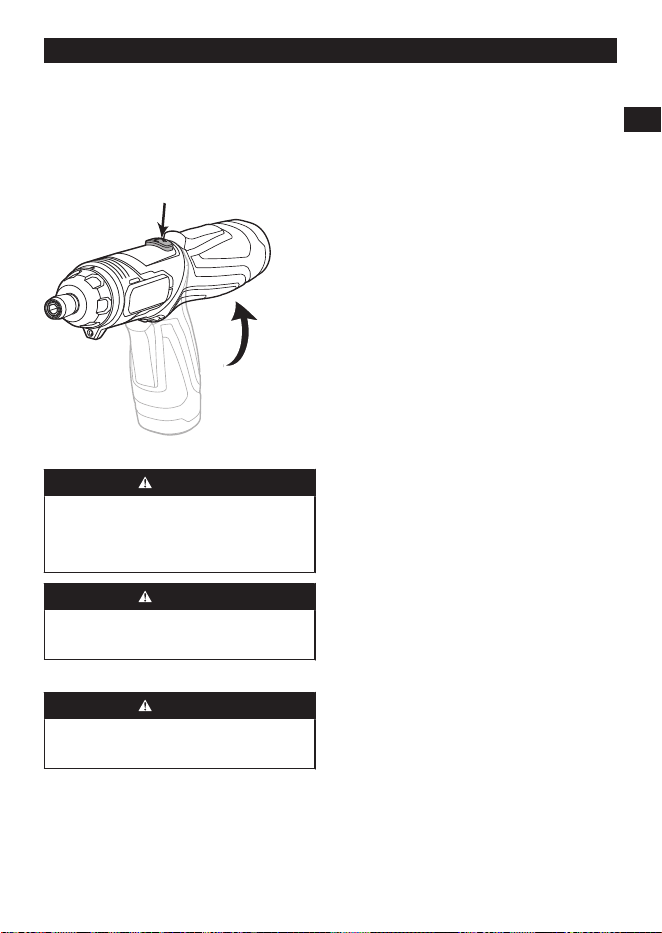
4.7 POSITION EN LIGNE / PIVOTANTE
Le produit peut être utilisé en position en ligne ou
pivotante. Un bouton de verrouillage pivotant est situé
sur le dessus du produit.
Appuyez sur le bouton de verrouillage pivotant et
tournez le boîtier avant complètement vers la droite ou
vers la gauche.
1
2
5 ENTRETIEN
ATTENTION
Veillez à éviter tout contact avec les liquides de
frein, l'essence et les autres produits à base de
pétrole. Ces produits chimiques sont susceptibles
de provoquer des dommages et de rendre les
composants en plastique inutilisables.
ATTENTION
N'appliquez pas de solvants ou de détergents
puissants sur le boîtier ou sur les composants en
plastique.
5.1 NETTOYAGE DU PRODUIT
ATTENTION
Le produit doit toujours rester sec pour minimiser le
risque de décharges électriques. Évitez l'exposition
à des conditions humides.
• Enlevez tous les débris des ouvertures d'air avec un
aspirateur.
• Évitez de pulvériser des solvants directement sur
la bouche d'aération ou de l'immerger dans des
solvants.
• Nettoyez le boîtier et les composants en plastique
avec un chiffon doux et humide.
6 TRANSPORT, ENTREPOSAGE ET MISE AU
REBUT
6.1 TRANSPORT
• Toutes les pièces amovibles (électroniques), telles
que le chargeur et la batterie, doivent toujours être
retirées du produit avant de le transporter.
• Évitez de transporter le produit dans de mauvaises
conditions météorologiques lorsque cela est
possible.
• Couvrez correctement toutes les pièces
électroniques exposées pendant le transport
lorsque le transport dans de mauvaises conditions
météorologiques ne peut être évité.
• Des vitesses élevées combinées au vent et à la
pluie pourraient entraîner la pénétration d’humidité
dans les composants électroniques, ce qui peut
causer des dysfonctionnements temporaires ou des
défauts permanents.
• Si un dysfonctionnement survient après le transport
dans de telles conditions, laissez toutes les pièces
sécher à l’air lorsque la destination est atteinte.
6.2 ENTREPOSAGE
Si le produit n’est pas utilisé pendant une période
prolongée, une maintenance de stockage appropriée
est nécessaire.
• Rangez le produit verrouillé pour éviter tout usage
sans autorisation et tout dommage.
• Rangez le produit dans un endroit sec et bien
ventilé.
• Rangez le produit hors de portée des enfants.
6.3 MISE AU REBUT DU PRODUIT
Les symboles figurant sur le produit ou sur
l'emballage du produit signifient que l'accessoire
n'est pas un déchet ménager. Recyclez-le dans un
centre de recyclage des équipements électriques et
électroniques. Vous éviterez ainsi de porter préjudice à
l'environnement et aux personnes.
Contactez les autorités locales, le service des déchets
ménagers ou votre revendeur pour plus d'informations
sur la manière de recycler votre produit.
19
Français
FR

7 DONNÉES TECHNIQUES
Tension 8V CC
Vitesse à vide 0-280 min
Couple max. 70 In-lbs / 8 N.m
Réglage du couple 5+1
Modèle de chargeur re-
commandé
AC65WAD
Entrée du chargeur re-
commandé
100-240V AC 50/60Hz
Sortie du chargeur re-
commandé
5V
Entraînement : 1/4"Hexagonal
Plage de température ambiante recommandée :
Élément Température
Plage de température de
stockage du produit
32 °F (0 °C) - 113 °F (45
°C)
Plage de température de
fonctionnement du pro-
duit
32 °F (0 °C) - 113 °F (45
°C)
Plage de température de
charge de la batterie
39 °F (4 °C) - 104 °F
(40 °C)
Plage de température de
fonctionnement du char-
geur
39 °F (4 °C) - 104 °F
(40 °C)
Plage de température de
stockage de la batterie
32 °F (0 °C) - 113 °F (45
°C)
Plage de température de
décharge de la batterie
32 °F (0 °C) - 113 °F (45
°C)
8 GARANTIE LIMITÉE
Greenworks Les produits et batteries sont couverts
contre les défauts de matériaux, de pièces et de main-
d’œuvre pour un usage normal sur une période de 3
ans à compter de la date d'expédition ou de la date
d'achat en magasin.
À son entière discrétion, Greenworks peut choisir
de réparer, de remplacer, de substituer par un article
comparable ou d’émettre un remboursement pour
les produits déterminés comme défectueux dans le
cadre d’un usage normal ou endommagés durant
l’expédition. Une preuve d’achat et d’enregistrement
du produit est nécessaire. Le remplacement des
produits ou pièces soumis à une usure et un
vieillissement normaux incombe au client.
Cette garantie est valide uniquement pour les
unités ayant bénéficié d’un entretien conforme aux
instructions du manuel opérateur accompagnant le
produit et pour les unités dûment enregistrées selon
l’une des méthodes suivantes :
En ligne : www.greenworkstools.com
Téléphone - 1-888-909-6757
Si Greenworks accepte un retour sous garantie,
vous ne pouvez renvoyer le produit défectueux ou
endommagé qu'après avoir appelé notre service
clientèle et reçu une autorisation de retour de la
part de Greenworks. Vous recevrez également un
remboursement de vos frais d'expédition initiaux, et
Greenworks organisera et paiera les frais de retour.
Pour demander une autorisation de retour, veuillez
nous contacter à l'adresse suivante 1-888-909-6757.
8.1 ARTICLES NON COUVERTS PAR LA
GARANTIE
• Toute pièce devenue inopérante en raison d'une
mauvaise utilisation, d'une utilisation commerciale,
d'un abus, d'une négligence, d'un accident, d'un
entretien inapproprié ou d'une altération.
• L'unité si elle n'a pas été utilisée ou entretenue
conformément au manuel de l’opérateur.
• Usure normale, sauf comme indiqué ci-dessous :
• Articles d'entretien de routine comme les
lubrifiants.
• Détérioration normale du fini extérieur due à
l'utilisation ou à l'exposition.
• Tout produit/pièce devenu inopérant du fait de
l’usage de pièces ou batteries/chargeurs qui ne
seraient pas de marque Greenworks.
8.2 LIGNE D’ASSISTANCE TÉLÉPHONIQUE
Le service de garantie est accessible en appelant
notre ligne d'assistance téléphonique sans frais, au :
1-888-909-6757.
8.3 EXPÉDITION
Les frais de transport pour le déplacement de tout
équipement motorisé ou accessoire sont à la charge
de l'acheteur. Il incombe à l'acheteur de payer les
frais de transport pour toute pièce retournée pour
remplacement en vertu de la présente garantie, à
moins qu'un tel retour ne soit demandé par écrit par
Greenworks.
8.3.1 ADRESSE
Adresse aux États-Unis :
Greenworks North America, LLC
P.O. Box 1238, Mooresville, NC 28115, USA
Adresse au Canada :
20
Français
FR
-1

Greenworks Tools Canada, Inc.
67 Toll Rd., Holland Landing, ON L9N 1H2
Adresse au Mexique :
TECNOLOGIA CAMPO Y JARDIN S.A. DE C.V.
ADMINISTRADORES No. 5336 A, COL. ARCOS DE
GUADALUPE, ZAPOPAN, JALISCO, C.P. 45037
21
Français
FR

1 Introducción......................... 23
1.1 Descripción del producto.............. 23
1.2 Uso previsto..................................23
1.3 Presentación del producto............ 23
1.4 Símbolos en el producto............... 23
1.5 Propuesta 65 de California........... 23
2 Seguridad............................. 23
2.1 Definiciones de seguridad............ 23
2.2 Advertencias generales de
seguridad para herramientas
eléctricas.......................................23
3 Montaje................................. 26
3.1 Instalación de la punta..................26
3.2 Retirada de la broca..................... 26
4 Funcionamiento................... 26
4.1 Antes de utilizar el producto......... 27
4.2 Ponga el producto en marcha.......27
4.3 Luz LED........................................ 27
4.4 Interruptor de avance/retroceso ...28
4.5 Selección del par.......................... 28
4.6 Parada del producto..................... 28
4.7 Posición en línea/pivotante...........28
5 Mantenimiento......................29
5.1 Limpieza del producto...................29
6 Transporte,
almacenamiento y
eliminación........................... 29
6.1 Transporte.....................................29
6.2 Almacenamiento........................... 29
6.3 Eliminación del producto...............29
7 Datos técnicos..................... 29
8 Garantía limitada..................30
8.1 Artículos no cubiertos por la
garantía.........................................30
8.2 Línea de asistencia telefónica...... 30
8.3 Envío.............................................30
22
Español
ES
1 INTRODUCCIÓN
1.1 DESCRIPCIÓN DEL PRODUCTO
Este producto es un destornillador que funciona a
batería y tiene un motor eléctrico.
Aplicamos una política de desarrollo continuo de los
productos, por lo que nos reservamos el derecho a
modificar su diseño y aspecto sin previo aviso.
1.2 USO PREVISTO
Este producto está diseñado para
• atornillar tornillos largos para plataformas cuando
monta una plataforma,
• atornillar pernos de carrocería en postes de
plataformas,
• atornillar tornillos en paredes de bloques y
hormigón,
• atornillar tornillos en estructuras de metal.
La luz de este producto está diseñada para iluminar el
área de trabajo directa del producto y no es adecuada
para la iluminación de habitaciones domésticas.
Utilice siempre accesorios que hayan sido aprobados
por el fabricante con este producto.
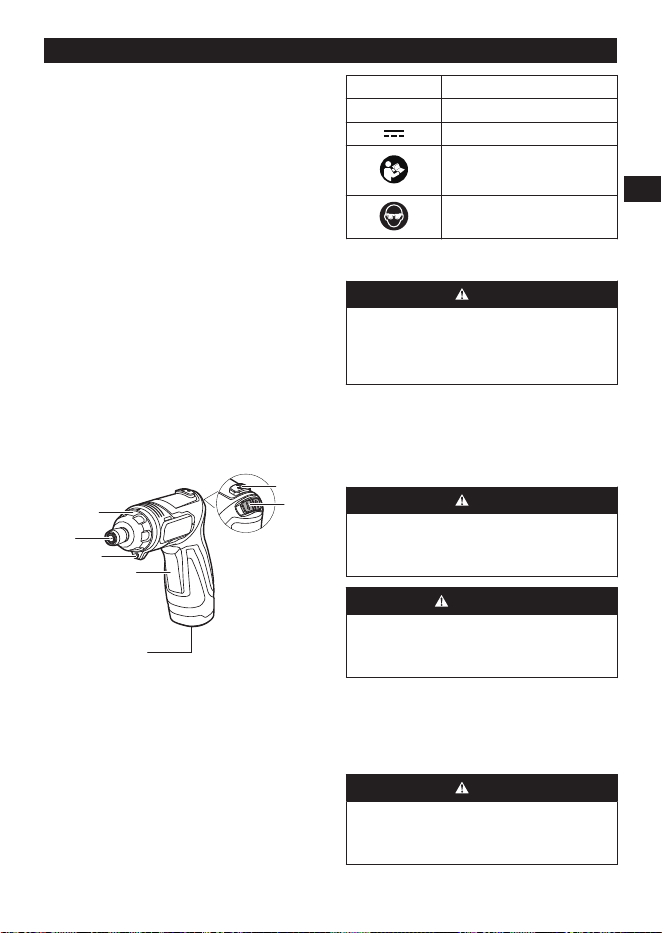
1.3 PRESENTACIÓN DEL PRODUCTO
5
2
1
3
4
6
7
1
Embrague
2
Pinza hexagonal de 1/4"
3
Luz LED
4
Gatillo
5
Puerto de carga USB-C
6
Interruptor de avance/retroceso
7
Botón de bloqueo del pivote
1.4 SÍMBOLOS EN EL PRODUCTO
Es posible que se utilicen algunos de los siguientes
símbolos en esta herramienta. Estúdielos y aprenda
su significado. La interpretación correcta de estos
símbolos le permitirá utilizar la herramienta de forma
más segura y eficaz.
Símbolo Explicación
V Tensión
Corriente directa
Lea todas las advertencias de
seguridad y todas las instruc-
ciones.
Utilice protección ocular.
1.5 PROPUESTA 65 DE CALIFORNIA
AVISO
ESTE PRODUCTO CONTIENE O EMITE UNA
SUSTANCIA QUÍMICA CONOCIDA EN EL
ESTADO DE CALIFORNIA COMO CAUSANTE
DE CÁNCER O DEFECTOS DE NACIMIENTO U
OTROS DAÑOS REPRODUCTIVOS.
2 SEGURIDAD
2.1 DEFINICIONES DE SEGURIDAD
Las advertencias, precauciones y notas se utilizan
para señalar partes especialmente importantes del
manual.
AVISO
EXISTE UN RIESGO DE LESIONES O MUERTE
PARA EL OPERARIO O PARA OTRAS
PERSONAS SI NO SE RESPETAN LAS
INSTRUCCIONES DEL MANUAL.
PRECAUCIÓN
EXISTE UN RIESGO DE DAÑOS AL PRODUCTO,
OTROS DAÑOS MATERIALES Y EN LA ZONA
ADYACENTE SI NO SE RESPETAN LAS
INSTRUCCIONES DEL MANUAL.
Nota: Se utiliza para ofrecer más información de la
necesaria en una situación determinada.
2.2 ADVERTENCIAS GENERALES DE
SEGURIDAD PARA HERRAMIENTAS
ELÉCTRICAS
AVISO
Lea todas las advertencias de seguridad y
todas las instrucciones. El incumplimiento de
las advertencias e instrucciones puede provocar
descargas eléctricas, incendios o lesiones graves.
23
Español
ES

Guarde todas las advertencias e instrucciones
para su consulta posterior.
El término “herramienta eléctrica” empleado en las
advertencias se refiere a su herramienta eléctrica con
funcionamiento a batería (inalámbrica).
2.2.1 SEGURIDAD DE LA ZONA DE TRABAJO
• Mantenga limpia y bien iluminada la zona
de trabajo. Las zonas desordenadas u oscuras
fomentan los accidentes.
• No utilice herramientas eléctricas en atmósferas
explosivas, como en la presencia de líquidos,
gases o polvo que puedan inflamarse. Las
herramientas eléctricas generan chispas que
pueden encender el polvo o los gases.
• Mantenga alejados a los niños y los transeúntes
mientras utilice una herramienta eléctrica. Las
distracciones pueden hacer que pierda el control.
2.2.2 SEGURIDAD ELÉCTRICA
• Los enchufes de las herramientas eléctricas
deben corresponder con la toma de corriente.
Nunca modifique el enchufe en modo alguno. No
utilice enchufes adaptadores con herramientas
eléctricas conectadas a tierra. La utilización de
enchufes no modificados y de tomas de corriente
adecuadas reducirá el riesgo de descarga eléctrica.
• Evite el contacto del cuerpo con superficies
conectadas a tierra, como tuberías, radiadores,
estufas y refrigeradores. Existe un riesgo
aumentado de descarga eléctrica si su cuerpo está
conectado a tierra.
• No exponga las herramientas eléctricas a la
lluvia o a condiciones de humedad. Si penetra
agua en una herramienta eléctrica, aumentará el
riesgo de descarga eléctrica.
• No abuse del cable. Nunca utilice el cable para
transportar, tirar o desenchufar la herramienta
eléctrica. Mantenga el cable alejado del calor, el
aceite, los bordes afilados y las piezas móviles.
Los cables dañados o enredados aumentan el
riesgo de descarga eléctrica.
• Cuando utilice una herramienta eléctrica en
exteriores, use un cable alargador adecuado
para uso en exterior. La utilización de un cable
adecuado para uso en exterior reduce el riesgo de
descarga eléctrica.
• Si no es inevitable el uso de una herramienta
eléctrica en un lugar húmedo, utilice un
suministro protegido por un DISPOSITIVO DE
CORRIENTE RESIDUAL (RCD). La utilización de
un RCD reduce el riesgo de descarga eléctrica.
2.2.3 SEGURIDAD PERSONAL
• Manténgase alerta, observe lo que está
haciendo y emplee el sentido común cuando
utilice una herramienta eléctrica. No utilice una
herramienta eléctrica mientras esté cansado
o bajo la influencia de drogas, alcohol o
medicamentos. Una falta de atención durante el
uso de herramientas eléctricas puede provocar
lesiones personales graves.
• Utilice protección personal. Lleve siempre
protección ocular. Si se utilizan correctamente
productos de protección como máscaras antipolvo,
zapatos de seguridad antideslizantes, cascos o
protecciones auditivas, se reducirán las lesiones
personales.
• Evite el arranque accidental. Asegúrese de que
el interruptor esté en la posición de apagado
antes de conectar a la fuente de alimentación
o a la batería y al coger o transportar
la herramienta. El transporte de herramientas
eléctricas con el dedo en el interruptor o la conexión
de herramientas eléctricas que tienen el interruptor
activado fomenta los accidentes.
• Retire cualquier llave de ajuste antes de
encender la herramienta eléctrica. Una llave
que se quede fijada a una pieza giratoria de
la herramienta eléctrica puede provocar lesiones
personales.
• No se estire. Mantenga en todo momento una
postura adecuada y el equilibrio. Esto permite
un mejor control de la herramienta eléctrica en
situaciones inesperadas.
• Lleve indumentaria adecuada. No lleve ropa o
joyas sueltas. Mantenga el cabello, la ropa y
los guantes lejos de las piezas móviles. La ropa
suelta, las joyas o el cabello largo pueden quedar
atrapados en las piezas móviles.
• Si se utilizan dispositivos para la conexión de
sistemas de extracción y recogida de polvo,
asegúrese de que estén conectados y se
utilicen correctamente. La utilización de sistemas
de recogida de polvo puede reducir los riesgos
relacionados con el polvo.
• No permita que la familiaridad adquirida con
el uso frecuente de las herramientas le
permita sentirse autocomplaciente e ignorar los
principios de seguridad de la herramienta. Una
acción descuidada puede provocar lesiones graves
en una fracción de segundo.
2.2.4 UTILIZACIÓN Y CUIDADO DE
HERRAMIENTAS ELÉCTRICAS
• No fuerce la herramienta eléctrica. Utilice
la herramienta eléctrica correcta para su
aplicación. La herramienta eléctrica correcta hará
el trabajo mejor y con mayor seguridad a la
velocidad para la que se diseñó.
• No utilice la herramienta eléctrica si el
interruptor no la enciende y la apaga. Cualquier
herramienta eléctrica que no pueda controlarse con
el interruptor es peligrosa y debe repararse.
24
Español
ES

• Desconecte el enchufe de la fuente de
alimentación o la batería de la herramienta
eléctrica antes de realizar ajustes, cambiar
accesorios o almacenar herramientas eléctricas.
Estas medidas de seguridad preventivas reducen el
riesgo de que la herramienta eléctrica se arranque
accidentalmente.
• Almacene las herramientas eléctricas inactivas
fuera del alcance de los niños y no permita
que personas que no estén familiarizadas con
la herramienta eléctrica o estas instrucciones
puedan utilizarla. Las herramientas eléctricas son
peligrosas en manos de usuarios inexpertos.
• Mantenga las herramientas eléctricas y los
accesorios. Compruebe si hay desalineación o
unión de las piezas móviles, rotura de piezas
y cualquier otra condición que pueda afectar al
funcionamiento de la herramienta eléctrica. Si
ha sufrido daños, lleve a reparar la herramienta
eléctrica antes del uso. Numerosos accidentes se
deben a herramientas eléctricas mal mantenidas.
• Mantenga limpias y afiladas las herramientas
de corte. Las herramientas de corte mantenidas
correctamente con filos cortantes tienen menos
probabilidades de atascarse y son más fáciles de
controlar.
• Utilice la herramienta eléctrica, los accesorios,
las brocas, etc. de acuerdo con estas
instrucciones, teniendo en cuenta las
condiciones de trabajo y el trabajo a realizar. El
uso de la herramienta eléctrica para operaciones
distintas de las previstas podría dar lugar a una
situación peligrosa.
• Mantenga las asas y las superficies de agarre
secas, limpias y sin restos de aceite y grasa.
Las asas y las superficies de agarre resbaladizas
no permiten un manejo y control seguros de la
herramienta en situaciones inesperadas.
2.2.5 UTILIZACIÓN Y CUIDADO DE
HERRAMIENTAS A BATERÍA
• Recargue solo con el cargador especificado por
el fabricante. Un cargador adecuado para un tipo
de batería puede dar lugar a un riesgo de incendio
cuando se usa con otra batería.
• Utilice las herramientas eléctricas únicamente
con las baterías designadas específicamente. El
uso de cualquier otra batería puede dar lugar a un
riesgo de lesiones e incendio.
• Cuando la batería no esté en uso, manténgala
alejada de otros objetos metálicos como
clips, monedas, llaves, clavos, tornillos u
otros objetos metálicos pequeños que puedan
hacer una conexión entre los terminales. El
cortocircuito de los terminales de la batería puede
provocar quemaduras o incendios.
• Bajo condiciones abusivas, es posible que
salga líquido despedido de la batería; evite el
contacto. Si se produce un contacto accidental,
aclare con abundante agua y jabón. Si el líquido
entra en contacto con los ojos, acuda al médico
inmediatamente. El líquido despedido de la batería
puede provocar irritación o quemaduras.
• No utilice una batería o una herramienta que
haya sufrido daños o modificaciones. Las
baterías dañadas o modificadas pueden exhibir un
comportamiento impredecible que puede dar lugar a
un incendio, una explosión o un riesgo de lesiones.
• No exponga una batería o una herramienta al
fuego ni a temperatura excesiva. La exposición al
fuego o a una temperatura superior a 130 °C puede
provocar una explosión.
• Siga todas las instrucciones de carga y
no cargue la batería o la herramienta fuera
del intervalo de temperatura especificado en
las instrucciones. La carga incorrecta o a
temperaturas fuera del intervalo especificado puede
dañar la batería y aumentar el riesgo de incendio.
2.2.6 SERVICIO
• Solicite a un técnico de reparación cualificado
que realice las tareas de servicio de su
herramienta eléctrica utilizando únicamente
piezas de repuesto idénticas. Esto garantizará el
mantenimiento de la seguridad de la herramienta
eléctrica.
• Nunca repare las baterías dañadas. La reparación
de las baterías únicamente debe ser realizada por
el fabricante o los proveedores de servicio técnico
autorizados.
2.2.7 NORMAS DE SEGURIDAD ESPECÍFICAS
• Sujete la herramienta eléctrica únicamente por
las superficies de agarre aisladas cuando realice
una operación en la que el elemento de fijación
pueda entrar en contacto con cableado oculto.
Si un elemento de fijación entra en contacto con
un cable "con corriente", esto puede hacer que
las piezas metálicas expuestas de la herramienta
eléctrica "tengan corriente" y podrían producir una
descarga eléctrica al operador.
• Conozca su herramienta eléctrica. Lea
atentamente el manual del operador. Conozca
sus aplicaciones y limitaciones, así como los
peligros potenciales específicos relacionados
con esta herramienta eléctrica. Obedecer estas
instrucciones reducirá descargas eléctricas,
incendios o lesiones graves.
• Utilice siempre gafas de seguridad con pantallas
laterales que cumplan la norma ANSI Z87.1.
Obedecer esta instrucción reducirá el riesgo de
sufrir lesiones graves.
• Proteja sus pulmones. Use una mascarilla facial
o antipolvo si la operación genera mucho polvo.
Obedecer esta instrucción reducirá el riesgo de
sufrir lesiones graves.
25
Español
ES
• Proteja su audición. Utilice protección
auditiva durante períodos prolongados de
funcionamiento. Obedecer esta instrucción
reducirá el riesgo de sufrir lesiones graves.
• Las herramientas a batería no necesitan
estar conectadas a un tomacorriente; por
lo tanto, siempre están en condiciones de
funcionamiento. Tenga en cuenta los posibles
peligros cuando su herramienta de batería no
esté en uso o al cambiar accesorios. Siga estas
instrucciones para reducir el riesgo de descarga
eléctrica, incendio o lesiones graves,
• No coloque las herramientas de batería o sus
baterías cerca del fuego o el calor. Esto reducirá
el riesgo de explosión y posibles lesiones.
• No aplaste, deje caer ni dañe la batería. No
utilice una batería o un cargador que se haya
caído o haya recibido un golpe fuerte. Una
batería dañada está sujeta a explosión. Deseche
correctamente una batería que se haya caído o esté
dañada de inmediato.
• Las baterías pueden explotar en presencia de
una fuente de ignición, como una luz piloto.
Para reducir el riesgo de lesiones graves,
nunca utilice ningún producto inalámbrico en
presencia de llamas abiertas. Una batería que
explota puede impulsar desechos y productos
químicos. Si está expuesto, enjuague con agua
inmediatamente.
• No cargue la herramienta de batería en un lugar
húmedo o mojado. Obedecer esta instrucción
reducirá el riesgo de descarga eléctrica.
• Para obtener los mejores resultados, la
herramienta de batería debe cargarse en un
lugar donde la temperatura sea superior a 50
°F pero inferior a 100 °F. Para reducir el riesgo
de lesiones graves, no guarde la herramienta a la
intemperie o en vehículos.
• Bajo condiciones extremas de uso o
temperatura, la batería puede tener fugas. Si
el líquido entra en contacto con el fregadero,
lávelo inmediatamente con agua y jabón. Si le
entra líquido en los ojos, enjuáguelos con agua
limpia durante al menos 10 minutos y luego
busque atención médica inmediata. Obedecer esta
instrucción reducirá el riesgo de lesiones graves.
• Guarde estas instrucciones. Consúltelas con
frecuencia y utilícelas para instruir a otras
personas que puedan usar esta herramienta. Si
presta esta herramienta, preste estas instrucciones
también para evitar el uso incorrecto de la máquina
y posibles lesiones.
3 MONTAJE
Esta sección describe cómo montar y ajustar el
producto.
AVISO
DEBE LEER DETENIDAMENTE Y ENTENDER
EL CAPÍTULO DE SEGURIDAD Y LAS
INSTRUCCIONES DE MONTAJE ANTES DE
MONTAR EL PRODUCTO.
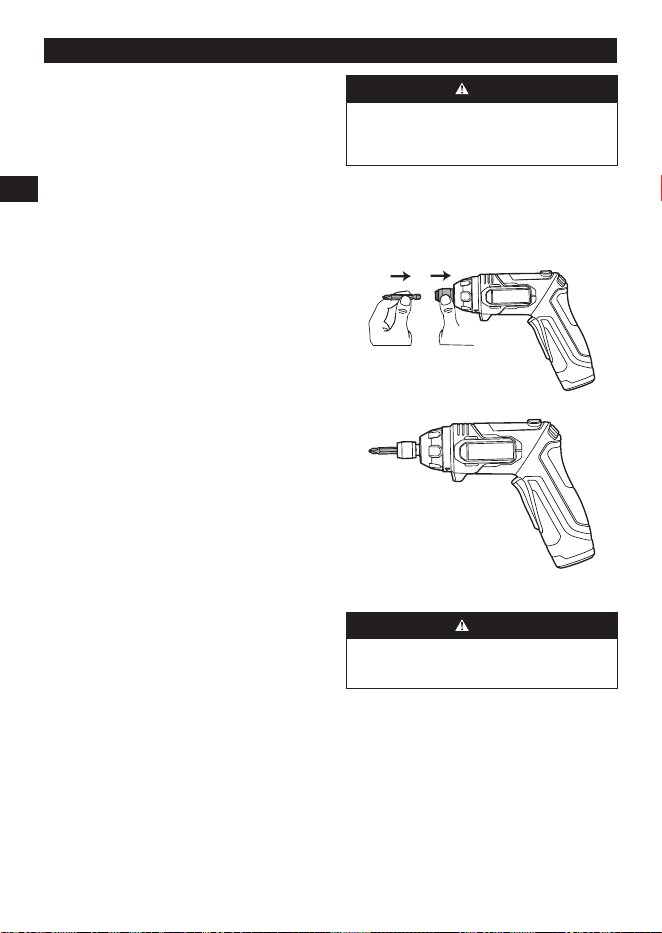
3.1 INSTALACIÓN DE LA PUNTA
1. Empuje el interruptor de avance/retroceso a la
posición "neutra" para bloquear el gatillo.
2. Tire del portapuntas hacia atrás y manténgalo en
esa posición.
12
3. Introduzca la punta en el portapuntas.
Nota: Utilice únicamente puntas de impacto de calidad
con una ranura de bloqueo.
AVISO
ASEGÚRESE DE FIJAR LA PUNTA FIRMEMENTE
EN EL PORTAPUNTAS ANTES DE USAR EL
PRODUCTO.
3.2 RETIRADA DE LA BROCA
1. Empuje el interruptor de avance/retroceso a la
posición "neutra" para bloquear el gatillo.
2. Tire del portapuntas hacia atrás y manténgalo en
esa posición.
3. Tire de la punta directamente hacia fuera del
portapuntas.
4 FUNCIONAMIENTO
Esta sección describe el funcionamiento del producto.
26
Español
ES
AVISO
DEBE LEER DETENIDAMENTE Y ENTENDER
EL CAPÍTULO DE SEGURIDAD Y LAS
INSTRUCCIONES DE FUNCIONAMIENTO ANTES
DE UTILIZAR EL PRODUCTO.
4.1 ANTES DE UTILIZAR EL PRODUCTO
4.1.1 CARGUE LA BATERÍA
AVISO
USAR SOLO Greenworks-CARGADORES
HOMOLOGADOS PARA CARGAR LA BATERÍA A
TRAVÉS DEL PUERTO DE CARGA USB-C.
Nota: La batería debe cargarse antes de la primera
puesta en marcha.
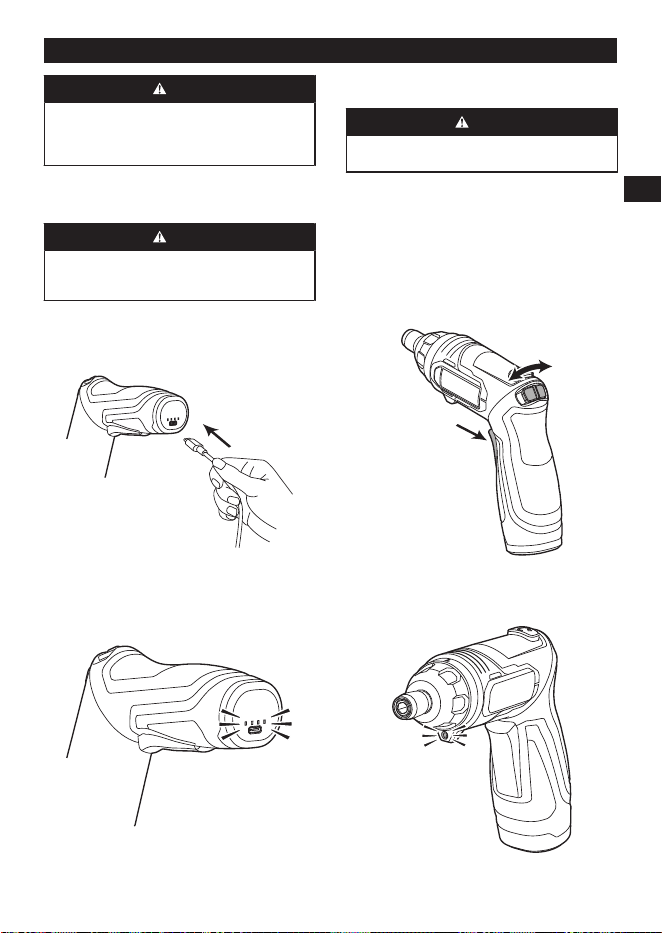
1. Conecte el extremo USB-C del cable de
alimentación al puerto USB-C de la herramienta.
2. Conecte el extremo USB-A del cable de
alimentación a un dispositivo que tenga un puerto
de salida USB-C.5V.
3. La pantalla LED muestra el estado de carga de
la batería. Cuando todas las luces verdes estén
encendidas, la carga estará completa.
Nota: La batería de iones de litio se puede cargar en
cualquier momento sin que ello afecte a la vida útil del
producto. Interrumpir el proceso de carga no dañará la
batería.
AVISO
NO PERMITA QUE LA BATERÍA SE DESCARGUE
COMPLETAMENTE.
4.2 PONGA EL PRODUCTO EN MARCHA
Nota: El producto no puede funcionar hasta
que el interruptor de avance/retroceso se empuje
completamente hacia la izquierda o hacia la derecha.
No opere el producto a bajas velocidades durante
períodos prolongados.
1. Coloque el interruptor de avance/retroceso en la
posición deseada para el funcionamiento.
2. Apriete el gatillo para encender el producto.
1
2
4.3 LUZ LED
La luz LED se ilumina cuando se aprieta el gatillo.
Proporciona luz adicional para una mayor visibilidad.
27
Español
ES
4.4 INTERRUPTOR DE AVANCE/RETROCESO
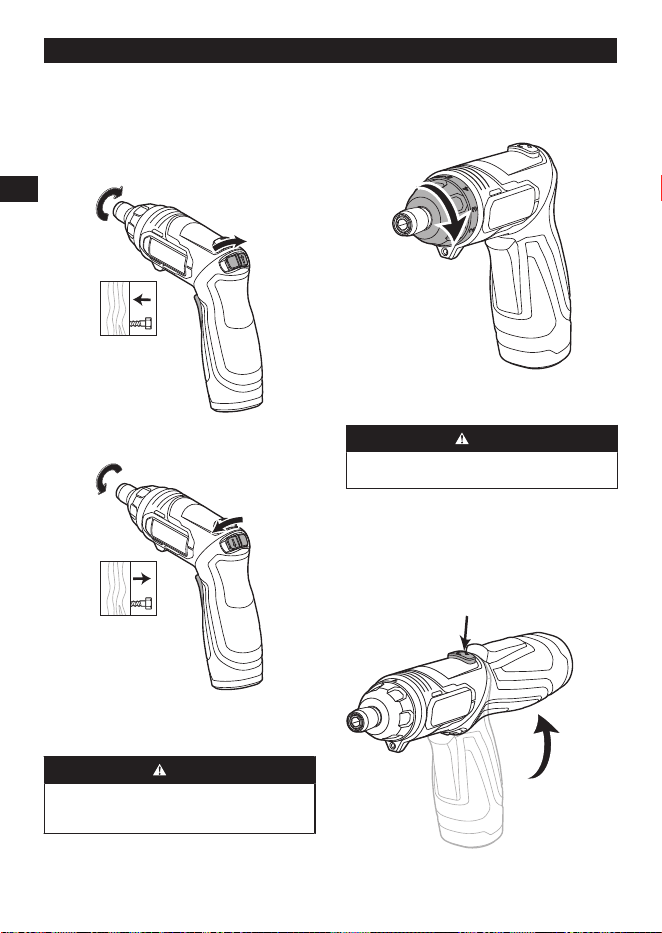
El producto tiene un interruptor de avance/retroceso
para cambiar la dirección de rotación.
1. Cuando el interruptor está en el lado derecho
(flecha hacia adelante), la dirección de
accionamiento es hacia adelante (apriete).
2. Cuando el interruptor está en el lado
izquierdo (flecha hacia atrás), la dirección de
accionamiento se invierte (aflojamiento).
3. Coloque el interruptor en la posición «neutra»
para ayudar a reducir la posibilidad de
un arranque accidental cuando no esté en
funcionamiento.
AVISO
DEJE QUE EL PORTAPUNTAS SE DETENGA
COMPLETAMENTE ANTES DE CAMBIAR LA
DIRECCIÓN DE ROTACIÓN.
4.5 SELECCIÓN DEL PAR
Gire el embrague para ajustar el par. El número hacia
arriba indica el nivel de par.
4.6 PARADA DEL PRODUCTO
1. Suelte el gatillo para apagar el producto.
AVISO
SUELTE EL GATILLO Y DEJE QUE EL
PRODUCTO SE DETENGA POR COMPLETO.
4.7 POSICIÓN EN LÍNEA/PIVOTANTE
El producto se puede utilizar en posición en línea o
pivotante. En la parte superior del producto hay un
botón de bloqueo pivotante.
Presione el botón de bloqueo pivotante y gire la
carcasa delantera completamente hacia la derecha o
hacia la izquierda.
1
2
28
Español
ES
5 MANTENIMIENTO
PRECAUCIÓN
Asegúrese de evitar el contacto con líquidos
de frenos, gasolina y otros materiales a base
de petróleo. Estos productos químicos tienen el
potencial de causar daños y dejar inservibles los
componentes plásticos.
PRECAUCIÓN
No utilizar solventes o detergentes fuertes sobre la
carcasa de plástico o los componentes.
5.1 LIMPIEZA DEL PRODUCTO
PRECAUCIÓN
El producto debe permanecer siempre seco para
minimizar el riesgo de descargas eléctricas. Evite la
exposición a condiciones de humedad.
• Elimine cualquier residuo del respiradero con un
aspirador.
• Evite pulverizar disolventes directamente en el
respiradero o sumergirlo en disolventes.
• Limpie la carcasa y los componentes de plástico
con un paño húmedo y suave.
6 TRANSPORTE, ALMACENAMIENTO Y
ELIMINACIÓN
6.1 TRANSPORTE
• Cualquier parte extraíble (electrónica), como el
cargador y la batería, siempre deben retirarse antes
del transporte.
• Evite transportar el producto en condiciones
climáticas adversas siempre que sea posible.
• Cubra adecuadamente las piezas electrónicas
durante el transporte cuando no se pueda evitar el
transporte en condiciones climáticas adversas.
• Las altas velocidades junto con el viento y la lluvia
podría causar que la humedad presione en las
partes electrónicas, lo que puede provocar fallos
temporales o defectos permanentes.
• Si se produce un mal funcionamiento después del
transporte en tales condiciones, deje que las piezas
se sequen al aire cuando hayan llegado al destino.
6.2 ALMACENAMIENTO
Si el producto no se utiliza durante un periodo
prolongado, es necesario realizar un mantenimiento
adecuado durante el almacenamiento.
• Almacene el producto bloqueado para evitar su uso
no autorizado o daños.
• Almacene el producto en una zona seca y bien
ventilada.
• Almacene el producto fuera del alcance de los
niños.
6.3 ELIMINACIÓN DEL PRODUCTO
Los símbolos en el producto o en el paquete del
producto significan que el accesorio no es un residuo
doméstico. Reciclarlo en una estación de reciclaje
de equipos eléctricos y electrónicos. Esto ayuda a
prevenir daños al medio ambiente y a las personas.
Póngase en contacto con las autoridades locales,
el servicio de residuos domésticos o su distribuidor
para obtener más información sobre cómo reciclar su
producto.
7 DATOS TÉCNICOS
Tensión 8 V CC
Velocidad en vacío 0-280 min
Par máx 70 In-lbs / 8 N.m
Ajuste de par 5+1
Modelo de cargador re-
comendado
AC65WAD
Entrada recomendada
del cargador
100-240V AC 50/60Hz
Salida recomendada del
cargador
5V
Acoplamiento 1/4" Hex
29
Español
ES
-1

Rango de temperatura ambiente recomendado:
Artículo Temperatura
Intervalo de temperatura
de almacenamiento del
producto
32°F (0°C) - 113°F
(45°C)
Intervalo de temperatura
de funcionamiento del
producto
32°F (0°C) - 113°F
(45°C)
Margen de temperaturas
para cargar la batería
39 °F (4 °C) - 104 °F
(40 °C)
Margen de temperaturas
operacionales del carga-
dor
39 °F (4 °C) - 104 °F
(40 °C)
Margen de temperaturas
de almacenamiento de la
batería
32°F (0°C) - 113°F
(45°C)
Margen de temperaturas
para la descarga de la
batería
32°F (0°C) - 113°F
(45°C)
8 GARANTÍA LIMITADA
Greenworks los productos y las baterías están
protegidos contra cualquier defecto de materiales,
piezas o mano de obra en condiciones normales de
uso durante un periodo de 3 años a partir de la fecha
de envío o de compra en la tienda.
A su entera discreción Greenworks puede optar
por reparar, reemplazar, sustituir por un artículo
comparable o reembolsar los productos que se
consideren defectuosos por su uso normal o que
hayan sufrido daños durante el envío. Se requiere
prueba de compra y registro del producto. La
sustitución de productos o piezas sujetas a desgaste
normal es responsabilidad del cliente.
Esta garantía solo es válida para las unidades
que hayan sido mantenidas de acuerdo con las
instrucciones que se encuentran en el manual del
operario suministrado con el producto; y para las
unidades que hayan sido registradas mediante una de
las siguientes maneras:
En línea: www.greenworkstools.com
Teléfono – 1-888-909-6757
Si Greenworks acepta una devolución en garantía,
puede devolver el producto defectuoso o dañado solo
después de llamar a nuestro equipo de Atención al
Cliente y recibir una Autorización de Devolución de
Greenworks. También recibirá un reembolso por sus
gastos de envío originales, y Greenworks organizará
y pagará los gastos de envío de su devolución. Para
solicitar una Autorización de Devolución, póngase en
contacto con nosotros en 1-888-909-6757.
8.1 ARTÍCULOS NO CUBIERTOS POR LA
GARANTÍA
• Cualquier pieza que no funcione debido a mal
uso, uso comercial, abuso, negligencia, accidente,
mantenimiento inadecuado o alteración.
• La unidad, si no ha sido utilizada o mantenida de
acuerdo con el manual del operario.
• Desgaste normal, excepto en lo indicado a
continuación:
• Artículos de mantenimiento de rutina tales como
lubricantes.
• Deterioro normal del acabado exterior debido al
uso o la exposición.
• Cualquier pieza/producto que no funcione debido
a su uso con piezas o baterías/cargadores que
no sean de la marca Greenworks.
8.2 LÍNEA DE ASISTENCIA TELEFÓNICA
Puede contactar con el servicio de garantía llamando
a nuestra línea de asistencia telefónica gratuita a:
1-888-909-6757.
8.3 ENVÍO
Los costes de transporte por el desplazamiento de
cualquier unidad o accesorio de equipos eléctricos son
responsabilidad del comprador. Es responsabilidad del
comprador pagar los costes de transporte de cualquier
pieza enviada para su sustitución bajo esta garantía, a
menos que dicha devolución sea solicitada por escrito
por Greenworks.
8.3.1 DIRECCIÓN
Dirección de EE. UU.:
Greenworks North America, LLC
P.O. Box 1238 , Mooresville, NC 28115, EE. UU.
Dirección de Canadá:
Greenworks Tools Canada, Inc.
67 Toll Rd., Holland Landing, ON L9N 1H2
Dirección en México:
TECNOLOGIA CAMPO Y JARDIN S.A. DE C.V.
ADMINISTRADORES No. 5336 A, COL. ARCOS DE
GUADALUPE, ZAPOPAN, JALISCO, C.P. 45037
30
Español
ES


www.greenworkstools.com
Rev B1
P0807508-00