INSTRUCTION MANUAL
MANUAL DE INSTRUCCIONES
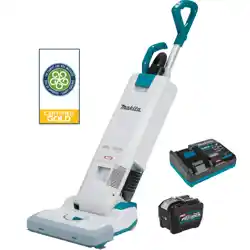
Cordless Upright Cleaner
Limpiador Vertical Inalámbrico
GCV09
IMPORTANT: Read Before Using.
IMPORTANTE: Lea antes de usar.
2 ENGLISH
ENGLISH (Original instructions)
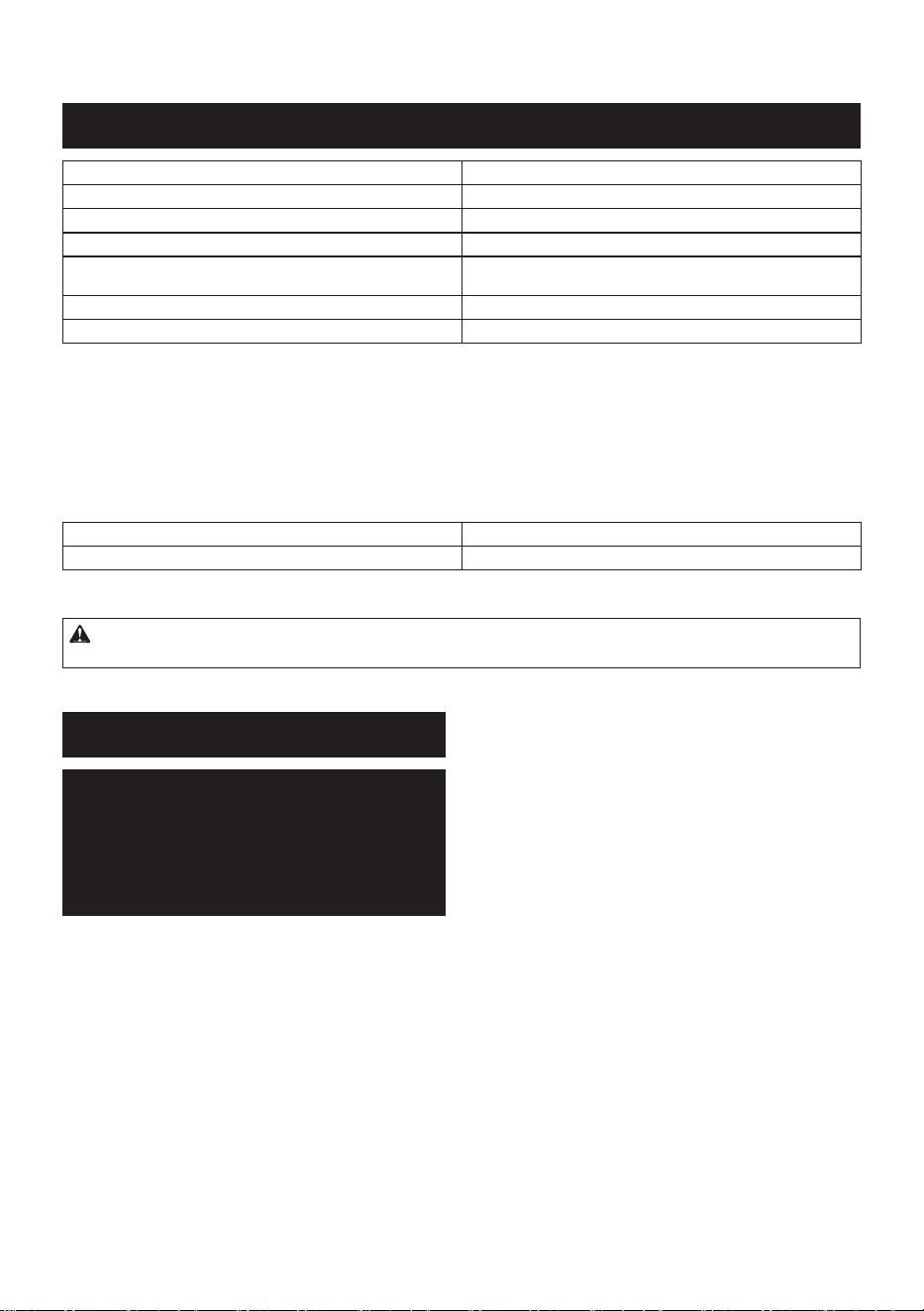
SPECIFICATIONS
Model: GCV09
Maximum air volume
*1
1.8 m
3
/min (64 cu.ft/min)
Vacuum
*1
15 kPa
Capacity 5 L (1.3 gal.)
Dimensions (L x W x H) 326 mm x 381 mm x 1,146 mm
(12-7/8″ x 15″ x 45″)
Rated voltage D.C. 36 V - 40 V max
Net weight 8.0 - 9.2 kg (17.6 - 20.3 lbs)
*1
The value is measured by our original method.
• Due to our continuing program of research and development, the specications herein are subject to change
without notice.
• Specications may dier from country to country.
• The weight includes accessories (round brush, corner nozzle) and battery cartridge(s). The lightest and heavi-
est combination weight of the appliance and battery cartridge(s) are shown in the table.
Applicable battery cartridge and charger
Battery cartridge BL4020 / BL4025 / BL4040 / BL4040F / BL4050F / BL4080F
Charger DC40RA / DC40RB / DC40RC
• Some of the battery cartridges and chargers listed above may not be available depending on your region of
residence.
WARNING: Only use the battery cartridges and chargers listed above. Use of any other battery cartridges
and chargers may cause injury and/or re.
SAFETY WARNINGS
IMPORTANT
SAFETY
INSTRUCTIONS
When using an electrical appliance,
basic precautions should always be fol-
lowed, including the following:
READ ALL
INSTRUCTIONS
BEFORE USING
THIS APPLIANCE.
WARNING
To reduce the risk of re, electric shock
or injury:
1. Do not leave appliance when battery
tted. Remove battery from appli-
ance when not in use and before
servicing.
2.
Do not use outdoors or on wet surfaces.
3. Do not allow to be used as a toy.
Close attention is necessary when
used by or near children.
4. Use only as described in this man-
ual. Use only manufacturer's recom-
mended attachments.
5. Do not use with damaged battery.
If appliance is not working as it
should, has been dropped, dam-
aged, left outdoors, or dropped into
water, return it to a service center.
6. Do not handle battery or appliance
with wet hands.

3 ENGLISH
7.
Do not put any object into open-
ings. Do not use with any opening
blocked; keep free of dust, lint, hair,
and anything that may reduce air
ow.
8. Keep hair, loose clothing, ngers,
and all parts of body away from
openings and moving parts.
9. Turn o all controls before removing
the battery cartridge.
10. Use extra care when cleaning on
stairs.
11. Do not use to pick up ammable or
combustible liquids, such as gaso-
line, or use in areas where they may
be present.
12. Do not pick up anything that is burn-
ing or smoking, such as cigarettes,
matches, or hot ashes.
13. Do not use without lter bag and/or
lters in place.
14. When not in use, always store the
cleaner indoors.
15. Replace a damaged lter
immediately.
16. Keep proper footing and balance at
all times.
17. Do not use the cleaner as a stool or
work bench. The machine may fall
down and may result in personal
injury.
18. Keep all parts of your body and
clothing away from the openings
and moving part like the rotating
brushroll. Otherwise they may be
caught in the appliance and cause
injury.
19. Wear appropriate protective equip-
ment such as a mask depending on
the usage environment.
20. Keep exhaust away from face and
body.
21. Do not use the cleaner on unstable
or tilted locations to avoid it falling
o resulting in injury or damage.
22. Stop the cleaner immediately if you
notice poor performance or any-
thing abnormal during operation.
23. Do not pick up the following
materials:
— Hot substances that are burn-
ing or smoking (cigarettes,
matches, incense sticks, can-
dles, hot ashes), sparks and
metal dust generated by cutting
or grinding metal, etc.
— Flammable liquid (kerosene,
gasoline, solvents such as ben-
zine, thinner, etc.)
— Flammable material (toner,
paint, spray, etc.)
— Explosive or pyrophoric sub-
stances (nitroglycerin, alumi-
num, magnesium, titanium, zinc,
red phosphorus, yellow phos-
phorus, celluloid, etc. and their
dust, gas or steam)
—
Liquid, oil, wet dirt or damp gar-
bage, including vomit and excreta
—
Hard pieces with sharp edges (wood
chips, metals, stones, glasses,
nails, pins, razors or cutlery)
—
Solidifying and conductive ne
powder (metal or carbon powder)
— Foam like carpet cleaning agent,
etc. (they may cause explosion
or re)
— Large amount of powder (our,
re extinguisher powder, etc.)
— Substances that cause toxic
symptoms
— Aggressive chemicals (acid,
alkali, etc.)
— Fine binding powder such as
cement
— Fine particle like concrete dust
— Desiccants
— Asbestos
— Pesticides
Such action may cause re, injury and/
or property damage.
To reduce your exposure to these chem-
icals, always wear approved respiratory
protection such as dust masks that are
specially designed to lter out micro-
scopic particles. Direct the exhaust air
away from your face and body.
24. Use only the charger supplied by
the manufacturer to recharge.
25. Do not charge the battery outdoors.

4 ENGLISH
Battery tool use and care
1. Prevent unintentional starting.
Ensure the switch is in the o-po-
sition before connecting to battery
pack, picking up or carrying the
appliance. Carrying the appliance with
your nger on the switch or energiz-
ing appliance that have the switch on
invites accidents.
2. Disconnect the battery pack from
the appliance before making any
adjustments, changing accessories,
or storing appliance. Such preventive
safety measures reduce the risk of
starting the appliance accidentally.
3. Recharge only with the charger
specied by the manufacturer. A
charger that is suitable for one type of
battery pack may create a risk of re
when used with another battery pack.
4. Use appliances only with speci-
cally designated battery packs. Use
of any other battery packs may create
a risk of injury and re.
5. When battery pack is not in use,
keep it away from other metal
objects, like paper clips, coins,
keys, nails, screws or other small
metal objects, that can make a
connection from one terminal to
another. Shorting the battery terminals
together may cause burns or a re.
6. Under abusive conditions, liquid
may be ejected from the battery;
avoid contact. If contact acciden-
tally occurs, ush with water. If liq-
uid contacts eyes, additionally seek
medical help. Liquid ejected from the
battery may cause irritation or burns.
7. Do not use a battery pack or appli-
ance that is damaged or modied.
Damaged or modied batteries
may exhibit unpredictable behavior
resulting in re, explosion or risk of
injury.
8. Do not expose a battery pack or
appliance to re or excessive tem-
perature. Exposure to re or tem-
perature above 130 °C may cause
explosion.
9.
Follow all charging instructions and do
not charge the battery pack or appli-
ance outside of the temperature range
specied in the instructions. Charging
improperly or at temperatures outside of
the specied range may damage the bat-
tery and increase the risk of re.
10.
Have servicing performed by a quali-
ed repair person using only identical
replacement parts. This will ensure that
the safety of the product is maintained.
11. Do not modify or attempt to repair
the appliance or the battery pack
except as indicated in the instruc-
tions for use and care.
SAVE THESE
INSTRUCTIONS.
This appliance is intended for commer-
cial use.
Symbols
The followings show the symbols used for tool.
volts
direct current
Take particular care and
attention.
Important safety
instructions for
battery cartridge
1.
Before using battery cartridge, read
all instructions and cautionary mark-
ings on (1) battery charger, (2) bat-
tery, and (3) product using battery.
2. Do not disassemble or tamper with
the battery cartridge. It may result in
a re, excessive heat, or explosion.
3. If operating time has become
excessively shorter, stop operating
immediately. It may result in a risk
of overheating, possible burns and
even an explosion.

5 ENGLISH
4.
If electrolyte gets into your eyes,
rinse them out with clear water and
seek medical attention right away. It
may result in loss of your eyesight.
5. Do not short the battery cartridge:
(1) Do not touch the terminals with
any conductive material.
(2) Avoid storing battery cartridge
in a container with other metal
objects such as nails, coins, etc.
(3) Do not expose battery cartridge
to water or rain.
A battery short can cause a large
current ow, overheating, possible
burns and even a breakdown.
6.
Do not store and use the tool and battery
cartridge in locations where the tempera-
ture may reach or exceed 50 °C (122 °F).
7. Do not incinerate the battery car-
tridge even if it is severely damaged
or is completely worn out. The bat-
tery cartridge can explode in a re.
8.
Do not nail, cut, crush, throw, drop the bat-
tery cartridge, or hit against a hard object
to the battery cartridge. Such conduct may
result in a re, excessive heat, or explosion.
9. Do not use a damaged battery.
10. The contained lithium-ion batteries
are subject to the Dangerous Goods
Legislation requirements.
For commercial transports e.g. by
third parties, forwarding agents,
special requirement on packaging
and labeling must be observed.
For preparation of the item being
shipped, consulting an expert for
hazardous material is required.
Please also observe possibly more
detailed national regulations.
Tape or mask o open contacts and pack
up the battery in such a manner that it
cannot move around in the packaging.
11.
When disposing the battery cartridge,
remove it from the tool and dispose of
it in a safe place. Follow your local reg-
ulations relating to disposal of battery.
12. Use the batteries only with the prod-
ucts specied by Makita. Installing
the batteries to non-compliant products
may result in a re, excessive heat,
explosion, or leak of electrolyte.
13. If the tool is not used for a long
period of time, the battery must be
removed from the tool.
14. During and after use, the battery
cartridge may take on heat which
can cause burns or low temperature
burns. Pay attention to the handling
of hot battery cartridges.
15. Do not touch the terminal of the tool
immediately after use as it may get
hot enough to cause burns.
16. Do not allow chips, dust, or soil
stuck into the terminals, holes, and
grooves of the battery cartridge. It
may cause heating, catching re, burst
and malfunction of the tool or battery
cartridge, resulting in burns or personal
injury.
17. Unless the tool supports the use
near high-voltage electrical power
lines, do not use the battery car-
tridge near a high-voltage electrical
power lines. It may result in a mal-
function or breakdown of the tool or
battery cartridge.
18. Keep the battery away from
children.
SAVE THESE
INSTRUCTIONS.
CAUTION: Only use genuine Makita batteries.
Use of non-genuine Makita batteries, or batteries that
have been altered, may result in the battery bursting
causing res, personal injury and damage. It will
also void the Makita warranty for the Makita tool and
charger.
Tips for maintaining maximum
battery life
1. Charge the battery cartridge before completely
discharged. Always stop tool operation and
charge the battery cartridge when you notice
less tool power.
2. Never recharge a fully charged battery car-
tridge. Overcharging shortens the battery
service life.
3. Charge the battery cartridge with room tem-
perature at 10 °C - 40 °C (50 °F - 104 °F). Let
a hot battery cartridge cool down before
charging it.
4. When not using the battery cartridge, remove
it from the tool or the charger.
5. Charge the battery cartridge if you do not use
it for a long period (more than six months).
6 ENGLISH
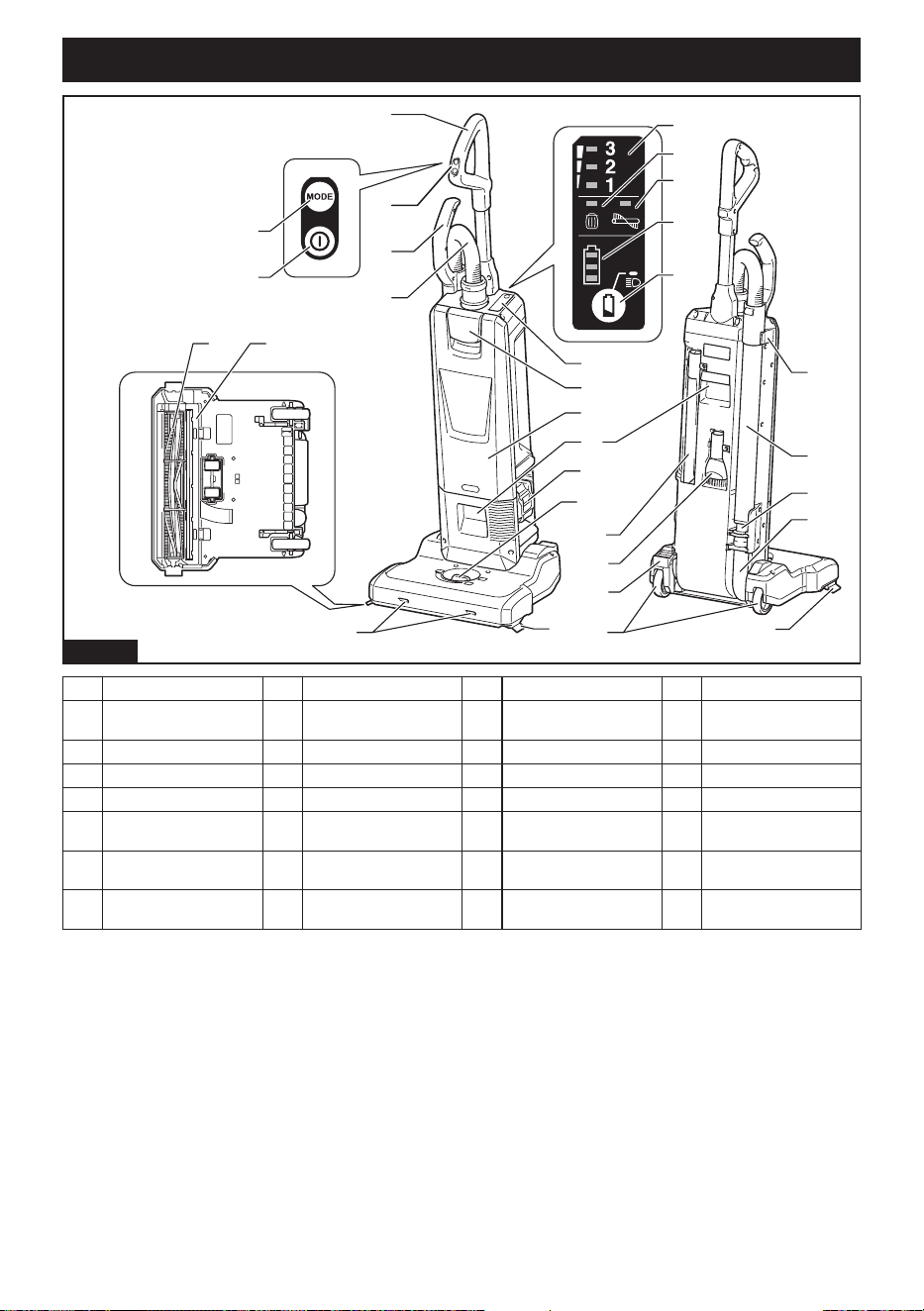
PARTS DESCRIPTION
1
2
3
4
5
6
7
8
9
10
11
12
13
1515
16
17
18
19
21 22
23
24
25
26
27
28
29
14
20
Fig.1
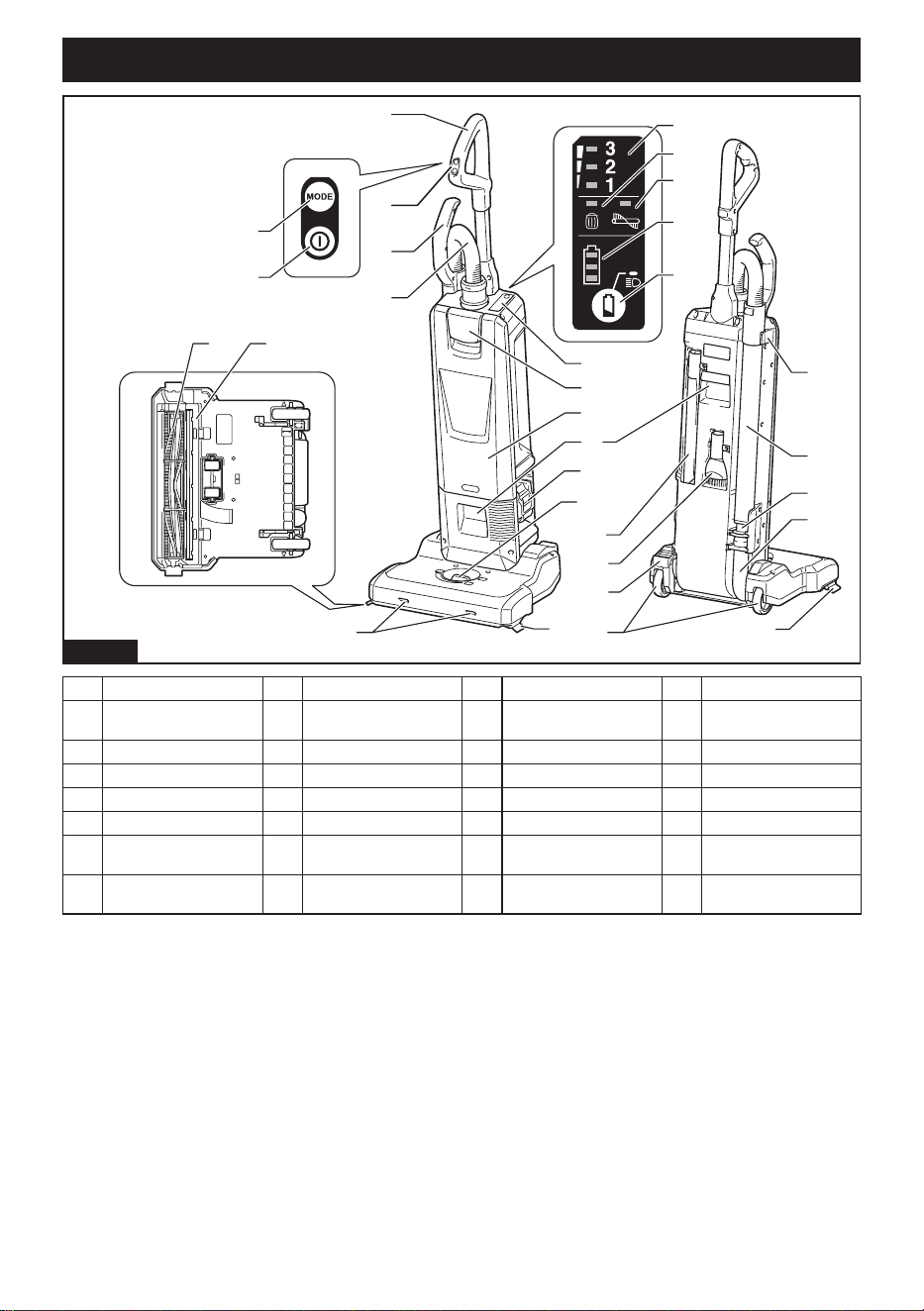
1 Handle 2 Switch plate 3 Pipe grip 4 Hose
5 Indication panel 6 Lever (for the dust box
cover)
7 Dust box cover 8 Carrying handle
9 Battery cartridge 10 Adjusting lever 11 Corner nozzle 12 Round brush
13 Foot lever 14 Caster wheel 15 Side brush 16 Suction hose
17 Joint 18 Aluminum pipe 19 Pipe holder 20 Lamp
21 Brushroll 22 Bottom plate 23 Mode change button 24 ON / OFF button
25 Indicator of operating
mode
26 Indicator of excess level
of dust
27 Indicator of brushroll
error
28 Indicator for remaining
battery capacity
29 Battery check / lamp
button
- - - - - -
7 ENGLISH
ASSEMBLY
CAUTION: Always be sure that the appli-
ance is switched o and the battery cartridge
is removed before carrying out any work on the
appliance.
CAUTION: Always wear dust mask during
assembly or maintenance.
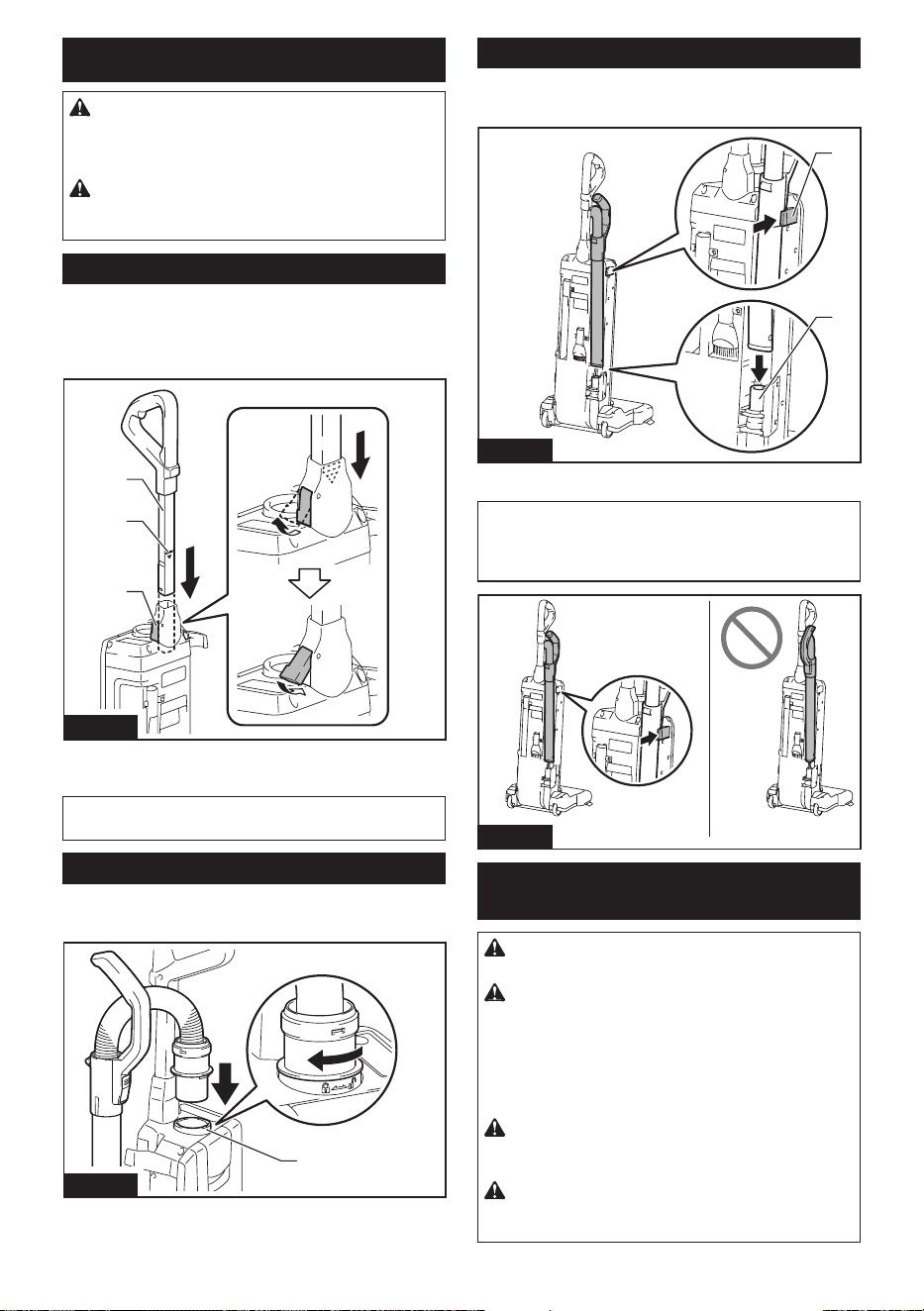
Handle connecting
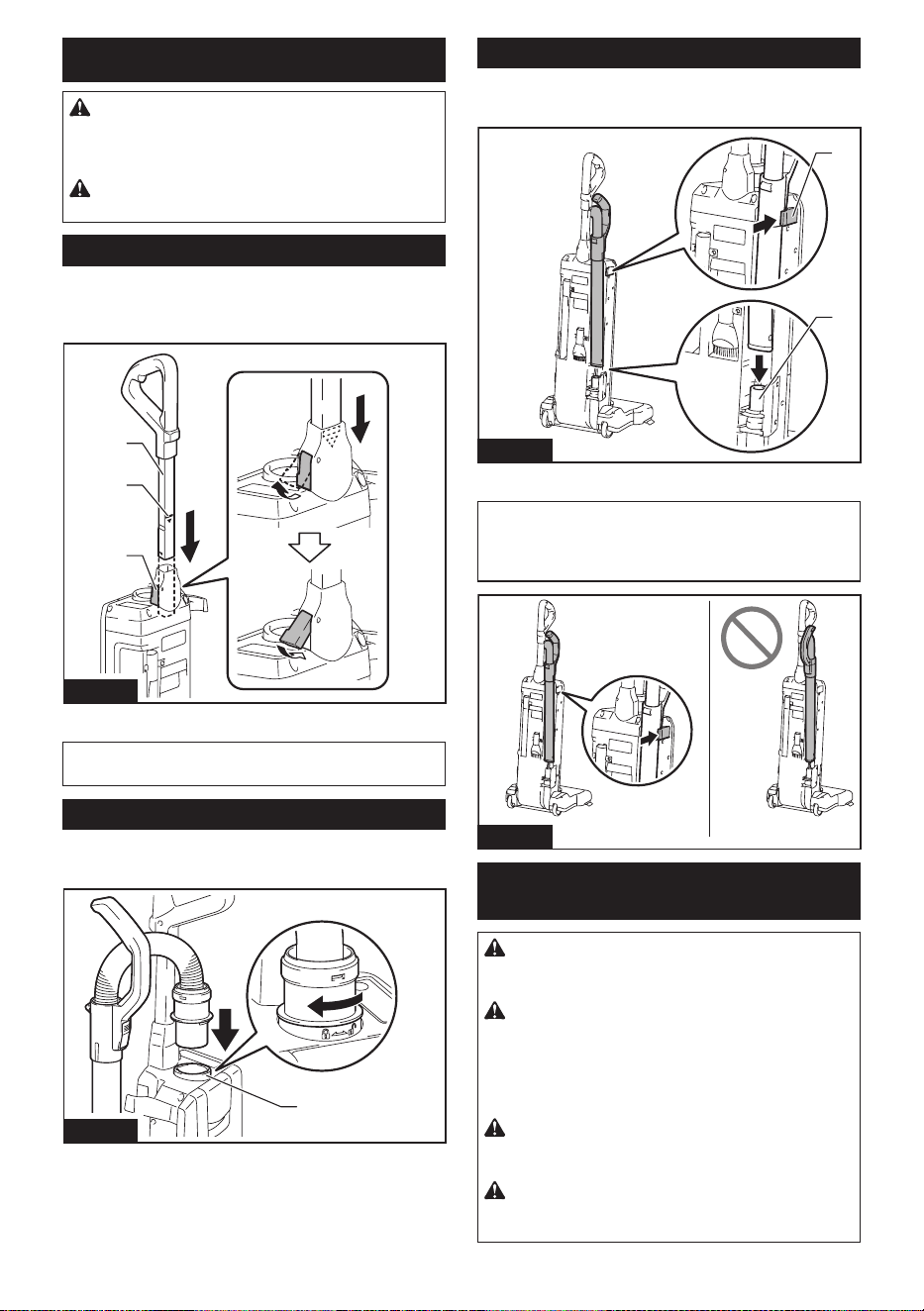
1. Insert the handle pole fully to the cleaner body as
shown in the gure.
2. Close the lock latch.
1
2
3
Fig.2
► 1. Handle pole 2. Red marking 3. Lock latch
NOTICE: Insert the handle fully until the red
marking cannot be seen.
Hose connecting
Insert the hose into the mounting port of the appliance
and turn the hose until it locks.
1
Fig.3
► 1. Mounting port
Pipe connecting
Insert the tip of the aluminum pipe to the joint, and then
attach the aluminum pipe to the pipe holder.
2
1
Fig.4
► 1. Joint 2. Pipe holder
NOTICE: Insert the aluminum pipe in correct
direction as shown in gure. Otherwise the pipe
holder will not be locked and the aluminum pipe may
come o.
Fig.5
Installing or removing battery
cartridge
CAUTION: Always switch o the appli-
ance before installing or removing the battery
cartridge.
CAUTION: Hold the cleaner and the battery
cartridge rmly when installing or removing the
battery cartridge. Failure to hold the cleaner and
the battery cartridge rmly may cause them to slip o
your hands and result in damage to the cleaner and
battery cartridge and a personal injury.
CAUTION: Be careful not to pinch your n-
gers when installing the battery cartridge. Failure
to do so may cause personal injury.
CAUTION: Do not install/remove the battery
cartridge with wet hands. There is a risk of electric
shock.
8 ENGLISH
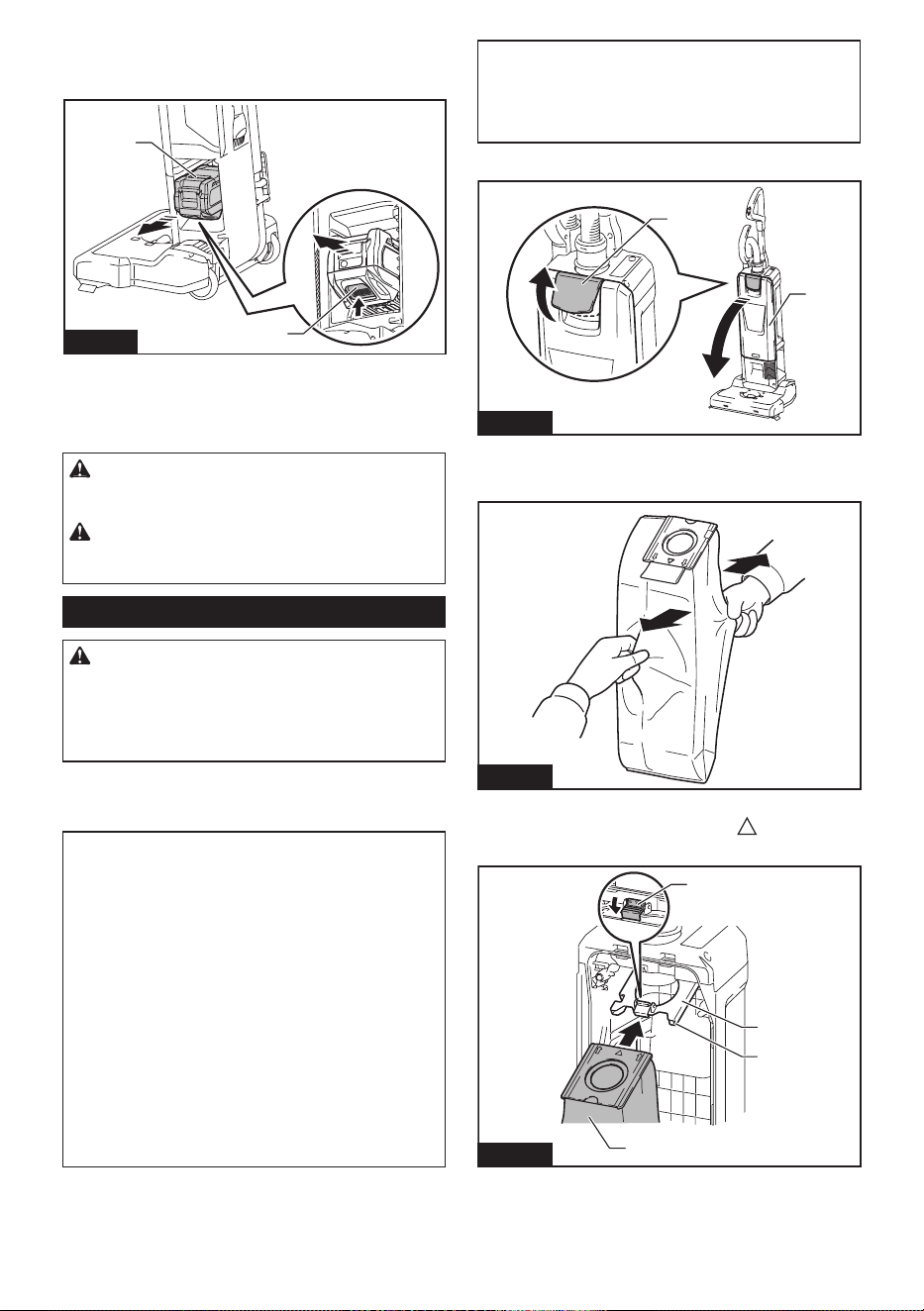
Align the tongue on the battery cartridge with the groove
in the housing and slip it into place. Insert it all the way
until it locks in place with a little click.
1
2
Fig.6
► 1. Battery cartridge 2. Button
To remove the battery cartridge, take it out from the
appliance while sliding up the button in front of the
cartridge.
CAUTION: Always install the battery cartridge
fully. If not, it may accidentally fall out of the appli-
ance, causing injury to you or someone around you.
CAUTION: Do not install the battery cartridge
forcibly. If the cartridge does not slide in easily, it is
not being inserted correctly.
Installing the lter bag
CAUTION: Do not use a damaged lter bag.
Always use the vacuum cleaner with the lter bag
properly installed. Otherwise the vacuumed dust
or particles may be exhausted from the cleaner
and they may cause respiratory disease to the
operator.
Install the lter bag before using cleaner.
Filter bag is a throw-away type. Throw away the entire
lter bag without emptying when it has become full.
NOTICE: When the lter bag is already full or
clogged, replace with new one. Continuous use
with the lter bag full or clogged results in reduced
suction power.
NOTICE: To prevent dust from getting into the
motor:
— Make sure that the lter bag is installed
before use.
— Do not use a broken or ripped bag.
Otherwise the motor may be broken.
NOTICE: Do not fold the cardboard at its open-
ing when installing the lter bag.
NOTICE: The lter bag for the cleaner is an
important component for maintaining the appli-
ance performance. Using non-genuine lter bag
may cause smoke or ignition.
NOTE: When the lter bag is not installed in the appli-
ance, the dust box cover does not close completely.
NOTE: A reusable dust bag is preinstalled in some
countries and regions. You can follow the same instal-
lation/uninstallation steps as for the lter bag.
1. Unlock the lever and open the dust box cover.
1
2
Fig.7
► 1. Lever 2. Dust box cover
2. Unfold the lter bag fully.
Fig.8
3. Open the latch and insert the lter bag into the slot
on the holder so that the side with the
mark enters
rst.
2
4
3
1
Fig.9
► 1. Latch 2. Slot 3. Filter bag 4. Holder
9 ENGLISH
1
2
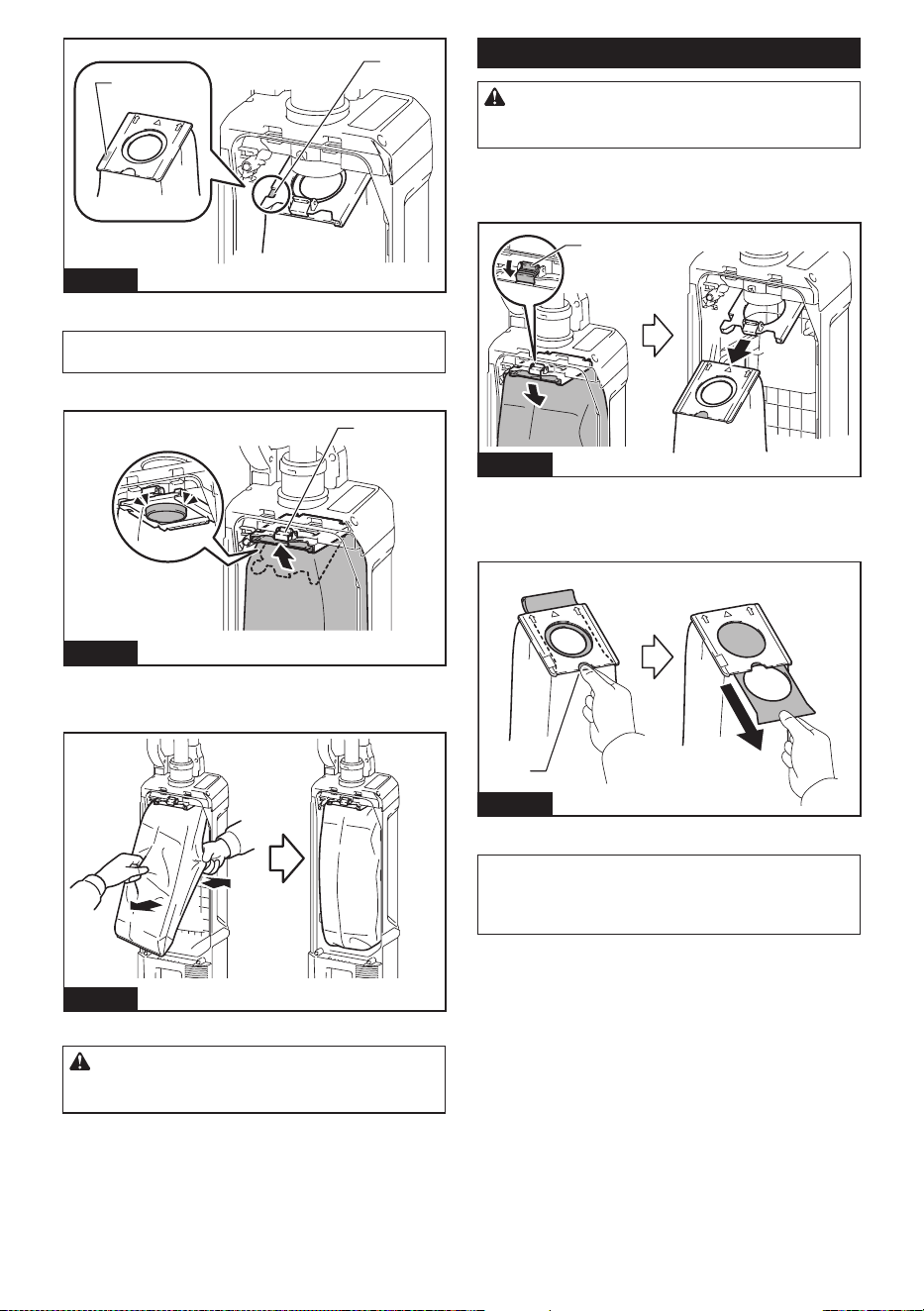
Fig.10
► 1. Marking 2. Slit
NOTE: Make sure that only the marking on the card-
board can be seen through the slit of the holder.
4. Hook the latch of the holder.
1
Fig.11
► 1. Latch
5. Unfold the lter bag if it is folded.
Fig.12
6. Lock the dust box cover securely.
CAUTION: Be careful not to pinch your n-
gers when hooking the latch, and when closing
the dust box cover.
Removing the lter bag
CAUTION: Handle the lter bag softly.
Otherwise foreign objects are blown into eyes, it may
result in personal injury.
Replace the lter bag when it becomes full or clogged.
Open the dust box cover and open the latch, then take
out the lter bag.
1
Fig.13
► 1. Latch
Pull the strip on the side of the opening to shut the lter
bag and dispose of the entire lter bag.
1
Fig.14
► 1. Strip
NOTICE: Do not reuse a lter bag. The lter bag is
designed for single-use purposes. Using a lter bag
repeatedly may cause clogging of the lter and result
in damage to the appliance.
10 ENGLISH
FUNCTIONAL
DESCRIPTION
CAUTION: Always be sure that the appli-
ance is switched o and the battery cartridge is
removed before adjusting or checking function on
the appliance.
Appliance / battery protection
system
The appliance is equipped with an appliance/battery
protection system. This system automatically cuts o
power to the motor to extend appliance and battery life.
The appliance will automatically stop during operation
if the appliance or battery is placed under one of the
following conditions:
Overload protection
When the appliance is operated in a manner that
causes it to draw an abnormally high current, the
appliance automatically stops. In this situation, turn the
appliance o and stop the application that caused the
appliance to become overloaded. Then turn the appli-
ance on to restart.
Overheat protection
On Blinking
When the appliance is overheated, the appliance stops
automatically, and the battery indicator blinks about 60
seconds. In this situation, let the appliance cool down
before turning the appliance on again.
Overdischarge protection
On Blinking
When the battery capacity becomes low, the appliance
stops automatically, and the battery indicator blinks
about 60 seconds. If the product does not operate even
when the switches are operated, remove the battery
from the appliance and charge the battery.
Indicating the remaining battery
capacity
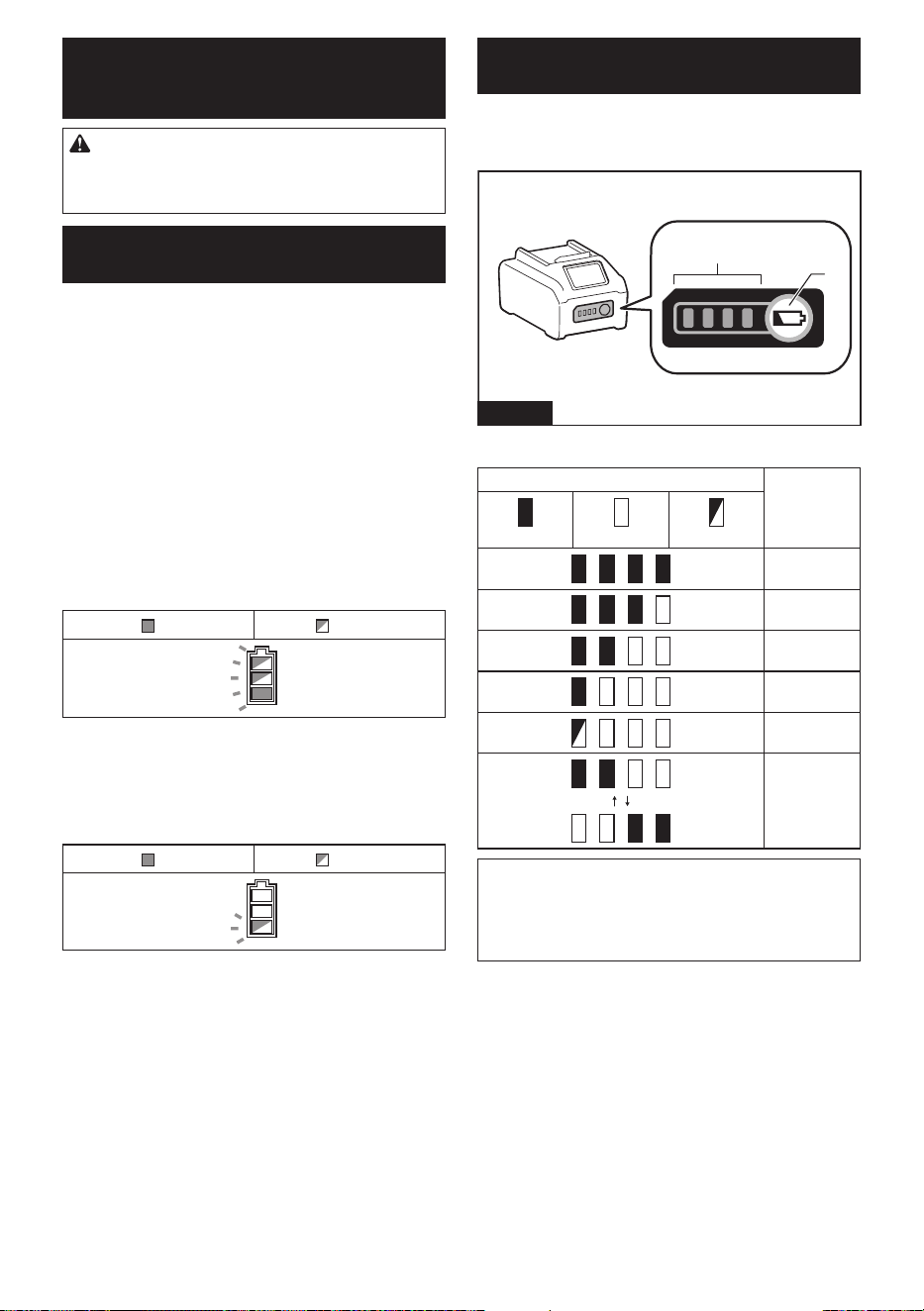
Press the check button on the battery cartridge to indi-
cate the remaining battery capacity. The indicator lamps
light up for a few seconds.
1
2
Fig.15
► 1. Indicator lamps 2. Check button
Indicator lamps Remaining
capacity
Lighted O Blinking
75% to 100%
50% to 75%
25% to 50%
0% to 25%
Charge the
battery.
The battery
may have
malfunctioned.
NOTE: Depending on the conditions of use and the
ambient temperature, the indication may dier slightly
from the actual capacity.
NOTE: The rst (far left) indicator lamp will blink when
the battery protection system works.
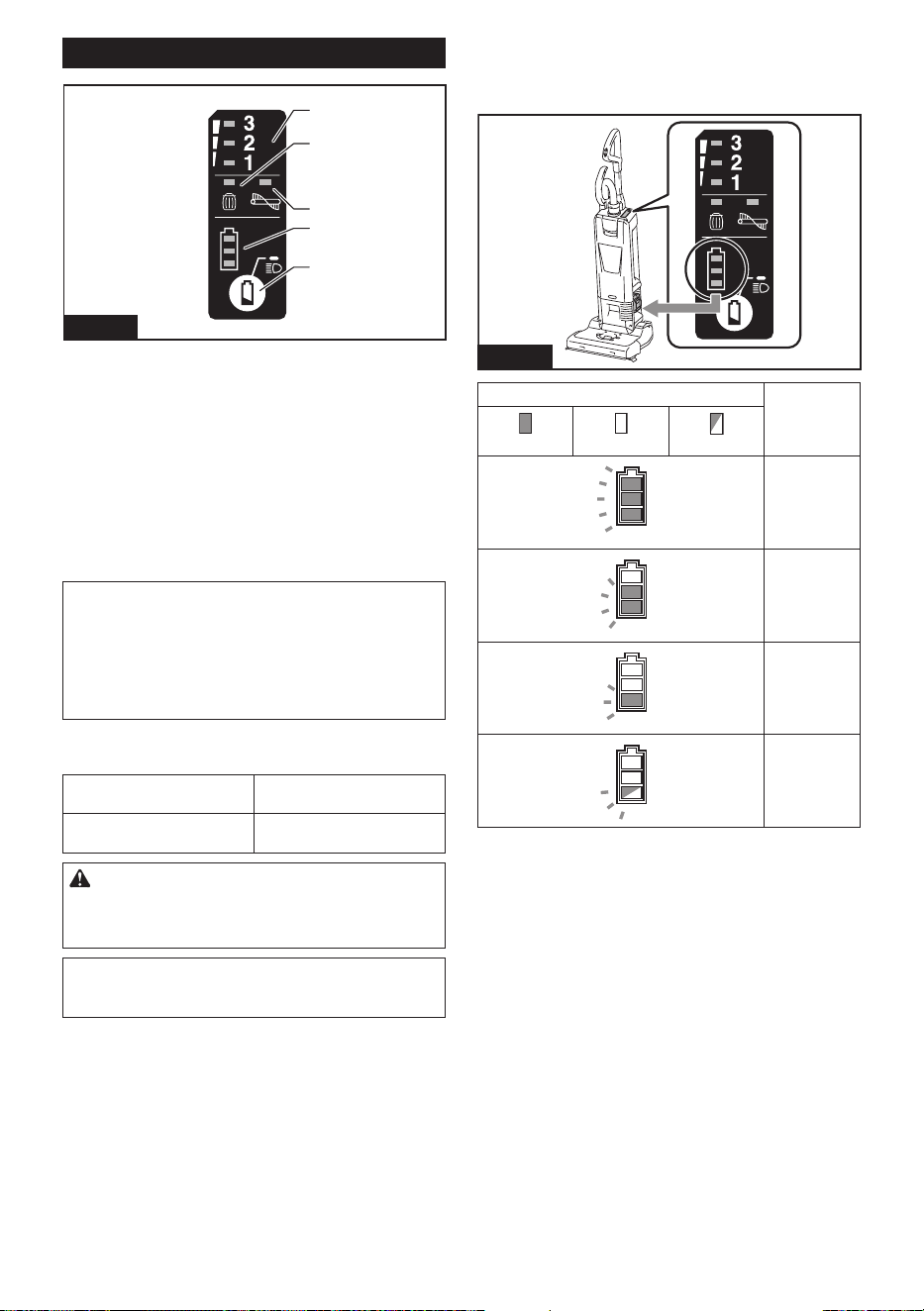
11 ENGLISH
Indication panel
1
2
3
4
5
Fig.16
► 1. Operating mode 2. Excess level of dust
3. Brushroll error 4. Remaining battery capacity
5. Battery check / lamp button
Operating mode
To change the operating mode, refer to the section for
switch action.
Excess level of dust
If this indicator lights up, replace the lter bag. (Refer
the section on removing the lter bag.)
NOTE: This indicator may not work depending on the
usage environment.
NOTE: The indicator automatically goes out approxi-
mately one minute after the appliance is switched o.
If you clear the clogging of the lter bag and restart
the appliance, the indicator goes out even within one
minute.
Brushroll error
Blinking The brushroll is under high
load for some reasons.
On The brushroll is stopped by
abnormal reason.
WARNING: Immediately switch o the appli-
ance when this lamp lights up during operation.
Otherwise the motor malfunction may occur and a re
may be caused.
NOTE: The lamp may blink if the height of the
brushroll is too low against the surface of the carpet.
In that case, adjust the height of the brushroll.
Remaining battery capacity
During operation, press the battery check / lamp button
to indicate the remaining battery capacity.
Fig.17
Battery indicator status Remaining
battery
capacity
On O
Blinking
50% to 100%
20% to 50%
0% to 20%
Charge the
battery
Battery check / lamp button
The following operations can be performed.
• Simply press the button to check the remaining
battery capacity.
• During operation, press and hold the button to turn
on / o the lamps.
12 ENGLISH
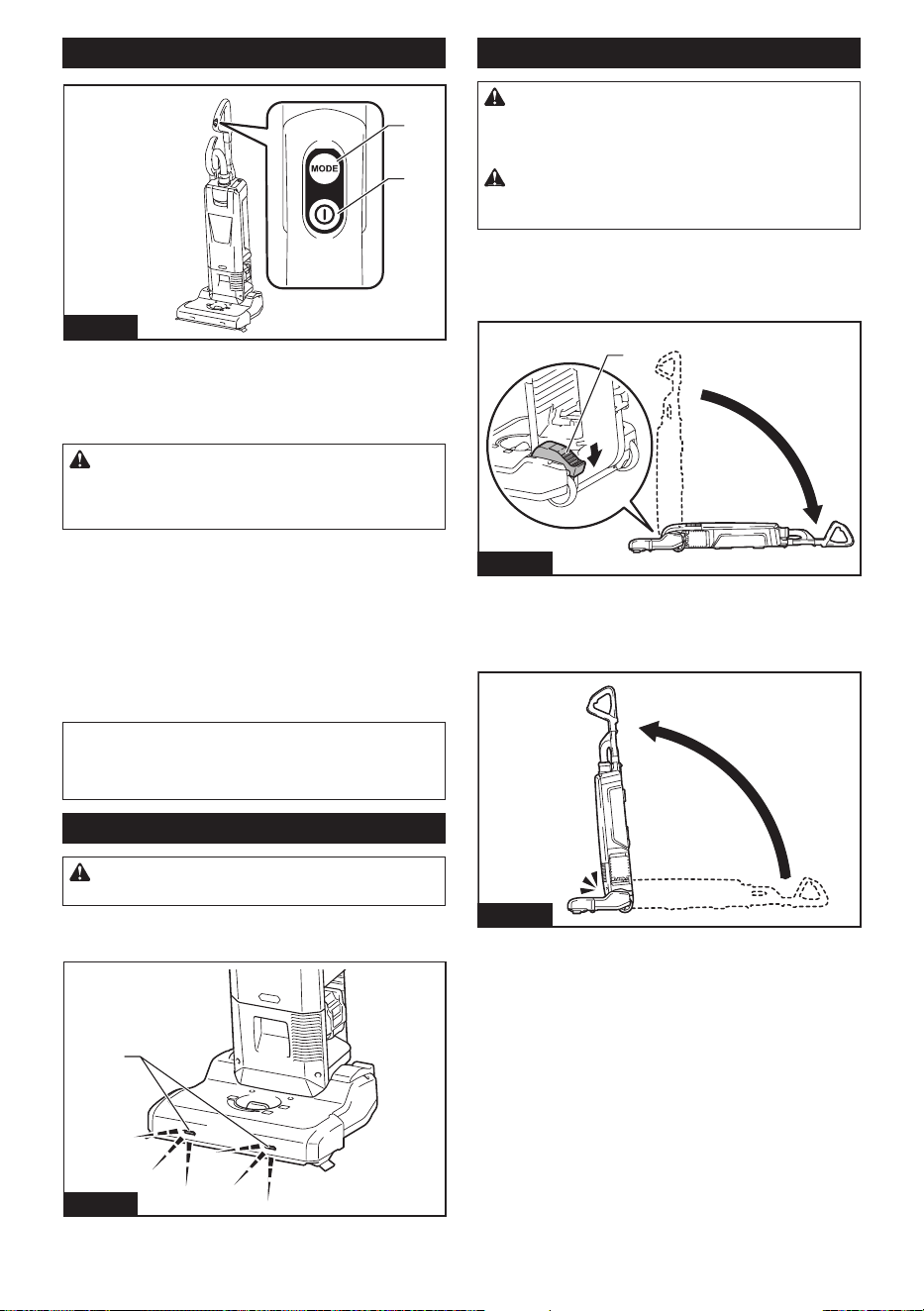
Switch action
1
2
Fig.18
► 1. Mode change button 2. ON / OFF button
Turning the appliance on / o
Press the ON / OFF button to turn the appliance on and o.
CAUTION: Always put the head of the appli-
ance on the oor when turning on the appliance.
Otherwise an accident due to entanglement may
occur and cause a personal injury.
Changing operating mode
There are the following three operating modes:
1. Low noise level
2. Normal
3. High
To change the operating mode, press the mode change button.
The operating mode can be changed even when the appliance
is turned o. The appliance will start in the mode you set.
NOTE: The cleaner starts in the same mode as the
last operation. If you remove the battery while the
motor is running after the shutdown, the cleaner may
not start in the same mode as the last operation.
Turning lamp on / o
CAUTION: Do not look in the light or see the
source of light directly.
The appliance is equipped with the lamps.
See the paragraph of the battery check / lamp button for operation.
1
Fig.19
► 1. Lamp
Foot lever
CAUTION: Always lock the appliance in
upright position when you let go of the handle.
Otherwise the appliance may accidentally fall and
cause injury.
CAUTION: Be careful not to pinch your n-
gers between the main body and the head of the
appliance.
To unlock the upright position of the appliance, step on
the foot lever and pull the handle backward.
The range of motion is 90 degrees from the upright
position.
1
Fig.20
► 1. Foot lever
To lock the appliance in upright position, raise up the
handle forward until the foot lever locks the position
with click.
Fig.21
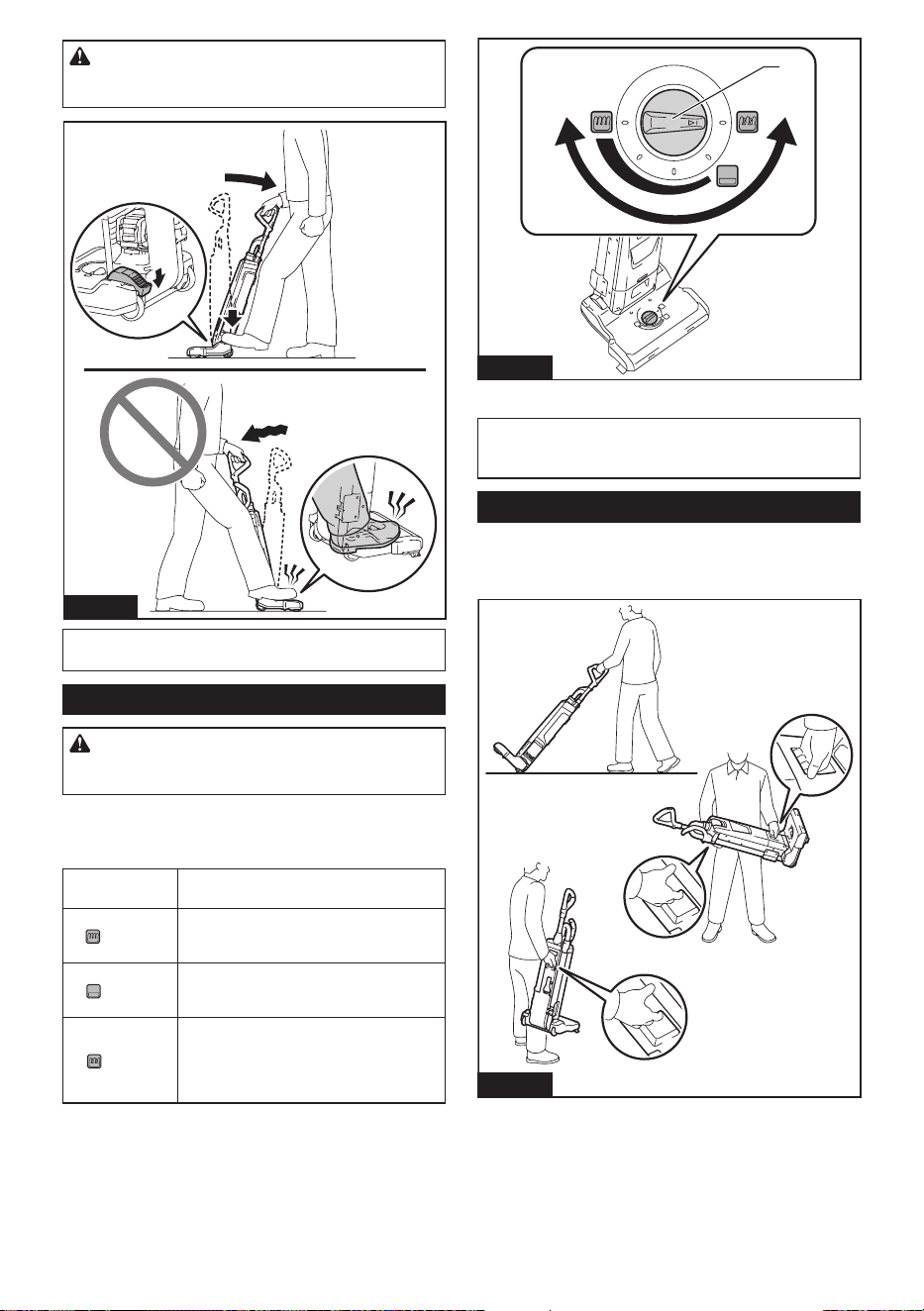
13 ENGLISH
CAUTION: Be sure to unlock the foot lever
before operating. Rough handling may cause break-
age of the parts.
Fig.22
NOTE: While the appliance is in the upright position,
the brushroll stops rotating.
Adjusting the height of the brushroll
CAUTION: Always make sure that the adjust-
ing lever comes into the position properly before
operation.
The height of the brushroll can be adjusted in 5 steps.
Turn the adjusting lever to your desired position by
referring to the following table.
Adjusting lever
position
Brushroll height
A (
)
The brushroll stays positioned to the top
from the oor, which is suitable for cleaning
long-haired carpets.
B (
)
The brushroll is positioned lower to the
oor, which is suitable for cleaning hard
oors and short-haired carpets.
C (
)
The brushroll extends to be positioned
down to the oor, which is eective for
deep cleaning carpets and removing dirt,
dust and particles embedded deep in the
bers.
1
A
B
C
Fig.23
► 1. Adjusting lever
NOTE: The brushroll may not rotate if the height of
the brushroll is too low against the surface of the
carpet.
Carrying handle
When carrying the appliance, push the appliance with
the caster wheels only, or carry it by holding the carry-
ing handle(s).
Fig.24
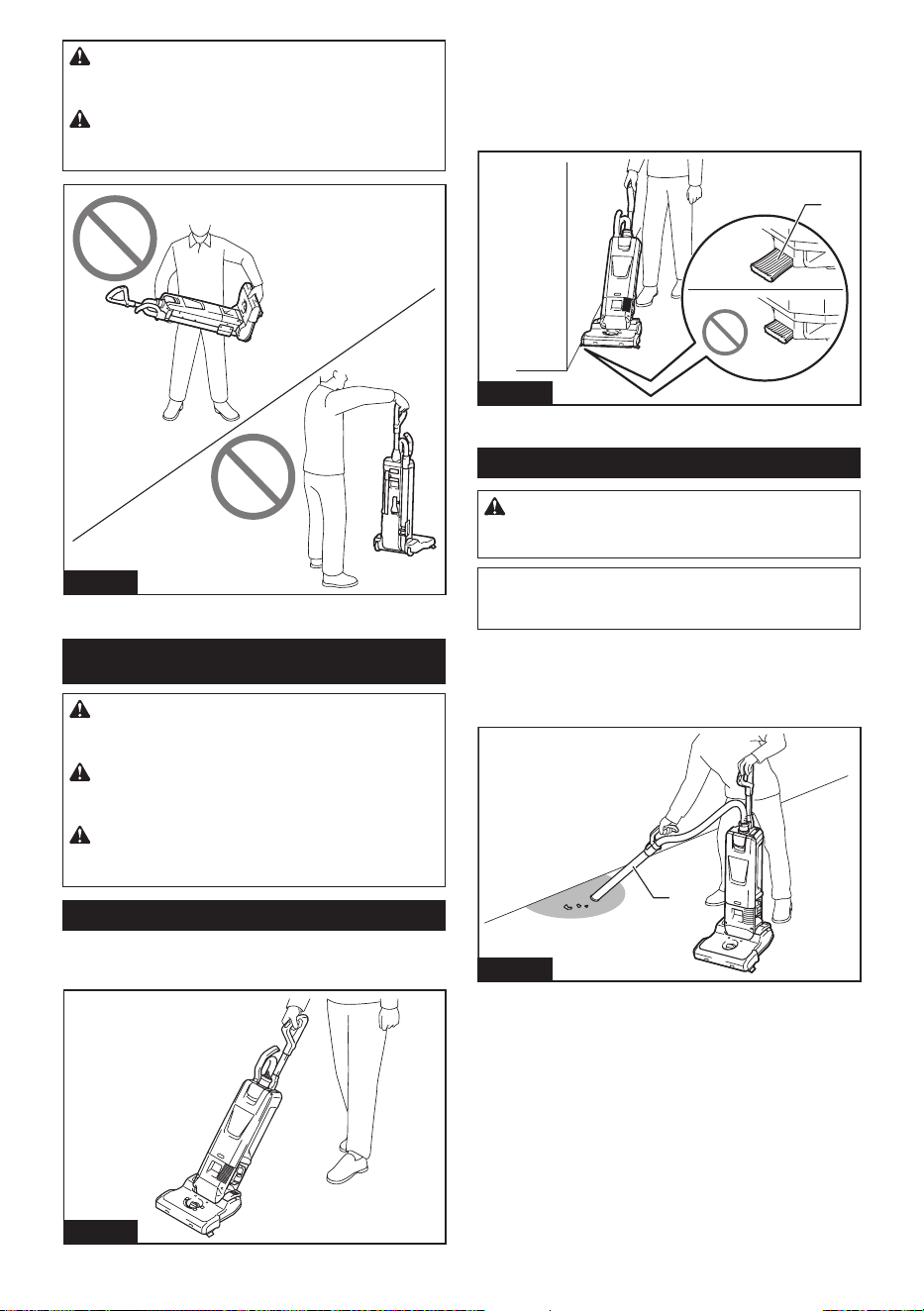
14 ENGLISH
CAUTION: When carrying the appliance, lock
the appliance in upright position. Otherwise falling
accident may occur.
CAUTION:
Do not carry the appliance with anything
other than the carrying handle. Otherwise falling accident
may occur or unintentional starting may cause an injury.
Fig.25
OPERATION
CAUTION: Do not pull out the handle pole
from the appliance during operation. Doing so lose
control of the appliance and may result serious injury.
CAUTION: Do not put your hand or leg under
the appliance during operation. Otherwise pinching
accident may occur.
CAUTION: Do not use the appliance in insu-
cient lighting. Working in poor light may contribute to
an unforeseen accident.
Normal cleaning operation
1.
Hold the handle, and then unlock the upright position.
2. Turn on the appliance. Clean a oor.
Fig.26
Using the side brush
The side brush is convenient for cleaning the corner of
a wall.
If the side brush gets short, take the appliance to the
Makita service center for replacement.
1
Fig.27
► 1. Side brush
Operation with accessories
CAUTION: Keep holding the handle when
using accessories. Otherwise the appliance may
accidentally fall and cause injury.
NOTICE: When using accessories, lock the
appliance in upright position. Otherwise the rota-
tion of the brushroll may damage the oor.
Using the aluminum pipe
The aluminum pipe is suitable for cleaning tight quar-
ters, or high places.
1
Fig.28
► 1. Aluminum pipe
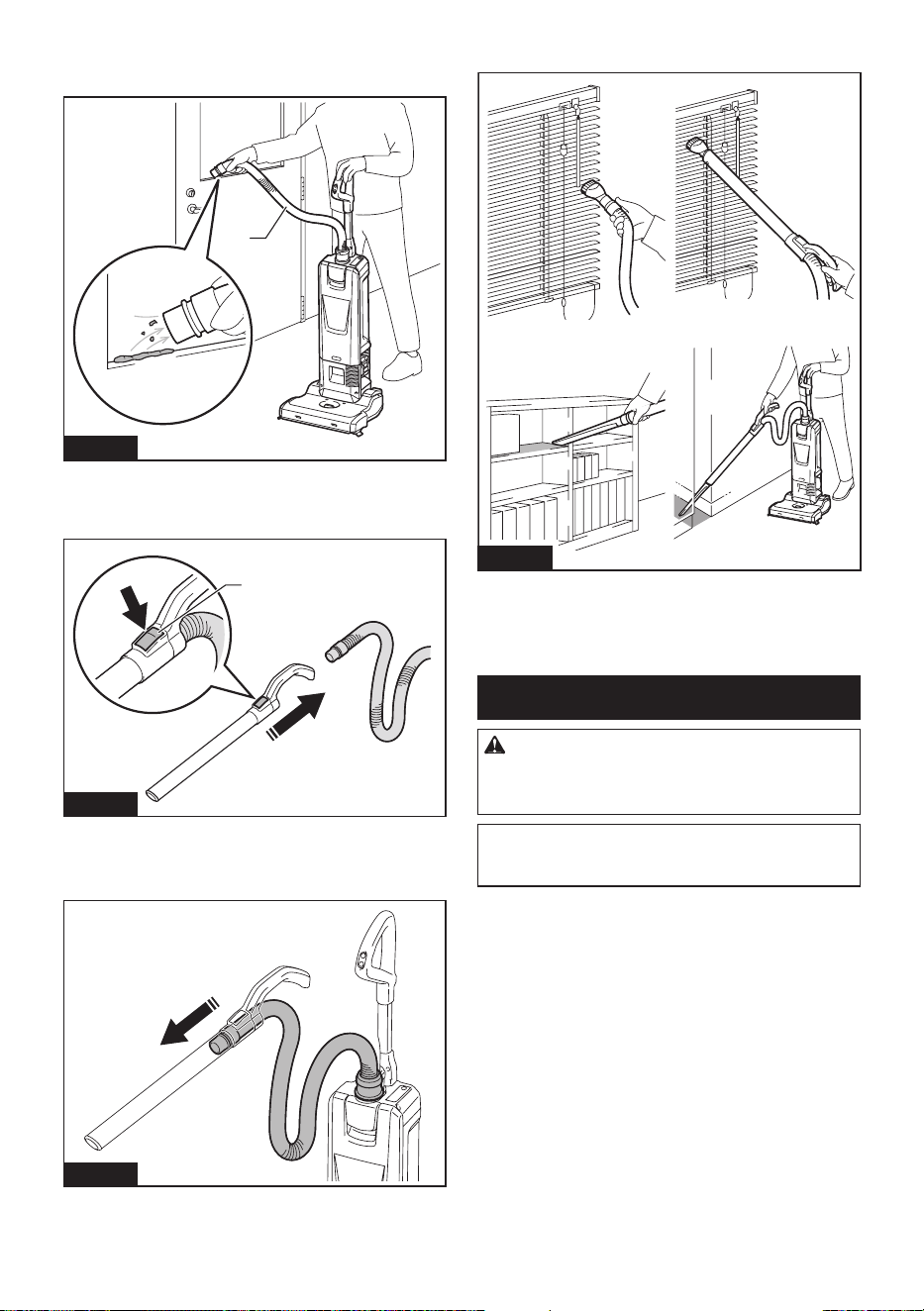
15 ENGLISH
Using the hose
The hose is suitable for cleaning near your hands.
1
Fig.29
► 1. Hose
To use the hose, pull out the hose from the aluminum
pipe while pushing the lever.
1
Fig.30
► 1. Lever
To install the hose, insert the hose into the aluminum
pipe until it clicks.
Fig.31
Using the attachments
Fig.32
To install the attachment, twist and insert it securely to
the aluminum pipe or the hose. To disconnect, twist and
remove it.
MAINTENANCE
CAUTION: Always be sure that the appli-
ance is switched o and the battery cartridge is
removed before attempting to perform inspection
or maintenance.
NOTICE: Never use gasoline, benzine, thinner,
alcohol or the like. Discoloration, deformation or
cracks may result.
To maintain product SAFETY and RELIABILITY,
repairs, any other maintenance or adjustment should
be performed by Makita Authorized or Factory Service
Centers, always using Makita replacement parts.
16 ENGLISH
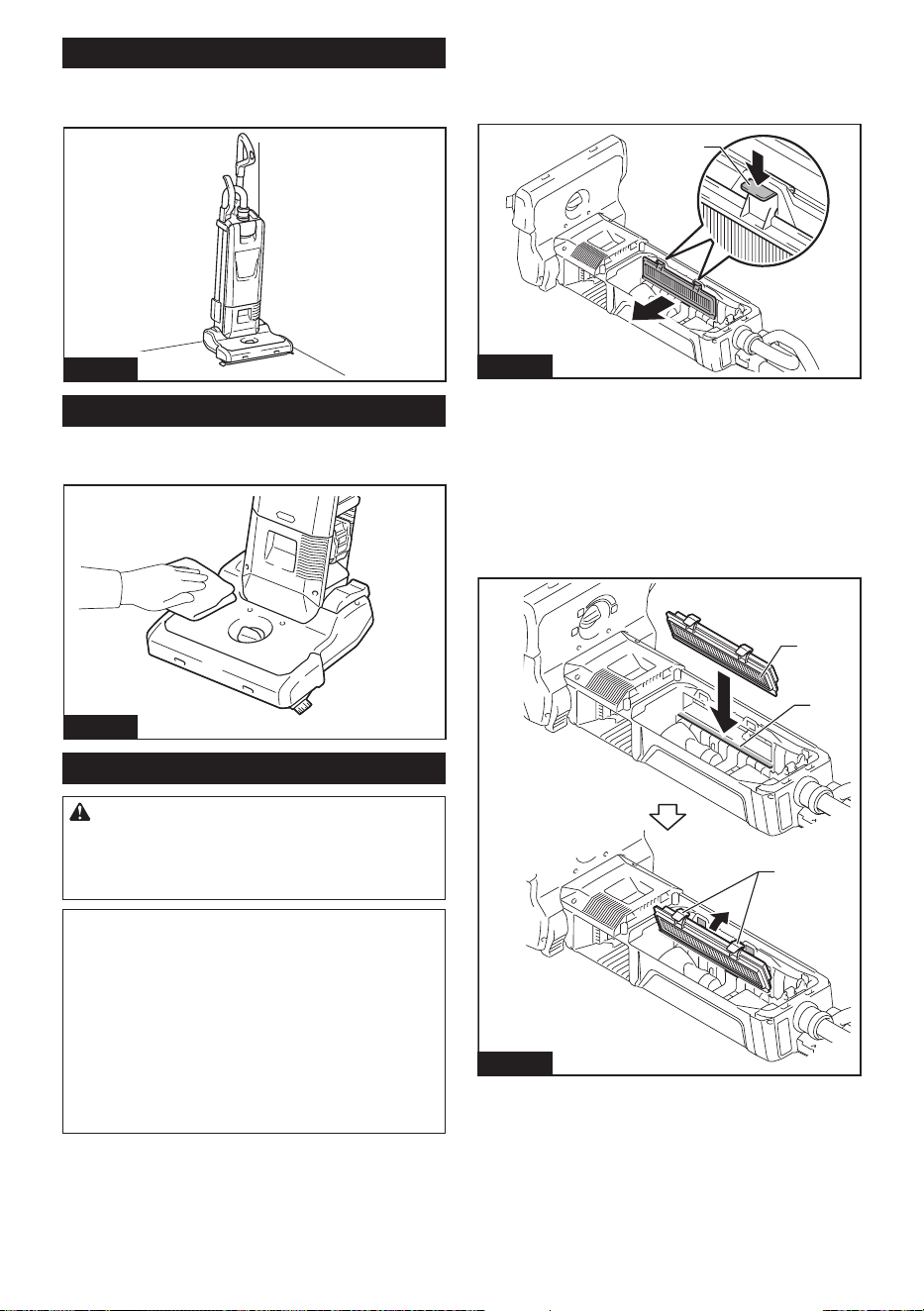
Storage
When storing, remove the battery cartridge and store
the appliance on level place in upright position.
Fig.33
Cleaning the appliance body
From time to time wipe o the outside of the cleaner
(cleaner body) using a cloth dampened in soapy water.
Fig.34
Cleaning the HEPA lter
CAUTION: Do not use the cleaner without a
lter or continue to use dirty or damaged lter.
Vacuumed dust or particles may be exhausted
from the cleaner and they may cause respiratory
disease to the operator.
NOTICE: To keep optimum suction power and
clean exhaust, clean the lter periodically. If
enough suction power is not obtained even after
the cleaning, replace the lter with new one.
NOTICE: To prevent the lter from being dam-
aged, do not use following tools and similar items
for cleaning:
— Air duster
— High pressure washer
— Tools made of hard materials such as a wire
brush
1. Open the dust box cover and take out the lter
bag.
Release the hooks on the lter and remove the lter
from the appliance body.
1
Fig.35
► 1. Hook
2. Beat the dust o from the lter. The lter can be
washed with water. Rinse away the dust and particles
on the lter every 1 or 2 months. After that, dry the lter
completely in a shaded and well-ventilated place to
prevent unpleasant odor or malfunctions.
3. To install the lter, insert the side without the
hooks into the groove, then push in the lter until the
hooks are secured with a click.
1
2
3
Fig.36
► 1. Groove 2. HEPA lter 3. Hook
17 ENGLISH
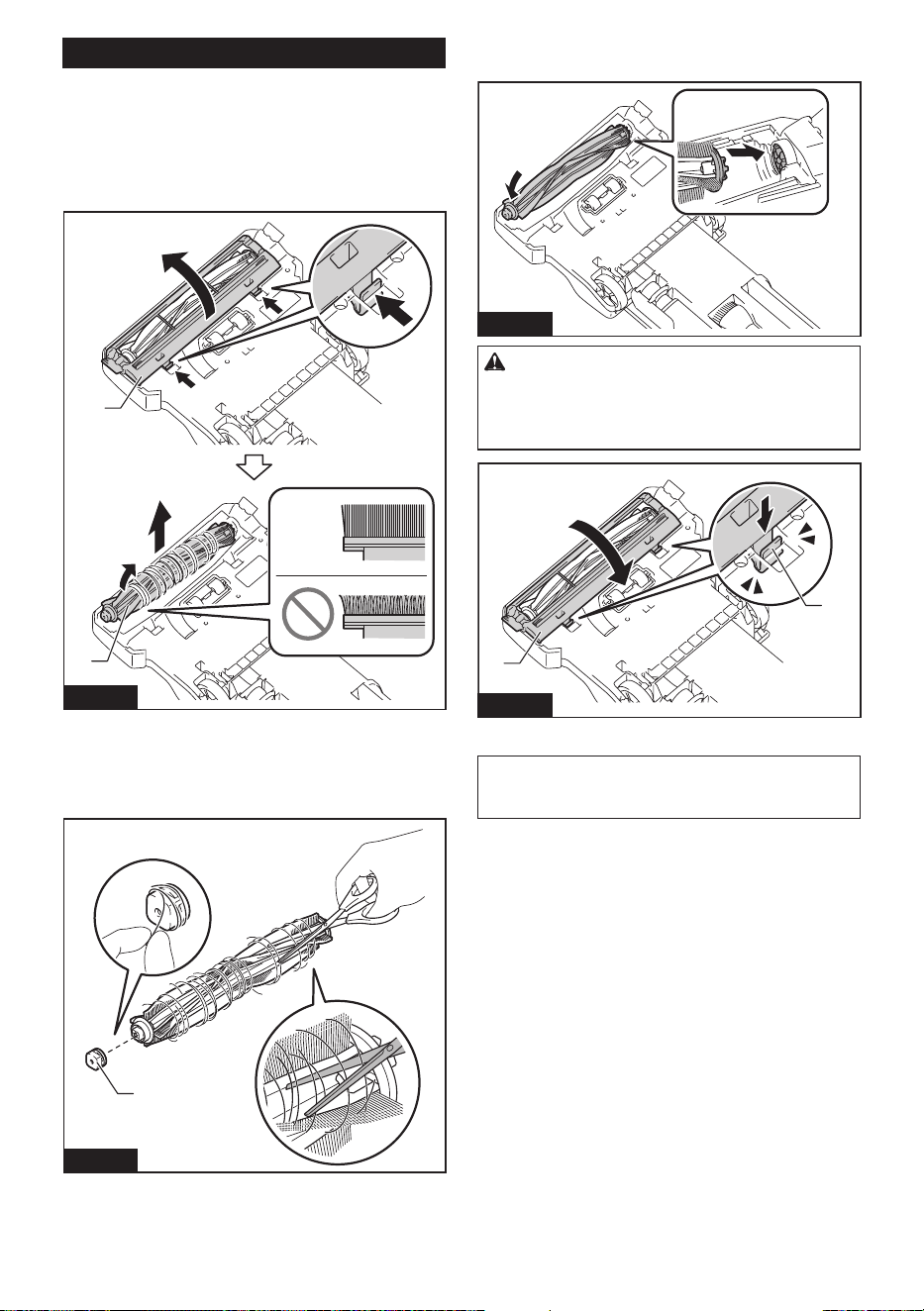
Cleaning the brushroll
1. Remove the bottom plate, and then remove the
brushroll.
If the hair of the brushroll gets short, ask the Makita
service center for new one.
Operating the appliance with the short hair brushroll
results in poor dust collecting.
1
2
Fig.37
► 1. Bottom plate 2. Brushroll
2. Remove threads and hairs from the brushroll
using scissors.
Remove the cap and clean debris.
1
Fig.38
► 1. Cap
3. Install the cap, brushroll, and bottom plate in
reverse order.
Fig.39
CAUTION: Place the bottom plate back in the
position securely until the two lock levers click in
place. If the appliance is operated without the bottom
plate, the brushroll may come o, resulting in injury.
1
2
Fig.40
► 1. Bottom plate 2. Lock lever
NOTICE: Always attach the brushroll. Operating
the appliance without the brushroll results in poor
dust collecting.
18 ENGLISH
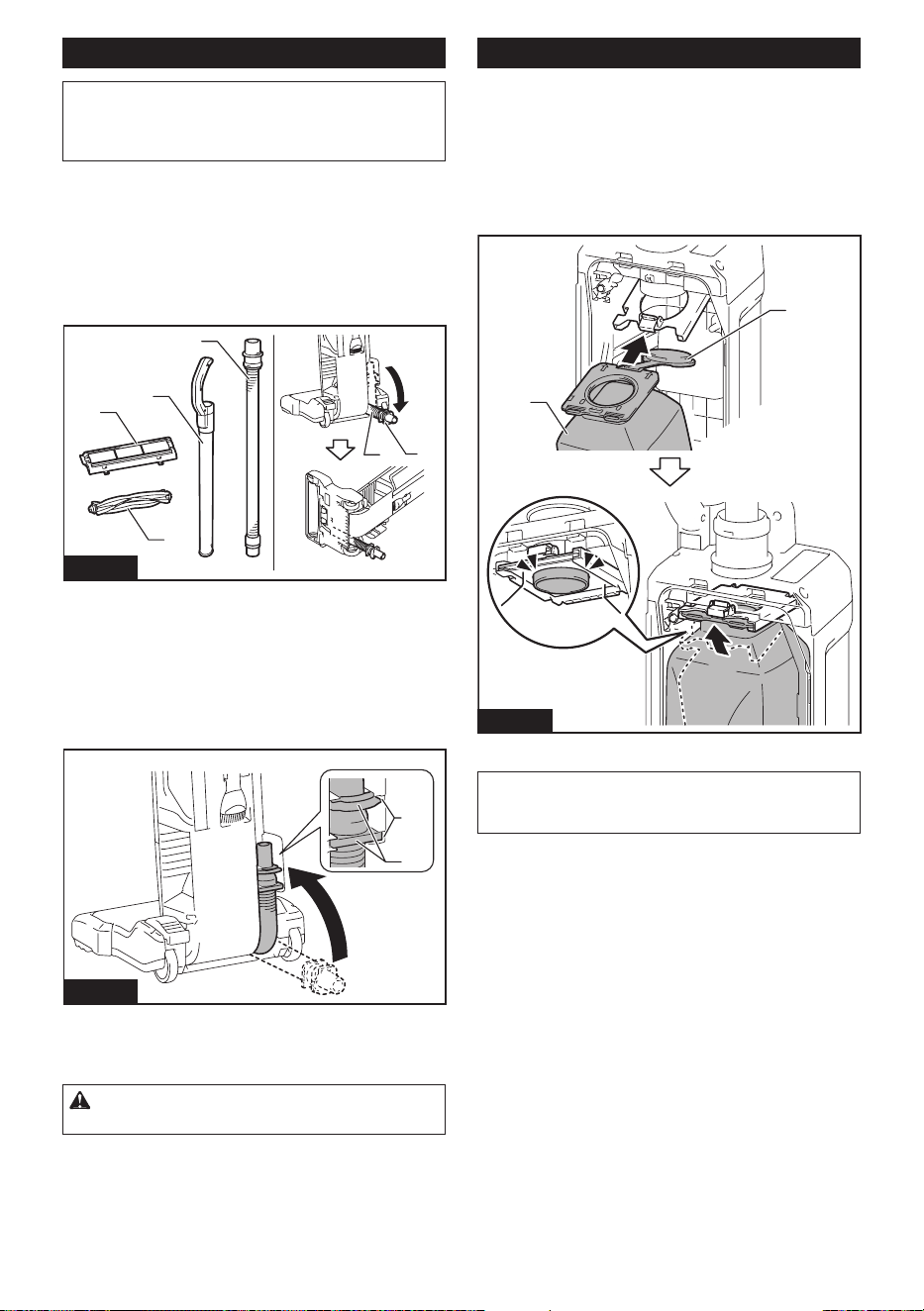
How to clear the clog
NOTICE: Do not operate the appliance with the
intake ow path clogged. Continuous use with the
intake ow path clogged results in reduced suction
power.
1. Remove the bottom plate, and then remove the
brushroll.
2. Remove the aluminum pipe from the appliance
and from the hose.
3. Turn the hose counterclockwise, and then remove
the hose from the appliance.
4. Remove the suction hose by pulling the tab.
5
6
1
2
3
4
Fig.41
► 1. Bottom plate 2. Brushroll 3. Aluminum pipe
4. Hose 5. Suction hose 6. Tab
5. Inspect the intake ow path of air for the inside of
the aluminum pipe and the hose, and the suction hose.
Remove the debris from inside of them.
6. Align the tongue of the suction hose with the
groove in the housing and slip it into place.
1
2
Fig.42
► 1. Tongue 2. Groove
7. Install the hose, aluminum pipe, brushroll, and
bottom plate.
CAUTION: Install the hose, pipe rmly.
Otherwise dust leakage may occur and cause injury.
Dust bag
Optional accessory
The dust bag can be used repeatedly by cleaning it out.
Installing and removing dust bag
The procedure of installing and removing the dust bag
is same as the lter bag. Please refer to the section for
installing the lter bag and removing the lter bag.
1
2
Fig.43
► 1. Dust bag 2. Rubber cap
NOTICE: When installing the dust bag, open the
rubber cap rst. Insert the dust bag with the rub-
ber cap behind.
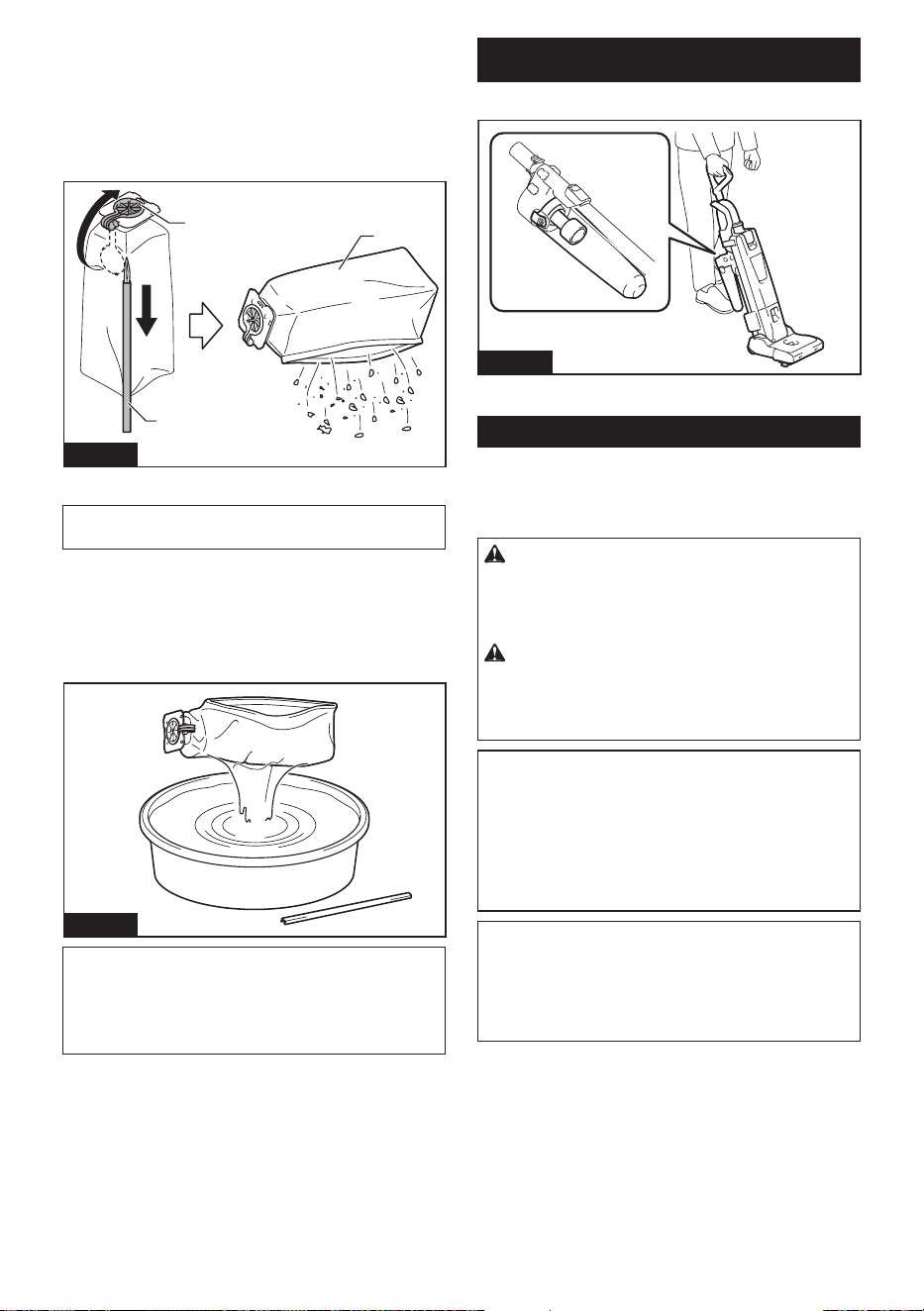
19 ENGLISH
Emptying dust bag
1. Close the rubber cap to prevent dust from oating
out.
2. Open the bag mouth by pulling the fastener out.
3. Empty the dust bag of its contents, tapping it
lightly so as to remove particles adhering to the insides.
1
2
3
Fig.44
► 1. Dust bag 2. Rubber cap 3. Fastener
NOTICE: Empty the dust bag frequently. Too
much dust will tear the bag easily.
Cleaning the dust bag
Regularly clean the dust bag with soap and water. Turn
the dust bag inside out and remove the sticky dust.
Wash lightly by hand and rinse well with water. Dry
completely before installing to the vacuum cleaner.
Fig.45
NOTICE: Wet dust bag lowers the vacuuming
performance as well as the life of the motor.
NOTICE: When mounting the fastener on the
dust bag, make sure that the bag mouth is
securely closed.
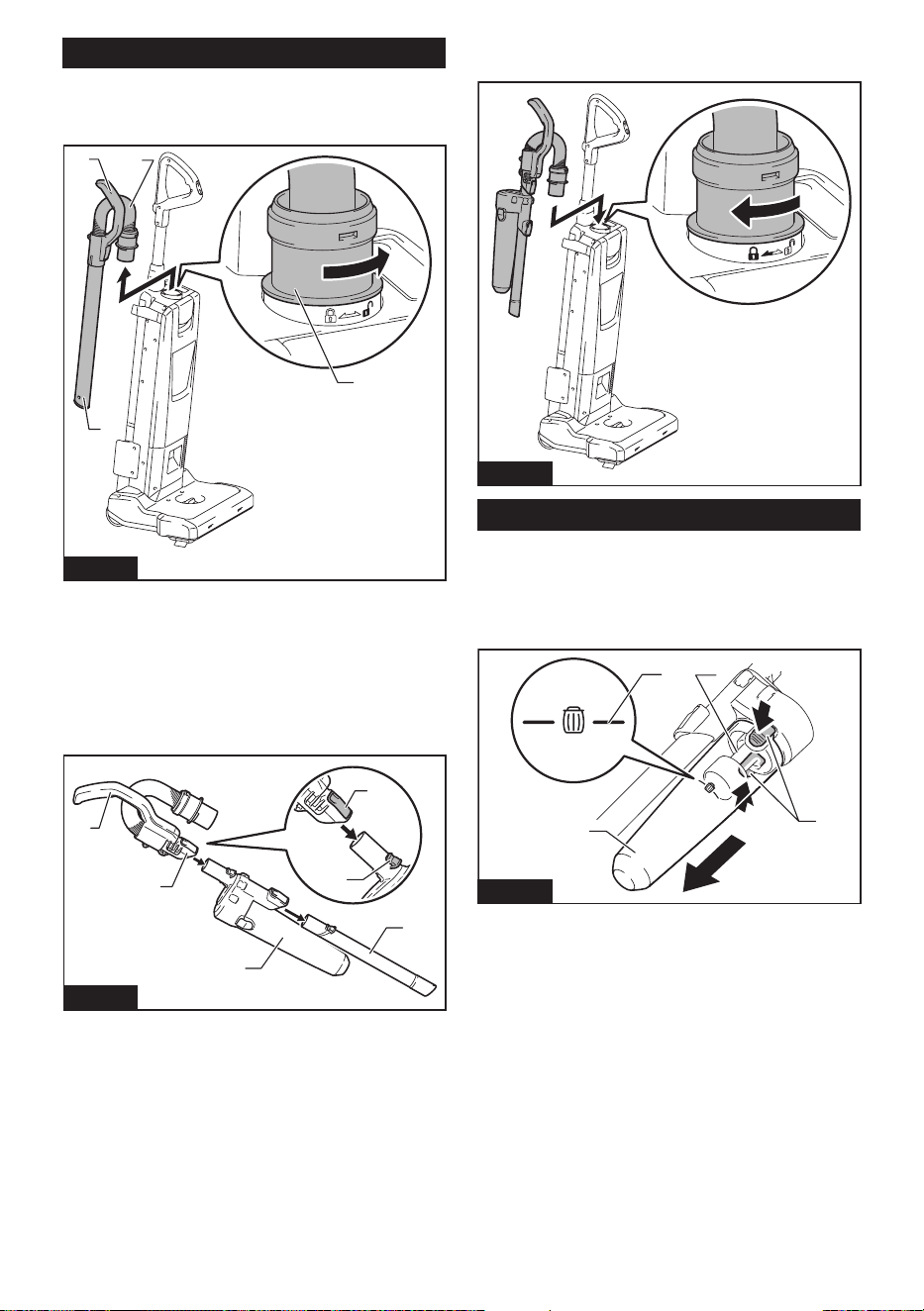
CYCLONE ATTACHMENT
Optional accessory
1
Fig.46
► 1. Cyclone attachment
About the cyclone attachment
Using the cleaner with the cyclone attachment installed
reduces the amount of dust that enters the lter bag,
which helps to prevent the suction force from weaken-
ing. In addition, cleaning after use is also simple.
CAUTION: Always be sure that the tool is
switched o and the battery cartridge is removed
before carrying out any work on the tool. If the
battery cartridge is left inserted, the cleaner may start
unexpectedly and result in injury.
CAUTION: Clean the mesh lter of the
cyclone attachment and the lter bag of the
cleaner unit when they become clogged.
Continued use in the clogged condition may result in
heating or smoke.
NOTICE: When the cyclone attachment is
attached, do not use the cyclone attachment in
the horizontal or upward facing condition. Doing
so may cause the mesh lter to become clogged.
NOTICE: Always use the cleaner with the l-
ter bag installed, even when using the cyclone
attachment. Using the cleaner without the lter bag
installed may result in a motor malfunction.
NOTE: Check that the cyclone attachment, cleaner,
and straight pipe are locked properly before use.
NOTE: Empty the dust case of the cyclone attach-
ment and the lter bag of the cleaner when dust has
accumulated. Continued use will result in weakened
suction force.
20 ENGLISH
Installing cyclone attachment
1. Turn the cu on the hose counterclockwise and
remove the hose, pipe grip, and aluminum pipe from the
appliance.
1
2
4
3
Fig.47
► 1. Cu 2. Hose 3. Pipe grip 4. Aluminum pipe
2. Turn the side of the stopper on the cyclone attach-
ment upward, aligning the stopper with the groove
of the suction inlet. Lock the stopper by inserting the
cyclone attachment until it clicks. Pull the cyclone
attachment lightly to make sure it will not be removed.
Install the straight pipe with the same procedure as the
cyclone attachment.
1
2
3
4
5
6
Fig.48
► 1. Grip for cyclone attachment 2. Suction inlet
3. Cyclone attachment 4. Straight pipe for cyclone
attachment 5. Stopper 6. Locking button
3. Install the cyclone attachment on the appliance,
and then turn the cu on the hose clockwise to x it.
Fig.49
Disposing of dust
When dust has accumulated up to the full line of the
dust case, follow the procedure below and dispose of
the dust.
1. Hold the dust case rmly, press and hold the two
buttons, and remove the dust case.
1
①
2
3
4
②
Fig.50
► 1. Full line 2. Dust case 3. Button (two locations)
4. Mesh lter
2. Dispose of the dust inside the dust case and
remove any dust and powder adhered to the surface of
the mesh lter.
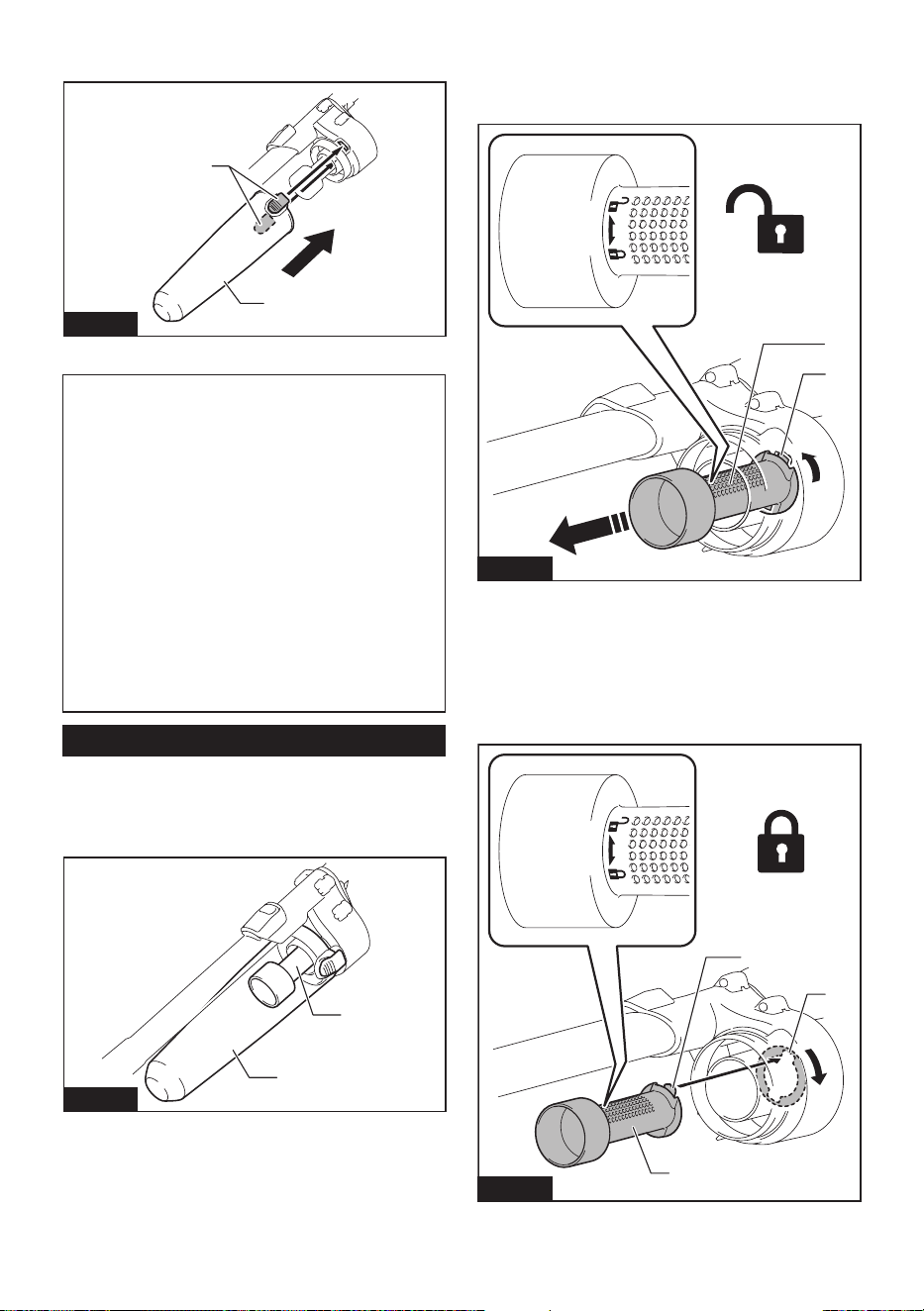
21 ENGLISH
3. Insert the dust case all the way until the two but-
tons lock with a click.
1
2
Fig.51
► 1. Dust case 2. Button (two locations)
NOTE: Hold the cyclone attachment rmly when
installing the dust case.
NOTE: Check that the cyclone attachment, cleaner,
and straight pipe are locked properly before restarting
operation.
NOTE: The indicator of excess level of dust on the
cleaner will not light up when the dust case of the
cyclone attachment becomes full.
NOTE: Under the following conditions, check whether
dust has accumulated inside the lter bag of the
cleaner or clogging in the air path has occurred. Clear
the causes where necessary.
— If the suction performance does not improve
after you have removed dust from the dust case
and cleaned the mesh lter.
— If the indicator of excess level of dust on the
cleaner continues to light up.
Cleaning
When the dust case becomes dirty or the mesh lter is
clogged, remove and wash them with water. (Refer to
“Disposing of dust” for the removal procedure.)
Dry the parts thoroughly before reinstallation and use.
1
2
Fig.52
► 1. Dust case 2. Mesh lter
When the mesh lter gets dirty badly, clean it in the
following procedures.
1. Turn the mesh lter counterclockwise and remove
it while the hooks are unlocked.
1
①
2
②
Fig.53
► 1. Mesh lter 2. Hook
2. Remove the dust on the mesh lter and then wash
it with water. After that, dry it thoroughly.
3. Insert the mesh lter into the base while the hooks
are aligned with the port. Turn the mesh lter clockwise
until the hooks are locked with a click. Make sure that
the mesh lter is installed securely.
①
②
1
2
3
Fig.54
► 1. Mesh lter 2. Hook 3. Port
22 ENGLISH
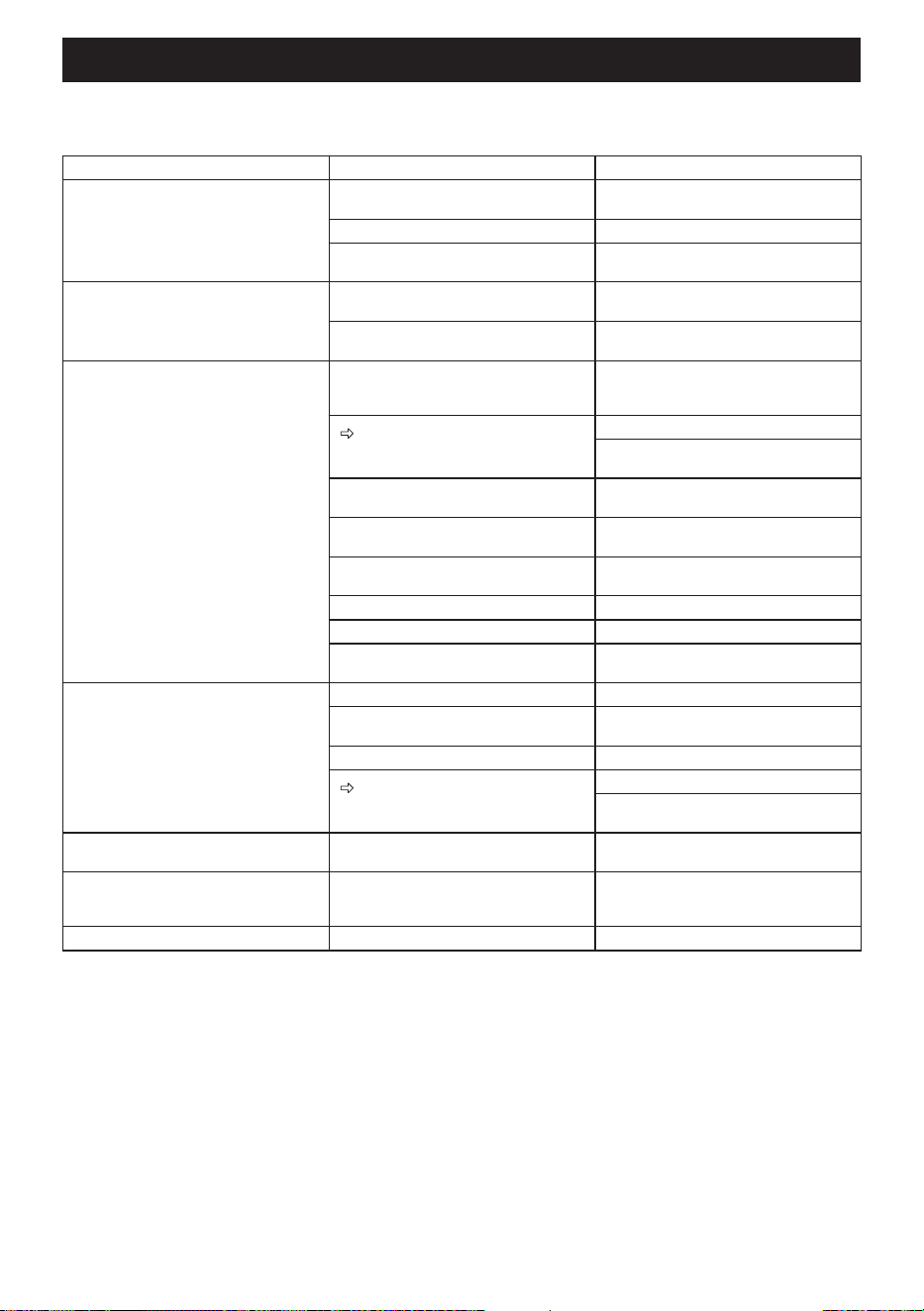
TROUBLESHOOTING
Before asking for repairs, conduct your own inspection rst. If you nd a problem that is not explained in the manual,
do not attempt to disassemble the machine. Instead, ask Makita Authorized Service Centers, always using Makita
replacement parts for repairs.
Symptom Probable cause Remedy
Not working The battery cartridge is installed
improperly.
Install the battery cartridge as described in
this manual.
The battery cartridge is exhausted. Charge the battery cartridge.
The handle is installed improperly. Install the handle rmly as described in
this manual.
The brushroll does not rotate The appliance is locked in upright position. Unlock the upright position of the
appliance.
The indicator of the brushroll error is
lighting.
Inspect that there is no entanglement
around the brushroll (body, cap and joint).
Weak suction power The indicator of excess level of dust is
lighting.
Replace the lter bag.
If the lter bag is not full, unfold the lter
bag and shake it to clear the clogging.
If replacing the lter bag does not solve
the problem...
Clean or replace the HEPA lter.
Inspect that there is no debris clogged in
the hose and pipe.
Debris is entangled in the brushroll and the
rotating speed is declined.
Inspect that there is no entanglement
around the brushroll (body, cap, joint).
The height of the brushroll is too high from
the oor.
Lower the height of the brushroll.
The hair of the brushroll has become short. Replace the brushroll.
Lower the height of the brushroll.
The appliance is operating in low mode. Change to the higher operating mode.
The brushroll is not installed. Install the brushroll.
The pipe or the hose is installed
improperly.
Install the pipe or the hose rmly.
Loud driving noise The appliance is operating in high mode. Change to the lower operating mode.
Debris is entangled in the brushroll. Inspect that there is no entanglement
around the brushroll (body, cap and joint).
The lter bag is lled with dust. Replace the lter bag.
If replacing the lter bag does not solve
the problem...
Clean or replace the HEPA lter.
Inspect that there is no debris clogged in
the hose and pipe.
The indicator of excess level of dust blinks
after a little use
The lter bag is folded. Unfold the entrance of the lter bag before
setting it.
Lamp does not light The lamp setting is o. During operation, press and hold the
battery check / lamp button to turn on the
lamp.
The caster wheel is hard to move Debris is entangled in the caster wheel. Clean the debris on the caster wheel.

23 ENGLISH
OPTIONAL
ACCESSORIES
CAUTION: These accessories or attachments
are recommended for use with your Makita tool
specied in this manual. The use of any other
accessories or attachments might present a risk of
injury to persons. Only use accessory or attachment
for its stated purpose.
If you need any assistance for more details regard-
ing these accessories, ask your local Makita Service
Center.
• Corner nozzle
• Round brush
• Cyclone attachment
• HEPA lter
• Filter bag
• Dust bag
• Makita genuine battery and charger
NOTE: Some items in the list may be included in the
tool package as standard accessories. They may
dier from country to country.
MAKITA LIMITED
WARRANTY
Please refer to the annexed warranty sheet for the
most current warranty terms applicable to this product.
If annexed warranty sheet is not available, refer to the
warranty details set forth at below website for your
respective country.
United States of America: www.makitatools.com
Canada: www.makita.ca
Other countries: www.makita.com
24 ESPAÑOL
ESPAÑOL (Instrucciones originales)
ESPECIFICACIONES
Modelo: GCV09
Volumen de aire máximo
*1
1,8 m
3
/min (64 cu.ft/min)
Potencia de succión
*1
15 kPa
Capacidad 5 L (1,3 gal)
Dimensiones (La x An x Al) 326 mm x 381 mm x 1 146 mm
(12-7/8″ x 15″ x 45″)
Tensión nominal 36 V - 40 V c.c. máx.
Peso neto 8,0 kg - 9,2 kg (17,6 lbs - 20,3 lbs)
*1
El valor se mide mediante nuestro método original.
• Debido a nuestro continuo programa de investigación y desarrollo, las especicaciones aquí incluidas están
sujetas a cambio sin previo aviso.
• Las especicaciones pueden variar de país a país.
• El peso incluye los accesorios (cepillo redondo, boquilla para esquinas) y el o los cartuchos de batería. La
combinación de menor y mayor peso del aparato y del o los cartuchos de batería se muestra en la tabla.
Cartucho de batería y cargador aplicables
Cartucho de batería BL4020 / BL4025 / BL4040 / BL4040F / BL4050F / BL4080F
Cargador DC40RA / DC40RB / DC40RC
• Algunos de los cartuchos de batería y cargadores enumerados arriba podrían no estar disponibles depen-
diendo de su área de residencia.
ADVERTENCIA: Use únicamente los cartuchos de batería y los cargadores indicados arriba. El uso de
cualquier otro cartucho de batería y cargador podría ocasionar una lesión y/o un incendio.
ADVERTENCIAS DE
SEGURIDAD
INSTRUCCIONES
IMPORTANTES DE
SEGURIDAD
Al usar cualquier aparato eléctrico,
siempre deben seguirse las precaucio-
nes básicas, incluyendo las siguientes:
GUARDE ESTAS
INSTRUCCIONES.
ADVERTENCIA
Para reducir el riesgo de incendio, des-
carga eléctrica o lesión:
1. No deje el aparato con la batería
puesta. Retire la batería del aparato
cuando no lo vaya a utilizar y antes
de dar servicio de mantenimiento.
2. No lo utilice en exteriores o sobre
supercies húmedas.
3.
No permita que sea utilizado como un
juguete. Preste mucha atención cuando
sea utilizado por niños o cerca de ellos.
4.
Utilícelo solamente como se describe
en este manual. Sólo use aditamen-
tos recomendados por el fabricante.
5. No lo utilice con una batería dañada.
Si el aparato no está funcionando
como debiera, se ha dejado caer, se
ha dañado, se ha dejado a la intem-
perie o ha caído sobre agua, llévelo
a un centro de servicio.

25 ESPAÑOL
6.
No manipule la batería ni el aparato
con las manos mojadas.
7. No introduzca ningún objeto en las
aberturas. No lo utilice con ninguna
abertura bloqueada; manténgalo
libre de polvo, pelusa, cabello y
cualquier objeto que pueda reducir
el ujo de aire.
8. Mantenga el cabello, la ropa hol-
gada, los dedos y todas las partes
del cuerpo lejos de las aberturas y
piezas móviles.
9. Apague todos los controles antes
de retirar el cartucho de batería.
10. Tenga especial cuidado cuando lim-
pie en escaleras.
11. No lo utilice para recoger líquidos
inamables o combustibles, tal
como gasolina, ni en áreas donde
puedan estar presentes.
12.
No recoja nada que se esté que-
mando o desprenda humo, tal como
cigarros, fósforos o cenizas calientes.
13. No lo utilice sin la bolsa del ltro o
los ltros colocados en su lugar.
14. Siempre almacene la aspiradora en
interiores cuando no la utilice.
15. Reemplace cualquier ltro dañado
de inmediato.
16. Mantenga los pies rmes y el equili-
brio en todo momento.
17.
No utilice la aspiradora como banco
o mesa de trabajo. La máquina podría
caerse y ocasionar una lesión personal.
18. Mantenga todas las partes del
cuerpo y su ropa alejadas de las
aberturas y de la parte en movi-
miento, tal como el cepillo giratorio.
De lo contrario, estos podrían que-
dar atrapados en el aparato y oca-
sionar una lesión.
19. Use equipo de protección adecuado
como una máscara, dependiendo
del entorno de uso.
20. Mantenga la salida de escape lejos
de la cara y del cuerpo.
21. No utilice la aspiradora en lugares
inestables o inclinados para evitar
que se caiga y provoque lesiones o
daños.
22. Detenga la aspiradora inmediata-
mente si nota un desempeño de-
ciente o algo anormal durante el
funcionamiento.
23. No recoja los siguientes materiales:
— Sustancias calientes que están
ardiendo o echando humo
(cigarrillos, cerillas, palitos de
incienso, velas, cenizas calien-
tes), chispas y polvo metálico
generados por el corte o el
lijado de metales, etc.
— Líquidos inamables (quero-
seno, gasolina, disolventes
como bencina, diluyentes, etc.)
— Materiales inamables (tóner,
pinturas, aerosoles, etc.)
— Sustancias explosivas o pirofó-
ricas (nitroglicerina, aluminio,
magnesio, titanio, zinc, fósforo
rojo, fósforo amarillo, celu-
loide, etc., y su polvo, gases o
vapores)
— Líquido, aceite, suciedad
mojada o basura húmeda, inclu-
yendo vómitos y heces
— Piezas duras con bordes losos
(astillas de madera, metales,
piedras, vidrios, clavos, alle-
res, navajas o cuchillería)
— Polvo no conductor y solidi-
cante (polvo metálico o de
carbono)
— Espumas, como limpiadores de
alfombras, etc. (pueden causar
explosiones o incendios)
— Grandes cantidades de polvo
(harina, polvo de extintor de
incendios, etc.)
— Sustancias que causan sínto-
mas tóxicos
— Productos químicos agresivos
(ácidos, alcalinos, etc.)
— Polvo aglutinante no, como el
cemento
— Partículas diminutas como las
del polvo de concreto
— Desecantes
— Asbesto
— Pesticidas

26 ESPAÑOL
Tal acción podría ocasionar un incen-
dio, lesiones o daños materiales.
Para reducir la exposición a estas sus-
tancias químicas, siempre utilice un
equipo de protección respiratoria apro-
bado, tal como las máscaras contra
polvo que están especialmente dise-
ñadas para ltrar partículas microscó-
picas. No apunte la salida de aire a la
cara y al cuerpo.
24.
Utilice solamente el cargador suminis-
trado por el fabricante para recargar.
25. No cargue la batería en exteriores.
26. Este aparato no se destina para
utilizarse por personas (incluyendo
niños) cuyas capacidades físicas,
sensoriales o mentales sean dife-
rentes o estén reducidas o carezcan
de experiencia o de conocimiento,
a menos que dichas personas reci-
ban una supervisión o capacitación
para el funcionamiento del aparato
por una persona responsable de su
seguridad.
27. Los niños deben supervisarse para
asegurar que ellos no empleen los
aparatos como juguete.
Uso y cuidado de la herramienta
a batería
1. Evite un arranque accidental.
Asegúrese de que el interruptor
esté en la posición apagada antes
de conectar el paquete de bate-
rías, levantar el aparato o cargarlo.
Cargar el aparato con su dedo en el
interruptor o pasar energía al aparato
con el interruptor encendido puede
propiciar accidentes.
2. Desconecte el paquete de baterías
del aparato antes de hacer cual-
quier ajuste, cambiar accesorios o
almacenar el aparato. Estas medidas
de seguridad preventivas reducen el
riesgo de poner en marcha el aparato
accidentalmente.
3. Recargue sólo con el cargador
especicado por el fabricante. Un
cargador que es adecuado para un
solo tipo de batería puede generar
riesgo de incendio al ser utilizado con
otra batería.
4.
Use los aparatos únicamente con
los paquetes de baterías designados
especícamente para ellos. El uso
de otros paquetes de baterías puede
generar riesgo de lesiones e incendio.
5. Cuando no se esté usando la bate-
ría, manténgala alejada de otros
objetos metálicos, como sujeta-
papeles (clips), monedas, llaves,
clavos, tornillos u otros objetos
pequeños de metal los cuales pue-
den actuar creando una conexión
entre las terminales de la batería.
Originar un cortocircuito en las termi-
nales puede causar quemaduras o
incendios.
6. En condiciones abusivas, podrá
escapar líquido de la batería; evite
tocarlo. Si lo toca accidentalmente,
enjuague con agua. Si hay contacto
del líquido con los ojos, busque
asistencia médica. Puede que el
líquido expulsado de la batería cause
irritación o quemaduras.
7. No utilice un paquete de baterías
o aparato que esté dañado o haya
sido modicado. Las baterías daña-
das o modicadas podrían com-
portarse de manera impredecible
causando un incendio, explosión o
riesgo de lesión.
8. No exponga un paquete de baterías
o aparato al fuego o a una tempe-
ratura excesiva. La exposición al
fuego o una temperatura superior a
130 °C podría causar una explosión.
9. Siga todas las instrucciones rela-
tivas a la carga y no cargue el
paquete de baterías o el aparato
fuera del rango de temperatura
especicado en las instrucciones.
Cargar de manera inapropiada o a
temperaturas fuera del rango especi-
cado podría dañar la batería e incre-
mentar el riesgo de incendio.
10. Pida que el servicio lo realice un
técnico en reparaciones calicado
y que utilice únicamente piezas de
repuesto idénticas a las originales.
Esto garantizará que se mantenga la
seguridad del producto.
27 ESPAÑOL
11.
No modique ni intente reparar el
aparato ni el paquete de baterías
salvo como se indique en las ins-
trucciones para el uso y cuidado.
GUARDE ESTAS
INSTRUCCIONES.
Este aparato está diseñado para uso
comercial.
Símbolos
A continuación se muestran los símbolos
utilizados para la herramienta.
volts o voltios
corriente directa o continua
Ponga especial atención y
tenga cuidado.
Instrucciones
importantes de
seguridad para
el cartucho de
batería
1.
Antes de utilizar el cartucho de batería,
lea todas las instrucciones e indicacio-
nes de precaución en el (1) el cargador
de batería, (2) la batería, y (3) el pro-
ducto con el que se utiliza la batería.
2.
No desarme ni modique el cartucho
de batería. Podría ocurrir un incendio,
calor excesivo o una explosión.
3.
Si el tiempo de operación se ha acor-
tado en exceso, deje de operar de
inmediato. Podría correrse el riesgo
de sobrecalentamiento, posibles
quemaduras e incluso explosión.
4. En caso de que ingresen electrolitos
en sus ojos, enjuáguelos bien con
agua limpia y consulte de inmediato
a un médico. Esto podría ocasionar
pérdida de visión.
5. Evite cortocircuitar el cartucho de
batería:
(1) No toque las terminales con nin-
gún material conductor.
(2) Evite guardar el cartucho de
batería en un cajón junto con
otros objetos metálicos, tales
como clavos, monedas, etc.
(3) No exponga el cartucho de bate-
ría al agua o la lluvia.
Un cortocircuito en la batería
puede causar un ujo grande de
corriente, sobrecalentamiento,
posibles quemaduras e incluso una
descompostura.
6. No guarde ni utilice la herramienta
y el cartucho de batería en lugares
donde la temperatura pueda alcan-
zar o exceder los 50 °C (122 °F).
7. Nunca incinere el cartucho de bate-
ría incluso en el caso de que esté
dañado seriamente o ya no sirva
en absoluto. El cartucho de batería
puede explotar si se tira al fuego.
8. No clave, corte, aplaste, lance o deje
caer el cartucho de batería, ni gol-
pee un objeto sólido contra el car-
tucho de batería. Dicha acción podría
resultar en un incendio, calor excesivo
o en una explosión.
9. No use una batería dañada.
10. Las baterías de ión de litio están
sujetas a los requisitos reglamen-
tarios en materia de bienes peligro-
sos.
Para el trasporte comercial, por
ej., mediante terceros o agentes
de transporte, se deben tomar en
cuenta los requisitos especiales
relativos al empaque y el etiquetado.
Para efectuar los preparativos
del artículo que se va a enviar, se
requiere consultar a un experto en
materiales peligrosos. Si es posible,
consulte además otras regulaciones
nacionales más detalladas.
Pegue o cubra con cinta adhesiva
los contactos abiertos y empaque
la batería de manera que ésta no
pueda moverse dentro del paquete.

28 ESPAÑOL
11.
Para deshacerse del cartucho de
batería, sáquelo de la herramienta y
deséchelo en un lugar seguro. Siga
las regulaciones locales relaciona-
das al desecho de las baterías.
12. Utilice las baterías únicamente con
los productos especicados por
Makita. Instalar las baterías en pro-
ductos que no cumplen con los requi-
sitos podría ocasionar un incendio, un
calentamiento excesivo, una explosión
o una fuga de electrolito.
13. Siga las regulaciones locales rela-
cionadas al desecho de las baterías.
14. El cartucho de batería podría absor-
ber calor durante y después de su
uso, lo que ocasionaría quemaduras
o quemaduras a baja temperatura.
Tenga cuidado con la manipulación
de los cartuchos de batería que
estén calientes.
15. No toque el terminal de la herra-
mienta inmediatamente después
de su uso, ya que el mismo podría
estar lo sucientemente caliente
como para provocarle quemaduras.
16. No permita que las rebabas, el polvo
o la tierra queden atrapados en los
terminales, oricios y ranuras del
cartucho de batería. Podría provocar
calentamiento, incendio, explosión y
mal funcionamiento de la herramienta
o del cartucho de batería, lo que
resultaría en quemaduras o lesiones
personales.
17. No utilice el cartucho de batería
cerca de cables eléctricos de alto
voltaje, a menos que la herramienta
sea compatible con el uso cercano a
estos cables eléctricos de alto vol-
taje. Esto podría ocasionar una avería
o descompostura de la herramienta o
del cartucho de batería.
18. Mantenga la batería alejada de los
niños.
GUARDE ESTAS
INSTRUCCIONES.
PRECAUCIÓN: Utilice únicamente baterías
originales de Makita. El uso de baterías no origina-
les de Makita, o de baterías alteradas, puede ocasio-
nar que las baterías exploten causando un incendio,
lesiones personales y daños. Asimismo, esto inva-
lidará la garantía de Makita para la herramienta y el
cargador Makita.
Consejos para alargar al máximo
la vida útil de la batería
1. Cargue el cartucho de batería antes de que
se descargue completamente. Pare siem-
pre la operación y cargue el cartucho de
batería cuando note menos potencia en la
herramienta.
2. No cargue nunca un cartucho de batería que
esté completamente cargado. La sobrecarga
acortará la vida de servicio de la batería.
3. Cargue el cartucho de batería a una tempera-
tura ambiente de 10 °C - 40 °C (50 °F - 104 °F).
Si un cartucho de batería está caliente, déjelo
enfriar antes de cargarlo.
4. Cuando no utilice el cartucho de batería,
sáquelo de la herramienta o del cargador.
5. Cargue el cartucho de batería si no va a utili-
zarlo durante un período prolongado (más de
seis meses).
29 ESPAÑOL
DESCRIPCIÓN DE LAS PIEZAS
1
2
3
4
5
6
7
8
9
10
11
12
13
1515
16
17
18
19
21 22
23
24
25
26
27
28
29
14
20
Fig.1
1 Mango 2 Placa del interruptor 3 Empuñadura del tubo 4 Manguera
5 Panel indicador 6 Palanca (para la cubierta
de la caja para polvo)
7 Cubierta de la caja para
polvo
8 Mango portador
9 Cartucho de batería 10 Palanca de ajuste 11 Boquilla para esquinas 12 Cepillo redondo
13 Pedal 14 Ruedita 15 Cepillo lateral 16 Manguera de succión
17 Unión 18 Tubo de aluminio 19 Sujetador del tubo 20 Lámpara
21 Cepillo giratorio 22 Placa inferior 23 Botón de cambio de
modo
24 Botón de encendido/
apagado
25 Indicador del modo de
operación
26 Indicador de nivel exce-
sivo de polvo
27 Indicador de error del
cepillo giratorio
28 Indicador de capacidad
restante de la batería
29 Botón de vericación de
batería/lámpara
- - - - - -
30 ESPAÑOL
MONTAJE
PRECAUCIÓN: Asegúrese siempre de que
el aparato esté apagado y el cartucho de batería
haya sido extraído antes de realizar cualquier
trabajo en el aparato.
PRECAUCIÓN: Utilice siempre una más-
cara contra el polvo durante el ensamblado o
mantenimiento.
Conexión del mango
1. Inserte el poste del mango hasta el fondo en el
cuerpo de la aspiradora, tal como se muestra en
la ilustración.
2. Cierre el seguro de bloqueo.
1
2
3
Fig.2
► 1. Poste del mango 2. Marca indicadora roja
3. Seguro de bloqueo
AVISO: Inserte el mango por completo hasta que
la marca indicadora roja no pueda verse.
Conexión de la manguera
Inserte la manguera dentro del puerto de montaje del
aparato y gírela hasta que quede asegurada.
1
Fig.3
► 1. Puerto de instalación
Conexión del tubo
Inserte la punta del tubo de aluminio a la unión y luego
conecte el tubo de aluminio al sujetador del tubo.
2
1
Fig.4
► 1. Unión 2. Sujetador del tubo
AVISO: Inserte el tubo de aluminio en la direc-
ción correcta, tal como se muestra en la ilus-
tración. De lo contrario, el sujetador del tubo no se
asegurará y el tubo de aluminio podría zafarse.
Fig.5
Instalación o extracción del
cartucho de batería
PRECAUCIÓN: Apague siempre el aparato
antes de instalar o extraer el cartucho de batería.
PRECAUCIÓN: Sujete la aspiradora y el car-
tucho de batería con rmeza al colocar o quitar el
cartucho de batería. Si no se sujeta con rmeza la
aspiradora y el cartucho de batería, puede ocasionar
que se resbalen de sus manos resultando en daños
a la aspiradora y al cartucho de batería, así como
lesiones a la persona.
PRECAUCIÓN: Tenga cuidado de no pellizcar
sus dedos al instalar el cartucho de batería. El no
hacerlo podría ocasionar una lesión personal.
PRECAUCIÓN: No instale o extraiga el car-
tucho de batería con las manos mojadas. Existe el
riesgo de descarga eléctrica.
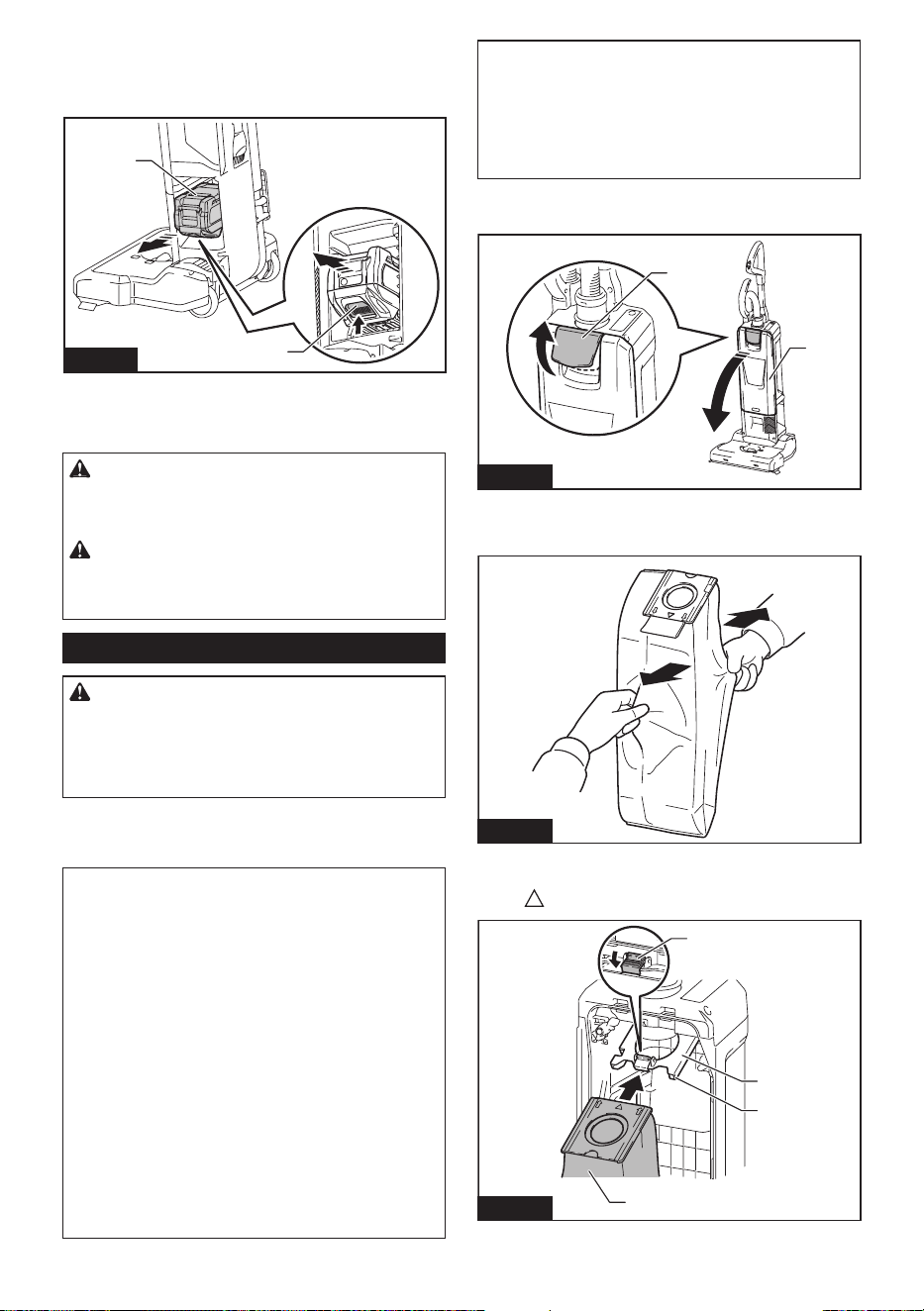
31 ESPAÑOL
Alinee la lengüeta en el cartucho de batería con la
ranura en la carcasa y deslícelo en su lugar. Insértelo
por completo hasta que quede asegurado en su lugar
haciendo un pequeño clic.
1
2
Fig.6
► 1. Cartucho de batería 2. Botón
Para quitar el cartucho de batería, sáquelo del aparato
mientras desliza hacia arriba el botón enfrente del cartucho.
PRECAUCIÓN: Instale siempre el cartucho
de batería por completo. De no hacerlo, éste podría
caerse accidentalmente del aparato, ocasionándole
lesiones a usted o a alguien cerca de usted.
PRECAUCIÓN: No instale el cartucho de
batería a la fuerza. Si el cartucho no se desliza al
interior fácilmente, se debe a que no está siendo
insertado correctamente.
Instalación de la bolsa del ltro
PRECAUCIÓN: No use una bolsa del ltro
dañada. Siempre utilice la aspiradora con la bolsa
del ltro instalada correctamente. De lo contrario,
el polvo o las partículas aspiradas podrían esca-
par de la aspiradora y causar una enfermedad
respiratoria al operador.
Instale la bolsa del ltro antes de utilizar la aspiradora.
La bolsa del ltro es de tipo desechable. Deseche por completo
la bolsa del ltro sin vaciarlo, cuando ésta se haya llenado.
AVISO: Cuando la bolsa del ltro ya esté llena
u obstruida, reemplácela con una nueva. El uso
continuo de la bolsa del ltro cuando esté llena u
obstruida ocasionará una reducción de la potencia
de succión.
AVISO: Para evitar que el polvo se introduzca en
el motor:
— Asegúrese de que la bolsa del ltro esté
instalada antes de su uso.
— No utilice una bolsa rota o rasgada.
De lo contrario, el motor podría averiarse.
AVISO: No doble el cartón en su abertura cuando
instale la bolsa del ltro.
AVISO: La bolsa del ltro de la aspiradora es un
componente importante para mantener el buen
desempeño del aparato. El utilizar una bolsa
del ltro no original puede ocasionar humo o
ignición.
NOTA: Cuando la bolsa del ltro no se instala en el
aparato, la cubierta de la caja para polvo no se cierra
por completo.
NOTA: Para algunos países y regiones, viene pre-
instalada una bolsa recolectora de polvo reutilizable.
Puede seguir los mismos pasos de instalación/
desinstalación que para la bolsa del ltro.
1. Desbloquee la palanca y abra la cubierta de la
caja para polvo.
1
2
Fig.7
► 1. Palanca 2. Cubierta de la caja para polvo
2. Desdoble la bolsa del ltro por completo.
Fig.8
3. Abra el seguro e inserte la bolsa del ltro en
la ranura del sujetador, para que el costado con la
marca
entre primero.
2
4
3
1
Fig.9
► 1. Seguro 2. Ranura 3. Bolsa del ltro 4. Sujetador
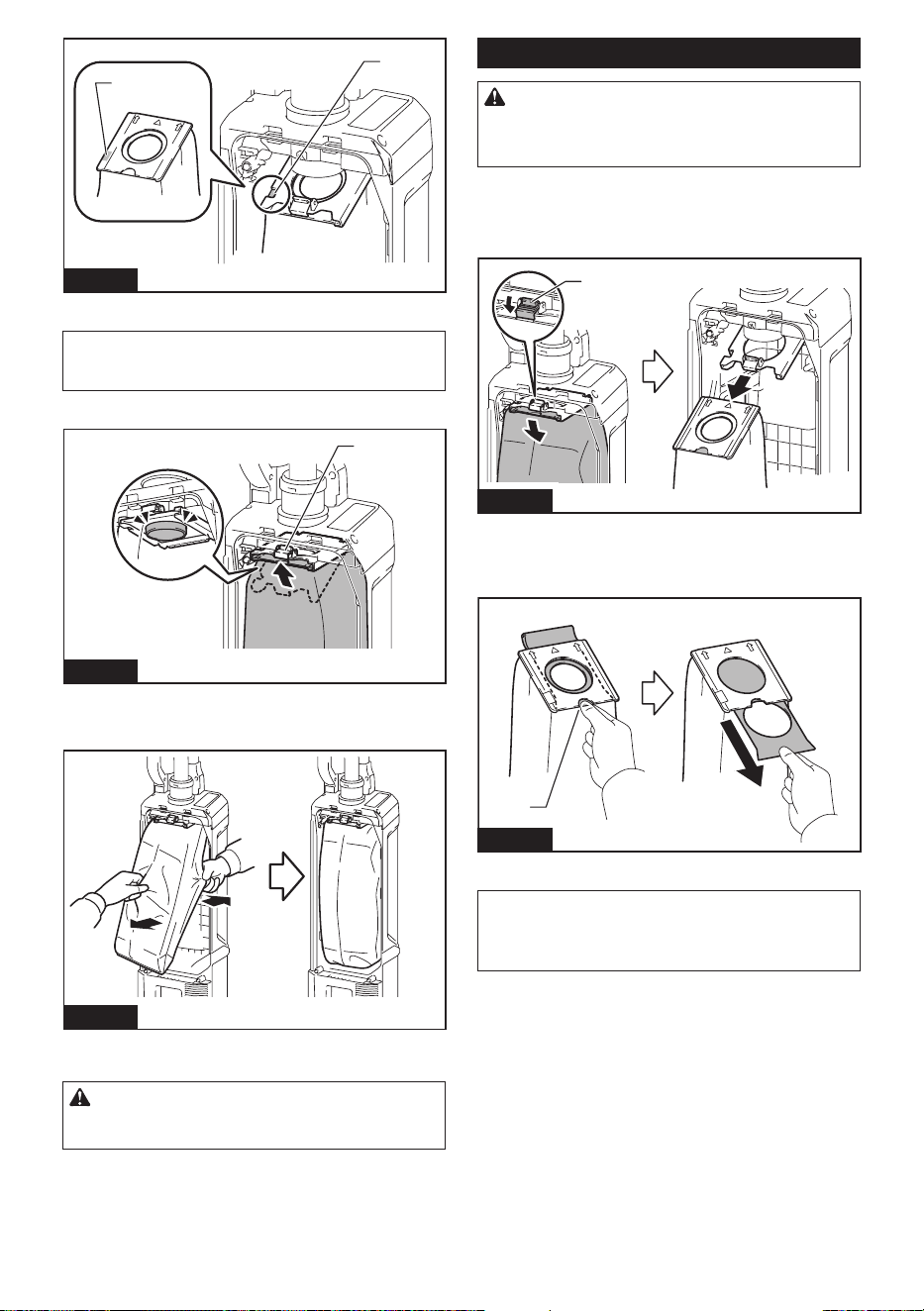
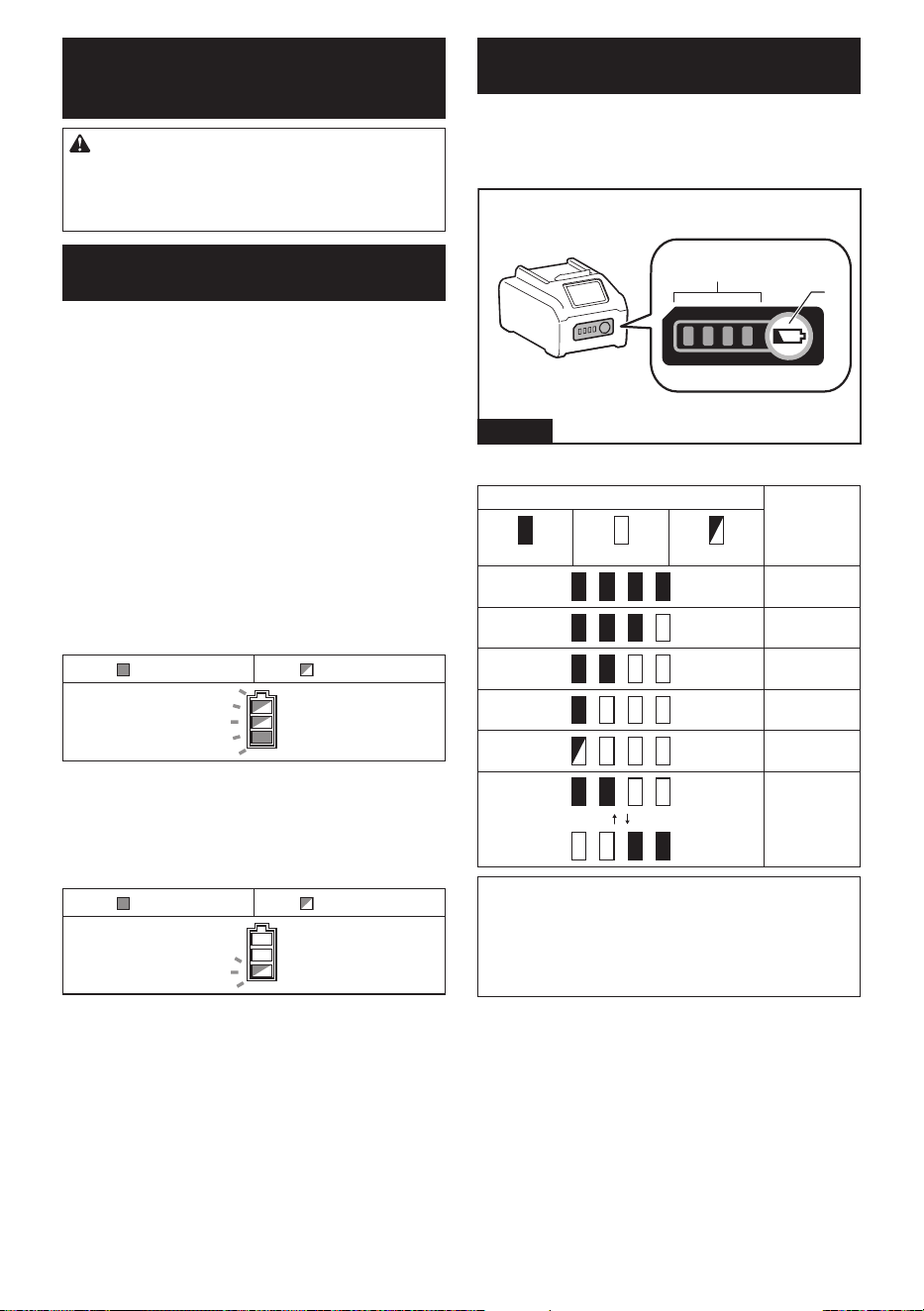
32 ESPAÑOL
1
2
Fig.10
► 1. Marca 2. Hendidura
NOTA: Asegúrese de que la marca en el cartón
pueda verse a través de la hendidura del sujetador
solamente.
4. Enganche el seguro del sujetador.
1
Fig.11
► 1. Seguro
5. Desdoble la bolsa del ltro si está doblada.
Fig.12
6. Asegure la cubierta de la caja para polvo
rmemente.
PRECAUCIÓN: Tenga cuidado de no pellizcar
sus dedos cuando enganche el seguro y al cerrar
la cubierta de la caja para polvo.
Extracción de la bolsa del ltro
PRECAUCIÓN: Manipule la bolsa del ltro
con cuidado. De lo contrario, los objetos extraños
podrían proyectarse hacia los ojos y causar lesiones
personales.
Reemplace la bolsa del ltro cuando esté llena u
obstruida.
Abra la cubierta de la caja para polvo y abra el seguro,
posteriormente extraiga la bolsa del ltro.
1
Fig.13
► 1. Seguro
Jale la tira en el lado de la abertura para cerrar la bolsa
del ltro y desechar toda la bolsa del ltro.
1
Fig.14
► 1. Tira
AVISO: No reutilice una bolsa del ltro. La bolsa
del ltro está diseñada para usarse una sola vez. El
uso repetido de una bolsa del ltro puede causar el
atasco del ltro y daños al aparato.
33 ESPAÑOL
DESCRIPCIÓN DEL
FUNCIONAMIENTO
PRECAUCIÓN: Asegúrese siempre de que
el aparato esté apagado y que el cartucho de la
batería haya sido extraído antes de realizar cual-
quier ajuste o revisión del funcionamiento del
aparato.
Sistema de protección del aparato/
batería
El aparato está equipado con un sistema de protección
del aparato/batería. Este sistema corta automática-
mente la alimentación al motor para prolongar la vida
del aparato y la batería. El aparato se detendrá automá-
ticamente durante la operación si el aparato o la batería
se someten a una de las siguientes condiciones:
Protección contra sobrecarga
Cuando el aparato se está utilizando de manera que
causa que consuma una cantidad de corriente inusual-
mente alta, el aparato se detiene automáticamente.
En esta situación, apague el aparato y detenga la apli-
cación que provocó la sobrecarga del aparato. Luego,
encienda el aparato para reiniciar.
Protección contra
sobrecalentamiento
Encendido Parpadeando
Cuando el aparato se sobrecalienta, se detiene
automáticamente y el indicador de batería parpadea
durante unos 60 segundos. En esta situación, deje que
el aparato se enfríe antes de volver a encenderlo.
Protección contra sobredescarga
Encendido Parpadeando
Cuando la capacidad de la batería es baja, el aparato
se detiene automáticamente y el indicador de batería
parpadea durante unos 60 segundos. Si el producto no
funciona incluso cuando los interruptores están siendo
operados, retire la batería del aparato y cárguela.
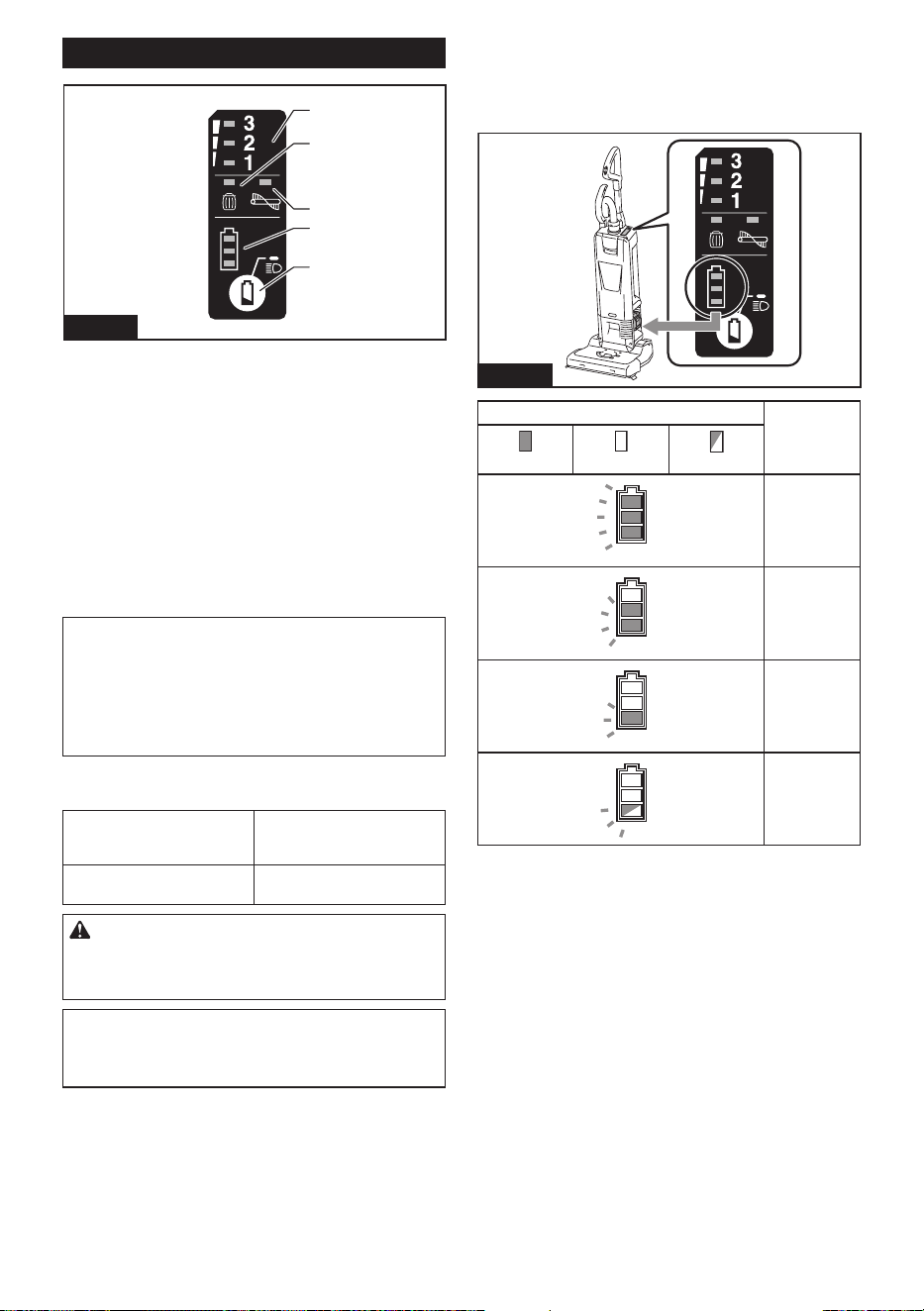
Indicación de la capacidad restante
de la batería
Oprima el botón de vericación en el cartucho de la
batería para que indique la capacidad restante de la
batería. Las luces indicadoras se iluminarán por algu-
nos segundos.
1
2
Fig.15
► 1. Luces indicadoras 2. Botón de vericación
Luces indicadoras Capacidad
restante
Iluminadas Apagadas Parpadeando
75% a 100%
50% a 75%
25% a 50%
0% a 25%
Cargar la
batería.
La batería
pudo haber
funcionado
mal.
NOTA: Dependiendo de las condiciones de uso y
la temperatura ambiente, la indicación podrá diferir
ligeramente de la capacidad real.
NOTA: La primera luz indicadora (extrema izquierda)
parpadeará cuando el sistema de protección de
batería esté en funcionamiento.
34 ESPAÑOL
Panel indicador
1
2
3
4
5
Fig.16
► 1. Modo de operación 2. Nivel excesivo de polvo
3. Error del cepillo giratorio 4. Capacidad restante
de la batería 5. Botón de vericación de batería/
lámpara
Modo de operación
Para cambiar el modo de operación, consulte la sección
para la acción del interruptor.
Nivel excesivo de polvo
Si este indicador se ilumina, reemplace la bolsa del
ltro. (Consulte la sección sobre cómo extraer la bolsa
del ltro.)
NOTA: Este indicador no funcionará según el entorno
de uso.
NOTA: El indicador automáticamente se apaga apro-
ximadamente un minuto después de que se apaga el
aparato. Si elimina la obstrucción de la bolsa del ltro
y reinicia el aparato, el indicador se apaga incluso
dentro de un minuto.
Error del cepillo giratorio
Parpadeando El cepillo giratorio está funcio-
nando con una carga elevada
por algún motivo.
Encendido El cepillo giratorio está dete-
nido por una razón anómala.
ADVERTENCIA: Apague el aparato inmedia-
tamente cuando se ilumine esta lámpara durante
la operación. De lo contrario, el motor podría sufrir
una avería y ocasionar un incendio.
NOTA: La lámpara podría parpadear si la altura del
cepillo giratorio es demasiado abajo contra la super-
cie de la alfombra. En ese caso, ajuste la altura del
cepillo giratorio.
Capacidad restante de la batería
Durante la operación, oprima el botón de vericación
de batería/lámpara para indicar la capacidad restante
de la batería.
Fig.17
Estado del indicador de batería Capacidad
restante de la
batería
Encendido Apagado
Parpadeando
50% a 100%
20% a 50%
0% a 20%
Cargar la
batería
Botón de vericación de batería/
lámpara
Se pueden realizar las siguientes operaciones.
• Simplemente oprima el botón para vericar la
capacidad restante de la batería.
• Durante la operación, mantenga oprimido el botón
para encender/apagar las lámparas.
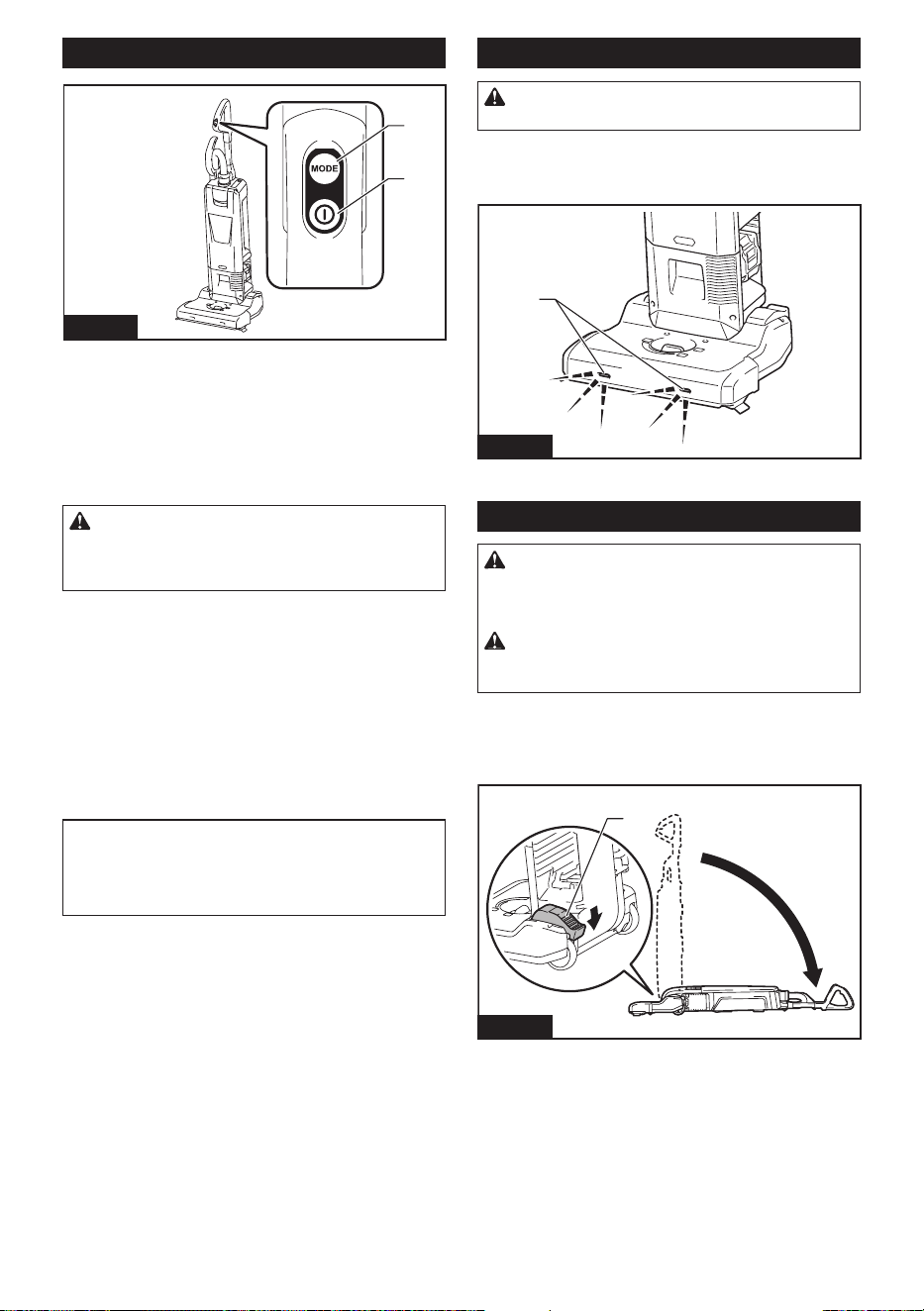
35 ESPAÑOL
Accionamiento del interruptor
1
2
Fig.18
► 1. Botón de cambio de modo 2. Botón de
encendido/apagado
Encendido/apagado de la
herramienta
Oprima el botón de encendido/apagado para encender
y apagar el aparato.
PRECAUCIÓN: Siempre coloque la cabeza
del aparato en el piso cuando lo encienda. De lo
contrario, podría ocurrir un accidente por el enredo y
ocasionar una lesión grave.
Cambio del modo de operación
Existen los siguientes tres modos de funcionamiento:
1. Nivel de ruido bajo
2. Normal
3. Alto
Para cambiar el modo de funcionamiento, presione el
botón de cambio de modo. El modo de funcionamiento
se puede cambiar incluso cuando el aparato está
apagado. El aparato se iniciará en el modo que usted
establezca.
NOTA: La aspiradora comienza en el mismo modo
que la última operación. Si retira la batería mientras
el motor está funcionando después del apagado, es
posible que la aspiradora no arranque en el mismo
modo que la última vez que la usó.
Encendido/apagado de la lámpara
PRECAUCIÓN: No mire a la luz ni vea a la
fuente de luz directamente.
El aparato está equipado con las lámparas.
Consulte el párrafo del botón de vericación de batería/
lámpara para aprender sobre su operación.
1
Fig.19
► 1. Lámpara
Pedal
PRECAUCIÓN: Asegure siempre el aparato
en una posición vertical cuando suelte el mango.
De lo contrario, el aparato podría caerse accidental-
mente y ocasionar una lesión.
PRECAUCIÓN: Tenga cuidado de no pellizcar
sus dedos entre el cuerpo principal y la cabeza
del aparato.
Para desbloquear la posición vertical del aparato, pise
el pedal y jale el mango hacia atrás.
El rango de movimiento es de 90 grados desde la posi-
ción vertical.
1
Fig.20
► 1. Pedal
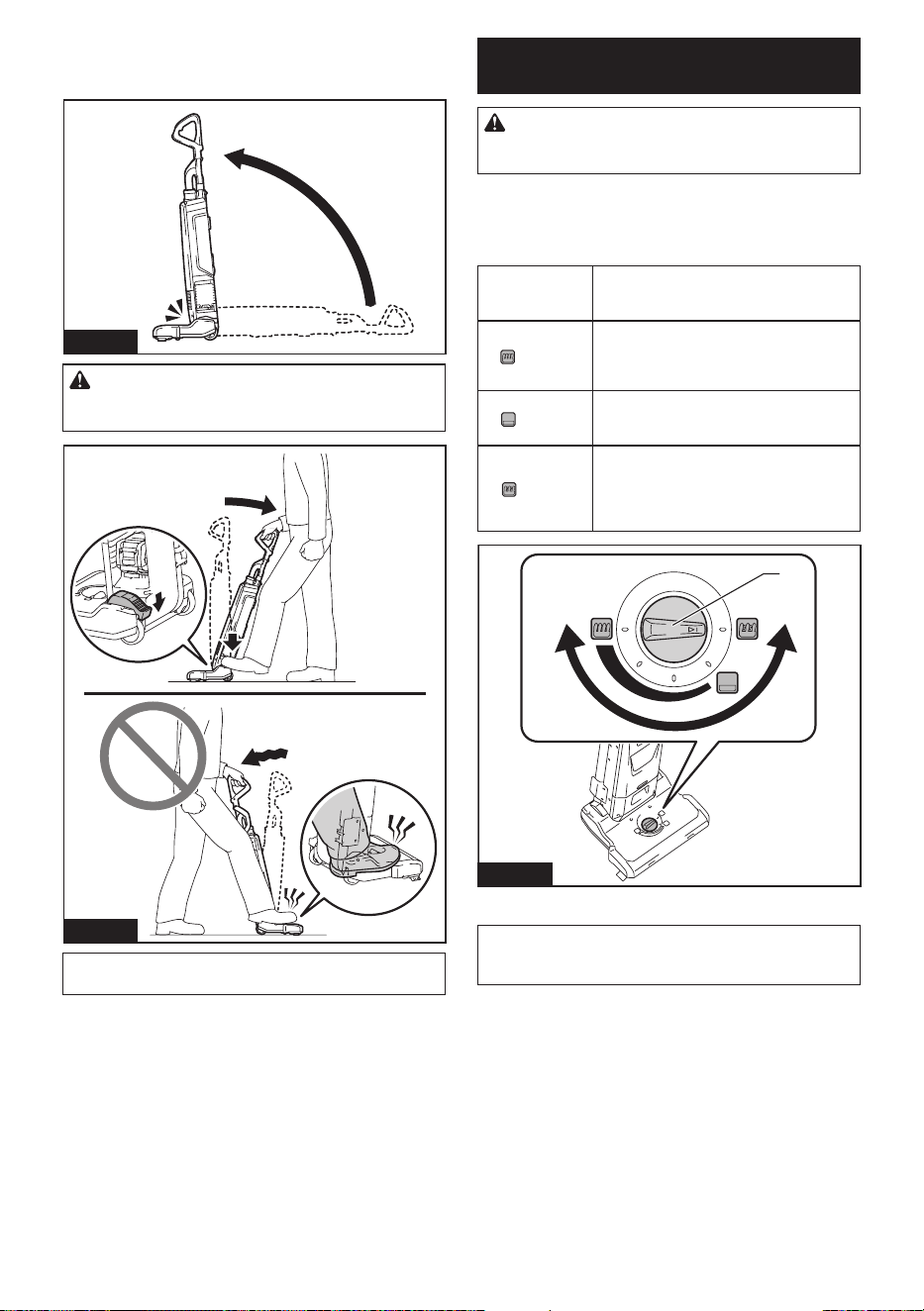
36 ESPAÑOL
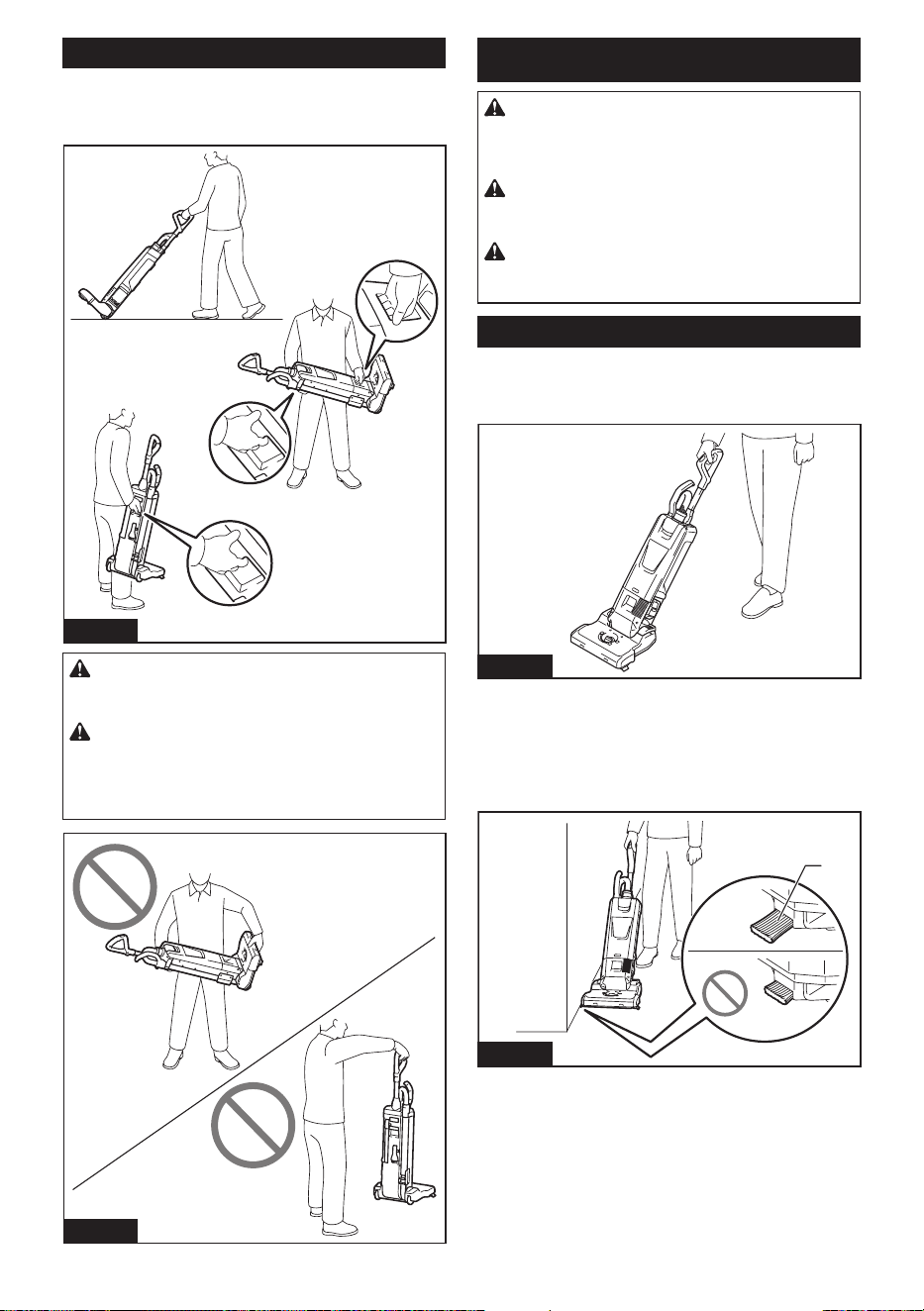
Para bloquear el aparato en la posición vertical, mueva
el mango hacia adelante hasta que el pedal se bloquee
en su posición con un clic.
Fig.21
PRECAUCIÓN: Asegúrese de desbloquear
el pedal antes de operar. El manejo brusco podría
causar la rotura de las piezas.
Fig.22
NOTA: Cuando el aparato esté en la posición vertical,
el cepillo giratorio dejará de girar.
Ajuste de la altura del cepillo
giratorio
PRECAUCIÓN: Asegúrese siempre de que
la palanca de ajuste quede correctamente en la
posición antes de la operación.
La altura del cepillo giratorio puede ajustarse en 5
pasos.
Gire la palanca de ajuste a su posición deseada consul-
tando la siguiente tabla.
Posición de
la palanca de
ajuste
Altura del cepillo giratorio
A (
)
El cepillo giratorio permanece colocado
en la parte superior desde el suelo, lo que
es adecuado para limpiar alfombras de
pelo largo.
B (
)
El cepillo giratorio se coloca más abajo
del suelo, lo que es adecuado para limpiar
suelos duros y alfombras de pelo corto.
C (
)
El cepillo giratorio se extiende para colo-
carse hasta el suelo, lo que resulta ecaz
para la limpieza profunda de alfombras y la
eliminación de suciedad, polvo y partículas
incrustadas en las bras.
1
A
B
C
Fig.23
► 1. Palanca de ajuste
NOTA: El cepillo giratorio no podrá girar si la altura
del cepillo giratorio es demasiado abajo contra la
supercie de la alfombra.
37 ESPAÑOL
Mango portador
Cuando transporte el aparato, empújelo mediante
las rueditas solamente o sujetando el o los mangos
portadores.
Fig.24
PRECAUCIÓN: Cuando transporte el apa-
rato, asegure el aparato en una posición vertical.
De lo contrario, podría ocurrir un accidente por caída.
PRECAUCIÓN: No transporte el aparato
mediante otra cosa que no sea el mango portador.
De lo contrario, podría ocurrir un accidente por la
caída o se podría ocasionar una lesión si el aparato
arrancara de forma no intencional.
Fig.25
OPERACIÓN
PRECAUCIÓN: No jale el poste del mango
del aparato durante la operación. Hacerlo podría
ocasionar perder el control del aparato y ocasionaría
una lesión grave.
PRECAUCIÓN: No ponga su mano o pierna
por debajo del aparato durante la operación. De lo
contrario, podrían ser pellizcados.
PRECAUCIÓN: No utilice el aparato con ilu-
minación insuciente. Trabajar con poca luz podría
contribuir a un accidente imprevisto.
Operación normal de limpieza
1. Sostenga el mango y luego desbloquee la posi-
ción vertical.
2. Encienda el aparato. Limpie un piso.
Fig.26
Cómo usar el cepillo lateral
El cepillo lateral es adecuado para limpiar las esquinas
de una pared.
Si el cepillo lateral se acorta, lleve el aparato al centro
de servicio de Makita para reemplazarlo.
1
Fig.27
► 1. Cepillo lateral
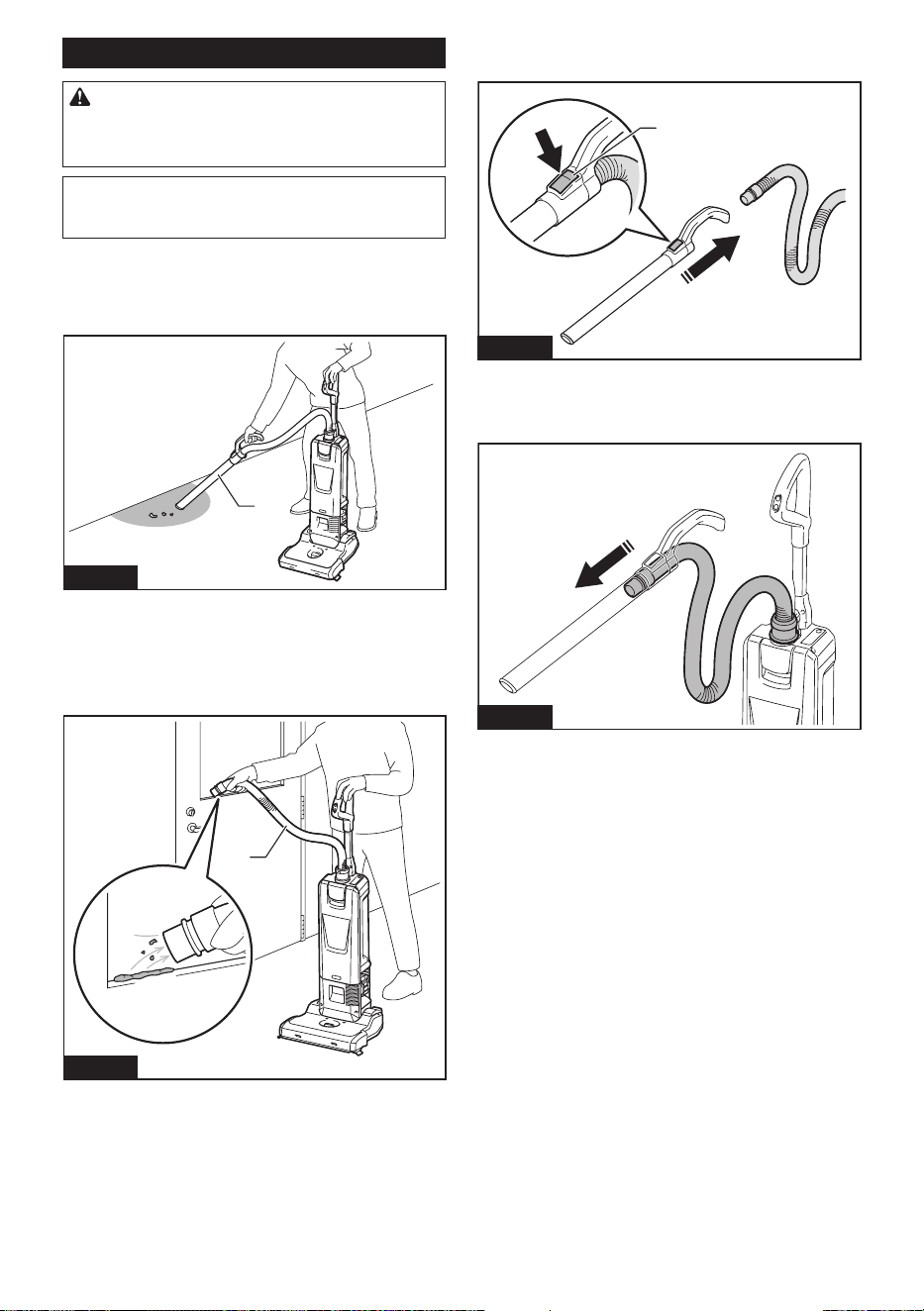
38 ESPAÑOL
Operación con accesorios
PRECAUCIÓN: Mantenga sostenido el
mango cuando use los accesorios. De lo contrario,
el aparato podría caerse accidentalmente y ocasionar
una lesión.
AVISO: Cuando utilice los accesorios, asegure el
aparato en una posición vertical. De lo contrario, la
rotación del cepillo giratorio podría dañar el piso.
Cómo usar el tubo de aluminio
El tubo de aluminio es adecuado para limpiar habitácu-
los estrechos o lugares elevados.
1
Fig.28
► 1. Tubo de aluminio
Uso de la manguera
La manguera es adecuada para limpiar más cerca con
sus manos.
1
Fig.29
► 1. Manguera
Para usar la manguera, extraiga la manguera del tubo
de aluminio mientras empuja la palanca.
1
Fig.30
► 1. Palanca
Para instalar la manguera, inserte esta en el tubo de
aluminio hasta que haga clic.
Fig.31
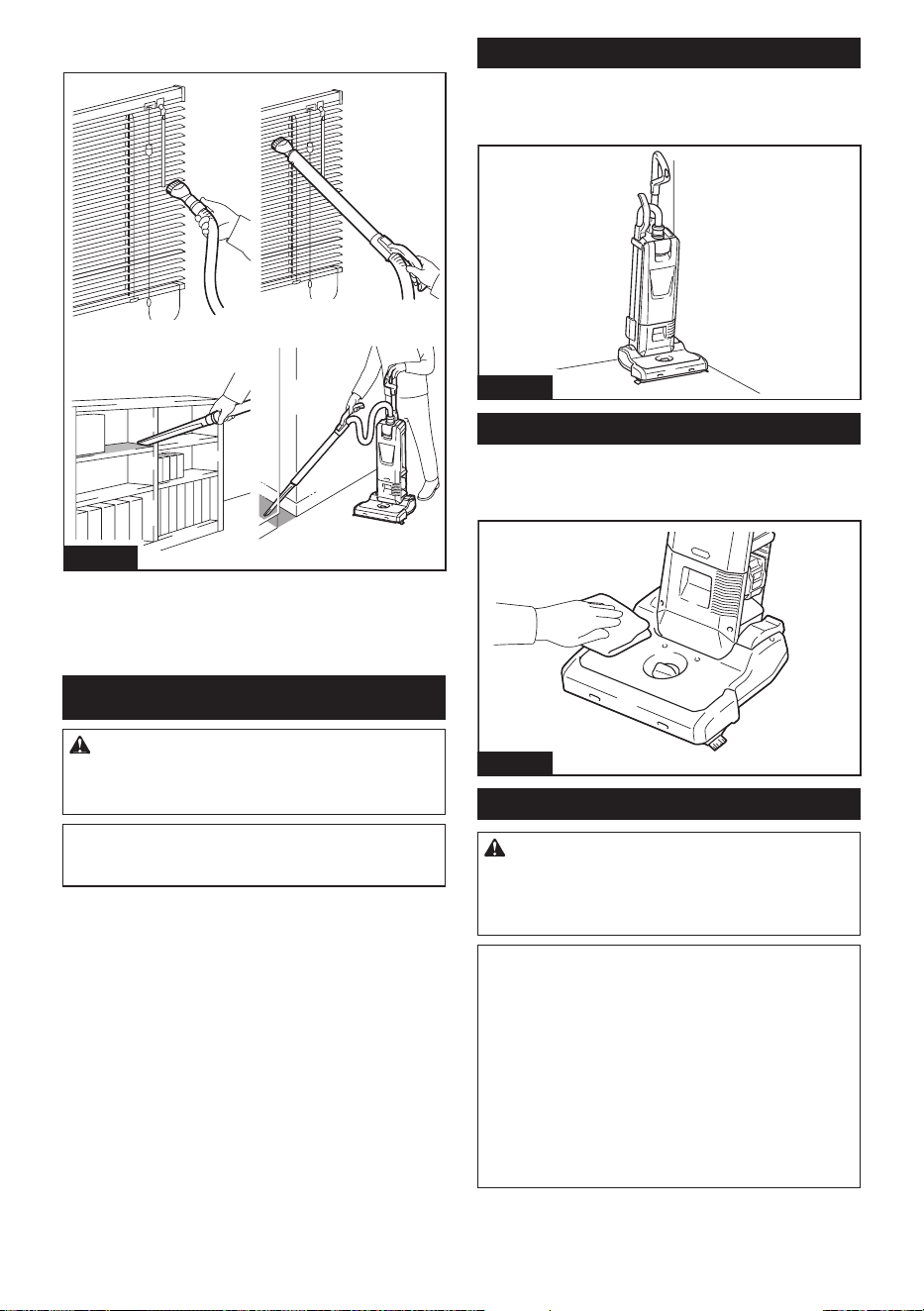
39 ESPAÑOL
Cómo usar los aditamentos
Fig.32
Para instalar el aditamento, gírelo e insértelo rme-
mente en el tubo de aluminio o en la manguera. Para
desconectarlo, retírelo girándolo.
MANTENIMIENTO
PRECAUCIÓN: Asegúrese siempre de que el
aparato haya sido apagado y que el cartucho de
batería haya sido extraído antes de intentar reali-
zar una inspección o tarea de mantenimiento.
AVISO: Nunca use gasolina, bencina, diluyente
(tíner), alcohol o sustancias similares. Puede que
esto ocasione grietas o descoloramiento.
Para mantener la SEGURIDAD y FIABILIDAD del pro-
ducto, las reparaciones, y cualquier otra tarea de man-
tenimiento o ajuste deberán ser realizadas en centros
de servicio autorizados o de fábrica Makita, empleando
siempre repuestos Makita.
Almacenamiento
Cuando lo almacene, extraiga el cartucho de batería
y almacene el aparato en una supercie nivelada y en
una posición vertical.
Fig.33
Limpieza del cuerpo del aparato
De vez en cuando, limpie el exterior de la aspiradora
(cuerpo de la aspiradora) usando un paño húmedo y
agua enjabonada.
Fig.34
Limpieza del ltro HEPA
PRECAUCIÓN: No utilice la aspiradora sin un
ltro ni continúe usando el ltro sucio o dañado.
El polvo o las partículas aspiradas podrían esca-
par de la aspiradora y causar una enfermedad
respiratoria al operador.
AVISO: Para mantener una potencia de succión
óptima y un escape limpio, limpie el ltro perió-
dicamente. Si no logra obtenerse una potencia
de succión suciente incluso después de la lim-
pieza, reemplace el ltro con uno nuevo.
AVISO: Para evitar que el ltro se dañe, no utilice
las siguientes herramientas o elementos simila-
res para limpiarlo:
— Sacudidor de aire
— Hidrolavadora de alta presión
— Herramientas hechas de materiales duros,
como un cepillo de alambre
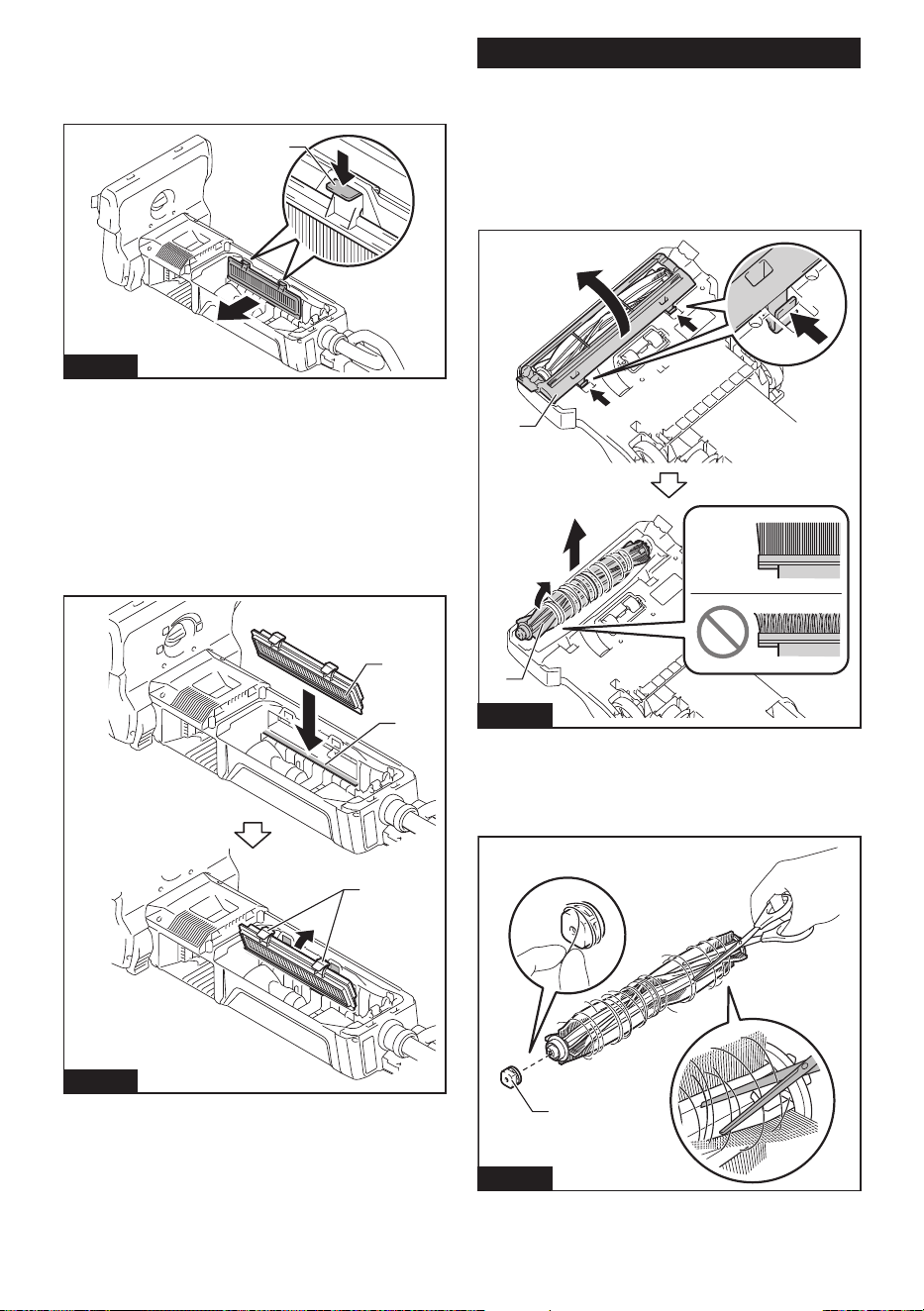
40 ESPAÑOL
1. Abra la cubierta de la caja para polvo y extraiga la
bolsa del ltro.
Libere los ganchos del ltro y retire el ltro del cuerpo
del aparato.
1
Fig.35
► 1. Gancho
2. Golpee el polvo del ltro. El ltro puede ser lavado
con agua. Limpie con agua el polvo y las partículas
en el ltro cada 1 o 2 meses. Después de eso, seque
por completo el ltro en un lugar a la sombra y bien
ventilado para evitar un olor desagradable o un funcio-
namiento defectuoso.
3. Para instalar el ltro, inserte el lado sin los gan-
chos en la ranura, y luego empuje el ltro hacia adentro
hasta que los ganchos queden asegurados con un clic.
1
2
3
Fig.36
► 1. Ranura 2. Filtro HEPA 3. Gancho
Limpieza del cepillo giratorio
1. Retire la placa inferior y luego extraiga el cepillo
giratorio.
Si las cerdas del cepillo giratorio se acortan, pida al
centro de servicio de Makita uno nuevo.
Hacer uso del aparato con el cepillo giratorio con cer-
das cortas resultará en una recolección deciente de
polvo.
1
2
Fig.37
► 1. Placa inferior 2. Cepillo giratorio
2. Retire hilos y cabellos del cepillo giratorio con
unas tijeras.
Retire el tapón y limpie los restos.
1
Fig.38
► 1. Tapón
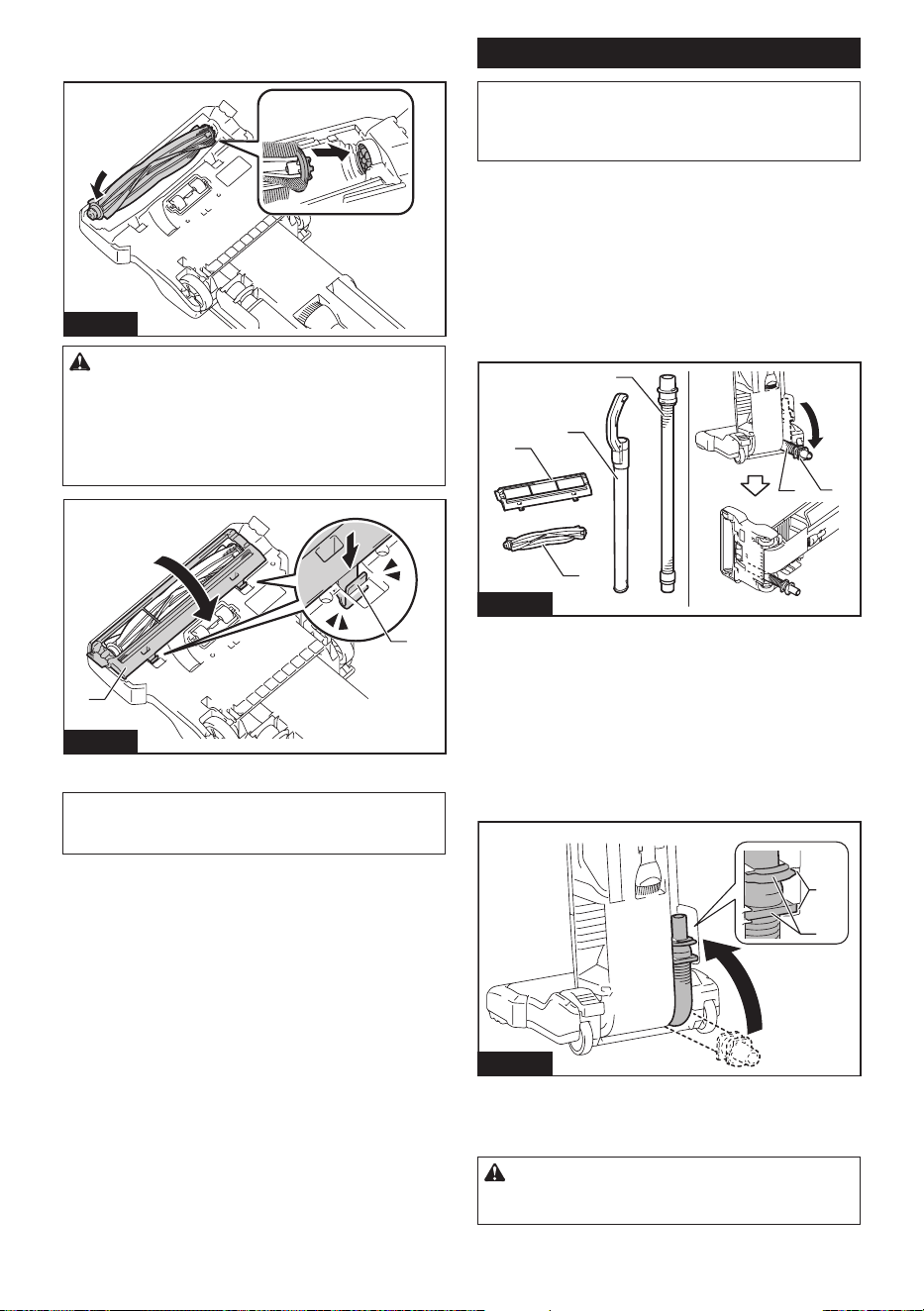
41 ESPAÑOL
3. Instale el tapón, el cepillo giratorio y la placa
inferior en sentido inverso.
Fig.39
PRECAUCIÓN: Vuelva a colocar la placa
inferior en su posición de forma segura hasta
que las dos palancas de bloqueo hagan clic en su
lugar. Si el aparato se opera sin la placa inferior, el
cepillo giratorio podría desprenderse, resultando en
una lesión.
1
2
Fig.40
► 1. Placa inferior 2. Palanca de bloqueo
AVISO: Siempre instale el cepillo giratorio. Hacer
uso del aparato sin el cepillo giratorio resultará en
una recolección deciente de polvo.
Cómo desatascar obstrucciones
AVISO: No utilice el aparato si la vía de ujo de
admisión está obstruida. El uso continuo mientras
la vía de ujo de admisión esté obstruida resulta en
una menor potencia de succión.
1. Retire la placa inferior y luego extraiga el cepillo
giratorio.
2. Retire el tubo de aluminio del aparato y de la
manguera.
3. Gire la manguera en sentido inverso al de las
manecillas del reloj y luego retire la manguera del
aparato.
4. Retire la manguera de succión tirando de la
pestaña.
5
6
1
2
3
4
Fig.41
► 1. Placa inferior 2. Cepillo giratorio 3. Tubo de
aluminio 4. Manguera 5. Manguera de succión
6. Pestaña
5. Inspeccione la vía de ujo de admisión de aire en
el interior del tubo de aluminio y de la manguera, así
como de la manguera de succión.
Retire los escombros del interior de estos.
6. Alinee la lengüeta de la manguera de succión con
la ranura en la carcasa y deslícela en su lugar.
1
2
Fig.42
► 1. Lengüeta 2. Ranura
7. Instale la manguera, el tubo de aluminio, el cepillo
giratorio y la placa inferior.
PRECAUCIÓN: Instale la manguera y el tubo
rmemente. De lo contrario, podría ocurrir una fuga
de polvo y ocasionar una lesión.
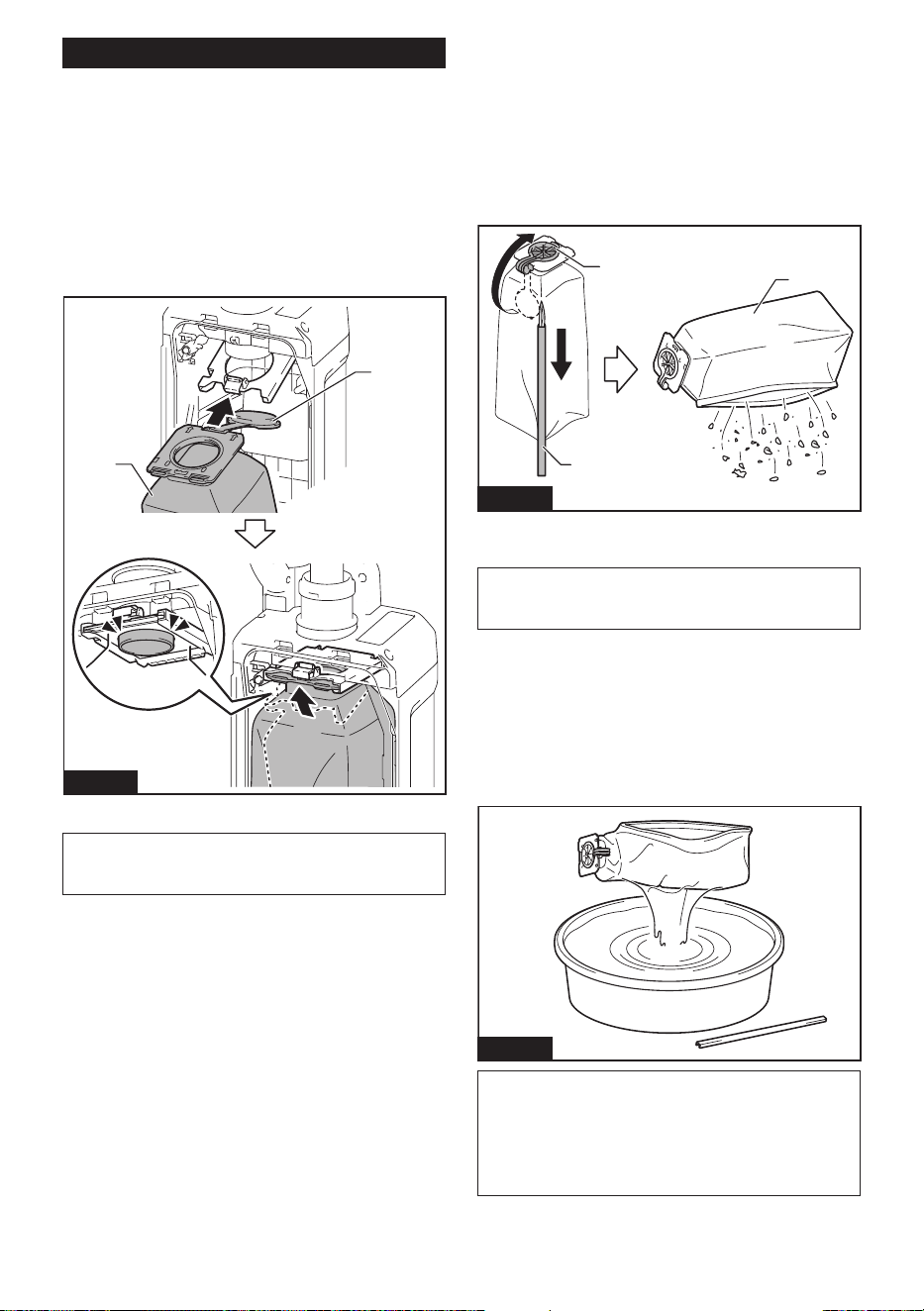
42 ESPAÑOL
Bolsa recolectora de polvo
Accesorio opcional
La bolsa recolectora de polvo se puede utilizar repeti-
das veces si esta se limpia.
Instalación y extracción de la bolsa
recolectora de polvo
El procedimiento de instalación y extracción de la bolsa
recolectora de polvo es el mismo que el de la bolsa del
ltro. Consulte la sección para instalación de la bolsa
del ltro y extracción de la bolsa del ltro.
1
2
Fig.43
► 1. Bolsa recolectora de polvo 2. Tapón de goma
AVISO: Al instalar la bolsa recolectora de polvo,
abra primero el tapón de goma. Inserte la bolsa
recolectora de polvo con el tapón de goma detrás.
Vaciado de la bolsa recolectora de
polvo
1. Cierre el tapón de goma para evitar que el polvo
ote hacia afuera.
2. Abra la boca de la bolsa tirando del sujetador.
3. Vacíe el contenido de la bolsa recolectora de
polvo golpeándola ligeramente a n de remover las
partículas adheridas en el interior.
1
2
3
Fig.44
► 1. Bolsa recolectora de polvo 2. Tapón de goma
3. Cierre
AVISO: Vaciar la bolsa recolectora de polvo
frecuentemente. Demasiado polvo romperá la bolsa
fácilmente.
Limpieza de la bolsa recolectora de
polvo
Limpie regularmente la bolsa recolectora de polvo con
agua y jabón. Voltee al revés la bolsa recolectora de
polvo y retire el polvo adherido. Lávela ligeramente con
la mano y enjuague bien con agua. Séquela por com-
pleto antes de instalarla en la aspiradora.
Fig.45
AVISO: Una bolsa recolectora de polvo húmeda
reduce el desempeño del aspirado así como la
vida del motor.
AVISO: Cuando monte el sujetador en la bolsa
recolectora de polvo, asegúrese de que la boca
de la bolsa esté bien cerrada.
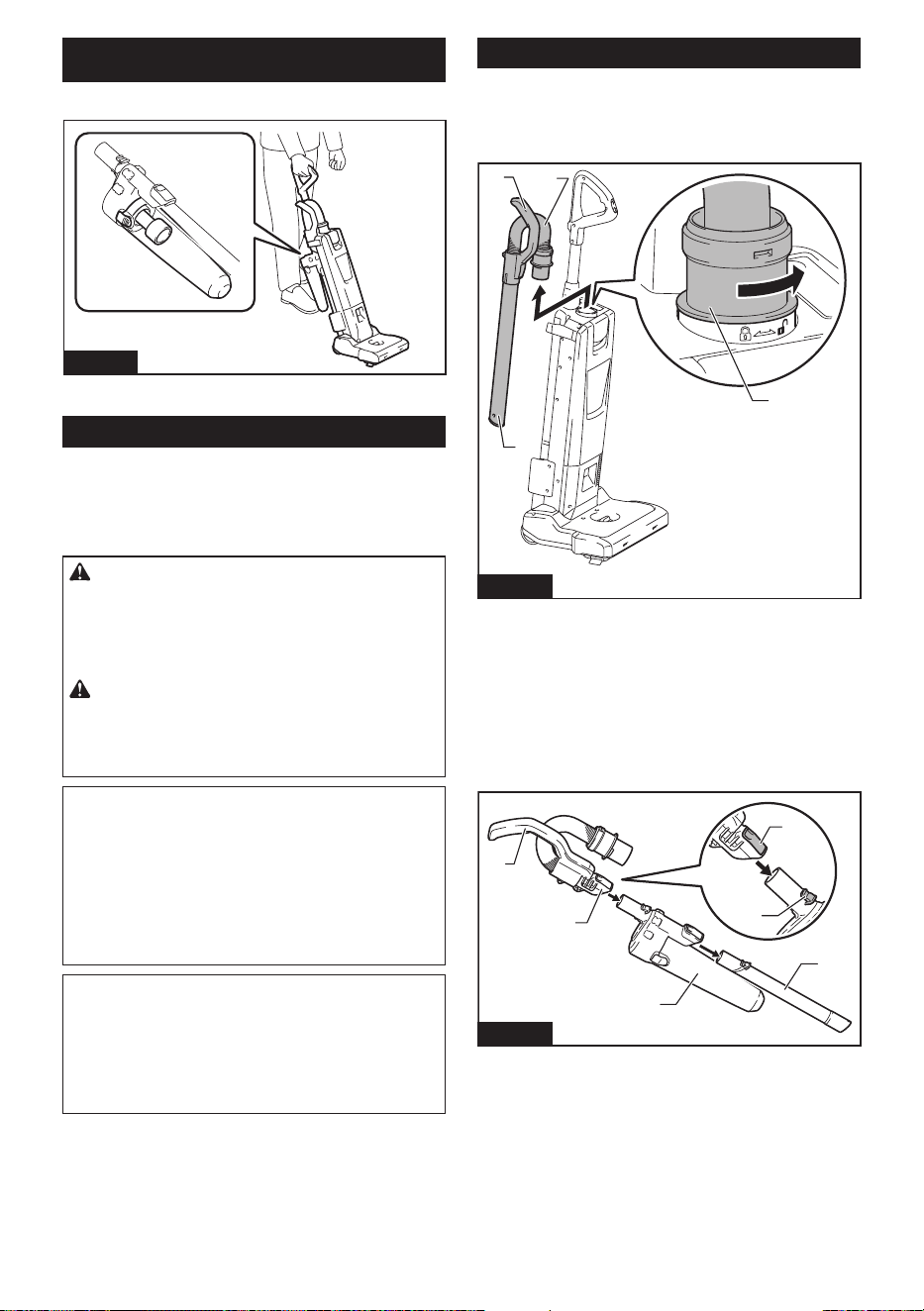
43 ESPAÑOL
COLECTOR CICLÓNICO
Accesorio opcional
1
Fig.46
► 1. Colector ciclónico
Acerca del colector ciclónico
El uso de la aspiradora con el colector ciclónico insta-
lado reduce la cantidad de polvo que ingresa a la bolsa
del ltro, lo que ayuda a evitar que la fuerza de succión
se debilite. Además, limpiarla después de su uso tam-
bién es algo sencillo.
PRECAUCIÓN: Asegúrese siempre de que la
herramienta esté apagada y el cartucho de batería
haya sido extraído antes de realizar cualquier
trabajo en la misma. Si se deja insertado el cartucho
de batería, la aspiradora podría arrancar de forma
inesperada y ocasionar una lesión.
PRECAUCIÓN: Limpie el ltro de malla del
colector ciclónico y la bolsa del ltro de la unidad
de la aspiradora cuando se obstruyan. El uso
continuo en la condición obstruida podría provocar su
calentamiento o humo.
AVISO: Cuando se coloca el colector ciclónico,
no use el colector ciclónico en la posición hori-
zontal u orientada hacia arriba. El hacerlo podría
ocasionar que el ltro de malla se obstruya.
AVISO: Siempre utilice la aspiradora con la bolsa
del ltro instalada, incluso cuando utiliza el colec-
tor ciclónico. Si se utiliza la aspiradora sin la bolsa
del ltro instalada se podría ocasionar una avería del
motor.
NOTA: Verique que el colector ciclónico, la aspira-
dora y el tubo recto estén asegurados correctamente
antes de su uso.
NOTA: Vacíe la caja para polvo del colector ciclónico
y la bolsa del ltro de la aspiradora cuando se haya
acumulado el polvo. El uso continuo en esas circuns-
tancias debilitará la fuerza de succión.
Instalación del colector ciclónico
1. Gire el manguito de la manguera en sentido
inverso al de las manecillas del reloj y retire la man-
guera, la empuñadura del tubo y el tubo de aluminio del
aparato.
1
2
4
3
Fig.47
► 1. Manguito 2. Manguera 3. Empuñadura del tubo
4. Tubo de aluminio
2. Gire el lado del tope del colector ciclónico hacia
arriba, alineando el tope con la ranura de la entrada de
succión. Bloquee el tope insertando el colector cicló-
nico hasta que haga clic. Tire ligeramente del colector
ciclónico para asegurarse de que no se quitará. Instale
el tubo recto con el mismo procedimiento que el del
colector ciclónico.
1
2
3
4
5
6
Fig.48
► 1. Empuñadura para el colector ciclónico 2. Entrada
de succión 3. Colector ciclónico 4. Tubo recto para
el colector ciclónico 5. Tope 6. Botón de bloqueo
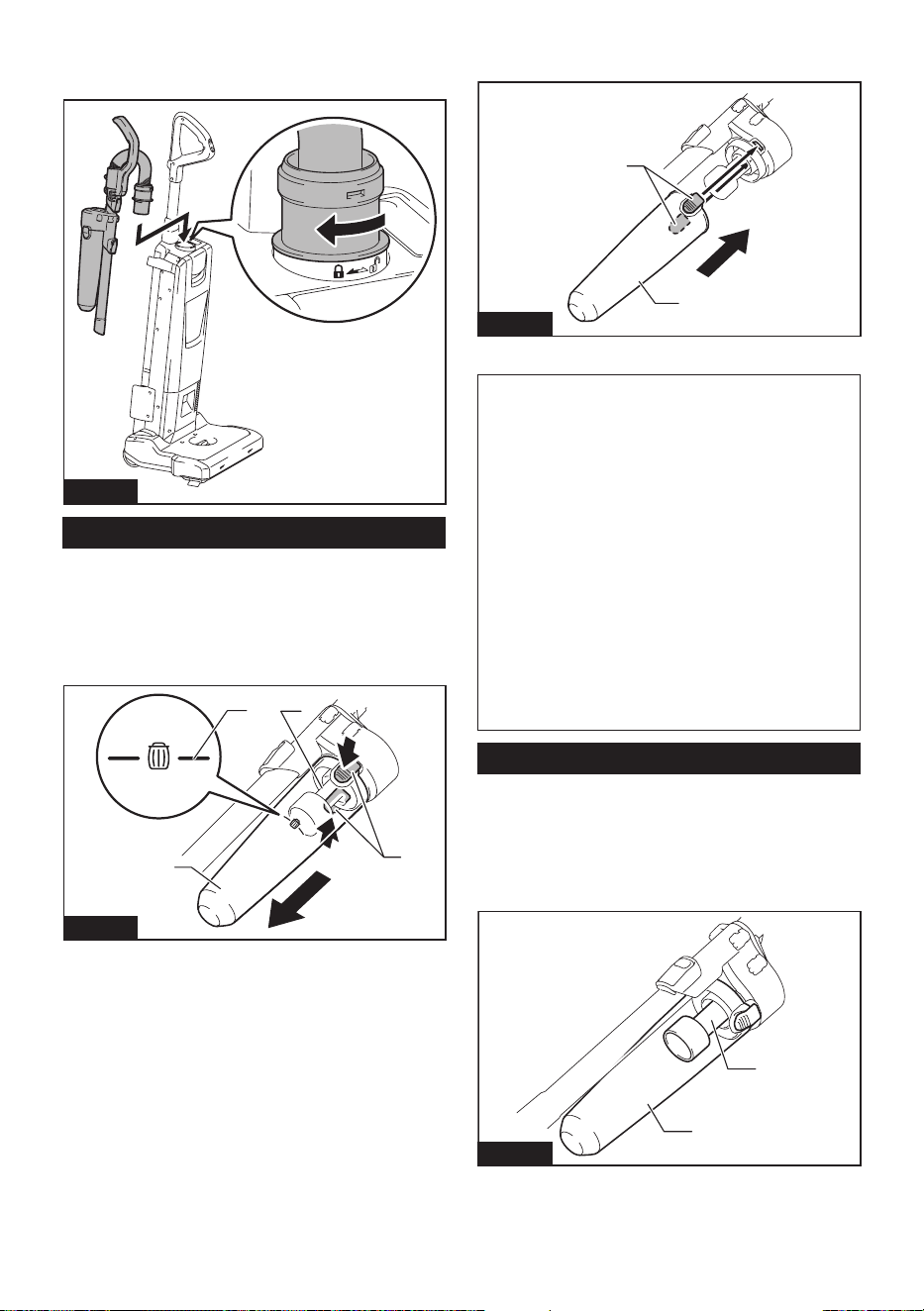
44 ESPAÑOL
3. Instale el colector ciclónico en el aparato, y luego
gire el manguito de la manguera en el sentido de las
manecillas del reloj para jarlo.
Fig.49
Eliminación del polvo
Cuando se haya acumulado el polvo hasta la línea de
llenado completo de la caja para polvo, siga el procedi-
miento a continuación y deseche el polvo.
1. Sujete la caja para polvo rmemente, oprima y
mantenga apretados los dos botones y extraiga la caja
para polvo.
1
①
2
3
4
②
Fig.50
► 1. Línea de llenado completo 2. Caja para polvo
3. Botón (dos ubicaciones) 4. Filtro de malla
2. Deseche el polvo dentro de la caja para polvo
y extraiga cualquier polvo y partículas adheridas a la
supercie del ltro de malla.
3. Inserte la caja para polvo hasta el fondo hasta que
los dos botones queden asegurados con un clic.
1
2
Fig.51
► 1. Caja para polvo 2. Botón (dos ubicaciones)
NOTA: Sostenga rmemente el colector ciclónico
cuando instale la caja para polvo.
NOTA: Verique que el colector ciclónico, la aspira-
dora y el tubo recto estén asegurados correctamente
antes de reiniciar la operación.
NOTA: El indicador de nivel excesivo de polvo de
la aspiradora no se encenderá cuando la caja para
polvo del colector ciclónico se llene.
NOTA: En las siguientes condiciones, verique si se
ha acumulado polvo dentro de la bolsa del ltro de
la aspiradora, o si se ha producido una obstrucción
en la ruta de aire. Despeje las causas cuando sea
necesario.
— Si el desempeño de succión no mejora después
de quitar el polvo de la caja para polvo y limpiar
el ltro de malla.
— Si el indicador de nivel excesivo de polvo de la
aspiradora continúa encendido.
Limpieza
Cuando la caja para polvo se ensucia o el ltro de malla
se obstruye, quítelos y lávelos con agua. (Consulte la
sección “Eliminación del polvo” para el procedimiento
de eliminación).
Seque las piezas por completo antes de reinstalarlas
y usarlas.
1
2
Fig.52
► 1. Caja para polvo 2. Filtro de malla
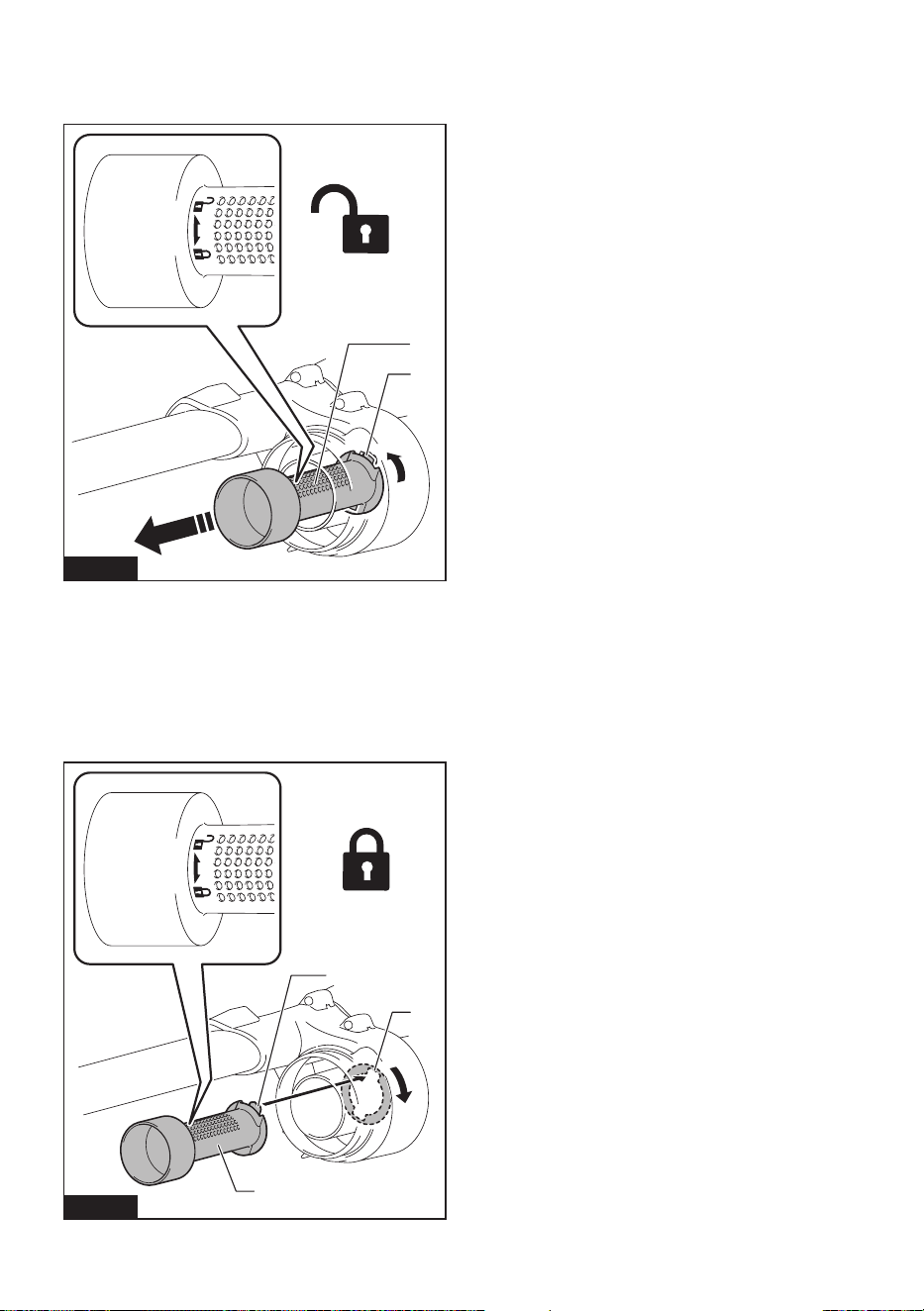
45 ESPAÑOL
Cuando el ltro de malla se ensucie en exceso, límpielo
con los siguientes procedimientos.
1.
Gire el ltro de malla en el sentido contrario a las maneci-
llas del reloj y retírelo mientras los ganchos no están asegurados.
1
①
2
②
Fig.53
► 1. Filtro de malla 2. Gancho
2.
Retire el polvo en el ltro de malla y posteriormente
lávelo con agua. Después de esto, séquelo por completo.
3.
Inserte el ltro de malla dentro de la base mien-
tras los ganchos están alineados con el puerto. Mueva
el ltro de malla en el sentido de las manecillas del
reloj hasta que los ganchos se aseguren con un clic.
Asegúrese de que el ltro de malla quede bien instalado.
①
②
1
2
3
Fig.54
► 1. Filtro de malla 2. Gancho 3. Puerto
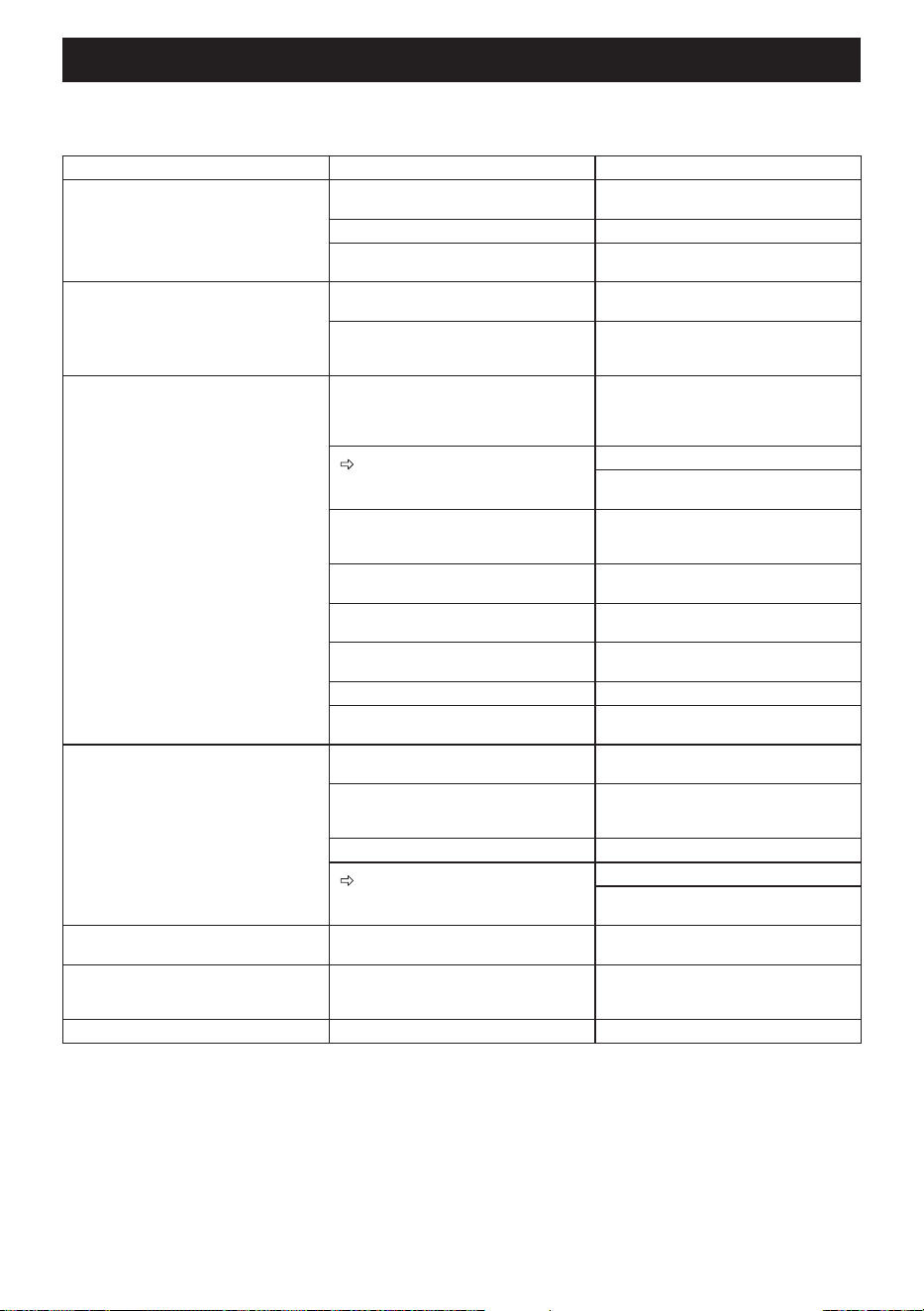
46 ESPAÑOL
RESOLUCIÓN DE PROBLEMAS
Antes de solicitar alguna reparación, primero realice una inspección por su cuenta. Si detecta algún problema que
no esté explicado en el manual, no intente desarmar la máquina. En vez de esto, solicite la reparación a un centro
de servicio autorizado de Makita, usando siempre piezas de repuesto Makita.
Síntoma Causa probable Solución
No funciona El cartucho de batería está instalado
incorrectamente.
Instale el cartucho de batería como se
describe en este manual.
El cartucho de batería se ha agotado. Cargue el cartucho de batería.
El mango no está instalado correctamente. Instale el mango rmemente como se
describe en este manual.
El cepillo giratorio no gira El aparato está bloqueado en la posición
vertical.
Desbloquee la posición vertical del
aparato.
El indicador de error del cepillo giratorio
está iluminado.
Inspeccione que no haya algo enredado
alrededor del cepillo giratorio (cuerpo,
tapón y unión).
Potencia de succión deciente El indicador de nivel excesivo de polvo
está iluminado.
Reemplace la bolsa del ltro.
Si la bolsa del ltro no está llena, desdoble
la bolsa del ltro y agítela para eliminar la
obstrucción.
Si reemplazar la bolsa del ltro no
resuelve el problema...
Limpie o reemplace el ltro HEPA.
Inspeccione que no haya restos que
obstruyan la manguera y el tubo.
Hay restos enredados en el cepillo girato-
rio y la velocidad de giro ha disminuido.
Inspeccione que no haya algo enredado
alrededor del cepillo giratorio (cuerpo,
tapón, unión).
La altura del cepillo giratorio es demasiado
elevada del piso.
Disminuya la altura del cepillo giratorio.
Las cerdas del cepillo giratorio se han
acortado.
Reemplace el cepillo giratorio.
Disminuya la altura del cepillo giratorio.
El aparato funciona en modo de operación
bajo.
Cambie al modo de operación alto.
El cepillo giratorio no está instalado. Instale el cepillo giratorio.
El tubo o la manguera no están instalados
correctamente.
Instale el tubo o la manguera rmemente.
Ruido excesivo durante el accionamiento El aparato funciona en modo de operación
alto.
Cambie al modo de operación bajo.
Hay restos enredados en el cepillo
giratorio.
Inspeccione que no haya algo enredado
alrededor del cepillo giratorio (cuerpo,
tapón y unión).
La bolsa del ltro está llena de polvo. Reemplace la bolsa del ltro.
Si reemplazar la bolsa del ltro no
resuelve el problema...
Limpie o reemplace el ltro HEPA.
Inspeccione que no haya restos que
obstruyan la manguera y el tubo.
El indicador de nivel excesivo de polvo
parpadea después de usar poco el aparato
La bolsa del ltro está doblada. Desdoble la entrada de la bolsa del ltro
antes de colocarla.
La lámpara no se enciende La conguración de la lámpara está en
apagado (OFF).
Durante la operación, mantenga oprimido
el botón de vericación de batería/lámpara
para encender la lámpara.
La ruedita se mueve muy poco Hay restos enredados en la ruedita. Quite los restos enredados en la ruedita.

47
ACCESORIOS
OPCIONALES
PRECAUCIÓN: Estos accesorios o aditamen-
tos están recomendados para utilizarse con su
herramienta Makita especicada en este manual.
El empleo de cualquier otro accesorio o aditamento
puede conllevar el riesgo de lesiones personales.
Utilice los accesorios o aditamentos solamente para
su n establecido.
Si necesita cualquier ayuda para más detalles en
relación con estos accesorios, pregunte a su centro de
servicio local Makita.
• Boquilla para esquinas
• Cepillo redondo
• Colector ciclónico
• Filtro HEPA
• Bolsa del ltro
• Bolsa recolectora de polvo
• Batería y cargador originales de Makita
NOTA: Algunos de los artículos en la lista pueden
incluirse en el paquete de la herramienta como acce-
sorios estándar. Éstos pueden variar de país a país.
GARANTÍA LIMITADA DE
MAKITA
Ésta Garantía no aplica para México
Consulte la hoja de la garantía anexa para ver los
términos más vigentes de la garantía aplicable a este
producto. En caso de no disponer de esta hoja de
garantía anexa, consulte los detalles sobre la garantía
descritos en el sitio web de su país respectivo indicado
a continuación.
Estados Unidos de América: www.makitatools.com
Canadá: www.makita.ca
Otros países: www.makita.com
ESPAÑOL

Some dust created by power sanding, sawing, grinding, drilling, and other
construction activities contains chemicals known to the State of California
to cause cancer, birth defects or other reproductive harm. Some examples
of these chemicals are:
• lead from lead-based paints,
• crystalline silica from bricks and cement and other masonry products, and
• arsenic and chromium from chemically-treated lumber.
Your risk from these exposures varies, depending on how often you do this
type of work. To reduce your exposure to these chemicals: work in a well
ventilated area, and work with approved safety equipment, such as those
dust masks that are specially designed to filter out microscopic particles.
WARNING
< USA only >
ADVERTENCIA
Algunos polvos creados por el lijado, aserrado, esmerilado, taladrado y
otras actividades de la construcción contienen sustancias químicas
reconocidas por el Estado de California como causantes de cáncer, defectos
de nacimiento y otros peligros de reproducción. Algunos ejemplos de estos
productos químicos son:
• plomo de pinturas a base de plomo,
• sílice cristalino de ladrillos y cemento y otros productos de albañilería, y
• arsénico y cromo de maderas tratadas químicamente.
El riesgo al que se expone varía, dependiendo de la frecuencia con la que
realice este tipo de trabajo. Para reducir la exposición a estos productos
químicos: trabaje en un área bien ventilada y póngase el equipo de seguridad
indicado, tal como las máscaras contra polvo que están especialmente
diseñadas para filtrar partículas microscópicas.
< Sólo en los Estados Unidos >
Makita Corporation
3-11-8, Sumiyoshi-cho,
Anjo, Aichi 446-8502 Japan
www.makita.com
885A55-947
GCV09-1
EN, ESMX
20230913