PART 01
WWW.ELEGOO.COM
GET THE TUTORIAL
SCAN QR CODE
The ESP32 is a family of highly integrated Wi-Fi (802.11 b/g/n) and
Bluetooth (Classic + BLE 4.2/5.x) System-on-Chip (SoC) solutions
developed by Espressif Systems (Shanghai, China).
ESP32-based modules and development boards
excel at reading a wide variety of inputs:
Performing audio playback and simple voice-based
interaction ( via integrated DAC )
8
Audio and image data ( via dedicated peripherals or
expansion boards )
3
Remote network commands ( via Wi-Fi or BLE )
4
Driving motors, servos, and actuators ( using PWM or
dedicated driver interfaces )
5
Uploading data to cloud platforms ( MQTT/HTTP with
AWS IoT, Aliyun, Azure IoT Hub, etc. )
6
Rendering information on displays ( I²C OLED displays,
SPI TFT screens )
7
Biometric and motion signals ( via I²C/SPI sensors such
as heart-rate or IMU modules )
2
Environmental data ( via sensors connected to ADC or
digital bus interfaces )
1
01
What Is the ESP32?
Common development frameworks include Arduino Core for ESP32,
MicroPython, and ESP-IDF (the ocial Espressif development
framework). For beginners, the Arduino IDE with the ESP32 core
provides the simplest entry point while retaining access to advanced
ESP32 peripherals.
A portable weather station that syncs real-time data to
your phone via Wi-Fi.
Thanks to a strong global developer community, the ESP32
ecosystem provides abundant open-source libraries, tutorials,
and sample projects—such as ESPAsyncWebServer for network
applications or Adafruit SSD1306 for OLED displays—making rapid
prototyping easier than ever.
The ESP32 gives you all the hardware foundations to turn ideas
into working prototypes.
WHETHER YOU WANT TO BUILD:
A smart-home controller with BLE and voice commands.
A battery-powered sensor node that runs for months.
A Wi-Fi-controlled obstacle-avoidance robot.
A wearable device for health monitoring and BLE notifications.
THE ESP32 PRODUCT FAMILY :
Espressif Systems, founded in 2008, released the ESP8266 in
2014—a breakthrough, low-cost Wi-Fi SoC that reshaped the
IoT landscape. To address demand for multi-protocol connectivity
and higher processing performance, Espressif ocially introduced
the ESP32 series in 2016.
The first mass-produced model, ESP32-D0WDQ6, featured a
dual-core Tensilica Xtensa LX6 32-bit processor with integrated
Wi-Fi and Bluetooth, filling functional gaps left by the ESP8266.
ESP32-S Series
Optimized for low-power applications (e.g., ESP32-S3 with a RISC-V
co-processor), ideal for wearables and battery-powered devices.
ESP32-C Series
Cost-optimized and available with integrated flash, suitable for
mass-production designs.
ESP32-H Series
High-performance multimedia support (e.g., BLE 5.3-capable
ESP32-H2), targeting cameras, displays, and edge-AI devices.
02
Evolution of the ESP32
MAIN COMPONENTS:
A key milestone occurred in 2017 with the release of
the Arduino
Core for ESP32
, enabling millions of Arduino developers to
adopt ESP32 without learning a new programming environment.
Today, the ESP32 is widely regarded as the de-facto standard for
mid-range IoT prototyping.
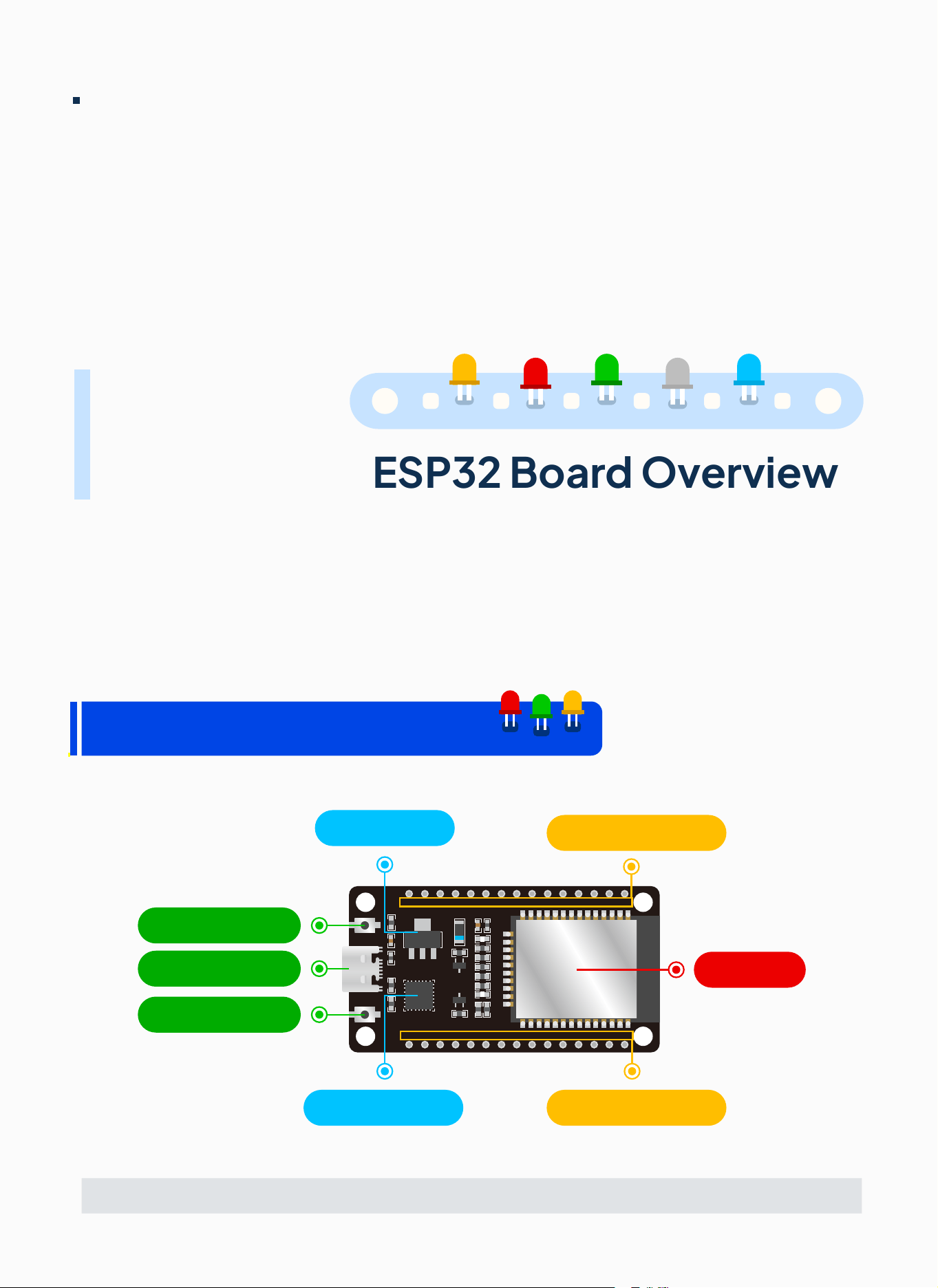
This section uses the
ESP32 DevKit V1
as an example to explain
the core components and essential pin functions.
3V3 GND D15 D2 D4 D16 D17 D5 D18 D19 D21 RXD TXD D22 D23
VIN GND D13 D12 D14 D27 D26 D25 D33 D32 D35 D34 UN UP EN
N3
BOOT
U2
I/O Connector
ESP-32
I/O Connector
USB to UART
5V to 3.3V
Boot button
Type C-USB
Reset button
( ESP32 board display image )
03
ESP32 Board Overview
ESP32 Module
Dual-core 32-bit processor with Wi-Fi and Bluetooth capability.
Power Regulation Circuitry
Converts USB or Vin supply to stable 3.3V.
USB-to-UART Bridge
Provides programming and serial communication via USB.
POWER SPECIFICATIONS:
USB Type-C / Micro-USB
Ideal for development; supplies 5V input and enables code
uploading.
Vin pin (5–12V)
Accepts external DC input; the onboard LDO regulator
converts it to 3.3V for the ESP32.
The ESP32 DevKit V1 supports two primary power-input methods:
Important Notes
1.Do NOT exceed 12V on Vin, or the regulator and ESP32 module
may be damaged.
2.All ESP32 GPIO pins operate at 3.3V logic.Do not directly
connect 5V signals—use a level shifter when necessary.
(1) POWER & GROUND PINS
ESP32 pins are configurable through software
( multiplexed peripherals ). Below is an organized:
3V3 – 3.3V Regulated Output
3.3V regulated output; useful for powering low-current sensors
and modules (up to ~500mA).
GND – Multiple Ground Points
All external modules must share GND.
Vin
External 5–12V power input.
(2) GENERAL-PURPOSE GPIO PINS
Examples:
GPIO15 (D15) Supports PWM, SPI functions.
GPIO2 (D2)
ADC-capable; must remain high at
boot to avoid startup issues.
GPIO4 (D4) GPIO with touch and ADC support.
GPIO5 (D5) Often used as VSPI clock.
04
Important Pin Functions
(3) UART PINS
GPIO16 (RX2) / GPIO17 (TX2)
UART2 communication or general I/O.
GPIO3 (RX0) / GPIO1 (TX0)
UART0 (USB serial) used for programming and debugging.
(4) ADC / DAC / TOUCH PINS
GPIO27 / GPIO32 / GPIO33
ADC inputs, some with touch sensing.
GPIO34 / GPIO35 / GPIO36 / GPIO39 (VP/VN)
ADC-only, input-only pins.
GPIO25 / GPIO26
Support both ADC input and DAC output.
(5) BUS INTERFACE PINS
GPIO13/12/14
Versatile GPIOs supporting PWM,
SPI, and touch ( but note GPIO12
aects boot voltage settings ).
I²C GPIO21 (SDA), GPIO22 (SCL)
SPI (VSPI)
GPIO18 – SCK
GPIO19 – MISO GPIO23 – MOSI
GPIO5 – CS
EN pin Chip-enable; Active-high.
(1) POWER & GROUND PINS
ESP32 pins are configurable through software
( multiplexed peripherals ). Below is an organized:
Extensive hardware expandability
Multiple GPIOs and peripheral interfaces suitable for diverse
applications.
Rich software ecosystem
supports Arduino, MicroPython, and ESP-IDF; large library
availability improves development eciency.
Strong community & documentation
Numerous open-source examples and tutorials accelerate
learning and project development.
Further Reading
For more information, refer to Espressif’s ocial documentation:
https://docs.espressif.com/projects/esp-dev-kits/en/latest/esp32/
05
Advantages of the ESP32 DevKit

FCC Warning
This device complies with part 15 of the FCC Rules. Operation is subject to the following two conditions:
(1) This device may not cause harmful interference, and (2) this device must accept any interference
received, including interference that may cause undesired operation.
Any Changes or modifications not expressly approved by the party responsible for compliance could
void the user's authority to operate the equipment.
Note: This equipment has been tested and found to comply with the limits for a Class B digital device,
pursuant to part 15 of the FCC Rules. These limits are designed to provide reasonable protection
against harmful interference in a residential installation. This equipment generates uses and can radiate
radio frequency energy and, if not installed and used in accordance with the instructions, may cause
harmful interference to radio communications. However, there is no guarantee that interference will not
occur in a particular installation. If this equipment does cause harmful interference to radio or television
reception, which can be determined by turning the equipment off and on, the user is encouraged to try to
correct the interference by one or more of the following measures:
-Reorient or relocate the receiving antenna.
-Increase the separation between the equipment and receiver.
-Connect the equipment into an outlet on a circuit different from that to which the receiver is
connected.
-Consult the dealer or an experienced radio/TV technician for help.
This equipment complies with FCC radiation exposure limits set forth for an uncontrolled environment.
This equipment should be installed and operated with minimum distance 20cm between the radiator &
your body.