REVISION DATE → 09.09.2025
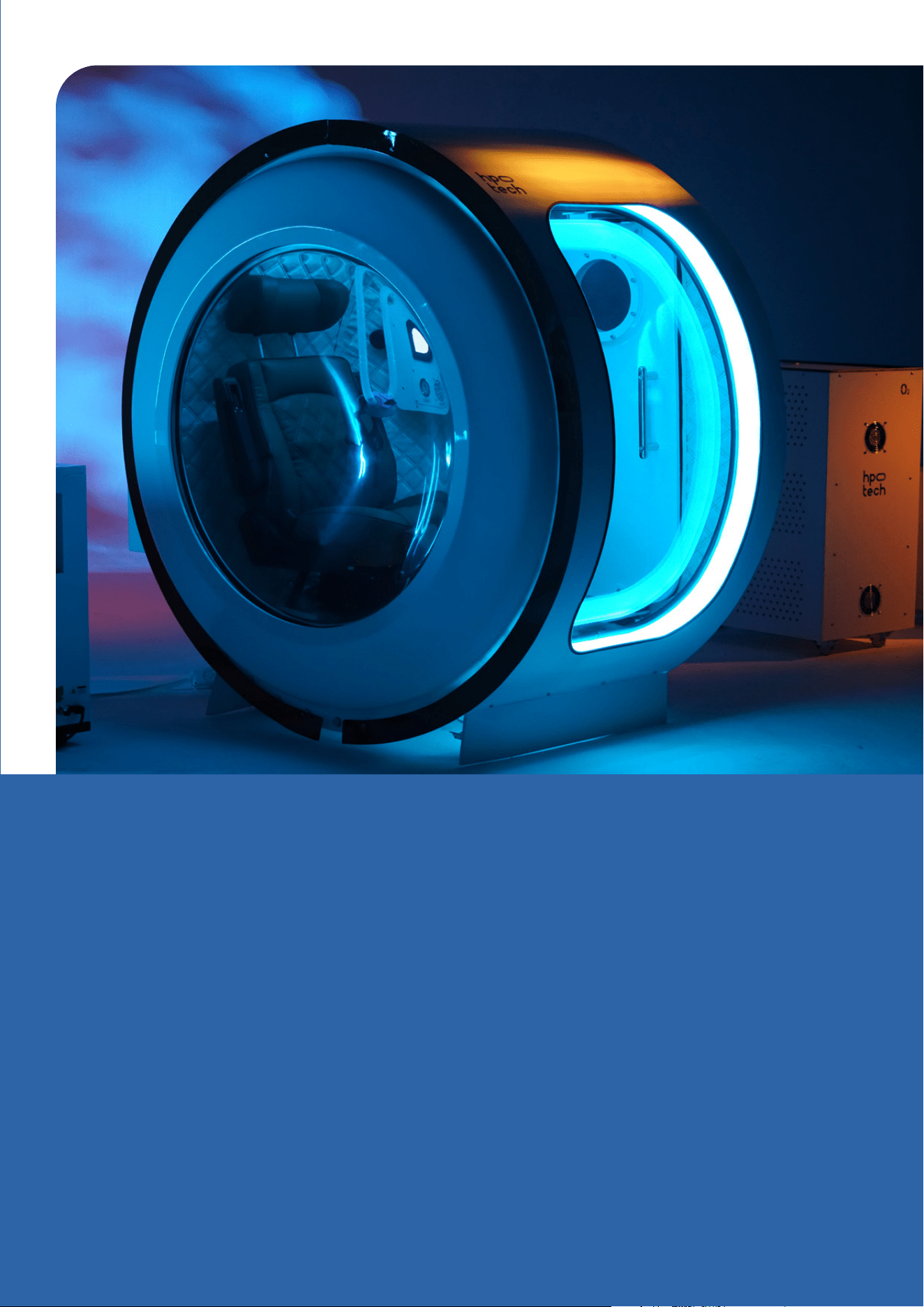
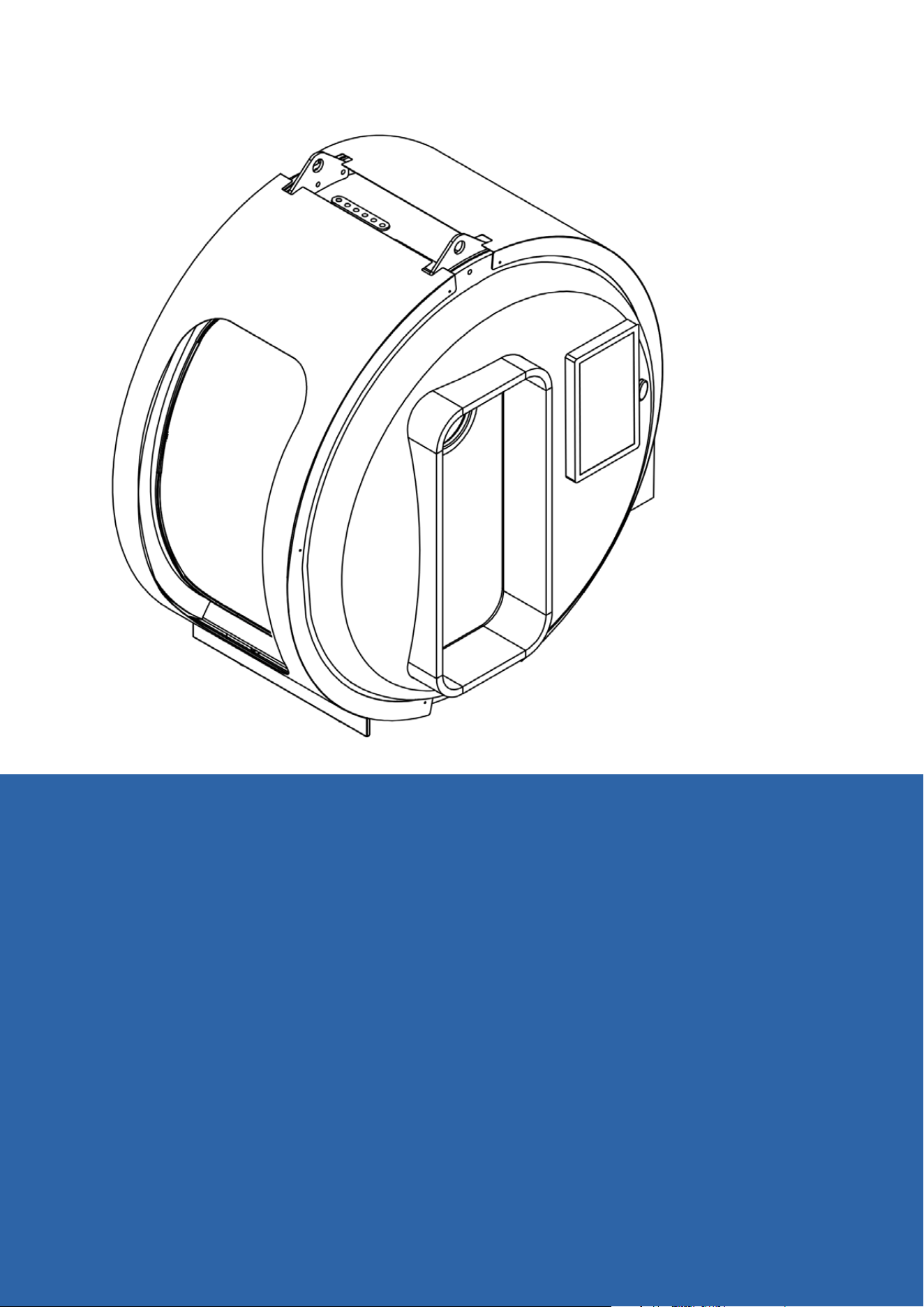
ZEUGMA
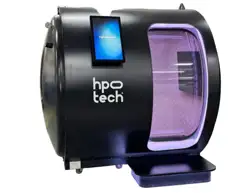
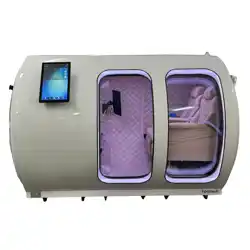
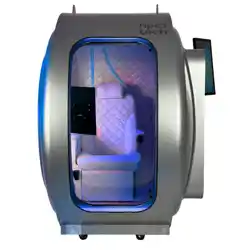
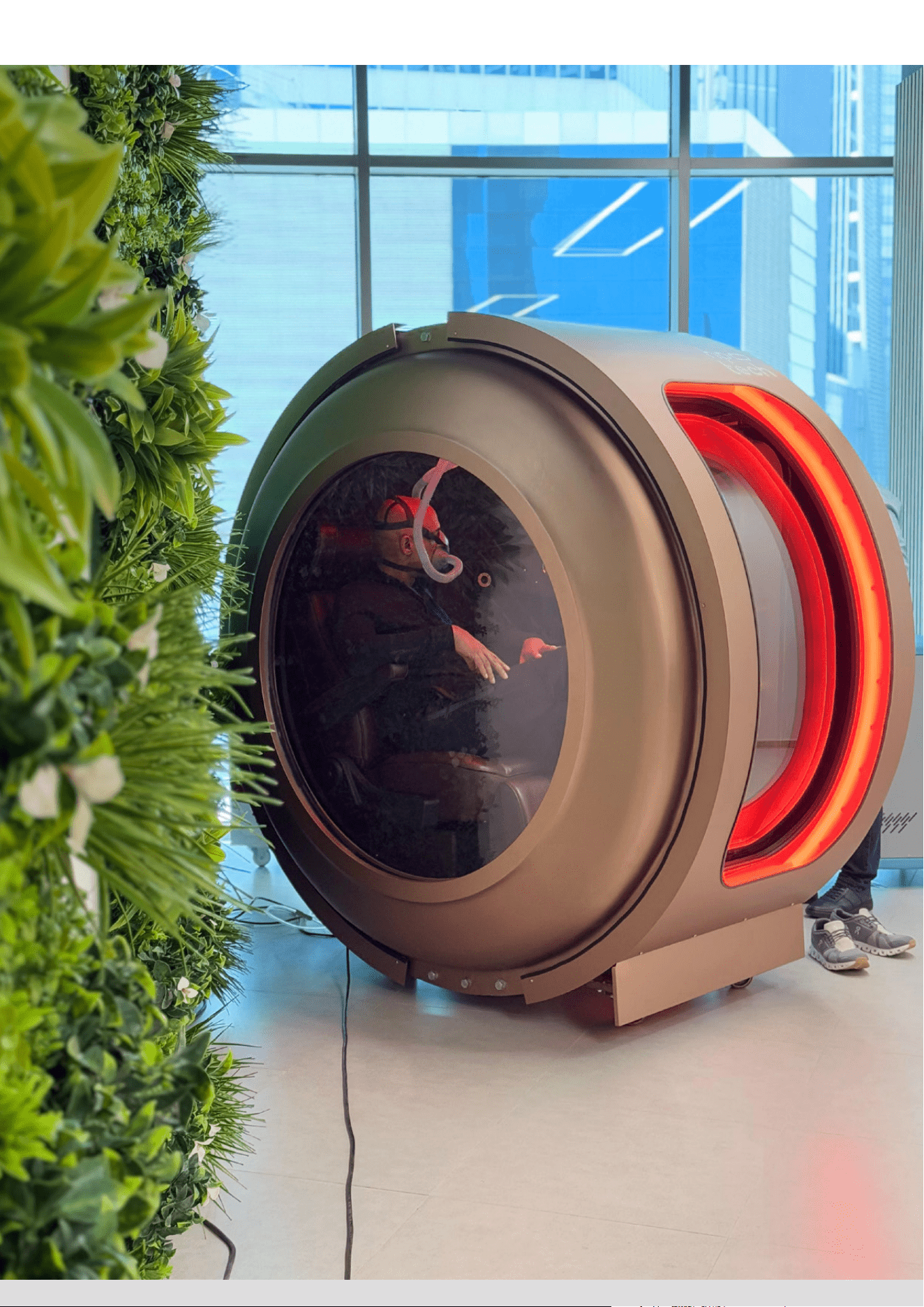
Multiplace
Hyperbaric
Chamber
PRESSURE LEVELS → 2.0 ATA & 2.4 ATA
OPERATIONS AND MAINTENANCE USER MANUAL
1 SEAT
PRODUCT REF Nº → TKBO-X

2
1.
User Service Program
A comprehensive service program is available to all users of the MEDITERRANEAN Hyperbaric
System manufactured by HPO TECH. For information regarding annual service contracts, please
get in touch with the office.
HPOTECH MEDİKAL VE TEKNİK ÇÖZÜMLER SAN VE TİC A.Ş
Telephone: +90 543 931 54 54
Telephone: +90 506 118 94 05
Address: Ataşehir Ferhatpaşa, 49. Sk. No: 29, 34888 Ataşehir, İstanbul, Turkey
www.hpotech.com

PRODUCT REF Nº → TKBO-2X ATLANTIS Hyperbaric System
3
1.
1. Introduction 5
1.1. About this manual 7
1.2. HPO TECH About the Manufacturer 10
2. The ZEUGMA hyperbaric chamber system 13
2.1. System features 17
2.2. Technical sketches 18
2.3. Technical specifications 19
3. Installation guidelines for the hyperbaric chamber 23
3.1. Dedicated chamber room 24
3.2. Location and Environmental Considerations 24
3.3. Fire Safety 24
3.4. Flooring 24
3.5. Room dimensions and installation floor size 24
3.6. Ventilation and Exhaust 24
3.7. Grounding 24
4. Safety 29
4.1. General safety rules 30
4.2. Safety precautions 30
4.3. Emergency procedures and safety guidelines 31
4.4. General maintenance and safety guidelines 31
5. Chamber exterior 35
5.1. Chamber Interior Guidelines 36
5.2. Electronics safety protocol 37
5.3. Personnel requirements 39
5.4. Patient safety guidelines 39
6. Device presentation 43
6.1. System components 44
6.2. COMPONENTS DESCRIPTIONS 46
6.3. ADDITIONAL FEATURES 58
7. Instructions of Use 61
8. Emergency scenarios 69
9. Warranty Terms and Conditions 75
10. Certifications 79
1. Medical Device Regulations 80
2. Pressure Vessel and Safety Regulations 81
3. Product and Occupational Safety Standards 81
4. Quality and Management Systems Certifications 82
11. Software control 85
12. Indications for use (IFU) 99
1. Intended Use 100
2. Indications 100
3. Target population for HBOT 101
4. Contraindications 102
5. Warnings 103
6. Precautions 103
7. Recommended usage periods 104
8. Post-session recommendations 105
9. Side effects of hyperbaric oxygen therapy 107
10. Hazards and associated risks 107
11. Clinical considerations 110
12. Documentation and Records 110
13. Evidence and research 110

PRODUCT REF Nº → TKBO-2X ATLANTIS Hyperbaric System
5
1. Introduction
1. Introduction
This manual provides detailed operating and maintenance procedures for
the ZEUGMA Monoplace Hyperbaric Chamber.
Pressure levels → 2.0 ATA & 2.4 ATA
The procedures outlined by HPO TECH are designed to prolong the life of the
system and ensure optimal safety and reliability. The ZEUGMA hyperbaric
system must be operated and maintained by properly trained and experienced
personnel only. This manual is not a substitute for proper training or supervision.
ZEUGMA Hyperbaric System
PRODUCT REF Nº → TKBO-X

6
ATLANTIS hyperbaric system
1. Introduction
Scope and purpose
The manual focuses on mechanical operation and maintenance of the equipment.
Care and treatment of patients is beyond the scope of this manual.
Safety information is crucial, so strict adherence to procedures is necessary.
Usefulness and accreditation
The manual serves as an important component of the system.
It can be useful for accreditation programs and should be kept in the chamber facility
for easy reference.
Updates and revisions
Information in the manual is based on the latest product data.
Revisions are tracked, and updated manuals are sent to user facilities.
NOTE
Last revision date → 09.09.2025
Emergency preparedness
In emergencies, operators may not have time to consult the manual.
Thorough training is essential for chamber personnel.

PRODUCT REF Nº → TKBO-2X ATLANTIS Hyperbaric System
7
1. Introduction
1.1. About this manual
This manual is designed to familiarize you with the installation, operation, maintenance,
and emergency procedures for the ZEUGMA Monoplace Hyperbaric Chamber
(2.0 ATA & 2.4 ATA). It covers the recommended mechanical procedures only and does
not include patient care or treatment guidelines.
For patient care or treatment guidelines, refer to the Indications For Use (IFU)
document annexed to this User Manual.
Purpose and importance
Ȼ This manual contains vital safety information
and should be treated as an essential part
of your system.
Ȼ Strict adherence to the procedures and
recommendations in this manual is crucial
to ensure safe and reliable operation of the
hyperbaric chamber.
Manual updates and revisions
Ȼ All information, illustrations, and
specifications in this manual are based
on the most up-to-date product details
available at the time of printing.
Ȼ HPOTECH will provide updates when
necessary.
Ȼ A list of revisions is included at the beginning
of this manual, and updated versions will be
distributed to each user facility.
Accreditation and compliance
Ȼ The manual is also a useful resource for
accreditation programs.
Ȼ It is recommended that you store this
manual in the chamber facility for easy
reference, along with your organization’s
specific policies and procedures (e.g., fire
code, code blue) and personnel training
records.
Importance of operator familiarity
Ȼ Due to the critical nature of hyperbaric
chamber operation, there is little margin
for error. In emergency situations, there
may not be time to consult the manual,
so operators and technicians must be
thoroughly familiar with its contents.
Ȼ This manual is intended to support the
operator in the maintenance and operation
of the ZEUGMA Monoplace Hyperbaric
Chamber. However, medical care and
treatment of patients is beyond the scope of
this document.
Operator training
Ȼ Proper training of chamber operating
personnel is of critical importance.
Ȼ Knowledge of this manual is not a substitute
for thorough and professional training.
WARNING
Failure to follow the procedures outlined in this manual will void all warranties and may result in
damage to the equipment or injury to personnel.
By thoroughly understanding and following the contents of this manual, you will help ensure the safe and efficient
operation of your ZEUGMA Monoplace Hyperbaric Chamber.
ZEUGMA Hyperbaric System
PRODUCT REF Nº → TKBO-X
8
ATLANTIS hyperbaric system
1. Introduction
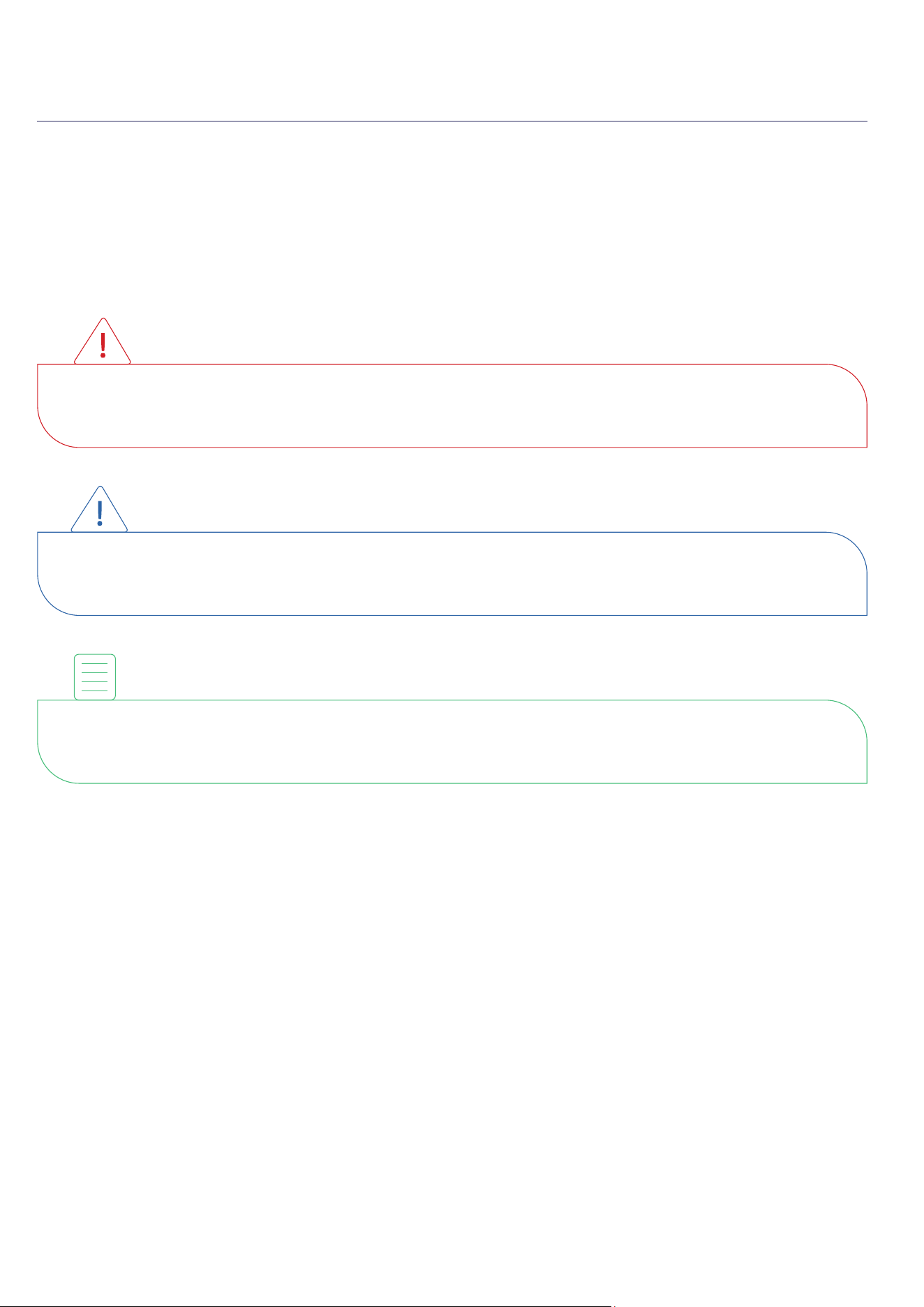
Safety Information Flags
This manual includes three categories of safety information to highlight important
precautions: Warnings, Cautions, and Notes. Each category is designed to ensure
the safety of personnel and equipment during operation and maintenance of the
hyperbaric chamber.
WARNING
Definition → Identifies situations that are potentially hazardous or lethal to personnel.
Purpose → To prevent serious injury or death.
CAUTION
Definition → Identifies situations that are potentially hazardous to equipment and materials.
Purpose → To prevent damage or malfunction of the system.
NOTES
Definition → Identifies conditions or situations that may require additional information for better understanding.
Purpose → To provide useful insights or clarifications to enhance proper usage.
These flags are strategically placed throughout the manual to ensure safe and efficient operation of the
ZEUGMA Monoplace Hyperbaric Chamber.
PRODUCT REF Nº → TKBO-2X ATLANTIS Hyperbaric System
9
1. Introduction
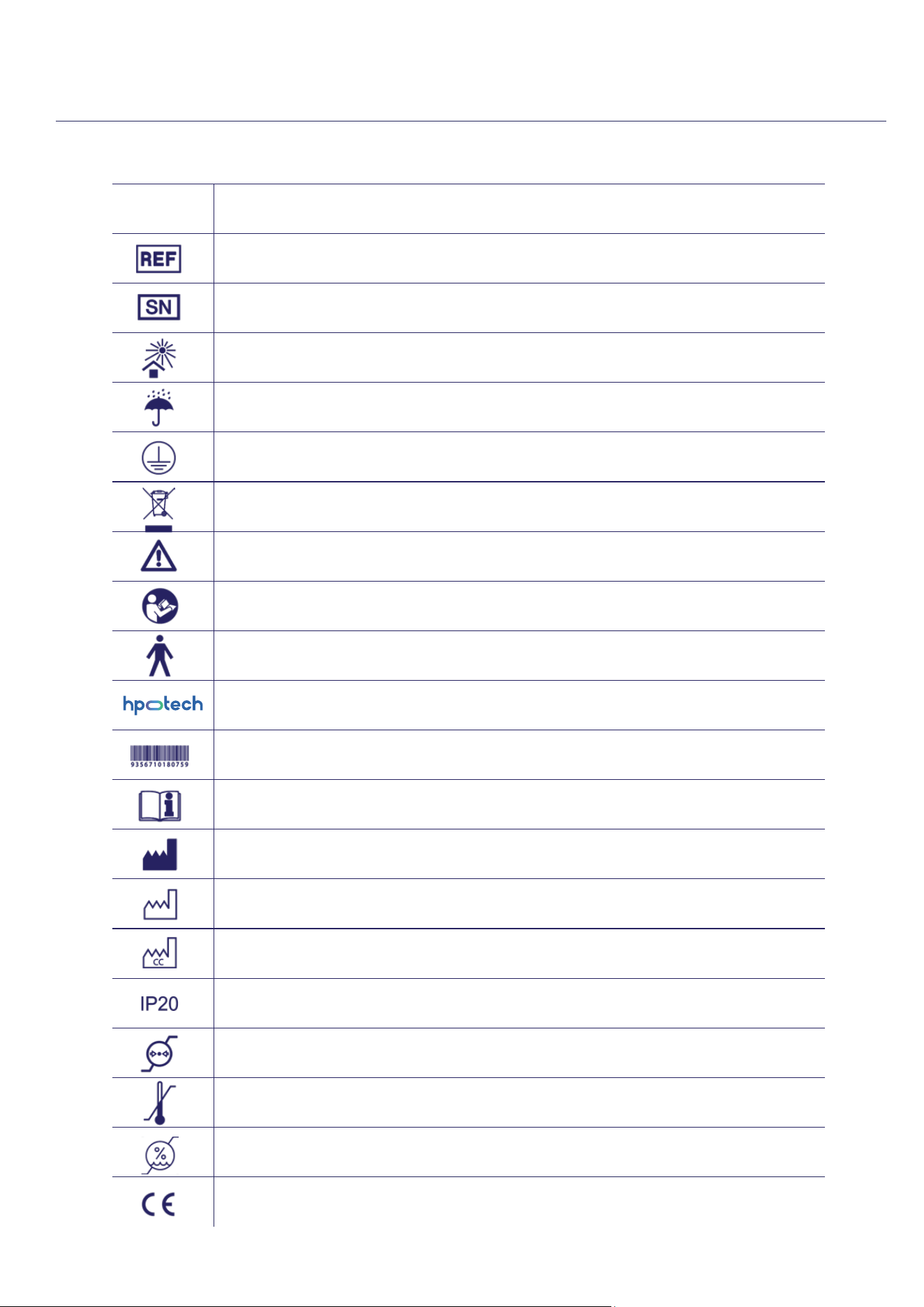
Labels Nameplate symbols
ÜRÜN ADI Name of the product
Product Reference Number
Product Serial Number
Keep away from Sun Beam
Store in Dry Place
Protected Grounding
Dispose of Waste Electrical and Electrical Equipment according to EC Regulation
General Warning Symbol
Read User's Manual before use
Type B Application
Company Logo
Product Barcode Number
See User Manual
Company Info
Production date
Country of production
Water and Dust Permeability Classification
Atmospheric pressure limit
Temperature limit
Humidity limit
The product meets the EU’s safety, health, and environmental protection
standards.
ZEUGMA Hyperbaric System
PRODUCT REF Nº → TKBO-X

10
ATLANTIS hyperbaric system
1. Introduction
1.2. HPO TECH
About the Manufacturer
Driving progress in hyperbaric technology
to deliver the most effective results with
hyperbaric oxygen therapy (HBOT)
HPO TECH, founded in 2019 in Istanbul, Turkey, is an industry
innovator in designing and manufacturing advanced
hyperbaric oxygen systems.
We provide modular solutions ranging from single-seat
to multiplace chambers (up to 12+2 seats) with pressure
levels from 2.0 ATA to 6.0 ATA, featuring streamlined oxygen
delivery via BIBS masks. The company combines decades of
expertise in hyperbaric engineering, diving rescue systems,
aerospace engineering, military underwater technology,
and shipbuilding.
HPO TECH’s mission is to empower healthcare providers
by delivering safe, effective, and user-friendly hyperbaric
chambers that maximize treatment outcomes, reduce
costs, and improve health and quality of life.
Driven by continuous R&D, the company sets new standards in
hyperbaric oxygen therapy (HBOT) chambers and aerospace
medicine (hypobaric chambers), providing certified systems
that facilitate faster healing and renewed hope for patients
worldwide.
Total Quality Management for
hyperbaric chamber manufacturing
Our Total Quality Management system includes all aspects of
design, manufacturing, testing, functionality, and customer
service to ensure our hyperbaric oxygen systems are
effective in therapy and safe, reliable, and accessible
for patients.
Quality testing
Our quality control team coordinates the manufacturing
and third-party testing process according to international
regulations, procedures, and criteria for the certification of
medical devices for medical HBOT & wellness applications.
Better HBOT technology.
Better hyperbaric oxygen healthcare.
HPO TECH hyperbaric systems are designed to meet
the needs of a wide range of customers, from medical
professionals looking for a reliable treatment option for their
patients to business owners seeking a modular multiplace
solution for wellness centers or private individuals for
personal use.
With years of practice in the industry, we have perfected
our craft to deliver hyperbaric chambers that are safe,
effective, easy to use, and provide a positive therapy
experience.
Better technology translates to faster healing times, reduced
pain, and renewed hope for people undergoing HBOT. Our
ultimate objective is to make technology that delivers
the most effective results in hyperbaric oxygen therapy.
Certifications
Holding all the important ASME-PVHO, MDD, PED, CE, ISO, NFPA
certifications, our products are manufactured, tested, and
certified to the highest quality and safety standards. We
comply with all international safety and quality regulations.
► See full list of Certifications at the end of the manual
Safety and compliance
Safety standards and certifications guarantee the quality
and reliability of hyperbaric chambers used for hyperbaric
oxygen therapy (HBOT).
PRODUCT REF Nº → TKBO-2X ATLANTIS Hyperbaric System
11
1. Introduction
ZEUGMA Hyperbaric System
PRODUCT REF Nº → TKBO-X

12
ATLANTIS hyperbaric system
1. Introduction
13
PRODUCT REF Nº → TKBO-2X ATLANTIS Hyperbaric System
2. The ZEUGMA
hyperbaric chamber system
ZEUGMA Hyperbaric System
PRODUCT REF Nº → TKBO-X
14
2. The ZEUGMA hyperbaric chamber system
ATLANTIS hyperbaric system
Design and components
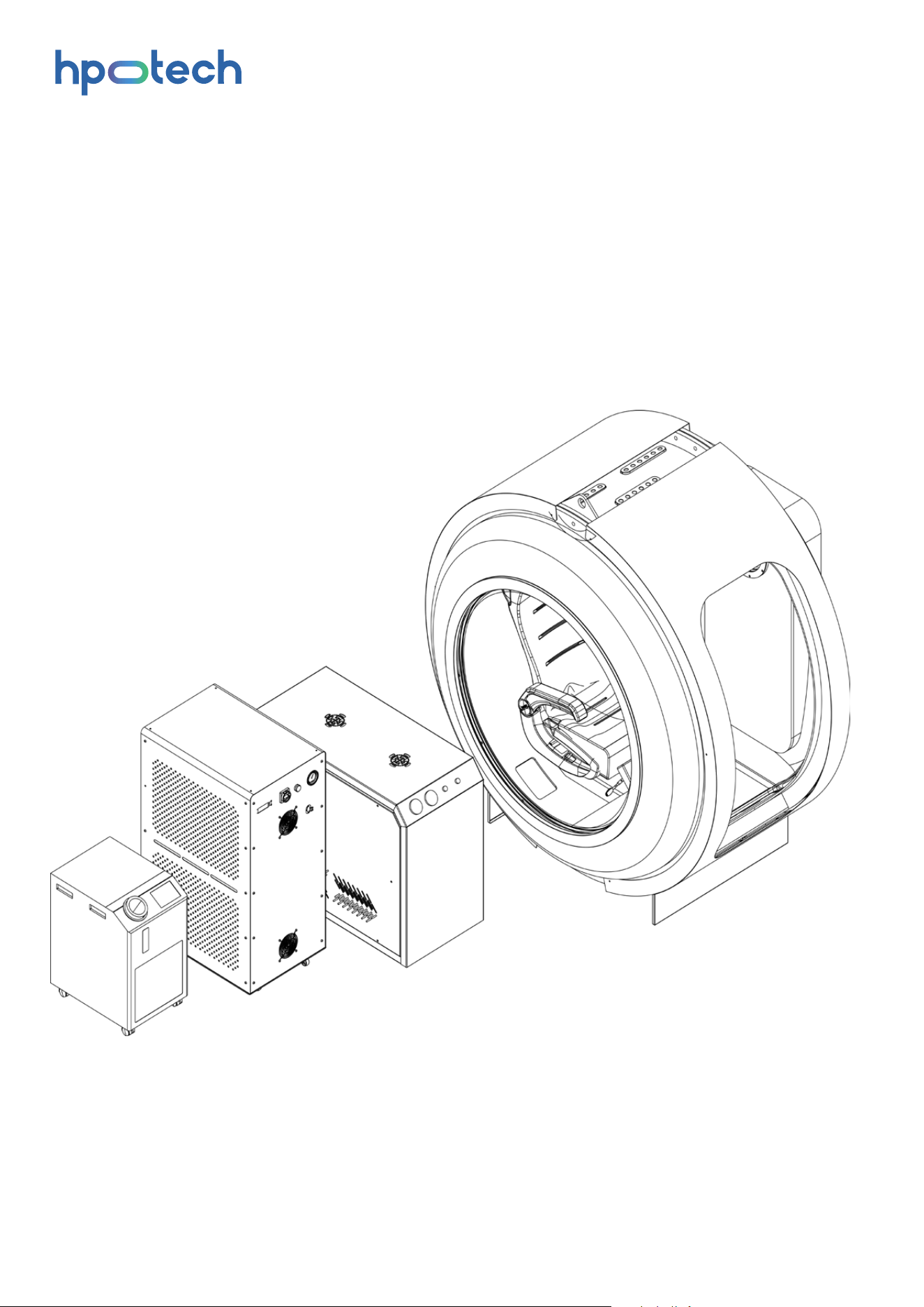
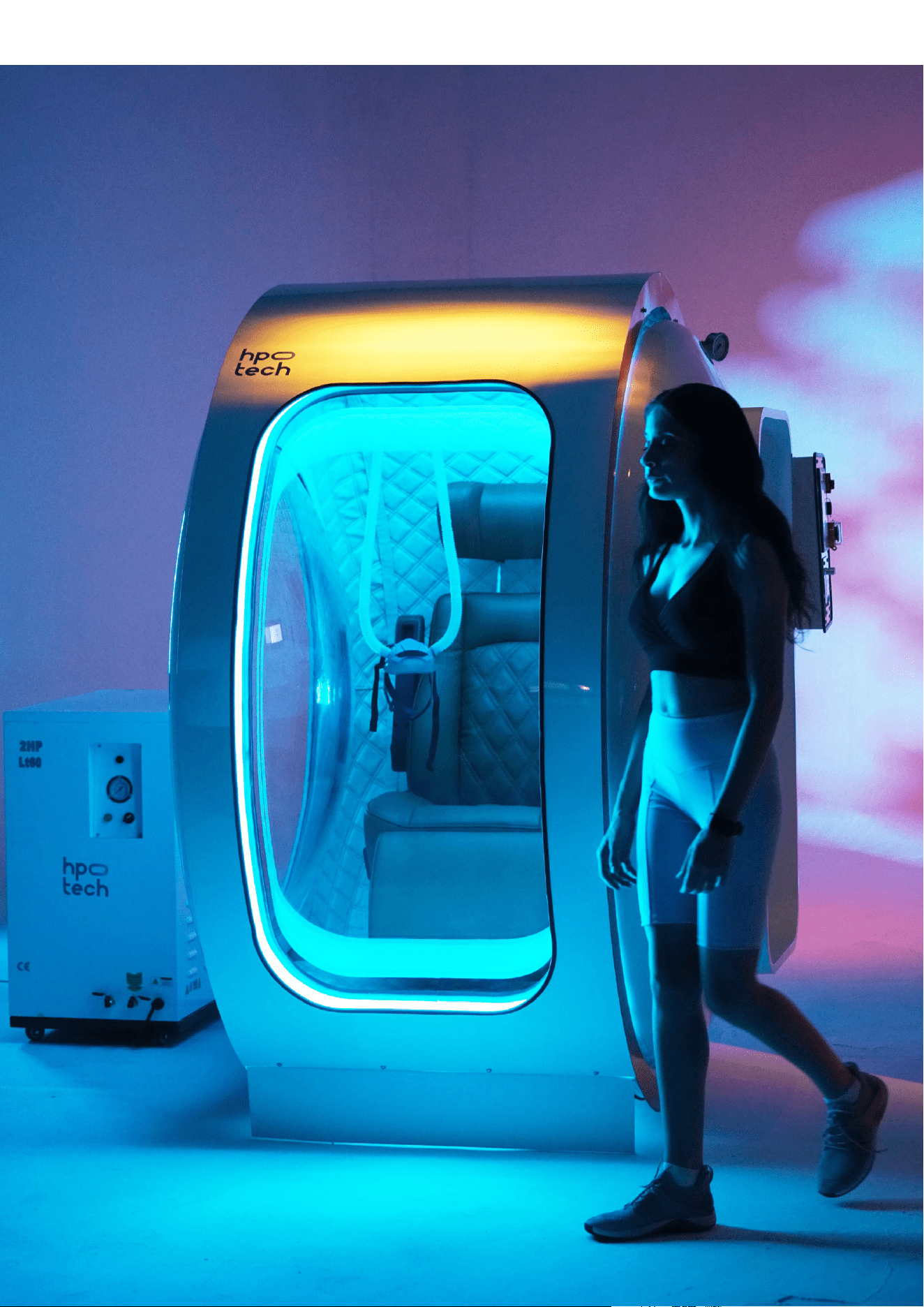
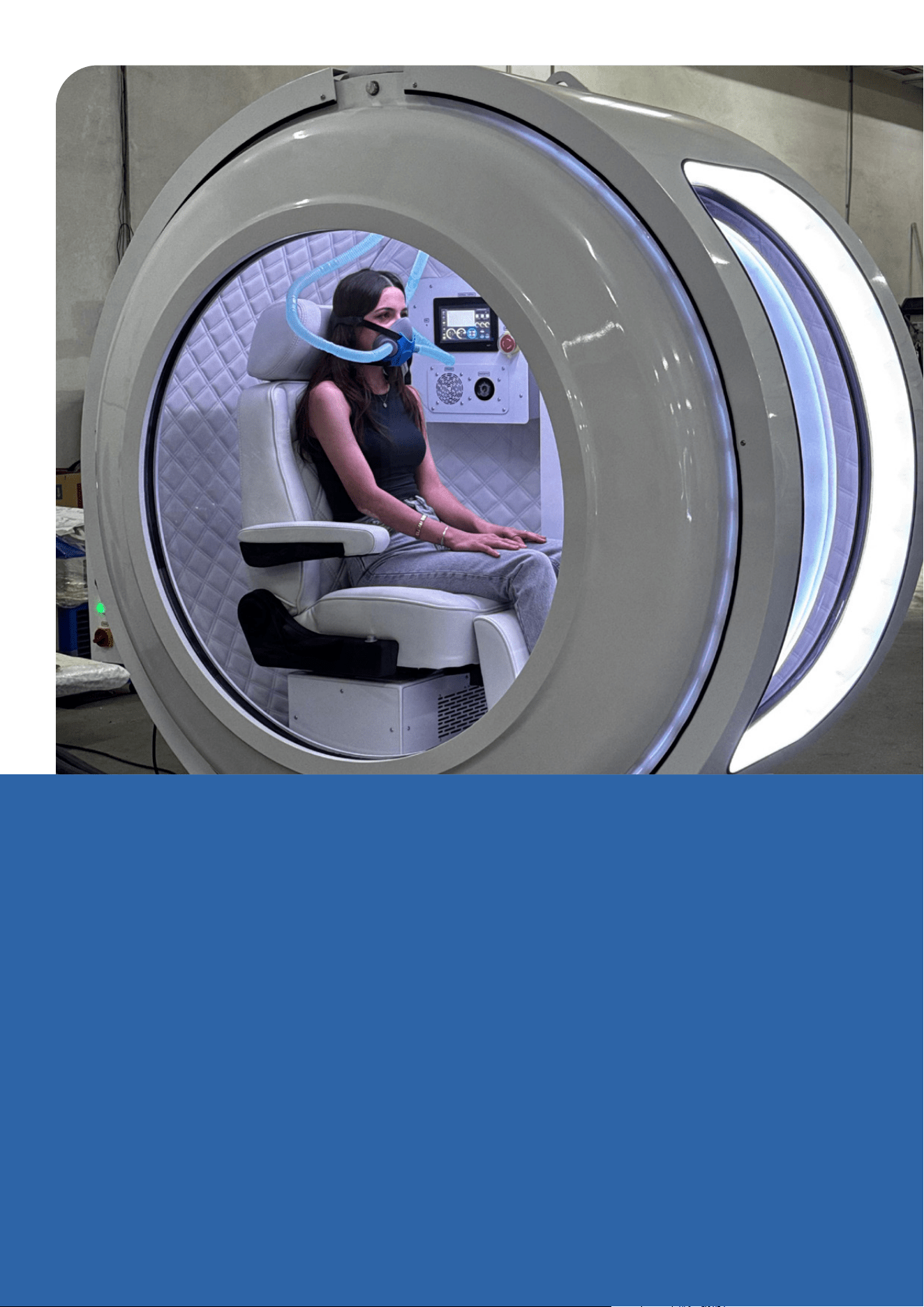
The ZEUGMA chamber (1 seats) is a pressure
vessel mounted on a wheeled chassis.
The chamber is operated manually, or
using the software available on the inside
and outside control panels.
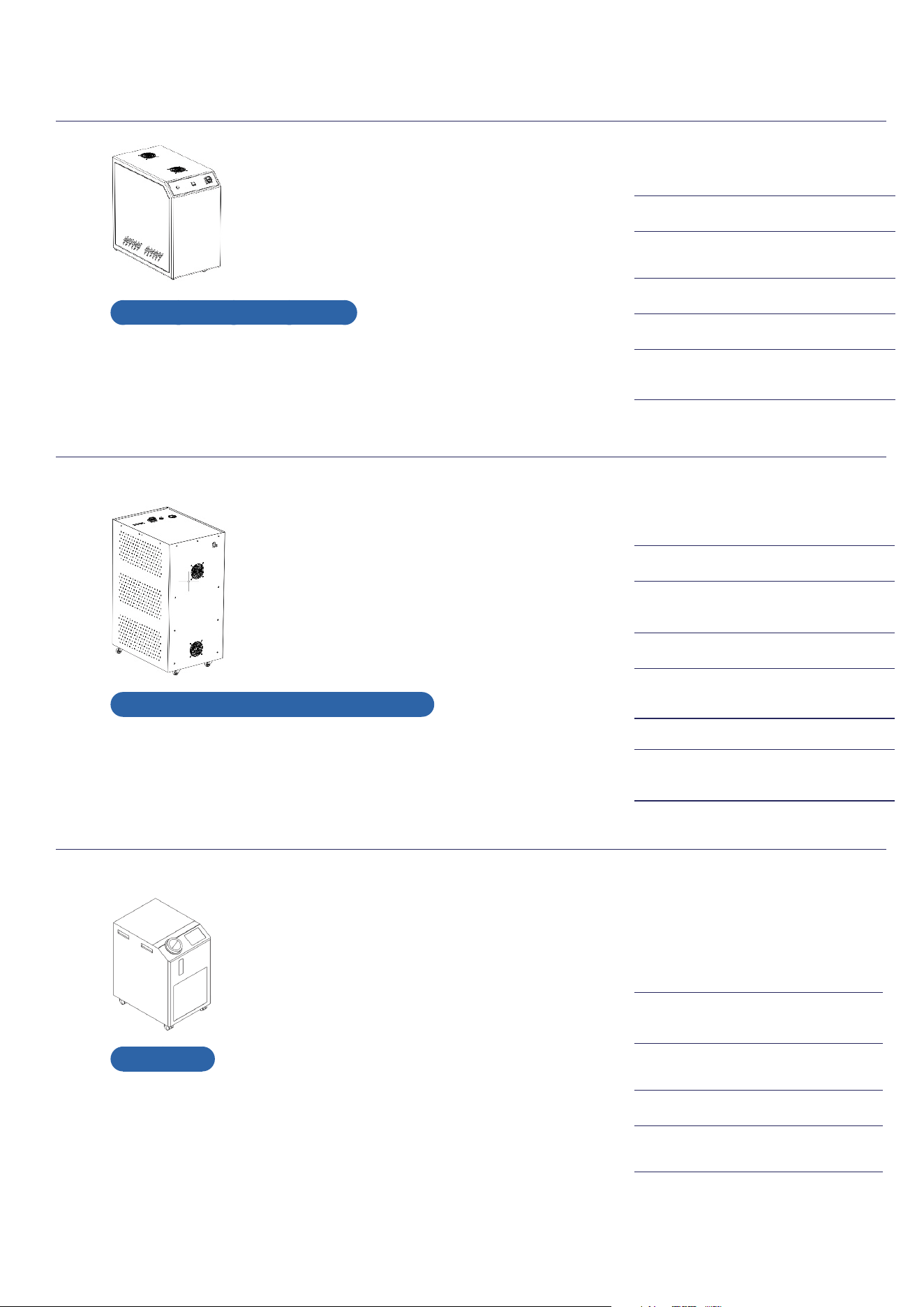
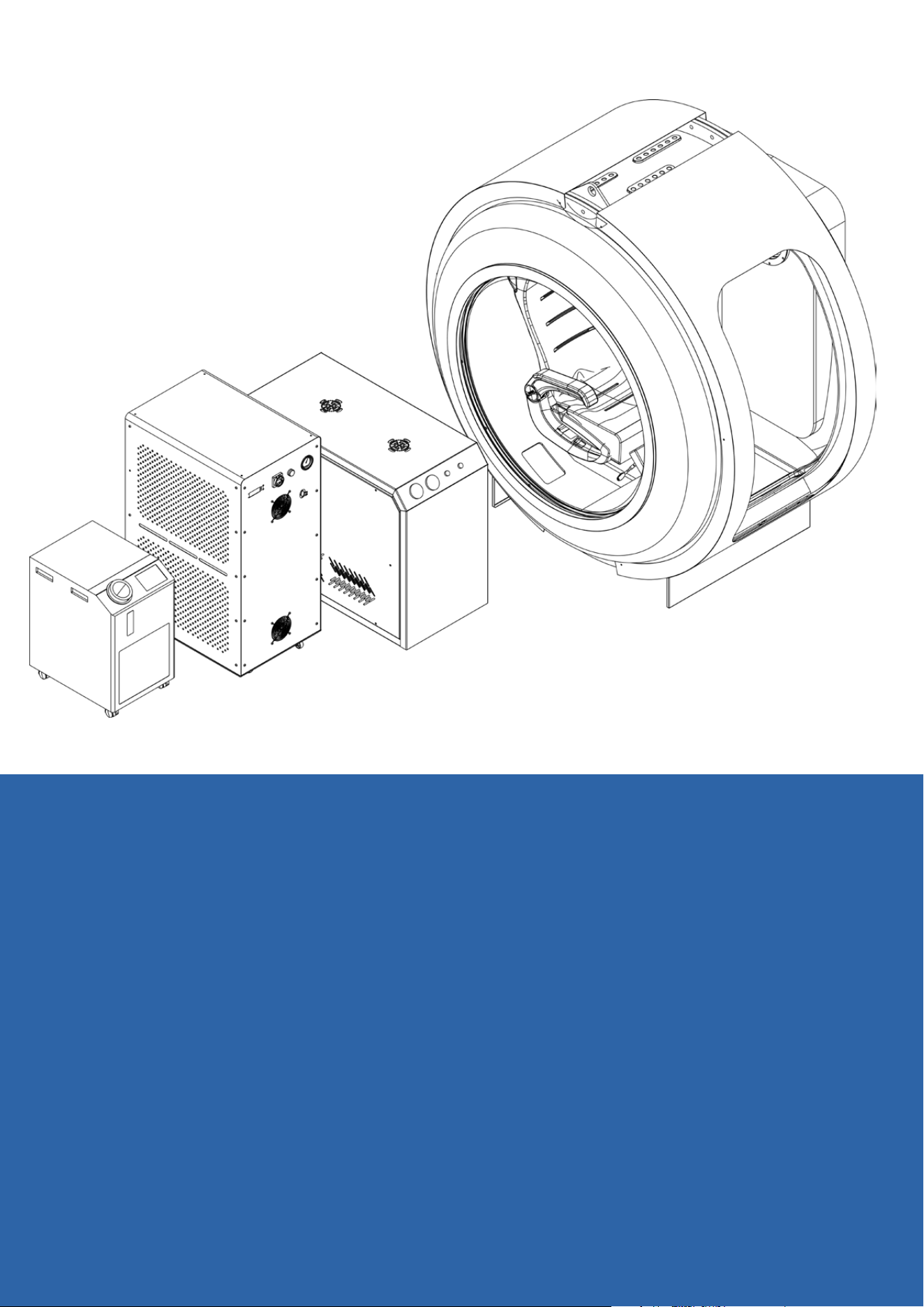
The pressure vessel connects with 3 (three)
exterior system components designed for
ease of operation and low maintenance:
o Air Compressor
o Oxygen Concentrator
o Air Cooler
Operation
The system compresses, maintains the
patient at the desired pressure, and
decompresses.
Treatment pressure and duration are
adjusted by the operator based on
physician instructions.
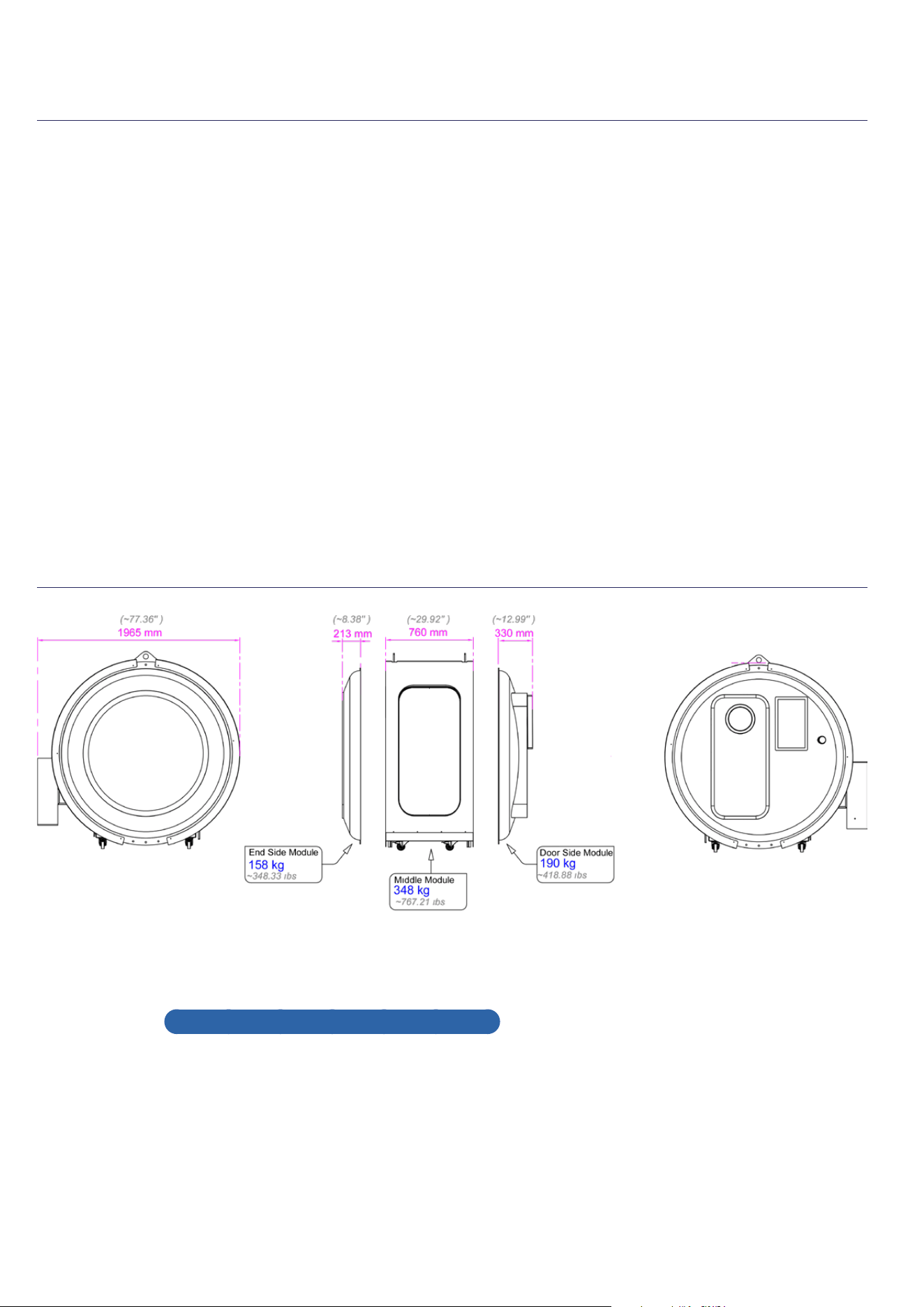
Hyperbaric chamber (pressure vessel)
Ȼ The pressure vessel is built of 1 central module, including two (2) steel end heads (right and left).
Ȼ The central module features a frontal acrylic window, while the left steel module features a large round
acrylic window.
Ȼ The door on the right module also features a small round window.
15
2. The ZEUGMA hyperbaric chamber system
PRODUCT REF Nº → TKBO-2X ATLANTIS Hyperbaric System
Air Compressor (Air supply)
Ȼ The standard chamber uses breathable air for pressurization.
Ȼ An optional compressed air system is available.
Ȼ Pressure + Oxygen are the two most important factors in HBOT
POWER
4HP
PRESSURE RANGE
1-8 bar/116 PSI
WEIGHT
67 kg
147.71 lbs
FLOW
564 LPM
NOISE LEVEL
62 decibel
SIZE
(W) 495 mm X (L) 1004 mm x (H) 804 mm
(W) 19.48 in x (L) 39.52 in x (H) 31.65 in
Air Cooler
Ȼ Ensures stable thermal conditions within the hyperbaric chamber.
Ȼ Offers a compact, highly efficient solution for precise climate control.
Ȼ Utilizes an air-cooled refrigeration system for exceptional reliability.
Ȼ Minimizes temperature fluctuations for consistent performance.
Ȼ Supports a wide adjustable temperature range to meet various
operational needs.
COOLING CAPACITY
1500 W at 5°C
1500 W at 66° F
TEMPERATURE STABILITY
0.1° C
32.18° F
SET TEMPERATURE RANGE
5° C to 40° C
66° F to 104° F
COOLING METHOD
Air-cooled refrigeration
SIZE
(W) 377 mm x (L) 500 mm x (H) 640 mm
(W) 14.84 in x (L) 19.68 in x (H) 25.19 in
Oxygen Concentrator (Oxygen supply)
Ȼ The oxygen is provided by the Oxygen Concentrator
(6.0 ATA working pressure);
Ȼ Patients breathe high-purity oxygen directly during treatment
using the BIBS (Built-In Breathing System);
Ȼ Breathing masks are removed for air-breaks during treatment
POWER
2500 W
3,3 HP
OXYGEN FLOW RANGE
1~20 LPM
OXYGEN OUTPUT PRESSURE
5 BAR
72 PSI
OXYGEN PURITY
90%�93%
NET WEIGHT
155 KG
341.717 lbs
NOISE DB(A)
≤ 72 DB
DIMENSION
(L) 695 mm x (W) 481 mm x (H) 1070 mm
(W) 27.36 in x (L) 18.93 in x (W) 42.12 in
ZEUGMA Hyperbaric System
PRODUCT REF Nº → TKBO-X
16
2. The ZEUGMA hyperbaric chamber system
ATLANTIS hyperbaric system
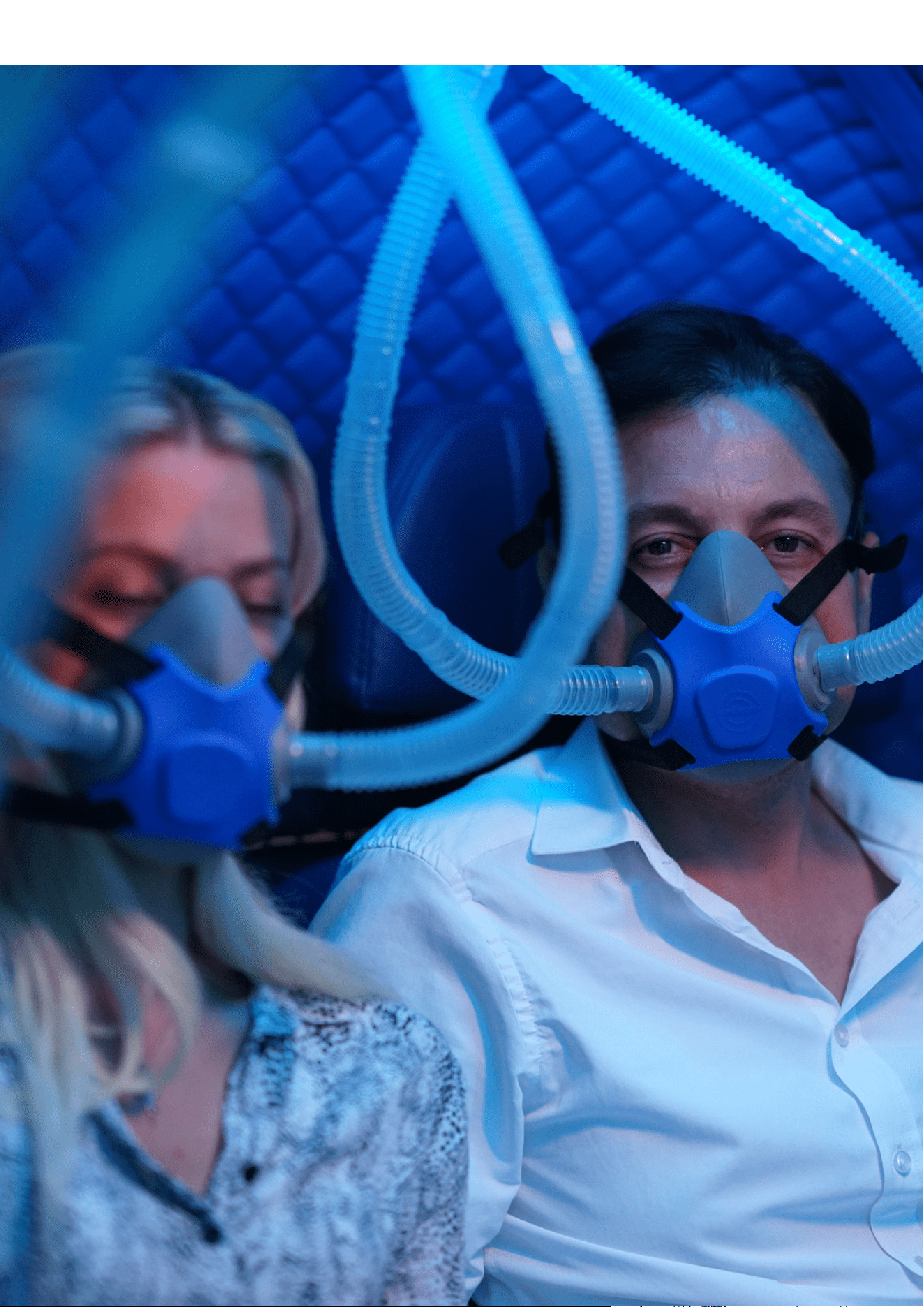
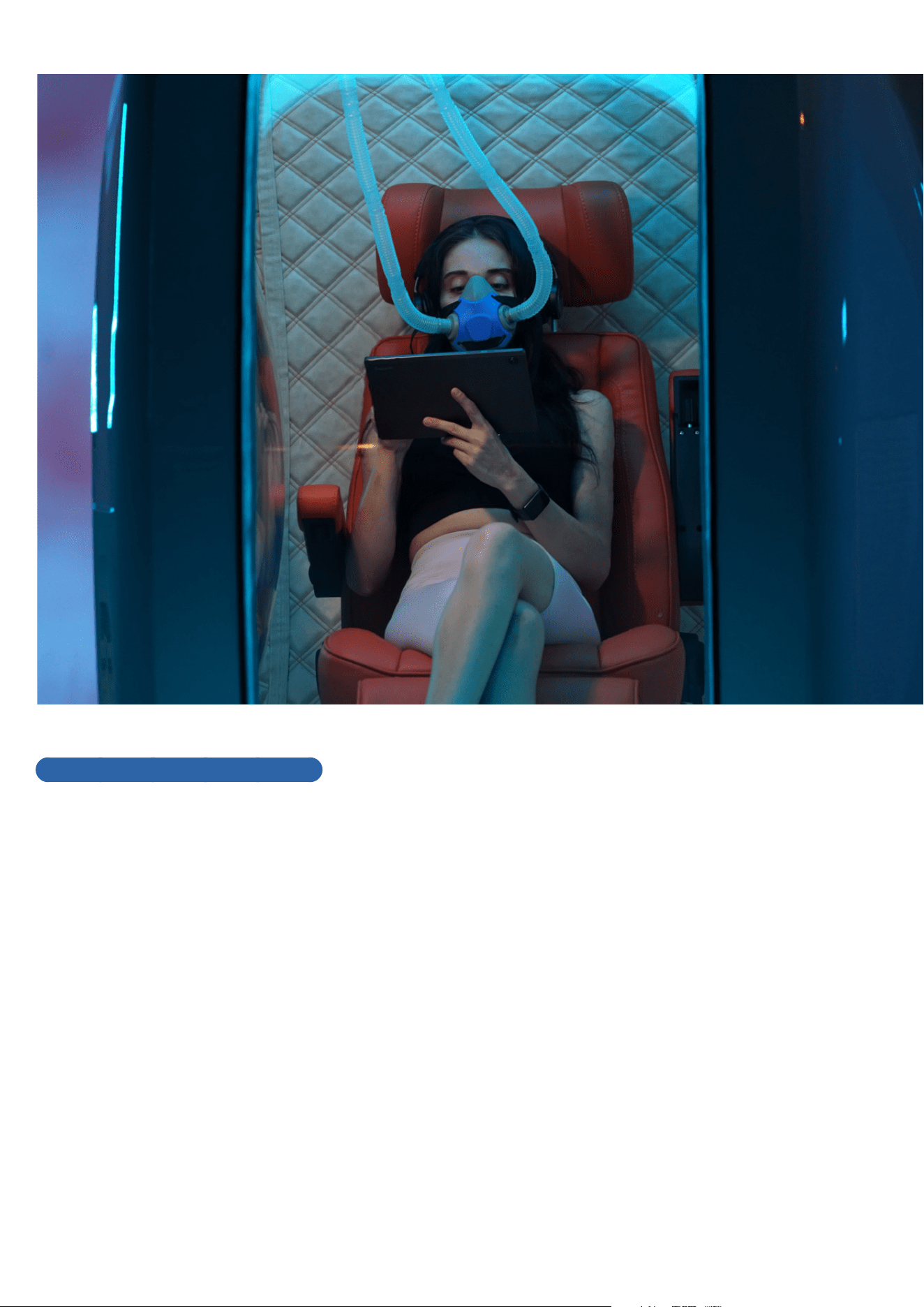
Built-In Breathing System (BIBS)
Ȼ BIBS delivers up to 93% pure oxygen to
patients while minimizing fire hazards in the
hyperbaric chamber.
Ȼ Chamber oxygen levels are maintained
between 19% and 25% to prevent fire risks,
per US Navy specifications.
Ȼ If oxygen levels exceed the limit, the
chamber must be ventilated with air to
restore safe levels.
Ȼ Chamber oxygen levels are monitored using
electro-galvanic sensor cells to ensure
safety.
Ȼ BIBS masks supply oxygen directly to
patients and vent exhaled gas outside the
chamber to prevent oxygen buildup.
Ȼ Masks can be secured with straps around
the face.
Ȼ The system supplies oxygen on demand,
only when the user inhales, similar to a
diving regulator, and controls outflow to the
chamber environment.
Ȼ Oxygen supply lines pass through the
pressure hull, with valves on both sides, and
connect to the external oxygen concentrator
unit or directly to oxygen storage cylinders.
Ȼ BIBS is primarily used with medical oxygen
but can also support other breathing gases.

17
2. The ZEUGMA hyperbaric chamber system
PRODUCT REF Nº → TKBO-2X ATLANTIS Hyperbaric System
2.1. System features
The ZEUGMA chamber is a Class IIB hyperbaric chamber, designed for human use in
compliance with NFPA 99 standards. It offers a range of features that enhance both
patient care and operator functionality, including:
Key features
→ Automatic pressure control
Pressurization and depressurization are
fully automated after setting the desired
rates.
→ BIBS Masks for pure oxygen delivery
All hyperbaric chambers include a Built-
In Breathing System (BIBS) that delivers
90%-93% pure oxygen, enhancing tissue
oxygenation.
→ Medical monitoring capabilities
Equipped with penetrations and electrical
connectors to integrate vital monitoring
systems such as EEG, ECG, TCOM, and
blood pressure
→ Continuous patient monitoring
The operator can hear, see, and monitor
the patient throughout the treatment
process.
→ Backup power for communication
A discrete power source ensures that
chamber communications remain
functional during a power outage.
→ Pneumatic chamber controls
The controls are entirely pneumatic,
requiring only a compressed gas source
for operation.
→ Ventilation system
The chamber can be ventilated anytime,
including during pressurization.
→ Certifications
HpoTech Hyperbaric Chambers comply with key European and American standards (ASME PVHO),
including Medical CE (93/42/EEC, 2017/745/EU) and Pressure Equipment Directive CE (2014/68/EU). The
ATLANTIS chamber is designed, manufactured, and tested to meet EN 14931 standards, with design
guidelines based on EN 13445 or AD 2000
► See full list of company certifications at the end of the manual
ZEUGMA Hyperbaric System
PRODUCT REF Nº → TKBO-X
18
2. The ZEUGMA hyperbaric chamber system
ATLANTIS hyperbaric system
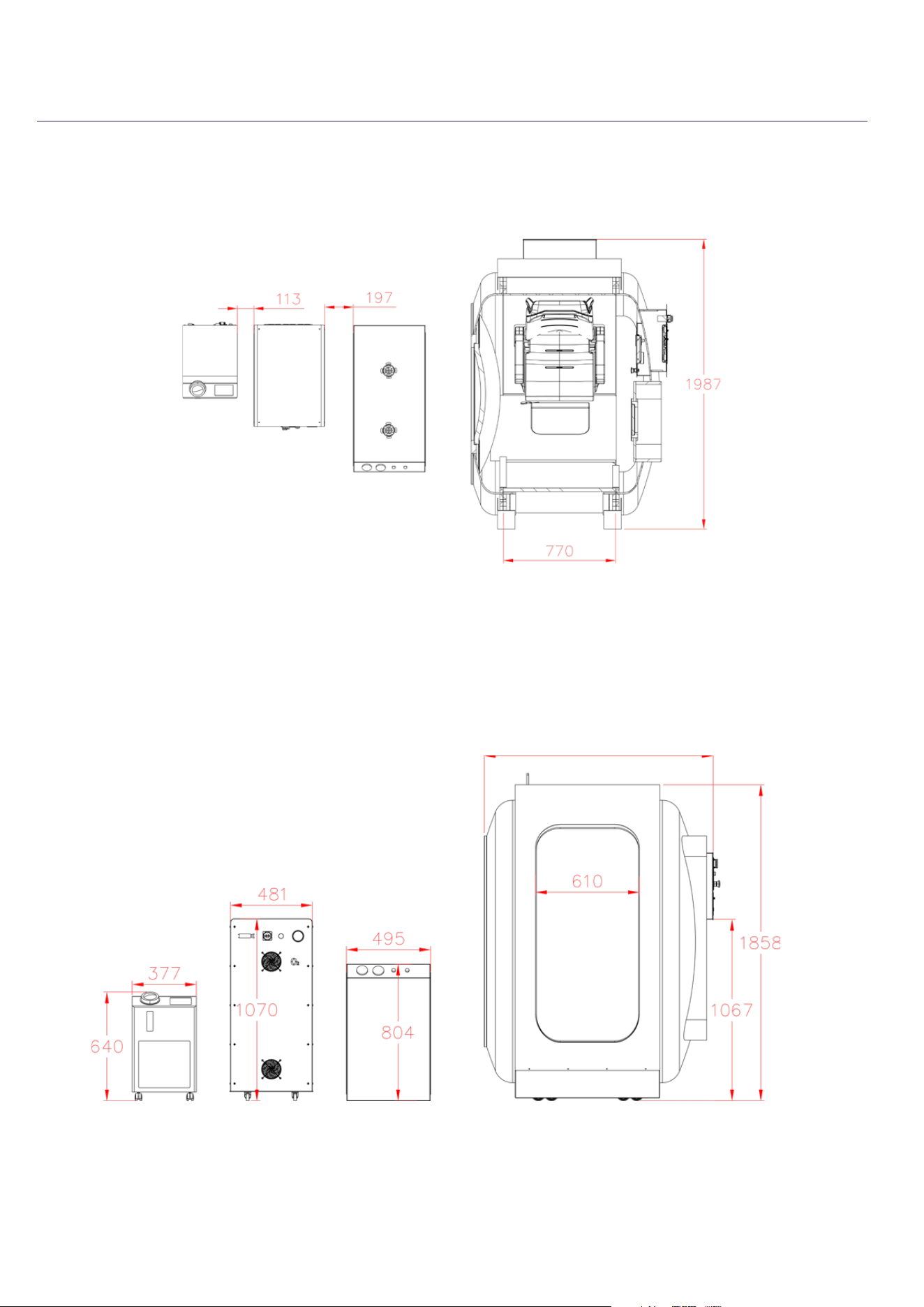
2.2. Technical sketches
Top view
Front view

19
2. The ZEUGMA hyperbaric chamber system
PRODUCT REF Nº → TKBO-2X ATLANTIS Hyperbaric System
2.3. Technical specifications
MAX. OPERATING PRESSURE
2.4 ATA (1.4 BAR)
34.80 PSI
DESIGN TEMPERATURE
0° C to 38° C
32° F to 100.4° F
AIR PRESSURIZATION
(Compressor Working Pressure)
3.45 bar to 7.2 bar
50.03 PSI to 104.42 PSI
AIR SUPPLY FLOW
250 LPM
8.8 CFM
BIBS OXYGEN SUPPLY
3.2 bar to 4.0 bar
46.41 PSI to 14.69 PSI
VENTILATION RATE
125 LPM to 400 LPM
4.41 CFM to 14.12 CFM
EMERGENCY DEPRESSURIZATION RATE
2.0 ATA to 1.0 ATA in 90 sec (1.0 BAR to 0 BAR)
14.5 PSI to 0 PSI
MAXIMUM PATIENT WEIGHT
225 kg
496.04 lbs
CAPACITY
1 Person (1 seat)
MATERIAL
Ballistic steel
SHAPE AND DESIGN
One-unit, cylindrical shape, 3 modules, designed to fit any
standard doorway and space
MODULE WIDTH
770 mm
30.315 in
MINIMUM INSTALLATION FLOOR SIZE
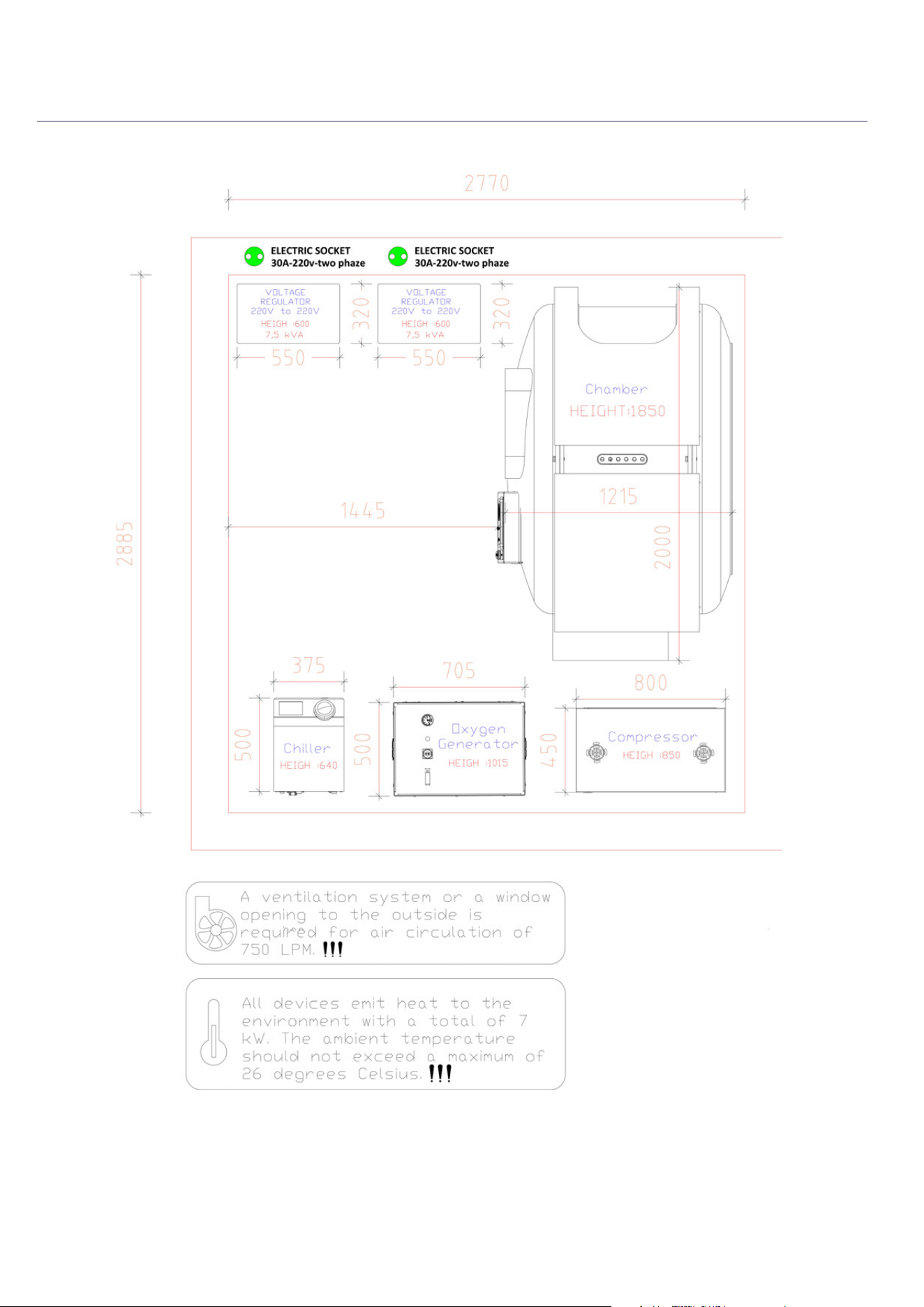
2770 mm × 2885 mm
109.1 in × 113.6 in
OVERALL LENGTH
1344 mm
52.91 in
OVERALL WIDTH
1987 mm
78.22
HEIGHT
1858 mm
73.14 in
WEIGHT
806 kg
17777 lbs
INTERNAL LENGTH
1620 mm
63.77 in
INTERNAL VOLUME
1.9 m³
ZEUGMA Hyperbaric System
PRODUCT REF Nº → TKBO-X

20
2. The ZEUGMA hyperbaric chamber system
ATLANTIS hyperbaric system
Paint
Ȼ The inside and outside of the pressure
chamber are coated with flame-proof,
non-toxic certified epoxy paint.
Ȼ Prior to painting, the cabin undergoes a
sandblasting process to smooth the surface,
which significantly extends the chamber’s
lifespan.
Ȼ The flame-retardant paint burns at higher
temperatures compared to similar products,
with combustion occurring only at the
center of intense heat.
Ȼ Once the heat is removed, the combustion
process naturally ends.
Ȼ The steam produced during combustion is
harmless to human health, preventing risks
from inhaling toxic gases.
These tests are essential to guarantee the reliability, safety, and effectiveness of the hyperbaric system before it
reaches the end user.
Applied tests
During the production process, the hyperbaric oxygen therapy
system undergoes the following rigorous tests to ensure
safety, functionality, and compliance with industry standards:
1. Hydrostatic Test
Evaluates the chamber’s structural integrity by
applying high-pressure water to check for leaks or
weaknesses.
2. Noise Level Test (EN 14931 Standard)
Measures the noise levels within the chamber to
ensure compliance with the EN 14931 standard for
patient safety and comfort.
3. Air Leakage Test (Pressure Chamber Regulation)
Checks for any potential air leaks to guarantee
airtight sealing and operational efficiency.
4. Alarm Test
Verifies the proper functioning of all alarm
systems to ensure prompt notifications in case of
emergencies.
5. Chamber Compliance Test (EN 14931 Standard)
Assesses the chamber’s cabinet design to
ensure compliance with the EN 14931 safety and
performance standards.
6. EN 12021 Breathable Air Test
Ensures the quality of the air supplied to the
chamber meets the EN 12021 standard for
breathing air purity.
7. ASME PVHO Acrylic Test
Ensures the integrity of acrylic windows used in
pressure vessels for human occupancy (PVHO). It
involves pressure tests to verify strength, durability,
and safety under operating conditions.
8. Non-Destructive Testing (NDT)
Ensures weld quality without damage. Radiographic
(RT) and Ultrasonic (UT) tests detect internal flaws,
while Magnetic Particle (MT) and Penetrant (PT)
tests reveal surface defects. These methods help
maintain structural integrity.
21
2. The ZEUGMA hyperbaric chamber system
PRODUCT REF Nº → TKBO-2X ATLANTIS Hyperbaric System
ZEUGMA Hyperbaric System
PRODUCT REF Nº → TKBO-X

22
2. The ZEUGMA hyperbaric chamber system
ATLANTIS hyperbaric system
PRODUCT REF Nº → TKBO-2X ATLANTIS Hyperbaric System
23
1. Installation guidelines for the hyperbaric chamber
3. Installation guidelines for
the hyperbaric chamber
When installing the ZEUGMA hyperbaric chamber, certain guidelines
must be followed to ensure safety and compliance with regulations.
ZEUGMA Hyperbaric System
PRODUCT REF Nº → TKBO-X

24
3. Installation guidelines for the hyperbaric chamber
ATLANTIS hyperbaric system
3.1. Dedicated chamber room
Ȼ The room must be solely dedicated to
hyperbaric use.
Ȼ It should be constructed according to the
National Fire Protection Association (NFPA-
99) “Standard for Health Care Facilities”.
Ȼ Compliance with local and state codes is
required, which will be verified by the local
Fire Department
3.2. Location and Environmental
Considerations
Ȼ Avoid Heat Sources
The chamber should not be located near heat
sources or in direct sunlight. Install coverings
on all exterior windows.
Ȼ Lighting
Use indirect lighting in the chamber room. Avoid
placing lamps or other direct light sources near
the chamber.
Ȼ Temperature Control
The room temperature should be maintained at
45°C, with a tolerance of ±4°C.
3.3. Fire Safety
Ȼ Install fire extinguishers of the appropriate
type, class, and quantity as per fire safety
regulations.
Ȼ Display visible “NO SMOKING” signs.
Ȼ Ground all electrical equipment and other
devices capable of generating static
electricity.
3.4. Flooring
Ȼ Tile flooring is required; conductive tile is
preferred but not mandatory.
Ȼ Avoid using carpet, as it may interfere with
gurney alignment and increase the risk of
static electrical discharge.
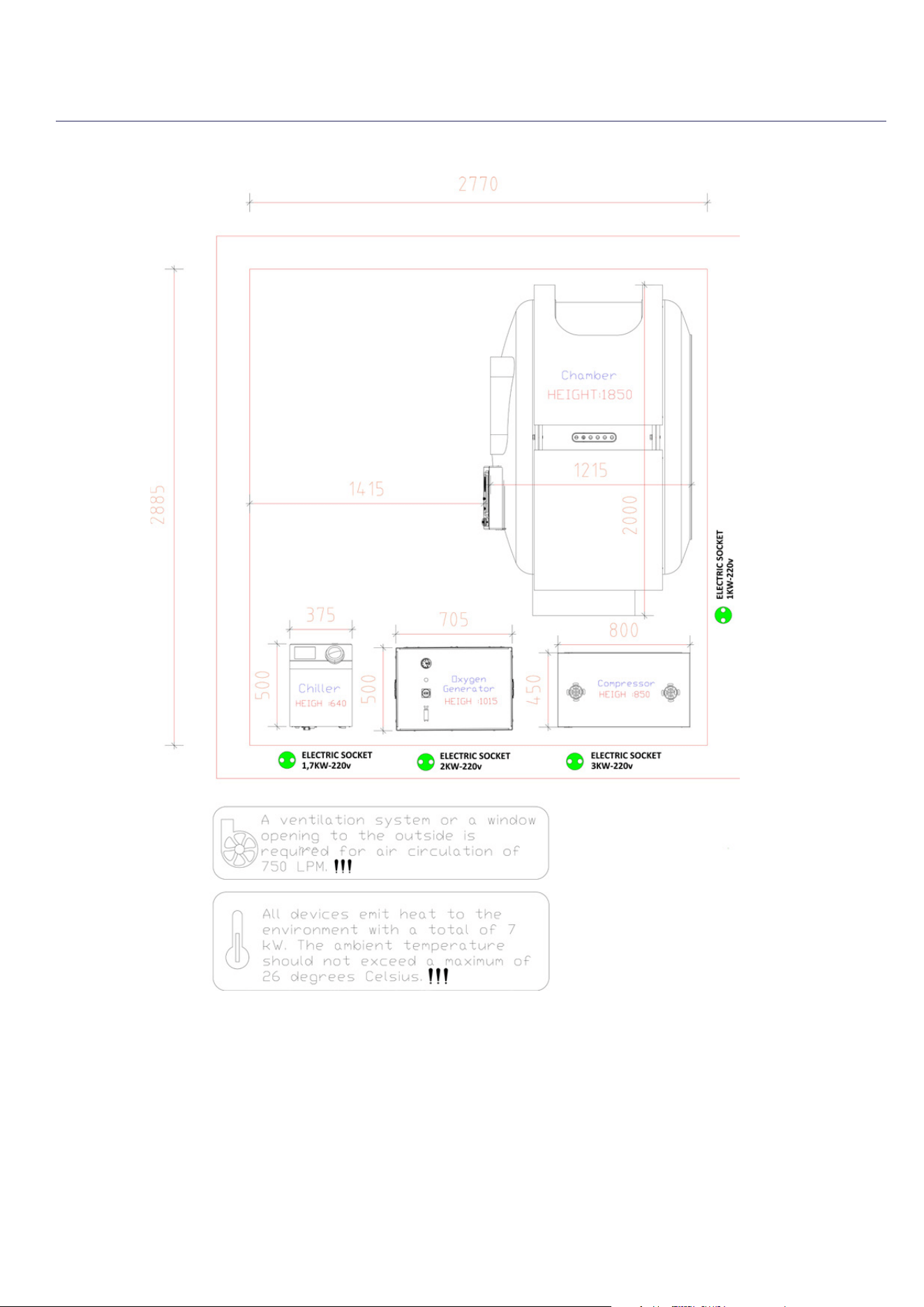
3.5. Room dimensions and
installation floor size
Ȼ The room size should be based on the
number of units installed.
Ȼ For a single user unit, the room should
measure at least 2770 mm × 2885 mm
(109.1 in × 113.6 in).
Ȼ If a second unit is to be installed, add an
additional 3 meters of width to the room.
3.6. Ventilation and Exhaust
Ȼ Install a vent (exhaust) that extends
at least 8 feet (≥ 2.44 meters) above the
chamber floor level, with protection against
rain and insects.
Ȼ The exhaust line should have a ½” NPT (F)
(1.27 cm nominal pipe size) fitting and
extend 3 inches (7.62 cm) into the room.
Ȼ For multiple chambers, each unit requires its
own exhaust line.
Ȼ Post a sign near the exhaust outlet warning
of oxygen venting and prohibiting smoking in
the area.
3.7. Grounding
Ȼ The chamber must be grounded to the
equipment ground in accordance with NFPA
99 and NFPA 70.
Ȼ Additional grounding, such as earth or driven
grounds, is not permitted.
These guidelines ensure proper installation and safe operation of hyperbaric chambers in healthcare settings.
25
3. Installation guidelines for the hyperbaric chamber
PRODUCT REF Nº → TKBO-2X ATLANTIS Hyperbaric System
Technical plans → electrical and installation space sizes, EU
ZEUGMA Hyperbaric System
PRODUCT REF Nº → TKBO-X
26
3. Installation guidelines for the hyperbaric chamber
ATLANTIS hyperbaric system
Technical plans → electrical and installation space sizes, US
27
4. Installation guidelines for the hyperbaric chamber
PRODUCT REF Nº → TKBO-2X ATLANTIS Hyperbaric System
ZEUGMA Hyperbaric System
PRODUCT REF Nº → TKBO-X

28
4. Installation guidelines for the hyperbaric chamber
ATLANTIS hyperbaric system
29
4. Safety
PRODUCT REF Nº → TKBO-2X ATLANTIS Hyperbaric System
4. Safety
Read the following safety rules carefully and completely before attempting
to operate the ZEUGMA hyperbaric system. The high partial pressures of
oxygen encountered in the use of the hyperbaric oxygen chamber require
a thorough knowledge of the hazards associated with this environment and
strict adherence to all safety precautions.
ZEUGMA Hyperbaric System
PRODUCT REF Nº → TKBO-X

30
4. Safety
ATLANTIS hyperbaric system
4.2. Safety precautions
Ȼ Emergency procedures
In case of an emergency, immediately
terminate the session and safely evacuate
the chamber. Avoid physical damage to the
chamber.
Ȼ Installation
Ensure the chamber is placed on a flat, level
surface.
Ȼ Chamber integrity
o Do not modify the chamber by drilling,
welding, or applying chemicals or
abrasives to the body or door.
o Report any cracks or damage
immediately. If even hairline cracks are
observed in the acrylic, immediately
inform the manufacturer.
o Never climb on the chamber. Report
any seal deformation to authorized
personnel. Do not attempt repairs.
Ȼ Electrical safety
Protect electrical equipment from damage.
Avoid operating the chamber with damaged
equipment or in wet conditions.
Ȼ Fire safety
Keep beverages and flammable materials
away from the equipment. In case of fire, use
the manual fire extinguishing system if the
automatic system fails.
Ȼ Static electricity
Prevent the introduction of static electricity
into the chamber by avoiding objects or
materials that can generate static charges.
4.1. General safety rules
Prohibited items and chamber
contamination
Ȼ No unauthorized items
Only items approved for hyperbaric chamber
use should be brought into the chamber.
Ȼ Sealed containers
Open or vent all sealed containers before
entering the chamber to prevent implosion and
potential harm. Prohibited items include sealed
bottles, syringes, and ampoules.
Ȼ Flammable materials
Never introduce flammable liquids, gases,
or other materials prohibited by NFPA-99
standards into the chamber.
Ȼ Clear signage
Post warning signs at the chamber entrance
regarding prohibited items.
Warning
Endotrachael tube cuffs and catheter bulbs should be filled with normal saline, or sterile water.
Do not use air.
No modifications to the chamber system or its support equipment may be made without the written
approval of Hpotech Medikal ve Teknik Çözümler. To do so will void any warranty and could expose the
patient and/or operator to injury.

31
4. Safety
PRODUCT REF Nº → TKBO-2X ATLANTIS Hyperbaric System
4.3. Emergency procedures
and safety guidelines
Ȼ Pressure Irregularities
In case of sudden pressure fluctuations, switch
to manual control. If the safety valve fails to
activate during a pressure surge, immediately
open the emergency exit valve.
Ȼ System Malfunction
If hoses rupture or experience damage, close
the shut-off valve, safely terminate the session,
and contact technical support.
Ȼ Maintenance
Adhere to the scheduled maintenance and
calibration program. Avoid using unauthorized
paints or coatings on the chamber.
Ȼ Safety Equipment
Exercise caution when handling compressed
springs. Do not attempt to disassemble valves.
4.4. General maintenance
and safety guidelines
Equipment maintenance
Ȼ Regular inspections
Renew compressor air test reports every 6
months and safety valves every 5 years.
Ȼ Equipment care
Prevent blockage of the compressor air inlet
duct. Avoid tampering with pressure regulator
settings.
Ȼ Fire safety
Use only water-based fire extinguishers. Ensure
fire extinguisher water tanks are always full.
Ȼ Cooling system
Prevent radiator overheating by turning off the
air conditioning if necessary. Avoid damaging
radiator cores and air conditioning pipes.
Chamber care
Ȼ Acrylic protection
Avoid scratching or striking the acrylic. Clean
with non-abrasive cleaners and avoid using
chemicals.
Ȼ Door maintenance
Ensure door seals are in good condition and
replace deformed seals promptly. Maintain
smooth contact between the door and chassis.
Use only approved lubricants for door hinges.
Ȼ Chamber operation
Close the door securely before pressurization.
Avoid placing hands or feet between the closing
or opening doors.
Note
These guidelines are essential for the safe and efficient operation of the hyperbaric chamber.
Regular inspections and maintenance are crucial for prolonging equipment life and ensuring
user safety.
ZEUGMA Hyperbaric System
PRODUCT REF Nº → TKBO-X
32
4. Safety → 4.4. General maintenance and safety guidelines
ATLANTIS hyperbaric system
Chamber and equipment safety
Ȼ Spare parts
Use only original spare parts to maintain
system performance and safety.
Ȼ Chamber environment
Prevent the introduction of flammable
materials, batteries, or electronic devices into
the chamber. Avoid using unauthorized lighting
or cleaning agents.
Ȼ Chamber integrity
Regularly inspect door seals and hinges. Do
not attempt to repair or modify the chamber
without authorized personnel.
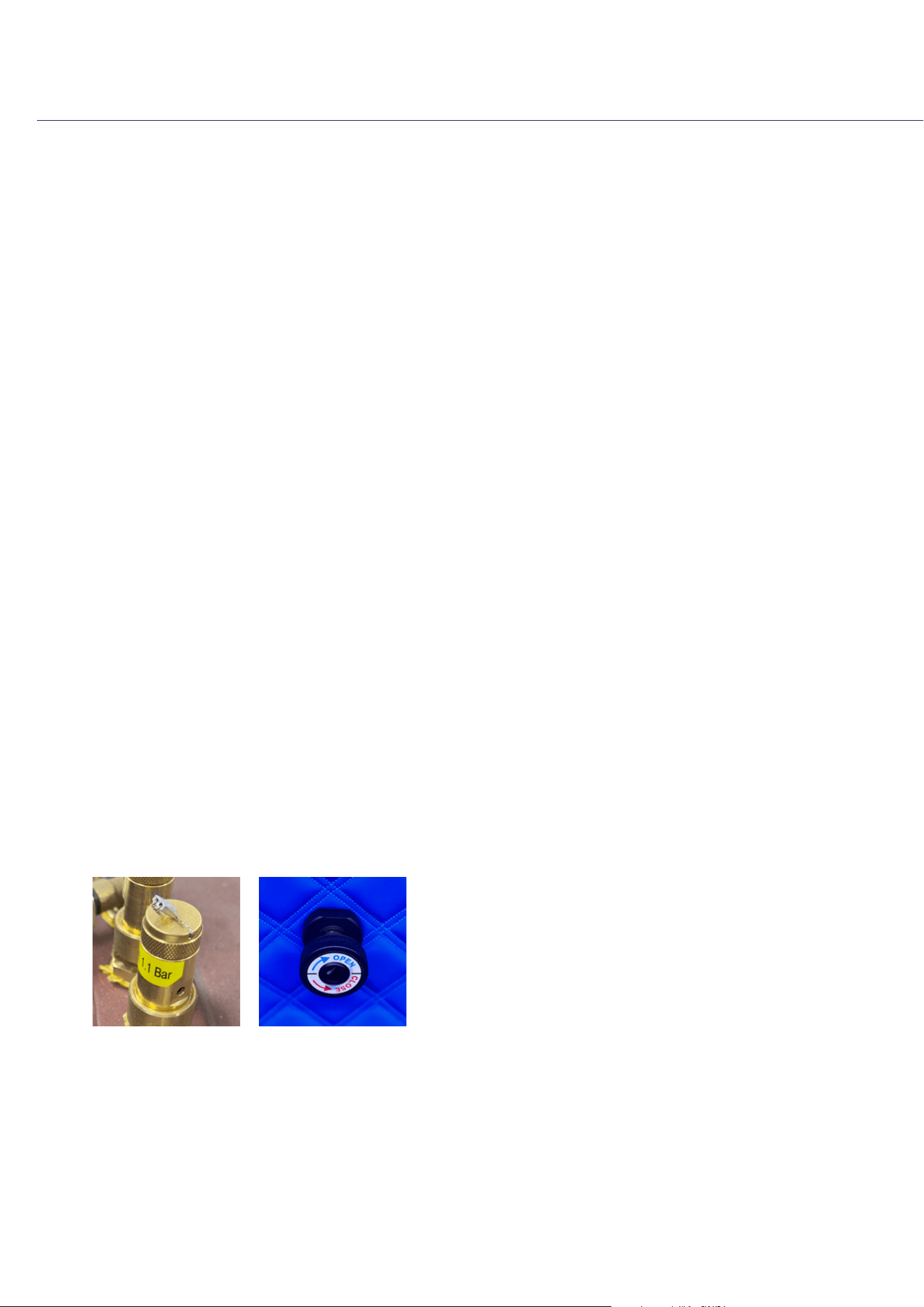
Emergency valve systems
Hyperbaric chambers are equipped with two
primary safety mechanisms:
Ȼ Safety valve
This valve automatically opens when chamber
pressure exceeds 1.1 times the operational
pressure limit, preventing over-pressurization.
Ȼ Emergency exit valve
The operator manually operates this valve
in case of safety valve failure or other
emergencies.
Safety valve
If the water tank pressure
exceeds 10% of the maximum
working pressure, the
safety valve will activate.
Close control valves on dry
air cylinders and contact
technical support.
Manual override /
Emergency exit valve
Use manual valves only when
automatic valves fail to operate.
Safety precautions
Ȼ Prohibited items
Do not introduce plastic, prohibited items,
batteries, or flammable materials into the
chamber.
Ȼ Emergency procedures
In case of sudden pressure increase, close the
air supply valve.
Ȼ General safety
Avoid physical contact with the chamber during
operation. Do not tamper with the equipment
or safety systems.
Fire safety and electrical precautions
Ȼ Fire suppression
Ensure fire extinguishing system electrical
connections are intact and spray nozzles
are unobstructed. Use only water-based fire
extinguishers.
Ȼ Electrical safety
Maintain correct power supply voltage and
frequency.
33
4. Safety → 4.4. General maintenance and safety guidelines
PRODUCT REF Nº → TKBO-2X ATLANTIS Hyperbaric System
General safety
Ȼ Emergency procedures
Establish clear emergency procedures for
pressure irregularities, equipment failure, and
fire.
Ȼ User safety
Avoid physical contact with the chamber during
operation. Follow all operating instructions and
safety guidelines.
BIBS system precautions
Ȼ In no circumstances hit, puncture, or weld
the BIBS line pipes.
Ȼ Disinfect BIBS masks after each session.
Ȼ If the BIBS outlet regulator does not work,
close the BIBS outlet valve.
Ȼ Do not remove BIBS regulators and do not
open their covers.
Ȼ Prevent entering water, disinfectants,
chemicals into the BIBS system.
Ȼ It is not recommended to perform
the assembly, disassembly, and part
replacement of BIBS system elements by
unauthorized persons, as this will damage
sensitive parts.
Ȼ Do not remove BIBS regulators and do not
open their covers.
Ȼ Do not remove or loosen the BIBS system
input apparatus on the chamber.
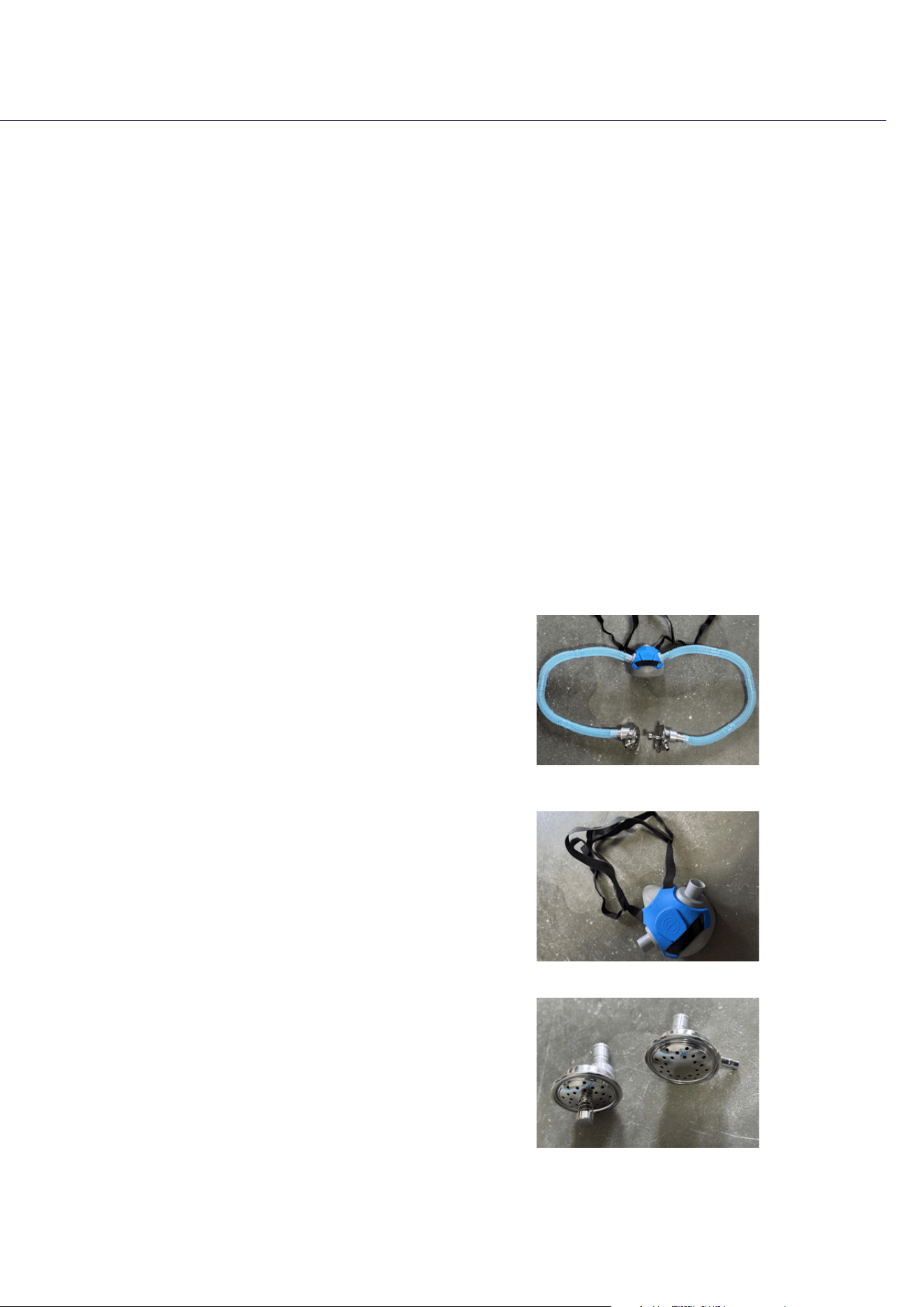
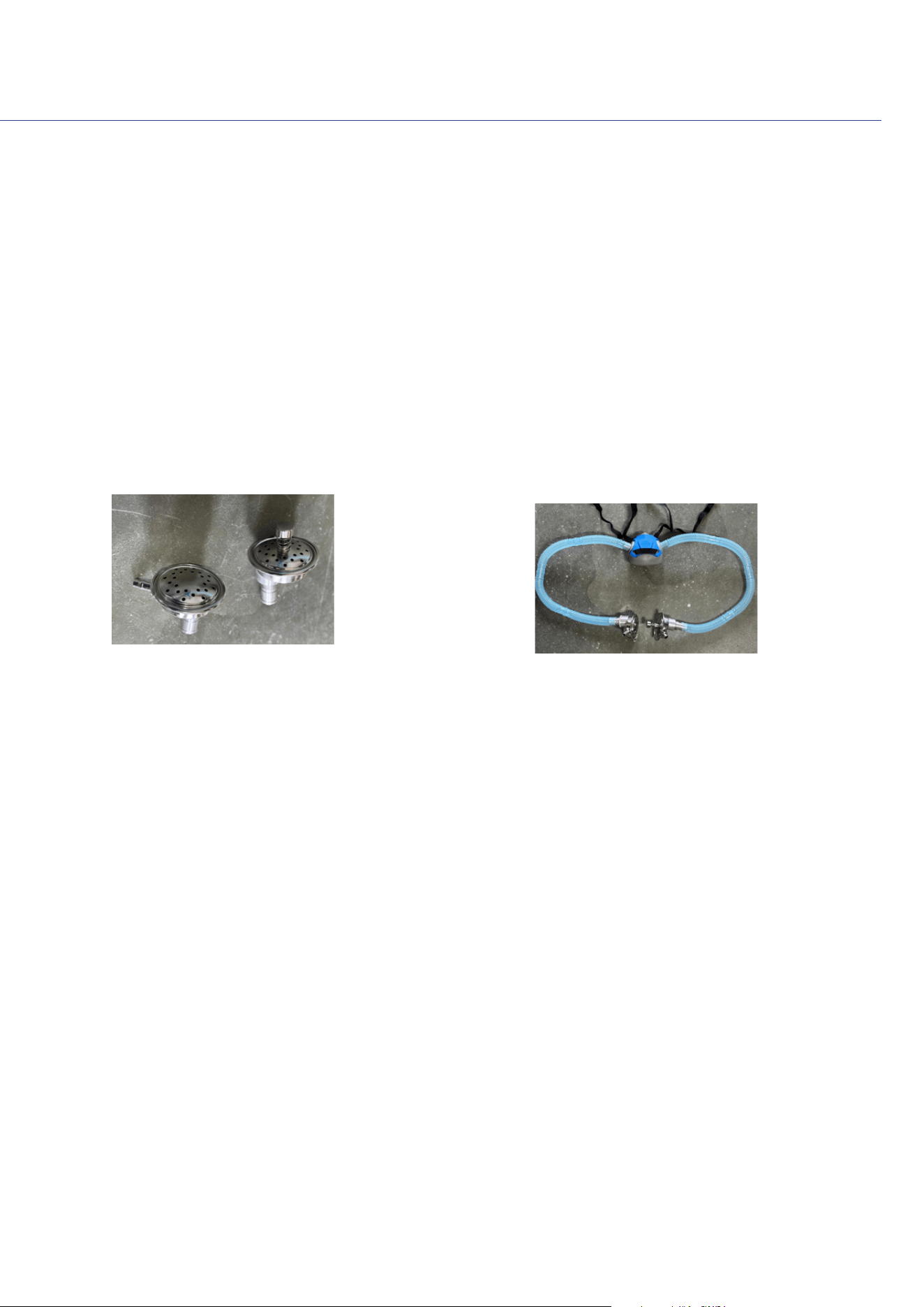
BIBS mask with hoses and
regulators
BiBS mask without hoses
BIBS Regulators
Compressed Air System Safety
Ȼ Pressure control
Always close all shut-off valves before
working on the compressed air system.
Gradually release pressure from equipment
in a controlled manner. Avoid welding, heat
treatment, or mechanical processes on
pressurized systems.
BIBS mask with hoses and regulators
BIBS mask without hoses
BIBS Regulators
ZEUGMA Hyperbaric System
PRODUCT REF Nº → TKBO-X

34
4. Safety
ATLANTIS hyperbaric system
35
5. Chamber exterior
PRODUCT REF Nº → TKBO-2X ATLANTIS Hyperbaric System
5. Chamber exterior
The chamber room should be constructed following the “Standard for
Hyperbaric Care Facilities”(NFPA- 99), including grounding the chamber and
ensuring that all electrical equipment in the chamber room is following the
appropriate NFPA standards.
Warning
Never allow equipment cases or housings to touch or become grounded to the chamber.
All fabrics and other materials used inside the chamber, including bedding and patient clothing,
should be 100% cotton or approved anti- static material as per NFPA-99 recommendations.
ZEUGMA Hyperbaric System
PRODUCT REF Nº → TKBO-X

36
5. Chamber exterior
ATLANTIS hyperbaric system
Never permit Smoking, open flames, exposed filaments or any other source of sparking
or ignition in the chamber room. “NO SMOKING” signs should be conspicuously posted.
It is good electrical practice to not ground components in series. Always ensure the
chamber grounding lead and connectors are maintained in good condition for proper
ground continuity.
Textiles and materials
Ȼ Static-generating fabrics
Do not allow silk, wool, or synthetic textile
materials inside the chamber unless they are
specifically approved for hyperbaric oxygen
use, as they can generate static electricity. Only
garments and sheets made of approved anti-
static materials are permitted.
Ȼ Plastic dressing materials
Avoid the use of plastic dressing materials
inside the chamber.
Ȼ Dirty or oily clothing
Dirty or oily garments must not be allowed
inside the chamber.
Ȼ Combustible materials
Exclude items such as paper, magazines,
excess bedding, lint, and dust, as they pose a
fire hazard.
Ȼ Chemical warming devices
Hand warmers and other chemical heating
devices are prohibited.
5.1. Chamber Interior Guidelines
To ensure safety and prevent hazards inside the hyperbaric chamber, the following rules
must be followed regarding materials, equipment, and personal items:
Cleaning and disinfection procedures
Ȼ Medical-grade products
Only cleaning products that are suitable for
medical use should be used for cleaning the
pressure chamber.
Ȼ Manufacturer instructions
It is the user’s responsibility to follow the
product’s user manuals and clean accordingly.
Ȼ Residue-free cleaning
Cleaning agents should leave no residue or
odor, particularly when cleaning inhalation
masks.
Ȼ Abrasive chemicals
Avoid using abrasive chemicals, especially for
cleaning the lumbosis, to prevent damage.

37
5. Chamber exterior → 5.1. Chamber Interior Guidelines
PRODUCT REF Nº → TKBO-2X ATLANTIS Hyperbaric System
5.2. Electronics safety protocol
This protocol outlines safety guidelines for using electronic devices, specifically laptops,
tablets or smartphones, inside an HBOT chamber pressurized with air while oxygen is
delivered via BIBS (Built-In Breathing System) mask.
Electronic devices, including laptops, can be used inside air-pressurized hyperbaric
chambers only if the ambient oxygen concentration remains close to normal (~21%).
Monitor the oxygen level inside the chamber on the control panel.
Using electronics, including self-energizing medical devices such as ECG, EEG, and
T-COM is allowed inside the air-pressurized chamber, provided proper precautions are
followed. All users must adhere to these safety guidelines to minimize potential risks.
Prohibited personal items
Ȼ Earplugs, contact lenses, and dentures
Do not allow earplugs, hard contact lenses,
or dentures. Soft, permeable contact lenses
may be worn, but conventional eyeglasses are
preferred when available.
Ȼ Sharp or metallic objects
Items like rings with settings, watches, pens,
and other metallic objects should not be
permitted inside the chamber.
Patient screening
Ȼ Check for prohibited items
Each patient must be thoroughly checked
before every session to ensure they are not
carrying any prohibited items or materials.
Lubrication and prohibited products
Ȼ Lubricants
Only oxygen-compatible lubricants should be
used for any parts that require lubrication.
Hpotech Medikal ve Teknik Çözümler
recommends using high-temperature-resistant
grease.
Ȼ Prohibited substances
Do not allow oil, grease, alcohol, or petroleum-
based products inside the chamber.
Electrical devices
Ȼ Permitted equipment
Electronic devices, including laptops, can
be used inside air-pressurized hyperbaric
chambers only if the ambient oxygen
concentration remains close to normal (~21%).
Monitor the oxygen level inside the chamber on
the control panel.
Using electronics, including self-energizing
medical devices such as ECG, EEG, and T-COM
is allowed inside the air-pressurized chamber,
provided proper precautions are followed. All
users must adhere to these safety guidelines to
minimize potential risks.
Ȼ Ground continuity
Ensure that the stretcher rollers and support
rails are clean to maintain proper ground
continuity.
ZEUGMA Hyperbaric System
PRODUCT REF Nº → TKBO-X

38
5. Chamber exterior → 5.2. Electronics safety protocol
ATLANTIS hyperbaric system
WARNING
Non-recommended lubricants can ignite spontaneously in the presence of oxygen.
WARNING
The use of hair sprays, hair oils, oil-based cosmetics, creams, Vaseline, lotions, or other oils is forbidden.
All such products must be removed from the patient’s body and hair before entering the chamber.
These guidelines are essential for maintaining a safe and clean environment within the hyperbaric chamber.
Pre-Use Checklist for Electronics
Before bringing a laptop (or any electronic device)
into the chamber:
Ȼ Ensure the device is in good condition
(no frayed wires, exposed circuits, or
damaged batteries).
Ȼ Battery-powered use only. Charging
inside the chamber is not permitted
due to heat buildup and electrical risk.
Ȼ Check for overheating issues before
entering the chamber.
Ȼ Use a laptop with a low-heat
output and ensure ventilation is not
obstructed.
Ȼ If applicable, verify that the device
meets intrinsically safe certification
(not mandatory for air-pressurized
chambers but a best practice in high-
risk environments).
Chamber Operational Guidelines
Ȼ Maintain Proper Ventilation: Ensure
airflow inside the chamber remains
unobstructed.
Ȼ No Loose Cables or Chargers: Only fully
charged battery-operated devices are
permitted.
Ȼ Device Positioning: Place laptops on a
stable surface to prevent movement
during pressurization.
Ȼ Monitor Device Performance: If the
laptop heats excessively, turn it off
immediately and notify the operator.
Ȼ Emergency Procedures: If any
electrical issue arises (sparks, smoke,
overheating), turn off the device and
inform the operator immediately.
Prohibited Items and Practices
Ȼ No use of devices with exposed wiring
or damaged batteries.
Ȼ No charging of electronics inside the
chamber.
Ȼ No use of high-energy devices (e.g.,
power banks, large battery packs)
without explicit approval.
Ȼ No use of personal oxygen tanks near
electronic devices to prevent localized
high-oxygen environments.
Operator Responsibilities
Ȼ Ensure all users understand and comply
with these guidelines before entering the
chamber.
Ȼ Inspect electronic devices before each
session for any potential risks.
Ȼ Enforce emergency protocols in case of
device malfunction.

39
5. Chamber exterior
PRODUCT REF Nº → TKBO-2X ATLANTIS Hyperbaric System
5.3. Personnel requirements
Proper training and experience are essential for the safe operation of hyperbaric
chambers. The following guidelines apply to personnel operating the chamber:
5.4. Patient safety guidelines
To ensure patient safety and comfort during hyperbaric treatment, the following procedures
are recommended:
Pre-treatment preparation
Ȼ Explain the procedure
Explain the entire treatment process clearly
to the patient, answering any questions
they may have.
Ȼ Eustachian Tube function
Ensure the patient can clear their ears
(e.g., swallowing or using the Valsalva
maneuver) and understands how to do so.
Restrictions inside the chamber
Ȼ No food or gum
Do not allow chewing gum, candy, or any
other food items inside the chamber.
Ȼ Medication considerations
Consider the effects of any medications,
alcohol, or other substances on
hyperbaric oxygen exposure.
Ȼ Training
All personnel must be thoroughly trained
in the operation of the hyperbaric
chamber and possess a strong
understanding of hyperbaric oxygen
therapy.
Ȼ Experience
Selection of competent and experienced
personnel is critical for safely using
hyperbaric chamber systems.
Ȼ Physician requirements
The physician overseeing the treatment
must be trained and proficient in
administering hyperbaric oxygen therapy.
ZEUGMA Hyperbaric System
PRODUCT REF Nº → TKBO-X

40
5. Chamber exterior → 5.4. Patient safety guidelines
ATLANTIS hyperbaric system
During treatment
Ȼ Communication
Always inform the patient of impending
pressurization or depressurization and
explain how it will feel.
Ȼ Visual contact
Maintain constant visual contact with the
patient throughout the treatment.
Ȼ Breath-holding warning
Remind patients never to hold their breath
during depressurization to avoid injury.
Important warnings: ear pressure and safety during treatment
Cold and respiratory infections
WARNING
Individuals with colds or upper respiratory infections
may have difficulty clearing their ears during the
pressurization or depressurization phases. This can
lead to discomfort or injury.
Ear pressure and pain management
WARNING
If the patient is unable to equalize ear pressure or
experiences pain during pressurization:
Ȼ Stop pressurization immediately
Cease the pressurization process at once if the
patient is struggling to equalize ear pressure or
reports any pain.
Ȼ Depressurization for relief
It may be necessary to slightly depressurize the
chamber to relieve pain before continuing the
compression process.
By adhering to these guidelines, patient safety and comfort can be effectively maintained during hyperbaric oxygen therapy.
Chamber operation safety
Ȼ No unattended patients
Never leave the chamber unattended while
operating.
Ȼ Movement restrictions
Do not bump or attempt to move the
chamber when it is pressurized.
41
5. Chamber exterior
PRODUCT REF Nº → TKBO-2X ATLANTIS Hyperbaric System
ZEUGMA Hyperbaric System
PRODUCT REF Nº → TKBO-X

42
5. Chamber exterior
ATLANTIS hyperbaric system
43
PRODUCT REF Nº → TKBO-2X ATLANTIS Hyperbaric System
6. Device presentation
ZEUGMA Hyperbaric System
PRODUCT REF Nº → TKBO-X
44
6. Device presentation
ATLANTIS hyperbaric system
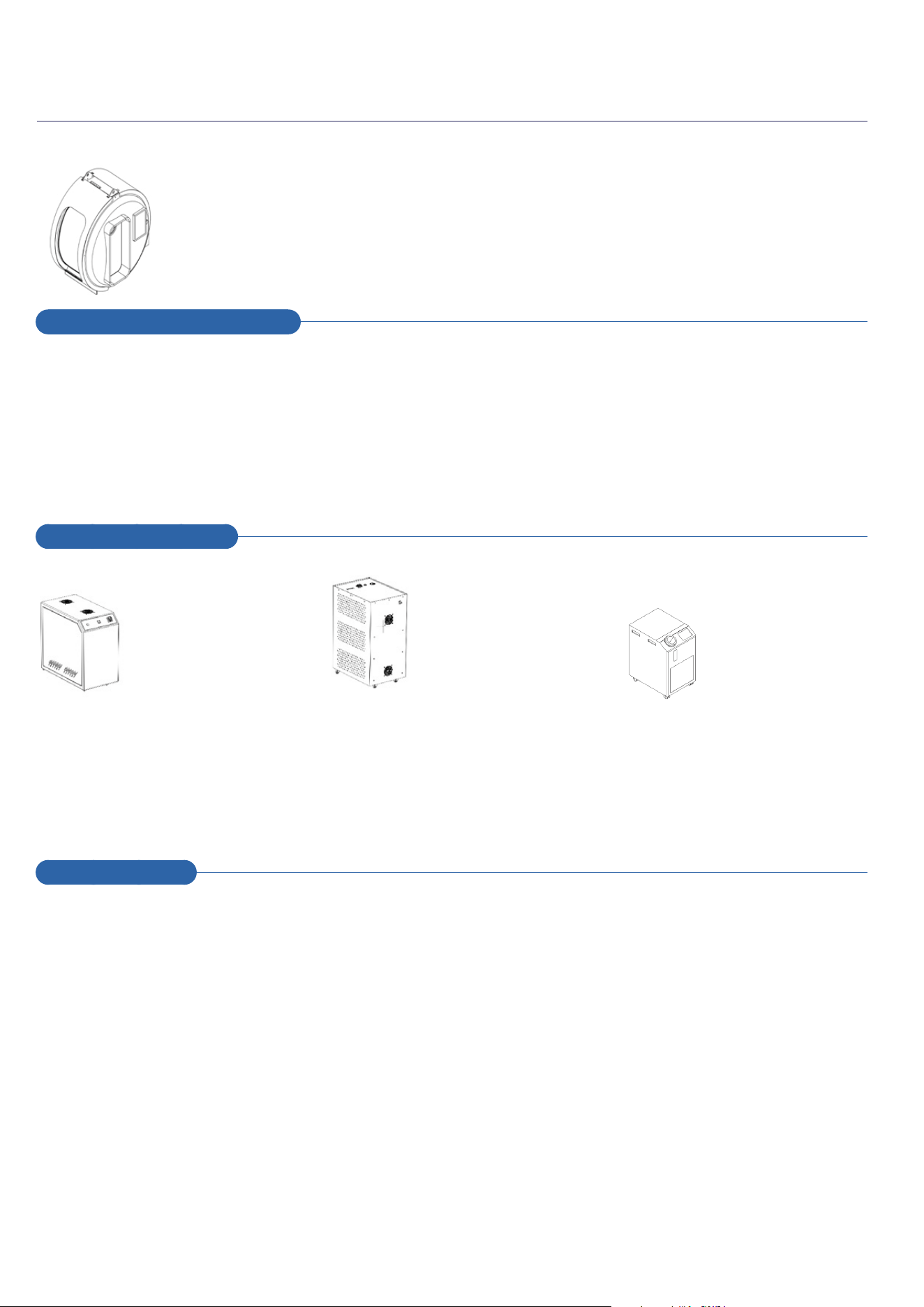
6.1. System components
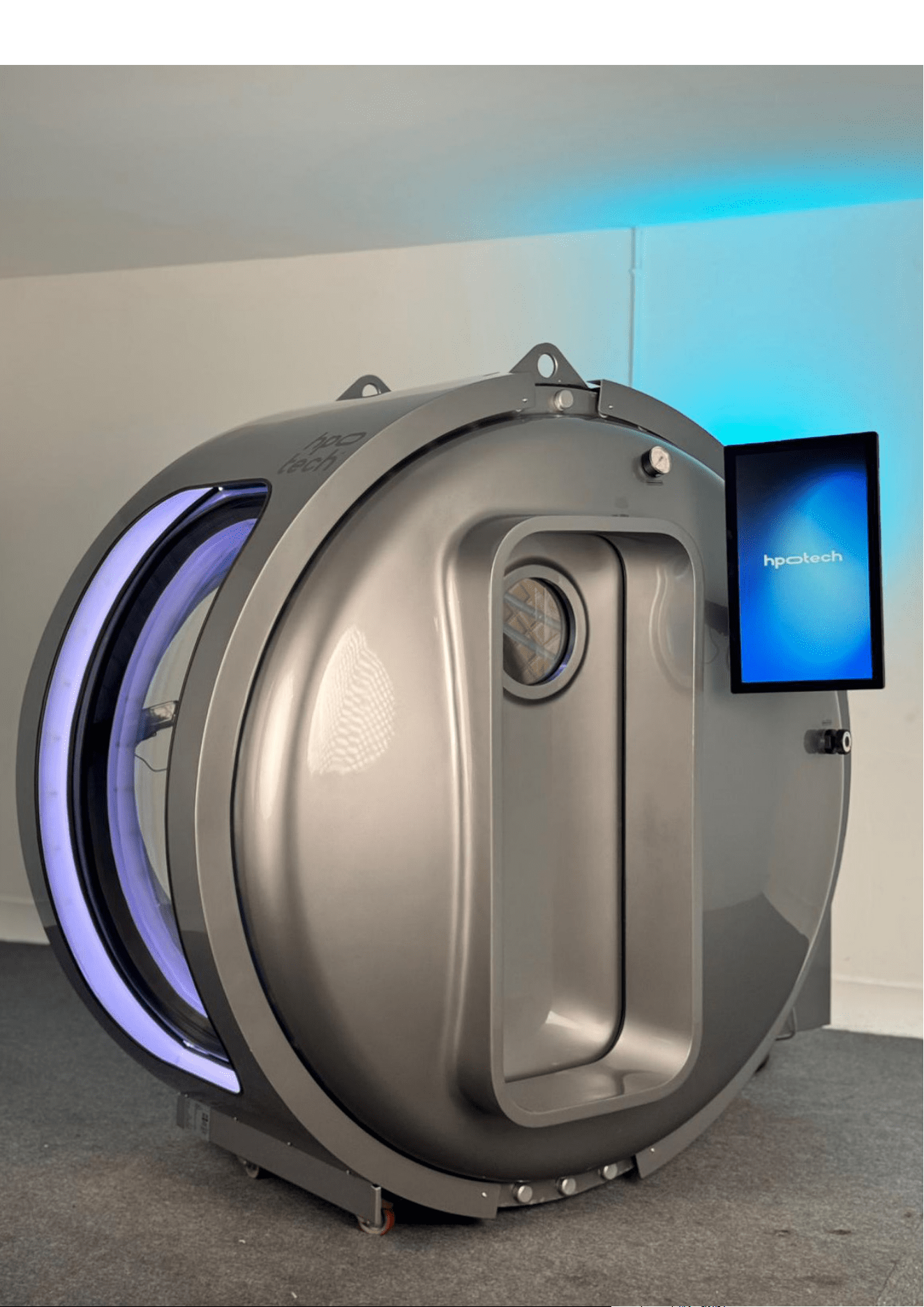
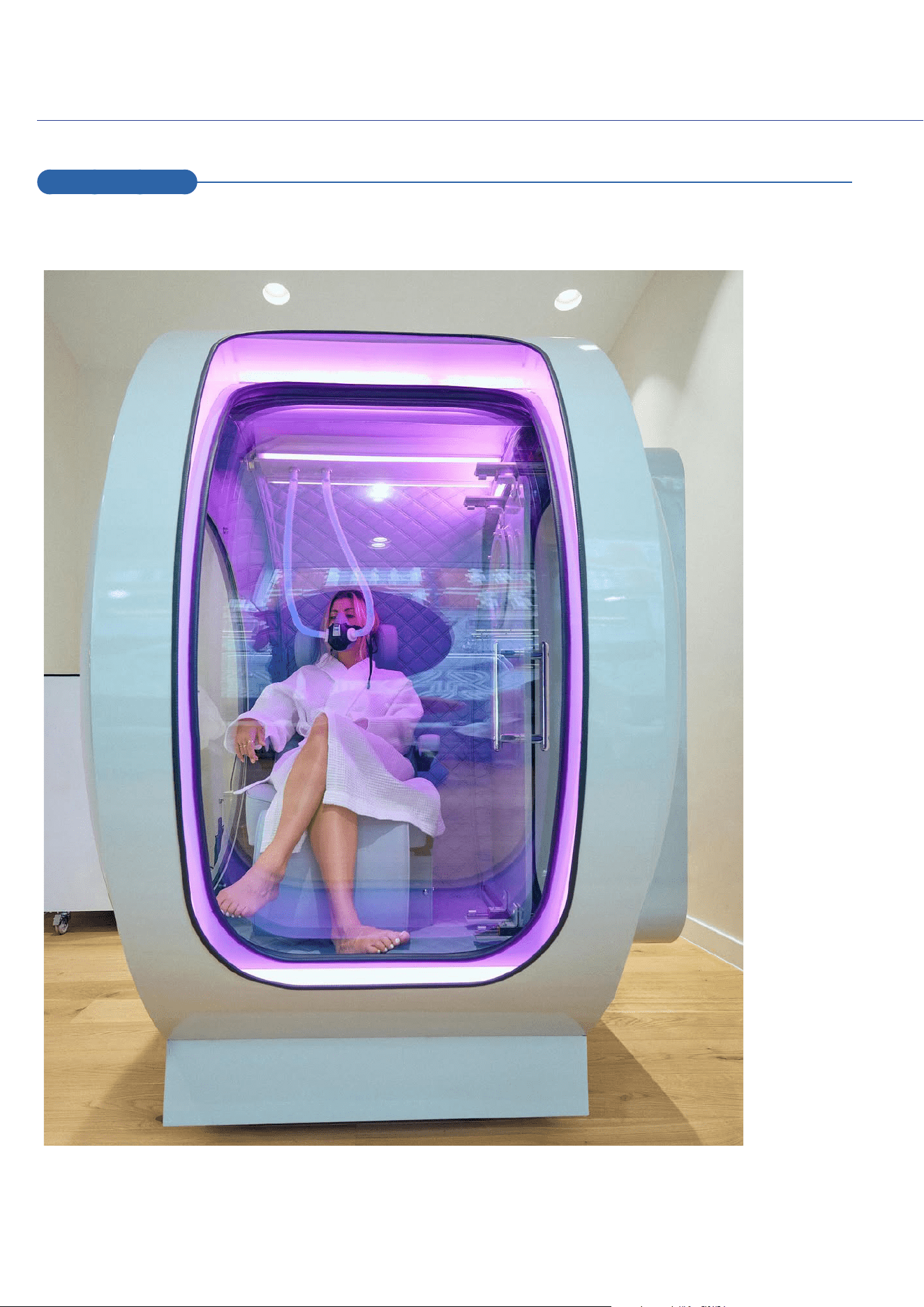
Hyperbaric chamber → 1 seat
The Hyperbaric Chamber is engineered for safety, comfort, and efficiency, featuring a durable body, secure steel door with pressure locking,
and airtight gaskets.
Key safety elements include a manometer, manual exhaust/emergency valve, and an Emergency Stop button.
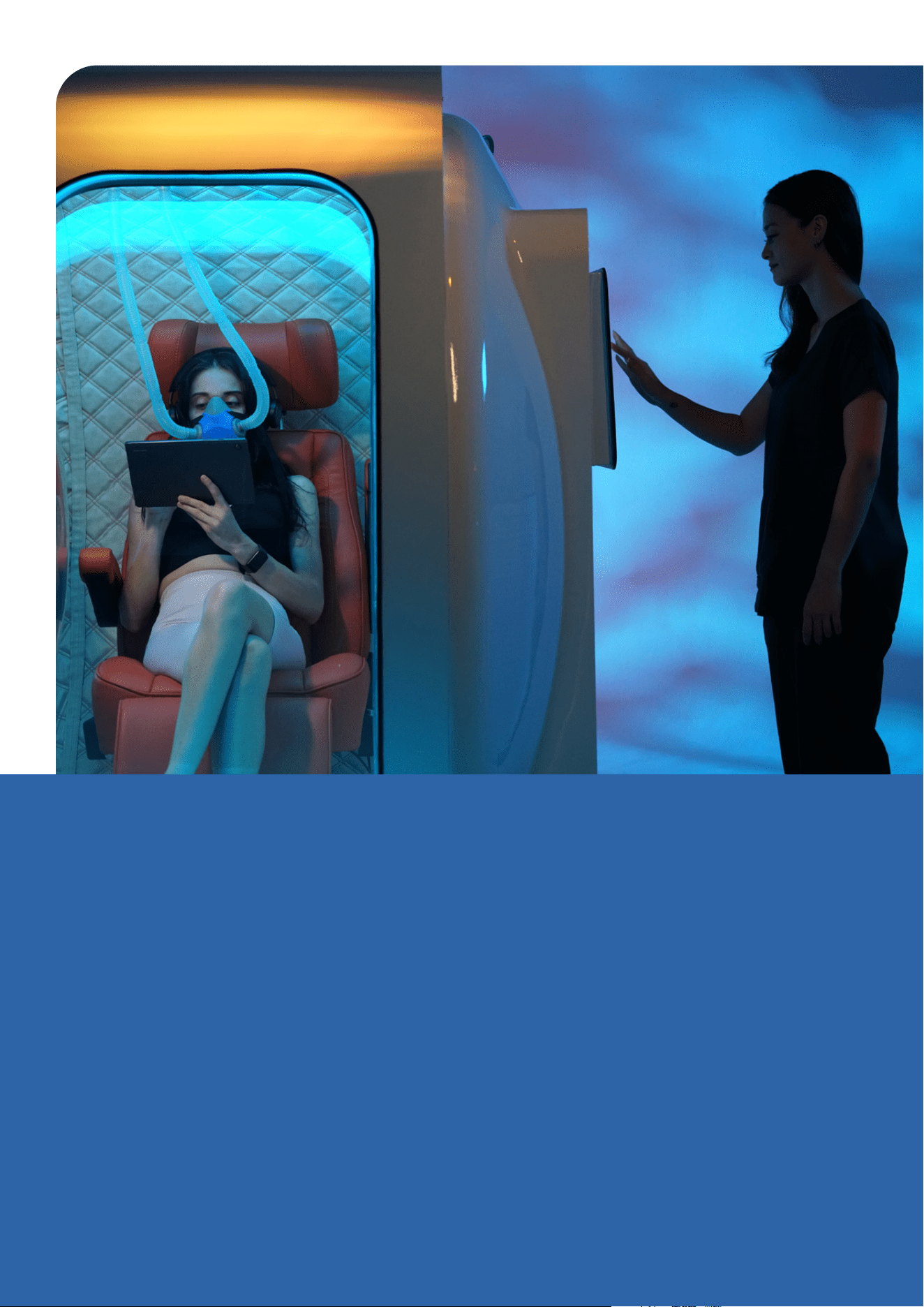
Oxygen is delivered via BIBS regulators while users sit on ergonomic chairs.
An advanced sensor system provides LED and UVC lighting, a USB port, internal cooling, and real-time monitoring.
All functions are seamlessly managed through the HPOSOFT wireless automation system for intuitive control and performance.
Oxygen concentrator → 1 unit
During treatment, the user breathes
high-purity oxygen supplied using the
Oxygen Concentrators (5.0 ATA working
pressure), directly into the BIBS (Built-In
Breathing system). The number of Oxygen
Concentrators is equal to the number of
patients inside.
Air compressor → 1 unit
The Hyperbaric chamber is pressurized with
breathable air from the Air Compressor.
Pressure + Oxygen are the two most important
factors in HBOT.
Air cooler → 1 unit
The system is connected to an Air Cooler
to keep the air fresh inside the chamber
and the temperature under control.
External components
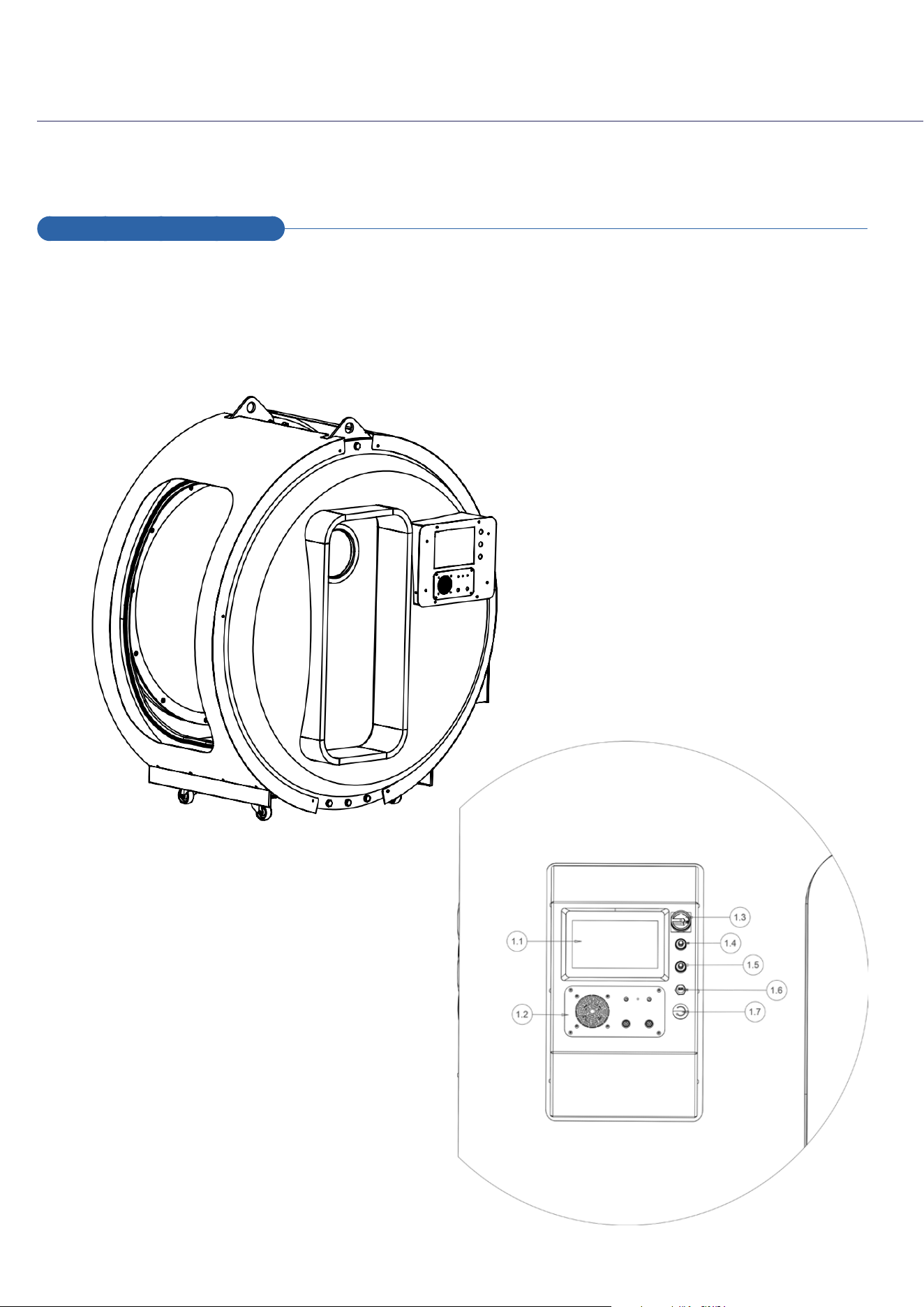
Components list
1. External Control Panel
1.1. Screen – 10"
1.2. Intercom
1.2.1. Outside Volume
1.2.2. Intercom On-Off
1.2.3. Inside Volume
1.2.4. Push to Talk
1.2.5. Speaker
1.2.6. Microphone
1.3. Power Switch
1.4. Manual Pressure Knob
1.5. Manual Exhaust Knob
1.6. USB – 2.0
1.7. Emergency Button
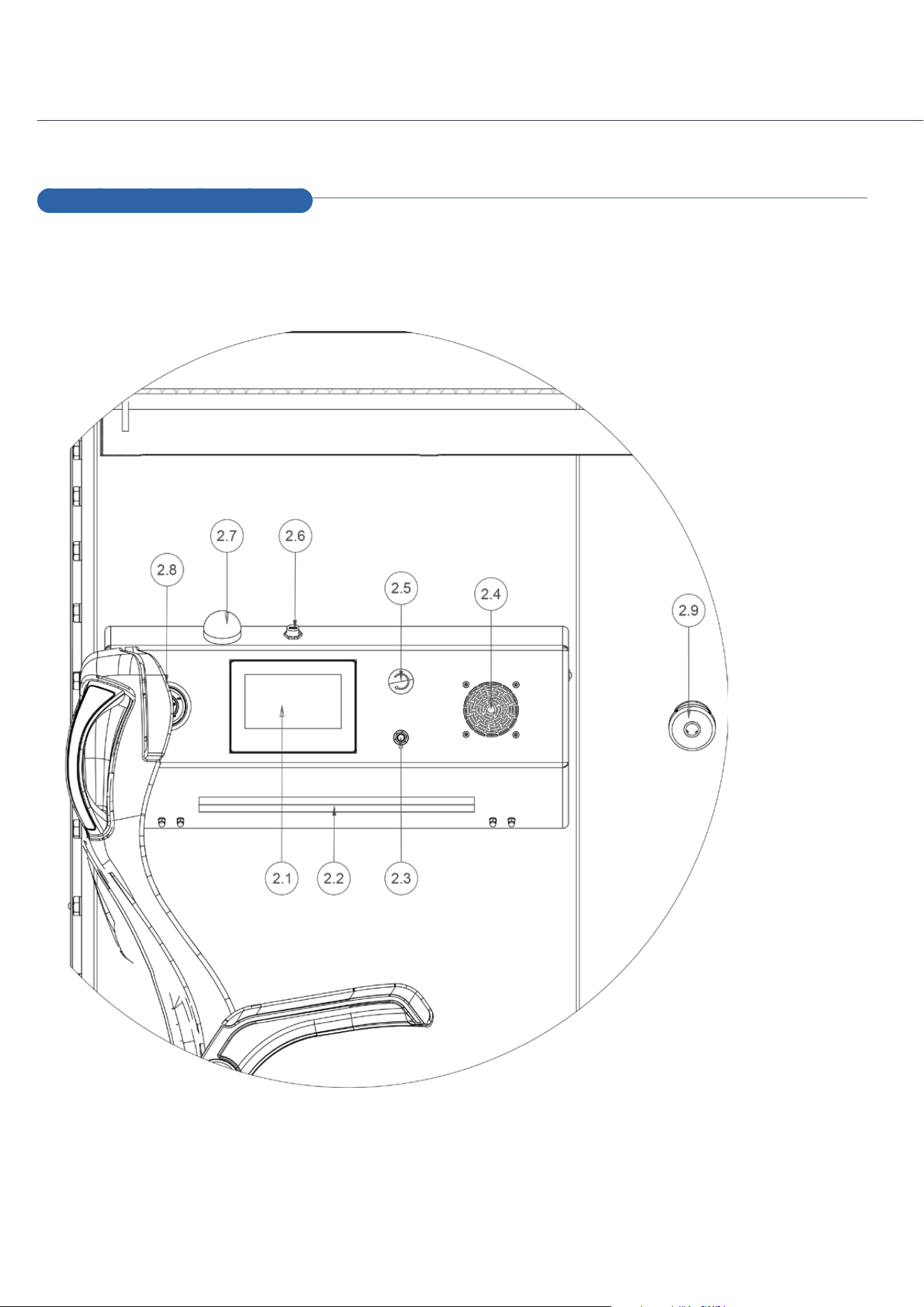
2. Internal Control Panel
2.1. Screen – 7"
2.2. UVC Light
2.3. UVC Sensor
2.4. Speaker
2.5. Emergency Button
2.6. USB – 2.0
2.7. Microphone
2.8. Chamber Pressure Indicator (Interior)
2.9. Internal Manual Drain Valve / Emergency Valve
3. BIBS Panel
3.1. Seat Exhaust BIBS Regulator
3.2. Seat Demand BIBS Regulator
4. Top Panel
5. Lifting Lug
6. Seats
7. Electric Panel
8. Door Locking Piston
9. Chamber Pressure Indicator
(Interior) (Duplicate reference of 2.8)
10. External Manual Drain Valve /
Emergency Valve
11. Air Vent
45
6. Device presentation
PRODUCT REF Nº → TKBO-2X ATLANTIS Hyperbaric System
ZEUGMA Hyperbaric System
PRODUCT REF Nº → TKBO-X
46
6. Device presentation
ATLANTIS hyperbaric system
6.2. COMPONENTS DESCRIPTIONS
1. External control panel
Controls located outside the chamber for operational management. Navigate manual and
automatic pressure adjustments, monitor vital information, maintain clear communication
with the patient, and control every aspect of the chamber. Equipped with manual
overrides and an emergency stop button for full preparedness.
47
6. Device presentation → 6.2. Components description
PRODUCT REF Nº → TKBO-2X ATLANTIS Hyperbaric System
1.1. SCREEN → 10"
Main touchscreen display for managing and
monitoring chamber functions. Set pressure
and session parameters, lock the chamber
door, and view real-time data on pressure,
time, and vital stats.
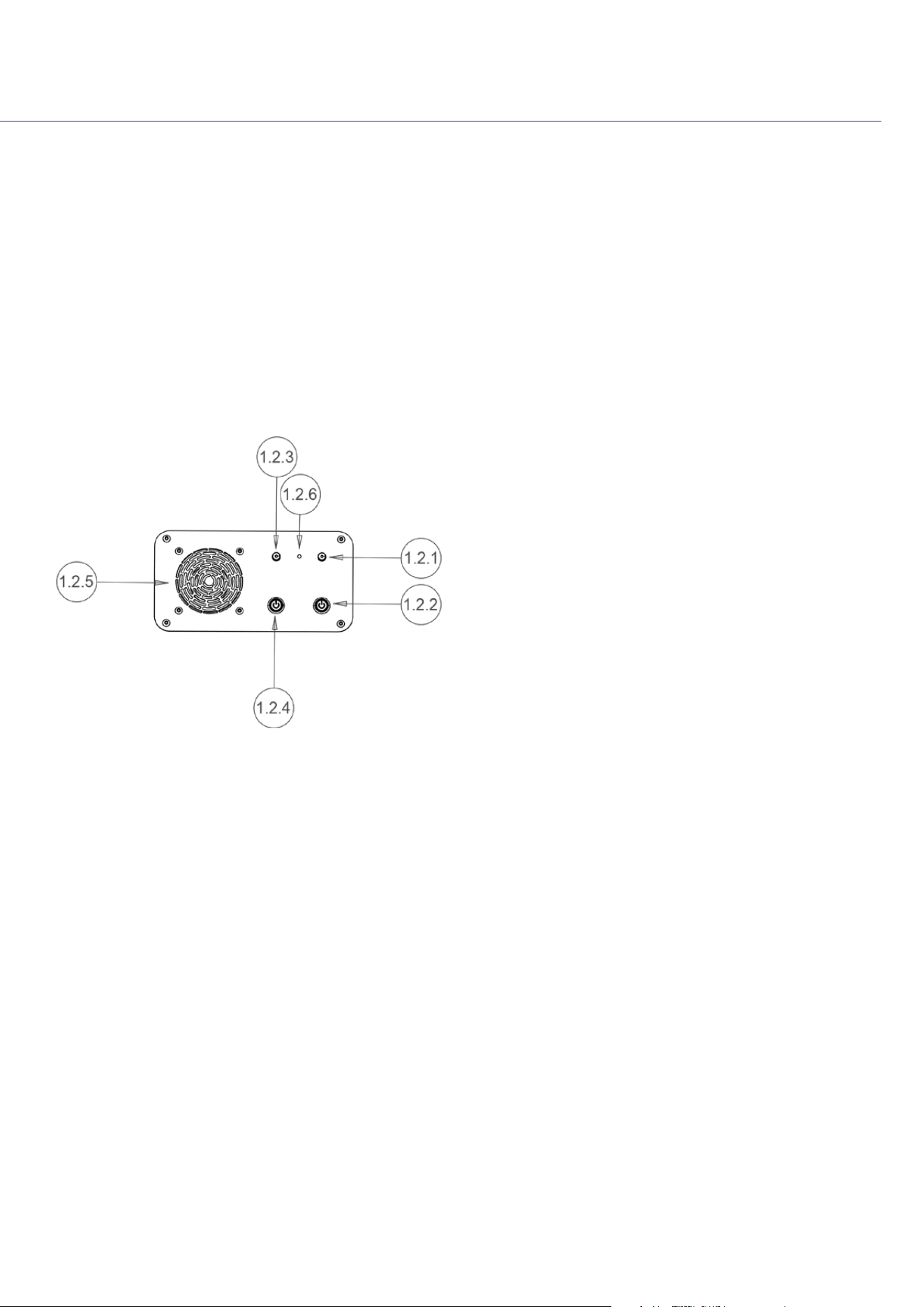
1.2. INTERCOM
Two-way audio communication system
between the inside and outside of
the chamber. Always active for clear
communication, with adjustable volume.
1.2.1. OUTSIDE VOLUME
Adjusts speaker volume outside the chamber.
1.2.2. INTERCOM ON-OFF
Enables or disables the intercom system.
1.2.3. INSIDE VOLUME
Adjusts speaker volume inside the chamber.
1.2.4. PUSH TO TALK
Activates microphone for speaking.
1.2.5. SPEAKER
Outputs audio externally.
1.2.6. MICROPHONE
Captures voice from the external operator.
1.3. POWER SWITCH
Main switch to turn the system on or off.
Activates electrical systems and control
panels for manual or automatic HBOT
sessions.
1.4. MANUAL PRESSURE KNOB
Manual control for increasing internal
pressure. Allows independent compression
control apart from the automated system.
1.5. MANUAL EXHAUST KNOB
Manual control for reducing pressure
(venting). Enables manual decompression
separate from the automatic system.
1.6. USB → 2.0
External USB port for downloading session
logs in CSV format or performing system
updates.
1.7. EMERGENCY BUTTON
Emergency stop control located outside the
chamber. Instantly halts the session and
safely depressurizes the chamber.
ZEUGMA Hyperbaric System
PRODUCT REF Nº → TKBO-X
48
6. Device presentation → 6.2. Components description
ATLANTIS hyperbaric system
2. INTERNAL CONTROL PANEL
Occupant-operated interface inside the chamber. Allows the user to adjust pressure,
time, and other settings while monitoring system data. All controls are mirrored with
external access for safety and coordination.

49
6. Device presentation → 6.2. Components description
PRODUCT REF Nº → TKBO-2X ATLANTIS Hyperbaric System
2.1. SCREEN → 7"
Touchscreen interface to manage pressure,
session parameters, and view live data on
chamber conditions.
2.2. UVC LIGHT
High-efficiency ultraviolet LED for
disinfection. Ensures effective sterilization of
the chamber environment.
2.3. UVC SENSOR
Monitors UVC LED status and exposure.
Ȼ Integrated with an occupancy sensor to
disable the UVC LED when the chamber is
occupied.
Ȼ UVC rays automatically shut off upon
detecting a person inside, independent of
the panel.
Ȼ Daily functionality check recommended
before the first session.
Ȼ If sensor fails, manually turn off the UVC
LED using the panel switch.
2.4. SPEAKER
Outputs audio for internal communication or
alerts. Volume-controlled for clear sound.
2.5. EMERGENCY BUTTON
Allows occupant to initiate emergency
shutdown and depressurization.
2.6. USB → 2.0
Internal USB port for downloading session
data in CSV format or device connectivity.
2.7. MICROPHONE
Captures voice from the occupant for
intercom use. Ensures constant two-way
communication.
2.8. CHAMBER PRESSURE INDICATOR (INTERIOR)
Secondary gauge displaying internal
pressure.
Ȼ Displays sensor-derived values via the
touchscreen.
Ȼ In case of sensor failure, a calibrated
manual manometer (≤1% deviation) serves
as a backup.
2.9. INTERNAL MANUAL DRAIN VALVE /
EMERGENCY VALVE
Manual pressure release valve for trained
users.
Ȼ Allows gradual decompression from inside.
Ȼ If user is not certified, external valve
control overrides internal use.
Ȼ When the external valve is closed, internal
valve is disabled for safety.
ZEUGMA Hyperbaric System
PRODUCT REF Nº → TKBO-X
50
6. Device presentation → 6.2. Components description
ATLANTIS hyperbaric system
3. BIBS PANEL
Control system for the Built-In Breathing System (BIBS).
51
6. Device presentation → 6.2. Components description
PRODUCT REF Nº → TKBO-2X ATLANTIS Hyperbaric System
3.1. SEAT EXHAUST BIBS REGULATOR
Controls air exhaust from Seat 1.
3.2. SEAT DEMAND BIBS REGULATOR
Regulates oxygen supply on demand for Seat 1.
BIBS Regulators
The BIBS regulators, comprising one demand regulator and
one exhaust regulator, facilitate safe oxygen inhalation for
the patient inside the pressure chamber. They should be
opened, wiped with a damp cloth, and securely reassembled
every six months. No chemical cleaners should be used
in this process.
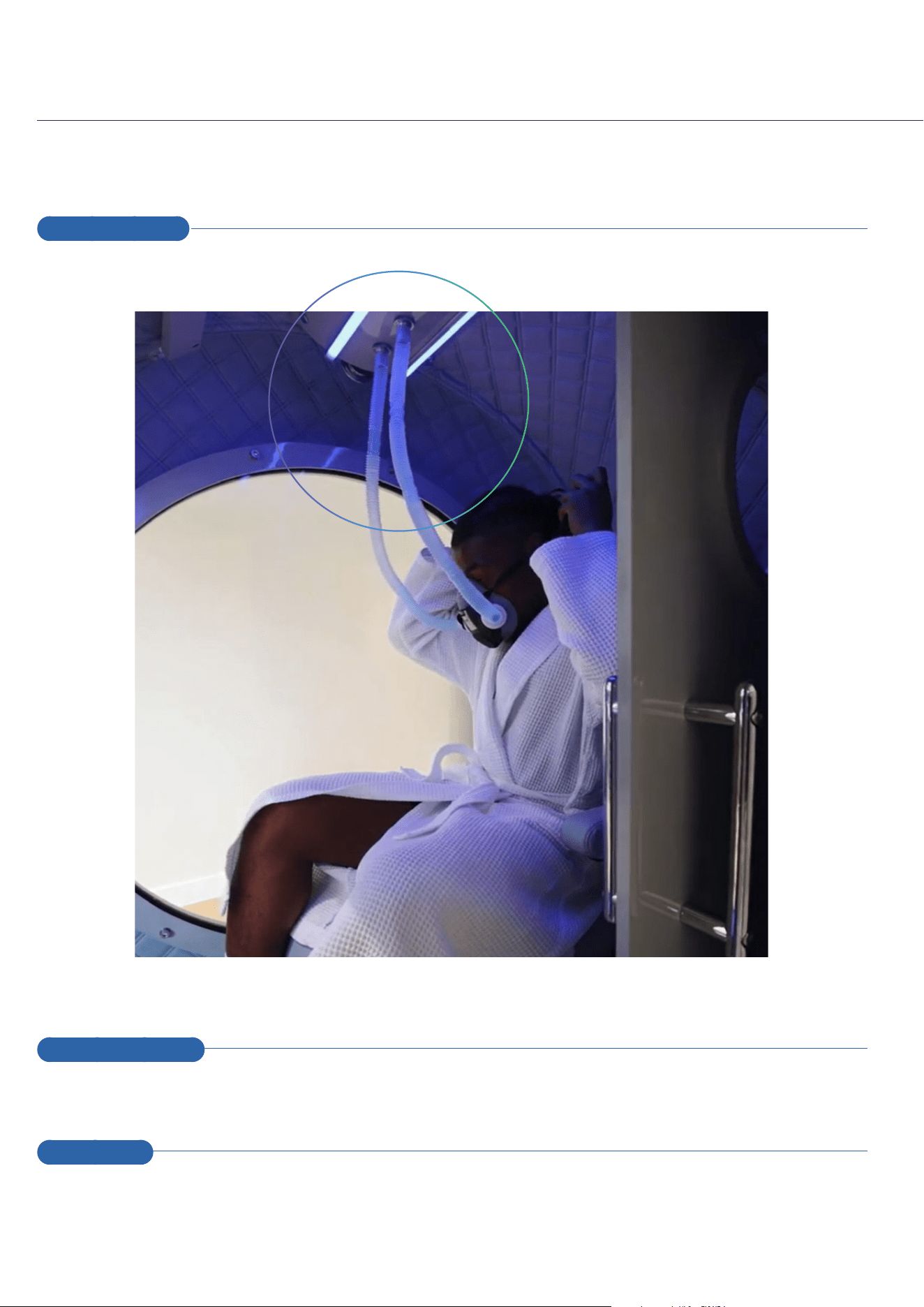
Mask connections for BIBS
The BIBS apparatus connects the oxygen from the regulators
to the patient’s mask. One hose will be connected to
oxygen delivery, the other hose will provide carbon dioxide
exhaust outside the chamber.
ZEUGMA Hyperbaric System
PRODUCT REF Nº → TKBO-X
52
6. Device presentation → 6.2. Components description
ATLANTIS hyperbaric system
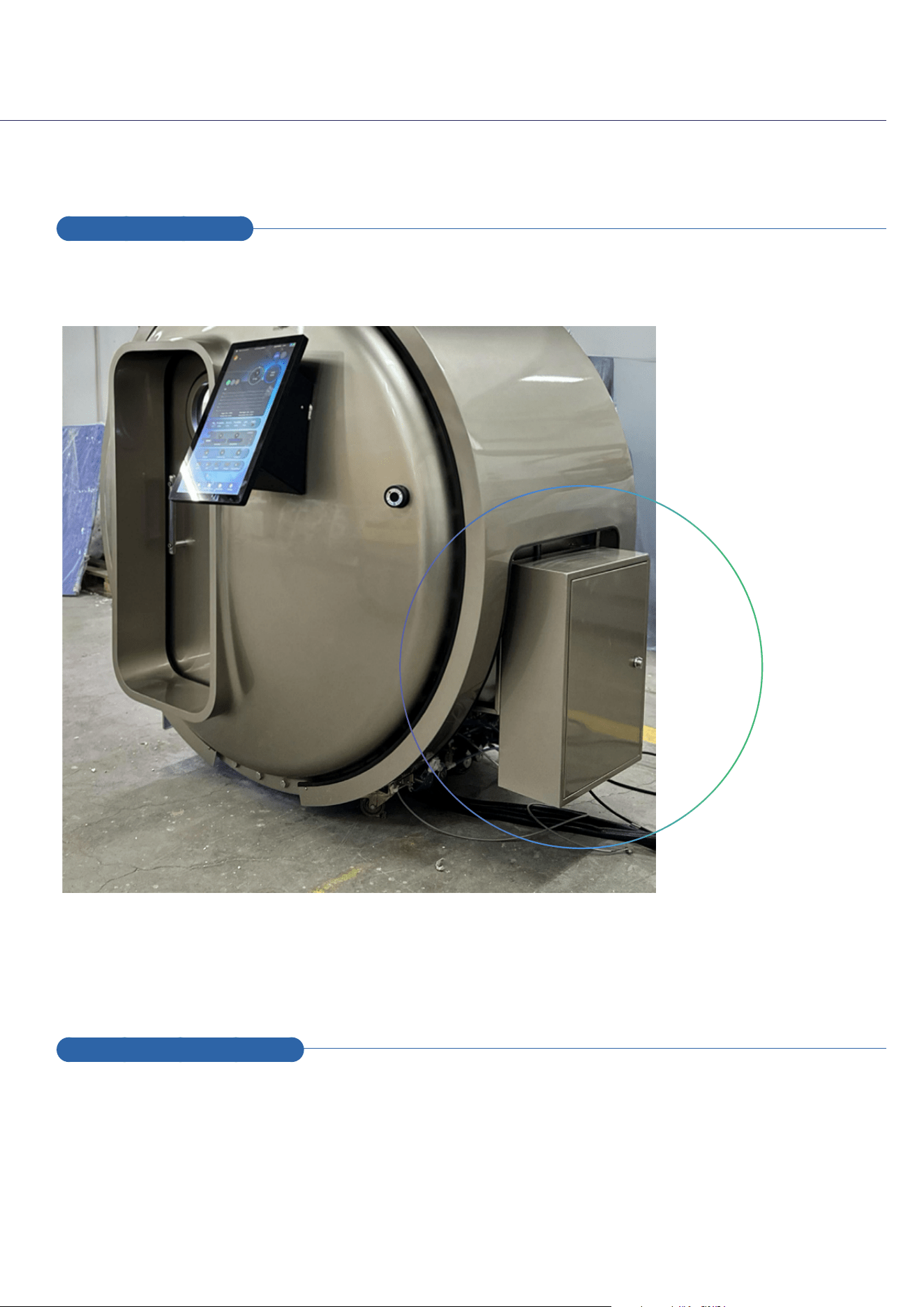
4. TOP PANEL
Houses internal wiring and components, including LED lighting.
5. LIFTING LUG
Fixed mounting points for hoisting or relocating the chamber via crane or forklift.
6. SEATS
Occupant seating inside the chamber.
Seat type may vary (manual or automatic) based on user preferences.
53
6. Device presentation → 6.2. Components description
PRODUCT REF Nº → TKBO-2X ATLANTIS Hyperbaric System
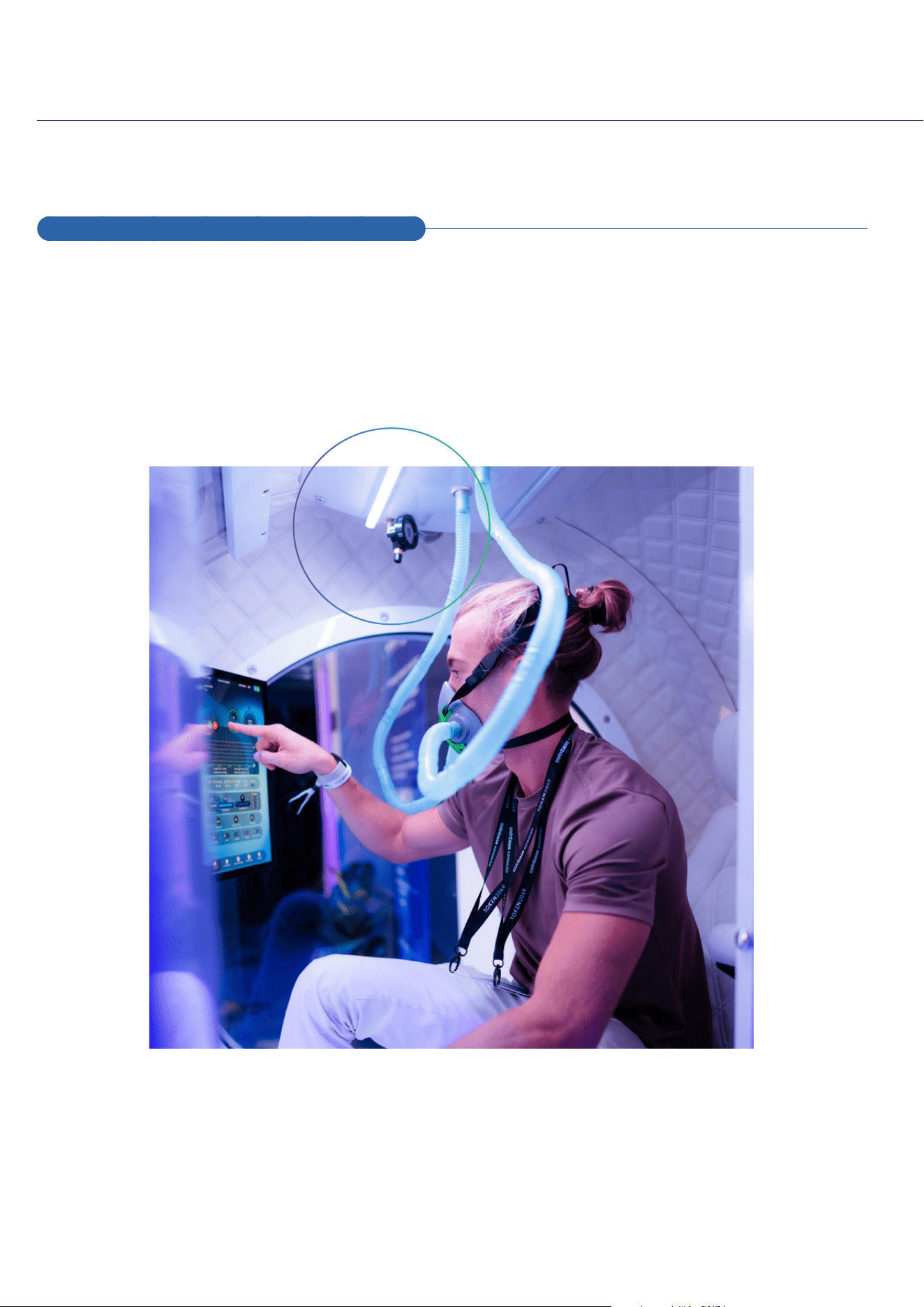
7. ELECTRIC PANEL
Enclosure for electrical components and system wiring.
8. DOOR LOCKING PISTON
Sliding system for securely sealing or opening the chamber door. The piston does not
start operation without closing the door. When the door closes, the piston is operated
from the door-locking button on the tablet. The piston locks the acrylic door, pressuring
the pressure chamber
ZEUGMA Hyperbaric System
PRODUCT REF Nº → TKBO-X
54
6. Device presentation → 6.2. Components description
ATLANTIS hyperbaric system
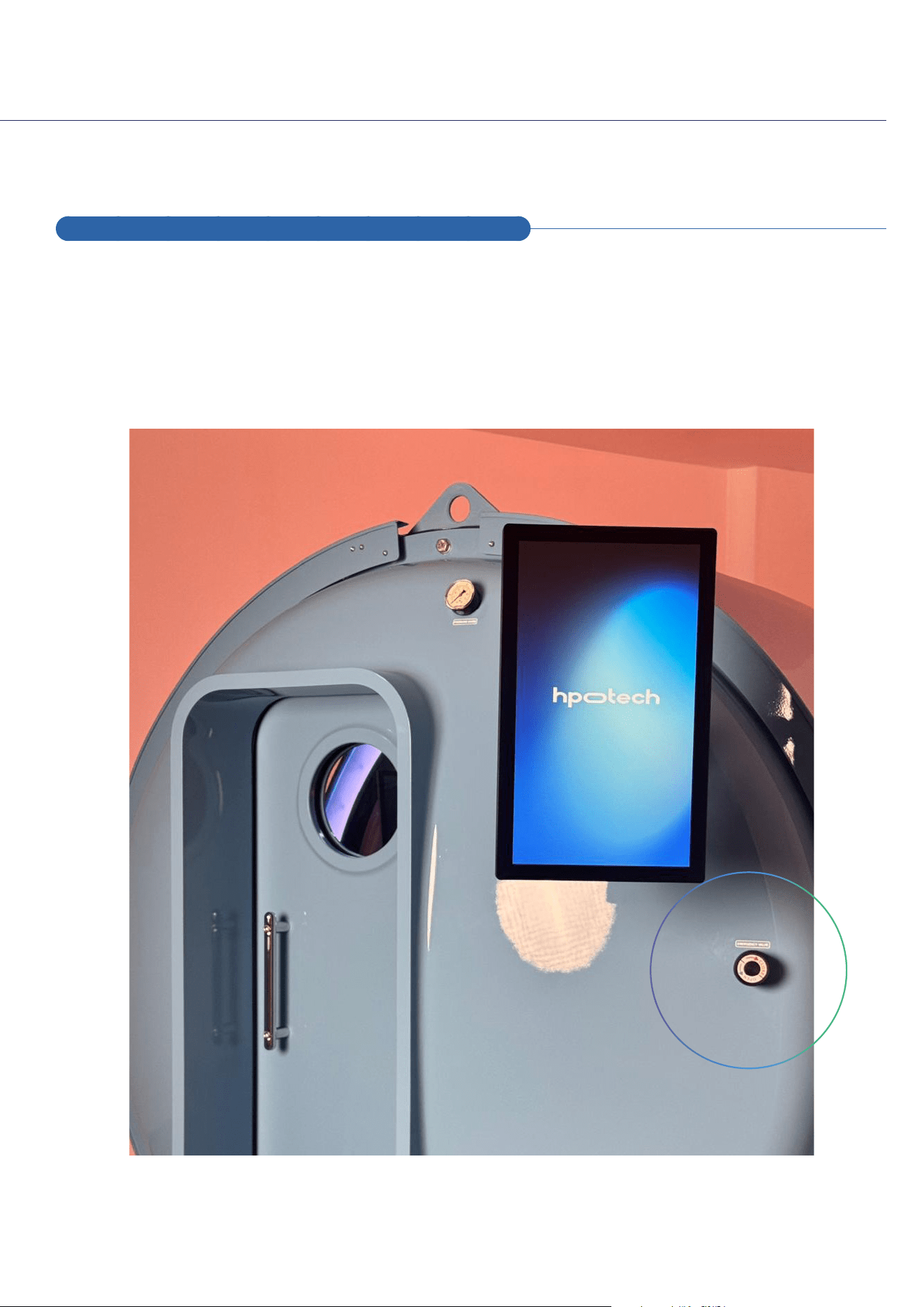
9. CHAMBER PRESSURE INDICATOR (INTERIOR)
Duplicate of 2.8.
Displays internal pressure as a backup to the automated system.
Ȼ Uses manual manometer calibrated annually.
Ȼ Only manometers with ≤1% deviation permitted.
55
6. Device presentation → 6.2. Components description
PRODUCT REF Nº → TKBO-2X ATLANTIS Hyperbaric System
10. EXTERNAL MANUAL DRAIN VALVE / EMERGENCY VALVE
Manual pressure release control from outside the chamber.
Ȼ Trained personnel may operate the valve gradually.
Ȼ If user is not certified, external valve overrides internal control for safety.
Ȼ When closed externally, internal valve is automatically disabled.
ZEUGMA Hyperbaric System
PRODUCT REF Nº → TKBO-X
56
6. Device presentation → 6.2. Components description
ATLANTIS hyperbaric system
Safety precautions
Ȼ Immediate action
The operator must immediately open the
emergency exit valve if the safety valve fails
to activate during a pressure surge.
Ȼ Valve maintenance
Safety valves should be inspected and
replaced every 5 years to ensure optimal
performance.
Ȼ Compressed air safety
Uncontrolled release of compressed air
can be hazardous. Always adhere to safety
protocols.
Internal cooling system
Air conditioning
An air conditioning system comprising indoor
and outdoor units regulates the hyperbaric
chamber’s temperature and humidity,
maintaining optimal conditions. The air is
provided by the Air Cooler unit.
Overheat Protection
The system incorporates a safety
mechanism to automatically deactivate
the air conditioning unit in case of radiator
overheating.
Internal unit
Ȼ Includes a cooling radiator to dissipate
heat generated during the hyperbaric
process.
Ȼ Employs fans to circulate air and enhance
cooling efficiency.
Ȼ Features a climate control button to
activate or deactivate the fans as needed.
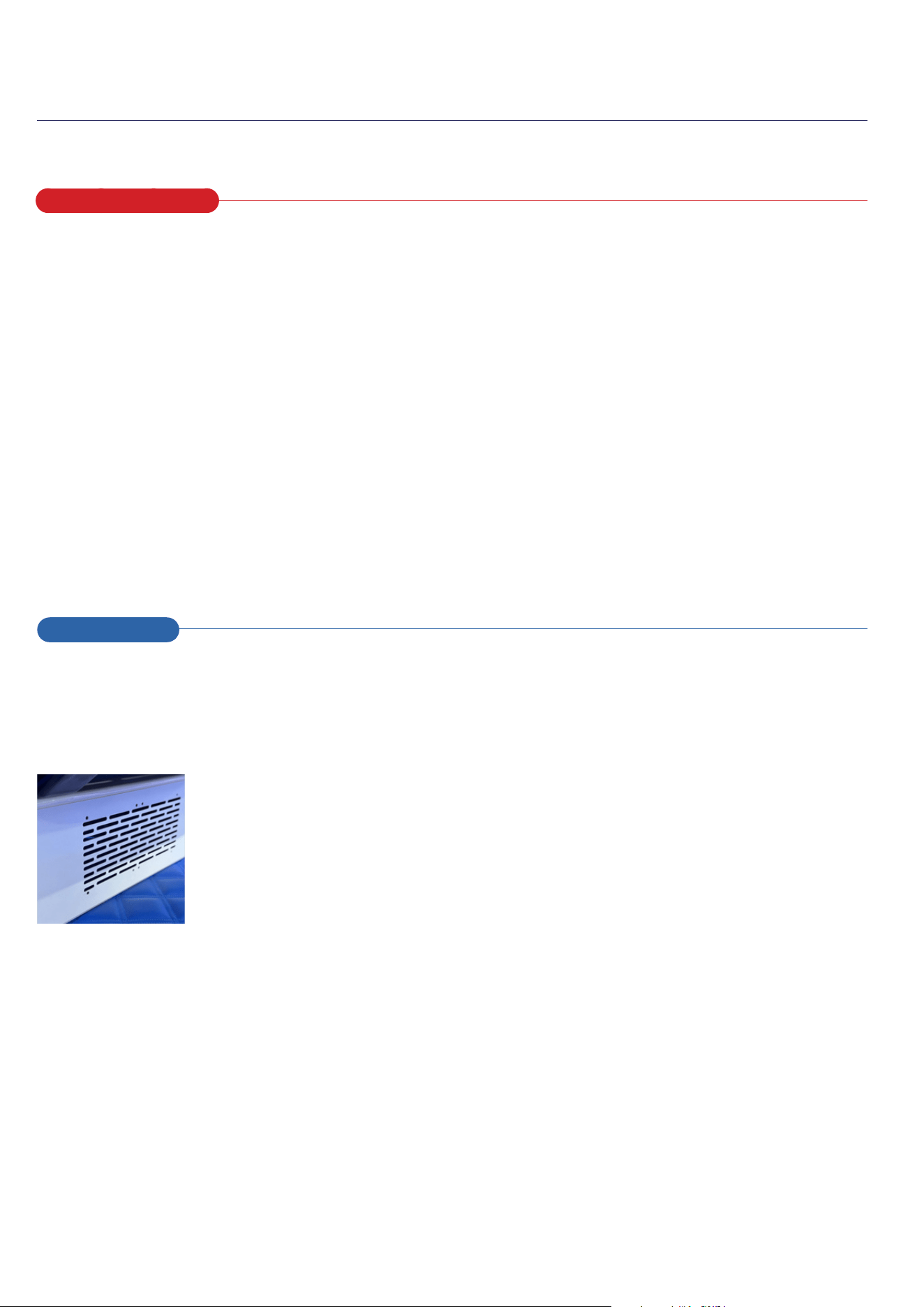
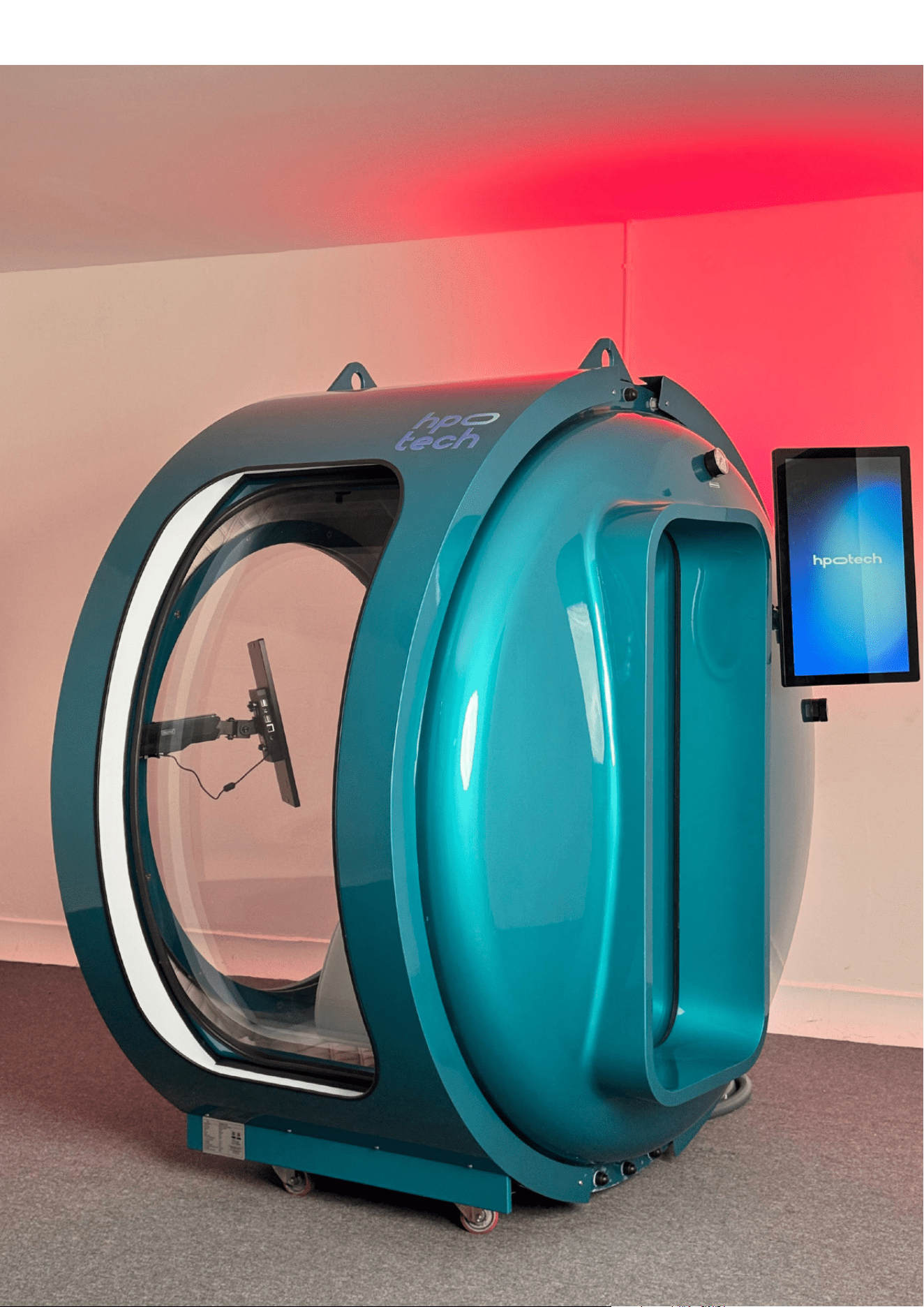
11. AIR VENT
Allows controlled airflow inside the chamber to support ventilation, temperature regulation,
or pressure stabilization without compromising safety or chamber integrity.
57
6. Device presentation → 6.2. Components description
PRODUCT REF Nº → TKBO-2X ATLANTIS Hyperbaric System
ZEUGMA Hyperbaric System
PRODUCT REF Nº → TKBO-X
58
6. Device presentation
ATLANTIS hyperbaric system
6.3. ADDITIONAL FEATURES
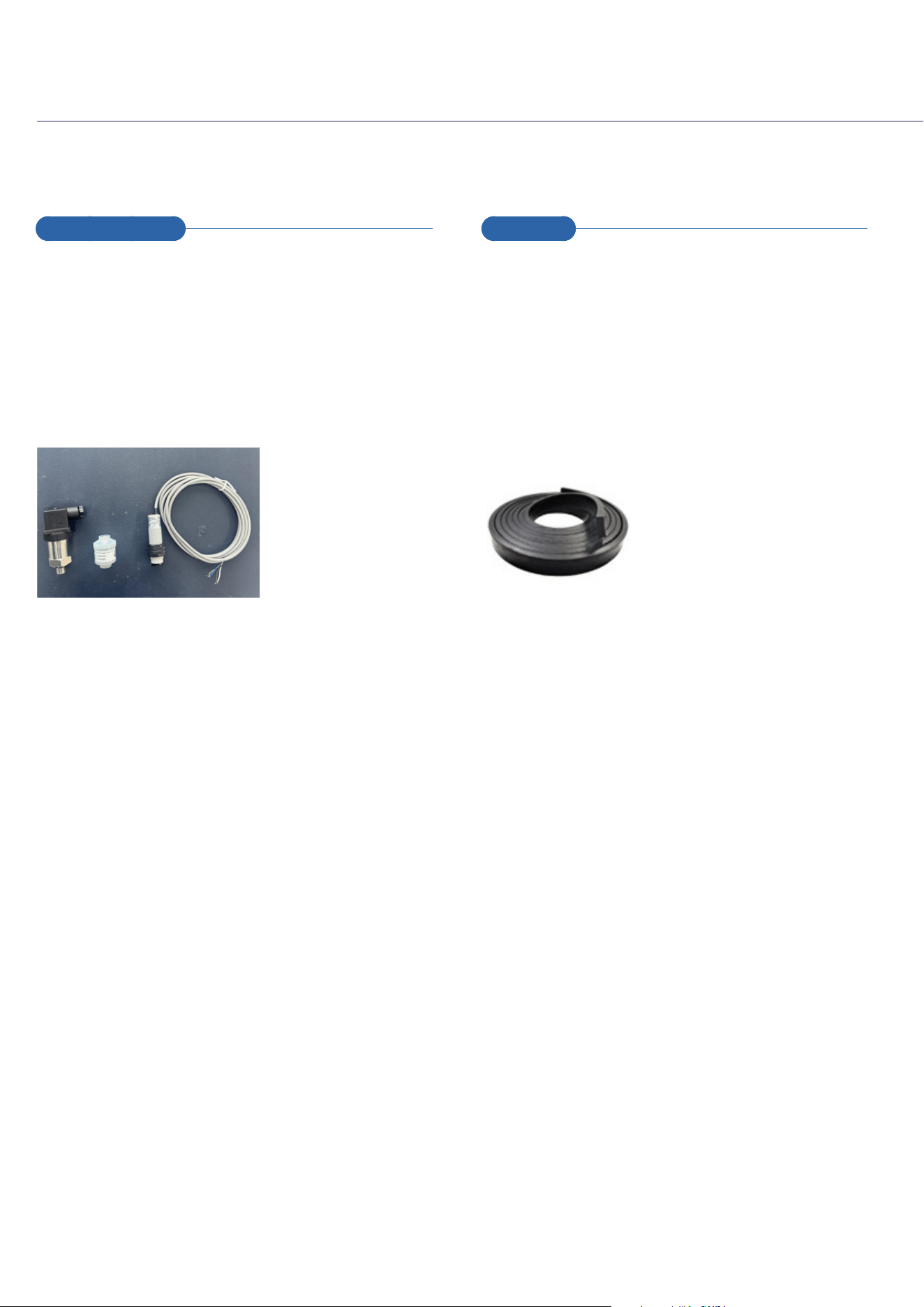
Sensor System
The hyperbaric chamber is equipped with
sensors strategically placed in both the main
and entrance compartments to monitor
critical treatment parameters.
These sensors measure and control:
Ȼ Ȼ Temperature and humidity
Ensuring optimal patient comfort and
preventing condensation.
Ȼ Ȼ Oxygen levels
Maintaining the precise oxygen concentration
required for therapy.
Ȼ Ȼ Pressure
Accurately regulating and monitoring chamber
pressure.
All sensors are CE certified to meet stringent
quality and safety standards. Regular
calibration and maintenance, as outlined
in the equipment manual, are essential for
accurate readings and system reliability. The
user institution is responsible for adhering to
this schedule to prevent potential issues.
Gaskets
Ȼ ȻSpecial gaskets are used as sealing
element in the door mechanism, feet and
panels.
Ȼ ȻDamage in the gasket causes pressure
loss. Do not crush the door seals, protect
them from any impact that will cause
deformation.
Ȼ ȻReplace deformed door gaskets as soon
as possible, even if they do not cause
pressure loss.
Ȼ ȻMake sure that the parts of the door that
press the body in the closed position are
smooth. Check these parts regularly and
clean them against rust and dirt.

59
6. Device presentation → 6.3. Additional features
PRODUCT REF Nº → TKBO-2X ATLANTIS Hyperbaric System
LED Lighting
The main compartment and the entrance
compartment are illuminated by LED
bulbs. The bulbs do not produce heat and
produce cold light. Strip lighting is designed
and manufactured to run throughout
the chamber in the main and entrance
compartments.
ZEUGMA Hyperbaric System
PRODUCT REF Nº → TKBO-X

60
7. Device presentation
ATLANTIS hyperbaric system
61
PRODUCT REF Nº → TKBO-2X ATLANTIS Hyperbaric System
7. Instructions of Use
ZEUGMA Hyperbaric System
PRODUCT REF Nº → TKBO-X
62
7. Instructions of Use
ATLANTIS hyperbaric system
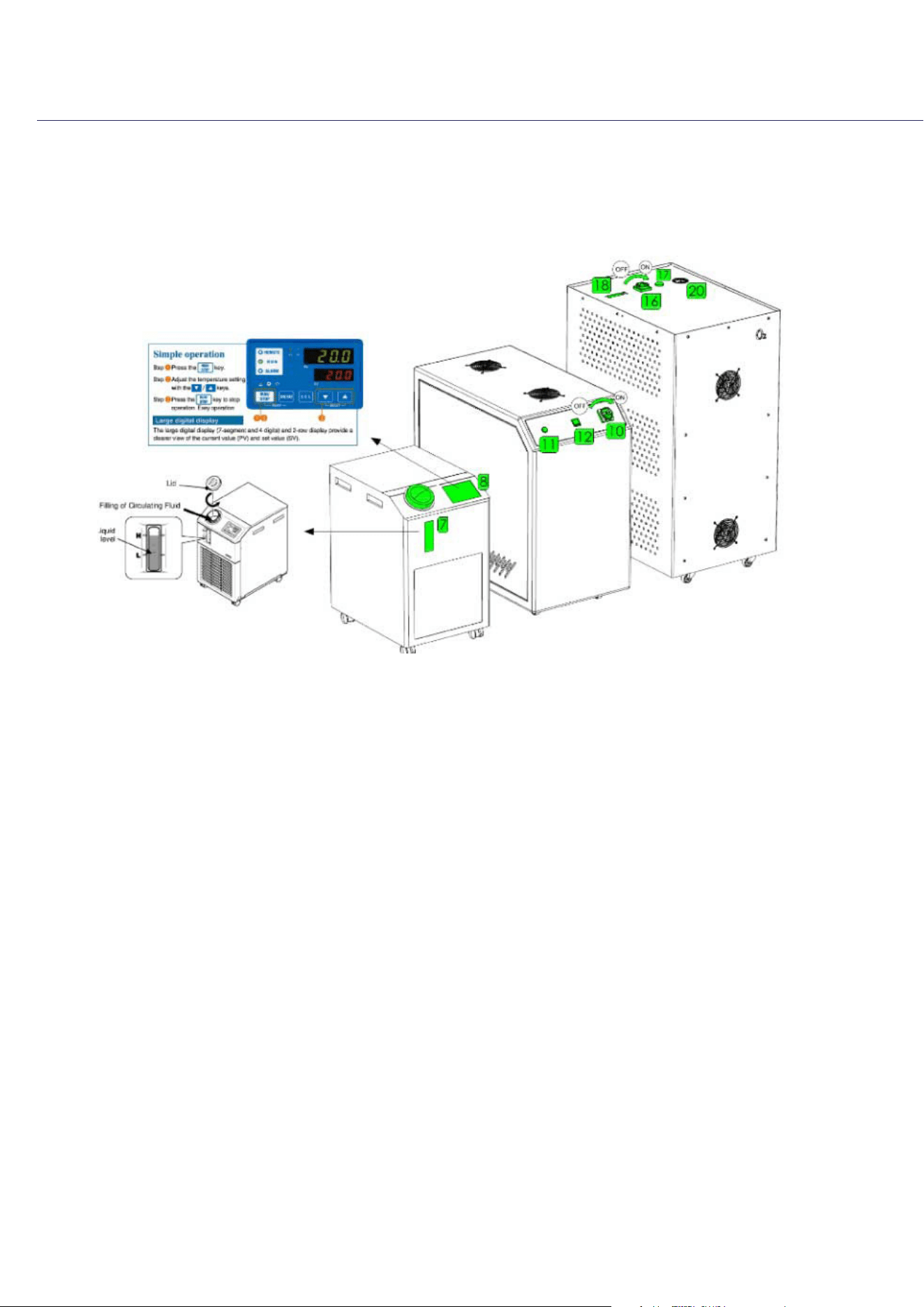
Follow this organized and numbered sequence for setting up the system.
Power Connections
1. Plug the chiller plug into the socket.
2. Plug the compressor plug into the socket.
3. Plug the first oxygen concentrator plug into the socket.
4. Plug the second oxygen concentrator plug into the socket.
5. Plug the chamber plug into the socket.
Chiller Setup
6. Press the chiller power switch to the “on” position.
7. Check the chiller water level:
Ȼ “L” indicates the lower level, and “H” indicates the upper level.
Ȼ Fill the water between “L” and “H”. Open the lid to fill, then close the lid.
8. Adjust the chiller water temperature and start the chiller by pressing the “RUN/STOP” button.

63
7. Instructions of Use
PRODUCT REF Nº → TKBO-2X ATLANTIS Hyperbaric System
Compressor Setup
9. Turn the switch on the back of the compressor to the “on” position.
10. Turn the compressor power switch to the “on” position.
11. Check if the LED light is on.
12. Adjust the compressor working pressure.
13. Monitor the compressor tank pressure.
14. Turn the drain valve to the “on” position.
15. Turn the main pressure valve to the “on” position.
First Oxygen Concentrator Setup
16. Turn the first oxygen concentrator power switch to the “on” position.
17. Check if the LED light is on.
18. Check that the information screen is working.
19. Adjust the oxygen pressure.
20. Monitor the oxygen pressure.
21. Check that the oxygen line is open.
22. Turn the main oxygen valve to the “on” position.
Chamber Power Activation
23. Turn the chamber power switch to the “on” position.
ZEUGMA Hyperbaric System
PRODUCT REF Nº → TKBO-X

64
7. Instructions of Use
ATLANTIS hyperbaric system
General operating procedures for hyperbaric chamber
To properly operate the hyperbaric chamber, follow these step-by-step procedures:
Electrical and Compressor Setup
1. Turn the red operating button on the electrical panel clockwise from the “off” to the “on” position.
2. Verify that the compressor tank pressure reads “0” (zero).
3. Press the power button on the compressor.
4. Ensure the compressor starts running.
5. Wait until the compressor tank pressure reaches 7.5 bar.
6. Confirm that the compressor automatically stops when the tank pressure reaches 7.5 bar.
7. Open the compressor valve.
Chiller Activation
8. Press the start button on the chiller.
9. Wait 10 seconds after pressing the chiller button.
10. Confirm that no fault alarms sound from the chiller.
Chamber Control Panel Operations
11. Press the start button on the chamber’s external control panel.
12. Confirm that the external control panel starts operating.
13. Verify that the internal control panel is also functioning.
Intercom and Communication Systems
14. Adjust the internal and external intercom volume.
15. Test the intercom to ensure sound is transmitted correctly from inside to outside and vice versa.
Emergency Exit Valve Check
16. Test the emergency exit valve by rotating it clockwise and counterclockwise to ensure it moves freely.
Emergency Manual Switch
17. Turn the emergency manual switch on the electrical panel clockwise from the “off” to the “on” position.

65
7. Instructions of Use
PRODUCT REF Nº → TKBO-2X ATLANTIS Hyperbaric System
Session Program Setup
18. On the chamber’s external control panel, skip to the session information page.
19. Rotate the compression and decompression activation buttons clockwise and counterclockwise to
ensure they function properly.
20. Verify valve operation via the program.
System Checks
21. Turn the chamber lighting on and off to confirm it works correctly.
22. Test the UVC sterilization by turning it on and off, ensuring proper operation.
23. Turn the chamber cooling fan on and off, confirming it functions as expected.
Acrylic Door Operations
24. Check that the acrylic door slider moves comfortably.
25. Close the acrylic door and lock it through the program, confirming it locks correctly.
26. With the acrylic door closed, unlock it through the program and confirm the door opens properly.
Internal Control Panel Operations
27. Perform the same checks on the internal control panel as on the external control panel, ensuring all
functions are working properly.
Final Checks and Session Start
28. Close the emergency exit valve by turning it clockwise.
29. Close the acrylic door.
30. Restart the program.
31. Enter session information.
32. Press the forward button to reach the main screen.
33. Set the session time.
34. Set the session pressure.
35. Set the compression and decompression rates for the session.
36. Lock the acrylic door via the program.
37. Start the session.
By following these steps, you can ensure the proper and safe operation of the hyperbaric chamber.
ZEUGMA Hyperbaric System
PRODUCT REF Nº → TKBO-X

66
7. Instructions of Use
ATLANTIS hyperbaric system
Operator chamber usage and control instructions
Pre-session preparation (30 minutes before start)
Visual inspection
1. Check for any visible damage (scratches, cracks, etc.).
2. Inspect all regulators and circuits for leaks by entering the chamber.
3. Power on the chamber and verify the operation of lighting, entertainment, and communication systems
4. Ensure there is no burning smell inside the chamber.
5. Check the emergency exit valves:
Ȼ If controlling externally, ensure internal valves are open.
Ȼ Inspect doors, hinges, and seals for any issues.
Ȼ Confirm that the camera system is functioning properly.
Ȼ Briefly pressurize the chamber and check the oxygen analyzer for leaks in the oxygen system.
Ȼ Verify that the compressor is functioning correctly.
Before and during the session
Patient entry precautions
Ȼ Ensure patients do not bring prohibited materials inside.
Ȼ Check that patient clothing does not generate static electricity.
Ȼ Confirm that water pad covers are open.
Ȼ Advise female patients to avoid using flammable makeup products.
Ventilation requirements
Ȼ Ventilate the chamber for at least 2 minutes every 30 minutes, regardless of the oxygen level.
Ȼ If oxygen levels exceed 23%, continue ventilation until it is reduced below this threshold.
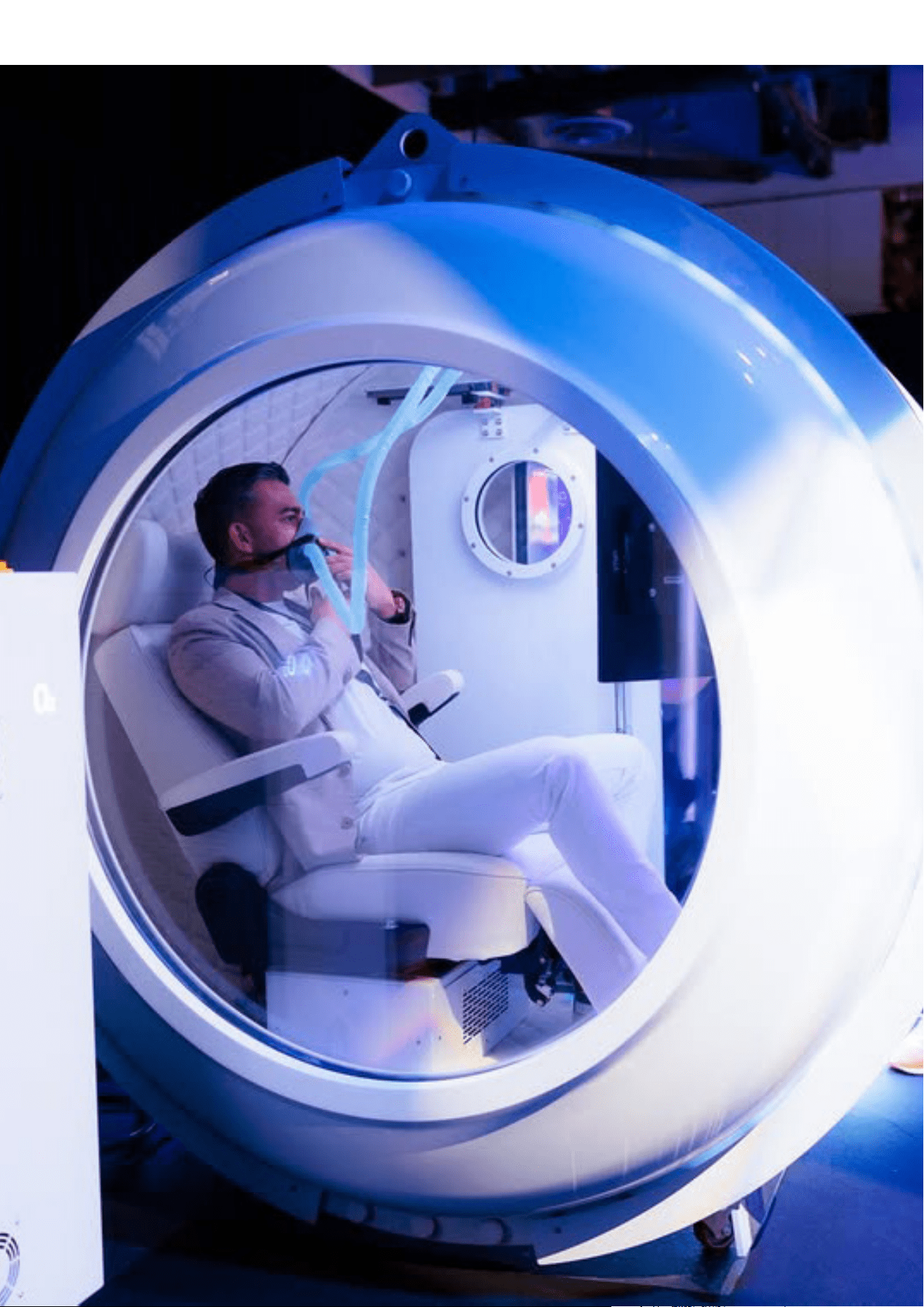
67
7. Instructions of Use
PRODUCT REF Nº → TKBO-2X ATLANTIS Hyperbaric System
ZEUGMA Hyperbaric System
PRODUCT REF Nº → TKBO-X

68
8. Instructions of Use
ATLANTIS hyperbaric system
69
8. Emergency scenarios
PRODUCT REF Nº → TKBO-2X ATLANTIS Hyperbaric System
8. Emergency scenarios
This section outlines the procedures to follow in various emergency situations
related to the operation of the ZEUGMA Hyperbaric System.
Power cut
ZEUGMA Hyperbaric System
PRODUCT REF Nº → TKBO-X

70
8. Emergency scenarios
ATLANTIS hyperbaric system
Steps to take in the event of a power outage:
Ȼ Inform the patients immediately.
Ȼ Check the tank pressure if a new session is required.
Ȼ Verify the charge level of the UPS batteries.
Ȼ Ventilate the room by releasing the air.
Ȼ Safely remove the patients from the chamber.
Loss of communication
Steps to follow if communication is lost:
Ȼ Do not operate the chamber without a functioning communication system.
Ȼ If communication fails during treatment, stop the system.
Ȼ Contact technical support for assistance.
Fire in the room
In case of a fire in the chamber room:
Ȼ Extinguish the fire using a fire extinguisher.
Ȼ Open the chamber doors immediately.
Ȼ Safely remove the patients from the chamber.
Oxygen supply system malfunction
Actions to take when the oxygen supply system malfunctions:
Ȼ Close all main oxygen supply valves.
Ȼ Release the room pressure to a safe level.
Ȼ Safely remove the patients from the chamber.
Ȼ Contact technical support for repair.
Inability to maintain appropriate temperature
If the chamber fails to maintain the proper temperature:
Ȼ Check if the air conditioning system is operational.
Ȼ Review the error message on the air conditioning system, if applicable.
Ȼ Monitor the room pressure.
Ȼ Verify the reading on the temperature meter.
Ȼ Release the room pressure safely.
Ȼ Safely remove the patients from the chamber.
Ȼ Contact technical support for further assistance.
Emergency procedure: Power failure while inside the chamber

71
8. Emergency scenarios
PRODUCT REF Nº → TKBO-2X ATLANTIS Hyperbaric System
In the unlikely event of a power failure during treatment, please follow these steps
to ensure your safety:
1. Stay calm
Power failures are manageable. Your safety is our highest
priority, and our staff are trained to respond immediately.
2. Remain seated
Do not attempt to exit the chamber on your own. Please
remain seated and await assistance from trained
personnel.
3. Continue using oxygen mask
If you are wearing an oxygen mask, keep it on. In most
cases, the oxygen supply will continue briefly even
after a power loss.
4. Attempt communication
If the intercom is non-functional, gently knock on the
chamber wall to alert staff to your presence and status.
5. Loss of lighting
Lighting and display screens may turn off. If the chamber
is equipped with emergency lighting, it will activate
automatically. If not, remain still and calm until help
arrives.
6. Safe pressure release
A trained technician will manually and gradually
depressurize the chamber. This process is controlled
and may take several minutes. Once depressurization
is complete, the chamber door will be opened manually.
7. Do not panic
Emergency protocols are in place and your safety is
ensured. Follow any verbal instructions provided by staff.
If written instructions are passed into the chamber,
read and follow them carefully.
ZEUGMA Hyperbaric System
PRODUCT REF Nº → TKBO-X

72
8. Emergency scenarios
ATLANTIS hyperbaric system
BIBS (Built-in Breathing System) dysfunction
Steps to take in case of BIBS dysfunction:
Ȼ Remove the BIBS masks and heads.
Ȼ Inspect the system to ensure that all equipment is functioning properly and free of dirt or
obstructions.
Ȼ Close the main oxygen valve.
Ȼ Release the room pressure.
Ȼ Safely remove the patients.
Ȼ Contact technical support.
Loss of gas supply
If gas supply is lost during operation:
Ȼ Close all gas supply valves.
Ȼ Safely release the room pressure.
Ȼ Remove the patients from the chamber.
Ȼ Contact technical support for assistance.
By following these emergency procedures, you can help ensure the safety of both the patients and the equipment.
Always prioritize communication with technical support to address any issues.
User Service Program
A comprehensive service program is available to all users of the ATLANTIS Hyperbaric System manufactured by HPO
TECH. For information regarding annual service contracts, please get in touch with the office:
HPOTECH MEDİKAL VE TEKNİK ÇÖZÜMLER SAN VE TİC A.Ş
Ȼ Telephone: +90 543 931 54 54
Ȼ Telephone: +90 506 118 94 05
Ȼ Address: Ataşehir Ferhatpaşa, 49. Sk. No: 29, 34888 Ataşehir, İstanbul, Turkey
Ȼ www.hpotech.com
73
8. Emergency scenarios
PRODUCT REF Nº → TKBO-2X ATLANTIS Hyperbaric System
ZEUGMA Hyperbaric System
PRODUCT REF Nº → TKBO-X

74
8. Emergency scenarios
ATLANTIS hyperbaric system
75
8. Warranty Terms and Conditions
PRODUCT REF Nº → TKBO-2X ATLANTIS Hyperbaric System
9. Warranty Terms and Conditions
ZEUGMA Hyperbaric System
PRODUCT REF Nº → TKBO-X

76
9. Warranty Terms and Conditions
ATLANTIS hyperbaric system
1. The warranty period begins on the date of delivery and is valid for 2 years.
2. All components of the product are covered under warranty, except for issues resulting from user errors.
3. Parts requiring replacement or calibration as part of routine maintenance are not covered under the
warranty.
4. The warranty will become void if periodic maintenance tasks, as specified by HpoTech, are performed by
unauthorized individuals or companies.
5. The maximum repair period is 30 working days, starting from the date the defect is reported to the
manufacturer within the warranty period. If the product experiences a failure during the warranty period,
the repair time will be added to the remaining warranty duration.
6. Any malfunctions caused by improper use of the product, contrary to the instructions provided in the
user manual, are not covered under the warranty.
7. In case of disputes regarding warranty-related rights, the consumer may seek resolution through the
Consumer Arbitration Committee or the Consumer Court in their place of residence or transaction.
Important Notes
The following maintenance tasks are the sole responsibility of the user and are not covered under warranty:
1. Calibration of components requiring periodic calibration.
2. Routine replacement of oxygen sensors.
3. Periodic weather analysis reports.
4. Compressor maintenance and filter replacements.
If requested, HpoTech provides spare parts and periodic maintenance services for an additional fee.
Pressure Vessel Lifecycle
Ȼ After undergoing a pressure vessel test, the chamber is certified for a 10-year operational lifespan by
an Approved Organization.
Ȼ Upon completion of 10 years, the chamber must undergo a hydrostatic test. If it passes, the metal
wear rate is assessed, and a new operational lifespan is determined.
Ȼ If the chamber fails the test, it must be disposed of in accordance with the regulations of the
respective country.
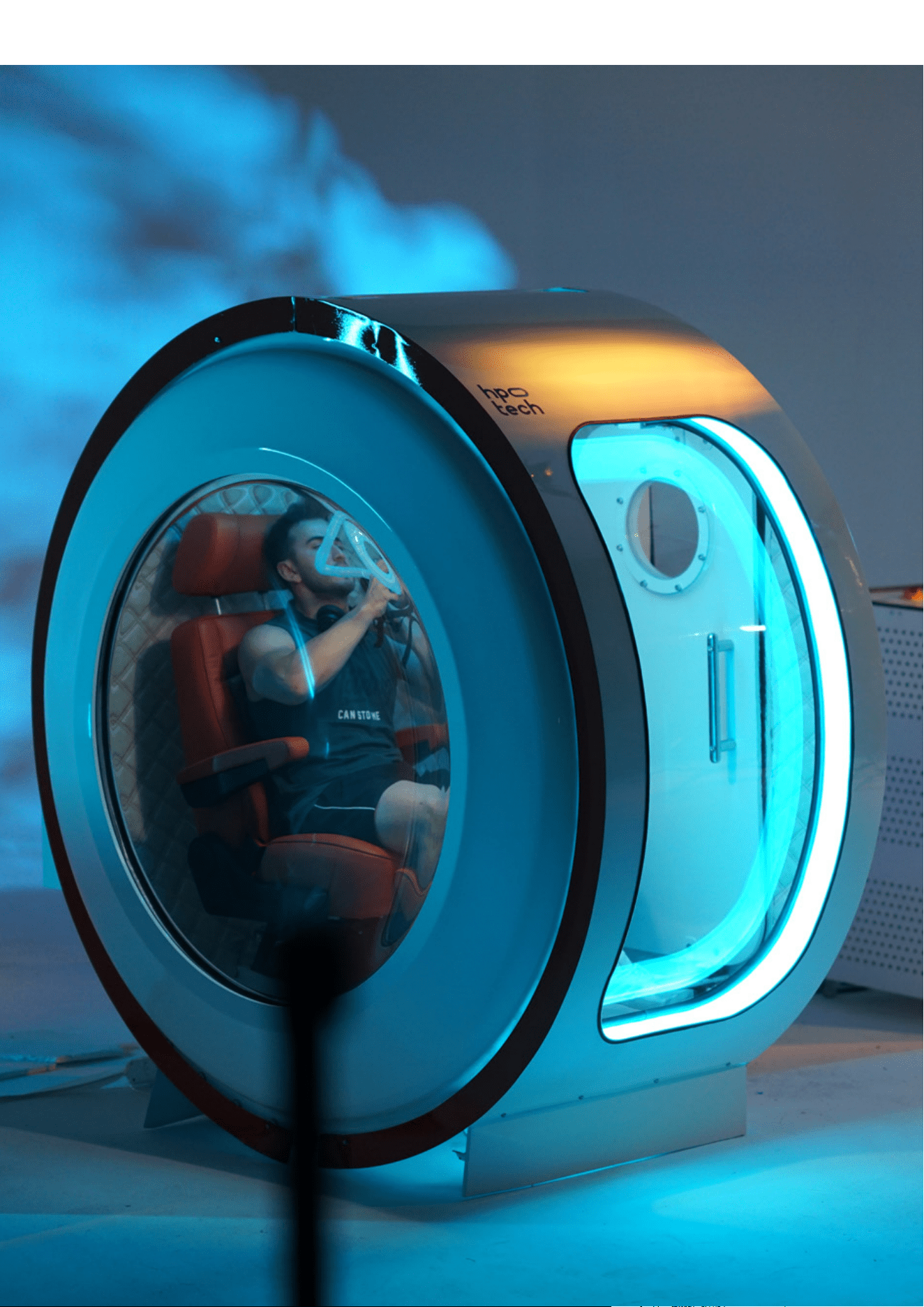
77
PRODUCT REF Nº → TKBO-2X ATLANTIS Hyperbaric System
ZEUGMA Hyperbaric System
PRODUCT REF Nº → TKBO-X

78
9. Warranty Terms and Conditions → 9.1. Certifications
ATLANTIS hyperbaric system
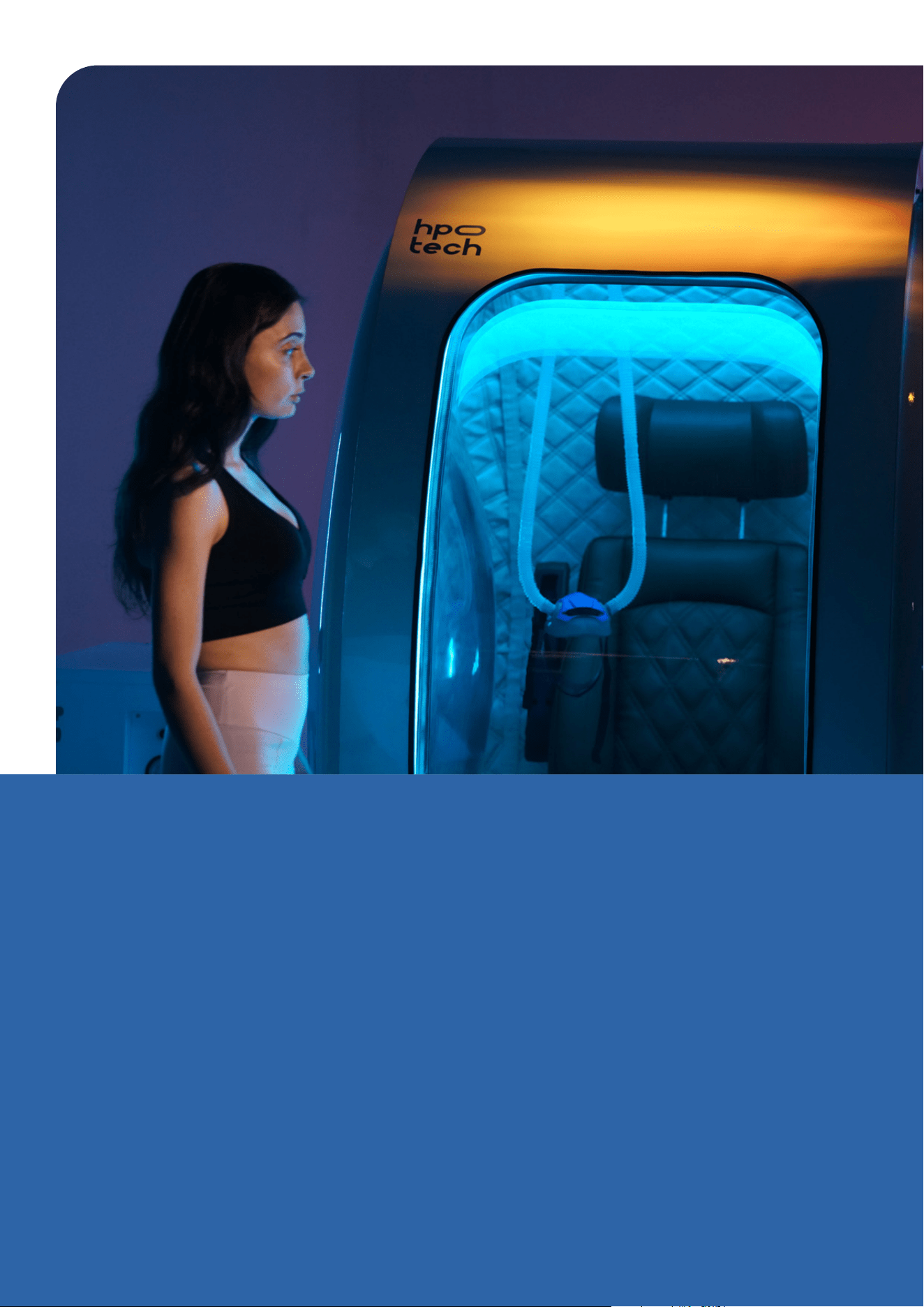
79
9. Certifications → 9.1. Certifications
PRODUCT REF Nº → TKBO-2X ATLANTIS Hyperbaric System
10. Certifications
ZEUGMA Hyperbaric System
PRODUCT REF Nº → TKBO-X

80
10. Certifications
ATLANTIS hyperbaric system
HpoTech hyperbaric chambers comply with a wide range of international regulatory
standards to ensure safety, quality, and operational excellence. These certifications
are categorized based on their focus, covering medical device compliance, pressure
vessel safety, product and occupational safety, quality management, and regional
market approvals.
1. Medical Device Regulations
93/42/EEC → Medical Devices Directive
(MDD)
This European Union directive ensures that HpoTech
hyperbaric chambers meet essential safety and
performance requirements for medical devices.
Compliance with MDD guarantees that the chambers are
suitable for therapeutic use within healthcare settings.
Medical Devices Directive (MDR)
In process of certification
HpoTech is transitioning from the MDD (Medical Devices
Directive) certification with the notified body UBED to the
new MDR (Medical Device Regulation) framework with the
notified body ICIM. A letter of continuance from ICIM,
along with a contract outlining the transition process,
ensures regulatory compliance during the certification
shift. This transition reflects HpoTech’s commitment to
aligning with the latest EU medical device regulations
for enhanced safety and performance standards.
MDA Malaysia → Medical Device Authority
(MDA)
Regulates the approval and distribution of medical
devices in Malaysia, ensuring that HpoTech chambers
comply with local regulatory requirements and healthcare
safety standards.
UKCA → UK Conformity Assessed
Applicable to the UK market, this certification confirms
that HpoTech chambers meet post-Brexit regulatory
requirements for medical devices, ensuring compliance
with safety, performance, and environmental protection
standards.
Medsafe → New Zealand
New Zealand’s medical device regulatory body ensures
that HpoTech chambers meet national healthcare
standards for safety and effectiveness.
Thai FDA → Thailand
The Thai FDA ensures our hyperbaric chambers meet
strict safety and performance standards before they can
be legally sold. Approval signifies regulatory compliance,
allowing distribution in Thailand.

81
10. Certifications
PRODUCT REF Nº → TKBO-2X ATLANTIS Hyperbaric System
2. Pressure Vessel and
Safety Regulations
ASME PVHO → Pressure Vessels
for Human Occupancy
This American Society of Mechanical Engineers (ASME)
standard ensures that HpoTech hyperbaric chambers
are designed and built to safely accommodate human
occupants under pressurized conditions, reducing risks
associated with high-pressure environments.
PED → Pressure Equipment Directive
A European standard that regulates the design,
manufacturing, and testing of pressurized equipment,
ensuring HpoTech chambers can safely handle the
pressures required for hyperbaric therapy.
Turk Lloydu → Hydrostatic Testing and
Conformity Assessment
Turk Lloydu provides certification for pressure testing
and structural integrity of hyperbaric chambers, verifying
their safety and compliance with international hydrostatic
standards.
3. Product and Occupational
Safety Standards
2006/42/EC → Machinery Directive
This directive ensures the mechanical safety of HpoTech
chambers, covering aspects such as moving parts,
emergency stops, and user interfaces to protect operators
and patients from mechanical hazards.
01/95/EC → General Product
Safety Directive
Applicable to all products in the EU, this directive
ensures that HpoTech chambers meet general safety
requirements, providing end-users with reliable and
hazard-free equipment.
NFPA → National Fire
Protection Association
Establishes fire safety guidelines for hyperbaric chambers,
ensuring compliance with strict fire prevention and
suppression standards within medical environments.
ANEP 26 → Ergonomic Military Standards
Specifies ergonomic requirements for military
applications, ensuring that HpoTech chambers meet
human factors and usability standards for defense-
related deployments.
ZEUGMA Hyperbaric System
PRODUCT REF Nº → TKBO-X

82
10. Certifications
ATLANTIS hyperbaric system
4. Quality and Management Systems
Certifications
ISO 13485 → Medical Devices Quality
Management System
This certification confirms that HpoTech adheres to
internationally recognized standards for medical device
manufacturing, ensuring quality control throughout the
product lifecycle.
ISO 9001 → Quality Management System
Demonstrates HpoTech’s commitment to consistent
product quality and customer satisfaction through
rigorous quality control processes and continuous
improvement initiatives.
ISO 45001 → Occupational Health and
Safety Management System
Ensures that HpoTech chambers are manufactured
under a management system that prioritizes employee
safety and health in the workplace.
ISO 14001 → Environmental
Management System
Confirms that HpoTech follows environmental best
practices in its manufacturing processes, reducing
ecological impact and ensuring sustainability.
ISO 27001 → Information Security
Management System
Ensures that HpoTech protects sensitive patient and
operational data through strict information security
management protocols.
This comprehensive certification framework ensures that HpoTech hyperbaric chambers meet the highest standards
of safety, quality, and compliance, providing healthcare providers and patients with confidence in their therapeuticuse
worldwide.
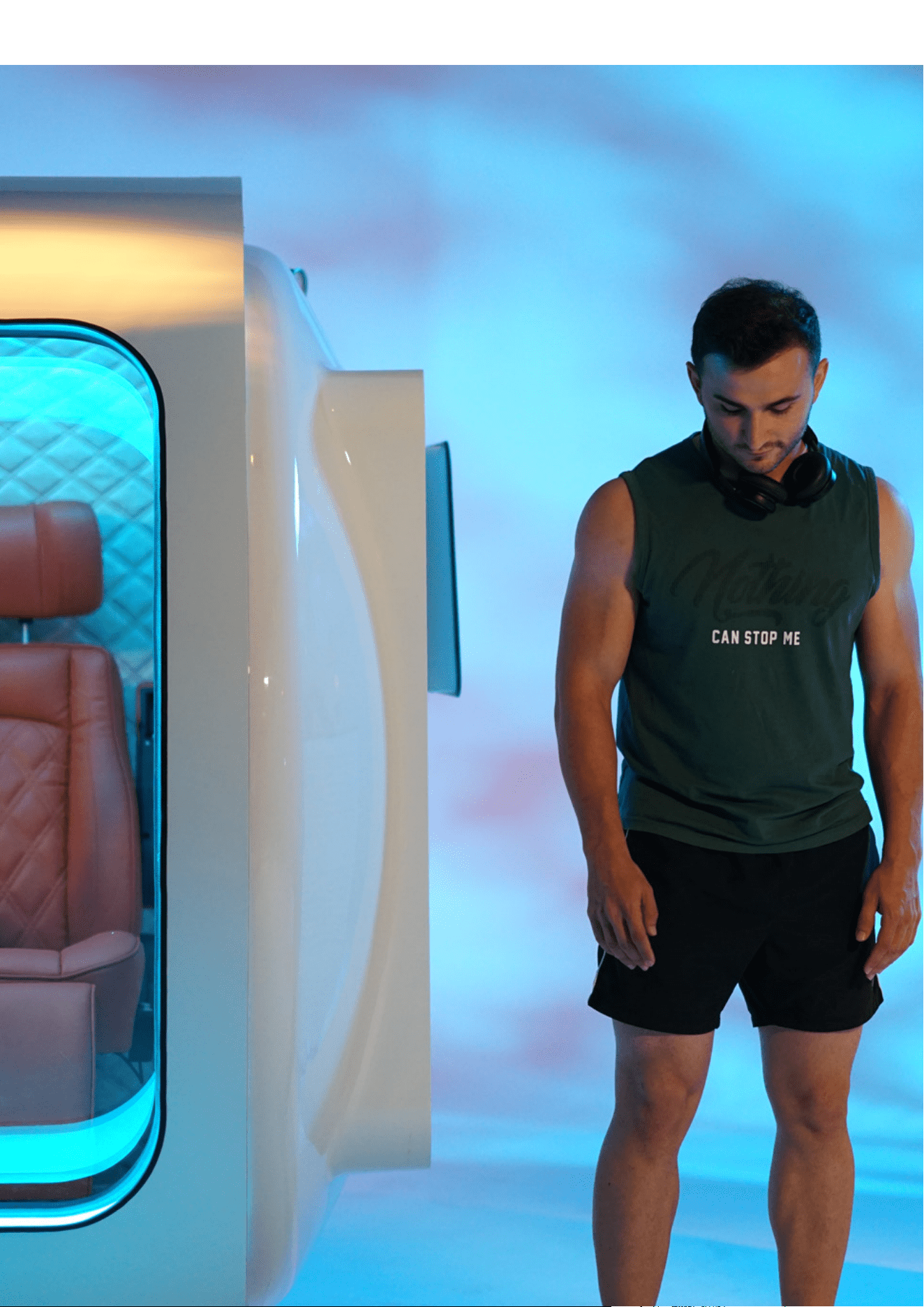
83
6. Certifications
PRODUCT REF Nº → TKBO-2X ATLANTIS Hyperbaric System
ZEUGMA Hyperbaric System
PRODUCT REF Nº → TKBO-X

84
6. Certifications
ATLANTIS hyperbaric system
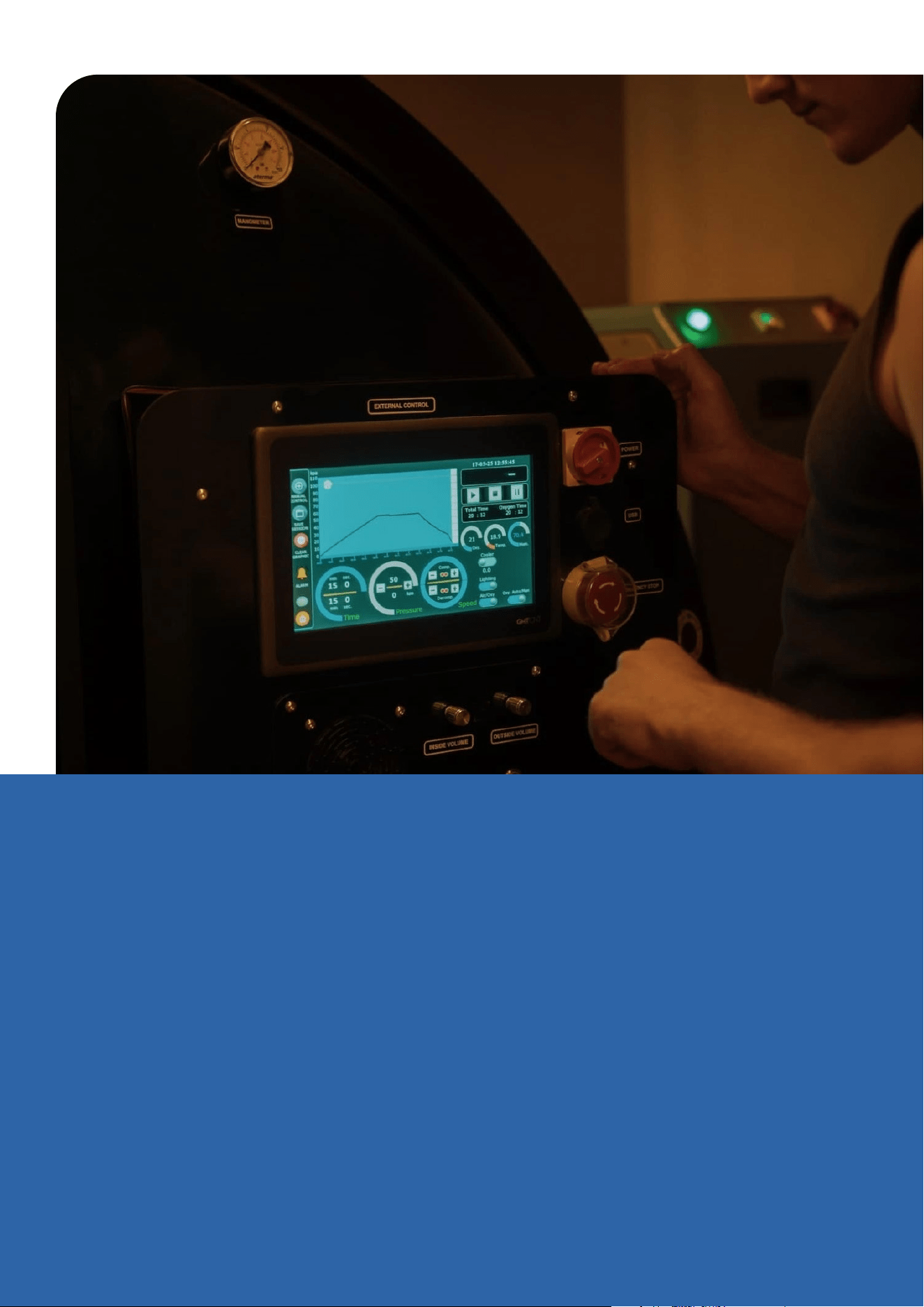
85
7. Software control
PRODUCT REF Nº → TKBO-2X ATLANTIS Hyperbaric System
11. Software control
ZEUGMA Hyperbaric System
PRODUCT REF Nº → TKBO-X

86
11. Software control
ATLANTIS hyperbaric system
Pressure chamber control software and intercom system
The dedicated software allows the user to control the pressure chamber in both manual
and automatic modes, manage communication with the patient inside, and halt the
session to safely evacuate the chamber in an emergency.
Key software functions include:
Ȼ Controlling compression and decompression speeds
Ȼ Operating and stopping the in-cab cooler
Ȼ Monitoring chamber pressure
Ȼ Adjusting session duration and pressure levels
Ȼ Starting, stopping, and completing sessions
Ȼ Locking the chamber door
HPOSOFT Automation System
Ȼ The automation system is designed for
controlling the chamber and managing
sessions automatically.
Ȼ It includes automation software, an
industrial PLC, sensors, valves, and a PC,
with the PLC serving as the system’s core
unit. The software runs on both the PLC
and PC, but all operations are controlled
exclusively through the PC. Once powered
on, the PLC automatically initiates its
software.
Ȼ All connected devices, such as sensors and
valves, are monitored and controlled via
HPOSOFT. The specific devices monitored
depend on customer configurations and may
include temperature, oxygen level, pressure
level, and humidity within the chamber.
Ȼ Only authorized operators or technicians
should access the automation system.
Ȼ The Automation PC is dedicated solely to
chamber control and session management.
For safety reasons, it should not be used for
any other purposes.
Ȼ System settings on the PC are crucial to
automation software functionality, and
modifying these settings may disrupt
operations.
Ȼ Program files must remain in their
designated folders, as relocating or deleting
them may prevent the software from
running properly.
Ȼ Session and patient records should be
backed up regularly, either weekly or
monthly, based on customer needs.
Ȼ Automation valves used for automatic
session control are electrically managed by
the PC and PLC. These valves are distinct
from manual and emergency valves. If any
valve is inactive, the automatic session
will not start, ensuring safe and secure
operation.
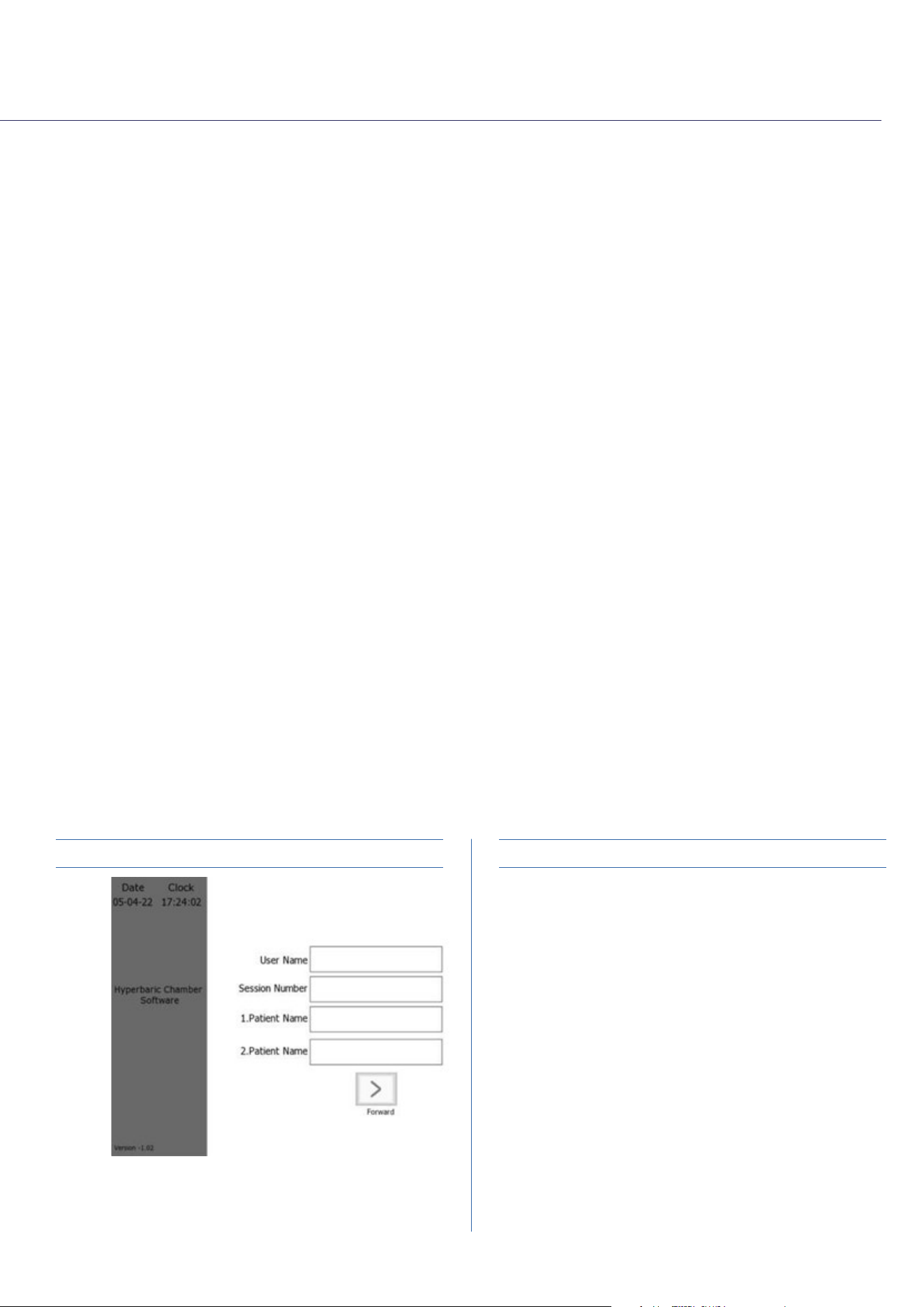
87
11. Software control
PRODUCT REF Nº → TKBO-2X ATLANTIS Hyperbaric System
Basic functions of the Automation System
Ȼ Automatic Session Control based on speed, pressure, and time settings.
Ȼ New Profile Entry for custom session profiles.
Ȼ Ventilation of the chamber during automated sessions.
Ȼ I/O Calibration and Additional Functions for system optimization.
Ȼ Logging, Reviewing, and Printing Tools to manage the session database.
Ȼ Entering Session and Patient Information for accurate records.
Ȼ Session Initialization for automation software.
Ȼ Valve Control with Dimmer for precise adjustments.
Ȼ Lighting On/Off control.
Ȼ UVC Sterilization On/Off management.
Ȼ Radiator On/Off control for temperature adjustments.
Ȼ Ear Equalization to maintain comfort during pressure changes.
Ȼ Session Recording to log details of each session.
Critical functions
Ȼ Automatic Compression and Decompression of the chamber.
Ȼ Monitoring of temperature, humidity, pressure, and oxygen levels.
Ȼ Audio/Visual Alerts for operator notifications in specific situations.
Ȼ Audible Warning and Safety Button for immediate operator attention.
Ȼ Valve and Compression/Decompression Rate Control to maintain safe operation.
User session entry screen
►
Starting an HPOSOFT User Session
1. Press the On/Off button on the panel to
activate the system. The Tablet PC screen
will open.
2. The session opening screen will display
upon system startup, where the operator
can enter the Username, Patient Name,
and Session Number.
3. The Session Number indicates which
session the patient is entering. Once all
information is entered, press Enter to
proceed to the next screen.
ZEUGMA Hyperbaric System
PRODUCT REF Nº → TKBO-X
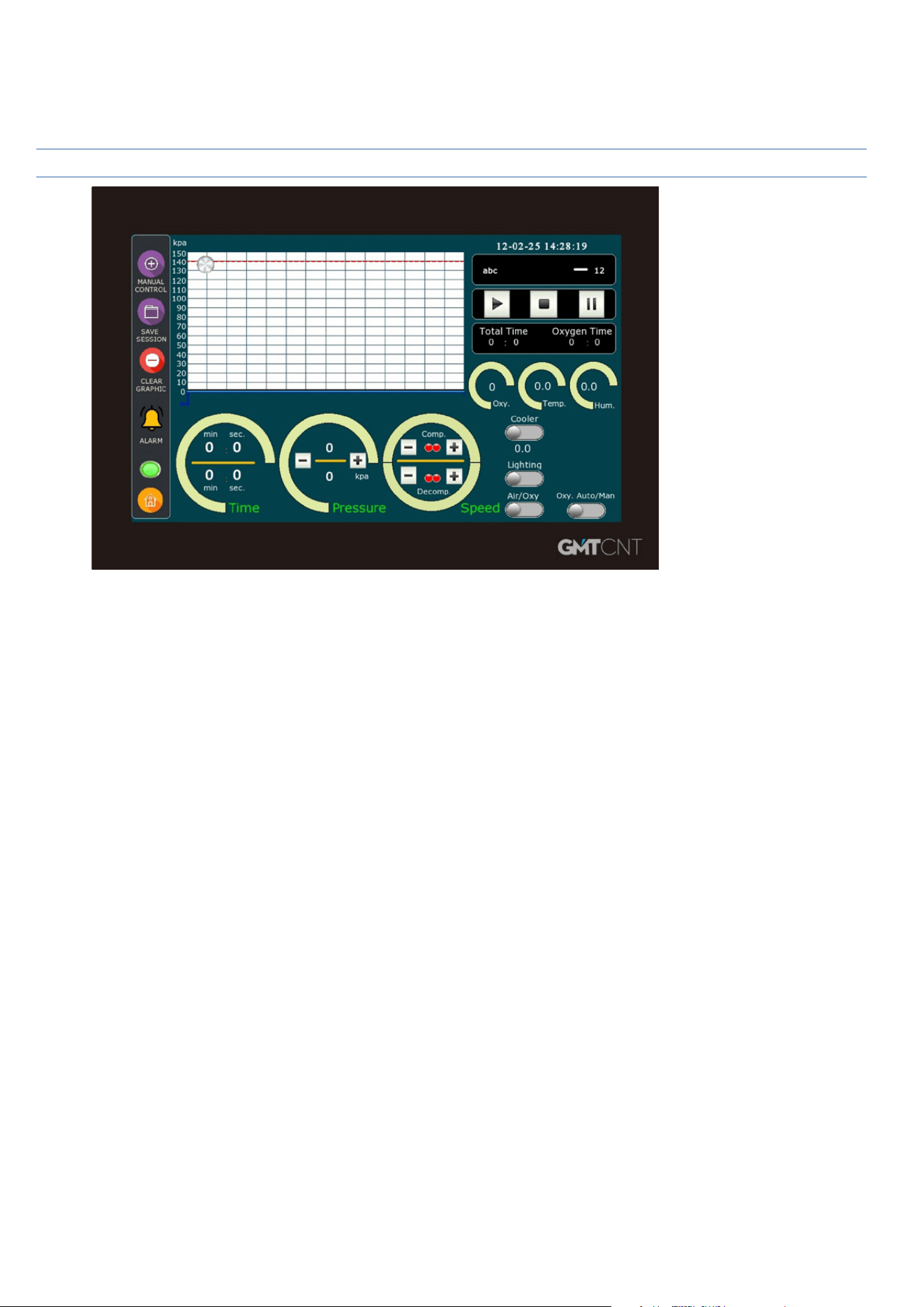
88
11. Software control
ATLANTIS hyperbaric system
HPOSOFT Home screen overview
►
The HPOSOFT home screen is divided into six main areas, providing comprehensive control and monitoring capabilities.
Key functions accessible from this screen include:
Ȼ Session controls
Start, end, and stop session functions.
Ȼ Door locking
Secure the chamber door during sessions.
Ȼ Switching to Manual Control
Toggle between automated and manual modes.
Ȼ Screen recording and graphic cleaning
Capture and manage session data visuals.
Ȼ Internal control authorization
Grant or restrict internal control access.
Ȼ Session adjustments
Configure session time, pressure, and
compression/decompression speeds.
Ȼ Environmental controls
Toggle UVC sterilization, lighting, and radiator
functions.
Ȼ Oxygen monitoring
Track and display oxygen levels in the chamber.
Ȼ Display timers
View total session time and current session
duration.
Ȼ Live pressure graphs
Monitor real-time pressure and time graphs for
session progress.
Step-by-step instructions for each session are clearly displayed on this screen, guiding the operator through the
session process.

89
11. Software control
PRODUCT REF Nº → TKBO-2X ATLANTIS Hyperbaric System
►
To set the session time, press the “Time” label inside
the ring. A keyboard will appear for input, allowing you
to enter a time value between the minimum of 1 minute
and the maximum of 150 minutes. The entered value
is in minutes.
The session time begins when the chamber reaches
the set pressure value. Once the session is stopped, the
session time will automatically pause or stop as well.
Entry of session properties
►
This is the first section to be configured when the main screen is opened. It allows the operator to set the key
parameters for the session, including:
Ȼ Session Duration
Adjust the total length of the session.
Ȼ Session Pressure
Set the desired pressure level for the session.
Ȼ Session Time Adjustment
Fine-tune the timing of the session to ensure optimal performance.
These parameters are essential for defining the session’s conditions and ensuring the safety and comfort
of the patient.
►
To adjust the session operating pressure, press the
and buttons. A keyboard will appear, allowing you to
enter a pressure value between the minimum of 0 kPa
and the maximum of 100 kPa. The entered value is in
kPa (kilopascals).
For reference, 10 kPa is equivalent to the pressure at
a depth of 1 meter underwater.
ZEUGMA Hyperbaric System
PRODUCT REF Nº → TKBO-X
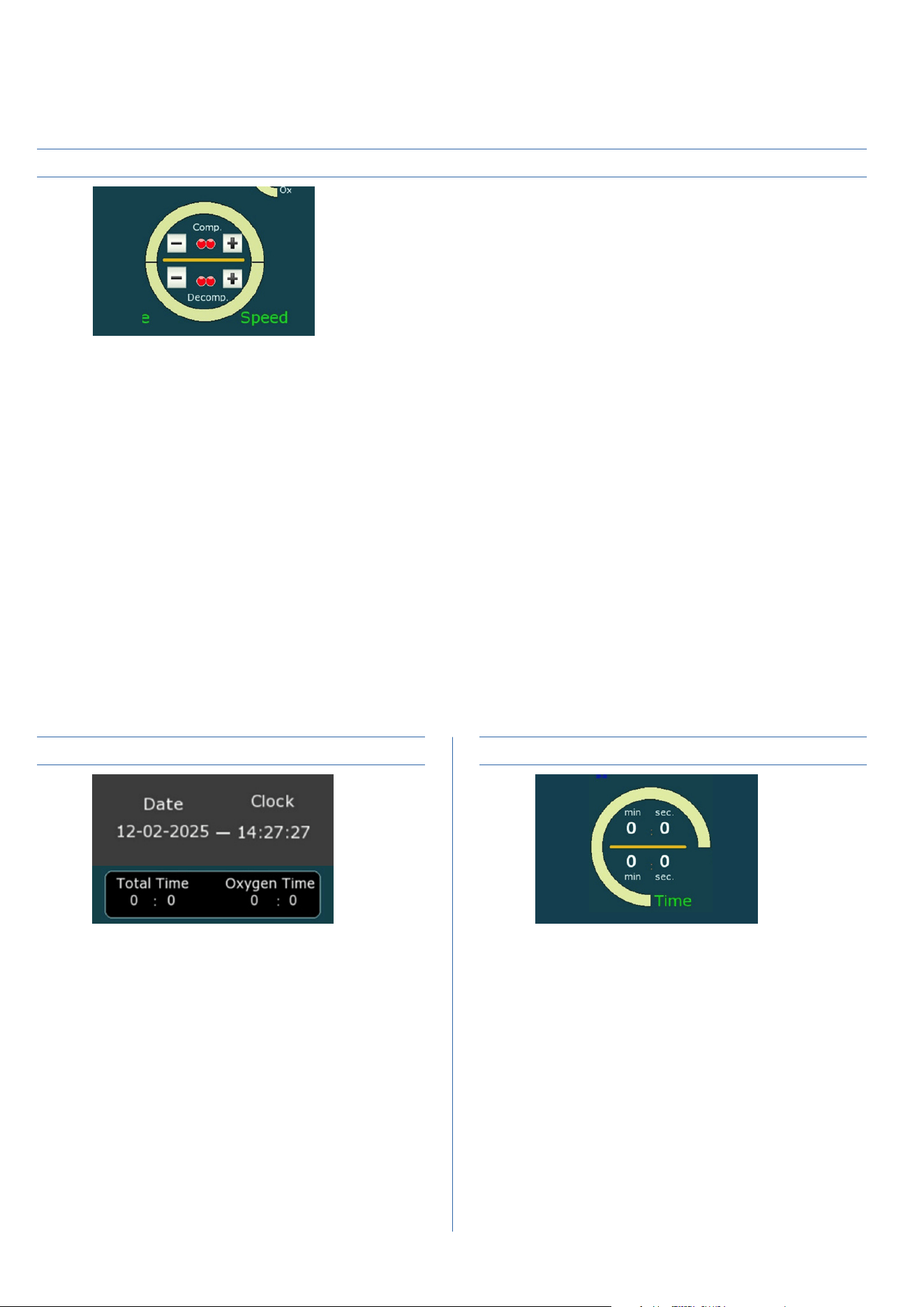
90
11. Software control
ATLANTIS hyperbaric system
Session information
►
Session information is instantly taken from the relevant
sensors and displayed in this section. Pressure, oxygen,
temperature, and humidity values transmit information
from sensors. Temperature and humidity indicator are
shown in the same section. 5 sec temperature, 5 sec
humidity value are displayed. Session time and total
time are also calculated by the PC program.
The total time is the time from the start of the session
to the end of the session. Session time is the time that
shows how long the session will remain at the set pressure.
Session time can be adjusted on the screen. Total time
may vary depending on factors such as compression,
decompression, and pauses.
Entry of session properties
►
Session compression and decompression rates are adjusted on the side screen. Compression speed is adjusted
from the left part and decompression speed is adjusted from the right part.
Ȼ There are + and - icon on both sides.
Ȼ The + increases the pressure value, while
the - decreases it.
Ȼ These values can be adjusted at the
beginning of the session or changed
during the session.
Ȼ There are 2 red circles on the right side
of the screen and 2 red circles on the left
side.
Ȼ These show the status of the valves
that regulate the compression and
decompression rate. Red colors turn
green when valves are open.
Ȼ These red and green circles are placed
for technical service control. They do not
need to be considered during use.
Session status management
►
To set the session time, the “Time” letter written inside
the ring is pressed and the minimum value of 1, maximum
150 is entered from the keyboard that appears for the
time setting. The entered value is in minutes.
The session time starts when the chamber reaches
the set pressure value. When the session is stopped,
the session time also stops.
Press the + & - to adjust the session operating pressure
and enter the minimum 0, maximum 100 value from the
keyboard that appears for the pressure setting. The
entered value is in kpa. 10 kpa is equal to the pressure
of 1-meter-deep water.
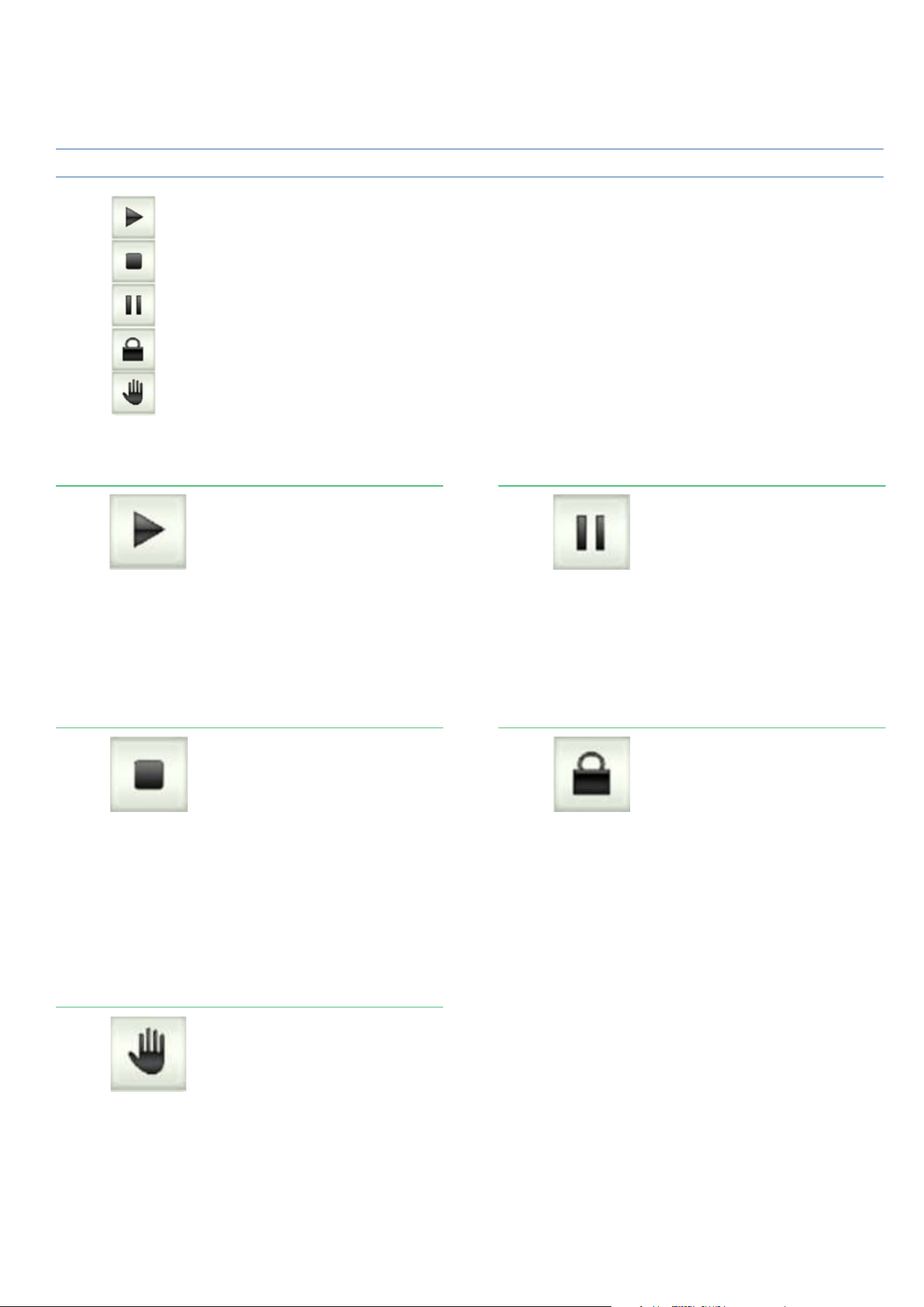
91
11. Software control
PRODUCT REF Nº → TKBO-2X ATLANTIS Hyperbaric System
Session status management
►
This control menu is used after the session time, pressure, compression, and decompression
rates are entered into the program. At the top of the menu is the date and time. The date and
time can be changed in the settings menu.
There is session start, session stop, session end and door lock buttons, respectively, under
the time and date information.
From the functions in this menu, other functions other than session start can be retrieved.
But there is no return when the session start button is pressed.
During the session, the session time, pressure, and speed can be changed by stopping the
session or while the session is continuing.
►
Ȼ Session Start button
The session should be started after the door
is locked. When the session start button is
pressed, the session starts.
►
Ȼ Session End button
When the session end button is pressed,
the pressure of the pressure chamber
decreases at the set decompression rate.
When the Chamber pressure drops to 10
kPa, the manual outlet valve should also be
opened for faster chamber emptying.
►
Ȼ The side button puts the system in
manual control mode.
Manual control is controlled on a screen
other than the main screen. When switching
to the manual control screen, the system
does not stop. When the activation button
on the manual control screen is pressed, the
system switches to manual control.
►
Ȼ Session Pause button
It is used to stop the session after the
session has started. When the session
is stopped, the total time of the session
continues.
►
Ȼ The door must be locked first.
To lock the door, the sliding door is closed.
Then the door lock button is pressed. The
door is locked when the button on the
screen appears blue. The door cannot be
unlocked during the session.
ZEUGMA Hyperbaric System
PRODUCT REF Nº → TKBO-X
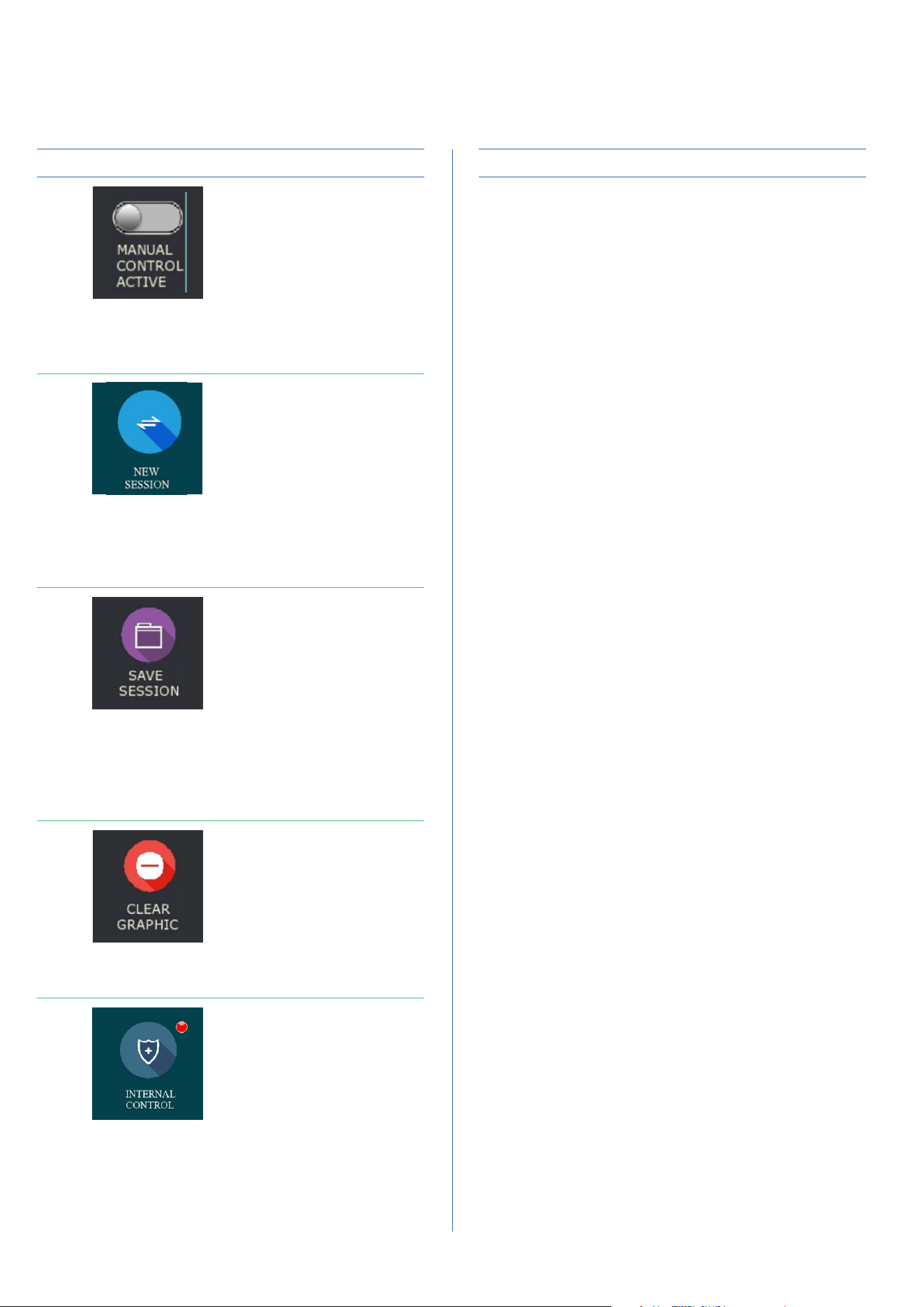
92
11. Software control
ATLANTIS hyperbaric system
Session additional features
►
Indicates whether the session is under
automatic control. If the session is in
automatic control, the button is blue.
►
The side button starts a new session.
All session information is deleted. The
page returns to the start screen. Session
information is re-entered.
►
When the key is pressed, a screenshot is
taken. The screenshot is saved on a Flash
memory inserted into the USB port on
the control panel. The memory must be
formatted in Fat 32 format.
►
When the button is pressed, the graphic on
the main page is cleared.
►
When the button is pressed, the tablet
on the control panel inside the pressure
chamber becomes active. By pressing this
button again, authorization is taken from the
internal control and the internal control does
not work.
Time vs. Pressure gradient graph
The pressure-time graph displays how chamber pressure
changes over the course of a hyperbaric treatment
session. This chart is essential for monitoring treatments,
allowing healthcare providers to review patient treatment
data and obtain detailed session history.
When a session is recorded, the graph captures a visual
record of pressure changes over time. As pressure
increases, a blue line appears on the screen, tracking
the session from start to finish.
The target treatment pressure is 100 kPa, and the graph
provides a continuous visual representation to ensure
the session follows the prescribed protocol.
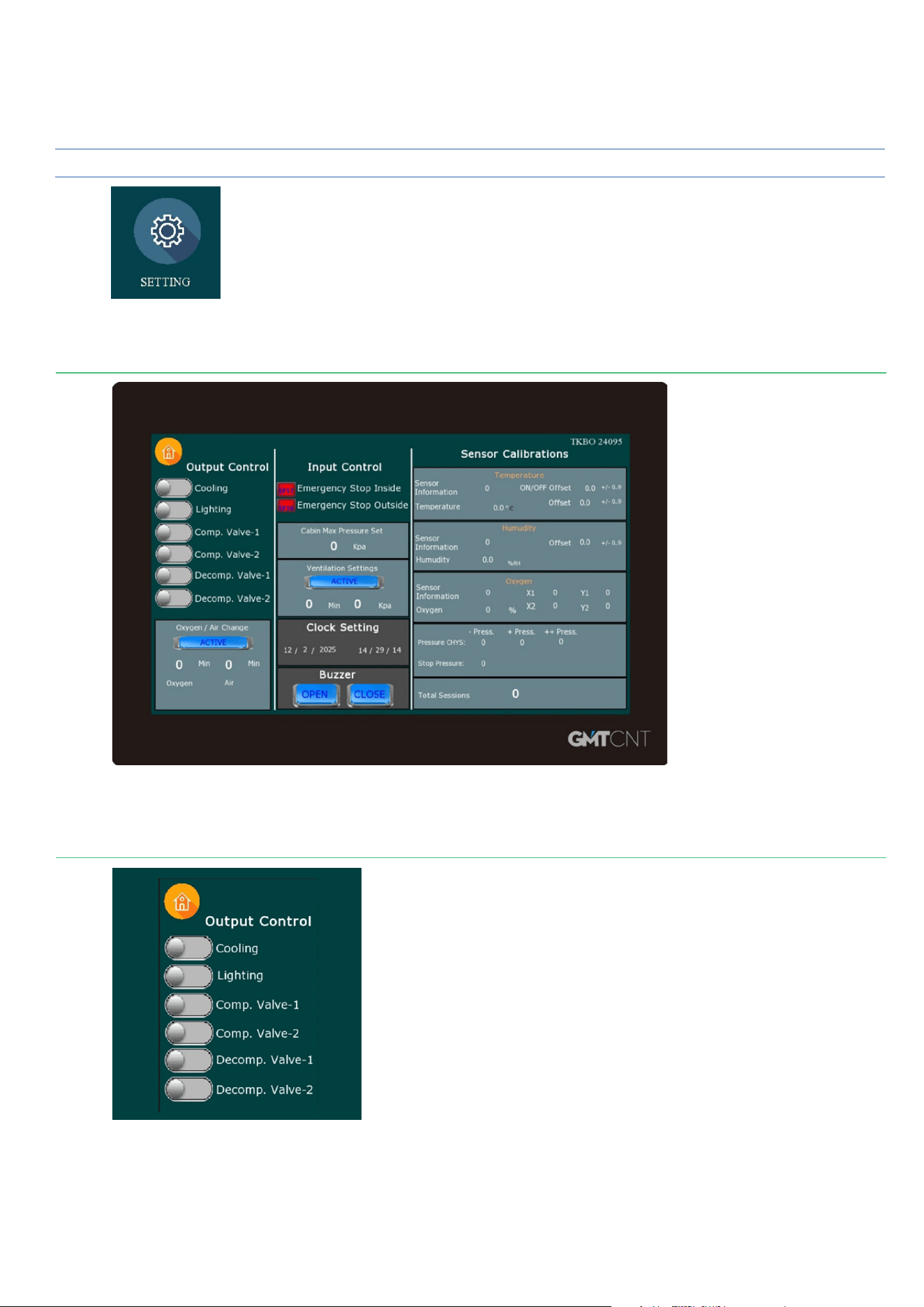
93
11. Software control
PRODUCT REF Nº → TKBO-2X ATLANTIS Hyperbaric System
Settings
►
Pressing the settings icon on the right side of the page opens the settings page.
►
This menu should only be used by people with technical qualifications. After the control work is finished, all buttons
should remain in the closed position and the black switch on the electrical panel should be turned to the “off” position.
►
Chamber controls are tested via the menu on the left. To start these tests, the black switch on the electrical panel is
brought to the “on” position.Each button on the Output Control menu is operated. Each button will activate the functions
written on its right side. By operating each button, it is visually and audibly checked whether the function is working or not.
ZEUGMA Hyperbaric System
PRODUCT REF Nº → TKBO-X
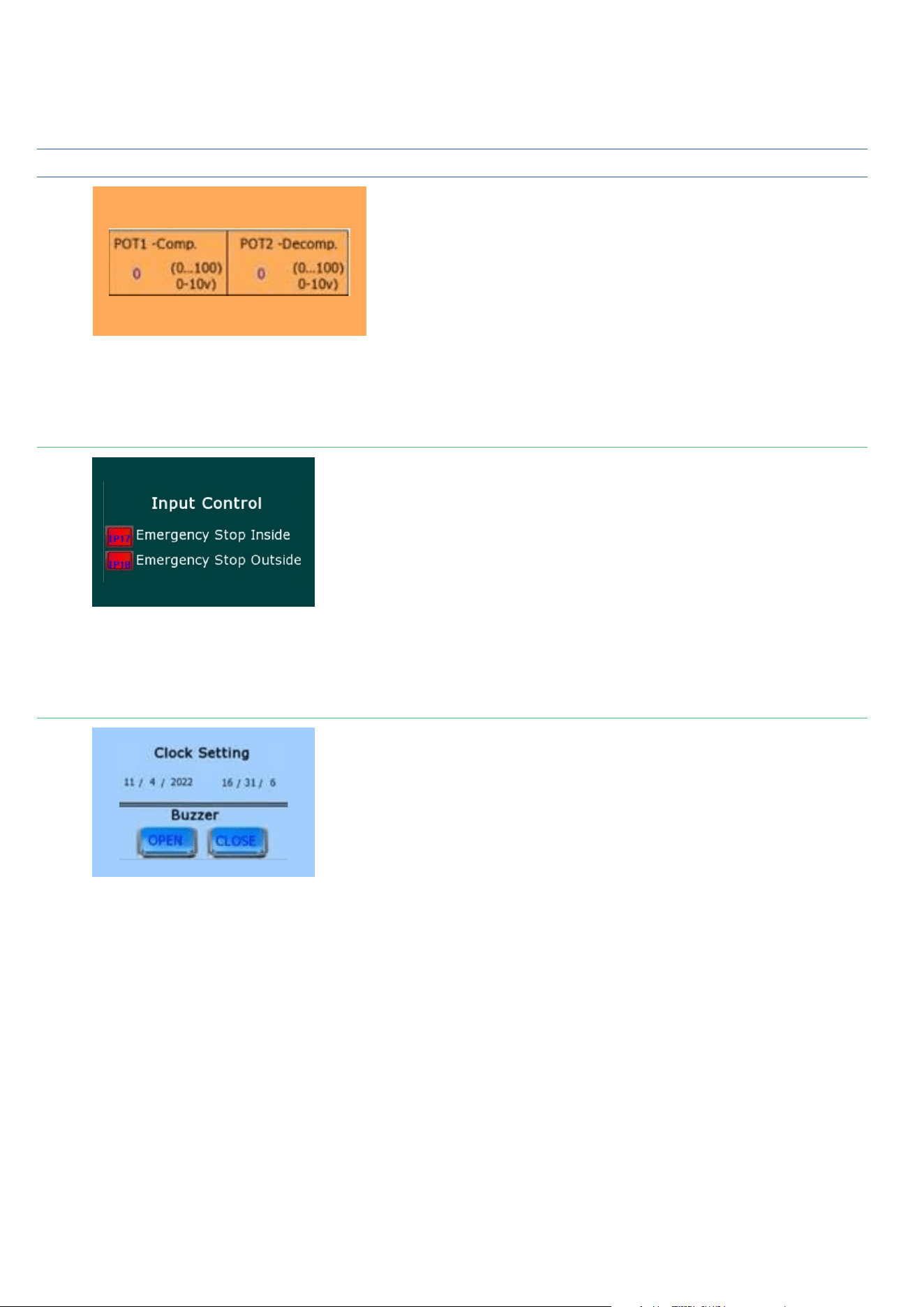
94
11. Software control
ATLANTIS hyperbaric system
Settings
►
It controls 2 rotatable buttons on the external control panel. The pots on the panel are rotated. When the pots are
rotated clockwise, the zero value starts to rise. Thus, it is understood that the pots are working. This menu should
only be used by people with technical qualifications.
►
Inputs are tested via the menu on the left. To start these tests, the black switch on the electrical panel is brought to
the “on” position. Each red box on the Input Control menu is examined. The buttons next to the boxes are activated
over the chamber and it is seen that the red-lit boxes are green.
►
Time and date setting is made from the side menu. Touch the time and date digits. Data is entered from the keyboard
that appears. Enter key is pressed. Press the Open button in the Buzzer menu to make a sound every time the touch
tablet is touched. Press the Close button to mute the sound.
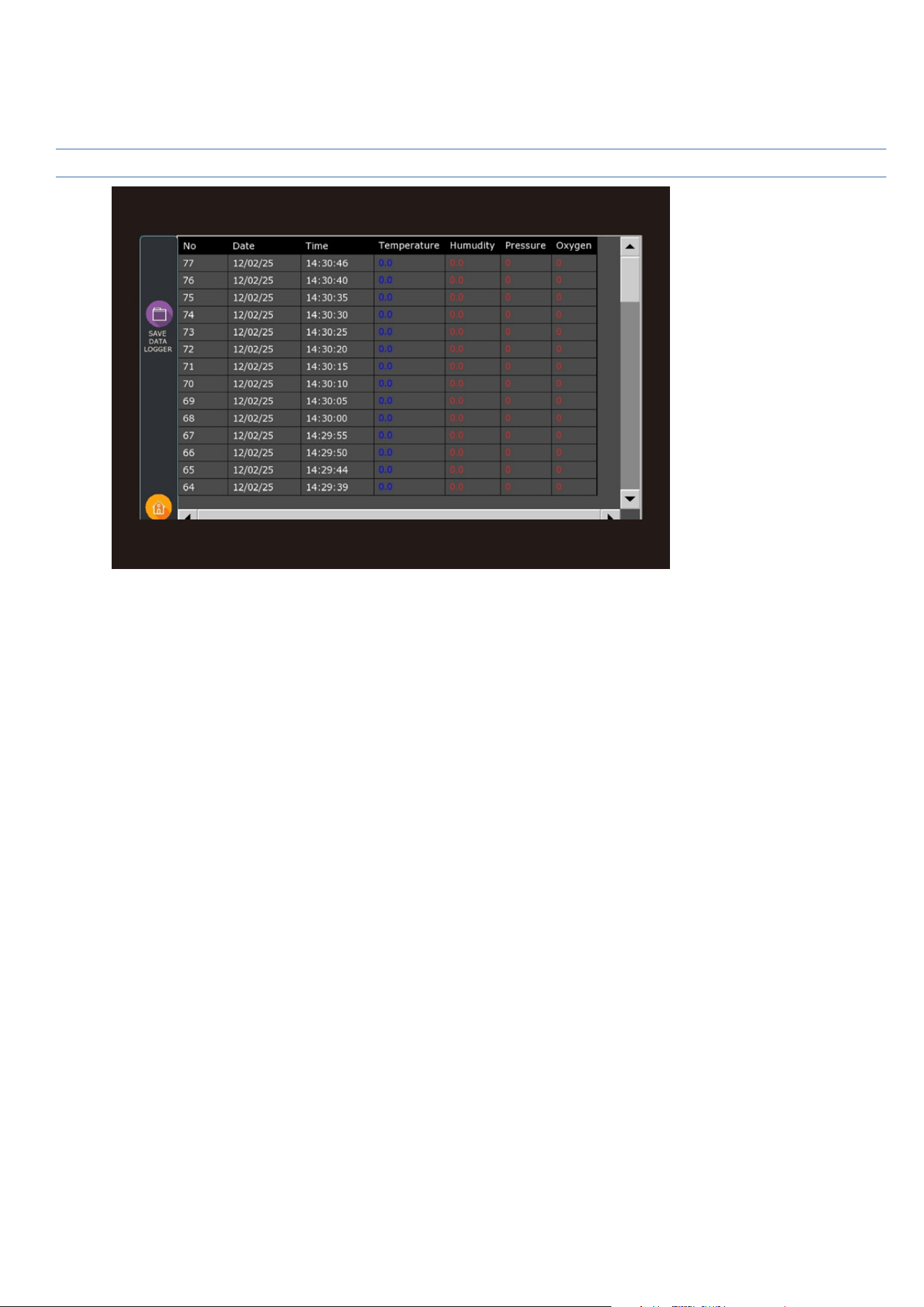
95
11. Software control
PRODUCT REF Nº → TKBO-2X ATLANTIS Hyperbaric System
Settings
►
Intervention in the sensor calibration section should only be done by the authorized service. Disruption of sensor
calibrations causes the chamber to not work properly.
ZEUGMA Hyperbaric System
PRODUCT REF Nº → TKBO-X
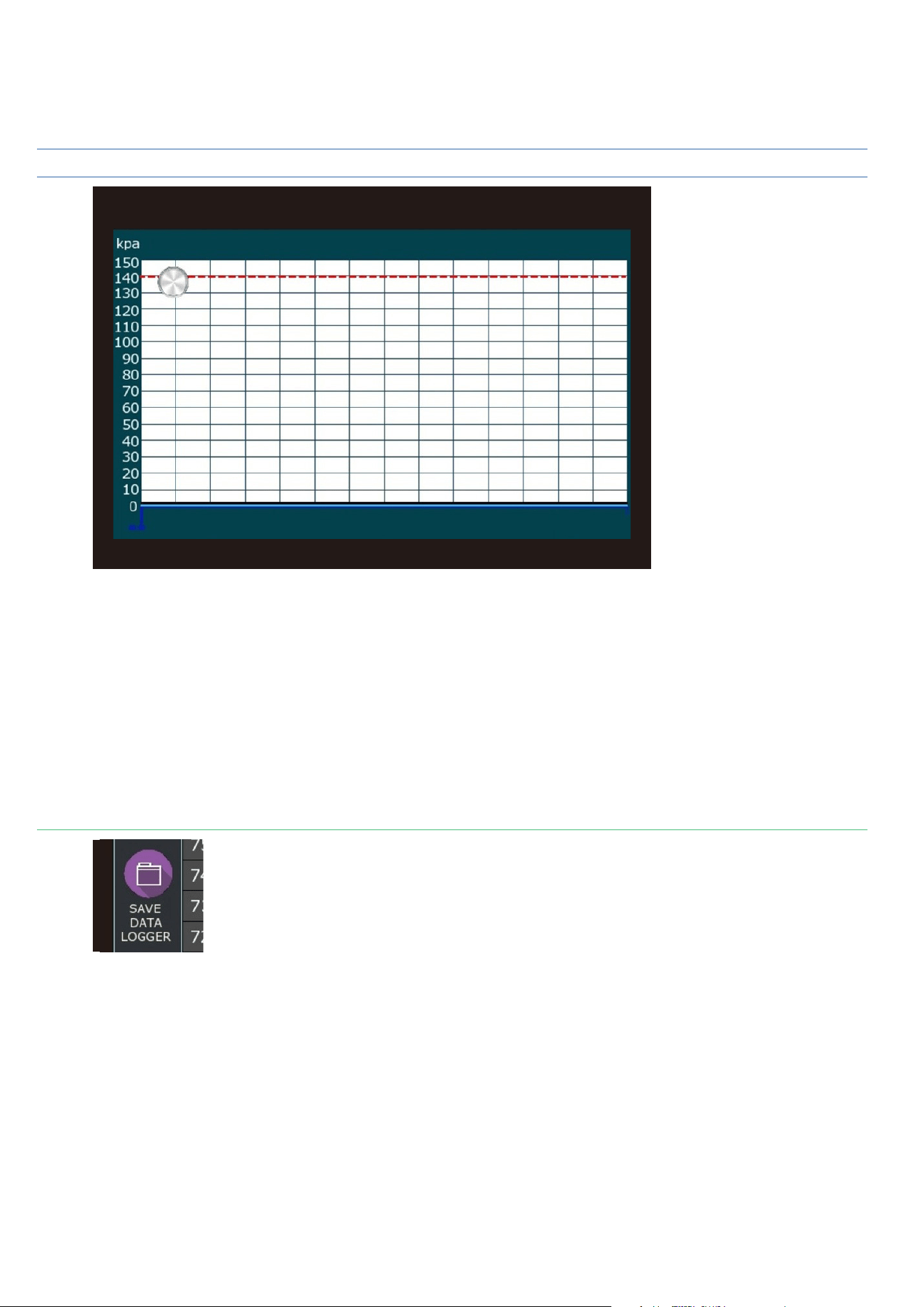
96
11. Software control
ATLANTIS hyperbaric system
Detailed Graph and Data Logging
►
Pressing the button located at the top right of the screen displays a detailed graph, which includes:
Ȼ Total oxygen time
Ȼ Total session time
Ȼ Pressure-time graph
When oxygen is supplied through the masks, a green layer appears on the graph. This green layer remains visible for
the duration that oxygen is being delivered, and during this period, the system counts the total amount of oxygen
administered.
►
A data logger button is at the bottom right of the screen. When pressed, it records chamber pressure, temperature,
and humidity values at 5-second intervals. If a FAT32-formatted USB drive is connected to the panel’s USB port, all
recorded data—including date and time stamps—are automatically saved to the USB drive for further analysis.
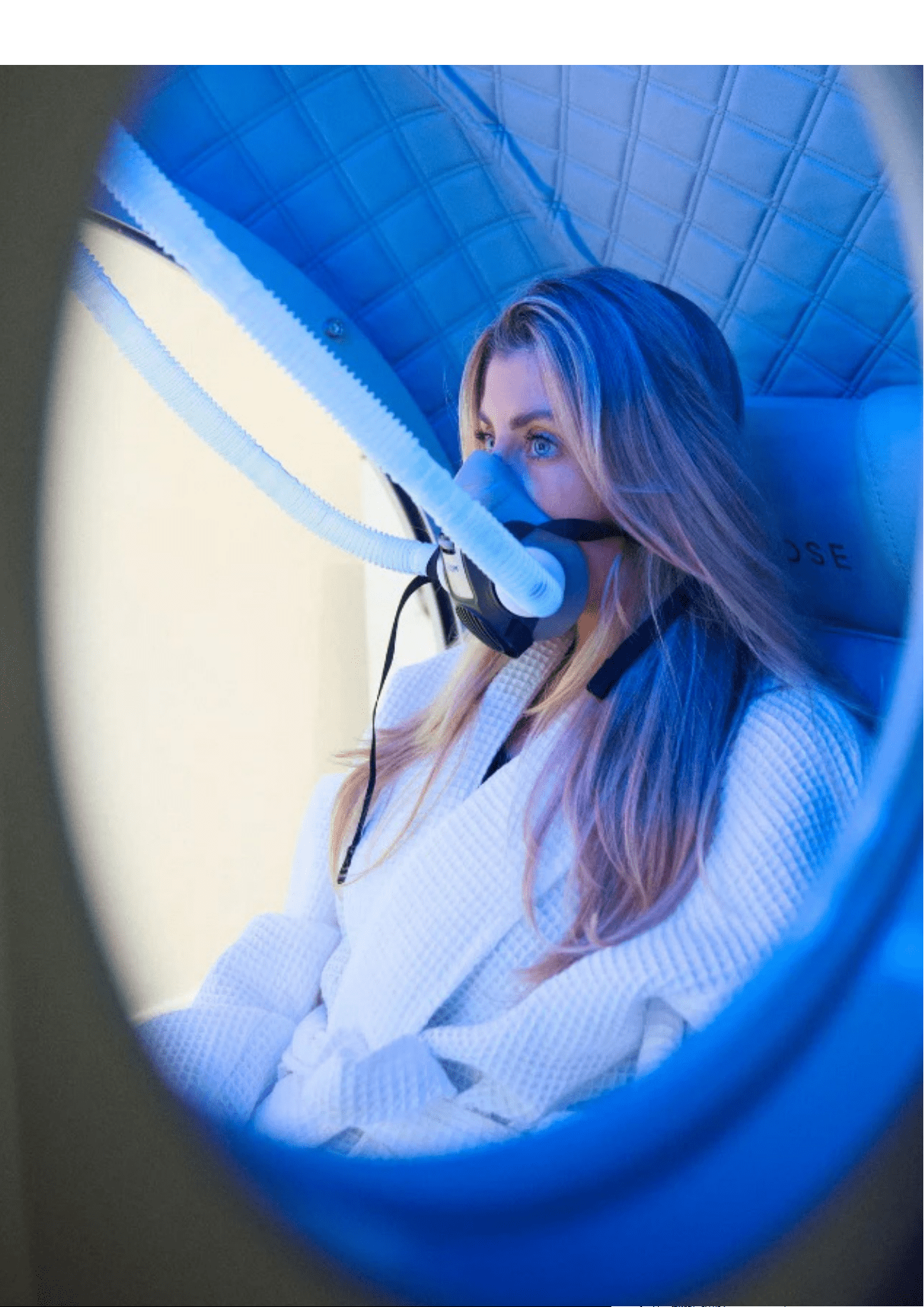
97
7. Software control
PRODUCT REF Nº → TKBO-2X ATLANTIS Hyperbaric System
ZEUGMA Hyperbaric System
PRODUCT REF Nº → TKBO-X

98
7. Software control
ATLANTIS hyperbaric system
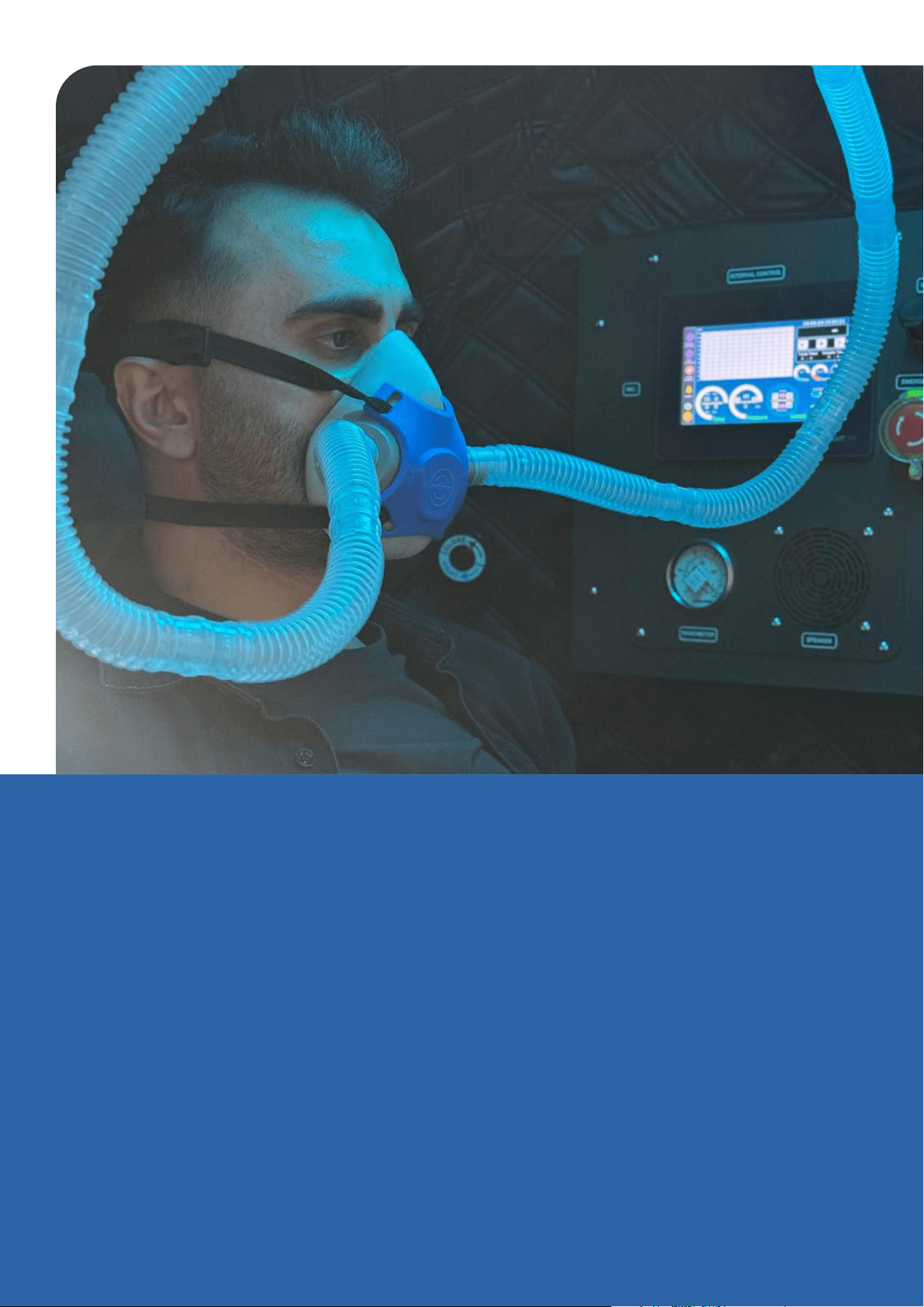
99
7. Indications for use (IFU)
PRODUCT REF Nº → TKBO-2X ATLANTIS Hyperbaric System
12. Indications for use (IFU)
ZEUGMA Hyperbaric System
PRODUCT REF Nº → TKBO-X

100
12. Indications for use (IFU)
ATLANTIS hyperbaric system
This Indications for Use document is designed to align with regulatory and clinical
standards, ensuring that your HpoTech Hyperbaric Oxygen Therapy (HBOT) Chamber
system is used appropriately and effectively.
1. Intended Use
The Hyperbaric Oxygen Therapy (HBOT) chamber is
designed to provide oxygen therapy at pressures greater
than atmospheric pressure under the supervision of
a qualified healthcare professional. The chamber is
pressurized with ambient air using an Air Compressor
unit, and oxygen is delivered through a BIBS Mask using
the Oxygen Concentrator unit.
This medically supervised treatment requires a physician's
prescription. Patients are placed in a chamber that
meets safety standards (ASME-PVHO-1 and NFPA 99)
at pressures typically ranging from 1.9 ATA to 3.0 ATA.
During each session, which typically lasts 60-90-120
minutes, patients breathe medical-grade oxygen to
support the treatment of specific medical conditions.
Ȼ Intended Users: Licensed physicians with
training in hyperbaric medicine, supported
by trained technicians.
Ȼ Target Population: Adults and children who
meet the inclusion criteria for HBOT based
on medical diagnosis.
2. Indications
The hyperbaric chamber is indicated for the following
conditions, as evidenced in clinical research with specific
protocols in the Clinical Evaluation Report (CER) document:
Approved indications (Medical use)
Ȼ Air or Gas Embolism
Ȼ Carbon Monoxide Poisoning
Ȼ Crush Injuries
Ȼ Decompression Sickness
Ȼ Delayed Radiation Injury
Ȼ Diabetic Foot
Ȼ Gas Gangrene
Ȼ Intracranial Brain Abscess
Ȼ Necrotizing Soft Tissue Infections
Ȼ Refractory Osteomyelitis
Ȼ Severe Anemia
Ȼ Skin Grafts and Flaps
Ȼ Thermal Burns

101
12. Indications for use (IFU)
PRODUCT REF Nº → TKBO-2X ATLANTIS Hyperbaric System
3. Target population for HBOT
The target population suitable for Hyperbaric Oxygen Therapy (HBOT) generally includes
a wide range of age groups, depending on the treated condition and individual patient
factors. The recommended age groups for HBOT can be categorized into the following
intervals:
Precautions
Ȼ Careful monitoring of blood pressure and
oxygen levels during therapy.
Ȼ Reduced session times or oxygen
concentration may be needed to prevent
adverse effects.
Neonates and infants
Ȼ Rarely used but may be considered for
specific life-threatening conditions like
severe hypoxia or ischemic injuries.
Ȼ Requires specialized equipment and highly
trained professionals.
Clinical consideration for all ages
Ȼ Patient suitability depends on thorough
screening for contraindications, such
as untreated pneumothorax, upper
respiratory infections, or severe
pulmonary conditions.
Ȼ Special attention should be given to
patients prone to claustrophobia or those
with pre-existing health conditions.
Adults
Ȼ The majority of HBOT treatments are
designed for adult patients.
Ȼ Most indications, such as decompression
sickness, carbon monoxide poisoning,
and radiation injuries, are commonly
treated in adults.
Pediatrics
Ȼ HBOT is suitable for children but requires
careful consideration and supervision
by a healthcare provider experienced in
pediatric hyperbaric therapy.
Ȼ Common pediatric indications include
carbon monoxide poisoning, severe
anemia, and certain infections.
Elderly
Ȼ Elderly patients can benefit from HBOT,
particularly for chronic conditions like
radiation injuries or diabetic foot ulcers.
Ȼ Age-related health conditions (e.g.,
cardiovascular or pulmonary diseases)
must be assessed to ensure patient
safety.
Ȼ Infants and Neonates: 0–2 years
Ȼ Children: 3–12 years
Ȼ Adolescents: 13–18 years
Ȼ Adults: 19–64 years
Ȼ Older Adults (Seniors): 65+ years
Each group may require specific protocols and precautions based on their physiological differences and
medical conditions.
ZEUGMA Hyperbaric System
PRODUCT REF Nº → TKBO-X

102
12. Indications for use (IFU)
ATLANTIS hyperbaric system
4. Contraindications
The following conditions are contraindicated for HBOT
unless assessed and approved by a qualified healthcare
provider:
Absolute contraindications
Ȼ Untreated pneumothorax
Ȼ Certain chemotherapy agents (e.g.,
doxorubicin, bleomycin)
Ȼ Concurrent use of certain drugs (e.g.,
disulfiram)
Ȼ Upper respiratory infections or sinus
barotrauma
Ȼ Severe pulmonary conditions or
emphysema with CO2 retention
Ȼ Uncontrolled seizures
Additionally, patients with recent thoracic or abdominal
surgery, pregnancy, or those prone to claustrophobia
should be carefully evaluated for suitability. The following
conditions are contraindicated for HBOT unless assessed
and approved by a qualified healthcare provider.
Relative contraindications include
Ȼ Severe chronic obstructive pulmonary
disease (COPD)
Ȼ Recent ear or sinus surgery
Ȼ Active upper respiratory tract infections
Ȼ Claustrophobia (unless mitigated by
device features)
Pregnancy
While hyperbaric oxygen therapy (HBOT) has shown
promise for a variety of medical conditions, it is crucial
to consider safety during pregnancy. Generally, HBOT
is not recommended for use during pregnancy unless
prescribed by a medical professional and deemed
essential to the treatment of specific conditions. Clinical
studies are still limited in this area, so patients should
consult with their healthcare provider before using a
hyperbaric chamber.
Indications for Use in Pregnancy
(when applicable)
Ȼ Severe carbon monoxide poisoning:
When there is a risk of maternal or fetal
harm from exposure to CO, HBOT may be
considered as a life-saving measure.
Ȼ Certain wound healing conditions: HBOT
may be recommended in exceptional
cases for the treatment of severe burns
or radiation injuries.
Precautions
Ȼ It is recommended to avoid HBOT during
the first trimester unless medically
necessary.
Ȼ Always seek approval from a qualified
maternal and fetal health physician before
starting any HBOT protocol.

103
12. Indications for use (IFU)
PRODUCT REF Nº → TKBO-2X ATLANTIS Hyperbaric System
6. Precautions
Ȼ Patients must avoid wearing synthetic or
flammable materials inside the chamber.
Ȼ Adequate hydration and nutrition should
be ensured before therapy.
Ȼ In case of any discomfort (e.g., ear
barotrauma), therapy must be paused for
evaluation.
Ȼ Monitor patients closely for signs of
oxygen toxicity, such as confusion,
visual disturbances, or muscle twitching,
especially during prolonged treatments or
at higher pressures.
Ȼ Address potential claustrophobia by
acclimating patients to the chamber
environment and providing appropriate
support or sedation if necessary.
Ȼ Ensure that patients with sinus issues or
recent middle ear surgery are evaluated
and pre-treated to minimize the risk of
barotrauma.
Ȼ Provide clear instructions to patients
about communication protocols inside
the chamber and the importance of
immediately reporting any discomfort or
symptoms.
Ȼ Avoid bringing lighters or other
pressurized containers that can explode
under increased atmospheric pressure.
5. Warnings
Ȼ HBOT should only be administered under
the supervision of a licensed medical
professional trained in hyperbaric
medicine.
Ȼ Patients with implanted medical devices
(e.g., pacemakers) must be evaluated
for compatibility with hyperbaric
environments.
Ȼ Ensure thorough patient screening
to avoid complications related to
undiagnosed contraindications.
Ȼ Prolonged treatments or high oxygen
concentrations may increase the risk
of oxygen toxicity. Symptoms of oxygen
toxicity, such as nausea, dizziness, or
seizures, must be closely monitored and
addressed immediately.
Ȼ Patients with a history of oxygen
sensitivity or previous adverse reactions
to HBOT require extra caution and tailored
treatment protocols.
ZEUGMA Hyperbaric System
PRODUCT REF Nº → TKBO-X

104
12. Indications for use (IFU)
ATLANTIS hyperbaric system
Some examples include
Ȼ Chronic wound healing often requires 5-7
sessions per week for 4-6 weeks, with
longer durations for severe cases.
Ȼ Acute conditions like carbon monoxide
poisoning or decompression sickness
demand immediate treatment, with
sessions lasting 90-120 minutes over 1-3
days.
Ȼ Radiation injuries and traumatic brain
injuries may require 3-7 sessions per
week for 3-6 weeks, depending on
severity.
Ȼ Stroke recovery treatments are most
effective when initiated within the first
weeks and may continue for 4-6 weeks or
longer for ongoing improvement.
These recommendations are general guidelines. For medical applications, treatment should always be individualized
and prescribed by a qualified healthcare provider.
General considerations
Ȼ Adjusting treatment protocols: A
healthcare provider or therapist may
adjust the frequency and duration
of sessions depending on individual
responses and progress.
Ȼ Cumulative benefits: For many conditions,
HBOT's cumulative benefits are most
apparent after several sessions,
especially in chronic conditions or
wellness optimization.
Ȼ Monitoring response: It is essential to
monitor how a patient or user responds
to HBOT. Some individuals may experience
faster results, while others may require
more sessions to see significant benefits.
7. Recommended usage periods
The frequency and duration of Hyperbaric Oxygen Therapy (HBOT) sessions vary depending
on the specific condition being treated and individual treatment goals.
Treatments are typically delivered multiple times per week, with each session lasting
between 60 and 120 minutes. The total duration of therapy can range from a few weeks
to several months, depending on the severity of the condition and the patient's response
to treatment. Regular follow-up sessions may be suggested to maintain or enhance
HBOT's benefits.

105
12. Indications for use (IFU)
PRODUCT REF Nº → TKBO-2X ATLANTIS Hyperbaric System
By following these recommendations, users can ensure a more effective and comfortable recovery, enhancing the
benefits of each hyperbaric session.
8. Post-session recommendations
Hydration and nutrition
After a hyperbaric oxygen therapy session, it is important
to stay well-hydrated to optimize the body’s recovery
process. Oxygen helps the body process nutrients
more efficiently, so replenishing fluids and consuming a
balanced meal can support cellular repair and energy
levels.
Ȼ Hydration: Drink at least 500ml of water
following each session to ensure proper
hydration and support optimal metabolic
function.
Ȼ Nutrition: A meal containing lean proteins,
healthy fats, and complex carbohydrates
is recommended to promote tissue repair
and energy restoration. Avoid heavy, fatty
foods immediately after the session.
Monitoring and follow-up
Medical patients need regular follow-up visits with
healthcare providers to monitor progress and adjust
treatment plans as needed. Tracking how they feel
post-session (e.g., energy levels, mental clarity, muscle
recovery) can help assess the overall effectiveness
of the therapy.
Ȼ Track improvements: Keep a journal or
log to track progress on physical and
cognitive improvements after each
session.
Ȼ Consultation: After a series of treatments,
a follow-up with a physician is
recommended to assess the therapeutic
effects and discuss future treatment
plans.
Rest and recovery
The body’s tissues undergo repair during HBOT, so it’s
important to allow sufficient recovery time. Rest is
essential for maximizing the therapy's benefits.
Ȼ Sleep: Adequate sleep enhances the
healing process. Aim for 7-9 hours of
restful sleep to support cell regeneration
and cognitive restoration.
Ȼ Light activity: Low-intensity activity,
such as walking or gentle stretching, is
recommended on the day of treatment.
Avoid strenuous exercise immediately
after a session, as the body may still be
in a recovery phase.
Avoiding potential risks
Although HBOT is generally safe, some side effects can
occur, particularly if the recommended protocols are
not followed. Common issues include:
Ȼ Barotrauma: To minimize the risk of ear or
sinus discomfort, patients should follow
the guidelines for equalizing pressure
during the treatment.
Ȼ Dehydration: Stay hydrated before and
after the session to avoid potential
dehydration.
Ȼ Fatigue: If you feel particularly tired
after a session, it is important to take
adequate rest to allow your body to fully
recover.
ZEUGMA Hyperbaric System
PRODUCT REF Nº → TKBO-X

106
12. Indications for use (IFU)
ATLANTIS hyperbaric system

107
12. Indications for use (IFU)
PRODUCT REF Nº → TKBO-2X ATLANTIS Hyperbaric System
9. Side effects of hyperbaric oxygen therapy
HBOT lasts for a few hours. It may need to be repeated. The treatment may have side
effects in some people. For example:
10. Hazards and associated risks
Ȼ Pressure-related risks
Ȼ Barotrauma: Damage to tissues (e.g.,
ears, sinuses, lungs) caused by rapid
pressure changes during compression or
decompression.
Ȼ Oxygen toxicity: Prolonged exposure to
high oxygen concentrations may lead to
central nervous system (CNS) toxicity
(e.g., seizures) or pulmonary oxygen
toxicity.
Ȼ Decompression Sickness: Improper
decompression protocols can result in
"the bends," even in a therapeutic setting.
Ȼ Fire hazards
Ȼ Oxygen equipment: Strict no-smoking
and no-flammable-materials policies are
essential.
Ȼ Electrical sparks: Malfunctioning electrical
devices or static discharge within or near
the chamber could ignite a fire.
Ȼ Equipment malfunction
Ȼ Pressure regulation failure: Faulty valves or
regulators may cause over-pressurization
or under-pressurization, posing risks to
patients and staff.
Ȼ Monitoring system failure: Inaccurate
readings could result in improper
treatment durations or pressures.
Ȼ Human error
Ȼ Improper training: Untrained operators
may mishandle controls or fail to monitor
patients adequately.
Ȼ Incorrect protocols: Deviations from
standard operating procedures (SOPs)
can lead to under- or over-treatment.
Ȼ Your ears may pop or you have mild
discomfort in the chamber. These can be
eased as the pressure is lowered.
Ȼ You may feel lightheaded when leaving the
chamber.
Ȼ You may have nearsightedness after
treatment. This usually gets better within
days to weeks after the last treatment.
In rare cases, a person may have an eardrum rupture, lung symptoms, or a seizure. Having HBOT at a hospital with
trained staff is the best way to prevent serious side effects.
ZEUGMA Hyperbaric System
PRODUCT REF Nº → TKBO-X

108
12. Indications for use (IFU)
ATLANTIS hyperbaric system
Ȼ Patient-specific risks
Ȼ Claustrophobia: Anxiety or panic attacks
due to the confined space.
Ȼ Pre-existing conditions: Hyperbaric
treatment may exacerbate conditions
like untreated pneumothorax or certain
cardiovascular disorders.
Ȼ Allergic reactions: Latex or other materials
in the chamber may trigger allergic
responses in sensitive individuals.
Hazards from foreseeable misuse
Ȼ Unauthorized modifications
Ȼ Tampering with pressure settings:
Unqualified adjustments may lead to
unsafe pressure levels.
Ȼ Use of non-compatible equipment:
Connecting unapproved devices to the
chamber can compromise safety.
Ȼ Inappropriate applications
Ȼ Unapproved indications: Using the
chamber for non-evidence-based
conditions (e.g., wellness trends) could
result in harm or ineffective treatment.
Ȼ Improper patient selection: Treating
individuals with contraindications
(e.g., pregnant women, untreated
pneumothorax) can lead to severe
complications.
Ȼ Extended sessions
Ȼ Overexposure to oxygen: Sessions
exceeding recommended durations or
pressures can lead to oxygen toxicity or
other adverse effects.
Ȼ Unsupervised or home use
Ȼ Lack of medical supervision: Operating
chambers without professional oversight
increases risks of complications (e.g.,
oxygen toxicity).
Ȼ Improper maintenance: Poorly maintained
chambers may fail during operation,
posing serious risks.
Ȼ Material misuse
Ȼ Prohibited items: Bringing flammable
materials (e.g., alcohol, petroleum-based
products) or electronic devices inside the
chamber can ignite fires.
Ȼ Ignoring warning signs
Ȼ Delayed response to symptoms:
Misinterpreting or ignoring symptoms like
chest pain or difficulty breathing can
escalate risks.
Ȼ Infections
Ȼ Cross-contamination: Shared use of
chambers without proper disinfection can
spread infectious diseases.

109
12. Indications for use (IFU)
PRODUCT REF Nº → TKBO-2X ATLANTIS Hyperbaric System
Risk mitigation measures
Ȼ Strict training requirements: Ensure
operators are adequately trained in safety
protocols, pressure management, and
emergency procedures.
Ȼ Pre-treatment screening: Assess patient
suitability and rule out contraindications
before each session.
Ȼ Comprehensive SOPs: Establish and
enforce standardized protocols for
chamber operation, patient monitoring,
and emergency handling.
Ȼ Regular maintenance: Schedule routine
checks and servicing of all chamber
components.
Ȼ Emergency plans: Equip facilities with
fire suppression systems, oxygen
toxicity management tools, and first aid
resources.
Ȼ Education: Provide clear instructions and
warnings to patients about proper use
and prohibited behaviors.
By addressing these risks proactively, the safe and effective use of hyperbaric chambers can be ensured while
minimizing the likelihood of accidents or adverse outcomes.
ZEUGMA Hyperbaric System
PRODUCT REF Nº → TKBO-X

110
12. Indications for use (IFU)
ATLANTIS hyperbaric system
11. Clinical considerations
The effectiveness of HBOT varies based on the condition being treated, patient health
status, and adherence to prescribed treatment protocols. Clinical guidelines should
be followed by recognized organizations such as the Undersea and Hyperbaric Medical
Society (UHMS). For detailed information, refer to the official UHMS guidelines at https://
www.uhms.org.
12. Documentation and Records
Healthcare providers must document patient assessments, therapy sessions, and
outcomes to ensure compliance with medical standards and regulatory requirements.
13. Evidence and research:
The document was compiled using a comprehensive list of peer-reviewed studies,
clinical trials, and scientific papers that support the efficacy and safety of HBOT for the
outlined conditions, as published in the following sources:
Ȼ Undersea & Hyperbaric Medicine Journal
Ȼ Journal of Clinical Investigation
Ȼ The Lancet
Ȼ The American Journal of Surgery
Ȼ PubMed
Ȼ National Library of Medicine
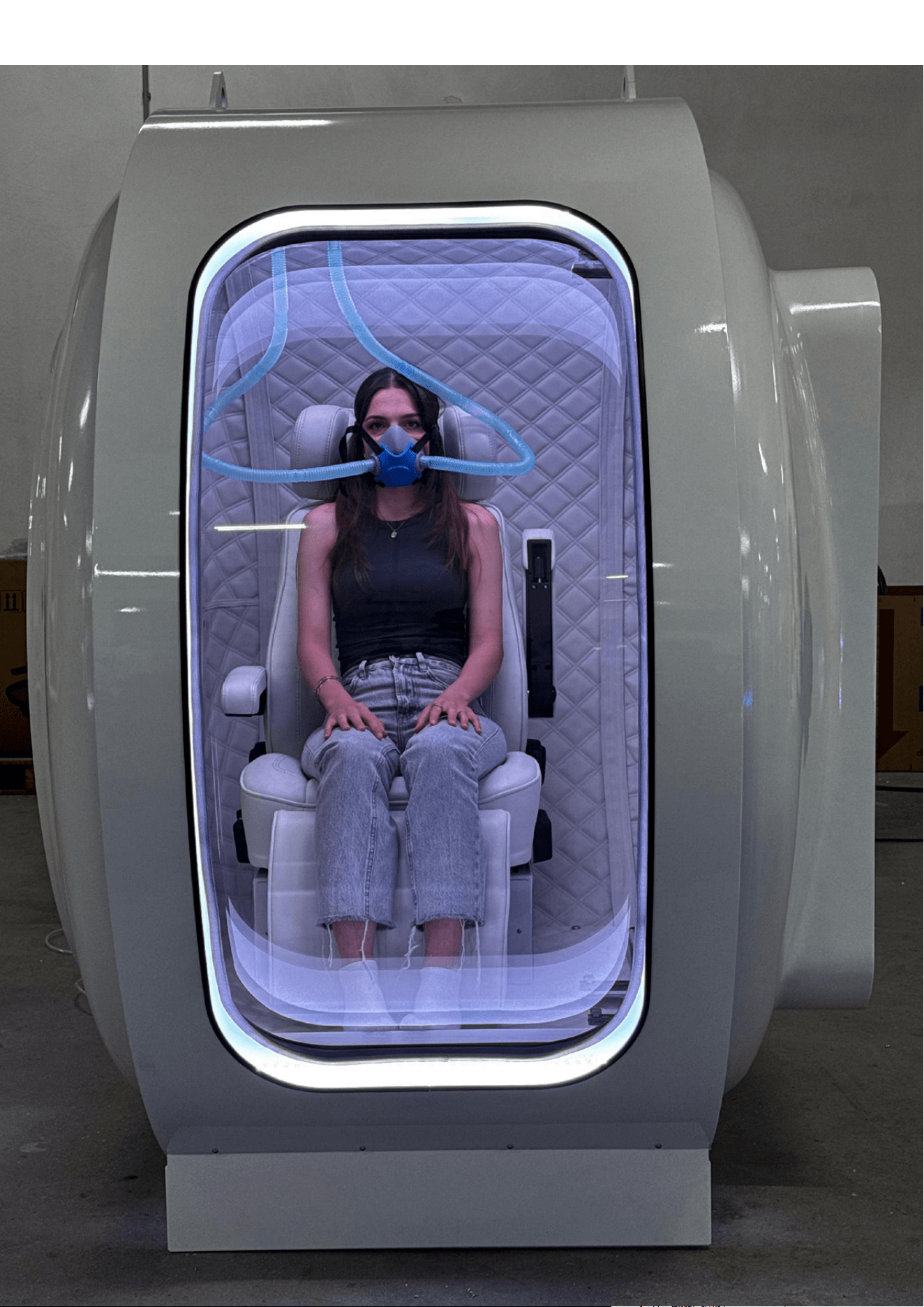
111
11. Indications for use (IFU)
PRODUCT REF Nº → TKBO-2X ATLANTIS Hyperbaric System
ZEUGMA Hyperbaric System
PRODUCT REF Nº → TKBO-X

User Service Program
A comprehensive service program is available to all users of the ATLANTIS Hyperbaric
System manufactured by HPO TECH. For information regarding annual service
contracts, please get in touch with the office.
HPOTECH MEDİKAL VE TEKNİK ÇÖZÜMLER SAN VE TİC A.Ş
Telephone: +90 543 931 54 54
Telephone: +90 506 118 94 05
Address: Ataşehir Ferhatpaşa, 49. Sk. No: 29, 34888 Ataşehir, İstanbul, Turkey
www.hpotech.com
ZEUGMA Hyperbaric System
PRODUCT REF Nº → TKBO-X
REVISION DATE → 09.09.2025